CN115938106A - Online Verification Method for Autonomous Driving Decision Based on Accessibility Analysis of Traffic Participants - Google Patents
Online Verification Method for Autonomous Driving Decision Based on Accessibility Analysis of Traffic Participants Download PDFInfo
- Publication number
- CN115938106A CN115938106A CN202211069233.8A CN202211069233A CN115938106A CN 115938106 A CN115938106 A CN 115938106A CN 202211069233 A CN202211069233 A CN 202211069233A CN 115938106 A CN115938106 A CN 115938106A
- Authority
- CN
- China
- Prior art keywords
- vehicle
- track
- traffic
- safety
- area
- Prior art date
- Legal status (The legal status is an assumption and is not a legal conclusion. Google has not performed a legal analysis and makes no representation as to the accuracy of the status listed.)
- Granted
Links
- 238000012795 verification Methods 0.000 title claims abstract description 74
- 238000000034 method Methods 0.000 title claims abstract description 58
- 238000004458 analytical method Methods 0.000 title claims abstract description 24
- 238000004364 calculation method Methods 0.000 claims description 9
- 230000033001 locomotion Effects 0.000 claims description 8
- 238000010200 validation analysis Methods 0.000 claims 1
- 230000008859 change Effects 0.000 abstract description 37
- 238000010586 diagram Methods 0.000 description 17
- 238000004088 simulation Methods 0.000 description 10
- 230000001133 acceleration Effects 0.000 description 7
- 238000005516 engineering process Methods 0.000 description 7
- 238000012360 testing method Methods 0.000 description 7
- 238000004422 calculation algorithm Methods 0.000 description 6
- 230000035484 reaction time Effects 0.000 description 4
- 206010039203 Road traffic accident Diseases 0.000 description 3
- 230000000295 complement effect Effects 0.000 description 3
- 238000010276 construction Methods 0.000 description 3
- 101100012902 Saccharomyces cerevisiae (strain ATCC 204508 / S288c) FIG2 gene Proteins 0.000 description 2
- 101100233916 Saccharomyces cerevisiae (strain ATCC 204508 / S288c) KAR5 gene Proteins 0.000 description 2
- 230000008569 process Effects 0.000 description 2
- 238000012545 processing Methods 0.000 description 2
- 101001121408 Homo sapiens L-amino-acid oxidase Proteins 0.000 description 1
- 101000827703 Homo sapiens Polyphosphoinositide phosphatase Proteins 0.000 description 1
- 102100026388 L-amino-acid oxidase Human genes 0.000 description 1
- 102100023591 Polyphosphoinositide phosphatase Human genes 0.000 description 1
- 230000009286 beneficial effect Effects 0.000 description 1
- 230000005540 biological transmission Effects 0.000 description 1
- 238000012937 correction Methods 0.000 description 1
- 238000009795 derivation Methods 0.000 description 1
- 238000013461 design Methods 0.000 description 1
- 238000001514 detection method Methods 0.000 description 1
- 230000006870 function Effects 0.000 description 1
- 238000012423 maintenance Methods 0.000 description 1
- 238000004519 manufacturing process Methods 0.000 description 1
- 239000011159 matrix material Substances 0.000 description 1
- 238000005259 measurement Methods 0.000 description 1
- 238000012986 modification Methods 0.000 description 1
- 230000004048 modification Effects 0.000 description 1
- 230000008447 perception Effects 0.000 description 1
- 238000012827 research and development Methods 0.000 description 1
- 239000013589 supplement Substances 0.000 description 1
- 230000007704 transition Effects 0.000 description 1
Images


Classifications
-
- Y—GENERAL TAGGING OF NEW TECHNOLOGICAL DEVELOPMENTS; GENERAL TAGGING OF CROSS-SECTIONAL TECHNOLOGIES SPANNING OVER SEVERAL SECTIONS OF THE IPC; TECHNICAL SUBJECTS COVERED BY FORMER USPC CROSS-REFERENCE ART COLLECTIONS [XRACs] AND DIGESTS
- Y02—TECHNOLOGIES OR APPLICATIONS FOR MITIGATION OR ADAPTATION AGAINST CLIMATE CHANGE
- Y02T—CLIMATE CHANGE MITIGATION TECHNOLOGIES RELATED TO TRANSPORTATION
- Y02T10/00—Road transport of goods or passengers
- Y02T10/10—Internal combustion engine [ICE] based vehicles
- Y02T10/40—Engine management systems
Landscapes
- Traffic Control Systems (AREA)
Abstract
Description
技术领域Technical Field
本发明涉及自动驾驶技术领域,具体为基于交通参与者可达性分析的自动驾驶决策在线验证方法。The present invention relates to the field of autonomous driving technology, and specifically to an online verification method for autonomous driving decisions based on traffic participant accessibility analysis.
背景技术Background Art
安全是自动驾驶技术普及面临的主要挑战,非安全驾驶策略严重威胁了驾乘人员的生命与财产安全,引发了公众信任危机。为了保证自动驾驶车辆在现实世界中拥有应对任意复杂的交通场景的能力,确保自动驾驶车辆不主动造成事故,有必要对自动驾驶产生的决策进行安全验证。Safety is the main challenge facing the popularization of autonomous driving technology. Unsafe driving strategies seriously threaten the lives and property safety of drivers and passengers, and trigger a crisis of public trust. In order to ensure that autonomous driving vehicles have the ability to cope with any complex traffic scenarios in the real world and ensure that autonomous driving vehicles do not actively cause accidents, it is necessary to conduct safety verification of the decisions made by autonomous driving.
目前对决策系统的安全验证多为离线进行,主要的方法包括基于行驶里程、脱离率、仿真与基于场景的测试验证,基于行驶里程的安全验证方法需要上亿公里以上的行驶里程获得足够的统计数据来证明自动驾驶决策的安全性,以年计的验证周期难以匹配自动驾驶方法的高效迭代;基于脱离率的安全验证方法维度单一,无法确保测试得到的脱离次数是否真实表征不同复杂程度驾驶场景下的决策安全性;基于仿真的安全验证方法难以证明所建立的虚拟环境能够逼真准确还原现实中交通场景;基于场景的安全验证方法存在着“过度拟合”的风险,同时更为重要的是,上述离线验证方法均根据自车与他车位置速度等离线数据评价自车在驶过当前场景时的决策表现,无法实现对决策算法的在线修正,实时在线地确保自车安全性。At present, the safety verification of decision-making systems is mostly carried out offline. The main methods include mileage, disengagement rate, simulation and scenario-based test verification. The mileage-based safety verification method requires more than 100 million kilometers of mileage to obtain sufficient statistical data to prove the safety of autonomous driving decisions. The annual verification cycle is difficult to match the efficient iteration of autonomous driving methods; the disengagement rate-based safety verification method has a single dimension and cannot ensure whether the number of disengagements obtained from the test truly represents the decision safety under driving scenarios of different complexities; the simulation-based safety verification method is difficult to prove that the established virtual environment can realistically and accurately restore the actual traffic scene; the scenario-based safety verification method has the risk of "overfitting". More importantly, the above-mentioned offline verification methods all evaluate the decision-making performance of the self-vehicle when passing through the current scene based on offline data such as the position and speed of the self-vehicle and other vehicles. It is impossible to realize online correction of the decision-making algorithm and ensure the safety of the self-vehicle in real time online.
在线安全验证的方法作为离线验证的补充,能够实时验证自动驾驶车辆的安全性,是保证车辆实施安全决策的必要手段。现有的在线验证方法主要包括Mobileye提出的RSS模型和英伟达提出的SFF模型,上述方法均基于事先设定好的安全距离保持等驾驶规则对自动驾驶系统进行在线安全验证,但该类模型仅能够对车辆某一时刻的状态是否满足既定规则进行安全验证,无法保证车辆连续轨迹的安全性,同时未提供将车辆引入安全状态的备选策略。As a supplement to offline verification, online safety verification methods can verify the safety of autonomous driving vehicles in real time, and are a necessary means to ensure that vehicles implement safe decisions. Existing online verification methods mainly include the RSS model proposed by Mobileye and the SFF model proposed by NVIDIA. The above methods are based on pre-set driving rules such as safe distance maintenance to conduct online safety verification of autonomous driving systems. However, such models can only verify whether the state of the vehicle at a certain moment meets the established rules, and cannot guarantee the safety of the vehicle's continuous trajectory. At the same time, they do not provide alternative strategies for bringing the vehicle into a safe state.
因此,有必要面向自动驾驶决策层输出的预期轨迹,结合显隐性交通法规设计一种能够在线验证轨迹安全性并提供备用安全轨迹的方法,使自动驾驶车辆始终有可选择的安全行驶轨迹,满足未来智能汽车与智能交通的安全需求。Therefore, it is necessary to design a method that can verify the safety of the trajectory online and provide a backup safe trajectory based on the expected trajectory output by the autonomous driving decision-making layer and combined with explicit and implicit traffic regulations, so that the autonomous driving vehicle always has a safe driving trajectory to choose from and meets the safety needs of future smart cars and smart transportation.
针对上述应用需求和面临的技术问题,本发明提出的基于交通参与者合法可达性分析的自动驾驶决策在线安全验证方法,作为现有运动规划层的安全基座,计算各交通参与者的合法可达区域,进而验证预期轨迹是否安全并提供备用安全轨迹,该方法通过在线验证对自动驾驶决策实时修正,具备适应全部交通场景的泛化能力,克服了离线验证方法的不足;通过结合显隐性交通法规形式化预测交通场景的所有合法演变,验证自车预期轨迹的安全性以及生成备用安全轨迹,保证自车在未来一段连续轨迹上的安全性,克服了现有在线验证RSS模型和SFF模型的不足。本发明公开的方法在多种典型交通场景中能够实时验证自车预期轨迹并生成备用安全轨迹,使自车一直处于安全轨迹,有效应对危险工况,严格保证自车的合法安全,同时具备适应全部交通场景的泛化能力,易于添加新的规则或删除原有规则,进而对自车施加更多约束或放宽约束。In view of the above application requirements and technical problems faced, the online safety verification method of autonomous driving decision-making based on legal accessibility analysis of traffic participants proposed in the present invention, as the safety base of the existing motion planning layer, calculates the legally accessible area of each traffic participant, and then verifies whether the expected trajectory is safe and provides a backup safety trajectory. This method corrects the autonomous driving decision in real time through online verification, has the generalization ability to adapt to all traffic scenes, and overcomes the shortcomings of offline verification methods; by combining explicit and implicit traffic regulations to formally predict all legal evolutions of traffic scenes, verify the safety of the expected trajectory of the vehicle and generate a backup safety trajectory, ensure the safety of the vehicle on a continuous trajectory in the future, and overcome the shortcomings of the existing online verification RSS model and SFF model. The method disclosed in the present invention can verify the expected trajectory of the vehicle in real time and generate a backup safety trajectory in a variety of typical traffic scenes, so that the vehicle is always on a safe trajectory, effectively respond to dangerous conditions, strictly ensure the legal safety of the vehicle, and at the same time have the generalization ability to adapt to all traffic scenes, easy to add new rules or delete original rules, and then impose more constraints on the vehicle or relax constraints.
发明内容Summary of the invention
本部分的目的在于概述本发明的实施方式的一些方面以及简要介绍一些较佳实施方式。在本部分以及本申请的说明书摘要和发明名称中可能会做些简化或省略以避免使本部分、说明书摘要和发明名称的目的模糊,而这种简化或省略不能用于限制本发明的范围。The purpose of this section is to summarize some aspects of the embodiments of the present invention and briefly introduce some preferred embodiments. Some simplifications or omissions may be made in this section and the specification abstract and invention title of this application to avoid blurring the purpose of this section, specification abstract and invention title, and such simplifications or omissions cannot be used to limit the scope of the present invention.
鉴于现有的技术中存在的问题,提出了本发明。In view of the problems existing in the prior art, the present invention is proposed.
因此,本发明的目的是提供基于交通参与者可达性分析的自动驾驶决策在线验证方法,基于交通参与者可达性分析设计并实现了一种兼顾安全性与实时性的自动驾驶决策在线安全验证方法,有效地结合显隐性交通法规形式化预测交通场景的所有合法演变,计算各交通参与者的可达区域,进而验证了预期轨迹是否满足合法安全并且生成备用安全轨迹,使得自车能够应对所有可能的交通场景。在其他交通参与者不违反交通法规的前提下,能保证自车一直处于安全轨迹,同时该方法独立于轨迹规划算法,计算资源需求低,实时性强。Therefore, the purpose of the present invention is to provide an online verification method for autonomous driving decisions based on traffic participant accessibility analysis. Based on traffic participant accessibility analysis, an online safety verification method for autonomous driving decisions that takes into account both safety and real-time performance is designed and implemented. It effectively combines explicit and implicit traffic regulations to formally predict all legal evolutions of traffic scenes, calculates the reachable areas of each traffic participant, and then verifies whether the expected trajectory meets legal safety and generates a backup safety trajectory, so that the vehicle can cope with all possible traffic scenarios. Under the premise that other traffic participants do not violate traffic regulations, the vehicle can be guaranteed to be on a safe trajectory. At the same time, this method is independent of the trajectory planning algorithm, has low computing resource requirements, and is highly real-time.
为解决上述技术问题,根据本发明的一个方面,本发明提供了如下技术方案:To solve the above technical problems, according to one aspect of the present invention, the present invention provides the following technical solutions:
基于交通参与者可达性分析的自动驾驶决策在线验证方法,其包括如下步骤:The online verification method of autonomous driving decision-making based on traffic participant accessibility analysis includes the following steps:
步骤一:基于可达性分析的自车预期轨迹安全验证,首先根据采集到的交通环境与自车状态信息计算其他交通参与者的有关车辆、有关道路以及与车辆协同相关的可达区域,同时根据轨迹规划器给出的预期轨迹信息以及自车的物理模型计算自车的占用区域;用于判断自车占用区域与其他交通参与者可达区域有无交集,进而验证预期轨迹是否安全,作为步骤二的输入;Step 1: Safety verification of the expected trajectory of the ego vehicle based on accessibility analysis. First, the relevant vehicles, relevant roads and reachable areas related to vehicle collaboration of other traffic participants are calculated based on the collected traffic environment and ego vehicle status information. At the same time, the occupied area of the ego vehicle is calculated based on the expected trajectory information given by the trajectory planner and the physical model of the ego vehicle. This is used to determine whether the occupied area of the ego vehicle intersects with the reachable areas of other traffic participants, and then verify whether the expected trajectory is safe, which is used as the input of
步骤二:基于合法可达区域的备用安全轨迹生成,若预期轨迹安全,首先计算特定时间内自车的合法可达区域,进而根据自车合法可达区域计算备用安全轨迹终点位置,判断是否需要换道,进而选择用五次多项式法或沿车道中心线生成备用安全轨迹;基于沿备用安全轨迹自车占用区域是否位于自车合法可达区域内,判断备用安全轨迹是否生成成功,若备用安全轨迹生成成功,则在对应时间执行验证成功的预期轨迹,反之,若预期轨迹不安全或备用安全轨迹生成失败,则需判断备用安全轨迹可执行时间是否不足,决定是否生成新的备用安全轨迹并执行上一个验证成功的备用安全轨迹。Step 2: Generate an alternative safety trajectory based on the legally reachable area. If the expected trajectory is safe, first calculate the legally reachable area of the vehicle within a specific time, and then calculate the end position of the alternative safety trajectory based on the legally reachable area of the vehicle to determine whether a lane change is required, and then choose to use the quintic polynomial method or generate an alternative safety trajectory along the center line of the lane; based on whether the area occupied by the vehicle along the alternative safety trajectory is within the legally reachable area of the vehicle, determine whether the alternative safety trajectory is generated successfully. If the alternative safety trajectory is generated successfully, execute the successfully verified expected trajectory at the corresponding time. Otherwise, if the expected trajectory is not safe or the generation of the alternative safety trajectory fails, it is necessary to determine whether the executable time of the alternative safety trajectory is insufficient to decide whether to generate a new alternative safety trajectory and execute the previous successfully verified alternative safety trajectory.
作为本发明所述的基于交通参与者可达性分析的自动驾驶决策在线验证方法的一种优选方案,其中:所述步骤1具体包括:As a preferred solution of the online verification method of autonomous driving decision based on traffic participant accessibility analysis described in the present invention, the
(1)车辆与道路建模(1) Vehicle and road modeling
该子步骤对车辆与道路建模,将车辆分为自车与其他交通参与车,并将其他交通参与车进一步划分为机动车与非机动车;所有车辆被动态建模为一个点质量模型,运动学模型采用二阶积分器模型,所有道路被划分为非重叠道路与重叠道路,道路由机动车道、非机动车道与路肩组成,车道线边界为道路边界,定义重叠区域的中心点为各条支路中心线的交点,并采用Frenet坐标系对道路进行建模;This sub-step models vehicles and roads, divides vehicles into the self-vehicle and other traffic participating vehicles, and further divides other traffic participating vehicles into motor vehicles and non-motor vehicles; all vehicles are dynamically modeled as a point mass model, and the kinematic model adopts a second-order integrator model. All roads are divided into non-overlapping roads and overlapping roads. The road consists of a motor vehicle lane, a non-motor vehicle lane and a shoulder. The lane line boundary is the road boundary. The center point of the overlapping area is defined as the intersection of the center lines of each branch road, and the road is modeled using the Frenet coordinate system;
(2)交规形式化表达(2) Formal expression of traffic rules
该子步骤形式化表达显隐性交通法规对各个交通参与车辆的约束,将各个交通参与车辆约束分为道路交通相关的约束、车辆运动相关的约束以及协同驾驶相关的约束,并将这三大类约束进行了进一步细分;This sub-step formalizes the constraints imposed by explicit and implicit traffic regulations on each vehicle participating in the traffic, and divides the constraints of each vehicle participating in the traffic into constraints related to road traffic, constraints related to vehicle motion, and constraints related to cooperative driving, and further subdivides these three categories of constraints;
(3)交通参与车可达区域预测(3) Prediction of accessible areas for participating vehicles
该子步骤根据交规三大类约束将其他交通参与车的可达区域划分为与道路交通相关的可达区域、与车辆运动学相关的可达区域以及与车辆协同驾驶相关的可达区域,并将三种可达区域的交集定义为交通参与车未来一段时刻的可达区域;道路相关可达区域通过车道跟随、道路标志以及V2X警告信息进行计算;车辆运动学相关可达区域考虑了车辆的运动学模型与尺寸,将与车辆运动学相关的可达区域通过动态发散的六边形进行超近似计算;车辆协同驾驶相关可达区域考虑了车辆的路权享有与安全距离保持规则,计算得相关的可达区域;This sub-step divides the reachable areas of other traffic participating vehicles into reachable areas related to road traffic, reachable areas related to vehicle kinematics, and reachable areas related to vehicle cooperative driving according to the three major types of constraints of traffic regulations, and defines the intersection of the three reachable areas as the reachable area of the traffic participating vehicles for a period of time in the future; the road-related reachable area is calculated through lane following, road signs, and V2X warning information; the vehicle kinematics-related reachable area considers the vehicle's kinematic model and size, and the reachable area related to vehicle kinematics is super-approximated by dynamically divergent hexagons; the vehicle cooperative driving-related reachable area considers the vehicle's road right enjoyment and safety distance keeping rules, and calculates the relevant reachable area;
(4)自车预期轨迹安全验证(4) Safety verification of the expected trajectory of the vehicle
该步骤根据车辆的尺寸和预期轨迹计算自车占用区域,并判断自车占用区域与所有其他交通参与者的可达区域有无交集来验证自车预期轨迹是否安全,若无交集,则自车预期轨迹符合合法安全,反之,自车预期轨迹不安全,需行驶经过验证的备用安全轨迹。This step calculates the area occupied by the vehicle based on the size of the vehicle and the expected trajectory, and determines whether the area occupied by the vehicle intersects with the reachable areas of all other traffic participants to verify whether the expected trajectory of the vehicle is safe. If there is no intersection, the expected trajectory of the vehicle is legal and safe. Otherwise, the expected trajectory of the vehicle is unsafe and needs to drive a verified alternative safe trajectory.
作为本发明所述的基于交通参与者可达性分析的自动驾驶决策在线验证方法的一种优选方案,其中:所述步骤2具体包括:As a preferred solution of the online verification method of autonomous driving decision based on traffic participant accessibility analysis described in the present invention, the
(1)自车备用安全轨迹终点选取(1) Selection of the endpoint of the vehicle's backup safety trajectory
该子步骤选择自车备用安全轨迹终点,轨迹终点的选取考虑了以下因素:a.备用安全轨迹平滑连接与之对应的预期轨迹;b.备用安全轨迹保证自车的合法安全(即自车占用区域与其他交通参与车可达区域在相同时刻不产生交集);c.备用安全轨迹的长度满足正常行驶需求,可将自车过渡到安全区域中;This sub-step selects the end point of the backup safety trajectory of the ego vehicle. The selection of the trajectory end point takes into account the following factors: a. The backup safety trajectory smoothly connects to the corresponding expected trajectory; b. The backup safety trajectory ensures the legal safety of the ego vehicle (i.e., the area occupied by the ego vehicle and the accessible area of other participating vehicles do not intersect at the same time); c. The length of the backup safety trajectory meets the normal driving requirements and can transition the ego vehicle to the safe area;
(2)自车备用安全轨迹轨迹生成(2) Generation of backup safe trajectories for the ego vehicle
该子步骤根据轨迹终点生成备用安全轨迹,需要换道时采用五次多项式法生成自车换道时的备用安全轨迹,无需换道时采用车道中心线法生成备用安全轨迹,并通过检验沿备用安全轨迹自车占用的区域是否包含在自车合法可达区域内来判断备用安全轨迹是否成功生成。This sub-step generates an alternative safety trajectory according to the trajectory endpoint. When lane changing is required, the quintic polynomial method is used to generate the alternative safety trajectory for the ego vehicle to change lanes. When lane changing is not required, the lane centerline method is used to generate the alternative safety trajectory. The alternative safety trajectory is successfully generated by checking whether the area occupied by the ego vehicle along the alternative safety trajectory is included in the legally reachable area of the ego vehicle.
与现有技术相比,本发明的有益效果是:公开了一种基于交通参与者可达性分析的自动驾驶决策在线安全验证方法,用于对自车预期轨迹进行安全验证并生成备用安全轨迹,从而保证自车一直行驶在安全的轨迹上。所提出的方法能够作为现有运动规划框架的安全层,通过结合显隐性交通法规形式化预测交通场景的所有合法演变,计算各交通参与者的可达区域,进而验证预期轨迹是否满足合法安全,使得自车能够应对所有可能的交通场景,避免行驶在不安全的轨迹上,同时在预期轨迹失效时能够实时动态输出备用安全轨迹,保证自车处于安全状态,在其他交通参与者不违反交通法规的前提下,能保证自车一直处于安全轨迹。该方法独立于轨迹规划算法,计算资源需求低,实时性强,可添加规则或删除原有规则,进而对自车增加约束或放宽约束,更新迭代容易,易于实际应用与部署。Compared with the prior art, the beneficial effects of the present invention are: a method for online safety verification of autonomous driving decisions based on traffic participant accessibility analysis is disclosed, which is used to verify the safety of the expected trajectory of the self-vehicle and generate a backup safety trajectory, so as to ensure that the self-vehicle is always on a safe trajectory. The proposed method can serve as a safety layer of the existing motion planning framework, and by combining explicit and implicit traffic regulations to formally predict all legal evolutions of traffic scenes, calculate the reachable areas of each traffic participant, and then verify whether the expected trajectory meets legal safety, so that the self-vehicle can cope with all possible traffic scenes and avoid driving on unsafe trajectories. At the same time, when the expected trajectory fails, it can dynamically output a backup safety trajectory in real time to ensure that the self-vehicle is in a safe state. Under the premise that other traffic participants do not violate traffic regulations, it can ensure that the self-vehicle is always on a safe trajectory. The method is independent of the trajectory planning algorithm, has low computing resource requirements, strong real-time performance, can add rules or delete original rules, and then add constraints to the self-vehicle or relax constraints. It is easy to update and iterate, and easy to apply and deploy in practice.
附图说明BRIEF DESCRIPTION OF THE DRAWINGS
为了更清楚地说明本发明实施方式的技术方案,下面将结合附图和详细实施方式对本发明进行详细说明,显而易见地,下面描述中的附图仅仅是本发明的一些实施方式,对于本领域普通技术人员来讲,在不付出创造性劳动性的前提下,还可以根据这些附图获得其它的附图。其中:In order to more clearly illustrate the technical solutions of the embodiments of the present invention, the present invention will be described in detail below in combination with the accompanying drawings and detailed embodiments. Obviously, the drawings described below are only some embodiments of the present invention. For ordinary technicians in this field, other drawings can be obtained based on these drawings without creative labor. Among them:
图1为本发明在线安全验证方法流程图;FIG1 is a flow chart of an online security verification method of the present invention;
图2为本发明车辆与道路模型示意图;FIG2 is a schematic diagram of a vehicle and road model of the present invention;
图3为本发明车道模型示意图;FIG3 is a schematic diagram of a lane model of the present invention;
图4为本发明有关车道跟随的可达区域示意图;FIG4 is a schematic diagram of a reachable area related to lane following according to the present invention;
图5为本发明其他交通参与车运动相关可达区域
图6为本发明有关安全距离的可达区域示意图;FIG6 is a schematic diagram of a reachable area related to a safety distance of the present invention;
图7为本发明备用安全轨迹生成时序示意图;FIG7 is a schematic diagram of a timing sequence for generating a backup safety trajectory according to the present invention;
图8为本发明备用安全轨迹生成的不同情况图;FIG8 is a diagram showing different situations of generating backup safety trajectories according to the present invention;
图9为本发明换道轨迹预测示意图;FIG9 is a schematic diagram of lane change trajectory prediction according to the present invention;
图10为本发明单向三车道弯道场景图;FIG10 is a one-way three-lane curve scene diagram of the present invention;
图11为本发明单向三车道弯道场景安全验证结果图;FIG11 is a diagram showing the safety verification results of a one-way three-lane curve scenario according to the present invention;
图12为本发明双向六车道直道场景图;FIG12 is a scene diagram of a two-way six-lane straight road according to the present invention;
图13为本发明双向六车道直道场景安全验证结果图;FIG13 is a diagram showing the safety verification results of a two-way six-lane straight road scenario according to the present invention;
图14为本发明双车道十字交叉路口场景图;FIG14 is a scene diagram of a two-lane intersection according to the present invention;
图15为本发明双车道十字交叉路口场景安全验证结果图。FIG. 15 is a diagram showing the safety verification results of a two-lane intersection scenario of the present invention.
具体实施方式DETAILED DESCRIPTION
为使本发明的上述目的、特征和优点能够更加明显易懂,下面结合附图对本发明的具体实施方式做详细的说明。In order to make the above-mentioned objects, features and advantages of the present invention more obvious and easy to understand, the specific embodiments of the present invention are described in detail below with reference to the accompanying drawings.
在下面的描述中阐述了很多具体细节以便于充分理解本发明,但是本发明还可以采用其他不同于在此描述的其它方式来实施,本领域技术人员可以在不违背本发明内涵的情况下做类似推广,因此本发明不受下面公开的具体实施方式的限制。In the following description, many specific details are set forth to facilitate a full understanding of the present invention, but the present invention may also be implemented in other ways different from those described herein, and those skilled in the art may make similar generalizations without violating the connotation of the present invention. Therefore, the present invention is not limited to the specific embodiments disclosed below.
其次,本发明结合示意图进行详细描述,在详述本发明实施方式时,为便于说明,表示器件结构的剖面图会不依一般比例作局部放大,而且所述示意图只是示例,其在此不应限制本发明保护的范围。此外,在实际制作中应包含长度、宽度及深度的三维空间尺寸。Secondly, the present invention is described in detail with reference to schematic diagrams. When describing the embodiments of the present invention in detail, for the sake of convenience, the cross-sectional diagrams showing the device structure will not be partially enlarged according to the general scale, and the schematic diagrams are only examples, which should not limit the scope of protection of the present invention. In addition, in actual production, the three-dimensional dimensions of length, width and depth should be included.
为使本发明的目的、技术方案和优点更加清楚,下面将结合附图对本发明的实施方式作进一步地详细描述。To make the objectives, technical solutions and advantages of the present invention more clear, the embodiments of the present invention will be further described in detail below with reference to the accompanying drawings.
本发明提供如下技术方案:基于交通参与者可达性分析的自动驾驶决策在线验证方法,基于交通参与者可达性分析设计并实现了一种兼顾安全性与实时性的自动驾驶决策在线安全验证方法,有效地结合显隐性交通法规形式化预测交通场景的所有合法演变,计算各交通参与者的可达区域,进而验证了预期轨迹是否满足合法安全并且生成备用安全轨迹,使得自车能够应对所有可能的交通场景。在其他交通参与者不违反交通法规的前提下,能保证自车一直处于安全轨迹,同时该方法独立于轨迹规划算法,计算资源需求低,实时性强;The present invention provides the following technical solutions: an online verification method for autonomous driving decisions based on traffic participant accessibility analysis. Based on traffic participant accessibility analysis, an online safety verification method for autonomous driving decisions that takes into account both safety and real-time performance is designed and implemented. It effectively combines explicit and implicit traffic regulations to formally predict all legal evolutions of traffic scenes, calculates the reachable areas of each traffic participant, and then verifies whether the expected trajectory meets legal safety and generates backup safety trajectories, so that the vehicle can cope with all possible traffic scenarios. Under the premise that other traffic participants do not violate traffic regulations, it can ensure that the vehicle is always on a safe trajectory. At the same time, this method is independent of the trajectory planning algorithm, has low computing resource requirements, and is highly real-time.
实施例1Example 1
本部分将结合附图,进一步对所提出的基于交通参与者可达性分析的自动驾驶决策在线安全验证方法具体实施方式作清楚、详细地说明,该方法的步骤如下:This section will further explain the specific implementation method of the proposed online safety verification method for autonomous driving decision-making based on traffic participant accessibility analysis in detail in conjunction with the attached drawings. The steps of the method are as follows:
步骤一:基于可达性分析的自车预期轨迹安全验证,首先根据采集到的交通环境与自车状态信息计算其他交通参与者的有关车辆、有关道路以及与车辆协同相关的可达区域,同时根据轨迹规划器给出的预期轨迹信息以及自车的物理模型计算自车的占用区域;用于判断自车占用区域与其他交通参与者可达区域有无交集,进而验证预期轨迹是否安全,作为步骤二的输入。Step 1: Safety verification of the expected trajectory of the ego vehicle based on accessibility analysis. First, the relevant vehicles, relevant roads and reachable areas related to vehicle collaboration of other traffic participants are calculated based on the collected traffic environment and ego vehicle status information. At the same time, the occupied area of the ego vehicle is calculated based on the expected trajectory information given by the trajectory planner and the physical model of the ego vehicle. This is used to determine whether the occupied area of the ego vehicle intersects with the reachable areas of other traffic participants, and then verify whether the expected trajectory is safe, which is used as the input of
步骤二:基于合法可达区域的备用安全轨迹生成,若预期轨迹安全,首先计算特定时间内自车的合法可达区域,进而根据自车合法可达区域计算备用安全轨迹终点位置,判断是否需要换道,进而选择用五次多项式法或沿车道中心线生成备用安全轨迹;基于沿备用安全轨迹自车占用区域是否位于自车合法可达区域内,判断备用安全轨迹是否生成成功,若备用安全轨迹生成成功,则在对应时间执行验证成功的预期轨迹,反之,若预期轨迹不安全或备用安全轨迹生成失败,则需判断备用安全轨迹可执行时间是否不足,决定是否生成新的备用安全轨迹并执行上一个验证成功的备用安全轨迹。备用安全轨迹能够在危险情况下将自车引导至安全区域,保证自车一直行驶在安全的轨迹上。Step 2: Generate an alternative safety trajectory based on the legally accessible area. If the expected trajectory is safe, first calculate the legally accessible area of the vehicle within a specific time, and then calculate the end position of the alternative safety trajectory based on the legally accessible area of the vehicle to determine whether a lane change is required, and then choose to use the quintic polynomial method or generate an alternative safety trajectory along the center line of the lane; based on whether the area occupied by the vehicle along the alternative safety trajectory is within the legally accessible area of the vehicle, determine whether the alternative safety trajectory is generated successfully. If the alternative safety trajectory is generated successfully, execute the expected trajectory that has been successfully verified at the corresponding time. On the contrary, if the expected trajectory is not safe or the generation of the alternative safety trajectory fails, it is necessary to determine whether the executable time of the alternative safety trajectory is insufficient, and decide whether to generate a new alternative safety trajectory and execute the previous successfully verified alternative safety trajectory. The alternative safety trajectory can guide the vehicle to a safe area in dangerous situations, ensuring that the vehicle is always driving on a safe trajectory.
1.基于可达性分析的自车预期轨迹安全验证1. Safety verification of the expected trajectory of the ego vehicle based on reachability analysis
基于可达性分析的自车预期轨迹安全验证主要包括四个子步骤:车辆与道路建模、交规形式化表达、交通参与车可达区域预测以及自车预期轨迹安全验证,其中车辆与道路建模构建了车辆与道路的模型,交规形式化表达了显隐性交通法规规定的各交通参与车应遵守的约束,交通参与车可达区域预测自车周边存在碰撞风险的交通参与车未来时刻的可达区域,自车预期轨迹安全验证根据自车占用区域与其他交通参与车可达区域是否存在同一时刻重合的情况来判断自车预期轨迹的安全性。The safety verification of the expected trajectory of the ego vehicle based on accessibility analysis mainly includes four sub-steps: vehicle and road modeling, formal expression of traffic regulations, prediction of the reachable area of traffic participating vehicles and safety verification of the expected trajectory of the ego vehicle. Among them, the vehicle and road modeling constructs a model of the vehicle and the road, the traffic regulations formally express the constraints that each traffic participating vehicle should abide by as stipulated by explicit and implicit traffic regulations, the reachable area of traffic participating vehicles predicts the reachable area of traffic participating vehicles with collision risks around the ego vehicle at future times, and the safety verification of the expected trajectory of the ego vehicle judges the safety of the expected trajectory of the ego vehicle based on whether the occupied area of the ego vehicle overlaps with the reachable areas of other traffic participating vehicles at the same time.
(1)车辆与道路建模(1) Vehicle and road modeling
该子步骤对车辆和道路进行了分类与建模。如图2所示,本发明将车辆分为自车与其他交通参与车,并将交通参与车进一步划分为机动车与非机动车,将所有车辆建模为一个点质量模型,考虑测量的不确定性,将自车建模为长为lego宽为wego的矩形,车辆参考点为后轴中心,矩形前端到参考点的距离为


其中px、py分别为t时刻车辆参考点对应的x轴与y轴坐标,px,0、py,0分别为t0时刻车辆参考点对应的x轴与y轴坐标,vx,0、vy,0分别为t0时刻车辆参考点x轴与y轴方向上的速度,ax,0、ay,0分别为t0时刻车辆参考点x轴与y轴方向上的加速度;Where px and py are the x-axis and y-axis coordinates of the vehicle reference point at time t, px,0 and py,0 are the x-axis and y-axis coordinates of the vehicle reference point at time t0 , vx,0 and vy,0 are the velocities of the vehicle reference point in the x-axis and y-axis directions at time t0 , ax,0 and ay,0 are the accelerations of the vehicle reference point in the x-axis and y-axis directions at time t0 ;
本发明将道路分为非重叠道路与重叠道路:非重叠道路只有一条主路,无支路与重叠区域;重叠道路有支路与重叠区域。重叠区域为各条支路的重合区域,并定义重叠区域的中心点为各条支路中心线的交点,自车到重叠区域中心的距离为


在Frenet坐标系下,车道中心线为参考线,车道宽度为wlane,参考线位置s处的单位法向量表示为r⊥(s),参考线F点对应的切向角为αF,位于车道边界内所有点集合R为:In the Frenet coordinate system, the center line of the lane is the reference line, the lane width is w lane , the unit normal vector at the reference line position s is represented by r ⊥ (s), the tangent angle corresponding to the reference line point F is α F , and the set of all points R within the lane boundary is:

其中,r(s)为参考线位置s处对应的点,γ为取值范围一定的系数,用于保证所有点位于车道边界内,smin与smax为车道参考线长度的最小值与最大值,本发明的道路建模符合OpenDRIVE的道路网络标准。Among them, r(s) is the point corresponding to the reference line position s, γ is a coefficient with a certain value range, which is used to ensure that all points are located within the lane boundary, s min and s max are the minimum and maximum values of the lane reference line length, and the road modeling of the present invention complies with the road network standard of OpenDRIVE.
(2)交规形式化表达(2) Formal expression of traffic rules
该子步骤形式化表达显隐性交通法规对各个交通参与车辆的约束,如表1所示,本发明将各个交通参与车辆约束分为道路交通相关的约束、车辆运动相关的约束以及协同驾驶相关的约束,并将这三大类约束进行了进一步细分:This sub-step formally expresses the constraints of explicit and implicit traffic regulations on each traffic participant vehicle. As shown in Table 1, the present invention divides the constraints of each traffic participant vehicle into constraints related to road traffic, constraints related to vehicle motion, and constraints related to cooperative driving, and further subdivides these three categories of constraints:
表1.交通参与者的约束Table 1. Constraints of traffic participants

(3)交通参与者可达区域预测(3) Prediction of accessible areas for traffic participants
该子步骤将第i个交通参与车在时间间隔[tk,tk+1]的可达区域划分为道路交通相关的可达区域


a.道路交通相关的可达区域a. Accessible areas related to road traffic
与道路交通相关的可达区域


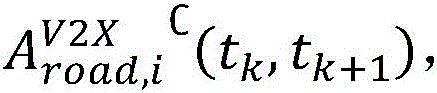


有关车道跟随的可达区域


s与最短路径ξ一一对应,令s=f(ξ)。考虑到Rvelocity的约束,假设其他交通参与者在时间间隔[tk,tk+1]内可达的最远距离为dmax,令其他交通参与者当前时刻所在位置s0为对应最短路径ξ0,其可达的最远位置smax对应最短路径ξmax应满足:s corresponds to the shortest path ξ one by one, let s = f(ξ). Considering the constraint of R velocity , assume that the farthest distance that other traffic participants can reach within the time interval [t k , t k+1 ] is d max , let the current position of other traffic participants s 0 be the corresponding shortest path ξ 0 , and the farthest position s max that can be reached corresponds to the shortest path ξ max should satisfy:
ξmax=ξ0+dmax (6)ξ max =ξ 0 +d max (6)
故令smax=f(ξmax),为了过度估计


有关路标指示的可达区域
V2X预警信息能够指示出道路上不可通行区域(如发生交通事故或正在施工的区域)的信息。通过V2X技术获取不可达区域多边形

b.车辆运动相关的可达区域b. Accessible area related to vehicle movement
与车辆运动学相关的可达区域

可达区域的边界由二维函数[bx(t),by(t)]T描述,其中:The boundary of the reachable region is described by a two-dimensional function [b x (t), by (t)] T , where:

其他交通参与车在给定时间间隔[tk,tk+1]的可达区域由tk和tk+1处的两个圆和一个凹形边界来约束,不考虑车辆尺寸的占用区域,能够用如图5(a)所示的一个凸的六边形M(m1,...,m6)来过度估计此可达区域:The reachable area of other participating vehicles at a given time interval [t k , t k+1 ] is constrained by two circles and a concave boundary at t k and t k+1 . Regardless of the occupied area of the vehicle size, this reachable area can be overestimated by a convex hexagon M (m 1 , ..., m 6 ) as shown in Figure 5(a):

当考虑车辆尺寸的可达区域时,确切的可达区域

上述推导假定了其他交通车与者特殊的相对位置和方向。为了得到任意情况下基于加速度的可达区域,基于加速度的可达区域最终要根据其他交通参与者实际的初始位置和方向进行旋转和变换。当天气条件恶劣时,应遵守约束Rcautious_driving,调整车辆的最大速度为

c.协同驾驶相关的可达区域c. Accessible areas related to collaborative driving
与车辆协同驾驶相关的可达区域


交通法规要求两辆相邻的车辆之间应保持足够的安全距离,并且在改变车道时,不得危及任何后面的交通参与者。令vr,0和vf,0分别为后车和前车的初始速度,δ是反应延迟时间,即前车在初始状态完全制动和后车完全制动之间的时间,参考RSS模型中的纵向安全距离,为使得到的可达区域


如图6所示,当其他交通参与车与自车同向行驶,与自车不在同一车道上时或与自车在同一车道且在自车后面时,其他交通参与车需要与自车前后保持一定的安全距离。为了对安全距离进行欠近似计算,并且考虑到自车和其他交通参与者自身的占用区域对安全距离的影响,对于时间间隔[tk,tk+1],在tk时不同车道上的交通参与者被认为是自动驾驶车辆的前车,安全距离为:As shown in Figure 6, when other traffic participants are traveling in the same direction as the ego vehicle, but not in the same lane as the ego vehicle, or in the same lane as the ego vehicle and behind the ego vehicle, other traffic participants need to maintain a certain safety distance from the ego vehicle. In order to make an under-approximation calculation of the safety distance and take into account the influence of the occupied areas of the ego vehicle and other traffic participants on the safety distance, for the time interval [t k , t k+1 ], the traffic participants in different lanes at t k are considered to be the front vehicles of the autonomous driving vehicle, and the safety distance is:

在tk+1时,如交通参与车被认为是自动驾驶车辆的后车,安全距离为:At t k+1 , if the traffic participant vehicle is considered to be the rear vehicle of the autonomous driving vehicle, the safety distance is:

其中vego,0是自车的初始速度,vobj,0则是其他交通参与者的初始速度。Where v ego, 0 is the initial speed of the ego vehicle, and v obj, 0 is the initial speed of other traffic participants.
上述推导得到的安全距离为Frenet坐标系下的值。以自车参考点为起点,结合上述推导得到的欠近似的安全距离,可得到某段特定时间内总体的欠近似安全区间,构建垂直于相应车道边界的多边形可得到有关安全距离的不可达区域
有关路权的可达区域


表2.其他交通参与者[tk,tk+1]对应的有关路权的可达区域Table 2. Accessible areas of other traffic participants [t k , t k+1 ] corresponding to the right of way


(4)自车预期轨迹安全验证(4) Safety verification of the expected trajectory of the vehicle
该子步骤根据车辆的尺寸和预期轨迹计算自车占用区域,并判断自车占用区域与所有其他交通参与者的可达区域有无交集来验证自车预期轨迹是否安全,若无交集,则自车预期轨迹符合合法安全,反之,自车预期轨迹不安全,需行驶经过验证的备用安全轨迹。This sub-step calculates the area occupied by the vehicle based on the size of the vehicle and the expected trajectory, and determines whether the area occupied by the vehicle intersects with the reachable areas of all other traffic participants to verify whether the expected trajectory of the vehicle is safe. If there is no intersection, the expected trajectory of the vehicle is legal and safe. Otherwise, the expected trajectory of the vehicle is unsafe and needs to travel a verified alternative safe trajectory.
a.轨迹安全验证方法a. Trajectory safety verification method
根据自车决策系统生成的预期轨迹,计算其在时间段[tk,tk+1]内的占用区域。考虑到车辆的尺寸,在某一时刻自车的占用区域为一矩形Q(q1,q2,q3,q4),自车参考点的坐标为(px,py),车身纵向轴线与x轴所成夹角为β,根据转轴公式可得:According to the expected trajectory generated by the ego vehicle decision system, the occupied area in the time period [t k , t k+1 ] is calculated. Considering the size of the vehicle, the occupied area of the ego vehicle at a certain moment is a rectangle Q (q 1 , q 2 , q 3 , q 4 ), the coordinates of the ego vehicle reference point are (p x , p y ), and the angle between the longitudinal axis of the vehicle body and the x-axis is β. According to the rotation axis formula, we can get:

可计算得到自车在[tk,tk+1]对应的预期轨迹每一个点的自车占用区域,取并集即可得到自车的可达区域Aego(tk,tk+1)。为了验证一段连续的预期轨迹是否安全,需要检验连续的时间间隔内自车的占用区域与其他交通参与者的可达区域是否存在交集。如式(16)所示,对每一个其他交通参与车的可达区域取并集即可得到所有其他交通参与者可达区域


b.在线安全验证时序b. Online security verification timing
令时间区间tk到tk+1内对应的预期轨迹为


2.基于合法可达区域的备用安全轨迹生成2. Generation of alternative safe trajectories based on legally accessible areas
备用安全轨迹生成主要包括两个子步骤:自车备用安全轨迹终点选取以及自车备用安全轨迹轨迹生成。自车备用安全轨迹终点选取用于选取符合条件的备用安全轨迹终点,自车备用安全轨迹轨迹生成根据自车是否需要换道采用五次多项式法或车道中心线法生成备用安全轨迹。The generation of backup safety trajectories mainly includes two sub-steps: the selection of the endpoint of the backup safety trajectory of the ego vehicle and the generation of the backup safety trajectory of the ego vehicle. The selection of the endpoint of the backup safety trajectory of the ego vehicle is used to select the endpoint of the backup safety trajectory that meets the conditions. The generation of the backup safety trajectory of the ego vehicle uses the quintic polynomial method or the lane centerline method to generate the backup safety trajectory according to whether the ego vehicle needs to change lanes.
(1)自车备用安全轨迹终点选取(1) Selection of the endpoint of the vehicle's backup safety trajectory
该子步骤定义了备用安全轨迹应满足的条件,给出了备用安全轨迹终点选取原则。生成备用安全轨迹


其中





考虑到换道行驶比保持原车道行驶风险更大,本发明规定非必要情况下不换道行驶,需要换道行驶时,选择自车合法可达区域更大的相邻车道进行换道。首先判断自车目前所处车道的车道中心线在自车合法可达区域中对应参考线长度最长的点是否满足式(18),若满足上式,则在该车道中心线上选取参考线长度为send的点作为备用安全轨迹终点;否则判断相邻车道中心线在自车合法可达区域中对应参考线长度最长的点并判断其是否满足式(18),若满足,则在该车道中心线上选取参考线长度为send的点作为备用安全轨迹的终点进行下一步计算;若上述条件均不满足,则备用安全轨迹生成失败。Considering that lane changing is more risky than staying in the original lane, the present invention stipulates that lane changing is not allowed unless necessary. When lane changing is necessary, the adjacent lane with a larger legally accessible area of the vehicle is selected for lane changing. First, determine whether the point with the longest reference line length corresponding to the center line of the lane where the vehicle is currently located in the legally accessible area of the vehicle satisfies formula (18). If so, select the point with the longest reference line length on the center line of the lane as the end point of the backup safety trajectory; otherwise, determine the point with the longest reference line length corresponding to the center line of the adjacent lane in the legally accessible area of the vehicle and determine whether it satisfies formula (18). If so, select the point with the longest reference line length on the center line of the lane as the end point of the backup safety trajectory for the next step of calculation; if none of the above conditions are met, the generation of the backup safety trajectory fails.
(2)自车备用安全轨迹轨迹生成(2) Generation of backup safe trajectories for the ego vehicle
在选定了备用安全轨迹

基于中心线法生成备用安全轨迹的过程如下:如图8(a)所示,备用安全轨迹的起点和终点在同一车道中心线上,自车无需换道,选取(xs,ys)到(xe,ye)范围内的车道中心线作为备用安全轨迹参考线。The process of generating an alternative safety trajectory based on the centerline method is as follows: as shown in Figure 8(a), the starting point and end point of the alternative safety trajectory are on the same lane centerline, and the ego vehicle does not need to change lanes. The lane centerline in the range of ( xs , ys ) to ( xe , ye ) is selected as the reference line of the alternative safety trajectory.
基于五次多项式方法生成备用安全轨迹的过程如下:如图9所示,以自车参考点的初始所在位置为坐标原点,以自车的速度方向为x轴建立坐标系,并且假设自车的侧向速度很小,忽略其影响。自车的换道轨迹参考线方程:The process of generating an alternative safety trajectory based on the quintic polynomial method is as follows: As shown in Figure 9, the initial position of the ego vehicle reference point is used as the coordinate origin, the velocity direction of the ego vehicle is used as the x-axis to establish a coordinate system, and it is assumed that the lateral velocity of the ego vehicle is very small and its influence is ignored. The lane change trajectory reference line equation of the ego vehicle is:
y=a0x5+a1x4+a2x3+a3x2+a4x+a5 (19)y=a 0 x 5 +a 1 x 4 +a 2 x 3 +a 3 x 2 +a 4 x+a 5 (19)
假设自车当前的速度为vego,0,横摆角速度为ωego,0,自车换道完成后与目标车道中心线的切点为Pc,并且通过车道线传感器能够测量换道车道中心线目标点的坐标为(xc,yc)、斜率rc和曲率Kc。当前坐标系下,换道的初始位置(xs,ys)点坐标为(0,0),且(xs,ys)点的斜率为0,且(xs,ys)点对应参考线的曲率可由该点自车的速度与横摆角速度得到。故参考线方程在(xs,ys)点应满足以下条件:Assume that the current speed of the ego vehicle is v ego,0 , the yaw rate is ω ego,0 , the point of tangency between the ego vehicle and the center line of the target lane after the lane change is completed is P c , and the lane line sensor can measure the coordinates of the target point of the lane change center line as (x c , y c ), slope rc and curvature K c . In the current coordinate system, the coordinates of the initial position (x s , y s ) of the lane change are (0, 0), and the slope of the point (x s , y s ) is 0, and the curvature of the reference line corresponding to the point (x s , y s ) can be obtained from the speed and yaw rate of the ego vehicle at this point. Therefore, the reference line equation at the point (x s , y s ) should satisfy the following conditions:

在换道终点(xc,yc)处,备用安全轨迹参考线的斜率和曲率应和此处车道中心线的斜率和曲率保持一致,因此在(xc,yc)处参考线方程应满足以下关系:At the lane change endpoint (x c , y c ), the slope and curvature of the backup safety trajectory reference line should be consistent with the slope and curvature of the lane centerline here. Therefore, the reference line equation at (x c , y c ) should satisfy the following relationship:

根据以上两个式子能够用自车初始状态、换道结束点(xc,yc)位置和换道目标车道中心线参数等信息求解自车换道时的五次多项式参考线方程:According to the above two equations, the fifth-order polynomial reference line equation when the vehicle changes lanes can be solved using information such as the initial state of the vehicle, the position of the lane change end point (x c , y c ) and the center line parameters of the lane change target lane:

根据系数矩阵能够求解出a3、a4、a5,完成了备用安全轨迹参考线的计算。According to the coefficient matrix, a 3 , a 4 , and a 5 can be solved, and the calculation of the backup safety trajectory reference line is completed.
本发明使用Prescan与Matlab联合仿真针对提出的自动驾驶决策在线安全验证方法进行了测试和验证,其中Prescan用于搭建多种典型的交通场景,包括道路网络的搭建与道路周围环境的建立、各个交通参与者参数设置及轨迹规划以及感知层的搭建;Matlab用于数据传输与处理,并通过m语言实现在线安全验证算法。The present invention uses Prescan and Matlab joint simulation to test and verify the proposed online safety verification method for autonomous driving decision-making, where Prescan is used to build a variety of typical traffic scenarios, including the construction of road networks and the establishment of the road environment, parameter settings and trajectory planning of each traffic participant, and the construction of the perception layer; Matlab is used for data transmission and processing, and the online safety verification algorithm is implemented through the m language.
本发明将其他交通参与者的点质量模型包围在lobj,i为4m,wobj,i为2m的矩形中;将自车的点质量模型包围在


本发明基于测试规范、自动驾驶研发中常用测试场景以及驾驶车辆时需要应对的典型场景,在Prescan中创建了单向多车道、双向多车道和十字交叉路口3种典型场景作为用作测试,各仿真场景参数如表3所示:Based on the test specifications, common test scenarios in autonomous driving research and development, and typical scenarios that need to be dealt with when driving a vehicle, the present invention creates three typical scenarios of one-way multi-lane, two-way multi-lane, and crossroad in Prescan for testing. The parameters of each simulation scenario are shown in Table 3:
表3.仿真场景参数设置Table 3. Simulation scenario parameter settings

在上述定义的典型交通场景中分别在危险工况下对本发明提出的在线安全验证方法进行验证,对测试结果的分析主要从安全性和实时性这两个角度展开。安全性是指该技术能够适应大量交通场景,准确判断预期轨迹的安全性,并且生成的备用安全轨迹能够将自车引导至安全状态,不主动造成交通事故并且不违反交通法规,严格保障自车的合法安全。实时性是指该技术能够在规定的时间内完成计算处理,能够及时验证预期轨迹是否安全并生成备用安全轨迹。The online safety verification method proposed in the present invention is verified under dangerous conditions in the typical traffic scenarios defined above, and the analysis of the test results is mainly carried out from the two perspectives of safety and real-time performance. Safety means that the technology can adapt to a large number of traffic scenarios, accurately judge the safety of the expected trajectory, and the generated backup safety trajectory can guide the vehicle to a safe state, does not actively cause traffic accidents and does not violate traffic regulations, and strictly guarantees the legal safety of the vehicle. Real-time performance means that the technology can complete the calculation and processing within the specified time, can timely verify whether the expected trajectory is safe, and generate a backup safety trajectory.
(1)针对单向多车道场景的仿真验证(1) Simulation verification for one-way multi-lane scenarios
本发明搭建的单向三车道弯道场景各交通参与者的初始速度及相对位置如图10所示:The initial speeds and relative positions of the traffic participants in the one-way three-lane curve scene constructed by the present invention are shown in FIG10 :
单向三车道弯道场景在线安全验证结果如图11所示:The online safety verification results of the one-way three-lane curve scenario are shown in Figure 11:
在t=4.5s时,由于前方车辆准备变道,自车的预期轨迹验证失败,执行3.9s-4.2s内最新验证成功的备用安全轨迹,开始向右边临近车道进行变道,6.0s时自车预期轨迹验证失败,执行5.7s-6.0s内最新验证成功的备用安全轨迹,5.1s、6.6s、7.5s、8.7s时自车预期轨迹验证成功,执行预期轨迹。自车在4.5s-5.1s、6.0s-6.6s、7.2s-7.5s、7.8s-8.7s内执行备用安全轨迹,其余时间执行验证成功的预期轨迹。At t = 4.5s, the expected trajectory of the ego vehicle failed to be verified because the vehicle ahead was preparing to change lanes. The vehicle executed the latest successfully verified backup safety trajectory within 3.9s-4.2s and began to change lanes to the right adjacent lane. At 6.0s, the expected trajectory of the ego vehicle failed to be verified. The vehicle executed the latest successfully verified backup safety trajectory within 5.7s-6.0s. At 5.1s, 6.6s, 7.5s, and 8.7s, the expected trajectory of the ego vehicle was successfully verified and executed. The ego vehicle executed the backup safety trajectory within 4.5s-5.1s, 6.0s-6.6s, 7.2s-7.5s, and 7.8s-8.7s, and the successfully verified expected trajectory was executed at other times.
(2)针对双向多车道场景的仿真验证(2) Simulation verification for two-way multi-lane scenarios
本发明搭建的双向六车道直道场景各交通参与者的初始速度及相对位置如图12所示:The initial speeds and relative positions of each traffic participant in the two-way six-lane straight road scene constructed by the present invention are shown in FIG12:
双向六车道直道场景在线安全验证结果如图13所示:The online safety verification results of the two-way six-lane straight road scenario are shown in Figure 13:
在t=4.2s时,由于右前方车辆准备变道,自车的预期轨迹验证失败,执行3.9s-4.2s内最新验证成功的备用安全轨迹,开始向左边临近车道进行变道,5.7s时自车预期轨迹验证失败,执行5.4s-5.7s内最新验证成功的备用安全轨迹,3.5s、5.4s、6.6s、8.7s时自车预期轨迹验证成功,执行预期轨迹。自车在4.2s-5.4s、5.7s-6.6s内执行备用安全轨迹,其余时间执行验证成功的预期轨迹。At t = 4.2s, the expected trajectory of the ego vehicle failed to be verified because the vehicle in front of it on the right was preparing to change lanes. The vehicle executed the latest successfully verified backup safety trajectory within 3.9s-4.2s and began to change lanes to the left adjacent lane. At 5.7s, the expected trajectory of the ego vehicle failed to be verified. The latest successfully verified backup safety trajectory within 5.4s-5.7s was executed. At 3.5s, 5.4s, 6.6s, and 8.7s, the expected trajectory of the ego vehicle was successfully verified and the expected trajectory was executed. The ego vehicle executed the backup safety trajectory within 4.2s-5.4s and 5.7s-6.6s, and the successfully verified expected trajectory was executed at other times.
(3)针对十字交叉路口场景的仿真验证(3) Simulation verification for intersection scenarios
本发明搭建的双车道十字交叉路口场景各交通参与者的初始速度及相对位置如图14所示:The initial speeds and relative positions of the traffic participants in the two-lane intersection scene constructed by the present invention are shown in FIG14 :
双车道十字交叉路口场景在线安全验证结果如图15所示:The online safety verification results of the two-lane intersection scenario are shown in Figure 15:
在t=4.8s时,由于左前方有车辆正通过十字路口,自车的预期轨迹验证失败,执行3.5s-4.8s内最新验证成功的备用安全轨迹,减速行驶,5.7s时右侧车辆违反路权通过路口,自车预期轨迹验证失败,执行5.4s-5.7s内最新验证成功的备用安全轨迹,减速行驶。2.7s、5.4s、8.1s、10.2s时自车预期轨迹验证成功,执行预期轨迹。自车在4.8s-5.4s、5.7s-8.1s内执行备用安全轨迹,其余时间执行验证成功的预期轨迹。At t = 4.8s, the expected trajectory of the ego vehicle failed to be verified because a vehicle was passing through the intersection in front of the left. The vehicle executed the latest successfully verified backup safety trajectory within 3.5s-4.8s and decelerated. At 5.7s, the vehicle on the right violated the right of way and passed through the intersection. The expected trajectory of the ego vehicle failed to be verified. The vehicle executed the latest successfully verified backup safety trajectory within 5.4s-5.7s and decelerated. The expected trajectory of the ego vehicle was successfully verified at 2.7s, 5.4s, 8.1s, and 10.2s, and the expected trajectory was executed. The ego vehicle executed the backup safety trajectory within 4.8s-5.4s and 5.7s-8.1s, and the successfully verified expected trajectory was executed at the rest of the time.
本发明对3个场景的预期轨迹安全验证和备用安全轨迹生成的计算时间分别进行了10次重复测量,得到了3个场景的预期轨迹安全验证和备用安全轨迹生成的平均用时,以及总共用时的平均值及其总体方差,如表4所示:The present invention measured the calculation time of the expected trajectory safety verification and the backup safety trajectory generation of the three
表4.仿真验证计算时间Table 4. Simulation verification calculation time


通过对以上3个场景的仿真分析,能够证明本发明提出的在线安全验证技术能够适应多种复杂的交通场景,准确判断预期轨迹的安全性,能够在危险工况下保证自车的合法安全,不主动造成交通事故,生成的备用安全轨迹能够将自车引导至安全状态。并且每个场景的计算时间可控制在再规划周期100ms内,表明本发明提出的在线安全验证技术可及时完成预期轨迹安全验证以及备用安全轨迹的生成。Through the simulation analysis of the above three scenarios, it can be proved that the online safety verification technology proposed by the present invention can adapt to a variety of complex traffic scenarios, accurately judge the safety of the expected trajectory, ensure the legal safety of the vehicle under dangerous conditions, and not actively cause traffic accidents. The generated backup safety trajectory can guide the vehicle to a safe state. In addition, the calculation time of each scenario can be controlled within the replanning cycle of 100ms, indicating that the online safety verification technology proposed by the present invention can complete the expected trajectory safety verification and the generation of backup safety trajectories in a timely manner.
虽然在上文中已经参考实施方式对本发明进行了描述,然而在不脱离本发明的范围的情况下,可以对其进行各种改进并且可以用等效物替换其中的部件。尤其是,只要不存在结构冲突,本发明所披露的实施方式中的各项特征均可通过任意方式相互结合起来使用,在本说明书中未对这些组合的情况进行穷举性的描述仅仅是出于省略篇幅和节约资源的考虑。因此,本发明并不局限于文中公开的特定实施方式,而是包括落入权利要求的范围内的所有技术方案。Although the present invention has been described above with reference to the embodiments, various modifications may be made thereto and parts thereof may be replaced by equivalents without departing from the scope of the present invention. In particular, as long as there is no structural conflict, the various features in the embodiments disclosed in the present invention may be used in combination with each other in any manner, and the fact that these combinations are not exhaustively described in this specification is only for the sake of omitting space and saving resources. Therefore, the present invention is not limited to the specific embodiments disclosed herein, but includes all technical solutions falling within the scope of the claims.
Claims (3)
Priority Applications (1)
| Application Number | Priority Date | Filing Date | Title |
|---|---|---|---|
| CN202211069233.8A CN115938106B (en) | 2022-09-02 | 2022-09-02 | Automatic driving decision online verification method based on traffic participant accessibility analysis |
Applications Claiming Priority (1)
| Application Number | Priority Date | Filing Date | Title |
|---|---|---|---|
| CN202211069233.8A CN115938106B (en) | 2022-09-02 | 2022-09-02 | Automatic driving decision online verification method based on traffic participant accessibility analysis |
Publications (2)
| Publication Number | Publication Date |
|---|---|
| CN115938106A true CN115938106A (en) | 2023-04-07 |
| CN115938106B CN115938106B (en) | 2024-07-09 |
Family
ID=86649534
Family Applications (1)
| Application Number | Title | Priority Date | Filing Date |
|---|---|---|---|
| CN202211069233.8A Active CN115938106B (en) | 2022-09-02 | 2022-09-02 | Automatic driving decision online verification method based on traffic participant accessibility analysis |
Country Status (1)
| Country | Link |
|---|---|
| CN (1) | CN115938106B (en) |
Cited By (2)
| Publication number | Priority date | Publication date | Assignee | Title |
|---|---|---|---|---|
| CN117445923A (en) * | 2023-10-30 | 2024-01-26 | 青岛理工大学 | Lane-changing trajectory planning method for connected vehicles based on reachability analysis |
| CN119773794A (en) * | 2025-01-17 | 2025-04-08 | 上海友道智途科技有限公司 | Automatic driving system and behavior safety method for automobile |
Citations (17)
| Publication number | Priority date | Publication date | Assignee | Title |
|---|---|---|---|---|
| US6393362B1 (en) * | 2000-03-07 | 2002-05-21 | Modular Mining Systems, Inc. | Dynamic safety envelope for autonomous-vehicle collision avoidance system |
| US20080303696A1 (en) * | 2007-06-05 | 2008-12-11 | Toyota Jidosha Kabushiki Kaisha | Host vehicle moving area acquisition device and acquisition method |
| CN105549597A (en) * | 2016-02-04 | 2016-05-04 | 同济大学 | Unmanned vehicle dynamic path programming method based on environment uncertainty |
| CN205451514U (en) * | 2016-01-27 | 2016-08-10 | 王德龙 | Car real -time road conditions over --horizon radar of navigation and network alarm system |
| CN107215339A (en) * | 2017-06-26 | 2017-09-29 | 地壳机器人科技有限公司 | The lane-change control method and device of automatic driving vehicle |
| DE102016210760A1 (en) * | 2016-06-16 | 2017-12-21 | Bayerische Motoren Werke Aktiengesellschaft | Method for interaction between a vehicle and road users |
| CN109186624A (en) * | 2018-10-19 | 2019-01-11 | 江苏大学 | A kind of unmanned vehicle traveling right of way planing method based on friendship specification beam |
| CN109324620A (en) * | 2018-09-25 | 2019-02-12 | 北京主线科技有限公司 | The dynamic trajectory planing method for carrying out avoidance based on lane line parallel offset and overtaking other vehicles |
| CN109415089A (en) * | 2016-07-14 | 2019-03-01 | 三菱电机株式会社 | Controller and method for controlling a vehicle and non-transitory computer readable memory |
| FR3084630A1 (en) * | 2018-07-31 | 2020-02-07 | Psa Automobiles Sa | METHOD FOR PLANNING THE OPTIMAL TRAJECTORY OF AN AUTONOMOUS VEHICLE AND AUTONOMOUS VEHICLE EQUIPPED WITH AN ON-BOARD COMPUTER FOR IMPLEMENTING SAID METHOD |
| CN111681452A (en) * | 2020-01-19 | 2020-09-18 | 重庆大学 | A dynamic lane-changing trajectory planning method for driverless vehicles based on Frenet coordinate system |
| CN111833633A (en) * | 2020-07-30 | 2020-10-27 | 连云港杰瑞电子有限公司 | Vehicle traffic priority control method based on high-precision positioning |
| CN112455445A (en) * | 2020-12-04 | 2021-03-09 | 苏州挚途科技有限公司 | Automatic driving lane change decision method and device and vehicle |
| CN112955902A (en) * | 2018-11-05 | 2021-06-11 | 祖克斯有限公司 | Vehicle trajectory modification for following |
| CN113465622A (en) * | 2021-06-30 | 2021-10-01 | 上海西井信息科技有限公司 | Port unmanned driving path planning method and device, electronic equipment and storage medium |
| CN113968216A (en) * | 2020-07-25 | 2022-01-25 | 华为技术有限公司 | Vehicle collision detection method and device and computer readable storage medium |
| US20220105959A1 (en) * | 2020-10-01 | 2022-04-07 | Argo AI, LLC | Methods and systems for predicting actions of an object by an autonomous vehicle to determine feasible paths through a conflicted area |
-
2022
- 2022-09-02 CN CN202211069233.8A patent/CN115938106B/en active Active
Patent Citations (17)
| Publication number | Priority date | Publication date | Assignee | Title |
|---|---|---|---|---|
| US6393362B1 (en) * | 2000-03-07 | 2002-05-21 | Modular Mining Systems, Inc. | Dynamic safety envelope for autonomous-vehicle collision avoidance system |
| US20080303696A1 (en) * | 2007-06-05 | 2008-12-11 | Toyota Jidosha Kabushiki Kaisha | Host vehicle moving area acquisition device and acquisition method |
| CN205451514U (en) * | 2016-01-27 | 2016-08-10 | 王德龙 | Car real -time road conditions over --horizon radar of navigation and network alarm system |
| CN105549597A (en) * | 2016-02-04 | 2016-05-04 | 同济大学 | Unmanned vehicle dynamic path programming method based on environment uncertainty |
| DE102016210760A1 (en) * | 2016-06-16 | 2017-12-21 | Bayerische Motoren Werke Aktiengesellschaft | Method for interaction between a vehicle and road users |
| CN109415089A (en) * | 2016-07-14 | 2019-03-01 | 三菱电机株式会社 | Controller and method for controlling a vehicle and non-transitory computer readable memory |
| CN107215339A (en) * | 2017-06-26 | 2017-09-29 | 地壳机器人科技有限公司 | The lane-change control method and device of automatic driving vehicle |
| FR3084630A1 (en) * | 2018-07-31 | 2020-02-07 | Psa Automobiles Sa | METHOD FOR PLANNING THE OPTIMAL TRAJECTORY OF AN AUTONOMOUS VEHICLE AND AUTONOMOUS VEHICLE EQUIPPED WITH AN ON-BOARD COMPUTER FOR IMPLEMENTING SAID METHOD |
| CN109324620A (en) * | 2018-09-25 | 2019-02-12 | 北京主线科技有限公司 | The dynamic trajectory planing method for carrying out avoidance based on lane line parallel offset and overtaking other vehicles |
| CN109186624A (en) * | 2018-10-19 | 2019-01-11 | 江苏大学 | A kind of unmanned vehicle traveling right of way planing method based on friendship specification beam |
| CN112955902A (en) * | 2018-11-05 | 2021-06-11 | 祖克斯有限公司 | Vehicle trajectory modification for following |
| CN111681452A (en) * | 2020-01-19 | 2020-09-18 | 重庆大学 | A dynamic lane-changing trajectory planning method for driverless vehicles based on Frenet coordinate system |
| CN113968216A (en) * | 2020-07-25 | 2022-01-25 | 华为技术有限公司 | Vehicle collision detection method and device and computer readable storage medium |
| CN111833633A (en) * | 2020-07-30 | 2020-10-27 | 连云港杰瑞电子有限公司 | Vehicle traffic priority control method based on high-precision positioning |
| US20220105959A1 (en) * | 2020-10-01 | 2022-04-07 | Argo AI, LLC | Methods and systems for predicting actions of an object by an autonomous vehicle to determine feasible paths through a conflicted area |
| CN112455445A (en) * | 2020-12-04 | 2021-03-09 | 苏州挚途科技有限公司 | Automatic driving lane change decision method and device and vehicle |
| CN113465622A (en) * | 2021-06-30 | 2021-10-01 | 上海西井信息科技有限公司 | Port unmanned driving path planning method and device, electronic equipment and storage medium |
Non-Patent Citations (2)
| Title |
|---|
| MORITZ WERLING ETC., OPTIMAL TRAJECTORY GENERATION FOR DYNAMIC STREET SCENARIOS IN A FRENET FRAME, IEEE, 7 May 2010 (2010-05-07) * |
| 姜跃为,城市环境下考虑前车运动不确定性的自动驾驶运动规划研究, 中国优秀硕士学位论文全文数据库, 15 September 2021 (2021-09-15) * |
Cited By (2)
| Publication number | Priority date | Publication date | Assignee | Title |
|---|---|---|---|---|
| CN117445923A (en) * | 2023-10-30 | 2024-01-26 | 青岛理工大学 | Lane-changing trajectory planning method for connected vehicles based on reachability analysis |
| CN119773794A (en) * | 2025-01-17 | 2025-04-08 | 上海友道智途科技有限公司 | Automatic driving system and behavior safety method for automobile |
Also Published As
| Publication number | Publication date |
|---|---|
| CN115938106B (en) | 2024-07-09 |
Similar Documents
| Publication | Publication Date | Title |
|---|---|---|
| CN113561974B (en) | Collision risk prediction method based on vehicle behavior interaction and road structure coupling | |
| Zhao et al. | Development of a cyber-physical-system perspective based simulation platform for optimizing connected automated vehicles dedicated lanes | |
| CN115938106B (en) | Automatic driving decision online verification method based on traffic participant accessibility analysis | |
| CN108225364A (en) | A kind of pilotless automobile driving task decision system and method | |
| CN115257746A (en) | Uncertainty-considered decision control method for lane change of automatic driving automobile | |
| Kusano et al. | Collision avoidance testing of the waymo automated driving system | |
| CN112201070B (en) | Deep learning-based automatic driving expressway bottleneck section behavior decision method | |
| Rashid et al. | Simulation of pedestrian interaction with autonomous vehicles via social force model | |
| CN118135831A (en) | An interactive strategy optimization method for single intelligent vehicle and manually driven vehicle | |
| JP3520331B2 (en) | Traffic flow simulation device | |
| Hidalgo et al. | Hybrid trajectory planning approach for roundabout merging scenarios | |
| CN117734715A (en) | Automatic driving control method, system, equipment and storage medium based on reinforcement learning | |
| Lin et al. | Generating believable mixed-traffic animation | |
| CN115169890A (en) | A hybrid traffic evaluation system for intelligent networked vehicles based on microscopic traffic simulation | |
| Zhang et al. | Real-world troublemaker: A 5g cloud-controlled track testing framework for automated driving systems in safety-critical interaction scenarios | |
| Yuan et al. | Safe, efficient, comfort, and energy-saving automated driving through roundabout based on deep reinforcement learning | |
| WO2025125849A1 (en) | Systems and methods for navigating a vehicle using coast control | |
| CN115204455A (en) | Long-time-domain driving behavior decision method suitable for high-speed and loop traffic scene | |
| CN117191413B (en) | Automatic driving test system under strong game interaction environment | |
| CN115525036B (en) | Human-like decision method, human-like decision model construction method and system | |
| Tang et al. | Research on decision-making of lane-changing of automated vehicles in highway confluence area based on deep reinforcement learning | |
| Zhou et al. | Ei-drive: A platform for cooperative perception with realistic communication models | |
| Zhang et al. | Lane change decision algorithm based on deep Q network for autonomous vehicles | |
| CN117922608A (en) | Vehicle automatic driving control method, device and electronic equipment | |
| Olstam | Simulation of vehicles in a driving simulator using microscopic traffic simulation |
Legal Events
| Date | Code | Title | Description |
|---|---|---|---|
| PB01 | Publication | ||
| PB01 | Publication | ||
| SE01 | Entry into force of request for substantive examination | ||
| SE01 | Entry into force of request for substantive examination | ||
| GR01 | Patent grant | ||
| GR01 | Patent grant |