CN115862786A - Performance prediction method, device and equipment based on nano composite dielectric material - Google Patents
Performance prediction method, device and equipment based on nano composite dielectric material Download PDFInfo
- Publication number
- CN115862786A CN115862786A CN202211672890.1A CN202211672890A CN115862786A CN 115862786 A CN115862786 A CN 115862786A CN 202211672890 A CN202211672890 A CN 202211672890A CN 115862786 A CN115862786 A CN 115862786A
- Authority
- CN
- China
- Prior art keywords
- dielectric material
- nano
- nano composite
- filler
- dielectric constant
- Prior art date
- Legal status (The legal status is an assumption and is not a legal conclusion. Google has not performed a legal analysis and makes no representation as to the accuracy of the status listed.)
- Pending
Links
Images


Landscapes
- Measurement Of Resistance Or Impedance (AREA)
Abstract
The invention provides a performance prediction method, a device and equipment based on a nano composite dielectric material. The method comprises the following steps: acquiring the energy storage density, dielectric constant and breakdown strength of the known nano composite dielectric material; performing fingerprint identification on the known nano composite dielectric materials to obtain fingerprint characteristics corresponding to each nano composite dielectric material; constructing a performance prediction model by taking the fingerprint characteristics of the known nano composite dielectric material as input and taking the energy storage density, the dielectric constant and the breakdown strength as output; inputting the fingerprint characteristics of the unknown nano composite dielectric material into the constructed performance prediction model, and predicting to obtain the energy storage density, the dielectric constant and the breakdown strength of the unknown nano composite dielectric material; and determining the performance of the unknown nano composite dielectric material according to the energy storage density, the dielectric constant and the breakdown strength. The method has high prediction efficiency and high prediction precision.
Description
Technical Field
The invention relates to the technical field of materials, in particular to a performance prediction method, a performance prediction device and performance prediction equipment based on a nano composite dielectric material.
Background
In recent years, with the continuous development of pulse power supply technology, mobile equipment and new energy automobiles, the demand of people for high-performance energy storage technology and equipment is increasing. The dielectric capacitor has the advantages of simple preparation process, high voltage resistance and extremely high power density, but the application of the dielectric capacitor in the aspect of energy storage is severely limited by the small energy storage density. Therefore, the development of new dielectric materials with high energy storage density is imperative.
However, the synthesis of new materials is often accompanied by a large amount of data and complicated parameters, an extremely complicated system and a large number of potential solution combinations need to be considered, the traditional experimental method for exploring a new high energy storage density dielectric material depends on the intuition of researchers, the time consumption is long, the efficiency is low, the result has great uncertainty, and a large number of possible new material combinations are difficult to effectively discover. However, the currently commonly used calculation simulation methods such as the first principle calculation and the finite element simulation have many limitations such as limited calculation accuracy and low calculation precision, and also consume a lot of time and resources.
Disclosure of Invention
The present invention is directed to solve the above-mentioned drawbacks of the prior art, and provides a method, an apparatus and a device for predicting the performance of a dielectric material based on nano-composite.
A performance prediction method based on a nano composite dielectric material comprises the following steps:
acquiring the energy storage density, dielectric constant and breakdown strength of the known nano composite dielectric material;
performing fingerprint identification on the known nano composite dielectric material to obtain fingerprint characteristics corresponding to each nano composite dielectric material;
taking the fingerprint characteristics of the known nano composite dielectric material as input, and taking the energy storage density, the dielectric constant and the breakdown strength as output to construct a performance prediction model;
inputting the fingerprint characteristics of the unknown nano composite dielectric material into the constructed performance prediction model, and predicting to obtain the energy storage density, the dielectric constant and the breakdown strength of the unknown nano composite dielectric material;
and determining the performance of the unknown nano composite dielectric material according to the energy storage density, the dielectric constant and the breakdown strength.
Further, the method for predicting the performance of the dielectric material based on the nano composite as described above, wherein the fingerprint comprises: the nano-filler material comprises a polymer type, a nano-filler volume fraction, a nano-filler dielectric constant, a nano-filler conductivity, a nano-filler band gap, a nano-filler diameter-length ratio of 1, a nano-filler diameter-length ratio of 2, a nano-filler shell dielectric constant, a nano-filler shell conductivity, a nano-filler shell band gap, a nano-filler distribution parameter, a nano-filler orientation parameter of 1, a nano-filler orientation parameter of 2, and a nano-filler orientation parameter of 3.
Further, the method for predicting the performance of the dielectric material based on the nano composite material further comprises preprocessing the fingerprint characteristics before constructing the performance prediction model, and taking the preprocessed fingerprint characteristics as the input of the performance prediction model;
the pretreatment measures comprise:
the polymer types are indicated using numbers 1-16;
and performing normalization processing on the rest fingerprint features according to the maximum and minimum values, so that each fingerprint feature data is in the range of 0-1.
Further, the method for predicting the performance of the dielectric material based on the nano composite material further comprises the steps of preprocessing the dielectric constant and the breakdown strength of the dielectric material based on the nano composite material before constructing the performance prediction model;
the pretreatment measures comprise: and respectively dividing the dielectric constant and the breakdown strength of the nano composite dielectric material by the corresponding values of the polymer matrix.
Further, as mentioned above, the performance prediction method based on the nano composite dielectric material, the prediction model is based on the root mean square error RMSE, the mean absolute error MAE and the coefficient of determination R 2 And (5) obtaining the training.
Further, in the method for predicting the performance of the nanocomposite-based dielectric material, the root mean square error RMSE is calculated as follows:

wherein, y i Represents the experimental value of the ith sample; y is i * Representing a predicted value of the ith sample; n represents the number of samples.
Further, in the method for predicting the performance of the dielectric material based on the nano composite material, the average absolute error MAE is calculated as follows:

wherein, y i Represents the experimental value of the ith sample; y is i * Representing a predicted value of the ith sample; n represents the number of samples.
Further, the method for predicting the performance of the dielectric material based on the nano composite as described above, the determination coefficient R 2 The calculation formula of (a) is as follows:

wherein, y i Represents an experimental value of the ith sample; y is i * Representing a predicted value of the ith sample; n represents the number of samples.
An apparatus for predicting properties of a nanocomposite-based dielectric material, comprising:
the acquisition unit is used for acquiring the energy storage density, the dielectric constant and the breakdown strength of the known nano composite dielectric material;
the acquisition unit is further configured to perform fingerprint identification on the known nanocomposite dielectric material, and acquire fingerprint features corresponding to each nanocomposite dielectric material;
the training unit is used for taking the fingerprint characteristics of the known nano composite dielectric material as input and taking the energy storage density, the dielectric constant and the breakdown strength as output to construct a performance prediction model;
the prediction unit is used for inputting the fingerprint characteristics of the unknown nano composite dielectric material into the constructed performance prediction model, and predicting to obtain the energy storage density, the dielectric constant and the breakdown strength of the unknown nano composite dielectric material;
and the determining unit is used for determining the performance of the unknown nano composite dielectric material according to the energy storage density, the dielectric constant and the breakdown strength.
An electronic device comprising a memory, a processor, and a computer program stored on the memory and executable on the processor, the processor when executing the program implementing a nanocomposite dielectric material based performance prediction method as described above.
Has the advantages that:
according to the performance prediction method, device and equipment based on the nano composite dielectric material, the energy storage density, the dielectric constant and the breakdown strength of the known nano composite dielectric material are collected, fingerprint identification is carried out on each nano composite dielectric material, fingerprint characteristics corresponding to each nano composite dielectric material are obtained, each nano composite dielectric material is uniquely represented by the fingerprint characteristics, then the fingerprint characteristics of the known nano composite dielectric material are used as input, the energy storage density, the dielectric constant and the breakdown strength are used as output, a performance prediction model is constructed, and the performance of an unknown nano composite dielectric material is predicted by the constructed performance prediction model.
Drawings
FIG. 1 is a flow chart of a method for predicting the performance of a dielectric material based on nano-composite materials according to the present invention;
FIG. 2 is a flow chart of a method of an embodiment of the present invention;
FIG. 3 is a graph showing the distribution of experimental energy storage density values and predicted energy storage density values of the nanocomposite dielectric material according to the embodiment of the invention;
FIG. 4 is a graph showing the distribution of experimental dielectric constant values and predicted dielectric constant values of the nanocomposite dielectric material according to the embodiment of the invention;
FIG. 5 is a distribution diagram of the breakdown strength test value and the predicted value of the nanocomposite dielectric material according to the embodiment of the invention;
FIG. 6 is a block diagram of an apparatus for predicting nanocomposite dielectric material based performance according to the present invention;
fig. 7 is a schematic structural diagram of an electronic device provided in the present invention.
Detailed Description
In order to make the objects, technical solutions and advantages of the present invention more apparent, the technical solutions of the present invention are described clearly and completely below, and it is obvious that the described embodiments are some, not all embodiments of the present invention. All other embodiments, which can be derived by a person skilled in the art from the embodiments given herein without making any creative effort, shall fall within the protection scope of the present invention.
The conception of the invention is as follows: establishing a data set on the basis of collecting experimental data of energy storage density, dielectric constant and breakdown strength of a known nano composite dielectric material; then, fingerprint identification is carried out on the nano composite dielectric materials of different types, each nano composite dielectric material is uniquely represented by using fingerprint characteristics, and the identified data is normalized; and then establishing an initial prediction model of the energy storage density, the dielectric constant and the breakdown strength by combining a certain machine learning algorithm with the data set, and adjusting the hyper-parameters to improve the accuracy of the prediction model until the accuracy of the prediction model meets the requirement to obtain a corresponding target prediction model. The target prediction model can predict the energy storage density, the dielectric constant and the breakdown strength of the unknown nano composite dielectric material.
Fig. 1 is a flowchart of a method for predicting the performance of a dielectric material based on nano-composite according to the present invention, as shown in fig. 1, the method includes the following steps:
step 101: acquiring the energy storage density, dielectric constant and breakdown strength of the known nano composite dielectric material;
step 102: and carrying out fingerprint identification on the known nanocomposite dielectric material to obtain the fingerprint characteristics corresponding to each nanocomposite dielectric material.
Wherein the fingerprint features include: the nano-filler material comprises a polymer type, a nano-filler volume fraction, a nano-filler dielectric constant, a nano-filler conductivity, a nano-filler band gap, a nano-filler diameter-length ratio of 1, a nano-filler diameter-length ratio of 2, a nano-filler shell dielectric constant, a nano-filler shell conductivity, a nano-filler shell band gap, a nano-filler distribution parameter, a nano-filler orientation parameter of 1, a nano-filler orientation parameter of 2, and a nano-filler orientation parameter of 3.
Step 103: taking the fingerprint characteristics of the known nano composite dielectric material as input, and taking the energy storage density, the dielectric constant and the breakdown strength as output to construct a performance prediction model;
step 104: inputting the fingerprint characteristics of the unknown nano composite dielectric material into the constructed performance prediction model, and predicting to obtain the energy storage density, the dielectric constant and the breakdown strength of the unknown nano composite dielectric material;
step 105: and determining the performance of the unknown nano composite dielectric material according to the energy storage density, the dielectric constant and the breakdown strength.
Compared with the traditional method which needs a large amount of experimental research, the performance prediction method based on the nano composite dielectric material provided by the invention adopts the target prediction model for prediction, can save a large amount of manpower, material resources and financial resources, has the advantages of small workload, low cost, high precision and the like, and can greatly improve the design efficiency of the subsequent novel high energy storage density dielectric material. The invention has no special limitation on the data set source, can be obtained through experiments or published articles, can effectively utilize a large amount of data accumulated by the experiments, and simplifies the work flow.
Furthermore, the method also comprises the steps of preprocessing the fingerprint characteristics and preprocessing the dielectric constant and the breakdown strength of the nano composite dielectric material before constructing the performance prediction model.
The measures for preprocessing the fingerprint features comprise:
the polymer types are represented by numbers 1-16;
and performing normalization processing on the rest fingerprint features according to the maximum and minimum values, so that each fingerprint feature data is in the range of 0-1.
The means for pre-treating the dielectric constant and breakdown strength of the nanocomposite dielectric material include: the dielectric constant and the breakdown strength of the nanocomposite dielectric material are divided by the corresponding values of the polymer matrix, respectively.
Further, the prediction model is based on the root mean square error RMSE, the mean absolute error MAE, and the decision coefficient R 2 And (5) obtaining the training. Wherein,
the root mean square error RMSE calculation formula is as follows:

the average absolute error MAE is calculated as follows:

determining the coefficient R 2 The calculation formula of (a) is as follows:

wherein N is the number of samples, y i And y i * Is the experimental and predicted value, y, of the ith sample i The mean value of all experimental values of the samples in the corresponding data set.
The following description will be given of the application of the method of the present invention, taking one embodiment as an example. As shown in fig. 2, a flow chart of the method for predicting the energy storage density, dielectric constant and breakdown strength of the nanocomposite dielectric material by using machine learning according to the present invention specifically includes the following steps:
the method comprises the following steps: building data sets
The source of the data set is not particularly limited, and 365 sets of data (storage density 172, dielectric constant 334, breakdown strength 279) collected from published documents are only used as an example for explanation. The nano composite dielectric mainly comprises a polymer matrix and nano fillers, 16 common polymers and 14 nano fillers with different dielectric constants and band gaps are collected according to published documents at home and abroad, and a data set of the embodiment is formed together with different filler contents in each nano composite dielectric, energy storage density, dielectric constant and breakdown strength of the nano composite dielectric.
Step two: fingerprint identification and data preprocessing
Fifteen fingerprint characteristics, such as polymer type, volume fraction of the nano filler, dielectric constant of the nano filler, conductivity of the nano filler, band gap of the nano filler, diameter-length ratio of the nano filler to 1, diameter-length ratio of the nano filler to 2 and the like, are used for uniquely representing each nano composite dielectric material. The numbers 1-16 are used to indicate the polymer type, and the other characteristic data is normalized according to its maximum and minimum values, so that the data is in the range of (0,1). The dielectric constant and the breakdown strength of the nano composite dielectric are respectively divided by the corresponding values of the polymer matrix so as to eliminate the influence caused by different polymer types in transverse comparison.
Step three: establishing a target prediction model
In the embodiment, gaussian Process Regression (GPR) is selected as a prediction method for the energy storage density, the dielectric constant and the breakdown strength of the nano composite dielectric, and the root mean square error RMSE, the average absolute error MAE and the coefficient of determination R are adopted 2 As a criterion for judging the prediction accuracy, the root mean square error RMSE is calculated as follows:

the average absolute error MAE is calculated as follows:

determining the coefficient R 2 The calculation formula of (c) is as follows:
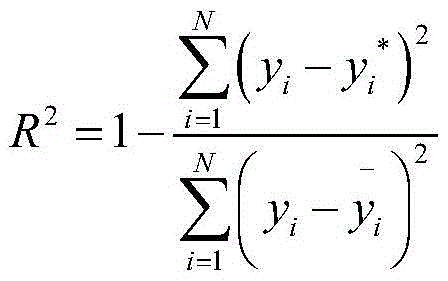
wherein N is the number of samples, y i And y i * For the experimental and predicted values of the ith sample, the mean value of all experimental values of the samples in the corresponding data set.
And 5-fold cross validation is utilized to avoid overfitting of the model, and meanwhile, the super-parameters are adjusted to improve the accuracy of the prediction model until the accuracy of the prediction model meets the requirement, so that the corresponding target prediction model is obtained.
Step four: nanocomposite dielectric energy storage density, dielectric constant and breakdown strength prediction
According to the embodiment, untrained experimental data are selected as unknown nano composite dielectric materials, the trained GPR model is used for predicting the energy storage density, the dielectric constant and the breakdown strength of the unknown nano composite dielectric materials, the coefficient of energy storage density determination predicted by the GPR model reaches 0.634, the root mean square error is 3.09, the average absolute error is 2.02, and the prediction result is shown in FIG. 3; the dielectric constant coefficient of determination reaches 0.877, the root mean square error is 0.178, and the average absolute error is 0.0899, and the prediction result is shown in fig. 4; the coefficients of the breakdown strength determination are 0.802, the root mean square error is 0.126, and the average absolute error is 0.0914, and the prediction results are shown in fig. 5.
Therefore, the predicted value is closer to the experimental value, and the method provided by the invention can be used for predicting the energy storage density of unknown nano composite dielectric materials.
The present invention provides a device for predicting the performance of dielectric materials based on nano-composite, which can be referred to as a device for predicting the performance of dielectric materials based on nano-composite, and a method for predicting the performance of dielectric materials based on nano-composite.
Fig. 6 is a structural diagram of an apparatus for predicting the performance of a dielectric material based on nano-composite according to the present invention, as shown in fig. 6, the apparatus includes:
an obtaining unit 601, configured to obtain an energy storage density, a dielectric constant, and a breakdown strength of a known nanocomposite dielectric material;
the obtaining unit 601 is further configured to perform fingerprint identification on the known nanocomposite dielectric materials, and obtain a fingerprint feature corresponding to each nanocomposite dielectric material;
a training unit 602, configured to construct a performance prediction model by using the fingerprint characteristics of the known nanocomposite dielectric material as input and using the energy storage density, the dielectric constant, and the breakdown strength as output;
the prediction unit 603 is configured to input the fingerprint characteristics of the unknown nanocomposite dielectric material into the constructed performance prediction model, and predict the energy storage density, the dielectric constant, and the breakdown strength of the unknown nanocomposite dielectric material;
and the determining unit 604 is used for determining the performance of the unknown nano composite dielectric material according to the energy storage density, the dielectric constant and the breakdown strength.
Fig. 7 illustrates a physical structure diagram of an electronic device, and as shown in fig. 7, the electronic device may include: a processor (processor) 710, a communication interface (communication interface) 720, a memory (memory) 730, and a communication bus 740, wherein the processor 710, the communication interface 720, and the memory 730 communicate with each other via the communication bus 740. The processor 710 may invoke logic instructions in the memory 730 to perform a method of predicting a nanocomposite dielectric material based performance, the method comprising: acquiring the energy storage density, dielectric constant and breakdown strength of the known nano composite dielectric material;
performing fingerprint identification on the known nano composite dielectric material to obtain fingerprint characteristics corresponding to each nano composite dielectric material;
taking the fingerprint characteristics of the known nano composite dielectric material as input, and taking the energy storage density, the dielectric constant and the breakdown strength as output to construct a performance prediction model;
inputting the fingerprint characteristics of the unknown nano composite dielectric material into the constructed performance prediction model, and predicting to obtain the energy storage density, the dielectric constant and the breakdown strength of the unknown nano composite dielectric material;
and determining the performance of the unknown nano composite dielectric material according to the energy storage density, the dielectric constant and the breakdown strength.
In addition, the logic instructions in the memory 730 can be implemented in the form of software functional units and stored in a computer readable storage medium when the software functional units are sold or used as independent products. Based on such understanding, the technical solution of the present invention may be embodied in the form of a software product, which is stored in a storage medium and includes instructions for causing a computer device (which may be a personal computer, a server, or a network device) to execute all or part of the steps of the method according to the embodiments of the present invention. And the aforementioned storage medium includes: various media capable of storing program codes, such as a usb disk, a removable hard disk, a Read-only memory (ROM), a Random Access Memory (RAM), a magnetic disk, or an optical disk.
Finally, it should be noted that: the above examples are only intended to illustrate the technical solution of the present invention, but not to limit it; although the present invention has been described in detail with reference to the foregoing embodiments, it will be understood by those of ordinary skill in the art that: the technical solutions described in the foregoing embodiments may still be modified, or some technical features may be equivalently replaced; and such modifications or substitutions do not depart from the spirit and scope of the corresponding technical solutions of the embodiments of the present invention.
Claims (10)
1. A performance prediction method based on a nano composite dielectric material is characterized by comprising the following steps:
acquiring the energy storage density, dielectric constant and breakdown strength of the known nano composite dielectric material;
performing fingerprint identification on the known nano composite dielectric material to obtain fingerprint characteristics corresponding to each nano composite dielectric material;
taking the fingerprint characteristics of the known nano composite dielectric material as input, and taking the energy storage density, the dielectric constant and the breakdown strength as output to construct a performance prediction model;
inputting the fingerprint characteristics of the unknown nano composite dielectric material into the constructed performance prediction model, and predicting to obtain the energy storage density, the dielectric constant and the breakdown strength of the unknown nano composite dielectric material;
and determining the performance of the unknown nano composite dielectric material according to the energy storage density, the dielectric constant and the breakdown strength.
2. The method of claim 1, wherein the fingerprint feature comprises: the nano-filler material comprises a polymer type, a nano-filler volume fraction, a nano-filler dielectric constant, a nano-filler conductivity, a nano-filler band gap, a nano-filler diameter-length ratio of 1, a nano-filler diameter-length ratio of 2, a nano-filler shell dielectric constant, a nano-filler shell conductivity, a nano-filler shell band gap, a nano-filler distribution parameter, a nano-filler orientation parameter of 1, a nano-filler orientation parameter of 2, and a nano-filler orientation parameter of 3.
3. The method of claim 2, further comprising preprocessing the fingerprint feature before constructing the performance prediction model, wherein the preprocessed fingerprint feature is used as an input of the performance prediction model;
the pretreatment measures comprise:
the polymer types are represented by numbers 1-16;
and performing normalization processing on the rest fingerprint features according to the maximum and minimum values, so that each fingerprint feature data is in the range of 0-1.
4. The method of claim 2, further comprising pre-processing the nanocomposite dielectric material dielectric constant and breakdown strength prior to constructing the performance prediction model;
the pretreatment measures comprise: the dielectric constant and the breakdown strength of the nanocomposite dielectric material are divided by the corresponding values of the polymer matrix, respectively.
5. The method of any of claims 1-4, wherein the prediction model is based on a Root Mean Square Error (RMSE), a Mean Absolute Error (MAE), and a coefficient of determination (R) 2 And (5) obtaining the training.
6. The method of claim 5, wherein the Root Mean Square Error (RMSE) is calculated as follows:
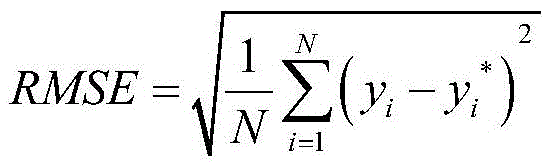
wherein, y i Represents the experimental value of the ith sample; y is i * Representing a predicted value of the ith sample; n represents the number of samples.
7. The method of claim 5, wherein the mean absolute error MAE is calculated as follows:

wherein, y i Represents the experimental value of the ith sample; y is i * Representing a predicted value of the ith sample; n represents the number of samples.
8. The method of claim 5, wherein the coefficient of determination R is a function of the dielectric material 2 The calculation formula of (a) is as follows:
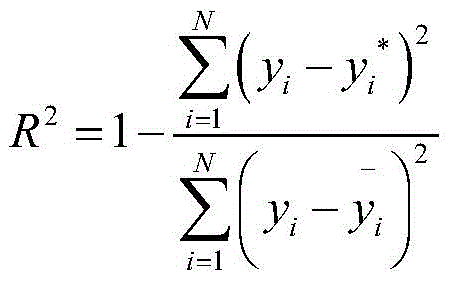
wherein, y i Represents the experimental value of the ith sample; y is i * Representing a predicted value of the ith sample; n represents the number of samples.
9. An apparatus for predicting properties of a nanocomposite dielectric material, comprising:
the acquisition unit is used for acquiring the energy storage density, the dielectric constant and the breakdown strength of the known nano composite dielectric material;
the acquisition unit is further configured to perform fingerprint identification on the known nanocomposite dielectric material, and acquire fingerprint features corresponding to each nanocomposite dielectric material;
the training unit is used for taking the fingerprint characteristics of the known nano composite dielectric material as input and taking the energy storage density, the dielectric constant and the breakdown strength as output to construct a performance prediction model;
the prediction unit is used for inputting the fingerprint characteristics of the unknown nano composite dielectric material into the constructed performance prediction model, and predicting to obtain the energy storage density, the dielectric constant and the breakdown strength of the unknown nano composite dielectric material;
and the determining unit is used for determining the performance of the unknown nano composite dielectric material according to the energy storage density, the dielectric constant and the breakdown strength.
10. An electronic device comprising a memory, a processor, and a computer program stored on the memory and executable on the processor, wherein the processor implements the method of predicting nanocomposite dielectric material-based performance of any of claims 1-8 when executing the program.
Priority Applications (1)
| Application Number | Priority Date | Filing Date | Title |
|---|---|---|---|
| CN202211672890.1A CN115862786A (en) | 2022-12-26 | 2022-12-26 | Performance prediction method, device and equipment based on nano composite dielectric material |
Applications Claiming Priority (1)
| Application Number | Priority Date | Filing Date | Title |
|---|---|---|---|
| CN202211672890.1A CN115862786A (en) | 2022-12-26 | 2022-12-26 | Performance prediction method, device and equipment based on nano composite dielectric material |
Publications (1)
| Publication Number | Publication Date |
|---|---|
| CN115862786A true CN115862786A (en) | 2023-03-28 |
Family
ID=85654701
Family Applications (1)
| Application Number | Title | Priority Date | Filing Date |
|---|---|---|---|
| CN202211672890.1A Pending CN115862786A (en) | 2022-12-26 | 2022-12-26 | Performance prediction method, device and equipment based on nano composite dielectric material |
Country Status (1)
| Country | Link |
|---|---|
| CN (1) | CN115862786A (en) |
Cited By (1)
| Publication number | Priority date | Publication date | Assignee | Title |
|---|---|---|---|---|
| CN117854650A (en) * | 2024-01-10 | 2024-04-09 | 四川大学 | Polymer material multi-target attribute prediction method based on Gaussian process regression |
Citations (4)
| Publication number | Priority date | Publication date | Assignee | Title |
|---|---|---|---|---|
| WO2019111636A1 (en) * | 2017-12-04 | 2019-06-13 | Tdk株式会社 | Method, device, and program for detecting dielectric material, and dielectric composition |
| CN110531188A (en) * | 2019-08-14 | 2019-12-03 | 中南大学 | A kind of exchange electricity performance prediction method of graphene porous nano composite material |
| US20200395102A1 (en) * | 2018-03-09 | 2020-12-17 | Showa Denko K.K. | Polymer physical property prediction device, recording medium, and polymer physical property prediction method |
| CN115374624A (en) * | 2022-08-15 | 2022-11-22 | 西安交通大学 | Method and system for simulating dielectric breakdown field strength and temperature dependence |
-
2022
- 2022-12-26 CN CN202211672890.1A patent/CN115862786A/en active Pending
Patent Citations (4)
| Publication number | Priority date | Publication date | Assignee | Title |
|---|---|---|---|---|
| WO2019111636A1 (en) * | 2017-12-04 | 2019-06-13 | Tdk株式会社 | Method, device, and program for detecting dielectric material, and dielectric composition |
| US20200395102A1 (en) * | 2018-03-09 | 2020-12-17 | Showa Denko K.K. | Polymer physical property prediction device, recording medium, and polymer physical property prediction method |
| CN110531188A (en) * | 2019-08-14 | 2019-12-03 | 中南大学 | A kind of exchange electricity performance prediction method of graphene porous nano composite material |
| CN115374624A (en) * | 2022-08-15 | 2022-11-22 | 西安交通大学 | Method and system for simulating dielectric breakdown field strength and temperature dependence |
Non-Patent Citations (2)
| Title |
|---|
| ZHONG-HUI SHEN ET AL: "Designing polymer nanocomposites with high energy density using machine learning", NPJ COMPUTATIONAL MATERIALS, vol. 7, 16 July 2021 (2021-07-16), pages 1 - 9 * |
| 戴遐明等: "《超微陶瓷粉体实用化处理技术》", 30 September 2009, 国防工业出版社, pages: 10 * |
Cited By (2)
| Publication number | Priority date | Publication date | Assignee | Title |
|---|---|---|---|---|
| CN117854650A (en) * | 2024-01-10 | 2024-04-09 | 四川大学 | Polymer material multi-target attribute prediction method based on Gaussian process regression |
| CN117854650B (en) * | 2024-01-10 | 2024-10-01 | 四川大学 | Polymer material multi-target attribute prediction method based on Gaussian process regression |
Similar Documents
| Publication | Publication Date | Title |
|---|---|---|
| CN109891508B (en) | Single cell type detection method, device, apparatus and storage medium | |
| Han et al. | An efficient algorithm for atomic decomposition of power quality disturbance signals using convolutional neural network | |
| WO2019085691A1 (en) | Unsupervised exceptional access detection method and apparatus based on one-hot encoding mechanism | |
| CN107066555B (en) | On-line theme detection method for professional field | |
| CN104636449A (en) | Distributed type big data system risk recognition method based on LSA-GCC | |
| CN112289391B (en) | A performance prediction system for anode aluminum foil based on machine learning | |
| CN104978612A (en) | Distributed big data system risk predicating method based on AHP-RBF | |
| CN112085111A (en) | A load identification method and device | |
| CN114358207B (en) | Improved k-means abnormal load detection method and system | |
| CN111564179A (en) | Species biology classification method and system based on triple neural network | |
| Yan | Weighted K-nearest neighbor classification algorithm based on Genetic Algorithm | |
| CN106485289A (en) | A kind of sorting technique of the grade of magnesite ore and equipment | |
| CN111681132A (en) | A typical power consumption pattern extraction method suitable for massive unbalanced load data | |
| CN111415008A (en) | A Vessel Flow Prediction Method Based on VMD-FOA-GRNN | |
| CN113791960B (en) | A method for predicting cloud server software aging based on EGGM model | |
| CN112200254A (en) | Network intrusion detection model generation method, detection method and electronic equipment | |
| CN104731811A (en) | Cluster information evolution analysis method for large-scale dynamic short texts | |
| CN115862786A (en) | Performance prediction method, device and equipment based on nano composite dielectric material | |
| CN114187966A (en) | Single-cell RNA sequence missing value filling method based on generation countermeasure network | |
| CN120183560B (en) | A processing method and apparatus for molecular affinity analysis | |
| CN109977227A (en) | Text feature, system, device based on feature coding | |
| CN111967483A (en) | Method and device for determining classifier, determining generator and recognizing command | |
| CN114398884A (en) | News classification method, device, equipment and medium | |
| CN119479827A (en) | Single-cell RNA sequencing data classification method and system based on deep learning | |
| CN118886777A (en) | A water quality detection system and method |
Legal Events
| Date | Code | Title | Description |
|---|---|---|---|
| PB01 | Publication | ||
| PB01 | Publication | ||
| SE01 | Entry into force of request for substantive examination | ||
| SE01 | Entry into force of request for substantive examination |