CN115836135A - Compositions and methods for modifying polymerase-nucleic acid complexes - Google Patents
Compositions and methods for modifying polymerase-nucleic acid complexes Download PDFInfo
- Publication number
- CN115836135A CN115836135A CN202180044733.3A CN202180044733A CN115836135A CN 115836135 A CN115836135 A CN 115836135A CN 202180044733 A CN202180044733 A CN 202180044733A CN 115836135 A CN115836135 A CN 115836135A
- Authority
- CN
- China
- Prior art keywords
- nucleic acid
- polymerase
- nucleotide
- nucleotides
- primed template
- Prior art date
- Legal status (The legal status is an assumption and is not a legal conclusion. Google has not performed a legal analysis and makes no representation as to the accuracy of the status listed.)
- Pending
Links
Images


Classifications
-
- C—CHEMISTRY; METALLURGY
- C12—BIOCHEMISTRY; BEER; SPIRITS; WINE; VINEGAR; MICROBIOLOGY; ENZYMOLOGY; MUTATION OR GENETIC ENGINEERING
- C12Q—MEASURING OR TESTING PROCESSES INVOLVING ENZYMES, NUCLEIC ACIDS OR MICROORGANISMS; COMPOSITIONS OR TEST PAPERS THEREFOR; PROCESSES OF PREPARING SUCH COMPOSITIONS; CONDITION-RESPONSIVE CONTROL IN MICROBIOLOGICAL OR ENZYMOLOGICAL PROCESSES
- C12Q1/00—Measuring or testing processes involving enzymes, nucleic acids or microorganisms; Compositions therefor; Processes of preparing such compositions
- C12Q1/68—Measuring or testing processes involving enzymes, nucleic acids or microorganisms; Compositions therefor; Processes of preparing such compositions involving nucleic acids
- C12Q1/6869—Methods for sequencing
-
- C—CHEMISTRY; METALLURGY
- C12—BIOCHEMISTRY; BEER; SPIRITS; WINE; VINEGAR; MICROBIOLOGY; ENZYMOLOGY; MUTATION OR GENETIC ENGINEERING
- C12Q—MEASURING OR TESTING PROCESSES INVOLVING ENZYMES, NUCLEIC ACIDS OR MICROORGANISMS; COMPOSITIONS OR TEST PAPERS THEREFOR; PROCESSES OF PREPARING SUCH COMPOSITIONS; CONDITION-RESPONSIVE CONTROL IN MICROBIOLOGICAL OR ENZYMOLOGICAL PROCESSES
- C12Q1/00—Measuring or testing processes involving enzymes, nucleic acids or microorganisms; Compositions therefor; Processes of preparing such compositions
- C12Q1/68—Measuring or testing processes involving enzymes, nucleic acids or microorganisms; Compositions therefor; Processes of preparing such compositions involving nucleic acids
- C12Q1/6869—Methods for sequencing
- C12Q1/6874—Methods for sequencing involving nucleic acid arrays, e.g. sequencing by hybridisation
Landscapes
- Life Sciences & Earth Sciences (AREA)
- Chemical & Material Sciences (AREA)
- Proteomics, Peptides & Aminoacids (AREA)
- Organic Chemistry (AREA)
- Zoology (AREA)
- Wood Science & Technology (AREA)
- Health & Medical Sciences (AREA)
- Engineering & Computer Science (AREA)
- Microbiology (AREA)
- Immunology (AREA)
- Biotechnology (AREA)
- Molecular Biology (AREA)
- Biophysics (AREA)
- Analytical Chemistry (AREA)
- Physics & Mathematics (AREA)
- Biochemistry (AREA)
- Bioinformatics & Cheminformatics (AREA)
- General Engineering & Computer Science (AREA)
- General Health & Medical Sciences (AREA)
- Genetics & Genomics (AREA)
- Measuring Or Testing Involving Enzymes Or Micro-Organisms (AREA)
Abstract
本文提供的公开内容包括一种用于修饰聚合酶‑核酸复合物的方法,包括(a)在容器中提供多于一种表面固定的聚合酶‑核酸复合物,其中所述核酸包括引发的模板核酸,其中至少一个亚组的所述表面固定的聚合酶‑核酸复合物包括还包含核苷酸的三元复合物;以及(b)将表面用包含二醇、亚砜或多元醇的水性溶液洗涤,从而将核苷酸从所述容器中去除并且将所述表面固定的聚合酶‑核酸复合物保留在所述容器中。

The disclosure provided herein includes a method for modifying a polymerase-nucleic acid complex comprising (a) providing more than one surface-immobilized polymerase-nucleic acid complex in a vessel, wherein the nucleic acid comprises a primed template nucleic acids, wherein at least a subset of said surface-immobilized polymerase-nucleic acid complexes includes ternary complexes that also comprise nucleotides; and (b) treating the surface with an aqueous solution comprising diols, sulfoxides, or polyols washing to remove nucleotides from the container and to retain the surface-immobilized polymerase-nucleic acid complex in the container.
Description
相关申请related application
本申请要求2020年5月5日提交的美国临时申请第63/020,115号的优先权,其内容通过引用以其整体并入本文。This application claims priority to U.S. Provisional Application No. 63/020,115, filed May 5, 2020, the contents of which are incorporated herein by reference in their entirety.
背景background
本公开内容大体上涉及核酸的检测,并且对核酸测序技术具有特定的适用性。The present disclosure relates generally to the detection of nucleic acids, and has particular applicability to nucleic acid sequencing techniques.
模板核酸链的准确序列确定对于分子诊断是重要的。从多种可选物中鉴定已知位置处的单核苷酸碱基可以用作单核苷酸多态性(SNP)分析的基础。SNP继而可以用于确定个体的表型,诸如对疾病的易感性或具有所期望性状的倾向。检测患者中的遗传变异可以提供某些药物治疗患者的疗效或用某些药物治疗患者时不良副作用风险的指示。Accurate sequence determination of template nucleic acid strands is important for molecular diagnostics. Identification of single nucleotide bases at known positions from a variety of alternatives can be used as the basis for single nucleotide polymorphism (SNP) analysis. SNPs can in turn be used to determine an individual's phenotype, such as susceptibility to disease or propensity to possess a desired trait. Detecting genetic variants in patients can provide an indication of how well certain drugs are treating a patient or the risk of adverse side effects when treating a patient with certain drugs.
商购可得的核酸测序平台已经极大地增加了我们对可操作性状的遗传基础的了解。测序生物化学和检测硬件的改进仍在继续。然而,许多平台仅实现了相对较短的读段,并且读段中的错误是长期的困难。大规模并行处理允许获得许多短读段,并且然后编织在一起,组装更大的基因组序列。可以增加读段的数目以实现改进的准确性。例如,各自长度仅几百个核苷酸的数百万个读段可以组装在一起,以得到约30亿个核苷酸长的人类基因组。通过增加测序读段的长度和准确性,将减少实现DNA的大规模并行处理和数据的高通量组装所需的时间和资源。本发明解决了这种需要并且还提供了相关优点。Commercially available nucleic acid sequencing platforms have greatly increased our understanding of the genetic basis of actionable traits. Improvements in sequencing biochemistry and detection hardware continue. However, many platforms only implement relatively short reads, and errors in reads are a chronic difficulty. Massively parallel processing allows many short reads to be obtained and then woven together to assemble larger genomic sequences. The number of reads can be increased to achieve improved accuracy. For example, millions of reads, each only a few hundred nucleotides in length, can be assembled to yield the human genome, which is about 3 billion nucleotides long. By increasing the length and accuracy of sequencing reads, the time and resources required to achieve massively parallel processing of DNA and high-throughput assembly of data will be reduced. The present invention addresses this need and provides related advantages as well.
概述overview
本公开内容提供了一种组合物,包含聚合酶-核酸复合物,其中核酸包括与水性溶液接触的引发的模板核酸(primed-template nucleic acid),其中水性溶液包含多元醇、二醇、砜或亚砜。The present disclosure provides a composition comprising a polymerase-nucleic acid complex, wherein the nucleic acid comprises a primed-template nucleic acid contacted with an aqueous solution, wherein the aqueous solution comprises a polyol, diol, sulfone or sulfoxide.
本公开内容提供了一种用于修饰聚合酶-核酸复合物的方法。所述方法可以例如包括以下步骤:(a)提供多于一种聚合酶-核酸复合物,每种聚合酶-核酸复合物包含聚合酶和引发的模板核酸,其中至少一个亚组的聚合酶-核酸复合物是还包含核苷酸的三元复合物;以及(b)使多于一种聚合酶-核酸复合物与包含多元醇、醇、脂肪族二醇、砜、亚砜或其组合的水性溶液接触,从而将核苷酸从所述亚组的聚合酶-核酸复合物解离。水性溶液可以还包含另外的组分,诸如锂、甜菜碱或两者。多于一种聚合酶-核酸复合物可以被固定在表面上,存在于容器中,或者两者。所述方法可以包括以下步骤:(a)在容器中提供多于一种表面固定的聚合酶-核酸复合物,其中核酸包括引发的模板核酸,其中至少一个亚组的表面固定的聚合酶-核酸复合物包括还包含核苷酸的三元复合物;以及(b)将表面用包含多元醇、二醇、砜或亚砜的水性溶液洗涤,从而将核苷酸从容器中去除并且将表面固定的聚合酶-核酸复合物保留在容器中。The present disclosure provides a method for modifying a polymerase-nucleic acid complex. The method may, for example, comprise the steps of: (a) providing more than one polymerase-nucleic acid complex, each polymerase-nucleic acid complex comprising a polymerase and a primed template nucleic acid, wherein at least a subset of the polymerases- The nucleic acid complex is a ternary complex that also includes nucleotides; and (b) combining more than one polymerase-nucleic acid complex with a polyol, alcohol, aliphatic diol, sulfone, sulfoxide, or combination thereof The aqueous solution is contacted, thereby dissociating the nucleotides from the subset of polymerase-nucleic acid complexes. The aqueous solution may also contain additional components such as lithium, betaine, or both. More than one polymerase-nucleic acid complex can be immobilized on the surface, present in the container, or both. The method may comprise the steps of: (a) providing more than one surface-immobilized polymerase-nucleic acid complex in a container, wherein the nucleic acid comprises a primed template nucleic acid, wherein at least a subset of the surface-immobilized polymerase-nucleic acid complexes The complexes include ternary complexes that also comprise nucleotides; and (b) washing the surface with an aqueous solution comprising a polyol, diol, sulfone, or sulfoxide, thereby removing the nucleotides from the container and immobilizing the surface The polymerase-nucleic acid complex remains in the container.
用于修饰聚合酶-核酸复合物的方法可以包括以下步骤:(a)使多于一种聚合酶与多于一种引发的模板核酸并与多于一种核苷酸接触,从而在容器中提供多于一种表面固定的聚合酶-核酸复合物,表面固定的聚合酶-核酸复合物中的每一种包含多于一种聚合酶中的聚合酶和多于一种引发的模板核酸中的引发的模板核酸,三元复合物中的核苷酸包括多于一种核苷酸中的核苷酸;和(b)将表面用包含多元醇、二醇、砜或亚砜的水性溶液洗涤,从而将核苷酸从容器中去除并且将表面固定的聚合酶-核酸复合物保留在容器中。The method for modifying a polymerase-nucleic acid complex may comprise the steps of: (a) contacting more than one polymerase with more than one primed template nucleic acid and with more than one nucleotide, whereby in the container Providing more than one surface-immobilized polymerase-nucleic acid complex, each of the surface-immobilized polymerase-nucleic acid complexes comprising more than one polymerase in the polymerase and more than one primed template nucleic acid in The primed template nucleic acid of the ternary complex includes nucleotides in more than one nucleotide; and (b) treating the surface with an aqueous solution comprising polyols, diols, sulfones, or sulfoxides Washing removes the nucleotides from the container and retains the surface immobilized polymerase-nucleic acid complex in the container.
用于修饰聚合酶-核酸复合物的方法可以包括以下步骤:(a)在容器中提供多于一种表面固定的聚合酶-核酸复合物,其中核酸包括引发的模板核酸,其中至少一个亚组的表面固定的聚合酶-核酸复合物包括还包含核苷酸的三元复合物;(b)将表面用包含多元醇、二醇、砜或亚砜的水性溶液洗涤,从而将核苷酸从容器中去除并且将表面固定的聚合酶-核酸复合物保留在容器中;以及(c)将包含多于一种第二核苷酸的溶液递送至容器,从而至少第二亚组的表面固定的聚合酶-核酸复合物包括还包含来自多于一种第二核苷酸的第二核苷酸的三元复合物。The method for modifying a polymerase-nucleic acid complex may comprise the steps of: (a) providing more than one surface-immobilized polymerase-nucleic acid complex in a container, wherein the nucleic acid comprises a primed template nucleic acid, at least a subset of which The surface-immobilized polymerase-nucleic acid complexes of the method include ternary complexes that also contain nucleotides; (b) washing the surface with an aqueous solution containing polyols, diols, sulfones, or sulfoxides to remove nucleotides from removing from the container and retaining the surface-immobilized polymerase-nucleic acid complex in the container; and (c) delivering a solution comprising more than one second nucleotide to the container so that at least a second subset of the surface-immobilized Polymerase-nucleic acid complexes include ternary complexes that also comprise a second nucleotide from more than one second nucleotide.
本公开内容还提供了一种用于鉴定引发的模板核酸中的核苷酸的方法。所述方法可以包括以下步骤:(a)提供具有引发的模板核酸、聚合酶和第一碱基类型的核苷酸同源物(cognate)的容器;(b)对容器进行稳定的三元复合物的检查,所述稳定的三元复合物包含聚合酶和结合在引发的模板核酸的碱基位置处的第一碱基类型的核苷酸同源物;(c)将容器用包含多元醇、二醇、砜或亚砜的水性溶液洗涤,从而将核苷酸从容器中去除并且保留来自步骤(b)中的引发的模板核酸和聚合酶;(d)在步骤(c)之后将第二碱基类型的核苷酸同源物递送至容器;(e)对容器进行稳定的三元复合物的检查,所述稳定的三元复合物包含聚合酶和结合在引发的模板核酸的碱基位置处的第二碱基类型的核苷酸同源物;以及(f)鉴定引发的模板核酸的碱基位置处的核苷酸类型。任选地,所述方法可以还包括以下步骤:(g)将核苷酸添加至引发的模板核酸的引物中,从而容器包含延伸的引发的模板核酸;(h)将第二聚合酶和第一碱基类型的核苷酸同源物递送至容器;以及(i)使用延伸的引发的模板核酸代替引发的模板核酸并使用第二聚合酶代替聚合酶重复步骤(b)至(f)。The present disclosure also provides a method for identifying nucleotides in a primed template nucleic acid. The method may comprise the steps of: (a) providing a container with a primed template nucleic acid, a polymerase, and a nucleotide cognate of the first base type; (b) performing a stable ternary complex on the container Examination of a stable ternary complex comprising a polymerase and a nucleotide homologue of the first base type bound at a base position of a primed template nucleic acid; (c) replacing the container with a polyol containing , diol, sulfone or sulfoxide, thereby removing the nucleotides from the container and retaining the template nucleic acid and polymerase from the initiation in step (b); (d) after step (c) the second Nucleotide homologues of the dibase type are delivered to the container; (e) the container is inspected for a stable ternary complex comprising a polymerase and a base bound to the primed template nucleic acid and (f) identifying the nucleotide type at the base position of the primed template nucleic acid. Optionally, the method may further comprise the steps of: (g) adding nucleotides to the primers of the primed template nucleic acid so that the container contains the extended primed template nucleic acid; (h) adding the second polymerase and the first delivering a nucleotide homologue of a base type to the container; and (i) replacing the primed template nucleic acid with the extended primed template nucleic acid and repeating steps (b) to (f) using a second polymerase instead of the polymerase.
在一些实施方案中,用于鉴定引发的模板核酸中的核苷酸的方法可以包括以下步骤:(a)提供具有引发的模板核酸、聚合酶和第一碱基类型的核苷酸同源物的容器;(b)对容器进行稳定的三元复合物的检查,所述稳定的三元复合物包含聚合酶和结合在引发的模板核酸的碱基位置处的第一碱基类型的核苷酸同源物;(c)将容器用包含多元醇、二醇、砜或亚砜的水性溶液洗涤,从而将核苷酸从容器中去除并且保留来自步骤(b)中的引发的模板核酸和聚合酶;(d)在步骤(c)之后将第二碱基类型的核苷酸同源物递送至容器;(e)对容器进行稳定的三元复合物的检查,所述稳定的三元复合物包含聚合酶和结合在引发的模板核酸的碱基位置处的第二碱基类型的核苷酸同源物;(f)鉴定引发的模板核酸的碱基位置处的核苷酸类型;(g)将第三碱基类型的核苷酸同源物递送至容器,从而容器保留来自步骤(b)的引发的模板核酸和聚合酶;以及(h)对容器进行稳定的三元复合物的检查,所述稳定的三元复合物具有聚合酶和结合在引发的模板核酸的碱基位置处的第三碱基类型的核苷酸同源物。任选地,所述方法可以还包括以下步骤:(i)将核苷酸添加至引发的模板核酸的引物中,从而容器包含延伸的引发的模板核酸;(j)将第二聚合酶和第一碱基类型的核苷酸同源物递送至容器;以及(k)使用延伸的引发的模板核酸代替引发的模板核酸并使用第二聚合酶代替聚合酶重复步骤(b)至(h)。In some embodiments, a method for identifying nucleotides in a primed template nucleic acid may comprise the steps of: (a) providing a nucleotide homologue having a primed template nucleic acid, a polymerase, and a first base type (b) inspecting the container for a stable ternary complex comprising a polymerase and a nucleoside of the first base type bound at the base position of the primed template nucleic acid acid congeners; (c) washing the container with an aqueous solution comprising polyols, diols, sulfones or sulfoxides, thereby removing the nucleotides from the container and retaining the template nucleic acid from the priming in step (b) and polymerase; (d) delivering a nucleotide homologue of the second base type to the container after step (c); (e) checking the container for a stable ternary complex, the stable ternary complex The complex comprises a polymerase and a nucleotide homologue of a second base type bound at the base position of the primed template nucleic acid; (f) identifying the nucleotide type at the base position of the primed template nucleic acid; (g) delivering a nucleotide homologue of a third base type to the container such that the container retains the primed template nucleic acid and polymerase from step (b); and (h) stabilizing the container for a ternary complex The stable ternary complex has a polymerase and a nucleotide homologue of a third base type bound at the base position of the primed template nucleic acid. Optionally, the method may further comprise the steps of: (i) adding nucleotides to the primers of the primed template nucleic acid so that the container contains the extended primed template nucleic acid; (j) adding the second polymerase and the first delivering a nucleotide homologue of a base type to the container; and (k) replacing the primed template nucleic acid with the extended primed template nucleic acid and repeating steps (b) through (h) using a second polymerase instead of the polymerase.
在一些实施方案中,用于鉴定引发的模板核酸中的核苷酸的方法可以包括以下步骤:(a)提供具有引发的模板核酸、聚合酶和第一碱基类型的核苷酸同源物的容器;(b)对容器进行稳定的三元复合物的检查,所述稳定的三元复合物包含聚合酶和结合在引发的模板核酸的碱基位置处的第一碱基类型的核苷酸同源物;(c)将容器用包含多元醇、二醇、砜或亚砜的水性溶液洗涤,从而将核苷酸从容器中去除并且保留来自步骤(b)中的引发的模板核酸和聚合酶;(d)在步骤(c)之后将第二碱基类型的核苷酸同源物递送至容器;(e)对容器进行稳定的三元复合物的检查,所述稳定的三元复合物包含聚合酶和结合在引发的模板核酸的碱基位置处的第二碱基类型的核苷酸同源物;(f)鉴定引发的模板核酸的碱基位置处的核苷酸类型;(g)将第三碱基类型的核苷酸同源物递送至容器,从而容器保留来自步骤(b)的引发的模板核酸和聚合酶;(h)对容器进行稳定的三元复合物的检查,所述稳定的三元复合物具有聚合酶和结合在引发的模板核酸的碱基位置处的第三碱基类型的核苷酸同源物;(i)将第四碱基类型的核苷酸同源物递送至容器,从而容器保留来自步骤(b)的引发的模板核酸和聚合酶;以及(j)对容器进行稳定的三元复合物的检查,所述稳定的三元复合物包含聚合酶和结合在引发的模板核酸的碱基位置处的第四碱基类型的核苷酸同源物。任选地,所述方法可以还包括以下步骤:(k)将核苷酸添加至引发的模板核酸的引物中,从而容器包含延伸的引发的模板核酸;(l)将第二聚合酶和第一碱基类型的核苷酸同源物递送至容器;以及(m)使用延伸的引发的模板核酸代替引发的模板核酸并使用第二聚合酶代替聚合酶重复步骤(b)至(j)。In some embodiments, a method for identifying nucleotides in a primed template nucleic acid may comprise the steps of: (a) providing a nucleotide homologue having a primed template nucleic acid, a polymerase, and a first base type (b) inspecting the container for a stable ternary complex comprising a polymerase and a nucleoside of the first base type bound at the base position of the primed template nucleic acid acid congeners; (c) washing the container with an aqueous solution comprising polyols, diols, sulfones or sulfoxides, thereby removing the nucleotides from the container and retaining the template nucleic acid from the priming in step (b) and polymerase; (d) delivering a nucleotide homologue of the second base type to the container after step (c); (e) checking the container for a stable ternary complex, the stable ternary complex The complex comprises a polymerase and a nucleotide homologue of a second base type bound at the base position of the primed template nucleic acid; (f) identifying the nucleotide type at the base position of the primed template nucleic acid; (g) delivering a nucleotide homologue of the third base type to the container, so that the container retains the primed template nucleic acid and polymerase from step (b); (h) performing stabilization of the ternary complex on the container Check that the stable ternary complex has a polymerase and a nucleotide homologue of the third base type bound at the base position of the primed template nucleic acid; delivery of the nucleotide homologue to the container so that the container retains the primed template nucleic acid and polymerase from step (b); and (j) inspecting the container for a stable ternary complex that A polymerase and a nucleotide homologue of a fourth base type bound at the base position of the primed template nucleic acid are included. Optionally, the method may further comprise the steps of: (k) adding nucleotides to the primers of the primed template nucleic acid so that the container contains the extended primed template nucleic acid; (1) adding the second polymerase and the second polymerase delivering a nucleotide homologue of a base type to the container; and (m) replacing the primed template nucleic acid with the extended primed template nucleic acid and repeating steps (b) through (j) using a second polymerase instead of the polymerase.
本文的公开内容还包括一种组合物,所述组合物包含与水性溶液接触的多于一种聚合酶-核酸复合物,其中多于一种聚合酶-核酸复合物中的每一种包含聚合酶和引发的模板核酸,并且其中水性溶液包含多元醇、醇、脂肪族二醇、砜、亚砜或其组合。水性溶液可以还包含锂、甜菜碱或两者。The disclosure herein also includes a composition comprising more than one polymerase-nucleic acid complexes contacted with an aqueous solution, wherein each of the more than one polymerase-nucleic acid complexes comprises a polymerase The enzyme and the primed template nucleic acid, and wherein the aqueous solution comprises polyols, alcohols, aliphatic diols, sulfones, sulfoxides, or combinations thereof. The aqueous solution may also contain lithium, betaine, or both.
附图简述Brief description of the drawings
图1示出了测序方法的检查子例程的流程图。Figure 1 shows a flowchart of the check subroutine of the sequencing method.
图2是比较含异丙醇(SOP)的NSB测量的串扰度量与含1,6己二醇的NSB测量的串扰度量相比的图。Figure 2 is a graph comparing crosstalk metrics measured for NSBs containing isopropanol (SOP) compared to crosstalk metrics measured for NSBs containing 1,6 hexanediol.
图3是比较含异丙醇(SOP)的NSB测量的串扰度量与含1,7庚二醇的NSB测量的串扰度量相比的图。Figure 3 is a graph comparing crosstalk metrics measured for NSBs containing isopropanol (SOP) compared to those measured for NSBs containing 1,7 heptanediol.
图4是比较含异丙醇(SOP)的NSB测量的串扰度量与含1,5戊二醇的NSB测量的串扰度量相比的图。Figure 4 is a graph comparing crosstalk metrics measured for NSBs containing isopropanol (SOP) compared to crosstalk metrics measured for NSBs containing 1,5 pentanediol.
图5是比较含异丙醇(SOP)的NSB测量的串扰度量与含DMSO的NSB测量的串扰度量相比的图。Figure 5 is a graph comparing the crosstalk metrics measured for NSB containing isopropanol (SOP) compared to the crosstalk metrics measured for NSB containing DMSO.
图6是比较含异丙醇(SOP)的NSB测量的串扰度量与含乙基甲基砜的NSB测量的串扰度量相比的图。Figure 6 is a graph comparing crosstalk metrics measured for NSBs containing isopropanol (SOP) compared to those measured for NSBs containing ethylmethyl sulfone.
图7是比较含异丙醇(SOP)的NSB测量的串扰度量与含环丁砜的NSB测量的串扰度量相比的图。Figure 7 is a graph comparing crosstalk metrics measured for NSBs containing isopropanol (SOP) compared to crosstalk metrics measured for NSBs containing sulfolane.
图8是比较含异丙醇(SOP)的NSB测量的串扰度量与含PEG的NSB测量的串扰度量相比的图。Figure 8 is a graph comparing crosstalk metrics measured for NSBs containing isopropanol (SOP) compared to crosstalk metrics measured for NSBs containing PEG.
图9是比较含异丙醇(SOP)的NSB测量的串扰度量与含PVA的NSB测量的串扰度量相比的图。9 is a graph comparing crosstalk metrics measured for NSBs containing isopropanol (SOP) compared to crosstalk metrics measured for NSBs containing PVA.
图10A示出了对于具有28%1,6己二醇的NSB流体泡沫获取的第一图像;图10B示出了在对于具有28%1,6己二醇的NSB流体泡沫的第一图像之后1分钟获取的第二图像;图10C示出了对于具有20%异丙醇(SOP)的NSB流体泡沫获取的第一图像;并且图10D示出了在对于具有20%异丙醇(SOP)的NSB流体泡沫的第一图像之后1分钟获取的第二图像。Figure 10A shows the first image taken for an NSB fluid foam with 28% 1,6 hexanediol; Figure 10B shows after the first image for an NSB fluid foam with 28% 1,6 hexanediol The second image taken at 1 minute; FIG. 10C shows the first image taken for the NSB fluid foam with 20% isopropanol (SOP); and FIG. The second image of the NSB fluid foam was acquired 1 min after the first image.
详细描述A detailed description
本公开内容提供了可以例如通过解离参与三元复合物的聚合酶、核酸和核苷酸中的两种或更多种之间的相互作用用于修饰分子复合物的组合物和方法。组合物和方法可以用于多种目的,包括:例如,检测复合物;鉴定复合物的特征,诸如参与复合物的核酸中一个或更多个碱基的身份;产生用于用途诸如治疗用途或诊断用途的复合物;修饰复合物以从复合物中去除组分或完全去除复合物。The present disclosure provides compositions and methods that can be used to modify molecular complexes, eg, by dissociating interactions between two or more of a polymerase, a nucleic acid, and a nucleotide participating in a ternary complex. The compositions and methods can be used for a variety of purposes, including: for example, detecting complexes; characterizing complexes, such as the identity of one or more bases in nucleic acids participating in the complexes; generating compounds for uses such as therapeutic use or Complexes for diagnostic use; modifying the complex to remove components from the complex or to remove the complex entirely.
在一些实施方案中,本文示出的方法和组合物可以用于鉴定引发的模板核酸中的核苷酸。核苷酸可以基于三元复合物的形成来鉴定,所述三元复合物包含引发的模板核酸、在引物3’末端处与模板结合的聚合酶和与聚合酶结合以与模板中与引物3’末端相邻的核苷酸配对的同源核苷酸。可以评价各种不同核苷酸类型形成三元复合物的能力。观察到参与三元复合物形成的核苷酸类型可以被鉴定为正在查询的模板位置的同源核苷酸。基于这一观察和已知的核苷酸配对规则(即,腺嘌呤与胸腺嘧啶或尿嘧啶配对,并且胞嘧啶与鸟嘌呤配对),可以推断模板位置处的核苷酸类型。In some embodiments, the methods and compositions presented herein can be used to identify nucleotides in primed template nucleic acids. Nucleotides can be identified based on the formation of a ternary complex comprising a primed template nucleic acid, a polymerase bound to the template at the 3' end of the primer, and a polymerase bound to the template to bind to the primer 3 ' Homologous nucleotides paired with adjacent nucleotides at the ends. The ability of various nucleotide types to form ternary complexes can be assessed. The type of nucleotides observed to participate in ternary complex formation can be identified as homologous nucleotides to the template position being queried. Based on this observation and known nucleotide pairing rules (ie, adenine pairs with either thymine or uracil, and cytosine pairs with guanine), the type of nucleotide at the template position can be inferred.
用于表征引发的模板核酸的有用方法是将聚合酶和第一类型的核苷酸递送至固定的核酸,检查固体支持物以确定固定的核酸对三元复合物组分的募集,将聚合酶和核苷酸从核苷酸被固定的固体支持物上去除,并且然后对不同类型的核苷酸重复该循环。尽管这种方法对于表征核酸是有用的,但是递送和从固体支持物中去除试剂可能是耗时的。此外,这种替代循环消耗相对大量的对生产可能是昂贵试剂的聚合酶。A useful method for characterizing the primed template nucleic acid is to deliver the polymerase and the first type of nucleotide to the immobilized nucleic acid, examine the solid support to determine the recruitment of the immobilized nucleic acid to the components of the ternary complex, deliver the polymerase and nucleotides are removed from the solid support on which the nucleotides are immobilized, and the cycle is then repeated for a different type of nucleotide. While this method is useful for characterizing nucleic acids, delivery and removal of reagents from the solid support can be time consuming. Furthermore, this alternative cycle consumes relatively large amounts of polymerase, which can be an expensive reagent to produce.
本公开内容提供了一种方法,其中不同的核苷酸类型可以被连续递送,并且然后从三元复合物被形成和检查的容器中去除。例如,每次递送可以仅包括单一类型的核苷酸或仅包括与预期存在于核酸中的单一类型碱基同源的核苷酸。在另一个实例中,每次递送可以包括一组至少2种、3种、4种或更多种核苷酸类型或一组包括预期存在于核酸中的至少2种、3种、4种或更多种碱基类型的同源物的核苷酸。一种或更多种核苷酸可以在将核苷酸从三元复合物解离的条件下从容器中去除,从而允许核苷酸与引发的模板核酸分离,而不会引起聚合酶的大量(substantial)去除。然后可以将另一种核苷酸递送至引发的模板核酸。如果聚合酶没有从引发的模板核酸的存在中大量去除,则不需要递送更多的聚合酶。这提供了对制备更多聚合酶本来将消耗的时间和资源的节省。The present disclosure provides a method in which different nucleotide types can be delivered serially and then removed from the container in which the ternary complex is formed and examined. For example, each delivery may include only a single type of nucleotide or only nucleotides homologous to a single type of base expected to be present in the nucleic acid. In another example, each delivery can include a set of at least 2, 3, 4 or more nucleotide types or a set of at least 2, 3, 4 or more nucleotide types expected to be present in the nucleic acid. Nucleotides of homologues of more base types. One or more nucleotides can be removed from the container under conditions that dissociate the nucleotides from the ternary complex, thereby allowing the nucleotides to separate from the primed template nucleic acid without causing a large amount of polymerase (substantial) removal. Another nucleotide can then be delivered to the primed template nucleic acid. If the polymerase is not largely removed from the presence of the primed template nucleic acid, no more polymerase need be delivered. This provides a savings in time and resources that would otherwise be consumed in making more polymerase.
令人惊讶的是,多元醇、二醇和亚砜已经显示出将核苷酸从聚合酶-核酸复合物解离,同时保留聚合酶与核酸之间的缔合。因此,可以使用包含这些化合物的水性溶液将核苷酸从聚合酶-核酸复合物中去除或者用一种核苷酸替代聚合酶-核酸复合物中的另一种核苷酸。更具体地,包含引发的模板核酸、聚合酶和下一个正确核苷酸的三元复合物可以与包含多元醇、二醇、砜或亚砜的水性溶液接触,以便将核苷酸解离同时聚合酶保持与核酸缔合。对于将聚合酶-核酸复合物固定在容器中的表面上的实施方案,然后可以通过将溶液从容器中去除来去除解离的核苷酸。然后可以在三元复合物形成的条件下,将包含与被去除的核苷酸相同或不同类型的核苷酸的新溶液添加至容器中。Surprisingly, polyols, diols and sulfoxides have been shown to dissociate nucleotides from polymerase-nucleic acid complexes while preserving the association between the polymerase and nucleic acid. Thus, aqueous solutions comprising these compounds can be used to remove nucleotides from polymerase-nucleic acid complexes or to substitute one nucleotide for another in a polymerase-nucleic acid complex. More specifically, a ternary complex comprising a primed template nucleic acid, a polymerase, and the next correct nucleotide can be contacted with an aqueous solution comprising a polyol, diol, sulfone, or sulfoxide to dissociate the nucleotide while simultaneously The polymerase remains associated with the nucleic acid. For embodiments where the polymerase-nucleic acid complex is immobilized on a surface in a container, dissociated nucleotides can then be removed by removing the solution from the container. A new solution comprising nucleotides of the same or different type as the nucleotides being removed can then be added to the vessel under conditions of ternary complex formation.
该方法可以以多重方式进行,使得不同的核苷酸或核苷酸组被依次递送并且从具有多于一种聚合酶-核酸复合物的容器或固体支持物中去除。例如,包含聚合酶-核酸复合物阵列的容器可以包含与第一类型的核苷酸形成三元复合物的复合物的亚组,第一类型的核苷酸可以使用包含多元醇、二醇、砜或亚砜的水性溶液从三元复合物解离并且从容器中去除,并且然后第二类型的核苷酸可以被递送至容器中,使得已经保留在容器中的聚合酶-核酸复合物的亚组可以与第二类型的核苷酸形成三元复合物。The method can be performed in a multiplexed fashion, such that different nucleotides or groups of nucleotides are sequentially delivered and removed from the container or solid support with more than one polymerase-nucleic acid complex. For example, a container comprising an array of polymerase-nucleic acid complexes can comprise a subgroup of complexes that form ternary complexes with a first type of nucleotide that can be formed using polyols, diols, The aqueous solution of sulfone or sulfoxide dissociates from the ternary complex and is removed from the container, and then a second type of nucleotide can be delivered into the container such that the polymerase-nucleic acid complex already retained in the container A subgroup can form a ternary complex with a second type of nucleotide.
尽管上述实施方案例示了在每个步骤中递送单一类型的核苷酸,但应当理解,可以在一个或更多个步骤中递送两种或更多种核苷酸类型。核苷酸可以例如使用分别附接至每种类型的核苷酸的不同标记物来区分。Although the above embodiments illustrate delivery of a single type of nucleotide in each step, it should be understood that two or more nucleotide types may be delivered in one or more steps. Nucleotides can be distinguished, for example, using different labels attached to each type of nucleotide respectively.
除非另外指明,否则本文使用的术语将被理解为具有它们在相关领域中的普通含义。以下示出了本文使用的若干术语和它们的含义。Unless otherwise indicated, the terms used herein are to be understood as having their ordinary meanings in the relevant art. Several terms used herein and their meanings are shown below.
如本文使用,术语“阵列”是指附接至一个或更多个固体支持物使得在一个特征处的分子可以与在其他特征处的分子区分开的分子群体。阵列可以包括各自位于固体支持物上的不同可寻址特征的不同分子。可选地,阵列可以包括单独的固体支持物,每个固体支持物起携带不同分子的特征的作用,其中不同的分子可以根据固体支持物在固体支持物被附接的表面上的位置,或者根据固体支持物在液体诸如流体流中的位置来标识。阵列的分子可以是例如核苷酸、核酸引物、核酸模板、引发的模板核酸或核酸酶,诸如聚合酶、连接酶、外切核酸酶或其组合。As used herein, the term "array" refers to a population of molecules attached to one or more solid supports such that molecules at one feature can be distinguished from molecules at other features. An array may comprise different molecules each of a different addressable feature on a solid support. Alternatively, the array may comprise separate solid supports, each solid support acting to carry the characteristics of a different molecule, wherein the different molecules may be based on the position of the solid support on the surface to which the solid support is attached, or Identification is based on the position of the solid support in a liquid, such as a fluid stream. The molecules of the array can be, for example, nucleotides, nucleic acid primers, nucleic acid templates, primed template nucleic acids, or nucleases, such as polymerases, ligases, exonucleases, or combinations thereof.
如本文使用的,术语“附接”是指两个物体彼此连接、紧固、粘附、连接或结合的状态。例如,反应组分,诸如引发的模板核酸或聚合酶,可以通过共价键或非共价键附接至固相组分。共价键以原子间共有电子对为特征。非共价键是不涉及共有电子对的化学键,并且可以包括例如氢键、离子键、范德华力、亲水性相互作用和疏水性相互作用。As used herein, the term "attached" refers to a state where two objects are connected, fastened, adhered, connected or combined with each other. For example, reaction components, such as primed template nucleic acids or polymerases, can be attached to solid phase components by covalent or non-covalent bonds. Covalent bonds are characterized by the sharing of pairs of electrons between atoms. A non-covalent bond is a chemical bond that does not involve a shared pair of electrons, and can include, for example, hydrogen bonds, ionic bonds, van der Waals forces, hydrophilic interactions, and hydrophobic interactions.
如本文使用的,术语“二元复合物”是指聚合酶与核酸(例如,引发的模板核酸)(不包括任何核苷酸分子,诸如用于引发的模板核酸的下一个正确核苷酸)之间的分子间缔合物(association)。As used herein, the term "binary complex" refers to a polymerase and a nucleic acid (e.g., a primed template nucleic acid) (excluding any nucleotide molecules, such as the next correct nucleotide for the primed template nucleic acid) The intermolecular association (association) between them.
如本文使用的,术语“封闭部分”在提及核苷酸使用时,意指在核酸聚合反应期间抑制或阻止核苷酸的3’氧与下一个正确核苷酸形成共价连接的核苷酸的一部分。“可逆地终止的”核苷酸的封闭部分可以从核苷酸类似物中去除,或者以其他方式修饰,以允许核苷酸的3’氧共价连接至下一个正确核苷酸。这样的封闭部分在本文中被称为“可逆终止子部分”。示例性可逆终止子部分在以下中示出:美国专利第7,427,673号;第7,414,116号;第7,057,026号;第7,544,794号或第8,034,923号;或1991年5月16日公布的PCT公布WO 91/06678或2007年11月1日公布的WO 07/123744,所述文献的每一个通过引用并入本文。具有封闭部分或可逆终止子部分的核苷酸可以是核酸诸如引物3’末端处的亚单位,或者核苷酸可以是不共价附接至核酸的单体分子。特别有用的封闭部分将存在于参与形成稳定的三元复合物的核酸的3’末端处。As used herein, the term "blocking moiety" when used in reference to a nucleotide means a nucleoside that inhibits or prevents the 3' oxygen of a nucleotide from forming a covalent linkage with the next correct nucleotide during nucleic acid polymerization. part of the acid. The blocking portion of a "reversibly terminated" nucleotide may be removed from the nucleotide analog, or otherwise modified, to allow covalent attachment of the 3' oxygen of the nucleotide to the next correct nucleotide. Such blocking moieties are referred to herein as "reversible terminator moieties". Exemplary reversible terminator moieties are shown in: U.S. Patent No. 7,427,673; No. 7,414,116; No. 7,057,026; No. 7,544,794 or No. 8,034,923; WO 07/123744 published November 1, 2007, each of which is incorporated herein by reference. A nucleotide having a blocking portion or a reversible terminator portion may be a subunit at the 3' end of a nucleic acid such as a primer, or the nucleotide may be a monomeric molecule that is not covalently attached to the nucleic acid. A particularly useful blocking moiety will be present at the 3' end of the nucleic acid involved in the formation of a stable ternary complex.
如本文使用的,术语“催化金属离子”是指通过聚合酶促进核酸(例如,引物)的3’氧与进入核苷酸的磷酸之间的磷酸二酯键形成的金属离子。“二价催化金属阳离子”是具有2的化合价的催化金属离子。催化金属离子可以以稳定聚合酶、核苷酸与引发的模板核酸之间复合物形成的浓度存在,只要不发生磷酸二酯键形成,称为金属离子的非催化浓度。金属离子的催化浓度是指足以使聚合酶催化核酸(例如,引物)的3’氧与进入核苷酸的磷酸部分之间的反应的金属离子的量。As used herein, the term "catalytic metal ion" refers to a metal ion that facilitates the formation of a phosphodiester bond between the 3' oxygen of a nucleic acid (e.g., a primer) and the phosphate of an incoming nucleotide by a polymerase. A "divalent catalytic metal cation" is a catalytic metal ion having a valence of two. Catalytic metal ions can be present at concentrations that stabilize complex formation between the polymerase, nucleotide, and primed template nucleic acid, as long as no phosphodiester bond formation occurs, referred to as the non-catalytic concentration of the metal ion. The catalytic concentration of the metal ion refers to the amount of the metal ion sufficient for the polymerase to catalyze the reaction between the 3' oxygen of the nucleic acid (e.g., a primer) and the phosphate moiety of the incoming nucleotide.
在本文中术语“包含”意图是开放式的,不仅包括所引用的要素,而且还包括任何另外的要素。The term "comprising" herein is intended to be open-ended, including not only the recited elements, but also any additional elements.
如本文使用的,术语“去封闭(deblock)”意指去除或修饰核苷酸的可逆终止子部分,以使核苷酸可延伸。例如,核苷酸可以存在于引物的3’末端,使得去封闭使引物可延伸。示例性去封闭试剂和方法在以下中示出:美国专利第7,427,673号;第7,414,116号;第7,057,026号;第7,544,794号或第8,034,923号;或1991年5月16日公布的PCT公布WO 91/06678或2007年11月1日公布的WO 07/123744,所述文献的每一个通过引用并入本文。As used herein, the term "deblock" means removing or modifying the reversible terminator portion of a nucleotide so that the nucleotide can be extended. For example, a nucleotide may be present at the 3' end of the primer such that deblocking renders the primer extensible. Exemplary deblocking reagents and methods are shown in: U.S. Patent Nos. 7,427,673; 7,414,116; 7,057,026; 7,544,794 or 8,034,923; or PCT Publication WO 91/06678, published May 16, 1991 or WO 07/123744 published November 1, 2007, each of which is incorporated herein by reference.
如本文使用的,术语“二醇”是指包含两个且仅两个羟基部分的化学化合物。术语“脂肪族二醇”是指包含两个且仅两个羟基部分的烃。烃可以是饱和的(即,不具有碳-碳双键)或不饱和(即,具有至少一个碳-碳双键)。无论是饱和的还是不饱和的,烃可以是线性的、支链的或环状的。烃可以包括至少2个、3个、4个、5个、6个、7个、8个或更多碳原子。可选地或另外地,烃可以包括至多8个、7个、6个、5个、4个、3个或2个碳原子。脂肪族二醇也可以称为“乙二醇”。二醇可以是其中两个羟基被附接至同一碳原子上的偕二醇、其中羟基被附接至不同碳原子上的非偕二醇、其中羟基被附接至相邻碳原子上的邻位二醇、其中羟基不附接至相邻碳原子上的非邻位二醇或其中羟基被附接至线性烃末端处的端位二醇。脂肪族二醇的烃不是芳香族的。具有芳香族烃的二醇在本文中称为“芳香族二醇”。As used herein, the term "diol" refers to a chemical compound that contains two and only two hydroxyl moieties. The term "aliphatic diol" refers to a hydrocarbon containing two and only two hydroxyl moieties. Hydrocarbons may be saturated (ie, have no carbon-carbon double bonds) or unsaturated (ie, have at least one carbon-carbon double bond). Whether saturated or unsaturated, hydrocarbons can be linear, branched or cyclic. Hydrocarbons may include at least 2, 3, 4, 5, 6, 7, 8 or more carbon atoms. Alternatively or additionally, the hydrocarbon may comprise up to 8, 7, 6, 5, 4, 3 or 2 carbon atoms. Aliphatic diols may also be referred to as "ethylene glycols". The diol can be a geminal diol in which two hydroxyl groups are attached to the same carbon atom, a non-gem diol in which the hydroxyl groups are attached to different carbon atoms, a non-gem diol in which the hydroxyl groups are attached to adjacent Ortho diols, non-ortho diols in which the hydroxyl groups are not attached to adjacent carbon atoms, or terminal diols in which the hydroxyl groups are attached at the end of a linear hydrocarbon. The hydrocarbons of aliphatic diols are not aromatic. Diols having aromatic hydrocarbons are referred to herein as "aromatic diols".
如本文使用的在提及项的集合使用时,术语“每一个(each)”旨在标识集合中的单个项,但不一定指的是集合中的每个项。如果明确披露或上下文另外明确规定,则可能发生例外。As used herein, the term "each" when used in reference to a collection of items is intended to identify a single item in the collection, but does not necessarily refer to every item in the collection. Exceptions may occur where expressly disclosed or where the context clearly dictates otherwise.
如本文使用的,术语“外源”在提及分子的部分使用时,意指不存在于该分子的天然类似物中的化学部分。例如,核苷酸的外源标记物是天然存在的核苷酸上不存在的标记物。类似地,存在于聚合酶上的外源标记物不存在于在其天然环境中的聚合酶上。As used herein, the term "exogenous" when used in reference to a portion of a molecule means a chemical moiety that is not present in a natural analog of the molecule. For example, an exogenous label for a nucleotide is a label that is not present on a naturally occurring nucleotide. Similarly, an exogenous label present on a polymerase is not present on the polymerase in its natural environment.
如本文使用的,术语“可延伸的”在提及核苷酸使用时,意味着该核苷酸在3’位置处具有氧或羟基部分,并且如果且在掺入核酸时,能够与下一个正确核苷酸形成共价连接。可延伸的核苷酸可以是引物3’位置处的亚基,或者它可以是单体分子。可延伸的核苷酸将缺乏封闭部分,诸如可逆终止子部分。As used herein, the term "extendable" when used in reference to a nucleotide means that the nucleotide has an oxygen or hydroxyl moiety at the 3' position and, if and when incorporated into a nucleic acid, is capable of interacting with the next The correct nucleotides form a covalent link. The extendable nucleotide can be a subunit at the 3' position of the primer, or it can be a monomeric molecule. An extendable nucleotide will lack a blocking moiety, such as a reversible terminator moiety.
如本文使用的,术语“延伸的”在提及引物或其他核酸使用时,是指在至少一个核苷酸掺入至核酸之后的核酸。掺入事件可以是,例如,聚合酶催化的将一个或更多个核苷酸添加至核酸的3’末端,或者连接酶催化的将寡核苷酸添加至核酸。As used herein, the term "extended" when used in reference to a primer or other nucleic acid refers to a nucleic acid after at least one nucleotide has been incorporated into the nucleic acid. An incorporation event can be, for example, a polymerase-catalyzed addition of one or more nucleotides to the 3' end of a nucleic acid, or a ligase-catalyzed addition of an oligonucleotide to a nucleic acid.
如本文使用的,术语“延伸”在提及核酸使用时,意指将至少一个核苷酸添加至核酸的3’末端或5’末端的过程。术语“聚合酶延伸”在提及核酸使用时,是指将至少一个核苷酸添加至核酸3’末端的聚合酶催化过程。通过延伸添加至核酸的核苷酸或寡核苷酸被称为掺入核酸中。因此,术语“掺入”可以用于指通过形成磷酸二酯键将核苷酸或寡核苷酸连接至核酸的3’末端或5’末端的过程。As used herein, the term "extending" when used in reference to a nucleic acid means the process of adding at least one nucleotide to either the 3' end or the 5' end of the nucleic acid. The term "polymerase extension" when used in reference to a nucleic acid refers to the polymerase-catalyzed process of adding at least one nucleotide to the 3' end of a nucleic acid. A nucleotide or oligonucleotide added to a nucleic acid by extension is said to be incorporated into the nucleic acid. Thus, the term "incorporation" may be used to refer to the process of attaching a nucleotide or oligonucleotide to the 3' or 5' end of a nucleic acid by forming a phosphodiester bond.
如本文使用的,术语“特征”在提及阵列使用时,意指阵列中存在特定分子的位置。特征可以仅包含单个分子,或者它可以包含同一种类的数个分子的群体(即,分子的集群(ensemble))。可选地,特征可以包括不同种类的分子群体(例如,具有不同模板序列的三元复合物群体)。阵列的特征通常是离散的。离散的特征可以是连续的或它们彼此之间可具有距离。在本文有用的阵列可以具有例如间隔少于100微米、50微米、10微米、5微米、1微米或0.5微米的特征。可选地或另外地,阵列可以具有间隔大于0.5微米、1微米、5微米、10微米、50微米或100微米的特征。特征可以各自具有少于1平方毫米、500平方微米、100平方微米、25平方微米、1平方微米或更少的面积。As used herein, the term "feature" when used in reference to an array means the location in the array where a particular molecule is present. A feature may contain only a single molecule, or it may contain a population of several molecules of the same kind (ie, an ensemble of molecules). Alternatively, a signature may comprise a population of molecules of different kinds (eg, a population of ternary complexes with different template sequences). The features of an array are usually discrete. Discrete features can be continuous or they can have a distance from each other. Arrays useful herein can have features that are, for example, less than 100 microns, 50 microns, 10 microns, 5 microns, 1 micron, or 0.5 microns apart. Alternatively or additionally, the array may have features spaced greater than 0.5 microns, 1 micron, 5 microns, 10 microns, 50 microns or 100 microns apart. The features can each have an area of less than 1 square millimeter, 500 square microns, 100 square microns, 25 square microns, 1 square micron, or less.
如本文使用的,“流通池”是具有检测区的包括一个或更多个通道的容器。检测区可以耦合至检测器,使得可以观察到容器中发生的反应。例如,流通池可以包含拴系至固体支持物的引发的模板核酸分子,向所述固体支持物反复地施用核苷酸和辅助试剂并洗掉。检测区可以包括透明材料,其允许在期望的反应发生之后对样品成像。例如,流通池可以包括包含小流体通道的玻璃或塑料载玻片,聚合酶、dNTP和缓冲液可以泵送通过该通道。通道内的玻璃或塑料可以用一个或更多个待测序的引发的模板核酸分子装饰。外部成像系统可以定位为在检测区处检测分子。示例性流通池、其制造方法和其使用方法在以下中描述:2010年5月6日公布的美国专利申请公布第2010/0111768 A1号或2012年10月5日公布的第2012-0270305 A1号;或2005年7月21日公布的WO 05/065814,所述文献的每一个通过引用并入本文。As used herein, a "flow cell" is a container comprising one or more channels with a detection zone. The detection zone can be coupled to a detector so that the reaction occurring in the container can be observed. For example, a flow cell may contain primed template nucleic acid molecules tethered to a solid support to which nucleotides and auxiliary reagents are repeatedly applied and washed off. The detection zone may comprise a transparent material that allows imaging of the sample after the desired reaction has occurred. For example, a flow cell can comprise a glass or plastic slide containing small fluidic channels through which polymerase, dNTPs, and buffer can be pumped. The glass or plastic within the channel can be decorated with one or more primed template nucleic acid molecules to be sequenced. An external imaging system can be positioned to detect molecules at the detection zone. Exemplary flow cells, methods of making the same, and methods of using the same are described in U.S. Patent Application Publication No. 2010/0111768 Al, published May 6, 2010 or 2012-0270305 Al, published October 5, 2012 or WO 05/065814 published July 21, 2005, each of which is incorporated herein by reference.
如本文使用的,术语“固定的”在提及分子使用时,是指分子直接或间接、共价或非共价附接至表面,诸如固体支持物的表面。在一些实施方案中,共价附接可以是优选的,但是通常所有需要的仅是分子(例如,核酸)在期望表面保留的条件下保持固定或附接至表面。As used herein, the term "immobilized" when used in reference to a molecule means that the molecule is directly or indirectly, covalently or non-covalently attached to a surface, such as the surface of a solid support. In some embodiments, covalent attachment may be preferred, but generally all that is required is that the molecule (eg, nucleic acid) remain immobilized or attached to the surface under conditions where surface retention is desired.
如本文使用的,术语“标记物”是指提供可检测特性的分子或其部分。可检测的特征可以是,例如,光学信号诸如辐射的吸光度、荧光发射、发光发射、荧光寿命、发光寿命、荧光偏振、发光偏振等;瑞利(Rayleigh)散射或米氏(Mie)散射;对配体或受体的结合亲和力;磁性特性;电特性;电荷;质量;放射性等。示例性标记物包括但不限于荧光团、发光团、发色团、纳米颗粒(例如,金、银、碳纳米管)、重原子、放射性同位素、质量标记物、电荷标记物、自旋标记物、受体、配体等。As used herein, the term "label" refers to a molecule or portion thereof that confers a detectable property. The detectable characteristic may be, for example, an optical signal such as absorbance of radiation, fluorescence emission, luminescence emission, fluorescence lifetime, luminescence lifetime, fluorescence polarization, luminescence polarization, etc.; Rayleigh scattering or Mie scattering; Binding affinity of ligand or receptor; magnetic properties; electrical properties; charge; mass; radioactivity, etc. Exemplary labels include, but are not limited to, fluorophores, luminophores, chromophores, nanoparticles (e.g., gold, silver, carbon nanotubes), heavy atoms, radioisotopes, mass labels, charge labels, spin labels , receptors, ligands, etc.
如本文使用的,术语“下一个正确核苷酸”是指将在引物的3’末端处结合和/或掺入以补充引物与其杂交的模板链中的碱基的核苷酸(或核苷酸类型)。模板链中的碱基被称为“下一个碱基”,并且紧邻与引物3’末端杂交的模板中碱基的5’。下一个正确核苷酸可以被称为下一个碱基的“同源物”,并且反之亦然。在三元复合物或双链核酸中彼此相互作用的同源核苷酸被称为彼此“配对”。根据Watson-Crick配对规则,腺嘌呤(A)与胸腺嘧啶(T)或尿嘧啶(U)配对,并且胞嘧啶(C)与鸟嘌呤(G)配对。具有与下一个模板碱基不互补的碱基的核苷酸被称为下一个模板碱基的“不正确”、“错配”或“非同源”核苷酸。As used herein, the term "next correct nucleotide" refers to the nucleotide (or nucleoside) that will bind and/or incorporate at the 3' end of the primer to complement the base in the template strand to which the primer hybridizes. acid type). The base in the template strand is referred to as the "next base" and is immediately 5' to the base in the template that hybridizes to the 3' end of the primer. The next correct nucleotide may be referred to as the "homologue" of the next base, and vice versa. Homologous nucleotides that interact with each other in a ternary complex or double-stranded nucleic acid are said to "pair" with each other. According to the Watson-Crick pairing rules, adenine (A) pairs with either thymine (T) or uracil (U), and cytosine (C) pairs with guanine (G). Nucleotides that have a base that is not complementary to the next template base are referred to as "incorrect", "mismatched" or "non-homologous" nucleotides to the next template base.
如本文使用的,术语“非催化金属离子”是指在聚合酶存在时,不促进核苷酸化学掺入引物所需的磷酸二酯键形成的金属离子。与催化金属离子相比,非催化金属离子可以例如经由竞争性结合与聚合酶相互作用。因此,非催化金属离子可以充当抑制性金属离子。“二价非催化金属离子”是具有2的化合价的非催化金属离子。二价非催化金属离子的实例包括但不限于Ca2+、Zn2+、Co2+、Ni2+和Sr2+。三价Eu3+和Tb3+离子是具有3的化合价的非催化金属离子。As used herein, the term "non-catalytic metal ion" refers to a metal ion that, in the presence of a polymerase, does not promote the formation of phosphodiester bonds required for the chemical incorporation of nucleotides into a primer. In contrast to catalytic metal ions, non-catalytic metal ions can interact with the polymerase, eg, via competitive binding. Therefore, non-catalytic metal ions can act as inhibitory metal ions. A "divalent non-catalytic metal ion" is a non-catalytic metal ion having a valence of two. Examples of divalent non-catalytic metal ions include, but are not limited to, Ca 2+ , Zn 2+ , Co 2+ , Ni 2+ , and Sr 2+ . Trivalent Eu 3+ and Tb 3+ ions are non-catalytic metal ions with a valence of 3.
如本文使用的,术语“核苷酸”可以用于指天然核苷酸或其类似物。实例包括但不限于核苷酸三磷酸(NTP)诸如核糖核苷酸三磷酸(rNTP)、脱氧核糖核苷酸三磷酸(dNTP)或其非天然类似物诸如二脱氧核糖核苷酸三磷酸(ddNTP)或可逆终止的核苷酸三磷酸(rtNTP)。As used herein, the term "nucleotide" may be used to refer to natural nucleotides or analogs thereof. Examples include, but are not limited to, nucleotide triphosphates (NTPs) such as ribonucleotide triphosphates (rNTPs), deoxyribonucleotide triphosphates (dNTPs), or unnatural analogs thereof such as dideoxyribonucleotide triphosphates ( ddNTP) or reversibly terminated nucleotide triphosphate (rtNTP).
如本文使用的,术语“聚合酶”可以用于指核酸合成酶,包括但不限于DNA聚合酶、RNA聚合酶、逆转录酶、引发酶和转移酶。通常,聚合酶具有在其处可以发生核苷酸结合和/或核苷酸聚合催化的一个或更多个活性位点。聚合酶可以催化将核苷酸聚合至双链核酸分子的第一条链3’末端。例如,聚合酶催化下一个正确的核苷酸经由磷酸二酯键添加至双链核酸分子的第一链的3’氧部分,从而将核苷酸共价掺入双链核酸分子的第一链。任选地,聚合酶不需要能够在本文所示出方法中使用的一种或更多种条件下掺入核苷酸。例如,突变体聚合酶可以能够形成三元复合物,但不能催化核苷酸掺入。As used herein, the term "polymerase" may be used to refer to nucleic acid synthetases, including but not limited to DNA polymerases, RNA polymerases, reverse transcriptases, primases, and transferases. Typically, a polymerase has one or more active sites where nucleotide incorporation and/or catalysis of nucleotide polymerization can occur. A polymerase can catalyze the polymerization of nucleotides to the 3' end of the first strand of a double-stranded nucleic acid molecule. For example, a polymerase catalyzes the addition of the correct nucleotide via a phosphodiester bond to the 3' oxygen moiety of the first strand of a double-stranded nucleic acid molecule, thereby covalently incorporating the nucleotide into the first strand of the double-stranded nucleic acid molecule . Optionally, the polymerase need not be capable of incorporating nucleotides under one or more of the conditions used in the methods presented herein. For example, a mutant polymerase may be able to form a ternary complex, but not catalyze nucleotide incorporation.
如本文使用的,术语“聚合酶-核酸复合物”是指聚合酶与核酸之间的分子间缔合。示例性聚合酶-核酸复合物包括但不限于二元复合物、三元复合物或稳定的三元复合物。As used herein, the term "polymerase-nucleic acid complex" refers to the intermolecular association between a polymerase and a nucleic acid. Exemplary polymerase-nucleic acid complexes include, but are not limited to, binary complexes, ternary complexes, or stable ternary complexes.
如本文使用的,术语“多元醇”是指包含多个羟基部分的有机化合物。示例性多元醇包括二醇(即,具有2个和仅2个羟基部分)、三醇(即,具有3个和仅3个羟基部分)和四醇(即,具有4个和仅4个羟基部分)。As used herein, the term "polyol" refers to an organic compound comprising multiple hydroxyl moieties. Exemplary polyols include diols (i.e., with 2 and only 2 hydroxyl moieties), triols (i.e., with 3 and only 3 hydroxyl moieties), and tetraols (i.e., with 4 and only 4 hydroxyl moieties) part).
如本文使用的,术语“引发的模板核酸”或“引发的模板”是指具有双链区使得其中一条链起引物作用而另一条链起模板作用的核酸。两条链可以是连续核酸分子的部分(例如,发夹结构)或者两条链可以是彼此不共价附接的可分离分子。As used herein, the term "priming template nucleic acid" or "priming template" refers to a nucleic acid having a double-stranded region such that one strand functions as a primer and the other as a template. The two strands can be part of a continuous nucleic acid molecule (eg, a hairpin structure) or the two strands can be separable molecules that are not covalently attached to each other.
如本文使用的,术语“引物”是指具有与模板序列处或附近的核酸结合的序列的核酸。通常,引物以允许例如经由引物的聚合酶延伸复制模板的构型结合。引物可以是核酸分子的第一部分,所述核酸分子的第一部分与核酸分子的第二部分结合,第一部分是引物序列且第二部分是引物结合序列(例如,发夹引物)。可选地,引物可以是第一核酸分子,所述第一核酸分子与具有模板序列的第二核酸分子结合。引物可以由DNA、RNA或其类似物组成。引物可以具有可延伸的3’末端或阻断引物延伸的3’末端。As used herein, the term "primer" refers to a nucleic acid having a sequence that binds a nucleic acid at or near a template sequence. Typically, primers bind in a configuration that allows for replication of the template, eg, via polymerase extension of the primer. A primer can be a first portion of a nucleic acid molecule that binds to a second portion of the nucleic acid molecule, the first portion being a primer sequence and the second portion being a primer binding sequence (eg, a hairpin primer). Alternatively, a primer may be a first nucleic acid molecule that binds a second nucleic acid molecule having a template sequence. Primers may consist of DNA, RNA or the like. A primer may have an extendable 3' end or a 3' end that blocks primer extension.
如本文使用的,术语“信号”是指与其他能量或信息诸如背景能量或噪声相比可以选择性地观察到的能量或编码信息。信号可以具有期望的或预定义的特征。例如,光学信号可以通过强度、波长、能量、频率、功率、亮度等中的一个或更多个来表征或观察。其他信号可以根据特征诸如电压、电流、电场强度、磁场强度、频率、功率、温度等来表征。光学信号可以以特定的强度、波长或颜色来检测;电信号可以在特定的频率、功率或场强来检测;或者其他信号可以基于与光谱学和分析检测相关的领域中已知的特征来检测。信号不存在被理解为零的信号水平或与背景噪声未有意义地区分的信号水平。As used herein, the term "signal" refers to energy or encoded information that can be selectively observed compared to other energy or information, such as background energy or noise. Signals may have desired or predefined characteristics. For example, an optical signal may be characterized or observed by one or more of intensity, wavelength, energy, frequency, power, brightness, and the like. Other signals may be characterized in terms of characteristics such as voltage, current, electric field strength, magnetic field strength, frequency, power, temperature, and the like. Optical signals can be detected at specific intensities, wavelengths, or colors; electrical signals can be detected at specific frequencies, powers, or field strengths; or other signals can be detected based on signatures known in the art related to spectroscopy and analytical detection . The absence of a signal is interpreted as a signal level of zero or a signal level that is not meaningfully distinguished from background noise.
如本文使用的,术语“固体支持物”是指大体上不溶于其接触的液体的刚性基底。基底可以是无孔的或多孔的。基底可以任选地能够吸收液体(例如,由于孔隙率)但通常将是足够刚性的,使得基底在吸收液体时大体上不会膨胀,并且在通过干燥去除液体时大体上不会收缩。无孔固体支持物通常对液体或气体是不可渗透的。示例性的固体支持物包括但不限于玻璃和改性或官能化的玻璃、塑料(包括丙烯酸类、聚苯乙烯和苯乙烯与其它材料的共聚物、聚丙烯、聚乙烯、聚丁烯、聚氨酯、TeflonTM、环烯烃、聚酰亚胺等)、尼龙、陶瓷、树脂、Zeonor、二氧化硅或基于二氧化硅的材料(包括硅和改性硅)、碳、金属、无机玻璃、光纤束和聚合物。各种液体中的任何一种,包括但不限于本文所示出的液体,都可以与固体支持物接触。As used herein, the term "solid support" refers to a rigid substrate that is substantially insoluble in liquids it contacts. The substrate can be non-porous or porous. The substrate may optionally be capable of absorbing liquid (eg, due to porosity) but will generally be sufficiently rigid such that the substrate does not substantially expand when liquid is absorbed and does not substantially shrink when liquid is removed by drying. Nonporous solid supports are generally impermeable to liquids or gases. Exemplary solid supports include, but are not limited to, glass and modified or functionalized glass, plastics including acrylics, polystyrene and copolymers of styrene and other materials, polypropylene, polyethylene, polybutylene, polyurethane , Teflon TM , cycloolefin, polyimide, etc.), nylon, ceramics, resins, Zeonor, silica or silica-based materials (including silicon and modified silicon), carbon, metals, inorganic glasses, fiber optic bundles and polymers. Any of a variety of liquids, including but not limited to those shown herein, can be in contact with the solid support.
如本文使用的,术语“亚组”意指一个或更多个事物的集合,所有这些事物都被包含在更大的事物集合中。更大的事物集合可以被称为“组”。亚组可以包括至少1种、2种、10种、100种、1×10³种、1×10⁶种、1×10⁹种或者更多个事物。亚组可以包括组中事物的至少10%、25%、50%、75%、90%、99%或更多。可选地或另外地,亚组可以包括组中的事物的至多99%、90%、80%、75%、70%、65%、60%、55%、50%、40%、30%、25%、10%或更少。这些事物可以是例如核酸,诸如引物、模板或引物-模板核酸;三元复合物,诸如稳定的三元复合物、聚合酶、核苷酸或本文所示出的其他组合物。As used herein, the term "subgroup" means a collection of one or more things, all of which are contained within a larger collection of things. Larger collections of things may be referred to as "groups". A subgroup can include at least 1, 2, 10, 100, 1×10 3 , 1×10 6 , 1×10 9 or more species. A subgroup may comprise at least 10%, 25%, 50%, 75%, 90%, 99% or more of the items in the group. Alternatively or additionally, a subgroup may comprise at most 99%, 90%, 80%, 75%, 70%, 65%, 60%, 55%, 50%, 40%, 30%, 25%, 10% or less. These can be, for example, nucleic acids, such as primers, templates, or primer-template nucleic acids; ternary complexes, such as stable ternary complexes, polymerases, nucleotides, or other compositions shown herein.
如本文使用的,术语“砜”是指具有结构R-S(=O)2-R’的化合物,其中R和R’是有机部分。有机部分可以任选地是烃,诸如脂族链或芳香族链。脂族链或芳香族链可以是线性的、支链的或环状的。有机部分可以包含杂原子诸如氮、氧等。R和R’可以是相同类型的部分,不同类型的部分,或者与单个部分的附接,诸如环状结构。As used herein, the term "sulfone" refers to a compound having the structure RS(=O) 2 -R', where R and R' are organic moieties. The organic moieties may optionally be hydrocarbons, such as aliphatic or aromatic chains. Aliphatic or aromatic chains can be linear, branched or cyclic. Organic moieties may contain heteroatoms such as nitrogen, oxygen, and the like. R and R' can be the same type of moiety, different types of moieties, or an attachment to a single moiety, such as a ring structure.
如本文使用的,术语“亚砜”是指具有结构R-S(=O)-R’的化合物,其中R和R’是有机部分。有机部分可以任选地是烃,诸如脂族链或芳香族链。脂族链或芳香族链可以是线性的、支链的或环状的。有机部分可以包含杂原子诸如氮、氧等。R和R’可以是相同类型的部分,不同类型的部分,或者与单个部分的附接,诸如环状结构。As used herein, the term "sulfoxide" refers to a compound having the structure R-S(=O)-R', wherein R and R' are organic moieties. The organic moieties may optionally be hydrocarbons, such as aliphatic or aromatic chains. Aliphatic or aromatic chains can be linear, branched or cyclic. Organic moieties may contain heteroatoms such as nitrogen, oxygen, and the like. R and R' can be the same type of moiety, different types of moieties, or an attachment to a single moiety, such as a ring structure.
如本文使用的,术语“三元复合物”是指聚合酶、双链核酸与核苷酸之间的分子间缔合物。通常,聚合酶促进下一个正确核苷酸与引发的核酸的模板链之间的相互作用。下一个正确核苷酸可以经由Watson-Crick氢键合与模板链相互作用。术语“稳定的三元复合物”意指已经促进或延长存在的三元复合物或者对其的破坏已经被抑制的三元复合物。通常,三元复合物的稳定阻止三元复合物的核苷酸组分共价掺入到三元复合物的引发的核酸组分中。As used herein, the term "ternary complex" refers to the intermolecular association between a polymerase, a double-stranded nucleic acid, and a nucleotide. Typically, a polymerase facilitates the interaction between the next correct nucleotide and the template strand of the primed nucleic acid. The next correct nucleotide can interact with the template strand via Watson-Crick hydrogen bonding. The term "stable ternary complex" means a ternary complex whose existence has been promoted or prolonged or whose disruption has been inhibited. Typically, stabilization of the ternary complex prevents covalent incorporation of the nucleotide component of the ternary complex into the primed nucleic acid component of the ternary complex.
如本文使用的,术语“类型”用于标识共有相同化学结构的分子。例如,核苷酸的混合物可包括数个dCTP分子。dCTP分子将被理解为彼此相同类型的核苷酸但与dATP、dGTP、dTTP等相比不同类型的核苷酸。类似地,具有相同核苷酸序列的单独DNA分子是相同类型,而具有不同序列的DNA分子是不同类型。术语“类型”也可以标识共有相同化学结构的部分。例如,模板核酸中的胞嘧啶碱基将被理解为彼此相同类型的碱基,与它们在模板序列中的位置无关。As used herein, the term "type" is used to identify molecules that share the same chemical structure. For example, a mixture of nucleotides may include several dCTP molecules. A dCTP molecule is to be understood as nucleotides of the same type as each other but of a different type compared to dATP, dGTP, dTTP, etc. Similarly, individual DNA molecules with the same nucleotide sequence are of the same type, whereas DNA molecules with different sequences are of different types. The term "type" can also identify moieties that share the same chemical structure. For example, cytosine bases in a template nucleic acid will be understood to be bases of the same type as one another, regardless of their position in the template sequence.
如本文使用的,“容器”是用于将一种化学过程(例如,结合事件;掺入反应;等)与另一种化学过程分离的容器,或者提供化学过程可以发生在其中的空间。结合所公开的技术有用的容器的实例包括但不限于流通池、多孔板的孔;显微镜载玻片;管(例如,毛细管);液滴、囊泡、试管、托盘、离心管、阵列中的特征、管道(tubing)、基底中的通道等。如本文使用的,“制造容器”是人造的或人为改造的容器,并且其用于将一种化学过程(例如,结合事件;掺入反应;等)与另一种化学过程分离,或者提供化学过程可以发生在其中的空间。As used herein, a "vessel" is a container used to separate one chemical process (eg, a binding event; an incorporation reaction; etc.) from another chemical process, or to provide a space in which a chemical process can take place. Examples of containers useful in conjunction with the disclosed technology include, but are not limited to, flow cells, wells of multiwell plates; microscope slides; tubes (e.g., capillaries); droplets, vesicles, test tubes, trays, centrifuge tubes, Features, tubing, channels in the base, etc. As used herein, a "fabrication vessel" is a man-made or engineered vessel, and it is used to separate one chemical process (e.g., a binding event; an incorporation reaction; etc.) from another chemical process, or to provide a chemical A space in which processes can take place.
鉴于以上定义,下文示出的以及在权利要求中引述的实施方案能够被理解。The embodiments shown hereinafter and recited in the claims can be understood in light of the above definitions.
本公开内容提供了一种组合物,包含聚合酶-核酸复合物,其中核酸包括与水性溶液接触的引发的模板核酸,其中水性溶液包含多元醇、二醇、砜或亚砜。聚合酶-核酸复合物可以包含聚合酶和引发的模板核酸,以及任选地三元复合物中的核苷酸。The present disclosure provides a composition comprising a polymerase-nucleic acid complex, wherein the nucleic acid comprises a primed template nucleic acid contacted with an aqueous solution, wherein the aqueous solution comprises a polyol, diol, sulfone or sulfoxide. A polymerase-nucleic acid complex may comprise a polymerase and a primed template nucleic acid, and optionally nucleotides in a ternary complex.
本文所示出组合物或方法的聚合酶-核酸复合物可以处于多种状态中的任何一种。例如,复合物可以是包含与核酸结合的聚合酶的二元复合物。核酸可以是引发的模板核酸,并且任选地聚合酶可以结合在引发的模板的引物组分的3’末端处或附近。聚合酶-核酸复合物的另一个实例是包含与核酸结合的聚合酶并且还包含核苷酸的三元复合物。核酸通常是引发的模板核酸,并且聚合酶通常结合在引物的3’末端处或附近,使得核苷酸碱基与模板核酸的下一个模板碱基配对。在这种构型中,核苷酸是下一个正确核苷酸,是下一个模板碱基的同源物。The polymerase-nucleic acid complexes of the compositions or methods presented herein can be in any of a variety of states. For example, the complex can be a binary complex comprising a polymerase bound to a nucleic acid. The nucleic acid may be a primed template nucleic acid, and optionally a polymerase may bind at or near the 3' end of the primer component of the primed template. Another example of a polymerase-nucleic acid complex is a ternary complex comprising a polymerase bound to a nucleic acid and also comprising nucleotides. The nucleic acid is typically the primed template nucleic acid, and the polymerase is typically bound at or near the 3' end of the primer such that the nucleotide base pairs with the next template base of the template nucleic acid. In this configuration, the nucleotide is the next correct nucleotide and is a homologue of the next template base.
在本文所示出的组合物和方法的一些实施方案中,聚合酶-核酸复合物是三元复合物(例如,稳定的三元复合物)。存在于稳定的三元复合物中的引发的模板核酸分子的引物链在化学上不被在本文所示出方法的一个或更多个步骤期间存在的聚合酶改变。例如,在本文所示出方法的一个或更多个步骤期间,例如在形成稳定的三元复合物、解离稳定的三元复合物或检测稳定的三元复合物的步骤期间,稳定的三元复合物中的引物不需要通过形成新的磷酸二酯键延伸,也不需要通过核溶解降解缩短。In some embodiments of the compositions and methods set forth herein, the polymerase-nucleic acid complex is a ternary complex (eg, a stable ternary complex). The primer strand of the primed template nucleic acid molecule present in the stable ternary complex is chemically unaltered by the polymerase present during one or more steps of the methods set forth herein. For example, during one or more steps of the methods set forth herein, such as during the steps of forming a stable ternary complex, dissociating a stable ternary complex, or detecting a stable ternary complex, the stable ternary complex Primers in the metacomplex do not need to be extended by formation of new phosphodiester bonds, nor shortened by nucleolytic degradation.
三元复合物可以通过各种方法中的任何一种来稳定。虽然在不存在某些催化金属离子(例如,Mn2+或Mg2+)的情况下,聚合酶、引发的模板核酸与下一个正确核苷酸之间可以形成三元复合物,在不存在催化金属离子的情况下,核苷酸的化学添加被抑制。低水平或不足水平的催化金属离子引起稳定的三元复合物中下一个正确核苷酸的非共价螯合。Ternary complexes can be stabilized by any of a variety of methods. Although a ternary complex can form between the polymerase, the primed template nucleic acid, and the next correct nucleotide in the absence of certain catalytic metal ions (eg, Mn 2+ or Mg 2+ ), in the absence of In the case of catalytic metal ions, the chemical addition of nucleotides is inhibited. Low or insufficient levels of catalytic metal ions cause non-covalent chelation of the next correct nucleotide in a stable ternary complex.
任选地,在引发的模板核酸的引物包含阻止进入核苷酸酶促掺入到引物中的封闭部分(例如,可逆终止子部分)时,可以形成稳定的三元复合物。这种相互作用可以在存在稳定剂的情况下发生,由此聚合酶-核酸相互作用在存在下一个正确核苷酸的情况下是稳定的。引发的模板核酸的引物任选地可以是可延伸引物,或者在其3’末端被阻断延伸的引物(例如,封闭可以通过在引物的3’末端上存在可逆终止子部分来实现)。在下一个正确核苷酸的碱基与引发的模板核酸的下一个碱基互补时,引发的模板核酸、聚合酶和同源核苷酸能够形成稳定的三元复合物。Optionally, a stable ternary complex can be formed when the primer of the primed template nucleic acid comprises a blocking moiety (eg, a reversible terminator moiety) that prevents enzymatic incorporation of an incoming nucleotide into the primer. This interaction can occur in the presence of a stabilizer whereby the polymerase-nucleic acid interaction is stable in the presence of the next correct nucleotide. The primer for the primed template nucleic acid optionally can be an extendable primer, or a primer whose extension is blocked at its 3' end (for example, blocking can be achieved by the presence of a reversible terminator moiety at the 3' end of the primer). When the base of the next correct nucleotide is complementary to the next base of the primed template nucleic acid, the primed template nucleic acid, polymerase and cognate nucleotides are able to form a stable ternary complex.
如上所示出的,有利于或稳定三元复合物的条件可以通过封闭部分(所述封闭部分阻止进入核苷酸酶促掺入到引物中(例如,引物的3’核苷酸上的可逆终止子部分))的存在或者催化金属离子的不存在来提供。其他有用的条件包括三元复合物稳定剂诸如抑制核苷酸掺入的非催化离子(例如,二价或三价非催化金属离子)的存在。非催化金属离子包括但不限于钙离子、锶离子、钪离子、钛离子、钒离子、铬离子、铁离子、钴离子、镍离子、铜离子、锌离子、镓离子、锗离子、砷离子、硒离子、铑离子、铕离子和铽离子。作为另外的选择,可以使用被工程化为阻止催化活性的聚合酶。如此工程化的聚合酶的实例在美国专利第10,584,379号和第10,597,643号中示出,所述专利的每一个通过引用并入本文。As shown above, conditions that favor or stabilize the ternary complex can be controlled by blocking moieties that prevent enzymatic incorporation of incoming nucleotides into the primer (e.g., reversible nucleotides on the 3' nucleotide of the primer). The presence of a terminator moiety)) or the absence of a catalytic metal ion. Other useful conditions include the presence of ternary complex stabilizers such as non-catalytic ions (eg, divalent or trivalent non-catalytic metal ions) that inhibit nucleotide incorporation. Non-catalytic metal ions include, but are not limited to, calcium ions, strontium ions, scandium ions, titanium ions, vanadium ions, chromium ions, iron ions, cobalt ions, nickel ions, copper ions, zinc ions, gallium ions, germanium ions, arsenic ions, Selenium, rhodium, europium and terbium ions. Alternatively, polymerases engineered to prevent catalytic activity can be used. Examples of such engineered polymerases are shown in US Patent Nos. 10,584,379 and 10,597,643, each of which is incorporated herein by reference.
应当理解,本文示出的用于稳定三元复合物的选项不需要相互排斥,而是可以以各种组合使用。例如,三元复合物可以通过一种方法或多种方法的组合来稳定,这些方法包括但不限于聚合酶结构域的交联、聚合酶与核酸的交联、稳定三元复合物的聚合酶突变、聚合酶活性的别构抑制剂、聚合酶活性的无竞争性抑制剂、聚合酶活性的竞争性抑制剂、聚合酶活性的非竞争性抑制剂、不存在催化金属离子、引物上存在封闭部分以及本文示出的其他方法。在本文示出的方法或组合物的一些实施方案中,聚合酶不共价附接至三元复合物的其他组分。此外,聚合酶可以但不需要被共价附接至固体支持物,诸如用于核酸阵列的基底。例如,聚合酶可以在溶液中自由地扩散,但它对附接至固体支持物的三元复合物的组分没有共价亲和力。It should be understood that the options presented herein for stabilizing the ternary complex need not be mutually exclusive, but may be used in various combinations. For example, the ternary complex can be stabilized by one or a combination of methods including, but not limited to, crosslinking of the polymerase domain, crosslinking of the polymerase to nucleic acid, polymerase stabilization of the ternary complex Mutation, allosteric inhibitor of polymerase activity, noncompetitive inhibitor of polymerase activity, competitive inhibitor of polymerase activity, noncompetitive inhibitor of polymerase activity, absence of catalytic metal ion, presence of block on primer section as well as other methods shown herein. In some embodiments of the methods or compositions set forth herein, the polymerase is not covalently attached to other components of the ternary complex. Furthermore, the polymerase may, but need not, be covalently attached to a solid support, such as a substrate for nucleic acid arrays. For example, a polymerase can diffuse freely in solution, but it has no covalent affinity for the components of the ternary complex attached to the solid support.
本公开内容的三元复合物,无论是否稳定,可以任选地包含一个或更多个外源标记物。标记物可以在形成三元复合物之前附接至三元复合物的组分(例如,附接至聚合酶、模板核酸、引物和/或同源核苷酸)。示例性附接包括共价附接或非共价附接,诸如本文示出的那些、本文引用的参考文献中或本领域已知的那些。在一些实施方案中,将标记的组分以溶液形式递送至未标记的组分附接的固体支持物,从而通过形成三元复合物(例如,稳定的三元复合物)将标记物募集至固体支持物。因此,支持物附接的组分可以基于对募集的标记物的观察来检测或鉴定。无论是在溶液相中使用还是在固体支持物上使用,外源标记物可以对于,例如,在本文示出的方法中检查稳定的三元复合物的步骤期间检测三元复合物或其单独组分是有用的。在组分从稳定的三元复合物解离后,外源标记物可以保持附接至组分。示例性标记物、用于附接标记物的方法和用于使用标记组分的方法在以下中示出:2017年1月26日公布的美国专利申请公布第2017/0022553 A1号;2018年2月15日公布的第2018/0044727 A1号;2018年7月5日公布的第2018/0187245 A1号;以及2018年7月26日公布的第2018/0208983 A1号,所述专利申请的每一个通过引用并入本文。Ternary complexes of the present disclosure, whether stable or not, may optionally comprise one or more exogenous markers. Labels can be attached to components of the ternary complex (eg, to the polymerase, template nucleic acid, primers, and/or cognate nucleotides) prior to formation of the ternary complex. Exemplary attachments include covalent or non-covalent attachments, such as those set forth herein, in references cited herein, or known in the art. In some embodiments, the labeled component is delivered in solution to a solid support to which the unlabeled component is attached, thereby recruiting the label to the solid support. Thus, support-attached components can be detected or identified based on the observation of recruited markers. Whether used in solution phase or on a solid support, exogenous labels can be useful, for example, for the detection of ternary complexes or individual assemblies thereof during the step of examining stable ternary complexes in the methods presented herein. Points are useful. The exogenous label can remain attached to the component after dissociation of the component from the stable ternary complex. Exemplary markers, methods for attaching markers, and methods for using marker components are shown in: U.S. Patent Application Publication No. 2017/0022553 A1 , published Jan. 26, 2017; 2018 Feb. 2018/0044727 A1 published on 15 July; 2018/0187245 A1 published on 5 July 2018; and 2018/0208983 A1 published on 26 July 2018, each of the said patent applications Incorporated herein by reference.
多种聚合酶中的任何一种都可以用于本文示出的方法或组合物中,例如,形成聚合酶-核酸复合物或进行引物延伸。可以使用的聚合酶包括天然存在的聚合酶及其修饰的变异,包括但不限于突变体、重组体、融合体、遗传修饰、化学修饰、合成物和类似物。天然存在的聚合酶及其修饰的变异不限于具有催化聚合反应能力的聚合酶。任选地,天然存在的和/或其修饰的变异具有在稳定的三元络合物的形成或检查期间不被使用的至少一种条件下催化聚合反应的能力。任选地,参与聚合酶-核酸复合物的天然存在的和/或修饰的变异具有修饰的特性,例如,增强的与核酸的结合亲和力、降低的与核酸的结合亲和力、增强的与核苷酸的结合亲和力、降低的与核苷酸的结合亲和力、增强的对下一个正确核苷酸的特异性、降低的对下一个正确核苷酸的特异性、降低的催化速率、催化无活性等。突变体聚合酶包括例如其中一个或更多个氨基酸被其他氨基酸代替或者一个或更多个氨基酸的插入或缺失的聚合酶。可以用于形成稳定的三元复合物的示例性聚合酶突变体包括,例如,在以下中示出的那些:2020年3月19日公布的美国专利申请公布第2020/0087637 A1号和美国专利第10,584,379号和第10,597,643号,所述专利申请的每一个通过引用并入本文。Any of a variety of polymerases can be used in the methods or compositions set forth herein, eg, to form polymerase-nucleic acid complexes or to perform primer extension. Polymerases that can be used include naturally occurring polymerases and modified variations thereof, including but not limited to mutants, recombinants, fusions, genetic modifications, chemical modifications, synthetics, and the like. Naturally occurring polymerases and modified variations thereof are not limited to polymerases capable of catalyzing polymerization. Optionally, the naturally occurring and/or modified variants thereof have the ability to catalyze polymerization under at least one condition not used during the formation or examination of stable ternary complexes. Optionally, the naturally occurring and/or modified variants involved in the polymerase-nucleic acid complex have modified properties, e.g., enhanced binding affinity to nucleic acid, decreased binding affinity to nucleic acid, enhanced binding affinity to nucleotide reduced binding affinity to nucleotides, increased specificity to the next correct nucleotide, decreased specificity to the next correct nucleotide, reduced catalytic rate, catalytic inactivity, etc. Mutant polymerases include, for example, polymerases in which one or more amino acids are replaced by other amino acids or where one or more amino acids are inserted or deleted. Exemplary polymerase mutants that can be used to form stable ternary complexes include, for example, those set forth in: U.S. Patent Application Publication No. 2020/0087637 A1 , published March 19, 2020, and U.S. Pat. Nos. 10,584,379 and 10,597,643, each of which is incorporated herein by reference.
修饰的聚合酶包括包含可以用于检测聚合酶的外源标记物部分(例如,外源荧光团)的聚合酶。任选地,可以在使用蛋白分离技术至少部分地纯化聚合酶之后附接标记物部分。例如,外源标记物部分可以使用聚合酶的游离巯基或游离胺部分共价连接至聚合酶。这可涉及通过半胱氨酸残基的侧链或通过N末端的游离氨基部分与聚合酶的共价连接。外源标记物部分也可以经由蛋白融合附接至聚合酶。可以经由蛋白融合附接的示例性标记物部分包括例如绿色荧光蛋白(GFP)、藻胆蛋白(例如,藻蓝蛋白和藻红蛋白)或GFP或藻胆蛋白的波长移位变体。Modified polymerases include polymerases comprising an exogenous label moiety (eg, an exogenous fluorophore) that can be used to detect the polymerase. Optionally, the tag moiety can be attached after at least partial purification of the polymerase using protein isolation techniques. For example, an exogenous label moiety can be covalently attached to the polymerase using a free sulfhydryl or free amine moiety of the polymerase. This may involve covalent attachment to the polymerase through the side chain of the cysteine residue or through the N-terminal free amino moiety. Exogenous marker moieties can also be attached to the polymerase via protein fusion. Exemplary label moieties that can be attached via protein fusion include, for example, green fluorescent protein (GFP), phycobiliproteins (eg, phycocyanin and phycoerythrin), or wavelength-shifted variants of GFP or phycobiliproteins.
可选地,参与聚合酶-核酸复合物的聚合酶或用于延伸引物的聚合酶不需要附接至外源标记物。例如,聚合酶不需要共价附接至外源标记物。而是,聚合酶可以缺少任何标记物,直到它任选地与标记的核苷酸和/或标记的核酸(例如,标记的引物和/或标记的模板)缔合。Alternatively, the polymerase involved in the polymerase-nucleic acid complex or the polymerase used to extend the primer need not be attached to an exogenous label. For example, a polymerase does not need to be covalently attached to an exogenous label. Rather, the polymerase may lack any label until it optionally associates with labeled nucleotides and/or labeled nucleic acids (eg, labeled primers and/or labeled templates).
聚合酶的不同活性可以用于本文示出的方法中。聚合酶可以例如在引物延伸步骤、检查步骤或其组合中是有用的。不同的活性可能由结构的不同(例如,经由自然活性、突变或化学修饰)产生。然而,聚合酶可以从各种已知来源获得,并且根据本文示出的教导和公认的聚合酶活性应用。有用的DNA聚合酶包括但不限于细菌DNA聚合酶、真核生物DNA聚合酶、古细菌DNA聚合酶、病毒DNA聚合酶和噬菌体DNA聚合酶。细菌DNA聚合酶包括大肠杆菌(E.coli)DNA聚合酶I、II和III、IV和V,大肠杆菌DNA聚合酶的Klenow片段,粪堆梭菌(Clostridium stercorarium)(Cst)DNA聚合酶,热纤梭菌(Clostridium thermocellum)(Cth)DNA聚合酶和硫磺矿硫化叶菌(Sulfolobus solfataricus)(Sso)DNA聚合酶。真核生物DNA聚合酶包括DNA聚合酶α、β、γ、δ、€、η、ζ、λ、σ、μ和κ,以及Revl聚合酶(末端脱氧胞苷转移酶)和末端脱氧核苷酸转移酶(TdT)。病毒DNA聚合酶包括T4 DNA聚合酶、phi-29DNA聚合酶、GA-l、phi-29样DNA聚合酶、PZA DNA聚合酶、phi-15DNA聚合酶、Cpl DNA聚合酶、Cp7DNA聚合酶、T7 DNA聚合酶和T4聚合酶。其他有用的DNA聚合酶包括热稳定和/或嗜热DNA聚合酶,诸如水生栖热菌(Thermus aquaticus)(Taq)DNA聚合酶、丝状栖热菌(Thermusfiliformis)(Tfi)DNA聚合酶、速生高温球菌(Thermococcus zilligi)(Tzi)DNA聚合酶、嗜热栖热菌(Thermus thermophilus)(Tth)DNA聚合酶、黄栖热菌(Thermus flavusu)(Tfl)DNA聚合酶、乌兹炽热球菌(Pyrococcus woesei)(Pwo)DNA聚合酶、激烈火球菌(Pyrococcusfuriosus)(Pfu)DNA聚合酶和Turbo Pfu DNA聚合酶、海滨嗜热球菌(Thermococcuslitoralis)(Tli)DNA聚合酶、热球菌属物种(Pyrococcus sp.)GB-D聚合酶、海栖热袍菌(Thermotoga maritima)(Tma)DNA聚合酶、嗜热脂肪芽孢杆菌(Bacillusstearothermophilus)(Bst)DNA聚合酶、科达卡拉热球菌(Pyrococcus Kodakaraensis)(KOD)DNA聚合酶、Pfx DNA聚合酶、嗜热球菌属物种(Thermococcus sp.)JDF-3(JDF-3)DNA聚合酶、珊瑚高温球菌(Thermococcus gorgonarius)(Tgo)DNA聚合酶、嗜酸高温球菌(Thermococcus acidophilium)DNA聚合酶;嗜酸热硫化叶菌(Sulfolobusacidocaldarius)DNA聚合酶;高温球菌属物种(Thermococcus sp.)go N-7DNA聚合酶;隐蔽热网菌(Pyrodictium occultum)DNA聚合酶;沃氏甲烷球菌(Methanococcus voltae)DNA聚合酶;热自养甲烷球菌(Methanococcusthermoautotrophicum)DNA聚合酶;詹氏甲烷球菌(Methanococcus jannaschii)DNA聚合酶;除硫球菌属(Desulfurococcus)菌株TOK DNA聚合酶(D.Tok Pol);深海热球菌(Pyrococcus abyssi)DNA聚合酶;掘越热球菌(Pyrococcushorikoshii)DNA聚合酶;海岛热球菌(Pyrococcus islandicum)DNA聚合酶;栖烟囱高温球菌(Thermococcus fumicolans)DNA聚合酶;敏捷气热菌(Aeropyrum pernix)DNA聚合酶;和异二聚体DNA聚合酶DP1/DP2。结合公开的技术,工程化和修饰的聚合酶也是有用的。例如,可以使用极端嗜热的海洋古细菌嗜热球菌属物种(Thermococcus species)9°N的修饰形式(例如,来自New England BioLabs Inc.;Ipswich,MA的Therminator DNA聚合酶)。Different activities of polymerases can be used in the methods presented herein. A polymerase may be useful, for example, in a primer extension step, an inspection step, or a combination thereof. Different activities may arise from differences in structure (eg, via natural activity, mutation or chemical modification). However, polymerases can be obtained from a variety of known sources and used according to the teachings and recognized polymerase activities presented herein. Useful DNA polymerases include, but are not limited to, bacterial DNA polymerases, eukaryotic DNA polymerases, archaeal DNA polymerases, viral DNA polymerases, and bacteriophage DNA polymerases. Bacterial DNA polymerases include Escherichia coli (E.coli) DNA polymerase I, II and III, IV and V, the Klenow fragment of E. coli DNA polymerase, Clostridium stercorarium (Cst) DNA polymerase, thermal Clostridium thermocellum (Cth) DNA polymerase and Sulfolobus solfataricus (Sso) DNA polymerase. Eukaryotic DNA polymerases include DNA polymerases α, β, γ, δ, €, η, ζ, λ, σ, μ, and κ, as well as Revl polymerase (terminal deoxycytidine transferase) and terminal deoxynucleotide Transferase (TdT). Viral DNA polymerases include T4 DNA polymerase, phi-29 DNA polymerase, GA-1, phi-29-like DNA polymerase, PZA DNA polymerase, phi-15 DNA polymerase, Cpl DNA polymerase, Cp7 DNA polymerase, T7 DNA polymerase polymerase and T4 polymerase. Other useful DNA polymerases include thermostable and/or thermophilic DNA polymerases, such as Thermus aquaticus (Taq) DNA polymerase, Thermus filiformis (Tfi) DNA polymerase, fast-growing Thermococcus zilligi (Tzi) DNA Polymerase, Thermus thermophilus (Tth) DNA Polymerase, Thermus flavusu (Tfl) DNA Polymerase, Pyrococcus Uzii woesei) (Pwo) DNA polymerase, Pyrococcus furiosus (Pfu) DNA polymerase and Turbo Pfu DNA polymerase, Thermococcus litoralis (Tli) DNA polymerase, Pyrococcus sp. ) GB-D polymerase, Thermotoga maritima (Tma) DNA polymerase, Bacillus stearothermophilus (Bst) DNA polymerase, Pyrococcus Kodakaraensis (KOD) DNA Polymerase, Pfx DNA Polymerase, Thermococcus sp. JDF-3 (JDF-3) DNA Polymerase, Coral Thermococcus (Thermococcus gorgonarius) (Tgo) DNA Polymerase, Thermococcus Acidophilus ( Thermococcus acidophilium DNA polymerase; Sulfolobus acidocaldarius DNA polymerase; Thermococcus sp. go N-7 DNA polymerase; Pyrodictium occultum DNA polymerase; Methanococcus voltae DNA polymerase; Methanococcus thermoautotrophicum DNA polymerase; Methanococcus jannaschii DNA polymerase; Desulfurococcus strain TOK DNA polymerase (D.Tok Pol); deep-sea pyrococcus (Pyrococcus abyssi) DNA polymerase; excavation pyrococcus (Pyrococcus horikoshii) DNA polymerase; island pyrococcus (Pyrococcus islandicum) DNA polymerase; Aeropyrum pernix DNA polymerase; and heterodimeric DNA polymerase DP1/DP2. Engineered and modified polymerases are also useful in conjunction with the disclosed techniques. For example, a modified form of the extreme thermophilic marine archaea Thermococcus species 9°N can be used (eg, Therminator DNA polymerase from New England BioLabs Inc.; Ipswich, MA).
有用的RNA聚合酶包括,但不限于,病毒RNA聚合酶诸如T7 RNA聚合酶、T3聚合酶、SP6聚合酶和Kll聚合酶;真核生物RNA聚合酶,诸如RNA聚合酶I、RNA聚合酶II、RNA聚合酶III、RNA聚合酶IV、和RNA聚合酶V;以及古生菌RNA聚合酶。Useful RNA polymerases include, but are not limited to, viral RNA polymerases such as T7 RNA polymerase, T3 polymerase, SP6 polymerase, and K11 polymerase; eukaryotic RNA polymerases such as RNA polymerase I, RNA polymerase II , RNA polymerase III, RNA polymerase IV, and RNA polymerase V; and Archaeal RNA polymerase.
另一种有用类型的聚合酶是逆转录酶。示例性逆转录酶包括但不限于来自人类免疫缺陷病毒1型的HIV-1逆转录酶(PDB 1HMV)、来自人类免疫缺陷病毒2型的HIV-2逆转录酶、来自莫洛尼鼠白血病病毒的M-MLV逆转录酶、来自禽成髓细胞病病毒的AMV逆转录酶和维持真核生物染色体端粒的端粒酶逆转录酶。Another useful type of polymerase is a reverse transcriptase. Exemplary reverse transcriptases include, but are not limited to, HIV-1 reverse transcriptase from human immunodeficiency virus type 1 (PDB 1HMV), HIV-2 reverse transcriptase from human immunodeficiency virus type 2, Moloney murine leukemia virus M-MLV reverse transcriptase from avian myeloblastosis virus, AMV reverse transcriptase from avian myeloblastosis virus, and telomerase reverse transcriptase that maintains telomeres in eukaryotic chromosomes.
具有固有的3’-5’校正外切核酸酶活性的聚合酶对于一些实施方案可以是有用的。实质上缺少3’-5’校正外切核酸酶活性的聚合酶在一些实施方案例如在大多数基因分型和测序实施方案中也是有用的。外切核酸酶活性的不存在可以是野生型特征或由变体或工程化的聚合酶结构赋予的特征。例如,exo-Klenow片段是突变形式的Klenow片段,其缺少3’-5’校正外切核酸酶活性。Klenow片段和其exo-变体在本文示出的方法或组合物中可以是有用的。Polymerases with intrinsic 3'-5' proofreading exonuclease activity may be useful for some embodiments. Polymerases substantially lacking 3'-5' proofreading exonuclease activity are also useful in some embodiments, eg, in most genotyping and sequencing embodiments. The absence of exonuclease activity may be a wild-type characteristic or a characteristic conferred by a variant or engineered polymerase construct. For example, the exo-Klenow fragment is a mutant form of the Klenow fragment that lacks 3'-5' proofreading exonuclease activity. Klenow fragments and exo-variants thereof can be useful in the methods or compositions set forth herein.
在本文示出的方法或组合物中使用的核酸可以是DNA,诸如基因组DNA、合成DNA、扩增的DNA、互补DNA(cDNA)等。也可以使用RNA,诸如mRNA、核糖体RNA、tRNA等。核酸类似物也可以用作本文的模板。因此,本文使用的模板核酸可以来源于生物来源、合成来源或扩增产物。本文使用的引物可以是DNA、RNA或其类似物。The nucleic acid used in the methods or compositions set forth herein can be DNA, such as genomic DNA, synthetic DNA, amplified DNA, complementary DNA (cDNA), and the like. RNA, such as mRNA, ribosomal RNA, tRNA, etc., can also be used. Nucleic acid analogs can also be used as templates herein. Thus, template nucleic acids used herein may be derived from biological sources, synthetic sources or amplification products. The primer used herein may be DNA, RNA or the like.
特别有用的核酸模板是各自包含与基因组的一部分相同的序列的基因组片段。基因组片段群体可以覆盖特定基因组的全部或部分序列。例如,基因组片段群体可以包括基因组的至少5%、10%、20%、30%、40%、50%、60%、70%、75%、80%、85%、90%、95%或99%的序列。基因组片段可以具有例如与基因组的至少约25个、50个、70个、100个、200个、300个、400个、500个、600个、700个、800个、900个或1000或更多个连续核苷酸大体上相同的序列。可选地或另外地,基因组片段可以具有与基因组的不多于1×10⁵个、1×10⁴个、1×10³个、800个、600个、400个、200个、100个、75个、50个或25个连续核苷酸大体上相同的序列。基因组片段可以是DNA、RNA或其类似物。Particularly useful nucleic acid templates are genomic fragments each comprising the same sequence as a portion of the genome. A population of genome fragments can cover all or part of the sequence of a particular genome. For example, the population of genomic fragments can comprise at least 5%, 10%, 20%, 30%, 40%, 50%, 60%, 70%, 75%, 80%, 85%, 90%, 95%, or 99% of the genome %the sequence of. Genomic fragments can have, for example, at least about 25, 50, 70, 100, 200, 300, 400, 500, 600, 700, 800, 900, or 1000 or more A sequence of substantially identical consecutive nucleotides. Alternatively or additionally, genomic fragments may have no more than 1 x 10 5 , 1 x 10 4 , 1 x 10 3 , 800, 600, 400, 200, 100, A sequence of 75, 50 or 25 contiguous nucleotides that are substantially identical. Genomic fragments can be DNA, RNA or the like.
核酸所源自的示例性生物体包括例如,哺乳动物诸如啮齿类动物、小鼠、大鼠、兔、豚鼠、有蹄类动物、马、绵羊、猪、山羊、牛、猫、犬、灵长类动物、人类或非人类灵长类动物;植物诸如拟南芥(Arabidopsis thaliana)、玉米、高粱、燕麦、小麦、稻、油菜或大豆;藻类诸如莱茵衣藻(Chlamydomonas reinhardtii);线虫诸如秀丽隐杆线虫(Caenorhabditiselegans);昆虫诸如黑腹果蝇(Drosophila melanogaster)、蚊子、果蝇、蜜蜂或蜘蛛;鱼诸如斑马鱼;爬行动物;两栖动物诸如蛙类动物或非洲爪蟾(Xenopus laevis);盘基网柄菌(dictyostelium discoideum);真菌诸如卡氏肺孢子虫(pneumocystis carinii)、红鳍东方鲀(Takifugu rubripes)、酵母、酿酒酵母(Saccharamoyces cerevisiae)或粟酒裂殖酵母(Schizosaccharomyces pombe);或恶性疟原虫(plasmodium falciparum)。核酸还可以来源于原核生物诸如细菌、大肠杆菌(Escherichia coli)、葡萄球菌(staphylococci)或肺炎支原体(mycoplasma pneumoniae);古细菌;病毒诸如丙型肝炎病毒、流感病毒、冠状病毒或人类免疫缺陷病毒;或类病毒。核酸可以来源于以上生物体的同质培养物或群体,或者可选地来源于例如一个群落或生态系统中数种不同生物体的集合。可以使用本领域已知的方法分离核酸,所述方法包括例如,在以下中描述的那些:Sambrook等人,MolecularCloning:ALaboratory Manual,第3版,Cold Spring Harbor Laboratory,New York(2001)或Ausubel等人,Current Protocols in Molecular Biology,John Wiley and Sons,Baltimore,Md.(1998),所述文献的每一个通过引用并入本文。Exemplary organisms from which nucleic acids are derived include, for example, mammals such as rodents, mice, rats, rabbits, guinea pigs, ungulates, horses, sheep, pigs, goats, cows, cats, dogs, primates animals, humans or non-human primates; plants such as Arabidopsis thaliana, corn, sorghum, oats, wheat, rice, canola or soybeans; algae such as Chlamydomonas reinhardtii; Caenorhabditiselegans; insects such as Drosophila melanogaster, mosquitoes, fruit flies, bees or spiders; fish such as zebrafish; reptiles; amphibians such as frogs or Xenopus laevis; Dictyostelium discoideum; fungi such as Pneumocystis carinii, Takifugu rubripes, yeast, Saccharamoyces cerevisiae or Schizosaccharomyces pombe; or Plasmodium falciparum. Nucleic acids can also be derived from prokaryotes such as bacteria, Escherichia coli, staphylococci or mycoplasma pneumoniae; archaebacteria; viruses such as hepatitis C virus, influenza virus, coronavirus or human immunodeficiency virus ; or viroids. The nucleic acid may be derived from a homogeneous culture or population of the above organisms, or alternatively from a collection of several different organisms, eg in a colony or ecosystem. Nucleic acids can be isolated using methods known in the art, including, for example, those described in: Sambrook et al., Molecular Cloning: A Laboratory Manual, 3rd Edition, Cold Spring Harbor Laboratory, New York (2001) or Ausubel et al. Al, Current Protocols in Molecular Biology, John Wiley and Sons, Baltimore, Md. (1998), each of which is incorporated herein by reference.
核酸可以从制备方法,诸如基因组分离、基因组片段化、基因克隆和/或扩增获得。核酸可以由扩增技术诸如聚合酶链式反应(PCR)、滚环扩增(RCA)、多重置换扩增(MDA)等获得。用于分离、扩增和片段化核酸以产生用于分子分析的模板的示例性方法在美国专利第6,355,431号或第9,045,796号中示出,所述专利的每一个通过引用并入本文。也可以使用以下中示出的方法进行扩增:Sambrook等人,Molecular Cloning:A Laboratory Manual,第3版,Cold Spring Harbor Laboratory,New York(2001)或Ausubel等人,CurrentProtocols in Molecular Biology,John Wiley and Sons,Baltimore,Md.(1998),所述文献的每一个通过引用并入本文。Nucleic acids can be obtained from preparative methods such as genome isolation, genome fragmentation, gene cloning and/or amplification. Nucleic acids can be obtained by amplification techniques such as polymerase chain reaction (PCR), rolling circle amplification (RCA), multiple displacement amplification (MDA), and the like. Exemplary methods for isolating, amplifying, and fragmenting nucleic acids to generate templates for molecular analysis are set forth in US Patent Nos. 6,355,431 or 9,045,796, each of which is incorporated herein by reference. Amplification can also be performed using the methods shown in: Sambrook et al., Molecular Cloning: A Laboratory Manual, 3rd Edition, Cold Spring Harbor Laboratory, New York (2001) or Ausubel et al., Current Protocols in Molecular Biology, John Wiley and Sons, Baltimore, Md. (1998), each of which is incorporated herein by reference.
本文示出的组合物或方法可以根据期望包括天然核苷酸、核苷酸类似物或修饰的核苷酸,以适合特定应用或方法的一些实施方案。任选地,核苷酸类似物具有含氮碱基、五碳糖和磷酸部分,其中与天然核苷酸相比,核苷酸的任何部分都可以被修饰、去除和/或替代。核苷酸类似物可以是不可掺入的核苷酸(即,不能与引物的3’氧反应形成共价连接的核苷酸)。这样的不能掺入的核苷酸包括例如一磷酸核苷酸和二磷酸核苷酸。在另一个实例中,核苷酸可以在5’位置处(例如,在三磷酸部分处)包含使核苷酸不可掺入的一个或更多个修饰。不可掺入核苷酸的实例可以见于美国专利第7,482,120号或第8,632,975号中,所述专利的每一个通过引用并入本文。在一些实施方案中,不可掺入的核苷酸可以随后被修饰为可掺入的。不可掺入的核苷酸类似物包括但不限于α-磷酸修饰的核苷酸、α-β核苷酸类似物、β-磷酸修饰的核苷酸、β-γ核苷酸类似物、γ-磷酸修饰的核苷酸、具有5’硫代磷酸酯部分的核苷酸或笼状核苷酸。核苷酸类似物的另外的实例在美国专利第8,071,755号中描述,所述专利通过引用并入本文。The compositions or methods presented herein may include natural nucleotides, nucleotide analogs, or modified nucleotides as desired to suit some embodiments of a particular application or method. Optionally, the nucleotide analog has a nitrogenous base, a five-carbon sugar and a phosphate moiety, wherein any part of the nucleotide may be modified, removed and/or substituted compared to a natural nucleotide. Nucleotide analogs may be non-incorporate nucleotides (i.e., nucleotides that cannot react with the 3' oxygen of a primer to form a covalent linkage). Such non-incorporated nucleotides include, for example, monophosphate and diphosphate nucleotides. In another example, a nucleotide may contain one or more modifications at the 5' position (e.g., at the triphosphate moiety) that render the nucleotide non-incorporable. Examples of non-incorporable nucleotides can be found in US Patent Nos. 7,482,120 or 8,632,975, each of which is incorporated herein by reference. In some embodiments, non-incorporable nucleotides can be subsequently modified to be incorporable. Nucleotide analogs that cannot be incorporated include, but are not limited to, α-phosphate modified nucleotides, α-β nucleotide analogs, β-phosphate modified nucleotides, β-γ nucleotide analogs, γ - Phosphate-modified nucleotides, nucleotides with a 5' phosphorothioate moiety or caged nucleotides. Additional examples of nucleotide analogs are described in US Patent No. 8,071,755, which is incorporated herein by reference.
核苷酸类似物可以包括终止子,其在类似物已经掺入引物之后可逆地阻止随后的核苷酸掺入引物的3’末端处。例如,美国专利第7,544,794号和第8,034,923号(这些专利的公开内容通过引用并入本文)描述了其中3’-OH部分被3’-ONH2部分替代的可逆终止子。另一种类型的可逆终止子连接至核苷酸的含氮碱基,如例如在美国8,808,989(所述专利的公开内容通过引用并入本文)中示出的。类似地可以与本文描述的方法结合使用的其他可逆终止子包括叠氮基甲基部分或在本文别处引用的参考文献或美国专利第7,956,171号;第8,071,755号和第9,399,798号中描述的其他部分;所述专利的每一个通过引用并入本文。在某些实施方案中,可逆终止子部分可以在称为“去封闭”的过程中被修饰或从引物中去除,允许随后的核苷酸掺入。用于去封闭的组合物和方法在本文引用的关于可逆终止子的参考文献中示出。A nucleotide analog may include a terminator that reversibly prevents incorporation of subsequent nucleotides at the 3' end of the primer after the analog has been incorporated into the primer. For example, US Patent Nos. 7,544,794 and 8,034,923 (the disclosures of which are incorporated herein by reference) describe reversible terminators in which the 3'-OH moiety is replaced with a 3'- ONH2 moiety. Another type of reversible terminator is attached to the nitrogenous base of a nucleotide, as shown, for example, in US 8,808,989 (the disclosure of which is incorporated herein by reference). Other reversible terminators that can similarly be used in conjunction with the methods described herein include azidomethyl moieties or other moieties described in references cited elsewhere herein or in U.S. Patent Nos. 7,956,171; 8,071,755 and 9,399,798; Each of said patents is incorporated herein by reference. In certain embodiments, a reversible terminator moiety can be modified or removed from a primer in a process known as "deblocking," allowing subsequent incorporation of nucleotides. Compositions and methods for deblocking are set forth in the references cited herein for reversible terminators.
可选地,核苷酸类似物不可逆地阻止核苷酸掺入它们已经掺入的引物的3’末端处。不可逆核苷酸类似物包括2’,3’-双脱氧核苷酸(ddNTP,诸如ddGTP、ddATP、ddTTP、ddCTP)。双脱氧核苷酸缺乏dNTP的3’-OH部分,否则该部分将参与聚合酶介导的引物延伸。因此,3’位置具有氢部分而不是天然羟基部分。不可逆地终止的核苷酸可以对于基因分型应用或不需要沿模板核酸的引物延伸或顺序检测的其他应用是特别有用的。Alternatively, nucleotide analogs irreversibly prevent incorporation of nucleotides at the 3' end of a primer into which they have been incorporated. Irreversible nucleotide analogs include 2',3'-dideoxynucleotides (ddNTPs, such as ddGTP, ddATP, ddTTP, ddCTP). Dideoxynucleotides lack the 3'-OH portion of the dNTP, which would otherwise be involved in polymerase-mediated primer extension. Therefore, the 3' position has a hydrogen moiety instead of the natural hydroxyl moiety. Irreversibly terminated nucleotides may be particularly useful for genotyping applications or other applications that do not require primer extension or sequence detection along the template nucleic acid.
在一些实施方案中,在本文示出的方法或组合物中使用的核苷酸可以包含外源标记物,例如发光团。任选地,外源标记的核苷酸可以包括可逆或不可逆的终止子部分,外源标记的核苷酸可以是不可掺入的,外源标记的核苷酸可以缺乏封闭部分,外源标记的核苷酸可以是可掺入的,或者外源标记的核苷酸可以是可掺入的和非终止的两者。在用于与未标记的聚合酶形成稳定的三元复合物时,外源标记的核苷酸可以是特别有用的。例如,标记物可以产生在本文示出的方法中检测到的发光。可选地,核苷酸上的外源标记物可以提供荧光共振能量转移(FRET)对中的一个配偶体,并且聚合酶上的外源标记物可以提供该对中的第二个配偶体。因此,FRET检测可以用于鉴定包含两个配偶体的稳定的三元复合物。In some embodiments, the nucleotides used in the methods or compositions set forth herein may comprise an exogenous label, such as a luminophore. Optionally, exogenously labeled nucleotides may include reversible or irreversible terminator moieties, exogenously labeled nucleotides may be non-incorporable, exogenously labeled nucleotides may lack blocking moieties, exogenously labeled The nucleotides can be incorporable, or the exogenously labeled nucleotides can be both incorporable and non-terminating. Exogenously labeled nucleotides can be particularly useful when used to form stable ternary complexes with unlabeled polymerases. For example, a label can produce luminescence that is detected in the methods set forth herein. Alternatively, an exogenous label on a nucleotide can provide one partner in a fluorescence resonance energy transfer (FRET) pair, and an exogenous label on a polymerase can provide a second partner in the pair. Therefore, FRET assays can be used to identify stable ternary complexes comprising two partners.
可选地,参与形成三元复合物的核苷酸可以缺乏外源标记物(即,核苷酸可以是“未标记的”)。任选地,未标记的核苷酸可以包括可逆或不可逆的终止子部分,未标记的核苷酸可以是不可掺入的,未标记的核苷酸可以缺乏终止子部分,未标记的核苷酸可以是可掺入的,或者未标记的核苷酸可以是可掺入的和非终止的两者。在聚合酶上的标记物用于检测稳定的三元复合物时,未标记的核苷酸可以是有用的。未标记的核苷酸也可以在本文示出的方法的延伸步骤中是有用的。应当理解,核苷酸的部分或功能的不存在是指大体上没有这样的功能或部分的核苷酸。还应当理解,本文示出的核苷酸或其类似物的一种或更多种功能或部分,或本领域以其他方式已知的核苷酸或其类似物的一种或更多种功能或部分,可以在本文示出的方法或组合物中具体省略。Alternatively, the nucleotides involved in forming the ternary complex can lack exogenous labels (ie, the nucleotides can be "unlabeled"). Optionally, unlabeled nucleotides may include a reversible or irreversible terminator moiety, unlabeled nucleotides may be non-incorporable, unlabeled nucleotides may lack a terminator moiety, unlabeled nucleosides The acid may be incorporable, or the unlabeled nucleotide may be both incorporable and non-terminating. Unlabeled nucleotides can be useful when the label on the polymerase is used to detect stable ternary complexes. Unlabeled nucleotides may also be useful in the extension step of the methods presented herein. It will be understood that the absence of a part or function of a nucleotide means that the nucleotide is substantially free of such function or part. It is also to be understood that one or more functions or portions of nucleotides or analogs thereof set forth herein, or one or more functions of nucleotides or analogs thereof otherwise known in the art or parts thereof, may be specifically omitted in the methods or compositions presented herein.
任选地,本文示出的组合物或方法包括一种或更多种不同类型的核苷酸(例如,天然核苷酸或合成核苷酸类似物)。例如,可以存在至少1种、2种、3种、4种或更多种核苷酸类型。可选地或另外地,可以存在至多4种、3种、2种或1种核苷酸类型。类似地,存在的一种或更多种核苷酸类型可以是模板核酸中至少1种、2种、3种或4种碱基类型的同源物。可选地或另外地,存在的一种或更多种核苷酸类型可以是模板核酸中至多4种、3种、2种或1种碱基类型的同源物。Optionally, the compositions or methods presented herein include one or more different types of nucleotides (eg, natural nucleotides or synthetic nucleotide analogs). For example, at least 1, 2, 3, 4 or more nucleotide types may be present. Alternatively or additionally, up to 4, 3, 2 or 1 nucleotide type may be present. Similarly, the one or more nucleotide types present may be homologues of at least 1, 2, 3 or 4 base types in the template nucleic acid. Alternatively or additionally, the one or more nucleotide types present may be homologues of up to 4, 3, 2 or 1 base type in the template nucleic acid.
在一些实施方案中,核苷酸将不具有阻止参与三元复合物(例如,稳定的三元复合物)的修饰。核苷酸可以永久地或短暂地与聚合酶结合。任选地,核苷酸类似物例如经由共价接头与聚合酶融合。任选地,将多于一种核苷酸类似物与多于一种聚合酶融合,其中每种核苷酸类似物与不同的聚合酶融合。任选地,存在于稳定的三元复合物中的核苷酸不是稳定三元复合物的手段。因此,在利用核苷酸类似物的反应中,可以组合多种其他三元复合物稳定方法中的任何一种。In some embodiments, the nucleotides will have no modifications that prevent participation in a ternary complex (eg, a stable ternary complex). Nucleotides can be permanently or transiently bound to the polymerase. Optionally, the nucleotide analog is fused to the polymerase, for example via a covalent linker. Optionally, more than one nucleotide analog is fused to more than one polymerase, wherein each nucleotide analog is fused to a different polymerase. Optionally, the nucleotides present in the stable ternary complex are not means for stabilizing the ternary complex. Thus, any of a variety of other ternary complex stabilization methods can be combined in reactions utilizing nucleotide analogs.
在本文示出的方法或组合物的一些实施方案中,聚合酶-核酸复合物或复合物的组分诸如核苷酸、聚合酶或核酸可以包含外源标记物。外源标记物可以附接至待检测的各种分子、试剂、固体支持物、容器或其他物品中的任何一种或与之缔合。In some embodiments of the methods or compositions set forth herein, the polymerase-nucleic acid complex or components of the complex such as nucleotides, polymerase or nucleic acid may comprise an exogenous label. Exogenous labels can be attached to or associated with any of a variety of molecules, reagents, solid supports, containers, or other items to be detected.
有用的外源标记物的实例包括但不限于放射性标记物部分、发光团部分、荧光团部分、量子点部分、发色团部分、酶部分、电磁自旋标记部分、纳米颗粒光散射部分和本领域已知的各种其他信号产生部分中的任何一种。合适的酶部分包括例如辣根过氧化物酶、碱性磷酸酶、β-半乳糖苷酶或乙酰胆碱酯酶。示例性荧光团部分包括但不限于伞形花内酯、荧光素、异硫氰酸酯、罗丹明、四甲基罗丹明、曙红、绿色荧光蛋白及其波长偏移变体、赤藓红、香豆素、甲基香豆素、芘、孔雀石绿、二苯乙烯、Lucifer YellowTM、Cascade BlueTM、TexasRedTM、


二级标记物可以是有用的。二级标记物是可以与配偶体部分特异性结合的结合部分。例如,配体部分可以附接至聚合酶、核酸或核苷酸,以允许经由配体对可检测受体诸如标记的受体的特异性亲和力进行检测。可以使用的示例性结合部分对包括但不限于抗原和免疫球蛋白或其活性片段,诸如单链可变片段(scFv)或抗原结合片段(Fab);免疫球蛋白和免疫球蛋白(或分别为活性片段);抗生物素蛋白和生物素,或其对抗生物素蛋白具有特异性的类似物;链霉抗生物素蛋白和生物素,或其对链霉抗生物素蛋白具有特异性的类似物;互补寡核苷酸;或者碳水化合物和凝集素。Secondary markers can be useful. A secondary label is a binding moiety that can specifically bind to a partner moiety. For example, a ligand moiety can be attached to a polymerase, nucleic acid, or nucleotide to allow detection of specific affinity for a detectable receptor, such as a labeled receptor, via the ligand. Exemplary binding moiety pairs that may be used include, but are not limited to, antigen and immunoglobulin or active fragments thereof, such as single chain variable fragments (scFv) or antigen binding fragments (Fab); immunoglobulin and immunoglobulin (or respectively active fragments); avidin and biotin, or an analog thereof specific for avidin; streptavidin and biotin, or an analog thereof specific for streptavidin ; complementary oligonucleotides; or carbohydrates and lectins.
在一些实施方案中,二级标记物可以是化学可修饰的部分。在该实施方案中,具有反应性官能团部分的标记物可以掺入稳定的三元复合物中。随后,官能团部分可以与初级标记物部分共价反应。合适的官能团部分包括但不限于氨基部分、羧基部分、马来酰亚胺部分、氧代部分和硫醇部分。In some embodiments, secondary markers can be chemically modifiable moieties. In this embodiment, labels with reactive functional moieties can be incorporated into stable ternary complexes. Subsequently, the functional group moiety can be covalently reacted with the primary label moiety. Suitable functional moieties include, but are not limited to, amino moieties, carboxyl moieties, maleimide moieties, oxo moieties, and thiol moieties.
在一些实施方案中,聚合酶-核酸复合物或参与形成这样的复合物的组分可以缺乏外源标记物。例如,三元复合体和参与三元复合体的所有组分(例如,聚合酶、模板核酸、引物和/或同源核苷酸)可以缺少本文或以上并入的参考文献中描述的一个、几个或所有外源标记物。在这样的实施方案中,三元复合物(例如,稳定的三元复合物)可以基于三元复合物的固有特性,诸如质量、电荷、固有光学特性等来检测。用于检测未标记的三元复合物的示例性方法在以下中示出:2017年1月26日公布的美国专利申请公布第2017/0022553 A1号和2018年2月15日公布的第2018/0044727 A1号;以及2017年7月6日公布的WO 2017/117243,所述公布的每一个通过引用并入本文。In some embodiments, a polymerase-nucleic acid complex or components involved in forming such a complex may lack an exogenous label. For example, the ternary complex and all components participating in the ternary complex (e.g., polymerase, template nucleic acid, primers, and/or cognate nucleotides) may lack one, Several or all exogenous markers. In such embodiments, ternary complexes (eg, stable ternary complexes) can be detected based on intrinsic properties of the ternary complex, such as mass, charge, intrinsic optical properties, and the like. Exemplary methods for detecting unlabeled ternary complexes are shown in U.S. Patent Application Publication Nos. 2017/0022553 A1 , published January 26, 2017, and 2018/2018, published February 15, 2018. 0044727 A1; and WO 2017/117243 published on July 6, 2017, each of which is incorporated herein by reference.
稳定的三元复合物或能够参与三元复合物形成的组分可以附接至表面,诸如固体支持物中或其上的表面。固体支持物可以由用于分析生物化学的各种材料中的任何一种制成。合适的材料可以包括玻璃、聚合物材料、硅、石英(熔融二氧化硅)、borofloat玻璃、二氧化硅、二氧化硅基材料、碳、金属、光纤或光纤束、蓝宝石或塑料材料。可以基于特定用途所期望的特性来选择材料。例如,对期望的辐射波长透明的材料对于将利用该波长辐射的分析技术是有用的。相反,可能期望的是,选择不通过特定波长辐射的材料(例如,不透明的、吸收性的或反射性的)。可以利用的材料的其他特性是对特定方法中使用的某些试剂的惰性或反应性、易于操作或低制造成本。A stable ternary complex or a component capable of participating in ternary complex formation can be attached to a surface, such as a surface in or on a solid support. Solid supports can be made from any of a variety of materials used in analytical biochemistry. Suitable materials may include glass, polymeric materials, silicon, quartz (fused silica), borofloat glass, silicon dioxide, silicon dioxide based materials, carbon, metals, optical fibers or fiber bundles, sapphire or plastic materials. Materials can be selected based on the properties desired for a particular application. For example, materials that are transparent to a desired wavelength of radiation are useful for analytical techniques that will utilize radiation at that wavelength. Instead, it may be desirable to select a material that does not pass radiation of a particular wavelength (eg, opaque, absorptive, or reflective). Other properties of materials that may be exploited are inertness or reactivity to certain reagents used in a particular method, ease of handling or low manufacturing cost.
特别有用的固体支持物是颗粒,诸如珠或微球。珠群体可以用于聚合酶-核酸复合物群体或能够形成复合物的组分(例如,聚合酶、模板、引物或核苷酸)的附接。使用这样的配置可能是有用的,其中每个珠具有单一类型的复合物或能够形成复合物的单一类型的组分。例如,单个珠可以附接至单一类型的二元复合物、单一类型的三元复合物、单一类型的引发的模板核酸、单一类型的引物、单一类型的模板、单一类型的聚合酶或单一类型的核苷酸。在一些实施方案中,不同类型的组分不需要在逐个珠的基础上分离。因此,单个珠可以携带多种不同类型的聚合酶-核酸复合物、模板核酸、引物、引发的模板核酸和/或核苷酸。Particularly useful solid supports are particles, such as beads or microspheres. A population of beads can be used for the attachment of a population of polymerase-nucleic acid complexes or a component capable of forming a complex (eg, polymerase, template, primer, or nucleotide). It may be useful to use configurations in which each bead has a single type of complex or a single type of component capable of forming a complex. For example, a single bead can be attached to a single type of binary complex, a single type of ternary complex, a single type of primed template nucleic acid, a single type of primer, a single type of template, a single type of polymerase, or a single type of of nucleotides. In some embodiments, different types of components need not be separated on a bead-by-bead basis. Thus, a single bead can carry multiple different types of polymerase-nucleic acid complexes, template nucleic acids, primers, primed template nucleic acids and/or nucleotides.
珠的组成可以变化,这取决于例如待使用的附接的形式、化学和/或方法。示例性珠组合物包括用于蛋白和核酸捕获方法的固体支持物和赋予其的化学功能。这样的组合物包括例如塑料、陶瓷、玻璃、聚苯乙烯、三聚氰胺、甲基苯乙烯、丙烯酸聚合物、顺磁材料、二氧化钍溶胶、碳石墨、二氧化钛、胶乳或交联的右旋糖酐诸如SepharoseTM、纤维素、尼龙、交联胶束和TeflonTM以及来自Bangs Laboratories,Fishers Ind.的”MicrosphereDetection Guide”中示出的其他材料,所述文献通过引用并入本文。The composition of the beads can vary depending, for example, on the form, chemistry and/or method of attachment to be used. Exemplary bead compositions include solid supports and chemical functions conferred thereto for protein and nucleic acid capture methods. Such compositions include, for example, plastics, ceramics, glass, polystyrene, melamine, methylstyrene, acrylic polymers, paramagnetic materials, thorium dioxide sols, carbon graphite, titanium dioxide, latex, or cross-linked dextrans such as Sepharose ™ , cellulose, nylon, cross-linked micelles, and Teflon ™ and other materials shown in the "Microsphere Detection Guide" from Bangs Laboratories, Fishers Ind., which is incorporated herein by reference.
在一些实施方案中,珠可以成阵列或以其他方式在空间上被区分。可以被使用的示例性的基于珠的阵列包括但不限于从Illumina,Inc.(San Diego,CA)可得的BeadChipTMArray或诸如在以下中描述的那些阵列:美国专利第6,266,459号、第6,355,431号、第6,770,441号、第6,859,570号和第7,622,294号或2000年10月26日公布的PCT公布第WO 00/63437号,所述文献的每一个通过引用并入本文。珠可以位于固体支持物上的离散位置,诸如孔,从而每个位置容纳单个珠。可选地,珠驻留的离散位置可以各自包括多于一个珠,如例如在以下中描述的:2004年12月30日公布的美国专利申请公布第2004/0263923 A1号、2004年11月25日公布的第2004/0233485 A1号、2004年7月8日公布的第2004/0132205 A1号和2004年7月1日公布的第2004/0125424 A1号,所述文献的每一个通过引用并入本文。In some embodiments, beads can be arrayed or otherwise spatially differentiated. Exemplary bead-based arrays that may be used include, but are not limited to, the BeadChip ™ Array available from Illumina, Inc. (San Diego, CA) or arrays such as those described in U.S. Patent Nos. 6,266,459, 6,355,431 , Nos. 6,770,441, 6,859,570, and 7,622,294, or PCT Publication No. WO 00/63437, published October 26, 2000, each of which is incorporated herein by reference. Beads may be located at discrete locations on the solid support, such as wells, such that each location houses a single bead. Alternatively, the discrete locations where the beads reside may each comprise more than one bead, as described, for example, in U.S. Patent Application Publication No. 2004/0263923 A1 , published December 30, 2004, November 25, 2004 2004/0233485 A1 published on 1st July 2004, 2004/0132205 A1 published on 8 July 2004 and 2004/0125424 A1 published on 1 July 2004, each of which is incorporated by reference This article.
从以上珠阵列实施方案可以认识到,本公开内容的方法可以以多重形式进行,从而并行操作多种不同的分析物。操作可以是例如分析物的检测、分析物的合成、分析物的修饰、复合分析物的解离、分析物缔合为复合物等。尽管还可能的是,使用本文示出方法的一个或更多个步骤连续操作不同类型的分析物,但并行处理可以提供成本节约、时间节约和条件的均匀性。本公开内容的设备或方法可以包括至少2种、10种、100种、1×10³种、1×10⁴种、1×10⁵种、1×10⁶种、1×10⁹种或更多种不同的分析物。可选地或另外地,本公开内容的设备或方法可以包括至多1×10⁹种、1×10⁶种、1×10⁵种、1×10⁴种、1×10³种、100种、10种、2种或更少种不同的分析物。可以使用多种分析物中的任何一种,诸如聚合酶-核酸复合物或参与复合物形成的组分。因此,本文示出的在设备或方法中有用的各种试剂或产物(例如,引发的模板核酸、聚合酶、核苷酸或稳定的三元复合物)可以被多重化以在这些范围内具有不同的类型或种类。存在于阵列中的不同分析物可以位于阵列的不同特征处。因此,从特征获取的信号将指示存在于该特征处的特定分析物(例如,不同的核酸序列)。As can be appreciated from the bead array embodiments above, the methods of the present disclosure can be performed in a multiplexed format, thereby manipulating multiple different analytes in parallel. An operation may be, for example, detection of an analyte, synthesis of an analyte, modification of an analyte, dissociation of a complexed analyte, association of an analyte into a complex, and the like. While it is also possible to manipulate different types of analytes sequentially using one or more steps of the methods presented herein, parallel processing can provide cost savings, time savings, and uniformity of conditions. The apparatus or method of the present disclosure may comprise at least 2, 10, 100, 1×10 3 , 1×10 4 , 1×10 5 , 1×10 6 , 1×10 9 or more Many different analytes. Alternatively or additionally, devices or methods of the present disclosure may comprise at most 1×10 9 , 1×10 6 , 1×10 5 , 1×10 4 , 1×10 3 , 100, 10, 2 or less different analytes. Any of a variety of analytes can be used, such as polymerase-nucleic acid complexes or components involved in complex formation. Accordingly, various reagents or products (e.g., primed template nucleic acids, polymerases, nucleotides, or stable ternary complexes) useful in devices or methods shown herein can be multiplexed to have Different types or kinds. Different analytes present in the array can be located at different features of the array. Thus, a signal obtained from a feature will be indicative of the specific analyte (eg, a different nucleic acid sequence) present at that feature.
可以使用的商购可得阵列的另外的实例包括例如Affymetrix GeneChipTM阵列。点样阵列根据一些实施方案也可以被使用。示例性点样阵列是由Amersham Biosciences商业化的CodeLinkTM阵列。另一个有用的阵列是使用喷墨印刷方法制造的阵列,所述喷墨印刷技术诸如由Agilent Technologies商业化的SurePrintTM技术。Additional examples of commercially available arrays that may be used include, for example, Affymetrix GeneChip ™ arrays. Spotting arrays may also be used according to some embodiments. An exemplary spotting array is the CodeLink ™ array commercialized by Amersham Biosciences. Another useful array is one fabricated using inkjet printing methods, such as the SurePrint ™ technology commercialized by Agilent Technologies.
其他有用的阵列包括在核酸测序应用中使用的那些。例如,用于附接基因组片段扩增子(通常称为簇)的阵列可以是特别有用的。可以在本文使用的核酸测序阵列的实例包括以下中描述的那些:Bentley等人,Nature456:53-59(2008),1991年5月16日公布的PCT公布第WO 91/06678号;2004年3月4日公布的第WO 04/018497号,和2007年11月11日公布的第WO 07/123744号;美国专利第7,057,026号;第7,211,414号;第7,315,019号;第7,329,492号和第7,405,281号;或2008年5月8日公布的美国专利申请公布第2008/0108082号,所述文献的每一个通过引用并入本文。Other useful arrays include those used in nucleic acid sequencing applications. For example, arrays for attaching genomic fragment amplicons (commonly referred to as clusters) can be particularly useful. Examples of nucleic acid sequencing arrays that can be used herein include those described in: Bentley et al., Nature 456:53-59 (2008), PCT Publication No. WO 91/06678, published May 16, 1991; March 2004 WO 04/018497, published November 4, and WO 07/123744, published November 11, 2007; US Patent Nos. 7,057,026; 7,211,414; 7,315,019; 7,329,492 and 7,405,281; or US Patent Application Publication No. 2008/0108082, published May 8, 2008, each of which is incorporated herein by reference.
分析物,诸如核酸,可以以在单个分子水平或集群水平上提供分析物检测的方式附接至支持物。例如,多于一种不同的核酸可以以使得在支持物上的一个核酸分子上形成的单个稳定的三元复合物可以与在支持物的核酸分子上形成的所有相邻三元复合物区分开的方式附接至固体支持物。因此,一种或更多种不同的核酸可以以下面的格式附接至固体支持物:每个单个核酸分子以使得将单个核酸分子与固体支持物上的所有其他核酸分子分辨开的方式物理分离和检测。类似地,一种或更多种不同的聚合酶-核酸复合物可以以下面的格式附接至固体支持物:每个单个聚合酶-核酸复合物以使得将单个聚合酶-核酸复合物与固体支持物上的所有其他聚合酶-核酸复合物分辨开的方式物理分离和检测。Analytes, such as nucleic acids, can be attached to the support in a manner that provides detection of the analyte at the single molecule level or at the cluster level. For example, more than one different nucleic acid may be such that a single stable ternary complex formed on one nucleic acid molecule on the support can be distinguished from all adjacent ternary complexes formed on nucleic acid molecules of the support attached to a solid support. Thus, one or more different nucleic acids can be attached to a solid support in a format in which each individual nucleic acid molecule is physically separated in such a way that the individual nucleic acid molecule is distinguished from all other nucleic acid molecules on the solid support and detection. Similarly, one or more different polymerase-nucleic acid complexes can be attached to a solid support in the following format: each individual polymerase-nucleic acid complex such that a single polymerase-nucleic acid complex is attached to a solid All other polymerase-nucleic acid complexes on the support are physically separated and detected in a distinguishable manner.
在一些实施方案中,本公开内容的方法可以针对一个或更多个核酸集群进行,核酸集群是具有共同模板序列的核酸群体。集群可以包括例如至少2个、10个、50个、100个、500个、1000个或更多个具有共同模板序列的核酸。可选地或另外地,集群可以包括至多、至多约、至少、至少约或1000个、500个、100个、50个、10个、2个或这些值中任何两个之间的范围的具有共同模板序列的核酸。存在于阵列特征处的集群可以是克隆的,使得该特征处的大体上所有核酸具有共同的模板序列。然而,特征不需要包含核酸的克隆群体。而是,特征可以包含核酸的混合群体,其中特定模板序列存在于大多数核酸中。例如,处于特定特征处的核酸群体可以包括具有特定模板序列的至少51%、60%、75%、90%、95%或99%或更多种类。具有非克隆核酸群体的特征可以在允许群体作为集群被检测的条件下被检测,从而从该特征获取的总信号代表由非克隆群体产生的信号的平均值。只要污染核酸作为少数存在于感兴趣的特征处,平均信号就可以提供表征该特征处大多数模板核酸的手段。In some embodiments, the methods of the present disclosure can be performed against one or more nucleic acid clusters, which are populations of nucleic acids that have a common template sequence. A cluster can include, for example, at least 2, 10, 50, 100, 500, 1000, or more nucleic acids that share a common template sequence. Alternatively or additionally, a cluster may include at most, at most about, at least, at least about, or 1000, 500, 100, 50, 10, 2, or a range between any two of these values having Nucleic acid of a common template sequence. A cluster present at a feature of an array can be cloned such that substantially all nucleic acids at that feature have a common template sequence. However, the characterization does not require a clonal population comprising nucleic acid. Rather, a signature may comprise a mixed population of nucleic acids where a particular template sequence is present in a majority of the nucleic acids. For example, a population of nucleic acids at a particular feature can include at least 51%, 60%, 75%, 90%, 95%, or 99% or more species with a particular template sequence. A feature with a non-clonal nucleic acid population can be detected under conditions that allow the population to be detected as a cluster such that the total signal obtained from the feature represents the average of the signal produced by the non-clonal population. As long as contaminating nucleic acid is present as a minority at a feature of interest, averaging the signal can provide a means of characterizing the majority of template nucleic acid at that feature.
可以使用聚簇方法将一个或更多个集群附接至固体支持物。因此,阵列可以具有多于一个集群,每个集群被称为该格式的聚簇或阵列特征。可以使用本领域已知的方法诸如桥接扩增或乳液PCR形成聚簇。有用的桥接扩增方法在以下中描述:例如,美国专利第5,641,658号和第7,115,400号;2002年5月9日公布的美国专利公布第2002/0055100 A1号;2004年1月1日公布的第2004/0002090 A1号;2004年5月20日公布的第2004/0096853 A1号;2007年6月7日公布的第2007/0128624A1号;及2008年1月10日公布的第2008/0009420 A1号。乳液PCR方法包括例如以下中描述的方法:Dressman等人,Proc.Natl.Acad.Sci.USA100:8817-8822(2003),WO 05/010145或2005年6月16日公布的美国专利公布第2005/0130173 A1号和2005年3月24日公布的第2005/0064460 A1号,所述文献的每一个通过引用以其整体并入本文。另一种用于在表面上扩增核酸的有用方法是滚环扩增(RCA),例如,如以下中描述的:Lizardi等人,Nat.Genet.19:225-232(1998)或2007年5月3日公布的美国2007/0099208 A1,所述文献的每一个通过引用并入本文。One or more clusters can be attached to a solid support using clustering methods. Thus, an array can have more than one cluster, each cluster being referred to as a cluster or array characteristic of the format. Clusters can be formed using methods known in the art such as bridge amplification or emulsion PCR. Useful bridge amplification methods are described in, for example, U.S. Patent Nos. 5,641,658 and 7,115,400; U.S. Patent Publication No. 2002/0055100 A1 , published May 9, 2002; 2004/0002090 A1; 2004/0096853 A1 of 20 May 2004; 2007/0128624 A1 of 7 June 2007; and 2008/0009420 A1 of 10 January 2008 . Emulsion PCR methods include, for example, those described in Dressman et al., Proc. /0130173 A1 and 2005/0064460 A1 published March 24, 2005, each of which is incorporated herein by reference in its entirety. Another useful method for amplifying nucleic acids on surfaces is rolling circle amplification (RCA), e.g., as described in: Lizardi et al., Nat. Genet. 19:225-232 (1998) or 2007 US 2007/0099208 Al, published May 3, each of which is incorporated herein by reference.
在一些实施方案中,聚合酶-核酸复合物、聚合酶、引物、模板、引发的模板核酸和核苷酸中的一种或更多种附接至流通池表面或流通池中的固体支持物。流通池通过使溶液通过进出(into and out)接触支持物结合的分析物的流体室,允许方便的流体操作。流通池还提供对流体操纵的一个或更多个分析物的检测。例如,检测器可以被定位为检测来自固体支持物的信号,诸如来自由于稳定的三元复合物的形成而被募集至固体支持物的标记物的信号。可以使用的示例性流通池在例如以下中描述:美国专利申请公布第2010/0111768 A1号或第2012/0270305 A1号或第WO 05/065814号,所述专利申请的每一个通过引用并入本文。In some embodiments, one or more of polymerase-nucleic acid complexes, polymerases, primers, templates, primed template nucleic acids, and nucleotides are attached to the surface of the flow cell or to a solid support in the flow cell . Flow cells allow for convenient fluid manipulation by passing solutions into and out of fluid chambers that contact support-bound analytes. The flow cell also provides detection of one or more analytes manipulated by the fluid. For example, a detector may be positioned to detect a signal from a solid support, such as a signal from a label that is recruited to the solid support due to the formation of a stable ternary complex. Exemplary flow cells that may be used are described, for example, in U.S. Patent Application Publication No. 2010/0111768 Al or No. 2012/0270305 Al or WO 05/065814, each of which is incorporated herein by reference .
在一些实施方案中,聚合酶-核酸复合物(例如,三元复合物)的组分中仅一种被独立地固定。在一些实施方案中,聚合酶-核酸复合物(例如,三元复合物)的组分中的两种或更多种被独立地固定。例如,引发的模板核酸可以独立地固定在固体支持物上,使得它不依赖于与聚合酶核酸复合物的其他组分缔合而保持固定。类似地,聚合酶可以独立地固定在固体支持物上,使得它不依赖于与聚合酶核酸复合物的其他组分缔合而保持固定。固定可以由用于将分析物附接至如本文示出或结合本文阵列引用的参考文献中的阵列的化学品介导。在这样的实施方案中,三元复合物可以使用本文示出的试剂来解离,所述试剂选择性地将核苷酸从聚合酶和引发的模板核酸解离,同时维持聚合酶和引发的模板核酸之间的缔合。只要聚合酶和引发的模板核酸中的一个独立地固定至固体支持物,这种缔合就可以用来保留聚合酶和引发的模板核酸。然后核苷酸可以通过将包含核苷酸的流体与固体支持物分离来去除。In some embodiments, only one of the components of the polymerase-nucleic acid complex (eg, ternary complex) is independently immobilized. In some embodiments, two or more of the components of the polymerase-nucleic acid complex (eg, ternary complex) are independently immobilized. For example, a primed template nucleic acid can be independently immobilized on a solid support such that it remains immobilized independently of association with other components of the polymerase nucleic acid complex. Similarly, a polymerase can be independently immobilized on a solid support such that it remains immobilized independently of association with other components of the polymerase nucleic acid complex. Immobilization can be mediated by chemicals used to attach analytes to arrays as shown herein or in references cited in connection with arrays herein. In such embodiments, the ternary complex can be dissociated using reagents shown herein that selectively dissociate nucleotides from the polymerase and primed template nucleic acid while maintaining the polymerase and primed template nucleic acid. Association between template nucleic acids. This association can be used to retain the polymerase and the primed template nucleic acid as long as one of the polymerase and the primed template nucleic acid is independently immobilized to the solid support. Nucleotides can then be removed by separating the nucleotide-containing fluid from the solid support.
在一些实施方案中,表面固定的聚合酶-核酸复合物共价附接至表面。例如,表面固定的聚合酶-核酸复合物的聚合酶可以共价附接至表面。可选地或另外地,表面固定的聚合酶-核酸复合物的引发的模板核酸可以共价地附接至表面。可选地或另外地,表面固定的聚合酶-核酸复合物非共价地附接至表面。例如,附接可以由配体与受体的结合引起,其中配体附接至聚合酶-核酸复合物且受体附接至表面,或者反之亦然。在用于包括将核苷酸从聚合酶-核酸复合物解离的步骤的方法中时,附接手段可以对用于解离的试剂和条件是惰性的。以该方式,聚合酶-核酸复合物可以在核苷酸解离时被保留。In some embodiments, the surface-immobilized polymerase-nucleic acid complex is covalently attached to the surface. For example, the polymerase of a surface-immobilized polymerase-nucleic acid complex can be covalently attached to the surface. Alternatively or additionally, the primed template nucleic acid of the surface-immobilized polymerase-nucleic acid complex can be covalently attached to the surface. Alternatively or additionally, the surface-immobilized polymerase-nucleic acid complex is non-covalently attached to the surface. For example, attachment can result from binding of a ligand to a receptor, wherein the ligand is attached to the polymerase-nucleic acid complex and the receptor is attached to the surface, or vice versa. When used in a method that includes the step of dissociating nucleotides from the polymerase-nucleic acid complex, the means of attachment may be inert to the reagents and conditions used for dissociation. In this way, the polymerase-nucleic acid complex can be retained upon nucleotide dissociation.
各种容器中的任何一种都可以用于本文示出的方法或组合物。例如,容器可以选自由以下组成的组:流通池、多孔板中的孔、液滴、囊泡、试管、托盘、离心管、管道和基底中的通道。在认为适当的情况下,可以使用分子生物学、生物化学、分析化学或其他相关领域中已知的其他容器。Any of a variety of containers can be used with the methods or compositions presented herein. For example, the container may be selected from the group consisting of flow cells, wells in multiwell plates, droplets, vesicles, test tubes, trays, centrifuge tubes, tubing, and channels in substrates. Other vessels known in molecular biology, biochemistry, analytical chemistry, or other related fields may be used as deemed appropriate.
在本文示出的组合物和方法的一些实施方案中,聚合酶-核酸复合物或能够形成该复合物的至少一种组分可以与包含多元醇、二醇、砜或亚砜的水性溶液接触。相对于溶液中的一种或更多种其他溶剂,水性溶液可以包括以体积比体积(v/v)基础的至少25%的水。例如,水性溶液可以包括至少35%、51%、75%、90%、95%、99%或更多(v/v)的水。通常,水性溶液将是单相溶液。然而,多相溶液诸如泡沫(水性溶液中的气泡)、乳液(水性溶液中的水不混溶溶剂液滴)或浆料(水性溶液中的固相颗粒)在本文示出的一些方法和组合物中可以是有用的。参见,例如,2020年6月4日公布为US20200171498的美国专利申请系列第16/700,422号和2019年4月25日公布的美国专利申请公布第2019/0119740 A1号,所述专利申请的每一个通过引用并入本文。In some embodiments of the compositions and methods set forth herein, the polymerase-nucleic acid complex, or at least one component capable of forming the complex, may be contacted with an aqueous solution comprising a polyol, diol, sulfone, or sulfoxide . The aqueous solution can include at least 25% water on a volume-to-volume (v/v) basis relative to one or more other solvents in the solution. For example, an aqueous solution may comprise at least 35%, 51%, 75%, 90%, 95%, 99% or more (v/v) water. Typically, an aqueous solution will be a single phase solution. However, heterogeneous solutions such as foams (bubbles in aqueous solution), emulsions (droplets of water-immiscible solvent in aqueous solution) or slurries (solid phase particles in aqueous solution) are shown in some methods and combinations herein. things can be useful. See, for example, U.S. Patent Application Serial No. 16/700,422, published June 4, 2020 as US20200171498 and U.S. Patent Application Publication No. 2019/0119740 A1, published April 25, 2019, each of which Incorporated herein by reference.
水性溶液可以包含用于通过将核苷酸从复合物解离而不将聚合酶从引发的模板解离来修饰三元复合物(即,在引发的模板、聚合酶与核苷酸之间的复合物)的一种或更多种剂。有用的剂包括多元醇、二醇、砜、亚砜及其任意组合。The aqueous solution may contain a method for modifying the ternary complex by dissociating the nucleotide from the complex without dissociating the polymerase from the primed template (i.e., the interaction between the primed template, the polymerase, and the nucleotide). One or more agents of the complex). Useful agents include polyols, diols, sulfones, sulfoxides, and any combination thereof.
有用的多元醇包括例如低分子量多元醇诸如本文示出的二醇或聚合物二醇诸如聚乙二醇(PEG)和聚乙烯醇(PVA)。有用的多元醇可以具有至多100千道尔顿(kDa)、50kDa、30kDa、20kDa、10kDa或更少的分子量。可选地或另外地,多元醇可以具有至少10kDa、20kDa、30kDa、50kDa、100kDa或更多的分子量。Useful polyols include, for example, low molecular weight polyols such as the diols set forth herein or polymeric diols such as polyethylene glycol (PEG) and polyvinyl alcohol (PVA). Useful polyols may have molecular weights of up to 100 kilodaltons (kDa), 50 kDa, 30 kDa, 20 kDa, 10 kDa, or less. Alternatively or additionally, the polyol may have a molecular weight of at least 10 kDa, 20 kDa, 30 kDa, 50 kDa, 100 kDa or more.
在本文的方法或组合物中使用的水性溶液可以包含溶液的至少约0.5%、1%、5%、10%、15%、20%、25%、30%、35%、40%、45%、50%或更多的量的多元醇。可选地或另外地,水性溶液可以包含至多约50%、45%、40%、35%、30%、25%、20%、15%、10%、5%、1%、0.5%或更少的多元醇。Aqueous solutions used in the methods or compositions herein may comprise at least about 0.5%, 1%, 5%, 10%, 15%, 20%, 25%, 30%, 35%, 40%, 45% of the solution , polyol in an amount of 50% or more. Alternatively or additionally, the aqueous solution may contain up to about 50%, 45%, 40%, 35%, 30%, 25%, 20%, 15%, 10%, 5%, 1%, 0.5% or more less polyols.
有用的二醇包括例如脂肪族二醇、饱和脂肪族二醇、不饱和脂肪族二醇、芳香族二醇、偕二醇、邻位二醇或端位二醇。任选地,二醇可以具有线性碳链。任选地,二醇可以具有非支链碳链。任选地,二醇可以具有支链碳链。具有烃链的二醇可以包括具有至少2个、3个、4个、5个、6个、7个、8个或更多碳原子的线性链或支链链。可选地或另外地,二醇的线性或支链烃链可以包括至多8个、7个、6个、5个、4个、3个或2个碳原子。Useful diols include, for example, aliphatic diols, saturated aliphatic diols, unsaturated aliphatic diols, aromatic diols, geminal diols, ortho diols, or terminal diols. Optionally, the diol can have a linear carbon chain. Optionally, the diol may have an unbranched carbon chain. Optionally, the diol may have a branched carbon chain. Diols having hydrocarbon chains may include linear or branched chains having at least 2, 3, 4, 5, 6, 7, 8 or more carbon atoms. Alternatively or additionally, the linear or branched hydrocarbon chain of the diol may comprise up to 8, 7, 6, 5, 4, 3 or 2 carbon atoms.
特别有用的脂肪族二醇包括例如丙二醇、1,3丁二醇、1,5戊二醇、1,6己二醇和1,7庚二醇。Particularly useful aliphatic diols include, for example, propylene glycol, 1,3 butanediol, 1,5 pentanediol, 1,6 hexanediol and 1,7 heptanediol.
在本文的方法或组合物中使用的水性溶液可以包含溶液的至少约0.5%、1%、5%、10%、15%、20%、25%、30%、35%、40%、45%、50%或更多的量的二醇。可选地或另外地,水性溶液可以包含至多约50%、45%、40%、35%、30%、25%、20%、15%、10%、5%、1%、0.5%或更少的二醇。Aqueous solutions used in the methods or compositions herein may comprise at least about 0.5%, 1%, 5%, 10%, 15%, 20%, 25%, 30%, 35%, 40%, 45% of the solution , diol in an amount of 50% or more. Alternatively or additionally, the aqueous solution may contain up to about 50%, 45%, 40%, 35%, 30%, 25%, 20%, 15%, 10%, 5%, 1%, 0.5% or more Less glycol.
有用的亚砜包括例如砜。示例性亚砜包括但不限于二甲基亚砜、乙基甲基砜和环丁砜。Useful sulfoxides include, for example, sulfones. Exemplary sulfoxides include, but are not limited to, dimethylsulfoxide, ethylmethylsulfone, and sulfolane.
在本文的方法或组合物中使用的水性溶液可以包含溶液的至少约0.5%、1%、5%、10%、15%、20%、25%、30%、35%、40%、45%、50%或更多的量的亚砜。可选地或另外地,水性溶液可以包含至多约50%、45%、40%、35%、30%、25%、20%、15%、10%、5%、1%、0.5%或更少的亚砜。Aqueous solutions used in the methods or compositions herein may comprise at least about 0.5%, 1%, 5%, 10%, 15%, 20%, 25%, 30%, 35%, 40%, 45% of the solution , sulfoxide in an amount of 50% or more. Alternatively or additionally, the aqueous solution may contain up to about 50%, 45%, 40%, 35%, 30%, 25%, 20%, 15%, 10%, 5%, 1%, 0.5% or more less sulfoxide.
通常,水性溶液将包含可混溶于水或以可溶于水性溶液的量存在的多元醇、二醇、砜或亚砜。在一些实施方案中,盐和有机溶剂(例如,醇)两者例如各自以本文示出的量存在。Typically, the aqueous solution will contain a polyol, diol, sulfone or sulfoxide that is miscible in water or present in an amount that is soluble in the aqueous solution. In some embodiments, both the salt and the organic solvent (eg, alcohol), eg, each, are present in the amounts indicated herein.
用于将核苷酸从三元复合物解离的另外的有用的化学条件是生理范围外的pH(例如,处于或低于pH 6、5或4;处于或高于pH 8、9或10)。其他可以是有用的试剂包括但不限于氧化还原试剂,诸如二硫苏糖醇、谷胱甘肽或2-巯基乙醇;去垢剂,诸如阴离子、阳离子或两性离子去垢剂;或者与核苷酸结合的蛋白(例如,与聚合酶竞争与核苷酸结合的蛋白)。本文示出的用于将核苷酸从三元复合物解离的化学条件可以以各种组合使用(例如,水性溶液可以具有生理范围内或生理范围外的pH,并且还可以包括可混溶的有机溶剂)。作为另外的选择,用于将核苷酸从三元复合物解离的一种或更多种化学条件可以与用于将核苷酸从三元复合物解离的物理条件组合。Additional useful chemical conditions for dissociating nucleotides from ternary complexes are pH outside the physiological range (e.g., at or below pH 6, 5 or 4; at or above pH 8, 9 or 10 ). Other reagents that may be useful include, but are not limited to, redox reagents, such as dithiothreitol, glutathione, or 2-mercaptoethanol; detergents, such as anionic, cationic, or zwitterionic detergents; or combinations of nucleosides Acid-binding proteins (eg, proteins that compete with polymerase for binding to nucleotides). The chemical conditions shown herein for dissociating nucleotides from ternary complexes can be used in various combinations (e.g., aqueous solutions can have a pH within or outside the physiological range, and can also include miscible of organic solvents). Alternatively, one or more chemical conditions for dissociating nucleotides from the ternary complex may be combined with physical conditions for dissociating nucleotides from the ternary complex.
包含多元醇、二醇、砜、亚砜或其组合的水性溶液可以还包含锂和/或甜菜碱。在一些实施方案中,水性溶液包含锂。锂可以处于以下的浓度:至少5mM、10mM、25mM、50mM、100mM、250mM或更高。可选地或另外地,锂可以以至多250mM、100mM、50mM、25mM、10mM、5mM或更少的浓度存在。在一些实施方案中,水性溶液包含甜菜碱。甜菜碱可以以至少1mM、10mM、50mM、100mM、500mM、1M、2M、3M、3.5M或更高的浓度存在。可选地或另外地,甜菜碱可以以至多3.5M、2M、1M、500mM、100mM、50mM、10mM、1mM或更少的浓度存在。在一些实施方案中,水性溶液包含锂和甜菜碱。例如,可以使用锂或甜菜碱,如美国专利第10,400,272号中示出的,所述专利通过引用并入本文。Aqueous solutions comprising polyols, diols, sulfones, sulfoxides, or combinations thereof may further comprise lithium and/or betaine. In some embodiments, the aqueous solution includes lithium. Lithium may be at a concentration of at least 5 mM, 10 mM, 25 mM, 50 mM, 100 mM, 250 mM or higher. Alternatively or additionally, lithium may be present in a concentration of up to 250 mM, 100 mM, 50 mM, 25 mM, 10 mM, 5 mM or less. In some embodiments, the aqueous solution comprises betaine. Betaine may be present at a concentration of at least 1 mM, 10 mM, 50 mM, 100 mM, 500 mM, 1 M, 2M, 3M, 3.5M or higher. Alternatively or additionally, betaine may be present at a concentration of up to 3.5M, 2M, 1M, 50OmM, 10OmM, 5OmM, 1OmM, ImM or less. In some embodiments, the aqueous solution comprises lithium and betaine. For example, lithium or betaine can be used, as shown in US Patent No. 10,400,272, which is incorporated herein by reference.
特别有用的多元醇、二醇、砜或亚砜是不易燃的那些。因此,剂本身或包含该剂的水性溶液可以具有高于100℉(38℃)的闪点。可选地或另外地,剂或包含该剂的水性溶液可以具有在监管机构(诸如美国政府管辖下的那些)所使用的危险材料鉴定系统(HMIS)中的0、1或2的易燃性评定。Particularly useful polyols, diols, sulfones or sulfoxides are those which are not flammable. Thus, the agent itself or an aqueous solution comprising the agent may have a flash point above 100°F (38°C). Alternatively or additionally, the agent or an aqueous solution comprising the agent may have a flammability of 0, 1 or 2 in the Hazardous Materials Identification System (HMIS) used by regulatory agencies such as those under the jurisdiction of the United States Government assessment.
另一个可以是有用的特征是多元醇、二醇、砜或亚砜维持流体泡沫的能力。因此,包含多元醇、二醇、砜或亚砜的水性溶液可以能够维持泡沫中最小数量的气泡、泡沫中最小尺寸的气泡、泡沫中最大尺寸的气泡等。例如,气泡的数量可以定量为流体泡沫中气泡浓度(即,体积分数)并且浓度可以是特定容器中流体泡沫总体积的至少0.01%、0.1%、1%、5%、10%、25%、50%、75%、90%、95%、99%或更多。关于气泡尺寸,包含多元醇、二醇、砜或亚砜的水性溶液可以支持具有大于10nm、50nm、100nm、1μm、10μm、100μm、500μm或更大的有效直径的气泡。可选地或另外地,包含多元醇、二醇、砜或亚砜的水性溶液可以支持具有小于500μm、100μm、10μm、1μm、100nm、50nm、10nm或更小的有效直径的气泡。任选地,包含多元醇、二醇、砜或亚砜的水性溶液可以支持具有小于气泡所驻留的通道或其他容器的直径的有效直径的气泡。乳液中液滴的数量和/或尺寸可以在本文关于泡沫中的气泡示出的范围内。可以制造和使用泡沫和乳液,例如,如2020年6月4日公布为US20200171498的美国专利申请系列第16/700,422号中示出的,所述专利申请通过引用并入本文。Another characteristic that can be useful is the ability of the polyol, diol, sulfone or sulfoxide to maintain a fluid foam. Thus, an aqueous solution comprising a polyol, diol, sulfone, or sulfoxide may be capable of maintaining a minimum number of bubbles in the foam, a minimum size of bubbles in the foam, a maximum size of bubbles in the foam, and the like. For example, the number of bubbles can be quantified as the concentration of bubbles in the fluid foam (i.e., volume fraction) and the concentration can be at least 0.01%, 0.1%, 1%, 5%, 10%, 25%, 50%, 75%, 90%, 95%, 99% or more. Regarding bubble size, aqueous solutions comprising polyols, diols, sulfones, or sulfoxides can support bubbles having effective diameters greater than 10 nm, 50 nm, 100 nm, 1 μm, 10 μm, 100 μm, 500 μm, or greater. Alternatively or additionally, an aqueous solution comprising a polyol, diol, sulfone or sulfoxide may support gas bubbles having an effective diameter of less than 500 μm, 100 μm, 10 μm, 1 μm, 100 nm, 50 nm, 10 nm or less. Optionally, an aqueous solution comprising a polyol, diol, sulfone or sulfoxide can support gas bubbles having an effective diameter smaller than the diameter of the channels or other receptacles in which the gas bubbles reside. The number and/or size of the droplets in the emulsion can be within the ranges shown herein for the bubbles in the foam. Foams and emulsions can be made and used, for example, as shown in US Patent Application Serial No. 16/700,422, published June 4, 2020 as US20200171498, which is incorporated herein by reference.
应当理解,本公开内容的组合物或方法可以配置为包括本文示出的多元醇、二醇、砜或亚砜中的两种或更多种的组合。例如,在期望一种化合物用于将一种类型的核苷酸从聚合酶-核酸复合物中去除,并且期望第二种类型的化合物用于将第二种类型的核苷酸从聚合酶-核酸复合物中去除时,组合可以是有用的。It should be understood that compositions or methods of the present disclosure may be configured to include combinations of two or more of the polyols, diols, sulfones, or sulfoxides set forth herein. For example, where one compound is desired to remove one type of nucleotide from the polymerase-nucleic acid complex, and a second type of compound is desired to remove a second type of nucleotide from the polymerase-nucleic acid complex, Combinations can be useful when removing nucleic acid complexes.
化合物的组合可以包含共有特定特征(诸如是同一类型的化合物)的两种或更多种化合物。例如,组合可以包括两种或更多种多元醇、两种或更多种三醇、两种或更多种四醇、两种或更多种二醇、两种或更多种脂肪族二醇、两种或更多种芳香族二醇、两种或更多种端位二醇、两种或更多种具有四至七个碳原子的二醇、两种或更多种具有五至七个碳原子的二醇、两种或更多种亚砜、两种或更多种砜等。在一些实施方案中,组合可以包括具有不同特征(诸如是不同类型的化合物)的两种或更多种化合物。例如,组合可以包括二醇和本文示出的亚砜、砜、多元醇或其他类型化合物中的至少一种;脂肪族二醇和本文示出的亚砜、砜、多元醇或其他类型化合物中的至少一种;端位二醇和本文示出的亚砜、砜、多元醇或其他类型化合物中的至少一种;具有四至七个碳原子的碳链的二醇和本文示出的亚砜、砜、多元醇或其他类型化合物中的至少一种;具有五至七个碳原子的碳链的二醇和本文示出的亚砜、砜、多元醇或其他类型化合物中的至少一种;等。A combination of compounds may comprise two or more compounds that share a particular characteristic, such as being the same type of compound. For example, combinations can include two or more polyols, two or more triols, two or more tetraols, two or more diols, two or more aliphatic diols, Alcohols, two or more aromatic diols, two or more terminal diols, two or more diols with four to seven carbon atoms, two or more diols with five to seven carbon atom diols, two or more sulfoxides, two or more sulfones, etc. In some embodiments, a combination may include two or more compounds with different characteristics, such as being different types of compounds. For example, a combination may include a diol and at least one of a sulfoxide, sulfone, polyol, or other type of compound set forth herein; an aliphatic diol and at least one of a sulfoxide, sulfone, polyol, or other type of compound set forth herein; one; terminal diol and at least one of the sulfoxides, sulfones, polyols or other types of compounds shown herein; diols with a carbon chain of four to seven carbon atoms and the sulfoxides, sulfones, polyols shown herein at least one of alcohols or other types of compounds; diols having a carbon chain of five to seven carbon atoms and at least one of the sulfoxides, sulfones, polyols or other types of compounds shown herein; and the like.
因此,在本文的方法或组合物中使用的水性溶液可以包含两种或更多种化合物,其组合相当于水性溶液的至少约0.5%、1%、5%、10%、15%、20%、25%、30%、35%、40%、45%、50%或更多。可选地或另外地,在本文的方法或组合物中使用的水性溶液可以包含两种或更多种化合物,其组合相当于水性溶液的至多约50%、45%、40%、35%、30%、25%、20%、15%、10%、5%、1%或0.5%。Thus, the aqueous solutions used in the methods or compositions herein may comprise two or more compounds in a combination equivalent to at least about 0.5%, 1%, 5%, 10%, 15%, 20% of the aqueous solution , 25%, 30%, 35%, 40%, 45%, 50% or more. Alternatively or additionally, the aqueous solution used in the methods or compositions herein may comprise two or more compounds in a combination equivalent to up to about 50%, 45%, 40%, 35%, 30%, 25%, 20%, 15%, 10%, 5%, 1%, or 0.5%.
应当理解,本公开内容的组合物或方法可以配置为缺乏多元醇、二醇、砜或亚砜,包括但不限于本文示出的特定类型的多元醇、二醇、砜或亚砜;具有本文示出的特定特征的多元醇、二醇、砜或亚砜;或本文示出的特定多元醇种类、二醇种类、砜种类或亚砜种类。It is to be understood that compositions or methods of the present disclosure may be configured in the absence of polyols, diols, sulfones or sulfoxides, including but not limited to the specific types of polyols, diols, sulfones or sulfoxides set forth herein; A polyol, diol, sulfone or sulfoxide of the particular character shown; or a particular polyol species, diol species, sulfone species or sulfoxide species shown herein.
本公开内容提供了一种用于修饰聚合酶-核酸复合物的方法。所述方法可以包括以下步骤:(a)提供多于一种聚合酶-核酸复合物,各自包含聚合酶和引发的模板核酸,其中至少一个亚组的聚合酶-核酸复合物是还包含核苷酸的三元复合物;以及(b)使多于一种聚合酶-核酸复合物与包含多元醇、醇、脂肪族二醇、砜、亚砜或其组合的水性溶液接触,从而将核苷酸从聚合酶-核酸复合物的亚组解离。水性溶液可以例如还包含锂、甜菜碱或两者。在一些实施方案中,多于一种聚合酶-核酸复合物可以被固定在表面上,存在于容器中,或者两者。步骤(b)使多于一种聚合酶-核酸复合物与水性溶液接触可以包括将上面固定有多于一种聚合酶-核酸复合物的表面用水性溶液洗涤,从而将核苷酸从容器中的所述亚组的是三元复合物的聚合酶-核酸复合物中去除。在一些实施方案中,所述方法可以包括以下步骤:(a)在容器中提供多于一种表面固定的聚合酶-核酸复合物,其中核酸包括引发的模板核酸,其中至少一个亚组的表面固定的聚合酶-核酸复合物包括还包含核苷酸的三元复合物;以及(b)将表面用包含多元醇、二醇、砜或亚砜的水性溶液洗涤,从而将核苷酸从容器中去除并且将表面固定的聚合酶-核酸复合物保留在容器中。The present disclosure provides a method for modifying a polymerase-nucleic acid complex. The method may comprise the steps of: (a) providing more than one polymerase-nucleic acid complex, each comprising a polymerase and a primed template nucleic acid, wherein at least a subset of the polymerase-nucleic acid complexes further comprise a nucleoside A ternary complex of acid; and (b) contacting more than one polymerase-nucleic acid complex with an aqueous solution comprising polyol, alcohol, aliphatic diol, sulfone, sulfoxide, or a combination thereof, whereby the nucleoside Acid dissociates from a subset of polymerase-nucleic acid complexes. The aqueous solution may, for example, also contain lithium, betaine or both. In some embodiments, more than one polymerase-nucleic acid complex can be immobilized on a surface, present in a container, or both. Step (b) contacting the more than one polymerase-nucleic acid complexes with an aqueous solution may comprise washing the surface on which the more than one polymerase-nucleic acid complexes are immobilized with an aqueous solution, thereby removing the nucleotides from the container A subset of the ternary complexes are removed from the polymerase-nucleic acid complex. In some embodiments, the method may comprise the step of: (a) providing more than one surface-immobilized polymerase-nucleic acid complex in a container, wherein the nucleic acid includes a primed template nucleic acid, wherein at least a subset of the surface The immobilized polymerase-nucleic acid complexes include ternary complexes also comprising nucleotides; and (b) washing the surface with an aqueous solution comprising polyols, diols, sulfones, or sulfoxides, thereby removing the nucleotides from the container remove and leave the surface-immobilized polymerase-nucleic acid complex in the container.
如本文描述的,在一些情况下,将核苷酸从三元复合物解离是有利的,从而允许核苷酸从引发的模板核酸中分离,而不会引起聚合酶的实质上去除,而聚合酶的产生和递送至引发的模板核酸是昂贵且耗时的。本文公开的方法和组合物能够节省时间和资源。例如,使用本文公开的方法和组合物,在使多于一种聚合酶-核酸复合物与水性溶液接触之后,10%、15%、20%、25%、30%、35%、40%、45%、50%、55%、60%、65%、70%、75%、80%、85%、90%、95%、96%、97%、98%、99%、100%,或这些数字中任何两个之间的数字或范围的聚合酶可以保留在多于一种聚合酶-核酸复合物中。使用本文公开的方法和组合物,在将多于一种聚合酶-核酸复合物与水性溶液接触之后,至少或至少约10%、15%、20%、25%、30%、35%、40%、45%、50%、55%、60%、65%、70%、75%、80%、85%、90%、95%、96%、97%、98%、99%的聚合酶可以保留在多于一种聚合酶-核酸复合物中。在一些实施方案中,在使多于一种聚合酶-核酸复合物与水性溶液接触之后,至少50%的聚合酶保留在多于一种聚合酶-核酸复合物中。在一些实施方案中,在使多于一种聚合酶-核酸复合物与水性溶液接触之后,至少70%的聚合酶保留在多于一种聚合酶-核酸复合物中。例如,使用本文公开的方法和组合物,在使多于一种聚合酶-核酸复合物与水性溶液接触之后,5%、10%、15%、20%、25%、30%、35%、40%、45%或50%的聚合酶可以从多于一种聚合酶-核酸复合物解离。使用本文公开的方法和组合物,在使多于一种聚合酶-核酸复合物与水性溶液接触之后,至多或至多约5%、10%、15%、20%、25%、30%、35%、40%、45%或50%的聚合酶从多于一种聚合酶-核酸复合物解离。在一些实施方案中,至多5%的聚合酶从多于一种聚合酶-核酸复合物解离。在一些实施方案中,至多20%的聚合酶从多于一种聚合酶-核酸复合物解离。As described herein, in some cases it is advantageous to dissociate the nucleotides from the ternary complex, thereby allowing the separation of the nucleotides from the primed template nucleic acid without causing substantial removal of the polymerase, whereas The generation and delivery of polymerases to primed template nucleic acids is expensive and time-consuming. The methods and compositions disclosed herein save time and resources. For example, using the methods and compositions disclosed herein, after contacting more than one polymerase-nucleic acid complex with an aqueous solution, 10%, 15%, 20%, 25%, 30%, 35%, 40%, 45%, 50%, 55%, 60%, 65%, 70%, 75%, 80%, 85%, 90%, 95%, 96%, 97%, 98%, 99%, 100%, or these Numbers or ranges of polymerases between any two of the numbers may be retained in more than one polymerase-nucleic acid complex. Using the methods and compositions disclosed herein, after contacting more than one polymerase-nucleic acid complex with an aqueous solution, at least or at least about 10%, 15%, 20%, 25%, 30%, 35%, 40% %, 45%, 50%, 55%, 60%, 65%, 70%, 75%, 80%, 85%, 90%, 95%, 96%, 97%, 98%, 99% of polymerases can Retained in more than one polymerase-nucleic acid complex. In some embodiments, at least 50% of the polymerase remains in the more than one polymerase-nucleic acid complexes after contacting the more than one polymerase-nucleic acid complexes with the aqueous solution. In some embodiments, at least 70% of the polymerase remains in the more than one polymerase-nucleic acid complexes after contacting the more than one polymerase-nucleic acid complexes with the aqueous solution. For example, using the methods and compositions disclosed herein, after contacting more than one polymerase-nucleic acid complex with an aqueous solution, 5%, 10%, 15%, 20%, 25%, 30%, 35%, 40%, 45%, or 50% of the polymerase can dissociate from more than one polymerase-nucleic acid complex. Using the methods and compositions disclosed herein, after contacting more than one polymerase-nucleic acid complex with an aqueous solution, at most or at most about 5%, 10%, 15%, 20%, 25%, 30%, 35% %, 40%, 45%, or 50% of the polymerase dissociates from more than one polymerase-nucleic acid complex. In some embodiments, up to 5% of the polymerase dissociates from more than one polymerase-nucleic acid complex. In some embodiments, up to 20% of the polymerase dissociates from more than one polymerase-nucleic acid complex.
使用本文公开的方法和组合物,在使多于一种聚合酶-核酸复合物与水性溶液接触之后,40%、45%、50%、55%、60%、65%、70%、75%、80%、85%、90%、95%、96%、97%、98%、99%、100%,或这些数字中任何两个之间的数字或范围的来自三元复合物的核苷酸可以从该三元复合物解离。使用本文公开的方法和组合物,在使多于一种聚合酶-核酸复合物与水性溶液接触之后,至少或至少约40%、45%、50%、55%、60%、65%、70%、75%、80%、85%、90%、95%、96%、97%、98%、99%、100%,或这些数字中任何两个之间的数字或范围的来自三元复合物的核苷酸可以从该三元复合物解离。在一些实施方案中,至少50%的核苷酸从三元复合物解离。在一些实施方案中,至少70%的核苷酸从三元复合物解离。避免核苷酸在三元复合物中的实质保留可以是有利的。例如,使用本文公开的方法和组合物,在使多于一种聚合酶-核酸复合物与水性溶液接触之后,0.5%、1%、2%、3%、4%、5%、10%、15%、20%、25%、30%、35%、40%,或这些数字中任何两个之间的数字或范围的来自三元复合物的核苷酸可以从该三元复合物解离。使用本文公开的方法和组合物,在使多于一种聚合酶-核酸复合物与水性溶液接触之后,至多或至多约0.5%、1%、2%、3%、4%、5%、10%、15%、20%、25%、30%、35%、40%的来自三元复合物的核苷酸可以从该三元复合物解离。Using the methods and compositions disclosed herein, after contacting more than one polymerase-nucleic acid complex with an aqueous solution, 40%, 45%, 50%, 55%, 60%, 65%, 70%, 75% , 80%, 85%, 90%, 95%, 96%, 97%, 98%, 99%, 100%, or a number or range between any two of these numbers of nucleosides from the ternary complex Acids can dissociate from this ternary complex. Using the methods and compositions disclosed herein, after contacting more than one polymerase-nucleic acid complex with an aqueous solution, at least or at least about 40%, 45%, 50%, 55%, 60%, 65%, 70% %, 75%, 80%, 85%, 90%, 95%, 96%, 97%, 98%, 99%, 100%, or any number or range between any two of these numbers from a ternary compound The nucleotide of the compound can dissociate from the ternary complex. In some embodiments, at least 50% of the nucleotides are dissociated from the ternary complex. In some embodiments, at least 70% of the nucleotides are dissociated from the ternary complex. It may be advantageous to avoid substantial retention of nucleotides in the ternary complex. For example, using the methods and compositions disclosed herein, after contacting more than one polymerase-nucleic acid complex with an aqueous solution, 0.5%, 1%, 2%, 3%, 4%, 5%, 10%, 15%, 20%, 25%, 30%, 35%, 40%, or a number or range between any two of these numbers, of the nucleotides from the ternary complex can dissociate from the ternary complex . Using the methods and compositions disclosed herein, after contacting more than one polymerase-nucleic acid complex with an aqueous solution, at most or at most about 0.5%, 1%, 2%, 3%, 4%, 5%, 10% %, 15%, 20%, 25%, 30%, 35%, 40% of the nucleotides from the ternary complex can dissociate from the ternary complex.
可以以多种方式中的任何一种提供多于一种表面固定的聚合酶-核酸复合物。例如,复合物可以在进行其修饰的方法之前已经被形成和/或固定。复合物可以在另一位置处生产,并且运送至使用该复合物例如来进行本文示出的方法的个体。因此,在本文示出的方法中使用之前,可以从储存位置(例如,冷藏或冷冻储存位置)取回多于一种表面固定的聚合酶-核酸复合物。More than one surface-immobilized polymerase-nucleic acid complex can be provided in any of a variety of ways. For example, the complex may have been formed and/or immobilized prior to performing the method of its modification. The complex can be produced at another location and shipped to an individual using the complex, for example, to perform the methods set forth herein. Thus, more than one surface-immobilized polymerase-nucleic acid complex can be retrieved from a storage location (eg, a refrigerated or frozen storage location) prior to use in the methods set forth herein.
在一些实施方案中,多于一种表面固定的聚合酶-核酸复合物可以被制备为本文示出的方法的一部分。在这方面,用于修饰聚合酶-核酸复合物的方法可以包括以下步骤:(a)在容器中提供多于一种表面固定的聚合酶-核酸复合物,其中核酸包括引发的模板核酸,其中至少一个亚组的表面固定的聚合酶-核酸复合物包括还包含核苷酸的三元复合物;以及(b)将表面用包含多元醇、二醇、砜或亚砜的水性溶液洗涤,从而将核苷酸从容器中去除并且将表面固定的聚合酶-核酸复合物保留在容器中,其中步骤(a)包括使多于一种聚合酶与多于一种引发的模板核酸并与多于一种核苷酸接触,从而在容器中提供多于一种表面固定的聚合酶-核酸复合物,表面固定的聚合酶-核酸复合物中的每一种包含多于一种聚合酶中的聚合酶和多于一种引发的模板核酸中的引发的模板核酸,三元复合物中的核苷酸是多于一种核苷酸中的核苷酸。In some embodiments, more than one surface-immobilized polymerase-nucleic acid complex can be prepared as part of the methods presented herein. In this regard, the method for modifying a polymerase-nucleic acid complex may comprise the steps of: (a) providing more than one surface-immobilized polymerase-nucleic acid complex in a container, wherein the nucleic acid comprises a primed template nucleic acid, wherein at least a subset of the surface-immobilized polymerase-nucleic acid complexes include ternary complexes that also comprise nucleotides; and (b) washing the surface with an aqueous solution comprising a polyol, diol, sulfone, or sulfoxide, thereby Nucleotides are removed from the container and the surface-immobilized polymerase-nucleic acid complex is retained in the container, wherein step (a) comprises allowing more than one polymerase with more than one primed template nucleic acid and with more than one A nucleotide contact, thereby providing more than one surface-immobilized polymerase-nucleic acid complex in the container, each of the surface-immobilized polymerase-nucleic acid complexes comprising more than one polymerase in the polymerase The enzyme and the primed template nucleic acid in the more than one primed template nucleic acid, the nucleotide in the ternary complex is the nucleotide in the more than one nucleotide.
在以上方法(或本文示出的其他方法)的一些实施方案中,在与多于一种引发的模板核酸接触之前,可以将多于一种聚合酶附接至表面。可选地,在与多于一种聚合酶接触之前,可以将多于一种引发的模板核酸附接至表面。通常,在结合在一起形成聚合酶-核酸复合物之前,聚合酶和核酸中仅一种被表面固定。因此,第二组分由于产生表面固定的聚合酶-核酸复合物的结合事件而变得固定。In some embodiments of the above methods (or other methods set forth herein), more than one polymerase can be attached to the surface prior to contacting with the more than one primed template nucleic acid. Alternatively, more than one primed template nucleic acid can be attached to the surface prior to contacting with more than one polymerase. Typically, only one of the polymerase and nucleic acid is immobilized on the surface before being brought together to form the polymerase-nucleic acid complex. Thus, the second component becomes immobilized due to a binding event that produces a surface-immobilized polymerase-nucleic acid complex.
在以上方法(或本文示出的其他方法)的一些实施方案中,多于一种表面固定的聚合酶-核酸复合物通过使多于一种聚合酶与多于一种引发的模板核酸和与多于一种核苷酸同时接触来形成。可选地,多于一种表面固定的聚合酶-核酸复合物通过使多于一种聚合酶与多于一种引发的模板核酸并与多于一种核苷酸依次接触来形成。例如,多于一种引发的模板核酸可以最初与多于一种聚合酶接触,并且然后与多于一种核苷酸接触。在另一个实例中,多于一种聚合酶可以最初与多于一种核苷酸接触,并且然后与多于一种引发的模板核酸接触。In some embodiments of the above methods (or other methods set forth herein), more than one surface-immobilized polymerase-nucleic acid complex is synthesized by coupling more than one polymerase with more than one primed template nucleic acid and with more than one primed template nucleic acid. More than one nucleotide is contacted simultaneously to form. Alternatively, more than one surface-immobilized polymerase-nucleic acid complex is formed by sequentially contacting more than one polymerase with more than one primed template nucleic acid and with more than one nucleotide. For example, more than one primed template nucleic acid can be initially contacted with more than one polymerase and then contacted with more than one nucleotide. In another example, more than one polymerase can initially contact more than one nucleotide and then contact more than one primed template nucleic acid.
任选地,一种或更多种不同类型的核苷酸可以与聚合酶、核酸(例如,引发的模板核酸)或聚合酶-核酸复合物接触。例如,可以使用至少1种、2种、3种、4种或更多种核苷酸类型。可选地或另外地,可以使用至多4种、3种、2种或1种核苷酸类型。由于确定Watson-Crick碱基配对的结构特征,核苷酸类型可以不同。因此,存在的一种或更多种核苷酸类型可以是本文示出的方法中使用的模板核酸中至少1种、2种、3种或4种碱基类型的同源物。可选地或另外地,存在的一种或更多种核苷酸类型可以是本文示出的方法中使用的模板核酸中至多4种、3种、2种或1种碱基类型的同源物。在核苷酸类型之间可以不同的其他结构和功能特征包括但不限于标记物部分的存在或不存在、附接至各自核苷酸的标记物部分的结构、附接至各自核苷酸的标记物部分的可检测特征、封闭部分的存在或不存在、附接至各自核苷酸的封闭部分的结构或附接至各自核苷酸的封闭部分的反应性。应当理解,两种核苷酸类型可以基于这些特征的一种或组合而不同。Optionally, one or more different types of nucleotides can be contacted with a polymerase, a nucleic acid (eg, a primed template nucleic acid), or a polymerase-nucleic acid complex. For example, at least 1, 2, 3, 4 or more nucleotide types may be used. Alternatively or additionally, up to 4, 3, 2 or 1 nucleotide type may be used. Nucleotide types can differ due to structural features that determine Watson-Crick base pairing. Thus, the one or more nucleotide types present may be homologues of at least 1, 2, 3 or 4 base types in the template nucleic acid used in the methods set forth herein. Alternatively or additionally, the one or more nucleotide types present may be homologous to up to 4, 3, 2 or 1 base type in the template nucleic acid used in the methods presented herein thing. Other structural and functional features that may differ between nucleotide types include, but are not limited to, the presence or absence of marker moieties, the structure of marker moieties attached to respective nucleotides, the A detectable characteristic of the label moiety, the presence or absence of the blocking moiety, the structure of the blocking moiety attached to the respective nucleotide, or the reactivity of the blocking moiety attached to the respective nucleotide. It should be understood that the two nucleotide types may differ based on one or a combination of these characteristics.
为了便于解释,本公开内容的方法在本文示例了在存在一种碱基类型的核苷酸同源物的情况下形成的一种或更多种稳定的三元复合物。应当理解,一种或更多种三元复合物可以在存在仅针对一种碱基类型的一种或更多种核苷酸同源物的情况下形成,例如,在存在仅单一类型的核苷酸的情况下或存在为同一碱基类型同源物的多种核苷酸类型的情况下形成。可选地,一种或更多种三元复合物可以在存在核苷酸类型的混合物的情况下形成,所述核苷酸类型是预期存在于模板核酸中的多于一种碱基类型的同源物。例如,在本文示出的方法的特定步骤期间存在的核苷酸类型可以是预期存在于模板核酸中的至少2种、3种或4种不同碱基类型的同源物。可选地或另外地,在本文示出的方法的特定步骤期间存在的核苷酸类型可以是至多4种、3种或2种不同碱基类型的同源物。不同的核苷酸类型可以在被递送至存在引发的模板核酸的容器之前彼此混合。在其他实施方案中,不同的核苷酸类型可以连续递送至存在引发的模板核酸的容器中。因此,不同的核苷酸将积累以产生反应混合物,其中不同类型的核苷酸与引发的模板核酸同时存在。For ease of explanation, the methods of the present disclosure exemplify herein the formation of one or more stable ternary complexes in the presence of nucleotide homologues of one base type. It is understood that one or more ternary complexes may form in the presence of one or more nucleotide homologues for only one base type, for example, in the presence of only a single type of nucleotides or in the presence of multiple nucleotide types that are homologues of the same base type. Alternatively, one or more ternary complexes can be formed in the presence of a mixture of nucleotide types of more than one base type expected to be present in the template nucleic acid Homologs. For example, the nucleotide types present during a particular step of the methods presented herein may be homologues of at least 2, 3 or 4 different base types expected to be present in the template nucleic acid. Alternatively or additionally, the nucleotide types present during a particular step of the methods presented herein may be homologues of up to 4, 3 or 2 different base types. The different nucleotide types can be mixed with each other before being delivered to the container in which the primed template nucleic acid is present. In other embodiments, different nucleotide types can be delivered sequentially into the container in which the primed template nucleic acid is present. Thus, different nucleotides will accumulate to produce a reaction mixture in which different types of nucleotides are present simultaneously with the primed template nucleic acid.
本公开内容的方法可以包括其中一种或更多种分析物或试剂从固体支持物和/或容器中去除的洗涤步骤。洗涤溶液可以包含二醇、多元醇、砜或亚砜。在一些实施方案中,分析物是从三元复合物解离的核苷酸。核苷酸可以在将核苷酸从三元复合物解离的条件下从容器中去除,从而允许核苷酸与引发的模板核酸分离,而不会引起聚合酶从模板核酸中的大量去除。例如,解离的核苷酸可以经由以下来去除:离开引发的模板核酸的流体流(例如,通过流通池),将流体远离引发的模板核酸倾析,将附接至引发的模板核酸的固体支持物与流体分离(例如,经由附接至引发的模板核酸的颗粒的基于磁性或重力的分离)等。然后可以将另一核苷酸递送至引发的模板核酸。该其他核苷酸可以是,但不一定需要是,与先前被去除的核苷酸不同类型的核苷酸。如果聚合酶没有从引发的模板核酸的存在中大量去除,则不需要递送更多的聚合酶。这提供了对制备更多聚合酶本来将消耗的时间和资源的节省。Methods of the present disclosure may include washing steps in which one or more analytes or reagents are removed from the solid support and/or container. The wash solution may contain diols, polyols, sulfones or sulfoxides. In some embodiments, the analyte is a nucleotide dissociated from the ternary complex. Nucleotides can be removed from the container under conditions that dissociate the nucleotides from the ternary complex, thereby allowing separation of the nucleotides from the primed template nucleic acid without causing substantial removal of the polymerase from the template nucleic acid. For example, dissociated nucleotides can be removed via fluid flow away from the primed template nucleic acid (e.g., through a flow cell), decanting the fluid away from the primed template nucleic acid, removing solids attached to the primed template nucleic acid The support is separated from the fluid (eg, via magnetic or gravity-based separation of particles attached to the primed template nucleic acid), and the like. Another nucleotide can then be delivered to the primed template nucleic acid. The other nucleotide may, but need not be, a different type of nucleotide than the nucleotide that was previously removed. If the polymerase is not largely removed from the presence of the primed template nucleic acid, no more polymerase need be delivered. This provides a savings in time and resources that would otherwise be consumed in making more polymerase.
本公开内容的方法可以包括检测聚合酶-核酸复合物诸如三元复合物(例如,稳定的三元复合物)的步骤。因此,用于修饰聚合酶-核酸复合物的方法可以包括以下步骤:(a)在容器中提供多于一种表面固定的聚合酶-核酸复合物,其中核酸包括引发的模板核酸,其中至少一个亚组的表面固定的聚合酶-核酸复合物包括还包含核苷酸的三元复合物;(b)检测表面固定的聚合酶-核酸复合物;以及(c)将表面用包含多元醇、二醇、砜或亚砜的水性溶液洗涤,从而将核苷酸从容器中去除并且将表面固定的聚合酶-核酸复合物保留在容器中。Methods of the present disclosure can include the step of detecting a polymerase-nucleic acid complex such as a ternary complex (eg, a stable ternary complex). Accordingly, a method for modifying a polymerase-nucleic acid complex may comprise the steps of: (a) providing more than one surface-immobilized polymerase-nucleic acid complex in a container, wherein the nucleic acid comprises a primed template nucleic acid, at least one of which Subgroups of surface-immobilized polymerase-nucleic acid complexes include ternary complexes that also contain nucleotides; (b) detecting surface-immobilized polymerase-nucleic acid complexes; Washing with an aqueous solution of alcohol, sulfone or sulfoxide removes the nucleotides from the container and retains the surface immobilized polymerase-nucleic acid complex in the container.
聚合酶-核酸复合物的检测,无论是固定的还是溶液相中的,都可以通过附接至核苷酸、聚合酶或核酸的外源标记物来促进。可以检测由外源标记物产生的信号,以确定包含该外源标记物的聚合酶-核酸复合物的存在。在一些实施方案中,可以进行检测以获取区分三元复合物中至少2种、3种、4种或更多种类型核苷酸的信号。在一些实施方案中,可以进行检测以获取区分已知或疑似存在于模板核酸中的至少2种、3种、4种或更多种类型碱基的核苷酸同源物的信号。Detection of polymerase-nucleic acid complexes, whether immobilized or in solution phase, can be facilitated by exogenous labels attached to nucleotides, polymerases or nucleic acids. The signal produced by the exogenous label can be detected to determine the presence of a polymerase-nucleic acid complex comprising the exogenous label. In some embodiments, detection can be performed to obtain signals that distinguish at least 2, 3, 4 or more types of nucleotides in the ternary complex. In some embodiments, detection can be performed to obtain signals that distinguish nucleotide homologues of at least 2, 3, 4, or more types of bases known or suspected to be present in the template nucleic acid.
本公开内容的方法可以以其中不同的核苷酸类型被连续递送并且然后从三元复合物将被形成和检查的容器中去除的模式进行。在这种模式下,可以将第一核苷酸类型递送至容器中的聚合酶-核酸复合物,并且然后在将第二核苷酸类型递送至容器之前,可以将第一核苷酸类型从容器中去除。去除第一核苷酸后,聚合酶可以保留在容器中。因此,聚合酶可以最初递送至流通池以产生促进与第一核苷酸形成三元复合物的条件,并且可以但不需要在随后的递送中添加新的聚合酶以促进与随后递送的核苷酸形成三元复合物。The methods of the present disclosure can be performed in a mode in which different nucleotide types are delivered sequentially and then removed from the vessel in which the ternary complex is to be formed and examined. In this mode, a first nucleotide type can be delivered to the polymerase-nucleic acid complex in the container, and then the first nucleotide type can be transferred from Remove from container. After removal of the first nucleotide, the polymerase can remain in the container. Thus, a polymerase can be initially delivered to the flow cell to create conditions that promote ternary complex formation with the first nucleotide, and new polymerase can, but need not, be added on subsequent deliveries to facilitate interaction with subsequently delivered nucleosides. Acids form ternary complexes.
因此,用于修饰聚合酶-核酸复合物的方法可以包括以下步骤:(a)使多于一种聚合酶与多于一种引发的模板核酸和与多于一种核苷酸接触,从而在容器中提供多于一种表面固定的聚合酶-核酸复合物,表面固定的聚合酶-核酸复合物中的每一种包含多于一种聚合酶中的聚合酶和多于一种引发的模板核酸中的引发的模板核酸,三元复合物中的核苷酸包括多于一种核苷酸中的核苷酸;(b)将表面用包含多元醇、二醇、砜或亚砜的水性溶液洗涤,从而将核苷酸从容器中去除并且将表面固定的聚合酶-核酸复合物保留在容器中;以及(c)将包含多于一种第二核苷酸的溶液递送至容器,其中至少第二亚组的表面固定的聚合酶-核酸复合物包括还包含来自多于一种第二核苷酸中的第二核苷酸的三元复合物。Accordingly, a method for modifying a polymerase-nucleic acid complex may comprise the steps of: (a) contacting more than one polymerase with more than one primed template nucleic acid and with more than one nucleotide, whereby at More than one surface-immobilized polymerase-nucleic acid complexes are provided in the container, each of the surface-immobilized polymerase-nucleic acid complexes comprising more than one polymerase in the polymerase and more than one primed template The primed template nucleic acid in the nucleic acid, the nucleotide in the ternary complex includes more than one nucleotide in the nucleotide; (b) coating the surface with an aqueous solution washing, thereby removing nucleotides from the container and retaining the surface-immobilized polymerase-nucleic acid complex in the container; and (c) delivering a solution comprising more than one second nucleotide to the container, wherein At least a second subset of surface-immobilized polymerase-nucleic acid complexes includes ternary complexes that also comprise a second nucleotide from more than one second nucleotide.
任选地,与核苷酸相比,以上方法中使用的第二核苷酸是不同类型的核苷酸。然而,应当理解,第二核苷酸可以包括与多于一种核苷酸中的核苷酸类型相同的至少一种核苷酸类型。任选地,以上方法可以还包括检测还包含第二核苷酸的三元复合物的步骤。例如,第二核苷酸可以具有外源标记物,并且第二核苷酸的外源标记物可以在还具有第二核苷酸的三元复合物中检测到。任选地,还具有第二核苷酸的三元复合物可以通过获取区分至少2种、3种或4种核苷酸的信号来检测。Optionally, the second nucleotide used in the above method is a different type of nucleotide than the nucleotide. However, it should be understood that the second nucleotide may comprise at least one nucleotide type that is the same as the nucleotide type in the more than one nucleotide. Optionally, the above method may further comprise the step of detecting the ternary complex further comprising the second nucleotide. For example, the second nucleotide can have an exogenous label, and the exogenous label for the second nucleotide can be detected in a ternary complex that also has the second nucleotide. Optionally, a ternary complex also having a second nucleotide can be detected by acquiring a signal distinguishing between at least 2, 3 or 4 nucleotides.
在其中以将不同核苷酸类型连续递送至反应容器并且然后从容器中去除的模式执行本公开内容的方法时,可以在每次递送之后对容器进行三元复合物的检查。在这种模式下,不同类型的三元复合物(即,存在的核苷酸类型不同的三元复合物)将在每次递送之后形成。由于其他类型的核苷酸已经被去除,在先前递送其他类型的核苷酸中已经形成的三元复合物将已经解离(例如,为二元复合物形式)。因此,由每种类型的核苷酸形成的三元复合物可以基于每次检查中一种类型的三元复合物最显著的预期来鉴定。例如,在三元复合物基于标记的聚合酶或标记的核苷酸向阵列中引发的模板核酸的募集来检测时,具有最高信号的阵列特征可以被鉴定为已经形成三元复合物的特征。在每个特征处形成的三元复合体的类型(例如,存在于三元复合物中的核苷酸类型)可以从检查步骤之前被递送的核苷酸的知识来推导。Where methods of the present disclosure are performed in a mode in which different nucleotide types are sequentially delivered to a reaction vessel and then removed from the vessel, the vessel may be inspected for ternary complexes after each delivery. In this mode, different types of ternary complexes (ie, ternary complexes in which different types of nucleotides are present) will form after each delivery. As the other types of nucleotides have been removed, ternary complexes that have formed in previous delivery of other types of nucleotides will have dissociated (eg, in the form of binary complexes). Thus, ternary complexes formed by each type of nucleotide can be identified based on the expectation that one type of ternary complex is most prominent in each examination. For example, when ternary complexes are detected based on the recruitment of labeled polymerase or labeled nucleotides to primed template nucleic acid into the array, the array feature with the highest signal can be identified as the feature that has formed a ternary complex. The type of ternary complex formed at each feature (eg, the type of nucleotides present in the ternary complex) can be deduced from knowledge of the nucleotides delivered prior to the inspection step.
在这种模式下,不同类型的三元复合物不需要通过独特的标记物来区分。而是,不同类型的三元复合物可以基于关于它们何时形成的时间信息以及哪种核苷酸类型被递送以诱导形成来区分。如果期望,可以区分地标记不同类型的三元复合物。例如,每种核苷酸类型都可以具有产生与使用的所有其他核苷酸类型区分开的信号的标记物。可区分的标记物可以提供增加检测速度的优点,因为在多种不同类型的核苷酸已经被递送之后可以进行单个检查步骤。通过在本文示出的方法中同时递送两种或更多种可区分地标记的核苷酸类型,可以实现时间节省。如果期望,即使在使用可区分的标记物来鉴定不同类型的三元复合物时,也可以在每次核苷酸递送之后进行检查。In this model, different types of ternary complexes do not need to be distinguished by unique markers. Rather, different types of ternary complexes can be distinguished based on temporal information about when they formed and which nucleotide type was delivered to induce formation. Different types of ternary complexes can be labeled differently if desired. For example, each nucleotide type may have a label that produces a signal that is distinguishable from all other nucleotide types used. A distinguishable label can offer the advantage of increasing the speed of detection, since a single inspection step can be performed after multiple different types of nucleotides have been delivered. Time savings can be achieved by simultaneous delivery of two or more differentiably labeled nucleotide types in the methods presented herein. Even when distinguishable labels are used to identify different types of ternary complexes, this can be checked after each nucleotide delivery, if desired.
本公开内容的方法可以以其中不同的核苷酸类型被连续递送至三元复合物将被形成和检查的容器的模式进行。在这种模式下,第一核苷酸类型可以被递送至反应容器,并且然后第二核苷酸类型可以被递送至容器,使得两种核苷酸类型在容器中积累。在容器包含各种不同的引发的模板核酸,例如阵列或其他多重格式时,多种不同类型的三元复合物可以在容器中积累。最初可以添加聚合酶以产生促进与第一核苷酸形成三元复合物的条件。可以但不需要在随后的递送中添加新的聚合酶,以促进与随后递送的核苷酸形成三元复合物。The methods of the present disclosure can be performed in a format where different nucleotide types are delivered sequentially to the vessel where the ternary complex is to be formed and examined. In this mode, a first nucleotide type can be delivered to a reaction vessel, and then a second nucleotide type can be delivered to the vessel such that both nucleotide types accumulate in the vessel. When the container contains a variety of primed template nucleic acids, such as an array or other multiplex format, multiple different types of ternary complexes can accumulate in the container. A polymerase may be added initially to create conditions that promote ternary complex formation with the first nucleotide. New polymerases may, but need not, be added in subsequent deliveries to facilitate ternary complex formation with subsequently delivered nucleotides.
在其中以将不同核苷酸类型连续递送至反应容器使得不同核苷酸积累的模式进行所述方法时,可以在每次递送之后对容器进行三元复合物的检查。在这种模式下,不同类型的三元复合物(例如,存在的核苷酸类型不同的三元复合物)将在每次递送之后形成。在先前递送其他类型的核苷酸时已经形成的三元复合物也将存在于容器中。因此,由每种类型的核苷酸形成的三元复合物可以基于从一次检查至下一次检查新形成的三元复合物的出现来鉴定。例如,在三元复合物基于标记的聚合酶或标记的核苷酸向阵列中引发的模板核酸的募集来检测时,与先前检查中为特征检测到的信号强度相比具有增加的信号强度的阵列特征可以被鉴定为已经形成新的三元复合物的特征。在每个特征处形成的三元复合物的类型(例如,存在于三元复合物中的核苷酸类型)可以从出现新的三元复合物信号的检查步骤之前被递送的核苷酸的知识来推导。Where the method is carried out in a mode in which different nucleotide types are delivered sequentially to the reaction vessel such that different nucleotides accumulate, the vessel may be inspected for ternary complexes after each delivery. In this mode, different types of ternary complexes (eg, ternary complexes with different types of nucleotides present) will form after each delivery. Ternary complexes that have been formed upon previous delivery of other types of nucleotides will also be present in the container. Thus, ternary complexes formed by each type of nucleotide can be identified based on the appearance of newly formed ternary complexes from one examination to the next. For example, when the ternary complex is detected based on the recruitment of labeled polymerase or labeled nucleotides to the array-triggered template nucleic acid, with increased signal intensity compared to the signal intensity detected for the feature in previous examinations. Array features can be identified as those that have formed new ternary complexes. The type of ternary complex formed at each feature (e.g., the type of nucleotide present in the ternary complex) can be derived from the number of nucleotides delivered prior to the inspection step of the emergence of a new ternary complex signal. knowledge to derive.
因此,不同类型的三元复合物不需要通过独特的标记物来区分。而是,不同类型的三元复合物可以基于关于它们何时形成的时间信息以及哪种核苷酸类型被递送以诱导三元复合物的形成来区分。如果期望,可以区分地标记不同类型的三元复合物。例如,两种或更多种核苷酸类型可以具有产生彼此区分的信号的标记物。在一些实施方案中,所有核苷酸类型可以基于独特的标记物来区分。因此,标记物可以区分与模板中一种类型的核苷酸配对的核苷酸和与模板中所有其他类型的核苷酸配对的核苷酸。可区分的标记物可以提供增加检测速度的优点,因为在所有核苷酸已经被连续递送之后可以进行单个检查步骤。如果期望,即使在使用可区分的标记物来鉴定不同类型的三元复合物时,也可以在每次核苷酸递送之后进行检查。Therefore, different types of ternary complexes do not need to be distinguished by unique markers. Rather, different types of ternary complexes can be distinguished based on temporal information about when they formed and which nucleotide type was delivered to induce ternary complex formation. Different types of ternary complexes can be labeled differently if desired. For example, two or more nucleotide types may have labels that generate signals that are distinguishable from each other. In some embodiments, all nucleotide types can be distinguished based on unique markers. Thus, the label can distinguish nucleotides paired with one type of nucleotide in the template from nucleotides paired with all other types of nucleotides in the template. A distinguishable label can offer the advantage of increased detection speed, since a single inspection step can be performed after all nucleotides have been delivered serially. Even when distinguishable labels are used to identify different types of ternary complexes, this can be checked after each nucleotide delivery, if desired.
本公开内容还提供了一种用于鉴定引发的模板核酸中的核苷酸的方法。所述方法可以包括以下步骤:(a)提供具有引发的模板核酸、聚合酶和第一碱基类型的核苷酸同源物的容器;(b)对容器进行稳定的三元复合物的检查,所述稳定的三元复合物包含聚合酶和结合在引发的模板核酸的碱基位置处的第一碱基类型的核苷酸同源物;(c)将容器用包含多元醇、二醇、砜或亚砜的水性溶液洗涤,从而将核苷酸从容器中去除并且保留来自步骤(b)中的引发的模板核酸和聚合酶;(d)在步骤(c)之后将第二碱基类型的核苷酸同源物递送至容器;(e)对容器进行稳定的三元复合物的检查,所述稳定的三元复合物包含聚合酶和结合在引发的模板核酸的碱基位置处的第二碱基类型的核苷酸同源物;以及(f)鉴定引发的模板核酸的碱基位置处的核苷酸类型。The present disclosure also provides a method for identifying nucleotides in a primed template nucleic acid. The method may comprise the steps of: (a) providing a container having a primed template nucleic acid, a polymerase, and a nucleotide homologue of the first base type; (b) inspecting the container for a stable ternary complex , the stable ternary complex comprises a polymerase and a nucleotide homologue of the first base type bound at the base position of the template nucleic acid of the initiation; (c) the container is filled with polyalcohol, diol , sulfone, or sulfoxide in an aqueous solution, thereby removing the nucleotide from the container and retaining the template nucleic acid and polymerase from the initiation in step (b); (d) removing the second base after step (c) A type of nucleotide homologue is delivered to the container; (e) the container is inspected for a stable ternary complex comprising a polymerase and a base position bound to the primed template nucleic acid and (f) identifying the nucleotide type at the base position of the primed template nucleic acid.
本公开内容的方法可以包括用于检测三元复合物的步骤。所述方法的实施方案利用了聚合酶可以与引发的模板核酸和下一个正确核苷酸形成稳定的三元复合物的特异性。下一个正确核苷酸可以仅经由非共价相互作用与复合物的其他成员相互作用与稳定的三元复合物非共价结合。用于形成稳定的三元复合物的有用方法和组合物在下文和以下中更详细示出:2017年1月26日公布的美国专利申请公布第2017/0022553 A1号;2018年2月15日公布的第2018/0044727 A1号;2018年7月5日公布的第2018/0187245 A1号;以及2018年7月26日公布的第2018/0208983 A1号,所述专利申请的每一个通过引用并入本文。The methods of the present disclosure may include steps for detecting the ternary complex. Embodiments of the method take advantage of the specificity of a polymerase that can form a stable ternary complex with a primed template nucleic acid and the next correct nucleotide. The next correct nucleotide can be non-covalently bound to the stable ternary complex only via non-covalent interactions with other members of the complex. Useful methods and compositions for forming stable ternary complexes are shown in more detail below and in: U.S. Patent Application Publication No. 2017/0022553 A1 , published Jan. 26, 2017; Feb. 15, 2018 Published Nos. 2018/0044727 A1; 2018/0187245 A1, published July 5, 2018; and 2018/0208983 A1, published July 26, 2018, each of which is incorporated by reference and into this article.
通常,检查与引物延伸单独地且离散地进行,例如,由于介入检查和延伸的试剂交换或清洗。可选地,在一些实施方案中,检查和引物延伸步骤可以在同一混合物中进行。Typically, inspection and primer extension are performed separately and discretely, eg, due to reagent exchanges or washes that intervene in inspection and extension. Alternatively, in some embodiments, the detection and primer extension steps can be performed in the same mixture.
通常,检测可以在检查步骤中通过感测三元复合物或连接至其的标记部分固有的特性的方法来实现。检测可以基于的示例性特性包括但不限于质量、电导率、能量吸收率、发光(例如,荧光)等。发光的检测可以使用与核酸阵列相关的领域中已知的方法进行。可以基于包括例如发射波长、激发波长、荧光共振能量转移(FRET)强度、猝灭、各向异性或寿命的各种发光特性中的任何一种来检测发光团。可以在本文示出的方法中使用的其他检测技术包括,例如,可以用于感测质量的质谱;可以用于感测表面处结合的表面等离子体共振;可以用于感测标记物吸收的能量波长的吸光度;可以用于感测由于标记物存在而引起的温度变化的量热法;可以用于感测标记物的电特性的电导或阻抗,或其他已知的分析技术。可以用于产生、操作和检测稳定的三元复合物的试剂和条件的实例包括,例如,在以下中示出的那些:2017年1月26日公布的美国专利申请公布第2017/0022553 A1号;2018年2月15日公布的第2018/0044727 A1号;2018年7月5日公布的第2018/0187245 A1号;以及2018年7月26日公布的第2018/0208983 A1号,所述专利申请的每一个通过引用并入本文。In general, detection can be achieved during the inspection step by means of sensing a property inherent to the ternary complex or a label moiety attached thereto. Exemplary properties on which detection can be based include, but are not limited to, mass, conductivity, energy absorption rate, luminescence (eg, fluorescence), and the like. Detection of luminescence can be performed using methods known in the art related to nucleic acid arrays. Luminophores can be detected based on any of a variety of luminescent properties including, for example, emission wavelength, excitation wavelength, fluorescence resonance energy transfer (FRET) intensity, quenching, anisotropy, or lifetime. Other detection techniques that can be used in the methods presented herein include, for example, mass spectrometry, which can be used to sense mass; surface plasmon resonance, which can be used to sense binding at surfaces; energy absorbed by labels. Absorbance at wavelength; calorimetry, which can be used to sense changes in temperature due to the presence of the marker; conductance or impedance, which can be used to sense the electrical properties of the marker, or other known analytical techniques. Examples of reagents and conditions that can be used to generate, manipulate, and detect stable ternary complexes include, for example, those shown in: U.S. Patent Application Publication No. 2017/0022553 A1 published January 26, 2017 ; No. 2018/0044727 A1, published February 15, 2018; No. 2018/0187245 A1, published July 5, 2018; and No. 2018/0208983 A1, published July 26, 2018, the patents Each of the applications is incorporated herein by reference.
本文示出的方法的一些实施方案利用两种或更多种可区分的信号将稳定的三元复合物彼此区分开和/或区分模板核酸中的一种碱基类型与另一种碱基类型。例如,两个或更多个发光团可以基于独特的光学特性诸如用于激发的独特波长或发射的独特波长彼此区分开。在一些实施方案中,方法可以基于发光强度的差异来区分不同的稳定三元复合物。例如,第一三元复合物可以在其发射比第二三元复合物少的强度的条件下被检测到。这样的强度缩放(有时称为“灰度缩放”)可以利用可区分的强度差异。示例性差异包括具有与待检测的另一种稳定的三元复合物的强度相比至多10%、25%、33%、50%、66%或75%的强度的特定的稳定的三元复合物。Some embodiments of the methods presented herein utilize two or more distinguishable signals to distinguish stable ternary complexes from each other and/or to distinguish one base type from another base type in a template nucleic acid . For example, two or more luminophores can be distinguished from each other based on unique optical properties such as unique wavelengths for excitation or unique wavelengths for emission. In some embodiments, methods can distinguish between different stable ternary complexes based on differences in luminescence intensity. For example, a first ternary complex may be detected under conditions where it emits with less intensity than a second ternary complex. Such intensity scaling (sometimes called "gray scaling") can take advantage of distinguishable intensity differences. Exemplary differences include a particular stable ternary complex having an intensity of at most 10%, 25%, 33%, 50%, 66% or 75% compared to the intensity of another stable ternary complex to be detected things.
强度差异可以由于使用不同的发光团而产生,例如,每个发光团具有不同的消光系数(即,导致不同的激发特性)和/或不同的发光量子产率(即,导致不同的发射特性)。可选地,可以使用相同的发光团类型,但可以以不同的量存在。例如,三元复合物的第一群体的所有成员都可以用特定的发光团标记,而第二群体仅其一半的成员用发光团标记。在该实例中,将预计第二群体产生第一群体的一半信号。第二群体可以例如通过使用标记的核苷酸和未标记的核苷酸的混合物(不同于主要包含标记的核苷酸的第一群体)来产生。类似地,第二群体可以例如通过使用标记的聚合酶和未标记的聚合酶的混合物(不同于主要包含标记的聚合酶的第一群体)来产生。在替代的标记方案中,三元复合物的第一群体可以包括具有产生特定发光信号的多个标记物的聚合酶分子,并且三元复合物的第二群体可以包括各自仅具有产生发光信号的标记物之一的聚合酶分子。Intensity differences can result from the use of different luminophores, e.g., each luminophore has a different extinction coefficient (i.e., resulting in different excitation properties) and/or a different luminescence quantum yield (i.e., resulting in different emission properties) . Alternatively, the same luminophore type can be used, but present in different amounts. For example, all members of a first population of a ternary complex may be labeled with a particular luminophore, while only half of the members of a second population are labeled with a luminophore. In this example, the second population would be expected to produce half the signal of the first population. The second population can be generated, for example, by using a mixture of labeled and unlabeled nucleotides (different from the first population comprising predominantly labeled nucleotides). Similarly, a second population may be generated, for example, by using a mixture of labeled and unlabeled polymerases (different from the first population comprising predominantly labeled polymerases). In an alternative labeling scheme, a first population of ternary complexes may include polymerase molecules with multiple labels that produce a specific luminescent signal, and a second population of ternary complexes may include polymerase molecules that each only have markers that produce a luminescent signal. A polymerase molecule that is one of the markers.
用于鉴定引发的模板核酸中的核苷酸的方法可以包括以下步骤:(a)提供具有引发的模板核酸、聚合酶和第一碱基类型的核苷酸同源物的容器;(b)对容器进行稳定的三元复合物的检查,所述稳定的三元复合物包含聚合酶和结合在引发的模板核酸的碱基位置处的第一碱基类型的核苷酸同源物;(c)将容器用包含多元醇、二醇、砜、亚砜或其组合的水性溶液洗涤,从而将核苷酸从容器中去除并且保留来自步骤(b)中的引发的模板核酸和聚合酶;(d)在步骤(c)之后将第二碱基类型的核苷酸同源物递送至容器;(e)对容器进行稳定的三元复合物的检查,所述稳定的三元复合物包含聚合酶和结合在引发的模板核酸的碱基位置处的第二碱基类型的核苷酸同源物;以及(f)鉴定引发的模板核酸的碱基位置处的核苷酸类型,其中步骤(a)的容器还包含第三碱基类型的核苷酸同源物,并且其中步骤(b)包括对容器进行稳定的三元复合物的检查,所述稳定的三元复合物具有聚合酶和(i)结合在引发的模板核酸的碱基位置处的第一碱基类型的核苷酸同源物或(ii)结合在引发的模板核酸的碱基位置处的第三碱基类型的核苷酸同源物。The method for identifying nucleotides in a primed template nucleic acid may comprise the steps of: (a) providing a container with a primed template nucleic acid, a polymerase, and a nucleotide homologue of the first base type; (b) The container is inspected for a stable ternary complex comprising a polymerase and a nucleotide homologue of the first base type bound at the base position of the template nucleic acid initiated; ( c) washing the container with an aqueous solution comprising a polyol, diol, sulfone, sulfoxide, or a combination thereof, thereby removing the nucleotides from the container and retaining the template nucleic acid and polymerase from the initiation in step (b); (d) delivering a nucleotide homologue of the second base type to the container after step (c); (e) subjecting the container to inspection for a stable ternary complex comprising A polymerase and a nucleotide homologue of a second base type combined at a base position of a primed template nucleic acid; and (f) identifying a nucleotide type at a base position of a primed template nucleic acid, wherein step The container of (a) further comprises a nucleotide homologue of a third base type, and wherein step (b) comprises inspecting the container for a stable ternary complex with a polymerase and (i) a nucleotide homologue of the first base type combined at the base position of the template nucleic acid of the trigger or (ii) a third base type of the base type combined at the base position of the template nucleic acid of the trigger Nucleotide homologues.
任选地,以上方法可以配置为使得第一碱基类型的核苷酸同源物具有外源标记物,并且第三碱基类型的核苷酸同源物具有外源标记物。第一碱基类型的核苷酸同源物的外源标记物可以不同于第三碱基类型的核苷酸同源物的外源标记物。在这种配置中,可以进行步骤(b)来区分来自不同外源标记物的信号。作为另外的选择,步骤(c)还可以包括将第四碱基类型的核苷酸同源物递送至容器,并且步骤(d)可以包括对容器进行稳定的三元复合物的检查,所述稳定的三元复合物具有聚合酶和(i)结合在引发的模板核酸的碱基位置处的第二碱基类型的核苷酸同源物或(ii)结合在引发的模板核酸的碱基位置处的第四碱基类型的核苷酸同源物。第二碱基类型可以具有外源标记物,并且第四碱基类型的核苷酸同源物可以具有外源标记物。第二碱基类型的核苷酸同源物上的外源标记物可以不同于第四碱基类型的核苷酸同源物上的外源标记物。在这种配置中,步骤(b)可以还包括区分来自不同外源标记物的信号。Optionally, the above method can be configured such that nucleotide homologues of the first base type have an exogenous label, and nucleotide homologues of the third base type have an exogenous label. The exogenous label for the nucleotide homologue of the first base type may be different from the exogenous label for the nucleotide homolog of the third base type. In this configuration, step (b) can be performed to distinguish signals from different exogenous markers. Alternatively, step (c) may further comprise delivering a nucleotide homologue of a fourth basetype to the container, and step (d) may comprise inspecting the container for a stable ternary complex, said The stable ternary complex has a polymerase and (i) a nucleotide congener of the second base type bound at the base position of the primed template nucleic acid or (ii) bound at the base of the primed template nucleic acid Nucleotide homologues of the fourth base type at the position. The second base type can have an exogenous label, and the nucleotide homologue of the fourth base type can have an exogenous label. The exogenous label on the nucleotide homologue of the second base type may be different from the exogenous label on the nucleotide homolog of the fourth base type. In this configuration, step (b) may further comprise distinguishing signals from different exogenous markers.
可选地或另外地,第一碱基类型的核苷酸同源物上的外源标记物可以产生与第三碱基类型的核苷酸同源物上的外源标记物相同的信号。可选地或另外地,第二碱基类型的核苷酸同源物上的外源标记物可以产生与第四碱基类型的核苷酸同源物上的外源标记物产生的信号没有区分的信号。Alternatively or additionally, an exogenous label on a nucleotide homologue of the first base type may generate the same signal as an exogenous label on a nucleotide homolog of a third base type. Alternatively or additionally, the exogenous label on the nucleotide homologue of the second base type may produce a signal that is different from the signal produced by the exogenous label on the nucleotide homologue of the fourth base type. differentiating signals.
在一些实施方案中,检查步骤以估算至少一种核苷酸类型的身份的方式进行,例如,如美国专利第9,951,385号和第10,161,003号中示出的,所述专利的每一个通过引用并入本文。作为使用估算的可选方式或另外方式,检查步骤可以使用歧义消除来鉴定一种或更多种核苷酸类型,例如,如美国专利第9,951,385号和第10,161,003号中示出的,所述专利的每一个通过引用并入本文。In some embodiments, the checking step is performed by estimating the identity of at least one nucleotide type, for example, as shown in U.S. Patent Nos. 9,951,385 and 10,161,003, each of which is incorporated by reference This article. Alternatively or additionally to using estimation, the checking step may use disambiguation to identify one or more nucleotide types, for example, as shown in U.S. Patent Nos. 9,951,385 and 10,161,003, which Each of is incorporated herein by reference.
用于鉴定引发的模板核酸中的核苷酸的方法可以以其中不同的核苷酸类型被连续递送并且然后从三元复合物将被形成和检查的容器中去除的模式进行。因此,所述方法可以包括以下步骤:(a)提供具有引发的模板核酸、聚合酶和第一碱基类型的核苷酸同源物的容器;(b)对容器进行稳定的三元复合物的检查,所述稳定的三元复合物包含聚合酶和结合在引发的模板核酸的碱基位置处的第一碱基类型的核苷酸同源物;(c)将容器用包含多元醇、二醇、砜或亚砜的水性溶液洗涤,从而将核苷酸从容器中去除并且保留来自步骤(b)中的引发的模板核酸和聚合酶;(d)在步骤(c)之后将第二碱基类型的核苷酸同源物递送至容器;(e)对容器进行稳定的三元复合物的检查,所述稳定的三元复合物包含聚合酶和结合在引发的模板核酸的碱基位置处的第二碱基类型的核苷酸同源物;以及(f)鉴定引发的模板核酸的碱基位置处的核苷酸类型。The method for identifying nucleotides in the primed template nucleic acid can be performed in a format where the different nucleotide types are delivered sequentially and then removed from the container in which the ternary complex is to be formed and examined. Accordingly, the method may comprise the steps of: (a) providing a container having a primed template nucleic acid, a polymerase, and a nucleotide homologue of the first base type; (b) performing a stable ternary complex on the container The stable ternary complex comprises a polymerase and a nucleotide congener of the first base type bound at the base position of the primed template nucleic acid; (c) the container is filled with a polyol, An aqueous solution wash of diol, sulfone or sulfoxide, thereby removing nucleotides from the container and retaining the template nucleic acid and polymerase from the initiation in step (b); (d) after step (c) the second Nucleotide homologues of the base type are delivered to the container; (e) the container is inspected for a stable ternary complex comprising a polymerase and a base bound to the primed template nucleic acid a nucleotide homologue of a second base type at the position; and (f) identifying the nucleotide type at the base position of the primed template nucleic acid.
在一些实施方案中,用于鉴定引发的模板核酸中的核苷酸的方法可以包括以下步骤:(a)提供具有引发的模板核酸、聚合酶和第一碱基类型的核苷酸同源物的容器;(b)对容器进行稳定的三元复合物的检查,所述稳定的三元复合物包含聚合酶和结合在引发的模板核酸的碱基位置处的第一碱基类型的核苷酸同源物;(c)将容器用包含多元醇、二醇、砜或亚砜的水性溶液洗涤,从而将核苷酸从容器中去除并且保留来自步骤(b)中的引发的模板核酸和聚合酶;(d)在步骤(c)之后将第二碱基类型的核苷酸同源物递送至容器;(e)对容器进行稳定的三元复合物的检查,所述稳定的三元复合物包含聚合酶和结合在引发的模板核酸的碱基位置处的第二碱基类型的核苷酸同源物;(f)鉴定引发的模板核酸的碱基位置处的核苷酸类型;(g)将第三碱基类型的核苷酸同源物递送至容器,从而容器保留来自步骤(b)的引发的模板核酸和聚合酶;以及(h)对容器进行稳定的三元复合物的检查,所述稳定的三元复合物具有聚合酶和结合在引发的模板核酸的碱基位置处的第三碱基类型的核苷酸同源物。In some embodiments, a method for identifying nucleotides in a primed template nucleic acid may comprise the steps of: (a) providing a nucleotide homologue having a primed template nucleic acid, a polymerase, and a first base type (b) inspecting the container for a stable ternary complex comprising a polymerase and a nucleoside of the first base type bound at the base position of the primed template nucleic acid acid congeners; (c) washing the container with an aqueous solution comprising polyols, diols, sulfones or sulfoxides, thereby removing the nucleotides from the container and retaining the template nucleic acid from the priming in step (b) and polymerase; (d) delivering a nucleotide homologue of the second base type to the container after step (c); (e) checking the container for a stable ternary complex, the stable ternary complex The complex comprises a polymerase and a nucleotide homologue of a second base type bound at the base position of the primed template nucleic acid; (f) identifying the nucleotide type at the base position of the primed template nucleic acid; (g) delivering a nucleotide homologue of a third base type to the container such that the container retains the primed template nucleic acid and polymerase from step (b); and (h) stabilizing the container for a ternary complex The stable ternary complex has a polymerase and a nucleotide homologue of a third base type bound at the base position of the primed template nucleic acid.
在一些实施方案中,用于鉴定引发的模板核酸中的核苷酸的方法可以包括以下步骤:(a)提供具有引发的模板核酸、聚合酶和第一碱基类型的核苷酸同源物的容器;(b)对容器进行稳定的三元复合物的检查,所述稳定的三元复合物包含聚合酶和结合在引发的模板核酸的碱基位置处的第一碱基类型的核苷酸同源物;(c)将容器用包含多元醇、二醇、砜或亚砜的水性溶液洗涤,从而将核苷酸从容器中去除并且保留来自步骤(b)中的引发的模板核酸和聚合酶;(d)在步骤(c)之后将第二碱基类型的核苷酸同源物递送至容器;(e)对容器进行稳定的三元复合物的检查,所述稳定的三元复合物包含聚合酶和结合在引发的模板核酸的碱基位置处的第二碱基类型的核苷酸同源物;(f)鉴定引发的模板核酸的碱基位置处的核苷酸类型;(g)将第三碱基类型的核苷酸同源物递送至容器,从而容器保留来自步骤(b)的引发的模板核酸和聚合酶;(h)对容器进行稳定的三元复合物的检查,所述稳定的三元复合物具有聚合酶和结合在引发的模板核酸的碱基位置处的第三碱基类型的核苷酸同源物;(i)将第四碱基类型的核苷酸同源物递送至容器,从而容器保留来自步骤(b)的引发的模板核酸和聚合酶;以及(j)对容器进行稳定的三元复合物的检查,所述稳定的三元复合物包含聚合酶和结合在引发的模板核酸的碱基位置处的第四碱基类型的核苷酸同源物。In some embodiments, a method for identifying nucleotides in a primed template nucleic acid may comprise the steps of: (a) providing a nucleotide homologue having a primed template nucleic acid, a polymerase, and a first base type (b) inspecting the container for a stable ternary complex comprising a polymerase and a nucleoside of the first base type bound at the base position of the primed template nucleic acid acid congeners; (c) washing the container with an aqueous solution comprising polyols, diols, sulfones or sulfoxides, thereby removing the nucleotides from the container and retaining the template nucleic acid from the priming in step (b) and polymerase; (d) delivering a nucleotide homologue of the second base type to the container after step (c); (e) checking the container for a stable ternary complex, the stable ternary complex The complex comprises a polymerase and a nucleotide homologue of a second base type bound at the base position of the primed template nucleic acid; (f) identifying the nucleotide type at the base position of the primed template nucleic acid; (g) delivering a nucleotide homologue of the third base type to the container, so that the container retains the primed template nucleic acid and polymerase from step (b); (h) performing stabilization of the ternary complex on the container Check that the stable ternary complex has a polymerase and a nucleotide homologue of the third base type bound at the base position of the primed template nucleic acid; delivery of the nucleotide homologue to the container so that the container retains the primed template nucleic acid and polymerase from step (b); and (j) inspecting the container for a stable ternary complex that A polymerase and a nucleotide homologue of a fourth base type bound at the base position of the primed template nucleic acid are included.
本公开内容的方法可以包括修饰引物的步骤,例如,通过添加一个或更多个核苷酸来延伸引物。在一些实施方案中,添加至引物的核苷酸将包括可逆终止子部分。可逆终止子部分可以提供非限制性的益处,即在延伸过程期间防止多于一个核苷酸被添加至引物,并且在检查过程期间稳定引物3’末端处的三元复合物形成。Methods of the present disclosure may include the step of modifying a primer, for example, extending a primer by adding one or more nucleotides. In some embodiments, the nucleotides added to the primer will include a reversible terminator moiety. The reversible terminator moiety can provide the non-limiting benefits of preventing more than one nucleotide from being added to the primer during the extension process and stabilizing ternary complex formation at the 3' end of the primer during the inspection process.
通常,在本文示出的方法中添加至引物的核苷酸,诸如可逆地终止的核苷酸,不具有外源标记物。这是因为延伸的引物不需要在本文示出的方法中检测。然而,如果期望,可以例如,经由附接至核苷酸的外源标记物检测本文示出的方法中使用的一种或更多种类型的可逆地终止的核苷酸。Typically, nucleotides added to primers in the methods presented herein, such as reversibly terminating nucleotides, do not have exogenous labels. This is because extended primers do not need to be detected in the methods presented here. However, one or more types of reversibly terminated nucleotides used in the methods set forth herein can be detected, eg, via exogenous labels attached to the nucleotides, if desired.
引物延伸过程或形成三元复合物的过程不需要使用标记的聚合酶。例如,用于延伸步骤的聚合酶不需要附接至外源标记物(例如,共价或以其他方式)。可选地,用于引物延伸的聚合酶可以包含外源标记物,例如,在先前或随后的检查步骤中使用的标记物。The primer extension process or the ternary complex formation process does not require the use of a labeled polymerase. For example, the polymerase used in the extension step need not be attached (eg, covalently or otherwise) to an exogenous label. Alternatively, the polymerase used for primer extension may contain an exogenous label, eg, a label used in a previous or subsequent inspection step.
可以用于基于聚合酶的引物延伸步骤的试剂和条件的实例包括,例如,在以下中示出的那些:2017年1月26日公布的美国专利申请公布第2017/0022553 A1号;2018年2月15日公布的第2018/0044727 A1号;以及2018年7月5日公布的2018/0187245 A1,所述专利申请的每一个通过引用并入本文。示例性的可逆终止子部分、将它们掺入引物的方法和用于修饰引物以进一步延伸的方法(通常称为“去封闭”)在以下中示出:美国专利第7,544,794号;第7,956,171号;第8,034,923号;第8,071,755号;第8,808,989号;和第9,399,798号。另外的实例在以下中示出:Bentley等人,Nature 456:53-59(2008),2004年3月4日公布的WO04/018497;美国专利第7,057,026号;1991年5月16日公布的WO 91/06678;2007年11月11日公布的WO 07/123744;美国专利第7,329,492号;美国专利第7,211,414号;美国专利第7,315,019号;美国专利第7,405,281号,以及2008年5月8日公布的美国专利申请公布第2008/0108082 A1号,所述文献的每一个通过引用并入本文。Examples of reagents and conditions that can be used in the polymerase-based primer extension step include, for example, those shown in: U.S. Patent Application Publication No. 2017/0022553 A1 , published Jan. 26, 2017; 2018 Feb. 2018/0044727 A1 published on 15 July; and 2018/0187245 A1 published on 5 July 2018, each of which is incorporated herein by reference. Exemplary reversible terminator moieties, methods of incorporating them into primers, and methods for modifying primers for further extension (commonly referred to as "deblocking") are shown in: U.S. Patent Nos. 7,544,794; 7,956,171; No. 8,034,923; No. 8,071,755; No. 8,808,989; and No. 9,399,798. Additional examples are shown in: Bentley et al., Nature 456:53-59 (2008), WO 04/018497 published March 4, 2004; U.S. Patent No. 7,057,026; WO 04/018497 published May 16, 1991 91/06678; WO 07/123744 published November 11, 2007; U.S. Patent No. 7,329,492; U.S. Patent No. 7,211,414; U.S. Patent No. 7,315,019; US Patent Application Publication No. 2008/0108082 Al, each of which is incorporated herein by reference.
因此,用于鉴定引发的模板核酸中的核苷酸的方法可以包括以下步骤:(a)提供具有引发的模板核酸、聚合酶和第一碱基类型的核苷酸同源物的容器;(b)对容器进行稳定的三元复合物的检查,所述稳定的三元复合物包含聚合酶和结合在引发的模板核酸的碱基位置处的第一碱基类型的核苷酸同源物;(c)将容器用包含多元醇、二醇、砜或亚砜的水性溶液洗涤,从而将核苷酸从容器中去除并且保留来自步骤(b)中的引发的模板核酸和聚合酶;(d)在步骤(c)之后将第二碱基类型的核苷酸同源物递送至容器;(e)对容器进行稳定的三元复合物的检查,所述稳定的三元复合物包含聚合酶和结合在引发的模板核酸的碱基位置处的第二碱基类型的核苷酸同源物;(f)鉴定引发的模板核酸的碱基位置处的核苷酸类型;(g)将核苷酸添加至引发的模板核酸的引物,从而容器包含延伸的引发的模板核酸;(h)将第二聚合酶和第一碱基类型的核苷酸同源物递送至容器;以及(i)使用延伸的引发的模板核酸代替引发的模板核酸并使用第二聚合酶代替聚合酶重复步骤(b)至(f)。Accordingly, a method for identifying nucleotides in a primed template nucleic acid may comprise the steps of: (a) providing a container having a primed template nucleic acid, a polymerase, and a nucleotide homologue of the first base type; ( b) Examining the container for a stable ternary complex comprising a polymerase and a nucleotide homologue of the first base type bound at the base position of the primed template nucleic acid (c) washing the container with an aqueous solution comprising polyols, diols, sulfones or sulfoxides, thereby removing nucleotides from the container and retaining template nucleic acid and polymerase from initiation in step (b); ( d) delivering a nucleotide homologue of the second base type to the container after step (c); (e) subjecting the container to inspection for a stable ternary complex comprising aggregated Enzyme and the nucleotide congener of the second base type that binds at the base position of the template nucleic acid of priming; (f) identify the nucleotide type at the base position of the template nucleic acid of priming; (g) convert Nucleotides are added to the primer of the primed template nucleic acid so that the container contains the extended primed template nucleic acid; (h) delivering a second polymerase and a nucleotide homologue of the first base type to the container; and (i ) repeating steps (b) to (f) using the extended primed template nucleic acid instead of the primed template nucleic acid and using a second polymerase instead of the polymerase.
本文示出方法的一些实施方案可以采用可逆地终止的引物和/或可逆地终止的核苷酸。这些物质上的可逆终止子部分可以经由去封闭过程被去除或修饰为可延伸的形式。在被包括在本文示出的方法中时,去封闭过程可以促进引发的模板核酸的测序。去封闭过程可以用于将可逆地终止的引物转化为可延伸的引物。然后,引物延伸可以用于将三元复合物形成的位点沿着模板核酸移动至不同的位置。延伸、检查和去封闭的重复循环可以用于揭示模板核酸的序列。每个循环揭示模板核酸中的随后碱基。通过封闭和去封闭引物沿着模板步移的测序技术被称为使用循环可逆终止(CRT)。这样的CRT技术可以用于例如通过结合测序(Sequencing By Binding)TM、通过合成测序、通过连接测序或PyrosequencingTM测序方法。示例性的可逆终止子部分、将它们掺入引物的方法和用于修饰引物以进一步延伸的方法(通常称为“去封闭”)在以下中示出:美国专利第7,427,673号;第7,414,116号;第7,544,794号;第7,956,171号;第8,034,923号;第8,071,755号;第8,808,989号;和第9,399,798号。另外的实例在以下中示出:Bentley等人,Nature 456:53-59(2008),2004年3月4日公布的WO 04/018497;美国专利第7,057,026号;1991年5月16日公布的WO 91/06678;2007年11月1日公布的WO 07/123744;美国专利第7,329,492号;美国专利第7,211,414号;美国专利第7,315,019号;美国专利第7,405,281号,以及2008年5月8日公布的US 2008/0108082,所述文献通过引用并入本文。Some embodiments of the methods presented herein may employ reversibly terminated primers and/or reversibly terminated nucleotides. The reversible terminator moiety on these substances can be removed or modified into an extendable form via a deblocking process. When included in the methods presented herein, the deblocking process can facilitate sequencing of the primed template nucleic acid. A deblocking process can be used to convert a reversibly terminated primer into an extendable primer. Primer extension can then be used to move the site of ternary complex formation to a different location along the template nucleic acid. Repeated cycles of extension, inspection, and deblocking can be used to reveal the sequence of the template nucleic acid. Each cycle reveals subsequent bases in the template nucleic acid. Sequencing techniques that walk along a template by blocking and deblocking primers are said to use cycle reversible termination (CRT). Such CRT technology can be used for example in Sequencing By Binding ™ , Sequencing By Synthesis, Sequencing By Ligation or Pyrosequencing ™ sequencing methods. Exemplary reversible terminator moieties, methods of incorporating them into primers, and methods for modifying primers for further extension (commonly referred to as "deblocking") are shown in: U.S. Patent Nos. 7,427,673; 7,414,116; No. 7,544,794; No. 7,956,171; No. 8,034,923; No. 8,071,755; No. 8,808,989; and No. 9,399,798. Additional examples are shown in: Bentley et al., Nature 456:53-59 (2008), WO 04/018497 published March 4, 2004; US Patent No. 7,057,026; published May 16, 1991 WO 91/06678; WO 07/123744 published November 1, 2007; US Patent No. 7,329,492; US Patent No. 7,211,414; US Patent No. 7,315,019; US 2008/0108082, which is incorporated herein by reference.
测序方法可以包括本文示出的循环的多次重复或循环内的步骤。例如,包括检查和引物延伸步骤的循环可以重复多次,以检测沿着模板核酸的核苷酸位置。任选地,循环可以还包括使引物去封闭的步骤,或者在各个步骤之间洗去未使用的反应物或用过的产物。因此,引发的模板核酸可以经历本文示出方法的至少2个、5个、10个、25个、50个、100个、150个、200个或更多个重复循环。在较短的读段长度足够时,可以进行较少的循环。因此,引发的模板核酸可以经历本文示出方法的至多200个、150个、100个、50个、25个、10个、5个或2个循环。A sequencing method may include multiple repetitions of the cycles shown herein or steps within a cycle. For example, a cycle including inspection and primer extension steps can be repeated multiple times to detect nucleotide positions along the template nucleic acid. Optionally, the cycle may also include the step of deblocking the primers, or washing away unused reactants or spent products between steps. Thus, the primed template nucleic acid can undergo at least 2, 5, 10, 25, 50, 100, 150, 200 or more repeated cycles of the methods set forth herein. Fewer cycles can be performed when shorter read lengths are sufficient. Thus, the primed template nucleic acid can be subjected to up to 200, 150, 100, 50, 25, 10, 5 or 2 cycles of the methods set forth herein.
在一些实施方案中,可以对预定数量的重复循环进行测序方法。可选地,可以重复这些循环,直到达到特定的经验观察到的状态。例如,只要信号高于可观察阈值、噪声低于可观察阈值或信噪比高于可观察阈值,就可以重复循环。In some embodiments, the sequencing method can be performed for a predetermined number of repeated cycles. Optionally, these cycles can be repeated until a particular empirically observed state is reached. For example, the loop can repeat as long as the signal is above the observable threshold, the noise is below the observable threshold, or the signal-to-noise ratio is above the observable threshold.
尽管本公开内容的实施方案在本文示例了采用重复循环的测序反应,但循环不需要重复,循环也不需要包括引物延伸步骤。例如,基因分型可以经由形成稳定的三元复合物来检查模板核酸中的单个核苷酸位置来进行。基因分型可以使用不同碱基类型的核苷酸同源物的连续递送和/或积累来进行。可以修改以采用本文示出的核苷酸递送方法的基因分型技术的实例包括美国专利第9,932,631号中示出的那些,所述专利通过引用并入本文。Although embodiments of the disclosure herein exemplify sequencing reactions employing repeated cycles, the cycles need not be repeated, nor should the cycles include a primer extension step. For example, genotyping can be performed via the formation of stable ternary complexes to examine single nucleotide positions in a template nucleic acid. Genotyping can be performed using sequential delivery and/or accumulation of nucleotide homologues of different base types. Examples of genotyping techniques that can be modified to employ the nucleotide delivery methods set forth herein include those set forth in US Patent No. 9,932,631, which is incorporated herein by reference.
本文的公开内容包括一种组合物,所述组合物包含与水性溶液接触的多于一种聚合酶-核酸复合物,其中多于一种聚合酶-核酸复合物中的每一种包含聚合酶,并且核酸包括与水性溶液接触的引发的模板核酸,其中水性溶液包含多元醇、醇、脂肪族二醇、砜或亚砜或其组合。在组合物中,聚合酶-核酸复合物的至少多个(例如,亚组)可以是还包含核苷酸的三元复合物,例如聚合酶-核酸复合物的至少20%、25%、30%、35%、40%、45%或50%可以是还包含核苷酸的三元复合物。例如,聚合酶-核酸复合物的25%、30%、35%、40%、45%、50%、60%、70%、80%、90%、95%、99%或这些值中任何两个之间的数字或范围是还包含核苷酸的三元复合物。在一些实施方案中,聚合酶-核酸复合物的至少多个(例如,亚组)不包含核苷酸,例如聚合酶-核酸复合物的至多50%、45%、40%、35%、30%、25%、20%、15%、10%或5%不包含核苷酸。例如,聚合酶-核酸复合物的5%、10%、15%、20%、25%、30%、35%、40%、45%、50%或这些值中任何两个之间的数字或范围不包含核苷酸。水性溶液可以还包含锂、甜菜碱或两者。The disclosure herein includes a composition comprising more than one polymerase-nucleic acid complexes contacted with an aqueous solution, wherein each of the more than one polymerase-nucleic acid complexes comprises a polymerase , and the nucleic acid comprises a primed template nucleic acid contacted with an aqueous solution, wherein the aqueous solution comprises a polyol, alcohol, aliphatic diol, sulfone or sulfoxide, or a combination thereof. In the composition, at least a plurality (e.g., a subset) of the polymerase-nucleic acid complexes may be ternary complexes further comprising nucleotides, e.g., at least 20%, 25%, 30% of the polymerase-nucleic acid complexes %, 35%, 40%, 45% or 50% may be ternary complexes also comprising nucleotides. For example, 25%, 30%, 35%, 40%, 45%, 50%, 60%, 70%, 80%, 90%, 95%, 99%, or any two of these values of the polymerase-nucleic acid complex Numbers or ranges between are ternary complexes that also include nucleotides. In some embodiments, at least a plurality (e.g., a subset) of the polymerase-nucleic acid complexes do not comprise nucleotides, e.g., at most 50%, 45%, 40%, 35%, 30% of the polymerase-nucleic acid complexes %, 25%, 20%, 15%, 10% or 5% do not comprise nucleotides. For example, 5%, 10%, 15%, 20%, 25%, 30%, 35%, 40%, 45%, 50% of the polymerase-nucleic acid complex, or a number between any two of these values or Ranges do not include nucleotides. The aqueous solution may also contain lithium, betaine, or both.
本公开内容还提供了一种用于检测本文示出的分析物诸如三元复合物或能够形成三元复合物的组分的系统。本公开内容的系统可以被配置为进行本文示出的一种或更多种方法。例如,系统可以被配置为在存在核苷酸的情况下产生和检测聚合酶与引发的模板核酸之间形成的三元复合物,以鉴定模板核酸序列中的一个或更多个碱基。任选地,系统包括用于进行本文示出的一个或更多个步骤的组分和试剂,所述步骤包括但不限于在引发的模板核酸、聚合酶和下一个正确核苷酸之间形成至少一种稳定的三元复合物;检测一种或更多种稳定的三元复合物;延伸一种或更多种引物-模板杂交体的引物;去封闭一个或更多个可逆地终止的引物;和/或鉴定一个或更多个模板中的核苷酸或核苷酸序列。The present disclosure also provides a system for detecting an analyte set forth herein, such as a ternary complex or a component capable of forming a ternary complex. Systems of the present disclosure may be configured to perform one or more of the methods presented herein. For example, the system can be configured to generate and detect a ternary complex formed between a polymerase and a primed template nucleic acid in the presence of nucleotides to identify one or more bases in the template nucleic acid sequence. Optionally, the system includes components and reagents for performing one or more of the steps set forth herein, including but not limited to forming a at least one stable ternary complex; detect one or more stable ternary complexes; extend one or more primer-template hybrid primers; deblock one or more reversibly terminated primers; and/or identifying nucleotides or nucleotide sequences in one or more templates.
本公开内容的系统可以包括用于进行核酸检测方法的容器、固体支持物或其他设备。例如,系统可以包括阵列、流通池、多孔板、试管、基底中的通道、液滴或囊泡的集合、托盘、离心管、管道或其他方便的设备。设备可以是可移除的,从而允许其被放置到系统中或从系统中去除。因此,系统可以被配置为依次或并行地处理多于一个设备(例如,容器或固体支持物)。系统可以包括流体组件,所述流体组分具有用于包含本文示出的一种或更多种试剂(例如,聚合酶、引物、模板核酸、用于三元复合物形成的一种或更多种核苷酸、用于引物延伸的核苷酸、去封闭试剂、三元复合物抑制剂或这样的组分的混合物)的储库。流体系统可以被配置为例如经由通道或液滴转移装置(例如,电润湿设备)将试剂递送至容器或固体支持物。各种检测设备中的任何一种都可以被配置为检测试剂相互作用的容器或固体支持物。实例包括发光检测器、表面等离子体共振检测器和本领域已知的其他检测器。可以容易地修改以用于在本文的系统中使用的具有流体和检测组件的示例性系统,包括但不限于以下中示出的那些:2018年10月4日公布的美国专利申请公布第2018/0280975 A1号;美国专利第8,241,573号;第7,329,860号和第8,039,817号;或者2009年11月5日公布的美国专利申请公布第2009/0272914 A1号和2012年10月25日公布的第2012/0270305 A1号,所述专利申请的每一个通过引用并入本文。Systems of the present disclosure may include containers, solid supports, or other devices for performing nucleic acid detection methods. For example, a system may include an array, flow cell, multiwell plate, test tube, channel in a substrate, collection of droplets or vesicles, tray, centrifuge tube, tubing, or other convenient device. A device may be removable, allowing it to be placed into or removed from the system. Thus, the system can be configured to process more than one device (eg, container or solid support) sequentially or in parallel. The system can include a fluidic component having a configuration for containing one or more of the reagents shown herein (e.g., polymerase, primer, template nucleic acid, one or more reagents for ternary complex formation). nucleotides, nucleotides for primer extension, deblocking reagents, ternary complex inhibitors, or mixtures of such components). The fluidic system can be configured to deliver reagents to containers or solid supports, eg, via channels or droplet transfer devices (eg, electrowetting devices). Any of a variety of detection devices can be configured as containers or solid supports for detection reagent interactions. Examples include luminescence detectors, surface plasmon resonance detectors, and others known in the art. Exemplary systems with fluidic and detection assemblies that can be readily modified for use in the systems herein include, but are not limited to, those shown in U.S. Patent Application Publication No. 2018/2018, published October 4, 2018 0280975 A1; U.S. Patent Nos. 8,241,573; 7,329,860 and 8,039,817; or U.S. Patent Application Publication Nos. 2009/0272914 A1, published November 5, 2009 and 2012/0270305, published October 25, 2012 No. A1, each of said patent applications is incorporated herein by reference.
任选地,本公开内容的系统还包括被配置为操作系统组件的计算机处理单元(CPU)。相同或不同的CPU可以与系统交互以获取、存储和处理信号(例如,在本文示出的方法中检测到的信号)。在一些实施方案中,CPU可以用于从信号确定存在于模板核酸中特定位置处的核苷酸的身份。在一些情况下,CPU将从检测到的信号鉴定模板的核苷酸序列。Optionally, the system of the present disclosure also includes a computer processing unit (CPU) configured as a component of the operating system. The same or a different CPU can interact with the system to acquire, store and process signals (eg, signals detected in the methods presented herein). In some embodiments, the CPU can be used to determine from the signal the identity of the nucleotide present at a particular position in the template nucleic acid. In some cases, the CPU will identify the nucleotide sequence of the template from the detected signal.
有用的CPU可以包括以下中的一个或更多个:个人计算机系统、服务器计算机系统、瘦客户机、胖客户机、手持或膝上型装置、多处理器系统、基于微处理器的系统、机顶盒(set top box)、可编程消费电子产品、网络PC、小型计算机系统、大型计算机系统、智能电话和包括任何以上系统或装置的分布式云计算环境,等。CPU可以包括一个或更多个处理器或处理单元、可以包括RAM和非易失性存储器的存储器架构。存储器架构还可以包括可移除/不可移除、易失性/非易失性计算机系统存储介质。此外,存储器架构可以包括一个或更多个用于从不可移除、非易失性磁介质(诸如硬盘驱动器)读取和写入的读取器,用于从可移除、非易失性磁盘读取和写入的磁盘驱动器,和/或用于从可移除、非易失性光盘(诸如CD-ROM或DVD-ROM)读取或写入的光盘驱动器。CPU还可以包括各种计算机系统可读介质。这样的介质可以是云计算环境可访问的任何可用介质,诸如易失性和非易失性介质,以及可移除和不可移除介质。Useful CPUs may include one or more of the following: personal computer systems, server computer systems, thin clients, fat clients, handheld or laptop devices, multiprocessor systems, microprocessor-based systems, set-top boxes (set top box), programmable consumer electronics, network PCs, small computer systems, mainframe computer systems, smart phones, and distributed cloud computing environments including any of the above systems or devices, etc. A CPU may include one or more processors or processing units, a memory architecture that may include RAM and non-volatile memory. The memory architecture may also include removable/non-removable, volatile/nonvolatile computer system storage media. Additionally, the memory architecture may include one or more readers for reading from and writing to non-removable, non-volatile magnetic media, such as hard drives, for A magnetic disk drive for reading from and writing to a magnetic disk, and/or an optical disk drive for reading from or writing to a removable, non-volatile optical disk, such as a CD-ROM or DVD-ROM. The CPU may also include various computer system readable media. Such media can be any available media accessible to the cloud computing environment, such as volatile and non-volatile media, and removable and non-removable media.
存储器架构可以包括至少一个程序产品,该至少一个程序产品具有被实现为可执行指令的至少一个程序模块,该可执行指令被配置为执行本文示出的方法的一个或更多个步骤。例如,可执行指令可以包括操作系统、一个或更多个应用程序、其他程序模块和程序数据。通常,程序模块可以包括执行本文示出的特定任务的例程、程序、对象、组件、逻辑、数据结构等。The memory architecture may include at least one program product having at least one program module embodied as executable instructions configured to perform one or more steps of the methods presented herein. For example, executable instructions may include an operating system, one or more application programs, other program modules, and program data. Generally, program modules may include routines, programs, objects, components, logic, data structures, etc. that perform particular tasks illustrated herein.
CPU的组件可以通过内部总线耦合,该内部总线可以被实现为几种类型的总线结构中的任何一种中的一种或更多种,包括存储器总线或存储器控制器、外围总线、加速图形端口以及使用各种总线架构中的任何一种的处理器或本地总线。例如但不限于,这样的架构包括工业标准架构(ISA)总线、微通道架构(MCA)总线、增强型ISA(EISA)总线、视频电子标准协会(VESA)本地总线和外围组件互连(PCI)总线。The components of a CPU may be coupled by an internal bus that may be implemented as one or more of any of several types of bus structures, including a memory bus or memory controller, a peripheral bus, an accelerated graphics port and a processor or local bus using any of a variety of bus architectures. By way of example and without limitation, such architectures include Industry Standard Architecture (ISA) bus, Micro Channel Architecture (MCA) bus, Enhanced ISA (EISA) bus, Video Electronics Standards Association (VESA) local bus, and Peripheral Component Interconnect (PCI) bus.
CPU可以任选地与一个或更多个外部装置通信,该外部装置诸如键盘、指向装置(例如,鼠标)、显示器诸如图形用户界面(GUI)或有助于与核酸检测系统交互的其他装置。类似地,CPU可以与其他装置通信(例如,经由网卡、BluetoothTM、WiFi、调制解调器等)。这样的通信可以经由I/O接口发生。再者,本文的系统的CPU可以经由合适的网络适配器与一个或更多个网络通信,该网络诸如局域网(LAN)、广域网(WAN)和/或公共网络(例如,互联网)。The CPU may optionally communicate with one or more external devices such as a keyboard, pointing device (eg, mouse), display such as a graphical user interface (GUI), or other devices that facilitate interaction with the nucleic acid detection system. Similarly, the CPU can communicate with other devices (eg, via a network card, Bluetooth ™ , WiFi, modem, etc.). Such communication may occur via the I/O interface. Furthermore, the CPU of the systems herein may communicate with one or more networks, such as a local area network (LAN), a wide area network (WAN), and/or a public network (eg, the Internet) via a suitable network adapter.
实施例IExample I
评价用于将核苷酸从三元复合物中剥离的化合物Evaluation of compounds for stripping nucleotides from ternary complexes
该实施例显示了各种化合物对将核苷酸从聚合酶-核酸复合物中剥离的影响。This example shows the effect of various compounds on the stripping of nucleotides from polymerase-nucleic acid complexes.
材料和方法Materials and methods
测序如以下中示出的进行:2020年6月4日公布为美国专利申请公布第20200171498号的美国专利申请系列第16/700,422号(所述公布通过引用并入本文),具有如以下描述中示出的某些细节和修改。Sequencing was performed as set forth in U.S. Patent Application Serial No. 16/700,422, published June 4, 2020 as U.S. Patent Application Publication No. 20200171498 (which publication is incorporated herein by reference), with the following description Certain details and modifications are shown.
制备在12个PCR反应中合成的模板核酸链,并且然后独立与珠结合。这产生了12个珠类型的群体,其中每个珠携带12个模板链之一的同质集合。然后将携带固定的模板链的珠附接至流通池的内部表面。测序进行了22个循环,其中每个循环包括以下子例程:(i)延伸:将可逆地终止的核苷酸添加至与固定的模板杂交的引物,(ii)检查:在可逆地终止的固定的引物-模板杂交体上形成和检测稳定的三元复合物,以及(iii)激活:从延伸的引物裂解可逆终止子。Template nucleic acid strands synthesized in 12 PCR reactions were prepared and then independently bound to beads. This produced a population of 12 bead types, where each bead carried a homogeneous collection of one of the 12 template strands. Beads carrying immobilized template strands are then attached to the interior surface of the flow cell. Sequencing was performed for 22 cycles, where each cycle included the following subroutines: (i) extension: addition of reversibly terminated nucleotides to primers that hybridize to immobilized templates, (ii) inspection: addition of Formation and detection of stable ternary complexes on immobilized primer-template hybrids, and (iii) activation: cleavage of reversible terminators from extended primers.
延伸和激活子例程基本上如美国专利申请系列第16/700,422号的实施例1示出的进行。检查子例程以2×2格式进行,如图1中所示。具体地,将Cy5标记的dATP、Cy7标记的dCTP、未标记的dTTP和未标记的dGTP的混合物递送至珠上包含聚合酶-核酸复合物的流通池,系统暂停流体流动以允许核苷酸结合在模板的同源物位置处,从而形成三元复合物。将游离核苷酸通过流动IMG试剂从流通池中去除。IMG试剂包括LiCl、甜菜碱、Tween-80、KCl、硫酸铵、羟胺和EDTA,其在去除游离核苷酸之后稳定三元复合物(参见美国专利第10,400,272号,所述专利通过引用并入本文)。然后将流通池经由荧光显微术成像,以检测包含标记的核苷酸的三元复合物,该标记的核苷酸是模板核酸的每一个中下一个正确核苷酸的同源物。然后将流通池用具有如下文示出的各种组成的NSB溶液洗涤。在NSB洗涤之后,将Cy5标记的dTTP、Cy7标记的dGTP、未标记的dCTP和未标记的dATP的混合物递送至流通池,并且系统暂停流体流动以允许核苷酸结合,从而形成三元复合物。游离核苷酸通过流动IMG试剂去除,并且然后将流通池再次成像。The extension and activation subroutines proceed essentially as shown in Example 1 of US Patent Application Serial No. 16/700,422. The checking subroutine is performed in a 2×2 format, as shown in Figure 1. Specifically, a mixture of Cy5-labeled dATP, Cy7-labeled dCTP, unlabeled dTTP, and unlabeled dGTP is delivered to a flow cell containing polymerase-nucleic acid complexes on beads, and the system suspends fluid flow to allow nucleotide incorporation. At the position of the homologue of the template, a ternary complex is thus formed. Free nucleotides are removed from the flow cell by flowing IMG reagent. IMG reagents include LiCl, betaine, Tween-80, KCl, ammonium sulfate, hydroxylamine, and EDTA, which stabilize the ternary complex after removal of free nucleotides (see U.S. Patent No. 10,400,272, incorporated herein by reference ). The flow cell is then imaged via fluorescence microscopy to detect ternary complexes containing labeled nucleotides that are homologues to the next correct nucleotide in each of the template nucleic acids. The flow cells were then washed with NSB solutions having various compositions as shown below. After the NSB wash, a mixture of Cy5-labeled dTTP, Cy7-labeled dGTP, unlabeled dCTP, and unlabeled dATP is delivered to the flow cell and the system pauses fluid flow to allow nucleotide binding, forming a ternary complex . Free nucleotides were removed by flowing IMG reagent, and the flow cell was then imaged again.
NSB溶液由50mM Tricine、43.75mM KCl、6.25mM KOH、5mM邻叔丁基羟胺盐酸盐、100μM EDTA、0.05%(v/v)ProClin 950(Sigma,目录号46878-U)、0.1%吐温-80和表1中示出的候选剥离剂之一组成。NSB solution was composed of 50 mM Tricine, 43.75 mM KCl, 6.25 mM KOH, 5 mM o-tert-butylhydroxylamine hydrochloride, 100 μM EDTA, 0.05% (v/v) ProClin 950 (Sigma, Cat. No. 46878-U), 0.1% Tween -80 and one of the candidate strippers shown in Table 1.
表1Table 1

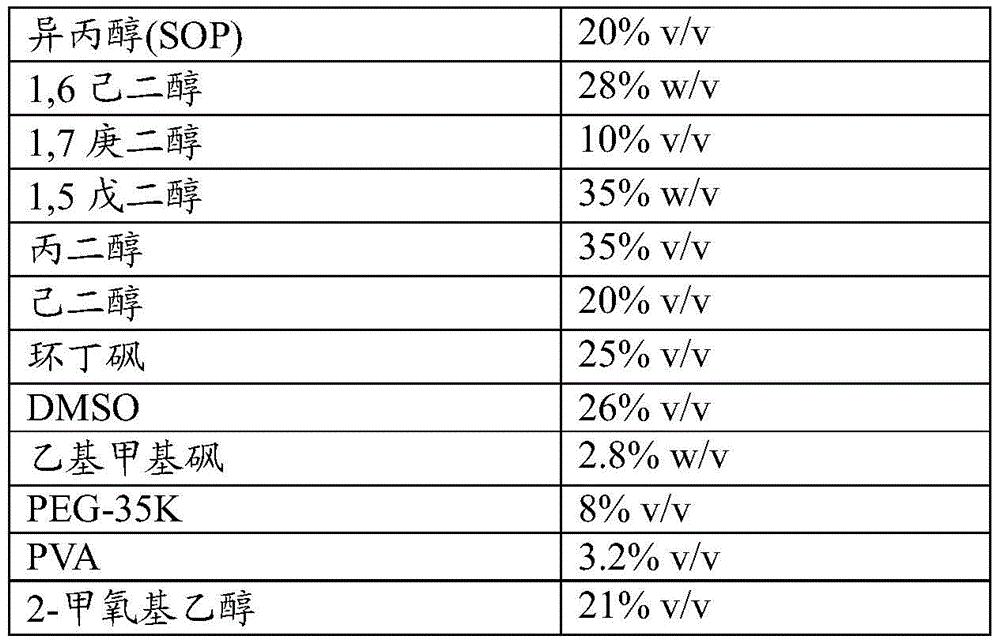
表1的第二列列出了产生图2-图9中示出的结果的各自候选化合物的浓度。浓度以化合物的重量百分比/NSB的总体积(w/v)或化合物的体积/NSB的总体积(v/v)提供。浓度也可以表示为摩尔浓度,并且这可以是有帮助的,例如,作为比较每种测试化合物的量的方式。例如,NSB中1,6己二醇和1,7戊二醇的摩尔浓度低于SOP NSB中异丙醇的摩尔浓度。NSB中1,5戊二醇、丙二醇、己二醇、环丁砜、DMSO、乙基甲基砜和2-甲氧基乙醇的摩尔浓度与SOPNSB中异丙醇的摩尔浓度相似。The second column of Table 1 lists the concentrations of the respective candidate compounds that produced the results shown in Figures 2-9. Concentrations are given as weight percent compound/total volume of NSB (w/v) or volume of compound/total volume of NSB (v/v). Concentrations can also be expressed as molar concentrations, and this can be helpful, for example, as a way to compare the amount of each test compound. For example, the molar concentration of 1,6 hexanediol and 1,7 pentanediol in NSB is lower than that of isopropanol in SOP NSB. The molar concentrations of 1,5-pentanediol, propylene glycol, hexanediol, sulfolane, DMSO, ethylmethylsulfone, and 2-methoxyethanol in NSB were similar to those of isopropanol in SOPNSB.
每种候选化合物的有效性由以下串扰度量确定。A_T串扰度量指示从第一次检查遗留多少Cy5-dATP使得在第二次检查中检测到它。类似地,C_G串扰度量指示从第一次检查遗留多少Cy7-dCTP使得在第二次检查中检测到它。串扰度量的较低值指示较少的遗留,并且与改进的测序结果相关。在另一方面,串扰度量的较高值指示更多的遗留和较低质量的测序结果。The effectiveness of each candidate compound was determined by the following crosstalk metric. The A_T crosstalk metric indicates how much Cy5-dATP was left over from the first examination such that it was detected in the second examination. Similarly, the C_G crosstalk metric indicates how much Cy7-dCTP was carried over from the first examination such that it was detected in the second examination. Lower values for the crosstalk metric indicate less carryover and correlate with improved sequencing results. On the other hand, higher values of the crosstalk metric indicate more carryover and lower quality sequencing results.
结果result
将结果评价为对具有20%v/v/异丙醇(SOP)的NSB测量的串扰度量与对具有每种各自候选化合物的NSB测量的串扰度量相比的比较。在所有情况下,比较都是基于在流通池的单通道中进行测序运行所获得的数据。运行格式如下:循环_1(SOP)=>循环_2(候选物)=>循环_3(SOP)=>循环_4(候选物),等。分别为SOP和候选物循环确定串扰度量。在SOP与每个候选物之间比较时,该格式用于最小化运行间(run-to-run)差异的混杂影响。The results were evaluated as a comparison of the crosstalk measures measured for NSB with 20% v/v/isopropanol (SOP) compared to the crosstalk measures measured for NSB with each respective candidate compound. In all cases, comparisons are based on data obtained from sequencing runs performed in a single lane of the flow cell. The running format is as follows: cycle_1 (SOP) => cycle_2 (candidate) => cycle_3 (SOP) => cycle_4 (candidate), etc. Crosstalk metrics are determined separately for the SOP and candidate rounds. This format was used to minimize confounding effects of run-to-run differences when comparing SOPs with each candidate.
单羟基醇monohydric alcohol
醇诸如乙醇、甲醇和异丙醇是用于将核苷酸从三元复合物中剥离而不使聚合酶从引发的模板核酸解离的有用化合物。有用的醇包括水溶性(例如,至至少50%v/v)的那些醇,仅具有单一羟基的那些醇,是伯醇的那些醇,是脂肪族的那些醇,和/或具有低于约100g/mol的分子量的那些醇。醇的非限制性实例在2020年1月30日公布的美国专利申请公布第2020/0032317 A1号中描述,所述专利通过引用并入本文。Alcohols such as ethanol, methanol, and isopropanol are useful compounds for stripping nucleotides from ternary complexes without dissociating the polymerase from the primed template nucleic acid. Useful alcohols include those that are water soluble (e.g., to at least 50% v/v), those that have only a single hydroxyl group, those that are primary, those that are aliphatic, and/or have Those alcohols with a molecular weight of 100 g/mol. Non-limiting examples of alcohols are described in US Patent Application Publication No. 2020/0032317 Al, published January 30, 2020, which is incorporated herein by reference.
二醇diol
1,6己二醇的结果示于图2中。SOP和1,6己二醇的三个单独柱分别代表同一测序运行的不同循环的结果。显示由于C信号从第一次检查进入第二次检查的G通道遗留的串扰的C_G数据,对于基于1,6己二醇的NSB显著较低。基于1,6己二醇的NSB的A_T串扰也稍低。因此,即使在比异丙醇更低的摩尔浓度,具有1,6己二醇的NSB也优于具有异丙醇的NSB。1,6己二醇的另一个优点是它不易燃,因此它不需要像异丙醇那样的特殊储存。The results for 1,6-hexanediol are shown in FIG. 2 . Three separate columns for SOP and 1,6 hexanediol represent results from different cycles of the same sequencing run. The C_G data showing the crosstalk due to the crosstalk left over from the C signal from the first inspection into the G channel of the second inspection was significantly lower for the 1,6-hexanediol-based NSB. The A_T crosstalk of the 1,6-hexanediol-based NSB was also slightly lower. Thus, NSB with 1,6 hexanediol outperformed NSB with isopropanol even at lower molar concentrations than isopropanol. Another advantage of 1,6 hexanediol is that it is not flammable, so it does not require special storage like isopropanol.
1,7庚二醇的结果示于图3中。显示由于C信号从第一次检查进入第二次检查的G通道遗留的串扰的C_G数据,对于基于1,7庚二醇的NSB较好。基于1,7庚二醇的NSB的A_T串扰也较好。因此,即使在比异丙醇更低的摩尔浓度,具有1,7庚二醇的NSB也优于具有异丙醇的NSB。The results for 1,7 heptanediol are shown in FIG. 3 . C_G data showing crosstalk due to C signal left over from the first inspection into the G channel of the second inspection is better for 1,7 heptanediol-based NSBs. The A_T crosstalk of 1,7-heptanediol-based NSB is also better. Thus, even at lower molar concentrations than isopropanol, NSB with 1,7 heptanediol outperformed NSB with isopropanol.
1,5戊二醇的结果示于图4中。具有1,5戊二醇的NSB的C_G串扰和A_T串扰与具有异丙醇的NSB相比更强。然而,对于C_G串扰和A_T串扰,具有1,5戊二醇的NSB仍然能够维持约0.16的相对低的串扰度量。The results for 1,5-pentanediol are shown in FIG. 4 . The C_G crosstalk and A_T crosstalk of NSB with 1,5-pentanediol were stronger than those with isopropanol. However, for both C_G crosstalk and A_T crosstalk, the NSB with 1,5-pentanediol was still able to maintain a relatively low crosstalk metric of about 0.16.
还测试了丙二醇、1,3丁二醇和己二醇,并且尽管它们能够将核苷酸从三元复合物中剥离,同时保留聚合酶与引发的模板核酸的缔合,但在NSB中的表现不如异丙醇。1,8辛二醇不立即溶解在NSB中,并且因此没有在测序仪中测试。Propylene glycol, 1,3 butanediol, and hexanediol were also tested, and despite their ability to strip the nucleotide from the ternary complex while preserving the association of the polymerase with the primed template nucleic acid, their performance in NSB Not as good as isopropyl alcohol. 1,8-octanediol was not immediately soluble in NSB, and was therefore not tested in the sequencer.
亚砜和砜Sulfoxides and Sulfones
二甲基亚砜(DMSO)的结果示于图5中。具有DMSO的NSB的A_T串扰与具有异丙醇的NSB相比更强。然而,对于A_T串扰,具有DMSO的NSB仍然能够维持低于约0.35的串扰度量(G_C串扰数据不可得)。The results for dimethyl sulfoxide (DMSO) are shown in FIG. 5 . The A_T crosstalk of NSB with DMSO was stronger compared to NSB with isopropanol. However, for A_T crosstalk, NSB with DMSO was still able to maintain a crosstalk metric below about 0.35 (G_C crosstalk data not available).
图6示出了乙基甲基砜的结果。具有乙基甲基砜的NSB的A_T串扰与具有异丙醇的NSB相比更强。然而,对于A_T串扰,具有乙基甲基砜的NSB仍然能够维持低于约0.2的串扰度量(G_C串扰数据不可得)。Figure 6 shows the results for ethylmethylsulfone. The A_T crosstalk of NSB with ethylmethyl sulfone was stronger than that of NSB with isopropanol. However, for A_T crosstalk, NSBs with ethylmethyl sulfone are still able to maintain a crosstalk metric below about 0.2 (G_C crosstalk data not available).
环丁砜的结果示于图7中。显示由于C信号从第一次检查进入第二次检查的G通道遗留的串扰的C_G数据,对于基于环丁砜的NSB较好。基于环丁砜的NSB和基于异丙醇的NSB的A_T串扰相当。因此,具有环丁砜的NSB优于具有异丙醇的NSB。The results for sulfolane are shown in FIG. 7 . C_G data showing crosstalk due to C signal left over from the first inspection into the G channel of the second inspection is better for sulfolane-based NSBs. The A_T crosstalk of sulfolane-based and isopropanol-based NSBs was comparable. Therefore, NSB with sulfolane is superior to NSB with isopropanol.
多元醇Polyol
聚乙二醇(PEG)的结果示于图8中。具有PEG的NSB的A_T串扰与具有异丙醇的NSB相比更强。然而,对于A_T串扰,具有PEG的NSB仍然能够维持低于约0.6的串扰度量(G_C串扰数据不可得)。使用35K PEG聚合物用于这些分析。设想,只要其他尺寸的聚合物可溶于水性溶液,它们也是有用的。Results for polyethylene glycol (PEG) are shown in FIG. 8 . The A_T crosstalk of NSB with PEG was stronger than that of NSB with isopropanol. However, for A_T crosstalk, NSB with PEG was still able to maintain a crosstalk metric below about 0.6 (G_C crosstalk data not available). 35K PEG polymer was used for these analyses. It is envisioned that polymers of other sizes are also useful as long as they are soluble in aqueous solutions.
图9示出了聚乙烯醇(PVA)的结果。具有PVA的NSB的C_G串扰和A_T串扰与具有异丙醇的NSB相比更强。然而,对于A_T串扰和G_C串扰,具有PVA的NSB仍然能够维持低于约0.45的串扰度量。Figure 9 shows the results for polyvinyl alcohol (PVA). The C_G crosstalk and A_T crosstalk of NSB with PVA were stronger than those of NSB with isopropanol. However, the NSB with PVA is still able to maintain a crosstalk metric lower than about 0.45 for both A_T crosstalk and G_C crosstalk.
具有羟基部分和另一杂原子部分两者的脂肪族化合物Aliphatic compounds having both a hydroxyl moiety and another heteroatom moiety
另外的测试指示,2-甲氧基乙醇、四乙二醇、3-氨基-1-丙醇也可以对于将核苷酸从聚合酶-核酸复合物中剥离而不将聚合酶从核酸解离是有用的。因此,结果显示烷氧基醇、醚醇和氨基醇可以是有用的化合物。Additional tests indicated that 2-methoxyethanol, tetraethylene glycol, 3-amino-1-propanol are also useful for stripping nucleotides from polymerase-nucleic acid complexes without dissociating the polymerase from nucleic acids is useful. Thus, the results show that alkoxy alcohols, ether alcohols and amino alcohols can be useful compounds.
其他测试浓度Other test concentrations
除了表1中列出的制剂之外,还测试了几种候选化合物的其他浓度。异丙醇在以16%-20%的范围存在时是有效的,1,6己二醇在以10%-31%的范围存在时是有效的,1,5戊二醇在以25%-35%的范围存在时是有效的,环丁砜在以25%-35%的范围存在时是有效的,DMSO在以21%-26%的范围存在时是有效的,并且乙基甲基砜在以1.4%-2.8%的范围存在时是有效的。设想,其他浓度诸如本文别处示出的浓度也可以是有用的。In addition to the formulations listed in Table 1, other concentrations of several candidate compounds were tested. Isopropanol is effective in the presence of 16%-20%, 1,6 hexanediol is effective in the presence of 10%-31%, 1,5 pentanediol is effective in the presence of 25%- It is effective in the range of 35%, sulfolane is effective in the range of 25%-35%, DMSO is effective in the range of 21%-26%, and ethyl methyl sulfone is effective in the A range of 1.4%-2.8% is effective when present. It is contemplated that other concentrations such as those shown elsewhere herein may also be useful.
实施例IIExample II
评价存在异丙醇和1,6己二醇的情况下泡沫的稳定性Evaluation of foam stability in the presence of isopropanol and 1,6-hexanediol
该实施例显示,与具有异丙醇的水性溶液相比,具有1,6己二醇的水性溶液改进了流体泡沫的稳定性。This example shows that an aqueous solution with 1,6 hexanediol improves the stability of the fluid foam compared to an aqueous solution with isopropanol.
将具有20%异丙醇(SOP)或28%1,6己二醇的NSB流体泡沫流过流通池(40μl/s流速,300μl体积,35psi正压,55℃)。暂停流动,并且立即获取泡沫的第一图像。允许泡沫静置60秒,并且然后拍摄第二图像。NSB fluid with 20% isopropanol (SOP) or 28% 1,6 hexanediol was bubbled through the flow cell (40 μl/s flow rate, 300 μl volume, 35 psi positive pressure, 55° C.). The flow is paused and the first image of the foam is acquired immediately. The foam was allowed to sit for 60 seconds, and then a second image was taken.
图10A示出了对于具有28%1,6己二醇的NSB流体泡沫获取的第一图像;图10B示出了对于具有28%1,6己二醇的NSB流体泡沫获取的第二图像;图10C示出了对于具有20%异丙醇(SOP)的NSB流体泡沫获取的第一图像;图10D示出了对于具有20%异丙醇(SOP)的NSB流体泡沫获取的第二图像。结果指示,在异丙醇中虽然可以维持一定程度的泡沫,但在1,6己二醇中观察到更大的泡沫稳定性,无论是在流动暂停之前还是1分钟之后。Figure 10A shows a first image taken for an NSB fluid foam with 28% 1,6 hexanediol; Figure 10B shows a second image taken for an NSB fluid foam with 28% 1,6 hexanediol; FIG. 10C shows a first image taken for an NSB fluid foam with 20% isopropanol (SOP); FIG. 10D shows a second image taken for an NSB fluid foam with 20% isopropanol (SOP). The results indicated that while some degree of foam could be maintained in isopropanol, greater foam stability was observed in 1,6 hexanediol, both before and after 1 minute of flow pause.
遍及本申请已参考多个出版物、专利和/或专利申请。这些文献的公开内容以其整体通过引用特此并入本申请。Throughout this application, various publications, patents and/or patent applications have been referenced. The disclosures of these documents are hereby incorporated by reference into this application in their entirety.
已经描述了许多实施方案。然而,应当理解的是,可以进行各种修改。因此,其他实施方案在所附权利要求书的范围之内。A number of embodiments have been described. However, it should be understood that various modifications may be made. Accordingly, other implementations are within the scope of the following claims.
Claims (102)
Applications Claiming Priority (3)
| Application Number | Priority Date | Filing Date | Title |
|---|---|---|---|
| US202063020115P | 2020-05-05 | 2020-05-05 | |
| US63/020,115 | 2020-05-05 | ||
| PCT/US2021/030146 WO2021225886A1 (en) | 2020-05-05 | 2021-04-30 | Compositions and methods for modifying polymerase-nucleic acid complexes |
Publications (1)
| Publication Number | Publication Date |
|---|---|
| CN115836135A true CN115836135A (en) | 2023-03-21 |
Family
ID=76012050
Family Applications (1)
| Application Number | Title | Priority Date | Filing Date |
|---|---|---|---|
| CN202180044733.3A Pending CN115836135A (en) | 2020-05-05 | 2021-04-30 | Compositions and methods for modifying polymerase-nucleic acid complexes |
Country Status (4)
| Country | Link |
|---|---|
| US (1) | US20230183798A1 (en) |
| EP (1) | EP4146822A1 (en) |
| CN (1) | CN115836135A (en) |
| WO (1) | WO2021225886A1 (en) |
Family Cites Families (60)
| Publication number | Priority date | Publication date | Assignee | Title |
|---|---|---|---|---|
| CA2044616A1 (en) | 1989-10-26 | 1991-04-27 | Roger Y. Tsien | Dna sequencing |
| US5641658A (en) | 1994-08-03 | 1997-06-24 | Mosaic Technologies, Inc. | Method for performing amplification of nucleic acid with two primers bound to a single solid support |
| US6023540A (en) | 1997-03-14 | 2000-02-08 | Trustees Of Tufts College | Fiber optic sensor with encoded microspheres |
| US7622294B2 (en) | 1997-03-14 | 2009-11-24 | Trustees Of Tufts College | Methods for detecting target analytes and enzymatic reactions |
| US6327410B1 (en) | 1997-03-14 | 2001-12-04 | The Trustees Of Tufts College | Target analyte sensors utilizing Microspheres |
| DE69824716D1 (en) | 1997-04-01 | 2004-07-29 | Manteia S A | METHOD FOR SEQUENCING NUCLEIC ACIDS |
| AR021833A1 (en) | 1998-09-30 | 2002-08-07 | Applied Research Systems | METHODS OF AMPLIFICATION AND SEQUENCING OF NUCLEIC ACID |
| US6355431B1 (en) | 1999-04-20 | 2002-03-12 | Illumina, Inc. | Detection of nucleic acid amplification reactions using bead arrays |
| EP1923471B1 (en) | 1999-04-20 | 2012-12-19 | Illumina, Inc. | Detection of nucleic acid reactions on bead arrays |
| US6770441B2 (en) | 2000-02-10 | 2004-08-03 | Illumina, Inc. | Array compositions and methods of making same |
| DE60131194T2 (en) | 2000-07-07 | 2008-08-07 | Visigen Biotechnologies, Inc., Bellaire | SEQUENCE PROVISION IN REAL TIME |
| WO2002044425A2 (en) | 2000-12-01 | 2002-06-06 | Visigen Biotechnologies, Inc. | Enzymatic nucleic acid synthesis: compositions and methods for altering monomer incorporation fidelity |
| AR031640A1 (en) | 2000-12-08 | 2003-09-24 | Applied Research Systems | ISOTHERMAL AMPLIFICATION OF NUCLEIC ACIDS IN A SOLID SUPPORT |
| GB0127564D0 (en) | 2001-11-16 | 2002-01-09 | Medical Res Council | Emulsion compositions |
| US7057026B2 (en) | 2001-12-04 | 2006-06-06 | Solexa Limited | Labelled nucleotides |
| US20040002090A1 (en) | 2002-03-05 | 2004-01-01 | Pascal Mayer | Methods for detecting genome-wide sequence variations associated with a phenotype |
| CA2496287A1 (en) | 2002-08-20 | 2004-03-04 | Cyvera Corporation | Diffraction grating-based optical identification element |
| US7164533B2 (en) | 2003-01-22 | 2007-01-16 | Cyvera Corporation | Hybrid random bead/chip based microarray |
| US7414116B2 (en) | 2002-08-23 | 2008-08-19 | Illumina Cambridge Limited | Labelled nucleotides |
| EP2607369B1 (en) | 2002-08-23 | 2015-09-23 | Illumina Cambridge Limited | Modified nucleotides for polynucleotide sequencing |
| AU2003270726A1 (en) | 2002-09-12 | 2004-04-30 | Cidra Corporation | Diffraction grating-based encoded micro-particles for multiplexed experiments |
| WO2004024328A1 (en) | 2002-09-12 | 2004-03-25 | Cyvera Corporation | Method and apparatus for aligning elongated microbeads in order to interrogate the same |
| CA2513535C (en) | 2003-01-29 | 2012-06-12 | 454 Corporation | Bead emulsion nucleic acid amplification |
| CA2528577C (en) | 2003-06-20 | 2012-08-07 | Illumina, Inc. | Methods and compositions for whole genome amplification and genotyping |
| US8048627B2 (en) | 2003-07-05 | 2011-11-01 | The Johns Hopkins University | Method and compositions for detection and enumeration of genetic variations |
| JP2007525571A (en) | 2004-01-07 | 2007-09-06 | ソレクサ リミテッド | Modified molecular array |
| US8071755B2 (en) | 2004-05-25 | 2011-12-06 | Helicos Biosciences Corporation | Nucleotide analogs |
| JP2008513782A (en) | 2004-09-17 | 2008-05-01 | パシフィック バイオサイエンシーズ オブ カリフォルニア, インコーポレイテッド | Apparatus and method for molecular analysis |
| US7482120B2 (en) | 2005-01-28 | 2009-01-27 | Helicos Biosciences Corporation | Methods and compositions for improving fidelity in a nucleic acid synthesis reaction |
| US7544794B1 (en) | 2005-03-11 | 2009-06-09 | Steven Albert Benner | Method for sequencing DNA and RNA by synthesis |
| CN101466847B (en) | 2005-06-15 | 2014-02-19 | 考利达基因组股份有限公司 | Single-molecule arrays for genetic and chemical analysis |
| US7405281B2 (en) | 2005-09-29 | 2008-07-29 | Pacific Biosciences Of California, Inc. | Fluorescent nucleotide analogs and uses therefor |
| GB0522310D0 (en) | 2005-11-01 | 2005-12-07 | Solexa Ltd | Methods of preparing libraries of template polynucleotides |
| US7329860B2 (en) | 2005-11-23 | 2008-02-12 | Illumina, Inc. | Confocal imaging methods and apparatus |
| US20080009420A1 (en) | 2006-03-17 | 2008-01-10 | Schroth Gary P | Isothermal methods for creating clonal single molecule arrays |
| EP3722409A1 (en) | 2006-03-31 | 2020-10-14 | Illumina, Inc. | Systems and devices for sequence by synthesis analysis |
| US8343746B2 (en) | 2006-10-23 | 2013-01-01 | Pacific Biosciences Of California, Inc. | Polymerase enzymes and reagents for enhanced nucleic acid sequencing |
| US7678894B2 (en) | 2007-05-18 | 2010-03-16 | Helicos Biosciences Corporation | Nucleotide analogs |
| US8039817B2 (en) | 2008-05-05 | 2011-10-18 | Illumina, Inc. | Compensator for multiple surface imaging |
| US8034923B1 (en) | 2009-03-27 | 2011-10-11 | Steven Albert Benner | Reagents for reversibly terminating primer extension |
| WO2010141390A2 (en) | 2009-06-05 | 2010-12-09 | Life Technologies Corporation | Nucleotide transient binding for sequencing methods |
| US8951781B2 (en) | 2011-01-10 | 2015-02-10 | Illumina, Inc. | Systems, methods, and apparatuses to image a sample for biological or chemical analysis |
| EP2755984B1 (en) | 2011-09-13 | 2020-02-12 | Agilent Technologies, Inc. | 5-methoxy. 3'-oh unblocked, fast photocleavable terminating nucleotides and methods for nucleic acid sequencing |
| US8808989B1 (en) | 2013-04-02 | 2014-08-19 | Molecular Assemblies, Inc. | Methods and apparatus for synthesizing nucleic acids |
| US10077470B2 (en) | 2015-07-21 | 2018-09-18 | Omniome, Inc. | Nucleic acid sequencing methods and systems |
| US20170191125A1 (en) | 2015-12-30 | 2017-07-06 | Omniome, Inc. | Sequencing device |
| US10584379B2 (en) | 2016-04-29 | 2020-03-10 | Omniome, Inc. | Method of nucleic acid sequence determination |
| US10597643B2 (en) | 2016-04-29 | 2020-03-24 | Omniome, Inc. | Polymerases engineered to reduce nucleotide-independent DNA binding |
| CN109844136A (en) | 2016-08-15 | 2019-06-04 | 欧姆尼奥姆股份有限公司 | Methods and systems for sequencing nucleic acids |
| US11248254B2 (en) | 2016-12-30 | 2022-02-15 | Omniome, Inc. | Method and system employing distinguishable polymerases for detecting ternary complexes and identifying cognate nucleotides |
| US10975427B2 (en) | 2017-01-20 | 2021-04-13 | Omniome, Inc. | Process for cognate nucleotide detection in a nucleic acid sequencing workflow |
| US9932631B1 (en) | 2017-09-11 | 2018-04-03 | Omniome, Inc. | Genotyping by polymerase binding |
| WO2018187013A1 (en) | 2017-04-04 | 2018-10-11 | Omniome, Inc. | Fluidic apparatus and methods useful for chemical and biological reactions |
| US9951385B1 (en) | 2017-04-25 | 2018-04-24 | Omniome, Inc. | Methods and apparatus that increase sequencing-by-binding efficiency |
| US10161003B2 (en) | 2017-04-25 | 2018-12-25 | Omniome, Inc. | Methods and apparatus that increase sequencing-by-binding efficiency |
| EP3697932A1 (en) | 2017-10-19 | 2020-08-26 | Omniome, Inc. | Simultaneous background reduction and complex stabilization in binding assay workflows |
| CN112567047B (en) | 2018-04-26 | 2025-03-14 | 加利福尼亚太平洋生物科学股份有限公司 | Methods and compositions for stabilizing nucleic acid-nucleotide-polymerase complexes |
| WO2020023362A1 (en) | 2018-07-24 | 2020-01-30 | Omniome, Inc. | Serial formation of ternary complex species |
| WO2020060811A1 (en) | 2018-09-17 | 2020-03-26 | Omniome, Inc. | Engineered polymerases for improved sequencing |
| EP3891304A1 (en) | 2018-12-04 | 2021-10-13 | Omniome, Inc. | Mixed-phase fluids for nucleic acid sequencing and other analytical assays |
-
2021
- 2021-04-30 CN CN202180044733.3A patent/CN115836135A/en active Pending
- 2021-04-30 WO PCT/US2021/030146 patent/WO2021225886A1/en not_active Ceased
- 2021-04-30 US US17/923,506 patent/US20230183798A1/en active Pending
- 2021-04-30 EP EP21726800.2A patent/EP4146822A1/en not_active Withdrawn
Also Published As
| Publication number | Publication date |
|---|---|
| WO2021225886A1 (en) | 2021-11-11 |
| US20230183798A1 (en) | 2023-06-15 |
| EP4146822A1 (en) | 2023-03-15 |
Similar Documents
| Publication | Publication Date | Title |
|---|---|---|
| CN112567047B (en) | Methods and compositions for stabilizing nucleic acid-nucleotide-polymerase complexes | |
| CN112567048B (en) | Continuous formation of ternary complex species | |
| US9951385B1 (en) | Methods and apparatus that increase sequencing-by-binding efficiency | |
| US11339428B2 (en) | Increased signal to noise in nucleic acid sequencing | |
| KR20200139671A (en) | Composition and technology for nucleic acid primer extension | |
| WO2018152162A1 (en) | Distinguishing sequences by detecting polymerase dissociation | |
| CN115836135A (en) | Compositions and methods for modifying polymerase-nucleic acid complexes | |
| AU2026200383A1 (en) | Serial formation of ternary complex species | |
| EP4045683B1 (en) | Methods for capping nucleic acids | |
| CN110177884A (en) | The Genotyping carried out is combined by polymerase |
Legal Events
| Date | Code | Title | Description |
|---|---|---|---|
| PB01 | Publication | ||
| PB01 | Publication | ||
| SE01 | Entry into force of request for substantive examination | ||
| SE01 | Entry into force of request for substantive examination |