[go: up one dir, main page]

CN115812217A - Travel-based augmented reality content for reviews - Google Patents

Travel-based augmented reality content for reviews Download PDF

Info

Publication number
CN115812217A
CN115812217A CN202180046405.7A CN202180046405A CN115812217A CN 115812217 A CN115812217 A CN 115812217A CN 202180046405 A CN202180046405 A CN 202180046405A CN 115812217 A CN115812217 A CN 115812217A
Authority
CN
China
Prior art keywords
user
image
augmented reality
request
reality content
Prior art date
Legal status (The legal status is an assumption and is not a legal conclusion. Google has not performed a legal analysis and makes no representation as to the accuracy of the status listed.)
Pending
Application number
CN202180046405.7A
Other languages
Chinese (zh)
Inventor
卡韦赫·安瓦里普尔
弗吉尼亚·德拉蒙德
吉恩·罗
阿列克·马西森
希丽亚·妮科尔·穆尔库扬尼斯
Current Assignee (The listed assignees may be inaccurate. Google has not performed a legal analysis and makes no representation or warranty as to the accuracy of the list.)
Snap Inc
Original Assignee
Snap Inc
Priority date (The priority date is an assumption and is not a legal conclusion. Google has not performed a legal analysis and makes no representation as to the accuracy of the date listed.)
Filing date
Publication date
Application filed by Snap Inc filed Critical Snap Inc
Publication of CN115812217A publication Critical patent/CN115812217A/en
Pending legal-status Critical Current

Links

Images

Classifications

    • GPHYSICS
    • G06COMPUTING OR CALCULATING; COUNTING
    • G06QINFORMATION AND COMMUNICATION TECHNOLOGY [ICT] SPECIALLY ADAPTED FOR ADMINISTRATIVE, COMMERCIAL, FINANCIAL, MANAGERIAL OR SUPERVISORY PURPOSES; SYSTEMS OR METHODS SPECIALLY ADAPTED FOR ADMINISTRATIVE, COMMERCIAL, FINANCIAL, MANAGERIAL OR SUPERVISORY PURPOSES, NOT OTHERWISE PROVIDED FOR
    • G06Q30/00Commerce
    • G06Q30/02Marketing; Price estimation or determination; Fundraising
    • G06Q30/0282Rating or review of business operators or products
    • GPHYSICS
    • G06COMPUTING OR CALCULATING; COUNTING
    • G06QINFORMATION AND COMMUNICATION TECHNOLOGY [ICT] SPECIALLY ADAPTED FOR ADMINISTRATIVE, COMMERCIAL, FINANCIAL, MANAGERIAL OR SUPERVISORY PURPOSES; SYSTEMS OR METHODS SPECIALLY ADAPTED FOR ADMINISTRATIVE, COMMERCIAL, FINANCIAL, MANAGERIAL OR SUPERVISORY PURPOSES, NOT OTHERWISE PROVIDED FOR
    • G06Q30/00Commerce
    • G06Q30/06Buying, selling or leasing transactions
    • G06Q30/0601Electronic shopping [e-shopping]
    • G06Q30/0631Recommending goods or services
    • G06Q10/40
    • GPHYSICS
    • G06COMPUTING OR CALCULATING; COUNTING
    • G06QINFORMATION AND COMMUNICATION TECHNOLOGY [ICT] SPECIALLY ADAPTED FOR ADMINISTRATIVE, COMMERCIAL, FINANCIAL, MANAGERIAL OR SUPERVISORY PURPOSES; SYSTEMS OR METHODS SPECIALLY ADAPTED FOR ADMINISTRATIVE, COMMERCIAL, FINANCIAL, MANAGERIAL OR SUPERVISORY PURPOSES, NOT OTHERWISE PROVIDED FOR
    • G06Q30/00Commerce
    • G06Q30/06Buying, selling or leasing transactions
    • G06Q30/0601Electronic shopping [e-shopping]
    • G06Q30/0641Electronic shopping [e-shopping] utilising user interfaces specially adapted for shopping
    • G06Q30/0643Electronic shopping [e-shopping] utilising user interfaces specially adapted for shopping graphically representing goods, e.g. 3D product representation
    • GPHYSICS
    • G06COMPUTING OR CALCULATING; COUNTING
    • G06TIMAGE DATA PROCESSING OR GENERATION, IN GENERAL
    • G06T19/00Manipulating 3D models or images for computer graphics
    • G06T19/006Mixed reality
    • HELECTRICITY
    • H04ELECTRIC COMMUNICATION TECHNIQUE
    • H04LTRANSMISSION OF DIGITAL INFORMATION, e.g. TELEGRAPHIC COMMUNICATION
    • H04L51/00User-to-user messaging in packet-switching networks, transmitted according to store-and-forward or real-time protocols, e.g. e-mail
    • H04L51/52User-to-user messaging in packet-switching networks, transmitted according to store-and-forward or real-time protocols, e.g. e-mail for supporting social networking services
    • GPHYSICS
    • G06COMPUTING OR CALCULATING; COUNTING
    • G06QINFORMATION AND COMMUNICATION TECHNOLOGY [ICT] SPECIALLY ADAPTED FOR ADMINISTRATIVE, COMMERCIAL, FINANCIAL, MANAGERIAL OR SUPERVISORY PURPOSES; SYSTEMS OR METHODS SPECIALLY ADAPTED FOR ADMINISTRATIVE, COMMERCIAL, FINANCIAL, MANAGERIAL OR SUPERVISORY PURPOSES, NOT OTHERWISE PROVIDED FOR
    • G06Q50/00Information and communication technology [ICT] specially adapted for implementation of business processes of specific business sectors, e.g. utilities or tourism
    • G06Q50/10Services
    • G06Q50/12Hotels or restaurants

Landscapes

  • Business, Economics & Management (AREA)
  • Engineering & Computer Science (AREA)
  • Accounting & Taxation (AREA)
  • Finance (AREA)
  • Strategic Management (AREA)
  • Physics & Mathematics (AREA)
  • General Physics & Mathematics (AREA)
  • Theoretical Computer Science (AREA)
  • Development Economics (AREA)
  • Economics (AREA)
  • General Business, Economics & Management (AREA)
  • Marketing (AREA)
  • Tourism & Hospitality (AREA)
  • General Engineering & Computer Science (AREA)
  • Computer Graphics (AREA)
  • Game Theory and Decision Science (AREA)
  • Entrepreneurship & Innovation (AREA)
  • Software Systems (AREA)
  • Computing Systems (AREA)
  • Computer Hardware Design (AREA)
  • Signal Processing (AREA)
  • Computer Networks & Wireless Communication (AREA)
  • Health & Medical Sciences (AREA)
  • Primary Health Care (AREA)
  • Human Resources & Organizations (AREA)
  • General Health & Medical Sciences (AREA)
  • Information Transfer Between Computers (AREA)

Abstract

本公开内容的各方面涉及根据一些示例实施方式的包括存储程序的计算机可读存储介质和方法的系统,程序和方法用于与出行相关联地提供与用户提交评论有关的增强现实内容。该程序和方法使得:由在用户的设备上运行的消息收发应用接收关于扫描由设备摄像装置捕获的图像的请求;响应于接收到该请求,确定与该请求相关联的出行参数和图像中描绘的对象的属性;从与用户提交评论有关的多个候选用户界面中选择与出行参数和属性对应的用户界面;以及将包括所选择的用户界面的增强现实内容项与图像一起显示。
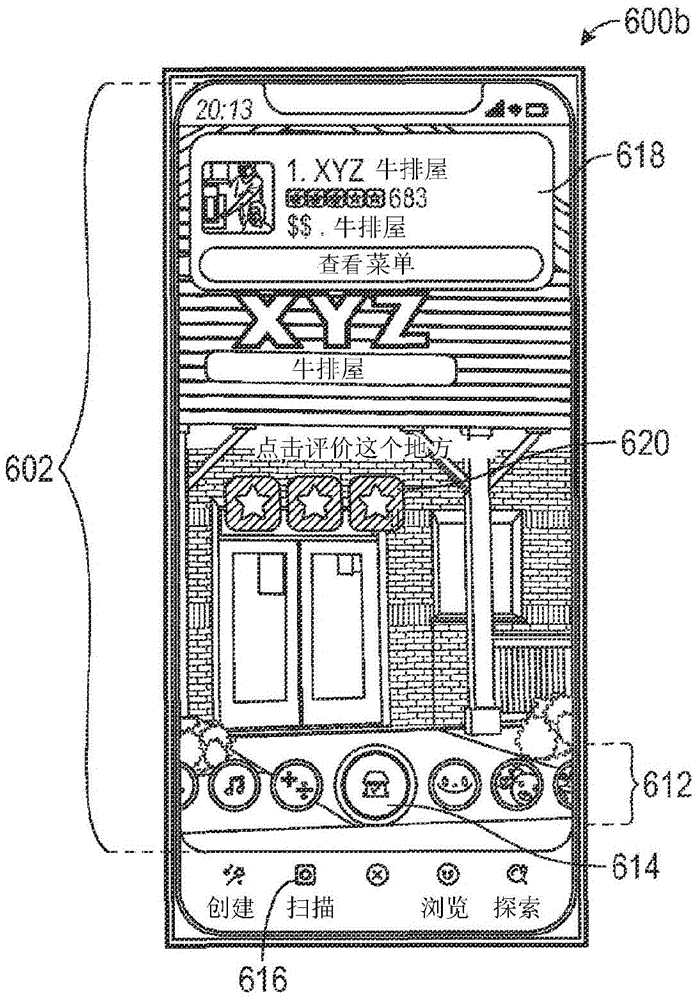
Figure 202180046405

Aspects of the present disclosure relate to systems including computer-readable storage media storing programs and methods for providing augmented reality content related to user-submitted reviews in association with travel, according to some example embodiments. The programs and methods are such that: receiving, by a messaging application running on a user's device, a request to scan an image captured by a device camera; in response to receiving the request, determining travel parameters associated with the request and the image depicted in the image attributes of the object of the object; selecting a user interface corresponding to the travel parameters and attributes from a plurality of candidate user interfaces related to the user-submitted comment; and displaying the augmented reality content item including the selected user interface together with the image.

Figure 202180046405

Description

用于评论的基于出行的增强现实内容Travel-based augmented reality content for reviews

优先权要求priority claim

本申请要求于2021年1月22日提交的美国申请序列第17/155,791号的优先权的权益,该申请要求于2020年6月29日提交的美国临时申请序列第63/045,438号的优先权的权益,该美国申请和该美国临时申请两者通过引用以其整体并入本文中。This application claims the benefit of priority to U.S. Application Serial No. 17/155,791, filed January 22, 2021, which claims priority to U.S. Provisional Application Serial No. 63/045,438, filed June 29, 2020 , both the US Application and the US Provisional Application are incorporated herein by reference in their entirety.

技术领域technical field

本公开内容总体上涉及消息收发系统,其包括向捕获图像提供增强现实内容。The present disclosure relates generally to messaging systems that include providing augmented reality content to captured images.

背景技术Background technique

消息收发系统提供用户之间的消息内容的交换。例如,消息收发系统允许用户与一个或更多个其他用户交换消息内容(例如,文本、图像)。A messaging system provides for the exchange of message content between users. For example, messaging systems allow users to exchange message content (eg, text, images) with one or more other users.

附图说明Description of drawings

在不一定按比例绘制的附图中,相似的标号可以在不同的视图中描述类似的部件。为了容易地识别对任何特定元件或动作的讨论,附图标记中的最高有效数字指的是该元素首次被引入的图号。在附图的各图中,通过示例而非限制的方式示出了一些实施方式。In the drawings, which are not necessarily to scale, similar reference numerals may depict similar components in the different views. To easily identify a discussion of any particular element or act, the most significant digit in a reference number refers to the figure number in which that element was first introduced. In the various figures of the drawings, some embodiments are shown by way of example and not limitation.

图1是根据一些示例实施方式的其中可以部署本公开内容的联网环境的图解表示。Figure 1 is a diagrammatic representation of a networked environment in which the present disclosure may be deployed, according to some example implementations.

图2是根据一些示例实施方式的具有客户端侧功能和服务器侧功能两者的消息收发系统的图解表示。2 is a diagrammatic representation of a messaging system having both client-side and server-side functionality, according to some example implementations.

图3是根据一些示例实施方式的如在数据库中维护的数据结构的图解表示。Figure 3 is a diagrammatic representation of a data structure as maintained in a database, according to some example implementations.

图4是根据一些示例实施方式的消息的图解表示。Figure 4 is a diagrammatic representation of a message according to some example implementations.

图5是示出根据一些示例实施方式的用于与出行相关联地提供与用户提交评论有关的增强现实内容的过程的交互图。5 is an interaction diagram illustrating a process for providing augmented reality content related to user-submitted reviews in association with a trip, according to some example implementations.

图6A示出了根据一些示例实施方式的其中用户请求与出行相关联地显示与用户提交评论有关的增强现实内容的示例用户界面。6A illustrates an example user interface in which a user requests that augmented reality content related to a user-submitted review be displayed in association with a trip, according to some example implementations.

图6B示出了根据一些示例实施方式的用于与出行相关联地显示与用户提交评论有关的增强现实内容的示例用户界面。6B illustrates an example user interface for displaying augmented reality content related to user-submitted reviews in association with a trip, according to some example implementations.

图7A示出了根据一些示例实施方式的其中用户请求与出行相关联地显示与用户提交评论有关的增强现实内容的示例用户界面。7A illustrates an example user interface in which a user requests that augmented reality content related to a user-submitted review be displayed in association with a trip, according to some example implementations.

图7B示出了根据一些示例实施方式的用于与出行相关联地显示与用户提交评论有关的增强现实内容的示例用户界面。7B illustrates an example user interface for displaying augmented reality content related to user-submitted reviews in association with a trip, according to some example implementations.

图8是示出根据一些示例实施方式的用于与出行相关联地提供与用户提交评论有关的增强现实内容的过程的流程图。8 is a flowchart illustrating a process for providing augmented reality content related to user-submitted reviews in association with a trip, according to some example implementations.

图9是根据一些示例实施方式的访问限制过程的流程图。Figure 9 is a flowchart of an access restriction process according to some example implementations.

图10是根据一些示例实施方式的计算机系统形式的机器的图解表示,在该机器内可以执行一组指令以使该机器执行本文所讨论的方法中的任何一个或更多个。10 is a diagrammatic representation of a machine in the form of a computer system within which a set of instructions may be executed to cause the machine to perform any one or more of the methods discussed herein, according to some example embodiments.

图11是示出根据一些示例实施方式的软件架构的框图,在该软件架构内可以实现示例。Figure 11 is a block diagram illustrating a software architecture within which an example may be implemented, according to some example implementations.

具体实施方式Detailed ways

消息收发系统通常允许用户在消息线程中彼此交换内容项(例如,消息、图像和/或视频)。消息收发系统可以实现增强系统或以其他方式与增强系统协同工作以增强与消息相关联的媒体内容。例如,增强系统可以将覆盖、过滤器和/或增强现实内容与由设备摄像装置捕获的图像数据组合。然而,用户可能希望在出行时增强现实内容的便利的创建和/或选择。Messaging systems typically allow users to exchange content items (eg, messages, images, and/or videos) with each other in message threads. The messaging system may implement or otherwise work in conjunction with an enhancement system to enhance media content associated with a message. For example, an augmentation system may combine overlays, filters, and/or augmented reality content with image data captured by device cameras. However, users may desire convenient creation and/or selection of augmented reality content while traveling.

所公开的实施方式使得能够与出行相关联地呈现与用户提交评论有关的增强现实内容。响应于执行扫描操作(例如,识别捕获图像中的对象)的用户请求,消息收发客户端确定图像中描绘的对象的属性以及与请求相关联的出行参数两者。例如,出行参数指示出行计划、交通计划、大致位置、具体地点或地标、活动、参与者和/或感兴趣的主题。The disclosed embodiments enable the presentation of augmented reality content related to user-submitted reviews in association with a trip. In response to a user request to perform a scanning operation (eg, identify an object in a captured image), the messaging client determines both attributes of the object depicted in the image and travel parameters associated with the request. For example, travel parameters indicate travel plans, transportation plans, general location, specific places or landmarks, events, participants, and/or topics of interest.

基于出行参数和属性,消息收发客户端从与用户提交评论有关的多个候选用户界面中选择用户界面。例如,所选择的用户界面可以对应于添加、编辑或删除关于企业、产品和/或服务的个人用户评论。在另一示例中,所选择的用户界面可以对应于显示针对企业、产品和/或服务的一组现有用户提交评论。消息收发客户端将包括所选择的用户界面的增强现实内容项(例如,对应于增强现实体验)与捕获图像一起显示。Based on the travel parameters and attributes, the messaging client selects a user interface from a plurality of candidate user interfaces related to the user submitted comment. For example, the selected user interface may correspond to adding, editing, or deleting individual user reviews about businesses, products, and/or services. In another example, the selected user interface may correspond to displaying a set of existing user-submitted reviews for the business, product, and/or service. The messaging client displays an augmented reality content item (eg, corresponding to the augmented reality experience) including the selected user interface along with the captured image.

图1是示出用于通过网络交换数据(例如,消息和相关联的内容)的示例消息收发系统100的框图。消息收发系统100包括客户端设备102的多个实例,每个实例托管包括消息收发客户端104的多个应用。每个消息收发客户端104经由网络106(例如,因特网)通信地耦接至消息收发客户端104的其他实例和消息收发服务器系统108。1 is a block diagram illustrating an example messaging system 100 for exchanging data (eg, messages and associated content) over a network. Messaging system 100 includes multiple instances of client devices 102 each hosting multiple applications including messaging clients 104 . Each messaging client 104 is communicatively coupled to other instances of the messaging client 104 and to the messaging server system 108 via a network 106 (eg, the Internet).

消息收发客户端104能够经由网络106与另一消息收发客户端104和消息收发服务器系统108通信并交换数据。在消息收发客户端104之间以及消息收发客户端104与消息收发服务器系统108之间交换的数据包括功能(例如,激活功能的命令)以及有效载荷数据(例如,文本、音频、视频或其他多媒体数据)。A messaging client 104 is capable of communicating and exchanging data with another messaging client 104 and a messaging server system 108 via a network 106 . Data exchanged between messaging clients 104 and between messaging clients 104 and messaging server system 108 includes functions (e.g., commands to activate functions) and payload data (e.g., text, audio, video, or other multimedia data).

消息收发服务器系统108经由网络106向特定消息收发客户端104提供服务器侧功能。虽然消息收发系统100的某些功能在本文中被描述为由消息收发客户端104或由消息收发服务器系统108执行,但是某些功能的在消息收发客户端104或消息收发服务器系统108内的定位可以是设计选择。例如,在技术上优选的可能是:最初将某些技术和功能部署在消息收发服务器系统108内,但是后面将该技术和功能迁移至客户端设备102具有足够处理能力的消息收发客户端104。Messaging server system 108 provides server-side functionality to particular messaging clients 104 via network 106 . Although certain functions of messaging system 100 are described herein as being performed by messaging client 104 or by messaging server system 108, the location of certain functions within messaging client 104 or messaging server system 108 Can be a design choice. For example, it may be technically preferable to initially deploy certain technology and functionality within the messaging server system 108, but later migrate the technology and functionality to the messaging client 104 where the client device 102 has sufficient processing power.

消息收发服务器系统108支持向消息收发客户端104提供的各种服务和操作。这样的操作包括向消息收发客户端104发送数据、从消息收发客户端104接收数据以及对由消息收发客户端104生成的数据进行处理。作为示例,该数据可以包括消息内容、客户端设备信息、地理位置信息、媒体增强和覆盖、消息内容持续条件、社交网络信息和实况事件信息。通过经由消息收发客户端104的用户接口(UI)可用的功能来激活和控制消息收发系统100内的数据交换。Messaging server system 108 supports various services and operations provided to messaging clients 104 . Such operations include sending data to the messaging client 104 , receiving data from the messaging client 104 , and processing data generated by the messaging client 104 . As examples, this data may include message content, client device information, geographic location information, media enhancements and overlays, message content persistence conditions, social network information, and live event information. Data exchange within the messaging system 100 is activated and controlled through functionality available via a user interface (UI) of the messaging client 104 .

现在具体地转至消息收发服务器系统108,应用程序接口(API)服务器110耦接至应用服务器114并向应用服务器114提供编程接口。应用服务器114通信地耦接至数据库服务器122,数据库服务器122便于对数据库124的访问,该数据库124存储与通过应用服务器114处理的消息相关联的数据。类似地,web服务器112耦接至应用服务器114,并且向应用服务器114提供基于web的接口。为此,web服务器112通过超文本传输协议(HTTP)和若干其他相关协议处理传入的网络请求。Turning now specifically to the messaging server system 108 , an application programming interface (API) server 110 is coupled to and provides a programming interface to the application server 114 . The application server 114 is communicatively coupled to a database server 122 that facilitates access to a database 124 that stores data associated with messages processed by the application server 114 . Similarly, web server 112 is coupled to application server 114 and provides a web-based interface to application server 114 . To this end, web server 112 handles incoming web requests via Hypertext Transfer Protocol (HTTP) and several other related protocols.

应用程序接口(API)服务器110在客户端设备102与应用服务器114之间接收和发送消息数据(例如,命令和消息有效载荷)。具体地,应用程序接口(API)服务器110提供一组接口(例如,例程和协议),消息收发客户端104可以调用或查询该组接口以激活应用服务器114的功能。应用程序接口(API)服务器110显露由应用服务器114支持的各种功能,包括:账户注册;登录功能;经由应用服务器114将消息从特定消息收发客户端104发送至另一消息收发客户端104;将媒体文件(例如,图像或视频)从消息收发客户端104发送至消息收发服务器116并用于另一消息收发客户端104的可能访问;媒体数据集合(例如,故事)的设置;检索客户端设备102的用户的朋友列表;检索这样的集合;检索消息和内容;在实体图(例如,社交图)中添加和删除实体(例如,朋友);在社交图中定位朋友;以及打开应用事件(例如,与消息收发客户端104有关)。Application programming interface (API) server 110 receives and sends message data (eg, commands and message payloads) between client device 102 and application server 114 . Specifically, an application program interface (API) server 110 provides a set of interfaces (eg, routines and protocols) that a messaging client 104 can call or query to activate the functionality of the application server 114 . Application Program Interface (API) server 110 exposes various functions supported by application server 114, including: account registration; login functionality; sending messages from a particular messaging client 104 to another messaging client 104 via application server 114; Sending media files (e.g., images or videos) from messaging client 104 to messaging server 116 for possible access by another messaging client 104; setting of media data collections (e.g., stories); retrieval of client devices 102's user's friend list; retrieving such a collection; retrieving messages and content; adding and removing entities (e.g., friends) in the entity graph (e.g., social graph); locating friends in the social graph; , related to the messaging client 104).

应用服务器114托管多个服务器应用和子系统,包括例如消息收发服务器116、图像处理服务器118以及社交网络服务器120。消息收发服务器116实现了多个消息处理技术和功能,特别是与从消息收发客户端104的多个实例接收到的消息中包括的内容(例如,文本和多媒体内容)的聚合和其他处理有关的消息处理技术和功能。如将进一步详细地描述的,来自多个源的文本和媒体内容可以被聚合成内容的集合(例如,被称为故事(Story)或图库(gallery))。然后,使这些集合对消息收发客户端104可用。鉴于对这样的处理的硬件要求,也可以由消息收发服务器116在服务器侧执行数据的其他处理器和存储器密集型处理。Application server 114 hosts a number of server applications and subsystems including, for example, messaging server 116 , image processing server 118 , and social networking server 120 . The messaging server 116 implements a number of message processing techniques and functions, particularly related to the aggregation and other processing of content (e.g., text and multimedia content) included in messages received from multiple instances of the messaging client 104 Message processing techniques and functions. As will be described in further detail, text and media content from multiple sources can be aggregated into collections of content (eg, referred to as stories or galleries). These collections are then made available to the messaging client 104 . Given the hardware requirements for such processing, other processor and memory intensive processing of data may also be performed by the messaging server 116 on the server side.

应用服务器114还包括图像处理服务器118,该图像处理服务器118专用于执行各种图像处理操作,通常相对于在从消息收发服务器116发送或者在消息收发服务器116处接收的消息的有效载荷内的图像或视频,执行各种图像处理操作。The application server 114 also includes an image processing server 118 dedicated to performing various image processing operations, typically with respect to image processing within the payload of a message sent from or received at the messaging server 116 or video, perform various image processing operations.

社交网络服务器120支持各种社交联网功能和服务并使这些功能和服务可用于消息收发服务器116。为此,社交网络服务器120维护和访问数据库124内的实体图304(如图3所示)。社交网络服务器120所支持的功能和服务的示例包括识别消息收发系统100中的与特定用户具有关系或该特定用户正在“关注”的其他用户,以及识别特定用户的兴趣和其他实体。The social networking server 120 supports and makes available to the messaging server 116 various social networking functions and services. To this end, social networking server 120 maintains and accesses entity graph 304 (shown in FIG. 3 ) within database 124 . Examples of functions and services supported by social networking server 120 include identifying other users in messaging system 100 who have a relationship with or are "following" a particular user, and identifying interests and other entities of a particular user.

图2是示出根据一些示例的关于消息收发系统100的进一步细节的框图。具体地,消息收发系统100被显示为包括消息收发客户端104和应用服务器114。消息收发系统100包含多个子系统,这些子系统在客户端侧由消息收发客户端104支持并且在服务器侧由应用服务器114支持。这些子系统包括例如短暂定时器系统202、集合管理系统204、增强系统208、地图系统210、对象检测系统212和/或用户提交评论系统214。2 is a block diagram illustrating further details regarding messaging system 100 according to some examples. In particular, messaging system 100 is shown including messaging client 104 and application server 114 . The messaging system 100 includes a number of subsystems supported on the client side by the messaging client 104 and on the server side by the application server 114 . These subsystems include, for example, ephemeral timer system 202 , collection management system 204 , augmentation system 208 , map system 210 , object detection system 212 , and/or user-submitted comment system 214 .

短暂定时器系统202负责施行由消息收发客户端104和消息收发服务器116对内容进行临时或限时访问。短暂定时器系统202包含多个定时器,这些定时器基于与消息或消息集合(例如,故事)相关联的持续时间和显示参数,选择性地实现经由消息收发客户端104访问(例如,用于呈现和显示)消息和相关联的内容。下面提供关于短暂计时器系统202的操作的另外的细节。Ephemeral timer system 202 is responsible for enforcing temporary or time-limited access to content by messaging clients 104 and messaging servers 116 . Ephemeral timer system 202 includes a plurality of timers that selectively enable access via messaging client 104 (e.g., for render and display) messages and associated content. Additional details regarding the operation of ephemeral timer system 202 are provided below.

集合管理系统204负责管理媒体的合集或集合(例如,文本、图像视频和音频数据的集合)。可以将内容(例如,消息,包括图像、视频、文本和音频)的集合组织成“事件图库”或“事件故事”。可以使这样的集合在例如与内容有关的事件的持续时间的指定的时间段内可用。例如,可以在音乐会的持续时间内使与音乐会有关的内容作为“故事”可用。集合管理系统204还可以负责向消息收发客户端104的用户接口发布提供特定集合存在的通知的图标。Collection management system 204 is responsible for managing collections or collections of media (eg, collections of text, image video, and audio data). Collections of content (eg, messages, including images, video, text, and audio) can be organized into "event galleries" or "event stories." Such a collection may be made available for a specified period of time, such as the duration of an event related to the content. For example, concert-related content may be made available as a "story" for the duration of the concert. Collection management system 204 may also be responsible for publishing an icon to the user interface of messaging client 104 that provides notification of the existence of a particular collection.

此外,集合管理系统204还包括允许集合管理器管理和策展内容的特定集合的策展接口206。例如,策展接口206使得事件组织者能够策展与特定事件有关的内容的集合(例如,删除不适当的内容或冗余消息)。此外,集合管理系统204采用机器视觉(或图像识别技术)和内容规则来自动地策展内容集合。在某些示例中,可以为将用户生成的内容包括到集合中向用户支付补偿。在这样的情况下,集合管理系统204进行操作以自动地为使用用户的内容向这样的用户进行支付。Additionally, collection management system 204 also includes a curation interface 206 that allows a collection manager to manage and curate a particular collection of content. For example, the curation interface 206 enables an event organizer to curate a collection of content related to a particular event (eg, delete inappropriate content or redundant messages). In addition, collection management system 204 employs machine vision (or image recognition technology) and content rules to automatically curate content collections. In some examples, the user may be paid compensation for including user-generated content in the collection. In such cases, collection management system 204 operates to automatically pay such users for use of their content.

增强系统208提供使得用户能够增强(例如,注释或以其他方式修改或编辑)与消息相关联的媒体内容的各种功能。例如,增强系统208提供与生成和发布用于由消息收发系统100处理的消息的媒体覆盖(media overlay)有关的功能。增强系统208基于客户端设备102的地理位置可操作地向消息收发客户端104提供媒体覆盖或增强(例如,图像过滤器)。在另一示例中,增强系统208基于诸如客户端设备102的用户的社交网络信息的其他信息可操作地向消息收发客户端104供应媒体覆盖。媒体覆盖可以包括音频和视觉内容以及视觉效果。音频和视觉内容的示例包括图片、文本、标志、动画和声音效果。视觉效果的示例包括颜色覆盖。音频和视觉内容或视觉效果可以应用于客户端设备102处的媒体内容项(例如,照片)。例如,媒体覆盖可以包括可以覆盖在由客户端设备102拍摄的照片之上的文本或图像。在另一示例中,媒体覆盖包括定位标识(例如,威尼斯海滩)覆盖、实况事件的名称或商家名称(例如,海滩咖啡馆)覆盖。在另一示例中,增强系统208使用客户端设备102的地理位置来标识包括在客户端设备102的地理位置处的商家的名称的媒体覆盖。媒体覆盖可以包括与商家相关联的其他标记。媒体覆盖可以存储在数据库124中并通过数据库服务器122访问。Enhancement system 208 provides various functions that enable a user to enhance (eg, annotate or otherwise modify or edit) media content associated with a message. For example, enhancement system 208 provides functionality related to generating and publishing media overlays for messages processed by messaging system 100 . The enhancement system 208 is operable to provide media overlays or enhancements (eg, image filters) to the messaging client 104 based on the geographic location of the client device 102 . In another example, enhancement system 208 is operable to supply media overlays to messaging client 104 based on other information, such as social network information of a user of client device 102 . Media overlays can include audio and visual content as well as visual effects. Examples of audio and visual content include pictures, text, logos, animations and sound effects. Examples of visual effects include color overlays. Audio and visual content or visual effects may be applied to media content items (eg, photos) at client device 102 . For example, media overlays may include text or images that may be overlaid on a photo taken by client device 102 . In another example, the media overlay includes a location identification (eg, Venice Beach) overlay, a name of a live event, or a business name (eg, a beach cafe) overlay. In another example, the enhancement system 208 uses the geographic location of the client device 102 to identify media overlays that include the name of a merchant at the geographic location of the client device 102 . The media overlay may include other indicia associated with the business. Media overlays may be stored in database 124 and accessed through database server 122 .

在一些示例中,增强系统208提供基于用户的发布平台,该基于用户的发布平台使得用户能够选择地图上的地理位置并上传与所选择的地理位置相关联的内容。用户还可以指定应当向其他用户提供特定媒体覆盖的情况。增强系统208生成包括所上传的内容并将所上传的内容与所选择的地理位置相关联的媒体覆盖。In some examples, enhancement system 208 provides a user-based publishing platform that enables a user to select a geographic location on a map and upload content associated with the selected geographic location. Users may also specify circumstances under which certain media overlays should be provided to other users. The enhancement system 208 generates a media overlay that includes the uploaded content and associates the uploaded content with the selected geographic location.

在其他示例中,增强系统208提供基于商家的发布平台,该平台使商家能够经由竞标过程选择与地理位置相关联的特定媒体覆盖。例如,增强系统208将最高竞价商家的媒体覆盖与对应地理位置相关联达预定义时间量。In other examples, the enhancement system 208 provides a merchant-based publishing platform that enables merchants to select specific media coverage associated with a geographic location via a bidding process. For example, the enhancement system 208 associates the media coverage of the highest bidding merchant with the corresponding geographic location for a predefined amount of time.

地图系统210提供各种地理位置功能,并且支持由消息收发客户端104呈现基于地图的媒体内容和消息。例如,地图系统210使得能够在地图上显示(例如,与下面讨论的简档数据302相关联地存储的)用户图标或化身,以指示用户的“朋友”的当前或过去位置,以及在地图的上下文内由这些朋友生成的媒体内容(例如,包括照片和视频的消息的集合)。例如,在消息收发客户端104的地图界面上,可以将用户从特定地理位置发布到消息收发系统100的消息在地图的该特定位置的上下文内显示给特定用户的“朋友”。用户还可以经由消息收发客户端104与消息收发系统100的其他用户(例如,使用如本文所述的适当的状况化身)共享他的或她的位置和状况信息,该位置和状况信息类似地在消息收发客户端104的地图界面的上下文内被显示给所选择的用户。Mapping system 210 provides various geographic location functionality and supports rendering of map-based media content and messages by messaging client 104 . For example, the mapping system 210 enables the display of user icons or avatars (e.g., stored in association with profile data 302 discussed below) on a map to indicate the current or past locations of the user's "friends," as well as on the map's Media content (eg, collections of messages including photos and videos) generated by these friends within the context. For example, on a map interface of messaging client 104, messages posted by a user to messaging system 100 from a particular geographic location may be displayed to a particular user's "friends" within the context of that particular location on the map. A user may also share his or her location and situation information via messaging client 104 with other users of messaging system 100 (e.g., using an appropriate situation avatar as described herein), which is similarly in The selected user is displayed within the context of the map interface of the messaging client 104 .

对象检测系统212在消息收发系统100的上下文中提供各种对象检测功能。对象检测系统212可以采用一个或更多个对象分类器来识别在捕获图像中描绘的对象。图像可以对应于由客户端设备102的摄像装置(例如,后置摄像装置或前置摄像装置)捕获的实况视频馈送。替选地或另外,图像可以对应于与客户端设备102(例如,照片库)的用户相关联地存储的图像(例如,照片)。Object detection system 212 provides various object detection functions within the context of messaging system 100 . Object detection system 212 may employ one or more object classifiers to identify objects depicted in captured images. The images may correspond to a live video feed captured by a camera of client device 102 (eg, a rear-facing camera or a front-facing camera). Alternatively or in addition, the images may correspond to images (eg, photos) stored in association with a user of client device 102 (eg, a photo library).

在一个或更多个实施方式中,对象检测系统212被配置成实现或以其他方式访问被配置成扫描捕获图像的对象识别算法(例如,包括机器学习算法),并且检测/跟踪图像内的对象的移动。作为非限制性示例,图像内的可检测对象包括:人脸、人体的部位、动物及其部位、风景、自然对象、非生命对象(例如,建筑物、商店门面、食物、衣物、椅子、书、汽车、建筑、其他结构)、对象的图示(例如,在海报和/或传单上)、基于文本的对象、基于方程的对象等。In one or more embodiments, object detection system 212 is configured to implement or otherwise access object recognition algorithms (eg, including machine learning algorithms) configured to scan captured images, and detect/track objects within the images of the mobile. As non-limiting examples, detectable objects within an image include: human faces, parts of the human body, animals and their parts, landscapes, natural objects, inanimate objects (e.g., buildings, store fronts, food, clothing, chairs, books, etc.) , cars, buildings, other structures), illustrations of objects (for example, on posters and/or leaflets), text-based objects, equation-based objects, etc.

另外,对象检测系统212被配置成确定或以其他方式访问对象的属性。对于特定对象,对象检测系统212可以确定或检索属性,例如名称/类型、流派、颜色、大小、形状、纹理、环境因素(例如,地理位置、时间、天气)和/或其他补充信息(例如,与媒体相对应的对象的歌曲标题/艺术家)。Additionally, object detection system 212 is configured to determine or otherwise access attributes of objects. For a particular object, object detection system 212 may determine or retrieve attributes such as name/type, genre, color, size, shape, texture, environmental factors (e.g., geographic location, time, weather), and/or other supplemental information (e.g., The song title/artist of the object corresponding to the media).

关于环境因素,对象检测系统212可以从消息收发客户端104接收信息以(例如,经由设备传感器)识别客户端设备102周围的天气、地理位置、时间等。对象检测系统212可以基于相关性,诸如基于属性与一个或更多个环境因素的关联,对检索到的属性进行排名。可以采用其他机器学习技术来选择所检索的属性并对其排序。对象检测系统212可以从在捕获图像中检测到的对象列表中选择与最高排名的属性相关联的对象,并且可以向消息收发客户端104发送关于所选择的对象的指示。替选地或另外,对象检测系统212可以使得将每个检测到的对象的一个或更多个属性(例如,名称/类型)和/或关于属性的排名的指示传送到消息收发客户端104。Regarding environmental factors, object detection system 212 may receive information from messaging client 104 to identify weather, geographic location, time, etc. around client device 102 (eg, via device sensors). Object detection system 212 may rank the retrieved attributes based on relevance, such as based on the attribute's association with one or more environmental factors. Other machine learning techniques can be employed to select and rank the retrieved attributes. Object detection system 212 may select an object associated with the highest ranked attribute from the list of objects detected in the captured image, and may send an indication to messaging client 104 regarding the selected object. Alternatively or additionally, object detection system 212 may cause one or more attributes (eg, name/type) of each detected object and/or an indication as to the ranking of the attributes to be communicated to messaging client 104 .

在一个或更多个实施方式中,对象检测系统212确定属性之一对应于已经由第三方赞助的关键字。例如,第三方可以赞助要比其他关键字排名更高的某些关键字或为其付费。响应于确定给定属性对应于赞助关键词,对象检测系统212可以提供该属性相对于其他属性的更高排名。In one or more implementations, object detection system 212 determines that one of the attributes corresponds to a keyword that has been sponsored by a third party. For example, third parties may sponsor or pay for certain keywords to rank higher than others. In response to determining that a given attribute corresponds to a sponsored keyword, object detection system 212 may provide a higher ranking for that attribute relative to other attributes.

用户提交评论系统214提供与由用户提交评论和/或评级(例如,针对企业、产品和/或服务)有关的各种功能。在一个或更多个实施方式中,用户提交评论系统214提供对企业的搜索和/或对由企业提供的产品/服务的搜索。企业及其相应的产品/服务可以是可通过搜索参数(例如通过由对象检测系统212提供的对象的属性)来搜索的。User-submitted reviews system 214 provides various functionality related to reviews and/or ratings (eg, for businesses, products, and/or services) submitted by users. In one or more implementations, the user submitted review system 214 provides a search for businesses and/or a search for products/services offered by businesses. Businesses and their corresponding products/services may be searchable through search parameters (eg, through attributes of objects provided by object detection system 212).

在一个或更多个实施方式中,用户提交评论系统214被配置成使用搜索参数来查询第三方服务。例如,第三方服务可以对应于涉及维护和发布对企业及其产品/服务的用户提交评论的应用(例如,app)。响应于来自用户提交评论系统214的查询,第三方服务可以促进呈现与用户评论和/或评级有关的用户界面。例如,第三方服务可以促进在消息收发客户端104内显示用于添加、编辑和/或删除个人评论和/或个人评级的用户界面。在另一示例中,第三方服务可以促进在用户界面内显示一组评论,其中该组评论一般对应于企业和/或对应于由企业提供的特定产品/服务。In one or more implementations, the user submitted review system 214 is configured to query third party services using search parameters. For example, a third-party service may correspond to an application (eg, an app) involved in maintaining and publishing user-submitted reviews of a business and its products/services. In response to queries from the user-submitted review system 214, the third-party service may facilitate the presentation of a user interface related to user reviews and/or ratings. For example, the third-party service may facilitate displaying within the messaging client 104 a user interface for adding, editing, and/or deleting personal comments and/or personal ratings. In another example, a third-party service may facilitate displaying within a user interface a set of reviews that generally correspond to a business and/or correspond to a particular product/service offered by the business.

在一个或更多个实施方式中,消息收发系统100本身可以实现用户提交评论服务,该用户提交评论服务使得能够提交关于企业及其产品/服务的评论/评级。例如,消息收发系统100可以管理用户提交评论并将其存储在数据库124内。因此,作为查询上述第三方服务(例如,针对用户提交评论)的替选或补充,用户提交评论系统214可以被配置成查询数据库124以呈现与用户评论和/或评级有关的用户界面。In one or more implementations, the messaging system 100 itself may implement a user-submitted review service that enables the submission of reviews/ratings about businesses and their products/services. For example, messaging system 100 may manage user submissions and store comments within database 124 . Thus, as an alternative or in addition to querying the third-party services described above (eg, for user-submitted reviews), user-submitted review system 214 may be configured to query database 124 to present a user interface related to user reviews and/or ratings.

图3是示出根据某些示例的可以存储在消息收发服务器系统108的数据库124中的数据结构300的示意图。虽然数据库124的内容被示出为包括多个表,但是将理解的是,数据可以以其他类型的数据结构进行存储(例如,作为面向对象的数据库)。3 is a schematic diagram illustrating a data structure 300 that may be stored in the database 124 of the messaging server system 108, according to some examples. While the contents of database 124 are shown as including multiple tables, it will be appreciated that data may be stored in other types of data structures (eg, as an object-oriented database).

数据库124包括存储在消息表306内的消息数据。对于任何特定的一条消息,该消息数据包括至少消息发送者数据、消息接收方(或接收者)数据和有效载荷。下面参照图4描述关于可以被包括在消息中并且被包括在存储在消息表306中的消息数据中的信息的另外的细节。Database 124 includes message data stored in message table 306 . For any particular message, the message data includes at least message sender data, message recipient (or receiver) data, and payload. Additional details regarding information that may be included in a message and included in message data stored in message table 306 are described below with reference to FIG. 4 .

实体表308存储实体数据,并且(例如,参考地)链接到实体图304和简档数据302。其记录保存在实体表308内的实体可以包括个人、公司实体、组织、对象、地点、事件等。不管实体类型如何,消息收发服务器系统108存储关于其的数据的任何实体可以是识别的实体。每个实体设置有唯一标识符,以及实体类型标识符(未示出)。Entity table 308 stores entity data and is (eg, referentially) linked to entity graph 304 and profile data 302 . Entities whose records are maintained in entity table 308 may include individuals, corporate entities, organizations, objects, places, events, and the like. Regardless of the entity type, any entity about which messaging server system 108 stores data may be an identified entity. Each entity is provided with a unique identifier, as well as an entity type identifier (not shown).

实体图304存储关于实体之间的关系和关联的信息。仅作为示例,这样的关系可以是基于兴趣或基于活动的职业关系(例如,在共同的公司或组织工作)、社交关系。The entity graph 304 stores information about relationships and associations between entities. By way of example only, such relationships may be interest-based or activity-based professional relationships (eg, working in a common company or organization), social relationships.

简档数据302存储关于特定实体的多种类型的简档数据。基于由特定实体指定的隐私设置,简档数据302可以被选择性地使用并呈现给消息收发系统100的其他用户。在实体是个人的情况下,简档数据302包括例如用户名、电话号码、地址、设置(例如,通知和隐私设置),以及用户选择的化身表示(或这样的化身表示的集合)(如果有的话)。然后,特定用户可以将这些化身表示中的一个或更多个选择性地包括在经由消息收发系统100传送的消息的内容中以及在由消息收发客户端104向其他用户显示的地图界面上。Profile data 302 stores various types of profile data about a particular entity. Profile data 302 may be selectively used and presented to other users of messaging system 100 based on privacy settings specified by a particular entity. Where the entity is an individual, profile data 302 includes, for example, a username, phone number, address, settings (e.g., notification and privacy settings), and an avatar (or collection of such avatars) selected by the user (if any). if). A particular user may then selectively include one or more of these avatar representations in the content of messages communicated via messaging system 100 and on map interfaces displayed by messaging client 104 to other users.

在实体是团体的情况下,除了团体名称、成员和相关团体的各种设置(例如,通知)之外,团体的简档数据302还可以类似地包括与团体相关联的一个或更多个化身表示。Where the entity is a community, the profile data 302 for the community may similarly include one or more avatars associated with the community in addition to the community name, members, and various settings related to the community (e.g., notifications) express.

数据库124还包括用于存储用户的相应出行参数的出行参数表318。虽然出行参数表318被描绘为与简档数据302分离,但是出行参数表318可以被包括作为简档数据302的一部分。因此,每个实体/用户可以具有与其相关联的相应出行参数。出行参数的示例包括但不限于:出行计划、交通计划、大致位置、特定地点或地标、活动、参与者(例如,参与出行的全部或部分的朋友)和/或感兴趣的主题。The database 124 also includes a travel parameter table 318 for storing the user's corresponding travel parameters. Although trip parameter table 318 is depicted as being separate from profile data 302 , trip parameter table 318 may be included as part of profile data 302 . Accordingly, each entity/user may have a corresponding travel parameter associated with it. Examples of travel parameters include, but are not limited to: travel plans, transportation plans, general location, specific places or landmarks, activities, participants (eg, friends who are participating in all or part of the trip), and/or topics of interest.

消息收发系统100可以基于在消息收发客户端104内提供的用户提交的内容(例如,消息线程内的内容,和/或与由消息收发系统100提供的出行计划用户界面相关联的内容)来填充出行参数表318。替选地或另外,消息收发系统100可以基于来自第三方应用的内容(例如,来自第三方电子邮件/文本消息应用、日历应用、航班应用、酒店应用等的内容)来填充数据库124。在一个或更多个实施方式中,用户可以选择加入和/或以其他方式授权用来自消息收发系统100内和/或来自第三方应用的内容填充出行参数表318。The messaging system 100 may populate based on user-submitted content provided within the messaging client 104 (e.g., content within a message thread, and/or content associated with a travel planning user interface provided by the messaging system 100) Travel parameter table 318. Alternatively or in addition, messaging system 100 may populate database 124 based on content from third-party applications (eg, content from third-party email/text messaging applications, calendar applications, flight applications, hotel applications, etc.). In one or more implementations, a user may opt-in and/or otherwise authorize the travel parameter table 318 to be populated with content from within the messaging system 100 and/or from third-party applications.

数据库124还在增强表310中存储增强数据,例如覆盖(overlay)或过滤器。增强数据与视频(视频的数据被存储在视频表314中)和图像(图像的数据被存储在图像表316中)相关联并且应用于视频和图像。Database 124 also stores enhancement data, such as overlays or filters, in enhancement table 310 . Enhancement data is associated with and applied to video (data for video is stored in video table 314 ) and image (data for image is stored in image table 316 ).

在一个示例中,过滤器是在向接收方用户呈现期间被显示为覆盖在图像或视频上的覆盖。过滤器可以是各种类型的,包括当发送用户正在编写消息时从由消息收发客户端104呈现给发送用户的一组过滤器中用户选择的过滤器。其他类型的过滤器包括地理位置过滤器(也称为地理过滤器),其可以基于地理位置被呈现给发送用户。例如,可以基于由客户端设备102的全球定位系统(GPS)单元确定的地理位置信息,由消息收发客户端104在用户接口内呈现特定于附近或特殊位置的地理位置过滤器。In one example, a filter is an overlay displayed as an overlay over an image or video during presentation to a recipient user. The filters may be of various types, including user-selected filters from a set of filters presented to the sending user by the messaging client 104 while the sending user is composing a message. Other types of filters include geographic location filters (also referred to as geofilters), which can be presented to the sending user based on geographic location. For example, geographic location filters specific to nearby or particular locations may be presented within the user interface by messaging client 104 based on geographic location information determined by a global positioning system (GPS) unit of client device 102 .

另一种类型的过滤器是数据过滤器,其可以由消息收发客户端104基于在消息创建处理期间由客户端设备102收集的其他输入或信息选择性地呈现给发送用户。数据过滤器的示例包括特定位置处的当前温度、发送用户出行的当前速度、客户端设备102的电池寿命或当前时间。Another type of filter is a data filter, which may be selectively presented to the sending user by messaging client 104 based on other input or information collected by client device 102 during the message creation process. Examples of data filters include the current temperature at a particular location, the current speed at which the sending user travels, the battery life of the client device 102, or the current time.

可以被存储在图像表316内的其他增强数据包括增强现实内容项(例如,对应于应用镜头或增强现实体验)。增强现实内容项可以是可以添加至图像或视频的实时特殊效果和声音。Other augmented data that may be stored within image table 316 includes augmented reality content items (eg, corresponding to application shots or augmented reality experiences). Augmented reality content items can be real-time special effects and sounds that can be added to images or videos.

如上所述,增强数据包括增强现实内容项、覆盖、图像变换、AR图像以及涉及可以应用于图像数据(例如,视频或图像)的修改的类似术语。这包括实时修改,其在使用客户端设备102的设备传感器(例如,一个或更多个摄像装置)捕获图像时对图像进行修改并且然后在具有修改的情况下在客户端设备102的屏幕上显示图像。这还包括对所存储的内容的修改,例如对可以被修改的图库中的视频片段的修改。例如,在可以访问多个增强现实内容项的客户端设备102中,用户可以使用具有多个增强现实内容项的单个视频片段来查看不同的增强现实内容项将如何修改存储的片段。例如,通过为同一内容选择不同的增强现实内容项,可以将应用不同伪随机运动模型的多个增强现实内容项应用于该同一内容。类似地,实时视频捕获可以与示出的修改一起使用,以显示当前由客户端设备102的传感器捕获的视频图像将如何修改捕获的数据。这样的数据可以简单地显示在屏幕上而不存储在存储器中,或者由设备传感器捕获的内容可以在进行或不进行修改(或两者)的情况下被记录并存储在存储器中。在某些系统中,预览功能可以同时显示不同的增强现实内容项在显示器的不同窗口中将看起来如何。例如,这可以实现同时在显示器上查看具有不同伪随机动画的多个窗口。As noted above, augmented data includes augmented reality content items, overlays, image transforms, AR images, and similar terms referring to modifications that can be applied to image data (eg, video or images). This includes real-time modification, which modifies the image as it is captured using a device sensor (e.g., one or more cameras) of the client device 102 and then displays it with the modification on the screen of the client device 102 image. This also includes modifications to stored content, such as video clips in a gallery that can be modified. For example, in a client device 102 that has access to multiple augmented reality content items, a user may use a single video segment with multiple augmented reality content items to see how different augmented reality content items would modify the stored segment. For example, multiple augmented reality content items applying different pseudo-random motion models may be applied to the same content by selecting different augmented reality content items for the same content. Similarly, real-time video capture can be used with the modifications shown to show how the video image currently being captured by the sensor of the client device 102 will modify the captured data. Such data may simply be displayed on the screen without being stored in memory, or what is captured by the device's sensors may be recorded and stored in memory with or without modification (or both). In some systems, a preview function can simultaneously show how different items of augmented reality content will look in different windows of the display. For example, this enables multiple windows with different pseudo-random animations to be viewed on the display at the same time.

因此,使用增强现实内容项的数据和各种系统或使用该数据修改内容的其他这样的变换系统可以涉及视频帧中对象(例如,脸、手、身体、猫、狗、表面、对象等)的检测,在这些对象离开视场、进入视场以及在视场四处移动时对这些对象的跟踪,以及在跟踪这些对象时对其进行的修改或变换。在各种实施方式中,可以使用用于实现这样的变换的不同方法。一些示例可以涉及生成一个或更多个对象的三维网格模型,以及在视频内使用模型的变换和动画纹理来实现变换。在其他示例中,可以使用对象上的点的跟踪将图像或纹理(可以是二维或三维的)放置在所跟踪的位置处。在更进一步的示例中,可以使用视频帧的神经网络分析将图像、模型或纹理放置在内容(例如,图像或视频帧)中。因此,增强现实内容项既指用于在内容中创建变换的图像、模型和纹理,也指通过对象检测、跟踪和放置实现这样的变换所需的附加建模和分析信息。Thus, various systems using the data of an augmented reality content item, or other such transformation systems that modify content using that data, may involve the transformation of objects (e.g., faces, hands, bodies, cats, dogs, surfaces, objects, etc.) Detection, tracking of these objects as they leave the field of view, enter the field of view, and move around the field of view, and the modification or transformation of these objects while tracking them. In various implementations, different methods for implementing such transformations may be used. Some examples may involve generating a three-dimensional mesh model of one or more objects, and using the model's transforms and animated textures within the video to effectuate the transformation. In other examples, tracking of points on the object may be used to place an image or texture (which may be two-dimensional or three-dimensional) at the tracked location. In still further examples, neural network analysis of video frames can be used to place images, models, or textures within content (eg, images or video frames). AR content items thus refer both to the images, models, and textures used to create transformations within the content, as well as to the additional modeling and analysis information required to achieve such transformations through object detection, tracking, and placement.

可以利用保存在任何种类的计算机化系统的存储器中的任何种类的视频数据(例如,视频流、视频文件等)来执行实时视频处理。例如,用户可以加载视频文件并将其保存在设备的存储器中,或者可以使用设备的传感器生成视频流。此外,可以使用计算机动画模型来处理任何对象,例如人脸和人体的各部分、动物或非生物(例如椅子、汽车或其他对象)。Real-time video processing may be performed using any kind of video data (eg, video streams, video files, etc.) stored in the memory of any kind of computerized system. For example, a user can load a video file and save it in the device's memory, or the device's sensors can be used to generate a video stream. Furthermore, computer animation models can be used for any object such as human faces and parts of the human body, animals or non-living things such as chairs, cars or other objects.

在一些示例中,当与要变换的内容一起选择特定修改时,要变换的元素由计算设备识别,然后如果要变换的元素存在于视频的帧中,则要变换的元素被检测和跟踪。根据修改请求修改对象的元素,从而变换视频流的帧。对于不同种类的变换,可以通过不同的方法执行对视频流的帧的变换。例如,对于主要涉及改变对象元素形式的帧变换,计算对象的每个元素的特征点(例如,使用主动形状模型(ASM)或其他已知方法)。然后,针对对象的至少一个元素中的每一个生成基于特征点的网格。该网格用于跟踪视频流中的对象的元素的后续阶段。在跟踪处理中,将所提及的每个元素的网格与每个元素的位置对准。然后,在网格上生成附加点。基于修改请求针对每个元素生成第一组第一点,并且基于该组第一点和修改请求针对每个元素生成一组第二点。然后,可以通过基于该组第一点和第二点以及网格修改对象的元素,对视频流的帧进行变换。在这样的方法中,也可以通过跟踪和修改背景来使所修改对象的背景改变或变形。In some examples, when a particular modification is selected along with the content to be transformed, the element to be transformed is identified by the computing device and then detected and tracked if the element to be transformed is present in a frame of the video. Modify the elements of the object according to the modification request, thus transforming the frame of the video stream. For different kinds of transformations, the transformation of the frames of the video stream can be performed by different methods. For example, for frame transformations that primarily involve changing the form of object elements, feature points are computed for each element of the object (eg, using Active Shape Modeling (ASM) or other known methods). Then, a feature point-based mesh is generated for each of the at least one element of the object. This grid is used in subsequent stages to track elements of objects in the video stream. In the tracking process, the mesh of each element mentioned is aligned with the position of each element. Then, generate additional points on the mesh. A first set of first points is generated for each element based on the modification request, and a second set of points is generated for each element based on the set of first points and the modification request. Frames of the video stream may then be transformed by modifying elements of the object based on the set of first and second points and the mesh. In such methods, the background of the modified object may also be changed or deformed by tracking and modifying the background.

在一些示例中,使用对象的元素改变对象的一些区域的变换可以通过计算对象的每个元素的特征点并基于计算的特征点生成网格来执行。在网格上生成点,然后基于这些点生成各种区域。然后,通过将每个元素的区域与至少一个元素中的每一个的位置对准来跟踪对象的元素,并且可以基于修改的请求来修改区域的属性,从而变换视频流的帧。根据具体修改请求,可以以不同的方式变换提及的区域的属性。这样的修改可以涉及:改变区域的颜色;从视频流的帧中移除区域的至少一些部分;将一个或更多个新对象包括在基于修改请求的区域中;以及将区域或对象的元素进行修改或变形。在各种实施方式中,可以使用这样的修改的任何组合或其他类似修改。对于某些要被动画化的模型,可以选择一些特征点作为控制点,以用于确定用于模型动画的选项的整个状态空间。In some examples, a transformation that changes some regions of an object using elements of the object may be performed by calculating feature points for each element of the object and generating a mesh based on the calculated feature points. Generate points on the mesh, and then generate various regions based on those points. The elements of the object are then tracked by aligning the region of each element with the position of each of the at least one element, and the attributes of the region can be modified based on the request for modification, thereby transforming the frames of the video stream. Depending on the specific modification request, the attributes of the mentioned area can be transformed in different ways. Such modification may involve: changing the color of the region; removing at least some portions of the region from the frame of the video stream; including one or more new objects in the region based on the modification request; modification or deformation. In various implementations, any combination of such modifications or other similar modifications may be used. For some models to be animated, some feature points can be selected as control points for use in determining the entire state space of options for model animation.

在使用面部检测来变换图像数据的计算机动画模型的一些示例中,使用特定面部检测算法(例如,Viola-Jones)在图像上检测面部。然后,将主动形状模型(ASM)算法应用于图像的面部区域以检测面部特征参考点。In some examples of computer animation models that use face detection to transform image data, faces are detected on the image using a specific face detection algorithm (eg, Viola-Jones). Then, an active shape model (ASM) algorithm is applied to the face region of the image to detect facial feature reference points.

在其他示例中,可以使用其他适合面部检测的方法和算法。例如,在一些实施方式中,使用界标来定位特征,该界标表示在所考虑的大多数图像中存在的可区分点。例如,对于面部界标,可以使用左眼瞳孔的位置。如果初始界标不可识别(例如,如果人有眼罩),则可以使用次级界标。这样的界标识别过程可以用于任何这样的对象。在一些示例中,一组界标形成形状。可以使用形状中的点的坐标将形状表示为矢量。一个形状利用相似变换(允许平移、缩放和旋转)与另一个形状对准,该相似变换使形状点之间的平均欧几里德距离最小化。平均形状是对准的训练形状的均值。In other examples, other methods and algorithms suitable for face detection may be used. For example, in some implementations, features are located using landmarks representing distinguishable points present in most of the images under consideration. For example, for facial landmarks, the location of the pupil of the left eye can be used. Secondary landmarks may be used if the initial landmarks are not identifiable (for example, if the person has a blindfold). Such a landmark identification process can be used for any such objects. In some examples, a set of landmarks forms a shape. Shapes can be represented as vectors using the coordinates of the points in the shape. One shape is aligned to another shape using a similarity transformation (allowing translation, scaling, and rotation) that minimizes the average Euclidean distance between shape points. Average shape is the mean of the aligned training shapes.

在一些示例中,从与由全局面部检测器确定的面部的位置和大小对准的平均形状开始搜索界标。然后,这样的搜索重复以下步骤:通过每个点周围的图像纹理的模板匹配来调整形状点的位置而建议暂定形状,并且然后使暂定形状符合全局形状模型,直至发生收敛。在某些系统中,个别的模板匹配是不可靠的,并且形状模型将弱模板匹配的结果进行池化,以形成更强的整体分类器。整个搜索从粗略分辨率到精细分辨率在图像金字塔的每个级别上重复。In some examples, the landmark is searched starting from an average shape aligned with the location and size of the face determined by the global face detector. Such a search then repeats the steps of suggesting tentative shapes by adjusting the positions of the shape points by template matching of image textures around each point, and then fitting the tentative shapes to the global shape model until convergence occurs. In some systems, individual template matches are unreliable, and the shape model pools the results of weak template matches to form a stronger overall classifier. The entire search is repeated at each level of the image pyramid from coarse resolution to fine resolution.

变换系统可以在客户端设备102上捕获图像或视频流,并在客户端设备102上本地执行复杂的图像操纵,同时保持适当的用户体验、计算时间和功耗。复杂的图像操纵可以包括大小和形状变化、情绪转换(例如,将面部从皱眉变为微笑)、状态转换(例如,使被摄体变老、减少表观年龄、改变性别)、风格转换、图形元素应用,以及由已经被配置成在客户端设备102上高效执行的卷积神经网络实现的任何其他合适的图像或视频操纵。The transformation system can capture images or video streams on the client device 102 and perform complex image manipulations locally on the client device 102 while maintaining appropriate user experience, computation time, and power consumption. Sophisticated image manipulations can include size and shape changes, mood transformations (e.g., changing a face from frowning to smiling), state transformations (e.g., aging subjects, reducing apparent age, changing gender), style transformations, graphic Element application, as well as any other suitable image or video manipulation implemented by a convolutional neural network that has been configured to execute efficiently on client device 102 .

在一些示例中,用于变换图像数据的计算机动画模型可以由系统使用,在该系统中,用户可以使用具有神经网络的客户端设备102来捕获用户的图像或视频流(例如,自拍),该神经网络操作为在客户端设备102上操作的消息收发客户端104的一部分。在消息收发客户端104内操作的变换系统确定图像或视频流中的面部的存在并且提供与计算机动画模型相关联的修改图标以变换图像数据,或者计算机动画模型可以被呈现为与本文中描述的接口相关联。修改图标包括以下变化,该变化可以是作为修改操作的一部分的修改图像或视频流中的用户面部的基础。一旦选择了修改图标,则变换系统发起将用户的图像转换以反映所选择的修改图标(例如,在用户上生成笑脸)的处理。一旦图像或视频流被捕获并且指定的修改被选择,则修改的图像或视频流就可以呈现在客户端设备102上显示的图形用户接口中。变换系统可以在图像或视频流的一部分上实现复杂的卷积神经网络,以生成和应用所选择的修改。也就是说,一旦选择了修改图标,用户就可以捕获图像或视频流并且实时或近乎实时地呈现修改结果。此外,当正在捕获视频流时,修改可以是持久的,并且所选择的修改图标保持被切换。机器教导的神经网络可以用于实现这样的修改。In some examples, a computer animation model for transforming image data may be used by a system in which a user may use a client device 102 with a neural network to capture an image or video stream (e.g., a selfie) of the user, the The neural network operates as part of the messaging client 104 operating on the client device 102 . A transformation system operating within messaging client 104 determines the presence of a face in an image or video stream and provides a modification icon associated with a computer animation model to transform the image data, or the computer animation model may be rendered as described herein Interfaces are associated. Modifying an icon includes changes that may be the basis for modifying a user's face in an image or video stream as part of a modification operation. Once a modifier icon is selected, the transformation system initiates the process of transforming the user's image to reflect the selected modifier icon (eg, generating a smiley face on the user). Once the image or video stream is captured and the specified modification selected, the modified image or video stream may be presented in a graphical user interface displayed on the client device 102 . A transformation system can implement a complex convolutional neural network on a portion of an image or video stream to generate and apply selected modifications. That is, once a modification icon is selected, the user can capture an image or video stream and present the modification results in real-time or near real-time. Furthermore, the modification can be persistent and the selected modification icon remains toggled while the video stream is being captured. Machine-taught neural networks can be used to implement such modifications.

呈现由变换系统执行的修改的图形用户接口可以为用户提供附加的交互选项。这样的选项可以基于用于发起特定计算机动画模型的选择和内容捕获的接口(例如,从内容创建者用户接口发起)。在各种实施方式中,修改可以在对修改图标的初始选择之后是持久的。用户可以通过轻击或以其他方式选择正由变换系统修改的面部来打开或关闭修改,并将其存储以供以后查看或浏览到成像应用的其他区域。在由变换系统修改多个面部的情况下,用户可以通过敲击或选择在图形用户接口内修改和显示的单个面部来全局打开或关闭修改。在一些实施方式中,可以通过敲击或选择图形用户接口内显示的单独面部或一系列单独面部来单独修改一组多个面部中的各个面部,或者单独切换这样的修改。Presenting the modified graphical user interface performed by the transformation system may provide the user with additional interaction options. Such options may be based on the interface used to initiate selection of a particular computer animation model and content capture (eg, from a content creator user interface). In various implementations, the modification may be persistent after the initial selection of the modification icon. The user can toggle the modification on or off by tapping or otherwise selecting the face being modified by the transformation system and store it for later viewing or browse to other areas of the imaging application. In the case of multiple faces being modified by the transformation system, the user can globally turn the modification on or off by tapping or selecting a single face to be modified and displayed within the graphical user interface. In some embodiments, each face of a set of multiple faces can be individually modified by tapping or selecting an individual face or series of individual faces displayed within the graphical user interface, or such modification can be toggled individually.

故事表312存储关于消息和相关联的图像、视频或音频数据的集合的数据,所述消息和相关联的图像、视频或音频数据被汇编成集合(例如,故事或图库)。特定集合的创建可以由特定用户(例如,其记录保存在实体表308中的每个用户)发起。用户可以以已经由该用户创建和发送/广播的内容集合的形式创建“个人故事”。为此,消息收发客户端104的用户接口可以包括用户可选择的图标,以使得发送用户能够将特定内容添加到他或她的个人故事。The stories table 312 stores data about collections of messages and associated image, video, or audio data compiled into collections (eg, stories or galleries). Creation of a particular collection may be initiated by a particular user (eg, each user whose records are kept in entity table 308). A user may create a "personal story" in the form of a collection of content already created and sent/broadcast by that user. To this end, the user interface of messaging client 104 may include user-selectable icons to enable the sending user to add specific content to his or her personal story.

集合还可以构成作为来自多个用户的内容集合的“实况故事”,该内容集合是手动地、自动地或者使用手动技术和自动技术的组合创建的。例如,“实况故事”可以构成来自不同位置和事件的用户提交的内容的策展流。其客户端设备启用了定位服务并且在特定时间处于共同位置事件处的用户可以例如经由消息收发客户端104的用户接口被呈现有将内容贡献给特定实况故事的选项。可以由消息收发客户端104基于用户的位置向他或她标识实况故事。最终结果是从群体角度讲述的“实况故事”。A collection may also constitute a "live story" that is a collection of content from multiple users that is created manually, automatically, or using a combination of manual and automatic techniques. For example, "Live Stories" may constitute a curated stream of user-submitted content from different locations and events. A user whose client device has location services enabled and is at a co-location event at a particular time may be presented with the option to contribute content to a particular live story, eg, via the user interface of the messaging client 104 . Live stories may be identified to the user by the messaging client 104 based on his or her location. The end result is a "live story" told from a group perspective.

另外类型的内容集合被称为“位置故事”,该“位置故事”使其客户端设备102位于特定地理位置内(例如,在学院或大学校园)的用户能够对特定集合做出贡献。在一些示例中,对位置故事的贡献可能需要二级认证来验证终端用户属于特定组织或其他实体(例如,是大学校园中的学生)。Another type of content collection is called a "location story" that enables users whose client devices 102 are located within a particular geographic location (eg, on a college or university campus) to contribute to a particular collection. In some examples, contribution to a location story may require a second level of authentication to verify that the end user belongs to a particular organization or other entity (eg, is a student on a college campus).

如上面提到的,视频表314存储视频数据,在一个示例中,该视频数据与其记录保存在消息表306内的消息相关联。类似地,图像表316存储与其消息数据存储在实体表308中的消息相关联的图像数据。实体表308可以使来自增强表310的各种增强与存储在图像表316和视频表314中的各种图像和视频相关联。As mentioned above, video table 314 stores video data associated with messages whose records are stored in message table 306 in one example. Similarly, image table 316 stores image data associated with messages whose message data is stored in entity table 308 . Entity table 308 may associate various enhancements from enhancement table 310 with various images and videos stored in image table 316 and video table 314 .

图4是示出根据一些示例的消息400的结构的示意图,消息400由消息收发客户端104生成,以用于传送至另外的消息收发客户端104或消息收发服务器116。特定消息400的内容用于填充存储在数据库124中的消息表306,该消息表306可由消息收发服务器116访问。类似地,消息400的内容作为客户端设备102或应用服务器114的“传输中”(“in-transit”)或“飞行中”(“in-flight”)数据存储在存储器中。消息400被示为包括以下示例组成部分:4 is a schematic diagram illustrating the structure of a message 400 generated by a messaging client 104 for transmission to another messaging client 104 or messaging server 116, according to some examples. The content of the particular message 400 is used to populate a message table 306 stored in the database 124 , which is accessible by the messaging server 116 . Similarly, the content of message 400 is stored in memory as “in-transit” or “in-flight” data for client device 102 or application server 114 . Message 400 is shown including the following example components:

·消息标识符402:识别消息400的唯一标识符。• Message Identifier 402 : A unique identifier that identifies the message 400 .

·消息文本有效载荷404:要由用户经由客户端设备102的用户接口生成并且被包括在消息400中的文本。• Message Text Payload 404 : Text to be generated by the user via the user interface of the client device 102 and included in the message 400 .

·消息图像有效载荷406:由客户端设备102的摄像装置部件捕获或从客户端设备102的存储器部件检索并且被包括在消息400中的图像数据。发送或接收的消息400的图像数据可以存储在图像表316中。• Message Image Payload 406 : image data captured by the camera component of the client device 102 or retrieved from the memory component of the client device 102 and included in the message 400 . Image data of the sent or received message 400 may be stored in the image table 316 .

·消息视频有效载荷408:由摄像装置部件捕获或从客户端设备102的存储器部件检索并且被包括在消息400中的视频数据。发送或接收的消息400的视频数据可以存储在视频表314中。• Message Video Payload 408 : Video data captured by the camera component or retrieved from the memory component of the client device 102 and included in the message 400 . Video data of the message 400 sent or received may be stored in the video table 314 .

·消息音频有效载荷410:由麦克风捕获或从客户端设备102的存储器部件检索并且被包括在消息400中的音频数据。• Message Audio Payload 410 : audio data captured by a microphone or retrieved from a memory component of the client device 102 and included in the message 400 .

·消息增强数据412:表示要应用于消息400的消息图像有效载荷406、消息视频有效载荷408或消息音频有效载荷410的增强的增强数据(例如,过滤器、标贴或其他注释或增强)。发送或接收的消息400的增强数据可以存储在增强表310中。• Message enhancement data 412 : enhancement data (eg, filters, stickers, or other annotations or enhancements) representing enhancements to be applied to the message image payload 406 , message video payload 408 , or message audio payload 410 of the message 400 . Enhancement data for sent or received message 400 may be stored in enhancement table 310 .

·消息持续时间参数414:参数值,其指示消息的内容(例如,消息图像有效载荷406、消息视频有效载荷408、消息音频有效载荷410)将经由消息收发客户端104被呈现给用户或使其对于用户可访问的以秒为单位的时间量。Message Duration Parameter 414: A parameter value indicating that the content of the message (e.g., message image payload 406, message video payload 408, message audio payload 410) will be presented to the user via the messaging client 104 or make it The amount of time in seconds that is accessible to the user.

·消息地理位置参数416:与消息的内容有效载荷相关联的地理位置数据(例如,纬度和经度坐标)。多个消息地理位置参数416值可以被包括在有效载荷中,这些参数值中的每个参数值与关于内容中所包括的内容项(例如,消息图像有效载荷406内的特定图像或消息视频有效载荷408中的特定视频)相关联。• Message Geolocation Parameters 416: Geolocation data (eg, latitude and longitude coordinates) associated with the content payload of the message. Multiple message geolocation parameter 416 values may be included in the payload, each of these parameter values being valid with respect to a content item included in the content (e.g., a particular image or message video within message image payload 406). specific video in payload 408).

·消息故事标识符418:标识与消息400的消息图像有效载荷406中的特定内容项相关联的一个或更多个内容集合(例如,故事表312中标识的“故事”)的标识符值。例如,可以使用标识符值将消息图像有效载荷406内的多个图像各自与多个内容集合相关联。• Message Story Identifier 418 : An identifier value that identifies one or more collections of content (eg, “Stories” identified in the Stories table 312 ) associated with a particular content item in the message image payload 406 of the message 400 . For example, multiple images within message image payload 406 may each be associated with multiple content sets using identifier values.

·消息标签420:每个消息400可以用多个标签来标记,多个标签中的每个标签指示消息有效载荷中所包括的内容的主题。例如,在消息图像有效载荷406中包括的特定图像描绘动物(例如,狮子)的情况下,可以在消息标签420内包括指示相关动物的标签值。标签值可以基于用户输入手动地生成,或可以使用例如图像识别自动地生成。• Message tags 420: Each message 400 may be tagged with a plurality of tags, each of which indicates the subject of the content included in the message payload. For example, where a particular image included in message image payload 406 depicts an animal (eg, a lion), a tag value may be included within message tag 420 that indicates the associated animal. Tag values may be generated manually based on user input, or may be automatically generated using, for example, image recognition.

·消息发送者标识符422:指示在其上生成消息400并且从其发送消息400的客户端设备102的用户的标识符(例如消息收发系统标识符、电子邮件地址或设备标识符)。• Message Sender Identifier 422: An identifier (eg, a messaging system identifier, email address, or device identifier) indicating the user of the client device 102 on which the message 400 was generated and from which the message 400 was sent.

·消息接收者标识符424:指示消息400定址到的客户端设备102的用户的标识符(例如消息收发系统标识符、电子邮件地址或设备标识符)。• Message Recipient Identifier 424: An identifier indicating the user of the client device 102 to which the message 400 is addressed (eg, a messaging system identifier, email address, or device identifier).

消息400的各个组成部分的内容(例如,值)可以是指向其内存储有内容数据值的表中的位置的指针。例如,消息图像有效载荷406中的图像值可以是指向图像表316内的位置的指针(或地址)。类似地,消息视频有效载荷408内的值可以指向存储在视频表314内的数据,存储在消息增强412内的值可以指向存储在增强表310中的数据,存储在消息故事标识符418内的值可以指向存储在故事表312中的数据,并且存储在消息发送者标识符422和消息接收者标识符424内的值可以指向存储在实体表308内的用户记录。The content (eg, value) of each component of message 400 may be a pointer to a location in a table within which the content data value is stored. For example, an image value in message image payload 406 may be a pointer (or address) to a location within image table 316 . Similarly, values within message video payload 408 may point to data stored within video table 314, values stored within message enhancement 412 may point to data stored within enhancement table 310, values stored within message story identifier 418 Values may point to data stored in stories table 312 and values stored in message sender identifier 422 and message recipient identifier 424 may point to user records stored in entity table 308 .

图5是示出根据一些示例实施方式的用于与出行相关联地提供与用户提交评论有关的增强现实内容的过程500的交互图。为了说明的目的,在此主要参照图1的消息收发客户端104以及图2的对象检测系统212和用户提交评论系统214来描述过程500。然而,过程500的一个或更多个块(或操作)可以由一个或更多个其他部件和/或由其他合适的设备来执行。进一步出于说明的目的,过程500的块(或操作)在本文中被描述为串行或线性地发生。然而,过程500的多个块(或操作)可以并行或同时发生。另外,过程500的块(或操作)不需要以所示的顺序执行,以及/或者过程500的一个或更多个块(或操作)不需要执行和/或可以由其他操作替换。过程500可以在其操作完成时终止。另外,过程500可以对应于方法、程序、算法等。5 is an interaction diagram illustrating a process 500 for providing augmented reality content related to user-submitted reviews in association with a trip, according to some example implementations. For purposes of illustration, process 500 is described herein primarily with reference to messaging client 104 of FIG. 1 and object detection system 212 and user-submitted comment system 214 of FIG. 2 . However, one or more blocks (or operations) of process 500 may be performed by one or more other components and/or by other suitable devices. Further for purposes of illustration, the blocks (or operations) of process 500 are described herein as occurring serially or linearly. However, multiple blocks (or operations) of process 500 may occur in parallel or simultaneously. Additionally, the blocks (or operations) of process 500 need not be performed in the order shown, and/or one or more blocks (or operations) of process 500 need not be performed and/or may be replaced by other operations. Process 500 may terminate when its operations are complete. Additionally, process 500 may correspond to a method, procedure, algorithm, or the like.

消息收发客户端104可以与消息收发服务器系统108的相应用户相关联,并且该用户可以与消息收发服务器系统108的用户账户相关联。如上所述,用户可以由消息收发服务器系统108基于与该用户的用户账户相关联的唯一标识符(例如,消息发送系统标识符、电子邮件地址和/或设备标识符)来识别。另外,消息收发服务器系统108可以实现社交网络服务器120以及/或者与其结合工作,社交网络服务器120被配置成识别特定用户与之具有关系的其他用户(例如,朋友)。Messaging client 104 may be associated with a respective user of messaging server system 108 , and the user may be associated with a user account of messaging server system 108 . As described above, a user may be identified by messaging server system 108 based on a unique identifier (eg, a messaging system identifier, email address, and/or device identifier) associated with the user's user account. Additionally, messaging server system 108 may implement and/or work in conjunction with social networking server 120 configured to identify other users (eg, friends) with whom a particular user has a relationship.

如这里所述,消息收发客户端104(例如,与消息收发服务器系统108协同)接收对捕获图像(例如,实况视频馈送,或从图片库选择的照片/视频)执行扫描操作的用户请求。消息收发客户端104确定与请求相关联的出行参数(例如,出行计划、交通计划、大致位置、具体场地或地标、活动、参与者和/或感兴趣的主题)。消息收发客户端还确定在捕获图像中描绘的对象的属性。基于出行参数和属性,消息收发客户端104从与用户提交评论有关的多个候选用户界面中选择用户界面。例如,所选择的用户界面可以对应于添加、编辑或删除关于企业、产品和/或服务的个人用户评论。在另一示例中,所选择的用户界面可以对应于显示针对企业、产品和/或服务的一组现有用户提交评论。消息收发客户端104显示包括所选择的用户界面的增强现实内容项(例如,对应于增强现实体验)以及捕获图像。As described herein, messaging client 104 (eg, in cooperation with messaging server system 108 ) receives a user request to perform a scan operation on a captured image (eg, a live video feed, or a photo/video selected from a picture library). The messaging client 104 determines travel parameters (eg, travel plans, transportation plans, general location, specific venues or landmarks, events, participants, and/or topics of interest) associated with the request. The messaging client also determines attributes of objects depicted in the captured image. Based on the trip parameters and attributes, the messaging client 104 selects a user interface from a plurality of candidate user interfaces related to the user submitted review. For example, the selected user interface may correspond to adding, editing, or deleting individual user reviews about businesses, products, and/or services. In another example, the selected user interface may correspond to displaying a set of existing user-submitted reviews for the business, product, and/or service. Messaging client 104 displays the augmented reality content item (eg, corresponding to the augmented reality experience) including the selected user interface and captures the image.

在块502处,消息收发客户端104接收关于对捕获图像执行扫描操作的用户输入。如本文所述,执行扫描操作对应于识别捕获图像中描绘的对象。在一个或更多个实施方式中,消息收发客户端104激活客户端设备102的摄像装置(例如,在消息收发客户端104启动时)。消息收发客户端104允许用户请求扫描由摄像装置捕获的摄像装置馈送中的一个或更多个项。在一个或更多个实施方式中,消息收发客户端104检测用户的手的手指与触摸屏的区域之间的达到阈值时间段的物理接触(例如,对应于按住不放手势)。例如,消息收发客户端104确定用户触摸并将其手指保持在屏幕上达阈值时间(例如,两秒)。At block 502, the messaging client 104 receives user input regarding performing a scan operation on the captured image. As described herein, performing a scanning operation corresponds to identifying objects depicted in captured images. In one or more implementations, the messaging client 104 activates the camera of the client device 102 (eg, upon startup of the messaging client 104 ). The messaging client 104 allows a user to request a scan of one or more items in a camera feed captured by the camera. In one or more implementations, the messaging client 104 detects physical contact between a finger of the user's hand and an area of the touch screen for a threshold period of time (eg, corresponding to a press-and-hold gesture). For example, the messaging client 104 determines that the user touched and held his finger on the screen for a threshold time (eg, two seconds).

在替选实施方式中,按住不放手势可以与轮播界面(例如,如以下关于图6A至图6B所讨论的,轮播界面与启动界面分开)相关联地执行。可以在接收用户输入之前,已经在轮播界面内选择了用于修改捕获图像以包括增强现实内容的增强现实内容项。关于按住不放手势,增强现实内容项在一些实施方式中可以包括提示用户进行输入以执行扫描操作的扫描提示。例如,扫描提示可以包括提示用户在限定预定义屏幕区域的图形边界内进行按住不放手势的文本(例如,“按住不放以扫描”)。In alternative implementations, the hold gesture may be performed in association with a carousel interface (eg, the carousel interface is separate from the launch interface, as discussed below with respect to FIGS. 6A-6B ). An augmented reality content item for modifying the captured image to include augmented reality content may have been selected within the carousel interface prior to receiving user input. With regard to the hold gesture, the augmented reality content item may, in some implementations, include a scan prompt that prompts the user for input to perform a scan operation. For example, the scan prompt may include text prompting the user to perform a press and hold gesture within graphical boundaries defining a predefined screen area (eg, "press and hold to scan").

作为按住不放手势的替选,消息收发客户端104可以接收对与摄像装置馈送一起呈现的专用扫描选项(例如,扫描按钮)的用户选择。因此,响应于执行扫描操作的用户请求,消息收发客户端104处理捕获图像(例如,实况视频馈送)以识别图像中的多个对象。捕获图像还可以对应于与客户端设备102的用户相关联地(例如,与客户端设备102的操作系统相关联和/或与关于消息收发系统100的用户简档相关联地)存储在例如照片库内的图像/视频。As an alternative to the press and hold gesture, the messaging client 104 may receive a user selection of a dedicated scan option (eg, a scan button) presented with the camera feed. Accordingly, in response to a user request to perform a scan operation, messaging client 104 processes a captured image (eg, a live video feed) to identify a plurality of objects in the image. Captured images may also correspond to images stored in association with the user of client device 102 (e.g., in association with the operating system of client device 102 and/or in association with a user profile with respect to messaging system 100), such as in a photo Images/videos in the library.

在块504处,消息收发客户端104确定与用户输入相关联的出行参数。如上面关于出行参数表318所述,消息客户端104与消息收发系统100结合可以被配置成访问(例如,基于适当的用户许可)与用户的出行有关的数据,并且相应地填充出行参数表318。出行参数表318可以存储与消息收发客户端104内提供的用户提交的内容(例如,消息线程内的内容,和/或与消息收发系统100提供的出行计划用户界面相关联的内容)相对应的出行参数。在另一示例中,出行参数表318可以存储与来自第三方应用的内容(例如,来自电子邮件/文本消息、日历应用、航班应用、酒店应用的内容)相对应的出行参数。在一个或更多个实施方式中,出行参数指示以下中的一个或更多个:出行计划、交通计划、大致位置(例如,城市、国家等)、具体地点或地标、活动、参与者(例如,朋友)和/或感兴趣的主题。At block 504, the messaging client 104 determines travel parameters associated with the user input. As described above with respect to travel parameter table 318, messaging client 104 in conjunction with messaging system 100 may be configured to access (e.g., based on appropriate user permissions) data related to a user's travel and populate travel parameter table 318 accordingly . The travel parameter table 318 may store information corresponding to user-submitted content provided within the messaging client 104 (e.g., content within a message thread, and/or content associated with a travel planning user interface provided by the messaging system 100). travel parameters. In another example, travel parameter table 318 may store travel parameters corresponding to content from third-party applications (eg, content from email/text messages, calendar applications, flight applications, hotel applications). In one or more embodiments, the travel parameters indicate one or more of the following: travel plan, transportation plan, general location (e.g., city, country, etc.), specific location or landmark, event, participant (e.g., , friends) and/or topics of interest.

在操作506处,消息收发客户端104向对象检测系统212发送识别捕获图像中的对象的请求(操作506)。该请求可以包括图像数据本身(例如,如果被实时捕获和/或本地存储在客户端设备102上)。替选地,该请求可以引用远程图像(例如,如果与关于消息收发系统100的用户简档相关联地存储)。At operation 506, the messaging client 104 sends a request to the object detection system 212 to identify an object in the captured image (operation 506). The request may include the image data itself (eg, if captured in real time and/or stored locally on client device 102). Alternatively, the request may reference a remote image (eg, if stored in association with a user profile for messaging system 100).

响应于该请求,对象检测系统212确定捕获图像中的对象的属性(块508)。如上所述,对象检测系统212可以对应于消息收发系统100的子系统,并且可以在客户端侧由消息收发客户端104支持和/或在服务器侧由应用服务器114支持。在一个或更多个实施方式中,可以在客户端侧、服务器侧和/或客户端侧和服务器侧的组合来实现对捕获图像内的对象的检测。In response to the request, the object detection system 212 determines attributes of the objects in the captured image (block 508). As noted above, object detection system 212 may correspond to a subsystem of messaging system 100 and may be supported on the client side by messaging client 104 and/or on the server side by application server 114 . In one or more implementations, detection of objects within captured images can be accomplished on the client side, server side, and/or a combination of client and server sides.

如上文进一步所述,对象检测系统212被配置成实现或以其他方式访问对象识别算法(例如,包括机器学习算法),该对象识别算法被配置成扫描捕获图像,并且检测/跟踪图像内的对象的移动。例如,对象检测系统212可以检测捕获图像中与出行有关的对象(例如,地标、一件艺术品、在特定地点销售的产品等)。在另一示例中,对象检测系统212可以检测图像中与条形码(例如,通用产品代码(UPC)代码、QR代码等)相对应的对象。在又一示例中,对象检测系统212可以被配置成检测图像内描绘的文本,并且将所描绘的文本转换成机器编码的文本(例如,使用光学字符识别(OCR))。在一个或更多个实施方式中,对象检测系统212被配置成检测和处理在捕获图像中描绘的(例如,与出行有关的)对象、条形码和/或文本的组合。As further described above, object detection system 212 is configured to implement or otherwise access object recognition algorithms (eg, including machine learning algorithms) configured to scan captured images and detect/track objects within the images of the mobile. For example, object detection system 212 may detect travel-related objects (eg, landmarks, a piece of art, products for sale at a particular location, etc.) in captured images. In another example, object detection system 212 may detect objects in the image that correspond to barcodes (eg, Universal Product Code (UPC) codes, QR codes, etc.). In yet another example, object detection system 212 may be configured to detect text depicted within an image, and convert the depicted text to machine-encoded text (eg, using optical character recognition (OCR)). In one or more implementations, object detection system 212 is configured to detect and process combinations of (eg, travel-related) objects, barcodes, and/or text depicted in captured images.

对象检测系统212还被配置成确定或以其他方式访问所识别的对象的属性。例如,关于与用户出行相关联的对象,对象检测系统212可以确定诸如对应的企业名称、标志、产品名称、服务名称、品牌名称、型号名称/号码等的属性。对象检测系统212还可以确定与一般信息相对应的属性,例如企业地址、电话号码、物理产品属性(例如,待售物品、食物、菜单)和/或相关联的日期。如上所述,对象检测系统212可以确定与已经由第三方赞助的关键字相对应的属性。例如,第三方(例如,与博物馆、场所或其他企业相关联)可以赞助要比其他关键词排名更高的某些关键词(例如,各类食物)或者为其付费。响应于确定给定属性对应于赞助关键词,对象检测系统212可以提供该属性相对于其他属性的更高排名。Object detection system 212 is also configured to determine or otherwise access attributes of identified objects. For example, object detection system 212 may determine attributes such as corresponding business name, logo, product name, service name, brand name, model name/number, etc., with respect to objects associated with a user's trip. Object detection system 212 may also determine attributes corresponding to general information, such as business address, phone number, physical product attributes (eg, items for sale, food, menu), and/or associated dates. As described above, object detection system 212 may determine attributes corresponding to keywords that have been sponsored by third parties. For example, a third party (eg, associated with a museum, venue, or other business) may sponsor or pay for certain keywords (eg, various types of food) to rank higher than others. In response to determining that a given attribute corresponds to a sponsored keyword, object detection system 212 may provide a higher ranking for that attribute relative to other attributes.

对象检测系统212向消息收发客户端104发送对象的属性给消息收发客户端104(操作510)。在这样做时,对象检测系统212还可以提供属性的排名信息。在一个或更多个实施方式中,消息收发客户端104确定对象的属性(例如,企业名称、产品/服务名称、场所)和环境因素(例如,设备地理位置和时间)与出行参数中的一个或更多个相对应。例如,这样的对应可以基于对象属性/环境因素与出行参数中的那些出行参数的匹配的时间段、位置、主题和/或活动(例如,满足关于时间段、位置、主题和/或活动的阈值比较值)。Object detection system 212 sends the properties of the object to messaging client 104 to messaging client 104 (operation 510). In doing so, object detection system 212 may also provide ranking information for attributes. In one or more implementations, the messaging client 104 determines one of an object's attributes (e.g., business name, product/service name, venue) and environmental factors (e.g., device geographic location and time) and travel parameters or more corresponding. For example, such correspondence may be based on matching time periods, locations, topics, and/or activities of object attributes/environmental factors with those of the travel parameters (e.g., meeting thresholds for time periods, locations, topics, and/or activities comparison value).

在操作512处,消息收发客户端104向用户提交评论系统214发送关于选择与用户提交评论有关的一种用户界面(例如,或选择一组用户界面元素)的请求。该请求可以包括出行参数、属性和/或环境因素(例如,设备地理位置、时间等)。如上所述,用户提交评论系统214可以对应于消息收发系统100的子系统,并且可以在客户端侧由消息收发客户端104支持和/或在服务器侧由应用服务器114支持。在一个或更多个实施方式中,可以在客户端侧、服务器侧和/或客户端侧和服务器侧的组合实现经由用户提交评论系统214基于属性、出行参数和/或环境因素对用户界面的选择。At operation 512, the messaging client 104 sends a request to the user submission review system 214 to select a type of user interface (eg, or select a set of user interface elements) related to the user submission review. The request may include travel parameters, attributes, and/or environmental factors (eg, device geographic location, time, etc.). As noted above, the user-submitted comment system 214 may correspond to a subsystem of the messaging system 100 and may be supported on the client side by the messaging client 104 and/or on the server side by the application server 114 . In one or more implementations, review of the user interface based on attributes, travel parameters, and/or environmental factors via the user-submitted comment system 214 can be implemented on the client side, server side, and/or a combination of client and server sides. choose.

如上所述,用户提交评论系统214被配置成使用搜索参数来查询第三方服务。例如,第三方服务可以对应于涉及维护和发布对于企业(例如,及其产品/服务)的用户提交评论的应用(例如,app)。第三方服务可以促进呈现与用户评论和/或评级有关的用户界面。替选地或另外,消息收发系统100本身可以实现用户提交评论服务,其中消息收发系统100管理用户提交评论并将其存储在数据库124内。因此,作为查询第三方服务(例如,针对用户提交的评论)的替选或补充,用户提交评论系统214可以被配置成查询数据库124以呈现与用户评论和/或评级有关的用户界面元素。As noted above, the user-submitted review system 214 is configured to query third-party services using search parameters. For example, a third-party service may correspond to an application (eg, an app) involved in maintaining and publishing user-submitted reviews for a business (eg, and its products/services). Third-party services may facilitate the presentation of user interfaces related to user reviews and/or ratings. Alternatively or additionally, messaging system 100 itself may implement a user-submitted review service, wherein messaging system 100 manages user-submitted reviews and stores them within database 124 . Accordingly, as an alternative or in addition to querying third-party services (eg, for user-submitted reviews), user-submitted review system 214 may be configured to query database 124 to present user interface elements related to user reviews and/or ratings.

在一个或更多个实施方式中,用户提交评论系统214(例如,与第三方服务结合)被配置成从与用户提交评论有关的不同类型的用户界面中进行选择(例如,或者选择一组用户界面元素)。这样的用户界面的示例类型包括但不限于用于以下操作的用户界面:添加、编辑或修改个人评论(例如,利用用户提交的点评和/或照片);添加、编辑或修改个人评级(例如,从1星到5星);查看一组现有评论;和/或查看一组现有评级。用户界面可以提供添加、编辑、修改和/或查看关于作为整体的企业的评论/评级,或者关于由企业提供的相应产品和/或服务的评论/评级。In one or more implementations, the user-submitted review system 214 (e.g., in conjunction with a third-party service) is configured to select from different types of user interfaces related to user-submitted reviews (e.g., or select a group of user interface elements). Example types of such user interfaces include, but are not limited to, user interfaces for: adding, editing, or modifying individual reviews (e.g., utilizing user-submitted reviews and/or photos); adding, editing, or modifying individual ratings (e.g., from 1 to 5 stars); view a set of existing reviews; and/or view a set of existing ratings. The user interface may provide for adding, editing, modifying and/or viewing reviews/ratings about the business as a whole, or reviews/ratings about corresponding products and/or services offered by the business.

因此,响应于与操作512相关联地发送的请求,用户提交评论系统214从可用类型的用户界面中选择用户界面(块514)。例如,用户提交评论系统214可以从与用户提交评论有关的预设用户界面中选择用户界面。替选地或另外,用户提交评论系统214可以通过选择一组用户界面元素来生成定制的用户界面,其中每个用户界面元素与用户提交评论有关。对预设用户界面和/或一组用户界面元素的选择可以基于出行参数、属性(例如,具有排名信息)和/或环境因素。Accordingly, in response to the request sent in association with operation 512, the user submission review system 214 selects a user interface from available types of user interfaces (block 514). For example, user-submitted review system 214 may select a user interface from preset user interfaces related to user-submitted reviews. Alternatively or additionally, the user-submitted review system 214 may generate a customized user interface by selecting a set of user interface elements, each of which is associated with a user-submitted review. Selection of a preset user interface and/or set of user interface elements may be based on travel parameters, attributes (eg, with ranking information), and/or environmental factors.

在一个示例中,在捕获图像中描绘的对象的属性(例如,颜色、大小、从OCR产生的机器编码的文本)可以指示诸如餐馆之类的店面的标牌。此外,设备地理位置可以指示餐馆的已知位置,并且出行参数可以指示在计划的餐馆到访之后不久(例如,在之后30分钟内)的时间。基于这些指示,用户提交评论系统214可以选择用于添加、编辑或删除对餐馆的个人评级或评论的用户界面。In one example, attributes (eg, color, size, machine-encoded text generated from OCR) of an object depicted in a captured image may indicate a signage of a storefront, such as a restaurant. Additionally, the device geolocation may indicate a known location of the restaurant, and the travel parameter may indicate a time shortly after (eg, within 30 minutes after) the planned restaurant visit. Based on these indications, the user submission review system 214 may select a user interface for adding, editing, or deleting personal ratings or reviews of restaurants.

在另一示例中,在捕获图像中检测到的对象的属性(例如,颜色、大小、从OCR产生的机器编码的文本)可以指示餐馆内的菜单中包括的文本(例如,对所描绘的菜单项例如“鱼卷”的用户选择)。此外,设备地理位置可以指示设备位于餐馆内部,且出行参数可以指示对餐馆的计划到访期间的时间。基于这些指示,用户提交评论系统214可以选择以下用户界面:该用户界面用于显示针对所选择的菜单项(例如,鱼卷)、其他所描绘的菜单项的一组现有的用户提交评论和/或对于餐馆的总体评论。In another example, attributes of objects detected in captured images (e.g., color, size, machine-encoded text generated from OCR) may indicate text included in menus within a restaurant (e.g., reference to depicted menu user selection of an item such as "Fish Tacos"). Additionally, the device geographic location may indicate that the device is located inside a restaurant, and the travel parameter may indicate a time during a planned visit to the restaurant. Based on these indications, user-submitted review system 214 may select a user interface for displaying a set of existing user-submitted reviews for the selected menu item (e.g., fish tacos), other depicted menu items, and /or a general review of the restaurant.

用户提交评论系统214可以例如基于搜索参数之间的确认匹配的数量或频率来计算各类型用户界面或界面元素的相应相关性得分。相关性得分可以用于对不同类型的用户界面进行排名,作为选择与用户提交评论有关的用户界面的过程的一部分。在操作516处,用户提交评论系统214将关于所选择的用户界面(例如,或界面元素)的指示连同相关性得分(如果适用的话)一起发送到消息收发客户端104。User-submitted review system 214 may calculate respective relevance scores for each type of user interface or interface element, eg, based on the number or frequency of confirmed matches between search parameters. The relevance score can be used to rank different types of user interfaces as part of the process of selecting user interfaces that are relevant to user-submitted reviews. At operation 516, the user-submitted comment system 214 sends an indication to the messaging client 104 about the selected user interface (eg, or interface element), along with a relevance score (if applicable).

如上关于块502所述,可能已经在轮播界面内接收到关于执行扫描操作的用户输入,其中已经选择了增强现实内容项。替选地,用户输入可以在消息收发客户端104启动时(例如,在启动界面内)被接收,在这种情况下,尚未选择增强现实内容项。As described above with respect to block 502, user input to perform a scan operation may have been received within the carousel interface where an augmented reality content item has been selected. Alternatively, user input may be received upon startup of the messaging client 104 (eg, within a startup interface), in which case the augmented reality content item has not yet been selected.

在尚未选择增强现实内容项的情况下,增强系统208可以使得能够选择增强现实内容项。在一个或更多个实施方式中,用户提交评论系统214可以对应于增强系统208的子系统。因此,虽然图5的示例将操作512至516描绘为发生在消息收发客户端104与用户提交评论系统214之间,但是这些操作可以(至少部分地)在消息收发客户端104与增强系统208之间执行。例如,增强系统208可以被配置成与上面讨论的涉及用户提交评论的第三方服务通信并查询该第三方服务。替选地或另外,用户提交评论系统214可以是与增强系统208分开的系统。例如,消息客户端104和/或增强系统208可以与用户提交评论系统214通信,以便选择与用户提交评论有关的用户界面。In instances where an augmented reality content item has not been selected, augmentation system 208 may enable selection of an augmented reality content item. In one or more implementations, user submitted comment system 214 may correspond to a subsystem of enhancement system 208 . Thus, while the example of FIG. 5 depicts operations 512 through 516 as occurring between messaging client 104 and user-submitted comment system 214, these operations may be (at least in part) between messaging client 104 and enhancement system 208. execute in between. For example, enhancement system 208 may be configured to communicate with and query the third-party service discussed above concerning user-submitted reviews. Alternatively or in addition, user submitted comment system 214 may be a separate system from enhancement system 208 . For example, messaging client 104 and/or enhancement system 208 may communicate with user-submitted review system 214 to select a user interface related to user-submitted reviews.

在一个或更多个实施方式中,在块514处获得并在操作516处发送的关于所选择的用户界面的指示可以对应于包括与用户提交评论相对应的值的数据结构。数据结构可以由给定的增强现实内容项使用以生成包括所选择的用户界面的增强现实内容。以此方式,增强现实内容项可以对应于具有用于用户界面、界面元素和/或用户界面值的占位元素的模板。In one or more implementations, the indication regarding the selected user interface obtained at block 514 and sent at operation 516 may correspond to a data structure including values corresponding to user-submitted comments. The data structure may be used by a given item of augmented reality content to generate the augmented reality content including the selected user interface. In this manner, an augmented reality content item may correspond to a template having placeholder elements for a user interface, interface elements, and/or user interface values.

替选地或另外,在块514处获得并在操作516处发送的关于所选择的用户界面的指示本身可以对应于从在增强表310中存储的多个增强现实内容项中选择的增强现实内容项。以此方式,增强现实内容项可以使所选择的用户的界面(例如,和/或界面元素和值)集成在其中。Alternatively or in addition, the indication regarding the selected user interface obtained at block 514 and sent at operation 516 may itself correspond to the augmented reality content selected from the plurality of augmented reality content items stored in the augmented table 310 item. In this manner, an augmented reality content item may have a selected user's interface (eg, and/or interface elements and values) integrated therein.

在操作516之后,消息收发客户端104将包括所选择的用户界面的增强现实内容项与捕获图像一起显示(块518)。如以下关于图6A至6B和图7A至7B所讨论的,增强现实内容项可以被配置成用包括由用户提交评论系统214提供或指示的所选择的用户界面的增强现实内容(例如,覆盖、视觉效果等)来修改捕获图像。此外,用户提交评论系统214被配置成使例如经由适当的接口(例如,例程和协议)与第三方应用(例如,托管用户提交的评论的第三方应用)的交互继续,所述适当的接口可以由用户提交评论系统214调用或查询,以便激活第三方服务/应用的功能。例如,在用户添加、编辑或删除与增强现实内容项相关联地呈现的个人评论的情况下,用户提交评论系统214可以更新与第三方应用相关联地存储的一组评论。Following operation 516, the messaging client 104 displays the augmented reality content item including the selected user interface with the captured image (block 518). As discussed below with regard to FIGS. visual effects, etc.) to modify the captured image. In addition, the user-submitted review system 214 is configured to continue interaction with third-party applications (e.g., third-party applications hosting user-submitted reviews), for example, via appropriate interfaces (e.g., routines and protocols) that Commenting system 214 calls or queries may be submitted by users in order to activate functionality of third party services/applications. For example, where a user adds, edits, or deletes a personal review presented in association with an augmented reality content item, the user-submitted review system 214 may update a set of reviews stored in association with the third-party application.

因此,消息收发客户端104结合消息收发服务器系统108使得向捕获图像提供增强现实内容。对增强现实内容的选择和对与用户提交评论有关的用户界面的选择基于在图像中检测到的对象的属性以及与用户的账户相关联的出行参数。Accordingly, the messaging client 104 in conjunction with the messaging server system 108 enables augmented reality content to be provided to the captured images. Selection of the augmented reality content and selection of the user interface related to the user submitting the review is based on attributes of the object detected in the image and travel parameters associated with the user's account.

图6A示出了根据一些示例实施方式的其中用户请求与出行相关联地显示与用户提交评论有关的增强现实内容的示例用户界面600a。用户界面600a包括捕获图像602、摄像装置选择按钮604、闪光灯按钮606、扫描提示608、轮播界面612、选择的AR图标614和扫描按钮616。6A illustrates an example user interface 600a in which a user requests that augmented reality content related to a user-submitted review be displayed in association with a trip, according to some example implementations. User interface 600a includes capture image 602 , camera selection button 604 , flash button 606 , scan prompt 608 , carousel interface 612 , selected AR icon 614 , and scan button 616 .

在一个或更多个实施方式中,客户端设备102的用户向消息收发客户端104提供触摸输入610,以执行识别捕获图像602(例如,来自后置摄像装置的实况视频馈送)中的对象的扫描操作。在图6A的示例中,触摸输入610(例如,按住不放手势)由消息收发客户端104与限定设备屏幕上的图形边界的扫描提示608相关联地接收。如上所述,扫描提示608可以由与所选择的AR图标614相关联的增强现实内容项来提供。然而,触摸输入可以对应于对专用按钮(例如,扫描按钮616)的用户选择。在替选实施方式中,用户可能已经选择了界面元素(例如,图像选择按钮)以对从照片库(例如,本地存储在客户端设备102上或与消息收发系统100的用户账户相关联地远程存储的照片库)选择的照片/视频执行扫描。如图6A所示,捕获图像602描绘了餐馆的标牌。In one or more implementations, a user of client device 102 provides touch input 610 to messaging client 104 to perform a process of identifying an object in captured image 602 (e.g., a live video feed from a rear-facing camera). scan operation. In the example of FIG. 6A , touch input 610 (eg, a press and hold gesture) is received by messaging client 104 in association with scan prompt 608 that defines a graphical boundary on the device screen. As noted above, scan prompt 608 may be provided by an augmented reality content item associated with selected AR icon 614 . However, a touch input may correspond to a user selection of a dedicated button (eg, scan button 616). In alternative implementations, the user may have selected an interface element (e.g., an image selection button) to view images from a photo library (e.g., stored locally on the client device 102 or remotely associated with the user account of the messaging system 100). Stored photo library) to perform scanning of selected photos/videos. As shown in FIG. 6A, captured image 602 depicts a restaurant's signage.

在一个或更多个实施方式中,在扫描操作期间,消息收发客户端104被配置成显示扫描图形(未示出)以指示消息收发客户端104正在执行扫描操作。例如,扫描图形对应于在扫描的持续时间(例如,2秒的预定持续时间)内显示的动画。In one or more implementations, during a scan operation, messaging client 104 is configured to display a scan graphic (not shown) to indicate that messaging client 104 is performing a scan operation. For example, the scan graphic corresponds to an animation displayed for the duration of the scan (eg, a predetermined duration of 2 seconds).

响应于接收到触摸输入,消息收发客户端104(例如,与对象检测系统212结合)被配置成检测捕获图像602中的对象以及所检测到的对象的属性。例如,对象检测系统212检测与标牌相关联的属性(例如,颜色、大小、基于OCR的餐馆名称的机器编码的文本)。In response to receiving touch input, messaging client 104 (eg, in conjunction with object detection system 212 ) is configured to detect objects in captured image 602 and attributes of the detected objects. For example, object detection system 212 detects attributes associated with signage (eg, color, size, OCR-based machine-encoded text of restaurant name).

另外,消息收发客户端104确定与触摸输入相关联的出行参数(例如,出行计划、交通计划、大致位置、具体地点或地标、活动、参与者列表或感兴趣的主题中的一个或更多个)。在一个或更多个实施方式中,消息收发客户端104确定标牌的属性(例如,餐馆的名称)对应于出行参数中的一个或更多个(例如,对应于餐馆预订)。作为响应,消息收发客户端104(与用户提交评论系统214和/或增强系统208结合)被配置成从与用户提交评论有关的多个可用用户界面中选择用于与增强现实内容项相关联地呈现的用户界面,如下面关于图6B所讨论的。Additionally, the messaging client 104 determines travel parameters associated with the touch input (e.g., one or more of travel plans, transportation plans, general location, specific places or landmarks, events, attendee lists, or topics of interest ). In one or more implementations, the messaging client 104 determines that an attribute of the sign (eg, the name of the restaurant) corresponds to one or more of the travel parameters (eg, corresponds to a restaurant reservation). In response, the messaging client 104 (in conjunction with the user-submitted comment system 214 and/or the augmentation system 208) is configured to select from a plurality of available user interfaces related to the user-submitted comment for use in association with the augmented reality content item. A user interface is presented, as discussed below with respect to Figure 6B.

在一个或更多个实施方式中,用户接口600a包括用于在客户端设备102的后置摄像装置与前置摄像装置之间切换的摄像装置选择按钮604。另外,用户接口600a包括用于关于捕获图像602来激活或去激活(deactivating)闪光灯的闪光灯按钮606。In one or more implementations, the user interface 600a includes a camera selection button 604 for switching between a rear-facing camera and a front-facing camera of the client device 102 . Additionally, the user interface 600a includes a flash button 606 for activating or deactivating the flash with respect to the captured image 602 .

在一个或更多个实施方式中,用户界面600a包括轮播界面612,其允许用户循环遍历和/或选择不同的增强现实内容项以相对于捕获图像602来应用/显示。每个可用增强现实内容项由图标表示,该图标是用户可选择的以用于切换到相应的增强现实内容项。在一个或更多个实施方式中,与活动的增强现实内容项相对应的图标(例如,所选择的AR图标614)相对于其余图标以不同方式(例如,大于其余图标)显示。响应于用户选择所选择的AR图标614,消息收发客户端104使得生成包括屏幕内容的图像(例如,响应于针对所选择的AR图标614的按压/轻击手势)和/或视频(例如,响应于针对所选择的AR图标614的按住不放手势)的媒体内容项,例如,以发送给朋友、包括在故事中等。In one or more implementations, the user interface 600a includes a carousel interface 612 that allows a user to cycle through and/or select different augmented reality content items to apply/display relative to the captured image 602 . Each available augmented reality content item is represented by an icon that is selectable by the user for switching to the corresponding augmented reality content item. In one or more implementations, the icon corresponding to the active augmented reality content item (eg, the selected AR icon 614 ) is displayed differently (eg, larger than the remaining icons) relative to the remaining icons. In response to user selection of the selected AR icon 614, the messaging client 104 causes generation of an image (e.g., in response to a press/tap gesture for the selected AR icon 614) and/or video (e.g., in response to A media content item based on a press and hold gesture for the selected AR icon 614), for example, to send to a friend, include in a story, etc.

图6B示出了根据一些示例实施方式的用于与出行相关联地显示与用户提交评论有关的增强现实内容的示例用户界面600b。用户界面600b描述了图6A的捕获图像602、轮播界面612、选择的AR图标614和扫描按钮616。6B illustrates an example user interface 600b for displaying augmented reality content related to user-submitted reviews in association with a trip, according to some example implementations. User interface 600b depicts captured image 602, carousel interface 612, selected AR icon 614, and scan button 616 of FIG. 6A.

此外,用户界面600b包括补充内容卡618和用户评级界面620。在一个或更多个实现方式中,补充内容卡618和用户评级界面620可以与经由对选择的AR图标614的选择而提供的增强现实内容相关联地呈现。Additionally, user interface 600b includes supplemental content card 618 and user rating interface 620 . In one or more implementations, supplemental content card 618 and user rating interface 620 may be presented in association with augmented reality content provided via selection of selected AR icon 614 .

在图6B的示例中,用户界面600b使得能够与第三方服务(例如,第三方应用)相关联地添加针对餐馆的个人评级/评论。例如,第三方应用可以使得能够维护和发布对于企业的用户提交评论。In the example of FIG. 6B , user interface 600b enables adding personal ratings/reviews for restaurants in association with a third-party service (eg, a third-party application). For example, a third-party application may enable maintenance and publication of user-submitted reviews for businesses.

如上关于图6A所述,用户提交评论系统214可能已经从与用户提交评论有关的可用用户界面/界面元素中选择了用户界面600b。例如,用户提交评论系统214可以已经基于在捕获图像602中描绘的店面的标牌、设备地理位置和/或指示在计划的餐馆到访之后不久的时间的出行参数而选择界面元素618至620。As described above with respect to FIG. 6A , user-submitted review system 214 may have selected user interface 600b from available user interfaces/interface elements related to user-submitted reviews. For example, user-submitted review system 214 may have selected interface elements 618-620 based on signage of the storefront depicted in captured image 602, device geographic location, and/or travel parameters indicating a time shortly after the planned restaurant visit.

在一个或更多个实施方式中,补充内容卡618被呈现为具有与所描绘的餐馆相关联的界面元素(例如,餐馆的名称、由第三方服务提供的评级概述)的覆盖(overlay)。补充内容卡618还包括用于重定向到与第三方应用相关联的菜单页的用户可选链接。虽然补充内容卡618描绘了用于重定向到菜单页的链接,但是该链接可以替代地重定向到与第三方应用相关联的另一页面(例如,预订页、具有评论的展开评级页等)。In one or more implementations, the supplemental content card 618 is presented as an overlay with interface elements associated with the depicted restaurant (eg, the name of the restaurant, a summary of ratings provided by the third-party service). Supplemental content card 618 also includes user-selectable links for redirection to menu pages associated with third-party applications. While supplemental content card 618 depicts a link for redirecting to a menu page, the link may instead redirect to another page associated with the third-party application (e.g., a booking page, an expanded ratings page with reviews, etc.) .

在一个或更多个实施方式中,用户评级界面620被呈现为具有用于添加对企业的个人评级的用户可选界面元素的覆盖。用户提交评论系统214被配置成与第三方应用交互(例如,经由对应的应用接口),以将针对餐馆的一组评论更新为包括添加的个人评论。In one or more implementations, the user rating interface 620 is presented as an overlay with user-selectable interface elements for adding a personal rating for the business. User-submitted reviews system 214 is configured to interact with third-party applications (eg, via corresponding application interfaces) to update the set of reviews for restaurants to include added individual reviews.

图7A示出了根据一些示例实施方式的其中用户请求与出行相关联地显示与用户提交评论有关的增强现实内容的示例用户界面700a。用户界面600a包括捕获图像702、轮播界面706、选择的AR图标708和扫描按钮710。7A illustrates an example user interface 700a in which a user requests that augmented reality content related to a user-submitted review be displayed in association with a trip, according to some example implementations. User interface 600a includes captured image 702 , carousel interface 706 , selected AR icon 708 , and scan button 710 .

在一个或更多个实施方式中,用户界面700a可以在消息收发客户端104启动时呈现(例如,作为启动界面)。客户端设备102的用户可以向消息收发客户端104提供触摸输入704,以执行识别捕获图像702(例如,来自后置摄像装置的实况视频馈送)中的对象的扫描操作。例如,触摸输入704对应于在设备屏幕的预定义区域内接收到的(例如,至少一秒的)按住不放手势。此外,触摸输入可以对应于对特定对象的用户选择。如图7A所示,捕获图像602描绘了餐馆菜单,并且触摸输入704对应于对特定菜单项(例如,鱼卷)的用户选择。In one or more implementations, the user interface 700a may be presented upon startup of the messaging client 104 (eg, as a startup interface). A user of client device 102 may provide touch input 704 to messaging client 104 to perform a scan operation that identifies an object in captured image 702 (eg, a live video feed from a rear facing camera). For example, touch input 704 corresponds to a press and hold gesture received (eg, for at least one second) within a predefined area of the device screen. Additionally, a touch input may correspond to a user selection of a particular object. As shown in FIG. 7A, captured image 602 depicts a restaurant menu, and touch input 704 corresponds to user selection of a particular menu item (eg, fish tacos).

在一个或更多个实施方式中,在扫描操作期间,消息收发客户端104被配置成显示扫描图形(未示出)以指示消息收发客户端104正在执行扫描操作。例如,扫描图形对应于在扫描的持续时间(例如,2秒的预定持续时间)内显示的动画。In one or more implementations, during a scan operation, messaging client 104 is configured to display a scan graphic (not shown) to indicate that messaging client 104 is performing a scan operation. For example, the scan graphic corresponds to an animation displayed for the duration of the scan (eg, a predetermined duration of 2 seconds).

响应于接收到触摸输入,消息收发客户端104(例如,与对象检测系统212结合)被配置成检测捕获图像602中的对象以及所检测到的对象的属性。例如,对象检测系统212检测与菜单相关联的属性(例如,菜单的物理特征和/或从菜单的OCR产生的机器编码文本,例如餐馆名称、菜单项和用户选择的“鱼卷”菜单项)。In response to receiving touch input, messaging client 104 (eg, in conjunction with object detection system 212 ) is configured to detect objects in captured image 602 and attributes of the detected objects. For example, object detection system 212 detects attributes associated with menus (e.g., physical features of the menu and/or machine-encoded text generated from OCR of the menu, such as restaurant name, menu items, and user-selected "fish tacos" menu item) .

另外,消息收发客户端104确定与触摸输入相关联的出行参数(例如,出行计划、交通计划、大致位置、具体地点或地标、活动、参与者列表或感兴趣的主题中的一个或更多个)。在一个或更多个实施方式中,消息收发客户端104确定菜单的属性与出行参数中的一个或更多个相对应。作为响应,消息收发客户端104(与用户提交评论系统214和/或增强系统208结合)被配置成选择与用户提交评论有关的用户界面和/或特定用户界面元素,以用于与增强现实内容项相关联地呈现,如下面关于图7B所讨论的。Additionally, the messaging client 104 determines travel parameters associated with the touch input (e.g., one or more of travel plans, transportation plans, general location, specific places or landmarks, events, attendee lists, or topics of interest ). In one or more implementations, the messaging client 104 determines that the attributes of the menu correspond to one or more of the travel parameters. In response, the messaging client 104 (in conjunction with the user-submitted comment system 214 and/or the augmentation system 208) is configured to select the user interface and/or specific user interface elements related to the user-submitted comment for use with the augmented reality content Items are presented in association, as discussed below with respect to FIG. 7B.

类似于图6A的轮播界面612,图7B的轮播界面706允许用户循环遍历和/或选择不同的增强现实内容项以相对于捕获图像702进行应用/显示。另外,与活动的增强现实内容项相对应的图标(例如,所选择的AR图标708)是用户可选择的,以生成包括图像(例如,响应于按压/轻击手势)和/或视频(例如,响应于按住不放手势)的媒体内容项。Similar to carousel interface 612 of FIG. 6A , carousel interface 706 of FIG. 7B allows a user to cycle through and/or select different augmented reality content items for application/display relative to captured image 702 . Additionally, an icon corresponding to the active augmented reality content item (e.g., selected AR icon 708) is user-selectable to generate images (e.g., in response to a press/tap gesture) and/or video (e.g., , a media content item that responds to a press and hold gesture).

图7B示出了根据一些示例实施方式的用于与出行相关联地显示与用户提交评论有关的增强现实内容的示例用户界面700b。用户界面700b描绘图7A的捕获图像702。7B illustrates an example user interface 700b for displaying augmented reality content related to user-submitted reviews in association with a trip, according to some example implementations. User interface 700b depicts captured image 702 of FIG. 7A.

此外,用户界面600b包括用户评论712。在一个或更多个实现方式中,可以与经由对所选择的AR图标708的选择而提供的增强现实内容相关联地呈现用户评论712。Additionally, user interface 600b includes user comments 712 . In one or more implementations, user comments 712 may be presented in association with augmented reality content provided via selection of the selected AR icon 708 .

在图7B的示例中,用户界面700b使得显示由第三方服务(例如,第三方应用)提供的一组用户提交评论。例如,第三方服务可以使得能够维护和发布针对企业的用户提交评论。In the example of FIG. 7B , user interface 700b causes display of a set of user-submitted reviews provided by a third-party service (eg, a third-party application). For example, a third-party service may enable the maintenance and publication of user-submitted reviews for businesses.

如上关于图7A所述,用户提交评论系统214可能已经从与用户提交评论有关的可用用户界面中选择了用户界面700b。例如,用户提交评论系统214可能已经基于在捕获图像702中描绘的菜单、对菜单项“鱼卷”的用户选择、设备地理位置和/或指示在计划的餐馆到访期间的时间的出行参数选择了用户评论712的界面元素。As described above with respect to FIG. 7A, user-submitted review system 214 may have selected user interface 700b from available user interfaces related to user-submitted reviews. For example, user-submitted review system 214 may have selected based on the menu depicted in captured image 702, user selection of menu item "Fish Tacos," device geographic location, and/or travel preferences indicating a time during a planned restaurant visit. User comments 712 on the interface elements.

在一个或更多个实施方式中,用户评论712被呈现为具有由相应补充内容卡表示的每个用户提交评论的覆盖。在一个或更多个实现方式中,每个评论对应于用户可选择的链接。对评论的用户选择可以重定向到与第三方应用相关联的对应的评论页面。In one or more implementations, user comments 712 are presented as an overlay with each user-submitted comment represented by a corresponding supplemental content card. In one or more implementations, each comment corresponds to a user-selectable link. User selection of a review may redirect to a corresponding review page associated with the third-party application.

图8是示出根据一些示例实施方式的用于与出行相关联地提供与用户提交评论有关的增强现实内容的过程800的流程图。为了说明的目的,在此主要参照图1的消息收发客户端104以及图2的对象检测系统212和用户提交评论系统214来描述过程800。然而,过程800的一个或更多个块(或操作)可以由一个或更多个其他部件和/或由其他合适的设备来执行。进一步出于说明的目的,过程800的块(或操作)在本文中被描述为串行或线性地发生。然而,过程800的多个块(或操作)可以并行或同时发生。另外,过程800的块(或操作)不需要以所示的顺序执行,以及/或者过程800的一个或更多个块(或操作)不需要执行和/或可以由其他操作替换。当过程800的操作完成时,过程800可以终止。另外,过程800可以对应于方法、程序、算法等。8 is a flowchart illustrating a process 800 for providing augmented reality content related to user-submitted reviews in association with a trip, according to some example implementations. For purposes of illustration, process 800 is described herein primarily with reference to messaging client 104 of FIG. 1 and object detection system 212 and user-submitted comment system 214 of FIG. 2 . However, one or more blocks (or operations) of process 800 may be performed by one or more other components and/or by other suitable devices. Further for purposes of illustration, the blocks (or operations) of process 800 are described herein as occurring serially or linearly. However, multiple blocks (or operations) of process 800 may occur in parallel or simultaneously. Additionally, the blocks (or operations) of process 800 need not be performed in the order shown, and/or one or more blocks (or operations) of process 800 need not be performed and/or may be replaced by other operations. When the operations of process 800 are complete, process 800 may terminate. Additionally, process 800 may correspond to a method, procedure, algorithm, or the like.

消息收发客户端104接收关于扫描由设备摄像装置捕获的图像的请求(块802)。图像可以对应于设备的摄像装置的实况馈送。替选地或另外,图像可以对应于与用户相关联的照片库中包括的保存图像。The messaging client 104 receives a request to scan an image captured by a device camera (block 802). The images may correspond to a live feed of a camera of the device. Alternatively or additionally, the image may correspond to a saved image included in a photo library associated with the user.

该请求可以对应于用户对用于执行扫描的界面元素的选择。替选地或另外,该请求可以对应于在设备的屏幕的预定义部分内执行的按住不放手势。The request may correspond to a user selection of an interface element for performing the scan. Alternatively or additionally, the request may correspond to a press and hold gesture performed within a predefined portion of the device's screen.

消息收发客户端104确定与该请求相关联的出行参数以及图像中描绘的对象的属性(块804)。可以结合对象检测系统212来确定属性。出行参数可以指示与用户的出行相关联的出行计划、交通计划、大致位置、具体地点或地标、活动、参与者列表或感兴趣的主题中的至少一个。The messaging client 104 determines travel parameters associated with the request and attributes of the objects depicted in the image (block 804). Attributes may be determined in conjunction with object detection system 212 . The travel parameter may indicate at least one of a travel plan, a transportation plan, a general location, a specific place or landmark, an event, a list of participants, or a topic of interest associated with the user's trip.

消息收发客户端104(例如,与用户提交评论系统214和/或增强系统208相结合)从与用户提交评论有关的多个候选用户界面中选择与出行参数和属性相对应的用户界面(块806)。选择用户界面还可以基于设备的地理位置。The messaging client 104 (e.g., in conjunction with the user-submitted review system 214 and/or the enhancement system 208) selects a user interface corresponding to the trip parameters and attributes from a plurality of candidate user interfaces related to the user-submitted review (block 806 ). Selecting a user interface may also be based on the geographic location of the device.

所选择的用户界面可以对应于显示与对象有关的一组用户提交评论。替选地或另外,所选择的用户界面可以对应于更新与对象有关的个人评论,该个人评论被包括在与对象有关的一组用户提交评论中。The selected user interface may correspond to displaying a set of user-submitted comments related to the object. Alternatively or additionally, the selected user interface may correspond to updating a personal review related to the object included in the set of user-submitted reviews related to the object.

消息收发客户端104显示图像和包括所选择的用户界面的增强现实内容项(块808)。消息收发客户端104可以基于属性和出行参数从多个增强现实内容项中选择增强现实内容项,并且在显示之前激活所选择的增强现实内容项。替选地或另外,可以在接收请求之前选择增强现实内容项。The messaging client 104 displays the image and the augmented reality content item including the selected user interface (block 808). The messaging client 104 may select an augmented reality content item from a plurality of augmented reality content items based on the attributes and travel parameters, and activate the selected augmented reality content item prior to display. Alternatively or additionally, the augmented reality content item may be selected prior to receiving the request.

图9是示出访问限制过程900的示意图,根据该访问限制过程,对内容(例如,短暂消息910和相关联的数据的多媒体有效载荷)或内容集合(例如,短暂消息组906)的访问可以是时间受限的(例如,使得是短暂的)。9 is a schematic diagram illustrating an access restriction process 900 according to which access to content (e.g., a multimedia payload of ephemeral messages 910 and associated data) or collections of content (e.g., groups of ephemeral messages 906) may be is time-limited (eg, made ephemeral).

短暂消息910被示为与消息持续时间参数914相关联,消息持续时间参数914的值确定消息收发客户端104将向短暂消息910的接收用户显示短暂消息910的时间量。在一个示例中,取决于发送用户使用消息持续时间参数914指定的时间量,接收用户可以查看短暂消息910达到最多10秒。The ephemeral message 910 is shown associated with a message duration parameter 914 whose value determines the amount of time that the messaging client 104 will display the ephemeral message 910 to the recipient user of the ephemeral message 910 . In one example, depending on the amount of time the sending user specifies using the message duration parameter 914, the receiving user may view the ephemeral message 910 for up to 10 seconds.

消息持续时间参数914和消息接收者标识符424被示出为消息定时器912的输入,消息定时器912负责确定向由消息接收者标识符424标识的特定接收用户示出短暂消息910的时间量。特别地,仅在由消息持续时间参数914的值确定的时间段内向相关接收用户示出短暂消息910。消息定时器912被示出为向更一般化的短暂定时器系统202提供输出,该短暂定时器系统202负责向接收用户显示内容(例如,短暂消息910)的总体定时。Message duration parameter 914 and message recipient identifier 424 are shown as inputs to message timer 912, which is responsible for determining the amount of time to show ephemeral message 910 to the particular receiving user identified by message recipient identifier 424 . In particular, the ephemeral message 910 is only shown to the relevant receiving user for a period of time determined by the value of the message duration parameter 914 . Message timer 912 is shown as providing output to more general ephemeral timer system 202, which is responsible for the overall timing of displaying content (eg, ephemeral message 910) to a receiving user.

图9中示出的短暂消息910被包括在短暂消息组906(例如,个人故事或事件故事中的消息的集合)内。短暂消息组906具有相关联的组持续时间参数904,组持续时间参数904的值确定短暂消息组906被呈现并可由消息收发系统100的用户访问的持续时间。例如,组持续时间参数904可以是音乐会的持续时间,其中,短暂消息组906是涉及该音乐会的内容的集合。替选地,当执行短暂消息组906的设置和创建时,用户(拥有用户或策展者用户)可以指定组持续时间参数904的值。The ephemeral message 910 shown in FIG. 9 is included within an ephemeral message group 906 (eg, a collection of messages in a personal story or an event story). Group of ephemeral messages 906 has an associated group duration parameter 904 whose value determines the duration for which group of ephemeral messages 906 is presented and accessible by a user of messaging system 100 . For example, group duration parameter 904 may be the duration of a concert, where ephemeral message group 906 is a collection of content related to the concert. Alternatively, a user (either the owning user or the curator user) may specify a value for the group duration parameter 904 when performing the setup and creation of the ephemeral message group 906 .

另外,短暂消息组906内的每个短暂消息910具有相关联的组参与参数902,组参与参数902的值确定在短暂消息组906的上下文内将可访问短暂消息910的持续时间。因此,在短暂消息组906本身根据组持续时间参数904到期之前,特定的短暂消息组906可以“到期”并且在短暂消息组906的上下文中变得不可访问。组持续时间参数904、组参与参数902和消息接收者标识符424各自向组定时器908提供输入,组定时器908可操作地首先确定短暂消息组906的特定短暂消息910是否将被显示给特定接收用户,并且如果是,则确定显示多长时间。注意,由于消息接收者标识符424,短暂消息组906也知道特定接收用户的身份。Additionally, each ephemeral message 910 within ephemeral message group 906 has an associated group participation parameter 902 whose value determines the duration for which ephemeral message 910 will be accessible within the context of ephemeral message group 906 . Thus, a particular group of ephemeral messages 906 may "expire" and become inaccessible within the context of a group of ephemeral messages 906 before the group of ephemeral messages 906 itself expires according to the group duration parameter 904 . Group duration parameter 904, group participation parameter 902, and message recipient identifier 424 each provide input to group timer 908, which is operable to first determine whether a particular ephemeral message 910 of ephemeral message group 906 is to be displayed to a particular ephemeral message 910. Receive the user, and if so, determine how long to display. Note that ephemeral message group 906 also knows the identity of a particular recipient user due to message recipient identifier 424 .

因此,组定时器908可操作地控制相关联的短暂消息组906以及包括在短暂消息组906中的单独的短暂消息910的总使用期限。在一个示例中,短暂消息组906内的每个短暂消息910在由组持续时间参数904指定的时间段内保持可查看和可访问。在另一示例中,在短暂消息组906的上下文内,某个短暂消息910可以基于组参与参数902而到期。注意,即使在短暂消息组906的上下文内,消息持续时间参数914也仍然可以确定向接收用户显示特定短暂消息910的持续时间。因此,消息持续时间参数914确定向接收用户显示特定短暂消息910的持续时间,而不管接收用户是在短暂消息组906的上下文之内还是之外查看该短暂消息910。Accordingly, the group timer 908 is operable to control the total lifetime of the associated ephemeral message group 906 and the individual ephemeral messages 910 included in the ephemeral message group 906 . In one example, each ephemeral message 910 within ephemeral message group 906 remains viewable and accessible for a period of time specified by group duration parameter 904 . In another example, within the context of an ephemeral message group 906 , a certain ephemeral message 910 may expire based on the group participation parameter 902 . Note that even within the context of fleeting message group 906, message duration parameter 914 may still determine the duration for which a particular fleeting message 910 is displayed to the receiving user. Accordingly, the message duration parameter 914 determines the duration for which a particular short message 910 is displayed to the receiving user, regardless of whether the receiving user views the short message 910 within or outside the context of the short message group 906 .

短暂定时器系统202还可以基于确定特定的短暂消息910已经超过相关联的组参与参数902而从短暂消息组906中可操作地移除该特定的短暂消息910。例如,当发送用户已经建立了从发布起24小时的组参与参数902时,短暂定时器系统202将在指定的二十四小时之后从短暂消息组906中移除相关的短暂消息910。短暂定时器系统202还进行操作以当针对短暂消息组906内的每个短暂消息910的组参与参数902已到期时,或者当短暂消息组906本身根据组持续时间参数904已到期时,移除短暂消息组906。The ephemeral timer system 202 may also be operable to remove the particular ephemeral message 910 from the ephemeral message group 906 based on determining that the particular ephemeral message 910 has exceeded the associated group participation parameter 902 . For example, when the sending user has established a group participation parameter 902 of 24 hours from posting, the ephemeral timer system 202 will remove the associated ephemeral message 910 from the ephemeral message group 906 after the specified twenty-four hours. The ephemeral timer system 202 also operates to when the group participation parameter 902 for each ephemeral message 910 within the ephemeral message group 906 has expired, or when the ephemeral message group 906 itself has expired according to the group duration parameter 904, The ephemeral message group 906 is removed.

在某些使用情况下,特定短暂消息组906的创建者可以指定无期限的组持续时间参数904。在这种情况下,针对短暂消息组906内最后剩余的短暂消息910的组参与参数902的到期将确定短暂消息组906本身何时到期。在这种情况下,添加至短暂消息组906的具有新的组参与参数902的新的短暂消息910有效地将短暂消息组906的寿命延长到等于组参与参数902的值。In some use cases, the creator of a particular ephemeral message group 906 may specify an indefinite group duration parameter 904 . In this case, the expiration of the group participation parameter 902 for the last remaining ephemeral message 910 within the ephemeral message group 906 will determine when the ephemeral message group 906 itself expires. In this case, a new ephemeral message 910 added to ephemeral message group 906 with new group participation parameter 902 effectively extends the lifetime of ephemeral message group 906 to equal the value of group participation parameter 902 .

响应于短暂定时器系统202确定短暂消息组906已经到期(例如,不再是可访问的),短暂定时器系统202与消息收发系统100(并且例如特别是消息收发客户端104)通信,以使得与相关短暂消息组906相关联的标记(例如,图标)不再显示在消息收发客户端104的用户接口内。类似地,当短暂定时器系统202确定针对特定短暂消息910的消息持续时间参数914已到期时,短暂定时器系统202使消息收发客户端104不再显示与短暂消息910相关联的标记(例如,图标或文本标识)。In response to ephemeral timer system 202 determining that ephemeral message group 906 has expired (e.g., is no longer accessible), ephemeral timer system 202 communicates with messaging system 100 (and, e.g., messaging client 104 in particular) to The indicia (eg, icon) associated with the group of related ephemeral messages 906 is caused to no longer be displayed within the user interface of the messaging client 104 . Similarly, when ephemeral timer system 202 determines that message duration parameter 914 for a particular ephemeral message 910 has expired, ephemeral timer system 202 causes messaging client 104 to no longer display the indicia associated with ephemeral message 910 (e.g., , icon or text logo).

图10是机器1000的图解表示,在该机器1000内可以执行用于使机器1000执行本文所讨论的方法中的任何一个或更多个方法的指令1006(例如,软件、程序、应用、小程序、app或其他可执行代码)。例如,指令1006可以使机器1000执行本文所描述的方法中的任何一种或更多种。指令1006将通用的未经编程的机器1000变换成特定机器1000,该特定机器1000被编程为以所描述的方式执行所描述和所示出的功能。机器1000可以作为独立设备操作或者可以耦接(例如,联网)到其他机器。在网络部署中,机器1000可以在服务器-客户端网络环境中以服务器机器或客户端机器的身份操作,或者在对等(或分布式)网络环境中作为对等机器操作。机器1000可以包括但不限于:服务器计算机、客户端计算机、个人计算机(PC)、平板计算机、膝上型计算机、上网本、机顶盒(STB)、个人数字助理(PDA)、娱乐媒体系统、蜂窝电话、智能电话、移动设备、可穿戴设备(例如,智能手表)、智能家居设备(例如,智能电器)、其他智能设备、web装置、网络路由器、网络交换机、网络桥接器或者能够顺序地或以其他方式执行指定要由机器1000采取的动作的指令1006的任何机器。此外,虽然仅示出了单个机器1000,但是术语“机器”还应被认为包括单独地或联合地执行指令1006以执行本文中讨论的任何一种或更多种方法的机器的集合。例如,机器1000可以包括客户端设备102或者形成消息收发服务器系统108的一部分的多个服务器设备中的任何一个。在一些示例中,机器1000还可以包括客户端系统和服务器系统两者,其中在服务器侧执行特定方法或算法的某些操作,并且在客户端侧执行特定方法或算法的某些操作。10 is a diagrammatic representation of a machine 1000 within which instructions 1006 (e.g., software, programs, applications, applets, etc.) for causing the machine 1000 to perform any one or more of the methodologies discussed herein may be executed. , app, or other executable code). For example, instructions 1006 may cause machine 1000 to perform any one or more of the methods described herein. Instructions 1006 transform a general-purpose unprogrammed machine 1000 into a specific machine 1000 programmed to perform the functions described and illustrated in the manner described. Machine 1000 may operate as a standalone device or may be coupled (eg, networked) to other machines. In a network deployment, machine 1000 may operate as a server machine or a client machine in a server-client network environment, or as a peer machine in a peer-to-peer (or distributed) network environment. Machine 1000 may include, but is not limited to, server computers, client computers, personal computers (PCs), tablet computers, laptop computers, netbooks, set-top boxes (STBs), personal digital assistants (PDAs), entertainment media systems, cellular phones, Smartphones, mobile devices, wearable devices (e.g., smart watches), smart home devices (e.g., smart appliances), other smart devices, web appliances, network routers, network switches, network bridges, or capable of sequentially or otherwise Any machine that executes instructions 1006 specifying actions to be taken by machine 1000 . Further, while a single machine 1000 is shown, the term "machine" shall also be taken to include a collection of machines that individually or jointly execute instructions 1006 to perform any one or more methodologies discussed herein. For example, machine 1000 may include client device 102 or any of a number of server devices forming part of messaging server system 108 . In some examples, machine 1000 can also include both a client system and a server system, where some operations of a particular method or algorithm are performed on the server side and some operations of a particular method or algorithm are performed on the client side.

机器1000可以包括可以被配置成经由总线1020彼此通信的处理器1002、存储器1010和输入/输出(I/O)部件1022。在示例中,处理器1002(例如,中央处理单元(CPU)、精简指令集计算(RISC)处理器、复杂指令集计算(CISC)处理器、图形处理单元(GPU)、数字信号处理器(DSP)、专用集成电路(ASIC)、射频集成电路(RFIC)、另外的处理器或其任何合适的组合)可以包括例如执行指令1006的处理器1004和处理器1008。术语“处理器”旨在包括多核处理器,该多核处理器可以包括可以同时执行指令的两个或更多个独立的处理器(有时被称为“核”)。尽管图10示出了多个处理器1002,但是机器1000可以包括具有单个核的单个处理器、具有多个核的单个处理器(例如,多核处理器)、具有单个核的多个处理器、具有多个核的多个处理器或其任何组合。Machine 1000 may include a processor 1002 , a memory 1010 , and an input/output (I/O) component 1022 that may be configured to communicate with each other via a bus 1020 . In an example, the processor 1002 (e.g., central processing unit (CPU), reduced instruction set computing (RISC) processor, complex instruction set computing (CISC) processor, graphics processing unit (GPU), digital signal processor (DSP ), an application specific integrated circuit (ASIC), a radio frequency integrated circuit (RFIC), another processor, or any suitable combination thereof) may include, for example, processor 1004 and processor 1008 that execute instructions 1006 . The term "processor" is intended to include a multi-core processor, which may include two or more separate processors (sometimes referred to as "cores") that can execute instructions concurrently. Although FIG. 10 shows multiple processors 1002, machine 1000 may include a single processor with a single core, a single processor with multiple cores (e.g., a multi-core processor), multiple processors with a single core, Multiple processors with multiple cores or any combination thereof.

存储器1010包括主存储器1012、静态存储器1014和存储单元1016,二者可由处理器1002经由总线1020访问。主存储器1010、静态存储器1014和存储单元1016存储实现本文中所描述的方法或功能中的任何一个或更多个方法或功能的指令1006。指令1006还可以在其被机器1000执行期间完全地或部分地驻留在主存储器1012内、在静态存储器1014内、在存储单元1016内的机器可读介质1018内、在处理器1002中的至少一个处理器内(例如,在处理器的高速缓存存储器内)、或其任何合适的组合。Memory 1010 includes main memory 1012 , static memory 1014 , and storage unit 1016 , both of which are accessible by processor 1002 via bus 1020 . Main memory 1010, static memory 1014, and storage unit 1016 store instructions 1006 that implement any one or more of the methods or functions described herein. Instructions 1006 may also reside wholly or partially within main memory 1012, within static memory 1014, within machine-readable medium 1018 within storage unit 1016, within at least one of processor 1002 during execution by machine 1000 Within a processor (eg, within a processor's cache memory), or any suitable combination thereof.

I/O部件1022可以包括接收输入、提供输出、产生输出、发送信息、交换信息、捕获测量等的各种各样的部件。包括在特定机器中的具体I/O部件1022将取决于机器的类型。例如,便携式机器诸如移动电话可以包括触摸输入设备或其他这样的输入机构,而无头服务器机器将不太可能包括这样的触摸输入设备。应当理解的是,I/O部件1022可以包括图10中未示出的许多其他部件。在各种示例中,I/O部件1022可以包括用户输出部件1024和用户输入部件1026。用户输出部件1024可以包括视觉部件(例如,诸如等离子显示面板(PDP)、发光二极管(LED)显示器、液晶显示器(LCD)、投影仪或阴极射线管(CRT)的显示器)、声学部件(例如,扬声器)、触觉部件(例如,振动马达、阻力机构)、其他信号生成器等。用户输入部件1026可以包括字母数字输入部件(例如,键盘、被配置成接收字母数字输入的触摸屏、光电键盘或其他字母数字输入部件)、基于点的输入部件(例如,鼠标、触摸板、轨迹球、操纵杆、运动传感器或其他指向仪器)、触觉输入部件(例如,物理按钮、提供触摸或触摸手势的位置和力的触摸屏、或其他触觉输入部件)、音频输入部件(例如,麦克风)等。I/O components 1022 can include a wide variety of components that receive input, provide output, generate output, send information, exchange information, capture measurements, and the like. The specific I/O components 1022 included in a particular machine will depend on the type of machine. For example, a portable machine such as a mobile phone may include a touch input device or other such input mechanism, whereas a headless server machine would be less likely to include such a touch input device. It should be understood that I/O component 1022 may include many other components not shown in FIG. 10 . In various examples, I/O components 1022 can include user output components 1024 and user input components 1026 . User output components 1024 may include visual components (e.g., a display such as a plasma display panel (PDP), light emitting diode (LED) display, liquid crystal display (LCD), projector, or cathode ray tube (CRT)), acoustic components (e.g., speakers), haptic components (eg, vibration motors, resistance mechanisms), other signal generators, etc. User input components 1026 may include alphanumeric input components (e.g., a keyboard, a touch screen configured to receive alphanumeric input, an optical keyboard, or other alphanumeric input components), point-based input components (e.g., a mouse, a touchpad, a trackball), , joystick, motion sensor, or other pointing instrument), tactile input components (e.g., physical buttons, touch screens that provide the position and force of touch or touch gestures, or other tactile input components), audio input components (e.g., microphones), etc.

在其他示例中,I/O部件1022可以包括生物识别部件1028、运动部件1030、环境部件1032、或位置部件1034以及各种其他部件。例如,生物识别部件1028包括用于检测表达(例如,手表达、面部表情、声音表达、身体姿势或眼睛跟踪)、测量生物信号(例如,血压、心率、体温、出汗或脑波)、识别人(例如,声音识别、视网膜识别、面部识别、指纹识别或基于脑电图的识别)等的部件。运动部件1030包括加速度传感器部件(例如,加速度计)、重力传感器部件、旋转传感器部件(例如,陀螺仪)。In other examples, I/O components 1022 can include biometric components 1028, motion components 1030, environmental components 1032, or location components 1034, among various other components. For example, the biometric component 1028 includes tools for detecting expressions (e.g., hand expressions, facial expressions, voice expressions, body posture, or eye tracking), measuring biosignals (e.g., blood pressure, heart rate, body temperature, sweat, or brain waves), identifying Components for people (for example, voice recognition, retinal recognition, facial recognition, fingerprint recognition, or EEG-based recognition), etc. The moving part 1030 includes an acceleration sensor part (for example, an accelerometer), a gravity sensor part, and a rotation sensor part (for example, a gyroscope).

环境部件1032包括例如:一个或更多个摄像装置(具有静止图像/照片和视频能力)、照明传感器部件(例如,光度计)、温度传感器部件(例如,检测环境温度的一个或更多个温度计)、湿度传感器部件、压力传感器部件(例如,气压计)、声学传感器部件(例如,检测背景噪声的一个或更多个麦克风)、接近传感器部件(例如,检测附近对象的红外传感器)、气体传感器(例如,为了安全而检测危险气体的浓度或者测量大气中的污染物的气体检测传感器)、或者可以提供与周围物理环境对应的指示、测量或信号的其他部件。Environmental components 1032 include, for example: one or more cameras (with still image/photo and video capabilities), lighting sensor components (e.g., photometers), temperature sensor components (e.g., one or more thermometers to detect ambient temperature ), humidity sensor components, pressure sensor components (e.g., barometer), acoustic sensor components (e.g., one or more microphones to detect background noise), proximity sensor components (e.g., infrared sensors to detect nearby objects), gas sensors (for example, gas detection sensors that detect concentrations of hazardous gases for safety or measure pollutants in the atmosphere), or other components that may provide indications, measurements, or signals corresponding to the surrounding physical environment.

关于摄像装置,客户端设备102可以具有摄像装置系统,该摄像装置系统包括例如客户端设备102的前表面上的前置摄像装置和客户端设备102的后表面上的后置摄像装置。前置摄像装置可以例如用于捕获客户端设备102的用户的静止图像和视频(例如,“自拍”),然后可以用上述增强数据(例如,过滤器)对该静止图像和视频进行增强。例如,后置摄像装置可以用于以更传统的摄像装置模式捕获静止图像和视频,这些图像类似地使用增强数据进行增强。除了前置摄像装置和后置摄像装置之外,客户端设备102还可以包括用于捕获360°照片和视频的360°摄像装置。Regarding cameras, the client device 102 may have a camera system including, for example, a front camera on the front surface of the client device 102 and a rear camera on the rear surface of the client device 102 . The front-facing camera may, for example, be used to capture still images and video (eg, "selfies") of the user of client device 102, which may then be enhanced with the aforementioned enhancement data (eg, filters). For example, the rear camera can be used to capture still images and video in a more traditional camera mode, which are similarly enhanced with augmentation data. In addition to front and rear cameras, client device 102 may also include a 360° camera for capturing 360° photos and videos.

此外,客户端设备102的摄像装置系统可以包括双后置摄像装置(例如,主摄像装置以及深度感测摄像装置),或者甚至在客户端设备102的前后侧上包括三重、四重或五重后置摄像装置配置。例如,这些多摄像装置系统可以包括广角摄像装置、超广角摄像装置、长焦摄像装置、微距摄像装置和深度传感器。Furthermore, the camera system of the client device 102 may include dual rear cameras (e.g., a main camera and a depth-sensing camera), or even triple, quadruple, or quintuple cameras on the front and rear sides of the client device 102. Rear camera setup. For example, these multi-camera systems may include wide-angle cameras, ultra-wide-angle cameras, telephoto cameras, macro cameras, and depth sensors.

位置部件1034包括位置传感器部件(例如,GPS接收器部件)、海拔传感器部件(例如,检测可以得到海拔的气压的高度计或气压计)、取向传感器部件(例如,磁力计)等。The location component 1034 includes a position sensor component (eg, GPS receiver component), an altitude sensor component (eg, an altimeter or a barometer that detects air pressure at which altitude can be obtained), an orientation sensor component (eg, a magnetometer), and the like.

可以使用各种各样的技术来实现通信。I/O部件1022还包括通信部件1036,通信部件1036可操作以经由相应的耦接或连接将机器1000耦接至网络1040或设备1038。例如,通信部件1036可以包括网络接口部件或另一合适的设备以与网络1040对接。在另外的示例中,通信部件1036可以包括有线通信部件、无线通信部件、蜂窝通信部件、近场通信(NFC)部件、


Figure BDA0004026209290000311
部件(例如,
Figure BDA0004026209290000312
低功耗)、
Figure BDA0004026209290000313
部件以及经由其他模态提供通信的其他通信部件。设备1038可以是另一机器或各种外围设备中的任何外围设备(例如,经由USB耦接的外围设备)。Communications may be accomplished using a variety of techniques. The I/O component 1022 also includes a communication component 1036 operable to couple the machine 1000 to a network 1040 or a device 1038 via a corresponding coupling or connection. For example, communications component 1036 may include a network interface component or another suitable device to interface with network 1040 . In further examples, the communication component 1036 can include a wired communication component, a wireless communication component, a cellular communication component, a near field communication (NFC) component,
Figure BDA0004026209290000311
components (for example,
Figure BDA0004026209290000312
low power consumption),
Figure BDA0004026209290000313
components and other communication components that provide communication via other modalities. Device 1038 may be another machine or any of a variety of peripherals (eg, a peripheral coupled via USB).

此外,通信部件1036可以检测标识符或包括可操作以检测标识符的部件。例如,通信部件1036可以包括射频识别(RFID)标签读取器部件、NFC智能标签检测部件、光学读取器部件(例如,用于检测诸如通用产品代码(UPC)条形码的一维条形码、诸如快速反应(QR)码、Aztec码、数据矩阵、数据符号(Dataglyph)、最大码(MaxiCode)、PDF417、超码(UltraCode)、UCC RSS-2D条形码的多维条形码和其他光学码的光学传感器)或声学检测部件(例如,用于识别标记的音频信号的麦克风)。另外,可以经由通信部件1036得出各种信息,例如经由因特网协议(IP)地理位置得出的位置、经由

Figure BDA0004026209290000314
信号三角测量得出的位置、经由检测可以指示特定位置的NFC信标信号得出的位置等。Additionally, communication component 1036 can detect an identifier or include a component operable to detect an identifier. For example, communication components 1036 may include radio frequency identification (RFID) tag reader components, NFC smart tag detection components, optical reader components (e.g., for detecting one-dimensional barcodes such as Universal Product Code (UPC) barcodes, such as fast Reactive (QR) Code, Aztec Code, Data Matrix, Data Symbol (Dataglyph), MaxiCode (MaxiCode), PDF417, UltraCode (UltraCode), UCC RSS-2D barcode for multidimensional barcodes and other optical sensors for optical codes) or acoustic A detection component (eg, a microphone for identifying the audio signal of the marker). In addition, various information can be derived via the communication component 1036, such as location via Internet Protocol (IP) geolocation, via
Figure BDA0004026209290000314
Location derived from signal triangulation, location via detection of NFC beacon signals that can indicate a specific location, etc.

各种存储器(例如,主存储器1012、静态存储器1014以及处理器1002的存储器)以及存储单元1016可以存储由本文中描述的方法或功能中的任何一个或更多个实施或使用的一组或更多组指令和数据结构(例如,软件)。这些指令(例如,指令1006)在由处理器1002执行时使各种操作实现所公开的示例。Various memories (e.g., main memory 1012, static memory 1014, and memory of processor 1002) and storage unit 1016 may store a set or more Sets of instructions and data structures (eg, software). These instructions (eg, instructions 1006 ), when executed by processor 1002 , cause various operations to implement the disclosed examples.

可以经由网络接口设备(例如,通信部件1036中包括的网络接口部件),使用传输介质并且使用若干公知的传输协议中的任何一种传输协议(例如,超文本传输协议(HTTP)),通过网络1040来发送或接收指令1006。类似地,可以使用传输介质经由与设备1038的耦接(例如,对等耦接)来发送或接收指令1006。Communication over a network can be via a network interface device (e.g., a network interface component included in communication component 1036), using a transmission medium and using any of several well-known transmission protocols (e.g., Hypertext Transfer Protocol (HTTP)). 1040 to send or receive instructions 1006. Similarly, instructions 1006 may be sent or received via a coupling (eg, a peer-to-peer coupling) with device 1038 using a transmission medium.

图11是示出软件架构1102的框图1100,该软件架构1102可以安装在本文所描述的任何一个或更多个设备上。软件架构1102由硬件例如包括处理器1148、存储器1150和I/O部件1152的机器1108支持。在该示例中,可以将软件架构1102概念化为层的堆栈,在该层的堆栈中,每个层提供特定的功能。软件架构1102包括如下层,例如操作系统1116、库1114、框架1112和应用1110。在操作上,应用1110通过软件堆栈来激活API调用1104并响应于API调用1104来接收消息1106。FIG. 11 is a block diagram 1100 illustrating a software architecture 1102 that may be installed on any one or more of the devices described herein. Software architecture 1102 is supported by hardware such as machine 1108 including processor 1148 , memory 1150 and I/O components 1152 . In this example, the software architecture 1102 can be conceptualized as a stack of layers, where each layer provides a specific functionality. Software architecture 1102 includes layers such as operating system 1116 , libraries 1114 , framework 1112 , and applications 1110 . Operationally, the application 1110 activates an API call 1104 through the software stack and receives a message 1106 in response to the API call 1104 .

操作系统1116管理硬件资源并提供公共服务。操作系统1116包括例如核1142、服务1144和驱动器1146。核1142充当硬件层与其他软件层之间的抽象层。例如,核1142提供存储器管理、处理器管理(例如,调度)、部件管理、联网和安全设置以及其他功能。服务1144可以为其他软件层提供其他公共服务。驱动器1146负责控制底层硬件或与底层硬件对接。例如,驱动器1146可以包括显示驱动器、摄像装置驱动器、



Figure BDA0004026209290000321
Figure BDA0004026209290000322
低能量驱动器、闪存驱动器、串行通信驱动器(例如,USB驱动器)、
Figure BDA0004026209290000323
驱动器、音频驱动器、电力管理驱动器等。Operating system 1116 manages hardware resources and provides common services. Operating system 1116 includes, for example, core 1142 , services 1144 and drivers 1146 . Core 1142 acts as an abstraction layer between the hardware layer and other software layers. For example, core 1142 provides memory management, processor management (eg, scheduling), component management, networking and security settings, among other functions. Services 1144 may provide other common services for other software layers. The driver 1146 is responsible for controlling the underlying hardware or interfacing with the underlying hardware. For example, the driver 1146 may include a display driver, a camera driver,
Figure BDA0004026209290000321
or
Figure BDA0004026209290000322
low-energy drives, flash drives, serial communication drives (for example, USB drives),
Figure BDA0004026209290000323
drivers, audio drivers, power management drivers, etc.

库1114提供由应用1110使用的公共低级基础设施。库1114可以包括系统库1136(例如,C标准库),系统库1136提供诸如存储器分配功能、字符串操纵功能、数学功能等的功能。另外,库1114可以包括API库1138,例如媒体库(例如,用于支持各种媒体格式的呈现和操作的库,所述各种媒体格式例如运动图像专家组-4(MPEG4)、高级视频编码(H.264或AVC)、运动图像专家组层-3(MP3)、高级音频编码(AAC)、自适应多速率(AMR)音频编解码器、联合图像专家组(JPEG或JPG)或便携式网络图形(PNG))、图形库(例如,用于在显示器上的图形内容中以二维(2D)和三维(3D)进行呈现的OpenGL框架)、数据库库(例如,提供各种关系数据库功能的SQLite)、web库(例如,提供web浏览功能的WebKit)等。库1114还可以包括多种其他库1140,以向应用1110提供许多其他API。Libraries 1114 provide common low-level infrastructure used by applications 1110 . Libraries 1114 may include system libraries 1136 (eg, the C standard library) that provide functionality such as memory allocation functions, string manipulation functions, math functions, and the like. In addition, libraries 1114 may include API libraries 1138, such as media libraries (e.g., libraries to support rendering and manipulation of various media formats, such as Moving Picture Experts Group-4 (MPEG4), Advanced Video Coding (H.264 or AVC), Moving Picture Experts Group Layer-3 (MP3), Advanced Audio Coding (AAC), Adaptive Multi-Rate (AMR) audio codec, Joint Photographic Experts Group (JPEG or JPG), or portable network graphics (PNG)), graphics libraries (e.g., the OpenGL framework for rendering in two-dimensional (2D) and three-dimensional (3D) in graphical content on a display), database libraries (e.g., SQLite), web libraries (for example, WebKit that provides web browsing functionality), etc. Library 1114 may also include a variety of other libraries 1140 to provide applications 1110 with many other APIs.

框架1112提供由应用1110使用的公共高级基础设施。例如,框架1112提供各种图形用户接口(GUI)功能、高级资源管理和高级定位服务。框架1112可以提供可由应用1110使用的广泛的其他API,其中的一些API可以专用于特定的操作系统或平台。Framework 1112 provides a common high-level infrastructure used by applications 1110 . For example, framework 1112 provides various graphical user interface (GUI) functions, advanced resource management, and advanced location services. Framework 1112 may provide a wide range of other APIs that may be used by applications 1110, some of which may be specific to a particular operating system or platform.

在示例中,应用1110可以包括家庭应用1118、联系人应用1124、浏览器应用1128、书籍阅读器应用1132、位置应用1120、媒体应用1126、消息收发应用1130、游戏应用1134和诸如第三方应用1122的种类繁多的其他应用。应用1110是执行程序中定义的功能的程序。可以使用各种编程语言来创建以各种方式构造的应用1110中的一个或更多个,所述编程语言例如面向对象的编程语言(例如,Objective-C、Java或C++)或过程编程语言(例如,C或汇编语言)。在特定示例中,第三方应用1122(例如,由特定平台的供应商以外的实体使用ANDROIDTM或IOSTM软件开发工具包(SDK)开发的应用)可以是在诸如IOSTM、ANDROIDTM

Figure BDA0004026209290000331
Phone的移动操作系统或其他移动操作系统上运行的移动软件。在该示例中,第三方应用1122可以激活由操作系统1116提供的API调用1104以有助于本文中描述的功能。In an example, applications 1110 may include home application 1118, contacts application 1124, browser application 1128, book reader application 1132, location application 1120, media application 1126, messaging application 1130, gaming application 1134, and third-party applications such as 1122 A wide variety of other applications. The application 1110 is a program that executes functions defined in the program. One or more of the variously structured applications 1110 may be created using various programming languages, such as object-oriented programming languages (e.g., Objective-C, Java, or C++) or procedural programming languages ( For example, C or assembly language). In particular examples, third-party applications 1122 (eg, applications developed by entities other than the vendor of the particular platform using the ANDROID or IOS software development kit (SDK)) may be on platforms such as IOS , ANDROID ,
Figure BDA0004026209290000331
Mobile software running on the Phone's mobile operating system or other mobile operating systems. In this example, third party application 1122 can activate API calls 1104 provided by operating system 1116 to facilitate the functionality described herein.

“载波信号”是指能够存储、编码或携载由机器执行的指令的任何无形介质并且包括数字或模拟通信信号或其他无形介质以便于这些指令的通信。可以经由网络接口设备使用传输介质在网络上发送或接收指令。"Carrier signal" means any intangible medium capable of storing, encoding, or carrying instructions for execution by a machine and includes digital or analog communication signals or other intangible medium to facilitate the communication of such instructions. Instructions may be sent or received over a network using a transmission medium via a network interface device.

“客户端设备”是指与通信网络对接以从一个或更多个服务器系统或其他客户端设备获得资源的任何机器。客户端设备可以是但不限于移动电话、桌上型计算机、膝上型计算机、便携式数字助理(PDA)、智能电话、平板计算机、超级本、上网本、膝上型计算机、多处理器系统、基于微处理器或可编程消费电子产品、游戏控制台、机顶盒或用户可以用于访问网络的任何其他通信设备。"Client Device" means any machine that interfaces with a communications network to obtain resources from one or more server systems or other client devices. Client devices can be, but are not limited to, mobile phones, desktop computers, laptop computers, portable digital assistants (PDAs), smart phones, tablet computers, ultrabooks, netbooks, laptop computers, multiprocessor systems, based Microprocessors or programmable consumer electronics, game consoles, set-top boxes, or any other communication device that a user can use to access a network.

“通信网络”是指网络的一个或更多个部分,该网络可以是自组织网络、内联网、外联网、虚拟专用网络(VPN)、局域网(LAN)、无线LAN(WLAN)、广域网(WAN)、无线WAN(WWAN)、城域网(MAN)、因特网、因特网的一部分、公共交换电话网(PSTN)的一部分、普通老式电话服务(POTS)网络、蜂窝电话网络、无线网络、

Figure BDA0004026209290000332
网络、其他类型的网络或者两个或更多个这样的网络的组合。例如,网络或网络的一部分可以包括无线网络或蜂窝网络,并且耦接可以是码分多址(CDMA)连接、全局移动通信系统(GSM)连接或其他类型的蜂窝或无线耦接。在该示例中,耦接可以实现各种类型的数据传输技术中的任何数据传输技术,例如单载波无线电传输技术(1xRTT)、演进数据优化(EVDO)技术、通用分组无线电服务(GPRS)技术、增强数据速率的GSM演进(EDGE)技术、包括3G的第三代合作伙伴计划(3GPP)、第四代无线(4G)网络、通用移动电信系统(UMTS)、高速分组接入(HSPA)、全球微波接入互操作性(WiMAX)、长期演进(LTE)标准、由各种标准设置组织定义的其他数据传输技术、其他长距离协议或其他数据传输技术。"Communications network" means one or more parts of a network, which may be an ad hoc network, intranet, extranet, virtual private network (VPN), local area network (LAN), wireless LAN (WLAN), wide area network (WAN ), Wireless WAN (WWAN), Metropolitan Area Network (MAN), Internet, Part of Internet, Part of Public Switched Telephone Network (PSTN), Plain Old Telephone Service (POTS) Network, Cellular Telephone Network, Wireless Network,
Figure BDA0004026209290000332
network, other types of networks, or a combination of two or more such networks. For example, a network or portion of a network may comprise a wireless network or a cellular network, and the coupling may be a Code Division Multiple Access (CDMA) connection, a Global System for Mobile Communications (GSM) connection, or other type of cellular or wireless coupling. In this example, the coupling can implement any of various types of data transmission technologies, such as Single Carrier Radio Transmission Technology (1xRTT), Evolution Data Optimized (EVDO) technology, General Packet Radio Service (GPRS) technology, Enhanced Data Rates for GSM Evolution (EDGE), Third Generation Partnership Project (3GPP) including 3G, Fourth Generation Wireless (4G) networks, Universal Mobile Telecommunications System (UMTS), High Speed Packet Access (HSPA), Global Interoperability for Microwave Access (WiMAX), Long Term Evolution (LTE) standards, other data transmission technologies defined by various standards setting organizations, other long range protocols or other data transmission technologies.

“部件”是指具有以下边界的设备、物理实体或逻辑,该边界由功能或子例程调用、分支点、API或者对特定处理或控制功能提供分区或模块化的其他技术定义。部件可以经由它们的接口与其他部件组合以执行机器处理。部件可以是被设计用于与其他部件一起使用的封装功能硬件单元以及通常执行相关功能的特定功能的程序的一部分。部件可以构成软件部件(例如,在机器可读介质上实施的代码)或硬件部件。“硬件部件”是能够执行某些操作的有形单元,并且可以以某种物理方式来配置或布置。在各种示例实施方式中,可以通过软件(例如,应用或应用部分)将一个或更多个计算机系统(例如,独立计算机系统、客户端计算机系统或服务器计算机系统)或计算机系统的一个或更多个硬件部件(例如,处理器或处理器组)配置成进行操作以执行本文中描述的某些操作的硬件部件。也可以机械地、电子地或其任何合适的组合来实现硬件部件。例如,硬件部件可以包括被永久地配置成执行某些操作的专用电路系统或逻辑。硬件部件可以是例如现场可编程门阵列(FPGA)或专用集成电路(ASIC)的专用处理器。硬件部件还可以包括通过软件被临时配置成执行某些操作的可编程逻辑或电路系统。例如,硬件部件可以包括由通用处理器或其他可编程处理器执行的软件。一旦通过这样的软件被配置,则硬件部件成为特定的机器(或机器的特定部件),该特定的机器(或机器的特定部件)被唯一地定制成执行配置的功能并且不再是通用处理器。将理解,可以出于成本和时间考虑来决定机械地、在专用且永久配置的电路中还是在临时配置(例如,由软件配置)的电路中实现硬件部件。因此,短语“硬件部件”(或“硬件实现的部件”)应当被理解成涵盖有形实体,即被物理构造、永久配置(例如,硬连线)或临时配置(例如,编程)成以某种方式操作或者执行本文中所描述的某些操作的实体。考虑硬件部件被临时配置(例如,被编程)的实施方式,无需在任一时刻对硬件部件中的每一个进行配置或实例化。例如,在硬件部件包括通过软件配置而成为专用处理器的通用处理器的情况下,通用处理器可以在不同时间处被配置成分别不同的专用处理器(例如,包括不同的硬件部件)。软件相应地配置特定处理器或处理器,以例如在一个时刻处构成特定硬件部件并且在不同的时刻处构成不同的硬件部件。硬件部件可以向其他硬件部件提供信息并且从其他硬件部件接收信息。因此,所描述的硬件部件可以被认为是通信上耦接的。在同时存在多个硬件部件的情况下,可以通过在两个或更多个硬件部件之间或之中(例如,通过适当的电路和总线)的信号传输来实现通信。在其中多个硬件部件在不同时间处被配置或被实例化的实施方式中,可以例如通过将信息存储在多个硬件部件可以访问的存储器结构中并且在该存储器结构中检索信息来实现这样的硬件部件之间的通信。例如,一个硬件部件可以执行操作,并且将该操作的输出存储在通信上耦接的存储器设备中。然后,另外的硬件部件可以在随后的时间处访问存储器设备,以检索和处理所存储的输出。硬件部件还可以发起与输入设备或输出设备的通信,并且可以对资源进行操作(例如,信息的集合)。在本文中描述的示例方法的各种操作可以至少部分地由临时地配置(例如,由软件)或永久地配置成执行相关操作的一个或更多个处理器来执行。无论是临时配置还是永久配置,这样的处理器可以构成进行操作以执行本文描述的一个或更多个操作或功能的处理器实现的部件。如本文中使用的,“处理器实现的部件”是指使用一个或更多个处理器实现的硬件部件。类似地,本文中描述的方法可以至少部分地由处理器实现,其中特定的一个或更多个处理器是硬件的示例。例如,方法的至少一些操作可以由一个或更多个处理器或处理器实现的部件来执行。此外,所述一个或更多个处理器还可以操作成支持“云计算”环境中的相关操作的执行或者操作为“软件即服务”(SaaS)。例如,操作中的至少一些操作可以由计算机组(作为包括处理器的机器的示例)执行,其中,这些操作能够经由网络(例如,因特网)并且经由一个或更多个适当的接口(例如,API)进行访问。某些操作的执行可以分布在处理器之间,不仅仅驻留在单个机器内,而是可以被部署在多个机器上。在一些示例实施方式中,处理器或处理器实现的部件可以位于单个地理位置中(例如,在家庭环境、办公室环境或服务器群内)。在其他示例实施方式中,处理器或处理器实现的部件可以跨多个地理位置分布。"Component" means a device, physical entity, or logic having boundaries defined by function or subroutine calls, branch points, APIs, or other techniques that provide partitioning or modularization of specific processing or control functions. Components may be combined with other components via their interfaces to perform machine processes. A component may be a part of a program designed to be used with other components encapsulating a functional hardware unit and generally performing a specific function of the associated function. The components may constitute software components (eg, code embodied on a machine-readable medium) or hardware components. A "hardware component" is a tangible unit capable of performing certain operations, and may be configured or arranged in some physical manner. In various example embodiments, one or more computer systems (e.g., stand-alone computer systems, client computer systems, or server computer systems) or one or more A number of hardware components (eg, a processor or group of processors) are configured as hardware components operative to perform certain operations described herein. Hardware components may also be implemented mechanically, electronically, or any suitable combination thereof. For example, a hardware component may include dedicated circuitry or logic that is permanently configured to perform certain operations. A hardware component may be a special purpose processor such as a Field Programmable Gate Array (FPGA) or an Application Specific Integrated Circuit (ASIC). Hardware components may also include programmable logic or circuitry that is temporarily configured by software to perform certain operations. For example, hardware components may include software executed by a general-purpose processor or other programmable processor. Once configured by such software, a hardware component becomes a specific machine (or specific part of a machine) that is uniquely tailored to perform the configured function and is no longer a general-purpose processor . It will be appreciated that cost and time considerations may dictate implementing hardware components mechanically, in dedicated and permanently configured circuitry, or in temporarily configured (eg, by software) circuitry. Accordingly, the phrase "hardware component" (or "hardware-implemented component") should be understood to cover a tangible entity that is physically constructed, permanently configured (e.g., hardwired), or temporarily configured (e.g., programmed) to An entity that operates in a manner or that performs some of the operations described herein. Contemplating embodiments in which hardware components are temporarily configured (eg, programmed), each of the hardware components need not be configured or instantiated at any one time. For example, where the hardware components include a general-purpose processor configured by software to be a special-purpose processor, the general-purpose processor may be configured as respectively different special-purpose processors (for example, including different hardware components) at different times. The software configures a specific processor or processors accordingly, eg to constitute a specific hardware component at one time and to constitute a different hardware component at a different time. Hardware components can provide information to, and receive information from, other hardware components. Accordingly, the described hardware components may be considered to be communicatively coupled. Where multiple hardware components are present at the same time, communications may be achieved by the transmission of signals between or among two or more hardware components (eg, through appropriate circuits and buses). In implementations where multiple hardware components are configured or instantiated at different times, such can be achieved, for example, by storing information in a memory structure accessible by multiple hardware components and retrieving information from the memory structure Communication between hardware components. For example, a hardware component may perform an operation and store the output of the operation in a communicatively coupled memory device. Additional hardware components can then access the memory device at a later time to retrieve and process the stored output. A hardware component can also initiate communications with input or output devices, and can operate on resources (eg, collections of information). The various operations of the example methods described herein may be performed, at least in part, by one or more processors that are temporarily configured (eg, by software) or permanently configured to perform the relevant operations. Whether temporarily configured or permanently configured, such processors may constitute processor-implemented components operative to perform one or more operations or functions described herein. As used herein, a "processor-implemented component" refers to a hardware component implemented using one or more processors. Similarly, the methods described herein may be implemented at least in part by processors, in particular the processor(s) being an example of hardware. For example, at least some operations of a method may be performed by one or more processors or processor-implemented components. Furthermore, the one or more processors may also be operable to support the execution of related operations in a "cloud computing" environment or as "software as a service" (SaaS). For example, at least some of the operations may be performed by a group of computers (as an example of a machine including a processor), where these operations can be performed via a network (e.g., the Internet) and via one or more suitable interfaces (e.g., an API). ) to access. The execution of certain operations can be distributed among processors, not only residing in a single machine, but can be deployed on multiple machines. In some example embodiments, a processor or processor-implemented components may be located in a single geographic location (eg, within a home environment, office environment, or server farm). In other example embodiments, processors or processor-implemented components may be distributed across multiple geographic locations.

“计算机可读存储介质”是指机器存储介质和传输介质两者。因此,这些术语包括存储设备/介质和载波/调制数据信号两者。术语“机器可读介质”、“计算机可读介质”和“设备可读介质”意指相同的事物,并且可以在本公开内容中可互换地使用。"Computer-readable storage medium" refers to both machine storage media and transmission media. Accordingly, these terms include both storage devices/media and carrier/modulated data signals. The terms "machine-readable medium", "computer-readable medium" and "device-readable medium" mean the same thing and may be used interchangeably in this disclosure.

“短暂消息”是指在时间有限的持续时间内可访问的消息。短暂消息可以是文本、图像、视频等。短暂消息的访问时间可以由消息发送者设置。替选地,访问时间可以是默认设置或者由接收者指定的设置。不管设置技术如何,消息都是暂态的。"Ephemeral Messages" means messages that are accessible for a limited duration in time. Ephemeral messages can be text, images, videos, etc. The access time for ephemeral messages can be set by the sender of the message. Alternatively, the access time may be a default setting or a setting specified by the recipient. Regardless of the setup technique, messages are transient.

“机器存储介质”是指存储可执行指令、例程和数据的单个或多个存储设备和介质(例如,集中式或分布式数据库,以及相关联的高速缓存和服务器)。因此,该术语应被视为包括但不限于固态存储器以及光学和磁介质,包括处理器内部或外部的存储器。机器存储介质、计算机存储介质和设备存储介质的具体示例包括:非易失性存储器,包括例如半导体存储器设备,例如可擦除可编程只读存储器(EPROM)、电可擦除可编程只读存储器(EEPROM)、FPGA和闪存设备;磁盘,诸如内部硬盘和可移动盘;磁光盘;以及CD-ROM和DVD-ROM盘。术语“机器存储介质”、“设备存储介质”、“计算机存储介质”意指相同的事物,并且在本公开内容中可以互换地使用。术语“机器存储介质”、“计算机存储介质”和“设备存储介质”明确地排除了载波、调制数据信号和其他这样的介质,所述载波、调制数据信号和其他这样的介质中的至少一些被涵盖在术语“信号介质”中。"Machine storage medium" means a single or multiple storage devices and media (eg, centralized or distributed databases, and associated caches and servers) that store executable instructions, routines, and data. Accordingly, the term should be read to include, but not be limited to, solid-state memory, as well as optical and magnetic media, including memory internal or external to the processor. Specific examples of machine storage media, computer storage media, and device storage media include: non-volatile memory, including, for example, semiconductor memory devices such as Erasable Programmable Read-Only Memory (EPROM), Electrically Erasable Programmable Read-Only Memory (EEPROM), FPGA, and flash memory devices; magnetic disks, such as internal hard disks and removable disks; magneto-optical disks; and CD-ROM and DVD-ROM disks. The terms "machine storage medium", "device storage medium", "computer storage medium" mean the same thing and may be used interchangeably in this disclosure. The terms "machine storage medium", "computer storage medium" and "device storage medium" expressly exclude carrier waves, modulated data signals and other such media at least some of which are covered by the term "signal medium".

“非暂态计算机可读存储介质”是指能够存储、编码或携载由机器执行的指令的有形介质。A "non-transitory computer-readable storage medium" refers to a tangible medium capable of storing, encoding, or carrying instructions for execution by a machine.

“信号介质”是指能够存储、编码或携载由机器执行的指令的任何无形介质,并且包括数字或模拟通信信号或其他无形介质以有助于软件或数据的通信。术语“信号介质”应当被视为包括任何形式的调制数据信号、载波等。术语“调制数据信号”意指使其特性中的一个或更多个特性以将信息编码在信号中的方式来设置或改变的信号。术语“传输介质”和“信号介质”意指相同的事物并且可以在本公开内容中互换使用。"Signal medium" means any intangible medium capable of storing, encoding, or carrying instructions for execution by a machine, and includes digital or analog communication signals or other intangible medium to facilitate the communication of software or data. The term "signal medium" should be taken to include any form of modulated data signal, carrier wave, etc. The term "modulated data signal" means a signal that has one or more of its characteristics set or changed in such a manner as to encode information in the signal. The terms "transmission medium" and "signal medium" mean the same thing and may be used interchangeably in this disclosure.

Claims (20)

1. A method, comprising:
receiving, by a messaging application running on a device of a user, a request to scan an image captured by a device camera;
in response to receiving the request, determining travel parameters associated with the request and attributes of an object depicted in the image;
selecting a user interface corresponding to the travel parameter and the attribute from a plurality of candidate user interfaces related to user-submitted comments; and
displaying an augmented reality content item including the selected user interface with the image.
2. The method of claim 1, wherein the travel parameter indicates at least one of a travel plan, a transportation plan, an approximate location, a specific place or landmark, an activity, a participant list, or a topic of interest associated with the user's travel.
3. The method of claim 1, wherein the selected user interface corresponds to displaying a set of user-submitted comments related to the object.
4. The method of claim 1, wherein the selected user interface corresponds to updating a personal review related to the object, the personal review included in a set of user-submitted reviews related to the object.
5. The method of claim 1, further comprising:
selecting the augmented reality content item from a plurality of augmented reality content items based on the attributes and the travel parameters; and
activating the selected augmented reality content item prior to the displaying.
6. The method of claim 1, wherein the augmented reality content item is selected prior to receiving the request.
7. The method of claim 1, wherein the request corresponds to a user selection of an interface element for performing the scan.
8. The method of claim 1, wherein the request corresponds to a hold-and-hold gesture performed within a predefined portion of a screen of the device.
9. The method of claim 1, wherein selecting the user interface is based on a geographic location of the device.
10. The method of claim 1, wherein the image corresponds to a live feed of a camera of the apparatus.
11. The method of claim 1, wherein the image corresponds to a saved image included in a picture library associated with the user.
12. An apparatus, comprising:
a processor; and
a memory storing instructions that, when executed by the processor, configure the processor to:
receiving, by a messaging application running on a device of a user, a request to scan an image captured by a device camera;
in response to receiving the request, determining travel parameters associated with the request and attributes of an object depicted in the image;
selecting a user interface corresponding to the travel parameter and the attribute from a plurality of candidate user interfaces related to user-submitted comments; and
displaying an augmented reality content item including the selected user interface with the image.
13. The device of claim 12, wherein the travel parameter is indicative of at least one of a travel plan, a transportation plan, an approximate location, a specific place or landmark, an activity, a participant list, or a subject of interest associated with the user's travel.
14. The device of claim 12, wherein the selected user interface corresponds to displaying a set of user-submitted comments related to the object.
15. The device of claim 12, wherein the selected user interface corresponds to updating a personal review related to the object, the personal review included in a set of user-submitted reviews related to the object.
16. The device of claim 12, wherein the instructions further configure the processor to:
selecting the augmented reality content item from a plurality of augmented reality content items based on the attributes and the travel parameters; and
activating the selected augmented reality content item prior to the displaying.
17. The device of claim 12, wherein the augmented reality content item is selected prior to receiving the request.
18. The device of claim 12, wherein the request corresponds to a user selection of an interface element for performing the scan.
19. The device of claim 12, wherein the request corresponds to a hold-and-hold gesture performed within a predefined portion of a screen of the device.
20. A non-transitory computer-readable storage medium comprising instructions that, when executed by a computer, cause the computer to:
receiving, by a messaging application running on a device of a user, a request to scan an image captured by a device camera;
in response to receiving the request, determining travel parameters associated with the request and attributes of an object depicted in the image;
selecting a user interface corresponding to the travel parameter and the attribute from a plurality of candidate user interfaces related to user-submitted comments; and
displaying an augmented reality content item including the selected user interface with the image.
CN202180046405.7A 2020-06-29 2021-06-23 Travel-based augmented reality content for reviews Pending CN115812217A (en)

Applications Claiming Priority (5)

Application Number Priority Date Filing Date Title
US202063045438P 2020-06-29 2020-06-29
US63/045,438 2020-06-29
US17/155,791 2021-01-22
US17/155,791 US11978096B2 (en) 2020-06-29 2021-01-22 Providing travel-based augmented reality content relating to user-submitted reviews
PCT/US2021/038665 WO2022005841A1 (en) 2020-06-29 2021-06-23 Travel-based augmented reality content for reviews

Publications (1)

Publication Number Publication Date
CN115812217A true CN115812217A (en) 2023-03-17

Family

ID=77180309

Family Applications (1)

Application Number Title Priority Date Filing Date
CN202180046405.7A Pending CN115812217A (en) 2020-06-29 2021-06-23 Travel-based augmented reality content for reviews

Country Status (5)

Country Link
US (2) US11978096B2 (en)
EP (1) EP4172912A1 (en)
KR (1) KR20230031323A (en)
CN (1) CN115812217A (en)
WO (1) WO2022005841A1 (en)

Cited By (2)

* Cited by examiner, † Cited by third party
Publication number Priority date Publication date Assignee Title
US11978096B2 (en) 2020-06-29 2024-05-07 Snap Inc. Providing travel-based augmented reality content relating to user-submitted reviews
US12475655B2 (en) * 2022-04-28 2025-11-18 Snap Inc. Context-based selection of augmented reality experiences

Families Citing this family (12)

* Cited by examiner, † Cited by third party
Publication number Priority date Publication date Assignee Title
US11360733B2 (en) 2020-09-10 2022-06-14 Snap Inc. Colocated shared augmented reality without shared backend
US20220198533A1 (en) * 2020-12-17 2022-06-23 menu, Inc. Granular rating system
US12315495B2 (en) 2021-12-17 2025-05-27 Snap Inc. Speech to entity
US12142257B2 (en) 2022-02-08 2024-11-12 Snap Inc. Emotion-based text to speech
US12293433B2 (en) 2022-04-25 2025-05-06 Snap Inc. Real-time modifications in augmented reality experiences
US11949527B2 (en) 2022-04-25 2024-04-02 Snap Inc. Shared augmented reality experience in video chat
US12272007B2 (en) 2022-04-25 2025-04-08 Snap Inc. Persisting augmented reality experiences
US12277632B2 (en) 2022-04-26 2025-04-15 Snap Inc. Augmented reality experiences with dual cameras
US12136160B2 (en) 2022-04-27 2024-11-05 Snap Inc. Augmented reality experience power usage prediction
US12361934B2 (en) 2022-07-14 2025-07-15 Snap Inc. Boosting words in automated speech recognition
US20240428316A1 (en) * 2023-06-21 2024-12-26 Expedia, Inc. Intelligent recommendations based on multimodal inputs
US12482131B2 (en) 2023-07-10 2025-11-25 Snap Inc. Extended reality tracking using shared pose data

Citations (3)

* Cited by examiner, † Cited by third party
Publication number Priority date Publication date Assignee Title
US9342930B1 (en) * 2013-01-25 2016-05-17 A9.Com, Inc. Information aggregation for recognized locations
CN107247510A (en) * 2017-04-27 2017-10-13 成都理想境界科技有限公司 A kind of social contact method based on augmented reality, terminal, server and system
US20190353485A1 (en) * 2016-09-22 2019-11-21 Navitaire Llc Systems and methods for improved data integration in augmented reality architectures

Family Cites Families (23)

* Cited by examiner, † Cited by third party
Publication number Priority date Publication date Assignee Title
JP2009545921A (en) * 2006-07-31 2009-12-24 ユナイテッド ビデオ プロパティーズ, インコーポレイテッド System and method for providing a media guidance planner
US9298362B2 (en) * 2011-02-11 2016-03-29 Nokia Technologies Oy Method and apparatus for sharing media in a multi-device environment
US8606011B1 (en) * 2012-06-07 2013-12-10 Amazon Technologies, Inc. Adaptive thresholding for image recognition
US9432421B1 (en) * 2014-03-28 2016-08-30 A9.Com, Inc. Sharing links in an augmented reality environment
CN107635733B (en) 2015-05-19 2020-10-13 皇家飞利浦有限公司 Manufacturing method of fixed blade and fixed blade
US10178507B1 (en) * 2016-04-25 2019-01-08 Tiptags Inc. Messaging systems for sharing location specific information
EP3400516A4 (en) * 2016-05-02 2019-02-20 Samsung Electronics Co., Ltd. NAVIGATION IN APPLICATIONS BASED ON THE CONTEXT
CN112738408B (en) * 2016-11-07 2022-09-16 斯纳普公司 Selective identification and sorting of image modifiers
WO2018104834A1 (en) * 2016-12-07 2018-06-14 Yogesh Chunilal Rathod Real-time, ephemeral, single mode, group & auto taking visual media, stories, auto status, following feed types, mass actions, suggested activities, ar media & platform
US10565795B2 (en) * 2017-03-06 2020-02-18 Snap Inc. Virtual vision system
EP3388929A1 (en) * 2017-04-14 2018-10-17 Facebook, Inc. Discovering augmented reality elements in a camera viewfinder display
US20180300917A1 (en) * 2017-04-14 2018-10-18 Facebook, Inc. Discovering augmented reality elements in a camera viewfinder display
US10972254B2 (en) * 2017-07-28 2021-04-06 Upheaval LLC Blockchain content reconstitution facilitation systems and methods
JP6938680B2 (en) * 2017-09-13 2021-09-22 グーグル エルエルシーGoogle LLC Efficient image enhancement with related content
US20190205015A1 (en) * 2017-12-29 2019-07-04 Facebook, Inc. Systems and methods for generating and sharing content
WO2020033354A2 (en) * 2018-08-06 2020-02-13 Olive Seed Industries, Llc Methods and systems for personalizing visitor experience at a venue
US20200273084A1 (en) * 2019-02-21 2020-08-27 App in the Air, Inc. Augmented-reality flight-viewing subsystem
US11170035B2 (en) * 2019-03-29 2021-11-09 Snap Inc. Context based media curation
US10827214B1 (en) * 2019-06-06 2020-11-03 Augmented And Segmented Media Interface Corp. System and method for in-video product placement and in-video purchasing capability using augmented reality
US20210150604A1 (en) * 2019-11-15 2021-05-20 Shopify Inc. Systems and methods for customization of reviews
US11410359B2 (en) * 2020-03-05 2022-08-09 Wormhole Labs, Inc. Content and context morphing avatars
US11978096B2 (en) 2020-06-29 2024-05-07 Snap Inc. Providing travel-based augmented reality content relating to user-submitted reviews
US11308327B2 (en) * 2020-06-29 2022-04-19 Snap Inc. Providing travel-based augmented reality content with a captured image

Patent Citations (3)

* Cited by examiner, † Cited by third party
Publication number Priority date Publication date Assignee Title
US9342930B1 (en) * 2013-01-25 2016-05-17 A9.Com, Inc. Information aggregation for recognized locations
US20190353485A1 (en) * 2016-09-22 2019-11-21 Navitaire Llc Systems and methods for improved data integration in augmented reality architectures
CN107247510A (en) * 2017-04-27 2017-10-13 成都理想境界科技有限公司 A kind of social contact method based on augmented reality, terminal, server and system

Cited By (3)

* Cited by examiner, † Cited by third party
Publication number Priority date Publication date Assignee Title
US11978096B2 (en) 2020-06-29 2024-05-07 Snap Inc. Providing travel-based augmented reality content relating to user-submitted reviews
US12536567B2 (en) 2020-06-29 2026-01-27 Snap Inc. Providing travel-based augmented reality content relating to user-submitted reviews
US12475655B2 (en) * 2022-04-28 2025-11-18 Snap Inc. Context-based selection of augmented reality experiences

Also Published As

Publication number Publication date
EP4172912A1 (en) 2023-05-03
KR20230031323A (en) 2023-03-07
US12536567B2 (en) 2026-01-27
US20240232960A1 (en) 2024-07-11
US20210406965A1 (en) 2021-12-30
US11978096B2 (en) 2024-05-07
WO2022005841A1 (en) 2022-01-06

Similar Documents

Publication Publication Date Title
KR102906294B1 (en) Travel-based augmented reality content for images
CN115443641B (en) Combining the first user interface content into the second user interface
US12184809B2 (en) Updating an avatar status for a user of a messaging system
US12536567B2 (en) Providing travel-based augmented reality content relating to user-submitted reviews
US12292299B2 (en) Augmented reality-based translations associated with travel
KR102799079B1 (en) Display augmented reality content alongside tutorial content
US11769500B2 (en) Augmented reality-based translation of speech in association with travel
CN115735229A (en) Update avatar outfits in the messaging system
CN115668119A (en) Reply interface with stickers for messaging system
CN117337430B (en) Shortcuts for scanning operations in the messaging system
CN115516445A (en) Speech-based selection of augmented reality content for detected objects
CN115668888A (en) Featured content collection interface
CN115462089A (en) Show augmented reality content in messaging apps
CN115777113A (en) Messaging system for re-presenting content items
KR102915018B1 (en) Updating avatar status in messaging systems
KR20260011193A (en) Travel-based augmented reality content for images

Legal Events

Date Code Title Description
PB01 Publication
PB01 Publication
SE01 Entry into force of request for substantive examination