CN115808673A - Optical interference distance measuring sensor - Google Patents
Optical interference distance measuring sensor Download PDFInfo
- Publication number
- CN115808673A CN115808673A CN202211027257.7A CN202211027257A CN115808673A CN 115808673 A CN115808673 A CN 115808673A CN 202211027257 A CN202211027257 A CN 202211027257A CN 115808673 A CN115808673 A CN 115808673A
- Authority
- CN
- China
- Prior art keywords
- light
- distance
- optical
- measurement
- interference
- Prior art date
- Legal status (The legal status is an assumption and is not a legal conclusion. Google has not performed a legal analysis and makes no representation as to the accuracy of the status listed.)
- Pending
Links
Images


Classifications
-
- G—PHYSICS
- G01—MEASURING; TESTING
- G01B—MEASURING LENGTH, THICKNESS OR SIMILAR LINEAR DIMENSIONS; MEASURING ANGLES; MEASURING AREAS; MEASURING IRREGULARITIES OF SURFACES OR CONTOURS
- G01B9/00—Measuring instruments characterised by the use of optical techniques
- G01B9/02—Interferometers
- G01B9/02015—Interferometers characterised by the beam path configuration
- G01B9/02017—Interferometers characterised by the beam path configuration with multiple interactions between the target object and light beams, e.g. beam reflections occurring from different locations
-
- G—PHYSICS
- G01—MEASURING; TESTING
- G01B—MEASURING LENGTH, THICKNESS OR SIMILAR LINEAR DIMENSIONS; MEASURING ANGLES; MEASURING AREAS; MEASURING IRREGULARITIES OF SURFACES OR CONTOURS
- G01B9/00—Measuring instruments characterised by the use of optical techniques
- G01B9/02—Interferometers
- G01B9/02001—Interferometers characterised by controlling or generating intrinsic radiation properties
- G01B9/02002—Interferometers characterised by controlling or generating intrinsic radiation properties using two or more frequencies
- G01B9/02004—Interferometers characterised by controlling or generating intrinsic radiation properties using two or more frequencies using frequency scans
-
- G—PHYSICS
- G01—MEASURING; TESTING
- G01B—MEASURING LENGTH, THICKNESS OR SIMILAR LINEAR DIMENSIONS; MEASURING ANGLES; MEASURING AREAS; MEASURING IRREGULARITIES OF SURFACES OR CONTOURS
- G01B9/00—Measuring instruments characterised by the use of optical techniques
- G01B9/02—Interferometers
- G01B9/02015—Interferometers characterised by the beam path configuration
- G01B9/02017—Interferometers characterised by the beam path configuration with multiple interactions between the target object and light beams, e.g. beam reflections occurring from different locations
- G01B9/02019—Interferometers characterised by the beam path configuration with multiple interactions between the target object and light beams, e.g. beam reflections occurring from different locations contacting different points on same face of object
-
- G—PHYSICS
- G01—MEASURING; TESTING
- G01B—MEASURING LENGTH, THICKNESS OR SIMILAR LINEAR DIMENSIONS; MEASURING ANGLES; MEASURING AREAS; MEASURING IRREGULARITIES OF SURFACES OR CONTOURS
- G01B9/00—Measuring instruments characterised by the use of optical techniques
- G01B9/02—Interferometers
- G01B9/02015—Interferometers characterised by the beam path configuration
- G01B9/02027—Two or more interferometric channels or interferometers
-
- G—PHYSICS
- G01—MEASURING; TESTING
- G01B—MEASURING LENGTH, THICKNESS OR SIMILAR LINEAR DIMENSIONS; MEASURING ANGLES; MEASURING AREAS; MEASURING IRREGULARITIES OF SURFACES OR CONTOURS
- G01B9/00—Measuring instruments characterised by the use of optical techniques
- G01B9/02—Interferometers
- G01B9/02055—Reduction or prevention of errors; Testing; Calibration
- G01B9/02056—Passive reduction of errors
- G01B9/02057—Passive reduction of errors by using common path configuration, i.e. reference and object path almost entirely overlapping
-
- G—PHYSICS
- G01—MEASURING; TESTING
- G01B—MEASURING LENGTH, THICKNESS OR SIMILAR LINEAR DIMENSIONS; MEASURING ANGLES; MEASURING AREAS; MEASURING IRREGULARITIES OF SURFACES OR CONTOURS
- G01B9/00—Measuring instruments characterised by the use of optical techniques
- G01B9/02—Interferometers
- G01B9/02055—Reduction or prevention of errors; Testing; Calibration
- G01B9/02062—Active error reduction, i.e. varying with time
- G01B9/02067—Active error reduction, i.e. varying with time by electronic control systems, i.e. using feedback acting on optics or light
- G01B9/02069—Synchronization of light source or manipulator and detector
-
- G—PHYSICS
- G01—MEASURING; TESTING
- G01B—MEASURING LENGTH, THICKNESS OR SIMILAR LINEAR DIMENSIONS; MEASURING ANGLES; MEASURING AREAS; MEASURING IRREGULARITIES OF SURFACES OR CONTOURS
- G01B9/00—Measuring instruments characterised by the use of optical techniques
- G01B9/02—Interferometers
- G01B9/0209—Low-coherence interferometers
-
- G—PHYSICS
- G01—MEASURING; TESTING
- G01B—MEASURING LENGTH, THICKNESS OR SIMILAR LINEAR DIMENSIONS; MEASURING ANGLES; MEASURING AREAS; MEASURING IRREGULARITIES OF SURFACES OR CONTOURS
- G01B2290/00—Aspects of interferometers not specifically covered by any group under G01B9/02
- G01B2290/60—Reference interferometer, i.e. additional interferometer not interacting with object
Landscapes
- Physics & Mathematics (AREA)
- General Physics & Mathematics (AREA)
- Engineering & Computer Science (AREA)
- Automation & Control Theory (AREA)
- Optics & Photonics (AREA)
- Length Measuring Devices By Optical Means (AREA)
Abstract
Description
技术领域technical field
本发明涉及光干涉测距传感器。The invention relates to an optical interference ranging sensor.
背景技术Background technique
近年来,正在普及以非接触方式计测至计测对象物为止的距离的光测距传感器。例如,作为光测距传感器,已知有如下光干涉测距传感器:从由波长扫描光源投射的光,生成基于参照光和测定光的干涉光,并基于该干涉光来计测至计测对象物为止的距离。In recent years, optical distance measuring sensors that measure the distance to a measurement target object in a non-contact manner have been popularized. For example, as an optical distance measuring sensor, there is known an optical interference distance measuring sensor that generates interference light based on reference light and measurement light from light projected by a wavelength-sweeping light source, and measures to a measurement target based on the interference light. distance to the object.
并且,作为现有的光干涉测距传感器也已知有构成为对计测对象物照射多个波束并高精度地计测计测对象物。In addition, a conventional optical interference distance measuring sensor configured to irradiate a measurement object with a plurality of beams to measure the measurement object with high precision is also known.
在专利文献1记载的光学测定装置中,通过使由多个光纤端面反射的基准波束的返回光束成分与由计测对象物的表面反射的测定波束的反射成分相干地干涉,得到稳定的测定结果。In the optical measurement device described in
专利文献1:日本专利2686124号公报Patent Document 1: Japanese Patent No. 2686124
然而,现有的光干涉测距传感器存在如下问题:即便构成为对计测对象物照射多个波束,各干涉光的峰值也根据计测对象物的形状而重叠,或者无法识别峰值,从而无法适当地测距。However, the conventional optical interference distance measuring sensor has the problem that even if it is configured to irradiate a measurement object with a plurality of beams, the peaks of the respective interference lights overlap depending on the shape of the measurement object, or the peak cannot be identified, thereby making it impossible to measure the distance. Ranging appropriately.
发明内容Contents of the invention
因此,本发明的目的在于提供适当地识别各干涉光的峰值且能够高精度地测距的光干涉测距传感器。Therefore, an object of the present invention is to provide an optical interference distance measuring sensor that can appropriately identify the peak value of each interference light and can measure distance with high accuracy.
本发明的一方式所涉及的光干涉测距传感器具备:光源,一边使波长连续地变化一边投射光;干涉仪,包括分支部,上述分支部使从光源投射的光以照射于计测对象物中的多个斑点的方式分支,针对与该多个斑点对应地被分支出的各个光,基于照射于该计测对象物并由该计测对象物反射的测定光和至少一部分沿着与该测定光不同的光路的参照光而产生各干涉光;受光部,接受来自干涉仪的各干涉光;以及处理部,检测接受到的所述各干涉光中的峰值,并使检测出的该峰值与斑点建立对应而计算出至计测对象物为止的距离,针对与多个斑点对应地被分支出的各个光,设定为测定光与参照光之间的光路长度差不同。An optical interference distance measuring sensor according to an aspect of the present invention includes: a light source that projects light while changing the wavelength continuously; For each light that is branched corresponding to the plurality of spots, based on the measurement light irradiated on the measurement object and reflected by the measurement object and at least a part of the light along the Measuring the reference light of different optical paths of light to generate each interference light; the light receiving part receives each interference light from the interferometer; and the processing part detects the peak value of the received interference light and makes the detected peak value The distance to the measurement object is calculated in association with the spots, and the optical path length difference between the measurement light and the reference light is set to be different for each of the lights branched in correspondence with the plurality of spots.
根据该方式,干涉仪针对与多个斑点对应地被分支出的各个光,基于照射于该计测对象物并由该计测对象物反射的测定光和至少一部分沿着与该测定光不同的光路的参照光而产生各干涉光,受光部接受来自干涉仪的各干涉光,处理部对各干涉光中的峰值进行检测,使该检测出的峰值与斑点建立对应而计算出至计测对象物为止的距离。而且,针对与多个斑点对应地被分支出的各个光,设定为测定光与参照光之间的光路长度差不同,因此,能够适当地检测各峰值,基于与该检测出的峰值对应的距离值能够高精度地计算至计测对象物为止的距离。According to this aspect, the interferometer, for each light branched corresponding to the plurality of spots, is based on the measurement light irradiated on the measurement object and reflected by the measurement object and at least a part of the light along a different path from the measurement light. The reference light of the optical path generates each interference light, the light receiving part receives each interference light from the interferometer, and the processing part detects the peak value in each interference light, and makes the detected peak value and the spot correspond to calculate the measurement object distance to the object. Furthermore, since the light path length difference between the measurement light and the reference light is set to be different for each light branched corresponding to a plurality of spots, each peak value can be appropriately detected, and based on the The distance value can calculate the distance to the measurement object with high precision.
在上述方式中,也可以是,各干涉光中的峰值设定为错开。In the above aspect, the peaks of the respective interference lights may be set to be shifted.
根据该方式,各干涉光中的峰值设定为错开,因此,能够更适当地检测各峰值。According to this aspect, since the peaks in the respective interference lights are set to be shifted, the respective peaks can be detected more appropriately.
在上述方式中,也可以是,干涉仪基于测定光中的照射于计测对象物并由该计测对象物反射的第1反射光和参照光中的由参照面反射的第2反射光而产生各干涉光。In the above-mentioned mode, the interferometer may be based on the first reflected light that is irradiated on the measurement object and reflected by the measurement object in the measurement light and the second reflected light that is reflected by the reference surface in the reference light. Each interference light is generated.
根据该方式,基于测定光中的照射于计测对象物并由该计测对象物反射的第1反射光和参照光中的由参照面反射的第2反射光而产生各干涉光。针对与多个斑点对应地被分支出的各个光,设定为测定光与参照光之间的光路长度差不同,由此能够适当地检测各峰值,能够基于与该检测出的峰值对应的距离值而高精度地计算出至计测对象物为止的距离。According to this aspect, each interference light is generated based on the first reflected light irradiated on the measurement object and reflected by the measurement object among the measurement light and the second reflected light reflected by the reference surface among the reference light. For each light branched corresponding to a plurality of spots, the optical path length difference between the measurement light and the reference light is set to be different, so that each peak can be appropriately detected, and based on the distance corresponding to the detected peak value to calculate the distance to the measurement object with high precision.
在上述方式中,也可以是,针对传输与多个斑点对应地被分支出的各个光的光纤,成为参照面的该光纤各自的前端位置在光轴方向上位置错开配置。In the above aspect, for the optical fiber that transmits the respective lights that are branched corresponding to the plurality of spots, the positions of the ends of the optical fibers serving as the reference surface may be shifted in the optical axis direction.
根据该方式,配置于各光路的光纤各自的前端位置在光轴方向上位置错开配置,因此,能够设定为各光路中的光路长度差不同,能够更适当地检测各峰值。According to this aspect, since the positions of the ends of the optical fibers arranged in the respective optical paths are shifted in the optical axis direction, the difference in optical path length can be set to be different in the respective optical paths, and each peak value can be detected more appropriately.
在上述方式中,也可以是,与多个斑点对应地被分支出的各个光中的光路长度差之差ΔL至少比由下述式表示的距离分辨率δLFWHM大。In the above aspect, the difference ΔL in the optical path length difference among the respective lights branched corresponding to the plurality of spots may be at least greater than the distance resolution δL FWHM represented by the following formula.
δLFWHM=c/nδfδL FWHM = c/nδf
(c为光速,n为光路差中的折射率,δf为频率扫描宽度)(c is the speed of light, n is the refractive index in the optical path difference, δf is the frequency sweep width)
根据该方式,各光路中的光路长度差之差ΔL设定为比距离分辨率δLFWHM大,因此,减少各干涉光中的多个峰值重复的情况,能够更适当地检测各个峰值。According to this aspect, since the difference ΔL of the difference in optical path length in each optical path is set to be larger than the distance resolution δL FWHM , overlapping of a plurality of peaks in each interference light is reduced, and each peak can be detected more appropriately.
在上述方式中,也可以是,以使各干涉光中的相邻的峰值间的距离不同的方式设定光路长度差,处理部基于峰值间的距离和预先设定的光路长度差,使检测出的峰值与斑点建立对应而计算出至计测对象物为止的距离。In the above method, it is also possible to set the optical path length difference in such a manner that the distance between adjacent peaks in each interference light is different, and the processing unit makes the detection The obtained peak value is associated with the spot, and the distance to the measurement target object is calculated.
根据该方式,以使各干涉光中的相邻的峰值间的距离不同的方式设定光路长度差,因此,即便在各干涉光中的峰值消失的情况下,也能够基于检测出的峰值的峰值间距离,适当地判定检测出的峰值与哪一个斑点对应。According to this aspect, since the optical path length difference is set so that the distances between adjacent peaks in the respective interfering lights are different, even when the peaks in the respective interfering lights disappear, it is possible to The peak-to-peak distance appropriately determines which spot the detected peak corresponds to.
在上述方式中,也可以是,处理部基于检测出的峰值和过去接受到的各干涉光中的检测出的峰值,使该检测出的峰值与斑点建立对应而计算出至计测对象物为止的距离。In the above aspect, the processing unit may associate the detected peak value with the spot based on the detected peak value and the detected peak value of each interference light received in the past, and calculate the peak value up to the measurement target object. distance.
根据该方式,基于过去接受到的各干涉光中的检测出的峰值,判定这次检测出的峰值,因此,即便各干涉光中的峰值消失而只检测出1个峰值的情况下,也能够使该1个峰值与斑点适当地建立对应。作为其结果,能够不产生较大误差地计算出至计测对象物为止的距离。According to this aspect, the peak value detected this time is determined based on the detected peak value in each interference light received in the past. Therefore, even when only one peak is detected because the peak value in each interference light disappears, it is possible to This one peak is appropriately associated with a spot. As a result, the distance to the measurement object can be calculated without causing a large error.
在上述方式中,也可以是,受光部包括调整部,上述调整部使分别与多个斑点对应的各干涉光的光量均匀化。In the above aspect, the light receiving unit may include an adjustment unit that uniformizes the light quantities of the respective interference lights corresponding to the plurality of spots.
根据该方式,调整部使分别与多个斑点对应的各干涉光的光量均匀化,因此,减少各干涉光中的与各斑点对应的峰值被其他峰值的噪声掩埋的情况,能够更适当地检测与各斑点对应的峰值。According to this aspect, since the adjustment unit equalizes the light quantities of the respective interference lights corresponding to the plurality of spots, it is possible to more appropriately detect The peak value corresponding to each spot.
在上述方式中,也可以是,处理部生成如下的信号波形:使用子像素推断将针对由受光部接受到的各干涉光而被频率解析后的离散值转换为距离。In the above aspect, the processing unit may generate a signal waveform in which a frequency-analyzed discrete value of each interference light received by the light receiving unit is converted into a distance using sub-pixel estimation.
根据该方式,处理部生成使用子像素推断被转换为距离的信号波形,因此,能够更高精度地检测峰值,计算出与该峰值对应的距离。According to this aspect, since the processing unit generates a signal waveform converted into a distance using sub-pixel estimation, it is possible to detect a peak with higher accuracy and calculate a distance corresponding to the peak.
在上述方式中,也可以是,处理部通过对使检测出的峰值与斑点建立对应而计算出的距离值进行平均化而得到至计测对象物为止的距离。In the above aspect, the processing unit may obtain the distance to the measurement target object by averaging the distance values calculated by associating the detected peaks with the blobs.
根据该方式,处理部通过还对使检测出的峰值与斑点建立对应而计算出的距离值进行平均化而计算出至计测对象物为止的距离,因此,作为多通道传感器,能够更高精度地计算出至计测对象物为止的距离。According to this aspect, the processing unit also calculates the distance to the measurement object by averaging the distance values calculated by associating the detected peaks with the spots. Therefore, as a multi-channel sensor, higher accuracy can be achieved. Calculate the distance to the measurement object accurately.
在上述方式中,也可以是,处理部通过对基于检测出的峰值中的信号强度成为预定值以上的峰值而计算出的距离值进行平均化而得到至计测对象物为止的距离。In the above aspect, the processing unit may obtain the distance to the measurement object by averaging the distance values calculated based on the detected peaks whose signal intensity is equal to or greater than a predetermined value.
根据该方式,处理部通过仅将与检测出的峰值中的信号强度大的峰值对应的距离值作为进行平均化的对象,能够更高精度地计算出至计测对象物T为止的距离。According to this aspect, the processing unit can calculate the distance to the measurement object T with higher accuracy by averaging only distance values corresponding to peaks with high signal strength among the detected peaks.
根据本发明,能够提供适当地识别各干涉光的峰值并能够高精度地测距的光干涉测距传感器。According to the present invention, it is possible to provide an optical interference distance measuring sensor that can appropriately recognize the peak of each interference light and can measure distance with high precision.
附图说明Description of drawings
图1是表示本公开所涉及的位移传感器10的概要的外观示意图。FIG. 1 is an external schematic diagram showing the outline of a
图2是表示通过本公开所涉及的位移传感器10来计测计测对象物T的过程的流程图。FIG. 2 is a flowchart showing a procedure for measuring a measurement target T by the
图3是表示使用本公开所涉及的位移传感器10的传感器系统1的概要的功能框图。FIG. 3 is a functional block diagram showing an overview of a
图4是表示通过使用本公开所涉及的位移传感器10的传感器系统1来计测计测对象物T的过程的流程图。FIG. 4 is a flowchart showing a procedure for measuring a measurement object T by the
图5A是用于对通过本公开所涉及的位移传感器10来计测计测对象物T的原理进行说明的图。FIG. 5A is a diagram for explaining the principle of measuring an object T to be measured by the
图5B是用于对由本公开所涉及的位移传感器10来计测计测对象物T的其他原理进行说明的图。FIG. 5B is a diagram for explaining another principle of measuring the object T to be measured by the
图6A是表示传感器头20的概略结构的立体图。FIG. 6A is a perspective view showing a schematic configuration of the
图6B是表示配置于传感器头20的内部的准直透镜保持架的概略结构的立体图。FIG. 6B is a perspective view showing a schematic configuration of a collimator lens holder arranged inside the
图6C是表示传感器头20的内部构造的剖视图。FIG. 6C is a cross-sectional view showing the internal structure of the
图7是用于对控制器30的信号处理进行说明的框图。FIG. 7 is a block diagram for explaining signal processing of the
图8是表示由控制器30中的处理部59执行的计算出至计测对象物T为止的距离的方法的流程图。FIG. 8 is a flowchart showing a method of calculating the distance to the measurement target T performed by the
图9A是表示波形信号(电压vs时间)被频率转换为频谱(电压vs频率)的状况的图。FIG. 9A is a diagram showing how a waveform signal (voltage vs. time) is frequency-converted into a frequency spectrum (voltage vs. frequency).
图9B是表示频谱(电压vs频率)被距离转换为频谱(电压vs距离)的状况的图。FIG. 9B is a diagram showing how a frequency spectrum (voltage vs. frequency) is converted into a frequency spectrum (voltage vs. distance) by distance.
图9C是表示基于频谱(电压vs距离)来计算与峰值对应的值(距离值、SNR)的状况的图。FIG. 9C is a diagram showing how to calculate the value (distance value, SNR) corresponding to the peak value based on the frequency spectrum (voltage vs. distance).
图10是表示本发明的一个实施方式所涉及的光干涉测距传感器100的结构概要的示意图。FIG. 10 is a schematic diagram showing an outline of the configuration of an optical interference
图11是表示由处理部140执行的计算出至计测对象物T为止的距离的方法的流程图。FIG. 11 is a flowchart showing a method of calculating the distance to the measurement target T performed by the
图12是示意性地表示针对由受光部130接受到的返回光而被距离转换的信号波形的一例的图。FIG. 12 is a diagram schematically showing an example of a distance-converted signal waveform for return light received by the
图13是用于对相干FMCW进行说明的图。FIG. 13 is a diagram for explaining coherent FMCW.
图14是表示考虑到在由受光部130接受到的返回光中峰值消失的情况而计算出至计测对象物T为止的距离的方法的流程图。FIG. 14 is a flowchart showing a method of calculating the distance to the measurement target T in consideration of the disappearance of the peak in the return light received by the
图15是示意性地表示基于被距离转换为频谱(电压vs距离)的信号而检测峰值的状况的图。FIG. 15 is a diagram schematically showing how a peak is detected based on a signal converted from a distance into a frequency spectrum (voltage vs. distance).
图16是表示基于检测出的1个峰值S1,通过步骤S241~S243执行的处理的状况的图。FIG. 16 is a diagram showing the state of processing executed in steps S241 to S243 based on one detected peak value S1.
图17是表示基于检测出的2个峰值S1以及S2,通过步骤S251~S253执行的处理的状况的图。FIG. 17 is a diagram showing the state of processing executed in steps S251 to S253 based on the detected two peaks S1 and S2.
图18是用于对峰值间距离与分别和3个斑点(与光路A~C对应)对应的峰值之间的关系进行说明的图。FIG. 18 is a diagram for explaining the relationship between the distance between peaks and peaks corresponding to three spots (corresponding to optical paths A to C).
图19是表示基于检测出的3个峰值S1、S2以及S3,通过步骤S260执行的处理的状况的图。FIG. 19 is a diagram showing the state of processing executed in step S260 based on the detected three peaks S1 , S2 , and S3 .
图20是表示基于分别在光路A~C中配置的光纤的前端位置的光轴方向的错开量对与检测出的峰值对应的距离值进行修正,并使其平均化的状况的图。20 is a diagram showing how distance values corresponding to detected peaks are corrected and averaged based on shift amounts in the optical axis direction of the tip positions of optical fibers arranged in optical paths A to C, respectively.
图21是用于对通过调整部调整接受的返回光的光量的状况进行说明的图。FIG. 21 is a diagram for explaining how the adjustment unit adjusts the light quantity of the return light received.
图22是表示生成使用子像素推断被转换为距离的信号波形的状况的图。FIG. 22 is a diagram showing a state of generating a signal waveform converted into a distance using sub-pixel estimation.
图23是表示使用测定光和参照光而产生干涉光的干涉仪的变更的图。FIG. 23 is a diagram showing a modification of an interferometer that generates interference light using measurement light and reference light.
附图标记说明Explanation of reference signs
1...传感器系统;10...位移传感器;11...控制设备;12...控制信号输入用传感器;13...外部连接设备;20...传感器头;21...物镜;22、22a~22c...准直透镜;23...物镜保持架;24、24a~24c...准直透镜单元;30...控制器;31...显示部;32...设定部;33...外部接口(I/F)部;34...光纤连接部;35...外部存储部;36...计测处理部;40...光纤;51...波长扫描光源;52...光放大器;53、53a~53b...隔离器;54、54a~54j...光耦合器;55...衰减器;56a~56c...受光元件;57...合波电路;58...AD转换部;59...处理部;60...平衡检测器;61...修正信号生成部;71a~71e...受光元件;72a~72c...放大电路;73...合波电路;74...AD转换部;75...处理部;76...差动放大电路;77...修正信号生成部;100...光干涉测距传感器;110...波长扫描光源;120...干涉仪;121...分支部;122a~122c...准直透镜;130...受光部;131...受光元件;132...AD转换部;140...处理部;T...计测对象物;Lm1~Lm3...测定光路;Lr1~Lr3...参照光路。1...sensor system; 10...displacement sensor; 11...control equipment; 12...control signal input sensor; 13...external connection equipment; 20...sensor head; 21... Objective lens; 22, 22a~22c...collimating lens; 23...objective lens holder; 24, 24a~24c...collimating lens unit; 30...controller; 31...display unit; 32 ...setting section; 33...external interface (I/F) section; 34...optical fiber connection section; 35...external storage section; 36...measurement processing section; 40...optical fiber ;51...wavelength scanning light source; 52...optical amplifier; 53, 53a~53b...isolator; 54, 54a~54j...optical coupler; 55...attenuator; 56a~56c. ..light receiving element; 57...multiplexing circuit; 58...AD conversion unit; 59...processing unit; 60...balance detector; 61...correction signal generation unit; 71a~71e.. .Light-receiving element; 72a~72c...amplifying circuit; 73...multiplexing circuit; 74...AD conversion part; 75...processing part; 76...differential amplifier circuit; 77...correction Signal generation unit; 100...optical interference ranging sensor; 110...wavelength scanning light source; 120...interferometer; 121...branch; 122a~122c...collimating lens; 130... 131...light receiving element; 132...AD converter; 140...processing part; T...measurement object; Lm1~Lm3...measurement optical path; Lr1~Lr3...refer light path.
具体实施方式Detailed ways
以下,参照附图对本发明的优选的实施方式具体地进行说明。此外,以下说明的实施方式毕竟只是列举用于实施本发明的具体的一例,不是限定地解释本发明。另外,为了容易理解说明,对各附图中相同的结构要素尽可能标注相同的附图标记,有时省略重复的说明。Hereinafter, preferred embodiments of the present invention will be specifically described with reference to the drawings. In addition, the embodiment described below is just a specific example for carrying out the present invention after all, and does not interpret the present invention in a limited manner. In addition, in order to facilitate understanding of the description, the same reference numerals are attached to the same constituent elements in each drawing as much as possible, and overlapping descriptions may be omitted.
[位移传感器的概要][Overview of Displacement Sensor]
首先,对本公开所涉及的位移传感器的概要进行说明。First, the outline of the displacement sensor according to the present disclosure will be described.
图1是表示本公开所涉及的位移传感器10的概要的外观示意图。如图1所示那样,位移传感器10具备传感器头20和控制器30,对计测对象物T的位移(至计测对象物T为止的距离)进行计测。FIG. 1 is an external schematic diagram showing the outline of a
传感器头20与控制器30通过光纤40而连接,在传感器头20安装有物镜21。另外,控制器30包括显示部31、设定部32、外部接口(I/F)部33、光纤连接部34、以及外部存储部35,并且在内部具有计测处理部36。The
传感器头20对计测对象物T照射从控制器30输出的光,并接受来自该计测对象物T的反射光。传感器头20在内部具有参照面,上述参照面用于使从控制器30输出并经由光纤40而接受到的光反射并与来自上述的计测对象物T的反射光干涉。The
此外,在传感器头20安装有物镜21,但该物镜21成为能够拆装的结构。物镜21也可以能够更换为根据传感器头20与计测对象物T的距离而具有适当的焦距的物镜,或者应用可变焦点的物镜。In addition, although the
并且,也可以是,在设置传感器头20时,以对计测对象物T照射引导光(可见光)并使计测对象物T适当地位于该位移传感器10的计测区域内的方式设置传感器头20以及/或者计测对象物T。In addition, when installing the
光纤40与配置于控制器30的光纤连接部34连接并延伸,并将该控制器30与传感器头20连接。由此,光纤40构成为,将从控制器30投射的光引导至传感器头20,并且将来自传感器头20的返回光向控制器30引导。此外,光纤40能够拆装于传感器头20以及控制器30,在长度、粗细以及特性等方面能够应用各种光纤。The
显示部31例如由液晶显示器或者有机EL显示器等构成。在显示部31显示有位移传感器10的设定值、来自传感器头20的返回光的受光量以及由位移传感器10计测出的计测对象物T的位移(至计测对象物T为止的距离)等计测结果。The
设定部32例如通过用户操作机械按钮、触摸面板等,进行为了计测计测对象物T所需的设定。这些所需的设定的全部或者一部分也可以预先设定,也可以从与外部I/F部33连接的外部连接设备(未图示)设定。另外,外部连接设备也可以经由网络而以有线方式或者无线方式连接。The setting
此处,外部I/F部33例如由Ethernet(注册商标)、RS232C以及模拟输出等构成。也可以是,外部I/F部33与其他连接设备连接并从该外部连接设备进行所需的设定,或者也可以将由位移传感器10计测出的计测结果等输出至外部连接设备。Here, the external I/
另外,也可以是控制器30获取存储于外部存储部35的数据,由此,进行为了计测计测对象物T所需的设定。外部存储部35例如是USB(Universal Serial Bus)存储器等辅助存储装置,预先存储有为了计测计测对象物T所需的设定等。In addition, the
控制器30的计测处理部36例如包括:一边使波长连续地变化一边投射光的波长扫描光源;接受来自传感器头20的返回光并转换为电信号的受光元件;以及处理电信号的信号处理电路等。在计测处理部36中,基于来自传感器头20的返回光,最终以计算出计测对象物T的位移(至计测对象物T为止的距离)的方式使用控制部以及存储部等进行各种处理。针对这些处理的详情将后述。The
图2是表示由本公开所涉及的位移传感器10计测计测对象物T的过程的流程图。如图2所示那样,该过程包括步骤S11~S14。FIG. 2 is a flowchart showing a procedure for measuring a measurement target T by the
在步骤S11中,设置传感器头20。例如,从传感器头20对计测对象物T照射引导光,并将其作为参考,将传感器头20设置于适当的位置。In step S11, the
具体而言,也可以是,在控制器30的显示部31显示来自传感器头20的返回光的受光量,用户一边确认该受光量,一边调整传感器头20的朝向以及与计测对象物T之间的距离(高度位置)等。若基本上能够相对于计测对象物T垂直地(以更接近垂直的角度)照射来自传感器头20的光,则来自该计测对象物T的反射光的光量变大,来自传感器头20的返回光的受光量也变大。Specifically, the
另外,也可以根据传感器头20与计测对象物T的距离而更换为具有适当的焦距的物镜21。In addition, depending on the distance between the
并且,也可以是,在计测计测对象物T时无法进行适当的设定的情况下(例如,没有得到计测所需的受光量,或者物镜21的焦距不适当等),将错误或者设定未结束等显示于显示部31或者输出至外部连接设备来向用户通知。In addition, when the measurement object T cannot be properly set (for example, the amount of received light required for measurement is not obtained, or the focal length of the
在步骤S12中,在计测计测对象物T时设定各种计测条件。例如,通过用户操作控制器30的设定部32来设定传感器头20所具有的固有的校正数据(修正线性的函数等)。In step S12, various measurement conditions are set when measuring the object T to be measured. For example, when the user operates the setting
另外,也可以设定各种参数。例如,设定取样时间、计测范围以及使计测结果正常还是异常的阈值等。并且,也可以是,根据计测对象物T的反射率以及材质等计测对象物T的特性来设定测定周期,以及设定与计测对象物T的材质对应的测定模式等。In addition, various parameters can also be set. For example, a sampling time, a measurement range, and a threshold for determining whether a measurement result is normal or abnormal are set. In addition, the measurement period may be set according to the characteristics of the measurement object T such as the reflectance and the material of the measurement object T, and a measurement mode corresponding to the material of the measurement object T may be set.
此外,这些计测条件以及各种参数的设定通过操作控制器30的设定部32来设定,但也可以从外部连接设备设定,也可以通过从外部存储部35获取数据来设定。In addition, these measurement conditions and various parameter settings are set by operating the
在步骤S13中,通过在步骤S11中设置的传感器头20,根据在步骤S12中设定的计测条件以及各种参数,来计测计测对象物T。In step S13, the measurement object T is measured by the
具体而言,在控制器30的计测处理部36中,从波长扫描光源投射光,由受光元件接受来自传感器头20的返回光,通过信号处理电路进行频率解析、距离转换以及峰值检测等,计算出计测对象物T的位移(至计测对象物T为止的距离)。针对具体的计测处理的详情将后述。Specifically, in the
在步骤S14中,输出在步骤S13中计测出的计测结果。例如,将在步骤S13中计测出的计测对象物T的位移(至计测对象物T为止的距离)等显示于控制器30的显示部31,或者输出至外部连接设备。In step S14, the measurement result measured in step S13 is output. For example, the displacement of the measurement object T (distance to the measurement object T) and the like measured in step S13 are displayed on the
另外,也可以是,在步骤S13中计测出的计测对象物T的位移(至计测对象物T为止的距离)基于在步骤S12中设定的阈值,针对是正常的范围内还是异常,也作为计测结果而显示或者输出。并且,也可以是,将在步骤S12中设定出的计测条件、各种参数以及测定模式等均显示或者输出。In addition, the displacement of the measurement object T measured in step S13 (the distance to the measurement object T) may be based on the threshold value set in step S12, and whether it is within the normal range or abnormal , is also displayed or output as a measurement result. In addition, the measurement conditions, various parameters, measurement modes, and the like set in step S12 may be displayed or output.
[包含位移传感器的系统的概要][Outline of a system including a displacement sensor]
图3是表示使用本发明所涉及的位移传感器10的传感器系统1的概要的功能框图。如图3所示那样,传感器系统1具备位移传感器10、控制设备11、控制信号输入用传感器12、以及外部连接设备13。此外,对于位移传感器10而言,控制设备11以及外部连接设备13例如通过通信线缆或者外部连接线(例如包括外部输入线、外部输出线以及电源线等)而连接,控制设备11与控制信号输入用传感器12通过信号线而连接。FIG. 3 is a functional block diagram showing an overview of a
如使用图1以及图2说明的那样,位移传感器10对计测对象物T的位移(至计测对象物T为止的距离)进行计测。而且,位移传感器10也可以将该计测结果等输出至控制设备11以及外部连接设备13。As described using FIGS. 1 and 2 , the
控制设备11例如是PLC(Programmable Logic Controller:可编辑逻辑控制器),且在位移传感器10计测计测对象物T时,对该位移传感器10赋予各种指示。The
例如,控制设备11基于来自与控制设备11连接的控制信号输入用传感器12的输入信号,也可以将测定定时信号输出至位移传感器10,也可以将零复位命令信号(用于将当前的计测值设定为0的信号)等输出至位移传感器10。For example, the
控制信号输入用传感器12将指示位移传感器10计测计测对象物T的定时的开/关信号输出至控制设备11。例如,控制信号输入用传感器12设置于供计测对象物T移动的生产线的附近,检测出计测对象物T移动至预定位置,对控制设备11输出开/关信号即可。The control
外部连接设备13例如是PC(Personal Computer:个人计算机),通过用户操作,能够对位移传感器10进行各种设定。The
作为具体例,设定测定模式、动作模式、测定周期以及计测对象物T的材质等。As a specific example, a measurement mode, an operation mode, a measurement cycle, a material of the measurement object T, and the like are set.
作为测定模式的设定,选择在控制设备11内部周期性地计测开始的“内部同步计测模式”或者根据来自控制设备11外部的输入信号而计测开始的“外部同步计测模式”等。As the setting of the measurement mode, an "internal synchronous measurement mode" in which the measurement is started periodically inside the
作为动作模式的设定,选择实际计测计测对象物T的“运转模式”或者设定用于计测计测对象物T的计测条件的“调整模式”等。As the setting of the operation mode, an "operation mode" for actually measuring the measurement object T, an "adjustment mode" for setting measurement conditions for measuring the measurement object T, and the like are selected.
测定周期是测定计测对象物T的周期,且根据计测对象物T的反射率设定即可,但假设在计测对象物T的反射率低的情况下,若使测定周期变长而适当地设定测定周期,则也能够适当地测定计测对象物T。The measurement period is the period for measuring the measurement object T, and it can be set according to the reflectance of the measurement object T. However, if the measurement period is longer if the measurement period is assumed to be low when the measurement object T has a low reflectance By appropriately setting the measurement cycle, the measurement object T can also be appropriately measured.
针对计测对象物T,选择适于作为反射光的成分而漫反射比较多的情况的“粗糙面模式”、适于作为反射光的成分而镜面反射比较多的情况的“镜面模式”、或者它们中间的“标准模式”等。For the measurement object T, select the "rough surface mode" suitable for the case where there is relatively much diffuse reflection as the reflected light component, the "mirror surface mode" suitable for the case where there is relatively much specular reflection as the reflected light component, or "Standard Mode" among them etc.
这样,根据计测对象物T的反射率以及材质进行适当的设定,由此能够更高精度地计测计测对象物T。In this way, by appropriately setting according to the reflectance and material of the measurement object T, the measurement object T can be measured with higher precision.
图4是表示通过使用本公开所涉及的位移传感器10的传感器系统1而计测计测对象物T的过程的流程图。如图4所示那样,该过程是上述的外部同步计测模式的情况的过程,且包括步骤S21~S24。FIG. 4 is a flowchart showing a procedure for measuring a measurement target T by the
在步骤S21中,传感器系统1对计测的对象亦即计测对象物T进行检测。具体而言,控制信号输入用传感器12检测出计测对象物T移动至生产线上的预定位置。In step S21 , the
在步骤S22中,传感器系统1以通过位移传感器10来计测步骤S21中检测出的计测对象物T的方式进行计测指示。具体而言,控制信号输入用传感器12通过对控制设备11输出开/关信号,指示测定步骤S21中检测出的计测对象物T的定时,控制设备11以基于该开/关信号而对位移传感器10输出测定定时信号并计测计测对象物T的方式进行计测指示。In step S22 , the
在步骤S23中,通过位移传感器10来计测计测对象物T。具体而言,位移传感器10基于步骤S22中接受到的计测指示,来计测计测对象物T。In step S23 , the measurement object T is measured by the
在步骤S24中,传感器系统1输出步骤S23中计测出的计测结果。具体而言,位移传感器10使计测处理的结果显示于显示部31,或者经由外部I/F部33而输出至控制设备11或者外部连接设备13等。In step S24, the
此外,此处,使用图4,说明了:针对通过由控制信号输入用传感器12检测计测对象物T来计测计测对象物T的外部同步计测模式的情况下的过程,但不限定于此。例如,在内部同步计测模式的情况下,取代步骤S21以及S22,以基于预先设定的周期而生成测定定时信号由此计测计测对象物T的方式对位移传感器10进行指示。In addition, here, using FIG. 4 , the process in the case of the external synchronous measurement mode in which the measurement object T is measured by detecting the measurement object T with the control
接下来,对通过本公开所涉及的位移传感器10计测计测对象物T的原理进行说明。图5A是用于对通过本公开所涉及的位移传感器10计测计测对象物T的原理进行说明的图。如图5A所示那样,位移传感器10具备传感器头20以及控制器30。传感器头20包括物镜21和多个准直透镜22a~22c,控制器30包括波长扫描光源51、光放大器52、多个隔离器53以及53a~53b、多个光耦合器54以及54a~54e、衰减器55、多个受光元件(例如光电检测器(PD))56a~56c、合波电路57、模拟数字(AD)转换部(例如模拟数字转换器)58、处理部(例如处理器)59、平衡检测器60、以及修正信号生成部61。Next, the principle of measuring the object T to be measured by the
波长扫描光源51投射扫描了波长的激光。作为波长扫描光源51,例如若应用利用电流调制VCSEL(Vertical Cavity Surface Emitting Laser)的方式,则由于谐振器长度短所以不易产生模式跳跃,容易使波长变化,能够以低成本实现。The wavelength-swept
光放大器52对从波长扫描光源51投射的光进行放大。光放大器52例如应用EDFA(erbium-doped fiber amplifier:光纤放大器),例如也可以是1550nm专用的光放大器。The
隔离器53是使入射的光在一个方向上透过的光学元件,为了防止由返回光产生的噪声的影响,也可以配置于波长扫描光源51的紧后。The
这样,从波长扫描光源51投射的光由光放大器52放大,经由隔离器53而由光耦合器54分支为主干涉仪和副干涉仪。例如,在光耦合器54中,也可以主干涉仪与副干涉仪按90:10~99:1的比例对光进行分支。In this way, the light projected from the wavelength
被分支为主干涉仪的光进一步通过第1级光耦合器54a被分支为计测对象物T的方向和第2级光耦合器54b的方向。The light branched into the main interferometer is further branched into the direction of the measurement target T and the direction of the second-stage
由第1级光耦合器54a分支为计测对象物T的方向的光在传感器头20中从光纤的前端穿过准直透镜22a以及物镜21而照射于计测对象物T。而且,该光纤的前端(端面)成为参照面,由该参照面反射的光与由计测对象物T反射的光干涉,生成干涉光,返回第1级光耦合器54a,其后,由受光元件56a接受并转换为电信号。The light branched by the first-stage optical coupler 54 a in the direction of the measurement target T passes through the
由第1级光耦合器54a分支为第2级光耦合器54b的方向的光经由隔离器53a而朝向第2级光耦合器54b,由该第2级光耦合器54b进一步分支为传感器头20的方向。被分支为传感器头20的方向的光与第1级同样在传感器头20中从光纤的前端穿过准直透镜22b以及物镜21而照射于计测对象物T。而且,该光纤的前端(端面)成为参照面,由该参照面反射的光与由计测对象物T反射的光干涉,生成干涉光,返回第2级光耦合器54b,通过该光耦合器54b而向隔离器53a以及受光元件56b各自的方向分支。向受光元件56b的方向分支的光由受光元件56b接受并转换为电信号。另一方面,隔离器53a由于从前级的光耦合器54a向后级的光耦合器54b使光透过,且隔断从后级的光耦合器54b向前级的光耦合器54a的光,所以向隔离器53a的方向分支的光被隔断。The light branched by the first-stage photocoupler 54a into the direction of the second-
由第2级光耦合器54b分支为第3级光耦合器54c的方向的光经由隔离器53b而朝向第3级光耦合器54c,并通过该第3级光耦合器54c而进一步分支为传感器头20的方向。被分支为传感器头20的方向的光与第1级以及第2级同样,在传感器头20中,从光纤的前端穿过准直透镜22c以及物镜21而照射于计测对象物T。而且,该光纤的前端(端面)成为参照面,由该参照面反射的光与由计测对象物T反射的光干涉,产生干涉光,返回第3级光耦合器54c,通过该光耦合器54c而向隔离器53b以及受光元件56c各自的方向分支。向受光元件56c的方向分支的光由受光元件56c接受并转换为电信号。另一方面,隔离器53b由于从前级的光耦合器54b向后级的光耦合器54c使光透过,且隔断从后级的光耦合器54c向前级的光耦合器54b的光,所以向隔离器53b的方向分支的光被隔断。The light branched by the second-
此外,由第3级光耦合器54c分支为不是传感器头20的方向的光没有用于计测对象物T的计测,因此,以不反射回的方式例如通过终结器等衰减器55而衰减较佳。In addition, the light branched by the third-stage
这样,在主干涉仪中,具有3级光路(3个通道),成为将从各个传感器头20的光纤的前端(端面)至计测对象物T为止的距离的2倍(往复)作为光路长度差的干涉仪,生成与各个光路长度差对应的3个干涉光。In this way, the main interferometer has three optical paths (three channels), and the optical path length is twice (reciprocating) the distance from the tip (end face) of the optical fiber of each
受光元件56a~56c如上述那样接受来自主干涉仪的干涉光,并生成与该接受到的受光量对应的电信号。The
合波电路57对从受光元件56a~56c输出的电信号进行合波。The multiplexing
AD转换部58接收来自合波电路57的电信号,关于该电信号从模拟信号转换为数字信号(AD转换)。此处,AD转换部58基于来自副干涉仪的修正信号生成部61的修正信号进行AD转换。The
在副干涉仪中,为了修正波长扫描光源51的扫描时的波长的非线性,利用副干涉仪获取干涉信号,生成被称为K时钟的修正信号。In the sub interferometer, in order to correct wavelength nonlinearity during scanning by the wavelength
具体而言,由光耦合器54分支为副干涉仪的光通过光耦合器54d进一步被分支。此处,被分支的各光的光路例如构成为在光耦合器54d与光耦合器54e之间使用不同长度的光纤而具有光路长度差,并将与该光路长度差对应的干涉光从光耦合器54e输出。而且,平衡检测器60接受来自光耦合器54e的干涉光,并通过取与其反相位的信号之间的差值而除去噪声,并且将光信号放大而转换为电信号。Specifically, the light branched into the sub-interferometer by the
此外,光耦合器54d以及光耦合器54e均按50:50的比例使光分支即可。In addition, both the
修正信号生成部61基于来自平衡检测器60的电信号,掌握波长扫描光源51扫描时的波长的非线性,生成与该非线形对应的K时钟,并向AD转换部58输出。The correction
根据波长扫描光源51扫描时的波长的非线性,在主干涉仪中输入至AD转换部58的模拟信号的波的间隔不是等间隔。在AD转换部58中,以使波的间隔成为等间隔的方式基于上述的K时钟而修正取样时间来进行AD转换(取样此外,K时钟如上述那样是为了对主干涉仪的模拟信号进行取样而使用的修正信号,因此,需要比主干涉仪的模拟信号高频地生成。具体而言,也可以使副干涉仪中的光耦合器54d与光耦合器54e之间设置的光路长度差大于主干涉仪中的光纤的前端(端面)与计测对象物T之间设置的光路长度差,也可以通过修正信号生成部61使频率倍增(例如8倍等)而高频化。Due to the non-linearity of the wavelength when the wavelength
处理部59获取通过AD转换部58被修正非线性并且被AD转换后的数字信号,并基于该数字信号,计算出计测对象物T的位移(至计测对象物T为止的距离)。具体而言,在处理部59中,使用高速傅立叶转换(FFT:fast Fourier transform)对数字信号进行频率转换,并通过对它们进行解析而计算出距离。对处理部59的详细的处理将后述。The
此外,在处理部59中,要求高速处理,因此,通过现场可编程门阵列(FPGA(field-programmable gate array))等集成电路来实现的情况较多。In addition, since high-speed processing is required in the
另外,此处,合波电路57配置于AD转换部58的前级,但也可以配置于AD转换部58的后级。将来自多个受光元件56a~56c的输出分别进行AD转换,其后通过合波电路57合波即可。In addition, here, the multiplexing
另外,此处,在主干涉仪中设置3级光路,通过传感器头20从各个光路相对于计测对象物T照射测定光,基于分别从其得到的干涉光(返回光),计测至计测对象物T为止的距离等(多通道)。主干涉仪的通道不限定于3级,也可以为1级或2级,也可以为4级以上。In addition, here, three optical paths are provided in the main interferometer, measurement light is irradiated to the measurement object T from each optical path through the
图5B是用于对通过本公开所涉及的位移传感器10来计测计测对象物T的其他原理进行说明的图。如图5B所示那样,位移传感器10具备传感器头20以及控制器30。传感器头20包括物镜21和多个准直透镜22a~22c,控制器30包括波长扫描光源51、光放大器52、多个隔离器53以及53a~53b、多个光耦合器54以及54a~54j、衰减器55、多个受光元件(例如光电检测器(PD))56a~56c、合波电路57、模拟数字(AD)转换部(例如模拟数字转换器)58、处理部(例如处理器)59、平衡检测器60、以及修正信号生成部61。图5B所示的位移传感器10主要在具备光耦合器54f~54j这点上与图5A所示的位移传感器10的结构不同,针对基于该不同结构的原理,边与图5A比较,边详细地进行说明。FIG. 5B is a diagram for explaining another principle of measuring the object T to be measured by the
从波长扫描光源51投射的光由光放大器52放大,经由隔离器53通过光耦合器54被分支为主干涉仪侧和副干涉仪侧,但被分支为主干涉仪侧的光进一步通过光耦合器54f而被分支为测定光和参照光。The light projected from the wavelength
如图5A所说明的那样,测定光通过第1级光耦合器54a而穿过准直透镜22a以及物镜21并照射于计测对象物T,并由该计测对象物T反射。此处,图5A中,以光纤的前端(端面)作为参照面,由该参照面反射的光与由计测对象物T反射的光干涉,生成干涉光,但在图5B中,没有设置供光反射的参照面。即,图5B中,如图5A那样没有产生由参照面反射的光,因此,由计测对象物T反射的测定光返回第1级光耦合器54a。As illustrated in FIG. 5A , the measurement light passes through the first-stage optical coupler 54 a, passes through the
同样,从第1级光耦合器54a被分支为第2级光耦合器54b的方向的光通过该第2级光耦合器54b而穿过准直透镜22b以及物镜21而照射于计测对象物T,由该计测对象物T反射而返回第2级光耦合器54b。从第2级光耦合器54b被分支为第3级光耦合器54c的方向的光通过该第3级光耦合器54c而穿过准直透镜22c以及物镜21并照射于计测对象物T,由该计测对象物T反射而返回第3级光耦合器54c。Similarly, the light branched from the first-stage optical coupler 54a to the direction of the second-stage
另一方面,由光耦合器54f分支后的参照光进一步通过光耦合器54g被分支于光耦合器54h、54i以及54j。On the other hand, the reference light branched by the
在光耦合器54h中,从光耦合器54a输出的由计测对象物T反射的测定光与从光耦合器54g输出的参照光干涉,生成干涉光,并由受光元件56a接受而转换为电信号。换言之,通过光耦合器54f被分支为测定光和参照光,生成同该测定光的光路(从光耦合器54f经由光耦合器54a、准直透镜22a、物镜21而由计测对象物T反射而到达至光耦合器54h为止的光路)与该参照光的光路(从光耦合器54f经由光耦合器54g而到达至光耦合器54h为止的光路)之间的光路长度差对应的干涉光,该干涉光由受光元件56a接受并被转换为电信号。In the optical coupler 54h, the measurement light output from the optical coupler 54a and reflected by the measurement object T interferes with the reference light output from the
同样,在光耦合器54i中,生成同测定光的光路(从光耦合器54f经由光耦合器54a、54b、准直透镜22b、物镜21而由计测对象物T反射并到达至光耦合器54i为止的光路)与参照光的光路(从光耦合器54f经由光耦合器54g而到达至光耦合器54i为止的光路)之间的光路长度差对应的干涉光,该干涉光由受光元件56b接受并被转换为电信号。Similarly, in the
在光耦合器54j中,生成同测定光的光路(从光耦合器54f经由光耦合器54a、54b、54c、准直透镜22c、物镜21而由计测对象物T反射并到达至光耦合器54j为止的光路)与参照光的光路(从光耦合器54f经由光耦合器54g而到达至光耦合器54j为止的光路)之间的光路长度差对应的干涉光,该干涉光由受光元件56c接受并被转换为电信号。此外,受光元件56a~56c例如也可以是平衡光电检测器。In the
这样,在主干涉仪中,具有3级光路(3个通道),生成同分别由计测对象物T反射而输入至光耦合器54h、54i以及54j的测定光与经由光耦合器54f以及54g而分别输入至光耦合器54h、54i以及54j的参照光之间的光路长度差对应的3个干涉光。In this way, in the main interferometer, there are three optical paths (three channels), and the measurement light reflected by the measurement target T and input to the
此外,也可以是,测定光与参照光之间的光路长度差设定为在3个通道中分别不同,例如,使光耦合器54g与各光耦合器54h、54i以及54j之间的光路长度不同。In addition, the difference in optical path length between the measurement light and the reference light may be set to be different in the three channels, for example, the optical path lengths between the
而且,基于分别从其得到的干涉光,计测至计测对象物T为止的距离等(多通道)。Then, based on the interference light respectively obtained therefrom, the distance to the measurement target T and the like are measured (multi-channel).
[传感器头的构造][Structure of sensor head]
此处,对用于位移传感器10的传感器头的构造进行说明。Here, the structure of the sensor head used for the
图6A是表示传感器头20的概略结构的立体图,图6B是表示在传感器头20的内部配置的准直透镜保持架的概略结构的立体图,图6C是表示传感器头的内部构造的剖视图。6A is a perspective view showing a schematic structure of the
如图6A所示那样,传感器头20在物镜保持架23储存有物镜21以及准直透镜。例如,针对物镜保持架23的大小,包围物镜21的一边的长度为10mm左右,在光轴方向上的长度为22mm左右。As shown in FIG. 6A , in the
如图6B所示那样,准直透镜单元24构成为,准直透镜22使用粘合材料而固定于准直透镜保持架。而且,构成为插入光纤,能够根据其插入量而调整斑点径。例如,准直透镜22的大小为直径2mm左右。As shown in FIG. 6B , the
如图6C所示那样,3个准直透镜22a~22c分别被准直透镜保持架保持而构成准直透镜单元24a~24c,3个光纤分别以与3个准直透镜22a~22c对应的方式插入准直透镜单元24a~24c。此外,也可以是,3个光纤分别由准直透镜保持架保持。As shown in FIG. 6C , three
而且,这些光纤以及准直透镜单元24a~24c与物镜21一起由物镜保持架23保持,构成传感器头20。And these optical fibers and
此外,此处,如图6C所示那样,3个准直透镜单元为了在传感器头20的光轴方向的位置处形成不同的光路长度差而分别错开配置。In addition, here, as shown in FIG. 6C , the three collimator lens units are arranged in a shifted manner so as to form different optical path length differences at positions in the optical axis direction of the
另外,构成传感器头20的物镜保持架23以及准直透镜单元24a~24c也可以由高强度且能够以高精度加工的金属(例如A2017)制造。In addition, the
图7是用于对控制器30中的信号处理进行说明的框图。如图7所示那样,控制器30具备多个受光元件71a~71e、多个放大电路72a~72c、合波电路73、AD转换部74、处理部75、差动放大电路76、以及修正信号生成部77。FIG. 7 is a block diagram for explaining signal processing in the
在控制器30中,如图5A所示那样,通过光耦合器54将从波长扫描光源51投射的光分支于主干涉仪和副干涉仪,并通过对分别从其得到的主干涉信号以及副干涉信号进行处理而计算出至计测对象物T为止的距离值。In the
多个受光元件71a~71c相当于图5A所示的受光元件56a~56c,并分别接受来自主干涉仪的主干涉信号,作为电流信号而分别输出至放大电路72a~72c。The plurality of
多个放大电路72a~72c将电流信号转换(I-V转换)为电压信号并放大。The plurality of
合波电路73对从放大电路72a~72c输出的电压信号进行合波,并作为一个电压信号而输出至AD转换部74。The multiplexing
AD转换部74相当于图5A所示的AD转换部58,基于来自后述的修正信号生成部77的K时钟,将电压信号转换(AD转换)为数字信号。The
处理部75相当于图5A所示的处理部59,并使用FFT将来自AD转换部74的数字信号转换为频率,并对它们进行解析而计算出至计测对象物T为止的距离值。The
多个受光元件71d~71e以及差动放大电路76相当于图5A所示的平衡检测器60,并分别接受副干涉仪的干涉光,另一方面,输出相位反转的干涉信号,并通过取2个信号的差值而除去噪声,并且将干涉信号放大而转换为电压信号。A plurality of
修正信号生成部77相当于图5A所示的修正信号生成部61,通过比较器使电压信号二值化,生成K时钟,并输出至AD转换部74。K时钟需要比主干涉仪的模拟信号高频地生成,因此,也可以通过修正信号生成部77使频率倍增(例如8倍等)而高频化。The correction
此外,对于图7所示的控制器30而言,合波电路73配置于AD转换部74的前级,但也可以配置于AD转换部74的后级。将多个受光元件71a~71c以及多个放大电路72a~72c的输出分别进行AD转换,其后通过合波电路73合波即可。In addition, in the
图8是表示通过控制器30的处理部59执行的计算出至计测对象物T为止的距离的方法的流程图。如图8所示那样,该方法包括步骤S31~S35。FIG. 8 is a flowchart showing a method of calculating the distance to the measurement object T executed by the
在步骤S31中,处理部59使用下述FFT将波形信号(电压vs时间)频率转换为频谱(电压vs频率)。图9A是表示将波形信号(电压vs时间)频率转换为频谱(电压vs频率)的状况的图。In step S31 , the
式1
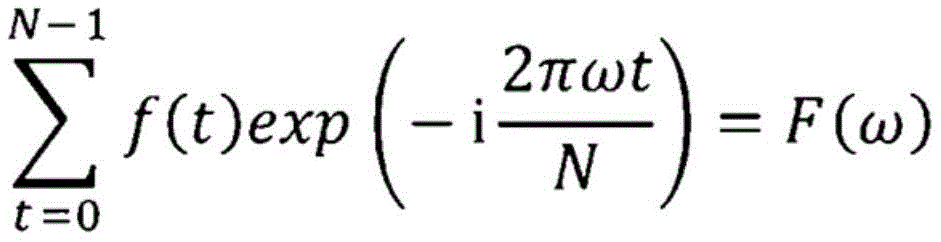
N:数据数量N: number of data
在步骤S32中,处理部59将频谱(电压vs频率)距离转换为频谱(电压vs距离)。图9B是表示将频谱(电压vs频率)距离转换为频谱(电压vs距离)的状况的图。In step S32 , the
在步骤S33中,处理部59基于频谱(电压vs距离)而计算出与峰值对应的值(距离值、SNR)。图9C是表示基于频谱(电压vs距离)而计算出与峰值对应的值(距离值、SNR)的状况的图。In step S33 , the
(1)计算出电压的峰值。具体而言,针对图9C所示的电压,作成该电压的微分值从正变成负的距离的该距离值和电压值的组(Dx,Vx),在上述组中按电压值的从高到低的顺序排列。(1) Calculate the peak value of the voltage. Specifically, for the voltage shown in FIG. 9C , a set (D x , V x ) of the distance value and voltage value (D x , V x ) of the distance at which the differential value of the voltage changes from positive to negative is created, and the voltage value in the above set is Arranged in order from highest to lowest.
(D1,V1)、(D2,V2)、(D3,V3)···(Dn,Vn)(2)排除超过多头数的组合。例如,如图5A所示那样,对于位移传感器10而言,在主干涉仪中设置有3级光路,通过传感器头20从各个光路对计测对象物T照射测定光,接受分别从其得到的干涉光(返回光)(多头数=3)。假设若峰值存在4个以上,则超过3个的峰值是基于噪声源的,从计算对象排除即可。在多头数=3的情况下,成为(D1,V1)、(D2,V2)、(D3,V3)。(3)重新按距离顺序排序。例如,若按距离从小到大的顺序排列,则成为(D3,V3)、(D1,V1)、(D2,V2)。(D 1 , V 1 ), (D 2 , V 2 ), (D 3 , V 3 )···(D n , V n ) (2) Excluding combinations exceeding the number of long positions. For example, as shown in FIG. 5A, for the
(4)获取峰值间的电压。具体而言,获取D3与D1的中间距离亦即D31的电压V31,获取D1与D2的中间距离亦即D12的电压V12。而且,计算出其平均电压Vn=(V31+V12)/2。(4) Get the voltage between the peaks. Specifically, the intermediate distance between D 3 and D 1 , that is, the voltage V 31 of D 31 is obtained, and the intermediate distance between D 1 and D 2 , that is, the voltage V 12 of D 12 is obtained. And, the average voltage Vn=(V 31 +V 12 )/2 was calculated.
(5)计算出各自的SNR。具体而言,成为SN1=V1/Vn、SN2=V2/Vn、SN3=V3/Vn。(5) Calculate the respective SNRs. Specifically, SN 1 =V 1 /V n , SN 2 =V 2 /V n , and SN 3 =V 3 /V n .
这样,基于频谱(电压vs距离)而计算出与峰值对应的值(距离值、SNR)=(D1,SN1)、(D2,SN2)、(D3,SN3)。In this way, values (distance value, SNR)=(D 1 , SN 1 ), (D 2 , SN 2 ), (D 3 , SN 3 ) corresponding to peaks are calculated based on the frequency spectrum (voltage vs. distance).
返回图8,在步骤S34中,处理部59对与由步骤S33计算出的峰值对应的值(距离值、SNR)中的距离值进行修正。具体而言,如图6C所示那样,3个准直透镜单元24a~24c(准直透镜22a~22c以及各光纤)在传感器头20的光轴方向的位置上分别错开配置,因此,根据该错开量(例如h1、h2、h3等),对分别与峰值对应的距离值D1、D2、D3进行修正。Returning to FIG. 8 , in step S34 , the
由此,成为与峰值对应的值(修正后距离值、SNR)=(D1+h1、SN1)、(D2+h2,SN2)、(D3+h3,SN3)。Thus, the value corresponding to the peak value (distance value after correction, SNR)=(D 1 +h 1 , SN 1 ), (D 2 +h 2 , SN 2 ), (D 3 +h 3 , SN 3 ) .
在步骤S35中,处理部59将与步骤S34中计算出的峰值对应的值(修正后距离值、SNR)中的距离值平均化。具体而言,处理部59优选将与峰值对应的值(修正后距离值、SNR)中的SNR为阈值以上的修正后距离值平均化,将该平均化的计算结果作为至计测对象物T为止的距离而输出。In step S35, the
接下来,关于本公开,以更特征的结构、功能以及性质为中心,作为具体的实施方式详细地进行说明。此外,以下所示的光干涉测距传感器相当于使用图1~图9而说明的位移传感器10,该光干涉测距传感器所包含的基本结构、功能以及性质的全部或者一部分与使用图1~图9说明的位移传感器10所包含的结构、功能以及性质共用。Next, the present disclosure will be described in detail as specific embodiments centering on more characteristic configurations, functions, and properties. In addition, the optical interference distance measuring sensor shown below corresponds to the
<一个实施方式><One Embodiment>
[光干涉测距传感器的结构][Structure of Optical Interference Ranging Sensor]
图10是表示本发明的一个实施方式所涉及的光干涉测距传感器100的结构概要的示意图。如图10所示那样,光干涉测距传感器100具备波长扫描光源110、干涉仪120、受光部130、处理部140。干涉仪120包括分支部121,该分支部121使输入的光分支于多个光路,在多个光路分别配置有准直透镜122a~122c。另外,受光部130包括受光元件131以及AD转换部132。此外,构成干涉仪120的分支部121以及准直透镜122a~122c它们的全部或者一部分也可以例如图6A~6C所示那样,作为传感器头而储存于相同的壳体。另外,在传感器头中,在准直透镜122a~122c的前方配置有物镜,也可以包含于同一壳体,也可以以能够拆装的方式安装。FIG. 10 is a schematic diagram showing an outline of the configuration of an optical interference
波长扫描光源110与分支部121连接,一边使波长连续地变化一边投射光。The wavelength
分支部121以将从波长扫描光源110投射而输入的光照射于计测对象物T中的多个斑点(此处3个斑点)的方式分支于光路A~C而输出。分支部121例如也可以是光耦合器等。The branching
被分支于光路A的光经由光纤作为测定光而穿过准直透镜122a而照射于计测对象物T,并由该计测对象物T反射。而且,由计测对象物T反射的反射光(第1反射光)穿过准直透镜122a而从光纤的前端返回分支部121。The light branched on the optical path A passes through the
另外,被分支于光路A的光经由光纤作为测定光而照射于计测对象物T,但其一部分作为参照光而由参照面反射。此处,光纤的前端成为参照面,由该参照面反射的反射光(第2反射光)经由该光纤而返回分支部121。In addition, the light branched on the optical path A is irradiated on the measurement object T as measurement light via the optical fiber, but a part thereof is reflected by the reference surface as reference light. Here, the tip of the optical fiber serves as a reference surface, and the reflected light (second reflected light) reflected by the reference surface returns to the
此时,针对从分支部121输出至光路A的光纤的光,测定光照射于计测对象物T而作为第1反射光经由该光纤而返回分支部121,参照光由于作为由作为该光纤的前端的参照面反射的第2反射光而经由该光纤而返回分支部121,因此,根据测定光与参照光之间的光路长度差而产生干涉光。即,从光路A的光纤的前端至计测对象物T为止的往复距离成为光路长度差,干涉仪120基于第1反射光和第2反射光而产生干涉光,作为向分支部121的返回光。此外,测定光以及参照光的光路长度均可以为对光路的空间的长度乘以折射率而得到的值。At this time, for the light output from the
同样,被分支于光路B的光经由光纤而作为测定光而穿过准直透镜122b而照射于计测对象物T,并由该计测对象物T反射。而且,由计测对象物T反射的反射光(第1反射光)穿过准直透镜122b从光纤的前端返回分支部121。另外,对于被分支于光路B的光而言,其一部分作为参照光而由作为光纤的前端的参照面反射,由该参照面反射的反射光(第2反射光)经由该光纤而返回分支部121。Similarly, the light branched on the optical path B passes through the optical fiber, passes through the
此时,针对从分支部121输出至光路B的光纤的光,根据测定光与参照光之间的光路长度差而产生干涉光。即,从光路B的光纤的前端至计测对象物T为止的往复距离成为光路长度差,干涉仪120基于第1反射光和第2反射光而产生干涉光,作为向分支部121的返回光。At this time, with respect to the light output from the
同样,被分支于光路C的光经由光纤而作为测定光而穿过准直透镜122c而照射于计测对象物T,并由该计测对象物T反射。而且,由计测对象物T反射的反射光(第1反射光)穿过准直透镜122c而从光纤的前端返回分支部121。另外,被分支于光路C的光其一部分作为参照光而由作为光纤的前端的参照面反射,由该参照面反射的反射光(第2反射光)经由该光纤而返回分支部121。Similarly, the light branched on the optical path C passes through the optical fiber as measurement light, passes through the
此时,针对从分支部121输出至光路C的光纤的光,由于测定光与参照光之间的光路长度差而产生干涉光。即,从光路C的光纤的前端至计测对象物T为止的往复距离成为光路长度差,干涉仪120基于第1反射光和第2反射光而产生干涉光,作为向分支部121的返回光。At this time, with respect to the light output from the
这样,从波长扫描光源110投射而输入的光通过分支部121而被分支,在分别被分支出的光路A~C中,基于照射了计测对象物T的各斑点的测定光与由各光路A~C的光纤的前端亦即参照面反射的参照光之间的光路长度差而产生干涉光,通过干涉仪120作为返回光而输出至受光部130。In this way, the light projected and input from the wavelength
此外,测定光与参照光之间的光路长度差设定为在3个斑点(与光路A~C对应)中分别不同。针对该光路长度差的详情将后述。In addition, the difference in optical path length between the measurement light and the reference light is set to be different for each of the three spots (corresponding to optical paths A to C). The details of this optical path length difference will be described later.
受光部130接受来自干涉仪120的返回光(各干涉光)。对于受光部130而言,受光元件131例如是光电检测器,且接受从干涉仪120输出的返回光,并转换为电信号。而且,AD转换部132将该电信号从模拟信号转换为数字信号。The
此外,此处,受光部130是作为一个受光部而接受作为来自干涉仪120的返回光而包含分别与3个斑点(与光路A~C对应)对应的各干涉光的光信号的结构,不是分别通过单独的受光部接受各干涉光的结构。由此,通过简单的结构实现低成本。In addition, here, the
处理部140基于由受光部130接受到的返回光来计算至计测对象物T为止的距离。具体而言,处理部140对由受光部130接受到的返回光中的峰值进行检测,使该检测出的峰值与上述的斑点(与光路A~C对应)建立对应而计算出至计测对象物T为止的距离。另外,例如也可以是,处理部140是通过FPGA等集成电路实现的处理器,且使用FFT对被输入的数字信号进行频率转换,并基于此而计算出至计测对象物T为止的距离。The
图11是表示由处理部140执行的计算出至计测对象物T为止的距离的方法的流程图。如图11所示那样,该方法包括步骤S110~S150。FIG. 11 is a flowchart showing a method of calculating the distance to the measurement target T performed by the
在步骤S110中,处理部140例如图8所示的步骤S31那样,使用FFT对来自受光部130的波形信号进行频率转换。In step S110 , processing
在步骤S120中,处理部140例如图8所示的步骤S32那样,对频率进行距离转换。In step S120 , the
图12是示意性地表示针对由受光部130接受到的返回光而被距离转换后的信号波形的一例的图。如图12所示那样,在由受光部130接受到的返回光中,表示出分别与3个斑点(与光路A~C对应)对应的峰值。FIG. 12 is a diagram schematically showing an example of a distance-converted signal waveform for return light received by the
在步骤S130中,处理部140例如将距离值Da的峰值与对应于光路A的斑点建立对应,将距离值Db的峰值与对应于光路B的斑点建立对应,以及将距离值Dc的峰值与对应于光路C的斑点建立对应。In step S130, the
在步骤S140中,处理部140根据分别在光路A~C中配置的光纤的前端位置来修正距离值Da~Dc。如上述那样,针对在光路A~C中与3个斑点对应地被分支出的各个光,设定为测定光与参照光之间的光路长度差不同。因此,分别在光路A~C中配置的光纤的前端位置在光轴方向上位置错开配置,因此,处理部140基于该错开量,修正距离值Da~Dc,计算出至计测对象物T为止的距离。此外,光纤的前端位置例如也可以如图6C所示那样,将插入有光纤的前端的准直透镜单元在光轴方向的位置处分别错开配置。In step S140 , the
这样,分别在光路A~C中配置的光纤的前端位置在光轴方向上位置错开配置,由此各个光路A~C中的测定光与参照光之间的光路长度差不同,由受光部130接受到的返回光中的分别与3个斑点(与光路A~C对应)对应的峰值错开被表示出,能够适当地检测各自的峰值。In this way, the positions of the ends of the optical fibers arranged in the optical paths A to C are shifted in the direction of the optical axis, so that the difference in optical path length between the measurement light and the reference light in each of the optical paths A to C is different, and the
此处,对相干FMCW(Frequency-Modulated Continuous Wave:调频连续波)进行说明。Here, coherent FMCW (Frequency-Modulated Continuous Wave: Frequency-Modulated Continuous Wave) will be described.
图13是用于对相干FMCW进行说明的图。如上述那样,从波长扫描光源110一边使波长(频率)连续地变化一边投射光,基于照射计测对象物T而被反射的测定光和由作为光纤的前端的参照面反射的参照光之间的光路长度差而产生干涉光。FIG. 13 is a diagram for explaining coherent FMCW. As described above, light is projected from the wavelength
如图13所示那样,针对从波长扫描光源110投射的光,测定光由于从参照光延迟光路长度差的量而产生干涉。而且,作为具有测定光与参照光之间的频率之差亦即差拍频率的差拍信号(干涉光),由受光部130接受。差拍频率通过fb=δf/T·2Ln/c来求出(δf:频率扫描宽度,T为扫描时间,L为光路差,n为光路差中的折射率,c为光速)。As shown in FIG. 13 , with respect to the light projected from the wavelength-sweeping
并且,如上述那样,在处理部140中,使用FFT进行频率解析,由此至计测对象物T为止的距离成为信号波形的峰值被表示出,但根据距离分辨率,峰值波形被更清晰地表示。距离分辨率通过δLFWHM=c/nδf(c为光速,n为光路差中的折射率,δf为频率扫描宽度)而求出。Furthermore, as described above, in the
即,通过使频率扫描宽度δf变大能够使距离分辨率δLFWHM变小,使峰值波形的半值宽度变小,能够更清晰地表示峰值。作为其结果,能够更高精度地计算出至计测对象物T为止的距离。That is, by increasing the frequency sweep width δf, the distance resolution δL FWHM can be reduced, and the half-value width of the peak waveform can be reduced, so that the peak can be displayed more clearly. As a result, the distance to the measurement target object T can be calculated with higher accuracy.
另外,如本实施方式那样,在信号波形中,表示多个峰值的情况下,为了以清晰地表示各自的峰值的方式适当地检测各峰值,优选构成为各个光路A~C中的测定光与参照光之间的光路长度差之差ΔL大于距离分辨率δLFWHM。In addition, as in the present embodiment, when a plurality of peaks are shown in the signal waveform, in order to appropriately detect each peak so as to clearly show each peak, it is preferable to configure the measurement lights in the respective optical paths A to C to be connected with each other. The difference ΔL in optical path length difference between the reference lights is greater than the distance resolution δL FWHM .
在步骤S150中,处理部140如图8所示的步骤S35那样,对基于与步骤S140中计算出的峰值对应的光纤的错开量的修正后的距离值进行平均化而得到至计测对象物T为止的距离。In step S150, the
[考虑到峰值消失的处理][Considering the processing of peak disappearance]
如上述那样,光干涉测距传感器100为了清晰地表示由受光部130接受到的返回光中的分别与3个斑点(与光路A~C对应)对应的峰值,欲适当地计测至计测对象物T为止的距离,但有时峰值由于计测对象物T的表面形状、因周边环境产生的噪声等而消失。As described above, in order to clearly display the peak values corresponding to the three spots (corresponding to the optical paths A to C) in the return light received by the
图14是表示考虑到在由受光部130接受到的返回光中峰值消失的情况而计算出至计测对象物T为止的距离的方法的流程图。该方法包括步骤S210~S310。FIG. 14 is a flowchart showing a method of calculating the distance to the measurement target T in consideration of the disappearance of the peak in the return light received by the
步骤S210以及步骤S220与使用图11说明的步骤S110以及步骤S120相同。Step S210 and step S220 are the same as step S110 and step S120 described using FIG. 11 .
在步骤S230中,处理部140基于将由受光部130接受到的返回光距离转换为频谱(电压vs距离)的信号,检测峰值,判定该峰值数N。例如,也可以检测具有预定阈值Th1以上的信号强度的峰值数。In step S230 , the
图15是示意性地表示基于被距离转换为频谱(电压vs距离)的信号来检测峰值的状况的图。如图15所示那样,处理部140将具有阈值Th1以上的信号强度的S1、S2以及S3检测为峰值,在这种情况下,将峰值数判定为3即可。FIG. 15 is a diagram schematically showing how a peak is detected based on a signal converted from a distance into a frequency spectrum (voltage vs. distance). As shown in FIG. 15 , the
此外,此处,阈值Th1也可以被预先设定,也可以被设定为动态变化。例如,也可以是,在峰值间推断出噪声,而且计算出每个峰值的SNR,判定超过预定阈值Th1(例如,SNR>9)的峰值数。In addition, here, the threshold Th1 may also be set in advance, or may be set to change dynamically. For example, noise may be estimated between peaks, SNR for each peak is calculated, and the number of peaks exceeding a predetermined threshold Th1 (for example, SNR>9) may be determined.
若设定为使预定阈值Th1动态变化,则例如即便在由受光部130接受的返回光的光量由于计测对象物T的种类、周边环境的变化等而变化的情况下,也能够根据它们的状况而掌握噪声等级,能够适当地检测包含于返回光的峰值数。If the predetermined threshold value Th1 is set to be dynamically changed, for example, even when the light quantity of the return light received by the
在本实施方式中,针对分别与3个斑点(与光路A~C对应)对应的峰值,考虑检测的峰值数N=“0为峰值消失3个”、“1为峰值消失2个”、“2为峰值消失一个”、“3为无峰值消失”的情况。In this embodiment, for peaks corresponding to three spots (corresponding to optical paths A to C) respectively, consider the number of detected peaks N=“0 means that three peaks disappear”, “1 means that two peaks disappear”, “ 2 means that one peak disappears", and "3 means no peak disappears".
返回图14,在步骤S230中峰值数N=0的情况下,进入步骤S310的处理。在步骤S310中,处理部140输出错误或者前次计算出的距离值。作为具体例,处理部140在无法检测出峰值的情况下,无法计算出至计测对象物T为止的距离,因此,例如在控制器30的显示部31显示错误即可。另外,处理部140也可以取代错误的显示而显示前次计算出的距离值,或者与错误的显示一起显示前次计算出的距离值。Returning to FIG. 14 , when the number of peaks N=0 in step S230 , the process proceeds to step S310 . In step S310, the
在步骤S230中峰值数N=1的情况下,进入步骤S241的处理。在步骤S241中,处理部140针对检测出的1个峰值,计算出基于该峰值的距离值D1。When the number of peaks N=1 in step S230, it progresses to the process of step S241. In step S241 , the
在步骤S242中,处理部140读出与过去检测出的峰值相关的信息。具体而言,过去由受光部130接受到的返回光中的峰值被检测出,与该检测出的峰值中的最大峰值相关的信息被存积于存储器,例如,处理部140关于该最大峰值,从存储器读出与由分支部121分支出的光路A~C对应的顺序k以及针对其的距离值Dmax。In step S242, the
在步骤S243中,处理部140将步骤S241中计算出的距离值D1与和顺序k(与光路A~C对应的斑点)对应的距离值Dmax进行比较,判定该距离值D1与顺序k(与光路A~C对应的斑点)的哪个对应。具体而言,对和顺序k(与光路A~C对应的斑点)对应的距离值Dmax各自与距离值D1之差Dgap进行计算,在成为预定阈值Th2以下(范围内)的情况下,距离值D1判定为与该顺序k(与光路A~C对应的斑点的任一个)对应。In step S243, the
图16是表示基于检测出的1个峰值S1,通过步骤S241~S243而执行的处理的状况的图。如图16所示那样,2个峰值消失,检测出1个峰值S1,计算出基于该峰值S1的距离值D1(步骤S241)。将和过去存积的顺序k(与光路A~C对应的斑点)对应的距离值Dmax与距离值D1进行比较,计算出Dgap(|Dmax-D1|)。FIG. 16 is a diagram showing the state of processing executed in steps S241 to S243 based on one detected peak value S1. As shown in FIG. 16 , two peaks disappear, one peak S1 is detected, and a distance value D1 based on the peak S1 is calculated (step S241 ). Dgap(|Dmax-D1|) is calculated by comparing the distance value Dmax corresponding to the order k (spots corresponding to optical paths A to C) accumulated in the past with the distance value D1.
而且,此处,例如,和光路A对应的顺序k=1的距离值Dmax与距离值D1接近,Dgap(|Dmax-D1|)为预定阈值Th2的范围内。由此,能够判定为和该峰值S1对应的距离值D1是与基于和光路A对应的斑点的峰值对应的距离值。Also, here, for example, the distance value Dmax corresponding to the optical path A in order k=1 is close to the distance value D1, and Dgap(|Dmax-D1|) is within the range of the predetermined threshold Th2. Accordingly, it can be determined that the distance value D1 corresponding to the peak S1 is a distance value corresponding to the peak value based on the spot corresponding to the optical path A. FIG.
一方面,若Dgap(|Dmax-D1|)不在预定阈值Th2的范围内,则与这次检测出的峰值S1对应的距离值D1无法基于与过去存积的顺序k(与光路A~C对应的斑点)对应的距离值Dmax来判定,视为错误,进入步骤S310的处理。On the one hand, if Dgap(|Dmax-D1|) is not within the range of the predetermined threshold Th2, the distance value D1 corresponding to the peak value S1 detected this time cannot be based on the sequence k (corresponding to optical paths A to C) accumulated in the past. The spot) corresponding to the distance value Dmax to determine, as an error, enter the processing of step S310.
这样,即便在只检测出1个峰值的情况下,也能够通过与关于过去检测出的峰值中的存积的最大峰值的信息进行比较,而避免在距离值中产生较大的误差。In this way, even when only one peak is detected, it is possible to avoid a large error in the distance value by comparing it with information about the largest accumulated peak among peaks detected in the past.
返回图14,在步骤S230中峰值数N=2的情况下,进入步骤S251的处理。在步骤S251中,处理部140针对检测出的2个峰值,计算出基于该峰值的距离值D1以及D2。Returning to FIG. 14 , when the number of peaks N=2 in step S230 , the process proceeds to step S251 . In step S251 , the
在步骤S252中,处理部140计算出分别基于2个峰值的距离值D1与D2的峰值间距离d1。In step S252 , the
在步骤S253中,处理部140基于步骤S252中计算出的峰值间距离d1和光路A~C各自的光路长度差,来判定该距离值D1以及D2与光路A~C中的哪一个对应。In step S253 , the
图17是表示基于检测出的2个峰值S1以及S2,通过步骤S251~S253执行的处理的状况的图。如图17所示那样,1个峰值消失,检测出2个峰值S1以及S2,计算出基于该峰值S1以及S2的距离值D1以及D2(步骤S251)。而且,计算出分别基于2个峰值的距离值D1与D2的峰值间距离d1(步骤S252)。FIG. 17 is a diagram showing the state of processing executed in steps S251 to S253 based on the detected two peaks S1 and S2. As shown in FIG. 17 , one peak disappears, two peaks S1 and S2 are detected, and distance values D1 and D2 based on the peaks S1 and S2 are calculated (step S251 ). Then, the peak-to-peak distance d1 based on the distance values D1 and D2 of the two peaks is calculated (step S252 ).
此处,以能够基于峰值间距离d1判定2个峰值S1以及S2与光路A~C中的哪一个对应的方式设定各自的光路长度差。如使用图12以及图13说明的那样,通过设定为各个光路A~C中的测定光与参照光之间的光路长度差不同,分别与3个斑点(与光路A~C对应)对应的峰值被错开表示。针对峰值间距离与分别和3个斑点(与光路A~C对应)对应的峰值之间的关系详细地进行说明。Here, the respective optical path length differences are set so that it can be determined which of the two peaks S1 and S2 corresponds to among the optical paths A to C based on the inter-peak distance d1. As described using FIG. 12 and FIG. 13 , by setting the difference in optical path length between the measurement light and the reference light in each of the optical paths A to C, each corresponding to the three spots (corresponding to the optical paths A to C) Peaks are represented staggered. The relationship between the distance between peaks and the peaks corresponding to the three spots (corresponding to optical paths A to C) will be described in detail.
图18是用于对峰值间距离与分别和3个斑点(与光路A~C对应)对应的峰值之间的关系进行说明的图。图18中,在分别和3个斑点(与光路A~C对应)对应的峰值中,示出峰值A与峰值B的峰值间距离h1以及峰值B与峰值C的峰值间距离h2。FIG. 18 is a diagram for explaining the relationship between the distance between peaks and peaks corresponding to three spots (corresponding to optical paths A to C). In FIG. 18 , the peak-to-peak distance h1 between peak A and peak B and the peak-to-peak distance h2 between peak B and peak C are shown for peaks corresponding to three spots (corresponding to optical paths A to C).
在以成为h1≠h2、使各光路A~C中的光路长度差分别不同的方式配置了各光路A~C中的光纤的前端位置的情况下,例如,在1个峰值消失的情况下,若被检测出的2个峰值间距离为h1,则能够判定为峰值C消失,检测出峰值A以及峰值B。另外,若被检测出的2个峰值间距离为h2,则能够判定为峰值A消失,检测出峰值B以及峰值C,若被检测出的2个峰值间距离为h1+h2,则能够判定为峰值B消失,检测出峰值A以及峰值C。另一方面,在以成为h1=h2、使各光路A~C中的光路长度差分别不同的方式配置了各光路A~C中的光纤的前端位置的情况下,例如,在1个峰值消失的情况下,基于被检测出的2个峰值间距离判定被检测出的2个峰值与光路A~C中的哪一个对应较困难。When the tip positions of the optical fibers in the optical paths A to C are arranged so that h1≠h2 and the optical path length differences in the optical paths A to C are different, for example, when one peak disappears, If the distance between the two detected peaks is h1, it can be determined that peak C has disappeared, and peak A and peak B are detected. In addition, if the distance between two detected peaks is h2, it can be determined that peak A disappears, and peak B and peak C are detected, and if the distance between two detected peaks is h1+h2, it can be determined that Peak B disappears, and peak A and peak C are detected. On the other hand, when the tip positions of the optical fibers in the optical paths A to C are arranged so that h1=h2 and the optical path length differences in the optical paths A to C are different, for example, one peak disappears at In the case of , it is difficult to determine which of the optical paths A to C the detected two peaks correspond to based on the distance between the two detected peaks.
这样,在1个峰值消失、检测出2个峰值的情况下,如果配置各光路A~C中的光纤的前端位置,使得预先根据各个峰值的组合计算出的峰值间距离不同,,则能够判定2个峰值与光路A~C中的哪一个对应(步骤S253)。In this way, when one peak disappears and two peaks are detected, if the tip positions of the optical fibers in the optical paths A to C are arranged so that the distances between the peaks calculated in advance based on the combination of the peaks are different, it can be determined that Which of the optical paths A to C do the two peaks correspond to (step S253).
另外,在基于2个峰值的峰值间距离判定该2个峰值与光路A~C中的哪一个对应的情况下,例如也可以针对该峰值间距离而允许预定范围。例如,也可以是,若2个峰值的峰值间距离在与预先设定的h1或者h2偏离±10%的范围,则判定为h1或者h2。但是,在这种情况下,以h1与h2的允许范围不重复、满足0.9*h2-1.1*h1>0的方式预先配置各光路A~C中的光纤的前端位置。In addition, when determining which of the two peaks corresponds to the optical paths A to C based on the inter-peak distance between two peaks, for example, a predetermined range may be allowed for the inter-peak distance. For example, if the distance between the two peaks is within the range of ±10% from the preset h1 or h2, it may be determined as h1 or h2. However, in this case, the positions of the ends of the optical fibers in the respective optical paths A to C are arranged in advance so that the allowable ranges of h1 and h2 do not overlap and 0.9*h2−1.1*h1>0 is satisfied.
返回图14,在步骤S230中峰值数N=3的情况下,进入步骤S260的处理。在步骤S260中,处理部140针对检测出的3个峰值,计算出基于该峰值的距离值D1、D2以及D3。Returning to FIG. 14 , when the number of peaks N=3 in step S230, the process proceeds to step S260. In step S260 , processing
图19是表示基于检测出的3个峰值S1、S2以及S3,通过步骤S260而执行的处理的状况的图。如图19所示那样,此处,峰值没有消失,检测出3个峰值S1、S2以及S3,计算出基于该峰值S1、S2以及S3的距离值D1、D2以及D3。FIG. 19 is a diagram showing the status of processing executed in step S260 based on the detected three peaks S1 , S2 , and S3 . Here, as shown in FIG. 19 , the peak does not disappear, and three peaks S1 , S2 , and S3 are detected, and distance values D1 , D2 , and D3 based on the peaks S1 , S2 , and S3 are calculated.
返回图14,在步骤S270中,处理部140检测出由受光部130接受到的返回光中的峰值,并将与该检测出的峰值中的最大峰值相关的信息保存于存储器。具体而言,处理部140例如在检测出1个峰值的情况下,将与该峰值对应的顺序k(表示光路A~C的任一个的顺序)和其距离值Dmax保存于存储器。在检测出2个或者3个峰值的情况下,将与该检测出的峰值中的最大峰值对应的顺序k(表示光路A~C的任一个的顺序)和其距离值Dmax保存于存储器。这样,表示保存于存储器的光路A~C的任一个的顺序k以及针对其的距离值Dmax在下次之后的计测时用于上述的步骤S241以及S243。Returning to FIG. 14 , in step S270 , the
在步骤S280中,处理部140根据分别在光路A~C中配置的光纤的前端位置对与步骤S243、S253或者S260中检测出的峰值对应的距离值进行修正。具体而言,例如,如使用图8说明的步骤S34以及使用图11说明的步骤S140那样,分别在光路A~C中配置的光纤的前端位置在光轴方向上位置错开配置,因此,处理部140基于该错开量对与步骤S243、S253或者S260中检测出的峰值对应的距离值进行修正即可。In step S280 , the
在步骤S290中,处理部140对步骤S280中修正后的距离值进行平均化。In step S290, the
图20是表示基于分别在光路A~C中配置的光纤的前端位置的光轴方向上的错开量,对与检测出的峰值对应的距离值进行修正,并使其平均化的状况的图。如图20所示那样,例如,在以光路B中配置的光纤的前端位置作为基准的情况下,以基于与该光路B对应的峰值的距离值D2作为基准,将基于与光路A以及C对应的峰值的距离值D1以及D3分别修正为D1+h1以及D3-h2。FIG. 20 is a diagram showing how distance values corresponding to detected peaks are corrected and averaged based on deviation amounts in the optical axis direction of the tip positions of optical fibers arranged in optical paths A to C, respectively. As shown in FIG. 20 , for example, when the tip position of the optical fiber arranged in the optical path B is used as a reference, the distance value D2 based on the peak value corresponding to the optical path B is used as a reference, and the distance value D2 corresponding to the optical paths A and C is used as a reference. The distance values D1 and D3 of the peak value are corrected to D1+h1 and D3-h2 respectively.
而且,处理部140也可以通过对D1+h1、D2、D3-h2进行平均化而计算为至计测对象物T为止的距离。Furthermore, the
并且,处理部140也可以选择具有预定阈值Th3以上的信号强度的峰值,仅将与该选择出的峰值对应的距离值作为进行平均化的对象。例如,也可以是,将多个峰值中的信号强度最大的S1的1/2作为阈值Th3,通过对与具有该阈值Th3以上的信号强度的峰值对应的距离值(此处,D1+h1、D2、D3-h2)进行平均化,而计算为至计测对象物T为止的距离。通过仅将与信号强度大的峰值对应的距离值作为平均化的对象,不应用与可靠性低或者精度低的峰值对应的距离值,因此,能够更高精度地计算出至计测对象物T为止的距离。In addition, the
在步骤S300中,处理部140将步骤S290中平均化后的距离值输出。例如,处理部140将步骤S290中计算出的至计测对象物T为止的距离显示于显示部31,或者经由外部I/F部33而输出至控制设备11或者外部连接设备13等。In step S300, the
此外,此处,处理部140在步骤S210紧后的步骤S220中,对频率进行距离转换,在之后的步骤中比较以及计算出距离值等而进行处理,但步骤S220中的距离转换也可以不是在步骤S210紧后。处理部140也可以在步骤S210之后,比较以及计算出频率等而进行处理,例如在步骤S300紧前对频率进行距离转换。另外,图8以及图11所示的距离转换(步骤S32以及S120)也相同。In addition, here, the
如以上那样,根据本发明的一个实施方式所涉及的光干涉测距传感器100,干涉仪120针对与3个斑点对应地被分支出的各个光,基于照射于该计测对象物T并被该计测对象物T反射的测定光和至少一部分沿着与该测定光不同的光路的参照光而产生各干涉光,并输出为返回光。受光部130接受来自干涉仪120的返回光,处理部140检测返回光中的峰值,使该检测出的峰值与斑点建立对应而计算出至计测对象物T为止的距离。而且,针对与3个斑点对应地被分支出的各个光,设定为测定光与参照光之间的光路长度差不同,因此,能够适当地检测各峰值,能够基于与该检测出的峰值对应的距离值而高精度地计算出至计测对象物T为止的距离。即,适当地识别分别与3个斑点(与光路A~C对应)对应的峰值,能够基于与该峰值对应的距离值而高精度地对至计测对象物T为止的距离进行测距。As described above, according to the optical interference
并且,即便在峰值信号由于斑纹而消失的情况下,也通过与和过去检测出的峰值中的存积的最大峰值相关的信息进行比较,或者通过以使各光路A~C中的光路长度差各自不同的方式配置各光路A~C中的光纤的前端位置,并适当地设定峰值间距离,由此能够适当地判定被检测出的峰值。其结果,能够高精度地对至计测对象物T为止的距离进行测距。And even when the peak signal disappears due to speckle, by comparing with the information on the accumulated maximum peak among the peaks detected in the past, or by making the difference between the optical path lengths in the respective optical paths A to C The detected peaks can be appropriately determined by arranging the positions of the ends of the optical fibers in the respective optical paths A to C in a different manner, and setting the peak-to-peak distance appropriately. As a result, the distance to the measurement object T can be measured with high precision.
此外,在本实施方式中,分支部121构成为使来自波长扫描光源110的光分支为3个光路A~C,并对计测对象物T中的3个斑点照射测定光,但不限定于此,例如被分支出的光路以及斑点也可以为2个,也可以为4个以上。In addition, in the present embodiment, the branching
另外,本实施方式所涉及的光干涉测距传感器100也可以具备调整部。具体而言,光干涉测距传感器100具备调整部,上述调整部对图10所示的受光部130中接受的返回光的光量进行调整。In addition, the optical interference
图21是用于对通过调整部来调整接受的返回光的光量的状况进行说明的图。如图21所示那样,例如,在来自光路A的返回光与来自光路B的返回光的光量存在差异的情况下,受光部130由1个受光部构成,因此,即便欲从由该受光部130接受到的返回光检测各峰值,也存在其他峰值被掩埋于光量大的峰值的噪声中无法适当地检测出的可能性。FIG. 21 is a diagram for explaining how the adjustment unit adjusts the light quantity of the return light received. As shown in FIG. 21 , for example, when there is a difference in light quantity between the return light from optical path A and the return light from optical path B, the
因此,通过利用调整部对来自各光路的返回光的光量进行均匀化,能够适当地检测出各峰值。Therefore, each peak value can be appropriately detected by making the light intensity of the return light from each optical path uniform by the adjustment unit.
另外,本实施方式所涉及的光干涉测距传感器100也可以是,处理部140使用子像素推断而计算出至计测对象物T为止的距离。处理部140针对由受光部130接受到的返回光,使用FFT进行频率转换,其后进行距离转换时,生成使用子像素推断将该频率解析后的离散值转换为距离的信号波形。In addition, in the optical interference
图22是表示生成使用子像素推断被转换为距离的信号波形的状况的图。如图22所示那样,生成使用子像素推断对多个离散值进行数据插值并且作为连续的数据而被转换为距离的信号波形。FIG. 22 is a diagram showing a state of generating a signal waveform converted into a distance using sub-pixel estimation. As shown in FIG. 22 , a signal waveform in which data interpolation is performed on a plurality of discrete values using sub-pixel estimation and converted into distances as continuous data is generated.
由此,基于适当地被距离转换后的信号波形,检测峰值,其结果,能够更高精度地计算出至计测对象物T为止的距离。Thereby, the peak value is detected based on the signal waveform appropriately distance-converted, and as a result, the distance to the object T to be measured can be calculated with higher accuracy.
[干涉仪的变形例][Modification of interferometer]
在上述的在本实施方式中,光干涉测距传感器100使用在通过分支部121被分支出的光路A~C中使各个光纤的前端(端面)作为参照面(参照光及其反射光)从而产生干涉光的菲索干涉仪,但干涉仪不限定于此。In the above-mentioned present embodiment, the optical interference
图23是表示使用测定光和参照光而产生干涉光的干涉仪的变化的图。图23的(a)中,在通过分支部121被分支出的光路A~C中,以各个光纤的前端(端面)作为参照面,以使光路长度差不同的方式将各个光纤的前端位置在光轴方向上错开配置。上述的本实施方式所涉及的光干涉测距传感器100的干涉仪120的结构(菲索干涉仪),该参照面也可以构成为通过光纤与空气的折射率的不同而使光反射(菲涅耳反射)。另外,可以在光纤的前端涂敷反射膜,也可以在光纤的前端实施无反射涂敷而另外配置透镜面等反射面。FIG. 23 is a diagram showing changes in an interferometer that generates interference light using measurement light and reference light. In (a) of FIG. 23 , among the optical paths A to C branched by the branching
图23的(b)中,在通过分支部121被分支出的光路A~C中,形成向计测对象物T引导测定光的测定光路Lm1~Lm3和引导参照光的参照光路Lr1~Lr3,在参照光路Lr1~Lr3的前方分别配置有参照面(迈克尔逊干涉仪)。参照面可以在光纤的前端涂敷反射膜,也可以在光纤的前端实施无反射涂敷而另外配置透镜面等反射面。在该结构中,使各测定光路Lm1~Lm3的光路长度相同,在各参照光路Lr1~Lr3中设置光路长度差,由此在各光路A~C中,光路长度差不同。能够使各测定光路Lm1~Lm3的光路长度相同,因此,能够使传感器头的光学设计变容易。In (b) of FIG. 23 , among the optical paths A to C branched by the branching
图23的(c)中,在通过分支部121被分支出的光路A~C中,形成向计测对象物T引导测定光的测定光路Lm1~Lm3和引导参照光的参照光路Lr1~Lr3,在参照光路Lr1~Lr3配置有平衡检测器(马赫-曾德尔干涉仪)。在该结构中,使各测定光路Lm1~Lm3的光路长度相同,在各参照光路Lr1~Lr3中设置光路长度差,由此在各光路A~C中,使光路长度差不同。能够使各测定光路Lm1~Lm3的光路长度相同,因此,能够使传感器头的光学设计变容易。In (c) of FIG. 23 , among the optical paths A to C branched by the branching
这样,干涉仪不限定于本实施方式中说明的菲索型干涉仪,例如也可以是迈克尔逊干涉仪、马赫-曾德尔干涉仪,若能够通过设定测定光与参照光的光路长度差而产生干涉光,则可以应用任何干涉仪,也可以应用它们的组合等、其他结构。In this way, the interferometer is not limited to the Fizeau-type interferometer described in this embodiment, and may be, for example, a Michelson interferometer or a Mach-Zehnder interferometer. To generate interfering light, any interferometer can be used, or their combination, etc., and other structures can be used.
本实施方式中说明的光干涉测距传感器在测量至计测对象物T为止的距离的位移传感器、距离计以及激光雷达等中使用。The optical interference ranging sensor described in this embodiment is used in a displacement sensor, a distance meter, a laser radar, and the like that measure a distance to a measurement target T.
以上说明的实施方式是为了容易理解本发明的,不是用于限定解释本发明。实施方式所具备的各要素及其配置、材料、条件、形状以及大小等不限定于例示的内容,而能够适当地变更。另外,能够将由不同的实施方式示出的结构彼此部分地置换或者组合。The embodiments described above are for easy understanding of the present invention, and are not intended to limit the interpretation of the present invention. Each element included in the embodiment and its arrangement, material, condition, shape, size, etc. are not limited to the illustrated ones, and can be appropriately changed. In addition, configurations shown in different embodiments can be partially substituted or combined with each other.
[附记][Note]
一种光干涉测距传感器,其特征在于,A light interference ranging sensor, characterized in that,
具备:光源(110),一边使波长连续地变化一边投射光;干涉仪(120),包括分支部(121),该分支部使从上述光源投射的光以照射于计测对象物(T)中的多个斑点的方式分支,针对与该多个斑点对应地被分支出的各个光,基于照射于该计测对象物并由该计测对象物反射的测定光和至少一部分沿着与该测定光不同的光路的参照光而产生各干涉光;It is provided with: a light source (110) projecting light while changing the wavelength continuously; an interferometer (120) including a branch part (121) for irradiating the light projected from the light source to a measurement object (T) For each light that is branched corresponding to the plurality of spots, based on the measurement light irradiated on the measurement object and reflected by the measurement object and at least a part of the light along the The reference light of the different optical paths of the measurement light generates each interference light;
受光部(130),接受来自上述干涉仪的各干涉光;以及A light receiving unit (130) receives each interference light from the above-mentioned interferometer; and
处理部(140),检测接受到的各干涉光中的峰值,并使检测出的该峰值与上述斑点建立对应而计算出至上述计测对象物为止的距离,针对与上述多个斑点对应地被分支出的各个光,设定为上述测定光与上述参照光之间的光路长度差不同。A processing unit (140) detects a peak value in each received interference light, associates the detected peak value with the spot to calculate a distance to the measurement object, and corresponds to the plurality of spots Each branched light is set so that the difference in optical path length between the measurement light and the reference light is different.
Claims (11)
Applications Claiming Priority (2)
| Application Number | Priority Date | Filing Date | Title |
|---|---|---|---|
| JP2021-150216 | 2021-09-15 | ||
| JP2021150216A JP7751788B2 (en) | 2021-09-15 | 2021-09-15 | Optical Interferometric Distance Sensor |
Publications (1)
| Publication Number | Publication Date |
|---|---|
| CN115808673A true CN115808673A (en) | 2023-03-17 |
Family
ID=85284309
Family Applications (1)
| Application Number | Title | Priority Date | Filing Date |
|---|---|---|---|
| CN202211027257.7A Pending CN115808673A (en) | 2021-09-15 | 2022-08-25 | Optical interference distance measuring sensor |
Country Status (4)
| Country | Link |
|---|---|
| US (1) | US20230090501A1 (en) |
| JP (1) | JP7751788B2 (en) |
| CN (1) | CN115808673A (en) |
| DE (1) | DE102022120615A1 (en) |
Family Cites Families (14)
| Publication number | Priority date | Publication date | Assignee | Title |
|---|---|---|---|---|
| US4892406A (en) | 1988-01-11 | 1990-01-09 | United Technologies Corporation | Method of and arrangement for measuring vibrations |
| US6496265B1 (en) * | 2000-02-16 | 2002-12-17 | Airak, Inc. | Fiber optic sensors and methods therefor |
| US7417740B2 (en) * | 2004-11-12 | 2008-08-26 | Medeikon Corporation | Single trace multi-channel low coherence interferometric sensor |
| US20060126073A1 (en) * | 2004-12-09 | 2006-06-15 | Intune Technologies Limited | Displacement measuring interferometer system and method using tunable lasers |
| US7488930B2 (en) * | 2006-06-02 | 2009-02-10 | Medeikon Corporation | Multi-channel low coherence interferometer |
| JP4842176B2 (en) * | 2007-03-07 | 2011-12-21 | 東京エレクトロン株式会社 | Temperature measuring apparatus and temperature measuring method |
| JP5236573B2 (en) * | 2009-05-14 | 2013-07-17 | 富士フイルム株式会社 | Optical structure measuring device and optical probe thereof |
| JP5810314B2 (en) * | 2010-06-30 | 2015-11-11 | パナソニックIpマネジメント株式会社 | Stereo image processing apparatus and stereo image processing method |
| EP2690395A1 (en) * | 2012-07-24 | 2014-01-29 | Hexagon Technology Center GmbH | Interferometric distance measuring assembly and method |
| JP6269334B2 (en) * | 2014-06-12 | 2018-01-31 | 株式会社東京精密 | Multipoint distance measuring device and shape measuring device |
| CN115079340B (en) * | 2017-05-12 | 2024-02-02 | 周超 | Space division multiplexing optical coherence tomography using low loss integrated photonic chips |
| JP2021018169A (en) * | 2019-07-22 | 2021-02-15 | キヤノン株式会社 | Imaging device |
| JP2021032734A (en) * | 2019-08-26 | 2021-03-01 | 株式会社小野測器 | measuring device |
| JP7484249B2 (en) * | 2020-03-12 | 2024-05-16 | オムロン株式会社 | Optical Interference Measurement Device |
-
2021
- 2021-09-15 JP JP2021150216A patent/JP7751788B2/en active Active
-
2022
- 2022-08-16 DE DE102022120615.7A patent/DE102022120615A1/en active Pending
- 2022-08-25 CN CN202211027257.7A patent/CN115808673A/en active Pending
- 2022-08-25 US US17/895,114 patent/US20230090501A1/en active Pending
Also Published As
| Publication number | Publication date |
|---|---|
| JP2023042844A (en) | 2023-03-28 |
| US20230090501A1 (en) | 2023-03-23 |
| JP7751788B2 (en) | 2025-10-09 |
| DE102022120615A1 (en) | 2023-03-16 |
Similar Documents
| Publication | Publication Date | Title |
|---|---|---|
| CN116736312A (en) | Optical interference ranging sensor | |
| US20230314122A1 (en) | Optical interferometric range sensor | |
| WO2024048103A1 (en) | Optical interferometric ranging sensor | |
| CN115808673A (en) | Optical interference distance measuring sensor | |
| JP7723897B2 (en) | Optical Interferometric Distance Sensor | |
| US20230288562A1 (en) | Optical interferometric range sensor | |
| JP2024048644A (en) | Optical fiber cable, controller connected thereto, and optical interference distance measuring sensor using the same | |
| US20230288561A1 (en) | Optical interferometric range sensor | |
| JP7810946B2 (en) | Optical Interferometric Distance Sensor | |
| CN115808670A (en) | Optical Interference Ranging Sensor | |
| JP7691657B2 (en) | Optical Interferometric Distance Sensor | |
| WO2024070430A1 (en) | Controller and optical interferometric ranging sensor | |
| JP2023132701A (en) | Optical interference ranging sensor | |
| CN119790280A (en) | Controller and optical interferometer distance sensor | |
| JP2024048614A (en) | Optical fiber cable, controller connected thereto, and optical interference distance measuring sensor using the same | |
| JP2024033725A (en) | Optical interference ranging sensor | |
| JP2008116378A (en) | Optical pulse tester |
Legal Events
| Date | Code | Title | Description |
|---|---|---|---|
| PB01 | Publication | ||
| PB01 | Publication | ||
| SE01 | Entry into force of request for substantive examination | ||
| SE01 | Entry into force of request for substantive examination |