CN115804068A - Method, system and computer program for optimizing the capacity of a communication channel using the dirichlet process - Google Patents
Method, system and computer program for optimizing the capacity of a communication channel using the dirichlet process Download PDFInfo
- Publication number
- CN115804068A CN115804068A CN202180042501.4A CN202180042501A CN115804068A CN 115804068 A CN115804068 A CN 115804068A CN 202180042501 A CN202180042501 A CN 202180042501A CN 115804068 A CN115804068 A CN 115804068A
- Authority
- CN
- China
- Prior art keywords
- probability distribution
- signal
- channel
- transmitter
- distribution
- Prior art date
- Legal status (The legal status is an assumption and is not a legal conclusion. Google has not performed a legal analysis and makes no representation as to the accuracy of the status listed.)
- Granted
Links
Images


Classifications
-
- H—ELECTRICITY
- H04—ELECTRIC COMMUNICATION TECHNIQUE
- H04L—TRANSMISSION OF DIGITAL INFORMATION, e.g. TELEGRAPHIC COMMUNICATION
- H04L25/00—Baseband systems
- H04L25/02—Details ; arrangements for supplying electrical power along data transmission lines
- H04L25/0202—Channel estimation
Landscapes
- Engineering & Computer Science (AREA)
- Power Engineering (AREA)
- Computer Networks & Wireless Communication (AREA)
- Signal Processing (AREA)
- Mobile Radio Communication Systems (AREA)
- Complex Calculations (AREA)
- Cable Transmission Systems, Equalization Of Radio And Reduction Of Echo (AREA)
- Radio Transmission System (AREA)
Abstract
Description
技术领域technical field
本公开涉及通信信道容量的优化,并且特别是针对和致力于其中理论上无法获得最优输入分布的非平凡信道(non-trivial channel)的情况。The present disclosure relates to the optimization of communication channel capacity, and is particularly directed at and dedicated to the case of non-trivial channels where an optimal input distribution cannot theoretically be obtained.
背景技术Background technique
无记忆通信信道的基本特征可以由在给定输入X的情况下的输出Y的记为pr|X(y|x)的所谓“条件概率分布”来表示。在以下列表中给出了众所周知的通信信道的一些示例:An essential characteristic of a memoryless communication channel can be represented by a so-called "conditional probability distribution" denoted pr|X (y|x) of an output Y given an input X. Some examples of well-known communication channels are given in the following list:
·加性高斯白噪声信道,其中Y=X+N并且N是高斯分布,加性高斯白噪声信道为对经受由接收器处的热噪声而引起的扰动的有线通信进行建模,- Additive white Gaussian noise channel, where Y=X+N and N is a Gaussian distribution, the additive white Gaussian noise channel models a wired communication subjected to disturbances caused by thermal noise at the receiver,
·衰落信道Y=a.X+N,其中,a遵循衰落分布(诸如Rayleigh分布),衰落信道对在涉及富散射的无线电传播环境中在窄带无线信道上的传输进行建模,· Fading channel Y=a.X+N, where a follows a fading distribution (such as the Rayleigh distribution), the fading channel models the transmission on a narrowband wireless channel in a radio propagation environment involving rich scattering,
·更复杂的信道可以涉及非线性效应。例如,光学信道的情况就是如此,其中,当在波分复用(所谓的“WDM传输”)中增加太多的发送功率时,无法忽略Kerr效应,并且减小了信道容量,这是由非线性薛定谔
一旦准确地获知条件概率分布pY|X(y|x),就可以依靠以下项来优化通信系统:Once the conditional probability distribution p Y|X (y|x) is known exactly, the communication system can be optimized by relying on:
·输入信号的设计,以便最大化信道的输入与输出之间的互信息,The design of the input signal so as to maximize the mutual information between the input and output of the channel,
·最优接收器的设计,其通常依赖于似然概率pY|X(y|x)的处理。• The design of optimal receivers, which generally relies on the processing of likelihood probabilities p Y|X (y|x).
此后,假定信道条件概率分布pY|X(y|x)具有低波动,以使学习和跟踪成为可能。Thereafter, the channel conditional probability distribution p Y|X (y|x) is assumed to have low fluctuations to enable learning and tracking.
通常,无线通信系统可以由线性系统进行建模,其参数通过发送训练信号来进行估计。然而,当要跟踪的参数数量高时,需要大量导频开销并降低系统吞吐量。而且,当信道更复杂时,定义要跟踪的模型是困难的或者不可能的。无线通信系统的未来是在利用可用频带的目标中继续增加载波频率。太赫兹通信(300GHz以上)是用于新一代电信(6G)设想的一个关键词。然而,直到今天的知识为止,太赫兹通信在电子学与光子学之间的新领域需要新的材料、新的无线电设备。不能忽略这些新信道的强非线性和随机特性,以便取得这些新频带的最佳益处。所关注的是学习这种通信信道而不是依赖于不准确的模型。In general, wireless communication systems can be modeled by linear systems whose parameters are estimated by sending training signals. However, when the number of parameters to be tracked is high, a large amount of pilot overhead is required and system throughput is reduced. Also, when the channel is more complex, it is difficult or impossible to define the model to track. The future of wireless communication systems is to continue to increase carrier frequencies with the goal of utilizing available frequency bands. Terahertz communication (above 300 GHz) is a keyword used in the vision of next-generation telecommunications (6G). However, as far as today's knowledge is concerned, terahertz communication requires new materials and new radio equipment in the new field between electronics and photonics. The strong nonlinear and random nature of these new channels cannot be ignored in order to obtain the best benefits of these new frequency bands. The focus is on learning this communication channel rather than relying on inaccurate models.
为了优化传输策略,必须在发送器处预先知道优化的输入分布。将所接收到的信号用于估计信道条件概率分布,该信道条件概率分布反过来被用于优化最终被提供给发送器的最优输入分布。使用信道条件概率分布的紧凑和精确表示,以便:In order to optimize the transmission strategy, the optimized input distribution must be known in advance at the sender. The received signal is used to estimate a probability distribution of channel conditions, which in turn is used to optimize an optimal input distribution that is ultimately provided to the transmitter. Use a compact and accurate representation of the channel conditional probability distribution in order to:
ο在从接收器向发送器反馈信道条件概率分布时,限制反馈链路上的开销,ο limit the overhead on the feedback link when feeding back the channel condition probability distribution from the receiver to the transmitter,
ο限制计算最优输入分布的计算复杂度。o Limit the computational complexity of computing the optimal input distribution.
发明内容Contents of the invention
然而,问题在于联合学习信道条件概率分布并相应地优化传输方法。主要挑战之一是,在信道模型未知时学习信道条件概率分布。为了解决最宽泛种类的信道,需要信道的准确描述,但是经常导致接收器处的高复杂度。因此,更好的是找到信道条件概率分布的紧凑和准确的表示。However, the problem lies in jointly learning the channel conditional probability distribution and optimizing the transfer method accordingly. One of the main challenges is to learn the channel conditional probability distribution when the channel model is unknown. To address the widest variety of channels, an accurate description of the channel is required, but often results in high complexity at the receiver. Therefore, it is better to find a compact and accurate representation of the probability distribution of channel conditions.
本公开旨在改进这种情形。The present disclosure aims to improve this situation.
为此,提出了一种用于优化通信系统中的通信信道的容量的方法,该通信系统至少包括发送器(图1中的标号10)、接收器(11)、发送器与接收器之间的所述通信信道(12)、以及信道条件概率分布估计器(13)。To this end, a method for optimizing the capacity of a communication channel in a communication system is proposed, the communication system at least includes a transmitter (10 in Fig. 1), a receiver (11), and The communication channel (12), and the channel condition probability distribution estimator (13).
发送器(10)发送由与根据估计器(13)估计的输入信号概率分布的传输概率相关联的信号所传送的消息。A transmitter (10) transmits a message conveyed by a signal associated with a transmission probability from an input signal probability distribution estimated by an estimator (13).
发送器(10)至少将消息作为输入并且输出要在信道(12)上发送的信号,并且信道将所发送的信号作为输入并且输出所接收的信号,所接收的信号在接收器(11)处进行处理以便解码所发送的消息。The transmitter (10) takes at least a message as input and outputs a signal to be sent on a channel (12), and the channel takes as input the transmitted signal and outputs a received signal, which is at the receiver (11) Process to decode the sent message.
被记为pY|X(y|x)的概率分布在给定与所发送的信号X相对应的输入X的情况下,与和所接收到的信号相对应的输出Y有关,并由此表示在给出所发送的信号X时,输出所接收的信号Y的概率的信道条件概率分布。The probability distribution denoted p Y|X (y|x) is related to the output Y corresponding to the received signal given the input X corresponding to the transmitted signal X, and thus The channel conditional probability distribution representing the probability of outputting a received signal Y given a transmitted signal X.
更特别地,通过使用概率分布的函数基底,将概率分布估计为信道条件概率分布pY|X(y|x)的近似。由此通过具有来自所述函数基底的混合概率分布的混合模型,针对由发送器发送的各个可能信号来近似该信道条件概率分布。至少从在接收器处接收到的输出信号并且通过使用依赖于狄利克雷(Dirichlet)过程的折叠(collapsed)吉布斯采样(Gibbssampling),来估计针对各个可能发送的信号的概率分布,如下面呈现的实施方式中详细描述的。More particularly, the probability distribution is estimated as an approximation of the channel conditional probability distribution p Y|X (y|x) by using the functional basis of the probability distribution. This channel condition probability distribution is thus approximated for each possible signal sent by the transmitter by a mixture model with the mixture probability distribution from said functional basis. A probability distribution for each possible transmitted signal is estimated from at least the output signal received at the receiver and by using collapsed Gibbs sampling relying on a Dirichlet process, as follows described in detail in the presented embodiments.
然后,本公开的实现使得可以达到信道条件概率分布的准确表示,并由此增强解码的鲁棒性。Implementation of the present disclosure then makes it possible to achieve an accurate representation of the channel condition probability distribution and thereby enhance the robustness of decoding.
发送器(10)“至少”将消息作为输入的措辞指的是以下事实:发送器也可以将所估计的输入信号概率分布作为输入,并且更特别地,在实现优化器(14)的可选实施方式中,将优化的输入信号概率分布作为输入。同样,可以根据在接收器处接收到的输出信号并且还由于优化的输入信号概率分布,来估计各个可能的所发送的信号的概率分布。The wording that the sender (10) takes "at least" the message as input refers to the fact that the sender may also take as input the estimated probability distribution of the input signal, and more particularly, in implementing the optional In an embodiment, an optimized probability distribution of the input signal is used as input. Likewise, the probability distribution of each possible transmitted signal can be estimated from the output signal received at the receiver and also due to the optimized input signal probability distribution.
在相对于要执行的计算看起来有利的实施方式中,前述函数基底是在指数函数族中选择的。另选地,其它可能的实施方式可以使用已知的数字积分方法。In an embodiment that appears to be advantageous with respect to the calculation to be performed, the aforementioned functional basis is chosen in the family of exponential functions. Alternatively, other possible implementations may use known numerical integration methods.
在实施方式中,概率分布估计基于信道条件概率分布的近似,该信道条件概率分布的近似依赖于分解成概率分布函数p(y|x;θ)的基底,其中,θ是参数θj的集合,所述分布函数是指数族,并且参数是均值和方差,使得以所述概率分布函数p(y|x;θ)的基底对pY|X(y|x)的近似由
在该实施方式中,概率分布函数g(y|x;θ)来自指数分布族,关于θ的先验可以是具有参数λ的对应指数分布的共轭,其中,λ={λ1,λ2}表示关于参数λ的共轭先验的超参数,In this embodiment, the probability distribution function g(y|x; θ) comes from the family of exponential distributions, and the prior on θ may be the conjugate of the corresponding exponential distribution with parameter λ, where λ={λ 1 ,λ 2 } denote the hyperparameters of the conjugate prior about the parameter λ,
并且然后可以执行以下步骤:and then the following steps can be performed:
-N个聚类是针对参数集{θj},{wj}构建的,各个聚类皆被用于将符号分组在一起,该聚类是通过为各个符号组关联从1到N的整数索引来实现的,- N clusters are constructed for the parameter set {θ j }, {w j }, each cluster is used to group symbols together by associating integers from 1 to N for each symbol group index to achieve,
-聚类索引是为第i个被记为ci的样本指派的,以使c-i成为除第i聚类外的其它所有聚类的聚类指派索引,计算后验分布p(ci=k|x1:n,y1:n,c-i,λ),其中,x1:n表示所发送的信号的符号,并且y1:n表示所接收的信号的输入符号,- The cluster index is assigned for the i-th sample denoted as ci , so that c- i becomes the cluster assignment index for all clusters except the i-th cluster, and the posterior distribution p( ci = k|x 1:n , y 1:n , c −i , λ), where x 1:n represents the symbol of the transmitted signal, and y 1:n represents the input symbol of the received signal,
-并且执行从后验分布的采样,以便更新参数{θj},{wj},由此,对参数N、{θj},{wj}进行估计,以提供信道条件概率分布的近似
在该实施方式中,可以将经更新的参数{θj},{wj}发送至发送器和/或接收器,以计算所述条件概率分布估计。然后,可以利用这种经更新的参数来增强在接收器处和/或发送器处获得的信号化。然后,在该实施方式中,发送器可以提高其关于条件概率分布的知识的准确度,从而更高效地优化其传输策略。在接收器侧,可以将改进的条件概率分布知识的准确度用于改进其解码性能。In this embodiment, the updated parameters {θ j }, {w j } may be sent to the transmitter and/or receiver for computing said conditional probability distribution estimate. Such updated parameters can then be utilized to enhance the signaling obtained at the receiver and/or at the transmitter. Then, in this embodiment, the sender can improve the accuracy of its knowledge about the conditional probability distribution, thereby optimizing its transmission strategy more efficiently. On the receiver side, the improved accuracy of the knowledge of the conditional probability distribution can be used to improve its decoding performance.
在实施方式中,后验分布p(ci=k|x1:n,y1:n,c-i,λ)可以由下式给出:In an embodiment, the posterior distribution p(c i =k|x 1:n , y 1:n , c −i , λ) can be given by:
p(ci=k|x1:n,y1:n,c-i,λ)=p(ci=k|c-i)p(yi|x1:i-1,xi+1:n,y1:i-1,yi+1:n,c-i,ci=k,λ),其中:p(c i =k|x 1:n ,y 1:n ,c -i ,λ)=p( ci =k|c -i )p(y i |x 1:i-1 ,xi + 1: n , y 1: i-1 , y i+1: n , c- i , c i =k, λ), where:
-p(ci=k|c-i)是根据波利亚坛子模型(Polya um scheme)来计算的,-p(c i =k|c -i ) is calculated according to the Polya um scheme,
-并且p(yi|x1:i-1,xi+1:n,y1:i-1,yi+1:n,c-i,ci=k,λ)=∫p(yi|xi,θ)p(θ|x1:i-1,xi+1:n,y1:i-1,yi+1:n,c-i,ci=k,λ)dθ。- and p(y i |x 1 : i-1 , x i+1 : n , y 1 : i-1 , y i+1 : n , c −i , c i =k, λ)=∫p( y i | xi , θ)p(θ|x 1: i-1 , x i+1: n , y 1: i-1 , y i+1: n , c -i , c i =k, λ ) dθ.
在该实施方式中,还可以检查是否要创建新的聚类,以确定提供信道条件概率分布的最优近似的参数N的最佳值。In this embodiment, it may also be checked whether a new cluster is to be created to determine the best value of the parameter N that provides the best approximation of the channel condition probability distribution.
在该实施方式中,可以从验证下式的概率进行随机选择以创建新的聚类:In this embodiment, a random selection can be made to create a new cluster from the probability of verifying:
p(yi|xi,P0)=∫p(yi|xi,θ)dP0,其中,P0是p(y|x;θ)的共轭。p(y i | xi , P 0 )=∫p(y i | xi , θ)dP 0 , where P 0 is the conjugate of p(y|x; θ).
在第一实施方式并且在第二实施方式中,所发送的消息是由属于有限信号集的信号来传送的,并且该信号集由可能的相应符号x集合来表示。在第一实施方式中,所发送的符号x在“训练模式”下在接收器处是已知的,而在第二实施方式中,它们是未知的。In the first embodiment and in the second embodiment, the sent message is conveyed by signals belonging to a finite set of signals, and this set of signals is represented by a set of possible corresponding symbols x. In the first embodiment, the transmitted symbols x are known at the receiver in the "training mode", whereas in the second embodiment they are unknown.
因此,在第一实施方式中,所述方法可以仅应用于输入X的一个预定义值,该输入X是已知的,并且仅当输入X等于所述预定义值时才考虑相关联的输出Y。Thus, in a first embodiment, the method can be applied only to one predefined value of the input X, which input X is known, and the associated output is considered only when the input X is equal to the predefined value Y.
在第三实施方式中并且在第五实施方式中,所发送的消息是由不必属于有限信号集的信号来传送的。然而,第三实施方式对应于输入X已知的情形,而第四实施方式对应于输入X未知并且所发送的信号不属于已知的有限信号集的情形。In the third embodiment and in the fifth embodiment, the sent messages are conveyed by signals which do not necessarily belong to a limited set of signals. However, the third embodiment corresponds to the case where the input X is known, while the fourth embodiment corresponds to the case where the input X is unknown and the transmitted signal does not belong to the known finite set of signals.
因此,输入X未知的第二实施方式和第四实施方式涉及跟踪模式。在跟踪模式下,将输入信号概率分布px(x)考虑用于信道条件概率分布估计。所发送的符号x的值可以利用Bayesian方法来推断,使得各个观测值y有助于根据关于条件概率分布的当前估计利用对应于y与x相关联的概率权重进行pY|X(y|x)的更新。Thus, the second and fourth embodiments in which the input X is unknown relate to a tracking mode. In tracking mode, the input signal probability distribution px(x) is considered for channel condition probability distribution estimation. The value of the transmitted symbol x can be inferred using a Bayesian method such that each observation y contributes to p Y|X (y|x ) update.
应注意到,在前述第二实施方式中,输入信号概率分布px(x)简单地变为标量(概率值),并且pY|X(y|x)变为pY|X(y|x=ωm),其中,权重对应于y与x=ωm相关联的概率。It should be noted that in the foregoing second embodiment, the input signal probability distribution px(x) simply becomes a scalar (probability value), and p Y|X (y|x) becomes p Y|X (y|x = ωm ), where the weights correspond to the probability that y is associated with x= ωm .
还应注意到,在第一实施方式和第二实施方式中,在为参数集{θj},{wj}构建N个聚类之前,可以基于可能的输入X的集合来选择输出Y。而且,输入X在第一实施方式中通常可以是已知的,由此当在实现第一实施方式时导致复杂度的高度降低。It should also be noted that in the first and second embodiments, the output Y may be selected based on the set of possible inputs X before building the N clusters for the parameter set {θ j }, {w j }. Furthermore, the input X can generally be known in the first embodiment, which leads to a high degree of complexity reduction when implementing the first embodiment.
否则,在输入X未知时并且在甚至不属于有限已知的符号(或信号)集时,典型地在第四实施方式中,用于非参数联合密度的模型可以被定义为:Otherwise, when the input X is unknown and does not even belong to a finite known set of symbols (or signals), typically in the fourth implementation, the model for the nonparametric joint density can be defined as:

参数{θj}、{wj}、以及{ψj}表示条件密度参数,并且j是聚类索引,参数(θ,ψ)是从狄利克雷过程“DP”的基底度量联合获得的,使得(θ,ψ)~DP(αP0θ×P0ψ),其中,α是缩放参数。The parameters {θ j }, {w j }, and {ψ j } denote conditional density parameters, and j is the clustering index, the parameters (θ, ψ) are jointly obtained from the basis metrics of the Dirichlet process "DP", Such that (θ,ψ)~DP(αP 0θ ×P 0ψ ), where α is a scaling parameter.
根据与上面提出的优化计算相关的选项,该信号集是由相应符号集表示的,对所述混合模型的参数进行优化,以定义要在发送器处使用的优化符号位置和概率,以便优化近似的信道的容量,然后,将优化符号位置和概率提供给接收器和/或发送器。According to the options associated with the optimization calculation proposed above, the signal set is represented by the corresponding symbol set, the parameters of the mixture model are optimized to define the optimal symbol positions and probabilities to be used at the transmitter in order to optimize the approximation The capacity of the channel of , then, the optimized symbol positions and probabilities are provided to the receiver and/or transmitter.
然后,输入信号分布优化器(图1中的标号14)依赖于信道概率分布的估计,如上面所解释的那样执行。当选择用于信道估计的函数基底是指数族时,可以导出闭型表达式(closed form expression),并且算法收敛到最优解。然后,可以将由优化器14递送的优化的px(x)分发给估计器13(以及发送器10和/或接收器11)。The input signal distribution optimizer (
本公开还旨在一种系统,该系统至少包括发送器(10)、接收器(11)、发送器与接收器之间的通信信道(12)、以及用于实现上述方法的信道条件概率分布估计器(13)。在该系统中,估计器:The present disclosure is also directed to a system comprising at least a transmitter (10), a receiver (11), a communication channel (12) between the transmitter and the receiver, and a probability distribution of channel conditions for implementing the above method Estimator (13). In this system, the estimator:
·获得在发送器处使用的与所发送的信号(x;px(x))有关的信息;Obtain information about the transmitted signal (x; px(x)) for use at the transmitter;
·接收通过信道发送的并且由信道条件概率分布pY|X(y|x)表征的信号y;Receiving a signal y transmitted over a channel and characterized by a channel conditional probability distribution p Y|X (y|x);
·从所接收到的信号估计信道条件概率分布,该信道条件概率分布是由依赖于函数基底的分布模型来近似的;Estimating a channel conditional probability distribution from the received signal, which is approximated by a distribution model dependent on the functional basis;
·向接收器和/或发送器发送所估计的信道条件概率分布。• Sending the estimated probability distribution of channel conditions to the receiver and/or the transmitter.
该系统还可以包括输入信号概率分布优化器(14),该输入信号概率分布优化器用于执行实现优化的方法。这里,输入信号概率分布优化器(14):The system may also include an input signal probability distribution optimizer (14) for performing the method for achieving optimization. Here, the input signal probability distribution optimizer (14):
·获得所估计的信道条件概率分布pY|X(y|x)Obtain the estimated channel conditional probability distribution p Y|X (y|x)
·优化输入分布px(x)Optimize the input distribution px(x)
·向发送器(10)、向接收器(11)、和/或向信道条件概率分布估计器(13)发送优化的输入信号分布。- Sending the optimized input signal distribution to the transmitter (10), to the receiver (11), and/or to the channel condition probability distribution estimator (13).
本公开还旨在一种包括指令的计算机程序,当这种指令由处理器执行时,实现如上提出的方法。该程序的指令可以在接收器、发送器、估计器上分布,并且可选地分布至优化器。The present disclosure is also directed to a computer program comprising instructions which, when executed by a processor, implement the method as proposed above. The program's instructions can be distributed over the receiver, transmitter, estimator, and optionally to the optimizer.
附图说明Description of drawings
当阅读下面作为示例给出的实施方式的以下描述时,将理解本发明的更多细节和优点,并且这些细节和优点将从相关附图中显现,在附图中:Further details and advantages of the invention will be understood when reading the following description of the embodiments given below by way of example, and will emerge from the associated drawings, in which:
图1示出了根据实现的示例的一般系统的概况。Figure 1 shows an overview of a general system according to an example of implementation.
图2示出了作为实施方式的示例的由图1所例示的条件概率分布估计器13实现的步骤。Fig. 2 shows the steps implemented by the conditional
图3示出了作为可选实施方式的示例的由图1所例示的输入信号分布优化器14实现的步骤。Fig. 3 shows the steps implemented by the input
图4示出了作为实施方式的示例的由图1所例示的发送器10实现的步骤。Fig. 4 shows steps implemented by the
图5示出了作为实施方式的示例的由图1所例示的接收器11实现的步骤。Fig. 5 shows the steps implemented by the
图6例示了(在没有优化器14的情况下)在接收器处从y和x估计信道概率分布。Figure 6 illustrates (without optimizer 14) estimating the channel probability distribution from y and x at the receiver.
图7示出了对于属于{+1、-1、...、-3}的x的狄利克雷过程和吉布斯采样的实现的示例。Fig. 7 shows an example of the implementation of the Dirichlet process and Gibbs sampling for x belonging to {+1, -1, . . . , -3}.
图8示出了根据本发明的可选实施方式的涉及输入优化器14的系统。Figure 8 shows a system involving the
图9示出了在接收器处从y以及输入信号分布px(x)优化来估计信道概率分布的实现。Figure 9 shows an implementation of estimating the channel probability distribution at the receiver from y and the optimization of the input signal distribution px(x).
图10示出了根据图9的实施方式的对于属于{+1、-1、...、-3}的x的经修改的狄利克雷过程和吉布斯采样的实现的示例。Fig. 10 shows an example of an implementation of a modified Dirichlet process and Gibbs sampling for x belonging to {+1, -1, . . . , -3} according to the embodiment of Fig. 9 .
图11示出了可以被实现以估计信道概率分布的步骤的细节,并因此可以表示根据本公开的可能的计算机程序的算法的示例。Fig. 11 shows details of the steps that may be implemented to estimate the channel probability distribution, and may thus represent an example of an algorithm of a possible computer program according to the present disclosure.
具体实施方式Detailed ways
下文描述了本公开的背景,其中,除了信道条件概率分布的估计之外,还根据可选实施方式执行信道条件概率分布的优化。然后,这两个步骤(估计和优化)可以依赖于输入信号或其概率分布的知识,或者简单地不依赖于输入信号的任何知识(然后执行所谓的盲“跟踪”阶段)。The following describes the background of the disclosure, in which, in addition to the estimation of the probability distribution of channel conditions, an optimization of the probability distribution of channel conditions is performed according to an alternative embodiment. These two steps (estimation and optimization) can then rely on knowledge of the input signal or its probability distribution, or simply not rely on any knowledge of the input signal (then perform a so-called blind "tracking" phase).
因此,输入信号概率分布要与发送器共享,以优化信道容量。输入信号概率分布要与接收器共享,以优化接收器的性能。输入信号概率分布要与信道条件概率分布估计共享,以提高信道条件概率分布估计性能。Therefore, the input signal probability distribution is shared with the transmitter to optimize channel capacity. The input signal probability distribution is shared with the receiver to optimize the performance of the receiver. The input signal probability distribution should be shared with the channel condition probability distribution estimation to improve the channel condition probability distribution estimation performance.
通过根据信道知识改进输入信号概率分布,改进了信道容量,这进一步允许改进信道条件概率分布估计等。因此,联合优化信道条件概率分布估计和输入信号概率分布的迭代方法是优选的。这种方法的另一优点是当其变化速度不是太高时允许跟踪输入信号概率分布的变化。By improving the input signal probability distribution based on channel knowledge, the channel capacity is improved, which further allows improved channel condition probability distribution estimation, etc. Therefore, an iterative approach that jointly optimizes the estimate of the channel condition probability distribution and the probability distribution of the input signal is preferred. Another advantage of this approach is that it allows tracking changes in the probability distribution of the input signal when its rate of change is not too high.
信道条件概率分布估计器可以通过使用概率分布的函数基来实现信道条件概率分布pY|X(y|x)的近似,该概率分布的函数基底优选地为指数函数族。实际上,下面示出了特定的计算更容易利用这种指数函数来操纵。The channel condition probability distribution estimator can realize the approximation of the channel condition probability distribution p Y|X (y|x) by using a function basis of the probability distribution, which is preferably an exponential function family. In fact, the following shows that certain calculations are easier to manipulate with this exponential function.
作为一般方法,发送器在由条件概率分布表征的通信信道上使用有限符号集。对于由发送器发送的各个可能符号,可以通过具有来自指数族的混合概率分布的混合模型来近似条件概率分布。从至少输出符号,并且使用依赖于狄利克雷过程的折叠吉布斯采样,来估计针对有限符号集中的各个可能的发送符号的条件概率分布。结果是采用混合模型的形式,并且分量的数量直接从观测中得知。指数族使得可以更简单地实现吉布斯采样。As a general approach, a transmitter uses a finite set of symbols over a communication channel characterized by a conditional probability distribution. For each possible symbol sent by the transmitter, the conditional probability distribution can be approximated by a mixture model with a mixture probability distribution from the exponential family. From at least the output symbols, and using folded Gibbs sampling relying on a Dirichlet process, a conditional probability distribution is estimated for each possible transmitted symbol in the finite set of symbols. The result is in the form of a mixture model, and the number of components is known directly from observations. Exponential families allow simpler implementation of Gibbs sampling.
优选在接收器处计算条件概率分布估计。The conditional probability distribution estimate is preferably computed at the receiver.
在被称为“训练模式”的第一实施方式中,认为符号x在接收器处是已知的。In a first embodiment, called "training mode", the symbol x is considered known at the receiver.
在被称为“跟踪模式”的第二实施方式中,符号x在接收器处是未知的。然而,认为输入信号概率分布px(x)是已知的,并且在条件概率分布估计步骤期间加以考虑。In a second embodiment, called "tracking mode", the sign x is unknown at the receiver. However, the input signal probability distribution p x (x) is considered known and taken into account during the conditional probability distribution estimation step.
这两个实施方式可以根据发送导频符号的情况、或者当数据已经被正确解码并且可以被用作用于信道估计和近似的导频信号时、或者当数据没有被正确解码时,在时间上进行交织。These two embodiments can be performed in time according to the situation when the pilot symbols are sent, or when the data has been correctly decoded and can be used as a pilot signal for channel estimation and approximation, or when the data is not correctly decoded intertwined.
另外,可以将由条件概率分布估计器估计的混合模型的参数提供给输入分布优化器(根据前述可选实施方式),该输入分布优化器定义要在发送器处用于优化经近似信道的容量而使用的优化符号位置和概率。然后,将优化符号位置和概率提供给发送器和接收器。In addition, the parameters of the mixture model estimated by the conditional probability distribution estimator may be provided to an input distribution optimizer (according to the aforementioned optional embodiment), which defines the capacity to be used at the transmitter for optimizing the approximated channel. The optimized symbol positions and probabilities used. The optimized symbol positions and probabilities are then provided to the transmitter and receiver.
参照图1,根据可能实施方式的系统包括:发送器10、接收器11、传输信道12、信道条件概率分布估计器13以及可选的输入信号概率分布优化器14。发送器10发送由属于有限信号集的信号传送的消息,各个信号与根据(所估计的,或者可选地,优化的)输入信号概率分布的传输概率相关联。发送器10将消息和可选地所估计的(或者可选地,优化的)输入信号概率分布作为输入,并输出要在信道12上发送的信号。信道12将所发送的信号作为输入并且输出所接收到的信号,所接收到的信号在接收器11处进行处理以便解码所发送的消息。Referring to FIG. 1 , a system according to a possible embodiment comprises: a
计算在输入固定时输出给定信号的概率的信道条件概率分布。概率分布通常可以在离散或连续的输入和/或输出字母表上进行定义。优选地考虑连续输出字母表,并且在这种情况下将概率分布称为“概率密度函数”。Computes the channel conditional probability distribution of the probability of outputting a given signal when the input is fixed. Probability distributions can often be defined over discrete or continuous input and/or output alphabets. A continuous output alphabet is preferably considered, and the probability distribution is called a "probability density function" in this case.
信道条件概率分布估计器13将所接收到的信号和输入信号或其所估计的(或者可选地,优化的)概率分布作为输入,并输出信道条件概率分布。信道条件概率分布估计器13优选地位于接收器11中、发送器10中、或者外部计算装置中。The channel condition
然后,输入信号概率分布优化器14可以将条件概率分布估计作为输入,并且将优化的输入信号概率分布输出至发送器10和接收器11。然后,在该实施方式中,可以使用条件概率分布估计来在输入信号概率分布优化器14处计算优化的输入信号概率分布。而且,下面示出了当通过指数分布的混合来近似条件概率分布估计时,可以使优化更高效。The input signal
接收器11将所接收到的信号、优化的输入信号概率分布以及估计的信道条件概率分布作为输入,并且执行对所接收到的信号中输送的消息的估计。The
在实施方式的这个示例中,条件概率分布估计器13优选地实现如图2所例示的以下步骤:In this example of an embodiment, the conditional
·S21:获得与所发送的符号x相关的信息,诸如符号x本身或者在发送器10处使用的输入信号分布pX(x)。• S21 : Obtain information related to the transmitted symbol x, such as the symbol x itself or the input signal distribution p X (x) used at the
ο输入信号分布pX(x)可以由输入信号分布优化器来提供,或者ο The input signal distribution p X (x) can be provided by an input signal distribution optimizer, or
ο输入信号分布pX(x)可以由发送器任意固定(如下面的实施方式所呈现的);o The input signal distribution p X (x) can be arbitrarily fixed by the transmitter (as presented in the embodiments below);
·S22:接收由信道条件概率分布pY|X(y|x)表征的、通过信道发送的信号y。· S22: Receive the signal y transmitted through the channel represented by the channel condition probability distribution p Y|X (y|x).
ο信道条件概率分布pY|X(y|x)可以是已知的,或者o The channel condition probability distribution p Y|X (y|x) may be known, or
ο信道条件概率分布pY|X(y|x)是未知的;o The channel condition probability distribution p Y|X (y|x) is unknown;
·S23:当其未知时,从所接收到的信号估计信道条件概率分布,信道条件概率分布是由下面详细呈现的指数分布模型来近似的;S23: When it is unknown, estimate the channel condition probability distribution from the received signal, which is approximated by the exponential distribution model presented in detail below;
·S24:将所估计的信道条件概率分布发送至输入信号分布优化器14(作为优选实施方式)和接收器11。• S24: Send the estimated channel condition probability distribution to the input signal distribution optimizer 14 (as a preferred embodiment) and the
在示例性实施方式中,输入信号分布优化器14可以实现图3所例示的步骤,其中:In an exemplary embodiment, input
·S31:获得所估计的信道条件概率分布pY|X(y|x)S31: Obtain the estimated channel condition probability distribution p Y|X (y|x)
·S32:优化输入分布px(x)S32: Optimizing the input distribution px(x)
·S33:向发送器10、接收器11、以及信道条件概率分布估计器13发送经优化的输入信号分布。S33: Send the optimized input signal distribution to the
发送器10优选地实现图4所例示的步骤,其中:The
·S41:获得要发送的消息· S41: Obtain the message to be sent
·S42:获得经优化的输入信号分布pX(x)· S42: Obtain an optimized input signal distribution p X (x)
·S43:根据经优化的输入信号分布pX(x),来创建传送消息的待发送信号。这可以通过使用现有技术的技术来完成,通常涉及分布匹配器和编码调制,诸如:· S43: Create a signal to be sent for transmitting a message according to the optimized input signal distribution p X (x). This can be done using state-of-the-art techniques, typically involving distributed matchers and coded modulation, such as:
-LDPC(“低密度奇偶校验”),如例如在以下文献中所公开的:G.Bocherer、F.Steiner、以及P.Schulte的“Bandwidth efficient andrate-matched low-densityparity-check coded modulation”IEEE Trans.Commun,2015年12月,第63卷第12期,第4651-4665页,- LDPC ("Low Density Parity Check"), as disclosed for example in: "Bandwidth efficient and rate-matched low-density parity-check coded modulation" by G. Bocherer, F. Steiner, and P. Schulte IEEE Trans.Commun, December 2015, Volume 63,
-或者极化码,如例如在以下文献中所公开的:T.Prinz、P.Yuan、G.Bocherer、F.Steiner、O.iscan、R.Bohnke、W.Xu的“Polar coded probabilistic amplitude shapingfor short packets”Int.workshop.On Signal Processing Advances in WirelessCommunications (SPAWC),2017年7月,第1-5页,- or polar codes, as disclosed for example in: "Polar coded probabilistic amplitude shaping for short packets” Int.workshop.On Signal Processing Advances in Wireless Communications (SPAWC), July 2017, pp. 1-5,
·S44:以及在信道12上发送信号。• S44 : and sending a signal on
接收器11可以实现图5所例示的步骤,其中:The
·S51:获得所接收的信号yS51: Obtain the received signal y
·S52:获得优化的输入信号分布pX(x)· S52: Obtain an optimized input signal distribution p X (x)
·S53:获得所估计的信道条件概率分布pY|X(y|x)· S53: Obtain the estimated channel condition probability distribution p Y|X (y|x)
·S54:估计所发送的消息。• S54: Estimate the sent message.
条件概率分布估计器13的目的是,基于信道概率分布的近似来估计分布pY|X(y|x),信道概率分布的近似依赖于分解成概率分布函数g(y|x;θ)的基底,其中,θ是参数集。分布函数是指数族,并且参数基本上是标量情况下的均值和方差,更一般地,是多变量情况下的均值向量和协方差矩阵。对于一个示例,参数集θ可以包含所谓的“多变量正态分布”的平均向量和协方差矩阵。在另一示例中,它可以包含Nakagami分布的形状参数和扩展参数。The purpose of the conditional
通常,将所考虑的函数g(y|x;θ)写成以下形式In general, the considered function g(y|x; θ) is written in the form
g(y|x;θ)=h(y,θ)exp(xTy-a(x,θ)),g(y|x; θ) = h(y, θ) exp(x T ya(x, θ)),
其中x、h(y,θ)是y和θ的函数,并且a(x,θ)是矩生成函数。(x和y在这种一般情况下是向量)。where x, h(y, θ) are functions of y and θ, and a(x, θ) is a moment generating function. (x and y are vectors in this general case).
上述指数模型的共轭先验的形式为:The form of the conjugate prior for the above exponential model is:
g(θ|λ)=g′(θ)exp(λ1 Tθ-λ2a(θ)-b(λ1,λ2)),g(θ|λ)=g′(θ)exp(λ 1 T θ-λ 2 a(θ)-b(λ 1 ,λ 2 )),
其中,λ={λ1,λ2}、g′(θ)是θ的标量函数,参数λ1具有与θ相同的维,λ2是标量,并且b(λ1,λ2)是被选择成使得先验积分为一的该先验的矩生成函数。where λ={λ 1 , λ 2 }, g′(θ) is a scalar function of θ, the parameter λ 1 has the same dimension as θ, λ 2 is a scalar, and b(
因此,条件概率分布估计器13的目的是,以前述基底来找到pY|X(y|x)的最佳近似:Therefore, the purpose of the conditional
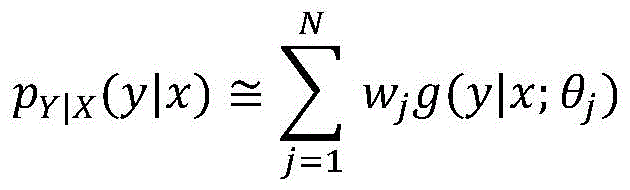
其中,N、以及集合{θj},{wj}是待估计参数。权重wj是标量参数。Among them, N, and the set {θ j }, {w j } are parameters to be estimated. The weights w j are scalar parameters.
函数pY|X(y|x)是具有通常跨越在连续域中的变量x和y的双变量。The function p Y|X (y|x) is bivariate with variables x and y typically spanning in a continuous domain.
在第一种情况下,假设符号x属于基数(cardinality)M的有限字母表Ω={ω1,...,ωM},它是特别固定的和已知的。在根据“训练模式”的第一实施方式中,符号x在接收器处是已知的。在根据“跟踪模式”的第二实施方式中,符号x在接收器处是未知的,但是输入信号概率分布pX(x)是已知的。In the first case, it is assumed that the symbol x belongs to the finite alphabet Ω={ω 1 , . . . , ω M } of cardinality M, which is particularly fixed and known. In a first embodiment according to the "training mode", the symbol x is known at the receiver. In a second embodiment according to the "tracking mode", the symbol x is unknown at the receiver, but the input signal probability distribution p X (x) is known.
在第二种情况下,符号x可以属于有限信号集合,但是该集合不是特别固定的,也不是已知的。在根据“训练模式”的第三实施方式中,符号x在接收器处是已知的。在根据“跟踪模式”的第四实施方式中,符号x是未知的。In the second case, the symbol x can belong to a finite set of signals, but that set is not particularly fixed nor known. In a third embodiment according to the "training mode", the symbol x is known at the receiver. In a fourth embodiment according to the "tracking mode", the sign x is unknown.
在第一种情况下(与上述第一实施方式和第二实施方式相同),条件概率分布完全由下式来表征In the first case (same as the first and second embodiments described above), the conditional probability distribution is fully characterized by

其中,pX(x=ωm)在除了ωm之外的任何地方都为空值,其中,该值等于发送符号ωm的概率。因此,对于x的M个可能值,寻求近似仅y的M个函数PY|X(y|x=ωm)。where pX (x= ωm ) is null everywhere except ωm , where this value is equal to the probability of sending the symbol ωm . Thus, for M possible values of x, M functions P Y|X (y|x= ωm ) approximating only y are sought.
这可以通过使用如下所陈述的M个估计器来并行地完成。This can be done in parallel by using M estimators as stated below.
因此,现在考虑以下近似:So now consider the following approximation:

这里,各个转换取决于所发送的符号(M个可能性,其中,M是由第一实施方式和第二实施方式所共享的第一种情况中的已知符号集的基数)。Here, each conversion depends on the transmitted symbols (M possibilities, where M is the base of the known symbol set in the first case shared by the first and second embodiments).
求解式(1)的这个估计问题通常是困难的。实际上,提供最佳近似的数量Nm是未知的,这使得难以使用确定性方法,诸如期望最大化算法。Solving this estimation problem of equation (1) is generally difficult. In practice, the number N m that provides the best approximation is unknown, which makes it difficult to use deterministic methods, such as expectation-maximization algorithms.
多个实施方式对于条件概率分布估计是可能的,并且根据关于x的知识或其统计的假设而不同。Multiple implementations are possible for conditional probability distribution estimation, and differ in terms of knowledge about x or assumptions about its statistics.
下面特别针对由估计器13执行的条件概率分布估计来描述实施方式。如下面将明白的,这些实施方式不一定需要任何优化器14(其如上所示是可选的)。Embodiments are described below in particular for the conditional probability distribution estimation performed by the
在与“训练模式”相关的第一实施方式中,假设由发送器发送的符号x在条件概率分布估计器13处是已知的。将这些符号用作导频符号,以便学习如图6所示的最佳近似。In a first embodiment related to the "training mode", it is assumed that the symbols x sent by the transmitter are known at the conditional
在与训练模式相关的该第一实施方式中,以及在与下面详细描述的跟踪模式相关的第二实施方式中,优化器14不是必需的,并且最终仅在接收器11处需要pY|X(y|x)的估计。In this first embodiment in relation to the training mode, and in the second embodiment in relation to the tracking mode described in detail below, the
训练模式通过在接收器11处已知的给定时间/频率资源而在发送器10处启用,该接收器还知道所发送的消息或等效的x。因此,参照图6,特别地将符号x提供给估计器13。通常,关于x的知识也可以在正确解码(数据辅助训练)之后在接收器处获得。这可以通过例如循环冗余校验来检查所解码的消息的正确性。The training mode is enabled at the
当x在接收器处完全已知时,求解式(1)可以通过使用基于吉布斯采样所描述的方法来实现,如例如在以下文献中公开的When x is fully known at the receiver, solving equation (1) can be achieved by using the method described based on Gibbs sampling, as disclosed for example in
NEAL00:Neal、Radford M.的“Markov chain sampling methods for Dirichletprocess mixture models.”计算和图形统计杂志9.2(2000):249-265。NEAL00: Neal, Radford M. "Markov chain sampling methods for Dirichlet process mixture models." Journal of Computational and Graphical Statistics 9.2 (2000): 249-265.
它提供了一种计算高效和高性能的解决方案,尤其是当概率分布函数g(y|x=ωm;θ)属于指数族时。吉布斯采样是随机化算法,即,它使用所生成的随机值来执行统计推理的近似,而不是依赖于确定性方法。通常,这涉及迭代方法。使用采样允许通过操纵有限数量的元素而不是连续函数来降低复杂度。使用吉布斯采样尤其允许高效地操纵表示在统计推理方法中使用的多变量概率分布的复杂多变量函数。因此,用于在(1)中执行估计的主要原理是从关于已知观测样本y的参数{θm,j},{wm,j}的后验分布中采样(即,获得代表性样本)。特别地,可以将狄利克雷过程用作无限混合模型中的先验概率分布。它是多项式分布的可能参数上的分布,并且具有要作为多项式分布的共轭先验的有利特性。该特性有助于简化吉布斯采样的一些步骤。而且,已知狄利克雷过程导致很少的主要分量。因此,通过找到这些Nm个主要分量,使得近似是紧凑和准确的。It provides a computationally efficient and high-performance solution, especially when the probability distribution function g(y|x= ωm ;θ) belongs to the exponential family. Gibbs sampling is a randomization algorithm, that is, it uses generated random values to perform an approximation of statistical inference, rather than relying on deterministic methods. Typically, this involves an iterative approach. Using sampling allows for reduced complexity by manipulating a finite number of elements rather than continuous functions. The use of Gibbs sampling in particular allows efficient manipulation of complex multivariate functions representing multivariate probability distributions used in statistical inference methods. Therefore, the main principle used to perform the estimation in (1) is to sample from the posterior distribution with respect to the parameters {θ m,j }, {w m,j } with respect to the known observed sample y (i.e., obtain a representative sample ). In particular, Dirichlet processes can be used as prior probability distributions in infinite mixture models. It is a distribution over the possible parameters of a multinomial distribution and has the advantageous property of being a conjugate prior for the multinomial distribution. This feature helps simplify some steps of Gibbs sampling. Also, Dirichlet processes are known to lead to few principal components. Therefore, by finding these N m principal components, the approximation is made compact and accurate.
需要对本文使用NEAL00的教导进行一些修改。假设x属于接收器处已知的有限字母表。将各个观测值yi与x的M个可能值中的给定符号xi相关联,并且根据xi的值馈送M个并行估计器中的一个(估计器则为[NEAL00]中描述的三个估计器中的一个)。最后,从M个估计器中获得M个函数pY|X(y|x=ωm)。特别地,参数Nm、{θm,j},{wm,j}是各个估计器的输出,并且允许表征M个函数pY|X(y|x=ωm)。Some modifications to the teachings herein using NEAL00 are required. Suppose x belongs to a finite alphabet known at the receiver. Associate each observation y i with a given symbol xi among M possible values of x, and feed one of M parallel estimators according to the value of xi (the estimators are the three described in [NEAL00] one of the estimators). Finally, M functions p Y|X (y|x=ωm) are obtained from M estimators. In particular, the parameters N m , {θ m,j }, {w m,j } are outputs of the respective estimators and allow to characterize M functions p Y|X (y|x=ω m ).
图7是x在此属于{+1、-1、...、-3}的实现的视觉示例。Figure 7 is a visual example of the realization that x here belongs to {+1, -1, ..., -3}.
下面相对于训练模式给出实施方式的示例的细节,如图11所示。在第一实施方式中,当所接收到的信号y与所发送的符号x相关联(诸如x=ωm)时,可以仅选择该接收到的信号y。Details of an example of an embodiment are given below with respect to a training mode, as shown in FIG. 11 . In a first embodiment, a received signal y may only be selected when it is associated with a transmitted symbol x, such as x=ω m .
在步骤S10中。条件概率分布估计基于信道概率分布的近似,信道概率分布的近似依赖于分解成概率分布函数g(y|θm,j)的基底,θm,j是参数集。分布函数是指数族,并且参数基本上是标量情况下的均值和方差,更一般地,是多变量情况下的均值向量和协方差矩阵。In step S10. Conditional probability distribution estimation is based on the approximation of the channel probability distribution, which depends on the basis decomposed into the probability distribution function g(y|θ m, j ), where θ m, j is the parameter set. The distribution functions are of the exponential family, and the parameters are basically the mean and variance in the scalar case, and more generally, the mean vector and covariance matrix in the multivariate case.
在步骤S11中,条件概率分布估计器可以以前述的基底来找到pY|X(y|x=ωm)的最佳近似:In step S11, the conditional probability distribution estimator can use the aforementioned basis to find the best approximation of p Y|X (y|x=ω m ):

其中,Nm、以及集合{θm,j},{wm,j}是要在步骤S12估计的参数。Among them, N m , and the sets {θ m, j }, {w m, j } are the parameters to be estimated in step S12.
解决这个估计问题通常是困难的。实际上,提供最佳近似的数量Nm是未知的,这使得难以使用确定性方法,诸如期望最大化算法。Solving this estimation problem is often difficult. In practice, the number N m that provides the best approximation is unknown, which makes it difficult to use deterministic methods, such as expectation-maximization algorithms.
然而,下面参照图11的步骤S121到S124描述的聚类的使用以及更一般地在NEAL00中描述的基于吉布斯采样的方法提供了计算上高效和高性能的解决方案,尤其是当概率分布函数g(y|x=ωm;θm,j)属于指数族时。吉布斯采样是随机化算法:它使用所生成的随机值来执行统计推理的近似,而不是依赖于确定性方法。通常,这涉及迭代方法。However, the use of clustering described below with reference to steps S121 to S124 of Figure 11 and more generally the Gibbs sampling-based approach described in NEAL00 provides a computationally efficient and performant solution, especially when the probability distribution When the function g(y|x=ω m ; θ m, j ) belongs to the exponential family. Gibbs sampling is a randomization algorithm: it uses generated random values to perform an approximation of statistical inference, rather than relying on deterministic methods. Typically, this involves an iterative approach.
使用采样允许通过操纵有限数量的元素而不是连续函数来降低复杂度。使用吉布斯采样尤其允许高效地管理表示在统计推理方法中使用的多变量概率分布的复杂多变量函数。因此,用于在(1)中执行估计的主要原理是,在第m个估计器的输入处,从关于已知观测样本y的参数{θm,j},{wm,j}的后验分布中采样(即,获得代表性样本),即,在选择与如接收器已知的所发送的符号x=ωm相关联的所观测到的符号y之后,即,对于其中已知所发送的符号x=ωm的时隙,所观测到的符号馈送第m个估计器。Using sampling allows for reduced complexity by manipulating a finite number of elements rather than continuous functions. Using Gibbs sampling in particular allows efficient management of complex multivariate functions representing multivariate probability distributions used in statistical inference methods. Therefore, the main principle used to perform the estimation in (1) is that, at the input of the m-th estimator, from the parameters {θ m, j }, {w m, j } with respect to the known sampling (i.e., obtaining a representative sample) from an empirical distribution, i.e., after selecting the observed symbol y associated with the transmitted symbol x= ωm as known to the receiver, i.e., for which it is known that Sent symbols x = ω m time slots, observed symbols are fed to the mth estimator.
特别地,可以将狄利克雷过程用作无限混合模型中的先验概率分布。它是多项式分布的可能参数上的分布,并且具有多项式的共轭先验的特性(这有助于简化吉布斯采样的一些步骤,如在[NEAL00]中所解释的)。而且,已知狄利克雷过程导致很少的主要分量。因此,通过找到这些Nm个主要分量,近似是紧凑和准确的。In particular, Dirichlet processes can be used as prior probability distributions in infinite mixture models. It is a distribution over the possible parameters of a multinomial distribution and has the property of a conjugate prior of a multinomial (which helps simplify some steps of Gibbs sampling, as explained in [NEAL00]). Also, Dirichlet processes are known to lead to few principal components. Therefore, by finding these N m principal components, the approximation is compact and accurate.
为了以易处理的方式确定这些分量,可以应用蒙特卡罗(Monte Carlo)方法(并且更具体地,Markov链蒙特卡罗),从而允许从概率分布中抽取样本。更具体地,吉布斯采样提供了实现本公开的相关算法类。吉布斯采样方法通常涉及数值积分步骤,这是计算上要求的。有幸的是,当概率分布函数g(y|x;θ)是共轭先验分布(这是针对指数族的情况)时,可以以显著降低计算复杂度的闭型表达式来执行积分。由于pY|X(y|x=ωm)是g(y|x;θ)个函数的加权和,因此它的共轭先验也是已知的并且被高效地计算。在吉布斯采样的输出处,对值Nm、以及集合{θm,j},{wm,j}进行估计,如图11的总步骤S12所示。To determine these components in a tractable manner, Monte Carlo methods (and more specifically Markov chain Monte Carlo) can be applied, allowing samples to be drawn from probability distributions. More specifically, Gibbs sampling provides related algorithm classes that implement the present disclosure. Gibbs sampling methods usually involve a numerical integration step, which is computationally demanding. Fortunately, when the probability distribution function g(y|x; θ) is a conjugate prior distribution (which is the case for the exponential family), the integration can be performed in a closed-form expression that significantly reduces computational complexity. Since p Y|X (y|x=ω m ) is a weighted sum of g(y|x; θ) functions, its conjugate prior is also known and computed efficiently. At the output of the Gibbs sampling, the value N m , and the set {θ m,j }, {w m,j } are estimated, as shown in general step S12 of FIG. 11 .
在当前情况下,在图11所示的特定实施方式中使用[NEAL00]的折叠吉布斯采样,并且在针对第m个估计器的特定情况下按照以下来应用:In the present case, the folded Gibbs sampling of [NEAL00] is used in the specific implementation shown in Fig. 11 and applied in the specific case for the mth estimator as follows:
·在步骤S10中,考虑基底g(y|θ)是来自指数分布族的。• In step S10, the basis g(y|θ) is considered to be from the family of exponential distributions.
ο这允许考虑关于θ的先验与具有参数λ的指数分布共轭。这是一种数学技巧,允许具有用于以下步骤的闭型表达式。o This allows considering priors on θ conjugated to an exponential distribution with parameter λ. This is a mathematical trick that allows to have closed-form expressions for the following steps.
ολ={λ1,λ2}表示关于参数的共轭先验的超参数。ολ={λ 1 ,λ 2 } denotes a hyperparameter of the conjugate prior on the parameter.
·在步骤S11中,执行对与所发送的符号x=ωm相关联的所观测到的符号{yn}的选择,其中,yn是所选择的观测到的符号中的第n个符号。表达式x1:n=ωm表示这里考虑的所有发送的符号是相同的并且等于ωm的事实。· In step S11, a selection of the observed symbols {y n } associated with the transmitted symbols x= ωm is performed, where y n is the n-th symbol among the selected observed symbols . The expression x 1 :n = ω m expresses the fact that all transmitted symbols considered here are identical and equal to ω m .
然后,可以将该总步骤S12分解成子步骤S121至S124,如下:Then, this general step S12 can be decomposed into sub-steps S121 to S124, as follows:
·在步骤S121中,考虑参数集{θm,j},{wm,j}的Nm个聚类:· In step S121, consider N m clusters of parameter sets {θ m,j }, {w m,j }:
ο将聚类用于将所接收到的符号分组在一起。聚类是通过为各个符号组关联从1到Nm的整数索引来实现的,如下所述。该聚类指派方法可以通过各个所接收到的符号更可能与组成(1)中pY|X(y|x=ωm)的N个模式中的一个模式相关联的事实来证明。o Clustering is used to group received symbols together. Clustering is achieved by associating individual symbol groups with integer indices from 1 to Nm , as described below. This cluster assignment method can be justified by the fact that each received symbol is more likely to be associated with one of the N patterns making up p Y|X (y|x= ωm ) in (1).
ο第i个所观测到的符号的聚类指派索引是ci。o The cluster assignment index of the ith observed symbol is c i .
ο设c-i是除第i个聚类之外的其它所有聚类的聚类指派索引。ο Let c -i be the cluster assignment indices of all clusters except the i-th cluster.
·在步骤S122中,在所发送的符号是ωm的假设下,计算后验分布p(ci=k|y1:n,c-i,λ,x1:n=ωm),其中,y1:n表示所接收到的信号y的输入符号。可以显示出,· In step S122, under the assumption that the transmitted symbols are ω m , calculate the posterior distribution p( ci =k|y 1 : n , c −i , λ, x 1 : n = ω m ), where , y 1 : n represents the input symbol of the received signal y. can show that
οp(ci=k|y1:n,c-i,λ,x1:n=ωm)=p(ci=k|c-i)p(yi|y1:i-1,yi+1:n,c-i,ci=k,λ,x1:n=ωm)οp(c i =k|y 1 : n , c −i , λ, x 1 : n =ω m )=p(c i =k|c −i )p(y i |y 1 : i−1 , y i+1: n , c −i , c i =k, λ, x 1: n = ω m )
οp(ci=k|c-i)例如是由于波利亚(Polya)坛子模型来计算的οp(c i =k|c -i ) is calculated for example due to the Polya jar model
οp(yi|y1:i-1,yi+1:n,c-i,ci=k,λ,x1:n=ωm)=∫p(yi|xi=ωm,θ)p(θ|y1:i-1,yi+1:n,c-i,ci=k,λ,x1:n=ωm)dθ,其是可计算的,因为p(yi|xi=ωm,θ)遵循近似
·在步骤S123中,执行从后验分布起的采样,以便更新参数{θm,j},{wm,j}。• In step S123, sampling from the posterior distribution is performed in order to update the parameters {θ m,j }, {w m,j }.
·还优选检查是否必须创建新的聚类。这有助于确定提供信道条件概率分布的最佳近似的最佳值Nm。这在步骤S124中通过首先开始新的聚类来完成,该新的聚类被定义为- It is also preferably checked whether a new cluster has to be created. This helps to determine the optimal value Nm that provides the best approximation of the channel condition probability distribution. This is done in step S124 by first starting a new cluster defined as
p(yi|xi=ωm,P0)=∫p(yi|xi=ωm,θ)dP0 p(y i | xi =ω m ,P 0 )=∫p(y i |xi=ω m ,θ)dP 0
其中,P0是p(y|x=ωm;θm,j)(具有参数λ)的共轭。然后,从该概率进行随机选择以创建新的聚类。因此,从验证该概率的概率进行随机选择以创建新的聚类。where P 0 is the conjugate of p(y|x=ω m ; θ m,j ) (with parameter λ). Then, a random selection is made from this probability to create a new cluster. Therefore, a random selection is made from the probability of validating that probability to create a new cluster.
在该过程的输出处,对参数Nm、{θm,j},{wm,j}进行估计,并且提供来自(1)的信道条件概率分布pY|X(y|x=ωm)的近似。对M个估计器重复或并行执行该过程。At the output of this process, the parameters N m , {θ m,j }, {w m,j } are estimated and the channel conditional probability distribution p Y|X (y|x=ω m ) approximation. This process is repeated or performed in parallel for M estimators.
下面给出第二实施方式,其利用统计知识实现“跟踪模式”。在第一实施方式之后高效地使用该模式。在该实施方式中,所发送的符号x是无法知道的,但是如下面的图9所呈现的,仍然可以使用pX(x)的知识以便评估(1),然后将其提供给估计器13(以及接收器11和发送器10)。实际上,没有从所观测到的符号进行选择的步骤。然而,仍然计算M个估计器,并且将任何观测到的符号都视为输入。贝叶斯(Bayesian)推理的目的是,根据所观测到的符号对应于与第m个估计器相关联的符号x=ωm的传输的置信,来对所观测到的符号进行加权。A second embodiment is given below, which implements a "tracking mode" using statistical knowledge. Use this pattern effectively after the first implementation. In this embodiment the transmitted symbol x is not known, but knowledge of p X (x) can still be used in order to evaluate (1) as presented in Figure 9 below, which is then provided to the estimator 13 (and
与训练模式的主要差别在于所发送的符号x是未知的。然而,x的值可以利用贝叶斯方法来推断,即,各个观测值y有助于根据关于条件概率分布的当前估计利用对应于y与ωm相关联的概率的权重进行pY|X(y|x=ωm)的更新。The main difference from the training mode is that the transmitted symbol x is unknown. However, the value of x can be inferred using Bayesian methods, i.e., each observation y contributes to p Y|X ( y|x=ω m ) update.
下面给出关于实现前述跟踪模式的第二实施方式的细节。Details regarding a second embodiment implementing the aforementioned tracking mode are given below.
将使用聚类技术。如果(θi)属于第j个聚类,则设聚类分配标签为si=j。设ρn=[s1,...,sn]T表示聚类分配标签的向量。使用根据协变量相关坛子模型的狄利克雷过程(DP)中的预测,获得:Clustering techniques will be used. If (θ i ) belongs to the jth cluster, then set the cluster assignment label as s i =j. Let ρ n =[s 1 , . . . , sn ] T denotes a vector of cluster assignment labels. Using predictions in a Dirichlet process (DP) according to the covariate dependent jar model, one obtains:

对于各个估计器,为了从所观测到的符号来更新条件概率分布PY|X(y|x=ωm),可以计算For each estimator, to update the conditional probability distribution P Y|X (y|x=ω m ) from the observed symbols, one can compute

其中,
然后,可以与第一实施方式类似地更新聚类。例如在以下文献中给出根据协变量相关坛子模型的狄利克雷过程(DP)中的预测原理的细节:“Improving prediction fromDirichlet process mixtures via enrichment”,Sara K.Wade,David B.Dunson,SoniaPetrone,Lorenzo Trippa,Journal of Machine Learning Research(机器学习研究杂志,2013年11月15日)Then, the clusters can be updated similarly to the first embodiment. Details of the principles of prediction in Dirichlet processes (DP) from covariate dependent jar models are given, for example, in: "Improving prediction from Dirichlet process mixtures via enrichment", Sara K. Wade, David B. Dunson, Sonia Petrone, Lorenzo Trippa, Journal of Machine Learning Research (Journal of Machine Learning Research, November 15, 2013)
在第三实施方式中,符号x未被假定为属于有限字母表。因此,对于所有可能的x值,必须学习双变量条件概率pY|X(y|x)。In a third embodiment, the symbol x is not assumed to belong to a limited alphabet. Therefore, for all possible values of x, the bivariate conditional probability p Y|X (y|x) must be learned.
在步骤S10中,条件概率分布估计基于信道概率分布的近似,该信道概率分布的近似依赖于分解成概率分布函数g(y|x,θj)的基底,其中,θj是参数集。分布函数是指数族,并且参数基本上是标量情况下的均值和方差,更一般地,是多变量情况下的均值向量和协方差矩阵。条件概率分布估计器可以以前述基底来找到pY|X(y|x)的最佳近似:In step S10, the conditional probability distribution estimation is based on the approximation of the channel probability distribution which depends on the basis decomposed into the probability distribution function g(y|x, θ j ), where θ j is a parameter set. The distribution functions are of the exponential family, and the parameters are basically the mean and variance in the scalar case, and more generally, the mean vector and covariance matrix in the multivariate case. The conditional probability distribution estimator can find the best approximation of p Y|X (y|x) in the aforementioned basis:

其中,N、以及集合{θj},{wj}是待估计的参数。Among them, N, and the set {θ j }, {w j } are the parameters to be estimated.
该解决方案依赖于与第一实施方式中相同的算法,其中主要的区别如下:只有一个估计器而不是M个。发送器将发送在接收器处已知的符号x。将通过使用来自伪随机发生器的这些所发送的符号来改善性能,该伪随机发生器将在所关注的域(例如遵循高斯分布)上生成x个值。通过知道伪随机发生器的初始参数,发送器和接收器都可以知道x个符号。This solution relies on the same algorithm as in the first embodiment, with the main difference as follows: there is only one estimator instead of M. The sender will send a symbol x known at the receiver. Performance will be improved by using these transmitted symbols from a pseudo-random generator that will generate x values over the domain of interest (eg following a Gaussian distribution). By knowing the initial parameters of the pseudo-random generator, both the sender and receiver can know x symbols.
估计器使用如第一实施方式中的折叠吉布斯采样方法。在当前情况下,再次在相同的图11所示的特定实施方式中使用NEAL00的折叠吉布斯采样,并且在针对估计器的特定情况下将其应用为:The estimator uses the folded Gibbs sampling method as in the first embodiment. In the present case, the folded Gibbs sampling of NEAL00 is used again in the same specific implementation shown in Fig. 11 and applied in the specific case for the estimator as:
·在步骤S10中,考虑基底g(y|x,θ)是来自指数分布族。• In step S10, the basis g(y|x, θ) is considered to be from the family of exponential distributions.
ο这允许考虑关于θ的先验与具有参数λ的指数分布共轭。这是一种数学技巧,其允许具有用于以下步骤的闭型表达式。o This allows considering priors on θ conjugated to an exponential distribution with parameter λ. This is a mathematical trick that allows to have closed-form expressions for the following steps.
ολ={λ1,λ2}表示关于参数的共轭先验的超参数。ολ={λ 1 ,λ 2 } denotes a hyperparameter of the conjugate prior on the parameter.
·这里,步骤S11现在对应于与所发送的符号{xn}相关联的所观测到的符号{yn}的选择。• Here, step S11 now corresponds to the selection of the observed symbol {y n } associated with the transmitted symbol {x n }.
该总步骤S12可以再次分解成:This general step S12 can be decomposed into again:
·在步骤S121中,考虑参数集{θj},{wj}的N个聚类。• In step S121, N clusters of parameter sets {θ j }, {w j } are considered.
ο将聚类用于将所接收到的符号分组在一起。聚类是通过为各个符号组关联从1到N的整数索引来实现的,如下所述。该聚类指派方法可以通过各个所接收到的符号更可能与组成(1)中pY|X(y|x)的N个模式中的一个模式相关联的事实来证明。o Clustering is used to group received symbols together. Clustering is achieved by associating individual symbol groups with integer indices from 1 to N, as described below. This cluster assignment method can be justified by the fact that each received symbol is more likely to be associated with one of the N patterns making up p Y|X (y|x) in (1).
ο第i个所观测到的符号的聚类指派索引是ci。o The cluster assignment index of the ith observed symbol is ci.
ο设c-i是除第i个聚类之外的其它所有聚类的聚类指派索引。ο Let c -i be the cluster assignment indices of all clusters except the i-th cluster.
·在步骤S122中,计算后验分布p(ci=k|y1:n,x1:n,c-i,λ),其中,y1:n表示所接收到的信号y的输入符号。可以显示出,· In step S122, calculate the posterior distribution p( ci =k| y1:n , x1:n , c -i , λ), where y1:n represents the input symbol of the received signal y . can show that
ο(ci=k|y1:n,x1:n,c-i,λ)=p(ci=k|c-i)p(yi|y1:i-1,yi+1:n,x1:n,c-i,ci=k,λ)ο(c i =k|y 1:n , x 1:n , c -i , λ)=p( ci =k|c -i )p(y i |y 1:i-1 , y i+ 1: n , x 1: n , c −i , c i =k, λ)
οp(ci=k|c-i)例如是由于波利亚坛子模型来计算的οp( c i=k|c -i ) is calculated for example due to the Polya jar model
οp(yi|y1:i-1,yi+1:n,x1:n,c-i,ci=k,λ)=∫p(yi|xi,θ)p(θ|y1:i-1,yi+1:n,x1:n,c-i,ci=k,λ)dθ,其是可计算的,因为p(yi|xi,θ)遵循近似
·在步骤S123中,执行从后验分布起的采样,以便更新参数{θm},{wm}。• In step S123, sampling from the posterior distribution is performed in order to update the parameters {θ m }, {w m }.
·还优选检查是否必须创建新的聚类。这有助于确定提供信道条件概率分布的最佳近似的最佳值Nm。这在步骤S124中通过首先开始新的聚类来完成,该新的聚类被定义为- It is also preferably checked whether a new cluster has to be created. This helps to determine the optimal value Nm that provides the best approximation of the channel condition probability distribution. This is done in step S124 by first starting a new cluster defined as
p(yi|x,P0)=∫p(yi|x,θ)dP0,p(y i |x, P 0 )=∫p(y i |x, θ)dP 0 ,
其中,P0是p(y|x;θj)(具有参数λ)的共轭,它是可计算的,因为p(y|x;θj)是属于指数族的g(y|x,θj)个函数的加权和。然后,从该概率中进行随机选择以创建新的聚类。因此,从验证该概率的概率中进行随机选择以创建新的聚类。where P 0 is the conjugate of p(y|x; θ j ) (with parameter λ), which is computable because p(y|x; θ j ) is g(y|x, θ j ) weighted sum of functions. Then, a random selection is made from this probability to create a new cluster. Therefore, a random selection is made from the probabilities validating that probability to create a new cluster.
波利亚坛子模型的使用细节可以从以下文献中获得:Details of the use of the Polya jar model can be obtained from the following sources:
“Ferguson distributions via Polya urn schemes”,D.Blackwell andJ.B.MacQueen,《统计年鉴》,1973年,第1卷第2期,第353-355页。"Ferguson distributions via Polya urn schemes", D. Blackwell and J.B. MacQueen, Statistical Yearbook, 1973, Vol. 1, No. 2, pp. 353-355.
在涉及与前述第二种情况相关的跟踪模式的第四实施方式中,关注的是考虑输入不属于有限的字母表并且所发送的符号是未知的。在第三实施方式之后高效地使用该模式。用于非参数联合密度的模型被定义为:In a fourth embodiment related to the trace mode related to the aforementioned second case, it is of interest to consider that the input does not belong to the limited alphabet and the transmitted symbols are unknown. This mode is effectively used after the third embodiment. The model for the nonparametric joint density is defined as:

参数{θj}、{wj}、以及{ψj}表示条件密度参数,该条件密度参数分别可以是高斯密度的情况的均值和协方差、量值、以及输入分布的对应参数。一般而言,参数(θ,ψ)是从狄利克雷过程“DP”的基底度量联合获得的,即,(θ,ψ)~DP(αP0θ×P0ψ),其中,α是缩放参数。对应的条件概率密度可以写成以下非参数形式The parameters {θ j }, {w j }, and {ψ j } denote conditional density parameters, which may be the mean and covariance, magnitude, and corresponding parameters of the input distribution for the case of Gaussian density, respectively. In general, the parameters (θ,ψ) are jointly obtained from the basis metrics of the Dirichlet process "DP", ie, (θ,ψ) ~ DP(αP 0θ ×P 0ψ ), where α is the scaling parameter. The corresponding conditional probability density can be written in the following nonparametric form


值得注意的是,在预测阶段中,考虑到粒子的放置是固定的并且根据训练优化的事实:(22)中的分母和p(x|ψj)充当缩放因子。It is worth noting that, in the prediction phase, the denominator and p(x|ψ j ) in (22) act as scaling factors considering the fact that the placement of particles is fixed and optimized according to training.
将使用聚类技术。如果(θi,ψi)属于第j个聚类,则设聚类分配标签为si=j。设ρn=[s1,...,sn]T表示聚类分配标签的向量。使用根据协变量相关坛子模型的DP中的预测,获得:Clustering techniques will be used. If (θ i , ψ i ) belongs to the jth cluster, then set the cluster assignment label as s i =j. Let ρ n =[s 1 , . . . , sn ] T denotes a vector of cluster assignment labels. Using the predictions in DP according to the covariate dependent jar model, one obtains:

其中,in,


其中,nj是第j个聚类中的主题索引的数量。where nj is the number of topic indices in the jth cluster.
进一步假设在信道概率密度估计的跟踪阶段,粒子集是固定的。这是实际的假设,因为粒子在星座中的位置在大多数实际应用中是固定的。这里使用记法xn+1∈x1:n来强调从在训练期间使用的固定星座点集合发送新信号。针对新接收到的信号y的所估计的密度p(y|y1:n,x1:n,xn+1∈x1:n)被获得为It is further assumed that the particle set is fixed during the tracking phase of channel probability density estimation. This is a practical assumption, since the position of the particles in the constellation is fixed in most practical applications. The notation x n+1 ∈ x 1:n is used here to emphasize that new signals are sent from a fixed set of constellation points used during training. The estimated density p(y|y 1 : n , x 1 : n , x n+1 ∈ x 1 : n ) for the newly received signal y is obtained as
p(y|y1:n,x1:n,xn+1∈x1:n)=p(y|y 1: n , x 1: n , x n+1 ∈ x 1: n )=
∑ρn∑sn+1p(y|y1:n,x1:n,xn+1∈x1:n,ρn,sn+1)∑ ρn ∑s n+1 p(y|y 1: n , x 1: n , x n+1 ∈ x 1: n , ρ n , s n+1 )
×p(sn+1|y1:n,x1:n,xn+1∈x1:n,ρn)×p(s n+1 |y 1: n , x 1: n , x n+1 ∈ x 1: n , ρ n )
×p(ρn|y1:n,x1:n,xn+1∈x1:n), (27)×p(ρ n |y 1: n , x 1 : n , x n+1 ∈ x 1: n ), (27)
其中,如果(θi,ψi)属于第j个聚类,则ρn=[s1,...,sn]T表示具有si=j的聚类分配标签向量。使用(24),可以将(27)简化为Among them, if (θ i , ψ i ) belongs to the jth cluster, then ρ n =[s 1 , . Using (24), (27) can be simplified to
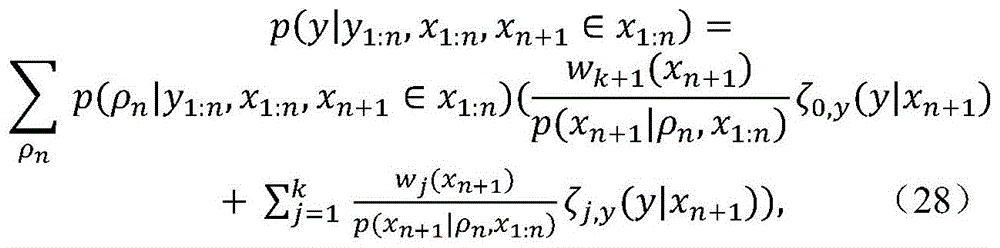
其中,k是分区ρn中的组数,并且where k is the number of groups in the partition ρn , and


其中,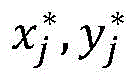
在上述实施方式中的任一实施方式之后,获得条件密度概率函数pY|X(y|x)的估计。在两个第一实施方式中,它是针对所发送的符号x的固定星座获得的,而对于第三实施方式和第四实施方式,它被称为y和x的双变量函数,并且特别是针对x的任何值的。Following any of the above embodiments, an estimate of the conditional density probability function p Y|X (y|x) is obtained. In the two first implementations it is obtained for a fixed constellation of transmitted symbols x, while for the third and fourth implementations it is called a bivariate function of y and x, and in particular for any value of x.
在接收器中使用pY|X(y|x)的这种知识,以便计算假定所发送的符号x的、各个所接收到的符号y的似然。通过选择使任何所接收到的符号x的似然最大的符号x,在所发送的符号的最大似然解码中需要该似然。该似然也是用于计算在软输入解码器的输入处提供的对数似然比的分量,诸如在以下文献中:J.Boutros、N.Gresset、L.Brunel以及M.Fossorier的“Soft-input soft-output lattice sphere decoder for linear channels”,GLOBECOM′03.IEEE全球电信会议(IEEE分类号03CH37489),加利福尼亚州旧金山,2003年,第3卷,第1583-1587页。This knowledge of p Y|X (y|x) is used in the receiver in order to calculate the likelihood of each received symbol y given the transmitted symbol x. By selecting the symbol x that maximizes the likelihood of any received symbol x, the likelihood is required in maximum likelihood decoding of the transmitted symbols. This likelihood is also a component used to calculate the log-likelihood ratio provided at the input of a soft-input decoder, such as in the following documents: "Soft- input soft-output lattice sphere decoder for linear channels", GLOBECOM'03. IEEE Global Conference on Telecommunications (IEEE Cat. No. 03CH37489), San Francisco, CA, 2003, Vol. 3, pp. 1583-1587.
因此,接收器对知道pY|X(y|x)的估计是感兴趣的。Therefore, the receiver is interested in knowing an estimate of p Y|X (y|x).
本发明可以有利地用于通过如由信道条件概率分布估计器向接收器提供的参数{wj}和{θj}来提供pY|X(y|x)的紧凑表示。The present invention can be advantageously used to provide a compact representation of p Y|X (y|x) by the parameters {w j } and {θ j } as provided to the receiver by the channel condition probability distribution estimator.
在另一选项中,可以在发送器处有利地使用pY|X(y|x)的知识,以便优化输入分布。实际上,根据给定分布pX(x)的知识(该给定分布在大多数应用中是离散的,具有固定的x位置和变化的概率),可以评估由具有输入pX(x)的pY|X(y|x)表征的信道的容量。因此,可以优化输入分布。In another option, the knowledge of p Y|X (y|x) can be advantageously used at the transmitter in order to optimize the input distribution. In fact, from knowledge of a given distribution pX (x) (which in most applications is discrete, with a fixed x position and varying probabilities), it is possible to evaluate The capacity of the channel represented by p Y|X (y|x). Therefore, the input distribution can be optimized.
在这种优化的第一种情况下,选择预定义的输入分布集当中的提供最高容量的输入分布。这种集合例如是通过对具有不同方差值的高斯输入分布进行采样而获得的。例如,对遵循QAM(例如,256QAM)星座的x位置执行采样。在这种优化的第二种情况下,该集合是由多个已知的星座提供的,诸如QPSK、16-QAM、64-QAM、256QAM、8-PSK、32-PSK等等。在这种优化的第三种情况下,随机选择符号x的位置和它们的关联的概率,并且在每次容量计算之后选择最佳找到的随机星座。In the first case of this optimization, the input distribution offering the highest capacity among a predefined set of input distributions is selected. Such a set is obtained, for example, by sampling a Gaussian input distribution with different variance values. For example, sampling is performed on x-positions following a QAM (eg, 256QAM) constellation. In the second case of this optimization, the set is provided by several known constellations, such as QPSK, 16-QAM, 64-QAM, 256QAM, 8-PSK, 32-PSK and so on. In the third case of this optimization, the positions of the symbols x and their associated probabilities are chosen randomly, and the best found random constellation is chosen after each capacity calculation.
在这种优化的最后一种情况下,从指数族中选择函数g(y|x,θj)是有利的。实际上,pY|X(y|x)作为这种函数的线性组合,可以以闭型来计算针对x的固定值的导数函数pY|X(y|x)。因此,可以使用梯度下降方法,以便优化关于输入分布pX(x)的容量。In the last case of this optimization, it is advantageous to choose the function g(y|x, θ j ) from the exponential family. In fact, p Y|X (y|x), as a linear combination of such functions, can calculate the derivative function p Y|X (y|x) for a fixed value of x in a closed form. Therefore, a gradient descent method can be used in order to optimize the capacity with respect to the input distribution p X (x).
本发明可以有利地用于通过如由信道条件概率分布估计器向发送器提供的参数{wj}和{θj}来提供pY|X(y|x)的紧凑表示。The present invention can advantageously be used to provide a compact representation of p Y|X (y|x) by the parameters {w j } and {θ j } as provided to the transmitter by the channel condition probability distribution estimator.
Claims (15)


Applications Claiming Priority (3)
| Application Number | Priority Date | Filing Date | Title |
|---|---|---|---|
| EP20305674.2 | 2020-06-19 | ||
| EP20305674.2A EP3926903B1 (en) | 2020-06-19 | 2020-06-19 | Optimization of a capacity of a communication channel using a dirichlet process |
| PCT/JP2021/016387 WO2021256085A1 (en) | 2020-06-19 | 2021-04-16 | Method, system, and computer program for optimizing a capacity of a communication channel using a dirichlet process |
Publications (2)
| Publication Number | Publication Date |
|---|---|
| CN115804068A true CN115804068A (en) | 2023-03-14 |
| CN115804068B CN115804068B (en) | 2025-07-08 |
Family
ID=71614794
Family Applications (1)
| Application Number | Title | Priority Date | Filing Date |
|---|---|---|---|
| CN202180042501.4A Active CN115804068B (en) | 2020-06-19 | 2021-04-16 | Method, system and computer program product for optimizing capacity of a communication channel using dirichlet procedure |
Country Status (5)
| Country | Link |
|---|---|
| US (1) | US12494947B2 (en) |
| EP (1) | EP3926903B1 (en) |
| JP (1) | JP7455240B2 (en) |
| CN (1) | CN115804068B (en) |
| WO (1) | WO2021256085A1 (en) |
Families Citing this family (2)
| Publication number | Priority date | Publication date | Assignee | Title |
|---|---|---|---|---|
| EP3926910B1 (en) * | 2020-06-19 | 2023-11-15 | Mitsubishi Electric R&D Centre Europe BV | Method for optimizing the capacity of communication channels |
| EP3926903B1 (en) * | 2020-06-19 | 2023-07-05 | Mitsubishi Electric R&D Centre Europe B.V. | Optimization of a capacity of a communication channel using a dirichlet process |
Citations (3)
| Publication number | Priority date | Publication date | Assignee | Title |
|---|---|---|---|---|
| KR101465747B1 (en) * | 2013-06-11 | 2014-12-01 | 경희대학교 산학협력단 | method of optimally sensing channel of primary user in cognitive radio network |
| US20160381596A1 (en) * | 2015-06-25 | 2016-12-29 | The Board Of Trustees Of The University Of Alabama | Intelligent multi-beam medium access control in ku-band for mission-oriented mobile mesh networks |
| CN108093680A (en) * | 2015-04-14 | 2018-05-29 | 蒂博·德·瓦罗格 | Based on pure random encryption communication method |
Family Cites Families (18)
| Publication number | Priority date | Publication date | Assignee | Title |
|---|---|---|---|---|
| GB2395871B (en) * | 2002-11-28 | 2006-01-11 | Toshiba Res Europ Ltd | Signal estimation methods and apparatus |
| GB2406759B (en) * | 2003-10-02 | 2006-06-07 | Toshiba Res Europ Ltd | Signal decoding methods and apparatus |
| US7848440B2 (en) * | 2005-07-07 | 2010-12-07 | University Of Utah Research Foundation | Multi-channel communication method and apparatus using plural Markov Chain Monte Carlo simulations |
| US7457367B2 (en) * | 2004-07-07 | 2008-11-25 | University Of Utah Research Foundation | Detector and method for estimating data probability in a multi-channel receiver |
| CN101095326B (en) | 2004-11-05 | 2013-07-24 | 辉达技术英国有限公司 | Method and system for computing log-likelihood ratios of encoded quadrature amplitude modulated signals |
| KR20070055128A (en) * | 2005-11-25 | 2007-05-30 | 삼성전자주식회사 | Iterative decoding device |
| KR100934170B1 (en) * | 2006-12-22 | 2009-12-29 | 삼성전자주식회사 | Channel Estimation Apparatus and Method in Multi-antenna Wireless Communication System |
| US8675780B2 (en) * | 2011-06-03 | 2014-03-18 | Indian Institute Of Science | Multiple input multiple output (MIMO) transmitted signal vector estimation employing Monte Carlo sampling techniques |
| JP2013223177A (en) | 2012-04-18 | 2013-10-28 | Sharp Corp | Receiver unit, reception method and reception program |
| JP6464447B2 (en) | 2013-09-02 | 2019-02-06 | 本田技研工業株式会社 | Observation value prediction apparatus and observation value prediction method |
| US9559786B2 (en) * | 2015-03-17 | 2017-01-31 | Mitsubishi Electric Research Laboratories, Inc. | Pilot-aided coherent receiver for optical communications |
| US9948415B2 (en) * | 2015-03-27 | 2018-04-17 | Intel IP Corporation | Method of processing a plurality of signals and signal processing device |
| JP6511982B2 (en) | 2015-06-19 | 2019-05-15 | 株式会社デンソー | Driving operation discrimination device |
| KR102403763B1 (en) * | 2017-06-27 | 2022-05-30 | 삼성전자주식회사 | A method for configuring feedback information for channel state information feedback in wireless communication system |
| EP3926910B1 (en) * | 2020-06-19 | 2023-11-15 | Mitsubishi Electric R&D Centre Europe BV | Method for optimizing the capacity of communication channels |
| EP3926903B1 (en) * | 2020-06-19 | 2023-07-05 | Mitsubishi Electric R&D Centre Europe B.V. | Optimization of a capacity of a communication channel using a dirichlet process |
| US11929853B2 (en) * | 2020-10-19 | 2024-03-12 | Qualcomm Incorporated | Data-driven probabilistic modeling of wireless channels using conditional variational auto-encoders |
| US12126440B2 (en) * | 2020-12-25 | 2024-10-22 | Intel Corporation | Communication devices and methods based on markov-chain monte-carlo (MCMC) sampling |
-
2020
- 2020-06-19 EP EP20305674.2A patent/EP3926903B1/en active Active
-
2021
- 2021-04-16 CN CN202180042501.4A patent/CN115804068B/en active Active
- 2021-04-16 JP JP2022579322A patent/JP7455240B2/en active Active
- 2021-04-16 US US17/928,734 patent/US12494947B2/en active Active
- 2021-04-16 WO PCT/JP2021/016387 patent/WO2021256085A1/en not_active Ceased
Patent Citations (3)
| Publication number | Priority date | Publication date | Assignee | Title |
|---|---|---|---|---|
| KR101465747B1 (en) * | 2013-06-11 | 2014-12-01 | 경희대학교 산학협력단 | method of optimally sensing channel of primary user in cognitive radio network |
| CN108093680A (en) * | 2015-04-14 | 2018-05-29 | 蒂博·德·瓦罗格 | Based on pure random encryption communication method |
| US20160381596A1 (en) * | 2015-06-25 | 2016-12-29 | The Board Of Trustees Of The University Of Alabama | Intelligent multi-beam medium access control in ku-band for mission-oriented mobile mesh networks |
Non-Patent Citations (4)
| Title |
|---|
| YU LIU等: "Modulation Classification via Gibbs Sampling Based on a Latent Dirichlet Bayesian Network", 《IEEE SIGNAL PROCESSING LETTERS》, 29 May 2014 (2014-05-29) * |
| ZHAO DELIN等: "Dynamic and Flexible OFDM System Based on Joint Coded Modulation", 《IEEE ACCESS,USA,VOL.8.7 MAY 2020,PAGES86057-86064》, 18 May 2020 (2020-05-18) * |
| 刘阳阳;戴明威;黄晓霞;: "基于分层Dirichlet过程的频谱利用聚类和预测", 集成技术, no. 02, 15 March 2015 (2015-03-15) * |
| 路新华;MANCHÓN CARLES NAVARRO;王忠勇;张传宗;: "大规模MIMO系统上行链路时间-空间结构信道估计算法", 电子与信息学报, no. 02, 15 February 2020 (2020-02-15) * |
Also Published As
| Publication number | Publication date |
|---|---|
| EP3926903B1 (en) | 2023-07-05 |
| US12494947B2 (en) | 2025-12-09 |
| CN115804068B (en) | 2025-07-08 |
| EP3926903A1 (en) | 2021-12-22 |
| JP2023516831A (en) | 2023-04-20 |
| JP7455240B2 (en) | 2024-03-25 |
| WO2021256085A1 (en) | 2021-12-23 |
| US20230216708A1 (en) | 2023-07-06 |
Similar Documents
| Publication | Publication Date | Title |
|---|---|---|
| Park et al. | Learning to demodulate from few pilots via offline and online meta-learning | |
| Sun et al. | Generative-adversarial-network enabled signal detection for communication systems with unknown channel models | |
| CN114097202B (en) | Decoder and method for decoding a signal | |
| CN114051701A (en) | Apparatus and method for machine learning assisted precoding | |
| KR20110135597A (en) | Apparatus and method using matrix network coding | |
| CN107070525B (en) | Parametric sequential decoding | |
| CN108353046A (en) | Expected termination for sequential decoders | |
| CN108234072B (en) | Method and apparatus for sub-block decoding of a data signal | |
| Bereyhi et al. | Device scheduling in over-the-air federated learning via matching pursuit | |
| Islam et al. | Deep learning in physical layer: Review on data driven end-to-end communication systems and their enabling semantic applications | |
| CN115804068A (en) | Method, system and computer program for optimizing the capacity of a communication channel using the dirichlet process | |
| CN109768857B (en) | CVQKD multidimensional negotiation method using improved decoding algorithm | |
| US12231280B2 (en) | Method, computer program, system, and communication device for optimizing the capacity of communication channels | |
| CN112350966B (en) | MIMO receiving judgment method based on diffusion channel in molecular communication | |
| Letafati et al. | Probabilistic constellation shaping with denoising diffusion probabilistic models: A novel approach | |
| Caire et al. | Information bottleneck for an oblivious relay with channel state information: the scalar case | |
| EP3442185A1 (en) | Signal decoding in mimo communication systems | |
| Chen et al. | Blind nonlinear system identification based on a constrained hybrid genetic algorithm | |
| CN115048995B (en) | Channel scene classification method, system and storage medium based on deep learning | |
| Si-Ma et al. | Model-aware end-to-end learning for SISO optical wireless communication over poisson channel | |
| Nouri et al. | Constrained secrecy capacity of finite-input intersymbol interference wiretap channels | |
| Dulek | ML modulation classification in presence of unreliable observations | |
| Chen et al. | A Novel GNN-based Decoding Scheme for Sparse Code Multiple Access (SCMA) | |
| KR101483568B1 (en) | Low-complexity Cost Function Calculation for Multiple-input Multiple-output systems | |
| CN119814069A (en) | NOMA transceiver design method and system based on multi-user variational information bottleneck |
Legal Events
| Date | Code | Title | Description |
|---|---|---|---|
| PB01 | Publication | ||
| PB01 | Publication | ||
| SE01 | Entry into force of request for substantive examination | ||
| SE01 | Entry into force of request for substantive examination | ||
| GR01 | Patent grant | ||
| GR01 | Patent grant |