CN115802496A - Systems, methods and apparatus for sidelink communications - Google Patents
Systems, methods and apparatus for sidelink communications Download PDFInfo
- Publication number
- CN115802496A CN115802496A CN202211104315.1A CN202211104315A CN115802496A CN 115802496 A CN115802496 A CN 115802496A CN 202211104315 A CN202211104315 A CN 202211104315A CN 115802496 A CN115802496 A CN 115802496A
- Authority
- CN
- China
- Prior art keywords
- lbt
- slot
- transmission
- resources
- channel
- Prior art date
- Legal status (The legal status is an assumption and is not a legal conclusion. Google has not performed a legal analysis and makes no representation as to the accuracy of the status listed.)
- Pending
Links
Images


Classifications
-
- H—ELECTRICITY
- H04—ELECTRIC COMMUNICATION TECHNIQUE
- H04W—WIRELESS COMMUNICATION NETWORKS
- H04W74/00—Wireless channel access
- H04W74/08—Non-scheduled access, e.g. ALOHA
- H04W74/0808—Non-scheduled access, e.g. ALOHA using carrier sensing, e.g. carrier sense multiple access [CSMA]
-
- H—ELECTRICITY
- H04—ELECTRIC COMMUNICATION TECHNIQUE
- H04W—WIRELESS COMMUNICATION NETWORKS
- H04W72/00—Local resource management
- H04W72/04—Wireless resource allocation
- H04W72/044—Wireless resource allocation based on the type of the allocated resource
- H04W72/0446—Resources in time domain, e.g. slots or frames
-
- H—ELECTRICITY
- H04—ELECTRIC COMMUNICATION TECHNIQUE
- H04L—TRANSMISSION OF DIGITAL INFORMATION, e.g. TELEGRAPHIC COMMUNICATION
- H04L5/00—Arrangements affording multiple use of the transmission path
- H04L5/003—Arrangements for allocating sub-channels of the transmission path
- H04L5/0053—Allocation of signalling, i.e. of overhead other than pilot signals
-
- H—ELECTRICITY
- H04—ELECTRIC COMMUNICATION TECHNIQUE
- H04L—TRANSMISSION OF DIGITAL INFORMATION, e.g. TELEGRAPHIC COMMUNICATION
- H04L5/00—Arrangements affording multiple use of the transmission path
- H04L5/0091—Signalling for the administration of the divided path, e.g. signalling of configuration information
- H04L5/0094—Indication of how sub-channels of the path are allocated
-
- H—ELECTRICITY
- H04—ELECTRIC COMMUNICATION TECHNIQUE
- H04W—WIRELESS COMMUNICATION NETWORKS
- H04W24/00—Supervisory, monitoring or testing arrangements
- H04W24/08—Testing, supervising or monitoring using real traffic
-
- H—ELECTRICITY
- H04—ELECTRIC COMMUNICATION TECHNIQUE
- H04W—WIRELESS COMMUNICATION NETWORKS
- H04W28/00—Network traffic management; Network resource management
- H04W28/16—Central resource management; Negotiation of resources or communication parameters, e.g. negotiating bandwidth or QoS [Quality of Service]
- H04W28/26—Resource reservation
-
- H—ELECTRICITY
- H04—ELECTRIC COMMUNICATION TECHNIQUE
- H04W—WIRELESS COMMUNICATION NETWORKS
- H04W48/00—Access restriction; Network selection; Access point selection
- H04W48/18—Selecting a network or a communication service
-
- H—ELECTRICITY
- H04—ELECTRIC COMMUNICATION TECHNIQUE
- H04W—WIRELESS COMMUNICATION NETWORKS
- H04W72/00—Local resource management
- H04W72/02—Selection of wireless resources by user or terminal
-
- H—ELECTRICITY
- H04—ELECTRIC COMMUNICATION TECHNIQUE
- H04W—WIRELESS COMMUNICATION NETWORKS
- H04W72/00—Local resource management
- H04W72/04—Wireless resource allocation
- H04W72/044—Wireless resource allocation based on the type of the allocated resource
- H04W72/0453—Resources in frequency domain, e.g. a carrier in FDMA
-
- H—ELECTRICITY
- H04—ELECTRIC COMMUNICATION TECHNIQUE
- H04W—WIRELESS COMMUNICATION NETWORKS
- H04W72/00—Local resource management
- H04W72/20—Control channels or signalling for resource management
-
- H—ELECTRICITY
- H04—ELECTRIC COMMUNICATION TECHNIQUE
- H04W—WIRELESS COMMUNICATION NETWORKS
- H04W72/00—Local resource management
- H04W72/20—Control channels or signalling for resource management
- H04W72/25—Control channels or signalling for resource management between terminals via a wireless link, e.g. sidelink
-
- H—ELECTRICITY
- H04—ELECTRIC COMMUNICATION TECHNIQUE
- H04W—WIRELESS COMMUNICATION NETWORKS
- H04W76/00—Connection management
- H04W76/10—Connection setup
- H04W76/14—Direct-mode setup
-
- H—ELECTRICITY
- H04—ELECTRIC COMMUNICATION TECHNIQUE
- H04W—WIRELESS COMMUNICATION NETWORKS
- H04W92/00—Interfaces specially adapted for wireless communication networks
- H04W92/16—Interfaces between hierarchically similar devices
- H04W92/18—Interfaces between hierarchically similar devices between terminal devices
Landscapes
- Engineering & Computer Science (AREA)
- Signal Processing (AREA)
- Computer Networks & Wireless Communication (AREA)
- Quality & Reliability (AREA)
- Computer Security & Cryptography (AREA)
- Mobile Radio Communication Systems (AREA)
Abstract
Description
相关申请的交叉引用Cross References to Related Applications
本申请要求2021年09月10日提交的序列号为63/243,089的美国临时专利申请、2022年04月28日提交的序列号为63/336,236的美国临时专利申请和2022年08月11日提交的序列号为17/886,449的美国临时专利申请的优先权和权益,这些专利申请都通过引用并入本文。This application claims U.S. Provisional Patent Application Serial No. 63/243,089 filed September 10, 2021, U.S. Provisional Patent Application Serial No. 63/336,236 filed April 28, 2022, and U.S. Provisional Patent Application Serial No. 63/336,236 filed April 28, 2022 Priority and benefit of U.S. Provisional Patent Application Serial No. 17/886,449, which are incorporated herein by reference.
技术领域technical field
本公开一般涉及通信系统,具体而言,涉及用于侧链路通信的时隙结构、信道接入和资源分配的系统、方法和装置。The present disclosure relates generally to communication systems and, more particularly, to systems, methods and apparatus for slot structures, channel access and resource allocation for sidelink communications.
背景技术Background technique
无线通信系统可以实现发送前监听(listen-before-transmit,LBT)过程,其中打算在通信信道上进行发送的装置可以首先监听来自其他装置的传输,以避免信道上的冲突。有时,在本领域中LBT过程也可以被解释为先听后说(listen-before-talk)过程。例如,LBT过程可以用在非许可频谱中,在该频谱中可能没有对来自不同系统的传输的集中控制。Wireless communication systems may implement a listen-before-transmit (LBT) process, wherein a device intending to transmit on a communication channel may first listen to transmissions from other devices to avoid collisions on the channel. Sometimes, the LBT process can also be interpreted as a listen-before-talk process in the art. For example, LBT procedures may be used in unlicensed spectrum where there may not be centralized control over transmissions from different systems.
背景技术部分中公开的上述信息仅用于增强对本发明背景的理解,因此它可能包含不构成现有技术的信息The above information disclosed in this Background section is only for enhancement of understanding of the background of the invention and therefore it may contain information that does not form the prior art
发明内容Contents of the invention
一种设备可以包括:收发器,被配置为使用侧链路信道来接入通信网络;以及设备控制器,被配置为使用侧链路信道来执行传输,其中该传输可以占用第一时隙的至少一部分,使用侧链路信道来发送对用于该传输的发送前监听(LBT)感测操作的资源的指示,使用该资源来执行LBT感测操作,其中LBT感测操作可以占用第二时隙的至少一部分,其中LBT感测操作可以占用LBT间隔(gap)的至少一部分,且LBT间隔的至少一部分可以占用第二时隙的至少一部分。该指示可以包括侧链路控制信息。LBT间隔可以占用第二时隙的一个或多个符号。LBT间隔可以占用第二时隙的所有符号。第二时隙可以包括侧链路控制信道部分,并且设备控制器可以被配置为对侧链路控制信道部分的至少一部分执行解码操作。解码操作的至少一部分可以与LBT感测操作的至少一部分重叠。侧链路控制信道部分可以包括物理侧链路控制信道(PSCCH)符号。侧链路控制信道部分的该部分可以包括侧链路控制信息(SCI)。第二时隙可以邻近第一时隙。LBT间隔可以占用第三时隙的至少一部分。An apparatus may include: a transceiver configured to access a communication network using a sidelink channel; and a device controller configured to perform a transmission using the sidelink channel, wherein the transmission may occupy a first time slot at least in part, using a sidelink channel to send an indication of resources used for a listen-before-transmit (LBT) sensing operation for the transmission, using the resources to perform the LBT sensing operation, wherein the LBT sensing operation may occupy a second time At least a portion of the slot, wherein the LBT sensing operation may occupy at least a portion of the LBT gap, and at least a portion of the LBT gap may occupy at least a portion of the second time slot. The indication may include sidelink control information. The LBT interval may occupy one or more symbols of the second slot. The LBT interval may occupy all symbols of the second slot. The second time slot may include a sidelink control channel portion, and the device controller may be configured to perform a decoding operation on at least a portion of the sidelink control channel portion. At least a portion of the decoding operation may overlap with at least a portion of the LBT sensing operation. The sidelink control channel portion may include physical sidelink control channel (PSCCH) symbols. The portion of the sidelink control channel portion may include sidelink control information (SCI). The second time slot may be adjacent to the first time slot. The LBT interval may occupy at least a portion of the third time slot.
一种设备可以包括:收发器,被配置为使用侧链路信道来接入通信网络;以及设备控制器,被配置为使用侧链路信道来执行传输,其中该传输可以占用第一时隙的至少一部分;对该传输执行发送前监听(LBT)感测操作,其中该LBT感测操作可以占用第二时隙的至少一部分;以及基于LBT感测操作来发送预留信号,其中该预留信号可以占用第二时隙的至少一部分。预留信号可以占用在LBT感测操作的完成和第二时隙的保护时段之间的第二时隙的一部分。LBT感测操作的完成可以基于回退时间的到期。回退时间的到期可以基于回退计数器。预留信号可以包括参考信号。预留信号可以包括传输的至少一部分。传输的该部分可以包括共享信道信息。传输的该部分可以包括控制信道信息。设备控制器可以被配置为基于LBT感测操作来执行资源重选操作。设备控制器可以被配置为基于占用第一时隙的至少一部分的LBT感测操作的至少一部分来执行资源重选操作。An apparatus may include: a transceiver configured to access a communication network using a sidelink channel; and a device controller configured to perform a transmission using the sidelink channel, wherein the transmission may occupy a first time slot performing a listen-before-transmit (LBT) sensing operation on the transmission, wherein the LBT sensing operation may occupy at least a portion of the second time slot; and sending a reservation signal based on the LBT sensing operation, wherein the reservation signal At least a portion of the second time slot may be occupied. The reservation signal may occupy a portion of the second slot between completion of the LBT sensing operation and a guard period of the second slot. Completion of the LBT sensing operation may be based on expiration of a backoff time. The expiration of the backoff time may be based on a backoff counter. The reserved signal may include a reference signal. The reservation signal may comprise at least a portion of the transmission. This portion of the transmission may include shared channel information. This portion of the transmission may include control channel information. The device controller may be configured to perform resource reselection operations based on LBT sensing operations. The device controller may be configured to perform resource reselection operations based on at least a portion of the LBT sensing operations occupying at least a portion of the first time slot.
一种设备可以包括:收发器,被配置为使用侧链路信道来接入通信网络;以及设备控制器,被配置为选择用于使用侧链路信道的传输的资源,以及选择用于传输的发送前监听(LBT)感测操作的资源。用于传输的资源可以包括第一频率范围,以及用于LBT感测操作的资源可以包括第二频率范围,其中第二频率范围可以至少部分地与第一频率范围重叠。该传输可以占用第一时隙的至少一部分,并且LBT感测操作可以占用第二时隙的至少一部分。第二时隙可以邻近第一时隙。设备控制器可以被配置为确定用于传输的资源的选择窗口,从选择窗口中选择用于传输的资源,以及从选择窗口中选择用于LBT感测操作的资源。用于LBT感测操作的资源可以基于用于LBT感测操作的LBT间隔。设备控制器可以被配置为基于侧链路控制信息(SCI)来确定LBT间隔。设备控制器可以被配置为基于共享信道占用时间(COT)来确定LBT间隔。设备控制器可以被配置为基于传输的优先级来选择用于传输的资源。设备控制器可以被配置为基于物理侧链路控制信道(PSCCH)解码操作来选择用于传输的资源。设备控制器可以被配置为使用处理操作来选择用于传输的资源,并且使用该处理操作来选择用于LBT感测操作的资源。设备控制器可以被配置为确定用于传输的资源的选择窗口,从选择窗口选择用于传输的资源,从选择窗口选择用于LBT感测操作的资源,以及基于感测窗口选择用于传输的资源,并且处理操作可以占用在感测窗口和选择窗口之间的时隙的至少一部分。A device may include: a transceiver configured to access a communication network using a sidelink channel; and a device controller configured to select resources for transmission using the sidelink channel and select resources for transmission A resource for listen-before-send (LBT) sensing operations. The resources used for transmission may include a first frequency range, and the resources used for LBT sensing operations may include a second frequency range, wherein the second frequency range may at least partially overlap with the first frequency range. The transmission may occupy at least a portion of the first time slot, and the LBT sensing operation may occupy at least a portion of the second time slot. The second time slot may be adjacent to the first time slot. The device controller may be configured to determine a selection window of resources for transmission, select resources for transmission from the selection window, and select resources for LBT sensing operations from the selection window. Resources for LBT sensing operations may be based on LBT intervals for LBT sensing operations. The device controller may be configured to determine the LBT interval based on sidelink control information (SCI). The device controller may be configured to determine the LBT interval based on a shared channel occupancy time (COT). The device controller may be configured to select resources for transmission based on the priority of the transmission. The device controller may be configured to select resources for transmission based on physical sidelink control channel (PSCCH) decoding operations. The device controller may be configured to use the processing operations to select resources for transmission and to use the processing operations to select resources for LBT sensing operations. The device controller may be configured to determine a selection window of resources for transmission, select resources for transmission from the selection window, select resources for LBT sensing operations from the selection window, and select resources for transmission based on the sensing window. resources, and the processing operations may occupy at least a portion of the time slot between the sensing window and the selection window.
一种方法可以包括由UE执行针对侧链路信道的资源选择操作,其中该资源选择操作可以包括选择用于使用该侧链路信道的传输的资源,以及选择用于该传输的发送前监听(LBT)感测操作的资源。用于传输的资源可以包括第一频率范围,以及用于LBT感测操作的资源可以包括第二频率范围,其中第二频率范围可以至少部分地与第一频率范围重叠。该传输可以占用第一时隙的至少一部分,并且LBT感测操作可以占用第二时隙的至少一部分,其中第二时隙可以邻近第一时隙。该方法还可以包括确定用于传输的资源的选择窗口,其中选择用于传输的资源可以包括从选择窗口中选择用于传输的资源,并且选择用于LBT感测操作的资源可以包括从选择窗口中选择用于LBT感测操作的资源。用于LBT感测操作的资源可以基于用于LBT感测操作的LBT间隔。该方法还可以包括基于侧链路控制信息(SCI)来确定LBT间隔。该方法还可以包括基于共享信道占用时间(COT)来确定LBT间隔。用于传输的资源可以包括基于传输的优先级来选择用于传输的资源。选择用于传输的资源可以包括基于物理侧链路控制信道(PSCCH)解码操作来选择用于传输的资源。选择用于传输的资源可以包括基于感测窗口选择用于传输的资源,并且资源选择操作可以占用在感测窗口和选择窗口之间的时隙的至少一部分。资源选择操作可以是第一资源选择操作,并且该方法可以还包括执行LBT感测操作,以及基于LBT感测操作执行第二资源选择操作。A method may include performing, by a UE, a resource selection operation for a sidelink channel, where the resource selection operation may include selecting a resource for a transmission using the sidelink channel, and selecting a listen-before-transmit (listen-before-transmit) for the transmission LBT) senses the operating resources. The resources used for transmission may include a first frequency range, and the resources used for LBT sensing operations may include a second frequency range, wherein the second frequency range may at least partially overlap with the first frequency range. The transmission may occupy at least a portion of a first time slot, and the LBT sensing operation may occupy at least a portion of a second time slot, which may be adjacent to the first time slot. The method may also include determining a selection window of resources for transmission, wherein selecting resources for transmission may include selecting resources for transmission from the selection window, and selecting resources for LBT sensing operations may include selecting resources from the selection window Select resources for LBT sensing operations in . Resources for LBT sensing operations may be based on LBT intervals for LBT sensing operations. The method may also include determining the LBT interval based on sidelink control information (SCI). The method may also include determining the LBT interval based on a shared channel occupancy time (COT). Resources for transmission may include selecting resources for transmission based on a priority of the transmission. Selecting resources for transmission may include selecting resources for transmission based on a Physical Sidelink Control Channel (PSCCH) decoding operation. Selecting resources for transmission may include selecting resources for transmission based on the sensing window, and the resource selection operation may occupy at least a portion of a time slot between the sensing window and the selection window. The resource selection operation may be a first resource selection operation, and the method may further include performing an LBT sensing operation, and performing a second resource selection operation based on the LBT sensing operation.
附图说明Description of drawings
附图不一定按比例绘制,并且在所有附图中,出于说明的目的,相似结构或功能的元件通常由相似的附图标记或其部分来表示。附图仅仅是为了便于描述本文描述的各种实施例。附图没有描述这里公开的教导的每个方面,并且不限制权利要求的范围。为了防止附图变得模糊,不是所有的组件、连接等都被示出,并且不是所有的组件都具有附图标记。然而,从附图中可以容易地看出组件配置的模式。附图与说明书一起示出了本公开的示例实施例,并且与描述一起用于解释本公开的原理。The figures are not necessarily drawn to scale, and throughout the figures, elements of similar structure or function are generally represented by like reference numerals or parts thereof for illustrative purposes. The drawings are only to facilitate describing the various embodiments described herein. The drawings do not depict every aspect of the teachings disclosed herein and do not limit the scope of the claims. To prevent the drawing from being obscured, not all components, connections, etc. are shown, and not all components have a reference number. However, the pattern of component configuration can be easily seen from the drawings. Together with the specification, the drawings illustrate example embodiments of the disclosure and, together with the description, serve to explain principles of the disclosure.
图1示出了无线通信系统的侧链路时隙格式的第一示例实施例。Figure 1 shows a first example embodiment of a sidelink slot format for a wireless communication system.
图2示出了无线通信系统的侧链路时隙格式的第二示例实施例。Figure 2 illustrates a second example embodiment of a sidelink slot format for a wireless communication system.
图3示出了无线通信系统中用于侧链路通信的资源网格的示例。Fig. 3 shows an example of a resource grid for sidelink communication in a wireless communication system.
图4示出了根据本公开的具有LBT间隔的侧链路时隙结构的第一示例实施例。FIG. 4 shows a first example embodiment of a sidelink slot structure with LBT spacing according to the present disclosure.
图5示出了根据本公开的具有LBT间隔的侧链路时隙结构的第二示例实施例。FIG. 5 shows a second example embodiment of a sidelink slot structure with LBT spacing according to the present disclosure.
图6A示出了根据本公开的LBT感测操作的第二示例实施例。FIG. 6A illustrates a second example embodiment of LBT sensing operation according to the present disclosure.
图6B示出了根据本公开的LBT感测操作的第三示例实施例。FIG. 6B illustrates a third example embodiment of LBT sensing operations according to the present disclosure.
图7示出了根据本公开的具有LBT间隔的侧链路时隙结构的示例实施例。FIG. 7 illustrates an example embodiment of a sidelink slot structure with LBT spacing according to the present disclosure.
图8示出了根据本公开的信道接入过程的示例实施例,其中TX UE可以在传输时隙边界之前获取信道。FIG. 8 illustrates an example embodiment of a channel access procedure according to the present disclosure, where a TX UE may acquire a channel before a transmission slot boundary.
图9示出了根据本公开的信道接入过程的示例实施例,其中TX UE可以在传输时隙边界处或附近获取信道。Figure 9 illustrates an example embodiment of a channel access procedure according to the present disclosure, where a TX UE may acquire a channel at or near a transmission slot boundary.
图10A和图10B示出了根据本公开的信道接入过程的示例实施例,其中TX UE可以在传输时隙边界之后获取信道。10A and 10B illustrate an example embodiment of a channel access procedure according to the present disclosure, where a TX UE may acquire a channel after a transmission slot boundary.
图11示出了根据本公开的用于具有LBT感测的组合的资源选择和信道接入的方法的示例实施例。FIG. 11 illustrates an example embodiment of a method for combined resource selection and channel access with LBT sensing according to the present disclosure.
图12示出了根据本公开的具有用于LBT感测和传输的组合的资源选择的资源分配方案的实施例。Figure 12 illustrates an embodiment of a resource allocation scheme with combined resource selection for LBT sensing and transmission according to the present disclosure.
图13示出了根据本公开的具有用于LBT感测和传输的组合的资源选择的资源分配方案的示例实施例。13 illustrates an example embodiment of a resource allocation scheme with combined resource selection for LBT sensing and transmission according to the present disclosure.
图14示出了根据本公开的信道接入操作的示例实施例。FIG. 14 illustrates an example embodiment of channel access operations according to the present disclosure.
图15示出了根据本公开的EIT资源重选操作的第一示例实施例。FIG. 15 illustrates a first example embodiment of EIT resource reselection operations according to the present disclosure.
图16示出了根据本公开的EIT资源重选操作的第二示例实施例。FIG. 16 illustrates a second example embodiment of EIT resource reselection operations according to the present disclosure.
图17示出了根据本公开的EIT资源重选操作的第三示例实施例。FIG. 17 illustrates a third example embodiment of EIT resource reselection operations according to the present disclosure.
图18示出了根据本公开的用户设备(UE)的示例实施例。Fig. 18 shows an example embodiment of a user equipment (UE) according to the present disclosure.
图19示出了根据本公开的基站的示例实施例。FIG. 19 illustrates an example embodiment of a base station according to the present disclosure.
具体实施方式Detailed ways
概览overview
无线通信系统可以实现侧链路信道,以使两个装置能够直接相互通信,而无需与基站进行上行链路和/或下行链路通信。例如,在5G新无线电(NR)无线系统中,用户设备(UE)可以使用称为PC5的接口通过侧链路(SL)通信信道直接与其他UE通信。可以使用模式1资源分配或模式2资源分配来选择侧链路信道的无线电资源(例如,时间和/或频率资源),其中在模式1资源分配中,基站可以分派侧链路无线电资源,在模式2资源分配中,UE可以选择侧链路无线电资源。A wireless communication system can implement sidelink channels to enable two devices to communicate directly with each other without uplink and/or downlink communications with a base station. For example, in 5G New Radio (NR) wireless systems, user equipment (UE) can directly communicate with other UEs through a side link (SL) communication channel using an interface called PC5. Radio resources (e.g., time and/or frequency resources) for the sidelink channel may be selected using
在一些无线通信系统中,侧链路通信可以在非许可频谱中操作。例如,在NR非许可(NR-U)中,UE可以使用侧链路信道进行通信,该侧链路信道可以在与诸如Wi-Fi的其他无线接入技术共享的非许可无线电频谱中操作。为了使NR-U侧链路通信能够共享非许可频谱,UE可以在侧链路信道上进行发送之前执行发送前监听(LBT)过程。然而,在一些配置中,NR传输仅可以在时隙边界处开始。因此,在NR-U无线系统中实现LBT过程可能涉及使用被配置为适应LBT感测操作的时隙结构。In some wireless communication systems, sidelink communications may operate in unlicensed spectrum. For example, in NR Unlicensed (NR-U), UEs may communicate using sidelink channels that may operate in an unlicensed radio spectrum shared with other radio access technologies such as Wi-Fi. To enable NR-U sidelink communication to share the unlicensed spectrum, the UE may perform a listen-before-transmit (LBT) procedure before transmitting on the sidelink channel. However, in some configurations, NR transmissions may only start at slot boundaries. Therefore, implementing LBT procedures in NR-U wireless systems may involve using a slot structure configured to accommodate LBT sensing operations.
本公开包含了针对具有LBT操作的侧链路通信,与时隙结构、信道接入过程、资源分配等相关的许多发明原理。这些原理可以具有独立的效用,并且可以单独实施,并且不是每个实施例可以利用每个原理。此外,这些原理还可以以各种组合来体现,其中一些可以以协同的方式放大各个原理的益处。This disclosure contains many inventive principles related to slot structure, channel access procedure, resource allocation, etc. for sidelink communications with LBT operation. These principles may have independent utility and may be implemented independently, and not every embodiment may utilize every principle. Furthermore, these principles can also be embodied in various combinations, some of which can amplify the benefits of individual principles in a synergistic manner.
本公开的发明原理中的一些涉及可以包括用于LBT感测操作的LBT间隔(gap)的时隙结构。例如,在一些实施例中,LBT间隔可以被包括在第二时隙之前的第一时隙中,UE已经针对该第二时隙选择了用于传输的资源。在第一时隙中的LBT间隔期间,参与侧链路通信的装置(例如,UE)可以抑制发送,以使得将在第二时隙中发送的UE能够感测SL信道,以确定SL信道是忙还是可用(例如,空闲)。LBT间隔可以用任何合适的细节来实现,诸如开始时间、结束时间、持续时间等。例如,可以将LBT间隔的持续时间设置为UE将在其中进行发送的时隙之前的一个或多个时隙中的任意数量的连续符号(或其他时间单位)。因此,LBT间隔的持续时间可以跨越一个或多个完整的时隙,跨越一个或多个时隙的一个或多个部分,或者任何其他时间量延伸。作为另一个示例,LBT间隔可以开始于时隙边界,开始于物理侧链路控制信道(PSCCH)的结束,或者开始于任何其他时间。Some of the inventive principles of this disclosure relate to a slot structure that may include LBT gaps for LBT sensing operations. For example, in some embodiments, the LBT interval may be included in a first time slot preceding a second time slot for which the UE has selected resources for transmission. During the LBT interval in the first slot, devices (e.g., UEs) participating in sidelink communication may refrain from transmitting so that UEs that will transmit in the second slot can sense the SL channel to determine whether the SL channel is Busy or available (eg, idle). The LBT interval may be implemented with any suitable details, such as start time, end time, duration, etc. For example, the duration of the LBT interval may be set to be any number of consecutive symbols (or other time units) in one or more slots preceding the slot in which the UE will transmit. Thus, the duration of the LBT interval may extend across one or more full time slots, across one or more portions of one or more time slots, or any other amount of time. As another example, the LBT interval may start at a slot boundary, at the end of a physical sidelink control channel (PSCCH), or at any other time.
本公开的一些附加发明原理涉及基于LBT感测操作和时隙边界的信道接入过程。例如,UE可以通过在UE已经针对其选择了用于传输的资源的第二时隙之前的第一时隙期间执行LBT感测操作,来获取SL信道。然而,在一些实施例中,UE可以仅在时隙边界开始(例如,传输块(TB)的)传输。在第一种情况下,如果LBT感测操作在第一时隙和第二时隙之间的边界之前完成,则UE可以在第一时隙的剩余部分期间发送预留信号,以防止其他装置在UE可以在第二时隙期间开始发送传输块之前获取信道。然后,UE可以在第二时隙期间开始发送传输块。在第二种情况下,如果LBT感测操作在时隙边界处或附近完成,则UE可以在第二时隙期间开始发送传输块(例如,不发送预留信号)。在第三种情况下,如果LBT感测操作直到时隙边界之后才完成,则UE可以执行资源重选操作(例如,而不是在第二时隙期间发送)。然后,UE可以在稍后的时隙期间重复LBT感测操作。Some additional inventive principles of this disclosure relate to channel access procedures based on LBT sensing operations and slot boundaries. For example, the UE may acquire the SL channel by performing the LBT sensing operation during the first slot before the second slot for which the UE has selected resources for transmission. However, in some embodiments, UEs may only start transmissions (eg, of transport blocks (TBs)) at slot boundaries. In the first case, if the LBT sensing operation is completed before the boundary between the first slot and the second slot, the UE can send a reservation signal during the remainder of the first slot to prevent other devices from The channel is acquired before the UE can start sending transport blocks during the second slot. The UE may then start sending transport blocks during the second slot. In the second case, if the LBT sensing operation is done at or near the slot boundary, the UE may start sending transport blocks (eg, not sending a reservation signal) during the second slot. In the third case, if the LBT sensing operation is not completed until after the slot boundary, the UE may perform a resource reselection operation (eg, instead of transmitting during the second slot). Then, the UE may repeat the LBT sensing operation during a later slot.
本公开的一些进一步的发明原理涉及用于LBT感测的资源分配。在一些实施例中,用于LBT感测的资源选择可以与用于伴随的传输的资源选择相结合。例如,在具有SL通信的5G NR系统中,UE可以执行模式2资源分配过程,其中它可以定义选择窗口,该选择窗口可以包括用于发送TB的候选资源。然后,UE可以在选择窗口之前的感测窗口期间感测候选SL资源,以识别候选资源中的哪些是忙的(并且因此应该被排除)以及候选资源中的哪些是可用的。然后,UE可以执行资源选择操作,其中可以从可用的SL资源中选择用于发送TB的资源。在根据本公开的资源选择操作中,可以连同用于发送TB的SL资源一起选择用于LBT感测操作的SL资源。在一些实施例中,并且取决于实现细节,根据本公开的用于LBT感测和传输的组合的资源选择操作可以有助于相对容易地以相对小的中断将用于LBT感测的资源选择集成到现有资源选择框架(例如,用于非许可频谱中的SL通信的模式2资源选择)中。Some further inventive principles of the present disclosure relate to resource allocation for LBT sensing. In some embodiments, resource selection for LBT sensing may be combined with resource selection for accompanying transmission. For example, in a 5G NR system with SL communication, a UE may perform a
示例实施例example embodiment
本文描述了示出一些可能的实现细节的系统、装置、设备、过程、方法等的一些示例实施例。提供这些示例是为了说明本公开的原理,但是这些原理不限于这些实施例、实现细节等或不由这些实施例、实现细节等来定义。例如,可以在5G NR无线通信系统的上下文下描述一些实施例,但是这些原理也可以应用于任何其他类型的无线通信系统,包括3G、4G和/或其他代的无线网络、Wi-Fi、蓝牙和/或任何其他通信系统。作为另一个示例,一些实施例可以在非许可频谱中的侧链路通信信道的上下文中描述,但是这些原理可以应用于其他类型的无线频谱中的其他类型的通信信道。Some example embodiments of systems, apparatus, devices, procedures, methods, etc. are described herein showing some possible implementation details. These examples are provided to illustrate the principles of the disclosure, but the principles are not limited to or defined by these embodiments, implementation details, etc. For example, some embodiments may be described in the context of a 5G NR wireless communication system, but the principles may also be applied to any other type of wireless communication system, including 3G, 4G and/or other generations of wireless networks, Wi-Fi, Bluetooth and/or any other communication system. As another example, some embodiments may be described in the context of sidelink communication channels in unlicensed spectrum, but the principles may be applied to other types of communication channels in other types of wireless spectrum.
出于说明的目的,可以在UE之间的侧链路通信的上下文中描述一些示例实施例,但是这些原理可以用任何类型的设备之间的侧链路通信来实现,这些设备包括车辆(例如,车辆对车辆(V2V)、车辆对行人(V2P)、车辆对基础设施(V2I)、车辆对一切(V2X)等等)、路边单元(RSU)、包括智能电话的移动设备、计算机(例如,台式计算机、膝上型计算机、平板计算机等等)、物联网(IoT)设备等等。因此,在一些实施例中,UE可以指能够进行侧链路通信的任何设备。For purposes of illustration, some example embodiments may be described in the context of sidelink communications between UEs, but the principles may be implemented with sidelink communications between any type of device, including vehicles (e.g., , vehicle-to-vehicle (V2V), vehicle-to-pedestrian (V2P), vehicle-to-infrastructure (V2I), vehicle-to-everything (V2X), etc.), roadside units (RSU), mobile devices including smartphones, computers (e.g. , desktop computers, laptops, tablet computers, etc.), Internet of Things (IoT) devices, and more. Thus, in some embodiments, a UE may refer to any device capable of sidelink communication.
时隙格式slot format
图1示出了无线通信系统的侧链路时隙格式的第一示例实施例。例如,图1所示的时隙可以用于发送TB,并且可以包括以下符号中的一个或多个:自动增益控制(AGC)、解调参考信号(DMRS)、物理侧链路共享信道(PSSCH)和/或保护符号(GUARD)。图1所示的时隙还可以包括物理侧链路控制信道(PSCCH),其可以跨越一个或多个符号。Figure 1 shows a first example embodiment of a sidelink slot format for a wireless communication system. For example, the time slot shown in Figure 1 may be used to transmit a TB and may include one or more of the following symbols: Automatic Gain Control (AGC), Demodulation Reference Signal (DMRS), Physical Sidelink Shared Channel (PSSCH ) and/or the guard symbol (GUARD). The slots shown in Figure 1 may also include a Physical Sidelink Control Channel (PSCCH), which may span one or more symbols.
在一些实施例中,PSCCH可以用于例如携带第一级(first stage)侧链路控制信息(SCI)。AGC可用于调整接收TB的信号的强度(例如,能量)。PSSCH可以携带TB的数据有效载荷和/或第二级(second stage)SCI。DMRS可用于解码侧链路物理信道(例如,下面描述的PSSCH、PSCCH和/或物理侧链路反馈信道(PSFCH))上携带的信息。保护符号可以用于定时调整和/或提供发送和接收之间的切换时间。In some embodiments, the PSCCH may be used, for example, to carry first stage Sidelink Control Information (SCI). The AGC may be used to adjust the strength (eg, energy) of the received TB's signal. The PSSCH may carry a TB of data payload and/or a second stage SCI. DMRS may be used to decode information carried on sidelink physical channels (eg, PSSCH, PSCCH, and/or Physical Sidelink Feedback Channel (PSFCH) described below). Guard symbols can be used for timing adjustments and/or to provide switching time between transmission and reception.
图2示出了无线通信系统的侧链路时隙格式的第二示例实施例。图2所示的时隙也可以用于发送TB,并且可以以类似于图1所示的时隙的方式包括符号AGC、DMRS、PSSCH和/或PSCCH中的一个或多个。然而,图2中所示的时隙也可以包括由物理侧链路反馈信道(PSFCH)占用的符号,该物理侧链路反馈信道可以携带指示侧链路传输的成功或失败接收的反馈信息。因为PSFCH可以在与PSSCH相反的方向上发送,所以图2所示的时隙可以包括最后一个PSSCH和PSFCH符号之间的保护符号和/或AGC符号。Figure 2 illustrates a second example embodiment of a sidelink slot format for a wireless communication system. The slots shown in FIG. 2 may also be used to transmit TBs and may include one or more of the symbols AGC, DMRS, PSSCH and/or PSCCH in a similar manner to the slots shown in FIG. 1 . However, the time slots shown in Figure 2 may also include symbols occupied by a Physical Sidelink Feedback Channel (PSFCH), which may carry feedback information indicating successful or failed reception of sidelink transmissions. Since the PSFCH may be sent in the opposite direction to the PSSCH, the slots shown in Figure 2 may include guard symbols and/or AGC symbols between the last PSSCH and PSFCH symbols.
为了说明的目的,图1和图2所示的实施例是在5G NR侧链路的上下文下描述的,但是根据本公开的发明原理,可以实现任何其他时隙格式。例如,图1和图2中示出的时隙用14个符号示出,但是可以使用具有其他数量的符号(例如,13个符号、12个符号等)、每时隙其他数量的可用符号的时隙、迷你时隙等等的时隙。For purposes of illustration, the embodiments shown in Figures 1 and 2 are described in the context of a 5G NR side link, but any other slot format may be implemented in accordance with the inventive principles of this disclosure. For example, the slots shown in FIGS. 1 and 2 are shown with 14 symbols, but other numbers of symbols (e.g., 13 symbols, 12 symbols, etc.), other numbers of available symbols per slot may be used. slots, mini-slots, etc.
图3示出了无线通信系统中用于侧链路通信的资源网格的示例。例如,可以使用如图1和图2所示的时隙来实现图3所示的实施例,但是也可以使用任何其他的时隙格式。图3中所示的资源网格309包括沿垂直轴排列的频率资源(例如子载波)和沿水平轴排列的时间资源(例如时隙、符号等)。每个时隙内的一些符号被指示为AGC和/或保护符号。未标记符号和阴影符号可以是PSSCH和/或DMRS。用从右上到左下的斜线阴影指示的符号(或其部分)可以是PSCCH。Fig. 3 shows an example of a resource grid for sidelink communication in a wireless communication system. For example, the embodiment shown in Figure 3 could be implemented using the time slots as shown in Figures 1 and 2, but any other time slot format could also be used. The
当UE生成要在SL信道中发送的TB时,UE可以从资源网格309中选择资源来用于发送TB。在一些实施例中,UE可以从可以被配置(例如,预配置)用于SL传输的网格内的资源池中选择资源。在该示例中,UE可以选择用从左上到右下的斜线阴影示出的资源310来用于发送TB。UE可以例如使用模式2资源分配过程来选择资源。当在许可频谱中操作时,UE可以简单地继续使用所选择的资源来发送TB。When a UE generates a TB to transmit in an SL channel, the UE may select resources from the
然而,当在非许可频谱(例如,非许可侧链路(SL-U))中操作时,UE可以在使用所选资源发送TB之前执行LBT感测操作,以确认所选资源可用(例如,空闲或不忙)。因此,本公开的发明原理可以涉及LBT间隔的实现,在该间隔期间,UE可以在发送之前感测SL信道。However, when operating in an unlicensed spectrum (e.g., Unlicensed Side Link (SL-U)), the UE may perform LBT sensing operations to confirm that the selected resources are available (e.g., free or not). Thus, the inventive principles of the present disclosure may relate to the implementation of LBT intervals during which the UE may sense the SL channel prior to transmission.
LBT间隔格式LBT interval format
图4示出了根据本公开的具有LBT间隔的侧链路时隙结构的第一示例实施例。图5示出了根据本公开的具有LBT间隔的侧链路时隙结构的第二示例实施例。为了说明本发明的原理,可以在图3所示的SL资源网格的上下文中描述图4和图5所示的实施例,但是这些原理不限于这些或任何其他实现细节。FIG. 4 shows a first example embodiment of a sidelink slot structure with LBT spacing according to the present disclosure. FIG. 5 shows a second example embodiment of a sidelink slot structure with LBT spacing according to the present disclosure. The embodiments shown in Figures 4 and 5 may be described in the context of the SL resource grid shown in Figure 3 in order to illustrate the principles of the invention, but the principles are not limited to these or any other implementation details.
参考图4,由UE从资源网格409中选择的用于时隙2中的TB传输的资源410用从左上到右下的斜线阴影示出。直接在时隙2之前的时隙1中的LBT间隔411用垂直和水平交叉阴影指示。在该示例中,LBT间隔411可以开始于符号#3,结束于符号#12。LBT资源411可以占用与所选资源410相同的频率范围中的至少一些(在该示例中是全部)。Referring to FIG. 4 , the
在LBT间隔411期间,参与侧链路通信的其他UE可以抑制发送,以使得已经选择了资源410的UE(可以被称为发送UE或TX UE)能够感测SL信道,以确定SL信道是忙还是可用。如果在时隙1中的LBT间隔411期间,UE能够完成确定选择的资源可用的LBT感测操作,则TXUE可以使用选择的资源410在时隙2中开始发送。下面描述了与相对于时隙边界的LBT感测操作的定时相关的一些改进。During the
因为图4中所示的LBT间隔411不包括具有PSCCH的符号#1和#2,所以它可以用于例如UE可能不能在执行LBT感测操作的同时解码PSCCH中的SCI(例如,第一级SCI)的实施例中。因此,UE可以在开始于符号#3的LBT间隔411中开始LBT感测操作之前,对占用符号#1和#2的PSCCH中的SCI进行解码。Since the
参考图5,由UE从资源网格509中选择的用于时隙2中的TB传输的资源510用从左上到右下的斜线阴影示出。直接在时隙2之前的时隙1中的LBT间隔511用垂直和水平交叉阴影指示。Referring to FIG. 5 , the
在一些方面,LBT间隔511可以类似于图4所示的LBT 411,然而,图5所示的LBT间隔511可以从符号#1开始,因此可以包括符号#1和#2中的PSCCH。LBT资源511可以占用与为时隙2中的TB传输选择的资源510相同的频率范围中的至少一些(在该示例中是全部)。In some respects,
因为图5中所示的LBT间隔511包括具有PSCCH的符号#1和#2,所以它可以用于例如UE能够在执行LBT感测操作的同时解码PSCCH中的SCI(例如,第一级SCI)的实施例中。Since the
图4和图5中示出的LBT间隔的示例实施例仅仅是为了说明的目的,并且实施细节可以有无限的变化。例如,在一些实施例中,LBT间隔可以在时隙1和时隙2之间的边界之前或之后结束。因此,在包含为LBT间隔与其相关联的TB传输选择的资源的时隙中,LBT间隔可以占用一个或多个符号或其一个或多个部分。例如,如果所选择的用于TB传输的资源没有占用时隙2的全部,则可以实现这一点。可替换地,LBT间隔可以在时隙1和时隙2之间的边界之前结束,例如,以提供TX UE处理时间来确定SL信道是忙还是可用(例如,空闲)。The example embodiments of LBT intervals shown in FIGS. 4 and 5 are for illustration purposes only, and implementation details may vary infinitely. For example, in some embodiments, the LBT interval may end before or after the boundary between
作为另一个示例,LBT间隔可以在比时隙1更早的另一个时隙中开始。因此,LBT间隔可以跨越多于一个时隙,或者多于一个时隙的部分。作为另一个示例,尽管图4和图5中所示的LBT间隔被示为具有连续的持续时间(例如,多个连续或邻接的符号),但是在一些实施例中,LBT间隔可以是不连续的(例如,可以具有被一个或多个时间间隔分开或中断的多个部分)。作为又一个示例,在一些实施例中,与LBT间隔相关联的一个或多个频率范围可以被认为是该间隔的一部分或可以不被认为是该间隔的一部分。因此,尽管图4和图5中所示的LBT间隔可以被示为占用与为相关联的TB传输选择的资源相同的频率范围,但是在一些实施例中,LBT间隔的一些或全部可以占用与为相关联的TB传输选择的资源不同的一个或多个频率范围。例如,在一些实施例中,依赖于实现细节,可能需要UE感测可以大于为相关联的TB传输选择的资源所占用的频率范围的频率范围(例如,20MHz)。As another example, the LBT interval may start in another slot earlier than
在一些实施例中,TX UE可以向一个或多个其他UE发送该TX UE可以用于LBT间隔的一个或多个资源的指示,以使得该一个或多个其他UE能够抑制在LBT间隔期间进行发送。例如,在一些实施例中,TX UE可以发送SCI(例如,第一级SCI、第二级SCI等),该SCI可以指示TX UE已经为LBT间隔选择的资源。取决于实现细节,SCI可以指示TX UE可以用于TB的未来传输和/或重传的LBT间隔资源。In some embodiments, the TX UE may send to one or more other UEs an indication of one or more resources that the TX UE may use for the LBT interval, such that the one or more other UEs can refrain from performing send. For example, in some embodiments, the TX UE may send an SCI (eg, first level SCI, second level SCI, etc.), which may indicate the resources the TX UE has selected for the LBT interval. Depending on implementation details, the SCI may indicate the LBT interval resources that the TX UE may use for future transmissions and/or retransmissions of the TB.
在一些实施例中,LBT间隔可以是可配置的。例如,网络可以定义LBT间隔的一个或多个预定的开始时间、持续时间、结束时间和/或其他实现细节,并将其提供给整个通信系统中的基站、UE等。UE可以选择这些LBT间隔细节中的一个或多个,并且例如在第一级CSI、第二级CSI、媒体接入控制(MAC)控制元素(CE)等中向其他UE指示该选择。在一些实施例中,可以(例如,由网络)针对一个或多个部分或整个资源池、每带宽部分(BWP)、每载波等配置一个或多个LBT间隔。取决于实现细节,无线电资源控制(RRC)信令可以用于实现LBT间隔配置。In some embodiments, the LBT interval may be configurable. For example, the network may define one or more predetermined start times, durations, end times, and/or other implementation details of LBT intervals and provide them to base stations, UEs, etc. throughout the communication system. A UE may select one or more of these LBT interval details and indicate this selection to other UEs, for example in a first level CSI, second level CSI, medium access control (MAC) control element (CE), etc. In some embodiments, one or more LBT intervals may be configured (eg, by the network) for one or more portions or the entire resource pool, per bandwidth part (BWP), per carrier, etc. Depending on implementation details, Radio Resource Control (RRC) signaling may be used to implement LBT interval configuration.
LBT感测操作LBT sensing operation
如上所述,当在非许可频谱中使用SL信道(例如,SL-U)进行通信时,根据本公开的发送UE(TX UE)可以在LBT间隔期间执行LBT感测操作,以在使用SL信道发送TB之前确定SL信道是否可用。本公开的发明原理不限于任何特定类型的LBT感测操作。然而,在一些实施例中,根据本公开的TX UE可以实现可以基于(例如,至少部分地遵守或大体上遵循)由欧洲电信标准协会(ETSI)规范EN 301 893提供的LBT过程的LBT感测操作。基于该标准实现LBT感测操作的潜在好处在于,它可以促进与共享非许可频谱的其他无线系统的共存,这些无线系统诸如Wi-Fi(例如,IEEE 802.11)、长期演进非许可(LTE-U)和/或NR-U,它们可以实现可以基于ETSI标准的信道接入过程(例如,NR-U中的类型1下行链路(DL)信道接入)。As described above, when communicating using an SL channel (e.g., SL-U) in an unlicensed spectrum, a transmitting UE (TX UE) according to the present disclosure may perform an LBT sensing operation during an LBT interval to use the SL channel Determine if SL channel is available before sending TB. The inventive principles of the present disclosure are not limited to any particular type of LBT sensing operation. However, in some embodiments, a TX UE according to the present disclosure may implement LBT sensing that may be based on (eg, at least partially complying with or substantially following) the LBT procedure provided by the European Telecommunications Standards Institute (ETSI) specification EN 301 893 operate. A potential benefit of implementing LBT sensing operations based on this standard is that it can facilitate coexistence with other wireless systems that share unlicensed spectrum, such as Wi-Fi (e.g., IEEE 802.11), Long Term Evolution Unlicensed (LTE-U ) and/or NR-U, which may implement channel access procedures that may be based on ETSI standards (eg,
在一些实施例中,TX UE可以实现类似于NR-U的类型1DL信道接入过程的LBT感测操作。例如,在TX UE在一个或多个连续时间段(例如,回退(backoff)时间)期间将SL信道感测为持续空闲之后,TX UE可以被允许使用SL信道发送TB。这些时间段的持续时间可以由一个或多个因素来确定,诸如信道接入优先级级别(CAPC)、一个或多个随机生成的数字(例如,用于回退计数器)、TX UE在回退时间期间将SL信道感测为忙的次数和/或持续时间等。类型1DL信道接入过程的示例实施例在附录A中描述。In some embodiments, the TX UE can implement LBT sensing operation similar to the
根据本公开的LBT感测操作的第一示例实施例可以如下进行。在LBT感测操作开始时,TX UE可以初始化回退计数器N。然后,TX UE可以重复地感测SL信道,直到它在两个连续的时间段期间将该信道检测为持续空闲:被称为延迟持续时间Td的第一预定时间段,以及被称为回退时间的第二时间段,其可以通过递减回退计数器N来确定。A first example embodiment of an LBT sensing operation according to the present disclosure may be performed as follows. The TX UE may initialize a backoff counter N at the beginning of the LBT sensing operation. The TX UE may then repeatedly sense the SL channel until it detects the channel as continuously idle during two consecutive time periods: a first predetermined time period called the delay duration Td, and a first predetermined time period called the delay duration Td , and A second time period of the backoff time, which may be determined by decrementing the backoff counter N.
如果TX UE在初始延迟持续时间Td期间将SL信道检测为空闲,则它可以进行到回退时间。然而,如果TX UE在初始延迟持续时间Td期间的任何时间将SL信道检测为忙,则它可以继续感测SL信道,直到它在前进到回退时间之前在整个延迟持续时间Td期间将SL信道检测为空闲。If the TX UE detects the SL channel as idle during the initial delay duration Td , it may proceed to the backoff time. However, if the TX UE detects the SL channel as busy at any time during the initial delay duration Td , it may continue to sense the SL channel until it detects the SL channel during the entire delay duration Td before proceeding to the backoff time The SL channel is detected as idle.
在回退时间期间,TX UE可以在被称为感测时隙、回退时隙和/或LBT时隙的时间间隔Tsl期间感测SL信道。(在一些实施例中,感测时隙Tsl的持续时间可以不同于(例如,短于)诸如图3、图4和图5所示的传输时隙的持续时间。)During the back-off time, the TX UE may sense the SL channel during a time interval T sl called a sensing slot, back-off slot and/or LBT slot. (In some embodiments, the duration of the sensing slot T sl may be different from (eg, shorter than) the duration of the transmission slots such as those shown in FIGS. 3, 4, and 5.)
在回退时间期间,在感测时隙Tsl期间每次TX UE将SL信道检测为空闲时可以允许TX UE递减回退计数器N。如果TX UE在感测时隙中的一个期间将SL信道检测为忙,则TX UE可以冻结回退计数器(例如,维持N在检测到忙的感测时隙之前其所在的值),直到SL信道再次在延迟持续时间Td被检测为空闲。然后,每当TX UE在SL信道上检测到空闲的感测时隙Tsl时,TX UE可以恢复递减N。当回退计数器N达到零时,可以认为回退时间到期,可以认为LBT感测操作完成,并且可以允许TX UE使用在下一个传输时隙边界开始使用SL信道发送TB。在一些实施例中,TX UE然后可以被允许占用SL信道达最大信道占用时间(COT),其可以被指示为Tmcotp,其中p可以指示信道接入优先级级别。During the backoff time, the TX UE may be allowed to decrement the backoff counter N every time the TX UE detects the SL channel as idle during the sensing slot Tsl . If the TX UE detects the SL channel as busy during one of the sensing slots, the TX UE may freeze the backoff counter (e.g., maintain the value N was at before the busy sensing slot was detected) until the SL The channel is again detected as idle for the delay duration Td . Then, whenever the TX UE detects an idle sensing slot T sl on the SL channel, the TX UE can resume decrementing N. When the back-off counter N reaches zero, the back-off time may be considered expired, the LBT sensing operation may be considered complete, and the TX UE may be allowed to start using the SL channel to transmit TBs at the next transmission slot boundary. In some embodiments, the TX UE may then be allowed to occupy the SL channel for a maximum channel occupancy time (COT), which may be indicated as T mcotp , where p may indicate the channel access priority level.
图6A示出了根据本公开的LBT感测操作的第二示例实施例。图6A中示出的实施例可以示出上述第一示例实施例的示例操作,其中在回退时间期间没有检测到忙的感测时隙。参考图6A,LBT感测操作可以在时间t0开始。UE可以在初始延迟持续时间Td期间将信道检测为连续空闲,随后是在时间t1结束的N个连续感测时隙Tsl,在时间t1可以认为回退时间到期,并且可以认为LBT感测操作完成。FIG. 6A illustrates a second example embodiment of LBT sensing operation according to the present disclosure. The embodiment shown in FIG. 6A may illustrate the example operation of the first example embodiment described above, where no busy sensing slots are detected during the backoff time. Referring to FIG. 6A , the LBT sensing operation may start at time t 0 . The UE may detect the channel as continuously idle during the initial delay duration Td , followed by N consecutive sensing slots Tsl ending at time t1 , at which time the backoff time may be considered expired and may be considered The LBT sensing operation is complete.
图6B示出了根据本公开的LBT感测操作的第三示例实施例。图6B中示出的实施例可以示出上述第一示例实施例的示例操作,其中TX UE可以在回退时间期间检测到一个或多个忙的感测时隙。参考图6B,LBT感测操作可以在时间t0开始。UE可以在初始延迟持续时间Td期间将信道检测为持续空闲,随后是一个或多个连续的感测时隙Tsl。然而,UE可能在N=2检测到忙的感测时隙。因此,在时间t2,UE可以将回退计数器N冻结在2,并且进行在一个或多个潜在的延迟持续时间期间感测SL信道,直到在时间t3结束的延迟持续时间Td期间将信道检测为持续空闲。然后,UE可以响应于检测到额外的空闲的感测时隙Tsl恢复递减回退计数器N,直到回退计数器N在时间t4达到零,在时间t4可以认为回退时间到期,并且可以认为LBT感测操作完成。FIG. 6B illustrates a third example embodiment of LBT sensing operations according to the present disclosure. The embodiment shown in FIG. 6B may illustrate an example operation of the first example embodiment described above, where the TX UE may detect one or more busy sensing slots during the backoff time. Referring to FIG. 6B , the LBT sensing operation may start at time t 0 . The UE may detect the channel as continuously idle during an initial delay duration Td , followed by one or more consecutive sensing slots Tsl . However, the UE may detect a busy sensing slot at N=2. Therefore, at time t2 , the UE may freeze the backoff counter N at 2, and proceed to sense the SL channel during one or more potential delay durations until the end of delay duration Td at time t3 . The channel is detected as continuously idle. The UE may then resume decrementing the backoff counter N in response to detecting an additional idle sensing slot Tsl until the backoff counter N reaches zero at time t4 , at which time the backoff time may be considered expired, and The LBT sensing operation may be considered complete.
上面描述的以及在图6A和图6B中示出的LBT感测操作的示例实施例仅仅是示例实施例,并且本发明原理不限于本文描述的细节。此外,本发明原理不限于用于确定回退计数器的初始值N、延迟持续时间的值Td、感测时隙的持续时间Tsl等的任何特定技术。尽管如此,出于说明的目的,用于确定回退计数器的初始值N和延迟持续时间的值Td的技术的一些实施例可以如下实现。The example embodiments of LBT sensing operations described above and shown in FIGS. 6A and 6B are example embodiments only, and inventive principles are not limited to the details described herein. Furthermore, the present principles are not limited to any particular technique for determining the initial value N of the backoff counter, the value Td of the delay duration, the duration Tsl of the sensing slot, and the like. Nonetheless, for purposes of illustration, some embodiments of techniques for determining the initial value N of the backoff counter and the value T d of the delay duration may be implemented as follows.
在一些实施例中,回退计数器的初始值N可以被确定为(例如,均匀地)分布在0和之间的随机数,其中CWp可以指示信道接入优先级级别p的竞争窗口。竞争窗口CWp的范围可以针对信道接入优先级级别p在最小值CWmin,p和最大值CWmax,p之间。竞争窗口CWp最初可以被设置为CWmin,p。如果相关联的TB传输是成功的(例如,没有导致冲突),则CWp的值可以保持为CWmin,p。In some embodiments, the initial value N of the backoff counter may be determined as a random number (eg, uniformly) distributed between 0 and , where CW p may indicate the contention window for channel access priority level p. The contention window CW p may range between a minimum value CW min,p and a maximum value CW max,p for channel access priority level p. The contention window CW p may initially be set to CW min,p . If the associated TB transmission was successful (eg, did not result in a collision), the value of CW p may remain at CW min,p .
然而,如果相关联的TB传输不成功(例如,导致冲突),则可以增加CWp的值(例如,通过将CWp的值加倍直到最大值CWmax,p),并且可以重复LBT感测操作,这次使用CWp的增加的值来确定回退计数器的初始值N。每当相关联的TB传输失败时,可以增加CWp的值(例如,通过将CWp的值加倍直到最大值CWmax,p),并且可以重复LBT感测操作。成功传输后,CWp的值可以设置回CWmin,p,用于下一次LBT检测操作。However, if the associated TB transmission is unsuccessful (e.g., resulting in a collision), the value of CW p can be increased (e.g., by doubling the value of CW p up to a maximum value CW max,p ), and the LBT sensing operation can be repeated , this time using the incremented value of CW p to determine the initial value N of the backoff counter. Whenever the associated TB transmission fails, the value of CW p may be increased (eg, by doubling the value of CW p up to a maximum value CW max,p ), and the LBT sensing operation may be repeated. After successful transmission, the value of CW p can be set back to CW min,p for the next LBT detection operation.
在一些实施例中,延迟持续时间的值(Td)可以如下确定:In some embodiments, the value of the delay duration (T d ) may be determined as follows:
Td=Tf+mp×Tsl (等式1)T d =T f +m p ×T sl (equation 1)
其中Tf可以是预定值(例如,16μs),mp可以基于信道接入优先级级别来确定(例如,如附录A所示),并且Tsl可以是如上所述的感测时隙持续时间。因此,在一些实施例中,延迟持续时间Td可以具有Tf=16μs紧接着mp个连续感测时隙持续时间Tsl的持续时间。在一些实施例中,Tf可以包括,例如,在Tf的开始处的空闲的感测时隙持续时间Tsl。where T f may be a predetermined value (e.g., 16 μs), m p may be determined based on the channel access priority level (e.g., as shown in Appendix A), and T sl may be the sensing slot duration as described above . Thus, in some embodiments, the delay duration T d may have a duration of T f =16 μs followed by mp consecutive sensing slot durations T sl . In some embodiments, T f may include, for example, an idle sensing slot duration T sl at the beginning of T f .
尽管不限于任何特定的应用,但是上面描述的以及图6A和图6B中示出的LBT感测操作的示例实施例可以用于例如在本文描述的任何LBT间隔期间检测可用信道,包括图3、图4和/或图5中示出的那些。在这种应用中,感测时隙持续时间Tsl的时间尺度可以显著小于图3、图4和/或图5中所示的传输时隙的时间尺度,因此,LBT感测操作通常可以在LBT间隔结束之前完成(例如,回退时间可能到期)。Although not limited to any particular application, the example embodiments of the LBT sensing operations described above and shown in FIGS. 6A and 6B may be used, for example, to detect available channels during any of the LBT intervals described herein, including FIGS. those shown in Fig. 4 and/or Fig. 5 . In such an application, the time scale of the sensing slot duration T sl can be significantly smaller than the time scale of the transmission slot shown in FIG. 3, FIG. 4 and/or FIG. Complete before the end of the LBT interval (for example, the backoff time may expire).
然而,如上所述以及如图6A和图6B所示,即使在UE已经选择了回退计数器的初始值N以用于回退时间之后,回退时间到期以及LBT感测操作可以完成的时间也可能是不可预测的,因为它可能取决于例如来自一个或多个其他无线接入网的共享频谱中的SL信道上的干扰模式。取决于实现细节和具体环境,如上所述的LBT感测操作可以持续一个或多个传输时隙的任何部分(例如,持续传输时隙中的少于一个符号,持续传输时隙的一部分中的一个或多个符号,持续整个传输时隙,或者持续多于一个传输时隙)。However, as described above and as shown in FIGS. 6A and 6B , even after the UE has selected the initial value N of the backoff counter for the backoff time, the time when the backoff time expires and the LBT sensing operation can be completed It may also be unpredictable as it may depend on the interference pattern on the SL channel in the shared spectrum eg from one or more other radio access networks. Depending on implementation details and specific circumstances, LBT sensing operations as described above may last for any portion of one or more transmission slots (e.g., for less than one symbol in a transmission slot, for One or more symbols, lasting an entire transmission slot, or lasting more than one transmission slot).
因此,在一些情况下,TX UE可能无法获取SL信道,因为LBT感测操作可能直到下一个传输时隙边界之后才完成(例如,回退时间可能没有到期)。此外,在一些其他情况下,TXUE可以完成LBT感测操作,并且因此在下一个传输时隙边界之前的相当大时间量获取SL信道。然而,这可能是有问题的,因为TX UE可能只能在传输时隙边界开始TB传输。Therefore, in some cases, the TX UE may not be able to acquire the SL channel because the LBT sensing operation may not complete until after the next transmission slot boundary (eg, the backoff time may not have expired). Also, in some other cases, the TXUE may complete the LBT sensing operation and thus acquire the SL channel a substantial amount of time before the next transmission slot boundary. However, this may be problematic since a TX UE may only start TB transmissions at transmission slot boundaries.
信道获取时序Channel Acquisition Timing
根据本公开的一些实施例可以实现不同的过程,以基于UE可以相对于传输时隙边界完成LBT感测操作的时间来适应不同的情况。Different procedures may be implemented according to some embodiments of the present disclosure to accommodate different situations based on when the UE may complete the LBT sensing operation relative to the transmission slot boundary.
图7示出了根据本公开的具有LBT间隔的侧链路时隙结构的示例实施例。为了说明本发明原理,图7、图8、图9和/或图10A和图10B所示的实施例可以在NR-U侧链路通信的上下文下描述,但是这些原理不限于这些或任何其他实现细节。FIG. 7 illustrates an example embodiment of a sidelink slot structure with LBT spacing according to the present disclosure. To illustrate the principles of the invention, the embodiments shown in Figures 7, 8, 9 and/or 10A and 10B may be described in the context of NR-U side link communications, but these principles are not limited to these or any other Implementation details.
图7所示的实施例可以类似于图5所示的时隙结构的实施例,并且可以包括沿着时间轴(水平轴)的两个连续的传输时隙(时隙1和时隙2),这两个时隙可以占用沿着频率轴(垂直轴)的一个或多个频率资源(例如,子载波)。时隙2可以包括由TX UE为TB传输选择的资源710。时隙1可以包括具有LBT资源的LBT间隔711,该资源可以用于对可以使用传输资源710的TB传输执行LBT感测操作。LBT间隔711可以在时间t0开始并在时间t1结束。The embodiment shown in FIG. 7 may be similar to the embodiment of the slot structure shown in FIG. 5 and may include two consecutive transmission slots (
在图7所示的实施例中,LBT间隔711可以包括AGC符号(符号#0)和保护(GUARD)符号(符号#13)。尽管参与到与TX UE的SL通信的一个或多个其他UE可能不在AGC或保护符号中进行发送,但是LBT间隔711可以包括这些符号,因为TX UE可以在这些符号期间监听来自其他无线电接入网络中的节点的传输,这些节点可以与TX UE共享非许可频谱的。因此,为了说明的目的,在图7所示的示例实施例中,LBT间隔711可以基本上占用整个第一传输时隙(时隙1)。然而,在其他实施例中,LBT间隔711可以占用时隙1的任何部分和/或一个或多个其他时隙。In the embodiment shown in FIG. 7, the
例如,在一些实施例中,TX UE可以基于任何因素来选择LBT间隔持续时间,任何因素包括任何数量的以下因素。For example, in some embodiments, the TX UE may select the LBT interval duration based on any factor, including any number of the following factors.
(A)在信道接入操作期间为回退计数器选择的LBT时隙的数量(例如,如上所述以及图6A和图6B所示)。(A) The number of LBT slots selected for the back-off counter during channel access operations (eg, as described above and shown in FIGS. 6A and 6B ).
(B)基于例如检测到的来自其他网络(例如,Wi-Fi、NR-U网络等)的干扰的信道上的占用率(occupancy)水平。在一些实施例中,占用率水平可以基于信道忙率(ChannelBusy Ratio,CBR)(例如,如5G NR的Rel-16中所定义的)、使用空闲信道评估(CCA)经由能量检测可以说明其他系统的信道上干扰的测量等。在一些实施例中,CBR和LBT间隔的持续时间之间的联系可以用查找表来实现,该查找表可以在UE处配置或预配置、由网络使用RRC信令来配置等。(B) Occupancy levels on the channel based on, for example, detected interference from other networks (eg, Wi-Fi, NR-U networks, etc.). In some embodiments, occupancy levels may be based on Channel Busy Ratio (CBR) (e.g., as defined in Rel-16 for 5G NR), other systems may be accounted for via energy detection using Clear Channel Assessment (CCA) Measurement of interference on the channel, etc. In some embodiments, the link between the duration of the CBR and LBT intervals may be implemented with a lookup table, which may be configured or pre-configured at the UE, configured by the network using RRC signaling, etc.
(C)要发送的分组的优先级。例如,如果分组在先前的LBT信道接入操作中失败,其可以具有更高的优先级,并且因此TX UE可以为该分组选择更长的LBT间隔,因为更长的LBT间隔通常可以增加TX UE为该分组获取信道的概率。取决于实现细节,如果TX UE在LBT间隔中相对较早地获取信道,则它可以发送预留信号,直到时隙边界,如下面在情况1的上下文中所述。在一些实施例中,优先级和LBT间隔的持续时间之间的联系可以用查找表来实现,该查找表可以在UE处配置或预配置、由网络使用RRC信令来配置等。(C) Priority of packets to be sent. For example, if a packet failed in a previous LBT channel access operation, it may have a higher priority, and thus the TX UE may select a longer LBT interval for this packet, since a longer LBT interval may generally increase the TX UE Probability of acquiring a channel for this packet. Depending on implementation details, if the TX UE acquires the channel relatively early in the LBT interval, it may send a reservation signal up to the slot boundary, as described below in the context of
(D)分组延迟预算(PDB),例如,如下所述和图13所示。(D) Packet Delay Budget (PDB), eg, as described below and shown in FIG. 13 .
例如,图7中所示的实施例可以用作起点,以示出下述信道接入过程的不同实施例的操作,这些信道接入过程可以根据本公开基于相对于传输时隙边界的TX UE可以完成LBT感测操作的时间来适应不同情况。For example, the embodiment shown in FIG. 7 may be used as a starting point to illustrate the operation of different embodiments of channel access procedures that may be based on the TX UE relative to the transmit slot boundaries in accordance with the present disclosure. The time to complete the LBT sensing operation can be adapted to different situations.
时隙边界前的信道获取Channel Acquisition Before Slot Boundary
图8示出了根据本公开的信道接入过程的示例实施例,其中TX UE可以在传输时隙边界之前获取信道。在一些实施例中,这可以被称为情况1。为了说明的目的,在图8所示的实施例中,LBT间隔和预留信号可以重叠(例如,叠加)在图7所示的传输时隙和LBT间隔结构上。FIG. 8 illustrates an example embodiment of a channel access procedure according to the present disclosure, where a TX UE may acquire a channel before a transmission slot boundary. In some embodiments, this may be referred to as
参考图8,TX UE可以在时间t0的LBT间隔的开始处(例如,在符号#0的开始处)启动LBT感测操作812。尽管TX UE可能不需要在LBT间隔期间的任何特定时间启动LBT感测操作812,但是在LBT间隔的开始处启动可以是有益的,因为依赖于实现细节,它可以提供更大的及时获取信道的机会以在时隙2期间发送TB。下面描述与LBT感测的启动时间相关的一些附加的可能实现细节。Referring to FIG. 8 , the TX UE may initiate an
在图8所示的实施例中,LBT感测操作812可以在时间t2处成功完成,因此,TX UE可以在LBT间隔中相对早的时间t2获取信道。然而,TX UE可能仅被允许在时隙边界开始发送。此外,LBT感测操作812在t2处的结束(例如,回退时间的到期)可能发生在如果TX UE不立即开始发送则可能导致其丢失信道的时间。在一些实施例中,tB可以指示在时隙1中TX UE可以为时隙2中的TB传输的获取信道的最早时间。在一些实施例中,tB可以如下确定:In the embodiment shown in FIG. 8, the
tB=t1-TG-Td (等式2)t B =t 1 -T G -T d (Equation 2)
其中t1可以指示时隙1和时隙2之间的时隙边界(例如,时隙2的符号#0的开始),TG可以指示保护符号的持续时间(例如,时隙1的符号#13),并且Td可以指示如上所述的延迟持续时间。where t may indicate the slot boundary between
为了避免在获取信道之后在时间t2处丢失信道,并保持其使用已经为TB传输选择的资源在时隙2中开始传输的能力,TX UE可以在时间t2处发送在回退时间到期时处或附近开始的预留信号823,并继续,例如,直到时隙1的保护符号(例如,符号#13)的开始,直到时间tB,直到时间t1处时隙1的结束(如图8所示),或者直到可以防止TX UE丢失信道的任何其他时间。To avoid losing the channel at time t2 after acquiring the channel, and retain its ability to start transmission in
发明原理不限于预留信号823的任何特定形式。然而,作为一个说明性示例,预留信号823(也可以称为伪信号)可以用参考信号来实现,诸如DMRS信号(例如,侧链路DMRS)、CSI参考信号(CSI-RS)(例如,侧链路CSI-RS)、相位跟踪参考信号(PTRS)(例如,侧链路PTRS)等。Inventive principles are not limited to any particular form of reservation signal 823 . However, as an illustrative example, reserved signal 823 (which may also be referred to as a dummy signal) may be implemented with a reference signal, such as a DMRS signal (e.g., sidelink DMRS), a CSI reference signal (CSI-RS) (e.g., Sidelink CSI-RS), Phase Tracking Reference Signal (PTRS) (eg, Sidelink PTRS), etc.
作为另一个示例,在一些实施例中,预留信号823可以用可以使用时隙2的PSCCH和/或PSSCH来发送的一个或多个符号的一个或多个副本(duplicate)来实现。在这样的实施例中,可以要求或不要求一个或多个潜在的接收UE(可以称为RX UE)解码和/或存储(例如,缓冲)副本符号中的一个或多个。然而,潜在的RX UE解码和/或存储副本符号中的一个或多个可能是有益的。例如,如果TX UE在时隙1中发送来自时隙2的一个或多个副本PSSCH符号作为预留信号823,并且潜在的RX UE存储这些副本PSSCH符号中的至少一个,则当潜在的RX UE在时隙2中接收到PSCCH时,它可以确定它是否是副本符号的预期接收方。As another example, in some embodiments, reservation signal 823 may be implemented with one or more duplicates of one or more symbols that may be sent using the PSCCH and/or PSSCH of
时隙边界处或附近的信道获取Channel acquisition at or near slot boundaries
图9示出了根据本公开的信道接入过程的示例实施例,其中TX UE可以在传输时隙边界处或附近获取信道。在一些实施例中,这可以被称为情况2。为了说明的目的,在图9所示的实施例中,LBT间隔和预留信号可以重叠(例如,叠加)在图7所示的传输时隙和LBT间隔结构上。Figure 9 illustrates an example embodiment of a channel access procedure according to the present disclosure, where a TX UE may acquire a channel at or near a transmission slot boundary. In some embodiments, this may be referred to as
参考图9,TX UE可以在时间t0的LBT间隔的开始处(例如,在符号#0的开始处)启动LBT感测操作912。LBT感测操作912可以在时间t3成功完成(例如,回退时间可以到期),并且因此,TX UE可以在时间t3获取信道,该时间t3可以是在时间tB或者足够接近该时间tB,使得TX UE能够使用所选资源开始发送TB而没有丢失信道的风险的。Referring to FIG. 9 , the TX UE may initiate an
时隙边界后的信道获取Channel Acquisition After Slot Boundary
图10A和图10B示出了根据本公开的信道接入过程的示例实施例,其中TX UE可以在传输时隙边界之后获取信道。在一些实施例中,这可以被称为情况3。为了说明的目的,在图10A和图10B所示的实施例中,LBT间隔和预留信号可以重叠(例如,叠加)在图7所示的传输时隙和LBT间隔结构上。10A and 10B illustrate an example embodiment of a channel access procedure according to the present disclosure, where a TX UE may acquire a channel after a transmission slot boundary. In some embodiments, this may be referred to as
参考图10A和图10B,TX UE可以在时间t0的LBT间隔的开始(例如,在符号#0的开始)处启动LBT感测操作1012。LBT感测操作1012可能直到时间t4处才完成(例如,回退时间才到期),时间t4可以在t1处的时隙2的开始之后,因此,TX UE不能及时获取信道以使用时隙2中的所选资源来发送TB。这可以触发TX UE的资源重选操作1024。Referring to FIGS. 10A and 10B , the TX UE may initiate an
在一些实施例中,如果TX UE在如图10A和图10B所示和(等式2)中描述的时间tB之后获取信道(例如,时间t4出现),则可以认为LBT感测操作1012在时隙边界之后完成。In some embodiments, if the TX UE acquires the channel after time t B as shown in FIG. 10A and FIG . Done after the slot boundary.
取决于实现细节(例如,如果TX UE能够同时执行LBT感测操作和解码PSCCH),TXUE可以在扩展到下一时隙的第一符号(或更后面的符号)中的LBT延迟时段(例如,延迟持续时间Td)之后的任何时间(例如,立即)开始资源重选操作1024。例如,可以使用本文公开的用于LBT感测和传输的组合的资源选择的任何实施例来实现资源重选操作1024。Depending on implementation details (e.g., if the TX UE is capable of performing LBT sensing operations and decoding the PSCCH simultaneously), the TX UE may extend to the LBT delay period in the first symbol (or later symbols) of the next slot (e.g., delay
在一些实施例中,资源重选操作1024可以用比用于先前资源选择的优先级更高的传输优先级来实现。在一些实施例中,如果LBT延迟时段直到新选择的资源的第一符号才完成,则可以重复执行资源重选操作,直到操作的最大数量。在一些实施例中,资源重选操作1024可以在每次重复时以更高的传输优先级来实现。In some embodiments,
在成功完成资源重选操作1024的一次或多次迭代之后,TX UE可以在下一个时隙(时隙X)中在时间t5的LBT间隔的开始(例如,在符号#0的开始)处启动另一个LBT感测操作1025。LBT感测操作1025可以取决于时间t7处的信道获取(例如,LBT感测操作1025的完成和回退时间的到期)相对于时间t6处的时隙X的结束的定时,根据情况1、情况2或情况3来进行。在图10A和图10B所示的示例实施例中,信道获取被示为发生在时隙边界之前(例如,情况1),因此,在继续进行时隙X+1中的TB传输之前,TX UE可以发送预留信号1026,直到时隙X中的保护符号(符号#13)。After successfully completing one or more iterations of
图11示出了根据本公开的用于具有LBT感测的组合的资源选择和信道接入的方法的示例实施例。例如,可以使用本文公开的与时隙结构、LBT间隔结构、LBT感测操作、信道获取定时、用于LBT感测和传输的组合的资源选择等相关的任何发明原理来实现图11所示的方法。FIG. 11 illustrates an example embodiment of a method for combined resource selection and channel access with LBT sensing according to the present disclosure. For example, any of the inventive principles disclosed herein related to slot structure, LBT interval structure, LBT sensing operation, channel acquisition timing, resource selection for combination of LBT sensing and transmission, etc. can be used to implement the method.
图11中所示的方法可以开始于操作1127-1,其中TX UE可以定义资源选择窗口。例如,TX UE可以使用关于图12和图13描述的任何技术,来定义用于识别用于TB传输的候选资源的资源选择窗口。在操作1127-2,TX UE可以执行感测操作(例如,使用感测窗口)以从选择窗口中排除可能不可用的候选资源。在操作1127-3,TX UE可以选择一个或多个资源用于TB传输和用于该传输的LBT感测操作。例如,TX UE可以执行关于图12和/或图13描述的组合的资源选择操作。在操作1127-4,TX UE可以确定用于LBT感测操作的LBT间隔(例如,开始时间、持续时间、结束时间等)。例如,TX UE可以使用关于图3、图4和/或图5描述的任何LBT间隔技术。The method shown in FIG. 11 may begin at operation 1127-1, where the TX UE may define a resource selection window. For example, the TX UE may use any of the techniques described with respect to Figures 12 and 13 to define a resource selection window for identifying candidate resources for TB transmission. In operation 1127-2, the TX UE may perform a sensing operation (eg, using a sensing window) to exclude potentially unavailable candidate resources from the selection window. In operation 1127-3, the TX UE may select one or more resources for TB transmission and LBT sensing operation for the transmission. For example, the TX UE may perform the combined resource selection operations described with respect to FIG. 12 and/or FIG. 13 . In operation 1127-4, the TX UE may determine an LBT interval (eg, start time, duration, end time, etc.) for the LBT sensing operation. For example, the TX UE may use any of the LBT spacing techniques described with respect to FIG. 3 , FIG. 4 and/or FIG. 5 .
在操作1127-5,TX UE可以使用在操作1127-3确定的LBT间隔来执行LBT感测操作。例如,TX UE可以使用关于图6和/或图7描述的任何LBT感测技术。In operation 1127-5, the TX UE may perform an LBT sensing operation using the LBT interval determined in operation 1127-3. For example, the TX UE may use any of the LBT sensing techniques described with respect to FIG. 6 and/or FIG. 7 .
在操作1127-6,TX UE可以确定在操作1127-5执行的LBT感测操作相对于下一时隙边界何时完成。如果在时隙边界之前成功完成了LBT感测操作(例如,TX UE获取信道)(例如,如图8所示),则TX UE可以确定信道获取是情况1信道获取,并且可以进行到操作1127-7,其中TX UE可以在当前时隙剩余部分发送预留信号。该方法然后可以进行到操作1127-8,其中TX UE可以使用在操作1127-3选择的资源在下一个时隙中发送TB。操作1127-7和1127-8可以例如使用关于图8描述的任何技术来实现。In operation 1127-6, the TX UE may determine when the LBT sensing operation performed in operation 1127-5 is complete with respect to the next slot boundary. If the LBT sensing operation (for example, the TX UE acquires the channel) is successfully completed before the slot boundary (for example, as shown in FIG. 8 ), the TX UE may determine that the channel acquisition is a
然而,如果在操作1127-6,TX UE确定LBT感测操作没有在下一时隙边界之前完成,则TX UE可以进行到操作1127-9,其中TX UE可以确定LBT感测操作是否在下一时隙边界处或接近下一时隙边界成功完成(例如,TX UE获取信道)(例如,如图9所示)。如果TX UE确定LBT感测操作在下一时隙边界处或接近下一时隙边界成功完成,则TX UE可以确定信道获取是情况2信道获取,并且可以进行到操作1127-10,其中TX UE可以使用在操作1127-3中选择的资源在下一时隙中发送TB。操作1127-10可以例如使用关于图9描述的任何技术来实现。However, if in operation 1127-6, the TX UE determines that the LBT sensing operation is not completed before the next slot boundary, the TX UE may proceed to operation 1127-9, where the TX UE may determine whether the LBT sensing operation is at the next slot boundary or successful completion (eg, TX UE acquires channel) close to the next slot boundary (eg, as shown in FIG. 9 ). If the TX UE determines that the LBT sensing operation is successfully completed at or near the next slot boundary, the TX UE may determine that the channel acquisition is a
然而,如果在操作1127-9,TX UE确定LBT感测操作在下一时隙边界之后成功完成(例如,TX UE获取信道),则TX UE可以确定信道获取是情况3信道获取,并且可以进行到操作1127-11,其中TX UE可以执行资源重选操作。操作1127-11可以例如使用关于图10A和图10B描述的任何技术来实现。在成功完成重选操作之后,该方法可以返回到操作1127-4,其中TX UE可以确定用于重复信道接入操作的LBT间隔。However, if in operation 1127-9, the TX UE determines that the LBT sensing operation is successfully completed after the next slot boundary (for example, the TX UE acquires the channel), the TX UE may determine that the channel acquisition is a
与时隙格式、LBT间隔格式、LBT感测操作和信道获取定时相关的发明原理彼此独立,并且独立于本文公开的其他原理,并且可以单独实施和/或与其他原理结合实施。因此,例如,可以使用模式1资源分配、模式2资源分配或任何其他资源分配技术来选择根据本公开的用于信道接入操作的LBT间隔的资源。The inventive principles related to slot format, LBT interval format, LBT sensing operation and channel acquisition timing are independent of each other and other principles disclosed herein and may be implemented alone and/or in combination with other principles. Thus, for example,
组合的资源选择Combined resource selection
图12示出了根据本公开的具有用于LBT感测和传输的组合的资源选择的资源分配方案的实施例。为了实现图12所示的资源分配方案,UE可以定义选择窗口1214,该选择窗口1214可以包括用于传输的候选资源。UE可以在选择窗口1214之前的感测窗口1215期间感测候选资源,以识别候选资源中的哪些是忙的(因此应该被排除)以及候选资源中的哪些是可用的。然后,UE可以执行资源选择操作,其中它可以从可用资源中选择资源1216用于传输。在一些实施例中,可以在感测窗口1215和选择窗口1214之间的处理时间1217期间执行资源选择操作。在根据本公开的资源选择操作中,例如,在处理时间1217期间,可以选择用于LBT感测操作的资源1218以及用于传输的资源。Figure 12 illustrates an embodiment of a resource allocation scheme with combined resource selection for LBT sensing and transmission according to the present disclosure. To implement the resource allocation scheme shown in Figure 12, the UE may define a
图13示出了根据本公开的具有用于LBT感测和传输的组合的资源选择的资源分配方案的示例实施例。为了说明的目的,可以在5G NR-U侧链路通信的上下文中描述图13所示的实施例,但是本发明原理可以应用于任何其他上下文中。13 illustrates an example embodiment of a resource allocation scheme with combined resource selection for LBT sensing and transmission according to the present disclosure. For purposes of illustration, the embodiment shown in Figure 13 may be described in the context of 5G NR-U sidelink communications, but the principles of the invention may be applied in any other context.
参照图13,TX UE可以确定(例如,定义)选择窗口[n-T0,n+Tproc,0],该选择窗口可以包括用于TB传输的候选资源。出于说明的目的,图13中所示的资源可以以传输时隙的时间单位来示出,但是取决于实现细节,一些资源(例如,用于LBT间隔的资源)可以以其他时间单位来指定,诸如符号、感测时隙等。频率资源的示例可以包括子信道,在一些实施例中,子信道可以包括SCI部分和/或TB部分。在一些实施例中,候选资源可以包括一个或多个子信道的组,这些子信道可以在同一时隙内相邻,并且足够大以包含TB和伴随的SCI。Referring to FIG. 13 , the TX UE may determine (eg, define) a selection window [nT 0 , n+T proc , 0 ], which may include candidate resources for TB transmission. For illustrative purposes, the resources shown in Figure 13 may be shown in time units of transmission slots, but some resources (e.g., resources for LBT intervals) may be specified in other time units depending on implementation details , such as symbols, sensing time slots, etc. Examples of frequency resources may include sub-channels, which in some embodiments may include SCI portions and/or TB portions. In some embodiments, a candidate resource may comprise a group of one or more subchannels, which may be contiguous within the same time slot, and large enough to contain a TB and accompanying SCI.
在一些实施例中,选择窗口可以包括时隙n+T1和n+T2之间的时隙范围内的一些或所有资源,其中n可以指示可以触发或重新触发资源选择或者可以选择新资源的时隙,T1可以指示处理时间,在该处理时间期间,TX UE可以执行一个或多个处理操作,基于感测窗口期间的感测操作的结果排除资源和/或基于剩余的候选资源选择资源,并且T2可以基于例如可以在如图13所示的时隙n开始的分组延迟预算(PDB)。在一些实施例中,PDB可以指示在其期间可以发送TB的时延时段。In some embodiments, the selection window may include some or all resources within the range of time slots between time slots n+ T1 and n+ T2 , where n may indicate that resource selection may be triggered or retriggered or that new resources may be selected T1 may indicate a processing time during which the TX UE may perform one or more processing operations, exclude resources based on the results of sensing operations during the sensing window and/or select resources based on the remaining candidate resources resource, and T 2 may be based on a Packet Delay Budget (PDB), which may start, for example, at time slot n as shown in FIG. 13 . In some embodiments, a PDB may indicate a latency period during which a TB may be sent.
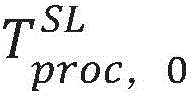
在确定选择窗口之后,TX UE可以在感测窗口[n+T1,n+T2]期间执行感测操作,以确定选择窗口的哪些资源(如果有的话)可以被排除,例如,因为使用那些资源的来自其他装置的传输。感测窗口可以包括时隙n–T0和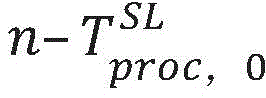
在感测窗口中的感测操作期间,TX UE可以使用用于感测能量、干扰等的任何技术,和/或用于评估接收信号的任何技术,诸如信道忙率(CBR)、信道空闲评估(CCA)等,来检测来自其他装置的传输。During a sensing operation in a sensing window, the TX UE may use any technique for sensing energy, interference, etc., and/or any technique for evaluating received signals, such as Channel Busy Ratio (CBR), Channel Idle Evaluation (CCA), etc., to detect transmissions from other devices.
TX UE还可以通过监视在感测窗口期间可以从其他UE接收的传输,从选择窗口中排除候选资源。例如,TX UE可以对从其他UE接收的第一级SCI进行解码,该第一级SCI可以指示其他UE已经在选择窗口中预留并因此可以被TX UE排除的资源。The TX UE may also exclude candidate resources from the selection window by monitoring transmissions that may be received from other UEs during the sensing window. For example, the TX UE may decode first-level SCI received from other UEs, which may indicate resources that other UEs have reserved in the selection window and thus may be excluded by the TX UE.
基于在感测窗口中的感测操作期间检测到的传输,TX UE可以执行一个或多个处理操作(例如,在感测窗口、处理时间等期间)来确定哪些资源可以从选择窗口中排除,并且从剩余的候选资源中选择(例如,随机地)一个或多个资源。例如,出于说明的目的,TX UE可以选择资源1316来用于发送TB。based on transmissions detected during sensing operations in the sensing window, the TX UE may perform one or more processing operations (e.g., during the sensing window, processing time, etc.) to determine which resources may be excluded from the selection window, And one or more resources are selected (eg, randomly) from the remaining candidate resources. For example, for purposes of illustration, a TX UE may select
在图13所示的实施例中,用于发送TB的传输资源的选择可以与用于TB传输的LBT感测操作的资源的选择相结合。例如,出于说明的目的,TX UE可以选择LBT资源1318来用于LBT感测操作,该资源可以占用传输资源1316之前的时隙。In the embodiment shown in FIG. 13, the selection of transmission resources for sending TBs may be combined with the selection of resources for LBT sensing operations for TB transmissions. For example, for purposes of illustration, a TX UE may select
在一些实施例中,将用于LBT感测的资源选择操作与用于传输的资源选择操作相结合可以指至少部分地在相同的处理操作中的一个或多个期间执行这两种资源选择操作,所述相同的处理操作可以例如在感测窗口期间、在处理时间期间等执行。In some embodiments, combining resource selection operations for LBT sensing with resource selection operations for transmission may refer to performing both resource selection operations at least in part during one or more of the same processing operations , the same processing operations may eg be performed during a sensing window, during a processing time, etc.
在一些实施例中,用于LBT感测和传输的组合的资源选择操作可以被描述为如下资源选择操作,其中一个或多个选择的资源可以包括用于LBT间隔(其中没有其他UE可以执行传输)的资源和用于信道控制和数据传输(例如,PSCCH、PSSCH、PSFCH等)的资源二者。附加地或可替换地,用于LBT感测和传输的组合的资源选择操作可以被描述为如下选择操作,其中TX UE可以选择用于传输的一个或多个资源,其中一个或多个选择的资源可以具有至少足够大的先前空闲时域持续时间(例如,在符号、时隙等方面),以允许在传输之前的LBT感测使用与选择的用于传输的资源相同或相似的频域资源大小发生。在这样的实现中,LBT带宽可以等于或类似于为传输选择的资源的频域资源的大小。In some embodiments, a combined resource selection operation for LBT sensing and transmission may be described as a resource selection operation in which one or more selected resources may include ) and resources for both channel control and data transmission (eg, PSCCH, PSSCH, PSFCH, etc.). Additionally or alternatively, a combined resource selection operation for LBT sensing and transmission may be described as a selection operation in which the TX UE may select one or more resources for transmission, wherein one or more selected The resource may have a previous idle time-domain duration at least sufficiently large (e.g., in terms of symbols, slots, etc.) to allow LBT sensing prior to transmission to use the same or similar frequency-domain resources as those selected for transmission Size happens. In such an implementation, the LBT bandwidth may be equal to or similar to the size of the frequency domain resource of the resource selected for transmission.
然而,在一些实施例中,如果频域资源的大小大于预定准则(例如,NR系统中的20MHz),则TX UE可以在LBT间隔期间执行多信道LBT信道接入过程。例如,TX UE可以单独在一个或多个(例如,每个)子信道和/或子带中执行具有指数回退的类型1LBT信道接入过程。作为另一个示例,TX UE可以在所选择的主要子信道和/或子带中执行类型1LBT信道接入过程,并且一旦在主要子信道和/或子带中LBT成功,TX UE可以在一个或多个其他(例如,次要)子信道和/或子带中执行类型2(例如,2A、2B和/或2C)信道接入过程。However, in some embodiments, if the size of the frequency domain resource is larger than a predetermined criterion (eg, 20 MHz in NR system), the TX UE may perform a multi-channel LBT channel access procedure during the LBT interval. For example, a TX UE may individually perform a
提供上述资源选择技术是为了说明发明原理,但是这些原理不限于所公开的细节或任何其他实现细节。此外,一些发明原理可以以可以提供附加特征或功能的方式应用于一个或多个现有的通信框架。例如,在一些实施例中,上述组合的资源选择技术中的一种或多种可以基于单时隙资源分配过程(诸如,5G NR侧链路模式2过程)来实现。这种分配过程的示例实施例在附录B中描述,并且可以基于例如第三代合作伙伴计划(3GPP)的TS 38.214的第8.1.4节。因此,在一些实施例中,并且取决于实现细节,具有根据本公开的用于LBT感测和传输的组合的资源选择的资源分配过程可以将单时隙资源分配过程转换为双时隙资源分配过程。The resource selection techniques described above are provided to illustrate inventive principles, but these principles are not limited to the disclosed details or any other implementation details. Furthermore, some inventive principles may be applied to one or more existing communication frameworks in a manner that may provide additional features or functionality. For example, in some embodiments, one or more of the above combined resource selection techniques may be implemented based on a single-slot resource allocation procedure (such as a 5G NR
在一些实施例中,可以实现任意数量的以下特征和/或可以对附录B中示出的模式2资源选择过程进行修改,以将其转换为根据本公开的双时隙资源过程。此外,以下特征和/或修改中的每一个具有独立的应用,并且可以在根据本公开的组合的资源选择操作的任何实施例中实现。In some embodiments, any number of the following features may be implemented and/or the
(A)可以向第一级SCI添加一个或多个新字段,以指示LBT间隔持续时间。可替代地或附加地,RX UE可以被配置为识别出在所选择的时隙之前的时隙也可以被预留和/或选择用于LBT间隔,和/或当一个或多个所选择的资源在由另一个UE共享的COT内时,可以仅使用一个LBT间隔。例如,如果共享COT中的第一UE获取并使用信道,然后具有在最大COT中剩余的余下时间,则它可以在共享COT中与第二UE共享余下时间。在一些实施例中,可以基于SLRSSI测量或CBR测量来自适应地实现LBT间隔。例如,LBT间隔可以当外部干扰相对强时,被配置为具有较长的持续时间,而当外部干扰相对弱时,被配置为具有相对较短的持续时间。(A) One or more new fields may be added to the first-level SCI to indicate the LBT interval duration. Alternatively or additionally, the RX UE may be configured to recognize that slots preceding the selected slot may also be reserved and/or selected for the LBT interval, and/or when one or more of the selected When resources are within a COT shared by another UE, only one LBT interval may be used. For example, if a first UE in a shared COT acquires and uses a channel and then has a remaining time remaining in the maximum COT, it can share the remaining time with a second UE in the shared COT. In some embodiments, LBT spacing may be adaptively implemented based on SLRSSI measurements or CBR measurements. For example, the LBT interval may be configured to have a longer duration when the external disturbance is relatively strong, and be configured to have a relatively short duration when the external disturbance is relatively weak.
(B)在附录B中描述的资源选择操作的步骤5和/或6中,TX UE可以排除在若干先前时间时隙中可能被占用的一个或多个候选资源,例如,其中先前时间时隙的数量可以基于LBT间隔持续时间、时隙持续时间等来确定。(B) In
(C)在附录B中描述的资源选择操作的步骤5和/或6中,例如,如果UE能够同时执行LBT感测操作和解码PSCCH操作,则也可以排除期间TX UE可能正在执行LBT操作的一个或多个资源。否则,这种排除可能无法实现。(C) In
(D)在附录B中描述的资源选择操作的步骤5和/或6中,TX UE还可以排除一个或多个资源,其中先前时隙具有配置的为来自任何其他UE的NACK/ACK的传输预留的PSFCH符号,例如,如由一个或多个其他TX UE广播的第一级SCI和/或第二级SCI所确定的。因此,在一些实施例中,用于LBT间隔的时隙可以不包括可以用于和/或预留给其他SL传输的PSFCH符号。在一些其他实施例中,TX UE可以基于例如与为HARQ反馈预留PSFCH符号的业务的优先级相比其自身业务的优先级,来确定是否抢占在所选资源的时隙之前的为PSFCH符号预留的业务。如果TX UE自身的业务优先级大于预留PSFCH符号资源的业务的优先级,则为在前LBT间隔选择的资源可以抢占预留PSFCH符号资源的另一UE的业务,因此可以不被排除。在一些另外的实施例中,UE可以排除其中先前的时隙具有PSFCH符号的资源中的一些或所有的资源,例如,不管它是否实际上被预留。在这样的实施例中,可以保留周期性PSFCH信道资源的现有定义的配置。(D) In
(E)在可以执行资源重选的情况下(例如,如果LBT回退时间在时隙边界之后到期),则TX UE可以以比先前尝试更高的优先级来重选资源。取决于实现细节,这可以导致比先前尝试中更大的机会获得信道,和/或更大的机会在抢占中保持预留的资源,例如,以减少被抢占的机会。在一些实施例中,这可以以以下方式中的任何一种或多种来实现:(1)通过增加第二LBT试验的LBT间隔持续时间,这可以增加第二LBT尝试的信道接入概率;(2)通过增加其传输的预留优先级,例如,TX UE可以增加优先级值(例如,可以由[12,TS 23.287]的第5.4.3.3条和/或[8,TS 38.321]的第5.22.1.3.1条中指定的3个比特来指示,并且可以在SCI1-A中用信号通知)。一些实施例可以包括附加的优先级字段,以维持一个或多个高层的服务质量(QoS);(3)通过在SCI1-A中包括一个标志来,例如,经由SCI 1-A中的附加比特指示这是由于LBT失败引起的重选;和/或(4)通过在SCI 1-A中添加额外的字段来指示到与QoS要求相关联的原始优先级值的映射。(E) In cases where resource reselection can be performed (eg, if the LBT backoff time expires after a slot boundary), the TX UE may reselect resources with higher priority than previous attempts. Depending on implementation details, this may result in a greater chance than in previous attempts to acquire the channel, and/or a greater chance to keep reserved resources in preemption, eg, to reduce the chance of being preempted. In some embodiments, this may be accomplished in any one or more of the following ways: (1) by increasing the LBT interval duration of the second LBT trial, which may increase the channel access probability of the second LBT attempt; (2) By increasing the reserved priority of its transmissions, e.g., the TX UE can increase the priority value (e.g., by clause 5.4.3.3 of [12, TS 23.287] and/or clause 5.4.3.3 of [8, TS 38.321] 5.22.1.3.1 and may be signaled in SCI1-A). Some embodiments may include additional priority fields to maintain quality of service (QoS) for one or more higher layers; (3) by including a flag in SCI1-A, e.g., via additional bits in SCI1-A Indicate that this is a reselection due to LBT failure; and/or (4) indicate the mapping to the original priority value associated with the QoS requirement by adding an extra field in SCI 1-A.
在一些实施例中(例如,在规范级别的描述中),SCI格式1-A可以用新的字段来修改,以指示LBT间隔持续时间。例如,预留比特(例如,由高层参数sl-NumReservedBits确定的比特数,例如,值被设置为零)中的一个或多个可以用于指示SL数据传输之前的LBT间隔持续时间配置的长度。作为另一个示例,SCI格式1-A中的一个或多个现有比特可以被改换用途(repurpose)(例如,重新定义)以指示LBT间隔持续时间(比如,如果存在特定数量(例如,只有一个)的预配置的sl-BetaOffsets2ndSCI值,例如,则可以使用Beta_offset指示符)。作为另一个示例,例如,如果存在特定数量(例如,只有一个)的预配置的调制和编码方案(MCS)表,则可以使用附加的MCS表指示符。作为又一示例,可以实现新的SCI 1-C格式,其可以包括指示SL数据传输之前的LBT间隔持续时间配置的长度的字段。In some embodiments (eg, in a specification-level description), SCI Format 1-A may be modified with a new field to indicate the LBT interval duration. For example, one or more of the reserved bits (eg, the number of bits determined by the higher layer parameter sl-NumReservedBits, eg, value set to zero) may be used to indicate the length of the LBT interval duration configuration before SL data transmission. As another example, one or more existing bits in SCI Format 1-A may be repurposed (e.g., redefined) to indicate the LBT interval duration (e.g., if there is a specific number (e.g., only one ), for example, the Beta_offset indicator can be used). As another example, an additional MCS table indicator may be used, for example, if there is a certain number (eg, only one) of preconfigured modulation and coding scheme (MCS) tables. As yet another example, a new SCI 1-C format may be implemented, which may include a field indicating the length of the LBT interval duration configuration prior to SL data transmission.
为了说明可以如何修改用于TB传输的资源选择操作以创建用于LBT间隔和TB传输的组合的资源选择操作,附录C说明了可以如何修改附录B中描述的资源分配过程的一部分。附录C中示出的实施例以表格格式呈现,其中第二列中的文本被指示为第一列中的原貌、插入和删除。To illustrate how the resource selection operation for TB transmission may be modified to create a combined resource selection operation for LBT interval and TB transmission, Appendix C illustrates how part of the resource allocation process described in Appendix B may be modified. The embodiment shown in Appendix C is presented in a tabular format with text in the second column indicated as original, insertion and deletion in the first column.
LBT感测的开始时间Start time of LBT sensing
在一些实施例中,LBT感测操作的开始时间(例如,触发点)可以影响执行LBT感测操作的UE将获取信道的概率。此外,相邻UE的行为也可能影响LBT感测操作的潜在成功。例如,第一UE(可以称为UE A)可以在时隙X进行发送,并且可以指示在时隙Y好未来预留。连同未来预留,UE A可以在第一级SCI中指示其优先级。基于来自UE A的该指示,一个或多个相邻UE可以知道UE A的优先级,并且可以确定UE A的LBT间隔持续时间的潜在范围。一个或多个相邻RX UE可以相应地避免在UE A的LBT间隔持续时间的潜在范围中的一些或全部中预留资源,以增加UE A将获取介质并执行其传输的概率。In some embodiments, the start time (eg, trigger point) of the LBT sensing operation may affect the probability that a UE performing the LBT sensing operation will acquire the channel. Furthermore, the behavior of neighboring UEs may also affect the potential success of the LBT sensing operation. For example, a first UE (which may be referred to as UE A) may transmit on slot X and may indicate a future reservation on slot Y. Along with future reservations, UE A can indicate its priority in the first level SCI. Based on this indication from UE A, one or more neighboring UEs may know UE A's priority and may determine a potential range of UE A's LBT interval duration. One or more neighboring RX UEs may accordingly refrain from reserving resources in some or all of UE A's potential range of LBT interval durations to increase the probability that UE A will acquire the medium and perform its transmission.
出于以下讨论的目的,UE A的LBT间隔可被描述为具有第一部分Td和第二部分CWX,第一部分Td可被实现为如上所述的延迟持续时间,第二部分CWX可以标识可以至少部分地基于竞争窗口来确定的时间量。例如,CWX可以被实现为CWmin,p、CWmax,p、CWp等等。取决于上下文,CWX可以被表示为可以将时间指示为如上所述的感测时隙Tsl的数量的数字。此外,在一些实施例中,CWX可以通过使用回退计数器来确定,该回退计数器可以被初始化为分布在0和CWp、CWmin,p、CWmax,p等之间的随机数,并且以如上所述的感测时隙Tsl的间隔递减。在一些实施例中,CWx可以指上述实现中的任何的最大值、最小值或初始值。因此,在一些实施例中,CWX可以指通过CWmin,p确定的时间,使得CWX+Td可以被视为最小LBT间隔持续时间。For the purposes of the following discussion, the LBT interval for UE A may be described as having a first part Td , which may be implemented as a delay duration as described above , and a second part CWX , which may be An amount of time that may be determined based at least in part on the contention window is identified. For example, CW X may be implemented as CW min,p , CW max,p , CW p , and so on. Depending on the context, CW X may be represented as a number that may indicate time as the number of sensing slots T sl as described above. Furthermore, in some embodiments, CW X may be determined by using a backoff counter, which may be initialized to a random number distributed between 0 and CW p , CW min,p , CW max,p, etc., And it is decremented at the interval of the sensing time slot T sl as described above. In some embodiments, CW x may refer to any maximum, minimum or initial value in the above implementations. Thus, in some embodiments, CW X may refer to the time determined by CW min,p such that CW X + T d may be considered the minimum LBT interval duration.
在一些实施例中,相邻RX UE中的一个或多个可以确定UE A可以使用的最小LBT间隔(假设介质未被外部干扰占用),并且避免在最小LBT间隔中预留资源以使UE A能够执行其传输。In some embodiments, one or more of the neighboring RX UEs can determine the minimum LBT interval that UE A can use (assuming the medium is not occupied by external interference), and avoid reserving resources in the minimum LBT interval so that UE A able to perform its transfer.
从UE A(其为TX UE)的角度来看,UE A可以在更早的点触发(例如,启动)其LBT感测操作,以增加其获取信道(例如,占用介质)的机会。取决于实现细节,并且假设没有干扰,UE A可以进行感测达最小时间CWX+Td。依赖其优先级,UE A可以在下述任何点触发其用于信道(例如,资源)获取的LBT感测操作。From the perspective of UE A (which is a TX UE), UE A can trigger (eg, start) its LBT sensing operation at an earlier point to increase its chances of acquiring a channel (eg, occupying the medium). Depending on implementation details, and assuming no interference, UE A may sense for a minimum time CWx + Td . Depending on its priority, UE A can trigger its LBT sensing operation for channel (eg, resource) acquisition at any point described below.
(1)UE可以在开始于Y-(CWX+Td)或Y-(CWX+Td)之前的符号处触发其LBT感测操作。在一些实施例中,这可以是指定的LBT感测时间。然而,取决于实现细节,在介质被占用的情况下,该技术可能不提供任何额外的感测,因此可能降低将介质识别为空的机会。(1) The UE can trigger its LBT sensing operation at a symbol starting at Y-(CW X +T d ) or before Y-(CW X +T d ). In some embodiments, this may be a specified LBT sensing time. However, depending on implementation details, this technique may not provide any additional sensing in case the medium is occupied, thus possibly reducing the chance of identifying the medium as empty.
(2)如果时隙Y-1的第一符号比Y-(CWX+Td)早,则UE可以在时隙Y-1的第一符号处触发其LBT感测操作。取决于实现细节,一旦UE在时隙Y之前检测到介质为空,它可以通过发送预留信号来占用该时隙的剩余部分。(2) If the first symbol of slot Y-1 is earlier than Y-(CW X +T d ), the UE may trigger its LBT sensing operation at the first symbol of slot Y-1. Depending on implementation details, once a UE detects that the medium is empty before slot Y, it can occupy the remainder of that slot by sending a reservation signal.
(3)如果时隙Y-1的没有被PSCCH占用的第一符号早于Y-(CWX+Td),则UE可以在该第一符号处触发其LBT感测操作。注意,一旦UE在时隙Y之前检测到介质为空,它可以通过如上所述的预留信号来占用该时隙的剩余部分。(3) If the first symbol of slot Y-1 not occupied by PSCCH is earlier than Y-(CW X +T d ), the UE may trigger its LBT sensing operation at the first symbol. Note that once the UE detects that the medium is empty before slot Y, it can occupy the rest of the slot by means of a reservation signal as described above.
(4)如果比Y-1早的时隙的第一符号比Y-(CWX+Td)早,则UE可以在比Y-1早的时隙的第一符号触发其LBT感测操作。注意,一旦UE在时隙Y之前检测到介质为空,它可以通过传送预留信号来占用该时隙的剩余部分。(4) If the first symbol of a time slot earlier than Y-1 is earlier than Y-(CW X +T d ), the UE can trigger its LBT sensing operation at the first symbol of a time slot earlier than Y-1 . Note that once the UE detects that the medium is empty before slot Y, it can occupy the rest of the slot by transmitting a reservation signal.
(5)基于预配置的持续时间,UE可以在比Y-1早的时隙M中的特定符号(例如,符号Z)处触发其LBT感测操作,使得在时隙Y上发送预留信号和实际传输的持续时间可以小于最大信道占用时间(例如,如图14所示,基于UEA的传输优先级,持续时间(U-Z-LBT)可以小于或等于最大信道占用时间)。(5) Based on the pre-configured duration, the UE can trigger its LBT sensing operation at a specific symbol (eg, symbol Z) in slot M earlier than Y-1, so that the reserved signal is sent on slot Y and the duration of the actual transmission may be less than the maximum channel occupation time (for example, as shown in Figure 14, based on the transmission priority of the UEA, the duration (U-Z-LBT) may be less than or equal to the maximum channel occupation time).
图14示出了根据本公开的信道接入操作的示例实施例。在图14所示的实施例中,TX UE可以在可以是时隙M的符号#5(Z)的开始的时间ta启动LBT感测操作。可以在TX UE可以获取信道的时间tb完成LBT感测操作。然而,因为TX UE可能仅能够在时隙边界开始发送,所以TX UE可以从时间tb起发送预留信号直到时间tc处的时隙边界(时隙Y的开始)。TX UE然后可以在时隙Y中执行传输。FIG. 14 illustrates an example embodiment of channel access operations according to the present disclosure. In the embodiment shown in FIG. 14 , the TX UE may start the LBT sensing operation at time t a which may be the beginning of symbol #5(Z) of slot M. The LBT sensing operation can be done at time tb when the TX UE can acquire the channel. However, since the TX UE may only be able to start transmitting at a slot boundary, the TX UE may transmit the reservation signal from time tb until the slot boundary at time tc (start of slot Y). The TX UE may then perform a transmission in slot Y.
在一些实施例中,并且取决于实现细节,TX UE越早开始感测介质,其发现介质未被占用的机会就越大,从而增加了其在预期的用于传输的时隙占用介质的机会。在一些实施例中,TX UE可以启动LBT感测操作的时间可以至少部分地由以下任意数量来确定:UE和/或TB传输的传输优先级、分组延迟预算(PDB)、其他设备(例如,没有参与与TX UE的SL通信的其他NR设备,使用诸如Wi-Fi的其他技术来访问共享频谱的其他设备,等等)的信道占用量、信道忙率(CBR)、用于确定LBT间隔的竞争窗口的大小(例如,CWp的大小等)。In some embodiments, and depending on implementation details, the earlier a TX UE starts sensing the medium, the better its chances of finding the medium unoccupied, thereby increasing its chances of seizing the medium in the time slots it expects to use for transmission . In some embodiments, the time at which a TX UE may initiate LBT sensing operations may be determined, at least in part, by any of the following: transmission priority of UE and/or TB transmissions, packet delay budget (PDB), other devices (e.g., other NR devices not participating in the SL communication with the TX UE, other devices using other technologies such as Wi-Fi to access the shared spectrum, etc.), channel busy ratio (CBR), used to determine the LBT interval The size of the contention window (eg, the size of CW p , etc.).
用于重选的提前资源Advance resources for reelection
在一些实施例中,使用许可频谱进行侧链路通信的NR UE可以使用模式2资源选择过程来为未来传输执行周期性和/或非周期性预留。例如,UE可以使用第一级SCI来为即将到来的传输指示多达2个未来时隙子信道预留。此外,UE还可以在第一级SCI中指示周期来执行周期性预留。然而,当在非许可频谱中操作时,NR UE可以在发送之前执行LBT感测操作,因此可能无法在预期时隙获取信道。例如,指示在时隙X的未来预留的UE可以在时隙X-1开始LBT感测操作,但是可能无法获取信道并在时隙X执行其传输。在这种情况下,NR UE可以执行资源重选操作。然而,例如,如果另一个LBT感测操作失败,通过重选操作可用的资源可能在时间上距离时隙X相对远,这可能限制UE执行其传输和满足其分组延迟预算的能力。In some embodiments, NR UEs using licensed spectrum for sidelink communication may use
在根据本公开的一些实施例中,当基于通过LBT感测操作获取信道失败而执行资源重选操作时,UE可以利用提前(early-in-time,EIT)资源。在这样的实施例中,如果重选的原因是LBT失败,则当执行资源重选时,UE可以优先考虑资源选择窗口内的一个或多个相对较早的时隙(例如,前几个时隙)。例如,如果UE未能在时隙X获取信道,则该UE可以优先考虑用于资源重选的EIT时隙。依赖实施细节,这出于以下原因中的一个或多个原因可以是有利的:In some embodiments according to the present disclosure, when performing a resource reselection operation based on failure to acquire a channel through an LBT sensing operation, the UE may utilize early-in-time (EIT) resources. In such an embodiment, if the reason for reselection is LBT failure, when performing resource reselection, the UE may give priority to one or more relatively earlier time slots (e.g., the first few time slots) within the resource selection window. gap). For example, if a UE fails to acquire a channel at time slot X, the UE may prioritize EIT time slots for resource reselection. Depending on the implementation details, this may be advantageous for one or more of the following reasons:
(1)如果UE重选足够早的资源(例如,时隙X+1或时隙X+2)用于重传,则UE可以继续执行相同的LBT感测操作,从而增加其在重选的时隙获取信道的机会。例如,UE可以保持当前的回退计数器,并且继续感测信道,直到它变得空闲并且UE可以获取该信道。(1) If the UE reselects a sufficiently early resource (for example, slot X+1 or slot X+2) for retransmission, the UE can continue to perform the same LBT sensing operation, thereby increasing its Opportunity to acquire a channel for a time slot. For example, the UE may keep the current back-off counter and continue sensing the channel until it becomes free and the UE can acquire the channel.
(2)通过重选来选择EIT资源可以增加UE满足其分组延迟预算的机会,即使另一个LBT感测失败发生。因此,选择EIT资源可以允许UE在分组延迟预算结束之前执行多个资源重选。(2) Selecting EIT resources by reselection can increase the UE's chance to meet its packet delay budget even if another LBT sensing failure occurs. Therefore, selecting an EIT resource may allow the UE to perform multiple resource reselections before the packet delay budget ends.
(3)在一些实施例中,如果EIT资源可用,则可以使用简化的资源重选过程。例如,如果UE选择在其未能获取信道的时隙之后的第一或第二时间时隙,则UE可以不执行完整的资源重选操作。(3) In some embodiments, if EIT resources are available, a simplified resource reselection procedure may be used. For example, if the UE selects the first or second time slot after the slot in which it failed to acquire the channel, the UE may not perform a complete resource reselection operation.
图15示出了根据本公开的EIT资源重选操作的第一示例实施例。在图15所示的实施例中,UE可以选择在它打算进行发送的时隙之后的未被占用的具有相同的子信道的第N时隙。在一些实施例中,可以每资源池预配置N的值。例如,如果UE选择子信道3用于在时隙X中的传输,并且未能获取在时隙X中的信道,则UE可以触发资源重选操作,其中它可以选择未被占用的子信道3的第N个即将到来的时隙。在一些实施例中,也可以预配置时隙X和重选时隙之间的最小分隔间隔(可以指示为Z),以允许进行处理的时间和/或避免触发太多的资源重选(例如,当信道占用时间为多于一个时隙时,允许有足够的时间让回退计数器达到0)。FIG. 15 illustrates a first example embodiment of EIT resource reselection operations according to the present disclosure. In the embodiment shown in Figure 15, the UE may select an unoccupied Nth time slot with the same subchannel after the time slot it intends to transmit. In some embodiments, the value of N may be preconfigured per resource pool. For example, if the UE selects
依赖于实现细节,图15所示的实施例的潜在好处是,重选的用于重传的时隙可以是确定性的,这可以使得相邻UE能够避免冲突。例如,如果相邻的RX UE接收到TX UE在时隙X和子信道Y中发送的预留,但是由于LBT失败而没有在时隙X中接收到传输,则RX UE可以假设TX UE自动预留了时隙P,该时隙P是在时隙X之后至少Z个时隙,并且是未被占用的具有子信道Y第N时隙。(在图15所示的示例实施例中,N可以被预配置为1。)随后,相邻UE可以避免使用这些可用于重传的特定资源,以避免冲突。Depending on the implementation details, a potential benefit of the embodiment shown in Figure 15 is that reselected slots for retransmissions can be deterministic, which can enable neighboring UEs to avoid collisions. For example, if a neighboring RX UE receives a reservation sent by a TX UE in slot X and subchannel Y, but does not receive a transmission in slot X due to LBT failure, the RX UE can assume that the TX UE automatically reserved slot P which is at least Z slots after slot X and which is the Nth slot with subchannel Y unoccupied. (N may be pre-configured as 1 in the example embodiment shown in FIG. 15.) Subsequently, neighboring UEs may refrain from using these specific resources available for retransmission to avoid collisions.
图16示出了根据本公开的EIT资源重选操作的第二示例实施例。在图16所示的实施例中,当在LBT失败之后执行资源重选操作时,UE可以应用修改的资源选择窗口。例如,UE可以考虑两个边界(Ta和Tb),其中Ta<=T1和Tb<(T2或PDB)。在一些实施例中,Ta和/或Tb的值可以每资源池预配置,和/或Ta和/或Tb的值可以由UE以类似于模式2资源选择窗口的方式选择。例如,如果Tb的值>PDB,则UE可以基于PDB来执行选择。FIG. 16 illustrates a second example embodiment of EIT resource reselection operations according to the present disclosure. In the embodiment shown in FIG. 16, the UE may apply the modified resource selection window when performing resource reselection operation after LBT failure. For example, the UE may consider two boundaries (T a and T b ), where T a <= T 1 and T b < (T 2 or PDB). In some embodiments, the values of T a and/or T b may be pre-configured per resource pool, and/or the values of T a and/or T b may be selected by the UE in a manner similar to
在一些实施例中,当在LBT失败之后执行资源重选时,可以应用新的更小的T1和/或T2,min约束。在这样的实施例中,UE可以在更新的窗口边界内随机选择资源,例如,以类似于模式2资源选择的方式来减少相邻UE之间的冲突机会。一些实施例可以实现替代技术,以使UE能够向相邻UE指示可以用于重选的时隙。In some embodiments, new smaller T1 and/or T2 , min constraints may be applied when performing resource reselection after LBT failure. In such an embodiment, UEs may randomly select resources within the updated window boundaries, eg, in a manner similar to
图17示出了根据本公开的EIT资源重选操作的第三示例实施例。在图17所示的实施例中,当执行初始资源选择时,UE可以实现带有自动释放的资源选择操作。例如,UE可以预留两个在时间上连续或接近的未来资源来发送TB。如果UE成功获取信道并在第一预留资源中发送TB,则未来的预留资源可以被认为被释放,并且可以被其他UE使用。FIG. 17 illustrates a third example embodiment of EIT resource reselection operations according to the present disclosure. In the embodiment shown in Fig. 17, when performing initial resource selection, UE can implement resource selection operation with automatic release. For example, the UE may reserve two future resources that are consecutive or close in time to transmit TBs. If a UE successfully acquires a channel and transmits a TB in the first reserved resource, future reserved resources can be considered released and can be used by other UEs.
在该实施例中,对成功的确定可以基于LBT感测操作的完成(例如,信道的获取),而不是例如ACK/NACK。例如,如果UE对于即将到来的TB传输执行在时间上接近的两个未来预留(在LBT失败的情况下),则如果相邻UE可以能够在第一预留时隙中接收第一级SCI,则可以认为LBT感测操作成功,并且可以认为未来的预留资源被释放。在该实施例中,新的指示(例如,通过将一个或多个字段设置为特定值而隐式地指示,或者通过添加新的字段而显式地指示)可以被添加到第一或第二级SCI中或者MAC CE中,以指示附加预留是重复的,并且可以仅在LBT失败的情况下使用。在一些实施例中,该指示可以限于非许可频带内的SCI传输。在一些实施例中,可以在初始传输和重复传输之间强制最小分隔,以允许相邻UE如果LBT成功则重用所选择的资源。因此,预留及其重复可以被分开足够的时间,以允许在相邻UE处进行处理,从而将资源识别为被释放。在一些实施例中,最小分隔可以例如每资源池预配置。In this embodiment, the determination of success may be based on the completion of the LBT sensing operation (eg, acquisition of the channel), rather than eg ACK/NACK. For example, if a UE performs two future reservations close in time (in case of LBT failure) for an upcoming TB transmission, then if the neighboring UE may be able to receive the first level SCI in the first reserved slot , it can be considered that the LBT sensing operation is successful, and it can be considered that future reserved resources are released. In this embodiment, new indications (eg, implicitly by setting one or more fields to specific values, or explicitly by adding new fields) may be added to the first or second Level SCI or MAC CE to indicate that additional reservations are duplicated and may only be used in case of LBT failure. In some embodiments, the indication may be limited to SCI transmissions within the unlicensed band. In some embodiments, a minimum separation may be enforced between initial and repeated transmissions to allow neighboring UEs to reuse selected resources if LBT is successful. Thus, a reservation and its repetition may be separated by enough time to allow processing at neighboring UEs to identify the resource as being released. In some embodiments, the minimum separation may be pre-configured, eg, per resource pool.
在根据本公开的EIT资源重选操作的第四示例实施例中,UE可以实现模式2资源选择过程的第一阶段,以获得用于资源选择的候选资源的集合。例如,UE可以执行与在5G NR规范的Rel-16中建立的过程类似的过程,以获得集合S_A,该集合可以包含可以用于资源选择的候选单时隙资源的集合。该集合可以被传递到高层用于资源选择。然而,MAC层可以使用不同的概率,而不是以相等概率从集合中随机选择资源。例如,当执行资源选择时,可以给予EIT资源更高的概率。在一些实施例中,可以每资源池配置该更高的概率。例如,可以给予EIT资源两倍于常规资源的选择概率。In a fourth example embodiment of the EIT resource reselection operation according to the present disclosure, the UE may implement the first phase of the
在一些实施例中,可以基于TB优先级来限制对EIT资源的选择。例如,在一些实施例中,仅具有高优先级业务的UE可以被允许在LBT失败的情况下执行资源的EIT重选,或者预留重复传输。可以预配置优先级阈值(例如,每资源池),从而仅具有TB优先级值低于该阈值的UE才可以被允许应用EIT资源重选方法或重复预留方法。例如,该阈值可以被实现为防止太多UE应用EIT资源重选过程,这可能导致大量UE尝试访问有限数量的资源。例如,当信道对于大量时隙被感知为忙,从而触发许多NR UE执行EIT资源选择过程时,这种情况可能特别有问题。In some embodiments, selection of EIT resources may be limited based on TB priority. For example, in some embodiments, only UEs with high priority traffic may be allowed to perform EIT reselection of resources in case of LBT failure, or reserve repeated transmissions. A priority threshold (eg, per resource pool) may be preconfigured such that only UEs with a TB priority value below this threshold may be allowed to apply the EIT resource reselection method or repeated reservation method. For example, the threshold may be implemented to prevent too many UEs from applying the EIT resource reselection procedure, which may result in a large number of UEs attempting to access a limited number of resources. This situation may be particularly problematic, for example, when the channel is perceived as busy for a large number of slots, triggering many NR UEs to perform the EIT resource selection procedure.
在一些实施例中,EIT资源选择过程(例如,基于模式2资源选择)可以在两个阶段中执行:阶段1可以由PHY层执行以获得集合S_A,阶段2可以由MAC层执行以获得所选资源。In some embodiments, the EIT resource selection process (e.g., based on
在上述EIT资源重选操作的第一示例性实施例中,依赖于实现细节,对阶段1的影响很小或没有影响,而对于阶段2,MAC层可以选择候选时隙内的第N个资源,该第N个资源可以占用与错过的时隙相同的子信道,并且是距离失败的时隙至少Z个时隙。In the first exemplary embodiment of the EIT resource reselection operation described above, depending on the implementation details, there is little or no impact on
在上述EIT资源重选操作的第二示例实施例中,取决于实现细节,对阶段2可以有很小的影响或没有影响,而对于阶段1,资源选择边界可以用(Ta和Tb)来更新,其中Ta<=T1且Tb<(T2或PDB)。此外,对于阶段1,5G NR规范的以下部分可以如表1所示进行更新。In the second example embodiment of the EIT resource reselection operation described above, depending on the implementation details, there may be little or no impact on
表1Table 1
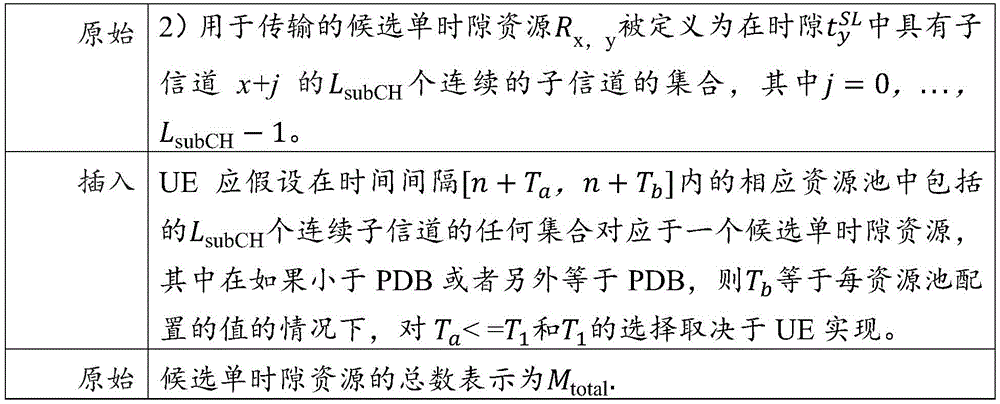
在上述EIT资源重选操作的第三示例实施例中,取决于实现细节,对阶段1或阶段2可能有很小的影响或没有影响。In the third example embodiment of the EIT resource reselection operation described above, there may be little or no impact on
在上述EIT资源重选操作的第四示例实施例中,取决于实现细节,对阶段1可能有很小的影响或没有影响,而对于阶段2,MAC层可以对EIT资源应用比随后的资源更高的选择概率。In the fourth example embodiment of the EIT resource reselection operation described above, depending on implementation details, there may be little or no impact on
用户设备user equipment
图18示出了根据本公开的用户设备(UE)1800的示例实施例。图18所示的实施例可以包括无线电收发器1802和控制器1804,控制器1804可以控制收发器1802和/或UE 1800中的任何其他组件的操作。例如,UE 1800可以用于实现本公开中描述的任何功能。收发器1802可以向基站、其他UE(例如,用于侧链路通信)或任何其他设备发送和/或从其接收一个或多个信号,并且可以包括用于这种发送/接收的接口单元。控制器1804可以包括例如一个或多个处理器1806和存储器1808,存储器1808可以存储用于一个或多个处理器1806运行代码以实现本公开中描述的任何功能的指令。例如,UE 1800和/或控制器1804可以用于实现与时隙结构、LBT间隔格式、信道接入过程、LBT感测操作、资源分配、用于LBT感测和传输的组合的资源选择、解码和/或存储副本符号、识别相邻TX UE使用的LBT间隔以及避免在LBT间隔中预留资源等相关的任何功能。FIG. 18 illustrates an example embodiment of a user equipment (UE) 1800 according to the present disclosure. The embodiment shown in FIG. 18 may include a radio transceiver 1802 and a
基站base station
图19示出了根据本公开的基站1900的示例实施例。图19所示的实施例可以包括无线电收发器1902和控制器1904,控制器1904可以控制收发器1902和/或基站1900中的任何其他组件的操作。基站1900可以用于例如实现本公开中描述的任何功能。收发器1902可以向/从用户设备发送/接收一个或多个信号,并且可以包括用于这种发送/接收的接口单元。控制器1904可以包括例如一个或多个处理器1906和存储器1908,存储器1908可以存储用于一个或多个处理器1906运行代码以实现本公开中描述的任何基站功能的指令。例如,基站1900和/或控制器1904可以用于实现与例如针对资源池、带宽部分等配置一个或多个LBT间隔相关的功能。FIG. 19 illustrates an example embodiment of a
在图18和图19所示的实施例中,收发器1802和1902可以用各种组件来实现,以接收和/或发送RF信号,各种组件诸如放大器、滤波器、调制器和/或解调器、A/D和/或DA转换器、天线、开关、移相器、检测器、耦合器、导体、传输线等。控制器1804和1904可以用硬件、软件和/或其任意组合来实现。例如,全部或部分硬件实现可以包括组合逻辑、时序逻辑、定时器、计数器、寄存器、门阵列、放大器、合成器、复用器、调制器、解调器、滤波器、矢量处理器、复杂可编程逻辑器件(CPLD)、现场可编程门阵列(FPGA)、专用集成电路(ASIC)、片上系统(SOC)、状态机、诸如ADC和DAC的数据转换器等。全部或部分软件实现可以包括一个或多个处理器核心、存储器、程序和/或数据存储器等,它们可以位于本地和/或远程,并且可以被编程以运行指令来执行控制器的一个或多个功能。一些实施例可以包括运存储在任何类型的存储器中的指令的一个或多个CPU,例如诸如x86处理器的复杂指令集计算机(CISC)处理器和/或诸如ARM处理器的精简指令集计算机(RISC)处理器等。In the embodiments shown in FIGS. 18 and 19,
在图18和图19所示的实施例以及本文所示的其他实施例中,所示的组件和/或操作仅是示例性的。一些实施例可以涉及未示出的各种附加组件和/或操作,并且一些实施例可能省略一些组件和/或操作。此外,在一些实施例中,组件的布置和/或操作的时间顺序可以变化。尽管一些组件可以被示为单独的组件,但是在一些实施例中,单独示出的一些组件可以被集成到单个组件中,和/或被示为单个组件的一些组件可以用多个组件来实现。In the embodiments shown in FIGS. 18 and 19 , as well as other embodiments shown herein, the components and/or operations shown are merely exemplary. Some embodiments may involve various additional components and/or operations not shown, and some embodiments may omit some components and/or operations. Additionally, in some embodiments, the arrangement of components and/or the chronological order of operation may vary. Although some components may be shown as separate components, in some embodiments some components shown separately may be integrated into a single component and/or some components shown as a single component may be implemented with multiple components .
本文公开的实施例可以在各种实现细节的上下文中描述,但是本公开的原理不限于这些或任何其他具体细节。一些功能已经被描述为由某些组件实现,但是在其他实施例中,该功能可以分布在不同位置的不同系统和组件之间。对组件或元件的引用可以仅指该组件或元件的一部分。在本公开和权利要求中使用诸如“第一”和“第二”的术语可能仅仅是为了区分它们所修饰的事物,并且可能不指示任何空间或时间顺序,除非从上下文中明显看出其他情况。对第一事物的引用可能并不意味着第二事物的存在。此外,根据本专利公开的发明原理,上述各种细节和实施例可以被组合以产生另外的实施例。为了方便起见,可以提供诸如章节标题等各种组织帮助,但是根据这些帮助安排的主题和本公开的原理不受这些组织帮助的定义或限制。Embodiments disclosed herein may be described in the context of various implementation details, but the principles of the disclosure are not limited to these or any other specific details. Some functionality has been described as being performed by certain components, but in other embodiments, this functionality may be distributed among different systems and components in different locations. A reference to a component or element may refer to only a part of the component or element. Use of terms such as "first" and "second" in the present disclosure and claims may be merely to distinguish what they modify, and may not indicate any spatial or temporal order unless otherwise apparent from the context . A reference to the first thing may not imply the existence of the second thing. Furthermore, the various details and embodiments described above may be combined to yield additional embodiments in accordance with the inventive principles disclosed in this patent. Various organizational aids, such as section headings, may be provided for convenience, but the topics arranged in accordance with these aids and the principles of the disclosure are not defined or limited by these organizational aids.
由于本专利公开的发明原理可以在布置和细节上进行修改,而不背离发明概念,因此这种改变和修改被认为落入所附权利要求的范围内。Since the inventive principles disclosed in this patent may be modified in arrangement and detail without departing from the inventive concept, such changes and modifications are to be considered within the scope of the appended claims.
附录AAppendix A
eNB/gNB可以在延迟持续时间Td的感测时隙持续时间期间首先感测到信道空闲之后,并且在计数器N在步骤4中为零之后,发送传输。根据以下步骤,通过在额外的感测时隙持续时间感测信道来调整计数器N:The eNB/gNB may send the transmission after first sensing that the channel is idle during the sensing slot duration of delay duration Td , and after the counter N is zero in
1)设置N=Ninit,其中Ninit是均匀分布在0和CWp之间的随机数,以及转到步骤4;1) Set N=N init , where N init is a random number uniformly distributed between 0 and CW p , and go to
2)如果N>0且eNB/gNB选择递减计数器,则设置N=N-1;2) If N>0 and eNB/gNB selects down counter, then set N=N-1;
3)在额外的感测时隙持续时间感测信道,并且如果额外的感测时隙持续时间是空闲的,则转到步骤4;否则,转到步骤5;3) Sensing the channel for an additional sensing slot duration, and if the additional sensing slot duration is free, then go to
4)如果N=0,停止;否则,转到步骤2。4) If N=0, stop; otherwise, go to
5)感测信道,直到在额外的延迟持续时间Td内检测到忙感测时隙或者额外的延迟持续时间Td的所有感测时隙被检测为空闲;5) Sensing the channel until a busy sensing slot is detected within an additional delay duration Td or all sensing slots for an additional delay duration Td are detected as idle;
6)如果在额外的延迟持续时间Td的所有感测时隙持续时间期间感测到信道空闲,则转到步骤4;否则,转到步骤5;6) If the channel is sensed to be idle during all sensing slot durations of the additional delay duration Td , then go to
如果在上述过程中在步骤4之后,eNB/gNB没有发送传输,则如果当eNB/gNB准备发送时信道至少在感测时隙持续时间Tsl内被感测为空闲,并且如果信道在紧接该传输之前的延迟持续时间Td的所有感测时隙持续时间期间已经被感测为空闲,则eNB/gNB可以在该信道上发送传输。如果eNB/gNB在准备好发送之后当第一次感测该信道时在感测时隙持续时间Tsl内没有感测到该信道空闲,或者如果在紧接该预期传输之前的延迟持续时间Td的任何感测时隙持续时间期间没有感测到该信道空闲,则eNB/gNB在延迟持续时间Td的感测时隙持续时间期间在感测到该信道空闲之后前进到步骤1。If the eNB/gNB does not send a transmission after
延迟持续时间Td由持续时间Tf=16us、紧接着的mp个连续感测时隙持续时间Tsl组成,并且Tf包括在Tf开始处的空闲感测时隙持续时间Tsl。The delay duration T d consists of a duration T f =16 us followed by m p consecutive sensing slot durations T sl , and T f includes an idle sensing slot duration T sl at the beginning of T f .
CWmin,p≤CWp≤CWmax,p是竞争窗口。CWp调整在第4.1.4条描述。CW min, p ≤ CW p ≤ CW max, p is the contention window. CW p adjustment is described in clause 4.1.4.
CWmin,p和CWmax,p在上述过程的步骤1之前被选择。CW min,p and CW max,p are selected prior to step 1 of the above procedure.
mp、CWmin,p和CWmax,pp基于与eNB/gNB传输相关的信道接入优先级级别,如表4.1.1-1所示。m p , CW min,p and CW max,p p are based on the channel access priority levels related to eNB/gNB transmission, as shown in Table 4.1.1-1.
如表4.1.1-1中所给出的,eNB/gNB不应超过Tm cot,p的信道占用时间在信道上进行传输,其中基于与eNB/gNB传输相关联的信道接入优先级级别p执行信道接入过程。As given in Table 4.1.1-1, an eNB/gNB shall not transmit on the channel for a channel occupancy time exceeding T m cot,p , where based on the channel access priority level associated with the eNB/gNB transmission p performs the channel access procedure.
对于p=3和=4,如果可以长期保证没有任何其他技术共享信道(例如,通过规定级别),则Tm cot,p=10ms,否则Tm cot,p=8ms。For p = 3 and = 4, T m cot,p = 10 ms if it can be guaranteed in the long term that no other technology will share the channel (eg, by a specified level), otherwise T m cot, p = 8 ms.
表4.1.1-1:信道接入优先级级别(CAPC)[TS 38.213]Table 4.1.1-1: Channel Access Priority Levels (CAPC) [TS 38.213]
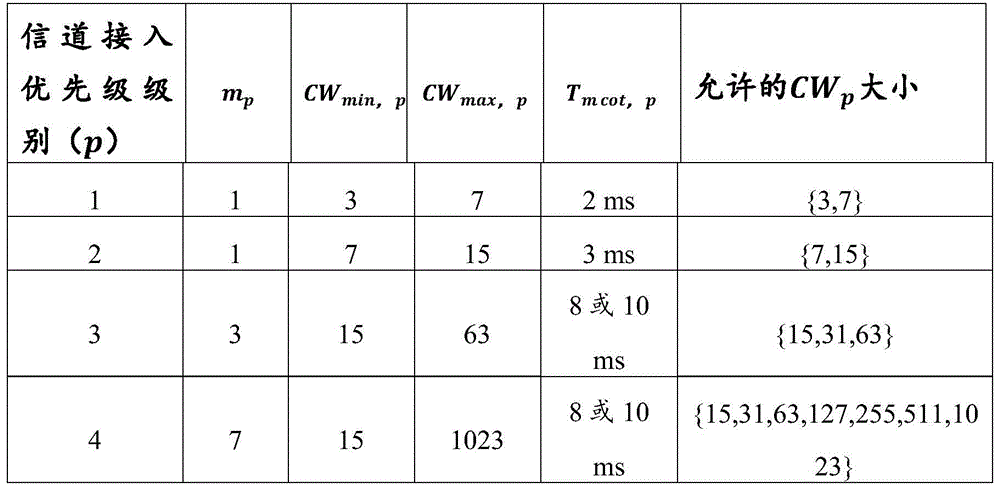
附录BAppendix B
8.1.4用于在侧链路资源分配模式2下的PSSCH资源选择中确定要向高层报告的资源子集的UE过程8.1.4 UE procedure for determining the subset of resources to report to higher layers in PSSCH resource selection in sidelink
在资源分配模式2中,高层可以请求UE确定资源子集,高层将从该资源子集选择用于PSSCH/PSCCH传输的资源。为了触发该过程,在时隙n中,高层为该PSSCH/PSCCH传输提供以下参数:In
-要从中报告资源的资源池;- the resource pool to report the resource from;
-L1优先级,prioTX;-L1 priority, prio TX ;
-剩余分组延迟预算;- remaining packet delay budget;
-时隙中要用于PSSCH/PSCCH传输的子信道数量,LsubCH;- the number of subchannels to be used for PSSCH/PSCCH transmission in the slot, LsubCH ;
-可选地,以毫秒为单位的资源预留间隔Prsvp_TX。- Optionally, the resource reservation interval P rsvp_TX in milliseconds.
-如果高层请求UE确定高层将从其选择用于PSSCH/PSCCH传输的资源的资源子集,作为重新评估或抢占过程的一部分,则高层提供可经受重新评估的资源的集合(r0,r1,r2,…)和可能经受抢占的资源的集合(r′0,r′1,r′2,…)。- If the higher layers request the UE to determine the subset of resources from which the higher layers will select resources for PSSCH/PSCCH transmission as part of a re-evaluation or preemption procedure, the higher layers provide the set of resources subject to re-evaluation (r 0 , r 1 , r 2 , ...) and a set of resources that may be subject to preemption (r' 0 , r' 1 , r' 2 , ...).
-取决于UE实现来在时隙r″i-T3之前或之后按高层的请求确定资源子集,其中r″i是(r0,r1,r2,…)和(r′0,r′1,r′2,…)中具有最小时隙索引的时隙,并且T3等于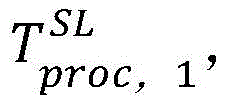
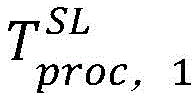
以下高层参数影响此过程:The following high-level parameters affect this process:
-sl-SelectionWindowList:对于prioTX的给定值,内部参数T2min被设置为来自高层参数sl-SelectionWindowList的相应值。-sl-SelectionWindowList: For a given value of prio TX , the internal parameter T 2min is set to the corresponding value from the higher layer parameter sl-SelectionWindowList.
-sl-ThresPSSCH-RSRP-List:该高层参数为每个组合(pi,pj)提供RSRP阈值,其中pi是接收的SCI格式1-A中的优先级字段的值,并且pj是选择资源的UE的传输的优先级;对于此过程的给定调用,pj=prioTX。-sl-ThresPSSCH-RSRP-List: This higher layer parameter provides RSRP thresholds for each combination (p i , p j ), where p i is the value of the priority field in the received SCI format 1-A, and p j is The priority of the UE's transmission that selects resources; for a given invocation of this procedure, p j =prio TX .
-sl-RS-ForSensing选择UE是使用PSSCH-RSRP测量还是PSCCH-RSRP测量,如第8.4.2.1条中所定义的。-sl-RS-ForSensing selects whether the UE uses PSSCH-RSRP measurements or PSCCH-RSRP measurements as defined in clause 8.4.2.1.
-sl-ResourceReservePeriodList-r16-sl-ResourceReservePeriodList-r16
-sl-SensingWindow:内部参数T0被定义为与sl-SensingWindow ms对应的时隙的数量。-sl-SensingWindow: The internal parameter T 0 is defined as the number of slots corresponding to sl-SensingWindow ms.
-sl-TxPercentageList:对于给定prioTX的内部参数X被定义为从百分比到比率转换的sl-TxPercentageList(prioTX)-sl-TxPercentageList: For a given prio TX internal parameter X is defined as sl-TxPercentageList(prio TX ) converted from percentage to ratio
-sl-PreemptionEnable:如果sl-PreemptionEnable-r16被提供,并且如果它不等于“enabled”,则内部参数priopre被设置为高层提供的参数sl-PreemptionEnable-sl-PreemptionEnable: If sl-PreemptionEnable-r16 is provided, and if it is not equal to "enabled", the internal parameter prio pre is set to the parameter sl-PreemptionEnable provided by higher layers
资源预留间隔Prsvp_TX(如果被提供)从ms单位转换为逻辑时隙单位,得到根据第8.1.7条的P′rsvp_TX。The resource reservation interval P rsvp_TX (if provided) is converted from ms unit to logical slot unit, resulting in P' rsvp_TX according to clause 8.1.7.
注释:Notes:

使用以下步骤:Use the following steps:
1)用于传输的候选单时隙资源Rx,y被定义为在时隙
-在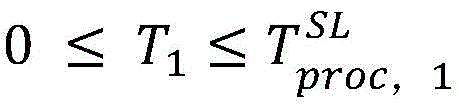
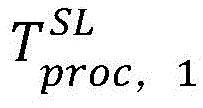
-如果T2min短于剩余分组延迟预算(以时隙为单位),则T2取决于UE实现,满足T2min≤T2≤剩余分组预算(以时隙为单位);否则T2被设置为剩余分组延迟预算(以时隙为单位)。- If T 2min is shorter than the remaining packet delay budget (in slots), then T 2 depends on UE implementation, satisfying T 2min ≤ T 2 ≤ remaining packet budget (in slots); otherwise T 2 is set to Remaining packet delay budget in slots.
候选单时隙资源的总数由Mtotal表示。The total number of candidate single-slot resources is denoted by M total .
2)感测窗口由时隙范围

3)内部参数Th(pi,pj)被设置为由sl-ThresPSSCH-RSRP-List-r16中的第i个字段指示的RSRP阈值的对应值,其中i=pi+(pj-1)*8。3) The internal parameter Th(p i , p j ) is set to the corresponding value of the RSRP threshold indicated by the i-th field in sl-ThresPSSCH-RSRP-List-r16, where i=p i +(p j -1 )*8.
4)集合SA被初始化为所有候选单时隙资源的集合。4) The set S A is initialized as a set of all candidate single-slot resources.
5)如果满足以下所有条件,则UE应从集合SA中排除任何候选单时隙资源Rx,y:5) The UE shall exclude any candidate single-slot resource R x,y from the set SA if all the following conditions are met:
-在步骤2中,UE没有监视时隙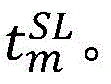
-对于高层参数sl-ResourceReservePeriodList-16所允许的任何周期值,以及在时隙
6)如果满足以下所有条件,则UE应从SA集合中排除任何候选单时隙资源Rx,y:6) The UE shall exclude any candidate single-slot resource R x,y from the SA set if all the following conditions are met:
a)UE在时隙
b)根据第8.4.2.1条对接收的SCI格式1-A进行的RSRP测量高于Th(prioRX,prioTX);b) the RSRP measurement according to clause 8.4.2.1 on the received SCI format 1-A is higher than Th(prio RX , prio TX );
c)在时隙

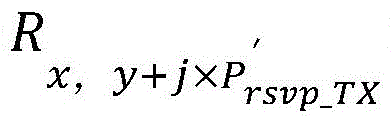
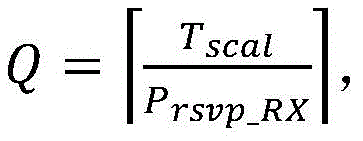

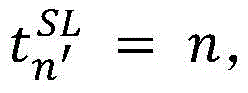

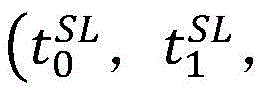


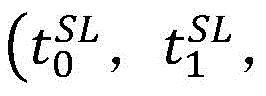

7)如果集合SA中剩余的候选单时隙资源的数量小于X·Mtotal,则对于每个优先级值Th(pi,pj),Th(pi,pj)增加3dB,并且过程继续到步骤4。7) If the number of remaining candidate single-slot resources in the set S A is less than X·M total , then for each priority value Th(p i , p j ), Th(p i , p j ) is increased by 3dB, and The process continues to step 4.
UE将向高层报告集合SA。The UE will report the set SA to higher layers.
如果来自集合(r0,r1,r2,…)的资源ri不是SA的成员,则UE应向高层报告资源ri的重新评估。If the resource ri from the set (r 0 , r 1 , r 2 , ...) is not a member of SA , the UE shall report the re-evaluation of the resource ri to higher layers.
如果由于上述步骤6中的通过与接收到的具有相关联的优先级prioRX的SCI格式1-A的RSRP测量相比而进行的排除,来自集合(r′0,r′1,r′2,…)的资源r′i不是SA的成员,并且满足以下条件之一,则UE应向高层报告该资源r′i的抢占。 From the set (r′ 0 , r′ 1 , r′ 2 ,...) resource r' i is not a member of SA , and one of the following conditions is met, then the UE shall report the preemption of the resource r' i to the upper layer.
-sl-PreemptionEnable被提供且等于“enabled”,并且prioTX>prioRX -sl-PreemptionEnable is provided and equal to "enabled", and prio TX > prio RX
-sl-PreemptionEnable被提供且不等于“enabled”,并且prioRX<priopre且prioTX>prioRX -sl-PreemptionEnable is provided and not equal to "enabled", and prio RX < prio pre and prio TX > prio RX
表8.1.4-1:取决于子载波间隔的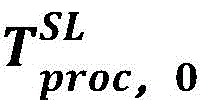

表8.1.4-2:取决于子载波间隔的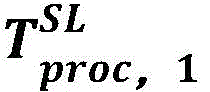

附录CAppendix C
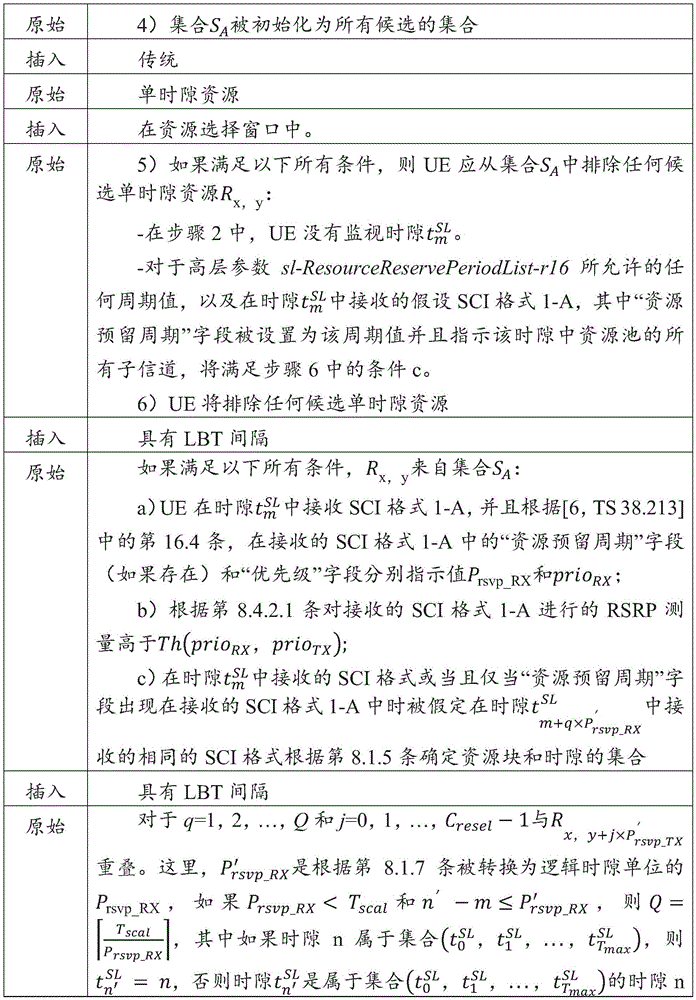
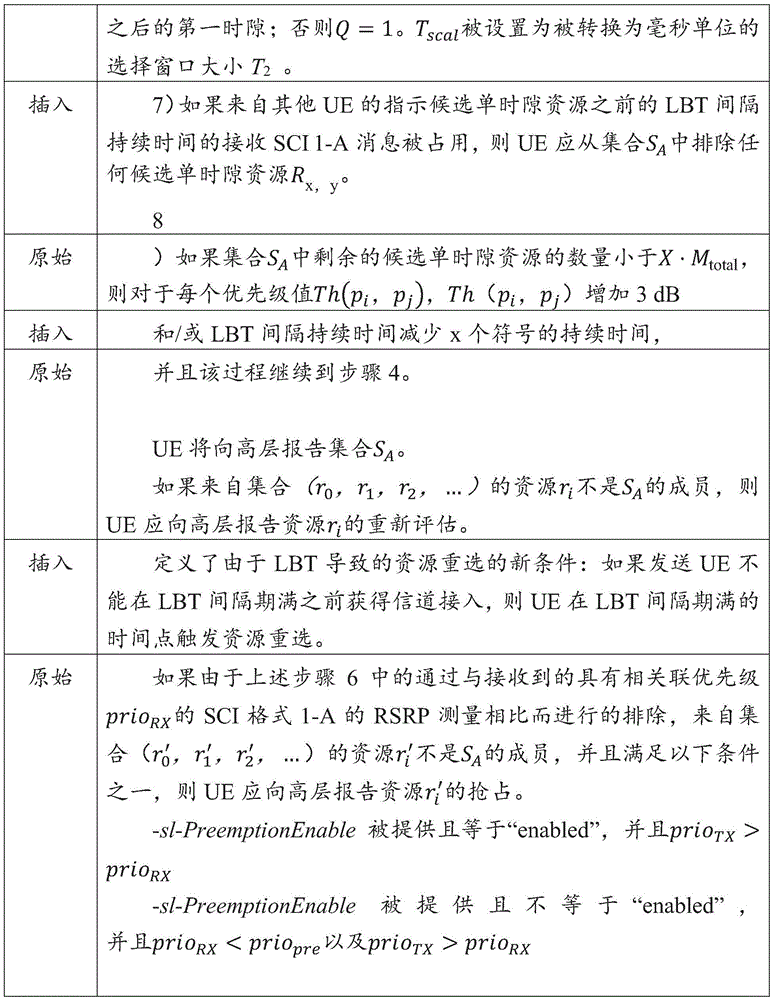
Claims (20)
Applications Claiming Priority (6)
| Application Number | Priority Date | Filing Date | Title |
|---|---|---|---|
| US202163243089P | 2021-09-10 | 2021-09-10 | |
| US63/243,089 | 2021-09-10 | ||
| US202263336236P | 2022-04-28 | 2022-04-28 | |
| US63/336,236 | 2022-04-28 | ||
| US17/886,449 | 2022-08-11 | ||
| US17/886,449 US12336002B2 (en) | 2021-09-10 | 2022-08-11 | Systems, methods, and apparatus for slot structure, channel access, and resource allocation for sidelink communications |
Publications (1)
| Publication Number | Publication Date |
|---|---|
| CN115802496A true CN115802496A (en) | 2023-03-14 |
Family
ID=85284673
Family Applications (1)
| Application Number | Title | Priority Date | Filing Date |
|---|---|---|---|
| CN202211104315.1A Pending CN115802496A (en) | 2021-09-10 | 2022-09-09 | Systems, methods and apparatus for sidelink communications |
Country Status (5)
| Country | Link |
|---|---|
| US (1) | US12336002B2 (en) |
| KR (1) | KR20230038104A (en) |
| CN (1) | CN115802496A (en) |
| DE (1) | DE102022122558A1 (en) |
| TW (1) | TW202320581A (en) |
Cited By (1)
| Publication number | Priority date | Publication date | Assignee | Title |
|---|---|---|---|---|
| WO2024199354A1 (en) * | 2023-03-29 | 2024-10-03 | 夏普株式会社 | Method executed by user equipment, and user equipment |
Families Citing this family (6)
| Publication number | Priority date | Publication date | Assignee | Title |
|---|---|---|---|---|
| US12317316B2 (en) * | 2022-01-26 | 2025-05-27 | Qualcomm Incorporated | Method and apparatus for continuous channel reservation for sidelink communication |
| US12369174B2 (en) * | 2022-03-01 | 2025-07-22 | Qualcomm Incorporated | Continuous transmission grants in sidelink communication networks |
| KR20230141463A (en) * | 2022-03-30 | 2023-10-10 | 엘지전자 주식회사 | a terminal to perform sidelink communication in an unlicensed band in a wireless communication system and an apparatus therefor |
| EP4373147A4 (en) * | 2022-09-28 | 2024-09-04 | Quectel Wireless Solutions Co., Ltd. | METHOD AND DEVICE FOR SIDELINK COMMUNICATION |
| KR20250113420A (en) * | 2023-04-06 | 2025-07-25 | 지티이 코포레이션 | Systems and methods for device-to-device communication |
| WO2024087526A1 (en) * | 2023-04-07 | 2024-05-02 | Lenovo (Beijing) Limited | Method and apparatus for sidelink resource determination |
Family Cites Families (9)
| Publication number | Priority date | Publication date | Assignee | Title |
|---|---|---|---|---|
| WO2017099860A1 (en) * | 2015-12-07 | 2017-06-15 | Intel IP Corporation | Device for non-scheduled uplink transmission in the unlicensed spectrum |
| US10667288B2 (en) | 2017-02-21 | 2020-05-26 | Qualcomm Incorporated | Techniques for configuring or transmitting grantless transmissions on beams in uplink subframes |
| US11184924B2 (en) | 2017-04-28 | 2021-11-23 | Telefonaktiebolaget Lm Ericsson (Publ) | Multiple starting positions for uplink transmission on unlicensed spectrum |
| US11044135B2 (en) | 2018-01-23 | 2021-06-22 | Qualcomm Incorporated | NR-SS LBT gap optimizations |
| US11265917B2 (en) | 2018-04-30 | 2022-03-01 | Qualcomm Incorporated | Aligned LBT gaps for single operator FBE NR-SS |
| US20230095560A1 (en) * | 2020-04-27 | 2023-03-30 | Qualcomm Incorporated | Wireless communication device synchronization |
| KR20230026332A (en) * | 2020-06-24 | 2023-02-24 | 퀄컴 인코포레이티드 | Channel Access with Reserves for Sidelink Communications Unlicensed Spectrum |
| US11864231B2 (en) | 2020-08-20 | 2024-01-02 | Qualcomm Incorporated | Listen-before-talk (LBT) aware autonomous sensing for sidelink |
| US11611991B2 (en) | 2020-09-02 | 2023-03-21 | Qualcomm Incorporated | Frequency resource reservation for sidelink communication |
-
2022
- 2022-08-11 US US17/886,449 patent/US12336002B2/en active Active
- 2022-09-02 KR KR1020220111687A patent/KR20230038104A/en active Pending
- 2022-09-06 DE DE102022122558.5A patent/DE102022122558A1/en active Pending
- 2022-09-06 TW TW111133626A patent/TW202320581A/en unknown
- 2022-09-09 CN CN202211104315.1A patent/CN115802496A/en active Pending
Cited By (1)
| Publication number | Priority date | Publication date | Assignee | Title |
|---|---|---|---|---|
| WO2024199354A1 (en) * | 2023-03-29 | 2024-10-03 | 夏普株式会社 | Method executed by user equipment, and user equipment |
Also Published As
| Publication number | Publication date |
|---|---|
| DE102022122558A1 (en) | 2023-03-16 |
| US20230087110A1 (en) | 2023-03-23 |
| TW202320581A (en) | 2023-05-16 |
| US12336002B2 (en) | 2025-06-17 |
| KR20230038104A (en) | 2023-03-17 |
Similar Documents
| Publication | Publication Date | Title |
|---|---|---|
| US11956679B2 (en) | Sensing and resource selection based on priorities for sidelink transmissions | |
| US10764914B2 (en) | Uplink information processing method and apparatus | |
| CN113545163B (en) | Back-off procedure for two-step random access procedure | |
| EP3818768B1 (en) | Method and user equipment for performing random access channel procedure for unlicensed operation | |
| CN112567872B (en) | Method and apparatus for wide bandwidth cell and channel access | |
| US11589384B2 (en) | Data transmission method, terminal device, and network device | |
| US10375582B2 (en) | Uplink channel access, reservation and data transmission for licensed assist access long term evolution (LAA-LTE) | |
| US12336002B2 (en) | Systems, methods, and apparatus for slot structure, channel access, and resource allocation for sidelink communications | |
| US10917905B2 (en) | Autonomous uplink transmission using shared radio frequency spectrum | |
| KR102620971B1 (en) | Method and mobile communication system for signal transmission in license-assist access channel based on a channel clear assessment | |
| KR20210119293A (en) | Method and apparatus for ultra reliable low latency communication (urllc) in unlicensed band | |
| KR102131676B1 (en) | Channel reservation signal transmission method and base station | |
| JP2023514850A (en) | Measurement method, device, node and storage medium | |
| EP3372041B1 (en) | Scheduling and accessing of uplink resources | |
| CN106465138A (en) | Method and apparatus for transmitting LTE waveforms in a shared spectrum by carrier sensing | |
| RU2763959C1 (en) | Method for communication and communication apparatus | |
| CN111713168A (en) | Improved prioritized random access user equipment and base station | |
| WO2023208227A1 (en) | Method related to sidelink operation in unlicensed bands, user equipment, and base station | |
| CN110958715A (en) | Method for sending and receiving random access preamble and communication device | |
| CN107889158A (en) | Transmission control and the method and apparatus of data | |
| US20240163904A1 (en) | Method and apparatus for sidelink resource selection or exclusion of multi-consecutive time transmission in a wireless communication system | |
| EP3673698B1 (en) | Methods and nodes for communication on multiple channels | |
| KR20170037052A (en) | LAA LBT priority Class . | |
| KR102719520B1 (en) | Method and apparatus for tranceiving data in a wireless communication system using shared channel band | |
| CN117998611A (en) | Method and apparatus for side link resource selection or exclusion for multiple continuous time transmissions |
Legal Events
| Date | Code | Title | Description |
|---|---|---|---|
| PB01 | Publication | ||
| PB01 | Publication | ||
| SE01 | Entry into force of request for substantive examination | ||
| SE01 | Entry into force of request for substantive examination |