CN115702337A - Functional component and chemical substance sensor having the functional component - Google Patents
Functional component and chemical substance sensor having the functional component Download PDFInfo
- Publication number
- CN115702337A CN115702337A CN202180040707.3A CN202180040707A CN115702337A CN 115702337 A CN115702337 A CN 115702337A CN 202180040707 A CN202180040707 A CN 202180040707A CN 115702337 A CN115702337 A CN 115702337A
- Authority
- CN
- China
- Prior art keywords
- sheet
- functional
- chemical substance
- functional sheet
- fluorescence
- Prior art date
- Legal status (The legal status is an assumption and is not a legal conclusion. Google has not performed a legal analysis and makes no representation as to the accuracy of the status listed.)
- Pending
Links
Images




Classifications
-
- G—PHYSICS
- G01—MEASURING; TESTING
- G01N—INVESTIGATING OR ANALYSING MATERIALS BY DETERMINING THEIR CHEMICAL OR PHYSICAL PROPERTIES
- G01N21/00—Investigating or analysing materials by the use of optical means, i.e. using sub-millimetre waves, infrared, visible or ultraviolet light
- G01N21/62—Systems in which the material investigated is excited whereby it emits light or causes a change in wavelength of the incident light
- G01N21/63—Systems in which the material investigated is excited whereby it emits light or causes a change in wavelength of the incident light optically excited
- G01N21/64—Fluorescence; Phosphorescence
- G01N21/6486—Measuring fluorescence of biological material, e.g. DNA, RNA, cells
-
- G—PHYSICS
- G01—MEASURING; TESTING
- G01N—INVESTIGATING OR ANALYSING MATERIALS BY DETERMINING THEIR CHEMICAL OR PHYSICAL PROPERTIES
- G01N21/00—Investigating or analysing materials by the use of optical means, i.e. using sub-millimetre waves, infrared, visible or ultraviolet light
- G01N21/62—Systems in which the material investigated is excited whereby it emits light or causes a change in wavelength of the incident light
- G01N21/63—Systems in which the material investigated is excited whereby it emits light or causes a change in wavelength of the incident light optically excited
- G01N21/64—Fluorescence; Phosphorescence
- G01N21/6428—Measuring fluorescence of fluorescent products of reactions or of fluorochrome labelled reactive substances, e.g. measuring quenching effects, using measuring "optrodes"
- G01N21/643—Measuring fluorescence of fluorescent products of reactions or of fluorochrome labelled reactive substances, e.g. measuring quenching effects, using measuring "optrodes" non-biological material
-
- B—PERFORMING OPERATIONS; TRANSPORTING
- B01—PHYSICAL OR CHEMICAL PROCESSES OR APPARATUS IN GENERAL
- B01J—CHEMICAL OR PHYSICAL PROCESSES, e.g. CATALYSIS OR COLLOID CHEMISTRY; THEIR RELEVANT APPARATUS
- B01J20/00—Solid sorbent compositions or filter aid compositions; Sorbents for chromatography; Processes for preparing, regenerating or reactivating thereof
- B01J20/22—Solid sorbent compositions or filter aid compositions; Sorbents for chromatography; Processes for preparing, regenerating or reactivating thereof comprising organic material
-
- B—PERFORMING OPERATIONS; TRANSPORTING
- B01—PHYSICAL OR CHEMICAL PROCESSES OR APPARATUS IN GENERAL
- B01J—CHEMICAL OR PHYSICAL PROCESSES, e.g. CATALYSIS OR COLLOID CHEMISTRY; THEIR RELEVANT APPARATUS
- B01J20/00—Solid sorbent compositions or filter aid compositions; Sorbents for chromatography; Processes for preparing, regenerating or reactivating thereof
- B01J20/28—Solid sorbent compositions or filter aid compositions; Sorbents for chromatography; Processes for preparing, regenerating or reactivating thereof characterised by their form or physical properties
-
- C—CHEMISTRY; METALLURGY
- C01—INORGANIC CHEMISTRY
- C01C—AMMONIA; CYANOGEN; COMPOUNDS THEREOF
- C01C1/00—Ammonia; Compounds thereof
-
- C—CHEMISTRY; METALLURGY
- C07—ORGANIC CHEMISTRY
- C07C—ACYCLIC OR CARBOCYCLIC COMPOUNDS
- C07C63/00—Compounds having carboxyl groups bound to a carbon atoms of six-membered aromatic rings
- C07C63/14—Monocyclic dicarboxylic acids
- C07C63/15—Monocyclic dicarboxylic acids all carboxyl groups bound to carbon atoms of the six-membered aromatic ring
- C07C63/26—1,4 - Benzenedicarboxylic acid
- C07C63/28—Salts thereof
-
- C—CHEMISTRY; METALLURGY
- C08—ORGANIC MACROMOLECULAR COMPOUNDS; THEIR PREPARATION OR CHEMICAL WORKING-UP; COMPOSITIONS BASED THEREON
- C08J—WORKING-UP; GENERAL PROCESSES OF COMPOUNDING; AFTER-TREATMENT NOT COVERED BY SUBCLASSES C08B, C08C, C08F, C08G or C08H
- C08J5/00—Manufacture of articles or shaped materials containing macromolecular substances
- C08J5/18—Manufacture of films or sheets
-
- C—CHEMISTRY; METALLURGY
- C08—ORGANIC MACROMOLECULAR COMPOUNDS; THEIR PREPARATION OR CHEMICAL WORKING-UP; COMPOSITIONS BASED THEREON
- C08J—WORKING-UP; GENERAL PROCESSES OF COMPOUNDING; AFTER-TREATMENT NOT COVERED BY SUBCLASSES C08B, C08C, C08F, C08G or C08H
- C08J9/00—Working-up of macromolecular substances to porous or cellular articles or materials; After-treatment thereof
- C08J9/28—Working-up of macromolecular substances to porous or cellular articles or materials; After-treatment thereof by elimination of a liquid phase from a macromolecular composition or article, e.g. drying of coagulum
-
- G—PHYSICS
- G01—MEASURING; TESTING
- G01N—INVESTIGATING OR ANALYSING MATERIALS BY DETERMINING THEIR CHEMICAL OR PHYSICAL PROPERTIES
- G01N21/00—Investigating or analysing materials by the use of optical means, i.e. using sub-millimetre waves, infrared, visible or ultraviolet light
- G01N21/62—Systems in which the material investigated is excited whereby it emits light or causes a change in wavelength of the incident light
- G01N21/63—Systems in which the material investigated is excited whereby it emits light or causes a change in wavelength of the incident light optically excited
- G01N21/64—Fluorescence; Phosphorescence
- G01N21/645—Specially adapted constructive features of fluorimeters
-
- G—PHYSICS
- G01—MEASURING; TESTING
- G01N—INVESTIGATING OR ANALYSING MATERIALS BY DETERMINING THEIR CHEMICAL OR PHYSICAL PROPERTIES
- G01N31/00—Investigating or analysing non-biological materials by the use of the chemical methods specified in the subgroup; Apparatus specially adapted for such methods
- G01N31/22—Investigating or analysing non-biological materials by the use of the chemical methods specified in the subgroup; Apparatus specially adapted for such methods using chemical indicators
-
- C—CHEMISTRY; METALLURGY
- C08—ORGANIC MACROMOLECULAR COMPOUNDS; THEIR PREPARATION OR CHEMICAL WORKING-UP; COMPOSITIONS BASED THEREON
- C08J—WORKING-UP; GENERAL PROCESSES OF COMPOUNDING; AFTER-TREATMENT NOT COVERED BY SUBCLASSES C08B, C08C, C08F, C08G or C08H
- C08J2301/00—Characterised by the use of cellulose, modified cellulose or cellulose derivatives
- C08J2301/02—Cellulose; Modified cellulose
-
- G—PHYSICS
- G01—MEASURING; TESTING
- G01N—INVESTIGATING OR ANALYSING MATERIALS BY DETERMINING THEIR CHEMICAL OR PHYSICAL PROPERTIES
- G01N21/00—Investigating or analysing materials by the use of optical means, i.e. using sub-millimetre waves, infrared, visible or ultraviolet light
- G01N21/62—Systems in which the material investigated is excited whereby it emits light or causes a change in wavelength of the incident light
- G01N21/63—Systems in which the material investigated is excited whereby it emits light or causes a change in wavelength of the incident light optically excited
- G01N21/64—Fluorescence; Phosphorescence
- G01N21/645—Specially adapted constructive features of fluorimeters
- G01N2021/6482—Sample cells, cuvettes
-
- G—PHYSICS
- G01—MEASURING; TESTING
- G01N—INVESTIGATING OR ANALYSING MATERIALS BY DETERMINING THEIR CHEMICAL OR PHYSICAL PROPERTIES
- G01N21/00—Investigating or analysing materials by the use of optical means, i.e. using sub-millimetre waves, infrared, visible or ultraviolet light
- G01N21/75—Systems in which material is subjected to a chemical reaction, the progress or the result of the reaction being investigated
- G01N21/77—Systems in which material is subjected to a chemical reaction, the progress or the result of the reaction being investigated by observing the effect on a chemical indicator
- G01N2021/7769—Measurement method of reaction-produced change in sensor
- G01N2021/7786—Fluorescence
Landscapes
- Chemical & Material Sciences (AREA)
- Health & Medical Sciences (AREA)
- Organic Chemistry (AREA)
- Life Sciences & Earth Sciences (AREA)
- Engineering & Computer Science (AREA)
- Analytical Chemistry (AREA)
- Chemical Kinetics & Catalysis (AREA)
- Immunology (AREA)
- Physics & Mathematics (AREA)
- General Physics & Mathematics (AREA)
- Pathology (AREA)
- Manufacturing & Machinery (AREA)
- General Health & Medical Sciences (AREA)
- Biochemistry (AREA)
- Nuclear Medicine, Radiotherapy & Molecular Imaging (AREA)
- Materials Engineering (AREA)
- Medicinal Chemistry (AREA)
- Polymers & Plastics (AREA)
- Molecular Biology (AREA)
- Inorganic Chemistry (AREA)
- Biomedical Technology (AREA)
- Optics & Photonics (AREA)
- Biophysics (AREA)
- Solid-Sorbent Or Filter-Aiding Compositions (AREA)
Abstract
本公开的一个方案的功能性构件具备具有空隙的多孔构件和捕捉化学物质的捕集剂。上述捕集剂被保持于上述多孔构件的上述空隙中。

A functional member according to one aspect of the present disclosure includes a porous member having voids and a trapping agent for trapping chemical substances. The collection agent is held in the voids of the porous member.
Description
技术领域technical field
本公开涉及功能性构件和具备该功能性构件的化学物质传感器。The present disclosure relates to a functional component and a chemical substance sensor provided with the functional component.
背景技术Background technique
已知有捕捉化学物质的有机盐。有机盐的一个例子为通过包含羧酸基或磺酸基的有机酸分子与包含氨基的胺分子的离子键而形成的有机盐。在申请人所公开的专利文献1中,公开了包含对苯二甲酸和伯烷基胺的有机盐。在专利文献1中,记载了上述有机盐会化学吸附羟基自由基;及通过有机盐的荧光特性因吸附而发生变化从而能够检测到羟基自由基。另外,在申请人所公开的专利文献2、专利文献3及非专利文献1中,公开了包含氰基丙烯酸衍生物和三苯基甲基胺的有机盐。在这些文献中,记载了上述有机盐会物理吸附氨;以及通过有机盐的荧光特性因吸附而发生变化从而能够检测到氨。Organic salts of capture chemicals are known. An example of an organic salt is an organic salt formed by an ionic bond between an organic acid molecule containing a carboxylic acid group or a sulfonic acid group and an amine molecule containing an amino group. In
现有技术文献prior art literature
专利文献patent documents
专利文献1:国际公开第2019/244464号Patent Document 1: International Publication No. 2019/244464
专利文献2:国际公开第2018/169022号Patent Document 2: International Publication No. 2018/169022
专利文献3:国际公开第2018/169023号Patent Document 3: International Publication No. 2018/169023
非专利文献non-patent literature
非专利文献1:细川铁平等、“カルボン酸アミン塩からなる有機複合体のアンモニアセンサ応用”、第68次高分子学会年次大会(2019年)预稿集、セッションID:3J16Non-Patent Document 1: Teppei Hosokawa, "Calbon Acid Aminokaranaru Organic Complexes for Anmoniasensa", Preliminary Collection of the 68th Annual Meeting of the Polymer Society (2019), SessionID: 3J16
发明内容Contents of the invention
发明所要解决的课题The problem to be solved by the invention
在专利文献1~3及非专利文献1中,记载了利用颗粒状的有机盐晶体来检测化学物质。但是,通过该方法,难以简便且高灵敏度地检测化学物质。In
本公开提供通过使用上述有机盐等捕捉化学物质的捕集剂而能够简便且高灵敏度地检测化学物质的技术。The present disclosure provides a technique capable of simple and highly sensitive detection of chemical substances by using a trapping agent for trapping chemical substances such as the above-mentioned organic salts.
用于解决课题的手段means to solve the problem
本公开的一个方案提供一种功能性构件,其具备:具有空隙的多孔构件;和捕集剂,其被保持于上述空隙中,且捕捉化学物质。One aspect of the present disclosure provides a functional member including: a porous member having voids; and a trapping agent held in the voids and trapping chemical substances.
发明效果Invention effect
根据本公开的功能性构件,能够简便且高灵敏度地检测化学物质。According to the functional member of the present disclosure, chemical substances can be detected simply and with high sensitivity.
附图说明Description of drawings
图1是表示本公开的功能性构件的一个例子的示意图。FIG. 1 is a schematic diagram showing an example of a functional component of the present disclosure.
图2是表示天然纤维素的X射线衍射图案的一个例子的图表。Fig. 2 is a graph showing an example of an X-ray diffraction pattern of natural cellulose.
图3表示作为捕集剂的一个例子的有机盐A可包含的伯烷基胺的例子。FIG. 3 shows examples of primary alkylamines that can be contained in organic salt A as an example of a collector.
图4表示作为捕集剂的一个例子的有机盐B可包含的氰基丙烯酸衍生物的例子。Fig. 4 shows an example of a cyanoacrylic acid derivative that can be contained in the organic salt B as an example of a collector.
图5表示作为捕集剂的一个例子的有机盐B可包含的3取代甲基胺的例子。FIG. 5 shows examples of tri-substituted methylamines that can be contained in the organic salt B as an example of a collector.
图6是示意性表示本公开的化学物质传感器的一个例子的截面图。FIG. 6 is a cross-sectional view schematically showing an example of the chemical substance sensor of the present disclosure.
图7是示意性表示本公开的化学物质传感器的另一个例子的分解立体图。FIG. 7 is an exploded perspective view schematically showing another example of the chemical substance sensor of the present disclosure.
图8是示意性表示本公开的化学物质传感器的又一个例子的分解立体图。Fig. 8 is an exploded perspective view schematically showing still another example of the chemical substance sensor of the present disclosure.
图9是示意性表示本公开的化学物质传感器的再又一个例子的分解立体图。FIG. 9 is an exploded perspective view schematically showing yet another example of the chemical substance sensor of the present disclosure.
图10A是示意性表示本公开的化学物质传感器的与上述不同的一个例子的分解图。FIG. 10A is an exploded view schematically showing an example of the chemical substance sensor of the present disclosure that is different from the above.
图10B是表示关于图10A的设置于盖部的固定构件及磁铁的10B-10B处的截面的截面图。FIG. 10B is a cross-sectional view showing a cross section at 10B-10B of the fixing member and the magnet provided on the cover in FIG. 10A .
图11是示意性表示本公开的化学物质传感器的与上述不同的一个例子的分解图。FIG. 11 is an exploded view schematically showing an example of the chemical substance sensor of the present disclosure that is different from the above.
图12是表示本公开的化学物质传感器的使用的方式的一个例子的示意图。FIG. 12 is a schematic diagram showing an example of a usage mode of the chemical substance sensor of the present disclosure.
图13是表示实施例1中制作的有机盐及功能性片材的X射线衍射图案的图表。13 is a graph showing X-ray diffraction patterns of organic salts and functional sheets prepared in Example 1. FIG.
图14A是实施例1中制作的功能性片材的利用扫描型电子显微镜得到的放大观察图像。14A is an enlarged observation image of the functional sheet produced in Example 1 by a scanning electron microscope.
图14B是将图14A的放大观察图像中的区域R2进一步放大的图像。FIG. 14B is a further enlarged image of the region R2 in the enlarged observation image of FIG. 14A .
图14C是将图14B的放大观察图像中的区域R3进一步放大的图像。FIG. 14C is a further enlarged image of the region R3 in the enlarged observation image of FIG. 14B .
图15A是实施例1中制作的功能性片材中的与图14A不同的部分的利用扫描型电子显微镜得到的放大观察图像。15A is an enlarged observation image obtained by a scanning electron microscope of a portion different from FIG. 14A in the functional sheet produced in Example 1. FIG.
图15B是将图15A的放大观察图像中的区域R4进一步放大的图像。FIG. 15B is a further enlarged image of the region R4 in the enlarged observation image of FIG. 15A .
图15C是将图15B的放大观察图像中的区域R5进一步放大的图像。FIG. 15C is a further enlarged image of the region R5 in the enlarged observation image of FIG. 15B .
图16A是用于说明在实施例1~3及比较例1中功能性片材向包含羟基自由基的气氛中的暴露所使用的腔室的示意图。16A is a schematic diagram of a chamber used for explaining the exposure of the functional sheet to an atmosphere containing hydroxyl radicals in Examples 1 to 3 and Comparative Example 1. FIG.
图16B是表示从位于该腔室的斜上方的点X拍摄在实施例1~3及比较例1中使用的实际的上述腔室而得到的照片的图。16B is a diagram showing photographs taken from a point X located obliquely above the chamber of the actual chamber used in Examples 1 to 3 and Comparative Example 1. FIG.
图17是表示实施例1中制作的功能性片材的荧光图像A及荧光图像B的图。17 is a view showing fluorescence images A and B of the functional sheet produced in Example 1. FIG.
图18是表示实施例1中制作的功能性片材的荧光图像A’及荧光图像B’的图。Fig. 18 is a diagram showing a fluorescent image A' and a fluorescent image B' of the functional sheet prepared in Example 1.
图19是表示关于实施例1从暴露于包含羟基自由基的气氛中后的功能性片材抽提的有机盐的溶液所发出的荧光光谱的图表。19 is a graph showing fluorescence spectra emitted from a solution of an organic salt extracted from a functional sheet exposed to an atmosphere containing hydroxyl radicals in Example 1. FIG.
图20是表示实施例2中制作的有机盐及功能性片材的X射线衍射图案的图表。FIG. 20 is a graph showing X-ray diffraction patterns of organic salts and functional sheets prepared in Example 2. FIG.
图21是表示实施例2中制作的功能性片材的荧光图像A及荧光图像B的图。FIG. 21 is a diagram showing fluorescence images A and B of a functional sheet produced in Example 2. FIG.
图22是表示实施例2中制作的功能性片材的荧光图像A’及荧光图像B’的图。Fig. 22 is a diagram showing fluorescence image A' and fluorescence image B' of the functional sheet produced in Example 2.
图23是表示关于实施例2从暴露于包含羟基自由基的气氛中后的功能性片材抽提的有机盐的溶液所发出的荧光光谱的图表。23 is a graph showing fluorescence spectra emitted from a solution of an organic salt extracted from a functional sheet exposed to an atmosphere containing hydroxyl radicals in Example 2. FIG.
图24是表示实施例3中制作的有机盐及功能性片材的X射线衍射图案的图表。24 is a graph showing X-ray diffraction patterns of organic salts and functional sheets produced in Example 3.
图25是表示实施例3中制作的功能性片材的荧光图像A及荧光图像B的图。FIG. 25 is a diagram showing fluorescence images A and B of the functional sheet produced in Example 3. FIG.
图26是表示实施例3中制作的功能性片材的荧光图像A’及荧光图像B’的图。Fig. 26 is a diagram showing a fluorescent image A' and a fluorescent image B' of the functional sheet produced in Example 3.
图27是表示关于实施例3从暴露于包含羟基自由基的气氛中后的功能性片材抽提的有机盐的溶液所发出的荧光光谱的图表。27 is a graph showing fluorescence spectra emitted from a solution of an organic salt extracted from a functional sheet exposed to an atmosphere containing hydroxyl radicals in Example 3. FIG.
图28是表示比较例1中制作的颗粒的荧光图像A及荧光图像B的图。28 is a diagram showing fluorescence image A and fluorescence image B of particles produced in Comparative Example 1. FIG.
图29是表示关于比较例1使暴露于包含羟基自由基的气氛中后的颗粒溶解而得到的有机盐的溶液所发出的荧光光谱的图表。29 is a graph showing the fluorescence spectrum emitted by an organic salt solution obtained by dissolving particles exposed to an atmosphere containing hydroxyl radicals in Comparative Example 1. FIG.
图30是表示在实施例4中对功能性片材向包含羟基自由基的气氛中的暴露所使用的实际的腔室及暴露的状态进行拍摄而得到的照片的图。30 is a diagram showing photographs taken of an actual chamber used for exposing a functional sheet to an atmosphere containing hydroxyl radicals in Example 4 and the state of exposure.
图31是表示实施例4中制作的各功能性片材的荧光图像A及荧光图像B的图。31 is a diagram showing fluorescence images A and B of each functional sheet produced in Example 4. FIG.
图32是表示关于实施例4从暴露于包含羟基自由基的气氛中后的各功能性片材抽提的有机盐的溶液所发出的荧光光谱的图表。32 is a graph showing fluorescence spectra emitted from solutions of organic salts extracted from functional sheets exposed to an atmosphere containing hydroxyl radicals in Example 4. FIG.
图33是表示在实施例5中对功能性片材向包含羟基自由基的气氛中的暴露所使用的实际的腔室及暴露的状态进行拍摄而得到的照片的图。33 is a diagram showing photographs taken of an actual chamber used for exposing the functional sheet to an atmosphere containing hydroxyl radicals in Example 5 and the state of exposure.
图34是表示实施例5中制作的功能性片材的荧光图像A及荧光图像B的图。34 is a view showing fluorescence images A and B of the functional sheet produced in Example 5. FIG.
图35是表示关于实施例5从暴露于包含羟基自由基的气氛中后的功能性片材抽提的有机盐的溶液所发出的荧光光谱的图表。35 is a graph showing fluorescence spectra emitted from a solution of an organic salt extracted from a functional sheet exposed to an atmosphere containing hydroxyl radicals in Example 5. FIG.
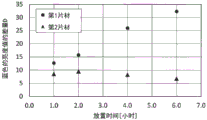
图36是表示实施例6中实施的向体表气体中的暴露试验中的功能性片材的放置时间与在放置的前后功能性片材所发出的荧光的蓝色的亮度值的差量D的关系的图表。36 shows the difference D in the blue luminance value of the fluorescent light emitted by the functional sheet before and after the standing time of the functional sheet in the exposure test to body surface air carried out in Example 6. relationship diagram.
图37是表示实施例6中实施的向体表气体中的暴露试验中的功能性片材的放置时间与D1-D2的关系的图表,所述D1-D2是关于在放置的前后功能性片材所发出的荧光的蓝色的亮度值的差量D而言与被验者接触地放置的第1片材的该差量D1与放置于被验者的旁边的第2片材的该差量D2之间的差量。Fig. 37 is a graph showing the relationship between the standing time of the functional sheet and D 1 -D 2 in the exposure test to body surface gas carried out in Example 6 . The difference D of the blue brightness value of the fluorescence emitted by the front and rear functional sheets is the difference D1 between the first sheet placed in contact with the subject and the second sheet placed next to the subject. The difference between this difference D 2 of the sheet.
图38是表示实施例8中实施的向体表气体中的暴露试验中的功能性片材的放置时间与在放置的前后功能性片材所发出的荧光的蓝色的亮度值的差量D的关系的图表。38 shows the difference D in the blue luminance value of the fluorescent light emitted by the functional sheet before and after the standing time of the functional sheet in the exposure test to body surface air carried out in Example 8. relationship diagram.
图39是表示实施例8中实施的向体表气体中的暴露试验中的功能性片材的放置时间与D1-D2的关系的图表,所述D1-D2是关于在放置的前后功能性片材所发出的荧光的蓝色的亮度值的差量D而言与被验者接触地放置的第1传感器内的第1片材的该差量D1与放置于被验者的旁边的第2传感器内的第2片材的该差量D2之间的差量。Fig . 39 is a graph showing the relationship between the standing time of the functional sheet and D 1 -D 2 in the exposure test to body surface gas carried out in Example 8. For the difference D of the blue brightness value of the fluorescent light emitted by the front and back functional sheets, the difference D1 between the first sheet placed in the first sensor placed in contact with the subject and the difference D1 placed on the subject The difference between the difference D2 of the second sheet next to the second sensor inside the second.
图40是表示实施例9中制作的有机盐及功能性片材的X射线衍射图案的图表。FIG. 40 is a graph showing X-ray diffraction patterns of organic salts and functional sheets prepared in Example 9. FIG.
图41是用于说明在实施例9中对功能性片材向包含氨的气氛中的暴露所使用的腔室、暴露的状态及功能性片材所发出的荧光进行拍摄的方法的示意图。41 is a schematic diagram for explaining a method of photographing the chamber used for exposing the functional sheet to an atmosphere containing ammonia, the state of exposure, and the fluorescence emitted by the functional sheet in Example 9.
图42是表示实施例9中实施的向包含氨的气氛中的暴露试验中的经过时间与功能性片材所发出的荧光的绿色的亮度变化率的关系的图表。42 is a graph showing the relationship between the elapsed time and the rate of change in green luminance of fluorescence emitted by the functional sheet in the exposure test to an atmosphere containing ammonia carried out in Example 9. FIG.
图43是表示实施例11~13的功能性片材及比较例12的颗粒中的对于波长450nm的光的光线透射率与羟基自由基的检测效率的关系的图表。43 is a graph showing the relationship between the light transmittance to light with a wavelength of 450 nm and the detection efficiency of hydroxyl radicals in the functional sheets of Examples 11 to 13 and the particles of Comparative Example 12.
图44是表示对于实施例13的功能性片材的暴露面及背面利用紫外线的照射而得到的荧光的发光状态的图。FIG. 44 is a diagram showing the state of fluorescence emission obtained by irradiation of ultraviolet rays on the exposed surface and the back surface of the functional sheet of Example 13. FIG.
具体实施方式Detailed ways
(成为本公开的基础的见识)(findings that became the basis of this disclosure)
在专利文献1~3及非专利文献1中,记载了利用颗粒状的有机盐晶体来检测化学物质。但是,根据本发明者们的研究,就该方法而言,未必能够充分地确保与化学物质的接触面积,难以进行高灵敏度的检测。另外,有机盐晶体容易通过冲击或接触等而崩坏或飞散,在人体等生物体上的穿戴性及对于对象物的固定性也低劣。因此,难以进行化学物质的简便的检测。In
鉴于这些问题,本发明者们想到了使多孔构件中保持有捕集剂的功能性构件。本公开的功能性构件具有使多孔构件的空隙中保持有捕集剂的结构。就该结构而言,在多孔构件所具有的无数的空隙中,以小至能够保持于各个空隙中的程度的粒径保持捕集剂。因此,对于捕集剂能够确保大的表面积,由此,能够提高化学物质的检测灵敏度。另外,由于以多孔构件作为保持基材,因此能够提高在人体等生物体上的穿戴性及对于对象物的固定性,并且能够保护捕集剂而防止捕集剂因冲击及接触等而崩坏及飞散。换言之,本公开的功能性构件对于冲击及接触等机械性刺激是稳定的。因此,根据本公开的功能性构件,能够实现化学物质的简便且高灵敏度的检测。In view of these problems, the present inventors conceived of a functional member in which a trapping agent is held in a porous member. The functional member of the present disclosure has a structure in which the trapping agent is held in the pores of the porous member. With this structure, the collection agent is retained in the numerous voids of the porous member with a particle diameter small enough to be held in each void. Therefore, a large surface area can be ensured for the collector, thereby improving the detection sensitivity of chemical substances. In addition, since the porous member is used as the holding base material, the wearability on the human body and other organisms and the fixability to the object can be improved, and the collection agent can be protected to prevent the collection agent from collapsing due to impact and contact. and fly away. In other words, the functional components of the present disclosure are stable against mechanical stimuli such as impact and contact. Therefore, according to the functional member of the present disclosure, simple and highly sensitive detection of chemical substances can be realized.
(本公开的一个方案的概要)(Summary of one aspect of the present disclosure)
本公开的第1方案的功能性构件,其具备:具有空隙的多孔构件;和捕集剂,其被保持于上述空隙中,且捕捉化学物质。A functional member according to a first aspect of the present disclosure includes: a porous member having voids; and a trapping agent held in the voids and capturing chemical substances.
根据第1方案,可得到能够进行化学物质的简便且高灵敏度的检测的功能性构件。According to the first aspect, a functional member capable of simple and highly sensitive detection of chemical substances can be obtained.
在本公开的第2方案中,例如,根据第1方案的功能性构件,上述捕集剂的平均粒径也可以为1μm以下。在该情况下,能够增大功能性构件中的捕集剂的表面积,由此,能够提高化学物质的检测灵敏度。In the second aspect of the present disclosure, for example, according to the functional member of the first aspect, the average particle diameter of the collection agent may be 1 μm or less. In this case, the surface area of the trapping agent in the functional member can be increased, thereby improving the detection sensitivity of the chemical substance.
在本公开的第3方案中,例如,根据第1或第2方案的功能性构件,上述空隙的孔径也可以为1μm以下。在该情况下,能够减小被保持于空隙中的捕集剂的粒径,由此,能够增大功能性构件中的捕集剂的表面积。表面积的增大会使功能性构件中的化学物质的检测灵敏度提高。In a third aspect of the present disclosure, for example, according to the functional member of the first or second aspect, the pores may have a diameter of 1 μm or less. In this case, the particle size of the trapping agent held in the voids can be reduced, thereby increasing the surface area of the trapping agent in the functional member. The increase in surface area leads to an increase in the detection sensitivity of the chemical species in the functional building block.
在本公开的第4方案中,例如,根据第1~第3方案中任一项的功能性构件,上述多孔构件的空隙率也可以为30%以上。在该情况下,能够使作为检测对象的化学物质有效地扩散至功能性构件的内部,由此,利用捕集剂捕捉化学物质的概率增加,能够提高功能性构件中的化学物质的检测灵敏度。In a fourth aspect of the present disclosure, for example, according to the functional member of any one of the first to third aspects, the porosity of the porous member may be 30% or more. In this case, the chemical substance to be detected can be efficiently diffused into the functional member, thereby increasing the probability of capturing the chemical substance by the trapping agent, and improving the detection sensitivity of the chemical substance in the functional member.
在本公开的第5方案中,例如,根据第1~第4方案中任一项的功能性构件,上述捕集剂也可以在捕捉有上述化学物质的状态下通过激发光的照射而发出上述状态所特有的荧光。就第5方案而言,能够通过光学方法来检测化学物质,例如,能够在不与功能性构件相接触的情况下检测所捕捉的化学物质。In the fifth aspect of the present disclosure, for example, according to the functional component of any one of the first to fourth aspects, the above-mentioned trapping agent can also emit the above-mentioned State-specific fluorescence. In the fifth aspect, the chemical substance can be detected optically, for example, the captured chemical substance can be detected without being in contact with the functional member.
在本公开的第6方案中,例如,根据第5方案的功能性构件,上述激发光也可以为紫外线。In the sixth aspect of the present disclosure, for example, according to the functional member of the fifth aspect, the excitation light may be ultraviolet rays.
在本公开的第7方案中,例如,根据第1~第6方案中任一项的功能性构件,上述捕集剂也可以为有机盐。In the seventh aspect of the present disclosure, for example, according to the functional member of any one of the first to sixth aspects, the collector may be an organic salt.
在本公开的第8方案中,例如,根据第1~第7方案中任一项的功能性构件,上述化学物质也可以包含羟基自由基。In the eighth aspect of the present disclosure, for example, according to the functional component of any one of the first to seventh aspects, the above-mentioned chemical substance may also contain hydroxyl radicals.
在本公开的第9方案中,例如,根据第8方案的功能性构件,上述捕集剂也可以为包含对苯二甲酸和一种以上的伯烷基胺的有机盐。In the ninth aspect of the present disclosure, for example, according to the functional component of the eighth aspect, the above-mentioned collector may be an organic salt containing terephthalic acid and one or more primary alkylamines.
在本公开的第10方案中,例如,根据第1~第9方案中任一项的功能性构件,上述化学物质也可以包含氨。In the tenth aspect of the present disclosure, for example, according to the functional member of any one of the first to ninth aspects, the chemical substance may contain ammonia.
在本公开的第11方案中,例如,根据第10方案的功能性构件,上述捕集剂也可以为包含氰基丙烯酸衍生物及3取代甲基胺的有机盐。In the eleventh aspect of the present disclosure, for example, according to the functional member of the tenth aspect, the collector may be an organic salt containing a cyanoacrylic acid derivative and a 3-substituted methylamine.
在本公开的第12方案中,例如,根据第1~第11中任一项的功能性构件,上述多孔构件为多孔片材,上述功能性构件也可以为在上述多孔片材的上述空隙中保持有上述捕集剂的功能性片材。就第12方案而言,例如,能够谋求功能性构件中的光线透射率的提高、和/或功能性构件在生物体上的穿戴性的提高。光线透射率的提高可有助于提高利用光学方法检测的化学物质的灵敏度。在生物体上的穿戴性的提高可有助于实现长时间的穿戴。In a twelfth aspect of the present disclosure, for example, according to any one of the first to eleventh functional members, the porous member is a porous sheet, and the functional member may be in the voids of the porous sheet. A functional sheet holding the above-mentioned trapping agent. According to the twelfth aspect, for example, the light transmittance of the functional member can be improved, and/or the wearability of the functional member on the living body can be improved. Increased light transmission can help increase the sensitivity of optically detected chemicals. Improvement in wearability on a living body can contribute to long-term wearability.
在本公开的第13方案中,例如,根据第12方案的功能性构件,上述多孔片材也可以包含再生纤维素。就包含再生纤维素的多孔片材而言,通过基于再生纤维素中丰富包含的羟基而实现的强度提高的效果,能够以更小的厚度确保作为功能性片材的强度。小的厚度可有助于功能性构件中的光线透射率的提高、和/或功能性构件在生物体上的穿戴性的提高。In a thirteenth aspect of the present disclosure, for example, according to the functional member of the twelfth aspect, the porous sheet may contain regenerated cellulose. In the case of a porous sheet containing regenerated cellulose, the strength as a functional sheet can be ensured with a smaller thickness due to the strength-enhancing effect due to the hydroxyl groups abundantly contained in the regenerated cellulose. A small thickness can contribute to an improvement in light transmittance in the functional member, and/or an improvement in wearability of the functional member on a living body.
在本公开的第14方案中,例如,根据第13方案的功能性构件,上述再生纤维素的重均分子量也可以为15万以上。在该情况下,通过在1分子中存在的羟基的数目增大,能够促进分子间的氢键的形成。氢键形成的促进例如可有助于形成虽然薄但自立性提高的功能性片材。In a fourteenth aspect of the present disclosure, for example, according to the functional member according to the thirteenth aspect, the regenerated cellulose may have a weight average molecular weight of 150,000 or more. In this case, the formation of intermolecular hydrogen bonds can be promoted by increasing the number of hydroxyl groups present in one molecule. The promotion of hydrogen bond formation, for example, contributes to the formation of a thin functional sheet with improved self-supporting properties.
在本公开的第15方案中,例如,根据第12~第14方案中任一项的功能性构件,上述功能性片材的厚度也可以为100nm~2000nm。第15方案的功能性构件特别适合于通过贴附而穿戴于生物体上。In a fifteenth aspect of the present disclosure, for example, according to the functional member according to any one of the twelfth to fourteenth aspects, the thickness of the functional sheet may be 100 nm to 2000 nm. The functional component of the fifteenth aspect is particularly suitable for being worn on a living body by sticking.
在本公开的第16方案中,例如,根据第12~第15方案中任一项的功能性构件,选自由上述功能性片材的可见光透射率及上述功能性片材的紫外线透射率组成的组中的至少一种透射率也可以为10%~90%。第16方案特别适合于化学物质的高灵敏度的检测。In the sixteenth aspect of the present disclosure, for example, the functional member according to any one of the twelfth to fifteenth aspects is selected from the group consisting of the visible light transmittance of the functional sheet and the ultraviolet transmittance of the functional sheet. At least one transmittance in the group may also be 10% to 90%. The sixteenth scheme is particularly suitable for the high-sensitivity detection of chemical substances.
在本公开的第17方案中,例如,根据第16方案的功能性构件,上述至少一种透射率也可以为40%以上。In a seventeenth aspect of the present disclosure, for example, according to the functional member according to the sixteenth aspect, the at least one transmittance may be 40% or more.
在本公开的第18方案中,例如,根据第12~第17方案中任一项的功能性构件,上述功能性片材也可以为生物体适应性片材。第18方案特别适合于密合(紧贴)状态下的向生物体上的穿戴。In an eighteenth aspect of the present disclosure, for example, according to the functional member according to any one of the twelfth to seventeenth aspects, the functional sheet may be a biocompatible sheet. The eighteenth aspect is particularly suitable for wearing on a living body in a close-fitting (close-fitting) state.
本公开的第19方案的化学物质传感器具备第1~第18方案中任一项的功能性构件。A chemical substance sensor according to a nineteenth aspect of the present disclosure includes the functional member according to any one of the first to eighteenth aspects.
根据第19方案,可得到能够进行化学物质的简便且高灵敏度的检测的化学物质传感器。According to the nineteenth aspect, a chemical substance sensor capable of simple and highly sensitive detection of chemical substances can be obtained.
在本公开的第20方案中,例如,根据第19方案的化学物质传感器,上述化学物质传感器也可以为检测由生物体分泌的上述化学物质的生物体用传感器。In a twentieth aspect of the present disclosure, for example, according to the chemical substance sensor according to the nineteenth aspect, the chemical substance sensor may be a sensor for a living body that detects the chemical substance secreted from a living body.
在本公开的第21方案中,例如,根据第19或第20方案的化学物质传感器,上述化学物质传感器也可以通过对上述功能性构件照射选自由可见光及紫外线组成的组中的至少一种来检测上述化学物质。In the 21st aspect of the present disclosure, for example, according to the chemical substance sensor according to the 19th or 20th aspect, the chemical substance sensor may also be configured by irradiating the functional member with at least one selected from the group consisting of visible light and ultraviolet rays. Detect the above chemicals.
在本公开的第22方案中,例如,第19~第21方案中任一项的化学物质传感器也可以进一步具备容纳上述功能性构件的壳体,上述壳体包含用于包含上述化学物质的流体进行流动的流通路,该流通路设置于上述壳体的外部与被容纳于上述壳体的内部的上述功能性构件之间。In the 22nd aspect of the present disclosure, for example, the chemical substance sensor according to any one of the 19th to 21st aspects may further include a case for accommodating the functional member, and the case contains a fluid for containing the chemical substance. A flow passage for flowing is provided between the exterior of the casing and the functional member accommodated in the interior of the casing.
在本公开的第23方案中,例如,根据第22方案的化学物质传感器,上述壳体也可以包含第1构件及第2构件,选自由上述第1构件及上述第2构件组成的组中的至少一种具备下述机构,该机构以在上述第1构件与上述第2构件之间容纳有上述功能性构件的状态将上述第1构件及上述第2构件彼此固定。In a 23rd aspect of the present disclosure, for example, according to the chemical substance sensor according to the 22nd aspect, the housing may include a first member and a second member selected from the group consisting of the first member and the second member. At least one includes a mechanism for fixing the first member and the second member to each other in a state where the functional member is accommodated between the first member and the second member.
在本公开的第24方案中,例如,根据第23方案的化学物质传感器,上述机构也可以通过磁铁的磁力将上述第1构件及上述第2构件彼此固定。In a twenty-fourth aspect of the present disclosure, for example, according to the chemical substance sensor according to the twenty-third aspect, the mechanism may fix the first member and the second member to each other by magnetic force of a magnet.
(本公开的实施方式)(embodiment of the present disclosure)
以下,对于本公开的实施方式,参照附图进行说明。以下的实施方式为概括的或具体的例示。以下的实施方式中示出的数值、形状、材料、构成要素、构成要素的配置及连接形态、以及步骤及步骤的顺序等事项为一个例子,并非以限定本公开的主旨来记载。以下的各种实施方式只要不产生矛盾,则可以彼此组合。另外,关于以下的实施方式中的构成要素中的表示最上位概念的独立权利要求中未记载的构成要素,不应理解为必需的构成要素。在以下的说明中,具有实质上相同的功能的构成要素以共同的参考符号表示,有时省略说明。另外,为了避免附图变得过度复杂,有时省略一部分要素的图示。Hereinafter, embodiments of the present disclosure will be described with reference to the drawings. The following embodiments are general or specific examples. Items such as numerical values, shapes, materials, constituent elements, arrangement and connection forms of constituent elements, steps and order of steps shown in the following embodiments are examples, and are not described to limit the gist of the present disclosure. The following various embodiments can be combined with each other as long as no contradiction arises. In addition, among the components in the following embodiments, the components that are not described in the independent claims showing the highest concept should not be understood as essential components. In the following description, components having substantially the same functions are denoted by common reference symbols, and explanations may be omitted. In addition, in order to avoid excessive complexity of the drawings, illustration of some elements may be omitted.
[功能性构件][functional component]
将本公开的功能性构件的一个例子示于图1中。图1的功能性构件为具备作为多孔构件的多孔片材2和捕捉化学物质的捕集剂3的功能性片材1。捕集剂3被保持于多孔片材2的空隙4中。需要说明的是,在图1中,通过功能性片材1的一部分区域R1的放大,示出了空隙4及被保持于空隙4中的捕集剂3。但是,图1中示出的空隙4的形状及空隙4中的捕集剂3的保持的状态只不过是示意性的形状及状态。实际的形状及状态并不限于图1中所示的形状及状态。One example of a functional building block of the present disclosure is shown in FIG. 1 . The functional member in FIG. 1 is a
多孔片材2可作为功能性片材1的基材发挥功能。多孔片材2具备多个空隙4。The
构成多孔片材2的材料的例子为高分子、金属、金属化合物及它们的复合材料。对于高分子,包含天然高分子、半合成高分子及合成高分子。天然高分子的例子为纤维素。半合成高分子的例子为再生纤维素、化学修饰纤维素、以及甲基纤维素、羧甲基纤维素及纤维素醋酸酯等纤维素衍生物。合成高分子的例子为聚乙烯及聚丙烯等聚烯烃、聚对苯二甲酸乙二醇酯及聚萘二甲酸乙二醇酯等聚酯、聚丙烯腈等丙烯酸系聚合物、聚乙烯醇及其衍生物、聚氨酯、以及聚四氟乙烯(PTFE)、聚偏氟乙烯(PVDF)及乙烯-四氟乙烯共聚物(ETFE)等氟树脂。金属的例子为钛、铝及不锈钢。金属化合物的例子为金属氧化物。金属氧化物的例子为氧化铝。但是,构成多孔片材2的材料并不限定于上述例子。Examples of materials constituting the
多孔片材2也可以包含选自上述的材料组中的至少1种材料作为主要成分。本说明书中所谓主要成分是指以重量%表示的含有率最大的成分。主要成分的含有率例如为50重量%以上,也可以为60重量%以上、70重量%以上、80重量%以上、90重量%以上、进而95重量%以上。多孔片材2也可以由上述至少1种材料形成。The
多孔片材2也可以包含上述至少1种材料的纤维,也可以由该纤维形成。纤维也可以为2种以上的材料的复合纤维。包含纤维的多孔片材2的例子为纸、织布及无纺布。另外,多孔片材2也可以为氟树脂的拉伸多孔膜、例如也称为ePTFE的PTFE拉伸多孔膜。氟树脂的拉伸多孔膜具备具有由氟树脂形成的大量微细的原纤维和位于原纤维间的大量空隙的特征性的多孔结构。该多孔结构与纸、织布及无纺布的结构不同。根据氟树脂的拉伸多孔膜,能够制成具备具有更小的孔径的空隙4的多孔片材2。但是,多孔片材2的形态只要具备多个空隙4就行,并不限定于上述例子。The
多孔片材2也可以包含再生纤维素。就包含再生纤维素的多孔片材2而言,通过基于再生纤维素中丰富包含的羟基而实现的强度提高的效果,能够以更小的厚度确保作为功能性片材1的强度。小的厚度例如通过给功能性片材1带来光线透射率的提高,可有助于利用光学方法进行化学物质的高灵敏度的检测。另外,小厚度的片材可有助于在生物体上的穿戴性的提高。具有提高的穿戴性的功能性片材1例如特别适合于与人体等生物体密合的穿戴及长时间的穿戴。多孔片材2也可以由再生纤维素形成。在多孔片材2包含再生纤维素的情况下,如果多孔片材2中的再生纤维素的含有率为80重量%以上,则由再生纤维素的羟基产生的氢键的密度变大,多孔片材2及功能性片材1的强度提高的效果变得更可靠。另外,强度的提高可有助于多孔片材2及功能性片材1的操作处理性的提高。The
关于纤维素,有天然纤维素和再生纤维素。本说明书中所谓再生纤维素是指不具有天然纤维素所特有的晶体结构I的纤维素。纤维素的晶体结构可以通过广角X射线衍射(以下,记载为XRD)来确认。将天然纤维素的XRD图案示于图2中。图2的图案为使用在电压50kV及电流300mA的条件下产生的CuKα线作为X射线而得到的图案。在图2的图案中,出现与晶体结构I对应的衍射角14-17°及23°附近的峰。在本说明书中,所谓不具有晶体结构I的纤维素是指在衍射角14-17°及23°下没有明确的峰顶的纤维素。再生纤维素通常具有晶体结构II。因此,在再生纤维素的XRD图案中,没有出现与晶体结构I对应的衍射角14-17°及23°附近的峰,出现与晶体结构II对应的衍射角12°、20°及22°附近的峰。As for cellulose, there are natural cellulose and regenerated cellulose. The term "regenerated cellulose" in this specification refers to cellulose that does not have the crystal structure I peculiar to natural cellulose. The crystal structure of cellulose can be confirmed by wide-angle X-ray diffraction (hereinafter referred to as XRD). The XRD pattern of native cellulose is shown in FIG. 2 . The pattern in FIG. 2 is a pattern obtained by using CuKα rays generated under the conditions of a voltage of 50 kV and a current of 300 mA as X-rays. In the pattern of FIG. 2 , peaks around diffraction angles of 14-17° and 23° corresponding to crystal structure I appear. In this specification, cellulose not having the crystal structure I refers to cellulose having no clear peak top at diffraction angles of 14-17° and 23°. Regenerated cellulose generally has a crystal structure II. Therefore, in the XRD pattern of regenerated cellulose, there are no peaks around the diffraction angles of 14-17° and 23° corresponding to the crystal structure I, but there are peaks around the diffraction angles of 12°, 20° and 22° corresponding to the crystal structure II peak.
再生纤维素通常实质上具有以下的式(1)中所示的分子结构。在式(1)中,示出了以葡萄糖单元作为重复单元的直链的分子结构。所谓“实质上具有”是下述的主旨:再生纤维素并不限定于严格具有式(1)中所示的分子结构的方式,对于再生纤维素的葡萄糖单元及分子结构容许一定的变化。例如,葡萄糖单元的羟基的一部分也可以通过衍生物化或化学修饰等而变化为其它基团。容许变化的程度例如通过以假定在式(1)的分子结构中全部羟基未变化成其他基团、换言之维持全部的羟基时的该羟基的数目作为基准的、实际维持的羟基的数目的比率来表示,也可以为90%以上、95%以上、进而98%以上。上述比率可以通过X射线光电子分光(XPS)等各种公知的方法来评价。另外,再生纤维素的分子结构也可以具有支链。Usually, regenerated cellulose substantially has the molecular structure shown in the following formula (1). In the formula (1), the molecular structure of a straight chain having a glucose unit as a repeating unit is shown. The term "substantially" means that the regenerated cellulose is not limited to strictly having the molecular structure shown in formula (1), and certain changes are allowed in the glucose unit and molecular structure of the regenerated cellulose. For example, part of the hydroxyl groups of the glucose unit may be changed into other groups by derivatization or chemical modification. The degree of allowable change is determined by, for example, the ratio of the number of hydroxyl groups that are actually maintained based on the number of hydroxyl groups that are assumed to have not been changed to other groups in the molecular structure of formula (1), in other words, when all hydroxyl groups are maintained. In other words, it may be 90% or more, 95% or more, and further 98% or more. The above ratio can be evaluated by various known methods such as X-ray photoelectron spectroscopy (XPS). In addition, the molecular structure of regenerated cellulose may have branched chains.

如由式(1)可理解的那样,在包含再生纤维素的多孔片材2中丰富地包含羟基。氢键在羟基之间起作用。氢键不仅在再生纤维素的分子内起作用,在分子间也起作用。因此,包含再生纤维素的多孔片材2及具备其的功能性片材1可具有基于大量氢键而得到的高强度。As can be understood from the formula (1), hydroxyl groups are abundantly contained in the
再生纤维素也可以为未交联。在再生纤维素中,不包括人为地衍生物化的纤维素。但是,一度衍生物化后再生的纤维素包括于再生纤维素中。Regenerated cellulose may also be uncrosslinked. In regenerated cellulose, artificially derivatized cellulose is not included. However, cellulose regenerated after once derivatized is included in regenerated cellulose.
再生纤维素的重均分子量也可以为15万以上,也可以为18万以上、进而20万以上。在该情况下,通过在1分子中存在的羟基的数目增大,促进分子间的氢键的形成。因此,对于包含再生纤维素的多孔片材2,在上述情况下,例如在为具有100nm~2000nm的厚度的薄片材时,具有自立性的片材的形成也变得更可靠。根据具有自立性的多孔片材2及以其作为基材的功能性片材1,例如能够防止贴附于人体等生物体时的片材的破损。再生纤维素的重均分子量可以通过凝胶渗透色谱法(以下,记载为GPC)来评价。本说明书中所谓具有自立性的片材是指无支撑体而能够维持自己的形状的片材。具有自立性的片材例如可具有在通过手指或镊子等来把持该片材的一部分并保持于空中时在该一部分或其它部分处片材没有破损程度的充分强度。The weight-average molecular weight of the regenerated cellulose may be 150,000 or more, 180,000 or more, and further 200,000 or more. In this case, the formation of intermolecular hydrogen bonds is promoted by increasing the number of hydroxyl groups present in one molecule. Therefore, in the case of the
再生纤维素的重均分子量变得越大,则包含再生纤维素的溶液的粘度通常变得越高。包含再生纤维素的多孔片材2及功能性片材1可以由包含再生纤维素的溶液形成。但是,如果溶液的粘度过度地变高,则这些片材的形成变难。另外,如果溶液的粘度为适度,则能够抑制片材的厚度不均。从上述观点出发,再生纤维素的重均分子量的上限例如为100万以下,也可以为50万以下。The greater the weight-average molecular weight of the regenerated cellulose becomes, the higher the viscosity of the solution containing the regenerated cellulose generally becomes. The
再生纤维素的原料的例子为来源于浆粕及棉花等植物的纤维素、以及细菌等微生物所生成的纤维素。但是,再生纤维素的原料并不限定于上述例子。原料中包含的杂质的浓度也可以为20重量%以下。Examples of raw materials for regenerated cellulose are cellulose derived from plants such as pulp and cotton, and cellulose produced by microorganisms such as bacteria. However, the raw material of regenerated cellulose is not limited to the above examples. The concentration of impurities contained in the raw material may be 20% by weight or less.
再生纤维素通常对于亲水性材料及疏水性材料这两者具有高的亲和性。因此,包含再生纤维素的多孔片材2特别适合于亲水性的捕集剂3及疏水性的捕集剂3这两者的保持。Regenerated cellulose generally has high affinity for both hydrophilic and hydrophobic materials. Therefore, the
关于多孔片材2,也可以进行亲水化处理等各种处理。根据经亲水化处理的多孔片材2,例如,能够提高在人体上的穿戴性。亲水化处理可以通过公知的方法来实施。The
多孔片材2也可以包含具有亲水性的材料。在该情况下,例如,能够提高在人体上的穿戴性。具有亲水性的材料的例子为再生纤维素、亲水化PTFE及亲水化PVDF。The
多孔片材2也可以包含陶瓷及添加剂之类的其他材料。包含再生纤维素的多孔片材2也可以包含在再生纤维素的制法上无法避免的杂质。The
多孔片材2也可以为滤纸、膜滤器及深层过滤器(depth filter)等过滤器。过滤器也可以由纤维构成。构成过滤器的纤维的例子为玻璃纤维及纤维素纤维。如果构成过滤器的纤维为纤维素纤维,则多孔片材2及功能性片材1的柔软性提高。The
多孔片材2中的空隙4的孔径例如为1μm以下,也可以为0.8μm以下、0.6μm以下、0.5μm以下、0.3μm以下、0.2μm以下、进而0.1μm以下。孔径的下限例如为0.1nm以上,也可以为1nm以上、进而2nm以上。孔径也可以为0.1nm~800nm、进而1nm~100nm。空隙4的孔径越小,则越能够减小被保持于空隙4中的捕集剂3的粒径,由此,能够增大功能性片材1中的捕集剂3的表面积。表面积的增大会使功能性片材1中的化学物质的检测灵敏度提高。空隙4的孔径在上述范围内的功能性片材1例如适合于检测由人体等生物体分泌的化学物质等微量的化学物质的用途。但是,根据功能性片材1的用途,空隙4的孔径也可以大于上述范围。需要说明的是,空隙4的孔径通常比功能性片材1中的捕集剂3的平均粒径大。The pore diameter of
空隙4的孔径也可以在与可见光的波长同等以下的范围、根据情况有时在与可见光及紫外线的波长同等以下的范围内。在该情况下,通过抑制空隙4中的上述光的散射,能够提高功能性片材1对于上述光的光线透射率。如果光线透射率提高,则能够进一步提高利用光学方法进行的检测的灵敏度,并且能够制成在贴附于人体等生物体时不显眼的片材。The pore diameter of the
空隙4的孔径例如可以通过利用压汞法或气体吸附法的细孔分布测定来评价。更具体而言,可以将基于BJH法求出的Log微分细孔容积分布图示中的峰的细孔径作为空隙4的孔径。另外,例如,可以由通过日本产业标准(旧日本工业标准;JIS)K 3832中规定的泡点法来评价的泡点压力通过以下的式子来求出。以下的式中的孔径d的单位为米(m),γ为泡点压力的评价中使用的溶剂的表面张力(单位:N/m),θ为上述溶剂对于构成多孔片材的材料的接触角(单位:度),ΔP为上述泡点压力(单位:Pa)。需要说明的是,在多孔片材2为亲水性的情况下,可以将纯水用于溶剂。在为疏水性的情况下,可以将纯水与醇的混合液用于溶剂。醇的例子为乙醇及异丙醇。The pore size of the
式:孔径d=(4·γ·cosθ)/ΔPFormula: Aperture d=(4·γ·cosθ)/ΔP
多孔片材2中的空隙所占的比率、即多孔片材2的空隙率例如为30%以上,也可以为40%以上、50%以上、60%以上、进而70%以上。空隙率的上限例如为99%以下。空隙率越高,则作为检测对象的化学物质越有效地扩散至功能性片材1的内部。因此,在捕集剂3中捕捉化学物质的概率增加,能够提高功能性片材1中的化学物质的检测灵敏度。空隙率在上述范围内的功能性片材1例如适合于检测由人体等生物体分泌的化学物质等微量的化学物质的用途。但是,根据功能性片材1的用途,空隙率也可以小于上述范围。The ratio of voids in the
多孔片材2的空隙率可以将片材的重量、厚度及面积(主表面的面积)、以及构成片材的材料的真密度代入以下的式子来算出。The porosity of the
空隙率(%)={1-(重量[g]/(厚度[cm]×面积[cm2]×真密度[g/cm3]))}×100Porosity (%)={1-(weight [g]/(thickness [cm]×area [cm 2 ]×true density [g/cm 3 ]))}×100
多孔片材2也可以具有上述范围的孔径及空隙率、例如1μm以下的孔径及30%以上的空隙率。在该情况下,特别能够提高化学物质的检测灵敏度。The
多孔片材2的厚度例如为0.1μm~1000μm,也可以为30μm~230μm。如果考虑与人体等生物体的皮肤的密合性,则特别是就包含再生纤维素的多孔片材2而言,厚度也可以为100nm~2000nm,也可以为300nm~1300nm、进而300nm~1000nm。但是,多孔片材2的厚度并不限定于上述例子。多孔片材2的厚度可根据功能性片材1的用途及具体的使用方式而发生变化。The thickness of the
多孔片材2的形状例如从与片材的主表面垂直地观察为包括正方形及长方形在内的多边形、包括大致圆在内的圆、包括大致椭圆在内的椭圆、带状及不定形。多边形的角也可以弄圆。但是,多孔片材2的形状并不限定于上述例子。The shape of the
捕集剂3具有捕捉化学物质的功能。化学物质的例子为羟基自由基及氨。捕集剂3可以捕捉气体中的羟基自由基,也可以捕捉气体中的氨。化学物质也可以为由人体等生物体分泌的气体种及液体种。化学物质也可以为生物体的代谢物。已知羟基自由基及氨由生物体分泌、及因精神压力而在生物体内的产量增大。液体种的例子为汗或体液中包含的钠、钾、钙、氯、氯化钠及乳酸。已知乳酸因疲劳而在生物体内的产量增大。但是,化学物质并不限定于上述例子。功能性片材1根据捕集剂3的种类,可捕捉各种化学物质。The trapping
捕集剂3的一个例子为有机盐。有机盐例如包含作为有机酸的阴离子和作为被质子化的碱的阳离子。有机酸的例子为羧酸及磺酸。碱的例子为胺。但是,有机盐、有机酸及碱并不限定于上述例子。有机酸与碱通常通过离子键而彼此键合。有机盐也可以为具有晶体结构的结晶性有机盐。晶体结构也可以通过有机酸及碱来构成。晶体结构也可以为包含有机酸的分子和碱的分子的超分子晶体结构,在该情况下,有机盐为超分子晶体。在本说明书中所谓超分子是指2种以上分子的利用非共价键形成的规则的排列结构。非共价键的例子为离子键、氢键及π-π相互作用。An example of the
有机盐的一个例子为包含对苯二甲酸和1种以上的伯烷基胺的有机盐A。构成伯烷基胺的烷基的碳原子数例如为6~17。烷基的碳原子数也可以为8以上,也可以为12以下。伯烷基胺的例子为图3中所示的正己基胺、正庚基胺、正辛胺、正壬基胺、正癸基胺、正十一烷基胺及正十二烷基胺。有机盐A也可以具有包含伯烷基胺的分子和对苯二甲酸的分子的超分子晶体结构。有机盐A也可以在伯烷基胺的分子与对苯二甲酸分子之间具有空隙。有机盐A可以捕捉羟基自由基。羟基自由基例如被捕捉到伯烷基胺的分子与对苯二甲酸的分子之间的空隙中。捕捉了羟基自由基的有机盐A包含羟基对苯二甲酸和1种以上的伯烷基胺。羟基对苯二甲酸通过以下的式中所示的反应由对苯二甲酸及捕捉的羟基自由基来形成。就对苯二甲酸与羟基对苯二甲酸而言,通过紫外线的照射而发出的荧光的特性不同。就有机盐A而言,基于该特性的不同,能够利用光学方法来检测羟基自由基。有机盐A也可以为专利文献1中公开的有机盐。An example of an organic salt is organic salt A containing terephthalic acid and one or more primary alkylamines. The number of carbon atoms of the alkyl group constituting the primary alkylamine is, for example, 6-17. The number of carbon atoms in the alkyl group may be 8 or more and may be 12 or less. Examples of primary alkylamines are n-hexylamine, n-heptylamine, n-octylamine, n-nonylamine, n-decylamine, n-undecylamine, and n-dodecylamine shown in FIG. 3 . Organic salt A may also have a supramolecular crystal structure comprising molecules of primary alkylamines and molecules of terephthalic acid. The organic salt A may also have interstices between the molecules of the primary alkylamine and the molecules of terephthalic acid. Organic salt A can capture hydroxyl radicals. The hydroxyl radical is trapped, for example, in the gap between the molecules of the primary alkylamine and the molecules of terephthalic acid. The organic salt A that captured hydroxyl radicals contains hydroxyterephthalic acid and one or more primary alkylamines. Hydroxyterephthalic acid is formed from terephthalic acid and captured hydroxyl radicals by the reaction shown in the following formula. Terephthalic acid and hydroxyterephthalic acid differ in the characteristics of fluorescence emitted by irradiation with ultraviolet rays. In organic salt A, based on this difference in characteristics, hydroxyl radicals can be detected optically. Organic salt A may be an organic salt disclosed in
[化学式2][chemical formula 2]

有机盐的另一个例子为包含氰基丙烯酸衍生物及3取代甲基胺的结晶性的有机盐B。有机盐B也可以为下述的复合体晶体:具有由2种以上的分子构成的超分子单元排列而成的结构,超分子单元包含氰基丙烯酸衍生物及3取代甲基胺作为上述分子。复合体晶体也可以具有在超分子单元间未配置以超分子单元作为主体的客体分子的分子空孔。另外,复合体晶体也可以具有氰基丙烯酸衍生物及3取代甲基胺的键合比为4:4以外的超分子单元。将氰基丙烯酸衍生物的例子示于图4中。图4的例子为(E)-2-氰基-3-(4-(二苯基氨基)苯基)丙烯酸、及(E)-2-氰基-3-(4-((4-甲氧基苯基)(苯基)氨基)苯基)丙烯酸。将3取代甲基胺的例子示于图5中。图5的例子为三苯基甲基胺。有机盐B可以捕捉氨。氨例如被物理吸附于有机盐B的内部。有机盐B也可以为专利文献2或专利文献3中公开的复合体晶体。Another example of an organic salt is crystalline organic salt B comprising a cyanoacrylic acid derivative and a 3-substituted methylamine. The organic salt B may be a complex crystal having a structure in which supramolecular units composed of two or more types of molecules are arranged, and the supramolecular units include a cyanoacrylic acid derivative and a 3-substituted methylamine as the above-mentioned molecules. The complex crystal may have molecular voids in which no guest molecule hosting the supramolecular unit is arranged between the supramolecular units. In addition, the complex crystal may have a supramolecular unit in which the bonding ratio of the cyanoacrylic acid derivative and the 3-substituted methylamine is other than 4:4. Examples of cyanoacrylic acid derivatives are shown in FIG. 4 . The examples in Figure 4 are (E)-2-cyano-3-(4-(diphenylamino)phenyl)acrylic acid, and (E)-2-cyano-3-(4-((4-methyl oxyphenyl)(phenyl)amino)phenyl)acrylic acid. Examples of 3-substituted methylamines are shown in FIG. 5 . The example in Figure 5 is triphenylmethylamine. Organic salt B can trap ammonia. Ammonia is physically adsorbed inside the organic salt B, for example. The organic salt B may be a complex crystal disclosed in
作为有机盐的捕集剂3并不限定于上述例子。The trapping
捕集剂3的其他例子为可捕捉选自由Na及Ka等无机金属、以及有机材料组成的组中的至少1种的环糊精类、以及可捕捉特定的化学物质的抗体及酶。酶的例子为乳酸的氧化还原酶。根据该酶,例如能够检测由生物体分泌的乳酸。Other examples of the
捕集剂3并不限定于上述例子。The
捕集剂3的平均粒径例如为1μm以下,也可以为低于1μm、0.8μm以下、0.6μm以下、0.5μm以下、0.3μm以下、进而0.2μm以下。平均粒径的下限例如为0.1nm以上,也可以为1nm以上、进而2nm以上。在平均粒径在上述范围内的情况下,能够增大功能性片材1中的捕集剂3的表面积,由此,能够提高功能性片材1中的化学物质的检测灵敏度。捕集剂3的平均粒径在上述范围内的功能性片材1例如适合于检测由人体等生物体分泌的化学物质等微量的化学物质的用途。但是,根据功能性片材1的用途,捕集剂3的平均粒径也可以大于上述范围。需要说明的是,功能性片材1中的捕集剂3的平均粒径通常比空隙4的孔径小。The average particle diameter of the
捕集剂3的平均粒径可以作为至少20个捕集剂3的粒径的平均值而求出,上述捕集剂3的粒径是通过对选自功能性片材1的表面及截面中的至少一个面利用扫描型电子显微镜(SEM)等放大观察方法取得放大观察图像并对所取得的图像进行解析来评价的。需要说明的是,捕集剂3的粒径被规定为具有与在放大观察图像上观察到的粒子的面积相同的面积的圆的直径。对于解析,也可以使用图像处理的方法。The average particle diameter of the
捕集剂3也可以在捕捉有化学物质的状态下通过激发光的照射而发出该状态所特有的荧光。在该情况下,通过检测从捕集剂3发出的荧光,能够利用光学方法来检测化学物质。另外,例如,还能够在不与功能性片材1相接触的情况下检测被功能性片材1捕捉的化学物质。根据捕集剂3及化学物质的种类,通过检测所发出的荧光的强度,还能够对所捕捉的化学物质进行定量性评价。进而,在功能性片材1对于激发光的透射率及功能性片材1对于上述荧光的透射率高时,能够检测穿过与暴露于化学物质中的面相反侧的面后的上述光的照射及荧光,因此例如能够检测将功能性片材1贴附于人体等生物体的状态下的化学物质。需要说明的是,对于发出上述特有的荧光的捕集剂3,包含在捕捉化学物质之前不发出荧光但在捕捉后发出荧光的捕集剂、及在捕捉化学物质的前后发出不同荧光的捕集剂。对捕集剂3照射的激发光可以是波长为200nm~800nm的光,也可以是波长为200nm以上且低于400nm的紫外线,还可以是波长为400nm~800nm的可见光。捕集剂3也可以针对每种所捕捉的化学物质而发出不同的荧光。荧光可以是波长为200nm~800nm的光,也可以是波长为200nm以上且低于400nm的紫外线,还可以是波长为400nm~800nm的可见光。The trapping
发出上述特有的荧光的捕集剂3的例子为有机盐A及有机盐B。捕捉有羟基自由基的有机盐A对于波长为310nm附近的光的照射而发出在波长412nm~435nm的范围内具有峰的荧光。就有机盐A而言,通过荧光强度的变化,也能够对所捕捉的羟基自由基进行定量。捕捉有氨的有机盐B对于波长为365nm的光的照射而发出在波长525nm附近具有峰的荧光。就有机盐B而言,通过荧光强度的变化,也能够对所捕捉的氨进行定量。Examples of the
捕集剂3可以被保持于多孔片材2或功能性片材1的厚度方向的中央附近,也可以被保持于表面附近。捕集剂3可以被保持于多孔片材2或功能性片材1的整体中,也可以均匀地被保持于整体中。The collecting
功能性片材1中的捕集剂3的保持例如可以通过以下的方法来确认。需要说明的是,方法A为使用结晶性物质作为捕集剂3时的例子。The holding of the
方法A:XRDMethod A: XRD
对功能性片材1实施XRD。在XRD图案中出现来源于捕集剂3的衍射峰的情况下,可以判断在功能性片材1中保持有捕集剂3。XRD was performed on the
方法B:电子显微镜等放大观察方法Method B: Enlarged observation method such as electron microscope
对于选自由功能性片材1的表面及截面组成的组中的至少一个面,取得放大观察图像。放大观察图像的例子为利用SEM等电子显微镜得到的图像。通过放大观察图像的解析,可以确认在多孔片材2的空隙4中保持有捕集剂3。对于解析,也可以使用图像处理的方法。For at least one surface selected from the group consisting of the surface and the cross section of the
方法A及方法B也可以并用。Method A and method B can also be used together.
选自由功能性片材1的可见光透射率TV及功能性片材1的紫外线透射率TUV组成的组中的至少一种光线透射率也可以为10%~90%。就上述至少一种光线透射率为10%以上的功能性片材1而言,可以说所保持的捕集剂3的尺寸小至可抑制选自由可见光及紫外线组成的组中的至少一种光的散射的程度。另外,在通过激发光的照射及荧光的检测等光学方法来检测化学物质的捕捉的情况下,能够减少检测时的光学损失。因此,该功能性片材1特别适合于化学物质的高灵敏度的检测。另外,在可见光透射率TV为10%以上的情况下,还可得到能够制成在贴附于人体等生物体时不显眼的片材等效果。上述至少一种光线透射率也可以为20%以上、30%以上、进而40%以上。光线透射率变得越高,则上述的效果越变得更加可靠。At least one light transmittance selected from the group consisting of the visible light transmittance T V of the
可见光透射率TV是指JIS T8141:2016中规定的可视部的视见透射率。但是,利用分光光度计进行的分光透射率的测定是对于波长400nm~800nm的光来实施的。可见光透射率也可以通过与已经已知可见光透射率的极限样本的对比而作为大约的值来求出。Visible light transmittance T V refers to the visible transmittance of the visible portion specified in JIS T8141:2016. However, the measurement of the spectral transmittance with a spectrophotometer is performed with respect to light having a wavelength of 400 nm to 800 nm. The visible light transmittance can also be obtained as an approximate value by comparing with a limit sample whose visible light transmittance is already known.
紫外线透射率TUV是指JIS T8141:2016中规定的紫外透射率。但是,进行评价的光的波长设定为300nm、310nm或365nm。也可以对多种光的波长、例如300nm、310nm及365nm测定紫外透射率,将所测定的各透射率的平均作为紫外线透射率TUV。The ultraviolet transmittance T UV refers to the ultraviolet transmittance stipulated in JIS T8141:2016. However, the wavelength of light for evaluation is set to 300 nm, 310 nm, or 365 nm. The ultraviolet transmittance may be measured for multiple wavelengths of light, for example, 300 nm, 310 nm, and 365 nm, and the average of the measured transmittances may be defined as the ultraviolet transmittance T UV .
在捕集剂3在捕捉有化学物质的状态下通过激发光的照射而发出该状态所特有的荧光的情况下,关于功能性片材1,激发光的波长及荧光的波长下的透射率也可以为10%~90%。在该情况下,能够减少激发光的照射及荧光的检测时的光学损失。另外,在该情况下,也可以从该功能性片材1的另一个面来检测从功能性片材1的一个面照射激发光而产生的荧光。上述透射率也可以为20%以上、30%以上、进而40%以上。When the
功能性片材1的厚度例如为0.1μm~1000μm,也可以为30μm~230μm。如果考虑与人体等生物体的皮肤的密合性,则特别是就具备包含再生纤维素的多孔片材2的功能性片材1而言,厚度可以为100nm~2000nm,也可以为300nm~1300nm、进而为300nm~1000nm。在具有100nm以上的厚度的情况下,能够更加可靠地确保功能性片材1的自立性。在具有300nm以上的厚度的情况下,例如能够保持更多的捕集剂3。在包含再生纤维素、并且具有2000nm以下的厚度的情况下,例如,可在不使用粘合剂的情况下贴附于人的皮肤上。这除了基于由厚度薄带来的利用范德华力的密合以外,还基于丰富地包含羟基的再生纤维素与皮肤的密合性优异。粘合剂可成为皮肤粗糙、皮炎、潮湿闷热及过敏等的原因。因此,可在不使用粘合剂的情况下贴附于皮肤这一点非常有利。1300nm以下的厚度特别适合于在不使用粘合剂的情况下长时间稳定地贴附于皮肤。如果为1000nm以下的厚度,则贴附于皮肤的功能性片材1不易被第三者觉察到。但是,功能性片材1的厚度并不限定于上述例子。功能性片材1的厚度可根据用途及具体的使用方式而发生变化。The thickness of the
功能性片材1的厚度被规定为在至少5个测定点处测定的厚度的平均值。功能性片材1的厚度例如可以通过段差计来测定。The thickness of the
功能性片材1的形状例如从与片材的主表面垂直地观察为包括正方形及长方形在内的多边形、包括大致圆在内的圆、包括大致椭圆在内的椭圆、带状及不定形。多边形的角也可以弄圆。但是,功能性片材1的形状并不限定于上述例子。功能性片材1的形状可与多孔片材2的形状相同。The shape of the
在贴附于生物体的情况等中,功能性片材1的面积也可以为7mm2以上。面积也可以为100mm2~1735mm2。但是,根据用途,功能性片材1可具有上述的范围以外的面积。In the case of sticking to a living body, etc., the area of the
功能性片材1也可以为生物体适应性片材。本说明书中生物体适应性是指在贴附于生物体、特别是皮肤时不易产生发疹及炎症等反应的性质。生物体适应性例如可以通过人体斑贴试验来评价。The
功能性片材1也可以具备两片以上的多孔片材2。功能性片材1也可以具备多孔片材2以外的任意的层或构件。但是,从能够实现更高灵敏度的检测的观点出发,功能性片材1可以由一或两片以上的多孔片材2构成,也可以由一片多孔片材2构成。The
功能性片材1例如可以作为化学物质检测片材来使用。另外,通过功能性片材1,还能够构筑检测化学物质的化学物质传感器。化学物质传感器也被称为化学传感器。功能性片材1例如可以按照面向室内等空间的方式配置而使用。配置面的例子为桌子及架子等日常用具的表面、以及壁面。在该情况下,能够检测室内的气氛中所含的化学物质。另外,根据捕集剂3的种类等、功能性片材1的方式,还能够检测空间中的化学物质的浓度分布。功能性片材1例如可以按照靠近人体等生物体的方式配置而使用。也可以贴附于生物体来使用。在该情况下,能够检测从生物体分泌的化学物质。通过功能性片材1,还能够构筑检测从生物体分泌的化学物质的生物体用传感器。生物体的配置面的例子为皮肤、粘膜、内脏。但是,生物体的配置面并不限定于上述例子。另外,功能性片材1的用途及使用法并不限定于上述例子。The
功能性片材1也可以配置于其它基材上来使用。其它基材的例子为石英玻璃、PET膜及玻璃纸膜等树脂膜。在捕捉有化学物质的状态下,捕集剂3对于激发光的照射发出该状态所特有的荧光,并且其它基材对于激发光及荧光的波长的透射率为10%以上的情况下,也可以将从选自功能性片材1及其它基材中的一者照射激发光而产生的荧光从另一者进行检测。The
图1的功能性构件为具备多孔片材2作为多孔构件的功能性片材1。换言之,图1的多孔构件及功能性构件的形状均为片材。但是,本公开的多孔构件及功能性构件的形状并不限定于片材。具有片材以外的其它形状的多孔构件及功能性构件只要没有起因于该形状的限制,则可分别在多孔片材2及功能性片材1的说明中以任意的组合具有上述的方式及特性。另外,具有片材以外的其它形状的功能性构件的用途及使用法的例子与功能性片材1同样。The functional member in FIG. 1 is a
[功能性构件的制法][How to make a functional component]
对于功能性构件的制法,以功能性片材1的制法为例进行说明。关于具有片材以外的其它形状的功能性构件,也可以通过与功能性片材1同样的制法来制造。The production method of the functional member will be described by taking the production method of the
功能性片材1例如可以通过以下的方法来制造。以下的方法为使用有机盐作为捕集剂3时的例子。功能性片材1的制法并不限定于以下的方法。The
准备使有机盐溶解于溶剂中而得到的溶液。接着,使多孔片材2与溶液相接触。溶液的浓度通常设定为有机盐的溶解度以下。溶解度是指饱和溶液的浓度。关于接触,例如可以采用将多孔片材浸渍于溶液中的方法、或在多孔片材上涂布溶液的方法。浸渍也可以实施至多孔片材2的空隙4被溶液充满。对于溶液的涂布,可以利用喷涂喷雾、凹版印刷、间隙涂敷、模涂涂敷等各种涂敷方法。接着,通过干燥将溶剂除去。通过溶剂的除去,在多孔片材2的空隙4的内部析出有机盐,得到功能性片材1。关于干燥,可以利用自然干燥、减压干燥、加热干燥、冷冻干燥及超临界干燥等各种干燥方法。关于干燥,也可以并用加热、例如真空加热。就该方法而言,能够使多孔片材2中的有机盐的分布更均匀。另外,在有机盐想要通过粉碎等机械方法而细粒化、或以粉末的状态保持于多孔构件中的情况下,通过机械性刺激,容易引起荧光特性等光学特性发生变化或消失的改性。就上述方法而言,能够抑制该改性。A solution obtained by dissolving an organic salt in a solvent is prepared. Next, the
根据多孔片材2的种类,也可以同时实施多孔片材2的形成和捕集剂3向空隙4中的保持。具备包含再生纤维素的多孔片材2的功能性片材1也可以通过该方法来制造。Depending on the type of the
具备包含再生纤维素的多孔片材2的功能性片材1例如可以通过以下的方法来制造。The
首先,使纤维素溶解于溶剂中而制备纤维素溶液。纤维素可以为来源于浆粕及棉花等植物的纤维素,也可以为细菌等微生物所生成的纤维素。纤维素也可以具有上述的范围的重均分子量。作为原料的纤维素中所含的杂质的浓度优选为20重量%以下。First, cellulose is dissolved in a solvent to prepare a cellulose solution. The cellulose may be cellulose derived from plants such as pulp and cotton, or may be cellulose produced by microorganisms such as bacteria. Cellulose may also have a weight average molecular weight in the range mentioned above. The concentration of impurities contained in cellulose as a raw material is preferably 20% by weight or less.
关于溶剂,可以使用含有离子液体的溶剂。但是,溶剂只要能够溶解纤维素就行,不限定于上述例子。通过使用含有离子液体的溶剂,能够以比较短的时间溶解纤维素。离子液体为由阴离子及阳离子构成的盐。离子液体例如在150℃以下的温度区域中处于液体状态。离子液体的例子为包含选自由氨基酸及磷酸烷基酯组成的组中的至少1种的离子液体C。通过使用包含离子液体C的溶剂,能够抑制纤维素的分子量的降低。另外,由于氨基酸为存在于生物体内的成分,因此通过使用包含离子液体C的溶剂,能够提高功能性片材1的生物体适应性。As for the solvent, a solvent containing an ionic liquid can be used. However, the solvent is not limited to the above examples as long as it can dissolve cellulose. By using a solvent containing an ionic liquid, cellulose can be dissolved in a relatively short time. Ionic liquids are salts composed of anions and cations. The ionic liquid is in a liquid state in a temperature range of 150° C. or lower, for example. An example of an ionic liquid is an ionic liquid C containing at least one selected from the group consisting of amino acids and alkyl phosphates. By using a solvent containing the ionic liquid C, the decrease in the molecular weight of cellulose can be suppressed. In addition, since amino acids are components present in the living body, by using a solvent containing the ionic liquid C, the biocompatibility of the
将离子液体的例子示于以下的式(s1)中。由式(s1)表示的离子液体D为离子液体C的一个例子。离子液体D的阴离子为氨基酸。如式(s1)中所示的那样,离子液体D的阴离子包含末端羧基及末端氨基。离子液体D的阳离子也可以为季铵阳离子。An example of an ionic liquid is shown in the following formula (s1). Ionic liquid D represented by formula (s1) is an example of ionic liquid C. The anion of ionic liquid D is amino acid. As shown in the formula (s1), the anion of the ionic liquid D includes a terminal carboxyl group and a terminal amino group. The cations of the ionic liquid D can also be quaternary ammonium cations.

式(s1)的R1~R6彼此独立地为氢原子或取代基。取代基为烷基、羟基烷基或苯基。取代基所具有的碳链也可以具有支链。取代基也可以具有选自由氨基、羟基及羧基组成的组中的至少1种基团。n为1~5的整数。R 1 to R 6 in formula (s1) are independently a hydrogen atom or a substituent. Substituents are alkyl, hydroxyalkyl or phenyl. The carbon chain which the substituent has may have a branch. The substituent may have at least one group selected from the group consisting of an amino group, a hydroxyl group, and a carboxyl group. n is an integer of 1-5.
将离子液体的其他例子示于以下的式(s2)中。由式(s2)表示的离子液体E为离子液体C的一个例子。离子液体E的阴离子为磷酸烷基酯。Another example of the ionic liquid is shown in the following formula (s2). Ionic liquid E represented by formula (s2) is an example of ionic liquid C. The anion of the ionic liquid E is an alkyl phosphate.

式(s2)的R1~R4彼此独立地为氢原子或碳原子数1~4的烷基。R 1 to R 4 in the formula (s2) are independently a hydrogen atom or an alkyl group having 1 to 4 carbon atoms.
接着,将纤维素溶液涂布于基板上而形成液膜,使液膜凝胶化,从而得到被支撑于基板上的高分子凝胶片材。对于液膜的形成,可以利用间隙涂敷、缝模涂敷、旋转涂敷、使用了棒涂机的涂敷、刮刀涂布及凹版涂敷等各种涂敷方法。凝胶化例如可以通过作为使不溶解纤维素的液体的冲洗液与液膜相接触来实施。通过与冲洗液的接触,从液膜中除去离子液体而生成高分子凝胶片材。冲洗液与液膜的接触也可以通过将基板及液膜浸渍于冲洗液中来实施。与冲洗液的接触也可以实施多次。该工序也为高分子凝胶片材的洗涤工序。Next, the cellulose solution is coated on the substrate to form a liquid film, and the liquid film is gelled to obtain a polymer gel sheet supported on the substrate. For forming the liquid film, various coating methods such as gap coating, slot die coating, spin coating, coating using a bar coater, knife coating, and gravure coating can be used. Gelation can be performed, for example, by bringing a washing liquid, which is a liquid that does not dissolve cellulose, into contact with the liquid film. By contacting with the rinse solution, the ionic liquid is removed from the liquid film to form a polymer gel sheet. The contact between the rinsing liquid and the liquid film can also be performed by immersing the substrate and the liquid film in the rinsing liquid. The contact with the rinsing liquid can also be carried out multiple times. This step is also a washing step of the polymer gel sheet.
冲洗液例如为不溶解纤维素、并且与离子液体相容的溶剂。该溶剂的例子为水、甲醇、乙醇、丙醇、丁醇、辛醇、甲苯、二甲苯、丙酮、乙腈、二甲基乙酰胺、二甲基甲酰胺及二甲基亚砜。The rinsing liquid is, for example, a solvent that does not dissolve cellulose and is compatible with the ionic liquid. Examples of such solvents are water, methanol, ethanol, propanol, butanol, octanol, toluene, xylene, acetone, acetonitrile, dimethylacetamide, dimethylformamide and dimethylsulfoxide.
接着,使高分子凝胶片材中含有捕集剂3。捕集剂的含有例如可以通过使包含捕集剂的溶液与高分子凝胶片材相接触来实施。捕集剂溶解或分散在所接触的溶液中。高分子凝胶片材与溶液的接触也可以通过将高分子凝胶片材浸渍于溶液中来实施。在浸渍中,也可以实施对高分子凝胶片材施加超声波的超声波处理。通过超声波处理,高分子凝胶片材中的捕集剂的含有变得更可靠,并且具有微细的空隙的多孔片材2的形成变得更可靠。关于超声波处理,可以利用频率为10kHz以上的声波。超声波处理优选实施5秒以上。高分子凝胶片材与溶液的接触也可以通过对于高分子凝胶片材涂布溶液来实施。关于涂布,可以利用喷涂喷雾、凹版印刷、间隙涂敷、模涂涂敷等各种涂敷方法。Next, the polymer gel sheet is made to contain the
另外,在浸渍中,也可以对溶液给予选自由振动及液流组成的组中的至少一者。在该情况下,能够更均匀且微细地含有捕集剂3。振动的周期优选为5rpm以上。液流的流速优选为1mL/分钟以上。In addition, during immersion, at least one selected from the group consisting of vibration and liquid flow may be given to the solution. In this case, the
超声波处理、给予振动的工艺及给予液流的工艺也可以在浸渍于冲洗液中时实施。Ultrasonic treatment, a process of giving vibration, and a process of giving liquid flow can also be performed while being immersed in a rinse solution.
接着,从高分子凝胶片材中除去冲洗液及溶剂等无用的成分而得到功能性片材1。通过除去无用的成分,由高分子凝胶片材形成多孔片材2。通过除去无用的成分,也可以使多孔片材2的内部析出捕集剂3。除去例如可以通过干燥来实施。关于干燥,可以利用自然干燥、减压干燥、加热干燥、冷冻干燥及超临界干燥等各种干燥方法。关于干燥,也可以并用加热、例如真空加热。Next, useless components such as a rinse solution and a solvent are removed from the polymer gel sheet to obtain a
含有捕集剂3的工序也可以在高分子凝胶片材的干燥之后实施。在该情况下,形成具有多个空隙的多孔片材2之后,使该空隙中保持捕集剂3。例如,在利用冲洗液将高分子凝胶片材洗涤后,通过浸渍于叔丁醇及醋酸之类的规定的溶剂中而将高分子凝胶片材进行溶剂置换后,通过冷冻干燥或超临界干燥等干燥方法使高分子凝胶片材干燥而得到多孔片材2。捕集剂3的含有例如可以通过使包含捕集剂3的溶液与多孔片材2相接触来实施。接触的具体方式及在接触后除去无用的成分的工序可与上述的情况相同。The step of including the
[化学物质传感器][Chemical Substance Sensor]
根据与上述不同的方面,本公开提供一种化学物质传感器,其具备可捕捉化学物质的构件,上述构件为本公开的功能性构件。According to an aspect different from the above, the present disclosure provides a chemical substance sensor including a member capable of capturing a chemical substance, and the above member is a functional member of the present disclosure.
将本公开的化学物质传感器的一个例子示于图6中。图6的化学物质传感器11具备功能性片材1作为功能性构件。通过具备功能性构件,化学物质传感器11能够以高灵敏度检测化学物质。An example of the chemical substance sensor of the present disclosure is shown in FIG. 6 . A
化学物质传感器11也可以为检测由人体等生物体分泌的化学物质的生物体用传感器。生物体用传感器也可以贴附于生物体而使用。在以贴附于生物体的状态检测化学物质的方式的一个例子中,通过对于功能性片材1照射选自由可见光及紫外线组成的组中的至少一种光来检测化学物质。更具体而言,也可以检测通过上述光的照射而从捕集剂3发出的荧光。就该一个例子而言,能够在不因照射的光对生物体造成损伤的情况下检测化学物质。但是,对生物体照射的光的波长优选为300nm以上。另外,由于可见光及紫外线的照射是容易的,因此能够提高检测的便利性。The
图6的化学物质传感器11具有功能性片材1的单层结构。化学物质传感器11例如可以按照面向室内等的空间的方式配置而使用。配置面的例子如上所述。在该情况下,能够检测室内的气氛中所含的化学物质。另外,根据功能性片材1的方式,还能够检测空间中的化学物质的浓度分布。化学物质传感器11例如可以按照靠近人体等生物体的方式配置而使用。也可以贴附于生物体而使用。在该情况下,能够检测从生物体分泌的化学物质。配置面的例子如上所述。但是,化学物质传感器11的用途及使用法并不限定于上述例子。The
化学物质传感器11的结构并不限定于图6的例子。化学物质传感器11也可以具有包含功能性片材1的2个以上的层的层叠结构。另外,化学物质传感器11也可以进一步具备支撑功能性构件的构件。支撑构件的例子为容纳功能性构件的壳体、保持器及支撑基板。支撑基板的例子为石英玻璃板、PET膜及玻璃纸膜等树脂膜。支撑基板的厚度也可以比功能性片材1的厚度大。在捕集剂3在捕捉有化学物质的状态下对于激发光的照射发出该状态所特有的荧光的情况下,支撑基板也可以具有对于选自由激发光及荧光组成的组中的至少一种光的透射性。关于化学物质传感器11,也可以实施指定向生物体上的贴附面、向化学物质中的暴露面、及检测时的光照射面等特定的面的印刷或标记的配置等。The structure of the
将进一步具备壳体的化学物质传感器11的一个例子示于图7中。图7是该一个例子的分解立体图。图7的化学物质传感器11进一步具备容纳功能性片材1作为功能性构件的壳体16。壳体16具有作为第1构件的主体部12和作为第2构件的盖部13。壳体16具有将壳体16的外部与所容纳的功能性片材1之间连通的流通路即贯通孔14。贯通孔14为包含作为捕捉对象物的化学物质的流体的流通路。流体典型而言为空气等气体。贯通孔14被设置于盖部13中。就图7的化学物质传感器11而言,能够以容纳有功能性片材1的状态介由贯通孔14向壳体16的内部导入化学物质。由此,能够利用功能性片材1来捕捉及检测化学物质。An example of the
主体部12及盖部13分别具备磁铁15A及磁铁15B。磁铁15A配置于主体部12中的盖部13侧的面上。磁铁15B配置于盖部13中的主体部12侧的面上。磁铁15A及15B作为下述机构发挥功能,该机构在主体部12与盖部13之间容纳有功能性片材1的状态下将主体部12及盖部13彼此固定。换言之,通过磁铁15A及15B的磁力将主体部12与盖部13固定,形成在内部容纳有功能性片材1的化学物质传感器11。主体部12与盖部13可以通过可分离的其他手段、例如螺合或嵌合来固定,也可以以无法分离的方式来固定。但是,根据利用磁铁15A及15B进行的固定,能够将主体部12与盖部13比较容易地分离,由此,例如功能性片材1的更换变得容易。配置磁铁15A及15B的位置并不限定于图7的例子。另外,选自由主体部12及盖部13组成的组中的至少一种构件也可以具备磁铁等将主体部12及盖部13彼此固定的机构。例如,选自由主体部12及盖部13组成的组中的至少一种构件也可以具备通过磁铁的磁力将上述两种构件彼此固定的机构。The
将进一步具备壳体的化学物质传感器11的另一个例子示于图8中。图8为该另一个例子的分解立体图。图8的化学物质传感器11除了在贯通孔14的开口处按照覆盖该开口的方式配置有筛网17以外,具有与图7的化学物质传感器11同样的结构。就图8的化学物质传感器11而言,通过配置筛网17,能够保护功能性片材1免于从外部飞来的异物及外部的物体的接触等。换言之,化学物质传感器11也可以进一步具备功能性构件的保护构件。Another example of the
将进一步具备壳体的化学物质传感器11的另一个例子示于图9中。图9为该另一个例子的分解立体图。图9的化学物质传感器11除了进一步具备固定构件18以外,具有与图8的化学物质传感器11同样的结构。固定构件18配置于主体部12中的盖部13侧的面上,并且从与该面垂直地观察,具有将磁铁15A包围的环的形状。环的内径通常大于配置于盖部13中的磁铁15B的直径。通过配置固定构件18,在将主体部12与盖部13通过磁铁15A及15B来固定时,能够防止盖部13的横向偏移及由其引起的盖部13的脱落。需要说明的是,防止盖部13的横向偏移的固定构件18的形状及配置的方式并不限定于图9的例子。Another example of the
将进一步具备壳体的化学物质传感器11的另一个例子示于图10A中。图10A为该一个例子的分解立体图。另外,将图10A的化学物质传感器11所具备的固定构件18及磁铁15B的10B-10B处的截面示于图10B中。图10A的化学物质传感器11进一步具备容纳功能性片材1作为功能性构件的壳体16。壳体16具有作为第1构件的主体部12和作为第2构件的盖部13。主体部12具备圆板状的磁铁15A。磁铁15A配置于主体部12中的盖部13侧的面上。盖部13具备固定构件18、磁铁15B、磁铁15C及筛网17。固定构件18及磁铁15B均具有环的形状。如图10B中所示的那样,磁铁15B按照磁铁15B的内周24与固定构件18的内周23相比向环的内方突出的方式、且磁铁15B位于固定构件18的上表面25A与下表面25B之间的方式与固定构件18一体化。在固定构件18的上表面25A与磁铁15B的上表面26A之间、及固定构件18的下表面25B与磁铁15B的下表面26B之间,分别形成有段差27A及段差27B。通过将主体部12与盖部13通过磁铁15A及15B而固定,能够在磁铁15A及15B之间保持功能性片材1,并且能够防止盖部13的横向偏移及由其引起的盖部13的脱落。固定构件18的内径通常大于磁铁15A的直径。从与功能性片材1的表面垂直地观察,磁铁15A及15B通常重复。如果考虑功能性片材1的更可靠的保持,则段差27B的高度也可以为磁铁15A的厚度以下。Another example of the
磁铁15C具有环的形状。筛网17配置于磁铁15C的贯通孔14C的开口处以覆盖该开口。图10A的筛网17位于磁铁15C的上表面上。筛网17通过磁铁15B及15C的磁力能够可装卸地固定于固定构件18。在筛网17被固定构件18固定的状态下,包含化学物质的流体能够介由筛网17、贯通孔14C、及固定构件18的贯通孔14B而流通。如果在捕捉化学物质时将筛网17固定,则能够保护功能性片材1免于外部的异物等。另一方面,在检测被功能性片材1捕捉的化学物质时,通过将筛网17卸下,能够提高检测的效率。将筛网17能够可装卸地固定这一事项特别适合于基于激发光的照射及通过该照射而产生的荧光来检测化学物质。另外,能够在不将主体部12与固定构件18分离的情况下将筛网17装卸也可有助于检测效率的提高。The
磁铁15C可以利用段差27A而固定于磁铁15B的上表面26A上。如果考虑该情况,则磁铁15C的外径也可以小于磁铁15B的内径。图10A的筛网17具有从与磁铁15C的上表面垂直地观察从磁铁15C的外周向外方突出的部分即小翼19。具有小翼19的方式适合于筛网17的容易的装卸。The
将进一步具备壳体的化学物质传感器11的另一个例子示于图11中。图11为该一个例子的分解立体图。图11的化学物质传感器11除了在主体部12及磁铁15A中设置有贯通孔14A、并且按照覆盖贯通孔14A的流通截面的方式配置有筛网17A以外,具有与图10A的化学物质传感器11同样的结构。需要说明的是,图10A的筛网17在图11中记载为筛网17B。图11的方式例如适合于下述的情况:在按照贯通孔14C的一侧面向人体等生物体的方式配置化学物质传感器11时使由生物体产生的气体中所含的水蒸汽从贯通孔14A放散、以及防止因放散而引起的结露。图11的筛网17A配置于主体部12与磁铁15A之间。筛网17A的配置方法并不限定于上述例子。Another example of the
进一步具备壳体的化学物质传感器11的构成并不限定于上述例子。例如,包含化学物质的流体的流通路可以设置于主体部12中,也可以设置于主体部12及盖部13这两者中。贯通孔14的形状及数目也不限定于上述例子。配置于贯通孔14的开口处的保护构件并不限定于筛网17,例如也可以为无纺布、金属丝网、网络、冲孔金属等。The configuration of the
化学物质传感器11也可以具备上述的以外的任意的构件。例如,也可以进一步具备堵塞贯通孔14的开口的覆盖物。The
图7~图11的化学物质传感器11例如可以通过带或粘合胶带等而穿戴于人体、或固定于物体上来使用。将向人体上的穿戴的一个例子示于图12中。图12为表示该一个例子的示意图。在图12的例子中,在卷绕于人的前臂22上的带21的口袋20中容纳有化学物质传感器11。带21可以具有气体透过性,在该情况下,关于从人体分泌的化学物质,利用化学物质传感器11进行的检测变得更可靠。带21也可以具有伸缩性,由此,化学物质传感器11与人体的密合性提高。化学物质传感器11例如可以按照贯通孔14的一侧面向人体的方式容纳于带21中。图12的口袋20为设置于带21中的狭缝,化学物质传感器11可以按照在不将带21夹在中间的情况下使贯通孔14的一侧面向人体的方式经由狭缝而容纳于带21中。另外,通过使用具备固定构件18的化学物质传感器11、例如图9、图10A、图11的化学物质传感器11,能够防止穿戴中的盖部13的横向偏移。化学物质传感器11的使用方法并不限定于上述例子。The
实施例Example
以下,通过实施例对本公开的功能性构件更详细地进行说明。本公开的功能性构件并不限定于以下的实施例。Hereinafter, the functional components of the present disclosure will be described in more detail through examples. The functional components of the present disclosure are not limited to the following examples.
(实施例1)(Example 1)
[有机盐的合成][Synthesis of Organic Salt]
作为捕集剂,合成了以下的对苯二甲酸双(正辛胺)盐。首先,将对苯二甲酸1.00g(6.02毫摩尔)与甲醇混合,得到对苯二甲酸及甲醇的混合液100mL。接着,在室温下将正辛胺1.95g(15.05毫摩尔)加注到混合液中。接着,将混合液在室温下搅拌后,在减压下将甲醇蒸馏除去。接着,在所得到的残渣中加入二乙醚,将整体在室温下搅拌后,通过减压过滤及干燥,得到粉末状的对苯二甲酸双(正辛胺)盐2.49g(5.86毫摩尔)。As a collector, the following bis(n-octylamine) terephthalate was synthesized. First, 1.00 g (6.02 mmol) of terephthalic acid and methanol were mixed to obtain 100 mL of a mixed liquid of terephthalic acid and methanol. Next, 1.95 g (15.05 mmol) of n-octylamine was injected into the mixed liquid at room temperature. Next, after stirring the liquid mixture at room temperature, methanol was distilled off under reduced pressure. Next, diethyl ether was added to the obtained residue, and the whole was stirred at room temperature, then filtered and dried under reduced pressure to obtain 2.49 g (5.86 mmol) of powdery bis(n-octylamine) terephthalate.
[有机盐的甲醇溶液的制作][Preparation of methanol solution of organic salt]
将所得到的对苯二甲酸双(正辛胺)盐2.49g转移到内容积为50mL的容量瓶中,用甲醇进行定容,制作了浓度为5重量%的甲醇溶液。2.49 g of the obtained bis(n-octylamine) terephthalate was transferred to a volumetric flask having an inner volume of 50 mL, and the volume was constant with methanol to prepare a methanol solution having a concentration of 5% by weight.
[功能性片材的制作][Production of functional sheets]
作为多孔片材,准备了再生纤维素膜(WATMANN制、RC55、孔径0.45μm)。多孔片材的孔径为商品目录值。接着,在内容积为100mL的烧杯中戴置多孔片材,注入上述制作的有机盐的甲醇溶液,将多孔片材浸渍于该溶液中。在浸渍1分钟后,将多孔片材取出而配置于圆型剑山(岩崎剑山制作所制、带BP中圆橡胶、直径71mm)上,在减压下干燥1小时而得到功能性片材。功能性片材为直径为47mm及厚度为75μm的圆板状。功能性片材的重量与所准备的多孔片材的重量相比增加9.8mg。A regenerated cellulose membrane (manufactured by Watmann, RC55, pore diameter: 0.45 μm) was prepared as the porous sheet. The pore diameter of the porous sheet is a catalog value. Next, the porous sheet was placed in a beaker having an inner volume of 100 mL, the methanol solution of the organic salt prepared above was poured, and the porous sheet was immersed in the solution. After immersion for 1 minute, the porous sheet was taken out and placed on a round Kenzan (manufactured by Iwasaki Kenzan Seisakusho, with BP round rubber, diameter 71mm), and dried under reduced pressure for 1 hour to obtain a functional sheet . The functional sheet was in the shape of a disc with a diameter of 47 mm and a thickness of 75 μm. The weight of the functional sheet increased by 9.8 mg compared to the weight of the prepared porous sheet.
[X射线衍射测定][X-ray diffraction measurement]
将上述制作的对苯二甲酸双(正辛胺)盐及功能性片材的XRD图案示于图13中。对于XRD,使用了试样水平型多目的X射线衍射装置(Rigaku、UltimaIV)。XRD通过反射法来实施。XRD所使用的装置及方法在以后的实施例及比较例中也是同样的。如图13中所示的那样,在功能性片材的XRD图案中,观察到与在对苯二甲酸双(正辛胺)盐的XRD图案中见到的峰相同的衍射角的峰。这意味着在功能性片材的内部存在对苯二甲酸双(正辛胺)盐的晶粒。The XRD patterns of the bis(n-octylamine) terephthalate and the functional sheet prepared above are shown in FIG. 13 . For XRD, a sample-level multipurpose X-ray diffractometer (Rigaku, Ultima IV) was used. XRD is carried out by reflection method. The apparatus and method used for XRD are also the same in the following examples and comparative examples. As shown in FIG. 13 , in the XRD pattern of the functional sheet, a peak at the same diffraction angle as that seen in the XRD pattern of terephthalic acid bis(n-octylamine) salt was observed. This means that crystal grains of bis(n-octylamine) terephthalate exist inside the functional sheet.
[利用电子显微镜进行的观察][Observation with electron microscope]
将上述制作的功能性片材的利用SEM(Hitachi High-Tech制、S5500)得到的放大观察图像示于图14A中。另外,分别在图14B中示出将图14A的区域R2进一步放大而得到的图像,在图14C中示出将图14B的区域R3进一步放大而得到的图像。将上述制作的功能性片材中的其他部分的利用SEM得到的放大观察图像示于图15A中。分别在图15B中示出将图15A的区域R4进一步放大而得到的图像,在图15C中示出将图15B的区域R5进一步放大而得到的图像。如各图中所示的那样,在存在于多孔片材2中的多个空隙4中分别保持有大量具有比空隙4的孔径小的粒径的粒子。选择20个粒子通过上述的方法评价的粒子的平均粒径为0.35μm。据认为该粒子为通过在甲醇溶液中的浸渍及其后的干燥而保持于多孔片材2中的捕集剂3、即对苯二甲酸双(正辛胺)盐。由以上确认了制造了在多孔片材的空隙中保持有对苯二甲酸双(正辛胺)盐的晶粒9.8mg而成的功能性片材。An enlarged observation image of the functional sheet produced above by SEM (manufactured by Hitachi High-Tech, S5500) is shown in FIG. 14A . In addition, FIG. 14B shows an image obtained by further enlarging the region R2 in FIG. 14A , and FIG. 14C shows an image obtained by further enlarging the region R3 in FIG. 14B . FIG. 15A shows enlarged observation images by SEM of other portions of the functional sheet produced above. FIG. 15B shows an image obtained by further enlarging the region R4 in FIG. 15A , and FIG. 15C shows an image obtained by further enlarging the region R5 in FIG. 15B . As shown in each figure, a large number of particles having a particle diameter smaller than the pore diameter of the
[功能性片材的羟基自由基检测能力的评价][Evaluation of Hydroxyl Radical Detection Ability of Functional Sheet]
按照以下的步骤,评价上述制作的功能性片材的羟基自由基检测能力。The hydroxyl radical detection ability of the functional sheet produced above was evaluated according to the following procedure.
<荧光图像A及荧光图像A’的拍摄><Shooting of fluorescence image A and fluorescence image A'>
将功能性片材以中心线进行分割,得到2个半圆形的片材。对所得到的各个片材照射来自汞光源(朝日分光制、REX-250)的波长为313nm的紫外线,用数码相机(WRAYMER制、FLOYD)拍摄从各片材发出的荧光像即荧光图像A及荧光图像A’。荧光图像A及荧光图像A’相同。荧光图像A及荧光图像A’为在包含羟基自由基的气氛中暴露之前的功能性片材的荧光像。The functional sheet is divided along the center line to obtain two semicircular sheets. Each of the obtained sheets was irradiated with ultraviolet light having a wavelength of 313 nm from a mercury light source (manufactured by Asahi Spectronics Co., Ltd., REX-250), and fluorescent images emitted from each sheet, that is, fluorescence images A and Fluorescence image A'. The fluorescence image A and the fluorescence image A' are the same. Fluorescent image A and fluorescent image A' are fluorescent images of the functional sheet before exposure to an atmosphere containing hydroxyl radicals.
<向包含羟基自由基的气氛中的暴露><Exposure to an atmosphere containing hydroxyl radicals>
将功能性片材向包含羟基自由基的气氛中的暴露所使用的腔室示于图16A中。另外,将从位于腔室51的斜上方的点X拍摄实际使用的腔室51而得到的照片示于图16B中。需要说明的是,腔室51为透明树脂制,能够从腔室51的外部视觉辨认内部。如图16A及图16B中所示的那样,在腔室51的侧面设置有开口55。在开口55处,按照堵塞开口55的方式配置有蓝宝石基板53。在腔室51中的开口55侧的侧方,配置有介由开口55对腔室51的内部照射紫外线的臭氧灯54。对于臭氧灯54,使用了极光电机株式会社制的GL-4Z。通过覆盖开口55的蓝宝石基板53能够将腔室51的内部密闭,并且从臭氧灯54照射的波长为254nm及185nm的紫外线能够透过蓝宝石基板53而到达至腔室51的内部。因此,能够对配置于处于密闭状态的腔室51的内部的功能性片材1照射紫外线。腔室51具有以绝对压计可耐受1托(Torr)~数托的减压的结构。在腔室51中的与开口55侧相反侧的侧面,设置有贯通腔室51的壁面的喷嘴A及喷嘴B。介由阀56及喷嘴A,能够对于腔室51的内部填充及常时流入氮或加湿的氮。另外,介由喷嘴B及阀56,能够从腔室51排出气体。The chamber used to expose the functional sheet to an atmosphere containing hydroxyl radicals is shown in Figure 16A. In addition, a photograph obtained by photographing the actually used
在所准备的上述腔室51的内部容纳有千斤顶57。接着,在千斤顶57的上表面58上戴置有倾斜试样台52。倾斜试样台52的倾斜面59相对于千斤顶57的上表面58倾斜28度。接着,按照倾斜试样台52的倾斜面59的右边(倾斜面59中位于最高位置的边)60的高度与开口55的上边61的高度一致的方式,调整千斤顶57的高度。接着,在倾斜试样台52的倾斜面59上配置拍摄了荧光图像A的功能性片材1。配置按照半圆形的片材1的弦与倾斜面59的右边60一致的方式实施。接着,通过反复进行多次腔室51内的减压及其后的氮的填充,将腔室51内通过氮进行置换。利用氮进行的置换是为了防止产生羟基自由基以外的活性氧种而实施的。接着,按照腔室51内的相对湿度成为90%~95%的范围内的方式,控制加湿氮向腔室51内的填充量。腔室51内的温度维持为18℃~23℃的范围。A
在腔室51内的温度及相对湿度稳定后,点亮臭氧灯54,对腔室51的内部照射2小时紫外线。如以下的式中所示的那样,水的OH键被由臭氧灯54照射的波长为185nm的真空紫外线(VUV)切断,生成羟基自由基。以下的式子例如记载于株式会社NTS刊行的“OH自由基类的生成和应用技术(OHラジカル類の生成と応用技術)”的第83页中。如上述那样操作,将功能性片材暴露于包含羟基自由基的气氛中。After the temperature and relative humidity in the
H2O+VUV(185nm)→HO·+HH 2 O+VUV(185nm)→HO·+H
<荧光图像B的拍摄><Shooting of fluorescence image B>
对于暴露于包含羟基自由基的气氛中后的片材,与荧光图像A同样地操作而拍摄了荧光图像B。将荧光图像A及荧光图像B示于图17中。如图17中所示的那样,就暴露后的功能性片材而言与暴露前相比荧光的强度增加。换言之,确认了上述制作的功能性片材具有利用光学方法进行的羟基自由基检测能力。另外,在半圆形的片材的弦及其附近,确认了特别强的荧光的分布。在暴露中,由于弦及其附近位于开口55的近处,因此在开口55的近处从臭氧灯54照射的真空紫外线的强度强,由此,可理解羟基自由基的浓度变高。换言之,确认通过功能性片材能够将空间中的羟基自由基的浓度分布可视化。Fluorescent image B was taken in the same manner as fluorescent image A for the sheet exposed to an atmosphere containing hydroxyl radicals. The fluorescence image A and the fluorescence image B are shown in FIG. 17 . As shown in FIG. 17 , the intensity of fluorescence increased in the functional sheet after exposure compared with that before exposure. In other words, it was confirmed that the functional sheet produced above had the ability to detect hydroxyl radicals by an optical method. In addition, particularly strong fluorescence distribution was confirmed at the chord of the semicircular sheet and its vicinity. During the exposure, since the string and its vicinity are located near the
为了比较,将拍摄了荧光图像A’的片材在不暴露于包含羟基自由基的气氛中的情况下在维持18℃~23℃的温度及90%~95%的相对湿度的气氛中放置2小时。对于放置后的片材,与荧光图像A’同样地操作而拍摄了荧光图像B’。将荧光图像A’及荧光图像B’示于图18中。如图18中所示的那样,未确认到荧光图像B’相比于荧光图像A’的变化。For comparison, the sheet on which the fluorescence image A' was taken was placed in an atmosphere maintaining a temperature of 18° C. to 23° C. and a relative humidity of 90% to 95% for 2 days without being exposed to an atmosphere containing hydroxyl radicals. Hour. Fluorescence image B' was taken in the same manner as fluorescence image A' of the sheet after leaving. The fluorescence image A' and the fluorescence image B' are shown in Fig. 18 . As shown in FIG. 18 , no change was confirmed in the fluorescence image B' compared to the fluorescence image A'.
<有机盐从功能性片材的溶出><Elution of Organic Salts from Functional Sheets>
将暴露于包含羟基自由基的气氛中后的功能性片材用剪刀细细地裁断。接着,将裁断的片材容纳到螺口管瓶(Maruemu制、No.2)中。接着,将甲醇2mL注入到螺口管瓶中,将片材在甲醇中浸渍1分钟,使片材中的有机盐溶出,得到有机盐的甲醇溶液。The functional sheet exposed to an atmosphere containing hydroxyl radicals was finely cut with scissors. Next, the cut sheet was placed in a screw vial (manufactured by Maruemu, No. 2). Next, 2 mL of methanol was poured into the screw vial, and the sheet was immersed in methanol for 1 minute to elute the organic salt in the sheet to obtain a methanol solution of the organic salt.
<对于有机盐的甲醇溶液的荧光光谱测定><Measurement of Fluorescence Spectrum for Methanol Solution of Organic Salt>
从所得到的甲醇溶液将750μL转移至荧光池(Pacific Science制、18-F/Q/10)中,测定其荧光光谱。对于激发光,使用由深紫外LED(Ocean Optics制、LLS-310)放射的波长为310nm的紫外线。通过紫外线的照射而从甲醇溶液发出的荧光利用高灵敏度分光器(Andor制、SR-303i)作为荧光光谱来进行了测定。将所测定的荧光光谱示于图19中。如图19中所示的那样,对于所发出的荧光,在波长约423nm处见到峰。该峰在对苯二甲酸双(正辛胺)盐的荧光光谱中未见到。另一方面,例如在Journal of Environmental Monitoring,2010,12,pp.1658-1665中记载了羟基对苯二甲酸的溶液发出在波长为412nm~435nm的范围内具有峰的荧光。因此,据认为被保持于功能性片材中的对苯二甲酸双(正辛胺)盐的一部分捕捉羟基自由基而变化成羟基对苯二甲酸双(正辛胺)盐。所得到的荧光光谱中的峰强度值为31010,将其除以暴露前的半圆形的片材中所保持的对苯二甲酸双(正辛胺)盐的重量4.9mg(=9.8/2)而得到的值、换言之每1mg有机盐的上述峰强度值为6329。每1mg有机盐的上述峰强度值成为功能性片材中的羟基自由基检测灵敏度的指标。From the obtained methanol solution, 750 µL was transferred to a fluorescence cell (manufactured by Pacific Science, 18-F/Q/10), and the fluorescence spectrum thereof was measured. As the excitation light, ultraviolet light having a wavelength of 310 nm emitted from a deep ultraviolet LED (manufactured by Ocean Optics, LLS-310) was used. Fluorescence emitted from the methanol solution by ultraviolet irradiation was measured as a fluorescence spectrum using a high-sensitivity spectrometer (SR-303i, manufactured by Andor). The measured fluorescence spectra are shown in FIG. 19 . As shown in FIG. 19, for the emitted fluorescence, a peak was seen at a wavelength of about 423 nm. This peak was not seen in the fluorescence spectrum of terephthalic acid bis(n-octylamine) salt. On the other hand, for example, it is described in Journal of Environmental Monitoring, 2010, 12, pp. 1658-1665 that a solution of hydroxyterephthalic acid emits fluorescence having a peak in the wavelength range of 412 nm to 435 nm. Therefore, it is considered that part of the bis(n-octylamine) terephthalate held in the functional sheet captures hydroxyl radicals and changes into bis(n-octylamine) hydroxyterephthalate. The peak intensity value in the obtained fluorescence spectrum was 31010, which was divided by the weight 4.9 mg (=9.8/2) of bis(n-octylamine) terephthalate held in the semicircular sheet before exposure. ), in other words, the above-mentioned peak intensity value per 1 mg of organic salt was 6329. The above peak intensity value per 1 mg of organic salt serves as an indicator of the detection sensitivity of hydroxyl radicals in the functional sheet.
(实施例2)(Example 2)
[有机盐的合成][Synthesis of Organic Salt]
与实施例1同样地操作,得到粉末状的对苯二甲酸双(正辛胺)盐2.49g(5.86毫摩尔)。In the same manner as in Example 1, 2.49 g (5.86 mmol) of powdery bis(n-octylamine) terephthalate was obtained.
[有机盐的甲醇溶液的制作][Preparation of methanol solution of organic salt]
与实施例1同样地操作,制作了浓度为5重量%的甲醇溶液。In the same manner as in Example 1, a methanol solution having a concentration of 5% by weight was produced.
[功能性片材的制作][Production of functional sheets]
除了使用亲水性PTFE类型膜滤器(Advantec制、H020A047A)作为多孔片材以外,与实施例1同样地操作,得到功能性片材。功能性片材的形状与实施例1相同。功能性片材的重量与所准备的多孔片材的重量相比增加4.4mg。A functional sheet was obtained in the same manner as in Example 1, except that a hydrophilic PTFE-type membrane filter (manufactured by Advantec, H020A047A) was used as the porous sheet. The shape of the functional sheet is the same as in Example 1. The weight of the functional sheet increased by 4.4 mg compared to the weight of the prepared porous sheet.
[X射线衍射测定][X-ray diffraction measurement]
将上述制作的功能性片材的XRD图案示于图20中。如图20中所示的那样,在功能性片材的XRD图案中,观察到与在对苯二甲酸双(正辛胺)盐的XRD图案中所见到的相同的衍射角的峰。这意味着在功能性片材的内部存在对苯二甲酸双(正辛胺)盐的晶粒。通过以上,另外,考虑到为与实施例1的功能性片材相同的制作方法,确认了制造了在多孔片材的空隙中保持有对苯二甲酸双(正辛胺)盐的晶粒4.4mg而成的功能性片材。The XRD pattern of the functional sheet produced above is shown in FIG. 20 . As shown in FIG. 20 , in the XRD pattern of the functional sheet, a peak of the same diffraction angle as that seen in the XRD pattern of terephthalic acid bis(n-octylamine) salt was observed. This means that crystal grains of bis(n-octylamine) terephthalate exist inside the functional sheet. Through the above, in addition, considering that it is the same production method as the functional sheet of Example 1, it was confirmed that crystal grains 4.4 in which terephthalic acid bis(n-octylamine) salt was retained in the voids of the porous sheet were produced. mg functional sheet.
[功能性片材的羟基自由基检测能力的评价][Evaluation of Hydroxyl Radical Detection Ability of Functional Sheet]
按照以下的步骤,评价了上述制作的功能性片材的羟基自由基检测能力。The hydroxyl radical detection ability of the functional sheet prepared above was evaluated in the following procedure.
<荧光图像A及荧光图像A’的拍摄><Shooting of fluorescence image A and fluorescence image A'>
与实施例1同样地操作,对于上述制作的功能性片材,拍摄荧光图像A及荧光图像A’。荧光图像A及荧光图像A’相同。In the same manner as in Example 1, fluorescence image A and fluorescence image A' were taken for the functional sheet produced above. The fluorescence image A and the fluorescence image A' are the same.
<向包含羟基自由基的气氛中的暴露><Exposure to an atmosphere containing hydroxyl radicals>
与实施例1同样地操作,将拍摄了荧光图像A的片材在包含羟基自由基的气氛中暴露2小时。In the same manner as in Example 1, the sheet on which the fluorescence image A was taken was exposed to an atmosphere containing hydroxyl radicals for 2 hours.
<荧光图像B的拍摄><Shooting of fluorescence image B>
对于暴露于包含羟基自由基的气氛中后的片材,与荧光图像A同样地操作而拍摄了荧光图像B。将荧光图像A及荧光图像B示于图21中。如图21中所示的那样,就暴露后的功能性片材而言与暴露前相比荧光的强度增加。换言之,确认了上述制作的功能性片材具有利用光学方法进行的羟基自由基检测能力。另外,在半圆形的片材的弦及其附近,确认了特别强的荧光的分布。在暴露中,由于弦及其附近位于开口55的近处,因此在开口55的近处由臭氧灯54照射的真空紫外线的强度强,由此,可理解羟基自由基的浓度变高。换言之,确认了通过功能性片材能够将空间中的羟基自由基的浓度分布可视化。Fluorescent image B was taken in the same manner as fluorescent image A for the sheet exposed to an atmosphere containing hydroxyl radicals. Fluorescence image A and fluorescence image B are shown in FIG. 21 . As shown in FIG. 21 , the intensity of fluorescence increased in the functional sheet after exposure compared with that before exposure. In other words, it was confirmed that the functional sheet produced above had the ability to detect hydroxyl radicals by an optical method. In addition, particularly strong fluorescence distribution was confirmed at the chord of the semicircular sheet and its vicinity. During the exposure, since the string and its vicinity are located near the
为了比较,将拍摄了荧光图像A’的片材在不暴露于包含羟基自由基的气氛中的情况下在维持18℃~23℃的温度及90%~95%的相对湿度的气氛中放置2小时。对于放置后的片材,与荧光图像A’同样地操作而拍摄了荧光图像B’。将荧光图像A’及荧光图像B’示于图22中。如图22中所示的那样,未确认到荧光图像B’相比于荧光图像A’的变化。For comparison, the sheet on which the fluorescence image A' was taken was placed in an atmosphere maintaining a temperature of 18° C. to 23° C. and a relative humidity of 90% to 95% for 2 days without being exposed to an atmosphere containing hydroxyl radicals. Hour. Fluorescence image B' was taken in the same manner as fluorescence image A' of the sheet after leaving. The fluorescence image A' and the fluorescence image B' are shown in Fig. 22 . As shown in FIG. 22 , no change was confirmed in the fluorescence image B' compared to the fluorescence image A'.
<有机盐从功能性片材的溶出><Elution of Organic Salts from Functional Sheets>
与实施例1同样地操作,由暴露于包含羟基自由基的气氛中后的功能性片材和甲醇,得到有机盐的甲醇溶液。In the same manner as in Example 1, a methanol solution of an organic salt was obtained from the functional sheet exposed to an atmosphere containing hydroxyl radicals and methanol.
<对于有机盐的甲醇溶液的荧光光谱测定><Measurement of Fluorescence Spectrum for Methanol Solution of Organic Salt>
与实施例1同样地操作,测定了所得到的甲醇溶液的荧光光谱。将所测定的荧光光谱示于图23中。如图23中所示的那样,对于所发出的荧光,在波长约421nm处见到峰。因此,据认为被保持于功能性片材中的对苯二甲酸双(正辛胺)盐的一部分捕捉羟基自由基而变化成羟基对苯二甲酸双(正辛胺)盐。所得到的荧光光谱中的峰强度值为3530,将其除以暴露前的半圆形的片材中所保持的对苯二甲酸双(正辛胺)盐的重量2.2mg(=4.4/2)而得到的值、换言之每1mg有机盐的上述峰强度值为1605。In the same manner as in Example 1, the fluorescence spectrum of the obtained methanol solution was measured. The measured fluorescence spectra are shown in FIG. 23 . As shown in FIG. 23, for the emitted fluorescence, a peak was seen at a wavelength of about 421 nm. Therefore, it is considered that part of the bis(n-octylamine) terephthalate held in the functional sheet captures hydroxyl radicals and changes into bis(n-octylamine) hydroxyterephthalate. The peak intensity value in the obtained fluorescence spectrum was 3530, which was divided by the weight 2.2 mg (=4.4/2) of terephthalic acid bis(n-octylamine) salt held in the semicircular sheet before exposure. ), in other words, the above-mentioned peak intensity value per 1 mg of organic salt was 1605.
(实施例3)(Example 3)
[有机盐的合成][Synthesis of Organic Salt]
与实施例1同样地操作,得到粉末状的对苯二甲酸双(正辛胺)盐2.49g(5.86毫摩尔)。In the same manner as in Example 1, 2.49 g (5.86 mmol) of powdery bis(n-octylamine) terephthalate was obtained.
[有机盐的甲醇溶液的制作][Preparation of methanol solution of organic salt]
与实施例1同样地操作,制作了浓度为5重量%的甲醇溶液。In the same manner as in Example 1, a methanol solution having a concentration of 5% by weight was prepared.
[功能性片材的制作][Production of functional sheets]
除了使用漏斗用滤纸(桐山制作所制、No.4)作为多孔片材以外,与实施例1同样地操作,得到功能性片材。功能性片材的形状与实施例1相同。功能性片材的重量与所准备的多孔片材的重量相比增加10.4mg。Except having used the filter paper for funnels (The Kiriyama Seisakusho make, No. 4) as a porous sheet, it carried out similarly to Example 1, and obtained the functional sheet. The shape of the functional sheet is the same as in Example 1. The weight of the functional sheet increased by 10.4 mg compared to the weight of the prepared porous sheet.
[X射线衍射测定][X-ray diffraction measurement]
将上述制作的功能性片材的XRD图案示于图24中。如图24中所示的那样,在功能性片材的XRD图案中,观察到与在对苯二甲酸双(正辛胺)盐的XRD图案中所见到的相同的衍射角的峰。这意味着在功能性片材的内部存在对苯二甲酸双(正辛胺)盐的晶粒。通过以上,另外,考虑到为与实施例1的功能性片材相同的制作方法,确认了制造了在多孔片材的空隙中保持有对苯二甲酸双(正辛胺)盐的晶粒10.4mg而成的功能性片材。The XRD pattern of the functional sheet produced above is shown in FIG. 24 . As shown in FIG. 24 , in the XRD pattern of the functional sheet, a peak of the same diffraction angle as that seen in the XRD pattern of terephthalic acid bis(n-octylamine) salt was observed. This means that crystal grains of bis(n-octylamine) terephthalate exist inside the functional sheet. Through the above, in addition, considering that it is the same production method as the functional sheet of Example 1, it was confirmed that crystal grains 10.4 in which terephthalic acid bis(n-octylamine) salt was retained in the voids of the porous sheet were produced. mg functional sheet.
[功能性片材的羟基自由基检测能力的评价][Evaluation of Hydroxyl Radical Detection Ability of Functional Sheet]
按照以下的步骤,评价了上述制作的功能性片材的羟基自由基检测能力。The hydroxyl radical detection ability of the functional sheet prepared above was evaluated in the following procedure.
<荧光图像A及荧光图像A’的拍摄><Shooting of fluorescence image A and fluorescence image A'>
与实施例1同样地操作,对于上述制作的功能性片材,拍摄荧光图像A及荧光图像A’。荧光图像A及荧光图像A’相同。In the same manner as in Example 1, fluorescence image A and fluorescence image A' were taken for the functional sheet produced above. The fluorescence image A and the fluorescence image A' are the same.
<向包含羟基自由基的气氛中的暴露><Exposure to an atmosphere containing hydroxyl radicals>
与实施例1同样地操作,将拍摄了荧光图像A的片材在包含羟基自由基的气氛中暴露2小时。In the same manner as in Example 1, the sheet on which the fluorescence image A was taken was exposed to an atmosphere containing hydroxyl radicals for 2 hours.
<荧光图像B的拍摄><Shooting of fluorescence image B>
对于暴露于包含羟基自由基的气氛中后的片材,与荧光图像A同样地操作而拍摄了荧光图像B。将荧光图像A及荧光图像B示于图25中。如图25中所示的那样,就暴露后的功能性片材而言与暴露前相比荧光的强度增加。换言之,确认了上述制作的功能性片材具有利用光学方法进行的羟基自由基检测能力。另外,在半圆形的片材的弦及其附近,确认了特别强的荧光的分布。在暴露中,由于弦及其附近位于开口55的近处,因此在开口55的近处由臭氧灯54照射的真空紫外线的强度强,由此,可理解羟基自由基的浓度变高。换言之,确认通过功能性片材能够将空间中的羟基自由基的浓度分布可视化。Fluorescent image B was taken in the same manner as fluorescent image A for the sheet exposed to an atmosphere containing hydroxyl radicals. The fluorescence image A and the fluorescence image B are shown in FIG. 25 . As shown in FIG. 25 , the intensity of fluorescence increased in the functional sheet after exposure compared with that before exposure. In other words, it was confirmed that the functional sheet produced above had the ability to detect hydroxyl radicals by an optical method. In addition, particularly strong fluorescence distribution was confirmed at the chord of the semicircular sheet and its vicinity. During the exposure, since the string and its vicinity are located near the
为了比较,将拍摄了荧光图像A’的片材在不暴露于包含羟基自由基的气氛中的情况下在维持18℃~23℃的温度及90%~95%的相对湿度的气氛中放置2小时。对于放置后的片材,与荧光图像A’同样地操作而拍摄了荧光图像B’。将荧光图像A’及荧光图像B’示于图26中。如图26中所示的那样,未确认到荧光图像B’相比于荧光图像A’的变化。For comparison, the sheet on which the fluorescence image A' was taken was placed in an atmosphere maintaining a temperature of 18° C. to 23° C. and a relative humidity of 90% to 95% for 2 days without being exposed to an atmosphere containing hydroxyl radicals. Hour. Fluorescence image B' was taken in the same manner as fluorescence image A' of the sheet after leaving. The fluorescence image A' and the fluorescence image B' are shown in Fig. 26 . As shown in FIG. 26 , no change was confirmed in the fluorescence image B' compared to the fluorescence image A'.
<有机盐从功能性片材的溶出><Elution of Organic Salts from Functional Sheets>
与实施例1同样地操作,由暴露于包含羟基自由基的气氛中后的功能性片材和甲醇,得到有机盐的甲醇溶液。In the same manner as in Example 1, a methanol solution of an organic salt was obtained from the functional sheet exposed to an atmosphere containing hydroxyl radicals and methanol.
<对于有机盐的甲醇溶液的荧光光谱测定><Measurement of Fluorescence Spectrum for Methanol Solution of Organic Salt>
与实施例1同样地操作,测定了所得到的甲醇溶液的荧光光谱。将所测定的荧光光谱示于图27中。如图27中所示的那样,对于所发出的荧光,在波长约423nm处见到峰。因此,据认为被保持于功能性片材中的对苯二甲酸双(正辛胺)盐的一部分捕捉羟基自由基而变化成羟基对苯二甲酸双(正辛胺)盐。所得到的荧光光谱中的峰强度值为7060,将其除以暴露前的半圆形的片材中所保持的对苯二甲酸双(正辛胺)盐的重量5.2mg(=10.4/2)而得到的值、换言之每1mg有机盐的上述峰强度值为1358。In the same manner as in Example 1, the fluorescence spectrum of the obtained methanol solution was measured. The measured fluorescence spectra are shown in FIG. 27 . As shown in FIG. 27, for the emitted fluorescence, a peak was seen at a wavelength of about 423 nm. Therefore, it is considered that part of the bis(n-octylamine) terephthalate held in the functional sheet captures hydroxyl radicals and changes into bis(n-octylamine) hydroxyterephthalate. The peak intensity value in the obtained fluorescence spectrum was 7060, which was divided by the weight 5.2 mg (=10.4/2) of bis(n-octylamine) terephthalate held in the semicircular sheet before exposure. ), in other words, the above-mentioned peak intensity value per 1 mg of organic salt was 1358.
(比较例1)(comparative example 1)
[有机盐的合成][Synthesis of Organic Salt]
与实施例1同样地操作,得到粉末状的对苯二甲酸双(正辛胺)盐2.49g(5.86毫摩尔)。In the same manner as in Example 1, 2.49 g (5.86 mmol) of powdery bis(n-octylamine) terephthalate was obtained.
[有机盐的颗粒的制作][production of granule of organic salt]
将所得到的对苯二甲酸双(正辛胺)盐2mg填充到铝制开放型试样容器(HitachiHigh-Tech Science制、GAA-0068)中后,利用压力机进行压制,制作了对苯二甲酸双(正辛胺)盐的颗粒。颗粒的形状为直径5.0mm及高度0.5mm的圆柱状。After filling 2 mg of the obtained bis(n-octylamine) terephthalate into an aluminum open sample container (manufactured by Hitachi High-Tech Science, GAA-0068), it was pressed with a press to produce terephthalic acid. Granules of bis(n-octylamine) formate. The shape of the pellets was cylindrical with a diameter of 5.0 mm and a height of 0.5 mm.
[颗粒的羟基自由基检测能力的评价][Evaluation of Hydroxyl Radical Detection Ability of Particles]
按照以下的步骤,评价上述制作的颗粒的羟基自由基检测能力。The hydroxyl radical detection ability of the above-produced particles was evaluated according to the following procedure.
<荧光图像A的拍摄><Shooting of fluorescence image A>
与实施例1同样地操作,对于上述制作的颗粒,拍摄荧光图像A。但是,颗粒未进行2分割。In the same manner as in Example 1, fluorescence image A was taken for the particles produced above. However, the particles were not divided into two.
<向包含羟基自由基的气氛中的暴露><Exposure to an atmosphere containing hydroxyl radicals>
与实施例1同样地操作,将拍摄了荧光图像A的颗粒在包含羟基自由基的气氛中暴露2小时。但是,颗粒在不进行2分割的情况下配置于倾斜试样台52的倾斜面59上。配置按照在配置于倾斜面59上时颗粒变得最高的点的高度与开口55的上边61的高度一致的方式调整千斤顶57的高度而实施。In the same manner as in Example 1, the particles on which the fluorescent image A was taken were exposed to an atmosphere containing hydroxyl radicals for 2 hours. However, the particles are placed on the
<荧光图像B的拍摄><Shooting of fluorescence image B>
对于暴露于包含羟基自由基的气氛中后的颗粒,与荧光图像A同样地操作而拍摄了荧光图像B。将荧光图像A及荧光图像B示于图28中。如图28中所示的那样,就暴露后的颗粒而言与暴露前相比荧光的强度增加。换言之,确认了上述制作的颗粒具有利用光学方法进行的羟基自由基检测能力。Fluorescence image B was taken in the same manner as fluorescence image A for the particles exposed to an atmosphere containing hydroxyl radicals. The fluorescence image A and the fluorescence image B are shown in FIG. 28 . As shown in FIG. 28 , the intensity of fluorescence increased for the exposed particles compared to before exposure. In other words, it was confirmed that the above-produced particles have the ability to detect hydroxyl radicals by an optical method.
为了比较,将通过与上述同样的方法而得到的另外的颗粒在不暴露于包含羟基自由基的气氛中的情况下在维持18℃~23℃的温度及90%~95%的相对湿度的气氛中放置2小时。对于放置后的颗粒,与荧光图像A同样地操作而拍摄了荧光图像B’。在荧光图像A与荧光图像B’之间未确认到不同。For comparison, other particles obtained by the same method as above were subjected to an atmosphere maintaining a temperature of 18° C. to 23° C. and a relative humidity of 90% to 95% without being exposed to an atmosphere containing hydroxyl radicals. for 2 hours. Fluorescence image B' was taken in the same manner as fluorescence image A for the left particles. No difference was confirmed between the fluorescence image A and the fluorescence image B'.
<有机盐的颗粒的溶解><Dissolution of particles of organic salt>
将暴露于包含羟基自由基的气氛中后的颗粒容纳于螺口管瓶(AS ONE制、5-098-04)中。接着,将甲醇2mL注入螺口管瓶中而使颗粒溶解,得到有机盐的甲醇溶液。The pellets exposed to an atmosphere containing hydroxyl radicals were housed in a screw vial (manufactured by AS ONE, 5-098-04). Next, 2 mL of methanol was poured into the screw vial to dissolve the particles to obtain a methanol solution of the organic salt.
<对于有机盐的甲醇溶液的荧光光谱测定><Measurement of Fluorescence Spectrum for Methanol Solution of Organic Salt>
与实施例1同样地操作,测定了所得到的甲醇溶液的荧光光谱。将所测定的荧光光谱示于图29中。如图29中所示的那样,对于所发出的荧光,在波长约418nm处见到峰。因此,据认为构成颗粒的对苯二甲酸双(正辛胺)盐的一部分捕捉羟基自由基而变化成羟基对苯二甲酸双(正辛胺)盐。所得到的荧光光谱中的峰强度值为1145,将其除以颗粒中所含的对苯二甲酸双(正辛胺)盐的重量2mg而得到的值、换言之每1mg有机盐的上述峰强度值为573。In the same manner as in Example 1, the fluorescence spectrum of the obtained methanol solution was measured. The measured fluorescence spectra are shown in FIG. 29 . As shown in FIG. 29, for the emitted fluorescence, a peak was seen at a wavelength of about 418 nm. Therefore, it is considered that a part of bis(n-octylamine) terephthalate constituting the particles captures hydroxyl radicals and changes into bis(n-octylamine) hydroxyterephthalate. The peak intensity value in the obtained fluorescence spectrum is 1145, which is the value obtained by dividing this by the weight of 2 mg of bis(n-octylamine) terephthalate contained in the particles, in other words, the above-mentioned peak intensity per 1 mg of organic salt The value is 573.
对于实施例1~3及比较例1,将每1mg对苯二甲酸双(正辛胺)盐的荧光峰强度值汇总于以下的表1中。如表1中所示的那样,确认了实施例1~3的功能性片材与比较例1的颗粒相比,羟基自由基检测灵敏度优异。For Examples 1 to 3 and Comparative Example 1, the fluorescence peak intensity values per 1 mg of terephthalic acid bis(n-octylamine) salt are summarized in Table 1 below. As shown in Table 1, it was confirmed that the functional sheets of Examples 1 to 3 were superior in detection sensitivity to hydroxyl radicals compared to the particles of Comparative Example 1.
表1Table 1
(实施例4)(Example 4)
[向包含羟基自由基的气氛中的暴露试验1][
除了对多孔片材使用以下的表2中所示的亲水性PTFE类型膜滤器以外,与实施例1同样地操作,得到功能性片材1A、功能性片材1B、功能性片材1C及功能性片材1D。各多孔片材及各功能性片材的形状为直径47mm的圆板状。各功能性片材的重量与所准备的各多孔片材的重量相比,分别增加4.4mg、5.0mg、4.5mg及3.8mg。通过与实施例1同样的XRD的评价,确认了在各功能性片材中在多孔片材的空隙中保持有对苯二甲酸双(正辛胺)盐的晶粒。需要说明的是,表2中所示的多孔片材的孔径及空隙率为商品目录值。Except using the hydrophilic PTFE type membrane filter shown in the following Table 2 to the porous sheet, operate in the same manner as in Example 1 to obtain
表2Table 2

[功能性片材的羟基自由基检测能力的评价][Evaluation of Hydroxyl Radical Detection Ability of Functional Sheet]
按照以下的步骤,评价了上述制作的功能性片材的羟基自由基检测能力。The hydroxyl radical detection ability of the functional sheet prepared above was evaluated in the following procedure.
<荧光图像A的拍摄><Shooting of fluorescence image A>
与实施例1同样地操作,对于上述制作的功能性片材,拍摄了荧光图像A。但是,各功能性片材未进行2分割。In the same manner as in Example 1, a fluorescence image A was captured about the functional sheet produced above. However, each functional sheet was not divided into two.
<向包含羟基自由基的气氛中的暴露><Exposure to an atmosphere containing hydroxyl radicals>
将功能性片材向包含羟基自由基的气氛中的暴露所使用的腔室及暴露的状态示于图30中。图30是对上述暴露所使用的实际的腔室及暴露的状态进行拍摄而得到的照片。如图30中所示的那样,在腔室71的底板面的中央部处,配置有产生羟基自由基的空间清洁机72(Panasonic公司制、Nanoe发生器F-GMK01)。空间清洁机72具有从其上表面放出包含羟基自由基的空气的功能。各功能性片材1A、1B、1C及1D在腔室71的底板面上按照彼此成为等间隔的方式配置于与空间清洁机72相距约10cm的位置。在配置后,将腔室71密闭,一边将腔室71的内部维持在18℃~23℃的温度及30%~35%的相对湿度,一边使空间清洁机72以强模式工作4小时,将各功能性片材暴露于包含羟基自由基的气氛中。The chamber used for exposing the functional sheet to an atmosphere containing hydroxyl radicals and the state of exposure are shown in FIG. 30 . FIG. 30 is a photograph of the actual chamber used for the above-mentioned exposure and the state of exposure. As shown in FIG. 30 , a space cleaner 72 (Nanoe generator F-GMK01, manufactured by Panasonic Corporation) that generates hydroxyl radicals is disposed at the center of the floor surface of the
<荧光图像B的拍摄><Shooting of fluorescence image B>
对于暴露于包含羟基自由基的气氛中后的片材,与荧光图像A同样地操作而拍摄了荧光图像B。将各功能性片材的荧光图像A及荧光图像B示于图31中。如图31中所示的那样,就暴露后的功能性片材而言与暴露前相比荧光的强度增加。换言之,确认了上述制作的功能性片材具有利用光学方法进行的羟基自由基检测能力。Fluorescent image B was taken in the same manner as fluorescent image A for the sheet exposed to an atmosphere containing hydroxyl radicals. The fluorescent image A and fluorescent image B of each functional sheet are shown in FIG. 31 . As shown in FIG. 31 , the intensity of fluorescence increased in the functional sheet after exposure compared with that before exposure. In other words, it was confirmed that the functional sheet produced above had the ability to detect hydroxyl radicals by an optical method.
为了比较,将未暴露于上述气氛中的各功能性片材在不含羟基自由基、以体积基准表示计包含浓度约4ppm的臭氧且维持在18℃~23℃的温度及30%~35%的相对湿度的气氛中放置4小时。对于放置后的片材,与荧光图像A同样地操作而拍摄了荧光图像B’。未确认到荧光图像B’相比于荧光图像A的变化。For comparison, each functional sheet not exposed to the above-mentioned atmosphere contains no hydroxyl radicals, contains ozone at a concentration of about 4 ppm on a volume basis, and maintains a temperature of 18°C to 23°C and a temperature of 30% to 35%. Place in an atmosphere of relative humidity for 4 hours. Fluorescent image B' was captured in the same manner as fluorescent image A for the left sheet. No change in fluorescence image B' compared to fluorescence image A was confirmed.
<有机盐从功能性片材的溶出><Elution of Organic Salts from Functional Sheets>
与实施例1同样地操作,由暴露于包含羟基自由基的气氛中后的各功能性片材和甲醇,得到有机盐的甲醇溶液。In the same manner as in Example 1, a methanol solution of an organic salt was obtained from each functional sheet exposed to an atmosphere containing hydroxyl radicals and methanol.
<有机盐的甲醇溶液的荧光光谱测定><Measurement of Fluorescence Spectrometry of Methanol Solution of Organic Salt>
与实施例1同样地操作,测定了所得到的甲醇溶液的荧光光谱。将所测定的荧光光谱示于图32中。如图32中所示的那样,对于所发出的荧光,关于功能性片材1A在波长约423nm处见到峰,关于功能性片材1B在波长约422nm处见到峰,关于功能性片材1C在波长约419nm处见到峰及关于功能性片材1D在波长约423nm处见到峰。据认为被保持于各功能性片材中的对苯二甲酸双(正辛胺)盐的一部分捕捉羟基自由基而变化成羟基对苯二甲酸双(正辛胺)盐。In the same manner as in Example 1, the fluorescence spectrum of the obtained methanol solution was measured. The measured fluorescence spectra are shown in FIG. 32 . As shown in FIG. 32, for the emitted fluorescence, a peak was seen at a wavelength of about 423 nm for the
关于各功能性片材,将峰波长的荧光强度及每1mg有机盐的上述峰强度值汇总于以下的表3中。如表3中所示的那样,确认了多孔片材的孔径相对小的功能性片材1C及功能性片材1D与上述孔径相对大的功能性片材1A及功能性片材1B相比,羟基自由基的检测灵敏度优异。For each functional sheet, the fluorescence intensity at the peak wavelength and the above-mentioned peak intensity value per 1 mg of organic salt are summarized in Table 3 below. As shown in Table 3, it was confirmed that the
表3table 3

(实施例5)(Example 5)
[向包含羟基自由基的气氛中的暴露试验2][
与实施例4同样地操作,制作了功能性片材1C。It carried out similarly to Example 4, and produced 1 C of functional sheets.
[功能性片材的羟基自由基检测能力的评价][Evaluation of Hydroxyl Radical Detection Ability of Functional Sheet]
按照以下的步骤,评价了上述制作的功能性片材的羟基自由基检测能力。The hydroxyl radical detection ability of the functional sheet prepared above was evaluated in the following procedure.
<荧光图像A的拍摄><Shooting of fluorescence image A>
与实施例1同样地操作,对于上述制作的功能性片材,拍摄了荧光图像A。但是,功能性片材未进行2分割。In the same manner as in Example 1, a fluorescence image A was captured about the functional sheet produced above. However, the functional sheet was not divided into two.
<向包含羟基自由基的气氛中的暴露><Exposure to an atmosphere containing hydroxyl radicals>
将功能性片材向包含羟基自由基的气氛中的暴露所使用的腔室及暴露的状态示于图33中。图33是对功能性片材向上述气氛中的暴露所使用的实际的腔室及暴露的状态进行拍摄而得到的照片。如图33中所示的那样,在腔室81的底板面的中央部处,配置有千斤顶82及配置于千斤顶82的上表面83的试样台84。另外,在试样台84的上方,配置有对配置于试样台84上的功能性片材照射包含羟基自由基的等离子体的笔型大气压等离子体产生装置(魁半导体制、P500-SM)85。将上述制作的功能性片材1C戴置于试样台84上,按照产生装置85的前端与功能性片材1C的距离成为10mm的方式调整千斤顶82。功能性片材1C按照从与该片材的主表面垂直地观察时产生装置85的前端位于功能性片材1C的主表面的中心的方式戴置于试样台84上。在戴置后,使产生装置85工作,对功能性片材1C照射2分钟包含羟基自由基的等离子体。The chamber used for exposing the functional sheet to an atmosphere containing hydroxyl radicals and the state of exposure are shown in FIG. 33 . Fig. 33 is a photograph of an actual chamber used for exposing the functional sheet to the atmosphere and the state of exposure. As shown in FIG. 33 , a
<荧光图像B的拍摄><Shooting of fluorescence image B>
对于照射包含羟基自由基的等离子体后的片材,与荧光图像A同样地操作而拍摄了荧光图像B。将荧光图像A及荧光图像B示于图34中。如图34中所示的那样,就暴露后的功能性片材1C而言与暴露前相比荧光的强度增加。换言之,确认了上述制作的功能性片材1C具有利用光学方法进行的羟基自由基检测能力。另外,在盘状的功能性片材1C的中心附近,确认了特别强的荧光的分布。在照射中,由于功能性片材1C的中心位于产生装置85的前端的附近,因此理解为在功能性片材1C的中心附近处羟基自由基的浓度变高。换言之,确认了通过功能性片材1C能够将空间中的羟基自由基的浓度分布可视化。Fluorescent image B was taken in the same manner as fluorescent image A for the sheet irradiated with plasma containing hydroxyl radicals. The fluorescence image A and the fluorescence image B are shown in FIG. 34 . As shown in FIG. 34 , in the
<有机盐从功能性片材的溶出><Elution of Organic Salts from Functional Sheets>
与实施例1同样地操作,由暴露于包含羟基自由基的气氛中后的功能性片材和甲醇,得到有机盐的甲醇溶液。In the same manner as in Example 1, a methanol solution of an organic salt was obtained from the functional sheet exposed to an atmosphere containing hydroxyl radicals and methanol.
<有机盐的甲醇溶液的荧光光谱测定><Measurement of Fluorescence Spectrometry of Methanol Solution of Organic Salt>
与实施例1同样地操作,测定了所得到的甲醇溶液的荧光光谱。将所测定的荧光光谱示于图35中。如图35中所示的那样,对于所发出的荧光,在波长约423nm处见到峰。据认为被保持于功能性片材中的对苯二甲酸双(正辛胺)盐的一部分捕捉羟基自由基而变化成羟基对苯二甲酸双(正辛胺)盐。In the same manner as in Example 1, the fluorescence spectrum of the obtained methanol solution was measured. The measured fluorescence spectra are shown in FIG. 35 . As shown in FIG. 35, for the emitted fluorescence, a peak was seen at a wavelength of about 423 nm. It is considered that part of the bis(n-octylamine) terephthalate held in the functional sheet captures hydroxyl radicals and changes into bis(n-octylamine) hydroxyterephthalate.
(实施例6)(Example 6)
[向体表气体中的暴露试验][Exposure test to body surface gas]
与实施例4同样地操作,制作了5片功能性片材1C。对于制作的5片功能性片材1C,以下记载为片材C1、片材C2、片材C3、片材C4及片材C5。It carried out similarly to Example 4, and produced 1 C of functional sheets of 5 sheets. The five produced
将片材C1以中心线进行分割,得到2个半圆形的片材。使所得到的一个片材即第1片材介由具有厚度方向的通气性的乙烯-四氟乙烯(ETFE)制的筛网(TOKYO SCREEN制、AF40)与作为被验者的人的手掌的表面接触,直接放置1小时。所得到的另一个片材即第2片材在被验者的旁边放置1小时。对于片材C2~C5也实施与片材C1同样的处理。但是,就各片材的放置时间而言对于片材C2设定为2小时,对于片材C3设定为4小时,对于片材C4设定为6小时及对于片材C5设定为8小时。The sheet C1 was divided along the center line to obtain two semicircular sheets. One obtained sheet, namely, the first sheet, was passed between a screen made of ethylene-tetrafluoroethylene (ETFE) having air permeability in the thickness direction (manufactured by TOKYO SCREEN, AF40) and the palm of the subject. Surface contact, place directly for 1 hour. The obtained second sheet was left beside the subject for 1 hour. The same treatment as that of the sheet C1 was also performed on the sheets C2 to C5. However, the standing time of each sheet is set to 2 hours for sheet C2, 4 hours for sheet C3, 6 hours for sheet C4 and 8 hours for sheet C5 .
与实施例1同样地操作,对于与被验者接触地放置的第1片材及不接触地放置于被验者的旁边的第2片材这两者,分别拍摄放置前后的各片材的荧光图像。接着,由所拍摄的图像算出放置前后的荧光的蓝色的亮度值的差量D。各图像中的蓝色的亮度值通过图像解析以如下的方式求出。需要说明的是,蓝色是指RGB表色系的B。将拍摄的图像上的片材部分通过图像编辑软件(GIMPver.2.8)来选择。接着,求出所选择的区域内的全部像素的B值,将求出的B值的平均值作为蓝色的亮度值。B值设定为下述的256灰度:将最小值设定为零、将最大值设定为255。In the same manner as in Example 1, for both the first sheet placed in contact with the subject and the second sheet placed next to the subject without contact, images of the respective sheets before and after placing were photographed. Fluorescence image. Next, the difference D in the blue luminance value of the fluorescent light before and after leaving is calculated from the captured image. The blue luminance value in each image was obtained by image analysis as follows. It should be noted that blue refers to B in the RGB color system. The part of the sheet on the captured image was selected with an image editing software (GIMP ver. 2.8). Next, the B values of all the pixels in the selected area are calculated, and the average value of the calculated B values is used as the blue luminance value. The B value is set to 256 gradations in which the minimum value is set to zero and the maximum value is set to 255.
将以放置时间作为横轴、以放置前后的亮度值的差量D作为纵轴的图表示于图36中。如图36中所示的那样,就与被验者接触的第1片材而言,伴随着放置时间的增加而差量D增加。另一方面,就放置于被验者的旁边的第2片材而言,即使放置时间增加,差量D也基本恒定。另外,将以放置时间作为横轴、以D1-D2作为纵轴的图表示于图37中,所述D1-D2是由与被验者接触地放置的第1片材的上述差量D1减去放置于旁边的第2片材的上述差量D2而得到的值。图37中所示的图示对应于因由手掌产生的仅体表气体的影响而经时地变化的功能性片材1C的荧光特性。如图37中所示的那样,伴随着放置时间的增加而荧光特性以线形发生变化。由此,确认了:在人体的体表气体中包含羟基自由基;羟基自由基从人体一直被放出;及通过评价功能性片材1C的荧光特性,能够进行从人体放出的羟基自由基的定量评价。需要说明的是,推定在放置于被验者的旁边的第2片材中也产生差量D的理由是由于检测到大气中的羟基自由基。FIG. 36 shows a graph in which the left time is taken as the abscissa and the difference D in luminance values before and after being left is taken as the ordinate. As shown in FIG. 36 , for the first sheet in contact with the subject, the difference D increases as the standing time increases. On the other hand, in the case of the second sheet placed beside the subject, the difference D was substantially constant even if the left time was increased. In addition, in FIG . 37 , a graph with the left time as the horizontal axis and D 1 -D 2 as the vertical axis is shown in FIG . 37 . The value obtained by subtracting the above-mentioned difference D2 of the second sheet placed aside from the difference D1 . The graph shown in FIG. 37 corresponds to the fluorescence characteristics of the
(实施例7)(Example 7)
[向体表气体中的暴露试验][Exposure test to body surface gas]
除了对多孔片材使用以氧化铝作为原材料的Anopore无机膜(WATMANN制、6809-6022)以外,与实施例1同样地操作,得到功能性片材1E。多孔片材及功能性片材的形状为直径25mm及厚度60μm的圆板状。多孔片材的孔径及重量分别为0.2μm及21.8mg。由氧化铝的真密度3.95g/cm3、由多孔片材的直径及厚度算出的体积、以及多孔片材的重量求出的多孔片材的空隙率为18.7%。通过与实施例1同样的XRD的评价,确认了在所制作的功能性片材1E中在多孔片材的空隙中保持有对苯二甲酸双(正辛胺)盐的晶粒。A functional sheet 1E was obtained in the same manner as in Example 1, except that the Anopore inorganic membrane (manufactured by WATMANN, 6809-6022) made of alumina was used as the porous sheet. The shape of the porous sheet and the functional sheet is a disc shape with a diameter of 25 mm and a thickness of 60 μm. The pore size and weight of the porous sheet were 0.2 μm and 21.8 mg, respectively. The porosity of the porous sheet obtained from the true density of alumina of 3.95 g/cm 3 , the volume calculated from the diameter and thickness of the porous sheet, and the weight of the porous sheet was 18.7%. By the same XRD evaluation as in Example 1, it was confirmed that crystal grains of bis(n-octylamine) terephthalate were held in the voids of the porous sheet in the produced functional sheet 1E.
将功能性片材1E以中心线进行分割,得到2个半圆形的片材。使所得到的一个片材即第1片材介由具有厚度方向的通气性的ETFE制的筛网(TOKYO SCREEN制、AF40)与作为被验者的人的手掌的表面接触,直接放置2小时。所得到的另一个片材即第2片材在被验者的旁边放置2小时。对于两个片材,与实施例6同样地操作,算出放置前后的荧光的蓝色的亮度值的差量D、及由与被验者接触地放置的第1片材的差量D1减去放置于旁边的第2片材的该差量D2而得到的值D1-D2。在以下的表4中示出对于功能性片材1E的评价结果和对于放置时间相同的实施例6的片材C2的评价结果。The functional sheet 1E was divided along the center line to obtain two semicircular sheets. One of the obtained sheets, that is, the first sheet, was brought into contact with the surface of the palm of the subject through a mesh made of ETFE having air permeability in the thickness direction (manufactured by TOKYO SCREEN, AF40), and left for 2 hours as it was. . The obtained second sheet was left beside the subject for 2 hours. For the two sheets, operate in the same manner as in Example 6, calculate the difference D of the blue brightness value of the fluorescence before and after leaving, and subtract the difference D1 from the difference D of the first sheet placed in contact with the subject. The value D 1 -D 2 is obtained by subtracting the difference D 2 of the second sheet placed next to it. Table 4 below shows the evaluation results for the functional sheet 1E and the evaluation results for the sheet C2 of Example 6 whose standing time is the same.
表4Table 4

如表4中所示的那样,就实施例7和实施例6而言,在使用了空隙率大的多孔片材的实施例6中,差量D1-D2变大。换言之,实施例6因由手掌产生的仅体表气体的影响而引起的荧光特性的变化大。因此,确认了通过使用空隙率大的多孔片材,能够提高功能性片材的羟基自由基检测灵敏度。As shown in Table 4, in Example 7 and Example 6, in Example 6 using a porous sheet with a large porosity, the difference D 1 -D 2 becomes larger. In other words, Example 6 shows a large change in fluorescence characteristics due to the influence of only body surface gas generated by the palm. Therefore, it was confirmed that the hydroxyl radical detection sensitivity of the functional sheet can be improved by using a porous sheet with a large porosity.
(实施例8)(Embodiment 8)
[向体表气体中的暴露试验2][Exposure test to body surface gas 2]
除了对多孔片材使用亲水性PTFE类型膜滤器(Advantec制、H020A025A、孔径0.20μm、空隙率71%)以外,与实施例1同样地操作,制作了8片功能性片材1F。对于制作的8片功能性片材1F,以下记载为片材F1、片材F1’、片材F2、片材F2’、片材F3、片材F3’、片材F4、片材F4’。多孔片材的孔径及空隙率为商品目录值。Eight functional sheets 1F were produced in the same manner as in Example 1, except that a hydrophilic PTFE-type membrane filter (manufactured by Advantec, H020A025A, pore size 0.20 μm, porosity 71%) was used for the porous sheet. The eight functional sheets 1F produced are described below as sheet F1, sheet F1', sheet F2, sheet F2', sheet F3, sheet F3', sheet F4, and sheet F4'. The pore diameter and porosity of the porous sheet are catalog values.
接着,准备2套图7中所示的壳体16。壳体16的主体部12及盖部13均为黑色耐酸铝处理的铝制。在主体部12及盖部13中,分别设置有磁铁15A、15B。主体部12及盖部13通过磁铁15A、15B的磁力能够彼此固定。贯通孔14的截面的形状为直径20mm的圆。Next, two sets of
通过在所准备的一个壳体16的主体部12与盖部13之间夹持片材F1,将片材F1容纳于壳体16中。同样地进行操作,将片材F1’容纳于另一个壳体16中。通过这样地进行操作,制作了2个化学物质传感器。The sheet F1 is accommodated in the
接着,在模拟手表的带的穿戴带上安装一个传感器即第1传感器,穿戴到被验者的前臂上。穿戴按照具有贯通孔14的开口的盖部13的上表面与前臂相接触的方式来实施。直接放置1小时后,将穿戴的第1传感器从前臂摘下。另一个传感器即第2传感器在此期间在被验者的旁边放置1小时。Next, one sensor, that is, the first sensor, was attached to the wearing belt of the analog wristwatch, and worn on the forearm of the subject. Wearing is carried out so that the upper surface of the
对于片材F2及片材F2’的组合、片材F3及片材F3’的组合、以及片材F4及片材F4’的组合,也实施同样的试验。但是,各组合的放置时间分别设定为2小时、4小时及6小时。The same test was carried out for the combination of the sheet F2 and the sheet F2', the combination of the sheet F3 and the sheet F3', and the combination of the sheet F4 and the sheet F4'. However, the standing time of each combination was set to 2 hours, 4 hours, and 6 hours, respectively.
与实施例6同样地操作,对于穿戴到被验者上而放置的第1传感器及不穿戴地放置于被验者的旁边的第2传感器这两者,分别拍摄放置前后的固定于各传感器中的功能性片材的荧光图像。但是,激发光的照射及荧光图像的拍摄介由盖部13的贯通孔14来实施。接着,对于各传感器,由拍摄的图像,算出放置前后的荧光的蓝色的亮度值的差量D。In the same manner as in Example 6, for both the first sensor worn on the subject and the second sensor placed next to the subject without wearing it, images fixed to each sensor before and after placement were photographed. Fluorescent images of the functionalized sheets. However, the irradiation of excitation light and the imaging of fluorescence images are carried out through the through
将以放置时间作为横轴、以亮度值的差量D作为纵轴的图表示于图38中。如图38中所示的那样,就穿戴到被验者上而放置的第1传感器内的第1片材而言,伴随着放置时间的增加,亮度值的差量D增加。另一方面,就放置于被验者的旁边的第2传感器内的第2片材而言,即使放置时间增加,亮度值的差量D也基本恒定。另外,将以放置时间作为横轴、以D1-D2作为纵轴的图表示于图39中,所述D1-D2是由与被验者接触地放置的第1传感器内的第1片材的上述差量D1减去放置于旁边的第2传感器内的第2片材的上述差量D2而得到的值。图39中所示的图示对应于因由手掌产生的仅体表气体的影响而经时地变化的功能性片材1F及具备功能性片材1F的传感器的荧光特性。如图39中所示的那样,伴随着放置时间的增加,荧光特性以线形发生变化。由此,确认了:在人体的体表气体中包含羟基自由基;羟基自由基从人体一直被放出;及通过评价功能性片材1F及传感器的荧光特性,能够进行从人体放出的羟基自由基的定量评价。FIG. 38 shows a graph in which the left time is taken as the horizontal axis and the difference D in luminance value is taken as the vertical axis. As shown in FIG. 38 , in the case of the first sheet placed in the first sensor worn on the subject, the difference D in luminance value increases as the left time increases. On the other hand, for the second sheet placed in the second sensor next to the subject, the difference D in luminance value remained almost constant even if the standing time was increased. In addition, in FIG . 39 , a graph with the left time as the horizontal axis and D 1 -D 2 as the vertical axis is shown . The value obtained by subtracting the above-mentioned difference D2 of the second sheet placed in the second sensor next to the above-mentioned difference D1 of one sheet. The graph shown in FIG. 39 corresponds to the fluorescence characteristics of the functional sheet 1F and the sensor including the functional sheet 1F that change over time due to the influence of only body surface air generated by the palm. As shown in FIG. 39 , the fluorescence characteristics changed linearly as the standing time increased. Thus, it was confirmed that: hydroxyl radicals are contained in the body surface gas of the human body; that hydroxyl radicals are always released from the human body; quantitative evaluation.
(实施例9)(Example 9)
[有机盐的合成][Synthesis of Organic Salt]
作为捕集剂,合成包含氰基丙烯酸衍生物及3取代甲基胺的以下的有机盐。As a collector, the following organic salt containing a cyanoacrylic acid derivative and a 3-substituted methylamine was synthesized.
在内容积为300mL的三口烧瓶中投入4-甲氧基-N-苯基苯胺5.00g(21.5毫摩尔)、4-溴苯甲醛5.57g(30.1毫摩尔)及甲苯150mL。接着,在搅拌下添加0.225g(1.00毫摩尔)的Pd(OAc)2、0.406g(2.01毫摩尔)的t-Bu3P及碳酸钾5.20g(37.6毫摩尔)并加热,实施20小时的加热回流。接着,冷却至室温,通过硅藻土过滤而除去不溶物后,将滤液进行减压浓缩。接着,将所得到的残渣通过硅胶柱色谱法进行纯化,得到4-((4-甲氧基苯基)(苯基)氨基)苯甲醛5.74g。5.00 g (21.5 mmol) of 4-methoxy-N-phenylaniline, 5.57 g (30.1 mmol) of 4-bromobenzaldehyde, and 150 mL of toluene were put into a three-necked flask with an inner volume of 300 mL. Next, 0.225 g (1.00 mmol) of Pd(OAc) 2 , 0.406 g (2.01 mmol) of t-Bu 3 P, and 5.20 g (37.6 mmol) of potassium carbonate were added with stirring, followed by heating for 20 hours. Heat to reflux. Next, after cooling to room temperature and removing insoluble matter by filtration through celite, the filtrate was concentrated under reduced pressure. Next, the obtained residue was purified by silica gel column chromatography to obtain 5.74 g of 4-((4-methoxyphenyl)(phenyl)amino)benzaldehyde.
接着,在内容积为200mL的茄型烧瓶中投入所得到的4-((4-甲氧基苯基)(苯基)氨基)苯甲醛5.73g(18.89毫摩尔)和氰基醋酸2.41g(28.33毫摩尔)及乙腈50mL,在搅拌下进一步加注哌啶3.74mL后,进行加热而实施1小时的加热回流。接着,冷却至室温,将析出的晶体滤取,将滤取的晶体悬浮于水150mL中。接着,在搅拌下添加碳酸钠水溶液而将pH设定为10以上后,添加稀盐酸而将pH调整为4,将晶体进行滤取及减压干燥,得到(E)-2-氰基-3-(4-((4-甲氧基苯基)(苯基)氨基)苯基)丙烯酸6.12g。Then, 5.73 g (18.89 mmol) of obtained 4-((4-methoxyphenyl) (phenyl) amino) benzaldehyde and 2.41 g of cyanoacetic acid ( 28.33 mmol) and 50 mL of acetonitrile, and 3.74 mL of piperidine was further added with stirring, followed by heating to reflux for 1 hour. Then, it was cooled to room temperature, and the precipitated crystals were collected by filtration, and the filtered crystals were suspended in 150 mL of water. Next, after adding an aqueous solution of sodium carbonate under stirring to set the pH to 10 or more, dilute hydrochloric acid was added to adjust the pH to 4, and the crystals were filtered and dried under reduced pressure to obtain (E)-2-cyano-3 -(4-((4-Methoxyphenyl)(phenyl)amino)phenyl)acrylic acid 6.12 g.
接着,在室温下将(E)-2-氰基-3-(4-((4-甲氧基苯基)(苯基)氨基)苯基)丙烯酸与三苯基甲基胺以1:1的摩尔比在甲醇中混合。之后,在减压下将甲醇除去,得到包含(E)-2-氰基-3-(4-((4-甲氧基苯基)(苯基)氨基)苯基)丙烯酸及三苯基甲基胺的有机盐。Next, (E)-2-cyano-3-(4-((4-methoxyphenyl)(phenyl)amino)phenyl)acrylic acid and triphenylmethylamine were mixed with 1: A molar ratio of 1 was mixed in methanol. Afterwards, methanol was removed under reduced pressure to obtain (E)-2-cyano-3-(4-((4-methoxyphenyl)(phenyl)amino)phenyl)acrylic acid and triphenyl Organic salt of methylamine.
[有机盐的混合溶液的制作][Preparation of mixed solution of organic salt]
将所得到的有机盐450mg转移到螺口管瓶(Maruemu制、No.6)中,添加氯仿7.5mL来使有机盐溶解,进一步添加3-戊酮7.5mL而制作了混合溶液。450 mg of the obtained organic salt was transferred to a screw vial (manufactured by Maruemu, No. 6), 7.5 mL of chloroform was added to dissolve the organic salt, and 7.5 mL of 3-pentanone was further added to prepare a mixed solution.
[功能性片材的制作][Production of functional sheets]
作为多孔片材,准备桐山漏斗用滤纸(桐山制作所制、No.4)。接着,在平底培养皿(AS ONE制、1-4564-03)上戴置多孔片材,注入上述制作的有机盐的混合溶液5mL,使多孔片材浸渍于该溶液中。浸渍1分钟后,将多孔片材取出并配置到圆型剑山(岩崎剑山制作所制、带BP中圆橡胶、直径71mm)上,在常温常压下干燥24小时而得到功能性片材。功能性片材为直径21mm及厚度170μm的圆板状。As a porous sheet, filter paper for a Kiriyama funnel (manufactured by Kiriyama Seisakusho, No. 4) was prepared. Next, the porous sheet was placed on a flat-bottomed Petri dish (manufactured by AS ONE, 1-4564-03), 5 mL of the mixed solution of the organic salt prepared above was injected, and the porous sheet was immersed in the solution. After dipping for 1 minute, the porous sheet was taken out and placed on a round Kenzan (manufactured by Iwasaki Kenzan Seisakusho, with BP round rubber, diameter 71mm), and dried at normal temperature and pressure for 24 hours to obtain a functional sheet . The functional sheet has a disc shape with a diameter of 21 mm and a thickness of 170 μm.
[有机盐的再结晶粉末的制作][Production of recrystallized powder of organic salt]
将上述制作的有机盐的混合溶液5mL加入到样品管瓶(Maruemu制、No.6)中,以将样品管瓶的盖半开的状态直接在35℃下静置72小时,得到再结晶的有机盐的粉末。5 mL of the mixed solution of the organic salt prepared above was put into a sample vial (manufactured by Maruemu, No. 6), and left to stand at 35° C. for 72 hours with the cap of the sample vial half-opened to obtain a recrystallized Powder of organic salts.
[X射线衍射测定][X-ray diffraction measurement]
将上述制作的再结晶粉末及功能性片材的XRD图案示于图40中。如图40中所示的那样,在功能性片材的XRD图案中,观察到与在再结晶粉末的XRD图案中所见到的相同的衍射角的峰。这意味着在功能性片材的内部存在与再结晶粉末相同的晶粒。The XRD patterns of the recrystallized powder and functional sheet produced above are shown in FIG. 40 . As shown in FIG. 40 , in the XRD pattern of the functional sheet, peaks at the same diffraction angles as those seen in the XRD pattern of the recrystallized powder were observed. This means that the same crystal grains as the recrystallized powder exist inside the functional sheet.
[功能性片材的氨检测能力的评价][Evaluation of Ammonia Detection Ability of Functional Sheet]
在本实施例中,评价上述制作的功能性片材的氨检测能力。对于检测能力的评价方法,参照图41进行说明。In this example, the ammonia detection capability of the functional sheet produced above was evaluated. The method of evaluating the detection capability will be described with reference to FIG. 41 .
准备容纳评价对象的功能性片材1的气体流通池81。气体流通池81为PTFE制,在上表面具有开口82。另外,气体流通池81在左右两侧的侧面具有贯通孔,介由该贯通孔,能够流入及排出干燥空气、或用干燥空气稀释的氨气。另外,在气体流通池81的排出侧的贯通孔上,连接有微型泵(柴田科学制、MP-Σ30NII)83。通过微型泵83,能够对于气体流通池81以一定流量流入及排出干燥空气及用干燥空气稀释的氨气。A
在气体流通池81的内部容纳试样台84,进一步在试样台84上配置评价对象的功能性片材1。接着,按照堵塞开口82的方式配置石英基板85。通过石英基板85能够将气体流通池81的内部密闭,并且能够透过石英基板85而对功能性片材1照射从LED86照射的波长为365nm的紫外线。另外,石英基板85使功能性片材1通过上述照射而发出的荧光87透射。因此,能够观察经由石英基板85后的上述荧光。A sample stand 84 is housed inside the
将能够观察上述荧光的数码相机(WRAYMER制、FLOYD)88配置于开口82的正上方。另外,将对功能性片材1照射波长为365nm的紫外线的一对LED86配置于气体流通池81的上方。LED86配置于不会阻碍利用数码相机88观察荧光的位置处。在数码相机88上,连接了对所观察的荧光图像进行处理的笔记本个人电脑89。A digital camera (manufactured by Wraymer, FLOYD) 88 capable of observing the above-mentioned fluorescence was disposed directly above the
在气体流通池81的流入侧的贯通孔上,介由配管90、流量计91及阀94而连接了供给通过干燥空气稀釈至浓度100ppm的氨气的储气瓶92、及供给干燥空气的压缩机93。在来自储气瓶92的配管90上,介由阀94而连接了排气管95。在来自储气瓶92的配管90及来自压缩机93的配管90的合流点与气体流通池81之间,连接了排出未流入流动池81中的多余气体的排气管97。需要说明的是,氨气的浓度全部是以体积为基准。To the through hole on the inflow side of the
开始利用LED86照射紫外线,并且通过微型泵83,向气体流通池81中导入30分钟调整为100mL/分钟的流量的干燥空气。这期间,来自储气瓶92的氨气通过排气管95排出,以防止其流入气体流通池81中。接着,通过使阀94工作,将来自储气瓶92的氨气与来自压缩机93的干燥空气混合,以流量100mL/分钟向气体流通池81中导入30分钟稀释至浓度1000ppb、500ppb、250ppb或100ppb的氨气。导入的氨气的浓度通过两个流量计91来调整。之后,通过使阀94工作而将来自储气瓶92的氨气通过排气管95而排出,将仅干燥空气以100mL/分钟的流量向气体流通池81中导入30分钟。Ultraviolet irradiation by
在导入干燥空气或氨气的期间,以最初导入干燥空气的时刻作为起点以30秒间隔拍摄从功能性片材1发出的荧光。由拍摄的荧光图像算出绿色的亮度值,通过以下的式子,作为绿色的亮度变化率来算出传感器响应率。各图像中的绿色的亮度值通过图像解析以如下的方式求出。需要说明的是,绿色是指RGB表色系的G。将所拍摄的图像上的片材部分通过图像编辑软件(GIMPver.2.8)来选择。接着,求出所选择的区域内的全部像素的G值,将求出的G值的平均值作为绿色的亮度值。G值设定为下述的256灰度:将最小值设定为零、将最大值设定为255。During the introduction of dry air or ammonia gas, fluorescence emitted from the
[数学式1][mathematical formula 1]

上述式中的Ggas是在导入干燥空气或氨气的期间所拍摄的荧光图像中的绿色的亮度值。G30为在被稀释至规定的浓度(1000ppb、500ppb、250ppb或100ppb)的氨气的导入开始时刻所拍摄的荧光图像中的绿色的亮度值。G30的30是指从最初导入干燥空气的时刻起经过30分钟的时刻。G gas in the above formula is the luminance value of green in the fluorescent image captured during the introduction of dry air or ammonia gas. G 30 is the luminance value of green in the fluorescence image captured when the introduction of ammonia gas diluted to a predetermined concentration (1000 ppb, 500 ppb, 250 ppb, or 100 ppb) starts. 30 in G 30 means the time when 30 minutes have elapsed from the time when the dry air was first introduced.
将以从最初导入干燥空气的时刻起的经过时间作为横轴、以上述算出的绿色的亮度变化率作为纵轴的图表示于图42中。如图42中所示的那样,确认了功能性片材能够检测浓度为1000ppb以下这样的极小浓度的氨气。另外,确认了功能性片材对于氨气所显示的荧光特性依赖于氨气的浓度而发生变化。换言之,确认了功能性片材的荧光特性具有氨气浓度依赖性,功能性片材作为氨气传感器是有用的。FIG. 42 shows a graph with the elapsed time from the first introduction of the dry air as the horizontal axis and the calculated green luminance change rate as the vertical axis. As shown in FIG. 42 , it was confirmed that the functional sheet can detect ammonia gas at an extremely small concentration of 1000 ppb or less. In addition, it was confirmed that the fluorescence characteristics of the functional sheet with respect to ammonia gas changed depending on the concentration of ammonia gas. In other words, it was confirmed that the fluorescence characteristics of the functional sheet are dependent on the concentration of ammonia gas, and the functional sheet is useful as an ammonia gas sensor.
(实施例11)(Example 11)
准备以木材作为原料的漂白浆粕来源的纤维素。所准备的纤维素的纯度为80%以上。接着,使纤维素充分地溶解于离子液体中,制备纤维素溶液。对于离子液体,使用了1-乙基-3-甲基咪唑鎓二乙基磷酸盐。接着,将纤维素溶液涂布于基板的表面而形成液膜。涂布是通过间隙涂敷按照干燥后得到的功能性片材的目标厚度成为900nm的方式来实施。接着,通过将基板及液膜浸渍于乙醇中而将离子液体除去,得到高分子凝胶片材。浸渍是在照射20秒以上频率为38kHz及输出功率为600W的超声波的同时来实施。Preparation of cellulose from bleached pulp using wood as raw material. The purity of the prepared cellulose is above 80%. Next, cellulose is sufficiently dissolved in the ionic liquid to prepare a cellulose solution. For the ionic liquid, 1-ethyl-3-methylimidazolium diethylphosphate was used. Next, the cellulose solution is applied to the surface of the substrate to form a liquid film. Coating was carried out by gap coating so that the target thickness of the functional sheet obtained after drying became 900 nm. Next, the ionic liquid was removed by immersing the substrate and the liquid film in ethanol to obtain a polymer gel sheet. The immersion was carried out while irradiating ultrasonic waves with a frequency of 38 kHz and an output of 600 W for 20 seconds or more.
不同于上述的情况是,使对苯二甲酸2g(12.04毫摩尔)和正辛胺3.9g(30.1毫摩尔)溶解于100mL的乙醇中,准备作为捕集剂溶液的对苯二甲酸双(正辛胺)盐的乙醇溶液。对苯二甲酸双(正辛胺)盐能够捕捉羟基自由基。Different from the above situation, 2 g (12.04 mmol) of terephthalic acid and 3.9 g (30.1 mmol) of n-octylamine were dissolved in 100 mL of ethanol to prepare bis(n-octyl) terephthalate as a collector solution. Amine) salt solution in ethanol. Bis(n-octylamine) terephthalate can capture hydroxyl radicals.
接着,将高分子凝胶片材浸渍于捕集剂溶液中后,使片材自然干燥,得到具备再生纤维素的多孔片材和保持于多孔片材的空隙中的捕集剂的功能性片材。浸渍是在使溶液以10rpm振动的同时实施5分钟。所得到的功能性片材的厚度为910nm。厚度是作为通过段差计而测定的5个测定点处的厚度的平均值来求出。对于段差计,使用Bruker公司制的Dektak。被保持于功能性片材中的捕集剂的量为功能性片材的重量的67.2%。Next, after immersing the polymer gel sheet in the trapping agent solution, the sheet was naturally dried to obtain a functional sheet comprising a porous sheet of regenerated cellulose and a trapping agent held in the pores of the porous sheet. material. The immersion was performed for 5 minutes while shaking the solution at 10 rpm. The obtained functional sheet had a thickness of 910 nm. The thickness was calculated|required as the average value of the thickness at 5 measurement points measured with the step meter. As the step meter, Dektak manufactured by Bruker was used. The amount of the trapping agent held in the functional sheet was 67.2% by weight of the functional sheet.
被保持于功能性片材中的捕集剂的量以如下的方式进行评价。首先,将功能性片材浸渍于对苯二甲酸双(正辛胺)盐的溶剂即二甲基亚砜中,从功能性片材抽提对苯二甲酸双(正辛胺)盐。接着,对于抽提后的二甲基亚砜溶剂,通过吸光光度计,评价波长为250nm的吸光度。对于吸光光度计,使用了日本分光制的V-770。250nm是对苯二甲酸双(正辛胺)盐所特有的吸光波长。接着,由评价的吸光度,评价上述溶剂中所含的对苯二甲酸双(正辛胺)盐的重量。对于评价,使用了对于对苯二甲酸双(正辛胺)盐的二甲基亚砜溶液而言事先确认了的该溶液中的对苯二甲酸双(正辛胺)盐的浓度与250nm的吸光度的标准曲线。接着,由所评价的对苯二甲酸双(正辛胺)盐的重量和功能性片材的重量,算出被保持于功能性片材中的捕集剂的量。The amount of the trapping agent held in the functional sheet was evaluated as follows. First, the functional sheet is immersed in dimethyl sulfoxide which is a solvent for bis(n-octylamine) terephthalate, and the bis(n-octylamine) terephthalate is extracted from the functional sheet. Next, about the extracted dimethyl sulfoxide solvent, the absorbance at a wavelength of 250 nm was evaluated with an absorptiophotometer. JASCO V-770 was used as an absorptiometer. 250 nm is an absorption wavelength peculiar to terephthalic acid bis(n-octylamine) salt. Next, from the evaluated absorbance, the weight of bis(n-octylamine) terephthalate contained in the solvent was evaluated. For the evaluation, the concentration of terephthalic acid bis (n-octylamine) salt in the solution and the 250nm Absorbance standard curve. Next, the amount of the collector held in the functional sheet was calculated from the weight of the evaluated bis(n-octylamine) terephthalate and the weight of the functional sheet.
通过XRD确认了构成功能性片材的基材的再生纤维素不具有晶体结构I。XRD的评价是对下述的多孔片材来实施:在不浸渍于捕集剂溶液中的情况下使高分子凝胶片材干燥而得到的多孔片材、换言之未保持对苯二甲酸双(正辛胺)盐的多孔片材。对于XRD,使用了试样水平型多目的X射线衍射装置即Rigaku制的UltimaIV。在使用CuKα线而得到的XRD图示中,未出现与晶体结构I相对应的衍射角14-17°及23°附近的峰。It was confirmed by XRD that the regenerated cellulose constituting the base material of the functional sheet does not have the crystal structure I. The evaluation of XRD is carried out on the following porous sheet: the porous sheet obtained by drying the polymer gel sheet without immersing in the collector solution, in other words, does not retain bis(terephthalic acid) Porous sheet of n-octylamine) salt. For XRD, Ultima IV manufactured by Rigaku, which is a sample-level multipurpose X-ray diffractometer, was used. In the XRD pattern obtained by using CuKα line, peaks around the diffraction angles of 14-17° and 23° corresponding to the crystal structure I do not appear.
构成功能性片材的基材的再生纤维素的重均分子量为约20万。再生纤维素的重均分子量通过GPC/MALS(Multi Angle Light Scattering,多角度光散射)法来评价。对于送液单元,使用岛津制作所制的LC-20AD。对于检测器,使用Wyatt Technology Corporation制的差示折射率计Optilab rEX及多角度光散射检测器DAWN HELEOS。对于GPC的柱,使用东曹公司制的TSKgelα-M。关于GPC的测定条件,设定为柱温度23℃及流速0.8mL/分钟。评价是通过对使功能性片材溶解于包含浓度为0.1摩尔/L的氯化锂的二甲基乙酰胺中而得到的溶液应用GPC/MALS法来实施。The weight average molecular weight of the regenerated cellulose constituting the base material of the functional sheet was about 200,000. The weight average molecular weight of the regenerated cellulose was evaluated by the GPC/MALS (Multi Angle Light Scattering, multi-angle light scattering) method. As the liquid delivery unit, LC-20AD manufactured by Shimadzu Corporation was used. As a detector, a differential refractometer Optilab rEX manufactured by Wyatt Technology Corporation and a multi-angle light scattering detector DAWN HELEOS were used. For the GPC column, TSKgelα-M manufactured by Tosoh Corporation was used. The measurement conditions of GPC were set at a column temperature of 23° C. and a flow rate of 0.8 mL/min. The evaluation was carried out by applying the GPC/MALS method to a solution obtained by dissolving the functional sheet in dimethylacetamide containing lithium chloride at a concentration of 0.1 mol/L.
使用镊子将所得到的功能性片材的一部分保持于空中,结果在该片材中未产生破损,即所得到的功能性片材具有自立性。When a part of the obtained functional sheet was held in the air using tweezers, no breakage occurred in the sheet, that is, the obtained functional sheet had self-supporting properties.
功能性片材的可见光透射率TV通过以可见光透射率TV为10%的膜作为极限样本进行比较,确认了为10%以上。另外,通过吸光光度计来评价功能性片材对于可见光及紫外线的光线透射率。对于吸光光度计,使用日本分光制的紫外可见近红外分光光度计V-770。光线透射率对于波长300nm的光为43.1%,对于波长450nm的光为56.6%,对于波长800nm的光为59.5%。The visible light transmittance TV of the functional sheet was confirmed to be 10% or more by comparing a film having a visible light transmittance TV of 10% as a limit sample. In addition, the light transmittance of the functional sheet with respect to visible light and ultraviolet rays was evaluated by an absorptiometry. As the absorptiometer, JASCO's ultraviolet-visible-near-infrared spectrophotometer V-770 was used. The light transmittance was 43.1% for light with a wavelength of 300nm, 56.6% for light with a wavelength of 450nm, and 59.5% for light with a wavelength of 800nm.
以如下的方式评价功能性片材中的羟基自由基的检测灵敏度。首先,将功能性片材暴露于包含羟基自由基的气氛中。气氛设定为利用臭氧灯持续照射波长为185nm的紫外线的氮气氛。气氛的温度设定为18℃~23℃,相对湿度设定为90%~95%。对于臭氧灯,使用极光电机制的GL-4Z。暴露时间设定为2小时。The detection sensitivity of hydroxyl radicals in the functional sheet was evaluated as follows. First, the functional sheet is exposed to an atmosphere containing hydroxyl radicals. The atmosphere was set to a nitrogen atmosphere in which ultraviolet rays having a wavelength of 185 nm were continuously irradiated with an ozone lamp. The temperature of the atmosphere is set at 18° C. to 23° C., and the relative humidity is set at 90% to 95%. For ozone lamps, use the GL-4Z from Aurora Light Mechanism. Exposure time was set at 2 hours.
接着,对被保持于暴露后的功能性片材中的羟基对苯二甲酸双(正辛胺)盐的重量进行评价。羟基对苯二甲酸双(正辛胺)盐捕捉羟基自由基而形成作为捕集剂的对苯二甲酸双(正辛胺)盐。将暴露后的功能性片材浸渍于羟基对苯二甲酸双(正辛胺)盐的溶剂即二甲基亚砜中,从功能性片材中抽提羟基对苯二甲酸双(正辛胺)盐。接着,对抽提后的二甲基亚砜溶剂照射波长为313nm的紫外线,测定通过照射而产生的波长为423nm的荧光的强度。已知羟基对苯二甲酸双(正辛胺)盐通过波长为310nm附近的激发光而发出在波长412nm~435nm的范围内具有峰的荧光(参照S.E.Page等人,"Terephthalate as a probe forphotochemically generated hydroxyl radical",Journal of EnvironmentalMonitoring,2010,12,pp.1658-1665)。对于紫外线的光源,使用朝日分光制的REX-250。对于荧光的光量的测定,使用Andor制的分光器SR-303i。接着,由所测定的荧光的光量来评价上述溶剂中所含的羟基对苯二甲酸双(正辛胺)盐的重量。对于评价,使用对于羟基对苯二甲酸双(正辛胺)盐的二甲基亚砜溶液而言事先确认了的该溶液中的羟基对苯二甲酸双(正辛胺)盐的浓度与波长423nm的荧光的光量的标准曲线。接着,求出暴露前的功能性片材中的羟基对苯二甲酸双(正辛胺)盐的重量相对于对苯二甲酸双(正辛胺)盐的重量的比率作为功能性片材中的羟基自由基的检测灵敏度的指标即检测效率。通过上述方法而评价的功能性片材的检测效率为0.20%。Next, the weight of hydroxyterephthalic acid bis(n-octylamine) salt retained in the exposed functional sheet was evaluated. Hydroxyl terephthalic acid bis(n-octylamine) salt traps hydroxyl radicals to form terephthalic acid bis(n-octylamine) salt as a trapping agent. Immerse the exposed functional sheet in dimethyl sulfoxide, the solvent of bis(n-octylamine) hydroxyterephthalate, and extract the bis(n-octylamine) hydroxyterephthalate from the functional sheet. )Salt. Next, the extracted dimethyl sulfoxide solvent was irradiated with ultraviolet light having a wavelength of 313 nm, and the intensity of fluorescence having a wavelength of 423 nm generated by the irradiation was measured. It is known that bis(n-octylamine) salt of hydroxyterephthalate emits fluorescence with a peak in the range of wavelength 412nm to 435nm by excitation light near 310nm (referring to people such as S.E.Page, "Terephthalate as a probe forphotochemically generated hydroxyl radical", Journal of Environmental Monitoring, 2010, 12, pp.1658-1665). As a light source of ultraviolet rays, REX-250 manufactured by Asahi Spectroscopic Co., Ltd. was used. For the measurement of the amount of fluorescent light, a spectrometer SR-303i manufactured by Andor was used. Next, the weight of bis(n-octylamine) hydroxyterephthalate contained in the solvent was evaluated from the measured amount of fluorescence. For the evaluation, the concentration and wavelength of bis(n-octylamine) hydroxyterephthalate in the solution previously confirmed for the dimethyl sulfoxide solution of hydroxyterephthalic acid bis(n-octylamine) salt were used. Standard curve of 423nm fluorescence light intensity. Next, the ratio of the weight of the bis(n-octylamine) terephthalate in the functional sheet before exposure to the weight of the bis(n-octylamine) terephthalate was obtained as the weight ratio in the functional sheet. The index of the detection sensitivity of the hydroxyl radical is the detection efficiency. The detection efficiency of the functional sheet evaluated by the above method was 0.20%.
(实施例12)(Example 12)
除了使用使对苯二甲酸1g(6.02毫摩尔)和正辛胺1.95g(15.05毫摩尔)溶解于100mL的乙醇中而得到的捕集剂溶液以外,与实施例11同样地操作,得到功能性片材。关于所得到的功能性片材,厚度为870nm,所保持的捕集剂的量为片材重量的52.8%,对于波长450nm的光的光线透射率为67.8%,检测效率为0.38%。另外,通过与实施例11同样的方法确认了所得到的功能性片材具有自立性及10%以上的可见光透射率TV。Except for using a collector solution obtained by dissolving 1 g (6.02 mmol) of terephthalic acid and 1.95 g (15.05 mmol) of n-octylamine in 100 mL of ethanol, a functional sheet was obtained in the same manner as in Example 11. material. The obtained functional sheet had a thickness of 870 nm, held a collection agent in an amount of 52.8% of the sheet weight, had a light transmittance of 67.8% for light with a wavelength of 450 nm, and a detection efficiency of 0.38%. In addition, it was confirmed by the same method as in Example 11 that the obtained functional sheet had self-supporting properties and a visible light transmittance T V of 10% or more.
(实施例13)(Example 13)
除了使用使对苯二甲酸0.5g(3.01毫摩尔)和正辛胺0.87g(6.71毫摩尔)溶解于100mL的乙醇中而得到的捕集剂溶液以外,与实施例11同样地操作,得到功能性片材。关于所得到的功能性片材,厚度为900nm,所保持的捕集剂的量为片材重量的52.2%,对于波长为450nm的光的光线透射率为77.9%,检测效率为0.68%。另外,通过与实施例11同样的方法确认了所得到的功能性片材具有自立性及10%以上的可见光透射率TV。Functional Sheet. The obtained functional sheet had a thickness of 900 nm, held a collection agent in an amount of 52.2% of the sheet weight, had a light transmittance of 77.9% for light having a wavelength of 450 nm, and a detection efficiency of 0.68%. In addition, it was confirmed by the same method as in Example 11 that the obtained functional sheet had self-supporting properties and a visible light transmittance T V of 10% or more.
(实施例14)(Example 14)
除了使用使对苯二甲酸0.25g(1.51毫摩尔)和正辛胺0.43g(3.32毫摩尔)溶解于100mL的乙醇中而得到的捕集剂溶液以外,与实施例11同样地操作,得到功能性片材。关于所得到的功能性片材,厚度为870nm,所保持的捕集剂的量为片材重量的31.8%,检测效率为0.83%。另外,通过与实施例11同样的方法确认了所得到的功能性片材具有自立性及10%以上的可见光透射率TV。Functional Sheet. With regard to the obtained functional sheet, the thickness was 870 nm, the amount of the retained trapping agent was 31.8% of the sheet weight, and the detection efficiency was 0.83%. In addition, it was confirmed by the same method as in Example 11 that the obtained functional sheet had self-supporting properties and a visible light transmittance T V of 10% or more.
(实施例15)(Example 15)
除了按照目标厚度成为1400nm的方式调整间隙涂敷的间隙厚度以外,与实施例13同样地操作,得到功能性片材。关于所得到的功能性片材,厚度为1420nm,所保持的捕集剂的量为片材重量的28.8%,检测效率为1.06%。另外,通过与实施例11同样的方法确认了所得到的功能性片材具有自立性及10%以上的可见光透射率TV。A functional sheet was obtained in the same manner as in Example 13, except that the gap thickness of the gap coating was adjusted so that the target thickness would be 1400 nm. Regarding the obtained functional sheet, the thickness was 1420 nm, the amount of the retained trapping agent was 28.8% of the sheet weight, and the detection efficiency was 1.06%. In addition, it was confirmed by the same method as in Example 11 that the obtained functional sheet had self-supporting properties and a visible light transmittance T V of 10% or more.
(实施例16)(Example 16)
除了使用纯度为95%以上的α-纤维素试剂来代替漂白浆粕来源的纤维素以外,与实施例13同样地操作,得到功能性片材。关于所得到的功能性片材,构成多孔片材的再生纤维素的重均分子量为约25万,厚度为890nm,所保持的捕集剂的量为片材重量的23.7%,检测效率为1.90%。另外,通过与实施例11同样的方法确认了所得到的功能性片材具有自立性及10%以上的可见光透射率TV。A functional sheet was obtained in the same manner as in Example 13, except that an α-cellulose reagent having a purity of 95% or more was used instead of the cellulose derived from bleached pulp. Regarding the obtained functional sheet, the weight-average molecular weight of the regenerated cellulose constituting the porous sheet was about 250,000, the thickness was 890 nm, the amount of the trapping agent held was 23.7% of the sheet weight, and the detection efficiency was 1.90 %. In addition, it was confirmed by the same method as in Example 11 that the obtained functional sheet had self-supporting properties and a visible light transmittance T V of 10% or more.
(比较例11)(comparative example 11)
除了未将高分子凝胶片材浸渍于捕集剂溶液中以外,与实施例11同样地操作,得到不含有捕集剂的多孔片材。关于所得到的多孔片材,厚度为920nm,对于波长450nm的光的光线透射率为92.5%。另外,在将多孔片材暴露于包含羟基自由基的气氛中前后的任一时候,均未见到由紫外线的照射引起的荧光的发光。换言之,比较例11的多孔片材的检测效率为0%。通过与实施例11同样的方法确认多孔片材具有自立性及10%以上的可见光透射率TV。Except not having immersed the polymer gel sheet in the collector solution, it carried out similarly to Example 11, and obtained the porous sheet which does not contain a collector. The obtained porous sheet had a thickness of 920 nm and a light transmittance of 92.5% with respect to light having a wavelength of 450 nm. In addition, no fluorescence emission due to ultraviolet irradiation was observed before and after exposing the porous sheet to an atmosphere containing hydroxyl radicals. In other words, the detection efficiency of the porous sheet of Comparative Example 11 was 0%. By the same method as in Example 11, it was confirmed that the porous sheet had self-supporting properties and a visible light transmittance T V of 10% or more.
(比较例12)(comparative example 12)
将对苯二甲酸1.00g(6.02毫摩尔)混合于甲醇中后,进一步混合正辛胺1.95g(15.05毫摩尔)并通过搅拌而使整体溶解。接着,在减压下将甲醇除去。接着,添加二乙醚并通过搅拌而使整体溶解后,通过减压过滤及干燥,得到粉末状的对苯二甲酸双(正辛胺)盐。将所得到的对苯二甲酸双(正辛胺)盐的粉末1.2mg填充于铝制开放型试样容器(HitachiHigh-Tech Science制、GAA-0068)中后,通过压力机进行压制而制成颗粒,将其作为比较例12。颗粒的形状设定为直径5mm及厚度0.5mm的盘状。After mixing 1.00 g (6.02 mmol) of terephthalic acid in methanol, 1.95 g (15.05 mmol) of n-octylamine was further mixed and stirred to dissolve the whole. Next, methanol was removed under reduced pressure. Next, diethyl ether was added and the whole was dissolved by stirring, followed by filtration and drying under reduced pressure to obtain powdery bis(n-octylamine) terephthalate. 1.2 mg of the obtained powder of bis(n-octylamine) terephthalate was filled in an aluminum open-type sample container (manufactured by Hitachi High-Tech Science, GAA-0068), and then pressed with a press. The pellets were used as Comparative Example 12. The shape of the pellets was set to a disc shape with a diameter of 5 mm and a thickness of 0.5 mm.
关于所得到的颗粒,对于波长450nm的光的光线透射率为0.1%,检测效率为0.03%。The obtained particles had a light transmittance of 0.1% and a detection efficiency of 0.03% for light having a wavelength of 450 nm.
对于实施例11~16的功能性片材及比较例12的颗粒实施XRD,结果在全部例子中确认到了对苯二甲酸双(正辛胺)盐的晶体所特有的衍射峰。换言之,在实施例11~16的功能性片材中,也确认到了形成对苯二甲酸双(正辛胺)盐的晶体结构。对于XRD,使用了试样水平型多目的X射线衍射装置即Rigaku制的UltimaIV。X射线设定为CuKα线。对苯二甲酸双(正辛胺)盐的晶体所特有的衍射峰在衍射角5°、10°及21°的附近确认到了。XRD was performed on the functional sheets of Examples 11 to 16 and the particles of Comparative Example 12. As a result, diffraction peaks peculiar to crystals of terephthalic acid bis(n-octylamine) salt were confirmed in all examples. In other words, also in the functional sheets of Examples 11 to 16, formation of a crystal structure of terephthalic acid bis(n-octylamine) salt was confirmed. For XRD, Ultima IV manufactured by Rigaku, which is a sample-level multipurpose X-ray diffractometer, was used. X-rays were set to CuKα lines. Diffraction peaks peculiar to crystals of terephthalic acid bis(n-octylamine) salt were confirmed around diffraction angles of 5°, 10°, and 21°.
将实施例11~16及比较例11、12的结果汇总于以下的表5中。The results of Examples 11 to 16 and Comparative Examples 11 and 12 are summarized in Table 5 below.
表5table 5

※"-"是指未测定。※"-"means not measured.
如表5中所示的那样,实施例11~16的功能性片材与比较例12相比显示出高的检测效率。特别是实施例12~16的功能性片材的检测效率与比较例12的颗粒相比为10倍以上。As shown in Table 5, the functional sheets of Examples 11 to 16 showed higher detection efficiency than Comparative Example 12. In particular, the detection efficiencies of the functional sheets of Examples 12 to 16 were 10 times higher than those of the particles of Comparative Example 12.
(对于波长450nm的光的光线透射率与羟基自由基的检测效率的关系)(Relationship between the light transmittance for light with a wavelength of 450nm and the detection efficiency of hydroxyl radicals)
关于实施例11~13的功能性片材及比较例12的颗粒,将对于波长450nm的光的光线透射率与羟基自由基的检测效率的关系示于图43中。如图43中所示的那样,确认到了下述的倾向:对于波长450nm的光的光线透射率越高,羟基自由基的检测效率变得越高。需要说明的是,据认为由检测效率的值及上述倾向来判断,实施例14~16的功能性片材的对于波长450nm的光的光线透射率为80%以上。For the functional sheets of Examples 11 to 13 and the particles of Comparative Example 12, the relationship between the light transmittance with respect to light having a wavelength of 450 nm and the detection efficiency of hydroxyl radicals is shown in FIG. 43 . As shown in FIG. 43 , a tendency was confirmed that the higher the light transmittance for light having a wavelength of 450 nm, the higher the detection efficiency of hydroxyl radicals. In addition, it is thought that the light transmittance with respect to the light of wavelength 450nm of the functional sheets of Examples 14-16 judged from the value of the detection efficiency and said tendency was 80% or more.
(在人体上的穿戴性)(wearability on the human body)
使将实施例11~16的各功能性片材切断成2cm×2cm的尺寸而得到的试验片使用市售的化妆水贴附于人的前臂的内侧的皮肤上。在以该状态持续8小时通常生活的期间,对于功能性片材是否从皮肤剥落、以及对于在皮肤的贴附部分是否见到潮湿闷热感、发红或皮炎等异常进行了确认。结果是,关于全部的功能性片材,未产生从皮肤剥落,未见到皮肤的异常。换言之,关于全部的功能性片材,确认了能够仅利用化妆水进行长时间的穿戴,并且未见到对皮肤的应激反应性。另一方面,关于比较例12的颗粒,即使使用化妆水贴附于皮肤也立即脱落,没有粘合胶带等固定机构无法穿戴于皮肤上。将结果汇总于以下的表6中。关于在皮肤上的穿戴性,将在8小时的通常生活中没有剥落的情况记载为“良好”,将剥落的情况记载为“不良”。关于对皮肤的无应激反应性,将在贴附后8小时的通常生活中在贴附部分未见到潮湿闷热感、发红或皮炎等异常的情况记载为“良好”,将见到潮湿闷热感、发红或皮炎等异常的情况记载为“不良”。The test pieces obtained by cutting each functional sheet of Examples 11 to 16 into a size of 2 cm×2 cm were attached to the skin inside the forearm of a person using a commercially available lotion. During normal life in this state for 8 hours, it was checked whether the functional sheet peeled off from the skin, and whether any abnormality such as a moist stuffy feeling, redness, or dermatitis was seen on the attached part of the skin. As a result, for all the functional sheets, no peeling from the skin occurred, and no abnormality of the skin was observed. In other words, for all the functional sheets, it was confirmed that they could be worn for a long time only with lotion, and that no stress reactivity to the skin was observed. On the other hand, the particles of Comparative Example 12 fell off immediately even if they were attached to the skin with a lotion, and could not be worn on the skin without a fixing mechanism such as an adhesive tape. The results are summarized in Table 6 below. Regarding the wearability on the skin, the case of no peeling in 8 hours of normal life was described as "good", and the case of peeling was described as "poor". Regarding the non-stress response to the skin, it is described as "good" when there is no abnormality such as dampness, hotness, redness, or dermatitis in the attached part in daily life 8 hours after the application, and when moisture is observed. Abnormalities such as stuffiness, redness, and dermatitis were described as "unfavorable".
表6Table 6
(从暴露面及背面的荧光检测性)(Fluorescence detectability from the exposed surface and the back surface)
对于暴露于包含羟基自由基的气氛中的实施例13的功能性片材,验证了照射波长为313nm的紫外线时产生的荧光是否能够从片材的暴露面、及与暴露面相反侧的面即背面进行检测。验证是通过下述的步骤来实施:以配置于石英玻璃板上的状态对片材的验证面照射紫外线,确认在验证面是否观察到荧光。评价对象的片材以评价面露出的方式配置于石英玻璃板上。另外,验证也对暴露于包含羟基自由基的气氛中之前的实施例13的功能性片材的两面实施了。上述气氛中的暴露及波长313nm的紫外线的照射通过实施例11中记载的方法来实施。将验证结果示于图44中。在图44中,对于暴露前及暴露后的实施例13的功能性片材,示出由紫外线的照射引起的荧光的发光状态。图44中,对于暴露于上述气氛中之前的片材,将在暴露后成为暴露面的面记载为第1面,将成为背面的面记载为第2面。For the functional sheet of Example 13 exposed to an atmosphere containing hydroxyl radicals, it was verified whether the fluorescence generated when irradiated with ultraviolet rays having a wavelength of 313 nm can be transmitted from the exposed surface of the sheet and the surface opposite to the exposed surface, that is, Check the back. The verification was carried out by irradiating ultraviolet rays to the verification surface of the sheet in a state of being arranged on a quartz glass plate, and checking whether or not fluorescence was observed on the verification surface. The sheet to be evaluated was arranged on a quartz glass plate so that the evaluation surface was exposed. In addition, verification was also performed on both surfaces of the functional sheet of Example 13 before being exposed to an atmosphere containing hydroxyl radicals. The exposure in the above-mentioned atmosphere and the irradiation of ultraviolet rays with a wavelength of 313 nm were implemented by the method described in Example 11. The verification results are shown in FIG. 44 . In FIG. 44 , the state of fluorescence emission by irradiation of ultraviolet rays is shown for the functional sheet of Example 13 before and after exposure. In FIG. 44 , regarding the sheet before being exposed to the above-mentioned atmosphere, the surface that becomes the exposed surface after exposure is described as the first surface, and the surface that becomes the back surface is described as the second surface.
如图44中所示的那样,就暴露于上述气氛中之前的片材而言,在两面都未观察到荧光。另一方面,就暴露于上述气氛中之后的片材而言,在暴露面及背面都观察到荧光。由此,确认了:能够从背面进行荧光的观察;以及能够作为与基材层叠的状态下的化学物质捕捉片材来使用。As shown in FIG. 44 , no fluorescence was observed on both sides of the sheet before exposure to the above atmosphere. On the other hand, in the sheet after exposure to the above-mentioned atmosphere, fluorescence was observed on both the exposed surface and the back surface. From this, it was confirmed that fluorescence can be observed from the back surface, and that it can be used as a chemical substance capturing sheet in a state laminated with a base material.
产业上的可利用性Industrial availability
本公开的功能性构件例如可以作为化学物质捕捉构件来使用。另外,片材状的本公开的功能性构件例如可以用于贴附于人体等生物体上来检测从生物体分泌的化学物质的用途。The functional member of the present disclosure can be used, for example, as a chemical substance trapping member. In addition, the sheet-shaped functional member of the present disclosure can be used, for example, to be attached to a living body such as a human body to detect chemical substances secreted from the living body.
符号的说明Explanation of symbols
1 功能性片材1 functional sheet
2 多孔片材2 porous sheet
3 捕集剂3 collectors
4 空隙4 gaps
11 化学物质传感器11 Chemical sensor
12 主体部(第1构件)12 Main body (first member)
13 盖部(第2构件)13 Cover (Second member)
14、14A、14B、14C 贯通孔(流通路)14, 14A, 14B, 14C Through hole (flow path)
15A、15B 磁铁(将第1构件与第2构件固定的机构)15A, 15B Magnet (mechanism for fixing the first member and the second member)
16 壳体。16 Shell.
Claims (24)
Applications Claiming Priority (7)
| Application Number | Priority Date | Filing Date | Title |
|---|---|---|---|
| JP2020-115125 | 2020-07-02 | ||
| JP2020115125 | 2020-07-02 | ||
| JP2020-115127 | 2020-07-02 | ||
| JP2020115127 | 2020-07-02 | ||
| JP2021-096147 | 2021-06-08 | ||
| JP2021096147 | 2021-06-08 | ||
| PCT/JP2021/024433 WO2022004685A1 (en) | 2020-07-02 | 2021-06-29 | Functional member and chemical substance sensor provided with same |
Publications (1)
| Publication Number | Publication Date |
|---|---|
| CN115702337A true CN115702337A (en) | 2023-02-14 |
Family
ID=79316295
Family Applications (1)
| Application Number | Title | Priority Date | Filing Date |
|---|---|---|---|
| CN202180040707.3A Pending CN115702337A (en) | 2020-07-02 | 2021-06-29 | Functional component and chemical substance sensor having the functional component |
Country Status (4)
| Country | Link |
|---|---|
| US (1) | US20230117850A1 (en) |
| JP (1) | JPWO2022004685A1 (en) |
| CN (1) | CN115702337A (en) |
| WO (1) | WO2022004685A1 (en) |
Cited By (1)
| Publication number | Priority date | Publication date | Assignee | Title |
|---|---|---|---|---|
| CN116359193A (en) * | 2023-04-06 | 2023-06-30 | 重庆交通大学 | Method for collecting fluorescence enhancement image of asphalt and aggregate mixture and application thereof |
Families Citing this family (1)
| Publication number | Priority date | Publication date | Assignee | Title |
|---|---|---|---|---|
| WO2025009150A1 (en) * | 2023-07-06 | 2025-01-09 | 西京バイオテック株式会社 | Hydrophilic eptfe sheet and method for making eptfe sheet hydrophilic |
Citations (6)
| Publication number | Priority date | Publication date | Assignee | Title |
|---|---|---|---|---|
| JP2000230905A (en) * | 1999-02-08 | 2000-08-22 | Terumo Corp | Component measuring chip |
| US20070134129A1 (en) * | 2004-08-11 | 2007-06-14 | Yasuko Maruo | Ozone gas sensing element |
| CN110418781A (en) * | 2017-03-16 | 2019-11-05 | 松下电器产业株式会社 | Complex crystals and chemical sensors with the same |
| WO2019220697A1 (en) * | 2018-05-17 | 2019-11-21 | パナソニックIpマネジメント株式会社 | Selectively permeable film for application to living body, percutaneous absorption kit, and aesthetic method |
| WO2019244464A1 (en) * | 2018-06-22 | 2019-12-26 | パナソニック株式会社 | Organic salt, hydroxy-radical sensor including same, and detection medium |
| WO2020045625A1 (en) * | 2018-08-31 | 2020-03-05 | 富士フイルム株式会社 | Immunochromatography kit, and method for detecting mycobacterium tuberculosis |
Family Cites Families (15)
| Publication number | Priority date | Publication date | Assignee | Title |
|---|---|---|---|---|
| JPS63241352A (en) * | 1986-11-12 | 1988-10-06 | Nitto Electric Ind Co Ltd | Multi-layer analysis element and analysis of biologically oriented sample using the same |
| CA2151144A1 (en) * | 1992-12-07 | 1994-06-23 | Masaru Saita | Diagnostic patch and method for diagnosis using the same |
| GB0121444D0 (en) * | 2001-09-05 | 2001-10-24 | Univ Strathclyde | Sensor |
| CA2515001C (en) * | 2003-01-30 | 2015-08-11 | Mizuho Usa Inc. | Method and apparatus for processing assay test results |
| JP2005062086A (en) * | 2003-08-19 | 2005-03-10 | Cstec Kk | Chip for inspection |
| KR20070070257A (en) * | 2004-01-09 | 2007-07-03 | 가부시키가이샤 이마이 | Passive Dissipation Flux Sampler |
| CN100518641C (en) * | 2005-01-19 | 2009-07-29 | 希森美康株式会社 | Analyzer and its sampling box |
| CN105283761B (en) * | 2013-06-10 | 2018-02-09 | 旭化成株式会社 | Immunochromatography diagnostic kit |
| CN106687801A (en) * | 2014-07-10 | 2017-05-17 | 史密夫及内修公开有限公司 | Polymer materials and improvements related to polymer materials |
| KR20170041291A (en) * | 2014-08-11 | 2017-04-14 | 더 보오드 오브 트러스티스 오브 더 유니버시티 오브 일리노이즈 | Devices and related methods for epidermal characterization of biofluids |
| EP3184994B1 (en) * | 2015-12-21 | 2021-11-03 | CSEM Centre Suisse d'Electronique et de Microtechnique SA - Recherche et Développement | Optical sensing film for detecting a chemical species, sensor system comprising the same and method of producing the same |
| WO2018169022A1 (en) * | 2017-03-16 | 2018-09-20 | パナソニック株式会社 | Complex crystal and chemosensor provided with same |
| JP2019078585A (en) * | 2017-10-23 | 2019-05-23 | 株式会社ガステック | Method and device for estimating degree of fatigue |
| CN111630380A (en) * | 2018-01-23 | 2020-09-04 | Tdk株式会社 | Gas detection sheet and electrochemical element provided with gas detection sheet |
| JP7026384B2 (en) * | 2018-05-07 | 2022-02-28 | 学校法人東北工業大学 | Acetone detector |
-
2021
- 2021-06-29 WO PCT/JP2021/024433 patent/WO2022004685A1/en not_active Ceased
- 2021-06-29 CN CN202180040707.3A patent/CN115702337A/en active Pending
- 2021-06-29 JP JP2022534013A patent/JPWO2022004685A1/ja active Pending
-
2022
- 2022-12-12 US US18/064,321 patent/US20230117850A1/en not_active Abandoned
Patent Citations (6)
| Publication number | Priority date | Publication date | Assignee | Title |
|---|---|---|---|---|
| JP2000230905A (en) * | 1999-02-08 | 2000-08-22 | Terumo Corp | Component measuring chip |
| US20070134129A1 (en) * | 2004-08-11 | 2007-06-14 | Yasuko Maruo | Ozone gas sensing element |
| CN110418781A (en) * | 2017-03-16 | 2019-11-05 | 松下电器产业株式会社 | Complex crystals and chemical sensors with the same |
| WO2019220697A1 (en) * | 2018-05-17 | 2019-11-21 | パナソニックIpマネジメント株式会社 | Selectively permeable film for application to living body, percutaneous absorption kit, and aesthetic method |
| WO2019244464A1 (en) * | 2018-06-22 | 2019-12-26 | パナソニック株式会社 | Organic salt, hydroxy-radical sensor including same, and detection medium |
| WO2020045625A1 (en) * | 2018-08-31 | 2020-03-05 | 富士フイルム株式会社 | Immunochromatography kit, and method for detecting mycobacterium tuberculosis |
Cited By (1)
| Publication number | Priority date | Publication date | Assignee | Title |
|---|---|---|---|---|
| CN116359193A (en) * | 2023-04-06 | 2023-06-30 | 重庆交通大学 | Method for collecting fluorescence enhancement image of asphalt and aggregate mixture and application thereof |
Also Published As
| Publication number | Publication date |
|---|---|
| WO2022004685A1 (en) | 2022-01-06 |
| US20230117850A1 (en) | 2023-04-20 |
| JPWO2022004685A1 (en) | 2022-01-06 |
Similar Documents
| Publication | Publication Date | Title |
|---|---|---|
| Zhang et al. | In situ growth of ZIF-8 within wood channels for water pollutants removal | |
| Zhu et al. | Dual-phase molybdenum nitride nanorambutans for solar steam generation under one sun illumination | |
| US20230117850A1 (en) | Functional member and chemical substance sensor including the same | |
| TWI374054B (en) | ||
| Chen et al. | Fabrication of Cellulosic Paper Containing Zeolitic Imidazolate Framework and Its Application in Removal of Anionic Dye from Aqueous Solution. | |
| CN109513404B (en) | A kind of preparation method of functional cellulose aerogel composite material loaded with TiO2 nanoparticles | |
| CN107638807B (en) | A ZIF-8/PVDF ultrafiltration membrane with catalytic effect at room temperature and preparation method thereof | |
| WO2021261271A1 (en) | Composite film structure, and sensor, gas adsorption filter and gas removal device, each using said composite film structure | |
| JP2009529386A5 (en) | ||
| WO2009008556A1 (en) | Flexible and autonomous protein nanofilm, method of producing the same and application thereof | |
| CN101084342A (en) | Sheets to be used in filters, masks and so on having bactericidal effect | |
| TW201700398A (en) | Chlorine dioxide generating unit and chlorine dioxide generating device | |
| CN113439136B (en) | nanofiber surface | |
| Gan et al. | MOFs-alginate/polyacrylic acid/poly (ethylene imine) heparin-mimicking beads as a novel hemoadsorbent for bilirubin removal in vitro and vivo models | |
| CN111378204A (en) | Preparation method and application of polyethyleneimine sponge loaded with COF-LZU1 | |
| TW201632353A (en) | Vacuum membrane distillation device and method including hydrophobic porous silica aerogel composite membrane | |
| Li et al. | Peptide-guided metal–organic frameworks spatial assembly sustain long-lived charge-separated state to improve photocatalytic performance | |
| KR20220136702A (en) | Multifunctional and assembled filter comprising porous carbonized wood which is eco-friendly | |
| Raj et al. | Facile construction of cost-effective zinc-aluminium polymeric framework for efficient removal of selective both drug and dye from an aqueous medium | |
| CN106222718A (en) | A kind of electro-deposition method of carboxymethyl cellulose | |
| CN116492994A (en) | Multifunctional composite material and method for adsorption and removal of various aflatoxins and visual rapid detection of aflatoxin B1 | |
| CN114808271B (en) | HKUST-1/PLA porous electrostatic spinning fiber membrane and preparation method and application thereof | |
| CN113385226A (en) | Photocatalytic net and preparation method and application thereof | |
| CN112313203B (en) | Organic salt, hydroxyl radical sensor comprising same, and detection medium | |
| CN1940151B (en) | Block-shaped non-woven fabric with central fixing line and polluted fluid purification method using same |
Legal Events
| Date | Code | Title | Description |
|---|---|---|---|
| PB01 | Publication | ||
| PB01 | Publication | ||
| SE01 | Entry into force of request for substantive examination | ||
| SE01 | Entry into force of request for substantive examination |