CN115688598A - Method and system for solving offset frequency strategy by Seed pre-generation genetic algorithm - Google Patents
Method and system for solving offset frequency strategy by Seed pre-generation genetic algorithm Download PDFInfo
- Publication number
- CN115688598A CN115688598A CN202211412869.8A CN202211412869A CN115688598A CN 115688598 A CN115688598 A CN 115688598A CN 202211412869 A CN202211412869 A CN 202211412869A CN 115688598 A CN115688598 A CN 115688598A
- Authority
- CN
- China
- Prior art keywords
- satellite
- phase
- offset frequency
- optical
- frequency
- Prior art date
- Legal status (The legal status is an assumption and is not a legal conclusion. Google has not performed a legal analysis and makes no representation as to the accuracy of the status listed.)
- Granted
Links
- 238000004422 calculation algorithm Methods 0.000 title claims abstract description 46
- 238000000034 method Methods 0.000 title claims abstract description 46
- 230000002068 genetic effect Effects 0.000 title claims abstract description 39
- 230000003287 optical effect Effects 0.000 claims abstract description 252
- 230000035559 beat frequency Effects 0.000 claims abstract description 122
- 238000004364 calculation method Methods 0.000 claims description 23
- 239000011159 matrix material Substances 0.000 claims description 11
- 230000008859 change Effects 0.000 claims description 7
- 230000008569 process Effects 0.000 claims description 7
- 238000005259 measurement Methods 0.000 claims description 3
- 230000007547 defect Effects 0.000 abstract description 2
- 230000015654 memory Effects 0.000 description 25
- 230000006870 function Effects 0.000 description 9
- 230000006872 improvement Effects 0.000 description 8
- 238000001514 detection method Methods 0.000 description 6
- 238000004556 laser interferometry Methods 0.000 description 5
- 230000001360 synchronised effect Effects 0.000 description 5
- 238000010586 diagram Methods 0.000 description 4
- 238000012545 processing Methods 0.000 description 4
- 238000003860 storage Methods 0.000 description 3
- 238000004590 computer program Methods 0.000 description 2
- 238000005457 optimization Methods 0.000 description 2
- KLDZYURQCUYZBL-UHFFFAOYSA-N 2-[3-[(2-hydroxyphenyl)methylideneamino]propyliminomethyl]phenol Chemical compound OC1=CC=CC=C1C=NCCCN=CC1=CC=CC=C1O KLDZYURQCUYZBL-UHFFFAOYSA-N 0.000 description 1
- 238000004891 communication Methods 0.000 description 1
- 201000001098 delayed sleep phase syndrome Diseases 0.000 description 1
- 208000033921 delayed sleep phase type circadian rhythm sleep disease Diseases 0.000 description 1
- 238000005516 engineering process Methods 0.000 description 1
- 238000009472 formulation Methods 0.000 description 1
- 238000004519 manufacturing process Methods 0.000 description 1
- 239000000203 mixture Substances 0.000 description 1
- 238000012986 modification Methods 0.000 description 1
- 230000004048 modification Effects 0.000 description 1
- 230000003068 static effect Effects 0.000 description 1
Images


Classifications
-
- Y—GENERAL TAGGING OF NEW TECHNOLOGICAL DEVELOPMENTS; GENERAL TAGGING OF CROSS-SECTIONAL TECHNOLOGIES SPANNING OVER SEVERAL SECTIONS OF THE IPC; TECHNICAL SUBJECTS COVERED BY FORMER USPC CROSS-REFERENCE ART COLLECTIONS [XRACs] AND DIGESTS
- Y02—TECHNOLOGIES OR APPLICATIONS FOR MITIGATION OR ADAPTATION AGAINST CLIMATE CHANGE
- Y02A—TECHNOLOGIES FOR ADAPTATION TO CLIMATE CHANGE
- Y02A90/00—Technologies having an indirect contribution to adaptation to climate change
- Y02A90/10—Information and communication technologies [ICT] supporting adaptation to climate change, e.g. for weather forecasting or climate simulation
Landscapes
- Optical Modulation, Optical Deflection, Nonlinear Optics, Optical Demodulation, Optical Logic Elements (AREA)
Abstract
Description
技术领域technical field
本发明属于计算机技术领域,具体涉及一种Seed预生成式遗传算法求解偏移频率策略的方法及系统。The invention belongs to the technical field of computers, and in particular relates to a method and a system for solving an offset frequency strategy by a Seed pre-generated genetic algorithm.
背景技术Background technique
近年来,天基引力波探测已经成为物理学界的热点问题。在超长臂长的天基引 力波探测任务中,由于星间多普勒频移的存在,导致用于测量引力波信号的拍频信 号在一定范围内波动。由于相位计带宽的限制,不受控制的拍频频率会超出相位计 的探测带宽,进而导致科学探测信号的中断。为了使拍频落入合理的测量范围内, 通常采用在弱光锁相环中加入人工偏移频率的方式,使得拍频可以被相位计探测。 另外,由于采用是外差干涉的方式测量拍频信号,因此需要避免零差干涉现象。除 此之外,也需要避免低频激光相对强度噪声对拍频信号的干扰。因此,拍频频率的 下限同样需要被限制。锁相方案的选择会影响人工偏移频率的设定,并且会影响偏 移频率的可持续时间。目前天基引力波探测任务有LISA计划、太极计划和天琴计 划等。在太极计划中,目前采用5MHz作为拍频频率的下限,不过实际上最低的拍 频频率下限可以达到3MHz。拍频频率的上限通常设定为25MHz,然而在实际过程 中,虽然已经有能力制造高带宽的相位计,但相位计的带宽的增大不可避免的会带 来更大的读出噪声,因此从降低噪声提高精度的角度,降低相位计拍频上限是有必 要的。从另一方面讲,拍频上限过低通常会导致偏移频率在任务中需要频繁变化进 而导致科学观测的中断。因此需要在任务的各个阶段设定合理的锁相方案,在此基 础上对拍频上限合理的规划以平衡降低噪声和最小化偏移频率改变次数这两个优化 目标。In recent years, space-based gravitational wave detection has become a hot issue in the physics community. In the ultra-long-arm space-based gravitational wave detection mission, due to the existence of the interstellar Doppler frequency shift, the beat frequency signal used to measure the gravitational wave signal fluctuates within a certain range. Due to the limitation of the phase meter bandwidth, the uncontrolled beat frequency will exceed the detection bandwidth of the phase meter, which will lead to the interruption of scientific detection signals. In order to make the beat frequency fall within a reasonable measurement range, it is usually adopted to add an artificial offset frequency to the low-light phase-locked loop, so that the beat frequency can be detected by the phase meter. In addition, since the beat frequency signal is measured by means of heterodyne interference, homodyne interference phenomenon needs to be avoided. In addition, it is also necessary to avoid the interference of the low-frequency laser relative intensity noise on the beat frequency signal. Therefore, the lower limit of the beat frequency also needs to be limited. The selection of the phase-locking scheme will affect the setting of the manual offset frequency and the duration of the offset frequency. At present, the space-based gravitational wave detection missions include the LISA project, the Taiji project, and the Tianqin project, etc. In the Tai Chi project, 5MHz is currently used as the lower limit of the beat frequency, but in fact the lowest lower limit of the beat frequency can reach 3MHz. The upper limit of the beat frequency is usually set to 25MHz. However, in the actual process, although it is possible to manufacture a high-bandwidth phase meter, the increase in the bandwidth of the phase meter will inevitably lead to greater readout noise. Therefore, From the perspective of reducing noise and improving accuracy, it is necessary to lower the upper limit of the beat frequency of the phase meter. On the other hand, if the upper limit of the beat frequency is too low, the offset frequency needs to be changed frequently during the mission, which will lead to the interruption of scientific observation. Therefore, it is necessary to set a reasonable phase-locking scheme at each stage of the mission, and on this basis, reasonably plan the upper limit of the beat frequency to balance the two optimization goals of reducing noise and minimizing the number of offset frequency changes.
由于天基引力波探测器通常由多个卫星构成,因此存在如下难题:1.可选锁相 方案的制定,2.各个阶段最优锁相方案的选择,3.基于已选锁相方案,最低拍频频 率上限的设定以及各个弱光锁相环中偏移频率的设定,或称之为偏移频率策略,4. 采用何种算法高效的求解相应的偏移频率策略。更换锁相方案和偏移频率都会导致 科学探测信号的中断,因此锁相方案和偏移频率应尽可能不变或至少满足实际工况 的最低持续时间。另外,由于越高的拍频频率上限会导致更大的相位读出噪声,因 此需要通过求解得到满足最低偏移频率持续时间的最低的拍频频率上限。Since space-based gravitational wave detectors are usually composed of multiple satellites, there are the following problems: 1. The formulation of an optional phase-locking scheme, 2. The selection of the optimal phase-locking scheme at each stage, 3. Based on the selected phase-locking scheme, The setting of the upper limit of the lowest beat frequency and the setting of the offset frequency in each weak-light phase-locked loop, or called the offset frequency strategy, 4. Which algorithm is used to efficiently solve the corresponding offset frequency strategy. Changing the phase-locking scheme and offset frequency will lead to the interruption of scientific detection signals, so the phase-locking scheme and offset frequency should be kept unchanged as much as possible or at least meet the minimum duration of the actual working conditions. In addition, since a higher beat frequency upper limit will lead to greater phase readout noise, it is necessary to obtain the lowest beat frequency upper limit that satisfies the minimum offset frequency duration by solving.
发明内容Contents of the invention
本发明的目的在于克服现有技术进行最低拍频频率上限的设定以及各个弱光锁相环中偏移频率的设定计算效率不高的缺陷。The purpose of the present invention is to overcome the defects of the prior art that the setting of the upper limit of the lowest beat frequency and the setting and calculation efficiency of the offset frequency in each weak-light phase-locked loop are not high.
为了实现上述目的,本发明提出了一种Seed预生成式遗传算法求解偏移频率策略的方法,用于天基引力波探测器中偏移频率策略的求解;所述天基引力波探测器 包含三颗卫星,三颗卫星呈等边三角形放置;每颗卫星包含有两个激光干涉光学平 台;In order to achieve the above object, the present invention proposes a method for solving the offset frequency strategy with a Seed pre-generated genetic algorithm, which is used for solving the offset frequency strategy in the space-based gravitational wave detector; the space-based gravitational wave detector includes Three satellites, three satellites are placed in an equilateral triangle; each satellite contains two laser interference optical platforms;
所述方法包括:The methods include:
步骤1:制定锁相方案切换序列;Step 1: Formulate phase-locking scheme switching sequence;
步骤2:设定初始拍频上限;Step 2: Set the upper limit of the initial beat frequency;
步骤3:按照锁相方案切换序列,根据设定的目标函数,采用Seed预生成式遗 传算法循环求解所有时间片内满足动态约束条件下不同时刻的偏移频率规划结果; 多次重复本步骤,计算得到在该锁相方案切换序列下可以支持的最低拍频上限以及 相应的偏移频率策略;Step 3: According to the switching sequence of the phase-locking scheme, according to the set objective function, use the Seed pre-generated genetic algorithm to solve the offset frequency planning results at different times under the dynamic constraint conditions in all time slices; repeat this step many times, Calculate the lowest beat frequency upper limit and the corresponding offset frequency strategy that can be supported under the phase-locking scheme switching sequence;
所述偏移频率策略包括每颗卫星内部两个光学平台之间的偏移频率,以及相邻两颗卫星之间相邻光学平台之间的偏移频率。The offset frequency strategy includes the offset frequency between two optical platforms inside each satellite, and the offset frequency between adjacent optical platforms between two adjacent satellites.
作为上述方法的一种改进,所述步骤1具体包括:As an improvement of the above method, the
所述锁相方案切换序列包括3种锁相顺序和6种锁相主光学平台,共组成18种 锁相方案;The phase-locking scheme switching sequence includes 3 kinds of phase-locking sequences and 6 kinds of phase-locking main optical platforms, forming 18 kinds of phase-locking schemes in total;
设定3颗卫星分别编号为卫星1、卫星2、卫星3;A,B,C,D,E,F六个光 学平台逆时针放置;Set the 3 satellites to be respectively numbered as
三种锁相顺序分别记为Seq1,Seq2,Seq3;The three phase-locking sequences are respectively recorded as Seq1, Seq2, and Seq3;
第一种锁相顺序Seq1为选择一个光学平台作为主光学平台,其余5个光学平台 为从光学平台;锁相过程中,在主光学平台的一侧有2个从光学平台,另一侧有另 外3个光学平台;主光学平台激光频率保持恒定不变,主光学平台两侧从光学平台 的激光由近及远依次锁相到接收到的邻近光学平台发射的激光上;The first phase-locking sequence Seq1 is to select one optical table as the master optical table, and the other five optical tables are slave optical tables; The other three optical tables; the laser frequency of the main optical table remains constant, and the lasers from the optical tables on both sides of the main optical table are phase-locked to the received lasers emitted by the adjacent optical tables from near to far;
第二种锁相顺序Seq2为选择一个光学平台作为主光学平台,其余5个光学平台 为从光学平台;锁相过程中,在主光学平台的一侧有1个从光学平台,另一侧有另 外4个光学平台;主光学平台激光频率保持恒定不变,主光学平台两侧从光学平台 的激光由近及远依次锁相到接收到的邻近光学平台发射的激光上;The second phase-locking sequence Seq2 is to select one optical table as the master optical table, and the other five optical tables are slave optical tables; The other 4 optical tables; the laser frequency of the main optical table remains constant, and the lasers from the optical tables on both sides of the main optical table are phase-locked to the received lasers emitted by the adjacent optical tables from near to far;
第三种锁相顺序Seq3为选择一个光学平台作为主光学平台,其余5个光学平台 为从光学平台;锁相过程中,在主光学平台的一侧有0个从光学平台,另一侧有另 外5个光学平台;主光学平台激光频率保持恒定不变,主光学平台一侧从光学平台 的激光由近及远依次锁相到接收到的邻近光学平台发射的激光上;The third phase-locking sequence Seq3 is to select one optical table as the master optical table, and the remaining five optical tables are slave optical tables; during the phase-locking process, there are 0 slave optical tables on one side of the main optical table, and The other 5 optical tables; the laser frequency of the main optical table remains constant, and the laser from the optical table on the side of the main optical table is phase-locked to the received laser emitted by the adjacent optical table from near to far;
所述18种锁相方案,分别是<Seq1,主光学平台A>,<Seq1,主光学平台B>, <Seq1,主光学平台C>,<Seq1,主光学平台D>,<Seq1,主光学平台E>,<Seq1, 主光学平台F>,<Seq2,主光学平台A>,<Seq2,主光学平台B>,<Seq2,主光学 平台C>,<Seq2,主光学平台D>,<Seq2,主光学平台E>,<Seq2,主光学平台F>, <Seq3,主光学平台A>,<Seq3,主光学平台B>,<Seq3,主光学平台C>,<Seq3, 主光学平台D>,<Seq3,主光学平台E>,<Seq3,主光学平台F>。The 18 phase-locking schemes are respectively <Seq1, main optical platform A>, <Seq1, main optical platform B>, <Seq1, main optical platform C>, <Seq1, main optical platform D>, <Seq1, main optical platform D>, <Seq1, main optical platform Optical table E>, <Seq1, main optical table F>, <Seq2, main optical table A>, <Seq2, main optical table B>, <Seq2, main optical table C>, <Seq2, main optical table D>, <Seq2, main optical table E>, <Seq2, main optical table F>, <Seq3, main optical table A>, <Seq3, main optical table B>, <Seq3, main optical table C>, <Seq3, main optical table Platform D>, <Seq3, primary optical platform E>, <Seq3, primary optical platform F>.
作为上述方法的一种改进,设定主光学平台所在卫星为卫星1,其余两颗卫星 分别为卫星2和卫星3;其中邻近主光学平台一侧的卫星为卫星3,另一颗卫星为卫 星2;As an improvement of the above method, the satellite where the main optical platform is located is set as
锁相顺序Seq1的拍频计算方式如下:The beat frequency calculation method of the phase-locked sequence Seq1 is as follows:

其中,t表示时间;

锁相顺序Seq2的拍频计算方式如下:The beat frequency calculation method of the phase-locked sequence Seq2 is as follows:

其中,Δf(2,3)表示卫星2与卫星3相邻光学平台之间的偏移频率;Among them, Δf (2,3) represents the offset frequency between the adjacent optical platforms of
锁相顺序Seq3的拍频计算方式如下:The beat frequency calculation method of the phase-locked sequence Seq3 is as follows:

作为上述方法的一种改进,所述初始拍频上限fupper设定为25MHz。As an improvement of the above method, the initial beat frequency upper limit f upper is set to 25MHz.
作为上述方法的一种改进,所述步骤3具体包括:As an improvement of the above method, the
步骤3-1:设定时间片开始时刻Start=1,结束时刻End=Start;Step 3-1: Set time slice start time Start=1, end time End=Start;
步骤3-2:根据步骤1中采用的锁相方案切换序列选择当前阶段的锁相主光学平台;Step 3-2: Select the phase-locked main optical platform at the current stage according to the phase-locked scheme switching sequence adopted in
步骤3-3:根据步骤1中采用的锁相方案切换序列选择当前阶段的锁相顺序;Step 3-3: Select the phase-locking sequence of the current stage according to the switching sequence of the phase-locking scheme adopted in
步骤3-4:根据当前开始时刻Start和结束时刻End,构建用于Seed生成的动态 约束条件;Step 3-4: According to the current start time Start and end time End, construct the dynamic constraints for Seed generation;
步骤3-5:采用线性规划算法对当前偏移频率规划方案进行求解;Step 3-5: Solve the current offset frequency planning scheme by using the linear programming algorithm;
步骤:3-6:判断是否可以求得可行解,如是转至步骤3-7;否则转至步骤3-10;Step: 3-6: Judging whether a feasible solution can be obtained, if so, go to step 3-7; otherwise, go to step 3-10;
步骤3-7:将当前的开始时刻Start,结束时刻End和偏移频率求解结果保存到 矩阵Result的第End行中;Step 3-7: Save the current start time Start, end time End and offset frequency solution results in the End row of the matrix Result;
步骤3-8:判断当前结束时刻End是否为终止时刻EOF,如是转至步骤3-9;否 则转至步骤3-17;Step 3-8: Determine whether the current end time End is the end time EOF, if so, go to step 3-9; otherwise, go to step 3-17;
步骤3-9:保存当前偏移频率规划结果,设置拍频上限fupper减小1个单位,转 至步骤3-1;Step 3-9: Save the current offset frequency planning result, set the beat frequency upper limit f upper to decrease by 1 unit, and go to step 3-1;
步骤3-10:设置结束时刻End减小1个单位;Step 3-10: Set the end time End to decrease by 1 unit;
步骤3-11:设定遗传算法的初始Seed为结果矩阵Result第End行中的各个偏移 频率求解结果;Step 3-11: the initial Seed of setting genetic algorithm is the solution result of each offset frequency in the End row of the result matrix Result;
步骤3-12:根据开始时刻Start和结束时刻End构建用于遗传算法的动态约束条件;Step 3-12: Construct dynamic constraints for the genetic algorithm according to the start time Start and the end time End;
步骤3-13:根据设定的目标函数采用遗传算法进行求解;Step 3-13: use genetic algorithm to solve according to the set objective function;
步骤3-14:判断是否有可行解,若有则转至步骤3-15;否则,转至步骤3-18;Step 3-14: Determine whether there is a feasible solution, if yes, go to step 3-15; otherwise, go to step 3-18;
步骤3-15:将当前的开始时刻Start,结束时刻End和偏移频率求解结果保存到 矩阵Result中;Step 3-15: Save the current start time Start, end time End and offset frequency solution results in the matrix Result;
步骤3-16:判断当前结束时刻End是否为终止时刻EOF,如是转至步骤3-9; 否则转至步骤3-19;Step 3-16: Determine whether the current end time End is the end time EOF, if so, go to step 3-9; otherwise, go to step 3-19;
步骤3-17设置结束时刻End增加1个单位,转至步骤3-4;Step 3-17 set the end time End to increase by 1 unit, go to step 3-4;
步骤3-18:判断开始时刻Start和结束时刻End是否相等,若是转至步骤3-21; 否则转至步骤3-20;Step 3-18: Determine whether the start time Start and the end time End are equal, if so, go to step 3-21; otherwise, go to step 3-20;
步骤3-19:设置结束时刻End增加1个单位,转至步骤3-12;Step 3-19: Set the end time End to increase by 1 unit, go to step 3-12;
步骤3-20:设定开始时刻Start=End,设定结束时刻End=Start;转至步骤3-2;Step 3-20: set the start time Start=End, set the end time End=Start; go to step 3-2;
步骤3-21:整理所有结果,包括每个时间片内采用的锁相方案和相应的偏移频 率规划结果,得到在设定锁相方案切换序列下可以支持的最低拍频上限以及相应的 偏移频率策略。Step 3-21: sort out all the results, including the phase-locking scheme adopted in each time slice and the corresponding offset frequency planning results, and obtain the minimum beat frequency upper limit that can be supported under the set phase-locking scheme switching sequence and the corresponding offset frequency. shift frequency strategy.
作为上述方法的一种改进,所述步骤3-4具体包括:As an improvement of the above method, the steps 3-4 specifically include:
用于Seed生成的动态约束条件具体包括:The dynamic constraints for seed generation specifically include:

其中,LB和UB分别表示拍频下限和上限;


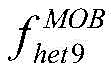
作为上述方法的一种改进,所述步骤3-12具体包括:As an improvement of the above method, the step 3-12 specifically includes:
用于遗传算法的动态约束条件具体包括:The dynamic constraints used in the genetic algorithm specifically include:

其中,LB和UB分别表示拍频下限和上限;






作为上述方法的一种改进,所述目标函数为:As an improvement of the above method, the objective function is:
Max TMax T
其中,T表示偏移频率的持续时间,T=End-Start。Wherein, T represents the duration of the offset frequency, T=End-Start.
作为上述方法的一种改进,所述终止时刻EOF设置为1825天。As an improvement of the above method, the end time EOF is set to 1825 days.
本发明还提供一种遗传算法求解偏移频率策略的系统,所述系统包括:The present invention also provides a system for solving the offset frequency strategy by a genetic algorithm, the system comprising:
锁相方案切换序列模块,用于制定可行的锁相方案切换序列;The phase-locking scheme switching sequence module is used to formulate a feasible phase-locking scheme switching sequence;
设定初始拍频上限模块,用于根据经验设定初始拍频上限;Set the initial beat frequency upper limit module, which is used to set the initial beat frequency upper limit according to experience;
计算偏移频率测量模块,用于按照锁相方案切换序列,根据设定的目标函数, 采用Seed预生成式遗传算法循环求解所有时间片内满足动态约束条件下不同时刻的 偏移频率规划结果;多次重复本步骤,计算得到在该锁相方案切换序列下可以支持 的最低拍频上限以及相应的偏移频率策略;Calculate the offset frequency measurement module, which is used to switch the sequence according to the phase-locking scheme, and use the Seed pre-generated genetic algorithm to solve the offset frequency planning results at different times under the dynamic constraint conditions in all time slices according to the set objective function; Repeat this step multiple times to calculate the minimum beat frequency upper limit that can be supported under the phase-locking scheme switching sequence and the corresponding offset frequency strategy;
所述偏移频率策略包括每颗卫星内部两个光学平台之间的偏移频率,以及相邻两颗卫星之间相邻光学平台之间的偏移频率。The offset frequency strategy includes the offset frequency between two optical platforms inside each satellite, and the offset frequency between adjacent optical platforms between two adjacent satellites.
与现有技术相比,本发明的优势在于:Compared with the prior art, the present invention has the advantages of:
1、由于可选锁相方案的数量过多,导致解空间过于庞大。采用已有的算法, 求解效率低下。采用Seed预生成的方法可以在一定程度上降低求解的时间,提高求 解效率,避免不必要的运算,规避传统遗传算法求解效率低的缺点。1. Due to the large number of optional phase-locking schemes, the solution space is too large. Using the existing algorithm, the solution efficiency is low. Using the pre-generated method of Seed can reduce the solution time to a certain extent, improve the solution efficiency, avoid unnecessary calculations, and avoid the disadvantages of low solution efficiency of the traditional genetic algorithm.
2、本发明构建了所有可能的锁相顺序和锁相主光学平台,其完备性高,并且 通过算法求解可以得到所有可行优化结果,为相关研究人员提供全面的锁相方案策 略和偏移频率策略。2. The present invention constructs all possible phase-locking sequences and phase-locking main optical platforms, which are highly complete, and all feasible optimization results can be obtained through algorithmic solutions, providing relevant researchers with comprehensive phase-locking scheme strategies and offset frequencies Strategy.
3、采用动态约束条件,保证了求解过程中前期的求解效率。3. The use of dynamic constraints ensures the solution efficiency in the early stage of the solution process.
附图说明Description of drawings
图1所示为本发明的基于Seed预生成式遗传算法求解偏移频率策略的方法流程图;Fig. 1 shows the method flowchart based on Seed pre-generated genetic algorithm of the present invention to solve offset frequency strategy;
图2所示为本发明提出的三种不同锁相顺序示意图;其中,图2(a)是锁相顺 序Seq1,图2(b)是锁相顺序Seq2,图2(c)是锁相顺序Seq3;Fig. 2 shows three kinds of different phase-lock sequence schematic diagrams that the present invention proposes; Wherein, Fig. 2 (a) is phase-lock sequence Seq1, and Fig. 2 (b) is phase-lock sequence Seq2, and Fig. 2 (c) is phase-lock sequence Seq3;
图3所示为本发明提出的6种不同锁相主光学平台示意图,示意图中全部采用 锁相顺序Seq3,其中图3(a)采用A为锁相主光学平台,图3(b)采用B为锁相 主光学平台,图3(c)采用C为锁相主光学平台,图3(d)采用D为锁相主光学 平台,图3(e)采用E为锁相主光学平台,图3(f)采用F为锁相主光学平台;Fig. 3 shows the schematic diagram of 6 kinds of different phase-locked main optical platforms proposed by the present invention, all adopt phase-locked order Seq3 in the schematic diagram, wherein Fig. 3 (a) adopts A to be the phase-locked main optical platform, and Fig. 3 (b) adopts B is the phase-locked main optical platform, Figure 3(c) adopts C as the phase-locked main optical platform, Figure 3(d) adopts D as the phase-locked main optical platform, and Figure 3(e) adopts E as the phase-locked main optical platform, Fig. 3(f) Use F as the phase-locked main optical platform;
图4所示为本发明采用的1825天星间多普勒频移数据;其中,图4(a)表示 选择A光学平台作为主光学平台时,卫星1与卫星2之间的星间多普勒频移;图4 (b)表示选择A光学平台作为主光学平台时,卫星2与卫星3之间的星间多普勒 频移;图4(c)表示选择A光学平台作为主光学平台时,卫星1与卫星3之间的星 间多普勒频移。Fig. 4 shows the 1825-day inter-satellite Doppler frequency shift data that the present invention adopts; Wherein, Fig. 4 (a) represents when selecting A optical platform as the main optical platform, the inter-satellite Doppler between
具体实施方式Detailed ways
下面结合附图对本发明的技术方案进行详细的说明。The technical solution of the present invention will be described in detail below in conjunction with the accompanying drawings.
本发明提出了一种Seed预生成式遗传算法求解偏移频率策略的方法及系统,用于天基引力波探测器中偏移频率策略的求解。The present invention proposes a method and system for solving the offset frequency strategy by a Seed pre-generated genetic algorithm, which is used for solving the offset frequency strategy in a space-based gravitational wave detector.
天基引力波探测器,通常包含三颗卫星,且三颗卫星呈等边三角形放置。卫星 之间的距离可以达到几百万公里。每颗卫星包含有两个激光干涉光学平台。Space-based gravitational wave detectors usually contain three satellites, and the three satellites are placed in an equilateral triangle. Satellites can be separated by millions of kilometers. Each satellite contains two laser interferometry optical platforms.
三颗卫星中,每颗卫星包含两个激光干涉光学平台,且分别编号为卫星1、卫 星2、卫星3。卫星1包含激光干涉光学平台A和B,卫星2包含激光干涉光学平台 C和D,卫星3包含激光干涉光学平台E和F。Among the three satellites, each satellite contains two laser interferometry optical platforms, and they are numbered as
激光干涉光学平台,用于向同卫星内的邻近光学平台发射和接收激光,同时用 于向与本卫星相邻的另一颗卫星中的远端光学平台发射和接收激光。The laser interference optical platform is used to transmit and receive laser light to the adjacent optical platform in the same satellite, and is also used to transmit and receive laser light to the remote optical platform in another satellite adjacent to this satellite.
本发明一种Seed预生成式遗传算法求解偏移频率策略的方法包括:The method that a kind of Seed pre-generated genetic algorithm of the present invention solves offset frequency strategy comprises:
提前制定可行的锁相方案切换序列,即在任务运行的每一个时间片内,所采用 的锁相顺序和锁相主光学平台。切换时间片后,按照顺序切换锁相顺序和锁相主光 学平台。Formulate a feasible phase-locking scheme switching sequence in advance, that is, the phase-locking sequence and the phase-locking main optical platform used in each time slice of the task operation. After switching the time slice, switch the phase-locking sequence and the phase-locking main optical platform in sequence.
时间片是指在任务运行过程中,偏移频率的一次设定的开始时间到结束时间称为一个时间片。A time slice refers to a time slice from the start time to the end time of a set offset frequency during the running of a task.
根据经验设定初始拍频上限。Set the upper limit of the initial beat frequency based on experience.
根据某一时间片的开始时间,以及所选取的锁相方案,根据设定的目标函数 (目标函数包括最大化偏移频率持续时间和最小化偏移频率改变次数),采用Seed 预生成式遗传算法求解本时间片内满足动态约束条件下不同时刻的偏移频率规划结 果,直至某一时刻无法通过调整偏移频率的方式满足动态约束条件,则得到本时间 片的结束时间,以及下一个时间片的开始时间。根据提前制定的锁相方案序列,选 择序列中下一个时间片的锁相方案,重复该步骤,得到不同时间片的偏移频率规划 结果;若能到达设定的求解终止时间,输出不同时间片的偏移频率规划结果,降低 初始拍频上限,重复上述步骤;直到设定的拍频上限使得在该锁相方案切换序列下 求解的偏移频率无法到达设定的求解终止时间,从而得到在该锁相方案切换序列下 可以支持的最低拍频上限以及相应的偏移频率策略。According to the start time of a certain time slice and the selected phase-locking scheme, according to the set objective function (the objective function includes maximizing the offset frequency duration and minimizing the number of offset frequency changes), the Seed pre-generated genetic The algorithm solves the offset frequency planning results at different times under the dynamic constraint conditions in this time slice, until the dynamic constraint conditions cannot be satisfied by adjusting the offset frequency at a certain moment, then the end time of the current time slice and the next time The start time of the slice. According to the phase-locking scheme sequence formulated in advance, select the phase-locking scheme of the next time slice in the sequence, repeat this step, and obtain the offset frequency planning results of different time slices; if the set solution termination time can be reached, output different time slices According to the offset frequency planning results, lower the upper limit of the initial beat frequency, and repeat the above steps; until the set upper limit of the beat frequency makes the offset frequency solved under the switching sequence of the phase-locking scheme unable to reach the set solution termination time, so that in The upper limit of the lowest beat frequency that can be supported under the switching sequence of the phase-locking scheme and the corresponding offset frequency strategy.
目标函数为:The objective function is:
Max TMax T
其中,T表示偏移频率的持续时间,T=End-Start。Wherein, T represents the duration of the offset frequency, T=End-Start.
如图1所示,求解偏移频率策略的过程具体包括:As shown in Figure 1, the process of solving the offset frequency strategy specifically includes:
步骤1)生成所有可能的锁相方案切换序列;Step 1) generating all possible phase-locking scheme switching sequences;
锁相方案切换序列包括3种锁相顺序和6种锁相主光学平台,锁相方案共包含18种。The phase-locking scheme switching sequence includes 3 phase-locking sequences and 6 phase-locking main optical platforms, and there are 18 phase-locking schemes in total.
三种锁相顺序分别记为Seq1,Seq2,Seq3;A,B,C,D,E,F六个光学平台 逆时针放置。The three phase-locking sequences are respectively recorded as Seq1, Seq2, and Seq3; the six optical platforms A, B, C, D, E, and F are placed counterclockwise.
第一种锁相顺序Seq1为选择一个光学平台作为主光学平台,其余5个光学平台 为从光学平台;锁相过程中,在主光学平台的一侧有2个从光学平台,另一侧有另 外3个光学平台;主光学平台激光频率保持恒定不变,主光学平台两侧从光学平台 的激光由近及远依次锁相到接收到的邻近光学平台发射的激光上。The first phase-locking sequence Seq1 is to select one optical table as the master optical table, and the other five optical tables are slave optical tables; The other three optical tables; the laser frequency of the main optical table remains constant, and the lasers from the optical tables on both sides of the main optical table are phase-locked to the received lasers emitted by the adjacent optical tables from near to far.
第二种锁相顺序Seq2为选择一个光学平台作为主光学平台,其余5个光学平台 为从光学平台;锁相过程中,在主光学平台的一侧有1个从光学平台,另一侧有另 外4个光学平台;主光学平台激光频率保持恒定不变,主光学平台两侧从光学平台 的激光由近及远依次锁相到接收到的邻近光学平台发射的激光上。The second phase-locking sequence Seq2 is to select one optical table as the master optical table, and the other five optical tables are slave optical tables; The other four optical tables; the laser frequency of the main optical table remains constant, and the lasers from the optical tables on both sides of the main optical table are phase-locked to the received lasers emitted by the adjacent optical tables from near to far.
第三种锁相顺序Seq3为选择一个光学平台作为主光学平台,其余5个光学平台 为从光学平台;锁相过程中,在主光学平台的一侧有0个从光学平台,另一侧有另 外5个光学平台;主光学平台激光频率保持恒定不变,主光学平台一侧从光学平台 的激光由近及远依次锁相到接收到的邻近光学平台发射的激光上。The third phase-locking sequence Seq3 is to select one optical table as the master optical table, and the remaining five optical tables are slave optical tables; during the phase-locking process, there are 0 slave optical tables on one side of the main optical table, and The other 5 optical tables; the laser frequency of the main optical table remains constant, and the laser from the optical table on the side of the main optical table is phase-locked to the received laser emitted by the adjacent optical table from near to far.
18种锁相方案分别为采用A,B,C,D,E,F六个光学平台为主光学平台生 成,分别是<Seq1,主光学平台A>,<Seq1,主光学平台B>,<Seq1,主光学平台 C>,<Seq1,主光学平台D>,<Seq1,主光学平台E>,<Seq1,主光学平台F>, <Seq2,主光学平台A>,<Seq2,主光学平台B>,<Seq2,主光学平台C>,<Seq2, 主光学平台D>,<Seq2,主光学平台E>,<Seq2,主光学平台F>,<Seq3,主光学 平台A>,<Seq3,主光学平台B>,<Seq3,主光学平台C>,<Seq3,主光学平台D>,<Seq3,主光学平台E>,<Seq3,主光学平台F>。The 18 phase-locking schemes are generated by using six optical tables A, B, C, D, E, and F as the main optical table, respectively <Seq1, main optical table A>, <Seq1, main optical table B>, <Seq1, main optical table B>, < Seq1, main optical table C>, <Seq1, main optical table D>, <Seq1, main optical table E>, <Seq1, main optical table F>, <Seq2, main optical table A>, <Seq2, main optical table B>, <Seq2, main optical table C>, <Seq2, main optical table D>, <Seq2, main optical table E>, <Seq2, main optical table F>, <Seq3, main optical table A>, <Seq3 , main optical table B>, <Seq3, main optical table C>, <Seq3, main optical table D>, <Seq3, main optical table E>, <Seq3, main optical table F>.
图2所示为三种锁相顺序统一采用A光学平台为主光学平台,A,B,C,D, E,F六个光学平台逆时针放置。Figure 2 shows that the three phase-locking sequences uniformly use the optical platform A as the main optical platform, and the six optical platforms A, B, C, D, E, and F are placed counterclockwise.
图3所示,分别为采用A,B,C,D,E,F六个光学平台为主光学平台的锁相 方案。其中黑色表示当前光学平台为主光学平台。图3(a)表示选择A为主光学平 台,锁相顺序为Seq1;图3(b)表示选择B为主光学平台,锁相顺序为Seq1;图 3(c)表示选择C为主光学平台,锁相顺序为Seq1;图3(d)表示选择D为主光 学平台,锁相顺序为Seq1;图3(e)表示选择E为主光学平台,锁相顺序为Seq1; 图3(f)表示选择F为主光学平台,锁相顺序为Seq1。As shown in Figure 3, it is the phase-locking scheme using six optical platforms A, B, C, D, E, and F as the main optical platform. Among them, black indicates that the current optical platform is the main optical platform. Figure 3(a) indicates that A is selected as the main optical platform, and the phase-locking sequence is Seq1; Figure 3(b) indicates that B is selected as the main optical platform, and the phase-locking sequence is Seq1; Figure 3(c) indicates that C is selected as the main optical platform , the phase-locking sequence is Seq1; Figure 3(d) indicates that D is selected as the main optical platform, and the phase-locking sequence is Seq1; Figure 3(e) indicates that E is selected as the main optical platform, and the phase-locking sequence is Seq1; Figure 3(f) Indicates that F is selected as the main optical platform, and the phase-locking sequence is Seq1.
锁相顺序Seq1的拍频计算方式如下:The beat frequency calculation method of the phase-locked sequence Seq1 is as follows:

其中,

锁相顺序Seq2的拍频计算方式如下:The beat frequency calculation method of the phase-locked sequence Seq2 is as follows:

其中,

锁相顺序Seq3的拍频计算方式如下:The beat frequency calculation method of the phase-locked sequence Seq3 is as follows:

其中,

步骤2)设定初始拍频上限fupper;Step 2) setting the initial beat frequency upper limit f upper ;
初始拍频上限fupper通常设定为25MHz。The initial beat frequency upper limit f upper is usually set to 25MHz.
步骤3)设定时间片开始时刻Start=1,结束时刻End=Start;Step 3) setting time slice start time Start=1, end time End=Start;
步骤4)根据步骤1)中采用的锁相方案切换序列选择当前阶段的锁相主光学平台;Step 4) Select the phase-locked main optical platform at the current stage according to the phase-locked scheme switching sequence adopted in step 1);
步骤5)根据步骤1)中采用的锁相方案切换序列选择当前阶段的锁相顺序;Step 5) Select the phase-locking order of the current stage according to the phase-locking scheme switching sequence adopted in step 1);
步骤6)根据当前开始时刻Start和结束时刻End,构建用于Seed生成的动态约 束条件;Step 6) according to current start time Start and end time End, construct the dynamic constraint condition that is used for Seed generation;
用于Seed生成的动态约束条件具体包括:The dynamic constraints for seed generation specifically include:
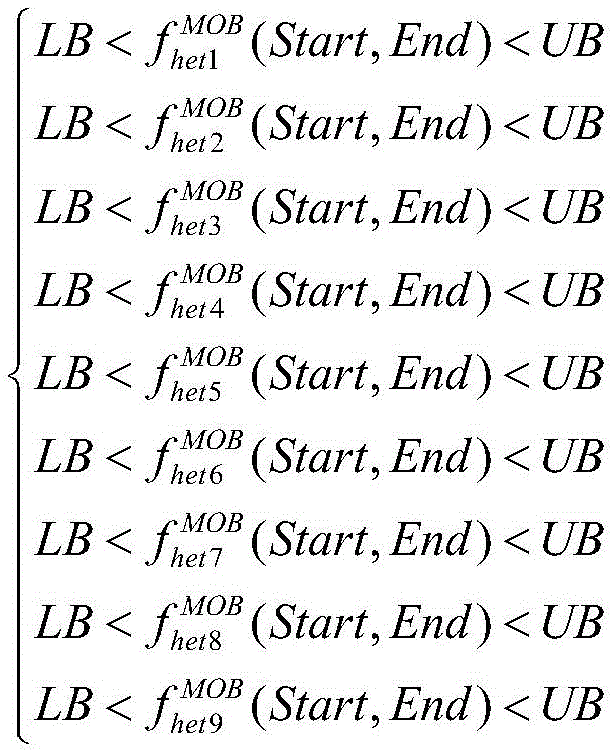
其中,LB和UB分别表示拍频下限和上限;


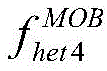


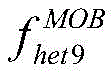
以选用锁相方案<Seq1,主光学平台A>为例,当Start=1,End=2时,用于Seed 生成的动态约束条件如下所示Taking the phase-locking scheme <Seq1, main optical platform A> as an example, when Start=1, End=2, the dynamic constraints for seed generation are as follows

步骤7)采用线性规划算法对当前偏移频率规划方案进行求解;Step 7) Using a linear programming algorithm to solve the current offset frequency planning scheme;
步骤8)判断是否可以求得可行解,如是转至步骤9);否则转至步骤12)Step 8) Judging whether a feasible solution can be obtained, if so, go to step 9); otherwise, go to step 12)
步骤9)将当前的开始时刻Start,结束时刻End和偏移频率求解结果保存到矩 阵Result的第End行中;偏移频率求解结果包括Δf(1,1)、Δf(2,2)、Δf(3,3)、Δf(1,2)、 Δf(1,3)和Δf(2,3)。Step 9) Save the current start time Start, end time End and offset frequency solution results in the End row of the matrix Result; the offset frequency solution results include Δf (1,1) , Δf (2,2) , Δf (3,3) , Δf (1,2) , Δf (1,3) and Δf (2,3) .
结果矩阵Result存储当前时间片中偏移频率的计算结果,采用队列方式进行存储,最新的计算结果方案矩阵的最后一行。The result matrix Result stores the calculation results of the offset frequency in the current time slice, and stores them in a queue. The latest calculation result is the last row of the scheme matrix.
步骤10)判断当前结束时刻End是否为终止时刻EOF,如是转至步骤11);否 则转至步骤19);终止时刻EOF通常设置为1825天。Step 10) judge whether the current end time End is the end time EOF, if so go to step 11); otherwise go to step 19); the end time EOF is usually set to 1825 days.
步骤11)保存当前偏移频率规划结果,更新拍频上限fupper=fupper-1,转至步骤 3)Step 11) Save the current offset frequency planning result, update the beat frequency upper limit f upper = f upper -1, go to step 3)
步骤12)设定结束时刻End=End-1;Step 12) setting end time End=End-1;
步骤13)设定遗传算法的初始Seed为结果矩阵Result第End行中的各个偏移 频率求解结果;Step 13) the initial Seed of setting genetic algorithm is each offset frequency solution result in the end row of result matrix Result;
步骤14)根据开始时刻Start和结束时刻End构建用于遗传算法的动态约束条 件。Step 14) construct the dynamic constraints for the genetic algorithm according to the start time Start and the end time End.
用于遗传算法的动态约束条件具体包括:The dynamic constraints used in the genetic algorithm specifically include:

其中,LB和UB分别表示拍频下限和上限;





以选用锁相方案<Seq1,主光学平台A>为例,当Start=1,End=2时,用于遗传 算法的动态约束条件如下所示Taking the phase-locking scheme <Seq1, main optical platform A> as an example, when Start=1, End=2, the dynamic constraints used in the genetic algorithm are as follows

步骤15)采用遗传算法进行求解;Step 15) adopt genetic algorithm to solve;
步骤16)判断是否有可行解,若有则转至步骤17);否则,转至步骤20)Step 16) Judging whether there is a feasible solution, if so, go to step 17); otherwise, go to step 20)
步骤17)将当前的开始时刻Start,结束时刻End和偏移频率求解结果保存到矩 阵Result中;Step 17) with current start moment Start, end moment End and offset frequency solution result are saved in matrix Result;
步骤18)判断当前结束时刻End是否为终止时刻EOF,如是转至步骤11);否 则转至步骤21);Step 18) judge whether the current end time End is the end time EOF, if so go to step 11); otherwise go to step 21);
步骤19)设定End=End+1,转至步骤6)Step 19) Set End=End+1, go to step 6)
步骤20)判断开始时刻Start和结束时刻End是否相等,若是转至步骤23);否 则转至步骤22);Step 20) judge whether the start time Start and the end time End are equal, if go to step 23); otherwise go to step 22);
步骤21)设定End=End+1,转至步骤14)Step 21) Set End=End+1, go to step 14)
步骤22)设定开始时刻Start=End,设定结束时刻End=Start;转至步骤4);Step 22) set start time Start=End, set end time End=Start; go to step 4);
步骤23)整理所有结果,包括每个时间片内采用的锁相方案和相应的偏移频率 规划结果,求解结束。Step 23) sort out all the results, including the phase-locking scheme adopted in each time slice and the corresponding offset frequency planning results, and the solution ends.
在一个实例中,采用已有300万公里臂长,5年星间多普勒频移数据,如图4所 示,横坐标表示时间,纵坐标表示在此刻的多普勒频移,单位为MHz。通过上述方 法求解结果如下:In one example, using the 5-year inter-satellite Doppler frequency shift data with an arm length of 3 million kilometers, as shown in Figure 4, the abscissa represents time, and the ordinate represents the Doppler frequency shift at this moment, and the unit is MHz. The results obtained by the above method are as follows:
表1求解结果Table 1 Solution results

从表1中可以看出,当拍频上限设定为21MHz时,锁相方案共需改变1次:阶 段1选择主星为A,锁相顺序为Seq3,持续时间1477天;阶段2主星为C,锁相顺 序为Seq3,持续时间328天。It can be seen from Table 1 that when the beat frequency upper limit is set to 21MHz, the phase-locking scheme needs to be changed once: in
偏移频率设定如下:The offset frequency is set as follows:
表2偏移频率设定Table 2 Offset Frequency Setting

本发明还可提供的一种计算机设备,包括:至少一个处理器、存储器、至少一 个网络接口和用户接口。该设备中的各个组件通过总线系统耦合在一起。可理解, 总线系统用于实现这些组件之间的连接通信。总线系统除包括数据总线之外,还包 括电源总线、控制总线和状态信号总线。The present invention also provides a computer device comprising: at least one processor, a memory, at least one network interface and a user interface. The individual components in the device are coupled together via a bus system. It can be understood that the bus system is used to realize connection communication between these components. In addition to the data bus, the bus system also includes a power bus, a control bus and a status signal bus.
其中,用户接口可以包括显示器、键盘或者点击设备。例如,鼠标,轨迹球 (trackball)、触感板或者触摸屏等。Wherein, the user interface may include a display, a keyboard or a pointing device. For example, mouse, trackball (trackball), touch pad or touch screen, etc.
可以理解,本申请公开实施例中的存储器可以是易失性存储器或非易失性存储器,或可包括易失性和非易失性存储器两者。其中,非易失性存储器可以是只读存 储器(Read-Only Memory,ROM)、可编程只读存储器(Programmable ROM,PROM)、 可擦除可编程只读存储器(Erasable PROM,EPROM)、电可擦除可编程只读存储器 (Electrically EPROM,EEPROM)或闪存。易失性存储器可以是随机存取存储器 (Random Access Memory,RAM),其用作外部高速缓存。通过示例性但不是限制性 说明,许多形式的RAM可用,例如静态随机存取存储器(Static RAM,SRAM)、动 态随机存取存储器(Dynamic RAM,DRAM)、同步动态随机存取存储器 (Synchronous DRAM,SDRAM)、双倍数据速率同步动态随机存取存储器(DoubleData Rate SDRAM,DDRSDRAM)、增强型同步动态随机存取存储器(Enhanced SDRAM,ESDRAM)、同步连接动态随机存取存储器(Synchlink DRAM,SLDRAM) 和直接内存总线随机存取存储器(Direct Rambus RAM,DRRAM)。本文描述的存储 器旨在包括但不限于这些和任意其它适合类型的存储器。It can be understood that the memory in the disclosed embodiments of the present application may be a volatile memory or a non-volatile memory, or may include both volatile and non-volatile memory. Wherein, the non-volatile memory may be a read-only memory (Read-Only Memory, ROM), a programmable read-only memory (Programmable ROM, PROM), an erasable programmable read-only memory (Erasable PROM, EPROM), an electronically programmable Erase Programmable Read-Only Memory (Electrically EPROM, EEPROM) or Flash. The volatile memory can be Random Access Memory (RAM), which acts as external cache memory. By way of illustration and not limitation, many forms of RAM are available such as Static RAM (SRAM), Dynamic RAM (DRAM), Synchronous DRAM (Synchronous DRAM, SDRAM), double data rate synchronous dynamic random access memory (Double Data Rate SDRAM, DDRSDRAM), enhanced synchronous dynamic random access memory (Enhanced SDRAM, ESDRAM), synchronous connection dynamic random access memory (Synchlink DRAM, SLDRAM) and Direct Memory Bus Random Access Memory (Direct Rambus RAM, DRRAM). The memories described herein are intended to include, but are not limited to, these and any other suitable types of memories.
在一些实施方式中,存储器存储了如下的元素,可执行模块或者数据结构,或 者他们的子集,或者他们的扩展集:操作系统和应用程序。In some embodiments, the memory stores the following elements, executable modules or data structures, or a subset thereof, or an extension thereof: an operating system and application programs.
其中,操作系统,包含各种系统程序,例如框架层、核心库层、驱动层等,用 于实现各种基础业务以及处理基于硬件的任务。应用程序,包含各种应用程序,例 如媒体播放器(Media Player)、浏览器(Browser)等,用于实现各种应用业务。实现本 公开实施例方法的程序可以包含在应用程序中。Among them, the operating system includes various system programs, such as framework layer, core library layer, driver layer, etc., which are used to realize various basic services and handle hardware-based tasks. The application program includes various application programs, such as a media player (Media Player), a browser (Browser), etc., and is used to implement various application services. Programs for realizing the methods of the embodiments of the present disclosure may be contained in application programs.
在本上述的实施例中,还可通过调用存储器存储的程序或指令,具体的,可以 是应用程序中存储的程序或指令,处理器用于:In the above-mentioned embodiment, the processor can also be used to:
执行上述方法的步骤。Perform the steps of the method described above.
上述方法可以应用于处理器中,或者由处理器实现。处理器可能是一种集成电 路芯片,具有信号的处理能力。在实现过程中,上述方法的各步骤可以通过处理器 中的硬件的集成逻辑电路或者软件形式的指令完成。上述的处理器可以是通用处理 器、数字信号处理器(Digital Signal Processor,DSP)、专用集成电路(Application SpecificIntegrated Circuit,ASIC)、现场可编程门阵列(Field Programmable Gate Array,FPGA)或者其他可编程逻辑器件、分立门或者晶体管逻辑器件、分立硬件组件。可 以实现或者执行上述公开的各方法、步骤及逻辑框图。通用处理器可以是微处理器 或者该处理器也可以是任何常规的处理器等。结合上述公开的方法的步骤可以直接 体现为硬件译码处理器执行完成,或者用译码处理器中的硬件及软件模块组合执行 完成。软件模块可以位于随机存储器,闪存、只读存储器,可编程只读存储器或者 电可擦写可编程存储器、寄存器等本领域成熟的存储介质中。该存储介质位于存储 器,处理器读取存储器中的信息,结合其硬件完成上述方法的步骤。The foregoing method may be applied to or implemented by a processor. A processor may be an integrated circuit chip with signal processing capabilities. In the implementation process, each step of the above method can be completed by an integrated logic circuit of the hardware in the processor or an instruction in the form of software. The above-mentioned processor may be a general-purpose processor, a digital signal processor (Digital Signal Processor, DSP), an application specific integrated circuit (Application Specific Integrated Circuit, ASIC), a field programmable gate array (Field Programmable Gate Array, FPGA) or other programmable Logic devices, discrete gate or transistor logic devices, discrete hardware components. The methods, steps and logic block diagrams disclosed above can be realized or executed. A general-purpose processor may be a microprocessor, or the processor may be any conventional processor, and the like. The steps combined with the methods disclosed above can be directly implemented by a hardware decoding processor, or implemented by a combination of hardware and software modules in the decoding processor. The software module can be located in random access memory, flash memory, read-only memory, programmable read-only memory or electrically erasable programmable memory, registers and other mature storage media in this field. The storage medium is located in the memory, and the processor reads the information in the memory, and completes the steps of the above method in combination with its hardware.
可以理解的是,本发明描述的这些实施例可以用硬件、软件、固件、中间件、 微码或其组合来实现。对于硬件实现,处理单元可以实现在一个或多个专用集成电 路(Application Specific Integrated Circuits,ASIC)、数字信号处理器(Digital SignalProcessing,DSP)、数字信号处理设备(DSP Device,DSPD)、可编程逻辑设备(Programmable Logic Device,PLD)、现场可编程门阵列(Field-Programmable GateArray,FPGA)、通用处理器、控制器、微控制器、微处理器、用于执行本申请所述 功能的其它电子单元或其组合中。It should be understood that the embodiments described in the present invention may be implemented by hardware, software, firmware, middleware, microcode or a combination thereof. For hardware implementation, the processing unit can be implemented in one or more application specific integrated circuits (Application Specific Integrated Circuits, ASIC), digital signal processor (Digital Signal Processing, DSP), digital signal processing device (DSP Device, DSPD), programmable logic Device (Programmable Logic Device, PLD), Field-Programmable Gate Array (Field-Programmable GateArray, FPGA), general-purpose processor, controller, microcontroller, microprocessor, other electronic units for performing the functions described in this application or a combination thereof.
对于软件实现,可通过执行本发明的功能模块(例如过程、函数等)来实现本发 明技术。软件代码可存储在存储器中并通过处理器执行。存储器可以在处理器中或 在处理器外部实现。For software implementation, the technology of the present invention can be realized by executing the functional modules (such as procedures, functions, etc.) of the present invention. Software codes can be stored in memory and executed by a processor. Memory can be implemented within the processor or external to the processor.
本发明还可提供一种非易失性存储介质,用于存储计算机程序。当该计算机程 序被处理器执行时可以实现上述方法实施例中的各个步骤。The present invention can also provide a non-volatile storage medium for storing computer programs. When the computer program is executed by the processor, various steps in the above method embodiments can be realized.
最后所应说明的是,以上实施例仅用以说明本发明的技术方案而非限制。尽管 参照实施例对本发明进行了详细说明,本领域的普通技术人员应当理解,对本发明 的技术方案进行修改或者等同替换,都不脱离本发明技术方案的精神和范围,其均 应涵盖在本发明的权利要求范围当中。Finally, it should be noted that the above embodiments are only used to illustrate the technical solutions of the present invention rather than limit them. Although the present invention has been described in detail with reference to the embodiments, those skilled in the art should understand that modifications or equivalent replacements to the technical solutions of the present invention do not depart from the spirit and scope of the technical solutions of the present invention, and all of them should be included in the scope of the present invention. within the scope of the claims.
Claims (10)








Priority Applications (1)
| Application Number | Priority Date | Filing Date | Title |
|---|---|---|---|
| CN202211412869.8A CN115688598B (en) | 2022-11-11 | 2022-11-11 | Method and system for solving offset frequency strategy by Seed pre-generation type genetic algorithm |
Applications Claiming Priority (1)
| Application Number | Priority Date | Filing Date | Title |
|---|---|---|---|
| CN202211412869.8A CN115688598B (en) | 2022-11-11 | 2022-11-11 | Method and system for solving offset frequency strategy by Seed pre-generation type genetic algorithm |
Publications (2)
| Publication Number | Publication Date |
|---|---|
| CN115688598A true CN115688598A (en) | 2023-02-03 |
| CN115688598B CN115688598B (en) | 2023-05-05 |
Family
ID=85052499
Family Applications (1)
| Application Number | Title | Priority Date | Filing Date |
|---|---|---|---|
| CN202211412869.8A Active CN115688598B (en) | 2022-11-11 | 2022-11-11 | Method and system for solving offset frequency strategy by Seed pre-generation type genetic algorithm |
Country Status (1)
| Country | Link |
|---|---|
| CN (1) | CN115688598B (en) |
Cited By (14)
| Publication number | Priority date | Publication date | Assignee | Title |
|---|---|---|---|---|
| CN117009736A (en) * | 2023-10-07 | 2023-11-07 | 之江实验室 | Laser heterodyne shift frequency scheme determination method, device and storage medium |
| US11977173B2 (en) | 2019-11-27 | 2024-05-07 | Rockwell Collins, Inc. | Spoofing and denial of service detection and protection with doppler nulling (spatial awareness) |
| US12050279B2 (en) | 2019-11-27 | 2024-07-30 | Rockwell Collins, Inc. | Doppler nulling spatial awareness (DNSA) solutions for non-terrestrial networks |
| CN118734531A (en) * | 2024-05-21 | 2024-10-01 | 中国科学院国家空间科学中心 | A space-based gravitational wave detection signal simulation system including a phase-locking mechanism |
| US12111406B2 (en) | 2019-11-27 | 2024-10-08 | Rockwell Collins, Inc. | Adaptive doppler-nulling digitization for high-resolution |
| US12153150B2 (en) | 2019-11-27 | 2024-11-26 | Rockwell Collins, Inc. | Doppler nulling scanning (DNS) security (spatial awareness) |
| US12231330B2 (en) | 2019-11-27 | 2025-02-18 | Rockwell Collins, Inc. | System and method for application of doppler corrections for time synchronized stationary transmitter and receiver in motion |
| US12326506B2 (en) | 2019-11-27 | 2025-06-10 | Rockwell Collins, Inc. | DNS spatial discoveries with on-going traffic |
| US12474431B2 (en) | 2019-11-27 | 2025-11-18 | Rockwell Collins, Inc. | Doppler-nulling and two-way timing and ranging (spatial awareness) |
| US12498442B2 (en) | 2019-11-27 | 2025-12-16 | Rockwell Collins, Inc. | Robust addressing schema for spatial awareness via doppler null scanning (DNS) |
| US12504496B2 (en) | 2019-11-27 | 2025-12-23 | Rockwell Collins, Inc. | Station keeping using doppler null scanning |
| US12523733B2 (en) | 2019-11-27 | 2026-01-13 | Rockwell Collins, Inc | Directional enhancements for mobile ad hoc networks (MANET) via doppler null scanning (DNS) |
| US12540997B2 (en) | 2019-11-27 | 2026-02-03 | Rockwell Collins, Inc. | System and method for application of doppler null scanning (DNS) to position navigation timing (PNT) |
| US12546845B2 (en) | 2023-05-16 | 2026-02-10 | Rockwell Collins, Inc. | Search and rescue system with doppler-nulling spatial awareness |
Citations (9)
| Publication number | Priority date | Publication date | Assignee | Title |
|---|---|---|---|---|
| US20020154769A1 (en) * | 2000-12-07 | 2002-10-24 | Petersen Mette Vesterager | Method of generating pseudo-random numbers in an electronic device, and a method of encrypting and decrypting electronic data |
| EP1901477A1 (en) * | 2006-09-13 | 2008-03-19 | Astrium Limited | Random number generation |
| US8891586B1 (en) * | 2008-10-17 | 2014-11-18 | Honeywell International Inc. | System, apparatus and method for identifying transmission frequencies for communicating data |
| CN110046800A (en) * | 2019-03-14 | 2019-07-23 | 南京航空航天大学 | The satellite cluster formation adjusting planing method of space-oriented target cooperative observation |
| US20200097575A1 (en) * | 2018-09-25 | 2020-03-26 | Salesforce.Com, Inc. | Efficient production and consumption for data changes in a database under high concurrency |
| CN113609755A (en) * | 2021-07-07 | 2021-11-05 | 中国科学院国家空间科学中心 | Inter-satellite laser interference frequency planning simulation verification system for time sequence reinforcement learning |
| CN114662388A (en) * | 2022-03-22 | 2022-06-24 | 中国科学院国家空间科学中心 | A method for solving the frequency strategy of variable primary star offset based on sequence genetic algorithm |
| CN115061383A (en) * | 2022-03-22 | 2022-09-16 | 中国科学院国家空间科学中心 | Ground demonstration verification system for space-based gravitational wave detector variable-master satellite phase-locking scheme |
| US20220317290A1 (en) * | 2020-07-10 | 2022-10-06 | Skystream LLC | Enhanced ldacs that uses doppler shifts in carrier signals for positioning and navigation |
-
2022
- 2022-11-11 CN CN202211412869.8A patent/CN115688598B/en active Active
Patent Citations (9)
| Publication number | Priority date | Publication date | Assignee | Title |
|---|---|---|---|---|
| US20020154769A1 (en) * | 2000-12-07 | 2002-10-24 | Petersen Mette Vesterager | Method of generating pseudo-random numbers in an electronic device, and a method of encrypting and decrypting electronic data |
| EP1901477A1 (en) * | 2006-09-13 | 2008-03-19 | Astrium Limited | Random number generation |
| US8891586B1 (en) * | 2008-10-17 | 2014-11-18 | Honeywell International Inc. | System, apparatus and method for identifying transmission frequencies for communicating data |
| US20200097575A1 (en) * | 2018-09-25 | 2020-03-26 | Salesforce.Com, Inc. | Efficient production and consumption for data changes in a database under high concurrency |
| CN110046800A (en) * | 2019-03-14 | 2019-07-23 | 南京航空航天大学 | The satellite cluster formation adjusting planing method of space-oriented target cooperative observation |
| US20220317290A1 (en) * | 2020-07-10 | 2022-10-06 | Skystream LLC | Enhanced ldacs that uses doppler shifts in carrier signals for positioning and navigation |
| CN113609755A (en) * | 2021-07-07 | 2021-11-05 | 中国科学院国家空间科学中心 | Inter-satellite laser interference frequency planning simulation verification system for time sequence reinforcement learning |
| CN114662388A (en) * | 2022-03-22 | 2022-06-24 | 中国科学院国家空间科学中心 | A method for solving the frequency strategy of variable primary star offset based on sequence genetic algorithm |
| CN115061383A (en) * | 2022-03-22 | 2022-09-16 | 中国科学院国家空间科学中心 | Ground demonstration verification system for space-based gravitational wave detector variable-master satellite phase-locking scheme |
Cited By (15)
| Publication number | Priority date | Publication date | Assignee | Title |
|---|---|---|---|---|
| US12153150B2 (en) | 2019-11-27 | 2024-11-26 | Rockwell Collins, Inc. | Doppler nulling scanning (DNS) security (spatial awareness) |
| US12231330B2 (en) | 2019-11-27 | 2025-02-18 | Rockwell Collins, Inc. | System and method for application of doppler corrections for time synchronized stationary transmitter and receiver in motion |
| US11977173B2 (en) | 2019-11-27 | 2024-05-07 | Rockwell Collins, Inc. | Spoofing and denial of service detection and protection with doppler nulling (spatial awareness) |
| US12050279B2 (en) | 2019-11-27 | 2024-07-30 | Rockwell Collins, Inc. | Doppler nulling spatial awareness (DNSA) solutions for non-terrestrial networks |
| US12540997B2 (en) | 2019-11-27 | 2026-02-03 | Rockwell Collins, Inc. | System and method for application of doppler null scanning (DNS) to position navigation timing (PNT) |
| US12111406B2 (en) | 2019-11-27 | 2024-10-08 | Rockwell Collins, Inc. | Adaptive doppler-nulling digitization for high-resolution |
| US12523733B2 (en) | 2019-11-27 | 2026-01-13 | Rockwell Collins, Inc | Directional enhancements for mobile ad hoc networks (MANET) via doppler null scanning (DNS) |
| US12498442B2 (en) | 2019-11-27 | 2025-12-16 | Rockwell Collins, Inc. | Robust addressing schema for spatial awareness via doppler null scanning (DNS) |
| US12504496B2 (en) | 2019-11-27 | 2025-12-23 | Rockwell Collins, Inc. | Station keeping using doppler null scanning |
| US12474431B2 (en) | 2019-11-27 | 2025-11-18 | Rockwell Collins, Inc. | Doppler-nulling and two-way timing and ranging (spatial awareness) |
| US12326506B2 (en) | 2019-11-27 | 2025-06-10 | Rockwell Collins, Inc. | DNS spatial discoveries with on-going traffic |
| US12546845B2 (en) | 2023-05-16 | 2026-02-10 | Rockwell Collins, Inc. | Search and rescue system with doppler-nulling spatial awareness |
| CN117009736A (en) * | 2023-10-07 | 2023-11-07 | 之江实验室 | Laser heterodyne shift frequency scheme determination method, device and storage medium |
| CN117009736B (en) * | 2023-10-07 | 2024-01-09 | 之江实验室 | Laser heterodyne offset frequency scheme determination method, device and storage medium |
| CN118734531A (en) * | 2024-05-21 | 2024-10-01 | 中国科学院国家空间科学中心 | A space-based gravitational wave detection signal simulation system including a phase-locking mechanism |
Also Published As
| Publication number | Publication date |
|---|---|
| CN115688598B (en) | 2023-05-05 |
Similar Documents
| Publication | Publication Date | Title |
|---|---|---|
| CN115688598A (en) | Method and system for solving offset frequency strategy by Seed pre-generation genetic algorithm | |
| US11663125B2 (en) | Cache configuration performance estimation | |
| JP2022522180A (en) | Insulation development path prediction methods, equipment, equipment and computer programs | |
| US9626155B2 (en) | Determining recommended optimization strategies for software development | |
| JP7417074B2 (en) | Optimization device, optimization method, and control program for the optimization device | |
| JP7506330B2 (en) | Quantum chemical calculation program, quantum chemical calculation method, and quantum chemical calculation device | |
| CN114662388B (en) | Method for solving variable-principal-star offset frequency strategy based on sequence genetic algorithm | |
| US20220188678A1 (en) | Computer-readable recording medium storing optimization program, optimization method, and information processing apparatus | |
| US12387121B2 (en) | Combining quantum states of qubits on a quantum processor | |
| Nott et al. | Bayesian projection approaches to variable selection in generalized linear models | |
| TWI326812B (en) | Regression system and methods for optical proximity correction modeling | |
| US20240211539A1 (en) | Computer-readable recording medium storing tensor network contraction control program, tensor network contraction control method, and information processing apparatus | |
| CN116187265B (en) | Chip design method and terminal | |
| US20230350972A1 (en) | Information processing apparatus and information processing method | |
| JP2023156102A (en) | Information processing program, information processing method, and information processing device | |
| US20250013278A1 (en) | Computer-readable recording medium storing temperature adjustment program, data processing apparatus, and data processing method | |
| CN112711535A (en) | Particle swarm optimization-based combined test data generation method under constraint | |
| US20240211529A1 (en) | Storage medium, data processing apparatus, and data processing method | |
| JP2011070666A (en) | Electronic device controller for improving performance of electronic device | |
| EP4645171A1 (en) | Program and data processing apparatus | |
| US20250131060A1 (en) | Computer-readable recording medium storing program, data processing device, and data processing method | |
| US20240111833A1 (en) | Data processing apparatus and data processing method | |
| EP4336417A1 (en) | Temperature adjustment program, data processing apparatus, and data processing method | |
| US20250028782A1 (en) | Computer-readable recording medium storing program, data processing device, and data processing method | |
| CN120371479B (en) | Optimization method and device for service starting sequence, electronic equipment and storage medium |
Legal Events
| Date | Code | Title | Description |
|---|---|---|---|
| PB01 | Publication | ||
| PB01 | Publication | ||
| SE01 | Entry into force of request for substantive examination | ||
| SE01 | Entry into force of request for substantive examination | ||
| GR01 | Patent grant | ||
| GR01 | Patent grant |