CN115671050A - A liver-targeted glucose-responsive nanoparticle and its preparation method and application - Google Patents
A liver-targeted glucose-responsive nanoparticle and its preparation method and application Download PDFInfo
- Publication number
- CN115671050A CN115671050A CN202211189228.0A CN202211189228A CN115671050A CN 115671050 A CN115671050 A CN 115671050A CN 202211189228 A CN202211189228 A CN 202211189228A CN 115671050 A CN115671050 A CN 115671050A
- Authority
- CN
- China
- Prior art keywords
- carbonate
- polyacryloyl
- polycaprolactone
- acid
- modified
- Prior art date
- Legal status (The legal status is an assumption and is not a legal conclusion. Google has not performed a legal analysis and makes no representation as to the accuracy of the status listed.)
- Granted
Links
- 239000002105 nanoparticle Substances 0.000 title claims abstract description 81
- WQZGKKKJIJFFOK-GASJEMHNSA-N Glucose Natural products OC[C@H]1OC(O)[C@H](O)[C@@H](O)[C@@H]1O WQZGKKKJIJFFOK-GASJEMHNSA-N 0.000 title claims abstract description 49
- 239000008103 glucose Substances 0.000 title claims abstract description 49
- 238000002360 preparation method Methods 0.000 title claims abstract description 21
- NOESYZHRGYRDHS-UHFFFAOYSA-N insulin Chemical compound N1C(=O)C(NC(=O)C(CCC(N)=O)NC(=O)C(CCC(O)=O)NC(=O)C(C(C)C)NC(=O)C(NC(=O)CN)C(C)CC)CSSCC(C(NC(CO)C(=O)NC(CC(C)C)C(=O)NC(CC=2C=CC(O)=CC=2)C(=O)NC(CCC(N)=O)C(=O)NC(CC(C)C)C(=O)NC(CCC(O)=O)C(=O)NC(CC(N)=O)C(=O)NC(CC=2C=CC(O)=CC=2)C(=O)NC(CSSCC(NC(=O)C(C(C)C)NC(=O)C(CC(C)C)NC(=O)C(CC=2C=CC(O)=CC=2)NC(=O)C(CC(C)C)NC(=O)C(C)NC(=O)C(CCC(O)=O)NC(=O)C(C(C)C)NC(=O)C(CC(C)C)NC(=O)C(CC=2NC=NC=2)NC(=O)C(CO)NC(=O)CNC2=O)C(=O)NCC(=O)NC(CCC(O)=O)C(=O)NC(CCCNC(N)=N)C(=O)NCC(=O)NC(CC=3C=CC=CC=3)C(=O)NC(CC=3C=CC=CC=3)C(=O)NC(CC=3C=CC(O)=CC=3)C(=O)NC(C(C)O)C(=O)N3C(CCC3)C(=O)NC(CCCCN)C(=O)NC(C)C(O)=O)C(=O)NC(CC(N)=O)C(O)=O)=O)NC(=O)C(C(C)CC)NC(=O)C(CO)NC(=O)C(C(C)O)NC(=O)C1CSSCC2NC(=O)C(CC(C)C)NC(=O)C(NC(=O)C(CCC(N)=O)NC(=O)C(CC(N)=O)NC(=O)C(NC(=O)C(N)CC=1C=CC=CC=1)C(C)C)CC1=CN=CN1 NOESYZHRGYRDHS-UHFFFAOYSA-N 0.000 claims abstract description 150
- 102000004877 Insulin Human genes 0.000 claims abstract description 105
- 229940125396 insulin Drugs 0.000 claims abstract description 105
- 108090001061 Insulin Proteins 0.000 claims abstract description 74
- 229940079593 drug Drugs 0.000 claims abstract description 56
- 239000003814 drug Substances 0.000 claims abstract description 56
- 229920001610 polycaprolactone Polymers 0.000 claims abstract description 44
- 239000004632 polycaprolactone Substances 0.000 claims abstract description 44
- HXITXNWTGFUOAU-UHFFFAOYSA-N phenylboronic acid Chemical class OB(O)C1=CC=CC=C1 HXITXNWTGFUOAU-UHFFFAOYSA-N 0.000 claims abstract description 33
- 125000003396 thiol group Chemical class [H]S* 0.000 claims abstract description 28
- -1 phenylboronic acid ester Chemical class 0.000 claims abstract description 20
- 238000000034 method Methods 0.000 claims abstract description 19
- BHQCQFFYRZLCQQ-OELDTZBJSA-N cholic acid Chemical class C([C@H]1C[C@H]2O)[C@H](O)CC[C@]1(C)[C@@H]1[C@@H]2[C@@H]2CC[C@H]([C@@H](CCC(O)=O)C)[C@@]2(C)[C@@H](O)C1 BHQCQFFYRZLCQQ-OELDTZBJSA-N 0.000 claims abstract description 18
- 150000003384 small molecules Chemical class 0.000 claims abstract description 18
- 102000004169 proteins and genes Human genes 0.000 claims abstract description 17
- 108090000623 proteins and genes Proteins 0.000 claims abstract description 17
- 238000004132 cross linking Methods 0.000 claims abstract description 15
- 239000000463 material Substances 0.000 claims abstract description 15
- 238000005516 engineering process Methods 0.000 claims abstract description 8
- 238000004945 emulsification Methods 0.000 claims abstract description 7
- 150000002148 esters Chemical class 0.000 claims abstract 2
- 239000000243 solution Substances 0.000 claims description 30
- IJGRMHOSHXDMSA-UHFFFAOYSA-N Atomic nitrogen Chemical compound N#N IJGRMHOSHXDMSA-UHFFFAOYSA-N 0.000 claims description 28
- 238000006243 chemical reaction Methods 0.000 claims description 27
- KXGVEGMKQFWNSR-UHFFFAOYSA-N deoxycholic acid Natural products C1CC2CC(O)CCC2(C)C2C1C1CCC(C(CCC(O)=O)C)C1(C)C(O)C2 KXGVEGMKQFWNSR-UHFFFAOYSA-N 0.000 claims description 20
- 239000003960 organic solvent Substances 0.000 claims description 20
- BHQCQFFYRZLCQQ-UHFFFAOYSA-N (3alpha,5alpha,7alpha,12alpha)-3,7,12-trihydroxy-cholan-24-oic acid Natural products OC1CC2CC(O)CCC2(C)C2C1C1CCC(C(CCC(O)=O)C)C1(C)C(O)C2 BHQCQFFYRZLCQQ-UHFFFAOYSA-N 0.000 claims description 17
- RUDATBOHQWOJDD-UHFFFAOYSA-N (3beta,5beta,7alpha)-3,7-Dihydroxycholan-24-oic acid Natural products OC1CC2CC(O)CCC2(C)C2C1C1CCC(C(CCC(O)=O)C)C1(C)CC2 RUDATBOHQWOJDD-UHFFFAOYSA-N 0.000 claims description 17
- OMIGHNLMNHATMP-UHFFFAOYSA-N 2-hydroxyethyl prop-2-enoate Chemical compound OCCOC(=O)C=C OMIGHNLMNHATMP-UHFFFAOYSA-N 0.000 claims description 17
- 239000004380 Cholic acid Substances 0.000 claims description 17
- 239000003054 catalyst Substances 0.000 claims description 17
- 229960002471 cholic acid Drugs 0.000 claims description 17
- 235000019416 cholic acid Nutrition 0.000 claims description 17
- 229910052757 nitrogen Inorganic materials 0.000 claims description 15
- 239000007864 aqueous solution Substances 0.000 claims description 14
- 239000000839 emulsion Substances 0.000 claims description 14
- RUDATBOHQWOJDD-UZVSRGJWSA-N ursodeoxycholic acid Chemical compound C([C@H]1C[C@@H]2O)[C@H](O)CC[C@]1(C)[C@@H]1[C@@H]2[C@@H]2CC[C@H]([C@@H](CCC(O)=O)C)[C@@]2(C)CC1 RUDATBOHQWOJDD-UZVSRGJWSA-N 0.000 claims description 14
- 229960001661 ursodiol Drugs 0.000 claims description 14
- 239000000203 mixture Substances 0.000 claims description 12
- DKIDEFUBRARXTE-UHFFFAOYSA-N 3-mercaptopropanoic acid Chemical group OC(=O)CCS DKIDEFUBRARXTE-UHFFFAOYSA-N 0.000 claims description 11
- 239000012071 phase Substances 0.000 claims description 11
- 229920000642 polymer Polymers 0.000 claims description 11
- 239000004372 Polyvinyl alcohol Substances 0.000 claims description 10
- 229920002451 polyvinyl alcohol Polymers 0.000 claims description 10
- 238000001556 precipitation Methods 0.000 claims description 10
- 239000004094 surface-active agent Substances 0.000 claims description 9
- 239000012467 final product Substances 0.000 claims description 8
- JMZFEHDNIAQMNB-UHFFFAOYSA-N m-aminophenylboronic acid Chemical compound NC1=CC=CC(B(O)O)=C1 JMZFEHDNIAQMNB-UHFFFAOYSA-N 0.000 claims description 8
- 238000000502 dialysis Methods 0.000 claims description 7
- 230000008569 process Effects 0.000 claims description 7
- PAPBSGBWRJIAAV-UHFFFAOYSA-N ε-Caprolactone Chemical compound O=C1CCCCCO1 PAPBSGBWRJIAAV-UHFFFAOYSA-N 0.000 claims description 7
- WUILYKHTEDWVOM-UHFFFAOYSA-N carboxy prop-2-enoate Chemical compound OC(=O)OC(=O)C=C WUILYKHTEDWVOM-UHFFFAOYSA-N 0.000 claims description 6
- PJUIMOJAAPLTRJ-UHFFFAOYSA-N monothioglycerol Chemical compound OCC(O)CS PJUIMOJAAPLTRJ-UHFFFAOYSA-N 0.000 claims description 6
- 150000003573 thiols Chemical class 0.000 claims description 6
- 150000001732 carboxylic acid derivatives Chemical class 0.000 claims description 5
- 206010012601 diabetes mellitus Diseases 0.000 claims description 5
- 239000003995 emulsifying agent Substances 0.000 claims description 5
- 238000000926 separation method Methods 0.000 claims description 5
- 239000002244 precipitate Substances 0.000 claims description 4
- 229940035024 thioglycerol Drugs 0.000 claims description 4
- CWERGRDVMFNCDR-UHFFFAOYSA-N thioglycolic acid Chemical compound OC(=O)CS CWERGRDVMFNCDR-UHFFFAOYSA-N 0.000 claims description 4
- KSBAEPSJVUENNK-UHFFFAOYSA-L tin(ii) 2-ethylhexanoate Chemical compound [Sn+2].CCCCC(CC)C([O-])=O.CCCCC(CC)C([O-])=O KSBAEPSJVUENNK-UHFFFAOYSA-L 0.000 claims description 4
- SMEROWZSTRWXGI-UHFFFAOYSA-N Lithocholsaeure Natural products C1CC2CC(O)CCC2(C)C2C1C1CCC(C(CCC(O)=O)C)C1(C)CC2 SMEROWZSTRWXGI-UHFFFAOYSA-N 0.000 claims description 3
- HCHKCACWOHOZIP-UHFFFAOYSA-N Zinc Chemical group [Zn] HCHKCACWOHOZIP-UHFFFAOYSA-N 0.000 claims description 3
- RUDATBOHQWOJDD-BSWAIDMHSA-N chenodeoxycholic acid Chemical compound C([C@H]1C[C@H]2O)[C@H](O)CC[C@]1(C)[C@@H]1[C@@H]2[C@@H]2CC[C@H]([C@@H](CCC(O)=O)C)[C@@]2(C)CC1 RUDATBOHQWOJDD-BSWAIDMHSA-N 0.000 claims description 3
- 229960001091 chenodeoxycholic acid Drugs 0.000 claims description 3
- KXGVEGMKQFWNSR-LLQZFEROSA-N deoxycholic acid Chemical group C([C@H]1CC2)[C@H](O)CC[C@]1(C)[C@@H]1[C@@H]2[C@@H]2CC[C@H]([C@@H](CCC(O)=O)C)[C@@]2(C)[C@@H](O)C1 KXGVEGMKQFWNSR-LLQZFEROSA-N 0.000 claims description 3
- 229960003964 deoxycholic acid Drugs 0.000 claims description 3
- GVGUFUZHNYFZLC-UHFFFAOYSA-N dodecyl benzenesulfonate;sodium Chemical compound [Na].CCCCCCCCCCCCOS(=O)(=O)C1=CC=CC=C1 GVGUFUZHNYFZLC-UHFFFAOYSA-N 0.000 claims description 3
- SMEROWZSTRWXGI-HVATVPOCSA-N lithocholic acid Chemical compound C([C@H]1CC2)[C@H](O)CC[C@]1(C)[C@@H]1[C@@H]2[C@@H]2CC[C@H]([C@@H](CCC(O)=O)C)[C@@]2(C)CC1 SMEROWZSTRWXGI-HVATVPOCSA-N 0.000 claims description 3
- 229940080264 sodium dodecylbenzenesulfonate Drugs 0.000 claims description 3
- 239000011701 zinc Substances 0.000 claims description 3
- 229910052725 zinc Inorganic materials 0.000 claims description 3
- MKPDAJWEBQRQCO-UHFFFAOYSA-N (4-aminophenyl)boronic acid Chemical group NC1=CC=C(B(O)O)C=C1 MKPDAJWEBQRQCO-UHFFFAOYSA-N 0.000 claims description 2
- 108091003079 Bovine Serum Albumin Proteins 0.000 claims description 2
- 150000001412 amines Chemical class 0.000 claims description 2
- IXIBAKNTJSCKJM-BUBXBXGNSA-N bovine insulin Chemical compound C([C@@H](C(=O)N[C@@H](CC(C)C)C(=O)N[C@H]1CSSC[C@H]2C(=O)N[C@@H](C)C(=O)N[C@@H](CO)C(=O)N[C@H](C(=O)N[C@H](C(N[C@@H](CO)C(=O)N[C@@H](CC(C)C)C(=O)N[C@@H](CC=3C=CC(O)=CC=3)C(=O)N[C@@H](CCC(N)=O)C(=O)N[C@@H](CC(C)C)C(=O)N[C@@H](CCC(O)=O)C(=O)N[C@@H](CC(N)=O)C(=O)N[C@@H](CC=3C=CC(O)=CC=3)C(=O)N[C@@H](CSSC[C@H](NC(=O)[C@H](C(C)C)NC(=O)[C@H](CC(C)C)NC(=O)[C@H](CC=3C=CC(O)=CC=3)NC(=O)[C@H](CC(C)C)NC(=O)[C@H](C)NC(=O)[C@H](CCC(O)=O)NC(=O)[C@H](C(C)C)NC(=O)[C@H](CC(C)C)NC(=O)[C@H](CC=3NC=NC=3)NC(=O)[C@H](CO)NC(=O)CNC1=O)C(=O)NCC(=O)N[C@@H](CCC(O)=O)C(=O)N[C@@H](CCCNC(N)=N)C(=O)NCC(=O)N[C@@H](CC=1C=CC=CC=1)C(=O)N[C@@H](CC=1C=CC=CC=1)C(=O)N[C@@H](CC=1C=CC(O)=CC=1)C(=O)N[C@@H]([C@@H](C)O)C(=O)N1[C@@H](CCC1)C(=O)N[C@@H](CCCCN)C(=O)N[C@@H](C)C(O)=O)C(=O)N[C@@H](CC(N)=O)C(O)=O)=O)CSSC[C@@H](C(N2)=O)NC(=O)[C@H](CCC(N)=O)NC(=O)[C@H](CCC(O)=O)NC(=O)[C@H](C(C)C)NC(=O)[C@@H](NC(=O)CN)[C@@H](C)CC)C(C)C)NC(=O)[C@H](CCC(N)=O)NC(=O)[C@H](CC(N)=O)NC(=O)[C@@H](NC(=O)[C@@H](N)CC=1C=CC=CC=1)C(C)C)C1=CN=CN1 IXIBAKNTJSCKJM-BUBXBXGNSA-N 0.000 claims description 2
- 229940098773 bovine serum albumin Drugs 0.000 claims description 2
- 239000008384 inner phase Substances 0.000 claims description 2
- UHOVQNZJYSORNB-UHFFFAOYSA-N Benzene Chemical compound C1=CC=CC=C1 UHOVQNZJYSORNB-UHFFFAOYSA-N 0.000 claims 3
- 229930192334 Auxin Natural products 0.000 claims 1
- 239000002363 auxin Substances 0.000 claims 1
- KGBXLFKZBHKPEV-UHFFFAOYSA-N boric acid Chemical class OB(O)O KGBXLFKZBHKPEV-UHFFFAOYSA-N 0.000 claims 1
- SEOVTRFCIGRIMH-UHFFFAOYSA-N indole-3-acetic acid Chemical compound C1=CC=C2C(CC(=O)O)=CNC2=C1 SEOVTRFCIGRIMH-UHFFFAOYSA-N 0.000 claims 1
- 239000007788 liquid Substances 0.000 claims 1
- 210000004185 liver Anatomy 0.000 abstract description 28
- 210000001035 gastrointestinal tract Anatomy 0.000 abstract description 11
- 230000008685 targeting Effects 0.000 abstract description 10
- 239000003613 bile acid Substances 0.000 abstract description 7
- HSINOMROUCMIEA-FGVHQWLLSA-N (2s,4r)-4-[(3r,5s,6r,7r,8s,9s,10s,13r,14s,17r)-6-ethyl-3,7-dihydroxy-10,13-dimethyl-2,3,4,5,6,7,8,9,11,12,14,15,16,17-tetradecahydro-1h-cyclopenta[a]phenanthren-17-yl]-2-methylpentanoic acid Chemical compound C([C@@]12C)C[C@@H](O)C[C@H]1[C@@H](CC)[C@@H](O)[C@@H]1[C@@H]2CC[C@]2(C)[C@@H]([C@H](C)C[C@H](C)C(O)=O)CC[C@H]21 HSINOMROUCMIEA-FGVHQWLLSA-N 0.000 abstract description 6
- 239000002245 particle Substances 0.000 abstract description 5
- 230000010235 enterohepatic circulation Effects 0.000 abstract description 4
- 210000002490 intestinal epithelial cell Anatomy 0.000 abstract description 4
- 230000009471 action Effects 0.000 abstract description 3
- 230000001404 mediated effect Effects 0.000 abstract description 3
- ZMANZCXQSJIPKH-UHFFFAOYSA-N Triethylamine Chemical compound CCN(CC)CC ZMANZCXQSJIPKH-UHFFFAOYSA-N 0.000 description 27
- YMWUJEATGCHHMB-UHFFFAOYSA-N Dichloromethane Chemical compound ClCCl YMWUJEATGCHHMB-UHFFFAOYSA-N 0.000 description 24
- CSCPPACGZOOCGX-UHFFFAOYSA-N Acetone Chemical compound CC(C)=O CSCPPACGZOOCGX-UHFFFAOYSA-N 0.000 description 21
- ZMXDDKWLCZADIW-UHFFFAOYSA-N N,N-Dimethylformamide Chemical group CN(C)C=O ZMXDDKWLCZADIW-UHFFFAOYSA-N 0.000 description 21
- 239000008280 blood Substances 0.000 description 17
- 210000004369 blood Anatomy 0.000 description 17
- RTZKZFJDLAIYFH-UHFFFAOYSA-N Diethyl ether Chemical compound CCOCC RTZKZFJDLAIYFH-UHFFFAOYSA-N 0.000 description 16
- YXFVVABEGXRONW-UHFFFAOYSA-N Toluene Chemical compound CC1=CC=CC=C1 YXFVVABEGXRONW-UHFFFAOYSA-N 0.000 description 15
- 210000004027 cell Anatomy 0.000 description 13
- 235000000346 sugar Nutrition 0.000 description 13
- 230000015572 biosynthetic process Effects 0.000 description 10
- 229920002527 Glycogen Polymers 0.000 description 9
- 229940096919 glycogen Drugs 0.000 description 9
- 238000011068 loading method Methods 0.000 description 9
- 238000003786 synthesis reaction Methods 0.000 description 9
- VHYFNPMBLIVWCW-UHFFFAOYSA-N 4-Dimethylaminopyridine Chemical group CN(C)C1=CC=NC=C1 VHYFNPMBLIVWCW-UHFFFAOYSA-N 0.000 description 8
- QTBSBXVTEAMEQO-UHFFFAOYSA-N Acetic acid Chemical group CC(O)=O QTBSBXVTEAMEQO-UHFFFAOYSA-N 0.000 description 8
- 241000699670 Mus sp. Species 0.000 description 8
- 230000000694 effects Effects 0.000 description 8
- 238000005481 NMR spectroscopy Methods 0.000 description 7
- 238000002474 experimental method Methods 0.000 description 7
- 239000007787 solid Substances 0.000 description 7
- 238000012360 testing method Methods 0.000 description 7
- 102000004190 Enzymes Human genes 0.000 description 6
- 108090000790 Enzymes Proteins 0.000 description 6
- VEXZGXHMUGYJMC-UHFFFAOYSA-N Hydrochloric acid Chemical compound Cl VEXZGXHMUGYJMC-UHFFFAOYSA-N 0.000 description 6
- 238000002835 absorbance Methods 0.000 description 6
- 238000010521 absorption reaction Methods 0.000 description 6
- 230000015556 catabolic process Effects 0.000 description 6
- 238000006731 degradation reaction Methods 0.000 description 6
- 230000002218 hypoglycaemic effect Effects 0.000 description 6
- 239000011259 mixed solution Substances 0.000 description 6
- 239000002539 nanocarrier Substances 0.000 description 6
- 230000004043 responsiveness Effects 0.000 description 6
- 239000000523 sample Substances 0.000 description 6
- 238000001228 spectrum Methods 0.000 description 6
- GJKGAPPUXSSCFI-UHFFFAOYSA-N 2-Hydroxy-4'-(2-hydroxyethoxy)-2-methylpropiophenone Chemical group CC(C)(O)C(=O)C1=CC=C(OCCO)C=C1 GJKGAPPUXSSCFI-UHFFFAOYSA-N 0.000 description 5
- 230000009102 absorption Effects 0.000 description 5
- 230000004888 barrier function Effects 0.000 description 5
- 239000012876 carrier material Substances 0.000 description 5
- 230000008859 change Effects 0.000 description 5
- 238000012512 characterization method Methods 0.000 description 5
- NKLPQNGYXWVELD-UHFFFAOYSA-M coomassie brilliant blue Chemical compound [Na+].C1=CC(OCC)=CC=C1NC1=CC=C(C(=C2C=CC(C=C2)=[N+](CC)CC=2C=C(C=CC=2)S([O-])(=O)=O)C=2C=CC(=CC=2)N(CC)CC=2C=C(C=CC=2)S([O-])(=O)=O)C=C1 NKLPQNGYXWVELD-UHFFFAOYSA-M 0.000 description 5
- 238000010586 diagram Methods 0.000 description 5
- 238000005538 encapsulation Methods 0.000 description 5
- 238000000338 in vitro Methods 0.000 description 5
- 239000003094 microcapsule Substances 0.000 description 5
- 230000004044 response Effects 0.000 description 5
- QOSSAOTZNIDXMA-UHFFFAOYSA-N Dicylcohexylcarbodiimide Chemical compound C1CCCCC1N=C=NC1CCCCC1 QOSSAOTZNIDXMA-UHFFFAOYSA-N 0.000 description 4
- IAZDPXIOMUYVGZ-UHFFFAOYSA-N Dimethylsulphoxide Chemical compound CS(C)=O IAZDPXIOMUYVGZ-UHFFFAOYSA-N 0.000 description 4
- KFZMGEQAYNKOFK-UHFFFAOYSA-N Isopropanol Chemical compound CC(C)O KFZMGEQAYNKOFK-UHFFFAOYSA-N 0.000 description 4
- NWGKJDSIEKMTRX-AAZCQSIUSA-N Sorbitan monooleate Chemical group CCCCCCCC\C=C/CCCCCCCC(=O)OC[C@@H](O)[C@H]1OC[C@H](O)[C@H]1O NWGKJDSIEKMTRX-AAZCQSIUSA-N 0.000 description 4
- 229960000583 acetic acid Drugs 0.000 description 4
- 239000003153 chemical reaction reagent Substances 0.000 description 4
- 231100000263 cytotoxicity test Toxicity 0.000 description 4
- 210000004211 gastric acid Anatomy 0.000 description 4
- 210000004051 gastric juice Anatomy 0.000 description 4
- 239000012362 glacial acetic acid Substances 0.000 description 4
- 230000002440 hepatic effect Effects 0.000 description 4
- 210000003494 hepatocyte Anatomy 0.000 description 4
- 238000001727 in vivo Methods 0.000 description 4
- 230000003914 insulin secretion Effects 0.000 description 4
- 230000000968 intestinal effect Effects 0.000 description 4
- 230000007774 longterm Effects 0.000 description 4
- PSHKMPUSSFXUIA-UHFFFAOYSA-N n,n-dimethylpyridin-2-amine Chemical compound CN(C)C1=CC=CC=N1 PSHKMPUSSFXUIA-UHFFFAOYSA-N 0.000 description 4
- 239000000126 substance Substances 0.000 description 4
- LFQSCWFLJHTTHZ-UHFFFAOYSA-N Ethanol Chemical compound CCO LFQSCWFLJHTTHZ-UHFFFAOYSA-N 0.000 description 3
- 238000004458 analytical method Methods 0.000 description 3
- 230000001186 cumulative effect Effects 0.000 description 3
- 238000001514 detection method Methods 0.000 description 3
- 230000002496 gastric effect Effects 0.000 description 3
- 201000001421 hyperglycemia Diseases 0.000 description 3
- 238000002347 injection Methods 0.000 description 3
- 239000007924 injection Substances 0.000 description 3
- 210000000936 intestine Anatomy 0.000 description 3
- 230000007246 mechanism Effects 0.000 description 3
- 239000002609 medium Substances 0.000 description 3
- 239000000047 product Substances 0.000 description 3
- 239000012488 sample solution Substances 0.000 description 3
- 239000002904 solvent Substances 0.000 description 3
- 210000002784 stomach Anatomy 0.000 description 3
- 238000010254 subcutaneous injection Methods 0.000 description 3
- 239000007929 subcutaneous injection Substances 0.000 description 3
- 238000013268 sustained release Methods 0.000 description 3
- 239000012730 sustained-release form Substances 0.000 description 3
- PSBDWGZCVUAZQS-UHFFFAOYSA-N (dimethylsulfonio)acetate Chemical compound C[S+](C)CC([O-])=O PSBDWGZCVUAZQS-UHFFFAOYSA-N 0.000 description 2
- BTJPUDCSZVCXFQ-UHFFFAOYSA-N 2,4-diethylthioxanthen-9-one Chemical compound C1=CC=C2C(=O)C3=CC(CC)=CC(CC)=C3SC2=C1 BTJPUDCSZVCXFQ-UHFFFAOYSA-N 0.000 description 2
- FPQQSJJWHUJYPU-UHFFFAOYSA-N 3-(dimethylamino)propyliminomethylidene-ethylazanium;chloride Chemical compound Cl.CCN=C=NCCCN(C)C FPQQSJJWHUJYPU-UHFFFAOYSA-N 0.000 description 2
- FWBHETKCLVMNFS-UHFFFAOYSA-N 4',6-Diamino-2-phenylindol Chemical compound C1=CC(C(=N)N)=CC=C1C1=CC2=CC=C(C(N)=N)C=C2N1 FWBHETKCLVMNFS-UHFFFAOYSA-N 0.000 description 2
- GZAJOEGTZDUSKS-UHFFFAOYSA-N 5-aminofluorescein Chemical compound C12=CC=C(O)C=C2OC2=CC(O)=CC=C2C21OC(=O)C1=CC(N)=CC=C21 GZAJOEGTZDUSKS-UHFFFAOYSA-N 0.000 description 2
- HEDRZPFGACZZDS-UHFFFAOYSA-N Chloroform Chemical compound ClC(Cl)Cl HEDRZPFGACZZDS-UHFFFAOYSA-N 0.000 description 2
- PEDCQBHIVMGVHV-UHFFFAOYSA-N Glycerine Chemical compound OCC(O)CO PEDCQBHIVMGVHV-UHFFFAOYSA-N 0.000 description 2
- DHMQDGOQFOQNFH-UHFFFAOYSA-N Glycine Chemical compound NCC(O)=O DHMQDGOQFOQNFH-UHFFFAOYSA-N 0.000 description 2
- UFHFLCQGNIYNRP-UHFFFAOYSA-N Hydrogen Chemical compound [H][H] UFHFLCQGNIYNRP-UHFFFAOYSA-N 0.000 description 2
- 241001465754 Metazoa Species 0.000 description 2
- 238000006845 Michael addition reaction Methods 0.000 description 2
- NQTADLQHYWFPDB-UHFFFAOYSA-N N-Hydroxysuccinimide Chemical compound ON1C(=O)CCC1=O NQTADLQHYWFPDB-UHFFFAOYSA-N 0.000 description 2
- NQRYJNQNLNOLGT-UHFFFAOYSA-N Piperidine Chemical compound C1CCNCC1 NQRYJNQNLNOLGT-UHFFFAOYSA-N 0.000 description 2
- 150000001408 amides Chemical class 0.000 description 2
- 230000009286 beneficial effect Effects 0.000 description 2
- 238000004364 calculation method Methods 0.000 description 2
- 239000011203 carbon fibre reinforced carbon Substances 0.000 description 2
- 239000006143 cell culture medium Substances 0.000 description 2
- 230000006378 damage Effects 0.000 description 2
- 210000002919 epithelial cell Anatomy 0.000 description 2
- 238000000684 flow cytometry Methods 0.000 description 2
- 239000012530 fluid Substances 0.000 description 2
- 239000011521 glass Substances 0.000 description 2
- 229910052739 hydrogen Inorganic materials 0.000 description 2
- 239000001257 hydrogen Substances 0.000 description 2
- 230000003993 interaction Effects 0.000 description 2
- 230000031891 intestinal absorption Effects 0.000 description 2
- 239000000693 micelle Substances 0.000 description 2
- 238000010172 mouse model Methods 0.000 description 2
- 230000001737 promoting effect Effects 0.000 description 2
- 238000002390 rotary evaporation Methods 0.000 description 2
- 229940117986 sulfobetaine Drugs 0.000 description 2
- 230000004083 survival effect Effects 0.000 description 2
- XOAAWQZATWQOTB-UHFFFAOYSA-N taurine Chemical compound NCCS(O)(=O)=O XOAAWQZATWQOTB-UHFFFAOYSA-N 0.000 description 2
- 230000007704 transition Effects 0.000 description 2
- SMZOUWXMTYCWNB-UHFFFAOYSA-N 2-(2-methoxy-5-methylphenyl)ethanamine Chemical compound COC1=CC=C(C)C=C1CCN SMZOUWXMTYCWNB-UHFFFAOYSA-N 0.000 description 1
- NIXOWILDQLNWCW-UHFFFAOYSA-N 2-Propenoic acid Natural products OC(=O)C=C NIXOWILDQLNWCW-UHFFFAOYSA-N 0.000 description 1
- 206010067484 Adverse reaction Diseases 0.000 description 1
- KWIUHFFTVRNATP-UHFFFAOYSA-N Betaine Natural products C[N+](C)(C)CC([O-])=O KWIUHFFTVRNATP-UHFFFAOYSA-N 0.000 description 1
- 229920002307 Dextran Polymers 0.000 description 1
- 239000004471 Glycine Substances 0.000 description 1
- 102000018997 Growth Hormone Human genes 0.000 description 1
- 208000013016 Hypoglycemia Diseases 0.000 description 1
- 241000699666 Mus <mouse, genus> Species 0.000 description 1
- 229930040373 Paraformaldehyde Natural products 0.000 description 1
- 108091005804 Peptidases Proteins 0.000 description 1
- 239000004365 Protease Substances 0.000 description 1
- 102100037486 Reverse transcriptase/ribonuclease H Human genes 0.000 description 1
- 206010067584 Type 1 diabetes mellitus Diseases 0.000 description 1
- 230000002378 acidificating effect Effects 0.000 description 1
- 230000004913 activation Effects 0.000 description 1
- 230000006838 adverse reaction Effects 0.000 description 1
- 230000008901 benefit Effects 0.000 description 1
- 229960003237 betaine Drugs 0.000 description 1
- 210000000941 bile Anatomy 0.000 description 1
- 229920002988 biodegradable polymer Polymers 0.000 description 1
- 239000004621 biodegradable polymer Substances 0.000 description 1
- 108010006025 bovine growth hormone Proteins 0.000 description 1
- 239000002775 capsule Substances 0.000 description 1
- 125000003178 carboxy group Chemical group [H]OC(*)=O 0.000 description 1
- 239000000969 carrier Substances 0.000 description 1
- 238000004113 cell culture Methods 0.000 description 1
- 230000003833 cell viability Effects 0.000 description 1
- 230000004700 cellular uptake Effects 0.000 description 1
- 239000003795 chemical substances by application Substances 0.000 description 1
- 201000010897 colon adenocarcinoma Diseases 0.000 description 1
- 208000029742 colonic neoplasm Diseases 0.000 description 1
- 230000002860 competitive effect Effects 0.000 description 1
- 238000001218 confocal laser scanning microscopy Methods 0.000 description 1
- 238000013270 controlled release Methods 0.000 description 1
- 239000003431 cross linking reagent Substances 0.000 description 1
- 230000003247 decreasing effect Effects 0.000 description 1
- 230000001419 dependent effect Effects 0.000 description 1
- 238000011161 development Methods 0.000 description 1
- 150000002009 diols Chemical class 0.000 description 1
- 239000003937 drug carrier Substances 0.000 description 1
- 238000012377 drug delivery Methods 0.000 description 1
- 230000012202 endocytosis Effects 0.000 description 1
- 239000003623 enhancer Substances 0.000 description 1
- 235000011389 fruit/vegetable juice Nutrition 0.000 description 1
- 239000000499 gel Substances 0.000 description 1
- 235000011187 glycerol Nutrition 0.000 description 1
- 239000008187 granular material Substances 0.000 description 1
- 239000000122 growth hormone Substances 0.000 description 1
- 229940088597 hormone Drugs 0.000 description 1
- 239000005556 hormone Substances 0.000 description 1
- 230000002779 inactivation Effects 0.000 description 1
- 231100001231 less toxic Toxicity 0.000 description 1
- 239000003446 ligand Substances 0.000 description 1
- 230000000670 limiting effect Effects 0.000 description 1
- 239000002502 liposome Substances 0.000 description 1
- 210000005229 liver cell Anatomy 0.000 description 1
- 231100000053 low toxicity Toxicity 0.000 description 1
- 230000014759 maintenance of location Effects 0.000 description 1
- 238000005259 measurement Methods 0.000 description 1
- 239000004005 microsphere Substances 0.000 description 1
- 230000004048 modification Effects 0.000 description 1
- 238000012986 modification Methods 0.000 description 1
- 210000004877 mucosa Anatomy 0.000 description 1
- 230000004677 mucosal permeability Effects 0.000 description 1
- 230000007935 neutral effect Effects 0.000 description 1
- 239000012299 nitrogen atmosphere Substances 0.000 description 1
- 231100000956 nontoxicity Toxicity 0.000 description 1
- 229940125395 oral insulin Drugs 0.000 description 1
- 229940126701 oral medication Drugs 0.000 description 1
- 210000000056 organ Anatomy 0.000 description 1
- 229920002866 paraformaldehyde Polymers 0.000 description 1
- 230000036961 partial effect Effects 0.000 description 1
- 238000003921 particle size analysis Methods 0.000 description 1
- 239000000825 pharmaceutical preparation Substances 0.000 description 1
- 239000008363 phosphate buffer Substances 0.000 description 1
- 239000008055 phosphate buffer solution Substances 0.000 description 1
- 229920002401 polyacrylamide Polymers 0.000 description 1
- 239000002861 polymer material Substances 0.000 description 1
- 238000006116 polymerization reaction Methods 0.000 description 1
- 238000011160 research Methods 0.000 description 1
- 238000007142 ring opening reaction Methods 0.000 description 1
- 210000003296 saliva Anatomy 0.000 description 1
- 238000005070 sampling Methods 0.000 description 1
- 210000000813 small intestine Anatomy 0.000 description 1
- 238000010186 staining Methods 0.000 description 1
- 238000007447 staining method Methods 0.000 description 1
- 238000003756 stirring Methods 0.000 description 1
- 238000007920 subcutaneous administration Methods 0.000 description 1
- 150000008163 sugars Chemical class 0.000 description 1
- 230000009469 supplementation Effects 0.000 description 1
- 229960003080 taurine Drugs 0.000 description 1
- 238000009210 therapy by ultrasound Methods 0.000 description 1
- 231100000331 toxic Toxicity 0.000 description 1
- 230000002588 toxic effect Effects 0.000 description 1
- 230000032258 transport Effects 0.000 description 1
- 238000009281 ultraviolet germicidal irradiation Methods 0.000 description 1
- 210000003462 vein Anatomy 0.000 description 1
Images


Landscapes
- Medicinal Preparation (AREA)
- Medicines That Contain Protein Lipid Enzymes And Other Medicines (AREA)
Abstract
本发明公开了一种肝靶向的葡萄糖响应性纳米颗粒及其制备方法和应用。该纳米颗粒是以聚丙烯酰碳酸酯‑聚己内酯为原料,分别经含巯基的双羟基小分子和苯硼酸衍生物修饰,将上述两种修饰后的聚丙烯酰碳酸酯‑聚己内酯和双键修饰的胆酸分子、两性离子材料混合,包载蛋白药物,结合W/O/W乳化法和紫外交联技术制得。该纳米颗粒中苯硼酸衍生物与双羟基形成苯硼酸酯复合物,使纳米颗粒具有葡萄糖响应性,按需多次开关释放胰岛素,经过紫外光交联提高载体结构稳定性;两性离子延长纳米颗粒与肠道的作用时间;该纳米颗粒以胆酸为肝靶向因子,经过蛋白介导的跨膜作用跨过肠上皮细胞,经过肝肠循环在肝脏中蓄积,实现肝靶向,提高胰岛素口服生物利用度。

The invention discloses a liver-targeted glucose-responsive nanoparticle, a preparation method and application thereof. The nanoparticles are made of polyacryloylcarbonate-polycaprolactone, which are respectively modified by small molecules containing mercapto-containing dihydroxyl groups and phenylboronic acid derivatives. The above two modified polyacryloylcarbonate-polycaprolactone Ester and double bond modified cholic acid molecules are mixed with zwitterionic materials, protein drugs are encapsulated, and it is prepared by combining W/O/W emulsification method and ultraviolet crosslinking technology. The phenylboronic acid derivatives and dihydroxyl groups in the nanoparticles form a phenylboronic acid ester complex, which makes the nanoparticles responsive to glucose, releases insulin on and off multiple times as needed, and improves the stability of the carrier structure through ultraviolet light cross-linking; zwitterions extend nano The action time of the particles and the intestinal tract; the nanoparticles use bile acid as the liver targeting factor, cross the intestinal epithelial cells through protein-mediated transmembrane action, and accumulate in the liver through the enterohepatic circulation to achieve liver targeting and improve insulin oral administration. bioavailability.
Description
技术领域technical field
本发明涉及一种肝靶向的葡萄糖响应性纳米颗粒及其制备方法和应用,属于高分子材料学和药物制剂领域。The invention relates to a liver-targeted glucose-responsive nanoparticle, a preparation method and application thereof, and belongs to the fields of polymer materials and pharmaceutical preparations.
背景技术Background technique
胰岛素是体内唯—能够降低血糖含量的激素,Ⅰ型糖尿病的治疗主要依靠外源胰岛素的补充,但目前利用胰岛素的方式多为注射,患者需要多次注射且胰岛素治疗的最大不良反应为低血糖,给患者带来居多痛苦与不便。Insulin is the only hormone in the body that can lower blood sugar levels. The treatment of
口服胰岛素作为一种便捷的胰岛素制剂,成为了众多学者的研究热潮。但胰岛素由于相对分子量大、半衰期短、脂溶性差,直接口服会主要存在以下3个屏障:(1) 物理屏障,即胃肠道上皮细胞会阻碍胰岛素的吸收;(2)化学屏障,即从高酸性的胃部环境到中性至微碱性的肠道环境的变化会导致胰岛素内部结构破坏;(3)酶屏障,即胃肠道中的蛋白酶会降解胰岛素,致其失活。目前常利用脂质体、纳米粒、微囊、凝胶等载体递送胰岛素来减少其破坏与降解,并且添加吸收促进剂促进其吸收效果。 CN113230232公开了一种pH敏感可降解的两性离子微胶囊及其制备方法和应用,其制备了以两性离子修饰的聚合物包载胰岛素的微胶囊,改善了黏膜渗透性,促进微胶囊跨过肠上皮细胞和胰岛素在肠道中的释放,证明了两性离子在促进蛋白质药物的肠道吸收方面发挥的作用,但该微胶囊存在着由于囊材经过胃肠道降解,胰岛素绝大部分以游离形式进入肠道,同时缺少肝靶向能力,经肠道吸收后大部分直接进入血液,缺少血糖水平响应性,导致胰岛素作用时间短、口服生物利用度低的问题。Oral insulin, as a convenient insulin preparation, has become a research boom of many scholars. However, due to the relatively large molecular weight, short half-life, and poor fat solubility of insulin, there are three main barriers for direct oral administration: (1) physical barriers, that is, the gastrointestinal epithelial cells will hinder the absorption of insulin; (2) chemical barriers, that is, from The change from the highly acidic gastric environment to the neutral to slightly alkaline intestinal environment will lead to the destruction of the internal structure of insulin; (3) the enzyme barrier, that is, the protease in the gastrointestinal tract will degrade insulin and cause its inactivation. At present, liposomes, nanoparticles, microcapsules, gels and other carriers are often used to deliver insulin to reduce its destruction and degradation, and absorption enhancers are added to promote its absorption effect. CN113230232 discloses a pH-sensitive and degradable zwitterionic microcapsule and its preparation method and application. It prepares a zwitterionic-modified polymer-loaded insulin microcapsule, which improves the mucosal permeability and promotes the passage of the microcapsule across the intestinal tract. The release of epithelial cells and insulin in the intestinal tract proves that zwitterions play a role in promoting the intestinal absorption of protein drugs, but the existence of the microcapsules is due to the degradation of the capsule material through the gastrointestinal tract, and most of the insulin enters in free form. At the same time, the intestinal tract lacks the ability to target the liver, and most of it enters the blood directly after being absorbed by the intestinal tract, and lacks responsiveness to blood sugar levels, resulting in short insulin action time and low oral bioavailability.
胆酸是一种内源性肝细胞特异性天然配体,在肝细胞中生成,与甘氨酸或牛磺酸结合后随胆汁流入小肠,由肠迅速吸收后重新进入肝脏。在肝肠循环的过程中,仅有少量胆酸进入血液,因此具有高度的器官特异性。以胆酸为靶向载体,不仅具有良好的生物兼容性,能够实现药物的肝靶向,还能减少毒副作用,提高药物的口服生物利用度。Bao等人制备了具有葡聚糖和胆酸表面的胰岛素纳米颗粒,该纳米颗粒实现了靶向运送胰岛素至肝脏的目的,增强了胰岛素在肠道和肝脏中的口服吸收,并将纳米颗粒口服生物利用度提高至20.5%(J Mater Chem B.2021,31(7):6234-6245)。Bile acid is an endogenous hepatocyte-specific natural ligand, which is produced in hepatocytes, combines with glycine or taurine, flows into the small intestine with bile, is rapidly absorbed by the intestine, and then re-enters the liver. During the enterohepatic circulation, only a small amount of bile acid enters the blood, so it is highly organ-specific. Using cholic acid as a targeting carrier not only has good biocompatibility, can realize liver targeting of drugs, but also can reduce toxic side effects and improve oral bioavailability of drugs. Bao et al. prepared insulin nanoparticles with dextran and cholic acid surfaces, which achieved the purpose of targeted delivery of insulin to the liver, enhanced oral absorption of insulin in the intestine and liver, and administered orally Bioavailability increased to 20.5% (J Mater Chem B. 2021, 31(7):6234-6245).
葡萄糖响应纳米药物递送系统因其良好的生物相容性、无毒性、可被降解、具有可开发的靶向性等优点可作为蛋白类的良好载体。含苯硼酸或其衍生物的聚合物,可以与含有多羟基基团结构的物质(糖、二醇、二酚等)结合,形成可逆复合物,一方面提高载体稳定性,同时引入葡萄糖响应性。高血糖时,糖分子与多羟基物质竞争苯硼酸上的结合位点,使苯硼酸酯复合物解离,实现药物的控制释放和葡萄糖的智能响应。糖分子与无环二醇之间的这种竞争机制为开发用于长效循环的葡萄糖响应材料提供了良好的机会,例如张建华等(CN106038478A)采用苯硼酸改性的多孔微球与多羟基聚合物水溶液共溶,表面的苯硼酸衍生物与顺式二羟基之间发生键合形成苯硼酸酯,应用于胰岛素的缓释递送有较好的缓释效果。Glucose-responsive nano-drug delivery system can be used as a good carrier for proteins because of its good biocompatibility, non-toxicity, degradability, and exploitable targeting. Polymers containing phenylboronic acid or its derivatives can be combined with substances (sugars, diols, diphenols, etc.) . When the blood sugar is high, the sugar molecule competes with the polyhydroxy substance for the binding site on the phenylboronic acid, dissociates the phenylboronic acid ester complex, and realizes the controlled release of the drug and the intelligent response of glucose. This competition mechanism between sugar molecules and acyclic diols provides a good opportunity for the development of glucose-responsive materials for long-term circulation. For example, Zhang Jianhua et al. (CN106038478A) used phenylboronic acid modified porous microspheres with poly The product is co-dissolved in an aqueous solution, and the phenylboronic acid derivative on the surface is bonded with the cis-dihydroxyl group to form a phenylboronic acid ester, which has a good sustained-release effect when applied to the sustained-release delivery of insulin.
上述研究虽然能在一定程度上起到降低高血糖的效果,但同时具有可高效克服胃肠道屏障、葡萄糖响应性和肝靶向能力的口服药物载体研究较少,使长效循环效果大打折扣,这可能是限制药物发挥降糖作用的主要原因。Although the above studies can reduce hyperglycemia to a certain extent, there are few studies on oral drug carriers that can efficiently overcome the gastrointestinal barrier, glucose responsiveness and liver targeting ability, which greatly reduces the long-term circulation effect , which may be the main reason for limiting the hypoglycemic effect of drugs.
发明内容Contents of the invention
发明目的:本发明的第一目的是提供一种肝靶向的葡萄糖响应性纳米颗粒;本发的第二目的是提供一种该纳米颗粒的制备方法,本发明的第三目的是提供该纳米颗粒在制备治疗糖尿病药物中的应用。Purpose of the invention: the first purpose of the present invention is to provide a liver-targeted glucose-responsive nanoparticle; the second purpose of the present invention is to provide a method for preparing the nanoparticle, and the third purpose of the present invention is to provide the nanoparticle The application of the granules in the preparation of medicines for treating diabetes.
技术方案:本发明所述肝靶向的葡萄糖响应性纳米颗粒为W/O/W乳化型组合物,是包括内相为含蛋白药物的水溶液,油相为苯硼酸衍生物修饰的聚丙烯酰碳酸酯-聚己内酯、含巯基的双羟基结构小分子修饰的聚丙烯酰碳酸酯-聚己内酯、丙烯酸-2-羟乙基酯(HEA)修饰的胆酸分子、两性离子材料形成的混合液,外相为含表面活性剂的水溶液,并通过紫外交联形成。Technical solution: The liver-targeted glucose-responsive nanoparticles of the present invention are W/O/W emulsified compositions, which include an aqueous solution containing protein-containing drugs as the inner phase, and polyacrylamide modified with phenylboronic acid derivatives as the oil phase. Formation of carbonate-polycaprolactone, polyacryloylcarbonate-polycaprolactone modified with thiol-containing dihydroxyl structure small molecules, cholic acid molecules modified with 2-hydroxyethyl acrylate (HEA), and zwitterionic materials The mixed solution, the external phase is an aqueous solution containing a surfactant, and is formed by ultraviolet crosslinking.
进一步地,所述蛋白药物为胰岛素、牛血清蛋白或生长素。Further, the protein drug is insulin, bovine serum albumin or growth hormone.
进一步地,所述聚丙烯酰碳酸酯-聚己内酯(PAC-PCL)为丙烯酰碳酸酯(AC)与己内酯(ε-CL)反应得到。Further, the polyacryloyl carbonate-polycaprolactone (PAC-PCL) is obtained by reacting acryloyl carbonate (AC) and caprolactone (ε-CL).
进一步地,所述苯硼酸衍生物修饰是先由含巯基的羧酸类小分子通过迈克尔加成反应在丙烯酰碳酸酯(AC)碳碳双键上修饰部分,其次通过酰胺反应连接具有葡萄糖响应的苯硼酸衍生物分子。Further, the modification of the phenylboronic acid derivatives is to first modify the part on the carbon-carbon double bond of acryloyl carbonate (AC) through Michael addition reaction with a sulfhydryl-containing carboxylic acid small molecule, and secondly to connect a glucose-responsive molecule through an amide reaction. phenylboronic acid derivative molecule.
进一步地,所述含巯基的双羟基结构小分子修饰的聚丙烯酰碳酸酯-聚己内酯是由含巯基的双羟基结构小分子通过迈克尔加成反应在PAC-PCL的碳碳双键上部分连接得到。Further, the polyacryloyl carbonate-polycaprolactone modified with a small molecule containing a dihydroxyl structure containing a mercapto group is reacted by a small molecule containing a dihydroxyl structure containing a mercapto group on the carbon-carbon double bond of PAC-PCL through a Michael addition reaction. Partial connection is obtained.
进一步地,所述苯硼酸衍生物为对氨基苯硼酸或间氨基苯硼酸。Further, the phenylboronic acid derivative is p-aminophenylboronic acid or m-aminophenylboronic acid.
进一步地,所述含巯基的双羟基结构小分子为硫代甘油(MPD)或4-二巯基-2, 3-丁二醇。Further, the small molecule with a dihydroxy structure containing a mercapto group is thioglycerol (MPD) or 4-dimercapto-2,3-butanediol.
进一步地,所述胆酸分子为脱氧胆酸(DCA)、石胆酸(LCA)、熊去氧胆酸 (UDCA)或鹅去氧胆酸(CDCA)。Further, the cholic acid molecule is deoxycholic acid (DCA), lithocholic acid (LCA), ursodeoxycholic acid (UDCA) or chenodeoxycholic acid (CDCA).
进一步地,所述两性离子材料为羧基甜菜碱(CB)或磺基甜菜碱(SB)。Further, the zwitterionic material is carboxybetaine (CB) or sulfobetaine (SB).
进一步地,所述表面活性剂为聚乙烯醇(PVA)或十二烷基苯磺酸钠。Further, the surfactant is polyvinyl alcohol (PVA) or sodium dodecylbenzenesulfonate.
本发明所述的肝靶向的葡萄糖响应性纳米颗粒的制备方法,包括以下步骤:The preparation method of the liver-targeted glucose-responsive nanoparticles of the present invention comprises the following steps:
(1)聚丙烯酰碳酸酯-聚己内酯的制备:(1) Preparation of polyacryloyl carbonate-polycaprolactone:
氮气保护下,将丙烯酰碳酸酯溶于有机溶剂中,加入己内酯和催化剂,加热反应,加入终止剂,沉淀,分离,得到聚丙烯酰碳酸酯-聚己内酯;Under the protection of nitrogen, dissolve acryloyl carbonate in an organic solvent, add caprolactone and a catalyst, heat the reaction, add a terminator, precipitate, and separate to obtain polyacryloyl carbonate-polycaprolactone;
(2)含巯基的双羟基小分子修饰的聚丙烯酰碳酸酯-聚己内酯的制备:(2) Preparation of polyacryloyl carbonate-polycaprolactone modified with dihydroxyl small molecules containing mercapto groups:
将步骤(1)中制备的聚合物聚丙烯酰碳酸酯-聚己内酯溶于有机溶剂中,加入含巯基的双羟基结构的小分子与催化剂,在氮气保护下反应,沉淀,分离,得到含巯基的双羟基小分子修饰的聚丙烯酰碳酸酯-聚己内酯;Dissolving the polymer polyacryloyl carbonate-polycaprolactone prepared in the step (1) in an organic solvent, adding a small molecule with a dihydroxy structure containing a mercapto group and a catalyst, reacting under nitrogen protection, precipitation, and separation to obtain Polyacryloyl carbonate-polycaprolactone modified with dihydroxy small molecules containing mercapto groups;
(3)苯硼酸衍生物分子修饰的聚丙烯酰碳酸酯-聚己内酯的制备:(3) Preparation of polyacryloyl carbonate-polycaprolactone modified by phenylboronic acid derivative molecules:
将步骤(1)中制备的聚合物聚丙烯酰碳酸酯-聚己内酯溶于有机溶剂中,加入含巯基的羧酸类小分子与催化剂,在氮气保护下反应,得到含巯基的羧酸类小分子修饰的聚丙烯酰碳酸酯-聚己内酯;将上述含巯基的羧酸类小分子修饰的聚丙烯酰碳酸酯-聚己内酯溶于有机溶剂中,加入苯硼酸衍生物和催化剂,反应,透析,沉淀,分离,得到苯硼酸衍生物修饰的聚丙烯酰碳酸酯-聚己内酯;Dissolving the polymer polyacryloyl carbonate-polycaprolactone prepared in step (1) in an organic solvent, adding a thiol-containing carboxylic acid small molecule and a catalyst, and reacting under the protection of nitrogen to obtain a mercapto-containing carboxylic acid The polyacryloyl carbonate-polycaprolactone modified by small molecules; the above-mentioned polyacryloyl carbonate-polycaprolactone modified by carboxylic acid small molecules containing mercapto groups is dissolved in an organic solvent, and phenylboronic acid derivatives and Catalyst, reaction, dialysis, precipitation, separation to obtain polyacryloyl carbonate-polycaprolactone modified by phenylboronic acid derivatives;
(4)丙烯酸-2-羟乙基酯修饰的胆酸分子的制备:(4) Preparation of cholic acid molecules modified by acrylate-2-hydroxyethyl ester:
氮气保护下,将胆酸溶于有机溶剂,加入丙烯酸-2-羟乙基酯和催化剂,反应,沉淀,分离,得到终产物丙烯酸-2-羟乙基酯修饰的胆酸分子;Under the protection of nitrogen, dissolve cholic acid in an organic solvent, add 2-hydroxyethyl acrylate and a catalyst, react, precipitate, and separate to obtain the final product cholic acid molecules modified by 2-hydroxyethyl acrylate;
(5)纳米颗粒的制备:(5) Preparation of nanoparticles:
将步骤(2)得到的含巯基的双羟基分子修饰的聚丙烯酰碳酸酯-聚己内酯与步骤(3)得到的苯硼酸衍生物修饰的聚丙烯酰碳酸酯-聚己内酯溶于有机溶剂中,加入步骤(4)得到的丙烯酸-2-羟乙基酯修饰的胆酸分子与两性离子材料,加入光引发剂混合均匀,作为油相;再滴入蛋白药物水溶液和乳化剂形成初乳液;将上述乳液滴入含表面活性剂的水溶液中,形成二级乳液,结合紫外交联技术得到双层光交联的纳米颗粒。The polyacryloyl carbonate-polycaprolactone modified by the mercapto-containing dihydroxy molecule obtained in step (2) and the polyacryloyl carbonate-polycaprolactone modified by the phenylboronic acid derivative obtained in step (3) are dissolved in In the organic solvent, add the cholic acid molecules modified by the 2-hydroxyethyl acrylate obtained in step (4) and the zwitterionic material, add a photoinitiator and mix evenly, as an oil phase; then drop in an aqueous protein drug solution and an emulsifier to form Primary emulsion: the above emulsion is dropped into an aqueous solution containing a surfactant to form a secondary emulsion, and combined with ultraviolet crosslinking technology to obtain double-layer photocrosslinked nanoparticles.
进一步地,步骤(1)中,所述有机溶剂为无水甲苯或无水二氯甲烷,催化剂为双(双三甲基硅基)胺锌或辛酸亚锡(Zinc)或辛酸亚锡Sn(at)2,终止剂为冰醋酸或三乙胺。Further, in step (1), the organic solvent is anhydrous toluene or anhydrous methylene chloride, and the catalyst is two (bistrimethylsilyl) amine zinc or stannous octoate (Zinc) or stannous octoate Sn ( at) 2 , the terminator is glacial acetic acid or triethylamine.
更进一步地,所述有机溶剂为无水甲苯,催化剂为Sn(at)2,终止剂为冰醋酸。Furthermore, the organic solvent is anhydrous toluene, the catalyst is Sn(at) 2 , and the terminator is glacial acetic acid.
进一步地,步骤(2)和步骤(3)中,所述有机溶剂为N,N-二甲基甲酰胺(DMF) 或无水二甲亚砜(DMSO),催化剂为三乙胺或六氢吡啶。Further, in step (2) and step (3), the organic solvent is N,N-dimethylformamide (DMF) or anhydrous dimethyl sulfoxide (DMSO), and the catalyst is triethylamine or hexahydro pyridine.
进一步地,步骤(2)中,所述含巯基的双羟基小分子与聚丙烯酰碳酸酯-聚己内酯上双键的物质的量比为0.5-0.8:1。Further, in step (2), the molar ratio of the thiol-containing dihydroxy small molecule to the double bond on the polyacryloyl carbonate-polycaprolactone is 0.5-0.8:1.
进一步地,步骤(3)中,所述含巯基的羧酸类小分子为巯基丙酸(MPA)或巯基乙酸。Further, in step (3), the thiol-containing carboxylic acid small molecule is mercaptopropionic acid (MPA) or mercaptoacetic acid.
进一步地,步骤(3)中,所述含巯基的羧酸类小分子与聚丙烯酰碳酸酯-聚己内酯上双键的物质的量比为0.5-0.8:1。Further, in step (3), the molar ratio of the sulfhydryl-containing small carboxylic acid molecules to the double bonds on the polyacryloyl carbonate-polycaprolactone is 0.5-0.8:1.
进一步地,步骤(3)中,所述苯硼酸衍生物与含巯基的羧酸类小分子的物质的量比为1-3:1。Further, in step (3), the molar ratio of the phenylboronic acid derivative to the sulfhydryl-containing small carboxylic acid molecule is 1-3:1.
更进一步地,所述有机溶剂为N,N-二甲基甲酰胺(DMF),催化剂为三乙胺,含巯基的羧酸类小分子为巯基丙酸(MPA)。Furthermore, the organic solvent is N,N-dimethylformamide (DMF), the catalyst is triethylamine, and the small carboxylic acid molecule containing mercapto group is mercaptopropionic acid (MPA).
进一步地,步骤(4)中,所述有机溶剂为无水二氯甲烷,催化剂为4-二甲氨基吡啶(DMAP)和N,N-二环己甲碳二亚胺(DCC)或4-二甲氨基吡啶(DMAP)和1-(3- 二甲氨基丙基)-3-乙基碳二亚胺盐酸盐(EDC·HCl)。Further, in step (4), the organic solvent is anhydrous dichloromethane, and the catalyst is 4-dimethylaminopyridine (DMAP) and N,N-dicyclohexylcarbodiimide (DCC) or 4- Dimethylaminopyridine (DMAP) and 1-(3-dimethylaminopropyl)-3-ethylcarbodiimide hydrochloride (EDC·HCl).
进一步地,所述丙烯酸-2-羟乙基酯与胆酸分子的物质的量比为5-10:1。Further, the molar ratio of the 2-hydroxyethyl acrylate to bile acid molecules is 5-10:1.
进一步地,步骤(5)中,所述有机溶剂为二氯甲烷、三氯甲烷或丙酮中的一种或几种混合液,所述光引发剂为2-羟基-4'-(2-羟乙氧基)-2-甲基苯丙酮(I2929)或2,4-二乙基硫杂蒽酮(DETX),所述乳化剂为SPAN80或甘油,所述表面活性剂为聚乙烯醇 (PVA)或十二烷基苯磺酸钠。Further, in step (5), the organic solvent is one or more mixtures of dichloromethane, chloroform or acetone, and the photoinitiator is 2-hydroxyl-4'-(2-hydroxyl Ethoxy)-2-methylpropiophenone (I2929) or 2,4-diethylthioxanthone (DETX), the emulsifier is SPAN80 or glycerin, and the surfactant is polyvinyl alcohol (PVA ) or sodium dodecylbenzene sulfonate.
更进一步地,有机溶剂为二氯甲烷:丙酮体积比为3:1的混合溶液,光引发剂为I2959,乳化剂为SPAN80,表面活性剂为聚乙烯醇(PVA)。Further, the organic solvent is dichloromethane: the mixed solution of acetone volume ratio of 3:1, the photoinitiator is I2959, the emulsifier is SPAN80, and the surfactant is polyvinyl alcohol (PVA).
进一步地,步骤(5)中,所述得到的苯硼酸衍生物修饰的聚丙烯酰碳酸酯-聚己内酯、含巯基的双羟基分子修饰的聚丙烯酰碳酸酯-聚己内酯、丙烯酸-2-羟乙基酯修饰的胆酸分子和两性离子材料的物质的量比为10:(10-30):1:(3)。Further, in step (5), the polyacryloyl carbonate-polycaprolactone modified by the phenylboronic acid derivative, the polyacryloyl carbonate-polycaprolactone modified by the dihydroxy molecule containing mercapto group, the acrylic acid -The molar ratio of the cholic acid molecules modified by the 2-hydroxyethyl ester to the zwitterionic material is 10:(10-30):1:(3).
其制备过程作为优选地:Its preparation process is as preferably:
步骤(1):氮气保护下,将AC溶于无水甲苯中,加入ε-己内酯(ε-CL)和辛酸亚锡Sn(at)2催化剂,加热反应,加入冰醋酸终止剂结束反应,在冰乙醚中沉淀出固体,分离,真空干燥,得到双键可修饰聚合物PAC-PCL;Step (1): Under the protection of nitrogen, dissolve AC in anhydrous toluene, add ε-caprolactone (ε-CL) and stannous octoate Sn(at) 2 catalyst, heat the reaction, add glacial acetic acid terminator to end the reaction , a solid was precipitated in glacial ether, separated, and dried in vacuo to obtain a double bond modifiable polymer PAC-PCL;
步骤(2):将步骤(1)所得产物PAC-PCL溶于无水N,N-二甲基甲酰胺(DMF) 中,在氮气保护下,加入硫代甘油(MPD)和三乙胺(TEA),无水无氧条件下反应过夜,在冰乙醚中沉淀出固体,分离,真空干燥,得到含巯基的双羟基小分子修饰的聚丙烯酰碳酸酯-聚己内酯PAC-PCL-MPD;Step (2): Dissolve the product PAC-PCL obtained in step (1) in anhydrous N,N-dimethylformamide (DMF), and add thioglycerol (MPD) and triethylamine ( TEA), reacted overnight under anhydrous and anaerobic conditions, precipitated solids in glacial ether, separated, and dried in vacuo to obtain polyacryloyl carbonate-polycaprolactone PAC-PCL-MPD modified with sulfhydryl-containing dihydroxy small molecules ;
步骤(3):将步骤(1)所得产物PAC-PCL溶于无水N,N-二甲基甲酰胺(DMF) 中,按照PAC-PCL与巯基丙酸(MPA)物质的量为1:10加入MPA,再加入三乙胺 (TEA)反应,得到巯基丙酸(MPA)修饰的聚丙烯酰碳酸酯-聚己内酯PAC-PCL- MPA;将PAC-PCL-MPA溶于无水N,N-二甲基甲酰胺(DMF)中,加入1-(3-二甲氨基丙基)-3-乙基碳二亚胺盐酸盐(EDC·HCl)和N-羟基琥珀酰亚胺(NHS)活化,然后加入间氨基苯硼酸通过酰胺反应修饰间氨基苯硼酸,透析,沉淀,分离,得到苯硼酸衍生物修饰的聚丙烯酰碳酸酯-聚己内酯PAC-PCL-MPBA;Step (3): The product PAC-PCL obtained in step (1) is dissolved in anhydrous N,N-dimethylformamide (DMF), and the amount of PAC-PCL and mercaptopropionic acid (MPA) is 1: 10 Add MPA, then add triethylamine (TEA) to react to obtain polyacryloyl carbonate-polycaprolactone PAC-PCL-MPA modified by mercaptopropionic acid (MPA); dissolve PAC-PCL-MPA in anhydrous N , in N-dimethylformamide (DMF), add 1-(3-dimethylaminopropyl)-3-ethylcarbodiimide hydrochloride (EDC·HCl) and N-hydroxysuccinimide (NHS) activation, then adding m-aminophenylboronic acid to modify m-aminophenylboronic acid through amide reaction, dialysis, precipitation, and separation to obtain polyacryloyl carbonate-polycaprolactone PAC-PCL-MPBA modified by phenylboronic acid derivatives;
步骤(4):氮气保护下,将熊去氧胆酸(UDCA)溶于无水二氯甲烷,加入丙烯酸-2-羟乙基酯(HEA)和4-二甲氨基吡啶(DMAP)、N,N-二环己甲碳二亚胺(DCC),反应一段时间后,在冰乙醚中沉淀出固体,分离,真空干燥,得到终产物双键修饰的熊去氧胆酸小分子HEA-UDCA;Step (4): Under nitrogen protection, dissolve ursodeoxycholic acid (UDCA) in anhydrous dichloromethane, add 2-hydroxyethyl acrylate (HEA) and 4-dimethylaminopyridine (DMAP), N , N-dicyclohexylcarbodiimide (DCC), after a period of reaction, a solid was precipitated in glacial ether, separated, and vacuum-dried to obtain the final product double bond-modified ursodeoxycholic acid small molecule HEA-UDCA ;
步骤(5),将PAC-PCL-MPD、PAC-PCL-MPBA分别溶于二氯甲烷与丙酮的混合溶液(二氯甲烷与丙酮的体积比为3:1)中,加入HEA-UDCA和羧基甜菜碱(CB),加入光引发剂I2959混合均匀,作为油相;滴入蛋白药物水溶液、SPAN80,混合均匀形成初乳液;将上述初乳液滴入含PVA的水溶液中,混合均匀形成二级乳液,紫外照射得到光交联的纳米颗粒。Step (5), PAC-PCL-MPD, PAC-PCL-MPBA are respectively dissolved in the mixed solution of dichloromethane and acetone (the volume ratio of dichloromethane and acetone is 3:1), add HEA-UDCA and carboxyl Betaine (CB), add photoinitiator I2959 and mix evenly, as oil phase; drop protein drug aqueous solution, SPAN80, mix evenly to form primary emulsion; drop above primary emulsion into aqueous solution containing PVA, mix evenly to form secondary emulsion , UV irradiation to obtain photocrosslinked nanoparticles.
本发明所述肝靶向的葡萄糖响应性纳米颗粒在制备治疗糖尿病药物中的应用,The application of the liver-targeted glucose-responsive nanoparticles of the present invention in the preparation of drugs for treating diabetes,
进一步地,所述应用包括在乳化过程中加入蛋白药物胰岛素,通过W/O/W乳化法结合紫外交联技术得到载胰岛素的纳米颗粒。Further, the application includes adding protein drug insulin during the emulsification process, and obtaining insulin-loaded nanoparticles by W/O/W emulsification method combined with ultraviolet cross-linking technology.
本发明所述的肝靶向的葡萄糖响应性纳米颗粒具有肝靶向和葡萄糖响应性,所述纳米颗粒是由丙烯酰碳酸酯(AC)和ε-己内酯(ε-CL)通过开环聚合反应形成双键可修饰聚合物,然后分别经过含巯基的双羟基小分子修饰和苯硼酸衍生物修饰,形成两种修饰后的聚合物;胆酸分子上修饰含活性羟基与双键的小分子,混合带双键的两性离子材料,作为交联剂,与上述两种修饰后的聚合物混合,作为油相;将蛋白药物的水溶液与适量乳化剂滴入油相,形成初级乳液;将初级乳液滴入含少量表面活性剂的水溶液中,形成双重乳液,结合W/O/W乳化法和紫外交联技术,形成所述的具有肝靶向和葡萄糖响应性的双层交联的纳米颗粒。The liver-targeted glucose-responsive nanoparticles of the present invention have liver-targeting and glucose-responsive properties, and the nanoparticles are formed by acryloyl carbonate (AC) and ε-caprolactone (ε-CL) through ring-opening The polymerization reaction forms a double-bond-modified polymer, which is then modified by a sulfhydryl-containing dihydroxy small molecule and a phenylboronic acid derivative respectively to form two modified polymers; Molecules, mixed zwitterionic materials with double bonds, as a cross-linking agent, mixed with the above two modified polymers, as an oil phase; the aqueous solution of the protein drug and an appropriate amount of emulsifier were dropped into the oil phase to form a primary emulsion; the The primary emulsion is dropped into an aqueous solution containing a small amount of surfactant to form a double emulsion, combined with W/O/W emulsification method and ultraviolet cross-linking technology to form the double-layer cross-linked nano-particles with liver targeting and glucose responsiveness. particles.
本发明设计和合成了新型生物可降解聚合物辅料,形成了具有肝靶向和葡萄糖响应性的双层交联的纳米颗粒。其利用糖分子与无环二醇之间的竞争机制实现胰岛素缓释,同时结合紫外交联技术,多次释放时载体稳定性很好,具有一定的抵抗胃酸的作用,达到按需释放和长效循环的目的;两性离子的加入延长了纳米颗粒在肠道中的停留时间,促进蛋白质药物的吸收;纳米颗粒壳层引入胆酸分子,通过蛋白介导的跨膜作用增加肠上皮细胞对纳米颗粒的吸收,经肝肠循环后,胆酸的肝靶向作用使纳米颗粒富集于肝脏,提高了胰岛素生物利用度,促进了肝糖原的合成,在糖尿病的治疗方面有潜在的应用前景。The invention designs and synthesizes a novel biodegradable polymer auxiliary material, and forms double-layer cross-linked nanoparticles with liver targeting and glucose responsiveness. It utilizes the competitive mechanism between sugar molecules and acyclic diols to achieve sustained release of insulin, combined with ultraviolet cross-linking technology, the carrier has good stability during multiple releases, has a certain effect of resisting gastric acid, and achieves on-demand release and long-term insulin release. The purpose of effective circulation; the addition of zwitterions prolongs the residence time of nanoparticles in the intestinal tract, and promotes the absorption of protein drugs; the introduction of bile acid molecules into the shell of nanoparticles increases the intestinal epithelial cells’ response to nanoparticles through protein-mediated transmembrane interaction. After enterohepatic circulation, the hepatic targeting of bile acids enriches the nanoparticles in the liver, improves the bioavailability of insulin, and promotes the synthesis of hepatic glycogen. It has potential application prospects in the treatment of diabetes.
有益效果:相对于现有技术,具有如下优势:Beneficial effect: Compared with the prior art, it has the following advantages:
(1)操作简便且载药材料具有良好的生物相容性。本发明选用的载体材料毒性低,体内可降解,反应操作简便可控,且W/O/W的乳化方法和紫外光交联技术制备纳米颗粒技术成熟,条件简单。(1) The operation is simple and the drug-loaded material has good biocompatibility. The carrier material selected in the present invention has low toxicity, can be degraded in vivo, and the reaction operation is simple and controllable, and the W/O/W emulsification method and the ultraviolet light crosslinking technology are mature in preparing nanoparticles, and the conditions are simple.
(2)双重交联,载体结构稳定,载药量高,且具有葡糖糖响应性,通过响应血糖水平控制胰岛素释放,不引起突释,使胰岛素实现肝脏蓄积,提高肝脏葡萄糖利用率。本发明通过修饰间氨基苯硼酸和邻羟基基团得到苯硼酸酯交联结构,使胰岛素呈现葡萄糖水平依赖性释放的行为,同时利用双键紫外光交联固化,提高载体稳定性,实现载体多轮循环,胰岛素长效释放。(2) Double cross-linking, stable carrier structure, high drug loading capacity, and glucose responsiveness, controls insulin release by responding to blood sugar levels, does not cause burst release, enables insulin to accumulate in the liver, and improves liver glucose utilization. The present invention obtains a phenylboronic acid ester crosslinking structure by modifying m-aminophenylboronic acid and o-hydroxyl groups, so that insulin exhibits glucose level-dependent release behavior, and at the same time utilizes double bond ultraviolet light crosslinking and curing to improve carrier stability and realize carrier Multiple rounds of circulation, long-term release of insulin.
(3)肠道吸收能力良好。两性离子的加入延长了纳米颗粒与肠上皮细胞黏膜的作用时间,胆酸借助于蛋白介导的内吞作用提高了纳米颗粒跨肠上皮细胞的能力,二者均促进了纳米颗粒在肠道的吸收。(3) The intestinal absorption capacity is good. The addition of zwitterions prolongs the interaction time between nanoparticles and intestinal epithelial cell mucosa, and bile acid improves the ability of nanoparticles to cross intestinal epithelial cells by means of protein-mediated endocytosis. absorb.
(4)具有肝靶向能力,改善肝脏葡萄糖利用。该纳米颗粒中熊去氧胆酸分子具有肝靶向能力,口服时,经肝肠循环,该纳米颗粒在肝脏聚集,模拟胰岛素的内源性降糖机制,提高肝脏葡萄糖利用率,促进肝糖原的合成,提高胰岛素的生物利用度。(4) It has liver targeting ability and improves liver glucose utilization. The ursodeoxycholic acid molecule in the nanoparticle has the ability to target the liver. When taken orally, the nanoparticle accumulates in the liver through enterohepatic circulation, simulating the endogenous hypoglycemic mechanism of insulin, improving the utilization rate of glucose in the liver, and promoting the utilization of glycogen in the liver. Synthesis of insulin increases the bioavailability of insulin.
附图说明Description of drawings
图1为实施例1中PAC-PCL的核磁氢谱图;Fig. 1 is the proton nuclear magnetic spectrum figure of PAC-PCL in
图2为实施例2中PAC-PCL-MPD的核磁氢谱图;Fig. 2 is the nuclear magnetic hydrogen spectrogram of PAC-PCL-MPD in
图3为实施例3中PAC-PCL-MPBA的核磁氢谱图;Fig. 3 is the nuclear magnetic hydrogen spectrogram of PAC-PCL-MPBA in
图4为实施例4中HEA-UDCA的核磁氢谱图;Fig. 4 is the proton nuclear magnetic spectrum figure of HEA-UDCA in
图5为实施例5中载药量为40%的纳米颗粒粒径图;Fig. 5 is the particle diameter figure of the nanoparticle that drug loading is 40% in
图6为实施例5中检测载药纳米颗粒体外释放性能实验结果图;Fig. 6 is a graph showing the experimental results of the in vitro release performance of drug-loaded nanoparticles in Example 5;
图7为实施例5中检测载药纳米颗粒体外酶抵抗性能实验结果图;Fig. 7 is a diagram showing the results of the in vitro enzyme resistance test of drug-loaded nanoparticles in Example 5;
图8为实施例5中检测载药纳米颗粒“开关式”葡萄糖响应实验结果图;Fig. 8 is a graph showing the experimental results of the "switching" glucose response of drug-loaded nanoparticles in Example 5;
图9为实施例5中双层交联纳米载体进行Caco-2细胞毒性试验的细胞存活率示意图;9 is a schematic diagram of the cell survival rate of the Caco-2 cytotoxicity test performed on the double-layer cross-linked nanocarrier in Example 5;
图10为实施例6中为载药纳米颗粒肝细胞摄取实验结果图;Figure 10 is a diagram showing the results of the hepatocyte uptake experiment of drug-loaded nanoparticles in Example 6;
图11为实施例7中为载药纳米颗粒体内降糖实验结果图;Fig. 11 is a graph showing the results of the in vivo hypoglycemic experiment of drug-loaded nanoparticles in Example 7;
图12为实施例8中为口服载药纳米颗粒后肝糖原含量检测实验结果图。Fig. 12 is a graph showing the test results of liver glycogen content detection after oral administration of drug-loaded nanoparticles in Example 8.
具体实施方式Detailed ways
下面结合附图及具体实施例对本发明作进一步描述。The present invention will be further described below in conjunction with the accompanying drawings and specific embodiments.
实施例1Example 1
PAC-PCL的合成,合成路线及过程如下:The synthesis of PAC-PCL, the synthesis route and process are as follows:

无水无氧氮气气氛下,精密称量5g AC(2.5mmol)于真空瓶中,加入10-15mL 甲苯,搅拌至AC全部溶解。精密称量60mg异丙醇(IPA),并滴入60滴甲苯混合均匀,滴入真空瓶中。精密称量2.1gε-CL(ε-己内酯,18.4mmol)加入真空瓶中,最后滴入3-4滴Sn(at)2催化反应。将真空瓶移出手套箱,100℃油浴中反应24h,加入3-4 滴冰醋酸终止反应,将最终所得粘稠溶液滴入至少20倍体积冰乙醚中进行沉淀,分离得到絮状物质,真空干燥,得到终产物PAC-PCL。产率为94.3%。Under anhydrous, oxygen-free nitrogen atmosphere, accurately weigh 5g AC (2.5mmol) into a vacuum bottle, add 10-15mL toluene, and stir until all AC is dissolved. Accurately weigh 60 mg of isopropanol (IPA), drop in 60 drops of toluene, mix well, and drop into a vacuum bottle. Accurately weigh 2.1g ε-CL (ε-caprolactone, 18.4mmol) into the vacuum bottle, and finally add 3-4 drops of Sn(at) 2 to catalyze the reaction. Remove the vacuum bottle from the glove box, react in an oil bath at 100°C for 24 hours, add 3-4 drops of glacial acetic acid to terminate the reaction, drop the final viscous solution into at least 20 times the volume of glacial ether for precipitation, separate the flocculent substance, vacuum Dry to obtain the final product PAC-PCL. The yield was 94.3%.
将本实施例制备的PAC-PCL进行氢核磁共振分析,结果如图1所示。The PAC-PCL prepared in this example was subjected to proton nuclear magnetic resonance analysis, and the results are shown in FIG. 1 .
PAC-PCL的氢核磁表征见附图1,图1为实施例1中PAC-PCL的核磁氢谱图,由图1可见,1H NMR(400MHz,CDCl3)δ(ppm):1.27(d,3H),3.89-4.13(m,2H),6.12(t, 1H),5.83-6.41(m,2H).The proton nuclear magnetic characterization of PAC-PCL is shown in accompanying drawing 1, and Fig. 1 is the nuclear magnetic proton spectrum figure of PAC-PCL in
实施例2Example 2
PAC-PCL-MPD的合成,合成路线及过程如下:The synthesis of PAC-PCL-MPD, the synthesis route and process are as follows:

精密称量100mg PAC-PCL(3.03mmol)加入反应瓶内并溶解于5mL DMF中。以反应PAC-PCL上15个双键计算,精密量取4μL硫代甘油(45.4mmol),氮气保护条件下加入至反应瓶中,滴加2-3滴三乙胺催化反应,反应过夜。将终溶液滴入至少 20倍体积冰乙醚中进行沉淀,分离得到白色固体,真空干燥得到终产物PAC-PCL- MPD。产率为78.4%。Accurately weigh 100 mg of PAC-PCL (3.03 mmol) into the reaction flask and dissolve in 5 mL of DMF. Calculated based on the 15 double bonds on the reaction PAC-PCL, accurately measure 4 μL of thioglycerol (45.4 mmol), add it to the reaction bottle under nitrogen protection, add 2-3 drops of triethylamine to catalyze the reaction, and react overnight. The final solution was dropped into at least 20 times the volume of glacial ether for precipitation, and a white solid was isolated and dried in vacuo to obtain the final product PAC-PCL-MPD. The yield was 78.4%.
将本实施例制备的PAC-PCL-MPD进行氢核磁共振分析,结果如图2所示。The PAC-PCL-MPD prepared in this example was subjected to proton nuclear magnetic resonance analysis, and the results are shown in FIG. 2 .
PAC-PCL-MPD的氢核磁表征见附图2,图2为实施例2中PAC-PCL-MPD的核磁氢谱图,由图2可见,1H NMR(400MHz,CDCl3)δ(ppm):1.27(d,3H),2.45-2.83(t,2H), 3.53(d,2H),3.89-4.13(m,2H),6.12(t,1H),5.83-6.41(m,2H).The proton nuclear magnetic characterization of PAC-PCL-MPD is shown in accompanying drawing 2, and Fig. 2 is the nuclear magnetic proton spectrum figure of PAC-PCL-MPD in the
实施例3Example 3
PAC-PCL-MPBA的合成,合成路线及过程如下:The synthesis of PAC-PCL-MPBA, the synthesis route and process are as follows:
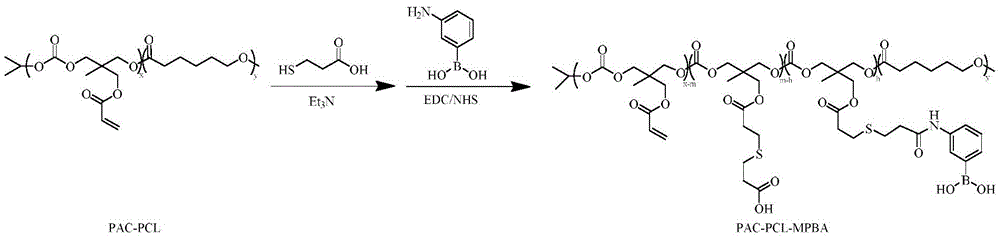
精密称量100mg PAC-PCL(3.03mmol)加入反应瓶内并溶解于5mL DMF中。以反应PAC-PCL上10个双键计算,精密量取32.1mg巯基丙酸(30.3mmol),氮气保护条件下加入至反应瓶中,滴加2-3滴三乙胺催化反应,反应过夜。将终溶液滴入至少 20倍体积冰乙醚中进行沉淀,分离得到白色固体,真空干燥得到终产物PAC-PCL- MPA。Accurately weigh 100 mg of PAC-PCL (3.03 mmol) into the reaction flask and dissolve in 5 mL of DMF. Based on the calculation of 10 double bonds on the reaction PAC-PCL, 32.1mg of mercaptopropionic acid (30.3mmol) was precisely measured, and added to the reaction flask under nitrogen protection, and 2-3 drops of triethylamine were added dropwise to catalyze the reaction, and the reaction was carried out overnight. The final solution was dropped into at least 20 times the volume of glacial ether for precipitation, and a white solid was isolated and dried in vacuo to obtain the final product PAC-PCL-MPA.
精密称量100mg PAC-PCL-MPA(3.40mmol)加入反应瓶内并溶解于5mL DMF 中。以反应PAC-PCL-MPA上10个羧基计算,精密称量13.7mg EDC·HCL(68mmol)、 7.82mg NHS(68mmol),依次加入反应瓶中。氮气保护下向反应瓶中投入3倍量的3- 氨基苯硼酸(APBA),即15.8mg APBA(102mmol),将终溶液加入3.5kDa透析袋中,并用丙酮透析,后旋蒸除去丙酮,将剩余溶液滴入至少20倍体积冰乙醚中进行沉淀,分离得到白色固体,真空干燥,得到终产物PAC-PCL-MPBA。产率为73.5%。Accurately weigh 100 mg of PAC-PCL-MPA (3.40 mmol) into the reaction flask and dissolve in 5 mL of DMF. Based on the calculation of 10 carboxyl groups on PAC-PCL-MPA, 13.7mg EDC·HCL (68mmol) and 7.82mg NHS (68mmol) were accurately weighed, and added to the reaction flask in sequence. 3-aminophenylboronic acid (APBA) of dropping into 3 times of amount in the reaction flask under the protection of nitrogen, i.e. 15.8mg APBA (102mmol), the final solution is added in the 3.5kDa dialysis bag, and with acetone dialyzing, the back rotary evaporation removes acetone, will The remaining solution was dropped into at least 20 times the volume of glacial ether for precipitation, and a white solid was isolated and dried in vacuo to obtain the final product PAC-PCL-MPBA. The yield was 73.5%.
将本实施例制备的PAC-PCL-MPBA进行氢核磁共振分析,结果如图3所示。The PAC-PCL-MPBA prepared in this example was subjected to proton magnetic resonance analysis, and the results are shown in FIG. 3 .
PAC-PCL-MPBA的氢核磁表征见附图3,图3为实施例3中PAC-PCL-MPBA的核磁氢谱图,由图3可知,1H NMR(400MHz,DMSO-d6)δ(ppm):1.27(d,3H),3.23(s, 1H),3.89-4.13(m,2H),4.2(s,1H),7.89-8.01(m,4H),10.03(s,1H).The proton nuclear magnetic characterization of PAC-PCL-MPBA is shown in accompanying drawing 3, and Fig. 3 is the nuclear magnetic proton spectrum figure of PAC-PCL-MPBA in the
实施例4Example 4
HEA-UDCA的合成,合成路线及过程如下:The synthesis of HEA-UDCA, the synthetic route and process are as follows:
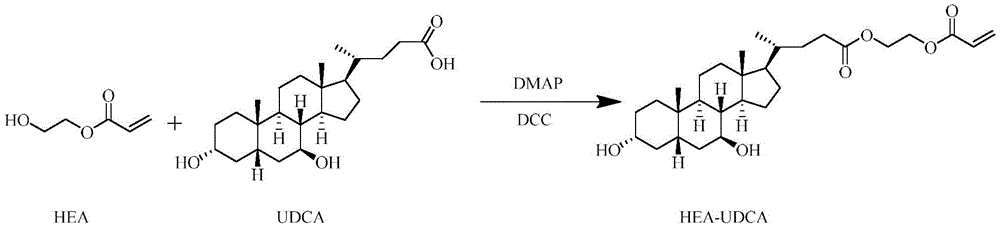
精密量取100mg熊去氧胆酸(UDCA)(0.255mmol),氮气保护下用5mL无水 CH2Cl2完全溶解,加入7.83μL HEA(2.55mmol),依次加入62.3mg 4-二甲氨基吡啶 (DMAP,0.51mmol)、105.2mg N,N-二环己甲碳二亚胺(DCC,0.51mmol)催化反应,反应24h后,将反应液滴入至少20倍体积冰乙醚中进行沉淀,分离得到白色固体,真空干燥,得到终产物HEA-UDCA。产率为79%。Precisely measure 100 mg of ursodeoxycholic acid (UDCA) (0.255 mmol), completely dissolve it with 5 mL of anhydrous CH 2 Cl 2 under nitrogen protection, add 7.83 μL of HEA (2.55 mmol), and then add 62.3 mg of 4-dimethylaminopyridine (DMAP, 0.51mmol), 105.2mg N, N-dicyclohexylcarbodiimide (DCC, 0.51mmol) catalyzed the reaction, after 24 hours of reaction, the reaction solution was dropped into at least 20 times the volume of glacial ether for precipitation, and separated A white solid was obtained and dried in vacuo to obtain the final product HEA-UDCA. The yield was 79%.
将本实施例制备的HEA-UDCA进行氢核磁共振分析,结果如图4所示。The HEA-UDCA prepared in this example was analyzed by proton nuclear magnetic resonance, and the results are shown in FIG. 4 .
HEA-UDCA的氢核磁表征见附图4,图4为实施例4中HEA-UDCA的核磁氢谱图,由图4可见,1H NMR(400MHz,DMSO-d6)δ(ppm):0.88-0.97(d,3H),1.04-1.14(d,1H), 1.65-1.90(q,2H),2.35(t,1H),3.24-3.54(m,1H),6.12(t,1H),5.83-6.41(m,2H).The proton nuclear magnetic characterization of HEA-UDCA is shown in accompanying drawing 4, and Fig. 4 is the nuclear magnetic proton spectrum figure of HEA-UDCA in the
实施例5Example 5
(1)载药纳米颗粒的制备(1) Preparation of drug-loaded nanoparticles
实施例2-4所制备的PAC-PCL-MPD、PAC-PCL-MPBA、CB和HEA-UDCA为纳米颗粒载体材料。用乙醇配制光交联剂I2959含量为20mg/mL的溶液备用。以上述 I2959溶液为溶剂,按照CB与HEA-UDCA物质的量比为2:1的比例配制总含量为15 mg/mL的混合溶液。将PAC-PCL-MPD和PAC-PCL-MPBA按照10mg/mL的浓度分别溶于二氯甲烷:丙酮体积比为3:1的有机溶液中,超声处理至完全溶解,将两种溶液按照PAC-PCL-MPD:PAC-PCL-MPBA体积比为3:2比列混合。取50μL上述CB和HEA- UDCA混合溶液、1mL上述PAC-PCL-MPD和PAC-PCL-MPBA混合溶液、载体材料总质量5%比例的上述光交联剂溶液,混合均匀,作为油相。按胰岛素照载药量为5wt%、10wt%、15wt%、20wt%、30wt%、35wt%、40wt%,分别将对应体积的以 pH 2.0的盐酸溶液为溶剂配制的胰岛素溶液(15mg/mL)与一滴SPAN80滴入油相中,均质混合制成初始乳液。将初始乳液滴入8mL 0.2wt%的PVA水溶液中,超声混合均匀。旋蒸除去上述溶液中的有机溶剂,紫外光照射15min,得到载药纳米颗粒,记为 C+U@insulin NPs。不加入HEA-UDCA时,记为CB@insulin NPs;不装载胰岛素时,将胰岛素水溶液替换为pH为2的0.2wt%PVA水溶液,记为Blank CB NPs、Blank C+U NPs。The PAC-PCL-MPD, PAC-PCL-MPBA, CB and HEA-UDCA prepared in Examples 2-4 are nanoparticle carrier materials. A solution containing 20 mg/mL of photocrosslinker I2959 was prepared with ethanol for use. Using the above I2959 solution as a solvent, a mixed solution with a total content of 15 mg/mL was prepared according to the molar ratio of CB and HEA-UDCA at a ratio of 2:1. Dissolve PAC-PCL-MPD and PAC-PCL-MPBA according to the concentration of 10mg/mL in the organic solution with dichloromethane: acetone volume ratio of 3:1, ultrasonic treatment until completely dissolved, and the two solutions were prepared according to the PAC- The volume ratio of PCL-MPD:PAC-PCL-MPBA is 3:2. Take 50 μL of the above-mentioned CB and HEA-UDCA mixed solution, 1 mL of the above-mentioned PAC-PCL-MPD and PAC-PCL-MPBA mixed solution, and the above-mentioned photocrosslinking agent solution with a ratio of 5% of the total mass of the carrier material, and mix them uniformly as the oil phase. According to the drug loading of insulin as 5wt%, 10wt%, 15wt%, 20wt%, 30wt%, 35wt%, 40wt%, the corresponding volume of insulin solution (15mg/mL) prepared as solvent with the hydrochloric acid solution of pH 2.0 Drop into the oil phase with a drop of SPAN80, mix homogeneously to make the initial emulsion. The initial emulsion was dropped into 8mL of 0.2wt% PVA aqueous solution, and ultrasonically mixed evenly. The organic solvent in the above solution was removed by rotary evaporation, and irradiated with ultraviolet light for 15 minutes to obtain drug-loaded nanoparticles, which were denoted as C+U@insulin NPs. When HEA-UDCA was not added, it was recorded as CB@insulin NPs; when insulin was not loaded, the aqueous solution of insulin was replaced with 0.2wt% PVA aqueous solution at
对本实施例制备的载药量为40wt%的载药纳米颗粒进行粒度分析,结果如图5所示。由图5可知,纳米颗粒C+U@insulin NPs的平均粒径在240nm左右,CB@insulin NPs的平均粒径在250nm左右,分布系数PDI为0.09-0.19,说明该纳米粒子粒度分布均一。The particle size analysis of the drug-loaded nanoparticles with a drug-loaded amount of 40 wt% prepared in this example is shown in FIG. 5 . It can be seen from Figure 5 that the average particle size of nanoparticles C+U@insulin NPs is about 240nm, the average particle size of CB@insulin NPs is about 250nm, and the distribution coefficient PDI is 0.09-0.19, indicating that the size distribution of the nanoparticles is uniform.
(2)载胰岛素胶束的包封率和载药量测定(2) Determination of encapsulation efficiency and drug loading of insulin-loaded micelles
质量包封率和载药量通常用来表示聚合物胶束的载药能力。本文采用间接法,利用考马斯亮蓝染色法测量未被包载的游离胰岛素的含量计算载药量和包封率。其中载药量是包载在纳米颗粒的药量和总质量(载体和包载的药量)的百分数,质量包封率是指包载在纳米颗粒的药量和投药量的质量百分数,计算公式分别如下:Mass encapsulation efficiency and drug loading are usually used to represent the drug loading capacity of polymer micelles. In this paper, the indirect method was used to measure the content of unencapsulated free insulin by using Coomassie brilliant blue staining method to calculate the drug loading amount and encapsulation efficiency. Wherein the drug loading is the percentage of the drug amount and the total mass (carrier and entrapped drug amount) entrapped in the nanoparticle, and the mass encapsulation efficiency refers to the mass percentage of the drug amount and the amount of the drug entrapped in the nanoparticle, calculated The formulas are as follows:


其中,m总为投入胰岛素的质量(mg),m游为游离的胰岛素质量(mg);m药为包载在纳米颗粒内胰岛素的质量(mg),m载体为载体材料的质量(mg)。Among them, m total is the mass of insulin input (mg), m free is the mass of free insulin (mg); m drug is the mass of insulin encapsulated in nanoparticles (mg), and m carrier is the mass of the carrier material (mg) .
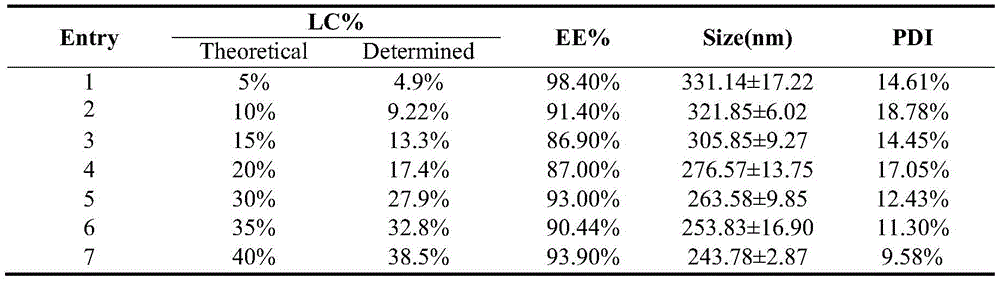
如表1,对于C+U@insulin NPs,在理论载药量(即投入胰岛素的质量/载体材料与投入胰岛素的质量之和)为5wt%、10wt%、15wt%、20wt%、30wt%、35wt%、 40wt%时,纳米颗粒对胰岛素的包封率约为86.90-98.40%。As shown in Table 1, for C+U@insulin NPs, the theoretical drug loading (that is, the mass of insulin input/the sum of the mass of carrier material and insulin input) is 5wt%, 10wt%, 15wt%, 20wt%, 30wt%, At 35wt% and 40wt%, the encapsulation efficiency of nanoparticles to insulin is about 86.90-98.40%.
表1载胰岛素纳米颗粒的表征Table 1 Characterization of insulin-loaded nanoparticles
(3)模拟体外释放性能(3) Simulate in vitro release performance
以pH 2.0的盐酸溶液为溶剂配制胰岛素含量为2mg/mL的溶液,分别稀释为0 μg/mL、3μg/mL、6μg/mL、9μg/mL、15μg/mL、18μg/mL、24μg/mL、180μg/mL、 240μg/mL的浓度梯度溶液。分别取50μL上述不同浓度梯度的溶液于96孔板中,分别加入150μL考马斯亮蓝试剂,混合均匀,利用酶标仪在ABS(紫外吸收)模式下,选定测量波长为562nm,测量其吸光度,并绘制吸光度与胰岛素浓度的标准曲线。Use hydrochloric acid solution at pH 2.0 as solvent to prepare solutions with an insulin content of 2 mg/mL, and dilute them to 0 μg/mL, 3 μg/mL, 6 μg/mL, 9 μg/mL, 15 μg/mL, 18 μg/mL, 24 μg/mL, 180μg/mL, 240μg/mL concentration gradient solution. Take 50 μL of the above-mentioned solutions with different concentration gradients in a 96-well plate, add 150 μL of Coomassie Brilliant Blue reagent, mix well, use a microplate reader in the ABS (ultraviolet absorption) mode, select the measurement wavelength as 562 nm, and measure its absorbance. And draw the standard curve of absorbance and insulin concentration.
通过pH的变化模拟纳米颗粒在唾液、胃液和肠道的人体环境的释放行为,模拟载胰岛素纳米颗粒药物从胃到肠道的运输过程。以5mL pH 1.2、pH 6.8和pH 7.4的100 mM磷酸缓冲液(PBS溶液)作为释放介质,分别将1mL本实施例步骤(1)中制备的CB@insulin NPs和C+U@insulin NPs置于12kDa透析袋中,放于37℃,80r/min摇床保温箱中,在2h、8h时分别更换释放介质,并在对应时间点取出50μL样品液,于96孔板中,加入150μL考马斯亮蓝试剂,在562nm波长下每个样品平行测三次紫外吸光度(每次取完样品,补充150μL相应pH的磷酸缓冲液,保证体积不发生变化),根据吸光度与胰岛素标准曲线测定释放的胰岛素的量,累积释放结果见附图6。图6为实施例5中检测载药纳米粒子体外释放性能实验结果图,由图6可见,CB@insulin NPs和C+U@insulin NPs中胰岛素的释放量随着pH的升高而增加,且在前两小时pH 1.2溶液中,胰岛素释放量很少,随着pH增大,胰岛素的释放速率明显增大,表明两种纳米粒子在胃中释放少,避免了胃酸的降解,这可能归因于纳米粒子的双重交联增大了对胃酸的抵抗性,同时纳米粒子在肠道中释放较多,胰岛素的生物利用度得以提高。The release behavior of nanoparticles in the human environment of saliva, gastric juice and intestinal tract is simulated by pH changes, and the transport process of insulin-loaded nanoparticle drugs from the stomach to the intestinal tract is simulated. Using 5 mL of 100 mM phosphate buffer solution (PBS solution) at pH 1.2, pH 6.8 and pH 7.4 as the release medium,
(4)酶降解实验(4) Enzyme degradation experiment
酶降解实验步骤同本实施例中的步骤(3),以5mL按照中国药典配置的胃液(SGF)、肠液(SIF)分别作为释放介质,将1mL本实施例步骤(1)中制备的 CB@insulin NPs和CB+UDCA@insulin NPs置于12kDa透析袋中,放于37℃,80 r/min摇床保温箱中,在1h、2h、3h、4h、5h、6h、8h时间点,分别取出50μL样品液,于96孔板中,加入150μL考马斯亮蓝试剂,在562nm波长下每个样品平行测三次紫外吸光度(每次取完样品,要加入150μL相应胃液、肠液,保证体积不发生变化),根据胰岛素标准曲线测定释放的胰岛素的量,累积释放结果见附图7。图7为实施例5中检测载药纳米粒子体外酶抵抗性能实验结果图,从图7中可以看出,CB@insulin NPs和C+U@insulin NPs在胃液中基本不释放,胰岛素保留量达到了90%以上,表明纳米粒子能在胃部保持良好的稳定性,有效抵抗胃酸和酶降解。在肠液中胰岛素随着时间增加而缓慢减少,8h后仍有约25%,这表明CB@insulin NPs和 C+U@insulin NPs能在肠道中缓慢释放胰岛素。The enzyme degradation experiment procedure was the same as step (3) in this example, with 5mL of gastric juice (SGF) and intestinal fluid (SIF) configured in accordance with the Chinese Pharmacopoeia as the release medium, and 1mL of the CB@ prepared in step (1) of this example Insulin NPs and CB+UDCA@insulin NPs were placed in a 12kDa dialysis bag, placed in a shaker incubator at 37°C and 80 r/min, and were taken out at 1h, 2h, 3h, 4h, 5h, 6h, and 8h time points Add 150 μL of Coomassie Brilliant Blue reagent to 50 μL of sample solution in a 96-well plate, and measure the UV absorbance of each sample three times in parallel at a wavelength of 562 nm (after each sample is taken, 150 μL of corresponding gastric juice and intestinal juice should be added to ensure that the volume does not change) , according to the insulin standard curve to measure the amount of released insulin, the cumulative release results are shown in Figure 7. Figure 7 is the result of the in vitro enzyme resistance test of drug-loaded nanoparticles in Example 5. It can be seen from Figure 7 that CB@insulin NPs and C+U@insulin NPs basically do not release in gastric juice, and the insulin retention reaches More than 90%, indicating that the nanoparticles can maintain good stability in the stomach and effectively resist gastric acid and enzyme degradation. Insulin in the intestinal fluid decreased slowly with time, and about 25% remained after 8 h, which indicated that CB@insulin NPs and C+U@insulin NPs could release insulin slowly in the intestine.
(5)“开关式”葡萄糖响应试验(5) "Switch" glucose response test
将1mL本实施例步骤(1)中制备的CB@insulin NPs和C+U@insulin NPs分别置于12kDa透析袋中置于5mL 4mg/mL葡萄糖溶液中,在37℃,80r/min摇床保温箱释放两个小时,分别取出50μL样品液,于96孔板中,加入150μL考马斯亮蓝试剂,在 562nm波长下每个样品平行测三次紫外吸光度(每次取完样品,要加入150mL4 mg/mL葡萄糖溶液,保证体积不发生变化),紧接着置于1mg/mL葡萄糖溶液中相同条件释放两个小时,取样检测。反复测试4次,计算在相同时间不同葡萄糖浓度的释放速率。其累积释放结果见附图8,图8为实施例5中检测载药纳米粒子“开关式”葡萄糖响应实验结果图,从图8中可以看出,在高浓度葡萄糖中胰岛素释放比正常浓度快,在连续交替的高低浓度葡萄糖环境转换下呈现胰岛素释放“开关”模式。CB@insulin NPs和C+U@insulin NPs都能跟随葡萄糖浓度的“高-低-高-低”转变呈现“快-慢-快-慢”的释放模式,这说明纳米颗粒具有葡萄糖智能响应性。当环境中葡萄糖浓度高时,胰岛素的释放速率增大,当环境中葡萄糖浓度低时,胰岛素的释放速率减慢。Put 1mL of CB@insulin NPs and C+U@insulin NPs prepared in step (1) of this example into 12kDa dialysis bags, respectively, in 5mL of 4mg/mL glucose solution, and incubate at 37°C on a shaking table at 80r/min After release for two hours, take out 50 μL of the sample solution, add 150 μL of Coomassie Brilliant Blue reagent to the 96-well plate, and measure the UV absorbance of each sample three times in parallel at a wavelength of 562 nm (after each sample is taken, 150 mL of 4 mg/mL Glucose solution, to ensure that the volume does not change), then placed in 1mg/mL glucose solution under the same conditions to release for two hours, sampling and testing. The test was repeated 4 times, and the release rate of different glucose concentrations at the same time was calculated. The cumulative release results are shown in Figure 8. Figure 8 is a graph showing the results of the "switching" glucose response test of drug-loaded nanoparticles in Example 5. It can be seen from Figure 8 that insulin release is faster in high-concentration glucose than in normal concentrations , presenting an insulin release "switch" mode under continuous alternating high and low concentration glucose environment transitions. Both CB@insulin NPs and C+U@insulin NPs can follow the "high-low-high-low" transition of glucose concentration and present a "fast-slow-fast-slow" release pattern, which indicates that the nanoparticles have glucose smart responsiveness . When the glucose concentration in the environment is high, the release rate of insulin increases, and when the glucose concentration in the environment is low, the release rate of insulin slows down.
(6)纳米载体的细胞毒性实验(MTT)(6) Cytotoxicity test (MTT) of nanocarriers
将本实施例步骤(1)中制备得到的未载药的Blank CB NPs和Blank C+U NPs进行人克隆结肠腺癌(Caco-2)细胞毒性实验(MTT),结果见附图9。图9为实施例6 中双层交联纳米载体进行Caco-2细胞毒性试验的细胞存活率示意图,由图9可知,随着纳米载体浓度的增加,与空白细胞培养液中细胞活性相比,加入纳米载体的细胞培养液中细胞活性没有明显降低,并且存活率在80%以上,因此,证明该纳米载体材料对生物细胞毒性较小。The non-drug-loaded Blank CB NPs and Blank C+U NPs prepared in step (1) of this example were subjected to the human colon adenocarcinoma (Caco-2) cytotoxicity test (MTT), and the results are shown in Fig. 9 . Figure 9 is a schematic diagram of the cell viability of the double-layer cross-linked nanocarrier in Example 6 in the Caco-2 cytotoxicity test. It can be seen from Figure 9 that as the concentration of the nanocarrier increases, compared with the cell activity in the blank cell culture medium, The cell activity in the cell culture solution added with the nano-carrier has no obvious decrease, and the survival rate is above 80%, therefore, it is proved that the nano-carrier material is less toxic to biological cells.
实施例6Example 6
利用AML12细胞(小鼠正常肝细胞)摄取研究载药纳米颗粒在动物肝脏中的摄取。将AML12细胞在12孔板(1×10⁵个/孔)中的玻璃盖玻片上培养3天。将培养后的 AML12细胞与分别添加有200μL灭菌PBS溶液、CB@insulin NPs、C+U@insulin NPs 的1mL细胞培养基一起孵育4h(使载药纳米颗粒浓度为0.2mg/mL)。然后,将 AML12细胞用500μL灭菌PBS溶液洗涤三次,然后用4%多聚甲醛(覆盖住细胞即可) 固定。为了可视化载药纳米颗粒的摄取,提前用5-氨基荧光素(5-AF)标记纳米颗粒中的胰岛素,用4',6-二脒基-2-苯基吲哚(DAPI,1.25μg/mL,覆盖住细胞即可)染色细胞核10分钟后,用200μL灭菌PBS溶液清洗载玻片并通过激光扫描共聚焦显微镜 CLSM观察AML12细胞。为了定量测量摄取并进一步评估UDCA在肝脏摄取的作用,使用流式细胞术(Flow cytometer)分析定量测定胰岛素的细胞摄取。AML12细胞摄取胰岛素的结果见附图10所示。图10为实施例6中为载药纳米粒子肝细胞摄取实验结果图,由图10可见,合并图像(Merge)显示C+U@insulin NPs组在细胞核周围荧光信号比其他组强得多,其对应的流式细胞仪的荧光强度结果也显示出更大的荧光强度,均证实了C+U@insulin NPs中的熊去氧胆酸(UDCA)增强了胰岛素的肝脏摄取。Uptake of drug-loaded nanoparticles in animal livers was studied using AML12 cells (normal liver cells in mice). AML12 cells were cultured on glass coverslips in 12-well plates (1×10 5 cells/well) for 3 days. The cultured AML12 cells were incubated with 1 mL cell culture medium supplemented with 200 μL sterilized PBS solution, CB@insulin NPs, and C+U@insulin NPs for 4 h (to make the concentration of drug-loaded nanoparticles 0.2 mg/mL). Then, the AML12 cells were washed three times with 500 μL sterilized PBS solution, and then fixed with 4% paraformaldehyde (just cover the cells). To visualize the uptake of drug-loaded nanoparticles, insulin in the nanoparticles was previously labeled with 5-aminofluorescein (5-AF), and 4',6-diamidino-2-phenylindole (DAPI, 1.25 μg/ mL, just to cover the cells) after staining the nuclei for 10 minutes, wash the glass slide with 200 μL sterilized PBS solution and observe the AML12 cells by laser scanning confocal microscope CLSM. To quantitatively measure uptake and further assess the role of UDCA in hepatic uptake, cellular uptake of insulin was quantified using Flow cytometry analysis. The result of insulin uptake by AML12 cells is shown in Fig. 10 . Figure 10 is the result of the hepatic cell uptake experiment of drug-loaded nanoparticles in Example 6. It can be seen from Figure 10 that the merged image (Merge) shows that the fluorescence signal around the nucleus of the C+U@insulin NPs group is much stronger than that of other groups, and its The corresponding fluorescence intensity results of flow cytometry also showed greater fluorescence intensity, which confirmed that ursodeoxycholic acid (UDCA) in C+U@insulin NPs enhanced the hepatic uptake of insulin.
实施例7Example 7
将高血糖模型小鼠随机分为5组,每组3只老鼠,分别皮下注射胰岛素(S.C.,剂量为5U/kg)、口服C+U@insulin NPs(胰岛素剂量为25U/kg)、口服CB@insulin NPs (胰岛素剂量为25U/kg)、口服Blank CB NPs、口服Blank C+U NPs,以健康小鼠 (Normal mice)为对照,进行体内实验。通过尾静脉采集血样(~3μL),用血糖仪连续监测血糖变化并记录。血糖变化曲线见附图11所示。图11为实施例7中为载药纳米颗粒体内降糖实验结果图,由图11可见,皮下注射胰岛素在2h内迅速下降到正常值,在接下来的1h内迅速失去控制,Blank CBNPs组动物血糖无明显下降,而Blank C+U NPs组别小鼠口服后有微弱的降糖效果,但均未降到正常血糖水平。口服C+U@insulin NPs和CB@insulin NPs的小鼠血糖在2h内迅速降至10mmol/L左右。CB@insulin NPs组可以维持在正常血糖水平12h左右。C+U@insulin NPs组在24h左右维持在正常血糖范围(<11.6mmol/L),随后血糖水平逐渐升高,表明熊去氧胆酸分子的加入延长了纳米颗粒的作用效果。The hyperglycemia model mice were randomly divided into 5 groups, with 3 mice in each group, and they received subcutaneous injection of insulin (S.C., 5 U/kg), oral administration of C+U@insulin NPs (insulin dosage of 25 U/kg), and oral administration of CB @insulin NPs (insulin dose of 25U/kg), oral administration of Blank CB NPs, oral administration of Blank C+U NPs, and healthy mice (Normal mice) were used as controls for in vivo experiments. Blood samples (~3 μL) were collected through the tail vein, and blood glucose changes were continuously monitored and recorded with a blood glucose meter. The blood sugar change curve is shown in Figure 11. Figure 11 is the result of the in vivo hypoglycemic experiment of drug-loaded nanoparticles in Example 7. It can be seen from Figure 11 that the subcutaneous injection of insulin rapidly dropped to the normal value within 2 hours, and quickly lost control within the next 1 hour. Blank CBNPs group animals There was no significant drop in blood sugar, while mice in the Blank C+U NPs group had a weak hypoglycemic effect after oral administration, but none of them fell to normal blood sugar levels. The blood glucose of mice orally administered C+U@insulin NPs and CB@insulin NPs dropped rapidly to about 10mmol/L within 2 hours. The CB@insulin NPs group can maintain normal blood sugar levels for about 12 hours. The C+U@insulin NPs group maintained a normal blood glucose range (<11.6mmol/L) at about 24h, and then the blood glucose level gradually increased, indicating that the addition of ursodeoxycholic acid molecules prolongs the effect of nanoparticles.
实施例8Example 8
将高血糖模型小鼠随机分为3组,每组3只老鼠,分别皮下注射胰岛素(S.C.,剂量为5U/kg)、口服C+U@insulin NPs(胰岛素剂量为25U/kg)、口服CB@insulin NPs (胰岛素剂量为25U/kg)。给药后,分别在1、2、3天后用糖原检测试剂盒测定各小鼠肝脏内的肝糖原含量。肝糖原变化见附图12所示。图12为实施例8中为口服载药纳米颗粒后肝糖原含量检测实验结果图,由图12可见,皮下注射胰岛素组别的小鼠其肝糖原含量于另外两组相比,均存在显著性差异,而相较于口服CB@insulin NPs,熊去氧胆酸因子的加入大大改善了肝糖原的利用,有利于治疗糖尿病时血糖的稳定。The hyperglycemia model mice were randomly divided into 3 groups, with 3 mice in each group, and they received subcutaneous injection of insulin (S.C., the dose was 5 U/kg), oral administration of C+U@insulin NPs (insulin dose of 25 U/kg), and oral administration of CB @insulin NPs (insulin dose 25U/kg). After the administration, the liver glycogen content in the liver of each mouse was measured 1, 2, and 3 days later with a glycogen detection kit. Changes in liver glycogen are shown in Figure 12. Fig. 12 is the graph of the experimental results of liver glycogen content detection after oral administration of drug-loaded nanoparticles in Example 8. It can be seen from Fig. 12 that the liver glycogen content of mice in the subcutaneous insulin injection group is compared with the other two groups. Compared with oral CB@insulin NPs, the addition of ursodeoxycholic acid factor greatly improved the utilization of liver glycogen, which is beneficial to the stability of blood sugar in the treatment of diabetes.
Claims (10)
Priority Applications (1)
| Application Number | Priority Date | Filing Date | Title |
|---|---|---|---|
| CN202211189228.0A CN115671050B (en) | 2022-09-28 | 2022-09-28 | Liver-targeted glucose-responsive nanoparticles and preparation method and application thereof |
Applications Claiming Priority (1)
| Application Number | Priority Date | Filing Date | Title |
|---|---|---|---|
| CN202211189228.0A CN115671050B (en) | 2022-09-28 | 2022-09-28 | Liver-targeted glucose-responsive nanoparticles and preparation method and application thereof |
Publications (2)
| Publication Number | Publication Date |
|---|---|
| CN115671050A true CN115671050A (en) | 2023-02-03 |
| CN115671050B CN115671050B (en) | 2024-07-23 |
Family
ID=85064110
Family Applications (1)
| Application Number | Title | Priority Date | Filing Date |
|---|---|---|---|
| CN202211189228.0A Active CN115671050B (en) | 2022-09-28 | 2022-09-28 | Liver-targeted glucose-responsive nanoparticles and preparation method and application thereof |
Country Status (1)
| Country | Link |
|---|---|
| CN (1) | CN115671050B (en) |
Cited By (7)
| Publication number | Priority date | Publication date | Assignee | Title |
|---|---|---|---|---|
| CN114569706A (en) * | 2022-03-09 | 2022-06-03 | 中国药科大学 | Double-response double-layer cross-linked insulin controllable delivery microneedle and preparation method thereof |
| CN116831980A (en) * | 2023-06-16 | 2023-10-03 | 中国药科大学 | Nanogel targeting TGR5 receptor, preparation method and application thereof |
| WO2024178471A1 (en) * | 2023-02-28 | 2024-09-06 | Monash University | Engineered nanocomplexes |
| CN118717669A (en) * | 2024-08-12 | 2024-10-01 | 中国药科大学 | A uniform ultrafine polymer nano-micelle and its preparation method and application |
| WO2025002419A1 (en) * | 2023-06-30 | 2025-01-02 | 浙江大学 | Glucose-responsive molecular connector, and preparation method therefor and use thereof |
| CN119258037A (en) * | 2024-12-11 | 2025-01-07 | 中日友好医院(中日友好临床医学研究所) | Preparation method and application of nanoparticles based on pB and ASD conjugates |
| CN119661825A (en) * | 2023-09-19 | 2025-03-21 | 上海交通大学 | Polyzwitterion-cholic acid and its synthesis and application in drug delivery |
Citations (5)
| Publication number | Priority date | Publication date | Assignee | Title |
|---|---|---|---|---|
| CN107362354A (en) * | 2017-07-23 | 2017-11-21 | 复旦大学 | A kind of oral insulin nanometer formulation and preparation method thereof |
| CN111658783A (en) * | 2020-07-09 | 2020-09-15 | 中国药科大学 | Switch type glucose responsive double-layer cross-linked polymer micelle drug delivery system and preparation method and application thereof |
| CN113230232A (en) * | 2021-05-14 | 2021-08-10 | 中国药科大学 | PH-sensitive degradable zwitterionic microcapsule and preparation method and application thereof |
| CN114668745A (en) * | 2022-04-19 | 2022-06-28 | 中国药科大学 | A dual-layer cross-linked polymer nano-drug delivery system that responds to glucose and H2O2 and its preparation method and application |
| CN114767655A (en) * | 2022-04-19 | 2022-07-22 | 中国药科大学 | Zwitterionic functionalized biodegradable oral nano drug delivery system and application |
-
2022
- 2022-09-28 CN CN202211189228.0A patent/CN115671050B/en active Active
Patent Citations (5)
| Publication number | Priority date | Publication date | Assignee | Title |
|---|---|---|---|---|
| CN107362354A (en) * | 2017-07-23 | 2017-11-21 | 复旦大学 | A kind of oral insulin nanometer formulation and preparation method thereof |
| CN111658783A (en) * | 2020-07-09 | 2020-09-15 | 中国药科大学 | Switch type glucose responsive double-layer cross-linked polymer micelle drug delivery system and preparation method and application thereof |
| CN113230232A (en) * | 2021-05-14 | 2021-08-10 | 中国药科大学 | PH-sensitive degradable zwitterionic microcapsule and preparation method and application thereof |
| CN114668745A (en) * | 2022-04-19 | 2022-06-28 | 中国药科大学 | A dual-layer cross-linked polymer nano-drug delivery system that responds to glucose and H2O2 and its preparation method and application |
| CN114767655A (en) * | 2022-04-19 | 2022-07-22 | 中国药科大学 | Zwitterionic functionalized biodegradable oral nano drug delivery system and application |
Cited By (9)
| Publication number | Priority date | Publication date | Assignee | Title |
|---|---|---|---|---|
| CN114569706A (en) * | 2022-03-09 | 2022-06-03 | 中国药科大学 | Double-response double-layer cross-linked insulin controllable delivery microneedle and preparation method thereof |
| CN114569706B (en) * | 2022-03-09 | 2023-09-22 | 中国药科大学 | Dual-responsive double-layer cross-linked insulin controllable delivery microneedle and preparation method thereof |
| WO2024178471A1 (en) * | 2023-02-28 | 2024-09-06 | Monash University | Engineered nanocomplexes |
| CN116831980A (en) * | 2023-06-16 | 2023-10-03 | 中国药科大学 | Nanogel targeting TGR5 receptor, preparation method and application thereof |
| WO2025002419A1 (en) * | 2023-06-30 | 2025-01-02 | 浙江大学 | Glucose-responsive molecular connector, and preparation method therefor and use thereof |
| CN119661825A (en) * | 2023-09-19 | 2025-03-21 | 上海交通大学 | Polyzwitterion-cholic acid and its synthesis and application in drug delivery |
| CN118717669A (en) * | 2024-08-12 | 2024-10-01 | 中国药科大学 | A uniform ultrafine polymer nano-micelle and its preparation method and application |
| CN119258037A (en) * | 2024-12-11 | 2025-01-07 | 中日友好医院(中日友好临床医学研究所) | Preparation method and application of nanoparticles based on pB and ASD conjugates |
| CN119258037B (en) * | 2024-12-11 | 2025-04-18 | 中日友好医院(中日友好临床医学研究所) | Preparation method and application of nanoparticle based on pB and ASD conjugate |
Also Published As
| Publication number | Publication date |
|---|---|
| CN115671050B (en) | 2024-07-23 |
Similar Documents
| Publication | Publication Date | Title |
|---|---|---|
| CN115671050B (en) | Liver-targeted glucose-responsive nanoparticles and preparation method and application thereof | |
| Chen et al. | Chitosan-modified lipid nanodrug delivery system for the targeted and responsive treatment of ulcerative colitis | |
| Zeng et al. | Stimuli-responsive self-assembled dendrimers for oral protein delivery | |
| Sun et al. | Development of low molecular weight heparin based nanoparticles for metastatic breast cancer therapy | |
| CN114767655B (en) | A zwitterionic functionalized biodegradable oral nanodrug-carrying system and its application | |
| Zhang et al. | An oral polyphenol host-guest nanoparticle for targeted therapy of inflammatory bowel disease | |
| CN113230232B (en) | PH-sensitive degradable zwitterionic microcapsule and preparation method and application thereof | |
| CN106729727B (en) | Reduction response type magnetic nano-carrier modified by targeting ligand and preparation method thereof | |
| CN114632070B (en) | Method for preparing puerarin nanoparticles by taking phenylborated chitosan as carrier | |
| CN115531309B (en) | A liver-targeted polymer micelle drug delivery system and its preparation method and application | |
| CN105617362A (en) | Novel insulin-phospholipid-chitosan self-assembled microparticle carrier and preparation thereof | |
| CN114748433B (en) | An anti-inflammatory and antioxidant pharmaceutical composition and its preparation method and application | |
| Xie et al. | Responsive oligochitosan nano-vesicles with ursodeoxycholic acid and exenatide for NAFLD synergistic therapy via SIRT1 | |
| Chae et al. | Effect of cross-linked hemoglobin on functionality and viability of microencapsulated pancreatic islets | |
| Xu et al. | pH-sensitive micelles self-assembled from star-shaped TPGS copolymers with ortho ester linkages for enhanced MDR reversal and chemotherapy | |
| CN108969480A (en) | A kind of near infrared light responsiveness light moves controlled drug delivery system and preparation method thereof | |
| CN111658783B (en) | On-off glucose-responsive bilayer cross-linked polymer micelle drug delivery system and preparation method and application thereof | |
| CN101249266A (en) | Nano-liver targeting amphiphilic block copolymer drug delivery system and preparation method | |
| CN108113977B (en) | Preparation method and application of gelatin-loaded berberine hydrochloride nanoparticles encapsulated by erythrocyte membranes | |
| CN110755379A (en) | A targeted drug-carrying system capable of resisting drug-resistant tumors and preparation method thereof | |
| CN114452256A (en) | Spinal cord injury targeted drug, polymer-hydrophobic compound micelle and preparation method thereof | |
| CN112870374B (en) | Preparation of sugar-responsive functionalized nano-composite micelle and application thereof in insulin delivery | |
| CN116831980A (en) | Nanogel targeting TGR5 receptor, preparation method and application thereof | |
| CN103694479B (en) | Polymkeric substance, glucose-sensitive nanogel, glucose-sensitive medicament-carried nano gel and preparation method thereof | |
| Wehrung et al. | Biocompatibility and in vivo tolerability of a new class of photoresponsive alkoxylphenacyl-based polycarbonates |
Legal Events
| Date | Code | Title | Description |
|---|---|---|---|
| PB01 | Publication | ||
| PB01 | Publication | ||
| SE01 | Entry into force of request for substantive examination | ||
| SE01 | Entry into force of request for substantive examination | ||
| GR01 | Patent grant | ||
| GR01 | Patent grant |