CN115668317A - Additional area monitoring for building doors - Google Patents
Additional area monitoring for building doors Download PDFInfo
- Publication number
- CN115668317A CN115668317A CN202180036971.XA CN202180036971A CN115668317A CN 115668317 A CN115668317 A CN 115668317A CN 202180036971 A CN202180036971 A CN 202180036971A CN 115668317 A CN115668317 A CN 115668317A
- Authority
- CN
- China
- Prior art keywords
- access
- building
- door
- building door
- sliding door
- Prior art date
- Legal status (The legal status is an assumption and is not a legal conclusion. Google has not performed a legal analysis and makes no representation as to the accuracy of the status listed.)
- Granted
Links
Images


Classifications
-
- G—PHYSICS
- G07—CHECKING-DEVICES
- G07C—TIME OR ATTENDANCE REGISTERS; REGISTERING OR INDICATING THE WORKING OF MACHINES; GENERATING RANDOM NUMBERS; VOTING OR LOTTERY APPARATUS; ARRANGEMENTS, SYSTEMS OR APPARATUS FOR CHECKING NOT PROVIDED FOR ELSEWHERE
- G07C9/00—Individual registration on entry or exit
- G07C9/10—Movable barriers with registering means
- G07C9/15—Movable barriers with registering means with arrangements to prevent the passage of more than one individual at a time
-
- E—FIXED CONSTRUCTIONS
- E05—LOCKS; KEYS; WINDOW OR DOOR FITTINGS; SAFES
- E05F—DEVICES FOR MOVING WINGS INTO OPEN OR CLOSED POSITION; CHECKS FOR WINGS; WING FITTINGS NOT OTHERWISE PROVIDED FOR, CONCERNED WITH THE FUNCTIONING OF THE WING
- E05F15/00—Power-operated mechanisms for wings
- E05F15/70—Power-operated mechanisms for wings with automatic actuation
- E05F15/73—Power-operated mechanisms for wings with automatic actuation responsive to movement or presence of persons or objects
- E05F15/76—Power-operated mechanisms for wings with automatic actuation responsive to movement or presence of persons or objects responsive to devices carried by persons or objects, e.g. magnets or reflectors
-
- G—PHYSICS
- G07—CHECKING-DEVICES
- G07C—TIME OR ATTENDANCE REGISTERS; REGISTERING OR INDICATING THE WORKING OF MACHINES; GENERATING RANDOM NUMBERS; VOTING OR LOTTERY APPARATUS; ARRANGEMENTS, SYSTEMS OR APPARATUS FOR CHECKING NOT PROVIDED FOR ELSEWHERE
- G07C9/00—Individual registration on entry or exit
- G07C9/00174—Electronically operated locks; Circuits therefor; Nonmechanical keys therefor, e.g. passive or active electrical keys or other data carriers without mechanical keys
-
- G—PHYSICS
- G07—CHECKING-DEVICES
- G07C—TIME OR ATTENDANCE REGISTERS; REGISTERING OR INDICATING THE WORKING OF MACHINES; GENERATING RANDOM NUMBERS; VOTING OR LOTTERY APPARATUS; ARRANGEMENTS, SYSTEMS OR APPARATUS FOR CHECKING NOT PROVIDED FOR ELSEWHERE
- G07C9/00—Individual registration on entry or exit
- G07C9/20—Individual registration on entry or exit involving the use of a pass
- G07C9/22—Individual registration on entry or exit involving the use of a pass in combination with an identity check of the pass holder
- G07C9/25—Individual registration on entry or exit involving the use of a pass in combination with an identity check of the pass holder using biometric data, e.g. fingerprints, iris scans or voice recognition
-
- E—FIXED CONSTRUCTIONS
- E05—LOCKS; KEYS; WINDOW OR DOOR FITTINGS; SAFES
- E05F—DEVICES FOR MOVING WINGS INTO OPEN OR CLOSED POSITION; CHECKS FOR WINGS; WING FITTINGS NOT OTHERWISE PROVIDED FOR, CONCERNED WITH THE FUNCTIONING OF THE WING
- E05F15/00—Power-operated mechanisms for wings
- E05F15/70—Power-operated mechanisms for wings with automatic actuation
- E05F15/73—Power-operated mechanisms for wings with automatic actuation responsive to movement or presence of persons or objects
- E05F2015/767—Power-operated mechanisms for wings with automatic actuation responsive to movement or presence of persons or objects using cameras
-
- E—FIXED CONSTRUCTIONS
- E05—LOCKS; KEYS; WINDOW OR DOOR FITTINGS; SAFES
- E05Y—INDEXING SCHEME ASSOCIATED WITH SUBCLASSES E05D AND E05F, RELATING TO CONSTRUCTION ELEMENTS, ELECTRIC CONTROL, POWER SUPPLY, POWER SIGNAL OR TRANSMISSION, USER INTERFACES, MOUNTING OR COUPLING, DETAILS, ACCESSORIES, AUXILIARY OPERATIONS NOT OTHERWISE PROVIDED FOR, APPLICATION THEREOF
- E05Y2900/00—Application of doors, windows, wings or fittings thereof
- E05Y2900/10—Application of doors, windows, wings or fittings thereof for buildings or parts thereof
- E05Y2900/13—Type of wing
- E05Y2900/132—Doors
- E05Y2900/14—Doors disappearing in pockets of a wall, e.g. so-called pocket doors
Landscapes
- Physics & Mathematics (AREA)
- General Physics & Mathematics (AREA)
- Engineering & Computer Science (AREA)
- Human Computer Interaction (AREA)
- Lock And Its Accessories (AREA)
Abstract
一种用于监测对建筑物和/或对建筑物中的访问受限区域(36)的访问的系统(1),该系统包括建筑物门系统(2),该建筑物门系统具有建筑物门(2a)、电子关闭装置(50)和用于检测对象(20)的授权凭证的识别装置(6)。所述建筑物门(2a)能够通过电子关闭装置(50)在有效授权凭证的情况下解锁并且能够从关闭位置进入打开位置中,以便准许建筑物门(2a)处的对象(20)进行访问。传感器系统(8)监控包括建筑物门(2a)的指定访问范围的访问区域(Z1、Z2、Z3),以便检测处于访问区域(Z1、Z2、Z3)中的人员(4)。当建筑物门系统(2)准许对象进行访问(20)并且传感器系统(8)检测到访问区域(Z1、Z2、Z3)中有人员(4)时,控制装置(24)生成警告信号,其中,建筑物门系统(2)在接收到警告信号时阻止准许访问。
A system (1) for monitoring access to a building and/or to an access-restricted area (36) in a building, the system comprising a building door system (2) having a building A door (2a), an electronic closing device (50) and an identification device (6) for detecting authorization credentials of an object (20). The building door (2a) can be unlocked by means of an electronic closing device (50) with a valid authorization credential and can be brought from a closed position into an open position in order to grant access to an object (20) at the building door (2a) . A sensor system (8) monitors an access zone (Z1, Z2, Z3) including a designated access range of a building door (2a) in order to detect persons (4) in the access zone (Z1, Z2, Z3). When the building door system (2) grants access to an object (20) and the sensor system (8) detects a person (4) in the access zone (Z1, Z2, Z3), the control device (24) generates a warning signal, wherein , the building door system (2) blocks granting access when a warning signal is received.
Description
技术领域technical field
本文所介绍的技术总体上涉及一种用于建筑物的访问监测系统。本技术的实施例还涉及一种用于运行这种访问监测系统的方法。The technology presented herein generally relates to an access monitoring system for buildings. Embodiments of the present technology also relate to a method for operating such an access monitoring system.
背景技术Background technique
访问监测系统能够以各种方式配置,以允许或拒绝人员进入访问受限区域。该设计方案例如可以涉及人员(用户)如何被证明为授权访问的方式,例如带有钥匙、磁卡、芯片卡或RFID卡或移动电子设备(例如移动电话)。WO2010/112586A1介绍了一种访问监测系统,其中,携带的移动电话上的被授权访问的用户获得显示在显示器上的访问码。如果用户将移动电话停留到摄像头上,使得摄像头可以检测所示出的访问码,则访问监测系统在有效的访问码的情况下准许用户访问。Access monitoring systems can be configured in various ways to allow or deny access to restricted access areas. This refinement can relate, for example, to how a person (user) can be certified as authorized to access, for example with a key, magnetic card, chip card or RFID card or a mobile electronic device (eg a mobile phone). WO2010/112586A1 describes an access monitoring system in which a user authorized to access on a mobile phone carried obtains an access code displayed on a display. If the user holds the mobile phone over the camera so that the camera can detect the displayed access code, the access monitoring system grants the user access with a valid access code.
访问监测系统的设计也可以涉及人员被准许或被阻止的方式,例如通过门、闸或屏障。例如,已知的是,电子锁布置于门上,访问码必须被输入到该电子锁中,以便门能够被解锁和打开。除了在门上的解锁功能之外,已知的是,监控通过门的通道。例如,WO2018/069341A1介绍了一种装置,该装置通过传感器监控对象是否运动以及哪些对象运动通过门。为了借助红外图像拍摄和红外脉冲照明进行对象监控,该装置具有由辐射源和图像拍摄装置组成的立体形状的对象识别装置,该对象识别装置固定地紧固在墙壁或门框附近。对象识别装置确定对象(人、汽车)的几何尺寸,以确定要打开门的程度以使对象通过。由此,应确保经过的对象的舒适性和安全性,例如,应当在经过门时可靠地感知到正在运动或行进的人员。The design of an access monitoring system can also address the manner in which persons are permitted or prevented, such as through doors, gates or barriers. For example, it is known that electronic locks are arranged on doors into which an access code must be entered in order for the door to be unlocked and opened. In addition to the unlocking function on the door, it is known to monitor the passage through the door. For example, WO2018/069341A1 describes a device that uses sensors to monitor whether objects are moving and which objects are moving through a door. For object monitoring by means of infrared image recording and infrared pulsed illumination, the device has a three-dimensional object detection device consisting of a radiation source and an image recording device, which is fixedly fastened near a wall or door frame. The object recognition device determines the geometry of the object (person, car) to determine how far to open the door to allow the object to pass. In this way, the comfort and safety of passing objects should be ensured, for example a moving or traveling person should be reliably detected when passing a door.
发明内容Contents of the invention
所述系统涉及访问监测的不同要求和访问监测系统的与此相关的设计方案。除了这些已知的要求之外,还存在其他要求,例如由于改变的生活习惯或生活环境(例如城市中公寓的高密度居住),包括对于提高的安全性和建筑物中以及建筑物中的日益自动化的需求。因此,需要一种满足这些要求的访问监测系统的技术,其中,访问监测尤其是考虑到安全要求,而不会不利地影响用户的舒适性。The system is concerned with the various requirements of access monitoring and with this related configuration of an access monitoring system. In addition to these known requirements, there are other requirements, for example due to changing living habits or living environments (such as high-density living of apartments in cities), including for increased safety and the increasing Automation needs. Therefore, there is a need for a technology for an access monitoring system that meets these requirements, wherein the access monitoring takes into account, inter alia, security requirements, without adversely affecting the comfort of the user.
这种技术的一个方面涉及一种用于监测对建筑物的访问和/或对建筑物中的访问受限区域的访问的系统。该系统包括建筑物门系统,该建筑物门系统具有建筑物门、电子关闭装置和用于检测对象的授权凭证的识别装置。该建筑物门能够通过电子关闭装置在授权凭证有效时解锁并且能够从关闭位置进入打开位置中,以便准许对象在建筑物门处进行访问。该系统还包括传感器系统,传感器系统被配置为监控包括建筑物门的指定访问范围的访问区域,并且检测处于访问区域中的人。系统的控制装置与建筑物门系统和传感器系统通信连接。控制装置被配置为当建筑物门系统准许对象访问并且传感器系统检测到访问区域中有人员时生成警告信号,建筑物门系统在接收到警告信号时阻止准许访问。One aspect of this technology relates to a system for monitoring access to a building and/or access to restricted-access areas in a building. The system includes a building door system having a building door, an electronic closing device and an identification device for detecting an authorization credential of an object. The building door can be unlocked by the electronic closing device when the authorization credential is valid and can be brought from the closed position into the open position in order to grant access to the object at the building door. The system also includes a sensor system configured to monitor an access area including a designated access range of a building door, and to detect a person in the access area. A control device for the system is communicatively coupled with the building door system and the sensor system. The control device is configured to generate a warning signal when the building door system grants access to the subject and the sensor system detects a person in the access area, and the building door system prevents the granting of access when the warning signal is received.
本技术的另一方面涉及一种运行用于监测对建筑物和/或建筑物中的访问受限区域的访问的系统的方法。该系统包括具有建筑物门、电子关闭装置和用于检测对象的授权凭证的识别装置的建筑物门系统、用于监控包括建筑物门的指定访问范围的访问区域的传感器系统以及与建筑物门系统和传感器系统通信连接的控制装置。根据该方法,当对象位于建筑物门的访问区域中时,借助识别装置检测对象的授权凭证。在有效授权凭证的情况下,建筑物门能够被解锁并且能够从关闭位置被带到打开位置,以便准许对象在建筑物门处进行访问。通过传感器系统检测,是否有人停留在访问区域中。当建筑物门系统准许对象在建筑物门处进行访问并且传感器系统检测到访问区域中有人员时,由控制装置生成警告信号。在建筑物门系统接收到警告信号时,由建筑物门系统阻止准许在建筑物门处进行访问。Another aspect of the present technology relates to a method of operating a system for monitoring access to a building and/or to a restricted-access area in a building. The system comprises a building door system having a building door, an electronic closing device and an identification device for detecting an authorization credential of an object, a sensor system for monitoring an access area including a designated access range of the building door, and a building door The control unit is communicatively connected to the system and the sensor system. According to the method, the authorization document of the object is detected by means of the recognition device when the object is located in the access area of the building door. With valid authorization credentials, the building door can be unlocked and brought from the closed position to the open position in order to grant access to the subject at the building door. A sensor system detects whether a person is in the access area. A warning signal is generated by the control device when the building door system grants access to a subject at the building door and the sensor system detects the presence of persons in the access area. Granting of access at the building door is prevented by the building door system when the warning signal is received by the building door system.
这里介绍的技术提供了一种访问监测系统,该访问监测系统尤其是在对象自主地且在建筑物门处没有伴随相关人员寻求访问时提供附加的安全性。对象可以是自主行进对象(下文中称为机器人)或宠物(例如狗或猫)。根据这里所介绍的技术,只有当建筑物门的访问区域安全时,才准许对象访问。在一个实施例中,当对象单独在访问区域中时,访问区域是安全的。另一方面,如果与对象无关(例如,非伴随)的对于建筑物门“未经授权”的人员位于访问区域,则根据这里介绍的技术,访问区域被认为是不安全的。在这种情况下阻止访问准许,以便例如防止有人未经授权地进入。The technology presented here provides an access monitoring system that provides additional security especially when an object seeks access autonomously and without accompanying persons at the building door. The object may be an autonomously traveling object (hereinafter referred to as a robot) or a pet (such as a dog or a cat). According to the technique presented here, a subject is granted access only if the access area of the building door is secured. In one embodiment, an access area is secured when an object is alone in the access area. On the other hand, if an "unauthorized" person with respect to the building door, unrelated to the subject (eg, not accompanying), is located in the access area, the access area is considered unsafe according to the techniques presented here. In this case, the access authorization is blocked in order to prevent unauthorized access, for example.
阻止访问准许能够以不同的方式和方法实现并且尤其灵活地匹配于相应的情况。在一个实施例中,阻止准许访问可以包括:将建筑物门阻挡在关闭位置中。在这种情况下,在为对象打开建筑物门之前,检测未经授权的人员。随着建筑物门的打开,例如可以等待,直至未经授权的人员已经从访问区域离开并且该访问区域然后又被认为是安全的。根据系统的设计方案,对象于是可以重新出示授权凭证。The blocking of access authorization can be realized in different ways and can be adapted in particular flexibly to the respective situation. In one embodiment, preventing granted access may include blocking a building door in a closed position. In this case, unauthorized persons are detected before the building doors are opened for the subject. With the opening of a building door, it is possible to wait, for example, until an unauthorized person has left the access area and the access area is then deemed safe again. Depending on the design of the system, the subject can then re-present the authorization credentials.
在一个实施例中,阻止准许访问可以包括:将建筑物门阻挡在部分打开位置。在这种情况下,当建筑物门已经为对象解锁并且部分地被打开时,检测未经授权的人员。建筑物门随后可能被阻挡,以便不能进一步打开。当建筑物门仅打开对于人而言过窄的间隙时,这是特别有利的。在一个实施例中,可以随着建筑物门的进一步打开而等待,直至未经授权的人员离开访问区域并且该访问区域然后又被认为是安全的。In one embodiment, preventing granted access may include blocking a building door in a partially open position. In this case, unauthorized persons are detected when the building door has been unlocked for the object and is partially opened. The building door may then be blocked so that it cannot be opened further. This is particularly advantageous when building doors only open a gap that is too narrow for a person. In one embodiment, there may be a wait with further opening of the building doors until the unauthorized person leaves the access area and the access area is then deemed safe again.
在一个实施例中,阻止准许访问可以包括:将建筑物门从完全或部分打开的位置关闭;在一个实施例中,完全打开位置针对所述对象确定的。对于对象(例如机器人或宠物)来说,建筑物门例如仅可被打开到该对象通过的程度;该宽度在该情况下是完全打开的位置。从这个完全或部分打开位置出发,可以触发建筑物门的关闭。如果对象还没有位于通道区域中,则建筑物门可以再次关闭。相反,如果对象已经位于通道区域中,则建筑物门例如可以关闭到建筑物门接触到对象的程度。In one embodiment, preventing granted access may include closing a building door from a fully or partially open position; in one embodiment, the fully open position is determined for said object. For an object such as a robot or a pet, a building door can for example only be opened to the extent that the object passes through; the width in this case is the fully open position. Proceeding from this fully or partially open position, the closing of the building door can be triggered. If the object is not yet located in the passage area, the building door can be closed again. Conversely, if the object is already located in the passage area, the building door can be closed, for example, to the extent that the building door touches the object.
在这里所介绍的技术的实施例中,对象可以在没有被授权人员伴随的情况下并且在没有授权人员停留在访问受限区域中的情况下获得在建筑物门处的访问。在此介绍的技术为这种情况提供了所述的附加的安全性,因为降低了未经授权的人员通过为该对象打开的建筑物门获得访问的风险。In an embodiment of the technology presented here, an object can gain access at a building door without being accompanied by an authorized person and without the authorized person staying in an access-restricted area. The technique presented here provides the described additional security in this case, since the risk of unauthorized persons gaining access through the building doors opened for the object is reduced.
在一个实施例中,该技术利用识别装置,该识别装置布置于建筑物门系统上或建筑物门周围并且与控制装置通信连接。因此,建筑物门系统可以与相应的建筑物情况相匹配。在一个实施例中,建筑物门系统包括滑动门;识别装置可以布置在滑动门上,由此可以减少布线费用。In one embodiment, the technique utilizes an identification device disposed on or around the building door system and communicatively connected to the control device. Building door systems can thus be adapted to the respective building situation. In one embodiment, the building door system comprises a sliding door; the identification device can be arranged on the sliding door, whereby wiring costs can be reduced.
识别装置被配置用于检测由对象出示的授权凭证。在此有利的是,可以根据建筑物中的要求选择授权凭证的类型和相应地选择识别装置的设计方案。识别装置例如可以包括用于无线电信号的发送和接收装置、用于生物测量特征的检测设备、用于光学编码的检测设备、用于磁条卡或芯片卡的读取设备和/或用于手动输入密码的键盘或触敏屏幕。在一个实施例中,识别装置可以具有用于无线电信号的发送和接收装置和用于光学编码的检测设备(例如数码照相机)。光学编码(例如条形码(Barcode)、QR码和色码的方案也可以被选择。The identification device is configured to detect an authorization credential presented by the subject. It is advantageous here that the type of authorization document and the design of the identification device can be selected accordingly according to the requirements in the building. The identification means may comprise, for example, transmission and reception means for radio signals, detection devices for biometric features, detection devices for optical codes, reading devices for magnetic stripe cards or chip cards and/or for manual Keypad or touch-sensitive screen for entering passwords. In one embodiment, the identification device can have a transmission and reception device for radio signals and a detection device (for example a digital camera) for the optical encoding. Optical coding schemes such as Barcode, QR Code and Color Code can also be selected.
在一个实施例中,传感器系统包括照相机,并且被配置用于评估由照相机拍摄的图像,以检测停留在访问区域中的人员。关于照相机的类型存在灵活性。照相机例如可以是2D-照相机或3D-照相机。作为3D-照相机例如可以选择飞行时间照相机。In one embodiment, the sensor system comprises a camera and is configured to evaluate images taken by the camera in order to detect persons staying in the access area. There is flexibility regarding the type of camera. The camera can be, for example, a 2D camera or a 3D camera. A time-of-flight camera can be selected as a 3D camera, for example.
此外,在这里所介绍的技术中,优点在于,其使用不限于任何特定类型的建筑物门系统。在一个实施例中,建筑物门系统可以包括以节省空间的方式安装在建筑物内的滑动门。门框的壁壳区域例如在打开的位置中至少部分地容纳滑动门。此外,门框具有通道区域。滑动门具有端侧,所述端侧在打开位置中指向通道区域的方向。在一个实施例中,滑动门具有致动器,所述致动器构造成:在滑动门的关闭位置中,将门扇定位在具有第一门扇间距的第一位置中,并且在滑动门的打开位置中,将门扇定位在具有第二门扇间距的第二位置中。在此,第一门扇间距大于第二门扇间距。这种建筑物门系统特别适合于这里所述的对象(特别是机器人),因为该对象和建筑物门系统不必考虑门页转动范围。一旦对象离开滑动门的行驶路径、即位于通道区域之外,就例如已经可以触发滑动门的关闭过程。Furthermore, in the technology presented here, it is an advantage that its use is not limited to any particular type of building door system. In one embodiment, a building door system may include a sliding door that installs within a building in a space-saving manner. The wall region of the door frame at least partially accommodates the sliding door, for example in the open position. Furthermore, the door frame has an access area. The sliding door has an end side which points in the direction of the passage area in the open position. In one embodiment, the sliding door has an actuator configured to position the leaves in a first position with a first leaf spacing in the closed position of the sliding door and to position the leaves in a first position with a first leaf spacing when the sliding door is opened. position, the leaves are positioned in a second position with a second leaf distance. Here, the first door leaf distance is greater than the second door leaf distance. Such a building door system is particularly suitable for the objects described here (in particular robots), since the object and the building door system do not have to take into account the swivel range of the door leaf. A closing process of the sliding door can already be triggered, for example, as soon as the object leaves the travel path of the sliding door, ie is outside the passage area.
在一个实施例中,滑动门系统具有接口装置,该接口装置设置在建筑物门上并且配置成向建筑物管理系统发送数据和/或从建筑物管理系统接收数据。建筑物管理系统可以布置在建筑物中或者在空间上远离建筑物地布置。In one embodiment, the sliding door system has an interface device arranged on the building door and configured to send data to and/or receive data from the building management system. The building management system can be arranged in the building or spatially remote from the building.
授权凭证准许验证对象的访问授权。在一个实施例中,控制装置在对于对象有效的授权凭证的情况下在存储装置中确定数据组,在所述数据组中授权凭证与访问授权相对应。该数据组可以由负责限制访问受限区域的人员(租户、业主、建筑物管理者等)管理。在一个实施例中,授权凭证还与建筑物门的打开宽度相对应。在此,打开宽度对于对象得到最佳优化。Authorization credentials grant access authorization to authenticate objects. In one embodiment, the control device ascertains, in the case of authorization documents valid for the object, a data set in the storage device, in which data records the authorization documents are assigned to the access authorization. This data set can be managed by those responsible for limiting access to restricted areas (tenants, property owners, building managers, etc.). In one embodiment, the authorization credential also corresponds to the opening width of the building door. Here, the opening width is optimally optimized for the object.
附图说明Description of drawings
在下文中,根据实施例结合附图详细阐述改进的技术的不同方面。在附图中,相同的元件具有相同的附图标记。其中:Hereinafter, different aspects of the improved technology are explained in detail according to the embodiments with reference to the accompanying drawings. In the figures, the same elements have the same reference numerals. in:
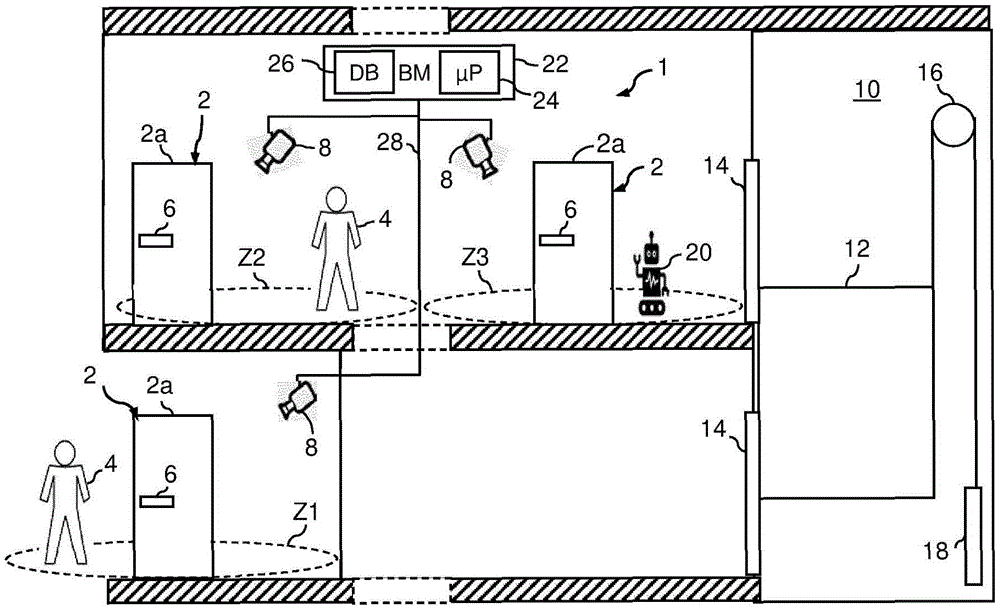
图1示出在具有根据一个实施例的访问监测系统的建筑物中的示例性情况的示意图;Figure 1 shows a schematic diagram of an exemplary situation in a building with an access monitoring system according to one embodiment;
图2示出作为建筑物门系统的一个实施例的示例性的滑动门系统的示意图;Figure 2 shows a schematic diagram of an exemplary sliding door system as one embodiment of a building door system;
图3A示出具有关闭的滑动门的示例性滑动门系统的示意图;Figure 3A shows a schematic diagram of an exemplary sliding door system with the sliding door closed;
图3B示出图3A中的滑动门系统的示意图,其中,滑动门处于中间位置;Figure 3B shows a schematic diagram of the sliding door system in Figure 3A, wherein the sliding door is in an intermediate position;
图3C示出图3A中的滑动门系统的示意图,其中,滑动门处于打开位置;和Figure 3C shows a schematic diagram of the sliding door system in Figure 3A, wherein the sliding door is in an open position; and
图4示出用于运行访问监测系统的方法的一个实施例的流程图。FIG. 4 shows a flowchart of an exemplary embodiment of a method for operating an access monitoring system.
具体实施方式Detailed ways
图1是示例性建筑物中的示例性情况的示意图,该建筑物具有访问监测系统1和一个或多个楼层L0、L1。在本说明书中,术语“建筑物”例如可理解为住宅和/或商业建筑物、酒店、医院和其他人员可停留在其中的建筑物。如果在建筑物中存在多个楼层,那么这些楼层可以由电梯设备10以已知的方式来服务。为了说明,在图1中示出具有电梯轿厢12、电梯门14、驱动装置16和对重18的电梯设备10。Figure 1 is a schematic diagram of an exemplary situation in an exemplary building with an access monitoring system 1 and one or more floors L0, L1. In this description, the term "building" is to be understood, for example, as residential and/or commercial buildings, hotels, hospitals and other buildings in which persons may stay. If several floors are present in the building, these floors can be served by the
在所示的实施例中,建筑物具有可由人员4或对象20使用的底层L0和楼层L1。为了说明,图1示出建筑物外的位于房门2的前方的人员4以及楼层L1上的人员4和对象20(例如,自主机器人)。例如,人员4或对象20可以被授权进入建筑物和建筑物中的一个或多个空间;为此设置的建筑物门系统2可以为人员4或对象20阻挡建筑物门2a或者在存在访问授权的情况下为其敞开建筑物门。然而,人员4或对象20可能没有授权进入其他空间;相应的建筑物门2对于人员4或对象20保持锁定。In the illustrated embodiment, the building has a ground floor L0 and a floor L1 that can be used by persons 4 or objects 20 . For illustration, FIG. 1 shows a person 4 outside a building in front of a
图1在上面的楼层L1中示出两个用作建筑物内门的建筑物门2a,例如人员4或对象20能够通过该建筑物门进入和离开位于其后方的访问受限的区域或空间36(参见图2)。建筑物和/或单独的访问受限的区域或空间可以由负责人员(例如,租户、业主、建筑物管理人员等)管理;为此相应负责的人员可以授予访问授权。FIG. 1 shows in the upper floor L1 two
本领域技术人员将认识到,在底层L0处建筑物也可以具有一个或多个建筑物门2a,例如另一个房门和/或一个或多个建筑物内门。在上层楼层L1中,能够设置一个建筑物门2a或者两个以上的建筑物门2a。两个以上的建筑物门例如可以是在办公楼中或在住宅中,在这种情况下,可以从共同的门厅进入各个办公室或住户。Those skilled in the art will appreciate that the building at the ground floor L0 may also have one or
图1所示的每个建筑物门2a具有能够电控的关闭装置50(参照图2),通过该关闭装置50能够对建筑物门2a进行锁定和解锁。在一个实施例中,关闭装置50可以通过电控制信号操控。当建筑物门2a要对人员4或对象20打开时,电控制信号激活关闭装置50,从而使建筑物门2a解锁。相应于此,在一个实施例中,关闭装置50可以通过电控制信号操控,以便锁定建筑物门2a。在本说明书的其他地方给出了关闭装置50的一个实施例。Each
另外,图1示出建筑物管理系统22(BM)、通信网络28以及传感器系统8。通信网络28在楼层L0、L1上以及在楼层L0、L1之间(水平地)延伸,并且将传感器系统8连接到建筑物管理系统22。传感器系统8包括多个单独系统,单独系统在图1中作为照相机示出(在下文中附图标记8也能够表示照相机)。传感器系统8监控建筑物中的特定区域或范围,并且根据建筑物和需要而定地也在建筑物之外监控。根据这里介绍的技术,传感器系统8监控尤其是在图1中示例性地示出的在建筑物门2a的范围中的访问区域Z1、Z2、Z3。本领域技术人员将认识到,访问区域Z1、Z2、Z3可以重叠,并且例如只有单个访问区域Z1、Z2、Z3被固定在一个楼层L0、L1上;该访问区域例如可以在楼层L0、L1上的一个或多个建筑物门2a前面的整个区域上延伸。本领域技术人员还将认识到,传感器系统8可以适配于建筑物(例如,关于其使用的大小、位置和类型),并且还可以监测例如走廊、通道、停车层、车库以及楼梯间。与此相应地,可以选择照相机8的数量和其在建筑物中的定位。In addition, FIG. 1 shows a building management system 22 (BM), a
在所示的实施例中,建筑物管理系统22的一个方面涉及对访问建筑物和访问建筑物内的各个区域和空间的监测和监控。在一个实施例中,该方面可以由与建筑物门系统2、传感器系统8以及存储装置26相连接的控制装置(μP)24实现,其中,在存储装置26中存储用于实现建筑物的数据库;这些部件是访问监测系统1的一部分,在下面的介绍中将参考该访问监测系统。In the illustrated embodiment, one aspect of the
在图1中示出的情况中,这里所介绍的技术可以有利的方式应用,以便以尽可能高的安全性程度运行访问监测系统1。简单地且示例性地总结,访问监测系统1包括建筑物门系统2、传感器系统8和控制装置24。建筑物门系统2包括一个或多个建筑物门2a,每个建筑物门具有电子关闭装置50和用于检测人员4或对象20的授权凭证的识别装置6,其中,建筑物门2a能够通过电子关闭装置50在有效授权凭证的情况下解锁并且从关闭位置被带到打开位置,以准许人员4或对象20访问访问受限区域36。传感器系统8被配置成监控包括建筑物门2a的指定访问范围的访问区域Z1、Z2、Z3,并且检测处于访问区域Z1、Z2、Z3中的人员4。控制装置24与建筑物门系统2和传感器系统8通信连接,并且被配置为当建筑物门系统2准许对象20进入并且传感器系统8检测到处于访问区域Z1、Z2、Z3中的人员4时生成警告信号。在通过建筑物门系统2接收到警告信号时,建筑物门系统2阻止准许访问。In the situation shown in FIG. 1 , the technology presented here can be used in an advantageous manner in order to operate the access monitoring system 1 with the highest possible degree of security. Briefly and exemplarily summarized, the access monitoring system 1 comprises a
因此,该技术借助传感器系统8例如识别出在图1中示出的区域Z3中的对象20,该对象例如从电梯门14出发朝着区域Z3中的建筑物门2a的方向运动。例如,对象20可以是机器人或宠物(例如狗或猫)。在下面的介绍中,对象20是希望移动到该建筑物门2a后面的空间(例如,图2中的访问受限区域36)中以便在那里执行作业(例如,装运货物或清洁地面)的机器人。上述负责该空间的负责人员例如可以利用任务分派装置给对象20授予对建筑物和/或空间的访问授权。访问授权与所属的授权凭证(例如访问编码)相结合地存储在建筑物管理系统22中、尤其存储在存储装置26中。The technology thus detects, for example, an
如果对象20然后位于建筑物门2a处并且出示有效访问授权的凭证(授权凭证),则建筑物门2a可以被解锁。在打开建筑物门2a之前,访问监测系统1借助传感器系统8检查访问区域Z3是否是“安全的”。如果没有人员4处于访问区域Z3中,即对象20仅位于建筑物门2a的前方,则访问区域Z3是安全的并且建筑物门2a可以响应于控制信号而被打开,以准许对象20进入。相反,如果访问区域Z3不安全,因为除了对象20以外还有(例如对建筑物门2a无访问授权的)人员4停留在访问区域Z3中,则控制装置24生成警告信号;当建筑物门系统2准许对象20进入且传感器系统8基本上同时检测到访问区域Z3中有人员4时,生成警告信号。因此,可以阻止准许访问的过程,例如可以中断该过程直至访问区域Z3再次安全。在该中断期间,建筑物门2a被锁定和关闭。对此替代地,如果已经执行了该过程,则也可以中断该过程;在此,建筑物门2a处于锁定和/或关闭状态。在一个实施例中,对象20可以在预定的等待时间之后重新出示授权凭证;然后重复所述过程,必要时直到访问区域Z3是安全的为止。因此,该技术降低了未经授权的人员可能通过为机器人打开的建筑物门2a进入空间的风险。If the
根据这里所介绍的技术,借助传感器系统8检测到停留在访问区域Z1、Z2、Z3中的人员4。在一个实施例中,传感器系统8可以包括与评估装置相连接的处于可见光光谱或红外光谱中的光学传感器。在另一实施例中,传感器系统8可以包括基于另一物理原理的传感器,例如超声波传感器或雷达传感器。在一个实施例中,对传感器信号的评估允许确定人员4的位置、人员的运动速度和速度。在以下介绍中,传感器系统8具有作为与用于数字图像拍摄的评估装置相连接的光学传感器的照相机。这样的照相机例如可以是2D-照相机或3D-照相机,其工作方式对于本领域技术人员是已知的,从而在此仅总结3D-照相机的工作方式。According to the technology presented here, persons 4 staying in access zones Z1 , Z2 , Z3 are detected by means of
作为3D-照相机,可以使用基于飞行时间(“Time of Flight”TOF传感器)测量原理的照相机。3D-照相机包括发光二极管单元或激光二极管单元,其例如发射红外范围中的光,其中,光以短脉冲(例如,10纳秒时长)发射。3D-照相机还包括由多个光敏元件组成的传感器组。传感器组与确定所发射的光的传播时间的处理芯片(例如CMOS传感器芯片)连接。处理芯片在几毫秒内同时测量到空间中的整数个目标点的距离。3D-照相机也可以基于测量原理,在该测量原理中,所发射的光的传播时间通过光的相位来检测。在此,比较在发射光时和在接收时的相位并且从中确定所经过的时间或者与反射对象的距离。为此,优选不是发射短光脉冲而发射经调制的光信号。测量原理的其他细节例如在以下公开文献中给出:“通过多双倍短时集成(MDSI)由CMOS传感器阵列快速测距成像”,P.Megelet等,西门子公司,核心技术部,慕尼黑,德国(“Fast Range Imaging by CMOS Sensor Array ThroughMultiple Double Short Time Integration(MDSI)”,P.Mengel et al.,Siemens AG,Corporate Technology Department,München,Deutschland),和“用于使用脉冲激光3D成像的CMOS光敏传感器阵列”,R.Jerema等,2001IEEE国际固态电路会议,252页(“ACMOSPhotosensor Array for 3D Imaging Using Pulsed Laser”,R.Jeremias et al.,2001IEEE International Solid-State Circuits Conference,Seite 252)。As 3D-camera, a camera based on the time-of-flight ("Time of Flight" TOF sensor) measurement principle can be used. The 3D-camera comprises a light-emitting diode unit or a laser diode unit, which emits light in the infrared range, for example, wherein the light is emitted in short pulses (eg, 10 nanoseconds in duration). The 3D-camera also includes a sensor group consisting of a plurality of light-sensitive elements. The sensor group is connected to a processing chip (eg a CMOS sensor chip) that determines the travel time of the emitted light. The processing chip simultaneously measures the distance to an integer number of target points in space within a few milliseconds. The 3D camera can also be based on a measurement principle in which the propagation time of the emitted light is detected via the phase of the light. In this case, the phases when the light is emitted and when it is received are compared and the elapsed time or the distance to the reflecting object is determined therefrom. For this purpose, it is preferred not to emit short optical pulses but modulated optical signals. Further details of the measurement principle are given, for example, in the publication: "Fast ranging imaging by CMOS sensor arrays via multi-double short-time integration (MDSI)", P. Megelet et al., Siemens AG, Division Core Technology, Munich, Germany (“Fast Range Imaging by CMOS Sensor Array Through Multiple Double Short Time Integration (MDSI)”, P. Mengel et al., Siemens AG, Corporate Technology Department, München, Deutschland), and “CMOS photosensitive Sensor Array", R. Jerema et al., 2001 IEEE International Solid-State Circuits Conference, 252 pages ("ACMOS Photosensor Array for 3D Imaging Using Pulsed Laser", R. Jeremias et al., 2001 IEEE International Solid-State Circuits Conference, Seite 252).
访问监测系统1的控制装置24与识别装置6连接。识别装置6通常被配置为检测授权凭证,基于该授权凭证,访问控制系统1可以确定人员4或对象20的访问授权。例如,凭证可以是物理密钥、手动输入的密码(例如,PIN码)、生物识别特征(例如,指纹、虹膜图案、语音/声音特征或面部特征)、或由磁卡、芯片或RFID卡或电子设备(基于NFC、蓝牙或蜂窝)检测到的访问码的形式。当期望访问访问受限区域36时,需出示授权凭证。The
根据所述授权凭证可能具有的所述形式,出示授权凭证能够以不同的方式实现,例如通过有意的手动操作(例如输入PIN码或持有RFID卡)或通过走向门,以便进入到识别装置6的无线电作用范围(例如用于建立RFID或蓝牙连接)。识别装置6可以位于建筑物门2a上或建筑物门周围,例如,可以位于建筑物门2a的外侧上,使得如果人员或对象20位于建筑物门2a的前面,则识别装置6可以检测授权凭证。Depending on the form the authorization document may have, the presentation of the authorization document can be achieved in different ways, for example by a deliberate manual action (for example entering a PIN code or holding an RFID card) or by walking towards the door in order to gain access to the
识别装置6根据访问监测系统1中提供的授权凭证来配置。这意味着识别装置6例如具有门筒、用于生物特征的检测设备、用于光学编码(例如条形码(barcode)、QR码和色码(参见WO2015049186A1))的检测设备,用于磁条卡或芯片卡的读取设备、用于手动输入密码的键盘或触敏屏幕、用于无线电信号的发送和接收装置。本领域技术人员将认识到,在一个实施例中,识别装置6可以设计用于这些授权凭证中的一个或多个。在一个实施例中,识别装置6包括例如用于无线电信号的发送和接收装置以及用于检测光学编码或面部的数码照相机。光学编码可以明显地打印在载体材料上或显示在移动无线电装置的显示屏上。在图1所示的情况下,对象20请求访问并在访问区域Z3中向建筑物门2a出示授权凭证;人员4无权访问那里。在该建筑物门2a上设计有用于识别适合对象20的授权凭证的识别装置6。在一个实施例中,授权凭证通过无线电、特别是蓝牙技术从对象20传输到识别装置6。The identification means 6 are configured according to the authorization credentials provided in the access monitoring system 1 . This means that the
本领域技术人员将认识到,建筑物管理系统22可以部分或完全转移到用于所谓的云计算(口语中也被称为“云(Cloud)”)的IT基础架构中。这包括例如在远程数据中心中存储数据,以及执行非本地而是远程安装的程序。根据设计方案,特定的功能例如可以在控制装置24中或通过“云”提供。为此,例如软件应用程序或其程序部分可以在“云”中执行。然后,控制装置24在需要时访问该基础架构以执行软件应用程序。Those skilled in the art will realize that the
图2示出一种以滑动门系统形式的示例性建筑物门系统2(与此相应地,建筑物门系统2在下面也称为滑动门系统2,所述滑动门系统具有滑动门2a)的示意图。滑动门系统2被插入到建筑物墙壁中,并且在公共区域34和访问受限区域36之间用作物理屏障。基于图2中标出的x-y-z坐标系,建筑物墙壁在由x轴和z轴撑开的平面中延伸。访问受限区域36可以是例如住宅、商业空间或建筑物内的其他空间。滑动门系统2可以被插入到建筑物内墙(用于建筑物内部的访问监测,例如访问住宅)中或建筑物外墙(用于监测对建筑物的访问)中。如在本说明书的其他部分中详细介绍的那样,滑动门系统2为得到访问授权的对象20打开滑动门2a。FIG. 2 shows an exemplary
在图2中示出的滑动门系统2包括门框44(也称作门边框)和滑动门2a。门框44具有通道区域42和壁壳区域30,壁壳区域30设计成至少部分地容纳滑动门2a。为此,壁壳区域30具有形成空腔的结构,该空腔的尺寸设计成容纳滑动门2a。通道区域42是建筑物墙壁中的一区域,在该区域中,可以在y轴方向上从一个区(34、36)贯穿到另一个区(34、36);通道区域存在于竖直的框架部件(门柱)和相对的壁壳区域30之间。根据设计方案,壁壳区域30可以安装在建筑物墙壁的空腔中,或者壁壳区域30可以理解为可能是衬板后的建筑物墙壁的一部分。The sliding
滑动门2a能够在门框44中在图3A中示出的关闭位置与图3C中示出的打开位置之间移动。基于在图2中标出的x-y-z坐标系,实现滑动门2a沿着x轴的移动。在打开位置,在一个实施例中,滑动门2a基本上位于壁壳区域30内。在最大位置之间,滑动门2a能够占据在图2中示出的中间位置,在所述中间位置中,滑动门2a(和相应地通道区域42)或多或少地打开,即滑动门2a的端侧38与框架部件具有可变的间距。在图3B中,该可变的间距作为打开宽度W绘出。The sliding
滑动门2a(分别在滑动门2a的内侧和外侧)具有两个大致平行的门扇32。门扇32彼此间(在y方向上)具有间距,使得在门扇32之间存在内部空间,在该内部空间中可布置有用于隔音和防火的系统部件和隔音材料。门扇32在端侧38的区域中彼此连接,例如在图3a中示出。每个门扇32平行于x-z平面延伸。在本说明书的其他部分公开了滑动门2a的进一步细节。The sliding
此外,图2还示出处理器单元(DC)54、识别装置6的实施例、接口装置48和关闭装置50(M)的实施例,这些部件在一个实施例中是滑动门系统2的部件。在一个实施例中,滑动门系统2连接到建筑物管理系统22(BM);在图2所示的实施例中,该连接借助通信网络28实现,建筑物管理系统22和接口装置48联接到该通信网络上。根据设计方案,可以例如在处理器单元54中、在建筑物管理系统22中或经由“云”提供特定功能。处理器单元54或建筑物管理系统22根据需要访问该基础架构,以执行所需的软件应用程序。Furthermore, FIG. 2 also shows an embodiment of the processor unit (DC) 54, the
通信网络28在一种实施系统中可以包括电子总线系统。在一个实施例中,经由接口装置48实现滑动门系统2的电连接,包括其电能的供应。本领域技术人员将理解,多个滑动门系统2可以存在于建筑物中,并且这些滑动门系统2中的每一个可以联接到通信网络28,以与建筑物管理系统22通信,例如与访问授权的确定和验证(如果这是由建筑物管理系统22在中央完成的话)相结合。
处理器单元54通过电连接件58与传感器单元40连接。处理器单元54还借助电连接件52与关闭装置50和接口装置48连接。电连接件52、58被构造用于信号和/或能量传输,这些电连接件为此可以分别包括单独的电导线或电总线系统。The
处理器单元54还连接到识别装置6。在图2中示出的实施例中,识别装置6检测授权凭证,对象20的无线电装置46或由对象20携带的无线电装置将该授权凭证作为无线电信号发送。无线电信号可以根据用于无线电通信的已知标准(例如,RFID、WLAN/WiFi、NFC、蓝牙)来发送。相应地,识别装置6被设计用于接收这样的无线电信号;为此,在图2中示出发送/接收装置56和与其连接的天线。The
发送/接收装置56单独或与处理器单元54和/或控制装置24和存储的数据库(26)相结合地从接收到的无线电信号中确定随后用于确定访问授权的授权凭证。如果授权凭证有效,则准许对象20访问;在这种情况下,处理器单元54操控关闭装置50,关闭装置50使滑动门2a朝向打开位置移动。如果授权凭证无效,那么滑动门2a保持关闭和锁定。The sending/receiving means 56 alone or in combination with the
传感器单元40布置在滑动门2a的端侧上,例如布置在滑动门2a的上(角)边缘的区域中。从这个增大的区域出发,传感器单元40具有朝着通道区域42和地面的方向的优化的检测场。示例性检测场在图2(竖直)和图3B(水平)中示出。附加地,传感器单元40在该区域中被更好地保护免受污染和损坏(例如由于故意破坏)。本领域技术人员认识到,传感器单元40在另一实施例中可以布置在滑动门2a的另一位置上;传感器单元40也可以布置在门框44上。The
根据这里所介绍的技术,借助传感器单元40确定对象20的(竖直的)高度。在本说明书中,对于对象20在z轴方向上的延伸使用术语“高度”;尽管根据在此介绍的技术,对象20也可以是人(对于人来说,通常给出了他们的身高)。这里,对象20(人、动物或机器人)的高度表示地面与对象20的最上方的点或区域之间的距离。在确定的时间点(测量时间点),对象20基本上在通道区域42中位于地面上。传感器单元40与地面具有固定且已知的距离(地面距离)。在这种情况下,根据一个实施例,确定传感器单元40与对象20之间的对象距离。对象20的高度H由地面距离与对象距离之间的差得出。According to the technique presented here, the (vertical) height of
在一个实施例中,传感器单元40包括3D-照相机。在本说明书的其他部分结合传感器系统8介绍了3D-照相机的工作方式。In one embodiment, the
上述部件(处理器单元54、识别装置6、接口装置48、关闭装置50)设置在滑动门2a上并与滑动门2a一起移动。在一个实施例中,处理器单元54布置在门扇32之间的区域中,例如布置在滑动门2a的与端侧相反的背侧的区域中。在一个实施例中,滑动门2a的背侧从外部不可见,因为滑动门2a可以比通道区域42更宽,并且因此背侧在滑动门2a的关闭位置中也保留在壁壳区域30中,锁定装置50和接口装置48同样可以布置在该区域中。电连接件52、58相应地布置在门扇32之间并且从外部不可见。然而,这里介绍的技术不限于部件的这种所述示例性布置。The above-mentioned components (
存储装置26与控制装置24电连接。在所示的实施例中,存储装置26具有用于数据库(DB)的存储区域和用于运行滑动门系统2的一个或多个计算机程序(SW)的存储区域。在一个实施例中,运行滑动门系统2包括打开滑动门2a作为所识别的对象20的函数并且确定对象20的高度H。计算机程序可以由控制装置24执行。The
数据库存储授权进入访问受限区域36的个人和对象20的数据组。所存储的数据组在下面也被称为用户资料。用户资料包括数据,例如名字、凭证信息(密钥号、PIN码、访问码,包括生物识别数据)和可能的时间上的访问限制(例如,从周一到周五、从7:00到20:00的访问)。如果多个人员和对象被授权进入访问受限区域36,则数据库为每个人员和对象存储用户资料。The database stores data sets of persons and
根据在此介绍的技术,在每个用户资料中附加地说明,要打开滑动门2a直到何种打开宽度W(参见图3B)并且对象20具有何种高度H。对象20的高度H可以是最大高度或高度范围,因为例如,具有降低或升高的头部和/或具有升高的尾部的猫可以穿过通道区域42。在一个实施例中,对于每个对象20可以附加地给出其长度(在y方向上)。高度H和长度(如果存在)是本说明书的其他地方所述的合理性参数。According to the technique presented here, it is additionally specified in each user profile to what opening width W (cf. FIG. 3B ) the sliding
该数据可以被组织为表格式,例如在下面的表格中所示的那样。该表格示出四种授权(人、猫、狗、机器人)的四个用户资料。每个授权分配有与宽度W和高度H关联的标识(ID)。例如,如果识别装置6识别出ID=78,则访问用于机器人的用户资料4号。在这种情况下,滑动门2a打开大约50cm宽,并且将借助传感器单元40确定的高度与为机器人存储的高度H=50进行比较。所确定的高度必须处于与所存储的机器人高度相匹配的高度范围内,也就是说,必须确认实际上是机器人。代替具体的高度H,在一个实施例中,在表格中对于一个或多个(所有)授权可以给出高度范围。本领域技术人员将认识到,在表格中给出的值是示例性的并且可以不同于真实情况。This data may be organized in a tabular format, such as shown in the table below. The table shows four user profiles for four authorizations (human, cat, dog, robot). Each grant is assigned an identification (ID) associated with a width W and a height H. For example, if the recognition means 6 recognizes ID=78, the user profile number 4 for the robot is accessed. In this case, the sliding
如果对于宠物例如不是预期的50cm高度H而是确定180cm的高度H,则利用所述合理性检查可以识别宠物和附加人员穿过打开的滑动门2a。例如,未经授权的人员也可能为宠物移除其授权凭证(例如RFID标签)以试图在该处获得访问。类似地,所期望的170cm的高度H与所确定的100cm的高度H不匹配。例如,如果孩子使用父母的授权凭证,则可能发生这种情况。虽然孩子是授权访问的人,父母也可能不希望使用孩子的授权凭证。If, for example, instead of the expected height H of 50 cm for pets, a height H of 180 cm is determined, the plausibility check can detect that pets and additional persons pass through the open sliding
通过理解上述的原理性系统部件及其功能,以下结合图4从图1和图2中所示的情况出发,介绍用于运行访问监测系统1的示例性方法。参照从公共区域34(图2)朝向滑动门2a的方向移动而进入访问受限区域36的对象20(机器人)进行说明。对象20在此位于在图1中示出的访问区域Z3中。对象20的无线电装置46例如使用蓝牙技术并且被激活。在图4中示出的方法在步骤S1中开始并且在步骤S9中结束。本领域技术人员将认识到,这些步骤的划分是示例性的,并且这些步骤中的一个或多个可以被划分成一个或多个子步骤,或者这些步骤中的多个可以被组合成一个步骤。By understanding the above-mentioned principle system components and their functions, an exemplary method for operating the access monitoring system 1 is described below in conjunction with FIG. 4 starting from the situation shown in FIGS. 1 and 2 . The description will be made with reference to the object 20 (robot) moving from the public area 34 ( FIG. 2 ) in the direction of the sliding
在步骤S2中,识别装置6检测位于滑动门2a前面的访问区域Z3中的对象20的授权凭证。授权凭证例如作为访问码存在,所述访问码借助无线电装置(例如通过蓝牙技术)被传输。控制装置24在步骤S3中检查,针对在存储设备26中的数据库中的授权凭证是否已设置用户资料。如果该检查得出对象20被授权访问,则该方法沿着“是”分支前进到步骤S4。然而,如果对象20未被授权访问,则该方法沿着“否”分支前进到步骤S9,并在那里结束;建筑物门2a保持锁定和关闭。In step S2, the
在步骤S4中,激活传感器系统8,尤其用于产生和分析图像照片。本领域技术人员将认识到,根据另一实施例的传感器系统8可以已经被激活。在这种情况下,步骤S4可能可以取消。传感器系统8例如可以为了一般的监控目的而被连续地激活并且在此可以连续地评估图像照片。在另一实施例中,例如,当通过外部运动传感器或通过将图像照片中的变化识别为运动并对其作出反应的传感器系统8自身在楼层L0、L1处检测到运动时,传感器系统8可以被激活。In step S4 , the
在步骤S5中,传感器系统8例如可以评估访问区域Z3的图像照片,以便确定是否有人员4停留在访问区域Z3中。用于评估图像照片例如用于对人员和/或对象进行识别、计数和可能认证的装置和算法对于本领域技术人员是已知的。如果该检查得出没有人员4停留在那里并且因此滑动门2a前面的情况被认为是安全的,则该方法沿着否分支进行到步骤S6。In step S5 , the
在步骤S6中,准许对象20访问。为此,操控关闭装置50,以便使滑动门2a解锁和打开。如上所述,无需对象20的动作自动地进行打开。在一个实施例中,滑动门2a仅打开至与在用于对象20(机器人)的用户资料中所确定的一样的程度。In step S6, the subject 20 is granted access. To this end, the closing
如果在步骤S5中的检查得出人员4停留在访问区域Z3中,则这种情况被视为在滑动门2a前面不安全。在场的人员4可能是一种潜在的危险,因为他们可能通过为对象20打开的滑动门2a违规进入到访问受限区域36中。由于对象20不是单独位于滑动门2a的前方,因此该方法沿着“是”分支前进到步骤S7。If the check in step S5 reveals that the person 4 remains in the access zone Z3, this is considered unsafe in front of the sliding
在步骤S7中,生成警告信号。例如,当为授权访问的对象20打开滑动门2a并且还检测到在场的人员4时,通过控制装置24生成警告信号。In step S7, a warning signal is generated. For example, a warning signal is generated by the
在步骤S8中,通过滑动门系统2阻止准许访问。对由滑动门系统2接收的警告信号作出反应,阻止准许访问。在一个实施例中,滑动门2a保持锁定和关闭;这可能是当在为对象20打开滑动门2a之前检测到人员4时的情况。也可能发生的是,人员4进入访问区域Z3并且仅当滑动门2a已经解锁并且或多或少地打开一定程度时才被检测到。在一个实施例中,在该情况下,能够停止打开,并且能够阻止滑动门2a进一步打开。阻止准许访问还可以包括将滑动门2a从完全或部分打开位置关闭。在另一实施例中,滑动门2a能够完全地或部分地移动到关闭位置中;当对象20已经位于通道区域42中并且阻挡滑动门2a的轨道时尤其是这种情况。在这种情况下,可以触发警报。In step S8 access is blocked by the sliding
在访问监测系统1中可以确定规则集,该规则集说明是否应在这种警报之后触发以及触发哪个动作。这些动作可以是特定于情况的,即,取决于在什么时间(白天或夜间)和在什么日期(工作日或周末、度假时间)产生警报。示例性动作可以是:听觉和/或视觉可感知的警报(警笛、警告灯)、安全人员(警察或私人安全服务人员)的自动通知以及负责访问受限区域36的人员(租赁者、业主、建筑物管理者等)的自动通知。本领域技术人员将认识到,这些动作也可以组合。A rule set can be determined in the access monitoring system 1 , which specifies whether and which action should be triggered after such an alarm. These actions may be situation specific, ie depend on at what time (day or night) and on what day (weekday or weekend, vacation time) the alarm is generated. Exemplary actions could be: audible and/or visually perceivable alarms (siren, warning lights), automatic notification of security personnel (police or private security services), and personnel responsible for access to the restricted area 36 (tenant, property owner, Automatic notification to building managers, etc.). Those skilled in the art will recognize that these actions can also be combined.
在所示的实施例中,该方法从步骤S8继续到步骤S9并且在那里结束。In the exemplary embodiment shown, the method continues from step S8 to step S9 and ends there.
再次参照图3A至图3C所示的滑动门2a的位置,现在介绍滑动门系统2的实施例。图3A至图3C分别示出滑动门系统2的俯视图的示意图。在这些俯视图中的每一个中,绘出了滑动门2a所包括的部件,传感器单元40(S)、处理器单元54(DC)和关闭装置50(M);出于图示的原因,没有示出接口装置48及其与建筑物管理系统22的连接。关闭装置50和处理器单元54布置在滑动门2a内,尤其布置在门扇32之间。在图3A至图3C中也示出具有用于在打开位置容纳滑动门2a的结构的壁壳区域30。Referring again to the position of the sliding
传感器单元40布置在端侧上。该布置选择成,使得电磁辐射(光波或无线电波)在运行中可以不受阻碍地在通道区域42的方向上传播。传感器单元40例如可以插入到端侧上的凹部中并且通过辐射能穿透的覆盖件来保护免受损坏和污染。传感器单元40也可以布置在门框处。传感器单元40和处理器单元54之间的电连接件58(图2)和电连接件52(图2)在滑动门2a内延伸,例如在门扇32之间延伸。The
所示的滑动门2a的实施例基于与由EP2876241A1已知的原理类似的原理。在EP2876241A1中介绍了一种滑动门系统,在该滑动门系统中,两个对置的门面与致动器联接,该致动器使门面朝向彼此或远离彼此运动。关于根据在此所介绍的技术的滑动门系统2,这意味着,在滑动门2a的关闭位置,两个门扇32具有门扇间距d1。在该位置,滑动门2a被锁定。在滑动门2a打开期间,两个门扇32通过致动器31(图3A至图3C)朝向彼此运动一定程度,使得所述门扇具有门扇间距d2,所述门扇间距d2的大小确定为,使得滑动门2a在其完全或部分打开的位置中(图3B和图3C)具有足够小的厚度,使得所述滑动门配合到壁壳区域30的容纳结构中。这里,门扇间距d1大于门扇间距d2。在该位置中,滑动门2a被解锁。当滑动门2a从壁壳区域30中被推出时,两个门扇32彼此远离地运动(张开),从而滑动门2a在关闭状态中(图3A)占据确定的厚度。以如下方式确定厚度,使得两个门扇32的外侧在关闭位置中与壁壳区域30的外侧或其衬板基本上齐平地收尾。由此,在门区域中的两个壁侧上实现基本上平滑面式的收尾。The shown embodiment of the sliding
在一个实施例中,滑动门系统2在门横梁上具有引导装置,该引导装置支承滑动门2a并且在滑动门在关闭位置和打开位置之间的路径上沿着行驶路径引导。为此,滑动门2a在其上边缘具有互补装置。当关闭装置50通过驱动单元使滑动门2a移动并作用在互补装置上时,引导装置和互补装置如可以构成具有伸缩式拉出件的系统。驱动单元例如可以包括马达驱动的或气动的滑动驱动器,滑动驱动器作用于伸缩式拉出件上。In one embodiment, the sliding
在一个实施例中,两个门扇32通过致动器31彼此相向或彼此远离地运动。致动器31可以包括撑开装置,撑开装置被机械地、电地或机电地激活。撑开装置设计成,当滑动门2a要打开时,使门扇32朝向彼此运动,并且当滑动门2a要关闭时,使门扇彼此远离地运动。本领域技术人员认识到,取而代之也可设置其他的撑开装置,例如以压力介质操纵的气缸。In one embodiment, the two door leaves 32 are moved towards or away from each other by the
Claims (15)
Applications Claiming Priority (3)
| Application Number | Priority Date | Filing Date | Title |
|---|---|---|---|
| EP20175221 | 2020-05-18 | ||
| EP20175221.9 | 2020-05-18 | ||
| PCT/EP2021/062317 WO2021233719A1 (en) | 2020-05-18 | 2021-05-10 | Additional zone monitoring for a building door |
Publications (2)
| Publication Number | Publication Date |
|---|---|
| CN115668317A true CN115668317A (en) | 2023-01-31 |
| CN115668317B CN115668317B (en) | 2025-10-28 |
Family
ID=70740525
Family Applications (1)
| Application Number | Title | Priority Date | Filing Date |
|---|---|---|---|
| CN202180036971.XA Active CN115668317B (en) | 2020-05-18 | 2021-05-10 | Additional area monitoring for building doors |
Country Status (5)
| Country | Link |
|---|---|
| US (1) | US12327453B2 (en) |
| EP (1) | EP4154224A1 (en) |
| CN (1) | CN115668317B (en) |
| AU (1) | AU2021276444B2 (en) |
| WO (1) | WO2021233719A1 (en) |
Families Citing this family (1)
| Publication number | Priority date | Publication date | Assignee | Title |
|---|---|---|---|---|
| EP4266269A1 (en) * | 2022-04-18 | 2023-10-25 | dormakaba Deutschland GmbH | Method for controlling a door system |
Citations (10)
| Publication number | Priority date | Publication date | Assignee | Title |
|---|---|---|---|---|
| EP2395451A1 (en) * | 2010-06-09 | 2011-12-14 | Iee International Electronics & Engineering S.A. | Configurable access control sensing device |
| CN104169630A (en) * | 2012-03-16 | 2014-11-26 | 皮尔茨公司 | Method and apparatus for making hazardous areas safe |
| CN105051795A (en) * | 2013-03-15 | 2015-11-11 | 因温特奥股份公司 | Access control for areas with multiple doors |
| CN106791633A (en) * | 2016-12-14 | 2017-05-31 | 北华航天工业学院 | Intelligence invigilator's system and method |
| US20170221289A1 (en) * | 2016-02-03 | 2017-08-03 | Sensormatic Electronics, LLC | System and Method for Controlling Access to an Access Point |
| CN109147136A (en) * | 2018-09-07 | 2019-01-04 | 中国电子科技集团公司第三十八研究所 | A kind of intelligence enabling management system |
| US20190172284A1 (en) * | 2017-12-05 | 2019-06-06 | Savioke Inc. | Apparatus, System, and Method for Secure Robot Access |
| CN110443923A (en) * | 2019-08-06 | 2019-11-12 | 金陵科技学院 | A kind of hotel's method for managing security based on artificial intelligence |
| CN110494897A (en) * | 2017-04-10 | 2019-11-22 | 因温特奥股份公司 | Visitor Entry Monitoring System with Wireless and Facial Recognition |
| CN111026042A (en) * | 2018-10-10 | 2020-04-17 | 北京奇虎科技有限公司 | A family intelligent situational control system and method |
Family Cites Families (8)
| Publication number | Priority date | Publication date | Assignee | Title |
|---|---|---|---|---|
| US7623674B2 (en) * | 2003-11-05 | 2009-11-24 | Cognex Technology And Investment Corporation | Method and system for enhanced portal security through stereoscopy |
| US20070047837A1 (en) * | 2005-08-29 | 2007-03-01 | John Schwab | Method and apparatus for detecting non-people objects in revolving doors |
| EP2237234A1 (en) | 2009-04-03 | 2010-10-06 | Inventio AG | Method and device for access control |
| EP2858010A1 (en) | 2013-10-01 | 2015-04-08 | Inventio AG | Data transmission using optical codes |
| EP2876241B1 (en) | 2013-11-26 | 2019-04-03 | Inventio AG | Sliding door |
| DE102016119343A1 (en) | 2016-10-11 | 2018-04-12 | Bircher Reglomat Ag | Object monitoring with infrared image recording and infrared pulse illumination |
| WO2018094515A1 (en) * | 2016-11-22 | 2018-05-31 | Avigilon Corporation | Location control system and method |
| US11230872B2 (en) * | 2017-08-04 | 2022-01-25 | Assa Abloy Entrance Systems Ab | Door operator |
-
2021
- 2021-05-10 US US17/925,980 patent/US12327453B2/en active Active
- 2021-05-10 CN CN202180036971.XA patent/CN115668317B/en active Active
- 2021-05-10 WO PCT/EP2021/062317 patent/WO2021233719A1/en not_active Ceased
- 2021-05-10 EP EP21725128.9A patent/EP4154224A1/en active Pending
- 2021-05-10 AU AU2021276444A patent/AU2021276444B2/en active Active
Patent Citations (10)
| Publication number | Priority date | Publication date | Assignee | Title |
|---|---|---|---|---|
| EP2395451A1 (en) * | 2010-06-09 | 2011-12-14 | Iee International Electronics & Engineering S.A. | Configurable access control sensing device |
| CN104169630A (en) * | 2012-03-16 | 2014-11-26 | 皮尔茨公司 | Method and apparatus for making hazardous areas safe |
| CN105051795A (en) * | 2013-03-15 | 2015-11-11 | 因温特奥股份公司 | Access control for areas with multiple doors |
| US20170221289A1 (en) * | 2016-02-03 | 2017-08-03 | Sensormatic Electronics, LLC | System and Method for Controlling Access to an Access Point |
| CN106791633A (en) * | 2016-12-14 | 2017-05-31 | 北华航天工业学院 | Intelligence invigilator's system and method |
| CN110494897A (en) * | 2017-04-10 | 2019-11-22 | 因温特奥股份公司 | Visitor Entry Monitoring System with Wireless and Facial Recognition |
| US20190172284A1 (en) * | 2017-12-05 | 2019-06-06 | Savioke Inc. | Apparatus, System, and Method for Secure Robot Access |
| CN109147136A (en) * | 2018-09-07 | 2019-01-04 | 中国电子科技集团公司第三十八研究所 | A kind of intelligence enabling management system |
| CN111026042A (en) * | 2018-10-10 | 2020-04-17 | 北京奇虎科技有限公司 | A family intelligent situational control system and method |
| CN110443923A (en) * | 2019-08-06 | 2019-11-12 | 金陵科技学院 | A kind of hotel's method for managing security based on artificial intelligence |
Also Published As
| Publication number | Publication date |
|---|---|
| EP4154224A1 (en) | 2023-03-29 |
| AU2021276444A1 (en) | 2022-12-22 |
| CN115668317B (en) | 2025-10-28 |
| US20230206710A1 (en) | 2023-06-29 |
| WO2021233719A1 (en) | 2021-11-25 |
| US12327453B2 (en) | 2025-06-10 |
| AU2021276444B2 (en) | 2024-07-25 |
Similar Documents
| Publication | Publication Date | Title |
|---|---|---|
| CN113168743B (en) | Access monitoring system with sliding doors with object monitoring | |
| CN113518846B (en) | Access control system with moving door and visual status information | |
| CN113168742B (en) | Access monitoring system with sliding door with gesture control function | |
| US11551501B2 (en) | Access control system having radio and facial recognition | |
| CN115668317B (en) | Additional area monitoring for building doors | |
| US12258807B2 (en) | Building wall module with automatic doors for users and postal delivery | |
| CN113508211B (en) | Access control system with a moving door that opens contactlessly from inside | |
| HK40080919A (en) | Additional zone monitoring for a building door | |
| US20250336251A1 (en) | Access control system with barrier-free access | |
| HK40047039B (en) | Access control system with sliding door with object monitoring function | |
| HK40087406A (en) | Building wall module with automatic doors for users and postal delivery | |
| JP7603255B2 (en) | Intercom system, entrance/exit management system, face authentication system, control method and program | |
| HK40047039A (en) | Access control system with sliding door with object monitoring function | |
| HK40046688A (en) | Access control system with sliding door with a gesture control function | |
| HK40046688B (en) | Access control system with sliding door with a gesture control function | |
| HK40115991A (en) | Access control system with barrier-free access | |
| HK40053059A (en) | Access control system comprising a sliding door and visualization of status information | |
| HK40053059B (en) | Access control system comprising a sliding door and visualization of status information |
Legal Events
| Date | Code | Title | Description |
|---|---|---|---|
| PB01 | Publication | ||
| PB01 | Publication | ||
| SE01 | Entry into force of request for substantive examination | ||
| SE01 | Entry into force of request for substantive examination | ||
| REG | Reference to a national code |
Ref country code: HK Ref legal event code: DE Ref document number: 40080919 Country of ref document: HK |
|
| GR01 | Patent grant | ||
| GR01 | Patent grant |