CN115605184A - Prevention of visible particle formation in parenteral protein solutions - Google Patents
Prevention of visible particle formation in parenteral protein solutions Download PDFInfo
- Publication number
- CN115605184A CN115605184A CN202180035080.2A CN202180035080A CN115605184A CN 115605184 A CN115605184 A CN 115605184A CN 202180035080 A CN202180035080 A CN 202180035080A CN 115605184 A CN115605184 A CN 115605184A
- Authority
- CN
- China
- Prior art keywords
- antibody
- antibodies
- human
- protein
- see
- Prior art date
- Legal status (The legal status is an assumption and is not a legal conclusion. Google has not performed a legal analysis and makes no representation as to the accuracy of the status listed.)
- Pending
Links
Classifications
-
- C—CHEMISTRY; METALLURGY
- C07—ORGANIC CHEMISTRY
- C07K—PEPTIDES
- C07K16/00—Immunoglobulins [IGs], e.g. monoclonal or polyclonal antibodies
- C07K16/18—Immunoglobulins [IGs], e.g. monoclonal or polyclonal antibodies against material from animals or humans
- C07K16/24—Immunoglobulins [IGs], e.g. monoclonal or polyclonal antibodies against material from animals or humans against cytokines, lymphokines or interferons
- C07K16/244—Interleukins [IL]
- C07K16/248—IL-6
-
- A—HUMAN NECESSITIES
- A61—MEDICAL OR VETERINARY SCIENCE; HYGIENE
- A61K—PREPARATIONS FOR MEDICAL, DENTAL OR TOILETRY PURPOSES
- A61K9/00—Medicinal preparations characterised by special physical form
- A61K9/0012—Galenical forms characterised by the site of application
- A61K9/0019—Injectable compositions; Intramuscular, intravenous, arterial, subcutaneous administration; Compositions to be administered through the skin in an invasive manner
-
- A—HUMAN NECESSITIES
- A61—MEDICAL OR VETERINARY SCIENCE; HYGIENE
- A61K—PREPARATIONS FOR MEDICAL, DENTAL OR TOILETRY PURPOSES
- A61K47/00—Medicinal preparations characterised by the non-active ingredients used, e.g. carriers or inert additives; Targeting or modifying agents chemically bound to the active ingredient
- A61K47/06—Organic compounds, e.g. natural or synthetic hydrocarbons, polyolefins, mineral oil, petrolatum or ozokerite
- A61K47/26—Carbohydrates, e.g. sugar alcohols, amino sugars, nucleic acids, mono-, di- or oligo-saccharides; Derivatives thereof, e.g. polysorbates, sorbitan fatty acid esters or glycyrrhizin
-
- A—HUMAN NECESSITIES
- A61—MEDICAL OR VETERINARY SCIENCE; HYGIENE
- A61K—PREPARATIONS FOR MEDICAL, DENTAL OR TOILETRY PURPOSES
- A61K9/00—Medicinal preparations characterised by special physical form
- A61K9/08—Solutions
Landscapes
- Health & Medical Sciences (AREA)
- Chemical & Material Sciences (AREA)
- Life Sciences & Earth Sciences (AREA)
- Medicinal Chemistry (AREA)
- General Health & Medical Sciences (AREA)
- Pharmacology & Pharmacy (AREA)
- Public Health (AREA)
- Veterinary Medicine (AREA)
- Animal Behavior & Ethology (AREA)
- Epidemiology (AREA)
- Organic Chemistry (AREA)
- Biochemistry (AREA)
- Molecular Biology (AREA)
- Genetics & Genomics (AREA)
- Immunology (AREA)
- Proteomics, Peptides & Aminoacids (AREA)
- Biophysics (AREA)
- Dermatology (AREA)
- Engineering & Computer Science (AREA)
- Chemical Kinetics & Catalysis (AREA)
- General Chemical & Material Sciences (AREA)
- Oil, Petroleum & Natural Gas (AREA)
- Peptides Or Proteins (AREA)
- Medicines Containing Antibodies Or Antigens For Use As Internal Diagnostic Agents (AREA)
- Medicinal Preparation (AREA)
- Medicines That Contain Protein Lipid Enzymes And Other Medicines (AREA)
Abstract
本发明提供防止水性蛋白质制剂中的可见颗粒的形成的方法,以及利用所述方法得到的组合物和医药产品。The present invention provides methods for preventing the formation of visible particles in aqueous protein formulations, as well as compositions and medicinal products obtained using said methods.
Description
本发明涉及用于胃肠外施用水性蛋白质组合物领域,特别是药物抗体制剂,其可稳定地阻止形成可见颗粒。The present invention relates to the field of aqueous protein compositions for parenteral administration, in particular pharmaceutical antibody formulations, which are stable against the formation of visible particles.
背景技术Background technique
表面活性剂是蛋白质制剂中的关键赋形剂,因为它们保护不稳定的蛋白质免受可能导致蛋白质聚集的界面应力的影响。蛋白质,诸如单克隆抗体(mAb)是通过胃肠外施用的,并且目前批准用于此类制剂的表面活性剂的选择有限。批准用于胃肠外抗体制备物的表面活性剂包括聚山梨醇酯(PS20、PS80)和泊咯沙姆188(参见Kishore RS.Part II:Challenges with Excipients-Polysorbate Degradation and Quality,in Challengesin Protein Product Development.AAPS Advances in the Pharmaceutical SciencesSeries 38.Warne N和Mahler HC编辑Springer 2018,Switzerland.pp.25-62)。然而,聚山梨醇酯(PS20和PS80)可以在产品的保质期内通过氧化降解或酶促水解降解而降解。特别是,后者产生游离脂肪酸(FFA)作为降解产物,其可以在溶液中沉淀,并且随后形成亚可见和可见颗粒(Tarik A Khan等人,Protein-Polydimethylsiloxane Particles in LiquidVial Monoclonal Antibody Formulations Containing Poloxamer 188;J.Pharmaceutical Sciences,于2020年3月16日在线发布)。Surfactants are critical excipients in protein formulations because they protect labile proteins from interfacial stresses that can lead to protein aggregation. Proteins, such as monoclonal antibodies (mAbs), are administered parenterally, and the choice of surfactants currently approved for such formulations is limited. Surfactants approved for parenteral antibody preparations include polysorbates (PS20, PS80) and poloxamer 188 (see Kishore RS. Part II: Challenges with Excipients-Polysorbate Degradation and Quality, in Challenges in Protein Product Development . AAPS Advances in the Pharmaceutical Sciences Series 38. Warne N and Mahler HC eds. Springer 2018, Switzerland.pp.25-62). However, polysorbates (PS20 and PS80) can degrade during the shelf life of the product through oxidative degradation or enzymatic hydrolytic degradation. In particular, the latter produces free fatty acids (FFA) as degradation products, which can precipitate in solution and subsequently form sub-visible and visible particles (Tarik A Khan et al., Protein-Polydimethylsiloxane Particles in Liquid Vial Monoclonal Antibody Formulations Containing Poloxamer 188; J. Pharmaceutical Sciences, published online March 16, 2020).
因此,需要提供有效的溶液来防止在水性蛋白质溶液中形成可见颗粒,特别是使用聚山梨醇酯作为表面活性剂和用于长期存放的那些水性蛋白质溶液。根据本发明,已经发现特定等级的PS80提供水性蛋白质制剂的长期稳定性。Therefore, there is a need to provide effective solutions to prevent the formation of visible particles in aqueous protein solutions, especially those using polysorbates as surfactants and for long-term storage. According to the present invention, it has been found that a specific grade of PS80 provides long-term stability of aqueous protein formulations.
发明内容Contents of the invention
在一个实施方案中,本发明提供了包含如本文所定义的PS80(98)作为表面活性剂的水性蛋白质制剂。In one embodiment, the present invention provides an aqueous protein formulation comprising PS80 (98) as defined herein as surfactant.
在另一个实施方案中,PS80(98)以从0.01%至1%(w/v);或从0.01%至0.06%(w/v);或从0.02%至0.05%(w/v);或约0.02%(w/v)的范围存在于所述水性蛋白质制剂。In another embodiment, PS80(98) is present at from 0.01% to 1% (w/v); or from 0.01% to 0.06% (w/v); or from 0.02% to 0.05% (w/v); or a range of about 0.02% (w/v) is present in the aqueous protein formulation.
在另一个实施方案中,本发明提供了PS80(98)用以水性蛋白质制剂的制造中的用途。In another embodiment, the present invention provides the use of PS80(98) for the manufacture of aqueous protein formulations.
在又一个实施方案中,本发明提供了PS80(98)用以防止水性蛋白质制剂中的可见颗粒的形成的用途。In yet another embodiment, the present invention provides the use of PS80 (98) to prevent the formation of visible particles in aqueous protein formulations.
具体实施方式detailed description
由于表面活性剂降解,尤其是聚山梨醇酯(PS20和/或PS80)降解,形成由游离脂肪酸(FFA)组成的可见颗粒,这是生物制药行业面临的一项重大挑战,因为在胃肠外蛋白质制剂(诸如例如治疗性抗体的胃肠外制备物)中表面活性剂的选择有限。通过各种方式减少或甚至消除由于聚山梨醇酯降解导致的可见颗粒形成并且从而释放FFA,是在其授权保质期内保持胃肠外医药产品质量的关键。Due to the degradation of surfactants, especially polysorbates (PS20 and/or PS80), the formation of visible particles composed of free fatty acids (FFA) is a major challenge for the biopharmaceutical industry because parenteral The choice of surfactants in protein formulations such as, for example, parenteral preparations of therapeutic antibodies is limited. Reducing or even eliminating visible particle formation due to polysorbate degradation and thereby releasing FFAs by various means is key to maintaining the quality of parenteral medicinal products during their authorized shelf life.
可商购的聚山梨醇酯(PS20和80)是化学成分多样的混合物,主要含有脱水山梨糖醇POE脂肪酸酯。PS80的主要种类含有一个脱水山梨糖醇头部基团,并从其延伸出4条聚氧乙烯(POE)链。理论上,总共有20个POE单元连接至每个头部基团,但在实践中,最终可能或多或少。通常情况下,POE单元的数量呈类高斯分布,导致形成不均匀的混合物。在连接到脱水山梨糖醇头部基团的四个POE基团中,其中1至3个在其末端被酯化为脂肪酸(FA),其也可以以伯醇终止。在PS80中发现的FA长为14到18个碳,并且在链上最多可以有3个双键。FA最多的是油酸(>58%,长18个碳,1个双键),其次是亚油酸(18%,长18个碳,2个双键)。单个脱水山梨糖醇头部基团上的FA取代的数量可以从0到4。PS80还具有0到2个FA取代的异山梨醇头部基团。还存在大量未连接到头部基团的POE-FA。(Journal of PharmaceuticalSciences 109(2020)633-639)。Commercially available polysorbates (PS20 and 80) are chemically diverse mixtures mainly containing sorbitan POE fatty acid ester. The main species of PS80 contains a sorbitan head group from which extend 4 polyoxyethylene (POE) chains. In theory, a total of 20 POE units are attached to each head group, but in practice, there could end up being more or less. Typically, the number of POE units follows a Gaussian-like distribution, resulting in the formation of an inhomogeneous mixture. Of the four POE groups attached to the sorbitan head group, 1 to 3 of them are esterified at their ends to fatty acids (FA), which may also terminate with primary alcohols. The FAs found in PS80 are 14 to 18 carbons long and can have up to 3 double bonds in the chain. The most abundant FA was oleic acid ( > 58%, 18 carbons long, 1 double bond), followed by linoleic acid (18%, 18 carbons long, 2 double bonds). The number of FA substitutions on a single sorbitan head group can range from zero to four. PS80 also has 0 to 2 FA substituted isosorbide head groups. There is also a large amount of POE-FA not attached to the head group. (Journal of Pharmaceutical Sciences 109(2020) 633-639).
本发明人惊奇地发现,相对于存在的其他脂肪酸,使用油酸含量至少为98%的PS80可提供长期稳定性,防止在水性胃肠外蛋白质制剂中形成可见颗粒。The inventors have surprisingly found that the use of PS80 with an oleic acid content of at least 98% relative to other fatty acids present provides long-term stability against the formation of visible particles in aqueous parenteral protein formulations.
比较了来自两家制造商SEPPIC和NOF Corporation(NOF)的不同等级的PS80在商业抗体制备物中防止可见颗粒形成的能力:The ability of different grades of PS80 from two manufacturers, SEPPIC and NOF Corporation (NOF), to prevent visible particle formation in commercial antibody preparations was compared:
PS80,Montanox 80 PPI(SEPPIC)PS80, Montanox 80 PPI (SEPPIC)
PS80,HX2(NOF)PS80,HX2(NOF)
PS80(NOF)是根据本发明具有至少98%油酸的PS80。在本文中也将其指定为“PS80(98)”。PS80(NOF) is PS80 according to the invention having at least 98% oleic acid. It is also designated herein as "PS80(98)".
因此,在一个实施方案中,本发明提供了一种稳定的水性组合物,其包含蛋白质以及药用赋形剂,该药用赋形剂为诸如例如缓冲剂、包括抗氧化剂的稳定剂和PS80(98)。Thus, in one embodiment, the present invention provides a stable aqueous composition comprising protein together with pharmaceutically acceptable excipients such as for example buffers, stabilizers including antioxidants and PS80 (98).
在一个实施方案中,PS80(98)以从0.01%至1%(w/v);或从0.01%至0.06%(w/v);或从0.02%至0.05%(w/v);或约0.02%(w/v)的浓度存在。In one embodiment, PS80(98) is present at from 0.01% to 1% (w/v); or from 0.01% to 0.06% (w/v); or from 0.02% to 0.05% (w/v); or It is present at a concentration of about 0.02% (w/v).
在另一个实施方案中,提供了如上定义的组合物,其中所述组合物的pH在5至7的范围内。在一个方面,pH在6左右。In another embodiment there is provided a composition as defined above, wherein the pH of said composition is in the range of 5 to 7. In one aspect, the pH is around 6.
在另一个实施方案中,本发明提供如上文所定义的组合物,其中蛋白质为抗体。在一个方面,抗体为单克隆抗体。在另一个方面,抗体是人或人源化单克隆、单特异性或双特异性抗体。In another embodiment, the invention provides a composition as defined above, wherein the protein is an antibody. In one aspect, the antibody is a monoclonal antibody. In another aspect, the antibody is a human or humanized monoclonal, monospecific or bispecific antibody.
在另一个实施方案中,本发明提供如上文所定义的组合物,由以下成分组成:180mg/mL托珠单抗、20mmol/L L-组氨酸/L-组氨酸盐酸盐一水合物、100mmol/L L-精氨酸/L-精氨酸盐酸盐、30mmol/L L-蛋氨酸、0.2mg/mL PS80(98);于pH=6.0。INN托珠单抗的抗体是技术人员已知的,例如,在商品名
在另一个实施方案中,本发明提供了如本文定义的PS80(98)用于制造药物,尤其是用于胃肠外蛋白质-更具体地是肠胃外抗体制备物的制造的用途。在一个实施方案中,胃肠外制备物用于皮下(sc)应用。在另一个实施方案中,胃肠外制备物用于静脉内(iv)应用。In another embodiment, the present invention provides the use of PS80 (98) as defined herein for the manufacture of a medicament, especially for the manufacture of a parenteral protein, more particularly a parenteral antibody preparation. In one embodiment, parenteral preparations are for subcutaneous (sc) application. In another embodiment, the parenteral preparation is for intravenous (iv) application.
在另一个实施方案中,本发明提供了如本文定义的PS80(98)用以防止胃肠外蛋白质-尤其是抗体制备物中的可见颗粒的形成的用途。在一个实施方案中,胃肠外制备物用于皮下(sc)应用。在另一个实施方案中,胃肠外制备物用于静脉内(iv)应用。In another embodiment, the present invention provides the use of PS80 (98) as defined herein to prevent the formation of visible particles in parenteral protein, especially antibody preparations. In one embodiment, parenteral preparations are for subcutaneous (sc) application. In another embodiment, the parenteral preparation is for intravenous (iv) application.
由于如本文定义的PS80(98)的用途,目前的胃肠外蛋白质或抗体制备物是“稳定的”。术语“稳定”是指直至其授权的保质期结束,所述制备物保持几乎不含可见颗粒。在一个方面,该制备物保持不含可见颗粒长达36年、或长达30个月;或长达24个月;或长达18个月。胃肠外蛋白质制备物的稳定性可能会受到技术人员熟知的参数,诸如光(紫外线辐射)、温度和/或摇动所影响。因此,在一个方面,术语“稳定”包括通常建议用于储存包含该胃肠外蛋白质或抗体制备物的产品的条件,例如欧洲药品管理局(EMA)发布的Summary ofProduct Characteristics(SmPC)或该给定产品的包装说明书中所述。在一个实施方案中,术语“稳定”包括在2℃–8℃之间的储存温度下并且基本上避光下长达36个月或长达30个月的储存期。在另一个实施方案中,术语“稳定”包括在约5℃的储存温度下长达36个月或长达30个月的储存期。Current parenteral protein or antibody preparations are "stable" due to the use of PS80 (98) as defined herein. The term "stable" means that the preparation remains practically free of visible particles until the end of its authorized shelf life. In one aspect, the preparation remains free of visible particles for up to 36 years, or up to 30 months; or up to 24 months; or up to 18 months. The stability of parenteral protein preparations may be affected by parameters well known to the skilled person, such as light (ultraviolet radiation), temperature and/or shaking. Thus, in one aspect, the term "stable" includes conditions generally recommended for storage of products comprising the parenteral protein or antibody preparation, such as the Summary of Product Characteristics (SmPC) published by the European Medicines Agency (EMA) or the given stated in the package insert of the selected product. In one embodiment, the term "stable" includes storage periods of up to 36 months or up to 30 months at storage temperatures between 2°C - 8°C and substantially protected from light. In another embodiment, the term "stable" includes a storage period of up to 36 months or up to 30 months at a storage temperature of about 5°C.
根据本发明的术语“几乎不含颗粒”(pffp)用于每个研究的容器,诸如例如,例如小瓶或注射器最多2个可见颗粒,在10个此类容器中最多4个可见颗粒的样品。The term "virtually free of particles" (pffp) according to the invention is used for samples with a maximum of 2 visible particles per investigated container, such as eg vials or syringes, a maximum of 4 visible particles in 10 such containers.
在一个实施方案中,术语“可见颗粒”是指包含一种或几种类型的游离脂肪酸的水不溶性颗粒,或在目视检查过程中检测到的脂肪酸与聚二甲基硅氧烷(PDMS)的混合物。在一个方面,游离脂肪酸的类型是那些已知会从聚山梨醇酯的降解中释放出来的脂肪酸,尤其是从PS20或PS80中释放出来的脂肪酸。目视检查是一种概率统计方法,并且可能检测到的单个可见颗粒的大小至少为100μm(40%)或150μm(70%)(参见James A.Melchore,AAPSPharmSciTech;2011;12(1):215–221;于2011年1月4日在线发布),而较小尺寸(范围<100μm)的多种颗粒的存在可能例如被视为浊度。目视检查可以通过本领域技术人员熟知的方法进行,并且如例如European Pharmacopoeia 6.0(第2.9.20章“Particulatecontamination:visible particles”)中所述的。“颗粒物污染:可见颗粒”)。In one embodiment, the term "visible particles" refers to water-insoluble particles containing one or several types of free fatty acids, or fatty acids detected during visual inspection in combination with polydimethylsiloxane (PDMS) mixture. In one aspect, the types of free fatty acids are those fatty acids known to be released from the degradation of polysorbates, especially from PS20 or PS80. Visual inspection is a probabilistic method and may detect individual visible particles with a size of at least 100 μm (40%) or 150 μm (70%) (see James A. Melchore, AAPSPharmSciTech; 2011;12(1):215 -221; published online 4 January 2011), while the presence of multiple particles of smaller size (range <100 μm) might eg be seen as turbidity. Visual inspection can be performed by methods well known to those skilled in the art, and as described, for example, in European Pharmacopoeia 6.0 (chapter 2.9.20 "Particulate contamination: visible particles"). "Particulate Pollution: Visible Particles").
在另一个实施方案中,本发明提供了一种在容器诸如注射器或小瓶中的药物剂型,其包含如本文定义的制备物,例如水性抗体组合物。In another embodiment, the invention provides a pharmaceutical dosage form in a container, such as a syringe or vial, comprising a preparation as defined herein, eg an aqueous antibody composition.
术语“赋形剂”是指药物组合物或制备物中除活性成分之外的成分,其对受试者是无毒的。赋形剂包括但不限于缓冲剂、稳定剂(包括抗氧化剂)或防腐剂。The term "excipient" refers to an ingredient of a pharmaceutical composition or preparation other than the active ingredient, which is non-toxic to the subject. Excipients include, but are not limited to, buffers, stabilizers (including antioxidants), or preservatives.
术语“缓冲剂”是有机化学或药物科学领域的技术人员所熟知的,例如药物制备物开发。本文所用的缓冲剂是醋酸盐、琥珀酸盐、柠檬酸盐、精氨酸、组氨酸、磷酸盐、Tris、甘氨酸、天冬氨酸和谷氨酸缓冲剂体系。而且,在该实施方案中,所述缓冲剂的组氨酸浓度为5-50mM。优选的缓冲剂为游离组氨酸碱基和组氨酸-HCl或醋酸盐或琥珀酸盐和/或天冬氨酸。而且,在该实施方案中,所述缓冲剂的组氨酸浓度为5-50mM。The term "buffer" is well known to those skilled in the field of organic chemistry or pharmaceutical science, eg pharmaceutical preparation development. Buffers used herein are acetate, succinate, citrate, arginine, histidine, phosphate, Tris, glycine, aspartic acid, and glutamic acid buffer systems. Also, in this embodiment, the buffer has a histidine concentration of 5-50 mM. Preferred buffers are free histidine bases and histidine-HCl or acetate or succinate and/or aspartic acid. Also, in this embodiment, the buffer has a histidine concentration of 5-50 mM.
术语“稳定剂”是有机化学或药物科学领域的技术人员所熟知的,例如药物制备物开发。根据本发明,稳定剂选自由糖、糖醇、糖衍生物或氨基酸组成的组。在一个方面,稳定剂是(1)蔗糖、海藻糖、环糊精、山梨醇、甘露醇、甘氨酸、或/和(2)蛋氨酸、和/或(3)精氨酸、或赖氨酸。在又一个方面,所述稳定剂的浓度分别是(1)500mM以下或(2)5-25mM,或/和(3)350mM以下The term "stabilizer" is well known to those skilled in the field of organic chemistry or pharmaceutical science, eg pharmaceutical preparation development. According to the invention, the stabilizer is selected from the group consisting of sugars, sugar alcohols, sugar derivatives or amino acids. In one aspect, the stabilizer is (1) sucrose, trehalose, cyclodextrin, sorbitol, mannitol, glycine, or/and (2) methionine, and/or (3) arginine, or lysine. In yet another aspect, the concentration of the stabilizer is (1) 500mM or less or (2) 5-25mM, or/and (3) 350mM or less
本文所用的术语“蛋白质”是指任何治疗相关的多肽。在一个实施方案中,术语蛋白质是指抗体。在另一个实施方案中,术语蛋白质是指免疫缀合物。The term "protein" as used herein refers to any therapeutically relevant polypeptide. In one embodiment, the term protein refers to an antibody. In another embodiment, the term protein refers to an immunoconjugate.
术语“抗体”在本文中以最广泛的含义使用并且涵盖各种抗体类别或结构,包括但不限于单克隆抗体、多克隆抗体、多特异性抗体(例如,双特异性抗体)和抗体片段,只要它们表现出所需的抗原结合活性即可。在一个实施方案中,任何这些抗体是人的或人源化的。在一个方面,抗体选自以下:阿仑单抗(alemtuzumab)



























“抗体片段”是指除了完整抗体以外的分子,其包含完整抗体的一部分且结合完整抗体结合的抗原。抗体片段的实例包括但不限于Fv、Fab、Fab'、Fab'-SH、F(ab')2;双体抗体;线性抗体;单链抗体分子(例如,scFv和scFab);单结构域抗体(dAb);以及由抗体片段形成的多特异性抗体。关于某些抗体片段的综述,请参见Holliger和Hudson,NatureBiotechnology 23:1126-1136(2005)。"Antibody fragment" refers to a molecule other than an intact antibody that comprises a portion of an intact antibody and that binds the antigen to which the intact antibody binds. Examples of antibody fragments include, but are not limited to, Fv, Fab, Fab', Fab'-SH, F(ab')2; diabodies; linear antibodies; single chain antibody molecules (e.g., scFv and scFab); (dAb); and multispecific antibodies formed from antibody fragments. For a review of certain antibody fragments, see Holliger and Hudson, Nature Biotechnology 23:1126-1136 (2005).
抗体的“类别”是指抗体的重链所具有的恒定结构域或恒定区的类型。存在五大类抗体:IgA、IgD、IgE、IgG和IgM,并且它们中的一些可以进一步分为亚类(同种型),例如,IgG1、IgG2、IgG3、IgG4、IgA1和IgA2。在某些方面,抗体为IgG1同种型。在某些方面,抗体为IgG1同种型,其具有P329G、L234A和L235A突变以降低Fc区效应子功能。在其他方面,抗体为IgG2同种型。在某些方面,抗体为IgG4同种型,其在铰链区包含S228P突变以改善IgG4抗体的稳定性。对应于不同类别的免疫球蛋白的重链恒定结构域分别称为a、d、e、g和m。抗体的轻链基于其恒定结构域的氨基酸序列,可以归属于两种类型中的一种,这两种类型称为卡帕(κ)和兰姆达(λ)。The "class" of an antibody refers to the type of constant domain or constant region that the heavy chain of the antibody has. There are five major classes of antibodies: IgA, IgD, IgE, IgG, and IgM, and some of these can be further divided into subclasses (isotypes), eg, IgGl, IgG2, IgG3, IgG4, IgAl, and IgA2. In certain aspects, the antibody is of the IgG1 isotype. In certain aspects, the antibody is of the IgGl isotype with P329G, L234A, and L235A mutations to reduce Fc region effector function. In other aspects, the antibody is of the IgG2 isotype. In certain aspects, the antibody is of the IgG4 isotype comprising a S228P mutation in the hinge region to improve the stability of the IgG4 antibody. The heavy-chain constant domains that correspond to the different classes of immunoglobulins are called a, d, e, g, and m, respectively. The light chains of antibodies can be assigned to one of two classes, based on the amino acid sequence of their constant domains, called kappa (κ) and lambda (λ).
“人抗体”是这样的抗体,该抗体具有的氨基酸序列对应于由人或人细胞产生的抗体的氨基酸序列,或来源于利用人抗体全套库或其他人抗体编码序列的非人源的抗体的氨基酸序列。人抗体的该定义特别地排除了包含非人抗原结合残基的人源化抗体。A "human antibody" is an antibody having an amino acid sequence corresponding to that of an antibody produced by a human or human cell, or derived from an antibody of non-human origin utilizing the human antibody repertoire or other human antibody coding sequences amino acid sequence. This definition of a human antibody specifically excludes humanized antibodies comprising non-human antigen-binding residues.
“人源化”抗体是指这样的嵌合抗体,其包含来自非人CDR的氨基酸残基和来自人FR的氨基酸残基。在某些方面,人源化抗体将基本上包含所有的至少一个、通常两个可变结构域,其中所有或基本上所有CDR对应于非人抗体的CDR,并且所有或基本上所有的FR对应于人抗体的FR。人源化抗体任选地可以包含来源于人抗体的抗体恒定区的至少一部分。“人源化形式”的抗体,例如,非人抗体,是指已经进行过人源化的抗体。A "humanized" antibody refers to a chimeric antibody that comprises amino acid residues from non-human CDRs and amino acid residues from human FRs. In certain aspects, a humanized antibody will comprise substantially all of at least one, usually two, variable domains, wherein all or substantially all of the CDRs correspond to those of a non-human antibody, and all or substantially all of the FRs correspond to on the FRs of human antibodies. A humanized antibody optionally can comprise at least a portion of an antibody constant region derived from a human antibody. A "humanized form" of an antibody, eg, a non-human antibody, refers to an antibody that has been humanized.
如本文所用的术语“高变区”或“HVR”是指抗体可变结构域中在序列上高变并确定抗原结合特异性的各个区域,例如“互补决定区”(“CDR”)。通常,抗体包含六个CDR;三个在VH中(CDR-H1、CDR-H2、CDR-H3),并且三个在VL中的(CDR-L1、CDR-L2、CDR-L3)。本文中的示例性CDR包括:The term "hypervariable region" or "HVR" as used herein refers to various regions of an antibody variable domain that are hypervariable in sequence and determine antigen binding specificity, such as "complementarity determining regions" ("CDRs"). Typically, antibodies contain six CDRs; three in the VH (CDR-H1, CDR-H2, CDR-H3), and three in the VL (CDR-L1, CDR-L2, CDR-L3). Exemplary CDRs herein include:
(a)存在于氨基酸残基26-32(L1)、50-52(L2)、91-96(L3)、26-32(H1)、53-55(H2)和96-101(H3)处的高变环(Chothia和Lesk,J.Mol.Biol.196:901-917(1987));(a) present at amino acid residues 26-32(L1), 50-52(L2), 91-96(L3), 26-32(H1), 53-55(H2) and 96-101(H3) hypervariable loop (Chothia and Lesk, J. Mol. Biol. 196:901-917 (1987));
(b)存在于氨基酸残基24-34(L1)、50-56(L2)、89-97(L3)、31-35b(H1)、50-65(H2)和95-102(H3)处的CDR(Kabat等人,Sequences of Proteins of ImmunologicalInterest,第5版,Public Health Service,National Institutes of Health,Bethesda,MD(1991));以及(b) present at amino acid residues 24-34(L1), 50-56(L2), 89-97(L3), 31-35b(H1), 50-65(H2) and 95-102(H3) (Kabat et al., Sequences of Proteins of Immunological Interest, 5th Edition, Public Health Service, National Institutes of Health, Bethesda, MD (1991)); and
(c)存在于氨基酸残基27c-36(L1)、46-55(L2)、89-96(L3)、30-35b(H1)、47-58(H2)和93-101(H3)处的抗原接触点(MacCallum等人,J.Mol.Biol.262:732-745(1996))。(c) present at amino acid residues 27c-36(L1), 46-55(L2), 89-96(L3), 30-35b(H1), 47-58(H2) and 93-101(H3) (MacCallum et al., J. Mol. Biol. 262:732-745 (1996)).
除非另有说明,否则CDR根据Kabat等人所述的方法(同上)确定。本领域的技术人员将理解,也可以根据Chothia(同上)、McCallum(同上)所述的方法或任何其他在科学上接受的命名系统来确定CDR名称。Unless otherwise stated, CDRs were determined according to the method described by Kabat et al. (supra). Those skilled in the art will appreciate that CDR names may also be determined according to the methods described by Chothia (supra), McCallum (supra), or any other scientifically accepted nomenclature system.
“免疫缀合物”是与一种或多种异源分子(包括但不限于细胞毒性剂)缀合的抗体。An "immunoconjugate" is an antibody conjugated to one or more heterologous molecules, including but not limited to cytotoxic agents.
“个体”或“受试者”是哺乳动物。哺乳动物包括但不限于驯养的动物(例如牛、绵羊、猫、犬和马)、灵长类动物(例如人和非人灵长类动物,诸如猴)、兔以及啮齿类动物(例如小鼠和大鼠)。在某些方面,个体或受试者是人。An "individual" or "subject" is a mammal. Mammals include, but are not limited to, domesticated animals (e.g., cattle, sheep, cats, dogs, and horses), primates (e.g., humans and non-human primates such as monkeys), rabbits, and rodents (e.g., mice and rats). In some aspects, an individual or subject is a human.
“分离的”抗体为已从其自然环境的组分中分离的抗体。在一些方面,通过例如电泳(例如,SDS-PAGE、等电聚焦(IEF)、毛细管电泳)或色谱(例如,离子交换或反相HPLC)方法测定,将抗体纯化至大于95%或99%的纯度。关于评定抗体纯度的方法的综述,请参见例如Flatman等人,J.Chromatogr.B 848:79-87(2007)。An "isolated" antibody is one that has been separated from a component of its natural environment. In some aspects, the antibody is purified to greater than 95% or 99% purity as determined by, for example, electrophoretic (e.g., SDS-PAGE, isoelectric focusing (IEF), capillary electrophoresis) or chromatographic (e.g., ion exchange or reverse-phase HPLC) methods. purity. For a review of methods for assessing antibody purity, see, eg, Flatman et al., J. Chromatogr. B 848:79-87 (2007).
术语“药物组合物”或“药物制备物”是指处于允许包含在其中的活性成分的生物活性有效的形式,并且不含对于将被施用药物组合物的受试者具有不可接受的毒性的另外组分的制备物。The term "pharmaceutical composition" or "pharmaceutical preparation" refers to a form that allows the biological activity of the active ingredients contained therein to be effective, and does not contain additional substances that are unacceptably toxic to the subject to which the pharmaceutical composition will be administered. Preparation of components.
“药用载体”是指药物组合物或制备物中除活性成分之外的成分,其对受试者是无毒的。药用载体包括但不限于本文所定义的赋形剂。"Pharmaceutically acceptable carrier" refers to an ingredient in a pharmaceutical composition or preparation other than the active ingredient, which is nontoxic to the subject. Pharmaceutically acceptable carriers include, but are not limited to, excipients as defined herein.
嵌合抗体和人源化抗体Chimeric and Humanized Antibodies
在某些方面,本文提供的抗体是嵌合抗体。某些嵌合抗体描述于,例如,美国专利号4,816,567和Morrison等人,Proc.Natl.Acad.Sci.USA,81:6851-6855(1984)中。在一个实例中,嵌合抗体包含非人可变区(例如,源自小鼠、大鼠、仓鼠、兔或非人灵长类动物(诸如猴)的可变区)和人恒定区。在另一个实例中,嵌合抗体为其中类别或亚类已经与亲本抗体的类别或亚类改变的“类别转换”抗体。嵌合抗体包括其抗原结合片段。In certain aspects, the antibodies provided herein are chimeric antibodies. Certain chimeric antibodies are described, eg, in US Patent No. 4,816,567 and Morrison et al., Proc. Natl. Acad. Sci. USA, 81:6851-6855 (1984). In one example, a chimeric antibody comprises non-human variable regions (eg, variable regions derived from a mouse, rat, hamster, rabbit, or non-human primate such as a monkey) and human constant regions. In another example, a chimeric antibody is a "class switched" antibody in which the class or subclass has been changed from that of the parent antibody. Chimeric antibodies include antigen-binding fragments thereof.
在某些方面,嵌合抗体是人源化抗体。通常,将非人抗体人源化以减少对人的免疫原性,同时保留亲本非人抗体的特异性和亲和力。通常,人源化抗体包含一个或多个可变结构域,其中CDR(或其部分)源自非人抗体,并且FR(或其部分)源自人抗体序列。人源化抗体任选地还将包含人恒定区的至少一部分。在一些方面,人源化抗体中的一些FR残基被来自非人抗体(例如,CDR残基所来源于的抗体)的相应残基取代,例如以恢复或改善抗体特异性或亲和力。In certain aspects, chimeric antibodies are humanized antibodies. Typically, non-human antibodies are humanized to reduce their immunogenicity to humans while retaining the specificity and affinity of the parental non-human antibody. Typically, a humanized antibody comprises one or more variable domains in which the CDRs (or portions thereof) are derived from non-human antibodies and the FRs (or portions thereof) are derived from human antibody sequences. A humanized antibody optionally will also comprise at least a portion of a human constant region. In some aspects, some FR residues in a humanized antibody are substituted with corresponding residues from a non-human antibody (eg, the antibody from which the CDR residues are derived), eg, to restore or improve antibody specificity or affinity.
人源化抗体及其制备方法,例如在Almagro and Fransson,Front.Biosci.13:1619-1633(2008)中综述,并且进一步描述于例如:Riechmann等人,Humanized antibodies and methods for their preparation are reviewed, eg, in Almagro and Fransson, Front. Biosci. 13:1619-1633 (2008), and further described, eg, in Riechmann et al.
Nature 332:323-329(1988);Queen等人,Proc.Nat’l Acad.Sci.USA 86:10029-10033(1989);美国专利号5,821,337、7,527,791、6,982,321和7,087,409;Kashmiri等人,Methods 36:25-34(2005)(记载了特异性决定区(SDR)移植);Padlan,Mol.Immunol.28:489-498(1991)(记载了“表面重塑”);Dall’Acqua等人,Methods 36:43-60(2005)(记载了“FR改组”);以及Osbourn等人,Methods 36:61-68(2005)和Klimka等人,Br.J.Cancer,83:252-260(2000)(记载了FR改组的“引导选择”方法)。Nature 332:323-329 (1988); Queen et al., Proc. Nat'l Acad. Sci. USA 86:10029-10033 (1989); U.S. Pat. :25-34 (2005) (documenting Specificity Determining Region (SDR) grafting); Padlan, Mol. Immunol. 28:489-498 (1991) (documenting "resurfacing"); Dall'Acqua et al., Methods 36:43-60 (2005) (documenting "FR shuffling"); and Osbourn et al., Methods 36:61-68 (2005) and Klimka et al., Br. J. Cancer, 83:252-260 (2000 ) (documenting the "guided selection" method for FR reshuffling).
可用于人源化的人框架区包括但不限于:使用“最佳拟合”方法选择的框架区(参见例如Sims等人J.Immunol.151:2296(1993));来源于轻链或重链可变区的特定亚组的人抗体的共有序列的框架区(参见,例如,Carter等人Proc.Natl.Acad.Sci.USA,89:4285(1992);以及Presta等人J.Immunol.,151:2623(1993));人成熟(体细胞突变)框架区或人种系框架区(参见,例如,Almagro and Fransson,Front.Biosci.13:1619-1633(2008));以及来源于筛选FR文库的框架区(参见,例如,Baca等人,J.Biol.Chem.272:10678-10684(1997)和Rosok等人,J.Biol.Chem.271:22611-22618(1996))。Human framework regions that can be used for humanization include, but are not limited to: framework regions selected using "best fit" methods (see, e.g., Sims et al. J. Immunol. 151:2296 (1993)); The framework regions of the consensus sequences of human antibodies of a particular subgroup of chain variable regions (see, e.g., Carter et al. Proc. Natl. Acad. Sci. USA, 89:4285 (1992); and Presta et al. J. Immunol. , 151:2623 (1993)); Human mature (somatic mutation) framework regions or human germline framework regions (see, for example, Almagro and Fransson, Front. Biosci. 13:1619-1633 (2008)); and derived from FR libraries are screened for framework regions (see, eg, Baca et al., J. Biol. Chem. 272:10678-10684 (1997) and Rosok et al., J. Biol. Chem. 271:22611-22618 (1996)).
B.人抗体B. Human Antibodies
在某些方面,本文提供的抗体是人抗体。可以使用本领域已知的各种技术来产生人抗体。人抗体一般描述于van Dijk and van de Winkel,Curr Opin Pharmacol.5:368-74(2001)和Lonberg,Curr Opin Immunol.20:450-459(2008)中。In certain aspects, the antibodies provided herein are human antibodies. Human antibodies can be produced using various techniques known in the art. Human antibodies are generally described in van Dijk and van de Winkel, Curr Opin Pharmacol. 5:368-74 (2001) and Lonberg, Curr Opin Immunol. 20:450-459 (2008).
可以通过以下方式来制备人抗体:将免疫原施用于转基因动物,所述转基因动物已被修饰以响应于抗原激发而产生具有人可变区的完整人抗体或完整抗体。此类动物通常含有全部或部分人免疫球蛋白基因座,所述全部或部分人免疫球蛋白基因座替代内源性免疫球蛋白基因座,或者在动物的染色体外存在或随机整合至动物的染色体中。在此类转基因小鼠中,内源性免疫球蛋白基因座通常已被灭活。关于从转基因动物得到人抗体的方法的综述,参见Lonberg,Nat.Human antibodies can be prepared by administering an immunogen to a transgenic animal that has been modified to produce fully human or intact antibodies with human variable regions in response to antigenic challenge. Such animals typically contain all or a portion of the human immunoglobulin loci in place of the endogenous immunoglobulin loci, either present extrachromosomally or integrated randomly into the animal's chromosomes middle. In such transgenic mice, the endogenous immunoglobulin loci have generally been inactivated. For a review of methods for obtaining human antibodies from transgenic animals, see Lonberg, Nat.
Biotech.23:1117-1125(2005)。也参见,例如,描述XENOMOUSETM技术的美国专利号6,075,181和6,150,584;描述


人抗体也可以通过基于杂交瘤的方法制备。已经描述了用于产生人单克隆抗体的人骨髓瘤和小鼠-人杂交骨髓瘤细胞系。(参见例如Kozbor J.Immunol.,133:3001(1984);Brodeur等人,Monoclonal Antibody Production Techniques and Applications,第51-63页(Marcel Dekker,Inc.,New York,1987);以及Boerner等人,J.Immunol.,147:86(1991)。)经由人B细胞杂交瘤技术产生的人抗体也如Li等人,Proc.Natl.Acad.Sci.USA,103:3557-3562(2006)中所述。另外的方法包括例如在美国专利号7,189,826(描述了从杂交瘤细胞系产生单克隆人IgM抗体)和Ni,Xiandai Mianyixue,26(4):265-268(2006)(描述了人-人杂交瘤)中描述的那些方法。人类杂交瘤技术(Trioma技术)也描述于Vollmers和Brandlein,Histology and Histopathology,20(3):927-937(2005)和Vollmers和Brandlein,Methods and Findings in Experimental and Clinical Pharmacology,27(3):185-91(2005)中。Human antibodies can also be prepared by hybridoma-based methods. Human myeloma and mouse-human hybrid myeloma cell lines have been described for the production of human monoclonal antibodies. (See e.g. Kozbor J. Immunol., 133:3001 (1984); Brodeur et al., Monoclonal Antibody Production Techniques and Applications, pp. 51-63 (Marcel Dekker, Inc., New York, 1987); and Boerner et al., J. Immunol., 147: 86 (1991).) Human antibodies produced via human B-cell hybridoma technology are also described in Li et al., Proc. Natl. Acad. Sci. USA, 103: 3557-3562 (2006). stated. Additional methods include, for example, in U.S. Pat. No. 7,189,826 (describing the production of monoclonal human IgM antibodies from hybridoma cell lines) and Ni, Xiandai Mianyixue, 26(4):265-268 (2006) (describing human-human hybridoma ) to those methods described in ). Human hybridoma technology (Trioma technology) is also described in Vollmers and Brandlein, Histology and Histopathology, 20(3):927-937 (2005) and Vollmers and Brandlein, Methods and Findings in Experimental and Clinical Pharmacology, 27(3):185 -91 (2005).
人抗体还可以通过分离选自人源噬菌体展示文库的可变结构域序列产生。然后可以将此类可变结构域序列与预期的人恒定结构域结合。从抗体文库中选择人抗体的技术描述如下。Human antibodies can also be produced by isolating variable domain sequences selected from human phage display libraries. Such variable domain sequences can then be combined with the desired human constant domains. Techniques for selecting human antibodies from antibody libraries are described below.
C.抗体衍生物C. Antibody Derivatives
在某些方面,本文提供的抗体可被进一步修饰以包含本领域已知的并且容易获得的附加非蛋白质部分。适合于抗体衍生化的部分包括但不限于水溶性聚合物。水溶性聚合物的非限制性示例包括但不限于聚乙二醇(PEG)、乙二醇/丙二醇的共聚物、羧甲基纤维素、葡聚糖、聚乙烯醇、聚乙烯吡咯烷酮、聚-1,3-二氧戊环、聚-1,3,6-三噁烷、乙烯/马来酸酐共聚物、聚氨基酸(均聚物或随机共聚物)和葡聚糖或聚(n-乙烯吡咯烷酮)聚乙二醇、丙二醇均聚物、聚环氧丙烷/环氧乙烷共聚物、聚氧乙烯化多元醇(例如甘油)、聚乙烯醇以及它们的混合物。由于其在水中的稳定性,聚乙二醇丙醛在制造中可具有优势。聚合物可具有任何分子量,并且可以具有支链或不具有支链。附接至抗体的聚合物的数目可变,并且如果附接了多于一个聚合物,那么它们可以为相同或不同的分子。通常,可基于以下考虑因素测定用于衍生化的聚合物的数目和/或类型,包括但不限于抗体待改善的特定特性或功能、抗体衍生物是否将用于限定条件下的疗法等。In certain aspects, the antibodies provided herein can be further modified to include additional non-proteinaceous moieties known in the art and readily available. Moieties suitable for antibody derivatization include, but are not limited to, water soluble polymers. Non-limiting examples of water-soluble polymers include, but are not limited to, polyethylene glycol (PEG), copolymers of ethylene glycol/propylene glycol, carboxymethylcellulose, dextran, polyvinyl alcohol, polyvinylpyrrolidone, poly- 1,3-dioxolane, poly-1,3,6-trioxane, ethylene/maleic anhydride copolymer, polyamino acid (homopolymer or random copolymer) and dextran or poly(n-ethylene pyrrolidone) polyethylene glycol, propylene glycol homopolymer, polypropylene oxide/ethylene oxide copolymer, polyoxyethylated polyols (eg glycerol), polyvinyl alcohol and mixtures thereof. Polyethylene glycol propionaldehyde may have advantages in manufacturing due to its stability in water. The polymers can be of any molecular weight and can be branched or unbranched. The number of polymers attached to the antibody can vary, and if more than one polymer is attached, they can be the same or different molecules. In general, the number and/or type of polymers used for derivatization can be determined based on considerations including, but not limited to, the particular property or function of the antibody to be improved, whether the antibody derivative will be used in therapy under defined conditions, etc.
D.免疫缀合物D. Immunoconjugates
本发明还提供了包含本文抗体的免疫缀合物,该抗体与一种或多种治疗剂如细胞毒剂、化学治疗剂、药物、生长抑制剂、毒素(例如蛋白质毒素,细菌、真菌、植物或动物来源的酶活性毒素,或其片段)或放射性同位素缀合(化学结合)。The invention also provides immunoconjugates comprising an antibody herein in combination with one or more therapeutic agents, such as cytotoxic agents, chemotherapeutic agents, drugs, growth inhibitors, toxins (e.g., protein toxins, bacterial, fungal, plant or Enzyme-active toxins of animal origin, or fragments thereof) or radioisotope conjugation (chemical conjugation).
一方面,免疫缀合物是抗体-药物缀合物(ADC),其中抗体缀合至上述一种或多种治疗剂。通常使用连接基将抗体连接至一种或多种治疗剂。Pharmacol Review 68:3-19(2016)中列出了ADC技术的概述,其包括治疗剂、药物和连接基的实例。In one aspect, the immunoconjugate is an antibody-drug conjugate (ADC), wherein an antibody is conjugated to one or more therapeutic agents as described above. Linkers are typically used to attach the antibody to one or more therapeutic agents. An overview of ADC technology, including examples of therapeutic agents, drugs, and linkers, is presented in Pharmacol Review 68:3-19 (2016).
在另一个方面,免疫缀合物包含与酶活性毒素或其片段缀合的本文所述的抗体,该酶活性毒素或其片段包括但不限于白喉A链、白喉毒素的非结合活性片段、外毒素A链(来自铜绿假单胞菌)、蓖麻毒蛋白质A链、相思豆毒蛋白质A链、蒴莲根毒素A链、α-帚曲霉素、油桐蛋白、石竹黄素蛋白、美洲商陆抗病毒蛋白(PAPI、PAPII和PAP-S)、苦瓜抑制剂、姜黄素、巴豆素、肥皂草抑制剂、明胶、米托菌素、局限曲霉素、酚霉素、依诺霉素和单端孢菌素。In another aspect, the immunoconjugate comprises an antibody described herein conjugated to an enzymatically active toxin or fragment thereof, including but not limited to diphtheria A chain, non-binding active fragments of diphtheria toxin, exo Toxin A chain (from Pseudomonas aeruginosa), ricin protein A chain, abrin bean protein A chain, lotus root toxin A chain, α-bacuromycin, tung oil protein, caryophyllin protein, American Pokeweed antiviral proteins (PAPI, PAPII, and PAP-S), bitter melon inhibitors, curcumin, crotonin, saponaria inhibitors, gelatin, mitocetins, limitomicin, phenomycin, enonomycin and trichothecenes.
在另一个方面,免疫缀合物包括与放射性原子缀合以形成放射性缀合物的本文所述的抗体。多种放射性同位素可用于生产放射性缀合物。例如At211、I131、I125、Y90、Re186、Re188、Sm153、Bi212、P32、Pb212和Lu的放射性同位素。当放射性缀合物用于检测时,它可能包含用于闪烁显像研究的放射性原子,例如,tc99m或I123,或用于核磁共振(NMR)成像(也称为磁共振成像,mri)的自旋标记物,诸如碘-123、碘-131、铟-111、氟-19、碳-13、氮-15、氧-17、钆、锰或铁。In another aspect, immunoconjugates include an antibody described herein conjugated to a radioactive atom to form a radioconjugate. A variety of radioisotopes are available for the production of radioconjugates. For example At211, I131, I125, Y90, Re186, Re188, Sm153, Bi212, P32, Pb212 and radioactive isotopes of Lu. When a radioconjugate is used for detection, it may contain a radioactive atom for scintigraphy studies, for example, tc99m or I123, or a radioactive atom for nuclear magnetic resonance (NMR) imaging (also called magnetic resonance imaging, mri). Spin labels such as iodine-123, iodine-131, indium-111, fluorine-19, carbon-13, nitrogen-15, oxygen-17, gadolinium, manganese, or iron.
可以使用多种双功能蛋白偶联剂,诸如N-琥珀酰亚氨基-3-(2-吡啶基二硫代)丙酸酯(SPDP)、4-(N-马来酰亚胺基甲基)环己烷-1-羧酸琥珀酰亚胺酯(SMCC)、亚氨基硫杂环戊烷(IT)、亚氨基酯的双官能衍生物(诸如己二酸二甲酯盐酸盐)、活性酯(诸如辛二酸二琥珀酰亚氨基酯)、醛(诸如戊二醛)、双叠氮基化合物(诸如双(对叠氮基苯甲酰基)己二胺)、双重氮衍生物(诸如双-(对重氮苯甲酰基)-乙二胺)、二异氰酸酯(诸如甲苯2,6-二异氰酸酯)和双活性氟化合物(诸如1,5-二氟-2,4-二硝基苯)制备抗体和细胞毒剂的缀合物。例如,可以如Vitetta等人,《科学》(Science)238:1098(1987)中所述制备蓖麻毒蛋白免疫毒素。碳-14标记的1-异硫氰基苄基-3-甲基二亚乙基三胺五乙酸(MX-DTPA)为一种示例性螯合剂,用于将放射性核苷酸缀合至抗体。参见WO 94/11026。连接基可以为促进细胞中细胞毒性药物释放的“可切割连接基”。例如,可以使用对酸不稳定的连接基、肽酶敏感的连接基、对光不稳定的连接基、二甲基连接基或含二硫键的连接基(Chari等人,Cancer Res.52:127-131(1992);美国专利号5,208,020)。A variety of bifunctional protein coupling reagents can be used, such as N-succinimidyl-3-(2-pyridyldithio)propionate (SPDP), 4-(N-maleimidomethyl ) succinimidyl cyclohexane-1-carboxylate (SMCC), iminothiolane (IT), bifunctional derivatives of imino esters (such as dimethyl adipate hydrochloride), Active esters (such as disuccinimidyl suberate), aldehydes (such as glutaraldehyde), bis-azide compounds (such as bis(p-azidobenzoyl)hexamethylenediamine), dinitrogen derivatives ( Such as bis-(p-diazobenzoyl)-ethylenediamine), diisocyanates (such as toluene 2,6-diisocyanate) and bis-reactive fluorine compounds (such as 1,5-difluoro-2,4-dinitro Benzene) for the preparation of conjugates of antibodies and cytotoxic agents. For example, ricin immunotoxins can be prepared as described in Vitetta et al., Science 238:1098 (1987). Carbon-14-labeled 1-isothiocyanatobenzyl-3-methyldiethylenetriaminepentaacetic acid (MX-DTPA) is an exemplary chelating agent for conjugation of radionucleotides to antibodies . See WO 94/11026. The linker may be a "cleavable linker" that facilitates release of the cytotoxic drug in the cell. For example, an acid-labile linker, a peptidase-sensitive linker, a photolabile linker, a dimethyl linker, or a disulfide-containing linker (Chari et al., Cancer Res. 52: 127-131 (1992); US Patent No. 5,208,020).
本文的免疫缀合物或ADC明确考虑但不限于用交联剂制备的此类缀合物,包括但不限于市售的(例如,来自Pierce Biotechnology,Inc.,Rockford,IL.,U.S.A)BMPS、EMCS、GMBS、HBVS、LC-SMCC、MBS、MPBH、SBAP、SIA、SIAB、SMCC、SMPB、SMPH、磺基-EMCS、磺基-GMBS、磺基-KMUS、磺基-MBS、磺基-SIAB、磺基-SMCC、磺基-SMPB和SVSB(琥珀酰亚氨基-(4-乙烯基砜)苯甲酸酯)。Immunoconjugates or ADCs herein expressly contemplate, but are not limited to, such conjugates prepared with cross-linking agents, including but not limited to commercially available (e.g., from Pierce Biotechnology, Inc., Rockford, IL., U.S.A) BMPS , EMCS, GMBS, HBVS, LC-SMCC, MBS, MPBH, SBAP, SIA, SIAB, SMCC, SMPB, SMPH, sulfo-EMCS, sulfo-GMBS, sulfo-KMUS, sulfo-MBS, sulfo- SIAB, Sulfo-SMCC, Sulfo-SMPB, and SVSB (succinimidyl-(4-vinylsulfone)benzoate).
E.多特异性抗体E. Multispecific Antibodies
在某些方面,本文提供的抗体是多特异性抗体,特别是双特异性抗体。“多特异性抗体”是对至少两个不同位点(即,不同抗原上的不同表位或相同抗原上的不同表位)具有结合特异性的单克隆抗体。在某些方面,多特异性抗体具有三种或更多种结合特异性。可以将多特异性抗体制备为全长抗体或抗体片段。In certain aspects, the antibodies provided herein are multispecific antibodies, particularly bispecific antibodies. A "multispecific antibody" is a monoclonal antibody that has binding specificities for at least two different sites (ie, different epitopes on different antigens or different epitopes on the same antigen). In certain aspects, multispecific antibodies have three or more binding specificities. Multispecific antibodies can be prepared as full-length antibodies or antibody fragments.
用于制备多特异性抗体的技术包括但不限于具有不同特异性的两种免疫球蛋白重链-轻链对的重组共表达(参见Milstein和Cuello,Nature 305:537(1983))及“杵臼结构”工程化(参见例如,美国专利5,731,168,以及Atwell等人,J.Mol.Biol.270:26(1997))。多特异性抗体还可以通过以下方式来制备:工程化用于制备抗体Fc-异二聚体分子的静电操纵效应(参见例如,WO 2009/089004);使两个或更多个抗体或片段交联(参见例如,美国专利4,676,980,以及Brennan等人,Science,229:81(1985));使用亮氨酸拉链来产生双特异性抗体(参见例如,Kostelny等人,J.Immunol.,148(5):1547-1553(1992)和WO 2011/034605);使用用于避免轻链错配问题的常用轻链技术(参见例如,WO 98/50431);使用用于制备双特异性抗体片段的“双体抗体”技术(参见例如Hollinger等人,Proc.Natl.Acad.Sci.USA,90:6444-6448(1993));以及使用单链Fv(sFv)二聚体(参见例如Gruber等人,J.Immunol.,152:5368(1994));以及如Tutt等人J.Immunol.147:60(1991)中所述制备三特异性抗体。Techniques for making multispecific antibodies include, but are not limited to, recombinant co-expression of two immunoglobulin heavy chain-light chain pairs with different specificities (see Milstein and Cuello, Nature 305:537 (1983)) and "knob-and-knob" "Structure" engineering (see eg, US Pat. No. 5,731,168, and Atwell et al., J. Mol. Biol. 270:26 (1997)). Multispecific antibodies can also be prepared by engineering electrostatic manipulations for making antibody Fc-heterodimer molecules (see e.g., WO 2009/089004); cross-fertilization of two or more antibodies or fragments; linkage (see, e.g., U.S. Pat. No. 4,676,980, and Brennan et al., Science, 229:81 (1985)); use of leucine zippers to generate bispecific antibodies (see, e.g., Kostelny et al., J. Immunol., 148( 5): 1547-1553 (1992) and WO 2011/034605); using common light chain technology for avoiding light chain mismatch problems (see e.g. WO 98/50431); using "Diabody" technology (see, e.g., Hollinger et al., Proc. Natl. Acad. Sci. USA, 90:6444-6448 (1993)); and the use of single-chain Fv (sFv) dimers (see, e.g. , J. Immunol., 152:5368 (1994)); and trispecific antibodies were prepared as described in Tutt et al. J. Immunol. 147:60 (1991).
本文还包括具有三个或更多个抗原结合位点的工程化抗体,包括例如“章鱼抗体”或者DVD-Ig(参见例如,WO 2001/77342和WO 2008/024715)。具有三个或更多个抗原结合位点的多特异性抗体的其他示例可以在WO 2010/115589、WO 2010/112193、WO 2010/136172、WO 2010/145792和WO 2013/026831中找到。双特异性抗体或其抗原结合片段还包括“双作用FAb”或“DAF”,其包含结合两种不同抗原或相同抗原的两种不同表位的抗原结合位点(参见例如US 2008/0069820和WO 2015/095539)。Also included herein are engineered antibodies having three or more antigen binding sites, including, eg, "octopus antibodies" or DVD-Igs (see eg, WO 2001/77342 and WO 2008/024715). Further examples of multispecific antibodies having three or more antigen binding sites can be found in WO 2010/115589, WO 2010/112193, WO 2010/136172, WO 2010/145792 and WO 2013/026831. Bispecific antibodies or antigen-binding fragments thereof also include "dual-acting FAbs" or "DAFs" that comprise an antigen-binding site that binds two different antigens or two different epitopes of the same antigen (see e.g. US 2008/0069820 and WO 2015/095539).
多特异性抗体也可以以不对称形式提供,其中在具有相同抗原特异性的一个或多个结合臂中有结构域互换,即通过交换VH/VL结构域(参见例如,WO 2009/080252和WO2015/150447)、CH1/CL结构域(参见例如,WO 2009/080253)或完整的Fab臂(参见例如,WO2009/080251、WO 2016/016299,还参见Schaefer等人,PNAS,108(2011)1187-1191,以及Klein等人,MAbs 8(2016)1010-20)。在一方面,多特异性抗体包含交叉Fab片段。术语“交叉Fab片段”或“xFab片段”或“交换型Fab片段”是指这样的Fab片段,其中重链和轻链的可变区或恒定区被交换。交叉Fab片段包含由轻链可变区(VL)和重链恒定区1(CH1)组成的多肽链,以及由重链可变区(VH)和轻链恒定区(CL)组成的多肽链。还可以通过将荷电或非荷电的氨基酸突变引入结构域界面以指导正确的Fab配对,以对不对称Fab臂进行工程化。参见例如WO 2016/172485。Multispecific antibodies may also be provided in an asymmetric format where there is domain swapping in one or more binding arms of the same antigen specificity, i.e. by swapping VH/VL domains (see e.g. WO 2009/080252 and WO2015/150447), CH1/CL domains (see eg WO 2009/080253) or complete Fab arms (see eg WO2009/080251, WO 2016/016299, see also Schaefer et al., PNAS, 108 (2011) 1187 -1191, and Klein et al., MAbs 8 (2016) 1010-20). In one aspect, a multispecific antibody comprises crossed Fab fragments. The term "crossover Fab fragment" or "xFab fragment" or "swapped Fab fragment" refers to a Fab fragment in which the variable or constant regions of the heavy and light chains are exchanged. The crossover Fab fragment comprises a polypeptide chain consisting of a light chain variable region (VL) and a heavy chain constant region 1 (CH1), and a polypeptide chain consisting of a heavy chain variable region (VH) and a light chain constant region (CL). Asymmetric Fab arms can also be engineered by introducing charged or uncharged amino acid mutations into domain interfaces to direct correct Fab pairing. See eg WO 2016/172485.
多特异性抗体的各种其他分子形式是在本领域中已知的并且包括在本文中(参见例如Spiess等人,Mol Immunol 67(2015)95-106)。Various other molecular forms of multispecific antibodies are known in the art and are included herein (see eg Spiess et al., Mol Immunol 67 (2015) 95-106).
F.重组方法和组合物F. Recombinant Methods and Compositions
可以使用重组方法和组合物来产生抗体,例如,如在US 4,816,567中所述。对于这些方法,提供了编码抗体的一种或多种分离的核酸。Antibodies can be produced using recombinant methods and compositions, eg, as described in US 4,816,567. For these methods, one or more isolated nucleic acids encoding antibodies are provided.
在天然抗体或天然抗体片段的情况下,需要两种核酸,一种用于轻链或其片段,一种用于重链或其片段。此类核酸编码构成抗体的VL的氨基酸序列和/或构成抗体的VH的氨基酸序列(例如抗体的轻链和/或重链)。这些核酸可以在相同的表达载体上或不同的表达载体上。In the case of native antibodies or native antibody fragments, two nucleic acids are required, one for the light chain or fragment thereof and one for the heavy chain or fragment thereof. Such nucleic acids encode the amino acid sequences that make up the VL of the antibody and/or the amino acid sequences that make up the VH of the antibody (eg, the light and/or heavy chains of the antibody). These nucleic acids can be on the same expression vector or on different expression vectors.
在具有异源二聚重链的某些双特异性抗体的情况下,需要四种核酸,一种用于第一轻链,一种用于包含第一异单体(heteromonomeric)Fc区多肽的第一重链,一种用于第二轻链,并且一种用于包含第二异单体Fc区多肽的第二重链。四种核酸可包含在一种或多种核酸分子或表达载体中。此类核酸编码构成抗体的第一VL的氨基酸序列和/或构成抗体的包含第一异单体Fc区的第一VH的氨基酸序列和/或构成抗体的第二VL的氨基酸序列和/或构成抗体的包含第二异单体Fc区的第二VH的氨基酸序列(例如抗体的第一轻链和/或第二轻链和/或第一重链和/或第二重链)。这些核酸可以在相同的表达载体上或在不同的表达载体上,通常这些核酸位于两个或三个表达载体上,即一个载体可以包含这些核酸中的多于一种。这些双特异性抗体的示例是CrossMab(参见例如Schaefer,W.等人,PNAS,108(2011)11187-1191)。例如,该异单体重链中的一条包含所谓的“杵突变(knob mutation)”(T366W,以及任选地S354C或Y349C中的一者),并且该异单体重链中的另一条包含所谓的“臼突变(hole mutation)”(T366S、L368A和Y407V,以及任选地Y349C或S354C)(参见例如Carter,P.等人,Immunotechnol。2(1996)73),根据EU索引编号。In the case of certain bispecific antibodies with heterodimeric heavy chains, four nucleic acids are required, one for the first light chain and one for the polypeptide comprising the first heteromonomeric Fc region The first heavy chain, one for the second light chain, and one for the second heavy chain comprising the second heteromeric Fc region polypeptide. The four nucleic acids can be contained in one or more nucleic acid molecules or expression vectors. Such nucleic acid encodes the amino acid sequence constituting the first VL of the antibody and/or the amino acid sequence constituting the first VH comprising the first heteromeric Fc region of the antibody and/or the amino acid sequence constituting the second VL and/or composition of the antibody The amino acid sequence of the second VH of the antibody comprising a second heteromeric Fc region (eg, the first light chain and/or the second light chain and/or the first heavy chain and/or the second heavy chain of the antibody). These nucleic acids may be on the same expression vector or on different expression vectors, usually these nucleic acids are located on two or three expression vectors, ie one vector may contain more than one of these nucleic acids. An example of such bispecific antibodies is CrossMab (see eg Schaefer, W. et al., PNAS, 108 (2011) 11187-1191). For example, one of the heteromeric heavy chains comprises a so-called "knob mutation" (T366W, and optionally one of S354C or Y349C), and the other of the heteromeric heavy chains comprises a so-called "Hole mutations" (T366S, L368A and Y407V, and optionally Y349C or S354C) (see eg Carter, P. et al., Immunotechnol. 2 (1996) 73), numbered according to the EU index.
对于抗体重组生产,将编码抗体的核酸(例如,如上所述)分离并插入至一个或多个载体中以用于在宿主细胞中进一步克隆和/或表达。可以使用常规程序来容易地对此类核酸进行分离和测序(例如,通过使用能够与编码抗体的重链和轻链的基因特异性结合的寡核苷酸探针),或通过重组方法产生或通过化学合成获得此类核酸。For recombinant antibody production, antibody-encoding nucleic acid (eg, as described above) is isolated and inserted into one or more vectors for further cloning and/or expression in host cells. Such nucleic acids may be readily isolated and sequenced using conventional procedures (e.g., by using oligonucleotide probes capable of binding specifically to genes encoding the heavy and light chains of the antibody), or produced by recombinant methods or Such nucleic acids are obtained by chemical synthesis.
用于克隆或表达编码抗体的载体的合适宿主细胞包括本文所述的原核或真核细胞。例如,可以在细菌中产生抗体,特别是当不需要糖基化和Fc效应子功能时。关于在细菌中表达抗体片段和多肽,参见例如US 5,648,237、US 5,789,199和US 5,840,523(还参见Charlton,K.A.,在:Methods in Molecular Biology,第248卷,Lo,B.K.C.主编,HumanaPress,Totowa,NJ(2003),第245-254页中,描述抗体片段在大肠杆菌中的表达。)抗体可在表达后在可溶性级分中从细菌细胞糊中分离,并且可以进一步纯化。Suitable host cells for cloning or expressing antibody-encoding vectors include prokaryotic or eukaryotic cells as described herein. For example, antibodies can be produced in bacteria, especially when glycosylation and Fc effector functions are not required. For expression of antibody fragments and polypeptides in bacteria, see e.g. US 5,648,237, US 5,789,199 and US 5,840,523 (see also Charlton, K.A., in: Methods in Molecular Biology, Vol. 248, Lo, B.K.C. ed., HumanaPress, Totowa, NJ (2003 ), pp. 245-254, describing the expression of antibody fragments in E. coli.) Antibodies can be isolated from bacterial cell paste after expression in a soluble fraction and can be further purified.
除了原核生物外,诸如丝状真菌或酵母等真核微生物也是用于编码抗体的载体的合适克隆或表达宿主,该真核微生物包括真菌和酵母菌株,其糖基化途径已经“人源化”,从而导致产生具有部分或完全人糖基化模式的抗体。参见Gerngross,T.U.,Nat.Biotech.22(2004)1409-1414;以及Li,H.等人,Nat.Biotech.24(2006)210-215。In addition to prokaryotes, eukaryotic microorganisms such as filamentous fungi or yeast are suitable cloning or expression hosts for antibody-encoding vectors, including fungal and yeast strains whose glycosylation pathways have been "humanized" , resulting in antibodies with partially or fully human glycosylation patterns. See Gerngross, T.U., Nat. Biotech. 22 (2004) 1409-1414; and Li, H. et al., Nat. Biotech. 24 (2006) 210-215.
用于表达糖基化抗体的合适宿主细胞也来源于多细胞生物(无脊椎动物和脊椎动物)。无脊椎动物细胞的实例包括植物细胞和昆虫细胞。已经鉴定出了可以与昆虫细胞结合使用,特别是用于转染草地夜蛾(Spodoptera frugiperda)细胞的许多杆状病毒株。Suitable host cells for expression of glycosylated antibodies are also derived from multicellular organisms (invertebrates and vertebrates). Examples of invertebrate cells include plant cells and insect cells. A number of baculovirus strains have been identified that can be used in conjunction with insect cells, particularly for transfection of Spodoptera frugiperda cells.
植物细胞培养物也可用作宿主。参见例如US 5,959,177、US 6,040,498、US 6,420,548、US 7,125,978和US 6,417,429(描述了用于在转基因植物中产生抗体的PLANTIBODIESTM技术)。Plant cell cultures can also be used as hosts. See eg US 5,959,177, US 6,040,498, US 6,420,548, US 7,125,978 and US 6,417,429 (describing PLANTIBODIES(TM) technology for producing antibodies in transgenic plants).
脊椎动物细胞也可用作宿主。例如,适于在悬浮液中生长的哺乳动物细胞系可能是有用的。有用的哺乳动物宿主细胞系的其他实例是由SV40转化的猴肾CV1系(COS-7);人胚肾细胞系(如在例如Graham,F.L.等人,J.Gen Virol.36(1977)59-74中所述的293或293T细胞);小仓鼠肾细胞(BHK);小鼠塞尔托利氏细胞(例如在Mather,J.P.,Biol.Reprod.23(1980)243-252中描述的TM4细胞);猴肾细胞(CV1);非洲绿猴肾细胞(VERO-76);人宫颈癌细胞(HELA);犬肾细胞(MDCK);布法罗大鼠肝细胞(BRL 3A);人肺细胞(W138);人肝细胞(Hep G2);小鼠乳腺肿瘤(MMT 060562);TRI细胞(如例如在Mather,J.P.等人,AnnalsN.Y.Acad.Sci.383(1982)44-68中所述);MRC 5细胞;以及FS4细胞。其他有用的哺乳动物宿主细胞系包括中国仓鼠卵巢(CHO)细胞,包括DHFR-CHO细胞(Urlaub,G.等人,Proc.Natl.Acad.Sci.USA 77(1980)4216-4220);以及骨髓瘤细胞系,诸如Y0、NS0和Sp2/0。关于适用于抗体产生的某些哺乳动物宿主细胞系的综述,参见例如Yazaki,P.和Wu,A.M.,Methods in Molecular Biology,第248卷,Lo,B.K.C.(编辑),Humana Press,Totowa,NJ(2004),第255-268页。Vertebrate cells can also be used as hosts. For example, mammalian cell lines adapted for growth in suspension may be useful. Other examples of useful mammalian host cell lines are the monkey kidney CV1 line (COS-7) transformed with SV40; 293 or 293T cells described in -74); small hamster kidney cells (BHK); mouse Sertoli cells (TM4 described in Mather, J.P., Biol.Reprod.23 (1980) 243-252 for example cells); monkey kidney cells (CV1); African green monkey kidney cells (VERO-76); human cervical cancer cells (HELA); canine kidney cells (MDCK); Buffalo rat liver cells (BRL 3A); human lung cells (W138); human hepatocytes (Hep G2); mouse mammary tumor (MMT 060562); TRI cells (as e.g. in Mather, J.P. et al., Annals N.Y. Acad. Sci. 383 (1982) 44-68 described); MRC 5 cells; and FS4 cells. Other useful mammalian host cell lines include Chinese Hamster Ovary (CHO) cells, including DHFR-CHO cells (Urlaub, G. et al., Proc. Natl. Acad. Sci. USA 77 (1980) 4216-4220); and bone marrow Tumor cell lines such as YO, NSO and Sp2/0. For a review of certain mammalian host cell lines suitable for antibody production, see, e.g., Yazaki, P. and Wu, A.M., Methods in Molecular Biology, Vol. 248, Lo, B.K.C. (eds.), Humana Press, Totowa, NJ ( 2004), pp. 255-268.
现在将通过以下非限制性实用示例来进一步说明本发明。The invention will now be further illustrated by the following non-limiting practical examples.
实例example
材料和方法Materials and methods
测试抗体制剂Testing Antibody Preparations
抗体托珠单抗由Chugai Pharmaceutical Co.,Ltd.提供。制备以下水性抗体制剂(于pH 6.0):The antibody tocilizumab was provided by Chugai Pharmaceutical Co., Ltd. The following aqueous antibody formulations (at pH 6.0) were prepared:
180mg/mL托珠单抗、180mg/mL tocilizumab,
20mmol/L L-组氨酸/L-组氨酸盐酸盐一水合物、20mmol/L L-histidine/L-histidine hydrochloride monohydrate,
100mmol/L L-精氨酸/L-精氨酸盐酸盐、100mmol/L L-arginine/L-arginine hydrochloride,
30mmol/L L-蛋氨酸、30mmol/L L-methionine,
0.2mg/mL PS80(来自NOF或SEPPIC)0.2mg/mL PS80 (from NOF or SEPPIC)
包含PS80(SEPPIC)的制剂也指定为批号S7D01,并且包含PS80(NOF、PS80(98))的制剂指定为批号S7D02(参见下表2)。The formulation containing PS80 (SEPPIC) was also assigned lot number S7D01 and the formulation containing PS80 (NOF, PS80(98)) was assigned lot number S7D02 (see Table 2 below).
初级包装材料primary packaging material
将测试抗体制剂填充到配备有柱塞的1mL固定针头玻璃注射器中。此类玻璃注射器例如由Nuova Ompi提供(注射器:1.0mL长,硼硅酸盐玻璃注射器,1型,固定针头:27G x
稳定性研究计划Stability Research Program
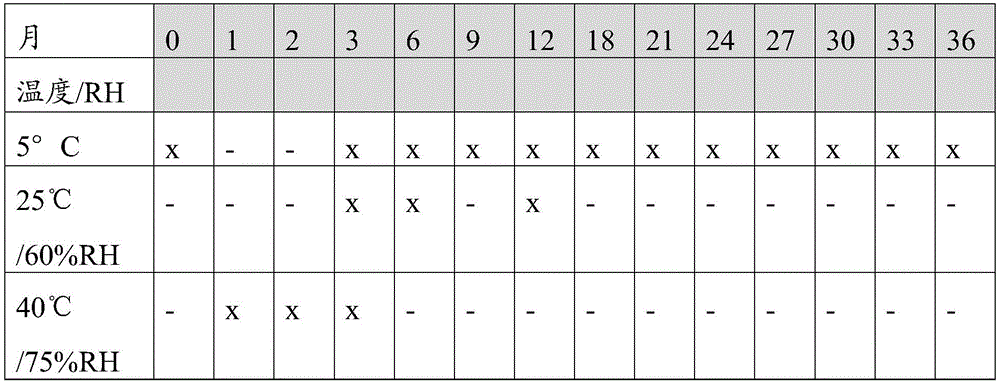
每种测试抗体制剂的稳定性研究计划、储存条件和检查时间点如表1所示。将样品水平避光保存。The stability study plan, storage conditions, and check time points for each tested antibody formulation are shown in Table 1. Store samples horizontally protected from light.
表1:稳定性研究计划Table 1: Stability Study Plan
评估方法assessment method
目视检查:Visual inspection:
根据European Pharmecopoeia 6.0(第2.9.20章“Particulate contamination:visible particles”)对可见颗粒进行检查。“颗粒物污染:可见颗粒”)。Visible particles were checked according to European Pharmecopoeia 6.0 (chapter 2.9.20 "Particulate contamination: visible particles"). "Particulate Pollution: Visible Particles").
颗粒鉴定:Particle Identification:
在使用傅里叶变换红外(FT-IR)光谱分离后进行可见颗粒的鉴定。Identification of visible particles was performed after separation using Fourier transform infrared (FT-IR) spectroscopy.
分离可见颗粒的程序:Procedure for separating visible particles:
1.通过缓慢拉动柱塞杆来移除注射器的柱塞。1. Remove the plunger from the syringe by slowly pulling the plunger rod.
2.从注射器中取样含有可见颗粒的溶液,并且将溶液置于干净的培养皿中。2. Sample the solution containing visible particles from the syringe and place the solution in a clean Petri dish.
3.使用来自KEYENCE的数字显微镜VHX-2000拍摄颗粒照片。3. Take pictures of the particles using a digital microscope VHX-2000 from KEYENCE.
4.将可见颗粒放在镍过滤器上。4. Put the visible particles on the nickel filter.
5.将过滤器上的颗粒用冷水冲洗。5. Rinse the particles on the filter with cold water.
6.用数字显微镜拍摄颗粒照片(模型如步骤3)。6. Take a photo of the particles with a digital microscope (model as in step 3).
FT-IR光谱在Shimadzu的IR PRESTIGE-21上进行,条件如下FT-IR spectra were performed on Shimadzu's IR PRESTIGE-21 under the following conditions
结果result
分别在25℃和40℃下储存12个月和3个月后,Seppic和NOF样品两者几乎均不含可见颗粒。在5℃储存时,SEPPIC样品在24个月时观察到大量可见颗粒,并且这些样品中可见颗粒的数量随着储存时间超过24个月而显著增加。在24、30和36个月时使用FT-IR进行颗粒鉴定,并且颗粒性质被鉴定为游离脂肪酸。相比之下,从最初到36个月,NOF样品保持几乎不含可见颗粒。观察到的可见粒子的总结见表2。Both the Seppic and NOF samples were almost free of visible particles after storage at 25°C and 40°C for 12 and 3 months, respectively. When stored at 5 °C, large numbers of visible particles were observed for SEPPIC samples at 24 months, and the number of visible particles in these samples increased significantly with storage time beyond 24 months. Particle identification was performed using FT-IR at 24, 30, and 36 months, and the particle nature was identified as free fatty acids. In contrast, the NOF samples remained virtually free of visible particles from initial to 36 months. A summary of the observed visible particles is given in Table 2.
表2:观察到的可见粒子的总结Table 2: Summary of observed visible particles
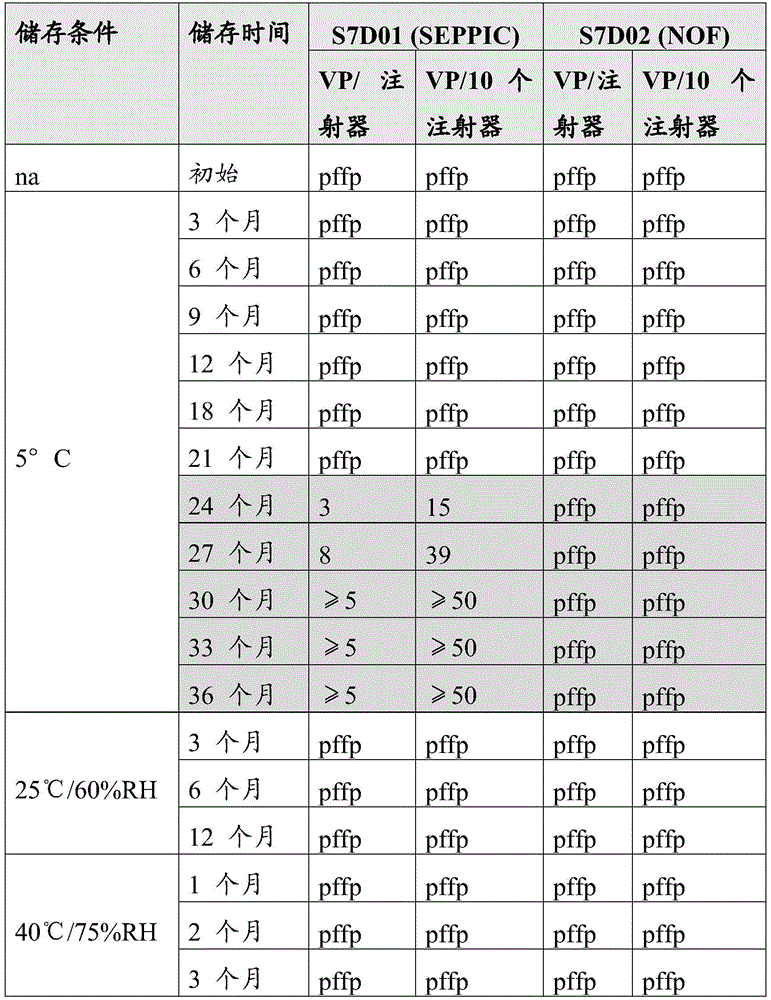
pffp是指几乎不含颗粒;pffp用于每个注射器最多2个可见颗粒和10个注射器中最多4个可见颗粒的样品。PFFP means virtually free of particles ; PFFP is used for samples with a maximum of 2 visible particles per syringe and a maximum of 4 visible particles in 10 syringes.
Claims (11)
Applications Claiming Priority (3)
| Application Number | Priority Date | Filing Date | Title |
|---|---|---|---|
| EP20174854 | 2020-05-15 | ||
| EP20174854.8 | 2020-05-15 | ||
| PCT/EP2021/062579 WO2021228917A1 (en) | 2020-05-15 | 2021-05-12 | Prevention of visible particle formation in parenteral protein solutions |
Publications (1)
| Publication Number | Publication Date |
|---|---|
| CN115605184A true CN115605184A (en) | 2023-01-13 |
Family
ID=70861202
Family Applications (1)
| Application Number | Title | Priority Date | Filing Date |
|---|---|---|---|
| CN202180035080.2A Pending CN115605184A (en) | 2020-05-15 | 2021-05-12 | Prevention of visible particle formation in parenteral protein solutions |
Country Status (5)
| Country | Link |
|---|---|
| US (1) | US20230167172A1 (en) |
| EP (1) | EP4149421A1 (en) |
| JP (1) | JP2023520249A (en) |
| CN (1) | CN115605184A (en) |
| WO (1) | WO2021228917A1 (en) |
Citations (4)
| Publication number | Priority date | Publication date | Assignee | Title |
|---|---|---|---|---|
| US20190083618A1 (en) * | 2017-09-19 | 2019-03-21 | Regeneron Pharmaceuticals, Inc. | Methods of reducing particle formation and compositions formed thereby |
| CN109862880A (en) * | 2016-09-27 | 2019-06-07 | 德国费森尤斯卡比有限公司 | liquid pharmaceutical composition |
| US20190300615A1 (en) * | 2018-04-02 | 2019-10-03 | Mycenax Biotech Inc. | Antibody-containing aqueous formulation and use thereof |
| WO2020088346A1 (en) * | 2018-10-31 | 2020-05-07 | Mycenax Biotech Inc. | Aqueous pharmaceutical formulations |
Family Cites Families (43)
| Publication number | Priority date | Publication date | Assignee | Title |
|---|---|---|---|---|
| US4816567A (en) | 1983-04-08 | 1989-03-28 | Genentech, Inc. | Recombinant immunoglobin preparations |
| US4676980A (en) | 1985-09-23 | 1987-06-30 | The United States Of America As Represented By The Secretary Of The Department Of Health And Human Services | Target specific cross-linked heteroantibodies |
| US6548640B1 (en) | 1986-03-27 | 2003-04-15 | Btg International Limited | Altered antibodies |
| US5208020A (en) | 1989-10-25 | 1993-05-04 | Immunogen Inc. | Cytotoxic agents comprising maytansinoids and their therapeutic use |
| US5959177A (en) | 1989-10-27 | 1999-09-28 | The Scripps Research Institute | Transgenic plants expressing assembled secretory antibodies |
| US6075181A (en) | 1990-01-12 | 2000-06-13 | Abgenix, Inc. | Human antibodies derived from immunized xenomice |
| US6150584A (en) | 1990-01-12 | 2000-11-21 | Abgenix, Inc. | Human antibodies derived from immunized xenomice |
| US5770429A (en) | 1990-08-29 | 1998-06-23 | Genpharm International, Inc. | Transgenic non-human animals capable of producing heterologous antibodies |
| JP3370324B2 (en) | 1991-04-25 | 2003-01-27 | 中外製薬株式会社 | Reshaped human antibodies to human interleukin-6 receptor |
| JP4124480B2 (en) | 1991-06-14 | 2008-07-23 | ジェネンテック・インコーポレーテッド | Immunoglobulin variants |
| WO1993006217A1 (en) | 1991-09-19 | 1993-04-01 | Genentech, Inc. | EXPRESSION IN E. COLI OF ANTIBODY FRAGMENTS HAVING AT LEAST A CYSTEINE PRESENT AS A FREE THIOL, USE FOR THE PRODUCTION OF BIFUNCTIONAL F(ab')2 ANTIBODIES |
| ATE139900T1 (en) | 1992-11-13 | 1996-07-15 | Idec Pharma Corp | THERAPEUTIC USE OF CHIMERIC AND LABELED ANTIBODIES AGAINST HUMAN B LYMPHOCYTE RESTRICTED DIFFERENTIATION ANTIGEN FOR THE TREATMENT OF B CELL LYMPHOMA |
| US5789199A (en) | 1994-11-03 | 1998-08-04 | Genentech, Inc. | Process for bacterial production of polypeptides |
| US5840523A (en) | 1995-03-01 | 1998-11-24 | Genetech, Inc. | Methods and compositions for secretion of heterologous polypeptides |
| US5731168A (en) | 1995-03-01 | 1998-03-24 | Genentech, Inc. | Method for making heteromultimeric polypeptides |
| IL132560A0 (en) | 1997-05-02 | 2001-03-19 | Genentech Inc | A method for making multispecific antibodies having heteromultimeric and common components |
| US6040498A (en) | 1998-08-11 | 2000-03-21 | North Caroline State University | Genetically engineered duckweed |
| US6610833B1 (en) | 1997-11-24 | 2003-08-26 | The Institute For Human Genetics And Biochemistry | Monoclonal human natural antibodies |
| WO1999029888A1 (en) | 1997-12-05 | 1999-06-17 | The Scripps Research Institute | Humanization of murine antibody |
| US7125978B1 (en) | 1999-10-04 | 2006-10-24 | Medicago Inc. | Promoter for regulating expression of foreign genes |
| KR100797667B1 (en) | 1999-10-04 | 2008-01-23 | 메디카고 인코포레이티드 | How to regulate transcription of foreign genes |
| DK2857516T3 (en) | 2000-04-11 | 2017-08-07 | Genentech Inc | Multivalent antibodies and uses thereof |
| US6596541B2 (en) | 2000-10-31 | 2003-07-22 | Regeneron Pharmaceuticals, Inc. | Methods of modifying eukaryotic cells |
| EP1916303B1 (en) | 2000-11-30 | 2013-02-27 | Medarex, Inc. | Nucleic acids encoding rearranged human immunoglobulin sequences from transgenic transchromosomal mice |
| MXPA06011199A (en) | 2004-03-31 | 2007-04-16 | Genentech Inc | Humanized anti-tgf-beta antibodies. |
| US20080044455A1 (en) | 2006-08-21 | 2008-02-21 | Chaim Welczer | Tonsillitus Treatment |
| WO2008027236A2 (en) | 2006-08-30 | 2008-03-06 | Genentech, Inc. | Multispecific antibodies |
| US9266967B2 (en) | 2007-12-21 | 2016-02-23 | Hoffmann-La Roche, Inc. | Bivalent, bispecific antibodies |
| US20090162359A1 (en) | 2007-12-21 | 2009-06-25 | Christian Klein | Bivalent, bispecific antibodies |
| US8242247B2 (en) | 2007-12-21 | 2012-08-14 | Hoffmann-La Roche Inc. | Bivalent, bispecific antibodies |
| SI2235064T1 (en) | 2008-01-07 | 2016-04-29 | Amgen Inc. | Method for making antibody fc-heterodimeric molecules using electrostatic steering effects |
| KR101431318B1 (en) | 2009-04-02 | 2014-08-20 | 로슈 글리카트 아게 | Multispecific antibodies comprising full length antibodies and single chain fab fragments |
| JP5616428B2 (en) | 2009-04-07 | 2014-10-29 | ロシュ グリクアート アクチェンゲゼルシャフト | Trivalent bispecific antibody |
| PE20120540A1 (en) | 2009-05-27 | 2012-05-09 | Hoffmann La Roche | THREE-SPECIFIC OR TETRA-SPECIFIC ANTIBODIES |
| US9676845B2 (en) | 2009-06-16 | 2017-06-13 | Hoffmann-La Roche, Inc. | Bispecific antigen binding proteins |
| CA2781519A1 (en) | 2009-09-16 | 2011-03-24 | Genentech, Inc. | Coiled coil and/or tether containing protein complexes and uses thereof |
| EP2748202B1 (en) | 2011-08-23 | 2018-07-04 | Roche Glycart AG | Bispecific antigen binding molecules |
| CN105849124B (en) | 2013-12-20 | 2022-04-12 | 豪夫迈·罗氏有限公司 | Dual specificity antibodies |
| UA117289C2 (en) | 2014-04-02 | 2018-07-10 | Ф. Хоффманн-Ля Рош Аг | MULTISPECIFIC ANTIBODY |
| JP6744292B2 (en) | 2014-07-29 | 2020-08-19 | エフ.ホフマン−ラ ロシュ アーゲーF. Hoffmann−La Roche Aktiengesellschaft | Multispecific antibody |
| JP6952605B2 (en) | 2015-04-24 | 2021-10-20 | ジェネンテック, インコーポレイテッド | Multispecific antigen binding protein |
| KR102576012B1 (en) * | 2017-07-27 | 2023-09-07 | 알렉시온 파마슈티칼스, 인코포레이티드 | High Concentration Anti-C5 Antibody Formulation |
| CN114040754A (en) * | 2019-06-28 | 2022-02-11 | 基因泰克公司 | Compositions and methods for stabilizing liquid protein formulations |
-
2021
- 2021-05-12 CN CN202180035080.2A patent/CN115605184A/en active Pending
- 2021-05-12 WO PCT/EP2021/062579 patent/WO2021228917A1/en not_active Ceased
- 2021-05-12 JP JP2022569025A patent/JP2023520249A/en active Pending
- 2021-05-12 EP EP21725503.3A patent/EP4149421A1/en not_active Withdrawn
-
2022
- 2022-11-10 US US18/054,244 patent/US20230167172A1/en not_active Abandoned
Patent Citations (4)
| Publication number | Priority date | Publication date | Assignee | Title |
|---|---|---|---|---|
| CN109862880A (en) * | 2016-09-27 | 2019-06-07 | 德国费森尤斯卡比有限公司 | liquid pharmaceutical composition |
| US20190083618A1 (en) * | 2017-09-19 | 2019-03-21 | Regeneron Pharmaceuticals, Inc. | Methods of reducing particle formation and compositions formed thereby |
| US20190300615A1 (en) * | 2018-04-02 | 2019-10-03 | Mycenax Biotech Inc. | Antibody-containing aqueous formulation and use thereof |
| WO2020088346A1 (en) * | 2018-10-31 | 2020-05-07 | Mycenax Biotech Inc. | Aqueous pharmaceutical formulations |
Non-Patent Citations (2)
| Title |
|---|
| ""ACTEMRA说明书"", pages 20, Retrieved from the Internet <URL:https://www.fda.gov/drugsatfda> * |
| 关志宇: "《药物制剂辅料与包装材料》", vol. 1, 30 January 2017, 中国医药科技出版社, pages: 24 - 25 * |
Also Published As
| Publication number | Publication date |
|---|---|
| WO2021228917A1 (en) | 2021-11-18 |
| EP4149421A1 (en) | 2023-03-22 |
| JP2023520249A (en) | 2023-05-16 |
| US20230167172A1 (en) | 2023-06-01 |
Similar Documents
| Publication | Publication Date | Title |
|---|---|---|
| CN108289953B (en) | PD-1 binding proteins and methods of using the same | |
| JP6517357B2 (en) | Anti-TIM3 antibodies and methods of use | |
| BR112021005585A2 (en) | Sirpa binding proteins and methods of using them | |
| US20150239991A1 (en) | Purification of hetero-dimeric immunoglobulins | |
| US20220395458A1 (en) | Prevention of visible particle formation in aqueous protein solutions | |
| JP2018532397A (en) | Anti-TIGIT antibody and method of use | |
| TW201414747A (en) | IL-18 binding molecule | |
| JP6949102B2 (en) | Combination therapy | |
| CN110678482A (en) | Preparation containing PD-1 binding protein and preparation method thereof | |
| US20180312584A1 (en) | Anti-il-17a and il-17f cross reactive antibody variants and compositions comprising and methods of making and using same | |
| JP2023153118A (en) | Administration for treatment with anti-CD20/anti-CD3 bispecific antibodies | |
| US20240165252A1 (en) | Antibody-drug conjugate and medical use thereof | |
| JP2026502840A (en) | Compositions and pharmaceutical uses of CD40 binding molecules | |
| CA3235206A1 (en) | Novel molecules for therapy and diagnosis | |
| US20230346931A1 (en) | Alternative surfactants as stabilizers for therapeutic protein formulations | |
| CN115605184A (en) | Prevention of visible particle formation in parenteral protein solutions | |
| HK40079577A (en) | Prevention of visible particle formation in parenteral protein solutions | |
| US11840568B2 (en) | Lymphocyte activation gene-3 (LAG-3) binding antibody and use thereof | |
| US20230233684A1 (en) | Use of chelators for the prevention of visible particle formation in parenteral protein solutions | |
| HK40076320A (en) | Prevention of visible particle formation in aqueous protein solutions | |
| HK40079570A (en) | The use of chelators for the prevention of visible particle formation in parenteral protein solutions | |
| RU2786909C2 (en) | Binding proteins and their application methods | |
| HK40090875A (en) | Alternative surfactants as stabilizers for therapeutic protein formulations | |
| HK1242991A1 (en) | Anti-il-17a and il-17f cross reactive antibody variants and compositions comprising and methods of making and using same |
Legal Events
| Date | Code | Title | Description |
|---|---|---|---|
| PB01 | Publication | ||
| PB01 | Publication | ||
| SE01 | Entry into force of request for substantive examination | ||
| SE01 | Entry into force of request for substantive examination | ||
| REG | Reference to a national code |
Ref country code: HK Ref legal event code: DE Ref document number: 40079577 Country of ref document: HK |
|
| WD01 | Invention patent application deemed withdrawn after publication | ||
| WD01 | Invention patent application deemed withdrawn after publication |
Application publication date: 20230113 |