CN115571196A - Intelligent handling method and system for positive line fault based on rule engine - Google Patents
Intelligent handling method and system for positive line fault based on rule engine Download PDFInfo
- Publication number
- CN115571196A CN115571196A CN202211442255.4A CN202211442255A CN115571196A CN 115571196 A CN115571196 A CN 115571196A CN 202211442255 A CN202211442255 A CN 202211442255A CN 115571196 A CN115571196 A CN 115571196A
- Authority
- CN
- China
- Prior art keywords
- fault
- scene
- model
- index
- equipment
- Prior art date
- Legal status (The legal status is an assumption and is not a legal conclusion. Google has not performed a legal analysis and makes no representation as to the accuracy of the status listed.)
- Pending
Links
Images


Classifications
-
- B—PERFORMING OPERATIONS; TRANSPORTING
- B61—RAILWAYS
- B61L—GUIDING RAILWAY TRAFFIC; ENSURING THE SAFETY OF RAILWAY TRAFFIC
- B61L15/00—Indicators provided on the vehicle or train for signalling purposes
- B61L15/0081—On-board diagnosis or maintenance
-
- G—PHYSICS
- G06—COMPUTING OR CALCULATING; COUNTING
- G06F—ELECTRIC DIGITAL DATA PROCESSING
- G06F16/00—Information retrieval; Database structures therefor; File system structures therefor
- G06F16/90—Details of database functions independent of the retrieved data types
- G06F16/903—Querying
-
- G—PHYSICS
- G06—COMPUTING OR CALCULATING; COUNTING
- G06F—ELECTRIC DIGITAL DATA PROCESSING
- G06F17/00—Digital computing or data processing equipment or methods, specially adapted for specific functions
- G06F17/10—Complex mathematical operations
Landscapes
- Engineering & Computer Science (AREA)
- Physics & Mathematics (AREA)
- Theoretical Computer Science (AREA)
- General Physics & Mathematics (AREA)
- Databases & Information Systems (AREA)
- Data Mining & Analysis (AREA)
- Mathematical Physics (AREA)
- General Engineering & Computer Science (AREA)
- Computational Linguistics (AREA)
- Health & Medical Sciences (AREA)
- Mechanical Engineering (AREA)
- General Health & Medical Sciences (AREA)
- Algebra (AREA)
- Computational Mathematics (AREA)
- Mathematical Analysis (AREA)
- Mathematical Optimization (AREA)
- Biomedical Technology (AREA)
- Pure & Applied Mathematics (AREA)
- Software Systems (AREA)
- Train Traffic Observation, Control, And Security (AREA)
Abstract
The invention provides a positive line fault intelligent handling method and a positive line fault intelligent handling system based on a rule engine, wherein the method comprises fault triggering, the rule engine acquires real-time signal data of a train, relevant index values are calculated based on an index model, a scene intelligent identification program identifies a corresponding fault scene by inquiring scene indexes, a fault diagnosis module assists in positioning specific fault equipment based on an equipment topology model, assists in analyzing specific fault reasons, triggers a handling suggestion recommendation function according to the reasons, and recommends optimal handling operation to workers; and storing the operation records according to the mode of the operation model for follow-up event archiving and experience summarization. The invention solves the problems of difficult fault diagnosis, short treatment time and the like when the positive line fault occurs.
Description
Technical Field
The invention relates to the technical field of operation maintenance, fault diagnosis and prediction of rail transit vehicles, in particular to a positive line fault intelligent treatment method and system based on a rule engine.
Background
With the gradual acceleration of the urbanization process, in recent years, the urban rail transit industry in China has been developed at a high speed, with the continuous increase of subway lines, the number of people and the number of running lines borne by a subway are also continuously increased, and the continuously increased number of running lines and large bearing capacity easily cause problems in the operation process of subway vehicles, so that the dangerous conditions such as late spots, stop operation, even derailment, conflict and the like occur, and great influence is caused on passengers.
When a train breaks down, experts in multiple fields such as vehicles, power supply, communication numbers and the like may need to be cooperated, a large amount of time is spent on analyzing a corresponding fault scene, corresponding emergency disposal operation is found out, a main line fault is difficult to solve within a limited time, and therefore great challenge is brought to safe and stable operation of the train. This series of operations requires extensive experience and professional maintenance skills by the relevant support personnel. A positive line fault indicates a fault that occurs while the train is in normal operation.
Most of the current prior arts deal with the main line fault by following the "rail transit main line fault and rescue operation standard".
The prior art has the following obvious disadvantages:
1) The troubleshooting is difficult: the positive line fault is possibly related to a plurality of specialties such as vehicles, power supply, communication numbers and the like, but the troubleshooting clues which can be relied on in the fault site are few, the troubleshooting time is short, and the troubleshooting difficulty is high;
2) Matching the correct fault emergency scenario is difficult: after a fault occurs, the running state of a vehicle is difficult to comb in a short time, and the fault condition of the whole train is known, so that a corresponding fault scene is difficult to identify quickly, and an emergency disposal operation corresponding to the fault scene cannot be found quickly;
3) The time for executing the fault emergency disposal operation is tight: usually, different fault scenes have different main line fault operation manuals, each emergency operation manual has a series of operation steps, and under the limit scene of 5 minutes on the main line, the driver is difficult to accurately and stably execute the relevant emergency operation.
Disclosure of Invention
In view of the above, the embodiments of the present disclosure provide a method and a system for intelligently handling a positive line fault based on a rule engine, which at least partially solve the problems in the prior art.
In a first aspect, an embodiment of the present disclosure provides a method for intelligently handling a positive line fault based on a rule engine, including the following steps:
when a train breaks down, starting an intelligent fault handling process;
the method comprises the steps that a rule engine obtains real-time signal data of a train and calculates related index values based on an index model;
the scene intelligent identification program judges whether the scene is effective or not according to the index value by inquiring the scene index, so that the corresponding fault scene is intelligently identified;
after the fault scene is identified, the fault diagnosis module assists in positioning specific fault equipment based on the equipment topology model, and assists in analyzing specific fault reasons;
triggering a treatment suggestion recommendation function after the fault equipment and the fault reason are located, and recommending the optimal treatment operation to a worker;
the working personnel operate the train according to the recommendation, the operation of the working personnel is collected in real time by the disposal process recording module, the operation effect is fed back, and the operation record is stored according to the mode of the operation model.
Further, the rule engine is realized through an expression calculation engine, and the calculation of a common expression rule, the calculation of a built-in function or the addition of a custom function are supported. Further, the rule engine is data-driven and meets two calculation scenarios of index real-time and off-line.
Further, the topological model of the relationships between the devices comprises: all key equipment related to a specific scene, and all key association relations among the equipment; and all signal data related to the device, including fault signals, command signals, and status signals.
Further, the process of scene intelligent recognition comprises:
1, after a fault is triggered, firstly calculating a scene index according to an index model, and then matching a related fault scene model through the scene index;
step 2, after the fault scene is successfully matched, checking the fault indexes of the relevant equipment based on the key equipment topological data corresponding to the fault scene, thereby finding out the equipment with the fault according to the fault indexes and simultaneously positioning the fault occurrence reason;
step 3, when the fault occurrence reason is located, finding the disposal operation associated with the fault reason, and then recommending the optimal disposal operation;
and 4, storing the related operation and the train state information after the staff performs certain operation.
In a second aspect, an embodiment of the present disclosure provides a rule engine-based positive line fault intelligent handling system, including:
a fault triggering module: when the train has a fault on the positive line, starting a fault intelligent handling process;
a rule engine module: acquiring real-time signal data of the train, and calculating related index values based on an index model;
scene intelligent recognition module: the scene intelligent identification module judges whether the scene is effective or not according to the index value by inquiring the scene index, so that the corresponding fault scene is intelligently identified;
a fault diagnosis module: after the fault scene is identified, the fault diagnosis module assists in positioning specific fault equipment based on the equipment topology model, and assists in analyzing specific fault reasons;
a treatment suggestion recommendation module: triggering a treatment suggestion recommendation function after the fault equipment and the fault reason are located, and recommending the optimal treatment operation to a worker;
a record handling process module: the staff operates the train according to the recommendation, the handling process recording module collects the operation of the staff in real time, the operation effect is fed back, and the operation record is stored according to the mode of the operation model.
Further, the model management module is further included for managing an index model, a device topology model, a treatment knowledge base, a scenario model, a signal model, a device model, and an operation model.
Further, the index model comprises index types, and the index types are used for classifying the indexes into operation indexes, scene indexes and fault indexes.
Further, the signal data includes a signal identification, a time, and a signal value.
In a third aspect, the disclosed embodiments also provide a non-transitory computer-readable storage medium storing computer instructions for causing a computer to execute the rule engine-based positive line fault intelligent handling method in the first aspect or any implementation manner of the first aspect.
Drawings
In order to more clearly illustrate the technical solutions of the embodiments of the present disclosure, the drawings required to be used in the embodiments will be briefly described below, it is obvious that the drawings in the following description are only some embodiments of the present disclosure, and it is obvious for those skilled in the art that other drawings can be obtained according to the drawings without creative efforts.
Fig. 1 is a schematic flowchart of a rule engine-based positive line intelligent fault handling method according to an embodiment of the present disclosure;
FIG. 2 is a schematic diagram of a signal data model provided by an embodiment of the present disclosure;
fig. 3 is a schematic diagram illustrating an operation index rule configuration according to an embodiment of the disclosure;
FIG. 4 is a schematic view of a configuration of a calculation rule for a vehicle door failure scenario according to an embodiment of the present disclosure;
FIG. 5 is a schematic view of a topological graph model of a vehicle door device according to an embodiment of the present disclosure;
fig. 6 is a schematic diagram of a fault handling knowledge base according to an embodiment of the present disclosure.
Detailed Description
The embodiments of the present disclosure are described in detail below with reference to the accompanying drawings.
The embodiments of the present disclosure are described below with specific examples, and other advantages and effects of the present disclosure will be readily apparent to those skilled in the art from the disclosure in the specification. It is to be understood that the described embodiments are merely illustrative of some, and not restrictive, of the embodiments of the disclosure. The disclosure may be carried into practice or applied to various other specific embodiments, and various modifications and changes may be made in the details within the description and the drawings without departing from the spirit of the disclosure. It is to be noted that the features in the following embodiments and examples may be combined with each other without conflict. All other embodiments, which can be derived by a person skilled in the art from the embodiments disclosed herein without inventive step, are intended to be within the scope of the present disclosure.
It is noted that various aspects of the embodiments are described below within the scope of the appended claims. It should be apparent that the aspects described herein may be embodied in a wide variety of forms and that any specific structure and/or function described herein is merely illustrative. Based on the disclosure, one skilled in the art should appreciate that one aspect described herein may be implemented independently of any other aspects and that two or more of these aspects may be combined in various ways. For example, an apparatus may be implemented and/or a method practiced using any number of the aspects set forth herein. Additionally, such an apparatus may be implemented and/or such a method may be practiced using other structure and/or functionality in addition to one or more of the aspects set forth herein.
It should be further noted that the drawings provided in the following embodiments are only schematic illustrations of the basic concepts of the present disclosure, and the drawings only show the components related to the present disclosure rather than the numbers, shapes and dimensions of the components in actual implementation, and the types, the numbers and the proportions of the components in actual implementation may be arbitrarily changed, and the layout of the components may be more complicated.
In addition, in the following description, specific details are provided to provide a thorough understanding of the examples. However, it will be understood by those skilled in the art that the aspects may be practiced without these specific details.
FIG. 1 shows a schematic diagram of a rules engine based positive line intelligent fault handling method 100 according to the present invention.
As shown in fig. 1, at step S102, a fault trigger, specifically, when a fault occurs on the train line, a staff immediately starts a fault intelligent handling process.
Next, go to step S104, obtain the real-time signal data of the train by using the rule engine, calculate the relevant index value based on the index model, and lay a data foundation for the subsequent processing procedure.
In particular, for example, in some aspects according to embodiments of the present disclosure, the rules engine is configured to calculate metric data, and the basis of the rule calculation is a metric calculation rule. The rule engine is realized by the expression calculation engine, can support the calculation of common expression rules, can also support the calculation of built-in functions, and can also support the addition of custom functions to meet the calculation of various complex rules.
The rule engine is data-driven, and can meet two calculation scenes of index real-time and off-line at the same time.
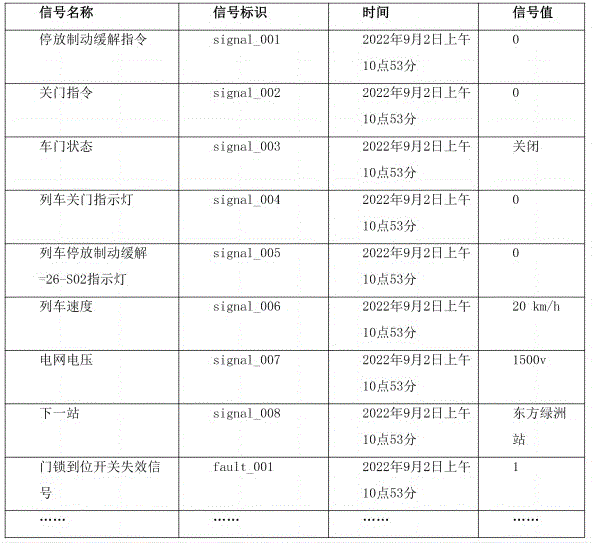
Specifically, for example, in some aspects according to embodiments of the present disclosure, the signal data model is as shown in fig. 2, which includes a signal identification, a time, and a signal value. The signal data is collected train state information, including information such as the running state of train equipment, equipment instructions and equipment faults, and all the information is embodied by signal values. Through the signal data, the state of the train at every moment can be determined. As shown in table 1, is an example of real-time signal data for a train portion.
TABLE 1
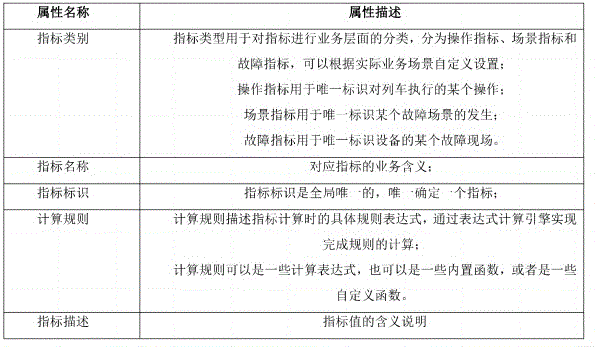
Specifically, for example, in some aspects according to embodiments of the present disclosure, the index model is used to digitally display both the scene characteristics of the train and the driver's operations, linking the signal model and the scene model of the train.
The correlation properties of the index model are shown in table 2.
TABLE 2
Optionally, table 3 is an example of indexes, and only reference is made to the scheme introduction, so that in practical application, there are more indexes, and more cases need to be added continuously.
TABLE 3

The fault index corresponds to a specific fault signal of the equipment, and can be directly configured through the fault signal, as shown in table 3.
The operation index is used for observing relevant operations performed by a driver. Taking the parking brake mitigation operation of table 3 as an example, the calculation rule configuration process is shown in fig. 3: the parking brake release signal value is changed from 0 to 1, i.e., the driver performs the relevant operation, and then the instruction signal value is changed from 0 to 1 according to the trend varied comb signal expression, finally forming a calculation rule, i.e., (current-1 second, signal _ 001) = =0& & (current, signal _ 001) = =1.
The calculation rule of the scene index is configured according to the scene characteristics of the scene, and the characteristics of each scene can correspond to a specific signal expression and are finally combined into a calculation expression of the scene. Taking the car door fault scenario in table 3 as an example, the process of combing the signal expression of the scenario according to the scenario characteristics and finally configuring the calculation rule is shown in fig. 4:
the scene characteristics corresponding to the door fault scene are the scene characteristics that a door closing instruction is sent by the train, the train door is in a closed state and the train door closing indicator light is not on; combing the signal expression of the scene according to the scene characteristics, wherein the corresponding signal expression is as follows: a door closing signal =1, a door state = closed, a door closing indicator light = not on; finally, a calculation rule is configured, namely, signal _002= =1& & signal _003= =1& & signal _004= =0.
Turning next to step S106, at step S106, scene intelligent recognition is performed: and the scene intelligent identification program judges whether the scene is effective or not according to the index value by inquiring the scene index, so that the corresponding fault scene is intelligently identified.
Turning to step S108, in step S108, performing fault diagnosis, after the fault scene is identified, triggering a fault diagnosis process immediately, and positioning a specific fault device based on the device topology model by the fault diagnosis module to assist in analyzing a specific fault cause.
Specifically, for example, in some aspects according to embodiments of the present disclosure, the device topology is combed by a service expert according to the physical structure of the train, and is a topological graph maintaining the relationship between devices, mainly containing the following information:
1) All key equipment related to a specific scene is contained;
2) All key association relations between the equipment are contained;
3) All signal data related to the device is contained, including fault signals, command signals, and status signals.
Taking a car door fault scene as an example, a corresponding key device topology model is shown in fig. 5.
The relevant equipment under this scene includes power supply unit, train control equipment, communications facilities, equipment controller, door and door status indicator lamp.
The signal data of the power supply equipment comprises a power supply equipment running state signal and a power supply equipment fault signal; the power supply equipment provides power for the train control equipment, the communication equipment and the equipment controller;
the signal data of the train control equipment comprises a controller state signal, a controller fault signal and a control signal; it sends corresponding instructions to the communication equipment;
the signal data of the communication device includes a communication status signal and a communication failure signal; it transmits the instruction to the device controller;
the signal data of the equipment controller comprises a door controller state signal, a door controller fault signal and a door controller opening signal; acting on the vehicle door to execute the command;
the signal data of the vehicle door comprises a vehicle door state signal and a vehicle door fault signal;
the signal data of the vehicle door state indicator lamp comprises an indicator lamp state signal and an indicator lamp fault signal; which is used to display the door status.
The device topological graph model is a key diagnosis means when a fault occurs. When a certain fault scene occurs, the state information of the equipment can be monitored in time through the signal values of the relevant equipment, and the equipment with the fault can be visually, accurately and timely positioned, so that specific disposal measures are pertinently taken.
Turning next to step S110, at step S110, the treatment recommendation: the maintenance and treatment operations of each type of equipment and equipment faults are recorded in a treatment knowledge base, and after the fault equipment and the fault reason are located, a treatment suggestion recommendation function is triggered immediately, so that the optimal treatment operation is recommended to workers.
In particular, for example, in some aspects according to embodiments of the present disclosure, the disposal repository is maintained in a graph-based manner, maintaining relationships between the respective data models, while the four key processes of fault intelligence disposal are also performed according to the disposal repository. As shown in particular in fig. 6.
The process of scene intelligent identification is as shown in process 1 of fig. 6, after a fault is triggered, a scene index is first calculated according to an index model, and then a related fault scene model is matched through the scene index.
The fault diagnosis process is as shown in process 2 of fig. 6, and after the fault scene matching is successful, the fault indexes of the relevant devices are checked based on the key device topology data corresponding to the fault scene, so that the devices with faults are found out according to the fault indexes, and the reasons for the faults are also located.
For example, the fault belongs to the fault device a and the fault device B according to the key device topology model, and the fault index of the fault device a and the fault indexes a1, a2, B1 and B2 of the fault device B are obtained according to the index relationship respectively.
The procedure of the handling recommendation operation is as in process 3 of fig. 6, when the cause of the fault is located, the handling operation associated with the cause of the fault can be found, and then the optimal handling operation is recommended to the worker.
And determining fault occurrence reasons y1, y2, y3 and y4 of fault indexes of different fault equipment respectively, and corresponding to handling operations c1, c2, c1 and c2 respectively according to handling relations.
The procedure of handling the operation record is as in process 4 of fig. 6, and when a worker performs a certain operation, the relevant operation and the train state information are stored.
And respectively recording operation indexes s1, s2, s1 and s2 according to the index relation.
Turning next to step S112, at step S112, the recording handling process: and finally, operating the train by the staff according to the recommendation, acquiring the operation of the staff in real time by the disposal process recording module, simultaneously feeding back the operation effect, and storing the operation record according to the mode of the operation model, thereby facilitating the follow-up event filing and experience summarization.
Specifically, for example, in some aspects according to embodiments of the present disclosure, the operational model is descriptive information for a crew member operating the train. Each operation can be displayed through the operation index, so that the operation of the driver can be reversely recorded by observing the value change information of the relevant operation index. The attributes of the operational model are shown in table 4.
TABLE 4

Specifically, for example, in some aspects according to the embodiments of the present disclosure, step S114 of model management may be further included, where the model management is a model data maintenance module, and business personnel perform manual maintenance to complete operations such as adding, deleting, modifying, and querying model data.
The model management may further include: a scene model, a signal model and a device model.
Specifically, for example, in some aspects according to embodiments of the present disclosure, the scenario model is an abstraction of a positive line fault, and is a description of a specific fault phenomenon, and the attribute information of the scenario model is shown in table 5.
TABLE 5

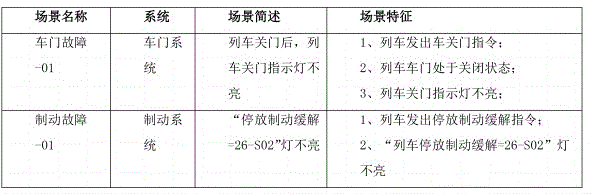
As shown in table 6, the following are some examples of specific train failure scenarios, and if the following failures occur, the main train operation will be affected, and in severe cases, accidents such as late train operation, stop train operation, and rescue may be caused.
TABLE 6
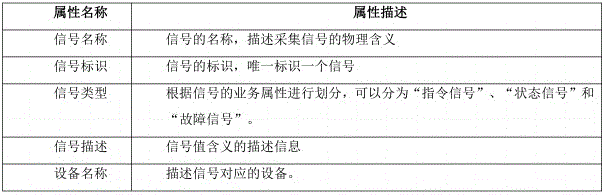
Specifically, for example, in some aspects according to embodiments of the present disclosure, the signal model is used to describe various attribute information of signals, which are generally classified as "fault signals", "status signals", and "instruction signals", etc., and new signal types can be flexibly extended according to service attributes. The state signal records the state information of the equipment, and specifically records the parameter information of the equipment in operation; the fault signal records alarm information of the equipment and expresses that the equipment has faults. The instruction signal records various operation instruction signals, and the relevant operation of a driver can be reflected through the change of the value of the signal. The properties of the signal model are shown in table 7.
TABLE 7
Specifically, for example, in some aspects according to embodiments of the present disclosure, signals are typically collected to monitor the status of equipment, and in order to automatically generate processing rules for various fault records, it is necessary to build a basic equipment model, the attribute information of which is shown in table 8.
TABLE 8

As described above with reference to steps S102-S114, the present embodiment establishes a relationship between fault handling and a fault scenario by constructing a fault handling knowledge base, so as to satisfy a function of handling recommendation; by constructing an index system, a fault scene, driver operation and equipment fault are digitalized, and the service requirements of fault scene identification, fault diagnosis, operation tracking and the like are met; the fault diagnosis is assisted by constructing an equipment topology model; and the calculation of various service indexes is met by constructing a rule engine.
The invention also relates to a rule engine based positive line intelligent fault handling system 300.
The rule engine based main line intelligent fault handling system 300 comprises a fault intelligent handling module and a model management module;
the fault intelligent handling module comprises: the system comprises signal data, index data, a rule engine module, a scene intelligent identification module, a fault diagnosis module, a treatment suggestion recommendation module and a treatment process recording module.
The model management module comprises: an index model, a device topology model, a disposition knowledge base, a scenario model, a signal model, a device model, and an operation model.
The train state information acquired by the signal data comprises information such as the running state of train equipment, equipment instructions and equipment faults, and all the information is embodied by signal values. Through the signal data, the state of the train at every moment can be restored.
The index data includes an operation index, a scene index, and a fault index.
The rule engine module is used for the rule engine to obtain real-time signal data of the train, and relevant index values including fault indexes, scene indexes and operation indexes are calculated based on the index model, so that a data base is laid for a subsequent processing process.
Further, the rule engine is data-driven and can simultaneously meet two calculation scenes, namely index real-time calculation and index off-line calculation.
The scene intelligent identification module judges whether the scene is effective or not according to the index value by inquiring the scene index, thereby intelligently identifying the corresponding fault scene
The fault diagnosis module is used for immediately triggering a fault diagnosis process after a fault scene is identified, and assisting in positioning specific fault equipment and analyzing specific fault reasons based on the equipment topology model.
The treatment suggestion recommendation module is used for recording maintenance and treatment operations of each type of equipment and equipment faults in a treatment knowledge base, and triggering a treatment suggestion recommendation function immediately after the fault equipment and the fault reason are located to recommend the optimal treatment operation to workers.
The disposal process recording module collects the operation of the working personnel in real time, simultaneously feeds back the operation effect, and the operation record is stored according to the mode of the operation model, so that the follow-up event filing and experience summarization are facilitated.
The index model is used for digitally displaying the scene characteristics of the train and the driver operation and establishing the connection between the signal model and the scene model of the train.
The equipment topology model is obtained by combing the service experts according to the physical structure of the train, is a topological graph for maintaining the relationship among the equipment and mainly comprises the following information.
1) All key equipment related to a specific scene is contained;
2) All key association relations between the equipment are contained;
3) All signal data related to the device is contained, including fault signals, command signals, and status signals.
The device topological graph model is a key diagnosis means when a fault occurs. When a certain fault scene occurs, the state information of the equipment can be monitored in time through the signal values of the related equipment, and the equipment with the fault can be visually, accurately and timely positioned, so that specific treatment measures are pertinently taken.
The disposal knowledge base is maintained in a map-based mode, the relation among all data models is maintained, and meanwhile, four key processes of intelligent failure disposal are executed according to the disposal knowledge base.
The scene model is used for abstracting the fault of the alignment line and is used for describing a concrete fault phenomenon.
The signal model describes various attribute information of the signal.
The equipment model is used for monitoring the state of the equipment and comprises an equipment name, an equipment type and a system name.
The operation model is used for describing information of train operation for workers. Each operation can be displayed through the operation index, so that the operation of the driver can be reversely recorded by observing the value change information of the relevant operation index.
In another aspect according to the present invention, there is also provided a non-transitory computer-readable storage medium storing computer instructions which, when executed by one or more processors, cause the one or more processors to perform the aforementioned rules engine-based inline intelligent fault handling method.
The above description is only for the specific embodiments of the present disclosure, but the scope of the present disclosure is not limited thereto, and any changes or substitutions that can be easily conceived by those skilled in the art within the technical scope of the present disclosure should be covered within the scope of the present disclosure. Therefore, the protection scope of the present disclosure shall be subject to the protection scope of the claims.
Claims (10)
1. A positive line fault intelligent handling method based on a rule engine is characterized by comprising the following steps:
when a train has a positive line fault, starting a fault intelligent handling process;
the method comprises the steps that a rule engine obtains real-time signal data of a train and calculates related index values based on an index model;
the scene intelligent identification program judges whether the scene is effective or not according to the index value by inquiring the scene index, so that the corresponding fault scene is intelligently identified;
after the fault scene is identified, the fault diagnosis module assists in positioning specific fault equipment based on the equipment topology model, and assists in analyzing specific fault reasons;
triggering a treatment suggestion recommendation function after the fault equipment and the fault reason are located, and recommending the optimal treatment operation to a worker;
the staff operates the train according to the recommendation, the handling process recording module collects the operation of the staff in real time, the operation effect is fed back, and the operation record is stored according to the mode of the operation model.
2. The intelligent handling method for positive line fault based on rule engine as claimed in claim 1, wherein the rule engine is implemented by expression calculation engine, supporting calculation of common expression rule, calculation of built-in function or adding custom function.
3. The intelligent handling method for positive line fault based on rule engine as claimed in claim 2, the rule engine is data driven, and satisfies both real-time and off-line calculation scenarios of the index.
4. The intelligent handling method for positive line fault based on rule engine as claimed in claim 1, wherein the topological model of relationship between devices comprises:
all key equipment related to a specific scene, and all key association relations among the equipment; and
all signal data relevant to the device, including fault signals, command signals, and status signals.
5. The intelligent handling method for positive line fault based on rule engine as claimed in claim 1, wherein the flow of scene intelligent identification comprises:
1, after a fault is triggered, firstly calculating a scene index according to an index model, and then matching a related fault scene model through the scene index;
step 2, after the fault scene is successfully matched, checking the fault indexes of the relevant equipment based on the key equipment topology data corresponding to the fault scene, finding out the equipment with the fault according to the fault indexes, and positioning the cause of the fault;
step 3, when the fault occurrence reason is located, finding the disposal operation associated with the fault reason, and then recommending the optimal disposal operation;
and 4, storing the related operation and the train state information after the staff performs certain operation.
6. A positive line fault intelligent handling system based on a rule engine is characterized by comprising:
a fault triggering module: when the train has a fault on the positive line, starting a fault intelligent handling process;
a rule engine module: acquiring real-time signal data of the train, and calculating related index values based on an index model;
scene intelligent recognition module: the scene intelligent identification module judges whether the scene is effective or not according to the index value by inquiring the scene index, so that the corresponding fault scene is intelligently identified;
a fault diagnosis module: after the fault scene is identified, the fault diagnosis module assists in positioning specific fault equipment based on the equipment topology model, and assists in analyzing specific fault reasons;
a treatment suggestion recommendation module: triggering a treatment suggestion recommendation function after the fault equipment and the fault reason are located, and recommending the optimal treatment operation to a worker;
a record handling process module: the working personnel operate the train according to the recommendation, the operation of the working personnel is collected in real time by the disposal process recording module, the operation effect is fed back, and the operation record is stored according to the mode of the operation model.
7. The rules engine based intelligent handling system of positive line faults according to claim 6, further comprising a model management module for managing an index model, a plant topology model, a handling knowledge base, a scenario model, a signal model, a plant model, and an operation model.
8. The rule engine-based intelligent handling system for positive line fault according to claim 7, wherein the index model comprises an index type, and the index type is used for classifying indexes into operation indexes, scene indexes and fault indexes in a business level.
9. The rules engine based positive line fault intelligent handling system according to claim 6, wherein the signal data includes signal identification, time, and signal value.
10. A non-transitory computer-readable storage medium storing computer instructions which, when executed by one or more processors, cause the one or more processors to perform the rules engine-based positive line fault intelligent handling method of any one of claims 1-5.
Priority Applications (1)
| Application Number | Priority Date | Filing Date | Title |
|---|---|---|---|
| CN202211442255.4A CN115571196A (en) | 2022-11-17 | 2022-11-17 | Intelligent handling method and system for positive line fault based on rule engine |
Applications Claiming Priority (1)
| Application Number | Priority Date | Filing Date | Title |
|---|---|---|---|
| CN202211442255.4A CN115571196A (en) | 2022-11-17 | 2022-11-17 | Intelligent handling method and system for positive line fault based on rule engine |
Publications (1)
| Publication Number | Publication Date |
|---|---|
| CN115571196A true CN115571196A (en) | 2023-01-06 |
Family
ID=84589042
Family Applications (1)
| Application Number | Title | Priority Date | Filing Date |
|---|---|---|---|
| CN202211442255.4A Pending CN115571196A (en) | 2022-11-17 | 2022-11-17 | Intelligent handling method and system for positive line fault based on rule engine |
Country Status (1)
| Country | Link |
|---|---|
| CN (1) | CN115571196A (en) |
Cited By (2)
| Publication number | Priority date | Publication date | Assignee | Title |
|---|---|---|---|---|
| CN116074183A (en) * | 2023-03-07 | 2023-05-05 | 北京全路通信信号研究设计院集团有限公司 | C3 timeout analysis method, device and equipment based on rule engine |
| CN119239706A (en) * | 2024-10-30 | 2025-01-03 | 株洲中车时代电气股份有限公司 | Urban rail train mainline fault emergency handling method, device, equipment and storage medium |
Citations (7)
| Publication number | Priority date | Publication date | Assignee | Title |
|---|---|---|---|---|
| US20020087578A1 (en) * | 2000-12-29 | 2002-07-04 | Vroman Douglas Scott | Method and system for identifying repeatedly malfunctioning equipment |
| CN107776606A (en) * | 2016-08-31 | 2018-03-09 | 中车株洲电力机车研究所有限公司 | A kind of shaft temperature monitoring system fault detection method |
| CN109583386A (en) * | 2018-11-30 | 2019-04-05 | 中南大学 | A kind of intelligent rotating mechanical breakdown depth network characterization discrimination method |
| CN111204363A (en) * | 2020-04-23 | 2020-05-29 | 湖南中车时代通信信号有限公司 | Fault diagnosis early warning and state evaluation method, device and system for traction system |
| CN112665856A (en) * | 2020-12-16 | 2021-04-16 | 华东交通大学 | Online monitoring system for gear box |
| CN113780055A (en) * | 2021-07-19 | 2021-12-10 | 北京交通大学 | A MOMEDA and Compression Sensing Based Fault Diagnosis Method for Rolling Bearings |
| CN114911215A (en) * | 2022-05-18 | 2022-08-16 | 牛玉涛 | An analysis method and system for emergency disposal of platform door faults |
-
2022
- 2022-11-17 CN CN202211442255.4A patent/CN115571196A/en active Pending
Patent Citations (7)
| Publication number | Priority date | Publication date | Assignee | Title |
|---|---|---|---|---|
| US20020087578A1 (en) * | 2000-12-29 | 2002-07-04 | Vroman Douglas Scott | Method and system for identifying repeatedly malfunctioning equipment |
| CN107776606A (en) * | 2016-08-31 | 2018-03-09 | 中车株洲电力机车研究所有限公司 | A kind of shaft temperature monitoring system fault detection method |
| CN109583386A (en) * | 2018-11-30 | 2019-04-05 | 中南大学 | A kind of intelligent rotating mechanical breakdown depth network characterization discrimination method |
| CN111204363A (en) * | 2020-04-23 | 2020-05-29 | 湖南中车时代通信信号有限公司 | Fault diagnosis early warning and state evaluation method, device and system for traction system |
| CN112665856A (en) * | 2020-12-16 | 2021-04-16 | 华东交通大学 | Online monitoring system for gear box |
| CN113780055A (en) * | 2021-07-19 | 2021-12-10 | 北京交通大学 | A MOMEDA and Compression Sensing Based Fault Diagnosis Method for Rolling Bearings |
| CN114911215A (en) * | 2022-05-18 | 2022-08-16 | 牛玉涛 | An analysis method and system for emergency disposal of platform door faults |
Non-Patent Citations (1)
| Title |
|---|
| 张喜 等: "车站信号控制设备故障诊断专家系统的研究与实现", 《铁道学报》 * |
Cited By (3)
| Publication number | Priority date | Publication date | Assignee | Title |
|---|---|---|---|---|
| CN116074183A (en) * | 2023-03-07 | 2023-05-05 | 北京全路通信信号研究设计院集团有限公司 | C3 timeout analysis method, device and equipment based on rule engine |
| CN116074183B (en) * | 2023-03-07 | 2023-06-13 | 北京全路通信信号研究设计院集团有限公司 | C3 timeout analysis method, device and equipment based on rule engine |
| CN119239706A (en) * | 2024-10-30 | 2025-01-03 | 株洲中车时代电气股份有限公司 | Urban rail train mainline fault emergency handling method, device, equipment and storage medium |
Similar Documents
| Publication | Publication Date | Title |
|---|---|---|
| CN110163485A (en) | A kind of computer room cruising inspection system | |
| CN103679293A (en) | Intelligent substation warning and aid decision making system | |
| CN112488520A (en) | Intelligent operation and maintenance system of intelligent station | |
| CN102042909A (en) | Locomotive fault diagnosis method and system | |
| KR100564362B1 (en) | Preventive maintenance system and method using urban railway vehicle maintenance informatization preventive maintenance analysis | |
| WO2017211593A1 (en) | System and method for the asset management of railway trains | |
| CN113902233A (en) | Vehicle safety early warning method, big data platform device, vehicle terminal and vehicle | |
| CN115571196A (en) | Intelligent handling method and system for positive line fault based on rule engine | |
| CN115246609A (en) | Elevator safety prevention and control cloud platform and operation state evaluation and processing method | |
| CN112800910A (en) | Communication machine room maintenance operation efficiency evaluation method and system | |
| CN111178828A (en) | Method and system for building fire safety early warning | |
| CN109387376A (en) | The diagnostic method of vehicle trouble, the diagnostic device of vehicle trouble and server | |
| CN112269821A (en) | Power equipment state analysis method based on big data | |
| WO2024139829A1 (en) | Mobile on-duty assistance apparatus and method for fully-automatic unmanned vehicle | |
| Li et al. | Identification of causal scenarios and application of leading indicators in the interconnection mode of urban rail transit based on STPA | |
| JPH096428A (en) | Plant monitoring equipment | |
| CN114715234B (en) | Digital twin system, device and method for train operation control system | |
| CN114291141B (en) | An operational behavior control and statistics system for a CTC system | |
| CN115330139A (en) | Active prevention and control construction method and system for operation risk of urban rail transit system | |
| CN114519491A (en) | Subway operation fault emergency linkage interaction method, device, equipment and medium | |
| CN113684868A (en) | Urban integrated pipe gallery early warning system | |
| WO2025130124A1 (en) | Multi-post collaborative handling system and method for fully-automated unmanned driving, and device | |
| CN120317853A (en) | Equipment full life cycle management system, method, storage medium and equipment | |
| CN119067634A (en) | Intelligent maintenance system for urban rail vehicles | |
| KR102843846B1 (en) | System and method for monitoring railroad safety |
Legal Events
| Date | Code | Title | Description |
|---|---|---|---|
| PB01 | Publication | ||
| PB01 | Publication | ||
| SE01 | Entry into force of request for substantive examination | ||
| SE01 | Entry into force of request for substantive examination | ||
| RJ01 | Rejection of invention patent application after publication | ||
| RJ01 | Rejection of invention patent application after publication |
Application publication date: 20230106 |