CN115531135A - Time-sharing, multi-modal foot rehabilitation system driven by gait events and its application method - Google Patents
Time-sharing, multi-modal foot rehabilitation system driven by gait events and its application method Download PDFInfo
- Publication number
- CN115531135A CN115531135A CN202110733839.6A CN202110733839A CN115531135A CN 115531135 A CN115531135 A CN 115531135A CN 202110733839 A CN202110733839 A CN 202110733839A CN 115531135 A CN115531135 A CN 115531135A
- Authority
- CN
- China
- Prior art keywords
- module
- foot
- pressure sensor
- electrical stimulation
- rehabilitation system
- Prior art date
- Legal status (The legal status is an assumption and is not a legal conclusion. Google has not performed a legal analysis and makes no representation as to the accuracy of the status listed.)
- Granted
Links
Images


Classifications
-
- A—HUMAN NECESSITIES
- A61—MEDICAL OR VETERINARY SCIENCE; HYGIENE
- A61H—PHYSICAL THERAPY APPARATUS, e.g. DEVICES FOR LOCATING OR STIMULATING REFLEX POINTS IN THE BODY; ARTIFICIAL RESPIRATION; MASSAGE; BATHING DEVICES FOR SPECIAL THERAPEUTIC OR HYGIENIC PURPOSES OR SPECIFIC PARTS OF THE BODY
- A61H1/00—Apparatus for passive exercising; Vibrating apparatus; Chiropractic devices, e.g. body impacting devices, external devices for briefly extending or aligning unbroken bones
- A61H1/02—Stretching or bending or torsioning apparatus for exercising
- A61H1/0237—Stretching or bending or torsioning apparatus for exercising for the lower limbs
- A61H1/0266—Foot
-
- A—HUMAN NECESSITIES
- A61—MEDICAL OR VETERINARY SCIENCE; HYGIENE
- A61N—ELECTROTHERAPY; MAGNETOTHERAPY; RADIATION THERAPY; ULTRASOUND THERAPY
- A61N1/00—Electrotherapy; Circuits therefor
- A61N1/18—Applying electric currents by contact electrodes
- A61N1/32—Applying electric currents by contact electrodes alternating or intermittent currents
- A61N1/36—Applying electric currents by contact electrodes alternating or intermittent currents for stimulation
- A61N1/36014—External stimulators, e.g. with patch electrodes
- A61N1/3603—Control systems
- A61N1/36031—Control systems using physiological parameters for adjustment
-
- A—HUMAN NECESSITIES
- A61—MEDICAL OR VETERINARY SCIENCE; HYGIENE
- A61B—DIAGNOSIS; SURGERY; IDENTIFICATION
- A61B5/00—Measuring for diagnostic purposes; Identification of persons
- A61B5/24—Detecting, measuring or recording bioelectric or biomagnetic signals of the body or parts thereof
- A61B5/316—Modalities, i.e. specific diagnostic methods
- A61B5/369—Electroencephalography [EEG]
- A61B5/375—Electroencephalography [EEG] using biofeedback
-
- A—HUMAN NECESSITIES
- A61—MEDICAL OR VETERINARY SCIENCE; HYGIENE
- A61B—DIAGNOSIS; SURGERY; IDENTIFICATION
- A61B5/00—Measuring for diagnostic purposes; Identification of persons
- A61B5/103—Measuring devices for testing the shape, pattern, colour, size or movement of the body or parts thereof, for diagnostic purposes
- A61B5/1036—Measuring load distribution, e.g. podologic studies
- A61B5/1038—Measuring plantar pressure during gait
-
- A—HUMAN NECESSITIES
- A61—MEDICAL OR VETERINARY SCIENCE; HYGIENE
- A61B—DIAGNOSIS; SURGERY; IDENTIFICATION
- A61B5/00—Measuring for diagnostic purposes; Identification of persons
- A61B5/103—Measuring devices for testing the shape, pattern, colour, size or movement of the body or parts thereof, for diagnostic purposes
- A61B5/11—Measuring movement of the entire body or parts thereof, e.g. head or hand tremor or mobility of a limb
- A61B5/1118—Determining activity level
-
- A—HUMAN NECESSITIES
- A61—MEDICAL OR VETERINARY SCIENCE; HYGIENE
- A61B—DIAGNOSIS; SURGERY; IDENTIFICATION
- A61B5/00—Measuring for diagnostic purposes; Identification of persons
- A61B5/103—Measuring devices for testing the shape, pattern, colour, size or movement of the body or parts thereof, for diagnostic purposes
- A61B5/11—Measuring movement of the entire body or parts thereof, e.g. head or hand tremor or mobility of a limb
- A61B5/112—Gait analysis
-
- A—HUMAN NECESSITIES
- A61—MEDICAL OR VETERINARY SCIENCE; HYGIENE
- A61B—DIAGNOSIS; SURGERY; IDENTIFICATION
- A61B5/00—Measuring for diagnostic purposes; Identification of persons
- A61B5/24—Detecting, measuring or recording bioelectric or biomagnetic signals of the body or parts thereof
- A61B5/316—Modalities, i.e. specific diagnostic methods
- A61B5/389—Electromyography [EMG]
-
- A—HUMAN NECESSITIES
- A61—MEDICAL OR VETERINARY SCIENCE; HYGIENE
- A61B—DIAGNOSIS; SURGERY; IDENTIFICATION
- A61B5/00—Measuring for diagnostic purposes; Identification of persons
- A61B5/48—Other medical applications
- A61B5/4836—Diagnosis combined with treatment in closed-loop systems or methods
-
- A—HUMAN NECESSITIES
- A61—MEDICAL OR VETERINARY SCIENCE; HYGIENE
- A61B—DIAGNOSIS; SURGERY; IDENTIFICATION
- A61B5/00—Measuring for diagnostic purposes; Identification of persons
- A61B5/68—Arrangements of detecting, measuring or recording means, e.g. sensors, in relation to patient
- A61B5/6801—Arrangements of detecting, measuring or recording means, e.g. sensors, in relation to patient specially adapted to be attached to or worn on the body surface
- A61B5/6802—Sensor mounted on worn items
- A61B5/6804—Garments; Clothes
- A61B5/6807—Footwear
-
- A—HUMAN NECESSITIES
- A61—MEDICAL OR VETERINARY SCIENCE; HYGIENE
- A61B—DIAGNOSIS; SURGERY; IDENTIFICATION
- A61B5/00—Measuring for diagnostic purposes; Identification of persons
- A61B5/68—Arrangements of detecting, measuring or recording means, e.g. sensors, in relation to patient
- A61B5/6801—Arrangements of detecting, measuring or recording means, e.g. sensors, in relation to patient specially adapted to be attached to or worn on the body surface
- A61B5/6813—Specially adapted to be attached to a specific body part
- A61B5/6829—Foot or ankle
-
- A—HUMAN NECESSITIES
- A61—MEDICAL OR VETERINARY SCIENCE; HYGIENE
- A61B—DIAGNOSIS; SURGERY; IDENTIFICATION
- A61B5/00—Measuring for diagnostic purposes; Identification of persons
- A61B5/74—Details of notification to user or communication with user or patient; User input means
- A61B5/7455—Details of notification to user or communication with user or patient; User input means characterised by tactile indication, e.g. vibration or electrical stimulation
-
- A—HUMAN NECESSITIES
- A61—MEDICAL OR VETERINARY SCIENCE; HYGIENE
- A61B—DIAGNOSIS; SURGERY; IDENTIFICATION
- A61B5/00—Measuring for diagnostic purposes; Identification of persons
- A61B5/74—Details of notification to user or communication with user or patient; User input means
- A61B5/746—Alarms related to a physiological condition, e.g. details of setting alarm thresholds or avoiding false alarms
-
- A—HUMAN NECESSITIES
- A61—MEDICAL OR VETERINARY SCIENCE; HYGIENE
- A61F—FILTERS IMPLANTABLE INTO BLOOD VESSELS; PROSTHESES; DEVICES PROVIDING PATENCY TO, OR PREVENTING COLLAPSING OF, TUBULAR STRUCTURES OF THE BODY, e.g. STENTS; ORTHOPAEDIC, NURSING OR CONTRACEPTIVE DEVICES; FOMENTATION; TREATMENT OR PROTECTION OF EYES OR EARS; BANDAGES, DRESSINGS OR ABSORBENT PADS; FIRST-AID KITS
- A61F5/00—Orthopaedic methods or devices for non-surgical treatment of bones or joints; Nursing devices ; Anti-rape devices
- A61F5/01—Orthopaedic devices, e.g. long-term immobilising or pressure directing devices for treating broken or deformed bones such as splints, casts or braces
- A61F5/0102—Orthopaedic devices, e.g. long-term immobilising or pressure directing devices for treating broken or deformed bones such as splints, casts or braces specially adapted for correcting deformities of the limbs or for supporting them; Ortheses, e.g. with articulations
- A61F5/0127—Orthopaedic devices, e.g. long-term immobilising or pressure directing devices for treating broken or deformed bones such as splints, casts or braces specially adapted for correcting deformities of the limbs or for supporting them; Ortheses, e.g. with articulations for the feet
-
- A—HUMAN NECESSITIES
- A61—MEDICAL OR VETERINARY SCIENCE; HYGIENE
- A61F—FILTERS IMPLANTABLE INTO BLOOD VESSELS; PROSTHESES; DEVICES PROVIDING PATENCY TO, OR PREVENTING COLLAPSING OF, TUBULAR STRUCTURES OF THE BODY, e.g. STENTS; ORTHOPAEDIC, NURSING OR CONTRACEPTIVE DEVICES; FOMENTATION; TREATMENT OR PROTECTION OF EYES OR EARS; BANDAGES, DRESSINGS OR ABSORBENT PADS; FIRST-AID KITS
- A61F5/00—Orthopaedic methods or devices for non-surgical treatment of bones or joints; Nursing devices ; Anti-rape devices
- A61F5/01—Orthopaedic devices, e.g. long-term immobilising or pressure directing devices for treating broken or deformed bones such as splints, casts or braces
- A61F5/04—Devices for stretching or reducing fractured limbs; Devices for distractions; Splints
- A61F5/05—Devices for stretching or reducing fractured limbs; Devices for distractions; Splints for immobilising
- A61F5/058—Splints
- A61F5/05841—Splints for the limbs
- A61F5/0585—Splints for the limbs for the legs
-
- A—HUMAN NECESSITIES
- A61—MEDICAL OR VETERINARY SCIENCE; HYGIENE
- A61H—PHYSICAL THERAPY APPARATUS, e.g. DEVICES FOR LOCATING OR STIMULATING REFLEX POINTS IN THE BODY; ARTIFICIAL RESPIRATION; MASSAGE; BATHING DEVICES FOR SPECIAL THERAPEUTIC OR HYGIENIC PURPOSES OR SPECIFIC PARTS OF THE BODY
- A61H1/00—Apparatus for passive exercising; Vibrating apparatus; Chiropractic devices, e.g. body impacting devices, external devices for briefly extending or aligning unbroken bones
- A61H1/02—Stretching or bending or torsioning apparatus for exercising
- A61H1/0237—Stretching or bending or torsioning apparatus for exercising for the lower limbs
- A61H1/0255—Both knee and hip of a patient, e.g. in supine or sitting position, the feet being moved together in a plane substantially parallel to the body-symmetrical plane
- A61H1/0262—Walking movement; Appliances for aiding disabled persons to walk
-
- A—HUMAN NECESSITIES
- A61—MEDICAL OR VETERINARY SCIENCE; HYGIENE
- A61N—ELECTROTHERAPY; MAGNETOTHERAPY; RADIATION THERAPY; ULTRASOUND THERAPY
- A61N1/00—Electrotherapy; Circuits therefor
- A61N1/02—Details
- A61N1/04—Electrodes
- A61N1/0404—Electrodes for external use
- A61N1/0408—Use-related aspects
- A61N1/0452—Specially adapted for transcutaneous muscle stimulation [TMS]
-
- A—HUMAN NECESSITIES
- A61—MEDICAL OR VETERINARY SCIENCE; HYGIENE
- A61N—ELECTROTHERAPY; MAGNETOTHERAPY; RADIATION THERAPY; ULTRASOUND THERAPY
- A61N1/00—Electrotherapy; Circuits therefor
- A61N1/02—Details
- A61N1/04—Electrodes
- A61N1/0404—Electrodes for external use
- A61N1/0472—Structure-related aspects
- A61N1/0476—Array electrodes (including any electrode arrangement with more than one electrode for at least one of the polarities)
-
- A—HUMAN NECESSITIES
- A61—MEDICAL OR VETERINARY SCIENCE; HYGIENE
- A61N—ELECTROTHERAPY; MAGNETOTHERAPY; RADIATION THERAPY; ULTRASOUND THERAPY
- A61N1/00—Electrotherapy; Circuits therefor
- A61N1/02—Details
- A61N1/04—Electrodes
- A61N1/0404—Electrodes for external use
- A61N1/0472—Structure-related aspects
- A61N1/0492—Patch electrodes
-
- A—HUMAN NECESSITIES
- A61—MEDICAL OR VETERINARY SCIENCE; HYGIENE
- A61N—ELECTROTHERAPY; MAGNETOTHERAPY; RADIATION THERAPY; ULTRASOUND THERAPY
- A61N1/00—Electrotherapy; Circuits therefor
- A61N1/18—Applying electric currents by contact electrodes
- A61N1/32—Applying electric currents by contact electrodes alternating or intermittent currents
- A61N1/36—Applying electric currents by contact electrodes alternating or intermittent currents for stimulation
- A61N1/36003—Applying electric currents by contact electrodes alternating or intermittent currents for stimulation of motor muscles, e.g. for walking assistance
-
- A—HUMAN NECESSITIES
- A61—MEDICAL OR VETERINARY SCIENCE; HYGIENE
- A61N—ELECTROTHERAPY; MAGNETOTHERAPY; RADIATION THERAPY; ULTRASOUND THERAPY
- A61N1/00—Electrotherapy; Circuits therefor
- A61N1/18—Applying electric currents by contact electrodes
- A61N1/32—Applying electric currents by contact electrodes alternating or intermittent currents
- A61N1/36—Applying electric currents by contact electrodes alternating or intermittent currents for stimulation
- A61N1/36014—External stimulators, e.g. with patch electrodes
- A61N1/3603—Control systems
- A61N1/36034—Control systems specified by the stimulation parameters
-
- A—HUMAN NECESSITIES
- A61—MEDICAL OR VETERINARY SCIENCE; HYGIENE
- A61H—PHYSICAL THERAPY APPARATUS, e.g. DEVICES FOR LOCATING OR STIMULATING REFLEX POINTS IN THE BODY; ARTIFICIAL RESPIRATION; MASSAGE; BATHING DEVICES FOR SPECIAL THERAPEUTIC OR HYGIENIC PURPOSES OR SPECIFIC PARTS OF THE BODY
- A61H2201/00—Characteristics of apparatus not provided for in the preceding codes
- A61H2201/12—Driving means
- A61H2201/1207—Driving means with electric or magnetic drive
-
- A—HUMAN NECESSITIES
- A61—MEDICAL OR VETERINARY SCIENCE; HYGIENE
- A61H—PHYSICAL THERAPY APPARATUS, e.g. DEVICES FOR LOCATING OR STIMULATING REFLEX POINTS IN THE BODY; ARTIFICIAL RESPIRATION; MASSAGE; BATHING DEVICES FOR SPECIAL THERAPEUTIC OR HYGIENIC PURPOSES OR SPECIFIC PARTS OF THE BODY
- A61H2201/00—Characteristics of apparatus not provided for in the preceding codes
- A61H2201/14—Special force transmission means, i.e. between the driving means and the interface with the user
- A61H2201/1409—Hydraulic or pneumatic means
-
- A—HUMAN NECESSITIES
- A61—MEDICAL OR VETERINARY SCIENCE; HYGIENE
- A61H—PHYSICAL THERAPY APPARATUS, e.g. DEVICES FOR LOCATING OR STIMULATING REFLEX POINTS IN THE BODY; ARTIFICIAL RESPIRATION; MASSAGE; BATHING DEVICES FOR SPECIAL THERAPEUTIC OR HYGIENIC PURPOSES OR SPECIFIC PARTS OF THE BODY
- A61H2201/00—Characteristics of apparatus not provided for in the preceding codes
- A61H2201/16—Physical interface with patient
- A61H2201/1602—Physical interface with patient kind of interface, e.g. head rest, knee support or lumbar support
- A61H2201/164—Feet or leg, e.g. pedal
- A61H2201/1642—Holding means therefor
-
- A—HUMAN NECESSITIES
- A61—MEDICAL OR VETERINARY SCIENCE; HYGIENE
- A61H—PHYSICAL THERAPY APPARATUS, e.g. DEVICES FOR LOCATING OR STIMULATING REFLEX POINTS IN THE BODY; ARTIFICIAL RESPIRATION; MASSAGE; BATHING DEVICES FOR SPECIAL THERAPEUTIC OR HYGIENIC PURPOSES OR SPECIFIC PARTS OF THE BODY
- A61H2201/00—Characteristics of apparatus not provided for in the preceding codes
- A61H2201/16—Physical interface with patient
- A61H2201/1602—Physical interface with patient kind of interface, e.g. head rest, knee support or lumbar support
- A61H2201/165—Wearable interfaces
-
- A—HUMAN NECESSITIES
- A61—MEDICAL OR VETERINARY SCIENCE; HYGIENE
- A61H—PHYSICAL THERAPY APPARATUS, e.g. DEVICES FOR LOCATING OR STIMULATING REFLEX POINTS IN THE BODY; ARTIFICIAL RESPIRATION; MASSAGE; BATHING DEVICES FOR SPECIAL THERAPEUTIC OR HYGIENIC PURPOSES OR SPECIFIC PARTS OF THE BODY
- A61H2201/00—Characteristics of apparatus not provided for in the preceding codes
- A61H2201/50—Control means thereof
- A61H2201/5058—Sensors or detectors
-
- A—HUMAN NECESSITIES
- A61—MEDICAL OR VETERINARY SCIENCE; HYGIENE
- A61H—PHYSICAL THERAPY APPARATUS, e.g. DEVICES FOR LOCATING OR STIMULATING REFLEX POINTS IN THE BODY; ARTIFICIAL RESPIRATION; MASSAGE; BATHING DEVICES FOR SPECIAL THERAPEUTIC OR HYGIENIC PURPOSES OR SPECIFIC PARTS OF THE BODY
- A61H2201/00—Characteristics of apparatus not provided for in the preceding codes
- A61H2201/50—Control means thereof
- A61H2201/5058—Sensors or detectors
- A61H2201/5071—Pressure sensors
-
- A—HUMAN NECESSITIES
- A61—MEDICAL OR VETERINARY SCIENCE; HYGIENE
- A61H—PHYSICAL THERAPY APPARATUS, e.g. DEVICES FOR LOCATING OR STIMULATING REFLEX POINTS IN THE BODY; ARTIFICIAL RESPIRATION; MASSAGE; BATHING DEVICES FOR SPECIAL THERAPEUTIC OR HYGIENIC PURPOSES OR SPECIFIC PARTS OF THE BODY
- A61H2205/00—Devices for specific parts of the body
- A61H2205/10—Leg
-
- A—HUMAN NECESSITIES
- A61—MEDICAL OR VETERINARY SCIENCE; HYGIENE
- A61H—PHYSICAL THERAPY APPARATUS, e.g. DEVICES FOR LOCATING OR STIMULATING REFLEX POINTS IN THE BODY; ARTIFICIAL RESPIRATION; MASSAGE; BATHING DEVICES FOR SPECIAL THERAPEUTIC OR HYGIENIC PURPOSES OR SPECIFIC PARTS OF THE BODY
- A61H2205/00—Devices for specific parts of the body
- A61H2205/12—Feet
-
- A—HUMAN NECESSITIES
- A61—MEDICAL OR VETERINARY SCIENCE; HYGIENE
- A61H—PHYSICAL THERAPY APPARATUS, e.g. DEVICES FOR LOCATING OR STIMULATING REFLEX POINTS IN THE BODY; ARTIFICIAL RESPIRATION; MASSAGE; BATHING DEVICES FOR SPECIAL THERAPEUTIC OR HYGIENIC PURPOSES OR SPECIFIC PARTS OF THE BODY
- A61H2230/00—Measuring physical parameters of the user
- A61H2230/08—Other bio-electrical signals
- A61H2230/085—Other bio-electrical signals used as a control parameter for the apparatus
-
- A—HUMAN NECESSITIES
- A61—MEDICAL OR VETERINARY SCIENCE; HYGIENE
- A61H—PHYSICAL THERAPY APPARATUS, e.g. DEVICES FOR LOCATING OR STIMULATING REFLEX POINTS IN THE BODY; ARTIFICIAL RESPIRATION; MASSAGE; BATHING DEVICES FOR SPECIAL THERAPEUTIC OR HYGIENIC PURPOSES OR SPECIFIC PARTS OF THE BODY
- A61H2230/00—Measuring physical parameters of the user
- A61H2230/62—Posture
- A61H2230/625—Posture used as a control parameter for the apparatus
Landscapes
- Health & Medical Sciences (AREA)
- Life Sciences & Earth Sciences (AREA)
- Animal Behavior & Ethology (AREA)
- General Health & Medical Sciences (AREA)
- Public Health (AREA)
- Veterinary Medicine (AREA)
- Engineering & Computer Science (AREA)
- Biomedical Technology (AREA)
- Biophysics (AREA)
- Heart & Thoracic Surgery (AREA)
- Pathology (AREA)
- Surgery (AREA)
- Molecular Biology (AREA)
- Medical Informatics (AREA)
- Physics & Mathematics (AREA)
- Radiology & Medical Imaging (AREA)
- Nuclear Medicine, Radiotherapy & Molecular Imaging (AREA)
- Physiology (AREA)
- Oral & Maxillofacial Surgery (AREA)
- Dentistry (AREA)
- Physical Education & Sports Medicine (AREA)
- Orthopedic Medicine & Surgery (AREA)
- Rehabilitation Therapy (AREA)
- Pain & Pain Management (AREA)
- Epidemiology (AREA)
- Nursing (AREA)
- Vascular Medicine (AREA)
- Psychiatry (AREA)
- Psychology (AREA)
- Rehabilitation Tools (AREA)
Abstract
Description
技术领域technical field
本发明涉及辅助医疗康复训练设备领域,尤其涉及步态事件驱动的、在不同步态时相中,分别由神经肌肉电刺激、气动式肌骨联合体和感知生物反馈以不同组合形式(即多模态)提供足部动态辅助的康复系统,以纠正下肢运动功能损伤用户(如卒中、脊髓损伤)足下垂、足内翻和肌肉代偿的问题。The present invention relates to the field of auxiliary medical rehabilitation training equipment, in particular to gait event-driven, in different gait time phases, respectively composed of neuromuscular electrical stimulation, pneumatic musculoskeletal complex and sensory biofeedback in different combinations (i.e. multiple Modal) provides a foot dynamic assisted rehabilitation system to correct the problems of foot drop, foot inversion and muscle compensation for users with lower limb motor function impairments (such as stroke and spinal cord injury).
背景技术Background technique
对于下肢运动功能损伤用户,尤其是中风导致的偏瘫用户,其行走步态存在诸多残障,如双侧失衡,足下垂(无法提起前脚掌),足内翻(足部向内侧翻转),这大大增加用户摔倒的风险,以及后期复原的可能。同时由于步态长期失调而导致异化的肌肉代偿性运动,使患侧下肢的肌群难以得到有效的协调性康复训练。For users with lower limb motor function impairment, especially those with hemiplegia caused by stroke, there are many disabilities in their walking gait, such as bilateral imbalance, foot drop (unable to lift the forefoot), and foot varus (foot turned to the inside). Increase the risk of users falling and the possibility of later recovery. At the same time, due to the long-term imbalance of gait, the alienated muscle compensatory movement makes it difficult for the muscles of the affected lower limb to receive effective coordination rehabilitation training.
传统的辅助医疗设备(例如参见图1的踝足矫形器)采用被动式及具有固定关节角度的矫形器,提供恒常机械支撑和固定作用以防止足下垂和足内翻,但此类矫形器无法帮助用户锻炼患侧踝关节的目标肌肉,过度使用反而存在肌肉萎缩的风险并影响踝关节的稳定性。Traditional assistive medical devices (such as the ankle-foot orthosis shown in Figure 1) employ passive and fixed-joint-angle orthoses that provide constant mechanical support and immobilization to prevent foot drop and inversion, but such orthoses do not help The user exercises the target muscles of the ankle joint on the affected side. Excessive use may cause muscle atrophy and affect the stability of the ankle joint.
另外,现有的用于下肢康复的机器人在步态过程中提供单一的机械外力辅助,主导患侧肢体完成指定步态(如特定的轨迹)。在此过程中,即使用户自身肌肉发力产生的关节运动与机器人设定步态不一致,也会被机器人的马达强行带领,产生非自主性的被动运动。此类机器人的辅助方法无法在运动过程中指导用户如何使用目标肌肉正确发力并完成相应的动作,也无法在运动过程中及时给予反馈信号,让用户意识到错误并予以纠正,从而导致用户在动态步态中的肌肉代偿性问题无法得到纠正,也无法有效重塑正常步态(即在没有系统辅助的情况下,用户可恢复正常行走)。In addition, the existing robots for lower limb rehabilitation provide a single mechanical external force assistance during the gait process, leading the affected limb to complete the specified gait (such as a specific trajectory). During this process, even if the joint movement produced by the user's own muscles is inconsistent with the gait set by the robot, it will be forcibly led by the robot's motor, resulting in involuntary passive movement. The auxiliary method of this type of robot cannot guide the user how to use the target muscle to correctly exert force and complete the corresponding action during the exercise, and cannot give feedback signals in time during the exercise to make the user realize the error and correct it, resulting in the user’s Muscle compensatory problems in dynamic gait cannot be corrected, nor can the normal gait be effectively reshaped (i.e., the user can return to normal walking without the assistance of the system).
在现有的用于下肢康复的机器人的机械及控制设计中,还没有在动态行走过程中,同时纠正由肌肉萎缩及肌肉代偿运动引起的足下垂和足内翻问题,或给予纠错反馈的可穿戴康复系统。传统的用于下肢康复的硬质外骨骼机器人中,对于踝关节设计过于简单,都是在不同的步态时相中给予单一的机械力矩支撑和带动,一般由一个自由度的马达转动来实现在矢状面上的足部背屈(踝关节屈曲,足尖上移接近脚胫的动作)与跖屈(踝关节伸展,足尖伸直下压移离脚胫的动作)。此类设计虽然可用马达给予的外力抵消足下垂的现象,但无法纠正用户内在的肌肉萎缩及代偿性运动,并且忽略了对于中风后常见的、发生在足部水平面的足内翻的控制与纠正。这种机械辅助方案甚至会由于足部水平面自由度的缺失而引起相应的肌肉萎缩。而且,硬质外骨骼自身的重量比较容易让单侧使用者在行走时失去平衡,尤其是对于中风后的偏瘫用户。气动肌肉(通过用加压空气填充气囊而起作用)与外骨骼(一种能保护生物柔软内部器官的外部坚硬骨骼结构)相结合的肌骨联合体相较于传统硬质外骨骼更轻便柔软,适用于单侧穿戴于患侧下肢,并能提供足够的力学辅助。In the existing mechanical and control design of robots for lower limb rehabilitation, there is no simultaneous correction of foot drop and foot inversion caused by muscle atrophy and muscle compensatory movement during dynamic walking, or error correction feedback wearable rehabilitation system. In traditional hard exoskeleton robots used for lower limb rehabilitation, the design of the ankle joint is too simple. It is supported and driven by a single mechanical moment in different gait phases, which is generally realized by the rotation of a motor with one degree of freedom. Foot dorsiflexion (flexion of the ankle, movement of the toe up and toward the shin) and plantarflexion (flexion of the ankle, movement of the toe straight and downward away from the shin) in the sagittal plane. Although this type of design can counteract the phenomenon of foot drop with the external force given by the motor, it cannot correct the user's internal muscle atrophy and compensatory movement, and ignores the control and control of foot pronation that occurs at the foot level, which is common after stroke. correct. This mechanically assisted solution can even cause corresponding muscle atrophy due to the lack of freedom in the horizontal plane of the foot. Moreover, the weight of the hard exoskeleton makes it easier for unilateral users to lose their balance when walking, especially for hemiplegic users after a stroke. The musculoskeletal complex, which combines pneumatic muscles (which work by filling air cells with pressurized air) with an exoskeleton (an externally rigid skeletal structure that protects a creature's soft internal organs), is lighter and more flexible than traditional rigid exoskeletons , suitable for unilateral wear on the lower limb of the affected side, and can provide sufficient mechanical assistance.
神经肌肉电刺激通过经皮刺激诱发小腿肌肉收缩可纠正步态迈步相中的足下垂;同时,多通道的神经肌肉电刺激可纠正肌肉群的代偿。但是目前单一的神经肌肉电刺激技术无法用于纠正步态站立相中的足内翻问题。通过传感器感知步态站立相或步态迈步相开始时足底水平面的用力平衡性,对用户提供即时的感知反馈,如振动、声、光或温度提示等,用户可自主修正足底用力分布以达所期平衡范围,以纠正足内翻。但是单一的足底感知平衡反馈又不能同时解决完整步态中足下垂及肌肉代偿的问题。本发明通过独有的多模态机械与电子设计,配以创新的分时相、以步态事件驱动的控制算法,将多通道神经肌肉电刺激、气动式肌骨联合体和足底感知生物反馈融为一体,并将它们用于各步态时相中的相互配合。所实现的康复系统可用于同时纠正足下垂和足内翻问题,并能实时提供反馈信号以实现用户的自主纠偏,更可以提高下肢肌群的协调能力和改善肌肉代偿及萎缩。Neuromuscular electrical stimulation can correct foot drop in the swing phase of gait by inducing calf muscle contraction through transcutaneous stimulation; meanwhile, multichannel neuromuscular electrical stimulation can correct muscle group compensation. However, the current single neuromuscular electrical stimulation technology cannot be used to correct the pronation problem in the stance phase of gait. The sensor perceives the force balance of the plantar horizontal plane at the beginning of the gait stand phase or the gait step phase, and provides immediate sensory feedback to the user, such as vibration, sound, light or temperature prompts, etc. The user can independently correct the force distribution of the plantar Reach the desired balance range to correct pronation. However, a single plantar sensory balance feedback cannot solve the problems of foot drop and muscle compensation in the complete gait at the same time. The present invention integrates multi-channel neuromuscular electrical stimulation, pneumatic musculoskeletal complex and plantar sensory biological Feedback is integrated and used for mutual coordination in each gait phase. The realized rehabilitation system can be used to correct foot drop and foot inversion at the same time, and can provide real-time feedback signals to realize the user's self-correction. It can also improve the coordination ability of lower limb muscles and improve muscle compensation and atrophy.
发明内容Contents of the invention
如上所述,现有足踝康复系统没有能同时在行走中实时纠正足下垂、足内翻,还能改善肌肉代偿和肌肉萎缩的功能。具体地,现有的各种足踝康复系统具有如下问题:As mentioned above, the existing foot and ankle rehabilitation system does not have the ability to correct foot drop and foot inversion in real time while walking, and to improve muscle compensation and muscle atrophy. Specifically, existing various foot and ankle rehabilitation systems have the following problems:
1)传统踝足矫形器:以被动形式固定整个踝关节,以防足下垂,足内翻,但这会引起肌肉萎缩,关节退化,无法重建正常步态。1) Traditional ankle-foot orthosis: passively fixes the entire ankle joint to prevent foot drop and inversion, but this will cause muscle atrophy, joint degeneration, and cannot restore normal gait.
2)下肢康复机器人:足踝部设计过于简单,都是在不同的步态时相中给予单一的机械力矩支撑和带动,一般由一个自由度的马达转动来实现在矢状面上的足部背屈与跖屈。不能同时纠正足下垂,足内翻。2) Lower limb rehabilitation robot: The design of the foot and ankle is too simple, and it is supported and driven by a single mechanical moment in different gait phases. Generally, a motor with one degree of freedom rotates to realize the foot on the sagittal plane. Dorsiflexion and plantarflexion. Foot drop and foot varus cannot be corrected at the same time.
3)神经肌肉电刺激仪:目前单一的神经肌肉电刺激技术无法用于纠正步态站立相中的足内翻问题。3) Neuromuscular electrical stimulator: At present, a single neuromuscular electrical stimulation technology cannot be used to correct the pronation problem in the stance phase of gait.
针对以上问题,本发明提供了一种步态事件驱动的分时限、多模态足部控制及反馈康复系统。本发明的系统重量轻有利于单边使用(如偏瘫用户),不影响双侧平衡;并且与传统下肢康复机器人相比,造价便宜、康复效果更好。In view of the above problems, the present invention provides a time-limited, multi-modal foot control and feedback rehabilitation system driven by gait events. The light weight of the system of the present invention is favorable for unilateral use (such as for hemiplegic users), and does not affect bilateral balance; and compared with traditional lower limb rehabilitation robots, the system is cheaper and has better rehabilitation effects.
在本发明的第一实例中,提供了一种步态事件驱动的分时相、多模态足部康复系统,所述系统包括:In a first example of the present invention, a gait event-driven time-sharing, multimodal foot rehabilitation system is provided, the system comprising:
压力传感器模块,所述压力传感器模块连接于用户的足底部,并实时测量足底部的不同区域的压力分布值;A pressure sensor module, the pressure sensor module is connected to the sole of the user's foot, and measures the pressure distribution values of different regions of the sole of the foot in real time;
微控制模块,所述微控制模块接收测量的压力值,将测量的压力值与预设的阈值比较以识别动态步态中的不同步态事件和足底部内外侧的压力平衡,并实时控制神经肌肉电刺激模块、气动式肌骨联合体模块、和/或振动生物反馈模块执行相应的操作;A micro-control module that receives measured pressure values, compares the measured pressure values with preset thresholds to identify different gait events in dynamic gait and pressure balance on the medial and lateral sides of the plantar, and controls the nerves in real time The muscle electrical stimulation module, the pneumatic musculoskeletal complex module, and/or the vibration biofeedback module perform corresponding operations;
神经肌肉电刺激模块,所述神经肌肉电刺激模块被配置用于基于微控制模块识别的步态事件,对足部的目标肌肉实施或停止阈上电刺激;a neuromuscular electrical stimulation module configured to apply or stop suprathreshold electrical stimulation to target muscles of the foot based on gait events identified by the micro-control module;
气动式肌骨联合体模块,所述气动式肌骨联合体模块包括用于对足部提供机械支撑的肌骨联合体,并且被配置用于基于微控制模块识别的步态事件,对肌骨联合体的气动肌肉放气或充气,以在步态周期中的站立相时固定足踝部或者在迈步相时放松足踝部;和a pneumatic musculoskeletal complex module comprising a musculoskeletal complex for providing mechanical support to the foot and configured to, based on gait events identified by the microcontroller module, The pneumatic muscles of the complex deflate or inflate to immobilize the ankle during the stance phase of the gait cycle or to relax the ankle during the swing phase; and
振动生物反馈模块,所述振动生物反馈模块被配置用于当微控制模块识别的足底部内外侧的压力不平衡时,提供生物反馈以纠正用户足底部的用力平衡,a vibration biofeedback module configured to provide biofeedback to correct force balance on the bottom of the user's foot when the micro-control module identifies an imbalance in pressure on the inside and outside of the bottom of the foot,
其中,步态事件包括脚跟触地、脚跟离地和脚掌离地。Among them, the gait events include heel strike, heel off the ground and sole of the foot off the ground.
压力传感器模块可以包括放置于足底部的第一跖骨头处的第一压力传感器、放置于足底部的第五跖骨头处的第二压力传感器、和放置于脚跟处的第三压力传感器。The pressure sensor module may include a first pressure sensor placed at the first metatarsal head of the sole of the foot, a second pressure sensor placed at the fifth metatarsal head of the sole of the foot, and a third pressure sensor placed at the heel.
微控制模块可以通过以下方式识别步态事件以实现实时控制:The microcontroller module can recognize gait events for real-time control by:

其中,E为实时识别的步态事件,FSR1(t)、FSR5(t)、FSR脚跟(t)分别为第一压力传感器、第二压力传感器、和第三压力传感器测量的实时压力数据,T1、T5、T脚跟分别为第一压力传感器、第二压力传感器、第三压力传感器的预设的阈值。Among them, E is the gait event recognized in real time, and FSR 1 (t), FSR 5 (t), and FSR heel (t) are the real-time pressure data measured by the first pressure sensor, the second pressure sensor, and the third pressure sensor, respectively , T 1 , T 5 , and T heel are preset thresholds of the first pressure sensor, the second pressure sensor, and the third pressure sensor, respectively.
当第三压力传感器测量的压力值小于所述预设的阈值时,微控制模块可以将步态事件识别为脚跟离地,控制气动肌肉放气并停止机械支持,同时控制神经肌肉电刺激模块对目标肌肉实施阈上电刺激。When the pressure value measured by the third pressure sensor is less than the preset threshold, the micro-control module can identify the gait event as heel off the ground, control the deflation of the pneumatic muscles and stop the mechanical support, and at the same time control the neuromuscular electrical stimulation module to Target muscles are suprathreshold electrically stimulated.
当第一压力传感器、第二压力传感器和第三压力传感器均小于等于各自的预设的阈值时,微控制模块可以将步态事件识别为脚掌离地,控制气动肌肉充气,同时控制神经肌肉电刺激模块对目标肌肉实施阈上电刺激。When the first pressure sensor, the second pressure sensor, and the third pressure sensor are all less than or equal to their respective preset thresholds, the micro-control module can identify the gait event as the sole of the ground, control the inflation of the pneumatic muscles, and control the neuromuscular electrical The stimulation module implements suprathreshold electrical stimulation to the target muscle.
在实施阈上电刺激的同时,振动生物反馈模块可以提供生物反馈以纠正用户足底部的用力平衡。While implementing suprathreshold electrical stimulation, the vibration biofeedback module can provide biofeedback to correct the force balance of the sole of the user's foot.
当第三压力传感器测量的压力值大于预设的阈值时,微控制模块可以将步态事件识别为脚跟触地,控制神经肌肉电刺激模块停止对目标肌肉的阈上电刺激,并控制振动生物反馈模块停止生物反馈。When the pressure value measured by the third pressure sensor is greater than the preset threshold, the micro-control module can identify the gait event as a heel touch, control the neuromuscular electrical stimulation module to stop the suprathreshold electrical stimulation of the target muscle, and control the vibration biological The feedback module stops biofeedback.
神经肌肉电刺激模块可以包括刺激发生器和电极阵列,电极阵列可以通过导线与刺激发生器相连,从而对目标肌肉实施阈上电刺激。The neuromuscular electrical stimulation module may include a stimulation generator and an electrode array, and the electrode array may be connected to the stimulation generator through wires, so as to implement suprathreshold electrical stimulation to target muscles.
电极阵列可以为连接在目标肌肉上的双通道刺激电极阵列,其中,目标肌肉为胫骨前肌和腓肠肌。The electrode array may be a dual-channel stimulating electrode array connected to target muscles, wherein the target muscles are tibialis anterior muscle and gastrocnemius muscle.
该康复系统还可以包括肌电信号放大器,该肌电信号放大器可以被配置用于将电极阵列采集的肌电信号反馈至微控制模块,以用于计算肌肉动态协调性。The rehabilitation system may also include a myoelectric signal amplifier, which may be configured to feed back the myoelectric signals collected by the electrode array to the micro control module for calculating muscle dynamic coordination.
神经肌肉电刺激模块的阈上电刺激方式可以如下:The suprathreshold electrical stimulation of the neuromuscular electrical stimulation module can be as follows:

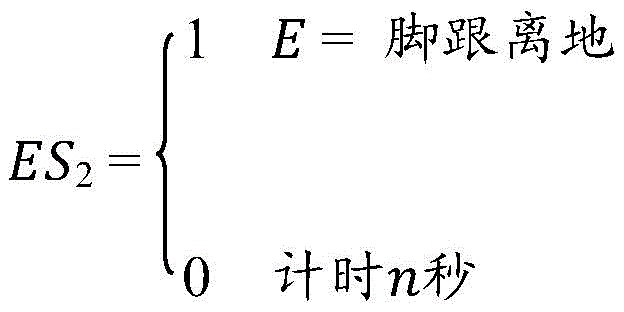
其中,ES1、ES2分别为实施在胫骨前肌和腓肠肌上的阈上电刺激,E为实时识别的步态事件,1表示实施阈上电刺激,0表示停止阈上电刺激。Among them, ES 1 and ES 2 are the suprathreshold electrical stimulation implemented on the tibialis anterior muscle and gastrocnemius respectively, E is the gait event recognized in real time, 1 indicates that the suprathreshold electrical stimulation is implemented, and 0 indicates that the suprathreshold electrical stimulation is stopped.
阈上电刺激可以为幅值70V、频率40Hz、带宽50us的对称方波电刺激。The suprathreshold electrical stimulation can be a symmetrical square wave electrical stimulation with an amplitude of 70V, a frequency of 40Hz, and a bandwidth of 50us.
气动式肌骨联合体模块还可以包括电动气泵、电动气阀和气压传感器。The pneumatic musculoskeletal complex module may also include an electric air pump, an electric air valve, and an air pressure sensor.
气动式肌骨联合体模块可以被进一步配置为根据气压传感器测量的气动肌肉中的气压值与预设压力阈值的比较,确定气动肌肉的充气或放气。The pneumatic musculoskeletal complex module may be further configured to determine inflation or deflation of the pneumatic muscle based on a comparison of the air pressure value in the pneumatic muscle measured by the air pressure sensor with a preset pressure threshold.
肌骨联合体还可以包括外骨骼,该外骨骼能作为所有电子器件、控制电路板及电池的容器。The musculoskeletal complex may also include an exoskeleton that acts as a container for all electronics, control circuit boards, and batteries.
外骨骼可以由聚交酯材料3D打印而成。Exoskeletons can be 3D printed from polylactide material.
外骨骼可以通过外骨骼延伸部与气动肌肉相连接。The exoskeleton can be connected to the pneumatic muscles via exoskeleton extensions.
振动生物反馈模块可以包括位于足底部的第一脚趾和第二脚趾之间的振动马达。The vibrating biofeedback module may include a vibrating motor located between the first toe and the second toe on the sole of the foot.
振动马达的控制方式可以如下:The vibration motor can be controlled as follows:

其中,Z表示为对振动马达的控制,Z=1表示开启振动马达,Z=0表示停止振动马达,FSR1max和FSR5max分别为脚跟离地后计时期间第一跖骨头处的第一压力传感器和第五跖骨头处的第二压力传感器的最大值,b%为预设的平衡阈值,E为实时识别的步态事件。Among them, Z represents the control of the vibration motor, Z=1 represents the start of the vibration motor, Z=0 represents the stop of the vibration motor, FSR 1max and FSR 5max are respectively the first pressure sensor at the first metatarsal head during the timing period after the heel off the ground and the maximum value of the second pressure sensor at the fifth metatarsal head, b% is the preset balance threshold, and E is the gait event recognized in real time.
康复系统还可以包括用于将所述康复系统固定于足部的紧固整合模块。The rehabilitation system may also include a fastening integration module for securing the rehabilitation system to the foot.
紧固整合模块可以包括用于连接并固定外骨骼的连接件和用于固定并缓冲气动肌肉位置的位置固定件。The fastening integration module may include connectors for connecting and securing the exoskeleton and position fixtures for securing and cushioning the position of the pneumatic muscles.
紧固整合模块可以采用透气及具有弹性的纺织材料。The fastening integrated module can adopt breathable and elastic textile materials.
气动肌肉为聚氯乙烯薄膜。The pneumatic muscles are polyvinyl chloride films.
在本发明的另一实例中,提供了一种根据在前所述的步态事件驱动的分时相、多模态足部康复系统的使用方法。In another example of the present invention, a method for using the time-sharing, multi-modal foot rehabilitation system driven by the aforementioned gait events is provided.
本发明的范围由权利要求限定,这些权利要求通过参考而被纳入本节中。对本领域的技术人员来说,通过对一个或多个实施方式的以下详细描述的思考,将对本发明的实施方式有更全面的理解,并实现其额外的优势。The scope of the invention is defined by the claims, which are incorporated into this section by reference. Those skilled in the art will gain a more complete understanding of the embodiments of the invention, and realize additional advantages thereof, from a consideration of the following detailed description of one or more embodiments.
附图说明Description of drawings
本发明的优选特征、实施例和变型可以从以下详细说明中看出,该详细说明为本领域技术人员提供了足够的信息以执行本发明。详细说明不应被视为以任何方式限制前述发明内容的范围。详细说明将参考以下多个附图:Preferred features, embodiments and modifications of the invention can be seen from the following detailed description, which provides sufficient information for those skilled in the art to practice the invention. The detailed description should not be considered in any way to limit the scope of the foregoing summary. The detailed description will refer to the following several drawings:
图1示出了现有技术中的传统踝足矫形器的图片。Figure 1 shows a picture of a conventional ankle foot orthosis in the prior art.
图2示出了本发明康复系统的控制组件结构框图。Fig. 2 shows a structural block diagram of the control components of the rehabilitation system of the present invention.
图3示出了根据本发明实施例的气动式肌骨联合体模块和神经肌肉电刺激模块的机械组装结构的示意图。Fig. 3 shows a schematic diagram of a mechanical assembly structure of a pneumatic musculoskeletal complex module and a neuromuscular electrical stimulation module according to an embodiment of the present invention.
图4示出了根据本发明实施例的气动式肌骨联合体模块包裹在紧固整合模块中的结构示意图。Fig. 4 shows a schematic structural diagram of a pneumatic musculoskeletal complex module wrapped in a fastening integration module according to an embodiment of the present invention.
图5示出了根据本发明实施例的压力传感器模块和振动生物反馈模块在足底位置分布的结构示意图。Fig. 5 shows a structural diagram of the distribution of the pressure sensor module and the vibration biofeedback module on the sole of the foot according to an embodiment of the present invention.
具体实施方式detailed description
下面将详细描述本发明的具体实施例。这里描述的实施例为下肢单侧使用的举例说明,并不用于限制本发明。本发明所提出的系统和方法也可用于下肢双侧使用。Specific embodiments of the present invention will be described in detail below. The embodiment described here is an illustration of unilateral use of the lower extremity, and is not intended to limit the present invention. The systems and methods proposed by the present invention can also be used bilaterally on the lower extremities.
本发明提供了一种步态事件驱动的分时相、多模态足部控制及反馈康复系统及其使用方法,其同时使用多通道神经肌肉电刺激、气动式肌骨联合体和感知生物反馈,用于下肢步态训练,可同时纠正足下垂和足内翻的问题。The present invention provides a gait event-driven time-sharing, multi-modal foot control and feedback rehabilitation system and method of use thereof, which simultaneously uses multi-channel neuromuscular electrical stimulation, pneumatic musculoskeletal complex and sensory biofeedback , used for lower limb gait training, can correct the problem of foot drop and foot pronation at the same time.
图2示出了本发明的康复系统的结构框图。如图2所示,本发明的康复系统包括但不限于:1)压力传感器模块110;2)神经肌肉电刺激模块100;3)气动式肌骨联合体模块200;4)振动生物反馈模块109;5)微控制模块111;6)紧固整合模块102;以及7)肌电信号放大器112。神经肌肉电刺激模块100包括:刺激发生器104和电极阵列103。气动式肌骨联合体模块200包括:电动气泵106、电动气阀107、肌骨联合体105和气压传感器108。振动生物反馈模块109包括振动马达402。Fig. 2 shows a structural block diagram of the rehabilitation system of the present invention. As shown in Figure 2, the rehabilitation system of the present invention includes but is not limited to: 1) pressure sensor module 110; 2) neuromuscular electrical stimulation module 100; 3) pneumatic musculoskeletal complex module 200; 4)
压力传感器模块110用于实时测量动态步态中不同步态事件时足部的压力值。微控制模块111接收压力传感器模块110所测量的压力值,并识别动态步态中的不同步态事件和足底内外侧的压力平衡,以驱动相应的功能模块分别提供神经肌肉电刺激、机械辅助和振动生物反馈,其中,功能模块包括神经肌肉电刺激模块100、气动式肌骨联合体模块200、以及振动生物反馈模块109。举例来说,压力传感器模块110可包括多个压力传感器。在本发明的一个实施例中,可设置有三个压力传感器,其中第一压力传感器放置于足部的第一跖骨头处,第二压力传感器放置于足部的第五跖骨头处,而第三压力传感器放置于脚跟处。举例来说,可利用粘附的方式将各个压力传感器置于相应的足底部处。The pressure sensor module 110 is used to measure the pressure value of the foot during different gait events in the dynamic gait in real time. The
图3-5示出了本发明的用于踝关节的系统结构示意图,以同时纠正下肢的足下垂和足内翻问题,并改善肌肉代偿。以下将结合图3-5,对发明的康复系统做进一步说明。3-5 are schematic diagrams showing the structure of the system for the ankle joint of the present invention, so as to simultaneously correct the problems of foot drop and foot inversion of the lower limbs, and improve muscle compensation. The rehabilitation system of the invention will be further described below in conjunction with FIGS. 3-5 .
具体地,图3示出了根据本发明实施例的气动式肌骨联合体模块和神经肌肉电刺激模块的机械组装结构的示意图;图4示出了根据本发明实施例的气动式肌骨联合体包裹在紧固整合模块中的结构示意图;以及图5示出了根据本发明实施例的压力传感器和振动生物反馈模块在足底位置分布的结构示意图。Specifically, Fig. 3 shows a schematic diagram of the mechanical assembly structure of the pneumatic musculoskeletal complex module and the neuromuscular electrical stimulation module according to an embodiment of the present invention; Fig. 4 shows a pneumatic musculoskeletal complex according to an embodiment of the present invention body wrapped in the fastening integrated module; and FIG. 5 shows a schematic structural diagram of the distribution of the pressure sensor and the vibration biofeedback module on the sole of the foot according to an embodiment of the present invention.
在根据本发明的一个实施例中,电极阵列103连接在(例如,可通过粘贴式刺激电极粘附于)用户足部患侧的胫骨前肌和腓肠肌的皮肤表面(经皮刺激),并通过导线与刺激发生器104相连,继而通过微控制模块111对足部的目标肌肉施加电刺激,以帮助用户纠正由肌肉失调导致的足下垂和足内翻问题。在该实施例中,可以给目标肌肉施加电刺激,也可用于采集相应的肌肉电信号,并经肌电信号放大器112将采集到的肌电信号反馈至微控制模块111,以用于计算肌肉动态协调性。如图3所示,电极阵列103可以包括例如2个电极。In one embodiment according to the present invention, the
电池202为整个康复系统供电,其可以为可充电电池或一次性电池。无线传输芯片201被配置为实现微控制模块111与智能设备的无线信息交互。The
如图4所示,气动式肌骨联合体包括人工肌肉305及固定于踝关节两侧的外骨骼301,其中外骨骼301可作为可内置所有电子器件、控制电路板及电池的容器(即控制盒)。人工肌肉可为电场驱动人工肌肉、气体驱动人工肌肉(气动肌肉)、热驱动人工肌肉、溶剂吸收驱动人工肌肉、电化学驱动人工肌肉等。在本发明的实施例中,选择例如气动肌肉305作为本发明的人工肌肉。气动肌肉305可以为可通过加压空气实现充气的气囊,其可以为薄膜性材料,例如聚氯乙烯薄膜或其他充气形变较小的材料。气动肌肉305由微控制模块111控制,并通过气体导管与电动气泵106、电动气阀107和气压传感器108相连接,从而实现气动肌肉的充气并维持气压和放气。As shown in Figure 4, the pneumatic musculoskeletal complex includes
外骨骼301具有弧形形状,其可以例如由聚交酯材料3D打印而成。外骨骼301可以通过外骨骼延伸部303与气动肌肉305相连。当微控制模块111触发气动肌肉305充气以及在气压维持充盈状态时,气动肌肉305与外骨骼301作为肌骨联合体一起为踝关节提供机械力学支撑,以稳固踝关节的力学结构,防止内翻。放气后,气动肌肉305变软,使得踝关节高自由度地、在没有外力辅助的情况下完成跖屈,以锻炼踝关节处的肌肉力量,防止肌肉萎缩。The
用于将康复系统固定于用户足部的紧固整合模块102可采用例如透气弹性纺织材料,从而将气动式肌骨联合体和导线整合于其中。紧固整合模块102可包括连接件304,其用于连接并固定踝关节两侧的由外骨骼301组成的控制盒,从而便于系统的穿戴并增强穿戴舒适性。在本发明的一个实施例中,连接件304可以为例如具有一定弹性的弹力魔术贴。紧固整合模块102还可以包括位置固定件302,其用于在气动肌肉305充放气时,固定并缓冲气动肌肉305的位置。在发明的一个实施例中,该位置固定件302可采用例如透气纺织材料,该透气纺织材料具有一定的弹性,以便于位置的固定和缓冲。此外,该位置固定件302可包裹足底的压力传感器模块110和振动生物反馈模块109与控制盒之间的导线。The
参照图5,三个(例如,薄膜状的)压力传感器401通过电路导线与微控制模块111连接,其中,第一压力传感器放置于第一跖骨头处,第二压力传感器放置于第五跖骨头处,第三压力传感器放置于脚跟处。压力传感器的信号用于实时识别步态事件及计算足底平衡性,以控制系统各功能模块在不同时相的配合。振动马达402放置于第一脚趾和第二脚趾之间,通过电路导线与微控制模块111连接。在步态过程中,振动马达402提供必要的振动生物反馈,提示用户主动调整足底用力平衡,以纠正足内翻问题。Referring to Fig. 5, three (for example, thin-film)
在本发明中,当足部处于动态步态过程中时,系统按以下方法识别步态事件以实现实时控制:In the present invention, when the foot is in a dynamic gait process, the system recognizes gait events in the following ways to achieve real-time control:
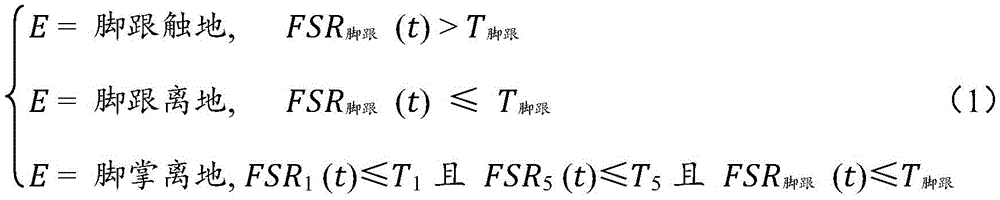
其中,E表示实时识别到的步态事件。FSR1(t)、FSR5(t)、FSR脚跟(t)分别为第一跖骨头处的第一压力传感器的实时压力数据、第五跖骨头处的第二压力传感器的实时压力数据、和脚跟处的第三压力传感器的实时压力数据。T1、T5、T脚跟分别为第一压力传感器、第二压力传感器、第三压力传感器的阈值强度,阈值强度可根据需要设置,例如预设为动态步态过程中各个压力传感器最大值的某一百分比,例如40%。Among them, E represents the gait event recognized in real time. FSR 1 (t), FSR 5 (t), and FSR heel (t) are respectively the real-time pressure data of the first pressure sensor at the first metatarsal head place, the real-time pressure data of the second pressure sensor at the fifth metatarsal head place, and Real-time pressure data from the third pressure sensor at the heel. T 1 , T 5 , and T heel are the threshold strengths of the first pressure sensor, the second pressure sensor, and the third pressure sensor respectively. The threshold strength can be set according to needs, for example, it is preset as the maximum value of each pressure sensor in the dynamic gait process. A certain percentage, such as 40%.
在初始化状态下,患侧脚跟踩地,气动式肌骨联合体模块200中的气动肌肉305处于充气状态,为其提供机械支持。In the initialization state, the heel of the affected side steps on the ground, and the
I)当脚跟处的第三压力传感器的压力值小于等于设定阈值时,系统识别为“脚跟离地”事件(迈步相开始)。通过微控制模块111触发气动式肌骨联合体模块200中的气动肌肉305进入放气状态,停止机械支持,并通过神经肌肉电刺激模块100对目标肌肉(如腓肠肌)实施阈上电刺激,实现脚踝跖屈。II)计时某一固定时值后,如2秒,系统通过微控制模块111停止对目标肌肉(如腓肠肌)释放电刺激;同时系统利用在脚踝跖屈的足底压力,判断是否指令振动生物反馈模块109提供振动生物反馈以纠正足底用力平衡。III)等待第一、第二、第三压力传感器均小于等于各自的预设阈值,系统识别为“脚掌离地”事件(迈步相中间),通过微控制模块111触发气动式肌骨联合体模块200中的气动肌肉305开始充气,同时对目标肌肉(如胫骨前肌)释放阈上电刺激,实现脚踝背屈(纠正足下垂)。此时,振动生物反馈模块109也会给予必要的振动生物反馈,提醒用户101在之后的站立相中要改进足度平衡。IV)当脚跟处的第三压力传感器的压力值大于设定阈值时,系统识别为“脚跟触地”事件(站立相开始),控制微控制模块111使神经肌肉电刺激模块100停止对目标肌肉(如胫骨前肌)释放电刺激,并且振动生物反馈模块109停止振动生物反馈,此时气动肌肉305内的气压值达最大。V)当脚跟处的第三压力传感器的压力值小于阈值时,识别回到“脚跟离地”事件(迈步相开始),步态进入循环过程。1) When the pressure value of the third pressure sensor at the heel is less than or equal to the set threshold, the system recognizes it as a "heel off the ground" event (step phase begins). The
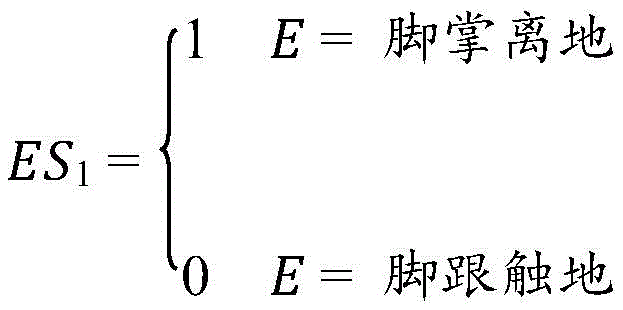
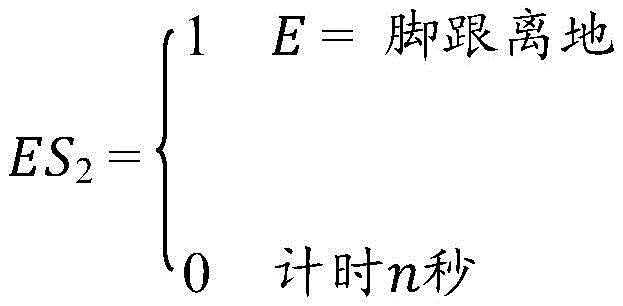
神经肌肉电刺激模块100包括电极阵列103和刺激发生器104,在该实施例中,电极阵列103为双通道刺激电极阵列。双通道刺激电极阵列贴在所控关节活动(如脚踝背屈和跖屈)的拮抗肌对(如胫骨前肌和腓肠肌)上,以进行交替式、分时相的经皮电刺激,诱发目标肌肉在相关时相中的有效收缩,用于指导步态中涉及踝关节背屈与跖屈的肌肉协调。神经肌肉电刺激的受控方式如下:The neuromuscular electrical stimulation module 100 includes an


其中ES1、ES2分别表示为目标肌肉(即胫骨前肌和腓肠肌)上的阈上神经肌肉电刺激,刺激强度根据用户情况,提前预设为某一固定值,如幅值70V,频率40Hz,带宽50us的对称方波电刺激。动态步态中脚掌离地时,系统提供相应的电刺激(ES1=1)引起胫骨前肌收缩,带动踝关节完成背屈活动,脚跟触地时,系统停止此电刺激(ES1=0)。当脚跟离地时,系统提供相应的电刺激(ES2=1)引起腓肠肌收缩,带动踝关节完成跖屈活动,此神经肌肉电刺激时间为预设的固定时间n秒,如2秒,计时2秒后系统停止此电刺激(ES2=0)。所述刺激电极阵列同时也能通过刺激电极从皮肤面表获取肌肉电信号,经肌电信号放大器放大后反馈至微控制模块111。Among them, ES 1 and ES 2 represent the suprathreshold neuromuscular electrical stimulation on the target muscles (tibialis anterior muscle and gastrocnemius muscle), and the stimulation intensity is preset to a fixed value in advance according to the user's situation, such as amplitude 70V, frequency 40Hz , Symmetrical square wave electrical stimulation with a bandwidth of 50us. When the sole of the foot leaves the ground in dynamic gait, the system provides corresponding electrical stimulation (ES 1 = 1) to cause the contraction of the tibialis anterior muscle, which drives the ankle joint to complete dorsiflexion. When the heel touches the ground, the system stops the electrical stimulation (ES 1 = 0 ). When the heel is off the ground, the system provides corresponding electrical stimulation (ES 2 = 1) to cause gastrocnemius contraction, which drives the ankle joint to complete plantar flexion. The neuromuscular electrical stimulation time is a preset fixed time n seconds, such as 2 seconds, timing After 2 seconds the system stops the electrical stimulation (ES 2 =0). The stimulating electrode array can also obtain myoelectric signals from the skin surface through the stimulating electrodes, and feed back to the
气动式肌骨联合体模块200包括但不限于:将气动肌肉305与外骨骼301相结合的肌骨联合体105、电动气阀107、电动气泵106和气压传感器108,其受控方式如下所示:The pneumatic musculoskeletal complex module 200 includes, but is not limited to: the musculoskeletal complex 105 that combines the

其中P和V分别表示对电动气泵106和电动气阀107的控制,Ap和Tp分别为气动肌肉305中的气压值和预设压力阈值,预设压力阈值根据用户个性化设置。当识别为脚掌离地且气动肌肉305中的气压小于等于预设阈值时,系统开启电动气泵106并关闭电动气阀107,触发气动肌肉305充气状态,以提供机械支持于目标关节位置。当气动肌肉305内的气压大于预设阈值时,系统停止电动气泵106充气并关闭电动气阀107,将气动肌肉305内的气压维持在预设阈值附近,防止充气过度造成气动肌肉305损坏。当识别为脚跟离地时,系统停止电动气泵106充气并打开电动气阀107,触发气动肌肉305放气,以实现蹬地期间踝关节的自由活动。肌骨联合体105中的外骨骼301及其延伸部分303,采用弧形设计贴合用户小腿,与气动肌肉一起为关节提供机械支持帮助其固定角度,防止足内翻导致软组织损伤。Where P and V represent the control of the
在本发明的一个实施例中,振动生物反馈模块109可以为位于足部第一脚趾和第二脚趾之间的振动马达402,其基于第一跖骨头处的第一压力传感器的实时压力数据FSR1和第五跖骨头处的第二压力传感器的实时压力数据FSR5操作,并且受控方式如下所示:In one embodiment of the present invention, the

其中Z表示为对振动马达402的控制,FSR1max和FSR5max分别为脚跟离地后计时期间,第一跖骨头处的第一压力传感器和第五跖骨头处的第二压力传感器的最大值,b%为预设的平衡阈值,如50%。若FSR5max与预设的平衡阈值相乘后,仍大于等于FSR1max,系统识别为步态失衡,并开启振动马达402(Z=1)以提供振动生物反馈提醒用户101调整患侧足底受力平衡,振动强度为用户可感知的机械振动阈值。若FSR5max与预设的平衡阈值相乘后,小于FSR1max,系统不触发振动马达402(Z=0),即足底平衡达标。当识别为脚跟触地事件时,系统则关闭振动马达402,停止振动生物反馈。Wherein Z represents the control to the
微控制模块111接受时序性的压力传感器模块110和气压传感器108的实时信号以识别步态事件,并下放指令实时控制神经肌肉电刺激模块100、气动式肌骨联合体模块200和振动生物反馈模块109的操作。同时,微控制模块111接受由刺激性的电极阵列103测得的肌肉电信号,经过归一化计算后,得到实时自动化评估参数,以无线数据交换方式传输至智能设备,并将训练记录和评估参数上传至云端服务器供医务人员存档、管理以及分析。自动化评估参数包括但不限于:肌肉激活水平和拮抗肌对协同收缩指数;智能设备包括但不限于:智能手机、智能平板、便携式计算机。The
本发明的系统及方法具有以下优势:The system and method of the present invention have the following advantages:
1)多模态(多种辅助技术融合)、分时相的实时控制方法用于同时纠正足下垂、足内翻,并改善肌肉代偿和萎缩,以重塑正常步态。1) A multi-modal (fusion of multiple assistive technologies), time-sharing real-time control method is used to simultaneously correct foot drop, foot inversion, and improve muscle compensation and atrophy to reshape normal gait.
2)可穿戴足踝部多模态系统结构设计。2) Structural design of wearable foot and ankle multi-modal system.
3)并给予生物反馈信号,让用户自主纠正足底平衡。3) And give a biofeedback signal to allow the user to correct the balance of the sole of the foot independently.
4)通过神经肌肉电刺激改善肌肉协调性,防肌肉萎缩。4) Improve muscle coordination and prevent muscle atrophy through neuromuscular electrical stimulation.
此下肢运动康复系统除了如实施例中用于单侧偏瘫用户同时纠正足下垂和足内翻问题,也可联机配对后便于双侧瘫痪用户使用,如脊髓损伤用户,为其提供下肢双侧运动康复训练。This lower limb exercise rehabilitation system is not only used for unilateral hemiplegia users to correct foot drop and foot inversion problems at the same time as in the embodiment, but also can be used for bilateral paraplegia users after online pairing, such as spinal cord injury users, to provide them with bilateral lower limb exercise Rehabilitation.
虽然本公开已经就有限的实施方式进行了描述,但受益于本公开的本领域的技术人员将理解可以设计出不偏离本文所述的公开范围的其他实施方式。因此,本公开的范围应只受所附权利要求书的限制。While the disclosure has been described with respect to a limited number of embodiments, those skilled in the art having the benefit of this disclosure will appreciate that other embodiments can be devised that do not depart from the scope of the disclosure described herein. Accordingly, the scope of the present disclosure should be limited only by the appended claims.
Claims (24)


Priority Applications (4)
| Application Number | Priority Date | Filing Date | Title |
|---|---|---|---|
| CN202110733839.6A CN115531135B (en) | 2021-06-30 | 2021-06-30 | Gait event-driven time-phased, multimodal foot rehabilitation system and usage method |
| PCT/CN2022/073495 WO2023273324A1 (en) | 2021-06-30 | 2022-01-24 | Gait event-driven, phase-dependent and multi-modal foot rehabilitation system and use method thereof |
| US18/575,356 US20240325750A1 (en) | 2021-06-30 | 2022-01-24 | Gait event-driven, phase-dependent and multi-modal foot rehabilitation system and use method thereof |
| EP22831158.5A EP4364710A4 (en) | 2021-06-30 | 2022-01-24 | Gait-event-controlled, phase-dependent and multimodal foot rehabilitation system and method of use therefor |
Applications Claiming Priority (1)
| Application Number | Priority Date | Filing Date | Title |
|---|---|---|---|
| CN202110733839.6A CN115531135B (en) | 2021-06-30 | 2021-06-30 | Gait event-driven time-phased, multimodal foot rehabilitation system and usage method |
Publications (2)
| Publication Number | Publication Date |
|---|---|
| CN115531135A true CN115531135A (en) | 2022-12-30 |
| CN115531135B CN115531135B (en) | 2025-08-26 |
Family
ID=84689800
Family Applications (1)
| Application Number | Title | Priority Date | Filing Date |
|---|---|---|---|
| CN202110733839.6A Active CN115531135B (en) | 2021-06-30 | 2021-06-30 | Gait event-driven time-phased, multimodal foot rehabilitation system and usage method |
Country Status (4)
| Country | Link |
|---|---|
| US (1) | US20240325750A1 (en) |
| EP (1) | EP4364710A4 (en) |
| CN (1) | CN115531135B (en) |
| WO (1) | WO2023273324A1 (en) |
Cited By (2)
| Publication number | Priority date | Publication date | Assignee | Title |
|---|---|---|---|---|
| CN117653906A (en) * | 2023-12-19 | 2024-03-08 | 太极计算机股份有限公司 | Electric stimulation method and system for regulating contraction force of foot varus muscle |
| CN119424920A (en) * | 2025-01-10 | 2025-02-14 | 中国中医科学院西苑医院 | Acupoint electrical stimulation lower limb rehabilitation equipment and use method thereof |
Families Citing this family (3)
| Publication number | Priority date | Publication date | Assignee | Title |
|---|---|---|---|---|
| CN117883719A (en) * | 2024-03-04 | 2024-04-16 | 复旦大学附属肿瘤医院 | A multi-dimensional positioning control system for a radiotherapy fixation device |
| CN119454301B (en) * | 2024-11-12 | 2025-11-14 | 北京航空航天大学 | A control method and system for an electrohydraulic active ankle prosthesis |
| CN121313432A (en) * | 2025-12-17 | 2026-01-13 | 四川大学华西医院 | Foot drop exoskeleton gait optimization method based on multi-muscle cooperation |
Citations (11)
| Publication number | Priority date | Publication date | Assignee | Title |
|---|---|---|---|---|
| US20030093021A1 (en) * | 2001-05-24 | 2003-05-15 | Amit Goffer | Gait-locomotor apparatus |
| US20070203435A1 (en) * | 2004-03-26 | 2007-08-30 | Peter Novak | System And Method For Gait Synchronized Vibratory Stimulation Of The Feet |
| JP2012176170A (en) * | 2011-02-28 | 2012-09-13 | Sendan Gakuen | Foot-part balance evaluation device, and training unit and training method |
| US20120289870A1 (en) * | 2010-10-05 | 2012-11-15 | The Board Of Trustees Of The University Of Illinois | Portable active pneumatically powered ankle-foot orthosis |
| CN105031908A (en) * | 2015-07-16 | 2015-11-11 | 于希萌 | Balancing and correcting type training device |
| CN107854774A (en) * | 2017-10-25 | 2018-03-30 | 国家康复辅具研究中心 | A wireless stimulation walking aid system driven by plantar pressure feedback |
| CN108392302A (en) * | 2018-02-10 | 2018-08-14 | 四川大学华西第二医院 | An ankle-foot orthotic device and control method thereof |
| CN108992778A (en) * | 2018-08-01 | 2018-12-14 | 龚映清 | A kind of functional muscle electric stimulation system and method based on sensor intelligent insole |
| KR20190129469A (en) * | 2018-05-11 | 2019-11-20 | 김창걸 | Device and Method for Active Functional Electrical Stimulation, Recording Medium for Performing the Method |
| KR20200059829A (en) * | 2018-11-22 | 2020-05-29 | 김창걸 | Device and method for intelligent functional electrical stimulation, recording medium for performing the method |
| CN112083807A (en) * | 2020-09-20 | 2020-12-15 | 吉林大学 | A method and device for tactile reproducing of foot topography based on sound-touch conversion |
Family Cites Families (6)
| Publication number | Priority date | Publication date | Assignee | Title |
|---|---|---|---|---|
| US7331906B2 (en) * | 2003-10-22 | 2008-02-19 | Arizona Board Of Regents | Apparatus and method for repetitive motion therapy |
| JP6277483B2 (en) * | 2014-01-24 | 2018-02-14 | パナソニックIpマネジメント株式会社 | Electrical stimulator |
| WO2015164706A1 (en) * | 2014-04-25 | 2015-10-29 | Massachusetts Institute Of Technology | Feedback method and wearable device to monitor and modulate knee adduction moment |
| CN108113788A (en) * | 2016-11-29 | 2018-06-05 | 张叡 | A kind of novel pneumatic artificial-muscle drives ankle joint straightener |
| CN213250102U (en) * | 2020-07-01 | 2021-05-25 | 浙江大学 | An ankle-foot orthosis powered by gait acquisition and neuromuscular electrical stimulation |
| CN111714842A (en) * | 2020-07-03 | 2020-09-29 | 南通大学附属医院 | New intelligent foot and ankle muscle strength training device and its working method |
-
2021
- 2021-06-30 CN CN202110733839.6A patent/CN115531135B/en active Active
-
2022
- 2022-01-24 US US18/575,356 patent/US20240325750A1/en active Pending
- 2022-01-24 WO PCT/CN2022/073495 patent/WO2023273324A1/en not_active Ceased
- 2022-01-24 EP EP22831158.5A patent/EP4364710A4/en active Pending
Patent Citations (11)
| Publication number | Priority date | Publication date | Assignee | Title |
|---|---|---|---|---|
| US20030093021A1 (en) * | 2001-05-24 | 2003-05-15 | Amit Goffer | Gait-locomotor apparatus |
| US20070203435A1 (en) * | 2004-03-26 | 2007-08-30 | Peter Novak | System And Method For Gait Synchronized Vibratory Stimulation Of The Feet |
| US20120289870A1 (en) * | 2010-10-05 | 2012-11-15 | The Board Of Trustees Of The University Of Illinois | Portable active pneumatically powered ankle-foot orthosis |
| JP2012176170A (en) * | 2011-02-28 | 2012-09-13 | Sendan Gakuen | Foot-part balance evaluation device, and training unit and training method |
| CN105031908A (en) * | 2015-07-16 | 2015-11-11 | 于希萌 | Balancing and correcting type training device |
| CN107854774A (en) * | 2017-10-25 | 2018-03-30 | 国家康复辅具研究中心 | A wireless stimulation walking aid system driven by plantar pressure feedback |
| CN108392302A (en) * | 2018-02-10 | 2018-08-14 | 四川大学华西第二医院 | An ankle-foot orthotic device and control method thereof |
| KR20190129469A (en) * | 2018-05-11 | 2019-11-20 | 김창걸 | Device and Method for Active Functional Electrical Stimulation, Recording Medium for Performing the Method |
| CN108992778A (en) * | 2018-08-01 | 2018-12-14 | 龚映清 | A kind of functional muscle electric stimulation system and method based on sensor intelligent insole |
| KR20200059829A (en) * | 2018-11-22 | 2020-05-29 | 김창걸 | Device and method for intelligent functional electrical stimulation, recording medium for performing the method |
| CN112083807A (en) * | 2020-09-20 | 2020-12-15 | 吉林大学 | A method and device for tactile reproducing of foot topography based on sound-touch conversion |
Cited By (2)
| Publication number | Priority date | Publication date | Assignee | Title |
|---|---|---|---|---|
| CN117653906A (en) * | 2023-12-19 | 2024-03-08 | 太极计算机股份有限公司 | Electric stimulation method and system for regulating contraction force of foot varus muscle |
| CN119424920A (en) * | 2025-01-10 | 2025-02-14 | 中国中医科学院西苑医院 | Acupoint electrical stimulation lower limb rehabilitation equipment and use method thereof |
Also Published As
| Publication number | Publication date |
|---|---|
| WO2023273324A1 (en) | 2023-01-05 |
| EP4364710A4 (en) | 2025-07-02 |
| EP4364710A1 (en) | 2024-05-08 |
| CN115531135B (en) | 2025-08-26 |
| US20240325750A1 (en) | 2024-10-03 |
Similar Documents
| Publication | Publication Date | Title |
|---|---|---|
| CN115531135B (en) | Gait event-driven time-phased, multimodal foot rehabilitation system and usage method | |
| CN111167011B (en) | Sensors in footwear or limb clothing | |
| KR100946186B1 (en) | Robot Orthosis Of Not | |
| US11324653B2 (en) | Exoskeleton for assisting human movement | |
| Lyons et al. | A review of portable FES-based neural orthoses for the correction of drop foot | |
| US9272139B2 (en) | Universal closed-loop electrical stimulation system | |
| CN105307719B (en) | Local nerve stimulation instrument | |
| Lenzi et al. | Powered hip exoskeletons can reduce the user's hip and ankle muscle activations during walking | |
| JP4216725B2 (en) | Muscle stimulator | |
| US8308665B2 (en) | Method and apparatus for improving human balance and gait and preventing foot injury | |
| Kinnaird et al. | Medial gastrocnemius myoelectric control of a robotic ankle exoskeleton | |
| CN111167010A (en) | Control system for motion reconstruction and/or recovery of patients | |
| CN112089577A (en) | Interactive training of exoskeleton robot based on surface electromyography and functional electrical stimulation | |
| CN112153936A (en) | Monitoring physiological parameters and temporal feedback during an activity to enhance a subject's performance | |
| JP2004313555A (en) | Functional electrostimulation walking assisting device | |
| CN115969316B (en) | Training evaluation system and knee joint training evaluation method based on digital knee brace | |
| CN214596823U (en) | Electrical stimulation system based on plantar pressure feedback | |
| CN103784294B (en) | Walking aid for recovery of apoplectic hemiplegia patient | |
| CN117224367A (en) | Lower limb exoskeleton rehabilitation training system based on sensor mapping | |
| HK40082656A (en) | Gait event-driven, phase-dependent and multi-modal foot rehabilitation system and use method thereof | |
| CN215131154U (en) | An orthopedic shoe combining ankle-foot orthosis and functional electrical stimulation | |
| CN115671548A (en) | External feedback type modularized rehabilitation exoskeleton based on functional electrical stimulation | |
| CN214967324U (en) | Ankle-foot external fixation device with limb pneumatic and electrical stimulation therapy | |
| Basla et al. | Sensory-motor neurostimulation to enhance exosuit performance | |
| Bouri et al. | Closed-loop functional electrical stimulation for gait training for patients with paraplegia |
Legal Events
| Date | Code | Title | Description |
|---|---|---|---|
| PB01 | Publication | ||
| PB01 | Publication | ||
| SE01 | Entry into force of request for substantive examination | ||
| SE01 | Entry into force of request for substantive examination | ||
| REG | Reference to a national code |
Ref country code: HK Ref legal event code: DE Ref document number: 40082656 Country of ref document: HK |
|
| GR01 | Patent grant | ||
| GR01 | Patent grant |