CN115457058A - An Image Segmentation Method Based on Uncertainty-Guided Deep Learning Strategy and Its Application - Google Patents
An Image Segmentation Method Based on Uncertainty-Guided Deep Learning Strategy and Its Application Download PDFInfo
- Publication number
- CN115457058A CN115457058A CN202211200401.2A CN202211200401A CN115457058A CN 115457058 A CN115457058 A CN 115457058A CN 202211200401 A CN202211200401 A CN 202211200401A CN 115457058 A CN115457058 A CN 115457058A
- Authority
- CN
- China
- Prior art keywords
- image
- boundary
- segmentation
- uncertainty
- deep learning
- Prior art date
- Legal status (The legal status is an assumption and is not a legal conclusion. Google has not performed a legal analysis and makes no representation as to the accuracy of the status listed.)
- Pending
Links
Images


Classifications
-
- G—PHYSICS
- G06—COMPUTING OR CALCULATING; COUNTING
- G06T—IMAGE DATA PROCESSING OR GENERATION, IN GENERAL
- G06T7/00—Image analysis
- G06T7/10—Segmentation; Edge detection
- G06T7/11—Region-based segmentation
-
- G—PHYSICS
- G06—COMPUTING OR CALCULATING; COUNTING
- G06N—COMPUTING ARRANGEMENTS BASED ON SPECIFIC COMPUTATIONAL MODELS
- G06N3/00—Computing arrangements based on biological models
- G06N3/02—Neural networks
- G06N3/04—Architecture, e.g. interconnection topology
-
- G—PHYSICS
- G06—COMPUTING OR CALCULATING; COUNTING
- G06N—COMPUTING ARRANGEMENTS BASED ON SPECIFIC COMPUTATIONAL MODELS
- G06N3/00—Computing arrangements based on biological models
- G06N3/02—Neural networks
- G06N3/08—Learning methods
-
- G—PHYSICS
- G06—COMPUTING OR CALCULATING; COUNTING
- G06T—IMAGE DATA PROCESSING OR GENERATION, IN GENERAL
- G06T5/00—Image enhancement or restoration
- G06T5/70—Denoising; Smoothing
-
- G—PHYSICS
- G06—COMPUTING OR CALCULATING; COUNTING
- G06T—IMAGE DATA PROCESSING OR GENERATION, IN GENERAL
- G06T2207/00—Indexing scheme for image analysis or image enhancement
- G06T2207/20—Special algorithmic details
- G06T2207/20081—Training; Learning
Landscapes
- Engineering & Computer Science (AREA)
- Physics & Mathematics (AREA)
- Theoretical Computer Science (AREA)
- General Physics & Mathematics (AREA)
- General Health & Medical Sciences (AREA)
- Molecular Biology (AREA)
- Biophysics (AREA)
- Computational Linguistics (AREA)
- Data Mining & Analysis (AREA)
- Evolutionary Computation (AREA)
- Artificial Intelligence (AREA)
- Biomedical Technology (AREA)
- Computing Systems (AREA)
- General Engineering & Computer Science (AREA)
- Life Sciences & Earth Sciences (AREA)
- Mathematical Physics (AREA)
- Software Systems (AREA)
- Health & Medical Sciences (AREA)
- Computer Vision & Pattern Recognition (AREA)
- Image Analysis (AREA)
Abstract
本发明公开了一种基于不确定性引导的深度学习策略的图像分割方法及应用,其包括以下步骤:(1)基于现有深度学习网络对眼底图像进行粗分割,得到视杯区域对应的粗分割结果;(2)借助形态学操作处理图像粗分割结果,得到一个视杯边界可能出现的大概区域,即潜在的边界区域;(3)利用传统的高斯滤波对潜在的边界区域进行平滑处理,可得到目标边界对应的不确定性图像;(4)基于边界不确定性图像和原始图像,重新训练选定的深度学习网络,执行眼底视杯的精细分割,可在不改变网络结构的条件下得到更加准确的目标提取性能。基于公开的REFUGE眼底图像数据的视杯分割实验显示:本发明能够显著改善现有深度学习网络的图像分割性能,大幅改善眼底图像中的视杯的提取精度。
The invention discloses an image segmentation method based on an uncertainty-guided deep learning strategy and its application, which includes the following steps: (1) Roughly segment the fundus image based on the existing deep learning network, and obtain the rough image corresponding to the optic cup region; Segmentation results; (2) use morphological operations to process the rough image segmentation results to obtain a possible area of the cup boundary, that is, the potential boundary area; (3) use traditional Gaussian filtering to smooth the potential boundary area, The uncertainty image corresponding to the target boundary can be obtained; (4) Based on the boundary uncertainty image and the original image, retrain the selected deep learning network and perform fine segmentation of the fundus cup, which can be achieved without changing the network structure. Get more accurate object extraction performance. The optic cup segmentation experiment based on the public REFUGE fundus image data shows that the present invention can significantly improve the image segmentation performance of the existing deep learning network, and greatly improve the extraction accuracy of the optic cup in the fundus image.
Description
技术领域technical field
本发明具体涉及一种基于不确定性引导的深度学习策略的图像分割方法及应用。The present invention specifically relates to an image segmentation method and application based on an uncertainty-guided deep learning strategy.
背景技术Background technique
图像分割是一种依据像素的灰度分布和组织对比度等特性将整幅图像分为若干个彼此独立的局部区域的技术。该技术不仅可用于图像的理解与分析、病灶的探测定位及其形态特征的测量评估中,而且是许多图像处理任务中的一个关键预处理步骤,因此在图像处理中具有十分重要的作用。为准确提取所需的图像区域,人们提出了各种不同的图像分割算法并将它们分为无监督分割和有监督分割。Image segmentation is a technology that divides the entire image into several independent local areas according to the gray distribution of pixels and tissue contrast. This technology can not only be used in the understanding and analysis of images, the detection and location of lesions and the measurement and evaluation of morphological characteristics, but also is a key preprocessing step in many image processing tasks, so it plays a very important role in image processing. In order to accurately extract the required image regions, various image segmentation algorithms have been proposed and divided into unsupervised segmentation and supervised segmentation.
无监督分割算法通常根据图像的颜色和灰度分布,不同组织结构之间的形状和位置关系等特性,执行兴趣目标与无关背景的分辨,实现目标区域的准确提取。这类算法通常具有操作简单,运行快速的特点,能够有效处理成像质量相对较好的图像,但是容易受图像伪影或噪声的干扰,导致其难以从具有严重成像伪影、噪声、或者较弱组织对比度等现象的图像中提取目标区域。此外,这类算法的性能往往与个人经验密切相关,因为算法中相关参数的是依靠个人的,不合适的参数值和多变的成像条件将严重退化算法的图像分割性能,导致其无法胜任大规模临床图像的高质量处理。The unsupervised segmentation algorithm usually distinguishes the target of interest from the irrelevant background according to the color and gray distribution of the image, the shape and position relationship between different tissue structures, and realizes the accurate extraction of the target area. This type of algorithm usually has the characteristics of simple operation and fast operation, and can effectively process images with relatively good imaging quality, but it is easily disturbed by image artifacts or noise, making it difficult to process images with severe imaging artifacts, noise, or weak images. Extract regions of interest in images of phenomena such as tissue contrast. In addition, the performance of this type of algorithm is often closely related to personal experience, because the relevant parameters in the algorithm depend on the individual, and inappropriate parameter values and changing imaging conditions will seriously degrade the image segmentation performance of the algorithm, making it incapable of performing large-scale tasks. High-quality processing of clinical images at scale.
有监督分割算法大多借助手工标注信息,辅助图像特征信息的探测和兴趣目标的提取。手工标注信息的使用使得这类算法能够有效缓解图像伪影或噪声对分割性能的影响,使其具有比无监督分割算法更好的目标提取性能。当前,基于深度学习的分割算法是有监督分割领域中的一个重点研究方向;这类算法能够执行端到端的图像分割并且获得极高的精度,其中代表性的分割网络是U-Net。该网络被广泛用于各种图像的处理中并获得合理的分割性能,但是它难以处理目标的边界区域而具有较大的边界探测误差。这是因为U-Net多次下采样图像,会导致图像分辨率的显著降低、目标边界的模糊和大量纹理信息的丢失。为提升U-Net的分割性能,大量的改进算法被提出来,例如Attention U-Net、BiO-Net和U-Net++等网络。这些改进网络通过使用不同的网络结构,获取大量目标相关的特征信息,从而降低多次下采样造成的信息丢失;但是网络结构的设计往往是十分复杂的,需要大量的专业知识作为支撑。Most supervised segmentation algorithms rely on manual annotation information to assist in the detection of image feature information and the extraction of objects of interest. The use of manual annotation information enables this type of algorithm to effectively alleviate the impact of image artifacts or noise on segmentation performance, making it have better target extraction performance than unsupervised segmentation algorithms. Currently, the segmentation algorithm based on deep learning is a key research direction in the field of supervised segmentation; this type of algorithm can perform end-to-end image segmentation and obtain extremely high accuracy, and the representative segmentation network is U-Net. This network is widely used in various image processing and obtains reasonable segmentation performance, but it is difficult to deal with the boundary area of the target and has a large boundary detection error. This is because U-Net downsamples the image multiple times, which will lead to a significant reduction in image resolution, blurring of object boundaries, and loss of a large amount of texture information. In order to improve the segmentation performance of U-Net, a large number of improved algorithms have been proposed, such as Attention U-Net, BiO-Net and U-Net++ networks. These improved networks obtain a large amount of target-related feature information by using different network structures, thereby reducing the information loss caused by multiple downsampling; however, the design of the network structure is often very complicated and requires a lot of professional knowledge as support.
发明内容Contents of the invention
针对现有技术存在的不足,本发明的目的在于提供一种基于不确定性引导的深度学习策略的图像分割方法及应用,借助现有的图像分割网络实现兴趣目标的粗分割并在粗分割的基础上构建一个边界不确定性图像,然后基于边界不确定性图像和原始图像重新训练分割网络,执行目标区域的精细分割,从而改善现有分割网络的分割性能。Aiming at the deficiencies in the existing technology, the purpose of the present invention is to provide an image segmentation method and application based on an uncertainty-guided deep learning strategy, and realize the rough segmentation of the target of interest with the help of the existing image segmentation network. A boundary uncertainty image is constructed on the basis, and then the segmentation network is retrained based on the boundary uncertainty image and the original image to perform fine segmentation of the target area, thereby improving the segmentation performance of the existing segmentation network.
为实现上述目的,本发明提供了如下技术方案:To achieve the above object, the present invention provides the following technical solutions:
一种基于不确定性引导的深度学习策略的图像分割方法,其包括:An image segmentation method based on an uncertainty-guided deep learning strategy, which includes:
1)基于图像分割网络对图像进行粗分割, 根据待分割医学图像和对应手工标注信息执行兴趣目标的初步提取;1) Roughly segment the image based on the image segmentation network, and perform preliminary extraction of the target of interest according to the medical image to be segmented and the corresponding manual annotation information;
2)对粗分割的结果进行边界区域提取;2) Extract the boundary area from the result of rough segmentation;
3)利用高斯滤波对潜在边界区域对应的二值图像进行平滑处理,使得二值图像转换为所需的边界不确定性图像,3) Use Gaussian filtering to smooth the binary image corresponding to the potential boundary area, so that the binary image is converted into the required boundary uncertainty image,
4)基于步骤3)获取的边界不确定性图像,将边界不确定性图像和待分割的原始图像整合起来,然后将整合结果和原始图像对应的手工标注信息输入到当前图像分割网络中,进行深度学习模型的训练。4) Based on the boundary uncertainty image obtained in step 3), integrate the boundary uncertainty image and the original image to be segmented, and then input the integration result and the manual annotation information corresponding to the original image into the current image segmentation network to perform Training of deep learning models.
所述分割网络为U-Net分割网络。The segmentation network is a U-Net segmentation network.
步骤2)中,通过形态学操作对兴趣目标的粗分割结果分别进行膨胀和腐蚀处理,膨胀和腐蚀操作中,将它们的结构元素均设为25*25的圆形区域,可得到粗分割结果对应的扩大和缩小版本,然后对膨胀和腐蚀结果进行基于像素的减法处理,从而得到一个以粗分割边界为中心的近似环形的潜在边界区域。In step 2), the rough segmentation results of the target of interest are respectively expanded and eroded through morphological operations. In the expansion and erosion operations, their structural elements are all set to a circular area of 25*25, and the rough segmentation results can be obtained corresponding dilated and shrunk versions, followed by pixel-based subtraction of the dilated and eroded results, resulting in an approximately ring-shaped potential boundary region centered on the coarse segmentation boundary.
步骤4)中采用的分割策略如下:The segmentation strategy adopted in step 4) is as follows:
a)直接基于边界不确定性图像训练现有的深度学习网络;a) Train existing deep learning networks directly based on boundary uncertainty images;
b)将原始图像和边界不确定性图像整合起来并用其训练现有的深度学习网络;b) Integrate the original image and the boundary uncertainty image and use it to train the existing deep learning network;
c)借助边界不确定性图像,首先剔除原始图像中的背景区域;然后将其与边界不确定性图像整合起来,用于深度学习网络的训练。c) With the help of the boundary uncertainty image, first remove the background area in the original image; then integrate it with the boundary uncertainty image for the training of the deep learning network.
一种基于上述基于不确定性引导的深度学习策略的图像分割方法的应用,所述不确定性引导的深度学习方法应用于眼底视杯分割。An application of an image segmentation method based on the above uncertainty-guided deep learning strategy, where the uncertainty-guided deep learning method is applied to fundus cup segmentation.
其包括以下步骤:It includes the following steps:
1)采用U-Net分割网络执行眼底图像中视杯区域的粗分割;1) Use the U-Net segmentation network to perform a rough segmentation of the cup area in the fundus image;
2)步骤1)中的粗分割结果粗略地指出了兴趣目标可能出现的区域,采用形态学操作对兴趣目标的粗分割结果分别进行膨胀和腐蚀处理,可得到扩大和缩小后的分割结果;然后对二者进行基于像素的减法处理,从而得到一个近似环形的潜在边界区域;2) The rough segmentation result in step 1) roughly points out the area where the target of interest may appear, and the rough segmentation result of the target of interest is expanded and eroded by morphological operations, and the enlarged and reduced segmentation results can be obtained; then Perform a pixel-based subtraction process on the two to obtain an approximately circular potential boundary area;
3)借助传统的高斯滤波对潜在边界区域对应的二值图像进行平滑处理,使得二值图像转换为所需的边界不确定性图像;3) With the help of traditional Gaussian filtering, the binary image corresponding to the potential boundary area is smoothed, so that the binary image is converted into the required boundary uncertainty image;
4)基于步骤3)获取的边界不确定性图像,进行目标区域的精细分割,并重新训练当前分割网络。4) Based on the boundary uncertainty image obtained in step 3), perform fine segmentation of the target area and retrain the current segmentation network.
一种存储介质,所述存储介质中存储有指令,当计算机读取所述指令时,使所述计算机执行上述的基于不确定性引导的深度学习策略的图像分割方法。A storage medium, where instructions are stored, and when a computer reads the instructions, the computer is made to execute the above image segmentation method based on the uncertainty-guided deep learning strategy.
本发明的有益效果:提供了一个新的网络训练策略并借助现有的分割网络,从粗到精地执行兴趣目标的高质量分割。The beneficial effect of the present invention is to provide a new network training strategy and use the existing segmentation network to perform high-quality segmentation of the target of interest from coarse to fine.
附图说明Description of drawings
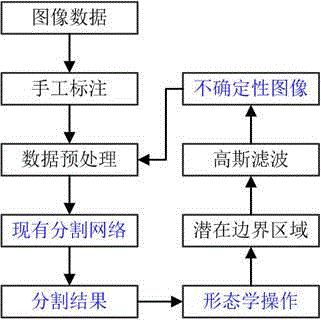
图1是本发明中不确定性引导的深度学习策略的示意简图。Fig. 1 is a schematic diagram of an uncertainty-guided deep learning strategy in the present invention.
图2是用于验证U-Net在拟设计的学习策略下的眼底视杯分割数据;从左到右分别为公开的REFUGE数据集中的一幅待分割眼底图像、局部视盘区域图像以及视杯对应手工标注。Figure 2 is the fundus cup segmentation data used to verify U-Net under the proposed learning strategy; from left to right are a fundus image to be segmented, a local optic disc region image, and the cup correspondence in the public REFUGE dataset Annotated by hand.
图3是基于U-Net网络的视杯粗分割结果及其对应的潜在边界区域图像和边界不确定性图像。Figure 3 is the rough segmentation result of the optic cup based on the U-Net network and its corresponding potential boundary area image and boundary uncertainty image.
图4是U-Net网络粗和精分割结果及其与手工标注间的信息差异;它们对应的视杯边界曲线分别为红色、蓝色和白色。Figure 4 shows the rough and fine segmentation results of the U-Net network and the information difference between them and manual annotations; their corresponding cup boundary curves are red, blue and white, respectively.
具体实施方式detailed description
下面将结合本发明实施例中的附图,对本发明实施例中的技术方案进行清楚、完整地描述,显然,所描述的实施例仅仅是本发明的一部分实施例,而不是全部的实施例。基于本发明中的实施例,本领域普通技术人员在没有作出创造性劳动前提下所获得的所有其他实施例,都属于本发明保护的范围。The following will clearly and completely describe the technical solutions in the embodiments of the present invention with reference to the accompanying drawings in the embodiments of the present invention. Obviously, the described embodiments are only part of the embodiments of the present invention, not all of them. Based on the embodiments of the present invention, all other embodiments obtained by persons of ordinary skill in the art without creative efforts fall within the protection scope of the present invention.
需要说明,本发明实施例中所有方向性指示(诸如上、下、左、右、前、后……)仅用于解释在某一特定姿态(如附图所示)下各部件之间的相对位置关系、运动情况等,如果该特定姿态发生改变时,则该方向性指示也相应地随之改变。It should be noted that all directional indications (such as up, down, left, right, front, back...) in the embodiments of the present invention are only used to explain the relationship between the components in a certain posture (as shown in the accompanying drawings). Relative positional relationship, movement conditions, etc., if the specific posture changes, the directional indication will also change accordingly.
如图所示,本发明提供了一种基于不确定性引导的深度学习策略的图像分割方法,其包括:As shown in the figure, the present invention provides an image segmentation method based on an uncertainty-guided deep learning strategy, which includes:
1)基于图像分割网络对图像进行粗分割, 根据待分割医学图像和对应手工标注信息执行兴趣目标的初步提取;1) Roughly segment the image based on the image segmentation network, and perform preliminary extraction of the target of interest according to the medical image to be segmented and the corresponding manual annotation information;
2)对粗分割的结果进行边界区域提取;2) Extract the boundary area from the result of rough segmentation;
3)利用高斯滤波对潜在边界区域对应的二值图像进行平滑处理,使得二值图像转换为所需的边界不确定性图像,3) Use Gaussian filtering to smooth the binary image corresponding to the potential boundary area, so that the binary image is converted into the required boundary uncertainty image,
4)基于步骤3)获取的边界不确定性图像,将边界不确定性图像和待分割的原始图像整合起来,然后将整合结果和原始图像对应的手工标注信息输入到当前图像分割网络中,进行深度学习模型的训练。具体地,首先根据不同的策略将边界不确定性图像和待分割的原始图像整合起来,然后将整合结果和原始图像对应的手工标注输入到选定的图像分割网络中,进行深度学习模型的训练。模型训练中,使用Dice函数为代价函数,使用RMSprop算法最大化Dice函数,优化算法的学习比率设为0.001,其他参数(如batch size和epoch等)视具体训练模型的硬件配置情况而定。4) Based on the boundary uncertainty image obtained in step 3), integrate the boundary uncertainty image and the original image to be segmented, and then input the integration result and the manual annotation information corresponding to the original image into the current image segmentation network to perform Training of deep learning models. Specifically, firstly, the boundary uncertainty image and the original image to be segmented are integrated according to different strategies, and then the integration result and the manual annotation corresponding to the original image are input into the selected image segmentation network to train the deep learning model . In model training, use the Dice function as the cost function, use the RMSprop algorithm to maximize the Dice function, and set the learning rate of the optimization algorithm to 0.001. Other parameters (such as batch size and epoch, etc.) depend on the hardware configuration of the specific training model.
步骤4)中采用的分割策略如下:The segmentation strategy adopted in step 4) is as follows:
a)直接基于边界不确定性图像训练现有的深度学习网络;a) Train existing deep learning networks directly based on boundary uncertainty images;
b)将原始图像和边界不确定性图像整合起来并用其训练现有的深度学习网络;b) Integrate the original image and the boundary uncertainty image and use it to train the existing deep learning network;
c)借助边界不确定性图像,首先剔除原始图像中的背景区域;然后将其与边界不确定性图像整合起来,用于深度学习网络的训练。c) With the help of the boundary uncertainty image, first remove the background area in the original image; then integrate it with the boundary uncertainty image for the training of the deep learning network.
现有深度学习网络(如经典的U-Net)在执行眼底图像中视杯的分割时通常难以有效处理视杯的边界区域,导致相对较大的边界探测与提取误差,严重制约了网络模型的实际应用。导致这种边界探测误差的原因主要包括如下几个方面:(a)现有深度学习网络大多需要多次下采样待分割图像,以加速特征信息的提取、减少网络训练时间、以及降低训练过程对计算机硬件设备的要求;这些下采样不可避免地造成边界区域内图像信息的丢失和目标边界的模糊;(b)目标的边界区域是目标和背景之间的过渡区域,该区域相对目标的其他区域往往具有更加复杂的灰度分布特性和相对模糊的组织边界,这导致边界区域的探测处理通常是一个较为挑战性的任务;(c)眼底图像对成像设备、成像角度和曝光强度等条件极为敏感,这种成像特性导致眼底图像比其他模态的医学图像更易引发深度学习网络分割性能的退化。The existing deep learning network (such as the classic U-Net) is usually difficult to effectively deal with the boundary area of the cup when performing the segmentation of the cup in the fundus image, resulting in a relatively large boundary detection and extraction error, which seriously restricts the practicality of the network model. application. The reasons for this boundary detection error mainly include the following aspects: (a) Most of the existing deep learning networks need to downsample the image to be segmented multiple times to speed up the extraction of feature information, reduce the network training time, and reduce the training process. Requirements for computer hardware equipment; these downsampling inevitably cause loss of image information in the boundary area and blurring of the target boundary; (b) the boundary area of the target is the transition area between the target and the background, and this area is relative to other areas of the target It often has more complex gray distribution characteristics and relatively fuzzy tissue boundaries, which makes the detection and processing of boundary areas usually a challenging task; (c) fundus images are extremely sensitive to conditions such as imaging equipment, imaging angle, and exposure intensity , this imaging characteristic causes fundus images to degrade the segmentation performance of deep learning networks more easily than medical images of other modalities.
因此,需要对目标的边界区域进行针对性的处理,以降低边界的探测提取误差。为探测目标的边界区域,可利用现有的深度学习网络初步获取可能的边界区域。基于此,本发明基于现有的U-Net网络对眼底图像中的视杯区域进行初步的分割,以经典的U-Net分割网络为例,根据待分割医学图像和对应手工标注信息执行兴趣目标的初步提取,得到视杯区域的粗分割结果。Therefore, it is necessary to carry out targeted processing on the boundary area of the target to reduce the detection and extraction error of the boundary. In order to detect the boundary area of the target, the existing deep learning network can be used to initially obtain the possible boundary area. Based on this, the present invention performs a preliminary segmentation of the optic cup region in the fundus image based on the existing U-Net network. Taking the classic U-Net segmentation network as an example, the object of interest is executed according to the medical image to be segmented and the corresponding manual labeling information. The preliminary extraction of the optic cup region is obtained by the rough segmentation results.
目标的粗分割结果可看着是对待分割图像进行高度凝练后的一种特征图像,该图像虽然在边界区域具有相对较大的分割误差,但是它粗略地指出了兴趣目标所在的区域,根据该区域就能找到目标边界的潜在区域。一旦获取潜在的边界区域,就可以让深度学习网络对该区域进行精细的处理,从而有效提升图像的整体分割结果,降低边界区域的分割误差。基于此,本发明通过OpenCV中的cv2.dilate和cv2.erode形态学操作对兴趣目标的粗分割结果分别进行膨胀和腐蚀处理,膨胀和腐蚀操作中,将它们的结构元素均设为25*25的圆形区域,可得到粗分割结果对应的扩大和缩小版本,然后对膨胀和腐蚀结果进行基于像素的减法处理,从而得到一个以粗分割边界为中心的近似环形的潜在边界区域。由于粗分割结果是二值图像(binary image),即目标区域的像素灰度值均为1,背景区域的像素灰度值均为0;这导致目标边界的潜在区域也是一个二值图像,从而严重制约深度学习网络从该区域探测足够的特征信息。为了从潜在的边界区域提取足够的特征信息,便需要对其进行必要的处理。The rough segmentation result of the target can be regarded as a highly condensed feature image of the image to be segmented. Although the image has a relatively large segmentation error in the boundary area, it roughly points out the area where the target of interest is located. According to the region to find the potential region of the target boundary. Once the potential boundary area is obtained, the deep learning network can be used to fine-tune the area, thereby effectively improving the overall segmentation result of the image and reducing the segmentation error of the boundary area. Based on this, the present invention respectively expands and erodes the rough segmentation results of the target of interest through the cv2.dilate and cv2.erode morphological operations in OpenCV. The corresponding enlarged and reduced versions of the rough segmentation results can be obtained, and then pixel-based subtraction is performed on the dilated and eroded results to obtain an approximate ring-shaped potential boundary area centered on the rough segmentation boundary. Since the rough segmentation result is a binary image (binary image), that is, the gray value of the pixel in the target area is 1, and the gray value of the pixel in the background area is 0; this leads to the potential area of the target boundary is also a binary image, thus This severely constrains deep learning networks to detect enough feature information from this region. In order to extract enough feature information from potential boundary regions, it needs to be processed as necessary.
由于粗分割结果对应的边界是非常接近兴趣目标的手工标注边界的,因此可在粗分割结果对应边界的附近提取一个指定宽度的区域作为目标边界可能出现的区域,即潜在边界区域。为获取边界的潜在区域,本发明借助形态学操作对兴趣目标的粗分割结果分别进行膨胀和腐蚀处理(膨胀和腐蚀操作使用相同的结构元素,确保膨胀和腐蚀结果在粗分割边界上具有一定的对称性),可得到扩大和缩小版的粗分割结果;然后对两种处理结果进行基于像素的减法运算,即可得到所需的一个近似环形的图像区域。该区域给出了目标边界可能出现的一个粗略范围,并且在区域中线上具有较大的出现概率,在距离区域中线越远的地方边界出现概率往往越小。然而,潜在边界区域和粗分割结果对应图像都是二值图像(即目标区域内的像素灰度均为1,背景区域内的像素灰度均为0),这导致它们具有较少的纹理特征,不利于深度学习网络的特征探测,因此需要将潜在边界区域转化为具有特定灰度分布的灰度尺度图像并用其指导图像的精细分割。Since the boundary corresponding to the rough segmentation result is very close to the manually marked boundary of the target of interest, an area of specified width can be extracted near the corresponding boundary of the rough segmentation result as the area where the target boundary may appear, that is, the potential boundary area. In order to obtain the potential area of the boundary, the present invention uses morphological operations to expand and corrode the rough segmentation results of the target of interest respectively (expansion and erosion operations use the same structural elements to ensure that the expansion and erosion results have a certain degree of accuracy on the coarse segmentation boundary. Symmetry) to obtain the enlarged and reduced version of the rough segmentation results; and then perform a pixel-based subtraction operation on the two processing results to obtain the desired approximate ring-shaped image area. This area gives a rough range where the target boundary may appear, and has a higher probability of occurrence on the center line of the area, and the farther away from the center line of the area, the lower the probability of appearance of the boundary. However, both the latent boundary region and the corresponding image of the coarse segmentation result are binary images (i.e., the grayscale of pixels in the target region is 1, and the grayscale of pixels in the background region is 0), which leads to them having less texture features , is not conducive to the feature detection of the deep learning network, so it is necessary to convert the potential boundary area into a gray-scale image with a specific gray-scale distribution and use it to guide the fine segmentation of the image.
目标边界的潜在区域是近似环形的,将该区域与粗分割结果和目标对应手工标注图像进行对比后,可以直观地看出:(a)粗分割对应的目标边界处于环形的中线附近;(b)距离环形中线越远的地方属于目标边界的可能性就越低,反之则越高。因此,需要设计合适的策略将潜在边界区域对应的二值图像转换为具有独特灰度分布的灰度尺度图像(grayscale image)。该灰度尺度图像在潜在边界区域的中线上具有最大的灰度取值而在区域的边缘处具有最小的灰度取值。基于此,本发明借助传统的高斯滤波(Gaussianfilter)对潜在边界区域对应的二值图像进行平滑处理,使得二值图像转换为所需的灰度尺度图像,该灰度尺度图像中每个像素的灰度值表示其属于目标边界的可能性,因此可将它称为边界不确定性图像(boundary uncertainty map)。The potential area of the target boundary is approximately ring-shaped. After comparing the area with the rough segmentation result and the corresponding manually labeled image of the target, it can be seen intuitively that: (a) the target boundary corresponding to the rough segmentation is near the center line of the ring; (b ) is farther away from the centerline of the ring, the lower the possibility of belonging to the target boundary, and vice versa. Therefore, it is necessary to design a suitable strategy to convert the binary image corresponding to the potential boundary region into a grayscale image with a unique grayscale distribution. The grayscale image has the largest grayscale value on the centerline of the potential boundary region and the smallest grayscale value at the edge of the region. Based on this, the present invention uses the traditional Gaussian filter to smooth the binary image corresponding to the potential boundary area, so that the binary image is converted into the required grayscale image, and the grayscale image of each pixel The gray value represents the possibility that it belongs to the boundary of the object, so it can be called a boundary uncertainty map (boundary uncertainty map).
一旦获得兴趣目标对应的边界不确定性图像,就可以基于该图像进行目标区域的精细分割,具体的精分割策略可能包括如下几种:(a)直接基于边界不确定性图像训练选定的深度学习网络;(b)将待分割原始图像及其对应的边界不确定性图像整合起来后用于现有深度学习网络的训练;(c)借助边界不确定性图像,首先剔除待分割原始图像中的远离潜在边界区域的无关背景;然后将其与边界不确定性图像整合起来,用于深度学习网络的训练。基于上述几种训练策略,重新训练选定的深度学习网络,可有效降低目标边界的探测误差,实现目标区域的精细分割。与传统的分割训练策略相比,本发明中基于不确定性引导的训练策略具有如特点:(a)通过执行两次不同的网络训练,实现兴趣目标从粗到精的高质量提取,有效降低分割网络对目标边界的处理误差;(b)将深度学习技术与传统的高斯滤波整合起来,实现边界区域的粗略定位和无关背景的排除,有助于深度学习网络针对性学习特定的图像区域;(c)本发明具有较好的通用性,可利用现有的分割网络、优化算法、以及代价函数执行不同类型图像的分割任务。Once the boundary uncertainty image corresponding to the target of interest is obtained, fine segmentation of the target area can be performed based on the image. Specific fine segmentation strategies may include the following: (a) directly train the selected depth based on the boundary uncertainty image learning network; (b) integrate the original image to be segmented and its corresponding boundary uncertainty image and use it for the training of the existing deep learning network; (c) use the boundary uncertainty image to first eliminate the original image to be segmented The irrelevant background far away from the potential boundary region; it is then integrated with the boundary uncertainty image for the training of the deep learning network. Based on the above several training strategies, retraining the selected deep learning network can effectively reduce the detection error of the target boundary and achieve fine segmentation of the target area. Compared with the traditional segmentation training strategy, the training strategy based on uncertainty guidance in the present invention has the following characteristics: (a) By performing two different network trainings, the high-quality extraction of the target of interest from coarse to fine can be achieved, effectively reducing the The processing error of the segmentation network on the target boundary; (b) Integrate deep learning technology with traditional Gaussian filtering to achieve rough positioning of the boundary area and exclusion of irrelevant backgrounds, which helps the deep learning network to learn specific image areas; (c) The present invention has better versatility, and can use existing segmentation networks, optimization algorithms, and cost functions to perform segmentation tasks of different types of images.
一种基于上述基于不确定性引导的深度学习策略的图像分割方法的应用,所述不确定性引导的深度学习方法应用于眼底视杯分割。An application of an image segmentation method based on the above uncertainty-guided deep learning strategy, where the uncertainty-guided deep learning method is applied to fundus cup segmentation.
参考图1,包括如下几个步骤:Referring to Figure 1, it includes the following steps:
步骤1,评估现有分割网络(如U-Net)在图像分割中通常能够准确提取兴趣目标的内部区域而难以有效处理目标的边界区域,从而导致相对较大的边界分割误差。为此,需利用粗分割结果初步定为目标边界可能存在的区域,然后借助潜在的边界区域指导目标边界的分割。Step 1. Evaluate the existing segmentation network (such as U-Net) in image segmentation, which can usually accurately extract the internal region of the target of interest, but it is difficult to effectively process the boundary region of the target, resulting in a relatively large boundary segmentation error. To this end, it is necessary to use the rough segmentation results to preliminarily determine the possible areas of the target boundary, and then use the potential boundary area to guide the segmentation of the target boundary.
步骤2,基于粗分割结果的边界区域提取Step 2, boundary area extraction based on rough segmentation results
U-Net网络的粗分割结果相对粗略地给出了兴趣目标的可能区域,该区域与目标的手工标注之间仅在目标边界位置上存在一定的差异。因此,本发明利用形态学操作处理粗分割结果并将处理结果进行减法运算,可得到一个近似环形的二值图像区域。这种二值图像区域是目标边界最可能出现的地方(即潜在的边界区域图像),基于此可排除掉远离该区域的无关图像信息,确保分割网络更专注地处理目标边界区域。The rough segmentation result of the U-Net network relatively roughly gives the possible area of the target of interest, and there is only a certain difference between the area and the manual labeling of the target in the position of the target boundary. Therefore, the present invention uses morphological operations to process the rough segmentation results and subtracts the processing results to obtain an approximately circular binary image region. This binary image area is where the target boundary is most likely to appear (that is, the potential boundary area image). Based on this, irrelevant image information far away from this area can be excluded to ensure that the segmentation network is more focused on processing the target boundary area.
步骤3,设计边界不确定性图像Step 3, Design Boundary Uncertainty Image
潜在的边界区域图像虽给出了目标边界可能出现的位置信息,但其缺乏必要的纹理信息,不利于目标相关特征的探测提取,因为潜在边界区域图像是一幅二值图像。为改善特征信息的提取,借助高斯滤波对潜在边界区域图像进行处理,可得到边界不确定性图像。该图像给出了每个像素属于目标边界的可能性。Although the potential boundary area image gives the possible location information of the target boundary, it lacks the necessary texture information, which is not conducive to the detection and extraction of target-related features, because the potential boundary area image is a binary image. In order to improve the extraction of feature information, Gaussian filtering is used to process the image of potential boundary area, and the image of boundary uncertainty can be obtained. This image gives the probability that each pixel belongs to the boundary of the object.
步骤4,基于不确定性图像的目标精分割Step 4, target fine segmentation based on uncertainty image
将边界不确定性图像和原始眼底图像整合起来,重新训练U-Net网络,可实现更好的的分割性能,因为边界不确定性图像能够极大地压缩无关背景的干扰,从而在一定程度上改善分割网络对目标边界的处理潜力。Integrating the boundary uncertainty image and the original fundus image and retraining the U-Net network can achieve better segmentation performance, because the boundary uncertainty image can greatly compress the interference of the irrelevant background, thus improving to a certain extent Segmentation Network's Processing Potential for Object Boundaries.
1、仿真条件:1. Simulation conditions:
本发明在Windows 10 64bit Intel(R) Core(TM) i9-10920X CPU @ 3.50GHz3.50 GHz RAM 32GB平台上借助Keras开源深度学习库和公开的REFUGE数据集执行眼底图像中视杯区域的准确提取。The present invention uses the Keras open source deep learning library and the public REFUGE data set to perform accurate extraction of the optic cup region in the fundus image on the Windows 10 64bit Intel(R) Core(TM) i9-10920X CPU @ 3.50GHz3.50 GHz RAM 32GB platform.
2、仿真内容与结果2. Simulation content and results
本仿真实验使用现有的U-Net网络执行眼底图像中的视杯区域的提取,实验结果如图4所示:This simulation experiment uses the existing U-Net network to perform the extraction of the cup area in the fundus image. The experimental results are shown in Figure 4:
图4是在拟设计的深度学习策略下利用U-Net网络从粗到精地执行兴趣目标的提取;其中粗分割、精分割及其与手工标注对应的视杯边界曲线分别为红色、蓝色和白色;根据这些边界信息可以发现,U-Net在拟设计的学习策略下可以实现更准确的视杯分割。Figure 4 uses the U-Net network to extract objects of interest from coarse to fine under the deep learning strategy to be designed; the rough segmentation, fine segmentation, and the corresponding cup boundary curves corresponding to manual annotation are red and blue respectively and white; According to these boundary information, it can be found that U-Net can achieve more accurate cup segmentation under the proposed learning strategy.
本发明还提供了一种存储介质,所述存储介质中存储有指令,当计算机读取所述指令时,使所述计算机执行上述的基于不确定性引导的深度学习策略的图像分割方法。The present invention also provides a storage medium, and instructions are stored in the storage medium, and when a computer reads the instructions, the computer is made to execute the above image segmentation method based on the uncertainty-guided deep learning strategy.
实施例不应视为对本发明的限制,但任何基于本发明的精神所作的改进,都应在本发明的保护范围之内。The embodiments should not be regarded as limiting the present invention, but any improvement based on the spirit of the present invention should be within the protection scope of the present invention.
Claims (7)
Priority Applications (1)
| Application Number | Priority Date | Filing Date | Title |
|---|---|---|---|
| CN202211200401.2A CN115457058A (en) | 2022-09-29 | 2022-09-29 | An Image Segmentation Method Based on Uncertainty-Guided Deep Learning Strategy and Its Application |
Applications Claiming Priority (1)
| Application Number | Priority Date | Filing Date | Title |
|---|---|---|---|
| CN202211200401.2A CN115457058A (en) | 2022-09-29 | 2022-09-29 | An Image Segmentation Method Based on Uncertainty-Guided Deep Learning Strategy and Its Application |
Publications (1)
| Publication Number | Publication Date |
|---|---|
| CN115457058A true CN115457058A (en) | 2022-12-09 |
Family
ID=84309799
Family Applications (1)
| Application Number | Title | Priority Date | Filing Date |
|---|---|---|---|
| CN202211200401.2A Pending CN115457058A (en) | 2022-09-29 | 2022-09-29 | An Image Segmentation Method Based on Uncertainty-Guided Deep Learning Strategy and Its Application |
Country Status (1)
| Country | Link |
|---|---|
| CN (1) | CN115457058A (en) |
Cited By (1)
| Publication number | Priority date | Publication date | Assignee | Title |
|---|---|---|---|---|
| CN116206110A (en) * | 2023-02-09 | 2023-06-02 | 南方科技大学 | Fundus image segmentation method, electronic device, storage medium |
Citations (6)
| Publication number | Priority date | Publication date | Assignee | Title |
|---|---|---|---|---|
| AU2008356237A1 (en) * | 2008-05-14 | 2009-11-19 | Agency For Science, Technology And Research | Automatic cup-to-disc ratio measurement system |
| WO2019127619A1 (en) * | 2017-12-29 | 2019-07-04 | 中国科学院深圳先进技术研究院 | Method and system of segmentation and identification of carpal bones, terminal, and readable storage medium |
| CN110473243A (en) * | 2019-08-09 | 2019-11-19 | 重庆邮电大学 | Tooth dividing method, device and computer equipment based on depth profile perception |
| CN112102259A (en) * | 2020-08-27 | 2020-12-18 | 温州医科大学附属眼视光医院 | Image segmentation algorithm based on boundary guide depth learning |
| WO2021056916A1 (en) * | 2019-09-29 | 2021-04-01 | 浪潮电子信息产业股份有限公司 | Medical image segmentation method, apparatus and device, and readable storage medium |
| CN115082502A (en) * | 2022-06-30 | 2022-09-20 | 温州医科大学 | An Image Segmentation Method Based on Distance-Guided Deep Learning Strategies |
-
2022
- 2022-09-29 CN CN202211200401.2A patent/CN115457058A/en active Pending
Patent Citations (6)
| Publication number | Priority date | Publication date | Assignee | Title |
|---|---|---|---|---|
| AU2008356237A1 (en) * | 2008-05-14 | 2009-11-19 | Agency For Science, Technology And Research | Automatic cup-to-disc ratio measurement system |
| WO2019127619A1 (en) * | 2017-12-29 | 2019-07-04 | 中国科学院深圳先进技术研究院 | Method and system of segmentation and identification of carpal bones, terminal, and readable storage medium |
| CN110473243A (en) * | 2019-08-09 | 2019-11-19 | 重庆邮电大学 | Tooth dividing method, device and computer equipment based on depth profile perception |
| WO2021056916A1 (en) * | 2019-09-29 | 2021-04-01 | 浪潮电子信息产业股份有限公司 | Medical image segmentation method, apparatus and device, and readable storage medium |
| CN112102259A (en) * | 2020-08-27 | 2020-12-18 | 温州医科大学附属眼视光医院 | Image segmentation algorithm based on boundary guide depth learning |
| CN115082502A (en) * | 2022-06-30 | 2022-09-20 | 温州医科大学 | An Image Segmentation Method Based on Distance-Guided Deep Learning Strategies |
Non-Patent Citations (3)
| Title |
|---|
| GUO WEI;ZHOU HANXUN;GONG ZHAOXUAN;ZHANG GUODONG: "Double U-Nets for Image Segmentation by Integrating the Region and Boundary Information", IEEE ACCESS, vol. 9, 1 January 2021 (2021-01-01) * |
| 刘振宇;汪淼;: "改进区域生长算法在视杯图像分割中的应用", 辽宁大学学报(自然科学版), no. 02, 15 May 2017 (2017-05-15) * |
| 陈明惠;秦显富;贾文宇;何锦涛;郑刚;: "一种眼底黄斑水肿OCT图像分割方法", 光学技术, no. 06, 15 November 2019 (2019-11-15) * |
Cited By (1)
| Publication number | Priority date | Publication date | Assignee | Title |
|---|---|---|---|---|
| CN116206110A (en) * | 2023-02-09 | 2023-06-02 | 南方科技大学 | Fundus image segmentation method, electronic device, storage medium |
Similar Documents
| Publication | Publication Date | Title |
|---|---|---|
| CN111145209B (en) | Medical image segmentation method, device, equipment and storage medium | |
| CN110706246B (en) | Blood vessel image segmentation method and device, electronic equipment and storage medium | |
| Shankaranarayana et al. | Fully convolutional networks for monocular retinal depth estimation and optic disc-cup segmentation | |
| CN109300113B (en) | Pulmonary nodule auxiliary detection system and method based on improved convex hull method | |
| Zhao et al. | Al-net: Attention learning network based on multi-task learning for cervical nucleus segmentation | |
| CN108898140A (en) | Brain tumor image segmentation algorithm based on improved full convolutional neural networks | |
| CN108665454A (en) | A kind of endoscopic image intelligent classification and irregular lesion region detection method | |
| CN112862834A (en) | Image segmentation method based on visual salient region and active contour | |
| CN111047608A (en) | Distance-AttU-Net-based end-to-end mammary ultrasound image segmentation method | |
| CN113592893A (en) | Image foreground segmentation method combining determined main body and refined edge | |
| CN109087310A (en) | Dividing method, system, storage medium and the intelligent terminal of Meibomian gland texture region | |
| Kanca et al. | Learning hand-crafted features for K-NN based skin disease classification | |
| CN115100494A (en) | Identification method, device and equipment of focus image and readable storage medium | |
| CN111583286B (en) | Abdomen MRI (magnetic resonance imaging) image contour extraction method based on Flow-XDoG operator | |
| CN115457058A (en) | An Image Segmentation Method Based on Uncertainty-Guided Deep Learning Strategy and Its Application | |
| CN115082502B (en) | Image segmentation method based on distance guidance deep learning strategy | |
| CN108416769A (en) | Automatic detection method of vulnerable plaques in IVOCT images based on preprocessing | |
| Fajrin et al. | A comparative study of image segmentation techniques in mammograms (Otsu thresholding, FCM, and U-Net) | |
| CN111091578A (en) | Segmentation method for blood vessel medical image | |
| CN114708271A (en) | Medical image segmentation method based on highlight point removal | |
| Yildirim et al. | Gland segmentation in H&E histopathological images using U-net with attention module | |
| Prathibanandhi et al. | Diagnosis of polycystic ovary syndrome using deep learning neural network-based segmentation techniques | |
| Rafiee et al. | Using neural network for liver detection in abdominal MRI images | |
| CN112258534B (en) | A method for localization and segmentation of cerebellar vermis in ultrasound images | |
| CN114612448A (en) | Fundus blood vessel segmentation method based on rapid label extraction and self-adaptive topology enhancement |
Legal Events
| Date | Code | Title | Description |
|---|---|---|---|
| PB01 | Publication | ||
| PB01 | Publication | ||
| SE01 | Entry into force of request for substantive examination | ||
| SE01 | Entry into force of request for substantive examination |