CN115440382A - Blood flow numerical simulation method and device - Google Patents
Blood flow numerical simulation method and device Download PDFInfo
- Publication number
- CN115440382A CN115440382A CN202210917061.9A CN202210917061A CN115440382A CN 115440382 A CN115440382 A CN 115440382A CN 202210917061 A CN202210917061 A CN 202210917061A CN 115440382 A CN115440382 A CN 115440382A
- Authority
- CN
- China
- Prior art keywords
- blood flow
- dimensional model
- blood vessel
- outlet
- blood
- Prior art date
- Legal status (The legal status is an assumption and is not a legal conclusion. Google has not performed a legal analysis and makes no representation as to the accuracy of the status listed.)
- Pending
Links
Images


Classifications
-
- G—PHYSICS
- G16—INFORMATION AND COMMUNICATION TECHNOLOGY [ICT] SPECIALLY ADAPTED FOR SPECIFIC APPLICATION FIELDS
- G16H—HEALTHCARE INFORMATICS, i.e. INFORMATION AND COMMUNICATION TECHNOLOGY [ICT] SPECIALLY ADAPTED FOR THE HANDLING OR PROCESSING OF MEDICAL OR HEALTHCARE DATA
- G16H50/00—ICT specially adapted for medical diagnosis, medical simulation or medical data mining; ICT specially adapted for detecting, monitoring or modelling epidemics or pandemics
- G16H50/50—ICT specially adapted for medical diagnosis, medical simulation or medical data mining; ICT specially adapted for detecting, monitoring or modelling epidemics or pandemics for simulation or modelling of medical disorders
-
- G—PHYSICS
- G06—COMPUTING OR CALCULATING; COUNTING
- G06F—ELECTRIC DIGITAL DATA PROCESSING
- G06F17/00—Digital computing or data processing equipment or methods, specially adapted for specific functions
- G06F17/10—Complex mathematical operations
- G06F17/11—Complex mathematical operations for solving equations, e.g. nonlinear equations, general mathematical optimization problems
-
- G—PHYSICS
- G06—COMPUTING OR CALCULATING; COUNTING
- G06F—ELECTRIC DIGITAL DATA PROCESSING
- G06F30/00—Computer-aided design [CAD]
- G06F30/20—Design optimisation, verification or simulation
- G06F30/23—Design optimisation, verification or simulation using finite element methods [FEM] or finite difference methods [FDM]
-
- G—PHYSICS
- G06—COMPUTING OR CALCULATING; COUNTING
- G06F—ELECTRIC DIGITAL DATA PROCESSING
- G06F30/00—Computer-aided design [CAD]
- G06F30/20—Design optimisation, verification or simulation
- G06F30/28—Design optimisation, verification or simulation using fluid dynamics, e.g. using Navier-Stokes equations or computational fluid dynamics [CFD]
-
- G—PHYSICS
- G06—COMPUTING OR CALCULATING; COUNTING
- G06T—IMAGE DATA PROCESSING OR GENERATION, IN GENERAL
- G06T17/00—Three dimensional [3D] modelling, e.g. data description of 3D objects
- G06T17/20—Finite element generation, e.g. wire-frame surface description, tesselation
-
- G—PHYSICS
- G06—COMPUTING OR CALCULATING; COUNTING
- G06F—ELECTRIC DIGITAL DATA PROCESSING
- G06F2111/00—Details relating to CAD techniques
- G06F2111/10—Numerical modelling
-
- G—PHYSICS
- G06—COMPUTING OR CALCULATING; COUNTING
- G06F—ELECTRIC DIGITAL DATA PROCESSING
- G06F2119/00—Details relating to the type or aim of the analysis or the optimisation
- G06F2119/14—Force analysis or force optimisation, e.g. static or dynamic forces
Landscapes
- Engineering & Computer Science (AREA)
- Physics & Mathematics (AREA)
- General Physics & Mathematics (AREA)
- Theoretical Computer Science (AREA)
- Mathematical Physics (AREA)
- Mathematical Analysis (AREA)
- Geometry (AREA)
- Data Mining & Analysis (AREA)
- Pure & Applied Mathematics (AREA)
- General Engineering & Computer Science (AREA)
- Mathematical Optimization (AREA)
- Health & Medical Sciences (AREA)
- Computational Mathematics (AREA)
- Evolutionary Computation (AREA)
- Public Health (AREA)
- Computer Hardware Design (AREA)
- Algebra (AREA)
- Software Systems (AREA)
- Databases & Information Systems (AREA)
- Medical Informatics (AREA)
- Fluid Mechanics (AREA)
- Computer Graphics (AREA)
- Biomedical Technology (AREA)
- Computing Systems (AREA)
- Pathology (AREA)
- Operations Research (AREA)
- Epidemiology (AREA)
- General Health & Medical Sciences (AREA)
- Primary Health Care (AREA)
- Measuring Pulse, Heart Rate, Blood Pressure Or Blood Flow (AREA)
Abstract
Description
技术领域technical field
本申请属于计算流体力学技术领域,尤其涉及一种血流数值模拟方法及装置。The application belongs to the technical field of computational fluid dynamics, and in particular relates to a blood flow numerical simulation method and device.
背景技术Background technique
由于血管的几何形态、生理条件和生物力学等因素会对血管内部的血液流动产生影响,而复杂的血液流动会导致一些血管的生理变化,这样与病变的发生和发展有一定关联。因此,血流动力学模拟可以给脑血管疾病的预防和治疗提供重要参考依据。The geometric shape, physiological conditions and biomechanics of blood vessels will affect the blood flow inside the blood vessels, and complex blood flow will cause some physiological changes in blood vessels, which are related to the occurrence and development of lesions. Therefore, hemodynamic simulation can provide an important reference for the prevention and treatment of cerebrovascular diseases.
目前,计算流体力学(Computational Fluid Dynamics,CFD)方法作为一种常用的血流动力学定量分析工具,已广泛应用于血流动力学模拟,来评估血管内部的血流状态。在使用CFD方法对血管的流体力学性质研究时,由于远端血管的血流量无法一一测量,而现有的根据血管截面积确定血管中血流量方法准确性不足,从而在以血流量为依据进行血流动力学模拟时也会导致血流模拟结果不够准确。At present, Computational Fluid Dynamics (CFD) method, as a commonly used hemodynamic quantitative analysis tool, has been widely used in hemodynamic simulation to evaluate the blood flow state inside the blood vessel. When using the CFD method to study the hydrodynamic properties of blood vessels, because the blood flow of the distal blood vessels cannot be measured one by one, and the existing method of determining the blood flow in the blood vessel based on the cross-sectional area of the blood vessel is not accurate enough, so the blood flow is used as the basis. When performing hemodynamic simulation, the blood flow simulation results are not accurate enough.
发明内容Contents of the invention
有鉴于此,本申请提供了一种血流数值模拟方法及装置,可以提高血管的血流数值模拟结果的准确性。In view of this, the present application provides a method and device for numerical simulation of blood flow, which can improve the accuracy of numerical simulation results of blood flow in blood vessels.
第一方面,本申请实施例提供了一种血流数值模拟方法,包括:In the first aspect, the embodiment of the present application provides a blood flow numerical simulation method, including:
获取待评估血管的三维模型和血液流速测量数据;所述血液流速测量数据包括所述三维模型中多个目标点的血液流速;所述三维模型包括多个血管区域;Acquiring a three-dimensional model of the blood vessel to be evaluated and blood flow velocity measurement data; the blood flow velocity measurement data includes blood flow velocity at multiple target points in the three-dimensional model; the three-dimensional model includes multiple blood vessel regions;
根据所述多个目标点的血液流速和所述三维模型的入口处的压力差,确定每个所述血管区域中出口的阻力;determining an outlet resistance in each of the vascular regions based on the blood flow velocity at the plurality of target points and the pressure difference at the inlet of the three-dimensional model;
根据所述血液流速测量数据和多个所述血管区域中出口的阻力,确定所述待评估血管的流体控制方程的边界条件;determining the boundary conditions of the fluid control equation of the vessel to be evaluated according to the blood flow velocity measurement data and the outlet resistances in a plurality of the vessel regions;
根据所述边界条件对所述流体控制方程求解,获取所述待评估血管的血流数值模拟结果。Solving the fluid control equation according to the boundary conditions to obtain a blood flow numerical simulation result of the blood vessel to be evaluated.
本申请实施例根据目标点的血液流速和三维模型的入口处的压力差,确定血管区域中出口的阻力,提高了确定出口的阻力时的准确性,并根据出口的阻力确定流体控制方程的边界条件,提高了求解流体控制方程得出的血流数值模拟结果的准确性。According to the blood flow velocity of the target point and the pressure difference at the inlet of the three-dimensional model, the embodiment of the present application determines the outlet resistance in the blood vessel region, improves the accuracy of determining the outlet resistance, and determines the boundary of the fluid control equation according to the outlet resistance The conditions improve the accuracy of the blood flow numerical simulation results obtained by solving the fluid control equations.
在一种可能的实现方式中,所述根据所述多个目标点的血液流速和所述三维模型的入口处的压力差,确定每个所述血管区域中出口的阻力,包括:In a possible implementation manner, the determining the outlet resistance in each of the blood vessel regions according to the blood flow velocity of the multiple target points and the pressure difference at the inlet of the three-dimensional model includes:
根据各个所述目标点的血液流速分别获取各个所述目标点的血流量;Obtaining the blood flow of each of the target points according to the blood flow velocity of each of the target points;
根据多个所述目标点的血流量,确定每个所述血管区域相对于所述三维模型的血流量占比;determining the blood flow ratio of each of the blood vessel regions relative to the three-dimensional model according to the blood flow at multiple target points;
根据每个所述血管区域相对于所述三维模型的血流量占比和所述三维模型的入口处的压力差,确定每个所述血管区域中出口的阻力。The outlet resistance of each of the blood vessel regions is determined according to the blood flow ratio of each of the blood vessel regions relative to the three-dimensional model and the pressure difference at the inlet of the three-dimensional model.
本申请实施例通过目标点的血液流速确定出血管区域的血流量占比,并根据血流量占比和三维模型的入口处的压力差,确定出口的阻力,提高了确定血管的出口阻力的准确性。In this embodiment of the present application, the proportion of blood flow in the blood vessel area is determined by the blood flow velocity at the target point, and the outlet resistance is determined according to the blood flow proportion and the pressure difference at the entrance of the three-dimensional model, which improves the accuracy of determining the outlet resistance of the blood vessel. sex.
在一种可能的实现方式中,所述根据每个所述血管区域相对于所述三维模型的血流量占比和所述三维模型的入口处的压力差,确定每个所述血管区域中出口的阻力,包括:In a possible implementation manner, the outlet in each of the blood vessel regions is determined according to the blood flow ratio of each of the blood vessel regions relative to the three-dimensional model and the pressure difference at the inlet of the three-dimensional model resistance, including:
根据所述三维模型的总血流量和所述三维模型的入口处的压力差,获取所述三维模型的总阻力;Obtaining the total resistance of the three-dimensional model according to the total blood flow of the three-dimensional model and the pressure difference at the inlet of the three-dimensional model;
针对每个所述血管区域,根据所述血管区域相对于所述三维模型的血流量占比和所述三维模型的总阻力,获取所述血管区域的总阻力;并根据所述血管区域的总阻力和所述血管区域中出口的横截面尺寸,获取所述血管区域中出口的阻力。For each of the blood vessel regions, according to the ratio of blood flow of the blood vessel region to the three-dimensional model and the total resistance of the three-dimensional model, the total resistance of the blood vessel region is obtained; and according to the total resistance of the blood vessel region The resistance and the cross-sectional dimension of the outlet in the vascular region obtain the resistance of the outlet in the vascular region.
本申请实施例先确定出三维模型的总阻力,再根据血管区域的血流量占比分配血管区域的总阻力,然后根据血管区域中出口的截面尺寸获取血管区域中的出口阻力,提高了得出的血管区域中的出口阻力的准确性。In the embodiment of the present application, the total resistance of the three-dimensional model is determined first, and then the total resistance of the blood vessel area is allocated according to the blood flow ratio of the blood vessel area, and then the outlet resistance in the blood vessel area is obtained according to the cross-sectional size of the outlet in the blood vessel area, which improves the result. The accuracy of the outlet resistance in the vascular region.
在一种可能的实现方式中,所述流体控制方程为纳维-斯托克斯方程,所述边界条件包括出口边界条件,所述根据所述血液流速测量数据和多个所述血管区域中出口的阻力,确定所述待评估血管的流体控制方程的边界条件,包括:In a possible implementation manner, the fluid control equation is the Navier-Stokes equation, the boundary conditions include an outlet boundary condition, and the The resistance of the outlet determines the boundary conditions of the fluid control equation of the blood vessel to be evaluated, including:
根据所述血液流速测量数据和每个所述血管区域中出口的阻力,确定每个所述血管区域中每个出口对应的弹性腔模型的参数;determining the parameters of the elastic chamber model corresponding to each outlet in each of the blood vessel regions according to the blood flow velocity measurement data and the resistance of the outlet in each of the blood vessel regions;
根据多个所述血管区域中每个出口对应的弹性腔模型的参数,确定所述流体控制方程的出口边界条件。The outlet boundary condition of the fluid control equation is determined according to the parameters of the elastic chamber model corresponding to each outlet in the multiple blood vessel regions.
本申请实施例通过弹性腔模型来对出口进行模拟,确定出弹性腔模型的参数后得出流体控制方程的出口边界条件,提高了出口边界条件的准确性。In the embodiment of the present application, the outlet is simulated through the elastic cavity model, and the outlet boundary condition of the fluid control equation is obtained after determining the parameters of the elastic cavity model, which improves the accuracy of the outlet boundary condition.
在一种可能的实现方式中,所述根据所述边界条件对所述流体控制方程求解,包括:In a possible implementation manner, the solving the fluid control equation according to the boundary conditions includes:
将所述三维模型划分为多个网格;dividing the three-dimensional model into a plurality of grids;
根据所述多个网格,在空间域上和时间域上分别离散所述流体控制方程,得到稀疏非线性系统;discretizing the fluid governing equations in the space domain and the time domain respectively according to the plurality of grids to obtain a sparse nonlinear system;
根据所述边界条件对所述稀疏非线性系统求解。The sparse nonlinear system is solved according to the boundary conditions.
本申请实施例通过将三维模型划分为多个网格,根据网格离散流体控制方程,提高了流体控制方程的可解性。In the embodiment of the present application, the three-dimensional model is divided into multiple grids, and the fluid control equations are discretized according to the grids, thereby improving the solvability of the fluid control equations.
在一种可能的实现方式中,所述根据所述边界条件对所述流体控制方程求解,包括:In a possible implementation manner, the solving the fluid control equation according to the boundary conditions includes:
采用牛顿-克雷洛夫-施瓦兹算法对所述流体控制方程求解。The Newton-Krylov-Schwartz algorithm is used to solve the fluid governing equations.
本申请实施例通过牛顿-克雷洛夫-施瓦兹算法求解流体控制方程,提高了用计算机求解流体控制方程时的计算效率。In the embodiments of the present application, the Newton-Krylov-Schwartz algorithm is used to solve the fluid control equation, which improves the calculation efficiency when using a computer to solve the fluid control equation.
在一种可能的实现方式中,所述获取待评估血管的三维模型,包括:In a possible implementation manner, the acquiring the three-dimensional model of the blood vessel to be evaluated includes:
获取所述待评估血管的断层扫描影像数据;Acquiring tomographic image data of the vessel to be evaluated;
根据所述断层扫描影像数据,获取所述待评估血管的三维模型。Acquiring a three-dimensional model of the blood vessel to be evaluated according to the tomographic image data.
本申请实施例通过断层扫描影像数据获取待评估血管的三维模型,提高了待评估血管的三维模型的准确性。In the embodiment of the present application, the three-dimensional model of the blood vessel to be evaluated is acquired through tomographic scanning image data, which improves the accuracy of the three-dimensional model of the blood vessel to be evaluated.
第二方面,本申请实施例提供了一种血流数值模拟装置,包括:In the second aspect, the embodiment of the present application provides a blood flow numerical simulation device, including:
第一获取模块,用于获取待评估血管的三维模型和血液流速测量数据;所述血液流速测量数据包括所述三维模型中多个目标点的血液流速;所述三维模型包括多个血管区域;A first acquisition module, configured to acquire a three-dimensional model of a blood vessel to be evaluated and blood flow velocity measurement data; the blood flow velocity measurement data includes blood flow velocity at multiple target points in the three-dimensional model; the three-dimensional model includes multiple blood vessel regions;
第一确定模块,用于根据所述多个目标点的血液流速和所述三维模型的入口处的压力差,确定每个所述血管区域中出口的阻力;A first determining module, configured to determine the outlet resistance of each of the blood vessel regions according to the blood flow velocity of the plurality of target points and the pressure difference at the inlet of the three-dimensional model;
第二确定模块,根据所述血液流速测量数据和多个所述血管区域中出口的阻力,确定所述待评估血管的流体控制方程的边界条件;The second determination module is to determine the boundary conditions of the fluid control equation of the blood vessel to be evaluated according to the blood flow velocity measurement data and the resistance of outlets in a plurality of the blood vessel regions;
第二获取模块,用于根据所述边界条件对所述流体控制方程求解,获取所述待评估血管的血流数值模拟结果。The second acquisition module is configured to solve the fluid control equation according to the boundary conditions, and acquire the blood flow numerical simulation results of the blood vessel to be evaluated.
第三方面,本申请实施例提供了一种血流数值模拟装置,包括存储器、处理器以及存储在所述存储器中并可在所述处理器上运行的计算机程序,用于执行上述第一方面的任意可能的实现方式中的方法。In the third aspect, the embodiment of the present application provides a blood flow numerical simulation device, including a memory, a processor, and a computer program stored in the memory and operable on the processor, for implementing the above-mentioned first aspect methods in any possible implementation of .
第四方面,本申请实施例提供了一种计算机可读存储介质,所述可读存储介质用于保存计算机程序,所述计算机程序被处理器执行时,能够实现上述第一方面的任意可能的实现方式中的方法。In a fourth aspect, an embodiment of the present application provides a computer-readable storage medium, the readable storage medium is used to store a computer program, and when the computer program is executed by a processor, any possible solution of the above-mentioned first aspect can be realized. method in the implementation.
第五方面,本申请实施例提供了一种计算机程序产品,当计算机程序在血流数值模拟装置上运行时,使得血流数值模拟装置执行上述第一方面的任意可能的实现方式中的方法。In the fifth aspect, the embodiment of the present application provides a computer program product, which, when the computer program is run on the blood flow numerical simulation device, causes the blood flow numerical simulation device to execute the method in any possible implementation manner of the first aspect above.
可以理解的是,上述第二方面至第五方面的有益效果可以参见上述第一方面中的相关描述,在此不再赘述。It can be understood that, for the beneficial effects of the above-mentioned second aspect to the fifth aspect, reference can be made to the relevant description in the above-mentioned first aspect, and details will not be repeated here.
附图说明Description of drawings
图1是本申请实施例提供的血流数值模拟方法的流程示意图;FIG. 1 is a schematic flow chart of a blood flow numerical simulation method provided in an embodiment of the present application;
图2为本申请实施例提供的三维模型区域划分及目标点所在血管截面的示意图;2 is a schematic diagram of the division of the three-dimensional model region and the section of the blood vessel where the target point is provided in the embodiment of the present application;
图3是本申请实施例提供的经颅多普勒超声图;Fig. 3 is the transcranial Doppler ultrasonogram provided by the embodiment of the present application;
图4是本申请实施例提供的确定血管区域中出口的阻力的方法的流程示意图;Fig. 4 is a schematic flowchart of a method for determining the outlet resistance in a blood vessel region provided by an embodiment of the present application;
图5为本申请实施例提供的根据每个血管区域相对于三维模型的血流量占比确定出口阻力的流程示意图;Fig. 5 is a schematic flow chart of determining the outlet resistance according to the blood flow ratio of each vascular region relative to the three-dimensional model provided by the embodiment of the present application;
图6是本申请实施例提供的三元弹性腔模型的示意图;Fig. 6 is a schematic diagram of the ternary elastic cavity model provided by the embodiment of the present application;
图7是本申请实施例提供的网格划分的示意图;FIG. 7 is a schematic diagram of grid division provided by an embodiment of the present application;
图8是本申请实施例提供的血流数值模拟装置的示意性框图;Fig. 8 is a schematic block diagram of a blood flow numerical simulation device provided in an embodiment of the present application;
图9是本申请实施例提供的血流数值模拟装置的结构示意图。FIG. 9 is a schematic structural diagram of a blood flow numerical simulation device provided in an embodiment of the present application.
具体实施方式detailed description
以下描述中,为了说明而不是为了限定,提出了诸如特定系统结构、技术之类的具体细节,以便透彻理解本申请实施例。然而,本领域的技术人员应当清楚,在没有这些具体细节的其它实施例中也可以实现本申请。在其它情况中,省略对众所周知的系统、装置、电路以及方法的详细说明,以免不必要的细节妨碍本申请的描述。In the following description, specific details such as specific system structures and technologies are presented for the purpose of illustration rather than limitation, so as to thoroughly understand the embodiments of the present application. It will be apparent, however, to one skilled in the art that the present application may be practiced in other embodiments without these specific details. In other instances, detailed descriptions of well-known systems, devices, circuits, and methods are omitted so as not to obscure the description of the present application with unnecessary detail.
应当理解,当在本申请说明书和所附权利要求书中使用时,术语“包括”指示所描述特征、整体、步骤、操作、元素和/或组件的存在,但并不排除一个或多个其它特征、整体、步骤、操作、元素、组件和/或其集合的存在或添加。It should be understood that when used in this specification and the appended claims, the term "comprising" indicates the presence of described features, integers, steps, operations, elements and/or components, but does not exclude one or more other Presence or addition of features, wholes, steps, operations, elements, components and/or collections thereof.
还应当理解,在本申请说明书和所附权利要求书中使用的术语“和/或”是指相关联列出的项中的一个或多个的任何组合以及所有可能组合,并且包括这些组合。It should also be understood that the term "and/or" used in the description of the present application and the appended claims refers to any combination and all possible combinations of one or more of the associated listed items, and includes these combinations.
如在本申请说明书和所附权利要求书中所使用的那样,术语“如果”可以依据上下文被解释为“当...时”或“一旦”或“响应于确定”或“响应于检测到”。类似地,短语“如果确定”或“如果检测到[所描述条件或事件]”可以依据上下文被解释为意指“一旦确定”或“响应于确定”或“一旦检测到[所描述条件或事件]”或“响应于检测到[所描述条件或事件]”。As used in this specification and the appended claims, the term "if" may be construed, depending on the context, as "when" or "once" or "in response to determining" or "in response to detecting ". Similarly, the phrase "if determined" or "if [the described condition or event] is detected" may be construed, depending on the context, to mean "once determined" or "in response to the determination" or "once detected [the described condition or event] ]” or “in response to detection of [described condition or event]”.
另外,在本申请说明书和所附权利要求书的描述中,术语“第一”、“第二”、“第三”等仅用于区分描述,而不能理解为指示或暗示相对重要性。In addition, in the description of the specification and appended claims of the present application, the terms "first", "second", "third" and so on are only used to distinguish descriptions, and should not be understood as indicating or implying relative importance.
在本申请说明书中描述的参考“一个实施例”或“一些实施例”等意味着在本申请的一个或多个实施例中包括结合该实施例描述的特定特征、结构或特点。由此,在本说明书中的不同之处出现的语句“在一个实施例中”、“在一些实施例中”、“在其他一些实施例中”、“在另外一些实施例中”等不是必然都参考相同的实施例,而是意味着“一个或多个但不是所有的实施例”,除非是以其他方式另外特别强调。术语“包括”、“包含”、“具有”及它们的变形都意味着“包括但不限于”,除非是以其他方式另外特别强调。Reference to "one embodiment" or "some embodiments" or the like in the specification of the present application means that a particular feature, structure, or characteristic described in connection with the embodiment is included in one or more embodiments of the present application. Thus, appearances of the phrases "in one embodiment," "in some embodiments," "in other embodiments," "in other embodiments," etc. in various places in this specification are not necessarily All refer to the same embodiment, but mean "one or more but not all embodiments" unless specifically stated otherwise. The terms "including", "comprising", "having" and variations thereof mean "including but not limited to", unless specifically stated otherwise.
发明构思简介Brief Introduction of Invention Concept
本申请实施例提供的血流数值模拟方法适用于对血管内的血流情况进行分析,本申请实施例不对具体的应用场景做出限定,能通过本申请实施例提供的方法确定出血管内血液的流体控制方程的边界条件,从而求解得出血流的数值模拟结果的应用场景都属于本申请的保护范围。在一种可能的应用场景中,本申请实施例提供的血流数值模拟方法可以应用于人体器官中的血管,示例性的,人体器官中的血管可以为脑血管。本申请实施例将以脑血管为例对血流数值模拟方法进行具体说明。The blood flow numerical simulation method provided in the embodiment of the present application is suitable for analyzing the blood flow in the blood vessel. The embodiment of the present application does not limit the specific application scenarios, and the method provided in the embodiment of the present application can determine the blood flow in the blood vessel. The boundary conditions of the fluid governing equations, and the application scenarios in which the numerical simulation results of blood flow are obtained by solving them all belong to the protection scope of the present application. In a possible application scenario, the blood flow numerical simulation method provided in the embodiment of the present application may be applied to blood vessels in human organs. Exemplarily, the blood vessels in human organs may be cerebral blood vessels. In the embodiment of the present application, the blood flow numerical simulation method will be specifically described by taking the cerebral blood vessel as an example.
图1为本申请实施例提供的血流数值模拟方法的流程示意图,下面结合图1对本申请实施例提供的方法进行说明,这种血流数值模拟方法包括如下步骤:Fig. 1 is a schematic flow chart of the blood flow numerical simulation method provided in the embodiment of the present application. The method provided in the embodiment of the present application will be described below in conjunction with Fig. 1. This blood flow numerical simulation method includes the following steps:
步骤101:获取待评估血管的三维模型和血液流速测量数据,血液流速测量数据包括三维模型中多个目标点的血液流速,三维模型包括多个血管区域。Step 101: Obtain a three-dimensional model of the blood vessel to be evaluated and blood flow velocity measurement data, the blood flow velocity measurement data includes blood flow velocity of multiple target points in the three-dimensional model, and the three-dimensional model includes multiple blood vessel regions.
本申请实施例对获取三维模型的方法不做限定,在一种可能的实现方式中,获取待评估血管的断层扫描影像数据,然后根据断层扫描影像数据,获取待评估血管的三维模型。示例性的,断层扫描影像数据为电子计算机断层扫描(Computed Tomography,CT)影像数据。The embodiment of the present application does not limit the method for obtaining the three-dimensional model. In a possible implementation manner, tomographic image data of the blood vessel to be evaluated is obtained, and then the three-dimensional model of the blood vessel to be evaluated is obtained according to the tomographic image data. Exemplarily, the tomographic image data is computer tomography (Computed Tomography, CT) image data.
获取到断层扫描影像数据后,为了通过断层扫描影像数据构建出三维模型,还需要对影像数据进行进一步的处理。以脑血管为例,由于脑部血管分支繁多且医学断层扫描影像数据的显影质量的精度有限,无法实现对于直径过小的远端血管的重建,因此重建出的三维模型主要包括直径较大的血管。After obtaining the tomographic image data, in order to construct a three-dimensional model through the tomographic image data, further processing of the image data is required. Taking cerebrovascular as an example, due to the many branches of cerebral vascular and the limited accuracy of imaging data of medical tomography, it is impossible to realize the reconstruction of distal blood vessels with too small diameter. Therefore, the reconstructed 3D model mainly includes large-diameter Blood vessel.
值得注意的是,重建出的血管的三维模型应该包括获取血液流速测量数据的目标点。其中,本申请实施例所述的血液流速测量数据,指的是通过仪器、测量方法等,对待评估血管进行真实测量后得到的有效数据。目标点则是待评估血管中,通过血液流速测量数据得到有效数据的点。示例性的,图2为本申请实施例提供的三维模型区域划分及目标点所在血管截面的示意图,下面结合图2对三维模型进行示例性的描述。图2中所示的三维模型为脑动脉血管的三维模型,其中包括了左右侧大脑中动脉和前动脉,S1、S2、S3和S4为四个目标点。It is worth noting that the reconstructed 3D model of the blood vessel should include target points for obtaining blood flow velocity measurement data. Wherein, the blood flow velocity measurement data described in the embodiments of the present application refers to valid data obtained after actual measurement of the blood vessel to be evaluated by means of instruments and measurement methods. The target point is a point in the blood vessel to be evaluated, where effective data can be obtained from blood flow velocity measurement data. Exemplarily, FIG. 2 is a schematic diagram of the region division of the 3D model and the section of the blood vessel where the target point is provided in the embodiment of the present application. The 3D model will be described exemplarily below in conjunction with FIG. 2 . The three-dimensional model shown in FIG. 2 is a three-dimensional model of cerebral arteries, which includes left and right middle cerebral arteries and anterior arteries, and S 1 , S 2 , S 3 and S 4 are four target points.
在血液流动的过程中,血液由三维模型底部较粗的血管流向三维模型顶部较细的血管,因此,图2中底部为三维模型的入口,顶部为出口。示例性的,图2中包括入口A和出口B,血液由入口A流入三维模型,通过出口B流出三维模型。类似的,按照血液的流动方向,可以看出图2的三维模型中包括2个入口和多个出口。In the process of blood flow, the blood flows from the thicker blood vessels at the bottom of the 3D model to the thinner blood vessels at the top of the 3D model. Therefore, in Figure 2, the bottom is the inlet of the 3D model, and the top is the outlet. Exemplarily, FIG. 2 includes an inlet A and an outlet B, blood flows into the three-dimensional model through the inlet A, and flows out of the three-dimensional model through the outlet B. Similarly, according to the flow direction of blood, it can be seen that the three-dimensional model in Fig. 2 includes two inlets and multiple outlets.
本申请也不对根据断层扫描影像数据构建三维模型的技术手段做出限定,在一种可能的实现方式中,通过Mimics或Geomagic软件进行三维模型的构建。The present application also does not limit the technical means for constructing a three-dimensional model based on the tomographic image data. In a possible implementation, the three-dimensional model is constructed through Mimics or Geomagic software.
值得注意的是,通过三维模型的构建,可以计算得出三维模型中血管的半径、直径或横截面积中的至少一项。It should be noted that, through the construction of the three-dimensional model, at least one of the radius, diameter or cross-sectional area of the blood vessel in the three-dimensional model can be calculated.
从图2中可以看出,本申请实施例在三维模型中划分出了多个血管区域,不同血管区域的确定将在后续步骤中用于根据流量分配出口阻力。因此,血管区域的确定以目标点的位置为基础。具体的,血管区域内的总血液流量可以通过目标点的血液流速测量数据进行确定。It can be seen from FIG. 2 that the embodiment of the present application divides multiple blood vessel regions in the three-dimensional model, and the determination of different blood vessel regions will be used in subsequent steps to distribute outlet resistance according to the flow rate. Therefore, the determination of the vessel area is based on the position of the target point. Specifically, the total blood flow in the blood vessel area can be determined through the blood flow velocity measurement data at the target point.
以图2为示例,其中包括1,2和3三个血管区域。Take Figure 2 as an example, which includes three
目标点的血液流速和截面积已知,因此可以计算得出目标点的血流量。此外,血管内存在流量守恒定律,即流入血管分叉的血流量之和等于流出的血流量之和。如图2所示,血液由S1流入血管区域1,血管区域1内的总血流量为S1的血流量,血液由S2和S3流入血管区域2,血管区域2内的总血流量为S2和S3的血流量之和,血液由S4流入血管区域3,血管区域3内的总血流量为S4的血流量。图2只是进行示例性的描述,当三维模型中存在一定的目标点时,可以通过类似的方法确定三维模型内的血管区域。本申请实施例不对血液流速测量数据的获取方法做出限定,以脑血管为例,在一种可能的实现方式中,血液流速测量数据可以包括经颅多普勒超声(Transcranial Doppler,TCD)数据。TCD通过人类颅骨自然薄弱部位作为超声波入射点,利用多普勒效应获取目标点的血液流速,因此,TCD方法能够获取血液流速的目标点有限。The blood flow velocity and cross-sectional area of the target point are known, so the blood flow rate of the target point can be calculated. In addition, there is a law of conservation of flow in blood vessels, that is, the sum of the blood flow flowing into the bifurcation of the blood vessel is equal to the sum of the blood flow flowing out. As shown in Figure 2, blood flows into vascular region 1 from S1, the total blood flow in vascular region 1 is the blood flow of S1, blood flows into vascular region 2 from S2 and S3, and the total blood flow in vascular region 2 It is the sum of the blood flow of S2 and S3, the blood flows from S4 into the vascular area 3 , and the total blood flow in the vascular area 3 is the blood flow of S4 . FIG. 2 is only an exemplary description. When a certain target point exists in the three-dimensional model, a similar method can be used to determine the blood vessel region in the three-dimensional model. The embodiment of the present application does not limit the acquisition method of blood flow velocity measurement data. Taking cerebrovascular as an example, in a possible implementation manner, the blood flow velocity measurement data may include transcranial Doppler ultrasound (Transcranial Doppler, TCD) data . TCD uses the natural weak part of the human skull as the ultrasonic incident point, and uses the Doppler effect to obtain the blood flow velocity of the target point. Therefore, the TCD method can obtain the target point of the blood flow velocity is limited.
值得注意的是,由于本申请实施例所使用的方法为CFD方法,因此,本申请实施例需要的血液流速为能够体现出血液流速随时间变化的具体数据,以及周期时长。周期时长可以理解为血液流速变化的时间周期,本申请实施例需要测量的血液流速为一个或多个周期时长内的血液流速。示例性的,图3为本申请实施例提供的经颅多普勒超声图,其中包括S1,S2,S3和S4四个目标点的血液流速,其中横轴为时间,纵轴为血液流速,根据图3的波形可以看出其中包括四个周期时长的血流速度。在本申请实施例中,也就是获取图2的三维模型中所示的四个目标点对应的血液流速。It is worth noting that since the method used in the embodiment of the present application is the CFD method, the blood flow rate required in the embodiment of the present application is the specific data that can reflect the change of the blood flow rate with time, as well as the cycle time. The period length can be understood as the time period during which the blood flow rate changes, and the blood flow rate that needs to be measured in the embodiment of the present application is the blood flow rate within one or more period periods. Exemplarily, Fig. 3 is a transcranial Doppler ultrasound image provided by the embodiment of the present application, which includes the blood flow velocity of four target points S 1 , S 2 , S 3 and S 4 , where the horizontal axis is time and the vertical axis is the blood flow velocity, and it can be seen from the waveform in FIG. 3 that the blood flow velocity includes four cycles. In the embodiment of the present application, the blood flow velocity corresponding to the four target points shown in the three-dimensional model in FIG. 2 is acquired.
步骤102:根据多个目标点的血液流速和三维模型入口处的压力差,确定每个血管区域中出口的阻力。Step 102: Determine the outlet resistance of each blood vessel region according to the blood flow velocity at multiple target points and the pressure difference at the inlet of the three-dimensional model.
在一种可能的实现方式中,步骤102包括以下步骤,图4为本申请实施例提供的确定血管区域中出口的阻力的方法的流程示意图,下面结合图4对这些步骤进行说明:In a possible implementation,
步骤201:根据各个目标点的血液流速分别获取各个目标点的血流量。Step 201: Obtain the blood flow of each target point according to the blood flow velocity of each target point.
如前文所述,在步骤101中能够得出目标点的血液流速,且血流量指的是单位时间流经血管某一截面的血量,因此可以计算出目标点的血流量。示例性的,在图2所示的三维模型中,可以根据目标点S1、S2、S3和S4的血液流速和截面积分别计算出对应的血流量。As mentioned above, the blood flow velocity at the target point can be obtained in
步骤202:根据多个目标点的血流量,确定每个血管区域相对于三维模型的血流量占比。Step 202: Determine the blood flow ratio of each blood vessel region relative to the three-dimensional model according to the blood flow at multiple target points.
在确定每个血管区域的流量占比时,需要首先确认待评估血管的总血流量。在一种可能的实现方式中,通过TCD方法确认三维模型入口处对应的血液流速,计算出流入待评估血管的总血流量。When determining the flow ratio of each vascular region, it is necessary to first confirm the total blood flow of the vessel to be evaluated. In a possible implementation manner, the corresponding blood flow velocity at the inlet of the three-dimensional model is confirmed by the TCD method, and the total blood flow flowing into the blood vessel to be evaluated is calculated.
随后,通过目标点的血流量确定每个血管区域的血流量,示例性的,图2中血管区域1的血流量为S1的血流量。Subsequently, the blood flow of each blood vessel region is determined according to the blood flow of the target point. Exemplarily, the blood flow of blood vessel region 1 in FIG. 2 is the blood flow of S1.
在得出总血流量和每个血管区域的血流量后,可以得出每个血管区域的血流量占比。After obtaining the total blood flow and the blood flow of each vascular region, the blood flow ratio of each vascular region can be obtained.
步骤203:根据每个血管区域相对于三维模型的血流量占比和三维模型入口处的压力差,确定每个血管区域中出口的阻力。Step 203: Determine the outlet resistance of each vascular region according to the blood flow ratio of each vascular region relative to the three-dimensional model and the pressure difference at the inlet of the three-dimensional model.
在一种可能的实现方式中,步骤203包括图5中的步骤,图5为本申请实施例提供的根据每个血管区域相对于三维模型的血流量占比确定出口阻力的流程示意图,下面结合图5对这些步骤进行说明:In a possible implementation,
步骤301:根据三维模型的总血流量和三维模型的入口处的压力差,获取三维模型的总阻力。Step 301: Obtain the total resistance of the three-dimensional model according to the total blood flow of the three-dimensional model and the pressure difference at the inlet of the three-dimensional model.
在前文中提到了总血流量的确认方式,因此可以获取入口处的压力差,从而通过欧姆定律确认三维模型的总阻力。其中,欧姆定律即血流量与血管两端的压力差成正比,与血流阻力成反比。The confirmation method of the total blood flow was mentioned above, so the pressure difference at the inlet can be obtained, so as to confirm the total resistance of the three-dimensional model through Ohm's law. Among them, Ohm's law means that the blood flow is directly proportional to the pressure difference at both ends of the blood vessel, and inversely proportional to the blood flow resistance.
以脑血管为例,由于出口处的血管的压力在一个周期时长内较为稳定,在使用欧姆定律时可以将出口处的血管压力近似为常数。因此,获取两个不同时刻之间的入口处压力差,以及三维模型中对应的血流量,就可以计算出三维模型的总阻力。具体的,三维模型的总阻力指的是三维模型中所有出口的总的阻力。Taking the cerebral blood vessel as an example, since the pressure of the blood vessel at the outlet is relatively stable within a period of time, the pressure of the blood vessel at the outlet can be approximated as a constant when using Ohm's law. Therefore, the total resistance of the three-dimensional model can be calculated by obtaining the pressure difference at the inlet between two different moments and the corresponding blood flow in the three-dimensional model. Specifically, the total resistance of the three-dimensional model refers to the total resistance of all outlets in the three-dimensional model.
在一种可能的实现方式中,入口处压力差使用收缩期和舒张期的左臂处或颈动脉处的测量压力差,这一数值较为容易测量且准确性较高。In a possible implementation manner, the pressure difference at the inlet uses the pressure difference measured at the left arm or the carotid artery during systole and diastole, which is relatively easy to measure and has high accuracy.
步骤302:针对每个血管区域,根据血管区域相对于三维模型的血流量占比和三维模型的总阻力,获取血管区域的总阻力。Step 302: For each blood vessel region, according to the blood flow ratio of the blood vessel region to the three-dimensional model and the total resistance of the three-dimensional model, the total resistance of the blood vessel region is obtained.
根据步骤202中得出的血流量占比,以及步骤301中得出的三维模型的总阻力,可以计算得出血管区域的总阻力。其中,血管区域的总阻力指的是一个血管区域内所有出口总的阻力。According to the proportion of blood flow obtained in
以图2为例,可以看出不同血管区域彼此之间为并联关系,因此可以根据阻力的并联关系计算出每个血管区域的总阻力。Taking Fig. 2 as an example, it can be seen that different blood vessel regions are in parallel relationship with each other, so the total resistance of each blood vessel region can be calculated according to the parallel relationship of resistance.
步骤303:根据血管区域的总阻力和血管区域中出口的横截面尺寸,获取血管区域中出口的阻力。Step 303: According to the total resistance of the vascular region and the cross-sectional size of the outlet in the vascular region, obtain the resistance of the outlet in the vascular region.
具体的,这里的血管区域中出口的阻力,指的是血管区域中每一个出口各自的阻力。Specifically, the resistance of outlets in the vascular region here refers to the respective resistance of each outlet in the vascular region.
示例性的,假设一个三维模型中存在1,2和3三个血管区域,一共存在9个出口,血管区域1中包括出口1-3,血管区域2中包括出口4-6,血管区域3中包括出口7-9,接下来基于这一假设对步骤301-步骤303进行说明。Exemplarily, suppose there are three
步骤301中根据三维模型的总血流量和三维模型的入口处的压力差,获取的三维模型的总阻力,也就是出口1-9并联形成的阻力。步骤302根据血管区域相对于三维模型的血流量占比和三维模型的总阻力,获取的血管区域的总阻力,也就是血管区域1-3各自的总阻力,具体的,血管区域1的总阻力为出口1-3并联形成的阻力。而在步骤303要确定的血管区域中出口的阻力,以血管区域1为例,也就是要确定出口1-3各自的阻力,因此在步骤303中要确定出9个阻力,对应三维模型的9个出口。In
应当理解,血管区域中出口的横截面尺寸越大,出口的阻力越小,血管区域中出口的横截面尺寸越小,出口的阻力越大。It will be appreciated that the larger the cross-sectional dimension of the outlet in the vascular region, the less resistant the outlet is, and the smaller the cross-sectional dimension of the outlet in the vascular region, the greater the resistance of the outlet.
可选的,根据血管区域中出口的半径、直径或横截面积中的一项或多项获取出口的阻力。Optionally, the outlet resistance is obtained according to one or more of the radius, diameter, or cross-sectional area of the outlet in the vascular region.
在一种可能的实现方式中,本申请实施例通过下式获取血管区域中出口的阻力:In a possible implementation, the embodiment of the present application obtains the outlet resistance in the blood vessel area through the following formula:

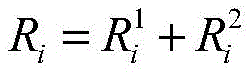
其中,i表示血管区域中的第i个出口,Ri是第i个出口的阻力,RT是血管区域的总阻力,ri是第i个出口的半径,m是血管区域中的出口数目。where i denotes the i-th outlet in the vascular region, R i is the resistance of the i-th outlet, R T is the total resistance of the vascular region, ri is the radius of the i -th outlet, and m is the number of outlets in the vascular region .
可以看出,本申请实施例通过目标点的血液流速确定出血管区域的血流量占比,根据血流量和入口处的压力差计算出三维模型的总阻力,再根据血流量占比分配血管区域的总阻力,最后根据出口半径确定出口的阻力,提高了确定血管的出口阻力的准确性。It can be seen that the embodiment of the present application determines the proportion of blood flow in the blood vessel area through the blood flow velocity of the target point, calculates the total resistance of the three-dimensional model according to the blood flow and the pressure difference at the entrance, and then allocates the blood vessel area according to the proportion of blood flow Finally, the outlet resistance is determined according to the outlet radius, which improves the accuracy of determining the outlet resistance of the blood vessel.
步骤103:根据血液流速测量数据和多个血管区域中出口的阻力,确定待评估血管的流体控制方程的边界条件。Step 103: Determine the boundary conditions of the fluid control equation of the blood vessel to be evaluated according to the blood flow velocity measurement data and the outlet resistances in multiple blood vessel regions.
流体控制方程在数学上大多是由非线性偏微分方程藕合而成的方程组,具体的,流体的流动由三个基本的物理原理控制,即质量守恒定律,牛顿第二定律和能量守恒定律,反映对应定律的方程可以被理解为流体控制方程。The fluid governing equations are mostly equations coupled by nonlinear partial differential equations in mathematics. Specifically, the flow of fluid is controlled by three basic physical principles, namely, the law of conservation of mass, Newton's second law and the law of conservation of energy. , the equations reflecting the corresponding laws can be understood as fluid governing equations.
本申请实施例不对流体控制方程的选择进行限定,在一种可能的实现方式中,流体控制方程为纳维-斯托克斯(Navier-Stokes,NS)方程。The embodiment of the present application does not limit the selection of the fluid control equation. In a possible implementation manner, the fluid control equation is a Navier-Stokes (Navier-Stokes, NS) equation.
可选的,将血管中的血液近似为不可压缩牛顿流体。其中,不可压缩流体指的是在流动过程中密度不发生变化的流体,牛顿流体指的是流体相邻的两层平行流动的液体间产生的剪切应力与垂直于流动方向的速度梯度成正比的流体。在这种近似下,可以采用非稳态不可压缩NS方程:Optionally, the blood in the blood vessel is approximated as an incompressible Newtonian fluid. Among them, the incompressible fluid refers to the fluid whose density does not change during the flow process, and the Newtonian fluid refers to the shear stress generated between two layers of parallel flowing liquid adjacent to the fluid is proportional to the velocity gradient perpendicular to the flow direction of fluid. Under this approximation, the non-steady-state incompressible NS equation can be adopted:

其中,u是血流速度,t是时间,

σ=-pI+2με(u)σ=-pI+2με(u)
其中,p是血管的压力,I是3×3单位矩阵,μ是动态粘度,ε(u)是变形张量,ε(u)的计算满足下式:Among them, p is the pressure of the blood vessel, I is a 3×3 unit matrix, μ is the dynamic viscosity, ε(u) is the deformation tensor, and the calculation of ε(u) satisfies the following formula:

其中,uT表示u的转置。Among them, u T represents the transpose of u.
应当理解,上述非稳态不可压缩NS方程所涉及的各项物理量中,血流速度u和压力p为方程中的未知量,也就是本申请实施例要进行求解的物理量。It should be understood that among the various physical quantities involved in the above unsteady incompressible NS equation, the blood flow velocity u and the pressure p are unknown quantities in the equation, which are the physical quantities to be solved in the embodiment of the present application.
本申请实施例中确定出的血管区域中的出口阻力,即Ri,主要用于流体控制方程的边界条件的确定。在一种可能的实现方式中,通过弹性腔模型来模拟血管区域中的每一个出口,根据血液流速测量数据和每个血管区域中出口的阻力,确定每个血管区域中每个出口对应的弹性腔模型的参数。The outlet resistance in the blood vessel region determined in the embodiment of the present application, that is, R i , is mainly used to determine the boundary conditions of the fluid control equation. In a possible implementation, each outlet in the blood vessel region is simulated by an elastic cavity model, and the elasticity corresponding to each outlet in each blood vessel region is determined according to the blood flow velocity measurement data and the resistance of the outlet in each blood vessel region parameters of the cavity model.
弹性腔模型是一种通过电路模型模拟人体中血管的方法,这种方法将局部血管系统简化为阻力元件、顺应性元件和惯性元件。其中,阻力元件用于模拟血管引起的阻力,通常为电阻,用R表示;顺应性元件,也可以称为弹性元件,用于模拟血管的收缩舒张,通常为电容,用C表示;惯性元件用于模拟血液流动的惯性,通常为电感,用L表示。值得注意的是,弹性腔模型中通常都包括阻力元件和顺应性元件,但可以不包括惯性元件。The elastic cavity model is a method of simulating blood vessels in the human body through a circuit model, which simplifies the local vascular system into resistance elements, compliance elements, and inertial elements. Among them, the resistance element is used to simulate the resistance caused by blood vessels, usually resistance, represented by R; the compliance element, also known as elastic element, is used to simulate the contraction and relaxation of blood vessels, usually capacitance, represented by C; the inertial element is It is used to simulate the inertia of blood flow, usually inductance, represented by L. It is worth noting that resistance elements and compliance elements are usually included in the elastic cavity model, but inertial elements may not be included.
本申请实施例不对弹性腔模型的选取进行限定,在一种可能的实现方式中,通过三元弹性腔模型对血管区域的出口进行模拟。图6为三元弹性腔模型的示意图,下面结合图6对三元弹性腔模型进行说明。The embodiment of the present application does not limit the selection of the elastic cavity model, and in a possible implementation manner, the outlet of the blood vessel region is simulated by using the three-dimensional elastic cavity model. Fig. 6 is a schematic diagram of a ternary elastic cavity model, and the ternary elastic cavity model will be described below in conjunction with Fig. 6 .
如图6所示,可以看出其中包括两个阻力元件和一个顺应性元件,为了便于描述,将

在一种可能的实现方式中,通过下式计算弹性腔模型的参数:In a possible implementation, the parameters of the elastic cavity model are calculated by the following formula:


其中,CT是血管区域的总顺应性,在一种可能的实现方式中,将CT假设为一个常数。Wherein, CT is the total compliance of the vascular region, and in a possible implementation manner, CT is assumed to be a constant.
具体的,
在得出弹性腔模型的参数后,根据血管区域中每个出口对应的弹性腔模型的参数,确定流体控制方程的出口边界条件。After the parameters of the elastic chamber model are obtained, the outlet boundary conditions of the fluid control equation are determined according to the parameters of the elastic chamber model corresponding to each outlet in the vascular region.
在本申请实施例采取的弹性腔模型为三元弹性腔模型的情况下,出口边界条件满足下式:In the case where the elastic cavity model adopted in the embodiment of this application is a ternary elastic cavity model, the outlet boundary condition satisfies the following formula:

其中,Pi(t)是第i个出口的出口边界压力,Pi b(t)是第i个出口处的远端压力,Qi(t)是第i个出口处的血流量。在一种可能的实现方式中,Pi b(t)可以被假设为零或一个常数。在每个出口的阻力可以通过步骤102确定的情况下,结合前文所述的欧姆定律可以得出Qi(t)。因此,Pi(t)为上述出口边界条件中的未知物理量。Among them, P i (t) is the outlet boundary pressure of the i-th outlet, P i b (t) is the distal pressure at the i -th outlet, and Qi (t) is the blood flow at the i-th outlet. In one possible implementation, P i b (t) can be assumed to be zero or a constant. In the case that the resistance of each outlet can be determined through
本申请实施例通过弹性腔模型来模拟出口,并通过出口的阻力确定弹性腔模型的参数,从而确定流体控制方程的出口边界条件,提高了得出的出口边界条件的准确性。In the embodiment of the present application, the outlet is simulated by the elastic chamber model, and the parameters of the elastic chamber model are determined by the resistance of the outlet, so as to determine the outlet boundary condition of the fluid control equation and improve the accuracy of the obtained outlet boundary condition.
值得注意的是,如果要求解控制方程,还需要方程具有已知的入口边界条件,壁面边界条件和初始边界条件。It is worth noting that if the governing equations are to be solved, the equations also need to have known inlet boundary conditions, wall boundary conditions and initial boundary conditions.
本申请实施例不对入口边界条件,壁面边界条件和初始边界条件的确定方式进行限定。在一种可能的实现方式中,入口边界条件和壁面边界条件通过下式确定:The embodiment of the present application does not limit the determination methods of the inlet boundary condition, the wall surface boundary condition and the initial boundary condition. In a possible implementation, the inlet boundary condition and the wall boundary condition are determined by the following equations:
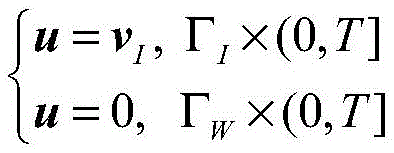
其中,vI是入口处的流入速度,ΓI表示入口,ΓW表示壁面,应当理解,壁面即血管壁。在一种可能的实现方式中,通过经颅多普勒超声获取入口处的流入速度,在另一种可能的实现方式中,通过流量守恒定律得出入口的总血流量,再根据总流量和入口处的截面积计算流入速度,流入速度采用下式计算:Wherein, v I is the inflow velocity at the entrance, Γ I represents the entrance, and Γ W represents the wall surface. It should be understood that the wall surface is the vessel wall. In one possible implementation, the inflow velocity at the entrance is obtained by transcranial Doppler ultrasound. In another possible implementation, the total blood flow at the entrance is obtained through the flow conservation law, and then according to the total flow and the entrance The inflow velocity is calculated from the cross-sectional area at the point, and the inflow velocity is calculated by the following formula:
vI=n·Q/Sv I = n·Q/S
其中,n是入口的内向法线,S是入口的横截面积,Q是入口处的血流量。在一种可能的实现方式中,初始条件通过下式确定:where n is the inward normal of the inlet, S is the cross-sectional area of the inlet, and Q is the blood flow at the inlet. In one possible implementation, the initial conditions are determined by the following formula:
u|t=0=u0,Ωu| t=0 =u 0 ,Ω
其中,u0是所述血液在初始时间的速度,在一种可能的实现方式中,将u0假设为0,在另一种可能的实现方式中,也可以将u0假设为其它常数。Wherein, u 0 is the velocity of the blood at the initial time. In one possible implementation manner, u 0 is assumed to be 0, and in another possible implementation manner, u 0 may also be assumed to be other constants.
步骤104:根据边界条件对流体控制方程求解,获得待评估血管的血流数值模拟结果。Step 104: Solve the fluid control equation according to the boundary conditions to obtain the blood flow numerical simulation results of the vessel to be evaluated.
在一种可能的实现方式中,本申请实施例对流体控制方法求解使用的是基于有限元分析的数值求解方法,因此,在进行求解之前需要先将三维模型划分为多个网格。In a possible implementation manner, the embodiment of the present application uses a numerical solution method based on finite element analysis for solving the fluid control method. Therefore, the three-dimensional model needs to be divided into multiple grids before performing the solution.
其中,有限元分析方法将方程的求解域看成是由许多个小的互连子域组成,对每一单元假定一个合适的近似解,然后推导求解这个域总的满足条件,从而得到问题的解。在求解本申请实施例的NS方程时,也可以理解为整个三维模型为求解域,三维模型中的每一个网格为一个子域。Among them, the finite element analysis method regards the solution domain of the equation as composed of many small interconnected sub-domains, assumes a suitable approximate solution for each unit, and then deduces and solves the total satisfaction conditions of this domain, so as to obtain the solution of the problem untie. When solving the NS equation in the embodiment of the present application, it can also be understood that the entire 3D model is a solution domain, and each grid in the 3D model is a subdomain.
本申请实施例不对网格划分的参数进行限定,在一种可能的实现方式中,对三维模型做非结构化四面体网格划分。其中,非结构化指的是网格区域内的内部点不具有相同的毗邻单元,四面体指每个网格的形状为四面体。图7是本申请实施例提供的网格划分的示意图,可以看出,图7采用了非结构化四面体网格划分。The embodiment of the present application does not limit the parameters of grid division. In a possible implementation manner, the three-dimensional model is divided into unstructured tetrahedral grids. Among them, unstructured means that the internal points in the grid area do not have the same adjacent cells, and tetrahedral means that the shape of each grid is tetrahedral. FIG. 7 is a schematic diagram of grid division provided by the embodiment of the present application. It can be seen that FIG. 7 adopts unstructured tetrahedral grid division.
在一种可能的实现方式中,将三维模型划分为4.73×10⁶或2.05×10⁷个网格。In a possible implementation, the three-dimensional model is divided into 4.73×10 6 or 2.05×10 7 grids.
具体的,划分网格的过程中需要先设置划分所需的参数,在完成划分之后还要对网格进行细化和光滑处理,并在软件内检查网格质量。Specifically, in the process of dividing the grid, it is necessary to set the parameters required for the division first, and after the division is completed, the grid should be refined and smoothed, and the quality of the grid should be checked in the software.
在一种可能的实现方式中,使用ANSYS中的ICEM模块对三维模型进行网格划分。In one possible implementation, the 3D model is meshed using the ICEM module in ANSYS.
完成网格划分后,根据多个网格,在时间域上和空间域上分别离散流体控制方程,得到稀疏非线性系统,然后根据边界条件对稀疏非线性系统求解。After the grid division is completed, the fluid governing equations are discretized in the time domain and the space domain according to multiple grids to obtain a sparse nonlinear system, and then the sparse nonlinear system is solved according to the boundary conditions.
在一种可能的实现方式中,在空间域上用有限元方法离散流体控制方程,在时间域上用欧拉方法离散流体控制方程。具体的,在空间域上将流体控制方程离散到前文所述的三维模型中的网格,而欧拉方法则是一种逐次迭代进行求解的方法。In a possible implementation, the finite element method is used to discretize the fluid governing equations in the space domain, and the Euler method is used to discretize the fluid governing equations in the time domain. Specifically, the fluid governing equations are discretized in the space domain to the grid in the 3D model mentioned above, and the Euler method is a method for solving iteratively.
可选的,在空间域上通过P1-P1有限原方法离散流体控制方程,在时间域上通过隐式向后欧拉方法离散流体控制方程。其中,两个P1分别指对血流速度u和压力p都使用P1有限元方法,具体的,P1有限元方法指的是一阶线性的离散。Optionally, the fluid governing equations are discretized by the P1-P1 finite original method in the space domain, and the fluid governing equations are discretized by the implicit backward Euler method in the time domain. Wherein, the two P1 respectively mean that the P1 finite element method is used for the blood flow velocity u and the pressure p, specifically, the P1 finite element method refers to the first-order linear discrete.
具体的,离散后的流体控制方程为一个大型稀疏非线性系统。Specifically, the discretized fluid governing equation is a large sparse nonlinear system.
在完成方程的离散后,流体控制方程已经可以通过计算机进行求解。在一种可能的实现方式中,使用天河二号A超算(Tianhe-2A)进行求解。After completing the discretization of the equations, the fluid governing equations can be solved by computer. In a possible implementation, the Tianhe-2A supercomputer (Tianhe-2A) is used for solving.
在一种可能的实现方式中,采用牛顿-克雷洛夫-施瓦兹(Newton-Krylov-Schwarz,NKS)算法来求解流体控制方程。In a possible implementation, a Newton-Krylov-Schwarz (Newton-Krylov-Schwarz, NKS) algorithm is used to solve the fluid governing equations.
具体的,在得出稀疏非线性系统后,也可以先通过NKS算法对稀疏非线性系统进行进一步的处理,再进行求解。Specifically, after the sparse nonlinear system is obtained, the sparse nonlinear system can also be further processed through the NKS algorithm before being solved.
具体的,NKS算法指的是将用于求解非线性方程系统的牛顿(Newton)算法,与克雷洛夫(Krylov)子空间技术结合,得到用于求解非线性系统的牛顿-克雷洛夫(Newton-Krylov)子空间迭代方法,再在迭代的过程中与施瓦兹(Schwarz)预条件子技术相结合,得到的一种提高方程系统可解性的方法。这里的子空间,可以理解为上述有限元方法中子域的另一种表述。Specifically, the NKS algorithm refers to the combination of the Newton algorithm for solving nonlinear equation systems with the Krylov subspace technology to obtain the Newton-Krylov algorithm for solving nonlinear systems. (Newton-Krylov) subspace iteration method, and then combined with Schwarz (Schwarz) preconditioner technique in the iterative process, a method to improve the solvability of the equation system is obtained. The subspace here can be understood as another expression of the subfield in the above-mentioned finite element method.
本申请实施例通过NKS算法对稀疏非线性系统进行处理,提高了计算机求解流体控制方程的计算效率。In the embodiment of the present application, the sparse nonlinear system is processed by the NKS algorithm, which improves the calculation efficiency of the computer for solving the fluid control equation.
本申请实施例对NS方程进行求解后,由于血流速度u和压力p是NS方程中的未知参数,因此可以直接求解出血流速度u和压力p。After solving the NS equation in the embodiment of the present application, since the blood flow velocity u and the pressure p are unknown parameters in the NS equation, the blood flow velocity u and the pressure p can be directly solved.
在求解出血流速度u和压力p的基础上,可以基于血液的流体力学性质通过血流速度u和压力p计算出血液的其它流体力学参数,得出血流数值模拟结果。在一种可能的实现方式中,可以计算血液的剪应力,剪应力指的是物体由于外因而变形时,在它内部任一截面的两方出现的相互作用力。On the basis of solving the blood flow velocity u and pressure p, other hydrodynamic parameters of the blood can be calculated based on the fluid mechanics properties of the blood through the blood flow velocity u and pressure p, and the numerical simulation results of blood flow can be obtained. In a possible implementation manner, the shear stress of blood can be calculated, and the shear stress refers to the interaction force between two sides of any section inside an object when it is deformed due to external factors.
可选的,为了使求解流体控制方程得出的数值模拟结果更为形象,可以对数值模拟结构进行后处理,用图像的形式表现数值模拟结果。在一种可能的实现方式中,使用Paraview软件进行后处理。Optionally, in order to make the numerical simulation results obtained by solving the fluid governing equations more vivid, the numerical simulation structure can be post-processed, and the numerical simulation results can be expressed in the form of images. In one possible implementation, Paraview software is used for post-processing.
本申请实施例根据目标点的血液流速和三维模型的入口处的压力差,确定血管区域中出口的阻力,提高了确定出口的阻力时的准确性,并根据出口的阻力确定流体控制方程的边界条件,提高了求解流体控制方程得出的血流数值模拟结果的准确性。According to the blood flow velocity of the target point and the pressure difference at the inlet of the three-dimensional model, the embodiment of the present application determines the outlet resistance in the blood vessel region, improves the accuracy of determining the outlet resistance, and determines the boundary of the fluid control equation according to the outlet resistance The conditions improve the accuracy of the blood flow numerical simulation results obtained by solving the fluid control equations.
图8示出了根据本申请实施例的血流数值模拟装置的示意性框图。如图8所示,所述装置800包括:Fig. 8 shows a schematic block diagram of a blood flow numerical simulation device according to an embodiment of the present application. As shown in Figure 8, the
第一获取模块810,用于获取待评估血管的三维模型和血液流速测量数据;血液流速测量数据包括三维模型中多个目标点的血液流速;三维模型包括多个血管区域;The
第一确定模块820,用于根据多个目标点的血液流速和三维模型的入口处的压力差,确定每个血管区域中出口的阻力;The first determining
第二确定模块830,根据血液流速测量数据和多个血管区域中出口的阻力,确定待评估血管的流体控制方程的边界条件;The
第二获取模块840,用于根据边界条件对流体控制方程求解,获取待评估血管的血流数值模拟结果。The second obtaining
在一种可能的实现方式中,第一确定模块820用于:In a possible implementation manner, the first determining
根据各个目标点的血液流速分别获取各个目标点的血流量;The blood flow of each target point is respectively obtained according to the blood flow velocity of each target point;
根据多个目标点的血流量,确定每个血管区域相对于三维模型的血流量占比;According to the blood flow of multiple target points, determine the blood flow ratio of each vascular area relative to the three-dimensional model;
根据每个血管区域相对于三维模型的血流量占比和三维模型的入口处的压力差,确定每个血管区域中出口的阻力。According to the blood flow ratio of each blood vessel region relative to the three-dimensional model and the pressure difference at the inlet of the three-dimensional model, the outlet resistance in each blood vessel region is determined.
在一种可能的实现方式中,第一确定模块820用于:In a possible implementation manner, the first determining
根据三维模型的总血流量和三维模型的入口处的压力差,获取三维模型的总阻力;Obtain the total resistance of the three-dimensional model according to the total blood flow of the three-dimensional model and the pressure difference at the inlet of the three-dimensional model;
针对每个所述血管区域,根据血管区域相对于三维模型的血流量占比和三维模型的总阻力,获取血管区域的总阻力;For each of the vascular regions, according to the blood flow ratio of the vascular region relative to the three-dimensional model and the total resistance of the three-dimensional model, the total resistance of the vascular region is obtained;
根据血管区域的总阻力和血管区域中出口的横截面尺寸,获取血管区域中出口的阻力。The resistance of the outlet in the vascular region is obtained from the total resistance of the vascular region and the cross-sectional size of the outlet in the vascular region.
在一种可能的实现方式中,流体控制方程为纳维-斯托克斯方程,边界条件包括出口边界条件,第二确定模块830用于:In a possible implementation, the fluid governing equation is the Navier-Stokes equation, the boundary conditions include outlet boundary conditions, and the
根据血液流速测量数据和每个血管区域中出口的阻力,确定每个血管区域中每个出口对应的弹性腔模型的参数;determining the parameters of the elastic cavity model corresponding to each outlet in each vessel region according to the blood flow velocity measurement data and the resistance of the outlet in each vessel region;
根据多个血管区域中每个出口对应的弹性腔模型的参数,确定流体控制方程的出口边界条件。According to the parameters of the elastic chamber model corresponding to each outlet in the plurality of vessel regions, the outlet boundary condition of the fluid control equation is determined.
在一种可能的实现方式中,第二获取模块840用于:In a possible implementation manner, the second obtaining
将三维模型划分为多个网格;Divide the 3D model into multiple meshes;
根据多个网格,在空间域上和时间域上分别离散流体控制方程,得到稀疏非线性系统;According to multiple grids, the fluid control equations are discretized in the space domain and the time domain respectively, and a sparse nonlinear system is obtained;
根据边界条件对稀疏非线性系统求解。Solve sparse nonlinear systems subject to boundary conditions.
在一种可能的实现方式中,第二获取模块840用于:In a possible implementation manner, the second obtaining
采用牛顿-克雷洛夫-施瓦兹算法对流体控制方程求解。The Newton-Krylov-Schwartz algorithm is used to solve the fluid governing equations.
在一种可能的实现方式中,第一获取模块810用于:In a possible implementation manner, the first acquiring
获取待评估血管的断层扫描影像数据;Obtain tomographic image data of the blood vessel to be evaluated;
根据断层扫描影像数据,获取待评估血管的三维模型。According to the tomographic image data, a three-dimensional model of the blood vessel to be evaluated is obtained.
图9是本申请实施例提供的血流数值模拟装置的结构示意图。如图9所示,血流数值模拟装置900包括:至少一个处理器90(图9中仅示出一个)处理器、存储器91以及存储在所述存储器91中并可在所述至少一个处理器90上运行的计算机程序92,所述处理器90执行所述计算机程序92时用于实现上述任意各个血流数值模拟方法实施例(比如图1中的方法)中的步骤。FIG. 9 is a schematic structural diagram of a blood flow numerical simulation device provided in an embodiment of the present application. As shown in FIG. 9 , the blood flow
所称处理器90可以是中央处理单元(Central Processing Unit,CPU),该处理器90还可以是其他通用处理器、数字信号处理器(Digital Signal Processor,DSP)、专用集成电路(Application Specific Integrated Circuit,ASIC)、现成可编程门阵列(Field-Programmable Gate Array,FPGA)或者其他可编程逻辑器件、分立门或者晶体管逻辑器件、分立硬件组件等。通用处理器可以是微处理器或者该处理器也可以是任何常规的处理器等。The so-called
所述存储器91在一些实施例中可以是所述装置900的内部存储单元,例如血流数值模拟装置900的硬盘或内存。所述存储器91在另一些实施例中也可以是所述装置900的外部存储设备,例如所述装置900上配备的插接式硬盘,智能存储卡(Smart Media Card,SMC),安全数字(Secure Digital,SD)卡,闪存卡(Flash Card)等。进一步地,所述存储器91还可以既包括所述装置900的内部存储单元也包括外部存储设备。所述存储器91用于存储操作系统、应用程序、引导装载程序(BootLoader)、数据以及其他程序等,例如所述计算机程序的程序代码等。所述存储器91还可以用于暂时地存储已经输出或者将要输出的数据。The
所属领域的技术人员可以清楚地了解到,为了描述的方便和简洁,仅以上述各功能单元、模块的划分进行举例说明,实际应用中,可以根据需要而将上述功能分配由不同的功能单元、模块完成,即将所述装置的内部结构划分成不同的功能单元或模块,以完成以上描述的全部或者部分功能。实施例中的各功能单元、模块可以集成在一个处理单元中,也可以是各个单元单独物理存在,也可以两个或两个以上单元集成在一个单元中,上述集成的单元既可以采用硬件的形式实现,也可以采用软件功能单元的形式实现。另外,各功能单元、模块的具体名称也只是为了便于相互区分,并不用于限制本申请的保护范围。上述系统中单元、模块的具体工作过程,可以参考前述方法实施例中的对应过程,在此不再赘述。Those skilled in the art can clearly understand that for the convenience and brevity of description, only the division of the above-mentioned functional units and modules is used for illustration. In practical applications, the above-mentioned functions can be assigned to different functional units, Completion of modules means that the internal structure of the device is divided into different functional units or modules to complete all or part of the functions described above. Each functional unit and module in the embodiment may be integrated into one processing unit, or each unit may exist separately physically, or two or more units may be integrated into one unit, and the above-mentioned integrated units may adopt hardware It can also be implemented in the form of software functional units. In addition, the specific names of the functional units and modules are only for the convenience of distinguishing each other, and are not used to limit the protection scope of the present application. For the specific working process of the units and modules in the above system, reference may be made to the corresponding process in the foregoing method embodiments, and details will not be repeated here.
本申请实施例还提供了一种计算机可读存储介质,所述计算机可读存储介质存储有计算机程序,所述计算机程序被处理器执行时实现可实现上述各个方法实施例中的步骤。The embodiment of the present application also provides a computer-readable storage medium, the computer-readable storage medium stores a computer program, and when the computer program is executed by a processor, the steps in each of the foregoing method embodiments can be realized.
本申请实施例提供了一种计算机程序产品,当计算机程序产品在血流数值模拟装置上运行时,使得血流数值模拟装置执行时实现可实现上述各个方法实施例中的步骤。An embodiment of the present application provides a computer program product. When the computer program product runs on a blood flow numerical simulation device, the blood flow numerical simulation device can realize the steps in the above-mentioned various method embodiments when executed.
所述集成的单元如果以软件功能单元的形式实现并作为独立的产品销售或使用时,可以存储在一个计算机可读取存储介质中。基于这样的理解,本申请实现上述实施例方法中的全部或部分流程,可以通过计算机程序来指令相关的硬件来完成,所述的计算机程序可存储于一计算机可读存储介质中,该计算机程序在被处理器执行时,可实现上述各个方法实施例的步骤。其中,所述计算机程序包括计算机程序代码,所述计算机程序代码可以为源代码形式、对象代码形式、可执行文件或某些中间形式等。所述计算机可读介质至少可以包括:能够将计算机程序代码携带到拍照装置/终端设备的任何实体或装置、记录介质、计算机存储器、只读存储器(ROM,Read-Only Memory)、随机存取存储器(RAM,RandomAccess Memory)、电载波信号、电信信号以及软件分发介质。例如U盘、移动硬盘、磁碟或者光盘等。在某些司法管辖区,根据立法和专利实践,计算机可读介质不可以是电载波信号和电信信号。If the integrated unit is realized in the form of a software function unit and sold or used as an independent product, it can be stored in a computer-readable storage medium. Based on this understanding, all or part of the procedures in the methods of the above embodiments in the present application can be completed by instructing related hardware through computer programs, and the computer programs can be stored in a computer-readable storage medium. The computer program When executed by a processor, the steps in the above-mentioned various method embodiments can be realized. Wherein, the computer program includes computer program code, and the computer program code may be in the form of source code, object code, executable file or some intermediate form. The computer-readable medium may at least include: any entity or device capable of carrying computer program codes to a photographing device/terminal device, a recording medium, a computer memory, a read-only memory (ROM, Read-Only Memory), a random access memory (RAM, Random Access Memory), electrical carrier signal, telecommunication signal, and software distribution medium. Such as U disk, mobile hard disk, magnetic disk or optical disk, etc. In some jurisdictions, computer readable media may not be electrical carrier signals and telecommunication signals under legislation and patent practice.
Claims (10)
Priority Applications (1)
| Application Number | Priority Date | Filing Date | Title |
|---|---|---|---|
| CN202210917061.9A CN115440382A (en) | 2022-08-01 | 2022-08-01 | Blood flow numerical simulation method and device |
Applications Claiming Priority (1)
| Application Number | Priority Date | Filing Date | Title |
|---|---|---|---|
| CN202210917061.9A CN115440382A (en) | 2022-08-01 | 2022-08-01 | Blood flow numerical simulation method and device |
Publications (1)
| Publication Number | Publication Date |
|---|---|
| CN115440382A true CN115440382A (en) | 2022-12-06 |
Family
ID=84242218
Family Applications (1)
| Application Number | Title | Priority Date | Filing Date |
|---|---|---|---|
| CN202210917061.9A Pending CN115440382A (en) | 2022-08-01 | 2022-08-01 | Blood flow numerical simulation method and device |
Country Status (1)
| Country | Link |
|---|---|
| CN (1) | CN115440382A (en) |
Cited By (3)
| Publication number | Priority date | Publication date | Assignee | Title |
|---|---|---|---|---|
| CN115758945A (en) * | 2023-02-13 | 2023-03-07 | 首都医科大学附属北京友谊医院 | Numerical model construction method and device, electronic equipment and storage medium |
| CN116617558A (en) * | 2023-07-25 | 2023-08-22 | 深圳核心医疗科技股份有限公司 | Parameter optimization method and device |
| CN119423727A (en) * | 2024-11-01 | 2025-02-14 | 中国科学技术大学 | Method, device, equipment and medium for calculating blood vessel status parameters |
Citations (3)
| Publication number | Priority date | Publication date | Assignee | Title |
|---|---|---|---|---|
| CN105144173A (en) * | 2013-03-01 | 2015-12-09 | 哈特弗罗公司 | Method and system for determining treatments by modifying patient-specific geometrical models |
| CN108109698A (en) * | 2016-12-28 | 2018-06-01 | 北京昆仑医云科技有限公司 | Systems and methods for simulating the calculation of fractional flow reserve using computational fluid dynamics |
| CN114209347A (en) * | 2021-12-31 | 2022-03-22 | 上海联影医疗科技股份有限公司 | A method and system for determining intracranial hemodynamic parameters |
-
2022
- 2022-08-01 CN CN202210917061.9A patent/CN115440382A/en active Pending
Patent Citations (3)
| Publication number | Priority date | Publication date | Assignee | Title |
|---|---|---|---|---|
| CN105144173A (en) * | 2013-03-01 | 2015-12-09 | 哈特弗罗公司 | Method and system for determining treatments by modifying patient-specific geometrical models |
| CN108109698A (en) * | 2016-12-28 | 2018-06-01 | 北京昆仑医云科技有限公司 | Systems and methods for simulating the calculation of fractional flow reserve using computational fluid dynamics |
| CN114209347A (en) * | 2021-12-31 | 2022-03-22 | 上海联影医疗科技股份有限公司 | A method and system for determining intracranial hemodynamic parameters |
Non-Patent Citations (2)
| Title |
|---|
| LEOPOLD GRINBERG 和 GEORGE EM KARNIADAKIS: "《Outflow Boundary Conditions for Arterial Networks with Multiple Outlets》", pages 1 - 19, Retrieved from the Internet <URL:https://link.springer.com/article/10.1007/s10439-008-9527-7> * |
| MAREK ŻYLIŃSKI等: "《Individualization of the parameters of the 3-elements Windkessel model using carotid pulse signal》", pages 1 - 6, Retrieved from the Internet <URL:https://www.spiedigitallibrary.org/conference-proceedings-of-spie/9662/96621N/Individualization-of-the-parameters-of-the-three-elements-Windkessel-model/10.1117/12.2205617.full> * |
Cited By (5)
| Publication number | Priority date | Publication date | Assignee | Title |
|---|---|---|---|---|
| CN115758945A (en) * | 2023-02-13 | 2023-03-07 | 首都医科大学附属北京友谊医院 | Numerical model construction method and device, electronic equipment and storage medium |
| CN116617558A (en) * | 2023-07-25 | 2023-08-22 | 深圳核心医疗科技股份有限公司 | Parameter optimization method and device |
| CN116617558B (en) * | 2023-07-25 | 2023-10-13 | 深圳核心医疗科技股份有限公司 | Parameter optimization method and device |
| CN119423727A (en) * | 2024-11-01 | 2025-02-14 | 中国科学技术大学 | Method, device, equipment and medium for calculating blood vessel status parameters |
| CN119423727B (en) * | 2024-11-01 | 2025-09-16 | 中国科学技术大学 | Method, device, equipment and medium for calculating vascular status parameters |
Similar Documents
| Publication | Publication Date | Title |
|---|---|---|
| CN115440382A (en) | Blood flow numerical simulation method and device | |
| CN108305246B (en) | Device and system for predicting blood flow characteristics based on medical images | |
| Perdikaris et al. | An effective fractal-tree closure model for simulating blood flow in large arterial networks | |
| Perego et al. | A variational approach for estimating the compliance of the cardiovascular tissue: An inverse fluid-structure interaction problem | |
| CN113811956B (en) | Systems and methods for estimating blood flow using response surfaces and reduced order modeling | |
| Lantz et al. | Patient-specific simulation of cardiac blood flow from high-resolution computed tomography | |
| CN111652881B (en) | Coronary remodeling and blood flow reserve fraction calculation method, device, equipment and readable storage medium based on deep learning | |
| CN112749521A (en) | Processing method and system of hemodynamic index data | |
| CN107115111A (en) | Blood flow state analysis system and method | |
| Dueñas-Pamplona et al. | Boundary-condition analysis of an idealized left atrium model | |
| CN117594244A (en) | Methods, devices, computer equipment, media and products for assessing blood flow parameters | |
| Swillens et al. | A simulation environment for validating ultrasonic blood flow and vessel wall imaging based on fluid‐structure interaction simulations: ultrasonic assessment of arterial distension and wall shear rate | |
| Bantwal et al. | Critical role of arterial constitutive model in predicting blood pressure from pulse wave velocity | |
| Chandra et al. | A methodology for the derivation of unloaded abdominal aortic aneurysm geometry with experimental validation | |
| Tree et al. | A method for in vitro TCPC compliance verification | |
| Melis | Gaussian process emulators for 1D vascular models | |
| Zakikhani et al. | Biomechanical assessment of aortic valve stenosis: advantages and limitations | |
| Hvid et al. | Intra-cardiac flow from geometry prescribed computational fluid dynamics: comparison with ultrasound vector flow imaging | |
| KR102516382B1 (en) | Apparatus, method and computer program for lattice boltzmann method based blood flow simulation | |
| Xiao | Simulation of 3-D blood flow in the full systemic arterial tree and computational frameworks for efficient parameter estimation | |
| Pinto et al. | Numerical study on the hemodynamics of patient‐specific carotid bifurcation using a new mesh approach | |
| CN110664392B (en) | Blood flow velocity calculation method and device, terminal equipment and storage medium | |
| Annio et al. | Enhancing magnetic resonance imaging with computational fluid dynamics | |
| WO2024109901A1 (en) | Non-invasive measurement method and apparatus for portal pressure gradient | |
| Perez-Raya et al. | Modeling and reducing the effect of geometric uncertainties in intracranial aneurysms with polynomial Chaos expansion, data decomposition, and 4D-flow MRI |
Legal Events
| Date | Code | Title | Description |
|---|---|---|---|
| PB01 | Publication | ||
| PB01 | Publication | ||
| SE01 | Entry into force of request for substantive examination | ||
| SE01 | Entry into force of request for substantive examination |