CN115398925A - System for ingesting alternate video and/or audio media synchronously with display of video and audio content from linear sources and properties, and method for its implementation - Google Patents
System for ingesting alternate video and/or audio media synchronously with display of video and audio content from linear sources and properties, and method for its implementation Download PDFInfo
- Publication number
- CN115398925A CN115398925A CN202180011912.7A CN202180011912A CN115398925A CN 115398925 A CN115398925 A CN 115398925A CN 202180011912 A CN202180011912 A CN 202180011912A CN 115398925 A CN115398925 A CN 115398925A
- Authority
- CN
- China
- Prior art keywords
- content
- ava
- mva
- receiver
- digital
- Prior art date
- Legal status (The legal status is an assumption and is not a legal conclusion. Google has not performed a legal analysis and makes no representation as to the accuracy of the status listed.)
- Pending
Links
Images


Classifications
-
- H—ELECTRICITY
- H04—ELECTRIC COMMUNICATION TECHNIQUE
- H04H—BROADCAST COMMUNICATION
- H04H20/00—Arrangements for broadcast or for distribution combined with broadcast
- H04H20/10—Arrangements for replacing or switching information during the broadcast or the distribution
- H04H20/106—Receiver-side switching
-
- H—ELECTRICITY
- H04—ELECTRIC COMMUNICATION TECHNIQUE
- H04N—PICTORIAL COMMUNICATION, e.g. TELEVISION
- H04N21/00—Selective content distribution, e.g. interactive television or video on demand [VOD]
- H04N21/40—Client devices specifically adapted for the reception of or interaction with content, e.g. set-top-box [STB]; Operations thereof
- H04N21/45—Management operations performed by the client for facilitating the reception of or the interaction with the content or administrating data related to the end-user or to the client device itself, e.g. learning user preferences for recommending movies, resolving scheduling conflicts
- H04N21/462—Content or additional data management, e.g. creating a master electronic program guide from data received from the Internet and a Head-end, controlling the complexity of a video stream by scaling the resolution or bit-rate based on the client capabilities
- H04N21/4622—Retrieving content or additional data from different sources, e.g. from a broadcast channel and the Internet
-
- H—ELECTRICITY
- H04—ELECTRIC COMMUNICATION TECHNIQUE
- H04N—PICTORIAL COMMUNICATION, e.g. TELEVISION
- H04N7/00—Television systems
- H04N7/16—Analogue secrecy systems; Analogue subscription systems
- H04N7/173—Analogue secrecy systems; Analogue subscription systems with two-way working, e.g. subscriber sending a programme selection signal
-
- H—ELECTRICITY
- H04—ELECTRIC COMMUNICATION TECHNIQUE
- H04N—PICTORIAL COMMUNICATION, e.g. TELEVISION
- H04N21/00—Selective content distribution, e.g. interactive television or video on demand [VOD]
- H04N21/40—Client devices specifically adapted for the reception of or interaction with content, e.g. set-top-box [STB]; Operations thereof
- H04N21/43—Processing of content or additional data, e.g. demultiplexing additional data from a digital video stream; Elementary client operations, e.g. monitoring of home network or synchronising decoder's clock; Client middleware
- H04N21/4302—Content synchronisation processes, e.g. decoder synchronisation
- H04N21/4307—Synchronising the rendering of multiple content streams or additional data on devices, e.g. synchronisation of audio on a mobile phone with the video output on the TV screen
-
- H—ELECTRICITY
- H04—ELECTRIC COMMUNICATION TECHNIQUE
- H04H—BROADCAST COMMUNICATION
- H04H20/00—Arrangements for broadcast or for distribution combined with broadcast
- H04H20/18—Arrangements for synchronising broadcast or distribution via plural systems
-
- H—ELECTRICITY
- H04—ELECTRIC COMMUNICATION TECHNIQUE
- H04H—BROADCAST COMMUNICATION
- H04H20/00—Arrangements for broadcast or for distribution combined with broadcast
- H04H20/28—Arrangements for simultaneous broadcast of plural pieces of information
-
- H—ELECTRICITY
- H04—ELECTRIC COMMUNICATION TECHNIQUE
- H04N—PICTORIAL COMMUNICATION, e.g. TELEVISION
- H04N21/00—Selective content distribution, e.g. interactive television or video on demand [VOD]
- H04N21/20—Servers specifically adapted for the distribution of content, e.g. VOD servers; Operations thereof
- H04N21/21—Server components or server architectures
- H04N21/218—Source of audio or video content, e.g. local disk arrays
- H04N21/2187—Live feed
-
- H—ELECTRICITY
- H04—ELECTRIC COMMUNICATION TECHNIQUE
- H04N—PICTORIAL COMMUNICATION, e.g. TELEVISION
- H04N21/00—Selective content distribution, e.g. interactive television or video on demand [VOD]
- H04N21/40—Client devices specifically adapted for the reception of or interaction with content, e.g. set-top-box [STB]; Operations thereof
- H04N21/41—Structure of client; Structure of client peripherals
- H04N21/426—Internal components of the client ; Characteristics thereof
-
- H—ELECTRICITY
- H04—ELECTRIC COMMUNICATION TECHNIQUE
- H04N—PICTORIAL COMMUNICATION, e.g. TELEVISION
- H04N21/00—Selective content distribution, e.g. interactive television or video on demand [VOD]
- H04N21/40—Client devices specifically adapted for the reception of or interaction with content, e.g. set-top-box [STB]; Operations thereof
- H04N21/43—Processing of content or additional data, e.g. demultiplexing additional data from a digital video stream; Elementary client operations, e.g. monitoring of home network or synchronising decoder's clock; Client middleware
- H04N21/4302—Content synchronisation processes, e.g. decoder synchronisation
- H04N21/4307—Synchronising the rendering of multiple content streams or additional data on devices, e.g. synchronisation of audio on a mobile phone with the video output on the TV screen
- H04N21/43074—Synchronising the rendering of multiple content streams or additional data on devices, e.g. synchronisation of audio on a mobile phone with the video output on the TV screen of additional data with content streams on the same device, e.g. of EPG data or interactive icon with a TV program
-
- H—ELECTRICITY
- H04—ELECTRIC COMMUNICATION TECHNIQUE
- H04N—PICTORIAL COMMUNICATION, e.g. TELEVISION
- H04N21/00—Selective content distribution, e.g. interactive television or video on demand [VOD]
- H04N21/40—Client devices specifically adapted for the reception of or interaction with content, e.g. set-top-box [STB]; Operations thereof
- H04N21/43—Processing of content or additional data, e.g. demultiplexing additional data from a digital video stream; Elementary client operations, e.g. monitoring of home network or synchronising decoder's clock; Client middleware
- H04N21/435—Processing of additional data, e.g. decrypting of additional data, reconstructing software from modules extracted from the transport stream
-
- H—ELECTRICITY
- H04—ELECTRIC COMMUNICATION TECHNIQUE
- H04N—PICTORIAL COMMUNICATION, e.g. TELEVISION
- H04N21/00—Selective content distribution, e.g. interactive television or video on demand [VOD]
- H04N21/40—Client devices specifically adapted for the reception of or interaction with content, e.g. set-top-box [STB]; Operations thereof
- H04N21/43—Processing of content or additional data, e.g. demultiplexing additional data from a digital video stream; Elementary client operations, e.g. monitoring of home network or synchronising decoder's clock; Client middleware
- H04N21/44—Processing of video elementary streams, e.g. splicing a video clip retrieved from local storage with an incoming video stream or rendering scenes according to encoded video stream scene graphs
- H04N21/44016—Processing of video elementary streams, e.g. splicing a video clip retrieved from local storage with an incoming video stream or rendering scenes according to encoded video stream scene graphs involving splicing one content stream with another content stream, e.g. for substituting a video clip
-
- H—ELECTRICITY
- H04—ELECTRIC COMMUNICATION TECHNIQUE
- H04N—PICTORIAL COMMUNICATION, e.g. TELEVISION
- H04N21/00—Selective content distribution, e.g. interactive television or video on demand [VOD]
- H04N21/40—Client devices specifically adapted for the reception of or interaction with content, e.g. set-top-box [STB]; Operations thereof
- H04N21/47—End-user applications
- H04N21/472—End-user interface for requesting content, additional data or services; End-user interface for interacting with content, e.g. for content reservation or setting reminders, for requesting event notification, for manipulating displayed content
- H04N21/47202—End-user interface for requesting content, additional data or services; End-user interface for interacting with content, e.g. for content reservation or setting reminders, for requesting event notification, for manipulating displayed content for requesting content on demand, e.g. video on demand
-
- H—ELECTRICITY
- H04—ELECTRIC COMMUNICATION TECHNIQUE
- H04N—PICTORIAL COMMUNICATION, e.g. TELEVISION
- H04N21/00—Selective content distribution, e.g. interactive television or video on demand [VOD]
- H04N21/60—Network structure or processes for video distribution between server and client or between remote clients; Control signalling between clients, server and network components; Transmission of management data between server and client, e.g. sending from server to client commands for recording incoming content stream; Communication details between server and client
- H04N21/61—Network physical structure; Signal processing
- H04N21/6106—Network physical structure; Signal processing specially adapted to the downstream path of the transmission network
- H04N21/6125—Network physical structure; Signal processing specially adapted to the downstream path of the transmission network involving transmission via Internet
-
- H—ELECTRICITY
- H04—ELECTRIC COMMUNICATION TECHNIQUE
- H04N—PICTORIAL COMMUNICATION, e.g. TELEVISION
- H04N21/00—Selective content distribution, e.g. interactive television or video on demand [VOD]
- H04N21/60—Network structure or processes for video distribution between server and client or between remote clients; Control signalling between clients, server and network components; Transmission of management data between server and client, e.g. sending from server to client commands for recording incoming content stream; Communication details between server and client
- H04N21/61—Network physical structure; Signal processing
- H04N21/6106—Network physical structure; Signal processing specially adapted to the downstream path of the transmission network
- H04N21/6143—Network physical structure; Signal processing specially adapted to the downstream path of the transmission network involving transmission via a satellite
-
- H—ELECTRICITY
- H04—ELECTRIC COMMUNICATION TECHNIQUE
- H04N—PICTORIAL COMMUNICATION, e.g. TELEVISION
- H04N21/00—Selective content distribution, e.g. interactive television or video on demand [VOD]
- H04N21/60—Network structure or processes for video distribution between server and client or between remote clients; Control signalling between clients, server and network components; Transmission of management data between server and client, e.g. sending from server to client commands for recording incoming content stream; Communication details between server and client
- H04N21/63—Control signaling related to video distribution between client, server and network components; Network processes for video distribution between server and clients or between remote clients, e.g. transmitting basic layer and enhancement layers over different transmission paths, setting up a peer-to-peer communication via Internet between remote STB's; Communication protocols; Addressing
- H04N21/643—Communication protocols
- H04N21/64322—IP
-
- H—ELECTRICITY
- H04—ELECTRIC COMMUNICATION TECHNIQUE
- H04H—BROADCAST COMMUNICATION
- H04H2201/00—Aspects of broadcast communication
- H04H2201/40—Aspects of broadcast communication characterised in that additional data relating to the broadcast data are available via a different channel than the broadcast channel
Landscapes
- Engineering & Computer Science (AREA)
- Signal Processing (AREA)
- Multimedia (AREA)
- Databases & Information Systems (AREA)
- Human Computer Interaction (AREA)
- Physics & Mathematics (AREA)
- Astronomy & Astrophysics (AREA)
- General Physics & Mathematics (AREA)
- Two-Way Televisions, Distribution Of Moving Picture Or The Like (AREA)
- Television Systems (AREA)
- Testing, Inspecting, Measuring Of Stereoscopic Televisions And Televisions (AREA)
Abstract
本公开内容涉及一种在数字电视接收机中实现的系统,该系统为广播公司提供了一种用于摄取替换视频和/或音频媒体、替换主要视频和/或音频的一些部分的安全方法,旨在对在数字视频和/或音频消费体验期间识别的消费者体验进行定制。该系统试图确保消费者获得最佳体验,而不会在替换视频和/或音频的再现过程中遇到中断、缺乏流畅性或者缺乏一致性。该系统提供了一种用于永久验证用于再现替换视频和音频的适当条件的方法。
This disclosure relates to a system implemented in a digital television receiver that provides a broadcaster with a secure method for ingesting alternate video and/or audio media, replacing some portion of the primary video and/or audio, Intended to customize the consumer experience identified during the digital video and/or audio consumption experience. The system attempts to ensure that consumers get the best possible experience without experiencing interruptions, lack of fluidity, or lack of consistency in the reproduction of alternate video and/or audio. The system provides a method for permanently verifying proper conditions for reproducing alternate video and audio.
Description
技术领域technical field
本公开内容涉及一种用于在显示主要视频和/或音频(Main Video and/orAudio)内容(以下将其称为MVA)的同步数字电视接收机中摄取从诸如互联网、本地存储或私有本地网络之类的来源获取的替换视频和/或音频(Alternative Video and/or Audio)内容(以下将其称为AVA)的系统,所述MVA内容被表征成是从数字电视信号传输(例如在地面、卫星或有线电视频道)获取的线性来源和特性的内容。The present disclosure relates to a method for ingesting content from, for example, the Internet, local storage, or a private local network, in a synchronous digital television receiver displaying Main Video and/or Audio content (hereinafter referred to as MVA). A system of alternative video and/or audio (Alternative Video and/or Audio) content (hereinafter referred to as AVA) obtained from sources such as satellite or cable TV channels) from linear sources and feature content.
本公开内容还涉及一种用于在所述电视接收机中实现所述系统的方法,其中包括用等效的AVA片段以同步、动态和分段的方式替换MVA片段(其被称为节目块),由此允许广播方以任何期望的分段粒度等级来个性化内容,遵循其标准直至单个消费者或观看者的等级。The present disclosure also relates to a method for implementing said system in said television receiver, comprising replacing MVA segments (called program chunks) with equivalent AVA segments in a synchronized, dynamic and segmented manner. ), thereby allowing broadcasters to personalize content at any desired level of segmentation granularity, following their criteria down to the level of an individual consumer or viewer.
值得注意的是,根据该系统(本公开内容的目标),负责传送MVA的广播站必须向线性信号接收机(地面、卫星或有线电视)发出通知,以使其准备好显示AVA,指示从何处获取AVA,应该在显示时间流中的什么时刻获取此类内容以及应该从什么时刻开始显示该内容以替代MVA,并且该内容的显示以在那个时刻接收机操作所做的评估为条件。这种接收机操作评估在不同的时间发生,并且会考虑若干条件和参数,其中包括CPU(中央处理单元)使用状态、RAM资源量、本地存储内存资源量、可用互联网带宽、以及所要再现的候选AVA的分辨率。It is worth noting that according to this system (the object of this disclosure), the broadcast station responsible for transmitting the MVA must send a notification to the linear signal receiver (terrestrial, satellite, or cable) to prepare it to display the AVA, indicating from which Where to obtain the AVA, at what point in the display time stream should such content be obtained and from when should it be displayed instead of the MVA, and its display is conditioned on the evaluation made by the receiver operation at that time. This evaluation of receiver operation occurs at various times and takes into account several conditions and parameters, including CPU (Central Processing Unit) usage, amount of RAM resources, amount of local storage memory resources, available Internet bandwidth, and candidates to be rendered AVA resolution.
然而值得注意的是,当观看者切换广播方的频道时,广播方还在负责在其数字信号上传送要在接收机上运行的交互式应用。在其运行过程中,该应用执行节目块的解释和同步控制。It is worth noting, however, that the broadcaster is also responsible for delivering the interactive application on its digital signal to be run on the receiver when the viewer switches channels on the broadcaster. During its operation, the application performs the interpretation and synchronization control of program blocks.
原则上,根据本公开内容的系统具有显示转换控制,其保证了MVA与AVA显示之间的同步,降低了用户对来源之间的替换的感知,并且尽可能地保证了音频和视频内容显示的连续性和流畅性。In principle, a system according to the present disclosure has a display transition control that guarantees synchronization between the MVA and AVA displays, reduces the user's perception of substitution between sources, and guarantees as much as possible the audio and video content display Continuity and fluency.
此外,本公开内容涉及在包含“智能接收机”(其被广义地认为是具有互联网连接能力的任何数字电视接收机)的设备上显示内容,以及加载和运行软件应用程序。Additionally, the present disclosure relates to displaying content, as well as loading and running software applications, on devices including "smart receivers," which are broadly considered to be any digital television receiver with Internet connectivity capabilities.
背景技术Background technique
众所周知,数字电视接收机是一种能够接收和解码各种广播站发送的数字信号,使用地面、有线或卫星信号,以便在监视器屏幕上进行显示的设备。此类设备可以是固定的(集成或者不集成在电视机中)、便携的或移动的。As we all know, a digital television receiver is a device capable of receiving and decoding digital signals sent by various broadcasting stations, using terrestrial, cable or satellite signals, in order to display them on a monitor screen. Such devices may be stationary (integrated or not in the television set), portable or mobile.
当前,智能接收机以多种格式、类型和型号在全球范围内被广泛使用,例如“机顶盒”解码器-STB、智能电视、以及移动接收机(例如能够捕获数字电视信号的手机)等等。智能接收机不但以线性节目频道的形式提供传统的电视广播功能,而且还集成了互联网和Web访问资源。因此,智能接收机是计算机与电视机之间技术融合的示例,并且由此还包含了使用电视屏幕作为显示设备的互联网连接设备。在智能接收机上运行的软件组件或应用可以被预加载到设备上,或者可以通过应用商店按需地在线安装和更新,这一点与现代手持设备(例如手机设备)相似。Currently, smart receivers are widely used around the world in many formats, types and models, such as "set-top box" decoders - STBs, smart TVs, and mobile receivers (such as mobile phones capable of capturing digital TV signals), among others. Smart receivers not only provide traditional TV broadcast functionality in the form of linear programming channels, but also integrate Internet and Web access resources. Thus, a smart receiver is an example of a technological convergence between a computer and a television, and thus also encompasses an internet-connected device that uses the television screen as a display device. Software components or applications running on a smart receiver can be pre-loaded on the device, or can be installed and updated online on demand through an application store, similar to modern handheld devices such as mobile phone devices.
传统上,线性源MVA内容的显示(例如来自数字电视广播方)不会顾及MVA与来自广播电视信号以外的其他来源的AVA之间的内容替换,其原因在于该操作的关键性在于它是在数字接收机内部动态执行的,而与如上所述的传统处理不同。这种转换会带来造成来源之间的同步丢失或失败的高风险,并且由此为消费者/观看者带来不愉快和难以理解的体验。应该注意的是,广播服务的消费者的流畅体验通常被所有的广播方认为是历史性的、基础的和差异化的可靠性特征,这一点主要与已经忍受乃至等待片刻中断的在线流媒体服务的消费者的预期体验形成了对比。Traditionally, the display of linear source MVA content (such as from a digital TV broadcaster) does not take into account the replacement of content between MVA and AVA from sources other than the broadcast TV signal, as this operation is critical in that it is in the This is performed dynamically within the digital receiver, as opposed to conventional processing as described above. This conversion carries a high risk of causing loss or failure of synchronization between sources and thus an unpleasant and incomprehensible experience for the consumer/viewer. It should be noted that a smooth experience for consumers of broadcast services is generally considered by all broadcasters to be a historic, foundational and differentiating reliability characteristic, and this is largely the case with online streaming services that have endured and even waited for momentary outages Contrasted with the expected experience of consumers.
此外还应该注意,现在,在已经将其地面电视广播接收机基础数字化的若干个地区和国家,有必要保持所有已安装的数字接收机兼容相应的数字广播标准中包含的需求,并且从在第一台接收机投放市场那一刻起,广播方所广播的数据的特性的更新、变化以及新的实施方式都应该遵守并保证与旧有的已安装设备基础的兼容性。It should also be noted that now, in several regions and countries that have digitized their terrestrial television broadcasting receiver base, it is necessary to keep all installed digital receivers compatible with the requirements contained in the corresponding digital broadcasting standards and from From the moment a receiver is placed on the market, updates, changes and new implementations of the characteristics of the data broadcast by the broadcaster should comply and ensure compatibility with the old installed base.
文献US9479801B2涉及一种基于原始内容流中的SCTE-35标记(ANSI/SCTE 352013“Digital Program Insertion Cueing Message for Cable(有线数字节目插入提示信息)”)的存在性而在支持宽带和广播的混合或集成终端中插入基于终端用户的定制商业广告的方法。它描述了在同时与互联网和广播网络连接的混合终端(例如智能电视(TV))上显示广告。值得注意的是,所描述的教导针对的是这样一种系统和方法,其通过将广播方传统上用于提示广告插播的标记替换成在电视内容传输流中引入的一个或多个表,而在经由电视广播网络接收中断时间表的混合终端的设定范围以内向观看者提示此类时间表的时间和内容(例如,举例而言,定制化广告)。Document US9479801B2 relates to a kind of SCTE-35 marking (ANSI/SCTE 352013 "Digital Program Insertion Cueing Message for Cable (wired digital program insertion prompt information)") in the original content stream based on the presence of mixed or A method for inserting end-user-based customized commercials in an integrated terminal. It describes the display of advertisements on hybrid terminals such as smart televisions (TVs) connected to both the Internet and broadcast networks. Notably, the teachings described are directed to a system and method that, by replacing markers traditionally used by broadcasters to indicate commercial breaks, with one or more tables introduced in the television content delivery stream, Viewers are prompted for the time and content of such schedules (such as, for example, customized advertisements) within the setting range of a hybrid terminal receiving such schedules via a television broadcast network.
在该文献描述的技术中,广播内容传输流中存在的广告插入标记被一个或多个服务信息(SI)表替换,所述表包含了与被替换的标记相对应的信息。然后,包含所述表的传输流被传送到混合终端。该SI表可以包括文件(清单),以便标记即将到来的广告时间表。该清单可以提供关于可供混合终端搜索定制广告的来源的信息,并且可以识别传输流中可用的时间终端,以便插入搜索到的广告。为了能使混合终端向其观看者显示定制广告,SI表可以识别可供混合终端请求显示给观看电视节目的观看者的定制广告的广告决策服务器(ADS)。此类广告是基于原始中断时间表而被搜索并插入中断时间表的,以及用于将其替换。In the technique described in this document, the advertisement insertion markers present in the broadcast content transport stream are replaced by one or more Service Information (SI) tables containing information corresponding to the replaced markers. Then, the transport stream containing the table is transmitted to the hybrid terminal. The SI table can include documents (manifests) to mark upcoming advertising schedules. The list can provide information about the sources from which the hybrid terminal can search for customized advertisements and can identify time terminals available in the transport stream for insertion of the searched advertisements. To enable the hybrid terminal to display customized advertisements to its viewers, the SI table may identify an Advertisement Decision Server (ADS) from which the hybrid terminal may request customized advertisements to be displayed to viewers watching the television program. Such advertisements are searched for and inserted into the blackout schedule based on the original blackout schedule and used to replace it.
当这种技术描述在广播方生成的信号结构内部除了数字电视接收机已经预期的表之外还需要插入特别的表时,这种技术存在一个明显的缺陷。此类技术假设插入这些特殊表的步骤是由广播方完成的,并且依赖于特殊控制的正确实施,由此避免当在数字电视接收机的本地系统中解码数字信号数据时引起任何兼容性问题的可能性。与可以根据任何专有技术或方法定制接收机终端的有线和卫星电视系统不同,对于市场上存在的数字地面电视接收机(免费/广播电视)来说,无论其制造商或型号如何,都具有要求向后兼容的传统。此类接收机必须严格遵循一个标准,其中在尝试解码此类标准推荐的用于接收和解码数字地面电视信号(免费电视)信号的需求以外添加的特别信息(例如表格)时,包含在此类接收机中的本机操作系统有可能会出现问题。This technique has an obvious drawback when it describes the need to insert special tables inside the signal structure generated by the broadcaster besides the tables already expected by the digital television receiver. Such techniques assume that the step of inserting these special tables is done by the broadcaster, and rely on the correct implementation of special controls, thereby avoiding the possibility of causing any compatibility problems when decoding digital signal data in the native system of a digital television receiver. possibility. Unlike cable and satellite television systems where receiver terminals can be customized according to any proprietary technology or method, for digital terrestrial television receivers (free-to-air/broadcast television) that exist on the market, regardless of make or model, Requires a legacy of backwards compatibility. Such receivers must strictly comply with a standard in which special information (such as tables) added in addition to the requirements recommended by such standard for receiving and decoding digital terrestrial television signals (free-to-air television) signals, contained in such There may be a problem with the native operating system in the receiver.
在描述这些表是根据必须遵从最初被美国有线电视使用的SCTE-35标准(ANSI/SCTE 35 2013“Digital Program Insertion Cueing Message for Cable(有线数字节目插入提示信息)”)中规定的技术的标记的存在而被强制构造时,上述文献中描述的技术来还存在另一个重大缺陷。如果特定地区或国家的广播方没有使用此类标准,那么对于这些标记(广播方创建了具有数字电视内容的初始流,因此其必须由广播方插入这些标记)存在的依赖性,对于在此类广播方的设置中所描述的技术实施,这可能代表存在着不可逾越或难以解决的特殊化。These tables are described in accordance with the notation that must comply with the technology specified in the SCTE-35 standard (ANSI/SCTE 35 2013 "Digital Program Insertion Cueing Message for Cable" originally used by US cable television) The technique described in the above document suffers from another significant drawback when it is forced to be constructed in the presence of . If the broadcaster in a particular region or country does not use such standards, then there is a reliance on these markers (the broadcaster creates the initial stream with digital television content, so it must be inserted by the broadcaster) The technical implementation described in the broadcaster's setup may represent an insurmountable or insurmountable specialization.
所提出的技术证明的另一个限制性问题在于这样一个事实,其目的仅仅是替换广播方产生的特定类型的内容,这被称为在用于某个广播频道的电视广播方的原始内容内部安排的间隙中断,例如商业插入。所呈现的系统的整个上下文涉及在广播方的节目中生成的广告,广告的生成、广告的替换以及针对该替换处理的控制的问题。Another limiting problem with the proposed technical proof lies in the fact that its purpose is only to replace a certain type of content produced by the broadcaster, which is known as arranging within the original content of the TV broadcaster for a certain broadcast channel interstitial interruptions, such as commercial inserts. The overall context of the presented system concerns advertisements generated in broadcasters' programs, the generation of advertisements, the replacement of advertisements and the issues of control over this replacement process.
所呈现的技术在消费者体验问题上完全没有提及,对于所有广播方来说,消费者体验问题都被认为是极其重要的。对于本领域的技术人员,所引用的文献公开了其教导是基于时间控制机制的存在。在关于所述技术的介绍中没有描述可以解决延迟、显示故障、无尽变化问题(通常会在显示实况内容的时候观察到—尤其是无法预先规定持续时间的运动节目)以及广播内容显示设置中已知的若干个其他类似问题的框架、方法或基础。The presented technology makes absolutely no mention of the consumer experience issue, which is considered extremely important for all broadcasters. For a person skilled in the art, the cited document discloses that its teaching is based on the existence of a temporal control mechanism. Nothing in the presentation of the technology described would solve the problems of delays, display glitches, endless variations (commonly observed when displaying live content - especially sports programs for which the duration cannot be pre-determined) and the problems already established in broadcast content display settings. A known framework, method, or basis for several other similar problems.
因此,根据本公开内容的用于摄取替换视频和/或音频内容(AVA)的系统出人意料地观察到了如上所述的所有这些重要特征和特性,从而以有利和可广泛实现的方式解决了现有技术所提出的系统的问题。Thus, a system for ingesting alternative video and/or audio content (AVA) according to the present disclosure surprisingly observes all of these important features and properties as described above, thereby solving existing problems in an advantageous and broadly implementable manner. Technology raises systemic issues.
发明内容Contents of the invention
如本文所指,在以下描述中,诸如“智能接收机”、“数字电视接收机”、“集成接收机”和“IBB接收机”(集成的广播宽带)之类的术语可被互换使用以指代集成了对于数字电视信号广播网络连接或者具有互联网接入的宽带网络连接的支持的设备(无论任何格式或型号)。As referred to herein, terms such as "smart receiver", "digital television receiver", "integrated receiver" and "IBB receiver" (Integrated Broadcast Broadband) are used interchangeably in the following description to designate a device (regardless of format or model) that incorporates support for a digital television signal broadcast network connection or a broadband network connection with Internet access.
本文描述的系统基于在同一作者持有的文献BRPI0806069A2(karaoke)中描述的时间同步方法,根据接收机的使用条件,相同的情况被作为互补,以便扩展其范围并提供动态的操作。The system described here is based on the time synchronization method described in the document BRPI0806069A2 (karaoke) held by the same author, the same being taken as a complement according to the conditions of use of the receiver, in order to extend its range and provide dynamic operation.
更具体地说,而不是通过限制的方式,本公开内容的特定实施方式是基于用于在此类智能接收机上同步和交替节目块内容(例如定制的广告,针对特定地区、观看者等等而被分段的节目)的时序和显示的系统和方法。More specifically, and not by way of limitation, certain embodiments of the present disclosure are based on methods for synchronizing and alternating program block content (e.g., customized advertisements, tailored to specific regions, viewers, etc.) on such intelligent receivers. Systems and methods for timing and display of segmented programs).
最新的(例如提供内容点播(VOD)的)视频和音频流媒体应用假设消费者/观看者仅仅被应用识别(通常是通过使用用户/密码和/或身份验证令牌之类的参数)。这些应用与如上所述的智能数字电视接收机兼容,并且由此有望将其安装在所述数字电视接收机上。State-of-the-art video and audio streaming applications (such as those providing content on demand (VOD)) assume that the consumer/viewer is only identified by the application (usually by using parameters such as user/password and/or authentication token). These applications are compatible with the intelligent digital television receivers described above and are thus expected to be installed on said digital television receivers.
此外,假设仅仅通过应用识别的消费者/观看者以这样一种方式链接到该时刻正在显示的线性视频/音频源MVA,其中以正确的方式执行使用AVA替换MVA的操作以及后续使用MVA替换AVA的反向操作,并且所述应用被恰当授权以执行使用AVA替换MVA的操作且反之亦然。Furthermore, it is assumed that the consumer/viewer identified only by the application is linked to the linear video/audio source MVA being displayed at that moment in such a way that the replacement of the MVA with the AVA and the subsequent replacement of the AVA with the MVA are performed in the correct manner and the application is properly authorized to perform operations that replace MVA with AVA and vice versa.
根据本公开内容的系统规定,数字电视机具有宽带互联网连接,并且它还具有内部和临时媒体存储容量。According to the system provisions of the present disclosure, a digital television has a broadband Internet connection, and it also has internal and temporary media storage capacity.
作为最终结果,根据本公开内容的系统允许将以不受限制和同步的方式为若干个消费者/观看者广播的内容与采用安全方式分段或定制并尽可能对观众而言透明的内容进行合并。As a final result, the system according to the present disclosure allows combining content that is broadcast for several consumers/viewers in an unrestricted and synchronized manner with content that is segmented or customized in a secure manner and as transparent as possible to the viewer. merge.
发明的具体描述Detailed description of the invention
以下描述公开了本公开内容的具体细节和特性,以便提供关于本公开内容的完整理解。然而,本领域技术人员将会理解,本公开内容的教导可以在没有使用这些具体细节的情况下在不同的场景中实现。此外,在所说明的设置的上下文中更广为人知的某些方法、组件和过程未被描述,以免脱离本公开内容的范围。如上所述,应该理解的是,虽然本公开内容主要是在通过地面广播网络传递的电视节目(即免费/广播电视)的上下文中描述的,但是这里包含的教导可以在其他任何广播环境中使用(例如有线电视,卫星或数字无线电),并且可以用于若干种不同类型的视听内容。The following description discloses specific details and characteristics of the present disclosure in order to provide a thorough understanding of the present disclosure. Those skilled in the art will understand, however, that the teachings of this disclosure may be practiced in different scenarios without the use of these specific details. Furthermore, certain methods, components and procedures that are better known in the context of the illustrated arrangements have not been described so as not to depart from the scope of the present disclosure. As noted above, it should be understood that while the present disclosure is primarily described in the context of television programming delivered over terrestrial broadcast networks (i.e. free/broadcast television), the teachings contained herein may be used in any other broadcast environment (such as cable TV, satellite or digital radio), and can be used for several different types of audiovisual content.
为了本公开内容的目的,在以下给出的描述中,应该考虑的是:For the purposes of this disclosure, in the description given below, it should be considered that:
-术语“数字电视接收机”应被理解成是支持运行数字文件且能够接收和解码通过地面、卫星或有线电视广播方发送的数字电视信号,以便将其显示在监视器或扬声器系统上的设备。此类设备可以是固定的、与电视机集成或者不集成的、便携的或移动的;- The term "digital television receiver" shall be understood as a device capable of running digital files and capable of receiving and decoding digital television signals transmitted by terrestrial, satellite or cable broadcasters for display on a monitor or speaker system . Such equipment may be fixed, integrated or not integrated with a television, portable or mobile;
-术语“MVA-主要音频和视频内容”应该被理解成包括在没有任何用户干预或控制的情况下进行的主要内容。线性多媒体内容的示例包括但不局限于以不间断的方式再现时的电视信号;- The term "MVA - Primary Audio and Video Content" should be understood to include primary content that takes place without any user intervention or control. Examples of linear multimedia content include, but are not limited to, television signals when reproduced in an uninterrupted fashion;
-术语“AVA-替换视频和音频内容”应该被理解成包括这样的内容,其中为了使该内容进行下去,所述内容需要由本文描述的系统进行干预或控制,也就是需要解释来自广播方的关于其操作的请求。- The term "AVA-alternative video and audio content" shall be understood to include content which, in order for the content to proceed, requires intervention or control by the system described herein, i.e. interpretation of the A request for its operation.
因此,本公开内容涉及一种用于在数字电视接收机中摄取与视频和/或音频内容的显示流同步的替换视频和/或音频内容的系统,该视频和/或音频内容由提供这种内容的代理控制,例如广播方。Accordingly, the present disclosure relates to a system for ingesting replacement video and/or audio content in a digital television receiver synchronized with a display stream of the video and/or audio content provided by such Proxy control of content, such as broadcasters.
此外,根据本公开内容的系统实施了一种通过某种技术(例如已知的“系统事件”技术,但是不局限于此)来解释源自广播方的请求/信号的方法。该信号被系统解释成使用替换(AVA)特性来取代线性(MVA)内容的请求。Furthermore, the system according to the present disclosure implements a method of interpreting requests/signals originating from the broadcaster by a technique such as, but not limited to, the known "system event" technique. This signal is interpreted by the system as a request to replace linear (MVA) content with an alternate (AVA) feature.
此外,根据本公开内容的系统包括一种用于识别节目块和数据同步的机制。该机制使用了由同一作者持有的上述专利BRPI0806069A2(Karaoke)中描述的概念,以便使用一种用于描述未来的节目块的新技术来将数据与广播多媒体内容同步。Additionally, a system according to the present disclosure includes a mechanism for identifying program chunks and data synchronization. This mechanism uses the concept described in the above mentioned patent BRPI0806069A2 (Karaoke) held by the same author in order to synchronize data with broadcast multimedia content using a new technique for describing future program blocks.
本公开内容的这个系统机制的目的是为数字电视接收机提供关于会在未来任何时间显示的节目快的结构的知识,以及可以在显示所述块的时刻准备好执行操作。The purpose of this system mechanism of the present disclosure is to provide a digital television receiver with knowledge about the structure of a program block that will be displayed at any time in the future, and can be ready to perform operations at the moment the block is displayed.
如在本文提出的那样,该技术的最具象征性的用途是用非线性内容(替换视频和音频、或AVA)替换来自广播信号的线性内容(MVA)。为此,接收方必须提前知晓将被替换的节目块,以便正确地列出AVA内容,以及做出必要的准备,以便在不损失观看者体验的情况下再现此类AVA,例如,观看者在AVA内容再现过程中不会观察到中断或是AVA内容质量的下降/改变。此外,AVA内容与被替换的MVA内容的兼容是很重要的,尤其是在时间方面,也就是说,块的时间大小必须是相同的,并且属于相同的咨询(或内容)评级,换言之,这两个内容必须具有相同的咨询评级(advisory rating)。As proposed herein, the most emblematic use of this technique is to replace linear content (MVA) from a broadcast signal with non-linear content (Replacement Video and Audio, or AVA). To do this, the receiver must know in advance the program chunks that will be replaced in order to properly list the AVA content, as well as make the necessary preparations to reproduce such AVA without loss of experience for the viewer, e.g. No interruption or degradation/change in the quality of the AVA content will be observed during reproduction of the AVA content. Furthermore, it is important that the AVA content is compatible with the replaced MVA content, especially in terms of time, that is, the chunks must be of the same temporal size and belong to the same advisory (or content) rating, in other words, this Both content must have the same advisory rating.
节目块的解释和数据同步由交互式应用执行,经由DSMCC广播。此应用旨在:(i)解释与同步事件一起发送的DSMCC流;以及(ii)解释所广播的节目块描述符(例如以与“同步事件”相类似的方式)。该节目块可以以与“同步事件”相似或更低的更新速率来发送。Interpretation of program blocks and data synchronization are performed by interactive applications, broadcast via DSMCC. This application is intended to: (i) interpret the DSMCC streams sent with synchronization events; and (ii) interpret broadcast program block descriptors (eg, in a similar manner to "synchronization events"). The program chunks may be sent at a similar or lower update rate than "sync events".
该交互式应用将同步事件和节目块描述符发送到决策系统,该决策系统与来自交互式应用的数据一起由数字电视接收机的数据收集机制进行馈送,以便决定:(i)是否应该替换MVA内容描述符中描述的任何内容;(ii)是否可以平滑地完成内容替换,而不影响观看者的收看体验。The interactive application sends synchronization events and program block descriptors to the decision system, which along with data from the interactive application is fed by the data collection mechanism of the digital television receiver to decide whether: (i) the MVA should be replaced Any content described in the content descriptor; (ii) whether content replacement can be accomplished smoothly without affecting the viewing experience of the viewer.
一旦决策设备识别出MVA内容必须被AVA内容替换,则根据本公开内容的系统驱动视频选择器和解码器来执行内容切换。Once the decision device recognizes that MVA content must be replaced by AVA content, the system according to the present disclosure drives the video selector and decoder to perform content switching.
根据本公开内容中论述的教导,可以将节目块的广播传输流广播到数字电视终端。应该注意的是,本公开内容的教导可被应用(但不局限于此)其中传输流通过遵从数字地面电视标准的电视广播网络来传递的设置,其要求传输流的分层结构是标准化的,而不会以任何方式改变,由于不需要对被广播的信号进行可能会导致偏移具体数字地面电视标准要求的结构性修改,因此确保了被广播的信号在市场上可用的所有设备上都是完全可操作的。According to the teachings discussed in this disclosure, a broadcast transport stream of program blocks can be broadcast to digital television terminals. It should be noted that the teachings of the present disclosure may be applied (but not limited to) settings where transport streams are delivered over a television broadcast network compliant with digital terrestrial television standards, which require that the layered structure of the transport streams be standardized, Without changing in any way, it is ensured that the broadcasted signal is available on all equipment available on the market since no structural modifications to the broadcasted signal would be required which would lead to deviations from the requirements of the specific DTT standard. fully operational.
然而,本领域技术人员很容易观察到,本公开内容的教导可以在不将其应用限制于地面数字电视广播环境的情况下实施,并且事实上,本公开内容的教导可以同样地应用于由其他传输方式(例如卫星,有线电视,IPTV等等)通过电视广播网络提供的传输流。However, those skilled in the art can readily observe that the teachings of the present disclosure can be implemented without limiting their application to the terrestrial digital television broadcasting environment, and in fact, the teachings of the present disclosure can be equally applied by other A transport stream provided by a transmission method (such as satellite, cable TV, IPTV, etc.) over a television broadcast network.
同样,虽然本公开内容的教导描述了数字电视发送和接收设置,但是本领域技术人员会注意到,这些场景可以很容易地扩展到任何数字广播发送和接收设置,包括数字电视和/或无线电。Also, while the teachings of this disclosure describe a digital television transmission and reception setup, those skilled in the art will note that these scenarios can be readily extended to any digital broadcast transmission and reception setup, including digital television and/or radio.
附图说明Description of drawings
随附的附图说明了:The accompanying drawings illustrate:
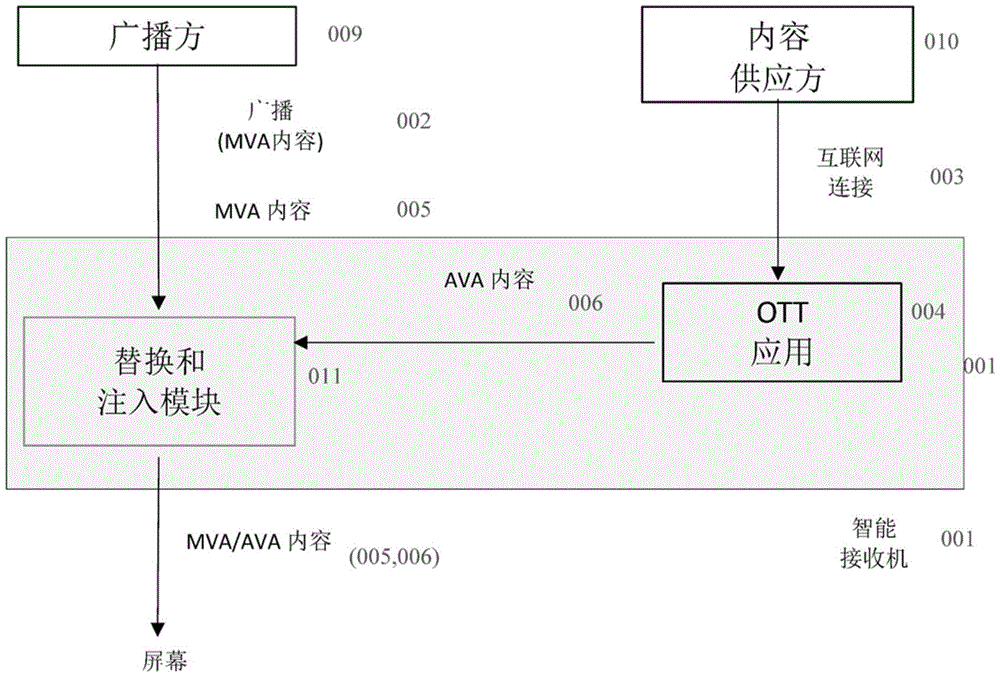
-图1–根据本公开内容的系统的表示。- Figure 1 - Representation of a system according to the present disclosure.
-图2–将非线性内容注入并且替换线性内容的模块的表示。- Figure 2 - Representation of a module that injects non-linear content and replaces linear content.
-图3a和图3b–利用AVA内容替换MVA内容的方法的流程图。- Figures 3a and 3b - flow diagrams of a method for replacing MVA content with AVA content.
-图4–决策中心的表示。- Figure 4 – Representation of the decision center.
-图5a和图5b–MVA内容块描述符的表示以及选择所要替换的MVA内容的示例。- Figures 5a and 5b - Representation of MVA content block descriptors and an example of selecting the MVA content to be replaced.
图1示出了根据本公开内容的系统的一个实施方式,其显示了与常规电视广播网络(002)以及能够接入互联网的宽带网络(003)相连的智能接收机(001)。出于本公开内容的目的,每一个网络(002-003)都被认为是全数字网络。智能接收机(001)可以通过其与电视广播网络(002)(例如数字地面电视广播网络、数字有线电视网络或数字卫星电视网络)的连接来支持传统广播电视内容的再现。除了传统的电视机功能之外,通过其与宽带网络(003)的连接,智能接收机(001)还可以支持传递点播在线内容,例如流媒体服务、通过过顶(Over-The-Top)应用(OTT应用)(004)来支持过顶(Over-The-Top,OTT)内容或视频点播(VOD)。Figure 1 illustrates one embodiment of a system according to the present disclosure, showing an intelligent receiver (001) connected to a conventional television broadcast network (002) and a broadband network (003) capable of accessing the Internet. For the purposes of this disclosure, each network (002-003) is considered an all-digital network. The smart receiver (001) may support the reproduction of traditional broadcast television content through its connection to a television broadcast network (002) such as a digital terrestrial television broadcast network, a digital cable television network or a digital satellite television network. Through its connection to the broadband network (003), the smart receiver (001) can support the delivery of on-demand online content, such as streaming services, through Over-The-Top applications, in addition to traditional television functions (OTT application) (004) to support Over-The-Top (OTT) content or Video on Demand (VOD).
宽带网络(003)是基于标准的互联网协议(IP)的网络,例如电信运营商或有线电视运营商或公共宽带供应商拥有的专用IP网络。A broadband network (003) is a standard Internet Protocol (IP)-based network, such as a private IP network owned by a telecom operator or a cable TV operator or a public broadband provider.
因此,智能接收机(001)支持一种通过数字广播连接(002)辅以数字宽带互联网连接(003)来消费线性(或实况)广播的电视内容(以下将其称为MVA内容(005))的模型。作为示例,该数字广播连接可以是在巴西数字电视系统所使用的基于ISDB-T的传输标准中进行的传输,或者是以基于地面、有线电视或卫星接入的广播网络提供的别的类型的数字电视标准(例如DVB-T,ATSC等等)为基础的传输。Accordingly, the smart receiver (001) supports a type of television content (hereinafter referred to as MVA content (005)) for consumption of linear (or live) broadcasts via a digital broadcast connection (002) supplemented by a digital broadband Internet connection (003) model. As an example, the digital broadcast connection may be a transmission based on the ISDB-T transmission standard used by the Brazilian digital television system, or another type of connection provided by a broadcast network based on terrestrial, cable or satellite access. Transmission based on digital television standards (such as DVB-T, ATSC, etc.).
数字宽带连接(003)允许智能接收机(001)访问可被下载或广播到智能接收机(001)的替换视听内容(AVA)(006)。The digital broadband connection (003) allows the smart receiver (001) to access alternative audiovisual content (AVA) (006) that can be downloaded or broadcast to the smart receiver (001).
智能接收机(001)可以是IBB数字电视接收机,其支持将广播到终端消费者的广播传输(002)与宽带分发(003)进行集成。IBB智能接收机可以使用不同的数字传输技术(例如地面、有线电视或卫星传输)来操作。The smart receiver (001) may be an IBB digital television receiver that supports the integration of broadcast transmission (002) and broadband distribution (003) broadcast to end consumers. IBB smart receivers can operate using different digital transmission technologies such as terrestrial, cable or satellite transmissions.
图2示出了智能接收机(001)的内容替换和注入模块(011),其负责消费通过广播传输(002)广播的MVA内容(005)和通过宽带网络(003)广播的AVA内容(006)。该模块通过对广播方(009)发送的内容描述符(007)和同步事件(008)进行数据分析来执行MVA内容(005)到AVA内容(006)的切换。Figure 2 shows the content replacement and injection module (011) of the smart receiver (001), which is responsible for consuming MVA content (005) broadcast over broadcast transmission (002) and AVA content (006) broadcast over broadband network (003) ). This module executes switching from MVA content (005) to AVA content (006) by performing data analysis on the content descriptor (007) and synchronization event (008) sent by the broadcaster (009).
图3a和3b示出了由内容替换和注入模块(011)所使用的将MVA内容(005)替换成AVA内容(006)以确保观看者的最佳体验的方法。Figures 3a and 3b illustrate the method used by the content replacement and injection module (011) to replace MVA content (005) with AVA content (006) to ensure the best experience for the viewer.
正如所观察到的那样,根据本公开内容的系统使用某种技术(例如所谓的“系统事件”,但是不局限于此)来解释来自广播方(009)的请求/信号。系统将该信号解释成是要求用AVA内容(006)替换MVA内容(005)的请求,由此向数字电视接收机通知该MVA内容(005)的结构和性质。As observed, the system according to the present disclosure uses a certain technique (eg, but not limited to so-called "system events") to interpret requests/signals from the broadcaster (009). The system interprets this signal as a request to replace the MVA content (005) with AVA content (006), thereby informing the digital television receiver of the structure and nature of the MVA content (005).
根据用于在所述电视接收机中实施根据本公开内容的所述系统的方法,在初始步骤(021)中,数字电视接收机从广播方(009)接收如图5a和图5b所示的会在未来的任何时间显示的MVA内容描述符(007)。然后,决策中心(012)分析该MVA内容描述符(007),以便借助于该内容的描述符中的特定标记/标签来检测是否有任何特定内容会被AVA内容(006)替换。决策中心(012)负责评估数字电视接收机是否有足够条件而在不影响观看者的体验的情况下将MVA内容(005)替换成AVA内容(006)。According to the method for implementing said system according to the present disclosure in said television receiver, in an initial step (021), the digital television receiver receives from the broadcaster (009) the MVA Content Descriptor (007) to be displayed at any time in the future. The Decision Center (012) then analyzes the MVA Content Descriptor (007) in order to detect whether any specific content will be replaced by the AVA Content (006) by means of specific flags/tags in the content's descriptor. The decision center (012) is responsible for evaluating whether the digital television receiver has sufficient conditions to replace the MVA content (005) with the AVA content (006) without affecting the viewer's experience.
然后,在接下来的步骤(022)中,决策中心(012)评估是否在数字电视接收机上安装了与调谐频道相关联的OTT类型应用(“过顶(Over-The-Top)”)(004),以及消费者/观看者是否被唯一标识(013)。以此方式,数字电视接收机将能够在正确的时刻并根据广播方的标准(009)来为观看者消费者选择和请求显示AVA(006)。OTT应用(004)还负责与AVA内容供应方(010)进行交互,并从该来源获取将要由系统再现的AVA内容(005)。对AVA内容供应方(010)的访问可以通过例如在宽带网络(003)上经由互联网的HTTP连接的访问来完成。Then, in a next step (022), the decision center (012) evaluates whether an OTT type application ("Over-The-Top") associated with the tuned channel is installed on the digital television receiver (004 ), and whether the consumer/viewer is uniquely identified (013). In this way, the digital television receiver will be able to select and request display of the AVA (006) for the viewer consumer at the correct moment and according to the broadcaster's criteria (009). The OTT application (004) is also responsible for interacting with the AVA content provider (010) and obtaining from this source the AVA content to be rendered by the system (005). Access to the AVA Content Provider (010) can be accomplished eg via an HTTP connection over the broadband network (003) via the Internet.
在接下来的步骤(023)中,决策中心(012)试图确定是否可以在不损害观看者体验的情况下执行利用AVA内容(006)替换MVA内容(005)的处理。为此目的,决策中心(012)通过数据收集模块(039)来从数字电视接收机采集相关参数,以便确定:(a)是否可以在没有中断的情况下完整再现AVA内容(006);(b)是否可以在可接受的时间以内执行利用AVA内容(006)替换MVA内容(005),而不损害观看者的体验。In the next step (023), the decision center (012) attempts to determine whether the process of replacing the MVA content (005) with the AVA content (006) can be performed without compromising the viewer's experience. For this purpose, the decision center (012) collects relevant parameters from the digital television receiver through the data collection module (039), so as to determine: (a) whether the AVA content (006) can be completely reproduced without interruption; (b ) whether replacing MVA content (005) with AVA content (006) can be performed within an acceptable time frame without compromising the viewer's experience.
关于相关参数的示例包括但不局限于以下各项:Examples of relevant parameters include, but are not limited to, the following:
-互联网连接(003)的速度;- the speed of the Internet connection (003);
-互联网连接(003)的延迟;- Delay in internet connection (003);
-互联网连接(003)的丢包率;- packet loss rate of the Internet connection (003);
-CPU(040)的使用百分比;- CPU (040) usage percentage;
-系统内存(041)的使用百分比;- percentage of system memory (041) used;
-显存(042)的使用百分比;- the usage percentage of video memory (042);
-在该接收机中利用AVA内容(006)替换MVA内容(005)的平均时间;- average time to replace MVA content (005) with AVA content (006) in the receiver;
-在该接收机中利用AVA内容(006)替换MVA内容(005)时的累积失败次数;- the cumulative number of failures when replacing MVA content (005) with AVA content (006) in the receiver;
-对于再现AVA内容(005)的限制。- Restrictions on reproduction of AVA content (005).
在提供了所有相关的接收机参数的情况下,根据本公开内容,数据收集模块(039)试图估计将MVA内容(005)替换为AVA内容(006)所需要的时间(该时间被称为内容交换时间(CET)(044)),可以不中断地再现AVA内容(006)的最大质量(Qmax)(045)以及最大持续时间(Dmax)(046)。Given all relevant receiver parameters, according to the present disclosure, the data collection module (039) attempts to estimate the time required to replace MVA content (005) with AVA content (006) (this time is referred to as content exchange time (CET) (044)), the maximum quality (Qmax) (045) and maximum duration (Dmax) (046) of the AVA content (006) that can be reproduced without interruption.
然后,数据收集模块(039)然后检查是否在唯一识别的接收机数据库(043)中注册了该设备。如果注册了该设备,则阻止用AVA内容(006)来替换MVA内容(005),并且因此结束替换处理。该数据库(043)的目的是注册所有无法用AVA内容(006)替换MVA内容(005)的设备。该数据库(043)可以在接收机(001)本地实施,或者在广播中心(009)中远程实施。广播方(009)可以自由决定何时在该数据库(043)中注册设备或者从该数据库(043)中删除设备。The data collection module (039) then checks if the device is registered in the uniquely identified receiver database (043). If the device is registered, the replacement of the MVA content (005) with the AVA content (006) is prevented, and thus the replacement process ends. The purpose of this database (043) is to register all devices that cannot replace MVA content (005) with AVA content (006). This database (043) can be implemented locally at the receiver (001) or remotely in the broadcast center (009). The broadcaster (009) is free to decide when to register a device in this database (043) or delete a device from this database (043).
一旦被执行,那么在步骤(024)中,决策中心(012)分析MVA内容描述符(007),以便搜索与数据收集模块(039)估计的CET、Qmax和Dmax兼容的MVA内容(005))。Once executed, then in step (024), the decision center (012) analyzes the MVA content descriptor (007) in order to search for MVA content compatible with the CET, Qmax and Dmax estimated by the data collection module (039) (005) .
图5a和图5b示出了可能的MVA内容描述符(007)以及与CET(057)、Qmax(058)和Dmax(059)参数的兼容性。可以看出,在该描述符中,MVA内容(047)是不能被替换的,因为其持续时间(051)大于Dmax(059),并且内容(048)是不兼容的,因为开始时间(054)低于估计的CET(057),因此。唯一符合替换条件的内容是内容(049),其持续时间(055)小于Dmax(059),且具有大于CET(057)的足够的转换时间(056),由此可以在不损失内容的情况下执行转换。Figures 5a and 5b show possible MVA content descriptors (007) and compatibility with CET (057), Qmax (058) and Dmax (059) parameters. It can be seen that in this descriptor, the MVA content (047) cannot be replaced because its duration (051) is greater than Dmax (059), and the content (048) is incompatible because the start time (054) Lower than estimated CET(057), therefore. The only content eligible for replacement is content (049) whose duration (055) is less than Dmax (059) and has sufficient transition time (056) greater than CET (057), whereby it can be replaced without loss of content Perform the conversion.
然后,在步骤(025)中,决策中心(012)向OTT应用(004)通知将被替换的MVA内容(005)的性质,以及为AVA内容(006)估计的最大质量Qmax(058)。OTT应用(004)将该信息连同观看者的标识一起发送到AVA内容供应方(010)。预计供应方会根据市场上通常用于对VoD(视频点播)内容进行分段的技术和产品来选择与被选择替换的MVA内容(005)兼容的AVA内容(006)。非常重要的是,该内容满足系统限定的关于最大质量和最大持续时间的需求,以便为观看者提供最佳体验。Then, in step (025), the decision center (012) notifies the OTT application (004) of the nature of the MVA content (005) to be replaced, and the estimated maximum quality Qmax (058) for the AVA content (006). The OTT application (004) sends this information to the AVA content provider (010) along with the identity of the viewer. The supplier is expected to select the AVA content (006) compatible with the MVA content (005) selected for replacement according to the technologies and products commonly used in the market for segmenting VoD (Video On Demand) content. It is very important that the content meets the requirements defined by the system for maximum quality and duration in order to provide the best experience for the viewer.
在接下来的步骤(026)中,决策中心(012)通过检查是否满足AVA内容(006)的再现条件来提供用于再现AVA(006)的资源。作为示例,典型的条件可以是CPU(040)的使用百分比、系统内存(041)的可用量、存储(050)可用量、带宽(003)的速度以及延时。决策中心(012)使用公知的再现远程内容的技术来请求(037)OTT应用(004)将AVA内容(006)加载到流媒体模块(014)中。In the next step (026), the decision center (012) provides resources for reproducing the AVA (006) by checking whether the reproduction condition of the AVA content (006) is satisfied. As an example, typical conditions may be the percentage of CPU (040) used, the amount of system memory (041) available, the amount of storage (050) available, the speed of bandwidth (003), and latency. The decision center (012) requests (037) the OTT application (004) to load the AVA content (006) into the streaming module (014) using known techniques for rendering remote content.
然而,一个根本的区别在于,流媒体模块(014)必须执行所有必需的步骤来再现AVA内容(006),除了最后一步是将内容注入解码器(015)的步骤。我们将这个处理称为预加载AVA内容(006)。However, a fundamental difference is that the streaming module (014) has to perform all necessary steps to reproduce the AVA content (006), except for the last step which is the step of injecting the content into the decoder (015). We refer to this process as Preloading AVA Content (006).
在接下来的步骤(027)中,如果满足所有再现条件,并且正确加载了AVA内容(006),那么决策中心向同步器(016)发送启动命令(038),其中所述同步器(016)监控同步事件(008),以便确保在再现MVA(005)→AVA(006)→MVA(005)之间的转换过程中实现完美的同步。In the next step (027), if all rendering conditions are satisfied and the AVA content is loaded correctly (006), the decision center sends a start command (038) to the synchronizer (016), wherein the synchronizer (016) Synchronization events (008) are monitored to ensure perfect synchronization during transitions between renditions of MVA (005)→AVA(006)→MVA(005).
通过同步事件(008),广播方(009)可以控制AVA内容(006)应该开始的准确时间、AVA内容(006)应该结束的准确时间、以及是否应该提前结束内容AVA(006)。Through the synchronization event (008), the broadcaster (009) can control the exact time when the AVA content (006) should start, the exact time when the AVA content (006) should end, and whether the content AVA (006) should end early.
最后一个条件是确保在不出现意外故障的情况下返回到MVA(005)再现状态,并保持正确的时序以恢复其显示,而不会丢失观看者的MVA(005)或AVA(006)内容。The last condition is to ensure the return to the MVA(005) rendition without unexpected failure and maintain the correct timing to resume its display without losing the viewer's MVA(005) or AVA(006) content.
在一些情况中,广播方(009)可决定提前结束AVA内容(006)的再现,例如在发生必须立即向观看者展示的紧急实况事件的情况下。In some cases, the broadcaster (009) may decide to end the rendering of the AVA content (006) prematurely, such as in the case of an urgent live event that must be shown to viewers immediately.
在接下来的步骤(028)中,同步器(016)通过监视同步事件(008)来检测AVA内容(006)开始的确切时刻。由广播方(009)执行这种控制是非常重要的。本领域的技术人员将会知晓,由于会出现不能事先准确知晓MVA内容(005)何时开始或结束的特别节目(例如实况体育赛事),广播传输(002)几乎是不能提前很长时间进行规划。因此,与必须尽可能早地发送以允许预加载的MVA内容描述符(007)不同,AVA内容(006)开始时间必须在尽可能在接近AVA内容将要开始的时刻被通知给数字电视接收机(006)。这两个信号在时间需求方面的差异表明,同步事件(008)是以最大的精度来保证AVA内容(006)的再现开始时间的基础。因此,对于本公开内容的系统(011)来说,要想尽可能早地执行关于AVA内容(006)的验证和预加载处理,同时尽可能精确地开始再现该AVA内容(006),以便能够平衡这些不同的需求,同步事件(008)是非常重要的。In the next step (028), the synchronizer (016) detects the exact moment when the AVA content (006) starts by monitoring the synchronization events (008). It is very important that this control is performed by the broadcaster (009). Those skilled in the art will appreciate that broadcast transmissions (002) can hardly be planned very far in advance due to the presence of special programs (such as live sporting events) for which it is not known exactly in advance when the MVA content (005) will start or end . Therefore, unlike the MVA content descriptor (007), which must be sent as early as possible to allow preloading, the AVA content (006) start time must be signaled to the digital television receiver as close as possible to the moment when the AVA content will start ( 006). The difference in time requirements of these two signals shows that the synchronization event (008) is the basis for guaranteeing the reproduction start time of the AVA content (006) with the greatest precision. Therefore, for the system (011) of the present disclosure, it is necessary to perform verification and preloading processing on the AVA content (006) as early as possible, and at the same time start to reproduce the AVA content (006) as accurately as possible, so as to be able to Balancing these different needs, it is very important to synchronize events (008).
因此,一旦检测到AVA内容(006)开始时间,那么在步骤(029)中,同步器向流媒体模块(014)发送关于AVA内容(006)的注入命令(019),以及向内容选择器(017)发送内容切换命令(020)。内容选择器(017)切换将被注入至解码器(015)中的音频和视频内容的来源,其先前是直接从调谐器(018)接收该内容的,并且现在开始从AVA内容服务器(010)接收该内容,作为示例,该内容接收通常是通过使用宽带网络经由互联网(003)的HTTP连接接收的。Therefore, once the AVA content (006) start time is detected, then in step (029), the synchronizer sends an injection command (019) about the AVA content (006) to the streaming module (014), and to the content selector ( 017) Send a content switching command (020). The Content Selector (017) switches the source of the audio and video content to be injected into the Decoder (015), which previously received it directly from the Tuner (018), and now starts from the AVA Content Server (010) The content is received, typically by way of example, over an HTTP connection via the Internet (003) using a broadband network.
在接下来的步骤(030)中,在再现AVA内容(006)的同时,同步器(016)监视广播方发送的同步事件(008),以便确定AVA内容的结束时间。该时间可以代表AVA内容(006)的自然结束,或者由广播方(009)自发和突然地结束AVA内容(006)。In the next step (030), while reproducing the AVA content (006), the synchronizer (016) monitors the synchronization event (008) sent by the broadcaster to determine the end time of the AVA content. This time may represent the natural end of the AVA content (006), or the spontaneous and abrupt end of the AVA content (006) by the broadcaster (009).
在步骤(031)中,系统自然地通过AVA内容(006)的结束或者通过本步骤(031)中的结束信号来检测AVA内容(006)的结束。在步骤(032)中,内容选择器(017)立即将AVA内容(006)替换成来自数字电视信号广播网络(002)的MVA内容(005)。In step (031), the system detects the end of the AVA content (006) naturally by the end of the AVA content (006) or by the end signal in this step (031). In step (032), the content selector (017) immediately replaces the AVA content (006) with the MVA content (005) from the digital television signal broadcasting network (002).
终端,在显示AVA(006)之后,出于统计目的,OTT应用(004)可以收集与电视广播方(009)相关的信息,例如但不必局限于用户标识、日期、时间、IP地址、带宽、延时、电视接收机制造商/型号、AVA显示状态等等。Terminal, after displaying the AVA (006), the OTT application (004) may collect information related to the TV broadcaster (009) for statistical purposes, such as but not necessarily limited to user identification, date, time, IP address, bandwidth, Delay, TV receiver make/model, AVA display status, and more.
在任何情况(033)中,决策中心(012)通过定期评估各种参数而在不同时间检查数字电视接收机的状况,以减轻对同步而言至关重要的因素的影响,作为示例,所述参数可以是CPU使用率、可用的通用内存(RAM)量、临时使用的存储内存量、互联网连接速度和延时、要被再现的AVA内容(006)的特征、以及用户的身份识别状态(已识别/未识别)。如果发生故障(034),那么在步骤(035)中,决策中心(012)通过发送故障数据(061)、在发生故障时从数字电视接收机收集的参数、AVA内容(006)的特性以及观看者的标识(013)来通知广播中心(060)。在步骤(036),广播中心(060)决定是否应该从该时刻将该接收机表征为对于再现AVA(006)具有积极的限制,由此在接收机数据库(043)中将其注册为受限于MVA内容替换。In any case (033), the decision center (012) checks the condition of the digital television receiver at different times by periodically evaluating various parameters to mitigate the influence of factors critical for synchronization, as an example, the Parameters can be CPU usage, amount of general memory (RAM) available, amount of storage memory temporarily used, Internet connection speed and latency, characteristics of the AVA content (006) to be rendered, and user's identification status (already identified/unidentified). If a fault occurs (034), then in step (035), the decision center (012) sends fault data (061), parameters collected from digital television receivers at the time of fault, characteristics of AVA content (006) and viewing The broadcast center (060) is notified by the identification (013) of the person. In step (036), the broadcast center (060) decides whether the receiver should be characterized from this moment as having a positive restriction on rendering the AVA (006), thereby registering it as restricted in the receiver database (043) Replaced by MVA content.
在再现AVA内容(006)的过程中出现的故障可以用以下各项来表征,但是并不局限于此:AVA内容(006)的再现中断、无法同步AVA内容(006)的音频和视频、AVA内容的再现的自然中止(006),以及无法访问AVA内容供应方(010)。Failures that occur during reproduction of AVA content (006) can be characterized by, but are not limited to, interruption of reproduction of AVA content (006), inability to synchronize audio and video of AVA content (006), AVA Natural suspension of reproduction of content (006), and inability to access the AVA content provider (010).
作为示例,在利用AVA内容(006)替换MVA内容(005)的过程中出现的故障可被表征为:在将MVA内容(005)切换成AVA内容(006)的过程中出现延迟,反之亦然,以及MVA内容与AVA内容(006)的持续时间不兼容。As an example, a failure during the replacement of MVA content (005) with AVA content (006) may be characterized as a delay in switching from MVA content (005) to AVA content (006) and vice versa , and the duration of the MVA content is not compatible with the AVA content (006).
实施方式示例Implementation example
如上所述的图1、2和3描绘了关于本公开内容的范围的非限制性的示意性示例。此类示例描述了在数字电视接收机中操作根据本公开内容的系统的一些可能方式,其中广播方希望为指定的消费者群或单个消费者创建定制的视频/音频再现体验。Figures 1, 2 and 3, as described above, depict non-limiting illustrative examples as to the scope of the present disclosure. Such examples describe some possible ways of operating a system according to the present disclosure in a digital television receiver, where a broadcaster wishes to create a customized video/audio reproduction experience for a specified group of consumers or for a single consumer.
Claims (11)
Applications Claiming Priority (3)
| Application Number | Priority Date | Filing Date | Title |
|---|---|---|---|
| BRBR1020200019678 | 2020-01-29 | ||
| BR102020001967-8A BR102020001967A2 (en) | 2020-01-29 | 2020-01-29 | ALTERNATIVE VIDEO AND/OR AUDIO MEDIA INGESTION SYSTEM, SYNCHRONIZED WITH THE DISPLAY OF VIDEO AND AUDIO CONTENT OF ORIGIN AND LINEAR CHARACTERISTICS AND METHOD FOR ITS IMPLEMENTATION |
| PCT/BR2021/050033 WO2021151182A1 (en) | 2020-01-29 | 2021-01-22 | System for ingesting alternative video and/or audio media synchronized with the display of video and audio content of linear origin, and related implementation method |
Publications (1)
| Publication Number | Publication Date |
|---|---|
| CN115398925A true CN115398925A (en) | 2022-11-25 |
Family
ID=77077965
Family Applications (1)
| Application Number | Title | Priority Date | Filing Date |
|---|---|---|---|
| CN202180011912.7A Pending CN115398925A (en) | 2020-01-29 | 2021-01-22 | System for ingesting alternate video and/or audio media synchronously with display of video and audio content from linear sources and properties, and method for its implementation |
Country Status (9)
| Country | Link |
|---|---|
| US (1) | US12470772B2 (en) |
| EP (1) | EP4099708A4 (en) |
| JP (1) | JP7768885B2 (en) |
| KR (1) | KR20220133201A (en) |
| CN (1) | CN115398925A (en) |
| AR (1) | AR121141A1 (en) |
| BR (2) | BR102020001967A2 (en) |
| TW (1) | TWI881029B (en) |
| WO (1) | WO2021151182A1 (en) |
Citations (3)
| Publication number | Priority date | Publication date | Assignee | Title |
|---|---|---|---|---|
| US20040244035A1 (en) * | 2003-05-28 | 2004-12-02 | Microspace Communications Corporation | Commercial replacement systems and methods using synchronized and buffered TV program and commercial replacement streams |
| US20070188656A1 (en) * | 2006-02-15 | 2007-08-16 | Sharp Kabushiki Kaisha | Content reproducing device, broadcast content transmitting device, control data providing device, user attribute value providing device, broadcast system, content reproducing method, and broadcast content transmitting method |
| US20160182923A1 (en) * | 2014-12-19 | 2016-06-23 | Telefonaktiebolaget L M Ericsson (Publ) | End user-based personalized ad insertion in broadcast-broadband hybrid terminals |
Family Cites Families (9)
| Publication number | Priority date | Publication date | Assignee | Title |
|---|---|---|---|---|
| US7653923B2 (en) | 2000-02-18 | 2010-01-26 | Prime Research Alliance E, Inc. | Scheduling and presenting IPG ads in conjunction with programming ads in a television environment |
| US8667525B2 (en) * | 2002-12-13 | 2014-03-04 | Sony Corporation | Targeted advertisement selection from a digital stream |
| US20080010584A1 (en) | 2006-07-05 | 2008-01-10 | Motorola, Inc. | Method and apparatus for presentation of a presentation content stream |
| JP2008109334A (en) * | 2006-10-25 | 2008-05-08 | Funai Electric Co Ltd | Broadcasting signal display device |
| US20110264530A1 (en) | 2010-04-23 | 2011-10-27 | Bryan Santangelo | Apparatus and methods for dynamic secondary content and data insertion and delivery |
| KR101887506B1 (en) * | 2011-09-22 | 2018-08-13 | 삼성전자주식회사 | Apparatus and method for playing broadcast contents in broadcast systems |
| US20130144725A1 (en) * | 2011-12-02 | 2013-06-06 | General Instrument Corporation | Presenting content to a user in accordance with an agreed upon content-presentation policy |
| JP2019216368A (en) * | 2018-06-13 | 2019-12-19 | ソニーセミコンダクタソリューションズ株式会社 | Demodulator circuit, processing method, and processing apparatus |
| US11317143B2 (en) * | 2018-08-17 | 2022-04-26 | Roku, Inc. | Dynamic reduction in playout of replacement content to help align end of replacement content with end of replaced content |
-
2020
- 2020-01-29 BR BR102020001967-8A patent/BR102020001967A2/en not_active Application Discontinuation
-
2021
- 2021-01-22 BR BR112022015014A patent/BR112022015014A2/en unknown
- 2021-01-22 CN CN202180011912.7A patent/CN115398925A/en active Pending
- 2021-01-22 EP EP21747947.6A patent/EP4099708A4/en active Pending
- 2021-01-22 WO PCT/BR2021/050033 patent/WO2021151182A1/en not_active Ceased
- 2021-01-22 JP JP2022545152A patent/JP7768885B2/en active Active
- 2021-01-22 KR KR1020227026227A patent/KR20220133201A/en active Pending
- 2021-01-22 US US17/795,722 patent/US12470772B2/en active Active
- 2021-01-26 AR ARP210100190A patent/AR121141A1/en active IP Right Grant
- 2021-01-28 TW TW110103208A patent/TWI881029B/en active
Patent Citations (3)
| Publication number | Priority date | Publication date | Assignee | Title |
|---|---|---|---|---|
| US20040244035A1 (en) * | 2003-05-28 | 2004-12-02 | Microspace Communications Corporation | Commercial replacement systems and methods using synchronized and buffered TV program and commercial replacement streams |
| US20070188656A1 (en) * | 2006-02-15 | 2007-08-16 | Sharp Kabushiki Kaisha | Content reproducing device, broadcast content transmitting device, control data providing device, user attribute value providing device, broadcast system, content reproducing method, and broadcast content transmitting method |
| US20160182923A1 (en) * | 2014-12-19 | 2016-06-23 | Telefonaktiebolaget L M Ericsson (Publ) | End user-based personalized ad insertion in broadcast-broadband hybrid terminals |
Also Published As
| Publication number | Publication date |
|---|---|
| JP7768885B2 (en) | 2025-11-12 |
| US12470772B2 (en) | 2025-11-11 |
| EP4099708A1 (en) | 2022-12-07 |
| TWI881029B (en) | 2025-04-21 |
| WO2021151182A1 (en) | 2021-08-05 |
| EP4099708A4 (en) | 2024-02-21 |
| TW202143703A (en) | 2021-11-16 |
| KR20220133201A (en) | 2022-10-04 |
| BR112022015014A2 (en) | 2023-11-07 |
| US20230096987A1 (en) | 2023-03-30 |
| JP2023516550A (en) | 2023-04-20 |
| AR121141A1 (en) | 2022-04-20 |
| BR102020001967A2 (en) | 2021-08-10 |
Similar Documents
| Publication | Publication Date | Title |
|---|---|---|
| KR101887506B1 (en) | Apparatus and method for playing broadcast contents in broadcast systems | |
| CN104541512B (en) | Method and apparatus for handling the broadcast singal for including interactive broadcasting service | |
| US9167278B2 (en) | Method and system for automatic content recognition (ACR) based broadcast synchronization | |
| US9967626B2 (en) | Video display apparatus and operating method thereof | |
| US9992527B2 (en) | Video display apparatus and operating method thereof | |
| CN106416272B (en) | Broadcast receiving apparatus and operation method thereof, and supporting apparatus for interoperating with broadcast receiving apparatus and operation method thereof | |
| CN104185070B (en) | The switching method of TV difference display window | |
| US20170127115A1 (en) | Broadcast receiving device, method of operating broadcast receiving device, linking device for linking to broadcast receiving device, and method of operating linking device | |
| JP2012110050A (en) | Broadcast transmitter, broadcast receiver, and broadcast transmission method | |
| TWI881029B (en) | System for ingesting alternative video and/or audio media, synchronized with a display of video and audio content of linear origin and characteristic based on regular evaluation of relevant parameters for display, and method for implementation thereof | |
| HK40080564A (en) | System for ingesting alternative video and/or audio media, synchronized with the display of video and audio content of linear origin and characteristic, and method for implementation thereof | |
| EP3301942A1 (en) | A method and a system for delivering an ott advertisement content for television content delivered using a constant bit rate network | |
| Le Feuvre et al. | Hybrid broadcast services using MPEG DASH | |
| Franklin | Using metadata to deliver relevant and valuable content |
Legal Events
| Date | Code | Title | Description |
|---|---|---|---|
| PB01 | Publication | ||
| PB01 | Publication | ||
| SE01 | Entry into force of request for substantive examination | ||
| SE01 | Entry into force of request for substantive examination | ||
| REG | Reference to a national code |
Ref country code: HK Ref legal event code: DE Ref document number: 40080564 Country of ref document: HK |