CN115386965A - Multi-omics chip based on spatially interleaved coding and its preparation method and application - Google Patents
Multi-omics chip based on spatially interleaved coding and its preparation method and application Download PDFInfo
- Publication number
- CN115386965A CN115386965A CN202211046021.8A CN202211046021A CN115386965A CN 115386965 A CN115386965 A CN 115386965A CN 202211046021 A CN202211046021 A CN 202211046021A CN 115386965 A CN115386965 A CN 115386965A
- Authority
- CN
- China
- Prior art keywords
- spatial
- chip
- sequence
- situ
- synthesis
- Prior art date
- Legal status (The legal status is an assumption and is not a legal conclusion. Google has not performed a legal analysis and makes no representation as to the accuracy of the status listed.)
- Granted
Links
Images


Classifications
-
- C—CHEMISTRY; METALLURGY
- C40—COMBINATORIAL TECHNOLOGY
- C40B—COMBINATORIAL CHEMISTRY; LIBRARIES, e.g. CHEMICAL LIBRARIES
- C40B50/00—Methods of creating libraries, e.g. combinatorial synthesis
- C40B50/06—Biochemical methods, e.g. using enzymes or whole viable microorganisms
-
- C—CHEMISTRY; METALLURGY
- C12—BIOCHEMISTRY; BEER; SPIRITS; WINE; VINEGAR; MICROBIOLOGY; ENZYMOLOGY; MUTATION OR GENETIC ENGINEERING
- C12Q—MEASURING OR TESTING PROCESSES INVOLVING ENZYMES, NUCLEIC ACIDS OR MICROORGANISMS; COMPOSITIONS OR TEST PAPERS THEREFOR; PROCESSES OF PREPARING SUCH COMPOSITIONS; CONDITION-RESPONSIVE CONTROL IN MICROBIOLOGICAL OR ENZYMOLOGICAL PROCESSES
- C12Q1/00—Measuring or testing processes involving enzymes, nucleic acids or microorganisms; Compositions therefor; Processes of preparing such compositions
- C12Q1/68—Measuring or testing processes involving enzymes, nucleic acids or microorganisms; Compositions therefor; Processes of preparing such compositions involving nucleic acids
- C12Q1/6813—Hybridisation assays
- C12Q1/6834—Enzymatic or biochemical coupling of nucleic acids to a solid phase
- C12Q1/6837—Enzymatic or biochemical coupling of nucleic acids to a solid phase using probe arrays or probe chips
-
- C—CHEMISTRY; METALLURGY
- C40—COMBINATORIAL TECHNOLOGY
- C40B—COMBINATORIAL CHEMISTRY; LIBRARIES, e.g. CHEMICAL LIBRARIES
- C40B40/00—Libraries per se, e.g. arrays, mixtures
- C40B40/04—Libraries containing only organic compounds
- C40B40/06—Libraries containing nucleotides or polynucleotides, or derivatives thereof
Landscapes
- Chemical & Material Sciences (AREA)
- Organic Chemistry (AREA)
- Life Sciences & Earth Sciences (AREA)
- Health & Medical Sciences (AREA)
- Biochemistry (AREA)
- Molecular Biology (AREA)
- Zoology (AREA)
- Proteomics, Peptides & Aminoacids (AREA)
- Medicinal Chemistry (AREA)
- Engineering & Computer Science (AREA)
- General Chemical & Material Sciences (AREA)
- Chemical Kinetics & Catalysis (AREA)
- Microbiology (AREA)
- Wood Science & Technology (AREA)
- Immunology (AREA)
- Analytical Chemistry (AREA)
- Bioinformatics & Cheminformatics (AREA)
- General Engineering & Computer Science (AREA)
- General Health & Medical Sciences (AREA)
- Genetics & Genomics (AREA)
- Biophysics (AREA)
- Biotechnology (AREA)
- Physics & Mathematics (AREA)
- Measuring Or Testing Involving Enzymes Or Micro-Organisms (AREA)
Abstract
Description
技术领域technical field
本发明属于芯片制备领域,涉及多组学芯片,特别涉及基于空间交错编码多组学芯片及其制备方法与应用。The invention belongs to the field of chip preparation and relates to a multi-omics chip, in particular to a multi-omics chip based on spatially interleaved coding and its preparation method and application.
背景技术Background technique
目前,空间转录组技术已经成为复杂生命体基因表达和多组学分析的研究利器。空间转录组是既能够保留组织空间位置信息又能够获得不同组织空间位点基因转录信息的一种技术,它融合了组织病理学、基因芯片、高通量测序、生物成像等技术。该技术被Nature Methods评为2020年年度技术。细胞在组织中的空间位置强烈影响着它们的功能,空间转录组技术可以高通量且全基因组范围内在单细胞水平对基因表达进行准确捕获研究。进而得到对于疾病机理和器官发育研究中非常重要的时空组学图谱。不同空间转录组方法的评价维度主要包括空间分辨率、每个特征点的基因分辨率和整体可检测的区域覆盖度三个方面。首先,每个特征点越小空间分辨率越高,分辨率包括区域分辨率、单细胞分辨率和亚细胞分辨率;其次,每个特征点里的捕获探针越多则检测到的有效基因数目越多;最后,空间转录组芯片或检测视野范围越大越有利于大尺度组织的研究。目前空间转录组研究的主要策略分为四类,基于原位杂交的空间转录组技术,基于原位测序的空间转录组技术,基于显微切割(LCM)的空间转录组技术和基于空间原位捕获的转录组技术。这些技术有各自独特的优势,但在不同方面都还有不足之处。比如Geo-seq、NICHE-Seq、ProximID等,只对特定位点的细胞进行切割和测序,覆盖度不全。seqFISH、STARmap、FISSEQ等,这种基于原位杂交或原位测序的方法只能得到部分而非全部基因的表达信息,基因分辨率有限。基于寡核苷酸空间条形码捕获方法,比如ST、Slide-seq、DBiT-seq、Seq-Scope等,通过原位添加空间位置条形码和异位构建转录组文库并测序,构建高分辨率空间转录组图谱;该方法代表未来发展的主流方向,但目前还存在空间分辨率低和覆盖度不全的问题。10×GenomicsVisium是目前商业化最成功的空间转录组芯片技术,芯片尺寸为6.5mm×6.5mm,Spot直径较大,达到55μm,实现的是区域分辨率而无法达到单细胞分辨率(人类细胞的平均直径为10μm),检测尺度还比较小,另外每个点之间都会有45μm的距离不被覆盖在组织上;因此分辨率较低且不能对组织切片全覆盖位置标记。尽管空间转录组技术与单细胞建库联合使用,可获得单细胞分辨率的空间图谱,但耗时费力、通量较低且成本偏高。因此当前的空间转录组技术具有相当大的瓶颈,限制了广泛的应用。现需要一种技术能同时满足具有足够捕获面积的大尺度、单细胞分辨率和全覆盖的空间转录组芯片技术,并且满足更精确的全覆盖组织切片转录图谱三维重建的需求,以期成为替代目前的空间转录组技术的工具。At present, spatial transcriptome technology has become a powerful tool for the study of gene expression and multi-omics analysis in complex organisms. Spatial transcriptomics is a technology that can not only preserve the spatial location information of tissues but also obtain gene transcription information of different tissue spatial locations. It integrates histopathology, gene chips, high-throughput sequencing, biological imaging and other technologies. The technology was named 2020 Technology of the Year by Nature Methods. The spatial location of cells in tissues strongly affects their function, and spatial transcriptome technology can accurately capture gene expression at the single-cell level in high-throughput and genome-wide. Then, the spatio-temporal omics map, which is very important for the study of disease mechanism and organ development, is obtained. The evaluation dimensions of different spatial transcriptome methods mainly include three aspects: spatial resolution, gene resolution of each feature point, and overall detectable region coverage. First, the smaller each feature point, the higher the spatial resolution, including regional resolution, single-cell resolution and subcellular resolution; secondly, the more capture probes in each feature point, the more effective genes detected The larger the number; finally, the larger the spatial transcriptome chip or detection field of view, the more conducive to the study of large-scale tissues. At present, the main strategies of space transcriptome research are divided into four categories, space transcriptome technology based on in situ hybridization, space transcriptome technology based on in situ sequencing, space transcriptome technology based on microdissection (LCM) and space in situ based Captured transcriptome technology. These technologies have their own unique advantages, but also have shortcomings in different aspects. For example, Geo-seq, NICHE-Seq, ProximID, etc., only cut and sequence cells at specific sites, and the coverage is not complete. seqFISH, STARmap, FISSEQ, etc., this method based on in situ hybridization or in situ sequencing can only obtain the expression information of some but not all genes, and the gene resolution is limited. Based on oligonucleotide spatial barcode capture methods, such as ST, Slide-seq, DBiT-seq, Seq-Scope, etc., construct a high-resolution spatial transcriptome by adding spatial position barcodes in situ and constructing a transcriptome library in situ and sequencing Atlas; this method represents the mainstream direction of future development, but there are still problems of low spatial resolution and incomplete coverage. 10×GenomicsVisium is currently the most successful commercialized spatial transcriptome chip technology. The chip size is 6.5mm×6.5mm, and the spot diameter is relatively large, reaching 55μm. It achieves regional resolution but cannot achieve single-cell resolution (human cell’s The average diameter is 10 μm), the detection scale is still relatively small, and there will be a distance of 45 μm between each point that is not covered on the tissue; therefore, the resolution is low and the tissue section cannot be fully covered with position marks. Although the combination of spatial transcriptome technology and single-cell library construction can obtain spatial maps with single-cell resolution, it is time-consuming, labor-intensive, low-throughput, and high-cost. Current spatial transcriptome techniques thus have considerable bottlenecks, limiting broad applications. There is a need for a technology that can simultaneously meet the large-scale, single-cell resolution, and full-coverage spatial transcriptome chip technology with sufficient capture area, and meet the needs of more accurate three-dimensional reconstruction of the transcriptional map of tissue sections with full coverage, so as to become an alternative to the current tools for spatial transcriptome technology.
发明内容Contents of the invention
为了解决上述技术问题,本发明目的是提供基于空间交错编码空间多组学芯片及其制备方法与应用。In order to solve the above-mentioned technical problems, the purpose of the present invention is to provide a spatial multi-omics chip based on spatial interleaving coding and its preparation method and application.
本发明基于3D喷墨原位DNA合成技术利用空间交错编码策略制作高分辨率的大尺度空间多组学芯片,进而使用空间原位捕获策略对组织切片进行高通量的原位转录组分析、原位表观组分析、原位非编码RNA分析和原位蛋白组分析;实现了单细胞分辨率、大尺度空间覆盖,同时兼顾高的基因数目检出率;可用于器官或组织的三维全覆盖精确转录图谱或时空图谱构建。Based on the 3D inkjet in situ DNA synthesis technology, the present invention utilizes a spatially interleaved coding strategy to fabricate a high-resolution large-scale spatial multi-omics chip, and then uses a spatial in situ capture strategy to perform high-throughput in situ transcriptome analysis on tissue slices, In situ epigenetic analysis, in situ non-coding RNA analysis, and in situ proteomic analysis; achieve single-cell resolution, large-scale spatial coverage, and take into account a high gene number detection rate; can be used for three-dimensional full-scale analysis of organs or tissues Overlay precise transcription map or spatiotemporal map construction.
本发明提供了基于空间交错编码空间多组学芯片的原位制备方法,包括如下步骤:The present invention provides an in-situ preparation method for a spatial multi-omics chip based on spatially interleaved coding, comprising the following steps:
1)将基底用水虎鱼溶液进行表面处理然后等离子清洗,得到预处理的基底;1) Surface-treating the substrate with a piranha solution and then plasma cleaning to obtain a pretreated substrate;
2)将所述预处理的基底用亲水性硅烷和疏水性硅烷的混合液浸泡,然后进行蒸镀或CVD表面处理;再依次加入Spacer试剂、Unylinker分子处理,得到表面处理的功能图案化芯片;2) Soak the pretreated substrate with a mixture of hydrophilic silane and hydrophobic silane, then perform evaporation or CVD surface treatment; then add Spacer reagent and Unylinker molecular treatment in sequence to obtain a surface-treated functional patterned chip ;
3)在所述表面处理的功能图案化芯片上通过高通量原位喷墨打印合成平台合成用于空间多组学分析的序列,得到空间转录组芯片;3) Synthesizing sequences for spatial multi-omics analysis on the surface-treated functional patterned chip through a high-throughput in-situ inkjet printing synthesis platform to obtain a spatial transcriptome chip;
4)将所述空间转录组芯片经过氨解脱去保护碱基处理后,得到蜂窝状全覆盖空间转录组芯片;4) After the spatial transcriptome chip is treated with ammonia to deprotect the bases, a honeycomb-shaped full-coverage spatial transcriptome chip is obtained;
5)将所述蜂窝状全覆盖空间转录组芯片进行Capture Oligo杂交反应;5) performing a Capture Oligo hybridization reaction on the cellular full-coverage spatial transcriptome chip;
6)将和步骤5)中经所述探针转换的芯片利用无5’-3’外切酶活性、无3’-5’外切酶活性和无链置换活性的聚合酶和连接酶进行探针延伸和连接;6) The chip converted by the probe in step 5) is processed with polymerase and ligase without 5'-3' exonuclease activity, 3'-5' exonuclease activity and strand displacement activity. Probe extension and ligation;
7)将经步骤6)处理的芯片清洗,即得到基于空间交错编码的高分辨率大尺度空间多组学芯片。7) Cleaning the chip processed in step 6) to obtain a high-resolution large-scale spatial multi-omics chip based on spatial interleaving coding.
上述的方法中,所述表面处理的功能图案化芯片上利用相邻交错合成产生的长度多态性编码序列作为空间坐标条形码(Spatial Coordinate ID,SCID)进行所述空间多组学分析的序列的地址确认。In the above method, on the surface-treated functional patterned chip, the length polymorphism coding sequence generated by adjacent interleaving synthesis is used as the spatial coordinate barcode (Spatial Coordinate ID, SCID) for the sequence of the spatial multi-omics analysis. Address confirmation.
上述的方法中,所述表面处理的功能图案化芯片上包含三类Spot区域,分别为1区Spot、2区Spot和3区Spot;In the above method, the surface-treated functional patterned chip includes three types of Spot regions, namely
所述2区定义为两个相邻圆形像素点交集部分,所述3区定义为三个相邻圆形交集的区域,所述1区定义为剩余未交集部分;The
所述1区的空间坐标条形码的长度为n,则所述2区的空间坐标条形码长度为2n,所述3区的空间坐标条形码长度为3n。The length of the spatial coordinate barcode of the 1st area is n, the length of the spatial coordinate barcode of the 2nd area is 2n, and the length of the spatial coordinate barcode of the 3rd area is 3n.
上述的方法中,步骤3)中包括打开控制电脑将所述高通量原位喷墨打印合成平台中将如下合成序列输入高通量DNA合成控制软件:In the above method, step 3) includes opening the control computer and inputting the following synthetic sequence into the high-throughput DNA synthesis control software in the high-throughput in-situ inkjet printing synthesis platform:
每个所述Spot区域的序列从3端到5端依次为通用序列、空间编码序列(SCID)、分子标签序列和搭桥序列;The sequence of each Spot region from the 3-end to the 5-end is a general sequence, a space coding sequence (SCID), a molecular tag sequence and a bridge sequence;
在整个所述表面处理的功能图案化芯片上,所有所述Spot序列中通用序列、所述分子标签序列和所述搭桥序列均相同,采用Flow Cell部件进行通用合成;On the entire surface-treated functional patterned chip, the general sequence, the molecular tag sequence and the bridge sequence of all the Spot sequences are the same, and the Flow Cell components are used for general synthesis;
每个所述Spot区域的序列包含一个唯一的空间编码序列,所述空间编码序列部分的合成由压电喷墨打印嵌套合成策略进行合成。The sequence of each Spot region contains a unique spatial coding sequence, and the synthesis of the part of the spatial coding sequence is carried out by piezoelectric inkjet printing nested synthesis strategy.
上述的方法中,对于所述空间编码序列部分的合成的控制软件程序如下:以所有点的所述1区圆心点建立坐标系,第一次按照奇数列进行合成,仅仅合成X=1,5,9,13,17…列,其中X=1行的坐标如下X=1,Y=1;X=1,Y=3;X=1,Y=5;X=1,Y=7,其他依次类推,整个坐标系的其他点设置为空值,偶联之后完成氧化脱保护等步骤;第二次按照奇数列进行合成,仅仅合成X=3,7,11,15,19…行,其中X=3行的坐标如下X=3,Y=1;X=3,Y=3;X=3,Y=5;X=3,Y=7,其他依次类推(注意对于偶数行的坐标相对奇数行会向右侧整体偏移Dμm);整个坐标系的其他点设置为空值,偶联之后完成氧化脱保护等步骤;第三次按照偶数列进行合成,仅仅合成X=2,6,10,14,18…列,其中X=6列的坐标如下X=2,Y=2;X=2,Y=4;X=2,Y=6;X=2,Y=8;X=2,Y=10,其他依次类推;整个坐标系的其他点设置为空值,偶联之后完成氧化脱保护等步骤;第四次按照偶数列进行合成,仅仅合成X=4,8,12,16,20…列,其中X=4列的坐标如下X=4,Y=2;X=4,Y=4;X=4,Y=6;X=4,Y=8;X=4,Y=10,其他依次类推;整个坐标系的其他点设置为空值,偶联之后完成氧化脱保护等步骤;整个坐标系的其他点设置为空值,偶联之后完成氧化脱保护步骤;在所述表面处理的功能图案化芯片上,每层合成做一次循环,对于嵌套合成策略每层的序列都重复上述四次的循环。In the above-mentioned method, the control software program for the synthesis of the space coding sequence part is as follows: establish a coordinate system with the center point of the first zone of all points, and first synthesize according to the odd-numbered columns, and only synthesize X=1,5 , 9, 13, 17...columns, where the coordinates of row X=1 are as follows X=1, Y=1; X=1, Y=3; X=1, Y=5; X=1, Y=7, others By analogy, the other points of the entire coordinate system are set to null values, and steps such as oxidation and deprotection are completed after coupling; the second time is synthesized according to the odd-numbered columns, only the lines X=3,7,11,15,19... are synthesized, where The coordinates of row X=3 are as follows: X=3, Y=1; X=3, Y=3; X=3, Y=5; X=3, Y=7, and so on (note that the coordinates of even rows are relatively Odd-numbered rows will shift to the right as a whole by Dμm); other points in the entire coordinate system are set to null values, and steps such as oxidation and deprotection are completed after coupling; the third synthesis is performed according to even-numbered columns, and only X=2,6,
上述的方法中,所述基底材料选自玻璃晶圆、石英晶圆和包含二氧化硅层的硅晶圆中的至少一种;In the above method, the base material is selected from at least one of a glass wafer, a quartz wafer and a silicon wafer comprising a silicon dioxide layer;
步骤2)中,所述亲水性硅烷与所述疏水性硅烷的质量比可为1:5~150,具体可为1:9,1:19,1:29,1:39,1:49,1:59,1:69,1:79,1:89,1:99;In step 2), the mass ratio of the hydrophilic silane to the hydrophobic silane can be 1:5-150, specifically 1:9, 1:19, 1:29, 1:39, 1:49 , 1:59, 1:69, 1:79, 1:89, 1:99;
所述亲水性硅烷选自5,6-环氧己基三乙氧基硅烷、3-[2-(2-氨基乙基氨基)乙基氨基]丙基-三甲氧基硅烷、[8-(环氧丙基氧)-正辛基]三甲氧基硅烷、3-缩水甘油醚氧基丙基三乙氧基硅烷、11-(三乙氧基甲硅烷基)十一烷-1-胺、11-氨基十一烷基三甲氧基硅烷、3-缩水甘油基氧基丙基三甲氧基硅烷、N-(3-三乙氧基甲硅烷基丙基)-4-羟基丁酰胺、11-乙酰氧基十一烷基三乙氧基硅烷、正癸基三乙氧基硅烷、(3-氨丙基)三甲氧基硅烷、(3-氨丙基)三乙氧基硅烷和3-碘-丙基三甲氧基硅烷中的至少一种;Described hydrophilic silane is selected from 5,6-epoxyhexyltriethoxysilane, 3-[2-(2-aminoethylamino) ethylamino] propyl-trimethoxysilane, [8-( Glycidyloxy)-n-octyl]trimethoxysilane, 3-glycidyloxypropyltriethoxysilane, 11-(triethoxysilyl)undecane-1-amine, 11-aminoundecyltrimethoxysilane, 3-glycidyloxypropyltrimethoxysilane, N-(3-triethoxysilylpropyl)-4-hydroxybutanamide, 11- Acetoxyundecyltriethoxysilane, n-decyltriethoxysilane, (3-aminopropyl)trimethoxysilane, (3-aminopropyl)triethoxysilane and 3-iodo - at least one of propyltrimethoxysilane;
所述疏水性硅烷选自十三氟四氢辛基-三乙氧基硅烷、氟辛基三氯硅烷、(十三氟-1,1,2,2-四氢辛基)三氯硅烷和(十三氟-1,1,2,2-四氢辛基)三甲氧基硅烷中的至少一种;The hydrophobic silane is selected from tridecafluorotetrahydrooctyl-triethoxysilane, fluorooctyl trichlorosilane, (tridecafluoro-1,1,2,2-tetrahydrooctyl) trichlorosilane and At least one of (tridecafluoro-1,1,2,2-tetrahydrooctyl)trimethoxysilane;
所述Spacer试剂选自五甘醇、六甘醇和PEG 800中的至少一种;The Spacer reagent is selected from at least one of pentaethylene glycol, hexaethylene glycol and PEG 800;
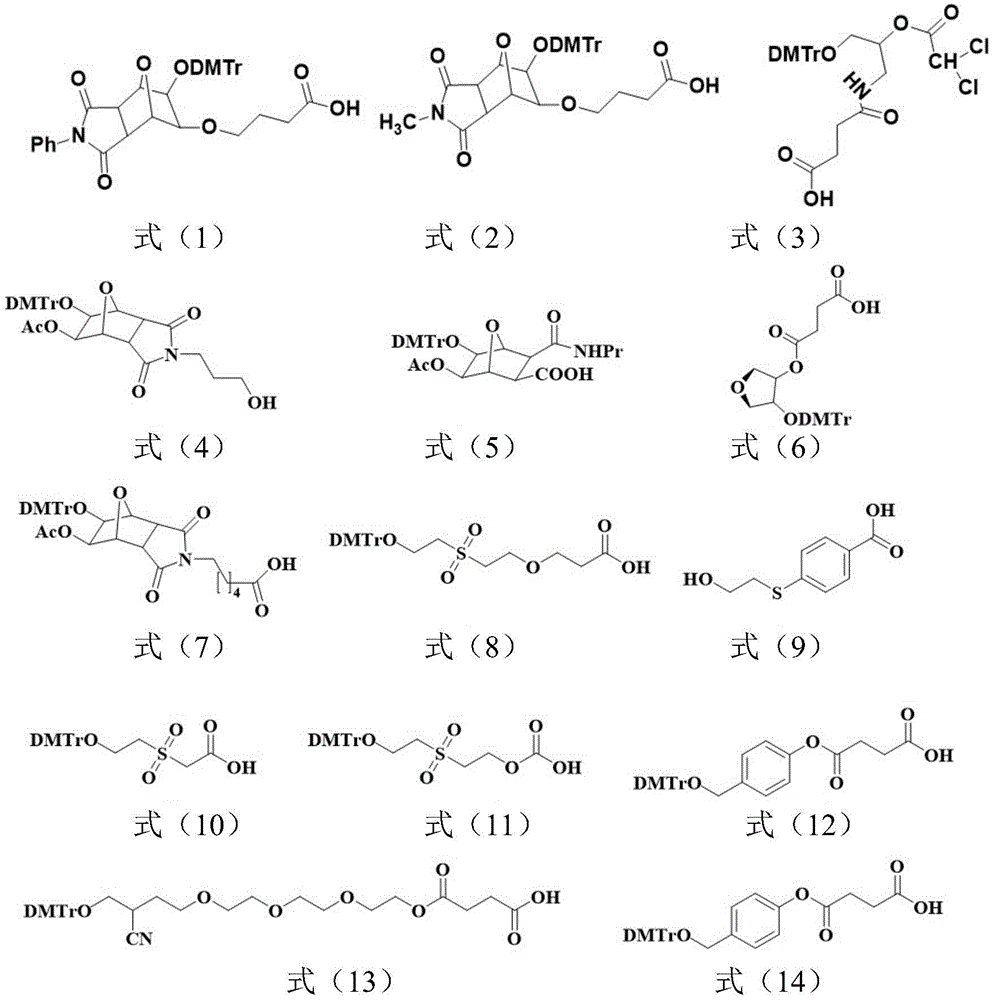
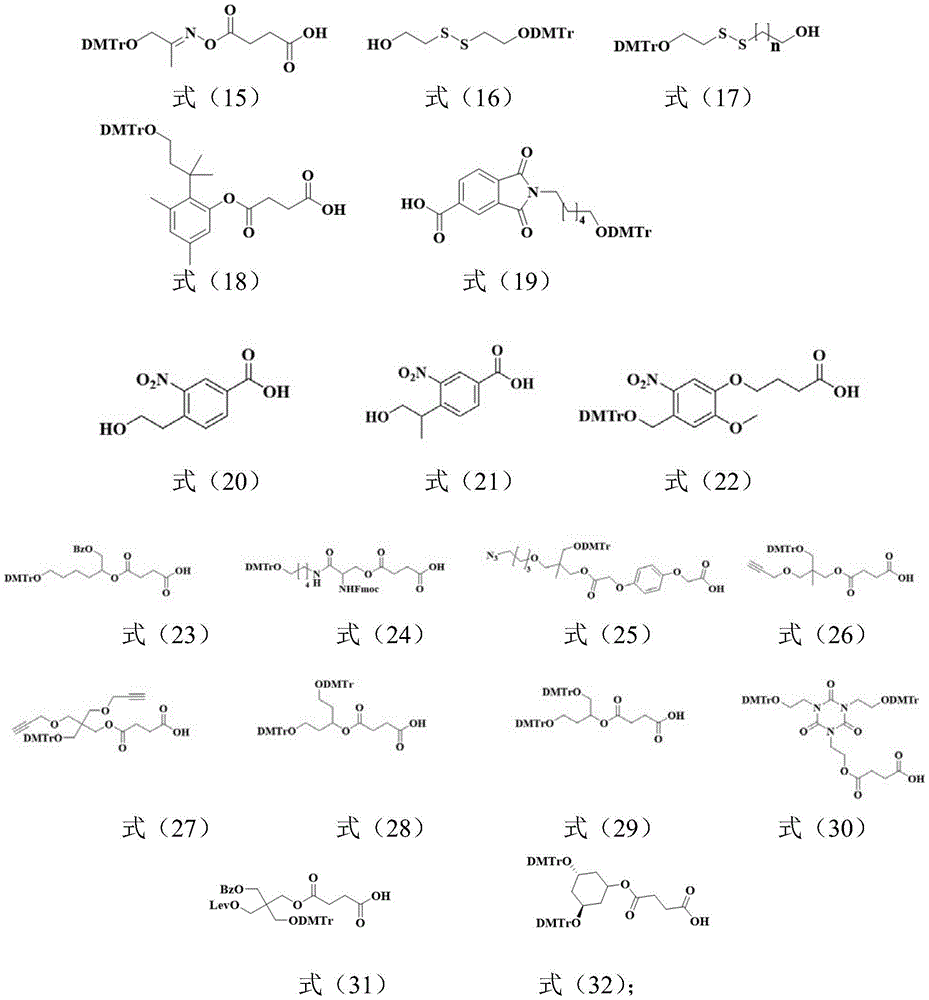
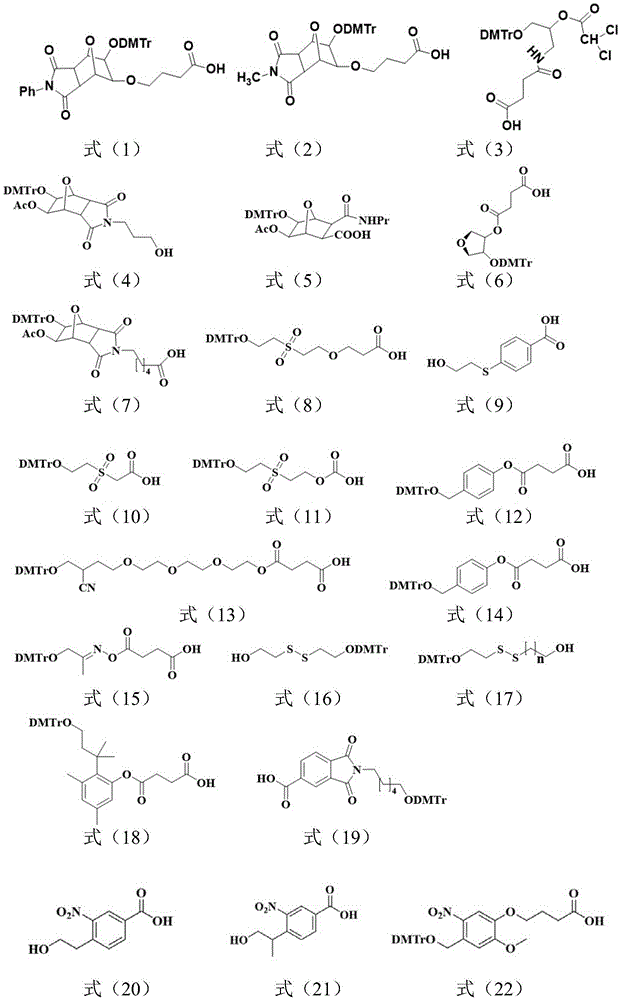
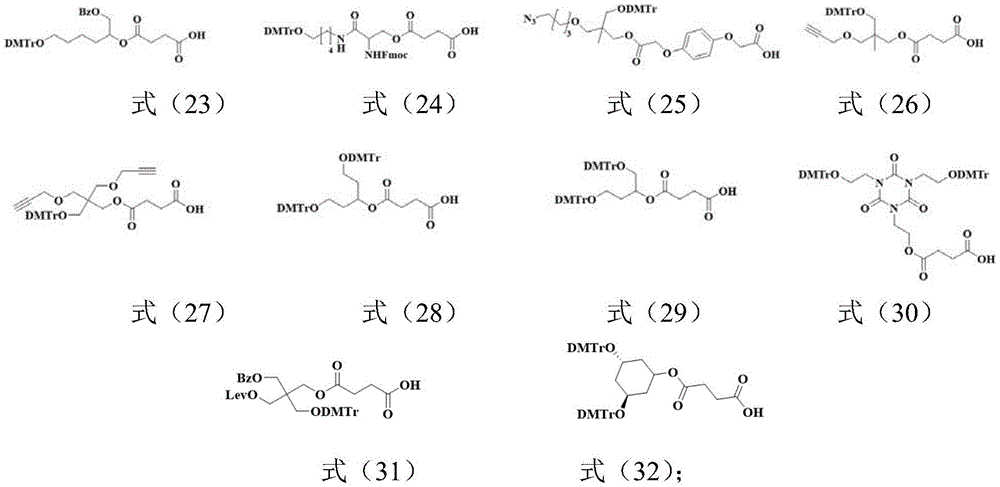
所述Unylinker分子选自如下式(1)-(19)所示的linker、式(20)-(22)所示的可光裂解的linker、式(23)-(32)所示的可枝接多种官能团的linker中的至少一种:The Unylinker molecules are selected from linkers shown in the following formulas (1)-(19), photocleavable linkers shown in formulas (20)-(22), and branchable linkers shown in formulas (23)-(32). At least one of the linkers with multiple functional groups:
步骤5)中,所述杂交反应采用的反应体系如下:包含Bridge和Oligo dT探针(具体为5×SSC buffer、1μM Capture Oligo 1、1μM Capture Oligo 2),并于37℃反应30min;In step 5), the reaction system used in the hybridization reaction is as follows: include Bridge and Oligo dT probe (specifically 5×SSC buffer, 1 μM Capture Oligo 1, 1 μM Capture Oligo 2), and react at 37° C. for 30 minutes;
步骤6)中,所述探针延伸和连接采用的聚合酶和连接酶体系如下:终浓度为1×rCutSmart Buffer、200μM dNTPs、1mM ATP、0.02U/μL Mako DNA Polymerase(3′→5′exo-)或Sulfolobus DNA PolymeraseⅣ、1U/μL T4 DNA ligase或Hi-T4 DNA Ligase,37℃反应30min;In step 6), the polymerase and ligase system used for the probe extension and ligation are as follows: the final concentration is 1×rCutSmart Buffer, 200 μM dNTPs, 1 mM ATP, 0.02U/μL Mako DNA Polymerase (3′→5′exo -) or Sulfolobus DNA PolymeraseⅣ, 1U/μL T4 DNA ligase or Hi-T4 DNA Ligase, react at 37°C for 30min;
步骤7)中,采用0.1×所述SSC buffer进行清洗。In step 7), 0.1× the SSC buffer is used for cleaning.
本发明还提供了上述的方法制备得到所述基于空间交错编码空间多组学芯片。The present invention also provides the above method to prepare the spatial multi-omics chip based on spatial interleaving coding.
本发明还提供了所述基于空间交错编码多组学芯片在制备如下a)-d)中任一芯片中的应用:The present invention also provides the application of the multi-omics chip based on spatially interleaved coding in the preparation of any chip in the following a)-d):
a)单细胞分辨率空间原位转录组分析芯片;a) Microarray for in situ transcriptome analysis at single-cell resolution;
b)单细胞分辨率空间原位表观组分析芯片;b) In situ epitope analysis chip with single-cell resolution space;
c)单细胞分辨率空间原位非编码RNA分析芯片;c) Single-cell resolution spatial in situ non-coding RNA analysis chip;
d)单细胞分辨率空间原位蛋白组分析芯片。d) Microarray for in situ proteome analysis at single-cell resolution.
本发明还提供了所述基于空间交错编码空间多组学芯片在如下(A1)-(A3)任一中的应用:The present invention also provides the application of the spatial multi-omics chip based on spatial interleaving coding in any of the following (A1)-(A3):
(A1)对组织切片进行全覆盖、单细胞分辨率和大尺寸的空间转录组分析,研究基因表达的空间特异性,制作三维转录图谱;(A1) Perform full-coverage, single-cell resolution, and large-scale spatial transcriptome analysis on tissue sections to study the spatial specificity of gene expression and create a three-dimensional transcription map;
(A2)在空间转录组基础上进行多组学时空图谱的分析;(A2) Analysis of multi-omic spatio-temporal profiles based on the spatial transcriptome;
(A3)空间转录组技术。(A3) Spatial transcriptome technology.
本发明进一步提供了所述基于空间交错编码空间多组学芯片在X1)-X7)任一中的应用:The present invention further provides the application of the spatial multi-omics chip based on spatial interleaving coding in any of X1)-X7):
X1)癌症研究;X1) cancer research;
X2)微生物与感染研究;X2) Microorganism and infection research;
X3)发育生物学研究;X3) developmental biology research;
X4)植物与农业研究;X4) Plant and agricultural research;
X6)大脑与神经退行性疾病研究;X6) Research on brain and neurodegenerative diseases;
X7)制备诊断领域的检测产品。X7) Preparation of detection products in the field of diagnosis.
本发明进一步提供了一种空间转录组芯片上的成套探针,它包括上述的方法中所述的成套探针:Wafer Ligated Oligo、Capture Oligo1、Capture Oligo 2。The present invention further provides a set of probes on a spatial transcriptome chip, which includes the set of probes described in the above method: Wafer Ligated Oligo, Capture Oligo1, Capture Oligo2.
本发明具有以下有益效果:The present invention has the following beneficial effects:
本发明所提供的单细胞分辨率的大尺度空间转录组微阵列芯片制作与实验方法,可以满足大尺度、单细胞分辨率和全覆盖的更精确的空间转录图谱三维重建的需求。相比传统的空间转录组方案提高了空间分辨率,相比基于测序芯片的高空间分辨率空间转录组方案提高了单个细胞的基因检出分辨率。同时提供目前成熟方案中不具备的大尺寸组织一次性全覆盖的检测。因此本发明的单细胞分辨率的大尺度空间转录组微阵列芯片技术可以在癌症研究、微生物与感染研究、发育生物学研究、植物与农业研究、大脑与神经退行性疾病研究和制备诊断领域的检测产品等领域有着广泛的应用价值。The single-cell resolution large-scale spatial transcriptome microarray chip production and experimental method provided by the present invention can meet the needs of large-scale, single-cell resolution and full coverage for more accurate three-dimensional reconstruction of spatial transcriptional maps. Compared with the traditional spatial transcriptome scheme, the spatial resolution is improved, and compared with the sequencing chip-based high spatial resolution spatial transcriptome scheme, the gene detection resolution of a single cell is improved. At the same time, it provides a one-time full-coverage detection of large-sized tissues that is not available in current mature solutions. Therefore, the large-scale spatial transcriptome microarray chip technology with single-cell resolution of the present invention can be used in the fields of cancer research, microbe and infection research, developmental biology research, plant and agricultural research, brain and neurodegenerative disease research, and preparation and diagnosis. Testing products and other fields have a wide range of application value.
附图说明Description of drawings
图1为相邻交错编码的SCID示意图。FIG. 1 is a schematic diagram of SCID for adjacent interleaving coding.
图2为相邻交错编码的SCID合成方式中相邻三个墨点中心的关系图。Fig. 2 is a diagram showing the relationship between the centers of three adjacent ink dots in the SCID synthesis mode of adjacent interleaved coding.
图3为空间交错编码策略中三个区域面积差异最小化的最优解函数关系。Figure 3 shows the optimal solution function relationship for minimizing the area difference of the three regions in the spatial interleaving coding strategy.
图4为相邻交错编码的空间转录组芯片设计图。Fig. 4 is a design diagram of a spatial transcriptome chip with adjacent interleaved coding.
图5为相邻交错编码的空间转录芯片的原位合成使用的坐标系。Figure 5 is the coordinate system used for the in situ synthesis of adjacent interleaved-coded spatial transcription chips.
图6为相邻交错编码的空间转录芯片的原位合成坐标系的X,Y轴关系。Fig. 6 is the X, Y axis relationship of the in situ synthesis coordinate system of adjacent interleaved coding spatial transcription chips.
图7为相邻交错编码的空间转录芯片的原位合成过程示意图。Fig. 7 is a schematic diagram of the in situ synthesis process of adjacent interleaved coding space transcription chips.
图8为3D喷墨打印原位合成过程的墨滴形态观测图。Fig. 8 is an observation diagram of the ink drop shape during the in-situ synthesis process of 3D inkjet printing.
图9为空间转录组芯片合成后探针后处理过程。Figure 9 shows the post-processing process of the probes after synthesis of the spatial transcriptome chip.
图10为空间转录组芯片合成后探针后处理的实验结果。Figure 10 shows the experimental results of probe post-processing after synthesis of the spatial transcriptome chip.
图11为空间miRNA组实验流程图。Figure 11 is a flow chart of the spatial miRNA group experiment.
具体实施方式Detailed ways
下述实施例中所使用的实验方法如无特殊说明,均为常规方法。The experimental methods used in the following examples are conventional methods unless otherwise specified.
下述实施例中所用的材料、试剂等,如无特殊说明,均可从商业途径得到。The materials and reagents used in the following examples can be obtained from commercial sources unless otherwise specified.
以下实施例中的定量试验,均设置三次重复实验,结果取平均值。Quantitative experiments in the following examples were all set up to repeat the experiments three times, and the results were averaged.
下述实施例中,Wafer Ligated Oligo的序列中“[Barcode][UMI]”参考文献doi:10.1126/science.aaf2403。In the following examples, “[Barcode][UMI]” in the sequence of Wafer Ligated Oligo refers to doi:10.1126/science.aaf2403.
本发明提供了基于空间交错编码多组学芯片及其制备方法与应用,包括如下步骤:利用3D喷墨原位DNA合成技术制作单细胞分辨率的大尺度空间转录组微阵列芯片制作,空间转录组微阵列芯片的形式包括蜂窝状全覆盖空间转录组芯片和相邻交错编码的空间转录组芯片两种策略,使用空间原位捕获策略对组织切片进行高通量的原位转录组分析。满足具有足够捕获面积的大尺度、单细胞分辨率和全覆盖的空间转录组芯片技术,这项技术将会替代目前的空间转录组技术成为相关研究领域的有力工具。The invention provides a multi-omics chip based on spatially interleaved coding and its preparation method and application, including the following steps: using 3D inkjet in situ DNA synthesis technology to fabricate a large-scale spatial transcriptome microarray chip with single-cell resolution, spatial transcription The form of group microarray chips includes two strategies: honeycomb full-coverage spatial transcriptome chip and adjacent interleaved coding spatial transcriptome chip. The spatial in situ capture strategy is used to perform high-throughput in situ transcriptome analysis on tissue sections. Satisfying the large-scale, single-cell resolution and full-coverage spatial transcriptome chip technology with sufficient capture area, this technology will replace the current spatial transcriptome technology and become a powerful tool in related research fields.
本发明提供的相邻交错编码的高分辨率大尺度空间多组学芯片的设计:The design of the high-resolution large-scale spatial multi-omics chip with adjacent interleaved coding provided by the present invention:
1、常规空间转录组芯片上的探针点阵排列一般是标准XY坐标系阵列方式,相邻两个点的间距大于点的直径,也就是说两个圆点不交集,最近距离一般为40-50微米。这样的空间转录组芯片在检测过程中探针点阵未覆盖的空白区域组织信息就无法检测,分辨率无法提高。1. The array of probes on a conventional spatial transcriptome chip is generally a standard XY coordinate system array, and the distance between two adjacent points is greater than the diameter of the point, that is to say, the two dots do not intersect, and the shortest distance is generally 40 -50 microns. In the detection process of such a spatial transcriptome chip, the tissue information in the blank area not covered by the probe array cannot be detected, and the resolution cannot be improved.
2、本申请设计了全新的相邻交错编码的高分辨率大尺度空间多组学芯片,如图1所示,以每个特征圆点为中心看,周围都有6个圆点和其有交集,周围的6个圆点之间又存在交集。把两个圆点的交集定义为2号区域,在图1中阴影部分标注2的部分。3个圆点交集的定义为3号区域,在图1中阴影部分标注3的部分。剩余的中心部分未与任何区域存在交集,定义为1号区域,在图1中白色部分标注1的部分。2. This application designs a brand-new high-resolution large-scale spatial multi-omics chip with adjacent interleaved coding. As shown in Figure 1, when viewed from the center of each characteristic dot, there are 6 dots around it and its Intersection, there is an intersection between the surrounding 6 dots. The intersection of two dots is defined as the No. 2 area, and the shaded part in Figure 1 is marked with 2. The intersection of the three dots is defined as the No. 3 area, which is marked with 3 in the shaded part in Figure 1. The remaining central part does not intersect with any area, which is defined as the No. 1 area, and the part marked 1 in the white part in Figure 1.
3、为了优化空间多组学芯片的分辨率,需要上述区域中的1号区域,2号区域和3号区域面积尽可能一直,通过模拟3个圆点的中心距,如图2所示,建立了圆点最优中心距和圆点半径的函数关系。如图3所示,当m=1.285r时,为最优中心距,此时1区,2区和3区的面积最接近。3. In order to optimize the resolution of the spatial multi-omics chip, the No. 1 area, the No. 2 area and the No. 3 area in the above areas need to be as consistent as possible. By simulating the center distance of 3 dots, as shown in Figure 2, The functional relationship between the optimal center distance of the dot and the radius of the dot is established. As shown in Figure 3, when m=1.285r, it is the optimal center distance, and the area of
4、基于上述的最优中心距,模拟了相邻交错编码的空间芯片点阵打印,如图4所示,黑色,白色和灰色分别代表上述的1区,2区和3区,从而实现了空间多组学芯片检测时的组织全覆盖设计。图5显示了相邻交错编码的空间芯片点阵的XY坐标系,该坐标系为不对等坐标系,将用于后续的喷墨打印合成过程,横轴方向坐标密度大于纵轴方向坐标密度。图6说明了X,Y坐标系代表的坐标值关系。4. Based on the above-mentioned optimal center distance, the space chip dot matrix printing of adjacent interleaved coding is simulated. As shown in Figure 4, black, white and gray represent the above-mentioned
实施例1:相邻交错编码的高分辨率大尺度空间多组学芯片的原位合成Example 1: In situ synthesis of high-resolution large-scale spatial multi-omics chips with adjacent interleaved encoding
1、将玻璃晶圆用水虎鱼溶液(1.5ml 30%过氧化氢水溶液/3.5ml 98%浓硫酸)进行表面处理然后等离子清洗处理半小时,然后用去离子水浸泡、清洗,乙腈清洗后氮气吹干备用。1. Treat the glass wafer with piranha solution (1.5
2、然后用亲水性硅烷3-缩水甘油醚氧基丙基三乙氧基硅烷氟辛基三氯硅烷(功能化)和疏水性硅烷(活性钝化)按照质量比5:95混合后进行浸泡(浸泡处理的时间0.5~4小时,具体为3小时),蒸镀或CVD等表面处理,再用Spacer用于延长合成臂,减少合成过程的空间位阻,最后加上Unylinker分子,用以后续合成寡核苷酸的亚磷酰胺单体连接,并可以方便从基底上裂解下来。2. Then use hydrophilic silane 3-glycidyl etheroxypropyltriethoxysilane fluorooctyl trichlorosilane (functionalization) and hydrophobic silane (active passivation) according to the mass ratio of 5:95 to carry out Soaking (0.5-4 hours for soaking treatment, specifically 3 hours), surface treatment such as evaporation or CVD, and then use Spacer to extend the synthesis arm to reduce the steric hindrance in the synthesis process, and finally add Unylinker molecules for The phosphoramidite monomers of subsequent synthetic oligonucleotides are linked and can be easily cleaved from the substrate.
3、经过上述表面处理的功能图案化芯片放置到DYHOW高通量原位合成平台的Input Station上。打开设备进行一系列的前处理。打开控制电脑将合成序列输入高通量DNA合成控制软件,每个Spot包含一个唯一的空间编码序列,从3端到5端依次为通用序列,空间编码序列(SCID),分子标签序列和搭桥序列。除了空间编码序列(SCID)部分,其他部分的序列在整张芯片上均相同,采用Flow Cell部件进行通用合成。对于空间编码序列部分的合成,以所有点的1区圆心点建立坐标系,如图7所示,第一次按照奇数列进行合成,仅仅合成X=1,5,9,13,17…列,其中X=1行的坐标如下X=1,Y=1;X=1,Y=3;X=1,Y=5;X=1,Y=7,其他依次类推,整个坐标系的其他点设置为空值,偶联之后完成氧化脱保护等步骤。第二次按照奇数列进行合成,仅仅合成X=3,7,11,15,19…行,其中X=3行的坐标如下X=3,Y=1;X=3,Y=3;X=3,Y=5;X=3,Y=7,其他依次类推(注意对于偶数行的坐标相对奇数行会向右侧整体偏移Dμm)。整个坐标系的其他点设置为空值,偶联之后完成氧化脱保护等步骤。第三次按照偶数列进行合成,仅仅合成X=2,6,10,14,18…列,其中X=6列的坐标如下X=2,Y=2;X=2,Y=4;X=2,Y=6;X=2,Y=8;X=2,Y=10,其他依次类推。整个坐标系的其他点设置为空值,偶联之后完成氧化脱保护等步骤。第四次按照偶数列进行合成,仅仅合成X=4,8,12,16,20…列,其中X=4列的坐标如下X=4,Y=2;X=4,Y=4;X=4,Y=6;X=4,Y=8;X=4,Y=10,其他依次类推。整个坐标系的其他点设置为空值,偶联之后完成氧化脱保护等步骤。整个坐标系的其他点设置为空值,偶联之后完成氧化脱保护等步骤。相比于普通的合成流程,每层合成做一次循环,对于嵌套合成策略每层的序列都重复上述四次的循环,举例如下,如果X=1,Y=1点的空间编码为ATCGT,X=2,Y=1点的空间编码为TCGAC,X=1,Y=2点的空间编码为GACTA,那么他们交集的2区对应2n的空间交错编码分别为AGTACCGTTA,ATTCCGGATC,GTACCGTAAC,3区对应3n的空间交错编码分别为AGTTACCCGGTATAC。3. The functional patterned chip after the above surface treatment is placed on the Input Station of the DYHOW high-throughput in situ synthesis platform. Open the device for a series of pre-processing. Turn on the control computer and input the synthetic sequence into the high-throughput DNA synthesis control software. Each Spot contains a unique spatial coding sequence, from the 3rd end to the 5th end, it is a general sequence, a spatial coding sequence (SCID), a molecular tag sequence and a bridge sequence. . Except for the space coding sequence (SCID), the sequences of other parts are the same on the whole chip, and the Flow Cell components are used for general synthesis. For the synthesis of the space coding sequence part, the coordinate system is established with the center point of
4、最后经过氨解脱去保护碱基处理后即可得到蜂窝状全覆盖空间转录组芯片。4. Finally, the cellular full-coverage spatial transcriptome chip can be obtained after the treatment of ammonia solution and deprotection of bases.
5、用合成好的空间转录组芯片进行Capture Oligo杂交用于探针转换,如图9所示。配制终浓度为5×SSC buffer(1x SSC buffer:150mM氯化钠、15mM柠檬酸三钠,pH7.0)、1μM Capture Oligo 1、1μM Capture Oligo 2的反应体系(依据芯片大小调整体积),并于37℃反应30min。5. Use the synthesized spatial transcriptome chip to perform Capture Oligo hybridization for probe conversion, as shown in Figure 9. Prepare a reaction system with a final concentration of 5×SSC buffer (1x SSC buffer: 150mM sodium chloride, 15mM trisodium citrate, pH7.0),
6、探针延伸和连接,如图9所示。配制终浓度为1×rCutSmart Buffer(50mMPotassium Acetate、20mM Tris-acetate、10mM Magnesium Acetate、100μg/mlRecombinant Albumin,25℃,pH 7.9)、200μM dNTPs、1mM ATP、0.02U/μL Sulfolobus DNAPolymeraseⅣ、1U/μL Hi-T4 DNA Ligase的反应体系,阴性对照不加Sulfolobus DNAPolymeraseⅣ和Hi-T4 DNA Ligase,并于37℃反应30min。如图10所示。图10中1和2是Sulfolobus DNA PolymeraseⅣ+Hi-T4 DNA Ligase体系的两个重复;3和4是对应的阴性对照。需要的目的条带应为87bp,探针模板长63bp,Capture Oligo1为22bp,Capture Oligo2为39bp。1,2泳道的最上面条带清晰的显示为包含空间Barcode和UMI结构的反向探针分子。6. Probe extension and connection, as shown in Figure 9. Prepare a final concentration of 1×rCutSmart Buffer (50mM Potassium Acetate, 20mM Tris-acetate, 10mM Magnesium Acetate, 100μg/ml Recombinant Albumin, 25°C, pH 7.9), 200μM dNTPs, 1mM ATP, 0.02U/μL Sulfolobus DNA Polymerase Ⅳ, 1U/μL Hi - For the reaction system of T4 DNA Ligase, Sulfolobus DNA Polymerase IV and Hi-T4 DNA Ligase were not added to the negative control, and reacted at 37°C for 30 minutes. As shown in Figure 10. 1 and 2 in Figure 10 are two repetitions of the Sulfolobus DNA Polymerase IV+Hi-T4 DNA Ligase system; 3 and 4 are the corresponding negative controls. The required target band should be 87bp, the probe template is 63bp long, Capture Oligo1 is 22bp, and Capture Oligo2 is 39bp. The uppermost bands in
7、芯片清洗。0.1×SSC冲洗芯片两次,移液器移除芯片表面液体;使用含RNaseInhibitor(RI)的Nuclease-free water(NF-H2O)(2U/μL RI,现配现用)处理芯片1-2min,移液器移除液体;使用不含RNase Inhibitor(RI)的Nuclease-free water(NF-H2O)冲洗,移液器移除液体。吸水纸吸取芯片表面残余液体,37℃晾干。7. Chip cleaning. Rinse the chip twice with 0.1×SSC, remove the liquid on the surface of the chip with a pipette; use Nuclease-free water (NF-H 2 O) (2U/μL RI) containing RNase Inhibitor (RI) to process the chip 1- 2min, pipette to remove the liquid; use Nuclease-free water (NF-H 2 O) without RNase Inhibitor (RI) to rinse, and pipette to remove the liquid. Absorb the remaining liquid on the surface of the chip with absorbent paper and dry it at 37°C.
Wafer Ligated OligoWafer Ligated Oligo
3’GATGTGCTGCGAGAAGGCTAGA[Barcode][UMI][AACAGAAGGATTCTG]5’3'GATGTGCTGCGAGAAGGCTAGA[Barcode][UMI][AACAGAAGGATTCTG]5'
Capture Oligo1Capture Oligo1
5’CTACACGACGCTCTTCCGATCT3’5'CTACACGACGCTCTTCCGATCT3'
Capture Oligo 2
5’TTGTCTTCCTAAGACTTTTTTTTTTTTTTTTTTTTTTVN3’。5'TTGTCTTCCTAAGACTTTTTTTTTTTTTTTTTTTTTTTTVN3'.
上述实验中采用的试剂及其来源如表1所示。The reagents and their sources used in the above experiments are shown in Table 1.
表1试剂及其来源Table 1 Reagents and their sources

实施例2:高分辨率大尺度空间转录组芯片实验方法Example 2: High-resolution and large-scale spatial transcriptome microarray experiment method
1、样本准备:成功制备样品是空间转录组实验成功的关键,要点是尽可能不让组织中RNA降解。首先,新鲜样本取材时就要记好其空间方向,而后使用PBS冲洗,除去残留血液,利用实验室用纸吸干组织表面多余的液体,防止冷冻后冰晶的形成。用预冷的镊子或刮刀将组织完全浸没于已在液氮中预冷15min的异戊烷里,直至完全冰冻(~1min)。包埋盒上需标记组织样本的方向,用冷却的OCT铺平包埋盒底部(放在干冰上使其冻结),将冰冻后的组织,放置在包埋盒中心位置,继续倒入OCT完全覆盖样本组织(组织周围不要产生气泡)。立即将含有组织和OCT的包埋盒放在干冰粉上,直至完全冻结(约30min以上)。将包埋盒放置到密封袋中,干冰运输。在液氮预冷的异戊烷中进行OCT包埋速冻(切片前-80℃保存),冷冻切片机切成10μm厚度组织切片,切片大小最大可以支持150×150mm,常规切片机的尺寸可以支持50x80mm。1. Sample preparation: Successful preparation of samples is the key to the success of spatial transcriptome experiments. The key point is to prevent RNA degradation in tissues as much as possible. First of all, when fresh samples are collected, their spatial orientation must be remembered, and then rinsed with PBS to remove residual blood, and use laboratory paper to blot excess liquid on the surface of the tissue to prevent the formation of ice crystals after freezing. Using pre-cooled tweezers or spatulas, completely immerse the tissue in isopentane that has been pre-cooled in liquid nitrogen for 15 min until completely frozen (~1 min). The direction of the tissue sample should be marked on the embedding box, and the bottom of the embedding box should be flattened with cooled OCT (put it on dry ice to freeze), and the frozen tissue should be placed in the center of the embedding box, and continue to pour into the OCT completely. Cover the sample tissue (do not create air bubbles around the tissue). Immediately place the embedding cassette containing tissue and OCT on dry ice powder until completely frozen (about 30 min or more). Place the embedding cassettes in a sealed bag and ship on dry ice. OCT embedding quick-frozen in isopentane pre-cooled by liquid nitrogen (stored at -80°C before sectioning), sliced into tissue sections with a thickness of 10 μm by a cryostat, and the maximum section size can support 150×150mm, and the size of a conventional microtome can support 50x80mm.
2、组织切片:冷冻切片机腔体温度设定为-20℃,将冻头的温度设定为-10℃。在切片之前,必须将OCT包埋的组织块放在冷冻切片机腔体中温度平衡30分钟以上。在样本台上安装OCT包埋组织块,通过冷冻切片去除过量的OCT直到组织可见,切片时可以对较大的组织样本进行分割,切割后生成较小的样本以覆盖捕获区域。取10片组织切片进行RNA抽提并质检,确定组织中RNA完整性(RIN>7)。对于大多数组织类型,建议的切片厚度为10μm,如果切片出现裂纹,则说明冻头太冷,如果切片出现褶皱,则说明冻头太热,相应地调节温度。获得所需的组织切片后,用冷冻切片机的刷子轻轻刷OCT的周围,将其小心地刷至平整。将切片放置在预先平衡温度的芯片上,立即将手指放在芯片的背面几秒钟,确保整个组织切片都完全粘附在芯片上,然后立即将其放在不锈钢冷冻室上以冻结切片。在切片和组织放置期间,请勿在任何时候从冷冻切片机中取出芯片。用OCT覆盖裸露的组织并使其冻结,保存在-80℃的密封容器中。2. Tissue section: set the chamber temperature of the cryostat to -20°C, and set the temperature of the frozen tip to -10°C. Before slicing, the OCT-embedded tissue block must be placed in the chamber of the cryostat for more than 30 minutes in temperature equilibration. Install OCT-embedded tissue blocks on the sample stage, and remove excess OCT by cryosectioning until the tissue is visible. Larger tissue samples can be segmented during sectioning, and smaller samples can be generated after cutting to cover the capture area. Ten tissue sections were taken for RNA extraction and quality inspection to determine the integrity of RNA in the tissue (RIN>7). The recommended section thickness is 10 µm for most tissue types, if the section appears cracked, the cryotome is too cold, if the section appears wrinkled, the cryotome is too warm, adjust the temperature accordingly. After obtaining the desired tissue section, use the brush of the cryostat to gently brush around the OCT, carefully brushing it until it is flat. Place the section on the pre-equilibrated chip, immediately place your finger on the back of the chip for a few seconds to ensure that the entire tissue section is fully adhered to the chip, and immediately place it on the stainless steel freezer to freeze the section. Do not remove the chip from the cryostat at any time during sectioning and tissue placement. Bare tissue was covered with OCT and allowed to freeze, stored at -80°C in an airtight container.
3、贴片染色:组织切片置于空间转录组芯片并用甲醇固定,H&E染色后进行显微镜成像观察。将芯片放在热循环仪适配器上,在37℃下孵育1分钟。然后将芯片完全浸入预冷的甲醇中在-20℃孵育30分钟。滴加500μl异丙醇,室温孵育1分钟;将芯片上试剂去除,风干芯片,加入1ml苏木精,室温孵育7分钟。将芯片上试剂去除,然后将芯片浸入水中若干次,加入1ml Bluing Buffer,室温孵育2分钟。将芯片上试剂去除,将芯片浸入水中5次。加入1ml伊红混合物,室温孵育1分钟。将芯片上试剂去除,将芯片浸入水中15次,风干直至组织不透明。在37℃下孵育芯片5分钟后,进行明场成像实验。3. Patch staining: Tissue slices were placed on the spatial transcriptome chip and fixed with methanol. After H&E staining, microscope imaging was observed. Place the chip on the thermal cycler adapter and incubate at 37 °C for 1 min. The chips were then completely immersed in pre-cooled methanol and incubated at -20 °C for 30 min. Add 500 μl of isopropanol dropwise and incubate at room temperature for 1 minute; remove the reagents on the chip, air-dry the chip, add 1 ml of hematoxylin, and incubate at room temperature for 7 minutes. Remove the reagents on the chip, then immerse the chip in water several times, add 1ml Blueing Buffer, and incubate at room temperature for 2 minutes. The reagents on the chip were removed, and the chip was immersed in
4、组织透化:将芯片放在芯片盒中,阳性和阴性对照均不加透化酶。在梯度时间最长的孔中添加70μl透化酶,放置在37℃的PCR适配器上。6分钟后,向梯度时间次长孔中添加70μl通透酶,并在37℃的PCR适配器上孵育,重复此过程,直至加到最短的孵育时间。从每个孔中除去透化酶,阳性对照以外的所有孔中添加100μl 0.1×SSC,从每个孔中移出0.1XSSC。向每个孔中加入50μl Fluorescent RT Master Mix,将其放在预热的PCR仪(设置条件)以启动cDNA合成。从孔中吸出Fluorescent RT Master Mix,向每个孔中添加100μl0.1X SSC,从每个孔中吸出0.1×SSC。向每个孔中加入70μl Tissue Removal Mix,然后放在PCR仪适配器上孵育,从孔中吸出Tissue Removal Mix。从芯片盒中取出芯片,浸入预热的2×SSC-0.1%SDS中15次,浸入0.2×SSC中15次,浸入0.1×SSC中15次。在载片旋转器中离心30s,确认芯片上没有剩余的组织。探索高效组织透化条件,充分透化组织但又不造成组织RNA扩散。溶解于0.01M HCl的0.1%Pepsin处理不同时间(3min-30min)进行透化,移除透化酶并0.1×SSC清洗后进行荧光标记反转录,使用数字切片扫描仪扫描成像,根据荧光强度和弥散程度确定最佳透化条件。4. Tissue permeabilization: put the chip in the chip box, and do not add permeabilase to the positive and negative controls. Add 70 μl of permease to the well with the longest gradient time, placed on the PCR adapter at 37°C. After 6 minutes, add 70 μl of permease to the second longest well of the gradient time and incubate on the PCR adapter at 37°C, repeating this process until the minimum incubation time is added. Permease was removed from each well, 100 μl of 0.1X SSC was added to all wells except the positive control, and 0.1X SSC was removed from each well. Add 50 μl Fluorescent RT Master Mix to each well and place it in a preheated PCR machine (setting conditions) to start cDNA synthesis. Aspirate the Fluorescent RT Master Mix from the wells, add 100 μl of 0.1X SSC to each well, and aspirate 0.1X SSC from each well. Add 70μl Tissue Removal Mix to each well, then place it on the PCR instrument adapter and incubate, then suck out the Tissue Removal Mix from the well. Take the chip out of the chip box and dip it in
5、文库构建:首先基于Oligo dT杂交的一链反转录,然后加入TSO进行模板转换引物结合,然后进行转录延伸,然后加入二链合成引物进行二链合成。接下来进行变性和cDNA扩增,对于扩增产物进行Tn5转座酶法测序文库构建技术。将文库进行上机测序5. Library construction: Firstly, one-strand reverse transcription based on Oligo dT hybridization, then TSO was added for template conversion primer binding, then transcription extension was performed, and second-strand synthesis primers were added for second-strand synthesis. Next, denaturation and cDNA amplification are carried out, and Tn5 transposase sequencing library construction technology is carried out for the amplified product. Sequencing the library
6、数据分析:将文库测序结果映射到组织空间位置,构建组织空间转录组图谱。原始数据处理:数据质检去除低质量数据(空间编码序列碱基错配大于1,UMI含N或2碱基质量<10),使用STAR将剩余Reads mapping到参考基因组(mm10)并用handleBam进行注释,对UMI进行提取(碱基错配不大于1);空间聚类分析:Scanpy进行数据均一化后,使用Squidpy确定空间位置,并根据聚类特异性标记物使用eHistology Kaufman Annotations或AllenBrainAtlas进行注释6. Data analysis: Map the library sequencing results to the tissue space location, and construct the tissue space transcriptome map. Raw data processing: data quality inspection to remove low-quality data (space coding sequence base mismatch greater than 1, UMI containing N or 2 base quality <10), use STAR to map the remaining Reads to the reference genome (mm10) and annotate with handleBam , to extract UMI (base mismatch is not greater than 1); spatial cluster analysis: after Scanpy performs data normalization, use Squidpy to determine the spatial position, and use eHistology Kaufman Annotations or AllenBrainAtlas to annotate according to cluster-specific markers
实施例3:高分辨率大尺度非编码RNA(miRNA)芯片实验方法Embodiment 3: High-resolution large-scale non-coding RNA (miRNA) chip experimental method
1、样本及前处理同实施例2,后续加入miRNA成对探针组(为miRNA Oligo 1和miRNA Oligo 2)进行杂交,两侧探针杂交到miRNA的两端,通过连接酶将中间的Gap补平成一条完整的链,完整链的3端包含Poly A尾,然后透化组织,利用空间转录组芯片上的PolyT末端进行反转录然后利用Reads1和Reads的引物(为已知序列,参见Illumina AdapterSequences)进行扩增文库构建技术。扩增后的文库包含miRNA的全场序列。用于下游的高通量测序。1. The sample and pretreatment are the same as in Example 2. Then add miRNA paired probe sets (for
miRNA Oligo 1
3’AAAAAAAAAAAAAAAAAAAAAA+miRNA5’端反向互补序列5’
miRNA Oligo 2
3’miRNA3’端反向互补序列+TCTAGCCTTCTCGTGTGCAGAC 5’3' miRNA 3' reverse complementary sequence +
Claims (10)
Priority Applications (1)
| Application Number | Priority Date | Filing Date | Title |
|---|---|---|---|
| CN202211046021.8A CN115386965B (en) | 2022-08-30 | 2022-08-30 | Multi-omics chip based on spatial interleaved coding and its preparation method and application |
Applications Claiming Priority (1)
| Application Number | Priority Date | Filing Date | Title |
|---|---|---|---|
| CN202211046021.8A CN115386965B (en) | 2022-08-30 | 2022-08-30 | Multi-omics chip based on spatial interleaved coding and its preparation method and application |
Publications (2)
| Publication Number | Publication Date |
|---|---|
| CN115386965A true CN115386965A (en) | 2022-11-25 |
| CN115386965B CN115386965B (en) | 2025-08-29 |
Family
ID=84123325
Family Applications (1)
| Application Number | Title | Priority Date | Filing Date |
|---|---|---|---|
| CN202211046021.8A Active CN115386965B (en) | 2022-08-30 | 2022-08-30 | Multi-omics chip based on spatial interleaved coding and its preparation method and application |
Country Status (1)
| Country | Link |
|---|---|
| CN (1) | CN115386965B (en) |
Citations (9)
| Publication number | Priority date | Publication date | Assignee | Title |
|---|---|---|---|---|
| CN111676279A (en) * | 2020-05-20 | 2020-09-18 | 东南大学 | A method for constructing a spatial transcriptome |
| CN113166974A (en) * | 2018-12-12 | 2021-07-23 | 深圳华大生命科学研究院 | Biological chip and preparation method and application thereof |
| CN113604547A (en) * | 2021-08-06 | 2021-11-05 | 吉林大学 | High-resolution space omics detection method for tissue sample |
| CN113930847A (en) * | 2021-09-26 | 2022-01-14 | 东南大学 | Space transcriptome position information coding chip and preparation method and application thereof |
| WO2022067565A1 (en) * | 2020-09-29 | 2022-04-07 | 生物岛实验室 | Spatial omics sequencing method, single cell epitranscriptomic sequencing method, and localization labeling method |
| US20220119871A1 (en) * | 2019-01-28 | 2022-04-21 | The Broad Institute, Inc. | In-situ spatial transcriptomics |
| US20220127666A1 (en) * | 2020-06-25 | 2022-04-28 | 10X Genomics, Inc. | Spatial analysis of dna methylation |
| WO2022093357A1 (en) * | 2020-10-29 | 2022-05-05 | Ambergen, Inc. | Novel photocleavable mass-tags for multiplexed mass spectrometric imaging of tissues using biomolecular probes |
| CN114854839A (en) * | 2022-04-08 | 2022-08-05 | 上海交通大学医学院附属仁济医院 | Tissue three-dimensional space omics method based on three-coordinate space positioning |
-
2022
- 2022-08-30 CN CN202211046021.8A patent/CN115386965B/en active Active
Patent Citations (9)
| Publication number | Priority date | Publication date | Assignee | Title |
|---|---|---|---|---|
| CN113166974A (en) * | 2018-12-12 | 2021-07-23 | 深圳华大生命科学研究院 | Biological chip and preparation method and application thereof |
| US20220119871A1 (en) * | 2019-01-28 | 2022-04-21 | The Broad Institute, Inc. | In-situ spatial transcriptomics |
| CN111676279A (en) * | 2020-05-20 | 2020-09-18 | 东南大学 | A method for constructing a spatial transcriptome |
| US20220127666A1 (en) * | 2020-06-25 | 2022-04-28 | 10X Genomics, Inc. | Spatial analysis of dna methylation |
| WO2022067565A1 (en) * | 2020-09-29 | 2022-04-07 | 生物岛实验室 | Spatial omics sequencing method, single cell epitranscriptomic sequencing method, and localization labeling method |
| WO2022093357A1 (en) * | 2020-10-29 | 2022-05-05 | Ambergen, Inc. | Novel photocleavable mass-tags for multiplexed mass spectrometric imaging of tissues using biomolecular probes |
| CN113604547A (en) * | 2021-08-06 | 2021-11-05 | 吉林大学 | High-resolution space omics detection method for tissue sample |
| CN113930847A (en) * | 2021-09-26 | 2022-01-14 | 东南大学 | Space transcriptome position information coding chip and preparation method and application thereof |
| CN114854839A (en) * | 2022-04-08 | 2022-08-05 | 上海交通大学医学院附属仁济医院 | Tissue three-dimensional space omics method based on three-coordinate space positioning |
Non-Patent Citations (1)
| Title |
|---|
| 侯志伟;王;高宏;侯圣伟;: "dRNA-seq原理及其在原核生物转录组学研究中的应用", 遗传, no. 08, 19 June 2013 (2013-06-19), pages 983 - 991 * |
Also Published As
| Publication number | Publication date |
|---|---|
| CN115386965B (en) | 2025-08-29 |
Similar Documents
| Publication | Publication Date | Title |
|---|---|---|
| EP2398915B1 (en) | Synthesis of sequence-verified nucleic acids | |
| US20200370105A1 (en) | Methods for performing spatial profiling of biological molecules | |
| ES2296623T3 (en) | SUBSTITUTE HYBRID BASED ON MICROMATRICES. | |
| US9068209B2 (en) | Gene synthesis by convergent assembly of oligonucleotide subsets | |
| EP3971282A1 (en) | Array and method for detecting spatial information of nucleic acids | |
| CN103429754B (en) | The parallel order-checking of natural extension | |
| JP2020536525A (en) | A method for concentrating the probe and the target region to which it is applied for high-throughput sequencing | |
| CN109576346A (en) | The construction method of high-throughput sequencing library and its application | |
| JP2006514826A (en) | Lab-on-a-chip system for analyzing nucleic acids | |
| US20180112211A1 (en) | RNA Array Compositions and Methods | |
| KR20180124789A (en) | Method and apparatus for obtaining high purity nucleotides | |
| EP2792743B1 (en) | Nucleic acid amplification method | |
| CA2375082A1 (en) | Sequence based screening | |
| JP2019103415A (en) | Method for comprehensively analyzing 3' end gene expression of single cell | |
| CN115386965A (en) | Multi-omics chip based on spatially interleaved coding and its preparation method and application | |
| CN113166803B (en) | A high-throughput gene synthesis method based on chip primer surface extraction | |
| EP4363608B1 (en) | Unit-dna composition for spatial barcoding and sequencing | |
| Ueno et al. | Photoassisted Recovery of DNA Molecules for On-chip Directed Evolution | |
| RU2803202C2 (en) | Panel and method of obtaining spatial information about nucleic acids | |
| RU2803202C9 (en) | Panel and method of obtaining spatial information about nucleic acids | |
| JP5394045B2 (en) | Method for detecting mouse Acidicribosomal Phosphoprotein P0 gene | |
| WO2024015766A1 (en) | Scalable, submicron-resolution replication of dna arrays | |
| WO2025224311A1 (en) | Methods, uses and kits for the construction of spatial networks | |
| Drmanac et al. | Institute of Molecular Genetics and Genetic Engineering, PO. Box 794, 11000 Belgrade, Yugoslavia.* Imperial Cancer Research Fund Laboratories, 44 Lincoln's Inn Fields | |
| JP2006197836A (en) | DNA microarray regeneration method and use thereof |
Legal Events
| Date | Code | Title | Description |
|---|---|---|---|
| PB01 | Publication | ||
| PB01 | Publication | ||
| SE01 | Entry into force of request for substantive examination | ||
| SE01 | Entry into force of request for substantive examination | ||
| GR01 | Patent grant | ||
| GR01 | Patent grant |