CN115372396B - Method for confirming plagioclase standard sample - Google Patents
Method for confirming plagioclase standard sample Download PDFInfo
- Publication number
- CN115372396B CN115372396B CN202211314370.3A CN202211314370A CN115372396B CN 115372396 B CN115372396 B CN 115372396B CN 202211314370 A CN202211314370 A CN 202211314370A CN 115372396 B CN115372396 B CN 115372396B
- Authority
- CN
- China
- Prior art keywords
- plagioclase
- elements
- test
- analysis
- trace
- Prior art date
- Legal status (The legal status is an assumption and is not a legal conclusion. Google has not performed a legal analysis and makes no representation as to the accuracy of the status listed.)
- Active
Links
- 229910052655 plagioclase feldspar Inorganic materials 0.000 title claims abstract description 174
- 238000000034 method Methods 0.000 title claims abstract description 55
- 235000013619 trace mineral Nutrition 0.000 claims abstract description 164
- 239000011573 trace mineral Substances 0.000 claims abstract description 164
- 239000000523 sample Substances 0.000 claims abstract description 130
- 238000012360 testing method Methods 0.000 claims abstract description 128
- 238000004458 analytical method Methods 0.000 claims abstract description 71
- 238000001514 detection method Methods 0.000 claims abstract description 66
- 238000012795 verification Methods 0.000 claims abstract description 12
- 239000013078 crystal Substances 0.000 claims description 61
- 239000000203 mixture Substances 0.000 claims description 23
- 229910052791 calcium Inorganic materials 0.000 claims description 19
- 239000002245 particle Substances 0.000 claims description 18
- 229910052700 potassium Inorganic materials 0.000 claims description 15
- 229910052733 gallium Inorganic materials 0.000 claims description 11
- 238000000608 laser ablation Methods 0.000 claims description 11
- 238000004453 electron probe microanalysis Methods 0.000 claims description 10
- 238000004364 calculation method Methods 0.000 claims description 9
- 238000000918 plasma mass spectrometry Methods 0.000 claims description 8
- 230000008859 change Effects 0.000 claims description 7
- 229910052500 inorganic mineral Inorganic materials 0.000 claims description 7
- 235000010755 mineral Nutrition 0.000 claims description 7
- 239000011707 mineral Substances 0.000 claims description 7
- 238000012216 screening Methods 0.000 claims description 7
- 238000004846 x-ray emission Methods 0.000 claims description 7
- 238000013507 mapping Methods 0.000 claims description 6
- 238000012937 correction Methods 0.000 claims description 5
- 238000001228 spectrum Methods 0.000 claims description 5
- 238000010998 test method Methods 0.000 claims description 5
- 238000012790 confirmation Methods 0.000 claims description 4
- 230000006870 function Effects 0.000 claims description 4
- 238000009826 distribution Methods 0.000 claims description 3
- 238000010183 spectrum analysis Methods 0.000 claims description 3
- 230000002452 interceptive effect Effects 0.000 claims description 2
- 238000005728 strengthening Methods 0.000 claims description 2
- 238000000105 evaporative light scattering detection Methods 0.000 claims 1
- 238000012827 research and development Methods 0.000 abstract description 7
- 238000011161 development Methods 0.000 abstract description 3
- 239000011575 calcium Substances 0.000 description 22
- 239000011435 rock Substances 0.000 description 14
- 239000011347 resin Substances 0.000 description 9
- 229920005989 resin Polymers 0.000 description 9
- 238000000095 laser ablation inductively coupled plasma mass spectrometry Methods 0.000 description 8
- 230000008569 process Effects 0.000 description 8
- OKTJSMMVPCPJKN-UHFFFAOYSA-N Carbon Chemical compound [C] OKTJSMMVPCPJKN-UHFFFAOYSA-N 0.000 description 5
- 230000008901 benefit Effects 0.000 description 5
- 229910052799 carbon Inorganic materials 0.000 description 5
- 239000000843 powder Substances 0.000 description 5
- 238000010586 diagram Methods 0.000 description 4
- 230000003595 spectral effect Effects 0.000 description 4
- 230000015572 biosynthetic process Effects 0.000 description 3
- 230000000052 comparative effect Effects 0.000 description 3
- 238000002425 crystallisation Methods 0.000 description 3
- 230000008025 crystallization Effects 0.000 description 3
- 230000001066 destructive effect Effects 0.000 description 3
- 230000000694 effects Effects 0.000 description 3
- 238000002474 experimental method Methods 0.000 description 3
- 239000011159 matrix material Substances 0.000 description 3
- 238000012544 monitoring process Methods 0.000 description 3
- 238000001004 secondary ion mass spectrometry Methods 0.000 description 3
- 239000000126 substance Substances 0.000 description 3
- 229910018072 Al 2 O 3 Inorganic materials 0.000 description 2
- 229910005191 Ga 2 O 3 Inorganic materials 0.000 description 2
- 229910052656 albite Inorganic materials 0.000 description 2
- DLHONNLASJQAHX-UHFFFAOYSA-N aluminum;potassium;oxygen(2-);silicon(4+) Chemical compound [O-2].[O-2].[O-2].[O-2].[O-2].[O-2].[O-2].[O-2].[Al+3].[Si+4].[Si+4].[Si+4].[K+] DLHONNLASJQAHX-UHFFFAOYSA-N 0.000 description 2
- 229910052586 apatite Inorganic materials 0.000 description 2
- TZCXTZWJZNENPQ-UHFFFAOYSA-L barium sulfate Chemical compound [Ba+2].[O-]S([O-])(=O)=O TZCXTZWJZNENPQ-UHFFFAOYSA-L 0.000 description 2
- 239000010428 baryte Substances 0.000 description 2
- 229910052601 baryte Inorganic materials 0.000 description 2
- NWXHSRDXUJENGJ-UHFFFAOYSA-N calcium;magnesium;dioxido(oxo)silane Chemical compound [Mg+2].[Ca+2].[O-][Si]([O-])=O.[O-][Si]([O-])=O NWXHSRDXUJENGJ-UHFFFAOYSA-N 0.000 description 2
- 238000007796 conventional method Methods 0.000 description 2
- 229910052637 diopside Inorganic materials 0.000 description 2
- 238000010894 electron beam technology Methods 0.000 description 2
- 238000000227 grinding Methods 0.000 description 2
- 238000011065 in-situ storage Methods 0.000 description 2
- 239000011021 lapis lazuli Substances 0.000 description 2
- 238000005259 measurement Methods 0.000 description 2
- 230000007246 mechanism Effects 0.000 description 2
- 238000012986 modification Methods 0.000 description 2
- 230000004048 modification Effects 0.000 description 2
- 239000004570 mortar (masonry) Substances 0.000 description 2
- VSIIXMUUUJUKCM-UHFFFAOYSA-D pentacalcium;fluoride;triphosphate Chemical compound [F-].[Ca+2].[Ca+2].[Ca+2].[Ca+2].[Ca+2].[O-]P([O-])([O-])=O.[O-]P([O-])([O-])=O.[O-]P([O-])([O-])=O VSIIXMUUUJUKCM-UHFFFAOYSA-D 0.000 description 2
- 238000005498 polishing Methods 0.000 description 2
- GWEVSGVZZGPLCZ-UHFFFAOYSA-N titanium dioxide Inorganic materials O=[Ti]=O GWEVSGVZZGPLCZ-UHFFFAOYSA-N 0.000 description 2
- OYPRJOBELJOOCE-UHFFFAOYSA-N Calcium Chemical compound [Ca] OYPRJOBELJOOCE-UHFFFAOYSA-N 0.000 description 1
- LFQSCWFLJHTTHZ-UHFFFAOYSA-N Ethanol Chemical compound CCO LFQSCWFLJHTTHZ-UHFFFAOYSA-N 0.000 description 1
- PEDCQBHIVMGVHV-UHFFFAOYSA-N Glycerine Chemical compound OCC(O)CO PEDCQBHIVMGVHV-UHFFFAOYSA-N 0.000 description 1
- 102100021285 Macrophage-expressed gene 1 protein Human genes 0.000 description 1
- 101710157392 Macrophage-expressed gene 1 protein Proteins 0.000 description 1
- KKCBUQHMOMHUOY-UHFFFAOYSA-N Na2O Inorganic materials [O-2].[Na+].[Na+] KKCBUQHMOMHUOY-UHFFFAOYSA-N 0.000 description 1
- BPQQTUXANYXVAA-UHFFFAOYSA-N Orthosilicate Chemical compound [O-][Si]([O-])([O-])[O-] BPQQTUXANYXVAA-UHFFFAOYSA-N 0.000 description 1
- 239000002253 acid Substances 0.000 description 1
- 230000004075 alteration Effects 0.000 description 1
- 230000009286 beneficial effect Effects 0.000 description 1
- 239000000470 constituent Substances 0.000 description 1
- 238000001816 cooling Methods 0.000 description 1
- 230000007547 defect Effects 0.000 description 1
- 239000010432 diamond Substances 0.000 description 1
- 229910003460 diamond Inorganic materials 0.000 description 1
- 230000004069 differentiation Effects 0.000 description 1
- 238000009792 diffusion process Methods 0.000 description 1
- 230000009977 dual effect Effects 0.000 description 1
- 238000005516 engineering process Methods 0.000 description 1
- 230000004907 flux Effects 0.000 description 1
- 239000010437 gem Substances 0.000 description 1
- 238000001198 high resolution scanning electron microscopy Methods 0.000 description 1
- 230000006872 improvement Effects 0.000 description 1
- 239000012535 impurity Substances 0.000 description 1
- 238000007689 inspection Methods 0.000 description 1
- 230000007774 longterm Effects 0.000 description 1
- 239000000155 melt Substances 0.000 description 1
- 238000004452 microanalysis Methods 0.000 description 1
- 230000001350 orogenic effect Effects 0.000 description 1
- 238000002360 preparation method Methods 0.000 description 1
- 238000011160 research Methods 0.000 description 1
- 230000000717 retained effect Effects 0.000 description 1
- 239000002689 soil Substances 0.000 description 1
- 239000007787 solid Substances 0.000 description 1
- 230000009897 systematic effect Effects 0.000 description 1
- 238000004454 trace mineral analysis Methods 0.000 description 1
Images




Classifications
-
- G—PHYSICS
- G01—MEASURING; TESTING
- G01N—INVESTIGATING OR ANALYSING MATERIALS BY DETERMINING THEIR CHEMICAL OR PHYSICAL PROPERTIES
- G01N23/00—Investigating or analysing materials by the use of wave or particle radiation, e.g. X-rays or neutrons, not covered by groups G01N3/00 – G01N17/00, G01N21/00 or G01N22/00
- G01N23/22—Investigating or analysing materials by the use of wave or particle radiation, e.g. X-rays or neutrons, not covered by groups G01N3/00 – G01N17/00, G01N21/00 or G01N22/00 by measuring secondary emission from the material
- G01N23/225—Investigating or analysing materials by the use of wave or particle radiation, e.g. X-rays or neutrons, not covered by groups G01N3/00 – G01N17/00, G01N21/00 or G01N22/00 by measuring secondary emission from the material using electron or ion
- G01N23/2251—Investigating or analysing materials by the use of wave or particle radiation, e.g. X-rays or neutrons, not covered by groups G01N3/00 – G01N17/00, G01N21/00 or G01N22/00 by measuring secondary emission from the material using electron or ion using incident electron beams, e.g. scanning electron microscopy [SEM]
- G01N23/2252—Measuring emitted X-rays, e.g. electron probe microanalysis [EPMA]
-
- G—PHYSICS
- G01—MEASURING; TESTING
- G01N—INVESTIGATING OR ANALYSING MATERIALS BY DETERMINING THEIR CHEMICAL OR PHYSICAL PROPERTIES
- G01N23/00—Investigating or analysing materials by the use of wave or particle radiation, e.g. X-rays or neutrons, not covered by groups G01N3/00 – G01N17/00, G01N21/00 or G01N22/00
- G01N23/22—Investigating or analysing materials by the use of wave or particle radiation, e.g. X-rays or neutrons, not covered by groups G01N3/00 – G01N17/00, G01N21/00 or G01N22/00 by measuring secondary emission from the material
- G01N23/2206—Combination of two or more measurements, at least one measurement being that of secondary emission, e.g. combination of secondary electron [SE] measurement and back-scattered electron [BSE] measurement
Landscapes
- Physics & Mathematics (AREA)
- Health & Medical Sciences (AREA)
- Life Sciences & Earth Sciences (AREA)
- Chemical & Material Sciences (AREA)
- Analytical Chemistry (AREA)
- Biochemistry (AREA)
- General Health & Medical Sciences (AREA)
- General Physics & Mathematics (AREA)
- Immunology (AREA)
- Pathology (AREA)
- Other Investigation Or Analysis Of Materials By Electrical Means (AREA)
- Analysing Materials By The Use Of Radiation (AREA)
Abstract
本发明涉及一种斜长石标样的确认方法,通过斜长石标样的研发与验证,确定了马达加斯加斜长石MGP‑1作为斜长石主微量元素检测分析的标样。并针对该斜长石标样,建立电子探针测试斜长石主微量元素分析条件,有效的降低了微量元素检出限。基于本发明中斜长石微量元素标样的研发,使该方法具有较高的准确度和精确度。

The invention relates to a method for confirming plagioclase standard samples. Through the development and verification of plagioclase standard samples, Madagascar plagioclase MGP‑1 is determined as the standard sample for the detection and analysis of plagioclase main and trace elements. And for the plagioclase standard sample, the electronic probe was established to test the main trace elements of plagioclase feldspar, which effectively reduced the detection limit of trace elements. Based on the research and development of plagioclase trace element standard samples in the present invention, the method has high accuracy and precision.
Description
技术领域technical field
本发明涉及地球及月球样品检测领域,具体涉及一种斜长石标样的确认方法,进一步还涉及一种使用电子探针测试斜长石主微量元素的分析方法。The invention relates to the field of earth and lunar sample detection, in particular to a method for confirming plagioclase standard samples, and further relates to an analysis method for testing major and trace elements of plagioclase using an electronic probe.
背景技术Background technique
作为基性-酸性火成岩中的普遍存在的矿物之一,斜长石结晶的温度和压力范围基本涵盖了整个岩浆的结晶分异过程,在岩浆演化过程中起着重要的作用,也为岩浆-热液型矿床岩浆房中物理化学演变进程提供非常关键的信息。同时,斜长石也是月球样品中主要的组成矿物之一,其成分对于研究月球的形成和演化至关重要。As one of the ubiquitous minerals in basic-acid igneous rocks, the crystallization temperature and pressure range of plagioclase basically covers the crystallization and differentiation process of the entire magma, plays an important role in the evolution of magma, and also provides a basis for magma- The physical and chemical evolution process in the magma chamber of hydrothermal deposits provides very critical information. At the same time, plagioclase is also one of the main constituent minerals in lunar samples, and its composition is crucial for studying the formation and evolution of the moon.
例如,斜长石的钙牌号(An = Ca/(Ca+Na+K) )对结晶时熔体的温度、压力、挥发分和化学成分变化十分敏感,其成分环带可以有效记录岩浆的P-T-X变化轨迹。此外,斜长石的微量元素(如Sr、Ba、Ti、Fe、Mn、Mg等)可用于揭示岩浆对流机制、成分演化以及冷却历史等关键科学问题。因此,准确的测定斜长石的主微量元素是解决以上科学问题的前提,也是微束分析领域非常关注的技术热点和难点。For example, the calcium grade of plagioclase (An = Ca/(Ca+Na+K) ) is very sensitive to the temperature, pressure, volatile matter and chemical composition changes of the melt during crystallization, and its composition ring can effectively record the P-T-X of magma track of change. In addition, trace elements of plagioclase (such as Sr, Ba, Ti, Fe, Mn, Mg, etc.) can be used to reveal key scientific issues such as magma convection mechanism, composition evolution, and cooling history. Therefore, the accurate determination of major and trace elements of plagioclase is a prerequisite for solving the above scientific problems, and it is also a technical hotspot and difficulty in the field of microbeam analysis.
近十年来,微束分析技术在地球科学的各个学科领域都得到了广泛应用,极大提高了我们对地球和行星历史以及许多地质过程的理解,成为“深地、深海、深空、深时”研究中不可或缺的技术手段。目前可以原位分析斜长石主微量元素的微束分析技术主要有二次离子质谱(SIMS)、激光剥蚀等离子体质谱(LA-ICP-MS)和电子探针(EPMA)。In the past decade, microbeam analysis technology has been widely used in various disciplines of earth science, which has greatly improved our understanding of the history of the earth and planets and many geological processes. "Indispensable technical means in research. At present, the micro-beam analysis techniques that can analyze the main trace elements of plagioclase in situ mainly include secondary ion mass spectrometry (SIMS), laser ablation plasma mass spectrometry (LA-ICP-MS) and electron probe (EPMA).
电子探针具有无损、高空间分辨率(~1 μm)、样品制备简单、经济、仪器普遍等优势,无损优势使其避免了SIMS和LA-ICP-MS对珍贵样品(比如月壤样品)造成的样品损害,高空间分辨率优势使其比SIMS和LA-ICP-MS(束斑>20微米)更适合测试微细或者具有复杂成分环带的样品。因此,电子探针是原位微区分析斜长石主量元素的绝佳手段。Electron probes have the advantages of non-destructive, high spatial resolution (~1 μm), simple sample preparation, economy, and common instruments. The non-destructive advantages make it avoid the damage caused by SIMS and LA-ICP-MS to precious samples (such as lunar soil samples). Compared with SIMS and LA-ICP-MS (beam spot > 20 microns), the advantage of high spatial resolution makes it more suitable for testing samples with fine or complex composition rings. Therefore, the electron probe is an excellent means for in situ micro-analysis of plagioclase major elements.
然而,对于斜长石微量元素的高精度测试,目前常规的电子探针分析方法存在以下三方面的挑战:(1)斜长石微量元素标样的缺失:标样是各类分析方法校正数据、调整仪器状态以及监控数据质量的重要参考标准,对于不同矿物基体的测试,尽可能的使用同种或者类似成分的矿物作为标样,以减少基体效应造成的误差。目前国内外暂未报道过关于斜长石微量元素的标样,该标样的缺失极大程度的限制了电子探针高精度测试斜长石微量元素方法的建立。(2)元素检出限过高:常规的电子探针分析方法的元素检出限一般大于150 ppm(1σ),无法检测斜长石中低含量的微量元素,如Sr、Ba、Ti、Mn、Mg、Fe、P等。(3)分析精度较低:相比主量元素,微量元素含量低,波谱的信号强度较弱,且容易受到主量元素次级峰位或者相邻微量元素峰位的干扰,导致常规电子探针条件下测试的微量元素误差约为30%,甚至可高达50~100%。However, for the high-precision measurement of plagioclase trace elements, the current conventional electron probe analysis method has the following three challenges: (1) The lack of standard samples of plagioclase trace elements: the standard sample is the calibration data of various analysis methods , An important reference standard for adjusting the status of the instrument and monitoring the quality of the data. For the test of different mineral matrices, use the same or similar minerals as the standard sample as much as possible to reduce the error caused by the matrix effect. At present, there are no standard samples of trace elements of plagioclase feldspar reported at home and abroad. The lack of this standard sample greatly limits the establishment of a high-precision method for the determination of trace elements of plagioclase feldspar by electronic probe. (2) The element detection limit is too high: The element detection limit of the conventional electron probe analysis method is generally greater than 150 ppm (1σ), which cannot detect low-content trace elements in plagioclase feldspar, such as Sr, Ba, Ti, Mn , Mg, Fe, P, etc. (3) Low analysis accuracy: Compared with major elements, the content of trace elements is low, the signal intensity of the spectrum is weak, and it is easily interfered by the secondary peaks of major elements or the peaks of adjacent trace elements, resulting in conventional electronic detection. The error of trace elements tested under needle conditions is about 30%, even as high as 50~100%.
基于此,目前亟需研发出高质量的斜长石微量元素标样,并利用电子探针建立一种对斜长石样品的高精度主微量的分析方法。Based on this, there is an urgent need to develop high-quality plagioclase trace element standard samples, and to establish a high-precision primary and trace analysis method for plagioclase samples by using an electronic probe.
本发明的电子探针高精度测试斜长石主微量元素的分析方法,在研发了高品质斜长石标样的基础上,大大的降低了元素检出限,有效的提高了微量元素测试的准确度和精确度,对斜长石形成过程、相关寄主岩石成因以及地月系统的演化提供可靠的技术支撑。The electronic probe high-precision analysis method of plagioclase main trace elements of the present invention, on the basis of research and development of high-quality plagioclase standard samples, greatly reduces the detection limit of elements, and effectively improves the detection efficiency of trace elements. Accuracy and precision provide reliable technical support for the formation process of plagioclase, the genesis of related host rocks, and the evolution of the Earth-Moon system.
发明内容Contents of the invention
为了解决上述技术问题,本发明提供了一种斜长石标样的确认方法,进一步利用该标样采用电子探针高精度测试斜长石主微量元素的分析方法,有效的降低了微量元素检出限,基于本发明中斜长石微量元素标样的研发,使该方法具有较高的准确度和精确度。In order to solve the above-mentioned technical problems, the present invention provides a method for confirming plagioclase standard samples, further using the standard sample to use electronic probes to test the main trace elements of plagioclase with high precision, which effectively reduces the detection of trace elements. Based on the research and development of plagioclase trace element standard samples in the present invention, the method has higher accuracy and precision.
一种使用电子探针测试斜长石主微量元素的分析方法, 包含步骤如下:An analysis method for testing plagioclase main trace elements using an electronic probe, comprising the following steps:
1.斜长石标样的确认方法1. Confirmation method of plagioclase standard sample
标样的研发是一个非常困难且漫长的过程,需要三个标准:(1)主微量成分均一、不含包裹体或者其他杂质;(2)有一定的样品量,足够不同尺度下成分对比以及后续各个实验室资源分享;(3)微量元素含量高,满足仪器测试的要求;(4)具有可靠的定值结果。鉴于现有技术没有合适的斜长石标样,而且天然斜长石矿物种类较多,如何快速、准确筛选出最合适的斜长石标样,是亟待解决的问题。The development of standard samples is a very difficult and lengthy process, which requires three standards: (1) the main and trace components are uniform, without inclusions or other impurities; (2) there is a certain amount of samples, enough to compare the components at different scales Subsequent sharing of laboratory resources; (3) High content of trace elements, meeting the requirements of instrument testing; (4) Reliable value determination results. In view of the fact that there is no suitable plagioclase standard sample in the prior art, and there are many types of natural plagioclase minerals, how to quickly and accurately screen out the most suitable plagioclase standard sample is an urgent problem to be solved.
首先,本发明首次建立了斜长石标样的筛选确认方法,并以及为基础得到斜长石标样,为后续斜长石的成分分析奠定了坚实基础。First of all, the present invention establishes a method for screening and confirming plagioclase standard samples for the first time, and obtains plagioclase standard samples as a basis, laying a solid foundation for subsequent component analysis of plagioclase feldspar.
1.1 斜长石标样的筛选:1.1 Screening of plagioclase standard samples:
1)样品成分均匀,利用电子显微镜、BSE图像和EDS mapping下观察无明显的微细包裹体或者出溶矿物;2)主量元素均一性验证,采用电子探针分析检测(至少400点),且满足主量元素相对标准偏差RSD<5%(RSD = 100×StDev/CMean,其中StDev为标准偏差,CMean为算数平均值);3)微量元素均一性验证,采用激光剥施等离子体质谱分析(至少100点),且满足微量元素相对标准偏差RSD<15%;4)主微量元素均一性系数H<3,H=相对标砖偏差/仪器不确定度,即元素相对偏差小于仪器不确定度的三倍。所述主量元素为Na、Al、Si和Ca,微量元素为K、Fe、Mg、P、Ti、Mn、Ga、Sr和Ba。1) The composition of the sample is uniform, and there are no obvious fine inclusions or dissolved minerals under the observation of electron microscope, BSE image and EDS mapping; 2) The homogeneity of major elements is verified by electron probe analysis and detection (at least 400 points), and Satisfy the relative standard deviation of major elements RSD<5% (RSD = 100×StDev/C Mean , where StDev is the standard deviation and C Mean is the arithmetic mean); 3) The homogeneity verification of trace elements is carried out by laser stripping plasma mass spectrometry Analysis (at least 100 points), and meet the relative standard deviation of trace elements RSD<15%; 4) The homogeneity coefficient of major trace elements H<3, H=relative standard deviation/instrument uncertainty, that is, the relative deviation of the element is less than that of the instrument three times the certainty. The major elements are Na, Al, Si and Ca, and the trace elements are K, Fe, Mg, P, Ti, Mn, Ga, Sr and Ba.
本发明利用高分辨率能谱扫图功能(EDS mapping),有效的验证斜长石样品中各元素的均一程度,更加高效的加速了斜长石标样的研发进程,为后续主量元素的定量均一性检验提供可靠的支撑。The present invention uses the high-resolution energy spectrum scanning function (EDS mapping) to effectively verify the uniformity of each element in the plagioclase sample, and more efficiently accelerates the research and development process of the plagioclase standard sample, and provides a basis for the follow-up analysis of major elements. Quantitative homogeneity tests provide reliable support.
众所周知,斜长石广泛的发育在酸性-中性-基性火成岩中,但存在普遍的元素扩散现象,具有复杂的成分环带。因此,主微量元素成分均一的斜长石样品非常罕见。As we all know, plagioclase is widely developed in acidic-neutral-basic igneous rocks, but there is a common phenomenon of element diffusion and complex composition rings. Therefore, plagioclase samples with uniform major and trace element compositions are very rare.
最初,根据文献资料以及野外现象,选择若干天然的具有潜力的斜长石样品。具有标样潜质的斜长石一般表现为颗粒大、晶型好、寄主岩石新鲜无风化无蚀变等特征。Initially, several natural plagioclase samples with potential were selected according to literature data and field phenomena. Plagioclase with standard sample potential is generally characterized by large particles, good crystal form, and fresh host rocks without weathering and alteration.
利用现有的几百种斜长石样品,快速准确得到适宜标样,首先需要满足样品中各元素的均一性的条件。To quickly and accurately obtain a suitable standard sample by using hundreds of plagioclase samples, it is first necessary to meet the conditions of the homogeneity of each element in the sample.
具体来说,该步骤为:将若干件含有斜长石的岩石样品分别磨制探针片,进行精细剖光,剩余岩石样品备用;利用电子显微镜,首先排除具有明显包裹体的斜长石样品,将剩余较为纯净的斜长石探针片进行镀碳;利用扫描电镜BSE图像有效的排除具有成分环带或者微细包裹体的斜长石样品。Specifically, this step is as follows: several pieces of rock samples containing plagioclase are ground into probe sheets, and finely polished, and the remaining rock samples are used for later use; using an electron microscope, the plagioclase samples with obvious inclusions are first excluded , Carbon-plate the remaining relatively pure plagioclase probe sheet; use the scanning electron microscope BSE image to effectively exclude plagioclase samples with composition rings or fine inclusions.
2)采用电子探针分析,需要满足主量元素相对标准偏差RSD<5%的条件,达到主量元素均一性。2) Electron probe analysis needs to meet the condition of relative standard deviation RSD<5% of major elements to achieve the uniformity of major elements.
电子探针分析条件为:电压10-20kV,束流10-30nA,束斑1-5微米;主量元素分析随机选择20-100个斜长石颗粒,每个颗粒从内到外选取10-20个点进行分析。Electron probe analysis conditions are: voltage 10-20kV, beam current 10-30nA, beam spot 1-5 microns; major element analysis randomly selects 20-100 plagioclase particles, and each particle selects 10- 20 points were analyzed.
在本发明的一个实施例中,主量元素均一性检验步骤为:对符合1)标准的斜长石岩石样品进行粉碎,挑选出纯净的斜长石颗粒,然后制备树脂靶,进行精细剖光,然后镀碳备用;对以上树脂靶上的斜长石样品进行常规电子探针对于主量元素分析(Na、Al、Si和Ca)计算各元素的相对标准偏差(RSD)。主量元素的RSD±5%以内被认为是均一的。所述电子探针分析条件为:电压:15 kV,束流:20 nA,束斑:1μm。In one embodiment of the present invention, the major element homogeneity test step is: crush plagioclase rock samples that meet the standard 1), select pure plagioclase particles, and then prepare a resin target for fine polishing , and then carbon-coated for later use; the plagioclase samples on the above resin targets were analyzed by conventional electron probes for major element analysis (Na, Al, Si and Ca) to calculate the relative standard deviation (RSD) of each element. The RSD of major elements within ±5% is considered to be homogeneous. The electronic probe analysis conditions are: voltage: 15 kV, beam current: 20 nA, beam spot: 1 μm.
然后,需要考察3)微量元素的均一条件:采用激光剥施等离子体质谱分析,微量元素RSD不超过15%,且4)主微量元素均一性系数H<3,H=相对标准偏差/仪器不确定度,即元素相对偏差小于仪器不确定度的三倍。Then, it is necessary to examine 3) the homogeneity conditions of trace elements: using laser stripping plasma mass spectrometry analysis, the RSD of trace elements does not exceed 15%, and 4) the homogeneity coefficient of major trace elements H<3, H=relative standard deviation/instrument The degree of certainty, that is, the relative deviation of the element is less than three times the uncertainty of the instrument.
具体来说,所述微量元素均一性检验的步骤为:排除高含量主量元素相对标准偏差RSD >5% 的斜长石样品,保留RSD <5% 的斜长石样品(即满足2)条件的样品);擦除上述保留斜长石样品树脂靶上的碳膜备用;利用激光剥蚀等离子体质谱对所选中树脂靶上的斜长石进行微量元素分析。Specifically, the steps of the trace element homogeneity test are: exclude plagioclase samples with high content of major elements relative standard deviation RSD > 5%, keep plagioclase samples with RSD < 5% (i.e. satisfy the condition 2) sample); erase the carbon film on the resin target of the above-mentioned retained plagioclase sample for later use; use laser ablation plasma mass spectrometry to analyze the trace elements of the plagioclase on the selected resin target.
本发明的一个实施例中,在测试过电子探针的斜长石颗粒上,随机选取30-50个颗粒,每个颗粒从内之外选取3-10点,进行激光分析微量元素K、Fe、Mg、P、Ti、Mn、Ga、Sr和Ba的相对标准偏差RSD<15%。且上述两个步骤中,主微量元素的相对标准偏差均小于仪器不确定度的三倍以内被认为该元素是均一的。In one embodiment of the present invention, on the plagioclase particles that have tested the electronic probe, 30-50 particles are randomly selected, and 3-10 points are selected from the inside and outside of each particle, and the laser analysis of trace elements K and Fe is carried out. , Mg, P, Ti, Mn, Ga, Sr and Ba relative standard deviation RSD<15%. And in the above two steps, the relative standard deviation of the major and trace elements is considered to be homogeneous within three times of the instrument uncertainty.
最终选取主量元素和微量元素都均一的斜长石样品,进一步的进行主微量元素的成分定值。上述过程将会排除大量不符合条件的天然斜长石样品。本发明中唯独马达加斯加的宝石级斜长石MGP-1满足以上所有要求,可以作为斜长石元素检测分析的标样。Finally, plagioclase samples with uniform major elements and trace elements were selected, and the composition determination of major and trace elements was further carried out. The above procedure will exclude a large number of unqualified natural plagioclase samples. In the present invention, only Madagascar's gem-grade plagioclase MGP-1 satisfies all the above requirements and can be used as a standard sample for the detection and analysis of plagioclase elements.
1.2 计算斜长石标样主微量元素的推荐值与不确定度,并验证标样:1.2 Calculate the recommended values and uncertainties of main and trace elements of plagioclase standard sample, and verify the standard sample:
电子探针和激光剥蚀等离子体质谱法的测试结果均属于相对结果,是以信号强度对比仪器内部标准物质(内标)所产生的数据结果。该结果与所选内标有关,并非测试样品的绝对含量,其基体效应会产生一定的误差。因此,需要对标样进行定值时,本发明选用溶液法,其测试结果属于绝对含量,不依赖于内标的选择或者基体效应的影响。The test results of electron probe and laser ablation plasma mass spectrometry are all relative results, which are the data results generated by comparing the signal intensity with the internal standard substance (internal standard) of the instrument. The result is related to the selected internal standard, not the absolute content of the test sample, and its matrix effect will produce certain errors. Therefore, when it is necessary to determine the value of the standard sample, the present invention selects the solution method, and the test result belongs to the absolute content, and does not depend on the selection of the internal standard or the influence of the matrix effect.
具体来说,将均一性检验通过的斜长石样品,挑选出3~5克该斜长石的纯净单颗粒,然后利用研钵磨制200目粉末,然后分配5~10件斜长石粉末样品,利用溶液法分批进行主微量元素分析。通常,同一批次若干件粉末样品的溶液法定值结果具有非常高的一致性。Specifically, select 3-5 grams of pure single particles of the plagioclase from the plagioclase samples that have passed the homogeneity test, then use a mortar to grind 200 mesh powder, and then distribute 5-10 pieces of plagioclase powder Samples were analyzed in batches for major and trace elements using the solution method. Usually, the solution method value results of several powder samples of the same batch have a very high consistency.
因此,我们利用XRF溶液法对主微量元素检测,电子探针分析检测主量元素以及激光剥蚀等离子体质谱分析检测微量元素的三种测试方法的数据来计算MGP-1斜长石主微量元素的推荐值,利用公式(I)计算主微量元素的推荐值Therefore, we use the XRF solution method to detect the main trace elements, electron probe analysis to detect the main trace elements and laser ablation plasma mass spectrometry to detect the data of the three test methods to calculate the main and trace elements of MGP-1 plagioclase feldspar Recommended value, using the formula (I) to calculate the recommended value of major and trace elements
EMean=(EMean-EPMA+EMean-LA+ EMean-Solution)/N (I)E Mean =(E Mean-EPMA +E Mean-LA + E Mean-Solution )/N (I)
其中EMean代表某元素E的平均值,EMean-EPMA代表电子探针测试E元素的平均值,EMean-LA代表激光剥蚀测试E元素的平均值,EMean-Solution代表溶液法测试E元素的平均值;Among them, E Mean represents the average value of an element E, E Mean-EPMA represents the average value of the E element tested by the electron probe, E Mean-LA represents the average value of the E element tested by the laser ablation test, and E Mean-Solution represents the solution method to test the E element average of;
N为上述检测方法的数量,N=2或3;N is the number of the above detection methods, N=2 or 3;
对于微量元素,采用激光剥蚀法和溶液法分析,所以N=2;For trace elements, laser ablation method and solution method are used for analysis, so N=2;
对于主量元素,采用电子探针、激光剥蚀和溶液法分析,所以N=3;For major elements, electron probe, laser ablation and solution method are used for analysis, so N=3;
利用公式(II)、(III)计算不确定度,Use formulas (II), (III) to calculate the uncertainty,

其中


不确定度U的计算方程如下:The calculation equation of uncertainty U is as follows:
U= k×u (III)U= k×u (III)
其中U为95%可信度的不确定度,k为分布系数,当n≥7时, k=2,当n<7,则k=3;Among them, U is the uncertainty of 95% confidence level, k is the distribution coefficient, when n≥7, k=2, when n<7, then k=3;
最终计算得到每个元素的定值:E±U;Finally, the fixed value of each element is obtained by calculation: E±U;
且其元素含量的测试结果与步骤1.1中的2)电子探针测试得到的主量元素、步骤3)LA-ICP-MS测试的微量元素结果比较,其中主量元素相对偏差<2.0%,微量元素的相对偏差<18%,具有良好的一致性。And the test results of its element content are compared with the results of the major elements obtained by the electronic probe test in step 1.1 and the trace elements obtained by the LA-ICP-MS test in step 3), wherein the relative deviation of the major elements is <2.0%, and the trace elements are The relative deviation of the elements is <18%, with good agreement.
通过验证结果可知,本发明马达加斯加的宝石级斜长石MGP-1主微量元素均匀分布,且其全岩溶液法定值结果与电子探针和LA-ICP-MS结果一致,是适宜标样,而且经过严格的计算,得到了斜长石标样的主微量推荐值和不确定度;其主量元素相对偏差为0.13-2.0%,微量元素的相对偏差为7.37-17.6%。It can be seen from the verification results that the main and trace elements of the gem-grade plagioclase MGP-1 of Madagascar of the present invention are evenly distributed, and its whole-rock solution legal value result is consistent with the electronic probe and LA-ICP-MS results, which is a suitable standard sample, and After rigorous calculation, the main and trace recommended values and uncertainties of plagioclase standard samples were obtained; the relative deviation of major elements was 0.13-2.0%, and the relative deviation of trace elements was 7.37-17.6%.
本发明建立了标样的系统化筛选机制,通过主量、微量元素均一性量化条件和要求,能够高效、准确筛选出合适的斜长石标样,并首次分析、得到了斜长石主微量元素标样MGP-1。在此基础上建立了电子探针高精度测试斜长石微量元素方法,降低了元素检出限,提高了微量元素测试的准确度和精确度。The present invention establishes a systematic screening mechanism for standard samples, and can efficiently and accurately screen out suitable plagioclase standard samples through the quantitative conditions and requirements for the uniformity of major and trace elements, and analyzes and obtains the main and trace trace elements of plagioclase for the first time. Elemental standard sample MGP-1. On this basis, a method for high-precision testing of plagioclase trace elements by electronic probe was established, which reduced the detection limit of elements and improved the accuracy and precision of trace element testing.
电子探针测试斜长石微量元素分析条件的建立与检测Establishment and Detection of Analytical Conditions for Plagioclase Trace Elements by Electron Probe
2.1 检测元素确认:根据电子探针仪器本身的检测极限,选择斜长石元素含量大于5 ppm的元素进行测试,以保证更高的测试效率。最终确定主量元素为Na、Al、Si和Ca,微量元素为K、Fe、Mg、P、Ti、Mn、Ga、Sr和Ba(与1.1步骤相同)。2.1 Confirmation of detected elements: According to the detection limit of the electronic probe instrument itself, select elements with plagioclase content greater than 5 ppm for testing to ensure higher testing efficiency. It is finally determined that the major elements are Na, Al, Si, and Ca, and the trace elements are K, Fe, Mg, P, Ti, Mn, Ga, Sr, and Ba (same as step 1.1).
2.2 选择各个元素X射线线系:根据各个元素特征X射线性质,合理选择强度高、干扰少的特征X射线,其中Ga、Sr和Ba为Lα线系,其他元素为Kα线系。2.2 Select the X-ray line system of each element: According to the characteristic X-ray properties of each element, reasonably select the characteristic X-ray with high intensity and less interference, among which Ga, Sr and Ba are Lα line system, and other elements are Kα line system.
2.3 确定测试条件2.3 Determine the test conditions
采用多重束流对比分析模式,首先确定最优电压,然后再逐级选择分析电流,进而将主量元素和微量元素设置不同的分析束流,本发明采用15-25 kV电压下多重束流条件分析。Using the multiple beam contrast analysis mode, first determine the optimal voltage, and then select the analysis current step by step, and then set different analysis beam currents for major elements and trace elements. The present invention adopts multiple beam current conditions at a voltage of 15-25 kV analyze.
所述主量元素所采用的分析束流为20-40 nA,微量元素的分析束流为20-400 nA。The analysis beam current adopted for the major elements is 20-40 nA, and the analysis beam current for the trace elements is 20-400 nA.
增加电压和束流可以有效的增强离子化率和电子通量,以此降低元素检出限。Increasing the voltage and beam current can effectively enhance the ionization rate and electron flux, thereby reducing the element detection limit.
具体来说,在20 nA电流和20 s峰期测试时间下,选取15 kV、20 kV和25kV条件下分析,电压梯度升高进行回归,元素检出限明显有下降趋势,但当电压升至25 kV时,检出限并无明显的下降。当加速电压过大时,会影响仪器的空间分辨率。因此,为了平衡检出限和空间分辨率,本发明的最优加速电压选取20 kV(如实施例1)。Specifically, under 20 nA current and 20 s peak test time, the conditions of 15 kV, 20 kV and 25 kV were selected for analysis, and the voltage gradient was increased for regression, and the detection limit of elements showed a downward trend, but when the voltage rose to At 25 kV, the detection limit did not drop significantly. When the accelerating voltage is too large, it will affect the spatial resolution of the instrument. Therefore, in order to balance the detection limit and spatial resolution, the optimal accelerating voltage of the present invention is selected as 20 kV (as in Example 1).
在此基础上,根据所选元素自身波谱特征,为保证获得更低的检出限和更高的测试精度,本发明做出以下突破性的设置:由于主量元素含量高,且Na元素的稳定性在高束流、长时间的电子束轰击下会受到影响,因此选用多束流分析模式,将主量元素(Na、Al、Si和Ca)和微量元素(K、Fe、Mg、P、Ti、Mn、Ga、Sr和Ba)分别在同一电压下设置不同的分析束流,以满足各自的检出限及测试效率。On this basis, according to the spectral characteristics of the selected elements themselves, in order to ensure lower detection limits and higher test accuracy, the present invention makes the following breakthrough settings: due to the high content of major elements and the high concentration of Na Stability will be affected under high beam current and long-time electron beam bombardment, so the multi-beam analysis mode is selected, and the major elements (Na, Al, Si and Ca) and trace elements (K, Fe, Mg, P , Ti, Mn, Ga, Sr, and Ba) set different analysis beam currents at the same voltage to meet their respective detection limits and test efficiency.
由于主量元素含量高,不需要很低的检出限,因此无需将测试电流设置过大,以常规分析束流为宜。为降低微量元素的检查限,增加束流是关键所在,但需要在保证样品没有损伤以及仪器束流足够稳定的前提下适当增加。在本发明的一个实施例中,主量元素所采用的分析束流为40 nA,微量元素的分析束流为300A。Due to the high content of major elements, a very low detection limit is not required, so there is no need to set the test current too high, and the routine analysis beam current is appropriate. In order to reduce the inspection limit of trace elements, increasing the beam current is the key, but it needs to be increased appropriately under the premise of ensuring that the sample is not damaged and the beam current of the instrument is stable enough. In one embodiment of the present invention, the analysis beam current used for major elements is 40 nA, and the analysis beam current for trace elements is 300 A.
2.4 波谱仪与分光晶体设置:采用单、双晶体混合模式对同一元素进行分析。所述单晶体为大晶体,所述双晶体为两种大晶体混合,或者大晶体与普通分光晶体混合。本发明使用两个TAP晶体测试P、Sr、Mg和Ga元素,使用PET和LPET晶体测试Ti元素,使用LPET和LLIF晶体测试Ba和Mn元素。2.4 Spectrometer and spectroscopic crystal settings: use single and double crystal mixed mode to analyze the same element. The single crystal is a large crystal, and the double crystal is a mixture of two large crystals, or a large crystal and an ordinary spectroscopic crystal. The invention uses two TAP crystals to test P, Sr, Mg and Ga elements, uses PET and LPET crystals to test Ti elements, and uses LPET and LLIF crystals to test Ba and Mn elements.
(1)相比传统分光晶体(LIF、PET和TAP,2d=0.40-2.58 nm),大间距布拉格晶体(例如LPET和LLIF等,2d>6 nm)可将计数率提高2~3倍,有效的降低了检出限。因此,本发明使用LPET和LLIF大晶体混合,并与普通分光晶体配合使用,来分析低含量的微量元素。(1) Compared with traditional spectroscopic crystals (LIF, PET and TAP, 2d=0.40-2.58 nm), large-pitch Bragg crystals (such as LPET and LLIF, 2d>6 nm) can increase the count rate by 2~3 times, effectively lowered the detection limit. Therefore, the present invention uses a mixture of LPET and LLIF large crystals and cooperates with common spectroscopic crystals to analyze low-content trace elements.
(2)为增强元素的计数强度,进一步降低元素检出限,本发明使用计数增强软件获取元素更高强度的计数率,采用双晶体对同一元素同时进行分析。例如使用两个TAP晶体测试P、Sr、Mg和Ga元素,使用PET和LPET晶体测试Ti元素,使用LPET和LLIF晶体测试Ba和Mn,有效提高了以上元素的计数率。(2) In order to enhance the counting intensity of elements and further reduce the detection limit of elements, the present invention uses counting enhancement software to obtain higher counting rates of elements, and uses dual crystals to analyze the same element at the same time. For example, two TAP crystals are used to test P, Sr, Mg and Ga elements, PET and LPET crystals are used to test Ti elements, and LPET and LLIF crystals are used to test Ba and Mn, which effectively improves the count rate of the above elements.
本发明的一个实施例中具体谱仪和晶体设置如下:谱仪1(TAP晶体):Na、Al、Mg、P、Ga和Sr;谱仪2(PET晶体):Ca和Ti;谱仪3(LPET晶体):K、Ba、Ti和Mn;谱仪4(TAP晶体):Al、Si、Mg、P、Ga和Sr;谱仪5(TAP晶体):Mn、Ba和Fe(表2)。In one embodiment of the present invention, the specific spectrometer and crystal settings are as follows: spectrometer 1 (TAP crystal): Na, Al, Mg, P, Ga and Sr; spectrometer 2 (PET crystal): Ca and Ti; spectrometer 3 (LPET crystal): K, Ba, Ti, and Mn; Spectrometer 4 (TAP crystal): Al, Si, Mg, P, Ga, and Sr; Spectrometer 5 (TAP crystal): Mn, Ba, and Fe (Table 2) .
2.5元素标样的选择:基于标样主微量元素推荐值2.5 Selection of elemental standard samples: based on the recommended values of major and trace elements in standard samples
选择各个元素的标样,进一步地,还包括元素标样验证的步骤:根据1.2步骤计算MGP-1斜长石的主微量元素推荐值,实时监控检测准确性,调整适宜的微量元素的内标,获得更高的精度。Select the standard samples of each element, and further, include the steps of element standard sample verification: calculate the recommended value of main trace elements of MGP-1 plagioclase according to step 1.2, monitor the detection accuracy in real time, and adjust the internal standard of appropriate trace elements , to obtain higher precision.
本发明的一个实施例中元素标样如下:蔷薇辉石(Si和Mn)、透辉石(Ca)、钠长石(Na)、钾长石(K)、磷灰石(P)、金红石(Ti)、天青石(Sr)、重晶石(Ba)、MgO (Mg)、Al2O3 (Al)、Fe2O3 (Fe)和Ga2O3 (Ga)。In one embodiment of the present invention, the standard samples of elements are as follows: rhodoxene (Si and Mn), diopside (Ca), albite (Na), potassium feldspar (K), apatite (P), rutile (Ti), lapis lazuli (Sr), barite (Ba), MgO (Mg), Al 2 O 3 (Al), Fe 2 O 3 (Fe) and Ga 2 O 3 (Ga).
2.6元素峰期测试时间的确定:分阶段峰位测试时间2.6 Determination of element peak test time: phase peak test time
如上所述,本发明采用多重束流分析条件,主量元素Na、Al、Si和Ca无需刻意降低检出限,因此常规分析时间即可达到测试要求。同样,延长测试时间也是降低元素检出限的有效手段。As mentioned above, the present invention adopts multiple beam analysis conditions, and the main elements Na, Al, Si and Ca do not need to deliberately lower the detection limit, so the conventional analysis time can meet the test requirements. Similarly, prolonging the test time is also an effective means to reduce the detection limit of elements.
主量元素Na、Al、Si和Ca的峰期测试时间为8-10s;但是微量元素的峰期测试时间较长为80-200s。The peak test time of major elements Na, Al, Si and Ca is 8-10s; but the peak test time of trace elements is longer, 80-200s.
在主微量元素采用不同峰位测试时间的基础上,为了进一步提高微量元素的检测准确性和精度,降低检测限。进一步地,本发明的微量元素采用多种分阶段峰位测试时间。具体来说,微量元素K、Fe、Mg、P峰期测试时间为80-100s,Mn、Ba 和Ga的峰期测试时间为120-140s,Ti的峰期测试时间为180-200s。On the basis of using different peak position test times for main trace elements, in order to further improve the detection accuracy and precision of trace elements and reduce the detection limit. Further, the trace elements of the present invention adopt a variety of staged peak test times. Specifically, the peak test time of trace elements K, Fe, Mg and P is 80-100s, the peak test time of Mn, Ba and Ga is 120-140s, and the peak test time of Ti is 180-200s.
本发明的一个实例中主量元素Na、Al、Si和Ca的峰期测试时间为10s;微量元素K、Fe、Mg、P峰期测试时间为80s,Mn、Ba 和Ga的峰期测试时间为120s,Ti的峰期测试时间为200s。In an example of the present invention, the peak period test time of major elements Na, Al, Si and Ca is 10s; the peak period test time of trace elements K, Fe, Mg, P is 80s, and the peak period test time of Mn, Ba and Ga is 120s, and the peak test time of Ti is 200s.
2.7元素特征X射线峰位与背景的确定2.7 Determination of element characteristic X-ray peak position and background
在上述条件确定后,对MPG-1斜长石标样进行全波段的波谱扫描,将各个元素特征X射线强度最高值作为峰位,在峰位两侧选取上下背景,一般为平稳处的最低值,并确定各元素的背景测试时间。After the above conditions are determined, perform a full-band spectral scan on the MPG-1 plagioclase standard sample, take the highest value of the characteristic X-ray intensity of each element as the peak position, and select the upper and lower backgrounds on both sides of the peak position, which is generally the lowest in the stable place. value, and determine the background test time for each element.
在本发明的一个实施例中,各元素特征X射线峰位如下:Na (129.531)、K(120.291)、Mg (107.477)、Mn (146.192)、Ca (108.171)、Al (90.462)、Fe (134.638)、Ba(89.737)、Si (77.261)、Ti (89.09)、Sr (74.391)、P (197.201)、Ga (93.18)和Ni(115.152)。In one embodiment of the present invention, the characteristic X-ray peak positions of each element are as follows: Na (129.531), K (120.291), Mg (107.477), Mn (146.192), Ca (108.171), Al (90.462), Fe ( 134.638), Ba (89.737), Si (77.261), Ti (89.09), Sr (74.391), P (197.201), Ga (93.18) and Ni (115.152).
2.8干扰峰校正2.8 Interference peak correction
由于元素之间存在一定的峰位干扰,主要包括主量元素的β线系对微量元素的α线系峰位的干扰和不同微量元素之间α线系峰位的干扰。各元素之间的峰位干扰对测试精度产生极大的影响。因此,对干扰峰的校正是提高测试精度的关键步骤,特别是对于微量元素。Due to the existence of certain peak position interference between elements, it mainly includes the interference of the β line system of major elements on the α line system peak position of trace elements and the interference of α line system peak positions between different trace elements. The peak position interference between elements has a great impact on the test accuracy. Therefore, correction of interfering peaks is a key step to improve test accuracy, especially for trace elements.
本发明采用以下手段来校正峰位干扰:(1)对MGP-1斜长石进行了高精度的全波段波谱分析,确定详细的干扰峰位元素及干扰程度;(2)采用Peak Overlap和PHA功能对干扰谱峰进行剥离和校正;(3)利用适宜的含有高含量“干扰元素”的标样(如步骤2.7标样),采取加强干扰峰位信号强度的方法,合理优化前后背景值,避开靠近峰位的干扰峰,例如如果前背景被其他元素的峰位太高,则将前背景往前端更改,以此来避开其他元素峰位的影响,有效的测定其峰背比;(4)更改被干扰元素的测试线系,不采用信号较强的α线系进行寻峰,更改为采用信号较弱的β线线系进行分析,以此来避开α线系间的峰位干扰,提高微量元素的测试精度。The present invention uses the following means to correct peak interference: (1) high-precision full-band spectrum analysis of MGP-1 plagioclase to determine detailed interference peak elements and interference levels; (2) using Peak Overlap and PHA The function strips and corrects the interference spectrum peaks; (3) Use a suitable standard sample containing high content of "interference elements" (such as the standard sample in step 2.7), adopt the method of strengthening the signal intensity of the interference peak, and reasonably optimize the background value before and after, Avoid the interference peaks close to the peak position. For example, if the foreground background is too high by the peak position of other elements, change the foreground background to the front to avoid the influence of other element peak positions and effectively measure the peak-to-background ratio ; (4) Change the test line system of the disturbed element, instead of using the α line system with strong signal for peak finding, change it to use the β line system with weak signal for analysis, so as to avoid the interference between α line systems Peak position interference improves the test accuracy of trace elements.
2.9检测斜长石标样的主微量元素含量并验证2.9 Detect and verify the main and trace element content of plagioclase standard sample
利用上述条件测试MGP-1斜长石标样主微量元素含量,并验证。Use the above conditions to test the main and trace element content of MGP-1 plagioclase standard sample, and verify.
所述验证是指,斜长石标样主微量元素测试结果与步骤1.2中斜长石标样成分的得到推荐的主微量元素含量进行比较,本发明分析方法的检测结果与1.2步骤的MGP-1斜长石标样主微量元素含量推荐值一致性良好(误差<10%),说明本发明的检测方法确性高。Described verification refers to, plagioclase standard sample main trace element test result and the recommended main trace element content of plagioclase standard sample composition in step 1.2 are compared, the detection result of the present invention's analysis method and 1.2 steps MGP- 1. The recommended values of major and trace element contents in the standard sample of plagioclase have good consistency (error <10%), indicating that the detection method of the present invention has high accuracy.
本发明的一个实施例中,微量元素检出限介于14~60 ppm(3σ),相比对比例1(>150ppm, 1σ),降低了10~50倍。此外,本发明的测试结果数据稳定,微量元素的测试精确度为2~10%,相比对比例1(~50%),提高了10倍。In one embodiment of the present invention, the detection limit of trace elements is between 14-60 ppm (3σ), which is 10-50 times lower than that of Comparative Example 1 (>150 ppm, 1σ). In addition, the test result data of the present invention is stable, and the test accuracy of trace elements is 2-10%, which is 10 times higher than that of Comparative Example 1 (~50%).
本发明的有益效果:Beneficial effects of the present invention:
1.本发明首次确定了斜长石微量元素监控标样的快速筛选方式,并得到标样MGP-1斜长石,对其进行了主微量元素的均一性验证,并且利用XRF和溶液法进行定值,通过建立公式构建了准确的标样元素含量定值计算体系,与实际检测结果相比,结果验证了本发明的分析方法的准确性和标样选取的合理性。1. The present invention first determines the rapid screening method of plagioclase trace element monitoring standard sample, and obtains the standard sample MGP-1 plagioclase feldspar, which has been verified for the homogeneity of major and trace elements, and is carried out by using XRF and solution method The fixed value, by establishing the formula to build an accurate standard sample element content fixed value calculation system, compared with the actual detection results, the results verify the accuracy of the analysis method of the present invention and the rationality of standard sample selection.
2.本发明综合考虑各种方法得到的元素含量的平均值并结合不确定度,计算得到斜长石主微量元素的推荐值,提高了推荐值计算的准确性,奠定了斜长石元素含量的衡量基准。2. The present invention comprehensively considers the average value of the element content obtained by various methods and in combination with the uncertainty, calculates the recommended value of the major and trace elements of plagioclase, improves the accuracy of the calculation of the recommended value, and establishes the basis for the element content of plagioclase. benchmark of measurement.
3.本发明建立了电子探针高精度测试斜长石主微量元素的分析方法,可以同时准确的测试斜长石样品的主量和微量元素含量。3. The present invention establishes an electronic probe high-precision analysis method for the main and trace elements of plagioclase, which can accurately test the main and trace elements of plagioclase samples at the same time.
4.本发明通过优化电压、多重束流及分阶段峰期测试时长等测试条件、合理分配分光(大)晶体等手段,有效的提高了峰背比,极大的降低了元素检出限。4. The present invention effectively improves the peak-to-background ratio and greatly reduces the detection limit of elements by optimizing test conditions such as voltage, multiple beam currents, and phased peak test duration, and rationally allocating spectroscopic (large) crystals.
5.本发明对MGP-1斜长石进行全波段波谱扫描,有效的过滤了干扰峰,提高了微量元素的测试精度。5. The present invention scans the full-band spectrum of MGP-1 plagioclase, effectively filters the interference peaks, and improves the test accuracy of trace elements.
6.本发明利用电子探针仪器固有的无损、高空间分辨率优势,通过斜长石标样研发、高精度微量元素方法的建立,可为珍贵的月球斜长石样品或者具有复杂成分环带的斜长石样品的主微量元素测试提供可靠的技术支撑。6. The present invention takes advantage of the inherent non-destructive and high spatial resolution advantages of electronic probe instruments, and through the research and development of plagioclase standard samples and the establishment of high-precision trace element methods, it can be precious lunar plagioclase samples or rings with complex components The main trace element test of plagioclase samples provides reliable technical support.
附图说明Description of drawings
图1a是马达加斯加斜长石手标本照片;Figure 1a is a photo of a plagioclase hand specimen from Madagascar;
图1b是马达加斯加斜长石的BSE照片;Figure 1b is a BSE photo of plagioclase from Madagascar;
图2是马达加斯加斜长石高分辨扫面电镜元素Mapping;Figure 2 is the high-resolution scanning electron microscope element mapping of Madagascar plagioclase;
图3是MGP-1斜长石标样的主量元素均一性验证和XRF推荐值;Figure 3 is the verification of the homogeneity of major elements and XRF recommended values of the MGP-1 plagioclase standard sample;
图4a是MGP-1斜长石标样的微量元素均一性验证图;Figure 4a is a trace element homogeneity verification diagram of the MGP-1 plagioclase standard sample;
图4b是斜长石标样的主微量元素推荐值误差图;Fig. 4b is the main trace element recommended value error figure of plagioclase standard sample;
图5a是全岩溶液法定值结果与电子探针EPMA法检测斜长石主微量元素的结果对比图;Figure 5a is a comparison chart between the value results of the whole rock solution method and the results of the detection of plagioclase major and trace elements by the electron probe EPMA method;
图5b是LA-ICP-MS法与溶液法检测斜长石主微量元素的结果对比图;Figure 5b is a comparison chart of the results of the LA-ICP-MS method and the solution method for the detection of major trace elements in plagioclase;
图6a是确定最优测试电压对比实验图;Fig. 6a is a comparison experiment diagram for determining the optimal test voltage;
图6b是确定束流条件对比实验图;Figure 6b is a comparison experiment diagram for determining beam current conditions;
图6c是确定检测峰位测试时间对比实验图;Figure 6c is a comparison experiment diagram of determining the detection peak position test time;
图7a是本发明测试斜长石主量元素结果与推荐值对比图;Fig. 7a is a comparison chart between the results of the major elements of plagioclase and the recommended values in the present invention;
图7b是本发明测试斜长石微量元素结果与推荐值对比图;Figure 7b is a comparison chart between the results of the present invention and the recommended values for plagioclase trace elements;
图8a是本发明测试斜长石主量元素方法与常规方法的检出限对比图;Fig. 8a is a comparison chart of the detection limit of the method for testing plagioclase major elements of the present invention and the conventional method;
图8b是本发明测试斜长石微量元素方法与常规方法的精度对比图。Fig. 8b is a comparison chart of accuracy between the method for testing plagioclase trace elements of the present invention and the conventional method.
具体实施方式Detailed ways
下面将对本发明实施例中的技术方案进行清楚、完整地描述,显然,所描述的实施例仅仅是本发明一部分实施例,而不是全部的实施例。基于本发明中的实施例,本领域普通技术人员在没有做出创造性劳动前提下所获得的所有其他实施例,都属于本发明保护的范围。The technical solutions in the embodiments of the present invention will be clearly and completely described below. Obviously, the described embodiments are only some of the embodiments of the present invention, but not all of them. Based on the embodiments of the present invention, all other embodiments obtained by persons of ordinary skill in the art without making creative efforts belong to the protection scope of the present invention.
本发明测试采用CAMECA SXFive电子探针分析仪,由中国科学院地质与地球物理研究所提供。该仪器配备五道波谱仪和十块分光晶体,其中包含LLIF和LPET大间距Bragg晶体。使用真空镀膜仪对探针片和树脂靶镀碳膜。使用扫描电镜(Zeiss Gemini 450)观察背散射(BSE)图像。The test of the present invention adopts the CAMECA SXFive electronic probe analyzer provided by the Institute of Geology and Geophysics, Chinese Academy of Sciences. The instrument is equipped with five spectrometers and ten spectroscopic crystals, including LLIF and LPET large spacing Bragg crystals. Use a vacuum coater to coat the probe sheet and the resin target with a carbon film. Backscattered (BSE) images were observed using a scanning electron microscope (Zeiss Gemini 450).
实施例1Example 1
一种使用电子探针测试斜长石主微量元素的分析方法,包括如下步骤:An analytical method for testing plagioclase main trace elements using an electronic probe, comprising the steps of:
1.斜长石标样的研发1. Research and development of plagioclase standard samples
(1)样品成分均匀性检测(1) Detection of sample composition uniformity
为了获得高质量的斜长石标样,分别在国内外采集了二百余件含有颗粒大、晶型好且新鲜的斜长石岩石样品,例如青海东昆仑的斜长岩体、新疆中亚造山带的斜长石以及马达加斯加的宝石级斜长石样品等。In order to obtain high-quality plagioclase standard samples, more than 200 plagioclase rock samples with large particles, good crystal form and freshness were collected at home and abroad, such as plagioclase in East Kunlun, Qinghai, Xinjiang Central Asia Plagioclase from the orogenic belt and gem-quality plagioclase samples from Madagascar, etc.
将两百余件含有斜长石的岩石样品分别磨制探针片,进行精细剖光后镀20 nm碳膜。利用电子显微镜和扫描电镜,排除具有明显包裹体和成分环带的斜长石样品约150件,如图1a所示,为其中之一的马达加斯加斜长石样品,其BSE结果显示其主量元素没有明显成分变化,如图1b所示。More than 200 rock samples containing plagioclase were ground into probe sheets, finely profiled and then coated with 20 nm carbon film. Using electron microscope and scanning electron microscope, about 150 plagioclase samples with obvious inclusions and composition rings were excluded. As shown in Figure 1a, one of the plagioclase samples from Madagascar, its BSE results showed that its major elements There is no obvious compositional change, as shown in Fig. 1b.
将剩余斜长石样品分别进行高分辨率EDS mapping,所有元素的扫描结果可以判别该元素是否有非均质元素出现,进而排除个别元素不均一的样品约25件。马达加斯加斜长石高分辨扫面电镜元素Mapping如图2所示。The remaining plagioclase samples were subjected to high-resolution EDS mapping. The scanning results of all elements can determine whether there are heterogeneous elements in this element, and then exclude about 25 samples with inhomogeneous individual elements. The high-resolution SEM element mapping of Madagascar plagioclase is shown in Figure 2.
以上初选步骤排除了成分明显不均一的斜长石约180件,剩余30件样品以备后续主微量元素均一性测试。所述主量元素为Na、Al、Si和Ca,微量元素为K、Fe、Mg、P、Ti、Mn、Ga、Sr和Ba。The above preliminary selection steps excluded about 180 pieces of plagioclase with obvious inhomogeneous composition, and the remaining 30 samples were used for the follow-up homogeneity test of major and trace elements. The major elements are Na, Al, Si and Ca, and the trace elements are K, Fe, Mg, P, Ti, Mn, Ga, Sr and Ba.
(2)主量元素均一性检验(2) Homogeneity test of major elements
对上述30件斜长石岩石样品进行粉碎,挑选出纯净的斜长石颗粒,然后制备树脂靶,进行精细剖光,然后镀碳备用。利用常规电子探针方法进行主量元素的均一性验证,所述电子探针分析条件为:电压:15 kV,束流:20 nA,束斑:1 μm。对上述30件斜长石样品各测试40个颗粒,每个颗粒从核到边各测试10个点,然后计算各元素的相对标准偏差(RSD)。结果显示,有7件斜长石样品主量元素的相对标准偏差均小于5%,说明该7件斜长石的主量元素是成分均一的。其中,马达加斯加的宝石级MGP-1斜长石的主量元素成分特征如图3。The above 30 plagioclase rock samples were crushed to select pure plagioclase particles, then a resin target was prepared, finely polished, and then carbon-coated for later use. The homogeneity of major elements was verified by the conventional electron probe method, and the analysis conditions of the electron probe were: voltage: 15 kV, beam current: 20 nA, and beam spot: 1 μm. For the above 30 plagioclase samples, 40 particles were tested, and each particle was tested at 10 points from the core to the edge, and then the relative standard deviation (RSD) of each element was calculated. The results show that the relative standard deviations of the major elements of 7 plagioclase samples are all less than 5%, indicating that the major elements of the 7 plagioclase samples are uniform in composition. Among them, the major element composition characteristics of gem-grade MGP-1 plagioclase from Madagascar are shown in Figure 3.
(3)微量元素均一性检验(3) Trace element homogeneity test
选取上述7件样品各50颗斜长石样品制作树脂靶,剩余颗粒备用。使用磨抛机对树脂靶进行打磨,使用不同级别的金刚石研磨膏对样品进行细抛以获得高度平整的样品表面,然后对样品进行酒精和超声波清洗。利用激光剥蚀等离子体质谱对斜长石样品树脂靶进行微量元素分析,每件样品分析100点。结果显示,7件样品中唯独马达加斯加的宝石级MGP-1斜长石的微量元素的相对标准偏差小于仪器不确定度的三倍,该斜长石标样的微量元素是均匀的(图4a、图4b),因此,斜长石MGP-1主微量元素均匀分布,作为斜长石标样是适合的。Select 50 plagioclase samples from each of the above 7 samples to make a resin target, and use the remaining particles for future use. The resin target was polished with a grinding and polishing machine, and the sample was finely polished with different grades of diamond grinding paste to obtain a highly flat sample surface, and then the sample was cleaned with alcohol and ultrasonic waves. Laser ablation plasma mass spectrometry was used to analyze the trace elements of plagioclase sample resin target, and 100 points were analyzed for each sample. The results show that the relative standard deviation of the trace elements of the gem-grade MGP-1 plagioclase from Madagascar is less than three times the instrumental uncertainty among the 7 samples, and the trace elements of the plagioclase standard sample are uniform (Fig. 4a , Figure 4b), therefore, the main and trace elements of plagioclase MGP-1 are evenly distributed, and it is suitable as a plagioclase standard sample.
上述过程能够将二百余件样品中快速排除大量不符合条件的天然斜长石样品,提高筛选效率。接下来将对马达加斯加MGP-1斜长石标样进行主微量元素的成分定值。The above process can quickly exclude a large number of unqualified natural plagioclase samples from more than 200 samples, improving the screening efficiency. Next, the main and trace elements will be determined for the Madagascar MGP-1 plagioclase standard sample.
1.2斜长石标样主微量元素的推荐值与不确定度,并验证标样1.2 Recommended values and uncertainties of main and trace elements of plagioclase standard sample, and verify the standard sample
挑选出3~5克MGP-1斜长石的纯净单颗粒,利用研钵磨制200目粉末,然后分配5~10件斜长石粉末样品,利用XRF和溶液法分批进行主微量元素分析,采用公式对MGP-1斜长石的主微量元素进行推荐值计算,Pick out 3~5 grams of pure single particles of MGP-1 plagioclase feldspar, use a mortar to grind 200 mesh powder, then distribute 5~10 pieces of plagioclase powder samples, and use XRF and solution method to analyze major and trace elements in batches , using the formula to calculate the recommended values of major and trace elements of MGP-1 plagioclase,
EMean=(EMean-EPMA+EMean-LA+ EMean-Solution)/N (I)E Mean =(E Mean-EPMA +E Mean-LA + E Mean-Solution )/N (I)
其中EMean代表某元素E的平均值,EMean-EPMA代表电子探针测试E元素的平均值,EMean-LA代表激光剥蚀测试E元素的平均值,EMean-Solution代表溶液法测试E元素的平均值;微量元素计算N=2,主量元素计算N=3;Among them, E Mean represents the average value of an element E, E Mean-EPMA represents the average value of the E element tested by the electron probe, E Mean-LA represents the average value of the E element tested by the laser ablation test, and E Mean-Solution represents the solution method to test the E element The average value of N=2 for trace elements and N=3 for major elements;

U= k×u (III)U= k×u (III)
其中U为95%可信度的不确定度,k为分布系数,

以主量元素Na2O元素为例,计算过程为下:Taking the main element Na 2 O as an example, the calculation process is as follows:
推荐值ENa2O =EMean=(EMean-EPMA+EMean-LA+ EMean-Solution)/3 =(5.69+5.34+5.58)/3 = 5.53,Recommended value E Na2O =E Mean =(E Mean-EPMA +E Mean-LA + E Mean-Solution )/3 =(5.69+5.34+5.58)/3 = 5.53,

VARimhomo = VAR(RSD) = 0.00459*0.00459 = 0.0021068,VAR imhomo = VAR(RSD) = 0.00459*0.00459 = 0.0021068,
VARbias = VAR (0.02) = 0.02*0.02 = 0.0004,VAR bias = VAR (0.02) = 0.02*0.02 = 0.0004,


因此,Na2O最终的含量(定值)为5.53 ± 0.15。Therefore, the final content (fixed value) of Na 2 O is 5.53 ± 0.15.
样品详细测试结果及推荐值如表1所示,微量元素检测结果与推荐值误差如图4b所示。The detailed test results and recommended values of the samples are shown in Table 1, and the error between the test results and recommended values of trace elements is shown in Figure 4b.
表1 MGP-1斜长石不同方法测试结果Table 1 Test results of different methods for MGP-1 plagioclase

注:2s——两倍的标准偏差;n——实验室数。Note: 2s——twice the standard deviation; n——the number of laboratories.
上述定值结果验证:通过XRF和溶液法测得的MGP-1斜长石标样的主微量元素的结果与电子探针测试的主量元素和LA-ICP-MS测试的微量元素结果具有高度的一致性,其主量元素相对偏差介于0.13%至2.00%,微量元素的相对偏差介于7.37%至17.6%。由此可见,本发明中马达加斯加的宝石级斜长石MGP-1主微量元素均匀分布,是首次研发的斜长石主微量元素标样,且其全岩溶液法定值结果与电子探针EPMA(图5a)和LA-ICP-MS结果一致(图5b),为本发明中高精度电子探针测试斜长石微量元素的分析方法提供了至关重要的支撑。The verification of the above fixed value results: the results of the main trace elements of the MGP-1 plagioclase standard sample measured by XRF and solution method are highly consistent with the results of the main trace elements of the electron probe test and the trace elements of the LA-ICP-MS test. Consistency, the relative deviation of major elements ranges from 0.13% to 2.00%, and the relative deviation of trace elements ranges from 7.37% to 17.6%. This shows that in the present invention, the gem grade plagioclase MGP-1 main trace element of Madagascar is uniformly distributed, is the plagioclase main trace element standard sample of research and development for the first time, and its whole rock solution legal value result and electronic probe EPMA ( Figure 5a) is consistent with the results of LA-ICP-MS (Figure 5b), which provides a crucial support for the high-precision electron probe analysis method of plagioclase trace elements in the present invention.
电子探针测试斜长石微量元素分析条件的建立与检测Establishment and Detection of Analytical Conditions for Plagioclase Trace Elements by Electron Probe
2.1 元素的选择2.1 Selection of elements
根据电子探针仪器本身的检测极限,选择斜长石元素含量大于5 ppm的元素进行测试,以保证更高的测试效率。最终确定主量元素为Na、Al、Si和Ca,微量元素为K、Fe、Mg、P、Ti、Mn、Ga、Sr和Ba。According to the detection limit of the electron probe instrument itself, elements with plagioclase content greater than 5 ppm were selected for testing to ensure higher testing efficiency. It is finally determined that the major elements are Na, Al, Si and Ca, and the trace elements are K, Fe, Mg, P, Ti, Mn, Ga, Sr and Ba.
2.2 选择各个元素X射线线系2.2 Select the X-ray line system of each element
根据各个元素特征X射线性质,合理选择强度高、干扰少的特征X射线,其中Ga、Sr和Ba为Lα线系,其他元素为Kα线系。According to the characteristic X-ray properties of each element, the characteristic X-rays with high intensity and less interference are reasonably selected, among which Ga, Sr and Ba are Lα line systems, and other elements are Kα line systems.
2.3 确定测试条件2.3 Determine the test conditions
根据所选元素自身波谱特征,为保证获得更低的检出限和更高的测试精度,本发明做出以下突破性的设置:由于主量元素含量高,且Na元素的稳定性在高束流、长时间的电子束轰击下会受到影响,因此选用多重束流分析模式,将主量元素(Na、Al、Si和Ca)和微量元素(K、Fe、Mg、P、Ti、Mn、Ga、Sr和Ba)分别在同一电压下设置不同的分析束流,以满足各自的检出限及测试效率。According to the spectral characteristics of the selected elements themselves, in order to ensure lower detection limits and higher test accuracy, the present invention makes the following breakthrough settings: due to the high content of major elements, and the stability of Na elements in the high beam Current and long-term electron beam bombardment will be affected, so the multiple beam analysis mode is selected, and the major elements (Na, Al, Si and Ca) and trace elements (K, Fe, Mg, P, Ti, Mn, Ga, Sr and Ba) respectively set different analysis beam currents at the same voltage to meet their respective detection limits and test efficiency.
加速电压的确定:首先在20 nA电流和20 s峰期测试时间下利用梯度电压15 kV、20 kV和25kV下分析,在电压15 kV、20 kV下,元素检出限明显有下降趋势,但当电压升至25kV时,检出限并无明显的下降。当加速电压过大时,会影响仪器的空间分辨率。因此,为了平衡检出限和空间分辨率,选取20 kV作为本发明分析方法的加速电压(图6a)。Determination of accelerating voltage: Firstly, the gradient voltages of 15 kV, 20 kV and 25 kV were analyzed under the current of 20 nA and the peak test time of 20 s. At the voltages of 15 kV and 20 kV, the detection limits of elements showed a downward trend obviously, but When the voltage increased to 25kV, the detection limit did not drop significantly. When the accelerating voltage is too large, it will affect the spatial resolution of the instrument. Therefore, in order to balance the detection limit and spatial resolution, 20 kV was selected as the accelerating voltage of the analysis method of the present invention (Fig. 6a).
分析束流的确定:本发明采用多重束流条件分析,在20 kV的电压下,主量元素Na、Al、Si和Ca的电流为40 nA,微量元素的束流为300 nA(图6b),可有效降低微量元素的检出限。Determination of analytical beam current: the present invention adopts multiple beam current conditions for analysis, at a voltage of 20 kV, the current of major elements Na, Al, Si and Ca is 40 nA, and the beam current of trace elements is 300 nA (Figure 6b) , can effectively reduce the detection limit of trace elements.
2.4 波谱仪与分光晶体设置:采用单、双晶体混合模式对同一元素进行分析,所述单晶体为大晶体,所述双晶体为两种大晶体混合,或者大晶体与分光晶体混合。2.4 Spectrometer and spectroscopic crystal settings: single and double crystal mixed mode is used to analyze the same element, the single crystal is a large crystal, and the double crystal is a mixture of two large crystals, or a large crystal and a spectroscopic crystal are mixed.
(1)使用LPET和LLIF大晶体来分析Ti、Ba、Mn、Fe等微量元素。相比传统分光晶体(LIF、PET和TAP,2d=0.40-2.58 nm),大间距布拉格晶体(例如LPET和LLIF等,2d>6 nm)可将计数率提高2~3倍,有效的降低了检出限。(2)本发明采用双晶体对同一元素进行分析,以增强元素的计数强度,进一步降低检出限。例如使用两个TAP晶体测试P、Mg、Sr和Ga元素,使用PET和LPET晶体测试Ba和Ti元素,有效提高了以上元素的计数率。(1) Use LPET and LLIF large crystals to analyze Ti, Ba, Mn, Fe and other trace elements. Compared with traditional spectroscopic crystals (LIF, PET and TAP, 2d=0.40-2.58 nm), large-pitch Bragg crystals (such as LPET and LLIF, etc., 2d>6 nm) can increase the count rate by 2~3 times, effectively reducing the The detection limit. (2) The present invention uses double crystals to analyze the same element, so as to enhance the counting intensity of the element and further reduce the detection limit. For example, two TAP crystals are used to test P, Mg, Sr and Ga elements, and PET and LPET crystals are used to test Ba and Ti elements, which effectively improves the count rate of the above elements.
具体谱仪和晶体设置如下:谱仪1(TAP晶体):Na、Al、Mg、P、Ga和Sr;谱仪2(PET晶体):Ca和Ti;谱仪3(LPET晶体):K、Ba、Ti和Mn;谱仪4(TAP晶体):Si、Mg、P、Ga和Sr;谱仪5(TAP晶体):Mn、Ba和Fe(表2)。Spectrometer and crystal settings are as follows: Spectrometer 1 (TAP crystal): Na, Al, Mg, P, Ga and Sr; Spectrometer 2 (PET crystal): Ca and Ti; Spectrometer 3 (LPET crystal): K, Ba, Ti, and Mn; spectrometer 4 (TAP crystal): Si, Mg, P, Ga, and Sr; spectrometer 5 (TAP crystal): Mn, Ba, and Fe (Table 2).
2.5 元素标样的选择2.5 Selection of elemental standard samples
基于1.2步骤计算得到各元素的推荐值,选择各个元素的标样(即内标),具体如下:蔷薇辉石(Si和Mn)、透辉石(Ca)、钠长石(Na)、钾长石(K)、磷灰石(P)、金红石(Ti)、天青石(Sr)、重晶石(Ba)、MgO (Mg)、Al2O3 (Al)、Fe2O3 (Fe)和Ga2O3 (Ga)。Based on the recommended value of each element calculated in step 1.2, select the standard sample (internal standard) of each element, as follows: rhodoxene (Si and Mn), diopside (Ca), albite (Na), potassium Feldspar (K), apatite (P), rutile (Ti), lapis lazuli (Sr), barite (Ba), MgO (Mg), Al 2 O 3 (Al), Fe 2 O 3 (Fe ) and Ga 2 O 3 (Ga).
2.6 元素峰期测试时间的确定2.6 Determination of element peak test time
采用分阶段峰位延长检测时间:在20 kV、40 nA条件下,主量元素Na、Al、Si和Ca的峰期测试时间为10s;在20 kV、300 nA的测试条件下,微量元素K、Fe、Mg、P、Sr的峰位测试时间为80s;Mn、Ba峰期测试时间为120s (图6c);Ga的峰位测试时间为180s;Ti的峰期测试时间为200s(如表2所示)。The detection time is extended by stage peak position: under the condition of 20 kV, 40 nA, the peak period test time of major elements Na, Al, Si and Ca is 10s; , Fe, Mg, P, Sr peak test time is 80s; Mn, Ba peak test time is 120s (Fig. 6c); Ga peak test time is 180s; Ti peak test time is 200s (as table 2).
2.7元素特征X射线峰位以及背景的选择2.7 Element characteristic X-ray peak position and background selection
对各元素对应的标样进行高精度波谱扫描,将各个元素特征X射线强度最高值作为峰值,在峰位两侧选取上下背景,一般为平稳处的最低值。各元素特征X射线峰位如下:Na(129.531)、K (120.291)、Mg (107.477)、Mn (146.192)、Ca (108.171)、Al (90.462)、Fe(134.638)、Ba (89.737)、Si (77.261)、Ti (89.09)、Sr (74.391)、P (197.201)和Ga(93.18)。Perform high-precision spectral scanning on the standard samples corresponding to each element, take the highest value of the characteristic X-ray intensity of each element as the peak value, and select the upper and lower backgrounds on both sides of the peak position, which is generally the lowest value at the stable point. The characteristic X-ray peak positions of each element are as follows: Na (129.531), K (120.291), Mg (107.477), Mn (146.192), Ca (108.171), Al (90.462), Fe (134.638), Ba (89.737), Si (77.261), Ti (89.09), Sr (74.391), P (197.201) and Ga (93.18).
确定好精确峰位和上下背景值后,对每个元素进行寻峰,然后对标样进行计数强度值的获取,以此作为校正标样数值。After determining the precise peak position and the upper and lower background values, search for each element's peak, and then obtain the counting intensity value of the standard sample, which is used as the value of the calibration standard sample.
上述电子探针发明方法的主要条件设置如表2所示。The main condition settings of the above electronic probe invention method are shown in Table 2.
表2 电子探针高精度测试斜长石主微量元素条件设置Table 2 Condition settings of main and trace elements of plagioclase by electron probe for high-precision testing

2.8干扰峰校正2.8 Interference peak correction
由于元素之间存在一定的峰位干扰,主要包括主量元素的β线系对微量元素的α线系峰位的干扰和不同微量元素之间α线系峰位的干扰。为了详细分析MGP-1斜长石中的峰位干扰,首先在100 nA的束流下对其进行了高精度的全波段波谱分析,确定了以下的干扰元素及峰位:Si Kβ对Sr Lα;Si Kβ对P Lα;Ba Lα对Ti Kα;K Kβ对Mg Kα;Mn Kβ对Fe Kα。Due to the existence of certain peak position interference between elements, it mainly includes the interference of the β line system of major elements on the α line system peak position of trace elements and the interference of α line system peak positions between different trace elements. In order to analyze the peak position interference in MGP-1 plagioclase in detail, a high-precision full-band spectrum analysis was carried out on it under a beam current of 100 nA, and the following interference elements and peak positions were determined: Si Kβ to Sr Lα; Si Kβ vs P Lα; Ba Lα vs Ti Kα; K Kβ vs Mg Kα; Mn Kβ vs Fe Kα.
解决方案主要有两种:(1)采用Peak Overlap和PHA功能对干扰谱峰进行剥离和校正;(2)优化/更改前后背景值,例如Si作为主量元素,其Si Kβ也具有较高的峰值,会对微量元素Sr Lα造成较大的影响,本发明将Sr Lα的前背景往前端改变,保证Slope值为1.0,避开靠近Si Kβ峰位的干扰;(3)更改被干扰元素的测试线系:采用信号较弱的β线线系进行分析,提高微量元素的测试精度。There are two main solutions: (1) use the Peak Overlap and PHA functions to strip and correct the interference peaks; (2) optimize/change the background value before and after, for example, Si is a major element, and its Si Kβ also has a high The peak will have a greater impact on the trace element Sr Lα. The present invention changes the front and background of Sr Lα to the front to ensure that the Slope value is 1.0, avoiding the interference near the peak of Si Kβ; (3) changing the disturbed element High-quality test line system: use the β-line line system with weak signal for analysis to improve the test accuracy of trace elements.
2.9 测试MGP-1斜长石标样主微量元素含量2.9 Test the main and trace element content of MGP-1 plagioclase standard sample
利用上述条件设置对MGP-1斜长石标样进行主微量元素分析,如表3所示,测试结果数据稳定,微量元素检出限介于14~60 ppm(3σ),微量元素的测试精确度为2~10%。Using the above condition settings to analyze the main trace elements of MGP-1 plagioclase standard sample, as shown in Table 3, the test results are stable, the detection limit of trace elements is between 14~60 ppm (3σ), and the test of trace elements is accurate The degree is 2~10%.
表3 本发明实施例1的方法测试结果Table 3 The method test result of

将测试结果与MGP-1斜长石标样的推荐值(表1)进行比较,从图7a和图7b可以看出,本发明方法的测试结果基本上与经过计算的斜长石MGP-1推荐值结果一致,误差小于10%,体现了本发明分析方法的准确性和可靠性。The test result is compared with the recommended value (table 1) of the MGP-1 plagioclase standard sample, as can be seen from Fig. 7a and Fig. 7b, the test result of the inventive method is substantially the same as the calculated plagioclase MGP-1 The results of the recommended values are consistent, and the error is less than 10%, reflecting the accuracy and reliability of the analytical method of the present invention.
对比例1(常规检测方法)Comparative example 1 (conventional detection method)
1.选取MGP-1斜长石标样主微量元素1. Select the main and trace elements of MGP-1 plagioclase standard sample
在采用JXA8100电子探针仪器在Element Condition下,选择主量元素Na、Al、Si和Ca,微量元素选择Fe、K 、Mg、P、Ti、Mn、Ga、Sr和Ba。Under the Element Condition of the JXA8100 electron probe instrument, the major elements Na, Al, Si and Ca are selected, and the trace elements are Fe, K, Mg, P, Ti, Mn, Ga, Sr and Ba.
根据各个元素特征X射线性质,合理选择强度高、干扰少的特征X射线,其中Ga、Sr和Ba为Lα线系,其他元素为Kα线系。According to the characteristic X-ray properties of each element, the characteristic X-rays with high intensity and less interference are reasonably selected, among which Ga, Sr and Ba are Lα line systems, and other elements are Kα line systems.
2.常规条件下仪器准确性验证2. Verification of instrument accuracy under normal conditions
首先采用常规测试硅酸盐条件对所选元素进行准确度分析,测试条件如下:电压:15 kV,束流:20 nA,束斑:1 μm。Firstly, the accuracy of the selected elements was analyzed using conventional test silicate conditions. The test conditions are as follows: voltage: 15 kV, beam current: 20 nA, beam spot: 1 μm.
Stage condition模式中,依次选中含有目标元素的SPI内部标样,聚焦,选点,然后依次进行测试。In the Stage condition mode, select the SPI internal standard sample containing the target element in turn, focus, select points, and then test in turn.
3.常规条件下斜长石主微量元素分析结果3. Analytical results of major and trace elements of plagioclase under normal conditions
在常规条件准确性达到要求以后,对MGP-1斜长石标样进行电子探针分析。结果显示Fe、Mg、Ti、Ga等微量元素均在检出限(D.L.)以下(>150 ppm, 1σ),无法测试其含量。此外,可以检测的微量元素如Fe、Sr元素的误差也较大,高达50%(表4)。常规检测方法不但检测结果误差较大,而且不利于珍贵的月球斜长石样品或者具有复杂成分环带的斜长石样品的检测和分析。After the accuracy of conventional conditions met the requirements, electron probe analysis was performed on the MGP-1 plagioclase standard sample. The results showed that Fe, Mg, Ti, Ga and other trace elements were all below the detection limit (D.L.) (>150 ppm, 1σ), and their contents could not be tested. In addition, the errors of trace elements such as Fe and Sr that can be detected are also relatively large, as high as 50% (Table 4). Conventional detection methods not only have large errors in detection results, but are also not conducive to the detection and analysis of precious lunar plagioclase samples or plagioclase samples with complex composition rings.
表4 电子探针常规条件下MGP-1斜长石微量元素检出限(ppm)及误差估算Table 4 Detection limits (ppm) and error estimation of trace elements in MGP-1 plagioclase under conventional electron probe conditions
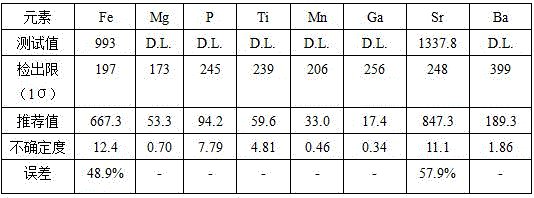
注:D.L.——检出限。Note: D.L. - detection limit.
由图8a、图8b和表4可以看出,本发明实施例1的高精度微量元素分析方法,测试结果数据稳定,微量元素检出限介于14~60 ppm(3σ),相比对比例1的常规测试条件(>190ppm, 1σ),微量元素检出降低了10~50倍(图8a);本发明的微量元素测试精度为0.34~9.65%,与对比例1相比,提高了约10倍(图8b)。It can be seen from Figure 8a, Figure 8b and Table 4 that the high-precision trace element analysis method of Example 1 of the present invention has stable test results and data, and the detection limit of trace elements is between 14 and 60 ppm (3σ). Under the conventional test conditions of 1 (>190ppm, 1σ), the detection of trace elements is reduced by 10-50 times (Figure 8a); the test accuracy of trace elements in the present invention is 0.34-9.65%, which is about 10 times (Fig. 8b).
综上所述,相较于常规测试方法中微量元素的高检出限和低测试精度的缺陷,本发明通过标样的研制和精确定值,并调整、改进分析方法的具体步骤,首次得到均匀、准确的斜长石标样,并可以有效降低检出限,提高微量元素的测试精度,为斜长石的微量元素监测取得突破性进展,对斜长石形成过程、相关寄主岩石成因以及地月系统的演化提供可靠的技术支撑。In summary, compared with the defects of high detection limit and low test accuracy of trace elements in conventional test methods, the present invention obtains for the first time through the development and precise determination of standard samples, and adjustment and improvement of the specific steps of the analysis method. Uniform and accurate plagioclase standard samples can effectively reduce the detection limit, improve the test accuracy of trace elements, and make a breakthrough for the trace element monitoring of plagioclase. The formation process of plagioclase, the genesis of related host rocks and The evolution of the Earth-Moon system provides reliable technical support.
本领域的技术人员应当理解,上述实施方式仅仅是为了清楚地说明本公开,而并非是对本申请的范围进行限定。对于所属领域的技术人员而言,在上述公开的基础上还可以做出其它变化或变型,并且这些变化或变型仍处于本发明的范围内。It should be understood by those skilled in the art that the above embodiments are only for clearly illustrating the present disclosure, rather than limiting the scope of the present application. For those skilled in the art, other changes or modifications can be made on the basis of the above disclosure, and these changes or modifications are still within the scope of the present invention.
Claims (4)


Priority Applications (1)
| Application Number | Priority Date | Filing Date | Title |
|---|---|---|---|
| CN202211314370.3A CN115372396B (en) | 2022-10-26 | 2022-10-26 | Method for confirming plagioclase standard sample |
Applications Claiming Priority (1)
| Application Number | Priority Date | Filing Date | Title |
|---|---|---|---|
| CN202211314370.3A CN115372396B (en) | 2022-10-26 | 2022-10-26 | Method for confirming plagioclase standard sample |
Publications (2)
| Publication Number | Publication Date |
|---|---|
| CN115372396A CN115372396A (en) | 2022-11-22 |
| CN115372396B true CN115372396B (en) | 2023-01-24 |
Family
ID=84074391
Family Applications (1)
| Application Number | Title | Priority Date | Filing Date |
|---|---|---|---|
| CN202211314370.3A Active CN115372396B (en) | 2022-10-26 | 2022-10-26 | Method for confirming plagioclase standard sample |
Country Status (1)
| Country | Link |
|---|---|
| CN (1) | CN115372396B (en) |
Family Cites Families (21)
| Publication number | Priority date | Publication date | Assignee | Title |
|---|---|---|---|---|
| JPS6443344A (en) * | 1987-08-12 | 1989-02-15 | Univ Tohoku | Vessel for underground chemical reaction |
| US5786595A (en) * | 1996-03-29 | 1998-07-28 | Schlumberger Technology Corporation | Method for estimating lithological fractions using nuclear spectroscopy measurements |
| US6835931B2 (en) * | 2002-05-15 | 2004-12-28 | Edax Inc. | Chemical prefiltering for phase differentiation via simultaneous energy dispersive spectrometry and electron backscatter diffraction |
| CN101618364B (en) * | 2009-07-31 | 2013-05-01 | 中国科学院广州地球化学研究所 | Method for sorting plagioclase from basalt |
| US9188555B2 (en) * | 2012-07-30 | 2015-11-17 | Fei Company | Automated EDS standards calibration |
| US9091635B2 (en) * | 2012-10-26 | 2015-07-28 | Fei Company | Mineral identification using mineral definitions having compositional ranges |
| CN103940642B (en) * | 2013-01-17 | 2017-12-12 | 中国科学院宁波材料技术与工程研究所 | Nd Fe B magnetic material quantitative analysis standard samples and XRF analysis method |
| CN104122283A (en) * | 2014-08-01 | 2014-10-29 | 桂林理工大学 | Total-rock component testing method based on in-situ electronic probe analysis |
| CN105181907B (en) * | 2015-10-13 | 2017-01-04 | 中国地质大学(武汉) | A kind of method in the quantitative identification nephrite place of production |
| CN106841263A (en) * | 2015-12-04 | 2017-06-13 | 核工业北京地质研究院 | A kind of Electron probe quantitative analysis method for determining F contents in natural minerals |
| CN107796841A (en) * | 2017-10-27 | 2018-03-13 | 中国科学院地质与地球物理研究所 | A kind of method of high accuracy analysis olivine trace element |
| CN108226200B (en) * | 2017-11-28 | 2020-07-28 | 核工业北京地质研究院 | Method for determining cause mechanism of edge vermicular quartz in granite type uranium deposit |
| CN108620227B (en) * | 2018-04-20 | 2019-05-14 | 中国科学院地质与地球物理研究所 | A kind of method for separating and system of baddeleyite |
| CN110261209A (en) * | 2019-07-31 | 2019-09-20 | 核工业二三O研究所 | The alpha energy spectrum method of testing of the method for separating and concentrating of thorium and thorium in sample of sandstone |
| CN110455843B (en) * | 2019-09-16 | 2022-04-05 | 核工业二三O研究所 | Method for determining uranium element in natural uranium product by strontium internal standard-XRF solution method |
| JP7445118B2 (en) * | 2019-12-27 | 2024-03-07 | 日本製鉄株式会社 | Identification method for goethite adsorbed phosphorus in iron ore |
| CN112326929A (en) * | 2020-10-31 | 2021-02-05 | 中国科学院广州地球化学研究所 | Multi-scale occurrence state analysis method for trace elements in minerals |
| CN113834835B (en) * | 2021-09-23 | 2022-06-24 | 中国科学院地质与地球物理研究所 | An Electron Probe Analysis Method for Testing Trace Elements Na, K, P, S and Ni in Lunar Glass Beads |
| CN114383909B (en) * | 2022-01-20 | 2023-10-31 | 西南石油大学 | In-situ micro-area element analysis standard sample, preparation method and application |
| CN114894829B (en) * | 2022-07-13 | 2022-10-14 | 中国科学院地质与地球物理研究所 | Electronic probe analysis method for testing F and Cl of olivine trace elements |
| CN115236109B (en) * | 2022-08-03 | 2023-05-23 | 中国科学院地质与地球物理研究所 | A Method for Determining Whole Rock Composition of Small Samples Based on Big Data Analysis |
-
2022
- 2022-10-26 CN CN202211314370.3A patent/CN115372396B/en active Active
Also Published As
| Publication number | Publication date |
|---|---|
| CN115372396A (en) | 2022-11-22 |
Similar Documents
| Publication | Publication Date | Title |
|---|---|---|
| Lavrent’ev et al. | Electron probe microanalysis of minerals: Microanalyzer or scanning electron microscope? | |
| Sun et al. | Chemical and oxygen isotope composition of gem-quality apatites: Implications for oxygen isotope reference materials for secondary ion mass spectrometry (SIMS) | |
| Forster et al. | Non‐destructive analysis using PXRF: methodology and application to archaeological ceramics | |
| Kennedy et al. | Grenville skarn titanite: potential reference material for SIMS U–Th–Pb analysis | |
| Reed | Electron probe microanalysis | |
| Yang et al. | U–Pb age determination of schorlomite garnet by laser ablation inductively coupled plasma mass spectrometry | |
| Lan et al. | Diagenetic xenotime age constraints on the Sanjiaotang Formation, Luoyu Group, southern margin of the North China Craton: Implications for regional stratigraphic correlation and early evolution of eukaryotes | |
| Ning et al. | Electron probe microanalysis of monazite and its applications to U-Th-Pb dating of geological samples | |
| Lagally et al. | Instrumentation for low‐energy electron diffraction | |
| CN113834835B (en) | An Electron Probe Analysis Method for Testing Trace Elements Na, K, P, S and Ni in Lunar Glass Beads | |
| CN111189864A (en) | Whole rock mineral identification and plane imaging method and device based on EPMA-WDX | |
| CN114894829B (en) | Electronic probe analysis method for testing F and Cl of olivine trace elements | |
| CN115586240A (en) | High-spatial-resolution calcite U-Pb dating method | |
| Jia et al. | High-precision measurement of trace level Na, K, P, S, Cr, and Ni in lunar glass using electron probe microanalysis | |
| Simonetti et al. | Use of discrete-dynode secondary electron multipliers with Faradays–a ‘reduced volume’approach for in situ U–Pb dating of accessory minerals within petrographic thin section by LA–MC–ICP–MS | |
| Liu et al. | Concurrent Determination of U‐Pb Age and REE Mass Fractions of Zircon by High Mass Resolution SIMS | |
| CN115372396B (en) | Method for confirming plagioclase standard sample | |
| Del Real et al. | Using multiple micro-analytical techniques for evaluating quantitative synchrotron-XRF elemental mapping of hydrothermal pyrite | |
| Moussallam et al. | ND70 Series Basaltic Glass Reference Materials for Volatile Element (H2O, CO2, S, Cl, F) Measurement and the C Ionisation Efficiency Suppression Effect of Water in Silicate Glasses in SIMS | |
| CN118533886B (en) | An electron probe analysis method for testing trace elements of Chang'e 5 meteorite troilite | |
| Cui et al. | High-precision apatite δ 37 Cl measurement by SIMS with a 10 12 Ω amplifier Faraday cup | |
| CN118392975B (en) | Method for simultaneously measuring U-Pb age and microelements in calcite microcell | |
| Yang et al. | SIMS simultaneous measurement of oxygen–hydrogen isotopes and water content for hydrous geological samples | |
| Satyanarayana et al. | Performance of PIXE Technique through a Geochemical Analysis of High Grade Rocks | |
| Riedo et al. | Novel 2D binning approach for advanced LIMS depth profiling analysis |
Legal Events
| Date | Code | Title | Description |
|---|---|---|---|
| PB01 | Publication | ||
| PB01 | Publication | ||
| SE01 | Entry into force of request for substantive examination | ||
| SE01 | Entry into force of request for substantive examination | ||
| GR01 | Patent grant | ||
| GR01 | Patent grant |