CN115361921A - Diagnosis/treatment support robot, diagnosis/treatment support robot system, and diagnosis/treatment support method - Google Patents
Diagnosis/treatment support robot, diagnosis/treatment support robot system, and diagnosis/treatment support method Download PDFInfo
- Publication number
- CN115361921A CN115361921A CN202180024802.4A CN202180024802A CN115361921A CN 115361921 A CN115361921 A CN 115361921A CN 202180024802 A CN202180024802 A CN 202180024802A CN 115361921 A CN115361921 A CN 115361921A
- Authority
- CN
- China
- Prior art keywords
- diagnosis
- treatment
- treatment support
- robot
- subject
- Prior art date
- Legal status (The legal status is an assumption and is not a legal conclusion. Google has not performed a legal analysis and makes no representation as to the accuracy of the status listed.)
- Pending
Links
Images


Classifications
-
- A—HUMAN NECESSITIES
- A61—MEDICAL OR VETERINARY SCIENCE; HYGIENE
- A61B—DIAGNOSIS; SURGERY; IDENTIFICATION
- A61B34/00—Computer-aided surgery; Manipulators or robots specially adapted for use in surgery
- A61B34/30—Surgical robots
- A61B34/37—Leader-follower robots
-
- A—HUMAN NECESSITIES
- A61—MEDICAL OR VETERINARY SCIENCE; HYGIENE
- A61B—DIAGNOSIS; SURGERY; IDENTIFICATION
- A61B5/00—Measuring for diagnostic purposes; Identification of persons
- A61B5/15—Devices for taking samples of blood
- A61B5/150007—Details
-
- A—HUMAN NECESSITIES
- A61—MEDICAL OR VETERINARY SCIENCE; HYGIENE
- A61B—DIAGNOSIS; SURGERY; IDENTIFICATION
- A61B90/00—Instruments, implements or accessories specially adapted for surgery or diagnosis and not covered by any of the groups A61B1/00 - A61B50/00, e.g. for luxation treatment or for protecting wound edges
- A61B90/36—Image-producing devices or illumination devices not otherwise provided for
- A61B90/37—Surgical systems with images on a monitor during operation
-
- A—HUMAN NECESSITIES
- A61—MEDICAL OR VETERINARY SCIENCE; HYGIENE
- A61B—DIAGNOSIS; SURGERY; IDENTIFICATION
- A61B90/00—Instruments, implements or accessories specially adapted for surgery or diagnosis and not covered by any of the groups A61B1/00 - A61B50/00, e.g. for luxation treatment or for protecting wound edges
- A61B90/50—Supports for surgical instruments, e.g. articulated arms
-
- A—HUMAN NECESSITIES
- A61—MEDICAL OR VETERINARY SCIENCE; HYGIENE
- A61B—DIAGNOSIS; SURGERY; IDENTIFICATION
- A61B10/00—Instruments for taking body samples for diagnostic purposes; Other methods or instruments for diagnosis, e.g. for vaccination diagnosis, sex determination or ovulation-period determination; Throat striking implements
- A61B10/0045—Devices for taking samples of body liquids
-
- A—HUMAN NECESSITIES
- A61—MEDICAL OR VETERINARY SCIENCE; HYGIENE
- A61B—DIAGNOSIS; SURGERY; IDENTIFICATION
- A61B10/00—Instruments for taking body samples for diagnostic purposes; Other methods or instruments for diagnosis, e.g. for vaccination diagnosis, sex determination or ovulation-period determination; Throat striking implements
- A61B10/0045—Devices for taking samples of body liquids
- A61B10/0051—Devices for taking samples of body liquids for taking saliva or sputum samples
-
- A—HUMAN NECESSITIES
- A61—MEDICAL OR VETERINARY SCIENCE; HYGIENE
- A61B—DIAGNOSIS; SURGERY; IDENTIFICATION
- A61B10/00—Instruments for taking body samples for diagnostic purposes; Other methods or instruments for diagnosis, e.g. for vaccination diagnosis, sex determination or ovulation-period determination; Throat striking implements
- A61B10/02—Instruments for taking cell samples or for biopsy
- A61B2010/0216—Sampling brushes
-
- A—HUMAN NECESSITIES
- A61—MEDICAL OR VETERINARY SCIENCE; HYGIENE
- A61B—DIAGNOSIS; SURGERY; IDENTIFICATION
- A61B34/00—Computer-aided surgery; Manipulators or robots specially adapted for use in surgery
- A61B34/30—Surgical robots
- A61B2034/305—Details of wrist mechanisms at distal ends of robotic arms
- A61B2034/306—Wrists with multiple vertebrae
-
- A—HUMAN NECESSITIES
- A61—MEDICAL OR VETERINARY SCIENCE; HYGIENE
- A61B—DIAGNOSIS; SURGERY; IDENTIFICATION
- A61B5/00—Measuring for diagnostic purposes; Identification of persons
- A61B5/15—Devices for taking samples of blood
- A61B5/150007—Details
- A61B5/150015—Source of blood
- A61B5/15003—Source of blood for venous or arterial blood
-
- A—HUMAN NECESSITIES
- A61—MEDICAL OR VETERINARY SCIENCE; HYGIENE
- A61B—DIAGNOSIS; SURGERY; IDENTIFICATION
- A61B90/00—Instruments, implements or accessories specially adapted for surgery or diagnosis and not covered by any of the groups A61B1/00 - A61B50/00, e.g. for luxation treatment or for protecting wound edges
- A61B90/10—Instruments, implements or accessories specially adapted for surgery or diagnosis and not covered by any of the groups A61B1/00 - A61B50/00, e.g. for luxation treatment or for protecting wound edges for stereotaxic surgery, e.g. frame-based stereotaxis
- A61B90/11—Instruments, implements or accessories specially adapted for surgery or diagnosis and not covered by any of the groups A61B1/00 - A61B50/00, e.g. for luxation treatment or for protecting wound edges for stereotaxic surgery, e.g. frame-based stereotaxis with guides for needles or instruments, e.g. arcuate slides or ball joints
- A61B90/13—Instruments, implements or accessories specially adapted for surgery or diagnosis and not covered by any of the groups A61B1/00 - A61B50/00, e.g. for luxation treatment or for protecting wound edges for stereotaxic surgery, e.g. frame-based stereotaxis with guides for needles or instruments, e.g. arcuate slides or ball joints guided by light, e.g. laser pointers
-
- A—HUMAN NECESSITIES
- A61—MEDICAL OR VETERINARY SCIENCE; HYGIENE
- A61B—DIAGNOSIS; SURGERY; IDENTIFICATION
- A61B90/00—Instruments, implements or accessories specially adapted for surgery or diagnosis and not covered by any of the groups A61B1/00 - A61B50/00, e.g. for luxation treatment or for protecting wound edges
- A61B90/36—Image-producing devices or illumination devices not otherwise provided for
- A61B90/361—Image-producing devices, e.g. surgical cameras
Landscapes
- Health & Medical Sciences (AREA)
- Life Sciences & Earth Sciences (AREA)
- Surgery (AREA)
- Engineering & Computer Science (AREA)
- Animal Behavior & Ethology (AREA)
- General Health & Medical Sciences (AREA)
- Nuclear Medicine, Radiotherapy & Molecular Imaging (AREA)
- Biomedical Technology (AREA)
- Heart & Thoracic Surgery (AREA)
- Medical Informatics (AREA)
- Molecular Biology (AREA)
- Veterinary Medicine (AREA)
- Public Health (AREA)
- Robotics (AREA)
- Pathology (AREA)
- Oral & Maxillofacial Surgery (AREA)
- Hematology (AREA)
- Physics & Mathematics (AREA)
- Biophysics (AREA)
- Gynecology & Obstetrics (AREA)
- Radiology & Medical Imaging (AREA)
- Manipulator (AREA)
- Container, Conveyance, Adherence, Positioning, Of Wafer (AREA)
- Cleaning Or Drying Semiconductors (AREA)
Abstract
本发明提供一种诊断/治疗支援机器人(10),具有由操作者(S)远程操作的手术机械手(6)。所述手术机械手(6)在前端部具有机器人臂(130),该机器人臂(130)包括安装有用于对被施术者进行手术的手术设备的设备安装部。所述设备安装部是所述手术设备以外的设备,其能够安装用于对对象者进行传染病的诊断及治疗的至少任一种辅助行为的辅助设备(150)。
The present invention provides a diagnosis/treatment support robot (10) having a surgical manipulator (6) remotely operated by an operator (S). The surgical manipulator (6) has a robot arm (130) at the front end, and the robot arm (130) includes a device mounting portion on which surgical devices for performing surgery on a subject are mounted. The device mounting unit is a device other than the surgical device, and is capable of mounting an auxiliary device (150) for performing at least any one of auxiliary actions for diagnosing and treating an infectious disease on a subject.
Description
相关申请的相互参照Cross-references to related applications
本申请主张2020年4月10日向日本专利厅申请的特愿2020-071351号以及2020年5月29日向日本专利厅申请的特愿2020-094574号的优先权,通过参照其整体,作为构成本申请的一部分进行引用。This application claims the priority of Japanese Patent Application No. 2020-071351 filed with the Japan Patent Office on April 10, 2020, and Japanese Patent Application No. 2020-094574 filed with the Japan Patent Office on May 29, 2020. part of the application for reference.
技术领域technical field
本发明涉及诊断/治疗支援机器人、诊断/治疗支援机器人系统以及诊断/治疗支援方法。The present invention relates to a diagnosis/treatment support robot, a diagnosis/treatment support robot system, and a diagnosis/treatment support method.
背景技术Background technique
已知一种支援手术以外的医疗行为即医疗辅助行为的机器人。例如,在专利文献1中公开了一种采血系统,将由采血管准备装置准备好的室内患者的采血管收纳托盘由机器人自行向采血台供给。There is known a robot that supports medical assistance activities other than surgery. For example, Patent Document 1 discloses a blood collection system in which a blood collection tube storage tray for an indoor patient prepared by a blood collection tube preparation device is automatically supplied to a blood collection table by a robot.
现有技术文献prior art literature
专利文献patent documents
专利文献1:日本特开2007-130282公开专利公报Patent Document 1: Japanese Laid-Open Patent Publication 2007-130282
发明内容Contents of the invention
但是,当前(2020年4月)新型冠状病毒(covid-19)引起的传染病正在扩大,其诊断及治疗的辅助行为需要大量的医疗从业者(医生、护士等)。另外,在传染病的情况下,需要防止医疗从业者的感染。但是,在上述以往的机器人中,原本就不能进行采血。However, the current (April 2020) infectious disease caused by the novel coronavirus (covid-19) is expanding, and a large number of medical practitioners (doctors, nurses, etc.) are required to support the diagnosis and treatment. In addition, in the case of infectious diseases, it is necessary to prevent infection of medical practitioners. However, in the above-mentioned conventional robot, blood collection cannot be performed originally.
本发明是为了解决上述那样课题而完成的,其目的在于提供一种诊断/治疗支援机器人、诊断/治疗支援机器人系统和诊断/治疗支援方法,其能够代替医疗从业者进行诊断及治疗的至少任意一种的辅助行为,由此,防止传染病向医疗从业者感染。The present invention has been made to solve the above-mentioned problems, and its object is to provide a diagnosis/treatment support robot, a diagnosis/treatment support robot system, and a diagnosis/treatment support method, which can perform at least any of diagnosis and treatment instead of medical practitioners. An ancillary act whereby, preventing infectious diseases from reaching healthcare practitioners.
为了实现上述目,本公开的一个方式(aspect)的诊断/治疗支援机器人具有由操作者远程操作的手术机械手,所述手术机械手在前端部具有机器人臂,该机器人臂包括设备安装部,安装有用于对被施术者进行手术的手术设备,所述设备安装部是所述手术设备以外的设备,其能够安装用于对对象者进行传染病的诊断和治疗中的至少一种的辅助行为的辅助设备。In order to achieve the above object, a diagnosis/treatment support robot of an aspect (aspect) of the present disclosure has a surgical manipulator operated remotely by an operator. For surgical equipment for performing surgery on a subject, the equipment mounting unit is a device other than the surgical equipment, which can be installed to perform at least one auxiliary activity of diagnosis and treatment of infectious diseases on the subject. Auxiliary equipment.
根据该结构,通过在设备安装部安装辅助设备,操作者操作手术机械手,能够对对象者进行传染病的诊断及治疗中的至少一种。其结果,诊断/治疗支援机器人能够代替医疗从业者进行诊断和治疗中的至少一种。而且,通常来说,手术机械手能够以精密的动作对被施术者进行手术,所以即使是有些复杂的诊断或治疗的辅助行为也能够适当地进行。另外,通过将手术机械手配置在疑似被感染的人(以下称为“疑似感染者”)或隔离感染者隔离区域(以下有时简称为“隔离区域”),并将操作者配置在未隔离区域即通常区域,对手术机械手进行远程操作,能够防止操作者感染传染病。其结果,能够防止医疗从业者感染传染病。According to this configuration, by attaching the auxiliary equipment to the equipment mounting part, the operator can operate the surgical manipulator, and at least one of diagnosis and treatment of infectious diseases can be performed on the subject. As a result, the diagnosis/treatment support robot can perform at least one of diagnosis and treatment instead of a medical practitioner. In addition, in general, a surgical manipulator can operate on a subject with precise movements, so even somewhat complicated auxiliary actions for diagnosis or treatment can be properly performed. In addition, by placing the surgical manipulator in a suspected infected person (hereinafter referred to as "suspected infected person") or in an isolation area for isolated infected persons (hereinafter sometimes referred to as "isolation area"), and placing the operator in a non-isolated area, that is, In general areas, remote operation of surgical manipulators can prevent operators from being infected with infectious diseases. As a result, it is possible to prevent medical practitioners from being infected with infectious diseases.
而且,由于传染病的流行是间歇性的,所以在传染病不流行时,通过在机器人臂上安装手术设备,将诊断/治疗支援机器人作为原本的手术机器人使用,能够有效地使用诊断/治疗支援机器人。In addition, since the epidemic of infectious diseases is intermittent, when infectious diseases are not prevalent, diagnosis/treatment support can be effectively used by installing surgical equipment on the robot arm and using the diagnosis/treatment support robot as the original surgical robot robot.
另外,本公开的另一方式的诊断/治疗支援机器人系统具有上述的诊断/治疗支援机器人和辅助设备。In addition, a diagnosis/treatment support robot system according to another aspect of the present disclosure includes the above-mentioned diagnosis/treatment support robot and auxiliary equipment.
根据该结构,通过在诊断/治疗支援机器人的手术机械手上安装诊断/治疗设备,能够使用手术机械手进行诊断和治疗中的至少一种。According to this configuration, at least one of diagnosis and treatment can be performed using the surgical manipulator by mounting the diagnostic/therapeutic device on the surgical manipulator of the diagnosis/treatment support robot.
另外,本公开又一方式(aspect)的诊断/治疗支援机器人系统包括:上述的诊断/治疗支援机器人、用于所述操作者远程操作所述诊断/治疗支援机器人的所述手术机械手的远程操作单元、安装在所述手术机械手的所述机器人臂的设备安装部上的用于拍摄对所述对象者进行诊断/治疗的区域的状况的第1摄像器,所述手术机械手具有多个所述机器人臂,多个所述机器人臂包括:在设备安装部安装有所述辅助设备的诊断/治疗臂和在所述设备安装部安装有所述第1摄像器的摄像臂,所述远程操作单元包括:第2显示器,其用于显示由所述第1摄像器拍摄到的所述区域的状况;和第2摄像器,其拍摄所述操作者,所述手术机械手还包括用于显示由所述第2摄像器拍摄的所述操作者的图像的第1显示器。In addition, a diagnosis/treatment support robot system in another aspect (aspect) of the present disclosure includes: the above-mentioned diagnosis/treatment support robot, remote operation of the surgical manipulator for the operator to remotely operate the diagnosis/treatment support robot unit, a first camera mounted on the device mounting portion of the robot arm of the surgical manipulator for photographing the condition of the area where the subject is diagnosed/treated, and the surgical manipulator has a plurality of the A robot arm, a plurality of the robot arms include: a diagnosis/treatment arm with the auxiliary equipment installed in the equipment installation part and an imaging arm with the first camera installed in the equipment installation part, and the remote operation unit It includes: a second display, which is used to display the situation of the area captured by the first camera; and a second camera, which captures the operator, and the surgical manipulator also includes a display for displaying A first display of the image of the operator captured by the second camera.
根据该结构,通过安装在手术机械手的机器人臂的设备安装部上的第1摄像器,来拍摄对对象者进行诊断/治疗的区域(以下有时称为“诊断/治疗区域”)的状况,能够使该拍摄到的诊断/治疗区域的状况显示在远程操作单元的第2显示器上。由此,操作者能够一边观察在第2显示器上显示的诊断/治疗区域的状况一边操作手术机械手,因此能够适当地进行诊断或治疗的辅助行为。特别是,由于第1摄像器安装在手术机械手的机器人臂上,所以操作者能够自由地操作第1摄像器,如想要看到那样地看到想看的情况。According to this structure, the situation of the region where the subject is diagnosed/treated (hereinafter sometimes referred to as "diagnosed/treated region") can be photographed by the first camera mounted on the equipment mounting part of the robot arm of the surgical manipulator, and it is possible to The conditions of the imaged diagnosis/treatment area are displayed on the second display of the remote operation unit. As a result, the operator can operate the surgical manipulator while viewing the condition of the diagnosis/treatment region displayed on the second display, and thus can appropriately perform auxiliary actions for diagnosis or treatment. In particular, since the first camera is attached to the robot arm of the surgical manipulator, the operator can freely operate the first camera to see what he or she wants to see.
此外,由于手术机械手的第1显示器显示由远程操作单元的第2摄像器拍摄的操作者的图像,所以对象者能够知道操作者的样子(脸部的表情、态度等)。其结果,能够使对象者安心。这样,操作者和对象者能够进行基于影像的交流。In addition, since the first display of the surgical manipulator displays the image of the operator captured by the second camera of the remote operation unit, the subject can know the appearance of the operator (facial expression, attitude, etc.). As a result, the subject can be relieved. In this way, the operator and the subject can perform video-based communication.
另外,本公开的其他方式(aspect)的诊断/治疗支援方法是一种使用诊断/治疗支援机器人的诊断/治疗支援方法,该诊断/治疗支援机器人具有由操作者进行远程操作的手术机械手,所述手术机械手具有机器人臂,该机器人臂包含设备安装部,该设备安装部在前端部安装有用于对被施术者进行手术的手术设备,所述设备安装部是所述手术设备以外设备,其能够安装用于对对象者进行传染病的诊断及治疗中的至少任一种辅助行为的辅助设备,该诊断/治疗支援方法包括在所述设备安装部上安装所述辅助设备来代替所述手术设备。In addition, the diagnosis/treatment support method of another aspect (aspect) of the present disclosure is a diagnosis/treatment support method using a diagnosis/treatment support robot having a surgical manipulator remotely operated by an operator. The surgical manipulator has a robot arm, the robot arm includes an equipment installation part, and the equipment installation part is equipped with surgical equipment for performing surgery on the subject at the front end, and the equipment installation part is a device other than the surgical equipment. Auxiliary equipment that can be used to assist at least one of diagnosis and treatment of infectious diseases on a subject person, the diagnosis/treatment support method includes installing the auxiliary equipment on the equipment installation part instead of the operation equipment.
根据该结构,手术机械手代替医疗从业者进行诊断和治疗的至少任意一种辅助行为,由此,能够防止医疗从业者感染传染病。According to this configuration, the surgical manipulator performs at least any one of auxiliary actions of diagnosis and treatment instead of the medical practitioner, thereby preventing the medical practitioner from contracting an infectious disease.
发明效果Invention effect
本公开提供了一种诊断/治疗支援机器人、诊断/治疗支援机器人系统和诊断/治疗支援方法,其能够代替医疗从业者进行诊断和治疗中的至少一种辅助行为,从而起到防止医疗从业者感染传染病的效果。The present disclosure provides a diagnosis/treatment support robot, a diagnosis/treatment support robot system, and a diagnosis/treatment support method, which can replace medical practitioners in performing at least one auxiliary action in diagnosis and treatment, thereby preventing medical practitioners from The effect of infectious diseases.
附图说明Description of drawings
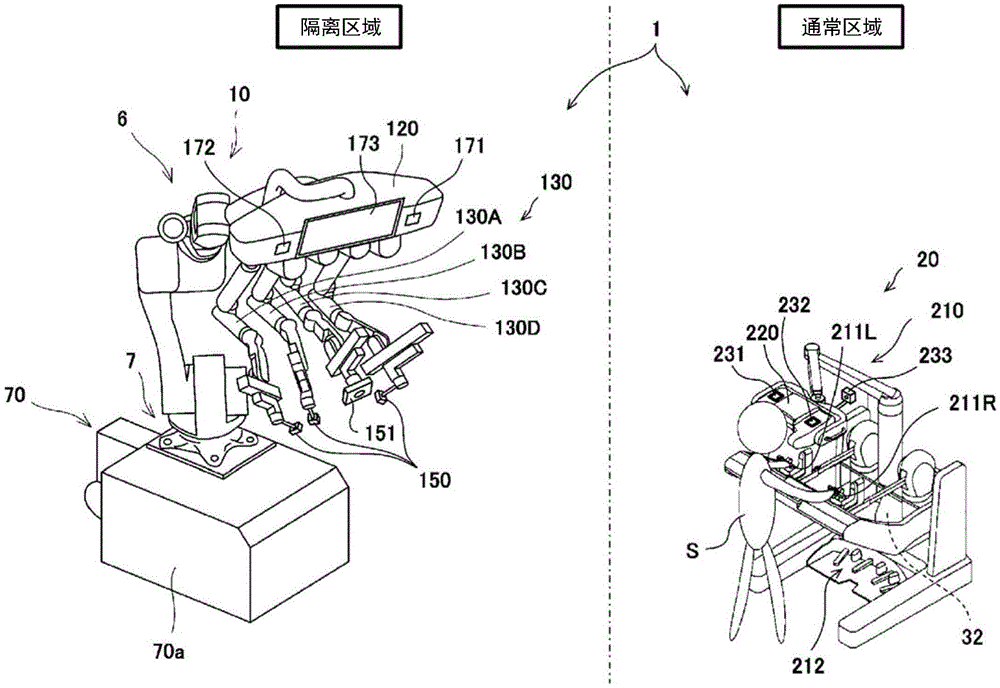
图1是表示本公开的诊断/治疗支援机器人系统的硬件结构的一例的外观图。FIG. 1 is an external view showing an example of the hardware configuration of the diagnosis/treatment support robot system of the present disclosure.
图2是表示图1的手术机械手的结构的一例的外观图。FIG. 2 is an external view showing an example of the structure of the surgical manipulator in FIG. 1 .
图3是表示图2的机器人臂的结构的一例以及辅助设备的结构的一例的外观图。3 is an external view showing an example of the structure of the robot arm and an example of the structure of the auxiliary equipment in FIG. 2 .
图4是表示图3的设备安装部的可动体的结构的一例的剖面图。FIG. 4 is a cross-sectional view showing an example of the structure of a movable body of the device mounting portion in FIG. 3 .
图5是表示安装有保持容易化夹具的注射器的外观图。Fig. 5 is an external view showing the syringe to which the holding facilitation jig is attached.
图6是表示图1的诊断/治疗支援机器人系统的控制系统的结构的一例的框图。FIG. 6 is a block diagram showing an example of a configuration of a control system of the diagnosis/treatment support robot system in FIG. 1 .
图7是表示支援机器人的结构的一例的外观图。FIG. 7 is an external view showing an example of the configuration of a support robot.
图8是表示安装有手术设备的诊断/治疗支援机器人的外观图。Fig. 8 is an external view showing a diagnosis/treatment support robot equipped with surgical equipment.
图9是表示本公开的适用于PCR检查的适用例的诊断/治疗支援机器人系统的手术机械手的结构的一例的外观图。9 is an external view showing an example of the configuration of a surgical manipulator of a diagnostic/treatment support robot system applied to a PCR test of the present disclosure.
图10是表示本公开的适用于PCR检查的适用例的诊断/治疗支援机器人系统的远程操作单元的结构的一例的外观图。FIG. 10 is an external view showing an example of a configuration of a remote operation unit of a diagnosis/treatment support robot system applied to a PCR test application example of the present disclosure.
图11是表示图9的保持设备(辅助设备)的结构的一例的外观图。FIG. 11 is an external view showing an example of the structure of the holding device (auxiliary device) shown in FIG. 9 .
图12是表示在远程操作单元的显示器上显示的由第1摄像器拍摄的图像以及由辅助摄像器拍摄的图像的示意图。12 is a schematic diagram showing an image captured by the first camera and an image captured by the auxiliary camera displayed on the display of the remote operation unit.
图13是表示在采样检验体时在远程操作单元的显示器上显示的由第1摄像器拍摄的图像以及由辅助摄像器拍摄的图像的示意图。13 is a schematic diagram showing an image captured by the first camera and an image captured by the auxiliary camera displayed on the display of the remote operation unit when sampling a specimen.
图14是表示在远程操作单元的显示器上显示的由第1摄像器拍摄的图像、由辅助摄像器拍摄的图像、以及第1棉签插入程度模型的示意图。14 is a schematic diagram showing an image captured by the first camera, an image captured by the auxiliary camera, and a first cotton swab insertion degree model displayed on the display of the remote operation unit.
图15是表示在远程操作单元的显示器上显示的由第1摄像器拍摄的图像、由辅助摄像器拍摄的图像、以及第2棉签插入程度模型的示意图。15 is a schematic diagram showing an image captured by the first camera, an image captured by the auxiliary camera, and a second swab insertion degree model displayed on the display of the remote operation unit.
具体实施方式Detailed ways
(实施方式)(implementation mode)
接下来,参照附图来说明本公开的具体实施方式。另外,以下对在所有的附图中相同或相当的结构标注相同的附图标记,并省略其重复的说明。另外,以下说明的附图是用于说明本发明的附图,因此,在这些图中存在省略与本公开无关的结构的情况、由于夸张等原因尺寸不正确的情况、在多个图中相互对应的结构不一致的情况等。此外,本公开不限于以下的实施方式。Next, specific embodiments of the present disclosure will be described with reference to the drawings. In addition, below, the same code|symbol is attached|subjected to the same or equivalent structure in all drawings, and the repeated description is abbreviate|omitted. In addition, the drawings described below are drawings for explaining the present invention. Therefore, in these drawings, there are cases where structures unrelated to the present disclosure are omitted, dimensions are not correct due to exaggeration, etc., and mutual The corresponding structure is inconsistent, etc. In addition, the present disclosure is not limited to the following embodiments.
硬件结构hardware structure
图1是表示本公开的诊断/治疗支援机器人系统的硬件结构的一例的外观图。图2是表示图1的手术机械手的结构的一例的外观图。另外,在图2中,省略图1的显示器173。FIG. 1 is an external view showing an example of the hardware configuration of the diagnosis/treatment support robot system of the present disclosure. FIG. 2 is an external view showing an example of the structure of the surgical manipulator in FIG. 1 . In addition, in FIG. 2 , the
参照图1,本实施方式的诊断/治疗支援机器人系统1包括诊断/治疗支援机器人10和远程操作单元20。诊断/治疗支援机器人10配置在隔离感染者或疑似感染者的隔离区域。隔离区域例如为负压室。远程操作单元20被配置在作为未被隔离的区域的通常区域。Referring to FIG. 1 , a diagnosis/treatment support robot system 1 of the present embodiment includes a diagnosis/
以下,详细说明该诊断/治疗支援机器人系统的结构。Hereinafter, the configuration of this diagnosis/treatment support robot system will be described in detail.
<诊断/治疗支援机器人10><Diagnosis/
参照图1和图2,诊断/治疗支援机器人10包括手术机械手6和台车70。Referring to FIGS. 1 and 2 , the diagnosis/
{台车70}{Trolley 70}
台车70包括主体70a、前轮141A及后轮141b。前轮141A是驱动轮,后轮是转向轮。前轮由内置于主体70a的驱动源(未图示,例如电机)驱动,后轮通过该驱动源转向。由此,台车70构成为能够自主行驶。第1控制器31存储在主体70a中。前轮141A和后轮141B的动作由第1控制器31控制。由此,台车70构成为能够自动行驶。第1控制器31根据内置的行驶程序或来自后述的远程操作单元20的行驶指令,控制前轮141A及后轮141B的动作。在此,第1控制器31根据行驶程序来控制前轮141A和后轮141B。由此,台车70通过预先设定的移动路径,从通常区域移动到隔离区域。The
{手术机械手6}{Surgical Manipulator 6}
手术机械手6没有特别限定,能够使用公知的手术机械手。在此,手术机械手6包括定位器7和机器人臂130。The
定位器7是用于使机器人臂130位于容易进行该机器人臂130对于对象者(手术时为被施术者,诊断或治疗时为感染者或疑似感染者)的作业的位置的构件。The
具体而言,定位器7由垂直型的多关节机器人构成。在此,定位器7包括从基台117朝向前端配置的第1至第6定位器连杆111~116和依次连接它们的7个关节JP1~JP7,在前端设置有臂基座120。基台117固定在台车70的主体70a的上表面。Specifically, the
臂基座120作为机器人臂130的平台来发挥作用。在臂基座120上连接有机器人臂130。机器人臂130的数量没有特别限定。在此,机器人臂130在此为4个。另外,在统称机器人臂时或者表示代表例时,作为附图标记而标注“130”,在分别称(指)多个机器人臂时,在“130”之后对各机器人臂标注附加了大写字母的附图标记。在此,手术机械手6具有第1至第4机器人臂130A~130D。The
图2示出一个机器人臂130来代表四个机器人臂130A~130D。在图2中,附图标记G表示隔离区域的地面。附图标记OT表示床。附图标记P表示对象者。图2示出使诊断/治疗支援机器人10位于适合诊断或治疗仰卧在床OT上的对象者P的位置上,并通过手术机械手6对对象者P进行诊断和/或治疗的辅助行为的情形。FIG. 2 shows one
参照图2,臂基座120经由第1安装部121绕扭转旋转关节JP7的转动轴线SP1可转动地与第6定位器连杆116连接。此外,机器人臂130经由第2安装部122与臂基座120连接。Referring to FIG. 2 , the
机器人臂130由多关节的机器人臂构成。在此,机器人臂130包括从基部138朝向前端配置的第1至第6臂连杆131~136和依次连接它们的7个关节JA1~JA7,在前端连接设备安装部137。基部138绕规定的扭转转动轴线SA1转动自如地连接在臂基座120的第2安装部122。从臂基座120的长度方向观察,规定的扭转转动轴线SA1被设定为与扭转旋转关节JP7的转动轴线SP1以规定的角度交叉。The
在设备安装部137上安装有辅助设备150。An
{设备安装部137}{Equipment Installation Department 137}
图3是表示图2的机器人臂130的结构的一例及辅助设备150的结构的一例的外观图。另外,在图3中,省略了图1的显示器173。FIG. 3 is an external view showing an example of the structure of the
参照图3,机器人臂130能够使设备安装部137在三维方向XA、YA、ZA上自由移动,并且使设备安装部137的姿势在三维方向XA、YA、ZA上自由变化。Referring to FIG. 3 , the
辅助设备150具有4(或以上)的活动的自由度。然后,设备安装部137安装辅助设备150,从而能够以4(或以上)的活动的自由度进行动作。因此,能够使辅助设备150进行复杂的作业。
设备安装部137包括安装部137a、主体137b和可动体137c。安装部137a突出设置在主体137b的一侧,并且绕作为弯曲旋转关节的第7关节JT7的转动轴线(未图示)转动自如地连接在机器人臂130的第6臂连杆136。主体137b使可动体137c在与第7关节JT7的转动轴线垂直的方向D1A、D1B上移动。在可动体137c上连接有辅助设备150。因此,设备安装部137使辅助设备150在上述方向D1A、D1B上移动。The
图4是表示图3的设备安装部137的可动体137c的结构的一例的纵剖视图。图4表示图3的可动体137c的长度方向上的纵剖面。FIG. 4 is a vertical cross-sectional view showing an example of the structure of the
参照图4,可动体137c形成为中空的箱状,在内部配置有电机(例如伺服电机)M和作为与该电机M的主轴R连接的旋转角检测器的编码器E。在可动体137c的一端部的主体137b的相反侧的侧面形成有圆柱状的凹部50。该凹部50的中心轴在与第七关节JT7的转动轴线和上述方向D1A、D1B垂直的方向上延伸。在凹部50的底面的中央部形成有开口51。以主轴R从该开口51向外部突出的方式设置有电机M及编码器E。电机M配置成主轴R与凹部50的中心轴一致。另外,在主轴R的前端部设置有阴接头61。在阴接头61的前端面形成有具有异形截面的嵌合凹部61a。作为异形截面,可以例示负、正、四边形、六边形等。Referring to FIG. 4 , the
在凹部50的内周面的相互对置的至少一对部位设置有卡止部52。该卡定部52具有在凹部50的半径方向上自由出没的卡止销51a。卡止销51a的前端部形成为半球状,通过弹性机构(未图示)向凹部50的半径方向施力。Locking
另一方面,如后所述,辅助设备150具有安装部150d,该安装部150d具有前端开放的圆筒状的凸部60。该凸部60形成为与凹部50嵌合的形状。因此,凸部60的中心轴与凹部50的中心轴一致。在凸部60的底面的中央部形成有开口66。以贯通该开口66并从凸部60的内部向安装部150d的内部延伸的方式配置驱动轴63。驱动轴63以使电机M的主轴R与旋转轴一致的方式转动自如地被设置在开口66上的轴承64支撑。在驱动轴63的前端部设置有阳接头62。在阳接头62的前端面形成有与阴接头61的嵌合凹部61a嵌合的嵌合凸部62a。阳接头62设置成在凸部60嵌入到凹部50的深处的状态下,嵌合凸部62a正好嵌入阴接头61的嵌合凹部61a。On the other hand, as will be described later, the
在凸部60的外周的彼此朝向相反方向的至少一对部位设置有卡合部67。该卡合部67由在凸部60的半径方向上呈半球状凹陷的凹部构成。卡合部67设置成,在凸部60嵌入到凹部50的深处的状态下,凹部50的卡止销51a正好进到卡合部67,使得凸部60被卡止于凹部50。另外,附图标记65表示用于密封安装部150d的内部的密封机构。
为了将辅助设备150安装在可动体137c(设备安装部137)上,将辅助设备150的凸部60压入可动体137c的凹部50的深处。于是,凹部50的卡止销51a进到(进入)凸部60的卡合部67,使得凸部60卡止于凹部50。由此,辅助设备150被安装在可动体137c上。In order to attach the
然后,如果从该状态向从凹部50拔出凸部60的方向以所需的力拉拽,则辅助设备150从可动体137c拔出。由此,从可动体137c上拆下辅助设备150。Then, when pulling with a required force in a direction to pull out the
另外,如后所述,驱动轴63的旋转动力通过适当的动力传递机构传递到辅助设备150的爪保持体150b。In addition, as will be described later, the rotational power of the
此外,在将摄像器151(参照图1)安装在可动体137c上的情况下,在摄像器151上安装凸部60,省略凹部50的阴接头61及凸部60的阳接头62,取而代之的是,在凹部50及凸部60上设置传递摄像器151的控制信号、数据等的电接点。In addition, when the camera 151 (see FIG. 1 ) is mounted on the
此外,在将手术设备180(参照图8)安装在可动体137c的情况下,根据手术设备180的种类,构成凹部50及凸部60。In addition, when the surgical device 180 (see FIG. 8 ) is attached to the
在手术设备180具有由电机M驱动的驱动部的情况下,凹部50及凸部60与上述方式同样地构成。When the
在手术设备180不具有由电机M驱动的驱动部,而需要传递电动力、控制信号、数据等时,省略凹部50的阴接头61及凸部60的阳接头62,取而代之的是,在凹部50及凸部60上设置传递电动力、控制信号、数据等的电接点。When the
在手术设备180不具有由电机M驱动的驱动部,且不需要电动力、控制信号、数据等的传递时,省略凹部50的阴接头61及凸部60的阳接头62。When the
另外,手术设备180向可动体137c的安装及拆卸与上述的辅助设备150的情况相同。In addition, attachment and detachment of the
{辅助设备150}{Auxiliary equipment 150}
参照图1,辅助设备150安装在第1机器人臂130A、第2机器人臂130B和第4机器人臂130D的前端部。Referring to FIG. 1 , an
在此,在工业用机器人中,由于存在能够适当地对待或处理多种多样部件的多种多样的手(末端执行器),因此通过适当地修正这些多种多样的手能够获得能适当地对待或处理多种多样的部件的多种多样的辅助设备150。Here, in industrial robots, since there are various hands (end effectors) that can properly handle or handle various parts, it is possible to obtain the Or a wide variety of
特别是,在诊断或治疗的辅助行为中,医疗从业者大多用手保持诊断/治疗部件。作为辅助器械150的一个示例的保持设备是安装在机器人臂130的前端的工具,用于通过保持这样的诊断/治疗部件来代替医疗从业者从而广泛地进行诊断或治疗的辅助行为。In particular, in an assisting act of diagnosis or treatment, medical practitioners mostly hold diagnosis/treatment components with their hands. A holding device as one example of the
作为诊断/治疗部件,例如可以举出采集与对象者P的传染病相关的检验体的用具、点滴用具、采血用具或人工心肺装置的插管等。Examples of diagnosis/treatment means include tools for collecting specimens related to infectious diseases of the subject P, infusion sets, blood collection sets, or cannulas for artificial heart-lung devices.
如本实施方式所示,通过使能够保持这些诊断/治疗部件的辅助设备150(特别是保持设备)实用化(可利用),能够在传染病的诊断或治疗中使用手术机械手6来进行特别需要的行为。下面,作为保持设备,例示了把持诊断/治疗部件的结构,但保持设备也可以吸附诊断/治疗部件。As shown in this embodiment, by making practical (available) the auxiliary equipment 150 (especially holding equipment) capable of holding these diagnosis/treatment components, the
另外,辅助设备150除了保持诊断/治疗部件以外,还可以是切断用具、喷嘴、载置用具等工具、处理用具、输送用具。In addition, the
参照图3,辅助设备150例如包括主体150a、爪保持体150b、一对爪150c、安装部150d和连接部件150e。Referring to FIG. 3 , the
爪保持体150b例如使一对爪150c在规定的方向上直线移动而开闭。作为爪保持体150b,可例示齿条小齿轮机构、滚珠丝杠机构等。一对爪150c的形状没有特别限定,这里形成为平板状。一对爪150c分别由金属、塑料等刚体构成,在内表面设有缓冲层(未图示)。该缓冲层具有适当的厚度、弹性、摩擦系数等特性。选择这些特性以适合作为保持对象的诊断/治疗部件。该选择通过实验、模拟、计算等进行。The
爪保持体150b经由中空的连接部件150e与主体150a连接。如上所述,安装部150d突出设置在主体150a的适当位置。并且,以从安装部150d通过主体150a及连结部件150e的内部到达爪保持体150b的方式,形成将上述驱动轴63的旋转动力作为一对爪150c的驱动力来进行传递的动力传递路径。这样的动力传递路径可以使用公知的技术来构筑,所以省略其说明。The
因此,一对爪150c由设置在可动体137c上的电机M驱动。Therefore, the pair of
{保持容易化夹具}{keep facilitation fixture}
在诊断/治疗部件中,存在保持设备难以直接保持的部件。例如,作为这样的部件,可以举出容易损坏的部件(玻璃制的注射器或容器等)、过细或过小的部件(细管等)、形状复杂而难以保持的部件等。因此,如果在这样的诊断/治疗部件上预先安装保持设备容易保持的夹具,则通过保持设备保持该夹具,结果,通过保持设备能够容易地保持该诊断/治疗部件。Among the diagnostic/therapeutic parts, there are parts where it is difficult to directly hold the holding device. Examples of such components include easily damaged components (glass syringes, containers, etc.), extremely thin or small components (thin tubes, etc.), and components that are complicated in shape and difficult to hold. Therefore, if a jig that is easily held by the holding device is preinstalled on such a diagnostic/therapeutic component, the jig is held by the holding device, and as a result, the diagnostic/therapeutic component can be easily held by the holding device.
图5是表示安装有保持容易化夹具81、82的注射器80的外观图。参照图5,注射器80包括气缸71、活塞72和注射针73。在气缸71上安装有第1保持容易化夹具81,在活塞72上安装有第2保持容易化夹具82。第1保持容易化夹具81形成为长方体状,在中央部形成有圆形的贯通孔。气缸71插通该贯通孔,通过适当的粘接剂,第1保持容易化夹具81牢固地固定在气缸71上。第2保持容易化夹具82形成为长方体状,在一个侧面的中央部形成有圆形的凹部。在该凹部嵌入活塞72的后端部,通过适当的粘接剂,第2保持容易化夹具82牢固地固定在活塞72上。FIG. 5 is an external view showing a
例如,在采血时,通过第1机器人臂130A(诊断/治疗臂)的辅助设备150保持第1保持容易化夹具81,通过第2机器人臂130B(诊断/治疗臂)的辅助设备150保持第2保持容易化夹具82,操作者通过左右手来操作第1机器人臂A及第2机器人臂130B,从而能够通过注射器80进行采血。For example, when taking blood, the first holding
<远程操作单元20><
参考图1,远程操作单元20包括操作输入装置210、显示器220和第2控制器32。远程操作单元20还包括第2扬声器231、第2麦克风232和第2摄像器233。Referring to FIG. 1 , the
操作输入装置210包括左右操作机械手211L、211R和多个操作踏板212。操作机械手211L、211R是用于输入手术机械手6的辅助设备150以及第1摄像器151的位置以及姿势的装置。多个操作踏板212用于输入第1摄像器151的变焦、控制模式的切换、与操作机械手211L、211R对应的机器人臂130的切换等指令。The
第2控制器32将由操作机械手211L、211R输入的与手术机械手6的辅助设备150以及第1摄像器151的位置和姿势相关的数据(信号)发送给诊断/治疗支援机器人10的第1控制器31。此外,将由操作踏板212输入的指令等发送给第1控制器31。此外,进行显示器220的显示控制和第2扬声器231、第2麦克风232以及第2摄像器233所需的控制。The
在本实施方式中,手术机械手6的机器人臂130由操作机械手211L、211R通过主从方式控制。但是,也可以不使用主从方式。In this embodiment, the
{通过声音的交流手段}{means of communication through sound}
参照图1和图2,作为基于操作者(医疗从业者)S和对象者P的声音的交流手段,在手术机械手6的臂基座120的前面设置有第1扬声器171和第1麦克风172。第1扬声器171用于将由远程操作单元20的第2麦克风232取得的操作者S的声音传递给对象者P。第1麦克风172用于获取对象P的声音。Referring to FIGS. 1 and 2 , a
另一方面,在远程操作单元20中设置有第2扬声器231和第2麦克风232。第2扬声器231用于将由第1麦克风172取得的对象者P的声音传递给操作者S。第2麦克风232用于获取操作者S的声音。On the other hand, a
{通过影像的交流手段}{Means of communication through images}
参照图1及图2,作为基于操作者S和对象者P的影像的交流手段,在手术机械手6的臂基座120的前面设置有显示器(第1显示器)173,在第三机器人臂130C(摄像臂)的设备安装部170(详细而言为可动体137c)上安装有第1摄像器151。Referring to FIGS. 1 and 2 , as communication means based on images of the operator S and the subject P, a display (first display) 173 is provided in front of the
另一方面,在远程操作单元20中,设置有用于显示由第1摄像器151拍摄的诊断/治疗区域的状况的显示器220(第2显示器)、和对操作者S进行摄像的第2摄像器223。第1及第2摄像器151、233例如由照相机、图像传感器等构成。显示器173、220例如由液晶显示器等构成。On the other hand, in the
根据该结构,通过手术机械手6的第1摄像器151,能够拍摄对对象者P进行诊断/治疗的诊断/治疗区域的状况,并将该拍摄到的诊断/治疗区域的状况显示在远程操作单元20的显示器220上。由此,操作者S能够一边观察显示在显示器220上的诊断/治疗区域的状况一边操作手术机械手6,因此能够适当地进行诊断或治疗的辅助行为。此外,由于手术机械手的第1显示器显示由远程操作单元20的第2摄像器233拍摄的操作者S的图像,所以对象者P能够知道操作者S的情况。因此,操作者S和对象者P能够进行基于影像的交流。According to this configuration, the
[控制系统的结构][Structure of control system]
图6是表示图1的诊断/治疗支援机器人系统1的控制系统的结构的一例的框图。FIG. 6 is a block diagram showing an example of a configuration of a control system of the diagnosis/treatment support robot system 1 in FIG. 1 .
参考图6,第1控制器31包括处理器311、存储器312和通信接口313。作为处理器311,可以例示CPU、MPU、FPGA(Field Programmable Gate Array)、PLC(ProgrammableLogic Controller)等。作为存储器312,可以例示ROM、RAM、外部存储装置(例如SSD(SolidState Drive)、硬盘驱动器)等。作为通信接口313,可以例示调制解调器、ONU(光线路的终端装置)、路由器等。Referring to FIG. 6 , the
第1控制器31通过处理器311执行存储在存储器312中的控制程序,进行所需的控制、处理等。The
在处理器311上连接有机器人臂130、辅助设备150、第1摄像器151、第1扬声器171、第1麦克风172、显示器173。The
第2控制器32包括处理器321、存储器322和通信接口323。作为处理器321,可以例示CPU、MPU、FPGA(Field Programmable Gate Array)、PLC(Programmable LogicController)等。作为存储器322,可以例示ROM、RAM、外部存储装置(例如SSD(固态驱动器)、硬盘驱动器)等。作为通信接口323,可以例示调制解调器、ONU(光线路的终端装置)、路由器等。The
第2控制器32通过处理器321执行存储在存储器322中的控制程序,进行所需的控制、处理等。The
通信接口313和通信接口323相互可数据通信地连接。作为数据通信,可以例示有线、无线、光通信等。The
<本说明书中公开的元件的功能><Functions of Components Disclosed in This Specification>
在此,本说明书所公开的元件的功能能够使用电路或处理电路来执行,所述电路或处理电路包括配置或编程以执行所公开的功能的通用处理器、专用处理器、集成电路、ASIC(应用程序规范集成电路Application Specific Integrated Circuits)、常规电路和/或他们的组合。处理器由于包括晶体管、其它电路,被认为是处理电路或电路。在本公开中,“装置”、“器”和“部”是执行例举功能的硬件,或者是被编程以执行例举功能的硬件。硬件可以是本说明书公开的硬件,或者可以是编程或配置成以执行例举功能的其它已知硬件。如果硬件是被认为是电路的一种的处理器,则“装置”、“器”和“部”是硬件和软件的组合,软件用于硬件和/或处理器的结构。Here, the functions of the elements disclosed in this specification can be performed using electrical or processing circuits including general purpose processors, special purpose processors, integrated circuits, ASICs ( Application Specific Integrated Circuits (Application Specific Integrated Circuits), conventional circuits and/or their combination. A processor is considered a processing circuit or circuits by virtue of including transistors, other circuits. In the present disclosure, 'means', 'means' and 'section' are hardware performing the exemplified functions, or hardware programmed to perform the exemplified functions. The hardware may be the hardware disclosed in this specification, or may be other known hardware programmed or configured to perform the exemplified functions. If the hardware is a processor regarded as a kind of circuit, "means", "means" and "section" are a combination of hardware and software, and software is used for the configuration of the hardware and/or the processor.
[支援机器人][Support Robot]
图7是表示支援机器人90的结构的一例的外观图。支援机器人90具有台车92和设置在台车92上的机器人臂91。台车92构成为能够自主行驶。机器人臂91例如由多关节的机器人臂构成。FIG. 7 is an external view showing an example of the configuration of the
支援机器人90由诊断/治疗支援机器人10的操作者S以外的操作者操作,在通常区域和隔离区域之间装载收纳了诊断/治疗的辅助行为所需的物品(诊断/治疗部件、药品等)的收容箱93而来回。在来回时,自己进行所需的消毒。The
并且,帮助诊断/治疗支援机器人10的诊断或治疗的辅助行为。例如,将诊断/治疗部件递给手术机械手6,使得手术机械手6的辅助设备150易于保持。And, it assists the diagnosis/treatment assisting action of the diagnosis/
[动作][action]
下面,说明如上构成的诊断/治疗支援机器人系统的1个动作例。Next, an example of operation of the diagnosis/treatment support robot system configured as above will be described.
<向诊断/治疗区域移动><Move to the diagnosis/treatment area>
参照图1,远程操作单元20配置在通常区域。另一方面,诊断/治疗支援机器人10通常情况下配置在通常区域。因此,操作者S操作远程操作单元20的操作输入装置210的规定的操作部(未图示)。于是,诊断/治疗支援机器人10通过预先设定的移动路径,移动到隔离区域的诊断/治疗区域。在该诊断/治疗支援机器人10的移动路径的中途设置有消毒装置,诊断/治疗支援机器人10由该消毒装置消毒。作为消毒装置,可以例示酒精散布装置、臭氧灭菌装置等。另外,也可以在上述移动路径的途中放置装有消毒液的喷雾容器,诊断/治疗支援机器人10通过操作者S的操作,把持喷雾容器,向自己喷洒消毒液进行消毒。Referring to FIG. 1 , the
<设备的更换><Replacement of equipment>
图8是表示安装了手术设备181的诊断/治疗支援机器人10的外观图。另外,在图8中,省略了图1的第1扬声器171、第1麦克风172、显示器173等。FIG. 8 is an external view showing the diagnosis/
参照图8,操作者S从诊断/治疗支援机器人10上拆卸手术设备180。然后,如图1所示,将辅助设备150和第1摄像器151安装在诊断/治疗支援机器人10上。Referring to FIG. 8 , the operator S detaches the
<检验体采集><Specimen collection>
此时,图7的支援机器人90位于诊断/治疗支援机器人10的旁边,由其他操作者适当地辅助诊断/治疗支援机器人10的作业。在以下所述的其他诊断/治疗辅助行为中也是同样的。At this time, the
参照图1、图2及图7,操作者S操作远程操作单元20的操作输入装置210,通过手术机械手6的第1机器人臂130A的辅助设备150(在此为保持设备)保持棉签,将该棉签插入对象者P的喉咙深处,采集拭子。然后,将该棉签收纳在规定的容器中。于是,支援机器人90将该规定的容器收纳在收纳箱93中。在该过程中,操作者S通过第3机器人臂130C操作第1摄像器151,以容易看到在显示器220上显示的对象者P的脸。此外,操作者S通过第2麦克风232向对象者P进行所需的说明、指示等。另一方面,对象者P观察显示在显示器173上的操作者S的脸,并且一边听着从第2麦克风232听到的操作者S的声音,一边遵从操作者S的指示。这样,进行检验体采集。Referring to Fig. 1, Fig. 2 and Fig. 7, the operator S operates the
<采血><Blood collection>
参照图1、图2、图5及图7,操作者S操作远程操作单元20的操作输入装置210,通过手术机械手6的第1机器人臂130A的辅助设备150(保持设备),保持注射器80的第1保持容易化夹具81,通过第2机器人臂130B的辅助设备150(保持设备),保持注射器80的第2保持容易化夹具82。此时,注射器80处于活塞72被插入气缸71深处的状态。1, FIG. 2, FIG. 5 and FIG. 7, the operator S operates the
接着,操作者S将注射器80的注射针73插入对象者P的臂的规定部位。在该过程中,操作者S通过第3机器人臂130C对第1摄像器151进行操作,以使显示在显示器220上的对象者P的臂容易看到。此外,操作者S通过第2麦克风232向对象者P进行所需的说明、指示等。另一方面,对象者P观察显示在显示器173上的操作者S的脸,并且一边听着从第2麦克风232听到的操作者S的声音,一边遵从操作者S的指示。Next, the operator S inserts the
接着,操作者S在使气缸71停止的状态下,使活塞72缓慢后退。当显示在显示器220上的注射器80的气缸71内的血液达到规定量时,将注射器80从对象者P的手臂拔出。之后,与支援机器人90一起进行适当的处理。这样进行采血。Next, the operator S slowly retreats the
<点滴><Drip>
参照图1、图2和图7,操作者S操作远程操作单元20的操作输入装置210,通过第1机器人臂130A的辅助设备150(保持设备),保持装有点滴液的容器,并悬挂在规定的悬挂场所。然后,通过第2机器人臂130B的辅助设备150(保持设备),将设置在点滴用管的前端的针插入对象者P的规定部位(例如,臂)。在该过程中,操作者S通过第3机器人臂130C操作第1摄像器151,以容易看到在显示器220上显示的对象者P的规定部位。此外,操作者S通过第2麦克风232向对象者P进行所需的说明、指示等。另一方面,对象者P观察显示在显示器173上的操作者S的脸,并且在听着从第2麦克风232听到的操作者S的声音的同时,遵从操作者S的指示。这样,进行点滴作业。Referring to Fig. 1, Fig. 2 and Fig. 7, the operator S operates the
<人工心肺装置插管><Cardiopulmonary device intubation>
参照图1、图2及图7,操作者S操作远程操作单元20的操作输入装置210,通过手术机械手6的第1机器人臂130A的辅助器械150(保持器械)以及第2机器人臂130B的辅助器械150(保持器械),以适当的间隔保持人工心肺装置的套管。然后,通过两个机器人臂130A、130B,将套管缓慢地插入对象者P的规定部位(例如下肢的根部)的血管(主动脉或大静脉)。在该过程中,操作者S通过第3机器人臂130C操作第1摄像器151,以便容易看到在显示器220上显示的对象者P的规定部位。这样,进行套管插入。1, FIG. 2 and FIG. 7, the operator S operates the
[效果][Effect]
如上所述,根据本实施方式,诊断/治疗支援机器人系统1代替医疗从业者进行诊断和治疗的至少任意一种辅助行为,由此,能够防止医疗从业者感染传染病。As described above, according to the present embodiment, the diagnosis/treatment support robot system 1 performs at least any one of auxiliary actions of diagnosis and treatment instead of a medical practitioner, thereby preventing the medical practitioner from being infected with an infectious disease.
{PCR检查的应用例}{Application example of PCR test}
在本应用例中,表示将上述实施方式的诊断/治疗支援机器人系统1应用于传染病(例如,新型冠状病毒(covid-19))的PCR检查的检验体的采集的一例。In this application example, an example in which the diagnosis/treatment support robot system 1 of the above-mentioned embodiment is applied to collection of specimens for PCR examinations of infectious diseases (for example, novel coronavirus (covid-19)) is shown.
图9是表示本公开的适用于PCR检查的应用例的诊断/治疗支援机器人系统1的诊断/治疗支援机器人10的结构的一例的外观图。FIG. 9 is an external view showing an example of the configuration of the diagnosis/
参照图9和图10,诊断/治疗支援机器人系统1的诊断/治疗支援机器人10和远程操作单元20分别配置在隔离区域和通常区域。由此,能够防止操作者感染传染病。Referring to FIG. 9 and FIG. 10 , the diagnosis/
参照图9,在本应用例中,在诊断/治疗支援机器人10的第4机器人臂130D上安装辅助摄像器151B来代替辅助设备150。另外,以下,对安装在第3机器人臂130C上的第1摄像器标记附图标记151A,使其与辅助摄像器151B区别开。第1摄像器151A和辅助摄像器151B可以是能够拍摄动态图像的摄影机,也可以是X射线摄像机。另外,辅助摄像器151B可以由图7的支援机器人保持,也可以配置在隔离区域的壁上。此外,分别安装在第1机器人臂130A和第2机器人臂130B上的辅助设备150中的任一方由图11所示的保持设备150构成。在此,例如安装在第1机器人臂130A上的辅助设备150由图11所示的保持设备150构成。以下,为了方便起见,将第3机器人臂称为“第1摄像臂”,将第4机器人臂130D称为“辅助摄像臂”,将安装有图11的保持设备150的机器人臂称为“诊断/治疗臂”。Referring to FIG. 9 , in this application example, an
参照图10,在本应用例中,在远程操作单元20的操作输入装置210的适当位置设置有解除操作部501。Referring to FIG. 10 , in this application example, a
参照图3、4、6、10,当操作者S对操作输入装置210的解除操作部501进行操作时,解除操作部501输出解除信号,该解除信号经由第2控制器32输入到第1控制器31。第1控制器31控制电机M打开保持装置(辅助装置)150的一对爪(以下称为“保持部”)150c,并且控制诊断/治疗臂130A的动作,以使该保持装置150远离后述的对象者P。3, 4, 6, and 10, when the operator S operates the
图11是表示图9的保持设备150的结构的一例的外观图。参照图11,在保持设备150中,在爪保持体150b上设置有一对激光指示器(激光指示器)701A、701B。激光指示器可以为3以上。另外,适当选择激光的照射光点的大小。该一对激光指示器701A、701B设置在爪保持体150b的一对爪150c的规定的开闭方向的两侧。一对激光指示器701A、701B配置成,分别射出的激光相互交叉且位于与保持部(一对爪)150c的中心轴700同一平面上。保持部(一对爪)150c的中心轴700例如与圆柱状的连接部件150e的中心轴一致,被定义为穿过一对爪150c关闭时抵接的虚拟面的虚拟轴线。在此,棉签601的一个端部由保持部150c保持,从而沿着该中心轴700延伸。棉签601只要在中心轴700的附近延伸即可。FIG. 11 is an external view showing an example of the structure of the holding
一对激光指示器701A、701B例如设置成,各自射出激光702A、702B在由棉签601的保持部150c保持的一个端部朝向另外一个端部的方向上,在比该棉签601的前端(另一端)更靠前的区域相互交叉。由此,根据对分别与一对激光702A、702B对应的对象者P的照射点(参照图13,照射点未图示)的间隔,判断对象者P的照射部位乃至检验体采集部位与棉签601的距离。A pair of
参照图6,一对激光指示器701A、701B例如内置有电源(例如电池),并且,通过操作者S对操作输入装置210的对应的操作部(未图示)进行操作,经由第2控制器32和第1控制器31控制其开-关。Referring to FIG. 6, a pair of
图12是表示由显示在远程操作单元20的显示器220上的第1摄像器151A拍摄的图像901A以及由辅助摄像器151B拍摄的图像901B的示意图。12 is a schematic diagram showing an
参照图6、9、10和12,辅助摄像器151B的动作与第1摄像器151A相同,通过操作者S对操作输入装置210的对应的操作部(未图示)进行操作,经由第2控制器32和第1控制器31进行控制。另外,由辅助摄像器151B拍摄的图像901B与第1摄像器151A相同,经由第1控制器31发送到第2控制器32,并由第2控制器32显示在显示器220上。Referring to FIGS. 6, 9, 10 and 12, the operation of the
由辅助摄像器151B拍摄的图像单独或与其他图像组合显示。Images captured by the
在本应用例中,对象者P例如在坐在椅子上的状态下,从鼻子或嘴插入灭菌棉签(以下简称为棉签),利用棉签采集传染病的检验体。从鼻子插入棉签时,采集鼻咽拭子(粘液、鼻涕等)。当棉签从嘴插入时,采集喉拭子(粘液、痰等)或口腔内的唾液。在采集该检验体时,由第1摄像器151A或辅助摄像器151B拍摄对象者P的检验体采集部位,将该拍摄到的图像显示在显示器220上。在此,由第1摄像器151A拍摄对象者P的检验体采集部位。拍摄对象例如在从鼻子插入棉签的情况下,可以是对象者P的鼻腔,在从嘴插入棉签的情况下,也可以是对象者P的口腔。另外,例如,在利用吸引导管等采集来自下呼吸道的检验体(咳痰等)的情况下,对象者P的口腔成为拍摄对象。此时,例如,吸引导管由第2机器人臂130B的辅助设备150(保持设备)保持并操作。In this application example, the subject P inserts a sterilized cotton swab (hereinafter simply referred to as a swab) from the nose or mouth while sitting on a chair, for example, and collects specimens of infectious diseases with the swab. Take a nasopharyngeal swab (mucus, nasal discharge, etc.) while inserting a swab through the nose. A throat swab (mucus, sputum, etc.) or saliva from the mouth is collected when the swab is inserted from the mouth. When collecting the sample, the sample collection site of the subject P is captured by the
以下,以从鼻子插入棉签的情况为例,说明使用诊断/治疗支援机器人系统1的PCR检查的一例。Hereinafter, an example of PCR examination using the diagnosis/treatment support robot system 1 will be described by taking a case where a cotton swab is inserted from the nose as an example.
首先,操作者S移动第1摄像臂130C,由第1摄像器151A拍摄对象者P的正脸,移动辅助摄像臂130D,由辅助摄像器151B拍摄对象者P的侧脸。然后,如图12所示,在远程操作单元20的显示器220上显示由第1摄像器151A拍摄的图像901A以及由辅助摄像器151B拍摄的图像902。First, the operator S moves the
另一方面,由第2摄像器233拍摄操作者S的脸部,将该拍摄图像显示在手术机械手6的显示器173上。On the other hand, the face of the operator S is captured by the
接下来,操作者S例如在观察显示器220的同时对对象者P进行简单的问诊。例如,操作者S提问“身体怎么样?”。然后,该提问由第2麦克风232取得,并从第1扬声器171放音。对象者P在看着显示器173的同时回答:“好像有点发烧。”。然后,该回答由第1麦克风172取得,从第2扬声器231放音。听到这个回答,操作者S说:“我明白了,那就检查一下吧。”对象P说:“请多关照。”。Next, the operator S conducts a simple question to the subject P while looking at the
接下来,操作者S开始检验体采集。Next, the operator S starts sample collection.
图13是表示在采样检验体时由显示在远程操作单元20的显示器220上的第1摄像器151A拍摄的图像901A以及由辅助摄像器151B拍摄的图像901B的示意图。13 is a schematic diagram showing an
参照图13,在采样检验体时,操作者S移动第1摄像臂130C,用第1摄像器151A从对象者的正面拍摄鼻子的向上图像901A。然后,移动辅助摄像臂130D,由辅助摄像器151B拍摄对象者P的斜侧脸的图像901B。Referring to FIG. 13 , when sampling a specimen, the operator S moves the
操作者S在鼻子的向上图像901A中,根据来自一对激光指示器701A、701B的激光702A、702B的照射点(未图示)确认棉签601与作为检验体采集部位的鼻子的深处的距离,同时操作诊断/治疗臂130A,将棉签601插入到鼻子的深处,用棉签601的前端部擦拭该鼻子的深处,采集检验体。此时,操作者S在斜侧脸的图像901B中,观察对象者P对检验体的采集作业的反应(皱眉、使脸向后退、或平静)。The operator S confirms the distance between the
然后,操作诊断/治疗臂130A,将采集到检验体的棉签从对象者P的鼻子拔出,收纳在规定的容器中。Then, the diagnosis/
另外,在采样检验体的过程中发生了紧急事态的情况下,操作者S对操作输入装置210的解除操作部501进行操作。然后,保持设备150的保持部150c打开,棉签601打开,并且诊断/治疗臂130A动作,以使保持设备150远离对象者P。In addition, when an emergency situation occurs during sample sampling, the operator S operates the
在这样本应用例中,操作者S通过鼻子的向上图像901A确认棉签601与检验体采集部位间的距离,且操作者能够通过斜侧脸的图像901B知道对象者对检验体的采集作业的反应并进行检验体采集,因此操作者S能够以不给对象者带来痛苦的方式进行检验体采集。此外,能够保护对象者P不受紧急事态的影响。另外,通过医生是操作者S或者医生在操作者S的旁边,能够通过语音的交流进行与诊断相关的交流(问诊)。In this application example, the operator S confirms the distance between the
<变形例1><Modification 1>
图14是表示由显示在远程操作单元20的显示器220上的第1摄像器151A拍摄的图像901A、由辅助摄像器151B拍摄的图像901B、以及第1棉签插入程度模型901C的示意图。14 is a schematic diagram showing an
参照图14,在变形例1中,在显示器220上,与由第1摄像器151A拍摄的图像901A以及由辅助摄像器151B拍摄的图像901B一起,显示表示出棉签601被插入到对象者P的体内的程度如何的棉签插入程度模型,在此显示第1棉签插入程度模型901C作为棉签插入程度模型。Referring to FIG. 14 , in Modification 1, on the
在该第1棉签插入程度模型901C中,在模拟了对象者P的侧脸的侧脸模型902的鼻腔内示出棉签601。而且,该棉签601的位置根据实际通过保持设备150将棉签601插入鼻子的程度而变化。In the first swab
此时,第2控制器32基于从第1控制器31输入的诊断/治疗支援机器人10的坐标系上的棉签601的位置和对象者P的脸部的虚拟位置,来确定第1棉签插入程度模型901C中的棉签601的位置。另外,例如也可以在保持设备150上搭载位置传感器,根据该位置传感器的输出来确定第1棉签插入程度模型901C中的棉签601的位置。在本变形例1中,优选准备能够调整对象者P的脸位于上述虚拟位置的椅子。作为这样的椅子,例示出能够自动调整座部的高度且能够固定对象P的头部的椅子。另外,也可以省略图像901A或图像901B。At this time, the
根据这样的变形例1,操作者S能够在观察第1棉签插入程度模型901C的同时,将棉签601顺畅地插入到对象者P的鼻子的检验体采集部位,因此能够迅速且正确地采集检验体。According to such Modification 1, the operator S can smoothly insert the
<变形例2><Modification 2>
图15是表示由显示在远程操作单元20的显示器220上的第1摄像器151A拍摄的图像901A、由辅助摄像器151B拍摄的图像901B、以及第2棉签插入程度模型901D的示意图。15 is a schematic diagram showing an
参照图15,在变形例2中,显示第2棉签插入程度模型901D作为棉签插入程度模型。Referring to FIG. 15 , in Modification 2, a second swab
在该第2棉签插入程度模型901D中,示出在建模的棉签601上未插入鼻子的部分601a和插入鼻子的部分601b。并且,两部分的边界根据实际通过保持设备150将棉签601插入鼻子的程度而变化。此时,例如也可以对插入到鼻子的部分601b进行彩色显示。In this second cotton swab
两部分的边界的位置与变形例1同样地确定。另外,也可以省略图像901A或图像901B。The position of the boundary between the two parts is determined in the same manner as in Modification 1. In addition, the
根据这样的变形例2,操作者S能够在观察第2棉签插入程度模型901D的同时,将棉签601顺畅地插入到对象者P的鼻子的检验体采集部位,因此能够迅速且正确地采集检验体。According to such Modification 2, the operator S can smoothly insert the
<其他变形例><Other modifications>
棉签从嘴插入时,与棉签从鼻子插入时的上述变形例1及变形例2相同,可以在显示器220上显示表示棉签601的向对象者P口腔内的插入程度的棉签插入程度模型。When the swab is inserted from the mouth, a swab insertion degree model indicating the degree of insertion of the
(其他实施方式)(Other implementations)
用于上述实施方式及PCR检查的应用例的诊断/治疗支援机器人系统1也可以配置在医疗用移动体(例如医院船、铁道车辆等)内。The diagnosis/treatment support robot system 1 used in the above-mentioned embodiment and the application example of the PCR test can also be arranged in a medical mobile body (for example, a hospital ship, a railway vehicle, etc.).
此外,第2控制器32也可以具有学习功能。具体而言,第2控制器32可以具有整体存储操作者S对操作输入装置210的操作输入的操作存储部,或者具有机械学习操作者S对操作输入装置210的操作输入的操作学习部。In addition, the
具有操作存储部时,代替来自操作输入装置210的操作输入,从操作存储部输出的、已存储的操作输入被用于诊断/治疗支援机器人10的动作控制。When the operation storage unit is provided, instead of the operation input from the
此外,具有操作学习部时,在学习时,向操作学习部输入来自操作输入装置210的操作输入和显示器220的显示图像等适当的动作数据作为学习数据,在学习结束后,代替来自操作输入装置210的操作输入,从操作学习部输出的、学习到的操作输入被用于诊断/治疗支援机器人10的动作控制。In addition, when there is an operation learning unit, during learning, appropriate motion data such as an operation input from the
由此,诊断/治疗支援机器人10能够自动地进行诊断/治疗的辅助行为。Thus, the diagnosis/
根据上述说明,对于本领域技术人员来说,许多改良、其他实施方式是显而易见的。因此,上述描述仅应被解释为示例。Based on the above description, many improvements and other implementations will be apparent to those skilled in the art. Therefore, the above description should be interpreted as examples only.
(实施方式的其他作用效果)(Other functions and effects of the embodiment)
如上所述,根据本公开的实施方式,手术机械手6可以包括多个机器人臂130。As described above, according to an embodiment of the present disclosure, the
根据该结构,操作者S能够与人的手臂同样地移动至少两个机器人臂130,因此即使是复杂的诊断或治疗的辅助行为,也能够适当地进行。According to this configuration, the operator S can move at least two
辅助设备150可以具有4个以上的活动自由度,设备安装部137可以使辅助设备150以4个以上的活动自由度动作。The
根据该结构,能够使具有4个以上的活动自由度的辅助设备150进行动作,来适当地进行复杂的诊断或治疗的辅助行为。According to this configuration, it is possible to operate the assisting
手术机械手6也可以设置在能够自主行驶的台车70上。The
根据该结构,能够使诊断/治疗支援机器人10(手术机械手6)在通常区域和隔离区域之间来回。According to this configuration, the diagnosis/treatment support robot 10 (surgical manipulator 6 ) can be moved back and forth between the normal area and the isolated area.
在用于隔离感染者或疑似感染者隔离区域,存在对对象者P进行传染病的诊断及治疗的至少任意一种辅助行为的区域,手术机械手6及台车70构成为,从不是隔离区域的通常区域向隔离区域移动,手术机械手6和台车70也可以被构成为,在从通常区域进入隔离区域之前或在从隔离区域向通常区域退出之后被消毒。In the isolation area for isolating infected persons or suspected infected persons, there is an area where at least any auxiliary activity of diagnosis and treatment of infectious diseases is performed on the subject P, and the
根据该结构,能够在消毒后使手术机械手6及台车70进入隔离区域,或者使从隔离区域退出手术机械手6及台车70在消毒后朝向通常区域,因此能够防止手术机械手6及台车70对人的感染。According to this structure, the
辅助设备150可以是保持诊断/治疗部件的保持设备。
根据该结构,在诊断或治疗的辅助行为中,医疗从业者用手保持诊断/治疗部件的情况较多,因此通过保持设备保持诊断/治疗部件,能够代替医疗从业者广泛地进行诊断或治疗的辅助行为。另外,在工业用机器人中,由于存在能够适当地保持多种多样的部件的多种多样的手(末端执行器),所以通过适当地修正这些多种多样的手,能够得到多种多样的保持设备。According to this configuration, medical practitioners often hold diagnosis/treatment components with their hands in assisting activities of diagnosis or treatment. Therefore, by holding the diagnosis/treatment components with the holding device, it is possible to perform extensive diagnosis or treatment instead of medical practitioners. Auxiliary behavior. In addition, in an industrial robot, since there are various hands (end effectors) that can properly hold various parts, by appropriately modifying these various hands, various holding functions can be obtained. equipment.
诊断/治疗部件可以是采集与对象者P的感染症有关的检验体的工具、点滴工具、采血工具或人工心肺装置的套管。The diagnosis/treatment unit may be a tool for collecting a sample related to an infection of the subject P, an infusion kit, a blood collection kit, or a cannula of an artificial cardiopulmonary apparatus.
根据该结构,在传染病的诊断或治疗中特别需要的行为能够使用手术机械手进行。According to this configuration, actions particularly required in the diagnosis or treatment of infectious diseases can be performed using the surgical manipulator.
机器人臂130也可以构成为通过主从方式由操作者S进行操作。The
根据该结构,能够适当地操作机器人臂130。According to this configuration, the
在诊断/治疗部件上,也可以安装有使保持设备容易保持该诊断/治疗部件的保持容易化夹具81、82。Hold facilitation jigs 81 and 82 for enabling the holding device to easily hold the diagnosis/treatment component may also be attached to the diagnosis/treatment component.
在诊断/治疗部件中,一些保持设备难以直接保持。例如,作为这样的部件,可以举出容易损坏的部件(玻璃制的注射器或容器等)、过细或过小的部件(细管等)、形状复杂而难以保持的部件等。因此,如果在这样的诊断/治疗部件上预先安装保持设备容易保持的夹具,则通过保持设备保持该夹具,结果,通过保持设备能够容易地保持该诊断/治疗部件。In diagnostic/therapeutic units, some holding devices are difficult to hold directly. Examples of such components include easily damaged components (glass syringes, containers, etc.), extremely thin or small components (thin tubes, etc.), and components that are complicated in shape and difficult to hold. Therefore, if a jig that is easily held by the holding device is preinstalled on such a diagnostic/therapeutic component, the jig is held by the holding device, and as a result, the diagnostic/therapeutic component can be easily held by the holding device.
诊断/治疗支援机器人系统1还可以包括保持容易化夹具81和82。The diagnosis/treatment support robot system 1 may further include holding facilitation jigs 81 and 82 .
根据该结构,难以直接保持的诊断/治疗部件能够通过辅助设备150容易地保持。According to this configuration, the diagnostic/therapeutic components that are difficult to hold directly can be easily held by the
诊断/治疗支援机器人10具有用于将由第2麦克风232取得操作者S的声音传递给对象者P的第1扬声器171及用于取得对象者P的声音的第1麦克风172,远程操作单元20可以包括将由第1麦克风172获取的对象者P的声音传递给操作者S的第2扬声器31和用于取得操作者S的声音的第2麦克风232。The diagnosis/
根据该结构,操作者S能够与对象者P对话的同时,适当地进行诊断或治疗的辅助行为。According to this configuration, the operator S can appropriately carry out auxiliary actions for diagnosis or treatment while having a conversation with the subject P. FIG.
诊断/治疗支援机器人10可以配置在用于隔离感染者或疑似感染者的隔离区域,远程操作单元20可以配置在不是隔离区域的通常区域。The diagnosis/
根据该结构,由于能够通过配置在通常区域的远程操作单元20操作配置在隔离区域的诊断/治疗支援机器人10的手术机械手6,所以能够防止操作者S感染传染病。According to this configuration, since the
保持设备150包括多个激光指示器701A、701B,多个激光指示器701A、701B可以被构成为使得从多个激光指示器701A、701B发射的激光702A、702B相互交叉。The holding
根据该结构,在通过保持在保持设备150的诊断/治疗部件对对象者P进行诊断或治疗的辅助行为时,当向对象者P照射多个激光702A、702B时,根据多个激光向702A、702B各自对应的对象者P的照射点的间隔,判断对象者P的照射部位乃至辅助行为的目的部位与诊断/治疗部件的距离。由此,能够适当地进行诊断或治疗的辅助行为。According to this configuration, when the subject P is irradiated with a plurality of
棒状的诊断/治疗部件是用于从对象者P采集传染病的检验体的棉签601,保持设备150具有能够保持棉签601的一个端部的保持部150c,保持部150c及多个激光指示器701A、701B可以配置成,从该多个激光指示器701A、701B射出的激光702A、702B相互交叉的区域,在从由保持部150c保持的棉签601的一个端部朝向另一个端部的方向上,比该保持部150c更靠另一个端部侧。The rod-shaped diagnosis/treatment member is a
根据该结构,根据对分别与多个激光702A、702B对应的对象者P的照射点的间隔,能够适当地知道对象者P的照射部位乃至检验体采集部位与棉签601的距离。According to this configuration, the distance between the irradiated site of the subject P and the sample collection site and the
诊断/治疗支援机器人系统1包括用于拍摄对象者P侧脸的辅助摄像器151B,第1摄像器151A用于拍摄对象者P的正脸,第2显示器220可以构成为,显示由第1摄像器151A拍摄的图像和或由辅助摄像器151B拍摄的图像。在此,辅助摄像器151B也可以安装在机器人臂130、其他机器人、隔离区域的墙壁等上。The diagnosis/treatment support robot system 1 includes an
根据该结构,在利用棉签601从对象者P的鼻子或喉咙采集传染病的检验体时,第1摄像器151A专门从对象者P的正面拍摄鼻子或嘴的向上图像。因此,操作者S无法知道对象者P对检验体的采集作业的反应(皱眉、使脸向后退、平静)。但是,在该结构中,由于利用辅助摄像器151B对对象者P的侧脸进行摄像,所以操作者能够从摄像图像中的侧脸知道对象者P对检验体的采集作业的反应,因此操作者S能够以不给对象者P带来痛苦的方式进行检验体采集。According to this configuration, when a sample of an infectious disease is collected from the nose or throat of the subject P with the
多个机器人臂130还可以包括辅助摄像臂130D,辅助摄像臂130D在安装部137上安装有辅助摄像器151B。The plurality of
根据该结构,操作者S通过操作辅助摄像臂130D,能够根据所希望的角度和距离适当地拍摄对象者P的侧脸。According to this configuration, the operator S can appropriately photograph the side face of the subject person P according to a desired angle and distance by operating the
第2显示器220可以被构成为显示棉签插入程度模型901C、901D,所述棉签插入程度模型901C和901D至少与由第1摄像器151A拍摄的图像或由辅助摄像器151B拍摄的图像一起显示表示棉签601被插入到对象者P的体内的程度如何。在此,棉签插入程度例如能够根据机器人坐标系上的棉签601的位置和对象者P的脸部的虚拟位置来确定。The
根据该结构,操作者S能够在观察棉签插入程度模型901C、901D的同时,将棉签601顺畅地插入到对象者P的体内的检验体采集部位。其结果,能够迅速且正确地采集检验体。According to this configuration, the operator S can smoothly insert the
远程操作单元20具有解除操作部501,手术机械手6也可以构成为,当解除操作部501被操作时,释放在安装于诊断/治疗臂的设备安装部137的保持设备中保持的棉签601。The
根据该结构,在紧急时(例如,手术机械手异常动作的情况等),操作者S操作解除操作部501,由此,保持在保持设备中的棉签601被释放,因此能够保护对象者P不受紧急事态的影响。According to this structure, in an emergency (for example, when the surgical manipulator operates abnormally, etc.), the operator S operates the
手术机械手6也可以构成为,当解除操作部501被操作时,以使保持设备远离对象者P的方式使诊断/治疗臂进行动作。The
根据该结构,由于操作者S在紧急时操作解除操作部501,从而释放保持在保持设备中的棉签601,并且保持设备远离对象者P,因此能够更好地保护对象者P不受紧急事态的影响。According to this structure, since the operator S operates the
产业上的可利用性Industrial availability
本发明诊断/治疗支援机器人、诊断/治疗支援机器人系统及诊断/治疗支援方法代替医疗从业者进行诊断和治疗中的至少一种,由此作为能够防止医疗从业者感染传染病的诊断/治疗支援机器人、诊断/治疗支援机器人系统、和诊断/治疗支援方法是有用的。The diagnosis/treatment support robot, diagnosis/treatment support robot system, and diagnosis/treatment support method of the present invention perform at least one of diagnosis and treatment instead of medical practitioners, thereby serving as diagnosis/treatment support capable of preventing medical practitioners from being infected with infectious diseases. Robots, diagnosis/treatment support robot systems, and diagnosis/treatment support methods are useful.
标号说明Label description
1 诊断/治疗支援机器人系统1 Diagnostic/treatment support robot system
6 手术机械手6 surgical manipulator
7 定位器7 Locator
10 诊断/治疗支援机器人10 Diagnostic/Treatment Support Robot
20 远程操作单元20 Remote operating unit
31 第1控制器31 1st controller
32 第2控制器32 2nd controller
70 台车70 cars
130 机器人臂130 robot arm
150 辅助设备150 Auxiliary equipment
151、151A 第1摄像器151, 151A First camera
151B 辅助摄像器151B Auxiliary camera
171 第1扬声器171 Speaker 1
172 第1麦克风172 1st microphone
173 显示器173 monitors
180 手术设备180 surgical equipment
210 操作输入装置210 Operation input device
211 操作机械手211 Manipulator operation
220 显示器220 display
231 第2扬声器231 2nd speaker
232 第2麦克风232 2nd microphone
233 第2摄像器233 2nd camera
501 解除操作部501 Release operation part
601 棉签601 cotton swab
701A、701B 激光指示器701A, 701B Laser Pointer
702A、702B 激光702A, 702B Laser
901A、901B 摄像图像901A, 901B camera images
901C 第1棉签插入程度模型901C 1st cotton swab insertion degree model
901D 第2棉签插入程度模型。901D 2nd cotton swab insertion level model.
Claims (24)
Applications Claiming Priority (5)
| Application Number | Priority Date | Filing Date | Title |
|---|---|---|---|
| JP2020-071351 | 2020-04-10 | ||
| JP2020071351 | 2020-04-10 | ||
| JP2020094574 | 2020-05-29 | ||
| JP2020-094574 | 2020-05-29 | ||
| PCT/JP2021/015000 WO2021206161A1 (en) | 2020-04-10 | 2021-04-09 | Diagnosis/treatment assistance robot, diagnosis/treatment assistance robot system, and diagnosis/treatment assistance method |
Publications (1)
| Publication Number | Publication Date |
|---|---|
| CN115361921A true CN115361921A (en) | 2022-11-18 |
Family
ID=78023566
Family Applications (1)
| Application Number | Title | Priority Date | Filing Date |
|---|---|---|---|
| CN202180024802.4A Pending CN115361921A (en) | 2020-04-10 | 2021-04-09 | Diagnosis/treatment support robot, diagnosis/treatment support robot system, and diagnosis/treatment support method |
Country Status (6)
| Country | Link |
|---|---|
| US (1) | US12310689B2 (en) |
| EP (1) | EP4134037A4 (en) |
| JP (2) | JP7633234B2 (en) |
| CN (1) | CN115361921A (en) |
| TW (1) | TWI821650B (en) |
| WO (1) | WO2021206161A1 (en) |
Families Citing this family (5)
| Publication number | Priority date | Publication date | Assignee | Title |
|---|---|---|---|---|
| KR20230158085A (en) * | 2021-04-26 | 2023-11-17 | 가와사끼 쥬고교 가부시끼 가이샤 | robot system |
| KR102621421B1 (en) * | 2021-11-25 | 2024-01-10 | 주식회사 원드롭 | Apparatus for evaluating reliability of sample collection and method thereof |
| KR102715764B1 (en) * | 2022-03-15 | 2024-10-11 | 한국기계연구원 | Inserting decision system for swab, swab guide system having the same, and method for guiding the swab using the swab guide system |
| KR102715765B1 (en) * | 2022-03-15 | 2024-10-11 | 한국기계연구원 | Inspection tool inserting system and method for inserting inspection tool using the same |
| CN117838303B (en) * | 2024-01-31 | 2024-08-02 | 中山大学附属第五医院 | Auxiliary device and system of pain treatment instrument |
Citations (14)
| Publication number | Priority date | Publication date | Assignee | Title |
|---|---|---|---|---|
| JP2001145640A (en) * | 1999-11-19 | 2001-05-29 | Olympus Optical Co Ltd | Examinee observing device |
| JP3183876B2 (en) * | 1988-05-16 | 2001-07-09 | 株式会社東芝 | Surgery support device |
| JP2004008398A (en) * | 2002-06-05 | 2004-01-15 | Hitachi Medical Corp | Medical image diagnostic apparatus |
| CN101301220A (en) * | 2008-07-03 | 2008-11-12 | 哈尔滨工程大学 | Puncture hole positioning device and positioning method of endoscope-operated surgical robot |
| US20090248041A1 (en) * | 2008-03-31 | 2009-10-01 | Intuitive Surgical, Inc. | Robotic surgical tools for laser marking and laser cutting |
| US20100010673A1 (en) * | 2008-07-11 | 2010-01-14 | Yulun Wang | Tele-presence robot system with multi-cast features |
| US20110071541A1 (en) * | 2009-09-23 | 2011-03-24 | Intuitive Surgical, Inc. | Curved cannula |
| CN102170835A (en) * | 2008-09-30 | 2011-08-31 | 直观外科手术操作公司 | Medical robotic system providing computer generated auxiliary views of a camera instrument for controlling the positioning and orienting of its tip |
| CN102478400A (en) * | 2010-11-22 | 2012-05-30 | 山东超瑞施生物磁学工程技术研究中心 | Precision positioning device for optical fiber probe of medical diagnostic apparatus |
| US20150272694A1 (en) * | 2012-06-27 | 2015-10-01 | CamPlex LLC | Surgical visualization system |
| CN107693118A (en) * | 2016-08-08 | 2018-02-16 | 上海联影医疗科技有限公司 | X-ray imaging equipment and its target area indicating means |
| US20180177558A1 (en) * | 2015-06-23 | 2018-06-28 | The Regents Of The University Of California | Precision injector/extractor for robot-assisted minimally-invasive surgery |
| CN110267609A (en) * | 2017-01-30 | 2019-09-20 | 费森尤斯医疗护理德国有限责任公司 | Systems and methods for automated intubation |
| US20190380795A1 (en) * | 2017-02-27 | 2019-12-19 | The Regents Of The University Of California | Laser-assisted surgical alignment |
Family Cites Families (19)
| Publication number | Priority date | Publication date | Assignee | Title |
|---|---|---|---|---|
| JPH08280697A (en) * | 1995-04-20 | 1996-10-29 | Olympus Optical Co Ltd | Manipulator device for operation |
| US8182469B2 (en) * | 1997-11-21 | 2012-05-22 | Intuitive Surgical Operations, Inc. | Surgical accessory clamp and method |
| AU747115B2 (en) * | 1997-03-17 | 2002-05-09 | Canadian Space Agency | Method and apparatus for automatically inoculating culture media with bacterial specimens from clinical specimen containers |
| US6309397B1 (en) * | 1999-12-02 | 2001-10-30 | Sri International | Accessories for minimally invasive robotic surgery and methods |
| JP2002085353A (en) * | 2000-09-11 | 2002-03-26 | Mamoru Mitsuishi | Remote diagnostic system |
| JP2005261734A (en) | 2004-03-19 | 2005-09-29 | Olympus Corp | Treatment tool for endoscope and endoscope treatment system |
| JP4212057B2 (en) | 2005-11-11 | 2009-01-21 | 株式会社アステックコーポレーション | Blood collection system |
| IT1401669B1 (en) * | 2010-04-07 | 2013-08-02 | Sofar Spa | ROBOTIC SURGERY SYSTEM WITH PERFECT CONTROL. |
| US8574240B2 (en) * | 2011-01-07 | 2013-11-05 | Preceptis Medical, Inc. | Stabilization system and aspiration device with protected cutting edge |
| KR20180019203A (en) * | 2015-06-29 | 2018-02-23 | 카와사키 주코교 카부시키 카이샤 | Surgical Robot |
| JP6654883B2 (en) | 2015-12-11 | 2020-02-26 | 川崎重工業株式会社 | Surgical system, manipulator arm, and manipulator arm support |
| JP6654884B2 (en) * | 2015-12-11 | 2020-02-26 | 川崎重工業株式会社 | Surgery system |
| CN105877846B (en) * | 2016-03-30 | 2018-05-08 | 佳木斯大学 | Oral cavity diagnosis robot system and its control method |
| US10813710B2 (en) * | 2017-03-02 | 2020-10-27 | KindHeart, Inc. | Telerobotic surgery system using minimally invasive surgical tool with variable force scaling and feedback and relayed communications between remote surgeon and surgery station |
| US11642184B2 (en) * | 2017-06-27 | 2023-05-09 | The Johns Hopkins University | Universal surgical tool exchange and identification system |
| FR3073135B1 (en) * | 2017-11-09 | 2019-11-15 | Quantum Surgical | ROBOTIC DEVICE FOR MINI-INVASIVE MEDICAL INTERVENTION ON SOFT TISSUE |
| US20190331701A1 (en) * | 2018-04-30 | 2019-10-31 | Lonza Limited | System and Method for Environmental Monitoring |
| CN209826974U (en) * | 2019-02-28 | 2019-12-24 | 南京天奥医疗仪器制造有限公司 | Moving unit for endoscope mechanical arm moving vehicle |
| CN110948505B (en) * | 2020-02-21 | 2020-06-02 | 上海木承智能医疗科技有限公司 | Medical self-disinfection logistics robot and control method thereof |
-
2021
- 2021-04-09 CN CN202180024802.4A patent/CN115361921A/en active Pending
- 2021-04-09 TW TW110112921A patent/TWI821650B/en active
- 2021-04-09 EP EP21784597.3A patent/EP4134037A4/en active Pending
- 2021-04-09 US US17/995,739 patent/US12310689B2/en active Active
- 2021-04-09 JP JP2022514129A patent/JP7633234B2/en active Active
- 2021-04-09 WO PCT/JP2021/015000 patent/WO2021206161A1/en not_active Ceased
-
2024
- 2024-12-03 JP JP2024210577A patent/JP2025027125A/en active Pending
Patent Citations (14)
| Publication number | Priority date | Publication date | Assignee | Title |
|---|---|---|---|---|
| JP3183876B2 (en) * | 1988-05-16 | 2001-07-09 | 株式会社東芝 | Surgery support device |
| JP2001145640A (en) * | 1999-11-19 | 2001-05-29 | Olympus Optical Co Ltd | Examinee observing device |
| JP2004008398A (en) * | 2002-06-05 | 2004-01-15 | Hitachi Medical Corp | Medical image diagnostic apparatus |
| US20090248041A1 (en) * | 2008-03-31 | 2009-10-01 | Intuitive Surgical, Inc. | Robotic surgical tools for laser marking and laser cutting |
| CN101301220A (en) * | 2008-07-03 | 2008-11-12 | 哈尔滨工程大学 | Puncture hole positioning device and positioning method of endoscope-operated surgical robot |
| US20100010673A1 (en) * | 2008-07-11 | 2010-01-14 | Yulun Wang | Tele-presence robot system with multi-cast features |
| CN102170835A (en) * | 2008-09-30 | 2011-08-31 | 直观外科手术操作公司 | Medical robotic system providing computer generated auxiliary views of a camera instrument for controlling the positioning and orienting of its tip |
| US20110071541A1 (en) * | 2009-09-23 | 2011-03-24 | Intuitive Surgical, Inc. | Curved cannula |
| CN102478400A (en) * | 2010-11-22 | 2012-05-30 | 山东超瑞施生物磁学工程技术研究中心 | Precision positioning device for optical fiber probe of medical diagnostic apparatus |
| US20150272694A1 (en) * | 2012-06-27 | 2015-10-01 | CamPlex LLC | Surgical visualization system |
| US20180177558A1 (en) * | 2015-06-23 | 2018-06-28 | The Regents Of The University Of California | Precision injector/extractor for robot-assisted minimally-invasive surgery |
| CN107693118A (en) * | 2016-08-08 | 2018-02-16 | 上海联影医疗科技有限公司 | X-ray imaging equipment and its target area indicating means |
| CN110267609A (en) * | 2017-01-30 | 2019-09-20 | 费森尤斯医疗护理德国有限责任公司 | Systems and methods for automated intubation |
| US20190380795A1 (en) * | 2017-02-27 | 2019-12-19 | The Regents Of The University Of California | Laser-assisted surgical alignment |
Also Published As
| Publication number | Publication date |
|---|---|
| JPWO2021206161A1 (en) | 2021-10-14 |
| TW202203864A (en) | 2022-02-01 |
| JP2025027125A (en) | 2025-02-26 |
| US12310689B2 (en) | 2025-05-27 |
| JP7633234B2 (en) | 2025-02-19 |
| EP4134037A1 (en) | 2023-02-15 |
| US20230165650A1 (en) | 2023-06-01 |
| EP4134037A4 (en) | 2024-05-01 |
| WO2021206161A1 (en) | 2021-10-14 |
| TWI821650B (en) | 2023-11-11 |
Similar Documents
| Publication | Publication Date | Title |
|---|---|---|
| TWI821650B (en) | Diagnosis/treatment support robot, diagnosis/treatment support robot system, and diagnosis/treatment support method | |
| TWI804847B (en) | Robot system and control method thereof | |
| JP6920575B1 (en) | Robot system and robot system control method | |
| JP2024081691A (en) | Mobile medical system and method of operation | |
| Lee et al. | Robotic manipulation system design and control for non-contact remote diagnosis in otolaryngology: Digital twin approach | |
| JPH08280697A (en) | Manipulator device for operation | |
| TWI803851B (en) | Medical support robot and medical support robot system | |
| WO2022230829A1 (en) | Robot system | |
| Schlenk et al. | A robotic system for solo surgery in flexible ureterorenoscopy | |
| Fujita et al. | A Robot for Transcanal Endoscopic Ear Surgery with Gimbal-based Rotational Linkage and Linear Guide Rail Mechanisms | |
| US20230329565A1 (en) | Device and method for detecting the medical status of a person | |
| Lee et al. | Implementation of a Semi-Autonomous ENT Robotic Clinics System: Dual-Perspective Framework for Coordinated Robot Control With Tool Change | |
| JP2022169201A (en) | robot system | |
| KR20250049077A (en) | System and method for robotic procedure | |
| KR20110107510A (en) | Apparatus and Method for Endoscopic Surgery of Natural Opening |
Legal Events
| Date | Code | Title | Description |
|---|---|---|---|
| PB01 | Publication | ||
| PB01 | Publication | ||
| SE01 | Entry into force of request for substantive examination | ||
| SE01 | Entry into force of request for substantive examination |