CN115315677A - Information processing apparatus, information processing method, and information processing program - Google Patents
Information processing apparatus, information processing method, and information processing program Download PDFInfo
- Publication number
- CN115315677A CN115315677A CN202180022357.8A CN202180022357A CN115315677A CN 115315677 A CN115315677 A CN 115315677A CN 202180022357 A CN202180022357 A CN 202180022357A CN 115315677 A CN115315677 A CN 115315677A
- Authority
- CN
- China
- Prior art keywords
- virtual object
- information processing
- line
- distance
- display
- Prior art date
- Legal status (The legal status is an assumption and is not a legal conclusion. Google has not performed a legal analysis and makes no representation as to the accuracy of the status listed.)
- Withdrawn
Links
Images


Classifications
-
- G—PHYSICS
- G06—COMPUTING OR CALCULATING; COUNTING
- G06F—ELECTRIC DIGITAL DATA PROCESSING
- G06F3/00—Input arrangements for transferring data to be processed into a form capable of being handled by the computer; Output arrangements for transferring data from processing unit to output unit, e.g. interface arrangements
- G06F3/01—Input arrangements or combined input and output arrangements for interaction between user and computer
- G06F3/011—Arrangements for interaction with the human body, e.g. for user immersion in virtual reality
-
- G—PHYSICS
- G06—COMPUTING OR CALCULATING; COUNTING
- G06T—IMAGE DATA PROCESSING OR GENERATION, IN GENERAL
- G06T19/00—Manipulating 3D models or images for computer graphics
- G06T19/20—Editing of 3D images, e.g. changing shapes or colours, aligning objects or positioning parts
-
- G—PHYSICS
- G06—COMPUTING OR CALCULATING; COUNTING
- G06F—ELECTRIC DIGITAL DATA PROCESSING
- G06F3/00—Input arrangements for transferring data to be processed into a form capable of being handled by the computer; Output arrangements for transferring data from processing unit to output unit, e.g. interface arrangements
- G06F3/01—Input arrangements or combined input and output arrangements for interaction between user and computer
- G06F3/011—Arrangements for interaction with the human body, e.g. for user immersion in virtual reality
- G06F3/013—Eye tracking input arrangements
-
- G—PHYSICS
- G06—COMPUTING OR CALCULATING; COUNTING
- G06F—ELECTRIC DIGITAL DATA PROCESSING
- G06F3/00—Input arrangements for transferring data to be processed into a form capable of being handled by the computer; Output arrangements for transferring data from processing unit to output unit, e.g. interface arrangements
- G06F3/01—Input arrangements or combined input and output arrangements for interaction between user and computer
- G06F3/017—Gesture based interaction, e.g. based on a set of recognized hand gestures
-
- G—PHYSICS
- G06—COMPUTING OR CALCULATING; COUNTING
- G06F—ELECTRIC DIGITAL DATA PROCESSING
- G06F3/00—Input arrangements for transferring data to be processed into a form capable of being handled by the computer; Output arrangements for transferring data from processing unit to output unit, e.g. interface arrangements
- G06F3/01—Input arrangements or combined input and output arrangements for interaction between user and computer
- G06F3/03—Arrangements for converting the position or the displacement of a member into a coded form
- G06F3/033—Pointing devices displaced or positioned by the user, e.g. mice, trackballs, pens or joysticks; Accessories therefor
- G06F3/0346—Pointing devices displaced or positioned by the user, e.g. mice, trackballs, pens or joysticks; Accessories therefor with detection of the device orientation or free movement in a 3D space, e.g. 3D mice, 6-DOF [six degrees of freedom] pointers using gyroscopes, accelerometers or tilt-sensors
-
- G—PHYSICS
- G06—COMPUTING OR CALCULATING; COUNTING
- G06V—IMAGE OR VIDEO RECOGNITION OR UNDERSTANDING
- G06V10/00—Arrangements for image or video recognition or understanding
- G06V10/70—Arrangements for image or video recognition or understanding using pattern recognition or machine learning
- G06V10/74—Image or video pattern matching; Proximity measures in feature spaces
- G06V10/761—Proximity, similarity or dissimilarity measures
-
- G—PHYSICS
- G06—COMPUTING OR CALCULATING; COUNTING
- G06V—IMAGE OR VIDEO RECOGNITION OR UNDERSTANDING
- G06V10/00—Arrangements for image or video recognition or understanding
- G06V10/94—Hardware or software architectures specially adapted for image or video understanding
-
- G—PHYSICS
- G06—COMPUTING OR CALCULATING; COUNTING
- G06V—IMAGE OR VIDEO RECOGNITION OR UNDERSTANDING
- G06V20/00—Scenes; Scene-specific elements
- G06V20/20—Scenes; Scene-specific elements in augmented reality scenes
-
- G—PHYSICS
- G06—COMPUTING OR CALCULATING; COUNTING
- G06T—IMAGE DATA PROCESSING OR GENERATION, IN GENERAL
- G06T2219/00—Indexing scheme for manipulating 3D models or images for computer graphics
- G06T2219/20—Indexing scheme for editing of 3D models
- G06T2219/2004—Aligning objects, relative positioning of parts
Landscapes
- Engineering & Computer Science (AREA)
- Theoretical Computer Science (AREA)
- General Engineering & Computer Science (AREA)
- Physics & Mathematics (AREA)
- General Physics & Mathematics (AREA)
- Human Computer Interaction (AREA)
- Software Systems (AREA)
- Multimedia (AREA)
- Computer Vision & Pattern Recognition (AREA)
- Health & Medical Sciences (AREA)
- Computer Hardware Design (AREA)
- Artificial Intelligence (AREA)
- Computing Systems (AREA)
- Databases & Information Systems (AREA)
- Evolutionary Computation (AREA)
- General Health & Medical Sciences (AREA)
- Medical Informatics (AREA)
- Computer Graphics (AREA)
- Architecture (AREA)
- Processing Or Creating Images (AREA)
- User Interface Of Digital Computer (AREA)
Abstract
信息处理装置包括获取单元、设置单元、判定单元和控制单元。获取单元获取操作角度,该操作角度是由用户指示的特定空间中的第一方向和由用户指示的特定空间中的第二方向形成的角度。设置单元将在检测到用于在沿第一方向延伸的线上开始移动虚拟对象的指示时的时刻所获取的操作角度设置为参考角度。判定单元判定根据第二方向的改变而获取的操作角度是否等于或大于参考角度。基于判定单元的判定结果,控制单元控制显示单元,以在保持第一方向和第二方向相交的交点与虚拟对象之间的距离的同时,在第一方向上的线上沿深度方向移动虚拟对象并且显示虚拟对象。因此,可以在容易地可操作的手部位置精细地调整远处的虚拟对象的位置。
The information processing apparatus includes an acquisition unit, a setting unit, a determination unit, and a control unit. The acquisition unit acquires an operation angle, which is an angle formed by the first direction in the specific space indicated by the user and the second direction in the specific space indicated by the user. The setting unit sets, as the reference angle, the operation angle acquired at the time when the instruction to start moving the virtual object on the line extending in the first direction is detected. The determination unit determines whether the operation angle acquired according to the change in the second direction is equal to or greater than the reference angle. Based on the determination result of the determination unit, the control unit controls the display unit to move the virtual object in the depth direction on the line in the first direction while maintaining the distance between the intersection point where the first direction and the second direction intersect and the virtual object And display virtual objects. Therefore, the position of the distant virtual object can be finely adjusted at the easily operable hand position.
Description
技术领域technical field
本公开内容涉及信息处理装置、信息处理方法和信息处理程序。The present disclosure relates to an information processing device, an information processing method, and an information processing program.
背景技术Background technique
例如,在用于在三维空间中操作虚拟对象的装置中,由于人类视觉调整机制,期望在通过视线进行指向和对象操作时改进关于视线的定位。For example, in an apparatus for manipulating a virtual object in a three-dimensional space, due to the adjustment mechanism of human vision, it is desired to improve positioning with respect to the line of sight when performing pointing and object manipulation through the line of sight.
因此,已知一种信息处理装置,该信息处理装置:控制显示装置以显示沿用户视野中的预定方向布置并且指示预定方向上的距离的立体对象,并且通过用户的视线实现指向和对象操作。因此,实现了关于视线的定位的改进。Therefore, there is known an information processing device that controls a display device to display a stereoscopic object arranged in a predetermined direction in the user's field of view and indicates a distance in the predetermined direction, and realizes pointing and object manipulation through the user's line of sight. Thus, an improvement in positioning with regard to line of sight is achieved.
引用列表reference list
专利文献patent documents
专利文献1:JP 11-331992 APatent Document 1: JP 11-331992 A
专利文献2:JP 2002-44797 APatent Document 2: JP 2002-44797 A
发明内容Contents of the invention
技术问题technical problem
在常规的信息处理装置中,显示指示距离的立体对象,并且可以在可视地识别期望要布置的虚拟对象的位置的同时布置虚拟对象。然而,在常规的信息处理装置中,在要布置的虚拟对象的位置远的情况下,如果视角相对于期望要布置虚拟对象的位置改变甚至一点,则布置位置极大地偏离。In a conventional information processing apparatus, a solid object indicating a distance is displayed, and the virtual object can be arranged while visually recognizing the position of the virtual object desired to be arranged. However, in the conventional information processing apparatus, in the case where the position of the virtual object to be arranged is far, if the viewing angle changes even a little from the position where the virtual object is expected to be arranged, the arrangement position greatly deviates.
因此,本公开内容提出了能够精细地调整位于预定空间中远处的虚拟对象的位置的信息处理装置等。Therefore, the present disclosure proposes an information processing device and the like capable of finely adjusting the position of a virtual object located far away in a predetermined space.
问题的解决方案problem solution
为了解决上述问题,根据本公开内容的实施方式的信息处理装置包括获取单元、设置单元、判定单元和控制单元。获取单元获取操作角度,该操作角度是由用户指向的预定空间中的第一方向和由用户指向的预定空间中的第二方向形成的角度。设置单元将在检测到用于在沿第一方向延伸的线上开始移动虚拟对象的指示时的时间点所获取的操作角度设置为参考角度。判定单元判定响应于第二方向的改变而获取的操作角度是否等于或大于参考角度。控制单元基于判定单元的判定结果控制显示单元,以在保持第一方向和第二方向相交的交点与虚拟对象之间的距离的同时,在第一方向上的线上沿深度方向移动虚拟对象并且显示虚拟对象。In order to solve the above-mentioned problems, an information processing device according to an embodiment of the present disclosure includes an acquisition unit, a setting unit, a determination unit, and a control unit. The acquisition unit acquires an operation angle which is an angle formed by a first direction in a predetermined space pointed by the user and a second direction in the predetermined space pointed by the user. The setting unit sets, as a reference angle, an operation angle acquired at a time point when an instruction to start moving the virtual object on the line extending in the first direction is detected. The determination unit determines whether the operation angle obtained in response to the change in the second direction is equal to or greater than the reference angle. The control unit controls the display unit based on the determination result of the determination unit to move the virtual object in the depth direction on the line in the first direction while maintaining a distance between an intersection point where the first direction and the second direction intersect and the virtual object and Display dummy objects.
附图说明Description of drawings
图1是示出根据本公开内容的实施方式的信息处理系统的示例的视图。FIG. 1 is a view showing an example of an information processing system according to an embodiment of the present disclosure.
图2是示出信息处理系统的使用形式的示例的视图。FIG. 2 is a view showing an example of a usage form of the information processing system.
图3是示出信息处理系统的示例的图。FIG. 3 is a diagram showing an example of an information processing system.
图4是示出信息处理装置的功能配置的示例的图。FIG. 4 is a diagram showing an example of a functional configuration of an information processing device.
图5是示出方向信息存储单元的示例的图。FIG. 5 is a diagram illustrating an example of a direction information storage unit.
图6是示出对象信息存储单元的示例的图。FIG. 6 is a diagram showing an example of an object information storage unit.
图7是示出交点信息存储单元的示例的图。FIG. 7 is a diagram showing an example of an intersection information storage unit.
图8是示出原点设置处理的示例的视图。FIG. 8 is a view showing an example of origin setting processing.
图9是示出参考面设置处理的示例的视图。FIG. 9 is a view showing an example of reference plane setting processing.
图10是示出操作面设置处理的示例的视图。FIG. 10 is a view showing an example of operation surface setting processing.
图11是示出交点设置处理的示例的视图。FIG. 11 is a view showing an example of intersection setting processing.
图12是示出主线与操作线之间的关系的示例的视图。Fig. 12 is a view showing an example of the relationship between the main line and the operation line.
图13是示出虚拟对象的把持处理(无交点的情况)的示例的视图。FIG. 13 is a view showing an example of holding processing of a virtual object (the case of no intersection).
图14是示出虚拟对象的把持处理(具有交点的情况)的示例的视图。FIG. 14 is a view showing an example of holding processing of a virtual object (a case with an intersection point).
图15是示出虚拟对象的移动处理的示例的视图(距离D1小于阈值)。FIG. 15 is a view showing an example of movement processing of a virtual object (the distance D1 is smaller than the threshold value).
图16是示出虚拟对象的移动处理的示例的视图(距离D1等于或大于阈值)。FIG. 16 is a view showing an example of movement processing of a virtual object (the distance D1 is equal to or greater than the threshold value).
图17是示出与移动处理相关的信息处理装置的处理操作的示例的流程图。FIG. 17 is a flowchart showing an example of processing operations of an information processing device related to movement processing.
图18是示出与移动处理相关的信息处理装置的处理操作的示例的流程图。FIG. 18 is a flowchart showing an example of processing operations of an information processing device related to movement processing.
图19是示出与移动处理相关的信息处理装置的处理操作的示例的流程图。FIG. 19 is a flowchart showing an example of processing operations of an information processing device related to movement processing.
图20是示出操作线向前移动时的虚拟对象的移动位置的示例的视图。FIG. 20 is a view showing an example of a moving position of a virtual object when the operation line moves forward.
图21是示出操作线向左移动时的虚拟对象的移动位置的示例的视图。FIG. 21 is a view showing an example of a moving position of a virtual object when the operation line is moved to the left.
图22是示出信息处理装置的示例的图。FIG. 22 is a diagram illustrating an example of an information processing device.
具体实施方式Detailed ways
在下文中,将参照附图详细描述本公开内容的实施方式。注意,在以下实施方式中的每一个中,相同的部件由相同的附图标记表示,并且将省略冗余描述。Hereinafter, embodiments of the present disclosure will be described in detail with reference to the accompanying drawings. Note that in each of the following embodiments, the same components are denoted by the same reference numerals, and redundant descriptions will be omitted.
此外,将根据以下项的顺序描述本公开内容。In addition, the present disclosure will be described according to the order of the following items.
1.引言1 Introduction
1-1.信息处理系统的概要1-1. Outline of information processing system
2.实施方式的信息处理系统的配置2. Configuration of the information processing system of the embodiment
2-1.显示装置的配置2-1. Configuration of display device
2-2.控制器的配置2-2. Controller configuration
2-3.信息处理装置的配置2-3. Configuration of information processing device
2-4.控制单元的功能配置2-4. Functional configuration of the control unit
3.信息处理系统的操作3. Operation of information processing system
3-1.交点生成处理3-1. Intersection point generation processing
3-2.虚拟对象的把持处理3-2. Handling of virtual objects
3-3.虚拟对象的移动处理3-3. Moving processing of virtual objects
3-4.虚拟对象的释放处理3-4. Release processing of virtual objects
4.实施方式的效果4. The effect of the implementation
5.修改示例5. Modify the example
5-1.虚拟对象的其他释放处理5-1. Other release processing of virtual objects
5-2.虚拟对象的其他把持处理5-2. Other handling of virtual objects
5-3.虚拟对象的其他移动处理5-3. Other movement processing of virtual objects
5-4.其他指示部件5-4. Other indicating parts
5-5.虚拟对象的其他显示形式5-5. Other display forms of virtual objects
5-6.其他主从关系5-6. Other master-slave relationships
5-7.线的其他显示形式5-7. Other display forms of lines
5-8.其他几何目标5-8. Other geometric objects
6.硬件配置6. Hardware configuration
7.总结7. Summary
<<1.引言>><<1. Introduction>>
<1-1.信息处理系统的概要><1-1. Outline of information processing system>
在常规的信息处理装置中,显示指示距离的立体对象,并且可以在可视地识别期望要布置的虚拟对象的位置的同时布置虚拟对象。然而,在常规的信息处理装置中,在要布置的虚拟对象的位置远的情况下,如果视角相对于期望要布置虚拟对象的位置改变甚至一点,则布置位置极大地偏离。In a conventional information processing apparatus, a solid object indicating a distance is displayed, and the virtual object can be arranged while visually recognizing the position of the virtual object desired to be arranged. However, in the conventional information processing apparatus, in the case where the position of the virtual object to be arranged is far, if the viewing angle changes even a little from the position where the virtual object is expected to be arranged, the arrangement position greatly deviates.
因此,在常规的信息处理装置中,在显示立体对象的情况下,存在用户对诸如位置或虚拟对象的目标的指示的许多限制,并且难以由用户执行指示或根据指示进行显示。因此,期望使得能够根据用户的指示进行灵活显示。Therefore, in the conventional information processing apparatus, in the case of displaying a stereoscopic object, there are many restrictions on the user's indication of an object such as a position or a virtual object, and it is difficult to perform indication by the user or display according to the indication. Therefore, it is desirable to enable flexible display according to a user's instruction.
因此,本申请人提出了控制显示装置以在基于由用户指向的多个方向而判定的位置的指示位置处显示虚拟对象的标记的信息处理装置。因此,使得能够根据用户的指示进行灵活显示。Therefore, the present applicant proposed an information processing device that controls a display device to display a mark of a virtual object at an indicated position based on a position determined by a plurality of directions pointed by a user. Therefore, flexible display is enabled according to the user's instruction.
图1是示出根据本公开内容的实施方式的信息处理的示例的视图。根据本公开内容的实施方式的信息处理由图3所示的信息处理装置30实现。图1所示的信息处理系统1包括显示装置10、第一控制器20A(20)、第二控制器20B(20)和控制显示装置10上的显示的信息处理装置30。显示装置10例如是安装在真实空间RS中的用户X的头部上的头戴式显示器(HMD)。显示装置10根据信息处理装置30的显示控制在位于用户X的眼睛前方的显示单元15上显示图像IM。FIG. 1 is a view showing an example of information processing according to an embodiment of the present disclosure. Information processing according to an embodiment of the present disclosure is realized by the
注意,显示装置10可以是诸如非透射式HMD、透射式HMD等的头戴式显示器,只要其能够实现稍后将描述的处理。此外,显示装置10不限于头戴式显示器,并且可以是任何装置,只要其能够实现稍后将描述的信息处理,并且例如可以是诸如空中投影显示器的各种装置。稍后将描述显示装置10的配置的细节。Note that the
此外,图1示出了用户X用右手携带第一控制器20A并且用左手携带第二控制器20B的情况。在下文中,在不区分第一控制器20A和第二控制器20B的情况下,可以将它们描述为控制器20。控制器20是由用户X使用以指向某一方向的装置。用户X通过将携带控制器20的手布置在期望的位置或期望的取向而指向期望的方向。例如,控制器20用于指示由显示装置10显示的增强现实(AR)、虚拟现实(VR)、混合现实(MR)等的空间中的位置,或者指向空间中的对象(也称为“虚拟对象”)。Furthermore, FIG. 1 shows a case where the user X carries the
图1示出了使用线作为用于使得用户X能够在视觉上识别由用户X指向的方向的元素(目标)的情况。例如,沿着由用户X指向的方向的线使得用户X能够在视觉上识别由用户X指向的方向。在图1中,在显示装置10上显示在用户X用控制器20指向的方向上延伸的线,从而使得用户X能够用控制器20可视地识别由用户X指向的方向。图1示出了从控制器20延伸的线是由显示装置10显示的虚拟束的情况。例如,显示装置10显示从控制器20沿通过控制器20的预定位置(例如,图8中的原点21A1、原点21B1等)的轴延伸的线。FIG. 1 shows a case where a line is used as an element (target) for enabling a user X to visually recognize a direction pointed by the user X. In FIG. For example, a line along the direction pointed by user X enables user X to visually recognize the direction pointed by user X. In FIG. 1 , a line extending in the direction pointed by the user X with the
注意,从控制器20延伸的线不限于由显示装置10显示的虚拟束,并且可以是由控制器20实际发射的束(激光束)。在控制器20实际发射激光束(线)的情况下,控制器20沿预定光轴发射激光束。此外,用于使得用户X能够在视觉上识别由用户X指向的方向的元素不限于线,并且可以是面等。在下文中,可以将用于使得用户X能够在视觉上识别由用户X指示的方向的线、面等共同地描述为几何目标。此外,用户X的方向指示不必由诸如控制器20的装置来执行,而是可以由用户X的身体等来执行,并且可以将用户用于指向方向的装置、用户X的身体等共同地描述为指示部件。指示部件可以是任何部件,只要它被用户X用于指向方向。Note that the line extending from the
图1中的图像IM是由用户X佩戴的显示装置10的显示器显示在用户X的眼睛前方的图像。在图1的图像IM中,显示了与由第一控制器20A指向的方向对应的线LN1和与由第二控制器20B指向的方向对应的线LN2。The image IM in FIG. 1 is an image displayed in front of the eyes of the user X by the display of the
用户X在确认线LN1的位置和取向以及线LN2的位置和取向的同时改变携带控制器20的手的期望位置和方向,从而指定基于线LN1和线LN2而判定的位置(在下文中,也称为“指示位置”)。在图1的示例中,用户X调整控制器20的取向和位置,使得图像IM1的中心部分的附近(他/她的眼睛前方的中心部分的附近)成为指示位置。在下文中,可以将调整控制器20的取向和位置简单地描述为“控制器20的调整”。The user X changes the desired position and direction of the hand carrying the
在图1的示例中,信息处理装置30控制显示装置10在由用户X基于由控制器20指示的两个方向而判定的指示位置处显示指示虚拟对象α的标记MK1。此处,信息处理装置30基于两条线LN1与LN2之间的位置关系来显示标记MK1。In the example of FIG. 1 , the
如上所述,在信息处理装置30中,可以通过由两条线指示位置来容易地指示期望的位置。信息处理装置30通过控制显示装置在基于分别与由用户X指示的两个方向对应的线LN1和线LN2而判定的交点P处显示标记M1,使得能够根据用户X的指示进行灵活显示。此外,信息处理装置30根据两条线之间的距离切换焦点P的显示,从而使得能够进行与用户X的指示对应的灵活显示。信息处理系统1使得用户X能够在三维空间中自由地指定三维位置而没有限制。As described above, in the
由于可以在动态地改变轴的同时判定位置,因此用户X可以快速指定三维空间中任何地方的位置。此外,在用户X想要指定位置的情况下,他或她可以通过使两条线彼此靠近来创建交点P,并且在用户X想要停止指定的情况下,他或她可以通过分离线或者改变线的取向来结束交点显示,使得直观地反映用户X的意图。Since the position can be determined while changing the axis dynamically, the user X can quickly specify the position anywhere in the three-dimensional space. Also, in the case where user X wants to specify a position, he or she can create an intersection point P by bringing two lines closer to each other, and in the case where user X wants to stop specifying, he or she can separate the lines or change The orientation of the lines is used to end the intersection display so that the user X's intention is intuitively reflected.
例如,用户X使用两个控制器20通过从各个控制器20指向预定空间的线将虚拟对象α布置在预定空间中、通过使两条线相交来创建交点P、以及将虚拟对象α布置在交点P的位置处。即,当使用两条线时,可以指定预定空间中的任何三维位置。For example, user X uses two
在信息处理装置30中,在通过使用结合用户X的手的移动执行指向的两个控制器20来指向用户X的控制器20的操作位置附近的情况下,可以控制交点P相对于两条主线与操作线之间的操作角度的改变的距离改变量。In the
在本发明中,例如,假设其中诸如内容创建者的用户X精细地调整位于预定空间中的远处的虚拟对象α的三维位置的场景。图2是示出信息处理系统1的使用形式的示例的视图。In the present invention, for example, a scene is assumed in which a user X such as a content creator finely adjusts the three-dimensional position of a virtual object α located far away in a predetermined space. FIG. 2 is a view showing an example of a usage form of the
如图2所示,交点P相对于在指向远处的虚拟对象α时的操作角度的距离改变量比在交点P相对于指向附近的虚拟对象时的操作角度的距离改变量相对较大。根据距用户X的操作位置的距离来控制基于操作角度的虚拟对象α的移动距离是技术问题。即,即使在相同的操作角度下,与在近处相比,远处的虚拟对象α的位置的移动量较大,并且因此难以对远处的虚拟对象α的位置进行精细地调整。As shown in FIG. 2 , the distance change amount of the intersection point P with respect to the operation angle when pointing at the distant virtual object α is relatively larger than the distance change amount at the intersection point P with respect to the operation angle when pointing at the nearby virtual object. It is a technical problem to control the movement distance of the virtual object α based on the operation angle according to the distance from the user X's operation position. That is, even at the same operation angle, the amount of movement of the position of the far virtual object α is larger than that of the near, and thus it is difficult to finely adjust the position of the far virtual object α.
此外,在试图指定远处位置的情况下,位置由于手的轻微移动或摇动而发生极大的改变,并且因此在试图精细地调整远处交点的位置或远处虚拟对象α的位置的情况下,难以调整位置。Also, in the case of trying to specify a distant position, the position is greatly changed due to slight movement or shaking of the hand, and thus in the case of trying to finely adjust the position of the far intersection point or the position of the distant virtual object α , it is difficult to adjust the position.
因此,在本发明中,如图2所示,需要信息处理装置30,其能够通过使用两个控制器20来精细地调整预定空间中远处的交点P的位置和虚拟对象α的位置,例如,精细地调整前方50m的种植(虚拟对象α)的位置,以朝向近侧移动10cm。Therefore, in the present invention, as shown in FIG. 2 , an
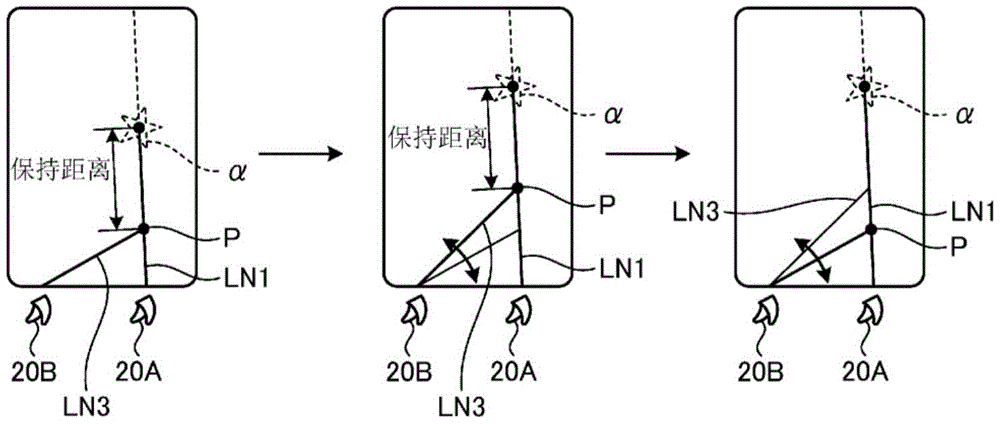
因此,信息处理装置30包括获取单元、设置单元、判定单元和控制单元。获取单元获取操作角度,该操作角度是由用户指向的预定空间中的第一方向和由用户指向的预定空间中的第二方向形成的角度。设置单元将在检测到用于在沿第一方向延伸的线上开始移动虚拟对象的指示时的时间点所获取的操作角度设置为参考角度。判定单元判定响应于第二方向的改变而由获取单元获取的操作角度是否等于或大于参考角度。控制单元基于判定单元的判定结果控制显示装置10,以在保持第一方向和第二方向相交的交点与虚拟对象之间的距离的同时,在第一方向上的线上沿深度方向移动虚拟对象,并显示虚拟对象。Therefore, the
信息处理装置30判定响应于第二方向上的改变而获取的操作角度是否等于或大于参考角度,并且基于判定结果控制显示装置10,以在保持第一方向和第二方向相交的交点与虚拟对象之间的距离的同时,在第一方向上的线上沿深度方向移动虚拟对象,并显示虚拟对象。因此,在保持交点与虚拟对象之间的距离的同时,将虚拟对象沿深度方向可移动地显示在第一方向上的线上,并且因此精细地调整远处的虚拟对象变得容易。The
<<2.实施方式的信息处理系统的配置>><<2. Configuration of Information Processing System of Embodiment>>
图3是示出信息处理系统1的示例的图。图3所示的信息处理系统1包括:显示装置10、第一控制器20A(20)、第二控制器20B(20)和信息处理装置30。在图3中,第一控制器20A和第二控制器20B这两个控制器20被示出为方向指示部件的示例,但是信息处理系统1可以包括多于三个方向指示部件。FIG. 3 is a diagram showing an example of the
信息处理系统1例如是其中执行与增强现实(AR)、虚拟现实(VR)或混合现实(MR)相关的信息处理的系统。例如,信息处理系统1是用于显示或编辑AR或VR内容的系统。The
信息处理装置30、显示装置10和控制器20经由预定网络(未示出)以有线或无线方式可通信地连接。注意,图3所示的信息处理系统1可以包括多个显示装置10和多个信息处理装置30。The
信息处理装置30控制显示装置10在基于由用户指向的多个方向而判定的位置的指示位置处显示虚拟对象α的标记。信息处理装置30使用从控制器20获取的控制器信息来控制显示装置10上的显示。信息处理装置30通过使用从显示装置10获取的关于显示装置10的位置和姿势的信息来控制显示装置10的显示。The
<2-1.显示装置的配置><2-1. Configuration of display device>
显示装置10包括位置-姿势检测单元11、光接收单元12、加速度传感器13、陀螺仪传感器14和显示单元15。位置-姿势检测单元11基于从包括在显示装置10中的传感器(例如光接收单元12、加速度传感器13和陀螺仪传感器14)获取的各种传感器信息来检测显示装置10的位置和姿势。位置-姿势检测单元11基于传感器信息检测关于显示装置10的位置、取向、倾斜和姿势的各种类型的信息。位置-姿势检测单元11将关于显示装置10的位置和姿势的信息发送至信息处理装置30。例如,位置-姿势检测单元11可以由诸如中央处理单元(CPU)、图形处理单元(GPU)和现场可编程门阵列(FPGA)的各种处理器来实现。The
显示单元15是根据信息处理装置30的控制来显示各种类型的信息的显示器。例如,显示装置10从信息处理装置30获取各种类型的信息,并且将所获取的信息显示在显示单元15上。显示单元15根据信息处理装置30的控制在基于由用户X指示的多个方向而判定的指示位置处显示虚拟对象α的标记。显示单元15显示由信息处理装置30生成的内容。The display unit 15 is a display that displays various types of information according to the control of the
注意,在用户X的视线用于指定方向的情况下,显示装置10可以包括检测用户X的视线位置的视线检测单元。视线检测单元通过适当地使用与视线检测相关的各种技术来检测用户X的视线。作为视线检测的技术,例如,可以使用基于眼睛的移动点(例如,与眼睛中诸如虹膜或瞳孔的移动部分对应的点)相对于眼睛的参考点(例如,与眼睛中诸如眼睛的内角或角膜反射的非移动部分对应的点)的位置来检测视线的方法。注意,视线的检测不限于以上,并且可以使用任何视线检测技术来检测用户X的视线。Note that, in the case where user X's line of sight is used to specify a direction,
<2-2.控制器的配置><2-2. Controller configuration>
第一控制器20A包括第一位置-姿势检测单元21A、第一光接收单元22A、第一加速度传感器23A和第一陀螺仪传感器24A。第一位置姿势-检测单元21A基于第一光接收单元22A、第一加速度传感器23A、第一陀螺仪传感器24A等的传感器信息来检测第一控制器20A的位置和姿势。第一位置-姿势检测单元21A基于第一光接收单元22A、第一加速度传感器23A、第一陀螺仪传感器24A等的传感器信息来检测与第一控制器20A的位置、取向、倾斜和姿势相关的控制器信息。第一位置-姿势检测单元21A将控制信息发送至信息处理装置30。例如,第一位置-姿势检测单元21A可以由例如诸如CPU、GPU、FPGA等的各种处理器来实现。注意,在第一控制器20A发射实际束的情况下,第一控制器20A具有发射激光束的配置(光输出单元等)。The
第二控制器20B包括第二位置-姿势检测单元21B、第二光接收单元22B、第二加速度传感器23B和第二陀螺仪传感器24B。第二位置-姿势检测单元21B基于第二光接收单元22B、第二加速度传感器23B、第二陀螺仪传感器24B等的传感器信息来检测第二控制器20B的位置和姿势。第二位置姿势检测单元21B基于第二光接收单元22B、第二加速度传感器23B、第二陀螺仪传感器24B等的传感器信息来检测与第二控制器20B的位置、取向、倾斜和姿势相关的控制器信息。第二位置-姿势检测单元21B将控制信息发送至信息处理装置30。例如,第二位置-姿势检测单元21B也可以由例如诸如CPU、GPU、FPGA等的各种处理器来实现。在第二控制器20B发射实际束的情况下,第二控制器20B具有发射激光束的配置(光输出单元等)。The
<2-3.信息处理装置的配置><2-3. Configuration of Information Processing Device>
信息处理装置30通过CPU 31执行各种处理。图4是示出信息处理装置30的功能配置的示例的图。图4所示的信息处理装置30包括通信单元40、存储单元50和控制单元60。注意,信息处理装置30可以包括:例如,从信息处理装置30的管理员等接收各种操作的诸如键盘和鼠标的输入单元,以及用于显示各种类型的信息的显示单元。The
通信单元40由例如NIC、通信电路等实现。然后,通信单元40以有线或无线方式连接至预定网络(未示出),并且向诸如控制器20和显示装置10的其他信息处理装置发送信息和从诸如控制器20和显示装置10的其他信息处理装置接收信息。The
存储单元50由例如诸如随机存取存储器(RAM)或闪存的半导体存储元件或者诸如硬盘或光盘的存储装置来实现。存储单元50包括方向信息存储单元51、对象信息存储单元52和交点信息存储单元53。The
方向信息存储单元51存储关于方向的指示的各种类型的信息。图5是示出方向信息存储单元51的示例的图。图5所示的方向信息存储单元51针对每个方向ID 51A管理彼此相关联的指示部件51B、类型51C、把持标志51D等。注意,方向信息存储单元51不限于以上,并且可以根据目的管理各种类型的信息,并且可以适当地改变。The direction
方向ID 51A例如是标识由用户X指向的每个方向的信息。指示部件51B例如是标识由用户X使用以指向方向的部件的信息,指示部件例如是诸如控制器20的装置或者与用户X的身体相关的元件。例如,在由用户X的视线指示方向的情况下,可以将“视线”存储在指示部件51B中。此外,例如,在由用户X的手指指示方向的情况下,可以将“手指”存储在指示部件51B中。The
类型51C是指示部件51B的类型的信息。例如,类型51C是指示由用户使用以指向方向的部件的类型的信息,部件例如是诸如控制器20的装置或者与用户X的身体相关的元件。例如,在用控制器20指示方向的情况下,将“控制器”、“装置”等存储在类型51C中。例如,在利用用户的视线指示方向的情况下,将“视线”、“身体”等存储在类型51C中。此外,例如,在利用用户X的手指指示方向的情况下,将“手指”、“身体”等存储在类型51C中。The
在图5的示例中,由方向ID“DG1”标识的方向(方向DG1)指示指示部件是由“20A”标识的第一控制器20A。方向DG1指示第一控制器20A的类型是控制器。In the example of FIG. 5 , the direction (direction DG1 ) identified by the direction ID "DG1" indicates that the indicating part is the
此外,由方向ID“DG2”标识的方向(方向DG2)指示指示部件是由“20B”标识的第二控制器20B。方向DG2指示第二控制器20B的类型是控制器。Further, the direction (direction DG2 ) identified by the direction ID "DG2" indicates that the indicating part is the
对象信息存储单元52存储关于虚拟对象α的各种类型的信息。图6是示出对象信息存储单元52的示例的图。图6所示的对象信息存储单元52管理与每个对象ID 52A相关联的对象信息52B、标志52C等。标志52C包括重力标志52D、把持标志52E等。注意,对象信息存储单元52不限于以上,并且可以根据目的管理各种类型的信息。The object
对象ID 52A是标识虚拟对象α的信息。此外,对象信息52B是与由对象ID 52A标识的虚拟对象α对应的信息。注意,在图6所示的示例中,用诸如“OINF1”的抽象代码示出了对象信息52B,但是可以存储与虚拟对象α的大小、形状等相关的各种类型的信息。标志52C是与由对象ID52A标识的虚拟对象α对应的标志信息。重力标志52D是标识是否将重力标志分配给由对象ID52A标识的虚拟对象α的信息。把持标志52E是标识是否将把持标志分配给由对象ID 52A标识的虚拟对象α的信息。The
在图6的示例中,由对象ID“VO1”标识的虚拟对象VO1指示对象信息是“OINF1”。虚拟对象VO1指示重力标志为“1”。即,虚拟对象VO1在判定布置位置时受重力的影响。在这种情况下,例如,指示当布置在空中时,虚拟对象VO1布置在从布置位置沿重力方向落下的位置。In the example of FIG. 6 , the virtual object VO1 identified by the object ID "VO1" indicates that the object information is "OINF1". The virtual object VO1 indicates that the gravity flag is "1". That is, the virtual object VO1 is affected by gravity when determining the placement position. In this case, for example, it is indicated that when arranged in the air, the virtual object VO1 is arranged at a position where it falls in the direction of gravity from the arranged position.
此外,由对象ID“VO41”标识的虚拟对象VO41指示对象信息是“OINF41”。虚拟对象VO41指示重力标志为“0”。即,指示虚拟对象VO41在判定布置位置时不受重力的影响。在这种情况下,例如,指示当设置在空中时,虚拟对象VO41保持在布置位置。Furthermore, the virtual object VO41 identified by the object ID "VO41" indicates that the object information is "OINF41". The virtual object VO41 indicates that the gravity flag is "0". That is, the instruction virtual object VO41 is not affected by gravity when determining the placement position. In this case, for example, it is indicated that the virtual object VO41 remains at the arrangement position when placed in the air.
交点信息存储单元53存储关于交点的各种类型的信息。图7是示出交点信息存储单元53的示例的图。图7所示的交点信息存储单元53管理与每个交点ID 53A相关联的主从信息53B。交点ID 53A是标识交点的信息。主从信息53B管理彼此相关联的主从关系53C、主指示部件53D和从指示部件53E。注意,交点信息存储单元53不限于以上,并且可以根据目的存储各种类型的信息。主从关系53C是指示对每个方向进行指示的指示部件之间的主从关系的存在或不存在的信息。The intersection
主指示部件53D是指示由指示部件指示的方向(几何目标)为主的信息。在图1的示例中第一控制器20A是主指示部件的情况下,则将“20A”存储在主指示部件53D中。从指示部件53E是指示由指示部件指示的方向(几何目标)为从的信息。在图1的示例中第二控制器20B是次级指示部件的情况下,从指示部件53E存储“20B”。The
控制单元60由例如中央处理单元(CPU)、微处理单元(MPU)等以RAM等为工作区域执行存储在信息处理装置30内部的程序(例如,诸如根据本公开内容的程序的信息处理程序)来实现。此外,控制单元60例如由诸如专用集成电路(ASIC)或FPGA的集成电路来实现。The
<2-4.控制单元的功能配置><2-4. Functional configuration of the control unit>
控制单元60包括获取单元61、检测单元62、设置单元63、距离判定单元64、判定单元65和显示控制单元66,并且实现或执行以下描述的信息处理的功能和动作。注意,控制单元60的内部配置不限于图4所示的配置,并且可以是另外的配置,只要其执行稍后将描述的信息处理。此外,包括在控制单元60中的处理单元的连接关系不限于图4所示的连接关系,并且可以是另外的连接关系。The
获取单元61获取操作角度,该操作角度是由在深度方向上延伸的第一方向上的主线LN1与相对于第一方向的水平面的第二方向上的操作线LN3形成的角度。检测单元62检测指示虚拟对象α的移动开始的移动指示。设置单元63将检测到移动指示时的时间点的主线LN1与操作线LN3之间的交点设置为P0、将由主线LN1与操作线LN3形成的角度即参考角度设置为θ0、并且将主控制器20与交点P0之间的距离设置为D0(参见图12)。The
获取单元61响应于副控制器20在第二方向上的改变获取主线LN1与操作线LN3的交点处的操作角度θ。此时,将改变之后的主线LN1与操作线LN3之间的交点假设为P、将操作角度即由主线LN1与操作线LN3形成的角度假设为θ、并且将主控制器20与交点P之间的距离假设为D0。The
在获取单元61响应于第二方向上的改变获取操作角度θ的情况下,距离判定单元64判定主线LN1上的虚拟对象α与交点之间的距离D1是否小于阈值Dth(参见图12)。When the
在虚拟对象α与交点P之间的距离D1小于阈值Dth的情况下,显示控制单元66使显示单元15显示主线LN1上的虚拟对象α被吸附至交点P。此时,虚拟对象α与交点P之间的距离D1为“0”。When the distance D1 between the virtual object α and the intersection P is smaller than the threshold Dth, the
在虚拟对象α与交点P之间的距离D1小于阈值Dth的情况下,判定单元65判定响应于操作线LN3的改变而获取的操作角度θ是否等于或大于参考角度θ0。In a case where the distance D1 between the virtual object α and the intersection point P is smaller than the threshold Dth, the
在操作角度θ等于或大于参考角度θ0的情况下,显示控制单元66沿深度方向向近侧移动虚拟对象α,并且使显示单元15显示虚拟对象α。显示控制单元66通过距离d=(D0+D1)-|P–P0|获得主控制器20与虚拟对象α之间的距离d,但是由于D1=0,因此距离d根据与操作线LN3的改变对应的|P–P0|的移动量而变化,使得虚拟对象α位于近侧(参见图12)。In a case where the operation angle θ is equal to or greater than the reference angle θ0, the
在操作角度θ不等于或不大于参考角度θ0的情况下,即,在操作角度θ小于参考角度θ0的情况下,显示控制单元66沿深度方向向远侧移动虚拟对象α,并且使显示单元15显示虚拟对象α。显示控制单元66通过距离d=(D0+D1)+|P–P0|获得主控制器20与虚拟对象α之间的距离d,但是由于D1=0,因此距离d根据与操作线LN3的改变对应的|P–P0|的移动量而变化,使得虚拟对象α位于远侧。In the case where the operation angle θ is not equal to or greater than the reference angle θ0, that is, in the case where the operation angle θ is smaller than the reference angle θ0, the
在虚拟对象α与交点P之间的距离D1不小于阈值Dth的情况下,即在距离D1等于或大于阈值Dth的情况下,显示控制单元66使显示单元15在保持虚拟对象α与交点P之间的距离D1的状态下显示虚拟对象α和交点P。此时,虚拟对象α与交点P之间的距离D1为“D1>0”。In the case where the distance D1 between the virtual object α and the intersection point P is not smaller than the threshold value Dth, that is, in the case where the distance D1 is equal to or greater than the threshold value Dth, the
判定单元65在保持距离D1的同时判定响应于操作线LN3的改变而获取的操作角度θ是否等于或大于参考角度θ0。The
在操作角度θ等于或大于参考角度θ0的情况下,显示控制单元66在保持距离D1的同时在主线LN1上沿深度方向向近侧移动虚拟对象α和交点P,并且使显示单元15显示虚拟对象α和交点P。显示控制单元66通过距离d=(D0+D1)-|P–P0|获得第一控制器20A与虚拟对象α之间的距离d,但是由于D1>0,因此距离d根据与操作线LN3的改变对应的|P–P0|的移动量而变化,使得虚拟对象位于近侧。此外,显示控制单元66将虚拟对象α布置在通过主线的原点PC0+e(单位向量)×d获得的坐标的主线LN1上的近侧,并且使显示单元15显示虚拟对象α。In the case where the operation angle θ is equal to or greater than the reference angle θ0, the
在操作角度θ不等于或不大于参考角度θ0的情况下,即,在操作角度θ小于参考角θ0的情况下,显示控制单元66在保持距离D1的同时在主线LN1上沿深度方向向远侧移动虚拟对象α和交点P,并且使显示单元15显示虚拟对象α和交点P。显示控制单元66通过距离d=(D0+D1)+|P–P0|获得第一控制器20A与虚拟对象α之间的距离d,但是由于D1>0,因此距离d根据与操作线LN3的改变对应的|P–P0|移动量而变化,使得虚拟对象α位于远侧。此外,显示控制单元66将虚拟对象α布置在通过主线的原点PC0+e(单位向量)×d获得的坐标的主线LN1上的远侧,并且使显示单元15显示虚拟对象α。In the case where the operation angle θ is not equal to or greater than the reference angle θ0, that is, in the case where the operation angle θ is smaller than the reference angle θ0, the
在图1的示例中,显示控制单元66控制显示装置10在由用户X基于由控制器20指示的两个方向而判定的指示位置处显示虚拟对象α的标记MK1。显示控制单元66基于由获取单元61获取的控制器信息来控制显示装置10显示线LN1和线LN2。In the example of FIG. 1 , the
显示控制单元66基于由获取单元61获取的控制器信息来控制显示装置10显示线LN1和线LN2。显示控制单元66控制显示装置10显示交点P。显示控制单元66控制显示装置10将图1所示的交点P处的标记MK1显示为交点P。The
<<3.信息处理系统的操作>><<3. Operation of information processing system>>
接下来,将描述信息处理装置30的操作。作为前提条件,使用两个控制器20,并且使用由各个控制器20指向的线来生成交点P。指向线具有主从关系。指向线的主从关系可以由优先级次序、次序和先到先得操作中的任何一个来判定。将显示主/副线的控制器20的触发器称为主/副触发器。在空间中(在空旷的空间中)存在虚拟对象α。虚拟对象α以星形显示。Next, the operation of the
信息处理装置30包括交点生成处理、虚拟对象α的把持处理、虚拟对象α的移动处理以及虚拟对象α的释放处理。The
<3-1.交点生成处理><3-1. Intersection point generation processing>
交点生成处理是创建主线LN1和操作线LN3相交的交点P的处理。生成处理包括原点设置处理、参考面设置处理、操作面设置处理和交点设置处理。The intersection generation process is a process of creating an intersection P where the main line LN1 and the operation line LN3 intersect. The generation processing includes origin setting processing, reference surface setting processing, operation surface setting processing, and intersection point setting processing.
图8是示出原点设置处理的示例的图。图8示出了用户X将第一控制器20A作为主指示部件携带在作为主手的右手中并且将第二控制器20B作为从指示部件携带在左手中的情况。注意,用户X在左手中携带的第二控制器20B可以是主指示部件,并且用户X在右手中携带的第一控制器20A可以是从指示部件。FIG. 8 is a diagram showing an example of origin setting processing. FIG. 8 shows a case where the user X carries the
例如,如图8所示,原点设置处理是使用第一控制器20A设置指向预定空间的第一方向上的主线LN1的原点20A1和使用第二控制器20B设置指向预定空间的第二方向上的副线LN2的原点20B1的处理。将指向第一方向的第一控制器20A的位置假设为主线LN1的原点20A1,并且将指向第二方向的第二控制器20B的位置假设为副线LN2的原点20B1。For example, as shown in FIG. 8, the origin setting process is to use the
主线LN1从第一控制器20A沿通过第一控制器20A的原点20A1的轴延伸。此外,副线LN2从第二控制器20B沿通过第二控制器20B的原点20B1的轴延伸。例如,信息处理装置30基于第一控制器20A的位置和取向计算主线LN1,并且基于第二控制器20B的位置和取向计算副线LN2。信息处理装置30基于第一控制器20A的轴和原点20A1计算主线LN1,并且基于第二控制器20B的轴和原点20B1计算副线LN2。The main line LN1 extends from the
图9是示出参考面设置处理的示例的视图。如图9所示,参考面设置处理是设置参考面的处理。将由主线LN1和副线LN2的原点20B1形成的面假设为参考面FC1。参考面FC1是包括主线LN1和副线LN2的原点20B1的面。换言之,主线LN1通过参考面FC1,并且原点20B1位于参考面FC1内。以这种方式,参考面FC1由主线LN1和副线LN2的原点20B1判定。例如,信息处理装置30基于主线LN1的位置和原点20B1的位置来计算参考面FC1。信息处理装置30计算包括主线LN1和副线LN2的原点20B1的面作为参考面FC1。FIG. 9 is a view showing an example of reference plane setting processing. As shown in FIG. 9 , the reference plane setting process is a process of setting a reference plane. A plane formed by the origin 20B1 of the main line LN1 and the sub-line LN2 is assumed to be a reference plane FC1. The reference plane FC1 is a plane including the origin 20B1 of the main line LN1 and the sub-line LN2. In other words, the main line LN1 passes through the reference plane FC1, and the origin 20B1 is located within the reference plane FC1. In this way, the reference plane FC1 is determined by the origin 20B1 of the main line LN1 and the secondary line LN2. For example,
注意,设置参考面FC1的理由是,例如,在当以与地板垂直的方向(例如正上方或正下方)操作两个控制器20时将地面或地板固定至参考面FC1的情况下,交点P是从与地板水平的方向的角度创建的,并且因此无法在用户X假设的位置处形成交点P。因此,将由主线LN1和副线LN2的原点20B1形成的面设置为参考面FC1。Note that the reason for setting the reference plane FC1 is, for example, when the ground or the floor is fixed to the reference plane FC1 when the two
图10是示出操作面设置处理的示例的视图。如图10所示,操作面设置处理是设置操作面FC2的处理。将以副线LN2的原点为中心与参考面FC1垂直的面假设为操作面。操作面FC2是通过原点20B1并且与参考面FC1正交的面。此外,副线LN2在操作面FC2上移动。副线LN2骑在操作面FC2上。换言之,副线LN2通过操作面FC2。即,操作面FC2是包括副线LN2的原点20B1并且与参考面FC1正交的面。操作面FC2由参考面FC1和副线LN2的原点20B1判定。例如,信息处理装置30基于参考面FC1的位置、副线LN2的位置和原点20B1的位置来计算操作面FC2。信息处理装置30计算与参考面FC1正交并且包括副线LN2和原点20B1的面作为操作面FC2。将以副线LN2的原点20B1为中心与参考面FC1垂直的面——副线LN2在其上移动的面以及包括副线LN2并且与参考面FC1垂直的面——假设为操作面FC2的图。FIG. 10 is a view showing an example of operation plane setting processing. As shown in FIG. 10 , the operation surface setting process is a process of setting the operation surface FC2 . A plane perpendicular to the reference plane FC1 centered on the origin of the sub-line LN2 is assumed to be an operation plane. Operation plane FC2 is a plane passing through origin 20B1 and perpendicular to reference plane FC1 . In addition, sub-line LN2 moves on operation surface FC2. The secondary line LN2 rides on the operation surface FC2. In other words, the sub line LN2 passes through the operation surface FC2. That is, the operation plane FC2 is a plane that includes the origin 20B1 of the sub-line LN2 and is perpendicular to the reference plane FC1 . Operation plane FC2 is determined by reference plane FC1 and origin 20B1 of sub-line LN2. For example,
图11是示出交点设置处理的示例的图。如图11所示,交点设置处理是将主线LN1与操作面FC2相交的点设置为交点P的处理。将主线LN1和操作面FC2相交的点假设为交点P。信息处理装置30基于主线LN1的位置和操作面FC2的位置计算交点P。例如,信息处理装置30计算主线LN1和操作面FC2相交的点作为交点P。注意,将连接副线LN2的原点20B1与交点P的线假设为操作线LN3,并且将操作线LN3与主线LN1形成的角度假设为操作角度θ。FIG. 11 is a diagram illustrating an example of intersection setting processing. As shown in FIG. 11 , the intersection point setting process is a process of setting, as an intersection point P, a point where the main line LN1 and the operation surface FC2 intersect. A point where the main line LN1 and the operation surface FC2 intersect is assumed to be an intersection point P.
图12是示出主线LN1与操作线LN3之间的关系的示例的图。图12所示的主线LN1是由主控制器20指向的第一方向上的线。操作线LN3是由副控制器20指向的第二方向上的线。将主线LN1上的主控制器20与虚拟对象α之间的距离假设为d,将主线LN1上的主控制器20与交点P之间的距离假设为D0,并且将主线LN1上的交点P0与虚拟对象α之间的距离假设为D1。将由主线LN1和操作线LN3形成的角度假定为θ0。将参考时刻的主线LN1与操作线LN3之间的交点假设为P0,并且将由主线LN1和操作线LN3形成的角度θ0假设为参考角度。此外,将在操作线LN3根据副控制器20的操作而改变的情况下的主线LN1与操作线LN3之间的交点假设为P,并且将由主线LN1和操作线LN3形成的角度θ假设为操作角度。FIG. 12 is a diagram showing an example of the relationship between the main line LN1 and the operation line LN3. The main line LN1 shown in FIG. 12 is a line in the first direction directed by the
<3-2.虚拟对象的把持处理><3-2. Handling of virtual objects>
虚拟对象的把持处理是在主线LN1上把持虚拟对象α的处理。图13是示出虚拟对象α的把持处理(在没有交点的情况下)的示例的图。在图13所示的把持处理中,例如,在不存在交点的情况下,在主线LN1抵接虚拟对象α而按下主触发器时,虚拟对象α布置在主线LN1上的前方。注意,主触发器例如是主线LN1的第一控制器20A的操作单元。同样,在未按下主触发器的情况下,线保持原样。此外,即使在当主触发器指向没有虚拟对象α的地方时按下主触发器的情况下,线也保持原样。此外,在仅按下副触发器的情况下,也不会发生任何情况。副触发器例如是操作线LN3的第二控制器20B的操作单元。The holding process of the virtual object is a process of holding the virtual object α on the main line LN1. FIG. 13 is a diagram showing an example of the holding process (in the case of no intersection point) of the virtual object α. In the holding process shown in FIG. 13 , for example, when the main line LN1 touches the virtual object α and the main trigger is pressed when there is no intersection point, the virtual object α is arranged in front of the main line LN1 . Note that the main flip-flop is, for example, the operation unit of the
另一方面,图14是示出虚拟对象α的把持处理(在有交点的情况下)的示例的图。在图14所示的把持处理中,例如,在由主线LN1和操作线LN3形成的交点P位于主线LN1上的情况下,当按下主触发器时,在主线LN1上的交点P与虚拟对象α在一定距离内的情况下,虚拟对象α被吸附至交点P。另一方面,在主线LN1上的交点P与虚拟对象α彼此相隔一定距离以上的情况下,虚拟对象α不被吸附。此外,在未按下主触发器的情况下,线保持原样。此外,即使在仅按下副触发器的情况下,也不会发生任何情况。在同时按下主触发器和副触发器的情况下,虚拟对象α被吸附至主线LN1上的交点P。此外,即使在按下主触发器而未按下副触发器的情况下,该行为与同时按下主触发器和副触发器的行为相同。On the other hand, FIG. 14 is a diagram showing an example of holding processing (in the case of an intersection) of the virtual object α. In the holding process shown in FIG. 14, for example, when the intersection point P formed by the main line LN1 and the operation line LN3 is located on the main line LN1, when the main trigger is pressed, the intersection point P on the main line LN1 and the virtual object When α is within a certain distance, the virtual object α is attracted to the intersection point P. On the other hand, when the intersection point P on the main line LN1 and the virtual object α are separated by a certain distance or more, the virtual object α is not attracted. Also, the wire stays where it is when the main trigger is not pressed. Also, nothing happens even when only the secondary trigger is pressed. When the main trigger and the sub-trigger are pressed simultaneously, the virtual object α is attracted to the intersection point P on the main line LN1. Also, even when the primary trigger is pressed but not the secondary, the behavior is the same as if the primary and secondary triggers were pressed at the same time.
<3-3.虚拟对象的移动处理><3-3. Movement processing of virtual object>
如图15所示,虚拟对象α的移动处理是根据第二控制器20B的操作在深度方向上移动布置在主线LN1上的虚拟对象α的处理。在按下主触发器的状态下,在虚拟对象α布置在主线LN1的远处状态下,操作线LN3根据第二控制器20B的操作在主线LN1上移动以改变交点P。当按下副触发器时,判定此时的交点P与虚拟对象α之间的距离D1是否小于阈值Dth。As shown in FIG. 15 , the movement process of the virtual object α is a process of moving the virtual object α arranged on the main line LN1 in the depth direction according to the operation of the
图15是示出虚拟对象α的移动处理的示例的图(距离D1小于阈值Dth)。如图15所示,在交点P与虚拟对象α之间的距离D1小于阈值Dth的情况下,即,在操作目标处于附近的情况下,主线LN1上的虚拟对象α被吸附至交点P,并且距离D1变为“0”。然后,操作线LN3根据第二控制器20B的操作在主线LN1上移动,并且交点P根据移动后的操作线LN3移动,使得虚拟对象α根据交点P的移动在主线LN1上移动。FIG. 15 is a diagram showing an example of movement processing of the virtual object α (the distance D1 is smaller than the threshold Dth). As shown in FIG. 15 , in the case where the distance D1 between the intersection point P and the virtual object α is smaller than the threshold Dth, that is, when the operation target is nearby, the virtual object α on the main line LN1 is attracted to the intersection point P, and The distance D1 becomes "0". Then, the operation line LN3 moves on the main line LN1 according to the operation of the
图16是示出虚拟对象α的移动处理的示例的图(距离D1等于或大于阈值Dth)。如图16所示,在交点P与虚拟对象α之间的距离D1等于或大于阈值Dth的情况下,即,在操作目标处于远处的情况下,虚拟对象α与交点P之间的距离D1为“D1>0”。然后,操作线LN3根据第二控制器20B的操作在主线LN1上移动,交点P根据移动之后的操作线LN3移动,并且在保持虚拟对象α与交点P之间的距离的同时使虚拟对象α和交点P在主线LN1上移动。注意,按下副触发器的时间点的交点P与虚拟对象α之间的距离D1被保持。由于可以在手边操作远处的操作目标,所以能够在确认要精细地调整的距离的同时执行调整。FIG. 16 is a diagram showing an example of movement processing of the virtual object α (the distance D1 is equal to or greater than the threshold Dth). As shown in FIG. 16 , in the case where the distance D1 between the intersection point P and the virtual object α is equal to or greater than the threshold Dth, that is, in the case where the operation target is far away, the distance D1 between the virtual object α and the intersection point P is "D1>0". Then, the operation line LN3 moves on the main line LN1 according to the operation of the
图17至图19是示出与移动处理相关的信息处理装置30的处理操作的示例的流程图。控制单元60指定多个控制器20中的一个控制器20(步骤S11),并且获取指定控制器20的取向和位置(步骤S12)。控制单元60判定指定控制器20是否把持预定空间中的虚拟对象α(步骤S13)。在把持预定空间中的虚拟对象α的情况下(步骤S13:是),控制单元60将指定控制器20的把持标志设置为“1”(步骤S14),并且判定是否存在未指定的控制器20(步骤S15)。控制单元60将“1”存储在与方向信息存储单元51中存储的用于标识指定控制器20的线LN的方向ID对应的把持标志中。17 to 19 are flowcharts showing examples of processing operations of the
在存在未指定的控制器20的情况下(步骤S15:是),控制单元60进行至步骤S11以指定控制器20。此外,在指定控制器20没有把持虚拟对象α的情况下(步骤S13:否),控制单元60进行至步骤S15以判定是否存在未指定的控制器20。In a case where there is an unspecified controller 20 (step S15 : Yes), the
在存在未指定的控制器20的情况下(步骤S15:是),控制单元60重新指定多个指定控制器20中的一个控制器20(步骤S16)。控制单元60判定重新指定的控制器20的把持标志是否为“1”(步骤S17)。控制单元60参照与在方向信息存储单元51中存储的用于标识重新指定的控制器20的线LN的方向ID对应的把持标志,并且判定把持标志是否为“1”。在重新指定的控制器20的把持标志为“1”的情况下(步骤S17:是),控制单元60判定重新指定的控制器20的触发器是否被按下(步骤S23)。在重新指定控制器20的触发器被按下的情况下(步骤S23:是),控制单元60判定在多个指定控制器20中是否存在尚未重新指定的控制器20(步骤S18)。在不存在尚未重新指定的控制器20的情况下(步骤S18:否),控制单元60进行至图18所示的M1。此外,在重新指定的控制器20的触发器未被按下的情况下(步骤S23:否),控制单元60从重新指定的控制器20释放虚拟对象α(步骤S24),将重新指定的控制器20的把持标志设置为“0”(步骤S25),并且进行至步骤S18。In a case where there is an unspecified controller 20 (step S15: Yes), the
在存在尚未重新指定的控制器20的情况下(步骤S18:是),控制单元60进行至步骤S16以重新指定控制器20。In a case where there is a
在重新指定的控制器20的把持标志不是“1”的情况下(步骤S17:否),控制单元60判定由重新指定的控制器20指向的方向上的线是否指向预定空间中的虚拟对象α(步骤S19)。在指向虚拟对象α的情况下(步骤S19:是),控制单元60判定指向预定空间中的虚拟对象α的重新指定的控制器20的触发器是否被按下(步骤S20)。注意,例如,控制单元60在第一控制器20A指向虚拟对象α的状态下判定第一控制器20A的触发器是否被按下。In the case where the holding flag of the redesignated
在重新指定的控制器20的触发器被按下的情况下(步骤S20:是),控制单元60使重新指定的控制器20保持虚拟对象α(步骤S21),将重新指定的控制器20的把持标志设置为“1”(步骤S22),并且进行至步骤S18,以判定是否存在尚未重新指定的控制器20。When the trigger of the redesignated
在不指向虚拟对象α的情况下(步骤S19:否)或者在重新指定的控制器20的触发器未被按下的情况下(步骤S20:否),控制单元60进行至步骤S18,以判定是否存在尚未重新指定的控制器20。In the case of not pointing at the virtual object α (step S19: No) or in the case of the trigger of the newly designated
在图18所示的M1中,控制单元60判定是否存在两个控制器20(步骤S31)。在控制器20的数目不是两个的情况下(步骤S31:否),控制单元60判定是否存在一个控制器20(步骤S32)。在存在一个控制器20的情况下(步骤S32:是),控制单元60进行至图17所示的M2.此外,在控制器20的数目不是一个的情况下(步骤S32:否),控制单元60结束图18所示的处理操作。In M1 shown in FIG. 18, the
在存在两个控制器20的情况下(步骤S31:是),控制单元60判定两个控制器20的把持标志是否为“0”(步骤S33)。在两个控制器20的把持标志都为“0”的情况下(步骤S33:是),控制单元60进行至图17所示的M2。When there are two controllers 20 (step S31: YES), the
在两个控制器20的把持标志不是“0”的情况下,控制单元60判定两个控制器20的把持标志是否为“1”(步骤S34)。在两个控制器20的把持标志不是“1”的情况下(步骤S34:否),即,控制单元60判定控制器20中的一个的把持标志为“1”,并且将具有把持标志“1”的控制器20设置为主控制器20(步骤S35)。注意,控制单元60将存储在交点信息存储单元53中的主从关系53C改变为“存在”,将“20A”存储在主指示部件53D中,并且将“20B”存储在从指示部件53E中。控制单元60将主控制器20的主线LN1上的交点P与虚拟对象α之间的距离D1设置为“-1”(步骤S36),并且进行至图17所示的M2。When the holding flags of the two
在两个控制器20的把持标志为“1”的情况下(步骤S34:是),控制单元60判定在主线LN1上是否存在控制器20的两条线(即主线LN1与操作线LN3相交)的交点(步骤S37)。在主线LN1上存在交点的情况下(步骤S37:是),控制单元60判定交点与虚拟对象α之间的距离D1是否为“0”或更多(步骤S38)。In the case where the holding flags of the two
在交点与虚拟对象α之间的距离D1为“0”或更多的情况下(步骤S38:是),控制单元60中的距离判定单元64判定距离D1是否等于或小于阈值Dth(步骤S39)。在距离D1等于或小于阈值Dth的情况下(步骤S39:是),控制单元60通过交点被吸附至虚拟对象α的位置而将距离D1设置为“0”(步骤S40)。In the case where the distance D1 between the intersection point and the virtual object α is "0" or more (step S38: Yes), the distance judging unit 64 in the
控制单元60中的设置单元63将主线LN1与操作线LN3的交点坐标设置为P0(步骤S41),将由主线LN1和操作线LN3形成的角度设置为θ0作为参考角度(步骤S42),将主控制器20与交点之间的距离设置为D0(步骤S43),并且进行至图17所示的M2。The setting
此外,在距离D1不等于或小于阈值Dth的情况下(步骤S39:否),控制单元60中的设置单元63将交点与虚拟对象α之间的距离设置为D1(步骤S44),并且进行至步骤S41,以将主线LN1与操作线LN3的交点坐标设置为P0。Furthermore, in the case where the distance D1 is not equal to or smaller than the threshold Dth (step S39: No), the setting
此外,在交点与虚拟对象α之间的距离D1不为“0”或更多的情况下(步骤S38:否),控制单元60进行至图19所示的M3。Also, in a case where the distance D1 between the intersection point and the virtual object α is not "0" or more (step S38: NO), the
在图19所示的M3处,控制单元60将主线LN1与操作线LN3的交点坐标设置为P(步骤S51),并且将由移动后的主线LN1与操作线LN3形成的角度设置为θ作为操作角度(步骤S52)。控制单元60中的判定单元65判定操作角度θ是否等于或小于参考角度θ0(步骤S53)。At M3 shown in FIG. 19 , the
在操作角度θ等于或小于参考角度θ0的情况下(步骤S53:是),控制单元60中的显示控制单元66通过(D0+D1)+|P–P0|计算主控制器20与虚拟对象α之间的距离d(步骤S54)。注意,在距离D1等于或小于阈值Dth的情况下,由于D1=0,因此从主控制器20到主线LN1上的虚拟对象α的距离根据操作线LN3的改变而变长|P–P0|的移动量。即,附近的虚拟对象α在主线LN1上向远侧移动。另一方面,在距离D1不等于或小于阈值Dth的情况下,由于D1是实际测量值,所以在保持交点与虚拟对象α之间的距离的同时到主线LN1上的虚拟对象α的距离根据操作线LN3的改变而变长|P–P0|的移动量。即,远处的虚拟对象α在主线LN1上向远侧移动。In the case where the operating angle θ is equal to or smaller than the reference angle θ0 (step S53: Yes), the
此外,在操作角度θ不等于或小于θ0的情况下(步骤S53:否),控制单元60中的显示控制单元66通过(D0+D1)-|P–P0|计算主控制器20与虚拟对象α之间的距离d(步骤S55)。注意,在距离D1等于或小于阈值Dth的情况下,由于D1=0,因此从主控制器20到主线LN1上的虚拟对象α的距离根据操作线LN3的改变而缩短|P–P0|的移动量。即,附近的虚拟对象α在主线LN1上向近侧移动。另一方面,在距离D1不等于或小于阈值Dth的情况下,由于D1是实际测量值,所以在保持交点与虚拟对象α之间的距离的同时到主线LN1上的虚拟对象α的距离根据操作线LN3的改变而变短|P–P0|的移动量。即,远处的虚拟对象α在主线LN1上向近侧移动。Furthermore, in the case where the operation angle θ is not equal to or smaller than θ0 (step S53: No), the
然后,控制单元60通过使用在步骤S54或步骤S55中计算的主控制器20与虚拟对象α之间的距离d,在PC0+单位向量e×d的位置显示虚拟对象α(步骤S56),并且进行至图17所示的M2。因此,在通过从主控制器20的原点坐标PC0加上单位向量e与距离d相乘后的距离而获得的位置处显示虚拟对象α。Then, the
<3-4.虚拟对象的释放处理><3-4. Release processing of virtual objects>
虚拟对象α的释放处理是在主线LN1上布置经调整的虚拟对象α的位置的处理。在按下主触发器的同时,响应于操作线LN3的改变操作,在主线LN1上调整虚拟对象α的位置。此外,在释放主触发器时,布置主线LN1上的当前位置处的虚拟对象α。此外,当在按下主触发器的同时释放副触发器时,虚拟对象α被固定至在释放副触发器的时间点时虚拟对象α的位置。此外,当在按下副触发器的同时释放主触发器时,虚拟对象α被固定至在释放主触发器的时间点时虚拟对象α的当前位置。The release process of the virtual object α is a process of arranging the adjusted position of the virtual object α on the main line LN1. While pressing the main trigger, the position of the virtual object α is adjusted on the main line LN1 in response to the changing operation of the operation line LN3. Also, when the main trigger is released, the virtual object α at the current position on the main line LN1 is arranged. Furthermore, when the sub-trigger is released while the main trigger is pressed, the virtual object α is fixed to the position of the virtual object α at the time point when the sub-trigger is released. Furthermore, when the main trigger is released while the sub trigger is pressed, the virtual object α is fixed to the current position of the virtual object α at the time point when the main trigger is released.
<<4.实施方式的效果>><<4. Effects of Embodiment>>
在距离D1等于或大于阈值Dth的情况下,控制单元60在保持距离D1的同时判定响应于操作线LN3的改变而获取的操作角度θ是否等于或大于参考角度θ0。在操作角度θ等于或大于参考角度θ0的情况下,控制单元60在保持距离D1的同时在主线LN1上沿深度方向向近侧移动虚拟对象α和交点P,并且使显示单元15显示虚拟对象α和交点P。此时,控制单元60将虚拟对象α显示在通过主线LN1的原点PC0+e(单位向量)×d而获得的坐标(近侧的坐标)的主线LN1上。因此,在保持虚拟对象α与交点之间的距离的同时,能够在容易进行操作的手部位置处将远处的虚拟对象α的位置精细地调整至近侧。In the case where the distance D1 is equal to or greater than the threshold Dth, the
在操作角度θ小于参考角度θ0的情况下,控制单元60在保持距离D1的同时在主线LN1上沿深度方向向深度侧移动虚拟对象α和交点P,并且使显示单元15显示虚拟对象α和交点P。此时,控制单元60将虚拟对象α显示在通过主线LN1的原点PC0+e(单位向量)×d而获得的坐标(远侧的坐标)的主线LN1上。因此,在确保虚拟对象α与交点之间的距离的同时,能够在容易进行操作的手部位置处将远处的虚拟对象α的位置精细地调整至远侧。In the case where the operation angle θ is smaller than the reference angle θ0, the
通过使用保持和释放虚拟对象α的比喻,当按下触发器时,可以使虚拟对象α移动移动距离。此外,根据虚拟对象α的移动方向,虚拟对象α可以移动得远或近。By using the analogy of holding and releasing the virtual object α, when the trigger is pressed, the virtual object α can be made to move a moving distance. In addition, the virtual object α can move far or near depending on the moving direction of the virtual object α.
另外,两个控制器20的每个触发器可以用于精细地调整远处的交点或虚拟对象α的位置,以使得能够以手部进行操作。此外,可以通过一系列移动来调整远处的虚拟对象α的位置,而无需重新保持或放下控制器20。In addition, each trigger of the two
<<5.修改示例>><<5. Modification example>>
此外,执行环境识别,并且预先限制或判定可以操作的目标。在限制操作目标的情况下,当线接近或触摸虚拟对象α时,可以改变为吸附或把持的表现或状态,使得用户可以容易地理解操作目标。在对远处的虚拟对象α进行操作的情况下,难以理解作为操作目标的虚拟对象α附近的状况、位置关系等,并且因此,也可以将操作目标单元附近的相机图像作为监视器画面(另一窗口)一起呈现在手边的操作单元附近。替选地,操作者可以虚拟地移动到操作目标附近并且操作虚拟对象α。In addition, environment recognition is performed, and objects that can be manipulated are limited or judged in advance. In the case of restricting the operation target, when the line approaches or touches the virtual object α, it can change to the appearance or state of suction or holding, so that the user can easily understand the operation target. In the case of operating a distant virtual object α, it is difficult to understand the situation, positional relationship, etc., near the virtual object α that is the operation target, and therefore, the camera image near the operation target unit may also be used as a monitor screen (also a window) are presented together near the operating unit at hand. Alternatively, the operator may virtually move near the operation target and operate the virtual object α.
<5-1.虚拟对象的其他释放处理><5-1. Other release processing of virtual objects>
在虚拟对象α与线分离的情况下,可以通过伴随加速度的急剧改变的操作例如摇动、摆动或投掷控制器20来执行,使得用户可以容易地想象虚拟对象α被分离。In the case where the virtual object α is separated from the line, it can be performed by an operation accompanied by a sharp change in acceleration such as shaking, swinging, or throwing the
<5-2.虚拟对象的其他把持处理><5-2. Other handling of virtual objects>
例如,可以根据例如触发器按压、特定手势(示例包括将手放在一起、伸出等)或上下文(当应用进入选择模式时)来执行交点生成处理和虚拟对象α的把持处理。此外,可以例如在超时的情况下执行交点的创建处理或虚拟对象的终止。For example, the intersection generation process and the grasping process of the virtual object α may be performed according to, for example, trigger presses, specific gestures (examples include bringing hands together, reaching out, etc.), or context (when the application enters selection mode). Furthermore, creation processing of an intersection point or termination of a virtual object may be performed, for example, with a timeout.
<5-3.虚拟对象的其他移动处理><5-3. Other movement processing of virtual objects>
交点位置和虚拟对象α的位置通过两条线来进行调整,但是一条线可以固定在某个时间点的方向上(例如,这可以通过用语音说出“现在”等来指定)。可以组合诸如视线和手指指向的不同模式,并且可以执行多个人的操作,例如由两个人操作两条线。The position of the intersection point and the position of the virtual object α are adjusted by two lines, but one line may be fixed in a direction at a certain point in time (for example, this may be designated by speaking "now" etc.). Different modes such as line of sight and finger pointing can be combined, and multi-person operations can be performed, such as two lines being operated by two people.
此外,当在手边执行精细调整时,例如,可以以每10cm为单位的特定距离输入指示声音、振动等的距离感的反馈。可以大声地读出从用户位置到虚拟对象α的距离。Also, when fine adjustment is performed at hand, for example, feedback indicating a sense of distance of sound, vibration, or the like may be input at a certain distance every 10 cm. The distance from the user's position to the virtual object α can be read aloud.
此外,在本实施方式中,通过将操作角度固定为参考角度而不改变角度,通过送出或返回交点位置的操作例如手的前后移动或左右移动来改变交点位置,并且可以联动地改变虚拟对象α的位置。图20是示出操作线LN3向前移动时的虚拟对象α的移动位置的示例的图。如图20所示,在操作线LN3向前移动的情况下,主线LN1上的虚拟对象α向前(远侧)移动。另一方面,在操作线LN3向后移动的情况下,主线LN1上的虚拟对象α向后(近侧)移动。In addition, in this embodiment, by fixing the operation angle as a reference angle without changing the angle, the intersection position is changed by an operation of sending or returning the intersection point position such as forward and backward movement or left and right movement of the hand, and the virtual object α can be changed in tandem s position. FIG. 20 is a diagram showing an example of the movement position of the virtual object α when the operation line LN3 moves forward. As shown in FIG. 20 , when the operation line LN3 moves forward, the virtual object α on the main line LN1 moves forward (far side). On the other hand, when the operation line LN3 moves backward, the virtual object α on the main line LN1 moves backward (near side).
图21是示出操作线LN3向左移动时的虚拟对象α的移动位置的示例的图。如图21所示,在操作线LN3向左移动的情况下,主线LN1上的虚拟对象α向前(远侧)移动。另一方面,在操作线LN3向右移动的情况下,主线LN1上的虚拟对象α向后(近侧)移动。FIG. 21 is a diagram showing an example of the moving position of the virtual object α when the operation line LN3 moves to the left. As shown in FIG. 21 , when the operation line LN3 moves to the left, the virtual object α on the main line LN1 moves forward (far side). On the other hand, when the operation line LN3 moves to the right, the virtual object α on the main line LN1 moves backward (near side).
已经例示了以下情况:其中在操作角度θ等于或大于参考角度θ0的情况下,本实施方式的控制单元60在保持距离D1的同时在主线LN1上沿深度方向向近侧移动虚拟对象α和交点P并且显示在显示单元15上。然而,在操作角度θ0等于或大于参考角度θ0的情况下,控制单元60在保持距离D1的同时在主线LN1上沿深度方向向远侧移动虚拟对象α和交点P,并且使显示单元15显示虚拟对象α和交点P。此外,在操作角度θ小于参考角度θ0的情况下,控制单元60可以在保持距离D1的同时在主线LN1上沿深度方向向近侧移动虚拟对象α和交点P,并且使显示单元15显示虚拟对象α和交点P,这可以适当地改变。A case has been exemplified in which the
<5-4.其他指示部件><5-4. Other indication parts>
虽然已经例示了第一控制器20A和第二控制器20B作为指示部件,但是可以使用另一装置、用户的身体(手或眼睛)等来代替诸如控制器20的装置。例如,控制器20和用户X的眼睛的视线可以是指示部件。Although the
指示部件不限于以上,并且可以是诸如手掌、手臂和脸部或头部的正面的各种元件。即,发射线的元件,包括能够指示方向的各种对象,例如控制器、手指、手、手掌、手臂、视线以及脸部或头部的正面。The indicating member is not limited to the above, and may be various elements such as palms, arms, and the front of the face or head. That is, elements that emit lines include various objects that can indicate directions, such as controllers, fingers, hands, palms, arms, line of sight, and the front of the face or head.
<5-5.虚拟对象的其他显示形式><5-5. Other display forms of virtual objects>
例如,为了有助于理解虚拟对象α的重量和特性,可以执行指示惯性或反作用力的线的移动或虚拟对象α的表示。为了使得容易理解虚拟对象α与另一虚拟对象α或真实世界中的对象交叠或碰撞,可以添加其中线或虚拟对象α弯曲或弹开的表示。在虚拟对象α不能在深度方向上移动得更深的情况下,可以将虚拟对象α碰撞并且被按压的表示并入线或虚拟对象α中。For example, in order to facilitate understanding of the weight and properties of the virtual object α, movement of lines indicating inertia or reaction force or representation of the virtual object α may be performed. In order to make it easy to understand that a virtual object α overlaps or collides with another virtual object α or an object in the real world, a representation that its line or virtual object α bends or bounces may be added. In a case where the virtual object α cannot move deeper in the depth direction, a representation that the virtual object α collides and is pressed may be incorporated into the line or the virtual object α.
在虚拟对象α的位置正在移动的情况下,信息处理装置30控制显示单元15改变并且显示虚拟对象α的显示模式。例如,在移动和布置虚拟对象α的情况下,信息处理装置30可以减弱正在移动的虚拟对象α的显示。例如,信息处理装置30通过增加正在移动的虚拟对象α的透明度来减弱移动的虚拟对象α的显示。如上所述,当移动和布置虚拟对象α时,通过减弱正在移动的虚拟对象α的显示,用户X可以在确认与真实世界中的对象或布置在对象周围的虚拟对象α的布置和位置关系的同时移动虚拟对象α。In a case where the position of the virtual object α is moving, the
此外,例如,在移动和布置虚拟对象α的情况下,信息处理装置30可以增强正在移动的虚拟对象α的显示。以这种方式,通过增强正在移动的虚拟对象α的显示,用户X可以在类似的虚拟对象α中使正在移动的虚拟对象α醒目(增强可见性)或容易地向后方布置。Furthermore, for example, in the case of moving and arranging a virtual object α, the
此外,如上所述,可以在虚拟对象α的移动期间使用各种显示模式。例如,信息处理装置30可以使虚拟对象α即使在移动时也按原样显示。信息处理装置30在确认与真实世界中的对象或布置在对象周围的虚拟对象α的布置和位置关系的同时在期望布置虚拟对象α的情况下原样显示虚拟对象α。Also, as described above, various display modes can be used during the movement of the virtual object α. For example, the
此外,例如,信息处理装置30可以减弱正在移动的虚拟对象α的显示。例如,信息处理装置30仅显示虚拟对象α的轮廓或使其半透明。信息处理装置30在确认与真实世界中的对象或布置在对象周围的虚拟对象α的布置和位置关系的同时在期望执行移动期间的轨迹和位置调整的情况下显示虚拟对象α的轮廓或使虚拟对象α半透明。例如,信息处理装置30可以关闭虚拟对象α的显示。在这种情况下,信息处理装置30可以仅显示交点。在期望强调移动期间的轨迹和位置调整并且使其更容易看见的情况下,信息处理装置30删除虚拟对象α的显示。Also, for example, the
此外,例如,信息处理装置30可以增强正在移动的虚拟对象α的显示。信息处理装置30可以增强色彩或增加亮度值。信息处理装置30可以与诸如图标的附加显示组合。在布置类似对象的情况下,信息处理装置30突出显示所选择的虚拟对象α以便于识别。此外,在期望将虚拟对象α布置在虚拟对象α所布置的位置的后方的情况下,信息处理装置30抑制其他虚拟对象的色调并且增加透明度,使得虚拟对象α的后方的布置变得容易。Also, for example, the
<5-6.其他主从关系><5-6. Other master-slave relationships>
此外,即使在两条线之间不存在功能差异的情况下,两条线也可以具有主从关系。信息处理装置30可以通过适当地使用各种类型的信息来判定指示部件之间的主从关系。此外,信息处理装置30可以改变每条线的颜色密度、形状等,以指示主从关系。Furthermore, two lines can have a master-slave relationship even when there is no functional difference between the two lines. The
信息处理装置30可以判定被估计优先用作主要指示部件(主指示部件)的指示部件。例如,信息处理装置30将与用户的右手对应的指示部件设置为主指示部件。此外,例如,信息处理装置30可以将具有对象(装置)的一方设置为主指示部件。例如,在仅用一只手携带对象(装置)的情况下,信息处理装置30可以将该装置设置为主指示部件。The
信息处理装置30可以根据预定顺序判定主指示部件。信息处理装置30可以根据进入束状态的顺序来判定主指示部件。例如,信息处理装置30可以将已经首先进入束状态的指示部件判定为主指示部件。The
信息处理装置30可以根据移动的方式判定主指示部件。例如,信息处理装置30可以将已经大幅移动或较早移动的指示部件判定为主指示部件。The
<5-7.线的其他显示形式><5-7. Other display forms of lines>
此外,线的表示也可以是各种目标。例如,当习惯于操作时,线的显示变得不必要,并且因此可以仅显示交点。此外,例如,信息处理装置30可以表示线使得当两条线分开时容易创建交点。例如,信息处理装置30可以增加线的粗细。In addition, the representation of the line can also be various objects. For example, when the operation is used to, the display of lines becomes unnecessary, and therefore only intersections may be displayed. Also, for example, the
注意,本发明不限于以上,并且可以使用各种显示模式。虽然在上述示例中已经描述了在存在一个用户的情况下的操作,但是多个用户(多个人)可以穿戴诸如AR装置、VR装置或MR装置的显示装置10,并且在观看相同视频的同时由多个人操作。在这种情况下,当一个人正在操作虚拟对象α时,另一个人可以调整位置。Note that the present invention is not limited to the above, and various display modes may be used. Although the operation in the case where there is one user has been described in the above example, multiple users (multiple persons) may wear the
<5-8.其他几何目标><5-8. Other geometric objects>
注意,如上所述,几何目标不限于面(操作面)并且可以是线。在本实施方式中,例示了通过使操作线LN3和主线LN1交叉来创建交点的情况,但是也可以通过不是使操作线而是使副线LN2和主线LN1交叉来创建交点,这可以适当地改变。Note that, as described above, the geometric object is not limited to a surface (operating surface) and may be a line. In this embodiment, the case where the intersection point is created by crossing the operation line LN3 and the main line LN1 is exemplified, but the intersection point may be created by crossing the sub-line LN2 and the main line LN1 instead of the operation line, which can be changed appropriately. .
本实施方式的信息处理装置30可以由专用计算机系统或通用计算机系统来实现。The
<<6.硬件配置>><<6. Hardware configuration>>
例如,通过具有如图22所示的配置的计算机100来实现根据上述实施方式和修改示例中的每一个的诸如信息处理装置100的信息装置。图22是示出实现诸如信息处理装置30的信息处理装置的功能的计算机100的示例的硬件配置图。在下文中,将作为示例描述根据实施方式的信息处理装置30。计算机100包括CPU 110、RAM 120、只读存储器(ROM)130、硬盘驱动器(HDD)140、通信接口150和输入输出接口160。计算机100的每个单元通过总线170连接。For example, an information device such as the
CPU 110基于存储在ROM 130或HDD 140中的程序进行操作,并且控制每个单元。例如,CPU 110在RAM 120中开发存储在ROM 130或HDD 140中的程序,并且执行与各种程序相对应的处理。The CPU 110 operates based on programs stored in the ROM 130 or the HDD 140, and controls each unit. For example, the CPU 110 develops programs stored in the ROM 130 or the HDD 140 in the RAM 120 and executes processes corresponding to the various programs.
ROM 130存储诸如在计算机100启动时由CPU 110执行的基本输入输出系统(BIOS)的引导程序、取决于计算机100的硬件的程序等。The ROM 130 stores a boot program such as a basic input output system (BIOS) executed by the CPU 110 when the
HDD 140是非暂态地记录由CPU 110执行的程序、由程序使用的数据等的计算机可读记录介质。具体地,HDD 140是记录根据本公开内容的信息处理程序(作为程序数据145的示例)的记录介质。The HDD 140 is a computer-readable recording medium that records programs executed by the CPU 110 , data used by the programs, and the like in a non-transitory manner. Specifically, HDD 140 is a recording medium that records an information processing program (as an example of program data 145 ) according to the present disclosure.
通信接口150是用于计算机100连接至外部网络155(例如,因特网)的接口。例如,CPU 110经由通信接口150从另一装置接收数据或者将由CPU 110生成的数据发送至另一装置。The
输入输出接口160是用于连接输入输出装置165与计算机100的接口。例如,CPU110经由输入/输出接口160从诸如键盘和鼠标的输入装置接收数据。此外,CPU 110经由输入输出接口160将数据发送至输出装置,例如显示器、扬声器或打印机。此外,输入/输出接口160可以用作读取记录在预定记录介质上的程序等的介质接口。该介质例如是诸如数字通用盘(DVD)或相变可重写盘(PD)的光学记录介质、诸如磁光盘(MO)的磁光记录介质、磁带介质、磁记录介质、半导体存储器等。The input/output interface 160 is an interface for connecting the input/output device 165 and the
例如,在计算机100用作根据本实施方式的信息处理装置30的情况下,计算机100的CPU 110通过执行加载在RAM 120上的信息处理程序来实现控制单元60等的功能。此外,HDD 140将根据本公开的信息处理程序和数据存储在存储单元50中。注意,CPU 110从HDD140读取程序数据145并且执行该程序数据145,但是作为另一示例,可以经由外部网络155从另一装置获取这些程序。For example, in a case where the
例如,用于执行上述操作(例如,虚拟对象α的移动处理)的程序被存储在诸如光盘、半导体存储器、磁带或软盘的计算机可读记录介质中并且被分发。然后,例如,通过将程序安装在计算机中并且执行上述处理,可以配置信息处理装置30。For example, a program for executing the above-described operations (for example, movement processing of the virtual object α) is stored in a computer-readable recording medium such as an optical disk, a semiconductor memory, a magnetic tape, or a floppy disk and distributed. Then, for example, by installing the program in a computer and executing the above-described processing, the
此外,程序可以存储在包括在诸如因特网的网络上的另一信息处理装置中的存储装置中,使得程序可以下载到计算机。此外,上述功能可以通过操作系统(OS)和应用软件的协作来实现。在这种情况下,除了OS之外的部分可以存储在介质中并且被分发,或者除了OS之外的部分可以存储在服务器装置中,并且可以执行下载到计算机等。Furthermore, the program may be stored in a storage device included in another information processing device on a network such as the Internet so that the program can be downloaded to a computer. In addition, the above-mentioned functions can be realized by cooperation of an operating system (OS) and application software. In this case, parts other than the OS may be stored in a medium and distributed, or parts other than the OS may be stored in a server device, and downloading to a computer or the like may be performed.
此外,在以上实施方式中描述的处理中,被描述为自动执行的处理中的全部或部分可以手动执行,或者被描述为手动执行的处理中的全部或部分可以通过公众已知的方法自动执行。此外,除非另外指示,否则在文献和附图中示出的处理过程、特定名称和包括各种数据和参数的信息可以任意改变。例如,每个附图中示出的各种类型的信息不限于所示出的信息。此外,在上述实施方式中,存在呈现和描述特定值的部分,但是值不限于示例,并且可以使用另外的值。Furthermore, among the processes described in the above embodiments, all or part of the processes described as being performed automatically may be performed manually, or all or part of the processes described as being performed manually may be performed automatically by a publicly known method . In addition, unless otherwise indicated, processing procedures, specific names, and information including various data and parameters shown in documents and drawings can be changed arbitrarily. For example, various types of information shown in each drawing are not limited to the shown information. Also, in the above-described embodiments, there are sections presenting and describing specific values, but the values are not limited to examples, and another value may be used.
此外,附图中示出的每个装置的每个部件是功能概念,并且不一定如附图中示出的那样被物理地配置。即,每个装置的分布和集成的特定形式不限于所示出的形式,并且其全部或部分可以根据各种负载、使用条件等在功能上或物理上分布和集成在任何单元中。In addition, each component of each device shown in the drawings is a functional concept, and is not necessarily physically configured as shown in the drawings. That is, a specific form of distribution and integration of each device is not limited to the illustrated form, and all or part thereof may be functionally or physically distributed and integrated in any unit according to various loads, usage conditions, and the like.
此外,可以在处理内容彼此不矛盾的区域中适当地组合上述实施方式。此外,可以适当地改变上述实施方式的流程图和顺序图中所示的各个步骤的顺序。Furthermore, the above-described embodiments may be appropriately combined in a region where processing contents do not contradict each other. In addition, the order of the respective steps shown in the flowcharts and sequence diagrams of the above-described embodiments may be appropriately changed.
此外,例如,本实施方式可以被实现为构成装置或系统的任何配置,例如,作为系统大规模集成(LSI)等的处理器、使用多个处理器等的模块、使用多个模块等的单元、通过向单元另外添加其他功能而获得的集合等(即,装置的一部分的配置)。In addition, for example, the present embodiment mode can be realized as any configuration constituting a device or a system, for example, as a processor of system large-scale integration (LSI) or the like, a module using a plurality of processors, etc., a unit using a plurality of modules, etc. , a set obtained by additionally adding other functions to a unit, etc. (ie, a configuration of a part of an apparatus).
注意,在本实施方式中,系统是指多个部件(装置、模块(部件)等)的集合,并且所有部件是否在同一壳体中无关紧要。因此,容纳在分开的壳体中并且经由网络连接的多个装置以及多个模块被容纳在一个壳体中的一个装置都是系统。Note that in the present embodiment, a system refers to a collection of a plurality of components (apparatus, modules (components), etc.), and it does not matter whether all components are in the same housing. Therefore, a plurality of devices accommodated in separate housings and connected via a network, and one device in which a plurality of modules are accommodated in one housing are all systems.
此外,本实施方式可以采用例如云计算的配置,其中至少一个功能(例如,获取单元61、检测单元62、设置单元63、距离判定单元64、判定单元65或显示控制单元66)由多个装置经由网络协作地共享和处理。In addition, the present embodiment may employ, for example, a configuration of cloud computing in which at least one function (for example, an
<<7.结论>><<7. Conclusion>>
如上所述,根据本公开内容的实施方式的信息处理装置包括:获取单元,其获取操作角度,该操作角度是由用户指向的预定空间中的第一方向和由用户指向的预定空间中的第二方向形成的角度;设置单元,其将在检测到用于在沿第一方向延伸的线上开始移动虚拟对象的指示时的时间点所获取的操作角度设置为参考角度;判定单元,其响应于第二方向的改变判定由获取单元获取的操作角度是否等于或大于参考角度;以及控制单元,其基于判定单元的判定结果,控制显示装置,以在保持第一方向和第二方向相交的交点与虚拟对象之间的距离的同时,在第一方向的线上沿深度方向移动虚拟对象并且显示虚拟对象。因此,在保持虚拟对象α与交点之间的距离的同时,能够在容易进行操作的手部位置处精细地调整远处的虚拟对象α的位置。As described above, an information processing apparatus according to an embodiment of the present disclosure includes an acquisition unit that acquires an operation angle that is the first direction in a predetermined space pointed by the user and the second direction in the predetermined space pointed by the user. An angle formed by the two directions; a setting unit that sets, as a reference angle, an operation angle acquired at a time point when an indication for starting to move the virtual object on a line extending along the first direction is detected; a determination unit that responds judging whether the operation angle acquired by the acquisition unit is equal to or greater than a reference angle based on the change in the second direction; and a control unit that controls the display device based on the determination result of the determination unit so as to keep the intersection point where the first direction and the second direction intersect Simultaneously with the distance between the virtual objects, the virtual object is moved in the depth direction on the line of the first direction and the virtual object is displayed. Therefore, while maintaining the distance between the virtual object α and the intersection point, it is possible to finely adjust the position of the distant virtual object α at a hand position where manipulation is easy.
尽管以上描述了本公开内容的实施方式,但是本公开内容的技术范围不限于上述实施方式,并且可以在不脱离本公开内容的主旨的情况下进行各种修改。此外,可以适当地组合不同实施方式和修改示例的部件。Although the embodiments of the present disclosure are described above, the technical scope of the present disclosure is not limited to the above-described embodiments, and various modifications can be made without departing from the gist of the present disclosure. Furthermore, components of different embodiments and modified examples may be combined as appropriate.
此外,在本说明书中描述的实施方式中的效果仅是示例而不是限制,并且可以提供其他效果。In addition, the effects in the embodiments described in this specification are only examples and not limitations, and other effects may be provided.
注意,本技术还可以具有以下配置。Note that the present technology may also have the following configurations.
(1)(1)
一种信息处理装置,包括:An information processing device, comprising:
获取单元,其获取操作角度,所述操作角度是由用户指向的预定空间中的第一方向和所述用户指向的所述预定空间中的第二方向形成的角度;an acquisition unit that acquires an operation angle, the operation angle being an angle formed by a first direction in a predetermined space pointed by the user and a second direction in the predetermined space pointed by the user;
设置单元,其将在检测到在沿所述第一方向延伸的线上开始移动虚拟对象的指示时的时间点所获取的操作角度设置为参考角度;a setting unit that sets, as a reference angle, an operation angle acquired at a time point when an indication to start moving the virtual object on a line extending in the first direction is detected;
判定单元,其判定响应于所述第二方向的改变而由所述获取单元获取的操作角度是否等于或大于所述参考角度;以及a determination unit that determines whether the operation angle acquired by the acquisition unit in response to a change in the second direction is equal to or greater than the reference angle; and
控制单元,其基于所述判定单元的判定结果控制显示装置,以在保持所述第一方向和所述第二方向相交的交点与所述虚拟对象之间的距离的同时,沿所述第一方向的线上的深度方向移动所述虚拟对象并且显示所述虚拟对象。a control unit that controls the display device based on the determination result of the determination unit so as to move along the first direction while maintaining the distance between the virtual object and the intersection point where the first direction and the second direction The virtual object is moved and displayed in a depth direction on the line of the direction.
(2)(2)
根据(1)所述的信息处理装置,其中,The information processing device according to (1), wherein,
在所述判定单元中所述操作角度等于或大于所述参考角度的情况下,所述控制单元控制所述显示装置,以在保持所述交点与所述虚拟对象之间的距离的同时,向所述第一方向的线上的深度方向的近侧移动所述虚拟对象并且显示所述虚拟对象。In the case where the operation angle is equal to or greater than the reference angle in the determination unit, the control unit controls the display device to display the distance between the intersection point and the virtual object to The near side in the depth direction on the line of the first direction moves the virtual object and displays the virtual object.
(3)(3)
根据(1)或(2)所述的信息处理装置,其中,The information processing device according to (1) or (2), wherein,
在所述判定单元中所述操作角度不是等于或大于所述参考角度的情况下,所述控制单元控制所述显示装置,以在保持所述交点与所述虚拟对象之间的距离的同时,向所述第一方向的线上的所述深度方向的远侧移动所述虚拟对象并且显示所述虚拟对象。In a case where the operation angle is not equal to or greater than the reference angle in the determination unit, the control unit controls the display device so that, while maintaining the distance between the intersection point and the virtual object, The virtual object is moved toward the far side in the depth direction on the line of the first direction and the virtual object is displayed.
(4)(4)
根据(1)所述的信息处理装置,其中,The information processing device according to (1), wherein,
在所述判定单元中所述操作角度等于或大于所述参考角度的情况下,所述控制单元控制所述显示装置,以在保持所述交点与所述虚拟对象之间的距离的同时,向所述第一方向的线上的深度方向的远侧移动所述虚拟对象并且显示所述虚拟对象。In the case where the operation angle is equal to or greater than the reference angle in the determination unit, the control unit controls the display device to display the distance between the intersection point and the virtual object to A far side in a depth direction on a line of the first direction moves the virtual object and displays the virtual object.
(5)(5)
根据(1)或(2)所述的信息处理装置,其中,The information processing device according to (1) or (2), wherein,
在所述判定单元中所述操作角度不是等于或大于所述参考角度的情况下,所述控制单元控制所述显示装置,以在保持所述交点与所述虚拟对象之间的距离的同时,向所述第一方向的线上的所述深度方向的近侧移动所述虚拟对象并且显示所述虚拟对象。In a case where the operation angle is not equal to or greater than the reference angle in the determination unit, the control unit controls the display device so that, while maintaining the distance between the intersection point and the virtual object, The virtual object is moved to a near side in the depth direction on a line of the first direction and displayed.
(6)(6)
根据(1)至(5)中任一项所述的信息处理装置,包括:The information processing device according to any one of (1) to (5), including:
第一距离判定单元,其判定所述虚拟对象与所述交点之间的距离是否等于或大于阈值,其中,a first distance determination unit, which determines whether the distance between the virtual object and the intersection point is equal to or greater than a threshold, wherein,
在所述虚拟对象与所述交点之间的距离等于或大于所述阈值的情况下,所述判定单元判定响应于所述第二方向的改变,所述操作角度是否等于或大于所述参考角度。In a case where the distance between the virtual object and the intersection point is equal to or greater than the threshold value, the determination unit determines whether the operation angle is equal to or greater than the reference angle in response to a change in the second direction .
(7)(7)
根据(6)所述的信息处理装置,其中,The information processing device according to (6), wherein,
在所述虚拟对象与所述交点之间的距离小于所述阈值的情况下,所述控制单元以所述交点被吸附至所述虚拟对象的位置的方式控制所述显示装置。In a case where the distance between the virtual object and the intersection is smaller than the threshold, the control unit controls the display device in such a manner that the intersection is attracted to the position of the virtual object.
(8)(8)
根据(1)至(7)中任一项所述的信息处理装置,其中,The information processing device according to any one of (1) to (7), wherein,
所述第二方向是:在与由所述用户指向的预定空间中的第三方向的原点和所述第一方向判定的参考面垂直的操作面上,所述第三方向和所述第一方向的交点以及所述第三方向的原点所经过的操作线上的方向。The second direction is: on an operation plane perpendicular to the reference plane determined by the origin of the third direction in the predetermined space pointed by the user and the first direction, the third direction and the first direction The intersection of the directions and the direction on the operating line that the origin of the third direction passes through.
(9)(9)
根据(1)所述的信息处理装置,其中,The information processing device according to (1), wherein,
所述控制单元基于所述判定单元的判定结果控制所述显示装置,以在保持所述第一方向和所述第二方向相交的交点与所述虚拟对象之间的距离的同时,沿所述第一方向的线上的深度方向移动作为操作目标的所述虚拟对象并且显示所述虚拟对象,以及控制所述显示装置,以在其他窗口中显示所述操作目标附近的图像。The control unit controls the display device based on the determination result of the determination unit so as to follow the distance between the virtual object and the intersection point where the first direction and the second direction meet The virtual object that is the operation target is moved in the depth direction on the line of the first direction and the virtual object is displayed, and the display means is controlled to display an image near the operation target in another window.
(10)(10)
一种信息处理方法,包括:由信息处理装置进行以下操作:An information processing method, comprising: performing the following operations by an information processing device:
获取操作角度,所述操作角度是由用户指向的预定空间中的第一方向和所述用户指向的预定空间中的第二方向形成的角度;acquiring an operation angle, where the operation angle is an angle formed by a first direction in a predetermined space pointed by the user and a second direction in the predetermined space pointed by the user;
将在检测到在沿所述第一方向延伸的线上开始移动虚拟对象的指示时的时间点所获取的操作角度设置为参考角度;setting an operation angle acquired at a time point when an indication to start moving the virtual object on a line extending in the first direction is detected as a reference angle;
判定响应于所述第二方向的改变而获取的所述操作角度是否等于或大于所述参考角度;以及determining whether the operation angle obtained in response to a change in the second direction is equal to or greater than the reference angle; and
基于判定结果控制显示装置,以在保持所述第一方向和所述第二方向相交的交点与所述虚拟对象之间的距离的同时,沿所述第一方向的线上的深度方向移动所述虚拟对象并且显示所述虚拟对象。Based on the determination result, the display device is controlled to move the virtual object along the depth direction on the line of the first direction while maintaining the distance between the intersection point where the first direction intersects with the second direction and the virtual object. the virtual object and display the virtual object.
(11)(11)
一种信息处理程序,使计算机执行包括以下操作的处理:An information processing program that causes a computer to perform processing that includes:
获取操作角度,所述操作角度是由用户指向的预定空间中的第一方向和所述用户指向的所述预定空间中的第二方向形成的角度;acquiring an operation angle, where the operation angle is an angle formed by a first direction in a predetermined space pointed by the user and a second direction in the predetermined space pointed by the user;
将在检测到在沿所述第一方向延伸的线上开始移动虚拟对象的指示时的时间点所获取的操作角度设置为参考角度;setting an operation angle acquired at a time point when an indication to start moving the virtual object on a line extending in the first direction is detected as a reference angle;
判定响应于所述第二方向的改变而获取的所述操作角度是否等于或大于所述参考角度;以及determining whether the operation angle obtained in response to a change in the second direction is equal to or greater than the reference angle; and
基于判定结果控制显示装置,以在保持所述第一方向和所述第二方向相交的交点与所述虚拟对象之间的距离的同时,沿所述第一方向的线上的深度方向移动所述虚拟对象并且显示所述虚拟对象。Based on the determination result, the display device is controlled to move the virtual object along the depth direction on the line of the first direction while maintaining the distance between the intersection point where the first direction intersects with the second direction and the virtual object. the virtual object and display the virtual object.
参考标记列表List of Reference Marks
1 信息处理系统1 Information processing system
10 显示装置10 display device
15 显示单元15 display unit
20 控制器20 controllers
20A 第一控制器20A first controller
20B 第二控制器20B Second controller
30 信息处理装置30 information processing device
60 控制单元60 control unit
61 获取单元61 Acquisition unit
62 判定单元62 Judgment unit
63 设置单元63 Setting unit
64 距离判定单元64 distance judgment unit
65 判定单元65 Judgment unit
66 显示控制单元。66 Display control unit.
Claims (11)
Applications Claiming Priority (3)
| Application Number | Priority Date | Filing Date | Title |
|---|---|---|---|
| JP2020056229 | 2020-03-26 | ||
| JP2020-056229 | 2020-03-26 | ||
| PCT/JP2021/008944 WO2021192956A1 (en) | 2020-03-26 | 2021-03-08 | Information processing device, information processing method, and information processing program |
Publications (1)
| Publication Number | Publication Date |
|---|---|
| CN115315677A true CN115315677A (en) | 2022-11-08 |
Family
ID=77890092
Family Applications (1)
| Application Number | Title | Priority Date | Filing Date |
|---|---|---|---|
| CN202180022357.8A Withdrawn CN115315677A (en) | 2020-03-26 | 2021-03-08 | Information processing apparatus, information processing method, and information processing program |
Country Status (3)
| Country | Link |
|---|---|
| US (1) | US12165273B2 (en) |
| CN (1) | CN115315677A (en) |
| WO (1) | WO2021192956A1 (en) |
Families Citing this family (1)
| Publication number | Priority date | Publication date | Assignee | Title |
|---|---|---|---|---|
| WO2025094395A1 (en) * | 2023-11-02 | 2025-05-08 | 任天堂株式会社 | Game processing method, game program, and game system |
Family Cites Families (9)
| Publication number | Priority date | Publication date | Assignee | Title |
|---|---|---|---|---|
| JPH11331992A (en) | 1998-05-15 | 1999-11-30 | Sony Corp | Digital processing circuit, headphone device and speaker device using the same |
| JP2002044797A (en) | 2000-07-27 | 2002-02-08 | Sony Corp | Headphone device and speaker device |
| JP5589625B2 (en) * | 2010-07-08 | 2014-09-17 | ソニー株式会社 | Information processing apparatus, information processing method, and program |
| US9746921B2 (en) * | 2014-12-31 | 2017-08-29 | Sony Interactive Entertainment Inc. | Signal generation and detector systems and methods for determining positions of fingers of a user |
| US10037626B2 (en) * | 2016-06-30 | 2018-07-31 | Microsoft Technology Licensing, Llc | Interaction with virtual objects based on determined restrictions |
| US9972134B2 (en) * | 2016-06-30 | 2018-05-15 | Microsoft Technology Licensing, Llc | Adaptive smoothing based on user focus on a target object |
| US10147243B2 (en) * | 2016-12-05 | 2018-12-04 | Google Llc | Generating virtual notation surfaces with gestures in an augmented and/or virtual reality environment |
| US10937241B2 (en) * | 2018-06-29 | 2021-03-02 | The Travelers Indemnity Company | Systems, methods, and apparatus for identifying an augmented reality service |
| KR20190106851A (en) * | 2019-08-27 | 2019-09-18 | 엘지전자 주식회사 | Method and xr device for providing xr content |
-
2021
- 2021-03-08 CN CN202180022357.8A patent/CN115315677A/en not_active Withdrawn
- 2021-03-08 US US17/906,720 patent/US12165273B2/en active Active
- 2021-03-08 WO PCT/JP2021/008944 patent/WO2021192956A1/en not_active Ceased
Also Published As
| Publication number | Publication date |
|---|---|
| US20230154128A1 (en) | 2023-05-18 |
| WO2021192956A1 (en) | 2021-09-30 |
| US12165273B2 (en) | 2024-12-10 |
Similar Documents
| Publication | Publication Date | Title |
|---|---|---|
| JP7540112B2 (en) | Visual halo around the periphery of the visual field | |
| US11294475B1 (en) | Artificial reality multi-modal input switching model | |
| US11741917B2 (en) | Eclipse cursor for mixed reality displays | |
| JP7049393B2 (en) | Automatic placement of virtual objects in 3D space | |
| CN112783328B (en) | Method for providing virtual space, method for providing virtual experience, program, and recording medium | |
| KR102668725B1 (en) | Virtual reticle for augmented reality systems | |
| CN117762256A (en) | Eye tracking calibration technology | |
| JP2020521217A (en) | Keyboards for virtual reality, augmented reality, and mixed reality display systems | |
| US20190240573A1 (en) | Method for controlling characters in virtual space | |
| JP6189497B1 (en) | Method for providing virtual space, method for providing virtual experience, program, and recording medium | |
| US20240281070A1 (en) | Simultaneous Controller and Touch Interactions | |
| JP7454818B2 (en) | Animation production method | |
| JP2022101710A (en) | Animation production method | |
| CN115315677A (en) | Information processing apparatus, information processing method, and information processing program | |
| WO2023283154A1 (en) | Artificial reality teleportation via hand gestures | |
| JPWO2021059369A1 (en) | Animation production system | |
| US20230005205A1 (en) | Animation production method | |
| JP7563383B2 (en) | Information processing device, information processing method, and information processing program | |
| JP7667640B2 (en) | Animation Production Method | |
| JP7218873B6 (en) | Animation production system | |
| JP2018014110A (en) | Method for providing virtual space, method for providing virtual experience, program, and recording medium | |
| WO2024173045A1 (en) | Simultaneous controller and touch interactions | |
| KR20230052297A (en) | Game program, game processing method and game device |
Legal Events
| Date | Code | Title | Description |
|---|---|---|---|
| PB01 | Publication | ||
| PB01 | Publication | ||
| SE01 | Entry into force of request for substantive examination | ||
| SE01 | Entry into force of request for substantive examination | ||
| WW01 | Invention patent application withdrawn after publication |
Application publication date: 20221108 |
|
| WW01 | Invention patent application withdrawn after publication |