CN115243708A - Stapled olefin co-agonists of glucagon and GLP-1 receptors - Google Patents
Stapled olefin co-agonists of glucagon and GLP-1 receptors Download PDFInfo
- Publication number
- CN115243708A CN115243708A CN202080096814.3A CN202080096814A CN115243708A CN 115243708 A CN115243708 A CN 115243708A CN 202080096814 A CN202080096814 A CN 202080096814A CN 115243708 A CN115243708 A CN 115243708A
- Authority
- CN
- China
- Prior art keywords
- amino
- acid
- enoic acid
- enoic
- another class
- Prior art date
- Legal status (The legal status is an assumption and is not a legal conclusion. Google has not performed a legal analysis and makes no representation as to the accuracy of the status listed.)
- Pending
Links
Classifications
-
- A—HUMAN NECESSITIES
- A61—MEDICAL OR VETERINARY SCIENCE; HYGIENE
- A61K—PREPARATIONS FOR MEDICAL, DENTAL OR TOILETRY PURPOSES
- A61K38/00—Medicinal preparations containing peptides
- A61K38/16—Peptides having more than 20 amino acids; Gastrins; Somatostatins; Melanotropins; Derivatives thereof
- A61K38/17—Peptides having more than 20 amino acids; Gastrins; Somatostatins; Melanotropins; Derivatives thereof from animals; from humans
- A61K38/22—Hormones
- A61K38/26—Glucagons
-
- C—CHEMISTRY; METALLURGY
- C07—ORGANIC CHEMISTRY
- C07K—PEPTIDES
- C07K14/00—Peptides having more than 20 amino acids; Gastrins; Somatostatins; Melanotropins; Derivatives thereof
- C07K14/435—Peptides having more than 20 amino acids; Gastrins; Somatostatins; Melanotropins; Derivatives thereof from animals; from humans
- C07K14/575—Hormones
- C07K14/605—Glucagons
-
- A—HUMAN NECESSITIES
- A61—MEDICAL OR VETERINARY SCIENCE; HYGIENE
- A61K—PREPARATIONS FOR MEDICAL, DENTAL OR TOILETRY PURPOSES
- A61K38/00—Medicinal preparations containing peptides
-
- A—HUMAN NECESSITIES
- A61—MEDICAL OR VETERINARY SCIENCE; HYGIENE
- A61K—PREPARATIONS FOR MEDICAL, DENTAL OR TOILETRY PURPOSES
- A61K38/00—Medicinal preparations containing peptides
- A61K38/16—Peptides having more than 20 amino acids; Gastrins; Somatostatins; Melanotropins; Derivatives thereof
- A61K38/17—Peptides having more than 20 amino acids; Gastrins; Somatostatins; Melanotropins; Derivatives thereof from animals; from humans
- A61K38/22—Hormones
- A61K38/28—Insulins
-
- A—HUMAN NECESSITIES
- A61—MEDICAL OR VETERINARY SCIENCE; HYGIENE
- A61P—SPECIFIC THERAPEUTIC ACTIVITY OF CHEMICAL COMPOUNDS OR MEDICINAL PREPARATIONS
- A61P1/00—Drugs for disorders of the alimentary tract or the digestive system
- A61P1/16—Drugs for disorders of the alimentary tract or the digestive system for liver or gallbladder disorders, e.g. hepatoprotective agents, cholagogues, litholytics
-
- A—HUMAN NECESSITIES
- A61—MEDICAL OR VETERINARY SCIENCE; HYGIENE
- A61P—SPECIFIC THERAPEUTIC ACTIVITY OF CHEMICAL COMPOUNDS OR MEDICINAL PREPARATIONS
- A61P3/00—Drugs for disorders of the metabolism
- A61P3/04—Anorexiants; Antiobesity agents
-
- A—HUMAN NECESSITIES
- A61—MEDICAL OR VETERINARY SCIENCE; HYGIENE
- A61P—SPECIFIC THERAPEUTIC ACTIVITY OF CHEMICAL COMPOUNDS OR MEDICINAL PREPARATIONS
- A61P3/00—Drugs for disorders of the metabolism
- A61P3/08—Drugs for disorders of the metabolism for glucose homeostasis
- A61P3/10—Drugs for disorders of the metabolism for glucose homeostasis for hyperglycaemia, e.g. antidiabetics
-
- C—CHEMISTRY; METALLURGY
- C07—ORGANIC CHEMISTRY
- C07K—PEPTIDES
- C07K1/00—General methods for the preparation of peptides, i.e. processes for the organic chemical preparation of peptides or proteins of any length
- C07K1/107—General methods for the preparation of peptides, i.e. processes for the organic chemical preparation of peptides or proteins of any length by chemical modification of precursor peptides
- C07K1/1072—General methods for the preparation of peptides, i.e. processes for the organic chemical preparation of peptides or proteins of any length by chemical modification of precursor peptides by covalent attachment of residues or functional groups
- C07K1/1077—General methods for the preparation of peptides, i.e. processes for the organic chemical preparation of peptides or proteins of any length by chemical modification of precursor peptides by covalent attachment of residues or functional groups by covalent attachment of residues other than amino acids or peptide residues, e.g. sugars, polyols, fatty acids
-
- A—HUMAN NECESSITIES
- A61—MEDICAL OR VETERINARY SCIENCE; HYGIENE
- A61K—PREPARATIONS FOR MEDICAL, DENTAL OR TOILETRY PURPOSES
- A61K2300/00—Mixtures or combinations of active ingredients, wherein at least one active ingredient is fully defined in groups A61K31/00 - A61K41/00
Landscapes
- Health & Medical Sciences (AREA)
- Life Sciences & Earth Sciences (AREA)
- Chemical & Material Sciences (AREA)
- Medicinal Chemistry (AREA)
- General Health & Medical Sciences (AREA)
- Organic Chemistry (AREA)
- Diabetes (AREA)
- Veterinary Medicine (AREA)
- Animal Behavior & Ethology (AREA)
- Pharmacology & Pharmacy (AREA)
- Bioinformatics & Cheminformatics (AREA)
- Public Health (AREA)
- Proteomics, Peptides & Aminoacids (AREA)
- Engineering & Computer Science (AREA)
- Endocrinology (AREA)
- Gastroenterology & Hepatology (AREA)
- Zoology (AREA)
- Chemical Kinetics & Catalysis (AREA)
- General Chemical & Material Sciences (AREA)
- Epidemiology (AREA)
- Immunology (AREA)
- Biophysics (AREA)
- Nuclear Medicine, Radiotherapy & Molecular Imaging (AREA)
- Molecular Biology (AREA)
- Genetics & Genomics (AREA)
- Biochemistry (AREA)
- Obesity (AREA)
- Hematology (AREA)
- Toxicology (AREA)
- Emergency Medicine (AREA)
- Child & Adolescent Psychology (AREA)
- Analytical Chemistry (AREA)
- Medicines That Contain Protein Lipid Enzymes And Other Medicines (AREA)
- Peptides Or Proteins (AREA)
Abstract
Description
对序列表的引用Reference to Sequence Listing
本申请包含以ASCII格式电子提交的序列表,并在此其整体通过引用并入。所述ASCII副本创建于2020年11月18日,名称为24934-WO-PCT-SEQLIST.txt并且大小为20Kb。This application contains a Sequence Listing electronically filed in ASCII format and is hereby incorporated by reference in its entirety. The ASCII copy was created on November 18, 2020 with the name 24934-WO-PCT-SEQLIST.txt and a size of 20Kb.
背景技术Background technique
本发明涉及胰高血糖素和GLP-1受体的钉合共激动剂肽,以及这些钉合GLP-1受体/GCG受体共激动剂用于治疗代谢紊乱的用途。The present invention relates to stapled co-agonist peptides of glucagon and GLP-1 receptors, and the use of these stapled GLP-1 receptor/GCG receptor co-agonists for the treatment of metabolic disorders.
前高血糖素原是一种158个氨基酸的前体多肽,其在不同组织中加工以形成许多不同的高血糖素原衍生的肽,包括胰高血糖素、胰高血糖素样肽-1(GLP-1)、胰高血糖素样肽-2(GLP-2)和胃泌酸调节素(OXM),它们参与多种生理功能,包括葡萄糖体内稳态、胰岛素分泌、胃排空和肠生长,以及食物摄入的调节。胰高血糖素是一种与前高血糖素原的氨基酸33-61对应的29-氨基酸肽,而GLP-1以37个氨基酸肽的形式产生,其对应于前高血糖素原的72-108位氨基酸。GLP-1(7-36)酰胺或(7-37)酸是GLP-1的生物有效形式,其对GLP-1受体表现出基本上等同的活性。Preproglucagon is a 158 amino acid precursor polypeptide that is processed in different tissues to form many different proglucagon-derived peptides, including glucagon, glucagon-like peptide-1 ( GLP-1), glucagon-like peptide-2 (GLP-2), and oxyntomodulin (OXM), which are involved in a variety of physiological functions including glucose homeostasis, insulin secretion, gastric emptying, and intestinal growth , and regulation of food intake. Glucagon is a 29-amino acid peptide corresponding to amino acids 33-61 of preproglucagon, while GLP-1 is produced as a 37 amino acid peptide corresponding to 72-108 of preproglucagon amino acid. GLP-1 (7-36) amide or (7-37) acid is a bioavailable form of GLP-1 that exhibits substantially equivalent activity at the GLP-1 receptor.
在低血糖症期间,当血糖水平降至正常以下时,胰高血糖素给肝脏发信号以分解糖原和释放葡萄糖,从而造成血糖水平向正常水平升高。低血糖症是胰岛素疗法在具有糖尿病所致的高血糖症(升高的血糖水平)的患者中的常见副作用。因此,胰高血糖素在葡萄糖调节中最公认的作用是抵消胰岛素的作用并维持血糖水平。During hypoglycemia, when blood sugar levels drop below normal, glucagon signals the liver to break down glycogen and release glucose, causing blood sugar levels to rise toward normal. Hypoglycemia is a common side effect of insulin therapy in patients with diabetes-induced hyperglycemia (elevated blood sugar levels). Thus, the most recognized role of glucagon in glucose regulation is to counteract the effects of insulin and maintain blood sugar levels.
与胰高血糖素相比,GLP-1具有不同的生物活性。它的作用包括刺激胰岛素合成和分泌,抑制胰高血糖素分泌,和抑制食物摄入。已经证实GLP-1会减轻糖尿病患者中的高血糖症。毒蜥外泌肽-4(Exendin-4,一种来自蜥蜴毒液的肽,其与GLP-1具有约50%氨基酸同一性)会活化GLP-1受体且同样已经被证实会减轻糖尿病患者中的高血糖症。Compared with glucagon, GLP-1 has different biological activities. Its effects include stimulation of insulin synthesis and secretion, inhibition of glucagon secretion, and inhibition of food intake. GLP-1 has been shown to reduce hyperglycemia in diabetic patients. Exendin-4 (Exendin-4, a peptide from lizard venom that shares approximately 50% amino acid identity with GLP-1) activates the GLP-1 receptor and has also been shown to reduce the of hyperglycemia.
还有证据表明GLP-1和毒蜥外泌肽-4可以减少食物摄入和促进重量减轻,所述效果不仅对糖尿病患者而且对遭受肥胖的患者都是有益的。肥胖患者具有较高的糖尿病、高血压、高脂血症、心血管疾病和肌肉骨骼疾病的风险。There is also evidence that GLP-1 and exendin-4 can reduce food intake and promote weight loss, an effect that is beneficial not only in diabetic patients but also in patients suffering from obesity. Obese patients are at higher risk for diabetes, hypertension, hyperlipidemia, cardiovascular disease, and musculoskeletal disease.
胰高血糖素是一种在结构上与GLP-1相关的肽激素,其由于它的通过刺激糖原分解和糖异生来增加血糖的急性能力而为人熟知(Jiang&Zhang,Am.J.Physio.lEndocrinol.Metab.284:E671–E678(2003))。较少知道的是以产热、饱腹感、脂解、脂肪酸氧化和生酮作用的增加为特征的胰高血糖素药理学的慢性作用(Habegger等人,Nat.Rev.Endocrinol.6:689–697(2010))。数十年以前首次报道了胰高血糖素的重复施用以产生啮齿动物代谢的改善,伴有较低的体重(Salter,Am.J.Clin.Nutr.8:535–539(1960))。尽管如此,高血糖症的固有风险,特别是在胰岛素抵抗状态诸如T2DM中,已经使这些观察结果向人研究的转移变得复杂化。Glucagon is a peptide hormone structurally related to GLP-1 that is well known for its acute ability to increase blood glucose by stimulating glycogenolysis and gluconeogenesis (Jiang & Zhang, Am.J.Physio.lEndocrinol). .Metab.284:E671–E678 (2003)). Less known is the chronic effects of glucagon pharmacology characterized by increased thermogenesis, satiety, lipolysis, fatty acid oxidation, and ketogenic effects (Habegger et al., Nat. Rev. Endocrinol. 6:689 – 697 (2010)). Repeated administration of glucagon to produce improvements in rodent metabolism with lower body weight was first reported decades ago (Salter, Am. J. Clin. Nutr. 8:535-539 (1960)). Nonetheless, the inherent risk of hyperglycemia, especially in insulin-resistant states such as T2DM, has complicated the transfer of these observations to human studies.
激素胃泌酸调节素(OXM,胰高血糖素-37)是在肠和中枢神经系统(CNS)中加工的前高血糖素原的翻译后产物,并且响应于食物摄入而从肠中的L-细胞分泌。在1983年发现的OXM已经涉及食物摄入和能量消耗的调节(Jarrouse等人,Endocrinol.115:102-105(1984))。OXM在大鼠中的中枢或周围施用会造成短期食物摄入的减少,对胃排空具有微小影响(Dakin等人.Endocrinology,142:4244-4250(2001),Dakin等人.Endocrinology,145:2687-2695(2004))。与成对饲养的动物相比,OXM在大鼠中的重复脑室内施用会导致核心温度升高和重量增加的减少,从而提示对卡路里摄入和能量消耗的影响(Dakin等人.Am.J.Physiol.Endocrinol.Metab.,283:E1173-E1177(2002))。The hormone oxyntomodulin (OXM, glucagon-37) is a post-translational product of preproglucagon that is processed in the gut and central nervous system (CNS) and is removed from the gut in response to food intake. L-cell secretion. OXM, discovered in 1983, has been implicated in the regulation of food intake and energy expenditure (Jarruse et al., Endocrinol. 115:102-105 (1984)). Central or peripheral administration of OXM in rats results in a reduction in short-term food intake with minimal effect on gastric emptying (Dakin et al. Endocrinology, 142:4244-4250 (2001), Dakin et al. Endocrinology, 145: 2687-2695 (2004)). Repeated intracerebroventricular administration of OXM in rats resulted in increased core temperature and reduced weight gain compared to pair-housed animals, suggesting effects on calorie intake and energy expenditure (Dakin et al. Am.J Physiol. Endocrinol. Metab., 283: E1173-E1177 (2002)).
在有关的研究中,OXM的外周施用剂量依赖性地抑制禁食诱导的和黑暗期食物摄入,但是不同于GLP-1,对胃排空没有影响。在弓状核(ARC)中,OXM还会降低禁食饥饿素的水平和增加c-fos免疫反应性。OXM的重复7天IP施用会在大鼠中造成体重增加速率和肥胖率的下降(参见Dakin等人.Endocrinology,145:2687-2695(2004))。In a related study, peripheral administration of OXM dose-dependently inhibited fasting-induced and dark-phase food intake, but, unlike GLP-1, had no effect on gastric emptying. In the arcuate nucleus (ARC), OXM also reduces fasting ghrelin levels and increases c-fos immunoreactivity. Repeated 7-day IP administration of OXM resulted in a reduction in the rate of weight gain and obesity in rats (see Dakin et al. Endocrinology, 145:2687-2695 (2004)).
在小鼠中OXM作用的研究已经证实,尽管OXM可以活化胰高血糖素(GCG)和GLP-1受体,但是OXM的厌食作用仅需要GLP-1受体,因为icv OXM会在胰高血糖素受体敲除的小鼠中抑制食物摄入。但是,OXM的厌食作用在GLP-1受体敲除的小鼠中完全不存在。此外,毒蜥外泌肽-4会调节小鼠中的能量消耗,但是OXM不会。因此,当在药理学浓度使用时,OXM似乎是对GLP-1受体的弱激动剂(参见Baggio等人,Gastroenterol.127:546-58(2004))。还发现OXM会在饲喂高脂肪饮食的小鼠中改善葡萄糖不耐受性(Dakin等人,Am.J.Physiol.Endocrinol.Metab.294:E142-E147(2008)并独立于GLP-1受体而增加小鼠的原有心率(Sowden等人,Am.J.Physiol.Regul.Integr.Comp.Physiol.292:R962-R970(2007)。还已经证实OXM通过Gα有差别地影响GLP-1受体β-抑制蛋白募集和信号传递(Jorgensen等人,J.Pharma.Exp。Therapeut.322:148-154(2007))并且在OXM的周围注射以后有差别地影响下丘脑神经元活化(Choudhri等人,Biochem.Biophys.Res.Commun.350:298-306(2006))。Studies of the effects of OXM in mice have demonstrated that, although OXM can activate both glucagon (GCG) and GLP-1 receptors, only the GLP-1 receptor is required for the anorectic effect of OXM, since icv OXM can act on glucagon Suppression of food intake in mice with knockout of the hormone receptor. However, the anorectic effect of OXM was completely absent in GLP-1 receptor knockout mice. Furthermore, exendin-4 modulates energy expenditure in mice, but OXM does not. Thus, OXM appears to be a weak agonist at the GLP-1 receptor when used at pharmacological concentrations (see Baggio et al., Gastroenterol. 127:546-58 (2004)). OXM was also found to improve glucose intolerance in mice fed a high-fat diet (Dakin et al., Am.J.Physiol.Endocrinol.Metab.294:E142-E147 (2008) and independent of GLP-1 receptors Physiol. 292:R962-R970 (2007). OXM has also been shown to differentially affect GLP-1 through Gα Receptor β-arrestin recruitment and signaling (Jorgensen et al., J. Pharma. Exp. Therapeut. 322:148-154 (2007)) and differentially affect hypothalamic neuronal activation following peripheral injection of OXM (Choudhri et al, Biochem. Biophys. Res. Commun. 350:298-306 (2006)).
在人类中,OXM在正常重量健康受试者中的单次90分钟静脉内输注会使自助餐膳食的饥饿评分和食物摄入减少约19%。使累积12-小时卡路里摄入减少约11%,没有报告恶心或食物适口性的变化(Cohen等人,J.Clin.Endocrinol.Metab.,88:4696-4701(2003);Lykkegaard等人,ADA Scientific Sessions,Abstract#1506-P(2003))。最近,在肥胖的健康志愿者(BMI约33)中历时4-周阶段的OXM餐前注射导致在治疗第一天的卡路里摄入的显著减少(约25%),这在研究过程中得到维持(4周以后35%减少)(Wynne等人,Diabetes 54:2390-2395(2005))。在研究结束时在治疗的受试者中观察到稳健的重量减轻(1.9%,安慰剂校正)。OXM的血浆水平类似于在输注研究中观察到的水平(峰浓度约950pM)。尽管OXM的差体内稳定性(血浆t1/2<12分钟)需要相对较高的剂量,但是任何快速耐受的缺失以及轻度和短暂恶心的低发生率(约3%)使得该激素成为具有人验证和有吸引力的耐受性概况的少数肥胖靶标之一。In humans, a single 90-minute intravenous infusion of OXM in normal-weight healthy subjects reduced hunger scores and food intake of buffet meals by approximately 19%. Reduced cumulative 12-hour calorie intake by approximately 11%, with no reported changes in nausea or food palatability (Cohen et al, J. Clin. Endocrinol. Metab., 88:4696-4701 (2003); Lykkegaard et al, ADA Scientific Sessions, Abstract #1506-P (2003)). Recently, preprandial injections of OXM over a 4-week period in obese healthy volunteers (BMI about 33) resulted in a significant reduction (about 25%) in calorie intake on the first day of treatment, which was maintained over the course of the study (35% reduction after 4 weeks) (Wynne et al., Diabetes 54:2390-2395 (2005)). Robust weight loss (1.9%, placebo corrected) was observed in treated subjects at the end of the study. Plasma levels of OXM were similar to those observed in infusion studies (peak concentration approximately 950 pM). Although the poor in vivo stability of OXM (plasma t1/2 < 12 min) requires relatively high doses, the absence of any tachyphylaxis and the low incidence (about 3%) of mild and transient nausea make this hormone a promising candidate for One of the few obesity targets with human-validated and attractive tolerance profiles.
OXM具有非常短的半衰期且被细胞表面二肽基肽酶IV(DPP-IV)迅速地灭活(Zhu等人,J.Biol.Chem.278:22418-22423(2002)。但是,DPP-IV抑制剂在临床中是重量-中性的,从而提示,可能需要超生理学水平的OXM(900-1000pM)以在人类中实现重量减轻。用于在人类中诱导重量减轻的OXM肽类似物已经成为公开的国际申请号WO03/022304、WO2004/062685、WO2006/134340和WO2010/096052的对象。OXM has a very short half-life and is rapidly inactivated by cell surface dipeptidyl peptidase IV (DPP-IV) (Zhu et al, J. Biol. Chem. 278:22418-22423 (2002). However, DPP-IV The inhibitor is weight-neutral in the clinic, suggesting that supraphysiological levels of OXM (900-1000 pM) may be required to achieve weight loss in humans. OXM peptide analogs for inducing weight loss in humans have become Object of Published International Application Nos. WO03/022304, WO2004/062685, WO2006/134340 and WO2010/096052.
近年来,两篇独立的且同时的论文报告了相对平衡的GLP-1受体/GCG受体共激动剂的应用,因为相对于纯GLP1R激动剂而言在啮齿动物肥胖的治疗中增强的效力和安全性,同时会改善血糖控制(Day等人,Nat.Chem.Biol.5:749-757(2009);Pocai等人,Diabetes58:2258-2266(2009))。相关重要的是与胃泌酸调节素(OXM)(胰高血糖素的一种内源性前体,其在餐后由空回肠的L-细胞分泌)以及GLP-1一起工作(Holst,Regul.Pept.93:45-51(2000);Drucker,Nat.Clin.Pract.Endocrinol.Metab.1:22-31(2005)。In recent years, two separate and concurrent papers have reported the use of relatively balanced GLP-1 receptor/GCG receptor co-agonists due to enhanced efficacy in the treatment of obesity in rodents relative to pure GLP1R agonists and safety, while improving glycemic control (Day et al., Nat. Chem. Biol. 5:749-757 (2009); Pocai et al., Diabetes 58:2258-2266 (2009)). Of related importance is working with oxyntomodulin (OXM), an endogenous precursor of glucagon that is secreted by L-cells in the jejunum after meals, and GLP-1 (Holst, Regul . Pept. 93: 45-51 (2000); Drucker, Nat. Clin. Pract. Endocrinol. Metab. 1: 22-31 (2005).
已经在公布的国际申请号WO2008/1010017、WO2009/155258、WO2011/075393、WO2012/177444、WO2012/177443;WO2016/065090;和WO2019/060660中公开了经修饰以在GLP-1受体和GCG受体处具有多种活性程度的胰高血糖素肽类似物和衍生物。在其中报道了一些公开的胰高血糖素肽类似物在GLP-1受体和GCG受体处具有活性;但是,仍然需要在GLP-1受体和GCG受体处具有相对平衡的活性或效能的共激动剂肽。Modifications to accept GLP-1 receptors and GCG receptors have been disclosed in Published International Application Nos. WO2008/1010017, WO2009/155258, WO2011/075393, WO2012/177444, WO2012/177443; WO2016/065090; and WO2019/060660 Glucagon peptide analogs and derivatives with various degrees of activity in vivo. Some of the disclosed glucagon peptide analogs are reported therein to have activity at the GLP-1 receptor and the GCG receptor; however, there is still a need for relatively balanced activities or potencies at the GLP-1 receptor and the GCG receptor of co-agonist peptides.
发明内容SUMMARY OF THE INVENTION
本发明提供了胰高血糖素(GCG)和胰高血糖素样蛋白1(GLP-1)的钉合共激动剂肽,其由于在两个肽氨基酸之间形成分子内环而具有α-螺旋构象。本发明的钉合肽的α螺旋结构由于蛋白水解降解的减少而导致物理稳定性增加,并且通过氢键自缔合形成β-折叠的倾向降低,减少了原纤维形成和肽间聚集。原纤维形成和肽间聚集的减少可导致肽功效的增加,并允许使用较低剂量的肽以获得相同的生理或药理作用。此外,原纤维形成和肽间聚集的减少导致无菌肽溶液和肽制剂中不期望的沉淀形成量的减少。沉淀物的形成可导致混浊和凝胶状的悬浮液,这可能会对给药准确性产生不利影响,并可能在注射时引起免疫原性反应。The present invention provides stapled co-agonist peptides of glucagon (GCG) and glucagon-like protein 1 (GLP-1), which have an alpha-helical conformation due to the formation of an intramolecular loop between the two peptide amino acids . The alpha-helical structure of the stapled peptides of the present invention results in increased physical stability due to reduced proteolytic degradation, and reduced propensity to self-associate to form beta-sheets through hydrogen bonding, reducing fibrillation and interpeptide aggregation. The reduction in fibrillation and inter-peptide aggregation can lead to increased peptide efficacy and allow the use of lower doses of the peptide to achieve the same physiological or pharmacological effects. In addition, the reduction in fibril formation and aggregation between peptides results in a reduction in the amount of undesired precipitate formation in sterile peptide solutions and peptide formulations. The formation of a precipitate can result in a cloudy and gel-like suspension, which may adversely affect the accuracy of dosing and may cause an immunogenic response upon injection.
本发明的肽可用于治疗代谢性疾病或病症,例如但不限于,糖尿病(例如,1型糖尿病、2型糖尿病或妊娠糖尿病)、非酒精性脂肪肝病(NAFLD)、非酒精性脂肪性肝炎(NASH)和/或肥胖。The peptides of the invention can be used to treat metabolic diseases or disorders such as, but not limited to, diabetes (eg, type 1 diabetes, type 2 diabetes, or gestational diabetes), non-alcoholic fatty liver disease (NAFLD), non-alcoholic steatohepatitis ( NASH) and/or obesity.
发明详述Detailed description of the invention
本发明提供了具有下述氨基酸序列的胰高血糖素(GCG)受体和胰高血糖素样蛋白1(GLP-1)受体的钉合肽共激动剂。The present invention provides stapled peptide co-agonists of the glucagon (GCG) receptor and the glucagon-like protein 1 (GLP-1) receptor having the following amino acid sequences.
在一个实施方案中,本发明的GCG受体/GLP-1受体共激动剂肽包含天然人胰高血糖素的氨基酸序列(SEQ ID NO:1),其中In one embodiment, the GCG receptor/GLP-1 receptor co-agonist peptide of the invention comprises the amino acid sequence of native human glucagon (SEQ ID NO: 1), wherein
1)X2处的L-丝氨酸被α-氨基异丁酸(Aib)或D-丝氨酸替换;1) L-serine at X 2 is replaced by α-aminoisobutyric acid (Aib) or D-serine;
2)X10处的酪氨酸被赖氨酸、与脂肪酸缀合的赖氨酸或与脂肪二酸缀合的赖氨酸替换;2) The tyrosine at X 10 is replaced by lysine, lysine conjugated with fatty acid or lysine conjugated with fatty diacid;
3)X16处的L-丝氨酸被α-氨基异丁酸(Aib)或谷氨酸替换;并且3) L-serine at X 16 is replaced by alpha-aminoisobutyric acid (Aib) or glutamic acid; and
4)X30不存在或是通过γ-谷氨酸(γE)间隔物缀合的赖氨酸;4) X30 is absent or a lysine conjugated through a γ-glutamic acid ( γE ) spacer;
并且可以包括至多8个另外氨基酸替换;and may include up to 8 additional amino acid substitutions;
其中所述8个另外氨基酸替换选自:wherein the 8 additional amino acid substitutions are selected from:
1)X12处的赖氨酸任选地被(R)-2-氨基-2-甲基辛-7-烯酸替换;1) the lysine at X 12 is optionally replaced by (R)-2-amino-2-methyloct-7-enoic acid;
2)X17处的精氨酸任选地被(R)-2-氨基-2-甲基辛-7-烯酸替换;2) the arginine at X 17 is optionally replaced by (R)-2-amino-2-methyloct-7-enoic acid;
3)X19处的丙氨酸任选地被(S)-2-氨基-2-甲基壬-8-烯酸替换;3) the alanine at X 19 is optionally replaced by (S)-2-amino-2-methylnon-8-enoic acid;
4)X20处的谷氨酰胺任选地被(R)-2-氨基-2-甲基辛-7-烯酸、(S)-2-氨基-2-甲基庚-6-烯酸或(S)-2-氨基庚-6-烯酸替换;4) Glutamine at X 20 is optionally replaced by (R)-2-amino-2-methyloct-7-enoic acid, (S)-2-amino-2-methylhept-6-enoic acid or (S)-2-aminohept-6-enoic acid replacement;
5)X21处的天冬氨酸任选地被(R)-2-氨基-2-甲基辛-7-烯酸替换;5) the aspartic acid at X 21 is optionally replaced by (R)-2-amino-2-methyloct-7-enoic acid;
6)X24处的谷氨酰胺任选地被(S)-2-氨基-2-甲基壬-8-烯酸、(S)-2-氨基-2-甲基庚-6-烯酸或(S)-2-氨基庚-6-烯酸替换;6) Glutamine at X 24 is optionally replaced by (S)-2-amino-2-methylnon-8-enoic acid, (S)-2-amino-2-methylhept-6-enoic acid or (S)-2-aminohept-6-enoic acid replacement;
7)X27处的甲硫氨酸任选地被亮氨酸或(S)-2-氨基-2-甲基壬-8-烯酸替换;并且7) The methionine at X 27 is optionally replaced by leucine or (S)-2-amino-2-methylnon-8-enoic acid; and
8)X28处的天冬酰胺任选地被天冬氨酸、(S)-2-氨基-2-甲基壬-8-烯酸、(S)-2-氨基-2-甲基庚-6-烯酸或(S)-2-氨基庚-6-烯酸替换;8) The asparagine at X 28 is optionally replaced by aspartic acid, (S)-2-amino-2-methylnon-8-enoic acid, (S)-2-amino-2-methylheptanoic acid -6-enoic acid or (S)-2-aminohept-6-enoic acid replacement;
前提条件是所述肽包含环化形成含双键环的至少两个氨基酸选自(R)-2-氨基-2-甲基辛-7-烯酸、(S)-2-氨基-2-甲基壬-8-烯酸、(S)-2-氨基-2-甲基庚-6-烯酸和(S)-2-氨基庚-6-烯酸;或其药学上可接受的盐。Provided that the peptide comprises at least two amino acids cyclized to form a double bond-containing ring selected from the group consisting of (R)-2-amino-2-methyloct-7-enoic acid, (S)-2-amino-2- Methylnon-8-enoic acid, (S)-2-amino-2-methylhept-6-enoic acid and (S)-2-aminohept-6-enoic acid; or a pharmaceutically acceptable salt thereof .
在该实施方案的一类中,环化形成含双键环的所述两个氨基酸选自:1)一个(R)-2-氨基-2-甲基辛-7-烯酸和一个(S)-2-氨基-2-甲基壬-8-烯酸;2)两个(S)-2-氨基-2-甲基庚-6-烯酸;和3)两个(S)-2-氨基庚-6-烯酸。In a class of this embodiment, the two amino acids cyclized to form a double bond-containing ring are selected from: 1) one (R)-2-amino-2-methyloct-7-enoic acid and one (S )-2-amino-2-methylnon-8-enoic acid; 2) two (S)-2-amino-2-methylhept-6-enoic acids; and 3) two (S)-2 -Aminohept-6-enoic acid.
在该实施方案的另一类中,环化形成含双键环的所述两个氨基酸是一个(R)-2-氨基-2-甲基辛-7-烯酸和一个(S)-2-氨基-2-甲基壬-8-烯酸。In another class of this embodiment, the two amino acids cyclized to form the double bond-containing ring are one (R)-2-amino-2-methyloct-7-enoic acid and one (S)-2 -Amino-2-methylnon-8-enoic acid.
在该实施方案的另一类中,环化形成含双键环的所述两个氨基酸是两个(S)-2-氨基-2-甲基庚-6-烯酸。In another class of this embodiment, the two amino acids cyclized to form the double bond-containing ring are two (S)-2-amino-2-methylhept-6-enoic acids.
在该实施方案的另一类中,环化形成含双键环的所述两个氨基酸是两个(S)-2-氨基庚-6-烯酸。In another class of this embodiment, the two amino acids cyclized to form the double bond-containing ring are two (S)-2-aminohept-6-enoic acids.
在该实施方案的另一类中,(R)-2-氨基-2-甲基辛-7-烯酸和(S)-2-氨基-2-甲基壬-8-烯酸环化形成含双键环;或两个(S)-2-氨基-2-甲基庚-6-烯酸环化形成含双键环;或两个(S)-2-氨基庚-6-烯酸环化形成含双键环。In another class of this embodiment, (R)-2-amino-2-methyloct-7-enoic acid and (S)-2-amino-2-methylnon-8-enoic acid are cyclized to form A double bond-containing ring; or two (S)-2-amino-2-methylhept-6-enoic acids cyclized to form a double bond-containing ring; or two (S)-2-aminohept-6-enoic acids Cyclization forms a double bond-containing ring.
在该实施方案的另一类中,(R)-2-氨基-2-甲基辛-7-烯酸和(S)-2-氨基-2-甲基壬-8-烯酸环化形成含双键环。In another class of this embodiment, (R)-2-amino-2-methyloct-7-enoic acid and (S)-2-amino-2-methylnon-8-enoic acid are cyclized to form Rings containing double bonds.
在该实施方案的另一类中,两个(S)-2-氨基-2-甲基庚-6-烯酸环化形成含双键环。In another class of this embodiment, two (S)-2-amino-2-methylhept-6-enoic acids are cyclized to form a double bond-containing ring.
在该实施方案的另一类中,两个(S)-2-氨基庚-6-烯酸环化形成含双键环。In another class of this embodiment, two (S)-2-aminohept-6-enoic acids are cyclized to form a double bond-containing ring.
在该实施方案的另一类中,一个(R)-2-氨基-2-甲基辛-7-烯酸的烯烃和一个(S)-2-氨基-2-甲基壬-8-烯酸的烯烃环化形成含双键环;或两个(S)-2-氨基-2-甲基庚-6-烯酸的烯烃环化形成含双键环;或两个(S)-2-氨基庚-6-烯酸的烯烃环化形成含双键环。In another class of this embodiment, one (R)-alkene of 2-amino-2-methyloct-7-enoic acid and one (S)-2-amino-2-methylnon-8-ene Cyclization of an alkene of an acid to form a double bond-containing ring; or two (S)-2-amino-2-methylhept-6-enoic acid cyclization of an alkene to form a double bond-containing ring; or two (S)-2 - Cyclization of olefins of aminohept-6-enoic acid to form double bond-containing rings.
在该实施方案的另一类中,一个(R)-2-氨基-2-甲基辛-7-烯酸的烯烃和一个(S)-2-氨基-2-甲基壬-8-烯酸的烯烃环化形成含双键环。In another class of this embodiment, one (R)-alkene of 2-amino-2-methyloct-7-enoic acid and one (S)-2-amino-2-methylnon-8-ene The alkene cyclization of the acid forms a double bond-containing ring.
在该实施方案的另一类中,两个(S)-2-氨基-2-甲基庚-6-烯酸的烯烃环化形成含双键环。In another class of this embodiment, the alkene of two (S)-2-amino-2-methylhept-6-enoic acids is cyclized to form a double bond-containing ring.
在该实施方案的另一类中,两个(S)-2-氨基庚-6-烯酸的烯烃环化形成含双键环。In another class of this embodiment, the alkene of two (S)-2-aminohept-6-enoic acids is cyclized to form a double bond-containing ring.
在该实施方案的另一类中,本发明的GCG受体/GLP-1受体共激动剂肽包含天然人胰高血糖素的氨基酸序列(SEQ ID NO:1),其中X10处的酪氨酸被赖氨酸或与脂肪酸缀合的赖氨酸替换;或其药学上可接受的盐。In another class of this embodiment, the GCG receptor/GLP-1 receptor co-agonist peptides of the invention comprise the amino acid sequence of native human glucagon (SEQ ID NO: 1 ), wherein the phenol at X 10 The amino acid is replaced by lysine or lysine conjugated to a fatty acid; or a pharmaceutically acceptable salt thereof.
在该实施方案的另一类中,本发明的GCG受体/GLP-1受体共激动剂肽包含天然人胰高血糖素的氨基酸序列(SEQ ID NO:1),其具有至多6个另外氨基酸替换选自:In another class of this embodiment, the GCG receptor/GLP-1 receptor co-agonist peptides of the invention comprise the amino acid sequence of native human glucagon (SEQ ID NO: 1 ) with up to 6 additional Amino acid substitutions are selected from:
1)X12处的赖氨酸任选地被(R)-2-氨基-2-甲基辛-7-烯酸替换;1) the lysine at X 12 is optionally replaced by (R)-2-amino-2-methyloct-7-enoic acid;
2)X17处的精氨酸任选地被(R)-2-氨基-2-甲基辛-7-烯酸替换;2) the arginine at X 17 is optionally replaced by (R)-2-amino-2-methyloct-7-enoic acid;
3)X19处的丙氨酸任选地被(S)-2-氨基-2-甲基壬-8-烯酸替换;3) the alanine at X 19 is optionally replaced by (S)-2-amino-2-methylnon-8-enoic acid;
4)X20处的谷氨酰胺任选地被(R)-2-氨基-2-甲基辛-7-烯酸、(S)-2-氨基-2-甲基庚-6-烯酸或(S)-2-氨基庚-6-烯酸替换;4) Glutamine at X 20 is optionally replaced by (R)-2-amino-2-methyloct-7-enoic acid, (S)-2-amino-2-methylhept-6-enoic acid or (S)-2-aminohept-6-enoic acid replacement;
5)X21处的天冬氨酸任选地被(R)-2-氨基-2-甲基辛-7-烯酸替换;5) the aspartic acid at X 21 is optionally replaced by (R)-2-amino-2-methyloct-7-enoic acid;
6)X24处的谷氨酰胺任选地被(S)-2-氨基-2-甲基壬-8-烯酸、(S)-2-氨基-2-甲基庚-6-烯酸或(S)-2-氨基庚-6-烯酸替换;6) Glutamine at X 24 is optionally replaced by (S)-2-amino-2-methylnon-8-enoic acid, (S)-2-amino-2-methylhept-6-enoic acid or (S)-2-aminohept-6-enoic acid replacement;
7)X27处的甲硫氨酸任选地被亮氨酸或(S)-2-氨基-2-甲基壬-8-烯酸替换;并且7) The methionine at X 27 is optionally replaced by leucine or (S)-2-amino-2-methylnon-8-enoic acid; and
8)X28处的天冬酰胺任选地被天冬氨酸、(S)-2-氨基-2-甲基壬-8-烯酸、(S)-2-氨基-2-甲基庚-6-烯酸或(S)-2-氨基庚-6-烯酸替换;8) The asparagine at X 28 is optionally replaced by aspartic acid, (S)-2-amino-2-methylnon-8-enoic acid, (S)-2-amino-2-methylheptanoic acid -6-enoic acid or (S)-2-aminohept-6-enoic acid replacement;
或其药学上可接受的盐。or a pharmaceutically acceptable salt thereof.
在该实施方案的另一类中,本发明的GCG受体/GLP-1受体共激动剂肽包含天然人胰高血糖素的氨基酸序列(SEQ ID NO:1),其具有至多4个另外氨基酸替换选自:In another class of this embodiment, the GCG receptor/GLP-1 receptor co-agonist peptides of the invention comprise the amino acid sequence of native human glucagon (SEQ ID NO: 1 ) with up to 4 additional Amino acid substitutions are selected from:
1)X12处的赖氨酸任选地被(R)-2-氨基-2-甲基辛-7-烯酸替换;1) the lysine at X 12 is optionally replaced by (R)-2-amino-2-methyloct-7-enoic acid;
2)X17处的精氨酸任选地被(R)-2-氨基-2-甲基辛-7-烯酸替换;2) the arginine at X 17 is optionally replaced by (R)-2-amino-2-methyloct-7-enoic acid;
3)X19处的丙氨酸任选地被(S)-2-氨基-2-甲基壬-8-烯酸替换;3) the alanine at X 19 is optionally replaced by (S)-2-amino-2-methylnon-8-enoic acid;
4)X20处的谷氨酰胺任选地被(R)-2-氨基-2-甲基辛-7-烯酸、(S)-2-氨基-2-甲基庚-6-烯酸或(S)-2-氨基庚-6-烯酸替换;4) Glutamine at X 20 is optionally replaced by (R)-2-amino-2-methyloct-7-enoic acid, (S)-2-amino-2-methylhept-6-enoic acid or (S)-2-aminohept-6-enoic acid replacement;
5)X21处的天冬氨酸任选地被(R)-2-氨基-2-甲基辛-7-烯酸替换;5) the aspartic acid at X 21 is optionally replaced by (R)-2-amino-2-methyloct-7-enoic acid;
6)X24处的谷氨酰胺任选地被(S)-2-氨基-2-甲基壬-8-烯酸、(S)-2-氨基-2-甲基庚-6-烯酸或(S)-2-氨基庚-6-烯酸替换;6) Glutamine at X 24 is optionally replaced by (S)-2-amino-2-methylnon-8-enoic acid, (S)-2-amino-2-methylhept-6-enoic acid or (S)-2-aminohept-6-enoic acid replacement;
7)X27处的甲硫氨酸任选地被亮氨酸或(S)-2-氨基-2-甲基壬-8-烯酸替换;并且7) The methionine at X 27 is optionally replaced by leucine or (S)-2-amino-2-methylnon-8-enoic acid; and
8)X28处的天冬酰胺任选地被天冬氨酸、(S)-2-氨基-2-甲基壬-8-烯酸、(S)-2-氨基-2-甲基庚-6-烯酸或(S)-2-氨基庚-6-烯酸替换;8) The asparagine at X 28 is optionally replaced by aspartic acid, (S)-2-amino-2-methylnon-8-enoic acid, (S)-2-amino-2-methylheptanoic acid -6-enoic acid or (S)-2-aminohept-6-enoic acid replacement;
或其药学上可接受的盐。or a pharmaceutically acceptable salt thereof.
在另一个实施方案中,本发明提供了一种肽,其包含氨基酸序列In another embodiment, the present invention provides a peptide comprising an amino acid sequence
HX2QGTFTSDX10SX12YLDX16X17AX19X20X21FVX24WLX27X28TX30-NH2(SEQ ID NO:20),其中HX 2 QGTFTSDX 10 SX 12 YLDX 16 X 17 AX 19 X 20 X 21 FVX 24 WLX 27 X 28 TX 30 -NH 2 (SEQ ID NO: 20), wherein
X2是α-氨基异丁酸(Aib)或D-丝氨酸;X 2 is alpha-aminoisobutyric acid (Aib) or D-serine;
X10是赖氨酸、与脂肪酸缀合的赖氨酸或与脂肪二酸缀合的赖氨酸;X 10 is lysine, lysine conjugated to a fatty acid, or lysine conjugated to a fatty diacid;
X12是(R)-2-氨基-2-甲基辛-7-烯酸或赖氨酸;X 12 is (R)-2-amino-2-methyloct-7-enoic acid or lysine;
X16是α-氨基异丁酸(Aib)或谷氨酸;X 16 is alpha-aminoisobutyric acid (Aib) or glutamic acid;
X17是(R)-2-氨基-2-甲基辛-7-烯酸或精氨酸;X 17 is (R)-2-amino-2-methyloct-7-enoic acid or arginine;
X19是(S)-2-氨基-2-甲基壬-8-烯酸或丙氨酸;X 19 is (S)-2-amino-2-methylnon-8-enoic acid or alanine;
X20是谷氨酰胺、(R)-2-氨基-2-甲基辛-7-烯酸、(S)-2-氨基-2-甲基庚-6-烯酸或(S)-2-氨基庚-6-烯酸;X 20 is glutamine, (R)-2-amino-2-methyloct-7-enoic acid, (S)-2-amino-2-methylhept-6-enoic acid or (S)-2 - aminohept-6-enoic acid;
X21是天冬氨酸或(R)-2-氨基-2-甲基辛-7-烯酸;X 21 is aspartic acid or (R)-2-amino-2-methyloct-7-enoic acid;
X24是谷氨酰胺、(S)-2-氨基-2-甲基壬-8-烯酸、(S)-2-氨基-2-甲基庚-6-烯酸或(S)-2-氨基庚-6-烯酸;X 24 is glutamine, (S)-2-amino-2-methylnon-8-enoic acid, (S)-2-amino-2-methylhept-6-enoic acid or (S)-2 - aminohept-6-enoic acid;
X27是亮氨酸、(S)-2-氨基-2-甲基壬-8-烯酸或甲硫氨酸;X 27 is leucine, (S)-2-amino-2-methylnon-8-enoic acid or methionine;
X28是天冬氨酸、(S)-2-氨基-2-甲基壬-8-烯酸、(S)-2-氨基-2-甲基庚-6-烯酸或(S)-2-氨基庚-6-烯酸;X 28 is aspartic acid, (S)-2-amino-2-methylnon-8-enoic acid, (S)-2-amino-2-methylhept-6-enoic acid or (S)- 2-Aminohept-6-enoic acid;
X30不存在或是通过γ-谷氨酸(γE)间隔物缀合的赖氨酸;X 30 is absent or lysine conjugated through a γ-glutamic acid (γE) spacer;
前提条件是所述肽包含环化形成含双键环的至少两个氨基酸选自(R)-2-氨基-2-甲基辛-7-烯酸、(S)-2-氨基-2-甲基壬-8-烯酸、(S)-2-氨基-2-甲基庚-6-烯酸和(S)-2-氨基庚-6-烯酸;并且其中所述肽任选地包括保护基团,如果存在,所述保护基团连接至所述肽的C-端羧基;或其药学上可接受的盐。Provided that the peptide comprises at least two amino acids cyclized to form a double bond-containing ring selected from the group consisting of (R)-2-amino-2-methyloct-7-enoic acid, (S)-2-amino-2- Methylnon-8-enoic acid, (S)-2-amino-2-methylhept-6-enoic acid, and (S)-2-aminohept-6-enoic acid; and wherein the peptide is optionally Include a protecting group, if present, attached to the C-terminal carboxyl group of the peptide; or a pharmaceutically acceptable salt thereof.
在该实施方案的一类中,环化形成含双键环的所述两个氨基酸选自:1)一个(R)-2-氨基-2-甲基辛-7-烯酸和一个(S)-2-氨基-2-甲基壬-8-烯酸;2)两个(S)-2-氨基-2-甲基庚-6-烯酸;和3)两个(S)-2-氨基庚-6-烯酸。In a class of this embodiment, the two amino acids cyclized to form a double bond-containing ring are selected from: 1) one (R)-2-amino-2-methyloct-7-enoic acid and one (S )-2-amino-2-methylnon-8-enoic acid; 2) two (S)-2-amino-2-methylhept-6-enoic acids; and 3) two (S)-2 -Aminohept-6-enoic acid.
在该实施方案的另一类中,环化形成含双键环的所述两个氨基酸是一个(R)-2-氨基-2-甲基辛-7-烯酸和一个(S)-2-氨基-2-甲基壬-8-烯酸。In another class of this embodiment, the two amino acids cyclized to form the double bond-containing ring are one (R)-2-amino-2-methyloct-7-enoic acid and one (S)-2 -Amino-2-methylnon-8-enoic acid.
在该实施方案的另一类中,环化形成含双键环的所述两个氨基酸是两个(S)-2-氨基-2-甲基庚-6-烯酸。In another class of this embodiment, the two amino acids cyclized to form the double bond-containing ring are two (S)-2-amino-2-methylhept-6-enoic acids.
在该实施方案的另一类中,环化形成含双键环的所述两个氨基酸是两个(S)-2-氨基庚-6-烯酸。In another class of this embodiment, the two amino acids cyclized to form the double bond-containing ring are two (S)-2-aminohept-6-enoic acids.
在该实施方案的另一类中,(R)-2-氨基-2-甲基辛-7-烯酸和(S)-2-氨基-2-甲基壬-8-烯酸环化形成含双键环;或两个(S)-2-氨基-2-甲基庚-6-烯酸环化形成含双键环;或两个(S)-2-氨基庚-6-烯酸环化形成含双键环。In another class of this embodiment, (R)-2-amino-2-methyloct-7-enoic acid and (S)-2-amino-2-methylnon-8-enoic acid are cyclized to form A double bond-containing ring; or two (S)-2-amino-2-methylhept-6-enoic acids cyclized to form a double bond-containing ring; or two (S)-2-aminohept-6-enoic acids Cyclization forms a double bond-containing ring.
在该实施方案的另一类中,(R)-2-氨基-2-甲基辛-7-烯酸和(S)-2-氨基-2-甲基壬-8-烯酸环化形成含双键环。In another class of this embodiment, (R)-2-amino-2-methyloct-7-enoic acid and (S)-2-amino-2-methylnon-8-enoic acid are cyclized to form Rings containing double bonds.
在该实施方案的另一类中,两个(S)-2-氨基-2-甲基庚-6-烯酸环化形成含双键环。In another class of this embodiment, two (S)-2-amino-2-methylhept-6-enoic acids are cyclized to form a double bond-containing ring.
在该实施方案的另一类中,两个(S)-2-氨基庚-6-烯酸环化形成含双键环。In another class of this embodiment, two (S)-2-aminohept-6-enoic acids are cyclized to form a double bond-containing ring.
在该实施方案的另一类中,一个(R)-2-氨基-2-甲基辛-7-烯酸的烯烃和一个(S)-2-氨基-2-甲基壬-8-烯酸的烯烃环化形成含双键环;或两个(S)-2-氨基-2-甲基庚-6-烯酸的烯烃环化形成含双键环;或两个(S)-2-氨基庚-6-烯酸的烯烃环化形成含双键环。In another class of this embodiment, one (R)-alkene of 2-amino-2-methyloct-7-enoic acid and one (S)-2-amino-2-methylnon-8-ene Cyclization of an alkene of an acid to form a double bond-containing ring; or two (S)-2-amino-2-methylhept-6-enoic acid cyclization of an alkene to form a double bond-containing ring; or two (S)-2 - Cyclization of olefins of aminohept-6-enoic acid to form double bond-containing rings.
在该实施方案的另一类中,一个(R)-2-氨基-2-甲基辛-7-烯酸的烯烃和一个(S)-2-氨基-2-甲基壬-8-烯酸的烯烃环化形成含双键环。In another class of this embodiment, one (R)-alkene of 2-amino-2-methyloct-7-enoic acid and one (S)-2-amino-2-methylnon-8-ene The alkene cyclization of the acid forms a double bond-containing ring.
在该实施方案的另一类中,两个(S)-2-氨基-2-甲基庚-6-烯酸的烯烃环化形成含双键环。In another class of this embodiment, the alkene of two (S)-2-amino-2-methylhept-6-enoic acids is cyclized to form a double bond-containing ring.
在该实施方案的另一类中,两个(S)-2-氨基庚-6-烯酸的烯烃环化形成含双键环。In another class of this embodiment, the alkene of two (S)-2-aminohept-6-enoic acids is cyclized to form a double bond-containing ring.
在该实施方案的另一类中,X10是赖氨酸、通过γ-谷氨酸-γ-谷氨酸接头与脂肪酸缀合的赖氨酸或通过γ-谷氨酸-γ-谷氨酸接头与脂肪二酸缀合的赖氨酸。In another class of this embodiment, X 10 is lysine, lysine conjugated to a fatty acid via a gamma-glutamic acid-gamma-glutamic acid linker, or via a gamma-glutamic acid-gamma-glutamine Acid linker to lysine conjugated with fatty diacid.
在该实施方案的另一类中,在位置10处的所述脂肪二酸包含C14、C15、C16、C17、C18、C19或C20脂肪二酸,和在位置10处的所述脂肪酸包含C14、C16、C17、C18、C19或C20脂肪酸。In another class of this embodiment, the fatty diacid at position 10 comprises a C14, C15, C16, C17, C18, C19 or C20 fatty diacid, and the fatty acid at position 10 comprises C14, C16, C17, C18, C19 or C20 fatty acids.
在该实施方案的另一类中,在位置10处的所述脂肪二酸包含C14、C15、C16、C17、C18、C19或C20脂肪二酸。在该实施方案的另一类中,所述脂肪二酸包含C16或C18脂肪二酸。在该实施方案的另一类中,所述脂肪二酸包含C18脂肪二酸。在该实施方案的另一类中,所述脂肪二酸包含C16脂肪二酸。In another class of this embodiment, the fatty diacid at position 10 comprises a C14, C15, C16, C17, C18, C19 or C20 fatty diacid. In another class of this embodiment, the fatty diacid comprises a C16 or C18 fatty diacid. In another class of this embodiment, the fatty diacid comprises a C18 fatty diacid. In another class of this embodiment, the fatty diacid comprises a C16 fatty diacid.
在该实施方案的另一类中,在位置10处的所述脂肪酸包含C14、C16、C17、C18、C19或C20脂肪酸。在该实施方案的另一类中,所述脂肪酸包含C16或C18脂肪酸。在该实施方案的另一类中,所述脂肪酸包含C18脂肪酸。在该实施方案的另一类中,所述脂肪酸包含C16脂肪酸。In another class of this embodiment, the fatty acid at position 10 comprises a C14, C16, C17, C18, C19 or C20 fatty acid. In another class of this embodiment, the fatty acid comprises a C16 or C18 fatty acid. In another class of this embodiment, the fatty acid comprises a C18 fatty acid. In another class of this embodiment, the fatty acid comprises a C16 fatty acid.
在该实施方案的另一类中,X10是赖氨酸或与脂肪酸缀合的赖氨酸。In another class of this embodiment, X10 is lysine or lysine conjugated to a fatty acid.
在该实施方案的另一类中,X10是赖氨酸或通过γ-谷氨酸-γ-谷氨酸接头与脂肪酸缀合的赖氨酸。In another class of this embodiment, X10 is lysine or lysine conjugated to a fatty acid through a gamma-glutamic acid-gamma-glutamic acid linker.
在该实施方案的另一类中,X10是赖氨酸或通过γ-谷氨酸-γ-谷氨酸接头与C16脂肪酸缀合的赖氨酸。In another class of this embodiment, X10 is lysine or lysine conjugated to a C16 fatty acid through a gamma-glutamic acid-gamma-glutamic acid linker.
在该实施方案的另一类中,X10是赖氨酸。In another class of this embodiment, X10 is lysine.
在该实施方案的另一类中,X10是通过γ-谷氨酸-γ-谷氨酸接头与脂肪酸缀合的赖氨酸。In another class of this embodiment, X10 is a lysine conjugated to a fatty acid through a gamma-glutamic acid-gamma-glutamic acid linker.
在该实施方案的另一类中,X10是通过γ-谷氨酸-γ-谷氨酸接头与C16或C18脂肪酸缀合的赖氨酸。In another class of this embodiment, X 10 is lysine conjugated to a C16 or C18 fatty acid through a gamma-glutamic acid-gamma-glutamic acid linker.
在该实施方案的另一类中,X10是通过γ-谷氨酸-γ-谷氨酸接头与C18脂肪酸缀合的赖氨酸。In another class of this embodiment, X10 is lysine conjugated to a C18 fatty acid through a gamma-glutamic acid-gamma-glutamic acid linker.
在该实施方案的另一类中,X10是通过γ-谷氨酸-γ-谷氨酸接头与C16脂肪酸缀合的赖氨酸。In another class of this embodiment, X10 is lysine conjugated to a C16 fatty acid through a gamma-glutamic acid-gamma-glutamic acid linker.
在该实施方案的另一类中,所述肽包含X10处的赖氨酸或通过γ-谷氨酸-γ-谷氨酸接头与脂肪二酸缀合的赖氨酸。In another class of this embodiment, the peptide comprises a lysine at X10 or a lysine conjugated to a fatty diacid through a γ-glutamic acid-γ-glutamic acid linker.
在该实施方案的另一类中,所述肽包含X10处的赖氨酸或通过γ-谷氨酸-γ-谷氨酸接头与C16或C18脂肪二酸缀合的赖氨酸。In another class of this embodiment, the peptide comprises a lysine at X10 or a lysine conjugated to a C16 or C18 fatty diacid through a γ-glutamic acid-γ-glutamic acid linker.
在该实施方案的另一类中,所述肽包含X10处的通过γ-谷氨酸-γ-谷氨酸接头与C18脂肪二酸缀合的赖氨酸。In another class of this embodiment, the peptide comprises a lysine at X10 conjugated to a C18 fatty diacid through a γ-glutamic acid-γ-glutamic acid linker.
在该实施方案的另一类中,所述肽包含X10处的通过γ-谷氨酸-γ-谷氨酸接头与C16脂肪二酸缀合的赖氨酸。In another class of this embodiment, the peptide comprises a lysine at X10 conjugated to a C16 fatty diacid through a γ-glutamic acid-γ-glutamic acid linker.
在该实施方案的另一类中,X30不存在。在该实施方案的另一类中,X30是通过γ-谷氨酸(γE)间隔物缀合的赖氨酸。In another class of this embodiment, X30 is absent. In another class of this embodiment, X30 is a lysine conjugated through a gamma-glutamic acid ( gammaE ) spacer.
在该实施方案的另一类中,X2是α-氨基异丁酸或D-丝氨酸。在该实施方案的另一类中,X2是α-氨基异丁酸。在该实施方案的另一类中,X2是D-丝氨酸。In another class of this embodiment, X2 is alpha - aminoisobutyric acid or D-serine. In another class of this embodiment, X2 is alpha - aminoisobutyric acid. In another class of this embodiment, X2 is D - serine.
在该实施方案的另一类中,X12是(R)-2-氨基-2-甲基辛-7-烯酸。在该实施方案的另一类中,X12是赖氨酸。In another class of this embodiment, X 12 is (R)-2-amino-2-methyloct-7-enoic acid. In another class of this embodiment, X12 is lysine.
在该实施方案的另一类中,X16是α-氨基异丁酸或谷氨酸。在该实施方案的另一类中,X16是α-氨基异丁酸。在该实施方案的另一类中,X16是谷氨酸。In another class of this embodiment, X 16 is alpha-aminoisobutyric acid or glutamic acid. In another class of this embodiment, X 16 is alpha-aminoisobutyric acid. In another class of this embodiment, X 16 is glutamic acid.
在该实施方案的另一类中,X17是(R)-2-氨基-2-甲基辛-7-烯酸。在该实施方案的另一类中,X17是精氨酸。In another class of this embodiment, X 17 is (R)-2-amino-2-methyloct-7-enoic acid. In another class of this embodiment, X17 is arginine.
在该实施方案的另一类中,X19是(S)-2-氨基-2-甲基壬-8-烯酸。在该实施方案的另一类中,X19是丙氨酸。In another class of this embodiment, X 19 is (S)-2-amino-2-methylnon-8-enoic acid. In another class of this embodiment, X19 is alanine.
在该实施方案的另一类中,X20是谷氨酰胺。在该实施方案中的另一类中,X20是(R)-2-氨基-2-甲基辛-7-烯酸。在该实施方案中的另一类中,X20是(S)-2-氨基-2-甲基庚-6-烯酸。在该实施方案的另一类中,X20是(S)-2-氨基庚-6-烯酸。In another class of this embodiment, X20 is glutamine. In another class of this embodiment, X 20 is (R)-2-amino-2-methyloct-7-enoic acid. In another class of this embodiment, X 20 is (S)-2-amino-2-methylhept-6-enoic acid. In another class of this embodiment, X20 is (S)-2-aminohept-6-enoic acid.
在该实施方案的另一类中,X21是天冬氨酸。在该实施方案的另一类中,X21是(R)-2-氨基-2-甲基辛-7-烯酸。In another class of this embodiment, X21 is aspartic acid. In another class of this embodiment, X 21 is (R)-2-amino-2-methyloct-7-enoic acid.
该实施方案的另一类中,X24是谷氨酰胺。在该实施方案的另一类中,X24是(S)-2-氨基-2-甲基壬-8-烯酸。在该实施方案的另一类中,X24是(S)-2-氨基-2-甲基庚-6-烯酸。在该实施方案的另一类中,X24是(S)-2-氨基庚-6-烯酸。In another class of this embodiment, X24 is glutamine. In another class of this embodiment, X 24 is (S)-2-amino-2-methylnon-8-enoic acid. In another class of this embodiment, X 24 is (S)-2-amino-2-methylhept-6-enoic acid. In another class of this embodiment, X 24 is (S)-2-aminohept-6-enoic acid.
在该实施方案的另一类中,X27是亮氨酸。在该实施方案的另一类中,X27是(S)-2-氨基-2-甲基壬-8-烯酸。在该实施方案的另一类中,X27是甲硫氨酸。In another class of this embodiment, X27 is leucine. In another class of this embodiment, X 27 is (S)-2-amino-2-methylnon-8-enoic acid. In another class of this embodiment, X27 is methionine.
在该实施方案的另一类中,X28是天冬氨酸。在该实施方案的另一类中,X28是(S)-2-氨基-2-甲基壬-8-烯酸。在该实施方案的另一类中,X28是(S)-2-氨基-2-甲基庚-6-烯酸。在该实施方案的另一类中,X28是(S)-2-氨基庚-6-烯酸。In another class of this embodiment, X28 is aspartic acid. In another class of this embodiment, X 28 is (S)-2-amino-2-methylnon-8-enoic acid. In another class of this embodiment, X 28 is (S)-2-amino-2-methylhept-6-enoic acid. In another class of this embodiment, X 28 is (S)-2-aminohept-6-enoic acid.
在该实施方案的另一类中,所述肽包括连接至所述肽的C-端羧基的保护基团。In another class of this embodiment, the peptide includes a protecting group attached to the C-terminal carboxyl group of the peptide.
在该实施方案的另一类中,所述肽不包括连接至C-端羧基的保护基团。In another class of this embodiment, the peptide does not include a protecting group attached to the C-terminal carboxyl group.
在该实施方案的另一类中,所述肽具有SEQ ID NO:6、7、8、9、10、11、12、13、14、15、16、17、18或19的氨基酸序列。In another class of this embodiment, the peptide has the amino acid sequence of SEQ ID NO: 6, 7, 8, 9, 10, 11, 12, 13, 14, 15, 16, 17, 18 or 19.
上述GCG/GLP-1受体共激动剂肽结构如表1所示。The above GCG/GLP-1 receptor co-agonist peptide structures are shown in Table 1.
在另一个实施方案中,本发明提供了一种肽,其包含氨基酸序列In another embodiment, the present invention provides a peptide comprising an amino acid sequence
HX2QGTFTSDX10SX12YLDX16X17AX19X20X21FVX24WLX27X28TX30-NH2(SEQ ID NO:20),其中HX 2 QGTFTSDX 10 SX 12 YLDX 16 X 17 AX 19 X 20 X 21 FVX 24 WLX 27 X 28 TX 30 -NH 2 (SEQ ID NO: 20), wherein
X2是α-氨基异丁酸(Aib)或D-丝氨酸;X 2 is alpha-aminoisobutyric acid (Aib) or D-serine;
X10是赖氨酸或与脂肪酸缀合的赖氨酸;X 10 is lysine or lysine conjugated to a fatty acid;
X12是(R)-2-氨基-2-甲基辛-7-烯酸或赖氨酸;X 12 is (R)-2-amino-2-methyloct-7-enoic acid or lysine;
X16是α-氨基异丁酸(Aib)或谷氨酸;X 16 is alpha-aminoisobutyric acid (Aib) or glutamic acid;
X17是(R)-2-氨基-2-甲基辛-7-烯酸或精氨酸;X 17 is (R)-2-amino-2-methyloct-7-enoic acid or arginine;
X19是(S)-2-氨基-2-甲基壬-8-烯酸或丙氨酸;X 19 is (S)-2-amino-2-methylnon-8-enoic acid or alanine;
X20是谷氨酰胺、(R)-2-氨基-2-甲基辛-7-烯酸、(S)-2-氨基-2-甲基庚-6-烯酸或(S)-2-氨基庚-6-烯酸;X 20 is glutamine, (R)-2-amino-2-methyloct-7-enoic acid, (S)-2-amino-2-methylhept-6-enoic acid or (S)-2 - aminohept-6-enoic acid;
X21是天冬氨酸或(R)-2-氨基-2-甲基辛-7-烯酸;X 21 is aspartic acid or (R)-2-amino-2-methyloct-7-enoic acid;
X24是谷氨酰胺、(S)-2-氨基-2-甲基壬-8-烯酸、(S)-2-氨基-2-甲基庚-6-烯酸或(S)-2-氨基庚-6-烯酸;X 24 is glutamine, (S)-2-amino-2-methylnon-8-enoic acid, (S)-2-amino-2-methylhept-6-enoic acid or (S)-2 - aminohept-6-enoic acid;
X27是亮氨酸、(S)-2-氨基-2-甲基壬-8-烯酸或甲硫氨酸;X 27 is leucine, (S)-2-amino-2-methylnon-8-enoic acid or methionine;
X28是天冬氨酸、(S)-2-氨基-2-甲基壬-8-烯酸、(S)-2-氨基-2-甲基庚-6-烯酸或(S)-2-氨基庚-6-烯酸;X 28 is aspartic acid, (S)-2-amino-2-methylnon-8-enoic acid, (S)-2-amino-2-methylhept-6-enoic acid or (S)- 2-Aminohept-6-enoic acid;
X30不存在或是通过γ-谷氨酸(γE)间隔物缀合的赖氨酸;X 30 is absent or lysine conjugated through a γ-glutamic acid (γE) spacer;
前提条件是所述肽包含环化形成含双键环的至少两个氨基酸选自(R)-2-氨基-2-甲基辛-7-烯酸、(S)-2-氨基-2-甲基壬-8-烯酸、(S)-2-氨基-2-甲基庚-6-烯酸和(S)-2-氨基庚-6-烯酸;并且其中所述肽任选地包括保护基团,如果存在,所述保护基团连接至所述肽的C-端羧基;或其药学上可接受的盐。Provided that the peptide comprises at least two amino acids cyclized to form a double bond-containing ring selected from the group consisting of (R)-2-amino-2-methyloct-7-enoic acid, (S)-2-amino-2- Methylnon-8-enoic acid, (S)-2-amino-2-methylhept-6-enoic acid, and (S)-2-aminohept-6-enoic acid; and wherein the peptide is optionally Include a protecting group, if present, attached to the C-terminal carboxyl group of the peptide; or a pharmaceutically acceptable salt thereof.
在该实施方案的一类中,环化形成含双键环的所述两个氨基酸选自:1)一个(R)-2-氨基-2-甲基辛-7-烯酸和一个(S)-2-氨基-2-甲基壬-8-烯酸;2)两个(S)-2-氨基-2-甲基庚-6-烯酸;和3)两个(S)-2-氨基庚-6-烯酸。In a class of this embodiment, the two amino acids cyclized to form a double bond-containing ring are selected from: 1) one (R)-2-amino-2-methyloct-7-enoic acid and one (S )-2-amino-2-methylnon-8-enoic acid; 2) two (S)-2-amino-2-methylhept-6-enoic acids; and 3) two (S)-2 -Aminohept-6-enoic acid.
在该实施方案的另一类中,环化形成含双键环的所述两个氨基酸是一个(R)-2-氨基-2-甲基辛-7-烯酸和一个(S)-2-氨基-2-甲基壬-8-烯酸。In another class of this embodiment, the two amino acids cyclized to form the double bond-containing ring are one (R)-2-amino-2-methyloct-7-enoic acid and one (S)-2 -Amino-2-methylnon-8-enoic acid.
在该实施方案的另一类中,环化形成含双键环的所述两个氨基酸是两个(S)-2-氨基-2-甲基庚-6-烯酸。In another class of this embodiment, the two amino acids cyclized to form the double bond-containing ring are two (S)-2-amino-2-methylhept-6-enoic acids.
在该实施方案的另一类中,环化形成含双键环的所述两个氨基酸是两个(S)-2-氨基庚-6-烯酸。In another class of this embodiment, the two amino acids cyclized to form the double bond-containing ring are two (S)-2-aminohept-6-enoic acids.
在该实施方案的另一类中,(R)-2-氨基-2-甲基辛-7-烯酸和(S)-2-氨基-2-甲基壬-8-烯酸环化形成含双键环;或两个(S)-2-氨基-2-甲基庚-6-烯酸环化形成含双键环;或两个(S)-2-氨基庚-6-烯酸环化形成含双键环。In another class of this embodiment, (R)-2-amino-2-methyloct-7-enoic acid and (S)-2-amino-2-methylnon-8-enoic acid are cyclized to form A double bond-containing ring; or two (S)-2-amino-2-methylhept-6-enoic acids cyclized to form a double bond-containing ring; or two (S)-2-aminohept-6-enoic acids Cyclization forms a double bond-containing ring.
在该实施方案的另一类中,(R)-2-氨基-2-甲基辛-7-烯酸和(S)-2-氨基-2-甲基壬-8-烯酸环化形成含双键环。In another class of this embodiment, (R)-2-amino-2-methyloct-7-enoic acid and (S)-2-amino-2-methylnon-8-enoic acid are cyclized to form Rings containing double bonds.
在该实施方案的另一类中,两个(S)-2-氨基-2-甲基庚-6-烯酸环化形成含双键环。In another class of this embodiment, two (S)-2-amino-2-methylhept-6-enoic acids are cyclized to form a double bond-containing ring.
在该实施方案的另一类中,两个(S)-2-氨基庚-6-烯酸环化形成含双键环。In another class of this embodiment, two (S)-2-aminohept-6-enoic acids are cyclized to form a double bond-containing ring.
在该实施方案的另一类中,一个(R)-2-氨基-2-甲基辛-7-烯酸的烯烃和一个(S)-2-氨基-2-甲基壬-8-烯酸的烯烃环化形成含双键环;或两个(S)-2-氨基-2-甲基庚-6-烯酸的烯烃环化形成含双键环;或两个(S)-2-氨基庚-6-烯酸的烯烃环化形成含双键环。In another class of this embodiment, one (R)-alkene of 2-amino-2-methyloct-7-enoic acid and one (S)-2-amino-2-methylnon-8-ene Cyclization of an alkene of an acid to form a double bond-containing ring; or two (S)-2-amino-2-methylhept-6-enoic acid cyclization of an alkene to form a double bond-containing ring; or two (S)-2 - Cyclization of olefins of aminohept-6-enoic acid to form double bond-containing rings.
在该实施方案的另一类中,一个(R)-2-氨基-2-甲基辛-7-烯酸的烯烃和一个(S)-2-氨基-2-甲基壬-8-烯酸的烯烃环化形成含双键环。In another class of this embodiment, one (R)-alkene of 2-amino-2-methyloct-7-enoic acid and one (S)-2-amino-2-methylnon-8-ene The alkene cyclization of the acid forms a double bond-containing ring.
在该实施方案的另一类中,两个(S)-2-氨基-2-甲基庚-6-烯酸的烯烃环化形成含双键环。In another class of this embodiment, the alkene of two (S)-2-amino-2-methylhept-6-enoic acids is cyclized to form a double bond-containing ring.
在该实施方案的另一类中,两个(S)-2-氨基庚-6-烯酸的烯烃环化形成含双键环。In another class of this embodiment, the alkene of two (S)-2-aminohept-6-enoic acids is cyclized to form a double bond-containing ring.
在该实施方案的另一类中,X10是赖氨酸或通过γ-谷氨酸-γ-谷氨酸接头与脂肪酸缀合的赖氨酸。In another class of this embodiment, X10 is lysine or lysine conjugated to a fatty acid through a gamma-glutamic acid-gamma-glutamic acid linker.
在该实施方案的另一类中,X10是赖氨酸或通过γ-谷氨酸-γ-谷氨酸接头与C16脂肪酸缀合的赖氨酸。In another class of this embodiment, X10 is lysine or lysine conjugated to a C16 fatty acid through a gamma-glutamic acid-gamma-glutamic acid linker.
在该实施方案的另一类中,在位置10处的所述脂肪酸包含C14、C16、C17、C18、C19或C20脂肪酸。在该实施方案的另一类中,所述脂肪酸包含C16或C18脂肪酸。在该实施方案的另一类中,所述脂肪酸包含C18脂肪酸。在该实施方案的另一类中,所述脂肪酸包含C16脂肪酸。In another class of this embodiment, the fatty acid at position 10 comprises a C14, C16, C17, C18, C19 or C20 fatty acid. In another class of this embodiment, the fatty acid comprises a C16 or C18 fatty acid. In another class of this embodiment, the fatty acid comprises a C18 fatty acid. In another class of this embodiment, the fatty acid comprises a C16 fatty acid.
在该实施方案的另一类中,X10是赖氨酸。In another class of this embodiment, X10 is lysine.
在该实施方案的另一类中,X10是通过γ-谷氨酸-γ-谷氨酸接头与脂肪酸缀合的赖氨酸。In another class of this embodiment, X10 is a lysine conjugated to a fatty acid through a gamma-glutamic acid-gamma-glutamic acid linker.
在该实施方案的另一类中,X10是通过γ-谷氨酸-γ-谷氨酸接头与C16或C18脂肪酸缀合的赖氨酸。In another class of this embodiment, X 10 is lysine conjugated to a C16 or C18 fatty acid through a gamma-glutamic acid-gamma-glutamic acid linker.
在该实施方案的另一类中,X10是通过γ-谷氨酸-γ-谷氨酸接头与C18脂肪酸缀合的赖氨酸。In another class of this embodiment, X10 is lysine conjugated to a C18 fatty acid through a gamma-glutamic acid-gamma-glutamic acid linker.
在该实施方案的另一类中,X10是通过γ-谷氨酸-γ-谷氨酸接头与C16脂肪酸缀合的赖氨酸。In another class of this embodiment, X10 is lysine conjugated to a C16 fatty acid through a gamma-glutamic acid-gamma-glutamic acid linker.
在该实施方案的另一类中,X30不存在。在该实施方案的另一类中,X30是通过γ-谷氨酸(γE)间隔物缀合的赖氨酸。In another class of this embodiment, X30 is absent. In another class of this embodiment, X30 is a lysine conjugated through a gamma-glutamic acid ( gammaE ) spacer.
在该实施方案的另一类中,X2是α-氨基异丁酸或D-丝氨酸。在该实施方案的另一类中,X2是α-氨基异丁酸。在该实施方案的另一类中,X2是D-丝氨酸。In another class of this embodiment, X2 is alpha - aminoisobutyric acid or D-serine. In another class of this embodiment, X2 is alpha - aminoisobutyric acid. In another class of this embodiment, X2 is D - serine.
在该实施方案的另一类中,X12是(R)-2-氨基-2-甲基辛-7-烯酸。在该实施方案的另一类中,X12是赖氨酸。In another class of this embodiment, X 12 is (R)-2-amino-2-methyloct-7-enoic acid. In another class of this embodiment, X12 is lysine.
在该实施方案的另一类中,X16是α-氨基异丁酸或谷氨酸。在该实施方案的另一类中,X16是α-氨基异丁酸。在该实施方案的另一类中,X16是谷氨酸。In another class of this embodiment, X 16 is alpha-aminoisobutyric acid or glutamic acid. In another class of this embodiment, X 16 is alpha-aminoisobutyric acid. In another class of this embodiment, X 16 is glutamic acid.
在该实施方案的另一类中,X17是(R)-2-氨基-2-甲基辛-7-烯酸。在该实施方案的另一类中,X17是精氨酸。In another class of this embodiment, X 17 is (R)-2-amino-2-methyloct-7-enoic acid. In another class of this embodiment, X17 is arginine.
在该实施方案的另一类中,X19是(S)-2-氨基-2-甲基壬-8-烯酸。在该实施方案的另一类中,X19是丙氨酸。In another class of this embodiment, X 19 is (S)-2-amino-2-methylnon-8-enoic acid. In another class of this embodiment, X19 is alanine.
在该实施方案的另一类中,X20是谷氨酰胺。在该实施方案中的另一类中,X20是(R)-2-氨基-2-甲基辛-7-烯酸。在该实施方案中的另一类中,X20是(S)-2-氨基-2-甲基庚-6-烯酸。在该实施方案的另一类中,X20是(S)-2-氨基庚-6-烯酸。In another class of this embodiment, X20 is glutamine. In another class of this embodiment, X 20 is (R)-2-amino-2-methyloct-7-enoic acid. In another class of this embodiment, X 20 is (S)-2-amino-2-methylhept-6-enoic acid. In another class of this embodiment, X20 is (S)-2-aminohept-6-enoic acid.
在该实施方案的另一类中,X21是天冬氨酸。在该实施方案的另一类中,X21是(R)-2-氨基-2-甲基辛-7-烯酸。In another class of this embodiment, X21 is aspartic acid. In another class of this embodiment, X 21 is (R)-2-amino-2-methyloct-7-enoic acid.
该实施方案的另一类中,X24是谷氨酰胺。在该实施方案的另一类中,X24是(S)-2-氨基-2-甲基壬-8-烯酸。在该实施方案的另一类中,X24是(S)-2-氨基-2-甲基庚-6-烯酸。在该实施方案的另一类中,X24是(S)-2-氨基庚-6-烯酸。In another class of this embodiment, X24 is glutamine. In another class of this embodiment, X 24 is (S)-2-amino-2-methylnon-8-enoic acid. In another class of this embodiment, X 24 is (S)-2-amino-2-methylhept-6-enoic acid. In another class of this embodiment, X 24 is (S)-2-aminohept-6-enoic acid.
在该实施方案的另一类中,X27是亮氨酸。在该实施方案的另一类中,X27是(S)-2-氨基-2-甲基壬-8-烯酸。在该实施方案的另一类中,X27是甲硫氨酸。In another class of this embodiment, X27 is leucine. In another class of this embodiment, X 27 is (S)-2-amino-2-methylnon-8-enoic acid. In another class of this embodiment, X27 is methionine.
在该实施方案的另一类中,X28是天冬氨酸。在该实施方案的另一类中,X28是(S)-2-氨基-2-甲基壬-8-烯酸。在该实施方案的另一类中,X28是(S)-2-氨基-2-甲基庚-6-烯酸。在该实施方案的另一类中,X28是(S)-2-氨基庚-6-烯酸。In another class of this embodiment, X28 is aspartic acid. In another class of this embodiment, X 28 is (S)-2-amino-2-methylnon-8-enoic acid. In another class of this embodiment, X 28 is (S)-2-amino-2-methylhept-6-enoic acid. In another class of this embodiment, X 28 is (S)-2-aminohept-6-enoic acid.
在该实施方案的另一类中,所述肽包括连接至所述肽的C-端羧基的保护基团。In another class of this embodiment, the peptide includes a protecting group attached to the C-terminal carboxyl group of the peptide.
在该实施方案的另一类中,所述肽不包括连接至C-端羧基的保护基团。In another class of this embodiment, the peptide does not include a protecting group attached to the C-terminal carboxyl group.
在该实施方案的另一类中,所述肽具有SEQ ID NO:6、7、8、9、10、11、12、13、14、15、16、17、18或19的氨基酸序列。In another class of this embodiment, the peptide has the amino acid sequence of SEQ ID NO: 6, 7, 8, 9, 10, 11, 12, 13, 14, 15, 16, 17, 18 or 19.
在另一个实施方案中,本发明提供了一种肽,其包含氨基酸序列In another embodiment, the present invention provides a peptide comprising an amino acid sequence
HX2QGTFTSDX10SX12YLDX16X17AX19X20X21FVX24WLX27X28TX30-NH2(SEQ ID NO:20),其中HX 2 QGTFTSDX 10 SX 12 YLDX 16 X 17 AX 19 X 20 X 21 FVX 24 WLX 27 X 28 TX 30 -NH 2 (SEQ ID NO: 20), wherein
X2是α-氨基异丁酸(Aib)或D-丝氨酸;X 2 is alpha-aminoisobutyric acid (Aib) or D-serine;
X10是赖氨酸或通过γ-谷氨酸-γ-谷氨酸接头与脂肪酸缀合的赖氨酸;X 10 is lysine or lysine conjugated to a fatty acid through a γ-glutamic acid-γ-glutamic acid linker;
X12是(R)-2-氨基-2-甲基辛-7-烯酸或赖氨酸;X 12 is (R)-2-amino-2-methyloct-7-enoic acid or lysine;
X16是α-氨基异丁酸(Aib)或谷氨酸;X 16 is alpha-aminoisobutyric acid (Aib) or glutamic acid;
X17是(R)-2-氨基-2-甲基辛-7-烯酸或精氨酸;X 17 is (R)-2-amino-2-methyloct-7-enoic acid or arginine;
X19是(S)-2-氨基-2-甲基壬-8-烯酸或丙氨酸;X 19 is (S)-2-amino-2-methylnon-8-enoic acid or alanine;
X20是谷氨酰胺、(R)-2-氨基-2-甲基辛-7-烯酸、(S)-2-氨基-2-甲基庚-6-烯酸或(S)-2-氨基庚-6-烯酸;X 20 is glutamine, (R)-2-amino-2-methyloct-7-enoic acid, (S)-2-amino-2-methylhept-6-enoic acid or (S)-2 - aminohept-6-enoic acid;
X21是天冬氨酸或(R)-2-氨基-2-甲基辛-7-烯酸;X 21 is aspartic acid or (R)-2-amino-2-methyloct-7-enoic acid;
X24是谷氨酰胺、(S)-2-氨基-2-甲基壬-8-烯酸、(S)-2-氨基-2-甲基庚-6-烯酸或(S)-2-氨基庚-6-烯酸;X 24 is glutamine, (S)-2-amino-2-methylnon-8-enoic acid, (S)-2-amino-2-methylhept-6-enoic acid or (S)-2 - aminohept-6-enoic acid;
X27是亮氨酸、(S)-2-氨基-2-甲基壬-8-烯酸或甲硫氨酸;X 27 is leucine, (S)-2-amino-2-methylnon-8-enoic acid or methionine;
X28是天冬氨酸、(S)-2-氨基-2-甲基壬-8-烯酸、(S)-2-氨基-2-甲基庚-6-烯酸或(S)-2-氨基庚-6-烯酸;X 28 is aspartic acid, (S)-2-amino-2-methylnon-8-enoic acid, (S)-2-amino-2-methylhept-6-enoic acid or (S)- 2-Aminohept-6-enoic acid;
X30不存在或是通过γ-谷氨酸(γE)间隔物缀合的赖氨酸;X 30 is absent or lysine conjugated through a γ-glutamic acid (γE) spacer;
前提条件是所述肽包含环化形成含双键环的至少两个氨基酸选自(R)-2-氨基-2-甲基辛-7-烯酸、(S)-2-氨基-2-甲基壬-8-烯酸、(S)-2-氨基-2-甲基庚-6-烯酸和(S)-2-氨基庚-6-烯酸;并且其中所述肽任选地包括保护基团,如果存在,所述保护基团连接至所述肽的C-端羧基;或其药学上可接受的盐。Provided that the peptide comprises at least two amino acids cyclized to form a double bond-containing ring selected from the group consisting of (R)-2-amino-2-methyloct-7-enoic acid, (S)-2-amino-2- Methylnon-8-enoic acid, (S)-2-amino-2-methylhept-6-enoic acid, and (S)-2-aminohept-6-enoic acid; and wherein the peptide is optionally Include a protecting group, if present, attached to the C-terminal carboxyl group of the peptide; or a pharmaceutically acceptable salt thereof.
在该实施方案的一类中,环化形成含双键环的所述两个氨基酸选自:1)一个(R)-2-氨基-2-甲基辛-7-烯酸和一个(S)-2-氨基-2-甲基壬-8-烯酸;2)两个(S)-2-氨基-2-甲基庚-6-烯酸;和3)两个(S)-2-氨基庚-6-烯酸。In a class of this embodiment, the two amino acids cyclized to form a double bond-containing ring are selected from: 1) one (R)-2-amino-2-methyloct-7-enoic acid and one (S )-2-amino-2-methylnon-8-enoic acid; 2) two (S)-2-amino-2-methylhept-6-enoic acids; and 3) two (S)-2 -Aminohept-6-enoic acid.
在该实施方案的另一类中,环化形成含双键环的所述两个氨基酸是一个(R)-2-氨基-2-甲基辛-7-烯酸和一个(S)-2-氨基-2-甲基壬-8-烯酸。In another class of this embodiment, the two amino acids cyclized to form the double bond-containing ring are one (R)-2-amino-2-methyloct-7-enoic acid and one (S)-2 -Amino-2-methylnon-8-enoic acid.
在该实施方案的另一类中,环化形成含双键环的所述两个氨基酸是两个(S)-2-氨基-2-甲基庚-6-烯酸。In another class of this embodiment, the two amino acids cyclized to form the double bond-containing ring are two (S)-2-amino-2-methylhept-6-enoic acids.
在该实施方案的另一类中,环化形成含双键环的所述两个氨基酸是两个(S)-2-氨基庚-6-烯酸。In another class of this embodiment, the two amino acids cyclized to form the double bond-containing ring are two (S)-2-aminohept-6-enoic acids.
在该实施方案的另一类中,(R)-2-氨基-2-甲基辛-7-烯酸和(S)-2-氨基-2-甲基壬-8-烯酸环化形成含双键环;或两个(S)-2-氨基-2-甲基庚-6-烯酸环化形成含双键环;或两个(S)-2-氨基庚-6-烯酸环化形成含双键环。In another class of this embodiment, (R)-2-amino-2-methyloct-7-enoic acid and (S)-2-amino-2-methylnon-8-enoic acid are cyclized to form A double bond-containing ring; or two (S)-2-amino-2-methylhept-6-enoic acids cyclized to form a double bond-containing ring; or two (S)-2-aminohept-6-enoic acids Cyclization forms a double bond-containing ring.
在该实施方案的另一类中,(R)-2-氨基-2-甲基辛-7-烯酸和(S)-2-氨基-2-甲基壬-8-烯酸环化形成含双键环。In another class of this embodiment, (R)-2-amino-2-methyloct-7-enoic acid and (S)-2-amino-2-methylnon-8-enoic acid are cyclized to form Rings containing double bonds.
在该实施方案的另一类中,两个(S)-2-氨基-2-甲基庚-6-烯酸环化形成含双键环。In another class of this embodiment, two (S)-2-amino-2-methylhept-6-enoic acids are cyclized to form a double bond-containing ring.
在该实施方案的另一类中,两个(S)-2-氨基庚-6-烯酸环化形成含双键环。In another class of this embodiment, two (S)-2-aminohept-6-enoic acids are cyclized to form a double bond-containing ring.
在该实施方案的另一类中,一个(R)-2-氨基-2-甲基辛-7-烯酸的烯烃和一个(S)-2-氨基-2-甲基壬-8-烯酸的烯烃环化形成含双键环;或两个(S)-2-氨基-2-甲基庚-6-烯酸的烯烃环化形成含双键环;或两个(S)-2-氨基庚-6-烯酸的烯烃环化形成含双键环。In another class of this embodiment, one (R)-alkene of 2-amino-2-methyloct-7-enoic acid and one (S)-2-amino-2-methylnon-8-ene Cyclization of an alkene of an acid to form a double bond-containing ring; or two (S)-2-amino-2-methylhept-6-enoic acid cyclization of an alkene to form a double bond-containing ring; or two (S)-2 - Cyclization of olefins of aminohept-6-enoic acid to form double bond-containing rings.
在该实施方案的另一类中,一个(R)-2-氨基-2-甲基辛-7-烯酸的烯烃和一个(S)-2-氨基-2-甲基壬-8-烯酸的烯烃环化形成含双键环。In another class of this embodiment, one (R)-alkene of 2-amino-2-methyloct-7-enoic acid and one (S)-2-amino-2-methylnon-8-ene The alkene cyclization of the acid forms a double bond-containing ring.
在该实施方案的另一类中,两个(S)-2-氨基-2-甲基庚-6-烯酸的烯烃环化形成含双键环。In another class of this embodiment, the alkene of two (S)-2-amino-2-methylhept-6-enoic acids is cyclized to form a double bond-containing ring.
在该实施方案的另一类中,两个(S)-2-氨基庚-6-烯酸的烯烃环化形成含双键环。In another class of this embodiment, the alkene of two (S)-2-aminohept-6-enoic acids is cyclized to form a double bond-containing ring.
在该实施方案的另一类中,在位置10处的所述脂肪酸包含C14、C16、C17、C18、C19或C20脂肪酸。在该实施方案的另一类中,所述脂肪酸包含C16或C18脂肪酸。在该实施方案的另一类中,所述脂肪酸包含C18脂肪酸。在该实施方案的另一类中,所述脂肪酸包含C16脂肪酸。In another class of this embodiment, the fatty acid at position 10 comprises a C14, C16, C17, C18, C19 or C20 fatty acid. In another class of this embodiment, the fatty acid comprises a C16 or C18 fatty acid. In another class of this embodiment, the fatty acid comprises a C18 fatty acid. In another class of this embodiment, the fatty acid comprises a C16 fatty acid.
在该实施方案的另一类中,X10是赖氨酸或通过γ-谷氨酸-γ-谷氨酸接头与C16脂肪酸缀合的赖氨酸。In another class of this embodiment, X10 is lysine or lysine conjugated to a C16 fatty acid through a gamma-glutamic acid-gamma-glutamic acid linker.
在该实施方案的另一类中,X10是赖氨酸。In another class of this embodiment, X10 is lysine.
在该实施方案的另一类中,X10是通过γ-谷氨酸-γ-谷氨酸接头与脂肪酸缀合的赖氨酸。In another class of this embodiment, X10 is a lysine conjugated to a fatty acid through a gamma-glutamic acid-gamma-glutamic acid linker.
在该实施方案的另一类中,X10是通过γ-谷氨酸-γ-谷氨酸接头与C16或C18脂肪酸缀合的赖氨酸。In another class of this embodiment, X 10 is lysine conjugated to a C16 or C18 fatty acid through a gamma-glutamic acid-gamma-glutamic acid linker.
在该实施方案的另一类中,X10是通过γ-谷氨酸-γ-谷氨酸接头与C18脂肪酸缀合的赖氨酸。In another class of this embodiment, X10 is lysine conjugated to a C18 fatty acid through a gamma-glutamic acid-gamma-glutamic acid linker.
在该实施方案的另一类中,X10是通过γ-谷氨酸-γ-谷氨酸接头与C16脂肪酸缀合的赖氨酸。In another class of this embodiment, X10 is lysine conjugated to a C16 fatty acid through a gamma-glutamic acid-gamma-glutamic acid linker.
在该实施方案的另一类中,X30不存在。在该实施方案的另一类中,X30是通过γ-谷氨酸(γE)间隔物缀合的赖氨酸。In another class of this embodiment, X30 is absent. In another class of this embodiment, X30 is a lysine conjugated through a gamma-glutamic acid ( gammaE ) spacer.
在该实施方案的另一类中,X2是α-氨基异丁酸或D-丝氨酸。在该实施方案的另一类中,X2是α-氨基异丁酸。在该实施方案的另一类中,X2是D-丝氨酸。In another class of this embodiment, X2 is alpha - aminoisobutyric acid or D-serine. In another class of this embodiment, X2 is alpha - aminoisobutyric acid. In another class of this embodiment, X2 is D - serine.
在该实施方案的另一类中,X12是(R)-2-氨基-2-甲基辛-7-烯酸。在该实施方案的另一类中,X12是赖氨酸。In another class of this embodiment, X 12 is (R)-2-amino-2-methyloct-7-enoic acid. In another class of this embodiment, X12 is lysine.
在该实施方案的另一类中,X16是α-氨基异丁酸或谷氨酸。在该实施方案的另一类中,X16是α-氨基异丁酸。在该实施方案的另一类中,X16是谷氨酸。In another class of this embodiment, X 16 is alpha-aminoisobutyric acid or glutamic acid. In another class of this embodiment, X 16 is alpha-aminoisobutyric acid. In another class of this embodiment, X 16 is glutamic acid.
在该实施方案的另一类中,X17是(R)-2-氨基-2-甲基辛-7-烯酸。在该实施方案的另一类中,X17是精氨酸。In another class of this embodiment, X 17 is (R)-2-amino-2-methyloct-7-enoic acid. In another class of this embodiment, X17 is arginine.
在该实施方案的另一类中,X19是(S)-2-氨基-2-甲基壬-8-烯酸。在该实施方案的另一类中,X19是丙氨酸。In another class of this embodiment, X 19 is (S)-2-amino-2-methylnon-8-enoic acid. In another class of this embodiment, X19 is alanine.
在该实施方案的另一类中,X20是谷氨酰胺。在该实施方案中的另一类中,X20是(R)-2-氨基-2-甲基辛-7-烯酸。在该实施方案中的另一类中,X20是(S)-2-氨基-2-甲基庚-6-烯酸。在该实施方案的另一类中,X20是(S)-2-氨基庚-6-烯酸。In another class of this embodiment, X20 is glutamine. In another class of this embodiment, X 20 is (R)-2-amino-2-methyloct-7-enoic acid. In another class of this embodiment, X 20 is (S)-2-amino-2-methylhept-6-enoic acid. In another class of this embodiment, X20 is (S)-2-aminohept-6-enoic acid.
在该实施方案的另一类中,X21是天冬氨酸。在该实施方案的另一类中,X21是(R)-2-氨基-2-甲基辛-7-烯酸。In another class of this embodiment, X21 is aspartic acid. In another class of this embodiment, X 21 is (R)-2-amino-2-methyloct-7-enoic acid.
该实施方案的另一类中,X24是谷氨酰胺。在该实施方案的另一类中,X24是(S)-2-氨基-2-甲基壬-8-烯酸。在该实施方案的另一类中,X24是(S)-2-氨基-2-甲基庚-6-烯酸。在该实施方案的另一类中,X24是(S)-2-氨基庚-6-烯酸。In another class of this embodiment, X24 is glutamine. In another class of this embodiment, X 24 is (S)-2-amino-2-methylnon-8-enoic acid. In another class of this embodiment, X 24 is (S)-2-amino-2-methylhept-6-enoic acid. In another class of this embodiment, X 24 is (S)-2-aminohept-6-enoic acid.
在该实施方案的另一类中,X27是亮氨酸。在该实施方案的另一类中,X27是(S)-2-氨基-2-甲基壬-8-烯酸。在该实施方案的另一类中,X27是甲硫氨酸。In another class of this embodiment, X27 is leucine. In another class of this embodiment, X 27 is (S)-2-amino-2-methylnon-8-enoic acid. In another class of this embodiment, X27 is methionine.
在该实施方案的另一类中,X28是天冬氨酸。在该实施方案的另一类中,X28是(S)-2-氨基-2-甲基壬-8-烯酸。在该实施方案的另一类中,X28是(S)-2-氨基-2-甲基庚-6-烯酸。在该实施方案的另一类中,X28是(S)-2-氨基庚-6-烯酸。In another class of this embodiment, X28 is aspartic acid. In another class of this embodiment, X 28 is (S)-2-amino-2-methylnon-8-enoic acid. In another class of this embodiment, X 28 is (S)-2-amino-2-methylhept-6-enoic acid. In another class of this embodiment, X 28 is (S)-2-aminohept-6-enoic acid.
在该实施方案的另一类中,所述肽包括连接至所述肽的C-端羧基的保护基团。In another class of this embodiment, the peptide includes a protecting group attached to the C-terminal carboxyl group of the peptide.
在该实施方案的另一类中,所述肽不包括连接至C-端羧基的保护基团。In another class of this embodiment, the peptide does not include a protecting group attached to the C-terminal carboxyl group.
在特定的实施方案中,本发明提供了一种肽,其由以下氨基酸序列组成In a specific embodiment, the present invention provides a peptide consisting of the following amino acid sequence
HX2QGTFTSDX10SX12YLDX16X17AX19X20X21FVX24WLX27X28TX30-NH2(SEQ ID NO:20),其中HX 2 QGTFTSDX 10 SX 12 YLDX 16 X 17 AX 19 X 20 X 21 FVX 24 WLX 27 X 28 TX 30 -NH 2 (SEQ ID NO: 20), wherein
X2是α-氨基异丁酸(Aib)或D-丝氨酸;X 2 is alpha-aminoisobutyric acid (Aib) or D-serine;
X10是赖氨酸、与脂肪酸缀合的赖氨酸或与脂肪二酸缀合的赖氨酸;X 10 is lysine, lysine conjugated to a fatty acid, or lysine conjugated to a fatty diacid;
X12是(R)-2-氨基-2-甲基辛-7-烯酸或赖氨酸;X 12 is (R)-2-amino-2-methyloct-7-enoic acid or lysine;
X16是α-氨基异丁酸(Aib)或谷氨酸;X 16 is alpha-aminoisobutyric acid (Aib) or glutamic acid;
X17是(R)-2-氨基-2-甲基辛-7-烯酸或精氨酸;X 17 is (R)-2-amino-2-methyloct-7-enoic acid or arginine;
X19是(S)-2-氨基-2-甲基壬-8-烯酸或丙氨酸;X 19 is (S)-2-amino-2-methylnon-8-enoic acid or alanine;
X20是谷氨酰胺、(R)-2-氨基-2-甲基辛-7-烯酸、(S)-2-氨基-2-甲基庚-6-烯酸或(S)-2-氨基庚-6-烯酸;X 20 is glutamine, (R)-2-amino-2-methyloct-7-enoic acid, (S)-2-amino-2-methylhept-6-enoic acid or (S)-2 - aminohept-6-enoic acid;
X21是天冬氨酸或(R)-2-氨基-2-甲基辛-7-烯酸;X 21 is aspartic acid or (R)-2-amino-2-methyloct-7-enoic acid;
X24是谷氨酰胺、(S)-2-氨基-2-甲基壬-8-烯酸、(S)-2-氨基-2-甲基庚-6-烯酸或(S)-2-氨基庚-6-烯酸;X 24 is glutamine, (S)-2-amino-2-methylnon-8-enoic acid, (S)-2-amino-2-methylhept-6-enoic acid or (S)-2 - aminohept-6-enoic acid;
X27是亮氨酸、(S)-2-氨基-2-甲基壬-8-烯酸或甲硫氨酸;X 27 is leucine, (S)-2-amino-2-methylnon-8-enoic acid or methionine;
X28是天冬氨酸、(S)-2-氨基-2-甲基壬-8-烯酸、(S)-2-氨基-2-甲基庚-6-烯酸或(S)-2-氨基庚-6-烯酸;X 28 is aspartic acid, (S)-2-amino-2-methylnon-8-enoic acid, (S)-2-amino-2-methylhept-6-enoic acid or (S)- 2-Aminohept-6-enoic acid;
X30不存在或是通过γ-谷氨酸(γE)间隔物缀合的赖氨酸;X 30 is absent or lysine conjugated through a γ-glutamic acid (γE) spacer;
前提条件是所述肽包含环化形成含双键环的至少两个氨基酸选自(R)-2-氨基-2-甲基辛-7-烯酸、(S)-2-氨基-2-甲基壬-8-烯酸、(S)-2-氨基-2-甲基庚-6-烯酸和(S)-2-氨基庚-6-烯酸;并且其中所述肽任选地包括保护基团,如果存在,所述保护基团连接至所述肽的C-端羧基;或其药学上可接受的盐。Provided that the peptide comprises at least two amino acids cyclized to form a double bond-containing ring selected from the group consisting of (R)-2-amino-2-methyloct-7-enoic acid, (S)-2-amino-2- Methylnon-8-enoic acid, (S)-2-amino-2-methylhept-6-enoic acid, and (S)-2-aminohept-6-enoic acid; and wherein the peptide is optionally Include a protecting group, if present, attached to the C-terminal carboxyl group of the peptide; or a pharmaceutically acceptable salt thereof.
在该实施方案的一类中,环化形成含双键环的所述两个氨基酸选自:1)一个(R)-2-氨基-2-甲基辛-7-烯酸和一个(S)-2-氨基-2-甲基壬-8-烯酸;2)两个(S)-2-氨基-2-甲基庚-6-烯酸;和3)两个(S)-2-氨基庚-6-烯酸。In a class of this embodiment, the two amino acids cyclized to form a double bond-containing ring are selected from: 1) one (R)-2-amino-2-methyloct-7-enoic acid and one (S )-2-amino-2-methylnon-8-enoic acid; 2) two (S)-2-amino-2-methylhept-6-enoic acids; and 3) two (S)-2 -Aminohept-6-enoic acid.
在该实施方案的另一类中,环化形成含双键环的所述两个氨基酸是一个(R)-2-氨基-2-甲基辛-7-烯酸和一个(S)-2-氨基-2-甲基壬-8-烯酸。In another class of this embodiment, the two amino acids cyclized to form the double bond-containing ring are one (R)-2-amino-2-methyloct-7-enoic acid and one (S)-2 -Amino-2-methylnon-8-enoic acid.
在该实施方案的另一类中,环化形成含双键环的所述两个氨基酸是两个(S)-2-氨基-2-甲基庚-6-烯酸。In another class of this embodiment, the two amino acids cyclized to form the double bond-containing ring are two (S)-2-amino-2-methylhept-6-enoic acids.
在该实施方案的另一类中,环化形成含双键环的所述两个氨基酸是两个(S)-2-氨基庚-6-烯酸。In another class of this embodiment, the two amino acids cyclized to form the double bond-containing ring are two (S)-2-aminohept-6-enoic acids.
在该实施方案的另一类中,(R)-2-氨基-2-甲基辛-7-烯酸和(S)-2-氨基-2-甲基壬-8-烯酸环化形成含双键环;或两个(S)-2-氨基-2-甲基庚-6-烯酸环化形成含双键环;或两个(S)-2-氨基庚-6-烯酸环化形成含双键环。In another class of this embodiment, (R)-2-amino-2-methyloct-7-enoic acid and (S)-2-amino-2-methylnon-8-enoic acid are cyclized to form A double bond-containing ring; or two (S)-2-amino-2-methylhept-6-enoic acids cyclized to form a double bond-containing ring; or two (S)-2-aminohept-6-enoic acids Cyclization forms a double bond-containing ring.
在该实施方案的另一类中,(R)-2-氨基-2-甲基辛-7-烯酸和(S)-2-氨基-2-甲基壬-8-烯酸环化形成含双键环。In another class of this embodiment, (R)-2-amino-2-methyloct-7-enoic acid and (S)-2-amino-2-methylnon-8-enoic acid are cyclized to form Rings containing double bonds.
在该实施方案的另一类中,两个(S)-2-氨基-2-甲基庚-6-烯酸环化形成含双键环。In another class of this embodiment, two (S)-2-amino-2-methylhept-6-enoic acids are cyclized to form a double bond-containing ring.
在该实施方案的另一类中,两个(S)-2-氨基庚-6-烯酸环化形成含双键环。In another class of this embodiment, two (S)-2-aminohept-6-enoic acids are cyclized to form a double bond-containing ring.
在该实施方案的另一类中,一个(R)-2-氨基-2-甲基辛-7-烯酸的烯烃和一个(S)-2-氨基-2-甲基壬-8-烯酸的烯烃环化形成含双键环;或两个(S)-2-氨基-2-甲基庚-6-烯酸的烯烃环化形成含双键环;或两个(S)-2-氨基庚-6-烯酸的烯烃环化形成含双键环。In another class of this embodiment, one (R)-alkene of 2-amino-2-methyloct-7-enoic acid and one (S)-2-amino-2-methylnon-8-ene Cyclization of an alkene of an acid to form a double bond-containing ring; or two (S)-2-amino-2-methylhept-6-enoic acid cyclization of an alkene to form a double bond-containing ring; or two (S)-2 - Cyclization of olefins of aminohept-6-enoic acid to form double bond-containing rings.
在该实施方案的另一类中,一个(R)-2-氨基-2-甲基辛-7-烯酸的烯烃和一个(S)-2-氨基-2-甲基壬-8-烯酸的烯烃环化形成含双键环。In another class of this embodiment, one (R)-alkene of 2-amino-2-methyloct-7-enoic acid and one (S)-2-amino-2-methylnon-8-ene The alkene cyclization of the acid forms a double bond-containing ring.
在该实施方案的另一类中,两个(S)-2-氨基-2-甲基庚-6-烯酸的烯烃环化形成含双键环。In another class of this embodiment, the alkene of two (S)-2-amino-2-methylhept-6-enoic acids is cyclized to form a double bond-containing ring.
在该实施方案的另一类中,(S)-2-氨基庚-6-烯酸的烯烃环化形成含双键环。In another class of this embodiment, the alkene of (S)-2-aminohept-6-enoic acid is cyclized to form a double bond-containing ring.
在该实施方案的另一类中,X10是赖氨酸、通过γ-谷氨酸-γ-谷氨酸接头与脂肪酸缀合的赖氨酸或通过γ-谷氨酸-γ-谷氨酸接头与脂肪二酸缀合的赖氨酸。In another class of this embodiment, X 10 is lysine, lysine conjugated to a fatty acid via a gamma-glutamic acid-gamma-glutamic acid linker, or via a gamma-glutamic acid-gamma-glutamine Acid linker to lysine conjugated with fatty diacid.
在该实施方案的另一类中,在位置10处的所述脂肪二酸包含C14、C15、C16、C17、C18、C19或C20脂肪二酸,和在位置10处的所述脂肪酸包含C14、C16、C17、C18、C19或C20脂肪酸。In another class of this embodiment, the fatty diacid at position 10 comprises a C14, C15, C16, C17, C18, C19 or C20 fatty diacid, and the fatty acid at position 10 comprises C14, C16, C17, C18, C19 or C20 fatty acids.
在该实施方案的另一类中,在位置10处的所述脂肪二酸包含C14、C15、C16、C17、C18、C19或C20脂肪二酸。在该实施方案的另一类中,所述脂肪二酸包含C16或C18脂肪二酸。在该实施方案的另一类中,所述脂肪二酸包含C18脂肪二酸。在该实施方案的另一类中,所述脂肪二酸包含C16脂肪二酸。In another class of this embodiment, the fatty diacid at position 10 comprises a C14, C15, C16, C17, C18, C19 or C20 fatty diacid. In another class of this embodiment, the fatty diacid comprises a C16 or C18 fatty diacid. In another class of this embodiment, the fatty diacid comprises a C18 fatty diacid. In another class of this embodiment, the fatty diacid comprises a C16 fatty diacid.
在该实施方案的另一类中,在位置10处的所述脂肪酸包含C14、C16、C17、C18、C19或C20脂肪酸。在该实施方案的另一类中,所述脂肪酸包含C16或C18脂肪酸。在该实施方案的另一类中,所述脂肪酸包含C18脂肪酸。在该实施方案的另一类中,所述脂肪酸包含C16脂肪酸。In another class of this embodiment, the fatty acid at position 10 comprises a C14, C16, C17, C18, C19 or C20 fatty acid. In another class of this embodiment, the fatty acid comprises a C16 or C18 fatty acid. In another class of this embodiment, the fatty acid comprises a C18 fatty acid. In another class of this embodiment, the fatty acid comprises a C16 fatty acid.
在该实施方案的另一类中,X10是赖氨酸或与脂肪酸缀合的赖氨酸。In another class of this embodiment, X10 is lysine or lysine conjugated to a fatty acid.
在该实施方案的另一类中,X10是赖氨酸或通过γ-谷氨酸-γ-谷氨酸接头与脂肪酸缀合的赖氨酸。In another class of this embodiment, X10 is lysine or lysine conjugated to a fatty acid through a gamma-glutamic acid-gamma-glutamic acid linker.
在该实施方案的另一类中,X10是赖氨酸或通过γ-谷氨酸-γ-谷氨酸接头与C16脂肪酸缀合的赖氨酸。In another class of this embodiment, X10 is lysine or lysine conjugated to a C16 fatty acid through a gamma-glutamic acid-gamma-glutamic acid linker.
在该实施方案的另一类中,X10是赖氨酸。In another class of this embodiment, X10 is lysine.
在该实施方案的另一类中,X10是通过γ-谷氨酸-γ-谷氨酸接头与脂肪酸缀合的赖氨酸。In another class of this embodiment, X10 is a lysine conjugated to a fatty acid through a gamma-glutamic acid-gamma-glutamic acid linker.
在该实施方案的另一类中,X10是通过γ-谷氨酸-γ-谷氨酸接头与C16或C18脂肪酸缀合的赖氨酸。In another class of this embodiment, X 10 is lysine conjugated to a C16 or C18 fatty acid through a gamma-glutamic acid-gamma-glutamic acid linker.
在该实施方案的另一类中,X10是通过γ-谷氨酸-γ-谷氨酸接头与C18脂肪酸缀合的赖氨酸。In another class of this embodiment, X10 is lysine conjugated to a C18 fatty acid through a gamma-glutamic acid-gamma-glutamic acid linker.
在该实施方案的另一类中,X10是通过γ-谷氨酸-γ-谷氨酸接头与C16脂肪酸缀合的赖氨酸。In another class of this embodiment, X10 is lysine conjugated to a C16 fatty acid through a gamma-glutamic acid-gamma-glutamic acid linker.
在该实施方案的另一类中,所述肽包含X10处的赖氨酸或通过γ-谷氨酸-γ-谷氨酸接头与脂肪二酸缀合的赖氨酸。In another class of this embodiment, the peptide comprises a lysine at X10 or a lysine conjugated to a fatty diacid through a γ-glutamic acid-γ-glutamic acid linker.
在该实施方案的另一类中,所述肽包含X10处的赖氨酸或通过γ-谷氨酸-γ-谷氨酸接头与C16或C18脂肪二酸缀合的赖氨酸。In another class of this embodiment, the peptide comprises a lysine at X10 or a lysine conjugated to a C16 or C18 fatty diacid through a γ-glutamic acid-γ-glutamic acid linker.
在该实施方案的另一类中,所述肽包含X10处的通过γ-谷氨酸-γ-谷氨酸接头与C18脂肪二酸缀合的赖氨酸。In another class of this embodiment, the peptide comprises a lysine at X10 conjugated to a C18 fatty diacid through a γ-glutamic acid-γ-glutamic acid linker.
在该实施方案的另一类中,所述肽包含X10处的通过γ-谷氨酸-γ-谷氨酸接头与C16脂肪二酸缀合的赖氨酸。In another class of this embodiment, the peptide comprises a lysine at X10 conjugated to a C16 fatty diacid through a γ-glutamic acid-γ-glutamic acid linker.
在该实施方案的另一类中,X30不存在。在该实施方案的另一类中,X30是通过γ-谷氨酸(γE)间隔物缀合的赖氨酸。In another class of this embodiment, X30 is absent. In another class of this embodiment, X30 is a lysine conjugated through a gamma-glutamic acid ( gammaE ) spacer.
在该实施方案的另一类中,X2是α-氨基异丁酸或D-丝氨酸。在该实施方案的另一类中,X2是α-氨基异丁酸。在该实施方案的另一类中,X2是D-丝氨酸。In another class of this embodiment, X2 is alpha - aminoisobutyric acid or D-serine. In another class of this embodiment, X2 is alpha - aminoisobutyric acid. In another class of this embodiment, X2 is D - serine.
在该实施方案的另一类中,X12是(R)-2-氨基-2-甲基辛-7-烯酸。在该实施方案的另一类中,X12是赖氨酸。In another class of this embodiment, X 12 is (R)-2-amino-2-methyloct-7-enoic acid. In another class of this embodiment, X12 is lysine.
在该实施方案的另一类中,X16是α-氨基异丁酸或谷氨酸。在该实施方案的另一类中,X16是α-氨基异丁酸。在该实施方案的另一类中,X16是谷氨酸。In another class of this embodiment, X 16 is alpha-aminoisobutyric acid or glutamic acid. In another class of this embodiment, X 16 is alpha-aminoisobutyric acid. In another class of this embodiment, X 16 is glutamic acid.
在该实施方案的另一类中,X17是(R)-2-氨基-2-甲基辛-7-烯酸。在该实施方案的另一类中,X17是精氨酸。In another class of this embodiment, X 17 is (R)-2-amino-2-methyloct-7-enoic acid. In another class of this embodiment, X17 is arginine.
在该实施方案的另一类中,X19是(S)-2-氨基-2-甲基壬-8-烯酸。在该实施方案的另一类中,X19是丙氨酸。In another class of this embodiment, X 19 is (S)-2-amino-2-methylnon-8-enoic acid. In another class of this embodiment, X19 is alanine.
在该实施方案的另一类中,X20是谷氨酰胺。在该实施方案中的另一类中,X20是(R)-2-氨基-2-甲基辛-7-烯酸。在该实施方案中的另一类中,X20是(S)-2-氨基-2-甲基庚-6-烯酸。在该实施方案的另一类中,X20是(S)-2-氨基庚-6-烯酸。In another class of this embodiment, X20 is glutamine. In another class of this embodiment, X 20 is (R)-2-amino-2-methyloct-7-enoic acid. In another class of this embodiment, X 20 is (S)-2-amino-2-methylhept-6-enoic acid. In another class of this embodiment, X20 is (S)-2-aminohept-6-enoic acid.
在该实施方案的另一类中,X21是天冬氨酸。在该实施方案的另一类中,X21是(R)-2-氨基-2-甲基辛-7-烯酸。In another class of this embodiment, X21 is aspartic acid. In another class of this embodiment, X 21 is (R)-2-amino-2-methyloct-7-enoic acid.
该实施方案的另一类中,X24是谷氨酰胺。在该实施方案的另一类中,X24是(S)-2-氨基-2-甲基壬-8-烯酸。在该实施方案的另一类中,X24是(S)-2-氨基-2-甲基庚-6-烯酸。在该实施方案的另一类中,X24是(S)-2-氨基庚-6-烯酸。In another class of this embodiment, X24 is glutamine. In another class of this embodiment, X 24 is (S)-2-amino-2-methylnon-8-enoic acid. In another class of this embodiment, X 24 is (S)-2-amino-2-methylhept-6-enoic acid. In another class of this embodiment, X 24 is (S)-2-aminohept-6-enoic acid.
在该实施方案的另一类中,X27是亮氨酸。在该实施方案的另一类中,X27是(S)-2-氨基-2-甲基壬-8-烯酸。在该实施方案的另一类中,X27是甲硫氨酸。In another class of this embodiment, X27 is leucine. In another class of this embodiment, X 27 is (S)-2-amino-2-methylnon-8-enoic acid. In another class of this embodiment, X27 is methionine.
在该实施方案的另一类中,X28是天冬氨酸。在该实施方案的另一类中,X28是(S)-2-氨基-2-甲基壬-8-烯酸。在该实施方案的另一类中,X28是(S)-2-氨基-2-甲基庚-6-烯酸。在该实施方案的另一类中,X28是(S)-2-氨基庚-6-烯酸。In another class of this embodiment, X28 is aspartic acid. In another class of this embodiment, X 28 is (S)-2-amino-2-methylnon-8-enoic acid. In another class of this embodiment, X 28 is (S)-2-amino-2-methylhept-6-enoic acid. In another class of this embodiment, X 28 is (S)-2-aminohept-6-enoic acid.
在该实施方案的另一类中,所述肽包括连接至所述肽的C-端羧基的保护基团。In another class of this embodiment, the peptide includes a protecting group attached to the C-terminal carboxyl group of the peptide.
在该实施方案的另一类中,所述肽不包括连接至C-端羧基的保护基团。In another class of this embodiment, the peptide does not include a protecting group attached to the C-terminal carboxyl group.
在该实施方案的另一类中,所述肽具有SEQ ID NO:6、7、8、9、10、11、12、13、14、15、16、17、18或19的氨基酸序列。In another class of this embodiment, the peptide has the amino acid sequence of SEQ ID NO: 6, 7, 8, 9, 10, 11, 12, 13, 14, 15, 16, 17, 18 or 19.
上述GCG/GLP-1受体共激动剂肽结构如表1所示。The above GCG/GLP-1 receptor co-agonist peptide structures are shown in Table 1.
在特定的实施方案中,本发明提供了一种肽,其由以下氨基酸序列组成In a specific embodiment, the present invention provides a peptide consisting of the following amino acid sequence
HX2QGTFTSDX10SX12YLDX16X17AX19X20X21FVX24WLX27X28TX30-NH2(SEQ ID NO:20),其中HX 2 QGTFTSDX 10 SX 12 YLDX 16 X 17 AX 19 X 20 X 21 FVX 24 WLX 27 X 28 TX 30 -NH 2 (SEQ ID NO: 20), wherein
X2是α-氨基异丁酸(Aib)或D-丝氨酸;X 2 is alpha-aminoisobutyric acid (Aib) or D-serine;
X10是赖氨酸或与脂肪酸缀合的赖氨酸;X 10 is lysine or lysine conjugated to a fatty acid;
X12是(R)-2-氨基-2-甲基辛-7-烯酸或赖氨酸;X 12 is (R)-2-amino-2-methyloct-7-enoic acid or lysine;
X16是α-氨基异丁酸(Aib)或谷氨酸;X 16 is alpha-aminoisobutyric acid (Aib) or glutamic acid;
X17是(R)-2-氨基-2-甲基辛-7-烯酸或精氨酸;X 17 is (R)-2-amino-2-methyloct-7-enoic acid or arginine;
X19是(S)-2-氨基-2-甲基壬-8-烯酸或丙氨酸;X 19 is (S)-2-amino-2-methylnon-8-enoic acid or alanine;
X20是谷氨酰胺、(R)-2-氨基-2-甲基辛-7-烯酸、(S)-2-氨基-2-甲基庚-6-烯酸或(S)-2-氨基庚-6-烯酸;X 20 is glutamine, (R)-2-amino-2-methyloct-7-enoic acid, (S)-2-amino-2-methylhept-6-enoic acid or (S)-2 - aminohept-6-enoic acid;
X21是天冬氨酸或(R)-2-氨基-2-甲基辛-7-烯酸;X 21 is aspartic acid or (R)-2-amino-2-methyloct-7-enoic acid;
X24是谷氨酰胺、(S)-2-氨基-2-甲基壬-8-烯酸、(S)-2-氨基-2-甲基庚-6-烯酸或(S)-2-氨基庚-6-烯酸;X 24 is glutamine, (S)-2-amino-2-methylnon-8-enoic acid, (S)-2-amino-2-methylhept-6-enoic acid or (S)-2 - aminohept-6-enoic acid;
X27是亮氨酸、(S)-2-氨基-2-甲基壬-8-烯酸或甲硫氨酸;X 27 is leucine, (S)-2-amino-2-methylnon-8-enoic acid or methionine;
X28是天冬氨酸、(S)-2-氨基-2-甲基壬-8-烯酸、(S)-2-氨基-2-甲基庚-6-烯酸或(S)-2-氨基庚-6-烯酸;X 28 is aspartic acid, (S)-2-amino-2-methylnon-8-enoic acid, (S)-2-amino-2-methylhept-6-enoic acid or (S)- 2-Aminohept-6-enoic acid;
X30不存在或是通过γ-谷氨酸(γE)间隔物缀合的赖氨酸;X 30 is absent or lysine conjugated through a γ-glutamic acid (γE) spacer;
前提条件是所述肽包含环化形成含双键环的至少两个氨基酸选自(R)-2-氨基-2-甲基辛-7-烯酸、(S)-2-氨基-2-甲基壬-8-烯酸、(S)-2-氨基-2-甲基庚-6-烯酸和(S)-2-氨基庚-6-烯酸;并且其中所述肽任选地包括保护基团,如果存在,所述保护基团连接至所述肽的C-端羧基;或其药学上可接受的盐。Provided that the peptide comprises at least two amino acids cyclized to form a double bond-containing ring selected from the group consisting of (R)-2-amino-2-methyloct-7-enoic acid, (S)-2-amino-2- Methylnon-8-enoic acid, (S)-2-amino-2-methylhept-6-enoic acid, and (S)-2-aminohept-6-enoic acid; and wherein the peptide is optionally Include a protecting group, if present, attached to the C-terminal carboxyl group of the peptide; or a pharmaceutically acceptable salt thereof.
在该实施方案的一类中,环化形成含双键环的所述两个氨基酸选自:1)一个(R)-2-氨基-2-甲基辛-7-烯酸和一个(S)-2-氨基-2-甲基壬-8-烯酸;2)两个(S)-2-氨基-2-甲基庚-6-烯酸;和3)两个(S)-2-氨基庚-6-烯酸。In a class of this embodiment, the two amino acids cyclized to form a double bond-containing ring are selected from: 1) one (R)-2-amino-2-methyloct-7-enoic acid and one (S )-2-amino-2-methylnon-8-enoic acid; 2) two (S)-2-amino-2-methylhept-6-enoic acids; and 3) two (S)-2 -Aminohept-6-enoic acid.
在该实施方案的另一类中,环化形成含双键环的所述两个氨基酸是一个(R)-2-氨基-2-甲基辛-7-烯酸和一个(S)-2-氨基-2-甲基壬-8-烯酸。In another class of this embodiment, the two amino acids cyclized to form the double bond-containing ring are one (R)-2-amino-2-methyloct-7-enoic acid and one (S)-2 -Amino-2-methylnon-8-enoic acid.
在该实施方案的另一类中,环化形成含双键环的所述两个氨基酸是两个(S)-2-氨基-2-甲基庚-6-烯酸。In another class of this embodiment, the two amino acids cyclized to form the double bond-containing ring are two (S)-2-amino-2-methylhept-6-enoic acids.
在该实施方案的另一类中,环化形成含双键环的所述两个氨基酸是两个(S)-2-氨基庚-6-烯酸。In another class of this embodiment, the two amino acids cyclized to form the double bond-containing ring are two (S)-2-aminohept-6-enoic acids.
在该实施方案的另一类中,(R)-2-氨基-2-甲基辛-7-烯酸和(S)-2-氨基-2-甲基壬-8-烯酸环化形成含双键环;或两个(S)-2-氨基-2-甲基庚-6-烯酸环化形成含双键环;或两个(S)-2-氨基庚-6-烯酸环化形成含双键环。In another class of this embodiment, (R)-2-amino-2-methyloct-7-enoic acid and (S)-2-amino-2-methylnon-8-enoic acid are cyclized to form A double bond-containing ring; or two (S)-2-amino-2-methylhept-6-enoic acids cyclized to form a double bond-containing ring; or two (S)-2-aminohept-6-enoic acids Cyclization forms a double bond-containing ring.
在该实施方案的另一类中,(R)-2-氨基-2-甲基辛-7-烯酸和(S)-2-氨基-2-甲基壬-8-烯酸环化形成含双键环。In another class of this embodiment, (R)-2-amino-2-methyloct-7-enoic acid and (S)-2-amino-2-methylnon-8-enoic acid are cyclized to form Rings containing double bonds.
在该实施方案的另一类中,两个(S)-2-氨基-2-甲基庚-6-烯酸环化形成含双键环。In another class of this embodiment, two (S)-2-amino-2-methylhept-6-enoic acids are cyclized to form a double bond-containing ring.
在该实施方案的另一类中,两个(S)-2-氨基庚-6-烯酸环化形成含双键环。In another class of this embodiment, two (S)-2-aminohept-6-enoic acids are cyclized to form a double bond-containing ring.
在该实施方案的另一类中,一个(R)-2-氨基-2-甲基辛-7-烯酸的烯烃和一个(S)-2-氨基-2-甲基壬-8-烯酸的烯烃环化形成含双键环;或两个(S)-2-氨基-2-甲基庚-6-烯酸的烯烃环化形成含双键环;或两个(S)-2-氨基庚-6-烯酸的烯烃环化形成含双键环。In another class of this embodiment, one (R)-alkene of 2-amino-2-methyloct-7-enoic acid and one (S)-2-amino-2-methylnon-8-ene Cyclization of an alkene of an acid to form a double bond-containing ring; or two (S)-2-amino-2-methylhept-6-enoic acid cyclization of an alkene to form a double bond-containing ring; or two (S)-2 - Cyclization of olefins of aminohept-6-enoic acid to form double bond-containing rings.
在该实施方案的另一类中,一个(R)-2-氨基-2-甲基辛-7-烯酸的烯烃和一个(S)-2-氨基-2-甲基壬-8-烯酸的烯烃环化形成含双键环。In another class of this embodiment, one (R)-alkene of 2-amino-2-methyloct-7-enoic acid and one (S)-2-amino-2-methylnon-8-ene The alkene cyclization of the acid forms a double bond-containing ring.
在该实施方案的另一类中,两个(S)-2-氨基-2-甲基庚-6-烯酸的烯烃环化形成含双键环。In another class of this embodiment, the alkene of two (S)-2-amino-2-methylhept-6-enoic acids is cyclized to form a double bond-containing ring.
在该实施方案的另一类中,两个(S)-2-氨基庚-6-烯酸的烯烃环化形成含双键环。In another class of this embodiment, the alkene of two (S)-2-aminohept-6-enoic acids is cyclized to form a double bond-containing ring.
在该实施方案的另一类中,X10是赖氨酸或通过γ-谷氨酸-γ-谷氨酸接头与脂肪酸缀合的赖氨酸。In another class of this embodiment, X10 is lysine or lysine conjugated to a fatty acid through a gamma-glutamic acid-gamma-glutamic acid linker.
在该实施方案的另一类中,X10是赖氨酸或通过γ-谷氨酸-γ-谷氨酸接头与C16脂肪酸缀合的赖氨酸。In another class of this embodiment, X10 is lysine or lysine conjugated to a C16 fatty acid through a gamma-glutamic acid-gamma-glutamic acid linker.
在该实施方案的另一类中,在位置10处的所述脂肪酸包含C14、C16、C17、C18、C19或C20脂肪酸。在该实施方案的另一类中,所述脂肪酸包含C16或C18脂肪酸。在该实施方案的另一类中,所述脂肪酸包含C18脂肪酸。在该实施方案的另一类中,所述脂肪酸包含C16脂肪酸。In another class of this embodiment, the fatty acid at position 10 comprises a C14, C16, C17, C18, C19 or C20 fatty acid. In another class of this embodiment, the fatty acid comprises a C16 or C18 fatty acid. In another class of this embodiment, the fatty acid comprises a C18 fatty acid. In another class of this embodiment, the fatty acid comprises a C16 fatty acid.
在该实施方案的另一类中,X10是赖氨酸。In another class of this embodiment, X10 is lysine.
在该实施方案的另一类中,X10是通过γ-谷氨酸-γ-谷氨酸接头与脂肪酸缀合的赖氨酸。In another class of this embodiment, X10 is a lysine conjugated to a fatty acid through a gamma-glutamic acid-gamma-glutamic acid linker.
在该实施方案的另一类中,X10是通过γ-谷氨酸-γ-谷氨酸接头与C16或C18脂肪酸缀合的赖氨酸。In another class of this embodiment, X 10 is lysine conjugated to a C16 or C18 fatty acid through a gamma-glutamic acid-gamma-glutamic acid linker.
在该实施方案的另一类中,X10是通过γ-谷氨酸-γ-谷氨酸接头与C18脂肪酸缀合的赖氨酸。In another class of this embodiment, X10 is lysine conjugated to a C18 fatty acid through a gamma-glutamic acid-gamma-glutamic acid linker.
在该实施方案的另一类中,X10是通过γ-谷氨酸-γ-谷氨酸接头与C16脂肪酸缀合的赖氨酸。In another class of this embodiment, X10 is lysine conjugated to a C16 fatty acid through a gamma-glutamic acid-gamma-glutamic acid linker.
在该实施方案的另一类中,X30不存在。在该实施方案的另一类中,X30是通过γ-谷氨酸(γE)间隔物缀合的赖氨酸。In another class of this embodiment, X30 is absent. In another class of this embodiment, X30 is a lysine conjugated through a gamma-glutamic acid ( gammaE ) spacer.
在该实施方案的另一类中,X2是α-氨基异丁酸或D-丝氨酸。在该实施方案的另一类中,X2是α-氨基异丁酸。在该实施方案的另一类中,X2是D-丝氨酸。In another class of this embodiment, X2 is alpha - aminoisobutyric acid or D-serine. In another class of this embodiment, X2 is alpha - aminoisobutyric acid. In another class of this embodiment, X2 is D - serine.
在该实施方案的另一类中,X12是(R)-2-氨基-2-甲基辛-7-烯酸。在该实施方案的另一类中,X12是赖氨酸。In another class of this embodiment, X 12 is (R)-2-amino-2-methyloct-7-enoic acid. In another class of this embodiment, X12 is lysine.
在该实施方案的另一类中,X16是α-氨基异丁酸或谷氨酸。在该实施方案的另一类中,X16是α-氨基异丁酸。在该实施方案的另一类中,X16是谷氨酸。In another class of this embodiment, X 16 is alpha-aminoisobutyric acid or glutamic acid. In another class of this embodiment, X 16 is alpha-aminoisobutyric acid. In another class of this embodiment, X 16 is glutamic acid.
在该实施方案的另一类中,X17是(R)-2-氨基-2-甲基辛-7-烯酸。在该实施方案的另一类中,X17是精氨酸。In another class of this embodiment, X 17 is (R)-2-amino-2-methyloct-7-enoic acid. In another class of this embodiment, X17 is arginine.
在该实施方案的另一类中,X19是(S)-2-氨基-2-甲基壬-8-烯酸。在该实施方案的另一类中,X19是丙氨酸。In another class of this embodiment, X 19 is (S)-2-amino-2-methylnon-8-enoic acid. In another class of this embodiment, X19 is alanine.
在该实施方案的另一类中,X20是谷氨酰胺。在该实施方案中的另一类中,X20是(R)-2-氨基-2-甲基辛-7-烯酸。在该实施方案中的另一类中,X20是(S)-2-氨基-2-甲基庚-6-烯酸。在该实施方案的另一类中,X20是(S)-2-氨基庚-6-烯酸。In another class of this embodiment, X20 is glutamine. In another class of this embodiment, X 20 is (R)-2-amino-2-methyloct-7-enoic acid. In another class of this embodiment, X 20 is (S)-2-amino-2-methylhept-6-enoic acid. In another class of this embodiment, X20 is (S)-2-aminohept-6-enoic acid.
在该实施方案的另一类中,X21是天冬氨酸。在该实施方案的另一类中,X21是(R)-2-氨基-2-甲基辛-7-烯酸。In another class of this embodiment, X21 is aspartic acid. In another class of this embodiment, X 21 is (R)-2-amino-2-methyloct-7-enoic acid.
该实施方案的另一类中,X24是谷氨酰胺。在该实施方案的另一类中,X24是(S)-2-氨基-2-甲基壬-8-烯酸。在该实施方案的另一类中,X24是(S)-2-氨基-2-甲基庚-6-烯酸。在该实施方案的另一类中,X24是(S)-2-氨基庚-6-烯酸。In another class of this embodiment, X24 is glutamine. In another class of this embodiment, X 24 is (S)-2-amino-2-methylnon-8-enoic acid. In another class of this embodiment, X 24 is (S)-2-amino-2-methylhept-6-enoic acid. In another class of this embodiment, X 24 is (S)-2-aminohept-6-enoic acid.
在该实施方案的另一类中,X27是亮氨酸。在该实施方案的另一类中,X27是(S)-2-氨基-2-甲基壬-8-烯酸。在该实施方案的另一类中,X27是甲硫氨酸。In another class of this embodiment, X27 is leucine. In another class of this embodiment, X 27 is (S)-2-amino-2-methylnon-8-enoic acid. In another class of this embodiment, X27 is methionine.
在该实施方案的另一类中,X28是天冬氨酸。在该实施方案的另一类中,X28是(S)-2-氨基-2-甲基壬-8-烯酸。在该实施方案的另一类中,X28是(S)-2-氨基-2-甲基庚-6-烯酸。在该实施方案的另一类中,X28是(S)-2-氨基庚-6-烯酸。In another class of this embodiment, X28 is aspartic acid. In another class of this embodiment, X 28 is (S)-2-amino-2-methylnon-8-enoic acid. In another class of this embodiment, X 28 is (S)-2-amino-2-methylhept-6-enoic acid. In another class of this embodiment, X 28 is (S)-2-aminohept-6-enoic acid.
在该实施方案的另一类中,所述肽包括连接至所述肽的C-端羧基的保护基团。In another class of this embodiment, the peptide includes a protecting group attached to the C-terminal carboxyl group of the peptide.
在该实施方案的另一类中,所述肽不包括连接至C-端羧基的保护基团。In another class of this embodiment, the peptide does not include a protecting group attached to the C-terminal carboxyl group.
在该实施方案的另一类中,所述肽具有SEQ ID NO:6、7、8、9、10、11、12、13、14、15、16、17、18或19的氨基酸序列。In another class of this embodiment, the peptide has the amino acid sequence of SEQ ID NO: 6, 7, 8, 9, 10, 11, 12, 13, 14, 15, 16, 17, 18 or 19.
在特定的实施方案中,本发明提供了一种肽,其由以下氨基酸序列组成In a specific embodiment, the present invention provides a peptide consisting of the following amino acid sequence
HX2QGTFTSDX10SX12YLDX16X17AX19X20X21FVX24WLX27X28TX30-NH2(SEQ ID NO:20),其中HX 2 QGTFTSDX 10 SX 12 YLDX 16 X 17 AX 19 X 20 X 21 FVX 24 WLX 27 X 28 TX 30 -NH 2 (SEQ ID NO: 20), wherein
X2是α-氨基异丁酸(Aib)或D-丝氨酸;X 2 is alpha-aminoisobutyric acid (Aib) or D-serine;
X10是赖氨酸或通过γ-谷氨酸-γ-谷氨酸接头与脂肪酸缀合的赖氨酸;X 10 is lysine or lysine conjugated to a fatty acid through a γ-glutamic acid-γ-glutamic acid linker;
X12是(R)-2-氨基-2-甲基辛-7-烯酸或赖氨酸;X 12 is (R)-2-amino-2-methyloct-7-enoic acid or lysine;
X16是α-氨基异丁酸(Aib)或谷氨酸;X 16 is alpha-aminoisobutyric acid (Aib) or glutamic acid;
X17是(R)-2-氨基-2-甲基辛-7-烯酸或精氨酸;X 17 is (R)-2-amino-2-methyloct-7-enoic acid or arginine;
X19是(S)-2-氨基-2-甲基壬-8-烯酸或丙氨酸;X 19 is (S)-2-amino-2-methylnon-8-enoic acid or alanine;
X20是谷氨酰胺、(R)-2-氨基-2-甲基辛-7-烯酸、(S)-2-氨基-2-甲基庚-6-烯酸或(S)-2-氨基庚-6-烯酸;X 20 is glutamine, (R)-2-amino-2-methyloct-7-enoic acid, (S)-2-amino-2-methylhept-6-enoic acid or (S)-2 - aminohept-6-enoic acid;
X21是天冬氨酸或(R)-2-氨基-2-甲基辛-7-烯酸;X 21 is aspartic acid or (R)-2-amino-2-methyloct-7-enoic acid;
X24是谷氨酰胺、(S)-2-氨基-2-甲基壬-8-烯酸、(S)-2-氨基-2-甲基庚-6-烯酸或(S)-2-氨基庚-6-烯酸;X 24 is glutamine, (S)-2-amino-2-methylnon-8-enoic acid, (S)-2-amino-2-methylhept-6-enoic acid or (S)-2 - aminohept-6-enoic acid;
X27是亮氨酸、(S)-2-氨基-2-甲基壬-8-烯酸或甲硫氨酸;X 27 is leucine, (S)-2-amino-2-methylnon-8-enoic acid or methionine;
X28是天冬氨酸、(S)-2-氨基-2-甲基壬-8-烯酸、(S)-2-氨基-2-甲基庚-6-烯酸或(S)-2-氨基庚-6-烯酸;X 28 is aspartic acid, (S)-2-amino-2-methylnon-8-enoic acid, (S)-2-amino-2-methylhept-6-enoic acid or (S)- 2-Aminohept-6-enoic acid;
X30不存在或是通过γ-谷氨酸(γE)间隔物缀合的赖氨酸;X 30 is absent or lysine conjugated through a γ-glutamic acid (γE) spacer;
前提条件是所述肽包含环化形成含双键环的至少两个氨基酸选自(R)-2-氨基-2-甲基辛-7-烯酸、(S)-2-氨基-2-甲基壬-8-烯酸、(S)-2-氨基-2-甲基庚-6-烯酸和(S)-2-氨基庚-6-烯酸;并且其中所述肽任选地包括保护基团,如果存在,所述保护基团连接至所述肽的C-端羧基;或其药学上可接受的盐。Provided that the peptide comprises at least two amino acids cyclized to form a double bond-containing ring selected from the group consisting of (R)-2-amino-2-methyloct-7-enoic acid, (S)-2-amino-2- Methylnon-8-enoic acid, (S)-2-amino-2-methylhept-6-enoic acid, and (S)-2-aminohept-6-enoic acid; and wherein the peptide is optionally Include a protecting group, if present, attached to the C-terminal carboxyl group of the peptide; or a pharmaceutically acceptable salt thereof.
在该实施方案的一类中,环化形成含双键环的所述两个氨基酸选自:1)一个(R)-2-氨基-2-甲基辛-7-烯酸和一个(S)-2-氨基-2-甲基壬-8-烯酸;2)两个(S)-2-氨基-2-甲基庚-6-烯酸;和3)两个(S)-2-氨基庚-6-烯酸。In a class of this embodiment, the two amino acids cyclized to form a double bond-containing ring are selected from: 1) one (R)-2-amino-2-methyloct-7-enoic acid and one (S )-2-amino-2-methylnon-8-enoic acid; 2) two (S)-2-amino-2-methylhept-6-enoic acids; and 3) two (S)-2 -Aminohept-6-enoic acid.
在该实施方案的另一类中,环化形成含双键环的所述两个氨基酸是一个(R)-2-氨基-2-甲基辛-7-烯酸和一个(S)-2-氨基-2-甲基壬-8-烯酸。In another class of this embodiment, the two amino acids cyclized to form the double bond-containing ring are one (R)-2-amino-2-methyloct-7-enoic acid and one (S)-2 -Amino-2-methylnon-8-enoic acid.
在该实施方案的另一类中,环化形成含双键环的所述两个氨基酸是两个(S)-2-氨基-2-甲基庚-6-烯酸。In another class of this embodiment, the two amino acids cyclized to form the double bond-containing ring are two (S)-2-amino-2-methylhept-6-enoic acids.
在该实施方案的另一类中,环化形成含双键环的所述两个氨基酸是两个(S)-2-氨基庚-6-烯酸。In another class of this embodiment, the two amino acids cyclized to form the double bond-containing ring are two (S)-2-aminohept-6-enoic acids.
在该实施方案的另一类中,(R)-2-氨基-2-甲基辛-7-烯酸和(S)-2-氨基-2-甲基壬-8-烯酸环化形成含双键环;或两个(S)-2-氨基-2-甲基庚-6-烯酸环化形成含双键环;或两个(S)-2-氨基庚-6-烯酸环化形成含双键环。In another class of this embodiment, (R)-2-amino-2-methyloct-7-enoic acid and (S)-2-amino-2-methylnon-8-enoic acid are cyclized to form A double bond-containing ring; or two (S)-2-amino-2-methylhept-6-enoic acids cyclized to form a double bond-containing ring; or two (S)-2-aminohept-6-enoic acids Cyclization forms a double bond-containing ring.
在该实施方案的另一类中,(R)-2-氨基-2-甲基辛-7-烯酸和(S)-2-氨基-2-甲基壬-8-烯酸环化形成含双键环。In another class of this embodiment, (R)-2-amino-2-methyloct-7-enoic acid and (S)-2-amino-2-methylnon-8-enoic acid are cyclized to form Rings containing double bonds.
在该实施方案的另一类中,两个(S)-2-氨基-2-甲基庚-6-烯酸环化形成含双键环。In another class of this embodiment, two (S)-2-amino-2-methylhept-6-enoic acids are cyclized to form a double bond-containing ring.
在该实施方案的另一类中,两个(S)-2-氨基庚-6-烯酸环化形成含双键环。In another class of this embodiment, two (S)-2-aminohept-6-enoic acids are cyclized to form a double bond-containing ring.
在该实施方案的另一类中,一个(R)-2-氨基-2-甲基辛-7-烯酸的烯烃和一个(S)-2-氨基-2-甲基壬-8-烯酸的烯烃环化形成含双键环;或两个(S)-2-氨基-2-甲基庚-6-烯酸的烯烃环化形成含双键环;或两个(S)-2-氨基庚-6-烯酸的烯烃环化形成含双键环。In another class of this embodiment, one (R)-alkene of 2-amino-2-methyloct-7-enoic acid and one (S)-2-amino-2-methylnon-8-ene Cyclization of an alkene of an acid to form a double bond-containing ring; or two (S)-2-amino-2-methylhept-6-enoic acid cyclization of an alkene to form a double bond-containing ring; or two (S)-2 - Cyclization of olefins of aminohept-6-enoic acid to form double bond-containing rings.
在该实施方案的另一类中,一个(R)-2-氨基-2-甲基辛-7-烯酸的烯烃和一个(S)-2-氨基-2-甲基壬-8-烯酸的烯烃环化形成含双键环。In another class of this embodiment, one (R)-alkene of 2-amino-2-methyloct-7-enoic acid and one (S)-2-amino-2-methylnon-8-ene The alkene cyclization of the acid forms a double bond-containing ring.
在该实施方案的另一类中,两个(S)-2-氨基-2-甲基庚-6-烯酸的烯烃环化形成含双键环。In another class of this embodiment, the alkene of two (S)-2-amino-2-methylhept-6-enoic acids is cyclized to form a double bond-containing ring.
在该实施方案的另一类中,两个(S)-2-氨基庚-6-烯酸的烯烃环化形成含双键环。In another class of this embodiment, the alkene of two (S)-2-aminohept-6-enoic acids is cyclized to form a double bond-containing ring.
在该实施方案的另一类中,在位置10处的所述脂肪酸包含C14、C16、C17、C18、C19或C20脂肪酸。在该实施方案的另一类中,所述脂肪酸包含C16或C18脂肪酸。在该实施方案的另一类中,所述脂肪酸包含C18脂肪酸。在该实施方案的另一类中,所述脂肪酸包含C16脂肪酸。In another class of this embodiment, the fatty acid at position 10 comprises a C14, C16, C17, C18, C19 or C20 fatty acid. In another class of this embodiment, the fatty acid comprises a C16 or C18 fatty acid. In another class of this embodiment, the fatty acid comprises a C18 fatty acid. In another class of this embodiment, the fatty acid comprises a C16 fatty acid.
在该实施方案的另一类中,X10是赖氨酸或通过γ-谷氨酸-γ-谷氨酸接头与C16脂肪酸缀合的赖氨酸。In another class of this embodiment, X10 is lysine or lysine conjugated to a C16 fatty acid through a gamma-glutamic acid-gamma-glutamic acid linker.
在该实施方案的另一类中,X10是赖氨酸。In another class of this embodiment, X10 is lysine.
在该实施方案的另一类中,X10是通过γ-谷氨酸-γ-谷氨酸接头与脂肪酸缀合的赖氨酸。In another class of this embodiment, X10 is a lysine conjugated to a fatty acid through a gamma-glutamic acid-gamma-glutamic acid linker.
在该实施方案的另一类中,X10是通过γ-谷氨酸-γ-谷氨酸接头与C16或C18脂肪酸缀合的赖氨酸。In another class of this embodiment, X 10 is lysine conjugated to a C16 or C18 fatty acid through a gamma-glutamic acid-gamma-glutamic acid linker.
在该实施方案的另一类中,X10是通过γ-谷氨酸-γ-谷氨酸接头与C18脂肪酸缀合的赖氨酸。In another class of this embodiment, X10 is lysine conjugated to a C18 fatty acid through a gamma-glutamic acid-gamma-glutamic acid linker.
在该实施方案的另一类中,X10是通过γ-谷氨酸-γ-谷氨酸接头与C16脂肪酸缀合的赖氨酸。In another class of this embodiment, X10 is lysine conjugated to a C16 fatty acid through a gamma-glutamic acid-gamma-glutamic acid linker.
在该实施方案的另一类中,X30不存在。在该实施方案的另一类中,X30是通过γ-谷氨酸(γE)间隔物缀合的赖氨酸。In another class of this embodiment, X30 is absent. In another class of this embodiment, X30 is a lysine conjugated through a gamma-glutamic acid ( gammaE ) spacer.
在该实施方案的另一类中,X2是α-氨基异丁酸或D-丝氨酸。在该实施方案的另一类中,X2是α-氨基异丁酸。在该实施方案的另一类中,X2是D-丝氨酸。In another class of this embodiment, X2 is alpha - aminoisobutyric acid or D-serine. In another class of this embodiment, X2 is alpha - aminoisobutyric acid. In another class of this embodiment, X2 is D - serine.
在该实施方案的另一类中,X12是(R)-2-氨基-2-甲基辛-7-烯酸。在该实施方案的另一类中,X12是赖氨酸。In another class of this embodiment, X 12 is (R)-2-amino-2-methyloct-7-enoic acid. In another class of this embodiment, X12 is lysine.
在该实施方案的另一类中,X16是α-氨基异丁酸或谷氨酸。在该实施方案的另一类中,X16是α-氨基异丁酸。在该实施方案的另一类中,X16是谷氨酸。In another class of this embodiment, X 16 is alpha-aminoisobutyric acid or glutamic acid. In another class of this embodiment, X 16 is alpha-aminoisobutyric acid. In another class of this embodiment, X 16 is glutamic acid.
在该实施方案的另一类中,X17是(R)-2-氨基-2-甲基辛-7-烯酸。在该实施方案的另一类中,X17是精氨酸。In another class of this embodiment, X 17 is (R)-2-amino-2-methyloct-7-enoic acid. In another class of this embodiment, X17 is arginine.
在该实施方案的另一类中,X19是(S)-2-氨基-2-甲基壬-8-烯酸。在该实施方案的另一类中,X19是丙氨酸。In another class of this embodiment, X 19 is (S)-2-amino-2-methylnon-8-enoic acid. In another class of this embodiment, X19 is alanine.
在该实施方案的另一类中,X20是谷氨酰胺。在该实施方案中的另一类中,X20是(R)-2-氨基-2-甲基辛-7-烯酸。在该实施方案中的另一类中,X20是(S)-2-氨基-2-甲基庚-6-烯酸。在该实施方案的另一类中,X20是(S)-2-氨基庚-6-烯酸。In another class of this embodiment, X20 is glutamine. In another class of this embodiment, X 20 is (R)-2-amino-2-methyloct-7-enoic acid. In another class of this embodiment, X 20 is (S)-2-amino-2-methylhept-6-enoic acid. In another class of this embodiment, X20 is (S)-2-aminohept-6-enoic acid.
在该实施方案的另一类中,X21是天冬氨酸。在该实施方案的另一类中,X21是(R)-2-氨基-2-甲基辛-7-烯酸。In another class of this embodiment, X21 is aspartic acid. In another class of this embodiment, X 21 is (R)-2-amino-2-methyloct-7-enoic acid.
该实施方案的另一类中,X24是谷氨酰胺。在该实施方案的另一类中,X24是(S)-2-氨基-2-甲基壬-8-烯酸。在该实施方案的另一类中,X24是(S)-2-氨基-2-甲基庚-6-烯酸。在该实施方案的另一类中,X24是(S)-2-氨基庚-6-烯酸。In another class of this embodiment, X24 is glutamine. In another class of this embodiment, X 24 is (S)-2-amino-2-methylnon-8-enoic acid. In another class of this embodiment, X 24 is (S)-2-amino-2-methylhept-6-enoic acid. In another class of this embodiment, X 24 is (S)-2-aminohept-6-enoic acid.
在该实施方案的另一类中,X27是亮氨酸。在该实施方案的另一类中,X27是(S)-2-氨基-2-甲基壬-8-烯酸。在该实施方案的另一类中,X27是甲硫氨酸。In another class of this embodiment, X27 is leucine. In another class of this embodiment, X 27 is (S)-2-amino-2-methylnon-8-enoic acid. In another class of this embodiment, X27 is methionine.
在该实施方案的另一类中,X28是天冬氨酸。在该实施方案的另一类中,X28是(S)-2-氨基-2-甲基壬-8-烯酸。在该实施方案的另一类中,X28是(S)-2-氨基-2-甲基庚-6-烯酸。在该实施方案的另一类中,X28是(S)-2-氨基庚-6-烯酸。In another class of this embodiment, X28 is aspartic acid. In another class of this embodiment, X 28 is (S)-2-amino-2-methylnon-8-enoic acid. In another class of this embodiment, X 28 is (S)-2-amino-2-methylhept-6-enoic acid. In another class of this embodiment, X 28 is (S)-2-aminohept-6-enoic acid.
在该实施方案的另一类中,所述肽包括连接至所述肽的C-端羧基的保护基团。In another class of this embodiment, the peptide includes a protecting group attached to the C-terminal carboxyl group of the peptide.
在该实施方案的另一类中,所述肽不包括连接至C-端羧基的保护基团。In another class of this embodiment, the peptide does not include a protecting group attached to the C-terminal carboxyl group.
本发明进一步提供了一种药物组合物,其包含具有以下氨基酸序列的肽The present invention further provides a pharmaceutical composition comprising a peptide having the following amino acid sequence
HX2QGTFTSDX10SX12YLDX16X17AX19X20X21FVX24WLX27X28TX30-NH2(SEQ ID NO:20),其中HX 2 QGTFTSDX 10 SX 12 YLDX 16 X 17 AX 19 X 20 X 21 FVX 24 WLX 27 X 28 TX 30 -NH 2 (SEQ ID NO: 20), wherein
X2是α-氨基异丁酸(Aib)或D-丝氨酸;X 2 is alpha-aminoisobutyric acid (Aib) or D-serine;
X10是赖氨酸、与脂肪酸缀合的赖氨酸或与脂肪二酸缀合的赖氨酸;X 10 is lysine, lysine conjugated to a fatty acid, or lysine conjugated to a fatty diacid;
X12是(R)-2-氨基-2-甲基辛-7-烯酸或赖氨酸;X 12 is (R)-2-amino-2-methyloct-7-enoic acid or lysine;
X16是α-氨基异丁酸(Aib)或谷氨酸;X 16 is alpha-aminoisobutyric acid (Aib) or glutamic acid;
X17是(R)-2-氨基-2-甲基辛-7-烯酸或精氨酸;X 17 is (R)-2-amino-2-methyloct-7-enoic acid or arginine;
X19是(S)-2-氨基-2-甲基壬-8-烯酸或丙氨酸;X 19 is (S)-2-amino-2-methylnon-8-enoic acid or alanine;
X20是谷氨酰胺、(R)-2-氨基-2-甲基辛-7-烯酸、(S)-2-氨基-2-甲基庚-6-烯酸或(S)-2-氨基庚-6-烯酸;X 20 is glutamine, (R)-2-amino-2-methyloct-7-enoic acid, (S)-2-amino-2-methylhept-6-enoic acid or (S)-2 - aminohept-6-enoic acid;
X21是天冬氨酸或(R)-2-氨基-2-甲基辛-7-烯酸;X 21 is aspartic acid or (R)-2-amino-2-methyloct-7-enoic acid;
X24是谷氨酰胺、(S)-2-氨基-2-甲基壬-8-烯酸、(S)-2-氨基-2-甲基庚-6-烯酸或(S)-2-氨基庚-6-烯酸;X 24 is glutamine, (S)-2-amino-2-methylnon-8-enoic acid, (S)-2-amino-2-methylhept-6-enoic acid or (S)-2 - aminohept-6-enoic acid;
X27是亮氨酸、(S)-2-氨基-2-甲基壬-8-烯酸或甲硫氨酸;X 27 is leucine, (S)-2-amino-2-methylnon-8-enoic acid or methionine;
X28是天冬氨酸、(S)-2-氨基-2-甲基壬-8-烯酸、(S)-2-氨基-2-甲基庚-6-烯酸或(S)-2-氨基庚-6-烯酸;X 28 is aspartic acid, (S)-2-amino-2-methylnon-8-enoic acid, (S)-2-amino-2-methylhept-6-enoic acid or (S)- 2-Aminohept-6-enoic acid;
X30不存在或是通过γ-谷氨酸(γE)间隔物缀合的赖氨酸;X 30 is absent or lysine conjugated through a γ-glutamic acid (γE) spacer;
前提条件是所述肽包含环化形成含双键环的至少两个氨基酸选自(R)-2-氨基-2-甲基辛-7-烯酸、(S)-2-氨基-2-甲基壬-8-烯酸、(S)-2-氨基-2-甲基庚-6-烯酸和(S)-2-氨基庚-6-烯酸;并且其中所述肽任选地包括保护基团,如果存在,所述保护基团连接至所述肽的C-端羧基;或其药学上可接受的盐。Provided that the peptide comprises at least two amino acids cyclized to form a double bond-containing ring selected from the group consisting of (R)-2-amino-2-methyloct-7-enoic acid, (S)-2-amino-2- Methylnon-8-enoic acid, (S)-2-amino-2-methylhept-6-enoic acid, and (S)-2-aminohept-6-enoic acid; and wherein the peptide is optionally Include a protecting group, if present, attached to the C-terminal carboxyl group of the peptide; or a pharmaceutically acceptable salt thereof.
在该实施方案的一类中,环化形成含双键环的所述两个氨基酸选自:1)一个(R)-2-氨基-2-甲基辛-7-烯酸和一个(S)-2-氨基-2-甲基壬-8-烯酸;2)两个(S)-2-氨基-2-甲基庚-6-烯酸;和3)两个(S)-2-氨基庚-6-烯酸。In a class of this embodiment, the two amino acids cyclized to form a double bond-containing ring are selected from: 1) one (R)-2-amino-2-methyloct-7-enoic acid and one (S )-2-amino-2-methylnon-8-enoic acid; 2) two (S)-2-amino-2-methylhept-6-enoic acids; and 3) two (S)-2 -Aminohept-6-enoic acid.
在该实施方案的另一类中,环化形成含双键环的所述两个氨基酸是一个(R)-2-氨基-2-甲基辛-7-烯酸和一个(S)-2-氨基-2-甲基壬-8-烯酸。In another class of this embodiment, the two amino acids cyclized to form the double bond-containing ring are one (R)-2-amino-2-methyloct-7-enoic acid and one (S)-2 -Amino-2-methylnon-8-enoic acid.
在该实施方案的另一类中,环化形成含双键环的所述两个氨基酸是两个(S)-2-氨基-2-甲基庚-6-烯酸。In another class of this embodiment, the two amino acids cyclized to form the double bond-containing ring are two (S)-2-amino-2-methylhept-6-enoic acids.
在该实施方案的另一类中,环化形成含双键环的所述两个氨基酸是两个(S)-2-氨基庚-6-烯酸。In another class of this embodiment, the two amino acids cyclized to form the double bond-containing ring are two (S)-2-aminohept-6-enoic acids.
在该实施方案的另一类中,(R)-2-氨基-2-甲基辛-7-烯酸和(S)-2-氨基-2-甲基壬-8-烯酸环化形成含双键环;或两个(S)-2-氨基-2-甲基庚-6-烯酸环化形成含双键环;或两个(S)-2-氨基庚-6-烯酸环化形成含双键环。In another class of this embodiment, (R)-2-amino-2-methyloct-7-enoic acid and (S)-2-amino-2-methylnon-8-enoic acid are cyclized to form A double bond-containing ring; or two (S)-2-amino-2-methylhept-6-enoic acids cyclized to form a double bond-containing ring; or two (S)-2-aminohept-6-enoic acids Cyclization forms a double bond-containing ring.
在该实施方案的另一类中,(R)-2-氨基-2-甲基辛-7-烯酸和(S)-2-氨基-2-甲基壬-8-烯酸环化形成含双键环。In another class of this embodiment, (R)-2-amino-2-methyloct-7-enoic acid and (S)-2-amino-2-methylnon-8-enoic acid are cyclized to form Rings containing double bonds.
在该实施方案的另一类中,两个(S)-2-氨基-2-甲基庚-6-烯酸环化形成含双键环。In another class of this embodiment, two (S)-2-amino-2-methylhept-6-enoic acids are cyclized to form a double bond-containing ring.
在该实施方案的另一类中,两个(S)-2-氨基庚-6-烯酸环化形成含双键环。In another class of this embodiment, two (S)-2-aminohept-6-enoic acids are cyclized to form a double bond-containing ring.
在该实施方案的另一类中,一个(R)-2-氨基-2-甲基辛-7-烯酸的烯烃和一个(S)-2-氨基-2-甲基壬-8-烯酸的烯烃环化形成含双键环;或两个(S)-2-氨基-2-甲基庚-6-烯酸的烯烃环化形成含双键环;或两个(S)-2-氨基庚-6-烯酸的烯烃环化形成含双键环。In another class of this embodiment, one (R)-alkene of 2-amino-2-methyloct-7-enoic acid and one (S)-2-amino-2-methylnon-8-ene Cyclization of an alkene of an acid to form a double bond-containing ring; or two (S)-2-amino-2-methylhept-6-enoic acid cyclization of an alkene to form a double bond-containing ring; or two (S)-2 - Cyclization of olefins of aminohept-6-enoic acid to form double bond-containing rings.
在该实施方案的另一类中,一个(R)-2-氨基-2-甲基辛-7-烯酸的烯烃和一个(S)-2-氨基-2-甲基壬-8-烯酸的烯烃环化形成含双键环。In another class of this embodiment, one (R)-alkene of 2-amino-2-methyloct-7-enoic acid and one (S)-2-amino-2-methylnon-8-ene The alkene cyclization of the acid forms a double bond-containing ring.
在该实施方案的另一类中,两个(S)-2-氨基-2-甲基庚-6-烯酸的烯烃环化形成含双键环。In another class of this embodiment, the alkene of two (S)-2-amino-2-methylhept-6-enoic acids is cyclized to form a double bond-containing ring.
在该实施方案的另一类中,两个(S)-2-氨基庚-6-烯酸的烯烃环化形成含双键环。In another class of this embodiment, the alkene of two (S)-2-aminohept-6-enoic acids is cyclized to form a double bond-containing ring.
在该实施方案的另一类中,X10是赖氨酸、通过γ-谷氨酸-γ-谷氨酸接头与脂肪酸缀合的赖氨酸或通过γ-谷氨酸-γ-谷氨酸接头与脂肪二酸缀合的赖氨酸。In another class of this embodiment, X 10 is lysine, lysine conjugated to a fatty acid via a gamma-glutamic acid-gamma-glutamic acid linker, or via a gamma-glutamic acid-gamma-glutamine Acid linker to lysine conjugated with fatty diacid.
在该实施方案的另一类中,在位置10处的所述脂肪二酸包含C14、C15、C16、C17、C18、C19或C20脂肪二酸,和在位置10处的所述脂肪酸包含C14、C16、C17、C18、C19或C20脂肪酸。In another class of this embodiment, the fatty diacid at position 10 comprises a C14, C15, C16, C17, C18, C19 or C20 fatty diacid, and the fatty acid at position 10 comprises C14, C16, C17, C18, C19 or C20 fatty acids.
在该实施方案的另一类中,在位置10处的所述脂肪二酸包含C14、C15、C16、C17、C18、C19或C20脂肪二酸。在该实施方案的另一类中,所述脂肪二酸包含C16或C18脂肪二酸。在该实施方案的另一类中,所述脂肪二酸包含C18脂肪二酸。在该实施方案的另一类中,所述脂肪二酸包含C16脂肪二酸。In another class of this embodiment, the fatty diacid at position 10 comprises a C14, C15, C16, C17, C18, C19 or C20 fatty diacid. In another class of this embodiment, the fatty diacid comprises a C16 or C18 fatty diacid. In another class of this embodiment, the fatty diacid comprises a C18 fatty diacid. In another class of this embodiment, the fatty diacid comprises a C16 fatty diacid.
在该实施方案的另一类中,在位置10处的所述脂肪酸包含C14、C16、C17、C18、C19或C20脂肪酸。在该实施方案的另一类中,所述脂肪酸包含C16或C18脂肪酸。在该实施方案的另一类中,所述脂肪酸包含C18脂肪酸。在该实施方案的另一类中,所述脂肪酸包含C16脂肪酸。In another class of this embodiment, the fatty acid at position 10 comprises a C14, C16, C17, C18, C19 or C20 fatty acid. In another class of this embodiment, the fatty acid comprises a C16 or C18 fatty acid. In another class of this embodiment, the fatty acid comprises a C18 fatty acid. In another class of this embodiment, the fatty acid comprises a C16 fatty acid.
在该实施方案的另一类中,X10是赖氨酸或与脂肪酸缀合的赖氨酸。In another class of this embodiment, X10 is lysine or lysine conjugated to a fatty acid.
在该实施方案的另一类中,X10是赖氨酸或通过γ-谷氨酸-γ-谷氨酸接头与脂肪酸缀合的赖氨酸。In another class of this embodiment, X10 is lysine or lysine conjugated to a fatty acid through a gamma-glutamic acid-gamma-glutamic acid linker.
在该实施方案的另一类中,X10是赖氨酸或通过γ-谷氨酸-γ-谷氨酸接头与C16脂肪酸缀合的赖氨酸。In another class of this embodiment, X10 is lysine or lysine conjugated to a C16 fatty acid through a gamma-glutamic acid-gamma-glutamic acid linker.
在该实施方案的另一类中,X10是赖氨酸。In another class of this embodiment, X10 is lysine.
在该实施方案的另一类中,X10是通过γ-谷氨酸-γ-谷氨酸接头与脂肪酸缀合的赖氨酸。In another class of this embodiment, X10 is a lysine conjugated to a fatty acid through a gamma-glutamic acid-gamma-glutamic acid linker.
在该实施方案的另一类中,X10是通过γ-谷氨酸-γ-谷氨酸接头与C16或C18脂肪酸缀合的赖氨酸。In another class of this embodiment, X 10 is lysine conjugated to a C16 or C18 fatty acid through a gamma-glutamic acid-gamma-glutamic acid linker.
在该实施方案的另一类中,X10是通过γ-谷氨酸-γ-谷氨酸接头与C18脂肪酸缀合的赖氨酸。In another class of this embodiment, X10 is lysine conjugated to a C18 fatty acid through a gamma-glutamic acid-gamma-glutamic acid linker.
在该实施方案的另一类中,X10是通过γ-谷氨酸-γ-谷氨酸接头与C16脂肪酸缀合的赖氨酸。In another class of this embodiment, X10 is a lysine conjugated to a C16 fatty acid through a gamma-glutamic acid-gamma-glutamic acid linker.
在该实施方案的另一类中,所述肽包含X10处的赖氨酸或通过γ-谷氨酸-γ-谷氨酸接头与脂肪二酸缀合的赖氨酸。In another class of this embodiment, the peptide comprises a lysine at X10 or a lysine conjugated to a fatty diacid through a γ-glutamic acid-γ-glutamic acid linker.
在该实施方案的另一类中,所述肽包含X10处的赖氨酸或通过γ-谷氨酸-γ-谷氨酸接头与C16或C18脂肪二酸缀合的赖氨酸。In another class of this embodiment, the peptide comprises a lysine at X10 or a lysine conjugated to a C16 or C18 fatty diacid through a γ-glutamic acid-γ-glutamic acid linker.
在该实施方案的另一类中,所述肽包含X10处的通过γ-谷氨酸-γ-谷氨酸接头与C18脂肪二酸缀合的赖氨酸。In another class of this embodiment, the peptide comprises a lysine at X10 conjugated to a C18 fatty diacid through a γ-glutamic acid-γ-glutamic acid linker.
在该实施方案的另一类中,所述肽包含X10处的通过γ-谷氨酸-γ-谷氨酸接头与C16脂肪二酸缀合的赖氨酸。In another class of this embodiment, the peptide comprises a lysine at X10 conjugated to a C16 fatty diacid through a γ-glutamic acid-γ-glutamic acid linker.
在该实施方案的另一类中,X30不存在。在该实施方案的另一类中,X30是通过γ-谷氨酸(γE)间隔物缀合的赖氨酸。In another class of this embodiment, X30 is absent. In another class of this embodiment, X30 is a lysine conjugated through a gamma-glutamic acid ( gammaE ) spacer.
在该实施方案的另一类中,X2是α-氨基异丁酸或D-丝氨酸。在该实施方案的另一类中,X2是α-氨基异丁酸。在该实施方案的另一类中,X2是D-丝氨酸。In another class of this embodiment, X2 is alpha - aminoisobutyric acid or D-serine. In another class of this embodiment, X2 is alpha - aminoisobutyric acid. In another class of this embodiment, X2 is D - serine.
在该实施方案的另一类中,X12是(R)-2-氨基-2-甲基辛-7-烯酸。在该实施方案的另一类中,X12是赖氨酸。In another class of this embodiment, X 12 is (R)-2-amino-2-methyloct-7-enoic acid. In another class of this embodiment, X12 is lysine.
在该实施方案的另一类中,X16是α-氨基异丁酸或谷氨酸。在该实施方案的另一类中,X16是α-氨基异丁酸。在该实施方案的另一类中,X16是谷氨酸。In another class of this embodiment, X 16 is alpha-aminoisobutyric acid or glutamic acid. In another class of this embodiment, X 16 is alpha-aminoisobutyric acid. In another class of this embodiment, X 16 is glutamic acid.
在该实施方案的另一类中,X17是(R)-2-氨基-2-甲基辛-7-烯酸。在该实施方案的另一类中,X17是精氨酸。In another class of this embodiment, X 17 is (R)-2-amino-2-methyloct-7-enoic acid. In another class of this embodiment, X17 is arginine.
在该实施方案的另一类中,X19是(S)-2-氨基-2-甲基壬-8-烯酸。在该实施方案的另一类中,X19是丙氨酸。In another class of this embodiment, X 19 is (S)-2-amino-2-methylnon-8-enoic acid. In another class of this embodiment, X19 is alanine.
在该实施方案的另一类中,X20是谷氨酰胺。在该实施方案中的另一类中,X20是(R)-2-氨基-2-甲基辛-7-烯酸。在该实施方案中的另一类中,X20是(S)-2-氨基-2-甲基庚-6-烯酸。在该实施方案的另一类中,X20是(S)-2-氨基庚-6-烯酸。In another class of this embodiment, X20 is glutamine. In another class of this embodiment, X 20 is (R)-2-amino-2-methyloct-7-enoic acid. In another class of this embodiment, X 20 is (S)-2-amino-2-methylhept-6-enoic acid. In another class of this embodiment, X20 is (S)-2-aminohept-6-enoic acid.
在该实施方案的另一类中,X21是天冬氨酸。在该实施方案的另一类中,X21是(R)-2-氨基-2-甲基辛-7-烯酸。In another class of this embodiment, X21 is aspartic acid. In another class of this embodiment, X 21 is (R)-2-amino-2-methyloct-7-enoic acid.
该实施方案的另一类中,X24是谷氨酰胺。在该实施方案的另一类中,X24是(S)-2-氨基-2-甲基壬-8-烯酸。在该实施方案的另一类中,X24是(S)-2-氨基-2-甲基庚-6-烯酸。在该实施方案的另一类中,X24是(S)-2-氨基庚-6-烯酸。In another class of this embodiment, X24 is glutamine. In another class of this embodiment, X 24 is (S)-2-amino-2-methylnon-8-enoic acid. In another class of this embodiment, X 24 is (S)-2-amino-2-methylhept-6-enoic acid. In another class of this embodiment, X 24 is (S)-2-aminohept-6-enoic acid.
在该实施方案的另一类中,X27是亮氨酸。在该实施方案的另一类中,X27是(S)-2-氨基-2-甲基壬-8-烯酸。在该实施方案的另一类中,X27是甲硫氨酸。In another class of this embodiment, X27 is leucine. In another class of this embodiment, X 27 is (S)-2-amino-2-methylnon-8-enoic acid. In another class of this embodiment, X27 is methionine.
在该实施方案的另一类中,X28是天冬氨酸。在该实施方案的另一类中,X28是(S)-2-氨基-2-甲基壬-8-烯酸。在该实施方案的另一类中,X28是(S)-2-氨基-2-甲基庚-6-烯酸。在该实施方案的另一类中,X28是(S)-2-氨基庚-6-烯酸。In another class of this embodiment, X28 is aspartic acid. In another class of this embodiment, X 28 is (S)-2-amino-2-methylnon-8-enoic acid. In another class of this embodiment, X 28 is (S)-2-amino-2-methylhept-6-enoic acid. In another class of this embodiment, X 28 is (S)-2-aminohept-6-enoic acid.
在该实施方案的另一类中,所述肽包括连接至所述肽的C-端羧基的保护基团。In another class of this embodiment, the peptide includes a protecting group attached to the C-terminal carboxyl group of the peptide.
在该实施方案的另一类中,所述肽不包括连接至C-端羧基的保护基团。In another class of this embodiment, the peptide does not include a protecting group attached to the C-terminal carboxyl group.
在该实施方案的另一类中,所述肽具有SEQ ID NO:6、7、8、9、10、11、12、13、14、15、16、17、18或19的氨基酸序列。In another class of this embodiment, the peptide has the amino acid sequence of SEQ ID NO: 6, 7, 8, 9, 10, 11, 12, 13, 14, 15, 16, 17, 18 or 19.
本发明进一步提供了一种药物组合物,其包含具有以下氨基酸序列的肽The present invention further provides a pharmaceutical composition comprising a peptide having the following amino acid sequence
HX2QGTFTSDX10SX12YLDX16X17AX19X20X21FVX24WLX27X28TX30-NH2(SEQ ID NO:20),其中HX 2 QGTFTSDX 10 SX 12 YLDX 16 X 17 AX 19 X 20 X 21 FVX 24 WLX 27 X 28 TX 30 -NH 2 (SEQ ID NO: 20), wherein
X2是α-氨基异丁酸(Aib)或D-丝氨酸;X 2 is alpha-aminoisobutyric acid (Aib) or D-serine;
X10是赖氨酸或与脂肪酸缀合的赖氨酸;X 10 is lysine or lysine conjugated to a fatty acid;
X12是(R)-2-氨基-2-甲基辛-7-烯酸或赖氨酸;X 12 is (R)-2-amino-2-methyloct-7-enoic acid or lysine;
X16是α-氨基异丁酸(Aib)或谷氨酸;X 16 is alpha-aminoisobutyric acid (Aib) or glutamic acid;
X17是(R)-2-氨基-2-甲基辛-7-烯酸或精氨酸;X 17 is (R)-2-amino-2-methyloct-7-enoic acid or arginine;
X19是(S)-2-氨基-2-甲基壬-8-烯酸或丙氨酸;X 19 is (S)-2-amino-2-methylnon-8-enoic acid or alanine;
X20是谷氨酰胺、(R)-2-氨基-2-甲基辛-7-烯酸、(S)-2-氨基-2-甲基庚-6-烯酸或(S)-2-氨基庚-6-烯酸;X 20 is glutamine, (R)-2-amino-2-methyloct-7-enoic acid, (S)-2-amino-2-methylhept-6-enoic acid or (S)-2 - aminohept-6-enoic acid;
X21是天冬氨酸或(R)-2-氨基-2-甲基辛-7-烯酸;X 21 is aspartic acid or (R)-2-amino-2-methyloct-7-enoic acid;
X24是谷氨酰胺、(S)-2-氨基-2-甲基壬-8-烯酸、(S)-2-氨基-2-甲基庚-6-烯酸或(S)-2-氨基庚-6-烯酸;X 24 is glutamine, (S)-2-amino-2-methylnon-8-enoic acid, (S)-2-amino-2-methylhept-6-enoic acid or (S)-2 - aminohept-6-enoic acid;
X27是亮氨酸、(S)-2-氨基-2-甲基壬-8-烯酸或甲硫氨酸;X 27 is leucine, (S)-2-amino-2-methylnon-8-enoic acid or methionine;
X28是天冬氨酸、(S)-2-氨基-2-甲基壬-8-烯酸、(S)-2-氨基-2-甲基庚-6-烯酸或(S)-2-氨基庚-6-烯酸;X 28 is aspartic acid, (S)-2-amino-2-methylnon-8-enoic acid, (S)-2-amino-2-methylhept-6-enoic acid or (S)- 2-Aminohept-6-enoic acid;
X30不存在或是通过γ-谷氨酸(γE)间隔物缀合的赖氨酸;X 30 is absent or lysine conjugated through a γ-glutamic acid (γE) spacer;
前提条件是所述肽包含环化形成含双键环的至少两个氨基酸选自(R)-2-氨基-2-甲基辛-7-烯酸、(S)-2-氨基-2-甲基壬-8-烯酸、(S)-2-氨基-2-甲基庚-6-烯酸和(S)-2-氨基庚-6-烯酸;并且其中所述肽任选地包括保护基团,如果存在,所述保护基团连接至所述肽的C-端羧基;或其药学上可接受的盐。Provided that the peptide comprises at least two amino acids cyclized to form a double bond-containing ring selected from the group consisting of (R)-2-amino-2-methyloct-7-enoic acid, (S)-2-amino-2- Methylnon-8-enoic acid, (S)-2-amino-2-methylhept-6-enoic acid, and (S)-2-aminohept-6-enoic acid; and wherein the peptide is optionally Include a protecting group, if present, attached to the C-terminal carboxyl group of the peptide; or a pharmaceutically acceptable salt thereof.
在该实施方案的一类中,环化形成含双键环的所述两个氨基酸选自:1)一个(R)-2-氨基-2-甲基辛-7-烯酸和一个(S)-2-氨基-2-甲基壬-8-烯酸;2)两个(S)-2-氨基-2-甲基庚-6-烯酸;和3)两个(S)-2-氨基庚-6-烯酸。In a class of this embodiment, the two amino acids cyclized to form a double bond-containing ring are selected from: 1) one (R)-2-amino-2-methyloct-7-enoic acid and one (S )-2-amino-2-methylnon-8-enoic acid; 2) two (S)-2-amino-2-methylhept-6-enoic acids; and 3) two (S)-2 -Aminohept-6-enoic acid.
在该实施方案的另一类中,环化形成含双键环的所述两个氨基酸是一个(R)-2-氨基-2-甲基辛-7-烯酸和一个(S)-2-氨基-2-甲基壬-8-烯酸。In another class of this embodiment, the two amino acids cyclized to form the double bond-containing ring are one (R)-2-amino-2-methyloct-7-enoic acid and one (S)-2 -Amino-2-methylnon-8-enoic acid.
在该实施方案的另一类中,环化形成含双键环的所述两个氨基酸是两个(S)-2-氨基-2-甲基庚-6-烯酸。In another class of this embodiment, the two amino acids cyclized to form the double bond-containing ring are two (S)-2-amino-2-methylhept-6-enoic acids.
在该实施方案的另一类中,环化形成含双键环的所述两个氨基酸是两个(S)-2-氨基庚-6-烯酸。In another class of this embodiment, the two amino acids cyclized to form the double bond-containing ring are two (S)-2-aminohept-6-enoic acids.
在该实施方案的另一类中,(R)-2-氨基-2-甲基辛-7-烯酸和(S)-2-氨基-2-甲基壬-8-烯酸环化形成含双键环;或两个(S)-2-氨基-2-甲基庚-6-烯酸环化形成含双键环;或两个(S)-2-氨基庚-6-烯酸环化形成含双键环。In another class of this embodiment, (R)-2-amino-2-methyloct-7-enoic acid and (S)-2-amino-2-methylnon-8-enoic acid are cyclized to form A double bond-containing ring; or two (S)-2-amino-2-methylhept-6-enoic acids cyclized to form a double bond-containing ring; or two (S)-2-aminohept-6-enoic acids Cyclization forms a double bond-containing ring.
在该实施方案的另一类中,(R)-2-氨基-2-甲基辛-7-烯酸和(S)-2-氨基-2-甲基壬-8-烯酸环化形成含双键环。In another class of this embodiment, (R)-2-amino-2-methyloct-7-enoic acid and (S)-2-amino-2-methylnon-8-enoic acid are cyclized to form Rings containing double bonds.
在该实施方案的另一类中,两个(S)-2-氨基-2-甲基庚-6-烯酸环化形成含双键环。In another class of this embodiment, two (S)-2-amino-2-methylhept-6-enoic acids are cyclized to form a double bond-containing ring.
在该实施方案的另一类中,两个(S)-2-氨基庚-6-烯酸环化形成含双键环。In another class of this embodiment, two (S)-2-aminohept-6-enoic acids are cyclized to form a double bond-containing ring.
在该实施方案的另一类中,一个(R)-2-氨基-2-甲基辛-7-烯酸的烯烃和一个(S)-2-氨基-2-甲基壬-8-烯酸的烯烃环化形成含双键环;或两个(S)-2-氨基-2-甲基庚-6-烯酸的烯烃环化形成含双键环;或两个(S)-2-氨基庚-6-烯酸的烯烃环化形成含双键环。In another class of this embodiment, one (R)-alkene of 2-amino-2-methyloct-7-enoic acid and one (S)-2-amino-2-methylnon-8-ene Cyclization of an alkene of an acid to form a double bond-containing ring; or two (S)-2-amino-2-methylhept-6-enoic acid cyclization of an alkene to form a double bond-containing ring; or two (S)-2 - Cyclization of olefins of aminohept-6-enoic acid to form double bond-containing rings.
在该实施方案的另一类中,一个(R)-2-氨基-2-甲基辛-7-烯酸的烯烃和一个(S)-2-氨基-2-甲基壬-8-烯酸的烯烃环化形成含双键环。In another class of this embodiment, one (R)-alkene of 2-amino-2-methyloct-7-enoic acid and one (S)-2-amino-2-methylnon-8-ene The alkene cyclization of the acid forms a double bond-containing ring.
在该实施方案的另一类中,两个(S)-2-氨基-2-甲基庚-6-烯酸的烯烃环化形成含双键环。In another class of this embodiment, the alkene of two (S)-2-amino-2-methylhept-6-enoic acids is cyclized to form a double bond-containing ring.
在该实施方案的另一类中,(S)-2-氨基庚-6-烯酸的烯烃环化形成含双键环。In another class of this embodiment, the alkene of (S)-2-aminohept-6-enoic acid is cyclized to form a double bond-containing ring.
在该实施方案的另一类中,X10是赖氨酸或通过γ-谷氨酸-γ-谷氨酸接头与脂肪酸缀合的赖氨酸。In another class of this embodiment, X10 is lysine or lysine conjugated to a fatty acid through a gamma-glutamic acid-gamma-glutamic acid linker.
在该实施方案的另一类中,X10是赖氨酸或通过γ-谷氨酸-γ-谷氨酸接头与C16脂肪酸缀合的赖氨酸。In another class of this embodiment, X10 is lysine or lysine conjugated to a C16 fatty acid through a gamma-glutamic acid-gamma-glutamic acid linker.
在该实施方案的另一类中,在位置10处的所述脂肪酸包含C14、C16、C17、C18、C19或C20脂肪酸。在该实施方案的另一类中,所述脂肪酸包含C16或C18脂肪酸。在该实施方案的另一类中,所述脂肪酸包含C18脂肪酸。在该实施方案的另一类中,所述脂肪酸包含C16脂肪酸。In another class of this embodiment, the fatty acid at position 10 comprises a C14, C16, C17, C18, C19 or C20 fatty acid. In another class of this embodiment, the fatty acid comprises a C16 or C18 fatty acid. In another class of this embodiment, the fatty acid comprises a C18 fatty acid. In another class of this embodiment, the fatty acid comprises a C16 fatty acid.
在该实施方案的另一类中,X10是赖氨酸。In another class of this embodiment, X10 is lysine.
在该实施方案的另一类中,X10是通过γ-谷氨酸-γ-谷氨酸接头与脂肪酸缀合的赖氨酸。In another class of this embodiment, X10 is a lysine conjugated to a fatty acid through a gamma-glutamic acid-gamma-glutamic acid linker.
在该实施方案的另一类中,X10是通过γ-谷氨酸-γ-谷氨酸接头与C16或C18脂肪酸缀合的赖氨酸。In another class of this embodiment, X 10 is lysine conjugated to a C16 or C18 fatty acid through a gamma-glutamic acid-gamma-glutamic acid linker.
在该实施方案的另一类中,X10是通过γ-谷氨酸-γ-谷氨酸接头与C18脂肪酸缀合的赖氨酸。In another class of this embodiment, X10 is lysine conjugated to a C18 fatty acid through a gamma-glutamic acid-gamma-glutamic acid linker.
在该实施方案的另一类中,X10是通过γ-谷氨酸-γ-谷氨酸接头与C16脂肪酸缀合的赖氨酸。In another class of this embodiment, X10 is lysine conjugated to a C16 fatty acid through a gamma-glutamic acid-gamma-glutamic acid linker.
在该实施方案的另一类中,X30不存在。在该实施方案的另一类中,X30是通过γ-谷氨酸(γE)间隔物缀合的赖氨酸。In another class of this embodiment, X30 is absent. In another class of this embodiment, X30 is a lysine conjugated through a gamma-glutamic acid ( gammaE ) spacer.
在该实施方案的另一类中,X2是α-氨基异丁酸或D-丝氨酸。在该实施方案的另一类中,X2是α-氨基异丁酸。在该实施方案的另一类中,X2是D-丝氨酸。In another class of this embodiment, X2 is alpha - aminoisobutyric acid or D-serine. In another class of this embodiment, X2 is alpha - aminoisobutyric acid. In another class of this embodiment, X2 is D - serine.
在该实施方案的另一类中,X12是(R)-2-氨基-2-甲基辛-7-烯酸。在该实施方案的另一类中,X12是赖氨酸。In another class of this embodiment, X 12 is (R)-2-amino-2-methyloct-7-enoic acid. In another class of this embodiment, X12 is lysine.
在该实施方案的另一类中,X16是α-氨基异丁酸或谷氨酸。在该实施方案的另一类中,X16是α-氨基异丁酸。在该实施方案的另一类中,X16是谷氨酸。In another class of this embodiment, X 16 is alpha-aminoisobutyric acid or glutamic acid. In another class of this embodiment, X 16 is alpha-aminoisobutyric acid. In another class of this embodiment, X 16 is glutamic acid.
在该实施方案的另一类中,X17是(R)-2-氨基-2-甲基辛-7-烯酸。在该实施方案的另一类中,X17是精氨酸。In another class of this embodiment, X 17 is (R)-2-amino-2-methyloct-7-enoic acid. In another class of this embodiment, X17 is arginine.
在该实施方案的另一类中,X19是(S)-2-氨基-2-甲基壬-8-烯酸。在该实施方案的另一类中,X19是丙氨酸。In another class of this embodiment, X 19 is (S)-2-amino-2-methylnon-8-enoic acid. In another class of this embodiment, X19 is alanine.
在该实施方案的另一类中,X20是谷氨酰胺。在该实施方案中的另一类中,X20是(R)-2-氨基-2-甲基辛-7-烯酸。在该实施方案中的另一类中,X20是(S)-2-氨基-2-甲基庚-6-烯酸。在该实施方案的另一类中,X20是(S)-2-氨基庚-6-烯酸。In another class of this embodiment, X20 is glutamine. In another class of this embodiment, X 20 is (R)-2-amino-2-methyloct-7-enoic acid. In another class of this embodiment, X 20 is (S)-2-amino-2-methylhept-6-enoic acid. In another class of this embodiment, X20 is (S)-2-aminohept-6-enoic acid.
在该实施方案的另一类中,X21是天冬氨酸。在该实施方案的另一类中,X21是(R)-2-氨基-2-甲基辛-7-烯酸。In another class of this embodiment, X21 is aspartic acid. In another class of this embodiment, X 21 is (R)-2-amino-2-methyloct-7-enoic acid.
该实施方案的另一类中,X24是谷氨酰胺。在该实施方案的另一类中,X24是(S)-2-氨基-2-甲基壬-8-烯酸。在该实施方案的另一类中,X24是(S)-2-氨基-2-甲基庚-6-烯酸。在该实施方案的另一类中,X24是(S)-2-氨基庚-6-烯酸。In another class of this embodiment, X24 is glutamine. In another class of this embodiment, X 24 is (S)-2-amino-2-methylnon-8-enoic acid. In another class of this embodiment, X 24 is (S)-2-amino-2-methylhept-6-enoic acid. In another class of this embodiment, X 24 is (S)-2-aminohept-6-enoic acid.
在该实施方案的另一类中,X27是亮氨酸。在该实施方案的另一类中,X27是(S)-2-氨基-2-甲基壬-8-烯酸。在该实施方案的另一类中,X27是甲硫氨酸。In another class of this embodiment, X27 is leucine. In another class of this embodiment, X 27 is (S)-2-amino-2-methylnon-8-enoic acid. In another class of this embodiment, X27 is methionine.
在该实施方案的另一类中,X28是天冬氨酸。在该实施方案的另一类中,X28是(S)-2-氨基-2-甲基壬-8-烯酸。在该实施方案的另一类中,X28是(S)-2-氨基-2-甲基庚-6-烯酸。在该实施方案的另一类中,X28是(S)-2-氨基庚-6-烯酸。In another class of this embodiment, X28 is aspartic acid. In another class of this embodiment, X 28 is (S)-2-amino-2-methylnon-8-enoic acid. In another class of this embodiment, X 28 is (S)-2-amino-2-methylhept-6-enoic acid. In another class of this embodiment, X 28 is (S)-2-aminohept-6-enoic acid.
在该实施方案的另一类中,所述肽包括连接至所述肽的C-端羧基的保护基团。In another class of this embodiment, the peptide includes a protecting group attached to the C-terminal carboxyl group of the peptide.
在该实施方案的另一类中,所述肽不包括连接至C-端羧基的保护基团。In another class of this embodiment, the peptide does not include a protecting group attached to the C-terminal carboxyl group.
在该实施方案的另一类中,所述肽具有SEQ ID NO:6、7、8、9、10、11、12、13、14、15、16、17、18或19的氨基酸序列。In another class of this embodiment, the peptide has the amino acid sequence of SEQ ID NO: 6, 7, 8, 9, 10, 11, 12, 13, 14, 15, 16, 17, 18 or 19.
本发明进一步提供了一种药物组合物,其包含具有以下氨基酸序列的肽The present invention further provides a pharmaceutical composition comprising a peptide having the following amino acid sequence
HX2QGTFTSDX10SX12YLDX16X17AX19X20X21FVX24WLX27X28TX30-NH2(SEQ ID NO:20),其中HX 2 QGTFTSDX 10 SX 12 YLDX 16 X 17 AX 19 X 20 X 21 FVX 24 WLX 27 X 28 TX 30 -NH 2 (SEQ ID NO: 20), wherein
X2是α-氨基异丁酸(Aib)或D-丝氨酸;X 2 is alpha-aminoisobutyric acid (Aib) or D-serine;
X10是赖氨酸或通过γ-谷氨酸-γ-谷氨酸接头与脂肪酸缀合的赖氨酸;X 10 is lysine or lysine conjugated to a fatty acid through a γ-glutamic acid-γ-glutamic acid linker;
X12是(R)-2-氨基-2-甲基辛-7-烯酸或赖氨酸;X 12 is (R)-2-amino-2-methyloct-7-enoic acid or lysine;
X16是α-氨基异丁酸(Aib)或谷氨酸;X 16 is alpha-aminoisobutyric acid (Aib) or glutamic acid;
X17是(R)-2-氨基-2-甲基辛-7-烯酸或精氨酸;X 17 is (R)-2-amino-2-methyloct-7-enoic acid or arginine;
X19是(S)-2-氨基-2-甲基壬-8-烯酸或丙氨酸;X 19 is (S)-2-amino-2-methylnon-8-enoic acid or alanine;
X20是谷氨酰胺、(R)-2-氨基-2-甲基辛-7-烯酸、(S)-2-氨基-2-甲基庚-6-烯酸或(S)-2-氨基庚-6-烯酸;X 20 is glutamine, (R)-2-amino-2-methyloct-7-enoic acid, (S)-2-amino-2-methylhept-6-enoic acid or (S)-2 - aminohept-6-enoic acid;
X21是天冬氨酸或(R)-2-氨基-2-甲基辛-7-烯酸;X 21 is aspartic acid or (R)-2-amino-2-methyloct-7-enoic acid;
X24是谷氨酰胺、(S)-2-氨基-2-甲基壬-8-烯酸、(S)-2-氨基-2-甲基庚-6-烯酸或(S)-2-氨基庚-6-烯酸;X 24 is glutamine, (S)-2-amino-2-methylnon-8-enoic acid, (S)-2-amino-2-methylhept-6-enoic acid or (S)-2 - aminohept-6-enoic acid;
X27是亮氨酸、(S)-2-氨基-2-甲基壬-8-烯酸或甲硫氨酸;X 27 is leucine, (S)-2-amino-2-methylnon-8-enoic acid or methionine;
X28是天冬氨酸、(S)-2-氨基-2-甲基壬-8-烯酸、(S)-2-氨基-2-甲基庚-6-烯酸或(S)-2-氨基庚-6-烯酸;X 28 is aspartic acid, (S)-2-amino-2-methylnon-8-enoic acid, (S)-2-amino-2-methylhept-6-enoic acid or (S)- 2-Aminohept-6-enoic acid;
X30不存在或是通过γ-谷氨酸(γE)间隔物缀合的赖氨酸;X 30 is absent or lysine conjugated through a γ-glutamic acid (γE) spacer;
前提条件是所述肽包含环化形成含双键环的至少两个氨基酸选自(R)-2-氨基-2-甲基辛-7-烯酸、(S)-2-氨基-2-甲基壬-8-烯酸、(S)-2-氨基-2-甲基庚-6-烯酸和(S)-2-氨基庚-6-烯酸;并且其中所述肽任选地包括保护基团,如果存在,所述保护基团连接至所述肽的C-端羧基;或其药学上可接受的盐。Provided that the peptide comprises at least two amino acids cyclized to form a double bond-containing ring selected from the group consisting of (R)-2-amino-2-methyloct-7-enoic acid, (S)-2-amino-2- Methylnon-8-enoic acid, (S)-2-amino-2-methylhept-6-enoic acid, and (S)-2-aminohept-6-enoic acid; and wherein the peptide is optionally Include a protecting group, if present, attached to the C-terminal carboxyl group of the peptide; or a pharmaceutically acceptable salt thereof.
在该实施方案的一类中,环化形成含双键环的所述两个氨基酸选自:1)一个(R)-2-氨基-2-甲基辛-7-烯酸和一个(S)-2-氨基-2-甲基壬-8-烯酸;2)两个(S)-2-氨基-2-甲基庚-6-烯酸;和3)两个(S)-2-氨基庚-6-烯酸。In a class of this embodiment, the two amino acids cyclized to form a double bond-containing ring are selected from: 1) one (R)-2-amino-2-methyloct-7-enoic acid and one (S )-2-amino-2-methylnon-8-enoic acid; 2) two (S)-2-amino-2-methylhept-6-enoic acids; and 3) two (S)-2 -Aminohept-6-enoic acid.
在该实施方案的另一类中,环化形成含双键环的所述两个氨基酸是一个(R)-2-氨基-2-甲基辛-7-烯酸和一个(S)-2-氨基-2-甲基壬-8-烯酸。In another class of this embodiment, the two amino acids cyclized to form the double bond-containing ring are one (R)-2-amino-2-methyloct-7-enoic acid and one (S)-2 -Amino-2-methylnon-8-enoic acid.
在该实施方案的另一类中,环化形成含双键环的所述两个氨基酸是两个(S)-2-氨基-2-甲基庚-6-烯酸。In another class of this embodiment, the two amino acids cyclized to form the double bond-containing ring are two (S)-2-amino-2-methylhept-6-enoic acids.
在该实施方案的另一类中,环化形成含双键环的所述两个氨基酸是两个(S)-2-氨基庚-6-烯酸。In another class of this embodiment, the two amino acids cyclized to form the double bond-containing ring are two (S)-2-aminohept-6-enoic acids.
在该实施方案的另一类中,(R)-2-氨基-2-甲基辛-7-烯酸和(S)-2-氨基-2-甲基壬-8-烯酸环化形成含双键环;或两个(S)-2-氨基-2-甲基庚-6-烯酸环化形成含双键环;或两个(S)-2-氨基庚-6-烯酸环化形成含双键环。In another class of this embodiment, (R)-2-amino-2-methyloct-7-enoic acid and (S)-2-amino-2-methylnon-8-enoic acid are cyclized to form A double bond-containing ring; or two (S)-2-amino-2-methylhept-6-enoic acids cyclized to form a double bond-containing ring; or two (S)-2-aminohept-6-enoic acids Cyclization forms a double bond-containing ring.
在该实施方案的另一类中,(R)-2-氨基-2-甲基辛-7-烯酸和(S)-2-氨基-2-甲基壬-8-烯酸环化形成含双键环。In another class of this embodiment, (R)-2-amino-2-methyloct-7-enoic acid and (S)-2-amino-2-methylnon-8-enoic acid are cyclized to form Rings containing double bonds.
在该实施方案的另一类中,两个(S)-2-氨基-2-甲基庚-6-烯酸环化形成含双键环。In another class of this embodiment, two (S)-2-amino-2-methylhept-6-enoic acids are cyclized to form a double bond-containing ring.
在该实施方案的另一类中,两个(S)-2-氨基庚-6-烯酸环化形成含双键环。In another class of this embodiment, two (S)-2-aminohept-6-enoic acids are cyclized to form a double bond-containing ring.
在该实施方案的另一类中,一个(R)-2-氨基-2-甲基辛-7-烯酸的烯烃和一个(S)-2-氨基-2-甲基壬-8-烯酸的烯烃环化形成含双键环;或两个(S)-2-氨基-2-甲基庚-6-烯酸的烯烃环化形成含双键环;或两个(S)-2-氨基庚-6-烯酸的烯烃环化形成含双键环。In another class of this embodiment, one (R)-alkene of 2-amino-2-methyloct-7-enoic acid and one (S)-2-amino-2-methylnon-8-ene Cyclization of an alkene of an acid to form a double bond-containing ring; or two (S)-2-amino-2-methylhept-6-enoic acid cyclization of an alkene to form a double bond-containing ring; or two (S)-2 - Cyclization of olefins of aminohept-6-enoic acid to form double bond-containing rings.
在该实施方案的另一类中,一个(R)-2-氨基-2-甲基辛-7-烯酸的烯烃和一个(S)-2-氨基-2-甲基壬-8-烯酸的烯烃环化形成含双键环。In another class of this embodiment, one (R)-alkene of 2-amino-2-methyloct-7-enoic acid and one (S)-2-amino-2-methylnon-8-ene The alkene cyclization of the acid forms a double bond-containing ring.
在该实施方案的另一类中,两个(S)-2-氨基-2-甲基庚-6-烯酸的烯烃环化形成含双键环。In another class of this embodiment, the alkene of two (S)-2-amino-2-methylhept-6-enoic acids is cyclized to form a double bond-containing ring.
在该实施方案的另一类中,两个(S)-2-氨基庚-6-烯酸的烯烃环化形成含双键环。In another class of this embodiment, the alkene of two (S)-2-aminohept-6-enoic acids is cyclized to form a double bond-containing ring.
在该实施方案的另一类中,在位置10处的所述脂肪酸包含C14、C16、C17、C18、C19或C20脂肪酸。在该实施方案的另一类中,所述脂肪酸包含C16或C18脂肪酸。在该实施方案的另一类中,所述脂肪酸包含C18脂肪酸。在该实施方案的另一类中,所述脂肪酸包含C16脂肪酸。In another class of this embodiment, the fatty acid at position 10 comprises a C14, C16, C17, C18, C19 or C20 fatty acid. In another class of this embodiment, the fatty acid comprises a C16 or C18 fatty acid. In another class of this embodiment, the fatty acid comprises a C18 fatty acid. In another class of this embodiment, the fatty acid comprises a C16 fatty acid.
在该实施方案的另一类中,X10是赖氨酸或通过γ-谷氨酸-γ-谷氨酸接头与C16脂肪酸缀合的赖氨酸。In another class of this embodiment, X10 is lysine or lysine conjugated to a C16 fatty acid through a gamma-glutamic acid-gamma-glutamic acid linker.
在该实施方案的另一类中,X10是赖氨酸。In another class of this embodiment, X10 is lysine.
在该实施方案的另一类中,X10是通过γ-谷氨酸-γ-谷氨酸接头与脂肪酸缀合的赖氨酸。In another class of this embodiment, X10 is a lysine conjugated to a fatty acid through a gamma-glutamic acid-gamma-glutamic acid linker.
在该实施方案的另一类中,X10是通过γ-谷氨酸-γ-谷氨酸接头与C16或C18脂肪酸缀合的赖氨酸。In another class of this embodiment, X 10 is lysine conjugated to a C16 or C18 fatty acid through a gamma-glutamic acid-gamma-glutamic acid linker.
在该实施方案的另一类中,X10是通过γ-谷氨酸-γ-谷氨酸接头与C18脂肪酸缀合的赖氨酸。In another class of this embodiment, X10 is lysine conjugated to a C18 fatty acid through a gamma-glutamic acid-gamma-glutamic acid linker.
在该实施方案的另一类中,X10是通过γ-谷氨酸-γ-谷氨酸接头与C16脂肪酸缀合的赖氨酸。In another class of this embodiment, X10 is lysine conjugated to a C16 fatty acid through a gamma-glutamic acid-gamma-glutamic acid linker.
在该实施方案的另一类中,X30不存在。在该实施方案的另一类中,X30是通过γ-谷氨酸(γE)间隔物缀合的赖氨酸。In another class of this embodiment, X30 is absent. In another class of this embodiment, X30 is a lysine conjugated through a gamma-glutamic acid ( gammaE ) spacer.
在该实施方案的另一类中,X2是α-氨基异丁酸或D-丝氨酸。在该实施方案的另一类中,X2是α-氨基异丁酸。在该实施方案的另一类中,X2是D-丝氨酸。In another class of this embodiment, X2 is alpha - aminoisobutyric acid or D-serine. In another class of this embodiment, X2 is alpha - aminoisobutyric acid. In another class of this embodiment, X2 is D - serine.
在该实施方案的另一类中,X12是(R)-2-氨基-2-甲基辛-7-烯酸。在该实施方案的另一类中,X12是赖氨酸。In another class of this embodiment, X 12 is (R)-2-amino-2-methyloct-7-enoic acid. In another class of this embodiment, X12 is lysine.
在该实施方案的另一类中,X16是α-氨基异丁酸或谷氨酸。在该实施方案的另一类中,X16是α-氨基异丁酸。在该实施方案的另一类中,X16是谷氨酸。In another class of this embodiment, X 16 is alpha-aminoisobutyric acid or glutamic acid. In another class of this embodiment, X 16 is alpha-aminoisobutyric acid. In another class of this embodiment, X 16 is glutamic acid.
在该实施方案的另一类中,X17是(R)-2-氨基-2-甲基辛-7-烯酸。在该实施方案的另一类中,X17是精氨酸。In another class of this embodiment, X 17 is (R)-2-amino-2-methyloct-7-enoic acid. In another class of this embodiment, X17 is arginine.
在该实施方案的另一类中,X19是(S)-2-氨基-2-甲基壬-8-烯酸。在该实施方案的另一类中,X19是丙氨酸。In another class of this embodiment, X 19 is (S)-2-amino-2-methylnon-8-enoic acid. In another class of this embodiment, X19 is alanine.
在该实施方案的另一类中,X20是谷氨酰胺。在该实施方案中的另一类中,X20是(R)-2-氨基-2-甲基辛-7-烯酸。在该实施方案中的另一类中,X20是(S)-2-氨基-2-甲基庚-6-烯酸。在该实施方案的另一类中,X20是(S)-2-氨基庚-6-烯酸。In another class of this embodiment, X20 is glutamine. In another class of this embodiment, X 20 is (R)-2-amino-2-methyloct-7-enoic acid. In another class of this embodiment, X 20 is (S)-2-amino-2-methylhept-6-enoic acid. In another class of this embodiment, X20 is (S)-2-aminohept-6-enoic acid.
在该实施方案的另一类中,X21是天冬氨酸。在该实施方案的另一类中,X21是(R)-2-氨基-2-甲基辛-7-烯酸。In another class of this embodiment, X21 is aspartic acid. In another class of this embodiment, X 21 is (R)-2-amino-2-methyloct-7-enoic acid.
该实施方案的另一类中,X24是谷氨酰胺。在该实施方案的另一类中,X24是(S)-2-氨基-2-甲基壬-8-烯酸。在该实施方案的另一类中,X24是(S)-2-氨基-2-甲基庚-6-烯酸。在该实施方案的另一类中,X24是(S)-2-氨基庚-6-烯酸。In another class of this embodiment, X24 is glutamine. In another class of this embodiment, X 24 is (S)-2-amino-2-methylnon-8-enoic acid. In another class of this embodiment, X 24 is (S)-2-amino-2-methylhept-6-enoic acid. In another class of this embodiment, X 24 is (S)-2-aminohept-6-enoic acid.
在该实施方案的另一类中,X27是亮氨酸。在该实施方案的另一类中,X27是(S)-2-氨基-2-甲基壬-8-烯酸。在该实施方案的另一类中,X27是甲硫氨酸。In another class of this embodiment, X27 is leucine. In another class of this embodiment, X 27 is (S)-2-amino-2-methylnon-8-enoic acid. In another class of this embodiment, X27 is methionine.
在该实施方案的另一类中,X28是天冬氨酸。在该实施方案的另一类中,X28是(S)-2-氨基-2-甲基壬-8-烯酸。在该实施方案的另一类中,X28是(S)-2-氨基-2-甲基庚-6-烯酸。在该实施方案的另一类中,X28是(S)-2-氨基庚-6-烯酸。In another class of this embodiment, X28 is aspartic acid. In another class of this embodiment, X 28 is (S)-2-amino-2-methylnon-8-enoic acid. In another class of this embodiment, X 28 is (S)-2-amino-2-methylhept-6-enoic acid. In another class of this embodiment, X 28 is (S)-2-aminohept-6-enoic acid.
在该实施方案的另一类中,所述肽包括连接至所述肽的C-端羧基的保护基团。In another class of this embodiment, the peptide includes a protecting group attached to the C-terminal carboxyl group of the peptide.
在该实施方案的另一类中,所述肽不包括连接至C-端羧基的保护基团。In another class of this embodiment, the peptide does not include a protecting group attached to the C-terminal carboxyl group.
还预见到本文中公开的任意肽序列的缀合物、融合蛋白和多聚体。Conjugates, fusion proteins and multimers of any of the peptide sequences disclosed herein are also contemplated.
本发明的肽的实施例如表1所示。Examples of the peptides of the present invention are shown in Table 1.
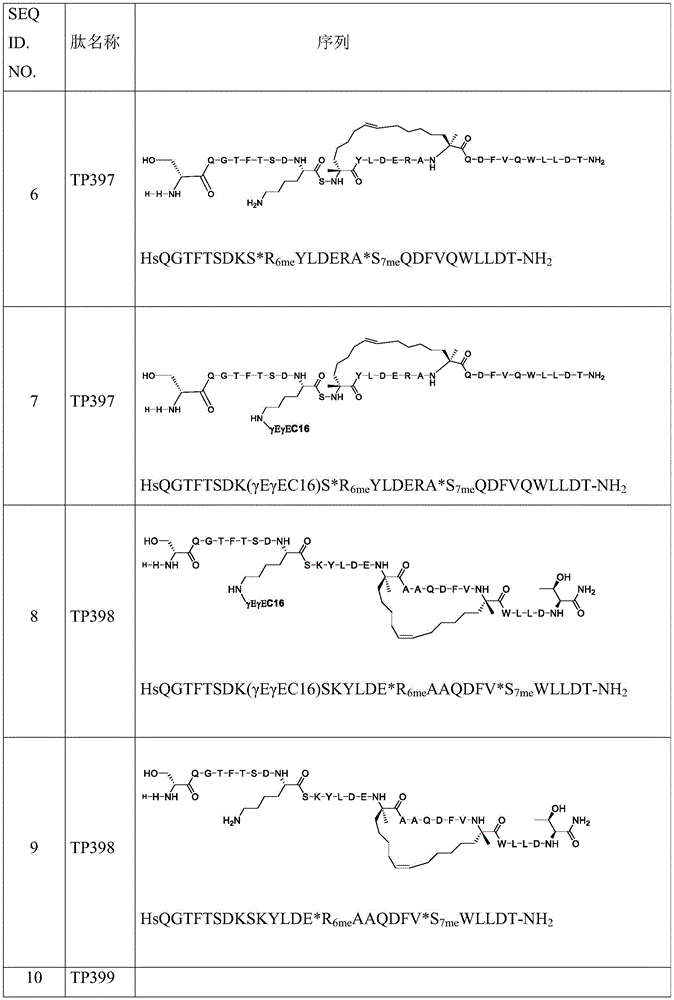
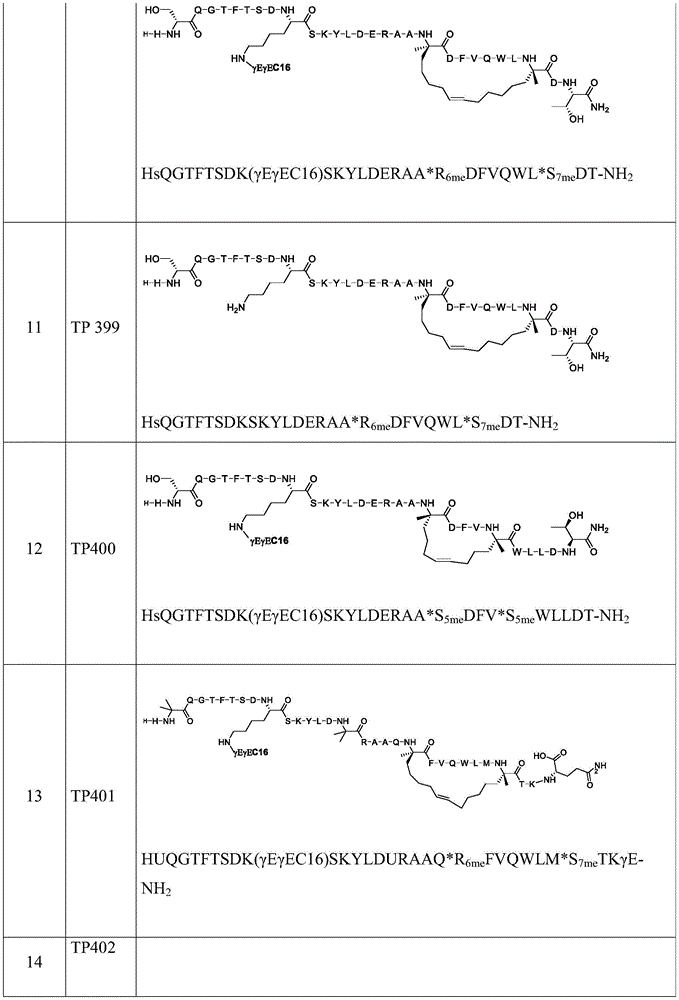

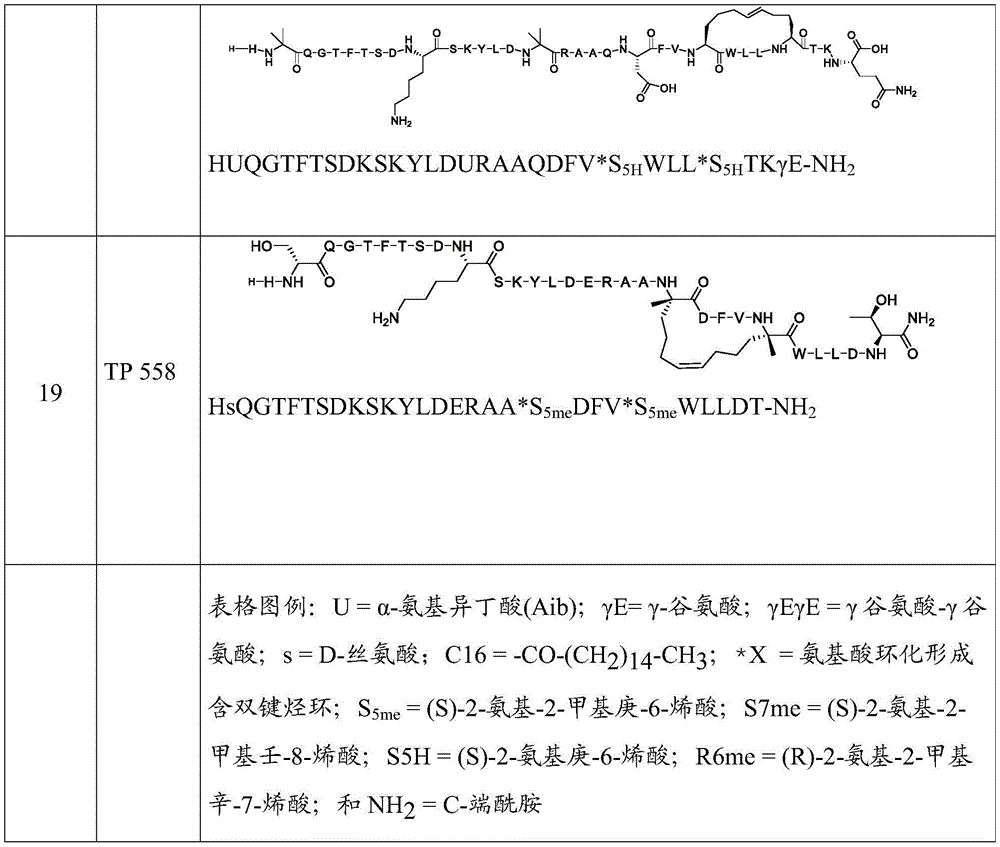
本发明进一步地包括组合物,其包含或由一种或多种根据表1所示的肽和药学上可接受的载体组成。The present invention further includes compositions comprising or consisting of one or more of the peptides according to Table 1 and a pharmaceutically acceptable carrier.
“α-氨基酸”或简称为“氨基酸”是指包含与碳键合的氨基和羧基的分子,该碳被指定为α-碳,连接至侧链(R基团)和氢原子并且可以由(R)和(S)α-氨基酸所示的式表示。"Alpha-amino acid" or simply "amino acid" refers to a molecule comprising an amino and carboxyl group bonded to a carbon, designated the alpha-carbon, attached to a side chain (R group) and a hydrogen atom and can be represented by ( R) and (S) the formulas shown for α-amino acids.

通常,L-氨基酸具有(S)构型,但具有(R)构型的半胱氨酸和非手性的甘氨酸除外。本文中公开的全D构型肽的合适的α-氨基酸仅包括天然存在的氨基酸及其类似物的D-异构体,以及通过有机合成或其他代谢途径制备的非天然存在的氨基酸,除了α,α-二取代氨基酸,其可以是L、D或非手性的。除非上下文另有明确说明,否则本文所用的术语氨基酸旨在包括氨基酸类似物。如本文所用,D氨基酸由上标“D”(例如,DLeu)表示,L氨基酸由“L”(例如,L-Leu)或无L标识符(例如,Leu)表示。Typically, L-amino acids have the (S) configuration, with the exception of cysteine and achiral glycine, which have the (R) configuration. Suitable alpha-amino acids for the all-D configuration peptides disclosed herein include only the D-isomers of naturally occurring amino acids and their analogs, and non-naturally occurring amino acids prepared by organic synthesis or other metabolic pathways, except for alpha , α-disubstituted amino acids, which can be L, D or achiral. Unless the context clearly dictates otherwise, the term amino acid as used herein is intended to include amino acid analogs. As used herein, D amino acids are represented by the superscript "D" (eg, D Leu) and L amino acids are represented by "L" (eg, L-Leu) or no L identifier (eg, Leu).
“α,α-二取代的氨基酸”是指包含键合至α-碳的氨基和羧基的分子或部分,该α-碳连接至两个天然或非天然氨基酸侧链或其组合。示例性的α,α-二取代的氨基如下所示。这些α,α-二取代氨基酸包含具有末端烯属反应性基团的侧链。"α,α-disubstituted amino acid" refers to a molecule or moiety comprising an amino and carboxyl group bonded to an α-carbon attached to two natural or unnatural amino acid side chains or a combination thereof. Exemplary α,α-disubstituted amino groups are shown below. These α,α-disubstituted amino acids contain side chains with terminal olefinically reactive groups.
上述用于通过闭环复分解引入短链的氨基酸具有以下结构:The above-mentioned amino acids for introduction of short chains by closed-loop metathesis have the following structure:
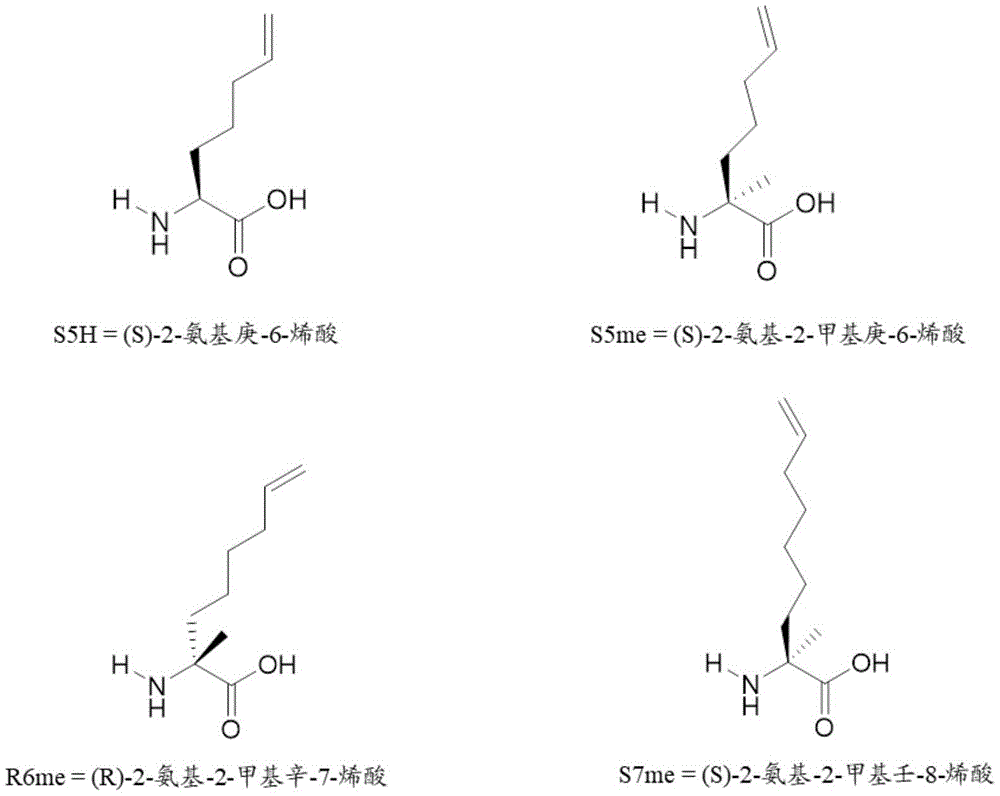
本发明的共激动剂肽可以与包含14至20个亚甲基的脂肪链的α,ω-二羧酸(脂肪二酸)缀合,其中分子的一端是近端,另一端是远端,并且其中近端和远端均具有羧基(COOH)基团。脂肪二酸可以由结构HO2C(CH2)nCO2H表示,其中n是11、12、13、14、15、16、17或18,提供脂肪二酸各自为十四烷二酸、十六烷二酸、十七烷二酸、十八烷二酸、十九烷二酸和二十烷二酸。前述脂肪二酸具有以下结构The co-agonist peptides of the present invention may be conjugated to α,ω-dicarboxylic acids (fatty diacids) comprising aliphatic chains of 14 to 20 methylene groups, wherein one end of the molecule is proximal and the other end is distal, And wherein both the proximal and distal ends have carboxyl (COOH) groups. The fatty diacids can be represented by the structure HO2C( CH2 ) nCO2H , where n is 11, 12, 13, 14, 15, 16, 17 , or 18, providing that the fatty diacids are each tetradecanedioic acid, Hexadecanedioic acid, heptadecanedioic acid, octadecanedioic acid, nonadecanedioic acid and eicosanedioic acid. The aforementioned fatty diacid has the following structure
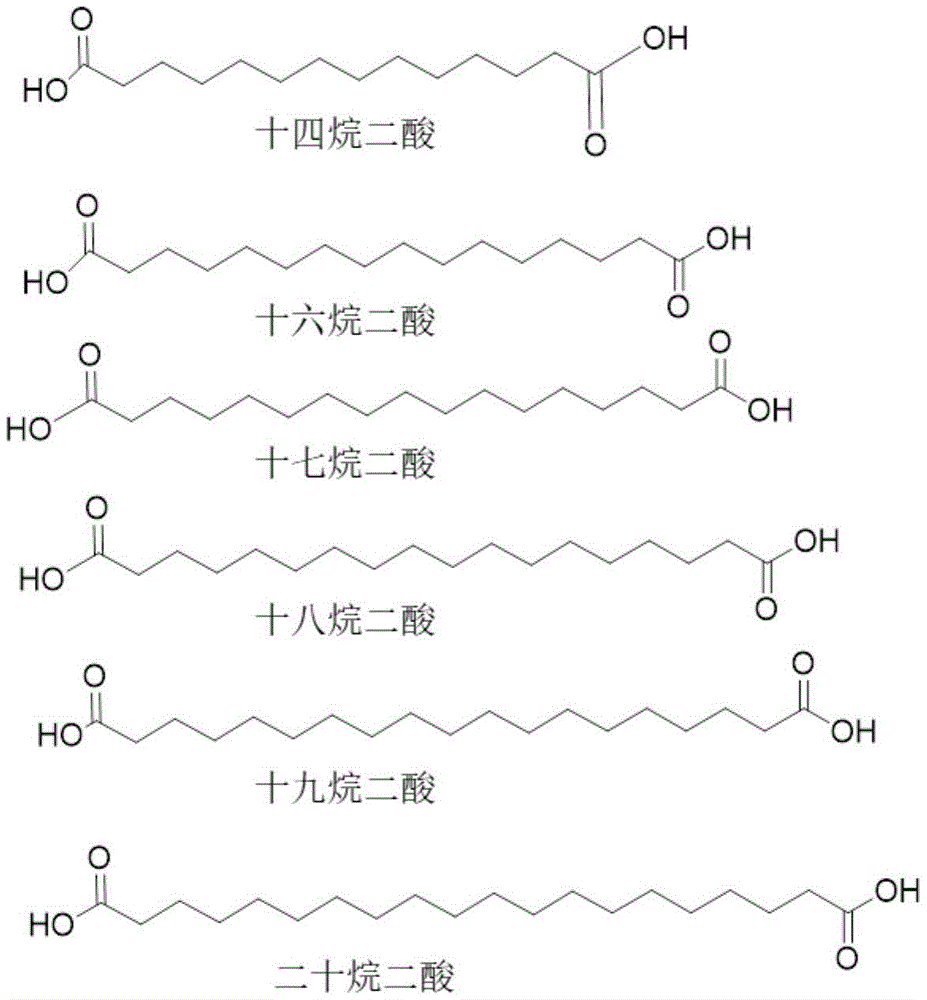
作为共激动剂肽的组分,所述脂肪二酸的近端的酸官能团缀合至C(O)-NH键中的接头的氨基,并且所述脂肪二酸远端的酸官能团是游离羧基(COOH)。远端处的COOH基团通过其与血清白蛋白(一种已知的血清中脂肪酸的载体)非共价结合的能力有助于赋予共激动剂肽更长的半衰期。COOH基团增加了作用的持续时间,因为它与已使用脂肪酸酰化的肽相比提供了更好的与血清白蛋白的非共价相互作用,后者与血清白蛋白的结合效率较低并且与血清白蛋白形成不太稳定的非共价相互作用。As a component of the co-agonist peptide, the acid functional group at the proximal end of the fatty diacid is conjugated to the amino group of the linker in the C(O)-NH bond, and the acid functional group at the distal end of the fatty diacid is a free carboxyl group (COOH). The COOH group at the distal end helps to impart a longer half-life to the co-agonist peptide through its ability to non-covalently bind to serum albumin, a known carrier of fatty acids in serum. The COOH group increases the duration of action because it provides better non-covalent interactions with serum albumin compared to peptides that have been acylated with fatty acids, which bind less efficiently and Forms less stable non-covalent interactions with serum albumin.
本发明的共激动剂肽还可以缀合至包含14至20个亚甲基的脂肪链的羧酸(脂肪酸),其中分子的一端是近端,另一端是远端,并且其中近端或远端具有羧基(COOH)基团。脂肪酸可以由结构HO2C(CH2)nCH3表示,其中n是11、12、13、14、15、16、17或18,以提供脂肪二酸各自为十四烷酸、十六烷酸、十七烷酸、十八烷酸、十九烷酸和二十烷酸。脂肪酸可以具有以下结构之一The co-agonist peptides of the present invention may also be conjugated to carboxylic acids (fatty acids) comprising aliphatic chains of 14 to 20 methylene groups, wherein one end of the molecule is proximal and the other end is distal, and wherein either the proximal or distal ends The terminal has a carboxyl (COOH) group. Fatty acids can be represented by the structure HO2C( CH2 ) nCH3 , where n is 11, 12, 13, 14, 15, 16, 17 , or 18, to provide that the fatty diacids are each tetradecanoic acid, hexadecane acid, heptadecanoic acid, octadecanoic acid, nonadecanoic acid and eicosanoic acid. Fatty acids can have one of the following structures
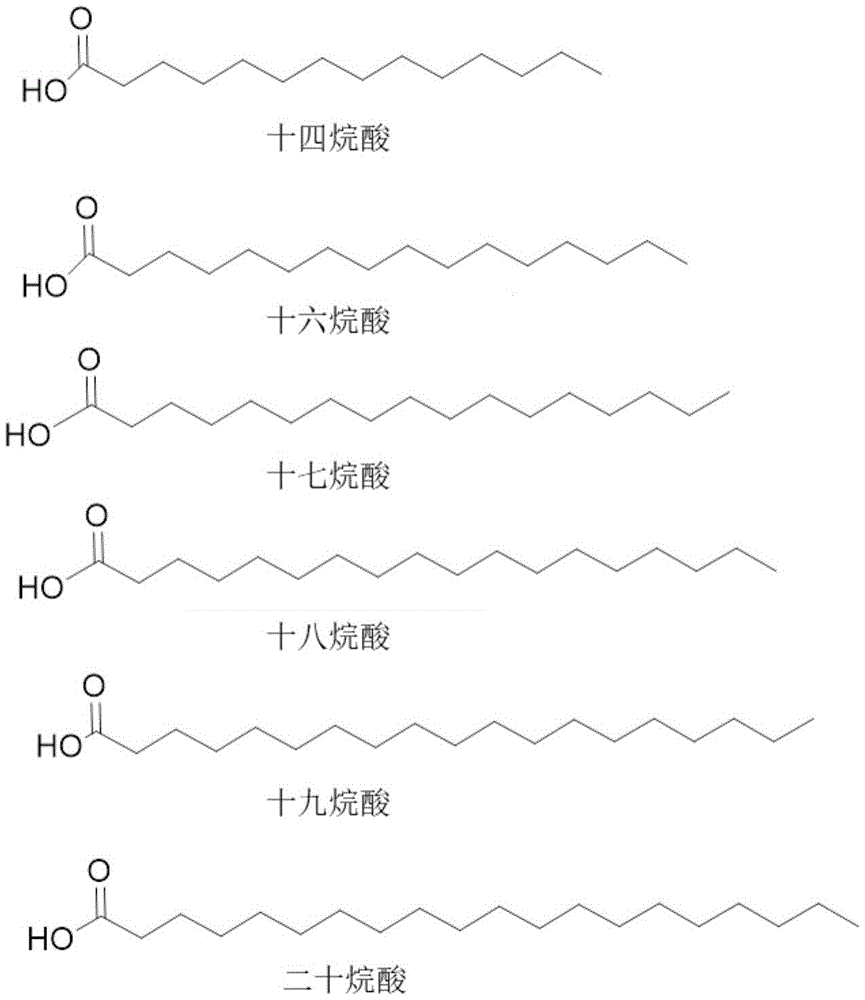
在特定地方面,所述GCG/GLP-1受体共激动剂肽进一步地在所述肽位置10处与脂肪酸缀合。脂肪酸可以由结构HO2C(CH2)n表示,其中n是11、12、13、14、15、16、17、18或19。In specific aspects, the GCG/GLP-1 receptor co-agonist peptide is further conjugated to a fatty acid at position 10 of the peptide. Fatty acids can be represented by the structure HO2C( CH2 ) n , where n is 11, 12, 13, 14, 15 , 16, 17, 18, or 19.
K(γEγE-脂肪酸)的结构,其中所述接头是γEγE,并且所述脂肪酸组分包含C14、C16、C17、C18、C19或C20,由下式表示The structure of K(γEγE-fatty acid), wherein the linker is γEγE, and the fatty acid component comprises C14, C16, C17, C18, C19 or C20, represented by the following formula

其中n各自是7、9、10、11、12、13或14,并且所述波浪线表示共激动剂肽序列中相邻氨基酸之间的键。where n is each 7, 9, 10, 11, 12, 13, or 14, and the wavy lines represent bonds between adjacent amino acids in the co-agonist peptide sequence.
在本文所示的肽中,K(γEγE-C16)的结构可以表示为In the peptides shown here, the structure of K(γEγE-C16) can be expressed as

其中n是9,并且所述波浪线表示肽序列中相邻氨基酸之间的键。where n is 9, and the wavy lines represent bonds between adjacent amino acids in the peptide sequence.
在本文所示的肽中,K(γEγE-C16)的结构可以表示为In the peptides shown here, the structure of K(γEγE-C16) can be expressed as
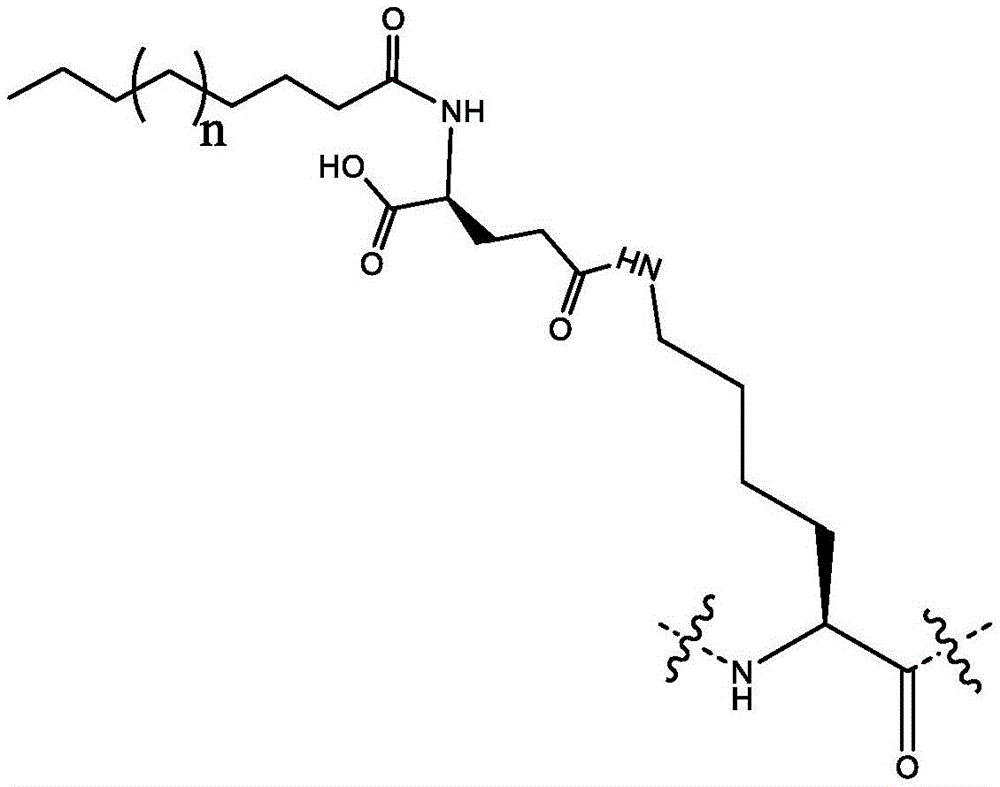
其中n是9,并且所述波浪线表示肽序列中相邻氨基酸之间的键。where n is 9, and the wavy lines represent bonds between adjacent amino acids in the peptide sequence.
共激动剂肽中在位置30处的KγE的结构表示为The structure of KγE at position 30 in the co-agonist peptide is represented as

其中所述波浪线表示共激动剂肽序列中相邻氨基酸之间的键。。where the wavy lines represent bonds between adjacent amino acids in the co-agonist peptide sequence. .
本发明的钉合GCG/GLP-1受体共激动剂肽对胰高血糖素受体和/或GLP-1受体具有可测量的活性。The stapled GCG/GLP-1 receptor co-agonist peptides of the present invention have measurable activity at the glucagon receptor and/or the GLP-1 receptor.
本文中公开的共激动剂肽可具有相对于天然GLP-1至少约1%(包括至少约1.5%、2%、5%、7%、10%、20%、30%、40%、50%、60%、75%、100%、125%、150%、175%)至约200%或更高的GLP-1受体活性,并且相对于天然胰高血糖素至少约1%(包括约1.5%、2%、5%、7%、10%、20%、30%、40%、50%、60%、75%、100%、125%、150%、175%、200%、250%、300%、350%、400%、450%)至约500%或更高的胰高血糖素受体活性。在一些实施方案中,本文所描述的共激动剂肽表现出不超过约100%、1000%、10,000%、100,000%或1,000,000%的天然胰高血糖素对胰高血糖素受体的活性。在一些实施方案中,本文所描述的共激动剂肽表现出不超过约100%、1000%、10,000%,100,000%或1,000,000%的天然GLP-1对GLP-1受体活性。在示例性实施方案中,共激动剂肽可表现出至少10%的天然胰高血糖素对胰高血糖素受体的活性和至少50%的天然GLP-1对GLP-1受体的活性,至少40%的天然胰高血糖素对胰高血糖素受体的活性和至少40%的天然GLP-1对GLP-1受体的活性,或至少60%的天然胰高血糖素对胰高血糖素受体的活性和至少60%的天然GLP-1对GLP-1受体的活性。The co-agonist peptides disclosed herein can have at least about 1% (including at least about 1.5%, 2%, 5%, 7%, 10%, 20%, 30%, 40%, 50%) relative to native GLP-1 , 60%, 75%, 100%, 125%, 150%, 175%) to about 200% or more of GLP-1 receptor activity and at least about 1% (including about 1.5%) relative to native glucagon %, 2%, 5%, 7%, 10%, 20%, 30%, 40%, 50%, 60%, 75%, 100%, 125%, 150%, 175%, 200%, 250%, 300%, 350%, 400%, 450%) to about 500% or more glucagon receptor activity. In some embodiments, the co-agonist peptides described herein exhibit no more than about 100%, 1000%, 10,000%, 100,000%, or 1,000,000% of the activity of native glucagon at the glucagon receptor. In some embodiments, the co-agonist peptides described herein exhibit no more than about 100%, 1000%, 10,000%, 100,000%, or 1,000,000% of native GLP-1 activity at the GLP-1 receptor. In exemplary embodiments, the co-agonist peptide may exhibit at least 10% of the activity of native glucagon at the glucagon receptor and at least 50% of the activity of native GLP-1 at the GLP-1 receptor, At least 40% activity of native glucagon at glucagon receptor and at least 40% activity of native GLP-1 at GLP-1 receptor, or at least 60% activity of native glucagon at glucagon GLP-1 receptor activity and at least 60% of native GLP-1 activity at GLP-1 receptors.
本发明还提供了用于治疗患者的代谢性疾病的方法,所述方法包括施予所述患者有效量的前述肽中的任一种的肽以在所述患者中治疗所述的代谢性疾病。The present invention also provides a method for treating a metabolic disease in a patient, the method comprising administering to the patient an effective amount of a peptide of any of the foregoing peptides to treat the metabolic disease in the patient .
本发明还提供了用于治疗患者的代谢性疾病的方法,所述方法包括施予所述患者有效量的前述组合物的组合物以在所述患者中治疗所述的代谢性疾病。The present invention also provides a method for treating a metabolic disease in a patient, the method comprising administering to the patient an effective amount of a composition of the foregoing compositions to treat the metabolic disease in the patient.
在特定方面,所述代谢性疾病是糖尿病、非酒精性脂肪肝病(NAFLD)、非酒精性脂肪性肝炎(NASH)或肥胖。In particular aspects, the metabolic disease is diabetes, non-alcoholic fatty liver disease (NAFLD), non-alcoholic steatohepatitis (NASH) or obesity.
在特定方面,所述糖尿病是I型糖尿病、II型糖尿病或妊娠糖尿病。In particular aspects, the diabetes is Type I diabetes, Type II diabetes or gestational diabetes.
在特定方面,所述患者具有超过一种代谢性疾病,例如,糖尿病和NASH、NAFLD或肥胖;肥胖和NASH或NAFLD;糖尿病、NASH和肥胖;糖尿病、NAFLD和肥胖;或糖尿病和肥胖。In certain aspects, the patient has more than one metabolic disease, eg, diabetes and NASH, NAFLD or obesity; obesity and NASH or NAFLD; diabetes, NASH and obesity; diabetes, NAFLD and obesity; or diabetes and obesity.
本发明还提供了前述肽中的任一种用于制备治疗代谢性疾病药物的用途。The present invention also provides the use of any one of the aforementioned peptides for preparing a drug for treating metabolic diseases.
本发明还提供了前述组合物中的任一种用于制备治疗代谢性疾病药物的用途。The present invention also provides the use of any one of the aforementioned compositions for preparing a drug for treating metabolic diseases.
在特定方面,所述代谢性疾病是糖尿病、非酒精性脂肪肝病(NAFLD)、非酒精性脂肪性肝炎(NASH)或肥胖。In particular aspects, the metabolic disease is diabetes, non-alcoholic fatty liver disease (NAFLD), non-alcoholic steatohepatitis (NASH) or obesity.
在特定方面,所述糖尿病是I型糖尿病、II型糖尿病或妊娠糖尿病。In particular aspects, the diabetes is Type I diabetes, Type II diabetes or gestational diabetes.
在特定方面,所述药物用于治疗超过一种代谢性疾病,例如,糖尿病和NASH、NAFLD或肥胖;肥胖和NASH或NAFLD;糖尿病、NASH和肥胖;糖尿病、NAFLD和肥胖;或糖尿病和肥胖。In particular aspects, the medicament is for the treatment of more than one metabolic disease, eg, diabetes and NASH, NAFLD or obesity; obesity and NASH or NAFLD; diabetes, NASH and obesity; diabetes, NAFLD and obesity; or diabetes and obesity.
在本文中公开的化合物的特定方面,所述C-端保护基团可以是酰胺或酯。例如,所述C-端酰胺酸的羧酸被电荷中性基团(诸如酰胺或酯)替换。In certain aspects of the compounds disclosed herein, the C-terminal protecting group may be an amide or an ester. For example, the carboxylic acid of the C-terminal amic acid is replaced by a charge neutral group such as an amide or ester.
还提供了在患者或个体中治疗代谢性疾病的方法,所述方法包括:给所述患者或个体施用有效量的前述包含共激动剂肽的组合物中的任一种,和给所述患者或个体施用有效量的包含胰岛素或胰岛素类似物的组合物以在患者或个体中治疗所述代谢性疾病。Also provided is a method of treating a metabolic disease in a patient or individual, the method comprising: administering to the patient or individual an effective amount of any of the foregoing compositions comprising a co-agonist peptide, and administering to the patient or the individual administers an effective amount of a composition comprising insulin or an insulin analog to treat the metabolic disease in the patient or individual.
在特定方面,在施用所述包含胰岛素或胰岛素类似物的组合物的时间之前的时间施用所述包含共激动剂肽的组合物。在另一个方面,在施用所述包含共激动剂肽的组合物的时间之前的时间施用所述包含胰岛素或胰岛素类似物的组合物。在另一个方面,在施用所述包含胰岛素或胰岛素类似物的组合物的同时施用所述包含共激动剂肽的组合物。In particular aspects, the composition comprising a co-agonist peptide is administered at a time prior to the time at which the composition comprising insulin or insulin analog is administered. In another aspect, the composition comprising insulin or an insulin analog is administered at a time prior to the time of administration of the composition comprising a co-agonist peptide. In another aspect, the composition comprising a co-agonist peptide is administered at the same time as the composition comprising insulin or an insulin analog.
在特定方面,所述胰岛素类似物是地特胰岛素、甘精胰岛素、诺和平(levemir)胰岛素、赖谷胰岛素或赖脯胰岛素。In particular aspects, the insulin analog is insulin detemir, insulin glargine, insulin levemir, insulin glulisine, or insulin lispro.
在特定方面,所述代谢性疾病是糖尿病、非酒精性脂肪肝病(NAFLD)、非酒精性脂肪性肝炎(NASH)或肥胖。In particular aspects, the metabolic disease is diabetes, non-alcoholic fatty liver disease (NAFLD), non-alcoholic steatohepatitis (NASH) or obesity.
在特定方面,所述糖尿病是I型糖尿病、II型糖尿病或妊娠糖尿病。In particular aspects, the diabetes is Type I diabetes, Type II diabetes or gestational diabetes.
在特定方面,所述患者具有超过一种代谢性疾病,例如,糖尿病和NASH、NAFLD或肥胖;肥胖和NASH或NAFLD;糖尿病、NASH和肥胖;糖尿病、NAFLD和肥胖;或糖尿病和肥胖。In certain aspects, the patient has more than one metabolic disease, eg, diabetes and NASH, NAFLD or obesity; obesity and NASH or NAFLD; diabetes, NASH and obesity; diabetes, NAFLD and obesity; or diabetes and obesity.
本发明还提供了一种组合物,其包含前述肽中的任一种、胰岛素或胰岛素类似物和药学上可接受的载体。The present invention also provides a composition comprising any of the aforementioned peptides, insulin or an insulin analog, and a pharmaceutically acceptable carrier.
本发明还提供了包含前述肽中的任一种、胰岛素或胰岛素类似物和药学上可接受的载体的组合物用于治疗代谢性疾病的用途。The present invention also provides the use of a composition comprising any of the aforementioned peptides, insulin or an insulin analog and a pharmaceutically acceptable carrier for the treatment of metabolic diseases.
在特定方面,所述代谢性疾病是糖尿病、非酒精性脂肪肝病(NAFLD)、非酒精性脂肪性肝炎(NASH)或肥胖。在其它方面,所述糖尿病是I型糖尿病、II型糖尿病或妊娠糖尿病。In particular aspects, the metabolic disease is diabetes, non-alcoholic fatty liver disease (NAFLD), non-alcoholic steatohepatitis (NASH) or obesity. In other aspects, the diabetes is Type I diabetes, Type II diabetes or gestational diabetes.
本发明还提供了包含前述肽中的任一种、胰岛素或胰岛素类似物和药学上可接受的载体的组合物用于治疗代谢性疾病制备药物的用途。The present invention also provides the use of a composition comprising any one of the aforementioned peptides, insulin or insulin analogs and a pharmaceutically acceptable carrier for the treatment of metabolic diseases to prepare a medicament.
在特定方面,所述代谢性疾病是糖尿病、非酒精性脂肪肝病(NAFLD)、非酒精性脂肪性肝炎(NASH)或肥胖。在其它方面,所述糖尿病是I型糖尿病、II型糖尿病或妊娠糖尿病。In particular aspects, the metabolic disease is diabetes, non-alcoholic fatty liver disease (NAFLD), non-alcoholic steatohepatitis (NASH) or obesity. In other aspects, the diabetes is Type I diabetes, Type II diabetes or gestational diabetes.
定义definition
本文中使用的术语“约”是指所述数值或数值范围±10%,但并不意图将任何数值或数值范围仅指定为该较宽的定义。前面具有术语“约”的每个数值或数值范围也意图涵盖所述绝对数值或数值范围的实施方案。As used herein, the term "about" refers to ±10% of the stated value or range of values, but is not intended to designate any value or range of values only as this broader definition. Each numerical value or numerical range preceded by the term "about" is also intended to encompass embodiments of that absolute numerical value or numerical range.
术语“个体”意在包括人类和伴侣或驯化动物诸如狗、猫、马等。因此,包含如本文中公开的化合物或一种或多种共激动剂肽的组合物也可用于治疗或预防猫和狗的肥胖和和肥胖相关病症。因此,术语“哺乳动物”包括人类和伴侣动物诸如猫和狗。The term "individual" is intended to include humans and companion or domesticated animals such as dogs, cats, horses, and the like. Accordingly, compositions comprising a compound as disclosed herein or one or more co-agonist peptides can also be used to treat or prevent obesity and obesity-related disorders in cats and dogs. Thus, the term "mammal" includes humans and companion animals such as cats and dogs.
本文中使用的术语“药学上可接受的载体”包括适合用于施用给个体的任何载体,例如标准药用载体中的任一种,包括但不限于磷酸盐缓冲盐水溶液、水、乳剂诸如水包油或油包水乳剂和不同类型的润湿剂。该术语还包括被美国联邦政府的管理机构批准或在美国药典中列出用于动物(包括人类)的任何试剂。一般而言,“药学上可接受的载体”是指这样的无毒材料:其不会干扰活性成分的生物活性的有效性,被联邦或州政府的管理机构批准,或列出在美国药典或其它普遍公认的用于动物(且更具体地,人类)中的药典。术语“载体”表示与治疗剂一起施用的稀释剂、佐剂、赋形剂或媒介物,且包括但不限于诸如水和油等无菌液体。载体的特征将取决于施用途径。The term "pharmaceutically acceptable carrier" as used herein includes any carrier suitable for administration to an individual, such as any of the standard pharmaceutical carriers including, but not limited to, phosphate buffered saline solution, water, emulsions such as water Oil-in-oil or water-in-oil emulsions and different types of wetting agents. The term also includes any agent approved by a regulatory agency of the United States federal government or listed in the United States Pharmacopeia for use in animals, including humans. In general, "pharmaceutically acceptable carrier" refers to a nontoxic material that does not interfere with the effectiveness of the biological activity of the active ingredient, is approved by a regulatory agency of the Federal or a state government, or is listed in the United States Pharmacopeia or Other generally recognized pharmacopeias for use in animals (and more specifically, humans). The term "carrier" means a diluent, adjuvant, excipient, or vehicle with which a therapeutic agent is administered, and includes, but is not limited to, sterile liquids such as water and oils. The characteristics of the carrier will depend on the route of administration.
本文中使用的术语“药学上可接受的盐”表示保留母体化合物的生物活性的化合物的盐,并且其在生物学或其它方面不是不希望的。本文中公开的许多化合物能够通过氨基和/或羧基或其类似基团的存在而形成酸式盐和/或碱式盐。可以从无机和有机碱制备药学上可接受的碱加成盐。仅作为示例,从无机碱衍生出的盐包括钠盐、钾盐、锂盐、铵盐、钙盐和镁盐。从有机碱衍生的盐包括但不限于伯胺、仲胺和叔胺的盐。As used herein, the term "pharmaceutically acceptable salt" refers to a salt of a compound that retains the biological activity of the parent compound and that is not biologically or otherwise undesirable. Many of the compounds disclosed herein are capable of forming acid and/or base salts through the presence of amino and/or carboxyl groups or the like. Pharmaceutically acceptable base addition salts can be prepared from inorganic and organic bases. By way of example only, salts derived from inorganic bases include sodium, potassium, lithium, ammonium, calcium and magnesium salts. Salts derived from organic bases include, but are not limited to, salts of primary, secondary and tertiary amines.
可以从药学上可接受的无毒碱或酸(包括无机或有机碱和无机或有机酸)制备药学上可接受的盐。从无机碱衍生出的盐包括铝盐、铵盐、钙盐、铜盐、三价铁盐、二价铁盐、锂盐、镁盐、三价锰盐、二价锰盐、钾盐、钠盐、锌盐等。特别优选的是铵盐、钙盐、镁盐、钾盐和钠盐。从药学上可接受的有机无毒碱衍生出的盐包括伯、仲和叔胺的盐,取代胺的盐,包括天然存在的取代胺、环胺和碱性离子交换树脂的盐,诸如精氨酸、甜菜碱、咖啡因、胆碱、N,N’-二苄基乙二胺、二乙胺、2-二乙基氨基乙醇、2-二甲基氨基乙醇、乙醇胺、乙二胺、N-乙基吗啉、N-乙基哌啶、还原葡糖胺、葡糖胺、组氨酸、哈胺(hydrabamine)、异丙胺、赖氨酸、甲基葡糖胺、吗啉、哌嗪、哌啶、多胺树脂、普鲁卡因、嘌呤、可可碱、三乙胺、三甲胺、三丙胺、氨丁三醇等。术语“药学上可接受的盐”还包括所有可接受的盐诸如乙酸盐、乳糖酸盐、苯磺酸盐、月桂酸盐、苯甲酸盐、苹果酸盐、碳酸氢盐、马来酸盐、硫酸氢盐、扁桃酸盐、酒石酸氢盐、甲磺酸盐、硼酸盐、甲基溴化物、溴化物、甲基硝酸盐、钙依地酸盐、甲基硫酸盐、樟脑磺酸盐、粘酸盐、碳酸盐、萘磺酸盐、氯化物、硝酸盐、克拉维酸盐、N-甲基葡糖胺盐、柠檬酸盐、铵盐、二盐酸盐、油酸盐、依地酸盐、草酸盐、乙二磺酸盐、扑酸盐(双羟萘酸盐)、依托酸盐、棕榈酸盐、乙磺酸盐、泛酸盐、富马酸盐、磷酸盐/二磷酸盐、葡庚糖酸盐、聚半乳糖醛酸盐、葡萄糖酸盐、水杨酸盐、谷氨酸盐、硬脂酸盐、乙醇酰基对氨基苯胂酸盐、硫酸盐、己基间苯二酚盐、次醋酸盐、哈胺(hydrabamine)、琥珀酸盐、氢溴酸盐、鞣酸盐、盐酸盐、酒石酸盐、羟基萘甲酸盐、8-氯茶碱盐、碘化物、甲苯磺酸盐、异硫代硫酸盐、三乙基碘、三氟乙酸盐(TFA盐)、乳酸盐、帕莫酸盐(panoate)、戊酸盐等,它们可以用作改变溶解或水解特征的剂型或可以用在持续释放或前药制剂中。应该理解,如本文中使用的,对本文中公开的共激动剂肽的提及还意图包括包含一种或多种共激动剂肽和一种或多种药学上可接受的盐的实施方案。Pharmaceutically acceptable salts can be prepared from pharmaceutically acceptable non-toxic bases or acids, including inorganic or organic bases and inorganic or organic acids. Salts derived from inorganic bases include aluminum, ammonium, calcium, copper, ferric, ferrous, lithium, magnesium, manganous, manganous, potassium, sodium salt, zinc salt, etc. Particularly preferred are the ammonium, calcium, magnesium, potassium and sodium salts. Salts derived from pharmaceutically acceptable organic non-toxic bases include salts of primary, secondary and tertiary amines, salts of substituted amines including naturally occurring substituted amines, cyclic amines and salts of basic ion exchange resins such as arginine Acid, betaine, caffeine, choline, N,N'-dibenzylethylenediamine, diethylamine, 2-diethylaminoethanol, 2-dimethylaminoethanol, ethanolamine, ethylenediamine, N -Ethylmorpholine, N-ethylpiperidine, reduced glucosamine, glucosamine, histidine, hydrabamine, isopropylamine, lysine, methylglucamine, morpholine, piperazine , piperidine, polyamine resin, procaine, purine, theobromine, triethylamine, trimethylamine, tripropylamine, tromethamine, etc. The term "pharmaceutically acceptable salts" also includes all acceptable salts such as acetate, lactobion, besylate, laurate, benzoate, malate, bicarbonate, maleic acid salt, bisulfate, mandelate, tartarate, mesylate, borate, methyl bromide, bromide, methyl nitrate, calcium edetate, methyl sulfate, camphorsulfonic acid Salt, Mucic Acid, Carbonate, Naphthalene Sulfonate, Chloride, Nitrate, Clavulanate, N-Methylglucamine, Citrate, Ammonium, Dihydrochloride, Oleate , edetate, oxalate, ethanedisulfonate, pamoate (pamoate), etorate, palmitate, ethanesulfonate, pantothenate, fumarate, phosphoric acid Salt/Diphosphate, Glucoheptonate, Polygalacturonate, Gluconate, Salicylate, Glutamate, Stearate, Glycoyl P-aminophenylarsonate, Sulfate, Hexyl resorcinate, hypoacetate, hydrabamine, succinate, hydrobromide, tannate, hydrochloride, tartrate, hydroxynaphthoate, 8-chlorotheophylline , iodide, tosylate, isothiosulfate, triethyl iodide, trifluoroacetate (TFA salt), lactate, panoate, valerate, etc., which can be used Dosage forms may be used to alter the dissolution or hydrolysis characteristics or may be used in sustained release or prodrug formulations. It should be understood that, as used herein, references to co-agonist peptides disclosed herein are also intended to include embodiments comprising one or more co-agonist peptides and one or more pharmaceutically acceptable salts.
本文中使用的术语“治疗”包括预防具体病症或状况,或减轻与具体病症或状况有关的症状,和/或预防或消除所述症状。例如,本文使用的术语“治疗糖尿病”通常是指在正常水平的方向改变血糖水平,并且可以包括根据给定的情况提高或降低血糖水平。As used herein, the term "treating" includes preventing a particular disorder or condition, or alleviating symptoms associated with a particular disorder or condition, and/or preventing or eliminating said symptoms. For example, the term "treating diabetes" as used herein generally refers to changing blood sugar levels in the direction of normal levels, and can include raising or lowering blood sugar levels depending on the given situation.
本文中使用的“有效”量或“治疗有效量”是指药物组合物或方法的每种活性组分的总量,其足以显示出有意义的患者益处,即,治疗、治愈、预防或改善有关的医学状况,或治疗、治愈、预防或改善这样的状况的速率的增加。它表示无毒的、但是足以提供期望作用的一种或多种共激动剂肽的量。例如,一种期望作用可以是预防或治疗高血糖症(例如,通过更接近正常的血糖水平的改变而测量),或如下治疗肥胖:诱导重量减轻和/或预防重量增加(例如,通过重量减轻而测量),或者预防或减少重量的增加,或者使体脂肪分布正常化。“有效”的量随受试者不同而变化,取决于个体的年龄和一般状况、施用模式等。因而,不总是可能指定确切的“有效量”。但是,本领域普通技术人员使用例行实验可以确定在任何个例中的适当“有效”量。当应用于单独施用的单一活性成分时,该术语表示单独的该成分。当应用于组合时,该术语表示产生治疗效果的活性成分的组合量,无论联合地、连续地还是同时地施用。As used herein, an "effective" amount or "therapeutically effective amount" refers to the total amount of each active component of a pharmaceutical composition or method sufficient to exhibit a meaningful patient benefit, ie, treatment, cure, prevention, or amelioration A related medical condition, or an increase in the rate at which such a condition is treated, cured, prevented or ameliorated. It represents the amount of one or more co-agonist peptides that is non-toxic, but sufficient to provide the desired effect. For example, a desired effect may be to prevent or treat hyperglycemia (eg, as measured by a change in blood glucose levels closer to normal), or to treat obesity by inducing weight loss and/or preventing weight gain (eg, by weight loss while measuring), or prevent or reduce weight gain, or normalize body fat distribution. An "effective" amount will vary from subject to subject, depending on the age and general condition of the individual, the mode of administration, and the like. Thus, it is not always possible to specify an exact "effective amount". However, one of ordinary skill in the art can determine an appropriate "effective" amount in any individual case using routine experimentation. When applied to a single active ingredient administered alone, the term refers to that ingredient alone. When applied to a combination, the term refers to the combined amounts of active ingredients that produce a therapeutic effect, whether administered jointly, sequentially or simultaneously.
术语“胃肠外”是指不经过消化道、但是通过某些其它途径,例如皮下、肌肉内、椎管内或静脉内。The term "parenteral" means not through the alimentary canal, but by some other route, such as subcutaneous, intramuscular, intraspinal, or intravenous.
本文中使用的术语“肽”包括3个或更多个氨基酸且通常小于100个氨基酸的链,其中所述氨基酸是天然存在的或编码的或非天然存在的或非编码的氨基酸。非天然存在的氨基酸表示并非天然存在于体内,但是却可以掺入本文所述的肽结构中的氨基酸。本文中使用的“非编码的”表示不是下列20种氨基酸中的任一种的L-异构体的氨基酸:Ala、Cys、Asp、Glu、Phe、Gly、His、He、Lys、Leu、Met、Asn、Pro、Gln、Arg、Ser、Thr、Val、Trp、Tyr。本文中使用的“编码的”表示是下列20种氨基酸中的任一种的L-异构体的氨基酸:Ala、Cys、Asp、Glu、Phe、Gly、His、He、Lys、Leu、Met、Asn、Pro、Gln、Arg、Ser、Thr、Val、Trp、Tyr。在某些实施方案中,本文所述的肽和变体肽具有与SEQ ID NO:1(其长度为29个氨基酸)大致相同的长度,例如25-35个氨基酸的长度。示例性的长度包括29、30、31、32、33、34、35、36、37、38、39、40、41、42、43、44、45、46、47、48、49或50个氨基酸的长度。The term "peptide" as used herein includes chains of 3 or more amino acids, and usually less than 100 amino acids, wherein the amino acids are naturally occurring or encoded or non-naturally occurring or non-encoded amino acids. A non-naturally occurring amino acid refers to an amino acid that is not naturally found in the body, but can be incorporated into the peptide structures described herein. As used herein, "non-coding" means an amino acid that is not the L-isomer of any of the following 20 amino acids: Ala, Cys, Asp, Glu, Phe, Gly, His, He, Lys, Leu, Met , Asn, Pro, Gln, Arg, Ser, Thr, Val, Trp, Tyr. As used herein, "encoded" means an amino acid that is the L-isomer of any of the following 20 amino acids: Ala, Cys, Asp, Glu, Phe, Gly, His, He, Lys, Leu, Met, Asn, Pro, Gln, Arg, Ser, Thr, Val, Trp, Tyr. In certain embodiments, the peptides and variant peptides described herein have approximately the same length as SEQ ID NO: 1 (which is 29 amino acids in length), eg, 25-35 amino acids in length. Exemplary lengths include 29, 30, 31, 32, 33, 34, 35, 36, 37, 38, 39, 40, 41, 42, 43, 44, 45, 46, 47, 48, 49 or 50 amino acids length.
通常,多肽和蛋白具有大于“肽”长度的聚合物长度。Typically, polypeptides and proteins have polymer lengths that are greater than the "peptide" length.
类似地,本文中提及的“位置28”是指胰高血糖素类似物的对应位置29,其中在SEQID NO:1的N-端之前已经添加了一个氨基酸。本文中使用的“氨基酸修饰”表示(i)SEQ IDNO:1的氨基酸被不同的氨基酸(天然存在的或编码的或非编码的或非天然存在的氨基酸)置换或替代,(ii)向SEQ ID NO:1添加氨基酸(天然存在的或编码的或非编码的或非天然存在的氨基酸),或(iii)SEQ ID NO:1的一个或多个氨基酸的缺失。Similarly, reference to "position 28" herein refers to the corresponding position 29 of the glucagon analog, wherein an amino acid has been added before the N-terminus of SEQ ID NO:1. As used herein, "amino acid modification" means (i) the amino acid of SEQ ID NO: 1 is replaced or replaced by a different amino acid (naturally occurring or encoded or non-encoded or non-naturally occurring amino acid), (ii) the NO:1 addition of amino acids (naturally occurring or encoded or non-encoded or non-naturally occurring amino acids), or (iii) deletion of one or more amino acids of SEQ ID NO:1.
氨基酸“修饰”表示一个氨基酸的插入、缺失或一个氨基酸被另一个氨基酸置换。在某些实施方案中,氨基酸置换或替代是保守氨基酸置换,例如,在位置2、5、7、10、11、12、13、14、16、17、18、19、20、21、24、27、28或29中的一个或多个处的氨基酸的保守置换。本文中使用的术语“保守氨基酸置换”是一个氨基酸被另一个具有相似性质(例如大小、电荷、疏水性、亲水性和/或芳香性)的氨基酸替代,并且包括在下列五组之一内的互换:Amino acid "modification" refers to the insertion, deletion or replacement of one amino acid by another amino acid. In certain embodiments, the amino acid substitutions or substitutions are conservative amino acid substitutions, eg, at positions 2, 5, 7, 10, 11, 12, 13, 14, 16, 17, 18, 19, 20, 21, 24, Conservative substitution of amino acids at one or more of 27, 28 or 29. The term "conservative amino acid substitution" as used herein is the replacement of one amino acid with another amino acid having similar properties (eg size, charge, hydrophobicity, hydrophilicity and/or aromaticity) and is included in one of the following five groups Swap of:
I.小的、脂族的、非极性的或弱极性的残基:I. Small, aliphatic, non-polar or weakly polar residues:
Ala、Ser、Thr、Pro、Gly;Ala, Ser, Thr, Pro, Gly;
II.极性的、带负电荷的残基和它们的酰胺和酯:II. Polar, negatively charged residues and their amides and esters:
Asp、Asn、Glu、Gln、半胱磺酸和高半胱磺酸;Asp, Asn, Glu, Gln, cysteic acid and homocysteine sulfonic acid;
III.极性的、带正电荷的残基:III. Polar, positively charged residues:
His、Arg、Lys;鸟氨酸(Orn)His, Arg, Lys; Ornithine (Orn)
IV.大的、脂族的、非极性的残基:IV. Large, aliphatic, non-polar residues:
Met、Leu、He、Val、Cys、正亮氨酸(Nle)、高半胱氨酸Met, Leu, He, Val, Cys, Norleucine (Nle), Homocysteine
V.大的、芳族残基:V. Large, aromatic residues:
Phe、Tyr、Trp、乙酰基苯丙氨酸Phe, Tyr, Trp, Acetylphenylalanine
在某些实施方案中,所述氨基酸置换不是保守氨基酸置换,例如,是非保守氨基酸置换。In certain embodiments, the amino acid substitutions are not conservative amino acid substitutions, eg, are non-conservative amino acid substitutions.
本文中使用的术语“带电荷的氨基酸”或“带电荷的残基”表示包含在生理pH的水溶液中带负电荷(即去质子化)或带正电荷(即质子化)的侧链的氨基酸。例如,带负电荷的氨基酸包括天冬氨酸、谷氨酸、半胱磺酸、高半胱磺酸和高谷氨酸,而带正电荷的氨基酸包括精氨酸、赖氨酸和组氨酸。带电荷的氨基酸包括在20种编码的氨基酸中的带电荷的氨基酸,以及非典型或非天然存在的或非编码的氨基酸。The term "charged amino acid" or "charged residue" as used herein refers to an amino acid comprising a negatively charged (ie, deprotonated) or positively charged (ie, protonated) side chain in an aqueous solution at physiological pH . For example, negatively charged amino acids include aspartic acid, glutamic acid, cysteic acid, homocysteine, and homoglutamic acid, while positively charged amino acids include arginine, lysine, and histidine . Charged amino acids include charged amino acids of the 20 encoded amino acids, as well as atypical or non-naturally occurring or non-encoded amino acids.
本文中使用的术语“酸性氨基酸”表示包含第二个酸性部分(并非氨基酸的羧酸)的氨基酸,所述第二个酸性部分包括例如羧酸或磺酸基。The term "acidic amino acid" as used herein refers to an amino acid comprising a second acidic moiety (other than a carboxylic acid of an amino acid) including, for example, a carboxylic acid or sulfonic acid group.
本文中使用的术语“酰化的氨基酸”表示包含对于天然存在的氨基酸而言非天然的酰基的氨基酸,无论其产生方式(例如在将氨基酸掺入肽中之前酰化,或在掺入肽中之后酰化)。The term "acylated amino acid" as used herein refers to an amino acid comprising an acyl group that is unnatural to a naturally occurring amino acid, regardless of the manner in which it is produced (eg, acylation prior to incorporation of the amino acid into the peptide, or followed by acylation).
本文中使用的术语“烷基化的氨基酸”表示包含对于天然存在的氨基酸而言非天然的烷基的氨基酸,无论其产生方式。因此,本发明的酰化的氨基酸和烷基化的氨基酸是非编码的氨基酸。As used herein, the term "alkylated amino acid" refers to an amino acid comprising an alkyl group that is not natural to a naturally occurring amino acid, regardless of how it is produced. Thus, the acylated amino acids and alkylated amino acids of the present invention are non-encoded amino acids.
在本文中公开的化合物的特定方面,所述C-端保护基团可以是酰胺或酯。例如,所述C-端酰胺酸的羧酸被电荷中性基团(诸如酰胺或酯)替换。In certain aspects of the compounds disclosed herein, the C-terminal protecting group may be an amide or an ester. For example, the carboxylic acid of the C-terminal amic acid is replaced by a charge neutral group such as an amide or ester.
本文中使用的术语分子对第一受体相对于第二受体的“选择性”表示下列比率:分子在第二受体处的EC50除以该分子在第一受体处的EC50。例如,在第一受体处具有1nM的EC50且在第二受体处具有100nM的EC50的分子对第一受体相对于第二受体具有100倍选择性。As used herein, the term "selectivity" of a molecule for a first receptor relative to a second receptor means the ratio: the EC50 of the molecule at the second receptor divided by the EC50 of the molecule at the first receptor. For example, a molecule with an EC50 of 1 nM at a first receptor and an EC50 of 100 nM at a second receptor is 100-fold selective for the first receptor over the second receptor.
本文中使用的术语“天然胰高血糖素”表示由SEQ ID NO:1的序列组成的肽,且术语“天然GLP-1”是表示GLP-1(7-36)酰胺、GLP-1(7-37)酸或这两种化合物的混合物的通用词。As used herein, the term "native glucagon" refers to a peptide consisting of the sequence of SEQ ID NO: 1, and the term "native GLP-1" refers to GLP-1(7-36)amide, GLP-1(7 -37) Generic term for an acid or a mixture of these two compounds.
本文中使用的分子的“胰高血糖素效能”或“与天然胰高血糖素相比的效能”表示所述分子在胰高血糖素受体处的EC50除以天然胰高血糖素在胰高血糖素受体处的的EC50的反比。The "glucagon potency" or "potency compared to native glucagon" of a molecule as used herein means the EC50 of the molecule at the glucagon receptor divided by the Inverse ratio of EC50 at the glucagon receptor.
本文中使用的分子的“GLP-1效能”或“与天然GLP-1相比的效能”表示所述分子在GLP-1受体处的EC50除以天然GLP-1在GLP-1受体处的的EC50的反比。"GLP-1 potency" or "potency compared to native GLP-1" for a molecule as used herein means the EC50 of the molecule at the GLP-1 receptor divided by the native GLP-1 at the GLP-1 receptor The inverse of the EC 50 at .
药物组合物pharmaceutical composition
还提供了用于治疗个体的代谢病症的药物组合物,其包含治疗有效量的一种或多种本文中公开的共激动剂肽。这样的病症包括但不限于:肥胖、代谢综合征或X综合征、II型糖尿病、糖尿病的并发症诸如视网膜病变、高血压、血脂异常、心血管疾病、胆石、骨关节炎和某些形式的癌症。本文中的肥胖相关病症与肥胖有关、由肥胖造成或肥胖导致。Also provided are pharmaceutical compositions for treating a metabolic disorder in an individual comprising a therapeutically effective amount of one or more of the co-agonist peptides disclosed herein. Such conditions include, but are not limited to: obesity, metabolic syndrome or syndrome X, type II diabetes, complications of diabetes such as retinopathy, hypertension, dyslipidemia, cardiovascular disease, gallstones, osteoarthritis, and certain forms of cancer. Obesity-related disorders herein are associated with, caused by, or caused by obesity.
“肥胖”是其中存在身体脂肪过量的状况。肥胖的操作性定义是基于身体质量指数(BMI),其计算为体重/按米计身高的平方(kg/m2)。“肥胖”表示其中在其它方面健康的受试者具有大于或等于30kg/m2的身体质量指数(BMI)的状况,或其中患有至少一种共病的受试者具有大于或等于27kg/m2的BMI的状况。“肥胖的受试者”是具有大于或等于30kg/m2的身体质量指数(BMI)的、在其它方面健康的受试者,或具有大于或等于27kg/m2的BMI的、具有至少一种共病的受试者。“处于肥胖风险中的受试者”是具有25kg/m2至小于30kg/m2的BMI的、在其它方面健康的受试者,或具有25kg/m2至小于27kg/m2的BMI的、具有至少一种共病的受试者。"Obesity" is a condition in which excess body fat exists. The operational definition of obesity is based on body mass index (BMI), which is calculated as weight/height in meters squared (kg/m 2 ). "Obese" means a condition wherein an otherwise healthy subject has a body mass index (BMI) greater than or equal to 30 kg/m2, or wherein a subject with at least one comorbidity has a body mass index (BMI) greater than or equal to 27 kg/m Status of BMI in m2 . An "obese subject" is an otherwise healthy subject with a body mass index (BMI) greater than or equal to 30 kg/m2, or a BMI greater than or equal to 27 kg/m2, with at least one subjects with comorbidities. A "subject at risk of obesity" is an otherwise healthy subject with a BMI of 25kg/m to less than 30kg/m, or a BMI of 25kg/m to less than 27kg /m , a subject with at least one comorbidity.
在亚洲人中增加的与肥胖有关的风险发生在较低身体质量指数(BMI)。在亚洲国家,包括日本,“肥胖”表示其中具有至少一种肥胖诱导的或肥胖相关的共病的受试者具有大于或等于25kg/m2的BMI的状况,所述共病需要重量减轻或通过重量减轻来改善。在亚洲国家,包括日本,“肥胖的受试者”表示具有大于或等于25kg/m2的BMI且具有至少一种肥胖诱导的或肥胖相关的共病的受试者,所述共病需要重量减轻或通过重量减轻来改善。在亚洲国家,“处于肥胖风险中的受试者”是具有大于23kg/m2至小于25kg/m2的BMI的受试者。Increased obesity-related risk in Asians occurs at lower body mass index (BMI). In Asian countries, including Japan, "obesity" means a condition in which a subject with at least one obesity-induced or obesity-related comorbidity has a BMI of greater than or equal to 25 kg/m2 requiring weight loss or Improved by weight reduction. In Asian countries, including Japan, "obese subject" means a subject with a BMI greater than or equal to 25 kg/m2 and with at least one obesity-induced or obesity-related comorbidity requiring weight Lighten or improve through weight loss. In Asian countries, a "subject at risk of obesity" is a subject with a BMI of greater than 23 kg/m 2 to less than 25 kg/m 2 .
本文中使用的术语“肥胖”意在包括所有以上肥胖定义。The term "obesity" as used herein is intended to include all of the above definitions of obesity.
肥胖诱导的或肥胖相关的共病包括但不限于:糖尿病、非胰岛素依赖型糖尿病-2型、葡萄糖耐量降低、空腹葡萄糖降低、胰岛素抵抗综合征、血脂异常、高血压、高尿酸血症、痛风、冠状动脉疾病、心肌梗塞、心绞痛、睡眠呼吸暂停综合征、Pickwickian综合征、非酒精性脂肪肝病(NAFLD)、非酒精性脂肪性肝炎(NASH)、脂肪肝;脑梗死、脑血栓形成、短暂性脑缺血发作、骨科病症、变形性关节炎、腰痛、月经病和不育。具体地,共病包括:高血压、高脂血症、血脂异常、葡萄糖耐受不良、心血管疾病、睡眠呼吸暂停、糖尿病和其它肥胖相关的状况。Obesity-induced or obesity-related comorbidities include, but are not limited to: diabetes mellitus, non-insulin-dependent diabetes-type 2, impaired glucose tolerance, impaired fasting glucose, insulin resistance syndrome, dyslipidemia, hypertension, hyperuricemia, gout , coronary artery disease, myocardial infarction, angina pectoris, sleep apnea syndrome, Pickwickian syndrome, non-alcoholic fatty liver disease (NAFLD), non-alcoholic steatohepatitis (NASH), fatty liver; cerebral infarction, cerebral thrombosis, transient ischemic attack, orthopedic disorders, osteoarthritis, low back pain, menstrual disorders and infertility. Specifically, comorbidities include: hypertension, hyperlipidemia, dyslipidemia, glucose intolerance, cardiovascular disease, sleep apnea, diabetes, and other obesity-related conditions.
“治疗”(肥胖和肥胖相关病症)表示施用本发明的化合物以减轻或维持肥胖受试者的重量。治疗的一个结果可以是,与该受试者在即将施用本发明的化合物之前的重量相比,减轻肥胖受试者的重量。治疗的另一个结果可以是,阻止以前由于饮食、锻炼或药物疗法而减去的重量的重量恢复。治疗的另一个结果可以是,减少肥胖相关疾病的发生和/或严重程度。所述治疗可以适当地导致受试者的食物或卡路里摄入的减少,包括总食物摄入的减少,或饮食的特定组分(诸如碳水化合物或脂肪)的摄入的减少;和/或营养物吸收的抑制;和/或代谢率下降的抑制;和有此需要的患者的重量减轻。所述治疗还可以导致代谢率的改变,诸如代谢率的增加,而不是或除了代谢率下降的抑制;和/或最小化使通常由重量减轻引起的代谢抵抗。"Treatment" (obesity and obesity-related disorders) means administering a compound of the present invention to reduce or maintain weight in an obese subject. One result of treatment can be a reduction in the weight of an obese subject as compared to the subject's weight immediately prior to administration of a compound of the invention. Another result of treatment may be to prevent weight regain of weight previously lost as a result of diet, exercise, or medication. Another result of treatment can be a reduction in the occurrence and/or severity of obesity-related disorders. The treatment may suitably result in a reduction in the subject's food or calorie intake, including a reduction in total food intake, or a reduction in the intake of specific components of the diet, such as carbohydrates or fats; and/or nutrition Inhibition of drug absorption; and/or inhibition of decreased metabolic rate; and weight loss in patients in need thereof. The treatment may also result in a change in metabolic rate, such as an increase in metabolic rate, rather than or in addition to inhibition of a decrease in metabolic rate; and/or minimize metabolic resistance typically caused by weight loss.
“预防”(肥胖和肥胖相关病症)表示施用本发明的化合物以减轻或维持处于肥胖风险中的受试者的重量。预防的一个结果可以是,与该受试者在即将施用本发明的化合物之前的重量相比,减轻处于肥胖风险中的受试者的重量。预防的另一个结果可以是,阻止以前由于饮食、锻炼或药物疗法而减去的重量的重量恢复。预防的另一个结果可以是,如果在肥胖在处于肥胖风险中的受试者中开始之前施用所述治疗,阻止肥胖发生。预防的另一个结果可以是,如果在肥胖在处于肥胖风险中的受试者中开始之前施用所述治疗,减少肥胖相关病症的发生和/或严重程度。此外,如果治疗在已经肥胖的受试者中开始,这样的治疗可以阻止肥胖相关病症的发生、进展或严重程度,例如,但不限于,动脉硬化、II型糖尿病、多囊卵巢病、心血管疾病、骨关节炎、皮肤病学病症、高血压、胰岛素抵抗、高胆固醇血症、高甘油三酯血症和胆石症。"Prevention" (obesity and obesity-related disorders) means administration of a compound of the invention to reduce or maintain the weight of a subject at risk of obesity. One consequence of prevention can be a reduction in the weight of a subject at risk of obesity compared to the subject's weight immediately prior to administration of a compound of the invention. Another consequence of prevention can be to prevent weight regain of weight previously lost due to diet, exercise or medication. Another consequence of prevention can be, if the treatment is administered before obesity begins in a subject at risk of obesity, preventing the onset of obesity. Another consequence of prevention can be a reduction in the occurrence and/or severity of obesity-related disorders if the treatment is administered before obesity begins in a subject at risk of obesity. Furthermore, if treatment is initiated in an already obese subject, such treatment may prevent the occurrence, progression or severity of obesity-related disorders such as, but not limited to, arteriosclerosis, type II diabetes, polycystic ovary disease, cardiovascular Disease, osteoarthritis, dermatological conditions, hypertension, insulin resistance, hypercholesterolemia, hypertriglyceridemia and cholelithiasis.
本文中的肥胖相关病症与肥胖有关,由肥胖造成或由肥胖产生。肥胖相关病症的例子包括过量进食和暴食症、高血压、糖尿病、升高的血浆胰岛素浓度和胰岛素抵抗、血脂异常、高脂血症、子宫内膜癌、乳腺癌、前列腺癌和结肠癌、骨关节炎、阻塞性睡眠呼吸暂停、胆石症、胆石、心脏病、异常心脏节律和心律不齐、心肌梗塞、充血性心力衰竭、冠心病、猝死、中风、多囊卵巢病、颅咽管瘤、普瑞德-威利氏综合征(Prader-Willi Syndrome)、Frohlich氏综合征、GH-缺陷型受试者、正常变异身材矮小症、特纳综合征、和显示出降低的代谢活性或静止能量消耗(作为总无脂肪物质的百分比)的减少的其它病理学状况,例如,具有急性成淋巴细胞性白血病的儿童。肥胖相关病症的其它例子是代谢综合征(也被称作X综合征)、胰岛素抵抗综合征、性和生殖功能障碍(诸如不育、男性的性腺功能减退症和女性的多毛症)、胃肠活动病症(诸如肥胖相关的胃食管反流)、呼吸病症(诸如肥胖-换气不足综合征(Pickwickian综合征))、心血管病症、炎症(诸如血管系统的系统性炎症)、动脉硬化、高胆固醇血症、高尿酸血症、腰痛、胆囊疾病、痛风和肾癌。本发明的化合物还可用于减小肥胖的继发性结果的风险,诸如降低左心室肥大的风险。Obesity-related disorders herein are associated with, are caused by, or result from obesity. Examples of obesity-related disorders include overeating and binge eating disorder, hypertension, diabetes, elevated plasma insulin concentrations and insulin resistance, dyslipidemia, hyperlipidemia, endometrial, breast, prostate and colon cancer, bone Arthritis, obstructive sleep apnea, cholelithiasis, gallstones, heart disease, abnormal heart rhythm and arrhythmia, myocardial infarction, congestive heart failure, coronary heart disease, sudden death, stroke, polycystic ovary disease, craniopharyngioma, Prader-Willi Syndrome, Frohlich's syndrome, GH-deficient subjects, normal variant short stature, Turner syndrome, and showing reduced metabolic activity or resting energy Other pathological conditions in which consumption (as a percentage of total fat free mass) is reduced, eg, children with acute lymphoblastic leukemia. Other examples of obesity-related disorders are metabolic syndrome (also known as syndrome X), insulin resistance syndrome, sexual and reproductive dysfunctions (such as infertility, hypogonadism in men and hirsutism in women), gastrointestinal Active disorders (such as obesity-related gastroesophageal reflux), respiratory disorders (such as obesity-hypoventilation syndrome (Pickwickian syndrome)), cardiovascular disorders, inflammation (such as systemic inflammation of the vascular system), arteriosclerosis, high Cholesterolemia, hyperuricemia, low back pain, gallbladder disease, gout and kidney cancer. The compounds of the present invention can also be used to reduce the risk of secondary consequences of obesity, such as reducing the risk of left ventricular hypertrophy.
本文中使用的术语“糖尿病”包括胰岛素依赖型糖尿病(IDDM,也被称作I型糖尿病)和非胰岛素依赖型糖尿病(NIDDM,也被称作II型糖尿病)。I型糖尿病或胰岛素依赖型糖尿病是胰岛素(调节葡萄糖利用的激素)的绝对缺乏的结果。II型糖尿病或不依赖于胰岛素的糖尿病(即,非胰岛素依赖型糖尿病)经常在正常或甚至升高水平的胰岛素的情况下发生,并且似乎是组织不能对胰岛素适当地做出应答的结果。大部分II型糖尿病患者也是肥胖的。本发明的化合物可用于治疗I型和II型糖尿病。所述化合物对治疗II型糖尿病而言是特别有效的。本发明的化合物还可用于治疗和/或预防妊娠糖尿病。The term "diabetes" as used herein includes insulin-dependent diabetes mellitus (IDDM, also known as type I diabetes) and non-insulin dependent diabetes mellitus (NIDDM, also known as type II diabetes). Type I diabetes, or insulin-dependent diabetes, is the result of an absolute deficiency of insulin, the hormone that regulates glucose utilization. Type II diabetes, or diabetes that is not dependent on insulin (ie, non-insulin dependent diabetes), often occurs in the presence of normal or even elevated levels of insulin, and appears to be the result of the inability of tissues to respond appropriately to insulin. Most people with type 2 diabetes are also obese. The compounds of the present invention are useful in the treatment of Type I and Type II diabetes. The compounds are particularly effective for the treatment of Type II diabetes. The compounds of the present invention are also useful in the treatment and/or prevention of gestational diabetes.
本文中公开的共激动剂肽是促胰岛素的,且可以施用给具有葡萄糖代谢紊乱(诸如胰岛素抵抗)但是没有显性糖尿病的患者,以及由于任何原因不可通过消化道接收营养物的患者。这样的患者包括外科手术患者、昏迷患者、处于休克中的患者、具有胃肠疾病的患者、具有消化激素疾病的患者等。具体地,根据本发明可以容易地和适当地滋养肥胖患者、动脉粥样硬化患者、血管疾病患者、具有妊娠糖尿病的患者、具有肝病(诸如肝硬化)的患者、具有肢端肥大症的患者、具有糖皮质激素过量(诸如皮质醇治疗)或库欣病的患者、具有活化的抗调节激素(诸如在创伤、事故和外科手术等以后发生)的患者、具有高甘油三酯血症的患者和具有慢性胰腺炎的患者,而不会使所述患者遭受低血糖症或高血糖症。具体地,向这样的患者的施用目的在于提供疗法以将营养和卡路里需要尽可能快速地递送给患者,同时维持他的血糖低于约160-180毫克/分升的血糖的所谓肾阈值。尽管也可以根据如上所述的发明治疗不具有刚好低于肾阈值的葡萄糖水平的正常患者,但是具有葡萄糖代谢紊乱的患者(诸如其血糖水平刚好高于肾阈值的高血糖患者)也会找到适合他们的状况的疗法。具体地,这样的患者(其以间歇间隔具有低于肾阈值的高血糖症程度)可以接受根据任意下述方案的营养物+促胰岛素肽的组合治疗。使用本文中公开的肽类似物也可以治疗没有遭受这样的高血糖症的正常患者。The co-agonist peptides disclosed herein are insulinotropic and can be administered to patients with disorders of glucose metabolism, such as insulin resistance, but without overt diabetes, as well as patients who are unable to receive nutrients through the digestive tract for any reason. Such patients include surgical patients, comatose patients, patients in shock, patients with gastrointestinal disorders, patients with digestive hormone disorders, and the like. In particular, obese patients, atherosclerotic patients, vascular disease patients, patients with gestational diabetes, patients with liver diseases such as cirrhosis, patients with acromegaly, Patients with glucocorticoid excess (such as cortisol therapy) or Cushing's disease, patients with activated anti-regulatory hormones (such as occurs after trauma, accident, surgery, etc.), patients with hypertriglyceridemia, and patients with chronic pancreatitis without subjecting said patients to hypoglycemia or hyperglycemia. In particular, administration to such a patient aims to provide therapy to deliver nutritional and caloric needs to the patient as quickly as possible, while maintaining his blood glucose below the so-called renal threshold of blood glucose of about 160-180 mg/dL. Although normal patients who do not have glucose levels just below the renal threshold can also be treated according to the invention as described above, patients with disorders of glucose metabolism, such as hyperglycemic patients whose blood glucose levels are just above the renal threshold, will also find suitable therapy for their condition. Specifically, such patients (who have a degree of hyperglycemia below the renal threshold at intermittent intervals) may receive combination therapy of nutrients + insulinotropic peptides according to any of the following regimens. Normal patients who do not suffer from such hyperglycemia can also be treated using the peptide analogs disclosed herein.
当与药学上可接受的载体组合时,本文中公开的共激动剂肽可以用在药物组合物中。这样的组合物包含治疗有效量的一种或多种本文中公开的共激动剂肽和药学上可接受的载体。这样的组合物还可以包含(除了本文中公开的共激动剂肽和载体以外)稀释剂、填充剂、盐、缓冲剂、稳定剂、增溶剂和本领域众所周知的其它物质。如果需要的话,可以以盐的形式施用包含本文中公开的共激动剂肽的组合物,只要所述盐是药学上可接受的。使用合成有机化学领域的技术人员已知的标准程序,可以制备盐。本文中公开的共激动剂肽可以呈多聚体(例如,异源二聚体或同源二聚体)或与它自身或其它肽形成复合物。所以,本发明的药物组合物可以包含一种或多种呈这样的多聚体或复合形式的本文中公开的共激动剂肽。The co-agonist peptides disclosed herein can be used in pharmaceutical compositions when combined with a pharmaceutically acceptable carrier. Such compositions comprise a therapeutically effective amount of one or more of the co-agonist peptides disclosed herein and a pharmaceutically acceptable carrier. Such compositions may also contain (in addition to the co-agonist peptides and carriers disclosed herein) diluents, fillers, salts, buffers, stabilizers, solubilizers and other substances well known in the art. If desired, compositions comprising the co-agonist peptides disclosed herein can be administered in salt form, so long as the salt is pharmaceutically acceptable. Salts can be prepared using standard procedures known to those skilled in the art of synthetic organic chemistry. The co-agonist peptides disclosed herein can be in multimers (eg, heterodimers or homodimers) or in complexes with itself or other peptides. Accordingly, the pharmaceutical compositions of the present invention may comprise one or more of the co-agonist peptides disclosed herein in such multimeric or complex form.
所述药理学组合物可以包含一种或多种本文中公开的共激动剂肽;一种或多种本文中公开的共激动剂肽和一种或多种用于治疗代谢病症的其它药剂;或所述包含一种或多种本文中公开的共激动剂肽的药理学组合物可以与包含用于治疗代谢病症的药剂的药理学组合物并行地使用。这样的病症包括但不限于:肥胖、代谢综合征或X综合征、II型糖尿病、糖尿病的并发症、高血压、血脂异常、心血管疾病、胆结石、骨关节炎和某些形式的癌症。The pharmacological composition may comprise one or more co-agonist peptides disclosed herein; one or more co-agonist peptides disclosed herein and one or more other agents useful in the treatment of metabolic disorders; Or the pharmacological composition comprising one or more of the co-agonist peptides disclosed herein can be used in parallel with a pharmacological composition comprising an agent for treating a metabolic disorder. Such conditions include, but are not limited to, obesity, metabolic syndrome or syndrome X, type II diabetes, complications of diabetes, hypertension, dyslipidemia, cardiovascular disease, gallstones, osteoarthritis, and certain forms of cancer.
当所述药理学组合物包含用于治疗代谢病症的另一种药剂或所述治疗包括包含用于治疗代谢病症的药剂的第二种药理学组合物时,所述药剂包括但不限于:大麻素(CB1)受体拮抗剂、胰高血糖素样肽1(GLP-1)受体激动剂、胰高血糖素受体拮抗剂、脂肪酶抑制剂、瘦素、四氢脂肪抑制素(tetrahydrolipstatin)、2-4-二硝基苯酚、阿卡波糖、西布曲明、phentamine、脂肪吸收阻滞剂、辛伐他汀、美伐他汀、依折麦布、阿托伐他汀、西格列汀、二甲双胍、奥利司他、Qnexa、托吡酯、纳曲酮、安非他酮(bupriopion)、芬特明、氯沙坦、氯沙坦与氢氯噻嗪等。When the pharmacological composition includes another agent for treating a metabolic disorder or the treatment includes a second pharmacological composition that includes an agent for treating a metabolic disorder, the agent includes, but is not limited to, cannabis CB1 receptor antagonist, glucagon-like peptide 1 (GLP-1) receptor agonist, glucagon receptor antagonist, lipase inhibitor, leptin, tetrahydrolipstatin ), 2-4-dinitrophenol, acarbose, sibutramine, phentamine, fat absorption blockers, simvastatin, mevastatin, ezetimibe, atorvastatin, sitagliptin tin, metformin, orlistat, Qnexa, topiramate, naltrexone, bupriopion, phentermine, losartan, losartan and hydrochlorothiazide, etc.
可以单独施用或在相同药物组合物中与本文中所述的共激动剂肽组合施用的其它活性成分的实施例包括但不限于:Examples of other active ingredients that can be administered alone or in combination with the co-agonist peptides described herein in the same pharmaceutical composition include, but are not limited to:
(1)二肽基肽酶-IV(DPP-4)抑制剂(例如,西格列汀、阿洛利汀、利拉利汀、维格列汀、沙格列汀和奥格列汀);(1) Dipeptidyl peptidase-IV (DPP-4) inhibitors (eg, sitagliptin, aloliptin, linagliptin, vildagliptin, saxagliptin, and alogliptin) ;
(2)胰岛素敏化剂,包括(i)PPARγ激动剂,诸如格列酮类(例如吡格列酮、AMG131、MBX2044、米托格列酮(mitoglitazone)、洛贝格列酮(lobeglitazone)、IDR-105、罗格列酮和巴格列酮)和其它PPAR配体,包括(1)PPARα/γ双重激动剂(例如,ZYH2、ZYH1、GFT505、西格列他(chiglitazar)、莫格列扎(muraglitazar)、阿格列扎、索格列扎和那格列扎);(2)PPARα激动剂诸如非诺贝酸衍生物(例如,吉非贝齐、氯贝丁酯、环丙贝特、非诺贝特、苯扎贝特),(3)选择性PPARγ调节剂(SPPARγM’s)(例如,诸如在WO02/060388、WO 02/08188、WO 2004/019869、WO 2004/020409、WO 2004/020408和WO 2004/066963中公开的那些);和(4)PPARγ部分激动剂;(ii)双胍类,诸如二甲双胍及其药学上可接受的盐,尤其是盐酸二甲双胍,以及其延长释放制剂,诸如GlumetzaTM、FortametTM和GlucophageXRTM;(iii)蛋白酪氨酸磷酸酶-1B(PTP-1B)抑制剂(例如,ISIS-113715和TTP814);(2) Insulin sensitizers including (i) PPARγ agonists such as glitazones (eg pioglitazone, AMG131, MBX2044, mitoglitazone, lobeglitazone, IDR-105 , rosiglitazone, and bagglitazone) and other PPAR ligands, including (1) PPARα/γ dual agonists (eg, ZYH2, ZYH1, GFT505, chiglitazar, muraglitazar (2) PPARα agonists such as fenofibric acid derivatives (eg, gemfibrozil, clofibrate, ciprofibrate, norfibrate, bezafibrate), (3) selective PPARγ modulators (SPPARγM's) (eg, such as in WO02/060388, WO 02/08188, WO 2004/019869, WO 2004/020409, WO 2004/020408 and and (4) PPARγ partial agonists; (ii) biguanides, such as metformin and pharmaceutically acceptable salts thereof, especially metformin hydrochloride, and extended release formulations thereof, such as Glumetza ™ , Fortamet ™ and GlucophageXR ™ ; (iii) protein tyrosine phosphatase-1B (PTP-1B) inhibitors (eg, ISIS-113715 and TTP814);
(3)胰岛素或胰岛素类似物(例如,地特胰岛素、赖谷胰岛素、德谷胰岛素、甘精胰岛素、赖脯胰岛素和每种的可吸入制剂);(3) insulin or insulin analogs (eg, insulin detemir, insulin glulisine, insulin degludec, insulin glargine, insulin lispro, and inhalable formulations of each);
(4)瘦素和瘦素衍生物和激动剂;(4) Leptin and leptin derivatives and agonists;
(5)胰淀素和胰淀素类似物(例如,普兰林肽);(5) Amylin and amylin analogs (eg, pramlintide);
(6)磺酰脲和非磺酰脲胰岛素促分泌剂(例如,甲苯磺丁脲、格列本脲、格列吡嗪、格列美脲、米格列奈、氯茴苯酸类、那格列奈和瑞格列奈);(6) Sulfonylurea and non-sulfonylurea insulin secretagogues (eg, tolbutamide, glyburide, glipizide, glimepiride, glinide and repaglinide);
(7)α-葡萄糖苷酶抑制剂(例如,阿卡波糖、伏格列波糖和米格列醇);(7) α-glucosidase inhibitors (eg, acarbose, voglibose, and miglitol);
(8)胰高血糖素受体拮抗剂(例如,诸如在WO 98/04528、WO 99/01423、WO 00/39088和WO 00/69810中公开的那些);(8) Glucagon receptor antagonists (eg, such as those disclosed in WO 98/04528, WO 99/01423, WO 00/39088 and WO 00/69810);
(9)肠降血糖素模拟物,诸如GLP-1、GLP-1类似物、衍生物和模拟物;和GLP-1受体激动剂(例如,度拉糖肽(dulaglutide)、司美鲁肽、阿比鲁肽、艾塞那肽、利拉糖肽、利司那肽、他泊鲁肽、CJC-1131和BIM-51077,包括其鼻内、透皮和每周一次的制剂);(9) Incretin mimetics, such as GLP-1, GLP-1 analogs, derivatives, and mimetics; and GLP-1 receptor agonists (eg, dulaglutide, semaglutide , abiglutide, exenatide, liraglutide, lixisenatide, tapoglutide, CJC-1131 and BIM-51077, including their intranasal, transdermal and once-weekly formulations);
(10)LDL胆固醇降低剂诸如(i)HMG-CoA还原酶抑制剂(例如,辛伐他汀、洛伐他汀、普伐他汀、crivastatin、氟伐他汀、阿托伐他汀、匹伐他汀和罗舒伐他汀),(ii)胆汁酸掩蔽剂(例如,考来替兰、考来替兰(colestimide)、盐酸考来维仑、考来替泊、考来烯胺和交联葡聚糖的二烷基氨基烷基衍生物),(iii)胆固醇吸收抑制剂(例如,依折麦布),和(iv)酰基辅酶A:胆固醇酰基转移酶抑制剂(例如,阿伐麦布);(10) LDL cholesterol lowering agents such as (i) HMG-CoA reductase inhibitors (eg, simvastatin, lovastatin, pravastatin, crivastatin, fluvastatin, atorvastatin, pitavastatin, and rosu vastatin), (ii) bile acid masking agents (eg, colestiline, colestimide, colesevelam hydrochloride, colestipol, cholestyramine, and bismuth of cross-linked dextran). alkylaminoalkyl derivatives), (iii) cholesterol absorption inhibitors (eg, ezetimibe), and (iv) acyl-CoA: cholesterol acyltransferase inhibitors (eg, avatimibe);
(11)HDL-升高药物;(11) HDL-elevating drugs;
(12)抗肥胖化合物;(12) anti-obesity compounds;
(13)意欲用在炎性状况中的药剂,诸如阿司匹林、非甾体类抗炎药或NSAID、糖皮质激素和选择性的环加氧酶-2或COX-2抑制剂;(13) Agents intended for use in inflammatory conditions, such as aspirin, non-steroidal anti-inflammatory drugs or NSAIDs, glucocorticoids and selective cyclooxygenase-2 or COX-2 inhibitors;
(14)抗高血压剂,诸如ACE抑制剂(例如,赖诺普利、依那普利、雷米普利、卡托普利、喹那普利和群多普利)、A-II受体阻滞剂(例如,氯沙坦、坎地沙坦、厄贝沙坦、奥美沙坦酯、缬沙坦、替米沙坦和依普罗沙坦)、肾素抑制剂(例如,阿利吉仑)、β阻滞剂和钙通道阻滞剂;(14) Antihypertensive agents, such as ACE inhibitors (eg, lisinopril, enalapril, ramipril, captopril, quinapril, and trandolapril), A-II receptors Blockers (eg, losartan, candesartan, irbesartan, olmesartan medoxomil, valsartan, telmisartan, and eprosartan), renin inhibitors (eg, aliskiren ), beta blockers and calcium channel blockers;
(15)葡糖激酶活化剂(GKA)(例如,AZD6370);(15) glucokinase activator (GKA) (eg, AZD6370);
(16)1型11β-羟基类固醇脱氢酶的抑制剂(例如,诸如在美国专利号6,730,690和LY-2523199中公开的那些);(16) Inhibitors of 11β-hydroxysteroid dehydrogenase type 1 (eg, such as those disclosed in US Pat. Nos. 6,730,690 and LY-2523199);
(17)CETP抑制剂(例如,安塞曲匹和托塞曲匹);(17) CETP inhibitors (eg, ancetrapib and tolcetrapib);
(18)果糖1,6-二磷酸酶的抑制剂(例如,诸如在美国专利号6,054,587、6,110,903、6,284,748、6,399,782和6,489,476中公开的那些);(18) Inhibitors of fructose 1,6-bisphosphatase (eg, such as those disclosed in US Pat. Nos. 6,054,587, 6,110,903, 6,284,748, 6,399,782, and 6,489,476);
(19)乙酰辅酶A羧化酶-1或2(ACC1或ACC2)的抑制剂;(19) Inhibitors of acetyl-CoA carboxylase-1 or 2 (ACC1 or ACC2);
(20)AMP-活化的蛋白激酶(AMPK)活化剂;(20) AMP-activated protein kinase (AMPK) activator;
(21)G蛋白偶联受体的其它激动剂:(i)GPR-109,(ii)GPR-119(例如,MBX2982和PSN821),和(iii)GPR-40(例如,TAK875、5-[4-[[(1R)-4-[6-(3-羟基-3-甲基丁氧基)-2-甲基吡啶-3-基]-2,3-二氢-1H-茚-1-基]氧基]苯基]异噻唑-3-醇1-氧化物、5-(4-((3-(2,6-二甲基-4-(3-(甲基磺酰基)丙氧基)苯基)苯基)甲氧基)苯基)异、5-(4-((3-(2-甲基-6-(3-羟基丙氧基)吡啶-3-基)-2-甲基苯基)甲氧基)苯基)异噻唑-3-醇1-氧化物和5-[4-[[3-[4-(3-氨基丙氧基)-2,6-二甲基苯基]苯基]甲氧基]苯基]异噻唑-3-醇1-氧化物);(21) Other agonists of G protein-coupled receptors: (i) GPR-109, (ii) GPR-119 (eg, MBX2982 and PSN821), and (iii) GPR-40 (eg, TAK875, 5-[ 4-[[(1R)-4-[6-(3-Hydroxy-3-methylbutoxy)-2-methylpyridin-3-yl]-2,3-dihydro-1H-indene-1 -yl]oxy]phenyl]isothiazol-3-ol 1-oxide, 5-(4-((3-(2,6-dimethyl-4-(3-(methylsulfonyl)propane) oxy)phenyl)phenyl)methoxy)phenyl)iso, 5-(4-((3-(2-methyl-6-(3-hydroxypropoxy)pyridin-3-yl)- 2-Methylphenyl)methoxy)phenyl)isothiazol-3-ol 1-oxide and 5-[4-[[3-[4-(3-aminopropoxy)-2,6- Dimethylphenyl]phenyl]methoxy]phenyl]isothiazol-3-ol 1-oxide);
(22)SSTR3拮抗剂(例如,诸如在WO 2009/001836中公开的那些);(22) SSTR3 antagonists (eg, such as those disclosed in WO 2009/001836);
(23)神经介素U受体激动剂(例如,诸如在WO 2009/042053中公开的那些,包括但不限于,神经介素S(NMS));(23) Neuromedin U receptor agonists (eg, such as those disclosed in WO 2009/042053, including, but not limited to, Neuromedin S (NMS));
(24)SCD抑制剂;(24) SCD inhibitor;
(25)GPR-105拮抗剂(例如,诸如在WO 2009/000087中公开的那些);(25) GPR-105 antagonists (eg, such as those disclosed in WO 2009/000087);
(26)SGLT抑制剂(例如,ASP1941、SGLT-3、依帕列净、达格列净、卡格列净、BI-10773、PF-04971729、remogloflozin、TS-071、托格列净(tofogliflozin)、伊格列净(ipragliflozin)和LX-4211);(26) SGLT inhibitors (eg, ASP1941, SGLT-3, empagliflozin, dapagliflozin, canagliflozin, BI-10773, PF-04971729, remogloflozin, TS-071, tofogliflozin ), ipragliflozin and LX-4211);
(27)酰基辅酶A的抑制剂:二酰甘油酰基转移酶1和2(DGAT-1和DGAT-2);(27) Inhibitors of acyl-CoA: diacylglycerol acyltransferases 1 and 2 (DGAT-1 and DGAT-2);
(28)脂肪酸合酶的抑制剂;(28) inhibitors of fatty acid synthase;
(29)酰基辅酶A的抑制剂:单酰甘油酰基转移酶1和2(MGAT-1和MGAT-2);(29) Inhibitors of acyl-CoA: monoacylglycerol acyltransferases 1 and 2 (MGAT-1 and MGAT-2);
(30)TGR5受体的激动剂(也被称作GPBAR1、BG37、GPCR19、GPR131和M-BAR);(30) Agonists of the TGR5 receptor (also known as GPBAR1, BG37, GPCR19, GPR131 and M-BAR);
(31)回肠胆汁酸转运蛋白抑制剂;(31) ileal bile acid transporter inhibitor;
(32)PACAP、PACAP模拟物和PACAP受体3激动剂;(32) PACAP, PACAP mimetics and PACAP receptor 3 agonists;
(33)PPAR激动剂;(33) PPAR agonists;
(34)蛋白酪氨酸磷酸酶-1B(PTP-1B)抑制剂;(34) protein tyrosine phosphatase-1B (PTP-1B) inhibitor;
(35)IL-1b抗体(例如,XOMA052和卡那奴单抗(canakinumab));和(35) IL-1b antibodies (eg, XOMA052 and canakinumab); and
(36)甲磺酸溴隐亭及其快速释放制剂。(36) Bromocriptine mesylate and rapid release formulations thereof.
特别感兴趣的是盐酸二甲双胍、吡格列酮、罗格列酮、辛伐他汀、阿托伐他汀或磺酰脲。Of particular interest are metformin hydrochloride, pioglitazone, rosiglitazone, simvastatin, atorvastatin or sulfonylurea.
可以与本文中公开的化合物组合的抗肥胖化合物包括托吡酯;唑尼沙胺;纳曲酮;芬特明;安非他酮;安非他酮和纳曲酮的组合;安非他酮和唑尼沙胺的组合;托吡酯和芬特明的组合;芬氟拉明;右芬氟拉明;西布曲明;脂肪酶抑制剂,诸如奥利司他和西替司他;黑皮质素受体激动剂,具体地,黑皮质素-4受体激动剂;CCK-1激动剂;聚集黑色素的激素(MCH)受体拮抗剂;神经肽Y1或Y5拮抗剂(诸如MK-0557);CB1受体反激动剂和拮抗剂(诸如利莫纳班和他拉纳班);β3肾上腺素能受体激动剂;饥饿素拮抗剂;铃蟾肽受体激动剂(诸如铃蟾肽受体亚型-3激动剂);和5-羟基色胺-2c(5-HT2c)激动剂,诸如氯卡色林。关于可与本发明的化合物组合的抗肥胖化合物的综述,参见Chaki等人,“Recent advances infeedingsuppressing agents:potential therapeutic strategy for the treatment ofobesity,”Expert Opin.Ther.Patents,11:1677-1692(2001);Spanswick and Lee,“Emerging antiobesity drugs,”Expert Opin.Emerging Drugs,8:217-237(2003);Fernandez-Lopez,等人,“Pharmacological Approaches for the Treatment ofObesity,”Drugs,62:915-944(2002);和Gadde,等人,“Combination pharmaceuticaltherapies for obesity,”Exp.Opin.Pharmacother.,10:921-925(2009)。Anti-obesity compounds that can be combined with the compounds disclosed herein include topiramate; zonisamide; naltrexone; phentermine; bupropion; combinations of bupropion and naltrexone; Combination of nisamide; combination of topiramate and phentermine; fenfluramine; dexfenfluramine; sibutramine; lipase inhibitors such as orlistat and cetinostat; Body agonists, in particular, melanocortin-4 receptor agonists; CCK-1 agonists; melanin aggregation hormone (MCH) receptor antagonists; neuropeptide Y1 or Y5 antagonists (such as MK-0557); CB1 Receptor inverse agonists and antagonists (such as rimonaban and taranaban); β3-adrenergic receptor agonists; ghrelin antagonists; bombesin receptor agonists (such as bombesin receptor subtypes) type-3 agonists); and 5-hydroxytryptamine-2c (5-HT2c) agonists such as lorcaserin. For a review of anti-obesity compounds that can be combined with the compounds of the present invention, see Chaki et al., "Recent advances in feedingsuppressing agents: potential therapeutic strategy for the treatment of obesity," Expert Opin. Ther. Patents, 11:1677-1692 (2001) ; Spanswick and Lee, "Emerging antiobesity drugs," Expert Opin. Emerging Drugs, 8:217-237 (2003); Fernandez-Lopez, et al., "Pharmacological Approaches for the Treatment of Obesity," Drugs, 62:915-944 ( 2002); and Gadde, et al., "Combination pharmaceutical therapies for obesity," Exp. Opin. Pharmacother., 10:921-925 (2009).
在本发明的另一个方面,公开了一种药物组合物,其包含下述药剂中的一种或多种:In another aspect of the present invention, there is disclosed a pharmaceutical composition comprising one or more of the following medicaments:
(a)如在本文中公开的化合物,例如一种或多种本文中公开的共激动剂,其中每种共激动剂可以独立地是包含SEQ ID NO:25的氨基酸序列的肽;(a) a compound as disclosed herein, eg, one or more co-agonists disclosed herein, wherein each co-agonist can independently be a peptide comprising the amino acid sequence of SEQ ID NO:25;
(b)一种或多种选自以下的化合物:(b) one or more compounds selected from the group consisting of:
(1)二肽基肽酶-IV(DPP-4)抑制剂;(1) dipeptidyl peptidase-IV (DPP-4) inhibitor;
(2)胰岛素敏化剂,包括(i)PPARγ激动剂,诸如格列酮类(例如AMG 131、MBX2044、米托格列酮(mitoglitazone)、洛贝格列酮、IDR-105、吡格列酮、罗格列酮和巴格列酮)和其它PPAR配体,包括(1)PPARα/γ双重激动剂,诸如ZYH1、YYH2、西格列他(chiglitazar)、GFT505、莫格列扎、阿格列扎、索格列扎和那格列扎,(2)PPARα激动剂,诸如非诺贝酸衍生物(例如,吉非贝齐、氯贝丁酯、环丙贝特、非诺贝特和苯扎贝特),(3)选择性的PPARγ调节剂(SPPARγM’s),和(4)PPARγ部分激动剂;(ii)双胍类,诸如二甲双胍和它的药学上可接受的盐,具体地,盐酸二甲双胍及其延长释放制剂,诸如

(3)磺酰脲和非磺酰脲胰岛素促分泌剂(例如,甲苯磺丁脲、格列本脲、格列吡嗪、格列美脲、米格列奈和氯茴苯酸类,诸如那格列奈和瑞格列奈);(3) Sulfonylurea and non-sulfonylurea insulin secretagogues (eg, tolbutamide, glyburide, glipizide, glimepiride, mitiglinide, and meglitinide, such as nateglinide and repaglinide);
(4)α-葡萄糖苷酶抑制剂(例如,阿卡波糖、伏格列波糖和米格列醇);(4) α-glucosidase inhibitors (eg, acarbose, voglibose, and miglitol);
(5)胰高血糖素受体拮抗剂;(5) glucagon receptor antagonists;
(6)LDL胆固醇降低剂诸如(i)HMG-CoA还原酶抑制剂(例如,洛伐他汀、辛伐他汀、普伐他汀、西立伐他汀、氟伐他汀、阿托伐他汀、匹伐他汀和罗舒伐他汀),(ii)胆汁酸掩蔽剂(例如,考来替兰、考来烯胺、考来替兰(colestimide)、盐酸考来维仑、考来替泊和交联葡聚糖的二烷基氨基烷基衍生物),(iii)胆固醇吸收抑制剂(例如,依折麦布),和(iv)酰基辅酶A:胆固醇酰基转移酶抑制剂(例如,阿伐麦布);(6) LDL cholesterol lowering agents such as (i) HMG-CoA reductase inhibitors (eg, lovastatin, simvastatin, pravastatin, cerivastatin, fluvastatin, atorvastatin, pitavastatin and rosuvastatin), (ii) bile acid masking agents (eg, colestiline, cholestyramine, colestimide, colesevelam hydrochloride, colestipol, and cross-linked dextran dialkylaminoalkyl derivatives of sugars), (iii) cholesterol absorption inhibitors (eg, ezetimibe), and (iv) acyl-CoA: cholesterol acyltransferase inhibitors (eg, avatimibe) ;
(7)HDL-升高药物;和烟酸受体激动剂;(7) HDL-elevating drugs; and niacin receptor agonists;
(8)抗肥胖化合物;(8) anti-obesity compounds;
(9)意欲用在炎性状况中的药剂,诸如阿司匹林、非甾体类抗炎药(NSAID)、糖皮质激素和选择性的环加氧酶-2(COX-2)抑制剂;(9) Agents intended for use in inflammatory conditions, such as aspirin, non-steroidal anti-inflammatory drugs (NSAIDs), glucocorticoids and selective cyclooxygenase-2 (COX-2) inhibitors;
(10)抗高血压剂,诸如ACE抑制剂(例如,依那普利、赖诺普利、雷米普利、卡托普利、喹那普利和群多普利)、A-II受体阻滞剂(例如,氯沙坦、坎地沙坦、厄贝沙坦、奥美沙坦酯、缬沙坦、替米沙坦和依普罗沙坦)、肾素抑制剂(例如,阿利吉仑)、β阻滞剂(例如,钙通道阻滞剂);(10) Antihypertensive agents, such as ACE inhibitors (eg, enalapril, lisinopril, ramipril, captopril, quinapril, and trandolapril), A-II receptors Blockers (eg, losartan, candesartan, irbesartan, olmesartan medoxomil, valsartan, telmisartan, and eprosartan), renin inhibitors (eg, aliskiren ), beta blockers (eg, calcium channel blockers);
(11)葡糖激酶活化剂(GKA)(例如,AZD6370);(11) glucokinase activator (GKA) (eg, AZD6370);
(12)1型11β-羟基类固醇脱氢酶的抑制剂(例如,诸如在美国专利号6,730,690、WO03/104207和WO 04/058741中公开的那些);(12) Inhibitors of 11β-hydroxysteroid dehydrogenase type 1 (eg, such as those disclosed in US Pat. No. 6,730,690, WO 03/104207 and WO 04/058741);
(13)胆固醇酯转移蛋白(CETP)的抑制剂(例如,托塞曲匹和MK-0859);(13) Inhibitors of cholesteryl ester transfer protein (CETP) (for example, tolcetrapib and MK-0859);
(14)果糖1,6-二磷酸酶的抑制剂(例如,诸如在美国专利号6,054,587、6,110,903、6,284,748、6,399,782和6,489,476中公开的那些);(14) Inhibitors of fructose 1,6-bisphosphatase (eg, such as those disclosed in US Pat. Nos. 6,054,587, 6,110,903, 6,284,748, 6,399,782, and 6,489,476);
(15)乙酰辅酶A羧化酶-1或2(ACC1或ACC2)的抑制剂;(15) Inhibitors of acetyl-CoA carboxylase-1 or 2 (ACC1 or ACC2);
(16)AMP-活化的蛋白激酶(AMPK)活化剂;(16) AMP-activated protein kinase (AMPK) activator;
(17)G蛋白偶联受体的其它激动剂:(i)GPR-109,(ii)GPR-119(例如,MBX2982,和PSN821),和(iii)GPR-40(例如,TAK875、5-[4-[[(1R)-4-[6-(3-羟基-3-甲基丁氧基)-2-甲基吡啶-3-基]-2,3-二氢-1H-茚-1-基]氧基]苯基]异噻唑-3-醇1-氧化物、5-(4-((3-(2,6-二甲基-4-(3-(甲基磺酰基)丙氧基)苯基)苯基)甲氧基)苯基)异、5-(4-((3-(2-甲基-6-(3-羟基丙氧基)吡啶-3-基)-2-甲基苯基)甲氧基)苯基)异噻唑-3-醇1-氧化物和5-[4-[[3-[4-(3-氨基丙氧基)-2,6-二甲基苯基]苯基]甲氧基]苯基]异噻唑-3-醇1-氧化物);(17) Other agonists of G protein-coupled receptors: (i) GPR-109, (ii) GPR-119 (eg, MBX2982, and PSN821), and (iii) GPR-40 (eg, TAK875, 5- [4-[[(1R)-4-[6-(3-Hydroxy-3-methylbutoxy)-2-methylpyridin-3-yl]-2,3-dihydro-1H-indene- 1-yl]oxy]phenyl]isothiazol-3-ol 1-oxide, 5-(4-((3-(2,6-dimethyl-4-(3-(methylsulfonyl)) Propoxy)phenyl)phenyl)methoxy)phenyl)iso, 5-(4-((3-(2-methyl-6-(3-hydroxypropoxy)pyridin-3-yl)) -2-Methylphenyl)methoxy)phenyl)isothiazol-3-ol 1-oxide and 5-[4-[[[3-[4-(3-aminopropoxy)-2,6 - dimethylphenyl]phenyl]methoxy]phenyl]isothiazol-3-ol 1-oxide);
(18)SSTR3拮抗剂(例如,诸如在WO 2009/011836中公开的那些);(18) SSTR3 antagonists (eg, such as those disclosed in WO 2009/011836);
(19)神经介素U受体激动剂(例如,诸如在WO2009/042053中公开的那些,包括但不限于,神经介素S(NMS));(19) Neuromedin U receptor agonists (eg, such as those disclosed in WO2009/042053, including, but not limited to, Neuromedin S (NMS));
(20)硬脂酰基-辅酶Aδ-9去饱和酶(SCD)的抑制剂;(20) inhibitors of stearoyl-CoAδ-9 desaturase (SCD);
(21)GPR-105拮抗剂(例如,诸如在WO 2009/000087中公开的那些);(21) GPR-105 antagonists (eg, such as those disclosed in WO 2009/000087);
(22)葡萄糖摄入的抑制剂,诸如钠-葡萄糖转运蛋白(SGLT)抑制剂和它的各种异形体,诸如SGLT-1;SGLT-2(例如,ASP1941、TS071、BI10773、托格列净(tofogliflozin)、LX4211、卡格列净、达格列净和remogliflozin;和SGLT-3);(22) Inhibitors of glucose uptake, such as sodium-glucose transporter (SGLT) inhibitors and its various isoforms, such as SGLT-1; SGLT-2 (eg, ASP1941, TS071, BI10773, topagliflozin (tofogliflozin), LX4211, canagliflozin, dapagliflozin and remogliflozin; and SGLT-3);
(23)酰基辅酶A的抑制剂:二酰甘油酰基转移酶1和2(DGAT-1和DGAT-2);(23) Inhibitors of acyl-CoA: diacylglycerol acyltransferases 1 and 2 (DGAT-1 and DGAT-2);
(24)脂肪酸合酶的抑制剂;(24) inhibitors of fatty acid synthase;
(25)酰基辅酶A的抑制剂:单酰甘油酰基转移酶1和2(MGAT-1和MGAT-2);(25) Inhibitors of acyl-CoA: monoacylglycerol acyltransferases 1 and 2 (MGAT-1 and MGAT-2);
(26)TGR5受体的激动剂(也被称作GPBAR1、BG37、GPCR19、GPR131和M-BAR);(26) Agonists of the TGR5 receptor (also known as GPBAR1, BG37, GPCR19, GPR131 and M-BAR);
(28)甲磺酸溴隐亭及其快速释放制剂,和(28) bromocriptine mesylate and rapid release formulations thereof, and
(29)IL-1b抗体(例如,XOMA052和卡那奴单抗);和(29) IL-1b antibodies (eg, XOMA052 and canakinumab); and
(c)药学上可接受的载体。(c) A pharmaceutically acceptable carrier.
当本发明的共激动剂肽与一种或多种其它药物、肽或蛋白同时使用时,可以提供除了本发明的共激动剂肽以外还含有这样的其它药物、肽或蛋白的药物组合物。因此,本发明的药物组合物包括除了本发明的共激动剂肽以外还含有一种或多种其它活性成分的那些。When the co-agonist peptides of the present invention are used concomitantly with one or more other drugs, peptides or proteins, pharmaceutical compositions containing such other drugs, peptides or proteins in addition to the co-agonist peptides of the present invention can be provided. Accordingly, the pharmaceutical compositions of the present invention include those that contain one or more other active ingredients in addition to the co-agonist peptides of the present invention.
给个体施用包含一种或多种本文中公开的共激动剂肽的药理学组合物的方法包括但不限于真皮内、肌肉内、腹膜内、静脉内、皮下、鼻内、硬膜外和口服途径。所述组合物可以通过任何方便的途径施用,例如通过输注或快速推注,通过穿过上皮或皮肤粘膜衬里(例如,口腔粘膜、直肠和肠粘膜等)、眼等吸收,并且可以与其它生物活性剂一起施用。施用可以是全身的或局部的。另外,可能有利的是,通过任意合适的途径(包括心室内和鞘内注射)将所述组合物施用进中枢神经系统中。与蓄池(例如,Ommaya蓄池)连接的心室内导管可以便利心室内注射。通过使用吸入器或喷雾器和含雾化剂的制剂,也可以采用肺施用。还可能希望将一种或多种本文中公开的共激动剂肽局部地施用至需要治疗的区域;这可以如下实现,例如,且不作为限制,在外科手术过程中局部输注,局部施用,通过注射,借助于导管,借助于栓剂,或借助于植入物。Methods of administering to an individual a pharmacological composition comprising one or more of the co-agonist peptides disclosed herein include, but are not limited to, intradermal, intramuscular, intraperitoneal, intravenous, subcutaneous, intranasal, epidural, and oral way. The compositions may be administered by any convenient route, such as by infusion or bolus injection, by absorption through epithelial or mucocutaneous linings (eg, oral mucosa, rectal and intestinal mucosa, etc.), ocular, etc., and may be combined with other Bioactive agents are administered together. Administration can be systemic or local. Additionally, it may be advantageous to administer the composition into the central nervous system by any suitable route, including intraventricular and intrathecal injection. Intraventricular injections can be facilitated by an intraventricular catheter connected to a reservoir (eg, an Ommaya reservoir). Pulmonary administration can also be employed through the use of inhalers or nebulizers and formulations containing aerosols. It may also be desirable to administer one or more of the co-agonist peptides disclosed herein locally to the area in need of treatment; this can be accomplished, for example, and without limitation, by local infusion during surgery, by topical administration, By injection, by means of catheters, by means of suppositories, or by means of implants.
多种递送系统是已知的,且可以用于施用本文中公开的共激动剂肽,包括但不限于,包裹于脂质体、微粒、微胶囊中;小细胞(minicell);聚合物;胶囊剂;片剂;等。在一个实施方案中,可以在囊泡(尤其是脂质体)中递送本文中公开的共激动剂肽。在脂质体中,除了其它药学上可接受的载体之外,本文中公开的共激动剂肽与两亲剂(诸如脂质,其以在水溶液中的聚集形式诸如胶束、不溶性单层、液晶或薄片层存在)组合。适用于脂质体制剂的脂质包括但不限于,甘油单酯、甘油二酯、硫苷脂、溶血卵磷脂、磷脂、皂苷、胆汁酸等。这类脂质体制剂的制备是在本领域的技术水平内,如在例如美国专利号4,837,028和美国专利号4,737,323中所公开的。在另一个实施方案中,可以在控释系统中递送本文中公开的共激动剂肽,所述控释系统包括但不限于递送泵(参见,例如,Saudek,等人,New Engl.J.Med.321:574(1989)和半透性的聚合材料(参见,例如,Howard,等人,J.Neurosurg.71:105(1989))。另外,可以将所述控释系统置于治疗靶标附近,因此只需要全身剂量的一部分。参见,例如,Goodson,In:Medical Applications of Controlled Release,1984.(CRC Press,BoccaRaton,Fla.)。Various delivery systems are known and can be used to administer the co-agonist peptides disclosed herein, including, but not limited to, encapsulation in liposomes, microparticles, microcapsules; minicells; polymers; capsules Tablets; Tablets; Etc. In one embodiment, the co-agonist peptides disclosed herein can be delivered in vesicles, particularly liposomes. In liposomes, among other pharmaceutically acceptable carriers, the co-agonist peptides disclosed herein are combined with amphiphilic agents such as lipids in aggregated forms in aqueous solutions such as micelles, insoluble monolayers, liquid crystal or lamellar layers present) combination. Lipids suitable for use in liposomal formulations include, but are not limited to, monoglycerides, diglycerides, sulfatides, lysolecithin, phospholipids, saponins, bile acids, and the like. The preparation of such liposomal formulations is within the level of skill in the art, as disclosed, for example, in US Patent No. 4,837,028 and US Patent No. 4,737,323. In another embodiment, the co-agonist peptides disclosed herein can be delivered in a controlled release system including, but not limited to, delivery pumps (see, eg, Saudek, et al., New Engl. J. Med. 321:574 (1989) and semipermeable polymeric materials (see, eg, Howard, et al., J. Neurosurg. 71:105 (1989)). Additionally, the controlled release system can be placed near a therapeutic target , so only a fraction of the systemic dose is required. See, eg, Goodson, In: Medical Applications of Controlled Release, 1984. (CRC Press, Bocca Raton, Fla.).
包括一种或多种本文中公开的共激动剂肽的组合物的量(其在特定病症或状况的治疗中将是有效的)将取决于所述病症或状况的性质,并且可以由本领域的普通技术人员通过标准临床技术确定。另外,可以任选地采用体外测定,以辅助鉴别最佳剂量范围。要在制剂中采用的精确剂量还取决于施用途径以及疾病或病症的总体严重性,且应当根据从业人员的判断和每位患者的情况来决定。最终,主治医师将决定用于治疗每个个体患者的组合物的量。最初,主治医师将施用低剂量的组合物并观察患者的应答。可以施用更大剂量的组合物直至获得针对患者的最佳治疗效果,在此时剂量不再进一步增加。The amount of a composition comprising one or more of the co-agonist peptides disclosed herein that will be effective in the treatment of a particular disorder or condition will depend on the nature of the disorder or condition, and can be determined by those skilled in the art. The ordinarily skilled artisan determines by standard clinical techniques. In addition, in vitro assays may optionally be employed to assist in identifying optimal dosage ranges. The precise dose to be employed in the formulation will also depend on the route of administration and the overall seriousness of the disease or disorder, and should be decided according to the judgment of the practitioner and each patient's circumstances. Ultimately, the attending physician will determine the amount of the composition used to treat each individual patient. Initially, the attending physician will administer a low dose of the composition and observe the patient's response. Greater doses of the compositions can be administered until the optimal therapeutic effect for the patient is achieved, at which point the dose is not further increased.
一般而言,每日剂量范围位于约0.001mg至约100mg/千克哺乳动物体重的范围内,优选的0.01mg至约50mg/千克,最优选的0.1-10mg/千克,其为单次剂量或分次剂量。另一方面,在某些情况下,可能需要使用这些限度之外的剂量。但是,用于静脉内施用包含一种或多种本文中公开的共激动剂肽的组合物的合适剂量范围通常是约5-500微克(μg)活性化合物/千克(Kg)体重。用于鼻内施用的合适剂量范围通常是约0.01pg/kg重量至1mg/kg体重。In general, daily doses will range from about 0.001 mg to about 100 mg/kg of mammalian body weight, preferably 0.01 mg to about 50 mg/kg, most preferably 0.1-10 mg/kg, in single doses or divided doses sub-dose. On the other hand, in some cases it may be necessary to use doses outside these limits. However, a suitable dosage range for intravenous administration of a composition comprising one or more of the co-agonist peptides disclosed herein is generally about 5-500 micrograms (μg) active compound per kilogram (Kg) body weight. A suitable dosage range for intranasal administration is generally about 0.01 pg/kg body weight to 1 mg/kg body weight.
可以从来源于体外或动物模型试验系统的剂量-响应曲线外推有效剂量。栓剂通常含有在0.5%至10%(按重量计)范围内的活性成分;口服制剂优选地含有10%至95%的活性成分。最终,主治医师将决定使用包含一种或多种本发明的本文中公开的共激动剂肽的组合物的疗法的适当持续时间。剂量还将根据个体患者的年龄、重量和应答而变化。Effective doses can be extrapolated from dose-response curves derived from in vitro or animal model test systems. Suppositories typically contain in the range 0.5% to 10% by weight of active ingredient; oral formulations preferably contain 10% to 95% active ingredient. Ultimately, the attending physician will determine the appropriate duration of therapy with a composition of the invention comprising one or more of the co-agonist peptides disclosed herein. Dosages will also vary depending on the age, weight and response of the individual patient.
还提供了药物包或试剂盒,其包含一个或多个容器,所述容器装有本文中公开的药物组合物和共激动剂肽的一种或多种成分。任选地,这样的容器还可以伴有呈管理药品或生物制品的制造、使用或销售的政府机构规定的形式的通告,所述通告反映了所述机构关于人施用而生产、使用或销售的批准。Also provided is a pharmaceutical pack or kit comprising one or more containers containing one or more components of a pharmaceutical composition disclosed herein and a co-agonist peptide. Optionally, such a container may also be accompanied by a notice in the form prescribed by a governmental agency regulating the manufacture, use or sale of pharmaceuticals or biological products, said notice reflecting the agency's production, use or sale for human administration. approve.
本发明还提供了前述肽中的任一种用于制备药物的用途,所述药物用于治疗肥胖代谢性疾病。The present invention also provides the use of any one of the aforementioned peptides for preparing a medicament for treating obesity metabolic disease.
本发明还提供了前述组合物中的任一种用于制备药物的用途,所述药物用于治疗肥胖代谢性疾病。The present invention also provides the use of any one of the aforementioned compositions for preparing a medicament for treating obesity metabolic disease.
在特定方面,所述代谢性疾病是糖尿病、非酒精性脂肪肝病(NAFLD)、非酒精性脂肪性肝炎(NASH)或肥胖。In particular aspects, the metabolic disease is diabetes, non-alcoholic fatty liver disease (NAFLD), non-alcoholic steatohepatitis (NASH) or obesity.
在特定方面,所述糖尿病是I型糖尿病、II型糖尿病或妊娠糖尿病。In particular aspects, the diabetes is Type I diabetes, Type II diabetes or gestational diabetes.
在特定方面,所述药物用于治疗超过一种代谢性疾病,例如,糖尿病和NASH、NAFLD或肥胖;肥胖和NASH或NAFLD;糖尿病、NASH和肥胖;糖尿病、NAFLD和肥胖;或糖尿病和肥胖。In particular aspects, the medicament is for the treatment of more than one metabolic disease, eg, diabetes and NASH, NAFLD or obesity; obesity and NASH or NAFLD; diabetes, NASH and obesity; diabetes, NAFLD and obesity; or diabetes and obesity.
还提供了在患者或个体中治疗代谢性疾病的方法,所述方法包括:给所述患者或个体施用有效量的前述包含共激动剂肽的组合物中的任一种,和给所述患者或个体施用有效量的包含胰岛素或胰岛素类似物的组合物以在患者或个体中治疗所述代谢性疾病。Also provided is a method of treating a metabolic disease in a patient or individual, the method comprising: administering to the patient or individual an effective amount of any of the foregoing compositions comprising a co-agonist peptide, and administering to the patient or the individual administers an effective amount of a composition comprising insulin or an insulin analog to treat the metabolic disease in the patient or individual.
在特定方面,在施用所述包含胰岛素或胰岛素类似物的组合物的时间之前的时间施用所述包含共激动剂肽的组合物。在另一个方面,在施用所述包含共激动剂肽的组合物的时间之前的时间施用所述包含胰岛素或胰岛素类似物的组合物。在另一个方面,在施用所述包含胰岛素或胰岛素类似物的组合物的同时施用所述包含共激动剂肽的组合物。In particular aspects, the composition comprising a co-agonist peptide is administered at a time prior to the time at which the composition comprising insulin or insulin analog is administered. In another aspect, the composition comprising insulin or an insulin analog is administered at a time prior to the time of administration of the composition comprising a co-agonist peptide. In another aspect, the composition comprising a co-agonist peptide is administered at the same time as the composition comprising insulin or an insulin analog.
在特定方面,所述胰岛素类似物是地特胰岛素、甘精胰岛素、诺和平(levemir)胰岛素、赖谷胰岛素或赖脯胰岛素。In particular aspects, the insulin analog is insulin detemir, insulin glargine, insulin levemir, insulin glulisine, or insulin lispro.
在特定方面,所述代谢性疾病是糖尿病、非酒精性脂肪肝病(NAFLD)、非酒精性脂肪性肝炎(NASH)或肥胖。In particular aspects, the metabolic disease is diabetes, non-alcoholic fatty liver disease (NAFLD), non-alcoholic steatohepatitis (NASH) or obesity.
在特定方面,所述糖尿病是I型糖尿病、II型糖尿病或妊娠糖尿病。In particular aspects, the diabetes is Type I diabetes, Type II diabetes or gestational diabetes.
在特定方面,所述患者具有超过一种代谢性疾病,例如,糖尿病和NASH、NAFLD或肥胖;肥胖和NASH或NAFLD;糖尿病、NASH和肥胖;糖尿病、NAFLD和肥胖;或糖尿病和肥胖。In certain aspects, the patient has more than one metabolic disease, eg, diabetes and NASH, NAFLD or obesity; obesity and NASH or NAFLD; diabetes, NASH and obesity; diabetes, NAFLD and obesity; or diabetes and obesity.
本发明还提供了一种组合物,其包含前述肽中的任一种、胰岛素或胰岛素类似物和药学上可接受的载体。The present invention also provides a composition comprising any of the aforementioned peptides, insulin or an insulin analog, and a pharmaceutically acceptable carrier.
本发明还提供了包含前述肽中的任一种、胰岛素或胰岛素类似物和药学上可接受的载体的组合物用于治疗代谢性疾病的用途。The present invention also provides the use of a composition comprising any of the aforementioned peptides, insulin or an insulin analog and a pharmaceutically acceptable carrier for the treatment of metabolic diseases.
在特定方面,所述代谢性疾病是糖尿病、非酒精性脂肪肝病(NAFLD)、非酒精性脂肪性肝炎(NASH)或肥胖。在其它方面,所述糖尿病是I型糖尿病、II型糖尿病或妊娠糖尿病。In particular aspects, the metabolic disease is diabetes, non-alcoholic fatty liver disease (NAFLD), non-alcoholic steatohepatitis (NASH) or obesity. In other aspects, the diabetes is Type I diabetes, Type II diabetes or gestational diabetes.
本发明还提供了包含前述肽中的任一种、胰岛素或胰岛素类似物和药学上可接受的载体的组合物用于制备用于治疗代谢性疾病药物的用途。The present invention also provides the use of a composition comprising any one of the aforementioned peptides, insulin or an insulin analog and a pharmaceutically acceptable carrier for the manufacture of a medicament for the treatment of metabolic diseases.
在特定方面,所述代谢性疾病是糖尿病、非酒精性脂肪肝病(NAFLD)、非酒精性脂肪性肝炎(NASH)或肥胖。在其它方面,所述糖尿病是I型糖尿病、II型糖尿病或妊娠糖尿病。In particular aspects, the metabolic disease is diabetes, non-alcoholic fatty liver disease (NAFLD), non-alcoholic steatohepatitis (NASH) or obesity. In other aspects, the diabetes is Type I diabetes, Type II diabetes or gestational diabetes.
缩写列表Aq或aq.为水溶液;CH2Cl2为二氯甲烷;DCM为二氯甲烷;Dde为1-(4,4-二甲基-2,6-二氧代环己-1-亚基)乙基;DIC为N,N’-二异丙基碳二亚胺;DIEA为二异丙基乙胺;DMF为N,N-二甲基甲酰胺;DMSO为二甲亚砜;Fmoc为芴基甲氧羰基;Fmoc-Cl为芴基甲氧羰酰氯;g为克;h或hr或hrs为小时;Grubbs 
本发明的化合物的合成方法:The synthetic method of the compound of the present invention:
以下反应方案和实施例说明了可用于使用适当材料合成本发明的肽的方法。提供这些反应方案和实施例仅用于说明的目的,而不应解释为对所公开的发明的限制。本领域技术人员将容易地理解,保护基团以及以下制备程序的条件和方法的已知变化可用于制备这些肽。起始材料是可商购或通过文献中或如所说明的已知的程序来制备。除非另有说明,否则所有温度均为摄氏度。The following reaction schemes and examples illustrate methods that can be used to synthesize the peptides of the invention using appropriate materials. These reaction schemes and examples are provided for illustrative purposes only and should not be construed as limitations on the disclosed invention. Those skilled in the art will readily appreciate that known variations of protecting groups and conditions and methods of the following preparative procedures can be used to prepare these peptides. Starting materials are commercially available or prepared by known procedures in the literature or as described. All temperatures are in degrees Celsius unless otherwise stated.
实施例1Example 1
SEQ ID Nos.6-19(表1)的肽的一般合成步骤General Synthesis Procedure for Peptides of SEQ ID Nos. 6-19 (Table 1)
表1中的肽是在Symphony Protein Technologies Inc.合成仪上通过固相Fmoc/tBu策略在Rink-amide PEG-PS树脂,Champion(Biosearch Technologies(150μmol,负载0.28mmol/g)上合成的。The peptides in Table 1 were synthesized by a solid phase Fmoc/tBu strategy on a Rink-amide PEG-PS resin, Champion (Biosearch Technologies (150 μmol, loading 0.28 mmol/g) on a Symphony Protein Technologies Inc. synthesizer.
所有氨基酸均以0.3M浓度溶解在0.3M HOBt(羟基苯并三唑)在DMF的溶液中。用等摩尔量的HATU(O-(7-氮杂苯并三氮唑-1-基)-N,N,N',N'-四甲基脲六氟磷酸酯)和2倍摩尔过量的DIEA(二异丙基乙胺)2M NMP溶液活化氨基酸。酰化反应进行1小时,活化氨基酸比树脂游离氨基多5倍。All amino acids were dissolved in 0.3M HOBt (hydroxybenzotriazole) in DMF at 0.3M concentration. With an equimolar amount of HATU (O-(7-azabenzotriazole-1-yl)-N,N,N',N'-tetramethylurea hexafluorophosphate) and a 2-fold molar excess of DIEA (diisopropylethylamine) 2M NMP solution activates amino acids. The acylation reaction was carried out for 1 hour, and the activated amino acid was 5 times more than the resin free amino group.
从His1到Thr7、从Asp15到Aib16(氨基异丁酸)和从Phe22到Val23进行45分钟的双酰化反应。N-端残基作为Boc-His(Trt)-OH被引入。对于序列ID 7、8、10、12、13、14、15、16,在位置10处的赖氨酸是通过正交Dde[1-(4,4-二甲基-2,6-二氧代环己-1-亚基)乙基]保护基团保护。Bisacylation reactions were carried out for 45 minutes from His 1 to Thr 7 , from Asp 15 to Aib 16 (aminoisobutyric acid) and from Phe 22 to Val 23 . The N-terminal residue was introduced as Boc-His(Trt)-OH. For Sequence IDs 7, 8, 10, 12, 13, 14, 15, 16, the lysine at position 10 is passed through the orthogonal Dde[1-(4,4-dimethyl-2,6-dioxo substituted cyclohex-1-ylidene)ethyl] protecting group protection.
序列ID 6-19具有来自以下列表的两个带有烯基的氨基酸作为肽前体组装在树脂上:S5me、S7me、S5H和R6me。Sequence ID 6-19 has two alkenyl-bearing amino acids from the following list assembled on resin as peptide precursors: S5me , S7me , S5H and R6me .
带有烯基的氨基酸(例如R6me、S7me、S5me和S5H)通过采用闭环复分解的化学策略在序列内的合适位置i、i+4(对于S5me和S5me或S5H和S5H)或i、i+7(R6me&S7me)组合以形成全烃键。一个R6me氨基酸和一个S7me氨基酸环化形成一个全烃环,如SEQ ID Nos.6、7、8、9、10、11和13的结构所示的在它们的α碳之间形成(E或Z)-十三-6-烯的连接。两个S5me氨基酸环化形成一个全烃环,如SEQ ID Nos.12、14和19的结构所示的在它们的α碳之间形成键(E或Z)-十二-5-烯的连接。两个S5H氨基酸环化形成一个全烃环,如SEQ ID Nos.15、16、17和18的结构所示的在它们的α碳之间形成键(E或Z)-十二-5-烯的连接。Amino acids with alkenyl groups (e.g. R6me, S7me, S5me and S5H) at appropriate positions i, i+4 (for S5me and S5me or S5H and S5H) or i, i+7 within the sequence by a chemical strategy using ring-closure metathesis (R6me & S7me) combine to form an all-hydrocarbon bond. One R 6me amino acid and one S 7me amino acid are cyclized to form an all-hydrocarbon ring formed between their alpha carbons as shown in the structures of SEQ ID Nos. 6, 7, 8, 9, 10, 11 and 13 (E or Z)-tridec-6-ene linkage. Two S 5me amino acids are cyclized to form an all-hydrocarbon ring forming a bond between their alpha carbons as shown in the structures of SEQ ID Nos. 12, 14 and 19 (E or Z)-dodec-5-ene connect. Two S 5H amino acids are cyclized to form an all-hydrocarbon ring forming a bond (E or Z) between their alpha carbons as shown in the structures of SEQ ID Nos. 15, 16, 17 and 18-dodec-5- alkene connection.
所有烯基氨基酸均通过手动偶联被引入,用HOAt(羟基苯并氮杂三唑)和DIC(N,N’-二异丙基碳二亚胺)活化。对于序列ID 6-19,闭环复分解在烯烃侧链之间通过在组装结束时将相应的肽与20mol Grubbs
干燥的肽-树脂在室温下用88%TFA、5%苯酚、2%三异丙基硅烷和5%水处理2小时,使保护基团从树脂上脱保护和解离。过滤溶液以除去树脂,粗肽溶液在冷甲基叔丁基醚中沉淀。将肽沉淀重悬、洗涤并在冷甲基叔丁基醚中离心2次。将肽沉淀在真空下干燥,然后重新悬浮在H2O、20%乙腈中并冻干。The dried peptide-resin was treated with 88% TFA, 5% phenol, 2% triisopropylsilane and 5% water for 2 hours at room temperature to deprotect and dissociate the protecting groups from the resin. The solution was filtered to remove the resin and the crude peptide solution was precipitated in cold methyl tert-butyl ether. The peptide pellet was resuspended, washed and centrifuged twice in cold methyl tert-butyl ether. The peptide pellet was dried under vacuum, then resuspended in H2O , 20% acetonitrile and lyophilized.
序列ID:6-19的粗肽通过反相HPLC纯化,使用(A)0.1%TFA水溶液和(B)0.1%TFA乙腈溶液作为洗脱液。The crude peptides of Sequence ID: 6-19 were purified by reverse phase HPLC using (A) 0.1% TFA in water and (B) 0.1% TFA in acetonitrile as eluents.
所有最终肽在Acquity UPLC Waters色谱仪上,使用BEH300 C4 Acquity Waters2.1x100mm,1.7μm,在45℃,使用H2O,0.1%TFA(A)和CH3CN,0.1%TFA(B)作为溶剂并在Acquity SQ检测器上通过电喷雾质谱法进行表征。All final peptides were run on an Acquity UPLC Waters chromatograph using BEH300 C4 Acquity Waters 2.1x100mm, 1.7μm at 45°C using H2O , 0.1% TFA (A) and CH3CN , 0.1% TFA (B) as solvent and characterized by electrospray mass spectrometry on an Acquity SQ detector.
实施例2Example 2
SEQ ID NO.16(TP551)肽SEQ ID NO. 16 (TP551) peptide
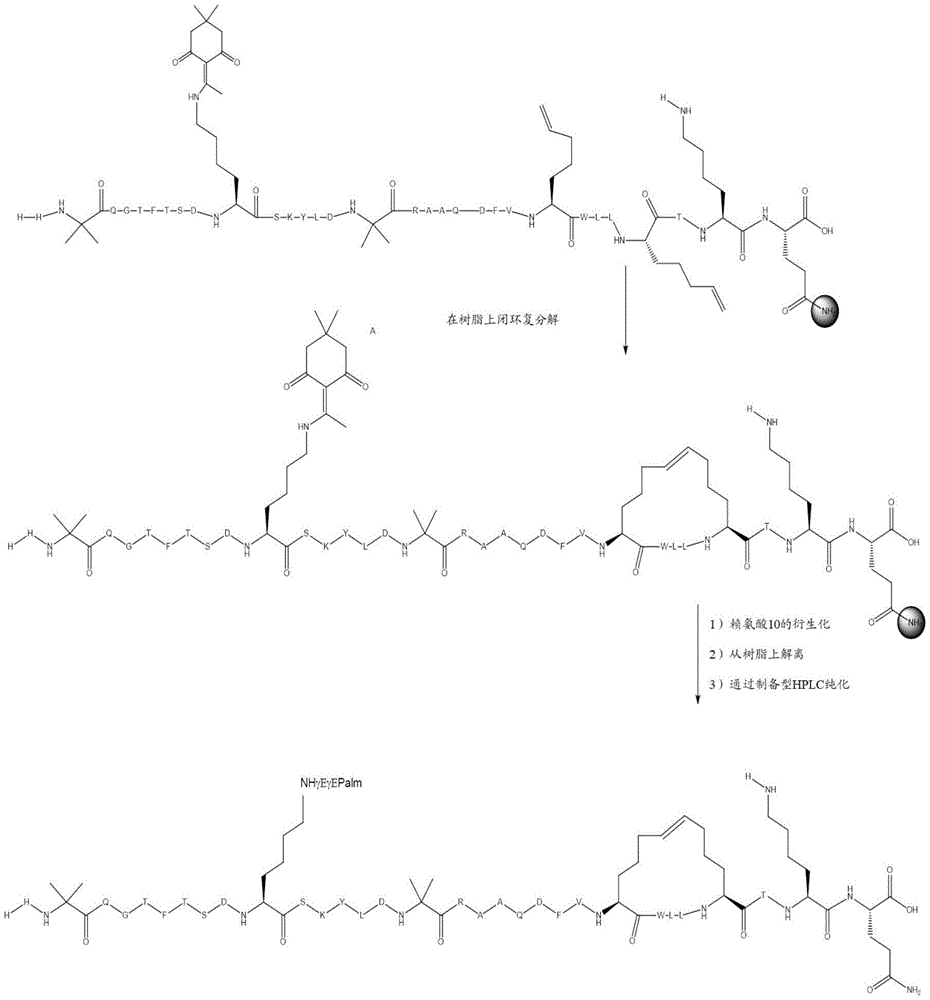
SEQ ID NO.16肽SEQ ID NO. 16 Peptide
HUQGTFTSDK(γEγEC16)SKYLDURAAQDFV*S5HWLL*S5HTKγE-NH2 HUQGTFTSDK(γEγEC16)SKYLDURAAQDFV*S 5H WLL*S 5H TKγE-NH 2
根据实施例1的方法,从适当的起始物料和试剂开始合成。The synthesis was started according to the method of Example 1 starting from the appropriate starting materials and reagents.
从His1到Thr7、从Asp15到Aib16(氨基异丁酸)和从Phe22到Val23进行45分钟的双酰化反应。N-端残基作为Boc-His(Trt)-OH被引入。对于序列ID 7、8、10、12、13、14、15、16,在位置10处的赖氨酸是通过正交Dde[1-(4,4-二甲基-2,6-二氧代环己-1-亚基)乙基]保护基团保护。Bisacylation reactions were carried out for 45 minutes from His 1 to Thr 7 , from Asp 15 to Aib 16 (aminoisobutyric acid) and from Phe 22 to Val 23 . The N-terminal residue was introduced as Boc-His(Trt)-OH. For Sequence IDs 7, 8, 10, 12, 13, 14, 15, 16, the lysine at position 10 is passed through the orthogonal Dde[1-(4,4-dimethyl-2,6-dioxo substituted cyclohex-1-ylidene)ethyl] protecting group protection.
序列ID 16具有如S5H的两个带有烯基的氨基酸作为肽前体组装在树脂上。Sequence ID 16 has two alkenyl-bearing amino acids such as S5H assembled on resin as peptide precursors.
两个带有烯基的氨基酸的S5H通过采用闭环复分解的化学策略在序列内的位置i、i+4(即24和28)组合以形成全烃键。两个S5H氨基酸环化形成一个全烃环,如SEQ ID Nos.16的结构所示的在它们的α碳之间形成键(E或Z)-十二-5-烯的连接。The S5Hs of two alkenyl-bearing amino acids are combined at positions i, i+4 (ie, 24 and 28) within the sequence to form an all-hydrocarbon bond by employing a chemical strategy of ring-closure metathesis. Two S5H amino acids are cyclized to form an all-hydrocarbon ring, forming a linkage between their alpha carbons to form a bond (E or Z)-dodec-5-ene as shown in the structure of SEQ ID Nos. 16.
烯基氨基酸通过手动偶联被引入,用HOAt(羟基苯并氮杂三唑)和DIC(N,N’-二异丙基碳二亚胺)活化。闭环复分解在烯烃侧链之间通过在组装结束时将相应的肽与20molGrubbs
干燥的肽-树脂在室温下用88%TFA、5%苯酚、2%三异丙基硅烷和5%水处理2小时,使保护基团从树脂上脱保护和解离。过滤溶液以除去树脂,粗肽溶液在冷甲基叔丁基醚中沉淀。将肽沉淀重悬、洗涤并在冷甲基叔丁基醚中离心2次。将肽沉淀在真空下干燥,然后重新悬浮在H2O、20%乙腈中并冻干。The dried peptide-resin was treated with 88% TFA, 5% phenol, 2% triisopropylsilane and 5% water for 2 hours at room temperature to deprotect and dissociate the protecting groups from the resin. The solution was filtered to remove the resin and the crude peptide solution was precipitated in cold methyl tert-butyl ether. The peptide pellet was resuspended, washed and centrifuged twice in cold methyl tert-butyl ether. The peptide pellet was dried under vacuum, then resuspended in H2O , 20% acetonitrile and lyophilized.
粗肽(200mg在3ml DMSO中)通过反相HPLC纯化,使用制备型Waters Deltapak C4(40x 200mm,15μm,
最终肽在Acquity UPLC Waters色谱仪上,使用BEH300 C4 Acquity Waters2.1x100mm,1.7μm,在45℃,使用H2O,0.1%TFA(A)和CH3CN,0.1%TFA(B)作为溶剂并在Acquity SQ检测器上通过电喷雾质谱法进行表征。在Acquity SQ检测器上通过电喷雾质谱法对肽进行了表征(MW实验值:4073.71Da;MW预期值:4074.2)。Final peptides were chromatographed on Acquity UPLC Waters using BEH300 C4 Acquity Waters 2.1x100mm, 1.7μm at 45°C using H2O , 0.1% TFA (A) and CH3CN , 0.1% TFA (B) as solvent and Characterization was performed by electrospray mass spectrometry on an Acquity SQ detector. Peptides were characterized by electrospray mass spectrometry on an Acquity SQ detector (MW found: 4073.71 Da; MW expected: 4074.2).
实施例3Example 3
在cAMP活性测定中测量肽对胰高血糖素受体(GCGR)和GLP-1受体(GLP1R)的活性。The activity of the peptides at the glucagon receptor (GCGR) and the GLP-1 receptor (GLP1R) was measured in a cAMP activity assay.
将肽溶解在100%DMSO中,并连续稀释以产生10个点滴定。然后将肽溶液转移到384孔测定板(150nL/孔)中。将表达人GLP1R或人GCGR的可测定冷冻细胞悬浮在由DMEM培养基(GIBCO)、10%FBS(GIBCO)、1x NEAA(GIBCO)、1x P/S(GIBCO)、10ug/ml杀稻瘟菌素(GIBCO)和200μg/mL潮霉素(GIBCO)组成的生长培养基中。然后将细胞在由PBS(GIBCO)、7.5%BSA(Perkin Elmer)、100μM RO 20-1724(Sigma),含或不含20%人血清(MPBiomedical)组成的分析缓冲液中稀释。然后将细胞悬浮液(15μL)添加到含有肽溶液的测定板中(人GCGR为30,000个细胞/孔;人GLP1R为10,000个细胞/孔)。将细胞在黑暗中于室温下孵育1小时。使用HitHunterTM cAMPXS试剂盒(DiscoverX)按照制造商方案测定cAMP的产生。将板在黑暗中于室温下孵育过夜。使用EnVision Multilabel读板器(Perkin Elmer)测量荧光。天然GLP-1和胰高血糖素(Bachem)用作对照肽。EC50值是使用基于Levenberg-Marquardt算法的4参数逻辑拟合计算的。Peptides were dissolved in 100% DMSO and serially diluted to generate 10 point titrations. The peptide solution was then transferred to a 384-well assay plate (150 nL/well). Assayable frozen cells expressing human GLP1R or human GCGR were suspended in DMEM medium (GIBCO), 10% FBS (GIBCO), 1x NEAA (GIBCO), 1x P/S (GIBCO), 10 ug/ml M. oryzae in a growth medium consisting of hygromycin (GIBCO) and 200 μg/mL hygromycin (GIBCO). Cells were then diluted in assay buffer consisting of PBS (GIBCO), 7.5% BSA (Perkin Elmer), 100 μM RO 20-1724 (Sigma), with or without 20% human serum (MP Biomedical). The cell suspension (15 μL) was then added to the assay plate containing the peptide solution (30,000 cells/well for human GCGR; 10,000 cells/well for human GLP1R). Cells were incubated for 1 hour at room temperature in the dark. cAMP production was determined using the HitHunter ™ cAMPXS kit (DiscoverX) following the manufacturer's protocol. Plates were incubated overnight at room temperature in the dark. Fluorescence was measured using an EnVision Multilabel plate reader (Perkin Elmer). Native GLP-1 and glucagon (Bachem) were used as control peptides. EC50 values were calculated using a 4-parameter logistic fit based on the Levenberg-Marquardt algorithm.
本发明的肽在胰高血糖素和GLP-1受体中各自具有小于5nM的EC50值。SEQ IDNos.6-19中的肽具有特定的胰高血糖素受体EC50值和GLP-1受体EC50值,如表2所示。The peptides of the present invention have EC50 values of less than 5 nM each at the glucagon and GLP-1 receptors. The peptides in SEQ ID Nos. 6-19 have specific glucagon receptor EC50 values and GLP-1 receptor EC50 values, as shown in Table 2.

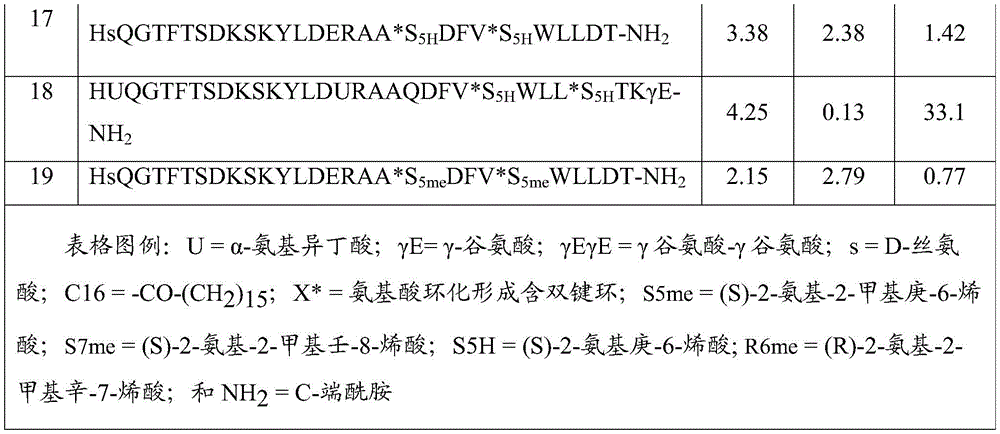
实施例4Example 4
硫黄素T测定Thioflavin T determination
钉合肽的物理稳定性可通过硫黄素T测定(Schlein,Morten;The AAPS Journal,Vol.19,No.2,March 2017))进行测试,以确定原纤维形成开始之前的时间量。The physical stability of stapled peptides can be tested by the Thioflavin T assay (Schlein, Morten; The AAPS Journal, Vol. 19, No. 2, March 2017)) to determine the amount of time before fibril formation begins.
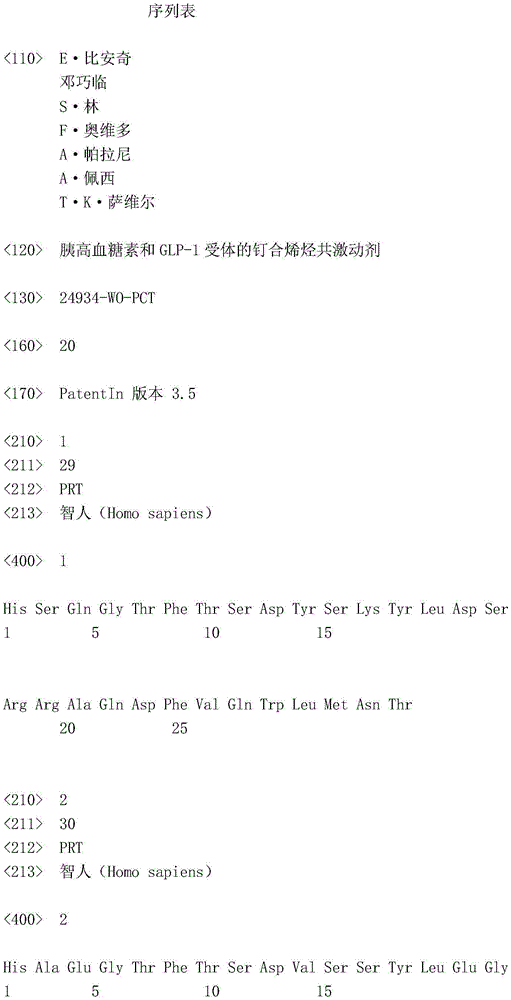
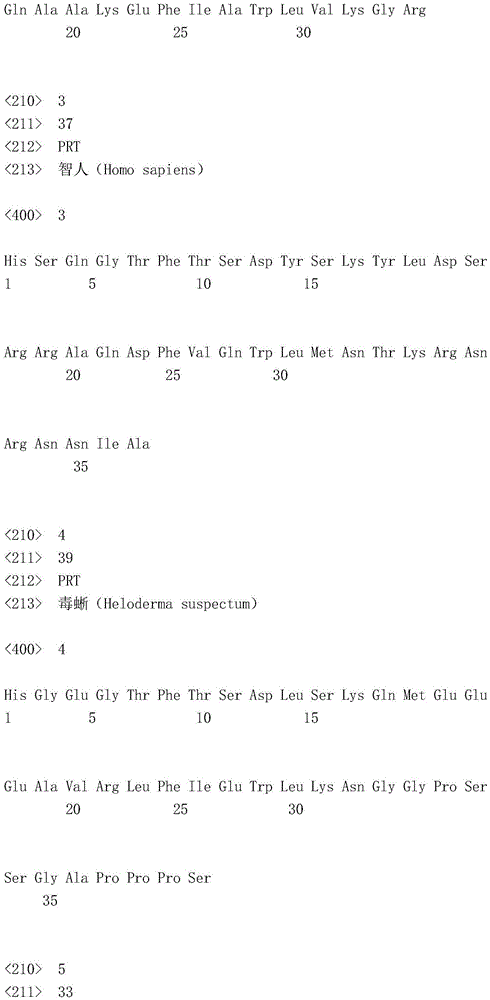
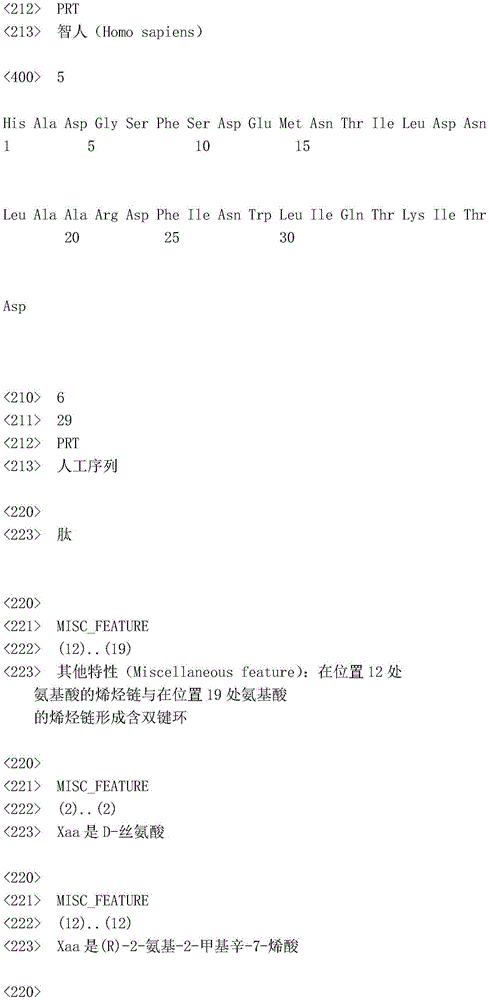

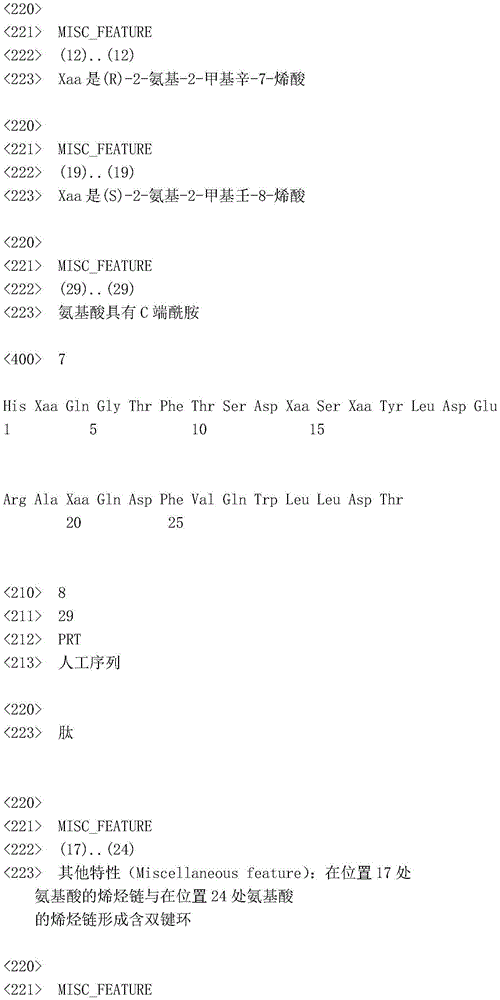
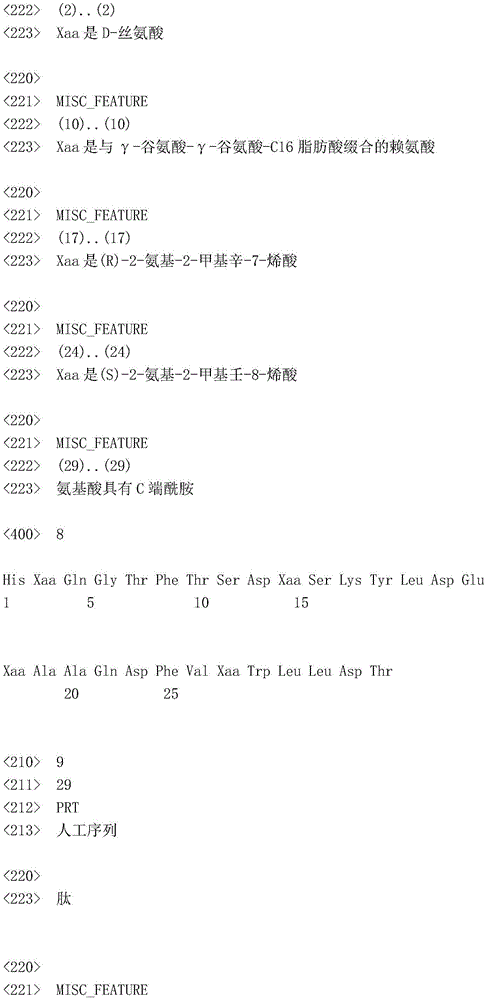

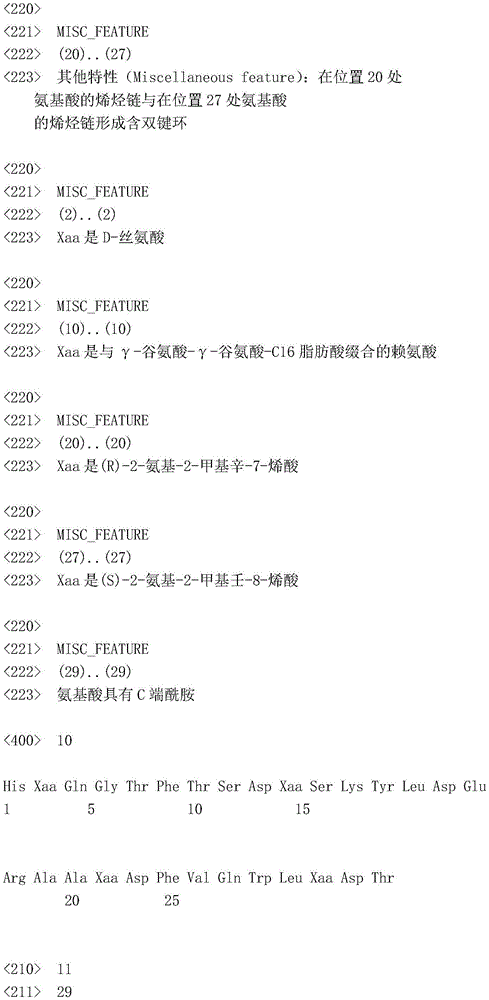
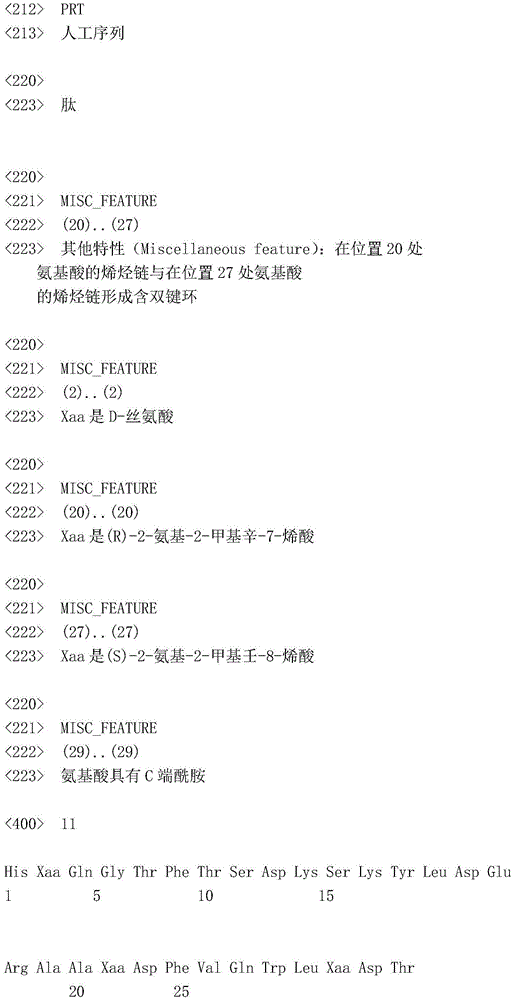

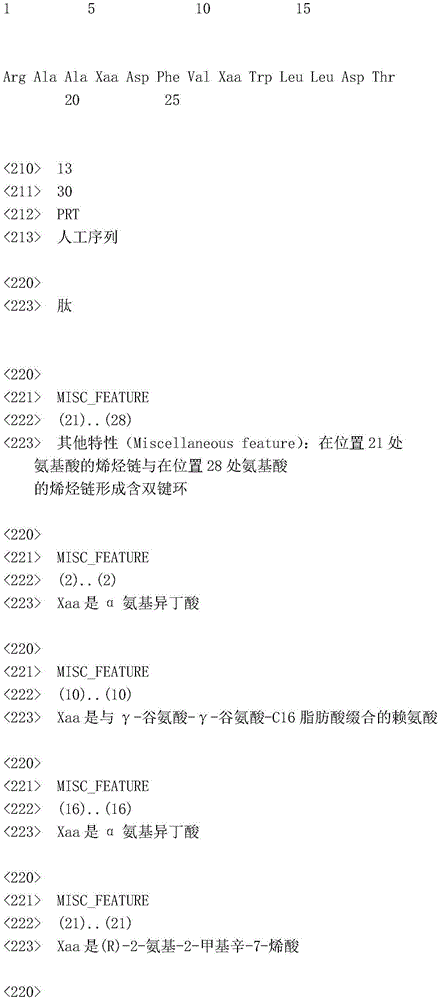
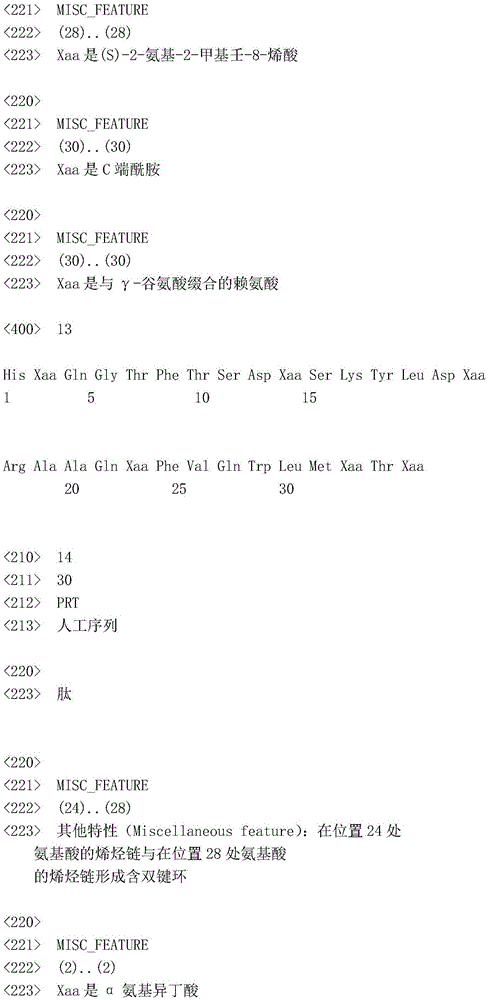


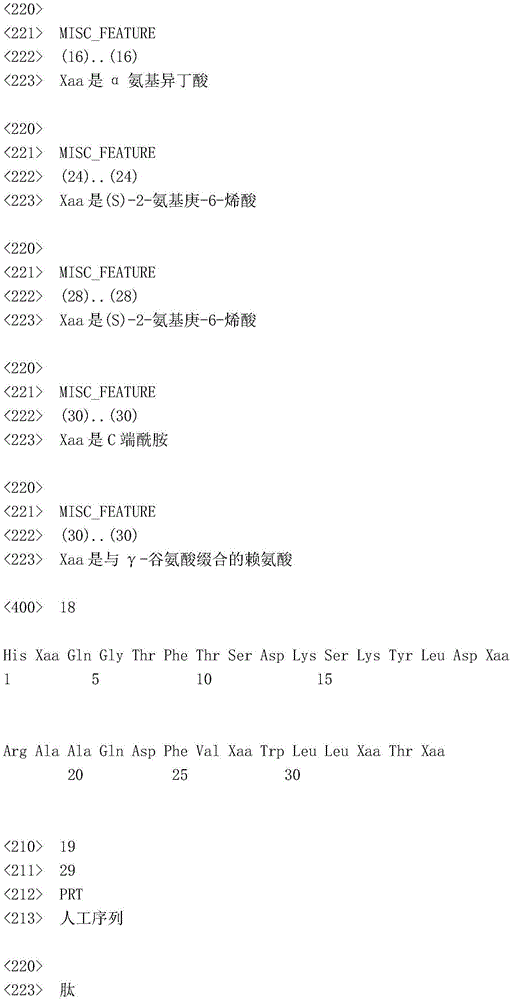


Claims (31)
Applications Claiming Priority (3)
| Application Number | Priority Date | Filing Date | Title |
|---|---|---|---|
| EP19425097.3A EP3842449A1 (en) | 2019-12-23 | 2019-12-23 | Stapled olefin co-agonists of the glucagon and glp-1 receptors |
| EP19425097.3 | 2019-12-23 | ||
| PCT/US2020/065792 WO2021133643A1 (en) | 2019-12-23 | 2020-12-18 | Stapled olefin co-agonists of the glucagon and glp-1 receptors |
Publications (1)
| Publication Number | Publication Date |
|---|---|
| CN115243708A true CN115243708A (en) | 2022-10-25 |
Family
ID=69326341
Family Applications (1)
| Application Number | Title | Priority Date | Filing Date |
|---|---|---|---|
| CN202080096814.3A Pending CN115243708A (en) | 2019-12-23 | 2020-12-18 | Stapled olefin co-agonists of glucagon and GLP-1 receptors |
Country Status (10)
| Country | Link |
|---|---|
| US (1) | US20230270825A1 (en) |
| EP (2) | EP3842449A1 (en) |
| JP (1) | JP2023508348A (en) |
| KR (1) | KR20220122689A (en) |
| CN (1) | CN115243708A (en) |
| AU (1) | AU2020412593A1 (en) |
| BR (1) | BR112022012307A2 (en) |
| CA (1) | CA3162793A1 (en) |
| MX (1) | MX2022007928A (en) |
| WO (1) | WO2021133643A1 (en) |
Citations (5)
| Publication number | Priority date | Publication date | Assignee | Title |
|---|---|---|---|---|
| WO2008121767A2 (en) * | 2007-03-28 | 2008-10-09 | President And Fellows Of Harvard College | Stitched polypeptides |
| WO2010148089A1 (en) * | 2009-06-16 | 2010-12-23 | Indiana University Research And Technology Corporation | Gip receptor-active glucagon compounds |
| CN103857408A (en) * | 2011-06-22 | 2014-06-11 | 印第安那大学科技研究公司 | Glucagon/glp-1 receptor co-agonists |
| US20170008944A1 (en) * | 2015-07-10 | 2017-01-12 | Sanofi | Exendin-4 Derivatives as Selective Peptidic Dual GLP-1/Glucagon Receptor Agonists |
| AR107281A1 (en) * | 2015-12-31 | 2018-04-18 | Hanmi Pharm Ind Co Ltd | PROLONGED CONJUGATE OF THE TRIGONAL GLUCAGON RECEIVER AGONIST / GLP-1 / GIP |
Family Cites Families (41)
| Publication number | Priority date | Publication date | Assignee | Title |
|---|---|---|---|---|
| US4737323A (en) | 1986-02-13 | 1988-04-12 | Liposome Technology, Inc. | Liposome extrusion method |
| US4837028A (en) | 1986-12-24 | 1989-06-06 | Liposome Technology, Inc. | Liposomes with enhanced circulation time |
| AR008789A1 (en) | 1996-07-31 | 2000-02-23 | Bayer Corp | PIRIDINES AND SUBSTITUTED BIPHENYLS |
| US6284748B1 (en) | 1997-03-07 | 2001-09-04 | Metabasis Therapeutics, Inc. | Purine inhibitors of fructose 1,6-bisphosphatase |
| AU6691498A (en) | 1997-03-07 | 1998-09-22 | Metabasis Therapeutics, Inc. | Novel benzimidazole inhibitors of fructose-1,6-bisphosphatase |
| AU6691798A (en) | 1997-03-07 | 1998-09-22 | Metabasis Therapeutics, Inc. | Novel indole and azaindole inhibitors of fructose-1,6-bisphosphatase |
| AU749271B2 (en) | 1997-07-01 | 2002-06-20 | Agouron Pharmaceuticals, Inc. | Glucagon antagonists/inverse agonists |
| US6613942B1 (en) | 1997-07-01 | 2003-09-02 | Novo Nordisk A/S | Glucagon antagonists/inverse agonists |
| EP1112275B9 (en) | 1998-09-09 | 2004-03-10 | Metabasis Therapeutics, Inc. | Novel heteroaromatic inhibitors of fructose 1,6-bisphosphatase |
| PL352367A1 (en) | 1999-05-17 | 2003-08-25 | Novo Nordisk As | Glucagon antagonists/inverse agonists |
| US6677136B2 (en) * | 2000-05-03 | 2004-01-13 | Amgen Inc. | Glucagon antagonists |
| JP2004513076A (en) | 2000-07-25 | 2004-04-30 | メルク エンド カムパニー インコーポレーテッド | N-substituted indoles useful in the treatment of diabetes |
| US6852738B2 (en) | 2001-01-30 | 2005-02-08 | Merck & Co., Inc. | Acyl sulfamides for treatment of obesity, diabetes and lipid disorders |
| GB0121709D0 (en) | 2001-09-07 | 2001-10-31 | Imp College Innovations Ltd | Food inhibition agent |
| AR040241A1 (en) | 2002-06-10 | 2005-03-23 | Merck & Co Inc | INHIBITORS OF 11-BETA-HYDROXIESTEROID DEHYDROGRENASE 1 FOR THE TREATMENT OF DIABETES OBESITY AND DISLIPIDEMIA |
| RU2328483C2 (en) | 2002-08-29 | 2008-07-10 | Мерк Энд Ко., Инк. | Indoles with antidiabetic activity |
| WO2004019869A2 (en) | 2002-08-29 | 2004-03-11 | Merck & Co., Inc. | Indoles having anti-diabetic activity |
| JO2397B1 (en) | 2002-12-20 | 2007-06-17 | ميرك شارب اند دوم كوربوريشن | Triazole Derivatives As Inhibitors Of 11-Beta -Hydroxysteriod Dehydrogenase-1 |
| GB0300571D0 (en) | 2003-01-10 | 2003-02-12 | Imp College Innovations Ltd | Modification of feeding behaviour |
| CA2512879A1 (en) | 2003-01-17 | 2004-08-12 | Soumya P. Sahoo | N-cyclohexylaminocarbonyl benzenesulfonamide derivatives |
| CA2609810C (en) * | 2005-06-06 | 2012-05-22 | Camurus Ab | Glp-1 analogue formulations |
| JP2008543816A (en) | 2005-06-13 | 2008-12-04 | インペリアル イノベーションズ リミテッド | Novel compounds and their effects on eating behavior |
| EP1976873A2 (en) * | 2006-01-11 | 2008-10-08 | Brystol-Myers Squibb Company | Human glucagon-like-peptide-1 modulators and their use in the treatment of diabetes and related conditions |
| US8175737B2 (en) | 2006-07-19 | 2012-05-08 | Freescale Semiconductor, Inc. | Method and apparatus for designing and integrated circuit |
| AU2008216265B2 (en) | 2007-02-15 | 2014-04-03 | Indiana University Research And Technology Corporation | Glucagon/GLP-1 receptor co-agonists |
| WO2009000087A1 (en) | 2007-06-28 | 2008-12-31 | Merck Frosst Canada Ltd. | Substituted fused pyrimidines as antagonists of gpr105 activity |
| KR101404781B1 (en) | 2007-06-28 | 2014-06-12 | 가부시키가이샤 한도오따이 에네루기 켄큐쇼 | Manufacturing method of semiconductor device |
| US20100184758A1 (en) | 2007-07-19 | 2010-07-22 | Dobbelaar Peter H | Beta carboline derivatives as antidiabetic compounds |
| WO2009042053A2 (en) | 2007-09-21 | 2009-04-02 | Merck & Co., Inc. | Neuromedin u receptor agonists and uses thereof |
| MX337038B (en) | 2008-06-17 | 2016-02-10 | Univ Indiana Res & Tech Corp | Glucagon/glp-1 receptor co-agonists. |
| WO2010011313A2 (en) * | 2008-07-23 | 2010-01-28 | President And Fellows Of Harvard College | Ligation of stapled polypeptides |
| WO2010096052A1 (en) | 2009-02-19 | 2010-08-26 | Merck Sharp & Dohme Corp. | Oxyntomodulin analogs |
| WO2011075393A2 (en) | 2009-12-18 | 2011-06-23 | Indiana University Research And Technology Corporation | Glucagon/glp-1 receptor co-agonists |
| MX2013015168A (en) | 2011-06-22 | 2014-03-31 | Univ Indiana Res & Tech Corp | Glucagon/glp-1 receptor co-agonists. |
| CA2852468A1 (en) * | 2011-10-18 | 2013-04-25 | Aileron Therapeutics, Inc. | Peptidomimetic macrocyles |
| EP3082797A4 (en) * | 2013-12-18 | 2017-12-13 | The California Institute for Biomedical Research | Modified therapeutic agents, stapled peptide lipid conjugates, and compositions thereof |
| US20150196651A1 (en) * | 2014-01-15 | 2015-07-16 | USTAV ORGANICKE CHEMIE A BIOCHEMIE AKADEMIE VED CR, v.v.i. | Lipidated peptides for lowering blood glucose |
| MX382408B (en) | 2014-10-24 | 2025-03-13 | Merck Sharp & Dohme Llc | GLUCAGON AND GLP-1 RECEPTOR COAGONISTS. |
| WO2017189342A1 (en) * | 2016-04-26 | 2017-11-02 | Merck Sharp & Dohme Corp. | Insulin dimer-incretin conjugates |
| AU2018338184B2 (en) | 2017-09-25 | 2023-04-13 | Merck Sharp & Dohme Llc | Long-acting co-agonists of the glucagon and GLP-1 receptors |
| WO2019157131A1 (en) * | 2018-02-07 | 2019-08-15 | Dana-Farber Cancer Institute, Inc. | Cell-permeable stapled peptide modules for cellular delivery |
-
2019
- 2019-12-23 EP EP19425097.3A patent/EP3842449A1/en not_active Withdrawn
-
2020
- 2020-12-18 CN CN202080096814.3A patent/CN115243708A/en active Pending
- 2020-12-18 EP EP20906909.5A patent/EP4081244B1/en active Active
- 2020-12-18 WO PCT/US2020/065792 patent/WO2021133643A1/en not_active Ceased
- 2020-12-18 JP JP2022538470A patent/JP2023508348A/en active Pending
- 2020-12-18 KR KR1020227025621A patent/KR20220122689A/en not_active Withdrawn
- 2020-12-18 AU AU2020412593A patent/AU2020412593A1/en active Pending
- 2020-12-18 US US17/785,772 patent/US20230270825A1/en active Pending
- 2020-12-18 CA CA3162793A patent/CA3162793A1/en active Pending
- 2020-12-18 MX MX2022007928A patent/MX2022007928A/en unknown
- 2020-12-18 BR BR112022012307A patent/BR112022012307A2/en unknown
Patent Citations (5)
| Publication number | Priority date | Publication date | Assignee | Title |
|---|---|---|---|---|
| WO2008121767A2 (en) * | 2007-03-28 | 2008-10-09 | President And Fellows Of Harvard College | Stitched polypeptides |
| WO2010148089A1 (en) * | 2009-06-16 | 2010-12-23 | Indiana University Research And Technology Corporation | Gip receptor-active glucagon compounds |
| CN103857408A (en) * | 2011-06-22 | 2014-06-11 | 印第安那大学科技研究公司 | Glucagon/glp-1 receptor co-agonists |
| US20170008944A1 (en) * | 2015-07-10 | 2017-01-12 | Sanofi | Exendin-4 Derivatives as Selective Peptidic Dual GLP-1/Glucagon Receptor Agonists |
| AR107281A1 (en) * | 2015-12-31 | 2018-04-18 | Hanmi Pharm Ind Co Ltd | PROLONGED CONJUGATE OF THE TRIGONAL GLUCAGON RECEIVER AGONIST / GLP-1 / GIP |
Non-Patent Citations (1)
| Title |
|---|
| 钱海等: "基于胰高血糖素样肽-1的多重受体激动剂的研究进展", 《药学进展》, vol. 43, no. 10, 25 October 2019 (2019-10-25), pages 738 - 748 * |
Also Published As
| Publication number | Publication date |
|---|---|
| JP2023508348A (en) | 2023-03-02 |
| EP4081244B1 (en) | 2025-11-26 |
| BR112022012307A2 (en) | 2022-09-06 |
| CA3162793A1 (en) | 2021-07-01 |
| MX2022007928A (en) | 2022-09-29 |
| AU2020412593A1 (en) | 2022-07-14 |
| EP4081244A1 (en) | 2022-11-02 |
| EP4081244A4 (en) | 2024-05-08 |
| KR20220122689A (en) | 2022-09-02 |
| EP3842449A1 (en) | 2021-06-30 |
| WO2021133643A1 (en) | 2021-07-01 |
| US20230270825A1 (en) | 2023-08-31 |
Similar Documents
| Publication | Publication Date | Title |
|---|---|---|
| AU2015335828B2 (en) | Co-agonists of the glucagon and GLP-1 receptors | |
| US11492385B2 (en) | Long-acting co-agonists of the glucagon and GLP-1 receptors | |
| KR20200057059A (en) | Long-acting co-agonist of glucagon and GLP-1 receptor | |
| CN115226391A (en) | Stapled triazole co-agonists of glucagon and GLP-1 receptors | |
| EP4081244B1 (en) | Stapled olefin co-agonists of the glucagon and glp-1 receptors | |
| CN114867742A (en) | Stapled lactam co-agonists of glucagon and GLP-1 receptor |
Legal Events
| Date | Code | Title | Description |
|---|---|---|---|
| PB01 | Publication | ||
| PB01 | Publication | ||
| SE01 | Entry into force of request for substantive examination | ||
| SE01 | Entry into force of request for substantive examination | ||
| WD01 | Invention patent application deemed withdrawn after publication |
Application publication date: 20221025 |