CN115232803A - Immobilized cellulase, preparation method and preparation device of immobilized cellulase - Google Patents
Immobilized cellulase, preparation method and preparation device of immobilized cellulase Download PDFInfo
- Publication number
- CN115232803A CN115232803A CN202210921885.3A CN202210921885A CN115232803A CN 115232803 A CN115232803 A CN 115232803A CN 202210921885 A CN202210921885 A CN 202210921885A CN 115232803 A CN115232803 A CN 115232803A
- Authority
- CN
- China
- Prior art keywords
- immobilized
- cellulase
- solution
- calcium chloride
- preparation
- Prior art date
- Legal status (The legal status is an assumption and is not a legal conclusion. Google has not performed a legal analysis and makes no representation as to the accuracy of the status listed.)
- Granted
Links
- 108010059892 Cellulase Proteins 0.000 title claims abstract description 84
- 229940106157 cellulase Drugs 0.000 title claims abstract description 84
- 238000002360 preparation method Methods 0.000 title claims abstract description 25
- 108010093096 Immobilized Enzymes Proteins 0.000 claims abstract description 65
- 239000008188 pellet Substances 0.000 claims abstract description 40
- UXVMQQNJUSDDNG-UHFFFAOYSA-L Calcium chloride Chemical compound [Cl-].[Cl-].[Ca+2] UXVMQQNJUSDDNG-UHFFFAOYSA-L 0.000 claims abstract description 37
- IXPNQXFRVYWDDI-UHFFFAOYSA-N 1-methyl-2,4-dioxo-1,3-diazinane-5-carboximidamide Chemical compound CN1CC(C(N)=N)C(=O)NC1=O IXPNQXFRVYWDDI-UHFFFAOYSA-N 0.000 claims abstract description 23
- 239000000661 sodium alginate Substances 0.000 claims abstract description 23
- 235000010413 sodium alginate Nutrition 0.000 claims abstract description 23
- 229940005550 sodium alginate Drugs 0.000 claims abstract description 23
- VYPSYNLAJGMNEJ-UHFFFAOYSA-N Silicium dioxide Chemical compound O=[Si]=O VYPSYNLAJGMNEJ-UHFFFAOYSA-N 0.000 claims abstract description 21
- 229920002873 Polyethylenimine Polymers 0.000 claims abstract description 18
- SXRSQZLOMIGNAQ-UHFFFAOYSA-N Glutaraldehyde Chemical compound O=CCCCC=O SXRSQZLOMIGNAQ-UHFFFAOYSA-N 0.000 claims abstract description 14
- 238000002791 soaking Methods 0.000 claims abstract description 7
- 239000000377 silicon dioxide Substances 0.000 claims description 17
- 238000001179 sorption measurement Methods 0.000 claims description 11
- 230000007246 mechanism Effects 0.000 claims description 10
- 238000000034 method Methods 0.000 claims description 10
- 229920001800 Shellac Polymers 0.000 claims description 9
- 239000003463 adsorbent Substances 0.000 claims description 9
- 239000004208 shellac Substances 0.000 claims description 9
- 229940113147 shellac Drugs 0.000 claims description 9
- ZLGIYFNHBLSMPS-ATJNOEHPSA-N shellac Chemical compound OCCCCCC(O)C(O)CCCCCCCC(O)=O.C1C23[C@H](C(O)=O)CCC2[C@](C)(CO)[C@@H]1C(C(O)=O)=C[C@@H]3O ZLGIYFNHBLSMPS-ATJNOEHPSA-N 0.000 claims description 9
- 235000013874 shellac Nutrition 0.000 claims description 9
- 239000001110 calcium chloride Substances 0.000 claims description 3
- 229910001628 calcium chloride Inorganic materials 0.000 claims description 3
- 239000012528 membrane Substances 0.000 claims 1
- 238000002156 mixing Methods 0.000 abstract description 4
- 230000001678 irradiating effect Effects 0.000 abstract 1
- 239000005543 nano-size silicon particle Substances 0.000 abstract 1
- 235000012239 silicon dioxide Nutrition 0.000 abstract 1
- 239000000243 solution Substances 0.000 description 34
- 108090000790 Enzymes Proteins 0.000 description 18
- 102000004190 Enzymes Human genes 0.000 description 18
- 229940088598 enzyme Drugs 0.000 description 18
- 230000000694 effects Effects 0.000 description 15
- 238000006243 chemical reaction Methods 0.000 description 12
- 239000000758 substrate Substances 0.000 description 12
- 239000000463 material Substances 0.000 description 8
- XLYOFNOQVPJJNP-UHFFFAOYSA-N water Substances O XLYOFNOQVPJJNP-UHFFFAOYSA-N 0.000 description 8
- WQZGKKKJIJFFOK-GASJEMHNSA-N Glucose Natural products OC[C@H]1OC(O)[C@H](O)[C@@H](O)[C@@H]1O WQZGKKKJIJFFOK-GASJEMHNSA-N 0.000 description 6
- 239000008103 glucose Substances 0.000 description 6
- 230000008569 process Effects 0.000 description 6
- 238000003756 stirring Methods 0.000 description 6
- 229910021642 ultra pure water Inorganic materials 0.000 description 6
- 239000012498 ultrapure water Substances 0.000 description 6
- LWFUFLREGJMOIZ-UHFFFAOYSA-N 3,5-dinitrosalicylic acid Chemical compound OC(=O)C1=CC([N+]([O-])=O)=CC([N+]([O-])=O)=C1O LWFUFLREGJMOIZ-UHFFFAOYSA-N 0.000 description 5
- BHPQYMZQTOCNFJ-UHFFFAOYSA-N Calcium cation Chemical compound [Ca+2] BHPQYMZQTOCNFJ-UHFFFAOYSA-N 0.000 description 5
- 229910001424 calcium ion Inorganic materials 0.000 description 5
- 238000005345 coagulation Methods 0.000 description 5
- 230000015271 coagulation Effects 0.000 description 5
- 238000002835 absorbance Methods 0.000 description 4
- 238000005516 engineering process Methods 0.000 description 4
- 239000011148 porous material Substances 0.000 description 4
- 239000002994 raw material Substances 0.000 description 4
- HEMHJVSKTPXQMS-UHFFFAOYSA-M Sodium hydroxide Chemical compound [OH-].[Na+] HEMHJVSKTPXQMS-UHFFFAOYSA-M 0.000 description 3
- 235000010443 alginic acid Nutrition 0.000 description 3
- 229960001126 alginic acid Drugs 0.000 description 3
- 239000000783 alginic acid Substances 0.000 description 3
- 229920000615 alginic acid Polymers 0.000 description 3
- 150000004781 alginic acids Chemical class 0.000 description 3
- 239000012876 carrier material Substances 0.000 description 3
- KRKNYBCHXYNGOX-UHFFFAOYSA-N citric acid Chemical compound OC(=O)CC(O)(C(O)=O)CC(O)=O KRKNYBCHXYNGOX-UHFFFAOYSA-N 0.000 description 3
- 239000012467 final product Substances 0.000 description 3
- 230000014759 maintenance of location Effects 0.000 description 3
- 238000004519 manufacturing process Methods 0.000 description 3
- 238000007493 shaping process Methods 0.000 description 3
- FAPWRFPIFSIZLT-UHFFFAOYSA-M Sodium chloride Chemical compound [Na+].[Cl-] FAPWRFPIFSIZLT-UHFFFAOYSA-M 0.000 description 2
- 230000009471 action Effects 0.000 description 2
- 230000009286 beneficial effect Effects 0.000 description 2
- 239000002981 blocking agent Substances 0.000 description 2
- 230000000903 blocking effect Effects 0.000 description 2
- 238000009835 boiling Methods 0.000 description 2
- 239000000648 calcium alginate Substances 0.000 description 2
- 235000010410 calcium alginate Nutrition 0.000 description 2
- 229960002681 calcium alginate Drugs 0.000 description 2
- OKHHGHGGPDJQHR-YMOPUZKJSA-L calcium;(2s,3s,4s,5s,6r)-6-[(2r,3s,4r,5s,6r)-2-carboxy-6-[(2r,3s,4r,5s,6r)-2-carboxylato-4,5,6-trihydroxyoxan-3-yl]oxy-4,5-dihydroxyoxan-3-yl]oxy-3,4,5-trihydroxyoxane-2-carboxylate Chemical compound [Ca+2].O[C@@H]1[C@H](O)[C@H](O)O[C@@H](C([O-])=O)[C@H]1O[C@H]1[C@@H](O)[C@@H](O)[C@H](O[C@H]2[C@H]([C@@H](O)[C@H](O)[C@H](O2)C([O-])=O)O)[C@H](C(O)=O)O1 OKHHGHGGPDJQHR-YMOPUZKJSA-L 0.000 description 2
- 230000002255 enzymatic effect Effects 0.000 description 2
- 150000002500 ions Chemical class 0.000 description 2
- 238000011068 loading method Methods 0.000 description 2
- 239000011259 mixed solution Substances 0.000 description 2
- 230000004048 modification Effects 0.000 description 2
- 238000012986 modification Methods 0.000 description 2
- 239000003607 modifier Substances 0.000 description 2
- 238000000465 moulding Methods 0.000 description 2
- 230000002093 peripheral effect Effects 0.000 description 2
- 230000001681 protective effect Effects 0.000 description 2
- 230000009979 protective mechanism Effects 0.000 description 2
- 230000035484 reaction time Effects 0.000 description 2
- 238000007789 sealing Methods 0.000 description 2
- 238000007711 solidification Methods 0.000 description 2
- 230000008023 solidification Effects 0.000 description 2
- 239000012086 standard solution Substances 0.000 description 2
- OYPRJOBELJOOCE-UHFFFAOYSA-N Calcium Chemical compound [Ca] OYPRJOBELJOOCE-UHFFFAOYSA-N 0.000 description 1
- DGAQECJNVWCQMB-PUAWFVPOSA-M Ilexoside XXIX Chemical compound C[C@@H]1CC[C@@]2(CC[C@@]3(C(=CC[C@H]4[C@]3(CC[C@@H]5[C@@]4(CC[C@@H](C5(C)C)OS(=O)(=O)[O-])C)C)[C@@H]2[C@]1(C)O)C)C(=O)O[C@H]6[C@@H]([C@H]([C@@H]([C@H](O6)CO)O)O)O.[Na+] DGAQECJNVWCQMB-PUAWFVPOSA-M 0.000 description 1
- NIPNSKYNPDTRPC-UHFFFAOYSA-N N-[2-oxo-2-(2,4,6,7-tetrahydrotriazolo[4,5-c]pyridin-5-yl)ethyl]-2-[[3-(trifluoromethoxy)phenyl]methylamino]pyrimidine-5-carboxamide Chemical compound O=C(CNC(=O)C=1C=NC(=NC=1)NCC1=CC(=CC=C1)OC(F)(F)F)N1CC2=C(CC1)NN=N2 NIPNSKYNPDTRPC-UHFFFAOYSA-N 0.000 description 1
- ISWSIDIOOBJBQZ-UHFFFAOYSA-N Phenol Chemical compound OC1=CC=CC=C1 ISWSIDIOOBJBQZ-UHFFFAOYSA-N 0.000 description 1
- DPXJVFZANSGRMM-UHFFFAOYSA-N acetic acid;2,3,4,5,6-pentahydroxyhexanal;sodium Chemical compound [Na].CC(O)=O.OCC(O)C(O)C(O)C(O)C=O DPXJVFZANSGRMM-UHFFFAOYSA-N 0.000 description 1
- 239000002253 acid Substances 0.000 description 1
- 239000003513 alkali Substances 0.000 description 1
- 239000007864 aqueous solution Substances 0.000 description 1
- 239000012620 biological material Substances 0.000 description 1
- 239000000872 buffer Substances 0.000 description 1
- 239000011575 calcium Substances 0.000 description 1
- 229910052791 calcium Inorganic materials 0.000 description 1
- LHJQIRIGXXHNLA-UHFFFAOYSA-N calcium peroxide Chemical compound [Ca+2].[O-][O-] LHJQIRIGXXHNLA-UHFFFAOYSA-N 0.000 description 1
- 235000019402 calcium peroxide Nutrition 0.000 description 1
- 239000001768 carboxy methyl cellulose Substances 0.000 description 1
- 230000003197 catalytic effect Effects 0.000 description 1
- 238000006555 catalytic reaction Methods 0.000 description 1
- 239000001913 cellulose Substances 0.000 description 1
- 229920002678 cellulose Polymers 0.000 description 1
- 239000003153 chemical reaction reagent Substances 0.000 description 1
- 239000003795 chemical substances by application Substances 0.000 description 1
- 230000001112 coagulating effect Effects 0.000 description 1
- 239000011248 coating agent Substances 0.000 description 1
- 238000000576 coating method Methods 0.000 description 1
- 238000001816 cooling Methods 0.000 description 1
- 229910000365 copper sulfate Inorganic materials 0.000 description 1
- ARUVKPQLZAKDPS-UHFFFAOYSA-L copper(II) sulfate Chemical compound [Cu+2].[O-][S+2]([O-])([O-])[O-] ARUVKPQLZAKDPS-UHFFFAOYSA-L 0.000 description 1
- 239000003431 cross linking reagent Substances 0.000 description 1
- 230000007547 defect Effects 0.000 description 1
- 238000010586 diagram Methods 0.000 description 1
- 239000003814 drug Substances 0.000 description 1
- 238000006047 enzymatic hydrolysis reaction Methods 0.000 description 1
- 238000002474 experimental method Methods 0.000 description 1
- 238000000605 extraction Methods 0.000 description 1
- 238000001125 extrusion Methods 0.000 description 1
- 150000002303 glucose derivatives Chemical class 0.000 description 1
- 238000010438 heat treatment Methods 0.000 description 1
- 238000012417 linear regression Methods 0.000 description 1
- 239000007788 liquid Substances 0.000 description 1
- 239000000203 mixture Substances 0.000 description 1
- 239000003960 organic solvent Substances 0.000 description 1
- 230000010355 oscillation Effects 0.000 description 1
- 229920000642 polymer Polymers 0.000 description 1
- LJCNRYVRMXRIQR-OLXYHTOASA-L potassium sodium L-tartrate Chemical compound [Na+].[K+].[O-]C(=O)[C@H](O)[C@@H](O)C([O-])=O LJCNRYVRMXRIQR-OLXYHTOASA-L 0.000 description 1
- 229940074439 potassium sodium tartrate Drugs 0.000 description 1
- 239000000047 product Substances 0.000 description 1
- 230000005855 radiation Effects 0.000 description 1
- 230000036632 reaction speed Effects 0.000 description 1
- 238000011084 recovery Methods 0.000 description 1
- 239000011734 sodium Substances 0.000 description 1
- 235000019812 sodium carboxymethyl cellulose Nutrition 0.000 description 1
- 229920001027 sodium carboxymethylcellulose Polymers 0.000 description 1
- 239000011780 sodium chloride Substances 0.000 description 1
- 229910001415 sodium ion Inorganic materials 0.000 description 1
- 235000011006 sodium potassium tartrate Nutrition 0.000 description 1
- 238000003860 storage Methods 0.000 description 1
- 239000000126 substance Substances 0.000 description 1
- 238000006557 surface reaction Methods 0.000 description 1
- 239000004753 textile Substances 0.000 description 1
- 238000005406 washing Methods 0.000 description 1
- 239000002699 waste material Substances 0.000 description 1
Images


Classifications
-
- C—CHEMISTRY; METALLURGY
- C12—BIOCHEMISTRY; BEER; SPIRITS; WINE; VINEGAR; MICROBIOLOGY; ENZYMOLOGY; MUTATION OR GENETIC ENGINEERING
- C12N—MICROORGANISMS OR ENZYMES; COMPOSITIONS THEREOF; PROPAGATING, PRESERVING, OR MAINTAINING MICROORGANISMS; MUTATION OR GENETIC ENGINEERING; CULTURE MEDIA
- C12N9/00—Enzymes; Proenzymes; Compositions thereof; Processes for preparing, activating, inhibiting, separating or purifying enzymes
- C12N9/14—Hydrolases (3)
- C12N9/24—Hydrolases (3) acting on glycosyl compounds (3.2)
- C12N9/2402—Hydrolases (3) acting on glycosyl compounds (3.2) hydrolysing O- and S- glycosyl compounds (3.2.1)
- C12N9/2405—Glucanases
- C12N9/2434—Glucanases acting on beta-1,4-glucosidic bonds
- C12N9/2437—Cellulases (3.2.1.4; 3.2.1.74; 3.2.1.91; 3.2.1.150)
-
- C—CHEMISTRY; METALLURGY
- C12—BIOCHEMISTRY; BEER; SPIRITS; WINE; VINEGAR; MICROBIOLOGY; ENZYMOLOGY; MUTATION OR GENETIC ENGINEERING
- C12M—APPARATUS FOR ENZYMOLOGY OR MICROBIOLOGY; APPARATUS FOR CULTURING MICROORGANISMS FOR PRODUCING BIOMASS, FOR GROWING CELLS OR FOR OBTAINING FERMENTATION OR METABOLIC PRODUCTS, i.e. BIOREACTORS OR FERMENTERS
- C12M21/00—Bioreactors or fermenters specially adapted for specific uses
- C12M21/14—Bioreactors or fermenters specially adapted for specific uses for producing enzymes
-
- C—CHEMISTRY; METALLURGY
- C12—BIOCHEMISTRY; BEER; SPIRITS; WINE; VINEGAR; MICROBIOLOGY; ENZYMOLOGY; MUTATION OR GENETIC ENGINEERING
- C12M—APPARATUS FOR ENZYMOLOGY OR MICROBIOLOGY; APPARATUS FOR CULTURING MICROORGANISMS FOR PRODUCING BIOMASS, FOR GROWING CELLS OR FOR OBTAINING FERMENTATION OR METABOLIC PRODUCTS, i.e. BIOREACTORS OR FERMENTERS
- C12M29/00—Means for introduction, extraction or recirculation of materials, e.g. pumps
-
- C—CHEMISTRY; METALLURGY
- C12—BIOCHEMISTRY; BEER; SPIRITS; WINE; VINEGAR; MICROBIOLOGY; ENZYMOLOGY; MUTATION OR GENETIC ENGINEERING
- C12N—MICROORGANISMS OR ENZYMES; COMPOSITIONS THEREOF; PROPAGATING, PRESERVING, OR MAINTAINING MICROORGANISMS; MUTATION OR GENETIC ENGINEERING; CULTURE MEDIA
- C12N11/00—Carrier-bound or immobilised enzymes; Carrier-bound or immobilised microbial cells; Preparation thereof
- C12N11/02—Enzymes or microbial cells immobilised on or in an organic carrier
- C12N11/10—Enzymes or microbial cells immobilised on or in an organic carrier the carrier being a carbohydrate
-
- C—CHEMISTRY; METALLURGY
- C12—BIOCHEMISTRY; BEER; SPIRITS; WINE; VINEGAR; MICROBIOLOGY; ENZYMOLOGY; MUTATION OR GENETIC ENGINEERING
- C12N—MICROORGANISMS OR ENZYMES; COMPOSITIONS THEREOF; PROPAGATING, PRESERVING, OR MAINTAINING MICROORGANISMS; MUTATION OR GENETIC ENGINEERING; CULTURE MEDIA
- C12N11/00—Carrier-bound or immobilised enzymes; Carrier-bound or immobilised microbial cells; Preparation thereof
- C12N11/14—Enzymes or microbial cells immobilised on or in an inorganic carrier
-
- Y—GENERAL TAGGING OF NEW TECHNOLOGICAL DEVELOPMENTS; GENERAL TAGGING OF CROSS-SECTIONAL TECHNOLOGIES SPANNING OVER SEVERAL SECTIONS OF THE IPC; TECHNICAL SUBJECTS COVERED BY FORMER USPC CROSS-REFERENCE ART COLLECTIONS [XRACs] AND DIGESTS
- Y02—TECHNOLOGIES OR APPLICATIONS FOR MITIGATION OR ADAPTATION AGAINST CLIMATE CHANGE
- Y02P—CLIMATE CHANGE MITIGATION TECHNOLOGIES IN THE PRODUCTION OR PROCESSING OF GOODS
- Y02P20/00—Technologies relating to chemical industry
- Y02P20/50—Improvements relating to the production of bulk chemicals
Landscapes
- Life Sciences & Earth Sciences (AREA)
- Health & Medical Sciences (AREA)
- Chemical & Material Sciences (AREA)
- Organic Chemistry (AREA)
- Zoology (AREA)
- Engineering & Computer Science (AREA)
- Bioinformatics & Cheminformatics (AREA)
- Wood Science & Technology (AREA)
- Genetics & Genomics (AREA)
- Microbiology (AREA)
- Biotechnology (AREA)
- Biomedical Technology (AREA)
- Biochemistry (AREA)
- General Engineering & Computer Science (AREA)
- General Health & Medical Sciences (AREA)
- Molecular Biology (AREA)
- Sustainable Development (AREA)
- Medicinal Chemistry (AREA)
- Inorganic Chemistry (AREA)
- Immobilizing And Processing Of Enzymes And Microorganisms (AREA)
Abstract
Description
技术领域technical field
本发明涉及生物材料领域,具体的说是固定化纤维素酶、固定化纤维素酶的制备方法及制备装置。The invention relates to the field of biological materials, in particular to an immobilized cellulase, a preparation method and a preparation device of the immobilized cellulase.
背景技术Background technique
纤维素酶具有巨大的生物技术潜力,近些年来,其已经在食品、纺织工业、饲料、医疗、中药提取以及新能源等诸多邻域扮演着至关重要的角色。但是,纤维素酶在生物技术和农业应用中大多存在热稳定性和储存稳定性差的问题,这些缺陷导致纤维素酶的可重复使用率较低,造成了纤维素酶资源的极大的浪费。且游离纤维素酶对热、高离子浓度、强酸、强碱及部分有机溶剂等均不够稳定,很容易在水溶液中失活而降低其催化能力。Cellulase has great potential in biotechnology. In recent years, it has played a vital role in many fields such as food, textile industry, feed, medical treatment, traditional Chinese medicine extraction and new energy. However, most of cellulase in biotechnology and agricultural applications have problems of poor thermal stability and storage stability. These defects lead to low reusability of cellulase, resulting in a great waste of cellulase resources. Moreover, free cellulase is not stable enough to heat, high ion concentration, strong acid, strong alkali and some organic solvents, and is easily deactivated in aqueous solution to reduce its catalytic ability.
发明内容SUMMARY OF THE INVENTION
本发明旨在提供固定化纤维素酶、固定化纤维素酶的制备方法及制备装置,使纤维素酶可多次重复利用,提高其利用率。The invention aims to provide immobilized cellulase, a preparation method and a preparation device of the immobilized cellulase, so that the cellulase can be reused many times and its utilization rate is improved.
为了解决以上技术问题,本发明采用的具体方案为:固定化纤维素酶的制备方法,包括以下步骤:In order to solve the above technical problems, the specific scheme adopted in the present invention is: the preparation method of immobilized cellulase comprises the following steps:
1)、将海藻酸钠溶液、纳米二氧化硅、纤维素酶以及戊二醛混合均匀后滴入氯化钙溶液中,得到固定化酶小球;1), the sodium alginate solution, nano-silica, cellulase and glutaraldehyde are mixed and dropped into the calcium chloride solution to obtain the immobilized enzyme pellet;
2)、将步骤1)中得到的固定化酶小球浸泡在聚乙烯亚胺溶液中,并经紫外线照射;2), soak the immobilized enzyme pellet obtained in step 1) in the polyethyleneimine solution, and irradiate with ultraviolet light;
3)、将经步骤2)处理过的固定化酶小球在氯化钙溶液中浸泡后取出,即得到固定化纤维素酶。3), taking out the immobilized enzyme pellets treated in step 2) after soaking in calcium chloride solution to obtain immobilized cellulase.
优选的,海藻酸钠、纳米二氧化硅、纤维素酶、戊二醛的质量配比为:海藻酸钠溶液20-40份、纳米二氧化硅5-15份、纤维素酶1-10份、戊二醛5-20 份,步骤1)和步骤3)中氯化钙溶液的浓度为1-3%,步骤2)中的聚乙烯亚胺溶液的浓度为1-3%。Preferably, the mass ratio of sodium alginate, nano-silica, cellulase, and glutaraldehyde is: 20-40 parts of sodium alginate solution, 5-15 parts of nano-silica, and 1-10 parts of cellulase , 5-20 parts of glutaraldehyde, the concentration of calcium chloride solution in step 1) and step 3) is 1-3%, and the concentration of polyethyleneimine solution in step 2) is 1-3%.
优选的,步骤2)中,紫外线波长为254nm,紫外线照射时间为0.5-1.5h。Preferably, in step 2), the ultraviolet wavelength is 254 nm, and the ultraviolet irradiation time is 0.5-1.5 h.
优选的,步骤3)中,将经步骤2)处理过的固定化酶小球在氯化钙和聚乙烯亚胺混合溶液中浸泡后取出,得到固定化纤维素酶,其中聚乙烯亚胺溶液的浓度为1-3%。Preferably, in step 3), the immobilized enzyme pellets treated in step 2) are soaked in a mixed solution of calcium chloride and polyethyleneimine and taken out to obtain immobilized cellulase, wherein the polyethyleneimine solution The concentration is 1-3%.
优选的,将步骤3)中得到的固定化纤维素酶置于紫胶溶液中浸泡半小时,浸泡后取出即得到具有紫胶膜的固定化纤维素酶,其中紫胶溶液的浓度为 3-6%。Preferably, the immobilized cellulase obtained in step 3) is placed in a shellac solution and soaked for half an hour, and then taken out after soaking to obtain an immobilized cellulase with a shellac film, wherein the concentration of the shellac solution is 3- 6%.
优选的,将步骤1)中得到的固定化酶小球经蘸取氯化钙溶液的针进行穿刺,然后再经步骤2)处理。Preferably, the immobilized enzyme pellets obtained in step 1) are punctured by a needle dipped in calcium chloride solution, and then processed in step 2).
实施上述穿刺固定化酶小球的固定化纤维素酶的制备装置,包括用于输送球体的输送机构和夹设在输送机构上方的机架,机架上由下至上设有吸附体和升降座,吸附体中吸附有氯化钙溶液,升降座的下沿间隔设有多个穿刺针,穿刺针可随升降座而升降,并穿过吸附体后刺入位于输送带上的球体。The preparation device for immobilized cellulase that implements the above-mentioned puncture immobilized enzyme pellets, including a conveying mechanism for conveying the spheres and a rack sandwiched above the conveying mechanism, the rack is provided with an adsorption body and a lifting seat from bottom to top Calcium chloride solution is adsorbed in the adsorption body, and a plurality of puncture needles are arranged on the lower edge of the lifting seat.
优选的,在机架上位于吸附体的外周均匀间隔设有多个向吸附体中通入氯化钙溶液的接头。Preferably, a plurality of joints for feeding the calcium chloride solution into the adsorbent body are arranged at uniform intervals on the outer periphery of the adsorbent body on the rack.
优选的,穿刺针的外缘为粗糙面。Preferably, the outer edge of the puncture needle is a rough surface.
固定化纤维素酶,通过前述固定化纤维素酶的制备方法制备得到。The immobilized cellulase is prepared by the aforementioned preparation method of the immobilized cellulase.
有益效果beneficial effect
本发明采用固定化的方式,提高纤维素酶的利用率,通过改性优化固定化纤维素酶的酶活性。固定化纤维素酶的多次重复酶解反应,有效降低了纤维素酶的使用成本。固定化酶的反应条件和稳定性都比游离酶的范围更宽,使用射线技术聚合纳米二氧化硅/海藻酸钠固定化纤维素酶有效提高了纤维素酶的利用率,进而提高生产效率,降低生产成本。The invention adopts the immobilization method to improve the utilization rate of the cellulase, and optimizes the enzymatic activity of the immobilized cellulase through modification. The repeated enzymatic hydrolysis reaction of immobilized cellulase effectively reduces the use cost of cellulase. The reaction conditions and stability of immobilized enzymes are wider than that of free enzymes. The use of ray technology to polymerize nano-silica/sodium alginate immobilized cellulase effectively improves the utilization rate of cellulase, thereby improving production efficiency. reduce manufacturing cost.
本发明使用的纳米二氧化硅颗粒因其独特的高表面积,可以提高每单位质量固定化酶的负载量。为了提高固定化酶载体材料的化学稳定性和生物相容性,使用了戊二醛对固定化酶载体材料性能进行一定程度的提升。另外使用的海藻酸是一种食品级载体材料,因具有价格低廉、操作简单、操作条件温和等优点,被广泛应用于固定化酶领域,海藻酸钠的包覆大大增强了酶的稳定性,是包埋酶的首选材料。所以,能够有效聚合纳米二氧化硅/海藻酸钠制成固定化酶载体,可提高形成固定化纤维素酶的负载量和稳定性。The nano-silica particles used in the present invention can increase the loading amount of the immobilized enzyme per unit mass due to its unique high surface area. In order to improve the chemical stability and biocompatibility of the immobilized enzyme carrier material, glutaraldehyde was used to improve the performance of the immobilized enzyme carrier material to a certain extent. In addition, the alginic acid used is a food-grade carrier material. It is widely used in the field of immobilized enzymes due to its advantages of low price, simple operation and mild operating conditions. The coating of sodium alginate greatly enhances the stability of the enzyme. It is the material of choice for encapsulating enzymes. Therefore, nano-silica/sodium alginate can be effectively polymerized to form an immobilized enzyme carrier, which can improve the loading capacity and stability of immobilized cellulase.
本发明使用紫外线照射技术对固定化酶进行聚合。射线技术能够催化表面功能化和聚合物表面修饰,可以改善材料的功能性能。使用射线技术聚合纳米二氧化硅/海藻酸钠固定化纤维素酶,可有效提高固定化纤维素酶的酶活和稳定性。The present invention uses ultraviolet irradiation technology to polymerize the immobilized enzyme. Radiation technology can catalyze surface functionalization and polymer surface modification, which can improve the functional properties of materials. The use of ray technology to polymerize nano-silica/sodium alginate immobilized cellulase can effectively improve the enzymatic activity and stability of the immobilized cellulase.
本发明的固定化纤维素酶反应温和,稳定性高,可多次重复使用。The immobilized cellulase of the invention has mild reaction and high stability, and can be used repeatedly for many times.
在本发明的一种优选实施方式中,使用改性材料聚乙烯亚胺作为门控分子和封堵剂。其作用为在固定化酶凝胶孔径处形成一种保护机制,起到控制和封堵的作用,更好的防止固定到载体上的酶溢出,同时不影响底物进出固定化酶中。In a preferred embodiment of the present invention, the modified material polyethyleneimine is used as the gating molecule and blocking agent. Its function is to form a protective mechanism at the pore size of the immobilized enzyme gel, which plays the role of control and blocking, better preventing the overflow of the enzyme immobilized on the carrier, and does not affect the entry and exit of the substrate into the immobilized enzyme.
在本发明的另一种优选实施方式中,使用封膜改性剂紫胶溶液,其作用为在固定化酶凝胶表面形成一层保护膜,更好的保护固定到载体上的酶,同时不影响底物进入固定化酶中发生催化反应。In another preferred embodiment of the present invention, a film-sealing modifier shellac solution is used to form a protective film on the surface of the immobilized enzyme gel to better protect the enzyme immobilized on the carrier, and at the same time It does not affect the entry of the substrate into the immobilized enzyme for catalytic reaction.
在本发明的另另一种优选的实施方式中,在固定化酶小球外部成型后即取出,并以蘸取有氯化钙溶液的穿刺针穿刺,从而可在固定化酶小球上形成孔,且使孔内壁经穿刺针上的氯化钙溶液的作用而硬化成型,进而使终产品的固定化酶小球具有更大的比表面积,供更多的底物同时与固定化酶小球中的纤维素酶接触并反应,大幅度提高了反应速率。In another preferred embodiment of the present invention, the immobilized enzyme pellets are taken out after the exterior is formed, and punctured with a puncture needle dipped in calcium chloride solution, so that the immobilized enzyme pellets can be formed on the immobilized enzyme pellets. The inner wall of the hole is hardened and formed by the action of the calcium chloride solution on the puncture needle, so that the immobilized enzyme pellet of the final product has a larger specific surface area, which can provide more substrates and be smaller than the immobilized enzyme. The cellulase in the ball contacts and reacts, greatly increasing the reaction rate.
附图说明Description of drawings
图1为本发明实施例3中用于穿刺固定化酶小球的固定化纤维素酶的制备装置的结构示意图;1 is a schematic structural diagram of a device for preparing immobilized cellulase for puncturing immobilized enzyme pellets in Example 3 of the present invention;
图2为绘制关于葡萄糖的标准曲线图;Fig. 2 is to draw the standard curve figure about glucose;
图中标记:1、气缸,2、机架,3、升降座,4、穿刺针,5、接头,6、输送机构,7、吸附体,8、球体。Labels in the figure: 1. Cylinder, 2. Rack, 3. Lifting seat, 4. Puncture needle, 5. Joint, 6. Conveying mechanism, 7. Adsorbent body, 8. Ball.
具体实施方式Detailed ways
以下通过4个实施例对本发明固定化纤维素酶及其制备方法进行说明:The immobilized cellulase of the present invention and its preparation method will be described below through 4 examples:
实施例1Example 1
本实施例的固定化纤维素酶通过以下质量份数的原材料制备:海藻酸钠 20份、纳米二氧化硅5份、纤维素酶1份、戊二醛5份,另取浓度为1%的氯化钙溶液和浓度为1%的聚乙烯亚胺溶液分别置于容器中备用;制备方法包括如下步骤:The immobilized cellulase in this embodiment is prepared from the following raw materials in parts by mass: 20 parts of sodium alginate, 5 parts of nano-silica, 1 part of cellulase, 5 parts of glutaraldehyde, and another concentration of 1%. The calcium chloride solution and the polyethyleneimine solution with a concentration of 1% are respectively placed in a container for subsequent use; the preparation method includes the following steps:
1)、取粉状的海藻酸钠溶于水中,得到海藻酸钠溶液;将纤维素酶、纳米二氧化硅和戊二醛分别混于水中后依次加入配好的海藻酸钠溶液中得到混合液。将混合液置于摇床内,在转速为50rpm,温度为35℃条件下持续摇匀半小时,然后匀速滴入1%浓度的氯化钙溶液中以形成直径5mm左右的固定化酶小球。本步骤过程中,由氯化钙溶液作为固化剂为海藻酸钠提供钙离子,使位于混合液的液滴外部的海藻酸钠在接触钙离子后形成海藻酸钙并凝固成凝胶样以将纤维素酶和二氧化硅包覆在内形成固定化酶小球,并在固定化酶小球上遍布由 100-200μm左右的微孔。由戊二醛作为交联剂而更好的让酶和固定化材料即海藻酸和纳米二氧化硅链接在一起。1), get powdery sodium alginate and be dissolved in water, obtain sodium alginate solution; Cellulase, nano-silica and glutaraldehyde are respectively mixed in water and added successively in the prepared sodium alginate solution to obtain mixing liquid. The mixture was placed in a shaker, shaken continuously for half an hour at a speed of 50 rpm and a temperature of 35 °C, and then dropped into a 1% concentration of calcium chloride solution at a constant speed to form immobilized enzyme pellets with a diameter of about 5 mm. . In the process of this step, calcium chloride solution is used as a solidifying agent to provide calcium ions for sodium alginate, so that the sodium alginate located outside the droplets of the mixed solution forms calcium alginate and solidifies into a gel after contacting the calcium ions. Cellulase and silica are coated inside to form immobilized enzyme pellets, and micropores of about 100-200 μm are spread on the immobilized enzyme pellets. Glutaraldehyde is used as a cross-linking agent to better link the enzyme and immobilized materials, ie, alginic acid and nano-silica.
2)、将步骤1)中得到的固定化酶小球浸泡在聚乙烯亚胺溶液中,并经紫外线照射。使用的紫外线波长为254nm,紫外照射时间为0.5h。聚乙烯亚胺通过紫外线照射改性海藻酸钙和二氧化硅的表面结构,更好的促进其与纤维素酶的链接,提高固定酶的稳定性。2), soak the immobilized enzyme pellet obtained in step 1) in a polyethyleneimine solution, and irradiate it with ultraviolet rays. The ultraviolet wavelength used was 254 nm, and the ultraviolet irradiation time was 0.5 h. Polyethyleneimine modifies the surface structure of calcium alginate and silica through ultraviolet irradiation, which better promotes its linking with cellulase and improves the stability of immobilized enzymes.
3)、将经步骤2)处理过的固定化酶小球使用浓度为1%的NaCl溶液和水分别清洗三遍,然后浸泡于氯化钙溶液中,使固定化酶小球内部的海藻酸钠与钙离子反应已完成整体的成型凝固,成型凝固的温度为4℃,成型凝固时间为3小时,即得到本实施例的固定化纤维素酶。3), the immobilized enzyme pellets processed in step 2) are washed three times with a concentration of 1% NaCl solution and water respectively, and then soaked in the calcium chloride solution to make the alginic acid inside the immobilized enzyme pellets. The reaction of sodium and calcium ions has completed the overall shaping and coagulation, the temperature of shaping and coagulation is 4° C., and the shaping and coagulation time is 3 hours, namely, the immobilized cellulase of this embodiment is obtained.
实施例2Example 2
本实施例的固定化纤维素酶通过以下质量份数的原材料制备:海藻酸钠 25份、纳米二氧化硅8份、纤维素酶3份、戊二醛10份,另取浓度为2%的氯化钙溶液和浓度为2%的聚乙烯亚胺溶液分别置于容器中备用。The immobilized cellulase of this embodiment is prepared by the following raw materials in parts by mass: 25 parts of sodium alginate, 8 parts of nano-silica, 3 parts of cellulase, 10 parts of glutaraldehyde, and another concentration of 2% The calcium chloride solution and the polyethyleneimine solution with a concentration of 2% were respectively placed in the container for later use.
本实施例的制备方法与实施例1基本相同,区别在于本实施例在步骤3) 中,将步骤2)中经紫外线照射过的固定化酶小球浸泡于氯化钙和聚乙烯亚胺溶液中进行成型凝固,制得本实施例的固定化纤维素酶。本实施例中使用改性材料聚乙烯亚胺作为门控分子和封堵剂。其作用为在固定化酶凝胶孔径处形成一种保护机制,起到控制和封堵的作用,更好的防止固定到载体上的酶溢出,同时不影响底物进出固定化酶中。The preparation method of this embodiment is basically the same as that of
实施例3Example 3
本实施例的固定化纤维素酶通过以下质量份数的原材料制备:海藻酸钠35份、纳米二氧化硅12份、纤维素酶8份、戊二醛15份,另取浓度为3%的氯化钙溶液和浓度为3%的聚乙烯亚胺溶液分别置于容器中备用。The immobilized cellulase in this example was prepared by the following raw materials in parts by mass: 35 parts of sodium alginate, 12 parts of nano-silica, 8 parts of cellulase, and 15 parts of glutaraldehyde, and another concentration of 3% was taken. The calcium chloride solution and the polyethyleneimine solution with a concentration of 3% were respectively placed in the container for later use.
本实施例的制备方法与实施例1基本相同,区别在于本实施例在步骤3) 后,将成型凝固后的固定化酶小球置于3%-6%的紫胶溶液中,浸泡半个小时,取出后经清洗即制得本实施例的固定化纤维素酶。本实施例使用一种封膜改性剂紫胶溶液,其可在固定化酶小球表面形成一层保护膜,更好的保护固定到载体上的酶以避免其流失,同时不影响底物进入固定化酶中发生催化反应。The preparation method of this example is basically the same as that of Example 1, the difference is that in this example, after step 3), the formed and solidified immobilized enzyme pellets are placed in a 3%-6% shellac solution, and half of them are soaked. hours, the immobilized cellulase of this example was obtained by washing after taking it out. In this example, a film-sealing modifier shellac solution is used, which can form a protective film on the surface of the immobilized enzyme pellets, which can better protect the enzyme immobilized on the carrier to avoid its loss, and at the same time does not affect the substrate into the immobilized enzyme to catalyze the reaction.
实施例4Example 4
本实施例的固定化纤维素酶通过以下质量份数的原材料制备:海藻酸钠 40份、纳米二氧化硅15份、纤维素酶10份、戊二醛20份,另取浓度为1%的氯化钙溶液、3%的氯化钙溶液和浓度为3%的聚乙烯亚胺溶液分别置于容器中备用。The immobilized cellulase in this embodiment is prepared by the following raw materials in parts by mass: 40 parts of sodium alginate, 15 parts of nano-silica, 10 parts of cellulase, 20 parts of glutaraldehyde, and another concentration of 1% Calcium chloride solution, 3% calcium chloride solution and 3% polyethyleneimine solution were placed in containers for use.
本实施例的制备方法与实施例1基本相同,区别在于本实施例在步骤1) 中采取较低浓度的氯化钙溶液,仅是固定化酶小球周面凝结硬化,而在步骤1) 后步骤2)前增加一道工序,通过本实施例中的固定化纤维素酶制备装置在步骤 2)中得到的外周成型的固定化酶小球上进行穿刺,形成孔径为0.5-0.8mm的穿刺孔,从而增大由本实施例制得的固定化纤维素酶的最终产品的比表面积,进而在底物反应过程中大幅度提高底物与纤维素酶的接触面积以提高反应速率。在穿刺过程中,穿刺针4上蘸取有高浓度的氯化钙溶液,使穿刺针4刺入外周成型的固定化酶小球上后,立即由穿刺针4上的氯化钙溶液提供钙离子与固定化酶小球内部的海藻酸钠反应凝结硬化,并在穿刺针4拔出形成凝结硬化孔,避免漏料。The preparation method of this example is basically the same as that of Example 1. The difference is that in this example, a calcium chloride solution with a lower concentration is adopted in step 1), and only the peripheral surface of the immobilized enzyme pellet is coagulated and hardened, while in step 1) A process is added before step 2), and the immobilized enzyme pellets obtained in step 2) are punctured by the immobilized cellulase preparation device in this embodiment to form a puncture with a pore diameter of 0.5-0.8 mm. pores, thereby increasing the specific surface area of the final product of immobilized cellulase prepared in this example, and then greatly increasing the contact area between the substrate and the cellulase during the substrate reaction to increase the reaction rate. During the puncture process, the puncture needle 4 is dipped with a high concentration of calcium chloride solution, so that the calcium chloride solution on the puncture needle 4 immediately provides calcium after the puncture needle 4 pierces the immobilized enzyme pellet formed on the periphery. The ions react with the sodium alginate inside the immobilized enzyme pellet to coagulate and harden, and pull out the puncture needle 4 to form a coagulation and hardening hole to avoid material leakage.
与经步骤3)完全成型凝固后再进行穿刺得到高比表面积的最终产品相比,本实施例中在步骤1)中固定化酶小球内部未凝结时进行穿刺处理,一方面避免完全成型凝固的固定化酶小球在穿刺过程中导致的纤维素酶及骨架材料(海藻酸钠、二氧化钙)材料流失,材料浪费;另一方面本实施例在通过蘸取有高浓度氯化钙溶液的穿刺针4穿刺固定化酶小球的过程中,可使其内部与钙离子快速反应凝结,从而使固定化酶小球内部包覆的纤维素酶因穿刺针4的挤压而富集于穿刺孔的孔壁位置,形成了相较于固定化酶小球的周面而更高的纤维素酶反应区,使底物的反应速度大幅度提升。Compared with the final product with high specific surface area obtained by puncturing after complete molding and solidification in step 3), in this embodiment, the puncture treatment is performed when the interior of the immobilized enzyme pellets is not coagulated in step 1), on the one hand, to avoid complete molding and solidification. The cellulase and skeleton material (sodium alginate, calcium dioxide) caused by the immobilized enzyme pellet in the puncture process are lost, and the material is wasted; During the process of puncturing the immobilized enzyme pellet with the puncture needle 4, the interior of the immobilized enzyme pellet can be rapidly reacted and coagulated with calcium ions, so that the cellulase encapsulated inside the immobilized enzyme pellet is enriched in the puncture needle 4 due to the extrusion. The position of the hole wall of the puncture hole forms a higher cellulase reaction zone than the peripheral surface of the immobilized enzyme pellet, which greatly improves the reaction speed of the substrate.
本实施例的纤维素固定化酶制备设备主要用于本前述穿刺处理,如图1 所示,其主要包括用于输送由步骤1)制得的固定化酶小球(下称球体8)并送入步骤2)生产工序的输送机构6和用于穿刺球体8的执行机构,执行机构用于在球体8随输送机构6的输送过程中对球体8进行穿刺处理。The cellulose immobilized enzyme preparation equipment of this embodiment is mainly used for the aforementioned puncture treatment, as shown in FIG. The
输送机构6选用常规的带式输送机,其两侧具有挡板以防止输送的球体 8掉落,其输送方向的前端具有震荡机构以尽可能的使球体8单层平铺与输送机构6上。The conveying
执行机构包括固定在输送机构6的静止架体上的机架2。该机架2的截面为如图1所示的倒U形,前后两端与输送机构6的输送面之间的间距略大于球体8外径,避免球体8相互堆叠而进入机架2内部。在机架2上由下至上分别设有吸附体7和升降座3。其中的吸附体7为海绵,其周向固定在机架2内壁上,在机架2上间隔设有多个与吸附体7相连的接头5,接头5远离吸附体7的端部连接在高位处的高浓度氯化钙溶液容器上,通过自流的方式使吸附体7吸附氯化钙溶液,并可通过调整氯化钙溶液容器的高度来平衡氯化钙溶液的势力和吸附体7的吸附力,在保证海绵体均匀吸附氯化钙溶液的基础上,尽可能的避免吸附体 7上的氯化钙溶液自由滴落。升降座3的底部与矩形列阵方式固定设有多根沿竖向分布的穿刺针4,升降座3的顶部与固定在机架2顶部的气缸1的活塞杆固定连接,使升降座3可在气缸1作用下沿竖向升降,并可在图1所示状态下下降至接近于吸附体7上沿的位置,并使穿刺针4穿过吸附体7并蘸取氯化钙溶液后刺入位于下方的球体8中。The actuator includes a frame 2 fixed on the stationary frame of the conveying
在穿刺针4穿刺并复位至图1所示状态后,吸附体7的下沿对球体8形成限位,避免球体8随穿刺针4持续上升。本实施例中穿刺针4的外表面为粗糙的摩擦面,使其可蘸取更多的氯化钙溶液以确保穿刺后由足够的钙离子与球体8 内部的海藻酸钠反应完成凝结成型,且利于在球体8上形成孔壁粗糙的穿刺面,以进一步扩大产品的比表面积。After the puncture needle 4 is punctured and reset to the state shown in FIG. 1 , the lower edge of the
通过实验对以上4个实施例得到的固定化纤维素酶进行固定化酶活和重复使用5次后相对酶活保持率实验。The immobilized cellulase obtained in the above 4 examples was subjected to the immobilized enzyme activity and the relative enzyme activity retention rate experiment after repeated use for 5 times.
固定化酶活力测定:依次将1mL的柠檬酸缓冲液、0.5g的固定化纤维素酶、3mL的羧甲基纤维素钠溶液(0.8%)加入试管,用45℃的温度进行水浴30min。然后取出固定化纤维素酶,用超纯水清洗多次后测后续酶活。将3mLDNS溶液加入已取出固定化纤维素酶的试管中,塞上橡皮塞。沸水浴10min,降到室温后,用超纯水定容,最后得到溶液25mL。在510nm下测吸光值。Immobilized enzyme activity determination: 1 mL of citric acid buffer, 0.5 g of immobilized cellulase, and 3 mL of sodium carboxymethyl cellulose solution (0.8%) were added to the test tube in turn, and the temperature was 45° C. for 30 min in a water bath. The immobilized cellulase was then taken out, washed with ultrapure water for several times, and the subsequent enzyme activity was measured. 3 mL of DNS solution was added to the test tube from which the immobilized cellulase had been removed, and a rubber stopper was inserted. Boiling water bath for 10min, after cooling to room temperature, dilute to volume with ultrapure water, and finally obtain 25mL of solution. Absorbance was measured at 510 nm.
DNS试剂配制:A液:量取500mL的超纯水与1L的干净烧杯中,放入 45℃水浴,然后加入6.3g3、5-二硝基水杨酸,搅拌1~2min;B液:量取200mL 超纯水于干净烧杯中,加入准确称好的21g氢氧化钠,搅拌至完全溶解;将B 液缓慢加入A液中,边加入边搅拌至溶液完全溶解后,加入182g酒石酸钾钠搅拌至完全溶解后,再加入5g重蒸苯酚,搅拌溶解后,加入5g无水硫酸铜,再次搅拌溶解后停止加热,取出烧杯冷却至室温后,加水定容,最后得到溶液1000 mL。存于棕色瓶中,做好标记,避光贮存一周后使用。DNS reagent preparation: Solution A: Measure 500mL of ultrapure water and a 1L clean beaker, put it in a 45°C water bath, then add 6.3g of 3, 5-dinitrosalicylic acid, and stir for 1-2min; Solution B: volume Take 200mL ultrapure water into a clean beaker, add accurately weighed 21g sodium hydroxide, stir until completely dissolved; slowly add solution B to solution A, add and stir until the solution is completely dissolved, add 182g potassium sodium tartrate and stir After it is completely dissolved, add 5g of re-distilled phenol, after stirring and dissolving, add 5g anhydrous copper sulfate, stir and dissolve again, stop heating, take out the beaker and cool it to room temperature, add water to the volume, and finally obtain a solution of 1000 mL. Store in a brown bottle, labelled well, and store in the dark for one week before use.
固定化酶活力、酶回收率,根据DNS法测得的固定化酶活力为吸光值,之后通过葡萄糖标准曲线,将吸光值作为纵坐标及y值,利用线性回归方程得出 x值即为葡萄糖含量后,再通过下列公式可以得出固定化酶活力:The immobilized enzyme activity and enzyme recovery rate, the immobilized enzyme activity measured according to the DNS method is the absorbance value, and then through the glucose standard curve, the absorbance value is used as the ordinate and the y value, and the x value is obtained by using the linear regression equation. After the content, the immobilized enzyme activity can be obtained by the following formula:

重复使用5次后相对酶活保持率:在所有条件相同的情况下,将一定量的固定化酶与底物反应后,测定酶活力。再将新的底物溶液加入该固定化酶中,再次测固定化酶活力,重复操作5次最终得到的酶活力,记第一次酶活力为100%,重复5次的酶活力与第一次酶活力相比得到的数值即为使用5次后的酶活保持率。The relative enzyme activity retention rate after repeated use for 5 times: under all conditions being the same, after a certain amount of immobilized enzyme was reacted with the substrate, the enzyme activity was determined. Then add a new substrate solution to the immobilized enzyme, measure the activity of the immobilized enzyme again, repeat the
葡萄糖标准溶液配置:取8支试管并编号后,按下表加入1mg/mL葡萄糖标准溶液和超纯水,配置成一系列不同浓度的葡萄糖溶液。Glucose standard solution configuration: After taking 8 test tubes and numbering them, add 1 mg/mL glucose standard solution and ultrapure water according to the table below to configure a series of glucose solutions of different concentrations.
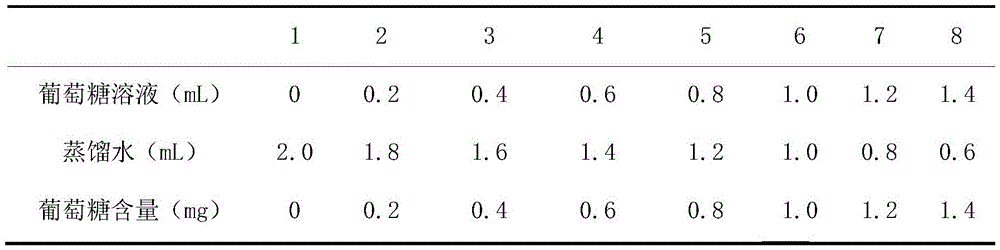
将各试管中的溶液混合均匀后,加入2.0mLDNS溶液,混合均匀后,沸水浴10min后,冷却至室温后,用超纯水定容到25mL。用1号试管中的溶液作为参照,在于490nm处测其他各个溶液的吸光度。绘制关于葡萄糖的标准曲线如图2所示:After mixing the solutions in each test tube evenly, add 2.0 mL of DNS solution, after mixing evenly, take a boiling water bath for 10 min, cool to room temperature, and make up to 25 mL with ultrapure water. Using the solution in test tube No. 1 as a reference, the absorbance of each other solution was measured at 490 nm. Plot a standard curve for glucose as shown in Figure 2:
由此可知回归方程为y=0.1953x+0.0407,相关系数R2=0.9888It can be seen that the regression equation is y=0.1953x+0.0407, and the correlation coefficient R 2 =0.9888
最终的实验结果如下表所示:The final experimental results are shown in the following table:
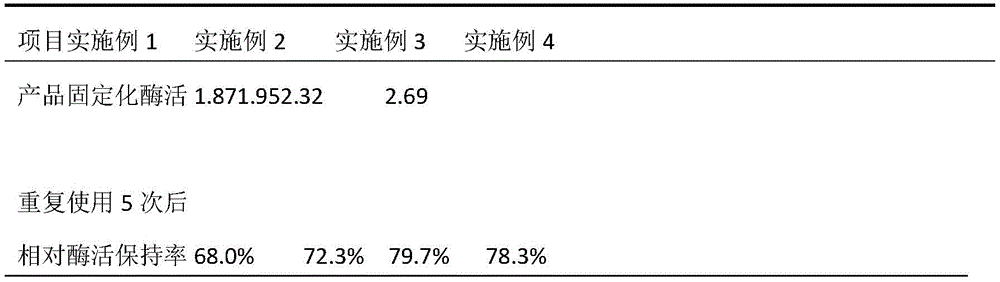
而在反应速率方面,将相同重量的以上4个实施例得到的固定化纤维素酶分别加入到相同体积和浓度的底物的反应釜中,在相同的反应条件下,各个反应釜中底物消耗至中值所消耗的时间上,实施例1-3所对应的反应时间相当,而实施例4所对应的反应时间较实施例1-3减少24-30%。And in terms of reaction rate, the same weight of the immobilized cellulase obtained in the above 4 examples was added to the reaction kettle of the substrate of the same volume and concentration, under the same reaction conditions, the substrate in each reaction kettle In terms of the time consumed to the median value, the reaction times corresponding to Examples 1-3 are comparable, and the reaction time corresponding to Example 4 is 24-30% shorter than that of Example 1-3.
Claims (10)
Priority Applications (1)
| Application Number | Priority Date | Filing Date | Title |
|---|---|---|---|
| CN202210921885.3A CN115232803B (en) | 2022-08-02 | 2022-08-02 | Immobilized cellulase, preparation method and preparation device of immobilized cellulase |
Applications Claiming Priority (1)
| Application Number | Priority Date | Filing Date | Title |
|---|---|---|---|
| CN202210921885.3A CN115232803B (en) | 2022-08-02 | 2022-08-02 | Immobilized cellulase, preparation method and preparation device of immobilized cellulase |
Publications (2)
| Publication Number | Publication Date |
|---|---|
| CN115232803A true CN115232803A (en) | 2022-10-25 |
| CN115232803B CN115232803B (en) | 2024-05-07 |
Family
ID=83676845
Family Applications (1)
| Application Number | Title | Priority Date | Filing Date |
|---|---|---|---|
| CN202210921885.3A Active CN115232803B (en) | 2022-08-02 | 2022-08-02 | Immobilized cellulase, preparation method and preparation device of immobilized cellulase |
Country Status (1)
| Country | Link |
|---|---|
| CN (1) | CN115232803B (en) |
Cited By (1)
| Publication number | Priority date | Publication date | Assignee | Title |
|---|---|---|---|---|
| CN117654641A (en) * | 2023-10-13 | 2024-03-08 | 桂林理工大学 | Cellulose-based composite beads for activating permonosulfate-degraded dyes and preparation method thereof |
Citations (6)
| Publication number | Priority date | Publication date | Assignee | Title |
|---|---|---|---|---|
| JP2006025932A (en) * | 2004-07-13 | 2006-02-02 | Jms Co Ltd | Biological suture tool and biological suture method |
| US20090209661A1 (en) * | 2008-02-15 | 2009-08-20 | Nigel Patrick Somerville Roberts | Delivery particle |
| CN107893062A (en) * | 2017-12-25 | 2018-04-10 | 北京化工大学 | A kind of cellulase immobilization and cellulolytic method |
| CN108004229A (en) * | 2017-12-25 | 2018-05-08 | 北京化工大学 | A kind of preparation of immobilized cellulase and the method for enzymatic hydrolyzing cellulose |
| CN112481248A (en) * | 2020-12-08 | 2021-03-12 | 华南农业大学 | Polyurethane nanofiber membrane immobilized enzyme as well as preparation method and application thereof |
| CN113430077A (en) * | 2021-08-04 | 2021-09-24 | 王盛龙 | Enzyme-containing laundry gel ball and preparation method thereof |
-
2022
- 2022-08-02 CN CN202210921885.3A patent/CN115232803B/en active Active
Patent Citations (6)
| Publication number | Priority date | Publication date | Assignee | Title |
|---|---|---|---|---|
| JP2006025932A (en) * | 2004-07-13 | 2006-02-02 | Jms Co Ltd | Biological suture tool and biological suture method |
| US20090209661A1 (en) * | 2008-02-15 | 2009-08-20 | Nigel Patrick Somerville Roberts | Delivery particle |
| CN107893062A (en) * | 2017-12-25 | 2018-04-10 | 北京化工大学 | A kind of cellulase immobilization and cellulolytic method |
| CN108004229A (en) * | 2017-12-25 | 2018-05-08 | 北京化工大学 | A kind of preparation of immobilized cellulase and the method for enzymatic hydrolyzing cellulose |
| CN112481248A (en) * | 2020-12-08 | 2021-03-12 | 华南农业大学 | Polyurethane nanofiber membrane immobilized enzyme as well as preparation method and application thereof |
| CN113430077A (en) * | 2021-08-04 | 2021-09-24 | 王盛龙 | Enzyme-containing laundry gel ball and preparation method thereof |
Cited By (1)
| Publication number | Priority date | Publication date | Assignee | Title |
|---|---|---|---|---|
| CN117654641A (en) * | 2023-10-13 | 2024-03-08 | 桂林理工大学 | Cellulose-based composite beads for activating permonosulfate-degraded dyes and preparation method thereof |
Also Published As
| Publication number | Publication date |
|---|---|
| CN115232803B (en) | 2024-05-07 |
Similar Documents
| Publication | Publication Date | Title |
|---|---|---|
| CN101818140A (en) | Immobilization pseudomonas aeruginosa as well as preparation method and application thereof | |
| CN109759132A (en) | Preparation method of composite photocatalytic gel spheres and composite photocatalytic gel spheres | |
| CN107011526B (en) | Soybean protein isolate-sodium alginate plural gel pearl of multiple sensitivity and its preparation and application | |
| CN106699937B (en) | A kind of preparation method of pH induction self-healing Nanometer composite hydrogel | |
| Kurayama et al. | Facile preparation of aminosilane-alginate hybrid beads for enzyme immobilization: kinetics and equilibrium studies | |
| CN107754822A (en) | A kind of preparation and its application based on CdSe/BiOCl composite photo-catalysts | |
| CN115232803A (en) | Immobilized cellulase, preparation method and preparation device of immobilized cellulase | |
| CN112980827A (en) | Metal organic framework material immobilized glucose oxidase and preparation method and application thereof | |
| CN107446911A (en) | A kind of microorganism embedded immobilization bead and its method and special purpose device and application | |
| CN104262540B (en) | A kind of temperature and pH double-response xylan based aquagel and preparation method thereof and application | |
| CN105441516A (en) | Process for preparing modified porous starch | |
| CN104607228A (en) | A preparation method of α-Fe2O3 quantum dot/nitrogen-doped graphene composite material | |
| CN105441515A (en) | Novel porous plant starch and preparation method thereof | |
| CN111493069A (en) | Solid chlorine dioxide sustained release agent and preparation method thereof | |
| Woo et al. | Sphericity optimization of calcium alginate gel beads and the effects of processing conditions on their physical properties | |
| CN107522877A (en) | Quaternized cellulose bead, preparation method and purposes | |
| CN105441513A (en) | Method for preparing corn-based porous starch | |
| CN115652611B (en) | Antibacterial medical textile and preparation method thereof | |
| CN105441514A (en) | Porous starch | |
| CN1247452C (en) | Method for preparing spherical active cardon with base of highstrength resin | |
| CN114505100B (en) | Preparation method of phosphomolybdic acid doped Zr-MOF material for treating printing and dyeing wastewater | |
| CN102921359A (en) | Preparation method of biological capsule for sewage treatment | |
| CN101613692A (en) | Preparation method of tamarind gum and sodium alginate composite gel immobilized cell carrier | |
| CN114534697A (en) | Preparation method of titanium dioxide-starch nano composite aerogel | |
| CN107456930A (en) | One-step synthesis method inlays the SiO of Ag nano particles2Nanocapsule and preparation method thereof |
Legal Events
| Date | Code | Title | Description |
|---|---|---|---|
| PB01 | Publication | ||
| PB01 | Publication | ||
| SE01 | Entry into force of request for substantive examination | ||
| SE01 | Entry into force of request for substantive examination | ||
| GR01 | Patent grant | ||
| GR01 | Patent grant | ||
| CB03 | Change of inventor or designer information |
Inventor after: He Le Inventor after: Yang Xiaoxing Inventor after: Jiang Xinyu Inventor after: Liu Yongchuang Inventor after: Wang Zhengbing Inventor after: Sun Zhongke Inventor after: Tian Erli Inventor after: Yue Zonghao Inventor after: Chen Can Inventor after: Zheng Manman Inventor after: Cui Han Inventor before: He Le Inventor before: Yang Xiaoxing Inventor before: Jiang Xinyu Inventor before: Liu Yongchuang Inventor before: Wang Zhengbing Inventor before: Sun Zhongke Inventor before: Tian Erli Inventor before: Yue Zonghao Inventor before: Chen Can Inventor before: Zheng Manman Inventor before: Cui Han |
|
| CB03 | Change of inventor or designer information |