CN115226955A - Modified Aerosol from Tobacco - Google Patents
Modified Aerosol from Tobacco Download PDFInfo
- Publication number
- CN115226955A CN115226955A CN202210902695.7A CN202210902695A CN115226955A CN 115226955 A CN115226955 A CN 115226955A CN 202210902695 A CN202210902695 A CN 202210902695A CN 115226955 A CN115226955 A CN 115226955A
- Authority
- CN
- China
- Prior art keywords
- aerosol
- tobacco
- nicotine
- user
- level
- Prior art date
- Legal status (The legal status is an assumption and is not a legal conclusion. Google has not performed a legal analysis and makes no representation as to the accuracy of the status listed.)
- Pending
Links
- 239000000443 aerosol Substances 0.000 title claims abstract description 569
- 235000002637 Nicotiana tabacum Nutrition 0.000 title claims abstract description 486
- 244000061176 Nicotiana tabacum Species 0.000 title description 437
- SNICXCGAKADSCV-JTQLQIEISA-N (-)-Nicotine Chemical compound CN1CCC[C@H]1C1=CC=CN=C1 SNICXCGAKADSCV-JTQLQIEISA-N 0.000 claims abstract description 332
- 229960002715 nicotine Drugs 0.000 claims abstract description 332
- SNICXCGAKADSCV-UHFFFAOYSA-N nicotine Natural products CN1CCCC1C1=CC=CN=C1 SNICXCGAKADSCV-UHFFFAOYSA-N 0.000 claims abstract description 332
- 238000000034 method Methods 0.000 claims abstract description 136
- 241000208125 Nicotiana Species 0.000 claims abstract description 52
- 239000000470 constituent Substances 0.000 claims abstract description 23
- DDRJAANPRJIHGJ-UHFFFAOYSA-N creatinine Chemical compound CN1CC(=O)NC1=N DDRJAANPRJIHGJ-UHFFFAOYSA-N 0.000 claims description 358
- UHOVQNZJYSORNB-UHFFFAOYSA-N Benzene Chemical compound C1=CC=CC=C1 UHOVQNZJYSORNB-UHFFFAOYSA-N 0.000 claims description 330
- KAKZBPTYRLMSJV-UHFFFAOYSA-N Butadiene Chemical compound C=CC=C KAKZBPTYRLMSJV-UHFFFAOYSA-N 0.000 claims description 207
- 238000010438 heat treatment Methods 0.000 claims description 201
- HGINCPLSRVDWNT-UHFFFAOYSA-N Acrolein Chemical compound C=CC=O HGINCPLSRVDWNT-UHFFFAOYSA-N 0.000 claims description 194
- 229940109239 creatinine Drugs 0.000 claims description 180
- 238000001816 cooling Methods 0.000 claims description 137
- UGFAIRIUMAVXCW-UHFFFAOYSA-N Carbon monoxide Chemical compound [O+]#[C-] UGFAIRIUMAVXCW-UHFFFAOYSA-N 0.000 claims description 108
- 229910002091 carbon monoxide Inorganic materials 0.000 claims description 107
- 239000000463 material Substances 0.000 claims description 96
- 235000019504 cigarettes Nutrition 0.000 claims description 90
- 210000002700 urine Anatomy 0.000 claims description 87
- 239000003550 marker Substances 0.000 claims description 83
- YXFVVABEGXRONW-UHFFFAOYSA-N Toluene Chemical compound CC1=CC=CC=C1 YXFVVABEGXRONW-UHFFFAOYSA-N 0.000 claims description 69
- RRHGJUQNOFWUDK-UHFFFAOYSA-N Isoprene Chemical compound CC(=C)C=C RRHGJUQNOFWUDK-UHFFFAOYSA-N 0.000 claims description 63
- RUFPHBVGCFYCNW-UHFFFAOYSA-N 1-naphthylamine Chemical compound C1=CC=C2C(N)=CC=CC2=C1 RUFPHBVGCFYCNW-UHFFFAOYSA-N 0.000 claims description 60
- DMVOXQPQNTYEKQ-UHFFFAOYSA-N biphenyl-4-amine Chemical group C1=CC(N)=CC=C1C1=CC=CC=C1 DMVOXQPQNTYEKQ-UHFFFAOYSA-N 0.000 claims description 60
- 108010003320 Carboxyhemoglobin Proteins 0.000 claims description 53
- QGZKDVFQNNGYKY-UHFFFAOYSA-N Ammonia Chemical compound N QGZKDVFQNNGYKY-UHFFFAOYSA-N 0.000 claims description 48
- LELOWRISYMNNSU-UHFFFAOYSA-N hydrogen cyanide Chemical compound N#C LELOWRISYMNNSU-UHFFFAOYSA-N 0.000 claims description 46
- RLSSMJSEOOYNOY-UHFFFAOYSA-N m-cresol Chemical compound CC1=CC=CC(O)=C1 RLSSMJSEOOYNOY-UHFFFAOYSA-N 0.000 claims description 43
- 210000004369 blood Anatomy 0.000 claims description 42
- 239000008280 blood Substances 0.000 claims description 42
- IWDCLRJOBJJRNH-UHFFFAOYSA-N p-cresol Chemical compound CC1=CC=C(O)C=C1 IWDCLRJOBJJRNH-UHFFFAOYSA-N 0.000 claims description 40
- -1 polyethylene Polymers 0.000 claims description 40
- FMMWHPNWAFZXNH-UHFFFAOYSA-N Benz[a]pyrene Chemical compound C1=C2C3=CC=CC=C3C=C(C=C3)C2=C2C3=CC=CC2=C1 FMMWHPNWAFZXNH-UHFFFAOYSA-N 0.000 claims description 38
- XKABJYQDMJTNGQ-VIFPVBQESA-N n-nitrosonornicotine Chemical compound O=NN1CCC[C@H]1C1=CC=CN=C1 XKABJYQDMJTNGQ-VIFPVBQESA-N 0.000 claims description 35
- 229920002301 cellulose acetate Polymers 0.000 claims description 31
- JBIJLHTVPXGSAM-UHFFFAOYSA-N 2-naphthylamine Chemical compound C1=CC=CC2=CC(N)=CC=C21 JBIJLHTVPXGSAM-UHFFFAOYSA-N 0.000 claims description 30
- NLHHRLWOUZZQLW-UHFFFAOYSA-N Acrylonitrile Chemical compound C=CC#N NLHHRLWOUZZQLW-UHFFFAOYSA-N 0.000 claims description 29
- 239000000090 biomarker Substances 0.000 claims description 27
- 229910052793 cadmium Inorganic materials 0.000 claims description 25
- BDOSMKKIYDKNTQ-UHFFFAOYSA-N cadmium atom Chemical compound [Cd] BDOSMKKIYDKNTQ-UHFFFAOYSA-N 0.000 claims description 25
- 229910021529 ammonia Inorganic materials 0.000 claims description 23
- MUNOBADFTHUUFG-UHFFFAOYSA-N 3-phenylaniline Chemical group NC1=CC=CC(C=2C=CC=CC=2)=C1 MUNOBADFTHUUFG-UHFFFAOYSA-N 0.000 claims description 22
- 238000012360 testing method Methods 0.000 claims description 22
- WSFSSNUMVMOOMR-UHFFFAOYSA-N Formaldehyde Chemical compound O=C WSFSSNUMVMOOMR-UHFFFAOYSA-N 0.000 claims description 21
- MLUCVPSAIODCQM-NSCUHMNNSA-N crotonaldehyde Chemical compound C\C=C\C=O MLUCVPSAIODCQM-NSCUHMNNSA-N 0.000 claims description 21
- 239000004698 Polyethylene Substances 0.000 claims description 20
- 239000004743 Polypropylene Substances 0.000 claims description 20
- MLUCVPSAIODCQM-UHFFFAOYSA-N crotonaldehyde Natural products CC=CC=O MLUCVPSAIODCQM-UHFFFAOYSA-N 0.000 claims description 20
- 229920000573 polyethylene Polymers 0.000 claims description 20
- 229920001155 polypropylene Polymers 0.000 claims description 20
- 229920000139 polyethylene terephthalate Polymers 0.000 claims description 18
- 239000005020 polyethylene terephthalate Substances 0.000 claims description 18
- 239000004626 polylactic acid Substances 0.000 claims description 18
- IKHGUXGNUITLKF-UHFFFAOYSA-N Acetaldehyde Chemical compound CC=O IKHGUXGNUITLKF-UHFFFAOYSA-N 0.000 claims description 16
- 230000004048 modification Effects 0.000 claims description 16
- 238000012986 modification Methods 0.000 claims description 16
- 230000009286 beneficial effect Effects 0.000 claims description 13
- 239000011888 foil Substances 0.000 claims description 12
- 229910052782 aluminium Inorganic materials 0.000 claims description 10
- XAGFODPZIPBFFR-UHFFFAOYSA-N aluminium Chemical compound [Al] XAGFODPZIPBFFR-UHFFFAOYSA-N 0.000 claims description 10
- 239000004800 polyvinyl chloride Substances 0.000 claims description 10
- 238000012544 monitoring process Methods 0.000 claims description 9
- 230000004075 alteration Effects 0.000 claims description 5
- 230000002776 aggregation Effects 0.000 claims description 4
- 238000004220 aggregation Methods 0.000 claims description 4
- CICOZWHZVMOPJS-UHFFFAOYSA-N s-Phenylmercapturic acid Chemical compound CC(=O)NC(C(O)=O)CSC1=CC=CC=C1 CICOZWHZVMOPJS-UHFFFAOYSA-N 0.000 claims 5
- 239000000758 substrate Substances 0.000 description 150
- MWUXSHHQAYIFBG-UHFFFAOYSA-N Nitric oxide Chemical compound O=[N] MWUXSHHQAYIFBG-UHFFFAOYSA-N 0.000 description 54
- 230000000391 smoking effect Effects 0.000 description 52
- GQPLMRYTRLFLPF-UHFFFAOYSA-N Nitrous Oxide Chemical compound [O-][N+]#N GQPLMRYTRLFLPF-UHFFFAOYSA-N 0.000 description 46
- CSCPPACGZOOCGX-UHFFFAOYSA-N Acetone Chemical compound CC(C)=O CSCPPACGZOOCGX-UHFFFAOYSA-N 0.000 description 42
- FLAQQSHRLBFIEZ-UHFFFAOYSA-N N-Methyl-N-nitroso-4-oxo-4-(3-pyridyl)butyl amine Chemical compound O=NN(C)CCCC(=O)C1=CC=CN=C1 FLAQQSHRLBFIEZ-UHFFFAOYSA-N 0.000 description 35
- ZWEHNKRNPOVVGH-UHFFFAOYSA-N 2-Butanone Chemical compound CCC(C)=O ZWEHNKRNPOVVGH-UHFFFAOYSA-N 0.000 description 33
- ZTQSAGDEMFDKMZ-UHFFFAOYSA-N butyric aldehyde Natural products CCCC=O ZTQSAGDEMFDKMZ-UHFFFAOYSA-N 0.000 description 31
- PPBRXRYQALVLMV-UHFFFAOYSA-N Styrene Chemical compound C=CC1=CC=CC=C1 PPBRXRYQALVLMV-UHFFFAOYSA-N 0.000 description 30
- 238000003780 insertion Methods 0.000 description 29
- 230000037431 insertion Effects 0.000 description 29
- 210000002381 plasma Anatomy 0.000 description 29
- ISWSIDIOOBJBQZ-UHFFFAOYSA-N Phenol Chemical compound OC1=CC=CC=C1 ISWSIDIOOBJBQZ-UHFFFAOYSA-N 0.000 description 27
- QIGBRXMKCJKVMJ-UHFFFAOYSA-N Hydroquinone Chemical compound OC1=CC=C(O)C=C1 QIGBRXMKCJKVMJ-UHFFFAOYSA-N 0.000 description 24
- JUJWROOIHBZHMG-UHFFFAOYSA-N Pyridine Chemical compound C1=CC=NC=C1 JUJWROOIHBZHMG-UHFFFAOYSA-N 0.000 description 24
- SMWDFEZZVXVKRB-UHFFFAOYSA-N Quinoline Chemical compound N1=CC=CC2=CC=CC=C21 SMWDFEZZVXVKRB-UHFFFAOYSA-N 0.000 description 24
- YCIMNLLNPGFGHC-UHFFFAOYSA-N catechol Chemical compound OC1=CC=CC=C1O YCIMNLLNPGFGHC-UHFFFAOYSA-N 0.000 description 24
- QWVGKYWNOKOFNN-UHFFFAOYSA-N o-cresol Chemical compound CC1=CC=CC=C1O QWVGKYWNOKOFNN-UHFFFAOYSA-N 0.000 description 24
- GHMLBKRAJCXXBS-UHFFFAOYSA-N resorcinol Chemical compound OC1=CC=CC(O)=C1 GHMLBKRAJCXXBS-UHFFFAOYSA-N 0.000 description 24
- 239000000779 smoke Substances 0.000 description 24
- 239000001272 nitrous oxide Substances 0.000 description 23
- NBBJYMSMWIIQGU-UHFFFAOYSA-N Propionic aldehyde Chemical compound CCC=O NBBJYMSMWIIQGU-UHFFFAOYSA-N 0.000 description 22
- 238000000465 moulding Methods 0.000 description 21
- ZJOFAFWTOKDIFH-JTQLQIEISA-N 3-[(2s)-1-nitroso-3,6-dihydro-2h-pyridin-2-yl]pyridine Chemical compound O=NN1CC=CC[C@H]1C1=CC=CN=C1 ZJOFAFWTOKDIFH-JTQLQIEISA-N 0.000 description 19
- PXHVJJICTQNCMI-UHFFFAOYSA-N Nickel Chemical compound [Ni] PXHVJJICTQNCMI-UHFFFAOYSA-N 0.000 description 19
- QSHDDOUJBYECFT-UHFFFAOYSA-N mercury Chemical compound [Hg] QSHDDOUJBYECFT-UHFFFAOYSA-N 0.000 description 17
- 229910052753 mercury Inorganic materials 0.000 description 17
- 230000009467 reduction Effects 0.000 description 17
- 239000007787 solid Substances 0.000 description 16
- 238000011144 upstream manufacturing Methods 0.000 description 16
- ZJOFAFWTOKDIFH-UHFFFAOYSA-N 3-(1-nitroso-3,6-dihydro-2h-pyridin-2-yl)pyridine Chemical compound O=NN1CC=CCC1C1=CC=CN=C1 ZJOFAFWTOKDIFH-UHFFFAOYSA-N 0.000 description 15
- 239000013618 particulate matter Substances 0.000 description 15
- 230000000694 effects Effects 0.000 description 14
- WSFSSNUMVMOOMR-NJFSPNSNSA-N methanone Chemical compound O=[14CH2] WSFSSNUMVMOOMR-NJFSPNSNSA-N 0.000 description 14
- 239000012071 phase Substances 0.000 description 14
- XLYOFNOQVPJJNP-UHFFFAOYSA-N water Substances O XLYOFNOQVPJJNP-UHFFFAOYSA-N 0.000 description 14
- 238000002485 combustion reaction Methods 0.000 description 13
- 150000001875 compounds Chemical class 0.000 description 13
- 239000000796 flavoring agent Substances 0.000 description 13
- 235000019634 flavors Nutrition 0.000 description 13
- 239000000123 paper Substances 0.000 description 13
- NOOLISFMXDJSKH-UTLUCORTSA-N (+)-Neomenthol Chemical group CC(C)[C@@H]1CC[C@@H](C)C[C@@H]1O NOOLISFMXDJSKH-UTLUCORTSA-N 0.000 description 12
- KFZMGEQAYNKOFK-UHFFFAOYSA-N Isopropanol Chemical compound CC(C)O KFZMGEQAYNKOFK-UHFFFAOYSA-N 0.000 description 12
- OKKJLVBELUTLKV-UHFFFAOYSA-N Methanol Chemical compound OC OKKJLVBELUTLKV-UHFFFAOYSA-N 0.000 description 12
- UMJSCPRVCHMLSP-UHFFFAOYSA-N pyridine Natural products COC1=CC=CN=C1 UMJSCPRVCHMLSP-UHFFFAOYSA-N 0.000 description 12
- 239000000126 substance Substances 0.000 description 12
- NOOLISFMXDJSKH-UHFFFAOYSA-N DL-menthol Natural products CC(C)C1CCC(C)CC1O NOOLISFMXDJSKH-UHFFFAOYSA-N 0.000 description 11
- IKHGUXGNUITLKF-XPULMUKRSA-N acetaldehyde Chemical compound [14CH]([14CH3])=O IKHGUXGNUITLKF-XPULMUKRSA-N 0.000 description 11
- PEDCQBHIVMGVHV-UHFFFAOYSA-N Glycerine Chemical compound OCC(O)CO PEDCQBHIVMGVHV-UHFFFAOYSA-N 0.000 description 10
- BUGBHKTXTAQXES-UHFFFAOYSA-N Selenium Chemical compound [Se] BUGBHKTXTAQXES-UHFFFAOYSA-N 0.000 description 10
- 238000004458 analytical method Methods 0.000 description 10
- 230000003247 decreasing effect Effects 0.000 description 10
- 239000000835 fiber Substances 0.000 description 10
- 229940041616 menthol Drugs 0.000 description 10
- 239000000203 mixture Substances 0.000 description 10
- 229910052759 nickel Inorganic materials 0.000 description 10
- 229910052711 selenium Inorganic materials 0.000 description 10
- 239000011669 selenium Substances 0.000 description 10
- 230000005586 smoking cessation Effects 0.000 description 10
- HGBOYTHUEUWSSQ-UHFFFAOYSA-N valeric aldehyde Natural products CCCCC=O HGBOYTHUEUWSSQ-UHFFFAOYSA-N 0.000 description 10
- WEVYAHXRMPXWCK-UHFFFAOYSA-N Acetonitrile Chemical compound CC#N WEVYAHXRMPXWCK-UHFFFAOYSA-N 0.000 description 9
- VYZAMTAEIAYCRO-UHFFFAOYSA-N Chromium Chemical compound [Cr] VYZAMTAEIAYCRO-UHFFFAOYSA-N 0.000 description 9
- 102000008144 Cytochrome P-450 CYP1A2 Human genes 0.000 description 9
- 108010074922 Cytochrome P-450 CYP1A2 Proteins 0.000 description 9
- YMWUJEATGCHHMB-UHFFFAOYSA-N Dichloromethane Chemical compound ClCCl YMWUJEATGCHHMB-UHFFFAOYSA-N 0.000 description 9
- 229910052785 arsenic Inorganic materials 0.000 description 9
- RQNWIZPPADIBDY-UHFFFAOYSA-N arsenic atom Chemical compound [As] RQNWIZPPADIBDY-UHFFFAOYSA-N 0.000 description 9
- 229910052804 chromium Inorganic materials 0.000 description 9
- 239000011651 chromium Substances 0.000 description 9
- 239000003365 glass fiber Substances 0.000 description 9
- 239000011133 lead Substances 0.000 description 9
- 239000007788 liquid Substances 0.000 description 9
- 238000001294 liquid chromatography-tandem mass spectrometry Methods 0.000 description 9
- 238000011160 research Methods 0.000 description 9
- 239000003795 chemical substances by application Substances 0.000 description 8
- 239000007789 gas Substances 0.000 description 8
- 229920000747 poly(lactic acid) Polymers 0.000 description 8
- UIKROCXWUNQSPJ-VIFPVBQESA-N (-)-cotinine Chemical compound C1CC(=O)N(C)[C@@H]1C1=CC=CN=C1 UIKROCXWUNQSPJ-VIFPVBQESA-N 0.000 description 7
- UIKROCXWUNQSPJ-UHFFFAOYSA-N Cotinine Natural products C1CC(=O)N(C)C1C1=CC=CN=C1 UIKROCXWUNQSPJ-UHFFFAOYSA-N 0.000 description 7
- 229950006073 cotinine Drugs 0.000 description 7
- 230000008030 elimination Effects 0.000 description 7
- 238000003379 elimination reaction Methods 0.000 description 7
- 238000004817 gas chromatography Methods 0.000 description 7
- 230000008520 organization Effects 0.000 description 7
- 230000035515 penetration Effects 0.000 description 7
- OFBQJSOFQDEBGM-UHFFFAOYSA-N Pentane Chemical compound CCCCC OFBQJSOFQDEBGM-UHFFFAOYSA-N 0.000 description 6
- DNIAPMSPPWPWGF-UHFFFAOYSA-N Propylene glycol Chemical compound CC(O)CO DNIAPMSPPWPWGF-UHFFFAOYSA-N 0.000 description 6
- 238000000605 extraction Methods 0.000 description 6
- 238000004128 high performance liquid chromatography Methods 0.000 description 6
- 150000002989 phenols Chemical class 0.000 description 6
- 238000000197 pyrolysis Methods 0.000 description 6
- 241000196324 Embryophyta Species 0.000 description 5
- 238000010521 absorption reaction Methods 0.000 description 5
- 239000011230 binding agent Substances 0.000 description 5
- 230000008859 change Effects 0.000 description 5
- 238000011156 evaluation Methods 0.000 description 5
- 239000000284 extract Substances 0.000 description 5
- 238000002290 gas chromatography-mass spectrometry Methods 0.000 description 5
- 210000004072 lung Anatomy 0.000 description 5
- 230000002503 metabolic effect Effects 0.000 description 5
- 210000000214 mouth Anatomy 0.000 description 5
- 238000012216 screening Methods 0.000 description 5
- 238000001877 single-ion monitoring Methods 0.000 description 5
- 238000012546 transfer Methods 0.000 description 5
- PUPZLCDOIYMWBV-UHFFFAOYSA-N (+/-)-1,3-Butanediol Chemical compound CC(O)CCO PUPZLCDOIYMWBV-UHFFFAOYSA-N 0.000 description 4
- QUNWUDVFRNGTCO-UHFFFAOYSA-N 1,7-dimethylxanthine Chemical compound N1C(=O)N(C)C(=O)C2=C1N=CN2C QUNWUDVFRNGTCO-UHFFFAOYSA-N 0.000 description 4
- CIWBSHSKHKDKBQ-JLAZNSOCSA-N Ascorbic acid Chemical compound OC[C@H](O)[C@H]1OC(=O)C(O)=C1O CIWBSHSKHKDKBQ-JLAZNSOCSA-N 0.000 description 4
- 108090000790 Enzymes Proteins 0.000 description 4
- 102000004190 Enzymes Human genes 0.000 description 4
- MHAJPDPJQMAIIY-UHFFFAOYSA-N Hydrogen peroxide Chemical compound OO MHAJPDPJQMAIIY-UHFFFAOYSA-N 0.000 description 4
- 239000002585 base Substances 0.000 description 4
- RYYVLZVUVIJVGH-UHFFFAOYSA-N caffeine Chemical compound CN1C(=O)N(C)C(=O)C2=C1N=CN2C RYYVLZVUVIJVGH-UHFFFAOYSA-N 0.000 description 4
- 235000011187 glycerol Nutrition 0.000 description 4
- 229920000728 polyester Polymers 0.000 description 4
- QQONPFPTGQHPMA-UHFFFAOYSA-N propylene Natural products CC=C QQONPFPTGQHPMA-UHFFFAOYSA-N 0.000 description 4
- 238000011002 quantification Methods 0.000 description 4
- 230000004044 response Effects 0.000 description 4
- 239000000243 solution Substances 0.000 description 4
- 235000019505 tobacco product Nutrition 0.000 description 4
- QTWJRLJHJPIABL-UHFFFAOYSA-N 2-methylphenol;3-methylphenol;4-methylphenol Chemical compound CC1=CC=C(O)C=C1.CC1=CC=CC(O)=C1.CC1=CC=CC=C1O QTWJRLJHJPIABL-UHFFFAOYSA-N 0.000 description 3
- IJGRMHOSHXDMSA-UHFFFAOYSA-N Atomic nitrogen Chemical compound N#N IJGRMHOSHXDMSA-UHFFFAOYSA-N 0.000 description 3
- RTZKZFJDLAIYFH-UHFFFAOYSA-N Diethyl ether Chemical compound CCOCC RTZKZFJDLAIYFH-UHFFFAOYSA-N 0.000 description 3
- WHXSMMKQMYFTQS-UHFFFAOYSA-N Lithium Chemical compound [Li] WHXSMMKQMYFTQS-UHFFFAOYSA-N 0.000 description 3
- 241001144493 Nicotiana obtusifolia Species 0.000 description 3
- 241000493375 Nicotiana quadrivalvis Species 0.000 description 3
- HEMHJVSKTPXQMS-UHFFFAOYSA-M Sodium hydroxide Chemical compound [OH-].[Na+] HEMHJVSKTPXQMS-UHFFFAOYSA-M 0.000 description 3
- 229920002472 Starch Polymers 0.000 description 3
- 150000001299 aldehydes Chemical class 0.000 description 3
- 230000015572 biosynthetic process Effects 0.000 description 3
- 239000011111 cardboard Substances 0.000 description 3
- 238000004140 cleaning Methods 0.000 description 3
- 229930003836 cresol Natural products 0.000 description 3
- 238000013461 design Methods 0.000 description 3
- 239000002657 fibrous material Substances 0.000 description 3
- 230000003993 interaction Effects 0.000 description 3
- 229910052744 lithium Inorganic materials 0.000 description 3
- 229910052751 metal Inorganic materials 0.000 description 3
- 239000002184 metal Substances 0.000 description 3
- 239000003595 mist Substances 0.000 description 3
- 238000013021 overheating Methods 0.000 description 3
- 239000002245 particle Substances 0.000 description 3
- 229920005862 polyol Polymers 0.000 description 3
- 150000003077 polyols Chemical class 0.000 description 3
- 230000008569 process Effects 0.000 description 3
- 238000004537 pulping Methods 0.000 description 3
- 241000894007 species Species 0.000 description 3
- 239000008107 starch Substances 0.000 description 3
- 235000019698 starch Nutrition 0.000 description 3
- 238000004885 tandem mass spectrometry Methods 0.000 description 3
- 238000005979 thermal decomposition reaction Methods 0.000 description 3
- NOOLISFMXDJSKH-KXUCPTDWSA-N (-)-Menthol Chemical compound CC(C)[C@@H]1CC[C@@H](C)C[C@H]1O NOOLISFMXDJSKH-KXUCPTDWSA-N 0.000 description 2
- FGLBSLMDCBOPQK-UHFFFAOYSA-N 2-nitropropane Chemical compound CC(C)[N+]([O-])=O FGLBSLMDCBOPQK-UHFFFAOYSA-N 0.000 description 2
- BXYPVKMROLGXJI-JTQLQIEISA-N 3-[(2s)-1-nitrosopiperidin-2-yl]pyridine Chemical compound O=NN1CCCC[C@H]1C1=CC=CN=C1 BXYPVKMROLGXJI-JTQLQIEISA-N 0.000 description 2
- DLFVBJFMPXGRIB-UHFFFAOYSA-N Acetamide Chemical compound CC(N)=O DLFVBJFMPXGRIB-UHFFFAOYSA-N 0.000 description 2
- XKRFYHLGVUSROY-UHFFFAOYSA-N Argon Chemical compound [Ar] XKRFYHLGVUSROY-UHFFFAOYSA-N 0.000 description 2
- CURLTUGMZLYLDI-UHFFFAOYSA-N Carbon dioxide Chemical compound O=C=O CURLTUGMZLYLDI-UHFFFAOYSA-N 0.000 description 2
- HEDRZPFGACZZDS-UHFFFAOYSA-N Chloroform Chemical compound ClC(Cl)Cl HEDRZPFGACZZDS-UHFFFAOYSA-N 0.000 description 2
- KRKNYBCHXYNGOX-UHFFFAOYSA-K Citrate Chemical compound [O-]C(=O)CC(O)(CC([O-])=O)C([O-])=O KRKNYBCHXYNGOX-UHFFFAOYSA-K 0.000 description 2
- 229920001634 Copolyester Polymers 0.000 description 2
- 102100036194 Cytochrome P450 2A6 Human genes 0.000 description 2
- 101000875170 Homo sapiens Cytochrome P450 2A6 Proteins 0.000 description 2
- LPHGQDQBBGAPDZ-UHFFFAOYSA-N Isocaffeine Natural products CN1C(=O)N(C)C(=O)C2=C1N(C)C=N2 LPHGQDQBBGAPDZ-UHFFFAOYSA-N 0.000 description 2
- NHTMVDHEPJAVLT-UHFFFAOYSA-N Isooctane Chemical compound CC(C)CC(C)(C)C NHTMVDHEPJAVLT-UHFFFAOYSA-N 0.000 description 2
- HBBGRARXTFLTSG-UHFFFAOYSA-N Lithium ion Chemical compound [Li+] HBBGRARXTFLTSG-UHFFFAOYSA-N 0.000 description 2
- 241000208126 Nicotiana acuminata Species 0.000 description 2
- 241000250375 Nicotiana benavidesii Species 0.000 description 2
- 241001609967 Nicotiana clevelandii Species 0.000 description 2
- 241000250024 Nicotiana longiflora Species 0.000 description 2
- 241001144498 Nicotiana rosulata subsp. ingulba Species 0.000 description 2
- 241000579280 Nicotiana tomentosa Species 0.000 description 2
- 240000002061 Nothoscordum fragrans Species 0.000 description 2
- 229910019142 PO4 Inorganic materials 0.000 description 2
- NBIIXXVUZAFLBC-UHFFFAOYSA-N Phosphoric acid Chemical compound OP(O)(O)=O NBIIXXVUZAFLBC-UHFFFAOYSA-N 0.000 description 2
- QAOWNCQODCNURD-UHFFFAOYSA-N Sulfuric acid Chemical compound OS(O)(=O)=O QAOWNCQODCNURD-UHFFFAOYSA-N 0.000 description 2
- 238000000540 analysis of variance Methods 0.000 description 2
- 229960005070 ascorbic acid Drugs 0.000 description 2
- 235000010323 ascorbic acid Nutrition 0.000 description 2
- 239000011668 ascorbic acid Substances 0.000 description 2
- 235000010290 biphenyl Nutrition 0.000 description 2
- 239000007853 buffer solution Substances 0.000 description 2
- 239000008366 buffered solution Substances 0.000 description 2
- 229960001948 caffeine Drugs 0.000 description 2
- VJEONQKOZGKCAK-UHFFFAOYSA-N caffeine Natural products CN1C(=O)N(C)C(=O)C2=C1C=CN2C VJEONQKOZGKCAK-UHFFFAOYSA-N 0.000 description 2
- 239000002775 capsule Substances 0.000 description 2
- 235000011089 carbon dioxide Nutrition 0.000 description 2
- 239000012159 carrier gas Substances 0.000 description 2
- NEHMKBQYUWJMIP-UHFFFAOYSA-N chloromethane Chemical compound ClC NEHMKBQYUWJMIP-UHFFFAOYSA-N 0.000 description 2
- IJOOHPMOJXWVHK-UHFFFAOYSA-N chlorotrimethylsilane Chemical compound C[Si](C)(C)Cl IJOOHPMOJXWVHK-UHFFFAOYSA-N 0.000 description 2
- 238000009833 condensation Methods 0.000 description 2
- 230000005494 condensation Effects 0.000 description 2
- 239000013256 coordination polymer Substances 0.000 description 2
- 238000001514 detection method Methods 0.000 description 2
- 238000003745 diagnosis Methods 0.000 description 2
- ZDJFDFNNEAPGOP-UHFFFAOYSA-N dimethyl tetradecanedioate Chemical compound COC(=O)CCCCCCCCCCCCC(=O)OC ZDJFDFNNEAPGOP-UHFFFAOYSA-N 0.000 description 2
- JVSWJIKNEAIKJW-UHFFFAOYSA-N dimethyl-hexane Natural products CCCCCC(C)C JVSWJIKNEAIKJW-UHFFFAOYSA-N 0.000 description 2
- 238000005367 electrostatic precipitation Methods 0.000 description 2
- 230000002255 enzymatic effect Effects 0.000 description 2
- 239000008187 granular material Substances 0.000 description 2
- 229940093915 gynecological organic acid Drugs 0.000 description 2
- 231100001261 hazardous Toxicity 0.000 description 2
- 230000007407 health benefit Effects 0.000 description 2
- 230000006872 improvement Effects 0.000 description 2
- NNPPMTNAJDCUHE-UHFFFAOYSA-N isobutane Chemical compound CC(C)C NNPPMTNAJDCUHE-UHFFFAOYSA-N 0.000 description 2
- 229910001416 lithium ion Inorganic materials 0.000 description 2
- 229920001684 low density polyethylene Polymers 0.000 description 2
- 239000004702 low-density polyethylene Substances 0.000 description 2
- 238000000120 microwave digestion Methods 0.000 description 2
- VLKZOEOYAKHREP-UHFFFAOYSA-N n-Hexane Chemical compound CCCCCC VLKZOEOYAKHREP-UHFFFAOYSA-N 0.000 description 2
- 238000002414 normal-phase solid-phase extraction Methods 0.000 description 2
- 150000007524 organic acids Chemical class 0.000 description 2
- 235000005985 organic acids Nutrition 0.000 description 2
- 239000011087 paperboard Substances 0.000 description 2
- NBIIXXVUZAFLBC-UHFFFAOYSA-K phosphate Chemical compound [O-]P([O-])([O-])=O NBIIXXVUZAFLBC-UHFFFAOYSA-K 0.000 description 2
- 239000010452 phosphate Substances 0.000 description 2
- 125000005575 polycyclic aromatic hydrocarbon group Chemical group 0.000 description 2
- 239000000843 powder Substances 0.000 description 2
- 125000004805 propylene group Chemical group [H]C([H])([H])C([H])([*:1])C([H])([H])[*:2] 0.000 description 2
- 238000000746 purification Methods 0.000 description 2
- BBEAQIROQSPTKN-UHFFFAOYSA-N pyrene Chemical compound C1=CC=C2C=CC3=CC=CC4=CC=C1C2=C43 BBEAQIROQSPTKN-UHFFFAOYSA-N 0.000 description 2
- 230000000717 retained effect Effects 0.000 description 2
- 229920006395 saturated elastomer Polymers 0.000 description 2
- 239000002002 slurry Substances 0.000 description 2
- 238000002798 spectrophotometry method Methods 0.000 description 2
- 238000007619 statistical method Methods 0.000 description 2
- 230000007704 transition Effects 0.000 description 2
- ZIBGPFATKBEMQZ-UHFFFAOYSA-N triethylene glycol Chemical compound OCCOCCOCCO ZIBGPFATKBEMQZ-UHFFFAOYSA-N 0.000 description 2
- YCIMNLLNPGFGHC-UDDMDDBKSA-N 1,2,3,4-tetradeuterio-5,6-dideuteriooxybenzene Chemical compound [2H]OC1=C([2H])C([2H])=C([2H])C([2H])=C1O[2H] YCIMNLLNPGFGHC-UDDMDDBKSA-N 0.000 description 1
- QIGBRXMKCJKVMJ-UDDMDDBKSA-N 1,2,4,5-tetradeuterio-3,6-dideuteriooxybenzene Chemical compound [2H]OC1=C([2H])C([2H])=C(O[2H])C([2H])=C1[2H] QIGBRXMKCJKVMJ-UDDMDDBKSA-N 0.000 description 1
- IXPNQXFRVYWDDI-UHFFFAOYSA-N 1-methyl-2,4-dioxo-1,3-diazinane-5-carboximidamide Chemical compound CN1CC(C(N)=N)C(=O)NC1=O IXPNQXFRVYWDDI-UHFFFAOYSA-N 0.000 description 1
- CUBNZLQTYJOCNF-UHFFFAOYSA-N 1-phenylsulfanyl-7,9-dihydro-3H-purine-2,6,8-trione Chemical compound C1(=CC=CC=C1)SN1C(=O)NC=2NC(=O)NC=2C1=O CUBNZLQTYJOCNF-UHFFFAOYSA-N 0.000 description 1
- HORQAOAYAYGIBM-UHFFFAOYSA-N 2,4-dinitrophenylhydrazine Chemical compound NNC1=CC=C([N+]([O-])=O)C=C1[N+]([O-])=O HORQAOAYAYGIBM-UHFFFAOYSA-N 0.000 description 1
- AIMREYQYBFBEGQ-UHFFFAOYSA-N 2-methyl-2-nitropropane Chemical compound CC(C)(C)[N+]([O-])=O AIMREYQYBFBEGQ-UHFFFAOYSA-N 0.000 description 1
- SYBYTAAJFKOIEJ-UHFFFAOYSA-N 3-Methylbutan-2-one Chemical class CC(C)C(C)=O SYBYTAAJFKOIEJ-UHFFFAOYSA-N 0.000 description 1
- AGNTUZCMJBTHOG-UHFFFAOYSA-N 3-[3-(2,3-dihydroxypropoxy)-2-hydroxypropoxy]propane-1,2-diol Chemical compound OCC(O)COCC(O)COCC(O)CO AGNTUZCMJBTHOG-UHFFFAOYSA-N 0.000 description 1
- RXXCIBALSKQCAE-UHFFFAOYSA-N 3-methylbutoxymethylbenzene Chemical compound CC(C)CCOCC1=CC=CC=C1 RXXCIBALSKQCAE-UHFFFAOYSA-N 0.000 description 1
- QTBSBXVTEAMEQO-UHFFFAOYSA-M Acetate Chemical compound CC([O-])=O QTBSBXVTEAMEQO-UHFFFAOYSA-M 0.000 description 1
- HRPVXLWXLXDGHG-UHFFFAOYSA-N Acrylamide Chemical compound NC(=O)C=C HRPVXLWXLXDGHG-UHFFFAOYSA-N 0.000 description 1
- 229920001817 Agar Polymers 0.000 description 1
- USFZMSVCRYTOJT-UHFFFAOYSA-N Ammonium acetate Chemical compound N.CC(O)=O USFZMSVCRYTOJT-UHFFFAOYSA-N 0.000 description 1
- 239000005695 Ammonium acetate Substances 0.000 description 1
- 241000758794 Asarum Species 0.000 description 1
- 229920002134 Carboxymethyl cellulose Polymers 0.000 description 1
- 229920003043 Cellulose fiber Polymers 0.000 description 1
- 240000000491 Corchorus aestuans Species 0.000 description 1
- 235000011777 Corchorus aestuans Nutrition 0.000 description 1
- 235000010862 Corchorus capsularis Nutrition 0.000 description 1
- 206010011224 Cough Diseases 0.000 description 1
- 244000303965 Cyamopsis psoralioides Species 0.000 description 1
- XPDXVDYUQZHFPV-UHFFFAOYSA-N Dansyl Chloride Chemical compound C1=CC=C2C(N(C)C)=CC=CC2=C1S(Cl)(=O)=O XPDXVDYUQZHFPV-UHFFFAOYSA-N 0.000 description 1
- 239000001856 Ethyl cellulose Substances 0.000 description 1
- ZZSNKZQZMQGXPY-UHFFFAOYSA-N Ethyl cellulose Chemical compound CCOCC1OC(OC)C(OCC)C(OCC)C1OC1C(O)C(O)C(OC)C(CO)O1 ZZSNKZQZMQGXPY-UHFFFAOYSA-N 0.000 description 1
- IAYPIBMASNFSPL-UHFFFAOYSA-N Ethylene oxide Chemical compound C1CO1 IAYPIBMASNFSPL-UHFFFAOYSA-N 0.000 description 1
- 229920002907 Guar gum Polymers 0.000 description 1
- 229920000084 Gum arabic Polymers 0.000 description 1
- ISWSIDIOOBJBQZ-QNKSCLMFSA-N Hexadeuterophenol Chemical compound [2H]OC1=C([2H])C([2H])=C([2H])C([2H])=C1[2H] ISWSIDIOOBJBQZ-QNKSCLMFSA-N 0.000 description 1
- VEXZGXHMUGYJMC-UHFFFAOYSA-N Hydrochloric acid Chemical compound Cl VEXZGXHMUGYJMC-UHFFFAOYSA-N 0.000 description 1
- UFHFLCQGNIYNRP-UHFFFAOYSA-N Hydrogen Chemical compound [H][H] UFHFLCQGNIYNRP-UHFFFAOYSA-N 0.000 description 1
- XGCCBKJIKOMKRR-UHFFFAOYSA-N Hydroxy-cotinin Natural products CN1C(C(O)CC1=O)c1cccnc1 XGCCBKJIKOMKRR-UHFFFAOYSA-N 0.000 description 1
- 239000004354 Hydroxyethyl cellulose Substances 0.000 description 1
- 229920000663 Hydroxyethyl cellulose Polymers 0.000 description 1
- 229920002153 Hydroxypropyl cellulose Polymers 0.000 description 1
- 240000005385 Jasminum sambac Species 0.000 description 1
- 238000003109 Karl Fischer titration Methods 0.000 description 1
- 240000007472 Leucaena leucocephala Species 0.000 description 1
- 229920000161 Locust bean gum Polymers 0.000 description 1
- XCOBLONWWXQEBS-KPKJPENVSA-N N,O-bis(trimethylsilyl)trifluoroacetamide Chemical compound C[Si](C)(C)O\C(C(F)(F)F)=N\[Si](C)(C)C XCOBLONWWXQEBS-KPKJPENVSA-N 0.000 description 1
- 241000250374 Nicotiana acaulis Species 0.000 description 1
- 241001144497 Nicotiana africana Species 0.000 description 1
- 244000061322 Nicotiana alata Species 0.000 description 1
- 241000250377 Nicotiana amplexicaulis Species 0.000 description 1
- 241001144490 Nicotiana arentsii Species 0.000 description 1
- 241000228653 Nicotiana attenuata Species 0.000 description 1
- 241000207746 Nicotiana benthamiana Species 0.000 description 1
- 241000250376 Nicotiana bonariensis Species 0.000 description 1
- 241000250373 Nicotiana cavicola Species 0.000 description 1
- 241001244271 Nicotiana cordifolia Species 0.000 description 1
- 241001144496 Nicotiana corymbosa Species 0.000 description 1
- 241000208113 Nicotiana debneyi Species 0.000 description 1
- 241000862464 Nicotiana excelsior Species 0.000 description 1
- 244000006449 Nicotiana forgetiana Species 0.000 description 1
- 241000208128 Nicotiana glauca Species 0.000 description 1
- 241001495644 Nicotiana glutinosa Species 0.000 description 1
- 241001144503 Nicotiana goodspeedii Species 0.000 description 1
- 241000250366 Nicotiana gossei Species 0.000 description 1
- 241000579278 Nicotiana kawakamii Species 0.000 description 1
- 241000250368 Nicotiana knightiana Species 0.000 description 1
- 241000250019 Nicotiana langsdorffii Species 0.000 description 1
- 241000250027 Nicotiana linearis Species 0.000 description 1
- 241001144499 Nicotiana maritima Species 0.000 description 1
- 241000250031 Nicotiana megalosiphon Species 0.000 description 1
- 241000250030 Nicotiana miersii Species 0.000 description 1
- 241000250041 Nicotiana noctiflora Species 0.000 description 1
- 241000228665 Nicotiana nudicaulis Species 0.000 description 1
- 241001144504 Nicotiana occidentalis subsp. hesperis Species 0.000 description 1
- 241000208132 Nicotiana otophora Species 0.000 description 1
- 241000876839 Nicotiana paniculata Species 0.000 description 1
- 241001144492 Nicotiana pauciflora Species 0.000 description 1
- 241000250042 Nicotiana petunioides Species 0.000 description 1
- 241000208133 Nicotiana plumbaginifolia Species 0.000 description 1
- 241001290303 Nicotiana repanda Species 0.000 description 1
- 241001144500 Nicotiana rosulata Species 0.000 description 1
- 241001144486 Nicotiana rotundifolia Species 0.000 description 1
- 241000208134 Nicotiana rustica Species 0.000 description 1
- 241001144491 Nicotiana setchellii Species 0.000 description 1
- 241000250044 Nicotiana simulans Species 0.000 description 1
- 241000249970 Nicotiana solanifolia Species 0.000 description 1
- 241001144495 Nicotiana spegazzinii Species 0.000 description 1
- 241000249966 Nicotiana stocktonii Species 0.000 description 1
- 241001144480 Nicotiana suaveolens Species 0.000 description 1
- 241000208136 Nicotiana sylvestris Species 0.000 description 1
- 241001144489 Nicotiana thyrsiflora Species 0.000 description 1
- 241000249968 Nicotiana umbratica Species 0.000 description 1
- 241000228669 Nicotiana velutina Species 0.000 description 1
- 241001144494 Nicotiana wigandioides Species 0.000 description 1
- GRYLNZFGIOXLOG-UHFFFAOYSA-N Nitric acid Chemical compound O[N+]([O-])=O GRYLNZFGIOXLOG-UHFFFAOYSA-N 0.000 description 1
- 240000007909 Prosopis juliflora Species 0.000 description 1
- VYPSYNLAJGMNEJ-UHFFFAOYSA-N Silicium dioxide Chemical compound O=[Si]=O VYPSYNLAJGMNEJ-UHFFFAOYSA-N 0.000 description 1
- RTAQQCXQSZGOHL-UHFFFAOYSA-N Titanium Chemical compound [Ti] RTAQQCXQSZGOHL-UHFFFAOYSA-N 0.000 description 1
- 239000007983 Tris buffer Substances 0.000 description 1
- BZHJMEDXRYGGRV-UHFFFAOYSA-N Vinyl chloride Chemical compound ClC=C BZHJMEDXRYGGRV-UHFFFAOYSA-N 0.000 description 1
- 238000001793 Wilcoxon signed-rank test Methods 0.000 description 1
- 229920002522 Wood fibre Polymers 0.000 description 1
- 239000002250 absorbent Substances 0.000 description 1
- 230000002745 absorbent Effects 0.000 description 1
- 235000010489 acacia gum Nutrition 0.000 description 1
- 239000000205 acacia gum Substances 0.000 description 1
- 239000002253 acid Substances 0.000 description 1
- 150000008065 acid anhydrides Chemical class 0.000 description 1
- 150000007513 acids Chemical class 0.000 description 1
- 230000001154 acute effect Effects 0.000 description 1
- 239000000654 additive Substances 0.000 description 1
- 238000012387 aerosolization Methods 0.000 description 1
- 239000008272 agar Substances 0.000 description 1
- 235000010419 agar Nutrition 0.000 description 1
- 235000010443 alginic acid Nutrition 0.000 description 1
- 239000000783 alginic acid Substances 0.000 description 1
- 229920000615 alginic acid Polymers 0.000 description 1
- 229960001126 alginic acid Drugs 0.000 description 1
- 150000004781 alginic acids Chemical class 0.000 description 1
- 125000001931 aliphatic group Chemical group 0.000 description 1
- 239000003513 alkali Substances 0.000 description 1
- PNEYBMLMFCGWSK-UHFFFAOYSA-N aluminium oxide Inorganic materials [O-2].[O-2].[O-2].[Al+3].[Al+3] PNEYBMLMFCGWSK-UHFFFAOYSA-N 0.000 description 1
- 229910000147 aluminium phosphate Inorganic materials 0.000 description 1
- 235000019257 ammonium acetate Nutrition 0.000 description 1
- 229940043376 ammonium acetate Drugs 0.000 description 1
- 239000012491 analyte Substances 0.000 description 1
- 150000008064 anhydrides Chemical class 0.000 description 1
- 239000003125 aqueous solvent Substances 0.000 description 1
- 229910052786 argon Inorganic materials 0.000 description 1
- 150000004982 aromatic amines Chemical class 0.000 description 1
- 239000012298 atmosphere Substances 0.000 description 1
- 238000003321 atomic absorption spectrophotometry Methods 0.000 description 1
- IRYSICQCPYPYEB-UHFFFAOYSA-N azane;3-(1-methylpyrrolidin-2-yl)pyridine Chemical compound N.CN1CCCC1C1=CC=CN=C1 IRYSICQCPYPYEB-UHFFFAOYSA-N 0.000 description 1
- 230000006399 behavior Effects 0.000 description 1
- 230000008901 benefit Effects 0.000 description 1
- WPYMKLBDIGXBTP-UHFFFAOYSA-N benzoic acid Chemical compound OC(=O)C1=CC=CC=C1 WPYMKLBDIGXBTP-UHFFFAOYSA-N 0.000 description 1
- 238000004061 bleaching Methods 0.000 description 1
- 230000017531 blood circulation Effects 0.000 description 1
- 238000009529 body temperature measurement Methods 0.000 description 1
- OJIJEKBXJYRIBZ-UHFFFAOYSA-N cadmium nickel Chemical compound [Ni].[Cd] OJIJEKBXJYRIBZ-UHFFFAOYSA-N 0.000 description 1
- 238000004364 calculation method Methods 0.000 description 1
- 230000000711 cancerogenic effect Effects 0.000 description 1
- 150000001720 carbohydrates Chemical class 0.000 description 1
- 235000014633 carbohydrates Nutrition 0.000 description 1
- 125000002915 carbonyl group Chemical group [*:2]C([*:1])=O 0.000 description 1
- 239000001768 carboxy methyl cellulose Substances 0.000 description 1
- 235000010948 carboxy methyl cellulose Nutrition 0.000 description 1
- 239000008112 carboxymethyl-cellulose Substances 0.000 description 1
- 231100000357 carcinogen Toxicity 0.000 description 1
- 239000003183 carcinogenic agent Substances 0.000 description 1
- 238000005266 casting Methods 0.000 description 1
- 230000015556 catabolic process Effects 0.000 description 1
- 238000000451 chemical ionisation Methods 0.000 description 1
- 238000004587 chromatography analysis Methods 0.000 description 1
- QZUDBNBUXVUHMW-UHFFFAOYSA-N clozapine Chemical compound C1CN(C)CCN1C1=NC2=CC(Cl)=CC=C2NC2=CC=CC=C12 QZUDBNBUXVUHMW-UHFFFAOYSA-N 0.000 description 1
- 229960004170 clozapine Drugs 0.000 description 1
- 238000004581 coalescence Methods 0.000 description 1
- CKFRRHLHAJZIIN-UHFFFAOYSA-N cobalt lithium Chemical compound [Li].[Co] CKFRRHLHAJZIIN-UHFFFAOYSA-N 0.000 description 1
- 238000012669 compression test Methods 0.000 description 1
- 230000001143 conditioned effect Effects 0.000 description 1
- 230000003750 conditioning effect Effects 0.000 description 1
- 230000001276 controlling effect Effects 0.000 description 1
- 238000000354 decomposition reaction Methods 0.000 description 1
- 238000006731 degradation reaction Methods 0.000 description 1
- 230000001419 dependent effect Effects 0.000 description 1
- 238000009795 derivation Methods 0.000 description 1
- 238000001212 derivatisation Methods 0.000 description 1
- 150000001993 dienes Chemical class 0.000 description 1
- IZMOTZDBVPMOFE-UHFFFAOYSA-N dimethyl dodecanedioate Chemical compound COC(=O)CCCCCCCCCCC(=O)OC IZMOTZDBVPMOFE-UHFFFAOYSA-N 0.000 description 1
- 229910001873 dinitrogen Inorganic materials 0.000 description 1
- 238000004090 dissolution Methods 0.000 description 1
- 238000004821 distillation Methods 0.000 description 1
- 239000003814 drug Substances 0.000 description 1
- 230000009977 dual effect Effects 0.000 description 1
- 230000002526 effect on cardiovascular system Effects 0.000 description 1
- 239000013013 elastic material Substances 0.000 description 1
- 238000010828 elution Methods 0.000 description 1
- 150000002148 esters Chemical class 0.000 description 1
- 235000019325 ethyl cellulose Nutrition 0.000 description 1
- 229920001249 ethyl cellulose Polymers 0.000 description 1
- 238000001125 extrusion Methods 0.000 description 1
- 150000004665 fatty acids Chemical class 0.000 description 1
- 239000000945 filler Substances 0.000 description 1
- 238000001914 filtration Methods 0.000 description 1
- 239000010419 fine particle Substances 0.000 description 1
- 238000004401 flow injection analysis Methods 0.000 description 1
- GVEPBJHOBDJJJI-UHFFFAOYSA-N fluoranthrene Natural products C1=CC(C2=CC=CC=C22)=C3C2=CC=CC3=C1 GVEPBJHOBDJJJI-UHFFFAOYSA-N 0.000 description 1
- 239000006260 foam Substances 0.000 description 1
- 239000006261 foam material Substances 0.000 description 1
- 235000013305 food Nutrition 0.000 description 1
- 230000037406 food intake Effects 0.000 description 1
- 239000000499 gel Substances 0.000 description 1
- 230000009477 glass transition Effects 0.000 description 1
- 239000000665 guar gum Substances 0.000 description 1
- 235000010417 guar gum Nutrition 0.000 description 1
- 229960002154 guar gum Drugs 0.000 description 1
- 239000011121 hardwood Substances 0.000 description 1
- 238000003988 headspace gas chromatography Methods 0.000 description 1
- 239000001307 helium Substances 0.000 description 1
- 229910052734 helium Inorganic materials 0.000 description 1
- SWQJXJOGLNCZEY-UHFFFAOYSA-N helium atom Chemical compound [He] SWQJXJOGLNCZEY-UHFFFAOYSA-N 0.000 description 1
- UQEAIHBTYFGYIE-UHFFFAOYSA-N hexamethyldisiloxane Chemical compound C[Si](C)(C)O[Si](C)(C)C UQEAIHBTYFGYIE-UHFFFAOYSA-N 0.000 description 1
- 239000003906 humectant Substances 0.000 description 1
- 229930195733 hydrocarbon Natural products 0.000 description 1
- 150000002430 hydrocarbons Chemical class 0.000 description 1
- 239000001257 hydrogen Substances 0.000 description 1
- 229910052739 hydrogen Inorganic materials 0.000 description 1
- 235000019447 hydroxyethyl cellulose Nutrition 0.000 description 1
- 239000001863 hydroxypropyl cellulose Substances 0.000 description 1
- 235000010977 hydroxypropyl cellulose Nutrition 0.000 description 1
- 238000007373 indentation Methods 0.000 description 1
- 239000000411 inducer Substances 0.000 description 1
- 238000002347 injection Methods 0.000 description 1
- 239000007924 injection Substances 0.000 description 1
- 239000001282 iso-butane Substances 0.000 description 1
- 239000002655 kraft paper Substances 0.000 description 1
- 238000003475 lamination Methods 0.000 description 1
- 229920005610 lignin Polymers 0.000 description 1
- 238000004895 liquid chromatography mass spectrometry Methods 0.000 description 1
- GELKBWJHTRAYNV-UHFFFAOYSA-K lithium iron phosphate Chemical compound [Li+].[Fe+2].[O-]P([O-])([O-])=O GELKBWJHTRAYNV-UHFFFAOYSA-K 0.000 description 1
- 235000010420 locust bean gum Nutrition 0.000 description 1
- 239000000711 locust bean gum Substances 0.000 description 1
- 238000011551 log transformation method Methods 0.000 description 1
- 238000007620 mathematical function Methods 0.000 description 1
- 239000011159 matrix material Substances 0.000 description 1
- 238000002844 melting Methods 0.000 description 1
- 230000008018 melting Effects 0.000 description 1
- 230000004060 metabolic process Effects 0.000 description 1
- 229910052987 metal hydride Inorganic materials 0.000 description 1
- 150000002739 metals Chemical class 0.000 description 1
- 229920000609 methyl cellulose Polymers 0.000 description 1
- 239000001923 methylcellulose Substances 0.000 description 1
- 235000010981 methylcellulose Nutrition 0.000 description 1
- 210000003205 muscle Anatomy 0.000 description 1
- 238000002670 nicotine replacement therapy Methods 0.000 description 1
- 229910017604 nitric acid Inorganic materials 0.000 description 1
- 229910052757 nitrogen Inorganic materials 0.000 description 1
- 229910000069 nitrogen hydride Inorganic materials 0.000 description 1
- 150000004005 nitrosamines Chemical class 0.000 description 1
- XKLJHFLUAHKGGU-UHFFFAOYSA-N nitrous amide Chemical compound ON=N XKLJHFLUAHKGGU-UHFFFAOYSA-N 0.000 description 1
- 238000001745 non-dispersive infrared spectroscopy Methods 0.000 description 1
- 210000000056 organ Anatomy 0.000 description 1
- 230000020477 pH reduction Effects 0.000 description 1
- 229920001277 pectin Polymers 0.000 description 1
- 239000001814 pectin Substances 0.000 description 1
- 235000010987 pectin Nutrition 0.000 description 1
- 238000005375 photometry Methods 0.000 description 1
- 230000036470 plasma concentration Effects 0.000 description 1
- 239000004014 plasticizer Substances 0.000 description 1
- 229920000642 polymer Polymers 0.000 description 1
- 229920001282 polysaccharide Polymers 0.000 description 1
- 239000005017 polysaccharide Substances 0.000 description 1
- 150000004804 polysaccharides Chemical class 0.000 description 1
- 239000012286 potassium permanganate Substances 0.000 description 1
- 230000003389 potentiating effect Effects 0.000 description 1
- 238000002360 preparation method Methods 0.000 description 1
- 238000007670 refining Methods 0.000 description 1
- 230000001105 regulatory effect Effects 0.000 description 1
- 230000001850 reproductive effect Effects 0.000 description 1
- 239000012858 resilient material Substances 0.000 description 1
- 230000000241 respiratory effect Effects 0.000 description 1
- 150000003839 salts Chemical class 0.000 description 1
- 238000011896 sensitive detection Methods 0.000 description 1
- 210000002966 serum Anatomy 0.000 description 1
- 235000010413 sodium alginate Nutrition 0.000 description 1
- 239000000661 sodium alginate Substances 0.000 description 1
- 229940005550 sodium alginate Drugs 0.000 description 1
- 239000011122 softwood Substances 0.000 description 1
- 238000005059 solid analysis Methods 0.000 description 1
- 239000011343 solid material Substances 0.000 description 1
- 239000002904 solvent Substances 0.000 description 1
- 238000000935 solvent evaporation Methods 0.000 description 1
- 125000006850 spacer group Chemical group 0.000 description 1
- 238000010561 standard procedure Methods 0.000 description 1
- 238000000528 statistical test Methods 0.000 description 1
- 125000004079 stearyl group Chemical group [H]C([*])([H])C([H])([H])C([H])([H])C([H])([H])C([H])([H])C([H])([H])C([H])([H])C([H])([H])C([H])([H])C([H])([H])C([H])([H])C([H])([H])C([H])([H])C([H])([H])C([H])([H])C([H])([H])C([H])([H])C([H])([H])[H] 0.000 description 1
- 238000013517 stratification Methods 0.000 description 1
- 238000010998 test method Methods 0.000 description 1
- 238000012876 topography Methods 0.000 description 1
- 230000001988 toxicity Effects 0.000 description 1
- 231100000419 toxicity Toxicity 0.000 description 1
- 231100000027 toxicology Toxicity 0.000 description 1
- XOKCJXZZNAUIQN-DTWKUNHWSA-N trans-3-hydroxycotinine Chemical compound C1[C@@H](O)C(=O)N(C)[C@@H]1C1=CC=CN=C1 XOKCJXZZNAUIQN-DTWKUNHWSA-N 0.000 description 1
- 230000009261 transgenic effect Effects 0.000 description 1
- 239000005051 trimethylchlorosilane Substances 0.000 description 1
- 238000001521 two-tailed test Methods 0.000 description 1
- 230000002485 urinary effect Effects 0.000 description 1
- 230000000007 visual effect Effects 0.000 description 1
- 238000005406 washing Methods 0.000 description 1
- 239000002023 wood Substances 0.000 description 1
- 239000002025 wood fiber Substances 0.000 description 1
- 210000002268 wool Anatomy 0.000 description 1
- 229920001285 xanthan gum Polymers 0.000 description 1
Images


Classifications
-
- A—HUMAN NECESSITIES
- A24—TOBACCO; CIGARS; CIGARETTES; SIMULATED SMOKING DEVICES; SMOKERS' REQUISITES
- A24F—SMOKERS' REQUISITES; MATCH BOXES; SIMULATED SMOKING DEVICES
- A24F40/00—Electrically operated smoking devices; Component parts thereof; Manufacture thereof; Maintenance or testing thereof; Charging means specially adapted therefor
- A24F40/80—Testing
-
- A—HUMAN NECESSITIES
- A24—TOBACCO; CIGARS; CIGARETTES; SIMULATED SMOKING DEVICES; SMOKERS' REQUISITES
- A24F—SMOKERS' REQUISITES; MATCH BOXES; SIMULATED SMOKING DEVICES
- A24F40/00—Electrically operated smoking devices; Component parts thereof; Manufacture thereof; Maintenance or testing thereof; Charging means specially adapted therefor
- A24F40/40—Constructional details, e.g. connection of cartridges and battery parts
- A24F40/46—Shape or structure of electric heating means
-
- H—ELECTRICITY
- H01—ELECTRIC ELEMENTS
- H01J—ELECTRIC DISCHARGE TUBES OR DISCHARGE LAMPS
- H01J49/00—Particle spectrometers or separator tubes
- H01J49/0027—Methods for using particle spectrometers
- H01J49/0036—Step by step routines describing the handling of the data generated during a measurement
-
- A—HUMAN NECESSITIES
- A24—TOBACCO; CIGARS; CIGARETTES; SIMULATED SMOKING DEVICES; SMOKERS' REQUISITES
- A24F—SMOKERS' REQUISITES; MATCH BOXES; SIMULATED SMOKING DEVICES
- A24F40/00—Electrically operated smoking devices; Component parts thereof; Manufacture thereof; Maintenance or testing thereof; Charging means specially adapted therefor
- A24F40/20—Devices using solid inhalable precursors
Landscapes
- Chemical & Material Sciences (AREA)
- Analytical Chemistry (AREA)
- Manufacture Of Tobacco Products (AREA)
- Medicinal Preparation (AREA)
- Pharmaceuticals Containing Other Organic And Inorganic Compounds (AREA)
- Sampling And Sample Adjustment (AREA)
- Cigarettes, Filters, And Manufacturing Of Filters (AREA)
Abstract
Description
本申请是申请日为2014年1月30日、申请号为201480006295.1、发明名称为“来自烟草的改良气雾”的中国专利申请的分案申请。This application is a divisional application of a Chinese patent application with an application date of January 30, 2014, an application number of 201480006295.1, and an invention title of "improved aerosol from tobacco".
技术领域technical field
本公开内容一般涉及气雾生成装置的使用,所述气雾生成装置加热烟草且生成气雾,与在常规香烟中燃烧的烟草相比较,所述气雾在其中包含更少的有害和潜在有害的组成成分(HPHC),同时保留烟碱水平。气雾的吸入还使使用者暴露于更低水平和/或更少的有害和潜在有害的组成成分(HPHC)。The present disclosure generally relates to the use of an aerosol-generating device that heats tobacco and generates an aerosol that contains less harmful and potentially harmful therein than tobacco burned in a conventional cigarette composition (HPHC) while preserving nicotine levels. Inhalation of aerosols also exposes the user to lower levels and/or fewer harmful and potentially harmful constituents (HPHC).
背景技术Background technique
烟草在其中加热而不是燃烧的吸烟制品已在本领域中得到提议。此类加热的吸烟制品的一个目的是尝试且降低通过常规香烟中的烟草燃烧和热解降解产生的已知有害的气雾组成成分类型。已存在常规香烟气雾中的化学品数目的众多估计。一些估计提示存在约5,300种化学品。这些化学品中的许多通过烟草的热分解、热解和/或在超过300℃的温度下的不完全燃烧而生成。例如,一氧化碳(CO)由烟草植物组分的热解以及烟草在超过300℃的温度下的不完全燃烧而产生;一氧化氮(NO)分别在两个主要温度区域300℃和450℃上形成;烃类和醛类(例如甲醛和丙烯醛)通过烟草组成成分的热分解而产生,并且具有300℃以上的形成主峰温度;酚类是使用范围为250℃至550℃的形成温度,烟草的结构碳水化合物、木质素以及脂肪酸和芳香族酸组分的热解产物;多环芳香烃(PAH)已与烟草结构组分在400℃以上的温度下的分解相关;1,3-丁二烯、苯和苯乙烯在400℃以上的温度下形成;并且烟草特异性亚硝胺(TSNA)存在于烟草中,并且可通过蒸馏进行转移或在200至400℃之间的温度下热合成。Smoking articles in which tobacco is heated rather than burned have been proposed in the art. One purpose of such heated smoking articles is to try and reduce the types of known harmful aerosol constituents produced by tobacco combustion and pyrolytic degradation in conventional cigarettes. Numerous estimates of the number of chemicals in conventional cigarette aerosol exist. Some estimates suggest the presence of about 5,300 chemicals. Many of these chemicals are produced by thermal decomposition, pyrolysis and/or incomplete combustion of tobacco at temperatures in excess of 300°C. For example, carbon monoxide (CO) is produced by the pyrolysis of tobacco plant components and the incomplete combustion of tobacco at temperatures in excess of 300°C; nitric oxide (NO) is formed over two major temperature zones, 300°C and 450°C, respectively ; Hydrocarbons and aldehydes (such as formaldehyde and acrolein) are produced by thermal decomposition of tobacco constituents and have a main peak temperature of formation above 300°C; Phenols are used in the range of 250°C to 550°C. Pyrolysis products of structural carbohydrates, lignin and fatty and aromatic acid components; polycyclic aromatic hydrocarbons (PAH) have been associated with the decomposition of tobacco structural components at temperatures above 400°C; 1,3-butadiene , benzene and styrene are formed at temperatures above 400°C; and tobacco-specific nitrosamines (TSNAs) are present in tobacco and can be transferred by distillation or thermally synthesized at temperatures between 200 and 400°C.
通常在加热的吸烟制品中,通过从热源到物理上分开的气雾形成基材或材料的热转移而生成气雾,所述气雾形成基材或材料可位于热源内、热源周围或热源下游。在抽吸期间,挥发性化合物通过来自热源的热转移从气雾形成基材释放,并且夹带在通过吸烟制品抽吸的空气中。随着释放的化合物冷却,它们冷凝以形成由使用者吸入的气雾。Typically in heated smoking articles, the aerosol is generated by heat transfer from a heat source to a physically separate aerosol-forming substrate or material, which may be located within, around or downstream of the heat source . During smoking, volatile compounds are released from the aerosol-forming substrate by thermal transfer from the heat source and are entrained in the air drawn through the smoking article. As the released compounds cool, they condense to form an aerosol that is inhaled by the user.
用于燃烧或抽吸加热的吸烟制品的气雾生成制品和装置是本领域已知的。它们可包括例如电加热的气雾生成装置,其中通过从气雾生成装置的一种或多种电加热元件到加热的吸烟制品的气雾形成基材的热转移而生成气雾。Aerosol-generating articles and devices for burning or inhaling heated smoking articles are known in the art. They may include, for example, electrically heated aerosol-generating devices wherein the aerosol is generated by thermal transfer from one or more electrical heating elements of the aerosol-generating device to the aerosol-forming substrate of the heated smoking article.
高度期望能够由烟草生成气雾,在所述气雾中通常由烟草燃烧产生的一种或多种已知HPHC的水平减少至低或可忽略不计或无法检测的水平,同时保留气雾中对于使用者可接受的烟碱水平。本公开内容致力于解决该需要。It is highly desirable to be able to generate an aerosol from tobacco in which the level of one or more known HPHCs, typically produced by tobacco combustion, is reduced to a low or negligible or undetectable level, while preserving the User acceptable levels of nicotine. The present disclosure addresses this need.
发明内容SUMMARY OF THE INVENTION
本发明人已发现当烟草加热至控制的温度(例如,以确保降低热解并且不发生燃烧的方式)而不是燃烧时,相对于燃烧的烟草,一种或多种HPHC(除烟碱外)的水平中的显著降低可在通过加热的烟草产生的气雾中发生。适当地,烟草是电加热的。特别地,在加热的烟草的气雾中,已发现否则将存在于来自燃烧烟草的气雾中的许多HPHC(除烟碱外)的水平以可忽略不计的水平可检测或甚至完全无法检测。因此,更低量的HPHC(除烟碱外)在加热的烟草的气雾中释放,使得气雾更不复杂。当气雾通过(人)使用者吸入时,也已发现更低量的一种或多种HPHC(除烟碱外)被消费。The inventors have discovered that when tobacco is heated to a controlled temperature (eg, in a manner that ensures reduced pyrolysis and no combustion occurs) rather than burning, one or more HPHCs (other than nicotine) relative to burning tobacco Significant reductions in the level of can occur in aerosols produced by heated tobacco. Suitably, the tobacco is heated electrically. In particular, in aerosols of heated tobacco, levels of many HPHCs (other than nicotine) that would otherwise be present in aerosols from burning tobacco have been found to be detectable at negligible or even completely undetectable levels. Consequently, lower amounts of HPHC (in addition to nicotine) are released in the aerosol of heated tobacco, making the aerosol less complex. Lower amounts of one or more HPHCs (other than nicotine) have also been found to be consumed when the aerosol is inhaled by a (human) user.
另一个令人惊讶的方面是通过加热生成的气雾仍含有对于使用者可接受的水平的烟碱。因此,虽然因为其中含有更低量或更少的HPHC,通过烟草加热产生的气雾变得更不复杂,但烟碱水平仍维持在可接受的水平。因此,在气雾吸入后,可接受水平的烟碱递送至使用者(例如,吸收到血流内)。Another surprising aspect is that the aerosol generated by heating still contains levels of nicotine that are acceptable to the user. Thus, nicotine levels are maintained at acceptable levels, although the aerosol produced by heating tobacco becomes less complex because it contains lower amounts or less HPHC. Thus, after aerosol inhalation, acceptable levels of nicotine are delivered to the user (eg, absorbed into the bloodstream).
甚至更令人惊讶的是递送至使用者血流的烟碱概况非常类似于由燃烧的烟草观察到的概况。在燃烧的烟草中观察到的烟碱递送概况一般是使用者最可接受的概况,因为它在短时间段内递送高水平的烟碱(例如,在约9分钟内超过10ng/ml)。Even more surprising is that the profile of nicotine delivered to the user's bloodstream is very similar to that observed with burning tobacco. The nicotine delivery profile observed in burnt tobacco is generally the most acceptable to the user as it delivers high levels of nicotine over a short period of time (eg, over 10 ng/ml in about 9 minutes).
因此已发现依照本公开内容的烟草加热提供许多优点。它提供了可给使用者带来潜在健康益处的气雾,因为与燃烧的烟草相比较,在其中观察到更低水平的一种或多种HPHC。此外,经由可接受的烟碱递送概况递送可接受水平的烟碱。It has thus been found that tobacco heating in accordance with the present disclosure provides a number of advantages. It provides an aerosol with potential health benefits to the user because lower levels of one or more HPHCs are observed in it compared to burning tobacco. Furthermore, acceptable levels of nicotine are delivered via an acceptable nicotine delivery profile.
在一个方面,本发明提供了通过气雾生成装置吸入包含烟碱的气雾的方法,所述方法包括如下步骤:(a)提供气雾生成装置,其中在气雾生成装置中包含的烟草被电加热至小于约400摄氏度的温度,以制备气雾;和(b)允许使用者吸入源自电加热的烟草的气雾;任选地,测量其中的至少烟碱和一种或多种HPHC的水平;并且其中气雾包含的烟碱水平与燃烧的烟草中的水平大约相同(例如基本上相等或相同);并且其中气雾包含的除烟碱外的一种或多种有害或潜在有害的组成成分(HPHC)水平低于燃烧的烟草中的水平。In one aspect, the present invention provides a method of inhaling an aerosol comprising nicotine by an aerosol-generating device, the method comprising the steps of: (a) providing an aerosol-generating device, wherein the tobacco contained in the aerosol-generating device is electrically heated to a temperature of less than about 400 degrees Celsius to produce an aerosol; and (b) allowing a user to inhale an aerosol derived from the electrically heated tobacco; optionally, measuring at least nicotine and one or more HPHCs therein and wherein the aerosol contains a level of nicotine that is about the same (eg, substantially equal or the same) as the level in the burned tobacco; and wherein the aerosol contains one or more harmful or potentially harmful substances other than nicotine The constituent component (HPHC) levels of cigarettes are lower than those in burnt tobacco.
在某些实施例中,使用如本文描述的标准ISO方法-包括ISO标准3402或ISO标准3308或其组合-测定烟草中的化学组成成分的水平。在某些实施例中,来自燃烧的烟草的气雾来自常规/参考香烟-例如参考香烟3R4F或2R4F。参考香烟3R4F或2R4F中的化学组成成分的水平公开于
在进一步方面,本发明提供了经由吸入包含烟碱的气雾的抽吸方法,所述方法包括如下步骤:(a)给使用者提供气雾生成装置,其中在气雾生成装置中包含的烟草被电加热至小于约400摄氏度的温度,以制备气雾;和(b)允许使用者吸入源自电加热的烟草的气雾;其中气雾包含的烟碱水平与燃烧的烟草中的水平大约相同;并且其中气雾包含的除烟碱外的一种或多种有害或潜在有害的组成成分(HPHC)水平低于燃烧的烟草中的水平。In a further aspect, the present invention provides a method of smoking via inhalation of an aerosol comprising nicotine, the method comprising the steps of: (a) providing a user with an aerosol-generating device, wherein tobacco contained in the aerosol-generating device is electrically heated to a temperature of less than about 400 degrees Celsius to produce an aerosol; and (b) allows a user to inhale an aerosol derived from the electrically heated tobacco; wherein the aerosol contains a level of nicotine about the level in the burned tobacco The same; and wherein the aerosol contains a lower level of one or more harmful or potentially harmful constituents (HPHC) other than nicotine than in burnt tobacco.
在一个实施例中,在由电加热的烟草生成的气雾中除烟碱外的HPHC选自:无烟碱干颗粒物(NFDPM)、一氧化碳、甲醛、乙醛、丙酮、丙烯醛、丙醛、巴豆醛、甲基乙基甲酮、丁醛、苯并[a]芘、苯酚、间甲酚、邻甲酚、对甲酚、儿茶酚、间苯二酚、氢醌、1,3-丁二烯、异戊二烯、丙烯腈、苯、甲苯、吡啶、喹啉、苯乙烯、N'-亚硝基去甲烟碱(NNN)、N'-亚硝基新烟草碱(NAT)、N'-亚硝基假木贼碱(NAB)、4-(甲基亚硝氨基)-1-(3-吡啶基)-1-丁酮(NNK)、1-氨基萘、2-氨基萘、3-氨基联苯、4-氨基联苯、一氧化氮(NO)、一氧化二氮(NOx)、氢氰酸、氨、砷、镉、铬、铅、镍、硒和汞或其一种或多种的组合或其组合。In one embodiment, the HPHCs other than nicotine in the aerosol generated from the electrically heated tobacco are selected from: nicotine-free dry particulate matter (NFDPM), carbon monoxide, formaldehyde, acetaldehyde, acetone, acrolein, propionaldehyde, Crotonaldehyde, methyl ethyl ketone, butyraldehyde, benzo[a]pyrene, phenol, m-cresol, o-cresol, p-cresol, catechol, resorcinol, hydroquinone, 1,3- Butadiene, isoprene, acrylonitrile, benzene, toluene, pyridine, quinoline, styrene, N'-nitrosonornicotine (NNN), N'-nitrosoanatabine (NAT) , N'-nitrosoanabasine (NAB), 4-(methylnitrosamino)-1-(3-pyridyl)-1-butanone (NNK), 1-aminonaphthalene, 2-amino Naphthalene, 3-aminobiphenyl, 4-aminobiphenyl, nitric oxide (NO), nitrous oxide (NOx), hydrocyanic acid, ammonia, arsenic, cadmium, chromium, lead, nickel, selenium and mercury or their A combination of one or more or a combination thereof.
在一个实施例中,除烟碱外的一种或多种HPHC在由电加热的烟草生成的气雾中是无法检测的或无法明显检测的,所述HPHC选自:间甲酚、对甲酚、1,3-丁二烯、异戊二烯、丙烯腈、苯、1-氨基萘、2-氨基萘、3-氨基联苯、4-氨基联苯、氢氰酸和镉或其一种或多种的组合或其组合。In one embodiment, one or more HPHCs other than nicotine are not detectable or appreciably detectable in the aerosol generated by the electrically heated tobacco, the HPHC being selected from the group consisting of: m-cresol, p-methyl Phenol, 1,3-butadiene, isoprene, acrylonitrile, benzene, 1-aminonaphthalene, 2-aminonaphthalene, 3-aminobiphenyl, 4-aminobiphenyl, hydrocyanic acid and cadmium or one of them one or more combinations or combinations thereof.
在一个实施例中,除烟碱外的一种或多种HPHC的水平在使用者中降低至与戒烟可比较的水平。In one embodiment, the level of one or more HPHCs other than nicotine is reduced in the user to levels comparable to smoking cessation.
在一个实施例中,使用者中的一氧化碳、苯、丙烯醛和1,3-丁二烯的水平低于由燃烧的烟草生成的水平。In one embodiment, the levels of carbon monoxide, benzene, acrolein, and 1,3-butadiene in the user are lower than levels produced by burning tobacco.
在一个实施例中,在消费由电加热的烟草生成的气雾1天后,使用者中的碳氧血红蛋白(一氧化碳标记)水平为在血液中约1.5%;和/或在消费由电加热的烟草生成的气雾2天后,使用者中的S-PMA(苯标记)水平为在尿中约0.5微克/g肌酸酐;和/或在消费由电加热的烟草生成的气雾2天后,使用者中的3-HPMA(丙烯醛标记)水平为在尿中约300微克/g肌酸酐;和/或在消费由电加热的烟草生成的气雾2天后,使用者中的MHBMA(1,3-丁二烯标记)水平为在尿中约0.5微克/g肌酸酐。In one embodiment, the carboxyhemoglobin (carbon monoxide marker) level in the user is about 1.5% in
在一个实施例中,在消费由电加热的烟草生成的气雾1天后,使用者中的碳氧血红蛋白(一氧化碳标记)水平为在血液中约1.5%;和在消费由电加热的烟草生成的气雾2天后,使用者中的S-PMA(苯标记)水平为在尿中约0.5微克/g肌酸酐;和在消费由电加热的烟草生成的气雾2天后,使用者中的3-HPMA(丙烯醛标记)水平为在尿中约300微克/g肌酸酐;和在消费由电加热的烟草生成的气雾2天后,使用者中的MHBMA(1,3-丁二烯标记)水平为在尿中约0.5微克/g肌酸酐。In one embodiment, the carboxyhemoglobin (carbon monoxide marker) level in the user is about 1.5% in
适当地,在消费由电加热的烟草生成的气雾1天后,使用者中的碳氧血红蛋白(一氧化碳标记)水平为在血液中约1-2%,适当地约1.5%;和/或在消费由电加热的烟草生成的气雾2天后,使用者中的S-PMA(苯标记)水平为在尿中约0.1至1微克/g肌酸酐,适当地约0.5微克/g肌酸酐;和/或在消费由电加热的烟草生成的气雾2天后,使用者中的3-HPMA(丙烯醛标记)水平为在尿中约200至400微克/g肌酸酐,适当地约300微克/g肌酸酐;和/或在消费由电加热的烟草生成的气雾2天后,使用者中的MHBMA(1,3-丁二烯标记)水平为在尿中约0.1至1微克/g肌酸酐,适当地约0.5微克/g肌酸酐。Suitably, the carboxyhemoglobin (marked carbon monoxide) level in the user is about 1-2% in the blood, suitably about 1.5% in the
在一个实施例中,与吸入由燃烧的烟草生成的气雾后使用者中的水平相比较,吸入由电加热的烟草生成的气雾后,一种或多种代谢酶的水平在使用者中降低,适当地,其中所述水平降低至与戒烟可比较的水平。In one embodiment, the level of the one or more metabolic enzymes in the user after inhalation of an aerosol generated from electrically heated tobacco compared to the level in the user after inhalation of an aerosol generated from burning tobacco Reduce, suitably, wherein said level is reduced to a level comparable to smoking cessation.
在一个实施例中,经由吸入由电加热的烟草生成的气雾的烟碱递送概况与经由吸入由燃烧的烟草生成的气雾获得的那种基本上相同。In one embodiment, the nicotine delivery profile via inhalation of an aerosol generated from electrically heated tobacco is substantially the same as that obtained via inhalation of an aerosol generated from combusted tobacco.
在一个实施例中,在吸入来自电加热的烟草的气雾约9分钟内,血液血浆中的烟碱浓度增加至最大浓度。In one embodiment, the concentration of nicotine in blood plasma increases to a maximum concentration within about 9 minutes of inhalation of an aerosol from electrically heated tobacco.
在一个实施例中,由于吸入来自电加热的烟草的气雾,递送至使用者的血液血浆的最大烟碱浓度为在血浆中约6至8ng/ml烟碱。In one embodiment, the maximum nicotine concentration delivered to the user's blood plasma due to inhalation of aerosol from electrically heated tobacco is about 6 to 8 ng/ml nicotine in plasma.
在一个实施例中,tmax为约6至10分钟或约7至9分钟,例如约8分钟。In one embodiment, tmax is about 6 to 10 minutes or about 7 to 9 minutes, eg, about 8 minutes.
在一个实施例中,平均AUC0-∞为约17至21ng.h/mL,适当地约18至20ng.h/mL,适当地约19ng.h/mL,适当地约19.083ng.h/mL。In one embodiment, the mean AUC 0-∞ is about 17 to 21 ng.h/mL, suitably about 18 to 20 ng.h/mL, suitably about 19 ng.h/mL, suitably about 19.083 ng.h/mL .
在一个实施例中,平均AUC0-t为约0.4至0.7ng.h/mL,适当地约0.5ng.h/mL至约0.6ng.h/mL,适当地约0.5262ng.h/mL。In one embodiment, the average AUCo -t is about 0.4 to 0.7 ng.h/mL, suitably about 0.5 ng.h/mL to about 0.6 ng.h/mL, suitably about 0.5262 ng.h/mL.
在一个实施例中,将电加热烟草的加热元件插入烟草内,并且其中连续的能量供应被供应给加热元件,在装置使用期间监控所述连续的能量供应。In one embodiment, a heating element that electrically heats the tobacco is inserted into the tobacco, and wherein a continuous supply of energy is supplied to the heating element, the continuous supply of energy being monitored during use of the device.
在一个实施例中,递送至使用者血流的烟碱浓度为经由烟草燃烧递送至使用者血流的烟碱浓度的大于约60%。In one embodiment, the nicotine concentration delivered to the user's bloodstream is greater than about 60% of the nicotine concentration delivered to the user's bloodstream via tobacco combustion.
在一个实施例中,烟草的电加热在一段时间内受电控制。In one embodiment, the electrical heating of the tobacco is electrically controlled over a period of time.
在一个实施例中,气雾生成装置包括温度控制传感器以避免烟草过热。In one embodiment, the aerosol-generating device includes a temperature control sensor to avoid overheating of the tobacco.
在一个实施例中,烟草为匀质化的烟草材料。In one embodiment, the tobacco is a homogenized tobacco material.
在一个实施例中,气雾形成基材包含匀质化的烟草材料的聚集片层。In one embodiment, the aerosol-forming substrate comprises an aggregated sheet of homogenized tobacco material.
在一个实施例中,片层是卷曲的。In one embodiment, the sheet layer is curled.
在另一个方面,本发明提供了通过气雾生成装置吸入包含烟碱的气雾的方法,所述方法包括如下步骤:(a)提供气雾生成装置,其中在气雾生成装置中包含的烟草被电加热至小于约400摄氏度的温度,以制备气雾;和(b)允许使用者吸入源自电加热的烟草的气雾;其中(i)在吸入后约9分钟之后,使用者中的烟碱浓度为在血浆中约6至8ng/ml;(ii)在消费由电加热的烟草生成的气雾约2天后,使用者中的碳氧血红蛋白(一氧化碳标记)水平为在血液中约1%-2%;和/或(iii)在消费由电加热的烟草生成的气雾约2天后,使用者中的S-PMA(苯标记)水平为在尿中约0.1至1微克/g肌酸酐;和/或(iv)在消费由电加热的烟草生成的气雾约2天后,使用者中的3-HPMA(丙烯醛标记)水平为在尿中约200至400微克/g肌酸酐;和/或(v)在消费由电加热的烟草生成的气雾约2天后,使用者中的MHBMA(1,3-丁二烯标记)水平为在尿中约0.1至1微克/g肌酸酐。In another aspect, the present invention provides a method of inhaling an aerosol comprising nicotine by an aerosol-generating device, the method comprising the steps of: (a) providing an aerosol-generating device, wherein tobacco contained in the aerosol-generating device is electrically heated to a temperature of less than about 400 degrees Celsius to produce an aerosol; and (b) allows a user to inhale an aerosol derived from the electrically heated tobacco; wherein (i) after about 9 minutes after inhalation, the Nicotine concentrations were about 6 to 8 ng/ml in plasma; (ii) carboxyhemoglobin (marked carbon monoxide) levels in users were about 1 in blood about 2 days after consumption of aerosols generated from electrically heated tobacco %-2%; and/or (iii) S-PMA (benzene marker) levels in the user about 0.1 to 1 μg/g muscle in urine about 2 days after consuming the aerosol generated from electrically heated tobacco acid anhydride; and/or (iv) 3-HPMA (marked acrolein) levels in the user of about 200 to 400 micrograms/g creatinine in urine about 2 days after consumption of an aerosol generated from electrically heated tobacco; and/or (v) MHBMA (1,3-butadiene marker) levels in the user of about 0.1 to 1 microgram/g creatinine in urine about 2 days after consuming the aerosol generated from electrically heated tobacco .
在另一个方面,本发明提供了通过气雾生成装置吸入包含烟碱的气雾的方法,所述方法包括如下步骤:(a)提供气雾生成装置,其中在气雾生成装置中包含的烟草被电加热至小于约400摄氏度的温度,以制备气雾;和(b)允许使用者吸入源自电加热的烟草的气雾;其中(i)在吸入后约9分钟之后,使用者中的烟碱浓度为在血浆中约6至8ng/ml;(ii)在消费由电加热的烟草生成的气雾约2天后,使用者中的碳氧血红蛋白(一氧化碳标记)水平为在血液中约1%-2%;和(iii)在消费由电加热的烟草生成的气雾约2天后,使用者中的S-PMA(苯标记)水平为在尿中约0.1至1微克/g肌酸酐;和(iv)在消费由电加热的烟草生成的气雾约2天后,使用者中的3-HPMA(丙烯醛标记)水平为在尿中约200至400微克/g肌酸酐;和(v)在消费由电加热的烟草生成的气雾约2天后,使用者中的MHBMA(1,3-丁二烯标记)水平为在尿中约0.1至1微克/g肌酸酐。In another aspect, the present invention provides a method of inhaling an aerosol comprising nicotine by an aerosol-generating device, the method comprising the steps of: (a) providing an aerosol-generating device, wherein tobacco contained in the aerosol-generating device is electrically heated to a temperature of less than about 400 degrees Celsius to produce an aerosol; and (b) allows a user to inhale an aerosol derived from the electrically heated tobacco; wherein (i) after about 9 minutes after inhalation, the Nicotine concentrations were about 6 to 8 ng/ml in plasma; (ii) carboxyhemoglobin (marked carbon monoxide) levels in users were about 1 in blood about 2 days after consumption of aerosols generated from electrically heated tobacco %-2%; and (iii) S-PMA (benzene marker) levels in the user of about 0.1 to 1 microgram/g creatinine in urine about 2 days after consuming the aerosol generated from electrically heated tobacco; and (iv) 3-HPMA (acrolein marker) levels in the user of about 200 to 400 micrograms/g creatinine in urine about 2 days after consuming an aerosol generated from electrically heated tobacco; and (v) MHBMA (1,3-butadiene label) levels in users ranged from about 0.1 to 1 microgram/g creatinine in urine about 2 days after consuming the electrically heated tobacco-generated aerosol.
在另一个方面,本发明提供了降低吸入由烟草生成的气雾的使用者中除烟碱外的一种或多种HPHC的吸收的方法,所述方法包括如下步骤:(a)给使用者提供烟草产品;(b)将所述烟草产品电加热至小于约400摄氏度的温度;(c)允许源自电加热的烟草的气雾由使用者吸入且吸收到使用者的血流内;和(d)任选地,测量所述使用者中的烟碱和/或一种或多种其他HPHC的水平;其中气雾包含的烟碱水平与燃烧的烟草中的水平大约相同;并且其中气雾中除烟碱外的一种或多种HPHC的水平低于燃烧的烟草中的水平。In another aspect, the present invention provides a method of reducing absorption of one or more HPHCs other than nicotine in a user who inhales a tobacco-generated aerosol, the method comprising the steps of: (a) giving to the user providing a tobacco product; (b) electrically heating the tobacco product to a temperature of less than about 400 degrees Celsius; (c) allowing an aerosol derived from the electrically heated tobacco to be inhaled by the user and absorbed into the user's bloodstream; and (d) optionally, measuring the level of nicotine and/or one or more other HPHCs in the user; wherein the aerosol contains about the same level of nicotine as the level in burning tobacco; and wherein the aerosol contains The level of one or more HPHCs other than nicotine in the mist is lower than in the burned tobacco.
在另一个方面,本发明提供了通过气雾生成装置经由吸入包含烟碱的气雾的抽吸方法,所述方法包括如下步骤:(a)提供气雾生成装置,其中在气雾生成装置中包含的烟草被电加热至小于约400摄氏度的温度,以制备气雾;和(b)允许使用者吸入源自电加热的烟草的气雾;其中(i)在吸入后约9分钟之后,使用者中的烟碱浓度为在血浆中约6至8ng/ml;(ii)在消费由电加热的烟草生成的气雾1天后,使用者中的碳氧血红蛋白(一氧化碳标记)水平为在血液中约1-2%,适当地约1.5%;和/或(iii)在消费由电加热的烟草生成的气雾2天后,使用者中的S-PMA(苯标记)水平为在尿中约0.1至1微克/g肌酸酐,适当地约0.5微克/g肌酸酐;和/或(iv)在消费由电加热的烟草生成的气雾2天后,使用者中的3-HPMA(丙烯醛标记)水平为在尿中约200至400微克/g肌酸酐,适当地约300微克/g肌酸酐;和/或(v)在消费由电加热的烟草生成的气雾2天后,使用者中的MHBMA(1,3-丁二烯标记)水平为在尿中约0.1至1微克/g肌酸酐,适当地0.5微克/g肌酸酐。In another aspect, the present invention provides a method of inhalation via inhalation of an aerosol comprising nicotine through an aerosol-generating device, the method comprising the steps of: (a) providing an aerosol-generating device, wherein in the aerosol-generating device The contained tobacco is electrically heated to a temperature of less than about 400 degrees Celsius to produce an aerosol; and (b) allowing a user to inhale the aerosol derived from the electrically heated tobacco; wherein (i) about 9 minutes after inhalation, using The nicotine concentration in the user was about 6 to 8 ng/ml in plasma; (ii) the carboxyhemoglobin (marked carbon monoxide) level in the user was 1 day after consumption of the aerosol generated from electrically heated tobacco about 1-2%, suitably about 1.5%; and/or (iii) the S-PMA (benzene marker) level in the user is about 0.1 in
在另一个方面,本发明提供了通过气雾生成装置吸入包含烟碱的气雾的方法,所述方法包括如下步骤:(a)提供气雾生成装置,其中在气雾生成装置中包含的烟草被电加热至小于约400摄氏度的温度,以制备气雾;和(b)允许使用者吸入源自电加热的烟草的气雾;其中(i)在吸入后约9分钟之后,使用者中的烟碱浓度为在血浆中约6至8ng/ml;(ii)在消费由电加热的烟草生成的气雾1天后,使用者中的碳氧血红蛋白(一氧化碳标记)水平为在血液中约1-2%,适当地约1.5%;和/或(iii)在消费由电加热的烟草生成的气雾2天后,使用者中的S-PMA(苯标记)水平为在尿中约0.1至1微克/g肌酸酐,适当地约0.5微克/g肌酸酐;和/或(iv)在消费由电加热的烟草生成的气雾2天后,使用者中的3-HPMA(丙烯醛标记)水平为在尿中约200至400微克/g肌酸酐,适当地约300微克/g肌酸酐;和/或(v)在消费由电加热的烟草生成的气雾2天后,使用者中的MHBMA(1,3-丁二烯标记)水平为在尿中约0.1至1微克/g肌酸酐,适当地约0.5微克/g肌酸酐。In another aspect, the present invention provides a method of inhaling an aerosol comprising nicotine by an aerosol-generating device, the method comprising the steps of: (a) providing an aerosol-generating device, wherein tobacco contained in the aerosol-generating device is electrically heated to a temperature of less than about 400 degrees Celsius to produce an aerosol; and (b) allows a user to inhale an aerosol derived from the electrically heated tobacco; wherein (i) after about 9 minutes after inhalation, the Nicotine concentrations were about 6 to 8 ng/ml in plasma; (ii) carboxyhemoglobin (marked carbon monoxide) levels in users were about 1- 2%, suitably about 1.5%; and/or (iii) the S-PMA (benzene marker) level in the user is about 0.1 to 1 microgram in
在另一个方面,本发明提供了气雾生成装置用于将气雾中的烟碱递送至使用者的用途,其中所述气雾通过将烟草电加热至小于约400摄氏度的温度而生成;其中气雾包含的烟碱水平与燃烧的烟草中的水平大约相同;并且其中气雾中除烟碱外的一种或多种HPHC的水平低于燃烧的烟草中的水平。In another aspect, the present invention provides the use of an aerosol-generating device for delivering nicotine in an aerosol to a user, wherein the aerosol is generated by electrically heating tobacco to a temperature of less than about 400 degrees Celsius; wherein The aerosol contains about the same level of nicotine as the level in the burned tobacco; and wherein the level of one or more HPHCs other than nicotine in the aerosol is lower than the level in the burned tobacco.
在另一个方面,本发明提供了气雾生成装置用于将气雾中的烟碱递送至使用者的用途,其中所述气雾通过将烟草电加热至小于约400摄氏度的温度而生成;其中(i)在吸入后约9分钟,使用者中的烟碱浓度为在血浆中约6至8ng/ml;和(ii)在消费由电加热的烟草生成的气雾约2天后,使用者中的碳氧血红蛋白(一氧化碳标记)水平为在血液中约1%-2%;和/或(iii)在消费由电加热的烟草生成的气雾约2天后,使用者中的S-PMA(苯标记)水平为在尿中约0.1至1微克/g肌酸酐;和/或(iv)在消费由电加热的烟草生成的气雾约2天后,使用者中的3-HPMA(丙烯醛标记)水平为在尿中约200至400微克/g肌酸酐;和/或(v)在消费由电加热的烟草生成的气雾约2天后,使用者中的MHBMA(1,3-丁二烯标记)水平为在尿中约0.1至1微克/g肌酸酐。In another aspect, the present invention provides the use of an aerosol-generating device for delivering nicotine in an aerosol to a user, wherein the aerosol is generated by electrically heating tobacco to a temperature of less than about 400 degrees Celsius; wherein (i) about 9 minutes after inhalation, the nicotine concentration in the user was about 6 to 8 ng/ml in plasma; and (ii) about 2 days after consumption of the aerosol generated from electrically heated tobacco, the The carboxyhemoglobin (marked carbon monoxide) level in the blood is about 1%-2%; and/or (iii) the S-PMA (benzene marker) levels of about 0.1 to 1 microgram/g creatinine in urine; and/or (iv) 3-HPMA (acrolein marker) in users about 2 days after consumption of aerosols generated from electrically heated tobacco Levels of about 200 to 400 micrograms/g creatinine in urine; and/or (v) MHBMA (1,3-butadiene marker ) in users about 2 days after consumption of aerosols generated from electrically heated tobacco ) levels are about 0.1 to 1 microgram/g creatinine in urine.
在另一个方面,本发明提供了气雾生成装置用于将气雾中的烟碱递送至使用者的用途,其中所述气雾通过将烟草电加热至小于约400摄氏度的温度而生成;其中(i)在吸入后约9分钟,使用者中的烟碱浓度为在血浆中约6至8ng/ml;和(ii)在消费由电加热的烟草生成的气雾约2天后,使用者中的碳氧血红蛋白(一氧化碳标记)水平为在血液中约1%-2%;和(iii)在消费由电加热的烟草生成的气雾约2天后,使用者中的S-PMA(苯标记)水平为在尿中约0.1至1微克/g肌酸酐;和(iv)在消费由电加热的烟草生成的气雾约2天后,使用者中的3-HPMA(丙烯醛标记)水平为在尿中约200至400微克/g肌酸酐;和(v)在消费由电加热的烟草生成的气雾约2天后,使用者中的MHBMA(1,3-丁二烯标记)水平为在尿中约0.1至1微克/g肌酸酐。In another aspect, the present invention provides the use of an aerosol-generating device for delivering nicotine in an aerosol to a user, wherein the aerosol is generated by electrically heating tobacco to a temperature of less than about 400 degrees Celsius; wherein (i) about 9 minutes after inhalation, the nicotine concentration in the user was about 6 to 8 ng/ml in plasma; and (ii) about 2 days after consumption of the aerosol generated from electrically heated tobacco, the The carboxyhemoglobin (carbon monoxide label) levels of about 1%-2% in blood; and (iii) S-PMA (benzene label) in users about 2 days after consumption of aerosols generated from electrically heated tobacco Levels of about 0.1 to 1 microgram/g creatinine in urine; and (iv) 3-HPMA (acrolein marker) levels in users about 2 days after consumption of an aerosol generated from electrically heated tobacco about 200 to 400 micrograms/g creatinine; and (v) MHBMA (1,3-butadiene marker) levels in the user's urine about 2 days after consumption of an aerosol generated from electrically heated tobacco About 0.1 to 1 microgram/g creatinine.
在另一个方面,本发明提供了将烟碱递送给使用者的方法,其中烟碱递送概况与燃烧的烟草基本上相同,并且其中使用者的血流中除烟碱外的一种或多种HPHC的水平低于来自燃烧的烟草的水平,所述方法包括使用气雾生成装置,其中通过气雾生成装置的加热元件,将气雾生成装置中包含的烟草电加热至小于约400摄氏度的温度。In another aspect, the present invention provides a method of delivering nicotine to a user, wherein the nicotine delivery profile is substantially the same as that of burning tobacco, and wherein the user has one or more other than nicotine in the bloodstream The level of HPHC is lower than that from burning tobacco, the method includes using an aerosol-generating device, wherein tobacco contained in the aerosol-generating device is electrically heated to a temperature of less than about 400 degrees Celsius by a heating element of the aerosol-generating device .
在另一个方面,本发明提供了通过将烟草电加热至小于约400摄氏度的温度而生成的气雾,其中所述气雾包含:(i)烟碱水平与燃烧的烟草中的水平大约相同;和(ii)除烟碱外的一种或多种HPHC的水平低于燃烧的烟草中的水平。In another aspect, the present invention provides an aerosol generated by electrically heating tobacco to a temperature of less than about 400 degrees Celsius, wherein the aerosol comprises: (i) a level of nicotine that is about the same as in burning tobacco; and (ii) the level of one or more HPHCs other than nicotine is lower than the level in burnt tobacco.
在一个实施例中,除烟碱外的HPHC选自:无烟碱干颗粒物(NFDPM)、一氧化碳、甲醛、乙醛、丙酮、丙烯醛、丙醛、巴豆醛、甲基乙基甲酮、丁醛、苯并[a]芘、苯酚、间甲酚、邻甲酚、对甲酚、儿茶酚、间苯二酚、氢醌、1,3-丁二烯、异戊二烯、丙烯腈、苯、甲苯、吡啶、喹啉、苯乙烯、N'-亚硝基去甲烟碱(NNN)、N'-亚硝基新烟草碱(NAT)、N'-亚硝基假木贼碱(NAB)、4-(甲基亚硝氨基)-1-(3-吡啶基)-1-丁酮(NNK)、1-氨基萘、2-氨基萘、3-氨基联苯、4-氨基联苯、一氧化氮(NO)、一氧化二氮(NOx)、氢氰酸、氨、砷、镉、铬、铅、镍、硒和汞或其一种或多种的组合或其组合。In one embodiment, the HPHC other than nicotine is selected from the group consisting of: nicotine-free dry particulate matter (NFDPM), carbon monoxide, formaldehyde, acetaldehyde, acetone, acrolein, propionaldehyde, crotonaldehyde, methyl ethyl ketone, butyl aldehyde Aldehyde, Benzo[a]pyrene, Phenol, m-cresol, o-cresol, p-cresol, catechol, resorcinol, hydroquinone, 1,3-butadiene, isoprene, acrylonitrile , benzene, toluene, pyridine, quinoline, styrene, N'-nitrosonornicotine (NNN), N'-nitrosoanatabine (NAT), N'-nitrosoanatabine (NAB), 4-(methylnitrosamino)-1-(3-pyridyl)-1-butanone (NNK), 1-aminonaphthalene, 2-aminonaphthalene, 3-aminobiphenyl, 4-amino Biphenyl, nitric oxide (NO), nitrous oxide (NOx), hydrocyanic acid, ammonia, arsenic, cadmium, chromium, lead, nickel, selenium, and mercury, or a combination of one or more thereof, or a combination thereof.
在一个实施例中,除烟碱外的一种或多种HPHC在由电加热的烟草生成的气雾中是无法检测的或无法明显检测的,所述HPHC选自:间甲酚、对甲酚、1,3-丁二烯、异戊二烯、丙烯腈、苯、1-氨基萘、2-氨基萘、3-氨基联苯、4-氨基联苯、氢氰酸和镉或其一种或多种的组合或其组合。In one embodiment, one or more HPHCs other than nicotine are not detectable or appreciably detectable in the aerosol generated by the electrically heated tobacco, the HPHC being selected from the group consisting of: m-cresol, p-methyl Phenol, 1,3-butadiene, isoprene, acrylonitrile, benzene, 1-aminonaphthalene, 2-aminonaphthalene, 3-aminobiphenyl, 4-aminobiphenyl, hydrocyanic acid and cadmium or one of them one or more combinations or combinations thereof.
在另一个方面,本发明提供了产生如本文描述的气雾的方法,所述方法包括如下步骤:(i)将烟草电加热至小于约400摄氏度的温度;(ii)允许电加热的烟草产生气雾;和(iii)任选地,分离或收集气雾。In another aspect, the present invention provides a method of generating an aerosol as described herein, the method comprising the steps of: (i) electrically heating tobacco to a temperature of less than about 400 degrees Celsius; (ii) allowing the electrically heated tobacco to be produced an aerosol; and (iii) optionally, separating or collecting the aerosol.
在另一个方面,本发明提供了通过将烟草电加热至小于约400摄氏度的温度而生成的气雾,其中所述气雾包含:(i)烟碱水平与燃烧的烟草中的水平大约相同;和(ii)其中4氨基联苯、2-氨基萘和1-氨基萘以高达或小于约0.1ng/mg烟碱存在于气雾中;其中一氧化碳、1,3-丁二烯、苯、苯并[a]芘和丙烯腈以约0.4至0.11ng/mg烟碱存在于气雾中;其中异戊二烯、甲苯、甲醛和巴豆醛以约1.5至3ng/mg烟碱存在于气雾中;其中N-亚硝基去甲烟碱和NNK以约3.1至5ng/mg烟碱存在于气雾中;其中丙烯醛以约4至7ng/mg烟碱存在于气雾中;其中氨以约9至11ng/mg烟碱存在于气雾中;并且其中乙醛以约100至160ng/mg烟碱存在于气雾中。In another aspect, the present invention provides an aerosol generated by electrically heating tobacco to a temperature of less than about 400 degrees Celsius, wherein the aerosol comprises: (i) a level of nicotine that is about the same as in burning tobacco; and (ii) wherein 4-aminobiphenyl, 2-aminonaphthalene and 1-aminonaphthalene are present in the aerosol at up to or less than about 0.1 ng/mg nicotine; wherein carbon monoxide, 1,3-butadiene, benzene, benzene [a]pyrene and acrylonitrile are present in the aerosol at about 0.4 to 0.11 ng/mg nicotine; wherein isoprene, toluene, formaldehyde and crotonaldehyde are present in the aerosol at about 1.5 to 3 ng/mg nicotine wherein N-nitrosonornicotine and NNK are present in the aerosol at about 3.1 to 5 ng/mg nicotine; wherein acrolein is present in the aerosol at about 4 to 7 ng/mg nicotine; wherein ammonia is present at about 9 to 11 ng/mg nicotine is present in the aerosol; and wherein acetaldehyde is present in the aerosol at about 100 to 160 ng/mg nicotine.
在另一个方面,本发明提供了通过将烟草电加热至小于约400摄氏度的温度而生成的气雾,其中4氨基联苯、2-氨基萘和1-氨基萘以高达或小于约0.1ng/mg烟碱存在于气雾中;其中一氧化碳、1,3-丁二烯、苯、苯并[a]芘和丙烯腈以约0.4至0.11ng/mg烟碱存在于气雾中;其中异戊二烯、甲苯、甲醛和巴豆醛以约1.5至3ng/mg烟碱存在于气雾中;其中N-亚硝基去甲烟碱和NNK以约3.1至5ng/mg烟碱存在于气雾中;其中丙烯醛以约4至7ng/mg烟碱存在于气雾中;其中氨以约9至11ng/mg烟碱存在于气雾中;并且其中乙醛以约100至160ng/mg烟碱存在于气雾中。In another aspect, the present invention provides an aerosol generated by electrically heating tobacco to a temperature of less than about 400 degrees Celsius, wherein 4-aminobiphenyl, 2-aminonaphthalene, and 1-aminonaphthalene are present at a concentration of up to or less than about 0.1 ng/ mg nicotine is present in the aerosol; wherein carbon monoxide, 1,3-butadiene, benzene, benzo[a]pyrene, and acrylonitrile are present in the aerosol at about 0.4 to 0.11 ng/mg nicotine; wherein isovaler Dienes, toluene, formaldehyde and crotonaldehyde are present in the aerosol at about 1.5 to 3 ng/mg nicotine; wherein N-nitrosonornicotine and NNK are present in the aerosol at about 3.1 to 5 ng/mg nicotine wherein acrolein is present in the aerosol at about 4 to 7 ng/mg nicotine; wherein ammonia is present in the aerosol at about 9 to 11 ng/mg nicotine; and wherein acetaldehyde is present at about 100 to 160 ng/mg nicotine in the mist.
在另一个方面,本发明提供了气雾生成装置,其包括:(i)加热烟草以制备气雾的加热元件;和(ii)通过加热元件加热的烟草,改善包括加热元件将烟草电加热至小于约400摄氏度的温度,并且通过气雾生成装置生成的气雾包含的烟碱水平与燃烧的烟草中的水平大约相同,并且其中气雾中除烟碱外的一种或多种HPHC的水平低于燃烧的烟草中的水平。In another aspect, the present invention provides an aerosol-generating device comprising: (i) a heating element for heating tobacco to produce an aerosol; and (ii) tobacco heated by the heating element, the improvement comprising the heating element electrically heating the tobacco to a a temperature of less than about 400 degrees Celsius, and the aerosol generated by the aerosol-generating device contains about the same level of nicotine as the level of burning tobacco, and wherein the aerosol has a level of one or more HPHCs other than nicotine lower than levels found in burnt tobacco.
在另一个方面,本发明提供了气雾生成装置,其包括将烟草加热例如电加热至约300至374摄氏度的温度的加热元件。In another aspect, the present invention provides an aerosol-generating device comprising a heating element that heats tobacco, eg electrically, to a temperature of about 300 to 374 degrees Celsius.
在一个实施例中,气雾生成装置与电加热元件一起使用,所述气雾生成装置包括:(i)烟草;(ii)位于气雾形成基材紧下游的支持元件;(iii)位于支持元件下游的气雾冷却元件;和(iv)限定气雾形成基材、支持元件和气雾冷却元件的外部包裹物,其中所述支持元件邻接所述气雾形成基材。In one embodiment, an aerosol-generating device is used with an electrical heating element, the aerosol-generating device comprising: (i) tobacco; (ii) a support element immediately downstream of the aerosol-forming substrate; (iii) a support element an aerosol cooling element downstream of the element; and (iv) an outer wrap defining an aerosol-forming substrate, a support element, and an aerosol cooling element, wherein the support element abuts the aerosol-forming substrate.
在另一个方面,本发明提供了确定使用者是否使用气雾生成装置的方法,在所述气雾生成装置中,将其中包含的烟草电加热至小于约400摄氏度的温度,以制备气雾,所述方法包括如下步骤:(a)提供来自使用者的样品;和(b)直接或经由一种或多种生物标记,测定其中至少一氧化碳、苯、丙烯醛和1,3-丁二烯中的一种或多种的水平;其中(i)如果在消费由电加热的烟草生成的气雾约2天后,样品中的碳氧血红蛋白(一氧化碳标记)水平为在血液中约1%-2%;和/或(ii)在消费由电加热的烟草生成的气雾约2天后,使用者中的S-PMA(苯标记)水平为在尿中约0.1至1微克/g肌酸酐;和/或(iii)在消费由电加热的烟草生成的气雾约2天后,使用者中的3-HPMA(丙烯醛标记)水平为在尿中约200至400微克/g肌酸酐;和/或(iv)在消费由电加热的烟草生成的气雾约2天后,使用者中的MHBMA(1,3-丁二烯标记)水平为在尿中约0.1至1微克/g肌酸酐,则指示所述使用者使用气雾生成装置。In another aspect, the present invention provides a method of determining whether a user is using an aerosol-generating device in which tobacco contained therein is electrically heated to a temperature of less than about 400 degrees Celsius to produce an aerosol, The method includes the steps of: (a) providing a sample from a user; and (b) determining, directly or via one or more biomarkers, in at least carbon monoxide, benzene, acrolein, and 1,3-butadiene therein. A level of one or more of ; wherein (i) the carboxyhemoglobin (carbon monoxide marker) level in the sample is about 1%-2% in blood if about 2 days after consumption of the aerosol generated by electrically heated tobacco and/or (ii) S-PMA (benzene marker) levels in the user of approximately 0.1 to 1 microgram/g creatinine in urine approximately 2 days after consumption of an aerosol generated from electrically heated tobacco; and/ or (iii) 3-HPMA (marked acrolein) levels in the user of about 200 to 400 micrograms/g creatinine in urine about 2 days after consuming an aerosol generated from electrically heated tobacco; and/or ( iv) MHBMA (1,3-butadiene label) levels in the user of approximately 0.1 to 1 μg/g creatinine in urine approximately 2 days after consumption of the electrically heated tobacco-generated aerosol indicates that the indicated The user described using the aerosol-generating device.
在另一个方面,本发明提供了在使用气雾生成装置后2天从使用者中分离的样品,在所述气雾生成装置中,将其中包含的烟草电加热至小于约400摄氏度的温度,以制备气雾,其中(i)样品中的碳氧血红蛋白(一氧化碳标记)水平为约1%-2%;和/或(ii)使用者中的S-PMA(苯标记)水平为约0.1至1微克/g肌酸酐;和/或(iii)使用者中的3-HPMA(丙烯醛标记)水平为约200至400微克/g肌酸酐;和/或(iv)使用者中的MHBMA(1,3-丁二烯标记)水平为约0.1至1微克/g肌酸酐。In another aspect, the present invention provides a sample isolated from a
在另一个方面,本发明提供了在使用气雾生成装置后2天从使用者中分离的样品,在所述气雾生成装置中,将其中包含的烟草电加热至小于约400摄氏度的温度,以制备气雾,其中(i)样品中的碳氧血红蛋白(一氧化碳标记)水平为约1%-2%;和(ii)使用者中的S-PMA(苯标记)水平为约0.1至1微克/g肌酸酐;和(iii)使用者中的3-HPMA(丙烯醛标记)水平为约200至400微克/g肌酸酐;和(iv)使用者中的MHBMA(1,3-丁二烯标记)水平为约0.1至1微克/g肌酸酐。In another aspect, the present invention provides a sample isolated from a
在一个实施例中,测定一氧化碳、苯、丙烯醛和1,3-丁二烯的水平。In one embodiment, levels of carbon monoxide, benzene, acrolein, and 1,3-butadiene are determined.
在另一个方面,本发明提供了监控通过气雾生成装置经由吸入包含烟碱的气雾而消费烟碱的使用者的方法,所述气雾生成装置将烟草电加热至小于约400摄氏度的温度,所述方法包括如下步骤:(a)给使用者提供将烟草电加热至小于约400摄氏度的温度的气雾生成装置;(b)允许使用者通过气雾生成装置吸入包含烟碱的气雾;(c)提供或获得来自使用者的一个或多个样品,所述一个或多个样品可为相同或不同类型的样品,并且可任选为在通过使用者消费期间以时间间隔获得的多个样品;(d)直接或在其生物标记中测量其中至少烟碱、一氧化碳、丙烯醛或苯中的两种或更多种的水平;和(e)比较步骤(b)中测量的水平与下述水平或等价水平,如果使用不同类型的样品:(i)样品中的碳氧血红蛋白(一氧化碳标记)水平为在血液中约1%-2%;和/或(ii)使用者中的S-PMA(苯标记)水平为约0.1至1微克/g肌酸酐;和/或(iii)使用者中的3-HPMA(丙烯醛标记)水平为约200至400微克/g肌酸酐;和/或(iv)使用者中的MHBMA(1,3-丁二烯标记)水平为约0.1至1微克/g肌酸酐;其中样品和步骤(e)中的水平的关联指示使用者暴露的除烟碱外的一种或多种有害或潜在有害的组成成分(HPHC)水平低于燃烧的烟草中的水平。In another aspect, the present invention provides a method of monitoring a user consuming nicotine via inhalation of an aerosol containing nicotine through an aerosol-generating device that electrically heats tobacco to a temperature of less than about 400 degrees Celsius , the method comprising the steps of: (a) providing a user with an aerosol-generating device that electrically heats tobacco to a temperature of less than about 400 degrees Celsius; (b) allowing the user to inhale an aerosol comprising nicotine through the aerosol-generating device (c) providing or obtaining one or more samples from the user, the one or more samples may be of the same or different types, and optionally multiple samples obtained at time intervals during consumption by the user; (d) measuring levels of at least two or more of nicotine, carbon monoxide, acrolein or benzene, directly or in their biomarkers; and (e) comparing the levels measured in step (b) with The following levels or equivalent levels, if different types of samples are used: (i) the carboxyhemoglobin (carbon monoxide label) level in the sample is about 1%-2% in blood; and/or (ii) the carboxyhemoglobin in the user and/or (iii) 3-HPMA (acrolein-labeled) levels in the user of about 200 to 400 micrograms/g creatinine; and /or (iv) the MHBMA (1,3-butadiene label) level in the user is about 0.1 to 1 microgram/g creatinine; wherein the correlation of the sample and the level in step (e) is indicative of a reduction in the user's exposure The level of one or more harmful or potentially harmful constituents (HPHC) other than nicotine is lower than in burnt tobacco.
在另一个方面,本发明提供了监控通过气雾生成装置经由吸入包含烟碱的气雾而消费烟碱的使用者的方法,所述气雾生成装置将烟草电加热至小于约400摄氏度的温度,所述方法包括如下步骤:(a)给使用者提供将烟草电加热至小于约400摄氏度的温度的气雾生成装置;(b)允许使用者通过气雾生成装置吸入包含烟碱的气雾;(c)提供或获得来自使用者的一个或多个样品,所述一个或多个样品可为相同或不同类型的样品,并且可任选为在通过使用者消费期间以时间间隔获得的多个样品;(d)直接或在其生物标记中测量其中至少烟碱、一氧化碳、丙烯醛或苯中的两种或更多种的水平;和(e)比较步骤(b)中测量的水平与下述水平或等价水平,如果使用不同类型的样品:(i)样品中的碳氧血红蛋白(一氧化碳标记)水平为在血液中约1%-2%;和(ii)使用者中的S-PMA(苯标记)水平为约0.1至1微克/g肌酸酐;和(iii)使用者中的3-HPMA(丙烯醛标记)水平为约200至400微克/g肌酸酐;和(iv)使用者中的MHBMA(1,3-丁二烯标记)水平为约0.1至1微克/g肌酸酐;其中样品和步骤(c)中的水平的关联指示使用者有利地响应通过装置的烟碱消费。In another aspect, the present invention provides a method of monitoring a user consuming nicotine via inhalation of an aerosol containing nicotine through an aerosol-generating device that electrically heats tobacco to a temperature of less than about 400 degrees Celsius , the method comprising the steps of: (a) providing a user with an aerosol-generating device that electrically heats tobacco to a temperature of less than about 400 degrees Celsius; (b) allowing the user to inhale an aerosol comprising nicotine through the aerosol-generating device (c) providing or obtaining one or more samples from the user, the one or more samples may be of the same or different types, and optionally multiple samples obtained at time intervals during consumption by the user; (d) measuring levels of at least two or more of nicotine, carbon monoxide, acrolein or benzene, directly or in their biomarkers; and (e) comparing the levels measured in step (b) with The following levels or equivalent levels, if different types of samples are used: (i) the carboxyhemoglobin (carbon monoxide label) level in the sample is about 1%-2% in blood; and (ii) the S- PMA (benzene marker) levels are about 0.1 to 1 microgram/g creatinine; and (iii) 3-HPMA (acrolein marker) levels in users are about 200 to 400 micrograms/g creatinine; and (iv) use The MHBMA (1,3-butadiene label) level in the user is about 0.1 to 1 microgram/g creatinine; wherein the correlation of the sample and the level in step (c) indicates that the user responds favorably to nicotine consumption through the device .
在另一个方面,本发明提供了测量使用者对烟碱吸入的应答的方法,所述方法包括如下步骤:(a)给使用者提供将烟草电加热至小于约400摄氏度的温度的气雾生成装置;(b)允许使用者吸入通过气雾生成装置制备的包含烟碱的气雾;(c)提供或获得来自使用者的一个或多个样品,所述一个或多个样品可为相同或不同类型的样品,并且可任选为在通过使用者吸入期间以时间间隔获得的多个样品;(d)直接或在其生物标记中测量其中至少烟碱、一氧化碳、丙烯醛或苯中的两种或更多种的水平;和(e)比较步骤(b)中测量的水平与下述水平或等价水平,如果使用不同类型的样品:(i)样品中的碳氧血红蛋白(一氧化碳标记)水平为在血液中约1%-2%;和/或(ii)使用者中的S-PMA(苯标记)水平为约0.1至1微克/g肌酸酐;和/或(iii)使用者中的3-HPMA(丙烯醛标记)水平为约200至400微克/g肌酸酐;和/或(iv)使用者中的MHBMA(1,3-丁二烯标记)水平为约0.1至1微克/g肌酸酐。In another aspect, the present invention provides a method of measuring a user's response to nicotine inhalation, the method comprising the steps of: (a) providing a user with aerosol generation that electrically heats tobacco to a temperature of less than about 400 degrees Celsius a device; (b) allowing a user to inhale a nicotine-containing aerosol prepared by an aerosol-generating device; (c) providing or obtaining one or more samples from the user, the one or more samples may be the same or different types of samples, and optionally multiple samples obtained at time intervals during inhalation by the user; (d) measuring at least two of nicotine, carbon monoxide, acrolein or benzene, either directly or in their biomarkers; one or more levels; and (e) comparing the levels measured in step (b) with the following levels or equivalent levels, if a different type of sample is used: (i) carboxyhemoglobin (carbon monoxide label) in the sample Levels of about 1%-2% in blood; and/or (ii) S-PMA (benzene label) levels in the user of about 0.1 to 1 microgram/g creatinine; and/or (iii) in the user 3-HPMA (labeled acrolein) levels of about 200 to 400 μg/g creatinine; and/or (iv) MHBMA (labeled 1,3-butadiene) levels in users of about 0.1 to 1 μg/g g creatinine.
在另一个方面,本发明提供了测量使用者对烟碱吸入的应答的方法,所述方法包括如下步骤:(a)给使用者提供将烟草电加热至小于约400摄氏度的温度的气雾生成装置;(b)允许使用者吸入通过气雾生成装置制备的包含烟碱的气雾;(c)提供或获得来自使用者的一个或多个样品,所述一个或多个样品可为相同或不同类型的样品,并且可任选为在通过使用者吸入期间以时间间隔获得的多个样品;(d)直接或在其生物标记中测量其中至少烟碱、一氧化碳、丙烯醛或苯中的两种或更多种的水平;和(e)比较步骤(b)中测量的水平与下述水平或等价水平,如果使用不同类型的样品:(i)样品中的碳氧血红蛋白(一氧化碳标记)水平为在血液中约1%-2%;和(ii)使用者中的S-PMA(苯标记)水平为约0.1至1微克/g肌酸酐;和(iii)使用者中的3-HPMA(丙烯醛标记)水平为约200至400微克/g肌酸酐;和(iv)使用者中的MHBMA(1,3-丁二烯标记)水平为约0.1至1微克/g肌酸酐。In another aspect, the present invention provides a method of measuring a user's response to nicotine inhalation, the method comprising the steps of: (a) providing a user with aerosol generation that electrically heats tobacco to a temperature of less than about 400 degrees Celsius a device; (b) allowing a user to inhale a nicotine-containing aerosol prepared by an aerosol-generating device; (c) providing or obtaining one or more samples from the user, the one or more samples may be the same or different types of samples, and optionally multiple samples obtained at time intervals during inhalation by the user; (d) measuring at least two of nicotine, carbon monoxide, acrolein or benzene, either directly or in their biomarkers; one or more levels; and (e) comparing the levels measured in step (b) with the following levels or equivalent levels, if a different type of sample is used: (i) carboxyhemoglobin (carbon monoxide label) in the sample Levels are about 1%-2% in blood; and (ii) S-PMA (benzene label) levels in users are about 0.1 to 1 microgram/g creatinine; and (iii) 3-HPMA in users (Acrolein-labeled) levels are about 200 to 400 micrograms/g creatinine; and (iv) MHBMA (1,3-butadiene-labeled) levels in users are about 0.1 to 1 micrograms/g creatinine.
在一个实施例中,测量至少一氧化碳、苯、丙烯醛和1,3-丁二烯的水平。In one embodiment, the levels of at least carbon monoxide, benzene, acrolein, and 1,3-butadiene are measured.
在另一个方面,本发明提供了参考附图基本上如本文描述的方法、用途、气雾或气雾生成装置。In another aspect, the present invention provides a method, use, aerosol or aerosol-generating device substantially as herein described with reference to the accompanying drawings.
下述实施例可为单独或组合的上述方面中任一个的实施例。The following embodiments may be embodiments of any of the above-described aspects, alone or in combination.
在另一个实施例中,一种或多种HPHC(除烟碱外)的水平降低至与戒烟可比较的水平。In another embodiment, the level of one or more HPHCs (other than nicotine) is reduced to levels comparable to smoking cessation.
在另一个实施例中,在由电加热的烟草生成的气雾中除烟碱外的HPHC选自:无烟碱干颗粒物(NFDPM)、一氧化碳、甲醛、乙醛、丙酮、丙烯醛、丙醛、巴豆醛、甲基乙基甲酮、丁醛、苯并[a]芘、苯酚、间甲酚、邻甲酚、对甲酚、儿茶酚、间苯二酚、氢醌、1,3-丁二烯、异戊二烯、丙烯腈、苯、甲苯、吡啶、喹啉、苯乙烯、N'-亚硝基去甲烟碱(NNN)、N'-亚硝基新烟草碱(NAT)、N'-亚硝基假木贼碱(NAB)、4-(甲基亚硝氨基)-1-(3-吡啶基)-1-丁酮(NNK)、1-氨基萘、2-氨基萘、3-氨基联苯、4-氨基联苯、一氧化氮(NO)、一氧化二氮(NOx)、氢氰酸、氨、砷、镉、铬、铅、镍、硒和汞或其一种或多种的组合或其组合。In another embodiment, the HPHCs other than nicotine in the aerosol generated from electrically heated tobacco are selected from: nicotine-free dry particulate matter (NFDPM), carbon monoxide, formaldehyde, acetaldehyde, acetone, acrolein, propionaldehyde , crotonaldehyde, methyl ethyl ketone, butyraldehyde, benzo[a]pyrene, phenol, m-cresol, o-cresol, p-cresol, catechol, resorcinol, hydroquinone, 1,3 -Butadiene, isoprene, acrylonitrile, benzene, toluene, pyridine, quinoline, styrene, N'-nitrosonornicotine (NNN), N'-nitrosoanatabine (NAT) ), N'-nitrosoanabasine (NAB), 4-(methylnitrosamino)-1-(3-pyridyl)-1-butanone (NNK), 1-aminonaphthalene, 2- Aminonaphthalene, 3-aminobiphenyl, 4-aminobiphenyl, nitric oxide (NO), nitrous oxide (NOx), hydrocyanic acid, ammonia, arsenic, cadmium, chromium, lead, nickel, selenium and mercury or A combination of one or more thereof or a combination thereof.
在另一个实施例中,除烟碱外的一种或多种HPHC在由电加热的烟草生成的气雾中是无法检测的或无法明显检测的,所述HPHC选自:间甲酚、对甲酚、1,3-丁二烯、异戊二烯、丙烯腈、苯、1-氨基萘、2-氨基萘、3-氨基联苯、4-氨基联苯、氢氰酸和镉或其一种或多种的组合或其组合。In another embodiment, one or more HPHCs other than nicotine are not detectable or appreciably detectable in the aerosol generated by the electrically heated tobacco, the HPHC being selected from the group consisting of: m-cresol, para-cresol Cresol, 1,3-butadiene, isoprene, acrylonitrile, benzene, 1-aminonaphthalene, 2-aminonaphthalene, 3-aminobiphenyl, 4-aminobiphenyl, hydrocyanic acid and cadmium or their A combination of one or more or a combination thereof.
在另一个实施例中,除烟碱外的一种或多种HPHC的水平在使用者中降低至与戒烟可比较的水平。In another embodiment, the level of one or more HPHCs other than nicotine is reduced in the user to levels comparable to smoking cessation.
在另一个实施例中,使用者中的一氧化碳、苯、丙烯醛和1,3-丁二烯水平低于由燃烧的烟草生成的水平。In another embodiment, the levels of carbon monoxide, benzene, acrolein, and 1,3-butadiene in the user are lower than levels produced by burning tobacco.
在另一个实施例中,在消费由电加热的烟草生成的气雾1天后,使用者中的碳氧血红蛋白(一氧化碳标记)水平为在血液中约1.5%;和/或在消费由电加热的烟草生成的气雾2天后,使用者中的S-PMA(苯标记)水平为在尿中约0.5微克/g肌酸酐;和/或在消费由电加热的烟草生成的气雾2天后,使用者中的3-HPMA(丙烯醛标记)水平为在尿中约300微克/g肌酸酐;和/或在消费由电加热的烟草生成的气雾2天后,使用者中的MHBMA(1,3-丁二烯标记)水平为在尿中约0.5微克/g肌酸酐。In another embodiment, the carboxyhemoglobin (marked carbon monoxide) level in the user is about 1.5% in
在另一个实施例中,在消费由电加热的烟草生成的气雾1天后,使用者中的碳氧血红蛋白(一氧化碳标记)水平为在血液中约1.5%;和在消费由电加热的烟草生成的气雾2天后,使用者中的S-PMA(苯标记)水平为在尿中约0.5微克/g肌酸酐;和在消费由电加热的烟草生成的气雾2天后,使用者中的3-HPMA(丙烯醛标记)水平为在尿中约300微克/g肌酸酐;和在消费由电加热的烟草生成的气雾2天后,使用者中的MHBMA(1,3-丁二烯标记)水平为在尿中约0.5微克/g肌酸酐。In another embodiment, the carboxyhemoglobin (carbon monoxide marker) level in the user is about 1.5% in
在另一个实施例中,与吸入由燃烧的烟草生成的气雾后使用者中的水平相比较,吸入由电加热的烟草生成的气雾后,一种或多种代谢酶的水平在使用者中降低,适当地,其中所述水平降低至与戒烟可比较的水平。In another embodiment, the level of one or more metabolic enzymes in the user after inhalation of an aerosol generated from electrically heated tobacco is compared to levels in the user after inhalation of an aerosol generated from burning tobacco Moderate reduction, suitably, wherein said level is reduced to a level comparable to smoking cessation.
在另一个实施例中,经由吸入由电加热的烟草生成的气雾的烟碱递送概况与经由吸入由燃烧的烟草生成的气雾获得的那种基本上相同。In another embodiment, the nicotine delivery profile via inhalation of an aerosol generated from electrically heated tobacco is substantially the same as that obtained via inhalation of an aerosol generated from combusted tobacco.
在另一个实施例中,在吸入来自电加热的烟草的气雾约9分钟内,血液血浆中的烟碱浓度增加至最大浓度。In another embodiment, the concentration of nicotine in blood plasma increases to a maximum concentration within about 9 minutes of inhalation of an aerosol from electrically heated tobacco.
在另一个实施例中,由于吸入来自电加热的烟草的气雾递送至使用者的血液血浆的最大烟碱浓度为在血浆中约6至8ng/ml烟碱。In another embodiment, the maximum nicotine concentration delivered to the user's blood plasma due to inhalation of an aerosol from electrically heated tobacco is about 6 to 8 ng/ml nicotine in plasma.
在另一个实施例中,递送至使用者血流的烟碱浓度为经由烟草燃烧递送至使用者血流的烟碱浓度的大于约60%。In another embodiment, the nicotine concentration delivered to the user's bloodstream is greater than about 60% of the nicotine concentration delivered to the user's bloodstream via tobacco combustion.
在另一个实施例中,烟草的电加热在一段时间内受电控制。In another embodiment, the electrical heating of the tobacco is electrically controlled over a period of time.
在另一个实施例中,气雾生成装置包括温度控制传感器以避免烟草过热。In another embodiment, the aerosol-generating device includes a temperature control sensor to avoid overheating of the tobacco.
在另一个实施例中,烟草为匀质化的烟草材料。In another embodiment, the tobacco is a homogenized tobacco material.
在另一个实施例中,气雾形成基材包含匀质化的烟草材料的聚集片层。In another embodiment, the aerosol-forming substrate comprises an aggregated sheet of homogenized tobacco material.
在另一个实施例中,片层是卷曲的。In another embodiment, the sheet layer is curled.
在另一个实施例中,除烟碱外的HPHC选自:无烟碱干颗粒物(NFDPM)、一氧化碳、甲醛、乙醛、丙酮、丙烯醛、丙醛、巴豆醛、甲基乙基甲酮、丁醛、苯并[a]芘、苯酚、间甲酚、邻甲酚、对甲酚、儿茶酚、间苯二酚、氢醌、1,3-丁二烯、异戊二烯、丙烯腈、苯、甲苯、吡啶、喹啉、苯乙烯、N'-亚硝基去甲烟碱(NNN)、N'-亚硝基新烟草碱(NAT)、N'-亚硝基假木贼碱(NAB)、4-(甲基亚硝氨基)-1-(3-吡啶基)-1-丁酮(NNK)、1-氨基萘、2-氨基萘、3-氨基联苯、4-氨基联苯、一氧化氮(NO)、一氧化二氮(NOx)、氢氰酸、氨、砷、镉、铬、铅、镍、硒和汞或其一种或多种的组合或其组合。In another embodiment, the HPHC other than nicotine is selected from the group consisting of: nicotine-free dry particulate matter (NFDPM), carbon monoxide, formaldehyde, acetaldehyde, acetone, acrolein, propionaldehyde, crotonaldehyde, methyl ethyl ketone, Butyraldehyde, Benzo[a]pyrene, Phenol, m-cresol, o-cresol, p-cresol, catechol, resorcinol, hydroquinone, 1,3-butadiene, isoprene, propylene Nitrile, Benzene, Toluene, Pyridine, Quinoline, Styrene, N'-Nitrosonornicotine (NNN), N'-Nitrosoanatabine (NAT), N'-Nitrosoanatabine Base (NAB), 4-(methylnitrosamino)-1-(3-pyridyl)-1-butanone (NNK), 1-aminonaphthalene, 2-aminonaphthalene, 3-aminobiphenyl, 4- Amino biphenyls, nitric oxide (NO), nitrous oxide (NOx), hydrocyanic acid, ammonia, arsenic, cadmium, chromium, lead, nickel, selenium and mercury or combinations of one or more of them or combinations thereof .
在另一个实施例中,除烟碱外的一种或多种HPHC在由电加热的烟草生成的气雾中是无法检测的或无法明显检测的,所述HPHC选自:间甲酚、对甲酚、1,3-丁二烯、异戊二烯、丙烯腈、苯、1-氨基萘、2-氨基萘、3-氨基联苯、4-氨基联苯、氢氰酸和镉或其一种或多种的组合或其组合。In another embodiment, one or more HPHCs other than nicotine are not detectable or appreciably detectable in the aerosol generated by the electrically heated tobacco, the HPHC being selected from the group consisting of: m-cresol, para-cresol Cresol, 1,3-butadiene, isoprene, acrylonitrile, benzene, 1-aminonaphthalene, 2-aminonaphthalene, 3-aminobiphenyl, 4-aminobiphenyl, hydrocyanic acid and cadmium or their A combination of one or more or a combination thereof.
在另一个实施例中,气雾生成装置与电加热元件一起使用,所述气雾生成装置包括:(i)烟草;(ii)位于气雾形成基材紧下游的支持元件;(iii)位于支持元件下游的气雾冷却元件;和(iv)限定气雾形成基材、支持元件和气雾冷却元件的外部包裹物,其中所述支持元件邻接所述气雾形成基材。In another embodiment, an aerosol-generating device is used with an electrical heating element, the aerosol-generating device comprising: (i) tobacco; (ii) a support element located immediately downstream of the aerosol-forming substrate; (iii) a an aerosol cooling element downstream of the support element; and (iv) an outer wrapper defining an aerosol-forming substrate, a support element, and an aerosol cooling element, wherein the support element abuts the aerosol-forming substrate.
在另一个实施例中,测定一氧化碳、苯、丙烯醛和1,3-丁二烯的水平。In another embodiment, levels of carbon monoxide, benzene, acrolein and 1,3-butadiene are determined.
附图说明Description of drawings
图1是相对于根据本公开内容的加热的烟草(三角形符号),使用其中烟草燃烧的常规香烟(正方形符号)的人测试使用者的血流中的烟碱递送概况。烟碱吸收的时间过程在两个系统中是相似的。使用本公开内容的加热的系统递送的最大烟碱血液浓度为当使用其中烟草燃烧的常规香烟时实现的最大烟碱血液浓度的70.25%。总烟碱吸收为其中烟草燃烧的常规香烟中的总烟碱吸收的77.41%。1 is a profile of nicotine delivery in the bloodstream of a human test user using a conventional cigarette (square symbols) in which tobacco is burned relative to heated tobacco (triangle symbols) in accordance with the present disclosure. The time course of nicotine absorption was similar in both systems. The maximum nicotine blood concentration delivered using the heated system of the present disclosure was 70.25% of the maximum nicotine blood concentration achieved when using a conventional cigarette in which tobacco was burned. Total nicotine absorption was 77.41% of total nicotine absorption in conventional cigarettes in which tobacco was burned.
图2示出了对于肌酸酐调整的暴露的生物标记的变化,并且显示了相对于其中烟草燃烧的常规香烟(正方形符号),来自使用加热的系统(三角形符号)的测试使用者的呼气中的一氧化碳水平(图2A),以及尿中的1,3-丁二烯、丙烯醛和苯水平(分别参见图2B、2C和2D)。与常规香烟相比较,在使用加热的系统的使用者中可见一氧化碳、苯、丙烯醛和1,3-丁二烯水平中的显著降低。Figure 2 shows changes in biomarkers of exposure for creatinine-adjusted exposure and shows in breath from test users using a heated system (triangle symbols) relative to conventional cigarettes in which tobacco is burned (square symbols) carbon monoxide levels (Figure 2A), and urinary levels of 1,3-butadiene, acrolein, and benzene (see Figures 2B, 2C, and 2D, respectively). Significant reductions in carbon monoxide, benzene, acrolein and 1,3-butadiene levels were seen in users of the heated system compared to conventional cigarettes.
图3示出了相对于其中烟草燃烧的常规香烟(左手柱),使用加热的系统(右手柱)的测试使用者中的代谢酶CYP1A2的水平。CYP1A2的水平在使用加热的系统的使用者中明显更低,并且降低至可与戒烟相比较的水平(30%)。Figure 3 shows levels of the metabolic enzyme CYP1A2 in test users using a heated system (right hand column) relative to a conventional cigarette in which tobacco is burned (left hand column). Levels of CYP1A2 were significantly lower in users of the heated system and decreased to levels comparable to smoking cessation (30%).
图4A示出了使用薄荷脑调味的香烟(平台1薄荷脑)和常规烟草(平台1常规),经由烟草燃烧(MM-2008中值)相对于烟草加热,产生的气雾的化学分析。用星号显示的金属在LOQ/LOD以下。Figure 4A shows chemical analysis of aerosols produced using menthol-flavored cigarettes (
图4B示出了经由烟草燃烧(常规香烟)相对于烟草加热(平台1),产生的气雾的气雾组成。如可见的,两种气雾的组成非常不同。Figure 4B shows the aerosol composition of the aerosol produced via tobacco combustion (conventional cigarette) versus tobacco heating (Platform 1). As can be seen, the compositions of the two aerosols are very different.
图5是与包含加热元件的气雾生成装置一起使用的气雾生成制品的示意性横截面图解。Figure 5 is a schematic cross-sectional illustration of an aerosol-generating article for use with an aerosol-generating device comprising a heating element.
图6是根据图5示出的实施例,包含电加热的气雾生成装置的气雾生成系统的示意性横截面图解,所述气雾生成装置包括加热元件和气雾生成制品。6 is a schematic cross-sectional illustration of an aerosol-generating system including an electrically heated aerosol-generating device including a heating element and an aerosol-generating article, according to the embodiment shown in FIG. 5 .
图7是图6示出的电加热的气雾生成装置的示意性横截面图解。FIG. 7 is a schematic cross-sectional illustration of the electrically heated aerosol-generating device shown in FIG. 6 .
图8显示了与3R4F参考香烟相比较,关于THS的18种HPHC的相对递送(参见
图9显示了与3R4F香烟相比较,根据本公开内容获得的58种HPHC的相对递送(在每mg烟碱的基础上)。缩写:NAB,N-亚硝基假木贼碱;NAT,N-亚硝基新烟草碱;NNK,4-(甲基亚硝氨基)-1-(3-吡啶基)-1-丁酮;NNN,N-亚硝基去甲烟碱。Figure 9 shows the relative delivery (on a per mg nicotine basis) of 58 HPHCs obtained according to the present disclosure compared to 3R4F cigarettes. Abbreviations: NAB, N-nitrosoanatabine; NAT, N-nitrosoanatabine; NNK, 4-(methylnitrosoamino)-1-(3-pyridyl)-1-butanone ; NNN, N-nitrosonornicotine.
具体实施方式Detailed ways
定义definition
如本文使用的,提及“常规香烟”意指其中烟草灼烧或燃烧的香烟。通常,在灼烧期间将达到大于750摄氏度的温度,在所述灼烧中涉及的过程包括燃烧和/或热解。烟草在常规吸香烟中进行燃烧。在一个实施例中,常规香烟可为参考香烟-例如参考香烟3R4F和2R4F(参见例如
如本文使用的,“吸烟者”可为女性或男性,在其他方面健康的人,其具有例如至少三年的连续吸烟和每天最低限度10根不含薄荷脑的常规香烟的吸烟史,具有1mg烟碱的最大得率。吸烟状态可用尿可替宁测试(可替宁≥200ng/ml)进行确认。随机化配额可用于确保每个性别和吸烟层代表至少40%的研究群体。As used herein, a "smoker" may be a female or male, otherwise healthy person with, for example, at least three years of continuous smoking and a smoking history of a minimum of 10 menthol-free regular cigarettes per day, with 1 mg Maximum yield of nicotine. Smoking status can be confirmed with a urine cotinine test (cotinine ≥ 200 ng/ml). Randomization quotas were used to ensure that each sex and smoking stratum represented at least 40% of the study population.
术语“气雾形成基材”用于描述在加热后能够释放可形成气雾的挥发性化合物的基材。由本文描述的气雾生成制品的气雾形成基材生成的气雾可为可见或不可见的,并且可包括蒸气(例如物质细粒,其处于气态,在室温下通常为液体或固体)以及冷凝蒸气的气体和液滴。The term "aerosol-forming substrate" is used to describe a substrate capable of releasing aerosol-forming volatile compounds upon heating. Aerosols generated from the aerosol-forming substrates of the aerosol-generating articles described herein can be visible or invisible, and can include vapors (eg, fine particles of matter, which are in a gaseous state, typically liquid or solid at room temperature) and Gases and liquid droplets that condense vapors.
术语“上游”和“下游”用于描述与其中使用者在其使用期间在气雾形成基材上抽吸的方向有关的,气雾生成制品的元件或元件部分的相对位置。The terms "upstream" and "downstream" are used to describe the relative positions of elements or portions of elements of an aerosol-generating article in relation to the direction in which the user draws on the aerosol-forming substrate during its use.
术语“气雾冷却元件”用于描述具有大表面积和低抽吸抗性的元件。在使用中,在通过使用者吸入前,通过由气雾形成基材释放的挥发性化合物形成的气雾经过气雾冷却元件,并且通过气雾冷却元件冷却。与高抽吸抗性的滤嘴及其他烟嘴形成对比,气雾冷却元件具有低抽吸抗性。气雾生成制品内的室和腔也不视为气雾冷却元件。The term "aerosol cooling element" is used to describe an element with a large surface area and low resistance to suction. In use, the aerosol formed by the volatile compounds released by the aerosol-forming substrate passes through the aerosol cooling element and is cooled by the aerosol cooling element prior to inhalation by the user. In contrast to highly puff resistant filters and other mouthpieces, the aerosol cooling element has a low puff resistance. Chambers and cavities within an aerosol-generating article are also not considered aerosol cooling elements.
术语“气雾生成装置”用于描述与气雾生成制品的气雾形成基材相互作用以生成气雾的装置。适当地,通过气雾生成制品生成气雾,以生成可通过使用者的鼻或口直接吸入使用者的肺内的气雾。气雾生成装置可为吸烟制品的支持物。The term "aerosol-generating device" is used to describe a device that interacts with an aerosol-forming substrate of an aerosol-generating article to generate an aerosol. Suitably, the aerosol is generated by the aerosol-generating article to generate an aerosol that can be inhaled directly into the lungs of the user through the user's nose or mouth. The aerosol-generating device may be a support for a smoking article.
如本文用于描述气雾生成制品的,术语“纵向的”指的是描述气雾生成制品的下游端部和上游端部之间的方向,并且术语“横向的”用于描述与纵向方向垂直的方向。As used herein to describe an aerosol-generating article, the term "longitudinal" is used to describe the direction between the downstream and upstream ends of the aerosol-generating article, and the term "transverse" is used to describe a direction perpendicular to the longitudinal direction direction.
如本文用于描述气雾生成制品的,术语“直径”指的是描述在气雾生成制品的横向方向上的最大尺寸。如本文使用的,术语“长度”用于描述在气雾生成制品的纵向方向上的最大尺寸。As used herein to describe an aerosol-generating article, the term "diameter" refers to the largest dimension described in the transverse direction of the aerosol-generating article. As used herein, the term "length" is used to describe the largest dimension in the longitudinal direction of the aerosol-generating article.
术语“匀质化的烟草材料”指示通过使微粒烟草聚结形成的材料。The term "homogenized tobacco material" refers to a material formed by agglomerating particulate tobacco.
术语“片层”指示具有基本上大于其厚度的宽度和长度的层状元件。The term "sheet" refers to a laminar element having a width and length substantially greater than its thickness.
术语“聚集的”用于描述与气雾生成制品的纵轴基本上横切地缠绕、折叠或以其他方式压缩或收缩的片层。The term "aggregated" is used to describe a sheet that is wound, folded, or otherwise compressed or contracted substantially transverse to the longitudinal axis of the aerosol-generating article.
术语“织构片层”指示已卷曲、浮雕、凹刻、穿孔或以其他方式变形的片层。气雾形成基材可包含匀质化的烟草材料的聚集的织构片层,包含多个间隔开的压痕、凸起、穿孔或其组合。The term "textured sheet" refers to a sheet that has been crimped, embossed, debossed, perforated, or otherwise deformed. The aerosol-forming substrate may comprise an aggregated textured sheet of homogenized tobacco material, comprising a plurality of spaced indentations, protrusions, perforations, or combinations thereof.
术语“卷曲片层”指示具有多个基本上平行的嵴或波纹的片层。适当地,当气雾生成制品已装配时,基本上平行的嵴或波纹沿着气雾生成制品的纵轴延伸,或与气雾生成制品的纵轴平行延伸。这有利地有助于匀质化烟草材料的卷曲片层的聚集,以形成气雾形成基材。然而,应理解用于包括在气雾生成制品中的匀质化烟草材料的卷曲片层可替代地或另外地可具有多个基本上平行的嵴或波纹,当气雾生成制品已装配时,所述多个基本上平行的嵴或波纹以相对于气雾生成制品的纵轴的锐角或钝角设置。The term "curled sheet" refers to a sheet having a plurality of substantially parallel ridges or corrugations. Suitably, the substantially parallel ridges or corrugations extend along, or parallel to, the longitudinal axis of the aerosol-generating article when the aerosol-generating article is assembled. This advantageously aids in the aggregation of the crimped sheet of homogenized tobacco material to form the aerosol-forming substrate. It should be understood, however, that a crimped sheet layer for use in homogenized tobacco material included in an aerosol-generating article may alternatively or additionally have a plurality of substantially parallel ridges or corrugations, which when the aerosol-generating article is assembled, The plurality of substantially parallel ridges or corrugations are disposed at acute or obtuse angles relative to the longitudinal axis of the aerosol-generating article.
术语“基本上圆柱形”应理解为包括具有圆形或基本上圆形横截面的圆柱体或圆锥柱形状,或具有椭圆形或基本上椭圆形横截面的圆柱体或圆锥柱形状。在一个优选实施例中,基本上圆柱形的物体具有圆形横截面的圆柱体形状。The term "substantially cylindrical" should be understood to include a cylindrical or conical cylindrical shape with a circular or substantially circular cross-section, or a cylindrical or conical cylindrical shape with an elliptical or substantially elliptical cross-section. In a preferred embodiment, the substantially cylindrical object has a cylindrical shape of circular cross-section.
术语“气雾形成剂”用于描述任何合适的已知化合物或化合物的混合物,在使用中,所述化合物有利于气雾形成,并且对在气雾生成制品的操作温度下的热分解基本上抗性。The term "aerosol former" is used to describe any suitable known compound or mixture of compounds which, in use, facilitates aerosol formation and is substantially resistant to thermal decomposition at the operating temperatures of the aerosol-generating article resistance.
术语“穿透力”用于描述在加热元件插入气雾生成制品的气雾形成基材内期间,以及在气雾生成制品到达最大插入位置之前的最大插入力。The term "penetration force" is used to describe the maximum insertion force during insertion of the heating element into the aerosol-forming substrate of the aerosol-generating article, and before the aerosol-generating article reaches the maximum insertion position.
术语“压碎力”用于描述在气雾生成制品到达最大插入点之后的最大插入力。The term "crushing force" is used to describe the maximum insertion force after the aerosol-generating article reaches the point of maximum insertion.
术语“挥发性风味组分”用于描述加入气雾生成制品以便提供风味的任何挥发性组分。The term "volatile flavor component" is used to describe any volatile component that is added to an aerosol-generating article to provide flavor.
术语“薄荷脑”用于描述以其异构体形式中任一种的化合物2-异丙基-5-甲基环己醇。The term "menthol" is used to describe the compound 2-isopropyl-5-methylcyclohexanol in any of its isomeric forms.
如本文使用的,抽吸抗性用压力单位“mm WG”或“mm水标尺”表示,并且依照ISO6565:2002进行测量。As used herein, suction resistance is expressed in pressure units "mm WG" or "mm water gauge" and is measured in accordance with ISO 6565:2002.
本发明人已发现吸烟者可(显著)降低他们对一种或多种HPHC的暴露,所述吸烟者从其中烟草燃烧的常规吸香烟转变为其中烟草加热(例如电加热)至小于约400摄氏度的温度的气雾生成装置。虽然降低他们对一种或多种HPHC的暴露,但可接受水平、量或浓度的烟碱经由可接受的烟碱递送概况递送至使用者(例如吸收到血流内)。一种或多种HPHC甚至可降低至与戒烟可比较的水平。The inventors have discovered that smokers who transition from conventional smoking cigarettes in which tobacco is burned to those in which the tobacco is heated (eg, electrically heated) to less than about 400 degrees Celsius can (significantly) reduce their exposure to one or more HPHCs temperature of the aerosol-generating device. Although their exposure to one or more HPHCs is reduced, acceptable levels, amounts or concentrations of nicotine are delivered to the user (eg, absorbed into the bloodstream) via an acceptable nicotine delivery profile. One or more HPHCs may even be reduced to levels comparable to smoking cessation.
依照本公开内容可用于加热烟草的气雾生成制品的例子显示于图5至7中。Examples of aerosol-generating articles that may be used to heat tobacco in accordance with the present disclosure are shown in FIGS. 5-7 .
图5示出了气雾生成制品10。气雾生成制品10包括以同轴对准排列的四个元件:气雾形成基材20、支持元件30、气雾冷却元件40和烟嘴50。这四个元件序贯排列且由外部包裹物60限制,以形成气雾生成制品10。气雾生成制品10具有近侧端部或口腔端部70,以及定位于气雾生成制品10与口腔端部70相对端部处的远侧端部80,使用者在使用期间将所述近侧端部或口腔端部70插入他或她的口中。FIG. 5 shows the aerosol-generating
在使用中,空气经由气雾生成制品通过使用者从远侧端部80抽吸到口腔端部70。气雾生成制品的远侧端部80还可描述为气雾生成制品10的上游端部,并且气雾生成制品10的口腔端部70还可描述为气雾生成制品10的下游端部。定位于口腔端部70和远侧端部80之间的气雾生成制品10的元件可描述为在口腔端部70的上游,或作为另外一种选择,在远侧端部80的下游。In use, air is drawn from the
气雾形成基材20定位于气雾生成制品10的极远侧端部或上游端部。在图5所示的实施例中,气雾形成基材20包含通过包裹物限制的卷曲的匀质化烟草材料的聚集片层。匀质化的烟草材料的卷曲片层可包含气雾形成剂-例如甘油。The aerosol-forming
支持元件30定位于气雾形成基材20的紧下游,并且邻接气雾形成基材20。在图5所示的实施例中,支持元件是空心乙酸纤维素管。支持元件30将气雾形成基材20定位于气雾生成制品10的极远侧端部80处,使得它可被气雾生成装置的加热元件穿透。如下文进一步描述的,当气雾生成制品的加热元件插入气雾形成基材20内时,支持元件30作用于阻止气雾形成基材20在气雾生成制品10内下游被迫朝向气雾冷却元件40。支持元件30还充当间隔物,以使气雾生成制品10的气雾冷却元件40与气雾形成基材20分隔。The
气雾冷却元件40定位于支持元件30的紧下游,并且邻接支持元件30。在使用中,从气雾形成基材20释放的挥发性物质沿着气雾冷却元件40朝向气雾生成制品10的口腔端部70经过。挥发性物质可在气雾冷却元件40内冷却,以形成通过使用者吸入的气雾。在图5所示的实施例中,气雾冷却元件包括通过包裹物90限制的卷曲且聚集的聚乳酸片层。卷曲且聚集的聚乳酸片层限定沿着气雾冷却元件40的长度延伸的多个纵向通道。The
烟嘴50定位于气雾冷却元件40的紧下游,并且邻接气雾冷却元件40。如图5所示,烟嘴50包括低过滤效率的常规乙酸纤维素丝束滤嘴。The
为了装配气雾生成制品10,上述四个元件对准且紧密包裹在外部包裹物60内。在图5所示的实施例中,外部包裹物是常规香烟纸。如图5所示,任选的一行穿孔在外部包裹物60的区域中提供,所述外部包裹物60限制气雾生成制品10的支持元件30。To assemble the aerosol-generating
如图5所示,气雾生成制品10的外部包裹物60的远侧端部部分通过接装纸条带(未示出)限制。As shown in Figure 5, the distal end portion of the
图5所示的气雾生成制品10设计为与包括加热元件的气雾生成装置接合,以便通过使用者消费。在使用中,气雾生成装置的加热元件将气雾生成制品10的气雾形成基材20加热至足够温度,以使能够形成气雾的化合物挥发,所述气雾通过气雾生成制品10下游抽吸且通过使用者吸入。The aerosol-generating
图6示出了根据上文描述和在图5所示的实施例的气雾生成系统100的一部分,所述气雾生成系统100包括气雾生成装置110和气雾生成制品10。FIG. 6 shows a portion of an aerosol-generating
气雾生成装置包括加热元件120。如图6所示,加热元件120安装在气雾生成装置110的气雾生成制品接纳室内。在使用中,使用者将气雾生成制品10插入气雾生成装置110的气雾生成制品接纳室内,使得加热元件120直接插入气雾生成制品10的气雾形成基材20内,如图6所示。在图6所示的实施例中,气雾生成装置110的加热元件120是加热器叶片。The aerosol-generating device includes a
气雾生成装置110包括允许加热元件120致动的电源和电路(图7所示)。此类致动可为手动操作的,或可响应使用者在气雾生成制品10上的抽吸而自动发生,所述气雾生成制品10插入气雾生成装置110的气雾生成制品接纳室内。在气雾生成装置中提供多个开口,以允许空气流动至气雾生成制品10;空气流动的方向通过图6中的箭头示出。The aerosol-generating
在气雾生成装置110的加热元件120插入气雾形成基材20内期间,气雾生成制品10的支持元件40抵抗通过气雾生成制品10经历的穿透力。在气雾生成装置的加热元件插入气雾形成基材内期间,气雾生成制品10的支持元件40由此抵抗气雾生成制品10内的气雾形成基材的下游移动。The
一旦内部加热元件120插入气雾生成制品10的气雾形成基材10内且致动,气雾生成制品10的气雾形成基材20就被气雾生成装置110的加热元件120加热至小于约400摄氏度的温度(或如本文讨论的其他温度)。在该温度下,挥发性化合物从气雾生成制品10的气雾形成基材20演变。当使用者在气雾生成制品10的口腔端部70上抽吸时,由气雾形成基材20演变的挥发性化合物通过气雾生成制品10下游抽吸,并且冷凝以形成通过气雾生成制品10的烟嘴50抽吸到使用者的口腔内的气雾。Once the
当气雾通过气雾冷却元件40经过下游时,由于热能从气雾转移到气雾冷却元件40,气雾的温度可降低。当气雾进入气雾冷却元件40时,它的温度为大约60摄氏度。由于在气雾冷却元件40内的冷却,当气雾离开气雾冷却元件时,它的温度为大约40摄氏度。As the aerosol passes downstream through the
在图7中,气雾生成装置110的部件以简化方式显示。特别地,气雾生成装置110的部件在图5中未按比例描绘。与实施例理解无关的部件已省略,以简化图7。In Figure 7, the components of the aerosol-generating
如图7所示,气雾生成装置110包括壳体130。加热元件120安装在壳体130内的气雾生成制品接纳室内。气雾生成制品10(通过图7中的虚线显示)插入气雾生成装置110的壳体130内的气雾生成制品接纳室内,使得加热元件120直接插入气雾生成制品10的气雾形成基材20内。As shown in FIG. 7 , the aerosol-generating
在壳体130内,存在电源140,例如可再充电锂离子电池。控制器150连接至加热元件120、电源140和使用者界面160,例如按钮或显示屏。控制器150控制供应给加热元件120的动力,以便调节其温度。可包括另外的部件(例如一个或多个传感器或控制器),其能够监控和/或调节加热元件120的温度和/或烟草的温度,使得其温度控制在限定温度范围内。适当地,可包括另外的部件(例如一个或多个传感器或控制器),其能够监控和/或调节加热元件120的温度和/或烟草的温度。尽管根据上文描述和在图5所示的实施例的气雾生成制品的支持元件由乙酸纤维素形成,但应理解这不是必需的,并且根据其他实施例的气雾生成制品可包括由其他合适的材料或材料组合形成的支持元件。Within the
类似地,尽管图5所示的气雾生成制品包括包含卷曲且聚集的聚乳酸片层的气雾冷却元件,但应理解这不是必需的,并且气雾生成制品可包括其他气雾冷却元件。Similarly, although the aerosol-generating article shown in FIG. 5 includes an aerosol cooling element comprising a crimped and gathered polylactic acid sheet, it should be understood that this is not required and that the aerosol-generating article may include other aerosol cooling elements.
此外,尽管图5所示的气雾生成制品具有通过外部包裹物限制的四个元件,但应理解这不是必需的,并且气雾生成制品可包括另外的元件或更少的元件。Furthermore, although the aerosol-generating article shown in FIG. 5 has four elements bounded by an outer wrap, it should be understood that this is not required and the aerosol-generating article may include additional elements or fewer elements.
还应理解尽管图5所示的气雾生成制品的四个元件通过常规香烟纸的外部包裹物限制,但应理解这不是必需的,并且气雾生成制品的元件可通过其他外部包裹物限制。It should also be understood that although the four elements of the aerosol-generating article shown in Figure 5 are restrained by an outer wrap of conventional cigarette paper, it should be understood that this is not required and that elements of the aerosol-generating article may be restrained by other outer wraps.
还应理解关于图5所示的气雾生成制品的元件和图6所示的气雾生成装置的部件提供的尺寸仅是示例性的,并且可选择合适的替代尺寸。It should also be understood that the dimensions provided with respect to the elements of the aerosol-generating article shown in FIG. 5 and the components of the aerosol-generating device shown in FIG. 6 are exemplary only and suitable alternative dimensions may be selected.
与气雾生成装置一起使用的气雾生成制品可包括加热元件,所述气雾生成制品包括:气雾形成基材;定位于气雾形成基材紧下游的支持元件;定位于支持元件下游的气雾冷却元件;以及限制气雾形成基材、支持元件和气雾冷却元件的外部包裹物,其中所述支持元件邻接气雾形成基材。适当地,加热元件是电加热元件。加热元件可适于将烟草加热至本文描述的温度。An aerosol-generating article for use with an aerosol-generating device may include a heating element, the aerosol-generating article comprising: an aerosol-forming substrate; a support element positioned immediately downstream of the aerosol-forming substrate; a support element positioned downstream of the support element an aerosol cooling element; and an outer wrap that confines the aerosol-forming substrate, the support element, and the aerosol cooling element, wherein the support element adjoins the aerosol-forming substrate. Suitably, the heating element is an electrical heating element. The heating element may be adapted to heat the tobacco to the temperatures described herein.
气雾形成基材可定位于气雾生成制品的极上游端部。气雾生成制品还可包括:气雾形成基材上游的前侧成型件(plug),其中外部包裹物限制前侧成型件,并且前侧成型件可被气雾生成装置的加热元件穿透。气雾形成基材可包括匀质化的烟草材料的聚集片层。匀质化的烟草材料的片层可为卷曲的。支持元件可包括空心管状元件。支持元件可包括空心乙酸纤维素管。气雾冷却元件可定位于支持元件的紧下游,并且邻接支持元件。气雾冷却元件可包括生物可降解的聚合物材料的聚集片层。气雾冷却元件可包括聚乳酸的聚集片层。气雾生成制品还可包括:定位于气雾生成制品的极下游端部的烟嘴,其中所述外部包裹物限制烟嘴。烟嘴可包括乙酸纤维素丝束的成型件。本发明提供了使用如本文描述的的气雾生成制品与气雾生成装置的方法,所述气雾生成装置包括加热至本文描述的温度的加热元件,适当地电加热元件,所述方法包括如下步骤:将气雾生成装置的加热元件插入气雾生成制品的气雾形成基材内;升高气雾生成装置的加热元件的温度,以将气雾生成制品的气雾形成基材加热至如本文描述的温度,以生成气雾;并且从气雾生成制品的气雾形成基材抽出气雾生成装置的加热元件。本发明还描述了气雾生成系统,其包括:包括加热元件的气雾生成装置;以及与气雾生成装置一起使用的气雾生成制品,所述气雾生成制品包括:气雾形成基材;定位于气雾形成基材紧下游的支持元件;定位于支持元件下游的气雾冷却元件;以及限制气雾形成基材、支持元件和气雾冷却元件的外部包裹物,其中所述支持元件邻接气雾形成基材,并且气雾形成基材可被气雾生成装置的加热元件穿透。该方法可包括如下步骤:将气雾生成装置的加热元件插入气雾生成制品的气雾形成基材内;升高气雾生成装置的加热元件的温度,以加热气雾生成制品的气雾形成基材,以生成气雾;并且从气雾生成制品的气雾形成基材抽出气雾生成装置的加热元件。适当地,加热元件是电加热元件。适当地,加热元件将烟草加热且适当地维持至下述温度:约374至325摄氏度、约374至330摄氏度、约374至335摄氏度、约374至340摄氏度、约374至345摄氏度、约374至350摄氏度、约374至355摄氏度、约374至360摄氏度、约374至365摄氏度、或约374至370摄氏度。在某些实施例中,烟草可加热且适当地维持在下述温度下:约373至325摄氏度、约373至330摄氏度、约373至335摄氏度、约373至340摄氏度、约373至345摄氏度、约373至350摄氏度、约373至355摄氏度、约373至360摄氏度、约373至365摄氏度、或约373至370摄氏度。在某些实施例中,烟草可加热且适当地维持在下述温度下:约372至325摄氏度、约372至330摄氏度、约372至335摄氏度、约372至340摄氏度、约372至345摄氏度、约372至350摄氏度、约372至355摄氏度、约372至360摄氏度、约372至365摄氏度、或约372至370摄氏度。在某些实施例中,烟草可加热且适当地维持在下述温度下:约371至325摄氏度、约371至330摄氏度、约371至335摄氏度、约371至340摄氏度、约371至345摄氏度、约371至350摄氏度、约371至355摄氏度、约371至360摄氏度、约371至365摄氏度、或约371至370摄氏度。The aerosol-forming substrate can be positioned at the very upstream end of the aerosol-generating article. The aerosol-generating article may also include a front plug upstream of the aerosol-forming substrate, wherein the outer wrap confines the front plug, and the front plug is penetrable by the heating element of the aerosol-generating device. The aerosol-forming substrate may comprise an aggregated sheet of homogenized tobacco material. Sheets of homogenized tobacco material may be crimped. The support element may comprise a hollow tubular element. The support element may comprise a hollow cellulose acetate tube. The aerosol cooling element may be positioned immediately downstream of, and adjacent to, the support element. The aerosol cooling element may comprise an aggregated sheet of biodegradable polymeric material. The aerosol cooling element may comprise an aggregated sheet of polylactic acid. The aerosol-generating article may further comprise: a mouthpiece positioned at a very downstream end of the aerosol-generating article, wherein the outer wrapper confines the mouthpiece. The mouthpiece may comprise a shaped piece of cellulose acetate tow. The present invention provides a method of using an aerosol-generating article and an aerosol-generating device as described herein, the aerosol-generating device comprising a heating element, suitably an electrical heating element, heated to a temperature as described herein, the method comprising the following Steps: inserting the heating element of the aerosol-generating device into the aerosol-forming substrate of the aerosol-generating article; raising the temperature of the heating element of the aerosol-generating device to heat the aerosol-forming substrate of the aerosol-generating article to a temperature such as temperature described herein to generate the aerosol; and extract the heating element of the aerosol-generating device from the aerosol-forming substrate of the aerosol-generating article. The present invention also describes an aerosol-generating system comprising: an aerosol-generating device including a heating element; and an aerosol-generating article for use with the aerosol-generating device, the aerosol-generating article comprising: an aerosol-forming substrate; a support element positioned immediately downstream of the aerosol-forming substrate; an aerosol cooling element positioned downstream of the support element; and an outer wrap that confines the aerosol-forming substrate, the support element, and the aerosol cooling element, wherein the support element is adjacent to the aerosol-forming substrate The mist-forming substrate, and the aerosol-forming substrate can be penetrated by the heating element of the aerosol-generating device. The method may include the steps of: inserting a heating element of the aerosol-generating device into the aerosol-forming substrate of the aerosol-generating article; raising the temperature of the heating element of the aerosol-generating device to heat the aerosol-generating article of the aerosol-generating article the substrate to generate the aerosol; and extracting the heating element of the aerosol-generating device from the aerosol-forming substrate of the aerosol-generating article. Suitably, the heating element is an electrical heating element. Suitably, the heating element heats and suitably maintains the tobacco to the following temperatures: about 374 to 325 degrees Celsius, about 374 to 330 degrees Celsius, about 374 to 335 degrees Celsius, about 374 to 340 degrees Celsius, about 374 to 345 degrees Celsius, about 374 to 374 degrees Celsius 350 degrees Celsius, about 374 to 355 degrees Celsius, about 374 to 360 degrees Celsius, about 374 to 365 degrees Celsius, or about 374 to 370 degrees Celsius. In certain embodiments, the tobacco can be heated and suitably maintained at the following temperatures: about 373 to 325 degrees Celsius, about 373 to 330 degrees Celsius, about 373 to 335 degrees Celsius, about 373 to 340 degrees Celsius, about 373 to 345 degrees Celsius, about 373 to 350 degrees Celsius, about 373 to 355 degrees Celsius, about 373 to 360 degrees Celsius, about 373 to 365 degrees Celsius, or about 373 to 370 degrees Celsius. In certain embodiments, the tobacco can be heated and suitably maintained at the following temperatures: about 372 to 325 degrees Celsius, about 372 to 330 degrees Celsius, about 372 to 335 degrees Celsius, about 372 to 340 degrees Celsius, about 372 to 345 degrees Celsius, about 372 to 350 degrees Celsius, about 372 to 355 degrees Celsius, about 372 to 360 degrees Celsius, about 372 to 365 degrees Celsius, or about 372 to 370 degrees Celsius. In certain embodiments, the tobacco can be heated and suitably maintained at the following temperatures: about 371 to 325 degrees Celsius, about 371 to 330 degrees Celsius, about 371 to 335 degrees Celsius, about 371 to 340 degrees Celsius, about 371 to 345 degrees Celsius, about 371 to 350 degrees Celsius, about 371 to 355 degrees Celsius, about 371 to 360 degrees Celsius, about 371 to 365 degrees Celsius, or about 371 to 370 degrees Celsius.
在一个实施例中,实际操作温度从查询表获取,所述查询表存储至少一种加热元件的电阻率和温度关系。在另一个实施例中,电阻率通过评估多项式ρ(T)=ρo*(1+α1T+α2T2)进行测定,其中ρ(T)是所测量的至少一个加热元件或多个加热元件的电阻率,ρo是参考电阻率,并且α1+α2是多项式系数。评估可通过控制器执行。相应地,加热元件温度测量的衍生可包括评估多项式。作为另外一种选择,更高程度的多项式函数或其他数学函数可用于描述根据温度的至少一个加热元件的电阻率变化。作为另外一种选择,可使用分段线性近似。这个替代方案简化且加速计算。在使用中,控制器可测量加热元件的电阻率ρ。控制器随后通过比较所测量的电阻率ρ与查询表,将加热元件的电阻率转换成加热元件的实际操作温度的值。在下一步中,控制器比较获得的实际操作温度与预定的最大操作温度。如果实际操作温度在预定的最大操作温度的下限范围以下,则控制器为加热元件供应另外的电能,以便升高加热元件的实际操作温度。如果实际操作温度在预定的最大操作温度的上限范围以上,则控制器降低供应给加热元件的电能,以便使实际操作温度下降回到预定的最大操作温度的可接受范围。连续的能量供应可提供给加热元件,并且这种能量供应可增加或减少,但不关闭。能量供应可连续监控且反馈给控制器。加热元件的电阻可表示为R=V/I;其中V是跨过加热元件的电压,并且I是经过加热元件的电流。电阻R取决于加热元件的配置以及温度,并且通过下述关系表示:In one embodiment, the actual operating temperature is obtained from a look-up table that stores resistivity and temperature relationships for at least one heating element. In another embodiment, the resistivity is determined by evaluating the polynomial ρ(T) = ρ o *(1+α1T+α2T 2 ), where ρ(T) is the measured value of the at least one heating element or plurality of heating elements The resistivity, p o is the reference resistivity, and α1+α2 are the polynomial coefficients. Evaluation can be performed by the controller. Accordingly, the derivation of the heating element temperature measurement may include evaluating a polynomial. Alternatively, a higher degree polynomial function or other mathematical function may be used to describe the change in resistivity of the at least one heating element as a function of temperature. Alternatively, a piecewise linear approximation can be used. This alternative simplifies and speeds up computation. In use, the controller may measure the resistivity p of the heating element. The controller then converts the resistivity of the heating element to a value for the actual operating temperature of the heating element by comparing the measured resistivity p to a look-up table. In the next step, the controller compares the obtained actual operating temperature with the predetermined maximum operating temperature. If the actual operating temperature is below the lower limit range of the predetermined maximum operating temperature, the controller supplies additional electrical energy to the heating element in order to increase the actual operating temperature of the heating element. If the actual operating temperature is above the upper range of the predetermined maximum operating temperature, the controller reduces power supplied to the heating element to bring the actual operating temperature back to the predetermined acceptable range of the maximum operating temperature. A continuous energy supply can be provided to the heating element, and this energy supply can be increased or decreased, but not turned off. The energy supply can be continuously monitored and fed back to the controller. The resistance of the heating element can be expressed as R=V/I; where V is the voltage across the heating element and I is the current through the heating element. The resistance R depends on the configuration of the heating element as well as the temperature and is expressed by the following relationship:
R=ρ(T)*L/S 等式1R=ρ(T)*L/
其中ρ(T)是温度依赖性电阻率,L是长度并且S是加热元件的横截面积。L和S对于给定加热元件配置是固定的且可进行测量。因此,对于给定加热元件设计,R与ρ(T)成比例。加热元件的电阻率ρ(T)可以上文描述的多项式表示。因此,已知加热元件的长度和横截面,能够测定电阻R,并且因此通过在电压V和电流I下测量加热元件,能够测定在给定温度下的电阻率ρ。适当地,通过在可应用于烟草的温度范围内的一个或多个、适当地两个线性近似中,表示电阻率ρ相对于温度曲线,可简化计算。这简化了在具有有限计算资源的控制器中期望的温度评估。where p(T) is the temperature-dependent resistivity, L is the length and S is the cross-sectional area of the heating element. L and S are fixed for a given heating element configuration and can be measured. Therefore, for a given heating element design, R is proportional to ρ(T). The resistivity p(T) of the heating element can be represented by the polynomial described above. Thus, knowing the length and cross-section of the heating element, the resistance R can be determined, and thus by measuring the heating element at voltage V and current I, the resistivity p at a given temperature can be determined. Suitably, calculations may be simplified by representing the resistivity p versus temperature curve in one or more, suitably two linear approximations over the temperature range applicable to tobacco. This simplifies the temperature evaluation expected in controllers with limited computing resources.
在最大操作温度控制的准备中,可选择装置的最大操作温度的值。经由递送的电能的反馈和监控,通过给加热元件连续供应电能,控制器加热该加热元件。在使用中,控制器测量加热元件的电阻率ρ。控制器随后通过比较所测量的电阻率ρ与查询表,将加热元件的电阻率转换成加热元件的实际操作温度的值。在下一步中,控制器比较获得的实际操作温度与预定的最大操作温度。如果实际操作温度在预定的最大操作温度的下限范围以下,则控制器可为加热元件供应另外的电能,以便升高加热元件的实际操作温度。如果实际操作温度在预定的最大操作温度的上限范围以上,则控制器降低供应给加热元件的电能,以便使实际操作温度下降回到预定的最大操作温度的可接受范围。In preparation for maximum operating temperature control, a value for the maximum operating temperature of the device can be selected. The controller heats the heating element by continuously supplying electrical energy to the heating element via feedback and monitoring of the electrical energy delivered. In use, the controller measures the resistivity p of the heating element. The controller then converts the resistivity of the heating element to a value for the actual operating temperature of the heating element by comparing the measured resistivity p to a look-up table. In the next step, the controller compares the obtained actual operating temperature with the predetermined maximum operating temperature. If the actual operating temperature is below the lower limit range of the predetermined maximum operating temperature, the controller may supply additional electrical energy to the heating element in order to increase the actual operating temperature of the heating element. If the actual operating temperature is above the upper range of the predetermined maximum operating temperature, the controller reduces power supplied to the heating element to bring the actual operating temperature back to the predetermined acceptable range of the maximum operating temperature.
加热元件一般不进行吸动。相反,连续供应、监控且管理递送至加热元件的能量,使得递送至加热元件的能量的量增加或减少,但不关闭。因此,在一个实施例中,连续的能量供应被供应给气雾生成装置的加热元件,所述连续的能量供应在装置使用期间进行(电)监控。The heating element generally does not perform suction. Instead, the energy delivered to the heating element is continuously supplied, monitored and managed such that the amount of energy delivered to the heating element is increased or decreased, but not turned off. Thus, in one embodiment, a continuous supply of energy is supplied to the heating element of the aerosol-generating device, said continuous supply of energy being (electrically) monitored during use of the device.
目前考虑加热烟草对HPHC水平、量或浓度的影响,技术人员应认识到众多不同类型的HPHC已知存在于由燃烧的烟草生成的气雾中。这些HPHC通常在气雾吸入后递送至使用者(例如,吸收到血流内)。HPHC的非限制性例子包括但不限于烟碱、无烟碱干颗粒物(NFDPM,例如焦油)、一氧化碳、甲醛、乙醛、丙酮、丙烯醛、丙醛、巴豆醛、甲基乙基甲酮、丁醛、苯并[a]芘、苯酚、间甲酚、邻甲酚、对甲酚、儿茶酚、间苯二酚、氢醌、1,3-丁二烯、异戊二烯、丙烯腈、苯、甲苯、吡啶、喹啉、苯乙烯、N'-亚硝基去甲烟碱(NNN)、N'-亚硝基新烟草碱(NAT)、N'-亚硝基假木贼碱(NAB)、4-(甲基亚硝氨基)-1-(3-吡啶基)-1-丁酮(NNK)、1-氨基萘、2-氨基萘、3-氨基联苯、4-氨基联苯、一氧化氮(NO)、一氧化二氮(NOx)、氢氰酸、氨、砷、镉、铬、铅、镍、硒和汞或其一种或多种的组合。用于测量HPHC的分析方法是本领域已知的,并且包括液相层析-串联质谱法(LC-MS/MS)和分光光度法。多个样品源用于测量使用者中的一种或多种HPHC,包括血液(或其组分,例如血浆)、尿、呼气等。因此,例如,烟碱通常通过LC-MS/MS在血浆中进行测量。有时,HPHC不直接进行测量,尤其是在源自或可源自待测试的使用者(例如,吸烟者)的样品中。相反,可代替测试HPHC的一种或多种生物标记。HPHC、HPHC生物标记、测量HPHC/生物标记的方法和样品源的示例性列表在表1和3中描述。在某些实施例中,HPHC选自表1或表3中的组成成分。Now considering the effect of heating tobacco on HPHC levels, amounts, or concentrations, the skilled artisan should recognize that many different types of HPHC are known to be present in aerosols produced by burning tobacco. These HPHCs are typically delivered to the user after aerosol inhalation (eg, absorbed into the bloodstream). Non-limiting examples of HPHCs include, but are not limited to, nicotine, nicotine-free dry particulate matter (NFDPM such as tar), carbon monoxide, formaldehyde, acetaldehyde, acetone, acrolein, propionaldehyde, crotonaldehyde, methyl ethyl ketone, Butyraldehyde, Benzo[a]pyrene, Phenol, m-cresol, o-cresol, p-cresol, catechol, resorcinol, hydroquinone, 1,3-butadiene, isoprene, propylene Nitrile, Benzene, Toluene, Pyridine, Quinoline, Styrene, N'-Nitrosonornicotine (NNN), N'-Nitrosoanatabine (NAT), N'-Nitrosoanatabine Base (NAB), 4-(methylnitrosamino)-1-(3-pyridyl)-1-butanone (NNK), 1-aminonaphthalene, 2-aminonaphthalene, 3-aminobiphenyl, 4- Amino biphenyls, nitric oxide (NO), nitrous oxide (NOx), hydrocyanic acid, ammonia, arsenic, cadmium, chromium, lead, nickel, selenium, and mercury, or a combination of one or more thereof. Analytical methods for measuring HPHC are known in the art and include liquid chromatography-tandem mass spectrometry (LC-MS/MS) and spectrophotometry. Multiple sample sources are used to measure one or more HPHCs in a user, including blood (or components thereof, eg, plasma), urine, breath, and the like. Thus, for example, nicotine is typically measured in plasma by LC-MS/MS. Sometimes HPHC is not measured directly, especially in samples that are or can be derived from the user (eg, smoker) to be tested. Instead, one or more biomarkers of HPHC can be tested instead. An exemplary list of HPHC, HPHC biomarkers, methods of measuring HPHC/biomarkers, and sample sources are described in Tables 1 and 3. In certain embodiments, the HPHC is selected from the constituents in Table 1 or Table 3.
如本文描述的,与燃烧的烟草相比较,一种或多种HPHC(除烟碱外)在通过加热的烟草产生的气雾中是降低的。一种或多种HPHC甚至可降低至与戒烟等价或可比较的水平。与燃烧的烟草相比较,一种或多种HPHC(除烟碱外)的水平中的降低可大于约25%、30%、40%、50%、60%、70%、80%、90%或100%或更多。在降低烟草加热后产生的气雾中的这些HPHC中的一种或多种的水平中,已观察到还可降低通过使用者吸入且递送至使用者(例如,吸收到血流内)的HPHC中的一种或多种的水平。因此,能够降低使用者对一种或多种HPHC(除烟碱外)的暴露。与燃烧的烟草相比较,使用者中(例如使用者的尿和/或血浆和/或血流和/或呼气中)的一种或多种HPHC(除烟碱外)的水平中的降低可大于约25%、30%、40%、50%、60%、70%、80%、90%或100%或更多。降低水平是显著的,并且一种或多种HPHC(除烟碱外)的水平可降低至在戒除使用者中观察到的水平。As described herein, one or more HPHCs (other than nicotine) are reduced in an aerosol produced by heated tobacco compared to burned tobacco. One or more HPHCs may even be reduced to levels equivalent or comparable to smoking cessation. The reduction in the level of one or more HPHCs (other than nicotine) can be greater than about 25%, 30%, 40%, 50%, 60%, 70%, 80%, 90% compared to burned tobacco or 100% or more. In reducing the levels of one or more of these HPHCs in the aerosol produced after tobacco heating, it has also been observed that HPHCs inhaled by the user and delivered to the user (eg, absorbed into the bloodstream) are also reduced one or more of the levels. Thus, the exposure of the user to one or more HPHCs (other than nicotine) can be reduced. A reduction in the level of one or more HPHCs (other than nicotine) in the user (eg, in the user's urine and/or plasma and/or blood flow and/or exhalation) compared to burning tobacco It can be greater than about 25%, 30%, 40%, 50%, 60%, 70%, 80%, 90% or 100% or more. The reduced levels are significant, and the levels of one or more HPHCs (other than nicotine) can be reduced to levels observed in abstinent users.
在公开内容的某些实施例中,与使用燃烧的烟草的使用者相比较,一种或多种代谢酶的水平在使用者中也是降低的。一个此类例子是CYP1A2酶活性中的降低。吸烟是CYP1A2的有力诱导剂,与非使用者相比较,其显著降低使用者中的氯氮平血清浓度。In certain embodiments of the disclosure, levels of one or more metabolic enzymes are also reduced in users compared to users who use burned tobacco. One such example is a decrease in CYP1A2 enzymatic activity. Smoking is a potent inducer of CYP1A2, which significantly reduces clozapine serum concentrations in users compared to non-users.
相对于如在常规香烟中生成的燃烧的烟草,通过加热烟草生成的气雾的化学分析已揭示在加热的烟草中获得的气雾中的显著差异。与燃烧的烟草相比较,由加热的烟草观察到的气雾化学的例子显示于图4A、8和9中。图8的图表的实际数字显示于表4中。表4比较了在每mg烟碱的基础上,根据本公开内容与3R4F获得的HPHC递送。HPHC值在每mg烟碱质量的基础上进行校正。Chemical analysis of the aerosol generated by heating the tobacco has revealed significant differences in the aerosol obtained in the heated tobacco relative to the burning tobacco as produced in conventional cigarettes. Examples of aerosol chemistry observed with heated tobacco compared to burnt tobacco are shown in FIGS. 4A , 8 and 9 . The actual numbers for the graph of Figure 8 are shown in Table 4. Table 4 compares the HPHC delivery obtained according to the present disclosure with 3R4F on a per mg nicotine basis. HPHC values were corrected on a mass per mg nicotine basis.
烟碱水平在两个系统中是基本上相同的。在一个实施例中,烟碱水平为常规/参考香烟例如3R4F的最大浓度的至少约70%。许多HPHC(除烟碱外)的水平在加热的烟草中明显更低,其中HPHC的水平比在燃烧的烟草中观察到的那些水平低约50%、约60%、约70%、约80%、约90%、约95%、约96%、约97%、约98%、约99%或约100%或更多。因此,在一个示例性的气雾化学概况中,烟碱水平与通过常规/参考香烟中的燃烧的烟草生成的那些基本上相同,而一种或多种HPHC(除烟碱外)的水平(显著)降低。参考香烟3R4F和2R4F的主流烟化学是本领域已知的,并且已公开于

用于测量气雾的化学组成成分的标准方法也在该Contributions to TobaccoResearch论文中得到描述。可使用标准ISO方法。香烟可任选使用ISO标准3402(ISO 3402:Tobacco and tobacco products-Atmosphere for conditioning andtesting.International Organization for Standardization,Geneva,Switzerland,1999)进行条件化,即在22℃±1℃和60%±3%的相对湿度的靶条件下至少48小时。烟可使用ISO机器吸烟条件遵循ISO标准3308生成(ISO 3308:Routine analytical cigarettesmoking machine-Definitions and standard conditions.InternationalOrganization for Standardization,Gen eva,Switzerland,2000)。A standard method for measuring the chemical composition of aerosols is also described in this Contributions to TobaccoResearch paper. Standard ISO methods can be used. Cigarettes can optionally be conditioned using ISO Standard 3402 (ISO 3402: Tobacco and tobacco products-Atmosphere for conditioning and testing. International Organization for Standardization, Geneva, Switzerland, 1999), ie at 22°C ± 1°C and 60% ± 3% target conditions of relative humidity for at least 48 hours. Cigarettes can be generated using ISO machine smoking conditions following ISO Standard 3308 (ISO 3308: Routine analytical cigarette smoking machine-Definitions and standard conditions. International Organization for Standardization, Geneva, Switzerland, 2000).
香烟可使用本领域已知的方法进行人工吸烟。例如,香烟可在20-端口Borgwaldt吸烟机(例如,RM20H,Hamburg,德国)或具有主动侧流烟排出的30端口旋转吸烟机(例如Philip Morris Research Laboratories(PMRL)类型,SM2000,配备可编程的双重注射泵(参见EP1832745))上进行吸烟。ISO吸烟条件的抽吸体积、抽吸持续时间和抽吸频率可为35mL、2s和1/分钟。Cigarettes can be artificially smoked using methods known in the art. For example, cigarettes can be smoked in a 20-port Borgwaldt smoking machine (eg, RM20H, Hamburg, Germany) or a 30-port rotary smoking machine with active sidestream smoke extraction (eg Philip Morris Research Laboratories (PMRL) type, SM2000, equipped with programmable Smoking on a dual syringe pump (see EP1832745)). The puff volume, puff duration and puff frequency for ISO smoking conditions can be 35 mL, 2 s and 1/min.
根据建立的方法,例如使用如先前描述(Toxicology 195(2004)31-52)的ISO4387(ISO 4387:Determination of total and nicotine-free dry particulate matterusing rou tine analytical smoking machine.International Organization forStandard ization,Geneva,Switzerland,1991),可定量且任选比较烟中的分析物。根据ISO 4387(ISO 4387:Determination of total and nicotine-free dry particul atematter using routine analytical smoking machine.International Orga nizationfor Standardization,Geneva,Switzerland,1991),可由在Cambridge玻璃纤维滤器上截留的烟以比重法测定总颗粒物(TPM)。可通过气相层析(GC)与火焰离子化检测由TPM滤器的2-丙醇提取物来测定烟碱。通过Karl Fischer滴定(ISO 10315:Cigarettes-Determination of nicotine in smoke condensate-Gas chromato graphic method(第2版).International Organization for Standardization,Geneva,Switzerland,2000),可由相同的2-丙醇提取物来测定水。可通过非分散红外光度法(ISO 8454:Cigarettes-Determination of carbon monoxide in the vapour phase of cig arette smoke-NDIRmethod(第3版).International Organization for Standardization,Geneva,Switzerland,2007.)测定一氧化碳。“焦油”得率可计算为TPM得率减去烟碱和水得率(ISO4387:Determination of total and nicotine-free dry particulate matte r usingroutine analytical smoking machine.International Organization forStandardization,Geneva,Switzerland,1991)。通过高效液相紫外层析(HPLC/UV)检测,使用水/乙腈(9:1)和甲醇作为溶剂(CORESTA:Recommended Method No.74-Determinationof selected car bonyls in mainstream cigarette smoke by high performanceliquid chrom atography(HPLC).Cooperation Centre for Scientific ResearchRelative toTobacco,2011),可测定由2,4-二硝基苯肼衍生且由吡啶稳定的醛。在用2-丙醇和干冰冷却的大约-78℃下,气相中的氯乙烯、1,3-丁二烯、异戊二烯、苯、甲苯、丙烯腈和苯乙烯可截留在含有甲醇的三个空气采集器中,并且在添加内部标准后通过联接至质谱仪的GC(GC-MS)进行分析,所述GC使用CP PoraBond Q柱(25m×0.25mm,3μm),所述质谱仪使用以单离子监控模式的电子碰撞电离(CORESTA:Recommended Method No.70-Determinationof selected vol atile organic compounds in the mainstream smoke ofcigarettes-gas chro matography-mass spectrometry method.Co-operation Centrefor Scientif ic Research Relative to Tobacco,2010)。TPM中的苯乙烯和乙酰胺可使用丙酮从玻璃纤维滤器中提取,并且在添加内部标准后通过联接至质谱仪的GC(GC-MS)进行分析,所述GC使用DB-WAX柱(30m×0.25mm,0.25μm),所述质谱仪使用以单离子监控模式的电子碰撞电离。在从玻璃纤维滤器中提取后的丙烯酰胺分析可如J.Chromatogr.Sci.46(2008)659-663中所述执行。在大约-78℃下(用2-丙醇和干冰冷却),气相中的环氧乙烷可截留在含有甲苯的空气采集器中,所述空气采集器与作为第一阱的玻璃纤维滤器串联连接。在添加内部标准环氧丙烷-d6后,甲苯溶液可通过联接至质谱仪的GC(GC-MS)进行分析,所述GC使用CP PoraPlot U柱(25m×0.25mm,8μm)和氢作为载气,所述质谱仪使用以单离子监控模式的电子碰撞电离(J.Chromatogr.Sci.44(2006)32-34)。通过添加2-甲基-2-硝基丙烷作为内部标准,用戊烷洗涤药液筒,并且使用15%二乙醚的正戊烷溶液洗脱靶分析物,可由在二氧化硅药液筒上截留的主流烟测定2-硝基-丙烷。通过GC-MS/MS以化学电离模式分析2-硝基丙烷,使用异丁烷作为电离气体,氦作为载气和氩作为碰撞气体。通过用稀盐酸提取TPM滤器,随后为反提取,衍生化,通过固相提取提纯且通过GC与三重四极质谱仪分析,可测定芳族胺(Rapid Commun.Mass.Spectrom.17(2003)2125-2132.)。根据CORESTA推荐的方法(CORESTA:Recommended Method(3rd Draft):The determination of nit ric oxidein mainstream smoke of cigarettes by chemiluminescent analysi s;Available athttp://legacy.library.ucsf.edu/tid/vsm05c00),通过联机气相化学发光可测定一氧化氮。氰化氢可截留在串联连接的具有氢氧化钠溶液的两个空气采集器中。在用磷酸使样品酸化后,通过顶空GC与氮敏感性检测可分析等分试样。氨可截留在串联连接的玻璃纤维滤器和洗涤瓶上。玻璃纤维滤器用洗涤瓶的内容物提取,用丹酰氯衍生,且通过HPLC与串联质谱仪(HPLC/MS-MS)进行分析(J.Agric.Food Chem.59(2011)92-97)。挥发性N-亚硝胺可在玻璃纤维滤器上和两个洗涤瓶中收集,所述洗涤瓶含有柠檬酸盐/磷酸盐缓冲溶液与抗坏血酸,以抑制N-亚硝胺的人工生成。玻璃纤维滤器用含有抗坏血酸的柠檬酸盐/磷酸盐缓冲溶液提取,并且与洗涤瓶的缓冲溶液合并。合并的缓冲溶液用二氯甲烷提取三次,并且浓缩的氯甲烷相通过氧化铝柱进行洗脱。在用二氯甲烷洗脱和另一浓缩步骤后,通过GC与热能分析仪来分析提取物。烟草特异性N-亚硝胺(TSNA)可如Anal.Chem.77(2005)1001-1006中公开的进行分析。TSNA可用乙酸铵溶液从在玻璃纤维滤器垫上截留的TPM提取,并且通过HPLC/MS-MS分析。在添加内部标准苯酚-d6、儿茶酚-d6和氢醌-d6后,可用三氯甲烷/丙酮从TPM滤器中提取酚类。提取物的等分试样可用N,O-二-(三甲基甲硅烷基)-三氟乙酰胺/1%三甲基氯硅烷衍生化,并且酚类的三甲基硅醚通过GC-MS进行分析,使用以单离子监控模式的电子碰撞电离。在添加标记的内部标准后,多环芳香烃可用戊烷/异辛烷(9:1)从TPM滤器中提取。样品提纯通过2步固相提取执行,使用由正己烷洗脱的氨丙基药液筒和由甲醇洗脱的十八基药液筒。在通过溶剂蒸发浓缩洗脱物且溶解于异辛烷后,13种靶分析物可通过GC-MS进行测定,使用以单离子监控模式的电子碰撞电离。使用静电沉淀,砷、镉、铬、镍、铅和硒可截留在石英玻璃管中。冷凝物可用二氯甲烷/甲醇混合物进行溶解,并且在添加硝酸、过氧化氢和水后,样品可遭受微波消化且用原子吸收分光光度法进行分析。在基质干扰的情况下,硒可用流动注射分析系统炉技术进行再分析。在颗粒相的静电沉淀后,汞可截留在含有高锰酸钾的硫酸溶液的2个空气采集器中。对于微波消化,可添加过氧化氢。消化物可用水补足且用汞分析仪分析等分试样。According to established methods, for example using ISO 4387 (ISO 4387: Determination of total and nicotine-free dry particulate matter analytical using rou tine smoking machine. International Organization for Standardization, Geneva, Switzerland) as previously described (Toxicology 195 (2004) 31-52) , 1991), can quantify and optionally compare analytes in smoke. According to ISO 4387 (ISO 4387: Determination of total and nicotine-free dry particul atematter using routine analytical smoking machine. International Organization for Standardization, Geneva, Switzerland, 1991), total density can be determined from smoke trapped on a Cambridge glass fiber filter Particulate Matter (TPM). Nicotine can be determined by gas chromatography (GC) with flame ionization detection of 2-propanol extracts from TPM filters. The same 2-propanol extract can be determined by Karl Fischer titration (ISO 10315: Cigarettes-Determination of nicotine in smoke condensate-Gas chromato graphic method (2nd edition). International Organization for Standardization, Geneva, Switzerland, 2000) water. Carbon monoxide can be determined by non-dispersive infrared photometry (ISO 8454: Cigarettes-Determination of carbon monoxide in the vapour phase of cig arette smoke-NDIR method (3rd edition). International Organization for Standardization, Geneva, Switzerland, 2007.). The "tar" yield can be calculated as the TPM yield minus the nicotine and water yield (ISO 4387: Determination of total and nicotine-free dry particulate matter using routine analytical smoking machine. International Organization for Standardization, Geneva, Switzerland, 1991). Detection by high performance liquid chromatography (HPLC/UV) using water/acetonitrile (9:1) and methanol as solvents (CORESTA: Recommended Method No.74-Determination of selected car bonyls in mainstream cigarette smoke by high performanceliquid chromatography ( HPLC). Cooperation Centre for Scientific Research Relative to Tobacco, 2011), can measure aldehydes derived from 2,4-dinitrophenylhydrazine and stabilized by pyridine. Vinyl chloride, 1,3-butadiene, isoprene, benzene, toluene, acrylonitrile, and styrene in the gas phase can be trapped in methanol-containing tris at about -78°C cooled with 2-propanol and dry ice. two air collectors and after addition of internal standards were analyzed by a GC (GC-MS) coupled to a mass spectrometer using a CP PoraBond Q column (25m x 0.25mm, 3μm) using a Electron Impact Ionization in Single Ion Monitoring Mode . Styrene and acetamide in TPM can be extracted from glass fiber filters using acetone and analyzed by GC (GC-MS) coupled to a mass spectrometer using a DB-WAX column (30 m× 0.25 mm, 0.25 μm), the mass spectrometer used electron impact ionization in single ion monitoring mode. Analysis of acrylamide after extraction from glass fiber filters can be performed as described in J. Chromatogr. Sci. 46 (2008) 659-663. At approximately -78°C (cooled with 2-propanol and dry ice), ethylene oxide in the gas phase can be trapped in an air trap containing toluene connected in series with a glass fiber filter as the first trap . After addition of the internal standard propylene oxide-d6, the toluene solution can be analyzed by a GC (GC-MS) coupled to a mass spectrometer using a CP PoraPlot U column (25 m x 0.25 mm, 8 μm) and hydrogen as a carrier gas , which uses electron impact ionization in single ion monitoring mode (J. Chromatogr. Sci. 44 (2006) 32-34). By adding 2-methyl-2-nitropropane as an internal standard, washing the cartridge with pentane, and eluting the target analyte with 15% diethyl ether in n-pentane, the The retained mainstream smoke was assayed for 2-nitro-propane. 2-Nitropropane was analyzed by GC-MS/MS in chemical ionization mode using isobutane as ionization gas, helium as carrier gas and argon as collision gas. Aromatic amines can be determined by extraction of TPM filters with dilute hydrochloric acid, followed by back extraction, derivatization, purification by solid phase extraction and analysis by GC with triple quadrupole mass spectrometer (Rapid Commun. Mass. Spectrom. 17 (2003) 2125 -2132.). According to the method recommended by CORESTA (CORESTA: Recommended Method(3rd Draft): The determination of nit ric oxidein mainstream smoke of cigarettes by chemiluminescent analysi s; Available at http://legacy.library.ucsf.edu/tid/vsm05c00), through online Gas-phase chemiluminescence can measure nitric oxide. Hydrogen cyanide can be trapped in two air collectors connected in series with sodium hydroxide solution. After acidification of the sample with phosphoric acid, an aliquot can be analyzed by headspace GC with nitrogen-sensitive detection. Ammonia can be trapped on glass fiber filters and wash bottles connected in series. Glass fiber filters were extracted with the contents of the wash bottle, derivatized with dansyl chloride, and analyzed by HPLC with tandem mass spectrometer (HPLC/MS-MS) (J. Agric. Food Chem. 59 (2011) 92-97). Volatile N-nitrosamines can be collected on glass fiber filters and in two wash bottles containing citrate/phosphate buffered solution and ascorbic acid to inhibit N-nitrosamine artefact. The glass fiber filter was extracted with citrate/phosphate buffered solution containing ascorbic acid and combined with the buffer solution of the wash bottle. The combined buffer solution was extracted three times with dichloromethane and the concentrated chloromethane phase was eluted through an alumina column. After elution with dichloromethane and another concentration step, the extracts were analyzed by GC and thermal energy analyzer. Tobacco-specific N-nitrosamines (TSNA) can be analyzed as disclosed in Anal. Chem. 77 (2005) 1001-1006. TSNA can be extracted from TPM retained on glass fiber filter pads with ammonium acetate solution and analyzed by HPLC/MS-MS. After addition of internal standards phenol-d6, catechol-d6 and hydroquinone-d6, chloroform/acetone can be used to extract phenols from the TPM filter. An aliquot of the extract can be derivatized with N,O-bis-(trimethylsilyl)-trifluoroacetamide/1% trimethylchlorosilane, and the trimethylsilyl ether of the phenolic was analyzed by GC- Analysis was performed by MS, using electron impact ionization in single ion monitoring mode. After adding a labeled internal standard, PAHs can be extracted from TPM filters with pentane/isooctane (9:1). Sample purification was performed by 2-step solid phase extraction using an aminopropyl cartridge eluted with n-hexane and an octadecyl cartridge eluted with methanol. After concentration of the eluate by solvent evaporation and dissolution in isooctane, the 13 target analytes were determined by GC-MS using electron impact ionization in single ion monitoring mode. Using electrostatic precipitation, arsenic, cadmium, chromium, nickel, lead and selenium can be trapped in quartz glass tubes. The condensate can be dissolved with a dichloromethane/methanol mixture, and after addition of nitric acid, hydrogen peroxide and water, the sample can be subjected to microwave digestion and analyzed by atomic absorption spectrophotometry. In the presence of matrix interferences, selenium can be reanalyzed with the flow injection analysis system furnace technique. After electrostatic precipitation of the particulate phase, mercury can be trapped in 2 air collectors containing potassium permanganate in sulfuric acid solution. For microwave digestion, hydrogen peroxide can be added. The digest can be made up with water and an aliquot analyzed with a mercury analyzer.
如使用ISO标准测定的3R4F和2R4F参考香烟的烟组成成分得率显示于
在另一个实施例中,根据本公开内容获得或可获得的气雾中的烟碱水平与通过燃烧的烟草生成的那些基本上相同,而HPHC中的一种或多种(除烟碱外)的水平降低至可忽略不计或无法检测的水平,所述HPHC选自:间甲酚、对甲酚、1,3-丁二烯、异戊二烯、丙烯腈、苯、1-氨基萘、2-氨基萘、3-氨基联苯、4-氨基联苯、氢氰酸和镉或其一种或多种的组合或其组合。In another embodiment, the levels of nicotine in aerosols obtained or obtainable according to the present disclosure are substantially the same as those produced by burning tobacco, with one or more of the HPHCs (other than nicotine) reduced to negligible or undetectable levels of HPHC selected from the group consisting of: m-cresol, p-cresol, 1,3-butadiene, isoprene, acrylonitrile, benzene, 1-aminonaphthalene, 2-aminonaphthalene, 3-aminobiphenyl, 4-aminobiphenyl, hydrocyanic acid, and cadmium, or a combination of one or more thereof, or a combination thereof.
在另一个实施例中,根据本公开内容获得或可获得的气雾中的烟碱水平与通过燃烧的烟草生成的那些基本上相同,而HPHC中的一种或多种(除烟碱外)的水平以由加热的烟草生成的气雾组成的小于1%的水平存在,所述HPHC选自:间甲酚、对甲酚、1,3-丁二烯、异戊二烯、丙烯腈、苯、1-氨基萘、2-氨基萘、3-氨基联苯、4-氨基联苯、氢氰酸和镉或其一种或多种的组合或其组合。In another embodiment, the levels of nicotine in aerosols obtained or obtainable according to the present disclosure are substantially the same as those produced by burning tobacco, with one or more of the HPHCs (other than nicotine) is present at a level of less than 1% of the aerosol generated by heated tobacco, the HPHC is selected from the group consisting of: m-cresol, p-cresol, 1,3-butadiene, isoprene, acrylonitrile, Benzene, 1-aminonaphthalene, 2-aminonaphthalene, 3-aminobiphenyl, 4-aminobiphenyl, hydrocyanic acid, and cadmium, or a combination of one or more thereof, or a combination thereof.
在另一个实施例中,烟碱水平与通过燃烧的烟草生成的那些基本上相同,而HPHC中的一种或多种(除烟碱外)的水平减少至通过燃烧的烟草生成的水平的约0至约10%的水平,所述HPHC选自:一氧化碳、丙烯醛、1,3丁二烯和苯或其一种或多种的组合或其组合。In another embodiment, the nicotine levels are substantially the same as those produced by burning tobacco, and the level of one or more of the HPHCs (other than nicotine) is reduced to about the level produced by burning tobacco At a level of 0 to about 10%, the HPHC is selected from the group consisting of carbon monoxide, acrolein, 1,3 butadiene, and benzene, or a combination of one or more thereof, or a combination thereof.
在另一个实施例中,烟碱水平与通过燃烧的烟草生成的那些基本上相同,而HPHC中的一种或多种(除烟碱外)的水平减少至通过燃烧的烟草生成的水平的约0至约20%的水平,所述HPHC选自:一氧化碳、丙烯醛、1,3丁二烯和苯或其一种或多种的组合或其组合。In another embodiment, the nicotine levels are substantially the same as those produced by burning tobacco, and the level of one or more of the HPHCs (other than nicotine) is reduced to about the level produced by burning tobacco At a level of 0 to about 20%, the HPHC is selected from the group consisting of carbon monoxide, acrolein, 1,3 butadiene, and benzene, or a combination of one or more thereof, or a combination thereof.
在另一个实施例中,烟碱水平与通过燃烧的烟草生成的那些基本上相同,而HPHC中的一种或多种(除烟碱外)的水平减少至通过燃烧的烟草生成的水平的约0至约20%的水平,所述HPHC选自:一氧化碳、甲醛、乙醛、丙酮、丙烯醛、丙醛、巴豆醛、甲基乙基甲酮、苯并[a]芘、苯酚、间甲酚、邻甲酚、对甲酚、儿茶酚、间苯二酚、氢醌、1,3丁二烯、异戊二烯、丙烯腈、苯、甲苯、喹啉、苯乙烯、N'-亚硝基去甲烟碱(NNN)、N'-亚硝基新烟草碱(NAT)、N'-亚硝基假木贼碱(NAB)、4-(甲基亚硝氨基)-1-(3-吡啶基)-1-丁酮(NNK)、1-氨基萘、2-氨基萘、3-氨基联苯、4-氨基联苯、一氧化氮(NO)、一氧化二氮(NOx)、氢氰酸、氨、镉和汞或其一种或多种的组合或其组合。In another embodiment, the nicotine levels are substantially the same as those produced by burning tobacco, and the level of one or more of the HPHCs (other than nicotine) is reduced to about the level produced by burning tobacco at a level of 0 to about 20%, the HPHC is selected from the group consisting of: carbon monoxide, formaldehyde, acetaldehyde, acetone, acrolein, propionaldehyde, crotonaldehyde, methyl ethyl ketone, benzo[a]pyrene, phenol, m-methyl Phenol, o-cresol, p-cresol, catechol, resorcinol, hydroquinone, 1,3-butadiene, isoprene, acrylonitrile, benzene, toluene, quinoline, styrene, N'- Nitrosonornicotine (NNN), N'-nitrosoanatabine (NAT), N'-nitrosoanatabine (NAB), 4-(methylnitrosamino)-1- (3-pyridyl)-1-butanone (NNK), 1-aminonaphthalene, 2-aminonaphthalene, 3-aminobiphenyl, 4-aminobiphenyl, nitric oxide (NO), nitrous oxide (NOx) ), hydrocyanic acid, ammonia, cadmium, and mercury, or a combination of one or more thereof, or a combination thereof.
在另一个实施例中,烟碱水平与通过燃烧的烟草生成的那些基本上相同,而HPHC中的一种或多种(除烟碱外)的水平减少至通过燃烧的烟草生成的水平的约0至约20%的水平,所述HPHC选自:一氧化碳、甲醛、丙酮、丙烯醛、巴豆醛、甲基乙基甲酮、苯并[a]芘、苯酚、间甲酚、邻甲酚、对甲酚、儿茶酚、间苯二酚、氢醌、1,3丁二烯、异戊二烯、丙烯腈、苯、甲苯、喹啉、苯乙烯、N'-亚硝基去甲烟碱(NNN)、N'-亚硝基新烟草碱(NAT)、N'-亚硝基假木贼碱(NAB)、4-(甲基亚硝氨基)-1-(3-吡啶基)-1-丁酮(NNK)、1-氨基萘、2-氨基萘、3-氨基联苯、4-氨基联苯、一氧化氮(NO)、一氧化二氮(NOx)、氢氰酸、氨、镉和汞或其一种或多种的组合或其组合。In another embodiment, the nicotine levels are substantially the same as those produced by burning tobacco, and the level of one or more of the HPHCs (other than nicotine) is reduced to about the level produced by burning tobacco At a level of 0 to about 20%, the HPHC is selected from the group consisting of: carbon monoxide, formaldehyde, acetone, acrolein, crotonaldehyde, methyl ethyl ketone, benzo[a]pyrene, phenol, m-cresol, o-cresol, p-cresol, catechol, resorcinol, hydroquinone, 1,3-butadiene, isoprene, acrylonitrile, benzene, toluene, quinoline, styrene, N'-nitrosonor Base (NNN), N'-nitrosoanatabine (NAT), N'-nitrosoanatabine (NAB), 4-(methylnitrosamino)-1-(3-pyridyl) -1-Butanone (NNK), 1-aminonaphthalene, 2-aminonaphthalene, 3-aminobiphenyl, 4-aminobiphenyl, nitric oxide (NO), nitrous oxide (NOx), hydrocyanic acid, Ammonia, cadmium, and mercury, or a combination of one or more thereof, or a combination thereof.
在另一个实施例中,烟碱水平与通过燃烧的烟草生成的那些基本上相同,而HPHC中的一种或多种(除烟碱外)的水平减少至通过燃烧的烟草生成的水平的约20至约40%的水平,所述HPHC选自:吡啶、汞和铅或其一种或多种的组合。In another embodiment, the nicotine levels are substantially the same as those produced by burning tobacco, and the level of one or more of the HPHCs (other than nicotine) is reduced to about the level produced by burning tobacco At a level of 20 to about 40%, the HPHC is selected from the group consisting of: pyridine, mercury, and lead, or a combination of one or more thereof.
在另一个实施例中,烟碱水平与通过燃烧的烟草生成的那些基本上相同,而HPHC中的一种或多种(除烟碱外)的水平减少至通过燃烧的烟草生成的水平的约40至约60%的水平,所述HPHC选自:无烟碱干颗粒物(NFDPM)、丁醛和氨或其一种或多种的组合。In another embodiment, the nicotine levels are substantially the same as those produced by burning tobacco, and the level of one or more of the HPHCs (other than nicotine) is reduced to about the level produced by burning tobacco At a level of 40 to about 60%, the HPHC is selected from: nicotine-free dry particulate matter (NFDPM), butyraldehyde, and ammonia, or a combination of one or more thereof.
在另一个实施例中,烟碱水平与通过燃烧的烟草生成的那些基本上相同,而:(i)HPHC中的一种或多种(除烟碱外)的水平减少至通过燃烧的烟草生成的水平的约0至约20%的水平,所述HPHC选自:一氧化碳、甲醛、乙醛、丙酮、丙烯醛、丙醛、巴豆醛、甲基乙基甲酮、苯并[a]芘、苯酚、间甲酚、邻甲酚、对甲酚、儿茶酚、间苯二酚、氢醌、1,3丁二烯、异戊二烯、丙烯腈、苯、甲苯、喹啉、苯乙烯、N'-亚硝基去甲烟碱(NNN)、N'-亚硝基新烟草碱(NAT)、N'-亚硝基假木贼碱(NAB)、4-(甲基亚硝氨基)-1-(3-吡啶基)-1-丁酮(NNK)、1-氨基萘、2-氨基萘、3-氨基联苯、4-氨基联苯、一氧化氮(NO)、一氧化二氮(NOx)、氢氰酸、氨、镉和汞或其一种或多种的组合;(ii)HPHC中的一种或多种(除烟碱外)的水平减少至通过燃烧的烟草生成的水平的约20至约40%的水平,所述HPHC选自:吡啶、汞和铅或其一种或多种的组合;和(iii)HPHC中的一种或多种(除烟碱外)的水平减少至通过燃烧的烟草生成的水平的约40至约60%的水平,所述HPHC选自:无烟碱干颗粒物(NFDPM)、丁醛和氨或其一种或多种的组合。In another embodiment, the levels of nicotine are substantially the same as those produced by burning tobacco, whereas: (i) the levels of one or more of the HPHCs (other than nicotine) are reduced to those produced by burning tobacco From about 0 to about 20% of the level of the HPHC selected from the group consisting of: carbon monoxide, formaldehyde, acetaldehyde, acetone, acrolein, propionaldehyde, crotonaldehyde, methyl ethyl ketone, benzo[a]pyrene, Phenol, m-cresol, o-cresol, p-cresol, catechol, resorcinol, hydroquinone, 1,3-butadiene, isoprene, acrylonitrile, benzene, toluene, quinoline, styrene , N'-nitrosonornicotine (NNN), N'-nitrosoanatabine (NAT), N'-nitrosoanatabine (NAB), 4-(methylnitrosamino) )-1-(3-pyridyl)-1-butanone (NNK), 1-aminonaphthalene, 2-aminonaphthalene, 3-aminobiphenyl, 4-aminobiphenyl, nitric oxide (NO), monoxide Dinitrogen (NOx), hydrocyanic acid, ammonia, cadmium, and mercury, or a combination of one or more thereof; (ii) the level of one or more of HPHC (other than nicotine) is reduced by burning tobacco A level of about 20 to about 40% of the level produced, the HPHC selected from the group consisting of: pyridine, mercury, and lead, or a combination of one or more thereof; and (iii) one or more of HPHC (except nicotine); the HPHC selected from the group consisting of: Nicotine-Free Dry Particulate Matter (NFDPM), butyraldehyde, and ammonia, or a combination of one or more thereof. combination.
在另一个实施例中,烟碱水平与通过燃烧的烟草生成的那些基本上相同,而:(i)一氧化碳、甲醛、乙醛、丙酮、丙烯醛、丙醛、巴豆醛、甲基乙基甲酮、苯并[a]芘、苯酚、间甲酚、邻甲酚、对甲酚、儿茶酚、间苯二酚、氢醌、1,3丁二烯、异戊二烯、丙烯腈、苯、甲苯、喹啉、苯乙烯、N'-亚硝基去甲烟碱(NNN)、N'-亚硝基新烟草碱(NAT)、N'-亚硝基假木贼碱(NAB)、4-(甲基亚硝氨基)-1-(3-吡啶基)-1-丁酮(NNK)、1-氨基萘、2-氨基萘、3-氨基联苯、4-氨基联苯、一氧化氮(NO)、一氧化二氮(NOx)、氢氰酸、氨、镉和汞的水平减少至通过燃烧的烟草生成的水平的约0至约20%的水平;(ii)吡啶、汞和铅的水平减少至通过燃烧的烟草生成的水平的约20至约40%的水平;和(iii)无烟碱干颗粒物(NFDPM)、丁醛和氨的水平减少至通过燃烧的烟草生成的水平的约40至约60%的水平。In another embodiment, the nicotine levels are substantially the same as those produced by burning tobacco and: (i) carbon monoxide, formaldehyde, acetaldehyde, acetone, acrolein, propionaldehyde, crotonaldehyde, methyl ethyl methyl Ketones, benzo[a]pyrene, phenol, m-cresol, o-cresol, p-cresol, catechol, resorcinol, hydroquinone, 1,3-butadiene, isoprene, acrylonitrile, Benzene, Toluene, Quinoline, Styrene, N'-Nitrosonornicotine (NNN), N'-Nitrosoanatabine (NAT), N'-Nitrosoanatabine (NAB) , 4-(methylnitrosamino)-1-(3-pyridyl)-1-butanone (NNK), 1-aminonaphthalene, 2-aminonaphthalene, 3-aminobiphenyl, 4-aminobiphenyl, Levels of nitric oxide (NO), nitrous oxide (NOx), hydrocyanic acid, ammonia, cadmium and mercury are reduced to levels from about 0 to about 20% of the levels produced by burning tobacco; (ii) pyridine, mercury and lead levels are reduced to levels of about 20 to about 40% of the levels produced by burning tobacco; and (iii) levels of nicotine-free dry particulate matter (NFDPM), butyraldehyde and ammonia are reduced to levels produced by burning tobacco level of about 40 to about 60% of the level.
参考表4,在某些实施例中,4-氨基联苯、2-氨基萘、1-氨基萘以高达或小于约0.1ng/mg烟碱存在于气雾中。在某些实施例中,一氧化碳、1,3-丁二烯、苯、苯并[a]芘和丙烯腈以约0.4至0.11ng/mg烟碱存在于气雾中。在某些实施例中,异戊二烯、甲苯、甲醛和巴豆醛以约1.5至3ng/mg烟碱存在于气雾中。在某些实施例中,N-亚硝基去甲烟碱和NNK以约3.1至5ng/mg烟碱存在于气雾中。在某些实施例中,丙烯醛以约4至7ng/mg烟碱存在于气雾中。在某些实施例中,氨以约9至11ng/mg烟碱存在于气雾中。在某些实施例中,乙醛以约100至160ng/mg烟碱存在于气雾中。参考表4,在某些实施例中,4-氨基联苯、2-氨基萘、1-氨基萘以高达或小于约0.1ng/mg烟碱存在于气雾中;一氧化碳、1,3-丁二烯、苯、苯并[a]芘和丙烯腈以约0.4至0.11ng/mg烟碱存在于气雾中;异戊二烯、甲苯、甲醛和巴豆醛以约1.5至3ng/mg烟碱存在于气雾中;N-亚硝基去甲烟碱和NNK以约3.1至5ng/mg烟碱存在于气雾中;丙烯醛以约4至7ng/mg烟碱存在于气雾中;氨以约9至11ng/mg烟碱存在于气雾中;并且乙醛以约100至160ng/mg烟碱存在于气雾中。Referring to Table 4, in certain embodiments, 4-aminobiphenyl, 2-aminonaphthalene, 1-aminonaphthalene are present in the aerosol at up to or less than about 0.1 ng/mg nicotine. In certain embodiments, carbon monoxide, 1,3-butadiene, benzene, benzo[a]pyrene, and acrylonitrile are present in the aerosol at about 0.4 to 0.11 ng/mg nicotine. In certain embodiments, isoprene, toluene, formaldehyde, and crotonaldehyde are present in the aerosol at about 1.5 to 3 ng/mg nicotine. In certain embodiments, N-nitrosonornicotine and NNK are present in the aerosol at about 3.1 to 5 ng/mg nicotine. In certain embodiments, acrolein is present in the aerosol at about 4 to 7 ng/mg nicotine. In certain embodiments, the ammonia is present in the aerosol at about 9 to 11 ng/mg nicotine. In certain embodiments, acetaldehyde is present in the aerosol at about 100 to 160 ng/mg nicotine. Referring to Table 4, in certain embodiments, 4-aminobiphenyl, 2-aminonaphthalene, 1-aminonaphthalene are present in the aerosol at up to or less than about 0.1 ng/mg nicotine; carbon monoxide, 1,3-butane Dienes, benzene, benzo[a]pyrene, and acrylonitrile are present in aerosols at about 0.4 to 0.11 ng/mg nicotine; isoprene, toluene, formaldehyde, and crotonaldehyde at about 1.5 to 3 ng/mg nicotine Present in aerosols; N-nitrosonornicotine and NNK are present in aerosols at about 3.1 to 5 ng/mg nicotine; acrolein is present in aerosols at about 4 to 7 ng/mg nicotine; ammonia Nicotine is present in the aerosol at about 9 to 11 ng/mg; and acetaldehyde is present in the aerosol at about 100 to 160 ng/mg nicotine.
尽管本公开内容可导致一种或多种HPHC(除烟碱外)的水平中的降低,但高度有利的是吸入的气雾在使用者中仍产生可接受水平的烟碱。这使得消费经历对使用者更可接受得多。如图1可见,加热的烟草可用于将约7-8ng/ml递送至使用者的血液血浆,而燃烧的烟草将约10-11ng/ml递送至使用者的血液血浆。相应地,经由烟草加热递送至使用者(例如,吸收到血流内)的烟碱量为经由烟草燃烧递送的烟碱水平的大于约60%、65%、70%、75%、80%、85%、90%、95%或100%。经由加热的烟草途径在使用者的血流中对烟碱的暴露程度可比经由燃烧的香烟途径低约10%、15%、20%、21%、22%、23%、24%、25%、26%、27%、28%、29%或30%。Although the present disclosure may result in a reduction in the levels of one or more HPHCs (other than nicotine), it is highly advantageous that the inhaled aerosol still produces acceptable levels of nicotine in the user. This makes the consumption experience much more acceptable to the user. As can be seen in Figure 1, heated tobacco can be used to deliver about 7-8 ng/ml to the user's blood plasma, while burnt tobacco delivers about 10-11 ng/ml to the user's blood plasma. Accordingly, the amount of nicotine delivered to the user (eg, absorbed into the bloodstream) via tobacco heating is greater than about 60%, 65%, 70%, 75%, 80%, 85%, 90%, 95% or 100%. Exposure to nicotine in a user's bloodstream via the heated tobacco route may be approximately 10%, 15%, 20%, 21%, 22%, 23%, 24%, 25%, 26%, 27%, 28%, 29% or 30%.
在另一个实施例中,烟碱递送的总体药物代谢动力学概况在加热和燃烧的烟草系统中是相似的,但在加热的烟草系统的单次使用后,具有对烟碱的更低暴露(参见图1)。使用燃烧的烟草的烟碱递送的药物代谢动力学概况在图1中与加热的烟草相比较。如可见的,来自加热的烟草系统的烟碱递送的总体药物代谢动力学概况类似于燃烧的烟草系统,因为通过两种系统在血流中获得的烟碱水平在吸烟的前6分钟内快速增加,并且在6至9分钟之间达到其最大水平。烟碱水平随后在约9分钟后变少,其后稳定减少。In another embodiment, the overall pharmacokinetic profile of nicotine delivery is similar in heated and burned tobacco systems, but with lower exposure to nicotine after a single use of the heated tobacco system ( See Figure 1). Pharmacokinetic profiles of nicotine delivery using burned tobacco are compared in Figure 1 with heated tobacco. As can be seen, the overall pharmacokinetic profile of nicotine delivery from the heated tobacco system is similar to that of the burning tobacco system, as nicotine levels in the bloodstream obtained by both systems increase rapidly within the first 6 minutes of smoking , and reaches its maximum level between 6 and 9 minutes. Nicotine levels then decreased after about 9 minutes, with a steady decrease thereafter.
以降低热解且避免燃烧的方式加热烟草减少通过烟草产生的气雾中的HPHC形成。它可导致气雾组成中的简化和/或许多HPHC水平中的降低。Heating the tobacco in a manner that reduces pyrolysis and avoids burning reduces HPHC formation in the aerosol produced by the tobacco. It can lead to a simplification in aerosol composition and/or a reduction in many HPHC levels.
适当地,将烟草加热一直到400℃或400℃以下。因此,烟草是加热而不是灼烧的。更适当地,将烟草电加热一直到400℃或400℃以下。在某些实施例中,烟草可加热至下述所需温度:小于约390摄氏度、小于约380摄氏度、小于约370摄氏度、小于约360摄氏度、小于约350摄氏度、小于约340摄氏度、小于约330摄氏度、小于约325摄氏度。Suitably, the tobacco is heated up to or below 400°C. Therefore, the tobacco is heated rather than burnt. More suitably, the tobacco is heated electrically up to 400°C or below. In certain embodiments, the tobacco can be heated to the following desired temperatures: less than about 390 degrees Celsius, less than about 380 degrees Celsius, less than about 370 degrees Celsius, less than about 360 degrees Celsius, less than about 350 degrees Celsius, less than about 340 degrees Celsius, less than about 330 degrees Celsius Celsius, less than about 325 degrees Celsius.
在某些实施例中,烟草可加热至下述温度:约390至325摄氏度、约390至330摄氏度、约390至335摄氏度、约390至340摄氏度、约390至345摄氏度、约390至350摄氏度、约390至355摄氏度、约390至360摄氏度、约390至365摄氏度、约390至370摄氏度、约390至375摄氏度、约390至380摄氏度、或约390至385摄氏度。In certain embodiments, the tobacco may be heated to the following temperatures: about 390 to 325 degrees Celsius, about 390 to 330 degrees Celsius, about 390 to 335 degrees Celsius, about 390 to 340 degrees Celsius, about 390 to 345 degrees Celsius, about 390 to 350 degrees Celsius , about 390 to 355 degrees Celsius, about 390 to 360 degrees Celsius, about 390 to 365 degrees Celsius, about 390 to 370 degrees Celsius, about 390 to 375 degrees Celsius, about 390 to 380 degrees Celsius, or about 390 to 385 degrees Celsius.
在某些实施例中,烟草可加热至下述温度:约380至325摄氏度、约380至330摄氏度、约380至335摄氏度、约380至340摄氏度、约380至345摄氏度、约380至350摄氏度、约380至355摄氏度、约380至360摄氏度、约380至365摄氏度、约380至370摄氏度或约380至375摄氏度。In certain embodiments, the tobacco may be heated to the following temperatures: about 380 to 325 degrees Celsius, about 380 to 330 degrees Celsius, about 380 to 335 degrees Celsius, about 380 to 340 degrees Celsius, about 380 to 345 degrees Celsius, about 380 to 350 degrees Celsius , about 380 to 355 degrees Celsius, about 380 to 360 degrees Celsius, about 380 to 365 degrees Celsius, about 380 to 370 degrees Celsius, or about 380 to 375 degrees Celsius.
在某些实施例中,烟草可加热至下述温度:约375至325摄氏度、约375至330摄氏度、约375至335摄氏度、约375至340摄氏度、约375至345摄氏度、约375至350摄氏度、约375至355摄氏度、约375至360摄氏度、约375至365摄氏度、或约375至370摄氏度。In certain embodiments, the tobacco may be heated to the following temperatures: about 375-325 degrees Celsius, about 375-330 degrees Celsius, about 375-335 degrees Celsius, about 375-340 degrees Celsius, about 375-345 degrees Celsius, about 375-350 degrees Celsius , about 375 to 355 degrees Celsius, about 375 to 360 degrees Celsius, about 375 to 365 degrees Celsius, or about 375 to 370 degrees Celsius.
在某些实施例中,烟草可加热至下述温度:约374至325摄氏度、约374至330摄氏度、约374至335摄氏度、约374至340摄氏度、约374至345摄氏度、约374至350摄氏度、约374至355摄氏度、约374至360摄氏度、约374至365摄氏度、或约374至370摄氏度。In certain embodiments, the tobacco may be heated to the following temperatures: about 374-325 degrees Celsius, about 374-330 degrees Celsius, about 374-335 degrees Celsius, about 374-340 degrees Celsius, about 374-345 degrees Celsius, about 374-350 degrees Celsius , about 374 to 355 degrees Celsius, about 374 to 360 degrees Celsius, about 374 to 365 degrees Celsius, or about 374 to 370 degrees Celsius.
在某些实施例中,烟草可加热至下述温度:约373至325摄氏度、约373至330摄氏度、约373至335摄氏度、约373至340摄氏度、约373至345摄氏度、约373至350摄氏度、约373至355摄氏度、约373至360摄氏度、约373至365摄氏度、或约373至370摄氏度。In certain embodiments, the tobacco may be heated to the following temperatures: about 373 to 325 degrees Celsius, about 373 to 330 degrees Celsius, about 373 to 335 degrees Celsius, about 373 to 340 degrees Celsius, about 373 to 345 degrees Celsius, about 373 to 350 degrees Celsius , about 373 to 355 degrees Celsius, about 373 to 360 degrees Celsius, about 373 to 365 degrees Celsius, or about 373 to 370 degrees Celsius.
在某些实施例中,烟草可加热至下述温度:约372至325摄氏度、约372至330摄氏度、约372至335摄氏度、约372至340摄氏度、约372至345摄氏度、约372至350摄氏度、约372至355摄氏度、约372至360摄氏度、约372至365摄氏度、或约372至370摄氏度。In certain embodiments, the tobacco may be heated to the following temperatures: about 372 to 325 degrees Celsius, about 372 to 330 degrees Celsius, about 372 to 335 degrees Celsius, about 372 to 340 degrees Celsius, about 372 to 345 degrees Celsius, about 372 to 350 degrees Celsius , about 372 to 355 degrees Celsius, about 372 to 360 degrees Celsius, about 372 to 365 degrees Celsius, or about 372 to 370 degrees Celsius.
在某些实施例中,烟草可加热至下述温度:约371至325摄氏度、约371至330摄氏度、约371至335摄氏度、约371至340摄氏度、约371至345摄氏度、约371至350摄氏度、约371至355摄氏度、约371至360摄氏度、约371至365摄氏度、或约371至370摄氏度。In certain embodiments, the tobacco may be heated to the following temperatures: about 371 to 325 degrees Celsius, about 371 to 330 degrees Celsius, about 371 to 335 degrees Celsius, about 371 to 340 degrees Celsius, about 371 to 345 degrees Celsius, about 371 to 350 degrees Celsius , about 371 to 355 degrees Celsius, about 371 to 360 degrees Celsius, about 371 to 365 degrees Celsius, or about 371 to 370 degrees Celsius.
烟草的加热(例如电加热)通常通过电控制工具来实现。电控制工具不仅可控制用于加热烟草的温度,还可控制烟草的加热速率。Heating (eg, electrical heating) of the tobacco is usually accomplished by means of electrical control. The electrical control means can control not only the temperature used to heat the tobacco, but also the heating rate of the tobacco.
因此,在本公开内容的某些实施例中,所需温度在下述时期内达到:约10秒、约20秒、约30秒、约40秒、约50秒、约1分钟、约2分钟、约3分钟、约4分钟、约5分钟、约6分钟、约7分钟、约8分钟、约9分钟或约10分钟或更多。通常,所需温度在使用者消费气雾生成装置中的烟草之前达到。气雾生成装置可包括电子指示器例如LED,以指示所需温度已达到。Thus, in certain embodiments of the present disclosure, the desired temperature is reached within the following periods of time: about 10 seconds, about 20 seconds, about 30 seconds, about 40 seconds, about 50 seconds, about 1 minute, about 2 minutes, About 3 minutes, about 4 minutes, about 5 minutes, about 6 minutes, about 7 minutes, about 8 minutes, about 9 minutes, or about 10 minutes or more. Typically, the desired temperature is reached before the user consumes the tobacco in the aerosol-generating device. The aerosol-generating device may include an electronic indicator, such as an LED, to indicate that the desired temperature has been reached.
如至少图2中可见的,使用气雾生成装置的使用者可具有特征性生物标记概况,其中气雾生成装置中包含的烟草加热至小于约400摄氏度的温度,以制备气雾。虽然吸烟者中的烟碱水平保持升高(例如,如图1所示,吸烟者可具有约7ng/ml的烟碱浓度),但由于通过吸烟者吸入的气雾中存在的一种或多种HPHC的更低水平,一种或多种生物标记的水平在使用气雾生成装置的时期后降低。例如,在使用气雾生成装置2天后,吸烟者可具有生物标记概况,其中:(i)样品中的一氧化碳水平为约1%-2%(例如,约1.5%);和/或(ii)使用者中的S-PMA(苯标记)水平为约0.1至1微克/g肌酸酐(例如,约0.8、约0.7、约0.6或约0.5微克/g肌酸酐);和/或(iii)使用者中的3-HPMA(丙烯醛标记)水平为约200至400微克/g肌酸酐(例如,约300微克/g肌酸酐);和/或(iv)使用者中的MHBMA(1,3-丁二烯标记)水平为约0.1至1微克/g肌酸酐(例如,约0.5微克/g肌酸酐)。作为进一步的例子,在使用气雾生成装置2天后,吸烟者可具有生物标记概况,其中:(i)样品中的碳氧血红蛋白(一氧化碳标记)水平为约1%-2%(例如,约1.5%);(ii)使用者中的S-PMA(苯标记)水平为约0.1至1微克/g肌酸酐(例如,约0.8微克/g肌酸酐);(iii)使用者中的3-HPMA(丙烯醛标记)水平为约200至400微克/g肌酸酐(例如,约300微克/g肌酸酐);和(iv)使用者中的MHBMA(1,3-丁二烯标记)水平为约0.1至1微克/g肌酸酐(例如,约0.5微克/g肌酸酐)。这种生物标记概况可用于鉴定使用装置的吸烟者,还用于评价对使用装置的吸烟者的潜在健康益处。因此,在进一步方面,本发明提供了确定吸烟者是否使用气雾生成装置的方法,在所述气雾生成装置中,将其中包含的烟草加热至小于约400摄氏度的温度,以制备气雾,所述方法包括如下步骤:(a)提供来自吸烟者的样品;和(b)测定其中一氧化碳、苯、丙烯醛和1,3-丁二烯中的一种或多种的水平;其中(i)如果在消费由加热的烟草生成的气雾约2天后,样品中的碳氧血红蛋白(一氧化碳标记)水平为约1%-2%;和/或(ii)在消费由加热的烟草生成的气雾约2天后,使用者中的S-PMA(苯标记)水平为约0.1至1微克/g肌酸酐;和/或(iii)在消费由加热的烟草生成的气雾约2天后,使用者中的3-HPMA(丙烯醛标记)水平为约200至400微克/g肌酸酐;和/或(iv)在消费由加热的烟草生成的气雾约2天后,使用者中的MHBMA(1,3-丁二烯标记)水平为约0.1至1微克/g肌酸酐,则指示所述使用者使用气雾生成装置。As can be seen in at least FIG. 2, a user using an aerosol-generating device in which the tobacco contained in the aerosol-generating device is heated to a temperature of less than about 400 degrees Celsius to produce the aerosol may have a characteristic biomarker profile. Although nicotine levels in smokers remain elevated (eg, as shown in Figure 1, a smoker may have a nicotine concentration of about 7 ng/ml), due to the presence of one or more of the aerosols inhaled by the smoker With lower levels of HPHC, the level of one or more biomarkers decreased after the period of use of the aerosol-generating device. For example, after using the aerosol-generating device for 2 days, a smoker may have a biomarker profile where: (i) the carbon monoxide level in the sample is about 1%-2% (eg, about 1.5%); and/or (ii) S-PMA (benzene marker) levels in the user are about 0.1 to 1 microgram/g creatinine (eg, about 0.8, about 0.7, about 0.6, or about 0.5 microgram/g creatinine); and/or (iii) using 3-HPMA (acrolein marker) levels in users of about 200 to 400 micrograms/g creatinine (eg, about 300 micrograms/g creatinine); and/or (iv) MHBMA (1,3- butadiene label) levels are about 0.1 to 1 microgram/g creatinine (eg, about 0.5 microgram/g creatinine). As a further example, after using the aerosol-generating device for 2 days, a smoker may have a biomarker profile wherein: (i) the carboxyhemoglobin (carbon monoxide marker) level in the sample is about 1%-2% (eg, about 1.5%) %); (ii) S-PMA (benzene-labeled) levels in users of about 0.1 to 1 μg/g creatinine (eg, about 0.8 μg/g creatinine); (iii) 3-HPMA in users (acrolein-labeled) levels of about 200 to 400 micrograms/g creatinine (eg, about 300 micrograms/g creatinine); and (iv) MHBMA (1,3-butadiene-labeled) levels in users of about 0.1 to 1 microgram/g creatinine (eg, about 0.5 microgram/g creatinine). This biomarker profile can be used to identify smokers who use the device and also to assess potential health benefits to smokers who use the device. Accordingly, in a further aspect, the present invention provides a method of determining whether a smoker uses an aerosol-generating device in which the tobacco contained therein is heated to a temperature of less than about 400 degrees Celsius to produce an aerosol, The method comprises the steps of: (a) providing a sample from a smoker; and (b) determining the level of one or more of carbon monoxide, benzene, acrolein, and 1,3-butadiene therein; wherein (i ) if the carboxyhemoglobin (carbon monoxide marker) level in the sample is about 1%-2% after consuming the aerosol produced by the heated tobacco for about 2 days; and/or (ii) after consuming the aerosol produced by the heated tobacco S-PMA (benzene marker) levels in the user about 0.1 to 1 μg/g creatinine about 2 days after aerosol; and/or (iii) about 2 days after consuming an aerosol generated from heated tobacco, the user 3-HPMA (marked acrolein) levels in the user ranged from about 200 to 400 micrograms/g creatinine; and/or (iv) MHBMA in users about 2 days after consuming an aerosol generated from heated tobacco (1, 3-butadiene label) levels of about 0.1 to 1 microgram/g creatinine, the user is instructed to use an aerosol-generating device.
在进一步方面,本发明还提供了鉴定使用气雾生成装置的使用者的方法,在所述气雾生成装置中,将其中包含的烟草电加热至小于约400摄氏度的温度,以制备气雾,所述方法包括如下步骤:(a)提供来自使用者的样品;和(b)测定其中至少一氧化碳、苯、丙烯醛和1,3-丁二烯中的一种或多种的水平;其中(i)在消费由电加热的烟草生成的气雾1天后,使用者中的碳氧血红蛋白(一氧化碳标记)水平为在血液中约1-2%,适当地约1.5%;和/或(ii)在消费由电加热的烟草生成的气雾2天后,使用者中的S-PMA(苯标记)水平为在尿中约0.1至1微克/g肌酸酐,适当地约0.5微克/g肌酸酐;和/或(iii)在消费由电加热的烟草生成的气雾2天后,使用者中的3-HPMA(丙烯醛标记)水平为在尿中约200至400微克/g肌酸酐,适当地约300微克/g肌酸酐;和/或(iv)在消费由电加热的烟草生成的气雾2天后,使用者中的MHBMA(1,3-丁二烯标记)水平为在尿中约0.1至1微克/g肌酸酐,适当地约0.5微克/g肌酸酐,则指示所述使用者使用气雾生成装置。In a further aspect, the present invention also provides a method of identifying a user using an aerosol-generating device in which the tobacco contained therein is electrically heated to a temperature of less than about 400 degrees Celsius to produce an aerosol, The method includes the steps of: (a) providing a sample from a user; and (b) determining levels of at least one or more of carbon monoxide, benzene, acrolein, and 1,3-butadiene therein; wherein ( i) a carboxyhemoglobin (marked carbon monoxide) level in the user of about 1-2% in blood, suitably about 1.5% in blood, 1 day after consumption of an aerosol generated from electrically heated tobacco; and/or (ii) S-PMA (benzene marker) levels in the user are about 0.1 to 1 microgram/g creatinine in urine, suitably about 0.5 microgram/g creatinine, 2 days after consuming an aerosol generated from electrically heated tobacco; and/or (iii) 3-HPMA (acrolein marker) levels in the user of about 200 to 400 micrograms/g creatinine in the urine, suitably about 300 micrograms/g creatinine; and/or (iv) MHBMA (1,3-butadiene label) levels in the user of approximately 0.1 to 1 microgram/g creatinine, suitably about 0.5 microgram/g creatinine, instructs the user to use the aerosol-generating device.
使用者可从两个或更多个使用者的库中鉴定。该方法可用于评估一批测试结果(例如一批不知情测试结果,其中不知道使用者已使用燃烧的烟草或电加热的烟草中的何种形式),以便鉴定已使用电加热的烟草的一个或多个使用者。Users can be identified from a library of two or more users. The method can be used to evaluate a batch of test results (eg, a blinded batch of test results where it is not known which form of the burnt tobacco or electrically heated tobacco the user has used) in order to identify one that has used electrically heated tobacco or multiple users.
在进一步方面,本发明提供了在使用气雾生成装置后至少2天(例如2天、3天、4天、5天、6天或7天),从吸烟者中分离、获得或收集的样品,在所述气雾生成装置中,将其中包含的烟草加热至小于约400摄氏度的温度,以制备气雾,其中:(i)样品中的碳氧血红蛋白(一氧化碳标记)水平为约1%-2%;(ii)使用者中的S-PMA(苯标记)水平为约0.1至1微克/g肌酸酐;(iii)使用者中的3-HPMA(丙烯醛标记)水平为约200至400微克/g肌酸酐;和/或(iv)使用者中的MHBMA(1,3-丁二烯标记)水平为约0.1至1微克/g肌酸酐。In a further aspect, the present invention provides a sample isolated, obtained or collected from a smoker at least 2 days (
适当地,测定一氧化碳、苯、丙烯醛和1,3-丁二烯的水平。如果常规香烟被加热一直到或小于400℃,则这可导致对于使用者无法接受的气雾。除了控制烟草在其下加热的温度之外,烟草掺和物的改动可能是期望的,以便制备烟草,例如烟草棒,其产生对于使用者可接受的味道和风味,同时还降低如本文描述的吸入的一种或多种HPHC的水平。Suitably, levels of carbon monoxide, benzene, acrolein and 1,3-butadiene are determined. If conventional cigarettes are heated up to or below 400°C, this can result in an unacceptable aerosol for the user. In addition to controlling the temperature at which the tobacco is heated, modification of tobacco blends may be desirable in order to prepare tobacco, such as tobacco rods, that produce taste and flavor acceptable to the user, while also reducing the level of taste and flavor as described herein. The level of one or more HPHCs inhaled.
使用者可为如本文定义的吸烟者。使用者可为目前吸烟者,已选择戒烟的吸烟者,已尝试戒烟的吸烟者,或正在接受治疗(例如烟碱替代疗法)以戒烟或尝试戒烟的吸烟者。使用者可为单个使用者或者两个或更多个使用者的库。对于使用者库,该使用者库的吸烟状态可为相同的,但一般地,它是不同的。当在使用可燃烧烟草(例如常规香烟)和电加热的烟草的使用者之间作出比较时,则一般优选的是使用者的平均肺容量或肺体积将是大约相同的。The user may be a smoker as defined herein. The user can be a current smoker, a smoker who has chosen to quit smoking, a smoker who has attempted to quit smoking, or a smoker who is undergoing treatment (eg, nicotine replacement therapy) to quit smoking or trying to quit smoking. A consumer can be a single consumer or a library of two or more consumers. For a user pool, the smoking status of the user pool may be the same, but generally, it will be different. When a comparison is made between users using combustible tobacco (eg, conventional cigarettes) and electrically heated tobacco, then it is generally preferred that the average lung volume or lung volume of the users will be about the same.
在一个实施例中,气雾形成试剂可包括在烟草掺和物中,以有助于产生对于使用者更可接受的气雾。合适的气雾形成剂是本领域已知的,并且包括但不限于:多元醇,例如丙二醇,三甘醇,1,3-丁二醇和甘油;多元醇的酯,例如甘油单、二或三乙酸酯;以及单、二或多聚羧酸的脂肪族酯,例如十二烷二酸二甲酯和十四烷二酸二甲酯。特别合适的气雾形成剂是多元醇或其混合物,例如丙二醇、三甘醇、1,3-丁二醇和最适当地甘油。气雾形成基材可包含单一气雾形成剂。作为另外一种选择,气雾形成基材可包含两种或更多种气雾形成剂的组合。适当地,气雾形成基材具有在干重基础上大于约5%的气雾形成剂含量。气雾形成基材可具有在干重基础上大约5%至大约30%的气雾形成剂含量。在一个实施例中,气雾形成基材具有在干重基础上大约20%的气雾形成剂含量。In one embodiment, an aerosol-forming agent may be included in the tobacco blend to help create an aerosol that is more acceptable to the user. Suitable aerosol formers are known in the art and include, but are not limited to: polyols such as propylene glycol, triethylene glycol, 1,3-butanediol and glycerol; esters of polyols such as mono-, di- or triglycerol acetate; and aliphatic esters of mono-, di- or polycarboxylic acids, such as dimethyl dodecanedioate and dimethyl tetradecanedioate. Particularly suitable aerosol formers are polyols or mixtures thereof, such as propylene glycol, triethylene glycol, 1,3-butanediol and most suitably glycerol. The aerosol-forming substrate may comprise a single aerosol-forming agent. Alternatively, the aerosol-forming substrate may comprise a combination of two or more aerosol-forming agents. Suitably, the aerosol-forming substrate has an aerosol-forming agent content of greater than about 5% on a dry weight basis. The aerosol-forming substrate may have an aerosol-forming agent content of about 5% to about 30% on a dry weight basis. In one embodiment, the aerosol-forming substrate has an aerosol-forming agent content of about 20% on a dry weight basis.
在其他实施例中,气雾形成基材包含匀质化的烟草材料的聚集织构片层。在其他实施例中,气雾形成基材包含匀质化的烟草材料的聚集卷曲片层。在一个实施例中,使用包含匀质化烟草的聚集片层的气雾形成基材的组合。它们可通过本领域已知的方法,例如公开于WO 2012/164009A2中的方法进行制备。In other embodiments, the aerosol-forming substrate comprises an aggregated textured sheet of homogenized tobacco material. In other embodiments, the aerosol-forming substrate comprises an aggregated crimped sheet of homogenized tobacco material. In one embodiment, the combination of substrates is formed using an aerosol comprising an aggregated sheet of homogenized tobacco. They can be prepared by methods known in the art, eg as disclosed in WO 2012/164009A2.
匀质化的烟草材料的织构片层的使用可有利地有助于匀质化烟草材料的片层聚集,以形成气雾形成基材。在某些实施例中,气雾形成基材可包含在基本上其整个表面上基本上均匀织构的匀质化的烟草材料的聚集片层。例如,气雾形成基材可包含匀质化的烟草材料的聚集卷曲片层,其包含跨过片层宽度基本上均匀间隔开的多个基本上平行的嵴或波纹。The use of a textured sheet of homogenized tobacco material can advantageously assist in the aggregation of the sheet of homogenized tobacco material to form an aerosol-forming substrate. In certain embodiments, the aerosol-forming substrate may comprise an aggregated sheet of homogenized tobacco material that is substantially uniformly textured over substantially its entire surface. For example, the aerosol-forming substrate may comprise an aggregated curled sheet of homogenized tobacco material comprising a plurality of substantially parallel ridges or corrugations that are substantially evenly spaced across the width of the sheet.
气雾形成基材可采取成型件的形式,所述成型件包含通过纸或其他包裹物限制的气雾形成材料。当气雾形成基材采取成型件的形式时,包括任何包裹物的整个成型件视为气雾形成基材。The aerosol-forming substrate may take the form of a shaped article comprising the aerosol-forming material confined by a paper or other wrapper. When the aerosol-forming substrate takes the form of a shaped article, the entire shaped article, including any wraps, is considered the aerosol-forming substrate.
在一个实施例中,气雾生成基材包含成型件,所述成型件包括通过包裹物限制的匀质化的烟草材料的聚集织构片层。在一个特别优选的实施例中,气雾生成基材包含成型件,所述成型件包括通过包裹物限制的匀质化的烟草材料的聚集卷曲片层。In one embodiment, the aerosol-generating substrate comprises a shaped piece comprising an aggregated textured sheet of homogenized tobacco material constrained by a wrapper. In a particularly preferred embodiment, the aerosol-generating substrate comprises a shaped piece comprising an aggregated crimped sheet of homogenized tobacco material bounded by a wrapper.
在某些实施例中,用于气雾生成基材中的匀质化的烟草材料的片层可具有在干重基础上按重量计大约70%或更多的烟草含量。In certain embodiments, sheets of homogenized tobacco material used in an aerosol-generating substrate may have a tobacco content of about 70% or more by weight on a dry weight basis.
用于气雾生成基材中的匀质化的烟草材料的片层可包含一种或多种固有粘合剂(其为烟草内源粘合剂)、一种或多种外部粘合剂(其为烟草外源粘合剂)或其组合,以帮助微粒烟草聚结。作为另外一种选择或另外地,用于气雾生成基材中的匀质化的烟草材料的片层可包含其他添加剂,包括但不限于烟草和非烟草纤维、气雾形成剂、保湿剂、增塑剂、调味剂、填充剂、水性溶剂和非水性溶剂及其组合。Sheets of homogenized tobacco material used in an aerosol-generating substrate may comprise one or more intrinsic binders (which are endogenous to tobacco), one or more external binders ( It is a tobacco exogenous binder) or a combination thereof to aid in coalescence of particulate tobacco. Alternatively or additionally, sheets of homogenized tobacco material used in an aerosol-generating substrate may contain other additives including, but not limited to, tobacco and non-tobacco fibers, aerosol formers, humectants, Plasticizers, flavors, fillers, aqueous and non-aqueous solvents, and combinations thereof.
用于包括在用于气雾生成基材中的匀质化的烟草材料的片层中的适当外部粘合剂是本领域已知的,并且包括但不限于:树胶例如瓜尔胶,黄原胶,阿拉伯树胶和刺槐豆胶;纤维素粘合剂例如羟丙基纤维素,羧甲基纤维素,羟乙基纤维素,甲基纤维素和乙基纤维素;多糖例如淀粉,有机酸例如海藻酸,有机酸的共轭碱盐例如海藻酸钠、琼脂和果胶;及其组合。Suitable external binders for inclusion in sheets of homogenized tobacco material for use in aerosol-generating substrates are known in the art and include, but are not limited to: gums such as guar, xanthan gums, acacia and locust bean gum; cellulosic binders such as hydroxypropylcellulose, carboxymethylcellulose, hydroxyethylcellulose, methylcellulose and ethylcellulose; polysaccharides such as starch, organic acids such as Alginic acid, conjugate base salts of organic acids such as sodium alginate, agar, and pectin; and combinations thereof.
用于包括在用于气雾生成基材中的匀质化的烟草材料的片层中的适当非烟草纤维是本领域已知的,并且包括但不限于:纤维素纤维;软木材纤维;硬木材纤维;黄麻纤维及其组合。在包括在用于气雾生成基材中的匀质化的烟草材料的片层中之前,非烟草纤维可通过本领域已知的合适过程进行处理,包括但不限于:机械制浆;精炼;化学制浆;漂白;硫酸盐制浆;及其组合。Suitable non-tobacco fibers for inclusion in sheets of homogenized tobacco material for use in aerosol-generating substrates are known in the art and include, but are not limited to: cellulose fibers; softwood fibers; hardwood fibers Wood fibers; jute fibers and combinations thereof. The non-tobacco fibers may be processed by suitable processes known in the art, including but not limited to: mechanical pulping; refining, prior to inclusion in a sheet of homogenized tobacco material for use in an aerosol-generating substrate; Chemical pulping; bleaching; kraft pulping; and combinations thereof.
用于气雾生成基材中的匀质化的烟草材料的片层应具有足够高的拉伸强度,以经受住聚集,以形成气雾生成基材。在某些实施例中,非烟草纤维可包括在用于气雾生成基材中的匀质化的烟草材料的片层中,以便实现适当的拉伸强度。Sheets of homogenized tobacco material used in an aerosol-generating substrate should have sufficiently high tensile strength to withstand aggregation to form an aerosol-generating substrate. In certain embodiments, non-tobacco fibers may be included in sheets of homogenized tobacco material for use in an aerosol-generating substrate in order to achieve suitable tensile strength.
例如,用于气雾生成基材中的烟草材料的匀质化片层可包含在干重基础上按重量计大约1%至大约5%的非烟草纤维。For example, a homogenized sheet of tobacco material used in an aerosol-generating substrate may contain from about 1% to about 5% by weight non-tobacco fibers on a dry weight basis.
现在回到可依照本公开内容使用的气雾生成装置,气雾生成装置一般包括两个端部:近侧端部和远侧端部,气雾通过所述近侧端部离开气雾生成装置且递送至使用者。在使用中,使用者可在近侧端部上抽吸,以便吸入通过气雾生成装置生成的气雾。近侧端部还可被称为口腔端部或下游端部,并且在远侧端部的下游。远侧端部还可被称为上游端部,并且在近侧端部的上游。Returning now to an aerosol-generating device that can be used in accordance with the present disclosure, the aerosol-generating device generally includes two ends: a proximal end and a distal end through which the aerosol exits the aerosol-generating device and delivered to the user. In use, the user may draw on the proximal end in order to inhale the aerosol generated by the aerosol-generating device. The proximal end may also be referred to as the oral end or the downstream end, and is downstream of the distal end. The distal end may also be referred to as the upstream end, and is upstream of the proximal end.
一般地,气雾生成装置是生成气雾的吸烟装置,所述气雾可通过使用者的口腔直接吸入使用者的肺内。气雾生成装置是吸烟制品,在加热后,所述吸烟制品能够生成含烟碱气雾,所述含烟碱气雾可通过使用者的口腔直接吸入使用者的肺内。Typically, an aerosol-generating device is a smoking device that generates an aerosol that can be directly inhaled into a user's lungs through the user's mouth. The aerosol-generating device is a smoking article, and after heating, the smoking article can generate a nicotine-containing aerosol, and the nicotine-containing aerosol can be directly inhaled into the user's lungs through the user's mouth.
为避免产生疑问,在下述说明书中,术语“加热元件”用于意指一个或多个加热元件。For the avoidance of doubt, in the following description, the term "heating element" is used to mean one or more heating elements.
气雾形成基材可定位于气雾生成制品的上游端部处。The aerosol-forming substrate can be positioned at the upstream end of the aerosol-generating article.
在可替代实施例中,气雾生成制品可包括气雾形成基材上游的前侧成型件,其中前侧成型件可被气雾生成装置的加热元件穿透。在此类可替代实施例中,前侧成型件可定位于气雾生成制品的上游端部处。In an alternative embodiment, the aerosol-generating article may comprise a front profile upstream of the aerosol-forming substrate, wherein the front profile may be penetrated by the heating element of the aerosol-generating device. In such alternative embodiments, the front molding may be positioned at the upstream end of the aerosol-generating article.
在此类实施例中,在处理和运送期间,前侧成型件可阻止气雾形成基材从气雾形成基材的上游端部出来。前侧成型件还可帮助将气雾形成基材置于气雾形成基材的上游端部的预定距离处,用于与气雾生成装置的加热元件的最佳接合。In such embodiments, the front molding may prevent the aerosol-forming substrate from exiting the upstream end of the aerosol-forming substrate during handling and shipping. The front molding may also assist in placing the aerosol-forming substrate a predetermined distance from the upstream end of the aerosol-forming substrate for optimal engagement with the heating element of the aerosol-generating device.
前侧成型件可配置为,在使用期间,例如当气雾生成装置的加热元件从气雾生成制品抽出时,阻止气雾形成基材从气雾生成制品出来。在气雾形成基材的加热期间,气雾生成制品的气雾形成基材可收缩成与气雾生成装置的加热元件接触,以生成气雾。气雾形成基材还可这样收缩,使得它与外部包裹物的接触降低,所述外部包裹物限制气雾生成制品的组分。这可使气雾生成制品内的气雾形成基材松散。在气雾生成装置的加热元件从气雾生成制品的气雾形成基材抽出期间,通过抵抗气雾形成基材的上游移动,前侧成型件的包括可有利于加热元件从气雾生成制品取出。The front molding may be configured to prevent the aerosol-forming substrate from exiting the aerosol-generating article during use, such as when the heating element of the aerosol-generating device is withdrawn from the aerosol-generating article. During heating of the aerosol-forming substrate, the aerosol-forming substrate of the aerosol-generating article can be contracted into contact with the heating element of the aerosol-generating device to generate the aerosol. The aerosol-forming substrate can also be shrunk such that it has reduced contact with the outer wrap that confines the components of the aerosol-generating article. This can loosen the aerosol-forming substrate within the aerosol-generating article. The inclusion of the front profile may facilitate extraction of the heating element from the aerosol-generating article by resisting upstream movement of the aerosol-forming substrate during extraction of the heating element of the aerosol-generating device from the aerosol-forming substrate of the aerosol-generating article .
作为另外一种选择或另外地,前侧成型件可配置为,当气雾生成装置的加热元件从气雾生成制品抽出时,擦拭气雾生成装置的加热元件的表面。Alternatively or additionally, the front molding may be configured to wipe the surface of the heating element of the aerosol-generating device as it is withdrawn from the aerosol-generating article.
前侧成型件可限定洞或狭缝,气雾生成装置的加热元件可经过所述洞或狭缝。前侧成型件中限定的洞或狭缝可具有接合从其中经过的气雾生成装置的加热元件的尺寸。例如,在前侧成型件中限定的洞或狭缝的尺寸可几乎确切地匹配气雾生成装置的加热元件的横截面尺寸。作为另外一种选择,洞或狭缝可具有比气雾生成装置的加热元件的横截面更小的尺寸。在此类实施例中,加热元件可能需要使前侧成型件变形,以便经过洞或狭缝。The front profile may define holes or slits through which the heating element of the aerosol-generating device may pass. The hole or slot defined in the front profile may be sized to engage the heating element of the aerosol-generating device passing therethrough. For example, the dimensions of the holes or slits defined in the front side profile may almost exactly match the cross-sectional dimensions of the heating element of the aerosol-generating device. Alternatively, the holes or slits may have smaller dimensions than the cross-section of the heating element of the aerosol-generating device. In such embodiments, the heating element may need to deform the front profile in order to pass through the hole or slot.
一个或多个洞或狭缝可在前侧成型件中限定。例如,预期与具有三个加热元件的气雾生成装置一起使用的气雾生成制品可包括在其中限定三个洞或狭缝的前侧成型件,所述洞或狭缝各自排列为接纳气雾生成装置的三个加热元件之一。One or more holes or slits may be defined in the front profile. For example, an aerosol-generating article contemplated for use with an aerosol-generating device having three heating elements may include a front molding defining three holes or slits therein, the holes or slits each being arranged to receive an aerosol Generates one of the three heating elements of the device.
作为另外一种选择,前侧成型件可由可刺穿的材料形成。Alternatively, the front molding may be formed from a pierceable material.
前侧成型件可由透气性材料制成,所述透气性材料允许空气被抽吸通过前侧成型件。在此类实施例中,使用者可通过气雾生成制品下游抽吸空气通过前侧成型件。The front profile may be made of a breathable material that allows air to be drawn through the front profile. In such embodiments, the user may draw air through the front molding downstream of the aerosol-generating article.
前侧成型件可由透气性过滤材料形成。前侧成型件可方便地由透气性材料形成,所述透气性材料用于形成用于常规点燃端部的香烟的烟嘴滤器。例如,前侧成型件可由乙酸纤维素丝束形成。可改变前侧成型件的穿透性,以帮助控制气雾生成制品的抽吸抗性。The front molding may be formed from a breathable filter material. The front molding may conveniently be formed of breathable material used to form mouthpiece filters for conventional light-ended cigarettes. For example, the front molding may be formed from cellulose acetate tow. The penetration of the front molding can be varied to help control the suction resistance of the aerosol-generating article.
作为另外一种选择,前侧成型件可由不透气材料形成。在此类实施例中,气雾生成制品还可包括在前侧成型件下游的一个或多个空气入口,通过所述空气入口,空气可抽吸到气雾生成制品内。Alternatively, the front molding may be formed from a gas impermeable material. In such embodiments, the aerosol-generating article may further include one or more air inlets downstream of the front molding through which air may be drawn into the aerosol-generating article.
前侧成型件可由低强度材料形成,以便降低用气雾生成装置的加热元件穿透前侧成型件所需的力。The front profile may be formed from a low strength material in order to reduce the force required to penetrate the front profile with the heating element of the aerosol-generating device.
前侧成型件可由纤维材料或泡沫材料形成。当前侧成型件由纤维材料形成时,纤维材料的纤维可沿着气雾生成制品的纵向方向基本上对准,以便降低用气雾生成装置的加热元件穿透前侧成型件所需的力。The front profile may be formed from a fibrous material or a foam material. When the front profile is formed from fibrous material, the fibers of the fibrous material can be substantially aligned in the longitudinal direction of the aerosol-generating article in order to reduce the force required to penetrate the front profile with the heating element of the aerosol-generating device.
在一些实施例中,前侧成型件可至少部分由气雾形成基材形成。例如,前侧成型件可至少部分由包含烟草的气雾形成基材形成。In some embodiments, the front molding may be formed at least in part from an aerosol-forming substrate. For example, the front profile may be formed at least in part from an aerosol-forming substrate comprising tobacco.
前侧成型件可由可刺穿材料形成,在将加热元件插入气雾生成制品内之后,所述可刺穿材料可通过气雾生成装置的加热元件变形,并且当加热元件从气雾生成制品中抽出时,再次获得其形状。The front molding may be formed from a pierceable material that can be deformed by the heating element of the aerosol-generating device after the heating element is inserted into the aerosol-generating article, and when the heating element is removed from the aerosol-generating article When drawn, it regains its shape.
例如,前侧成型件可由可刺穿的弹性材料形成,当前侧成型件被加热元件刺穿时,所述可刺穿的弹性材料变形,以允许气雾生成装置的加热元件经过前侧成型件。当加热元件从气雾生成制品抽出时,被加热元件刺穿前侧成型件的洞或狭缝可完全或部分关闭。在此类实施例中,当加热元件从气雾生成制品抽出时,通过擦拭气雾生成装置的加热元件,前侧成型件可有利地提供清洁功能。For example, the front profile may be formed from a pierceable elastic material that deforms when the front profile is pierced by the heating element to allow the heating element of the aerosol-generating device to pass through the front profile . When the heating element is withdrawn from the aerosol-generating article, the hole or slit pierced by the heating element through the front profile may be fully or partially closed. In such embodiments, the front molding may advantageously provide a cleaning function by wiping the heating element of the aerosol-generating device as the heating element is withdrawn from the aerosol-generating article.
然而,应了解前侧成型件无需由弹性材料形成,以便提供清洁功能。例如,清洁功能还可在气雾生成装置的加热元件从气雾生成制品抽出时提供,其中前侧成型件限定的洞或狭缝具有的尺寸几乎确切地匹配或小于加热元件的横截面尺寸。However, it should be understood that the front profile need not be formed from a resilient material in order to provide a cleaning function. For example, the cleaning function may also be provided when the heating element of the aerosol-generating device is withdrawn from the aerosol-generating article, wherein the hole or slit defined by the front molding has dimensions that almost exactly match or are smaller than the cross-sectional dimension of the heating element.
前侧成型件可具有的外部直径大约等于气雾生成制品的外部直径。The front molding may have an outer diameter approximately equal to the outer diameter of the aerosol-generating article.
前侧成型件可具有至少5毫米的外部直径。前侧成型件基材可具有大约5毫米至大约12毫米,例如大约5毫米至大约10毫米,或大约6毫米至大约8毫米的外部直径。在一个实施例中,前侧成型件具有7.2毫米+/-10%的外部直径。The front profile may have an outer diameter of at least 5 mm. The front profile substrate may have an outer diameter of about 5 millimeters to about 12 millimeters, such as about 5 millimeters to about 10 millimeters, or about 6 millimeters to about 8 millimeters. In one embodiment, the front profile has an outer diameter of 7.2 mm +/- 10%.
前侧成型件可具有至少2毫米、至少3毫米或至少4毫米的长度。前侧成型件可具有大约2毫米至大约10mm,例如大约4毫米至大约8mm的长度。The front profile may have a length of at least 2 mm, at least 3 mm or at least 4 mm. The front profile may have a length of about 2 mm to about 10 mm, eg, about 4 mm to about 8 mm.
前侧成型件可为基本上圆柱形的。The front profile may be substantially cylindrical.
气雾形成基材可为固体气雾形成基材。气雾形成基材可包含固体和液体组分。The aerosol-forming substrate may be a solid aerosol-forming substrate. Aerosol-forming substrates can contain solid and liquid components.
气雾形成基材包含烟草。另外,气雾形成基材可包含不含烟草的气雾形成材料。The aerosol-forming substrate comprises tobacco. Additionally, the aerosol-forming substrate may comprise a tobacco-free aerosol-forming material.
任选地,固体气雾形成基材可含有烟草或非烟草挥发性风味化合物,其在固体气雾形成基材加热后释放。固体气雾形成基材还可含有一个或多个胶囊,所述胶囊例如包括另外的烟草挥发性风味化合物或非烟草挥发性风味化合物,并且此类胶囊可在固体气雾形成基材加热期间熔化。Optionally, the solid aerosol-forming substrate may contain tobacco or non-tobacco volatile flavor compounds that are released upon heating of the solid aerosol-forming substrate. The solid aerosol-forming substrate may also contain one or more capsules that include, for example, additional tobacco volatile flavor compounds or non-tobacco volatile flavor compounds, and such capsules may melt during heating of the solid aerosol-forming substrate .
任选地,固体气雾形成基材可在热稳定的载体上提供或嵌入热稳定的载体中。载体可采取粉末、颗粒、团块、碎片、绳、条或片层的形式。固体气雾形成基材可以例如片层、泡沫、凝胶或浆料的形式沉积到载体的表面上。固体气雾形成基材可沉积到载体的整个表面上,或作为另外一种选择,可以一定模式沉积,以便在使用期间提供不均匀的风味递送。Optionally, the solid aerosol-forming substrate may be provided on or embedded in a thermally stable carrier. The carrier may take the form of powder, granules, agglomerates, chips, ropes, strips or sheets. The solid aerosol-forming substrate may be deposited onto the surface of the support in the form of, for example, a sheet, foam, gel or slurry. The solid aerosol-forming substrate can be deposited onto the entire surface of the carrier, or alternatively, can be deposited in a pattern to provide uneven flavor delivery during use.
在一个实施例中,气雾形成基材包含气雾形成剂。In one embodiment, the aerosol-forming substrate comprises an aerosol-forming agent.
在一个实施例中,用于气雾生成制品中的匀质化的烟草材料的片层通过浇铸过程由浆料形成,所述浆料包含微粒烟草、瓜尔胶、纤维素纤维和甘油。In one embodiment, a sheet of homogenized tobacco material for use in an aerosol-generating article is formed by a casting process from a slurry comprising particulate tobacco, guar gum, cellulosic fibers, and glycerin.
气雾形成元件可具有的外部直径大约等于气雾生成制品的外部直径。The aerosol-generating element may have an outer diameter approximately equal to the outer diameter of the aerosol-generating article.
气雾形成基材可具有至少5毫米的外部直径。气雾形成基材可具有大约5毫米至大约12毫米,例如大约5毫米至大约10毫米,或大约6毫米至大约8毫米的外部直径。在一个优选实施例中,气雾形成基材具有7.2毫米+/-10%的外部直径。The aerosol-forming substrate may have an outer diameter of at least 5 millimeters. The aerosol-forming substrate may have an outer diameter of about 5 millimeters to about 12 millimeters, such as about 5 millimeters to about 10 millimeters, or about 6 millimeters to about 8 millimeters. In a preferred embodiment, the aerosol-forming substrate has an outer diameter of 7.2 mm +/- 10%.
气雾形成基材可具有大约7毫米至大约15mm的长度。在一个实施例中,气雾形成基材可具有大约10毫米的长度。在一个优选实施例中,气雾形成基材具有大约12毫米的长度。The aerosol-forming substrate may have a length of about 7 mm to about 15 mm. In one embodiment, the aerosol-forming substrate may have a length of about 10 millimeters. In a preferred embodiment, the aerosol-forming substrate has a length of about 12 millimeters.
气雾形成基材可为基本上圆柱形的。The aerosol-forming substrate may be substantially cylindrical.
支持元件定位于气雾形成基材的紧下游,并且邻接气雾形成基材。The support element is positioned immediately downstream of the aerosol-forming substrate and adjacent to the aerosol-forming substrate.
支持元件可由任何合适的材料或材料组合形成。例如,支持元件可由选自下述的一种或多种材料形成:乙酸纤维素;卡纸板;卷纸,例如卷曲的耐热纸或卷曲的羊皮纸;以及聚合物材料,例如低密度聚乙烯(LDPE)。在一个优选实施例中,支持元件由乙酸纤维素形成。The support element may be formed of any suitable material or combination of materials. For example, the support element may be formed from one or more materials selected from the group consisting of: cellulose acetate; cardboard; roll paper, such as crimped heat-resistant paper or crimped parchment; and polymeric materials, such as low density polyethylene (LDPE). In a preferred embodiment, the support element is formed from cellulose acetate.
支持元件可包括空心管状元件。在一个优选实施例中,支持元件包括空心乙酸纤维素管。The support element may comprise a hollow tubular element. In a preferred embodiment, the support element comprises a hollow cellulose acetate tube.
支持元件可具有的外部直径大约等于气雾生成制品的外部直径。The support element may have an outer diameter approximately equal to the outer diameter of the aerosol-generating article.
支持元件可具有大约5毫米至大约12毫米,例如大约5毫米至大约10毫米,或大约6毫米至大约8毫米的外部直径。在一个优选实施例中,支持元件具有7.2毫米+/-10%的外部直径。The support element may have an outer diameter of about 5 millimeters to about 12 millimeters, such as about 5 millimeters to about 10 millimeters, or about 6 millimeters to about 8 millimeters. In a preferred embodiment, the support element has an outer diameter of 7.2 mm +/- 10%.
支持元件可具有大约5毫米至大约15mm的长度。在一个优选实施例中,支持元件具有大约8毫米的长度。The support element may have a length of about 5 mm to about 15 mm. In a preferred embodiment, the support element has a length of about 8 mm.
在气雾生成装置的加热元件插入气雾生成制品的气雾形成基材内期间,使用者可能需要施加一些力,以便克服气雾生成制品的气雾形成基材对气雾生成装置的加热元件插入的抵抗。这可损害气雾生成制品和气雾生成装置的加热元件之一或两者。During the insertion of the heating element of the aerosol-generating device into the aerosol-forming substrate of the aerosol-generating article, the user may need to apply some force in order to overcome the aerosol-generating substrate of the aerosol-generating article against the heating element of the aerosol-generating device Insertion resistance. This can damage one or both of the aerosol-generating article and the heating element of the aerosol-generating device.
另外,在气雾生成装置的加热元件插入气雾生成制品的气雾形成基材内期间的力施加可使气雾生成制品内的气雾形成基材移位。这可导致气雾生成装置的加热元件未完全插入气雾形成基材内,这可导致气雾生成制品的气雾形成基材的不均匀和无效加热。Additionally, the application of force during insertion of the heating element of the aerosol-generating device into the aerosol-forming substrate of the aerosol-generating article can displace the aerosol-forming substrate within the aerosol-generating article. This can result in incomplete insertion of the heating element of the aerosol-generating device into the aerosol-forming substrate, which can result in uneven and ineffective heating of the aerosol-forming substrate of the aerosol-generating article.
在优选实施例中,支持元件配置为,在气雾生成装置的加热元件插入气雾生成制品的气雾形成基材内期间,抵抗气雾形成基材的下游移动。In a preferred embodiment, the support element is configured to resist downstream movement of the aerosol-forming substrate during insertion of the heating element of the aerosol-generating device into the aerosol-forming substrate of the aerosol-generating article.
当气雾生成制品由使用者插入气雾生成装置内时,气雾生成制品经受的插入力可分成三个部分:摩擦力、穿透力和压碎力。When an aerosol-generating article is inserted into an aerosol-generating device by a user, the insertion force experienced by the aerosol-generating article can be divided into three components: friction, penetration, and crushing.
当气雾生成制品最初插入气雾生成装置内时,并且在气雾生成装置的加热元件插入气雾生成制品的气雾形成基材内之前,插入力由克服摩擦所需的力主导,所述摩擦是由于气雾生成制品的外表面和气雾生成装置的内表面之间的干扰。如本文使用的,术语“摩擦力”用于描述在气雾生成装置的加热元件插入气雾生成制品的气雾形成基材内之前的最大插入力。When the aerosol-generating article is initially inserted into the aerosol-generating device, and before the heating element of the aerosol-generating device is inserted into the aerosol-forming substrate of the aerosol-generating article, the insertion force is dominated by the force required to overcome friction, said Friction is due to interference between the outer surface of the aerosol-generating article and the inner surface of the aerosol-generating device. As used herein, the term "frictional force" is used to describe the maximum insertion force of the heating element of the aerosol-generating device prior to insertion into the aerosol-forming substrate of the aerosol-generating article.
当气雾生成制品进一步插入气雾生成装置内时,并且在气雾生成制品到达最大插入位置之前,插入力由克服气雾生成制品的气雾形成基材对气雾生成装置的加热元件插入的抵抗所需的力主导。As the aerosol-generating article is further inserted into the aerosol-generating device, and before the aerosol-generating article reaches the maximum insertion position, the insertion force is applied by overcoming the insertion of the aerosol-forming substrate of the aerosol-generating article to the heating element of the aerosol-generating device. The force required for resistance dominates.
一旦气雾生成制品到达最大插入点,插入力就由使气雾生成制品变形所需的力主导。在最大插入位置时,气雾生成制品的极上游端部可与气雾生成装置的表面例如底表面或后表面接触,这阻止气雾生成制品进一步插入气雾生成装置内。Once the aerosol-generating article reaches the point of maximum insertion, the insertion force is dominated by the force required to deform the aerosol-generating article. In the maximum insertion position, the very upstream end of the aerosol-generating article may contact a surface of the aerosol-generating device, eg, the bottom or rear surface, which prevents further insertion of the aerosol-generating article into the aerosol-generating device.
在气雾生成装置的加热元件插入气雾形成基材内期间,气雾生成制品的支持元件抵抗由气雾生成制品经受的穿透力。During insertion of the heating element of the aerosol-generating device into the aerosol-forming substrate, the support element of the aerosol-generating article resists the penetration force experienced by the aerosol-generating article.
在一个实施例中,支持元件配置为,在气雾生成装置的加热元件插入气雾形成基材内期间,抵抗至少2.5N的穿透力。In one embodiment, the support element is configured to resist a penetration force of at least 2.5N during insertion of the heating element of the aerosol-generating device into the aerosol-forming substrate.
在另一个实施例中,支持元件配置为,在气雾生成装置的加热元件插入气雾形成基材内期间,抵抗至少4N的穿透力。In another embodiment, the support element is configured to resist a penetration force of at least 4N during insertion of the heating element of the aerosol-generating device into the aerosol-forming substrate.
在气雾生成装置的加热元件插入气雾形成基材内期间,气雾生成制品的支持元件抵抗在气雾生成制品内的气雾形成基材的下游移动。During insertion of the heating element of the aerosol-generating device into the aerosol-forming substrate, the support element of the aerosol-generating article resists downstream movement of the aerosol-forming substrate within the aerosol-generating article.
这可帮助确保气雾生成装置的加热元件完全插入气雾形成基材内,并且因此避免气雾生成制品的气雾形成基材的不均匀和无效加热。This can help ensure that the heating element of the aerosol-generating device is fully inserted into the aerosol-forming substrate, and thus avoid uneven and ineffective heating of the aerosol-forming substrate of the aerosol-generating article.
支持元件可具有至少40N,例如至少45N或至少50N的破裂力,如通过使用标准压缩测试测量的。The support element may have a rupture force of at least 40N, such as at least 45N or at least 50N, as measured by using a standard compression test.
气雾冷却元件可定位于支持元件的紧下游,并且邻接支持元件。The aerosol cooling element may be positioned immediately downstream of, and adjacent to, the support element.
气雾冷却元件可定位于支持元件和烟嘴之间,所述烟嘴定位于气雾生成制品的极下游端部处。The aerosol cooling element may be positioned between the support element and the mouthpiece, the mouthpiece being positioned at the very downstream end of the aerosol-generating article.
气雾冷却元件可具有大约300平方毫米/毫米长度至大约1000平方毫米/毫米长度的总表面积。在一个优选实施例中,气雾冷却元件具有大约500平方毫米/毫米长度的总表面积。The aerosol cooling element may have a total surface area of about 300 square millimeters/mm in length to about 1000 square millimeters per millimeter in length. In a preferred embodiment, the aerosol cooling element has a total surface area of about 500 square millimeters per millimeter of length.
气雾冷却元件可替代地可称为热交换器。The aerosol cooling element may alternatively be referred to as a heat exchanger.
气雾冷却元件可具有低抽吸抗性。即,气雾冷却元件对通过气雾生成制品的空气经过提供低抗性。气雾冷却元件基本上不影响气雾生成制品的抽吸抗性。The aerosol cooling element may have low resistance to suction. That is, the aerosol cooling element provides low resistance to the passage of air through the aerosol-generating article. The aerosol cooling element does not substantially affect the suction resistance of the aerosol-generating article.
气雾冷却元件可具有在纵向方向上50%至90%的孔隙率。通过形成气雾冷却元件的材料的横截面积和在气雾冷却元件位置处的气雾生成制品的内部横截面积的比,来限定在纵向方向上的气雾冷却元件的孔隙率。The aerosol cooling element may have a porosity of 50% to 90% in the longitudinal direction. The porosity of the aerosol cooling element in the longitudinal direction is defined by the ratio of the cross-sectional area of the material forming the aerosol cooling element and the internal cross-sectional area of the aerosol-generating article at the location of the aerosol cooling element.
气雾冷却元件可替代地可称为热交换器。The aerosol cooling element may alternatively be referred to as a heat exchanger.
气雾冷却元件可包括多个纵向延伸的通道。多个纵向延伸的通道可通过片层材料限定,所述片层材料已成为卷曲、起褶、聚集和折叠中的一种或多种,以形成通道。多个纵向延伸的通道可通过单个片层限定,所述单个片层已成为卷曲、起褶、聚集和折叠中的一种或多种,以形成多个通道。作为另外一种选择,多个纵向延伸的通道可通过多个片层限定,所述多个片层已成为卷曲、起褶、聚集和折叠中的一种或多种,以形成多个通道。The aerosol cooling element may include a plurality of longitudinally extending channels. A plurality of longitudinally extending channels may be defined by the sheet material, which has been one or more of crimped, pleated, gathered, and folded to form the channels. The plurality of longitudinally extending channels may be defined by a single sheet layer that has been one or more of crimped, pleated, gathered, and folded to form the plurality of channels. Alternatively, the plurality of longitudinally extending channels may be defined by a plurality of plies that have been one or more of crimped, pleated, gathered, and folded to form the plurality of channels.
优选通过气雾冷却元件的气流在相邻通道之间不偏离至实质程度。换言之,优选通过气雾冷却元件的气流处于沿着纵向通道的纵向方向,而无实质的径向偏离。在一些实施例中,除纵向延伸的通道外,气雾冷却元件由具有低孔隙率或基本上无孔隙率的材料形成。例如,气雾冷却元件可由具有低孔隙率或基本上无孔隙率的片层材料形成,所述片层材料已成为卷曲、起褶、聚集和折叠中的一种或多种,以形成通道。Preferably the airflow through the aerosol cooling element does not diverge to a substantial extent between adjacent channels. In other words, preferably the air flow through the aerosol cooling element is in the longitudinal direction along the longitudinal channel without substantial radial deviation. In some embodiments, with the exception of the longitudinally extending channels, the aerosol cooling element is formed of a material having low porosity or substantially no porosity. For example, the aerosol cooling element may be formed from a sheet material having low porosity or substantially no porosity that has become one or more of curled, pleated, gathered, and folded to form the channels.
在一些实施例中,气雾冷却元件可包含选自下述的材料的聚集片层:金属箔、聚合物材料和基本上无孔的纸或卡纸板。在一些实施例中,气雾冷却元件可包含选自下述的材料的聚集片层:聚乙烯(PE)、聚丙烯(PP)、聚氯乙烯(PVC)、聚对苯二甲酸乙二醇酯(PET)、聚乳酸(PLA)、乙酸纤维素(CA)以及铝箔。In some embodiments, the aerosol cooling element may comprise a gathering sheet layer of materials selected from the group consisting of metal foils, polymeric materials, and substantially non-porous paper or cardboard. In some embodiments, the aerosol cooling element may comprise a gathering sheet layer of a material selected from the group consisting of polyethylene (PE), polypropylene (PP), polyvinyl chloride (PVC), polyethylene terephthalate polyester (PET), polylactic acid (PLA), cellulose acetate (CA), and aluminum foil.
在一个优选实施例中,气雾冷却元件包含生物可降解材料的聚集片层。例如,无孔的纸的聚集片层或者生物可降解的聚合物材料的聚集片层,所述生物可降解的聚合物材料例如聚乳酸或
在一个特别优选的实施例中,气雾冷却元件包含聚乳酸的聚集片层。In a particularly preferred embodiment, the aerosol cooling element comprises an aggregated sheet of polylactic acid.
气雾冷却元件可由材料的聚集片层形成,所述材料具有大约10平方毫米/毫克至大约100平方毫米/毫克重量的比表面积。在一些实施例中,气雾冷却元件可由具有大约35mm2/mg的比表面积的材料的聚集片层形成。The aerosol cooling element may be formed from an aggregated sheet of material having a specific surface area of from about 10 mm2/mg to about 100 mm2/mg by weight. In some embodiments, the aerosol cooling element may be formed from an aggregated sheet of material having a specific surface area of about 35 mm 2 /mg.
当含有一定比例的水蒸气的气雾被抽吸通过气雾冷却元件时,水蒸气中的一些可在气雾冷却元件的表面上冷凝。在此类情况下,优选冷凝的水保持在气雾冷却元件的表面上的小滴形式,而不是吸收到气雾冷却元件内。因此,优选气雾冷却元件由基本上无孔或对水基本上非吸收性的材料形成。When an aerosol containing a proportion of water vapor is drawn through the aerosol cooling element, some of the water vapor may condense on the surface of the aerosol cooling element. In such cases, it is preferred that the condensed water remains in the form of droplets on the surface of the aerosol cooling element rather than being absorbed into the aerosol cooling element. Accordingly, it is preferred that the aerosol cooling element be formed from a material that is substantially non-porous or substantially non-absorbent to water.
气雾冷却元件可作用于借助于热转移,冷却抽吸通过气雾冷却元件的气雾流的温度。气雾的组分将与气雾冷却元件相互作用,并且释放热能。The aerosol cooling element may act to cool the temperature of the aerosol stream drawn through the aerosol cooling element by means of heat transfer. The components of the aerosol will interact with the aerosol cooling element and release thermal energy.
通过经历消耗来自气雾流的热能的相变,气雾冷却元件可作用于冷却抽吸通过气雾冷却元件的气雾流的温度。例如,气雾冷却元件可由经历吸热相变例如熔化或玻璃化转变的材料形成。The aerosol cooling element may act to cool the temperature of the aerosol flow drawn through the aerosol cooling element by undergoing a phase change that consumes thermal energy from the aerosol cooling element. For example, the aerosol cooling element may be formed of a material that undergoes an endothermic phase transition, such as melting or glass transition.
通过促使来自气雾流的组分例如水蒸气冷凝,气雾冷却元件可作用于降低抽吸通过气雾冷却元件的气雾流的温度。由于冷凝,气雾流在经过气雾冷却元件后可变得更干燥。在一些实施例中,抽吸通过气雾冷却元件的气雾流的水蒸气含量可下降大约20%至大约90%。使用者可察觉更干燥的气雾的温度低于相同实际温度的更潮湿气雾的温度。The aerosol cooling element may act to lower the temperature of the aerosol stream drawn through the aerosol cooling element by causing the condensation of components from the aerosol stream, such as water vapor. Due to condensation, the aerosol stream may become drier after passing through the aerosol cooling element. In some embodiments, the water vapor content of the aerosol stream drawn through the aerosol cooling element may be reduced by about 20% to about 90%. The temperature of the drier aerosol is perceived by the user to be lower than the temperature of the wetter aerosol of the same actual temperature.
在一些实施例中,当气雾流被抽吸通过气雾冷却元件时,气雾流的温度可下降超过10摄氏度。在一些实施例中,当气雾流被抽吸通过气雾冷却元件时,气雾流的温度可下降超过15摄氏度或超过20摄氏度。In some embodiments, the temperature of the aerosol flow may drop by more than 10 degrees Celsius as it is drawn through the aerosol cooling element. In some embodiments, the temperature of the aerosol stream may drop by more than 15 degrees Celsius or by more than 20 degrees Celsius as the aerosol stream is drawn through the aerosol cooling element.
在一些实施例中,气雾冷却元件去除抽吸通过气雾冷却元件的气雾中一定比例的水蒸气含量。在一些实施例中,当气雾被抽吸通过气雾冷却元件时,一定比例的其他挥发性物质可从气雾流中去除。例如,在一些实施例中,当气雾被抽吸通过气雾冷却元件时,一定比例的酚类化合物可从气雾流中去除。In some embodiments, the aerosol cooling element removes a proportion of the water vapor content of the aerosol drawn through the aerosol cooling element. In some embodiments, a proportion of other volatile species may be removed from the aerosol flow as the aerosol is drawn through the aerosol cooling element. For example, in some embodiments, a proportion of the phenolic compound may be removed from the aerosol flow as the aerosol is drawn through the aerosol cooling element.
酚类化合物可通过与形成气雾冷却元件的材料的相互作用而去除。例如,气雾冷却元件可由吸附酚类化合物(例如苯酚和甲酚)的材料形成。Phenolic compounds can be removed by interaction with the material forming the aerosol cooling element. For example, the aerosol cooling element may be formed from a material that adsorbs phenolic compounds such as phenol and cresol.
酚类化合物可通过与在气雾冷却元件表面上冷凝的水滴的相互作用而去除。Phenolic compounds can be removed by interaction with water droplets condensed on the surface of the aerosol cooling element.
如上所述,气雾冷却元件可由合适材料的片层形成,所述合适材料的片层已成为卷曲、起褶、聚集或折叠中的一种或多种,以限定多个纵向延伸的通道。此类气雾冷却元件的横截面概况可显示通道为随机取向的。气雾冷却元件可通过其他方式形成。例如,气雾冷却元件可由一束纵向延伸的管形成。气雾冷却元件可通过合适材料的挤出、模塑、层压、注射或粉碎而形成。As noted above, the aerosol cooling element may be formed from a sheet of suitable material that has been one or more of rolled, pleated, gathered or folded to define a plurality of longitudinally extending channels. A cross-sectional profile of such an aerosol cooling element may show that the channels are randomly oriented. Aerosol cooling elements can be formed by other means. For example, the aerosol cooling element may be formed from a bundle of longitudinally extending tubes. Aerosol cooling elements may be formed by extrusion, molding, lamination, injection or comminution of suitable materials.
气雾冷却元件可包括外部管或包裹物,其具有或定位纵向延伸的通道。例如,起褶、聚集或折叠的片层材料可包裹在包裹物材料例如成型件包裹物中,以形成气雾冷却元件。在一些实施例中,气雾冷却元件包含卷曲材料的片层,其聚集成杆状且由包裹物例如滤纸包裹物束缚。The aerosol cooling element may comprise an outer tube or wrap having or positioned longitudinally extending channels. For example, the pleated, gathered or folded sheet material can be wrapped in a wrapping material, such as a form wrap, to form an aerosol cooling element. In some embodiments, the aerosol cooling element comprises sheets of crimped material gathered into rods and bound by a wrap, such as a filter paper wrap.
气雾冷却元件可具有的外部直径大约等于气雾生成制品的外部直径。The aerosol cooling element may have an outer diameter approximately equal to the outer diameter of the aerosol-generating article.
气雾冷却元件可具有大约5毫米至大约10毫米,例如大约6毫米至大约8毫米的外部直径。在一个优选实施例中,气雾冷却元件具有7.2毫米+/-10%的外部直径。The aerosol cooling element may have an outer diameter of about 5 millimeters to about 10 millimeters, eg, about 6 millimeters to about 8 millimeters. In a preferred embodiment, the aerosol cooling element has an outer diameter of 7.2 mm +/- 10%.
气雾冷却元件可具有大约5毫米至大约25mm的长度。在一个优选实施例中,气雾冷却元件具有大约18毫米的长度。The aerosol cooling element may have a length of about 5 mm to about 25 mm. In a preferred embodiment, the aerosol cooling element has a length of about 18 mm.
在一些实施例中,气雾冷却元件可包含选自下述的材料的聚集片层:金属箔、聚合物材料和基本上无孔的纸或卡纸板。在一些实施例中,气雾冷却元件可包含选自下述的材料的聚集片层:聚乙烯(PE)、聚丙烯(PP)、聚氯乙烯(PVC)、聚对苯二甲酸乙二醇酯(PET)、聚乳酸(PLA)、乙酸纤维素(CA)以及铝箔。In some embodiments, the aerosol cooling element may comprise a gathering sheet layer of materials selected from the group consisting of metal foils, polymeric materials, and substantially non-porous paper or cardboard. In some embodiments, the aerosol cooling element may comprise a gathering sheet layer of a material selected from the group consisting of polyethylene (PE), polypropylene (PP), polyvinyl chloride (PVC), polyethylene terephthalate polyester (PET), polylactic acid (PLA), cellulose acetate (CA), and aluminum foil.
在一个优选实施例中,气雾冷却元件包含生物可降解的聚合物材料的聚集片层,所述生物可降解的聚合物材料例如聚乳酸或
在一个特别优选的实施例中,气雾冷却元件包含聚乳酸的聚集片层。In a particularly preferred embodiment, the aerosol cooling element comprises an aggregated sheet of polylactic acid.
气雾生成制品可包含定位于气雾冷却元件中的挥发性风味生成组分。例如,气雾生成制品可包含定位于气雾冷却元件的纵向延伸通道中的挥发性风味生成组分。The aerosol-generating article may comprise a volatile flavor-generating component positioned in the aerosol cooling element. For example, the aerosol-generating article may comprise a volatile flavor-generating component positioned in a longitudinally extending channel of the aerosol cooling element.
挥发性风味生成组分可采取液体或固体的形式。挥发性风味生成组分可联接至支持元件,或以其他方式与支持元件结合。挥发性风味生成组分可包含薄荷脑。Volatile flavor-generating components can take the form of liquids or solids. The volatile flavor-generating components may be coupled to, or otherwise associated with, the support element. The volatile flavor generating component may contain menthol.
薄荷脑可以固体或液体形式使用。在固体形式中,薄荷脑可作为粒子或颗粒提供。术语“固体薄荷脑粒子”可用于描述包含按重量计至少大约80%薄荷脑的任何颗粒或微粒固体材料。Menthol can be used in solid or liquid form. In solid form, menthol can be provided as particles or granules. The term "solid menthol particles" can be used to describe any granular or particulate solid material comprising at least about 80% by weight menthol.
适当地,1.5mg或更多的挥发性风味生成组分包括在气雾生成制品中。Suitably, 1.5 mg or more of the volatile flavour generating component is included in the aerosol-generating article.
挥发性风味生成组分可联接至纤维性支持元件。纤维性支持元件可为任何合适的基材或支持物,用于定位、保持或保留风味生成组分。纤维性支持元件可为例如纸支持物。此类纸支持物可由液体组分例如液体薄荷脑饱和。纤维性支持物可为例如丝线或麻线。此类丝线或麻线可在液体组分例如液体薄荷脑中饱和。作为另外一种选择,此类丝线或麻线可与固体风味生成组分以螺纹连接,或以其他方式联接至固体风味生成组分。例如,薄荷脑的固体粒子可联接至丝线。The volatile flavor-generating components can be coupled to the fibrous support element. The fibrous support element can be any suitable substrate or support for locating, retaining or retaining flavor-generating components. The fibrous support element can be, for example, a paper support. Such paper supports can be saturated with liquid components such as liquid menthol. The fibrous support can be, for example, silk or twine. Such silk or twine can be saturated in a liquid component such as liquid menthol. Alternatively, such thread or twine may be threaded with, or otherwise coupled to, the solid flavor-generating component. For example, solid particles of menthol can be attached to the wire.
适当地,挥发性风味生成组分通过伸长的纤维性支持元件例如丝线或麻线得到支持。适当地,挥发性风味生成组分从气雾生成制品内的外部包裹物的内表面向内径向设置,其中伸长的纤维性支持元件的纵轴与气雾生成制品的纵轴基本上平行设置。Suitably, the volatile flavour generating components are supported by elongated fibrous support elements such as silk or twine. Suitably, the volatile flavour generating component is disposed radially inwardly from the inner surface of the outer wrapper within the aerosol-generating article, wherein the longitudinal axis of the elongated fibrous support element is disposed substantially parallel to the longitudinal axis of the aerosol-generating article .
气雾生成制品可包括定位于气雾生成制品的下游端部处的烟嘴。The aerosol-generating article may include a mouthpiece positioned at the downstream end of the aerosol-generating article.
烟嘴可定位于气雾冷却元件的紧下游,并且邻接气雾冷却元件。The mouthpiece may be positioned immediately downstream of, and adjacent to, the aerosol cooling element.
烟嘴可包括滤嘴。滤嘴可由一种或多种合适的过滤材料形成。许多此类过滤材料是本领域已知的。在一个实施例中,烟嘴可包括由乙酸纤维素丝束形成的滤嘴。The mouthpiece may include a filter. The filter may be formed from one or more suitable filter materials. Many such filter materials are known in the art. In one embodiment, the mouthpiece may comprise a filter formed from cellulose acetate tow.
适当地,烟嘴具有的外部直径大约等于气雾生成制品的外部直径。Suitably, the mouthpiece has an outer diameter approximately equal to the outer diameter of the aerosol-generating article.
烟嘴可具有大约5毫米至大约10毫米,例如大约6毫米至大约8毫米的直径的外部直径。在一个优选实施例中,烟嘴具有7.2毫米+/-10%的外部直径。The mouthpiece may have an outer diameter of about 5 millimeters to about 10 millimeters, eg, about 6 millimeters to about 8 millimeters in diameter. In a preferred embodiment, the mouthpiece has an outer diameter of 7.2 mm +/- 10%.
烟嘴可具有大约5毫米至大约20毫米的长度。在一个优选实施例中,烟嘴具有大约14毫米的长度。The mouthpiece may have a length of about 5 millimeters to about 20 millimeters. In a preferred embodiment, the mouthpiece has a length of about 14 mm.
烟嘴可具有大约5毫米至大约14毫米的长度。在一个优选实施例中,烟嘴具有大约7毫米的长度。The mouthpiece may have a length of about 5 millimeters to about 14 millimeters. In a preferred embodiment, the mouthpiece has a length of about 7 mm.
气雾形成基材、支持元件和气雾冷却元件以及气雾生成制品的任何其他元件,例如存在的前侧成型件和烟嘴,通过外部包裹物限制。外部包裹物可由任何合适的材料或材料组合形成。The aerosol-forming substrate, the support element and the aerosol-cooling element, as well as any other elements of the aerosol-generating article, such as the front molding and mouthpiece present, are confined by the outer wrap. The outer wrap may be formed of any suitable material or combination of materials.
外部包裹物可为香烟纸。The outer wrap may be cigarette paper.
外部包裹物的下游端部部分可通过接装纸条带限制。The downstream end portion of the outer wrap may be restrained by the tipping paper strip.
气雾生成制品的外观可模拟常规点燃端部的香烟的外观。The appearance of the aerosol-generating article can simulate the appearance of a conventional light-ended cigarette.
气雾生成制品可具有大约5毫米至大约12毫米,例如大约6毫米至大约8毫米的外部直径。在一个优选实施例中,气雾生成制品具有7.2毫米+/-10%的外部直径。The aerosol-generating article may have an outer diameter of about 5 millimeters to about 12 millimeters, eg, about 6 millimeters to about 8 millimeters. In a preferred embodiment, the aerosol-generating article has an outer diameter of 7.2 mm +/- 10%.
气雾生成制品可具有大约30毫米至大约100毫米的总长度。在一个优选实施例中,气雾生成制品具有大约45毫米的总长度。The aerosol-generating article may have an overall length of about 30 millimeters to about 100 millimeters. In a preferred embodiment, the aerosol-generating article has an overall length of about 45 millimeters.
气雾生成装置可包括:壳体;加热元件;联接至加热元件的电源;以及控制元件,所述控制元件配置为控制从电源到加热元件的动力供应。The aerosol-generating device may include: a housing; a heating element; a power source coupled to the heating element; and a control element configured to control the supply of power from the power source to the heating element.
壳体可限定加热元件周围的腔体,该腔体配置为接纳气雾生成制品。The housing may define a cavity around the heating element, the cavity being configured to receive the aerosol-generating article.
气雾生成制品可为便携式或手提式气雾生成装置,其对于使用者在单手的手指间把握是舒适的。The aerosol-generating article may be a portable or hand-held aerosol-generating device that is comfortable for the user to hold between the fingers of one hand.
气雾生成装置在形状中可为基本上圆柱形的。The aerosol-generating device may be substantially cylindrical in shape.
气雾生成装置可具有大约70毫米至大约120毫米的长度。The aerosol-generating device may have a length of about 70 millimeters to about 120 millimeters.
该装置可包括除内部加热元件之外的其他加热器,所述内部加热元件插入气雾生成制品的气雾形成基材内。The device may comprise other heaters than internal heating elements inserted into the aerosol-forming substrate of the aerosol-generating article.
电源可为任何合适的电源,例如DC恒压源例如电池。在一个实施例中,电源为锂离子电池。作为另外一种选择,电源可为镍金属氢电池、镍镉电池,或基于锂的电池,例如锂钴、磷酸铁锂、钛酸锂或锂聚合物电池。The power source may be any suitable power source, such as a DC constant voltage source such as a battery. In one embodiment, the power source is a lithium-ion battery. Alternatively, the power source may be a nickel metal hydride battery, a nickel cadmium battery, or a lithium based battery such as a lithium cobalt, lithium iron phosphate, lithium titanate or lithium polymer battery.
控制元件可为简单的开关。作为另外一种选择,控制元件可为电子电路,并且可包括一个或多个微处理器或微控制器。The control element can be a simple switch. Alternatively, the control element may be an electronic circuit, and may include one or more microprocessors or microcontrollers.
气雾生成系统可包括气雾生成装置和一个或多个气雾生成制品,所述气雾生成制品配置为接纳在气雾生成装置的腔体内。The aerosol-generating system may include an aerosol-generating device and one or more aerosol-generating articles configured to be received within a cavity of the aerosol-generating device.
气雾生成装置的加热元件可为能够被插入气雾生成制品的气雾形成基材内的任何合适的加热元件。例如,加热元件可采取针或刀片的形式。The heating element of the aerosol-generating device may be any suitable heating element capable of being inserted into the aerosol-forming substrate of the aerosol-generating article. For example, the heating element may take the form of a needle or blade.
加热元件可具有锥形、锐利或尖锐的端部,以有助于加热元件插入气雾生成制品的气雾形成基材内。The heating element may have tapered, sharp or pointed ends to facilitate insertion of the heating element into the aerosol-forming substrate of the aerosol-generating article.
在加热元件插入后,气雾生成制品的抽吸抗性(RTD)可为大约80mm WG至大约140mm WG。After insertion of the heating element, the resistance to suction (RTD) of the aerosol-generating article may be from about 80 mm WG to about 140 mm WG.
与一个方面或实施例相关描述的特点还可应用于其他方面和实施例。例如,与上述气雾生成制品和气雾生成系统相关描述的特点还可与使用上述气雾生成制品和气雾生成系统的方法结合使用。Features described in relation to one aspect or embodiment may also be applied to other aspects and embodiments. For example, the features described in relation to the above-described aerosol-generating articles and aerosol-generating systems may also be used in conjunction with methods of using the above-described aerosol-generating articles and aerosol-generating systems.
气雾生成制品和/或气雾生成系统的机械和/或电子部件或元件可通过例行实验进行改动或修改,以便优化HPHC水平和/或烟碱递送概况。因此,本发明还描述了测试、修改或改良装置的方法,其中气雾生成制品和/或气雾生成系统是经改动的,并且随后测试改动以确定改动是否是有益的。这个过程可重复两次或更多次。因此,在一个方面,本发明提供了改动或修改气雾生成制品的方法,其中将气雾生成制品中包含的烟草电加热至小于约400摄氏度的温度,以制备气雾,所述方法包括如下步骤:(a)提供气雾生成制品;(b)对其一个或多个组分部件或元件作出一种或多种改动;和(c)测试气雾生成制品,以确定改动是否对气雾生成制品具有有益效应,所述测试包括如下步骤:(i)测定气雾中除烟碱外的一种或多种HPHC的水平,其中气雾中的一种或多种HPHC的水平中的降低指示一种或多种改动对气雾生成制品具有有益效应;和/或(ii)测定在吸入气雾后,在使用者中的其中至少一氧化碳、苯、丙烯醛和1,3-丁二烯中的一种或多种的水平;其中这些水平中的一种或多种,适当地全部中的降低指示一种或多种改动对气雾生成制品具有有益效应。例如,可调整不同的加热元件或加热元件的操作,并且可测定其影响。在某些实施例中,经改动的气雾生成制品可在下述参数内进行测试:测定气雾包含的烟碱水平是否与燃烧的烟草中的水平大约相同;并且其中气雾包含的除烟碱外的一种或多种有害或潜在有害的组成成分(HPHC)水平是否低于燃烧的烟草中的水平。在某些实施例中,经改动的气雾生成制品可在至少一氧化碳和/或苯和/或丙烯醛和/或1,3-丁二烯中的降低的参数内进行测试。在某些实施例中,经改动的气雾生成制品可在下述参数内进行测试:样品中的碳氧血红蛋白(一氧化碳标记)水平为在血液中约1%-2%;和/或使用者中的S-PMA(苯标记)水平为约0.1至1微克/g肌酸酐;和/或使用者中的3-HPMA(丙烯醛标记)水平为约200至400微克/g肌酸酐;和/或使用者中的MHBMA(1,3-丁二烯标记)水平为约0.1至1微克/g肌酸酐。Mechanical and/or electronic components or elements of the aerosol-generating article and/or aerosol-generating system may be altered or modified through routine experimentation in order to optimize HPHC levels and/or nicotine delivery profiles. Accordingly, the present invention also describes a method of testing, modifying or improving a device, wherein the aerosol-generating article and/or aerosol-generating system is modified, and then testing the modification to determine whether the modification is beneficial. This process can be repeated two or more times. Accordingly, in one aspect, the present invention provides a method of modifying or modifying an aerosol-generating article, wherein tobacco contained in the aerosol-generating article is electrically heated to a temperature of less than about 400 degrees Celsius to produce an aerosol, the method comprising the following Steps: (a) providing the aerosol-generating article; (b) making one or more modifications to one or more of its component parts or elements; and (c) testing the aerosol-generating article to determine whether the modification affects the aerosol The resulting article has a beneficial effect, the test comprising the steps of: (i) determining the level of one or more HPHCs other than nicotine in the aerosol, wherein the reduction in the level of the one or more HPHCs in the aerosol Indicating that one or more modifications have a beneficial effect on the aerosol-generating article; and/or (ii) determining the presence of at least carbon monoxide, benzene, acrolein and 1,3-butadiene in the user after inhalation of the aerosol levels of one or more of; wherein a reduction in one or more of these levels, suitably all, indicates that one or more of the alterations have a beneficial effect on the aerosol-generating article. For example, different heating elements or the operation of heating elements can be adjusted and their effects measured. In certain embodiments, the modified aerosol-generating article can be tested within the following parameters: determining whether the aerosol contains about the same level of nicotine as in burning tobacco; and wherein the aerosol contains nicotine-removing nicotine Whether the level of one or more harmful or potentially harmful constituents (HPHC) is lower than that in burned tobacco. In certain embodiments, the modified aerosol-generating articles can be tested within reduced parameters of at least carbon monoxide and/or benzene and/or acrolein and/or 1,3-butadiene. In certain embodiments, the modified aerosol-generating article can be tested within the following parameters: the carboxyhemoglobin (carbon monoxide marker) level in the sample is about 1%-2% in blood; and/or in the user The S-PMA (benzene marker) level is about 0.1 to 1 microgram/g creatinine; and/or the 3-HPMA (acrolein marker) level in the user is about 200 to 400 microgram/g creatinine; and/or MHBMA (1,3-butadiene label) levels in users are about 0.1 to 1 microgram/g creatinine.
此处使用的烟草可源自天然存在的植物、突变型植物、非天然存在的植物或转基因植物。适当地,烟草源自或可源自烟草属(Nicotiana)的任何物种,包括黄花烟草(N.rustica)和普通烟草(N.tabacum)(例如LA B21、LN KY171、TI 1406、Basma、Galpao、Perique、Beinhart 1000-1、K326、Hicks Broadleaf和Petico)。其他物种包括无茎烟草(N.acaulis)、尖叶烟草(N.acuminata)、尖叶多花烟草(N.acuminata var.multiflora)、非洲烟草(N.africana)、花叶烟草(N.alata)、抱茎烟草(N.amplexicaulis)、阿伦兹氏烟草(N.arentsii)、渐狭叶烟草(N.attenuata)、贝纳莫特氏烟草(N.benavidesii)、本赛姆氏烟草(N.benthamiana)、印度烟草(N.bigelovii)、博内里烟草(N.bonariensis)、洞生烟草(N.cavicola)、克利夫兰氏烟草(N.clevelandii)、心叶烟草(N.cordifolia)、伞床烟草(N.corymbosa)、迪伯纳氏烟草(N.debneyi)、木丝烟草(N.excelsior)、福尔吉特氏烟草(N.forgetiana)、香烟草(N.fragrans)、粉蓝烟草(N.glauca)、粘烟草(N.glutinosa)、古特斯比氏烟草(N.goodspeedii)、哥西氏烟草(N.gossei)、杂交烟草(N.hybrid)、因古儿巴烟草(N.ingulba)、卡瓦卡米氏烟草(N.kawakamii)、奈特氏烟草(N.knightiana)、郎氏烟草(N.langsdorffii)、渐尖叶烟草(N.linearis)、长花烟草(N.longiflora)、海滨烟草(N.maritima)、特大管烟草(N.megalosiphon)、摩西氏烟草(N.miersii)、夜花烟草(N.noctiflora)、裸茎烟草(N.nudicaulis)、欧布斯特烟草(N.obtusifolia)、西方烟草(N.occidentalis)、西方亚种香芥烟草(N.occidentalis subsp.hesperis)、耳状烟草(N.otophora)、圆锥烟草(N.paniculata)、少花烟草(N.pauciflora)、矮牵牛状烟草(N.petunioides)、蓝茉莉叶烟草(N.plumbaginifolia)、夸德瑞伍氏烟草(N.quadrivalvis)、雷蒙德氏烟草(N.raimondii)、波缘烟草(N.repanda)、莲座烟草(N.rosulata)、莲座亚种因古儿巴烟草(N.rosulata subsp.ingulba)、圆叶烟草(N.rotundifolia)、赛特氏烟草(N.setchellii)、拟似烟草(N.simulans)、茄叶烟草(N.solanifolia)、斯佩格茨氏烟草(N.spegazzinii)、斯托可通氏烟草(N.stocktonii)、香甜烟草(N.suaveolens)、美花烟草(N.sylvestris)、拟穗状烟草(N.thyrsiflora)、绒毛烟草(N.tomentosa)、绒毛状烟草(N.tomentosiformis)、三角叶烟草(N.trigonophylla)、荫生烟草(N.umbratica)、波叶烟草(N.undulata)、颤毛烟草(N.velutina)、序叶烟草(N.wigandioides)和花烟草(N.x sanderae)。在高度优选的实施例中,烟草源自或可源自烟草属或普通烟草物种的植物。还考虑了烟草栽培变种和优良烟草栽培变种的使用。特别有用的普通烟草品种包括白肋烟型、深型、烤烟型和东方型烟草。品种或栽培变种的非限制性例子是:BD 64、CC 101、CC 200、CC 27、CC 301、CC 400、CC 500、CC 600、CC 700、CC 800、CC 900、Coker 176、Coker 319、Coker 371Gold、Coker 48、CD 263、DF911、DT 538LCGalpao烟草、GL 26H、GL 350、GL 600、GL 737、GL 939、GL 973、HB 04P、HB 04P LC、HB3307PLC、杂交403LC、杂交404LC、杂交501LC、K 149、K 326、K 346、K 358、K394、K 399、K730、KDH 959、KT 200、KT204LC、KY10、KY14、KY 160、KY 17、KY 171、KY 907、KY907LC、KTY14xL8LC、Little Crittenden、McNair 373、McNair 944、msKY 14xL8、窄叶Madole、窄叶Madole LC、NBH 98、N-126、N-777LC、N-7371LC、NC 100、NC 102、NC 2000、NC 291、NC 297、NC 299、NC 3、NC 4、NC 5、NC 6、NC7、NC 606、NC 71、NC 72、NC 810、NC BH 129、NC 2002、Neal Smith Madole、OXFORD 207、PD 7302LC、PD 7309LC、PD 7312LC、'Perique'烟草、PVH03、PVH09、PVH19、PVH50、PVH51、R 610、R 630、R 7-11、R 7-12、RG 17、RG 81、RG H51、RGH 4、RGH 51、RS 1410、Speight 168、Speight 172、Speight 179、Speight 210、Speight220、Speight 225、Speight 227、Speight 234、Speight G-28、Speight G-70、Speight H-6、Speight H20、Speight NF3、TI 1406、TI 1269、TN 86、TN86LC、TN 90、TN 97、TN97LC、TND94、TN D950、TR(Tom Rosson)Madole、VA 309、VA359、AA 37-1、B 13P、Xanthi(Mitchell-Mor)、Bel-W3、79-615、Samsun Holmes NN、KTRDC 2号杂交49、白肋21、KY 8959、KY 9、MD609、PG 01、PG 04、PO1、PO2、PO3、RG 11、RG 8、VA 509、AS44、Banket A1、巴斯玛Drama B84/31、巴斯玛I Zichna ZP4/B、巴斯玛Xanthi BX 2A、Batek、Besuki Jember、C104、Coker347、Criollo Misionero、Delcrest、Djebel 81、DVH 405、
本公开内容的进一步方面和实施例呈现于下述编号段落中。Further aspects and embodiments of the present disclosure are presented in the following numbered paragraphs.
1.一种通过气雾生成制品经由吸入包含烟碱的气雾将烟碱施用于或递送至使用者的方法,所述方法包括如下步骤:(a)提供气雾生成制品,在所述气雾生成制品中,将其中包含的烟草电加热至小于约400摄氏度的温度,以制备气雾;和(b)允许所述使用者吸入源自所述电加热的烟草的气雾;其中所述气雾包含的烟碱水平与燃烧的烟草中的水平大约相同;并且其中所述气雾包含的除烟碱外的一种或多种有害或潜在有害的组成成分(HPHC)水平低于燃烧的烟草中的水平。1. A method of administering or delivering nicotine to a user via inhalation of an aerosol comprising nicotine by an aerosol-generating article, said method comprising the steps of: (a) providing an aerosol-generating article, in said aerosol-generating article an aerosol-generating article wherein tobacco contained therein is electrically heated to a temperature of less than about 400 degrees Celsius to produce an aerosol; and (b) allowing said user to inhale an aerosol derived from said electrically heated tobacco; wherein said The aerosol contains about the same level of nicotine as the level in the burned tobacco; and wherein the aerosol contains a level of one or more harmful or potentially harmful constituents (HPHC) other than nicotine that is lower than the level of the burned tobacco levels in tobacco.
2.根据段落1的方法,其中在由电加热的烟草生成的气雾中除烟碱外的所述HPHC选自:无烟碱干颗粒物(NFDPM)、一氧化碳、甲醛、乙醛、丙酮、丙烯醛、丙醛、巴豆醛、甲基乙基甲酮、丁醛、苯并[a]芘、苯酚、间甲酚、邻甲酚、对甲酚、儿茶酚、间苯二酚、氢醌、1,3-丁二烯、异戊二烯、丙烯腈、苯、甲苯、吡啶、喹啉、苯乙烯、N'-亚硝基去甲烟碱(NNN)、N'-亚硝基新烟草碱(NAT)、N'-亚硝基假木贼碱(NAB)、4-(甲基亚硝氨基)-1-(3-吡啶基)-1-丁酮(NNK)、1-氨基萘、2-氨基萘、3-氨基联苯、4-氨基联苯、一氧化氮(NO)、一氧化二氮(NOx)、氢氰酸、氨、砷、镉、铬、铅、镍、硒和汞或其一种或多种的组合或其组合。2. The method according to
3.根据段落1或段落2的方法,其中除烟碱外的一种或多种HPHC在由所述电加热的烟草生成的气雾中是无法检测的或无法明显检测的,所述HPHC选自:间甲酚、对甲酚、1,3丁二烯、异戊二烯、丙烯腈、苯、1-氨基萘、2-氨基萘、3-氨基联苯、4-氨基联苯、氢氰酸和镉或其一种或多种的组合或其组合。3. The method according to
4.根据前述段落中任一个的方法,其中所述使用者中的一氧化碳、苯、丙烯醛和1,3-丁二烯中任一种的水平低于当由燃烧的烟草生成时在所述使用者中的水平。4. The method according to any of the preceding paragraphs, wherein the level of any of carbon monoxide, benzene, acrolein and 1,3-butadiene in the user is lower than in the user when generated from burning tobacco. level among users.
5.根据段落4的方法,其中在消费由电加热的烟草生成的气雾1天后,所述使用者中的碳氧血红蛋白(一氧化碳标记)水平为在血液中约1-2%,适当地约1.5%;和/或在消费由电加热的烟草生成的气雾2天后,所述使用者中的S-PMA(苯标记)水平为在尿中约0.1至1微克/g肌酸酐,适当地约0.5微克/g肌酸酐;和/或在消费由电加热的烟草生成的气雾2天后,所述使用者中的3-HPMA(丙烯醛标记)水平为在尿中约200至400微克/g肌酸酐,适当地约300微克/g肌酸酐;和/或在消费由电加热的烟草生成的气雾2天后,所述使用者中的MHBMA(1,3-丁二烯标记)水平为在尿中约0.1至1微克/g肌酸酐,适当地约0.5微克/g肌酸酐。5. The method according to paragraph 4, wherein the carboxyhemoglobin (carbon monoxide marker) level in the user is about 1-2% in blood, suitably about 1 day after consumption of the electrically heated tobacco-generated aerosol. 1.5%; and/or an S-PMA (benzene marker) level in the user of about 0.1 to 1 microgram/g creatinine in
6.根据前述段落中任一个的方法,其中与吸入由燃烧的烟草生成的气雾后所述使用者中的水平相比较,吸入由电加热的烟草生成的所述气雾后,一种或多种代谢酶的水平在所述使用者中降低,适当地,其中所述水平降低至与戒烟可比较的水平。6. The method according to any of the preceding paragraphs, wherein after inhalation of the aerosol generated by electrically heated tobacco, one or The levels of various metabolic enzymes are reduced in the user, suitably wherein the levels are reduced to levels comparable to smoking cessation.
7.根据前述段落中任一个的方法,其中经由吸入由电加热的烟草生成的所述气雾的烟碱递送概况与经由吸入由燃烧的烟草生成的气雾获得的那种基本上相同。7. The method according to any of the preceding paragraphs, wherein the nicotine delivery profile via inhalation of the aerosol generated by electrically heated tobacco is substantially the same as that obtained via inhalation of an aerosol generated by burning tobacco.
8.根据段落7的方法,其中在吸入来自电加热的烟草的所述气雾约9分钟内,血液血浆中的所述烟碱浓度增加至最大浓度;和/或其中所述tmax为约8分钟;和/或其中平均AUC0-∞和AUC0-t’分别为约19ng.h/mL和约0.5ng.h/mL。8. The method according to
9.根据前述段落中任一个的方法,其中由于吸入来自电加热的烟草的所述气雾,递送至所述使用者的血液血浆的最大烟碱浓度为在血浆中约6至8ng/ml烟碱;和/或其中所述tmax为约8分钟;和/或其中平均AUC0-∞和AUC0-t’分别为约19ng.h/mL和约0.5ng.h/mL。9. The method according to any of the preceding paragraphs, wherein the maximum nicotine concentration delivered to the blood plasma of the user due to inhalation of the aerosol from electrically heated tobacco is about 6 to 8 ng/ml smoke in plasma and/or wherein the tmax is about 8 minutes; and/or wherein the average AUCo -∞ and AUCo -t' are about 19 ng.h/mL and about 0.5 ng.h/mL, respectively.
10.根据前述段落中任一个的方法,其中递送至所述使用者血流的所述烟碱浓度为经由烟草燃烧递送至所述使用者血流的所述烟碱浓度的大于约60%。10. The method of any preceding paragraph, wherein the concentration of nicotine delivered to the user's bloodstream is greater than about 60% of the concentration of nicotine delivered to the user's bloodstream via tobacco combustion.
11.根据前述段落中任一个的方法,其中所述烟草的电加热在一段时间内受电控制。11. The method according to any of the preceding paragraphs, wherein the electrical heating of the tobacco is electrically controlled over a period of time.
12.根据段落11的方法,其中所述气雾生成装置包括温度控制传感器以避免所述烟草过热。12. The method of paragraph 11, wherein the aerosol-generating device includes a temperature control sensor to avoid overheating of the tobacco.
13.根据前述段落中任一个的方法,其中所述烟草为匀质化的烟草材料。13. The method according to any of the preceding paragraphs, wherein the tobacco is a homogenized tobacco material.
14.根据段落13的方法,其中所述气雾形成基材包含匀质化的烟草材料的聚集片层。14. The method according to paragraph 13, wherein the aerosol-forming substrate comprises an aggregated sheet of homogenized tobacco material.
15.根据段落14的方法,其中所述片层是卷曲的。15. The method according to
16.一种通过气雾生成制品经由吸入包含烟碱的气雾将烟碱施用于或递送至使用者的方法,所述方法包括如下步骤:(a)提供气雾生成制品,在所述气雾生成制品中,将其中包含的烟草电加热至小于约400摄氏度的温度,以制备气雾;和(b)允许所述使用者吸入源自所述电加热的烟草的气雾;其中(i)在吸入后约9分钟之后,所述使用者中的所述烟碱浓度为在血浆中约6至8ng/ml;(ii)在消费由电加热的烟草生成的气雾1天后,所述使用者中的碳氧血红蛋白(一氧化碳标记)水平为在血液中约1-2%,适当地约1.5%;和/或(iii)在消费由电加热的烟草生成的气雾2天后,所述使用者中的S-PMA(苯标记)水平为在尿中约0.1至1微克/g肌酸酐,适当地约0.5微克/g肌酸酐;和/或(iv)在消费由电加热的烟草生成的气雾2天后,所述使用者中的3-HPMA(丙烯醛标记)水平为在尿中约200至400微克/g肌酸酐,适当地约300微克/g肌酸酐;和/或(v)在消费由电加热的烟草生成的气雾2天后,所述使用者中的MHBMA(1,3-丁二烯标记)水平为在尿中约0.1至1微克/g肌酸酐,适当地约0.5微克/g肌酸酐。16. A method of administering or delivering nicotine to a user via inhalation of an aerosol comprising nicotine by an aerosol-generating article, the method comprising the steps of: (a) providing an aerosol-generating article, in the aerosol-generating article. In an aerosol-generating article, tobacco contained therein is electrically heated to a temperature of less than about 400 degrees Celsius to produce an aerosol; and (b) the user is permitted to inhale an aerosol derived from the electrically heated tobacco; wherein (i ) the nicotine concentration in the user was about 6 to 8 ng/ml in plasma after about 9 minutes after inhalation; (ii) 1 day after consumption of the aerosol generated by electrically heated tobacco, the The carboxyhemoglobin (carbon monoxide marker) level in the user is about 1-2% in blood, suitably about 1.5%; and/or (iii) 2 days after consumption of an aerosol generated from electrically heated tobacco, said S-PMA (benzene marker) levels in the user are about 0.1 to 1 microgram/g creatinine in urine, suitably about 0.5 microgram/g creatinine; and/or (iv) generated during consumption of electrically heated tobacco After 2 days of aerosolization, 3-HPMA (acrolein marker) levels in the user are about 200 to 400 micrograms/g creatinine in urine, suitably about 300 micrograms/g creatinine; and/or (v ) levels of MHBMA (1,3-butadiene label) in the user of about 0.1 to 1 microgram/g creatinine in urine, suitably about 0.5 micrograms/g creatinine.
17.一种降低吸入由烟草生成的气雾的使用者中除烟碱外的一种或多种HPHC的吸收的方法,所述方法包括如下步骤:(a)给使用者提供烟草产品;(b)将所述烟草产品电加热至小于约400摄氏度的温度;(c)允许源自所述电加热的烟草的气雾由所述使用者吸入且吸收到所述使用者的血流内;和(d)任选地,测量所述使用者中的烟碱和/或一种或多种其他HPHC的水平;其中所述气雾包含的烟碱水平与燃烧的烟草中的水平大约相同;并且其中所述气雾中除烟碱外的一种或多种HPHC的水平低于燃烧的烟草中的水平。17. A method of reducing absorption of one or more HPHCs other than nicotine in a user inhaling a tobacco-generated aerosol, the method comprising the steps of: (a) providing the user with a tobacco product; ( b) electrically heating the tobacco product to a temperature of less than about 400 degrees Celsius; (c) allowing an aerosol derived from the electrically heated tobacco to be inhaled by the user and absorbed into the user's bloodstream; and (d) optionally, measuring the level of nicotine and/or one or more other HPHCs in the user; wherein the aerosol contains about the same level of nicotine as in burning tobacco; and wherein the level of one or more HPHCs other than nicotine in the aerosol is lower than the level in burnt tobacco.
18.电子气雾生成装置用于将气雾中的烟碱递送至使用者的用途,其中所述气雾通过将烟草电加热至小于约400摄氏度的温度而生成;其中所述气雾包含的烟碱水平与燃烧的烟草中的水平大约相同;并且其中所述气雾中除烟碱外的一种或多种HPHC的水平低于燃烧的烟草中的水平。18. Use of an electronic aerosol generating device for delivering nicotine in an aerosol to a user, wherein the aerosol is generated by electrically heating tobacco to a temperature of less than about 400 degrees Celsius; wherein the aerosol comprises The nicotine level is about the same as the level in burnt tobacco; and wherein the level of one or more HPHCs other than nicotine in the aerosol is lower than the level in burnt tobacco.
19.电子气雾生成装置用于将气雾中的烟碱递送至使用者的用途,其中所述气雾通过将烟草电加热至小于约400摄氏度的温度而生成;其中(i)在吸入后约9分钟,所述使用者中的所述烟碱浓度为在血浆中约6至8ng/ml;和(ii)在消费由电加热的烟草生成的气雾1天后,所述使用者中的碳氧血红蛋白(一氧化碳标记)水平为在血液中约1-2%,适当地约1.5%;和/或(iii)在消费由电加热的烟草生成的气雾2天后,所述使用者中的S-PMA(苯标记)水平为在尿中约0.1至1微克/g肌酸酐,适当地约0.5微克/g肌酸酐;和/或(iv)在消费由电加热的烟草生成的气雾2天后,所述使用者中的3-HPMA(丙烯醛标记)水平为在尿中约200至400微克/g肌酸酐,适当地约300微克/g肌酸酐;和/或(v)在消费由电加热的烟草生成的气雾2天后,所述使用者中的MHBMA(1,3-丁二烯标记)水平为在尿中约0.1至1微克/g肌酸酐,适当地约0.5微克/g肌酸酐。19. Use of an electronic aerosol generating device for delivering nicotine in an aerosol to a user, wherein the aerosol is generated by electrically heating tobacco to a temperature of less than about 400 degrees Celsius; wherein (i) after inhalation About 9 minutes, the nicotine concentration in the user was about 6 to 8 ng/ml in plasma; and (ii) 1 day after consumption of the aerosol generated by electrically heated tobacco, the Carboxyhemoglobin (marked carbon monoxide) levels in blood of about 1-2%, suitably about 1.5%; and/or (iii) 2 days after consumption of an aerosol generated by electrically heated tobacco, in the user S-PMA (benzene marker) levels in urine of about 0.1 to 1 microgram/g creatinine, suitably about 0.5 microgram/g creatinine; and/or (iv) upon consumption of aerosols generated from electrically heated tobacco2 Days later, the 3-HPMA (acrolein marker) level in the user is about 200 to 400 micrograms/g creatinine in urine, suitably about 300 micrograms/g creatinine; and/or (v) after consumption of After 2 days of the electrically heated tobacco-generated aerosol, the MHBMA (1,3-butadiene label) level in the user is about 0.1 to 1 microgram/g creatinine in urine, suitably about 0.5 microgram/g Creatinine.
20.一种将烟碱递送给使用者的方法,其中所述烟碱递送概况与燃烧的烟草基本上相同,并且其中所述使用者的血流中除烟碱外的一种或多种HPHC的水平低于来自燃烧的烟草的水平,所述方法包括使用气雾生成制品,在所述气雾生成制品中,通过所述气雾生成制品的加热元件,将其中包含的烟草电加热至小于约400摄氏度的温度。20. A method of delivering nicotine to a user, wherein the nicotine delivery profile is substantially the same as burning tobacco, and wherein one or more HPHCs other than nicotine are in the user's bloodstream the level of tobacco from combustion is lower than that from burning tobacco, the method comprising using an aerosol-generating article in which tobacco contained therein is electrically heated by a heating element of the aerosol-generating article to less than temperature of about 400 degrees Celsius.
21.一种通过将烟草电加热至小于约400摄氏度的温度而生成的气雾,其中所述气雾包含:(i)烟碱水平与燃烧的烟草中的水平大约相同;和(ii)除烟碱外的一种或多种HPHC的水平低于燃烧的烟草中的水平。21. An aerosol generated by electrically heating tobacco to a temperature of less than about 400 degrees Celsius, wherein the aerosol comprises: (i) a level of nicotine that is about the same as in burning tobacco; and (ii) except Levels of one or more HPHCs other than nicotine are lower than in burnt tobacco.
22.根据段落21的气雾,其中除烟碱外的所述HPHC选自:无烟碱干颗粒物(NFDPM)、一氧化碳、甲醛、乙醛、丙酮、丙烯醛、丙醛、巴豆醛、甲基乙基甲酮、丁醛、苯并[a]芘、苯酚、间甲酚、邻甲酚、对甲酚、儿茶酚、间苯二酚、氢醌、1,3-丁二烯、异戊二烯、丙烯腈、苯、甲苯、吡啶、喹啉、苯乙烯、N'-亚硝基去甲烟碱(NNN)、N'-亚硝基新烟草碱(NAT)、N'-亚硝基假木贼碱(NAB)、4-(甲基亚硝氨基)-1-(3-吡啶基)-1-丁酮(NNK)、1-氨基萘、2-氨基萘、3-氨基联苯、4-氨基联苯、一氧化氮(NO)、一氧化二氮(NOx)、氢氰酸、氨、砷、镉、铬、铅、镍、硒和汞或其一种或多种的组合或其组合。22. The aerosol according to paragraph 21, wherein the HPHCs other than nicotine are selected from: nicotine-free dry particulate matter (NFDPM), carbon monoxide, formaldehyde, acetaldehyde, acetone, acrolein, propionaldehyde, crotonaldehyde, methyl Ethyl ketone, butyraldehyde, benzo[a]pyrene, phenol, m-cresol, o-cresol, p-cresol, catechol, resorcinol, hydroquinone, 1,3-butadiene, iso pentadiene, acrylonitrile, benzene, toluene, pyridine, quinoline, styrene, N'-nitrosonornicotine (NNN), N'-nitrosoanatabine (NAT), N'-nitroso Nitroanabasine (NAB), 4-(methylnitrosamino)-1-(3-pyridyl)-1-butanone (NNK), 1-aminonaphthalene, 2-aminonaphthalene, 3-amino Biphenyl, 4-aminobiphenyl, nitric oxide (NO), nitrous oxide (NOx), hydrocyanic acid, ammonia, arsenic, cadmium, chromium, lead, nickel, selenium and mercury or one or more of them combinations or combinations thereof.
23.根据段落21或段落22的方法,其中除烟碱外的一种或多种HPHC在由所述电加热的烟草生成的气雾中是无法检测的或无法明显检测的,所述HPHC选自:间甲酚、对甲酚、1,3丁二烯、异戊二烯、丙烯腈、苯、1-氨基萘、2-氨基萘、3-氨基联苯、4-氨基联苯、氢氰酸和镉或其一种或多种的组合或其组合。23. The method according to paragraph 21 or paragraph 22, wherein one or more HPHCs other than nicotine are undetectable or appreciably detectable in the aerosol generated by the electrically heated tobacco, the HPHC selected From: m-cresol, p-cresol, 1,3-butadiene, isoprene, acrylonitrile, benzene, 1-aminonaphthalene, 2-aminonaphthalene, 3-aminobiphenyl, 4-aminobiphenyl, hydrogen Cyanide and cadmium or a combination of one or more thereof or a combination thereof.
24.一种产生根据段落21至23中任一个的气雾的方法,所述方法包括如下步骤:(i)将烟草电加热至小于约400摄氏度的温度;(ii)允许所述电加热的烟草产生气雾;和(iii)任选地,分离或收集所述气雾。24. A method of producing an aerosol according to any of paragraphs 21 to 23, said method comprising the steps of: (i) electrically heating tobacco to a temperature of less than about 400 degrees Celsius; (ii) allowing said electrically heated Tobacco produces an aerosol; and (iii) optionally, separating or collecting the aerosol.
25.一种气雾生成制品,所述气雾生成制品包括:(i)加热烟草以制备气雾的加热元件;和(ii)通过所述加热元件加热的烟草,所述改善包括所述加热元件将所述烟草电加热至小于约400摄氏度的温度,并且由所述气雾生成制品生成的气雾包含的烟碱水平与燃烧的烟草中的水平大约相同,并且所述气雾中除烟碱外的一种或多种HPHC的水平低于燃烧的烟草中的水平。25. An aerosol-generating article comprising: (i) a heating element that heats tobacco to produce an aerosol; and (ii) tobacco heated by said heating element, said improvement comprising said heating The element electrically heats the tobacco to a temperature of less than about 400 degrees Celsius, and the aerosol generated by the aerosol-generating article contains about the same level of nicotine as in burning tobacco and removes smoke from the aerosol The level of one or more HPHCs other than alkali is lower than in the burned tobacco.
26.根据前述段落中任一个的方法或用途或气雾生成制品,其中所述气雾生成制品与包括电加热元件的气雾生成装置一起使用,所述气雾生成制品包括:(i)烟草;(ii)位于气雾形成基材紧下游的支持元件;(iii)位于所述支持元件下游的气雾冷却元件;和(iv)限制所述气雾形成基材、所述支持元件和所述气雾冷却元件的外部包裹物,其中所述支持元件邻接所述气雾形成基材。26. The method or use or aerosol-generating article according to any preceding paragraph, wherein the aerosol-generating article is used with an aerosol-generating device comprising an electrical heating element, the aerosol-generating article comprising: (i) tobacco (ii) a support element located immediately downstream of the aerosol-forming substrate; (iii) an aerosol cooling element located downstream of the support element; and (iv) confinement of the aerosol-forming substrate, the support element and all an outer wrap of the aerosol cooling element, wherein the support element is adjacent to the aerosol-forming substrate.
27.一种确定使用者是否使用气雾生成制品的方法,在所述气雾生成制品中,将其中包含的烟草电加热至小于约400摄氏度的温度,以制备气雾,所述方法包括如下步骤:(a)提供来自使用者的样品;和(b)测定其中至少一氧化碳、苯、丙烯醛和1,3-丁二烯中的一种或多种的水平;其中(i)在消费由电加热的烟草生成的气雾1天后,所述使用者中的碳氧血红蛋白(一氧化碳标记)水平为在血液中约1-2%,适当地约1.5%;和/或(ii)在消费由电加热的烟草生成的气雾2天后,所述使用者中的S-PMA(苯标记)水平为在尿中约0.1至1微克/g肌酸酐,适当地约0.5微克/g肌酸酐;和/或(iii)在消费由电加热的烟草生成的气雾2天后,所述使用者中的3-HPMA(丙烯醛标记)水平为在尿中约200至400微克/g肌酸酐,适当地约300微克/g肌酸酐;和/或(iv)在消费由电加热的烟草生成的气雾2天后,所述使用者中的MHBMA(1,3-丁二烯标记)水平为在尿中约0.1至1微克/g肌酸酐,适当地约0.5微克/g肌酸酐,指示所述使用者使用所述气雾生成制品。27. A method of determining whether a user is using an aerosol-generating article in which tobacco contained therein is electrically heated to a temperature of less than about 400 degrees Celsius to produce an aerosol, the method comprising the following The steps: (a) providing a sample from the user; and (b) determining the level of at least one or more of carbon monoxide, benzene, acrolein, and 1,3-butadiene therein; wherein (i) is consumed by 1 day after the electrically heated tobacco-generated aerosol, the carboxyhemoglobin (carbon monoxide marker) level in the user is about 1-2% in blood, suitably about 1.5%; and/or (ii) after consumption by After 2 days of the electrically heated tobacco-generated aerosol, the S-PMA (benzene marker) level in the user is about 0.1 to 1 microgram/g creatinine in urine, suitably about 0.5 microgram/g creatinine; and /or (iii) 3-HPMA (acrolein marker) level in the user of about 200 to 400 micrograms/g creatinine in urine 2 days after consumption of the electrically heated tobacco-generated aerosol, suitably About 300 micrograms/g creatinine; and/or (iv) MHBMA (1,3-butadiene marker) levels in the user's urine 2 days after consumption of the electrically heated tobacco-generated aerosol About 0.1 to 1 microgram/g creatinine, suitably about 0.5 microgram/g creatinine, instructs the user to use the aerosol-generating article.
28.一种在使用气雾生成制品后2天从使用者中分离的样品,在所述气雾生成制品中,将其中包含的烟草电加热至小于约400摄氏度的温度,以制备气雾,其中(i)所述样品中的碳氧血红蛋白(一氧化碳标记)水平为约1%-2%;和/或(ii)所述使用者中的S-PMA(苯标记)水平为约0.1至1微克/g肌酸酐;和/或(iii)所述使用者中的3-HPMA(丙烯醛标记)水平为约200至400微克/g肌酸酐;和/或(iv)所述使用者中的MHBMA(1,3-丁二烯标记)水平为约0.1至1微克/g肌酸酐。28. A sample isolated from a
29.根据前述段落中任一个的方法或样品,其中测定一氧化碳、苯、丙烯醛和1,3-丁二烯的水平。29. The method or sample according to any of the preceding paragraphs, wherein the levels of carbon monoxide, benzene, acrolein and 1,3-butadiene are determined.
30.一种监控通过气雾生成制品经由吸入包含烟碱的气雾而消费烟碱的使用者的方法,所述气雾生成制品将烟草电加热至小于约400摄氏度的温度,所述方法包括如下步骤:(a)给所述使用者提供将烟草电加热至小于约400摄氏度的温度的气雾生成制品;(b)允许所述使用者通过所述气雾生成制品吸入包含烟碱的气雾;(c)提供或获得来自所述使用者的一个或多个样品,所述样品可为相同或不同类型的样品,并且可任选为在通过所述使用者消费期间以时间间隔获得的多个样品;(d)直接或在其生物标记中测量其中至少烟碱、一氧化碳、丙烯醛或苯中的两种或更多种的水平;和(e)比较步骤(b)中测量的水平与下述水平或等价水平,如果使用不同类型的样品:(i)所述样品中的碳氧血红蛋白(一氧化碳标记)水平为在血液中约1%-2%;和(ii)所述使用者中的S-PMA(苯标记)水平为约0.1至1微克/g肌酸酐;和(iii)所述使用者中的3-HPMA(丙烯醛标记)水平为约200至400微克/g肌酸酐;和(iv)所述使用者中的MHBMA(1,3-丁二烯标记)水平为约0.1至1微克/g肌酸酐;其中所述样品和步骤(c)中的水平的关联指示所述使用者有利地响应通过所述装置的烟碱消费。30. A method of monitoring a user consuming nicotine via inhalation of an aerosol comprising nicotine through an aerosol-generating article that electrically heats tobacco to a temperature of less than about 400 degrees Celsius, the method comprising the steps of: (a) providing the user with an aerosol-generating article that electrically heats tobacco to a temperature of less than about 400 degrees Celsius; (b) allowing the user to inhale a nicotine-containing aerosol through the aerosol-generating article mist; (c) providing or obtaining one or more samples from the user, which samples may be of the same or different types, and may optionally be obtained at time intervals during consumption by the user a plurality of samples; (d) measuring levels of at least two or more of nicotine, carbon monoxide, acrolein, or benzene, directly or in their biomarkers; and (e) comparing the levels measured in step (b) with the following levels or equivalent levels, if a different type of sample is used: (i) the carboxyhemoglobin (carbon monoxide label) level in said sample is about 1%-2% in blood; and (ii) said use and (iii) the 3-HPMA (acrolein-labeled) level in the user is about 200 to 400 μg/g creatinine acid anhydride; and (iv) MHBMA (1,3-butadiene label) levels in said user of about 0.1 to 1 microgram/g creatinine; wherein correlation of said sample and levels in step (c) is indicative of The user advantageously responds to nicotine consumption through the device.
31.一种测量使用者对烟碱吸入的应答的方法,所述方法包括如下步骤:(a)给所述使用者提供将烟草电加热至小于约400摄氏度的温度的气雾生成制品;(b)允许所述使用者吸入由所述气雾生成制品制备的包含烟碱的气雾;(c)提供或获得来自所述使用者的一个或多个样品,所述样品可为相同或不同类型的样品,并且可任选为在通过使用者吸入期间以时间间隔获得的多个样品;(d)直接或在其生物标记中测量其中至少烟碱、一氧化碳、丙烯醛或苯中的两种或更多种的水平;和(e)比较步骤(b)中测量的水平与下述水平或等价水平,如果使用不同类型的样品:(i)所述样品中的碳氧血红蛋白(一氧化碳标记)水平为在血液中约1%-2%;和/或(ii)所述使用者中的S-PMA(苯标记)水平为约0.1至1微克/g肌酸酐;和/或(iii)所述使用者中的3-HPMA(丙烯醛标记)水平为约200至400微克/g肌酸酐;和/或(iv)所述使用者中的MHBMA(1,3-丁二烯标记)水平为约0.1至1微克/g肌酸酐。31. A method of measuring a user's response to nicotine inhalation, said method comprising the steps of: (a) providing said user with an aerosol-generating article that electrically heats tobacco to a temperature of less than about 400 degrees Celsius; ( b) allowing said user to inhale an aerosol comprising nicotine prepared from said aerosol-generating article; (c) providing or obtaining one or more samples from said user, which samples may be the same or different type of samples, and optionally a plurality of samples obtained at time intervals during inhalation by the user; (d) measuring at least two of nicotine, carbon monoxide, acrolein, or benzene, either directly or in their biomarkers and (e) compare the levels measured in step (b) with the following levels or equivalent levels, if a different type of sample is used: (i) carboxyhemoglobin (carbon monoxide marker) in said sample ) levels in the blood of about 1%-2%; and/or (ii) S-PMA (benzene marker) levels in the user of about 0.1 to 1 microgram/g creatinine; and/or (iii) 3-HPMA (labeled acrolein) levels in said user of about 200 to 400 micrograms/g creatinine; and/or (iv) levels of MHBMA (labeled 1,3-butadiene) in said user is about 0.1 to 1 microgram/g creatinine.
32.根据前述段落中任一个的方法或样品,其中测量至少一氧化碳、苯、丙烯醛和1,3-丁二烯的水平。32. The method or sample according to any of the preceding paragraphs, wherein the levels of at least carbon monoxide, benzene, acrolein and 1,3-butadiene are measured.
33.一种改动或修改气雾生成制品的方法,在所述气雾生成制品中,将其中包含的烟草电加热至小于约400摄氏度的温度,以制备气雾,所述方法包括如下步骤:(a)提供所述气雾生成制品;(b)对其一个或多个组分部件作出一种或多种改动;和(c)测试所述气雾生成制品,以确定所述改动是否对所述气雾生成制品具有有益效应,所述测试包括如下步骤:(i)测定所述气雾中除烟碱外的一种或多种HPHC的水平,其中所述气雾中的一种或多种HPHC的水平中的降低指示一种或多种改动对气雾生成制品具有有益效应;和/或(ii)测定在吸入所述气雾后,在所述使用者中的其中至少一氧化碳、苯、丙烯醛和1,3-丁二烯中的一种或多种的水平;其中这些水平中的一种或多种,适当地全部中的降低指示一种或多种改动对所述气雾生成制品具有有益效应。33. A method of altering or modifying an aerosol-generating article in which tobacco contained therein is electrically heated to a temperature of less than about 400 degrees Celsius to produce an aerosol, the method comprising the steps of: (a) providing the aerosol-generating article; (b) making one or more modifications to one or more of its component parts; and (c) testing the aerosol-generating article to determine whether the modifications affect The aerosol-generating article has a beneficial effect, and the test comprises the steps of: (i) determining the level of one or more HPHCs other than nicotine in the aerosol, wherein one of the aerosols or A reduction in the levels of the various HPHCs is indicative of one or more alterations having a beneficial effect on the aerosol-generating article; and/or (ii) determining, after inhalation of the aerosol, at least one of carbon monoxide, carbon monoxide, levels of one or more of benzene, acrolein, and 1,3-butadiene; wherein a reduction in one or more of these levels, suitably all, indicates that one or more alterations to the gas Mist-generating articles have beneficial effects.
34.一种基本上如本文参考附图描述的方法、用途、气雾或气雾生成制品。34. A method, use, aerosol or aerosol-generating article substantially as herein described with reference to the accompanying drawings.
本公开内容还在下文实例中描述,提供所述实例以更详细地描述本公开内容。阐述目前考虑用于进行本公开内容的优选方式的这些实例预期示出而不是限制本公开内容。The present disclosure is also described in the following examples, which are provided to describe the present disclosure in greater detail. These examples, which set forth the preferred modes presently contemplated for carrying out the disclosure, are intended to illustrate rather than limit the disclosure.
实例example
实例1Example 1
单中心、标签开放、随机化、对照、交叉研究,以探究在吸烟但其他方面健康的使用者中,在单次和随意使用后,使用气雾生成装置(如本文图5至7中所述且被称为THS香烟)的烟碱药物代谢动力学(PK)概况和安全性,在所述气雾生成装置中,将其中包含的烟草加热至约375摄氏度(最大值)的温度和约350摄氏度至约399摄氏度或更低的范围(考虑到温度中的可能变化),以制备与常规香烟(CC)相比较的气雾。A single-center, open-label, randomized, controlled, crossover study to investigate the use of an aerosol-generating device (as described in Figures 5 to 7 herein) after single and ad libitum use among smoking but otherwise healthy users Nicotine Pharmacokinetics (PK) Profile and Safety, and known as THS Cigarettes) in which the tobacco contained therein is heated to a temperature of about 375 degrees Celsius (maximum) and about 350 degrees Celsius to a range of about 399 degrees Celsius or lower (accounting for possible variations in temperature) to produce aerosols compared to conventional cigarettes (CC).
该研究的目的是评估与抽吸CC相比较,在THS香烟的单次使用后,基于血浆烟碱PK概况在使用者中吸收的烟碱速率和量,如通过血浆浓度-时间曲线下面积(AUC)和最大血浆浓度(Cmax)评价的。进一步的目的是评估在单次使用后,与CC使用者相比较,THS香烟的部分AUC(AUC0-t’,其中t’是使用者在CC后的烟碱浓度峰值的特定时间,以及从时间0外推到最后可定量浓度至无限的时间的浓度时间曲线下面积[AUC0-∞])。进一步的目的是评估在单次使用后,与CC使用者相比较,采用THS香烟的至Cmax的时间(tmax)和烟碱半衰期(t1/2)。进一步的目的是比较在随意使用后,在THS香烟和CC使用者之间的烟碱浓度峰值和谷值。进一步的目的是评估在单次使用和随意使用时,与CC使用者相比较,关于THS香烟的呼出一氧化碳(CO)和血液碳氧血红蛋白(COHb)的水平。The purpose of this study was to assess the rate and amount of nicotine absorbed in users based on the plasma nicotine PK profile, as measured by the area under the plasma concentration-time curve ( AUC) and maximum plasma concentrations ( Cmax ). A further objective was to assess the fractional AUC of THS cigarettes compared to CC users after a single use (AUC0-t', where t' is the specific time of the user's peak nicotine concentration after CC, and from time to time. 0 was extrapolated to the area under the concentration-time curve for the time from the last quantifiable concentration to infinity [AUC0-∞]). A further objective was to evaluate time to Cmax (tmax) and nicotine half-life (t1/2) with THS cigarettes compared to CC users after a single use. A further objective was to compare peak and trough nicotine concentrations between THS cigarettes and CC users after ad libitum use. A further objective was to assess exhaled carbon monoxide (CO) and blood carboxyhemoglobin (COHb) levels for THS cigarettes compared to CC users at single and ad libitum use.
材料与方法Materials and Methods
研究设计Research design
这是单中心、开放标签、随机化、对照、两阶段、双顺序、交叉研究,以探究在吸烟但其他方面健康的使用者中,在单次使用后,与CC相比较,THS香烟的烟碱PK概况和安全性。This is a single-center, open-label, randomized, controlled, two-stage, two-sequence, crossover study to investigate, after a single use, smoke from THS cigarettes compared with CC in smoking but otherwise healthy users Base PK profile and safety.
总之,28个符合条件的吸烟使用者在第0天时随机化到下述两个顺序之一:顺序1:THS 2.1→CC(N=14)或顺序2:CC→THS 2.1(N=14)。In all, 28 eligible smokers were randomized on
不知情类型:开放标签Uninformed Type: Open Label
对照类型:常规CCControl Type: Regular CC
使用者数目(计划的和分析的)Number of users (planned and analyzed)
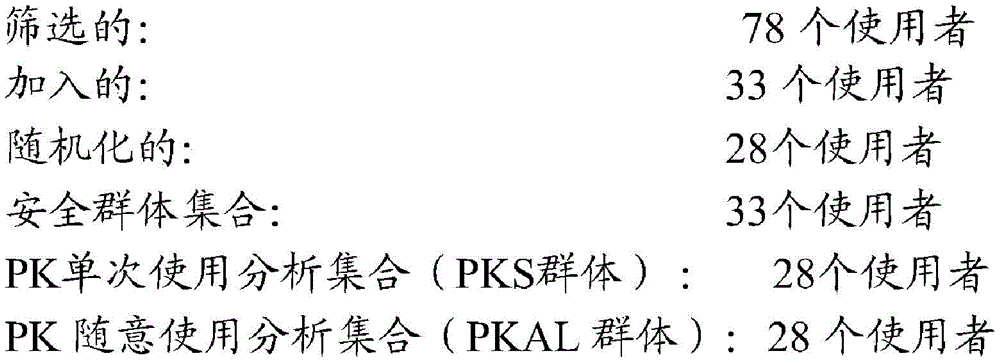
诊断和主要入选标准Diagnosis and main inclusion criteria
女性或男性,在其他方面健康的高加索人吸烟者(在筛选前具有至少三年的连续吸烟和每天最低限度10根不含薄荷脑的CC的吸烟史,在筛选前四周期间具有1mg烟碱ISO/CC的最大得率)。使用者是目前吸烟者,其在接下来的3个月内不计划戒烟,然而,准备接受最高达连续两天的吸烟中断。使用者可抽吸不同品牌,直至进入诊所。然而,从进入诊所开始,使用者局限于使用者的优先CC品牌。吸烟状态用尿可替宁测试(可替宁≥200ng/ml)进行确认。随机化配额用于确保每个性别和吸烟层代表至少40%的研究群体。Female or male, otherwise healthy Caucasian smoker (with at least three years of continuous smoking prior to screening and a smoking history of a minimum of 10 menthol-free CCs per day, with 1 mg of nicotine ISO during the four-week period prior to screening /CC maximum yield). Users are current smokers who do not plan to quit smoking within the next 3 months, however, are prepared to receive up to two consecutive days of smoking cessation. Users can smoke different brands until they enter the clinic. However, from entering the clinic, users are limited to the user's preferred CC brand. Smoking status was confirmed with a urine cotinine test (cotinine ≥ 200 ng/ml). Randomization quotas were used to ensure that each sex and smoking stratum represented at least 40% of the study population.
测试产品test product
如图5至7所示,气雾生成制品包括烟草加热装置、用于使用专门设计的THS香烟的THS吸烟支架和THS附件,所述THS附件包括THS充电单元、电源适配器和电源线,以允许支架的充电。As shown in Figures 5 to 7, the aerosol-generating article includes a tobacco heating device, a THS smoking holder for use with specially designed THS cigarettes, and a THS accessory including a THS charging unit, a power adapter and a power cord to allow Charging of the stand.
参考产品Reference product
商购可得的CC,由使用者根据其偏爱提供。Commercially available CC, provided by the user according to their preference.
暴露持续时间exposure duration
研究在7天限定时期过程中(七天过夜停留)执行。Studies were performed over the course of a 7-day defined period (seven overnight stays).
阶段1:·第0天:洗出;Phase 1: Day 0: Wash out;
·第1天:单次产品使用(THS 2.1/CC)Day 1: Single product use (THS 2.1/CC)
·第2天:随意产品使用(THS 2.1/CC)。• Day 2: Product use ad libitum (THS 2.1/CC).
阶段2:·第3天:洗出;Stage 2: Day 3: Wash out;
·第4天:单次产品使用(THS 2.1/CC);Day 4: Single product use (THS 2.1/CC);
·第5天:随意产品使用(THS 2.1/CC)。• Day 5: Product use ad libitum (THS 2.1/CC).
评估标准Evaluation Criteria
第一终点:First end point:
在THS香烟和CC单次使用后的烟碱PK:Nicotine PK after a single use of THS cigarettes and CC:
·Cmax。• Cmax .
·从时间零到最后可定量浓度的时间的浓度时间曲线下面积(AUC0-last)。• Area under the concentration-time curve from time zero to the time of the last quantifiable concentration (AUC0 -last ).
第二终点:Second end point:
药物代谢动力学终点:Pharmacokinetic endpoints:
·在单次使用后的烟碱PK:AUC0-∞、tmax、AUC0-t’、消除速率常数和半衰期(t1/2)。• Nicotine PK after single use: AUCo -∞ , tmax , AUCo -t' , elimination rate constant and half-life (t1 /2 ).
·在随意使用后,在THS香烟和CC使用者之间的烟碱浓度峰值和谷值。• Peak and trough nicotine concentrations between THS cigarettes and CC users after ad libitum use.
生物标记终点:Biomarker Endpoints:
在单次使用和随意使用后,在THS香烟和CC使用者之间的呼出CO和血液COHb的水平。Levels of exhaled CO and blood COHb between THS cigarette and CC users after single and ad libitum use.
样品量Sample size
将总共28个吸烟者随机化。需要该样品量以评估THS香烟和CC之间的Cmax比的几何平均值的比,其精确度允许90%置信区间不超过0.80和1.25限值,具有80%功效且假定5%退出率。A total of 28 smokers were randomized. This sample size was required to assess the ratio of the geometric means of the Cmax ratio between THS cigarettes and CC with precision allowing 90% confidence intervals not to exceed the 0.80 and 1.25 limits, with 80% power and assuming a 5% dropout rate.
统计方法statistical methods
第一PK终点为在单次产品使用后,烟碱的AUC0-last和Cmax值。第二PK终点为在单次产品使用后的AUC0-∞、AUC0-t’、t1/2、消除速率常数和tmax。The primary PK endpoints were AUC0 -last and Cmax values for nicotine after a single product use. The secondary PK endpoints were AUCo -∞ , AUCo -t' , t1 /2 , elimination rate constant and tmax after a single product use.
对于对数转化(自然对数)的单次使用的PK参数进行方差分析(ANOVA)。模型包括顺序、顺序内的使用者、阶段和暴露组项作为固定效应因子。AUC0-last和Cmax各自的分析结果以THS香烟:CC比的调整的几何最小二乘(LS)平均值和90%置信区间(CI)的方式呈现。Analysis of variance (ANOVA) was performed for log-transformed (natural log) single-use PK parameters. The model included order, user within order, stage, and exposure group terms as fixed effect factors. The results of the respective analyses of AUCo -last and Cmax are presented as adjusted geometric least squares (LS) means and 90% confidence intervals (CI) of the THS cigarette:CC ratio.
假定在使用者、暴露和阶段之间不存在遗留效应或相互作用。在对数转化后不测试正态性。当对数转化的数据用于分析时,所报告的结果是回复转化的。It is assumed that there are no carryover effects or interactions between users, exposures and phases. Normality was not tested after log transformation. When log-transformed data is used for analysis, the reported results are back-transformed.
tmax使用威尔科克森符号秩检验(Wilcoxon Signed-Rank Test)在原始规模上进行分析。对于THS和CC之间的中值差异,霍奇斯-莱曼估计量(Hodges-Lehmann estimate)以90%CI呈现。t max was analyzed on the original scale using the Wilcoxon Signed-Rank Test. For the median difference between THS and CC, the Hodges-Lehmann estimate is presented with 90% CI.
结果result
人口统计学Demographics
在加入的33个使用者中,将28个随机化,并且所有28个均完成研究。三十三个使用者暴露于气雾生成装置(在产品试验期间),并且因此包括在安全群体中。所有28个随机化的使用者均满足入选/淘汰标准,并且顺序就年龄、身高、体重和体重指数(BMI)而言进行平衡。Of the 33 users enrolled, 28 were randomized and all 28 completed the study. Thirty-three users were exposed to the aerosol-generating device (during product testing) and were therefore included in the safety group. All 28 randomized users met inclusion/elimination criteria and the order was balanced for age, height, weight and body mass index (BMI).
第一PK终点The first PK end point
在两种产品的单次使用后的平均烟碱浓度曲线显示于图1中。浓度时间曲线的总体形状对于两种产品看起来是相似的,但在THS的单次使用后,具有对烟碱的更低暴露。The mean nicotine concentration profiles after a single use of both products are shown in Figure 1 . The overall shape of the concentration-time curves appeared to be similar for both products, but with lower exposure to nicotine after a single use of THS.
在单次使用后,与CC相比较,对烟碱的暴露程度平均起来对于THS更低23%(90%CI:15%,30%)。类似地,与CC相比较,最大烟碱浓度平均起来在THS单次使用后低30%(90%CI:18%至40%)。对于两个第一终点,几何平均值比的90%CI的下限小于80%,并且CI不含100%。数据显示于表2中。After a single use, exposure to nicotine was on average 23% lower for THS compared to CC (90% CI: 15%, 30%). Similarly, maximal nicotine concentrations were on average 30% lower after a single dose of THS compared to CC (90% CI: 18% to 40%). For both primary endpoints, the lower bound of the 90% CI for the geometric mean ratio was less than 80%, and the CI did not contain 100%. The data are shown in Table 2.
第二PK终点Second PK end point
在tmax中不存在差异(90%CI:-1,2),两种产品均具有8分钟的tmax。There was no difference in tmax (90% CI: -1,2), both products had a tmax of 8 minutes.
如通过平均AUC0-∞和AUC0-t’评价的,THS的烟碱暴露程度分别为19.083ng.h/mL和0.5262ng.h/mL。与CC相比较,这些估计量结果低19%(95%CI:11%,27%)和33%(95%CI:12%,48%)。烟碱的平均消除半衰期对于THS为2.741小时,比CC长11%(95%CI:2%,21%)。The degree of nicotine exposure to THS was 19.083 ng.h/mL and 0.5262 ng.h/mL, as assessed by mean AUC 0-∞ and AUC 0-t' , respectively. These estimators turned out to be 19% (95% CI: 11%, 27%) and 33% lower (95% CI: 12%, 48%) compared to CC. The mean elimination half-life of nicotine was 2.741 hours for THS, 11% longer than CC (95% CI: 2%, 21%).
实例2Example 2
单中心、开放标签、随机化、对照、2臂平行组研究,以评估在从常规香烟转变为THS的吸烟但其他方面健康的使用者中,对所选择的烟组成成分的暴露。A single-center, open-label, randomized, controlled, 2-arm, parallel-group study to assess exposure to selected smoke constituents in smoking but otherwise healthy users who switched from conventional cigarettes to THS.
该研究的目的是评估与继续抽吸CC的吸烟者相比较,在从常规香烟(CC)转变为THS香烟的吸烟者中,使用THS香烟对所选择的第一暴露生物标记(BoExp)的作用。进一步的目标是评估与继续抽吸CC的吸烟者相比较,在从CC转变为THS香烟的吸烟者中,在限制中使用THS香烟对所选择的第二BoExp的作用。进一步的目标是评估与继续抽吸CC的吸烟者相比较,在从CC转变为THS香烟的吸烟者中,在限制设置中使用THS香烟对CYP1A2酶促活性的作用。进一步的目标是评估与继续抽吸CC的吸烟者相比较,在从CC转变为THS香烟的吸烟者中,在暴露阶段期间使用THS香烟的安全性,和在限制设置中使用THS香烟对11-DTX-B2的作用。进一步的目标是比较在不同身体基质中,对于所选择的第一和第二BoExp、11-DTX-B2和CYP2A6获得的结果。The purpose of this study was to evaluate the effect of THS cigarette use on a selected biomarker of first exposure (BoExp) in smokers who switched from conventional cigarettes (CC) to THS cigarettes compared with smokers who continued to smoke CC . A further objective was to evaluate the effect of using THS cigarettes in restriction on the second BoExp of choice in smokers who switched from CC to THS cigarettes compared to smokers who continued to smoke CC. A further objective was to evaluate the effect of using THS cigarettes in a restricted setting on CYP1A2 enzymatic activity in smokers who switched from CC to THS cigarettes compared to smokers who continued to smoke CC. A further objective was to evaluate the safety of THS cigarette use during the exposure phase in smokers who switched from CC to THS cigarettes compared to smokers who continued to smoke CC, and the effect of THS cigarette use in restricted settings on 11- The role of DTX-B2. A further objective was to compare the results obtained for the selected first and second BoExp, 11-DTX-B2 and CYP2A6 in different body matrices.
材料与方法Materials and Methods
研究设计Research design
这是随机化、对照、开放标签、2臂、平行组随意吸烟研究,比较THS香烟和CC的使用。使用者限制于控制环境中共九天:入院(第-2天)、基线(第-1天和第0天)、暴露阶段(第1天至第5天)、出院(第6天)。使用THS香烟的效应评估在第5天时执行。在限制期间的吸烟被允许在06:30和23:00之间。This is a randomized, controlled, open-label, 2-arm, parallel-group ad libitum smoking study comparing the use of THS cigarettes and CC. Users were restricted to a controlled environment for a total of nine days: admission (day -2), baseline (days -1 and 0), exposure phase (
随机化通过性别和在筛选就诊前四周期间使用者报告的每日平均CC消费进行分层(每天吸烟10至19根CC的那些和每天吸烟>19根CC的那些)。Randomization was stratified by gender and user-reported average daily CC consumption (those who smoked 10 to 19 CCs per day and those who smoked >19 CCs per day) during the four weeks preceding the screening visit.
不知情类型:开放标签Uninformed Type: Open Label
对照类型:常规香烟Control Type: Regular Cigarettes
使用者数目(计划的和分析的)Number of users (planned and analyzed)
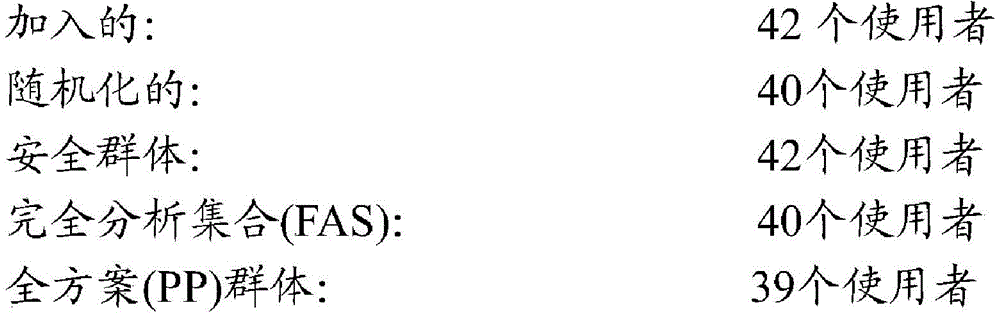
诊断和主要入选标准Diagnosis and main inclusion criteria
包括女性或男性在其他方面健康的高加索人吸烟者,在筛选前具有至少三年的连续吸烟和每天最低限度10根不含薄荷脑的CC的吸烟史,在筛选前四周期间具有1mg烟碱ISO/CC的最大得率)。使用者可抽吸不同品牌,直至进入诊所。然而,从进入诊所开始,使用者局限于使用者的偏爱CC品牌。吸烟状态用尿可替宁测试(可替宁≥200ng/ml)进行确认。随机化配额用于确保每个性别和吸烟层代表至少40%的研究群体。Include female or male otherwise healthy Caucasian smokers with at least three years of continuous smoking prior to screening and a smoking history of a minimum of 10 menthol-free CCs per day, with 1 mg of nicotine ISO during the four-week period prior to screening /CC maximum yield). Users can smoke different brands until they enter the clinic. However, from the moment of entering the clinic, the user is limited to the user's preferred CC brand. Smoking status was confirmed with a urine cotinine test (cotinine ≥ 200 ng/ml). Randomization quotas were used to ensure that each sex and smoking stratum represented at least 40% of the study population.
测试产品test product
如图5至7所示的THS包括烟草加热装置、用于使用专门设计的THS香烟的THS吸烟支架和THS附件,所述THS附件包括THS充电单元、电源适配器和电源线,以允许支架的充电。The THS as shown in Figures 5 to 7 includes a tobacco heating device, a THS smoking stand for use with specially designed THS cigarettes and a THS accessory including a THS charging unit, power adapter and power cord to allow charging of the stand .
参考产品Reference product
商购可得的CC,由使用者根据其偏爱提供。Commercially available CC, provided by the user according to their preference.
暴露阶段的持续时间duration of exposure phase
在其中使用者抽吸他们自己的CC品牌的2天基线阶段后,使用者使用THS共五天。After a 2-day baseline period in which users smoked their own CC brand, users used THS for a total of five days.
随机化至THS臂的使用者指定THS香烟支架和THS配件。使用者在要求后被供应THS香烟,一次一根香烟。从第1天,06:30开始直到第5天,23:00,THS臂中的使用者不允许抽吸CC。Users randomized to the THS arm designated THS cigarette holders and THS accessories. Users are offered THS cigarettes, one cigarette at a time, upon request. From
随机化至CC臂的使用者从第1天06:30开始直到第5天23:00继续随意抽吸其自己偏爱的CC品牌。Users randomized to the CC arm continued to smoke their own preferred CC brand at will from
评估标准Evaluation Criteria
第一终点为通过测量在5天暴露阶段的其各自生物标记评价的,对四种有害和潜在有害的组成成分(HPHC)(CO、1,3-丁二烯、丙烯醛和苯)的暴露。四种组成成分在吸烟者中比戒烟的吸烟者中高七倍,并且平均起来显示出≤24小时的消除半衰期。因此,五天的暴露应足以达到新稳态(是其消除半衰期的至少五倍)。一氧化碳通过使用在血液中的碳氧血红蛋白作为血液中的标记进行测量,所述碳氧血红蛋白可通过分光光度法进行定量。苯通过使用在尿中的S-苯基-巯基尿酸(S-PMA)作为标记进行测量,所述S-苯基-巯基尿酸可通过液相层析-串联质谱法(LC-MS/MS)进行定量。丙烯醛通过使用在尿中的3-羟丙基-巯基尿酸(3-HPMA)作为标记进行测量,所述3-羟丙基-巯基尿酸可经由液相层析-串联质谱法(LC-MS/MS)进行定量。1,3-丁二烯通过使用在尿中的单羟基丁烯基巯基尿酸(MHBMA)作为标记进行测量,所述单羟基丁烯基巯基尿酸可通过液相层析-串联质谱法(LC-MS/MS)进行定量。The primary endpoint was exposure to four harmful and potentially harmful constituents (HPHC) (CO, 1,3-butadiene, acrolein, and benzene) as assessed by measuring their respective biomarkers over a 5-day exposure period . The four constituents were seven-fold higher in smokers than in ex-smokers, and on average exhibited an elimination half-life of ≤24 hours. Therefore, five days of exposure should be sufficient to reach a new steady state (at least five times its elimination half-life). Carbon monoxide is measured by using carboxyhemoglobin in blood, which can be quantified spectrophotometrically, as a marker in blood. Benzene is measured by using S-phenyl-mercaptouric acid (S-PMA) in urine as a label, which can be measured by liquid chromatography-tandem mass spectrometry (LC-MS/MS) Quantify. Acrolein is measured by using 3-hydroxypropyl-mercaptouric acid (3-HPMA) as a marker in urine, which can be measured by liquid chromatography-tandem mass spectrometry (LC-MS /MS) for quantification. 1,3-Butadiene is measured by using monohydroxybutenyl mercaptouric acid (MHBMA) in urine as a marker, which can be measured by liquid chromatography-tandem mass spectrometry (LC- MS/MS) for quantification.
总之,在该研究中评价14种HPHC的生物标记(参见表3),其中13种在待报告的FDA18简短列表中列出。In all, 14 biomarkers of HPHC were evaluated in this study (see Table 3), 13 of which are listed in the FDA18 short list to be reported.
呼气中的一氧化碳使用Micro 4Smokerlyzer进行测量。适当时,该测试与COHb血样结合进行。Carbon monoxide in exhaled breath was measured using a Micro 4Smokerlyzer. When appropriate, this test is performed in conjunction with a COHb blood sample.
另外的终点another end point
·11-DTX-B2在尿中进行测量(现场尿样和24小时尿样)。• 11-DTX-B2 was measured in urine (field urine and 24 hour urine).
·CYP1A2活性在第0天和第5天时进行测量,基于副黄嘌呤(PX)和咖啡因(CAF)血浆摩尔浓度,在摄入一杯咖啡后大约六小时(±15分钟)。• CYP1A2 activity was measured on
·CYP2A6活性在第0天和第5天时在血浆中进行测量,使用反式-3’-羟基可替宁和可替宁的代谢:摩尔比。• CYP2A6 activity was measured in plasma on
·用视觉模拟量表(VAS)、三个李克特量表(Likert scale)和一个开放问题评价咳嗽。• Cough was assessed with a Visual Analog Scale (VAS), three Likert scales and an open question.
·吸烟行为:使用
样品量Sample size
将总共40个吸烟者(THS 2.1臂中20个,CC臂中20个)随机化。计算该样品量以获得超过80%功效,以显示与CC臂相比较THS臂中的降低,使用具有5%I型误差概率的双尾检验。A total of 40 smokers (20 in the THS 2.1 arm, 20 in the CC arm) were randomized. This sample size was calculated to obtain over 80% power to show a reduction in the THS arm compared to the CC arm, using a two-tailed test with a 5% Type I error probability.
统计方法statistical methods
对就肌酸酐调整的对数转化(自然对数)的数据分析BoExp。将组间差异的估计量回复转化,以提供相对效应(THS/CC)。借助于对于对数转化的基线值和随机化时使用的分层因子调整的一般线性模型(GLM),在第5天时暴露阶段结束时(EoE)的值在暴露组之间进行比较。BoExp was analyzed for log-transformed (natural log) data adjusted for creatinine. Estimates of between-group differences were back-transformed to provide relative effects (THS/CC). Values at the end of the exposure period (EoE) at
对于通过研究臂的第一BoExp各自,以及对于绝对值以及从基线开始每天的变化和百分比变化总体,产生描述性概括统计数据,包括使用者数目(no.)、缺失数据的使用者数目、结果在定量限值以下(BLOQ)的使用者数目、平均值、标准差(SD)、几何平均值和相关的95%置信区间(CI)、最小值、第一四分位数、中值、第三四分位数、最大值和变异系数(CV)。Descriptive summary statistics were generated including number of users (no.), number of users with missing data, outcome Number of users below the limit of quantification (BLOQ), mean, standard deviation (SD), geometric mean and associated 95% confidence interval (CI), minimum value, first quartile, median, first Three quartiles, maximum value and coefficient of variation (CV).
除非另有说明,否则所有统计学检验均为两侧的,并且在5%水平上进行,并且所有引用的置信区间均为两侧95%置信区间。All statistical tests are two-sided and performed at the 5% level, and all cited confidence intervals are two-sided 95% confidence intervals unless otherwise stated.
结果result
人口统计学Demographics
在加入的42个使用者中,将40个随机化,并且所有40个均完成研究。一个使用者被错误随机化(两个使用者指定相同随机化编号),并且从全方案群体中去除。四十二个使用者暴露于THS(在产品试验期间),并且因此包括在安全群体中。Of the 42 users enrolled, 40 were randomized and all 40 completed the study. One user was incorrectly randomized (two users assigned the same randomization number) and was removed from the full protocol population. Forty-two users were exposed to THS (during product trials) and were therefore included in the safety population.
所有40个随机化的使用者均满足入选/淘汰标准,并且各组就年龄、身高、体重和体重指数(BMI)而言进行平衡。All 40 randomized users met inclusion/elimination criteria, and groups were balanced for age, height, weight, and body mass index (BMI).
第一暴露生物标记first exposure biomarker
在所有四种第一BoExp中均存在显著减少。变化在开始使用THS的24小时内可见,并且减少在研究自始至终得到维持。There were significant reductions in all four first BoExps. Changes were visible within 24 hours of starting THS, and the reduction was maintained throughout the study.
COHbCOHb
在THS臂中,在第1天时,碳氧血红蛋白从基线轻微下降超过四个百分点(-4.19%±1.2%)。在第5天时,相对于基线的变化是关于THS的75.2%减少和关于CC的7.2%增加。该变化在暴露的五天内得到维持。在CC臂中,不存在碳氧血红蛋白中值得注意的变化。到第1天时,对于THS臂中的20个使用者中的19个,COHb水平在2%以下,这在非吸烟者的正常COHb范围内。在第5天时,COHb水平对于所有20个使用者均在2%以下。结果显示于图2A中。In the THS arm, on
MHBMAMHBMA
在暴露阶段结束时(EoE),就肌酸酐调整的MHBMA尿浓度对于THS在第5天时从基线减少超过75%,并且对于CC在第5天时从基线增加19.5%。变化是统计上显著的。MHBMA中的变化在开始使用THS的24小时内可见,并且在暴露自始至终得到维持。结果显示于图2B中。At the end of the exposure period (EoE), urine concentrations of MHBMA adjusted for creatinine decreased by more than 75% from baseline on
3-HPMA3-HPMA
在暴露阶段结束时(EoE),就肌酸酐调整的3-HPMA尿浓度对于THS 2.1在第5天时从基线减少超过-57.9%,并且对于CC在第5天时从基线增加11.4%。变化是统计上显著的。3-HPMA中的变化在开始使用THS的24小时内可见,并且通过暴露阶段保持降低。结果显示于图2C中。At the end of the exposure period (EoE), creatinine-adjusted 3-HPMA urine concentrations decreased by more than -57.9% from baseline on
S-PMAS-PMA
在暴露阶段结束时(EoE),就肌酸酐调整的MHBMA尿浓度对于THS在第5天时从基线减少超过-88%,并且对于CC在第5天时从基线增加26.4%。变化是统计上显著的。S-PMA中的变化在开始使用THS的24小时内可见,并且对于研究持续时间保持很低。结果显示于图2D中。At the end of the exposure period (EoE), urine concentrations of MHBMA adjusted for creatinine decreased by more than -88% from baseline on
结果概括于表5中。The results are summarized in Table 5.
CYP1A2活性CYP1A2 activity
CYP1A2的水平可使用本领域已知的方法进行测量,例如参见ClinicalPharmacology&Therapeutics(2011)90,117-125。CYP1A2活性在THS臂中减少大约25%,并且在CC臂中保持相同。结果显示于图3中。Levels of CYP1A2 can be measured using methods known in the art, eg, see Clinical Pharmacology & Therapeutics (2011) 90, 117-125. CYP1A2 activity was reduced by approximately 25% in the THS arm and remained the same in the CC arm. The results are shown in FIG. 3 .
实例3Example 3
图4A和4B示出了使用薄荷脑调味的香烟(平台1薄荷脑)和常规烟草(平台1常规),经由烟草燃烧(MM-2008中值)相对于根据本公开内容的烟草加热,产生的气雾(烟)的化学分析。Figures 4A and 4B show cigarettes flavored with menthol (
如该图中可见,与通过燃烧烟草产生的气雾相比较,许多HPHC的水平在通过烟草加热产生的气雾中是降低的。使用本领域众所周知的方法,在气雾(烟)中测量HPHC。As can be seen in this figure, the levels of many HPHCs are reduced in aerosols produced by tobacco heating compared to aerosols produced by burning tobacco. HPHC is measured in aerosol (smoke) using methods well known in the art.
本文引用或描述的任何出版物提供本申请提交日之前公开的有关信息。本文的陈述不能被解释为承认本发明人无权早于这种公开。在以上说明书中提到的所有出版物均以引用的方式并入本文。本公开内容的多种改动和变化对于本领域技术人员是显而易见的,而不背离本公开内容的范围和精神。虽然本公开内容已结合具体的优选实施例进行描述,但应当理解如请求保护的本公开内容不应被不适当地限制于此类具体实施例。实际上,用于进行本公开内容的所述形式的多种改变,对于本领域技术人员是显而易见的,预期在如下权利要求的范围内。Any publications cited or described herein provide relevant information that was disclosed prior to the filing date of this application. Statements herein should not be construed as an admission that the inventors are not entitled to antedate such disclosure. All publications mentioned in the above specification are incorporated herein by reference. Various modifications and variations of the present disclosure will be apparent to those skilled in the art without departing from the scope and spirit of the present disclosure. Although the present disclosure has been described in conjunction with specific preferred embodiments, it should be understood that the present disclosure as claimed should not be unduly limited to such specific embodiments. Indeed, various modifications of the described forms for making the present disclosure, which will be apparent to those skilled in the art, are intended to be within the scope of the following claims.
表1Table 1
烟组成成分的暴露生物标记的例子Examples of exposure biomarkers for smoke constituents
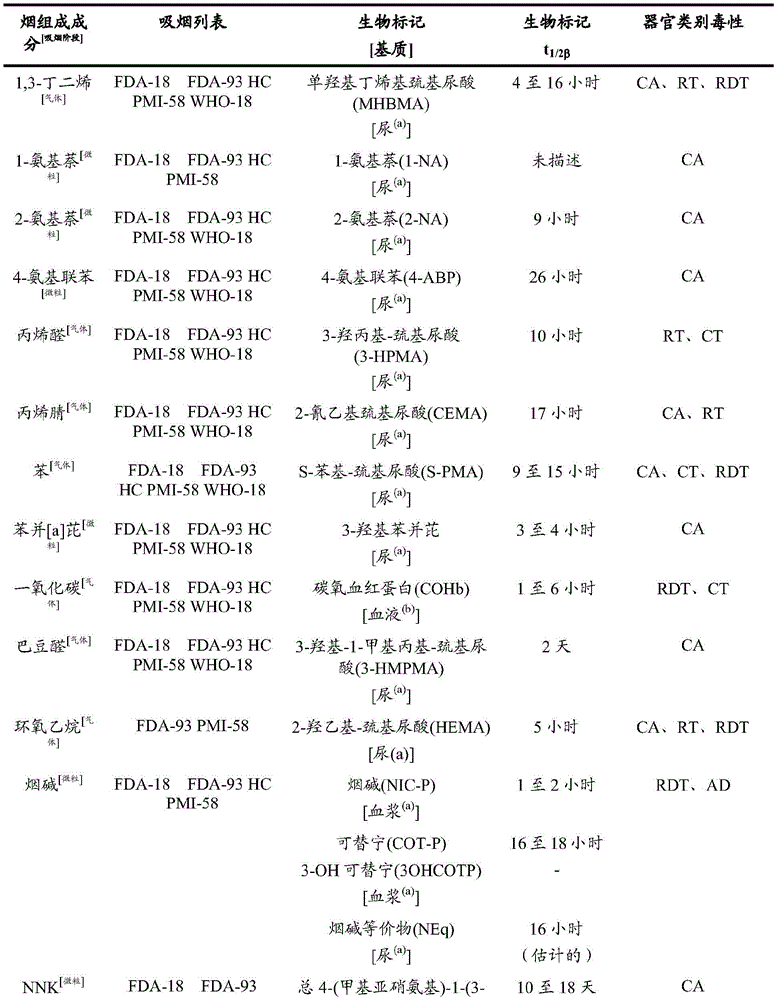
烟组成成分的暴露生物标记的例子Examples of exposure biomarkers for smoke constituents
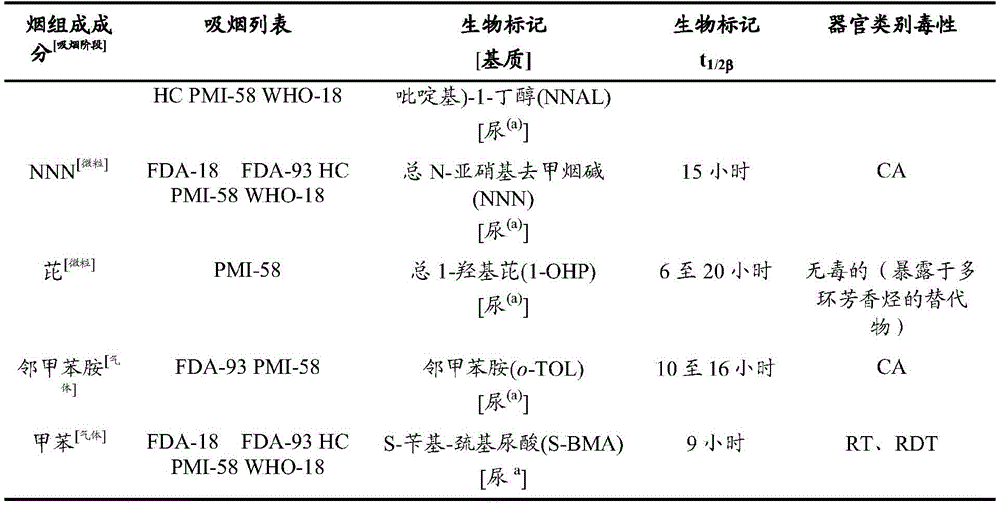
分析方法:(a)液相层析-串联质谱法(LC-MS/MS)(b)分光光度法Analytical methods: (a) Liquid chromatography-tandem mass spectrometry (LC-MS/MS) (b) Spectrophotometry
器官类别毒性(Federal Register 2012第77卷;no.64)):AD:成瘾的;CA:致癌物;CT:心血管毒物;RDT:生殖和发育毒物;RT:呼吸器官毒物Organ Class Toxicity (Federal Register 2012 Vol. 77; no. 64)): AD: Addictive; CA: Carcinogen; CT: Cardiovascular; RDT: Reproductive and Developmental; RT: Respiratory
表2Table 2
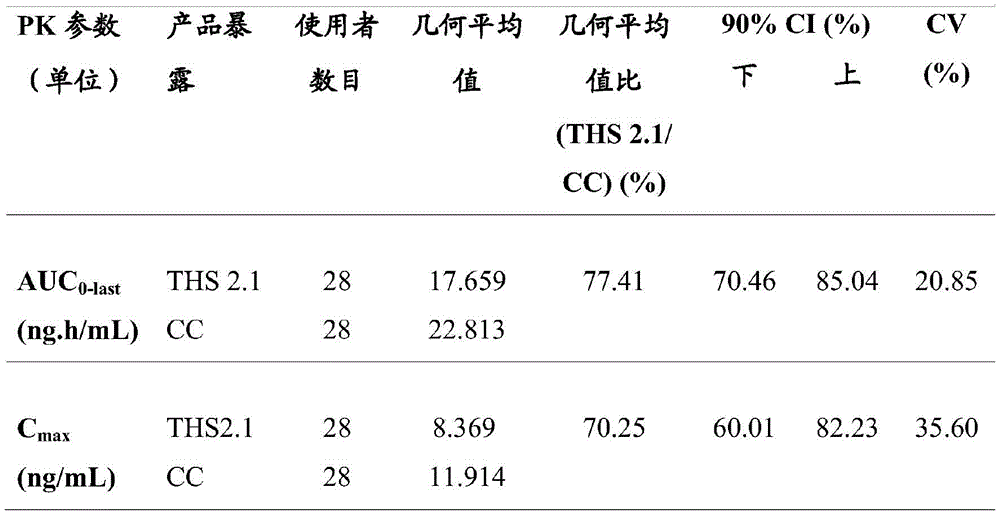
表3table 3
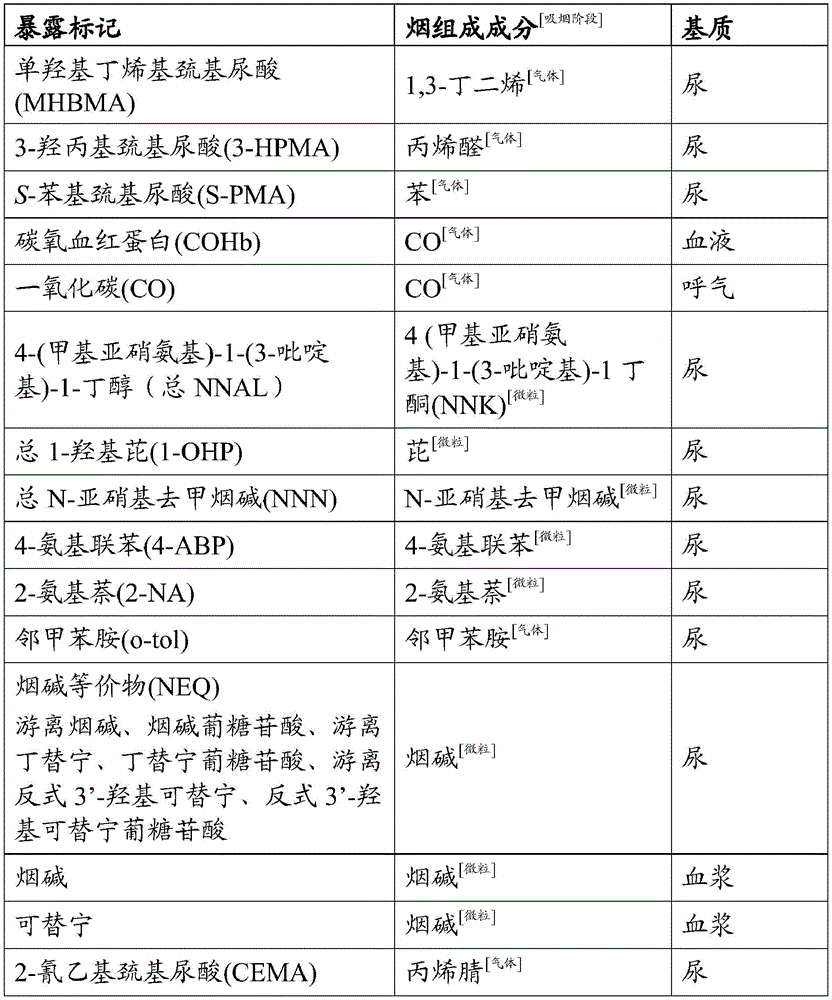
表4Table 4
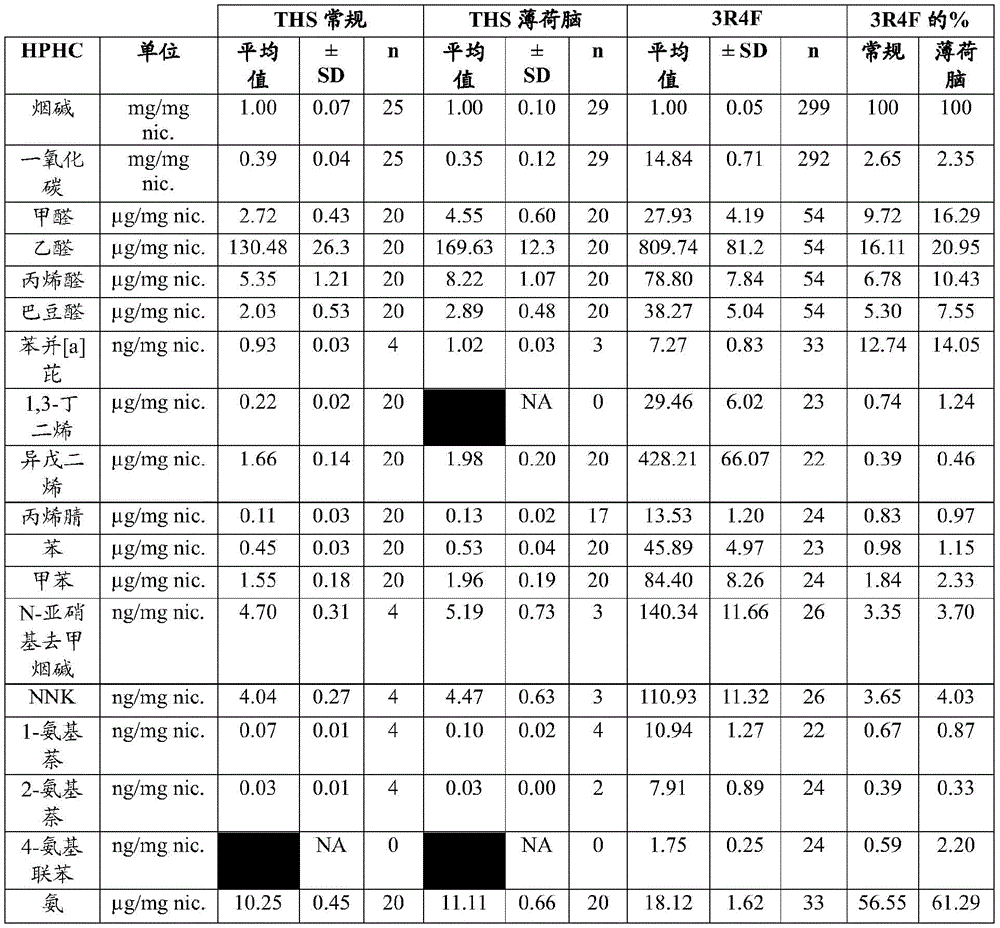
表5table 5
在第5天时的第一暴露生物标记-从基线的变化(%)First Exposure Biomarker at Day 5 - Change from Baseline (%)
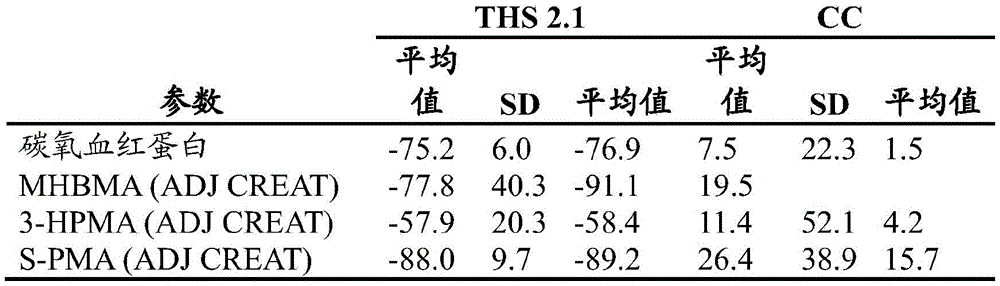
特别地,本发明还涉及以下项目:In particular, the present invention also relates to the following items:
项目1.一种通过气雾生成装置吸入包含烟碱的气雾的方法,所述方法包括如下步骤:
(a)提供气雾生成装置,在所述气雾生成装置中,将其中包含的烟草电加热至小于约400摄氏度的温度,以制备气雾;和(a) providing an aerosol-generating device in which tobacco contained therein is electrically heated to a temperature of less than about 400 degrees Celsius to produce an aerosol; and
(b)允许使用者吸入源自所述电加热的烟草的气雾;(b) allowing the user to inhale an aerosol derived from said electrically heated tobacco;
其中所述气雾包含的烟碱水平与燃烧的烟草中的水平大约相同;和wherein the aerosol contains about the same level of nicotine as in burning tobacco; and
其中所述气雾包含的除烟碱外的一种或多种有害或潜在有害的组成成分(HPHC)的水平低于燃烧的烟草中的水平。wherein the aerosol contains a level of one or more harmful or potentially harmful constituents (HPHC) other than nicotine that is lower than the level in burnt tobacco.
项目2.根据项目1所述的方法,其中除烟碱外的一种或多种HPHC在由所述电加热的烟草生成的气雾中是无法检测的或无法明显检测的,所述HPHC选自:间甲酚、对甲酚、1,3丁二烯、异戊二烯、丙烯腈、苯、1-氨基萘、2-氨基萘、3-氨基联苯、4-氨基联苯、氢氰酸和镉或其一种或多种的组合或其组合。
项目3.根据前述项目中任一项所述的方法,其中4-氨基联苯、2-氨基萘和1-氨基萘以高达或小于约0.1ng/mg烟碱存在于所述气雾中;其中一氧化碳、1,3-丁二烯、苯、苯并[a]芘和丙烯腈以约0.4至0.11ng/mg烟碱存在于所述气雾中;其中异戊二烯、甲苯、甲醛和巴豆醛以约1.5至3ng/mg烟碱存在于所述气雾中;其中N-亚硝基去甲烟碱和NNK以约3.1至5ng/mg烟碱存在于所述气雾中;其中丙烯醛以约4至7ng/mg烟碱存在于所述气雾中;其中氨以约9至11ng/mg烟碱存在于所述气雾中;并且其中乙醛以约100至160ng/mg烟碱存在于所述气雾中。
项目4.根据前述项目中任一项所述的方法,其中所述气雾生成装置的使用者中的一氧化碳、苯、丙烯醛和1,3-丁二烯中任一种的水平低于当由燃烧的烟草生成时在所述使用者中的水平,适当地,其中Item 4. The method of any preceding item, wherein the level of any of carbon monoxide, benzene, acrolein, and 1,3-butadiene in a user of the aerosol-generating device is lower than when the level in said user as produced by burning tobacco, suitably wherein
在消费由电加热的烟草生成的气雾1天后,所述使用者中的碳氧血红蛋白(一氧化碳标记)水平为在血液中约1-2%,适当地约1.5%;和/或The carboxyhemoglobin (marked carbon monoxide) level in the user is about 1-2% in blood, suitably about 1.5%, 1 day after consumption of the electrically heated tobacco-generated aerosol; and/or
在消费由电加热的烟草生成的气雾2天后,所述使用者中的S-PMA(苯标记)水平为在尿中约0.1至1微克/g肌酸酐,适当地约0.5微克/g肌酸酐;和/或S-PMA (benzene marker) levels in the user are about 0.1 to 1 microgram/g creatinine in urine, suitably about 0.5 microgram/g creatinine, 2 days after consuming the electrically heated tobacco-generated aerosol anhydride; and/or
在消费由电加热的烟草生成的气雾2天后,所述使用者中的3-HPMA(丙烯醛标记)水平为在尿中约200至400微克/g肌酸酐,适当地约300微克/g肌酸酐;和/或3-HPMA (acrolein marker) levels in the user are about 200 to 400 micrograms/g creatinine in urine, suitably about 300 micrograms/g, 2 days after consuming the electrically heated tobacco-generated aerosol Creatinine; and/or
在消费由电加热的烟草生成的气雾2天后,所述使用者中的MHBMA(1,3-丁二烯标记)水平为在尿中约0.1至1微克/g肌酸酐,适当地0.5微克/g肌酸酐。MHBMA (1,3-butadiene label) levels in the user are about 0.1 to 1 microgram/g creatinine in urine, suitably 0.5 microgram, 2 days after consuming the electrically heated tobacco-generated aerosol /g creatinine.
项目5.根据前述项目中任一项所述的方法,其中经由吸入由电加热的烟草生成的所述气雾的烟碱递送概况与经由吸入由燃烧的烟草生成的气雾获得的那种基本上相同,适当地,其中在吸入来自电加热的烟草的所述气雾约9分钟内,血液血浆中的所述烟碱浓度增加至最大浓度;和/或其中所述tmax为约7至9分钟;和/或其中平均AUC0-∞和AUC0-t’分别为约18至20ng.h/mL和约0.5至0.6ng.h/mL。
项目6.根据前述项目中任一项所述的方法,其中将电加热烟草的加热元件插入所述烟草内,并且其中连续的能量供应被供应给所述加热元件,在所述装置使用期间监控所述连续的能量供应。
项目7.一种通过气雾生成装置吸入包含烟碱的气雾的方法,所述方法包括如下步骤:
(a)提供气雾生成装置,在所述气雾生成装置中,将其中包含的烟草电加热至小于约400摄氏度的温度,以制备气雾;和(a) providing an aerosol-generating device in which tobacco contained therein is electrically heated to a temperature of less than about 400 degrees Celsius to produce an aerosol; and
(b)允许使用者吸入源自所述电加热的烟草的气雾;其中(b) allowing the user to inhale an aerosol derived from said electrically heated tobacco; wherein
(i)在吸入后约9分钟之后,所述使用者中的所述烟碱浓度为在血浆中约6至8ng/ml;(i) the nicotine concentration in the user is about 6 to 8 ng/ml in plasma after about 9 minutes after inhalation;
(ii)在消费由电加热的烟草生成的气雾1天后,所述使用者中的碳氧血红蛋白(一氧化碳标记)水平为在血液中约1-2%,适当地约1.5%;和/或(ii) a carboxyhemoglobin (marked carbon monoxide) level in said user of about 1-2% in blood, suitably about 1.5%, 1 day after consumption of an aerosol generated from electrically heated tobacco; and/or
(iii)在消费由电加热的烟草生成的气雾2天后,所述使用者中的S-PMA(苯标记)水平为在尿中约0.1至1微克/g肌酸酐,适当地约0.5微克/g肌酸酐;和/或(iii) S-PMA (benzene marker) level in the user of about 0.1 to 1 microgram/g creatinine in urine, suitably about 0.5 microgram, 2 days after consumption of the electrically heated tobacco-generated aerosol /g creatinine; and/or
(iv)在消费由电加热的烟草生成的气雾2天后,所述使用者中的3-HPMA(丙烯醛标记)水平为在尿中约200至400微克/g肌酸酐,适当地约300微克/g肌酸酐;和/或(iv) 3-HPMA (marked acrolein) level in the user of about 200 to 400 micrograms/g creatinine in urine, suitably about 300, 2 days after consumption of the electrically heated tobacco-generated aerosol micrograms/g creatinine; and/or
(v)在消费由电加热的烟草生成的气雾2天后,所述使用者中的MHBMA(1,3-丁二烯标记)水平为在尿中约0.1至1微克/g肌酸酐,适当地0.5微克/g肌酸酐。(v) MHBMA (1,3-butadiene label) levels in the user about 0.1 to 1 microgram/g creatinine in
项目8.气雾生成装置用于将气雾中的烟碱递送至使用者的用途,其中所述气雾通过将烟草电加热至小于约400摄氏度的温度而生成;其中所述气雾包含的烟碱水平与燃烧的烟草中的水平大约相同;并且其中所述气雾中除烟碱外的一种或多种HPHC的水平低于燃烧的烟草中的水平。
项目9.气雾生成装置用于将气雾中的烟碱递送至使用者的用途,其中所述气雾通过将烟草电加热至小于约400摄氏度的温度而生成;其中
(i)在吸入后约9分钟,所述使用者中的所述烟碱浓度为在血浆中约6至8ng/ml;和(i) about 9 minutes after inhalation, the nicotine concentration in the user is about 6 to 8 ng/ml in plasma; and
(ii)在消费由电加热的烟草生成的气雾1天后,所述使用者中的碳氧血红蛋白(一氧化碳标记)水平为在血液中约1-2%,适当地约1.5%;和/或(ii) a carboxyhemoglobin (marked carbon monoxide) level in said user of about 1-2% in blood, suitably about 1.5%, 1 day after consumption of an aerosol generated from electrically heated tobacco; and/or
(iii)在消费由电加热的烟草生成的气雾2天后,所述使用者中的S-PMA(苯标记)水平为在尿中约0.1至1微克/g肌酸酐,适当地约0.5微克/g肌酸酐;和/或(iii) S-PMA (benzene marker) level in the user of about 0.1 to 1 microgram/g creatinine in urine, suitably about 0.5 microgram, 2 days after consumption of the electrically heated tobacco-generated aerosol /g creatinine; and/or
(iv)在消费由电加热的烟草生成的气雾2天后,所述使用者中的3-HPMA(丙烯醛标记)水平为在尿中约200至400微克/g肌酸酐,适当地约300微克/g肌酸酐;和/或(iv) 3-HPMA (marked acrolein) level in the user of about 200 to 400 micrograms/g creatinine in urine, suitably about 300, 2 days after consumption of the electrically heated tobacco-generated aerosol micrograms/g creatinine; and/or
(v)在消费由电加热的烟草生成的气雾2天后,所述使用者中的MHBMA(1,3-丁二烯标记)水平为在尿中约0.1至1微克/g肌酸酐,适当地约0.5微克/g肌酸酐。(v) MHBMA (1,3-butadiene label) levels in the user about 0.1 to 1 microgram/g creatinine in
项目10.一种通过将烟草电加热至小于约400摄氏度的温度而生成的气雾,其中所述气雾包含:
(i)烟碱水平与燃烧的烟草中的水平大约相同;和(i) nicotine levels are approximately the same as those in burnt tobacco; and
(ii)其中4-氨基联苯、2-氨基萘和1-氨基萘以高达或小于约0.1ng/mg烟碱存在于所述气雾中;其中一氧化碳、1,3-丁二烯、苯、苯并[a]芘和丙烯腈以约0.4至0.11ng/mg烟碱存在于所述气雾中;其中异戊二烯、甲苯、甲醛和巴豆醛以约1.5至3ng/mg烟碱存在于所述气雾中;其中N-亚硝基去甲烟碱和NNK以约3.1至5ng/mg烟碱存在于所述气雾中;其中丙烯醛以约4至7ng/mg烟碱存在于所述气雾中;其中氨以约9至11ng/mg烟碱存在于所述气雾中;并且其中乙醛以约100至160ng/mg烟碱存在于所述气雾中。(ii) wherein 4-aminobiphenyl, 2-aminonaphthalene, and 1-aminonaphthalene are present in the aerosol at up to or less than about 0.1 ng/mg nicotine; wherein carbon monoxide, 1,3-butadiene, benzene , benzo[a]pyrene and acrylonitrile are present in the aerosol at about 0.4 to 0.11 ng/mg nicotine; wherein isoprene, toluene, formaldehyde and crotonaldehyde are present at about 1.5 to 3 ng/mg nicotine in said aerosol; wherein N-nitrosonornicotine and NNK are present in said aerosol at about 3.1 to 5 ng/mg nicotine; wherein acrolein is present at about 4 to 7 ng/mg nicotine in said aerosol; wherein ammonia is present in said aerosol at about 9 to 11 ng/mg nicotine; and wherein acetaldehyde is present in said aerosol at about 100 to 160 ng/mg nicotine.
项目11.一种鉴定使用气雾生成装置的使用者的方法,在所述气雾生成装置中,将其中包含的烟草电加热至小于约400摄氏度的温度,以制备气雾,所述方法包括如下步骤:Item 11. A method of identifying a user using an aerosol-generating device in which tobacco contained therein is electrically heated to a temperature of less than about 400 degrees Celsius to produce an aerosol, the method comprising Follow the steps below:
(a)提供来自所述使用者的样品;和(a) providing a sample from said user; and
(b)测定其中至少一氧化碳、苯、丙烯醛和1,3-丁二烯中的一种或多种的水平;其中(b) determining wherein the level of at least one or more of carbon monoxide, benzene, acrolein and 1,3-butadiene; wherein
(i)在消费由电加热的烟草生成的气雾1天后,所述使用者中的碳氧血红蛋白(一氧化碳标记)水平为在血液中约1-2%,适当地约1.5%;和/或(i) the carboxyhemoglobin (marked carbon monoxide) level in said user is about 1-2% in blood, suitably about 1.5%, 1 day after consumption of the electrically heated tobacco-generated aerosol; and/or
(ii)在消费由电加热的烟草生成的气雾2天后,所述使用者中的S-PMA(苯标记)水平为在尿中约0.1至1微克/g肌酸酐,适当地约0.5微克/g肌酸酐;和/或(ii) S-PMA (benzene marker) level in said user is about 0.1 to 1 microgram/g creatinine in urine, suitably about 0.5 microgram, 2 days after consumption of the electrically heated tobacco-generated aerosol /g creatinine; and/or
(iii)在消费由电加热的烟草生成的气雾2天后,所述使用者中的3-HPMA(丙烯醛标记)水平为在尿中约200至400微克/g肌酸酐,适当地约300微克/g肌酸酐;和/或(iii) 3-HPMA (acrolein marker) level in the user of about 200 to 400 micrograms/g creatinine in urine, suitably about 300, 2 days after consumption of the electrically heated tobacco-generated aerosol micrograms/g creatinine; and/or
(iv)在消费由电加热的烟草生成的气雾2天后,所述使用者中的MHBMA(1,3-丁二烯标记)水平为在尿中约0.1至1微克/g肌酸酐,适当地0.5微克/g肌酸酐,指示所述使用者使用所述气雾生成装置。(iv) MHBMA (1,3-butadiene label) levels in the user about 0.1 to 1 microgram/g creatinine in
项目12.根据项目10所述的方法,其中所述使用者从两个或更多个使用者的库中鉴定。
项目13.一种在使用气雾生成装置后至少2天从使用者中获得的样品,在所述气雾生成装置中,将其中包含的烟草电加热至小于约400摄氏度的温度,以制备气雾,其中Item 13. A sample obtained from a user at least 2 days after use of an aerosol-generating device in which tobacco contained therein is electrically heated to a temperature of less than about 400 degrees Celsius to prepare aerosol-generating device fog, which
(i)所述样品中的碳氧血红蛋白(一氧化碳标记)水平为约1%-2%;和/或(i) the carboxyhemoglobin (carbon monoxide label) level in the sample is about 1%-2%; and/or
(ii)所述使用者中的S-PMA(苯标记)水平为约0.1至1微克/g肌酸酐;和/或(ii) the S-PMA (benzene label) level in said user is about 0.1 to 1 microgram/g creatinine; and/or
(iii)所述使用者中的3-HPMA(丙烯醛标记)水平为约200至400微克/g肌酸酐;和/或(iii) a 3-HPMA (acrolein marker) level in said user of about 200 to 400 micrograms/g creatinine; and/or
(iv)所述使用者中的MHBMA(1,3-丁二烯标记)水平为约0.1至1微克/g肌酸酐。(iv) The MHBMA (1,3-butadiene label) level in the user is about 0.1 to 1 microgram/g creatinine.
项目14.一种监控通过气雾生成装置经由吸入包含烟碱的气雾而消费烟碱的使用者的方法,所述气雾生成装置将烟草电加热至小于约400摄氏度的温度,所述方法包括如下步骤:
(a)给所述使用者提供将烟草电加热至小于约400摄氏度的温度的气雾生成装置;(a) providing said user with an aerosol-generating device that electrically heats tobacco to a temperature of less than about 400 degrees Celsius;
(b)允许所述使用者通过所述气雾生成装置吸入所述包含烟碱的气雾;(b) allowing said user to inhale said nicotine-containing aerosol through said aerosol-generating device;
(c)提供、获得或收集来自所述使用者的一个或多个样品,所述一个或多个样品可为相同或不同类型的样品,并且可任选为在通过所述使用者消费期间以时间间隔获得的多个样品;(c) providing, obtaining or collecting one or more samples from said user, said one or more samples may be of the same or a different type, and optionally, during consumption by said user with Multiple samples acquired at time intervals;
(d)直接或在其生物标记中测量其中至少烟碱、一氧化碳、丙烯醛或苯中的两种或更多种的水平;和(d) measuring levels of at least two or more of nicotine, carbon monoxide, acrolein or benzene, directly or in a biomarker thereof; and
(e)比较步骤(b)中测量的水平与下述水平或等价水平,如果使用不同类型的样品:(e) compare the levels measured in step (b) with the following levels or equivalent levels, if different types of samples are used:
(i)所述样品中的碳氧血红蛋白(一氧化碳标记)水平为在血液中约1%-2%;和/或(i) the carboxyhemoglobin (carbon monoxide label) level in said sample is about 1%-2% in blood; and/or
(ii)所述使用者中的S-PMA(苯标记)水平为约0.1至1微克/g肌酸酐;和/或(ii) the S-PMA (benzene label) level in said user is about 0.1 to 1 microgram/g creatinine; and/or
(iii)所述使用者中的3-HPMA(丙烯醛标记)水平为约200至400微克/g肌酸酐;和/或(iii) a 3-HPMA (acrolein marker) level in said user of about 200 to 400 micrograms/g creatinine; and/or
(iv)所述使用者中的MHBMA(1,3-丁二烯标记)水平为约0.1至1微克/g肌酸酐;(iv) MHBMA (1,3-butadiene label) levels in said user of about 0.1 to 1 microgram/g creatinine;
其中所述样品和步骤(e)中的水平的关联指示所述使用者暴露的除烟碱外的一种或多种有害或潜在有害的组成成分(HPHC)的水平低于燃烧的烟草中的水平。wherein the correlation of the sample and the levels in step (e) indicates that the user is exposed to a level of one or more harmful or potentially harmful constituents (HPHC) other than nicotine that is lower than that in burned tobacco Level.
项目15.一种改动气雾生成装置的方法,在所述气雾生成装置中,将其中包含的烟草电加热至小于约400摄氏度的温度,以制备气雾,所述方法包括如下步骤:
(a)提供所述气雾生成装置;(a) providing said aerosol-generating device;
(b)对所述气雾生成装置的一个或多个组分部件作出一种或多种改动;和(b) making one or more modifications to one or more component parts of the aerosol-generating device; and
(c)测试所述经改动的气雾生成装置,以确定所述一种或多种改动是否对所述气雾生成装置具有有益效应,所述测试包括如下步骤:(c) testing the modified aerosol-generating device to determine whether the one or more modifications have a beneficial effect on the aerosol-generating device, the testing comprising the steps of:
(i)测定所述气雾中除烟碱外的一种或多种HPHC的水平,其中所述气雾中的一种或多种HPHC的水平中的降低指示所述一种或多种改动对所述气雾生成装置具有有益效应;和/或(i) determining the level of one or more HPHCs other than nicotine in the aerosol, wherein a decrease in the level of the one or more HPHCs in the aerosol is indicative of the one or more alterations have a beneficial effect on the aerosol-generating device; and/or
(ii)测定在吸入所述气雾后,在所述使用者中的其中至少一氧化碳、苯、丙烯醛和1,3-丁二烯中的一种或多种的水平;其中这些水平中的一种或多种,适当地全部中的降低指示所述一种或多种改动对所述气雾生成装置具有有益效应。(ii) determining levels of at least one or more of carbon monoxide, benzene, acrolein and 1,3-butadiene in said user after inhalation of said aerosol; wherein of these levels A decrease in one or more, suitably all, indicates that the one or more modifications have a beneficial effect on the aerosol-generating device.
Claims (22)
Applications Claiming Priority (6)
| Application Number | Priority Date | Filing Date | Title |
|---|---|---|---|
| EP13153360.6 | 2013-01-30 | ||
| EP13153360 | 2013-01-30 | ||
| EP13159614.0 | 2013-03-15 | ||
| EP13159614 | 2013-03-15 | ||
| CN201480006295.1A CN104968226A (en) | 2013-01-30 | 2014-01-30 | Modified aerosol from tobacco |
| PCT/EP2014/051818 WO2014118286A2 (en) | 2013-01-30 | 2014-01-30 | Improved aerosol from tobacco |
Related Parent Applications (1)
| Application Number | Title | Priority Date | Filing Date |
|---|---|---|---|
| CN201480006295.1A Division CN104968226A (en) | 2013-01-30 | 2014-01-30 | Modified aerosol from tobacco |
Publications (1)
| Publication Number | Publication Date |
|---|---|
| CN115226955A true CN115226955A (en) | 2022-10-25 |
Family
ID=50030302
Family Applications (2)
| Application Number | Title | Priority Date | Filing Date |
|---|---|---|---|
| CN202210902695.7A Pending CN115226955A (en) | 2013-01-30 | 2014-01-30 | Modified Aerosol from Tobacco |
| CN201480006295.1A Pending CN104968226A (en) | 2013-01-30 | 2014-01-30 | Modified aerosol from tobacco |
Family Applications After (1)
| Application Number | Title | Priority Date | Filing Date |
|---|---|---|---|
| CN201480006295.1A Pending CN104968226A (en) | 2013-01-30 | 2014-01-30 | Modified aerosol from tobacco |
Country Status (5)
| Country | Link |
|---|---|
| US (1) | US10779570B2 (en) |
| EP (1) | EP2950674B1 (en) |
| JP (2) | JP6674777B2 (en) |
| CN (2) | CN115226955A (en) |
| WO (1) | WO2014118286A2 (en) |
Families Citing this family (63)
| Publication number | Priority date | Publication date | Assignee | Title |
|---|---|---|---|---|
| US10244793B2 (en) | 2005-07-19 | 2019-04-02 | Juul Labs, Inc. | Devices for vaporization of a substance |
| EP2340730A1 (en) * | 2009-12-30 | 2011-07-06 | Philip Morris Products S.A. | A shaped heater for an aerosol generating system |
| US10517530B2 (en) | 2012-08-28 | 2019-12-31 | Juul Labs, Inc. | Methods and devices for delivering and monitoring of tobacco, nicotine, or other substances |
| US10279934B2 (en) | 2013-03-15 | 2019-05-07 | Juul Labs, Inc. | Fillable vaporizer cartridge and method of filling |
| IL305842B2 (en) | 2013-05-06 | 2024-12-01 | Juul Labs Inc | Nicotine salt formulations for aerosol devices and methods thereof |
| CN105473012B (en) | 2013-06-14 | 2020-06-19 | 尤尔实验室有限公司 | Multiple heating elements with separate vaporizable materials in electronic vaporization equipment |
| EP4552512A3 (en) | 2013-12-05 | 2025-07-02 | Juul Labs, Inc. | Nicotine liquid formulations for aerosol devices and methods thereof |
| GB2558805B8 (en) | 2013-12-23 | 2018-12-19 | Juul Labs Uk Holdco Ltd | Vaporization device systems and methods |
| US20160366947A1 (en) | 2013-12-23 | 2016-12-22 | James Monsees | Vaporizer apparatus |
| US10076139B2 (en) | 2013-12-23 | 2018-09-18 | Juul Labs, Inc. | Vaporizer apparatus |
| US10058129B2 (en) | 2013-12-23 | 2018-08-28 | Juul Labs, Inc. | Vaporization device systems and methods |
| USD842536S1 (en) | 2016-07-28 | 2019-03-05 | Juul Labs, Inc. | Vaporizer cartridge |
| US10159282B2 (en) | 2013-12-23 | 2018-12-25 | Juul Labs, Inc. | Cartridge for use with a vaporizer device |
| USD825102S1 (en) | 2016-07-28 | 2018-08-07 | Juul Labs, Inc. | Vaporizer device with cartridge |
| GB201407642D0 (en) | 2014-04-30 | 2014-06-11 | British American Tobacco Co | Aerosol-cooling element and arrangements for apparatus for heating a smokable material |
| WO2015175979A1 (en) | 2014-05-16 | 2015-11-19 | Pax Labs, Inc. | Systems and methods for aerosolizing a smokeable material |
| CN106028857B (en) * | 2014-06-24 | 2019-05-10 | 深圳麦克韦尔股份有限公司 | Electronic cigarette and its control method |
| KR102755161B1 (en) | 2014-12-05 | 2025-01-15 | 쥴 랩스, 인크. | Calibrated dose control |
| CN111772243B (en) | 2015-02-06 | 2023-08-04 | 菲利普莫里斯生产公司 | Improved extractor for aerosol generating device |
| TW201703660A (en) * | 2015-06-23 | 2017-02-01 | 菲利浦莫里斯製品股份有限公司 | Aerosol-generating article and method of producing aerosol-generating article |
| GB201521626D0 (en) * | 2015-12-08 | 2016-01-20 | British American Tobacco Co | Tobacco composition |
| GB201522368D0 (en) * | 2015-12-18 | 2016-02-03 | Jt Int Sa | An aerosol generating device |
| CN105717812B (en) * | 2016-01-25 | 2019-03-29 | 深圳市合元科技有限公司 | An intelligent control method, control system and electronic cigarette based on electronic cigarette |
| WO2017139595A1 (en) | 2016-02-11 | 2017-08-17 | Pax Labs, Inc. | Fillable vaporizer cartridge and method of filling |
| SG11201806801VA (en) | 2016-02-11 | 2018-09-27 | Juul Labs Inc | Securely attaching cartridges for vaporizer devices |
| GB201602831D0 (en) | 2016-02-18 | 2016-04-06 | British American Tobacco Co | Flavour delivery device |
| US10405582B2 (en) | 2016-03-10 | 2019-09-10 | Pax Labs, Inc. | Vaporization device with lip sensing |
| GB201608947D0 (en) * | 2016-05-20 | 2016-07-06 | British American Tobacco Co | Consumable for aerosol generating device |
| GB201608943D0 (en) | 2016-05-20 | 2016-07-06 | British American Tobacco Co | Capsule for tobacco industry product |
| JP2019521654A (en) * | 2016-05-31 | 2019-08-08 | フィリップ・モーリス・プロダクツ・ソシエテ・アノニム | Refillable aerosol generating articles |
| USD849996S1 (en) | 2016-06-16 | 2019-05-28 | Pax Labs, Inc. | Vaporizer cartridge |
| USD836541S1 (en) | 2016-06-23 | 2018-12-25 | Pax Labs, Inc. | Charging device |
| USD851830S1 (en) | 2016-06-23 | 2019-06-18 | Pax Labs, Inc. | Combined vaporizer tamp and pick tool |
| USD848057S1 (en) | 2016-06-23 | 2019-05-07 | Pax Labs, Inc. | Lid for a vaporizer |
| IL308092B2 (en) | 2016-08-05 | 2025-09-01 | Juul Labs Inc | Anemometric-assisted control of a vaporizer |
| US11660403B2 (en) | 2016-09-22 | 2023-05-30 | Juul Labs, Inc. | Leak-resistant vaporizer device |
| JP7281405B2 (en) * | 2017-02-27 | 2023-05-25 | フィリップ・モーリス・プロダクツ・ソシエテ・アノニム | Filter element and manufacturing method thereof |
| WO2018201123A1 (en) | 2017-04-28 | 2018-11-01 | Celanese International Corporation | Cellulose acetate film for aerosol-generating device |
| JP3212228U (en) | 2017-06-16 | 2017-08-31 | 株式会社 東亜産業 | Electronic cigarette cartridge using tobacco plant or non-tobacco plant and supporting member thereof |
| WO2018230002A1 (en) * | 2017-06-16 | 2018-12-20 | 株式会社 東亜産業 | Method for manufacturing filler for electronic cigarette cartridge in which non-tobacco plant is used, and filler for electronic cigarette cartridge in which non-tobacco plant is used |
| USD887632S1 (en) | 2017-09-14 | 2020-06-16 | Pax Labs, Inc. | Vaporizer cartridge |
| EP4094605B1 (en) * | 2017-10-24 | 2025-10-01 | Japan Tobacco Inc. | Aerosol generating apparatus and method and program for actuating the same |
| CN111511229B (en) * | 2017-10-24 | 2024-01-12 | 日本烟草产业株式会社 | Aerosol generating device, method for operating it, and storage medium |
| JP6941211B2 (en) * | 2017-10-24 | 2021-09-29 | 日本たばこ産業株式会社 | Aerosol generator and method and program to operate it |
| US12510685B2 (en) * | 2017-12-28 | 2025-12-30 | Halliburton Energy Services, Inc. | Electromagnetic waves resistivity computation using accelerated segmented lookup table |
| KR102758023B1 (en) | 2018-02-27 | 2025-01-22 | 쥴 랩스, 인크. | Mass output controlled vaporizer |
| US10986875B2 (en) | 2018-06-25 | 2021-04-27 | Juul Labs, Inc. | Vaporizer device heater control |
| US20200035118A1 (en) | 2018-07-27 | 2020-01-30 | Joseph Pandolfino | Methods and products to facilitate smokers switching to a tobacco heating product or e-cigarettes |
| WO2020097341A1 (en) | 2018-11-08 | 2020-05-14 | Juul Labs, Inc. | Cartridges for vaporizer devices |
| KR20210100112A (en) * | 2018-12-13 | 2021-08-13 | 필립모리스 프로덕츠 에스.에이. | Aerosol-generating device comparator |
| WO2020169566A1 (en) * | 2019-02-21 | 2020-08-27 | Jt International Sa | A vapour generating article, a method for manufacturing the same, and a vapour generating system |
| AU2020251207A1 (en) | 2019-04-04 | 2021-07-29 | Philip Morris Products S.A. | Aerosol-generating article comprising a hollow tubular support element |
| KR102642690B1 (en) * | 2019-06-05 | 2024-03-04 | 필립모리스 프로덕츠 에스.에이. | Nicotine composition, manufacturing method, and aerosol-generating article comprising the same |
| EP4025088B1 (en) * | 2019-09-05 | 2024-08-07 | JT International SA | Heating status indicator and heating method for aerosol generating device |
| CN110824050A (en) * | 2019-11-15 | 2020-02-21 | 湖北中烟工业有限责任公司 | Method for evaluating quality stability of tipping paper for cigarettes |
| GB201917475D0 (en) * | 2019-11-29 | 2020-01-15 | Nicoventures Trading Ltd | Aerosol generation |
| GB201917473D0 (en) | 2019-11-29 | 2020-01-15 | Nicoventures Trading Ltd | Aerosol generation |
| CA3154020A1 (en) * | 2020-09-07 | 2022-03-10 | Kt&G Corporation | Heater assembly and aerosol generating apparatus including the same |
| CN111972696B (en) * | 2020-09-07 | 2022-01-11 | 河南农业大学 | Method for reducing nitrosamine in tobacco storage process |
| CN114544884B (en) * | 2022-03-10 | 2023-04-28 | 广东中烟工业有限责任公司 | Method for estimating cyanide release amount after tobacco combustion |
| CN114983019A (en) * | 2022-05-24 | 2022-09-02 | 广西中烟工业有限责任公司 | Cooling material for tobacco and preparation method thereof |
| CN117502694B (en) * | 2023-12-07 | 2025-10-17 | 湖北中烟工业有限责任公司 | Tobacco leaf selecting and threshing method and device based on nicotine homogenization |
| CN118000455B (en) * | 2024-01-16 | 2025-12-26 | 深圳昱朋科技有限公司 | A herb extract, its preparation method and applications, atomized fragrance and CYP2A6 enzyme inhibitor |
Citations (3)
| Publication number | Priority date | Publication date | Assignee | Title |
|---|---|---|---|---|
| CN1054887A (en) * | 1990-02-27 | 1991-10-02 | R·J·雷诺兹烟草公司 | Cigarette |
| CN1633247A (en) * | 2002-02-15 | 2005-06-29 | 菲利普莫里斯生产公司 | Electrical smoking system and method |
| CN202476429U (en) * | 2012-01-13 | 2012-10-10 | 湖北中烟工业有限责任公司 | Novel smoking pipe |
Family Cites Families (29)
| Publication number | Priority date | Publication date | Assignee | Title |
|---|---|---|---|---|
| US2827903A (en) * | 1956-02-13 | 1958-03-25 | Niederman Henry | Self cooling filter cigarette |
| US3506018A (en) | 1967-12-27 | 1970-04-14 | Gloria H Petrino | Smoke cooling cigarette holder |
| US4438776A (en) * | 1982-06-24 | 1984-03-27 | Brown & Williamson Tobacco Corporation | Cigarette filter |
| SE8405479D0 (en) * | 1984-11-01 | 1984-11-01 | Nilsson Sven Erik | WANT TO ADMINISTER VOCABULARY, PHYSIOLOGY, ACTIVE SUBJECTS AND DEVICE FOR THIS |
| US4953572A (en) * | 1985-04-25 | 1990-09-04 | Rose Jed E | Method and apparatus for aiding in the reduction of incidence of tobacco smoking |
| US4947874A (en) * | 1988-09-08 | 1990-08-14 | R. J. Reynolds Tobacco Company | Smoking articles utilizing electrical energy |
| US5060671A (en) * | 1989-12-01 | 1991-10-29 | Philip Morris Incorporated | Flavor generating article |
| US5144962A (en) * | 1989-12-01 | 1992-09-08 | Philip Morris Incorporated | Flavor-delivery article |
| CN2148471Y (en) | 1992-12-14 | 1993-12-08 | 刘俊山 | Filtering cigarette holder |
| US5372148A (en) * | 1993-02-24 | 1994-12-13 | Philip Morris Incorporated | Method and apparatus for controlling the supply of energy to a heating load in a smoking article |
| US5403551A (en) | 1993-09-16 | 1995-04-04 | Roche Diagnostic Systems, Inc. | Assaying device and container for in field analysis of a specimen and later shipment of the unadulterated specimen |
| CN1113621C (en) * | 1996-06-17 | 2003-07-09 | 日本烟业产业株式会社 | Flavor generating product and flavor generating tool |
| EP0845220B1 (en) | 1996-06-17 | 2003-09-03 | Japan Tobacco Inc. | Flavor producing article |
| US6095153A (en) | 1998-06-19 | 2000-08-01 | Kessler; Stephen B. | Vaporization of volatile materials |
| US7167776B2 (en) * | 2004-09-02 | 2007-01-23 | Philip Morris Usa Inc. | Method and system for controlling a vapor generator |
| US20070074734A1 (en) * | 2005-09-30 | 2007-04-05 | Philip Morris Usa Inc. | Smokeless cigarette system |
| US20070102013A1 (en) * | 2005-09-30 | 2007-05-10 | Philip Morris Usa Inc. | Electrical smoking system |
| PT1832745T (en) | 2006-03-09 | 2018-01-29 | Philip Morris Products Sa | Pump system |
| JP5518720B2 (en) | 2007-10-11 | 2014-06-11 | フィリップ・モーリス・プロダクツ・ソシエテ・アノニム | Smokeless tobacco products |
| US9155848B2 (en) * | 2007-10-15 | 2015-10-13 | Vapir, Inc. | Method and system for vaporization of a substance |
| TW201023769A (en) | 2008-10-23 | 2010-07-01 | Japan Tobacco Inc | Non-burning type flavor inhalation article |
| EP2327318A1 (en) * | 2009-11-27 | 2011-06-01 | Philip Morris Products S.A. | An electrically heated smoking system with internal or external heater |
| JP4753395B2 (en) * | 2009-12-04 | 2011-08-24 | 和彦 清水 | Smokeless smoking jig |
| EP2340730A1 (en) * | 2009-12-30 | 2011-07-06 | Philip Morris Products S.A. | A shaped heater for an aerosol generating system |
| GB201021358D0 (en) | 2010-12-16 | 2011-01-26 | British American Tobacco Co | Tobacco industry product with cooling 7515778003 |
| JP6017546B2 (en) | 2011-05-31 | 2016-11-02 | フィリップ・モーリス・プロダクツ・ソシエテ・アノニム | Rod used for smoking articles |
| US20130014755A1 (en) * | 2011-07-11 | 2013-01-17 | Jay Kumar | Vaporization device |
| US20130255702A1 (en) * | 2012-03-28 | 2013-10-03 | R.J. Reynolds Tobacco Company | Smoking article incorporating a conductive substrate |
| CN102885398B (en) | 2012-09-26 | 2014-02-26 | 广东中烟工业有限责任公司 | Cigarette with adjustable cigarette temperature during burning and smoking |
-
2014
- 2014-01-30 CN CN202210902695.7A patent/CN115226955A/en active Pending
- 2014-01-30 EP EP14702022.6A patent/EP2950674B1/en active Active
- 2014-01-30 CN CN201480006295.1A patent/CN104968226A/en active Pending
- 2014-01-30 JP JP2015555707A patent/JP6674777B2/en active Active
- 2014-01-30 WO PCT/EP2014/051818 patent/WO2014118286A2/en not_active Ceased
- 2014-01-30 US US14/764,054 patent/US10779570B2/en active Active
-
2020
- 2020-03-09 JP JP2020040172A patent/JP7075427B2/en active Active
Patent Citations (3)
| Publication number | Priority date | Publication date | Assignee | Title |
|---|---|---|---|---|
| CN1054887A (en) * | 1990-02-27 | 1991-10-02 | R·J·雷诺兹烟草公司 | Cigarette |
| CN1633247A (en) * | 2002-02-15 | 2005-06-29 | 菲利普莫里斯生产公司 | Electrical smoking system and method |
| CN202476429U (en) * | 2012-01-13 | 2012-10-10 | 湖北中烟工业有限责任公司 | Novel smoking pipe |
Also Published As
| Publication number | Publication date |
|---|---|
| EP2950674B1 (en) | 2023-08-30 |
| US20150359264A1 (en) | 2015-12-17 |
| CN104968226A (en) | 2015-10-07 |
| EP2950674C0 (en) | 2023-08-30 |
| JP2016506729A (en) | 2016-03-07 |
| WO2014118286A2 (en) | 2014-08-07 |
| EP2950674A2 (en) | 2015-12-09 |
| JP7075427B2 (en) | 2022-05-25 |
| WO2014118286A3 (en) | 2015-05-14 |
| US10779570B2 (en) | 2020-09-22 |
| JP6674777B2 (en) | 2020-04-01 |
| JP2020110161A (en) | 2020-07-27 |
Similar Documents
| Publication | Publication Date | Title |
|---|---|---|
| JP7075427B2 (en) | Aerosol from improved tobacco | |
| JP2020110161A5 (en) | ||
| US11647781B2 (en) | Tobacco-containing smoking article | |
| AU2018256652B2 (en) | Electrically-powered aerosol delivery system | |
| US10383369B2 (en) | Fibrous filtration material for electronic smoking article | |
| JP2011505874A5 (en) | ||
| WO2020058881A1 (en) | Flavorants for smoking articles | |
| CN103892437A (en) | Novel tobacco production method | |
| Gillman | Analytical testing of e-cigarette aerosol | |
| CN103919267B (en) | A kind of preparation method of novel tobacco goods | |
| CN103919270B (en) | a cigarette product | |
| CN103919268B (en) | A kind of cigarette not producing second-hand-cigarette | |
| CN103919269A (en) | Electronic cigarette | |
| HK1261795B (en) | Tobacco-containing smoking article | |
| HK1261795A1 (en) | Tobacco-containing smoking article | |
| HK40030811A (en) | Tobacco-containing smoking article |
Legal Events
| Date | Code | Title | Description |
|---|---|---|---|
| PB01 | Publication | ||
| PB01 | Publication | ||
| SE01 | Entry into force of request for substantive examination | ||
| SE01 | Entry into force of request for substantive examination |