CN115209122A - Multi-agent-based stereoscopic image visual comfort enhancement method and system - Google Patents
Multi-agent-based stereoscopic image visual comfort enhancement method and system Download PDFInfo
- Publication number
- CN115209122A CN115209122A CN202210887485.5A CN202210887485A CN115209122A CN 115209122 A CN115209122 A CN 115209122A CN 202210887485 A CN202210887485 A CN 202210887485A CN 115209122 A CN115209122 A CN 115209122A
- Authority
- CN
- China
- Prior art keywords
- view
- agent
- network
- right view
- action
- Prior art date
- Legal status (The legal status is an assumption and is not a legal conclusion. Google has not performed a legal analysis and makes no representation as to the accuracy of the status listed.)
- Granted
Links
- 238000000034 method Methods 0.000 title claims abstract description 43
- 230000000007 visual effect Effects 0.000 title claims abstract description 37
- 230000009466 transformation Effects 0.000 claims abstract description 53
- 230000004927 fusion Effects 0.000 claims abstract description 49
- 239000011159 matrix material Substances 0.000 claims abstract description 12
- 238000012549 training Methods 0.000 claims abstract description 9
- 230000002787 reinforcement Effects 0.000 claims abstract description 8
- 238000013461 design Methods 0.000 claims abstract description 6
- 230000009977 dual effect Effects 0.000 claims abstract description 6
- 230000007246 mechanism Effects 0.000 claims abstract description 5
- 230000002194 synthesizing effect Effects 0.000 claims abstract 2
- 239000003795 chemical substances by application Substances 0.000 claims description 173
- 230000009471 action Effects 0.000 claims description 97
- 238000011156 evaluation Methods 0.000 claims description 41
- 239000013598 vector Substances 0.000 claims description 30
- 230000000875 corresponding effect Effects 0.000 claims description 17
- 238000005070 sampling Methods 0.000 claims description 15
- 238000004590 computer program Methods 0.000 claims description 13
- 230000006870 function Effects 0.000 claims description 13
- 230000008569 process Effects 0.000 claims description 8
- 230000003321 amplification Effects 0.000 claims description 6
- 238000003199 nucleic acid amplification method Methods 0.000 claims description 6
- 238000013519 translation Methods 0.000 claims description 6
- 238000004364 calculation method Methods 0.000 claims description 5
- 230000004913 activation Effects 0.000 claims description 3
- 238000004422 calculation algorithm Methods 0.000 claims description 3
- 238000009826 distribution Methods 0.000 claims description 3
- 238000010606 normalization Methods 0.000 claims description 3
- 238000011524 similarity measure Methods 0.000 claims description 3
- 230000009467 reduction Effects 0.000 claims description 2
- 230000001131 transforming effect Effects 0.000 abstract 1
- 238000010586 diagram Methods 0.000 description 10
- 230000002708 enhancing effect Effects 0.000 description 7
- 238000012937 correction Methods 0.000 description 5
- 238000012545 processing Methods 0.000 description 4
- 238000012986 modification Methods 0.000 description 3
- 230000004048 modification Effects 0.000 description 3
- 238000003860 storage Methods 0.000 description 3
- 230000009286 beneficial effect Effects 0.000 description 2
- 238000013507 mapping Methods 0.000 description 2
- 238000000844 transformation Methods 0.000 description 2
- 206010028813 Nausea Diseases 0.000 description 1
- 238000013459 approach Methods 0.000 description 1
- 230000006399 behavior Effects 0.000 description 1
- 208000002173 dizziness Diseases 0.000 description 1
- 230000036541 health Effects 0.000 description 1
- 230000003993 interaction Effects 0.000 description 1
- 238000004519 manufacturing process Methods 0.000 description 1
- 230000008693 nausea Effects 0.000 description 1
- 230000003287 optical effect Effects 0.000 description 1
- 230000008447 perception Effects 0.000 description 1
- 230000011514 reflex Effects 0.000 description 1
- 230000010076 replication Effects 0.000 description 1
Images


Classifications
-
- H—ELECTRICITY
- H04—ELECTRIC COMMUNICATION TECHNIQUE
- H04N—PICTORIAL COMMUNICATION, e.g. TELEVISION
- H04N13/00—Stereoscopic video systems; Multi-view video systems; Details thereof
- H04N13/10—Processing, recording or transmission of stereoscopic or multi-view image signals
- H04N13/106—Processing image signals
-
- H—ELECTRICITY
- H04—ELECTRIC COMMUNICATION TECHNIQUE
- H04N—PICTORIAL COMMUNICATION, e.g. TELEVISION
- H04N13/00—Stereoscopic video systems; Multi-view video systems; Details thereof
- H04N13/10—Processing, recording or transmission of stereoscopic or multi-view image signals
- H04N13/106—Processing image signals
- H04N13/111—Transformation of image signals corresponding to virtual viewpoints, e.g. spatial image interpolation
-
- Y—GENERAL TAGGING OF NEW TECHNOLOGICAL DEVELOPMENTS; GENERAL TAGGING OF CROSS-SECTIONAL TECHNOLOGIES SPANNING OVER SEVERAL SECTIONS OF THE IPC; TECHNICAL SUBJECTS COVERED BY FORMER USPC CROSS-REFERENCE ART COLLECTIONS [XRACs] AND DIGESTS
- Y02—TECHNOLOGIES OR APPLICATIONS FOR MITIGATION OR ADAPTATION AGAINST CLIMATE CHANGE
- Y02T—CLIMATE CHANGE MITIGATION TECHNOLOGIES RELATED TO TRANSPORTATION
- Y02T10/00—Road transport of goods or passengers
- Y02T10/10—Internal combustion engine [ICE] based vehicles
- Y02T10/40—Engine management systems
Landscapes
- Engineering & Computer Science (AREA)
- Multimedia (AREA)
- Signal Processing (AREA)
- Processing Or Creating Images (AREA)
Abstract
Description
技术领域technical field
本发明属于计算机视觉领域,具体涉及一种基于多智能体的立体图像视觉舒适度增强方法及系统。The invention belongs to the field of computer vision, and in particular relates to a method and system for enhancing the visual comfort of a stereoscopic image based on a multi-agent.
背景技术Background technique
立体图像的出现将二维图像的信息呈现方式拓展了一个维度,不仅改变了用户浏览信息的方式,还带给用户沉浸式的体验。然而,不舒适的立体图像会引起眩晕、恶心等生理反应,影响用户的观看体验,甚至危害用户的健康。因此,立体图像的视觉舒适度对立体图像的应用和推广至关重要,如何增强立体图像的视觉舒适度已经成为学界和工业界越来越关注的热点之一。The emergence of stereoscopic images expands the information presentation method of two-dimensional images to a dimension, which not only changes the way users browse information, but also brings users an immersive experience. However, uncomfortable stereoscopic images can cause physiological reactions such as dizziness and nausea, affect the user's viewing experience, and even endanger the user's health. Therefore, the visual comfort of stereoscopic images is very important for the application and promotion of stereoscopic images. How to enhance the visual comfort of stereoscopic images has become one of the hotspots of increasing attention in academia and industry.
垂直视差和水平视差是影响三维立体图像视觉舒适度的关键因素,传统的立体图像舒适度增强方法主要分为立体校正和视差调整。立体校正通过使用变换矩阵使左和右视图的极线满足几何约束,从而消除垂直视差。根据是否需要使用相机参数又可将立体校正方法分为需标定的立体校正和无需标定的立体校正。视差调整方法可分为视差平移和视差映射,视差平移通过移动零视差平面以缓解辐辏-调节冲突,然后根据最优零视差平面调整视差范围。视差映射通过线性或者非线性的方式将视差重新映射到舒适的范围内,从而增强立体图像的视觉舒适度。Vertical parallax and horizontal parallax are the key factors affecting the visual comfort of 3D stereo images. The traditional comfort enhancement methods for stereo images are mainly divided into stereo correction and parallax adjustment. Stereo correction removes vertical parallax by using transformation matrices to make the epipolar lines of the left and right views satisfy geometric constraints. According to whether the camera parameters need to be used or not, the stereo correction method can be divided into stereo correction that needs to be calibrated and stereo correction that does not need to be calibrated. Parallax adjustment methods can be divided into parallax translation and parallax mapping. Parallax translation alleviates the vergence-adjustment conflict by moving the zero-parallax plane, and then adjusts the parallax range according to the optimal zero-parallax plane. Parallax mapping remaps the parallax to a comfortable range in a linear or non-linear manner, thereby enhancing the visual comfort of stereo images.
除了传统的立体图像舒适度增强方法外,近几年出现了利用单智能体强化学习增强立体图像视觉舒适度的方法,Kim等人利用强化学习方式对左视图进行水平左右移动,从而调整左和右视图的视差以增强立体图像的视觉舒适度和深度感知。Niu等人同时考虑视差调整和立体变换,通过单智能体强化学习的方式选择预先设置好的平移、旋转、透视动作,对左视图进行变换以增强立体图像的视觉舒适度。Chen等人采用单智能体强化学习的方式选择预先训练好的可以预测连续变换的变换模型,对左和右视图进行变换以提高立体图像的视觉舒适度。In addition to the traditional method of enhancing the comfort of stereo images, a method of enhancing the visual comfort of stereo images using single-agent reinforcement learning has emerged in recent years. Kim et al. Parallax of the right view to enhance visual comfort and depth perception of stereoscopic images. Considering both parallax adjustment and stereo transformation, Niu et al. selected pre-set translation, rotation, and perspective actions through single-agent reinforcement learning, and transformed the left view to enhance the visual comfort of stereo images. Chen et al. adopted a single-agent reinforcement learning approach to select a pre-trained transformation model that could predict continuous transformations, and transformed the left and right views to improve the visual comfort of stereo images.
视差是由左和右视图共同决定的,即左视图的变换应考虑到右视图的变换,反之亦然。然而,已有基于单智能体的方法无法考虑到左和右视图变换之间的配合,而在由左视图智能体和右视图智能体构成的双智能体体系中,各个智能体内部具有自治性,同时左和右视图智能体之间又具有协调性,极大地提高问题求解效率。为实现左和右视图智能体协同合作,首先要解决左和右视图的特征之间的交互以感知彼此的视图信息。已有的立体图像视觉舒适度增强方法主要使用骨干网络分别提取左和右视图的特征,再将左和右视图特征输入决策网络进行动作决策,无法探索左和右视图在低层特征之间的联系。针对这些问题,迫切需要设计一个有效的立体图像视觉舒适度增强方法。Parallax is determined by both left and right views, i.e. the transformation of the left view should take into account the transformation of the right view and vice versa. However, existing single-agent-based methods cannot take into account the coordination between left and right view transformations, while in a dual-agent system composed of left-view and right-view agents, each agent has internal autonomy , and there is coordination between left and right view agents, which greatly improves the efficiency of problem solving. In order to realize the cooperative cooperation of left and right view agents, the interaction between the features of left and right views should be solved first to perceive each other's view information. The existing stereo image visual comfort enhancement methods mainly use the backbone network to extract the features of the left and right views respectively, and then input the features of the left and right views into the decision-making network for action decision-making. . Aiming at these problems, it is urgent to design an effective method for enhancing the visual comfort of stereoscopic images.
发明内容SUMMARY OF THE INVENTION
本发明的目的在于提供一种基于多智能体的立体图像视觉舒适度增强方法及系统,该方法及系统能够显著增强立体图像的视觉舒适度。The purpose of the present invention is to provide a multi-agent-based method and system for enhancing the visual comfort of a stereoscopic image, which can significantly enhance the visual comfort of a stereoscopic image.
为实现上述目的,本发明采用的技术方案是:一种基于多智能体的立体图像视觉舒适度增强方法,包括以下步骤:In order to achieve the above object, the technical solution adopted in the present invention is: a multi-agent-based stereoscopic image visual comfort enhancement method, comprising the following steps:
步骤A、对舒适的高质量立体图像对的左、右视图分别进行不同类型、不同尺度的变换扰动,合成视觉不舒适的立体图像对,并将原始高质量立体图像对作为参考图像对;Step A: Perform different types and different scales of transformation perturbation on the left and right views of the comfortable high-quality stereoscopic image pair, synthesize the visually uncomfortable stereoscopic image pair, and use the original high-quality stereoscopic image pair as the reference image pair;
步骤B、构建基于注意力机制的立体图像特征增强融合网络,所述立体图像特征增强融合网络采用多阶段结构设计,在不同阶段增强融合左、右视图不同尺度的特征;Step B, constructing a stereo image feature enhancement fusion network based on an attention mechanism, the stereo image feature enhancement fusion network adopts a multi-stage structure design, and enhances and fuses the features of different scales of the left and right views at different stages;
步骤C、构建双智能体的强化学习架构,分别用于预测左视图和右视图四个角的连续的偏移量,通过四个角的偏移量计算得到变换矩阵,并将变换矩阵应用于左、右视图;Step C. Build a dual-agent reinforcement learning architecture, which is used to predict the continuous offsets of the four corners of the left view and the right view, respectively, calculate the transformation matrix through the offsets of the four corners, and apply the transformation matrix to left and right view;
步骤D、利用合成的立体图像对和参考图像对双智能体进行训练;Step D, using the synthesized stereo image pair and the reference image to train the dual-agent;
步骤E、通过训练后的双智能体对待调整的立体图像对进行变换调整,以提高其视觉舒适度。Step E: Transform and adjust the stereo image pair to be adjusted by the trained dual-agent to improve its visual comfort.
进一步地,所述步骤A具体包括以下步骤:Further, the step A specifically includes the following steps:
步骤A1、根据公共数据集自带的平均意见分数选取舒适的高质量立体图像对,构成舒适的高质量立体图像数据集;Step A1, select a comfortable high-quality stereo image pair according to the average opinion score that comes with the public data set to form a comfortable high-quality stereo image data set;
步骤A2、将舒适的高质量立体图像数据集中的每一对立体图像对缩放,得到264×364尺寸的图像对;Step A2, scaling each pair of stereoscopic image pairs in the comfortable high-quality stereoscopic image dataset to obtain an image pair with a size of 264×364;
步骤A3、设置平移、旋转、透视三种变换类型以及对应的变换尺度范围,对缩放后的立体图像对进行若干次的变换扰动;对于每一次变换扰动,先随机选取左、右视图的变换类型,然后在该变换类型的尺度范围内随机采样连续的变换值,最后将采样到的连续变换应用于左、右视图,得到视觉不舒适的立体图像对;Step A3: Set the three transformation types of translation, rotation and perspective and the corresponding transformation scale range, and perform several transformation perturbations on the scaled stereo image pair; for each transformation perturbation, first randomly select the transformation types of the left and right views , and then randomly sample continuous transformation values within the scale range of the transformation type, and finally apply the sampled continuous transformation to the left and right views to obtain a visually uncomfortable stereo image pair;
步骤A4、考虑到合成后的图像对在边缘区域可能存在无图像内容的区域,将合成后的立体图像对进行中心裁剪,得到224×288尺寸的图像对。Step A4: Considering that there may be areas without image content in the edge area of the synthesized image pair, center crop the synthesized stereoscopic image pair to obtain an image pair with a size of 224×288.
进一步地,所述步骤B具体包括以下步骤:Further, the step B specifically includes the following steps:
步骤B1、将左、右视图分别划分为不重叠的大小相同的图像块,然后每个图像块经过线性变换转换成块嵌入,最后将块嵌入加上位置编码得到带位置信息的块嵌入;Step B1: Divide the left and right views into non-overlapping image blocks of the same size, then convert each image block into a block embedding through linear transformation, and finally add the block embedding and position coding to obtain a block embedding with position information;
步骤B2、构建基于自注意力和交叉注意力的双目特征增强融合模块;Step B2, build a binocular feature enhancement fusion module based on self-attention and cross-attention;
步骤B3、构建立体图像特征增强融合网络,所述立体图像特征增强融合网络由步骤B2得到的双目特征增强融合模块串行堆叠而成,模块与模块之间进行特征降采样,并将降采样后的特征图沿通道维度堆叠起来,从而实现在不同阶段增强融合左、右视图不同尺度的特征。Step B3, constructing a stereo image feature enhancement fusion network, the stereo image feature enhancement fusion network is formed by serially stacking the binocular feature enhancement fusion modules obtained in step B2, and feature downsampling is performed between modules, and downsampling is performed between modules. The resulting feature maps are stacked along the channel dimension, so that the features of different scales of the left and right views can be enhanced and fused at different stages.
进一步地,所述步骤B1具体包括以下步骤:Further, the step B1 specifically includes the following steps:
步骤B11、为了将左、右视图分别划分为不重叠的大小相同的图像块,并将每个图像块映射成块嵌入,将同一批次大小均为[H,W,3]的左、右视图分别输入一层卷积层,每个卷积核的大小为4×4,步长为4,由于卷积核的步长等于卷积核的宽、高,因此对左、右视图不重叠的图像块进行卷积,并将每个图像块映射成高维块嵌入;每个批次的左、右视图卷积后得到大小均为[B,C,H′,W′]的特征图,并通过维度变换得到大小均为[B,H′×W′,C]的左视图块嵌入和右视图块嵌入,其中B为批次大小,H′和W′分别为特征图的高和宽,C为卷积核个数;Step B11: In order to divide the left and right views into non-overlapping image blocks of the same size, and map each image block into block embedding, the left and right images of the same batch size are [H, W, 3]. The views are input into a convolutional layer respectively. The size of each convolution kernel is 4×4 and the stride is 4. Since the stride of the convolution kernel is equal to the width and height of the convolution kernel, the left and right views do not overlap. The image blocks are convolved, and each image block is mapped into a high-dimensional block embedding; the left and right views of each batch are convolved to obtain feature maps of size [B, C, H′, W′] , and obtain the left-view block embedding and right-view block embedding of size [B, H′×W′, C] through dimension transformation, where B is the batch size, and H′ and W′ are the height sums of the feature maps, respectively width, C is the number of convolution kernels;
步骤B12、利用均值为0、方差为0.02的正态分布分别生成大小为[B,H′×W′,C]的可学习的左、右视图位置编码,并将左、右视图位置编码分别与左、右视图块嵌入相加,最终得到带位置编码信息的左视图块嵌入和右视图块嵌入,具体公式如下:Step B12: Use a normal distribution with a mean value of 0 and a variance of 0.02 to generate learnable left and right view position codes with a size of [B, H′×W′, C] respectively, and separate the left and right view position codes. The left and right view block embeddings are added together, and finally the left view block embedding and the right view block embedding with position coding information are obtained. The specific formula is as follows:
F′l=Fl+Pl,F′ l =F l +P l ,
F′r=Fr+Pr,F′ r =F r + Pr ,
其中,Pl表示左视图位置编码,Pr表示右视图位置编码,Fl表示左视图块嵌入,Fr表示右视图块嵌入,F′l表示带位置编码信息的左视图块嵌入,F′r表示带位置编码信息的右视图块嵌入。where P l represents the left-view position coding, Pr represents the right-view position coding, F l represents the left-view block embedding, Fr represents the right-view block embedding, F′ l represents the left-view block embedding with position coding information, and F′ r represents the right-view block embedding with position encoding information.
进一步地,所述步骤B2具体包括以下步骤:Further, the step B2 specifically includes the following steps:
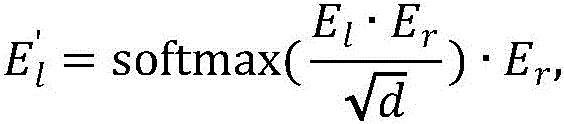
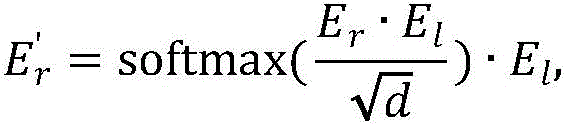
构建基于自注意力和交叉注意力的双目特征增强融合模块,所述双目特征增强融合模块的输入是左视图块嵌入Xl和右视图块嵌入Xr,将Xl和Xr分别输入自注意力模块得到特征增强后的块嵌入El、Er,然后将El作为查询向量、Er作为键向量和值向量输入交叉注意力模块得到E′l,将Er作为查询向量、El作为键向量和值向量输入交叉注意力模块得到E′r,E′l、E′r的大小分别和输入的块嵌入Xl、Xr大小相同,具体的公式如下:Build a binocular feature enhancement fusion module based on self-attention and cross-attention. The input of the binocular feature enhancement fusion module is the left-view block embedding X l and the right-view block embedding X r , and X l and X r are respectively input The self-attention module obtains the feature-enhanced block embeddings El and Er , and then takes El as the query vector, Er as the key vector and value vector into the cross-attention module to obtain E'l , and uses Er as the query vector, E l is input to the cross-attention module as a key vector and a value vector to obtain E' r . The sizes of E' l and E' r are the same as the input block embeddings X l and X r respectively. The specific formula is as follows:
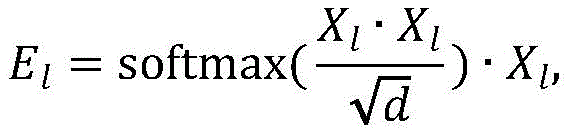

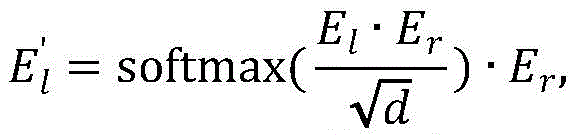

其中,softmax(*)为归一化函数,d为输入的块嵌入的维度。where softmax(*) is the normalization function and d is the dimension of the input block embedding.
进一步地,所述步骤B3具体包括以下步骤:Further, the step B3 specifically includes the following steps:
步骤B31、先将带位置编码信息的左、右视图块嵌入进行维度变换得到[B,H′,W′,C]的特征图,然后将特征图划分成大小为Hwin×Wwin的子窗口

步骤B32、将四个所述双目特征增强融合模块串行堆叠构成立体图像特征增强融合网络,每个双目特征增强融合模块为一个增强融合阶段,模块与模块之间采用隔行隔列的方式进行降采样,降采样后得到4个大小为原来四分之一的特征图,并将降采样后的特征图沿着通道维度堆叠起来,堆叠后的特征图通道数为降采样前的四倍,最后在通道维度进行降维,使堆叠后的特征图通道数为降采样前的两倍,第i个增强融合阶段的输入块嵌入的大小为
进一步地,所述步骤C具体包括以下步骤:Further, the step C specifically includes the following steps:
步骤C1、构建双智能体架构的动作,双智能体包括负责调整左视图的左视图智能体和负责调整右视图的右视图智能体,每一个智能体的输出为8维数值向量,分别对应视图的左上、左下、右上、右下四个角沿着x轴和y轴移动的偏移量,偏移量会随着动作的执行而累加,由四个角点的初始位置和四个角点加上累计偏移量的位置计算出单应性矩阵,并将单应性矩阵作用于初始视图得到变换后的视图,最终双智能体的输出为左视图智能体的8维数值向量拼接上右视图智能体的8维数值向量,一共16维度数值向量;Step C1, the action of constructing a dual-agent architecture. The dual-agent includes a left-view agent responsible for adjusting the left view and a right-view agent responsible for adjusting the right view. The output of each agent is an 8-dimensional numerical vector, corresponding to the view respectively. The offset of the upper left, lower left, upper right, and lower right of the four corners moving along the x-axis and y-axis, the offset will be accumulated with the execution of the action, which is determined by the initial position of the four corner points and the four corner points Add the position of the accumulated offset to calculate the homography matrix, and apply the homography matrix to the initial view to obtain the transformed view. The final output of the dual agent is the 8-dimensional numerical vector of the left view agent spliced on the right. The 8-dimensional numerical vector of the view agent, a total of 16-dimensional numerical vectors;
步骤C2、构建双智能体架构的网络模型,每个智能体包含1个动作网络和1个评价网络,动作网络由所述立体图像特征增强融合网络和3层全连接层构成,最后一个全连接层输出8个连续的数值,并经过Tanh激活函数,将输出归一化到[-1,1],再将归一化后的数值乘以放大因子得到最终的偏移量,放大因子为每次动作允许移动的最大像素值;评价网络由所述立体图像特征增强融合网络和3层全连接层构成,最后一个全连接层输出维度为1的数值,用于预测智能体做出动作后的奖励;Step C2, construct a network model of a dual-agent architecture, each agent includes an action network and an evaluation network, the action network is composed of the stereo image feature enhancement fusion network and 3 layers of fully connected layers, and the last one is fully connected. The layer outputs 8 consecutive values, and through the Tanh activation function, the output is normalized to [-1, 1], and then the normalized value is multiplied by the amplification factor to obtain the final offset. The amplification factor is each The maximum pixel value allowed to move by the secondary action; the evaluation network is composed of the stereo image feature enhancement fusion network and 3 layers of fully connected layers, and the last fully connected layer outputs a value of
步骤C3、构建双智能体架构的奖励函数,智能体调整视图后的得分由调整后的图像与参考图像的相似度加上舒适度得分,左视图智能体的得分scorel和右视图智能体的得分scorer计算公式如下:Step C3: Construct the reward function of the dual-agent architecture. The score of the agent after adjusting the view is added by the similarity between the adjusted image and the reference image plus the comfort score, the score l of the left-view agent and the score of the right-view agent. The calculation formula of score r is as follows:


其中,Il为调整后的左视图,

reward=scoreafter-scorebefore,reward=score after -score before ,
其中,scoreafter为智能体调整视图后的得分,scorebefore为智能体调整视图前的得分。Among them, score after is the score after the agent adjusts the view, and score before is the score before the agent adjusts the view.
进一步地,所述步骤D具体包括以下步骤:Further, the step D specifically includes the following steps:
步骤D1、采用多智能体强化学习算法MADDPG来训练双智能体架构,构造左视图智能体的动作网络Al、评价网络Cl和右视图智能体的动作网络Ar、评价网络Cr,复制一份双智能体作为目标网络,记为左视图目标动作网络A′l、左视图目标评价网络C′l、右视图目标动作网络A′r、右视图目标评价网络C′r,复制前后的网络的参数一致;Step D1, adopt the multi-agent reinforcement learning algorithm MADDPG to train the dual-agent architecture, construct the action network A1 of the left-view agent, the evaluation network C1 , the action network Ar and the evaluation network Cr of the right-view agent, and copy A double agent is used as the target network, denoted as the left-view target action network A′ l , the left-view target evaluation network C′ l , the right-view target action network A′ r , and the right-view target evaluation network C′ r . The parameters of the network are consistent;
步骤D2、训练初始,左、右视图智能体的动作网络根据输入的左、右视图对s分别输出预测动作al、ar,拼接得到a=(al,ar),左、右视图智能体的评价网络根据输入的左、右视图对s和动作网络预测出的动作分别得到对应动作的奖励rl、rr,拼接得到r=(rl,rr),然后得到变换后的左、右视图对s′,将(s,a,s′,r)作为一条记录存储到缓存数组中,再将s′作为下一时刻的输入,每一对左、右视图重复此过程设定次数,若缓存数组满了,则采用先进先出的策略删除历史记录;Step D2: At the beginning of the training, the action networks of the left and right view agents output the predicted actions a l and a r respectively according to the input left and right view pairs s, and spliced to obtain a=(a l , a r ), left and right views The evaluation network of the agent obtains the corresponding action rewards r l and r r according to the input left and right view pairs s and the action predicted by the action network, respectively . For the left and right view pair s', store (s, a, s', r) as a record in the cache array, and then use s' as the input at the next moment. Repeat this process for each pair of left and right views. A fixed number of times, if the cache array is full, the first-in first-out strategy is used to delete the historical records;
步骤D3、从缓存数组中随机采样若干条记录,分别计算左、右视图智能体奖励的目标值,奖励的目标值为当前动作的奖励加上目标评价网络预测的下一时刻的奖励值,左视图智能体奖励的目标值yl和右视图智能体奖励的目标值yr计算公式如下:Step D3: Randomly sample several records from the cache array, calculate the target value of the left and right view agent rewards respectively, the target value of the reward is the reward of the current action plus the reward value of the next moment predicted by the target evaluation network, left The target value yl rewarded by the view agent and the target value yr rewarded by the right view agent are calculated as follows:
yl=rl+C′l(s′,(A′l(s′),A′r(s′))),y l =r l + C'l (s',( A'l (s'), A'r (s'))),
yr=rr+C′r(s′,(A′l(s′),A′r(s′))),y r =r r + C'r (s',( A'l (s'), A'r (s'))),
其中,rl为采样记录中左视图智能体的奖励,rr为采样记录中右视图智能体的奖励,A′l(s′)为左视图目标动作网络A′l根据下一时刻视图s′输出的动作,A′r(s′)为右视图目标动作网络A′r根据下一时刻视图s′输出的动作,A′l(s′)和A′r(s′)拼接得(A′l(s′),A′r(s′)),C′l(s′,(A′l(s′),A′r(s′)))为左视图智能体的目标评价网络C′l根据下一时刻的视图s′以及下一时刻目标动作网络的动作(A′l(s′),A′r(s′))预测得到的下一时刻的奖励值,C′r(s′,(A′l(s′),A′r(s′)))为右视图智能体的目标评价网络C′r根据下一时刻的视图s′以及下一时刻目标动作网络的动作(A′l(s′),A′r(s′))预测得到的下一时刻的奖励值;Among them, r l is the reward of the left-view agent in the sampling record, r r is the reward of the right-view agent in the sampling record, A' l (s') is the left-view target action network A' l according to the next moment view s ' output action, A' r (s') is the right-view target action network A' r output action according to the view s' at the next moment, A' l (s') and A' r (s') concatenate ( A' l (s'), A' r (s')), C' l (s', (A' l (s'), A' r (s'))) are the target evaluation of the left-view agent The reward value at the next moment predicted by the network C′ l according to the view s′ at the next moment and the action of the target action network at the next moment (A′ l (s′), A′ r (s′)), C′ r (s′, (A′ l (s′), A′ r (s′))) is the target evaluation network of the right-view agent C′ r according to the view s′ at the next moment and the target action network at the next moment The reward value of the next moment predicted by the action (A' l (s'), A' r (s'));
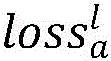
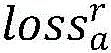
左视图智能体的评价网络Cl和右视图智能体的评价网络Cr的损失为奖励的目标值与奖励的预测值的差,具体公式如下:The loss of the evaluation network C l of the left-view agent and the evaluation network C r of the right-view agent is the difference between the target value of the reward and the predicted value of the reward, and the specific formula is as follows:


其中,yl和Cl(s,a)分别对应左视图智能体奖励的目标值和预测值,

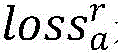
左视图智能体的动作网络Al和右视图智能体的动作网络Ar的损失为最大化奖励的预测值,即最小化奖励的负预测值,Al的奖励预测值为Cl根据当前视图s以及双智能体动作(Al(s),ar)预测出的奖励值,ar是采样记录中的右智能体的动作,Ar的奖励预测值为Cr根据当前视图s以及双智能体动作(al,Ar(s))预测出的奖励值,al是采样记录中的左智能体的动作,公式如下:The loss of the action network A l of the left-view agent and the action network Ar of the right-view agent is the predicted value of maximizing the reward, that is, the negative predicted value of minimizing the reward, and the predicted value of the reward of A l is C l According to the current view s and the reward value predicted by the action of the double agent (A l (s), a r ), a r is the action of the right agent in the sampling record, and the predicted reward value of A r is C r according to the current view s and double The reward value predicted by the agent action (a l , A r (s)), a l is the action of the left agent in the sampling record, the formula is as follows:


其中,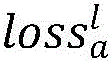
步骤D4、更新设定次数后,将Al、Cl、Ar、Cr的参数复制给A′l、C′l、A′r、C′r,继续执行步骤D3,直至步骤D3中计算得到的损失值收敛到阈值或迭代次数达到阈值,保存训练好的模型,完成网络训练过程。Step D4: After updating the set number of times, copy the parameters of A l , C l , Ar , and C r to A' l , C' l , A' r , and C' r , and continue to perform step D3 until step D3 The calculated loss value converges to the threshold or the number of iterations reaches the threshold, save the trained model, and complete the network training process.
本发明还提供了一种基于多智能体的立体图像视觉舒适度增强系统,包括存储器、处理器以及存储于存储器上并能够被处理器运行的计算机程序指令,当处理器运行该计算机程序指令时,能够实现上述的方法步骤。The present invention also provides a multi-agent-based stereoscopic image visual comfort enhancement system, comprising a memory, a processor, and computer program instructions stored in the memory and capable of being executed by the processor, when the processor executes the computer program instructions , the above method steps can be implemented.
与现有技术相比,本发明具有以下有益效果:相较于现有技术,本发明具有以下有益效果:本发明适用于对普通用户制作的立体图像进行视觉舒适度增强,有效地解决视觉舒适度增强过程中左和右视图的协同配合问题和左和右视图特征融合问题。该方法创新性地提出利用多智能体架构增强立体图像的视觉舒适度,左和右视图智能体分别控制着左和右视图的变换,双智能体内部具有自治性,而智能体之间又具有协调性,极大地提高问题求解效率。同时,该方法采用自注意力机制对左和右视图的特征进行端到端的融合,探索左和右视图不同尺度特征之间的像素级关系,有利于多智能体进行动作决策,从而提高立体图像的视觉舒适度。另外,该方法设计了智能体的动作,智能体的动作被定义为调整左和右视图的四个角点,然后通过调整前后的角点位置计算出变换矩阵,再将变换矩阵应用于左和右视图,得到变换后的左和右视图。本发明能有效且灵活地增强立体图像的视觉舒适度,具有较高的使用价值。Compared with the prior art, the present invention has the following beneficial effects: compared with the prior art, the present invention has the following beneficial effects: the present invention is suitable for enhancing the visual comfort of stereoscopic images made by ordinary users, and effectively solves the problem of visual comfort. The coordination problem of left and right views and the feature fusion problem of left and right views in the process of degree enhancement. This method innovatively proposes to use a multi-agent architecture to enhance the visual comfort of stereo images. The left and right view agents control the transformation of the left and right views respectively. The two agents have autonomy inside, and there is a Coordination greatly improves the efficiency of problem solving. At the same time, the method uses a self-attention mechanism to fuse the features of the left and right views end-to-end, and explores the pixel-level relationship between the features of different scales of the left and right views, which is conducive to multi-agent action decision-making, thereby improving the stereo image. visual comfort. In addition, this method designs the action of the agent. The action of the agent is defined as adjusting the four corners of the left and right views, and then calculates the transformation matrix by adjusting the position of the front and rear corners, and then applies the transformation matrix to the left and right views. Right view, to get the transformed left and right views. The invention can effectively and flexibly enhance the visual comfort of the stereoscopic image, and has high use value.
附图说明Description of drawings
图1是本发明实施例的方法实现流程图。FIG. 1 is a flow chart of a method implementation according to an embodiment of the present invention.
图2是本发明实施例中双目特征增强融合模块图。FIG. 2 is a diagram of a binocular feature enhancement and fusion module in an embodiment of the present invention.
图3是本发明实施例中双目特征增强融合网络图。FIG. 3 is a diagram of a binocular feature enhancement fusion network in an embodiment of the present invention.
图4是本发明实施例中智能体的动作示意图。FIG. 4 is a schematic action diagram of an agent in an embodiment of the present invention.
图5是本发明实施例中双智能体架构图。FIG. 5 is an architecture diagram of a dual agent in an embodiment of the present invention.
具体实施方式Detailed ways
下面结合附图及实施例对本发明做进一步说明。The present invention will be further described below with reference to the accompanying drawings and embodiments.
应该指出,以下详细说明都是示例性的,旨在对本申请提供进一步的说明。除非另有指明,本文使用的所有技术和科学术语具有与本申请所属技术领域的普通技术人员通常理解的相同含义。It should be noted that the following detailed description is exemplary and intended to provide further explanation of the application. Unless otherwise defined, all technical and scientific terms used herein have the same meaning as commonly understood by one of ordinary skill in the art to which this application belongs.
需要注意的是,这里所使用的术语仅是为了描述具体实施方式,而非意图限制根据本申请的示例性实施方式。如在这里所使用的,除非上下文另外明确指出,否则单数形式也意图包括复数形式,此外,还应当理解的是,当在本说明书中使用术语“包含”和/或“包括”时,其指明存在特征、步骤、操作、器件、组件和/或它们的组合。It should be noted that the terminology used herein is for the purpose of describing specific embodiments only, and is not intended to limit the exemplary embodiments according to the present application. As used herein, unless the context clearly dictates otherwise, the singular is intended to include the plural as well, furthermore, it is to be understood that when the terms "comprising" and/or "including" are used in this specification, it indicates that There are features, steps, operations, devices, components and/or combinations thereof.
如图1所示,本实施例提供了一种基于多智能体的立体图像视觉舒适度增强方法,包括以下步骤:As shown in FIG. 1 , this embodiment provides a multi-agent-based stereoscopic image visual comfort enhancement method, which includes the following steps:
步骤A、对舒适的高质量立体图像对的左、右视图分别进行不同类型、不同尺度的变换扰动,合成视觉不舒适的立体图像对,并将原始高质量立体图像对作为参考图像对。Step A: Perform different types and different scales of transformation perturbation on the left and right views of the comfortable high-quality stereoscopic image pair to synthesize the visually uncomfortable stereoscopic image pair, and use the original high-quality stereoscopic image pair as the reference image pair.
在本实施例中,所述步骤A具体包括以下步骤:In this embodiment, the step A specifically includes the following steps:
步骤A1、根据公共数据集自带的平均意见分数选取舒适的高质量立体图像对,构成舒适的高质量立体图像数据集。Step A1: Select a comfortable high-quality stereoscopic image pair according to the average opinion score that comes with the public data set to form a comfortable and high-quality stereoscopic image dataset.
步骤A2、将舒适的高质量立体图像数据集中的每一对立体图像对缩放,得到264×364尺寸的图像对。Step A2: Scale each pair of stereoscopic image pairs in the comfortable high-quality stereoscopic image dataset to obtain an image pair with a size of 264×364.
步骤A3、设置平移、旋转、透视三种变换类型以及对应的变换尺度范围,对缩放后的立体图像对进行若干次的变换扰动。对于每一次变换扰动,先随机选取左、右视图的变换类型,然后在该变换类型的尺度范围内随机采样连续的变换值,最后将采样到的连续变换应用于左、右视图,得到视觉不舒适的立体图像对。Step A3: Set the three transformation types of translation, rotation, and perspective and the corresponding transformation scale range, and perform several transformation perturbations on the scaled stereo image pair. For each transformation perturbation, first randomly select the transformation type of the left and right views, then randomly sample the continuous transformation values within the scale range of the transformation type, and finally apply the sampled continuous transformation to the left and right views to obtain a visual difference. Comfortable stereo image pair.
步骤A4、考虑到合成后的图像对在边缘区域可能存在无图像内容的区域,将合成后的立体图像对进行中心裁剪,得到224×288尺寸的图像对。Step A4: Considering that there may be areas without image content in the edge area of the synthesized image pair, center crop the synthesized stereoscopic image pair to obtain an image pair with a size of 224×288.
步骤B、构建基于注意力机制的立体图像特征增强融合网络,所述立体图像特征增强融合网络采用多阶段结构设计,在不同阶段增强融合左、右视图不同尺度的特征。Step B, constructing a stereo image feature enhancement fusion network based on an attention mechanism, the stereo image feature enhancement fusion network adopts a multi-stage structure design, and enhances and fuses features of different scales of the left and right views at different stages.
在本实施例中,所述步骤B具体包括以下步骤:In this embodiment, the step B specifically includes the following steps:
步骤B1、将左、右视图分别划分为不重叠的大小相同的图像块,然后每个图像块经过线性变换转换成块嵌入(patch embedding),最后将块嵌入(patch embedding)加上位置编码得到带位置信息的块嵌入(patch embedding)。Step B1: Divide the left and right views into non-overlapping image blocks of the same size, and then convert each image block into a patch embedding through linear transformation, and finally add the patch embedding to the position encoding to get Patch embedding with location information.
具体地,所述步骤B1包括以下步骤:Specifically, the step B1 includes the following steps:
步骤B11、为了将左、右视图分别划分为不重叠的大小相同的图像块,并将每个图像块映射成块嵌入(patch embedding),将同一批次大小均为[H,W,3]的左、右视图分别输入一层卷积层,每个卷积核的大小为4×4,步长为4,由于卷积核的步长等于卷积核的宽、高,因此对左、右视图不重叠的图像块进行卷积,并将每个图像块映射成高维块嵌入(patchembedding)。每个批次的左、右视图卷积后得到大小均为[B,C,H′,W′]的特征图,并通过维度变换得到大小均为[B,H′×W′,C]的左视图块嵌入(patch embedding)Fl和右视图块嵌入(patch embedding)Fr,其中B为批次大小,H′和W′分别为特征图的高和宽,C为卷积核个数。Step B11. In order to divide the left and right views into non-overlapping image blocks of the same size, and map each image block into a patch embedding, the same batch size is [H, W, 3] The left and right views of the convolutional layer are respectively input into a layer of convolution layer, the size of each convolution kernel is 4 × 4, and the step size is 4. Since the step size of the convolution kernel is equal to the width and height of the convolution kernel, the left and right The non-overlapping image patches of the right view are convolved and each image patch is mapped into a high-dimensional patch embedding (patchembedding). The left and right views of each batch are convolved to obtain feature maps of size [B, C, H′, W′], and the size of [B, H′×W′, C] is obtained through dimension transformation The left view block embedding (patch embedding) F l and the right view block embedding (patch embedding) F r , where B is the batch size, H' and W' are the height and width of the feature map, respectively, and C is the convolution kernel. number.
步骤B12、利用均值为0、方差为0.02的正态分布分别生成大小为[B,H′×W′,C]的可学习的左、右视图位置编码,并将左、右视图位置编码分别与左、右视图块嵌入(patchembedding)相加,最终得到带位置编码信息的左视图块嵌入(patch embedding)和右视图块嵌入(patch embedding),具体公式如下:Step B12: Use a normal distribution with a mean value of 0 and a variance of 0.02 to generate learnable left and right view position codes with a size of [B, H′×W′, C] respectively, and separate the left and right view position codes. Add the left and right view patch embeddings (patchembedding), and finally obtain the left view patch embedding (patch embedding) and the right view block embedding (patch embedding) with position encoding information. The specific formula is as follows:
F′l=Fl+Pl,F′ l =F l +P l ,
F′r=Fr+Pr,F' r =F r + Pr ,
其中,Pl表示左视图位置编码,Pr表示右视图位置编码,Fl表示左视图块嵌入(patch embedding),Fr表示右视图块嵌入(patch embedding),F′l表示带位置编码信息的左视图块嵌入(patch embedding),F′r表示带位置编码信息的右视图块嵌入(patchembedding)。Among them, P l represents the left view position encoding, P r represents the right view position encoding, F l represents the left view patch embedding, F r represents the right view patch embedding, and F′ l represents the information with position encoding The left-view patch embedding of , F′ r represents the right-view patch embedding (patchembedding) with position encoding information.
步骤B2、构建基于自注意力和交叉注意力的双目特征增强融合模块。Step B2: Construct a binocular feature enhancement fusion module based on self-attention and cross-attention.
具体地,所述步骤B2包括以下步骤:Specifically, the step B2 includes the following steps:
如图2所示,构建基于自注意力和交叉注意力的双目特征增强融合模块,所述双目特征增强融合模块的输入是左视图块嵌入(patch embedding)Xl和右视图块嵌入(patchembedding)Xr,将Xl和Xr分别输入自注意力模块得到特征增强后的块嵌入(patchembedding)El、Er,然后将El作为查询向量、Er作为键向量和值向量输入交叉注意力模块得到E′l,将Er作为查询向量、El作为键向量和值向量输入交叉注意力模块得到E′r,E′l、E′r的大小分别和输入的块嵌入(patch embedding)Xl、Xr大小相同,具体的公式如下:As shown in Figure 2, a binocular feature enhancement fusion module based on self-attention and cross-attention is constructed, and the input of the binocular feature enhancement fusion module is the left-view patch embedding (patch embedding) X l and the right-view patch embedding ( patchembedding) X r , input X l and X r into the self-attention module to obtain the feature-enhanced patch embeddings ( patchembedding ) El and E r , and then input El as the query vector and Er as the key vector and value vector. The cross-attention module obtains E′ l , and takes E r as the query vector, E l as the key vector and value vector into the cross-attention module to obtain E′ r , the sizes of E′ l and E′ r are respectively the same as the input block embedding ( patch embedding) X l and X r have the same size, and the specific formula is as follows:
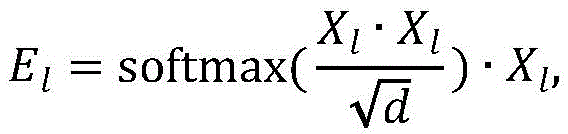

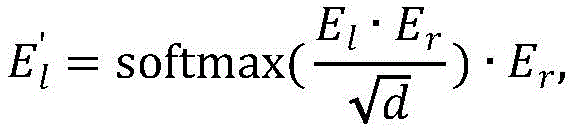

其中,softmax(*)为归一化函数,d为输入的块嵌入(patch embedding)的维度。Among them, softmax(*) is the normalization function, and d is the dimension of the input patch embedding.
步骤B3、构建立体图像特征增强融合网络,所述立体图像特征增强融合网络由步骤B2得到的双目特征增强融合模块串行堆叠而成,模块与模块之间进行特征降采样,并将降采样后的特征图沿通道维度堆叠起来,从而实现在不同阶段增强融合左、右视图不同尺度的特征。Step B3, constructing a stereo image feature enhancement fusion network, the stereo image feature enhancement fusion network is formed by serially stacking the binocular feature enhancement fusion modules obtained in step B2, and feature downsampling is performed between modules, and downsampling is performed between modules. The resulting feature maps are stacked along the channel dimension, so that the features of different scales of the left and right views can be enhanced and fused at different stages.
具体地,所述步骤B3包括以下步骤:Specifically, the step B3 includes the following steps:
步骤B31、如图3所示,先将带位置编码信息的左、右视图块嵌入(patchembedding)进行维度变换得到[B,H′,W′,C]的特征图,然后将特征图划分成大小为Hwin×Wwin的子窗口

步骤B32、将四个所述双目特征增强融合模块串行堆叠构成立体图像特征增强融合网络,每个双目特征增强融合模块为一个增强融合阶段,模块与模块之间采用隔行隔列的方式进行降采样,降采样后得到4个大小为原来四分之一的特征图,并将降采样后的特征图沿着通道维度堆叠起来,堆叠后的特征图通道数为降采样前的四倍,最后在通道维度进行降维,使堆叠后的特征图通道数为降采样前的两倍,第i个增强融合阶段的输入块嵌入(patch embedding)的大小为
步骤C、构建双智能体的强化学习架构,分别用于预测左视图和右视图四个角的连续的偏移量,通过四个角的偏移量计算得到变换矩阵,并将变换矩阵应用于左、右视图。Step C. Build a dual-agent reinforcement learning architecture, which is used to predict the continuous offsets of the four corners of the left view and the right view, respectively, calculate the transformation matrix through the offsets of the four corners, and apply the transformation matrix to Left and right view.
在本实施例中,所述步骤C具体包括以下步骤:In this embodiment, the step C specifically includes the following steps:
步骤C1、构建双智能体架构的动作,如图4所示,双智能体包括负责调整左视图的左视图智能体和负责调整右视图的右视图智能体,每一个智能体的输出为8维数值向量,分别对应视图的左上、左下、右上、右下四个角沿着x轴和y轴移动的偏移量,偏移量会随着动作的执行而累加,由四个角点的初始位置和四个角点加上累计偏移量的位置计算出单应性矩阵,并将单应性矩阵作用于初始视图得到变换后的视图,最终双智能体的输出为左视图智能体的8维数值向量拼接上右视图智能体的8维数值向量,一共16维度数值向量。Step C1, the action of constructing a dual-agent architecture, as shown in Figure 4, the dual-agent includes a left-view agent responsible for adjusting the left view and a right-view agent responsible for adjusting the right view, and the output of each agent is 8-dimensional Numerical vector, corresponding to the offsets of the upper left, lower left, upper right and lower right corners of the view moving along the x-axis and y-axis respectively. The offsets will be accumulated with the execution of the action. The homography matrix is calculated from the position and the position of the four corner points plus the accumulated offset, and the homography matrix is applied to the initial view to obtain the transformed view. The final output of the dual agent is 8 of the left view agent. The dimensional value vector is spliced with the 8-dimensional value vector of the right-view agent, for a total of 16-dimensional value vectors.
步骤C2、构建双智能体架构的网络模型,每个智能体包含1个动作网络和1个评价网络,动作网络由所述立体图像特征增强融合网络和3层全连接层构成,最后一个全连接层输出8个连续的数值,并经过Tanh激活函数,将输出归一化到[-1,1],再将归一化后的数值乘以放大因子得到最终的偏移量,放大因子为每次动作允许移动的最大像素值,本发明设置放大因子为20个像素。评价网络由所述立体图像特征增强融合网络和3层全连接层构成,最后一个全连接层输出维度为1的数值,用于预测智能体做出动作后的奖励。Step C2, construct a network model of a dual-agent architecture, each agent includes an action network and an evaluation network, the action network is composed of the stereo image feature enhancement fusion network and 3 layers of fully connected layers, and the last one is fully connected. The layer outputs 8 consecutive values, and through the Tanh activation function, the output is normalized to [-1, 1], and then the normalized value is multiplied by the amplification factor to obtain the final offset. The amplification factor is each The maximum pixel value allowed to move by the secondary action, the present invention sets the magnification factor as 20 pixels. The evaluation network is composed of the stereo image feature enhancement fusion network and three fully connected layers, and the last fully connected layer outputs a value with a dimension of 1, which is used to predict the reward after the agent makes an action.
步骤C3、构建双智能体架构的奖励函数,智能体调整视图后的得分由调整后的图像与参考图像的相似度加上舒适度得分,左视图智能体的得分scorel和右视图智能体的得分scorer计算公式如下:Step C3: Construct the reward function of the dual-agent architecture. The score of the agent after adjusting the view is added by the similarity between the adjusted image and the reference image plus the comfort score, the score l of the left-view agent and the score of the right-view agent. The calculation formula of score r is as follows:


其中,Il为调整后的左视图,

reward=scoreafter-scorebefore,reward=score after -score before ,
其中,scoreafter为智能体调整视图后的得分,scorebefore为智能体调整视图前的得分。Among them, score after is the score after the agent adjusts the view, and score before is the score before the agent adjusts the view.
步骤D、利用合成的立体图像对和参考图像对双智能体进行训练。Step D, using the synthesized stereo image pair and the reference image to train the dual agent.
在本实施例中,所述步骤D具体包括以下步骤:In this embodiment, the step D specifically includes the following steps:
步骤D1、采用多智能体强化学习算法MADDPG来训练双智能体架构,如图5所示,构造左视图智能体的动作网络Al、评价网络Cl和右视图智能体的动作网络Ar、评价网络Cr,复制一份双智能体作为目标网络,记为左视图目标动作网络A′l、左视图目标评价网络C′l、右视图目标动作网络A′r、右视图目标评价网络C′r,复制前后的网络的参数一致。Step D1, using the multi-agent reinforcement learning algorithm MADDPG to train the dual-agent architecture, as shown in Figure 5, construct the action network A l of the left-view agent, the evaluation network C l and the action network A r of the right-view agent, Evaluate the network C r , copy a double agent as the target network, denoted as the left-view target action network A′ l , the left-view target evaluation network C′ l , the right-view target action network A′ r , and the right-view target evaluation network C ′ r , the parameters of the network before and after replication are the same.
步骤D2、训练初始,左、右视图智能体的动作网络根据输入的左、右视图对s分别输出预测动作al、ar,拼接得到a=(al,ar),左、右视图智能体的评价网络根据输入的左、右视图对s和动作网络预测出的动作分别得到对应动作的奖励rl、rr,拼接得到r=(rl,rr),然后得到变换后的左、右视图对s′,将(s,a,s′,r)作为一条记录存储到缓存数组中,再将s′作为下一时刻的输入,每一对左、右视图重复此过程4次,缓存数组大小设置1000条记录,若缓存满了,则采用先进先出的策略删除历史记录。Step D2: At the beginning of the training, the action networks of the left and right view agents output the predicted actions a l and a r respectively according to the input left and right view pairs s, and spliced to obtain a=(a l , a r ), left and right views The evaluation network of the agent obtains the corresponding action rewards r l and r r according to the input left and right view pairs s and the action predicted by the action network, respectively . For the left and right view pair s', store (s, a, s', r) as a record in the cache array, and then use s' as the input at the next moment, repeat this process for each pair of left and right views4 Second, the cache array size is set to 1000 records. If the cache is full, the history records will be deleted using the first-in, first-out strategy.
步骤D3、从缓存数组中随机采样若干条记录,分别计算左、右视图智能体奖励的目标值,奖励的目标值为当前动作的奖励加上目标评价网络预测的下一时刻的奖励值,左视图智能体奖励的目标值yl和右视图智能体奖励的目标值yr计算公式如下:Step D3: Randomly sample several records from the cache array, calculate the target value of the left and right view agent rewards respectively, the target value of the reward is the reward of the current action plus the reward value of the next moment predicted by the target evaluation network, left The target value yl rewarded by the view agent and the target value yr rewarded by the right view agent are calculated as follows:
yl=rl+C′l(s′,(A′l(s′),A′r(s′))),y l =r l + C'l (s',( A'l (s'), A'r (s'))),
yr=rr+C′r(s′,(A′l(s′),A′r(s′))),y r =r r + C'r (s',( A'l (s'), A'r (s'))),
其中,rl为采样记录中左视图智能体的奖励,rr为采样记录中右视图智能体的奖励,A′l(s′)为左视图目标动作网络A′l根据下一时刻视图s′输出的动作,A′r(s′)为右视图目标动作网络A′r根据下一时刻视图s′输出的动作,A′l(s′)和A′r(s′)拼接得(A′l(s′),A′r(s′)),C′l(s′,(A′l(s′),A′r(s′)))为左视图智能体的目标评价网络C′l根据下一时刻的视图s′以及下一时刻目标动作网络的动作(A′l(s′),A′r(s′))预测得到的下一时刻的奖励值,C′r(s′,(A′l(s′),A′r(s′)))为右视图智能体的目标评价网络C′r根据下一时刻的视图s′以及下一时刻目标动作网络的动作(A′l(s′),A′r(s′))预测得到的下一时刻的奖励值。Among them, r l is the reward of the left-view agent in the sampling record, r r is the reward of the right-view agent in the sampling record, A' l (s') is the left-view target action network A' l according to the next moment view s ' output action, A' r (s') is the right-view target action network A' r output action according to the view s' at the next moment, A' l (s') and A' r (s') concatenate ( A' l (s'), A' r (s')), C' l (s', (A' l (s'), A' r (s'))) are the target evaluation of the left-view agent The reward value at the next moment predicted by the network C′ l according to the view s′ at the next moment and the action of the target action network at the next moment (A′ l (s′), A′ r (s′)), C′ r (s′, (A′ l (s′), A′ r (s′))) is the target evaluation network of the right-view agent C′ r according to the view s′ at the next moment and the target action network at the next moment The reward value at the next moment predicted by the action (A′ l (s′), A′ r (s′)).
左视图智能体的评价网络Cl和右视图智能体的评价网络Cr的损失为奖励的目标值与奖励的预测值的差,具体公式如下:The loss of the evaluation network C l of the left-view agent and the evaluation network C r of the right-view agent is the difference between the target value of the reward and the predicted value of the reward, and the specific formula is as follows:


其中,yl和Cl(s,a)分别对应左视图智能体奖励的目标值和预测值,

左视图智能体的动作网络Al和右视图智能体的动作网络Ar的损失为最大化奖励的预测值,即最小化奖励的负预测值,Al的奖励预测值为Cl根据当前视图s以及双智能体动作(Al(s),ar)预测出的奖励值,ar是采样记录中的右智能体的动作,Ar的奖励预测值为Cr根据当前视图s以及双智能体动作(al,Ar(s))预测出的奖励值,al是采样记录中的左智能体的动作,公式如下:The loss of the action network A l of the left-view agent and the action network Ar of the right-view agent is the predicted value of maximizing the reward, that is, the negative predicted value of minimizing the reward, and the predicted value of the reward of A l is C l According to the current view s and the reward value predicted by the action of the double agent (A l (s), a r ), a r is the action of the right agent in the sampling record, and the predicted reward value of A r is C r according to the current view s and double The reward value predicted by the agent action (a l , A r (s)), a l is the action of the left agent in the sampling record, the formula is as follows:


其中,
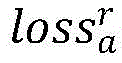
步骤D4、更新100次后,将Al、Cl、Ar、Cr的参数复制给A′l、C′l、A′r、C′r,继续执行步骤D3,直至步骤D3中计算得到的损失值收敛到阈值或迭代次数达到阈值,保存训练好的模型,完成网络训练过程。Step D4: After updating 100 times, copy the parameters of A l , C l , Ar , C r to A' l , C' l , A' r , C' r , and continue to perform step D3 until the calculation in step D3 The obtained loss value converges to the threshold or the number of iterations reaches the threshold, save the trained model, and complete the network training process.
步骤E、通过训练后的双智能体对待调整的立体图像对进行变换调整,以提高其视觉舒适度。Step E: Transform and adjust the stereo image pair to be adjusted by the trained dual-agent to improve its visual comfort.
本实施例还提供了一种基于多智能体的立体图像视觉舒适度增强系统,包括存储器、处理器以及存储于存储器上并能够被处理器运行的计算机程序指令,当处理器运行该计算机程序指令时,能够实现上述的方法步骤。This embodiment also provides a multi-agent-based stereoscopic image visual comfort enhancement system, including a memory, a processor, and computer program instructions stored in the memory and capable of being executed by the processor. When the processor executes the computer program instructions , the above-mentioned method steps can be implemented.
本领域内的技术人员应明白,本申请的实施例可提供为方法、系统、或计算机程序产品。因此,本申请可采用完全硬件实施例、完全软件实施例、或结合软件和硬件方面的实施例的形式。而且,本申请可采用在一个或多个其中包含有计算机可用程序代码的计算机可用存储介质(包括但不限于磁盘存储器、CD-ROM、光学存储器等)上实施的计算机程序产品的形式。As will be appreciated by those skilled in the art, the embodiments of the present application may be provided as a method, a system, or a computer program product. Accordingly, the present application may take the form of an entirely hardware embodiment, an entirely software embodiment, or an embodiment combining software and hardware aspects. Furthermore, the present application may take the form of a computer program product embodied on one or more computer-usable storage media (including, but not limited to, disk storage, CD-ROM, optical storage, etc.) having computer-usable program code embodied therein.
本申请是参照根据本申请实施例的方法、设备(系统)、和计算机程序产品的流程图和/或方框图来描述的。应理解可由计算机程序指令实现流程图和/或方框图中的每一流程和/或方框、以及流程图和/或方框图中的流程和/或方框的结合。可提供这些计算机程序指令到通用计算机、专用计算机、嵌入式处理机或其他可编程数据处理设备的处理器以产生一个机器,使得通过计算机或其他可编程数据处理设备的处理器执行的指令产生用于实现在流程图一个流程或多个流程和/或方框图一个方框或多个方框中指定的功能的装置。The present application is described with reference to flowchart illustrations and/or block diagrams of methods, apparatus (systems), and computer program products according to embodiments of the present application. It will be understood that each flow and/or block in the flowchart illustrations and/or block diagrams, and combinations of flows and/or blocks in the flowchart illustrations and/or block diagrams, can be implemented by computer program instructions. These computer program instructions may be provided to the processor of a general purpose computer, special purpose computer, embedded processor or other programmable data processing device to produce a machine such that the instructions executed by the processor of the computer or other programmable data processing device produce Means for implementing the functions specified in a flow or flow of a flowchart and/or a block or blocks of a block diagram.
这些计算机程序指令也可存储在能引导计算机或其他可编程数据处理设备以特定方式工作的计算机可读存储器中,使得存储在该计算机可读存储器中的指令产生包括指令装置的制造品,该指令装置实现在流程图一个流程或多个流程和/或方框图一个方框或多个方框中指定的功能。These computer program instructions may also be stored in a computer-readable memory capable of directing a computer or other programmable data processing apparatus to function in a particular manner, such that the instructions stored in the computer-readable memory result in an article of manufacture comprising instruction means, the instructions The apparatus implements the functions specified in the flow or flow of the flowcharts and/or the block or blocks of the block diagrams.
这些计算机程序指令也可装载到计算机或其他可编程数据处理设备上,使得在计算机或其他可编程设备上执行一系列操作步骤以产生计算机实现的处理,从而在计算机或其他可编程设备上执行的指令提供用于实现在流程图一个流程或多个流程和/或方框图一个方框或多个方框中指定的功能的步骤。These computer program instructions can also be loaded on a computer or other programmable data processing device to cause a series of operational steps to be performed on the computer or other programmable device to produce a computer-implemented process such that The instructions provide steps for implementing the functions specified in the flow or blocks of the flowcharts and/or the block or blocks of the block diagrams.
以上所述,仅是本发明的较佳实施例而已,并非是对本发明作其它形式的限制,任何熟悉本专业的技术人员可能利用上述揭示的技术内容加以变更或改型为等同变化的等效实施例。但是凡是未脱离本发明技术方案内容,依据本发明的技术实质对以上实施例所作的任何简单修改、等同变化与改型,仍属于本发明技术方案的保护范围。The above are only preferred embodiments of the present invention, and are not intended to limit the present invention in other forms. Any person skilled in the art may use the technical content disclosed above to make changes or modifications to equivalent changes. Example. However, any simple modifications, equivalent changes and modifications made to the above embodiments according to the technical essence of the present invention without departing from the content of the technical solutions of the present invention still belong to the protection scope of the technical solutions of the present invention.
Claims (9)










Priority Applications (1)
| Application Number | Priority Date | Filing Date | Title |
|---|---|---|---|
| CN202210887485.5A CN115209122B (en) | 2022-07-26 | 2022-07-26 | Method and system for enhancing visual comfort of stereo images based on multi-agents |
Applications Claiming Priority (1)
| Application Number | Priority Date | Filing Date | Title |
|---|---|---|---|
| CN202210887485.5A CN115209122B (en) | 2022-07-26 | 2022-07-26 | Method and system for enhancing visual comfort of stereo images based on multi-agents |
Publications (2)
| Publication Number | Publication Date |
|---|---|
| CN115209122A true CN115209122A (en) | 2022-10-18 |
| CN115209122B CN115209122B (en) | 2023-07-07 |
Family
ID=83584424
Family Applications (1)
| Application Number | Title | Priority Date | Filing Date |
|---|---|---|---|
| CN202210887485.5A Active CN115209122B (en) | 2022-07-26 | 2022-07-26 | Method and system for enhancing visual comfort of stereo images based on multi-agents |
Country Status (1)
| Country | Link |
|---|---|
| CN (1) | CN115209122B (en) |
Cited By (2)
| Publication number | Priority date | Publication date | Assignee | Title |
|---|---|---|---|---|
| CN117058132A (en) * | 2023-10-11 | 2023-11-14 | 天津大学 | Quantitative assessment method and system for visual comfort of cultural relic lighting based on neural network |
| CN117615112A (en) * | 2023-10-11 | 2024-02-27 | 浙江华诺康科技有限公司 | A stereoscopic comfort adjustment method, device, equipment and readable storage medium |
Citations (8)
| Publication number | Priority date | Publication date | Assignee | Title |
|---|---|---|---|---|
| EP2434766A2 (en) * | 2010-09-23 | 2012-03-28 | Thomson Licensing | Adaptation of 3d video content |
| WO2013143625A1 (en) * | 2012-03-30 | 2013-10-03 | Thomson Licensing | Antighosting method using binocular suppression |
| CN104469355A (en) * | 2014-12-11 | 2015-03-25 | 西安电子科技大学 | Visual comfort prediction based on saliency adaptation and visual comfort enhancement method based on nonlinear mapping |
| US20160180188A1 (en) * | 2014-12-19 | 2016-06-23 | Beijing University Of Technology | Method for detecting salient region of stereoscopic image |
| US10032281B1 (en) * | 2017-05-03 | 2018-07-24 | Siemens Healthcare Gmbh | Multi-scale deep reinforcement machine learning for N-dimensional segmentation in medical imaging |
| CN111669563A (en) * | 2020-06-19 | 2020-09-15 | 福州大学 | A method for enhancing the visual comfort of stereo images based on reinforcement learning |
| US20200364892A1 (en) * | 2019-05-17 | 2020-11-19 | Samsung Electronics Co., Ltd. | Advanced driver assist systems and methods of detecting objects in the same |
| WO2022089077A1 (en) * | 2020-10-28 | 2022-05-05 | 西安交通大学 | Real-time binocular stereo matching method based on adaptive candidate parallax prediction network |
-
2022
- 2022-07-26 CN CN202210887485.5A patent/CN115209122B/en active Active
Patent Citations (8)
| Publication number | Priority date | Publication date | Assignee | Title |
|---|---|---|---|---|
| EP2434766A2 (en) * | 2010-09-23 | 2012-03-28 | Thomson Licensing | Adaptation of 3d video content |
| WO2013143625A1 (en) * | 2012-03-30 | 2013-10-03 | Thomson Licensing | Antighosting method using binocular suppression |
| CN104469355A (en) * | 2014-12-11 | 2015-03-25 | 西安电子科技大学 | Visual comfort prediction based on saliency adaptation and visual comfort enhancement method based on nonlinear mapping |
| US20160180188A1 (en) * | 2014-12-19 | 2016-06-23 | Beijing University Of Technology | Method for detecting salient region of stereoscopic image |
| US10032281B1 (en) * | 2017-05-03 | 2018-07-24 | Siemens Healthcare Gmbh | Multi-scale deep reinforcement machine learning for N-dimensional segmentation in medical imaging |
| US20200364892A1 (en) * | 2019-05-17 | 2020-11-19 | Samsung Electronics Co., Ltd. | Advanced driver assist systems and methods of detecting objects in the same |
| CN111669563A (en) * | 2020-06-19 | 2020-09-15 | 福州大学 | A method for enhancing the visual comfort of stereo images based on reinforcement learning |
| WO2022089077A1 (en) * | 2020-10-28 | 2022-05-05 | 西安交通大学 | Real-time binocular stereo matching method based on adaptive candidate parallax prediction network |
Non-Patent Citations (3)
| Title |
|---|
| YUZHONG CHEN 等: "Continuous Transformation Superposition for Visual Comfort Enhancement of Casual Stereoscopic Photography", 2022 IEEE CONFERENCE ON VIRTUAL REALITY AND 3D USER INTERFACES * |
| 王颖;郁梅;应宏微;蒋刚毅;: "基于视差重映射的立体图像视觉舒适度提升", 中国图象图形学报, no. 04 * |
| 郑愈明: "视差注意力的立体图像颜色校正方法", 小型微型计算机系统, vol. 43, no. 3 * |
Cited By (3)
| Publication number | Priority date | Publication date | Assignee | Title |
|---|---|---|---|---|
| CN117058132A (en) * | 2023-10-11 | 2023-11-14 | 天津大学 | Quantitative assessment method and system for visual comfort of cultural relic lighting based on neural network |
| CN117058132B (en) * | 2023-10-11 | 2024-01-23 | 天津大学 | Quantitative assessment method and system for visual comfort of cultural relic lighting based on neural network |
| CN117615112A (en) * | 2023-10-11 | 2024-02-27 | 浙江华诺康科技有限公司 | A stereoscopic comfort adjustment method, device, equipment and readable storage medium |
Also Published As
| Publication number | Publication date |
|---|---|
| CN115209122B (en) | 2023-07-07 |
Similar Documents
| Publication | Publication Date | Title |
|---|---|---|
| CN111626927B (en) | Binocular image super-resolution method, system and device using parallax constraints | |
| CN115209122A (en) | Multi-agent-based stereoscopic image visual comfort enhancement method and system | |
| CN115631223A (en) | Multi-view stereo reconstruction method based on self-adaptive learning and aggregation | |
| CN112950653B (en) | Attention image segmentation method, device and medium | |
| CN108986210A (en) | The method and apparatus of 3 D scene rebuilding | |
| CN115546442A (en) | Multi-view stereo matching reconstruction method and system based on perception consistency loss | |
| CN118781553A (en) | A video crowd counting method based on dual-branch spatiotemporal interaction network | |
| CN103383778B (en) | A kind of three-dimensional cartoon human face generating method and system | |
| CN113808006B (en) | Method and device for reconstructing three-dimensional grid model based on two-dimensional image | |
| CN118537227B (en) | Iterative interactive reference type stereo image super-resolution reconstruction method and system | |
| WO2020248706A1 (en) | Image processing method, device, computer storage medium, and terminal | |
| CN116168158A (en) | Human body three-dimensional reconstruction method, device, equipment and medium based on visual angle aggregation | |
| CN111754561B (en) | Light field image depth recovery method and system based on self-supervision deep learning | |
| CN118864562B (en) | Lightweight binocular stereo matching method based on step-by-step long-range capture and detail restoration | |
| CN118761936B (en) | Image restoration method and electronic device based on texture and structure fusion prior | |
| WO2025199784A1 (en) | Multi-viewpoint image generation method, training data acquisition method, and neural network training method | |
| CN113132706A (en) | Controllable position virtual viewpoint generation method and device based on reverse mapping | |
| CN112634128A (en) | Stereo image redirection method based on deep learning | |
| CN108769644B (en) | A stylized rendering method for binocular animation based on deep learning | |
| CN118351423A (en) | Point cloud quality assessment method and device based on regularized representation | |
| CN113256544B (en) | A multi-viewpoint image synthesis method, system, device and storage medium | |
| CN105528763B (en) | An adaptive region-aware mask generation method based on multigrid approximation algorithm | |
| CN111669563B (en) | Stereo image visual comfort enhancement method based on reinforcement learning | |
| WO2024016464A1 (en) | Three-dimensional auto-encoder and training method therefor, electronic device, and storage medium | |
| CN115861041A (en) | Image style transfer method, device, computer equipment, storage medium and product |
Legal Events
| Date | Code | Title | Description |
|---|---|---|---|
| PB01 | Publication | ||
| PB01 | Publication | ||
| SE01 | Entry into force of request for substantive examination | ||
| SE01 | Entry into force of request for substantive examination | ||
| GR01 | Patent grant | ||
| GR01 | Patent grant |