CN115204238B - PPG signal identity recognition method for wearable equipment and wearable equipment - Google Patents
PPG signal identity recognition method for wearable equipment and wearable equipment Download PDFInfo
- Publication number
- CN115204238B CN115204238B CN202210908632.2A CN202210908632A CN115204238B CN 115204238 B CN115204238 B CN 115204238B CN 202210908632 A CN202210908632 A CN 202210908632A CN 115204238 B CN115204238 B CN 115204238B
- Authority
- CN
- China
- Prior art keywords
- ppg signal
- ppg
- signal
- binary index
- noise
- Prior art date
- Legal status (The legal status is an assumption and is not a legal conclusion. Google has not performed a legal analysis and makes no representation as to the accuracy of the status listed.)
- Active
Links
- 238000000034 method Methods 0.000 title claims abstract description 76
- 238000012545 processing Methods 0.000 claims abstract description 13
- 238000010606 normalization Methods 0.000 claims abstract description 12
- 238000005259 measurement Methods 0.000 claims abstract description 10
- 230000008030 elimination Effects 0.000 claims abstract description 5
- 238000003379 elimination reaction Methods 0.000 claims abstract description 5
- 238000012360 testing method Methods 0.000 claims description 48
- 238000012549 training Methods 0.000 claims description 33
- 238000005070 sampling Methods 0.000 claims description 29
- 239000012634 fragment Substances 0.000 claims description 25
- 230000006870 function Effects 0.000 claims description 23
- 239000011159 matrix material Substances 0.000 claims description 23
- 238000004422 calculation algorithm Methods 0.000 claims description 20
- 230000001133 acceleration Effects 0.000 claims description 17
- 238000000354 decomposition reaction Methods 0.000 claims description 13
- 238000001914 filtration Methods 0.000 claims description 12
- 230000003044 adaptive effect Effects 0.000 claims description 8
- 238000004458 analytical method Methods 0.000 claims description 5
- 230000009466 transformation Effects 0.000 claims description 4
- 235000005338 Allium tuberosum Nutrition 0.000 claims description 3
- 244000003377 Allium tuberosum Species 0.000 claims description 3
- 230000001131 transforming effect Effects 0.000 claims description 2
- 238000013186 photoplethysmography Methods 0.000 description 130
- 238000004364 calculation method Methods 0.000 description 9
- 238000012986 modification Methods 0.000 description 4
- 230000004048 modification Effects 0.000 description 4
- 230000011218 segmentation Effects 0.000 description 4
- 238000004590 computer program Methods 0.000 description 3
- 238000011161 development Methods 0.000 description 2
- 230000018109 developmental process Effects 0.000 description 2
- 230000000694 effects Effects 0.000 description 2
- 238000011156 evaluation Methods 0.000 description 2
- 238000002474 experimental method Methods 0.000 description 2
- 238000000605 extraction Methods 0.000 description 2
- 239000000463 material Substances 0.000 description 2
- 230000008569 process Effects 0.000 description 2
- 238000013139 quantization Methods 0.000 description 2
- 238000011160 research Methods 0.000 description 2
- 238000012795 verification Methods 0.000 description 2
- NAWXUBYGYWOOIX-SFHVURJKSA-N (2s)-2-[[4-[2-(2,4-diaminoquinazolin-6-yl)ethyl]benzoyl]amino]-4-methylidenepentanedioic acid Chemical compound C1=CC2=NC(N)=NC(N)=C2C=C1CCC1=CC=C(C(=O)N[C@@H](CC(=C)C(O)=O)C(O)=O)C=C1 NAWXUBYGYWOOIX-SFHVURJKSA-N 0.000 description 1
- 241001391944 Commicarpus scandens Species 0.000 description 1
- 230000009286 beneficial effect Effects 0.000 description 1
- 230000000747 cardiac effect Effects 0.000 description 1
- 238000004891 communication Methods 0.000 description 1
- 238000010276 construction Methods 0.000 description 1
- 238000013135 deep learning Methods 0.000 description 1
- 230000004069 differentiation Effects 0.000 description 1
- 238000005516 engineering process Methods 0.000 description 1
- 230000003183 myoelectrical effect Effects 0.000 description 1
- 238000000513 principal component analysis Methods 0.000 description 1
- 230000035945 sensitivity Effects 0.000 description 1
- 238000011425 standardization method Methods 0.000 description 1
- 230000001360 synchronised effect Effects 0.000 description 1
Images


Landscapes
- Measurement Of The Respiration, Hearing Ability, Form, And Blood Characteristics Of Living Organisms (AREA)
Abstract
The invention relates to a PPG signal identity recognition method for wearable equipment and the wearable equipment, wherein the method comprises the following steps: performing noise elimination on the PPG signal monitored by the wearable equipment to obtain a PPG signal with noise eliminated; extracting a heartbeat period segment in the PPG signal for eliminating noise, carrying out normalization processing on the extracted heartbeat period segment, and extracting multi-scale differential features in the heartbeat period segment after the normalization processing; extracting binary index codes of multi-scale differential features by adopting a hash learning method, and acquiring p1 binary index codes similar to the binary index codes in a known database and PPG signal sets to which the p1 binary index codes belong; and the identity of the PPG signal monitored by the wearable equipment and each PPG signal in the PPG signal set is matched by adopting a measurement learning method, so that the method is better suitable for the wearable equipment, the computing resource is reduced, and the computing efficiency is improved.
Description
Technical Field
The present invention relates to signal processing technologies, and in particular, to a PPG signal identification method for a wearable device and a wearable device.
Background
In recent years, with the gradual popularization of wearable devices such as a sport wristband, a smart watch and the like, new functions of portability, reliability and practicability attached to the wearable devices are increasing, people conduct social contact, mobile payment and the like through the wearable devices, and great convenience is brought to various aspects of life. The wearable device is widely applied in life, and meanwhile, the user privacy information carried by the wearable device is more and more, such as user account numbers, passwords, address books, short messages, photos and the like. In addition, many users also interface the wearable device with internet banking and various internet banking payment applications (e.g., weChat, payment treasury, etc.) services, resulting in the possibility of storing more sensitive data. At present, the traditional password-based identification method used on the wearable equipment is easy to break, steal and forget, so that the information security of the wearable equipment faces a serious challenge, and the research on the identification problem of the wearable equipment becomes an urgent requirement of people. In recent years, identification based on Photoplethysmography (PPG) signals has become a hotspot in the field of biometric identification research due to its unique advantages. At present, many methods for identifying the identity of the PPG signal exist, such as methods based on feature point extraction, principal component analysis, wavelet transformation, sparse representation learning, deep learning and the like. The existing PPG signal identity recognition method generally needs more calculation resources, and can not effectively meet the requirements of the wearable device due to limited storage and calculation resources of the wearable device.
Disclosure of Invention
First, the technical problem to be solved
In view of the above-mentioned drawbacks and shortcomings of the prior art, the present invention provides a PPG signal identification method for a wearable device and a wearable device.
(II) technical scheme
In order to achieve the above purpose, the main technical scheme adopted by the invention comprises the following steps:
in a first aspect, an embodiment of the present invention provides a PPG signal identification method for a wearable device, including:
s10, performing noise elimination on a PPG signal monitored by a wearable device to obtain a PPG signal with noise eliminated;
s20, extracting a heartbeat period segment in the PPG signal for eliminating noise, carrying out normalization processing on the extracted heartbeat period segment, and extracting multi-scale differential features in the heartbeat period segment after the normalization processing;
s30, extracting binary index codes of multi-scale differential features by adopting a hash learning method, and acquiring p1 binary index codes similar to the binary index codes in a known database and PPG signal sets to which the p1 binary index codes belong; p1 is a natural number greater than 1;
and S40, carrying out identity matching on the PPG signals monitored by the wearable equipment and each PPG signal in the PPG signal set by adopting a measurement learning method, and obtaining identity information of the wearable equipment.
Optionally, the S10 includes:
removing noise in the PPG signal monitored by the wearable equipment by means of a digital band-pass filter to obtain a first-stage PPG signal, wherein the frequency range of the digital band-pass filter is 0.4-4 Hz, and the digital band-pass filter comprises endpoints of 0.4 Hz and 4 Hz;
removing weak motion artifacts in the first-stage PPG signal by adopting a least mean square self-adaptive filtering algorithm, and removing strong motion artifacts in the first-stage PPG signal by adopting a variational mode decomposition method to obtain a noise-eliminated PPG signal;
or ,
removing noise in the PPG signal monitored by the wearable equipment by means of a digital band-pass filter to obtain a first-stage PPG signal, wherein the frequency range of the digital band-pass filter is 0.4-4 Hz, and the digital band-pass filter comprises endpoints of 0.4 Hz and 4 Hz;
and removing weak motion artifacts in the first-stage PPG signal by adopting a least mean square self-adaptive filtering algorithm to obtain a noise-eliminated PPG signal.
Optionally, the weight factor w (t) and the step factor μ (t) in the least mean square adaptive filtering algorithm are:

st.‖w(t+1)-w(t)‖ 2 ≤K 1
μ(t)=bln(a|e(t)| m ) (2)
wherein b is an amplitude variation parameter representing a step curve, a is an overall shape variation parameter of the step curve, and m is a bottom variation speed parameter of the control step curve; t represents a time variable, K 1 Is constant; st. is a mathematical symbol constraint, ln is a mathematical operation symbol;
w (T) represents a weight factor modeling motion artifact by least mean square adaptive filtering at the current time, w (t+1) represents a weight factor at the next time, μ (T) represents a step size factor, e (T) represents an error signal between an output signal at the current time and a desired signal, X (T) represents an input signal at the current time, the superscript T represents a transpose operation, ε is a given known variable, T represents the current time, t+1 represents the next time, and X (T) represents an input signal at the time T.
Optionally, after removing the weak motion artifact in the first stage PPG signal by adopting a least mean square adaptive filtering algorithm, the method further includes:
judging whether to completely remove the weak motion artifact or not by utilizing a binary decision of the correlation coefficient;
specifically, the pearson correlation coefficient is used for measuring the correlation between the PPG signal and the acceleration signal of the wearable device, and the PPG signal x corresponds to the acceleration signal g 1 ,g 2 ,g 3 Pearson correlation coefficient ρ in three directions xg The method comprises the following steps:

wherein mean (·) represents the average function,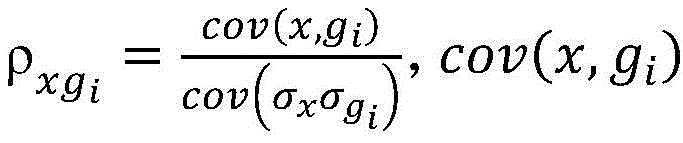 represents x and g i Covariance, sigma between x and
 Respectively represents x and g i Standard deviation of (2); i is 1,2 and 3;
ρ xg1 representing the acceleration signal g in the first direction 1 Pearson correlation coefficient, ρ xg2 Representing acceleration signal g in the second direction 2 Pearson correlation coefficient, ρ xg3 Representing the acceleration signal g in the third direction 3 Is cov, the mathematical symbol covariance.
Optionally, removing strong motion artifacts in the first stage PPG signal by using a variational modal decomposition method includes:
by selecting different modalities z with sparse structures k Reconstructing the PPG signal from which the weak motion artifact is removed, wherein the constraint variation problem generated based on the variation modal decomposition method is as follows:

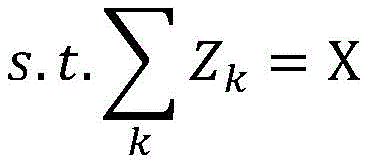
wherein , for mathematical sign partial derivatives, X is the PPG signal input into the variational modal decomposition, X k (t) represents the PPG signal at time t in the kth modality;
z k is a decomposed series of modes k=1, 2, …, K representing the total number of all modes; omega k Representative modality z k Center angular frequency, { z k }={z 1 ,z 2 ,…,z K },{w k }={w 1 ,w 2 ,…,w K },
Delta represents dirac distribution; t represents a time variable, the PPG signal is decomposed into an analytic signal through Hilbert transformation, and j represents an imaginary part of the analytic signal;
pre-selection K 2 Several modes to cancel some modes related to high frequency noise, minimum K 2 The following are satisfied: k (K) 2 ,K 2 ≤K

E is a preset variable, max (x) represents the function of the maximum element value; front K to be selected 2 The individual modes add to obtain a reconstructed clean PPG signal X recon :

The reconstructed clean PPG signal serves as a noise-cancelling PPG signal.
Optionally, the S20 includes:
sliding the PPG signals for eliminating noise based on the lengths of a preset sliding window and an overlapping window, and recording the heartbeat cycle fragments of the PPG signals in the sliding window after each step of sliding, wherein all the heartbeat cycle fragments are segmented PPG signals;
normalizing the heartbeat cycle segment by adopting a min-max normalization method to ensure that the numerical value corresponding to the heartbeat cycle segment is in the range of the [0,1] interval, and obtaining the heartbeat cycle segment after normalization; and
sampling point number p and sampling point distance d extracted based on predefined t moment 1 Calculate each sampling point S in the heartbeat period segment S t Is a differential eigenvalue y of (2) t Constructing a sampling point S t Is a multi-scale differential vector of (a); the S is t Is MDF (S) t ) Constructing a differential characteristic of the heartbeat cycle segment S; and the multiscale differential feature vector MDF (S) for each time point of the heartbeat cycle segment S t ) Splicing to form differential characteristics of the heartbeat period segment S;
wherein d represents [ t-d ] at time t 1 ,t+d 1 ]The number of sampling points in the interval which do not participate in sampling;
S=[S 1 ,S 2 ,……S n ],1≤t≤n (7)

s (t) represents the amplitude of a sampling point at the moment t; y is t Representing the differential characteristics of the PPG signal at the moment t, and converting the amplitude characteristics into differential characteristics through a formula (8);
MDF(S t )=[y 1 ,y 2 ,…y 2p ] (9);
the amplitude S (t) at the time t is converted into a multi-scale differential feature vector MDF (S t )。
Optionally, the S30 includes:
firstly, acquiring a binary index code of a multi-scale differential feature through the following objective function;

wherein ,yi ∈R d′ and yj ∈R d′ D' dimensional multiscale differential features of the ith and jth heartbeat cycle fragments in the PPG training set are represented respectively, and the total number of the heartbeat cycle fragments is N; w (w) k0 ∈R d′ Projection matrix, K, being a hash function 3 Is the number of hash functions that are to be performed, is y i The k0 th bit binary index code of (a), u k0 Representing the average value of the binary index codes; sgn (·) is a sign function, sgn (h) is equal to 1 when h is equal to or greater than 0, and sgn (h) is equal to 0 when h is equal to or less than 0; h ij Is y i And y is j A degree of similarity between; the PPG training set is a training subset in a preset PPG training data set;
then, calculating the similarity between the obtained binary index code and the binary index code of each registered individual PPG signal by utilizing the Hamming distance;
then, sorting the similarity scores from large to small, and returning the binary index codes of the registered individuals with the highest scores of the screened p1 scores;
and finally, searching the test heartbeat cycle fragments by using the screened binary index codes to obtain PPG signal sets of a plurality of candidate sets with the test heartbeat cycle fragments most similar to each other.
Optionally, the S40 includes:
the first step: learning a semi-positive definite matrix M using a neighbor component analysis algorithm to construct a metric matrix, m=pp T The method comprises the steps of carrying out a first treatment on the surface of the The objective function of the neighbor component analysis algorithm is:

wherein ,xl Represents the first sample in the PPG training set, P represents the metric matrix, Ω i Representation and sample x i Having the same classA set of subscripts for the other samples; x in formula (11) i Representing the ith sample in the PPG training set; x is x j Representing a jth sample in the PPG training set;
and a second step of: obtaining a measurement matrix through the training set, and transforming Euclidean distance between samples in the test set into a new distance through the measurement matrix to obtain a test sample x i ' and sample x j ' New distance metric D (x i ′,x j ′):
D(x i ′,x j ′)=||P(x i ′-x j ′)|| 2 =(x i ′-x j ′) T P T P(x i ′-x j ′) (12)
Formula (12) x i ' represents the i-th sample in the test set, x j ' represents the j-th sample in the test set, the test set is a test subset in a preset PPG training data set;
and a third step of: and calculating the distance between the heartbeat cycle segment of the PPG signal monitored by the wearable equipment and the heartbeat cycle segment of each signal in the PPG signal set through the measurement matrix, wherein the category to which the smallest distance belongs is the category of the PPG signal monitored by the wearable equipment.
Optionally, the method further comprises:
evaluating the category of the PPG signal monitored by the identified wearable device;
specifically, calculating error rate FAR, rejection rate FRR and equal error rate EER;
acquiring EER through FAR and FRR; if EER is smaller than a preset third value of 0.01, the monitored PPG signal is considered to be accurate;
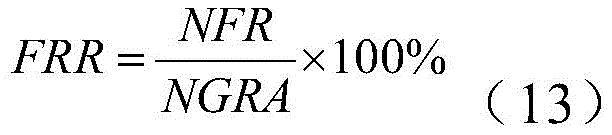
rejection rate:
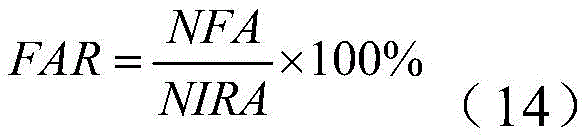
equal error rate:
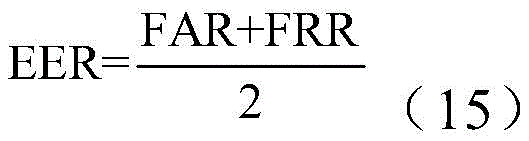
where NGRA is the total number of intra-class tests and NIRA is the total number of inter-class tests; NFR and NFA are the number of false rejections and false acceptances.
In a second aspect, an embodiment of the present invention further provides a wearable device, which includes a memory and a processor, where the memory stores a program, and the processor executes the program stored in the memory and executes the PPG signal identification method for use on the wearable device in any one of the first aspects.
(III) beneficial effects
Because of limited storage and computing resources of the wearable device, a faster identity matching efficiency is required for PPG signal identification methods on the wearable device. According to the embodiment of the invention, quick identity matching on the wearable device can be realized, the PPG signal is preprocessed, the multi-scale differential characteristic of the PPG signal of the query individual is extracted, and the multi-scale differential characteristic is converted into the binary index code. And finally, searching the test individual by utilizing the binary index code to obtain a plurality of most similar candidate sets of the test individual. Only the identity of the individuals in the candidate set is matched during the PPG signal identity recognition, so that the calculated amount of the test individuals is reduced, and the method is well suitable for wearable equipment.
Drawings
Fig. 1 is a flowchart of a PPG signal identification method for a wearable device according to an embodiment of the present invention;
fig. 2 is a flowchart of a PPG signal identification method for a wearable device according to another embodiment of the present invention.
Detailed Description
The invention will be better explained by the following detailed description of the embodiments with reference to the drawings.
The traditional PPG signal identification method generally needs more calculation resources, and the existing PPG signal identification method cannot be used for the requirement of identification on a wearable device due to limited storage and calculation resources of the wearable device. The method provided by the embodiment of the invention has the advantages of higher identity matching efficiency, fewer required computing resources, and capability of being used on wearable equipment and rapidly realizing the identification of the PPG signal. The method provided by the embodiment of the invention can effectively improve the identification performance of the PPG signal identification system in the wearable equipment, improve the use experience of users, and has wider development space and application prospect.
Example 1
As shown in fig. 1, an embodiment of the present invention provides a PPG signal identification method for a wearable device, where an execution subject of the method of the present embodiment may be a processing apparatus of any wearable device, or may be a separate processing apparatus; the specific implementation method comprises the following steps:
s10, performing noise elimination on a PPG signal monitored by a wearable device to obtain a PPG signal with noise eliminated;
s20, extracting a heartbeat period segment in the PPG signal for eliminating noise, carrying out normalization processing on the extracted heartbeat period segment, and extracting multi-scale differential features in the heartbeat period segment after the normalization processing;
s30, extracting binary index codes of multi-scale differential features by adopting a hash learning method, and acquiring p1 binary index codes similar to the binary index codes in a known database and PPG signal sets to which the p1 binary index codes belong; p1 represents a natural number greater than 1;
and S40, carrying out identity matching on the PPG signals monitored by the wearable equipment and each PPG signal in the PPG signal set by adopting a measurement learning method, and obtaining identity information of the wearable equipment.
By the method, fewer computing resources can be used, faster identification and matching are realized, and the use experience of a user is improved.
It can be understood that the input objects processed in the embodiment of the present invention are the PPG signal monitored by the wearable device (i.e. the test signal), the sample information and the training sample in the database in advance, and the output result is the identity recognition result of the PPG signal monitored by the wearable device.
It should be noted that the sample information in the pre-database may include: PPG signal, heartbeat cycle segment, multi-scale differential feature and binary index code, category/identity result information for each sample.
In practical applications, the sample information in the pre-database is pre-processed, and the processing of the synchronized PPG signal may not be performed in the wearable device.
The above process can be summarized as noise cancellation of the test information; dividing the test signal after noise elimination by utilizing a sliding window to obtain a heartbeat cycle segment of the test signal; extracting multi-scale differential features of the heartbeat cycle fragments by using a multi-scale differential feature extraction method to obtain multi-scale differential features of the test signals; and then extracting the binary index codes of the multi-scale differential features of the test signals. Then, based on the binary index codes of the test signal and the training samples, a plurality of candidate sets most similar to the binary index codes of the test signal are obtained. And then obtaining a test metric matrix by using the training samples. And acquiring the identity category of each query individual in the test sample from the candidate set by using the metric matrix.
Therefore, the identity matching efficiency in the wearable equipment is improved, the required computing resources are fewer, the use experience of the user is improved, and the wearable equipment has wider development space and application prospect.
Example two
The method of this embodiment will be described in detail with reference to fig. 1 and 2.
Step 01. For the PPG signal to be analyzed (i.e. test sample/test signal), noise cancellation is performed on the PPG signal to be analyzed.
There are multiple noise interferences in the PPG signal collected on the wearable device, and the main noise is myoelectricity interference, power frequency interference, baseline drift, motion artifact, and the like. The noise frequency band ranges such as myoelectric interference, power frequency interference, limit drift and the like are different from the frequency band range of the PPG signal, and a digital band-pass filter with higher precision and sensitivity can be adopted to eliminate noise in the embodiment.
In this embodiment, the cut-off frequency of the digital band-pass filter is set to 0.4 hz and 4 hz. The frequency band range of the motion artifact is similar to that of the PPG signal, so that the motion artifact of the PPG signal is difficult to eliminate.
In addition, in practical application, the PPG signal often contains weak motion artifacts and strong motion artifacts, and the wearable device contains limited computing resources, and in this embodiment, a mixed motion artifact removal method based on binary decision may be adopted. It should be noted that the weak motion artifact and the strong motion artifact are terms of art in the PPG signal field, and this embodiment is described by means of existing terms.
The specific steps of the method of the embodiment are as follows:
in a first step, weak motion artifacts are removed using a modified least mean square adaptive filtering (LMS) algorithm. The LMS algorithm weight factor changes too fast, which results in an error signal becoming large, resulting in removal of useful components of the original signal during motion artifact removal, thus improving the weight factor of the LMS algorithm. In addition, the LMS algorithm adopts a fixed step length, so that the LMS algorithm is better suitable for the wearable equipment in order to improve the convergence speed of the LMS algorithm, and a logarithmic function is intended to be used for controlling the step length factor.
The weight factor w (t) and the step factor μ (t) employed in this embodiment are:

st.‖w(t+1)-w(t)‖ 2 ≤K 1
μ(t)=bln(a|e(t)| m ) (2)
wherein e (t) represents an error signal, x (t) represents an input signal, b represents an amplitude variation size parameter of a step curve, a represents an overall shape variation size parameter of the step curve, and m represents a bottom variation speed parameter of a control step curve; t represents a time variable, K 1 Is constant; st. is a mathematical symbol constraint, ln is a mathematical operator.
That is, w (t) represents a weight factor modeling motion artifact by least mean square adaptive filtering at the current moment, w (t+1) represents a weight factor at the next moment, and the weight factor is obtained by performing iterative calculation by the formula (1). Mu (t) represents a step factor and e (t) represents an error signal between the output signal at the current time and the desired signal. X (T) represents the input signal at the current time, and the superscript T represents the transpose operation. Epsilon is given a small number to prevent zero denominator from causing no solution to equation (1), epsilon being 0.01 in this example.
And a second step of: and judging whether the PPG signal for removing the weak motion artifact is clean enough or not by utilizing the binary decision of the correlation coefficient, and further determining whether the strong motion artifact needs to be removed or not.
In particular, the pearson correlation coefficient is used to measure the correlation between the PPG signal and the acceleration signal (the acceleration signal of the acceleration sensor in the wearable device), the PPG signal x corresponding to the acceleration signal g 1 ,g 2 ,g 3 Pearson correlation coefficient ρ in three directions xg The method comprises the following steps:

wherein mean (·) represents the average function,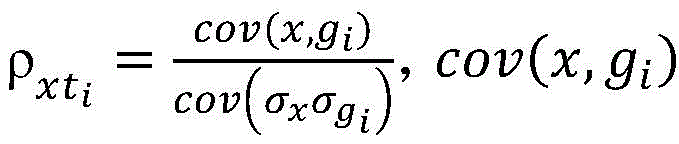 represents x and g i Covariance, sigma between x and
 Respectively represents x and g i Standard deviation of (2); i is 1,2 and 3;
ρ xg1 representing the acceleration signal g in the first direction 1 Pearson correlation coefficient, ρ xg2 Representing acceleration signal g in the second direction 2 Pearson correlation coefficient, ρ xg3 Representing the acceleration signal g in the third direction 3 Is cov, the mathematical symbol covariance.
By pearson correlation coefficient ρ xg Comparing with a preset threshold value, the removal can be judgedWhether the PPG signal of weak motion artifact contains strong motion artifact.
Specifically ρ xg And the result of comparison with the preset threshold value is larger than or equal to the threshold value, the result is smaller than the threshold value, and the result is no strong motion artifact, so that the calculation process of removing the strong motion artifact is not needed, and the calculation amount is saved well. I.e. by pearson correlation coefficient ρ xg And comparing the PPG signal with a preset first threshold value, and judging whether the PPG signal from which the weak motion artifact is removed contains the strong motion artifact or not.
And a third step of: and removing strong motion artifacts by using a variational modal decomposition method. By selecting different modalities z with sparse structures k Reconstructing the input signal (i.e. the PPG signal after removing the weak motion artifact), generating constraint variation problems based on a variation mode decomposition method as follows:


wherein θ is the mathematical sign partial derivative, X is the PPG signal of the input variation modal decomposition, X k (t) represents the PPG signal at time t in the kth modality,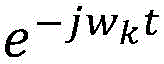 representing complex exponential signals, X (t) represents an input signal at the moment of a signal t, namely a PPG signal, t is a time variable, j is an imaginary symbol, namely the PPG signal is decomposed into an analytic signal through Hilbert transformation, and j represents the imaginary part of the analytic signal; z k Is a series of modes z after decomposition k (k=1, 2, …, K), K representing the total number of all modalities. Omega k Representative modality z k Center angular frequency, { z k }={z 1 ,z 2 ,…,z K },{w k }={w 1 ,w 2 ,…,w K And δ represents the dirac distribution.
Pre-selection K 2 (K 2 K) modes to cancel some modes related to high frequency noise, minimum K 2 The following are satisfied:

where e is a very small positive number such as 0.01, x is the PPG signal of the input variation modal decomposition, and max represents the maximum element value function. Based on equation (6), a reconstructed clean PPG signal X is obtained recon (i.e., noise-removed signal):

step 02, PPG signal segmentation based on sliding window.
Because the waveform of the PPG signal collected by the wearable device is greatly influenced by external factors, the reference point of the PPG signal is difficult to obtain, and the PPG heartbeat cycle segment is extracted by adopting the PPG signal segmentation method based on the sliding window in the embodiment, which comprises the following specific steps:
first, the lengths of the sliding window and the overlapping window are set. The length of the sliding window is set to be 1-1.2 seconds, the sliding window is larger than one PPG signal cardiac cycle, and the length of the overlapping window is set to be 0.3-0.5 seconds.
In this embodiment, the sampling points included in the sliding window within 1 second are different according to the sampling frequency of different signals. The length of the sliding window used in the specific experiments was 1 second.
The sampling points contained within the overlapping windows within the 0.3 second time period are different depending on the sampling frequency of the different signals. The overlap window length for a particular experiment was 0.3 seconds.
And secondly, sliding the PPG signal with the set overlapping window to remove noise, and recording the heartbeat cycle fragments of the PPG signal in the sliding window after each step of sliding, wherein all the heartbeat cycle fragments are segmented PPG signals.
And thirdly, normalizing.
In order to eliminate the influence of different dimension values caused by different magnitudes, the embodiment adopts a min-max standardization method to normalize the heartbeat period fragments, so that the values corresponding to the heartbeat period fragments are in the range of [0,1] intervals.
And step 03, extracting multi-scale differential characteristics of the PPG signal.
The local information of the PPG signal has good differentiation, and in order to better save computing resources, the multi-scale differential feature of the heartbeat cycle segment is extracted in this embodiment, and the specific steps are as follows:
the first step: setting the number p of sampling points (p is a natural number greater than 0) and the distance d of the sampling points 1 (d 1 A natural number greater than 0), p represents the number of sampling points extracted on each side at time t, and d represents [ t-d ] at time t 1 ,t+d 1 ]The number of sampling points within the interval that do not participate in sampling.
Note that t represents a time variable.
And a second step of: calculating each sampling point S in the heartbeat period segment S t Is a differential eigenvalue y of (2) t Wherein s= [ S ] 1 ,S 2 ,……S n ],1≤t≤n (7)

Wherein S (t) represents the amplitude of the sampling point at the time t, y t Representing the differential characteristics of the PPG signal at time t, the amplitude characteristics are converted into differential characteristics via equation (8).
And a third step of: construction of sampling Point S t Is described.
S t Is a multi-scale differential feature vector MDF (S t ) Expressed as:
MDF(S t )=[y 1 ,y 2 ,…y 2p ] (9);
the amplitude S (t) at the time t is converted into a multi-scale differential feature vector MDF (S t ) And sampling 2P sampling points on two sides at the moment t, wherein each side samples P sampling points.
Fourth step: the differential features of the heart cycle segment S are constructed. Multiscale differential feature vector MDF (S t ) And splicing to form the differential characteristic of the heartbeat period segment S.
The heartbeat cycle segment is one in this step. The heartbeat cycle segments are obtained by sliding window segmentation, and each PPG signal can be obtained by sliding window segmentation.
Step 04. Retrieval of ppg signal.
In order to reduce the matching times of the wearable equipment, in the embodiment, firstly, the multi-scale differential features are converted into binary index codes, and the binary index codes are used for searching the test individuals to obtain the most similar multiple candidate sets of the test individuals. Then, only the identity of the individuals in the candidate set is matched during the identification of the PPG signal, so that the calculation amount of the matching of the test signal and the individuals in the training sample is reduced.
The individuals in the candidate set come from a template database, the template database is composed of binary code index codes of the heartbeat cycle fragments of each registered individual, and each individual takes the binary codes of the heartbeat cycle fragments as templates.
The first step: in this embodiment, a hash learning method is to be used to extract the binary index code of the multi-scale differential feature. When the binary index code is constructed, the local manifold structure of the heartbeat cycle segment is kept in the Hamming space, the quantization error is kept to be minimum, the learned variance of the binary index code is kept to be maximum, and the binary index code of the PPG signal is obtained through the following objective function (formula (10):

wherein ,yi ∈R d′ and yj ∈R d′ And d' dimensional multi-scale differential features of the ith and jth heartbeat period fragments in the PPG training set are represented respectively, wherein the total number of the heartbeat period fragments is N, and each heartbeat period fragment corresponds to one individual. Typically, training samples are pre-computed and storedEach individual sample corresponds to a segment of a heart cycle.
w k0 ∈R d′ Projection matrix, K, being a hash function 3 Is the number of hash functions that are to be performed,
 is y i The k0 th bit binary index code of (a), u k0 Representing the average value of the binary index codes; sgn (·) is a sign function, sgn (h) is equal to 1 when h is equal to or greater than 0, and sgn (h) is equal to 0 when h is equal to or less than 0; h ij Is y i And y is j A degree of similarity between; the PPG training set is a training subset in a predefined PPG training data set. The present embodiment adopts a k-nearest neighbor method or the like. The first term in the above formula considers the local manifold structure represented by the multi-scale differential feature of the PPG signal, the second term keeps the quantization error to be minimum, and the third term maximizes the variance of the learned binary index code.
And a second step of: calculating the similarity between the binary index code and the binary index code of each registered individual PPG signal by utilizing the Hamming distance;
and a third step of: the similarity scores are ranked from large to small, and p1 registered PPG signals with highest scores are returned.
Fourth step: and searching the test heartbeat period fragments by using the binary index code to obtain a plurality of candidate sets with the test heartbeat period fragments most similar to each other.
And 05. Matching the identity with the individuals in the candidate set.
During the identification of the PPG signal, only the individuals in the candidate set (namely, templates in the registered template database are stored in the form of binary index codes in the template data set, namely, the binary index codes corresponding to the electrocardio fragments are stored), so that the calculation amount of inquiring the individuals is reduced. In the identity matching stage, a Metric Learning (Metric Learning) method is adopted to perform PPG signal identity matching. The PPG signal identity matching method based on metric learning is as follows:
the first step: a metric matrix is constructed. Learning a semi-positive definite matrix M using a neighbor component analysis algorithm (m=pp T ) The objective function of the algorithm is as follows:

wherein ,xl Represents the first sample in the PPG training set, P represents the metric matrix, Ω i Representation and sample x i A set of subscripts for samples having the same class; x in formula (11) i Representing the ith sample in the PPG training set; x is x j Represents the jth sample in the PPG training set.
The superscript T represents the transpose operation, the metric matrix is obtained from the training samples, and m represents the total number of training samples.
And a second step of: the conventional euclidean distance is transformed into a new metric distance by a metric matrix. After learning the matrix P, the Euclidean distance can be down-converted to obtain a test sample x i ' and sample x j ' New distance metric D (x i ′,x j ′):
D(x i ′,x j ′)=||P(x i ′-x j ′)|| 2 =(x i ′-x j ′) T P T P(x i ′-x j ′) (12)
Formula (12) x i ' represents the i-th sample in the test set, x j ' represents the j-th sample in the test set, which is a subset of tests in the pre-given PPG training data set.
And a third step of: and (5) identity matching. And calculating the distance between the test heartbeat cycle segment and the individual in the candidate set, wherein the category to which the smallest distance belongs is the category of the test heartbeat cycle segment.
The identity of the wearable device of this embodiment has two application scenarios, and the working mode mainly includes: a verification modality and an identification modality (Identification mode). In the verification mode, the features extracted in real time on site and a registered feature template are subjected to one-to-one comparison, so that whether the user is identified, and the number of the templates, namely the size of the database scale, does not influence the recognition speed because of the one-to-one comparison. However, in the identification modality, the identity class of the user needs to be verified. Such as: wearable devices sometimes require that many users commonly have rights.
When the recognition mode is used, the size of the template database determines the matching speed, because the recognition mode performs one-to-many matching, that is, the features extracted in real time are compared with all feature templates in the database, so that the identity of the user is confirmed. For example, 10000 registered heartbeat segment templates in the database are needed to be matched for 10000 PPG signals to be identified acquired in one site, if the time for performing one matching is 0.01s, the total matching time is 10000×0.01s=100 s, and the matching time of 100s is very difficult to bear in practical application. The scheme of the embodiment can be suitable for various scenes, and can effectively reduce the matching time, thereby realizing large-scale popularization.
And 06, evaluating the identity, namely evaluating the result.
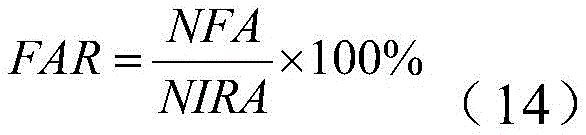
And finally, calculating error recognition rate (FAR), rejection rate (FRR) and Equivalent Error Rate (EER) to measure the effect of the proposed identity recognition method. Specifically, calculating error rate FAR, rejection rate FRR and equal error rate EER; acquiring EER through FAR and FRR; if EER is smaller than a preset third value of 0.01, the monitored PPG signal is considered to be accurate; that is, the different PPG signal databases were evaluated, and the effect of the evaluation in this example verifies the effectiveness and advancement of the protocol of this example.
The specific formula is as follows:
false recognition rate:

rejection rate:

equal error rate:
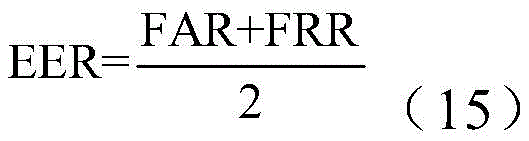
where NGRA is the total number of intra-class tests and NIRA is the total number of inter-class tests; NFR and NFA are the number of false rejections and false acceptances.
Through evaluation, the mode can achieve better performance and has popularization.
Example III
The embodiment also provides a wearable device, including: a memory and a processor; the processor is configured to execute the computer program stored in the memory, so as to implement the steps of executing the method for identifying the PPG signal on the wearable device according to any of the first and second embodiments.
Specifically, the computing device of the present embodiment may include: at least one processor, at least one memory, at least one network interface, and/or other user interface. The various components in the electronic device are coupled together by a bus system. It will be appreciated that a bus system is used to enable connected communications between these components. The bus system includes a power bus, a control bus, and a status signal bus in addition to the data bus. The user interface may include a display or pointing device (e.g., a mouse or touch pad, etc.).
It will be appreciated that the memory in this embodiment may be either volatile memory or nonvolatile memory, or may include both volatile and nonvolatile memory. The memory described herein includes any other suitable type of memory.
In an embodiment of the present invention, the processor is configured to execute the method steps provided in the first aspect by calling a program or an instruction stored in the memory, in particular, a program or an instruction stored in the application program.
The method disclosed by the embodiment of the invention can be applied to a processor or realized by the processor. The processor may be an integrated circuit chip having signal processing capabilities. In implementation, the steps of the above method may be performed by integrated logic circuits of hardware in a processor or by instructions in the form of software. The processor may be a general purpose processor, a digital signal processor (DigitalSignalProcessor, DSP), an application specific integrated circuit (ApplicationSpecificIntegratedCircuit, ASIC), an off-the-shelf programmable gate array (FieldProgrammableGateArray, FPGA) or other programmable logic device, a discrete gate or transistor logic device, a discrete hardware component. The disclosed methods, steps, and logic blocks in the embodiments of the present invention may be implemented or performed. A general purpose processor may be a microprocessor or the processor may be any conventional processor or the like. The steps of the method disclosed in connection with the embodiments of the present invention may be embodied directly in the execution of a hardware decoding processor, or in the execution of a combination of hardware and software elements in a decoding processor. The software elements may be located in a random access memory, flash memory, read-only memory, programmable read-only memory or electrically erasable programmable memory, registers, etc. as well known in the art. The storage medium is located in a memory, and the processor reads the information in the memory and, in combination with its hardware, performs the steps of the above method.
In another aspect, an embodiment of the present invention further provides a computer readable storage medium, where a computer program is stored, where the computer program when executed by a processor implements the steps of the PPG signal identification method on a wearable device of any of the above embodiments.
It should be noted that in the claims, any reference signs placed between parentheses shall not be construed as limiting the claim. The word "comprising" does not exclude the presence of elements or steps not listed in a claim. The word "a" or "an" preceding an element does not exclude the presence of a plurality of such elements. The invention may be implemented by means of hardware comprising several distinct elements, and by means of a suitably programmed computer. In the claims enumerating several means, several of these means may be embodied by one and the same item of hardware. The use of the terms first, second, third, etc. are for convenience of description only and do not denote any order. These terms may be understood as part of the component name.
Furthermore, it should be noted that in the description of the present specification, the terms "one embodiment," "some embodiments," "example," "specific example," or "some examples," etc., refer to a specific feature, structure, material, or characteristic described in connection with the embodiment or example being included in at least one embodiment or example of the present invention. In this specification, schematic representations of the above terms are not necessarily directed to the same embodiment or example. Furthermore, the particular features, structures, materials, or characteristics described may be combined in any suitable manner in any one or more embodiments or examples. Furthermore, the different embodiments or examples described in this specification and the features of the different embodiments or examples may be combined and combined by those skilled in the art without contradiction.
While preferred embodiments of the present invention have been described, additional variations and modifications in those embodiments may occur to those skilled in the art upon learning the basic inventive concepts. Therefore, the appended claims should be construed to include preferred embodiments and all such variations and modifications as fall within the scope of the invention.
It will be apparent to those skilled in the art that various modifications and variations can be made to the present invention without departing from the spirit or scope of the invention. Thus, the present invention should also include such modifications and variations provided that they come within the scope of the following claims and their equivalents.
Claims (9)
1. A PPG signal identification method for use on a wearable device, comprising:
s10, performing noise elimination on a PPG signal monitored by a wearable device to obtain a PPG signal with noise eliminated;
s20, extracting a heartbeat period segment in the PPG signal for eliminating noise, carrying out normalization processing on the extracted heartbeat period segment, and extracting multi-scale differential features in the heartbeat period segment after the normalization processing;
s30, extracting binary index codes of multi-scale differential features by adopting a hash learning method, and acquiring p1 binary index codes similar to the binary index codes in a known database and PPG signal sets to which the p1 binary index codes belong; p1 is a natural number greater than 1;
s40, carrying out identity matching on the PPG signals monitored by the wearable equipment and each PPG signal in the PPG signal set by adopting a measurement learning method to acquire identity information of the wearable equipment;
wherein, the S20 includes:
sliding the PPG signals for eliminating noise based on the lengths of a preset sliding window and an overlapping window, and recording the heartbeat cycle fragments of the PPG signals in the sliding window after each step of sliding, wherein all the heartbeat cycle fragments are segmented PPG signals;
normalizing the heartbeat cycle segment by adopting a min-max normalization method to ensure that the numerical value corresponding to the heartbeat cycle segment is in the range of the [0,1] interval, and obtaining the heartbeat cycle segment after normalization; and
sampling point number p and sampling point distance d extracted based on predefined t moment 1 Calculate each sampling point S in the heartbeat period segment S t Is a differential eigenvalue y of (2) t Constructing a sampling point S t Is a multi-scale differential vector of (a); the S is t Is MDF (S) t ) Constructing a differential characteristic of the heartbeat cycle segment S; and the multiscale differential feature vector MDF (S) for each time point of the heartbeat cycle segment S t ) Splicing to form differential characteristics of the heartbeat period segment S;
wherein d represents [ t-d ] at time t 1 ,t+d 1 ]The number of sampling points in the interval which do not participate in sampling;
S=[S 1 ,S 2 ,.....S n ],1≤t≤n (7)

s (t) represents the amplitude of a sampling point at the moment t; y is t Representing the differential characteristics of the PPG signal at the moment t, and converting the amplitude characteristics into differential characteristics through a formula (8);
MDF(S t )=[y 1 ,y 2 ,…y 2p ] (9);
the amplitude S (t) at the time t is converted into a multi-scale differential feature vector MDF (S t )。
2. The method according to claim 1, wherein S10 comprises:
removing noise in the PPG signal monitored by the wearable equipment by means of a digital band-pass filter to obtain a first-stage PPG signal, wherein the frequency range of the digital band-pass filter is 0.4-4 Hz, and the digital band-pass filter comprises endpoints of 0.4 Hz and 4 Hz;
removing weak motion artifacts in the first-stage PPG signal by adopting a least mean square self-adaptive filtering algorithm, and removing strong motion artifacts in the first-stage PPG signal by adopting a variational mode decomposition method to obtain a noise-eliminated PPG signal;
or ,
removing noise in the PPG signal monitored by the wearable equipment by means of a digital band-pass filter to obtain a first-stage PPG signal, wherein the frequency range of the digital band-pass filter is 0.4-4 Hz, and the digital band-pass filter comprises endpoints of 0.4 Hz and 4 Hz;
and removing weak motion artifacts in the first-stage PPG signal by adopting a least mean square self-adaptive filtering algorithm to obtain a noise-eliminated PPG signal.
3. The method according to claim 2, wherein the weight factor w (t) and the step factor μ (t) in the least mean square adaptive filtering algorithm are:

st.||w(t+1)-w(t)|| 2 ≤K 1
μ(t)=bln(a|e(t)| m ) (2)
wherein b is an amplitude variation parameter representing a step curve, a is an overall shape variation parameter of the step curve, and m is a bottom variation speed parameter of the control step curve; t represents a time variable, K 1 Is constant; st. is a mathematical symbol constraint, ln is a mathematical operation symbol;
w (T) represents a weight factor modeling motion artifact by least mean square adaptive filtering at the current time, w (t+1) represents a weight factor at the next time, μ (T) represents a step size factor, e (T) represents an error signal between an output signal at the current time and a desired signal, X (T) represents an input signal at the current time, the superscript T represents a transpose operation, ε is a given known variable, T represents the current time, t+1 represents the next time, and X (T) represents an input signal at the time T.
4. The method of claim 2, wherein removing weak motion artifacts in the first stage PPG signal using a least mean square adaptive filtering algorithm further comprises:
judging whether to completely remove the weak motion artifact or not by utilizing a binary decision of the correlation coefficient;
specifically, the pearson correlation coefficient is used for measuring the correlation between the PPG signal and the acceleration signal of the wearable device, and the PPG signal x corresponds to the acceleration signal g 1 ,g 2 ,g 3 Pearson correlation coefficient ρ in three directions xg The method comprises the following steps:

wherein mean (·) represents the average function, cov(x,g i ) Represents x and g i Covariance, sigma between x and
 Respectively represents x and g i Standard deviation of (2); i is 1,2 and 3;
ρ xg1 representing the acceleration signal g in the first direction 1 Pearson correlation coefficient, ρ xg2 Representing acceleration signal g in the second direction 2 Pearson correlation coefficient, ρ xg3 Representing the acceleration signal g in the third direction 3 Is cov, the mathematical symbol covariance.
5. A method according to claim 2, wherein removing strong motion artifacts in the first stage PPG signal using a variational modal decomposition method comprises:
by selecting different modalities z with sparse structures k Reconstructing the PPG signal from which the weak motion artifact is removed, wherein the constraint variation problem generated based on the variation modal decomposition method is as follows:

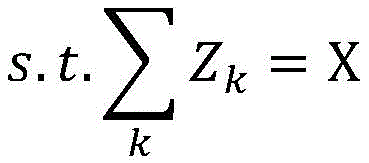
wherein , for mathematical sign partial derivatives, X is the PPG signal input into the variational modal decomposition, X k (t) represents the PPG signal at time t in the kth modality;
z k is a decomposed series of modes k=1, 2, …, K representing the total number of all modes; omega k Representative modality z k Center angular frequency, { z k }={z 1 ,z 2 ,…,z K },{w k }={w 1 ,w 2 ,…,w K },
Delta represents dirac distribution; t represents a time variable, the PPG signal is decomposed into an analytic signal through Hilbert transformation, and j represents an imaginary part of the analytic signal;
pre-selection K 2 Several modes to cancel some modes related to high frequency noise, minimum K 2 The following are satisfied: k (K) 2 ≤K



The reconstructed clean PPG signal serves as a noise-cancelling PPG signal.
6. The method according to claim 1, wherein S30 comprises:
firstly, acquiring a binary index code of a multi-scale differential feature through the following objective function;

wherein ,yi ∈R d′ and yj ∈R d′ D' dimensional multiscale differential features of the ith and jth heartbeat cycle fragments in the PPG training set are represented respectively, and the total number of the heartbeat cycle fragments is N; w (w) k0 ∈R d′ Projection matrix, K, being a hash function 3 Is the number of hash functions that are to be performed, is y i The k0 th bit binary index code of (a), u k0 Representing the average value of the binary index codes; sgn (·) is a sign function, sgn (h) is equal to 1 when h is equal to or greater than 0, and sgn (h) is equal to 0 when h is equal to or less than 0; h ij Is y i And y is j A degree of similarity between; the PPG training set is a training subset in a preset PPG training data set;
then, calculating the similarity between the obtained binary index code and the binary index code of each registered individual PPG signal by utilizing the Hamming distance;
then, sorting the similarity scores from large to small, and returning the binary index codes of the registered individuals with the highest scores of the screened p1 scores;
and finally, searching the test heartbeat period fragments by using the screened binary index codes to obtain a PPG signal set in the test heartbeat period fragments, wherein the PPG signal set is a set formed by a plurality of candidate PPG signals which are most similar to the screened binary index codes.
7. The method of claim 6, wherein S40 comprises:
the first step: learning a semi-positive definite matrix M using a neighbor component analysis algorithm to construct a metric matrix, m=pp T The method comprises the steps of carrying out a first treatment on the surface of the The objective function of the neighbor component analysis algorithm is:

wherein ,xl Represents the first sample in the PPG training set, P represents the metric matrix, Ω i Representation and sample x i A set of subscripts for samples having the same class; x in formula (11) i Representing the ith sample in the PPG training set; x is x j Representing a jth sample in the PPG training set;
and a second step of: obtaining a measurement matrix through the training set, and transforming Euclidean distance between samples in the test set into a new distance through the measurement matrix to obtain a test sample x i ' and sample x j ' New distance metric D (x i ′,x j ′):
D(x i ′,x j ′)=||P(x i ′-x j ′)|| 2 =(x i ′-x j ′) T P T P(x i ′-x j ′) (12)
Formula (12) x i ' represents the i-th sample in the test set, x j ' represents the j-th sample in the test set, the test set is a test subset in a preset PPG training data set;
and a third step of: and calculating the distance between the heartbeat cycle segment of the PPG signal monitored by the wearable equipment and the heartbeat cycle segment of each signal in the PPG signal set through the measurement matrix, wherein the category to which the smallest distance belongs is the category of the PPG signal monitored by the wearable equipment.
8. The method according to any one of claims 1 to 7, further comprising:
evaluating the category of the PPG signal monitored by the identified wearable device;
specifically, calculating error rate FAR, rejection rate FRR and equal error rate EER;
acquiring EER through FAR and FRR; if EER is smaller than a preset third value of 0.01, the monitored PPG signal is considered to be accurate;
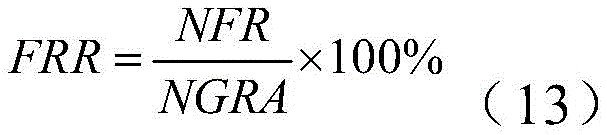
rejection rate:
equal error rate:
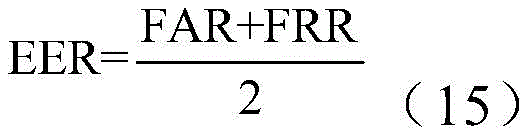
where NGRA is the total number of intra-class tests and NIRA is the total number of inter-class tests; NFR and NFA are the number of false rejections and false acceptances.
9. A wearable device comprising a memory and a processor, the memory storing a program, the processor executing the program stored in the memory and performing the PPG signal identification method for use on a wearable device of any of the preceding claims 1 to 8.
Priority Applications (1)
| Application Number | Priority Date | Filing Date | Title |
|---|---|---|---|
| CN202210908632.2A CN115204238B (en) | 2022-07-29 | 2022-07-29 | PPG signal identity recognition method for wearable equipment and wearable equipment |
Applications Claiming Priority (1)
| Application Number | Priority Date | Filing Date | Title |
|---|---|---|---|
| CN202210908632.2A CN115204238B (en) | 2022-07-29 | 2022-07-29 | PPG signal identity recognition method for wearable equipment and wearable equipment |
Publications (2)
| Publication Number | Publication Date |
|---|---|
| CN115204238A CN115204238A (en) | 2022-10-18 |
| CN115204238B true CN115204238B (en) | 2023-05-23 |
Family
ID=83586771
Family Applications (1)
| Application Number | Title | Priority Date | Filing Date |
|---|---|---|---|
| CN202210908632.2A Active CN115204238B (en) | 2022-07-29 | 2022-07-29 | PPG signal identity recognition method for wearable equipment and wearable equipment |
Country Status (1)
| Country | Link |
|---|---|
| CN (1) | CN115204238B (en) |
Families Citing this family (3)
| Publication number | Priority date | Publication date | Assignee | Title |
|---|---|---|---|---|
| TWI827367B (en) * | 2022-11-15 | 2023-12-21 | 正基科技股份有限公司 | Correction system and correction method for element position |
| CN116861217B (en) * | 2023-07-18 | 2024-07-16 | 菏泽学院 | Identity recognition method and system for mobile terminal |
| CN118980919B (en) * | 2024-10-22 | 2024-12-17 | 杭州芯海半导体技术有限公司 | Processing method and device for multi-asynchronous chip test signals |
Family Cites Families (5)
| Publication number | Priority date | Publication date | Assignee | Title |
|---|---|---|---|---|
| US10467548B2 (en) * | 2015-09-29 | 2019-11-05 | Huami Inc. | Method, apparatus and system for biometric identification |
| CN106473750B (en) * | 2016-10-08 | 2019-03-26 | 西安电子科技大学 | Personal identification method based on photoplethysmographic optimal period waveform |
| CN108833085B (en) * | 2018-04-04 | 2019-11-29 | 深圳大学 | A kind of wearable smart machine matching method and system based on heartbeat signal |
| CN111062021B (en) * | 2019-12-19 | 2022-03-11 | 清华大学 | A method and device for identity authentication based on a wearable device |
| CN113128350A (en) * | 2021-03-25 | 2021-07-16 | 同济大学 | Time domain identification and positioning method, equipment and medium for PPG signal feature points |
-
2022
- 2022-07-29 CN CN202210908632.2A patent/CN115204238B/en active Active
Also Published As
| Publication number | Publication date |
|---|---|
| CN115204238A (en) | 2022-10-18 |
Similar Documents
| Publication | Publication Date | Title |
|---|---|---|
| CN115204238B (en) | PPG signal identity recognition method for wearable equipment and wearable equipment | |
| CN105989266B (en) | Authentication method, device and system based on ECG signal | |
| WO2017071126A1 (en) | Touch-screen user key-press behavior pattern construction and analysis system and identity recognition method thereof | |
| CN114067915A (en) | scRNA-seq data dimension reduction method based on deep antithetical variational self-encoder | |
| Chen et al. | Combining fractional‐order edge detection and chaos synchronisation classifier for fingerprint identification | |
| CN103839033A (en) | Face identification method based on fuzzy rule | |
| CN105389486A (en) | Authentication method based on mouse behavior | |
| Malallah et al. | Online handwritten signature recognition by length normalization using up-sampling and down-sampling | |
| Shaheed et al. | A hybrid proposed image quality assessment and enhancement framework for finger vein recognition | |
| CN114840834A (en) | Implicit identity authentication method based on gait characteristics | |
| Qin et al. | Finger-vein quality assessment based on deep features from grayscale and binary images | |
| Lv et al. | An algorithm of Iris feature-extracting based on 2D Log-Gabor | |
| Hammouche et al. | Score level fusion of major and minor finger knuckle patterns based symmetric sum-based rules for person authentication | |
| Teo et al. | 2.5 D Face Recognition System using EfficientNet with Various Optimizers | |
| Adedeji et al. | Comparative analysis of feature selection techniques for fingerprint recognition based on artificial bee colony and teaching learning based optimization | |
| CN119004223A (en) | Lung nodule feature classification method, device, equipment and storage medium | |
| Saxena et al. | Multi-resolution texture analysis for fingerprint based age-group estimation | |
| Singh | Review on multibiometrics: classifications, normalization and fusion levels | |
| Alieksieiev et al. | Studying of keystroke dynamics statistical properties for biometrie user authentication | |
| Fathi et al. | Kinship Detection Based on Hand Geometry Using ResNet50 Model for Feature Extraction | |
| Umasankari et al. | Evaluation of Biometric Classification and Authentication Using Machine Learning Techniques | |
| CN113837523A (en) | A method of community service quality evaluation based on natural language processing algorithm | |
| Suneetha et al. | Classification And Segmentation Of Brain Tumor Using PNN and CNN | |
| Hartung et al. | Quality estimation for vascular pattern recognition | |
| Bala et al. | BAY-MED: Bayesian Approximation for Post-Hoc Uncertainty in Medical Imaging |
Legal Events
| Date | Code | Title | Description |
|---|---|---|---|
| PB01 | Publication | ||
| PB01 | Publication | ||
| SE01 | Entry into force of request for substantive examination | ||
| SE01 | Entry into force of request for substantive examination | ||
| GR01 | Patent grant | ||
| GR01 | Patent grant |