CN115175575A - Engineered bacterial compositions and uses thereof - Google Patents
Engineered bacterial compositions and uses thereof Download PDFInfo
- Publication number
- CN115175575A CN115175575A CN202080094490.XA CN202080094490A CN115175575A CN 115175575 A CN115175575 A CN 115175575A CN 202080094490 A CN202080094490 A CN 202080094490A CN 115175575 A CN115175575 A CN 115175575A
- Authority
- CN
- China
- Prior art keywords
- seq
- composition
- bacteria
- producing
- signaling
- Prior art date
- Legal status (The legal status is an assumption and is not a legal conclusion. Google has not performed a legal analysis and makes no representation as to the accuracy of the status listed.)
- Pending
Links
- 230000001580 bacterial effect Effects 0.000 title claims abstract description 544
- 239000000203 mixture Substances 0.000 title claims abstract description 540
- 230000000694 effects Effects 0.000 claims abstract description 133
- 241000894006 Bacteria Species 0.000 claims description 304
- 108020004465 16S ribosomal RNA Proteins 0.000 claims description 139
- 230000011664 signaling Effects 0.000 claims description 135
- 230000014509 gene expression Effects 0.000 claims description 115
- 108090000623 proteins and genes Proteins 0.000 claims description 86
- 108090000353 Histone deacetylase Proteins 0.000 claims description 85
- 102000003964 Histone deacetylase Human genes 0.000 claims description 85
- 239000003613 bile acid Substances 0.000 claims description 81
- 238000000034 method Methods 0.000 claims description 76
- 230000001939 inductive effect Effects 0.000 claims description 72
- 206010028980 Neoplasm Diseases 0.000 claims description 71
- 150000004666 short chain fatty acids Chemical class 0.000 claims description 69
- 108010074328 Interferon-gamma Proteins 0.000 claims description 68
- QIVBCDIJIAJPQS-VIFPVBQESA-N L-tryptophane Chemical class C1=CC=C2C(C[C@H](N)C(O)=O)=CNC2=C1 QIVBCDIJIAJPQS-VIFPVBQESA-N 0.000 claims description 67
- 230000037361 pathway Effects 0.000 claims description 66
- 230000003110 anti-inflammatory effect Effects 0.000 claims description 65
- 230000002401 inhibitory effect Effects 0.000 claims description 57
- 235000021391 short chain fatty acids Nutrition 0.000 claims description 55
- 230000000770 proinflammatory effect Effects 0.000 claims description 53
- 238000004519 manufacturing process Methods 0.000 claims description 50
- 102000002689 Toll-like receptor Human genes 0.000 claims description 48
- 108020000411 Toll-like receptor Proteins 0.000 claims description 48
- 210000002540 macrophage Anatomy 0.000 claims description 48
- 208000022559 Inflammatory bowel disease Diseases 0.000 claims description 45
- 210000001744 T-lymphocyte Anatomy 0.000 claims description 45
- 230000001965 increasing effect Effects 0.000 claims description 44
- SIKJAQJRHWYJAI-UHFFFAOYSA-N Indole Chemical compound C1=CC=C2NC=CC2=C1 SIKJAQJRHWYJAI-UHFFFAOYSA-N 0.000 claims description 43
- 210000004027 cell Anatomy 0.000 claims description 41
- 150000004667 medium chain fatty acids Chemical class 0.000 claims description 40
- ZFRKQXVRDFCRJG-UHFFFAOYSA-N skatole Chemical compound C1=CC=C2C(C)=CNC2=C1 ZFRKQXVRDFCRJG-UHFFFAOYSA-N 0.000 claims description 40
- 206010009900 Colitis ulcerative Diseases 0.000 claims description 39
- 201000006704 Ulcerative Colitis Diseases 0.000 claims description 39
- 230000002550 fecal effect Effects 0.000 claims description 39
- 108060008682 Tumor Necrosis Factor Proteins 0.000 claims description 38
- 230000006907 apoptotic process Effects 0.000 claims description 38
- 238000002054 transplantation Methods 0.000 claims description 38
- 230000007774 longterm Effects 0.000 claims description 37
- 229960003964 deoxycholic acid Drugs 0.000 claims description 35
- 230000004913 activation Effects 0.000 claims description 34
- 238000003556 assay Methods 0.000 claims description 32
- 210000002919 epithelial cell Anatomy 0.000 claims description 32
- 230000006044 T cell activation Effects 0.000 claims description 31
- YGPSJZOEDVAXAB-UHFFFAOYSA-N kynurenine Chemical compound OC(=O)C(N)CC(=O)C1=CC=CC=C1N YGPSJZOEDVAXAB-UHFFFAOYSA-N 0.000 claims description 30
- 210000001266 CD8-positive T-lymphocyte Anatomy 0.000 claims description 29
- 230000004888 barrier function Effects 0.000 claims description 29
- 230000004069 differentiation Effects 0.000 claims description 29
- 230000007412 host metabolism Effects 0.000 claims description 29
- 210000004881 tumor cell Anatomy 0.000 claims description 29
- FERIUCNNQQJTOY-UHFFFAOYSA-N Butyric acid Natural products CCCC(O)=O FERIUCNNQQJTOY-UHFFFAOYSA-N 0.000 claims description 28
- 230000002757 inflammatory effect Effects 0.000 claims description 27
- FERIUCNNQQJTOY-UHFFFAOYSA-M Butyrate Chemical compound CCCC([O-])=O FERIUCNNQQJTOY-UHFFFAOYSA-M 0.000 claims description 26
- 102100034458 Hepatitis A virus cellular receptor 2 Human genes 0.000 claims description 26
- 108091008042 inhibitory receptors Proteins 0.000 claims description 26
- 101710083479 Hepatitis A virus cellular receptor 2 homolog Proteins 0.000 claims description 25
- 101000831007 Homo sapiens T-cell immunoreceptor with Ig and ITIM domains Proteins 0.000 claims description 25
- 229940126547 T-cell immunoglobulin mucin-3 Drugs 0.000 claims description 25
- 102100024834 T-cell immunoreceptor with Ig and ITIM domains Human genes 0.000 claims description 25
- 201000011510 cancer Diseases 0.000 claims description 25
- 230000002708 enhancing effect Effects 0.000 claims description 25
- 102000017578 LAG3 Human genes 0.000 claims description 24
- 101150030213 Lag3 gene Proteins 0.000 claims description 24
- 230000003213 activating effect Effects 0.000 claims description 24
- KXGVEGMKQFWNSR-UHFFFAOYSA-N deoxycholic acid Natural products C1CC2CC(O)CCC2(C)C2C1C1CCC(C(CCC(O)=O)C)C1(C)C(O)C2 KXGVEGMKQFWNSR-UHFFFAOYSA-N 0.000 claims description 23
- 238000000338 in vitro Methods 0.000 claims description 23
- 229920000768 polyamine Polymers 0.000 claims description 23
- PZOUSPYUWWUPPK-UHFFFAOYSA-N indole Natural products CC1=CC=CC2=C1C=CN2 PZOUSPYUWWUPPK-UHFFFAOYSA-N 0.000 claims description 22
- RKJUIXBNRJVNHR-UHFFFAOYSA-N indolenine Natural products C1=CC=C2CC=NC2=C1 RKJUIXBNRJVNHR-UHFFFAOYSA-N 0.000 claims description 22
- 108090001005 Interleukin-6 Proteins 0.000 claims description 21
- 102000004889 Interleukin-6 Human genes 0.000 claims description 21
- XBDQKXXYIPTUBI-UHFFFAOYSA-M Propionate Chemical compound CCC([O-])=O XBDQKXXYIPTUBI-UHFFFAOYSA-M 0.000 claims description 21
- 230000003915 cell function Effects 0.000 claims description 21
- KXGVEGMKQFWNSR-LLQZFEROSA-N deoxycholic acid Chemical compound C([C@H]1CC2)[C@H](O)CC[C@]1(C)[C@@H]1[C@@H]2[C@@H]2CC[C@H]([C@@H](CCC(O)=O)C)[C@@]2(C)[C@@H](O)C1 KXGVEGMKQFWNSR-LLQZFEROSA-N 0.000 claims description 21
- 239000003814 drug Substances 0.000 claims description 21
- 102000004169 proteins and genes Human genes 0.000 claims description 21
- 102000005962 receptors Human genes 0.000 claims description 21
- 108020003175 receptors Proteins 0.000 claims description 21
- 208000024891 symptom Diseases 0.000 claims description 21
- 238000002560 therapeutic procedure Methods 0.000 claims description 21
- 229940076838 Immune checkpoint inhibitor Drugs 0.000 claims description 20
- 102000037984 Inhibitory immune checkpoint proteins Human genes 0.000 claims description 20
- 108091008026 Inhibitory immune checkpoint proteins Proteins 0.000 claims description 20
- 102100040247 Tumor necrosis factor Human genes 0.000 claims description 20
- 210000000612 antigen-presenting cell Anatomy 0.000 claims description 20
- 239000013553 cell monolayer Substances 0.000 claims description 20
- 239000012274 immune-checkpoint protein inhibitor Substances 0.000 claims description 20
- HSINOMROUCMIEA-FGVHQWLLSA-N (2s,4r)-4-[(3r,5s,6r,7r,8s,9s,10s,13r,14s,17r)-6-ethyl-3,7-dihydroxy-10,13-dimethyl-2,3,4,5,6,7,8,9,11,12,14,15,16,17-tetradecahydro-1h-cyclopenta[a]phenanthren-17-yl]-2-methylpentanoic acid Chemical group C([C@@]12C)C[C@@H](O)C[C@H]1[C@@H](CC)[C@@H](O)[C@@H]1[C@@H]2CC[C@]2(C)[C@@H]([C@H](C)C[C@H](C)C(O)=O)CC[C@H]21 HSINOMROUCMIEA-FGVHQWLLSA-N 0.000 claims description 19
- 102100025137 Early activation antigen CD69 Human genes 0.000 claims description 19
- 101000934374 Homo sapiens Early activation antigen CD69 Proteins 0.000 claims description 19
- 102000008070 Interferon-gamma Human genes 0.000 claims description 19
- SMEROWZSTRWXGI-UHFFFAOYSA-N Lithocholsaeure Natural products C1CC2CC(O)CCC2(C)C2C1C1CCC(C(CCC(O)=O)C)C1(C)CC2 SMEROWZSTRWXGI-UHFFFAOYSA-N 0.000 claims description 19
- NQPDZGIKBAWPEJ-UHFFFAOYSA-N valeric acid Chemical compound CCCCC(O)=O NQPDZGIKBAWPEJ-UHFFFAOYSA-N 0.000 claims description 19
- 102000001109 Leukocyte L1 Antigen Complex Human genes 0.000 claims description 18
- 108010069316 Leukocyte L1 Antigen Complex Proteins 0.000 claims description 18
- 108010060804 Toll-Like Receptor 4 Proteins 0.000 claims description 18
- 208000027866 inflammatory disease Diseases 0.000 claims description 18
- 150000003408 sphingolipids Chemical class 0.000 claims description 18
- 108010012236 Chemokines Proteins 0.000 claims description 17
- KHGNFPUMBJSZSM-UHFFFAOYSA-N Perforine Natural products COC1=C2CCC(O)C(CCC(C)(C)O)(OC)C2=NC2=C1C=CO2 KHGNFPUMBJSZSM-UHFFFAOYSA-N 0.000 claims description 17
- 102000008234 Toll-like receptor 5 Human genes 0.000 claims description 17
- 108010060812 Toll-like receptor 5 Proteins 0.000 claims description 17
- 102000013814 Wnt Human genes 0.000 claims description 17
- 108050003627 Wnt Proteins 0.000 claims description 17
- 230000030741 antigen processing and presentation Effects 0.000 claims description 17
- 102000003898 interleukin-24 Human genes 0.000 claims description 17
- 108090000237 interleukin-24 Proteins 0.000 claims description 17
- SMEROWZSTRWXGI-HVATVPOCSA-N lithocholic acid Chemical compound C([C@H]1CC2)[C@H](O)CC[C@]1(C)[C@@H]1[C@@H]2[C@@H]2CC[C@H]([C@@H](CCC(O)=O)C)[C@@]2(C)CC1 SMEROWZSTRWXGI-HVATVPOCSA-N 0.000 claims description 17
- 229930192851 perforin Natural products 0.000 claims description 17
- 229940070710 valerate Drugs 0.000 claims description 17
- 102000019034 Chemokines Human genes 0.000 claims description 16
- 102000043129 MHC class I family Human genes 0.000 claims description 16
- 108010056995 Perforin Proteins 0.000 claims description 16
- 102000010400 1-phosphatidylinositol-3-kinase activity proteins Human genes 0.000 claims description 15
- 102000016938 Catalase Human genes 0.000 claims description 15
- 108010053835 Catalase Proteins 0.000 claims description 15
- 101000930801 Homo sapiens HLA class II histocompatibility antigen, DQ alpha 2 chain Proteins 0.000 claims description 15
- 108010034143 Inflammasomes Proteins 0.000 claims description 15
- 108010014726 Interferon Type I Proteins 0.000 claims description 15
- 102000002227 Interferon Type I Human genes 0.000 claims description 15
- 102000012064 NLR Proteins Human genes 0.000 claims description 15
- 108091005686 NOD-like receptors Proteins 0.000 claims description 15
- 108091007960 PI3Ks Proteins 0.000 claims description 15
- 102000004503 Perforin Human genes 0.000 claims description 15
- 230000004900 autophagic degradation Effects 0.000 claims description 15
- 230000024245 cell differentiation Effects 0.000 claims description 15
- 210000004698 lymphocyte Anatomy 0.000 claims description 15
- 230000036542 oxidative stress Effects 0.000 claims description 15
- 230000002829 reductive effect Effects 0.000 claims description 15
- 230000032258 transport Effects 0.000 claims description 15
- 235000019156 vitamin B Nutrition 0.000 claims description 15
- 239000011720 vitamin B Substances 0.000 claims description 15
- -1 CD45RO Proteins 0.000 claims description 14
- 108010000231 Choloylglycine hydrolase Proteins 0.000 claims description 14
- 102000003810 Interleukin-18 Human genes 0.000 claims description 14
- 108090000171 Interleukin-18 Proteins 0.000 claims description 14
- 108010065637 Interleukin-23 Proteins 0.000 claims description 14
- 101150097381 Mtor gene Proteins 0.000 claims description 14
- 102000012086 alpha-L-Fucosidase Human genes 0.000 claims description 14
- 108010061314 alpha-L-Fucosidase Proteins 0.000 claims description 14
- 230000000295 complement effect Effects 0.000 claims description 14
- 102000013264 Interleukin-23 Human genes 0.000 claims description 13
- 108010057466 NF-kappa B Proteins 0.000 claims description 13
- 102000003945 NF-kappa B Human genes 0.000 claims description 13
- 108700012920 TNF Proteins 0.000 claims description 13
- 230000008951 colonic inflammation Effects 0.000 claims description 13
- 239000002621 endocannabinoid Substances 0.000 claims description 13
- 102000003814 Interleukin-10 Human genes 0.000 claims description 12
- 108090000174 Interleukin-10 Proteins 0.000 claims description 12
- 230000003704 interleukin-23 production Effects 0.000 claims description 11
- 230000007115 recruitment Effects 0.000 claims description 11
- QTBSBXVTEAMEQO-UHFFFAOYSA-M Acetate Chemical compound CC([O-])=O QTBSBXVTEAMEQO-UHFFFAOYSA-M 0.000 claims description 10
- 102000004127 Cytokines Human genes 0.000 claims description 10
- 108090000695 Cytokines Proteins 0.000 claims description 10
- 150000001200 N-acyl ethanolamides Chemical class 0.000 claims description 10
- 206010009887 colitis Diseases 0.000 claims description 10
- 230000019734 interleukin-12 production Effects 0.000 claims description 10
- 230000001404 mediated effect Effects 0.000 claims description 10
- 230000028327 secretion Effects 0.000 claims description 10
- 108091054437 MHC class I family Proteins 0.000 claims description 9
- 230000000112 colonic effect Effects 0.000 claims description 9
- KQNPFQTWMSNSAP-UHFFFAOYSA-N isobutyric acid Chemical compound CC(C)C(O)=O KQNPFQTWMSNSAP-UHFFFAOYSA-N 0.000 claims description 9
- GWYFCOCPABKNJV-UHFFFAOYSA-N isovaleric acid Chemical compound CC(C)CC(O)=O GWYFCOCPABKNJV-UHFFFAOYSA-N 0.000 claims description 9
- 229940124597 therapeutic agent Drugs 0.000 claims description 9
- PLVPPLCLBIEYEA-AATRIKPKSA-N (E)-3-(indol-3-yl)acrylic acid Chemical compound C1=CC=C2C(/C=C/C(=O)O)=CNC2=C1 PLVPPLCLBIEYEA-AATRIKPKSA-N 0.000 claims description 8
- BDAGIHXWWSANSR-UHFFFAOYSA-M Formate Chemical compound [O-]C=O BDAGIHXWWSANSR-UHFFFAOYSA-M 0.000 claims description 8
- 102100036242 HLA class II histocompatibility antigen, DQ alpha 2 chain Human genes 0.000 claims description 8
- 239000002253 acid Substances 0.000 claims description 8
- 102000018713 Histocompatibility Antigens Class II Human genes 0.000 claims description 7
- 108010027412 Histocompatibility Antigens Class II Proteins 0.000 claims description 7
- 241000700605 Viruses Species 0.000 claims description 7
- 239000000546 pharmaceutical excipient Substances 0.000 claims description 7
- GWYFCOCPABKNJV-UHFFFAOYSA-M 3-Methylbutanoic acid Natural products CC(C)CC([O-])=O GWYFCOCPABKNJV-UHFFFAOYSA-M 0.000 claims description 6
- 230000007423 decrease Effects 0.000 claims description 6
- PEDCQBHIVMGVHV-UHFFFAOYSA-N glycerol group Chemical group OCC(O)CO PEDCQBHIVMGVHV-UHFFFAOYSA-N 0.000 claims description 6
- 230000028993 immune response Effects 0.000 claims description 6
- 230000001737 promoting effect Effects 0.000 claims description 6
- 210000003171 tumor-infiltrating lymphocyte Anatomy 0.000 claims description 6
- 108010065805 Interleukin-12 Proteins 0.000 claims description 5
- 230000001363 autoimmune Effects 0.000 claims description 5
- 230000022534 cell killing Effects 0.000 claims description 5
- 230000002222 downregulating effect Effects 0.000 claims description 5
- 239000008194 pharmaceutical composition Substances 0.000 claims description 5
- 229940045513 CTLA4 antagonist Drugs 0.000 claims description 4
- 206010009944 Colon cancer Diseases 0.000 claims description 4
- 101710088194 Dehydrogenase Proteins 0.000 claims description 4
- 102000013462 Interleukin-12 Human genes 0.000 claims description 4
- 230000003247 decreasing effect Effects 0.000 claims description 4
- FUZZWVXGSFPDMH-UHFFFAOYSA-N hexanoic acid Chemical compound CCCCCC(O)=O FUZZWVXGSFPDMH-UHFFFAOYSA-N 0.000 claims description 4
- 238000001727 in vivo Methods 0.000 claims description 4
- 230000004614 tumor growth Effects 0.000 claims description 4
- KNVADAPHVNKTEP-CIGXQKLNSA-N 7alpha-hydroxy-3-oxo-5beta-cholan-24-oic acid Chemical compound C([C@H]1C[C@H]2O)C(=O)CC[C@]1(C)[C@@H]1[C@@H]2[C@@H]2CC[C@H]([C@@H](CCC(O)=O)C)[C@@]2(C)CC1 KNVADAPHVNKTEP-CIGXQKLNSA-N 0.000 claims description 3
- 208000011231 Crohn disease Diseases 0.000 claims description 3
- 208000018522 Gastrointestinal disease Diseases 0.000 claims description 3
- 208000010643 digestive system disease Diseases 0.000 claims description 3
- 208000018685 gastrointestinal system disease Diseases 0.000 claims description 3
- 229920000642 polymer Polymers 0.000 claims description 3
- 206010005003 Bladder cancer Diseases 0.000 claims description 2
- 206010005949 Bone cancer Diseases 0.000 claims description 2
- 208000018084 Bone neoplasm Diseases 0.000 claims description 2
- 206010006187 Breast cancer Diseases 0.000 claims description 2
- 208000026310 Breast neoplasm Diseases 0.000 claims description 2
- 206010008342 Cervix carcinoma Diseases 0.000 claims description 2
- 208000001333 Colorectal Neoplasms Diseases 0.000 claims description 2
- 208000000461 Esophageal Neoplasms Diseases 0.000 claims description 2
- 206010064147 Gastrointestinal inflammation Diseases 0.000 claims description 2
- 206010017993 Gastrointestinal neoplasms Diseases 0.000 claims description 2
- 208000008839 Kidney Neoplasms Diseases 0.000 claims description 2
- 206010058467 Lung neoplasm malignant Diseases 0.000 claims description 2
- 206010025323 Lymphomas Diseases 0.000 claims description 2
- 206010051606 Necrotising colitis Diseases 0.000 claims description 2
- 208000034176 Neoplasms, Germ Cell and Embryonal Diseases 0.000 claims description 2
- 206010033128 Ovarian cancer Diseases 0.000 claims description 2
- 206010061535 Ovarian neoplasm Diseases 0.000 claims description 2
- 206010061902 Pancreatic neoplasm Diseases 0.000 claims description 2
- 206010035226 Plasma cell myeloma Diseases 0.000 claims description 2
- 206010060862 Prostate cancer Diseases 0.000 claims description 2
- 208000000236 Prostatic Neoplasms Diseases 0.000 claims description 2
- 206010038389 Renal cancer Diseases 0.000 claims description 2
- 206010039491 Sarcoma Diseases 0.000 claims description 2
- 208000000453 Skin Neoplasms Diseases 0.000 claims description 2
- 208000005718 Stomach Neoplasms Diseases 0.000 claims description 2
- 208000024313 Testicular Neoplasms Diseases 0.000 claims description 2
- 206010057644 Testis cancer Diseases 0.000 claims description 2
- 208000024770 Thyroid neoplasm Diseases 0.000 claims description 2
- 208000007097 Urinary Bladder Neoplasms Diseases 0.000 claims description 2
- 208000006105 Uterine Cervical Neoplasms Diseases 0.000 claims description 2
- 208000002495 Uterine Neoplasms Diseases 0.000 claims description 2
- 239000000427 antigen Substances 0.000 claims description 2
- 108091007433 antigens Proteins 0.000 claims description 2
- 102000036639 antigens Human genes 0.000 claims description 2
- 201000007455 central nervous system cancer Diseases 0.000 claims description 2
- 208000025997 central nervous system neoplasm Diseases 0.000 claims description 2
- 201000010881 cervical cancer Diseases 0.000 claims description 2
- 208000008609 collagenous colitis Diseases 0.000 claims description 2
- 208000029742 colonic neoplasm Diseases 0.000 claims description 2
- POULHZVOKOAJMA-UHFFFAOYSA-M dodecanoate Chemical compound CCCCCCCCCCCC([O-])=O POULHZVOKOAJMA-UHFFFAOYSA-M 0.000 claims description 2
- 201000004101 esophageal cancer Diseases 0.000 claims description 2
- 206010017758 gastric cancer Diseases 0.000 claims description 2
- 201000003115 germ cell cancer Diseases 0.000 claims description 2
- 201000010536 head and neck cancer Diseases 0.000 claims description 2
- 208000014829 head and neck neoplasm Diseases 0.000 claims description 2
- 201000010982 kidney cancer Diseases 0.000 claims description 2
- 208000032839 leukemia Diseases 0.000 claims description 2
- 201000007270 liver cancer Diseases 0.000 claims description 2
- 208000014018 liver neoplasm Diseases 0.000 claims description 2
- 201000005202 lung cancer Diseases 0.000 claims description 2
- 208000020816 lung neoplasm Diseases 0.000 claims description 2
- 208000015486 malignant pancreatic neoplasm Diseases 0.000 claims description 2
- 208000008275 microscopic colitis Diseases 0.000 claims description 2
- 201000000050 myeloid neoplasm Diseases 0.000 claims description 2
- 208000004995 necrotizing enterocolitis Diseases 0.000 claims description 2
- WWZKQHOCKIZLMA-UHFFFAOYSA-M octanoate Chemical compound CCCCCCCC([O-])=O WWZKQHOCKIZLMA-UHFFFAOYSA-M 0.000 claims description 2
- 201000002528 pancreatic cancer Diseases 0.000 claims description 2
- 208000008443 pancreatic carcinoma Diseases 0.000 claims description 2
- 201000006195 perinatal necrotizing enterocolitis Diseases 0.000 claims description 2
- 208000015768 polyposis Diseases 0.000 claims description 2
- 201000000849 skin cancer Diseases 0.000 claims description 2
- 201000011549 stomach cancer Diseases 0.000 claims description 2
- 201000003120 testicular cancer Diseases 0.000 claims description 2
- 201000002510 thyroid cancer Diseases 0.000 claims description 2
- 201000005112 urinary bladder cancer Diseases 0.000 claims description 2
- 206010046766 uterine cancer Diseases 0.000 claims description 2
- GOZMBJCYMQQACI-UHFFFAOYSA-N 6,7-dimethyl-3-[[methyl-[2-[methyl-[[1-[3-(trifluoromethyl)phenyl]indol-3-yl]methyl]amino]ethyl]amino]methyl]chromen-4-one;dihydrochloride Chemical compound Cl.Cl.C=1OC2=CC(C)=C(C)C=C2C(=O)C=1CN(C)CCN(C)CC(C1=CC=CC=C11)=CN1C1=CC=CC(C(F)(F)F)=C1 GOZMBJCYMQQACI-UHFFFAOYSA-N 0.000 claims 7
- 101001033249 Homo sapiens Interleukin-1 beta Proteins 0.000 claims 4
- 102100039065 Interleukin-1 beta Human genes 0.000 claims 4
- 230000031037 interleukin-18 production Effects 0.000 claims 4
- 230000008685 targeting Effects 0.000 claims 4
- 102100039360 Toll-like receptor 4 Human genes 0.000 claims 3
- 102000007590 Calpain Human genes 0.000 claims 2
- 108010032088 Calpain Proteins 0.000 claims 2
- 101000669447 Homo sapiens Toll-like receptor 4 Proteins 0.000 claims 2
- 102000004890 Interleukin-8 Human genes 0.000 claims 2
- 108090001007 Interleukin-8 Proteins 0.000 claims 2
- 206010030155 Oesophageal carcinoma Diseases 0.000 claims 1
- 125000003275 alpha amino acid group Chemical group 0.000 claims 1
- 230000030833 cell death Effects 0.000 claims 1
- GHVNFZFCNZKVNT-UHFFFAOYSA-N decanoic acid Chemical compound CCCCCCCCCC(O)=O GHVNFZFCNZKVNT-UHFFFAOYSA-N 0.000 claims 1
- 208000037902 enteropathy Diseases 0.000 claims 1
- 210000004969 inflammatory cell Anatomy 0.000 claims 1
- 208000028774 intestinal disease Diseases 0.000 claims 1
- 210000000056 organ Anatomy 0.000 claims 1
- 208000037265 diseases, disorders, signs and symptoms Diseases 0.000 abstract description 118
- 238000011282 treatment Methods 0.000 abstract description 70
- 201000010099 disease Diseases 0.000 abstract description 68
- 208000035475 disorder Diseases 0.000 abstract description 50
- 208000027244 Dysbiosis Diseases 0.000 abstract description 35
- 230000007140 dysbiosis Effects 0.000 abstract description 35
- 210000001035 gastrointestinal tract Anatomy 0.000 abstract description 14
- 208000037765 diseases and disorders Diseases 0.000 abstract description 8
- 230000002265 prevention Effects 0.000 abstract description 8
- 241000894007 species Species 0.000 description 345
- LFQSCWFLJHTTHZ-UHFFFAOYSA-N Ethanol Chemical compound CCO LFQSCWFLJHTTHZ-UHFFFAOYSA-N 0.000 description 63
- 244000005700 microbiome Species 0.000 description 53
- 210000004215 spore Anatomy 0.000 description 53
- 102100037850 Interferon gamma Human genes 0.000 description 48
- 239000002609 medium Substances 0.000 description 44
- 102000000852 Tumor Necrosis Factor-alpha Human genes 0.000 description 36
- 210000002220 organoid Anatomy 0.000 description 35
- 210000001072 colon Anatomy 0.000 description 32
- MZOFCQQQCNRIBI-VMXHOPILSA-N (3s)-4-[[(2s)-1-[[(2s)-1-[[(1s)-1-carboxy-2-hydroxyethyl]amino]-4-methyl-1-oxopentan-2-yl]amino]-5-(diaminomethylideneamino)-1-oxopentan-2-yl]amino]-3-[[2-[[(2s)-2,6-diaminohexanoyl]amino]acetyl]amino]-4-oxobutanoic acid Chemical compound OC[C@@H](C(O)=O)NC(=O)[C@H](CC(C)C)NC(=O)[C@H](CCCN=C(N)N)NC(=O)[C@H](CC(O)=O)NC(=O)CNC(=O)[C@@H](N)CCCCN MZOFCQQQCNRIBI-VMXHOPILSA-N 0.000 description 31
- 239000006228 supernatant Substances 0.000 description 31
- 241001465754 Metazoa Species 0.000 description 29
- 239000000523 sample Substances 0.000 description 29
- 239000013074 reference sample Substances 0.000 description 28
- 239000012472 biological sample Substances 0.000 description 20
- 230000005764 inhibitory process Effects 0.000 description 19
- 235000014113 dietary fatty acids Nutrition 0.000 description 18
- 229930195729 fatty acid Natural products 0.000 description 18
- 239000000194 fatty acid Substances 0.000 description 18
- 150000004665 fatty acids Chemical class 0.000 description 18
- 241000193403 Clostridium Species 0.000 description 17
- 241000566145 Otus Species 0.000 description 17
- 102000008233 Toll-Like Receptor 4 Human genes 0.000 description 17
- 239000002552 dosage form Substances 0.000 description 17
- 239000000463 material Substances 0.000 description 17
- 239000013642 negative control Substances 0.000 description 16
- 235000018102 proteins Nutrition 0.000 description 16
- 210000003608 fece Anatomy 0.000 description 15
- 230000000813 microbial effect Effects 0.000 description 15
- 239000000047 product Substances 0.000 description 15
- 238000002360 preparation method Methods 0.000 description 14
- 210000000068 Th17 cell Anatomy 0.000 description 13
- 210000004666 bacterial spore Anatomy 0.000 description 12
- FUZZWVXGSFPDMH-UHFFFAOYSA-M hexanoate Chemical compound CCCCCC([O-])=O FUZZWVXGSFPDMH-UHFFFAOYSA-M 0.000 description 12
- 229910052500 inorganic mineral Inorganic materials 0.000 description 12
- 239000002207 metabolite Substances 0.000 description 12
- 235000010755 mineral Nutrition 0.000 description 12
- 239000011707 mineral Substances 0.000 description 12
- RUDATBOHQWOJDD-UHFFFAOYSA-N (3beta,5beta,7alpha)-3,7-Dihydroxycholan-24-oic acid Natural products OC1CC2CC(O)CCC2(C)C2C1C1CCC(C(CCC(O)=O)C)C1(C)CC2 RUDATBOHQWOJDD-UHFFFAOYSA-N 0.000 description 11
- GOLXRNDWAUTYKT-UHFFFAOYSA-N 3-(1H-indol-3-yl)propanoic acid Chemical compound C1=CC=C2C(CCC(=O)O)=CNC2=C1 GOLXRNDWAUTYKT-UHFFFAOYSA-N 0.000 description 11
- 101000611183 Homo sapiens Tumor necrosis factor Proteins 0.000 description 11
- 239000013641 positive control Substances 0.000 description 11
- 230000001225 therapeutic effect Effects 0.000 description 11
- 101000831567 Homo sapiens Toll-like receptor 2 Proteins 0.000 description 10
- 102100024333 Toll-like receptor 2 Human genes 0.000 description 10
- 150000001720 carbohydrates Chemical class 0.000 description 10
- 235000014633 carbohydrates Nutrition 0.000 description 10
- 239000012228 culture supernatant Substances 0.000 description 10
- 210000002490 intestinal epithelial cell Anatomy 0.000 description 10
- 238000013518 transcription Methods 0.000 description 10
- 230000035897 transcription Effects 0.000 description 10
- 238000010171 animal model Methods 0.000 description 9
- 239000000306 component Substances 0.000 description 9
- 230000004890 epithelial barrier function Effects 0.000 description 9
- 230000002496 gastric effect Effects 0.000 description 9
- 230000006872 improvement Effects 0.000 description 9
- 239000002773 nucleotide Substances 0.000 description 9
- 125000003729 nucleotide group Chemical group 0.000 description 9
- RUDATBOHQWOJDD-UZVSRGJWSA-N ursodeoxycholic acid Chemical compound C([C@H]1C[C@@H]2O)[C@H](O)CC[C@]1(C)[C@@H]1[C@@H]2[C@@H]2CC[C@H]([C@@H](CCC(O)=O)C)[C@@]2(C)CC1 RUDATBOHQWOJDD-UZVSRGJWSA-N 0.000 description 9
- 229960001661 ursodiol Drugs 0.000 description 9
- 229940088594 vitamin Drugs 0.000 description 9
- 229930003231 vitamin Natural products 0.000 description 9
- 235000013343 vitamin Nutrition 0.000 description 9
- 239000011782 vitamin Substances 0.000 description 9
- WQZGKKKJIJFFOK-GASJEMHNSA-N Glucose Natural products OC[C@H]1OC(O)[C@H](O)[C@@H](O)[C@@H]1O WQZGKKKJIJFFOK-GASJEMHNSA-N 0.000 description 8
- CZMRCDWAGMRECN-UGDNZRGBSA-N Sucrose Chemical compound O[C@H]1[C@H](O)[C@@H](CO)O[C@@]1(CO)O[C@@H]1[C@H](O)[C@@H](O)[C@H](O)[C@@H](CO)O1 CZMRCDWAGMRECN-UGDNZRGBSA-N 0.000 description 8
- 229930006000 Sucrose Natural products 0.000 description 8
- 238000004458 analytical method Methods 0.000 description 8
- 210000004082 barrier epithelial cell Anatomy 0.000 description 8
- WQZGKKKJIJFFOK-VFUOTHLCSA-N beta-D-glucose Chemical compound OC[C@H]1O[C@@H](O)[C@H](O)[C@@H](O)[C@@H]1O WQZGKKKJIJFFOK-VFUOTHLCSA-N 0.000 description 8
- 238000001514 detection method Methods 0.000 description 8
- 238000009472 formulation Methods 0.000 description 8
- 239000008103 glucose Substances 0.000 description 8
- 208000015181 infectious disease Diseases 0.000 description 8
- 235000015097 nutrients Nutrition 0.000 description 8
- 230000000638 stimulation Effects 0.000 description 8
- 239000000126 substance Substances 0.000 description 8
- 239000005720 sucrose Substances 0.000 description 8
- 241000186394 Eubacterium Species 0.000 description 7
- QIVBCDIJIAJPQS-UHFFFAOYSA-N Tryptophan Natural products C1=CC=C2C(CC(N)C(O)=O)=CNC2=C1 QIVBCDIJIAJPQS-UHFFFAOYSA-N 0.000 description 7
- 229960001091 chenodeoxycholic acid Drugs 0.000 description 7
- 230000009467 reduction Effects 0.000 description 7
- 108010014831 7-alpha-hydroxysteroid dehydrogenase Proteins 0.000 description 6
- 102000004190 Enzymes Human genes 0.000 description 6
- 108090000790 Enzymes Proteins 0.000 description 6
- 108010062875 Hydroxysteroid Dehydrogenases Proteins 0.000 description 6
- 102000011145 Hydroxysteroid Dehydrogenases Human genes 0.000 description 6
- 229920001202 Inulin Polymers 0.000 description 6
- 241001134638 Lachnospira Species 0.000 description 6
- 102000015728 Mucins Human genes 0.000 description 6
- 108010063954 Mucins Proteins 0.000 description 6
- 239000011324 bead Substances 0.000 description 6
- 239000002775 capsule Substances 0.000 description 6
- 229940088598 enzyme Drugs 0.000 description 6
- 244000144993 groups of animals Species 0.000 description 6
- 230000006698 induction Effects 0.000 description 6
- 229960003130 interferon gamma Drugs 0.000 description 6
- JYJIGFIDKWBXDU-MNNPPOADSA-N inulin Chemical compound O[C@H]1[C@H](O)[C@@H](CO)O[C@@]1(CO)OC[C@]1(OC[C@]2(OC[C@]3(OC[C@]4(OC[C@]5(OC[C@]6(OC[C@]7(OC[C@]8(OC[C@]9(OC[C@]%10(OC[C@]%11(OC[C@]%12(OC[C@]%13(OC[C@]%14(OC[C@]%15(OC[C@]%16(OC[C@]%17(OC[C@]%18(OC[C@]%19(OC[C@]%20(OC[C@]%21(OC[C@]%22(OC[C@]%23(OC[C@]%24(OC[C@]%25(OC[C@]%26(OC[C@]%27(OC[C@]%28(OC[C@]%29(OC[C@]%30(OC[C@]%31(OC[C@]%32(OC[C@]%33(OC[C@]%34(OC[C@]%35(OC[C@]%36(O[C@@H]%37[C@@H]([C@@H](O)[C@H](O)[C@@H](CO)O%37)O)[C@H]([C@H](O)[C@@H](CO)O%36)O)[C@H]([C@H](O)[C@@H](CO)O%35)O)[C@H]([C@H](O)[C@@H](CO)O%34)O)[C@H]([C@H](O)[C@@H](CO)O%33)O)[C@H]([C@H](O)[C@@H](CO)O%32)O)[C@H]([C@H](O)[C@@H](CO)O%31)O)[C@H]([C@H](O)[C@@H](CO)O%30)O)[C@H]([C@H](O)[C@@H](CO)O%29)O)[C@H]([C@H](O)[C@@H](CO)O%28)O)[C@H]([C@H](O)[C@@H](CO)O%27)O)[C@H]([C@H](O)[C@@H](CO)O%26)O)[C@H]([C@H](O)[C@@H](CO)O%25)O)[C@H]([C@H](O)[C@@H](CO)O%24)O)[C@H]([C@H](O)[C@@H](CO)O%23)O)[C@H]([C@H](O)[C@@H](CO)O%22)O)[C@H]([C@H](O)[C@@H](CO)O%21)O)[C@H]([C@H](O)[C@@H](CO)O%20)O)[C@H]([C@H](O)[C@@H](CO)O%19)O)[C@H]([C@H](O)[C@@H](CO)O%18)O)[C@H]([C@H](O)[C@@H](CO)O%17)O)[C@H]([C@H](O)[C@@H](CO)O%16)O)[C@H]([C@H](O)[C@@H](CO)O%15)O)[C@H]([C@H](O)[C@@H](CO)O%14)O)[C@H]([C@H](O)[C@@H](CO)O%13)O)[C@H]([C@H](O)[C@@H](CO)O%12)O)[C@H]([C@H](O)[C@@H](CO)O%11)O)[C@H]([C@H](O)[C@@H](CO)O%10)O)[C@H]([C@H](O)[C@@H](CO)O9)O)[C@H]([C@H](O)[C@@H](CO)O8)O)[C@H]([C@H](O)[C@@H](CO)O7)O)[C@H]([C@H](O)[C@@H](CO)O6)O)[C@H]([C@H](O)[C@@H](CO)O5)O)[C@H]([C@H](O)[C@@H](CO)O4)O)[C@H]([C@H](O)[C@@H](CO)O3)O)[C@H]([C@H](O)[C@@H](CO)O2)O)[C@@H](O)[C@H](O)[C@@H](CO)O1 JYJIGFIDKWBXDU-MNNPPOADSA-N 0.000 description 6
- 229940029339 inulin Drugs 0.000 description 6
- 229920001277 pectin Polymers 0.000 description 6
- 235000010987 pectin Nutrition 0.000 description 6
- 239000001814 pectin Substances 0.000 description 6
- 239000000825 pharmaceutical preparation Substances 0.000 description 6
- LXNHXLLTXMVWPM-UHFFFAOYSA-N pyridoxine Chemical compound CC1=NC=C(CO)C(CO)=C1O LXNHXLLTXMVWPM-UHFFFAOYSA-N 0.000 description 6
- QZAYGJVTTNCVMB-UHFFFAOYSA-N serotonin Chemical compound C1=C(O)C=C2C(CCN)=CNC2=C1 QZAYGJVTTNCVMB-UHFFFAOYSA-N 0.000 description 6
- 235000000346 sugar Nutrition 0.000 description 6
- APJYDQYYACXCRM-UHFFFAOYSA-N tryptamine Chemical compound C1=CC=C2C(CCN)=CNC2=C1 APJYDQYYACXCRM-UHFFFAOYSA-N 0.000 description 6
- 241000193163 Clostridioides difficile Species 0.000 description 5
- SHZGCJCMOBCMKK-UHFFFAOYSA-N D-mannomethylose Natural products CC1OC(O)C(O)C(O)C1O SHZGCJCMOBCMKK-UHFFFAOYSA-N 0.000 description 5
- 108020004414 DNA Proteins 0.000 description 5
- PNNNRSAQSRJVSB-SLPGGIOYSA-N Fucose Natural products C[C@H](O)[C@@H](O)[C@H](O)[C@H](O)C=O PNNNRSAQSRJVSB-SLPGGIOYSA-N 0.000 description 5
- 241000282412 Homo Species 0.000 description 5
- SHZGCJCMOBCMKK-DHVFOXMCSA-N L-fucopyranose Chemical compound C[C@@H]1OC(O)[C@@H](O)[C@H](O)[C@@H]1O SHZGCJCMOBCMKK-DHVFOXMCSA-N 0.000 description 5
- 230000006043 T cell recruitment Effects 0.000 description 5
- MBMBGCFOFBJSGT-KUBAVDMBSA-N all-cis-docosa-4,7,10,13,16,19-hexaenoic acid Chemical compound CC\C=C/C\C=C/C\C=C/C\C=C/C\C=C/C\C=C/CCC(O)=O MBMBGCFOFBJSGT-KUBAVDMBSA-N 0.000 description 5
- 238000001574 biopsy Methods 0.000 description 5
- 230000000875 corresponding effect Effects 0.000 description 5
- 238000013461 design Methods 0.000 description 5
- 230000012010 growth Effects 0.000 description 5
- 239000001963 growth medium Substances 0.000 description 5
- 244000005709 gut microbiome Species 0.000 description 5
- 125000002887 hydroxy group Chemical group [H]O* 0.000 description 5
- SEOVTRFCIGRIMH-UHFFFAOYSA-N indole-3-acetic acid Chemical compound C1=CC=C2C(CC(=O)O)=CNC2=C1 SEOVTRFCIGRIMH-UHFFFAOYSA-N 0.000 description 5
- 150000002632 lipids Chemical class 0.000 description 5
- 150000002772 monosaccharides Chemical class 0.000 description 5
- 229940068196 placebo Drugs 0.000 description 5
- 239000000902 placebo Substances 0.000 description 5
- 229920001282 polysaccharide Polymers 0.000 description 5
- 239000005017 polysaccharide Substances 0.000 description 5
- 150000004804 polysaccharides Chemical class 0.000 description 5
- 230000028070 sporulation Effects 0.000 description 5
- KYMBYSLLVAOCFI-UHFFFAOYSA-N thiamine Chemical compound CC1=C(CCO)SCN1CC1=CN=C(C)N=C1N KYMBYSLLVAOCFI-UHFFFAOYSA-N 0.000 description 5
- 230000014616 translation Effects 0.000 description 5
- 238000011269 treatment regimen Methods 0.000 description 5
- 241000606125 Bacteroides Species 0.000 description 4
- 239000002028 Biomass Substances 0.000 description 4
- 102100034221 Growth-regulated alpha protein Human genes 0.000 description 4
- 101001069921 Homo sapiens Growth-regulated alpha protein Proteins 0.000 description 4
- 206010061218 Inflammation Diseases 0.000 description 4
- 241000736262 Microbiota Species 0.000 description 4
- 229920002472 Starch Polymers 0.000 description 4
- 239000003242 anti bacterial agent Substances 0.000 description 4
- 229940088710 antibiotic agent Drugs 0.000 description 4
- RUDATBOHQWOJDD-BSWAIDMHSA-N chenodeoxycholic acid Chemical compound C([C@H]1C[C@H]2O)[C@H](O)CC[C@]1(C)[C@@H]1[C@@H]2[C@@H]2CC[C@H]([C@@H](CCC(O)=O)C)[C@@]2(C)CC1 RUDATBOHQWOJDD-BSWAIDMHSA-N 0.000 description 4
- 238000010586 diagram Methods 0.000 description 4
- UKMSUNONTOPOIO-UHFFFAOYSA-N docosanoic acid Chemical compound CCCCCCCCCCCCCCCCCCCCCC(O)=O UKMSUNONTOPOIO-UHFFFAOYSA-N 0.000 description 4
- 229940079593 drug Drugs 0.000 description 4
- 229940126534 drug product Drugs 0.000 description 4
- 238000000684 flow cytometry Methods 0.000 description 4
- 230000006870 function Effects 0.000 description 4
- IVYPNXXAYMYVSP-UHFFFAOYSA-N indole-3-methanol Chemical compound C1=CC=C2C(CO)=CNC2=C1 IVYPNXXAYMYVSP-UHFFFAOYSA-N 0.000 description 4
- 230000004054 inflammatory process Effects 0.000 description 4
- 230000000968 intestinal effect Effects 0.000 description 4
- 238000004255 ion exchange chromatography Methods 0.000 description 4
- 244000052769 pathogen Species 0.000 description 4
- 230000001717 pathogenic effect Effects 0.000 description 4
- 230000035699 permeability Effects 0.000 description 4
- 238000000746 purification Methods 0.000 description 4
- 210000003289 regulatory T cell Anatomy 0.000 description 4
- 150000003839 salts Chemical class 0.000 description 4
- 238000012163 sequencing technique Methods 0.000 description 4
- 239000008107 starch Substances 0.000 description 4
- 235000019698 starch Nutrition 0.000 description 4
- 229940032147 starch Drugs 0.000 description 4
- 108010032887 7 beta-hydroxysteroid dehydrogenase Proteins 0.000 description 3
- QTBSBXVTEAMEQO-UHFFFAOYSA-N Acetic acid Chemical compound CC(O)=O QTBSBXVTEAMEQO-UHFFFAOYSA-N 0.000 description 3
- CSCPPACGZOOCGX-UHFFFAOYSA-N Acetone Chemical compound CC(C)=O CSCPPACGZOOCGX-UHFFFAOYSA-N 0.000 description 3
- 241000193830 Bacillus <bacterium> Species 0.000 description 3
- 102100036189 C-X-C motif chemokine 3 Human genes 0.000 description 3
- 239000004380 Cholic acid Substances 0.000 description 3
- 241000995910 Dielma fastidiosa Species 0.000 description 3
- 241000588724 Escherichia coli Species 0.000 description 3
- LYCAIKOWRPUZTN-UHFFFAOYSA-N Ethylene glycol Chemical compound OCCO LYCAIKOWRPUZTN-UHFFFAOYSA-N 0.000 description 3
- 102000003893 Histone acetyltransferases Human genes 0.000 description 3
- 108090000246 Histone acetyltransferases Proteins 0.000 description 3
- 101000947193 Homo sapiens C-X-C motif chemokine 3 Proteins 0.000 description 3
- 101000599852 Homo sapiens Intercellular adhesion molecule 1 Proteins 0.000 description 3
- 102100037877 Intercellular adhesion molecule 1 Human genes 0.000 description 3
- 108091007491 NSP3 Papain-like protease domains Proteins 0.000 description 3
- 108091028043 Nucleic acid sequence Proteins 0.000 description 3
- 241000872832 Roseburia hominis Species 0.000 description 3
- 241000192031 Ruminococcus Species 0.000 description 3
- 210000000447 Th1 cell Anatomy 0.000 description 3
- JZRWCGZRTZMZEH-UHFFFAOYSA-N Thiamine Natural products CC1=C(CCO)SC=[N+]1CC1=CN=C(C)N=C1N JZRWCGZRTZMZEH-UHFFFAOYSA-N 0.000 description 3
- 241001148134 Veillonella Species 0.000 description 3
- 101100124526 Yersinia pestis hmp gene Proteins 0.000 description 3
- 230000003115 biocidal effect Effects 0.000 description 3
- BHQCQFFYRZLCQQ-OELDTZBJSA-N cholic acid Chemical compound C([C@H]1C[C@H]2O)[C@H](O)CC[C@]1(C)[C@@H]1[C@@H]2[C@@H]2CC[C@H]([C@@H](CCC(O)=O)C)[C@@]2(C)[C@@H](O)C1 BHQCQFFYRZLCQQ-OELDTZBJSA-N 0.000 description 3
- 229960002471 cholic acid Drugs 0.000 description 3
- 238000011109 contamination Methods 0.000 description 3
- 230000009274 differential gene expression Effects 0.000 description 3
- XBDQKXXYIPTUBI-UHFFFAOYSA-N dimethylselenoniopropionate Natural products CCC(O)=O XBDQKXXYIPTUBI-UHFFFAOYSA-N 0.000 description 3
- 150000002016 disaccharides Chemical class 0.000 description 3
- 235000020669 docosahexaenoic acid Nutrition 0.000 description 3
- POULHZVOKOAJMA-UHFFFAOYSA-N dodecanoic acid Chemical class CCCCCCCCCCCC(O)=O POULHZVOKOAJMA-UHFFFAOYSA-N 0.000 description 3
- 231100000673 dose–response relationship Toxicity 0.000 description 3
- 239000002158 endotoxin Substances 0.000 description 3
- 230000002255 enzymatic effect Effects 0.000 description 3
- 230000035784 germination Effects 0.000 description 3
- JTEDVYBZBROSJT-UHFFFAOYSA-N indole-3-butyric acid Chemical compound C1=CC=C2C(CCCC(=O)O)=CNC2=C1 JTEDVYBZBROSJT-UHFFFAOYSA-N 0.000 description 3
- 230000028709 inflammatory response Effects 0.000 description 3
- 230000000977 initiatory effect Effects 0.000 description 3
- 238000011081 inoculation Methods 0.000 description 3
- 230000021995 interleukin-8 production Effects 0.000 description 3
- 230000000670 limiting effect Effects 0.000 description 3
- 229920006008 lipopolysaccharide Polymers 0.000 description 3
- 230000004060 metabolic process Effects 0.000 description 3
- 229920001542 oligosaccharide Polymers 0.000 description 3
- 150000002482 oligosaccharides Chemical class 0.000 description 3
- 210000003819 peripheral blood mononuclear cell Anatomy 0.000 description 3
- 230000002093 peripheral effect Effects 0.000 description 3
- 238000000926 separation method Methods 0.000 description 3
- 229940076279 serotonin Drugs 0.000 description 3
- 238000012360 testing method Methods 0.000 description 3
- 235000019157 thiamine Nutrition 0.000 description 3
- 229960003495 thiamine Drugs 0.000 description 3
- 239000011721 thiamine Substances 0.000 description 3
- 230000035899 viability Effects 0.000 description 3
- 229940011671 vitamin b6 Drugs 0.000 description 3
- 150000003722 vitamin derivatives Chemical class 0.000 description 3
- YBJHBAHKTGYVGT-ZKWXMUAHSA-N (+)-Biotin Chemical compound N1C(=O)N[C@@H]2[C@H](CCCCC(=O)O)SC[C@@H]21 YBJHBAHKTGYVGT-ZKWXMUAHSA-N 0.000 description 2
- BHQCQFFYRZLCQQ-UHFFFAOYSA-N (3alpha,5alpha,7alpha,12alpha)-3,7,12-trihydroxy-cholan-24-oic acid Natural products OC1CC2CC(O)CCC2(C)C2C1C1CCC(C(CCC(O)=O)C)C1(C)C(O)C2 BHQCQFFYRZLCQQ-UHFFFAOYSA-N 0.000 description 2
- GHOKWGTUZJEAQD-ZETCQYMHSA-N (D)-(+)-Pantothenic acid Chemical compound OCC(C)(C)[C@@H](O)C(=O)NCCC(O)=O GHOKWGTUZJEAQD-ZETCQYMHSA-N 0.000 description 2
- GVJHHUAWPYXKBD-UHFFFAOYSA-N (±)-α-Tocopherol Chemical compound OC1=C(C)C(C)=C2OC(CCCC(C)CCCC(C)CCCC(C)C)(C)CCC2=C1C GVJHHUAWPYXKBD-UHFFFAOYSA-N 0.000 description 2
- LQJBNNIYVWPHFW-UHFFFAOYSA-N 20:1omega9c fatty acid Natural products CCCCCCCCCCC=CCCCCCCCC(O)=O LQJBNNIYVWPHFW-UHFFFAOYSA-N 0.000 description 2
- CGWWRMKUJFUTPT-UHFFFAOYSA-N 3-methyl-1h-indole Chemical compound C1=CC=C2C(C)=CNC2=C1.C1=CC=C2C(C)=CNC2=C1 CGWWRMKUJFUTPT-UHFFFAOYSA-N 0.000 description 2
- ZUDXFBWDXVNRKF-UHFFFAOYSA-N 5,11-dihydroindolo[3,2-b]carbazole-12-carboxaldehyde Chemical compound N1C2=CC=CC=C2C2=C1C=C1C3=CC=CC=C3NC1=C2C=O ZUDXFBWDXVNRKF-UHFFFAOYSA-N 0.000 description 2
- 241001531272 Agathobaculum desmolans Species 0.000 description 2
- CIWBSHSKHKDKBQ-JLAZNSOCSA-N Ascorbic acid Chemical compound OC[C@H](O)[C@H]1OC(=O)C(O)=C1O CIWBSHSKHKDKBQ-JLAZNSOCSA-N 0.000 description 2
- 235000021357 Behenic acid Nutrition 0.000 description 2
- 102100025279 C-X-C motif chemokine 11 Human genes 0.000 description 2
- 102100039398 C-X-C motif chemokine 2 Human genes 0.000 description 2
- HEDRZPFGACZZDS-UHFFFAOYSA-N Chloroform Chemical compound ClC(Cl)Cl HEDRZPFGACZZDS-UHFFFAOYSA-N 0.000 description 2
- 108010077544 Chromatin Proteins 0.000 description 2
- SRBFZHDQGSBBOR-IOVATXLUSA-N D-xylopyranose Chemical compound O[C@@H]1COC(O)[C@H](O)[C@H]1O SRBFZHDQGSBBOR-IOVATXLUSA-N 0.000 description 2
- 238000001712 DNA sequencing Methods 0.000 description 2
- 241000514285 Ekmania Species 0.000 description 2
- 238000000729 Fisher's exact test Methods 0.000 description 2
- 241000233866 Fungi Species 0.000 description 2
- DHMQDGOQFOQNFH-UHFFFAOYSA-N Glycine Chemical compound NCC(O)=O DHMQDGOQFOQNFH-UHFFFAOYSA-N 0.000 description 2
- 108010015031 Glycochenodeoxycholic Acid Proteins 0.000 description 2
- 108010007979 Glycocholic Acid Proteins 0.000 description 2
- 108010033040 Histones Proteins 0.000 description 2
- 102000006947 Histones Human genes 0.000 description 2
- 101000858060 Homo sapiens C-X-C motif chemokine 11 Proteins 0.000 description 2
- 101000889128 Homo sapiens C-X-C motif chemokine 2 Proteins 0.000 description 2
- 102000014150 Interferons Human genes 0.000 description 2
- 108010050904 Interferons Proteins 0.000 description 2
- XEEYBQQBJWHFJM-UHFFFAOYSA-N Iron Chemical compound [Fe] XEEYBQQBJWHFJM-UHFFFAOYSA-N 0.000 description 2
- 241000124008 Mammalia Species 0.000 description 2
- 241000204031 Mycoplasma Species 0.000 description 2
- RFDAIACWWDREDC-UHFFFAOYSA-N Na salt-Glycocholic acid Natural products OC1CC2CC(O)CCC2(C)C2C1C1CCC(C(CCC(=O)NCC(O)=O)C)C1(C)C(O)C2 RFDAIACWWDREDC-UHFFFAOYSA-N 0.000 description 2
- 241000260425 Parasutterella excrementihominis Species 0.000 description 2
- 239000001888 Peptone Substances 0.000 description 2
- 108010080698 Peptones Proteins 0.000 description 2
- 238000011529 RT qPCR Methods 0.000 description 2
- AUNGANRZJHBGPY-SCRDCRAPSA-N Riboflavin Chemical compound OC[C@@H](O)[C@@H](O)[C@@H](O)CN1C=2C=C(C)C(C)=CC=2N=C2C1=NC(=O)NC2=O AUNGANRZJHBGPY-SCRDCRAPSA-N 0.000 description 2
- BHTRKEVKTKCXOH-UHFFFAOYSA-N Taurochenodesoxycholsaeure Natural products OC1CC2CC(O)CCC2(C)C2C1C1CCC(C(CCC(=O)NCCS(O)(=O)=O)C)C1(C)CC2 BHTRKEVKTKCXOH-UHFFFAOYSA-N 0.000 description 2
- WBWWGRHZICKQGZ-UHFFFAOYSA-N Taurocholic acid Natural products OC1CC2CC(O)CCC2(C)C2C1C1CCC(C(CCC(=O)NCCS(O)(=O)=O)C)C1(C)C(O)C2 WBWWGRHZICKQGZ-UHFFFAOYSA-N 0.000 description 2
- 108010059993 Vancomycin Proteins 0.000 description 2
- 230000004156 Wnt signaling pathway Effects 0.000 description 2
- JAZBEHYOTPTENJ-JLNKQSITSA-N all-cis-5,8,11,14,17-icosapentaenoic acid Chemical compound CC\C=C/C\C=C/C\C=C/C\C=C/C\C=C/CCCC(O)=O JAZBEHYOTPTENJ-JLNKQSITSA-N 0.000 description 2
- 238000013459 approach Methods 0.000 description 2
- PYMYPHUHKUWMLA-UHFFFAOYSA-N arabinose Natural products OCC(O)C(O)C(O)C=O PYMYPHUHKUWMLA-UHFFFAOYSA-N 0.000 description 2
- 244000052616 bacterial pathogen Species 0.000 description 2
- 229940116226 behenic acid Drugs 0.000 description 2
- SRBFZHDQGSBBOR-UHFFFAOYSA-N beta-D-Pyranose-Lyxose Natural products OC1COC(O)C(O)C1O SRBFZHDQGSBBOR-UHFFFAOYSA-N 0.000 description 2
- 239000003858 bile acid conjugate Substances 0.000 description 2
- 230000008827 biological function Effects 0.000 description 2
- 239000012620 biological material Substances 0.000 description 2
- 230000008236 biological pathway Effects 0.000 description 2
- 229930003827 cannabinoid Natural products 0.000 description 2
- 239000003557 cannabinoid Substances 0.000 description 2
- 229940065144 cannabinoids Drugs 0.000 description 2
- 229910052799 carbon Inorganic materials 0.000 description 2
- 125000004432 carbon atom Chemical group C* 0.000 description 2
- 230000001413 cellular effect Effects 0.000 description 2
- 229940009025 chenodeoxycholate Drugs 0.000 description 2
- HVYWMOMLDIMFJA-DPAQBDIFSA-N cholesterol Chemical compound C1C=C2C[C@@H](O)CC[C@]2(C)[C@@H]2[C@@H]1[C@@H]1CC[C@H]([C@H](C)CCCC(C)C)[C@@]1(C)CC2 HVYWMOMLDIMFJA-DPAQBDIFSA-N 0.000 description 2
- 235000019416 cholic acid Nutrition 0.000 description 2
- 210000003483 chromatin Anatomy 0.000 description 2
- 230000001332 colony forming effect Effects 0.000 description 2
- 239000000356 contaminant Substances 0.000 description 2
- 238000012136 culture method Methods 0.000 description 2
- 101150055214 cyp1a1 gene Proteins 0.000 description 2
- 210000004443 dendritic cell Anatomy 0.000 description 2
- 238000011161 development Methods 0.000 description 2
- 230000018109 developmental process Effects 0.000 description 2
- 229940090949 docosahexaenoic acid Drugs 0.000 description 2
- 230000003828 downregulation Effects 0.000 description 2
- 230000000464 effect on transcription Effects 0.000 description 2
- 239000012636 effector Substances 0.000 description 2
- 235000020673 eicosapentaenoic acid Nutrition 0.000 description 2
- 238000005516 engineering process Methods 0.000 description 2
- 230000001747 exhibiting effect Effects 0.000 description 2
- 238000013401 experimental design Methods 0.000 description 2
- 239000003925 fat Substances 0.000 description 2
- 235000019197 fats Nutrition 0.000 description 2
- OVBPIULPVIDEAO-LBPRGKRZSA-N folic acid Chemical compound C=1N=C2NC(N)=NC(=O)C2=NC=1CNC1=CC=C(C(=O)N[C@@H](CCC(O)=O)C(O)=O)C=C1 OVBPIULPVIDEAO-LBPRGKRZSA-N 0.000 description 2
- 235000013305 food Nutrition 0.000 description 2
- 235000013350 formula milk Nutrition 0.000 description 2
- 230000002538 fungal effect Effects 0.000 description 2
- GHCZAUBVMUEKKP-GYPHWSFCSA-N glycochenodeoxycholic acid Chemical compound C([C@H]1C[C@H]2O)[C@H](O)CC[C@]1(C)[C@@H]1[C@@H]2[C@@H]2CC[C@H]([C@@H](CCC(=O)NCC(O)=O)C)[C@@]2(C)CC1 GHCZAUBVMUEKKP-GYPHWSFCSA-N 0.000 description 2
- RFDAIACWWDREDC-FRVQLJSFSA-N glycocholic acid Chemical compound C([C@H]1C[C@H]2O)[C@H](O)CC[C@]1(C)[C@@H]1[C@@H]2[C@@H]2CC[C@H]([C@@H](CCC(=O)NCC(O)=O)C)[C@@]2(C)[C@@H](O)C1 RFDAIACWWDREDC-FRVQLJSFSA-N 0.000 description 2
- 229940099347 glycocholic acid Drugs 0.000 description 2
- KEMQGTRYUADPNZ-UHFFFAOYSA-N heptadecanoic acid Chemical compound CCCCCCCCCCCCCCCCC(O)=O KEMQGTRYUADPNZ-UHFFFAOYSA-N 0.000 description 2
- MNWFXJYAOYHMED-UHFFFAOYSA-N heptanoic acid Chemical compound CCCCCCC(O)=O MNWFXJYAOYHMED-UHFFFAOYSA-N 0.000 description 2
- IPCSVZSSVZVIGE-UHFFFAOYSA-N hexadecanoic acid Chemical compound CCCCCCCCCCCCCCCC(O)=O IPCSVZSSVZVIGE-UHFFFAOYSA-N 0.000 description 2
- 239000003276 histone deacetylase inhibitor Substances 0.000 description 2
- 230000006197 histone deacetylation Effects 0.000 description 2
- VKOBVWXKNCXXDE-UHFFFAOYSA-N icosanoic acid Chemical compound CCCCCCCCCCCCCCCCCCCC(O)=O VKOBVWXKNCXXDE-UHFFFAOYSA-N 0.000 description 2
- WHOOUMGHGSPMGR-UHFFFAOYSA-N indol-3-ylacetaldehyde Chemical compound C1=CC=C2C(CC=O)=CNC2=C1 WHOOUMGHGSPMGR-UHFFFAOYSA-N 0.000 description 2
- 239000003290 indole 3-propionic acid Substances 0.000 description 2
- DMCPFOBLJMLSNX-UHFFFAOYSA-N indole-3-acetonitrile Chemical compound C1=CC=C2C(CC#N)=CNC2=C1 DMCPFOBLJMLSNX-UHFFFAOYSA-N 0.000 description 2
- 235000002279 indole-3-carbinol Nutrition 0.000 description 2
- 239000000411 inducer Substances 0.000 description 2
- 210000004964 innate lymphoid cell Anatomy 0.000 description 2
- 229940079322 interferon Drugs 0.000 description 2
- 230000031261 interleukin-10 production Effects 0.000 description 2
- 230000017306 interleukin-6 production Effects 0.000 description 2
- FGKJLKRYENPLQH-UHFFFAOYSA-N isocaproic acid Chemical compound CC(C)CCC(O)=O FGKJLKRYENPLQH-UHFFFAOYSA-N 0.000 description 2
- SMEROWZSTRWXGI-WFVDQZAMSA-N isolithocholic acid Chemical compound C([C@H]1CC2)[C@@H](O)CC[C@]1(C)[C@@H]1[C@@H]2[C@@H]2CC[C@H]([C@@H](CCC(O)=O)C)[C@@]2(C)CC1 SMEROWZSTRWXGI-WFVDQZAMSA-N 0.000 description 2
- 238000004895 liquid chromatography mass spectrometry Methods 0.000 description 2
- 239000006194 liquid suspension Substances 0.000 description 2
- 210000004185 liver Anatomy 0.000 description 2
- 239000007937 lozenge Substances 0.000 description 2
- 229920002521 macromolecule Polymers 0.000 description 2
- 230000007246 mechanism Effects 0.000 description 2
- 108020004999 messenger RNA Proteins 0.000 description 2
- 230000002503 metabolic effect Effects 0.000 description 2
- 238000002493 microarray Methods 0.000 description 2
- 230000023185 monocyte chemotactic protein-1 production Effects 0.000 description 2
- 201000006417 multiple sclerosis Diseases 0.000 description 2
- 235000016709 nutrition Nutrition 0.000 description 2
- 239000003921 oil Substances 0.000 description 2
- 235000019198 oils Nutrition 0.000 description 2
- SECPZKHBENQXJG-FPLPWBNLSA-N palmitoleic acid Chemical compound CCCCCC\C=C/CCCCCCCC(O)=O SECPZKHBENQXJG-FPLPWBNLSA-N 0.000 description 2
- 235000019319 peptone Nutrition 0.000 description 2
- 229940127557 pharmaceutical product Drugs 0.000 description 2
- SIOXPEMLGUPBBT-UHFFFAOYSA-N picolinic acid Chemical compound OC(=O)C1=CC=CC=N1 SIOXPEMLGUPBBT-UHFFFAOYSA-N 0.000 description 2
- 238000002203 pretreatment Methods 0.000 description 2
- 230000008569 process Effects 0.000 description 2
- 230000035755 proliferation Effects 0.000 description 2
- NHZMQXZHNVQTQA-UHFFFAOYSA-N pyridoxamine Chemical compound CC1=NC=C(CO)C(CN)=C1O NHZMQXZHNVQTQA-UHFFFAOYSA-N 0.000 description 2
- 235000008160 pyridoxine Nutrition 0.000 description 2
- 239000011677 pyridoxine Substances 0.000 description 2
- 230000001105 regulatory effect Effects 0.000 description 2
- 230000004044 response Effects 0.000 description 2
- 238000012216 screening Methods 0.000 description 2
- 238000013207 serial dilution Methods 0.000 description 2
- 210000002966 serum Anatomy 0.000 description 2
- 210000003491 skin Anatomy 0.000 description 2
- 239000007787 solid Substances 0.000 description 2
- 150000003431 steroids Chemical group 0.000 description 2
- 239000000758 substrate Substances 0.000 description 2
- 150000008163 sugars Chemical class 0.000 description 2
- 230000000153 supplemental effect Effects 0.000 description 2
- XOAAWQZATWQOTB-UHFFFAOYSA-N taurine Chemical compound NCCS(O)(=O)=O XOAAWQZATWQOTB-UHFFFAOYSA-N 0.000 description 2
- BHTRKEVKTKCXOH-AYSJQVDDSA-N taurochenodeoxycholic acid Chemical compound C([C@H]1C[C@@H]2O)[C@H](O)CC[C@]1(C)C1C2C2CC[C@H]([C@@H](CCC(=O)NCCS(O)(=O)=O)C)[C@@]2(C)CC1 BHTRKEVKTKCXOH-AYSJQVDDSA-N 0.000 description 2
- WBWWGRHZICKQGZ-GIHLXUJPSA-N taurocholic acid Chemical compound C([C@@H]1C[C@H]2O)[C@@H](O)CC[C@]1(C)[C@@H]1[C@@H]2[C@@H]2CC[C@@H]([C@@H](CCC(=O)NCCS(O)(=O)=O)C)[C@@]2(C)[C@H](O)C1 WBWWGRHZICKQGZ-GIHLXUJPSA-N 0.000 description 2
- 210000001519 tissue Anatomy 0.000 description 2
- 230000009466 transformation Effects 0.000 description 2
- 241001515965 unidentified phage Species 0.000 description 2
- GHCZAUBVMUEKKP-UHFFFAOYSA-N ursodeoxycholic acid glycine-conjugate Natural products OC1CC2CC(O)CCC2(C)C2C1C1CCC(C(CCC(=O)NCC(O)=O)C)C1(C)CC2 GHCZAUBVMUEKKP-UHFFFAOYSA-N 0.000 description 2
- MYPYJXKWCTUITO-LYRMYLQWSA-N vancomycin Chemical compound O([C@@H]1[C@@H](O)[C@H](O)[C@@H](CO)O[C@H]1OC1=C2C=C3C=C1OC1=CC=C(C=C1Cl)[C@@H](O)[C@H](C(N[C@@H](CC(N)=O)C(=O)N[C@H]3C(=O)N[C@H]1C(=O)N[C@H](C(N[C@@H](C3=CC(O)=CC(O)=C3C=3C(O)=CC=C1C=3)C(O)=O)=O)[C@H](O)C1=CC=C(C(=C1)Cl)O2)=O)NC(=O)[C@@H](CC(C)C)NC)[C@H]1C[C@](C)(N)[C@H](O)[C@H](C)O1 MYPYJXKWCTUITO-LYRMYLQWSA-N 0.000 description 2
- 229960003165 vancomycin Drugs 0.000 description 2
- MYPYJXKWCTUITO-UHFFFAOYSA-N vancomycin Natural products O1C(C(=C2)Cl)=CC=C2C(O)C(C(NC(C2=CC(O)=CC(O)=C2C=2C(O)=CC=C3C=2)C(O)=O)=O)NC(=O)C3NC(=O)C2NC(=O)C(CC(N)=O)NC(=O)C(NC(=O)C(CC(C)C)NC)C(O)C(C=C3Cl)=CC=C3OC3=CC2=CC1=C3OC1OC(CO)C(O)C(O)C1OC1CC(C)(N)C(O)C(C)O1 MYPYJXKWCTUITO-UHFFFAOYSA-N 0.000 description 2
- 230000003442 weekly effect Effects 0.000 description 2
- BITHHVVYSMSWAG-KTKRTIGZSA-N (11Z)-icos-11-enoic acid Chemical compound CCCCCCCC\C=C/CCCCCCCCCC(O)=O BITHHVVYSMSWAG-KTKRTIGZSA-N 0.000 description 1
- XSXIVVZCUAHUJO-AVQMFFATSA-N (11e,14e)-icosa-11,14-dienoic acid Chemical compound CCCCC\C=C\C\C=C\CCCCCCCCCC(O)=O XSXIVVZCUAHUJO-AVQMFFATSA-N 0.000 description 1
- GEHPRJRWZDWFBJ-FOCLMDBBSA-N (2E)-2-heptadecenoic acid Chemical compound CCCCCCCCCCCCCC\C=C\C(O)=O GEHPRJRWZDWFBJ-FOCLMDBBSA-N 0.000 description 1
- YUFFSWGQGVEMMI-JLNKQSITSA-N (7Z,10Z,13Z,16Z,19Z)-docosapentaenoic acid Chemical compound CC\C=C/C\C=C/C\C=C/C\C=C/C\C=C/CCCCCC(O)=O YUFFSWGQGVEMMI-JLNKQSITSA-N 0.000 description 1
- WRIDQFICGBMAFQ-UHFFFAOYSA-N (E)-8-Octadecenoic acid Natural products CCCCCCCCCC=CCCCCCCC(O)=O WRIDQFICGBMAFQ-UHFFFAOYSA-N 0.000 description 1
- 108091032973 (ribonucleotides)n+m Proteins 0.000 description 1
- OWEGMIWEEQEYGQ-UHFFFAOYSA-N 100676-05-9 Natural products OC1C(O)C(O)C(CO)OC1OCC1C(O)C(O)C(O)C(OC2C(OC(O)C(O)C2O)CO)O1 OWEGMIWEEQEYGQ-UHFFFAOYSA-N 0.000 description 1
- FPIPGXGPPPQFEQ-UHFFFAOYSA-N 13-cis retinol Natural products OCC=C(C)C=CC=C(C)C=CC1=C(C)CCCC1(C)C FPIPGXGPPPQFEQ-UHFFFAOYSA-N 0.000 description 1
- TWJNQYPJQDRXPH-UHFFFAOYSA-N 2-cyanobenzohydrazide Chemical compound NNC(=O)C1=CC=CC=C1C#N TWJNQYPJQDRXPH-UHFFFAOYSA-N 0.000 description 1
- ASJSAQIRZKANQN-CRCLSJGQSA-N 2-deoxy-D-ribose Chemical compound OC[C@@H](O)[C@@H](O)CC=O ASJSAQIRZKANQN-CRCLSJGQSA-N 0.000 description 1
- DJFPJDMKYOGJGU-UHFFFAOYSA-N 2-hydroxy-2-(1h-indol-3-yl)acetic acid Chemical compound C1=CC=C2C(C(C(O)=O)O)=CNC2=C1 DJFPJDMKYOGJGU-UHFFFAOYSA-N 0.000 description 1
- TVZRAEYQIKYCPH-UHFFFAOYSA-N 3-(trimethylsilyl)propane-1-sulfonic acid Chemical compound C[Si](C)(C)CCCS(O)(=O)=O TVZRAEYQIKYCPH-UHFFFAOYSA-N 0.000 description 1
- MIHNUBCEFJLAGN-DMMBONCOSA-N 3alpha,7alpha-dihydroxy-12-oxo-5beta-cholanic acid Chemical compound C([C@H]1C[C@H]2O)[C@H](O)CC[C@]1(C)[C@@H]1[C@@H]2[C@@H]2CC[C@H]([C@@H](CCC(O)=O)C)[C@@]2(C)C(=O)C1 MIHNUBCEFJLAGN-DMMBONCOSA-N 0.000 description 1
- QSBYPNXLFMSGKH-UHFFFAOYSA-N 9-Heptadecensaeure Natural products CCCCCCCC=CCCCCCCCC(O)=O QSBYPNXLFMSGKH-UHFFFAOYSA-N 0.000 description 1
- 102100022900 Actin, cytoplasmic 1 Human genes 0.000 description 1
- 108010085238 Actins Proteins 0.000 description 1
- 241000723109 Agathobaculum Species 0.000 description 1
- GUBGYTABKSRVRQ-XLOQQCSPSA-N Alpha-Lactose Chemical compound O[C@@H]1[C@@H](O)[C@@H](O)[C@@H](CO)O[C@H]1O[C@@H]1[C@@H](CO)O[C@H](O)[C@H](O)[C@H]1O GUBGYTABKSRVRQ-XLOQQCSPSA-N 0.000 description 1
- 108091093088 Amplicon Proteins 0.000 description 1
- 108090000448 Aryl Hydrocarbon Receptors Proteins 0.000 description 1
- 102100026792 Aryl hydrocarbon receptor Human genes 0.000 description 1
- 108010024976 Asparaginase Proteins 0.000 description 1
- 102000015790 Asparaginase Human genes 0.000 description 1
- 208000023275 Autoimmune disease Diseases 0.000 description 1
- 241000606124 Bacteroides fragilis Species 0.000 description 1
- 241000605059 Bacteroidetes Species 0.000 description 1
- 241000186000 Bifidobacterium Species 0.000 description 1
- 241000186016 Bifidobacterium bifidum Species 0.000 description 1
- 102100021943 C-C motif chemokine 2 Human genes 0.000 description 1
- 101710155857 C-C motif chemokine 2 Proteins 0.000 description 1
- 102100032912 CD44 antigen Human genes 0.000 description 1
- 101150017002 CD44 gene Proteins 0.000 description 1
- 102000008203 CTLA-4 Antigen Human genes 0.000 description 1
- 108010021064 CTLA-4 Antigen Proteins 0.000 description 1
- 101100510617 Caenorhabditis elegans sel-8 gene Proteins 0.000 description 1
- OYPRJOBELJOOCE-UHFFFAOYSA-N Calcium Chemical compound [Ca] OYPRJOBELJOOCE-UHFFFAOYSA-N 0.000 description 1
- 108090000565 Capsid Proteins Proteins 0.000 description 1
- OKTJSMMVPCPJKN-UHFFFAOYSA-N Carbon Chemical compound [C] OKTJSMMVPCPJKN-UHFFFAOYSA-N 0.000 description 1
- 208000024172 Cardiovascular disease Diseases 0.000 description 1
- GHOKWGTUZJEAQD-UHFFFAOYSA-N Chick antidermatitis factor Natural products OCC(C)(C)C(O)C(=O)NCCC(O)=O GHOKWGTUZJEAQD-UHFFFAOYSA-N 0.000 description 1
- VEXZGXHMUGYJMC-UHFFFAOYSA-M Chloride anion Chemical compound [Cl-] VEXZGXHMUGYJMC-UHFFFAOYSA-M 0.000 description 1
- VYZAMTAEIAYCRO-UHFFFAOYSA-N Chromium Chemical compound [Cr] VYZAMTAEIAYCRO-UHFFFAOYSA-N 0.000 description 1
- 102000002029 Claudin Human genes 0.000 description 1
- 108050009302 Claudin Proteins 0.000 description 1
- 208000015943 Coeliac disease Diseases 0.000 description 1
- RYGMFSIKBFXOCR-UHFFFAOYSA-N Copper Chemical compound [Cu] RYGMFSIKBFXOCR-UHFFFAOYSA-N 0.000 description 1
- 102000008142 Cytochrome P-450 CYP1A1 Human genes 0.000 description 1
- 108010074918 Cytochrome P-450 CYP1A1 Proteins 0.000 description 1
- GUBGYTABKSRVRQ-CUHNMECISA-N D-Cellobiose Chemical compound O[C@@H]1[C@@H](O)[C@H](O)[C@@H](CO)O[C@H]1O[C@@H]1[C@@H](CO)OC(O)[C@H](O)[C@H]1O GUBGYTABKSRVRQ-CUHNMECISA-N 0.000 description 1
- IGXWBGJHJZYPQS-SSDOTTSWSA-N D-Luciferin Chemical compound OC(=O)[C@H]1CSC(C=2SC3=CC=C(O)C=C3N=2)=N1 IGXWBGJHJZYPQS-SSDOTTSWSA-N 0.000 description 1
- AUNGANRZJHBGPY-UHFFFAOYSA-N D-Lyxoflavin Natural products OCC(O)C(O)C(O)CN1C=2C=C(C)C(C)=CC=2N=C2C1=NC(=O)NC2=O AUNGANRZJHBGPY-UHFFFAOYSA-N 0.000 description 1
- ZZZCUOFIHGPKAK-UHFFFAOYSA-N D-erythro-ascorbic acid Natural products OCC1OC(=O)C(O)=C1O ZZZCUOFIHGPKAK-UHFFFAOYSA-N 0.000 description 1
- WQZGKKKJIJFFOK-QTVWNMPRSA-N D-mannopyranose Chemical compound OC[C@H]1OC(O)[C@@H](O)[C@@H](O)[C@@H]1O WQZGKKKJIJFFOK-QTVWNMPRSA-N 0.000 description 1
- HMFHBZSHGGEWLO-SOOFDHNKSA-N D-ribofuranose Chemical compound OC[C@H]1OC(O)[C@H](O)[C@@H]1O HMFHBZSHGGEWLO-SOOFDHNKSA-N 0.000 description 1
- 108010013198 Daptomycin Proteins 0.000 description 1
- CYCGRDQQIOGCKX-UHFFFAOYSA-N Dehydro-luciferin Natural products OC(=O)C1=CSC(C=2SC3=CC(O)=CC=C3N=2)=N1 CYCGRDQQIOGCKX-UHFFFAOYSA-N 0.000 description 1
- 241000605716 Desulfovibrio Species 0.000 description 1
- 235000021294 Docosapentaenoic acid Nutrition 0.000 description 1
- 235000021297 Eicosadienoic acid Nutrition 0.000 description 1
- 241000305071 Enterobacterales Species 0.000 description 1
- 201000000297 Erysipelas Diseases 0.000 description 1
- BJGNCJDXODQBOB-UHFFFAOYSA-N Fivefly Luciferin Natural products OC(=O)C1CSC(C=2SC3=CC(O)=CC=C3N=2)=N1 BJGNCJDXODQBOB-UHFFFAOYSA-N 0.000 description 1
- 241001016700 Flintibacter Species 0.000 description 1
- PXGOKWXKJXAPGV-UHFFFAOYSA-N Fluorine Chemical compound FF PXGOKWXKJXAPGV-UHFFFAOYSA-N 0.000 description 1
- 229930091371 Fructose Natural products 0.000 description 1
- RFSUNEUAIZKAJO-ARQDHWQXSA-N Fructose Chemical compound OC[C@H]1O[C@](O)(CO)[C@@H](O)[C@@H]1O RFSUNEUAIZKAJO-ARQDHWQXSA-N 0.000 description 1
- 239000005715 Fructose Substances 0.000 description 1
- OPGOLNDOMSBSCW-CLNHMMGSSA-N Fursultiamine hydrochloride Chemical compound Cl.C1CCOC1CSSC(\CCO)=C(/C)N(C=O)CC1=CN=C(C)N=C1N OPGOLNDOMSBSCW-CLNHMMGSSA-N 0.000 description 1
- 102100031181 Glyceraldehyde-3-phosphate dehydrogenase Human genes 0.000 description 1
- 239000004471 Glycine Substances 0.000 description 1
- 229920002527 Glycogen Polymers 0.000 description 1
- 238000003794 Gram staining Methods 0.000 description 1
- 102100039869 Histone H2B type F-S Human genes 0.000 description 1
- 101001068133 Homo sapiens Hepatitis A virus cellular receptor 2 Proteins 0.000 description 1
- 101001035372 Homo sapiens Histone H2B type F-S Proteins 0.000 description 1
- 101100075476 Homo sapiens LRP6 gene Proteins 0.000 description 1
- 206010020751 Hypersensitivity Diseases 0.000 description 1
- 101150106931 IFNG gene Proteins 0.000 description 1
- 101150012417 IL1B gene Proteins 0.000 description 1
- 101150101999 IL6 gene Proteins 0.000 description 1
- 230000005353 IP-10 production Effects 0.000 description 1
- DGAQECJNVWCQMB-PUAWFVPOSA-M Ilexoside XXIX Chemical compound C[C@@H]1CC[C@@]2(CC[C@@]3(C(=CC[C@H]4[C@]3(CC[C@@H]5[C@@]4(CC[C@@H](C5(C)C)OS(=O)(=O)[O-])C)C)[C@@H]2[C@]1(C)O)C)C(=O)O[C@H]6[C@@H]([C@H]([C@@H]([C@H](O6)CO)O)O)O.[Na+] DGAQECJNVWCQMB-PUAWFVPOSA-M 0.000 description 1
- 206010062016 Immunosuppression Diseases 0.000 description 1
- 102000000589 Interleukin-1 Human genes 0.000 description 1
- 108010002352 Interleukin-1 Proteins 0.000 description 1
- 102000019223 Interleukin-1 receptor Human genes 0.000 description 1
- 108050006617 Interleukin-1 receptor Proteins 0.000 description 1
- 102000003815 Interleukin-11 Human genes 0.000 description 1
- 108090000177 Interleukin-11 Proteins 0.000 description 1
- 102000003816 Interleukin-13 Human genes 0.000 description 1
- 108090000176 Interleukin-13 Proteins 0.000 description 1
- 108090000978 Interleukin-4 Proteins 0.000 description 1
- 102000004388 Interleukin-4 Human genes 0.000 description 1
- JVTAAEKCZFNVCJ-UHFFFAOYSA-M Lactate Chemical compound CC(O)C([O-])=O JVTAAEKCZFNVCJ-UHFFFAOYSA-M 0.000 description 1
- 241001309423 Lactonifactor Species 0.000 description 1
- GUBGYTABKSRVRQ-QKKXKWKRSA-N Lactose Natural products OC[C@H]1O[C@@H](O[C@H]2[C@H](O)[C@@H](O)C(O)O[C@@H]2CO)[C@H](O)[C@@H](O)[C@H]1O GUBGYTABKSRVRQ-QKKXKWKRSA-N 0.000 description 1
- 239000005639 Lauric acid Substances 0.000 description 1
- OYHQOLUKZRVURQ-HZJYTTRNSA-N Linoleic acid Chemical compound CCCCC\C=C/C\C=C/CCCCCCCC(O)=O OYHQOLUKZRVURQ-HZJYTTRNSA-N 0.000 description 1
- 102000019298 Lipocalin Human genes 0.000 description 1
- 108050006654 Lipocalin Proteins 0.000 description 1
- DDWFXDSYGUXRAY-UHFFFAOYSA-N Luciferin Natural products CCc1c(C)c(CC2NC(=O)C(=C2C=C)C)[nH]c1Cc3[nH]c4C(=C5/NC(CC(=O)O)C(C)C5CC(=O)O)CC(=O)c4c3C DDWFXDSYGUXRAY-UHFFFAOYSA-N 0.000 description 1
- 102000043131 MHC class II family Human genes 0.000 description 1
- 108091054438 MHC class II family Proteins 0.000 description 1
- FYYHWMGAXLPEAU-UHFFFAOYSA-N Magnesium Chemical compound [Mg] FYYHWMGAXLPEAU-UHFFFAOYSA-N 0.000 description 1
- GUBGYTABKSRVRQ-PICCSMPSSA-N Maltose Natural products O[C@@H]1[C@@H](O)[C@H](O)[C@@H](CO)O[C@@H]1O[C@@H]1[C@@H](CO)OC(O)[C@H](O)[C@H]1O GUBGYTABKSRVRQ-PICCSMPSSA-N 0.000 description 1
- YJPIGAIKUZMOQA-UHFFFAOYSA-N Melatonin Natural products COC1=CC=C2N(C(C)=O)C=C(CCN)C2=C1 YJPIGAIKUZMOQA-UHFFFAOYSA-N 0.000 description 1
- 208000001145 Metabolic Syndrome Diseases 0.000 description 1
- ZOKXTWBITQBERF-UHFFFAOYSA-N Molybdenum Chemical compound [Mo] ZOKXTWBITQBERF-UHFFFAOYSA-N 0.000 description 1
- 241000699666 Mus <mouse, genus> Species 0.000 description 1
- 235000021360 Myristic acid Nutrition 0.000 description 1
- TUNFSRHWOTWDNC-UHFFFAOYSA-N Myristic acid Natural products CCCCCCCCCCCCCC(O)=O TUNFSRHWOTWDNC-UHFFFAOYSA-N 0.000 description 1
- OVBPIULPVIDEAO-UHFFFAOYSA-N N-Pteroyl-L-glutaminsaeure Natural products C=1N=C2NC(N)=NC(=O)C2=NC=1CNC1=CC=C(C(=O)NC(CCC(O)=O)C(O)=O)C=C1 OVBPIULPVIDEAO-UHFFFAOYSA-N 0.000 description 1
- OVRNDRQMDRJTHS-UHFFFAOYSA-N N-acelyl-D-glucosamine Natural products CC(=O)NC1C(O)OC(CO)C(O)C1O OVRNDRQMDRJTHS-UHFFFAOYSA-N 0.000 description 1
- OVRNDRQMDRJTHS-FMDGEEDCSA-N N-acetyl-beta-D-glucosamine Chemical compound CC(=O)N[C@H]1[C@H](O)O[C@H](CO)[C@@H](O)[C@@H]1O OVRNDRQMDRJTHS-FMDGEEDCSA-N 0.000 description 1
- MBLBDJOUHNCFQT-LXGUWJNJSA-N N-acetylglucosamine Natural products CC(=O)N[C@@H](C=O)[C@@H](O)[C@H](O)[C@H](O)CO MBLBDJOUHNCFQT-LXGUWJNJSA-N 0.000 description 1
- PVNIIMVLHYAWGP-UHFFFAOYSA-N Niacin Chemical compound OC(=O)C1=CC=CN=C1 PVNIIMVLHYAWGP-UHFFFAOYSA-N 0.000 description 1
- CHIFTAQVXHNVRW-UHFFFAOYSA-N Nitrile-1H-Indole-3-carboxylic acid Natural products C1=CC=C2C(C#N)=CNC2=C1 CHIFTAQVXHNVRW-UHFFFAOYSA-N 0.000 description 1
- 102100039019 Nuclear receptor subfamily 0 group B member 1 Human genes 0.000 description 1
- 208000008589 Obesity Diseases 0.000 description 1
- 101150030755 Ocln gene Proteins 0.000 description 1
- 239000005642 Oleic acid Substances 0.000 description 1
- ZQPPMHVWECSIRJ-UHFFFAOYSA-N Oleic acid Natural products CCCCCCCCC=CCCCCCCCC(O)=O ZQPPMHVWECSIRJ-UHFFFAOYSA-N 0.000 description 1
- 235000021314 Palmitic acid Nutrition 0.000 description 1
- 235000021319 Palmitoleic acid Nutrition 0.000 description 1
- 241000191992 Peptostreptococcus Species 0.000 description 1
- OAICVXFJPJFONN-UHFFFAOYSA-N Phosphorus Chemical compound [P] OAICVXFJPJFONN-UHFFFAOYSA-N 0.000 description 1
- ZLMJMSJWJFRBEC-UHFFFAOYSA-N Potassium Chemical compound [K] ZLMJMSJWJFRBEC-UHFFFAOYSA-N 0.000 description 1
- 241000605861 Prevotella Species 0.000 description 1
- 102000014450 RNA Polymerase III Human genes 0.000 description 1
- 108010078067 RNA Polymerase III Proteins 0.000 description 1
- 238000003559 RNA-seq method Methods 0.000 description 1
- MUPFEKGTMRGPLJ-RMMQSMQOSA-N Raffinose Natural products O(C[C@H]1[C@@H](O)[C@H](O)[C@@H](O)[C@@H](O[C@@]2(CO)[C@H](O)[C@@H](O)[C@@H](CO)O2)O1)[C@@H]1[C@H](O)[C@@H](O)[C@@H](O)[C@@H](CO)O1 MUPFEKGTMRGPLJ-RMMQSMQOSA-N 0.000 description 1
- 241000700159 Rattus Species 0.000 description 1
- PYMYPHUHKUWMLA-LMVFSUKVSA-N Ribose Natural products OC[C@@H](O)[C@@H](O)[C@@H](O)C=O PYMYPHUHKUWMLA-LMVFSUKVSA-N 0.000 description 1
- BUGBHKTXTAQXES-UHFFFAOYSA-N Selenium Chemical compound [Se] BUGBHKTXTAQXES-UHFFFAOYSA-N 0.000 description 1
- 102100023085 Serine/threonine-protein kinase mTOR Human genes 0.000 description 1
- UQZIYBXSHAGNOE-USOSMYMVSA-N Stachyose Natural products O(C[C@H]1[C@@H](O)[C@H](O)[C@H](O)[C@@H](O[C@@]2(CO)[C@H](O)[C@@H](O)[C@@H](CO)O2)O1)[C@@H]1[C@H](O)[C@@H](O)[C@@H](O)[C@H](CO[C@@H]2[C@@H](O)[C@@H](O)[C@@H](O)[C@H](CO)O2)O1 UQZIYBXSHAGNOE-USOSMYMVSA-N 0.000 description 1
- 235000021355 Stearic acid Nutrition 0.000 description 1
- 210000000662 T-lymphocyte subset Anatomy 0.000 description 1
- 101150082530 TJP1 gene Proteins 0.000 description 1
- 101150033527 TNF gene Proteins 0.000 description 1
- 108010065917 TOR Serine-Threonine Kinases Proteins 0.000 description 1
- 210000004241 Th2 cell Anatomy 0.000 description 1
- 241000223996 Toxoplasma Species 0.000 description 1
- 102000004887 Transforming Growth Factor beta Human genes 0.000 description 1
- 108090001012 Transforming Growth Factor beta Proteins 0.000 description 1
- MUPFEKGTMRGPLJ-UHFFFAOYSA-N UNPD196149 Natural products OC1C(O)C(CO)OC1(CO)OC1C(O)C(O)C(O)C(COC2C(C(O)C(O)C(CO)O2)O)O1 MUPFEKGTMRGPLJ-UHFFFAOYSA-N 0.000 description 1
- FPIPGXGPPPQFEQ-BOOMUCAASA-N Vitamin A Natural products OC/C=C(/C)\C=C\C=C(\C)/C=C/C1=C(C)CCCC1(C)C FPIPGXGPPPQFEQ-BOOMUCAASA-N 0.000 description 1
- 229930003779 Vitamin B12 Natural products 0.000 description 1
- 229930003268 Vitamin C Natural products 0.000 description 1
- 229930003316 Vitamin D Natural products 0.000 description 1
- QYSXJUFSXHHAJI-XFEUOLMDSA-N Vitamin D3 Natural products C1(/[C@@H]2CC[C@@H]([C@]2(CCC1)C)[C@H](C)CCCC(C)C)=C/C=C1\C[C@@H](O)CCC1=C QYSXJUFSXHHAJI-XFEUOLMDSA-N 0.000 description 1
- 229930003427 Vitamin E Natural products 0.000 description 1
- 229930003448 Vitamin K Natural products 0.000 description 1
- HCHKCACWOHOZIP-UHFFFAOYSA-N Zinc Chemical compound [Zn] HCHKCACWOHOZIP-UHFFFAOYSA-N 0.000 description 1
- 201000000690 abdominal obesity-metabolic syndrome Diseases 0.000 description 1
- 238000009825 accumulation Methods 0.000 description 1
- 150000001242 acetic acid derivatives Chemical class 0.000 description 1
- 125000002777 acetyl group Chemical group [H]C([H])([H])C(*)=O 0.000 description 1
- 230000021736 acetylation Effects 0.000 description 1
- 238000006640 acetylation reaction Methods 0.000 description 1
- 150000007513 acids Chemical class 0.000 description 1
- 239000004480 active ingredient Substances 0.000 description 1
- 125000002015 acyclic group Chemical group 0.000 description 1
- 230000033289 adaptive immune response Effects 0.000 description 1
- 230000002730 additional effect Effects 0.000 description 1
- 239000000556 agonist Substances 0.000 description 1
- 150000001299 aldehydes Chemical class 0.000 description 1
- 125000001931 aliphatic group Chemical group 0.000 description 1
- FPIPGXGPPPQFEQ-OVSJKPMPSA-N all-trans-retinol Chemical compound OC\C=C(/C)\C=C\C=C(/C)\C=C\C1=C(C)CCCC1(C)C FPIPGXGPPPQFEQ-OVSJKPMPSA-N 0.000 description 1
- 208000026935 allergic disease Diseases 0.000 description 1
- 230000007815 allergy Effects 0.000 description 1
- HMFHBZSHGGEWLO-UHFFFAOYSA-N alpha-D-Furanose-Ribose Natural products OCC1OC(O)C(O)C1O HMFHBZSHGGEWLO-UHFFFAOYSA-N 0.000 description 1
- WQZGKKKJIJFFOK-PHYPRBDBSA-N alpha-D-galactose Chemical compound OC[C@H]1O[C@H](O)[C@H](O)[C@@H](O)[C@H]1O WQZGKKKJIJFFOK-PHYPRBDBSA-N 0.000 description 1
- 150000001370 alpha-amino acid derivatives Chemical class 0.000 description 1
- 150000001412 amines Chemical class 0.000 description 1
- 235000001014 amino acid Nutrition 0.000 description 1
- 150000001413 amino acids Chemical class 0.000 description 1
- 229940126575 aminoglycoside Drugs 0.000 description 1
- 210000004102 animal cell Anatomy 0.000 description 1
- 230000000259 anti-tumor effect Effects 0.000 description 1
- 230000000890 antigenic effect Effects 0.000 description 1
- PYMYPHUHKUWMLA-WDCZJNDASA-N arabinose Chemical compound OC[C@@H](O)[C@@H](O)[C@H](O)C=O PYMYPHUHKUWMLA-WDCZJNDASA-N 0.000 description 1
- 229960003272 asparaginase Drugs 0.000 description 1
- DCXYFEDJOCDNAF-UHFFFAOYSA-M asparaginate Chemical compound [O-]C(=O)C(N)CC(N)=O DCXYFEDJOCDNAF-UHFFFAOYSA-M 0.000 description 1
- 208000006673 asthma Diseases 0.000 description 1
- QVGXLLKOCUKJST-UHFFFAOYSA-N atomic oxygen Chemical compound [O] QVGXLLKOCUKJST-UHFFFAOYSA-N 0.000 description 1
- 239000007640 basal medium Substances 0.000 description 1
- 230000008901 benefit Effects 0.000 description 1
- GUBGYTABKSRVRQ-QUYVBRFLSA-N beta-maltose Chemical compound OC[C@H]1O[C@H](O[C@H]2[C@H](O)[C@@H](O)[C@H](O)O[C@@H]2CO)[C@H](O)[C@@H](O)[C@@H]1O GUBGYTABKSRVRQ-QUYVBRFLSA-N 0.000 description 1
- 229940002008 bifidobacterium bifidum Drugs 0.000 description 1
- 210000000941 bile Anatomy 0.000 description 1
- 238000003766 bioinformatics method Methods 0.000 description 1
- 230000008512 biological response Effects 0.000 description 1
- 230000015572 biosynthetic process Effects 0.000 description 1
- 229960002685 biotin Drugs 0.000 description 1
- 235000020958 biotin Nutrition 0.000 description 1
- 239000011616 biotin Substances 0.000 description 1
- 230000037396 body weight Effects 0.000 description 1
- 239000000872 buffer Substances 0.000 description 1
- 150000004648 butanoic acid derivatives Chemical class 0.000 description 1
- 229910052791 calcium Inorganic materials 0.000 description 1
- 239000011575 calcium Substances 0.000 description 1
- 229940041514 candida albicans extract Drugs 0.000 description 1
- 239000007894 caplet Substances 0.000 description 1
- 150000001721 carbon Chemical group 0.000 description 1
- 125000002915 carbonyl group Chemical group [*:2]C([*:1])=O 0.000 description 1
- 150000001732 carboxylic acid derivatives Chemical class 0.000 description 1
- 210000004534 cecum Anatomy 0.000 description 1
- 230000022131 cell cycle Effects 0.000 description 1
- 235000010980 cellulose Nutrition 0.000 description 1
- 229920002678 cellulose Polymers 0.000 description 1
- 239000001913 cellulose Substances 0.000 description 1
- 238000005119 centrifugation Methods 0.000 description 1
- 230000008859 change Effects 0.000 description 1
- 238000012512 characterization method Methods 0.000 description 1
- 239000003153 chemical reaction reagent Substances 0.000 description 1
- 239000003795 chemical substances by application Substances 0.000 description 1
- 229940099352 cholate Drugs 0.000 description 1
- 235000012000 cholesterol Nutrition 0.000 description 1
- 238000004587 chromatography analysis Methods 0.000 description 1
- 229910052804 chromium Inorganic materials 0.000 description 1
- 239000011651 chromium Substances 0.000 description 1
- SECPZKHBENQXJG-UHFFFAOYSA-N cis-palmitoleic acid Natural products CCCCCCC=CCCCCCCCC(O)=O SECPZKHBENQXJG-UHFFFAOYSA-N 0.000 description 1
- AGVAZMGAQJOSFJ-WZHZPDAFSA-M cobalt(2+);[(2r,3s,4r,5s)-5-(5,6-dimethylbenzimidazol-1-yl)-4-hydroxy-2-(hydroxymethyl)oxolan-3-yl] [(2r)-1-[3-[(1r,2r,3r,4z,7s,9z,12s,13s,14z,17s,18s,19r)-2,13,18-tris(2-amino-2-oxoethyl)-7,12,17-tris(3-amino-3-oxopropyl)-3,5,8,8,13,15,18,19-octamethyl-2 Chemical compound [Co+2].N#[C-].[N-]([C@@H]1[C@H](CC(N)=O)[C@@]2(C)CCC(=O)NC[C@@H](C)OP(O)(=O)O[C@H]3[C@H]([C@H](O[C@@H]3CO)N3C4=CC(C)=C(C)C=C4N=C3)O)\C2=C(C)/C([C@H](C\2(C)C)CCC(N)=O)=N/C/2=C\C([C@H]([C@@]/2(CC(N)=O)C)CCC(N)=O)=N\C\2=C(C)/C2=N[C@]1(C)[C@@](C)(CC(N)=O)[C@@H]2CCC(N)=O AGVAZMGAQJOSFJ-WZHZPDAFSA-M 0.000 description 1
- 230000004154 complement system Effects 0.000 description 1
- 150000001875 compounds Chemical class 0.000 description 1
- 230000001276 controlling effect Effects 0.000 description 1
- 238000010411 cooking Methods 0.000 description 1
- 229910052802 copper Inorganic materials 0.000 description 1
- 239000010949 copper Substances 0.000 description 1
- 125000004122 cyclic group Chemical group 0.000 description 1
- XUJNEKJLAYXESH-UHFFFAOYSA-N cysteine Natural products SCC(N)C(O)=O XUJNEKJLAYXESH-UHFFFAOYSA-N 0.000 description 1
- 235000018417 cysteine Nutrition 0.000 description 1
- 238000002784 cytotoxicity assay Methods 0.000 description 1
- 231100000263 cytotoxicity test Toxicity 0.000 description 1
- DOAKLVKFURWEDJ-QCMAZARJSA-N daptomycin Chemical compound C([C@H]1C(=O)O[C@H](C)[C@@H](C(NCC(=O)N[C@@H](CCCN)C(=O)N[C@@H](CC(O)=O)C(=O)N[C@H](C)C(=O)N[C@@H](CC(O)=O)C(=O)NCC(=O)N[C@H](CO)C(=O)N[C@H](C(=O)N1)[C@H](C)CC(O)=O)=O)NC(=O)[C@H](CC(O)=O)NC(=O)[C@@H](CC(N)=O)NC(=O)[C@H](CC=1C2=CC=CC=C2NC=1)NC(=O)CCCCCCCCC)C(=O)C1=CC=CC=C1N DOAKLVKFURWEDJ-QCMAZARJSA-N 0.000 description 1
- 229960005484 daptomycin Drugs 0.000 description 1
- 230000006196 deacetylation Effects 0.000 description 1
- 238000003381 deacetylation reaction Methods 0.000 description 1
- GHVNFZFCNZKVNT-UHFFFAOYSA-M decanoate Chemical compound CCCCCCCCCC([O-])=O GHVNFZFCNZKVNT-UHFFFAOYSA-M 0.000 description 1
- 125000005534 decanoate group Chemical class 0.000 description 1
- 230000007547 defect Effects 0.000 description 1
- 230000006735 deficit Effects 0.000 description 1
- 238000012217 deletion Methods 0.000 description 1
- 230000037430 deletion Effects 0.000 description 1
- 239000000645 desinfectant Substances 0.000 description 1
- 239000003599 detergent Substances 0.000 description 1
- 230000029087 digestion Effects 0.000 description 1
- 239000003085 diluting agent Substances 0.000 description 1
- 238000010790 dilution Methods 0.000 description 1
- 239000012895 dilution Substances 0.000 description 1
- 230000006806 disease prevention Effects 0.000 description 1
- 238000001035 drying Methods 0.000 description 1
- JAZBEHYOTPTENJ-UHFFFAOYSA-N eicosapentaenoic acid Natural products CCC=CCC=CCC=CCC=CCC=CCCCC(O)=O JAZBEHYOTPTENJ-UHFFFAOYSA-N 0.000 description 1
- 229960005135 eicosapentaenoic acid Drugs 0.000 description 1
- IQLUYYHUNSSHIY-HZUMYPAESA-N eicosatetraenoic acid Chemical compound CCCCCCCCCCC\C=C\C=C\C=C\C=C\C(O)=O IQLUYYHUNSSHIY-HZUMYPAESA-N 0.000 description 1
- BITHHVVYSMSWAG-UHFFFAOYSA-N eicosenoic acid Natural products CCCCCCCCC=CCCCCCCCCCC(O)=O BITHHVVYSMSWAG-UHFFFAOYSA-N 0.000 description 1
- 229940108623 eicosenoic acid Drugs 0.000 description 1
- 238000010201 enrichment analysis Methods 0.000 description 1
- 230000006353 environmental stress Effects 0.000 description 1
- 230000004887 epithelial permeability Effects 0.000 description 1
- 235000020776 essential amino acid Nutrition 0.000 description 1
- 239000003797 essential amino acid Substances 0.000 description 1
- OCLXJTCGWSSVOE-UHFFFAOYSA-N ethanol etoh Chemical compound CCO.CCO OCLXJTCGWSSVOE-UHFFFAOYSA-N 0.000 description 1
- 210000003527 eukaryotic cell Anatomy 0.000 description 1
- 238000002474 experimental method Methods 0.000 description 1
- 230000002349 favourable effect Effects 0.000 description 1
- 238000000855 fermentation Methods 0.000 description 1
- 230000004151 fermentation Effects 0.000 description 1
- 238000001914 filtration Methods 0.000 description 1
- 239000011737 fluorine Substances 0.000 description 1
- 229910052731 fluorine Inorganic materials 0.000 description 1
- 229940124307 fluoroquinolone Drugs 0.000 description 1
- 229960000304 folic acid Drugs 0.000 description 1
- 235000019152 folic acid Nutrition 0.000 description 1
- 239000011724 folic acid Substances 0.000 description 1
- 150000004675 formic acid derivatives Chemical class 0.000 description 1
- 235000021588 free fatty acids Nutrition 0.000 description 1
- 229930182830 galactose Natural products 0.000 description 1
- 210000000232 gallbladder Anatomy 0.000 description 1
- WIGCFUFOHFEKBI-UHFFFAOYSA-N gamma-tocopherol Natural products CC(C)CCCC(C)CCCC(C)CCCC1CCC2C(C)C(O)C(C)C(C)C2O1 WIGCFUFOHFEKBI-UHFFFAOYSA-N 0.000 description 1
- 238000010199 gene set enrichment analysis Methods 0.000 description 1
- 238000012252 genetic analysis Methods 0.000 description 1
- 230000002068 genetic effect Effects 0.000 description 1
- 238000003205 genotyping method Methods 0.000 description 1
- 229960001031 glucose Drugs 0.000 description 1
- 235000001727 glucose Nutrition 0.000 description 1
- 108020004445 glyceraldehyde-3-phosphate dehydrogenase Proteins 0.000 description 1
- 235000011187 glycerol Nutrition 0.000 description 1
- 229940096919 glycogen Drugs 0.000 description 1
- 125000003630 glycyl group Chemical group [H]N([H])C([H])([H])C(*)=O 0.000 description 1
- 239000008187 granular material Substances 0.000 description 1
- 230000036541 health Effects 0.000 description 1
- 230000008821 health effect Effects 0.000 description 1
- 238000010438 heat treatment Methods 0.000 description 1
- 244000000013 helminth Species 0.000 description 1
- 150000002402 hexoses Chemical class 0.000 description 1
- 230000006195 histone acetylation Effects 0.000 description 1
- 229940121372 histone deacetylase inhibitor Drugs 0.000 description 1
- 230000013632 homeostatic process Effects 0.000 description 1
- 210000005260 human cell Anatomy 0.000 description 1
- 244000005702 human microbiome Species 0.000 description 1
- 210000003405 ileum Anatomy 0.000 description 1
- 230000006303 immediate early viral mRNA transcription Effects 0.000 description 1
- 230000002519 immonomodulatory effect Effects 0.000 description 1
- 210000002865 immune cell Anatomy 0.000 description 1
- 230000036737 immune function Effects 0.000 description 1
- 210000000987 immune system Anatomy 0.000 description 1
- 230000001506 immunosuppresive effect Effects 0.000 description 1
- 238000002513 implantation Methods 0.000 description 1
- 230000001976 improved effect Effects 0.000 description 1
- 238000000099 in vitro assay Methods 0.000 description 1
- 238000010874 in vitro model Methods 0.000 description 1
- 230000002779 inactivation Effects 0.000 description 1
- 229910052738 indium Inorganic materials 0.000 description 1
- APFVFJFRJDLVQX-UHFFFAOYSA-N indium atom Chemical compound [In] APFVFJFRJDLVQX-UHFFFAOYSA-N 0.000 description 1
- 239000003617 indole-3-acetic acid Substances 0.000 description 1
- OLNJUISKUQQNIM-UHFFFAOYSA-N indole-3-carbaldehyde Chemical compound C1=CC=C2C(C=O)=CNC2=C1 OLNJUISKUQQNIM-UHFFFAOYSA-N 0.000 description 1
- PLVPPLCLBIEYEA-UHFFFAOYSA-N indoleacrylic acid Natural products C1=CC=C2C(C=CC(=O)O)=CNC2=C1 PLVPPLCLBIEYEA-UHFFFAOYSA-N 0.000 description 1
- 125000001041 indolyl group Chemical group 0.000 description 1
- JBOPQACSHPPKEP-UHFFFAOYSA-N indoxyl acetate Natural products C1=CC=C2C(OC(=O)C)=CNC2=C1 JBOPQACSHPPKEP-UHFFFAOYSA-N 0.000 description 1
- 239000004615 ingredient Substances 0.000 description 1
- 238000011221 initial treatment Methods 0.000 description 1
- 238000003780 insertion Methods 0.000 description 1
- 230000037431 insertion Effects 0.000 description 1
- 230000003993 interaction Effects 0.000 description 1
- 230000019189 interleukin-1 beta production Effects 0.000 description 1
- 230000005694 interleukin-22 production Effects 0.000 description 1
- 230000006799 invasive growth in response to glucose limitation Effects 0.000 description 1
- PNDPGZBMCMUPRI-UHFFFAOYSA-N iodine Chemical compound II PNDPGZBMCMUPRI-UHFFFAOYSA-N 0.000 description 1
- 229910052742 iron Inorganic materials 0.000 description 1
- 208000002551 irritable bowel syndrome Diseases 0.000 description 1
- 238000002955 isolation Methods 0.000 description 1
- QXJSBBXBKPUZAA-UHFFFAOYSA-N isooleic acid Natural products CCCCCCCC=CCCCCCCCCC(O)=O QXJSBBXBKPUZAA-UHFFFAOYSA-N 0.000 description 1
- 150000002576 ketones Chemical class 0.000 description 1
- 239000008101 lactose Substances 0.000 description 1
- 210000002429 large intestine Anatomy 0.000 description 1
- 230000003902 lesion Effects 0.000 description 1
- 235000020778 linoleic acid Nutrition 0.000 description 1
- OYHQOLUKZRVURQ-IXWMQOLASA-N linoleic acid Natural products CCCCC\C=C/C\C=C\CCCCCCCC(O)=O OYHQOLUKZRVURQ-IXWMQOLASA-N 0.000 description 1
- 239000007788 liquid Substances 0.000 description 1
- AXDXVEYHEODSPN-HVATVPOCSA-N lithocholic acid sulfate Chemical compound C([C@H]1CC2)[C@H](OS(O)(=O)=O)CC[C@]1(C)[C@@H]1[C@@H]2[C@@H]2CC[C@H]([C@@H](CCC(O)=O)C)[C@@]2(C)CC1 AXDXVEYHEODSPN-HVATVPOCSA-N 0.000 description 1
- 210000001165 lymph node Anatomy 0.000 description 1
- 230000001926 lymphatic effect Effects 0.000 description 1
- 229910052749 magnesium Inorganic materials 0.000 description 1
- 239000011777 magnesium Substances 0.000 description 1
- 238000012423 maintenance Methods 0.000 description 1
- WPBNNNQJVZRUHP-UHFFFAOYSA-L manganese(2+);methyl n-[[2-(methoxycarbonylcarbamothioylamino)phenyl]carbamothioyl]carbamate;n-[2-(sulfidocarbothioylamino)ethyl]carbamodithioate Chemical compound [Mn+2].[S-]C(=S)NCCNC([S-])=S.COC(=O)NC(=S)NC1=CC=CC=C1NC(=S)NC(=O)OC WPBNNNQJVZRUHP-UHFFFAOYSA-L 0.000 description 1
- 238000013507 mapping Methods 0.000 description 1
- 238000004949 mass spectrometry Methods 0.000 description 1
- 238000005259 measurement Methods 0.000 description 1
- 229940057917 medium chain triglycerides Drugs 0.000 description 1
- DRLFMBDRBRZALE-UHFFFAOYSA-N melatonin Chemical compound COC1=CC=C2NC=C(CCNC(C)=O)C2=C1 DRLFMBDRBRZALE-UHFFFAOYSA-N 0.000 description 1
- 229960003987 melatonin Drugs 0.000 description 1
- 238000002705 metabolomic analysis Methods 0.000 description 1
- 230000001431 metabolomic effect Effects 0.000 description 1
- 230000002906 microbiologic effect Effects 0.000 description 1
- 229910052750 molybdenum Inorganic materials 0.000 description 1
- 239000011733 molybdenum Substances 0.000 description 1
- 210000001616 monocyte Anatomy 0.000 description 1
- 238000010172 mouse model Methods 0.000 description 1
- 229940051875 mucins Drugs 0.000 description 1
- 210000004400 mucous membrane Anatomy 0.000 description 1
- 210000003097 mucus Anatomy 0.000 description 1
- WQEPLUUGTLDZJY-UHFFFAOYSA-N n-Pentadecanoic acid Natural products CCCCCCCCCCCCCCC(O)=O WQEPLUUGTLDZJY-UHFFFAOYSA-N 0.000 description 1
- 229950006780 n-acetylglucosamine Drugs 0.000 description 1
- 230000008904 neural response Effects 0.000 description 1
- 235000001968 nicotinic acid Nutrition 0.000 description 1
- 229960003512 nicotinic acid Drugs 0.000 description 1
- 239000011664 nicotinic acid Substances 0.000 description 1
- QJGQUHMNIGDVPM-UHFFFAOYSA-N nitrogen group Chemical group [N] QJGQUHMNIGDVPM-UHFFFAOYSA-N 0.000 description 1
- 102000042567 non-coding RNA Human genes 0.000 description 1
- 230000001473 noxious effect Effects 0.000 description 1
- 235000018343 nutrient deficiency Nutrition 0.000 description 1
- 230000035764 nutrition Effects 0.000 description 1
- 235000020824 obesity Nutrition 0.000 description 1
- QIQXTHQIDYTFRH-UHFFFAOYSA-N octadecanoic acid Chemical compound CCCCCCCCCCCCCCCCCC(O)=O QIQXTHQIDYTFRH-UHFFFAOYSA-N 0.000 description 1
- OQCDKBAXFALNLD-UHFFFAOYSA-N octadecanoic acid Natural products CCCCCCCC(C)CCCCCCCCC(O)=O OQCDKBAXFALNLD-UHFFFAOYSA-N 0.000 description 1
- ZQPPMHVWECSIRJ-KTKRTIGZSA-N oleic acid Chemical compound CCCCCCCC\C=C/CCCCCCCC(O)=O ZQPPMHVWECSIRJ-KTKRTIGZSA-N 0.000 description 1
- 239000001301 oxygen Substances 0.000 description 1
- 229910052760 oxygen Inorganic materials 0.000 description 1
- 229940055726 pantothenic acid Drugs 0.000 description 1
- 235000019161 pantothenic acid Nutrition 0.000 description 1
- 239000011713 pantothenic acid Substances 0.000 description 1
- 244000045947 parasite Species 0.000 description 1
- 230000036961 partial effect Effects 0.000 description 1
- 230000008506 pathogenesis Effects 0.000 description 1
- 230000007170 pathology Effects 0.000 description 1
- 239000013610 patient sample Substances 0.000 description 1
- 229960000292 pectin Drugs 0.000 description 1
- 229940124531 pharmaceutical excipient Drugs 0.000 description 1
- 150000003904 phospholipids Chemical class 0.000 description 1
- 229910052698 phosphorus Inorganic materials 0.000 description 1
- 239000011574 phosphorus Substances 0.000 description 1
- SHUZOJHMOBOZST-UHFFFAOYSA-N phylloquinone Natural products CC(C)CCCCC(C)CCC(C)CCCC(=CCC1=C(C)C(=O)c2ccccc2C1=O)C SHUZOJHMOBOZST-UHFFFAOYSA-N 0.000 description 1
- 239000006187 pill Substances 0.000 description 1
- 231100000815 population-level measure Toxicity 0.000 description 1
- 229910052700 potassium Inorganic materials 0.000 description 1
- 239000011591 potassium Substances 0.000 description 1
- 239000000843 powder Substances 0.000 description 1
- 239000003755 preservative agent Substances 0.000 description 1
- 230000007112 pro inflammatory response Effects 0.000 description 1
- 238000012545 processing Methods 0.000 description 1
- 238000011321 prophylaxis Methods 0.000 description 1
- 235000019260 propionic acid Nutrition 0.000 description 1
- 238000001243 protein synthesis Methods 0.000 description 1
- RADKZDMFGJYCBB-UHFFFAOYSA-N pyridoxal hydrochloride Natural products CC1=NC=C(CO)C(C=O)=C1O RADKZDMFGJYCBB-UHFFFAOYSA-N 0.000 description 1
- 235000008151 pyridoxamine Nutrition 0.000 description 1
- 239000011699 pyridoxamine Substances 0.000 description 1
- IUVKMZGDUIUOCP-BTNSXGMBSA-N quinbolone Chemical compound O([C@H]1CC[C@H]2[C@H]3[C@@H]([C@]4(C=CC(=O)C=C4CC3)C)CC[C@@]21C)C1=CCCC1 IUVKMZGDUIUOCP-BTNSXGMBSA-N 0.000 description 1
- 230000005855 radiation Effects 0.000 description 1
- MUPFEKGTMRGPLJ-ZQSKZDJDSA-N raffinose Chemical compound O[C@H]1[C@H](O)[C@@H](CO)O[C@@]1(CO)O[C@@H]1[C@H](O)[C@@H](O)[C@H](O)[C@@H](CO[C@@H]2[C@@H]([C@@H](O)[C@@H](O)[C@@H](CO)O2)O)O1 MUPFEKGTMRGPLJ-ZQSKZDJDSA-N 0.000 description 1
- 229940044551 receptor antagonist Drugs 0.000 description 1
- 239000002464 receptor antagonist Substances 0.000 description 1
- 238000007634 remodeling Methods 0.000 description 1
- 230000000241 respiratory effect Effects 0.000 description 1
- 239000002151 riboflavin Substances 0.000 description 1
- 235000019192 riboflavin Nutrition 0.000 description 1
- 229960002477 riboflavin Drugs 0.000 description 1
- 210000003296 saliva Anatomy 0.000 description 1
- 229920006395 saturated elastomer Polymers 0.000 description 1
- 229910052711 selenium Inorganic materials 0.000 description 1
- 239000011669 selenium Substances 0.000 description 1
- 230000001953 sensory effect Effects 0.000 description 1
- 238000002864 sequence alignment Methods 0.000 description 1
- 230000000405 serological effect Effects 0.000 description 1
- 210000000813 small intestine Anatomy 0.000 description 1
- 229910052708 sodium Inorganic materials 0.000 description 1
- 239000011734 sodium Substances 0.000 description 1
- 238000000527 sonication Methods 0.000 description 1
- 239000003381 stabilizer Substances 0.000 description 1
- UQZIYBXSHAGNOE-XNSRJBNMSA-N stachyose Chemical compound O[C@H]1[C@H](O)[C@@H](CO)O[C@@]1(CO)O[C@@H]1[C@H](O)[C@@H](O)[C@H](O)[C@@H](CO[C@@H]2[C@@H]([C@@H](O)[C@@H](O)[C@@H](CO[C@@H]3[C@@H]([C@@H](O)[C@@H](O)[C@@H](CO)O3)O)O2)O)O1 UQZIYBXSHAGNOE-XNSRJBNMSA-N 0.000 description 1
- 239000007858 starting material Substances 0.000 description 1
- 239000008117 stearic acid Substances 0.000 description 1
- JIWBIWFOSCKQMA-UHFFFAOYSA-N stearidonic acid Natural products CCC=CCC=CCC=CCC=CCCCCC(O)=O JIWBIWFOSCKQMA-UHFFFAOYSA-N 0.000 description 1
- 230000004936 stimulating effect Effects 0.000 description 1
- 238000003860 storage Methods 0.000 description 1
- 230000004083 survival effect Effects 0.000 description 1
- 230000002459 sustained effect Effects 0.000 description 1
- 238000003786 synthesis reaction Methods 0.000 description 1
- 239000003826 tablet Substances 0.000 description 1
- 235000019640 taste Nutrition 0.000 description 1
- 229960003080 taurine Drugs 0.000 description 1
- AWDRATDZQPNJFN-VAYUFCLWSA-N taurodeoxycholic acid Chemical compound C([C@H]1CC2)[C@H](O)CC[C@]1(C)[C@@H]1[C@@H]2[C@@H]2CC[C@H]([C@@H](CCC(=O)NCCS(O)(=O)=O)C)[C@@]2(C)[C@@H](O)C1 AWDRATDZQPNJFN-VAYUFCLWSA-N 0.000 description 1
- ZRKFYGHZFMAOKI-QMGMOQQFSA-N tgfbeta Chemical compound C([C@H](NC(=O)[C@H](C(C)C)NC(=O)CNC(=O)[C@H](CCC(O)=O)NC(=O)[C@H](CCCNC(N)=N)NC(=O)[C@H](CC(N)=O)NC(=O)[C@H](CC(C)C)NC(=O)[C@H]([C@@H](C)O)NC(=O)[C@H](CCC(O)=O)NC(=O)[C@H]([C@@H](C)O)NC(=O)[C@H](CC(C)C)NC(=O)CNC(=O)[C@H](C)NC(=O)[C@H](CO)NC(=O)[C@H](CCC(N)=O)NC(=O)[C@@H](NC(=O)[C@H](C)NC(=O)[C@H](C)NC(=O)[C@@H](NC(=O)[C@H](CC(C)C)NC(=O)[C@@H](N)CCSC)C(C)C)[C@@H](C)CC)C(=O)N[C@@H]([C@@H](C)O)C(=O)N[C@@H](C(C)C)C(=O)N[C@@H](CC=1C=CC=CC=1)C(=O)N[C@@H](C)C(=O)N1[C@@H](CCC1)C(=O)N[C@@H]([C@@H](C)O)C(=O)N[C@@H](CC(N)=O)C(=O)N[C@@H](CCC(O)=O)C(=O)N[C@@H](C)C(=O)N[C@@H](CC=1C=CC=CC=1)C(=O)N[C@@H](CCCNC(N)=N)C(=O)N[C@@H](C)C(=O)N[C@@H](CC(C)C)C(=O)N1[C@@H](CCC1)C(=O)N1[C@@H](CCC1)C(=O)N[C@@H](CCCNC(N)=N)C(=O)N[C@@H](CCC(O)=O)C(=O)N[C@@H](CCCNC(N)=N)C(=O)N[C@@H](CO)C(=O)N[C@@H](CCCNC(N)=N)C(=O)N[C@@H](CC(C)C)C(=O)N[C@@H](CC(C)C)C(O)=O)C1=CC=C(O)C=C1 ZRKFYGHZFMAOKI-QMGMOQQFSA-N 0.000 description 1
- 238000012546 transfer Methods 0.000 description 1
- 230000007704 transition Effects 0.000 description 1
- 150000003626 triacylglycerols Chemical class 0.000 description 1
- 150000004043 trisaccharides Chemical class 0.000 description 1
- 235000019583 umami taste Nutrition 0.000 description 1
- NQPDZGIKBAWPEJ-UHFFFAOYSA-M valerate Chemical class CCCCC([O-])=O NQPDZGIKBAWPEJ-UHFFFAOYSA-M 0.000 description 1
- 229940005605 valeric acid Drugs 0.000 description 1
- 230000009105 vegetative growth Effects 0.000 description 1
- 230000003612 virological effect Effects 0.000 description 1
- 230000001018 virulence Effects 0.000 description 1
- 235000019155 vitamin A Nutrition 0.000 description 1
- 239000011719 vitamin A Substances 0.000 description 1
- 235000019163 vitamin B12 Nutrition 0.000 description 1
- 239000011715 vitamin B12 Substances 0.000 description 1
- 235000019158 vitamin B6 Nutrition 0.000 description 1
- 239000011726 vitamin B6 Substances 0.000 description 1
- 235000019154 vitamin C Nutrition 0.000 description 1
- 239000011718 vitamin C Substances 0.000 description 1
- 235000019166 vitamin D Nutrition 0.000 description 1
- 239000011710 vitamin D Substances 0.000 description 1
- 150000003710 vitamin D derivatives Chemical class 0.000 description 1
- 235000019165 vitamin E Nutrition 0.000 description 1
- 229940046009 vitamin E Drugs 0.000 description 1
- 239000011709 vitamin E Substances 0.000 description 1
- 235000019168 vitamin K Nutrition 0.000 description 1
- 239000011712 vitamin K Substances 0.000 description 1
- 150000003721 vitamin K derivatives Chemical class 0.000 description 1
- 229940045997 vitamin a Drugs 0.000 description 1
- 229940046008 vitamin d Drugs 0.000 description 1
- 229940046010 vitamin k Drugs 0.000 description 1
- 238000012070 whole genome sequencing analysis Methods 0.000 description 1
- 239000012138 yeast extract Substances 0.000 description 1
- 235000013618 yogurt Nutrition 0.000 description 1
- 239000011701 zinc Substances 0.000 description 1
- 229910052725 zinc Inorganic materials 0.000 description 1
- 150000003952 β-lactams Chemical class 0.000 description 1
Images


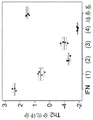


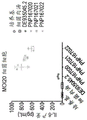


Classifications
-
- A—HUMAN NECESSITIES
- A23—FOODS OR FOODSTUFFS; TREATMENT THEREOF, NOT COVERED BY OTHER CLASSES
- A23L—FOODS, FOODSTUFFS OR NON-ALCOHOLIC BEVERAGES, NOT OTHERWISE PROVIDED FOR; PREPARATION OR TREATMENT THEREOF
- A23L33/00—Modifying nutritive qualities of foods; Dietetic products; Preparation or treatment thereof
- A23L33/10—Modifying nutritive qualities of foods; Dietetic products; Preparation or treatment thereof using additives
- A23L33/135—Bacteria or derivatives thereof, e.g. probiotics
-
- A—HUMAN NECESSITIES
- A61—MEDICAL OR VETERINARY SCIENCE; HYGIENE
- A61K—PREPARATIONS FOR MEDICAL, DENTAL OR TOILETRY PURPOSES
- A61K35/00—Medicinal preparations containing materials or reaction products thereof with undetermined constitution
- A61K35/66—Microorganisms or materials therefrom
- A61K35/74—Bacteria
-
- A—HUMAN NECESSITIES
- A61—MEDICAL OR VETERINARY SCIENCE; HYGIENE
- A61K—PREPARATIONS FOR MEDICAL, DENTAL OR TOILETRY PURPOSES
- A61K35/00—Medicinal preparations containing materials or reaction products thereof with undetermined constitution
- A61K35/66—Microorganisms or materials therefrom
- A61K35/74—Bacteria
- A61K35/741—Probiotics
-
- A—HUMAN NECESSITIES
- A61—MEDICAL OR VETERINARY SCIENCE; HYGIENE
- A61P—SPECIFIC THERAPEUTIC ACTIVITY OF CHEMICAL COMPOUNDS OR MEDICINAL PREPARATIONS
- A61P1/00—Drugs for disorders of the alimentary tract or the digestive system
-
- A—HUMAN NECESSITIES
- A61—MEDICAL OR VETERINARY SCIENCE; HYGIENE
- A61P—SPECIFIC THERAPEUTIC ACTIVITY OF CHEMICAL COMPOUNDS OR MEDICINAL PREPARATIONS
- A61P29/00—Non-central analgesic, antipyretic or antiinflammatory agents, e.g. antirheumatic agents; Non-steroidal antiinflammatory drugs [NSAID]
-
- A—HUMAN NECESSITIES
- A61—MEDICAL OR VETERINARY SCIENCE; HYGIENE
- A61P—SPECIFIC THERAPEUTIC ACTIVITY OF CHEMICAL COMPOUNDS OR MEDICINAL PREPARATIONS
- A61P35/00—Antineoplastic agents
-
- A—HUMAN NECESSITIES
- A61—MEDICAL OR VETERINARY SCIENCE; HYGIENE
- A61P—SPECIFIC THERAPEUTIC ACTIVITY OF CHEMICAL COMPOUNDS OR MEDICINAL PREPARATIONS
- A61P37/00—Drugs for immunological or allergic disorders
-
- C—CHEMISTRY; METALLURGY
- C12—BIOCHEMISTRY; BEER; SPIRITS; WINE; VINEGAR; MICROBIOLOGY; ENZYMOLOGY; MUTATION OR GENETIC ENGINEERING
- C12N—MICROORGANISMS OR ENZYMES; COMPOSITIONS THEREOF; PROPAGATING, PRESERVING, OR MAINTAINING MICROORGANISMS; MUTATION OR GENETIC ENGINEERING; CULTURE MEDIA
- C12N1/00—Microorganisms, e.g. protozoa; Compositions thereof; Processes of propagating, maintaining or preserving microorganisms or compositions thereof; Processes of preparing or isolating a composition containing a microorganism; Culture media therefor
- C12N1/20—Bacteria; Culture media therefor
-
- Y—GENERAL TAGGING OF NEW TECHNOLOGICAL DEVELOPMENTS; GENERAL TAGGING OF CROSS-SECTIONAL TECHNOLOGIES SPANNING OVER SEVERAL SECTIONS OF THE IPC; TECHNICAL SUBJECTS COVERED BY FORMER USPC CROSS-REFERENCE ART COLLECTIONS [XRACs] AND DIGESTS
- Y02—TECHNOLOGIES OR APPLICATIONS FOR MITIGATION OR ADAPTATION AGAINST CLIMATE CHANGE
- Y02A—TECHNOLOGIES FOR ADAPTATION TO CLIMATE CHANGE
- Y02A50/00—TECHNOLOGIES FOR ADAPTATION TO CLIMATE CHANGE in human health protection, e.g. against extreme weather
- Y02A50/30—Against vector-borne diseases, e.g. mosquito-borne, fly-borne, tick-borne or waterborne diseases whose impact is exacerbated by climate change
Landscapes
- Health & Medical Sciences (AREA)
- Life Sciences & Earth Sciences (AREA)
- Chemical & Material Sciences (AREA)
- General Health & Medical Sciences (AREA)
- Medicinal Chemistry (AREA)
- Veterinary Medicine (AREA)
- Public Health (AREA)
- Animal Behavior & Ethology (AREA)
- Pharmacology & Pharmacy (AREA)
- Mycology (AREA)
- Organic Chemistry (AREA)
- Engineering & Computer Science (AREA)
- Microbiology (AREA)
- Chemical Kinetics & Catalysis (AREA)
- General Chemical & Material Sciences (AREA)
- Nuclear Medicine, Radiotherapy & Molecular Imaging (AREA)
- Bioinformatics & Cheminformatics (AREA)
- Molecular Biology (AREA)
- Epidemiology (AREA)
- Wood Science & Technology (AREA)
- Zoology (AREA)
- Genetics & Genomics (AREA)
- Immunology (AREA)
- Biotechnology (AREA)
- Nutrition Science (AREA)
- Food Science & Technology (AREA)
- Polymers & Plastics (AREA)
- Tropical Medicine & Parasitology (AREA)
- Biomedical Technology (AREA)
- Virology (AREA)
- Rheumatology (AREA)
- Pain & Pain Management (AREA)
- Biochemistry (AREA)
- General Engineering & Computer Science (AREA)
- Medicines Containing Material From Animals Or Micro-Organisms (AREA)
- Medicines That Contain Protein Lipid Enzymes And Other Medicines (AREA)
- Micro-Organisms Or Cultivation Processes Thereof (AREA)
- Medicinal Preparation (AREA)
Abstract
Description
相关申请的交叉引用CROSS-REFERENCE TO RELATED APPLICATIONS
本PCT申请要求2019年11月27日提交的美国临时申请第62/941,534号的优先权权益,该申请通过引用以其整体并入本文。This PCT application claims the benefit of priority from US Provisional Application No. 62/941,534, filed on November 27, 2019, which is incorporated herein by reference in its entirety.
对经由EFS-WEB以电子方式提交的序列表的引用References to Sequence Listings Submitted Electronically via EFS-WEB
与本申请一起提交的ASCII文本文件(名称:4268.054PC01_Seq Listing_ST25.txt;大小:836,754字节;和创建日期:2019年11月25日)的以电子方式提交的序列表的内容以引用的方式整体并入本文。The contents of the electronically filed sequence listing of the ASCII text file (name: 4268.054PC01_Seq Listing_ST25.txt; size: 836,754 bytes; and date of creation: November 25, 2019) filed with this application is by reference in its entirety Incorporated herein.
技术领域technical field
本公开涉及被设计成具有某些功能特征的细菌组合物,所述细菌组合物可用于治疗和/或预防一系列疾病和病症,如与胃肠微生物组的生态失调相关的疾病和病症(例如,炎性肠病(IBD),例如溃疡性结肠炎和某些癌症)。The present disclosure relates to bacterial compositions designed to have certain functional characteristics that are useful in the treatment and/or prevention of a range of diseases and disorders, such as those associated with dysbiosis of the gastrointestinal microbiome (eg, , inflammatory bowel disease (IBD) such as ulcerative colitis and certain cancers).
发明背景Background of the Invention
健康肠道微生物群对于个体的整体健康至关重要。因此,肠道微生物群的生态失调已牵涉于许多疾病和病症的发病机制中,如炎性肠病(例如,结肠炎)、肠易激综合症、乳糜泻、过敏、哮喘、代谢综合征、心血管疾病和肥胖症。Carding,S.等人,Micro Ecol HealthDis 26(2015)。A healthy gut microbiome is critical to an individual's overall health. Thus, dysbiosis of the gut microbiota has been implicated in the pathogenesis of many diseases and conditions, such as inflammatory bowel disease (eg, colitis), irritable bowel syndrome, celiac disease, allergy, asthma, metabolic syndrome, Cardiovascular disease and obesity. Carding, S. et al, Micro Ecol HealthDis 26 (2015).
治疗生态失调相关疾患的方法包括粪便微生物组移植(FMT),其可为胃肠道(GI)提供微生物。然而,粪便移植存在许多问题,包括与安全性和递送方法有关的问题,如基于鼻-十二指肠、经结肠镜检查或灌肠的方法,所述方法通常需要进行临床检查并且可能引入不良事件。由于捐献粪便供移植的个体之间的可变性,使用FMT进行治疗可能固有地不一致。FMT方法还引入被病原生物体感染的风险,包括源物质中的病毒、细菌、真菌和原生生物。此外,可能存在与捐赠的粪便的稳定性和储存有关(例如,与细菌物种的存活有关)的问题。一些使用在胶囊中递送的粪便细菌的治疗要求患者服用大量胶囊,这对胃肠道疾病患者可能是困难的,并且可能降低对完整治疗的依从性。Methods of treating dysbiosis-related disorders include fecal microbiome transplantation (FMT), which provides microorganisms to the gastrointestinal (GI) tract. However, there are a number of issues with fecal transplantation, including those related to safety and delivery methods, such as naso-duodenal, transcolonoscopy, or enema-based approaches, which often require clinical examination and may introduce adverse events . Treatment with FMT may be inherently inconsistent due to variability among individuals who donate stool for transplantation. The FMT method also introduces a risk of infection by pathogenic organisms, including viruses, bacteria, fungi and protists in the source material. Furthermore, there may be issues related to the stability and storage of donated feces (eg, related to the survival of bacterial species). Some treatments using fecal bacteria delivered in capsules require the patient to take a large number of capsules, which can be difficult for patients with gastrointestinal disease and can reduce compliance with complete therapy.
因此,需要组合物,所述组合物递送含有足够复杂性的培养细菌的一致产品并且能够表现出可用于治疗生态失调或生态失调相关疾患的关键功能特征。Accordingly, there is a need for compositions that deliver consistent products containing cultured bacteria of sufficient complexity and that exhibit key functional characteristics useful in the treatment of dysbiosis or dysbiosis-related disorders.
发明内容SUMMARY OF THE INVENTION
本文提供了一种包含第一纯化的细菌群体和第二纯化的细菌群体的组合物,其中所述第一纯化的细菌群体包含一种或多种选择的细菌,所述细菌具有与SEQ ID NO:215、SEQ ID NO:SEQ ID NO:112、SEQ ID NO:113、SEQ ID NO:114、SEQ ID NO:115、SEQ ID NO:116、SEQ ID NO:188、SEQ ID NO:212、SEQ ID NO:160、SEQ ID NO:186、SEQ ID NO:203、SEQID NO:104、SEQ ID NO:208、SEQ ID NO:189、SEQ ID NO:187、SEQ ID NO:207、SEQ ID NO:190、SEQ ID NO:191、SEQ ID NO:211、SEQ ID NO:209、SEQ ID NO:110、SEQ ID NO:150、SEQID NO:175、SEQ ID NO:158、SEQ ID NO:210或SEQ ID NO:106中列出的16S rDNA序列至少97%、至少97.5%、至少98%、至少98.5%、至少99%、至少99.5%或100%同一的16S rDNA序列,并且其中所述第二纯化的细菌群体包含一种或多种细菌,所述细菌具有选自由以下组成的组的一种或多种特征:(i)当施用至受试者时能够移植,(ii)能够具有抗炎活性,(iii)不能诱导促炎活性,(iv)能够产生次级胆汁酸,(v)能够产生色氨酸代谢物,(vi)如通过原代上皮细胞单层屏障完整性测定所确定,能够恢复上皮完整性,(vii)能够与炎性肠病的缓解相关,(viii)能够产生短链脂肪酸,(ix)能够抑制HDAC活性,(x)能够产生中链脂肪酸,(xi)能够表达过氧化氢酶活性,(xii)能够具有α-岩藻糖苷酶活性,(xiii)能够诱导Wnt活化,(xiv)能够产生B维生素,(xv)能够调节内源性大麻素的宿主代谢,(xvi)能够产生多胺和/或调节多胺的宿主代谢,(xvii)能够降低粪便鞘脂水平,(xviii)能够调节犬尿氨酸的宿主产生,(xix)能够降低粪便钙卫蛋白水平,(xx)不能活化toll样受体途径(例如,TLR4或TLR5),(xxi)能够活化toll样受体途径(例如,TLR2),(xxii)不能产生熊去氧胆酸,(xxiii)能够与炎性肠病的临床未缓解不相关,(xxiv)能够抑制肠上皮细胞的凋亡,(xxv)能够在巨噬细胞中诱导抗炎性IL-10-偏态的IL-10/IL-6细胞因子比率,(xxvi)能够不诱导巨噬细胞中促炎性IL-6、TNFa、IL-1b、IL-23或IL-12的产生或基因表达,(xxvii)能够下调在经IFN-γ处理的结肠类器官中诱导的一种或多种基因(例如,与炎症趋化因子信号传导、NF-κB信号传导、TNF家族信号传导、I型干扰素信号传导、II型干扰素信号传导、TLR信号传导、淋巴细胞运输、Th17细胞分化、Th1分化、Th2分化、凋亡、炎症小体(inflammasome)、自噬、氧化应激、MHC I类和II类抗原呈递、补体、mTor、nod样受体信号传导、PI3K信号传导或其组合相关的那些),(xxix)能够产生IL-18,(xxx)能够诱导抗原呈递细胞的活化,(xxxi)能够降低T细胞上一种或多种抑制性受体(例如,TIGIT、TIM-3或LAG-3)的表达,(xxxii)能够增加与T细胞活化和/或功能相关的一种或多种基因/蛋白质(例如,CD45RO、CD69、IL-24、TNF-α、穿孔素或IFN-γ)的表达,(xxxiii)能够增强CD8+T细胞杀伤肿瘤细胞的能力,(xxxiv)能够增强免疫检查点抑制剂疗法的功效,(xxxv)能够减少结肠炎症,(xxxvi)能够促进CD8+T细胞向肿瘤募集,以及(xxxvii)它们的任何组合。Provided herein is a composition comprising a first purified bacterial population and a second purified bacterial population, wherein the first purified bacterial population comprises one or more selected bacteria having the same characteristics as SEQ ID NO : 215, SEQ ID NO: SEQ ID NO: 112, SEQ ID NO: 113, SEQ ID NO: 114, SEQ ID NO: 115, SEQ ID NO: 116, SEQ ID NO: 188, SEQ ID NO: 212, SEQ ID NO: 115 ID NO: 160, SEQ ID NO: 186, SEQ ID NO: 203, SEQ ID NO: 104, SEQ ID NO: 208, SEQ ID NO: 189, SEQ ID NO: 187, SEQ ID NO: 207, SEQ ID NO: 190, SEQ ID NO: 191, SEQ ID NO: 211, SEQ ID NO: 209, SEQ ID NO: 110, SEQ ID NO: 150, SEQ ID NO: 175, SEQ ID NO: 158, SEQ ID NO: 210, or SEQ ID NO: 110 The 16S rDNA sequences listed in ID NO: 106 are at least 97%, at least 97.5%, at least 98%, at least 98.5%, at least 99%, at least 99.5% or 100% identical to 16S rDNA sequences, and wherein said second purification The bacterial population of comprises one or more bacteria having one or more characteristics selected from the group consisting of: (i) capable of engrafting when administered to a subject, (ii) capable of having anti-inflammatory activity , (iii) unable to induce pro-inflammatory activity, (iv) capable of producing secondary bile acids, (v) capable of producing tryptophan metabolites, (vi) capable of producing tryptophan metabolites as determined by primary epithelial cell monolayer barrier integrity assays Restoration of epithelial integrity, (vii) can be associated with remission of inflammatory bowel disease, (viii) can produce short-chain fatty acids, (ix) can inhibit HDAC activity, (x) can produce medium-chain fatty acids, (xi) can express overexpressed Catalase activity, (xii) capable of alpha-fucosidase activity, (xiii) capable of inducing Wnt activation, (xiv) capable of producing B vitamins, (xv) capable of modulating host metabolism of endocannabinoids, (xvi) ) capable of producing and/or modulating host metabolism of polyamines, (xvii) capable of reducing fecal sphingolipid levels, (xviii) capable of modulating host production of kynurenine, (xix) capable of reducing fecal calprotectin levels, ( xx) cannot activate toll-like receptor pathway (eg, TLR4 or TLR5), (xxi) can activate toll-like receptor pathway (eg, TLR2), (xxii) cannot produce ursodeoxycholic acid, (xxiii) can interact with inflammation Clinical non-remission of STD was not associated, (xxiv) Can inhibit apoptosis of intestinal epithelial cells, (xxv) can induce anti-inflammatory IL-10-skewed IL-10/IL-6 cytokine ratio in macrophages, (xxvi) can not induce in macrophages Production or gene expression of proinflammatory IL-6, TNFa, IL-1b, IL-23 or IL-12, (xxvii) capable of down-regulating one or more genes induced in IFN-γ-treated colon organoids (eg, related to inflammatory chemokine signaling, NF-κB signaling, TNF family signaling, type I interferon signaling, type II interferon signaling, TLR signaling, lymphocyte trafficking, Th17 cell differentiation, Th1 differentiation , Th2 differentiation, apoptosis, inflammasome, autophagy, oxidative stress, MHC class I and II antigen presentation, complement, mTor, nod-like receptor signaling, PI3K signaling, or those associated with a combination thereof ), (xxix) capable of producing IL-18, (xxx) capable of inducing activation of antigen-presenting cells, (xxxi) capable of reducing one or more inhibitory receptors on T cells (eg, TIGIT, TIM-3 or LAG- 3) expression of (xxxii) capable of increasing one or more genes/proteins associated with T cell activation and/or function (eg, CD45RO, CD69, IL-24, TNF-α, perforin or IFN-γ) (xxxiii) can enhance the ability of CD8+ T cells to kill tumor cells, (xxxiv) can enhance the efficacy of immune checkpoint inhibitor therapy, (xxxv) can reduce colonic inflammation, (xxxvi) can promote the proliferation of CD8+ T cells Tumor recruitment, and (xxxvii) any combination thereof.
本文还提供了一种包含第一纯化的细菌群体和第二纯化的细菌群体的组合物,其中所述第一细菌群体包含一种或多种细菌,所述细菌具有与SEQ ID NO:118、SEQ ID NO:SEQ ID NO:166、SEQ ID NO:167、SEQ ID NO:168、SEQ ID NO:169、SEQ ID NO:176、SEQ IDNO:177、SEQ ID NO:178或SEQ ID NO:137中列出的16S rDNA序列至少97%、至少97.5%、至少98%、至少98.5%、至少99%、至少99.5%或100%同一的16S rDNA序列,并且其中所述第二纯化的细菌群体包含一种或多种细菌,所述细菌具有选自由以下组成的组的一种或多种特征:(i)当施用至受试者时能够移植,(ii)能够具有抗炎活性,(iii)不能诱导促炎活性,(iv)能够产生次级胆汁酸,(v)能够产生色氨酸代谢物,(vi)如通过原代上皮细胞单层屏障完整性测定所确定,能够恢复上皮完整性,(vii)能够与炎性肠病的缓解相关,(viii)能够产生短链脂肪酸,(ix)能够抑制HDAC活性,(x)能够产生中链脂肪酸,(xi)能够表达过氧化氢酶活性,(xii)能够具有α-岩藻糖苷酶活性,(xiii)能够诱导Wnt活化,(xiv)能够产生B维生素,(xv)能够调节内源性大麻素的宿主代谢,(xvi)能够产生多胺和/或调节多胺的宿主代谢,(xvii)能够降低粪便鞘脂水平,(xviii)能够调节犬尿氨酸的宿主产生,(xix)能够降低粪便钙卫蛋白水平,(xx)不能活化toll样受体途径(例如,TLR4或TLR5),(xxi)能够活化toll样受体途径(例如,TLR2),(xxii)不能产生熊去氧胆酸,(xxiii)能够与炎性肠病的临床未缓解不相关,(xxiv)能够抑制肠上皮细胞的凋亡,(xxv)能够在巨噬细胞中诱导抗炎性IL-10-偏态的IL-10/IL-6细胞因子比率,(xxvi)能够不诱导巨噬细胞中促炎性IL-6、TNFa、ILv1b、IL-23或IL-12的产生或基因表达,(xxvii)能够下调在经IFN-γ处理的结肠类器官中诱导的一种或多种基因(例如,与炎症趋化因子信号传导、NF-κB信号传导、TNF家族信号传导、I型干扰素信号传导、II型干扰素信号传导、TLR信号传导、淋巴细胞运输、Th17细胞分化、Th1分化、Th2分化、凋亡、炎症小体、自噬、氧化应激、MHC I类和II类抗原呈递、补体、mTor、nod样受体信号传导、PI3K信号传导或其组合相关的那些),(xxix)能够产生IL-18,(xxx)能够诱导抗原呈递细胞的活化,(xxxi)能够降低T细胞上一种或多种抑制性受体(例如,TIGIT、TIM-3或LAG-3)的表达,(xxxii)能够增加与T细胞活化和/或功能相关的一种或多种基因/蛋白质(例如,CD45RO、CD69、IL-24、TNF-α、穿孔素或IFN-γ)的表达,(xxxiii)能够增强CD8+T细胞杀伤肿瘤细胞的能力,(xxxiv)能够增强免疫检查点抑制剂疗法的功效,(xxxv)能够减少结肠炎症,(xxxvi)能够促进CD8+T细胞向肿瘤募集,以及(xxxvii)它们的任何组合。Also provided herein is a composition comprising a first purified bacterial population and a second purified bacterial population, wherein the first bacterial population comprises one or more bacteria having the same characteristics as SEQ ID NO: 118, SEQ ID NO: SEQ ID NO: 166, SEQ ID NO: 167, SEQ ID NO: 168, SEQ ID NO: 169, SEQ ID NO: 176, SEQ ID NO: 177, SEQ ID NO: 178, or SEQ ID NO: 137 The 16S rDNA sequences listed in are at least 97%, at least 97.5%, at least 98%, at least 98.5%, at least 99%, at least 99.5% or 100% identical to 16S rDNA sequences, and wherein said second purified bacterial population comprises One or more bacteria having one or more characteristics selected from the group consisting of: (i) capable of transplanting when administered to a subject, (ii) capable of having anti-inflammatory activity, (iii) Inability to induce pro-inflammatory activity, (iv) capable of producing secondary bile acids, (v) capable of producing tryptophan metabolites, (vi) capable of restoring epithelial integrity as determined by primary epithelial cell monolayer barrier integrity assays , (vii) can be associated with remission of inflammatory bowel disease, (viii) can produce short-chain fatty acids, (ix) can inhibit HDAC activity, (x) can produce medium-chain fatty acids, (xi) can express catalase activity , (xii) capable of α-fucosidase activity, (xiii) capable of inducing Wnt activation, (xiv) capable of producing B vitamins, (xv) capable of modulating host metabolism of endocannabinoids, (xvi) capable of producing multiple Amine and/or modulates host metabolism of polyamines, (xvii) reduces fecal sphingolipid levels, (xviii) modulates host production of kynurenine, (xix) reduces fecal calprotectin levels, (xx) does not activate toll-like receptor pathway (eg, TLR4 or TLR5), (xxi) capable of activating toll-like receptor pathway (eg, TLR2), (xxii) incapable of producing ursodeoxycholic acid, (xxiii) capable of interacting with inflammatory bowel disease Not relevant for clinical non-remission, (xxiv) able to inhibit apoptosis of intestinal epithelial cells, (xxv) able to induce anti-inflammatory IL-10-skewed IL-10/IL-6 cytokine ratio in macrophages, ( xxvi) capable of not inducing pro-inflammatory IL-6, TNFa, ILv1b, IL-23 or IL-12 production or gene expression in macrophages, (xxvii) capable of down-regulating induction in IFN-γ-treated colon organoids One or more genes (e.g., related to inflammatory chemokine signaling, NF-κB signaling, TNF family signaling, type I interferon signaling, type II interferon signaling, TLR signaling, lymphocyte trafficking , Th17 cell differentiation, Th1 differentiation, Th2 differentiation, apoptosis, inflammasome, autophagy, oxidative stress, MHC class I and II antigen presentation, complement, mTor, nod-like receptor signaling, PI3K signaling, or those associated with a combination thereof), (xxix) can produce IL-18, (xxx) induces activation of antigen-presenting cells, (xxxi) reduces expression of one or more inhibitory receptors (eg, TIGIT, TIM-3, or LAG-3) on T cells, (xxxii) ) capable of increasing the expression of one or more genes/proteins (eg, CD45RO, CD69, IL-24, TNF-α, perforin, or IFN-γ) associated with T cell activation and/or function, (xxxiii) capable of Enhances the ability of CD8+ T cells to kill tumor cells, (xxxiv) enhances the efficacy of immune checkpoint inhibitor therapy, (xxxv) reduces colonic inflammation, (xxxvi) promotes CD8+ T cell recruitment to tumors, and (xxxvii) any combination of them.
本文还提供了包含第一纯化的细菌群体和第二纯化的细菌群体的组合物,其中所述第一细菌群体包含一种或多种细菌,所述细菌具有与SEQ ID NO:117、SEQ ID NO:137、SEQ ID NO:111或SEQ ID NOv103中列出的16S rDNA序列至少97%、至少97.5%、至少98%、至少98.5%、至少99%、至少99.5%或100%同一的16S rDNA序列,并且其中所述第二纯化的细菌群体包含一种或多种细菌,所述细菌具有选自由以下组成的组的一种或多种特征:(i)当施用至受试者时能够移植,(ii)能够具有抗炎活性,(iii)不能诱导促炎活性,(iv)能够产生次级胆汁酸,(v)能够产生色氨酸代谢物,(vi)如通过原代上皮细胞单层屏障完整性测定所确定,能够恢复上皮完整性,(vii)能够与炎性肠病的缓解相关,(viii)能够产生短链脂肪酸,(ix)能够抑制HDAC活性,(x)能够产生中链脂肪酸,(xi)能够表达过氧化氢酶活性,(xii)能够具有α-岩藻糖苷酶活性,(xiii)能够诱导Wnt活化,(xiv)能够产生B维生素,(xv)能够调节内源性大麻素的宿主代谢,(xvi)能够产生多胺和/或调节多胺的宿主代谢,(xvii)能够产生鞘脂,(xviii)能够调节犬尿氨酸的宿主产生,(xix)能够降低粪便钙卫蛋白水平,(xx)不能活化toll样受体途径(例如,TLR4或TLR5),(xxi)能够活化toll样受体途径(例如,TLR2),(xxii)不能产生熊去氧胆酸,(xxiii)能够与炎性肠病的临床未缓解不相关,(xxiv)能够抑制肠上皮细胞的凋亡,(xxv)能够在巨噬细胞中诱导抗炎性IL-10-偏态的IL-10/IL-6细胞因子比率,(xxvi)能够不诱导巨噬细胞中促炎性IL-6、TNFa、IL-1b、IL-23或IL-12的产生或基因表达,(xxvii)能够下调在经IFN-γ处理的结肠类器官中诱导的一种或多种基因(例如,与炎症趋化因子信号传导、NF-κB信号传导、TNF家族信号传导、I型干扰素信号传导、II型干扰素信号传导、TLR信号传导、淋巴细胞运输、Th17细胞分化、Th1分化、Th2分化、凋亡、炎症小体、自噬、氧化应激、MHC I类和II类抗原呈递、补体、mTor、nod样受体信号传导、PI3K信号传导或其组合相关的那些),(xxix)能够产生IL-18,(xxx)能够诱导抗原呈递细胞的活化,(xxxi)能够降低T细胞上一种或多种抑制性受体(例如,TIGIT、TIM-3或LAG-3)的表达,(xxxii)能够增加与T细胞活化和/或功能相关的一种或多种基因/蛋白质(例如,CD45RO、CD69、IL-24、TNF-α、穿孔素或IFN-γ)的表达,(xxxiii)能够增强CD8+T细胞杀伤肿瘤细胞的能力,(xxxiv)能够增强免疫检查点抑制剂疗法的功效,(xxxv)能够减少结肠炎症,(xxxvi)能够促进CD8+T细胞向肿瘤募集,以及(xxxvii)它们的任何组合。Also provided herein are compositions comprising a first purified bacterial population and a second purified bacterial population, wherein the first bacterial population comprises one or more bacteria having the same characteristics as SEQ ID NO: 117, SEQ ID 16S rDNA sequences that are at least 97%, at least 97.5%, at least 98%, at least 98.5%, at least 99%, at least 99.5% or 100% identical to the 16S rDNA sequences set forth in NO: 137, SEQ ID NO: 111 or SEQ ID NO v103 sequence, and wherein the second purified bacterial population comprises one or more bacteria having one or more characteristics selected from the group consisting of: (i) capable of transplanting when administered to a subject , (ii) capable of anti-inflammatory activity, (iii) incapable of inducing pro-inflammatory activity, (iv) capable of producing secondary bile acids, (v) capable of producing tryptophan metabolites, (vi) capable of restores epithelial integrity, (vii) correlates with remission of inflammatory bowel disease, (viii) produces short-chain fatty acids, (ix) inhibits HDAC activity, (x) produces chain fatty acids, (xi) capable of expressing catalase activity, (xii) capable of α-fucosidase activity, (xiii) capable of inducing Wnt activation, (xiv) capable of producing B vitamins, (xv) capable of regulating endogenous Host metabolism of sex cannabinoids, (xvi) capable of producing and/or modulating host metabolism of polyamines, (xvii) capable of producing sphingolipids, (xviii) capable of modulating host production of kynurenine, (xix) capable of reducing Fecal calprotectin levels, (xx) unable to activate toll-like receptor pathways (eg, TLR4 or TLR5), (xxi) able to activate toll-like receptor pathways (eg, TLR2), (xxii) unable to produce ursodeoxycholic acid , (xxiii) could not be associated with clinical unremission of inflammatory bowel disease, (xxiv) could inhibit apoptosis of intestinal epithelial cells, (xxv) could induce anti-inflammatory IL-10-skewed IL in macrophages -10/IL-6 cytokine ratio, (xxvi) able to not induce pro-inflammatory IL-6, TNFa, IL-1b, IL-23 or IL-12 production or gene expression in macrophages, (xxvii) able to Downregulation of one or more genes (eg, related to inflammatory chemokine signaling, NF-κB signaling, TNF family signaling, type I interferon signaling, II Type IFN signaling, TLR signaling, lymphocyte trafficking, Th17 cell differentiation, Th1 differentiation, Th2 differentiation, apoptosis, inflammasome, autophagy, oxidative stress, MHC class I and II antigen presentation, complement, mTor , nod-like receptor signaling, PI3K signaling, or a combination thereof), (xxix) capable of producing IL-18, (xxx) is capable of inducing activation of antigen presenting cells, (xxxi) is capable of decreasing the expression of one or more inhibitory receptors (eg, TIGIT, TIM-3 or LAG-3) on T cells, (xxxii) is capable of increasing Expression of one or more genes/proteins (eg, CD45RO, CD69, IL-24, TNF-α, perforin, or IFN-γ) related to T cell activation and/or function, (xxxiii) capable of enhancing CD8+ T cells The ability of cells to kill tumor cells, (xxxiv) can enhance the efficacy of immune checkpoint inhibitor therapy, (xxxv) can reduce colonic inflammation, (xxxvi) can promote CD8+ T cell recruitment to tumors, and (xxxvii) any combination thereof .
在一些方面,所述一种或多种特征选自:(i)当施用至受试者时能够移植,(ii)能够具有抗炎活性,(iii)不能诱导促炎活性,(iv)能够产生次级胆汁酸,(v)能够产生色氨酸代谢物,(vi)如通过原代上皮细胞单层屏障完整性测定所确定,能够恢复上皮完整性,(vii)能够与炎性肠病的缓解相关,(viii)能够产生短链脂肪酸,(ix)能够抑制HDAC活性,(x)能够产生中链脂肪酸,或(xi)它们的任何组合。在一些方面,一种或多种特征选自(i)能够抑制HDAC活性,(ii)能够产生短链脂肪酸,(iii)能够产生色氨酸代谢物,(iv)能够产生IL-18,(v)能够诱导抗原呈递细胞的活化,(vi)能够降低T细胞上一种或多种抑制性受体(例如,TIGIT、TIM-3或LAG-3)的表达,(vii)能够增加与T细胞活化和/或功能相关的一种或多种基因/蛋白质(例如,CD45RO、CD69、IL-24、TNF-α、穿孔素或IFN-γ)的表达,(viii)能够增强CD8+T细胞杀伤肿瘤细胞的能力,(ix)能够增强免疫检查点抑制剂疗法的功效,(x)能够减少结肠炎症,(xi)能够促进CD8+T细胞向肿瘤募集,或(xii)它们的任何组合。In some aspects, the one or more characteristics are selected from: (i) capable of transplantation when administered to a subject, (ii) capable of anti-inflammatory activity, (iii) inability to induce pro-inflammatory activity, (iv) capable of Produces secondary bile acids, (v) is capable of producing tryptophan metabolites, (vi) is capable of restoring epithelial integrity as determined by primary epithelial cell monolayer barrier integrity assays, (vii) is capable of interacting with inflammatory bowel disease (viii) capable of producing short-chain fatty acids, (ix) capable of inhibiting HDAC activity, (x) capable of producing medium-chain fatty acids, or (xi) any combination thereof. In some aspects, the one or more characteristics are selected from (i) capable of inhibiting HDAC activity, (ii) capable of producing short chain fatty acids, (iii) capable of producing tryptophan metabolites, (iv) capable of producing IL-18, ( v) is capable of inducing activation of antigen presenting cells, (vi) is capable of reducing the expression of one or more inhibitory receptors (eg, TIGIT, TIM-3 or LAG-3) on T cells, (vii) is capable of increasing interaction with T cells Expression of one or more genes/proteins (eg, CD45RO, CD69, IL-24, TNF-α, perforin, or IFN-γ) associated with cellular activation and/or function, (viii) capable of enhancing CD8+ T cells The ability to kill tumor cells, (ix) can enhance the efficacy of immune checkpoint inhibitor therapy, (x) can reduce colonic inflammation, (xi) can promote CD8+ T cell recruitment to the tumor, or (xii) any combination thereof.
在一些方面,所述第二纯化的细菌群体包含长期移植物和/或短期移植物。在某些方面,所述第二纯化的细菌群体包含两种、三种、四种、五种、六种、七种或更多种长期移植物。在其他方面,所述第二纯化的细菌群体包含两种、三种或更多种短期移植物。在某些方面,所述第一纯化的细菌群体和所述第二纯化的细菌群体的组合包含三种或更多种短期移植物和/或七种或更多种长期移植物。In some aspects, the second purified bacterial population comprises long-term grafts and/or short-term grafts. In certain aspects, the second purified bacterial population comprises two, three, four, five, six, seven or more long-term grafts. In other aspects, the second purified bacterial population comprises two, three or more short-lived grafts. In certain aspects, the combination of the first purified bacterial population and the second purified bacterial population comprises three or more short-term grafts and/or seven or more long-term grafts.
在一些方面,所述第二纯化的细菌群体包含一种或多种能够产生色氨酸代谢物的细菌。在一些方面,所述第二纯化的细菌群体包含一种或多种能够产生次级胆汁酸的细菌。在一些方面,所述第二纯化的细菌群体包含一种或多种能够具有抗炎活性的细菌。在某些方面,所述第二纯化的细菌群体包含一种或多种不能诱导促炎活性的细菌。在一些方面,所述第二纯化的细菌群体包含一种或多种能够产生短链脂肪酸的细菌。在一些方面,所述第二纯化的细菌群体包含一种或多种能够产生中链脂肪酸的细菌。在一些方面,所述第二纯化的细菌群体包含一种或多种能够抑制HDAC活性的细菌。在一些方面,第二纯化的细菌群体包含一种或多种细菌,所述细菌能够降低T细胞上一种或多种抑制性受体(例如,TIGIT、TIM-3或LAG-3)的表达的细菌。在一些方面,第二纯化的细菌群体包含一种或多种细菌,所述细菌能够增加与T细胞活化和/或功能相关的一种或多种基因/蛋白质(例如,CD45RO、CD69、IL-24、TNF-α、穿孔素或IFN-γ)的表达。在一些方面,第二纯化的细菌群体包含一种或多种细菌,所述细菌能够增强CD8+T细胞杀伤肿瘤细胞的能力。在一些方面,第二纯化的细菌群体包含一种或多种细菌,所述细菌能够增强免疫检查点抑制剂疗法的功效。在一些方面,第二纯化的细菌群体包含一种或多种细菌,所述细菌能够促进CD8+T细胞向肿瘤募集。In some aspects, the second purified bacterial population comprises one or more bacteria capable of producing tryptophan metabolites. In some aspects, the second purified bacterial population comprises one or more bacteria capable of producing secondary bile acids. In some aspects, the second purified bacterial population comprises one or more bacteria capable of anti-inflammatory activity. In certain aspects, the second purified bacterial population comprises one or more bacteria that are incapable of inducing proinflammatory activity. In some aspects, the second purified bacterial population comprises one or more bacteria capable of producing short chain fatty acids. In some aspects, the second purified bacterial population comprises one or more bacteria capable of producing medium chain fatty acids. In some aspects, the second purified bacterial population comprises one or more bacteria capable of inhibiting HDAC activity. In some aspects, the second purified bacterial population comprises one or more bacteria capable of reducing expression of one or more inhibitory receptors (eg, TIGIT, TIM-3, or LAG-3) on T cells of bacteria. In some aspects, the second purified bacterial population comprises one or more bacteria capable of increasing one or more genes/proteins associated with T cell activation and/or function (eg, CD45RO, CD69, IL- 24. Expression of TNF-α, perforin or IFN-γ). In some aspects, the second purified bacterial population comprises one or more bacteria capable of enhancing the ability of CD8+ T cells to kill tumor cells. In some aspects, the second purified bacterial population comprises one or more bacteria capable of enhancing the efficacy of immune checkpoint inhibitor therapy. In some aspects, the second purified bacterial population comprises one or more bacteria capable of promoting the recruitment of CD8+ T cells to the tumor.
本文还提供了一种包含纯化的细菌群体的组合物,其中所述组合物包含选自由以下组成的组的一种或多种特征:(i)当施用至受试者时能够移植,(ii)能够具有抗炎活性,(iii)不能诱导促炎活性,(iv)能够产生次级胆汁酸,(v)能够产生色氨酸代谢物,(vi)如通过原代上皮细胞单层屏障完整性测定所确定,能够恢复上皮完整性,(vii)能够与炎性肠病的缓解相关,(viii)能够产生短链脂肪酸,(ix)能够抑制HDAC活性,(x)能够产生中链脂肪酸,(xi)能够表达过氧化氢酶活性,(xii)能够具有α-岩藻糖苷酶活性,(xiii)能够诱导Wnt活化,(xiv)能够产生B维生素,(xv)能够调节内源性大麻素的宿主代谢,(xvi)能够产生多胺和/或调节多胺的宿主代谢,(xvii)能够降低粪便鞘脂水平,(xviii)能够调节犬尿氨酸的宿主产生,(xix)能够降低粪便钙卫蛋白水平,(xx)不能活化toll样受体途径(例如,TLR4或TLR5),(xxi)能够活化toll样受体途径(例如,TLR2),(xxii)不能产生熊去氧胆酸,(xxiii)能够与炎性肠病的临床未缓解不相关,(xxiv)能够抑制肠上皮细胞的凋亡,(xxv)能够在巨噬细胞中诱导抗炎性IL-10-偏态的IL-10/IL-6细胞因子比率,(xxvi)能够不诱导巨噬细胞中促炎性IL-6、TNFa、IL-1b、IL-23或IL-12的产生或基因表达,(xxvii)能够下调在经IFN-γ处理的结肠类器官中诱导的一种或多种基因(例如,与炎症趋化因子信号传导、NF-κB信号传导、TNF家族信号传导、I型干扰素信号传导、II型干扰素信号传导、TLR信号传导、淋巴细胞运输、Th17细胞分化、Th1分化、Th2分化、凋亡、炎症小体、自噬、氧化应激、MHCI类和II类抗原呈递、补体、mTor、nod样受体信号传导、PI3K信号传导或其组合相关的那些),(xxix)能够产生IL-18,(xxx)能够诱导抗原呈递细胞的活化,(xxxi)能够降低T细胞上一种或多种抑制性受体(例如,TIGIT、TIM-3或LAG-3)的表达,(xxxii)能够增加与T细胞活化和/或功能相关的一种或多种基因/蛋白质(例如,CD45RO、CD69、IL-24、TNF-α、穿孔素或IFN-γ)的表达,(xxxiii)能够增强CD8+T细胞杀伤肿瘤细胞的能力,(xxxiv)能够增强免疫检查点抑制剂疗法的功效,(xxxv)能够减少结肠炎症,(xxxvi)能够促进CD8+T细胞向肿瘤募集,以及(xxxvii)它们的任何组合。Also provided herein is a composition comprising a purified bacterial population, wherein the composition comprises one or more characteristics selected from the group consisting of: (i) capable of transplantation when administered to a subject, (ii) ) capable of anti-inflammatory activity, (iii) unable to induce pro-inflammatory activity, (iv) capable of producing secondary bile acids, (v) capable of producing tryptophan metabolites, (vi) as intact through the primary epithelial cell monolayer barrier Can restore epithelial integrity, (vii) can correlate with remission of inflammatory bowel disease, (viii) can produce short-chain fatty acids, (ix) can inhibit HDAC activity, (x) can produce medium-chain fatty acids, as determined by sex assays, (xi) capable of expressing catalase activity, (xii) capable of α-fucosidase activity, (xiii) capable of inducing Wnt activation, (xiv) capable of producing B vitamins, (xv) capable of modulating endocannabinoids (xvi) capable of producing and/or modulating host metabolism of polyamines, (xvii) capable of reducing fecal sphingolipid levels, (xviii) capable of modulating host production of kynurenine, (xix) capable of reducing fecal sphingolipid levels Calprotectin levels, (xx) unable to activate toll-like receptor pathways (eg, TLR4 or TLR5), (xxi) able to activate toll-like receptor pathways (eg, TLR2), (xxii) unable to produce ursodeoxycholic acid, (xxiii) capable of not being associated with clinical non-remission of inflammatory bowel disease, (xxiv) capable of inhibiting apoptosis of intestinal epithelial cells, (xxv) capable of inducing anti-inflammatory IL-10-biased IL-1 in
在一些方面,所述两种或更多种特征选自:(i)当施用至受试者时能够移植,(ii)能够具有抗炎活性,(iii)不能诱导促炎活性,(iv)能够产生次级胆汁酸,(v)能够产生色氨酸代谢物,(vi)如通过原代上皮细胞单层屏障完整性测定所确定,能够恢复上皮完整性,(vii)能够与炎性肠病的缓解相关,(viii)能够产生短链脂肪酸,(ix)能够抑制HDAC活性,(x)能够产生中链脂肪酸,或(xi)它们的任何组合。在一些方面,所述两种或更多种特征选自(i)能够抑制HDAC活性,(ii)能够产生短链脂肪酸,(iii)能够产生色氨酸代谢物,(iv)能够产生IL-18,(v)能够诱导抗原呈递细胞的活化,(vi)能够降低T细胞上一种或多种抑制性受体(例如,TIGIT、TIM-3或LAG-3)的表达,(vii)能够增加与T细胞活化和/或功能相关的一种或多种基因/蛋白质(例如,CD45RO、CD69、IL-24、TNF-α、穿孔素或IFN-γ)的表达,(viii)能够增强CD8+T细胞杀伤肿瘤细胞的能力,(ix)能够增强免疫检查点抑制剂疗法的功效,(x)能够减少结肠炎症,(xi)能够促进CD8+T细胞向肿瘤募集,或(xii)它们的任何组合。In some aspects, the two or more characteristics are selected from: (i) capable of engrafting when administered to a subject, (ii) capable of anti-inflammatory activity, (iii) inability to induce pro-inflammatory activity, (iv) Capable of producing secondary bile acids, (v) capable of producing tryptophan metabolites, (vi) capable of restoring epithelial integrity as determined by primary epithelial cell monolayer barrier integrity assays, (vii) capable of interacting with inflammatory bowel (viii) capable of producing short chain fatty acids, (ix) capable of inhibiting HDAC activity, (x) capable of producing medium chain fatty acids, or (xi) any combination thereof. In some aspects, the two or more characteristics are selected from (i) capable of inhibiting HDAC activity, (ii) capable of producing short chain fatty acids, (iii) capable of producing tryptophan metabolites, (iv) capable of producing IL- 18, (v) is capable of inducing activation of antigen presenting cells, (vi) is capable of reducing the expression of one or more inhibitory receptors (eg, TIGIT, TIM-3 or LAG-3) on T cells, (vii) is capable of Increased expression of one or more genes/proteins (eg, CD45RO, CD69, IL-24, TNF-α, perforin, or IFN-γ) associated with T cell activation and/or function, (viii) capable of enhancing CD8 The ability of + T cells to kill tumor cells, (ix) can enhance the efficacy of immune checkpoint inhibitor therapy, (x) can reduce colonic inflammation, (xi) can promote the recruitment of CD8+ T cells to tumors, or (xii) their any combination.
在一些方面,本文公开的组合物的纯化的细菌群体包含一种或多种细菌,所述细菌具有与SEQ ID NO:215、SEQ ID NO:112、SEQ ID NO:113、SEQ ID NO:114、SEQ ID NO:115、SEQ ID NO:116、SEQ ID NO:188、SEQ ID NO:212、SEQ ID NO:160、SEQ ID NO:186、SEQID NO:104、SEQ ID NO:208、SEQ ID NO:189、SEQ ID NO:187、SEQ ID NO:207、SEQ ID NO:190、SEQ ID NO:191、SEQ ID NO:211、SEQ ID NO:209、SEQ ID NO:110、SEQ ID NO:159、SEQID NO:175、SEQ ID NO:158、SEQ ID NO:210或SEQ ID NO:106中列出的16SrDNA序列至少97%、至少97.5%、至少98%、至少98.5%、至少99%、至少99.5%或100%同一的16S rDNA序列。In some aspects, the purified bacterial population of the compositions disclosed herein comprises one or more bacteria having the same characteristics as SEQ ID NO: 215, SEQ ID NO: 112, SEQ ID NO: 113, SEQ ID NO: 114 , SEQ ID NO: 115, SEQ ID NO: 116, SEQ ID NO: 188, SEQ ID NO: 212, SEQ ID NO: 160, SEQ ID NO: 186, SEQ ID NO: 104, SEQ ID NO: 208, SEQ ID NO: 189, SEQ ID NO: 187, SEQ ID NO: 207, SEQ ID NO: 190, SEQ ID NO: 191, SEQ ID NO: 211, SEQ ID NO: 209, SEQ ID NO: 110, SEQ ID NO: 159, SEQ ID NO: 175, SEQ ID NO: 158, SEQ ID NO: 210 or SEQ ID NO: 106 at least 97%, at least 97.5%, at least 98%, at least 98.5%, at least 99%, 16S rDNA sequences that are at least 99.5% or 100% identical.
在一些方面,所述纯化的细菌群体包含一种或多种细菌,所述细菌具有与SEQ IDNO:185、SEQ ID NO:183、SEQ ID NO:161、SEQ ID NO:206、SEQ ID NO:102、SEQ ID NO:214、SEQ ID NO:184、SEQ ID NO:204、SEQ ID NO:216、SEQ ID NO:217、SEQ ID NO:218、SEQ IDNO:219、SEQ ID NO:220、SEQ ID NO:221、SEQ ID NO:222、SEQ ID NO:223、SEQ ID NO:224、SEQ ID NO:225、SEQ ID NO:226、SEQ ID NO:227、SEQ ID NO:SEQ ID NO:166、SEQ ID NO:167、SEQ ID NO:168、SEQ ID NO:169、SEQ ID NO:109、SEQ ID NO:138、SEQ ID NO:139、SEQID NO:140、SEQ ID NO:141、SEQ ID NO:142、SEQ ID NO:143、SEQ ID NO:144、SEQ ID NO:145、SEQ ID NO:146、SEQ ID NO:147、SEQ ID NO:192、SEQ ID NO:176、SEQ ID NO:177、SEQID NO:178、SEQ ID NO:107、SEQ ID NO:137、SEQ ID NO:198、SEQ ID NO:199、SEQ ID NO:200、SEQ ID NO:201、SEQ ID NO:202、SEQ ID NO:133、SEQ ID NO:193、SEQ ID NO:194、SEQID NO:195、SEQ ID NO:196、SEQ ID NO:197、SEQ ID NO:126、SEQ ID NO:127、SEQ ID NO:103、SEQ ID NO:108、SEQ ID NO:124、SEQ ID NO:165、SEQ ID NO:136、SEQ ID NO:125、SEQID NO:111、SEQ ID NO:164、SEQ ID NO:205、SEQ ID NO:128、SEQ ID NO:129、SEQ ID NO:130、SEQ ID NO:131、SEQ ID NO:132、SEQ ID NO:162、SEQ ID NO:117、SEQ ID NO:118、SEQID NO:105、SEQ ID NO:119、SEQ ID NO:120、SEQ ID NO:121、SEQ ID NO:122、SEQ ID NO:123、SEQ ID NO:170、SEQ ID NO:171、SEQ ID NO:172、SEQ ID NO:173、SEQ ID NO:174、SEQID NO:163、SEQ ID NO:182、SEQ ID NO:135、SEQ ID NO:134、SEQ ID NO:179、SEQ ID NO:180、SEQ ID NO:181、SEQ ID NO:203或SEQ ID NO:213中列出的16S rDNA序列至少97%、至少97.5%、至少98%、至少98.5%、至少99%、至少99.5%或100%同一的16S rDNA序列。In some aspects, the purified bacterial population comprises one or more bacteria having the same characteristics as SEQ ID NO: 185, SEQ ID NO: 183, SEQ ID NO: 161, SEQ ID NO: 206, SEQ ID NO: 102. SEQ ID NO: 214, SEQ ID NO: 184, SEQ ID NO: 204, SEQ ID NO: 216, SEQ ID NO: 217, SEQ ID NO: 218, SEQ ID NO: 219, SEQ ID NO: 220, SEQ ID NO: 216 ID NO: 221, SEQ ID NO: 222, SEQ ID NO: 223, SEQ ID NO: 224, SEQ ID NO: 225, SEQ ID NO: 226, SEQ ID NO: 227, SEQ ID NO: SEQ ID NO: 166 , SEQ ID NO: 167, SEQ ID NO: 168, SEQ ID NO: 169, SEQ ID NO: 109, SEQ ID NO: 138, SEQ ID NO: 139, SEQ ID NO: 140, SEQ ID NO: 141, SEQ ID NO: 142, SEQ ID NO: 143, SEQ ID NO: 144, SEQ ID NO: 145, SEQ ID NO: 146, SEQ ID NO: 147, SEQ ID NO: 192, SEQ ID NO: 176, SEQ ID NO: 177, SEQ ID NO: 178, SEQ ID NO: 107, SEQ ID NO: 137, SEQ ID NO: 198, SEQ ID NO: 199, SEQ ID NO: 200, SEQ ID NO: 201, SEQ ID NO: 202, SEQ ID NO: 199 ID NO: 133, SEQ ID NO: 193, SEQ ID NO: 194, SEQ ID NO: 195, SEQ ID NO: 196, SEQ ID NO: 197, SEQ ID NO: 126, SEQ ID NO: 127, SEQ ID NO: 103, SEQ ID NO: 108, SEQ ID NO: 124, SEQ ID NO: 165, SEQ ID NO: 136, SEQ ID NO: 125, SEQ ID NO: 111, SEQ ID NO: 164, SEQ ID NO: 205, SEQ ID NO: 128, SEQ ID NO: 129, SEQ ID NO: 130, SEQ ID NO: 131, SEQ ID NO: 132, SEQ ID NO: 16 2. SEQ ID NO: 117, SEQ ID NO: 118, SEQ ID NO: 105, SEQ ID NO: 119, SEQ ID NO: 120, SEQ ID NO: 121, SEQ ID NO: 122, SEQ ID NO: 123, SEQ ID NO: 120 ID NO: 170, SEQ ID NO: 171, SEQ ID NO: 172, SEQ ID NO: 173, SEQ ID NO: 174, SEQ ID NO: 163, SEQ ID NO: 182, SEQ ID NO: 135, SEQ ID NO: 134. At least 97%, at least 97.5%, at least 98%, at least 97%, at least 97.5%, at least 98%, of the 16S rDNA sequence set forth in SEQ ID NO: 179, SEQ ID NO: 180, SEQ ID NO: 181, SEQ ID NO: 203 or SEQ ID NO: 213 16S rDNA sequences that are at least 98.5%, at least 99%, at least 99.5% or 100% identical.
本文提供了一种包含纯化的细菌群体的组合物,所述纯化的细菌群体包含两种或更多种细菌,其中所述两种或更多种细菌包含长期移植物和短期移植物。Provided herein is a composition comprising a purified bacterial population comprising two or more bacteria, wherein the two or more bacteria comprise a long-term graft and a short-term graft.
在一些方面,所述纯化的细菌群体还包含一种或多种细菌,所述细菌具有选自由以下组成的组的一种或多种特征:(i)当施用至受试者时能够移植,(ii)能够具有抗炎活性,(iii)不能诱导促炎活性,(iv)能够产生次级胆汁酸,(v)能够产生色氨酸代谢物,(vi)如通过原代上皮细胞单层屏障完整性测定所确定,能够恢复上皮完整性,(vii)能够与炎性肠病的缓解相关,(viii)能够产生短链脂肪酸,(ix)能够抑制HDAC活性,(x)能够产生中链脂肪酸,(xi)能够表达过氧化氢酶活性,(xii)能够具有α-岩藻糖苷酶活性,(xiii)能够诱导Wnt活化,(xiv)能够产生B维生素,(xv)能够调节内源性大麻素的宿主代谢,(xvi)能够产生多胺和/或调节多胺的宿主代谢,(xvii)能够降低粪便鞘脂水平,(xviii)能够调节犬尿氨酸的宿主产生,(xix)能够降低粪便钙卫蛋白水平,(xx)不能活化toll样受体途径(例如,TLR4或TLR5),(xxi)能够活化toll样受体途径(例如,TLR2),(xxii)不能产生熊去氧胆酸,(xxiii)能够与炎性肠病的临床未缓解不相关,(xxiv)能够抑制肠上皮细胞的凋亡,(xxv)能够在巨噬细胞中诱导抗炎性IL-10-偏态的IL-10/IL-6细胞因子比率,(xxvi)能够不诱导巨噬细胞中促炎性IL-6、TNFa、IL-1b、IL-23或IL-12的产生或基因表达,(xxvii)能够下调在经IFN-γ处理的结肠类器官中诱导的一种或多种基因(例如,与炎症趋化因子信号传导、NF-κB信号传导、TNF家族信号传导、I型干扰素信号传导、II型干扰素信号传导、TLR信号传导、淋巴细胞运输、Th17细胞分化、Th1分化、Th2分化、凋亡、炎症小体、自噬、氧化应激、MHCI类和II类抗原呈递、补体、mTor、nod样受体信号传导、PI3K信号传导或其组合相关的那些),(xxix)能够产生IL-18,(xxx)能够诱导抗原呈递细胞的活化,(xxxi)能够降低T细胞上一种或多种抑制性受体(例如,TIGIT、TIM-3或LAG-3)的表达,(xxxii)能够增加与T细胞活化和/或功能相关的一种或多种基因/蛋白质(例如,CD45RO、CD69、IL-24、TNF-α、穿孔素或IFN-γ)的表达,(xxxiii)能够增强CD8+T细胞杀伤肿瘤细胞的能力,(xxxiv)能够增强免疫检查点抑制剂疗法的功效,(xxxv)能够减少结肠炎症,(xxxvi)能够促进CD8+T细胞向肿瘤募集,以及(xxxvii)它们的任何组合。In some aspects, the purified bacterial population further comprises one or more bacteria having one or more characteristics selected from the group consisting of: (i) capable of transplanting when administered to a subject, (ii) capable of anti-inflammatory activity, (iii) incapable of inducing pro-inflammatory activity, (iv) capable of producing secondary bile acids, (v) capable of producing tryptophan metabolites, (vi) as through primary epithelial cell monolayers Can restore epithelial integrity, (vii) can be associated with remission of inflammatory bowel disease, (viii) can produce short-chain fatty acids, (ix) can inhibit HDAC activity, (x) can produce medium-chain fatty acids, as determined by barrier integrity assays Fatty acids, (xi) capable of expressing catalase activity, (xii) capable of α-fucosidase activity, (xiii) capable of inducing Wnt activation, (xiv) capable of producing B vitamins, (xv) capable of regulating endogenous Host metabolism of cannabinoids, (xvi) capable of producing and/or modulating host metabolism of polyamines, (xvii) capable of reducing fecal sphingolipid levels, (xviii) capable of modulating host production of kynurenine, (xix) capable of Reduces fecal calprotectin levels, (xx) does not activate toll-like receptor pathways (eg, TLR4 or TLR5), (xxi) activates toll-like receptor pathways (eg, TLR2), (xxii) does not produce ursodeoxychol acid, (xxiii) could not be associated with clinical non-remission of inflammatory bowel disease, (xxiv) could inhibit apoptosis of intestinal epithelial cells, (xxv) could induce anti-inflammatory IL-10-skewed in macrophages IL-10/IL-6 cytokine ratio, (xxvi) able to not induce pro-inflammatory IL-6, TNFa, IL-1b, IL-23 or IL-12 production or gene expression in macrophages, (xxvii) Can down-regulate one or more genes induced in IFN-γ-treated colon organoids (eg, related to inflammatory chemokine signaling, NF-κB signaling, TNF family signaling, type I interferon signaling, Type II interferon signaling, TLR signaling, lymphocyte trafficking, Th17 cell differentiation, Th1 differentiation, Th2 differentiation, apoptosis, inflammasome, autophagy, oxidative stress, MHC class I and class II antigen presentation, complement, mTor , nod-like receptor signaling, PI3K signaling, or a combination thereof), (xxix) capable of producing IL-18, (xxx) capable of inducing activation of antigen-presenting cells, (xxxi) capable of reducing one or more Expression of multiple inhibitory receptors (eg, TIGIT, TIM-3, or LAG-3), (xxxii) capable of increasing one or more genes/proteins (eg, CD45RO, CD69, IL-24, TNF-α, perforin or IFN-γ) expression, (xxxiii) can enhance the ability of CD8+ T cells to kill tumor cells, (xxxiv) can can enhance the efficacy of immune checkpoint inhibitor therapy, (xxxv) can reduce colonic inflammation, (xxxvi) can promote CD8+ T cell recruitment to tumors, and (xxxvii) any combination thereof.
在一些方面,所述一种或多种特征选自:(i)当施用至受试者时能够移植,(ii)能够具有抗炎活性,(iii)不能诱导促炎活性,(iv)能够产生次级胆汁酸,(v)能够产生色氨酸代谢物,(vi)如通过原代上皮细胞单层屏障完整性测定所确定,能够恢复上皮完整性,(vii)能够与炎性肠病的缓解相关,(viii)能够产生短链脂肪酸,(ix)能够抑制HDAC活性,(x)能够产生中链脂肪酸,或(xi)它们的任何组合。在一些方面,所述一种或多种特征选自(i)能够抑制HDAC活性,(ii)能够产生短链脂肪酸,(iii)能够产生色氨酸代谢物,(iv)能够产生IL-18,(v)能够诱导抗原呈递细胞的活化,(vi)能够降低T细胞上一种或多种抑制性受体(例如,TIGIT、TIM-3或LAG-3)的表达,(vii)能够增加与T细胞活化和/或功能相关的一种或多种基因/蛋白质(例如,CD45RO、CD69、IL-24、TNF-α、穿孔素或IFN-γ)的表达,(viii)能够增强CD8+T细胞杀伤肿瘤细胞的能力,(ix)能够增强免疫检查点抑制剂疗法的功效,(x)能够减少结肠炎症,(xi)能够促进CD8+T细胞向肿瘤募集,或(xii)它们的任何组合。In some aspects, the one or more characteristics are selected from: (i) capable of transplantation when administered to a subject, (ii) capable of anti-inflammatory activity, (iii) inability to induce pro-inflammatory activity, (iv) capable of Produces secondary bile acids, (v) is capable of producing tryptophan metabolites, (vi) is capable of restoring epithelial integrity as determined by primary epithelial cell monolayer barrier integrity assays, (vii) is capable of interacting with inflammatory bowel disease (viii) capable of producing short-chain fatty acids, (ix) capable of inhibiting HDAC activity, (x) capable of producing medium-chain fatty acids, or (xi) any combination thereof. In some aspects, the one or more characteristics are selected from (i) capable of inhibiting HDAC activity, (ii) capable of producing short chain fatty acids, (iii) capable of producing tryptophan metabolites, (iv) capable of producing IL-18 , (v) can induce activation of antigen-presenting cells, (vi) can reduce the expression of one or more inhibitory receptors (eg, TIGIT, TIM-3 or LAG-3) on T cells, (vii) can increase Expression of one or more genes/proteins (eg, CD45RO, CD69, IL-24, TNF-α, perforin, or IFN-γ) associated with T cell activation and/or function, (viii) capable of enhancing CD8+ The ability of T cells to kill tumor cells, (ix) can enhance the efficacy of immune checkpoint inhibitor therapy, (x) can reduce colonic inflammation, (xi) can promote the recruitment of CD8+ T cells to tumors, or (xii) any of their combination.
在一些方面,包含本文公开的纯化的细菌群体的组合物包含两种、三种、四种、五种、六种、七种或更多种长期移植物。在某些方面,所述纯化的细菌群体包含两种、三种、四种、五种、六种、七种或更多种短期移植物。在一些方面,所述纯化的细菌群体包含三种或更多种短期移植物和/或七种或更多种长期移植物。In some aspects, a composition comprising a purified bacterial population disclosed herein comprises two, three, four, five, six, seven or more long-term grafts. In certain aspects, the purified bacterial population comprises two, three, four, five, six, seven or more short-term grafts. In some aspects, the purified bacterial population comprises three or more short-term grafts and/or seven or more long-term grafts.
在一些方面,所述纯化的细菌群体包含一种或多种能够产生色氨酸代谢物的细菌。在一些方面,所述纯化的细菌群体包含一种或多种能够产生次级胆汁酸的细菌。在某些方面,所述纯化的细菌群体包含一种或多种能够具有抗炎活性的细菌。在其他方面,所述纯化的细菌群体包含一种或多种不能诱导促炎活性的细菌。在一些方面,所述纯化的细菌群体包含一种或多种能够产生短链脂肪酸的细菌。在一些方面,所述纯化的细菌群体包含一种或多种能够产生中链脂肪酸的细菌。在一些方面,所述纯化的细菌群体包含一种或多种能够抑制HDAC活性的细菌。In some aspects, the purified bacterial population comprises one or more bacteria capable of producing tryptophan metabolites. In some aspects, the purified bacterial population comprises one or more bacteria capable of producing secondary bile acids. In certain aspects, the purified bacterial population comprises one or more bacteria capable of anti-inflammatory activity. In other aspects, the purified bacterial population comprises one or more bacteria that are incapable of inducing proinflammatory activity. In some aspects, the purified bacterial population comprises one or more bacteria capable of producing short chain fatty acids. In some aspects, the purified bacterial population comprises one or more bacteria capable of producing medium chain fatty acids. In some aspects, the purified bacterial population comprises one or more bacteria capable of inhibiting HDAC activity.
在一些方面,本文公开的色氨酸代谢物包括吲哚、3-甲基吲哚、吲哚丙烯酸酯或它们的任何组合。在某些方面,所述色氨酸代谢物是吲哚。在某些方面,所述色氨酸代谢物是3-甲基吲哚。In some aspects, tryptophan metabolites disclosed herein include indole, 3-methylindole, indole acrylate, or any combination thereof. In certain aspects, the tryptophan metabolite is indole. In certain aspects, the tryptophan metabolite is 3-methylindole.
在一些方面,一种或多种能够产生次级胆汁酸的细菌具有7α-脱羟基酶活性。在一些方面,一种或多种能够产生次级胆汁酸的细菌具有胆汁盐水解酶(BSH)活性。在某些方面,本文公开的组合物的第一纯化的细菌群体和/或第二纯化的细菌群体不包含具有7β-羟基类固醇脱氢酶(7β-HSDH)活性的细菌。在一些方面,所述次级胆汁酸包括脱氧胆酸(DCA)、3α12-氧代-脱氧胆酸、3β12α-脱氧胆酸(3-异脱氧胆酸)、7α3-氧代-鹅脱氧胆酸、石胆酸(LCA)、3-氧代LCA或它们的任何组合。In some aspects, the one or more bacteria capable of producing secondary bile acids have 7α-dehydroxylase activity. In some aspects, the one or more bacteria capable of producing secondary bile acids have bile salt hydrolase (BSH) activity. In certain aspects, the first purified bacterial population and/or the second purified bacterial population of the compositions disclosed herein do not comprise bacteria having 7[beta]-hydroxysteroid dehydrogenase (7[beta]-HSDH) activity. In some aspects, the secondary bile acids include deoxycholic acid (DCA), 3α12-oxo-deoxycholic acid, 3β12α-deoxycholic acid (3-isodeoxycholic acid), 7α3-oxo-chenodeoxycholic acid , lithocholic acid (LCA), 3-oxo-LCA, or any combination thereof.
在一些方面,一种或多种能够具有抗炎活性的细菌包括(i)能够产生短链脂肪酸的细菌,(ii)能够抑制组蛋白脱乙酰酶(HDAC)活性的细菌,(iii)能够在体外抑制上皮细胞中TNF-α驱动的IL-8分泌的细菌,或(iv)它们的任何组合。在一些方面,一种或多种不能诱导促炎活性的细菌包括(i)不能在体外诱导上皮细胞中的IL-8分泌的细菌和/或(ii)不能在体外活化Toll样受体4(TLR4)和/或Toll样受体5(TLR5)的细菌。In some aspects, the one or more bacteria capable of anti-inflammatory activity include (i) bacteria capable of producing short chain fatty acids, (ii) bacteria capable of inhibiting histone deacetylase (HDAC) activity, (iii) bacteria capable of Bacteria that inhibit TNF-[alpha]-driven IL-8 secretion in epithelial cells in vitro, or (iv) any combination thereof. In some aspects, the one or more bacteria that are incapable of inducing pro-inflammatory activity include (i) bacteria that are incapable of inducing IL-8 secretion in epithelial cells in vitro and/or (ii) incapable of activating Toll-
在一些方面,本文公开的短链脂肪酸包括甲酸酯、乙酸酯、丙酸酯、丁酸酯、异丁酸酯、戊酸酯、异戊酸酯或它们的任何组合。在某些方面,所述短链脂肪酸是丙酸酯。在某些方面,所述短链脂肪酸是丁酸酯。在一些方面,中链脂肪酸包括己酸酯、辛酸酯、癸酸酯、十二酸酯或它们的任何组合。在某些方面,所述中链脂肪酸是己酸酯或戊酸酯。In some aspects, the short chain fatty acids disclosed herein include formate, acetate, propionate, butyrate, isobutyrate, valerate, isovalerate, or any combination thereof. In certain aspects, the short chain fatty acid is a propionate. In certain aspects, the short chain fatty acid is butyrate. In some aspects, the medium chain fatty acid includes caproate, caprylate, caprate, dodecanoate, or any combination thereof. In certain aspects, the medium chain fatty acid is caproate or valerate.
在一些方面,可包含在本文公开的组合物中的长期移植物具有与表5中提供的长期移植物的16S rDNA序列至少97%、至少97.5%、至少98%、至少98.5%、至少99%、至少99.5%或100%同一的16SrDNA序列。在某些方面,所述长期移植物具有与SEQ ID NO:161、SEQ ID NO:211、SEQ ID NO:185、SEQ ID NO:208、SEQ ID NO:203、SEQ ID NO:111、SEQ IDNO:117、SEQ ID NO:206、SEQ ID NO:159、SEQ ID NO:182、SEQ ID NO:183、SEQ ID NO:135、SEQ ID NO:165、SEQ ID NO:209、SEQ ID NO:179、SEQ ID NO:180、SEQ ID NO:181或SEQ IDNO:189中列出的16S rDNA序列至少97%、至少97.5%、至少98%、至少98.5%、至少99%、至少99.5%或100%同一的16S rDNA序列。In some aspects, long-term grafts that can be included in the compositions disclosed herein have at least 97%, at least 97.5%, at least 98%, at least 98.5%, at least 99% of the 16S rDNA sequence of the long-term grafts provided in Table 5 , at least 99.5% or 100% identical 16S rDNA sequences. In certain aspects, the long-term graft has the same properties as SEQ ID NO:161, SEQ ID NO:211, SEQ ID NO:185, SEQ ID NO:208, SEQ ID NO:203, SEQ ID NO:111, SEQ ID NO: : 117, SEQ ID NO: 206, SEQ ID NO: 159, SEQ ID NO: 182, SEQ ID NO: 183, SEQ ID NO: 135, SEQ ID NO: 165, SEQ ID NO: 209, SEQ ID NO: 179 , at least 97%, at least 97.5%, at least 98%, at least 98.5%, at least 99%, at least 99.5% or 100% of the 16S rDNA sequences set forth in SEQ ID NO: 180, SEQ ID NO: 181 or SEQ ID NO: 189 Identical 16S rDNA sequence.
在一些方面,本文公开的短期移植物具有与表5中提供的短期移植物的16S rDNA序列至少97%、至少97.5%、至少98%、至少98.5%、至少99%、至少99.5%或100%同一的16S rDNA序列。在一些方面,所述短期移植物具有与SEQ ID NO:119、SEQ ID NO:120、SEQID NO:121、SEQ ID NO:122、SEQ ID NO:123、SEQ ID NO:103、SEQ ID NO:190、SEQ ID NO:191、SEQ ID NO:118、SEQ ID NO:163、SEQ ID NO:133、SEQ ID NO:192、SEQ ID NO:134、SEQID NO:137、SEQ ID NO:128、SEQ ID NO:129、SEQ ID NO:130、SEQ ID NO:131、SEQ ID NO:132或SEQ ID NO:175中列出的16S rDNA序列至少97%、至少97.5%、至少98%、至少98.5%、至少99%、至少99.5%或100%同一的16S rDNA序列。In some aspects, the short-term grafts disclosed herein have at least 97%, at least 97.5%, at least 98%, at least 98.5%, at least 99%, at least 99.5%, or 100% of the 16S rDNA sequence of the short-term grafts provided in Table 5 Identical 16S rDNA sequence. In some aspects, the short-term graft has the characteristics of SEQ ID NO: 119, SEQ ID NO: 120, SEQ ID NO: 121, SEQ ID NO: 122, SEQ ID NO: 123, SEQ ID NO: 103, SEQ ID NO: 190, SEQ ID NO: 191, SEQ ID NO: 118, SEQ ID NO: 163, SEQ ID NO: 133, SEQ ID NO: 192, SEQ ID NO: 134, SEQ ID NO: 137, SEQ ID NO: 128, SEQ ID NO: 192 At least 97%, at least 97.5%, at least 98%, at least 98.5% of the 16S rDNA sequences set forth in ID NO: 129, SEQ ID NO: 130, SEQ ID NO: 131, SEQ ID NO: 132, or SEQ ID NO: 175 , at least 99%, at least 99.5% or 100% identical 16S rDNA sequences.
本文提供了一种包含纯化的细菌群体的组合物,所述纯化的细菌群体包含一种或多种细菌,所述细菌具有与SEQ ID NO:215、SEQ ID NO:112、SEQ ID NO:113、SEQ ID NO:114、SEQ ID NO:115、SEQ ID NO:116、SEQ ID NO:188、SEQ ID NO:212、SEQ ID NO:160、SEQID NO:186、SEQ ID NO:104、SEQ ID NO:208、SEQ ID NO:189、SEQ ID NO:187、SEQ ID NO:207、SEQ ID NO:190、SEQ ID NO:191、SEQ ID NO:211、SEQ ID NO:209、SEQ ID NO:110、SEQID NO:159、SEQ ID NO:175、SEQ ID NO:158、SEQ ID NO:210或SEQ ID NO:106中列出的16SrDNA序列至少97%、至少97.5%、至少98%、至少98.5%、至少99%、至少99.5%或100%同一的16S rDNA序列。Provided herein is a composition comprising a purified bacterial population comprising one or more bacteria having the same properties as SEQ ID NO: 215, SEQ ID NO: 112, SEQ ID NO: 113 , SEQ ID NO: 114, SEQ ID NO: 115, SEQ ID NO: 116, SEQ ID NO: 188, SEQ ID NO: 212, SEQ ID NO: 160, SEQ ID NO: 186, SEQ ID NO: 104, SEQ ID NO: 208, SEQ ID NO: 189, SEQ ID NO: 187, SEQ ID NO: 207, SEQ ID NO: 190, SEQ ID NO: 191, SEQ ID NO: 211, SEQ ID NO: 209, SEQ ID NO: 110. At least 97%, at least 97.5%, at least 98%, at least 98.5% of the 16S rDNA sequence set forth in SEQ ID NO: 159, SEQ ID NO: 175, SEQ ID NO: 158, SEQ ID NO: 210 or SEQ ID NO: 106 %, at least 99%, at least 99.5% or 100% identical 16S rDNA sequences.
在一些方面,所述纯化的细菌群体还包含一种或多种细菌,所述细菌具有与SEQID NO:185、SEQ ID NO:183、SEQ ID NO:161、SEQ ID NO:206、SEQ ID NO:102、SEQ ID NO:214、SEQ ID NO:184、SEQ ID NO:204、SEQ ID NO:216、SEQ ID NO:217、SEQ ID NO:218、SEQID NO:219、SEQ ID NO:220、SEQ ID NO:221、SEQ ID NO:222、SEQ ID NO:223、SEQ ID NO:224、SEQ ID NO:225、SEQ ID NO:226、SEQ ID NO:227、SEQ ID NO:SEQ ID NO:166、SEQ IDNO:167、SEQ ID NO:168、SEQ ID NO:169、SEQ ID NO:109、SEQ ID NO:138、SEQ ID NO:139、SEQ ID NO:140、SEQ ID NO:141、SEQ ID NO:142、SEQ ID NO:143、SEQ ID NO:144、SEQ IDNO:145、SEQ ID NO:146、SEQ ID NO:147、SEQ ID NO:192、SEQ ID NO:176、SEQ ID NO:177、SEQ ID NO:178、SEQ ID NO:107、SEQ ID NO:137、SEQ ID NO:198、SEQ ID NO:199、SEQ IDNO:200、SEQ ID NO:201、SEQ ID NO:202、SEQ ID NO:133、SEQ ID NO:193、SEQ ID NO:194、SEQ ID NO:195、SEQ ID NO:196、SEQ ID NO:197、SEQ ID NO:126、SEQ ID NO:127、SEQ IDNO:103、SEQ ID NO:108、SEQ ID NO:124、SEQ ID NO:165、SEQ ID NO:136、SEQ ID NO:125、SEQ ID NO:111、SEQ ID NO:164、SEQ ID NO:205、SEQ ID NO:128、SEQ ID NO:129、SEQ IDNO:130、SEQ ID NO:131、SEQ ID NO:132、SEQ ID NO:162、SEQ ID NO:117、SEQ ID NO:118、SEQ ID NO:105、SEQ ID NO:119、SEQ ID NO:120、SEQ ID NO:121、SEQ ID NO:122、SEQ IDNO:123、SEQ ID NO:170、SEQ ID NO:171、SEQ ID NO:172、SEQ ID NO:173、SEQ ID NO:174、SEQ ID NO:163、SEQ ID NO:182、SEQ ID NO:135、SEQ ID NO:134、SEQ ID NO:179、SEQ IDNO:180、SEQ ID NO:181、SEQ ID NO:203或SEQ ID NO:213中列出的16S 1DNA序列至少97%、至少97.5%、至少98%、至少98.5%、至少99%、至少99.5%或100%同一的16S rDNA序列。In some aspects, the purified bacterial population further comprises one or more bacteria having the same characteristics as SEQ ID NO: 185, SEQ ID NO: 183, SEQ ID NO: 161, SEQ ID NO: 206, SEQ ID NO: : 102, SEQ ID NO: 214, SEQ ID NO: 184, SEQ ID NO: 204, SEQ ID NO: 216, SEQ ID NO: 217, SEQ ID NO: 218, SEQ ID NO: 219, SEQ ID NO: 220, SEQ ID NO:221, SEQ ID NO:222, SEQ ID NO:223, SEQ ID NO:224, SEQ ID NO:225, SEQ ID NO:226, SEQ ID NO:227, SEQ ID NO:SEQ ID NO: 166, SEQ ID NO: 167, SEQ ID NO: 168, SEQ ID NO: 169, SEQ ID NO: 109, SEQ ID NO: 138, SEQ ID NO: 139, SEQ ID NO: 140, SEQ ID NO: 141, SEQ ID NO: 109 ID NO: 142, SEQ ID NO: 143, SEQ ID NO: 144, SEQ ID NO: 145, SEQ ID NO: 146, SEQ ID NO: 147, SEQ ID NO: 192, SEQ ID NO: 176, SEQ ID NO: 177, SEQ ID NO: 178, SEQ ID NO: 107, SEQ ID NO: 137, SEQ ID NO: 198, SEQ ID NO: 199, SEQ ID NO: 200, SEQ ID NO: 201, SEQ ID NO: 202, SEQ ID NO: 199 ID NO: 133, SEQ ID NO: 193, SEQ ID NO: 194, SEQ ID NO: 195, SEQ ID NO: 196, SEQ ID NO: 197, SEQ ID NO: 126, SEQ ID NO: 127, SEQ ID NO: 103, SEQ ID NO: 108, SEQ ID NO: 124, SEQ ID NO: 165, SEQ ID NO: 136, SEQ ID NO: 125, SEQ ID NO: 111, SEQ ID NO: 164, SEQ ID NO: 205, SEQ ID NO: 128, SEQ ID NO: 129, SEQ ID NO: 130, SEQ ID NO: 131, SEQ ID NO: 132, SEQ ID NO: 16 2. SEQ ID NO: 117, SEQ ID NO: 118, SEQ ID NO: 105, SEQ ID NO: 119, SEQ ID NO: 120, SEQ ID NO: 121, SEQ ID NO: 122, SEQ ID NO: 123, SEQ ID NO: 120 ID NO: 170, SEQ ID NO: 171, SEQ ID NO: 172, SEQ ID NO: 173, SEQ ID NO: 174, SEQ ID NO: 163, SEQ ID NO: 182, SEQ ID NO: 135, SEQ ID NO : 134, SEQ ID NO: 179, SEQ ID NO: 180, SEQ ID NO: 181, SEQ ID NO: 203 or at least 97%, at least 97.5%, at least 98% of the 16S 1 DNA sequence listed in SEQ ID NO: 213 , at least 98.5%, at least 99%, at least 99.5% or 100% identical 16S rDNA sequences.
本文公开了一种包含纯化的细菌群体的组合物,所述纯化的细菌群体具有与选自由以下组成的组的16S rDNA序列至少97%、至少97.5%、至少98%、至少98.5%、至少99%、至少99.5%或100%同一的16S rDNA序列:(1)SEQ ID NO:112、SEQ ID NO:113、SEQ ID NO:114、SEQ ID NO:115、SEQ ID NO:116、SEQ ID NO:188、SEQ ID NO:186、SEQ ID NO:104、SEQID NO:187;(2)SEQ ID NO:186;(3)SEQ ID NO:112、SEQ ID NO:113、SEQ ID NO:114、SEQID NO:115、SEQ ID NO:116、SEQ ID NO:188、SEQ ID NO:186、SEQ ID NO:104、SEQ ID NO:190、SEQ ID NO:191、SEQ ID NO:175;(4)SEQ ID NO:112、SEQ ID NO:113、SEQ ID NO:114、SEQ ID NO:115、SEQ ID NO:116、SEQ ID NO:188、SEQ ID NO:186、SEQ ID NO:203、SEQ IDNO:104;(5)SEQ ID NO:112、SEQ ID NO:113、SEQ ID NO:114、SEQ ID NO:115、SEQ ID NO:116、SEQ ID NO:186、SEQ ID NO:203、SEQ ID NO:190、SEQ ID NO:191、SEQ ID NO:175;(6)SEQ ID NO:112、SEQ ID NO:113、SEQ ID NO:114、SEQ ID NO:115、SEQ ID NO:116、SEQ IDNO:104;(7)SEQ ID NO:112、SEQ ID NO:113、SEQ ID NO:114、SEQ ID NO:115、SEQ ID NO:116、SEQ ID NO:104、SEQ ID NO:190、SEQ ID NO:191、SEQ ID NO:175;(8)SEQ ID NO:112、SEQ ID NO:113、SEQ ID NO:114、SEQ ID NO:115、SEQ ID NO:116、SEQ ID NO:203、SEQ IDNO:104;(9)SEQ ID NO:112、SEQ ID NO:113、SEQ ID NO:114、SEQ ID NO:115、SEQ ID NO:116、SEQ ID NO:203、SEQ ID NO:190、SEQ ID NO:191、SEQ ID NO:175;(10)SEQ ID NO:159、SEQ ID NO:190、SEQ ID NO:191、SEQ ID NO:211;(11)SEQ ID NO:212、SEQ ID NO:203、SEQ ID NO:189、SEQ ID NO:190、SEQ ID NO:191、SEQ ID NO:211、SEQ ID NO:159、SEQID NO:175、SEQ ID NO:210;(12)SEQ ID NO:212、SEQ ID NO:203、SEQ ID NO:189、SEQ IDNO:190、SEQ ID NO:191、SEQ ID NO:211、SEQ ID NO:159、SEQ ID NO:175;(13)SEQ ID NO:212、SEQ ID NO:203、SEQ ID NO:189、SEQ ID NO:190、SEQ ID NO:191、SEQ ID NO:211、SEQID NO:159;(14)SEQ ID NO:212、SEQ ID NO:203、SEQ ID NO:190、SEQ ID NO:191、SEQ IDNO:211、SEQ ID NO:159;(15)SEQ ID NO:203、SEQ ID NO:189、SEQ ID NO:211、SEQ ID NO:175;(16)SEQ ID NO:203、SEQ ID NO:190、SEQ ID NO:191、SEQ ID NO:211、SEQ ID NO:175;(17)SEQ ID NO:203、SEQ ID NO:189、SEQ ID NO:190、SEQ ID NO:191、SEQ ID NO:211、SEQ ID NO:175;(18)SEQ ID NO:203、SEQ ID NO:208、SEQ ID NO:190、SEQ ID NO:191、SEQ ID NO:211、SEQ ID NO:159、SEQ ID NO:175;(19)SEQ ID NO:203、SEQ ID NO:190、SEQ ID NO:191、SEQ ID NO:211、SEQ ID NO:159、SEQ ID NO:175;(20)SEQ ID NO:203、SEQ ID NO:208、SEQ ID NO:190、SEQ ID NO:191、SEQ ID NO:211、SEQ ID NO:159、SEQID NO:175;(21)SEQ ID NO:203、SEQ ID NO:208、SEQ ID NO:189、SEQ ID NO:190、SEQ IDNO:191、SEQ ID NO:211、SEQ ID NO:159、SEQ ID NO:175;(22)SEQ ID NO:203、SEQ ID NO:208、SEQ ID NO:190、SEQ ID NO:191、SEQ ID NO:21、SEQ ID NO:209、SEQ ID NO:159;(23)SEQ ID NO:203、SEQ ID NO:190、SEQ ID NO:191、SEQ ID NO:211、SEQ ID NO:209、SEQ IDNO:159;(24)SEQ ID NO:215、SEQ ID NO:160、SEQ ID NO:158、SEQ ID NO:106;以及(25)它们的任何组合。Disclosed herein is a composition comprising a purified bacterial population having at least 97%, at least 97.5%, at least 98%, at least 98.5%, at least 99% identical to a 16S rDNA sequence selected from the group consisting of %, at least 99.5% or 100% identical 16S rDNA sequences: (1) SEQ ID NO: 112, SEQ ID NO: 113, SEQ ID NO: 114, SEQ ID NO: 115, SEQ ID NO: 116, SEQ ID NO : 188, SEQ ID NO: 186, SEQ ID NO: 104, SEQ ID NO: 187; (2) SEQ ID NO: 186; (3) SEQ ID NO: 112, SEQ ID NO: 113, SEQ ID NO: 114, SEQ ID NO: 115, SEQ ID NO: 116, SEQ ID NO: 188, SEQ ID NO: 186, SEQ ID NO: 104, SEQ ID NO: 190, SEQ ID NO: 191, SEQ ID NO: 175; (4) SEQ ID NO: 112, SEQ ID NO: 113, SEQ ID NO: 114, SEQ ID NO: 115, SEQ ID NO: 116, SEQ ID NO: 188, SEQ ID NO: 186, SEQ ID NO: 203, SEQ ID NO : 104; (5) SEQ ID NO: 112, SEQ ID NO: 113, SEQ ID NO: 114, SEQ ID NO: 115, SEQ ID NO: 116, SEQ ID NO: 186, SEQ ID NO: 203, SEQ ID NO: 190, SEQ ID NO: 191, SEQ ID NO: 175; (6) SEQ ID NO: 112, SEQ ID NO: 113, SEQ ID NO: 114, SEQ ID NO: 115, SEQ ID NO: 116, SEQ ID NO: 112 ID NO: 104; (7) SEQ ID NO: 112, SEQ ID NO: 113, SEQ ID NO: 114, SEQ ID NO: 115, SEQ ID NO: 116, SEQ ID NO: 104, SEQ ID NO: 190, SEQ ID NO: 115 ID NO: 191, SEQ ID NO: 175; (8) SEQ ID NO: 112, SEQ ID NO: 113, SEQ ID NO: 114, SEQ ID NO: 115, SEQ ID NO: 116, SEQ ID NO: 203, SEQ ID NO: 104; (9) SEQ ID NO: 112, SEQ ID NO: 113, SEQ ID NO: 114, SEQ ID NO: 115, SEQ ID NO: 116, SEQ ID NO: 203, SEQ ID NO: 190, SEQ ID NO: 191 , SEQ ID NO: 175; (10) SEQ ID NO: 159, SEQ ID NO: 190, SEQ ID NO: 191, SEQ ID NO: 211; (11) SEQ ID NO: 212, SEQ ID NO: 203, SEQ ID NO: 211 ID NO: 189, SEQ ID NO: 190, SEQ ID NO: 191, SEQ ID NO: 211, SEQ ID NO: 159, SEQ ID NO: 175, SEQ ID NO: 210; (12) SEQ ID NO: 212, SEQ ID NO: 203, SEQ ID NO: 189, SEQ ID NO: 190, SEQ ID NO: 191, SEQ ID NO: 211, SEQ ID NO: 159, SEQ ID NO: 175; (13) SEQ ID NO: 212, SEQ ID NO: 203, SEQ ID NO: 189, SEQ ID NO: 190, SEQ ID NO: 191, SEQ ID NO: 211, SEQ ID NO: 159; (14) SEQ ID NO: 212, SEQ ID NO: 203, SEQ ID NO: 190, SEQ ID NO: 191, SEQ ID NO: 211, SEQ ID NO: 159; (15) SEQ ID NO: 203, SEQ ID NO: 189, SEQ ID NO: 211, SEQ ID NO: 175; ( 16) SEQ ID NO: 203, SEQ ID NO: 190, SEQ ID NO: 191, SEQ ID NO: 211, SEQ ID NO: 175; (17) SEQ ID NO: 203, SEQ ID NO: 189, SEQ ID NO : 190, SEQ ID NO: 191, SEQ ID NO: 211, SEQ ID NO: 175; (18) SEQ ID NO: 203, SEQ ID NO: 208, SEQ ID NO: 190, SEQ ID NO: 191, SEQ ID NO: 211, SEQ ID NO: 159, SEQ ID NO: 175; (19) SEQ ID NO: 203, SEQ ID NO: 190, SEQ ID NO: 191, SEQ ID NO : 211, SEQ ID NO: 159, SEQ ID NO: 175; (20) SEQ ID NO: 203, SEQ ID NO: 208, SEQ ID NO: 190, SEQ ID NO: 191, SEQ ID NO: 211, SEQ ID NO: 159, SEQ ID NO: 175; (21) SEQ ID NO: 203, SEQ ID NO: 208, SEQ ID NO: 189, SEQ ID NO: 190, SEQ ID NO: 191, SEQ ID NO: 211, SEQ ID NO : 159, SEQ ID NO: 175; (22) SEQ ID NO: 203, SEQ ID NO: 208, SEQ ID NO: 190, SEQ ID NO: 191, SEQ ID NO: 21, SEQ ID NO: 209, SEQ ID NO: 159; (23) SEQ ID NO: 203, SEQ ID NO: 190, SEQ ID NO: 191, SEQ ID NO: 211, SEQ ID NO: 209, SEQ ID NO: 159; (24) SEQ ID NO: 215 , SEQ ID NO: 160, SEQ ID NO: 158, SEQ ID NO: 106; and (25) any combination thereof.
在一些方面,所述纯化的细菌群体还包含与选自由以下组成的组的16S rDNA序列至少97%、至少97.5%、至少98%、至少98.5%、至少99%、至少99.5%或100%同一的16SrDNA序列:(1)SEQ ID NO:184、SEQ ID NO:204、SEQ ID NO:216、SEQ ID NO:217、SEQ IDNO:218、SEQ ID NO:219、SEQ ID NO:220、SEQ ID NO:221、SEQ ID NO:222、SEQ ID NO:223、SEQ ID NO:224、SEQ ID NO:225、SEQ ID NO:226、SEQ ID NO:227、SEQ ID NO:198、SEQ IDNO:199、SEQ ID NO:200、SEQ ID NO:201、SEQ ID NO:202、SEQ ID NO:126、SEQ ID NO:127、SEQ ID NO:103、SEQ ID NO:128、SEQ ID NO:129、SEQ ID NO:130、SEQ ID NO:131、SEQ IDNO:132、SEQ ID NO:162、SEQ ID NO:119、SEQ ID NO:120、SEQ ID NO:121、SEQ ID NO:122、SEQ ID NO:123;(2)SEQ ID NO:204、SEQ ID NO:103;(3)SEQ ID NO:204、SEQ ID NO:103、SEQ ID NO:205;(4)SEQ ID NO:185、SEQ ID NO:204、SEQ ID NO:176、SEQ ID NO:177、SEQID NO:178、SEQ ID NO:117;(5)SEQ ID NO:184、SEQ ID NO:204、SEQ ID NO:198、SEQ IDNO:199、SEQ ID NO:200、SEQ ID NO:201、SEQ ID NO:202、SEQ ID NO:103、SEQ ID NO:162、SEQ ID NO:134;(6)SEQ ID NO:184、SEQ ID NO:204、SEQ ID NO:198、SEQ ID NO:199、SEQID NO:200、SEQ ID NO:201、SEQ ID NO:202、SEQ ID NO:103、SEQ ID NO:165、SEQ ID NO:162、SEQ ID NO:182;(7)SEQ ID NO:184、SEQ ID NO:204、SEQ ID NO:103、SEQ ID NO:165、SEQ ID NO:162、SEQ ID NO:182、SEQ ID NO:134;(8)SEQ ID NO:184、SEQ ID NO:204、SEQID NO:166、SEQ ID NO:167、SEQ ID NO:168、SEQ ID NO:169、SEQ ID NO:176、SEQ ID NO:177、SEQ ID NO:178、SEQ ID NO:137、SEQ ID NO:103、SEQ ID NO:128、SEQ ID NO:129、SEQID NO:130、SEQ ID NO:131、SEQ ID NO:132、SEQ ID NO:162、SEQ ID NO:118、SEQ ID NO:119、SEQ ID NO:120、SEQ ID NO:121、SEQ ID NO:122、SEQ ID NO:123;(9)SEQ ID NO:184、SEQ ID NO:204、SEQ ID NO:SEQ ID NO:166、SEQ ID NO:167、SEQ ID NO:168、SEQ ID NO:169、SEQ ID NO:176、SEQ ID NO:177、SEQ ID NO:178、SEQ ID NO:137、SEQ ID NO:103、SEQID NO:162、SEQ ID NO:118、SEQ ID NO:134;(10)SEQ ID NO:184、SEQ ID NO:204、SEQ IDNO:SEQ ID NO:166、SEQ ID NO:167、SEQ ID NO:168、SEQ ID NO:169、SEQ ID NO:176、SEQID NO:177、SEQ ID NO:178、SEQ ID NO:137、SEQ ID NO:103、SEQ ID NO:162、SEQ ID NO:118、SEQ ID NO:182;(11)SEQ ID NO:184、SEQ ID NO:204、SEQ ID NO:SEQ ID NO:166、SEQID NO:167、SEQ ID NO:168、SEQ ID NO:169、SEQ ID NO:176、SEQ ID NO:177、SEQ ID NO:178、SEQ ID NO:137、SEQ ID NO:103、SEQ ID NO:162、SEQ ID NO:118、SEQ ID NO:182、SEQID NO:134;(12)SEQ ID NO:111、SEQ ID NO:135、SEQ ID NO:134;(13)SEQ ID NO:166、SEQID NO:167、SEQ ID NO:168、SEQ ID NO:169、SEQ ID NO:176、SEQ ID NO:177、SEQ ID NO:178、SEQ ID NO:137、SEQ ID NO:111、SEQ ID NO:135、SEQ ID NO:134;(14)SEQ ID NO:183、SEQ ID NO:204、SEQ ID NO:166、SEQ ID NO:167、SEQ ID NO:168、SEQ ID NO:169、SEQID NO:176、SEQ ID NO:177、SEQ ID NO:178、SEQ ID NO:137、SEQ ID NO:133、SEQ ID NO:103、SEQ ID NO:111、SEQ ID NO:118、SEQ ID NO:163、SEQ ID NO:135、SEQ ID NO:134;(15)SEQ ID NO:166、SEQ ID NO:167、SEQ ID NO:168、SEQ ID NO:169、SEQ ID NO:176、SEQID NO:177、SEQ ID NO:178、SEQ ID NO:137、SEQ ID NO:193、SEQ ID NO:194、SEQ ID NO:195、SEQ ID NO:196、SEQ ID NO:197、SEQ ID NO:111、SEQ ID NO:118、SEQ ID NO:170、SEQID NO:171、SEQ ID NO:172、SEQ ID NO:173、SEQ ID NO:174、SEQ ID NO:135、SEQ ID NO:134;(16)SEQ ID NO:133、SEQ ID NO:111、SEQ ID NO:128、SEQ ID NO:129、SEQ ID NO:130、SEQ ID NO:131、SEQ ID NO:132、SEQ ID NO:119、SEQ ID NO:120、SEQ ID NO:121、SEQID NO:122、SEQ ID NO:123、SEQ ID NO:182、SEQ ID NO:135、SEQ ID NO:134;(17)SEQ IDNO:111、SEQ ID NO:182、SEQ ID NO:135、SEQ ID NO:134;(18)SEQ ID NO:166、SEQ ID NO:167、SEQ ID NO:168、SEQ ID NO:169、SEQ ID NO:176、SEQ ID NO:177、SEQ ID NO:178、SEQID NO:137、SEQ ID NO:111、SEQ ID NO:118、SEQ ID NO:182、SEQ ID NO:135、SEQ ID NO:134;(19)SEQ ID NO:184、SEQ ID NO:166、SEQ ID NO:167、SEQ ID NO:168、SEQ ID NO:169、SEQ ID NO:176、SEQ ID NO:177、SEQ ID NO:178、SEQ ID NO:137、SEQ ID NO:111、SEQID NO:118、SEQ ID NO:135、SEQ ID NO:134;(20)SEQ ID NO:183、SEQ ID NO:166、SEQ IDNO:167、SEQ ID NO:168、SEQ ID NO:169、SEQ ID NO:176、SEQ ID NO:177、SEQ ID NO:178、SEQ ID NO:137、SEQ ID NO:136、SEQ ID NO:111、SEQ ID NO:118、SEQ ID NO:119、SEQ IDNO:120、SEQ ID NO:121、SEQ ID NO:122、SEQ ID NO:123、SEQ ID NO:135、SEQ ID NO:134;(21)SEQ ID NO:185、SEQ ID NO:183、SEQ ID NO:161、SEQ ID NO:206、SEQ ID NO 137:、SEQ ID NO:133、SEQ ID NO:103、SEQ ID NO:111、SEQ ID NO:117、SEQ ID NO:119、SEQ IDNO:120、SEQ ID NO:121、SEQ ID NO:122、SEQ ID NO:123、SEQ ID NO:163;(22)SEQ ID NO:183、SEQ ID NO:161、SEQ ID NO:206、SEQ ID NO:137、SEQ ID NO:103、SEQ ID NO:111、SEQID NO:117、SEQ ID NO:118、SEQ ID NO:119、SEQ ID NO:120、SEQ ID NO:121、SEQ ID NO:122、SEQ ID NO:123、SEQ ID NO:163、SEQ ID NO:134;(23)SEQ ID NO:185、SEQ ID NO:183、SEQ ID NO:137、SEQ ID NO:103、SEQ ID NO:111、SEQ ID NO:117、SEQ ID NO:118、SEQID NO:119、SEQ ID NO:120、SEQ ID NO:121、SEQ ID NO:122、SEQ ID NO:123、SEQ ID NO:163、SEQ ID NO:134;(24)SEQ ID NO:206、SEQ ID NO:137、SEQ ID NO:103、SEQ ID NO:111、SEQ ID NO:117、SEQ ID NO:118、SEQ ID NO:119、SEQ ID NO:120、SEQ ID NO:121、SEQID NO:122、SEQ ID NO:123、SEQ ID NO:182、SEQ ID NO:13;(25)SEQ ID NO:185、SEQ IDNO:183、SEQ ID NO:206、SEQ ID NO:192、SEQ ID NO:137、SEQ ID NO:103、SEQ ID NO:165、SEQ ID NO:111、SEQ ID NO:117、SEQ ID NO:118、SEQ ID NO:163;(26)SEQ ID NO:185、SEQID NO:183、SEQ ID NO:206、SEQ ID NO:137、SEQ ID NO:103、SEQ ID NO:111、SEQ ID NO:117、SEQ ID NO:118、SEQ ID NO:119、SEQ ID NO:120、SEQ ID NO:121、SEQ ID NO:122、SEQID NO:123、SEQ ID NO:163、SEQ ID NO:182;(27)SEQ ID NO:206、SEQ ID NO:137、SEQ IDNO:103、SEQ ID NO:165、SEQ ID NO:111、SEQ ID NO:117、SEQ ID NO:118、SEQ ID NO:119、SEQ ID NO:120、SEQ ID NO:121、SEQ ID NO:122、SEQ ID NO:123、SEQ ID NO:163、SEQ IDNO:182;(28)SEQ ID NO:185、SEQ ID NO:183、SEQ ID NO:206、SEQ ID NO:137、SEQ ID NO:103、SEQ ID NO:165、SEQ ID NO:111、SEQ ID NO:117、SEQ ID NO:119、SEQ ID NO:120、SEQID NO:121、SEQ ID NO:122、SEQ ID NO:123、SEQ ID NO:163、SEQ ID NO:182、SEQ ID NO:135;(29)SEQ ID NO:185、SEQ ID NO:161、SEQ ID NO:206、SEQ ID NO:137、SEQ ID NO:133、SEQ ID NO:103、SEQ ID NO:111、SEQ ID NO:117、SEQ ID NO:118、SEQ ID NO:119、SEQID NO:120、SEQ ID NO:121、SEQ ID NO:122、SEQ ID NO:123、SEQ ID NO:163、SEQ ID NO:182、SEQ ID NO:135;(30)SEQ ID NO:185、SEQ ID NO:183、SEQ ID NO:206、SEQ ID NO:192、SEQ ID NO:137、SEQ ID NO:133、SEQ ID NO:103、SEQ ID NO:165、SEQ ID NO:111、SEQID NO:117、SEQ ID NO:118、SEQ ID NO:119、SEQ ID NO:120、SEQ ID NO:121、SEQ ID NO:122、SEQ ID NO:123、SEQ ID NO:163;(31)SEQ ID NO:185、SEQ ID NO:183、SEQ ID NO:206、SEQ ID NO:137、SEQ ID NO:103、SEQ ID NO:111、SEQ ID NO:117、SEQ ID NO:118、SEQID NO:119、SEQ ID NO:120、SEQ ID NO:121、SEQ ID NO:122、SEQ ID NO:123、SEQ ID NO:163、SEQ ID NO:182、SEQ ID NO:135;(32)SEQ ID NO:185、SEQ ID NO:183、SEQ ID NO:161、SEQ ID NO:206、SEQ ID NO:192、SEQ ID NO:137、SEQ ID NO:133、SEQ ID NO:103、SEQID NO:165、SEQ ID NO:111、SEQ ID NO:117、SEQ ID NO:118、SEQ ID NO:119、SEQ ID NO:120、SEQ ID NO:121、SEQ ID NO:122、SEQ ID NO:123、SEQ ID NO:163、SEQ ID NO:182、SEQID NO:135、SEQ ID NO:134;(33)SEQ ID NO:185、SEQ ID NO:183、SEQ ID NO:161、SEQ IDNO:206、SEQ ID NO:192、SEQ ID NO:137、SEQ ID NO:103、SEQ ID NO:165、SEQ ID NO:111、SEQ ID NO:128、SEQ ID NO:129、SEQ ID NO:130、SEQ ID NO:131、SEQ ID NO:132、SEQ IDNO:117、SEQ ID NO:118、SEQ ID NO:119、SEQ ID NO:120、SEQ ID NO:121、SEQ ID NO:122、SEQ ID NO:123、SEQ ID NO:163、SEQ ID NO:182、SEQ ID NO:134、SEQ ID NO:179、SEQ IDNO:180、SEQ ID NO:181;(34)SEQ ID NO:185、SEQ ID NO:161、SEQ ID NO:206、SEQ ID NO:137、SEQ ID NO:103、SEQ ID NO:111、SEQ ID NO:128、SEQ ID NO:129、SEQ ID NO:130、SEQID NO:131、SEQ ID NO:132、SEQ ID NO:117、SEQ ID NO:118、SEQ ID NO:119、SEQ ID NO:120、SEQ ID NO:121、SEQ ID NO:122、SEQ ID NO:123、SEQ ID NO:163、SEQ ID NO:182、SEQID NO:179、SEQ ID NO:180、SEQ ID NO:181;(35)SEQ ID NO:102、SEQ ID NO:216、SEQ IDNO:217、SEQ ID NO:218、SEQ ID NO:219、SEQ ID NO:220、SEQ ID NO:221、SEQ ID NO:222、SEQ ID NO:223、SEQ ID NO:224、SEQ ID NO:225、SEQ ID NO:226、SEQ ID NO:227、SEQ IDNO:166、SEQ ID NO:167、SEQ ID NO:168、SEQ ID NO:169、SEQ ID NO:109、SEQ ID NO:107、SEQ ID NO:103、SEQ ID NO:108、SEQ ID NO:117、SEQ ID NO:105、SEQ ID NO:179、SEQ IDNO:180、SEQ ID NO:181;以及(36)它们的任何组合。In some aspects, the purified bacterial population further comprises at least 97%, at least 97.5%, at least 98%, at least 98.5%, at least 99%, at least 99.5%, or 100% identical to 16S rDNA sequences selected from the group consisting of 16SrDNA sequences of: (1) SEQ ID NO: 184, SEQ ID NO: 204, SEQ ID NO: 216, SEQ ID NO: 217, SEQ ID NO: 218, SEQ ID NO: 219, SEQ ID NO: 220, SEQ ID NO: 221, SEQ ID NO: 222, SEQ ID NO: 223, SEQ ID NO: 224, SEQ ID NO: 225, SEQ ID NO: 226, SEQ ID NO: 227, SEQ ID NO: 198, SEQ ID NO: 199 , SEQ ID NO: 200, SEQ ID NO: 201, SEQ ID NO: 202, SEQ ID NO: 126, SEQ ID NO: 127, SEQ ID NO: 103, SEQ ID NO: 128, SEQ ID NO: 129, SEQ ID NO: 127 ID NO: 130, SEQ ID NO: 131, SEQ ID NO: 132, SEQ ID NO: 162, SEQ ID NO: 119, SEQ ID NO: 120, SEQ ID NO: 121, SEQ ID NO: 122, SEQ ID NO: 123; (2) SEQ ID NO: 204, SEQ ID NO: 103; (3) SEQ ID NO: 204, SEQ ID NO: 103, SEQ ID NO: 205; (4) SEQ ID NO: 185, SEQ ID NO : 204, SEQ ID NO: 176, SEQ ID NO: 177, SEQ ID NO: 178, SEQ ID NO: 117; (5) SEQ ID NO: 184, SEQ ID NO: 204, SEQ ID NO: 198, SEQ ID NO: 199, SEQ ID NO: 200, SEQ ID NO: 201, SEQ ID NO: 202, SEQ ID NO: 103, SEQ ID NO: 162, SEQ ID NO: 134; (6) SEQ ID NO: 184, SEQ ID NO : 204, SEQ ID NO: 198, SEQ ID NO: 199, SEQ ID NO: 200, SEQ ID NO: 201, SEQ ID NO: 202, SEQ ID NO: 103, SEQ ID NO: 165, SEQ ID N O: 162, SEQ ID NO: 182; (7) SEQ ID NO: 184, SEQ ID NO: 204, SEQ ID NO: 103, SEQ ID NO: 165, SEQ ID NO: 162, SEQ ID NO: 182, SEQ ID NO: 134; (8) SEQ ID NO: 184, SEQ ID NO: 204, SEQ ID NO: 166, SEQ ID NO: 167, SEQ ID NO: 168, SEQ ID NO: 169, SEQ ID NO: 176, SEQ ID NO: 167 ID NO: 177, SEQ ID NO: 178, SEQ ID NO: 137, SEQ ID NO: 103, SEQ ID NO: 128, SEQ ID NO: 129, SEQ ID NO: 130, SEQ ID NO: 131, SEQ ID NO: 132, SEQ ID NO: 162, SEQ ID NO: 118, SEQ ID NO: 119, SEQ ID NO: 120, SEQ ID NO: 121, SEQ ID NO: 122, SEQ ID NO: 123; (9) SEQ ID NO : 184, SEQ ID NO: 204, SEQ ID NO: SEQ ID NO: 166, SEQ ID NO: 167, SEQ ID NO: 168, SEQ ID NO: 169, SEQ ID NO: 176, SEQ ID NO: 177, SEQ ID NO: 168 ID NO: 178, SEQ ID NO: 137, SEQ ID NO: 103, SEQ ID NO: 162, SEQ ID NO: 118, SEQ ID NO: 134; (10) SEQ ID NO: 184, SEQ ID NO: 204, SEQ ID NO: SEQ ID NO: 166, SEQ ID NO: 167, SEQ ID NO: 168, SEQ ID NO: 169, SEQ ID NO: 176, SEQ ID NO: 177, SEQ ID NO: 178, SEQ ID NO: 137, SEQ ID NO: 176 ID NO: 103, SEQ ID NO: 162, SEQ ID NO: 118, SEQ ID NO: 182; (11) SEQ ID NO: 184, SEQ ID NO: 204, SEQ ID NO: SEQ ID NO: 166, SEQ ID NO : 167, SEQ ID NO: 168, SEQ ID NO: 169, SEQ ID NO: 176, SEQ ID NO: 177, SEQ ID NO: 178, S EQ ID NO: 137, SEQ ID NO: 103, SEQ ID NO: 162, SEQ ID NO: 118, SEQ ID NO: 182, SEQ ID NO: 134; (12) SEQ ID NO: 111, SEQ ID NO: 135, SEQ ID NO: 134; (13) SEQ ID NO: 166, SEQ ID NO: 167, SEQ ID NO: 168, SEQ ID NO: 169, SEQ ID NO: 176, SEQ ID NO: 177, SEQ ID NO: 178, SEQ ID NO: 137, SEQ ID NO: 111, SEQ ID NO: 135, SEQ ID NO: 134; (14) SEQ ID NO: 183, SEQ ID NO: 204, SEQ ID NO: 166, SEQ ID NO: 167 , SEQ ID NO: 168, SEQ ID NO: 169, SEQ ID NO: 176, SEQ ID NO: 177, SEQ ID NO: 178, SEQ ID NO: 137, SEQ ID NO: 133, SEQ ID NO: 103, SEQ ID NO: 111, SEQ ID NO: 118, SEQ ID NO: 163, SEQ ID NO: 135, SEQ ID NO: 134; (15) SEQ ID NO: 166, SEQ ID NO: 167, SEQ ID NO: 168, SEQ ID NO: 169, SEQ ID NO: 176, SEQ ID NO: 177, SEQ ID NO: 178, SEQ ID NO: 137, SEQ ID NO: 193, SEQ ID NO: 194, SEQ ID NO: 195, SEQ ID NO: 196, SEQ ID NO: 197, SEQ ID NO: 111, SEQ ID NO: 118, SEQ ID NO: 170, SEQ ID NO: 171, SEQ ID NO: 172, SEQ ID NO: 173, SEQ ID NO: 174, SEQ ID NO: 170 ID NO: 135, SEQ ID NO: 134; (16) SEQ ID NO: 133, SEQ ID NO: 111, SEQ ID NO: 128, SEQ ID NO: 129, SEQ ID NO: 130, SEQ ID NO: 131, SEQ ID NO: 132, SEQ ID NO: 119, SEQ ID NO: 120, SEQ ID NO: 121, SEQ ID NO: 122, SEQ ID NO: 123, SEQ ID NO: 182, SEQ ID NO: 135, SEQ ID NO: 134; (17) SEQ ID NO: 111, SEQ ID NO: 182, SEQ ID NO: 135, SEQ ID NO: 134; (18) ) SEQ ID NO: 166, SEQ ID NO: 167, SEQ ID NO: 168, SEQ ID NO: 169, SEQ ID NO: 176, SEQ ID NO: 177, SEQ ID NO: 178, SEQ ID NO: 137, SEQ ID NO: 111, SEQ ID NO: 118, SEQ ID NO: 182, SEQ ID NO: 135, SEQ ID NO: 134; (19) SEQ ID NO: 184, SEQ ID NO: 166, SEQ ID NO: 167, SEQ ID NO: 168, SEQ ID NO: 169, SEQ ID NO: 176, SEQ ID NO: 177, SEQ ID NO: 178, SEQ ID NO: 137, SEQ ID NO: 111, SEQ ID NO: 118, SEQ ID NO: 135. SEQ ID NO: 134; (20) SEQ ID NO: 183, SEQ ID NO: 166, SEQ ID NO: 167, SEQ ID NO: 168, SEQ ID NO: 169, SEQ ID NO: 176, SEQ ID NO: 177, SEQ ID NO: 178, SEQ ID NO: 137, SEQ ID NO: 136, SEQ ID NO: 111, SEQ ID NO: 118, SEQ ID NO: 119, SEQ ID NO: 120, SEQ ID NO: 121, SEQ ID NO: 111 ID NO: 122, SEQ ID NO: 123, SEQ ID NO: 135, SEQ ID NO: 134; (21) SEQ ID NO: 185, SEQ ID NO: 183, SEQ ID NO: 161, SEQ ID NO: 206, SEQ ID NO: 137: SEQ ID NO: 133, SEQ ID NO: 103, SEQ ID NO: 111, SEQ ID NO: 117, SEQ ID NO: 119, SEQ ID NO: 120, SEQ ID NO: 121, SEQ ID NO : 122, SEQ ID NO: 123, SEQ ID NO: 163; (22) SEQ ID NO: 183, SEQ ID NO: 161, SEQ ID N O: 206, SEQ ID NO: 137, SEQ ID NO: 103, SEQ ID NO: 111, SEQ ID NO: 117, SEQ ID NO: 118, SEQ ID NO: 119, SEQ ID NO: 120, SEQ ID NO: 121 , SEQ ID NO: 122, SEQ ID NO: 123, SEQ ID NO: 163, SEQ ID NO: 134; (23) SEQ ID NO: 185, SEQ ID NO: 183, SEQ ID NO: 137, SEQ ID NO: 103, SEQ ID NO: 111, SEQ ID NO: 117, SEQ ID NO: 118, SEQ ID NO: 119, SEQ ID NO: 120, SEQ ID NO: 121, SEQ ID NO: 122, SEQ ID NO: 123, SEQ ID NO: 120 ID NO: 163, SEQ ID NO: 134; (24) SEQ ID NO: 206, SEQ ID NO: 137, SEQ ID NO: 103, SEQ ID NO: 111, SEQ ID NO: 117, SEQ ID NO: 118, SEQ ID NO: 119, SEQ ID NO: 120, SEQ ID NO: 121, SEQ ID NO: 122, SEQ ID NO: 123, SEQ ID NO: 182, SEQ ID NO: 13; (25) SEQ ID NO: 185, SEQ ID NO: 183, SEQ ID NO: 206, SEQ ID NO: 192, SEQ ID NO: 137, SEQ ID NO: 103, SEQ ID NO: 165, SEQ ID NO: 111, SEQ ID NO: 117, SEQ ID NO : 118, SEQ ID NO: 163; (26) SEQ ID NO: 185, SEQ ID NO: 183, SEQ ID NO: 206, SEQ ID NO: 137, SEQ ID NO: 103, SEQ ID NO: 111, SEQ ID NO : 117, SEQ ID NO: 118, SEQ ID NO: 119, SEQ ID NO: 120, SEQ ID NO: 121, SEQ ID NO: 122, SEQ ID NO: 123, SEQ ID NO: 163, SEQ ID NO: 182; (27) SEQ ID NO: 206, SEQ ID NO: 137, SEQ ID NO: 103, SEQ ID NO: 165, SEQ ID NO: 111, SE Q ID NO: 117, SEQ ID NO: 118, SEQ ID NO: 119, SEQ ID NO: 120, SEQ ID NO: 121, SEQ ID NO: 122, SEQ ID NO: 123, SEQ ID NO: 163, SEQ ID NO : 182; (28) SEQ ID NO: 185, SEQ ID NO: 183, SEQ ID NO: 206, SEQ ID NO: 137, SEQ ID NO: 103, SEQ ID NO: 165, SEQ ID NO: 111, SEQ ID NO: 117, SEQ ID NO: 119, SEQ ID NO: 120, SEQ ID NO: 121, SEQ ID NO: 122, SEQ ID NO: 123, SEQ ID NO: 163, SEQ ID NO: 182, SEQ ID NO: 135 ; (29) SEQ ID NO: 185, SEQ ID NO: 161, SEQ ID NO: 206, SEQ ID NO: 137, SEQ ID NO: 133, SEQ ID NO: 103, SEQ ID NO: 111, SEQ ID NO: 117, SEQ ID NO: 118, SEQ ID NO: 119, SEQ ID NO: 120, SEQ ID NO: 121, SEQ ID NO: 122, SEQ ID NO: 123, SEQ ID NO: 163, SEQ ID NO: 182, SEQ ID NO: 121 ID NO: 135; (30) SEQ ID NO: 185, SEQ ID NO: 183, SEQ ID NO: 206, SEQ ID NO: 192, SEQ ID NO: 137, SEQ ID NO: 133, SEQ ID NO: 103, SEQ ID NO: 165, SEQ ID NO: 111, SEQ ID NO: 117, SEQ ID NO: 118, SEQ ID NO: 119, SEQ ID NO: 120, SEQ ID NO: 121, SEQ ID NO: 122, SEQ ID NO : 123, SEQ ID NO: 163; (31) SEQ ID NO: 185, SEQ ID NO: 183, SEQ ID NO: 206, SEQ ID NO: 137, SEQ ID NO: 103, SEQ ID NO: 111, SEQ ID NO: 117, SEQ ID NO: 118, SEQ ID NO: 119, SEQ ID NO: 120, SEQ ID NO: 121, SEQ ID NO: 1 22. SEQ ID NO: 123, SEQ ID NO: 163, SEQ ID NO: 182, SEQ ID NO: 135; (32) SEQ ID NO: 185, SEQ ID NO: 183, SEQ ID NO: 161, SEQ ID NO : 206, SEQ ID NO: 192, SEQ ID NO: 137, SEQ ID NO: 133, SEQ ID NO: 103, SEQ ID NO: 165, SEQ ID NO: 111, SEQ ID NO: 117, SEQ ID NO: 118, SEQ ID NO: 119, SEQ ID NO: 120, SEQ ID NO: 121, SEQ ID NO: 122, SEQ ID NO: 123, SEQ ID NO: 163, SEQ ID NO: 182, SEQ ID NO: 135, SEQ ID NO : 134; (33) SEQ ID NO: 185, SEQ ID NO: 183, SEQ ID NO: 161, SEQ ID NO: 206, SEQ ID NO: 192, SEQ ID NO: 137, SEQ ID NO: 103, SEQ ID NO : 165, SEQ ID NO: 111, SEQ ID NO: 128, SEQ ID NO: 129, SEQ ID NO: 130, SEQ ID NO: 131, SEQ ID NO: 132, SEQ ID NO: 117, SEQ ID NO: 118, SEQ ID NO: 119, SEQ ID NO: 120, SEQ ID NO: 121, SEQ ID NO: 122, SEQ ID NO: 123, SEQ ID NO: 163, SEQ ID NO: 182, SEQ ID NO: 134, SEQ ID NO: 179, SEQ ID NO: 180, SEQ ID NO: 181; (34) SEQ ID NO: 185, SEQ ID NO: 161, SEQ ID NO: 206, SEQ ID NO: 137, SEQ ID NO: 103, SEQ ID NO: 111, SEQ ID NO: 128, SEQ ID NO: 129, SEQ ID NO: 130, SEQ ID NO: 131, SEQ ID NO: 132, SEQ ID NO: 117, SEQ ID NO: 118, SEQ ID NO: 119 , SEQ ID NO: 120, SEQ ID NO: 121, SEQ ID NO: 122, SEQ ID NO: 123, SEQ ID NO: 1 63. SEQ ID NO: 182, SEQ ID NO: 179, SEQ ID NO: 180, SEQ ID NO: 181; (35) SEQ ID NO: 102, SEQ ID NO: 216, SEQ ID NO: 217, SEQ ID NO: 218 , SEQ ID NO: 219, SEQ ID NO: 220, SEQ ID NO: 221, SEQ ID NO: 222, SEQ ID NO: 223, SEQ ID NO: 224, SEQ ID NO: 225, SEQ ID NO: 226, SEQ ID NO: 223 ID NO: 227, SEQ ID NO: 166, SEQ ID NO: 167, SEQ ID NO: 168, SEQ ID NO: 169, SEQ ID NO: 109, SEQ ID NO: 107, SEQ ID NO: 103, SEQ ID NO: 108, SEQ ID NO: 117, SEQ ID NO: 105, SEQ ID NO: 179, SEQ ID NO: 180, SEQ ID NO: 181; and (36) any combination thereof.
本文提供了包含纯化的细菌群体的组合物,所述细菌群体包含一种或多种细菌,所述细菌具有与SEQ ID NO:151、196、190、191、192、193、194、120、121、122、123、124、125、126、127、128、129、130、131、136、200、201、202、203、204、148、149、150、107、108、109、110、111、105、182、219、153、115、213、166、167、168、169、170、171、172、173、174、175、176、177、214、215、216、103、178、161、154、155、156、157、158、119、132、133、134、135、314、315、316、317、117、205、206、207、208、209、220、221、222、197、263、102、118、159、198、112、184、104、223、189、186、224、106、199、147、211、179、180、152、195、185、116、225、226、210、212、181、114、187或其组合中列出的16S rDNA序列至少97%、至少97.5%、至少98%、至少98.5%、至少99%、至少99.5%或100%同一的16S rDNA序列。Provided herein are compositions comprising purified bacterial populations comprising one or more bacteria having the same properties as SEQ ID NOs: 151, 196, 190, 191, 192, 193, 194, 120, 121 , 122, 123, 124, 125, 126, 127, 128, 129, 130, 131, 136, 200, 201, 202, 203, 204, 148, 149, 150, 107, 108, 109, 110, 111, 105 , 182, 219, 153, 115, 213, 166, 167, 168, 169, 170, 171, 172, 173, 174, 175, 176, 177, 214, 215, 216, 103, 178, 161, 154, 155 , 156, 157, 158, 119, 132, 133, 134, 135, 314, 315, 316, 317, 117, 205, 206, 207, 208, 209, 220, 221, 222, 197, 263, 102, 118 , 159, 198, 112, 184, 104, 223, 189, 186, 224, 106, 199, 147, 211, 179, 180, 152, 195, 185, 116, 225, 226, 210, 212, 181, 114 16S rDNA sequences listed in , 187 or combinations thereof are at least 97%, at least 97.5%, at least 98%, at least 98.5%, at least 99%, at least 99.5% or 100% identical to 16S rDNA sequences.
本文提供了包含纯化的细菌群体的组合物,所述细菌群体包含一种或多种细菌,所述细菌具有与SEQ ID NO:190、191、192、193、194、200、201、202、203、204、214、215、216、178、197、263、102、104、179、180、152、210、181、196、186、106、211、212、116、187或其组合中列出的16S rDNA序列至少97%、至少97.5%、至少98%、至少98.5%、至少99%、至少99.5%或100%同一的16S rDNA序列。Provided herein are compositions comprising purified bacterial populations comprising one or more bacteria having the same properties as SEQ ID NOs: 190, 191, 192, 193, 194, 200, 201, 202, 203 , 204, 214, 215, 216, 178, 197, 263, 102, 104, 179, 180, 152, 210, 181, 196, 186, 106, 211, 212, 116, 187 or a combination of listed 16S 16S rDNA sequence that is at least 97%, at least 97.5%, at least 98%, at least 98.5%, at least 99%, at least 99.5% or 100% identical in rDNA sequence.
本文提供了包含纯化的细菌群体的组合物,所述细菌群体包含一种或多种细菌,所述细菌具有与SEQ ID NO:178、197、263、179、180、152、116、181、187或其组合中列出的16S rDNA序列至少97%、至少97.5%、至少98%、至少98.5%、至少99%、至少99.5%或100%同一的16S rDNA序列。Provided herein are compositions comprising purified bacterial populations comprising one or more bacteria having the same properties as SEQ ID NOs: 178, 197, 263, 179, 180, 152, 116, 181, 187 16S rDNA sequences listed in a combination thereof are at least 97%, at least 97.5%, at least 98%, at least 98.5%, at least 99%, at least 99.5% or 100% identical to 16S rDNA sequences.
本文还提供了包含纯化的细菌群体的组合物,所述细菌群体包含一种或多种细菌,所述细菌具有与SEQ ID NO:178、197、263、179、180、152、116、181、187、196、200、201、202、203、204、148、149、150、103、132、133、134、135、314、315、316、317、102、118、186、106、211、195、226、210、212或其组合中列出的16S rDNA序列至少97%、至少97.5%、至少98%、至少98.5%、至少99%、至少99.5%或100%同一的16S rDNA序列。Also provided herein are compositions comprising purified bacterial populations comprising one or more bacteria having the characteristics of 187, 196, 200, 201, 202, 203, 204, 148, 149, 150, 103, 132, 133, 134, 135, 314, 315, 316, 317, 102, 118, 186, 106, 211, 195, 16S rDNA sequences listed in 226, 210, 212 or combinations thereof are at least 97%, at least 97.5%, at least 98%, at least 98.5%, at least 99%, at least 99.5% or 100% identical to 16S rDNA sequences.
本公开提供了包含纯化的细菌群体的组合物,所述细菌群体包含一种或多种细菌,所述细菌具有与SEQ ID NO:178、187、196、197、263、200、201、202、203、204、226、212、152、186、210、195、211、102、179、180、116、118、106、181或其组合中列出的16S rDNA序列至少97%、至少97.5%、至少98%、至少98.5%、至少99%、至少99.5%或100%同一的16SrDNA序列。The present disclosure provides compositions comprising purified bacterial populations comprising one or more bacteria having the characteristics of at least 97%, at least 97.5%, at least 97.5%, at least 97.5%, at least 16S rDNA sequences that are 98%, at least 98.5%, at least 99%, at least 99.5% or 100% identical.
在一些方面,本文公开的组合物还包含一种或多种肠溶聚合物。In some aspects, the compositions disclosed herein further comprise one or more enteric polymers.
本公开还提供了药物制剂,所述药物制剂包含本文公开的任何细菌组合物和药学上可接受的赋形剂。在一些方面,所述赋形剂是甘油。在某些方面,所述组合物是冻干的。在其他方面,所述组合物被配制用于口服递送。The present disclosure also provides pharmaceutical formulations comprising any of the bacterial compositions disclosed herein and a pharmaceutically acceptable excipient. In some aspects, the excipient is glycerol. In certain aspects, the composition is lyophilized. In other aspects, the composition is formulated for oral delivery.
本文提供了一种治疗有需要的受试者的炎性疾病的方法,所述方法包括向所述受试者施用有效量的本文所公开的组合物。在某些方面,施用有效量的组合物可改善炎症疾病的一种或多种体征或症状或维持炎性疾病的缓解。在一些方面,所述炎性疾病是自身免疫性疾病。在某些方面,炎性肠病包括克罗恩氏病、自身免疫介导的胃肠疾病、胃肠炎症或结肠炎,如溃疡性结肠炎(ulcerative colitis)、溃疡性结肠炎(colitis ulcerosa)、显微镜下结肠炎、胶原性结肠炎、息肉性结肠炎、坏死性肠结肠炎、透壁性结肠炎或它们的任何组合。Provided herein is a method of treating an inflammatory disease in a subject in need thereof, the method comprising administering to the subject an effective amount of a composition disclosed herein. In certain aspects, administration of an effective amount of the composition improves one or more signs or symptoms of an inflammatory disease or maintains remission of an inflammatory disease. In some aspects, the inflammatory disease is an autoimmune disease. In certain aspects, inflammatory bowel disease includes Crohn's disease, autoimmune mediated gastrointestinal disease, gastrointestinal inflammation or colitis, such as ulcerative colitis, colitis ulcerosa , microscopic colitis, collagenous colitis, polyposis colitis, necrotizing enterocolitis, transmural colitis, or any combination thereof.
本文还提供了本文公开的组合物(例如,设计的细菌组合物)在制造用于治疗有需要的受试者的炎性疾病的药物中的用途。本公开还提供了本文公开的组合物,所述组合物用于治疗炎性疾病的方法中,所述方法包括向所述受试者施用所述组合物。Also provided herein is the use of a composition disclosed herein (eg, a engineered bacterial composition) in the manufacture of a medicament for the treatment of an inflammatory disease in a subject in need thereof. The present disclosure also provides compositions disclosed herein for use in a method of treating an inflammatory disease, the method comprising administering the composition to the subject.
本文提供了一种调节有需要的受试者中的生物分子的水平的方法,所述方法包括向所述受试者施用有效量的本文所公开的组合物。在某些方面,生物分子包括粪便钙卫蛋白、次级胆汁酸、色氨酸代谢物、短链脂肪酸、中链脂肪酸、鞘脂、犬尿氨酸或它们的任何组合。Provided herein is a method of modulating the level of a biomolecule in a subject in need thereof, the method comprising administering to the subject an effective amount of a composition disclosed herein. In certain aspects, the biomolecule includes fecal calprotectin, secondary bile acids, tryptophan metabolites, short chain fatty acids, medium chain fatty acids, sphingolipids, kynurenine, or any combination thereof.
在一些方面,相较于参考中的相应水平,受试者中粪便钙卫蛋白的水平降低至少约10%、至少约20%、至少约30%、至少约40%、至少约50%、至少约60%、至少约70%、至少约80%或至少约90%。In some aspects, the level of fecal calprotectin in the subject is reduced by at least about 10%, at least about 20%, at least about 30%, at least about 40%, at least about 50%, at least about About 60%, at least about 70%, at least about 80%, or at least about 90%.
在一些方面,相较于参考中的相应水平,受试者中次级胆汁酸的水平提高至少约10%、至少约20%、至少约30%、至少约40%、至少约50%、至少约60%、至少约70%、至少约80%或至少约90%。在一些方面,所述次级胆汁酸包括脱氧胆酸(DCA)、3α12-氧代-脱氧胆酸、3β12α-脱氧胆酸(3-异脱氧胆酸)、7α3-氧代-鹅脱氧胆酸、石胆酸(LCA)、3-氧代LCA或它们的任何组合。In some aspects, the level of secondary bile acids in the subject is increased by at least about 10%, at least about 20%, at least about 30%, at least about 40%, at least about 50%, at least about About 60%, at least about 70%, at least about 80%, or at least about 90%. In some aspects, the secondary bile acids include deoxycholic acid (DCA), 3α12-oxo-deoxycholic acid, 3β12α-deoxycholic acid (3-isodeoxycholic acid), 7α3-oxo-chenodeoxycholic acid , lithocholic acid (LCA), 3-oxo-LCA, or any combination thereof.
在一些方面,相较于参考中的相应水平,受试者中色氨酸代谢物的水平提高至少约10%、至少约20%、至少约30%、至少约40%、至少约50%、至少约60%、至少约70%、至少约80%或至少约90%。在一些方面,色氨酸代谢物选自由以下组成的组:吲哚、3-甲基吲哚以及它们的组合。In some aspects, the level of a tryptophan metabolite is increased in the subject by at least about 10%, at least about 20%, at least about 30%, at least about 40%, at least about 50%, At least about 60%, at least about 70%, at least about 80%, or at least about 90%. In some aspects, the tryptophan metabolite is selected from the group consisting of indole, 3-methylindole, and combinations thereof.
在一些方面,相较于参考中的相应水平,受试者中短链脂肪酸的水平提高至少约10%、至少约20%、至少约30%、至少约40%、至少约50%、至少约60%、至少约70%、至少约80%或至少约90%。在某些方面,所述短链脂肪酸包括甲酸酯、乙酸酯、丙酸酯、丁酸酯、异丁酸酯、戊酸酯、异戊酸酯或它们的任何组合。In some aspects, the level of short chain fatty acids in the subject is increased by at least about 10%, at least about 20%, at least about 30%, at least about 40%, at least about 50%, at least about 60%, at least about 70%, at least about 80%, or at least about 90%. In certain aspects, the short chain fatty acid comprises formate, acetate, propionate, butyrate, isobutyrate, valerate, isovalerate, or any combination thereof.
在一些方面,参考是预先确定的水平或在施用之前受试者中的水平。在一些方面,生物分子的调节与炎性疾病的缓解相关。In some aspects, the reference is a predetermined level or a level in the subject prior to administration. In some aspects, modulation of biomolecules is associated with alleviation of inflammatory disease.
本文还提供了一种治疗有需要的受试者的癌症的方法,所述方法包括向所述受试者施用有效量的本公开的组合物。本公开进一步提供了本文所公开的任何组合物在制造用于治疗有需要的受试者的癌症的药物中的用途。还公开了本文公开的组合物,所述组合物用于治疗癌症的方法中,所述方法包括向所述受试者施用所述组合物。Also provided herein is a method of treating cancer in a subject in need thereof, the method comprising administering to the subject an effective amount of a composition of the present disclosure. The present disclosure further provides the use of any of the compositions disclosed herein in the manufacture of a medicament for the treatment of cancer in a subject in need thereof. Also disclosed is a composition disclosed herein for use in a method of treating cancer, the method comprising administering the composition to the subject.
本文提供了一种用于抑制有需要的受试者中的肿瘤生长或减小肿瘤大小的方法,所述方法包括向所述受试者施用有效量的本文公开的组合物。还提供了本文公开的组合物在制造用于抑制有需要的受试者中的肿瘤生长或减小肿瘤大小的药物中的用途。本文还公开了本公开的组合物,所述组合物用于治疗癌症的方法中,所述方法包括向所述受试者施用所述组合物。Provided herein is a method for inhibiting tumor growth or reducing tumor size in a subject in need thereof, the method comprising administering to the subject an effective amount of a composition disclosed herein. Also provided is the use of a composition disclosed herein in the manufacture of a medicament for inhibiting tumor growth or reducing tumor size in a subject in need thereof. Also disclosed herein are compositions of the present disclosure for use in a method of treating cancer, the method comprising administering the composition to the subject.
本文提供了一种增强有需要的受试者中的免疫应答的方法,所述方法包括向所述受试者施用有效量的本文所公开的组合物。本文还提供了本公开的组合物在制造用于增强有需要的受试者中的免疫应答的药物中的用途。本文还公开了本公开的组合物,所述组合物用于增强有需要的受试者中的免疫应答的方法中。Provided herein is a method of enhancing an immune response in a subject in need thereof, the method comprising administering to the subject an effective amount of a composition disclosed herein. Also provided herein is the use of a composition of the present disclosure in the manufacture of a medicament for enhancing an immune response in a subject in need thereof. Also disclosed herein are compositions of the present disclosure for use in a method of enhancing an immune response in a subject in need thereof.
在一些方面,所述受试者患有癌症。In some aspects, the subject has cancer.
在一些方面,所述方法、用途或使用的组合物还包括向所述受试者施用另外的治疗剂。在某些方面,所述另外的治疗剂包括免疫检查点抑制剂。在一些方面,所述免疫检查点抑制剂包括抗PD-1抗体、抗PD-L1抗体或抗CTLA-4抗体。In some aspects, the method, use or composition for use further comprises administering to the subject an additional therapeutic agent. In certain aspects, the additional therapeutic agent comprises an immune checkpoint inhibitor. In some aspects, the immune checkpoint inhibitor comprises an anti-PD-1 antibody, an anti-PD-L1 antibody, or an anti-CTLA-4 antibody.
在一些方面,所述癌症包括膀胱癌、乳腺癌、子宫/宫颈癌、卵巢癌、前列腺癌、睾丸癌、食道癌、胃肠癌、胰腺癌、结肠直肠癌、结肠癌、肾癌、头颈癌、肺癌、胃癌、生殖细胞癌、骨癌、肝癌、甲状腺癌、皮肤癌、中枢神经系统肿瘤、淋巴瘤、白血病、骨髓瘤、肉瘤、病毒相关癌症或它们的任何组合。In some aspects, the cancer includes bladder cancer, breast cancer, uterine/cervical cancer, ovarian cancer, prostate cancer, testicular cancer, esophagus cancer, gastrointestinal cancer, pancreatic cancer, colorectal cancer, colon cancer, kidney cancer, head and neck cancer , lung cancer, gastric cancer, germ cell cancer, bone cancer, liver cancer, thyroid cancer, skin cancer, central nervous system tumor, lymphoma, leukemia, myeloma, sarcoma, virus-related cancer, or any combination thereof.
在一些方面,向受试者施用本文公开的组合物使得所述受试者的肿瘤中的肿瘤浸润淋巴细胞的数量增加。在一些方面,与参考相比,肿瘤中的肿瘤浸润淋巴细胞的数量增加至少约5%、至少约10%、至少约20%、至少约30%、至少约40%、至少约50%、至少约60%、至少约70%、至少约80%或至少约90%或更多。在一些方面,所述参考包括未接受所述组合物的受试者的肿瘤中的肿瘤浸润淋巴细胞的数量。In some aspects, administering a composition disclosed herein to a subject results in an increase in the number of tumor-infiltrating lymphocytes in a tumor of the subject. In some aspects, the number of tumor-infiltrating lymphocytes in the tumor is increased by at least about 5%, at least about 10%, at least about 20%, at least about 30%, at least about 40%, at least about 50%, at least about About 60%, at least about 70%, at least about 80%, or at least about 90% or more. In some aspects, the reference includes the number of tumor-infiltrating lymphocytes in the tumor of a subject not receiving the composition.
附图说明Description of drawings
图1示出在接受以下治疗方案之一的溃疡性结肠炎患者中在初始治疗后8周时的临床缓解率(左图)和内窥镜检查改善(右图)的比较:(A)安慰剂预治疗/安慰剂,每天一次;(B)安慰剂预治疗/源自健康人供体的粪便的纯化的芽孢群体(健康人芽孢产品;HHSP),每周一次;(C)万古霉素预治疗/HHSP,每周一次;或(D)万古霉素预治疗/HHSP,每天一次。治疗前时期为6天,并且治疗期为8周。来自进入临床缓解期(总改良梅奥(TMM)评分≤2+内镜分项评分≤1)或显示出内镜改善(内镜评分降低≥1)的各组患者的百分比显示在各自的条块上方。Figure 1 shows a comparison of clinical remission rate (left panel) and endoscopic improvement (right panel) at 8 weeks after initial therapy in patients with ulcerative colitis receiving one of the following treatment regimens: (A) placebo Dose pretreatment/placebo once daily; (B) placebo pretreatment/purified spore population derived from feces of healthy human donors (healthy human spore product; HHSP) once weekly; (C) vancomycin Pretreatment/HHSP weekly; or (D) vancomycin pretreatment/HHSP daily. The pre-treatment period was 6 days and the treatment period was 8 weeks. The percentages of patients from each group who entered clinical remission (total modified Mayo (TMM) score ≤2 + endoscopic subscore ≤1) or showed endoscopic improvement (decrease in endoscopic score ≥1) are shown in the respective bars. above the block.
图2A至2C示出在来自4组(A、B、C和D)中的每组的溃疡性结肠炎患者的粪便样品中检测到的与HHSP相关的“高置信度移植细菌”物种的数目的比较。在图2A中,在开始用安慰剂或HHSP治疗后的第0、3、7、10、14、56和84天,在粪便样品中对移植的相关细菌的总数进行定量。在图2B和2C中,将移植细菌物种进一步分为长期移植物种(长期移植物)(图2B)或短期移植物种(短期移植者)(图2C)。相对于基线时(即,在预治疗方案之前)存在的细菌群体来确定移植。高置信度移植细菌包含存在于药物产品(即HHSP)中且不存在于个体患者的治疗前基线样品中的物种,但在治疗后的任何时间点在患者中观察到。这是移植的一种保守措施,因为它不包括作为药物产品中的唯一菌株以及作为基线时患者微生物组中相同物种的不同菌株存在的物种的移植。Figures 2A to 2C show the number of "high-confidence transplanted bacteria" species detected in fecal samples from ulcerative colitis patients from each of the 4 groups (A, B, C, and D) that are associated with HHSP Comparison. In Figure 2A, the total number of transplanted associated bacteria was quantified in stool samples at
图3示出在HHSP初始剂量后的不同时间点,来自A、B、C和D组的溃疡性结肠炎患者的微生物组的芽孢形成部分的变化的比较。微生物组与基线组成相比的变化显示为患者与其匹配剂量批次之间的二进制杰卡德距离。二进制杰卡德测量患者微生物组与HHSP的芽孢形成组分的相似性。正值表示与HHSP的相似性更高。水平线表示在基线时患者微生物组的芽孢形成组分的组成(按定义距离=0)。Figure 3 shows a comparison of the changes in the sporulation fraction of the microbiome of ulcerative colitis patients from groups A, B, C and D at different time points after the initial dose of HHSP. Changes in microbiome composition from baseline are shown as binary Jaccard distances between patients and their matched dose batches. Binary Jaccard measures similarity of patient microbiome to the spore-forming component of HHSP. A positive value indicates a higher similarity to HHSP. The horizontal line represents the composition of the sporulation component of the patient's microbiome at baseline (distance by definition = 0).
图4示出7-α-脱羟基化次级胆汁酸的浓度与临床结果之间的相关性。在初始治疗后8周,来自所有治疗组的溃疡性结肠炎患者被分类为处于缓解期或未缓解。然后,测量7-α-脱羟基化次级胆汁酸的浓度。Figure 4 shows the correlation between the concentration of 7-alpha-dehydroxylated secondary bile acids and clinical outcome. Ulcerative colitis patients from all treatment groups were classified as in remission or not in
图5A和图5B示出在体外次级胆汁酸脱氧胆酸(DCA)和石胆酸(LCA)对LPS刺激的外周血单核细胞(PBMC)中TNF-α(图5A)和IL-10(图5B)的产生的影响。在图5A和5B中,所示的条块对应于所使用的胆汁酸的浓度(12.5、25和50μM),其中从左至右浓度增加。Figures 5A and 5B show the effects of the secondary bile acids deoxycholic acid (DCA) and lithocholic acid (LCA) on TNF-α (Figure 5A) and IL-10 in LPS-stimulated peripheral blood mononuclear cells (PBMC) in vitro (Fig. 5B) of the resulting effects. In Figures 5A and 5B, the bars shown correspond to the concentrations of bile acids used (12.5, 25 and 50 [mu]M) with increasing concentrations from left to right.
图6A、6B和6C示出在HHSP施用后(即,B、C和D组)在初始给药后8周时(即,在治疗期结束时)缓解者(缓解)和非缓解者(未缓解)的粪便样品中不同色氨酸代谢物水平的比较。图6A示出吲哚水平的比较。图6B示出3-甲基吲哚水平的比较。图6C还示出3-甲基吲哚水平的比较,但是基于布氏瘤胃球菌和惰性真杆菌的存在对患者样品进行了划分:(i)无“(0)”,(ii)一种(即,两种物种的一种)“(1)”,或(iii)两者均有“(2)”。Figures 6A, 6B, and 6C show responders (remission) and non-relievers (no responders) at 8 weeks after initial dosing (ie, at the end of the treatment period) following HHSP administration (ie, Groups B, C, and D). Comparison of levels of different tryptophan metabolites in stool samples from remission). Figure 6A shows a comparison of indole levels. Figure 6B shows a comparison of 3-methylindole levels. Figure 6C also shows a comparison of 3-methylindole levels, but the patient samples were divided based on the presence of Ruminococcus brucei and Eubacterium indolus: (i) no "(0)", (ii) one ( That is, one of the two species) "(1)", or (iii) both have "(2)".
图7A和7B示出相对于上皮结肠类器官中的β-肌动蛋白,不同色氨酸代谢物(图7A)或细菌上清液(图7B)诱导AhR介导的cyp1a1表达的能力的比较。在图7A中,以三种不同浓度(50、100和200μM)添加代谢物(3-吲哚乙酸、3-甲基吲哚、吲哚、吲哚丙烯酸酯、3-吲哚丁酸和吲哚丙酸,IPA),浓度从右到左增加。未经治疗的上皮类器官(Untd)用作阴性对照。在图7B中,从含有不同细菌(生孢梭菌1、生孢梭菌2、口炎消化链球菌、乙二醇梭菌、拟杆菌属4136)的培养物中收集上清液,并以两种不同的浓度(最终浓度5%和2%)提供给上皮类器官,左条块对应于较高的浓度。指示每种上清液中存在的SCFA和色氨酸代谢物(来自图17和18)。IPA:吲哚丙酸;IAcryl:吲哚丙烯酸酯;3Mind:3-甲基吲哚;13Carb:吲哚-3-甲醇;C3:丙酸酯;C4:丁酸酯;C5:戊酸酯;C6:己酸酯;BCFA:支链脂肪酸。Figures 7A and 7B show a comparison of the ability of different tryptophan metabolites (Figure 7A) or bacterial supernatants (Figure 7B) to induce AhR-mediated cyp1a1 expression relative to β-actin in epithelial colon organoids . In Figure 7A, metabolites (3-indoleacetic acid, 3-methylindole, indole, indole acrylate, 3-indolebutyric acid, and indole acrylate) were added at three different concentrations (50, 100, and 200 μM) indole propionic acid, IPA), with increasing concentrations from right to left. Untreated epithelial organoids (Untd) were used as negative controls. In Figure 7B, supernatants were collected from cultures containing different bacteria (C. Two different concentrations (5% and 2% final concentration) were provided to epithelial organoids, the left bar corresponds to the higher concentration. SCFA and tryptophan metabolites present in each supernatant are indicated (from Figures 17 and 18). IPA: indole propionic acid; IAcryl: indole acrylate; 3Mind: 3-methylindole; 13Carb: indole-3-carbinol; C3: propionate; C4: butyrate; C5: valerate; C6: caproate ester; BCFA: branched chain fatty acid.
图8A提供上皮屏障完整性测定的示意图,并且图8B提供在暴露于不同浓度的IFN-γ后上皮渗透性的比较。Figure 8A provides a schematic diagram of an epithelial barrier integrity assay, and Figure 8B provides a comparison of epithelial permeability after exposure to different concentrations of IFN-[gamma].
图9A和9B示出不同细菌代谢物(丁酸酯、丙酸酯和IPA)(图9A)和不同细菌物种(图9B)在IFN-γ存在下恢复屏障完整性的能力的比较,如通过图8A中所示的上皮屏障完整性测定所测量。在图9A中,将每种测试的代谢物以四种不同浓度(从右至左:0.625mM、1.25mM、5mM和10mM)添加至测定中。未处理的样品(即,无代谢物,无IFN-γ)用作阴性对照。单独用5ng/mL的IFN-γ处理的样品(无代谢物)用作阳性对照。水平虚线表示阴性对照的渗透性。虚线以下的渗透性值指示屏障保护,而以上的值表示与由单独INF-γ(无细菌)引起的相比的额外屏障破坏。在图9B中,所测试的不同细菌物种的培养上清液包括大肠杆菌、氨基酸球菌属D21、脆弱拟杆菌、肠道柯林斯氏菌、两歧双歧杆菌、哈雷嗜蛋白胨菌(15%最终上清液浓度)。未处理的样品(即,无细菌、无IFN-γ)用于在没有IFN-γ驱动的屏障缺陷的情况下测量屏障渗透性。添加丁酸酯(5mM)作为阳性对照,因为它已知经由多种机制增强上皮屏障连接完整性。在这些测定条件下,已知添加5mM丁酸酯使渗透性降低50%。Figures 9A and 9B show a comparison of the ability of different bacterial metabolites (butyrate, propionate and IPA) (Figure 9A) and different bacterial species (Figure 9B) to restore barrier integrity in the presence of IFN-γ, as measured by Measured by the epithelial barrier integrity assay shown in Figure 8A. In Figure 9A, each tested metabolite was added to the assay at four different concentrations (from right to left: 0.625 mM, 1.25 mM, 5 mM and 10 mM). Untreated samples (ie, no metabolites, no IFN-γ) were used as negative controls. Samples treated with 5 ng/mL of IFN-γ alone (no metabolites) were used as positive controls. The horizontal dashed line represents the permeability of the negative control. The permeability values below the dashed line indicate barrier protection, while the above values represent additional barrier disruption compared to that caused by INF-γ alone (no bacteria). In Figure 9B, culture supernatants of different bacterial species tested include E. coli, Aminococcus D21, Bacteroides fragilis, Collins enterica, Bifidobacterium bifidum, Peptone harlei (15% final on serum concentration). Untreated samples (ie, bacteria-free, IFN-γ-free) were used to measure barrier permeability in the absence of IFN-γ-driven barrier defects. Butyrate (5 mM) was added as a positive control as it is known to enhance epithelial barrier junction integrity via multiple mechanisms. Under these assay conditions, the addition of 5 mM butyrate is known to reduce permeability by 50%.
图10示出用于评估过继性T细胞转移动物模型中芽孢形成细菌对溃疡性结肠炎的影响的治疗方案。Figure 10 shows the treatment regimen used to assess the effects of spore-forming bacteria on ulcerative colitis in an animal model of adoptive T cell transfer.
图11示出在溃疡性结肠炎动物模型中用(i)单独抗生素(ABX)、(ii)HHSP或(iii)DE1(通过无菌发酵获得的14种芽孢形成人共生物种的组合物)治疗后的总病理评分的比较。初次接受试验的动物和未治疗的疾病动物(疾病)分别用作阴性和阳性对照。所有比较均针对ABX组进行。“**”表示与单独抗生素对照相比p值<0.01。“***”表示与单独抗生素对照相比,p值<0.001。Figure 11 shows treatment with (i) antibiotics alone (ABX), (ii) HHSP or (iii) DE1 (composition of 14 spore-forming human symbionts obtained by aseptic fermentation) in an animal model of ulcerative colitis Post-comparision of total pathology scores. Naive animals and untreated diseased animals (disease) were used as negative and positive controls, respectively. All comparisons were made for the ABX group. "**" indicates p-value < 0.01 compared to antibiotic alone control. "***" indicates p-value < 0.001 compared to the antibiotic alone control.
图12A、12B、12C、12D和12E示出在用以下中的一者治疗后,通过来自溃疡性结肠炎动物模型中的结肠固有层的不同基因的qPCR测量的mRNA表达水平的比较:(i)单独抗生素(ABX),(ii)HHSP或(iii)DE1。初次接受试验的动物、未治疗的疾病动物(疾病)和仅ABX动物用作对照。图12A和12B分别示出促炎性基因Il1b和TNFα的表达水平。图12C、12D和12E分别示出不同上皮紧密连接蛋白分子Tjp1、Tjp2和Ocln的表达水平。在图12A、12B、12C、12D和12E中,示出相对于GAPDH表达的不同基因的mRNA表达水平。统计学比较针对仅ABX动物进行。Figures 12A, 12B, 12C, 12D and 12E show a comparison of mRNA expression levels measured by qPCR of different genes from the colonic lamina propria in an animal model of ulcerative colitis following treatment with one of: (i ) antibiotic alone (ABX), (ii) HHSP or (iii) DE1. Naive animals, untreated diseased animals (disease) and ABX only animals were used as controls. Figures 12A and 12B show the expression levels of pro-inflammatory genes I11b and TNFα, respectively. Figures 12C, 12D and 12E show the expression levels of different epithelial claudin molecules Tjp1, Tjp2 and Ocln, respectively. In Figures 12A, 12B, 12C, 12D and 12E, the mRNA expression levels of different genes relative to GAPDH expression are shown. Statistical comparisons were made for ABX-only animals.
图13提供示出不同细菌菌株抑制组蛋白脱乙酰基(HDAC)活性的能力的表。所测试的细菌菌株在补充有最终浓度为0.5%的七种不同营养源(葡萄糖、岩藻糖、蔗糖、果胶、fos/菊粉(inulin)、淀粉或粘蛋白)之一的PY培养基中生长。HDAC抑制活性显示为与仅培养基对照(HDACi=1-(HDAC样品/HDAC培养基对照)相比的分数。如果菌株在任何营养物中表现出至少0.25的HDACi活性,或在岩藻糖中为0.18,则认为所述菌株具有HDACi活性并且将其标记“1”。未通过截断值的菌株用“0”指示。基于跨营养源的HDAC抑制活性的模式(最右列),将不同的细菌菌株分为7个不同的簇(0至6)。Figure 13 provides a table showing the ability of different bacterial strains to inhibit histone deacetylation (HDAC) activity. Bacterial strains tested in PY medium supplemented with one of seven different nutrient sources (glucose, fucose, sucrose, pectin, fos/inulin, starch or mucin) at a final concentration of 0.5% growing in. HDAC inhibitory activity is shown as a fraction compared to the medium only control (HDACi = 1 - (HDAC sample/HDAC medium control). If the strain exhibits an HDACi activity of at least 0.25 in any nutrient, or in fucose 0.18, the strain was considered to have HDACi activity and was marked with a "1". Strains that did not pass the cutoff were indicated with a "0". Based on the pattern of HDAC inhibitory activity across nutrient sources (far right column), the different Bacterial strains were grouped into 7 distinct clusters (0 to 6).
图14A和14B示出在用TNF-α刺激后,不同的细菌代谢物(图14A)或健康人芽孢制剂(HHSP)的上清液(图14B)抑制HT29上皮细胞(IEC)的IL-8分泌的能力。在图14A中,丁酸酯(左侧组条块)、丙酸酯(中间组条块)和乙酸酯(右侧组条块)的SCFA示出对IEC的剂量依赖性抗炎作用,作为与仅TNF-α对照相比的IL-8抑制百分比示出。图14B示出HHSP培养物的上清液的剂量依赖性抗炎作用,作为由TNF-α治疗后IEC产生的IL-8蛋白水平的降低示出。既不用TNF-α刺激也不单独用TNF-α刺激的IEC用作对照(分别为阴性对照和阳性对照)。Figures 14A and 14B show that different bacterial metabolites (Figure 14A) or supernatants of healthy human spore preparations (HHSP) (Figure 14B) inhibited IL-8 in HT29 epithelial cells (IEC) after stimulation with TNF-[alpha] ability to secrete. In Figure 14A, SCFA of butyrate (left panel), propionate (middle panel) and acetate (right panel) showed dose-dependent anti-inflammatory effects on IEC, Shown as percent inhibition of IL-8 compared to TNF-α only control. Figure 14B shows the dose-dependent anti-inflammatory effect of supernatants of HHSP cultures, shown as a reduction in the level of IL-8 protein produced by IECs following TNF-α treatment. IECs stimulated with neither TNF-α nor TNF-α alone were used as controls (negative and positive controls, respectively).
图15A和15B示出使用来自不同细菌物种的上清液,HDAC抑制(x轴)与IEC中的抗炎作用之间的关系(如通过TNF-α刺激后IL-8产生的相对减少来测量)。每个圆圈表示来自细菌菌株/营养物组合的单独上清液,如图13中所示。y轴正值指示抗炎活性。y轴负值指示与仅TNF-α对照相比,IL-8产生较高。图15A示出HDAC抑制与抗炎活性之间的一般正相关性(虚线),尽管一些上清液具有比HDAC所预期的显著更低的抗炎活性。图15B在单独的测定中分离具有促炎活性的数据点(在没有TNF-α刺激的情况下IL-8分泌增加)。在这些上清液中,HDAC抑制未转化为IEC中的抗炎活性。Figures 15A and 15B show the relationship between HDAC inhibition (x-axis) and anti-inflammatory effects in IECs (as measured by the relative reduction in IL-8 production following TNF-alpha stimulation) using supernatants from different bacterial species ). Each circle represents an individual supernatant from a bacterial strain/nutrient combination as shown in Figure 13. Positive y-axis values indicate anti-inflammatory activity. Negative values on the y-axis indicate higher IL-8 production compared to the TNF-α only control. Figure 15A shows a general positive correlation between HDAC inhibition and anti-inflammatory activity (dashed line), although some supernatants had significantly lower anti-inflammatory activity than would be expected from HDAC. Figure 15B separates data points with proinflammatory activity (increased secretion of IL-8 in the absence of TNF-[alpha] stimulation) in a separate assay. In these supernatants, HDAC inhibition did not translate to anti-inflammatory activity in IECs.
图16示出使用来自不同细菌物种的上清液,HEK-293 Wnt-STF中HDAC抑制(x轴)与Wnt活化(y轴)之间的关系(如通过细菌上清液刺激后的荧光素酶活性所测定)。每个圆圈表示来自细菌菌株/营养物组合的单独上清液,如图13中所示。Figure 16 shows the relationship between HDAC inhibition (x-axis) and Wnt activation (y-axis) in HEK-293 Wnt-STF using supernatants from different bacterial species (as shown by luciferin upon stimulation by bacterial supernatants) enzymatic activity). Each circle represents an individual supernatant from a bacterial strain/nutrient combination as shown in Figure 13.
图17提供单一毛螺菌科物种的多个菌株的表型筛选结果。每行对应于独特的菌株,并且每列对应于体外筛选表型。黑色阴影指示所示菌株对特定表型呈阳性;浅阴影表示菌株对所述表型呈弱阳性;并且白色表示所述菌株对所述表现呈阴性。不同的体外筛选表型包括胆汁酸活性(胆盐水解酶(BSH)、羟基类固醇脱氢酶(HSDH)、7α-脱羟基酶)和促炎性效应(如通过暴露于来自单个菌株的培养上清液时IEC对IL-8的产生所测量)。Figure 17 provides the results of phenotypic screening of multiple strains of a single Lachnospira species. Each row corresponds to a unique strain, and each column corresponds to an in vitro screened phenotype. Black shading indicates that the indicated strain is positive for a particular phenotype; light shading indicates that the strain is weakly positive for that phenotype; and white indicates that the strain is negative for that expression. Different in vitro screened phenotypes include bile acid activity (bile salt hydrolase (BSH), hydroxysteroid dehydrogenase (HSDH), 7α-dehydroxylase) and proinflammatory effects (eg, by exposure to cultures from individual strains). IL-8 production measured by IEC in serum).
图18提供列出细菌物种以及由每种物种产生的短链脂肪酸(SCFA)、中链脂肪酸(MCFA)和支链脂肪酸(BCFA)的表。“<LOD”指示脂肪酸的浓度低于检测限。在标记为“检测限(LOD)”的行中提供了每种脂肪酸的检测限。所测量的SCFA包括:乙酸、丙酸和丁酸。所测量的MCFA包括:戊酸、己酸、庚酸。所测量的BCFA包括:2-甲基-丙酸、3-甲基-丁酸和4-甲基-戊酸。Figure 18 provides a table listing bacterial species and the short chain fatty acids (SCFA), medium chain fatty acids (MCFA) and branched chain fatty acids (BCFA) produced by each species. "<LOD" indicates that the concentration of fatty acid is below the detection limit. The limit of detection for each fatty acid is provided in the row labeled "Limit of Detection (LOD)". The measured SCFAs include: acetic acid, propionic acid, and butyric acid. MCFAs measured include: valeric acid, caproic acid, heptanoic acid. The BCFAs measured included: 2-methyl-propionic acid, 3-methyl-butyric acid, and 4-methyl-pentanoic acid.
图19提供列出细菌物种和由所述物种产生的色氨酸代谢物的表。“<LOD”指示脂肪酸的浓度低于检测限。在标记为“检测限(LOD)”的行中提供了每种脂肪酸的检测限。所测量的色氨酸代谢物包括:吲哚、3-甲基吲哚、吲哚-3-丙酸、吲哚-3-丁酸、3-吲哚丙烯酸、色胺、吲哚-3-乙酸、3-吲哚-乙醇酸、2-吡啶甲酸和5-羟色胺。Figure 19 provides a table listing bacterial species and tryptophan metabolites produced by the species. "<LOD" indicates that the concentration of fatty acid is below the detection limit. The limit of detection for each fatty acid is provided in the row labeled "Limit of Detection (LOD)". Measured tryptophan metabolites include: indole, 3-methylindole, indole-3-propionic acid, indole-3-butyric acid, 3-indoleacrylic acid, tryptamine, indole-3- Acetic acid, 3-indole-glycolic acid, 2-picolinic acid, and serotonin.
图20A至20T提供在体外培养后本文公开的八种DE的各种功能属性的比较:(1)DE1(DE286037.1);(2)DE3(DE984662.1);(3)DE4(DE002165.1);(4)DE5(DE464167.1);(5)DE6(DE522292.1);(6)DE7(DE247030.1);(7)DE8(DE349441.1)和(8)DE9(DE821956.1)。示出以下功能属性:(i)生物质(图20A);(ii)抑制HDAC活性的能力(图20B);(iii)在用TNF-α刺激后抑制HT29上皮细胞(IEC)的IL-8分泌的能力(图20C);(iv)诱导IEC产生IL-8的能力(图20D);(v)如通过上皮屏障完整性测定所测量的,在存在IFN-γ的情况下恢复屏障完整性的能力(图20E);(vi)表达过氧化氢酶活性的能力(图20F);(vii)活化toll样受体4(TLR4)的能力(图20G);(viii)活化TLR5的能力(图20H);(ix)产生丁酸酯的能力(图20I);(x)产生丙酸酯的能力(图20J);(xi)产生戊酸酯的能力(图20K);(xii)产生己酸酯的能力(图20L);(xiii)产生吲哚的能力(图20M);(xiv)在上皮结肠类器官中下调CXCL1、CXCL2、CXCL3和CXCL11(溃疡性结肠炎(UC)患者中表达的促炎性细胞因子)的转录的能力(分别图20N、20O、20P和20Q);以及(xv)活化Wnt信号传导途径的能力,如通过CD44和LRP6基因表达以及HEK-293Wnt-STF报告基因测定所确定(分别图20R、20S和20T)。Figures 20A to 20T provide a comparison of various functional properties of the eight DEs disclosed herein after in vitro culture: (1) DE1 (DE286037.1); (2) DE3 (DE984662.1); (3) DE4 (DE002165. 1); (4) DE5 (DE464167.1); (5) DE6 (DE522292.1); (6) DE7 (DE247030.1); (7) DE8 (DE349441.1) and (8) DE9 (DE821956. 1). The following functional properties are shown: (i) biomass (Fig. 20A); (ii) ability to inhibit HDAC activity (Fig. 20B); (iii) inhibition of IL-8 in HT29 epithelial cells (IEC) after stimulation with TNF-α Ability to secrete (FIG. 20C); (iv) ability to induce IEC to produce IL-8 (FIG. 20D); (v) restore barrier integrity in the presence of IFN-γ as measured by epithelial barrier integrity assay (Fig. 20E); (vi) ability to express catalase activity (Fig. 20F); (vii) ability to activate toll-like receptor 4 (TLR4) (Fig. 20G); (viii) ability to activate TLR5 ( Figure 20H); (ix) ability to produce butyrate (Figure 20I); (x) ability to produce propionate (Figure 20J); (xi) ability to produce valerate (Figure 20K); (xii) ability to produce Caproate ability (FIG. 20L); (xiii) indole-producing ability (FIG. 20M); (xiv) downregulation of CXCL1, CXCL2, CXCL3 and CXCL11 in epithelial colon organoids (in ulcerative colitis (UC) patients (Figures 20N, 20O, 20P, and 20Q, respectively); and (xv) the ability to activate the Wnt signaling pathway, as reported by CD44 and LRP6 gene expression and HEK-293 Wnt-STF As determined by genetic assays (Figures 20R, 20S and 20T, respectively).
图21A至21Q提供在体外培养后本文公开的另外14种DE的各种功能属性的比较:(1)DE1(DE286037.1);(2)DE6(DE522292.1);(1)DE10(DE698478.1);(2)DE11(DE559846.1);(3)DE12(DE405816.1);(4)DE13(DE056280.1);(5)DE14(DE390874.1);(6)DE15(DE299561.1);(7)DE16(DE504874.1);(8)DE17(DE608959.1);(9)DE18(DE124702.1);(10)DE19(DE211714.1);(11)DE20(DE313669.1);(12)DE21(DE762708.1);(13)DE22(DE787951.1);以及(14)DE23(DE291114.1)。为了比较起见,包括了DE1和DE6。示出以下功能属性:(i)生物质(图21A);(ii)抑制HDAC活性的能力(图21B);(iii)在用TNF-α刺激后抑制HT29上皮细胞(IEC)分泌IL-8的能力(图21C);(iv)如通过上皮屏障完整性测定所测量的,在IFN-γ存在下恢复屏障完整性的能力(图21D);(v)诱导IEC产生IL-8的能力(图21E);(vi)活化TLR4的能力(图21F);(v)活化TLR5的能力(图21G);(vii)产生丁酸酯的能力(图21H);(viii)产生丙酸酯的能力(图21I);(ix)产生戊酸酯和己酸酯的能力(分别图21J和21K);(x)产生吲哚和3-甲基吲哚的能力(分别图21L和21M);(x)胆汁盐水解酶活性(如通过所产生的初级胆汁酸的量所测量)(图21N);以及(xi)7α-脱羟基酶、α-羟基类固醇脱氢酶和7β-羟基类固醇脱氢酶活性(如通过所产生的不同次级胆汁酸的量来测量)(分别图21N、21o和21P)。在图21B至21E中,被设计为不为抗炎的DE9(DE821956.1)用作阴性对照。Figures 21A to 21Q provide a comparison of various functional properties of 14 additional DEs disclosed herein after in vitro culture: (1) DE1 (DE286037.1); (2) DE6 (DE522292.1); (1) DE10 (DE698478 .1); (2) DE11 (DE559846.1); (3) DE12 (DE405816.1); (4) DE13 (DE056280.1); (5) DE14 (DE390874.1); (6) DE15 (DE299561 .1); (7) DE16 (DE504874.1); (8) DE17 (DE608959.1); (9) DE18 (DE124702.1); (10) DE19 (DE211714.1); (11) DE20 (DE313669 .1); (12) DE21 (DE762708.1); (13) DE22 (DE787951.1); and (14) DE23 (DE291114.1). For comparison, DE1 and DE6 are included. The following functional properties are shown: (i) biomass (FIG. 21A); (ii) ability to inhibit HDAC activity (FIG. 21B); (iii) inhibition of IL-8 secretion by HT29 epithelial cells (IEC) after stimulation with TNF-α (Fig. 21C); (iv) ability to restore barrier integrity in the presence of IFN-γ, as measured by an epithelial barrier integrity assay (Fig. 21D); (v) ability to induce IEC to produce IL-8 ( Figure 21E); (vi) ability to activate TLR4 (Figure 21F); (v) ability to activate TLR5 (Figure 21G); (vii) ability to produce butyrate (Figure 21H); (viii) ability to produce propionate capacity (Figure 21I); (ix) capacity to produce valerate and caproate (Figures 21J and 21K, respectively); (x) capacity to produce indole and 3-methylindole (Figures 21L and 21M, respectively); ( x) bile salt hydrolase activity (as measured by the amount of primary bile acid produced) (FIG. 21N); and (xi) 7α-dehydroxylase, α-hydroxysteroid dehydrogenase, and 7β-hydroxysteroid dehydrogenase Enzyme activity (as measured by the amount of different secondary bile acids produced) (Figures 21N, 21o and 21P, respectively). In Figures 21B to 21E, DE9 (DE821956.1), which was designed not to be anti-inflammatory, was used as a negative control.
图22A至22R提供在体外培养后本文公开的十二种不同DE的各种功能属性的比较:(1)DE24(DE070875.1);(2)DE26(DE343482.1);(3)DE25(DE616787.1);(4)DE30(DE068851.1);(5)DE28(DE055548.1);(6)DE27(DE033849.1);(7)DE29(DE865106.1);(8)DE32(DE779249.1);(9)DE33(DE433598.1);(10)DE31(DE502105.1);(11)DE34(DE266386.1);以及(12)DE35(DE278442.1)。作为阴性对照,使用了DE9和DE38(DE533175.1)。如本文所述,DE9和DE38是被设计为不具有本文公开的一种或多种功能特性(例如,抗炎活性)的细菌组合物。示出以下功能属性:(i)生物质(图22A);(ii)抑制HDAC活性的能力(图22B);(iii)抗炎活性(如通过用TNF-α刺激后抑制HT29上皮细胞(IEC)分泌IL-8的能力所测量)(图22C);(iv)促炎活性(如通过诱导IEC产生IL-8的能力所测量)(图22D);(v)如通过上皮屏障完整性测定所测量的,在IFN-γ存在下恢复屏障完整性的能力(图22E);(vi)产生丁酸酯的能力(图22F);(vii)产生戊酸酯的能力(图22G);(viii)产生己酸酯的能力(图22H);(ix)产生吲哚的能力(图22I);(x)产生3-甲基吲哚的能力(图22J);(xi)胆汁盐水解酶活性(如通过所产生的触及胆汁酸的量所测量)(图22K);(xii)7α-脱羟基酶活性(如通过所产生的脱氧胆酸(DCA)和胆石酸(LCA)次级胆汁酸的量所测量)(图22L);(xiii)α-HSDH活性(如通过所产生的氧代-次级胆汁酸的量所测量)(图22M);(xiv)在上皮结肠类器官中下调CXCL1和ICAM1(与促炎性应答相关的蛋白质)的转录的能力(图22N和22P);(xv)增加上皮结肠类器官中AhR介导的Cypla1表达的能力(图22O);(xvi)活化TLR4的能力(图22Q);以及(xvii)活化TLR5的能力(图22R);Figures 22A to 22R provide a comparison of various functional properties of twelve different DEs disclosed herein after in vitro culture: (1) DE24 (DE070875.1); (2) DE26 (DE343482.1); (3) DE25 ( (4) DE30 (DE068851.1); (5) DE28 (DE055548.1); (6) DE27 (DE033849.1); (7) DE29 (DE865106.1); (8) DE32 ( (9) DE33 (DE433598.1); (10) DE31 (DE502105.1); (11) DE34 (DE266386.1); and (12) DE35 (DE278442.1). As negative controls, DE9 and DE38 (DE533175.1) were used. As described herein, DE9 and DE38 are bacterial compositions designed not to possess one or more of the functional properties (eg, anti-inflammatory activity) disclosed herein. The following functional properties are shown: (i) biomass (FIG. 22A); (ii) ability to inhibit HDAC activity (FIG. 22B); (iii) anti-inflammatory activity (eg, by inhibiting HT29 epithelial cells (IEC) after stimulation with TNF-α) ) as measured by the ability to secrete IL-8) (Figure 22C); (iv) pro-inflammatory activity (as measured by the ability to induce IEC to produce IL-8) (Figure 22D); (v) as determined by epithelial barrier integrity As measured, the ability to restore barrier integrity in the presence of IFN-γ (FIG. 22E); (vi) the ability to produce butyrate (FIG. 22F); (vii) the ability to produce valerate (FIG. 22G); ( viii) ability to produce caproate (Fig. 22H); (ix) ability to produce indole (Fig. 22I); (x) ability to produce 3-methylindole (Fig. 22J); (xi) bile salt hydrolase Activity (as measured by the amount of accessible bile acids produced) (FIG. 22K); (xii) 7α-dehydroxylase activity (as measured by deoxycholic acid (DCA) and chollic acid (LCA) secondary bile produced (Figure 22L); (xiii) α-HSDH activity (as measured by the amount of oxo-secondary bile acids produced) (Figure 22M); (xiv) in epithelial colon organoids Ability to downregulate transcription of CXCL1 and ICAM1, proteins associated with pro-inflammatory responses (Figures 22N and 22P); (xv) ability to increase AhR-mediated Cypla1 expression in epithelial colon organoids (Figure 22O); (xvi) ability to activate TLR4 (FIG. 22Q); and (xvii) ability to activate TLR5 (FIG. 22R);
图23A至23Q提供在体外培养后本文公开的DE的各种功能属性的比较:(1)DE37(DE935045.1),(2)DE39(DE935045.2),(3)DE9(DE821956.1),以及(4)DE916091.1。在图23L-23O中,包括HHSP(″试造批(Pilot lot)20″)用于比较目的。显示了以下功能属性:(i)抑制HDAC活性的能力(图23A);(ii)产生乙酸酯的能力(图23B);(iii)产生丙酸酯的能力(图23C);(iv)产生丁酸酯的能力(图23D);(v)产生戊酸酯的能力(图23E);(vi)产生己酸酯的能力;(vii)产生吲哚的能力(图23G);(viii)产生3-甲基吲哚(粪臭素)的能力(图23H);(ix)活化TLR4的能力(图23I);(x)活化TLR5的能力(图23J);(xi)如通过上皮屏障完整性测定所测量的,在IFN-γ存在的情况下恢复屏障完整性的能力(图23K);(xii)在上皮结肠类器官中在IFN-γ存在的情况下下调MCP-1产生的能力(图23L);(xiii)在上皮结肠器官样中在TNF-α存在的情况下,下调MCP-1和IP10产生的能力(分别为图23M和图23N);(xiv)在用TNF-α刺激后抑制HT29上皮细胞(IEC)产生IL-8的能力(图23O和图23P);以及(xv)在TNF-α不存在的情况下刺激HT29上皮细胞(IEC)产生IL-8的能力(图23Q)。Figures 23A to 23Q provide a comparison of various functional properties of DEs disclosed herein after in vitro culture: (1) DE37 (DE935045.1), (2) DE39 (DE935045.2), (3) DE9 (DE821956.1) , and (4) DE916091.1. In Figures 23L-23O, HHSP ("
图24A和24H提供本文公开的DE与FMT(粪便微生物群移植)和HHSP(芽孢制剂组合物)的另外性质(例如,功能特征)的比较。在图24A至24D中,将DE1(DE286037.1)和DE2(DE924221.1)与FMT和HHSP进行了比较。在图24E至24H中,将DE1与HHSP进行了比较。所示的不同性质包括:(i)生物质(图24A);(ii)HDAC活性的抑制(图24B);(iii)促炎活性(图24C);(iv)抗炎活性(图24D);(v)戊酸酯产生(图24E);(vi)己酸酯产生(图24F);(vii)吲哚产生(图24G);(viii)3-甲基吲哚(粪臭素)产生(图24H)。Figures 24A and 24H provide a comparison of additional properties (eg, functional characteristics) of DE disclosed herein with FMT (fecal microbiota transplantation) and HHSP (spore preparation composition). In Figures 24A to 24D, DE1 (DE286037.1) and DE2 (DE924221.1) were compared with FMT and HHSP. In Figures 24E to 24H, DE1 is compared to HHSP. The different properties shown include: (i) biomass (FIG. 24A); (ii) inhibition of HDAC activity (FIG. 24B); (iii) pro-inflammatory activity (FIG. 24C); (iv) anti-inflammatory activity (FIG. 24D) (v) valerate production (Figure 24E); (vi) caproate production (Figure 24F); (vii) indole production (Figure 24G); (viii) 3-methylindole (skatole) production (FIG. 24H).
图25A和图25B在x轴上示出在HMP2数据库中与未患IBD的受试者相比,患有IBD的受试者中在结肠活检物中观察到的差异基因表达;在y轴上示出与培养基加TNFα相比,当暴露于单独培养基时结肠类器官中的差异基因表达;每个点对应于在人受试者的结肠类器官和结肠活检物中体外测量的基因。每个点均基于将使结肠类器官暴露于来自培养的HSSP(来自健康供体的芽孢制剂)(24A,左)或DE1(DE286037.1)(24B,右)的上清液时基因表达的变化。仅示出用TNFα处理后类器官中差异表达的基因(p<0.05)。较浅阴影点表示在TNFα处理后的类器官中和HMP2中均差异表达并且通过用细菌上清液处理后未显著改变的基因。较暗阴影点表示在TNFα处理后的类器官中和HMP2中均差异表达并且对细菌上清液处理有反应的基因(即,在用TNF处理的类器官中它们的表达升高,而在上清液处理中它们的表达降低,或者如果在用TNF处理的类器官中它们的表达减少,但随着上清液处理而增加)。Figures 25A and 25B show, on the x-axis, differential gene expression observed in colon biopsies in subjects with IBD compared to subjects without IBD in the HMP2 database; on the y-axis Differential gene expression in colon organoids when exposed to media alone compared to media plus TNFα is shown; each point corresponds to a gene measured in vitro in colon organoids and colon biopsies from human subjects. Each point is based on gene expression when colonic organoids are exposed to supernatants from cultured HSSP (spore preparations from healthy donors) (24A, left) or DE1 (DE286037.1) (24B, right) Variety. Only genes differentially expressed in organoids after treatment with TNFα are shown (p<0.05). Lighter shaded dots indicate genes that were differentially expressed in both organoids after TNFα treatment and in HMP2 and were not significantly altered by treatment with bacterial supernatants. Darker shaded dots indicate genes that were differentially expressed in both TNFα-treated organoids and in HMP2 and responded to bacterial supernatant treatment (ie, their expression was elevated in TNF-treated organoids, while in the upper Their expression was decreased in supernatant treatment, or increased with supernatant treatment if in organoids treated with TNF).
图26A至26C提供DE1、FMT和HHSP下调上皮结肠类器官中TNF-α介导的CXCL1(图26A)、CXCL3(图26B)和ICAM1(图26C)的转录的能力的比较。对于FMT,其中两个样品来自健康供体(FMT#1和FMT#3),并且一个样品来自溃疡性结肠炎患者(FMT#2)。“培养基(+)”(含有TNF-α的培养基)和“培养基(-)”(单独培养基,无TNF-α)分别用作阳性对照和阴性对照。Figures 26A-26C provide a comparison of the ability of DE1, FMT and HHSP to downregulate TNF-[alpha]-mediated transcription of CXCL1 (Figure 26A), CXCL3 (Figure 26B) and ICAM1 (Figure 26C) in epithelial colon organoids. For FMT, two of the samples were from healthy donors (
图27A和27B提供本文公开的不同DE与FMT和DXE(HHSP)在其分别产生吲哚和丁酸酯的能力方面的比较。Figures 27A and 27B provide a comparison of the different DEs disclosed herein with FMT and DXE (HHSP) in their ability to generate indole and butyrate, respectively.
图28A至28C示出DE1和抗PD-1抗体的组合在治疗动物模型中的MC38肿瘤方面的功效。图28A示出治疗方案。用DE1组合物治疗所有动物。一些动物另外接受抗PD-1抗体,而对照动物接受同种型对照抗体。图28B示出在肿瘤接种后第6至17天来自不同治疗组的动物中肿瘤体积的比较。图28C提供来自不同治疗组的动物的肿瘤中CD8 T细胞的百分比(左图)和CD8 T细胞:Treg比率(右图)的比较。Figures 28A-28C show the efficacy of the combination of DE1 and anti-PD-1 antibodies in treating MC38 tumors in animal models. Figure 28A shows a treatment regimen. All animals were treated with DE1 composition. Some animals additionally received anti-PD-1 antibody, while control animals received an isotype control antibody. Figure 28B shows a comparison of tumor volumes in animals from different treatment groups on
图29A至29C示出DE2和抗PD-1抗体的组合在治疗动物模型中的MC38肿瘤方面的功效。总体治疗方案与图28A相同。代替DE1,用DE2组合物治疗所有动物。一些动物另外接受抗PD-1抗体,而对照动物接受同种型对照抗体。图29A示出在肿瘤接种后第6至17天来自不同治疗组的动物中肿瘤体积的比较。图29B和29C分别提供来自不同治疗组的动物的肿瘤中CD8 T细胞百分比和CD8 T细胞:Treg比率的比较。Figures 29A-29C show the efficacy of the combination of DE2 and anti-PD-1 antibodies in treating MC38 tumors in animal models. The overall treatment regimen was the same as in Figure 28A. In place of DE1, all animals were treated with DE2 compositions. Some animals additionally received anti-PD-1 antibody, while control animals received an isotype control antibody. Figure 29A shows a comparison of tumor volumes in animals from different treatment groups on
图30A至30E示出DE1和抗PD-1抗体的组合在治疗动物模型中的BP肿瘤方面的功效。图30A示出治疗方案。用DE1组合物治疗所有动物。一些动物另外接受抗PD-L1抗体,而对照动物接受同种型对照抗体。图30B示出从肿瘤接种开始15天的过程内来自不同治疗组的动物中肿瘤体积的比较。图30C、30D和30E分别示出来自不同治疗组的动物的肿瘤中CD8 T细胞的百分比、CD8 T细胞:Treg比率和CD4 T细胞的百分比的比较。Figures 30A to 30E show the efficacy of the combination of DE1 and anti-PD-1 antibodies in treating BP tumors in animal models. Figure 30A shows a treatment regimen. All animals were treated with DE1 composition. Some animals additionally received anti-PD-L1 antibody, while control animals received an isotype control antibody. Figure 30B shows a comparison of tumor volumes in animals from different treatment groups over the course of 15 days from tumor inoculation. Figures 30C, 30D, and 30E show a comparison of the percentage of CD8 T cells, CD8 T cell:Treg ratio, and percentage of CD4 T cells, respectively, in tumors from animals of different treatment groups.
图31提供鉴定所设计的组合物DE1-DE9中包含的细菌物种的表。还提供了细菌物种的16S序列的SEQ ID NO。“0”表示不包含细菌物种;“1”表示细菌物种包含在给定组合物中。Figure 31 provides a table identifying the bacterial species contained in the designed compositions DE1-DE9. The SEQ ID NO of the 16S sequence of the bacterial species is also provided. "0" indicates that bacterial species are not included; "1" indicates that bacterial species are included in a given composition.
图32提供鉴定所设计的组合物DE10-DE23中包含的细菌物种的表。还提供了细菌物种的16S序列的SEQ ID NO。“0”表示不包含细菌物种;“1”表示细菌物种包含在给定组合物中。Figure 32 provides a table identifying bacterial species contained in the designed compositions DE10-DE23. The SEQ ID NO of the 16S sequence of the bacterial species is also provided. "0" indicates that bacterial species are not included; "1" indicates that bacterial species are included in a given composition.
图33提供鉴定所设计的组合物DE24-DE42中包含的细菌物种的表。还提供了细菌物种的16S序列的SEQ ID NO。“0”表示不包含细菌物种;“1”表示细菌物种包含在给定组合物中。Figure 33 provides a table identifying the bacterial species contained in the designed compositions DE24-DE42. The SEQ ID NO of the 16S sequence of the bacterial species is also provided. "0" indicates that bacterial species are not included; "1" indicates that bacterial species are included in a given composition.
图34提供了鉴定所设计的组合物DE43-DE56中包含的细菌物种的表。还提供了细菌物种的16S序列的SEQ ID NO。“0”表示不包括细菌物种;“1”表示细菌物种包含在给定的组合物中。Figure 34 provides a table identifying the bacterial species contained in the designed compositions DE43-DE56. The SEQ ID NO of the 16S sequence of the bacterial species is also provided. "0" indicates that bacterial species are not included; "1" indicates that bacterial species are included in a given composition.
图35A至35F示出不同细菌组合物对炎症途径表达的影响,如使用770个基因的人自身免疫组(Nanostring)在经IFN-γ处理的上皮结肠类器官中所测量的。所测试的细菌组合物包括:(1)DE 821956.1(DE9);(2)DE935045.1(DE37);(3)DE935045.2(DE39);以及(4)HHSP(参见实施例1)。仅含IFN-γ的培养基(“IFN”)和单独的培养基(即,不含IFN和细菌组合物)(“培养基”)分别用作阳性和阴性对照。使用NSolver软件高级分析获得代表每个途径的基因表达变化的高水平视图的途径得分。将得数进行Z-标准化。较高的得数代表较高的通路整体表达。图35A示出对趋化因子信号传导的影响。图41A示出被评估的单个趋化因子基因的非限制性实例。图35B示出对NF-κB信号传导的影响。图35C示出对TNF家族信号传导的影响。图35D示出对I型干扰素信号传导的影响。图35E示出对II型干扰素信号传导的影响。图35F示出对TLR信号传导的影响。Figures 35A to 35F show the effect of different bacterial compositions on the expression of inflammatory pathways as measured in IFN-gamma treated epithelial colon organoids using a 770-gene human autoimmune panel (Nanostring). The bacterial compositions tested included: (1) DE 821956.1 (DE9); (2) DE935045.1 (DE37); (3) DE935045.2 (DE39); and (4) HHSP (see Example 1). Medium containing IFN-γ alone ("IFN") and medium alone (ie, without IFN and bacterial composition) ("medium") were used as positive and negative controls, respectively. Pathway scores representing high-level views of gene expression changes for each pathway were obtained using NSolver software advanced analysis. The scores were Z-normalized. Higher scores represent higher overall expression of the pathway. Figure 35A shows the effect on chemokine signaling. Figure 41A shows a non-limiting example of a single chemokine gene evaluated. Figure 35B shows the effect on NF-κB signaling. Figure 35C shows the effect on TNF family signaling. Figure 35D shows the effect on type I interferon signaling. Figure 35E shows the effect on type II interferon signaling. Figure 35F shows the effect on TLR signaling.
图36A至36D示出不同细菌组合物对与淋巴细胞运输相关的基因(图36A)和与Th17、Th1和Th2 T细胞分化相关的基因(分别为图36B、图36C和图36D)的表达的影响,如在经IFN-γ处理的上皮结肠类器官中所测量的。使用NSolver软件高级分析获得代表每个途径的基因表达变化的高水平视图的途径得分。将得分进行Z-标准化。较高的得分代表较高的通路整体表达。所测试的细菌组合物包括:(1)DE821956.1(DE9);(2)DE935045.1(DE37);(3)DE935045.2(DE39);以及(4)HHSP。仅含IFN-γ的培养基(“IFN”)和单独的培养基(即,不含IFN和细菌组合物)(“培养基”)分别用作阳性和阴性对照。Figures 36A-36D show the expression of genes associated with lymphocyte trafficking (Figure 36A) and genes associated with Th17, Th1 and Th2 T cell differentiation (Figure 36B, Figure 36C and Figure 36D, respectively) by different bacterial compositions Effects, as measured in IFN-γ-treated epithelial colon organoids. Pathway scores representing high-level views of gene expression changes for each pathway were obtained using NSolver software advanced analysis. Scores were Z-normalized. Higher scores represent higher overall expression of the pathway. The bacterial compositions tested included: (1) DE821956.1 (DE9); (2) DE935045.1 (DE37); (3) DE935045.2 (DE39); and (4) HHSP. Medium containing IFN-γ alone ("IFN") and medium alone (ie, without IFN and bacterial composition) ("medium") were used as positive and negative controls, respectively.
图37A至37D示出不同细菌组合物对与细胞凋亡(图37A)、炎症小体(图37B)、自噬(图37C)和氧化应激(图37D)相关的基因表达的影响,如在经IFN-γ处理的上皮结肠类器官中所测量的。所测试的细菌组合物包括:(1)DE821956.1(DE9);(2)DE935045.1(DE37);(3)DE935045.2(DE39);以及(4)HHSP。仅含IFN-γ的培养基(“IFN”)和单独的培养基(即,不含IFN和细菌组合物)(“培养基”)分别用作阳性和阴性对照。使用NSolver软件高级分析获得代表每个途径的基因表达变化的高水平视图的途径得分。将得分进行Z-标准化。较高的得分代表较高的途径整体表达。Figures 37A to 37D show the effect of different bacterial compositions on the expression of genes associated with apoptosis (Figure 37A), inflammasome (Figure 37B), autophagy (Figure 37C) and oxidative stress (Figure 37D), such as Measured in IFN-γ-treated epithelial colon organoids. The bacterial compositions tested included: (1) DE821956.1 (DE9); (2) DE935045.1 (DE37); (3) DE935045.2 (DE39); and (4) HHSP. Medium containing IFN-γ alone ("IFN") and medium alone (ie, without IFN and bacterial composition) ("medium") were used as positive and negative controls, respectively. Pathway scores representing high-level views of gene expression changes for each pathway were obtained using NSolver software advanced analysis. Scores were Z-normalized. Higher scores represent higher pathway overall expression.
图38A和38B示出不同细菌组合物对分别与MHC I类和II类抗原呈递相关的基因表达的影响,如在经IFN-γ处理的上皮结肠类器官中所测量的。所测试的细菌组合物包括:(1)DE821956.1(DE9);(2)DE935045.1(DE37);(3)DE935045.2(DE39);以及(4)HHSP。仅含IFN-γ的培养基(“IFN”)和单独的培养基(即,不含IFN和细菌组合物)(“培养基”)分别用作阳性和阴性对照。使用NSolver软件高级分析获得代表每个途径的基因表达变化的高水平视图的途径得分。将得分进行Z-标准化。较高的得分代表较高的途径整体表达。Figures 38A and 38B show the effect of different bacterial compositions on the expression of genes associated with MHC class I and class II antigen presentation, respectively, as measured in IFN-gamma treated epithelial colon organoids. The bacterial compositions tested included: (1) DE821956.1 (DE9); (2) DE935045.1 (DE37); (3) DE935045.2 (DE39); and (4) HHSP. Medium containing IFN-γ alone ("IFN") and medium alone (ie, without IFN and bacterial composition) ("medium") were used as positive and negative controls, respectively. Pathway scores representing high-level views of gene expression changes for each pathway were obtained using NSolver software advanced analysis. Scores were Z-normalized. Higher scores represent higher pathway overall expression.
图39A、39B和39C示出不同细菌组合物对与补体系统(图39A)、mTOR(图39B)和nod样受体(NLR)(图39C)相关的基因表达的影响,如在经IFN-γ处理的上皮结肠类器官中所测量的。所测试的细菌组合物包括:(1)DE821956.1(DE9);(2)DE935045.1(DE37);(3)DE935045.2(DE39);以及(4)HHSP。仅含IFN-γ的培养基(“IFN”)和单独的培养基(即,不含IFN和细菌组合物)(“培养基”)分别用作阳性和阴性对照。使用NSolver软件高级分析获得代表每个途径的基因表达变化的高水平视图的途径得分。将得分进行Z-标准化。较高的得分代表较高的途径整体表达。Figures 39A, 39B and 39C show the effect of different bacterial compositions on the expression of genes associated with the complement system (Figure 39A), mTOR (Figure 39B) and nod-like receptors (NLR) (Figure 39C), as in IFN- Measured in gamma-treated epithelial colon organoids. The bacterial compositions tested included: (1) DE821956.1 (DE9); (2) DE935045.1 (DE37); (3) DE935045.2 (DE39); and (4) HHSP. Medium containing IFN-γ alone ("IFN") and medium alone (ie, without IFN and bacterial composition) ("medium") were used as positive and negative controls, respectively. Pathway scores representing high-level views of gene expression changes for each pathway were obtained using NSolver software advanced analysis. Scores were Z-normalized. Higher scores represent higher pathway overall expression.
图40A和40B示出如在经IFN-γ处理的上皮结肠类器官中所测量的细菌组合物作用的各种成对比较中基因水平变化之间的相关性。将在HHSP+IFN-γ对比单独的IFN-γ的比较中的基因表达的Log2变化相针对以下之一作图:(i)DE935045.2(DE39)+IFN-γ对比单独的IFN-γ的处理(图40A);或(ii)DE821956.1(DE9)(即阴性对照)+IFN-γ对比IFN-γ单独治疗(图40B)。每个点代表人自身免疫组(Nanostring)中的单个基因。描绘了每个相关性的线性拟合方程和R2值的相应线性趋势线。Figures 40A and 40B show correlations between gene level changes in various pairwise comparisons of bacterial composition effects as measured in IFN-gamma-treated epithelial colon organoids. The Log2 phase change in gene expression in the comparison of HHSP+IFN-γ vs IFN-γ alone was plotted against one of the following: (i) Treatment of DE935045.2(DE39)+IFN-γ vs IFN-γ alone (FIG. 40A); or (ii) DE821956.1 (DE9) (ie, negative control) + IFN-γ versus IFN-γ treatment alone (FIG. 40B). Each dot represents a single gene in the human autoimmune group (Nanostring). Linear fit equations for each correlation and corresponding linear trend lines for R values are depicted .
图41A和41B示出不同细菌组合物调节各种疾病相关个体基因转录的能力,如在经IFN-γ处理的上皮结肠类器官中所测量的。所测试的细菌组合物包括:(1)DE935045.1(DE37);(2)DE935045.2(DE39);(3)DE821956.1(DE9);以及(4)HHSP。仅含IFN-γ的培养基(“IFN”)和单独的培养基(即,不含IFN和细菌组合物)(“培养基”)分别用作阳性和阴性对照。图41A示出对参与细胞因子信号传导的不同基因转录的影响。图41B示出对参与凋亡、抗原呈递(MHC I类和II类呈递途径)和PI3K信号传导的不同基因的转录的影响。对不同基因转录的影响显示为如使用NSolver软件高级分析所测量的平均(“AVRG”)标准化计数和标准偏差。Figures 41A and 41B show the ability of different bacterial compositions to modulate the transcription of individual genes associated with various diseases, as measured in IFN-γ-treated epithelial colon organoids. The bacterial compositions tested included: (1) DE935045.1 (DE37); (2) DE935045.2 (DE39); (3) DE821956.1 (DE9); and (4) HHSP. Medium containing IFN-γ alone ("IFN") and medium alone (ie, without IFN and bacterial composition) ("medium") were used as positive and negative controls, respectively. Figure 41A shows the effect on transcription of different genes involved in cytokine signaling. Figure 41B shows the effect on transcription of different genes involved in apoptosis, antigen presentation (MHC class I and II presentation pathways) and PI3K signaling. Effects on transcription of different genes are shown as mean ("AVRG") normalized counts and standard deviation as measured using NSolver software Advanced Analysis.
图42示出在IFN-γ存在的情况下在用各种细菌组合物处理的结肠类器官中观察到的炎症途径水平基因表达变化的逆转与在实施例1所述的1B期临床试验中在患者结肠活检物中观察到的炎症途径水平基因表达变化之间的相似性。所测试的细菌组合物包括:(1)DE935045.2(DE39);(2)DE821956.1(DE9);以及(3)HHSP。在该实验中,通过RNASeq评估类器官基因表达,并将其与HHSP 1b期临床试验的结肠活检物中的基因表达变化进行比较(参见,例如,实施例1),在诱导期(第12次随方)结束时进行缓解者对比非缓解者的比较。使用快速预排序基因集富集分析的R包(fgsea v 1.10.1)对差异基因表达数据进行途径富集分析。示出疾病相关KEGG途径的选择列表的数据。对于每种途径,示出标准化富集得分(NES)和P值,用于所示的成对比较。Figure 42 shows the reversal of changes in gene expression at the level of inflammatory pathways observed in colon organoids treated with various bacterial compositions in the presence of IFN-γ compared with those observed in the
图43A至43H示出不同细菌组合物对参与淋巴细胞活化(图43A)、代谢(图43B)、细胞周期和凋亡(图43C)、细胞因子信号传导(图43D)、趋化因子信号传导(图43E)、干扰素信号传导(图43F)、TLR信号传导(图43G)和抗原呈递(图43H)的基因表达的影响,如在用1%细菌上清液处理的人巨噬细胞中所测量的。所测试的细菌组合物成包括:(1)DE821956.1(DE9),(2)DE935045.2(DE39),(3)HHSP#1,(4)HHSP#2,以及(5)HHSP#3。细菌肉汤(“肉汤”)和单独的培养基(即,不含细菌组合物)(“培养基”)用作对照。Figures 43A-43H show the involvement of different bacterial composition pairs in lymphocyte activation (Figure 43A), metabolism (Figure 43B), cell cycle and apoptosis (Figure 43C), cytokine signaling (Figure 43D), chemokine signaling (FIG. 43E), effect of gene expression on interferon signaling (FIG. 43F), TLR signaling (FIG. 43G), and antigen presentation (FIG. 43H), as in human macrophages treated with 1% bacterial supernatant measured. The bacterial compositions tested included: (1) DE821956.1 (DE9), (2) DE935045.2 (DE39), (3)
图44A至44C提供了用下列之一处理的巨噬细胞的活力的比较:(1)单独的培养基;(2)细菌肉汤(即,所有细菌群落都在其中生长的细菌培养基);(3)DE935045.2(DE39);(4)HHSP#1(PNP167020),(5)HHSP#2(PNP167021)或(6)HHSP#3(PNP167022)。将细菌组合物作为1%培养上清液(图44A)、1%培养上清液加感染复数(MOI)20的细菌细胞(图44B)或MOI20细菌细胞(图44C)加入巨噬细胞。巨噬细胞的活力显示为由巨噬细胞产生的ATP的量(以仅用培养基处理的巨噬细胞作标准化的)。Figures 44A-44C provide a comparison of the viability of macrophages treated with one of: (1) medium alone; (2) bacterial broth (ie, bacterial medium in which all bacterial communities grow); (3) DE935045.2 (DE39); (4) HHSP#1 (PNP167020), (5) HHSP#2 (PNP167021) or (6) HHSP#3 (PNP167022). The bacterial composition was added to macrophages as 1% culture supernatant (FIG. 44A), 1% culture supernatant plus bacterial cells at a multiplicity of infection (MOI) 20 (FIG. 44B) or MOI20 bacterial cells (FIG. 44C). The viability of macrophages is shown as the amount of ATP produced by macrophages (normalized to macrophages treated with medium only).
图45A至45C提供了用下列之一处理的巨噬细胞中IL-10/IL-6产生比率的比较:(1)单独的培养基;(2)细菌肉汤(即,所有细菌群落都在其中生长的细菌培养基);(3)DE935045.2(DE39);(4)HHSP#1(PNP167020),(5)HHSP#2(PNP167021)或(6)HHSP#3(PNP167022)。将细菌组合物作为1%培养上清液(图45A)、1%培养上清液加感染复数(MOI)20的细菌细胞(图45B)或MOI20细菌细胞(图45C)加入巨噬细胞。Figures 45A to 45C provide a comparison of IL-10/IL-6 production ratios in macrophages treated with one of: (1) medium alone; (2) bacterial broth (ie, all bacterial communities in (3) DE935045.2 (DE39); (4) HHSP#1 (PNP167020), (5) HHSP#2 (PNP167021) or (6) HHSP#3 (PNP167022). The bacterial composition was added to macrophages as 1% culture supernatant (FIG. 45A), 1% culture supernatant plus bacterial cells at a multiplicity of infection (MOI) 20 (FIG. 45B) or MOI20 bacterial cells (FIG. 45C).
图46A至46E提供了用DE935045.2(DE39)组合物或复合健康细菌孢子制剂(HHSP)(PNP167020、PNP167021、PNP167022)处理的巨噬细胞中IL-6产生的比较。用单独的培养基(“培养基”)或细菌肉汤(即所有细菌群落都在其中生长的细菌培养基)处理的巨噬细胞用作对照。图46A和46B示出用1%细菌培养物上清液(图46A)或1%细菌上清液和感染复数(MOI)20细菌细胞(图46B)处理的巨噬细胞中IL6基因转录的效果。图46C、46D和46E示出用1%上清液(图46C)、1%上清液加MOI20细菌细胞(图46D)或单独的MOI20细菌细胞(图46E)处理的巨噬细胞对IL-6蛋白产生的影响。Figures 46A to 46E provide a comparison of IL-6 production in macrophages treated with the DE935045.2 (DE39) composition or the complex healthy bacterial spore preparation (HHSP) (PNP167020, PNP167021, PNP167022). Macrophages treated with medium alone ("medium") or bacterial broth (ie, bacterial medium in which all bacterial communities grow) were used as controls. Figures 46A and 46B show the effect of IL6 gene transcription in macrophages treated with 1% bacterial culture supernatant (Figure 46A) or 1% bacterial supernatant and multiplicity of infection (MOI) 20 bacterial cells (Figure 46B) . Figures 46C, 46D and 46E show the effect of macrophages on IL- 6 The effect of protein production.
图47A至47E提供了用DE935045.2(DE39)组合物或复合健康细菌孢子制剂(HHSP)(PNP167020、PNP167021、PNP167022)处理的巨噬细胞中TNF-α产生的比较。用单独的培养基或细菌肉汤处理的巨噬细胞用作对照。图47A和47B示出用1%细菌培养物上清液(图47A)或1%细菌上清液和感染复数(MOI)20细菌细胞(图47B)处理的巨噬细胞中TNF基因转录的效果。图47C、47D和47E示出用1%上清液(图47C)、1%上清液加MOI20细菌细胞(图47D)或单独的MOI20细菌细胞(图47E)处理的巨噬细胞对TNF-α蛋白产生的影响。Figures 47A to 47E provide a comparison of TNF-[alpha] production in macrophages treated with DE935045.2 (DE39) composition or a complex healthy bacterial spore preparation (HHSP) (PNP167020, PNP167021, PNP167022). Macrophages treated with medium alone or bacterial broth were used as controls. Figures 47A and 47B show the effect of TNF gene transcription in macrophages treated with 1% bacterial culture supernatant (Figure 47A) or 1% bacterial supernatant and multiplicity of infection (MOI) 20 bacterial cells (Figure 47B) . Figures 47C, 47D and 47E show the response of macrophages treated with 1% supernatant (Figure 47C), 1% supernatant plus MOI20 bacterial cells (Figure 47D) or MOI20 bacterial cells alone (Figure 47E) alpha protein production.
图48A至48E提供了用DE935045.2(DE39)组合物或复合健康细菌孢子制剂(HHSP)(PNP167020、PNP167021、PNP167022)处理的巨噬细胞中IL-1β产生的比较。用单独的培养基或细菌肉汤处理的巨噬细胞用作对照。图48A和48B示出对用1%细菌培养物上清液(图48A)或1%细菌上清液和感染复数(MOI)20细菌细胞(图48B)处理的巨噬细胞中IL1B基因转录的影响。图48C、48D和48E示出对用1%上清液(图48C)、1%上清液加MOI20细菌细胞(图48D)或单独的MOI20细菌细胞(图48E)处理的巨噬细胞产生IL-1β蛋白的影响。Figures 48A to 48E provide a comparison of IL-1β production in macrophages treated with the DE935045.2 (DE39) composition or a complex healthy bacterial spore preparation (HHSP) (PNP167020, PNP167021, PNP167022). Macrophages treated with medium alone or bacterial broth were used as controls. Figures 48A and 48B show IL1B gene transcription in macrophages treated with 1% bacterial culture supernatant (Figure 48A) or 1% bacterial supernatant and multiplicity of infection (MOI) 20 bacterial cells (Figure 48B). influences. Figures 48C, 48D and 48E show IL production by macrophages treated with 1% supernatant (Figure 48C), 1% supernatant plus MOI20 bacterial cells (Figure 48D) or MOI20 bacterial cells alone (Figure 48E) -1β protein.
图49A至49E提供了用DE935045.2(DE39)组合物或复合健康细菌孢子制剂(HHSP)(PNP167020、PNP167021、PNP167022)处理的巨噬细胞中IL-23产生的比较。用单独的培养基或细菌肉汤处理的巨噬细胞用作对照。图49A和49B示出对用1%细菌培养物上清液(图49A)或1%细菌上清液和感染复数(MOI)20细菌细胞(图49B)处理的巨噬细胞中IL23基因转录的影响。图49C、49D和49E示出对用1%上清液(图49C)、1%上清液加MOI20细菌细胞(图49D)或单独的MOI20细菌细胞(图49E)处理的巨噬细胞的IL-23蛋白产生的影响。Figures 49A to 49E provide a comparison of IL-23 production in macrophages treated with the DE935045.2 (DE39) composition or a complex healthy bacterial spore preparation (HHSP) (PNP167020, PNP167021, PNP167022). Macrophages treated with medium alone or bacterial broth were used as controls. Figures 49A and 49B show IL23 gene transcription in macrophages treated with 1% bacterial culture supernatant (Figure 49A) or 1% bacterial supernatant and multiplicity of infection (MOI) 20 bacterial cells (Figure 49B) influences. Figures 49C, 49D and 49E show IL on macrophages treated with 1% supernatant (Figure 49C), 1% supernatant plus MOI20 bacterial cells (Figure 49D) or MOI20 bacterial cells alone (Figure 49E) -23 protein production.
图50A至50C提供了用1%细菌上清液(图50A)、1%细菌上清液和MOI20细菌细胞(图50B)或单独的MOI20细菌细胞(图50C)处理的巨噬细胞中IL12基因转录物表达的比较。细菌上清液和细胞源自DE935045.2(DE39)组合物或复合健康细菌孢子制剂(HHSP)(PNP167020、PNP167021、PNP167022)。仅用细菌肉汤或培养基处理的巨噬细胞用作对照。Figures 50A to 50C provide the IL12 gene in macrophages treated with 1% bacterial supernatant (Figure 50A), 1% bacterial supernatant and MOI20 bacterial cells (Figure 50B) or MOI20 bacterial cells alone (Figure 50C) Comparison of transcript expression. Bacterial supernatants and cells were derived from DE935045.2 (DE39) compositions or complex healthy bacterial spore preparations (HHSP) (PNP167020, PNP167021, PNP167022). Macrophages treated with bacterial broth or medium alone were used as controls.
图51A至51Q示出不同细菌组合物在IL-10敲除(KO)动物模型中的治疗效果。图51A提供了实验设计的示意图。如图所示,动物被以下之一定殖:(1)DE935045.2(DE39);(2)DE916091.1;或(3)来自UC患者的FMT。图51B和51C提供了来自不同组的动物在7周的过程中体重和粪便脂质运载蛋白水平的比较。图51D、51E和51F提供了基于分别在不同组动物的回肠、盲肠和近端结肠中观察到的炎性损伤量的组织学得分。图51G提供了不同治疗组动物结肠内CD4+T细胞总频率的比较。图51H、5U和51J提供了不同组动物中不同Treg群体频率的比较。图51K和51L分别提供了不同组动物中Th17和Th1效应细胞频率的比较。图51M示出总CD8+T细胞的频率,图51N示出不同组动物中活化的CD8+T细胞(基于IFN-γ产生)的频率。图51O、51P和51Q分别提供了外周结肠Tregs与Th1细胞、Th17细胞和总CD8+T细胞的比率。Figures 51A to 51Q show the therapeutic effects of different bacterial compositions in an IL-10 knockout (KO) animal model. Figure 51A provides a schematic diagram of the experimental design. As indicated, animals were colonized with one of: (1) DE935045.2 (DE39); (2) DE916091.1; or (3) FMT from UC patients. Figures 51B and 51C provide a comparison of body weight and fecal lipocalin levels over the course of 7 weeks for animals from different groups. Figures 51D, 51E and 51F provide histological scores based on the amount of inflammatory lesions observed in the ileum, cecum and proximal colon, respectively, of the different groups of animals. Figure 51G provides a comparison of the total frequency of CD4+ T cells in the colon of animals of different treatment groups. Figures 51H, 5U and 51J provide a comparison of the frequencies of different Treg populations in different groups of animals. Figures 51K and 51L provide a comparison of Th17 and Th1 effector cell frequencies in different groups of animals, respectively. Figure 51M shows the frequency of total CD8+ T cells and Figure 51N shows the frequency of activated CD8+ T cells (based on IFN-γ production) in different groups of animals. Figures 51O, 51P and 51Q provide the ratios of peripheral colon Tregs to Th1 cells, Th17 cells and total CD8+ T cells, respectively.
图52A至52H示出不同细菌组合物在DSS诱导的结肠炎小鼠模型中的治疗作用。图52A提供了实验设计的示意图。如图所示,动物被以下之一定殖:(1)DE935045.2(DE39);(2)DE935045.1(DE37);或(3)DE916091.1(促炎性组合物)。图52B、52C和52D分别提供了不同组动物结肠内总CD4+T细胞、活化的CD4+T细胞(基于IFN-γ产生)和Th17细胞的频率比较。图52E和52F分别提供了不同组动物中总Treg和外周结肠Treg频率的比较。图52G和52H分别提供了外周结肠Treg与Th1细胞和Th17细胞的比率。Figures 52A to 52H show the therapeutic effects of different bacterial compositions in a DSS-induced colitis mouse model. Figure 52A provides a schematic diagram of the experimental design. As shown, animals were colonized with one of: (1) DE935045.2 (DE39); (2) DE935045.1 (DE37); or (3) DE916091.1 (pro-inflammatory composition). Figures 52B, 52C and 52D provide a comparison of the frequencies of total CD4+ T cells, activated CD4+ T cells (based on IFN-γ production) and Th17 cells in the colon of different groups of animals, respectively. Figures 52E and 52F provide a comparison of total Treg and peripheral colonic Treg frequencies in different groups of animals, respectively. Figures 52G and 52H provide the ratio of peripheral colonic Treg to Th1 and Th17 cells, respectively.
图53A至53C示出在小鼠MC38肿瘤模型中,细菌组合物对抗PD-1抗体和抗CTLA-4抗体治疗的组合的抗肿瘤功效的影响。图53A提供了施用时间表的示意图。图53B提供了施用抗体后不同时间点的肿瘤体积的比较。图53C提供了在最终时间点(即,初始抗体施用后第19天)不同治疗组的动物的肿瘤引流淋巴结中IFNγ+CD8+T的步骤的比较。Figures 53A to 53C show the effect of bacterial composition on the anti-tumor efficacy of the combination of anti-PD-1 antibody and anti-CTLA-4 antibody treatment in the mouse MC38 tumor model. Figure 53A provides a schematic diagram of the administration schedule. Figure 53B provides a comparison of tumor volumes at different time points following antibody administration. Figure 53C provides a comparison of the steps of IFNy+CD8+T in tumor-draining lymph nodes of animals of different treatment groups at the final time point (ie,
图54提供了显示如使用Nanostring基因表达组所测量的两种不同设计的组合物(即,DE935045.2(DE39)和DE821956.1(DE9))对参与T细胞功能的各种基因途径的表达的影响的表。细菌培养基用作对照。每份供试品(即,DE935045.2、DE821956.1和细菌培养基)均进行一式两份的测试。数值代表通过NSolved Advanced软件确定的代表性途径得分,并提供每个途径中被测基因的基因表达变化的高水平概述。数值的增加表示与特定T细胞功能相关的基因的更多表达。Figure 54 provides a graph showing the expression of two differently designed compositions (ie, DE935045.2 (DE39) and DE821956.1 (DE9)) on various gene pathways involved in T cell function as measured using the Nanostring gene expression panel table of influences. Bacterial medium was used as a control. Each test article (ie, DE935045.2, DE821956.1 and bacterial culture medium) was tested in duplicate. Numerical values represent representative pathway scores determined by NSolved Advanced software and provide a high-level overview of gene expression changes for genes tested in each pathway. An increase in value indicates more expression of genes associated with specific T cell functions.
图55A至55F示出与用α-CD3和α-CD28珠粒结合下列之一刺激的T细胞中的活化和/或效应子活性相关的几种基因的表达:(1)细菌培养基,(2)DE916091.1,(3)DE821956.1(DE9),(4)DE935045.2(DE39),(5)HHSP#1,(6)HHSP#2,以及(7)HHSP#3。示出下列基因的表达:CD45RA(图55A)、CD45RO(图55B)、CD69(图55C)、IL-24(图55D)、TNF-α(图55E)和穿孔素(图55F)。使用Nanostring基因表达组测量CD45RA和CD45RO基因的表达。CD69、IL-24、TNF-α和穿孔素基因的表达使用定制设计的Nanostring多重组进行测量。Figures 55A to 55F show the expression of several genes associated with activation and/or effector activity in T cells stimulated with α-CD3 and α-CD28 beads in combination with one of the following: (1) bacterial culture medium, ( 2) DE916091.1, (3) DE821956.1 (DE9), (4) DE935045.2 (DE39), (5)
图56A至56E示出用α-CD3和α-CD28珠粒结合下列之一刺激的T细胞中不同抑制性受体的表达:(1)细菌培养基,(2)DE916091.1,(3)DE821956.1(DE9),以及(4)DE935045.2(DE39)。将初次接受试验的T细胞(即,未用α-CD3和α-CD28珠粒或细菌组合物刺激的)用作对照。示出下列基因的表达:PD-1(图56A)、CTLA-4(图56B)、TIGIT(图56C)、TIM-3(图56D)和LAG-3(图56E)。Figures 56A to 56E show the expression of different inhibitory receptors in T cells stimulated with α-CD3 and α-CD28 beads in conjunction with one of the following: (1) bacterial culture medium, (2) DE916091.1, (3) DE821956.1 (DE9), and (4) DE935045.2 (DE39). Naive T cells (ie, not stimulated with α-CD3 and α-CD28 beads or bacterial compositions) were used as controls. Expression of the following genes is shown: PD-1 (FIG. 56A), CTLA-4 (FIG. 56B), TIGIT (FIG. 56C), TIM-3 (FIG. 56D) and LAG-3 (FIG. 56E).
图57A至57C示出不同细菌组合物在T细胞中诱导IFN-γ产生的能力。用α-CD3和α-CD28珠粒结合下列之一刺激T细胞:(1)细菌培养基,(2)DE916091.1,(3)DE821956.1(DE9),(4)DE935045.2(DE39),(5)HHSP#1,(6)HHSP#2,以及(7)HHSP#3。将初次接受试验的T细胞(即,未用α-CD3和α-CD28珠粒或细菌组合物刺激的)用作对照。图57A示出使用Nanostring测量的不同刺激对IFNg转录的影响。图57B示出使用流式细胞术测量的不同刺激对IFN-γ蛋白产生的影响。图57C示出使用Luminex在培养物上清液中测量的不同刺激对IFN-γ蛋白产生的影响。Figures 57A to 57C show the ability of different bacterial compositions to induce IFN-gamma production in T cells. T cells were stimulated with α-CD3 and α-CD28 beads in combination with one of the following: (1) bacterial culture medium, (2) DE916091.1, (3) DE821956.1 (DE9), (4) DE935045.2 (DE39 ), (5)
图58示出在体外CD8细胞毒性测定中测量的不同细菌组合物对CD8 T细胞杀伤肿瘤细胞的能力的影响。在以下物质存在的情况下,单独培养HT29细胞,或者与如实施例15所述活化的CD8 T细胞一起培养HT29细胞:(1)细菌培养基;(2)DE916091.1;(3)DE821956.1(DE9);以及(4)DE935045.2(DE39)。通过流式细胞术测定靶HT29细胞的活力。Figure 58 shows the effect of different bacterial compositions on the ability of CD8 T cells to kill tumor cells as measured in an in vitro CD8 cytotoxicity assay. HT29 cells were cultured alone or with CD8 T cells activated as described in Example 15 in the presence of: (1) bacterial culture medium; (2) DE916091.1; (3) DE821956. 1 (DE9); and (4) DE935045.2 (DE39). Viability of target HT29 cells was determined by flow cytometry.
图59A至59E提供了通过以下细菌组合物产生的次级胆汁酸的量的比较:(1)DE935045.2(DE39);(2)HHSP#1;(3)HHSP#2;(4)HHSP#3;(5)DE821956.1(DE9);以及(6)DE916091.1。每种设计的细菌组合物以一式三份进行试验。单独的培养基(“培养基”)用作阴性对照。所测量的胆汁酸包括:去氧胆酸(DCA)(图59A)、12-氧代-胆酸(12-氧代-3a)(图59B)、3-氧代-鹅去氧胆酸(3-氧代-7a)(图59C)、3β12α-去氧胆酸(3b 12a)(图59D),以及熊去氧胆酸(UDCA)(图59E)。Figures 59A-59E provide a comparison of the amounts of secondary bile acids produced by the following bacterial compositions: (1) DE935045.2 (DE39); (2)
具体实施方式Detailed ways
申请人已经发现,包含某些共生细菌物种的细菌组合物表现出某些功能特征(例如,本文公开的那些),并且此类组合物可用于治疗和/或预防一系列疾病和病症,例如与肠微生物组的生态失调相关的疾病和病症。因此,申请人已经鉴定了可组合以设计本文公开的细菌组合物的共生细菌物种。在本公开中提供了细菌物种和目标功能特征的详细公开内容。Applicants have discovered that bacterial compositions comprising certain commensal bacterial species exhibit certain functional characteristics (eg, those disclosed herein), and that such compositions are useful in the treatment and/or prevention of a range of diseases and disorders, such as with Diseases and disorders associated with dysbiosis of the gut microbiome. Accordingly, Applicants have identified symbiotic bacterial species that can be combined to design the bacterial compositions disclosed herein. Detailed disclosures of bacterial species and target functional characteristics are provided in this disclosure.
I.细菌(微生物组)组合物I. Bacterial (Microbiome) Composition
发现与某些功能特征(例如,本文所述的那些)相关的细菌可用于设计用于治疗和/或预防一系列疾病和病症如与肠微生物组的生态失调相关的疾病和病症的治疗性组合物(例如,细菌组合物)。此类组合物可包含直接源自健康人的粪便的物质。在一些情况下,包含直接源自人粪便的物质的组合物可含有源自人粪便的芽孢形成细菌(SFB)作为所述组合物中存在的唯一类型的细菌。在其他方面,此类组合物可包含芽孢作为存在于组合物中的唯一类型的细菌(健康人芽孢产品;HHSP)。SFB和HHSP在本文中统称为“芽孢组合物”。本申请中描述的HHSP的实例包括HHSP#1(在本文中也称为PNP167020)、HHSP#2(在本文中也称为PNP167021)和HHSP#3(在本文中也称为PNP167022)。这些HHSP组合物中的每一种都源自不同的健康人供体。在一些方面,HHSP是例如实施例1-4中描述的HHSP。Discovery of bacteria associated with certain functional characteristics (eg, those described herein) can be used to design therapeutic combinations for the treatment and/or prevention of a range of diseases and disorders, such as those associated with dysbiosis of the gut microbiome substances (eg, bacterial compositions). Such compositions may comprise material derived directly from the feces of healthy humans. In some cases, a composition comprising material derived directly from human feces may contain spore-forming bacteria (SFB) derived from human feces as the only type of bacteria present in the composition. In other aspects, such compositions may comprise spores as the only type of bacteria present in the composition (healthy human spore product; HHSP). SFB and HHSP are collectively referred to herein as "spore compositions". Examples of HHSPs described in this application include HHSP #1 (also referred to herein as PNP167020), HHSP #2 (also referred to herein as PNP167021), and HHSP #3 (also referred to herein as PNP167022). Each of these HHSP compositions was derived from a different healthy human donor. In some aspects, the HHSP is, for example, the HHSP described in Examples 1-4.
在一些情况下,可组合与疾病或病症(例如,炎性疾病)的改善相关的一种或多种细菌以产生本文公开的设计的组合物(DE)。在某些方面,可将与某些目标功能特征(例如,本文所述的那些)相关的一种或多种细菌组合在本文公开的细菌组合物中。通过组合本文公开的不同细菌物种,本文公开的设计的组合物可靶向不同的生物途径。不受任何特定理论束缚,这种能力允许本文公开的设计的组合物可用于治疗广泛的疾病和病症,例如与肠微生物组(例如,本文所述的那些)的生态失调相关的疾病和病症。设计的组合物中的物种可以是芽孢形成物(在一些情况下呈芽孢形式)、非芽孢形成物或它们的组合。所设计的组合物中的物种可以包括直接源自健康人粪便的物质,或者此类组合物可以包括由细菌培养物发酵的物质,包括生物纯培养物。芽孢组合物和设计的组合物在本文中统称为“微生物组组合物”。因此,申请人发现可以基于所鉴定的特征的组合来制造和/或设计有效的微生物组组合物。In some cases, one or more bacteria associated with amelioration of a disease or disorder (eg, an inflammatory disease) can be combined to produce a designed composition (DE) disclosed herein. In certain aspects, one or more bacteria associated with certain target functional characteristics (eg, those described herein) can be combined in the bacterial compositions disclosed herein. By combining the different bacterial species disclosed herein, the engineered compositions disclosed herein can target different biological pathways. Without being bound by any particular theory, this capability allows the designed compositions disclosed herein to be useful in the treatment of a wide range of diseases and disorders, such as those associated with dysbiosis of the gut microbiome (eg, those described herein). Species in the designed compositions can be spore formers (in some cases in spore form), non-spore formers, or combinations thereof. Species in the designed compositions may include material derived directly from healthy human feces, or such compositions may include material fermented by bacterial cultures, including biologically pure cultures. The spore compositions and engineered compositions are collectively referred to herein as "microbiome compositions." Accordingly, Applicants have discovered that effective microbiome compositions can be manufactured and/or designed based on the identified combinations of features.
因此,本文提供了可用于治疗和/或预防与胃肠道微生物组的生态失调相关的疾病或病症(例如溃疡性结肠炎)的一种或多种体征或症状的细菌和细菌组合。一般而言,此类组合物包含本文所述的一种或多种细菌,表现出本文公开的一种或多种目标功能特征(例如,与UC缓解相关或具有一种或多种与UC缓解相关的特征)。Accordingly, provided herein are bacteria and bacterial combinations useful in the treatment and/or prevention of one or more signs or symptoms of a disease or disorder associated with dysbiosis of the gastrointestinal microbiome (eg, ulcerative colitis). In general, such compositions comprise one or more bacteria described herein that exhibit one or more target functional characteristics disclosed herein (eg, are associated with or have one or more of related features).
在一些方面,操纵受试者的微生物组(例如胃肠微生物组)中细菌的量、水平、身份、存在和/或比率以治疗、预防、延缓或改善与胃肠微生物组的生态失调相关的疾病或病症(例如IBD,例如溃疡性结肠炎或癌症)的一种或多种体征或症状。In some aspects, the amount, level, identity, presence and/or ratio of bacteria in a subject's microbiome (eg, gastrointestinal microbiome) is manipulated to treat, prevent, delay or ameliorate disorders associated with dysbiosis of the gastrointestinal microbiome One or more signs or symptoms of a disease or disorder (eg, IBD, eg, ulcerative colitis or cancer).
术语“微生物移植”或“移植”是指在靶标小生境中建立在治疗之前在所治疗宿主中不存在或不可检测的构成治疗性微生物组合物(例如细菌组合物)的OTU(细菌物种或菌株)。包含所移植的生态的微生物存在于治疗性微生物组合物中,并建立为受试者微生物生态的组成部分。移植的OTU可在用治疗性微生物组合物治疗后存在于受试者内的微生物生态中建立短期时间段,或展示长期稳定性。在不依赖任何理论的情况下,药物产品(即,本文所公开的细菌组合物)可通过移植药物产品物种、促进有利于患者体内存在的非产物共生微生物的生长(增强)的生态条件或两者来促进从失调生态向代表健康状态的生态的转变。The term "microbial transplantation" or "transplantation" refers to the establishment in a target niche of OTUs (bacterial species or strains) that constitute a therapeutic microbial composition (eg, bacterial composition) that were not present or detectable in the treated host prior to treatment ). Microorganisms comprising the transplanted ecology are present in the therapeutic microbial composition and are established as an integral part of the subject's microbial ecology. Transplanted OTUs can establish a short-term period of time in the microbial ecology present in a subject following treatment with a therapeutic microbial composition, or exhibit long-term stability. Without being bound by any theory, the drug product (ie, the bacterial composition disclosed herein) may be achieved by transplanting drug product species, promoting ecological conditions that favor the growth (enhancement) of non-product commensal microorganisms present in the patient, or both to facilitate the transition from a dysregulated ecology to an ecology that represents a healthy state.
如本文所用,移植由以下输出中的一项或多项指示:(i)菌株水平移植,(ii)物种水平群体移植,(iii)物种水平受试者移植,和(iv)推定移植。使用本领域已知的任何相关方法确定“菌株水平移植”。在一些方面,使用其中药物产品组合物特有的单核苷酸变体(SNV)频率用于与治疗前在受试者中检测到的物种相比,确定在所治疗受试者中检测到的物种的菌株是否与所述组合物中的菌株显著更相似的测定来确定菌株水平移植。菌株水平移植是根据每个受试者和每种物种测量的。确定菌株水平移植的其他方法的非限制性实例包括使用探针,例如,相对于相同物种的其他已知基因组序列,或与来自健康受试者的宏基因组学数据集相比,可被靶向菌株基因组的独特区域的nanostring探针;或目标特定物种或菌株的特异性PCR探针。“物种水平群体移植”是指在任何治疗后的时间点,相对于未治疗的受试者,所治疗受试者中物种的流行率显著增加(p<=0.05),如用Fisher精确检验所测量,其中需要在治疗之前未在所治疗的受试者中检测到所述物种,但在所述组合物中检测到所述物种。物种水平群体移植是群体水平的测量,并且需要与安慰剂相比,跨用特定方案进行治疗的群体的显著(p<=0.05)差异。“物种水平受试者移植”是指当在受试者中在治疗前未检测到所述物种时,在所述受试者治疗后中检测到存在于HHSP中的物种。“推定移植”是指在任何治疗后时间点,相对于未治疗的受试者,如用Fisher精确检验测量的所治疗受试者中物种的流行率显著增加(p<=0.05)。推定移植进一步要求在药物产品组合物中检测到所述物种,并且在治疗之前所述物种可以或可以不存在于所治疗的受试者中。“推定移植”是群体水平的统计数据。可使用移植的菌株水平度量进一步评估推定移植。As used herein, transplantation is indicated by one or more of the following outputs: (i) strain-level transplantation, (ii) species-level population transplantation, (iii) species-level subject transplantation, and (iv) putative transplantation. "Strain horizontal transplantation" is determined using any relevant method known in the art. In some aspects, single nucleotide variant (SNV) frequencies that are unique to the pharmaceutical product composition are used to determine the detected species in the treated subject compared to the species detected in the subject prior to treatment A determination of whether a strain of a species is significantly more similar to the strain in the composition determines strain horizontal engraftment. Strain-level engraftment was measured per subject and per species. Non-limiting examples of other methods of determining strain-level engraftment include the use of probes that, for example, can be targeted relative to other known genome sequences of the same species, or compared to metagenomic datasets from healthy subjects Nanostring probes that target unique regions of the strain's genome; or specific PCR probes that target a specific species or strain. "Species-level population transplantation" refers to a significant increase (p<=0.05) in the prevalence of species in treated subjects relative to untreated subjects at any post-treatment time point, as determined by Fisher's exact test A measurement wherein the species is not detected in the treated subject prior to treatment, but is detected in the composition. Species-level population transplantation is a population-level measure and requires significant (p<=0.05) differences across populations treated with a particular regimen compared to placebo. "Species level subject transplantation" refers to the detection of species present in HHSP in the subject after treatment of the subject when the species was not detected in the subject prior to treatment. "Presumptive engraftment" refers to a significant increase (p<=0.05) in the prevalence of species in treated subjects relative to untreated subjects at any post-treatment time point, as measured by Fisher's exact test. Putative transplantation further requires that the species be detected in the pharmaceutical product composition and that the species may or may not be present in the treated subject prior to treatment. "Presumptive transplantation" is a population-level statistic. Putative engraftment can be further assessed using strain-level measures of engraftment.
在一些方面,术语移植可进一步分为长期移植和短期植入。“长期移植”是指本文公开的细菌物种或菌株在治疗后持久地驻留在受试者的胃肠道中的能力。此类物种或菌株在本文中被描述为“长期移植物”(LTE)。在一些方面,长期移植物在开始给予本文公开的细菌组合物后持续存在于受试者中(例如,胃肠道中)约4周、约8周、约12周或更长时间。“短期移植”是指细菌物种或菌株(例如,本文公开的那些)在治疗后驻留在受试者的胃肠道中、但是仅在受试者的粪便样品中检测到持续有限的时间段的能力。在一些方面,如果在受试者的粪便样品中检测到细菌或细菌的组合,通常认为这些细菌或细菌的组合仍存在于胃肠道中。此类物种或菌株在本文中被描述为“短期移植物”(TE)。在一些实施方案中,在一个或多个时间点检测并且在另一个时间点不检测短期移植物。在一些方面,在开始给药(即,施用本文公开的细菌组合物)后约1周、约2周或约4周在于受试者不再检测到短期移植物(例如,在受试者的粪便样品中不再检测到)。表5中提供LTE和TE的非限制性实例。In some aspects, the term transplantation can be further divided into long-term transplantation and short-term implantation. "Long-term engraftment" refers to the ability of a bacterial species or strain disclosed herein to persist in the gastrointestinal tract of a subject after treatment. Such species or strains are described herein as "Long Term Transplants" (LTE). In some aspects, a long-term graft persists in a subject (eg, in the gastrointestinal tract) for about 4 weeks, about 8 weeks, about 12 weeks, or longer after initiation of administration of a bacterial composition disclosed herein. "Short-term engraftment" refers to bacterial species or strains (eg, those disclosed herein) that reside in the subject's gastrointestinal tract following treatment, but are only detected in the subject's stool samples for a limited period of time ability. In some aspects, if bacteria or a combination of bacteria are detected in a stool sample of a subject, these bacteria or combination of bacteria are generally considered to be still present in the gastrointestinal tract. Such species or strains are described herein as "short-term grafts" (TE). In some embodiments, short-term grafts are detected at one or more time points and not detected at another time point. In some aspects, the short-term graft is no longer detectable in the subject at about 1 week, about 2 weeks, or about 4 weeks after initiation of administration (ie, administration of a bacterial composition disclosed herein) (eg, in the subject was no longer detected in stool samples). Non-limiting examples of LTE and TE are provided in Table 5.
如本文所提供的微生物组组合物(例如,设计的组合物)的关键特征是所述微生物组组合物中的细菌的一种或多种物种或OTU植入用所述组合物治疗的受试者中,例如,通过改善所治疗疾病的至少一种体征或症状对治疗有反应的受试者。在一些方面,本文公开的微生物组组合物包含为长期移植物的细菌的一种或多种物种或OTU。在其他方面,微生物组组合物包含为短期移植物的细菌的一种或多种物种或OTU。在某些方面,微生物组组合物包含长期移植物和短期移植物。在某些方面,本文公开的细菌组合物包含两种、三种、四种、五种、六种、七种、八种、九种、十种或更多种长期移植物。在一些方面,细菌组合物包含两种、三种、四种、五种、六种、七种、八种、九种、十种或更多种短期移植物。在其他方面,本文公开的细菌组合物包含三种或更多种短期移植物和/或七种或更多种长期移植物。A key feature of a microbiome composition (eg, a designed composition) as provided herein is that one or more species of bacteria or OTUs in the microbiome composition are implanted in a subject treated with the composition Among those, for example, a subject who responds to treatment by ameliorating at least one sign or symptom of the disease being treated. In some aspects, the microbiome compositions disclosed herein comprise one or more species or OTUs of bacteria that are long-term grafts. In other aspects, the microbiome composition comprises one or more species or OTUs of bacteria that are short-lived grafts. In certain aspects, the microbiome composition comprises long-term grafts and short-term grafts. In certain aspects, the bacterial compositions disclosed herein comprise two, three, four, five, six, seven, eight, nine, ten or more long-term grafts. In some aspects, the bacterial composition comprises two, three, four, five, six, seven, eight, nine, ten or more short-term grafts. In other aspects, the bacterial compositions disclosed herein comprise three or more short-term grafts and/or seven or more long-term grafts.
如本文所用,术语“增强”是指(i)在所施用的治疗性微生物组合物中不存在或不可检测(如通过使用已知和/或指定基因组或微生物学技术所确定),(ii)与用所述微生物组组合物治疗后相比,在用所述微生物组组合物治疗之前在宿主小生境(作为实例:胃肠道(GI道)、皮肤、鼻前孔或阴道)中不存在、不可检测或以低频率存在,以及(iii)在施用所述微生物组合物之后在宿主中发现,或在它们以低频率存在的情况下在治疗后显著增加,例如增加约2倍、约5倍、约1×102倍、约1×103倍、约1×104倍、约1×105倍、约1×106、约1×107倍或大于1×108倍的微生物的群体或选择的物种或OTU的建立或显著增加。构成增强群体的微生物可源自外源性来源,如食物和环境,或从它们以低频率驻留于其中的宿主内的微型小生境生长出来。在本发明的一些方面,在用本文提供的微生物组组合物治疗后,细菌的一种或多种物种或OTU在所治疗的受试者,例如,通过所治疗疾病的至少一种体征或症状的改善对治疗有反应的受试者中增强。As used herein, the term "enhancing" refers to (i) absence or undetectable (as determined by using known and/or specified genomic or microbiological techniques) in the administered therapeutic microbial composition, (ii) Absence in the host niche (as examples: gastrointestinal (GI tract), skin, prenasal or vaginal) prior to treatment with the microbiome composition compared to after treatment with the microbiome composition , undetectable or present at low frequency, and (iii) found in the host following administration of the microbial composition, or in the case of their low frequency present, significantly increased after treatment, e.g., an increase of about 2-fold, about 5 times, about 1×10 2 times, about 1×10 3 times, about 1×10 4 times, about 1×10 5 times, about 1×10 6 , about 1×10 7 times or more than 1×10 8 times Establishment or significant increase of populations of microorganisms or selected species or OTUs. The microorganisms that make up the enhanced population can be derived from exogenous sources, such as food and the environment, or grown from micro-niches within the hosts in which they reside at low frequencies. In some aspects of the invention, following treatment with the microbiome compositions provided herein, one or more species of bacteria or OTUs are present in the subject being treated, eg, by at least one sign or symptom of the disease being treated The improvement was enhanced in subjects who responded to treatment.
在不受任何理论约束下,治疗性微生物组组合物的施用可诱导靶标小生境(例如,GI道)中的促进用于某些共生微生物的生长,引起它们的丰度增加(即,它们被增强)的有利条件的转变。在不存在用治疗性微生物组合物进行治疗的情况下,尽管宿主可暴露于这些共生微生物或具有这些共生微生物,但在用所述微生物组组合物治疗的群体中未观察到或以较低频率观察到与那些微生物相关的持续生长和积极健康影响。Without being bound by any theory, administration of a therapeutic microbiome composition may induce the growth of certain commensal microorganisms in the target niche (eg, the GI tract), causing their abundance to increase (ie, their Enhancement) changes in favorable conditions. In the absence of treatment with a therapeutic microbial composition, although the host may be exposed to or have these commensal microorganisms, it is not observed or at a lower frequency in the population treated with the microbiome composition Sustained growth and positive health effects associated with those microbes were observed.
在一些方面,细菌组合物包含已从自哺乳动物供体受试者(例如,健康人)获得的生物物质(例如,粪便物质,如从小肠和大肠的各个区段分离的粪便或物质)纯化的细菌的群体。在一些方面,所述生物物质(例如,粪便物质)从多名供体(例如,2、3、4、5、6、7、8、9、10、15、20、25、30、35、40、45、50、75、100、200、300、400、500、750、1000或大于1000名供体)获得,并且在纯化所需细菌之前或之后合并所述物质。在其他方面,所述生物物质(样品)可多次从单个供体受试者获得,并且合并两个或更多个样品,例如来自单个供体的2、3、4、5、6、7、8、9、10、15、20、25、30、32、35、40、45、48、50、100个样品。制备此类制剂的方法包括用氯仿、丙酮、乙醇等处理粪便,例如参见PCT/US2014/014745和美国专利号9,011,834,所述专利以引用的方式整体并入本文。In some aspects, the bacterial composition comprises biological material (eg, fecal material, such as feces or material isolated from various segments of the small and large intestine) that has been purified from a mammalian donor subject (eg, a healthy human) colonies of bacteria. In some aspects, the biological matter (eg, fecal matter) is obtained from multiple donors (eg, 2, 3, 4, 5, 6, 7, 8, 9, 10, 15, 20, 25, 30, 35, 40, 45, 50, 75, 100, 200, 300, 400, 500, 750, 1000 or more than 1000 donors) and the material was pooled before or after purification of the desired bacteria. In other aspects, the biological substance (sample) can be obtained multiple times from a single donor subject, and two or more samples are combined, eg, 2, 3, 4, 5, 6, 7 from a single donor , 8, 9, 10, 15, 20, 25, 30, 32, 35, 40, 45, 48, 50, 100 samples. Methods of preparing such formulations include treating feces with chloroform, acetone, ethanol, and the like, see, eg, PCT/US2014/014745 and US Patent No. 9,011,834, which are incorporated herein by reference in their entirety.
在一些方面,源自粪便的微生物组组合物在“残余栖息地产物”方面耗尽。“残余栖息地产物”是指源自人或动物内或人或动物上的微生物群的栖息地的排除所述微生物群的物质。个体的微生物群例如在胃肠道中的粪便中,在皮肤自身上,在唾液、呼吸道粘液、或泌尿生殖道的分泌物中,它们全部含有与微生物群落相关的生物物质和其他物质。“大致上不含残余栖息地产物”意指细菌组合物含有降低量的与在人或动物受试者之上或之中的微生物环境相关的生物物质,并且约100%不含、约99%不含、约98%不含、约97%不含、约96%不含或约95%不含与微生物群落相关的任何污染性生物物质,或污染性物质低于检测水平。残余栖息地产物可包括非生物物质(包括未消化食物),或者它可包括不想要的微生物。大致上不含残余栖息地产物还可意指细菌组合物不含有来自人或动物的可检测细胞,并且仅有微生物细胞是可检测的。在一些方面,大致上不含残余栖息地产物可意指细菌组合物不含可检测的病毒(包括细菌病毒(即,噬菌体))、真菌、支原体污染物。在其他方面,这意指相较于微生物细胞,细菌组合物中少于约1×10⁻²%、约1×10⁻³%、约1×10⁻⁴%、约1×10⁻⁵%、约1×10⁻⁶%、约1×10-7%、约1×10-8%的活细胞是人或动物细胞。存在用以实现使残余栖息地产物的存在降低的多种方式,所述方式都不具有限制性。因此,污染可通过以下方式来降低:通过划线到固体培养基上的单一菌落的多个步骤直至来自连续单一菌落的重复(如但不限于两个)划线已显示仅单一菌落形态来分离所需成分。或者,污染的降低可通过以下方式来实现:进行单一所需细胞的多轮连续稀释(例如,约10-8或约10-9的稀释度),如通过多个10倍连续稀释。这可进一步通过显示多个分离的菌落具有类似的细胞形状和革兰氏染色行为来确认。用于确认残余栖息地产物的足够降低的其他方法包括遗传分析(例如,PCR、DNA测序)、血清学和抗原分析、酶法和代谢分析以及使用仪器的方法,如采用区分所需成分与污染物的试剂的流式细胞术。In some aspects, the fecal-derived microbiome composition is depleted in "residual habitat products.""Residual habitat product" refers to material derived from the habitat of a microbiota in or on a human or animal that excludes said microbiota. The microbiota of an individual, for example, in feces in the gastrointestinal tract, on the skin itself, in saliva, respiratory mucus, or secretions of the genitourinary tract, all of which contain biological and other substances associated with the microbial community. "Substantially free of residual habitat products" means that the bacterial composition contains a reduced amount of biological matter associated with the microbial environment on or in a human or animal subject, and is about 100% free, about 99% free Free, about 98% free, about 97% free, about 96% free, or about 95% free of any contaminating biological material associated with the microbial community, or the contaminating material is below detection levels. Residual habitat product may include non-living material (including undigested food), or it may include unwanted microorganisms. Substantially free of residual habitat products may also mean that the bacterial composition contains no detectable cells from humans or animals, and only microbial cells are detectable. In some aspects, substantially free of residual habitat products can mean that the bacterial composition is free of detectable viral (including bacterial viruses (ie, bacteriophage)), fungal, mycoplasma contaminants. In other aspects, this means less than about 1x10⁻² %, about 1x10⁻³ %, about 1x10⁻⁴ %, about 1x10⁻⁵ % in the bacterial composition compared to the microbial cells , about 1×10 -6 %, about 1×10 -7 %, about 1×10 -8 % of the viable cells are human or animal cells. There are a number of ways to achieve a reduction in the presence of residual habitat products, none of which are limiting. Thus, contamination can be reduced by isolation by multiple steps of streaking onto a single colony on solid medium until repeated (eg, but not limited to, two) streaks from consecutive single colonies have shown only single colony morphology required ingredients. Alternatively, reduction of contamination can be achieved by performing multiple rounds of serial dilutions of a single desired cell (eg, a dilution of about 10" 8 or about 10" 9 ), such as by multiple 10-fold serial dilutions. This was further confirmed by showing that multiple isolated colonies had similar cell shape and Gram staining behavior. Other methods for confirming adequate reduction of residual habitat products include genetic analysis (e.g., PCR, DNA sequencing), serological and antigenic analysis, enzymatic and metabolic analysis, and methods using instrumentation, such as the use of differentiating desired components from contamination flow cytometry of reagents.
HHSP组合物HHSP composition
一般而言,在本文公开的HHSP组合物(以及本公开的其他微生物组组合物)中,细菌物质基本上由作为活组分的存活细菌芽孢组成。在一些方面,在本文公开的微生物组组合物中,细菌混合物基本上由呈植物状态的活细菌(作为活组分)组成。在一些方面,在本文公开的微生物组组合物中,细菌混合物由活细菌孢子和呈植物状态的活细菌(作为活组分)组成。In general, in the HHSP compositions disclosed herein (as well as other microbiome compositions of the present disclosure), bacterial material consists essentially of viable bacterial spores as living components. In some aspects, in the microbiome compositions disclosed herein, the bacterial mixture consists essentially of live bacteria in a vegetative state (as a living component). In some aspects, in the microbiome compositions disclosed herein, the bacterial mixture consists of live bacterial spores and live bacteria in a vegetative state (as living components).
如本文所用,术语“芽孢”或“内生芽孢”是指处于休眠、无营养和无生殖力阶段的实体,特别是细菌实体。芽孢通常对环境应激如辐射、干燥、酶处理、温度变化、营养物缺乏和化学消毒剂具有抗性。在一些方面,芽孢或芽孢群体对50%乙醇具有抗性。As used herein, the term "spore" or "endospore" refers to an entity, particularly a bacterial entity, that is in a dormant, non-vegetative and non-fertile stage. Spores are often resistant to environmental stresses such as radiation, drying, enzymatic treatments, temperature changes, nutrient deficiencies, and chemical disinfectants. In some aspects, the spore or population of spores is resistant to 50% ethanol.
“芽孢群体”是指存在于组合物中的多个芽孢。本文所用的同义术语包括芽孢组合物、芽孢制剂、经乙醇处理芽孢部分和芽孢生态。芽孢群体可例如通过乙醇或热处理,或密度梯度分离或本文所述的用以使样品中芽孢的纯度、效能和/或浓度增加的方法的任何组合来从粪便捐献物纯化。或者,芽孢群体可通过从经分离芽孢形成物种或芽孢形成OTU或从所述物种的混合物开始的培养方法来获得,所述物种呈营养体或芽孢形式。A "spore population" refers to a plurality of spores present in a composition. As used herein, synonymous terms include spore composition, spore preparation, ethanol-treated spore fraction, and spore ecology. Spore populations can be purified from fecal donations, eg, by ethanol or heat treatment, or density gradient separation, or any combination of the methods described herein to increase the purity, potency, and/or concentration of spores in a sample. Alternatively, spore populations can be obtained by a culture method starting from isolated spore-forming species or spore-forming OTUs, or from mixtures of such species, either in vegetative or spore form.
在一些方面,芽孢制剂包含芽孢形成性物种,其中残余非芽孢形成性物种已通过化学或物理处理来失活,所述处理包括乙醇、清洁剂、热、声波处理等;或其中非芽孢形成性物种已通过各种分离步骤来从芽孢制剂移除,所述分离步骤包括密度梯度、离心、过滤和/或色谱法;或其中失活和分离方法被组合来制备芽孢制剂。在另一方面,芽孢制剂包含富集存活非芽孢形成物或芽孢形成物的营养形式的芽孢形成性物种。在这个方面,相较于所有营养形式的细菌,芽孢被富集约2倍、约5倍、约10倍、约50倍、约100倍、约1000倍、约10,000倍或大于约10,000倍。在另一方面,芽孢制剂中的芽孢在加工和配制期间经受部分萌发,以使得最终组合物包含芽孢和源自芽孢形成性物种的营养细菌。In some aspects, the spore-forming formulation comprises a spore-forming species, wherein residual non-spore-forming species have been inactivated by chemical or physical treatment, including ethanol, detergents, heat, sonication, etc.; or wherein the non-spore-forming species have been Species have been removed from spore preparations by various separation steps including density gradients, centrifugation, filtration, and/or chromatography; or wherein inactivation and separation methods are combined to prepare spore preparations. In another aspect, a spore preparation comprises a spore-forming species enriched for viable non-spore formers or vegetative forms of spore formers. In this aspect, spores are enriched about 2-fold, about 5-fold, about 10-fold, about 50-fold, about 100-fold, about 1000-fold, about 10,000-fold or greater than about 10,000-fold compared to all vegetative forms of bacteria. In another aspect, the spores in the spore formulation undergo partial germination during processing and formulation such that the final composition comprises spores and vegetative bacteria derived from spore-forming species.
术语“萌发剂”是指能够在宿主生物体中和/或在体外直接或间接诱导呈休眠芽孢形式的一种细菌或呈芽孢形式的一组细菌的营养生长的物质或组合物或物理化学过程。The term "germination agent" refers to a substance or composition or physicochemical process capable of inducing, directly or indirectly, the vegetative growth of a bacterium in the form of a dormant spore or a group of bacteria in the form of a spore, in a host organism and/or in vitro .
术语“芽孢形成诱导剂”是指能够在宿主生物体中和/或在体外直接或间接诱导细菌中芽孢形成的物质或物理化学过程。The term "sporulation inducer" refers to a substance or physicochemical process capable of directly or indirectly inducing sporulation in bacteria in a host organism and/or in vitro.
术语“增加细菌芽孢的产生”包括活性或芽孢形成诱导剂。在此背景下“产生”包括使营养细菌细胞转化成芽孢,以及增强这种转化的速率,以及使呈芽孢形式的细菌的萌发降低,从而使体内或离体芽孢衰变的速率降低,或使芽孢的总输出增加(例如,经由增加粪便物质的体积输出)。The term "increasing bacterial spore production" includes active or sporulation inducers. "Producing" in this context includes the transformation of vegetative bacterial cells into spores, and the enhancement of the rate of such transformation, and the reduction of germination of bacteria in spore form, thereby reducing the rate of spore decay in vivo or ex vivo, or the The total output of fecal matter increases (eg, via an increase in volume output of fecal matter).
在一些方面,HHSP(即,孢子组合物)的制备包括将样品悬浮在例如至少约30%、至少约40%、至少约50%、至少约55%、至少约60%、至少约65%、至少约70%、至少约75%、至少约80%、至少约85%、至少约90%、至少约95%或至少约100%的乙醇中。在一些情况下,HHSP(即,孢子组合物)的制备包括将样品悬浮在约30%至约100%乙醇、约40%至约80%乙醇、约50%至约80%乙醇、约30%乙醇、约40%乙醇、约50%的乙醇、约55%乙醇、约60%乙醇、约65%乙醇、约70%乙醇、约75%乙醇、约80%乙醇、约85%乙醇、约90%乙醇、约95%乙醇或约100%乙醇中。In some aspects, the preparation of HHSP (ie, spore composition) comprises suspending the sample in, for example, at least about 30%, at least about 40%, at least about 50%, at least about 55%, at least about 60%, at least about 65%, At least about 70%, at least about 75%, at least about 80%, at least about 85%, at least about 90%, at least about 95%, or at least about 100% ethanol. In some cases, the preparation of the HHSP (ie, the spore composition) includes suspending the sample in about 30% to about 100% ethanol, about 40% to about 80% ethanol, about 50% to about 80% ethanol, about 30% ethanol Ethanol, about 40% ethanol, about 50% ethanol, about 55% ethanol, about 60% ethanol, about 65% ethanol, about 70% ethanol, about 75% ethanol, about 80% ethanol, about 85% ethanol, about 90% % ethanol, about 95% ethanol, or about 100% ethanol.
如本文所用,术语“纯化(purify/purified/purifying)”是指已经受一种或多种纯化过程(例如多种已知或未知量和/或浓度)的所需细菌或细菌芽孢的群体的状态,所述纯化过程例如是选择或富集所需细菌和/或细菌芽孢,或替代地,移除或降低如本文所述的残余栖息地产物。在一些方面,纯化的群体不具有可检测的非所需活性,或替代地,非所需活性的水平或量处于或低于可接受的水平或量。在其他方面,纯化的群体具有处于或高于可接受的量和/或浓度的量和/或浓度的(例如一般来说)所需细菌或细菌芽孢或选定物种。在其他方面,所需活性与非所需活性(例如芽孢相较于营养细菌)的比率已改变约2倍、约5倍、约10倍、约30倍、约100倍、约300倍、约1×104、约1×105、约1×106、约1×107、约1×108或大于约1×108。在其他方面,相较于从其获得群体的起始物质(例如粪便物质),纯化的细菌芽孢群体得以富集。这种富集可以是与起始物质相比,约10%、约20%、约30%、约40%、约50%、约60%、约70%、约80%、约90%、约95%、约96%、约97%、约98%、约99%、约99.9%、约99.99%、约99.999%、约99.9999%、约99.9999%或大于约99.999999%。As used herein, the term "purify/purified/purifying" refers to a population of desired bacteria or bacterial spores that have been subjected to one or more purification processes (eg, various known or unknown amounts and/or concentrations) state, the purification process is, for example, selection or enrichment of desired bacteria and/or bacterial spores, or alternatively, removal or reduction of residual habitat products as described herein. In some aspects, the purified population has no detectable undesired activity, or alternatively, the level or amount of undesired activity is at or below an acceptable level or amount. In other aspects, the purified population has (eg, generally) the desired bacteria or bacterial spores or selected species at or above an acceptable amount and/or concentration. In other aspects, the ratio of desired activity to undesired activity (eg, spores versus vegetative bacteria) has changed about 2-fold, about 5-fold, about 10-fold, about 30-fold, about 100-fold, about 300-fold, about 1×10 4 , about 1×10 5 , about 1×10 6 , about 1×10 7 , about 1×10 8 or greater than about 1×10 8 . In other aspects, the purified bacterial spore population is enriched compared to the starting material (eg, fecal material) from which the population was obtained. Such enrichment may be about 10%, about 20%, about 30%, about 40%, about 50%, about 60%, about 70%, about 80%, about 90%, about 95%, about 96%, about 97%, about 98%, about 99%, about 99.9%, about 99.99%, about 99.999%, about 99.9999%, about 99.9999%, or greater than about 99.999999%.
在一些方面,纯化细菌群体具有降低水平或不可检测水平的一种或多种病原体(例如,病原性细菌、病毒或真菌)、一种或多种病原活性,如毒性、导致哺乳动物接受受试者的感染的能力、非所需免疫调节活性、自身免疫应答、代谢应答或炎性应答或神经应答。在一些方面,相较于参考病原体或细菌,病原体或细菌的病原活性降低至少约5%、至少约10%、至少约20%、至少约30%、至少约40%、至少约50%、至少约60%、至少约70%、至少约80%、至少约90%、至少约95%、至少约96%、至少约97%、至少约98%、至少约99%。在一些方面,相较于粪便物质,纯化的细菌群体具有减少的感觉组分,如减弱的气味、味道、外观和鲜味。In some aspects, the purified bacterial population has reduced or undetectable levels of one or more pathogens (eg, pathogenic bacteria, viruses, or fungi), one or more pathogenic activities, such as virulence, that result in a mammal subject to a test the ability of the patient to infect, undesired immunomodulatory activity, autoimmune, metabolic or inflammatory or neural responses. In some aspects, the pathogen or bacterium is reduced in pathogenic activity by at least about 5%, at least about 10%, at least about 20%, at least about 30%, at least about 40%, at least about 50%, at least about About 60%, at least about 70%, at least about 80%, at least about 90%, at least about 95%, at least about 96%, at least about 97%, at least about 98%, at least about 99%. In some aspects, the purified bacterial population has reduced sensory components, such as reduced odor, taste, appearance, and umami, compared to fecal matter.
在一些方面,本文公开的细菌组合物大致上不含残余栖息地产物和/或大致上不含可检测水平的病原性物质(例如,不含可检测的病毒(包括细菌病毒(即噬菌体))、真菌、支原体或弓形虫污染物,或真核寄生虫,如蠕虫);或具有可接受水平的前述物质。在一些方面,细菌组合物大致上不含非细胞物质(例如,DNA、病毒外壳物质或无活力细菌物质)。In some aspects, the bacterial compositions disclosed herein are substantially free of residual habitat products and/or substantially free of detectable levels of pathogenic material (eg, free of detectable viruses (including bacterial viruses (ie, bacteriophages)) , fungal, mycoplasma or toxoplasma contaminants, or eukaryotic parasites such as helminths); or an acceptable level of the foregoing. In some aspects, the bacterial composition is substantially free of acellular material (eg, DNA, viral coat material, or nonviable bacterial material).
设计的组合物(DE)Design Composition (DE)
申请人已经发现,细菌(例如,HHSP(参见,例如,实施例1-4)或DE中的)的某些科、属、种和OTU与胃肠微生物组的生态失调相关的疾病或病症(例如溃疡性结肠炎)的改善(例如临床缓解)相关。此外,那些科、属、物种和OTU中的一些与移植相关。此外,一些科、属、物种和OTU在患有与胃肠道的生态失调相关的疾病或病症的受试者中(例如,在溃疡性结肠炎患者中)不存在和/或未检测到,并且在用HHSP治疗后疾病状态得到改善的受试者中增强。与受试者的改善相关的此类细菌可用于治疗与生态失调相关的疾病或病症(例如,炎性疾病,如IBD,例如溃疡性结肠炎或癌症)的组合物中。此外,申请人已经发现某些物种同与生态失调相关的疾病或病症的改善负相关。一般而言,此类物种不包含在可用于治疗此类疾病的组合物中。申请人进一步鉴定了表现出可用于治疗一系列疾病和病症,包括与胃肠道的生态失调相关的疾病和病症(例如,炎性疾病或癌症)的某些功能特征的细菌的科、属、种和OTU。Applicants have discovered that certain families, genera, species and OTUs of bacteria (eg, HHSP (see, eg, Examples 1-4) or in DE) are associated with diseases or conditions associated with dysbiosis of the gastrointestinal microbiome ( improvement (eg, clinical remission) in ulcerative colitis). Furthermore, some of those families, genera, species and OTUs are associated with transplantation. In addition, some families, genera, species and OTUs are absent and/or not detected in subjects with diseases or disorders associated with dysbiosis of the gastrointestinal tract (eg, in patients with ulcerative colitis), and was enhanced in subjects whose disease status improved after treatment with HHSP. Such bacteria associated with improvement in a subject can be used in compositions for the treatment of diseases or conditions associated with dysbiosis (eg, inflammatory diseases such as IBD, eg, ulcerative colitis or cancer). In addition, Applicants have found that certain species are inversely associated with amelioration of disorders or conditions associated with dysbiosis. In general, such species are not included in compositions useful in the treatment of such diseases. Applicants have further identified families, genera, bacterial families, genera, bacteria that exhibit certain functional characteristics useful in the treatment of a range of diseases and disorders, including those associated with dysbiosis of the gastrointestinal tract (eg, inflammatory diseases or cancer). species and OTUs.
因此,本文公开了已被设计为表现出某些特征的微生物组组合物。此类特征的非限制性实例包括:(i)当施用至受试者时能够移植,(ii)能够具有抗炎活性,(iii)不能诱导促炎活性,(iv)能够产生次级胆汁酸(7α-脱羟基酶和胆汁盐水解酶活性),(v)不能产生熊去氧胆酸(7β-羟基类固醇脱氢酶活性),(vi)能够产生色氨酸代谢物(例如,吲哚、3-甲基吲哚、吲哚丙酸),(vii)如通过原代上皮细胞单层屏障完整性测定所确定,能够恢复上皮完整性,(viii)能够与炎性肠病的缓解相关,(ix)能够与炎性肠病的临床未缓解不相关,(x)能够产生短链脂肪酸(例如,丁酸酯、丙酸酯),(xi)能够抑制HDAC活性,(xii)能够产生中链脂肪酸(例如,戊酸酯、己酸酯),(xiii)能够表达过氧化氢酶活性,(xiv)能够具有α-岩藻糖苷酶活性,(xv)能够诱导Wnt活化,(xvi)能够产生B维生素,(xvii)能够调节内源性大麻素的宿主代谢,(xviii)能够产生多胺和/或调节多胺的宿主代谢,(xix)能够降低粪便鞘脂水平,(xx)能够调节犬尿氨酸的宿主产生,(xxi)能够降低粪便钙卫蛋白水平,(xxii)不能活化toll样受体途径(例如,TLR4或TLR5),(xxiii)能够活化toll样受体途径(例如,TLR2),(xxiv)能够抑制肠上皮细胞的凋亡,(xxv)能够在巨噬细胞中诱导抗炎性IL-10-偏态的IL-10/IL-6细胞因子比率,(xxvi)能够不诱导巨噬细胞中促炎性IL-6、TNFa、IL-1b、IL-23或IL-12的产生或基因表达,(xxvii)能够下调在经IFN-γ处理的结肠类器官中诱导的一种或多种基因(例如,与炎症趋化因子信号传导、NF-κB信号传导、TNF家族信号传导、I型干扰素信号传导、II型干扰素信号传导、TLR信号传导、淋巴细胞运输、Th17细胞分化、Th1分化、Th2分化、凋亡、炎症小体、自噬、氧化应激、MHC I类和II类抗原呈递、补体、mTor、nod样受体信号传导、PI3K信号传导或其组合相关的那些),(xxix)能够产生IL-18,(xxx)能够诱导抗原呈递细胞的活化,(xxxi)能够降低T细胞上一种或多种抑制性受体(例如,TIGIT、TIM-3或LAG-3)的表达,(xxxii)能够增加与T细胞活化和/或功能相关的一种或多种基因/蛋白质(例如,CD45RO、CD69、IL-24、TNF-α、穿孔素或IFN-γ)的表达,(xxxiii)能够增强CD8+T细胞杀伤肿瘤细胞的能力,(xxxiv)能够增强免疫检查点抑制剂疗法的功效,(xxxv)能够减少结肠炎症,(xxxvi)能够促进CD8+T细胞向肿瘤募集,以及(xxxviii)它们的任何组合。此类微生物组组合物在本文中被描述为“设计的组合物”或DE。例如在图31、32、33和34中描述了设计的组合物的非限制性实例。在一些方面,本文公开的设计的组合物包含一种、两种、三种、四种、五种、六种、七种、八种、九种、十种、十一种、十二种、十三种、十四种、十五种、十六种、十七种、十八种、十九种、二十种、二十一种、二十二种、二十三种、二十四种、二十五种、二十六种、二十七种、二十八种、二十九种、三十种、三十一种、三十二种、三十三种、三十四种、三十五种、三十六种或全部以上特征。在某些方面,本公开的设计的组合物可包含靶向多种生物途径的特征,以使得同一组合物可用于治疗广泛疾病和病症。Accordingly, disclosed herein are microbiome compositions that have been designed to exhibit certain characteristics. Non-limiting examples of such characteristics include: (i) capable of engrafting when administered to a subject, (ii) capable of anti-inflammatory activity, (iii) inability to induce pro-inflammatory activity, (iv) capable of producing secondary bile acids (7α-dehydroxylase and bile salt hydrolase activities), (v) unable to produce ursodeoxycholic acid (7β-hydroxysteroid dehydrogenase activity), (vi) able to produce tryptophan metabolites (eg, indole , 3-methylindole, indolepropionic acid), (vii) restores epithelial integrity as determined by primary epithelial cell monolayer barrier integrity assays, (viii) correlates with remission of inflammatory bowel disease , (ix) capable of not being associated with clinical non-remission of inflammatory bowel disease, (x) capable of producing short-chain fatty acids (eg, butyrate, propionate), (xi) capable of inhibiting HDAC activity, (xii) capable of producing Medium chain fatty acids (eg, valerate, caproate), (xiii) capable of expressing catalase activity, (xiv) capable of alpha-fucosidase activity, (xv) capable of inducing Wnt activation, (xvi) Capable of producing B vitamins, (xvii) capable of modulating host metabolism of endocannabinoids, (xviii) capable of producing and/or modulating host metabolism of polyamines, (xix) capable of reducing fecal sphingolipid levels, (xx) capable of Modulates host production of kynurenine, (xxi) reduces fecal calprotectin levels, (xxii) does not activate toll-like receptor pathways (eg, TLR4 or TLR5), (xxiii) activates toll-like receptor pathways (eg , TLR2), (xxiv) can inhibit apoptosis in intestinal epithelial cells, (xxv) can induce anti-inflammatory IL-10-skewed IL-10/IL-6 cytokine ratio in macrophages, (xxvi) Can not induce pro-inflammatory IL-6, TNFa, IL-1b, IL-23 or IL-12 production or gene expression in macrophages, (xxvii) can down-regulate induction in IFN-γ-treated colon organoids One or more genes (e.g., related to inflammatory chemokine signaling, NF-κB signaling, TNF family signaling, type I interferon signaling, type II interferon signaling, TLR signaling, lymphocyte trafficking , Th17 cell differentiation, Th1 differentiation, Th2 differentiation, apoptosis, inflammasome, autophagy, oxidative stress, MHC class I and II antigen presentation, complement, mTor, nod-like receptor signaling, PI3K signaling or its those related in combination), (xxix) capable of producing IL-18, (xxx) capable of inducing activation of antigen-presenting cells, (xxxi) capable of reducing one or more inhibitory receptors on T cells (eg, TIGIT, TIM- 3 or LAG-3), (xxxii) capable of increasing one or more genes/proteins (e.g., CD45RO, CD69, IL-24, TNF-α, perforin or IFN-γ) (xxxiii) can enhance the ability of CD8+ T cells to kill tumor cells, (xxxiv) can enhance the efficacy of immune checkpoint inhibitor therapy, (xxxv) can reduce colonic inflammation, (xxxvi) can promote the proliferation of CD8+ T cells Tumor recruitment, and (xxxviii) any combination thereof. Such microbiome compositions are described herein as "designed compositions" or DE. Non-limiting examples of designed compositions are described, for example, in FIGS. 31 , 32 , 33 and 34 . In some aspects, the designed compositions disclosed herein comprise one, two, three, four, five, six, seven, eight, nine, ten, eleven, twelve, Thirteen, fourteen, fifteen, sixteen, seventeen, eighteen, nineteen, twenty, twenty-one, twenty-two, twenty-three, twenty-four species, twenty-five, twenty-six, twenty-seven, twenty-eight, twenty-nine, thirty, thirty-one, thirty-two, thirty-three, thirty-four , thirty-five, thirty-six or all of the above characteristics. In certain aspects, the designed compositions of the present disclosure can include features that target multiple biological pathways, such that the same composition can be used to treat a wide range of diseases and disorders.
在一些方面,本文公开的细菌组合物包含一种或多种选自以下的特征:(i)当施用至受试者时能够移植,(ii)能够具有抗炎活性,(iii)不能诱导促炎活性,(iv)能够产生次级胆汁酸,(v)能够产生色氨酸代谢物,(vi)如通过原代上皮细胞单层屏障完整性测定所确定,能够恢复上皮完整性,(vii)能够与炎性肠病的缓解相关,(viii)能够产生短链脂肪酸,(ix)能够抑制HDAC活性,(x)能够产生中链脂肪酸,(xi)能够诱导Wnt活化,或(xi)它们的任何组合。在一些方面,微生物组组合物中的细菌包含一种或多种科、属、种或OTU,所述一种或多种科、属、种或OTU在患有与胃肠道的生态失调相关的疾病或病症(例如,溃疡性结肠炎或癌症患者)或患者群体的胃肠微生物组中在用复杂微生物组组合物(例如,HHSP或DE组合物)治疗之前增加,并且在用HHSP或DE组合物治疗后的受试者或受试者群体中增加。在一些方面,本文公开的细菌组合物包含细菌的选定科、属、种或OTU。一般而言,所述细菌是最初源自例如胃肠道(通常是人的胃肠道)、分离并生长成可用于DE中的纯培养物的共生细菌。如本文所述针对所需性质选择这些细菌并用于设计的组合物中。在一些方面,细菌组合物(例如,本文公开的设计的组合物)包含超过两种类型的细菌。因此,在一些方面,本公开的细菌组合物包含至少2种、至少3种、至少4种、至少5种、至少6种、至少7种、至少8种、至少9种、至少10种、至少11种、至少12种、至少13种、至少14种、至少15种、至少16种、至少17种、至少18种、至少19种、至少20种或至少21、22、23、24、25、26、27、28、2930、31、32、33、34、35、36、37、38、39种或至少40种、至少50种或多于50种类型的细菌,如通过物种或操作分类单位(OTU)所定义或另外如本文所提供。组合物中的细菌可以大约相等数量的存活细菌或OTU的每个科、属、种存在。在本发明的其他方面,所述细菌以不同量存在于组合物中。表4、表5、图13、图17、图18、图31、图32、图33、图34中提供了可用于设计本文公开的微生物组组合物的细菌物种的非限制性实例。In some aspects, the bacterial compositions disclosed herein comprise one or more characteristics selected from the group consisting of (i) capable of engrafting when administered to a subject, (ii) capable of having anti-inflammatory activity, (iii) inability to induce pro-inflammatory activities Inflammatory activity, (iv) capable of producing secondary bile acids, (v) capable of producing tryptophan metabolites, (vi) capable of restoring epithelial integrity as determined by primary epithelial cell monolayer barrier integrity assays, (vii) ) can be associated with remission of inflammatory bowel disease, (viii) can produce short-chain fatty acids, (ix) can inhibit HDAC activity, (x) can produce medium-chain fatty acids, (xi) can induce Wnt activation, or (xi) they any combination of . In some aspects, the bacteria in the microbiome composition comprise one or more families, genera, species or OTUs that are associated with dysbiosis in the gastrointestinal tract increase in the gastrointestinal microbiome of a disease or disorder (eg, ulcerative colitis or cancer patients) or patient population prior to treatment with a complex microbiome composition (eg, HHSP or DE composition) and prior to treatment with HHSP or DE An increase in a subject or population of subjects following treatment with the composition. In some aspects, the bacterial compositions disclosed herein comprise a selected family, genus, species or OTU of bacteria. In general, the bacteria are commensal bacteria originally derived, eg, from the gastrointestinal tract (usually the human gastrointestinal tract), isolated and grown into pure cultures that can be used in DE. These bacteria are selected for desired properties as described herein and used in designed compositions. In some aspects, bacterial compositions (eg, designed compositions disclosed herein) comprise more than two types of bacteria. Thus, in some aspects, the bacterial compositions of the present disclosure comprise at least 2, at least 3, at least 4, at least 5, at least 6, at least 7, at least 8, at least 9, at least 10, at least 11, at least 12, at least 13, at least 14, at least 15, at least 16, at least 17, at least 18, at least 19, at least 20 or at least 21, 22, 23, 24, 25, 26, 27, 28, 2930, 31, 32, 33, 34, 35, 36, 37, 38, 39 or at least 40, at least 50 or more than 50 types of bacteria, as by species or operational taxonomic unit (OTU) as defined or otherwise provided herein. The bacteria in the composition may be present in approximately equal numbers of each family, genus, or species of viable bacteria or OTU. In other aspects of the invention, the bacteria are present in the composition in varying amounts. Non-limiting examples of bacterial species that can be used to design the microbiome compositions disclosed herein are provided in Table 4, Table 5, Figure 13, Figure 17, Figure 18, Figure 31, Figure 32, Figure 33, Figure 34.
在一些方面,本文公开的微生物组组合物中的细菌来自在患有疾病或病症(如与生态失调相关的疾病或病症(例如溃疡性结肠炎或癌症患者)的受试者中耗尽的科、属、种或OTU,和/或通常仅以低水平存在,或在被诊断患有疾病或病症(如与生态失调相关的疾病或病症(例如,溃疡性结肠炎或癌症))的患者中不存在。在一些方面,细菌组合物包含一种或多种另外的细菌,所述一种或多种另外的细菌以高频率存在于健康人群体或患有与生态失调相关的疾病或病症(例如,溃疡性结肠炎或癌症患者)、但不表现出与活动性疾病相关的症状(即,临床缓解期)的受试者中。In some aspects, the bacteria in the microbiome compositions disclosed herein are from a family that is depleted in a subject with a disease or disorder, such as a disease or disorder associated with dysbiosis (eg, ulcerative colitis or cancer patients). , genus, species, or OTU, and/or are generally only present at low levels, or in patients diagnosed with a disease or disorder, such as a disease or disorder associated with dysbiosis (eg, ulcerative colitis or cancer) No. In some aspects, the bacterial composition comprises one or more additional bacteria that are present at high frequencies in healthy human populations or have a disease or condition associated with dysbiosis ( For example, ulcerative colitis or cancer patients), but do not exhibit symptoms associated with active disease (ie, in clinical remission).
在一些方面,本文公开的细菌组合物包含来自瘤胃球菌科、毛螺菌科、萨特氏菌科、梭菌科、丹毒丝菌科、拟杆菌科、艾克曼菌科、消化链球菌科、真杆菌科或脱硫弧菌科的一种或多种细菌。在一些方面,细菌组合物可包含至少一个、两个、三个、四个、五个、六个、七个或全部所列出的科。In some aspects, the bacterial compositions disclosed herein comprise members from the family Ruminococcus, Lachnospira, Sartertella, Clostridium, Erysipelas, Bacteroidetes, Eikmanthaceae, Peptostreptococcus , one or more bacteria of the family Eubacterium, or the family Desulfovibrio. In some aspects, the bacterial composition can comprise at least one, two, three, four, five, six, seven, or all of the listed families.
在一些方面,细菌组合物包含与一种或多种以下细菌物种的16SrDNA序列(例如,16S DNA序列的全长或可变区)具有至少约97%,例如至少约99%同一性的细菌:甲酸芽殖菌、人罗斯氏菌、难辨梭菌、Parasutterella excrementihominis、丝状霍尔德曼氏菌、马赛霍尔德曼氏菌、卵形拟杆菌、嗜粘蛋白艾克曼菌、柔嫩梭菌、沃氏嗜胆菌、Dielmafastidiosa、共生梭菌、惰性真杆菌、无害梭菌、Agathobaculum desmolans、Agathobaculumbutyriciproducenes或普通拟杆菌。在一些方面,组合物中的一种或多种细菌与前述物种的16S rDNA具有至少约97%同一性,例如约99%同一性。在一些方面,细菌组合物可包含至少一种、两种、三种、四种、五种、六种、七种、八种、九种、十种、十一种、十二种、十三种、十四种、十五种或全部所列出的物种。In some aspects, the bacterial composition comprises bacteria that are at least about 97%, eg, at least about 99% identical, to 16S rDNA sequences (eg, full-length or variable regions of 16S DNA sequences) of one or more of the following bacterial species: Bacillus formate, R. hominis, Clostridium difficile, Parasutterella excrementihominis, Holdermanella filamentosa, Holdermanella marseii, Bacteroides ovale, Ekmania muciniphila, Clostridium tenella Bacteria, Cholephagus waldorfii, Dielmafastidiosa, Clostridium symbiotica, Eubacterium inert, Clostridium innocuous, Agathobaculum desmolans, Agathobaculumbutyriciproducenes, or Bacteroides vulgaris. In some aspects, the one or more bacteria in the composition are at least about 97% identical, eg, about 99% identical, to 16S rDNA of the aforementioned species. In some aspects, the bacterial composition can comprise at least one, two, three, four, five, six, seven, eight, nine, ten, eleven, twelve, thirteen one, fourteen, fifteen or all of the listed species.
在一些方面,细菌组合物包含与一种或多种以下细菌物种的16SrDNA序列(例如,16S DNA序列的全长或可变区)具有至少约97%同一性,例如约99%同一性的细菌:甲酸芽殖菌、人罗斯氏菌、难辨梭菌、Parasutterella excrementihominis、丝状霍尔德曼氏菌、马赛霍尔德曼氏菌、卵形拟杆菌、嗜粘蛋白艾克曼菌、柔嫩梭菌、沃氏嗜胆菌、Dielmafastidiosa、共生梭菌、惰性真杆菌、无害梭菌、丹毒丝菌科SC11、罗斯氏菌属CAG 45SC195、毛螺菌科SC188、毛螺菌科SC52、梭菌属SC125、Flintibacter SC49、Agathobaculumdesmolans、Agathobaculum butyriciproducenes和普通拟杆菌。在一些方面,组合物中的一种或多种细菌与前述物种的16S rDNA具有至少97%同一性,例如99%同一性。在一些方面,细菌组合物可包含至少一种、两种、三种、四种、五种、六种、七种、八种、九种、十种、十一种、十二种、十三种、十四种、十五种或全部所列出的物种。In some aspects, the bacterial composition comprises a bacterium that is at least about 97% identical, eg, about 99% identical, to a 16S rDNA sequence (eg, a full-length or variable region of a 16S DNA sequence) of one or more of the following bacterial species : Bacillus formate, R. hominis, Clostridium difficile, Parasutterella excrementihominis, Holdermanella filamentosa, Holdermanella marseii, Bacteroides ovale, Ekmania muciniphila, Tensile Clostridium, Bilphilus wortae, Dielmafastidiosa, Clostridium symbiotica, Eubacterium inert, Clostridium innocuous, Erysipothriaceae SC11, Rosella CAG 45SC195, Lachnospira SC188, Lachnospira SC52, Clostridium Genus SC125, Flintibacter SC49, Agathobaculum desmolans, Agathobaculum butyriciproducenes and Bacteroides vulgaris. In some aspects, the one or more bacteria in the composition are at least 97% identical, eg, 99% identical, to 16S rDNA of the aforementioned species. In some aspects, the bacterial composition can comprise at least one, two, three, four, five, six, seven, eight, nine, ten, eleven, twelve, thirteen one, fourteen, fifteen or all of the listed species.
在一些方面,细菌组合物包含一种或多种选自由以下组成的组的细菌:甲酸芽殖菌、人罗斯氏菌、难辨梭菌、丝状霍尔德曼氏菌、马赛霍尔德曼氏菌、柔嫩梭菌、Dielmafastidiosa、共生梭菌、惰性真杆菌以及它们的组合。在一些方面,组合物中的一种或多种细菌与前述物种的16S rDNA具有至少约97%同一性,例如约99%同一性。在一些方面,细菌组合物可包含至少一种、两种、三种、四种、五种、六种、七种、八种或全部所列出的细菌物种。In some aspects, the bacterial composition comprises one or more bacteria selected from the group consisting of Bacillus formate, R. hominis, Clostridium difficile, Holdermanella filamentosa, Marseille Holder Mannella, Clostridium flexis, Dielmafastidiosa, Clostridium symbiotica, Eubacterium inerts, and combinations thereof. In some aspects, the one or more bacteria in the composition are at least about 97% identical, eg, about 99% identical, to 16S rDNA of the aforementioned species. In some aspects, the bacterial composition can comprise at least one, two, three, four, five, six, seven, eight, or all of the listed bacterial species.
在一些方面,细菌组合物包含以下细菌物种中的一种或多种:结肠厌氧球菌、延长布劳特氏菌、难辨梭菌、双孢梭菌、戈氏梭菌、乙二醇梭菌、无害梭菌、乳酸发酵梭菌、绿色梭菌、真杆菌属WAL 14571、毛螺菌科细菌3157FA、毛螺菌科细菌口腔分类群F15、Lactonifactor longovifois或酸奶瘤胃球菌。在一些方面,组合物中的一种或多种细菌与前述物种的16S rDNA具有至少97%同一性,例如99%同一性。In some aspects, the bacterial composition comprises one or more of the following bacterial species: Anaerobes colon, Blautella elongatus, Clostridium difficile, Clostridium bisporus, Clostridium gordonii, Clostridium ethylene glycol bacteria, Clostridium innocuous, Clostridium lactofermentum, Clostridium viridans, Eubacterium WAL 14571, Lachnospira 3157FA, Lachnospira Oral taxa F15, Lactonifactor longovifois or Ruminococcus yogurt. In some aspects, the one or more bacteria in the composition are at least 97% identical, eg, 99% identical, to 16S rDNA of the aforementioned species.
在一些方面,本文公开的细菌组合物(例如,设计的组合物)包含表4、表5、图13、图17、图18、图31、图32、图33和/或图34中公开的一种或多种细菌物种。In some aspects, bacterial compositions (eg, engineered compositions) disclosed herein comprise the disclosed in Table 4, Table 5, Figure 13, Figure 17, Figure 18, Figure 31, Figure 32, Figure 33, and/or Figure 34 one or more bacterial species.
在一些方面,本公开的细菌组合物包含一种或多种细菌,所述一种或多种细菌包含与SEQ ID NO:1-14、16-30、32-36、39、41、44、45、47-51、59-62、64-68、72-76和102-398中列出的16S rDNA序列至少约85%、至少约90%、至少约95%、至少约96%、至少约97%、至少约97.5%、至少约98%、至少约98.5%、至少约99%、至少约99.5%或约100%同一的16SrDNA序列。In some aspects, the bacterial compositions of the present disclosure comprise one or more bacteria comprising the bacteria associated with SEQ ID NOs: 1-14, 16-30, 32-36, 39, 41, 44, at least about 85%, at least about 90%, at least about 95%, at least about 96%, at least about 16S rDNA sequences that are 97%, at least about 97.5%, at least about 98%, at least about 98.5%, at least about 99%, at least about 99.5% or about 100% identical.
在一些方面,本文公开的细菌组合物包含DE1的至少一种、至少两种、至少三种、至少四种、至少五种、至少六种、至少七种、至少八种、至少九种、至少10种、至少11种、至少12种、至少13种或所有14种细菌物种。在一些方面,细菌组合物包含DE2的至少一种、至少两种、至少三种、至少四种、至少五种、至少六种、至少七种、至少八种、至少九种、至少10种、至少11种、至少12种、至少13种或所有14种细菌物种。在一些方面,细菌组合物包含DE3的至少一种、至少两种或所有三种细菌物种。在一些方面,细菌组合物包含DE4的至少一种、至少两种、至少三种或所有四种细菌物种。在一些方面,细菌组合物包含DE5的至少一种、至少两种、至少三种或所有四种细菌物种。在一些方面,细菌组合物包含DE6的至少一种、至少两种、至少三种、至少四种、至少五种、至少六种、至少七种、至少八种、至少九种、至少10种、至少11种、至少12种、至少13种或所有14种细菌物种。在一些方面,细菌组合物包含DE7的至少一种、至少两种、至少三种、至少四种、至少五种、至少六种、至少七种、至少八种、至少九种、至少10种、至少11种、至少12种、至少13种或所有14种细菌物种。在一些方面,细菌组合物包含DE8的至少一种、至少两种、至少三种、至少四种、至少五种、至少六种、至少七种、至少八种、至少九种、至少10种、至少11种、至少12种、至少13种或所有14种细菌物种。在一些方面,细菌组合物包含DE10的至少一种、至少两种、至少三种或所有四种细菌物种。在一些方面,本公开的细菌组合物包含DE11的至少一种、至少两种、至少三种、至少四种、至少五种、至少六种、至少七种、至少八种、至少九种、至少10种、至少11种或所有12种细菌物种。在一些方面,本公开的细菌组合物包含DE12的至少一种、至少两种、至少三种、至少四种、至少五种、至少六种、至少七种、至少八种、至少九种、至少10种、至少11种、至少12种或所有13种细菌物种。在一些方面,细菌组合物包含DE13的至少一种、至少两种、至少三种、至少四种、至少五种、至少六种、至少七种、至少八种、至少九种、至少10种、至少11种或所有12种细菌物种。在一些方面,细菌组合物包含DE14的至少一种、至少两种、至少三种、至少四种、至少五种、至少六种、至少七种、至少八种、至少九种、至少10种、至少11种、至少12种、至少13种或所有14种细菌物种。在一些方面,细菌组合物包含DE15的至少一种、至少两种、至少三种、至少四种、至少五种或所有六种细菌物种。在一些方面,细菌组合物包含DE16的至少一种、至少两种、至少三种、至少四种、至少五种、至少六种、至少七种、至少八种、至少九种或所有10种细菌物种。在一些方面,细菌组合物包含DE17的至少一种、至少两种、至少三种、至少四种、至少五种、至少六种、至少七种、至少八种、至少九种、至少10种、至少11种、至少12种、至少13种或所有14种细菌物种。在一些方面,细菌组合物包含DE18的至少一种、至少两种、至少三种、至少四种、至少五种、至少六种、至少七种、至少八种、至少九种、至少10种、至少11种、至少12种、至少13种、至少14种或所有15种细菌物种。在一些方面,细菌组合物包含DE19的至少一种、至少两种、至少三种、至少四种、至少五种、至少六种、至少七种、至少八种、至少九种、至少10种、至少11种或所有12种细菌物种。在一些方面,本公开的细菌组合物包含DE20的至少一种、至少两种、至少三种、至少四种、至少五种、至少六种、至少七种、至少八种、至少九种、至少10种、至少11种、至少12种、至少13种、至少14种或所有15种细菌物种。在一些方面,细菌组合物包含DE21的至少一种、至少两种、至少三种、至少四种、至少五种、至少六种、至少七种、至少八种、至少九种、至少10种、至少11种、至少12种、至少13种、至少14种或所有15种细菌物种。在一些方面,细菌组合物包含DE22的至少一种、至少两种、至少三种、至少四种、至少五种、至少六种、至少七种、至少八种、至少九种、至少10种或所有11种细菌物种。在一些方面,细菌组合物包含DE23的至少一种、至少两种、至少三种、至少四种、至少五种、至少六种、至少七种、至少八种、至少九种、至少10种、至少11种、至少12种、至少13种、至少14种或所有15种细菌物种。在一些方面,细菌组合物包含DE24的至少一种、至少两种、至少三种、至少四种、至少五种、至少六种、至少七种、至少八种、至少九种、至少10种、至少11种、至少12种、至少13种、至少14种或所有15种细菌物种。在一些方面,细菌组合物包含DE25的至少一种、至少两种、至少三种、至少四种、至少五种、至少六种、至少七种、至少八种、至少九种、至少10种、至少11种、至少12种、至少13种、至少14种或所有15种细菌物种。在一些方面,本文公开的细菌组合物包含DE26的至少一种、至少两种、至少三种、至少四种、至少五种、至少六种、至少七种、至少八种、至少九种、至少10种、至少11种、至少12种、至少13种、至少14种或所有15种细菌物种。在一些方面,细菌组合物包含DE27的至少一种、至少两种、至少三种、至少四种、至少五种、至少六种、至少七种、至少八种、至少九种、至少10种、至少11种、至少12种、至少13种、至少14种或所有15种细菌物种。在一些方面,细菌组合物包含DE28的至少一种、至少两种、至少三种、至少四种、至少五种、至少六种、至少七种、至少八种、至少九种、至少10种、至少11种、至少12种、至少13种、至少14种或所有15种细菌物种。在一些方面,细菌组合物包含DE29的至少一种、至少两种、至少三种、至少四种、至少五种、至少六种、至少七种、至少八种、至少九种、至少10种、至少11种、至少12种、至少13种、至少14种或所有15种细菌物种。在一些方面,细菌组合物包含DE30的至少一种、至少两种、至少三种、至少四种、至少五种、至少六种、至少七种、至少八种、至少九种、至少10种、至少11种、至少12种、至少13种、至少14种或所有15种细菌物种。在一些方面,细菌组合物包含DE31的至少一种、至少两种、至少三种、至少四种、至少五种、至少六种、至少七种、至少八种、至少九种、至少10种、至少11种、至少12种、至少13种、至少14种、至少15种、至少16种、至少17种或所有18种细菌物种。在一些方面,细菌组合物包含DE32的至少一种、至少两种、至少三种、至少四种、至少五种、至少六种、至少七种、至少八种、至少九种、至少10种、至少11种、至少12种、至少13种、至少14种、至少15种、至少16种、至少17种或所有18种细菌物种。在一些方面,细菌组合物包含DE33的至少一种、至少两种、至少三种、至少四种、至少五种、至少六种、至少七种、至少八种、至少九种、至少10种、至少11种、至少12种、至少13种、至少14种、至少15种、至少16种、至少17种或所有18种细菌物种。在一些方面,细菌组合物包含DE34的至少一种、至少两种、至少三种、至少四种、至少五种、至少六种、至少七种、至少八种、至少九种、至少10种、至少11种、至少12种、至少13种、至少14种、至少15种、至少16种或所有17种细菌物种。在一些方面,细菌组合物包含DE35的至少一种、至少两种、至少三种、至少四种、至少五种、至少六种、至少七种、至少八种、至少九种、至少10种、至少11种、至少12种、至少13种、至少14种、至少15种、至少16种、至少17种、至少18种、至少19种、至少20种、至少21种、至少22种、至少23种或所有24种细菌物种。在一些方面,细菌组合物包含DE36的至少一种、至少两种、至少三种、至少四种、至少五种、至少六种、至少七种、至少八种、至少九种、至少10种、至少11种、至少12种、至少13种、至少14种、至少15种、至少16种、至少17种、至少18种、至少19种、至少20种、至少21种、至少22种或所有23种细菌物种。在一些方面,本公开的细菌组合物包含DE37的至少一种、至少两种、至少三种、至少四种、至少五种、至少六种、至少七种、至少八种、至少九种、至少10种、至少11种、至少12种、至少13种、至少14种、至少15种、至少16种、至少17种或所有18种细菌物种。在一些方面,本公开的细菌组合物包含DE39的至少一种、至少两种、至少三种、至少四种、至少五种、至少六种、至少七种、至少八种、至少九种、至少10种、至少11种、至少12种、至少13种、至少14种、至少15种、至少16种、至少17种或所有18种细菌物种。在一些方面,本文公开的细菌组合物包含DE40的至少一种、至少两种、至少三种、至少四种、至少五种、至少六种或所有七种细菌物种。在一些方面,细菌组合物包含DE41的至少一种、至少两种、至少三种、至少四种、至少五种、至少六种、至少七种、至少八种、至少九种、至少10种、至少11种、至少12种、至少13种、至少14种、至少15种、至少16种、至少17种、至少18种、至少19种、至少20种或所有21种细菌物种。在一些方面,细菌组合物包含DE42的至少一种、至少两种、至少三种、至少四种、至少五种、至少六种、至少七种、至少八种、至少九种、至少10种、至少11种、至少12种、至少13种、至少14种、至少15种、至少16种、至少17种或所有18种细菌物种。在一些方面,细菌组合物包含DE43的至少一种、至少两种、至少三种、至少四种、至少五种、至少六种、至少七种、至少八种、至少九种、至少10种、至少11种、至少12种、至少13种、至少14种、至少15种、至少16种、至少17种或所有18种细菌物种。在一些方面,细菌组合物包含DE44的至少一种、至少两种、至少三种、至少四种、至少五种、至少六种、至少七种、至少八种、至少九种、至少10种、至少11种、至少12种、至少13种、至少14种、至少15种、至少16种、至少17种或所有18种细菌物种。在一些方面,细菌组合物包含DE45的至少一种、至少两种、至少三种、至少四种、至少五种、至少六种、至少七种、至少八种、至少九种、至少10种、至少11种、至少12种、至少13种、至少14种、至少15种、至少16种、至少17种或所有18种细菌物种。在一些方面,细菌组合物包含DE46的至少一种、至少两种、至少三种、至少四种、至少五种、至少六种、至少七种、至少八种、至少九种、至少10种、至少11种、至少12种、至少13种、至少14种、至少15种、至少16种、至少17种或所有18种细菌物种。在一些方面,细菌组合物包含DE47的至少一种、至少两种、至少三种、至少四种、至少五种、至少六种、至少七种、至少八种、至少九种、至少10种、至少11种、至少12种、至少13种、至少14种、至少15种、至少16种、至少17种或所有18种细菌物种。在一些方面,细菌组合物包含DE48的至少一种、至少两种、至少三种、至少四种、至少五种、至少六种、至少七种、至少八种、至少九种、至少10种、至少11种、至少12种、至少13种、至少14种、至少15种、至少16种、至少17种或所有18种细菌物种。在一些方面,细菌组合物包含DE49的至少一种、至少两种、至少三种、至少四种、至少五种、至少六种、至少七种、至少八种、至少九种、至少10种、至少11种、至少12种、至少13种、至少14种、至少15种、至少16种、至少17种或所有18种细菌物种。在一些方面,细菌组合物包含DE50的至少一种、至少两种、至少三种、至少四种、至少五种、至少六种、至少七种、至少八种、至少九种、至少10种、至少11种、至少12种、至少13种、至少14种或所有15种细菌物种。在一些方面,细菌组合物包含DE51的至少一种、至少两种、至少三种、至少四种、至少五种、至少六种、至少七种、至少八种、至少九种、至少10种、至少11种、至少12种、至少13种、至少14种或所有15种细菌物种。在一些方面,细菌组合物包含DE52的至少一种、至少两种、至少三种、至少四种、至少五种、至少六种、至少七种、至少八种、至少九种、至少10种、至少11种、至少12种、至少13种、至少14种或所有15种细菌物种。在一些方面,细菌组合物包含DE53的至少一种、至少两种、至少三种、至少四种、至少五种、至少六种、至少七种、至少八种、至少九种、至少10种、至少11种、至少12种、至少13种、至少14种或所有15种细菌物种。在一些方面,细菌组合物包含DE54的至少一种、至少两种、至少三种、至少四种、至少五种、至少六种、至少七种、至少八种、至少九种、至少10种、至少11种、至少12种、至少13种、至少14种或所有15种细菌物种。在一些方面,细菌组合物包含DE55的至少一种、至少两种、至少三种、至少四种、至少五种、至少六种、至少七种、至少八种、至少九种、至少10种、至少11种、至少12种、至少13种、至少14种或所有15种细菌物种。在一些方面,细菌组合物包含DE56的至少一种、至少两种、至少三种、至少四种、至少五种、至少六种、至少七种、至少八种、至少九种、至少10种、至少11种、至少12种、至少13种、至少14种或所有15种细菌物种。DE1-DE8、DE10-DE37和DE39-DE56中的每一种中存在的细菌物种提供于图31、图32、图33和图34中。In some aspects, the bacterial compositions disclosed herein comprise at least one, at least two, at least three, at least four, at least five, at least six, at least seven, at least eight, at least nine, at least 10, at least 11, at least 12, at least 13, or all 14 bacterial species. In some aspects, the bacterial composition comprises at least one, at least two, at least three, at least four, at least five, at least six, at least seven, at least eight, at least nine, at least 10, At least 11, at least 12, at least 13, or all 14 bacterial species. In some aspects, the bacterial composition comprises at least one, at least two, or all three bacterial species of DE3. In some aspects, the bacterial composition comprises at least one, at least two, at least three, or all four bacterial species of DE4. In some aspects, the bacterial composition comprises at least one, at least two, at least three, or all four bacterial species of DE5. In some aspects, the bacterial composition comprises at least one, at least two, at least three, at least four, at least five, at least six, at least seven, at least eight, at least nine, at least 10, At least 11, at least 12, at least 13, or all 14 bacterial species. In some aspects, the bacterial composition comprises at least one, at least two, at least three, at least four, at least five, at least six, at least seven, at least eight, at least nine, at least 10, At least 11, at least 12, at least 13, or all 14 bacterial species. In some aspects, the bacterial composition comprises at least one, at least two, at least three, at least four, at least five, at least six, at least seven, at least eight, at least nine, at least 10, At least 11, at least 12, at least 13, or all 14 bacterial species. In some aspects, the bacterial composition comprises at least one, at least two, at least three, or all four bacterial species of DE10. In some aspects, bacterial compositions of the present disclosure comprise at least one, at least two, at least three, at least four, at least five, at least six, at least seven, at least eight, at least nine, at least 10, at least 11, or all 12 bacterial species. In some aspects, bacterial compositions of the present disclosure comprise at least one, at least two, at least three, at least four, at least five, at least six, at least seven, at least eight, at least nine, at
在一些方面,本文公开的细菌组合物包含图31中提供的细菌物种(或菌株)中的至少一种、至少两种、至少三种、至少四种、至少五种、至少六种、至少七种、至少八种、至少九种、至少10种、至少11种、至少12种、至少13种、至少14种、至少15种、至少16种、至少17种、至少18种、至少19种、至少20种、至少21种、至少22种、至少23种、至少24种、至少25种、至少26种、至少27种、至少28种、至少29种、至少30种、至少31种、至少32种、至少33种、至少34种、至少35种、至少36种、至少37种、至少38种、至少39种、至少40种、至少41种、至少42种、至少43种、至少44种、至少45种、至少46种、至少47种、至少48种、至少49种、至少50种。In some aspects, the bacterial compositions disclosed herein comprise at least one, at least two, at least three, at least four, at least five, at least six, at least seven of the bacterial species (or strains) provided in Figure 31 species, at least eight species, at least nine species, at least 10 species, at least 11 species, at least 12 species, at least 13 species, at least 14 species, at least 15 species, at least 16 species, at least 17 species, at least 18 species, at least 19 species, at least 20, at least 21, at least 22, at least 23, at least 24, at least 25, at least 26, at least 27, at least 28, at least 29, at least 30, at least 31, at least 32 species, at least 33 species, at least 34 species, at least 35 species, at least 36 species, at least 37 species, at least 38 species, at least 39 species, at least 40 species, at least 41 species, at least 42 species, at least 43 species, at least 44 species, At least 45, at least 46, at least 47, at least 48, at least 49, at least 50.
在一些方面,本文公开的细菌组合物包含图32中提供的细菌物种(或菌株)中的至少一种、至少两种、至少三种、至少四种、至少五种、至少六种、至少七种、至少八种、至少九种、至少10种、至少11种、至少12种、至少13种、至少14种、至少15种、至少16种、至少17种、至少18种、至少19种、至少20种、至少21种、至少22种、至少23种、至少24种、至少25种、至少26种、至少27种、至少28种、至少29种、至少30种、至少31种、至少32种、至少33种、至少34种、至少35种、至少36种、至少37种、至少38种、至少39种、至少40种、至少41种、至少42种、至少43种、至少44种、至少45种、至少46种、至少47种、至少48种、至少49种、至少50种。In some aspects, the bacterial compositions disclosed herein comprise at least one, at least two, at least three, at least four, at least five, at least six, at least seven of the bacterial species (or strains) provided in Figure 32 species, at least eight species, at least nine species, at least 10 species, at least 11 species, at least 12 species, at least 13 species, at least 14 species, at least 15 species, at least 16 species, at least 17 species, at least 18 species, at least 19 species, at least 20, at least 21, at least 22, at least 23, at least 24, at least 25, at least 26, at least 27, at least 28, at least 29, at least 30, at least 31, at least 32 species, at least 33 species, at least 34 species, at least 35 species, at least 36 species, at least 37 species, at least 38 species, at least 39 species, at least 40 species, at least 41 species, at least 42 species, at least 43 species, at least 44 species, At least 45, at least 46, at least 47, at least 48, at least 49, at least 50.
在一些方面,本文公开的细菌组合物包含图33中提供的细菌物种(或菌株)中的至少一种、至少两种、至少三种、至少四种、至少五种、至少六种、至少七种、至少八种、至少九种、至少10种、至少11种、至少12种、至少13种、至少14种、至少15种、至少16种、至少17种、至少18种、至少19种、至少20种、至少21种、至少22种、至少23种、至少24种、至少25种、至少26种、至少27种、至少28种、至少29种、至少30种、至少31种、至少32种、至少33种、至少34种、至少35种、至少36种、至少37种、至少38种、至少39种、至少40种、至少41种、至少42种、至少43种、至少44种、至少45种、至少46种、至少47种、至少48种、至少49种、至少50种。In some aspects, the bacterial compositions disclosed herein comprise at least one, at least two, at least three, at least four, at least five, at least six, at least seven of the bacterial species (or strains) provided in Figure 33 species, at least eight species, at least nine species, at least 10 species, at least 11 species, at least 12 species, at least 13 species, at least 14 species, at least 15 species, at least 16 species, at least 17 species, at least 18 species, at least 19 species, at least 20, at least 21, at least 22, at least 23, at least 24, at least 25, at least 26, at least 27, at least 28, at least 29, at least 30, at least 31, at least 32 species, at least 33 species, at least 34 species, at least 35 species, at least 36 species, at least 37 species, at least 38 species, at least 39 species, at least 40 species, at least 41 species, at least 42 species, at least 43 species, at least 44 species, At least 45, at least 46, at least 47, at least 48, at least 49, at least 50.
在一些方面,本文公开的细菌组合物包含图34中提供的细菌物种(或菌株)中的至少一种、至少两种、至少三种、至少四种、至少五种、至少六种、至少七种、至少八种、至少九种、至少10种、至少11种、至少12种、至少13种、至少14种、至少15种、至少16种、至少17种、至少18种、至少19种、至少20种、至少21种、至少22种、至少23种、至少24种、至少25种、至少26种、至少27种、至少28种、至少29种、至少30种、至少31种、至少32种、至少33种、至少34种、至少35种、至少36种、至少37种、至少38种、至少39种、至少40种、至少41种、至少42种、至少43种、至少44种、至少45种、至少46种、至少47种、至少48种、至少49种、至少50种。In some aspects, the bacterial compositions disclosed herein comprise at least one, at least two, at least three, at least four, at least five, at least six, at least seven of the bacterial species (or strains) provided in Figure 34 species, at least eight species, at least nine species, at least 10 species, at least 11 species, at least 12 species, at least 13 species, at least 14 species, at least 15 species, at least 16 species, at least 17 species, at least 18 species, at least 19 species, at least 20, at least 21, at least 22, at least 23, at least 24, at least 25, at least 26, at least 27, at least 28, at least 29, at least 30, at least 31, at least 32 species, at least 33 species, at least 34 species, at least 35 species, at least 36 species, at least 37 species, at least 38 species, at least 39 species, at least 40 species, at least 41 species, at least 42 species, at least 43 species, at least 44 species, At least 45, at least 46, at least 47, at least 48, at least 49, at least 50.
在一些方面,本文公开的细菌组合物包含图13中提供的细菌物种(或菌株)中的至少一种、至少两种、至少三种、至少四种、至少五种、至少六种、至少七种、至少八种、至少九种、至少10种、至少11种、至少12种、至少13种、至少14种、至少15种、至少16种、至少17种、至少18种、至少19种、至少20种、至少21种、至少22种、至少23种、至少24种、至少25种、至少26种、至少27种、至少28种、至少29种、至少30种、至少31种、至少32种、至少33种、至少34种、至少35种、至少36种、至少37种、至少38种、至少39种、至少40种、至少41种、至少42种、至少43种、至少44种、至少45种、至少46种、至少47种、至少48种、至少49种、至少50种。In some aspects, the bacterial compositions disclosed herein comprise at least one, at least two, at least three, at least four, at least five, at least six, at least seven of the bacterial species (or strains) provided in Figure 13 species, at least eight species, at least nine species, at least 10 species, at least 11 species, at least 12 species, at least 13 species, at least 14 species, at least 15 species, at least 16 species, at least 17 species, at least 18 species, at least 19 species, at least 20, at least 21, at least 22, at least 23, at least 24, at least 25, at least 26, at least 27, at least 28, at least 29, at least 30, at least 31, at least 32 species, at least 33 species, at least 34 species, at least 35 species, at least 36 species, at least 37 species, at least 38 species, at least 39 species, at least 40 species, at least 41 species, at least 42 species, at least 43 species, at least 44 species, At least 45, at least 46, at least 47, at least 48, at least 49, at least 50.
在一些方面,本文公开的细菌组合物包含图18中提供的细菌物种(或菌株)中的至少一种、至少两种、至少三种、至少四种、至少五种、至少六种、至少七种、至少八种、至少九种、至少10种、至少11种、至少12种、至少13种、至少14种、至少15种、至少16种、至少17种、至少18种、至少19种、至少20种、至少21种、至少22种、至少23种、至少24种、至少25种、至少26种、至少27种、至少28种、至少29种、至少30种、至少31种、至少32种、至少33种、至少34种、至少35种、至少36种、至少37种、至少38种、至少39种、至少40种、至少41种、至少42种、至少43种、至少44种、至少45种、至少46种、至少47种或所有48种。In some aspects, the bacterial compositions disclosed herein comprise at least one, at least two, at least three, at least four, at least five, at least six, at least seven of the bacterial species (or strains) provided in Figure 18 species, at least eight species, at least nine species, at least 10 species, at least 11 species, at least 12 species, at least 13 species, at least 14 species, at least 15 species, at least 16 species, at least 17 species, at least 18 species, at least 19 species, at least 20, at least 21, at least 22, at least 23, at least 24, at least 25, at least 26, at least 27, at least 28, at least 29, at least 30, at least 31, at least 32 species, at least 33 species, at least 34 species, at least 35 species, at least 36 species, at least 37 species, at least 38 species, at least 39 species, at least 40 species, at least 41 species, at least 42 species, at least 43 species, at least 44 species, At least 45, at least 46, at least 47, or all 48.
在一些方面,本文公开的细菌组合物包含SEQ ID NO:151、196、190、191、192、193、194、120、121、122、123、124、125、126、127、128、129、130、131、136、200、201、202、203、204、148、149、150、107、108、109、110、111、105、182、219、153、115、213、166、167、168、169、170、171、172、173、174、175、176、177、214、215、216、103、178、161、154、155、156、157、158、119、132、133、134、135、314、315、316、317、117、205、206、207、208、209、220、221、222、197、263、102、118、159、198、112、184、104、223、189、186、224、106、199、147、211、179、180、152、195、185、116、225、226、210、212、181、114、187或其组合中列出的16S rDNA序列。在某些方面,本文公开的细菌组合物包含与SEQ ID NO:151、196、190、191、192、193、194、120、121、122、123、124、125、126、127、128、129、130、131、136、200、201、202、203、204、148、149、150、107、108、109、110、111、105、182、219、153、115、213、166、167、168、169、170、171、172、173、174、175、176、177、214、215、216、103、178、161、154、155、156、157、158、119、132、133、134、135、314、315、316、317、117、205、206、207、208、209、220、221、222、197、263、102、118、159、198、112、184、104、223、189、186、224、106、199、147、211、179、180、152、195、185、116、225、226、210、212、181、114、187或其组合中列出的16S rDNA序列至少97%同一的16S rDNA序列。In some aspects, the bacterial compositions disclosed herein comprise SEQ ID NOs: 151, 196, 190, 191, 192, 193, 194, 120, 121, 122, 123, 124, 125, 126, 127, 128, 129, 130 , 131, 136, 200, 201, 202, 203, 204, 148, 149, 150, 107, 108, 109, 110, 111, 105, 182, 219, 153, 115, 213, 166, 167, 168, 169 , 170, 171, 172, 173, 174, 175, 176, 177, 214, 215, 216, 103, 178, 161, 154, 155, 156, 157, 158, 119, 132, 133, 134, 135, 314 , 315, 316, 317, 117, 205, 206, 207, 208, 209, 220, 221, 222, 197, 263, 102, 118, 159, 198, 112, 184, 104, 223, 189, 186, 224 , 106, 199, 147, 211, 179, 180, 152, 195, 185, 116, 225, 226, 210, 212, 181, 114, 187, or a combination of the listed 16S rDNA sequences. In certain aspects, the bacterial compositions disclosed herein comprise SEQ ID NOs: 151, 196, 190, 191, 192, 193, 194, 120, 121, 122, 123, 124, 125, 126, 127, 128, 129 , 130, 131, 136, 200, 201, 202, 203, 204, 148, 149, 150, 107, 108, 109, 110, 111, 105, 182, 219, 153, 115, 213, 166, 167, 168 , 169, 170, 171, 172, 173, 174, 175, 176, 177, 214, 215, 216, 103, 178, 161, 154, 155, 156, 157, 158, 119, 132, 133, 134, 135 , 314, 315, 316, 317, 117, 205, 206, 207, 208, 209, 220, 221, 222, 197, 263, 102, 118, 159, 198, 112, 184, 104, 223, 189, 186 , 224, 106, 199, 147, 211, 179, 180, 152, 195, 185, 116, 225, 226, 210, 212, 181, 114, 187, or combinations thereof, the 16S rDNA sequences listed are at least 97% identical 16S rDNA sequence.
在一些方面,本文公开的细菌组合物包含SEQ ID NO:190、191、192、193、194、200、201、202、203、204、214、215、216、178、197、263、102、104、179、180、152、210、181、196、186、106、211、212、116、187或其组合中列出的16S rDNA序列。在某些方面,本文公开的细菌组合物包含与SEQ ID NO:190、191、192、193、194、200、201、202、203、204、214、215、216、178、197、263、102、104、179、180、152、210、181、196、186、106、211、212、116、187或其组合中列出的16S rDNA序列至少97%同一的16S rDNA序列。In some aspects, the bacterial compositions disclosed herein comprise SEQ ID NOs: 190, 191, 192, 193, 194, 200, 201, 202, 203, 204, 214, 215, 216, 178, 197, 263, 102, 104 , 179, 180, 152, 210, 181, 196, 186, 106, 211, 212, 116, 187, or a combination of the 16S rDNA sequences listed. In certain aspects, the bacterial compositions disclosed herein comprise combinations of , 104, 179, 180, 152, 210, 181, 196, 186, 106, 211, 212, 116, 187, or combinations thereof, the 16S rDNA sequences listed are at least 97% identical to 16S rDNA sequences.
在一些方面,本文公开的细菌组合物包含SEQ ID NO:178、197、263、179、180、152、116、181、187或其组合中列出的16S rDNA序列。在某些方面,本文公开的细菌组合物包含与SEQ ID NO:178、197、263、179、180、152、116、181、187或其组合中列出的16S rDNA序列至少97%同一的16S rDNA序列。In some aspects, the bacterial compositions disclosed herein comprise the 16S rDNA sequences set forth in SEQ ID NOs: 178, 197, 263, 179, 180, 152, 116, 181, 187, or combinations thereof. In certain aspects, the bacterial compositions disclosed herein comprise 16S that are at least 97% identical to the 16S rDNA sequences set forth in SEQ ID NOs: 178, 197, 263, 179, 180, 152, 116, 181, 187, or combinations thereof rDNA sequence.
在一些方面,本文公开的细菌组合物包含SEQ ID NO:178、197、263、179、180、152、116、181、187、196、200、201、202、203、204、148、149、150、103、132、133、134、135、314、315、316、317、102、118、186、106、211、195、226、210、212或其组合中列出的16S rDNA序列。在某些方面,本文公开的细菌组合物包含与SEQ ID NO:178、197、263、179、180、152、116、181、187、196、200、201、202、203、204、148、149、150、103、132、133、134、135、314、315、316、317、102、118、186、106、211、195、226、210、212或其组合中列出的16S rDNA序列至少97%同一的16S rDNA序列。In some aspects, the bacterial compositions disclosed herein comprise SEQ ID NOs: 178, 197, 263, 179, 180, 152, 116, 181, 187, 196, 200, 201, 202, 203, 204, 148, 149, 150 , 103, 132, 133, 134, 135, 314, 315, 316, 317, 102, 118, 186, 106, 211, 195, 226, 210, 212, or a combination of the listed 16S rDNA sequences. In certain aspects, the bacterial compositions disclosed herein comprise SEQ ID NOs: 178, 197, 263, 179, 180, 152, 116, 181, 187, 196, 200, 201, 202, 203, 204, 148, 149 at least 97 of the 16S rDNA sequences listed in % identical 16S rDNA sequences.
在一些方面,本文公开的细菌组合物包含SEQ ID NO:178、187、196、197、263、200、201、202、203、204、226、212、152、186、210、195、211、102、179、180、116、118、106、181或其组合中列出的16S rDNA序列。在某些方面,本文公开的细菌组合物包含与SEQ ID NO:178、187、196、197、263、200、201、202、203、204、226、212、152、186、210、195、211、102、179、180、116、118、106、181或其组合中列出的16S rDNA序列至少97%同一的16S rDNA序列。In some aspects, the bacterial compositions disclosed herein comprise SEQ ID NOs: 178, 187, 196, 197, 263, 200, 201, 202, 203, 204, 226, 212, 152, 186, 210, 195, 211, 102 , 179, 180, 116, 118, 106, 181 or a combination of the 16S rDNA sequences listed. In certain aspects, a bacterial composition disclosed herein comprises a combination of , 102, 179, 180, 116, 118, 106, 181, or combinations thereof, 16S rDNA sequences that are at least 97% identical to 16S rDNA sequences.
在一些方面,本文公开的细菌组合物包含SEQ ID NO:178、187、196、197、263、212、152、186、210、195、211、103、102、179、180、147、116、106、225、181或其组合中列出的16SrDNA序列。在某些方面,本文公开的细菌组合物包含与SEQ ID NO:178、187、196、197、263、212、152、186、210、195、211、103、102、179、180、147、116、106、225、181或其组合中列出的16S rDNA序列至少97%同一的16S rDNA序列。In some aspects, the bacterial compositions disclosed herein comprise SEQ ID NOs: 178, 187, 196, 197, 263, 212, 152, 186, 210, 195, 211, 103, 102, 179, 180, 147, 116, 106 , 225, 181, or a combination of the 16S rDNA sequences listed. In certain aspects, the bacterial compositions disclosed herein comprise SEQ ID NOs: 178, 187, 196, 197, 263, 212, 152, 186, 210, 195, 211, 103, 102, 179, 180, 147, 116 A 16S rDNA sequence that is at least 97% identical to the 16S rDNA sequences listed in , 106, 225, 181, or a combination thereof.
在一些方面,本文公开的细菌组合物包含SEQ ID NO:178、187、196、197、263、212、152、186、210、223、195、211、103、102、179、180、116、106、225、181或其组合中列出的16SrDNA序列。在某些方面,本文公开的细菌组合物包含与SEQ ID NO:178、187、196、197、263、212、152、186、210、223、195、211、103、102、179、180、116、106、225、181或其组合中列出的16S rDNA序列至少97%同一的16S rDNA序列。In some aspects, the bacterial compositions disclosed herein comprise SEQ ID NOs: 178, 187, 196, 197, 263, 212, 152, 186, 210, 223, 195, 211, 103, 102, 179, 180, 116, 106 , 225, 181, or a combination of the 16S rDNA sequences listed. In certain aspects, the bacterial compositions disclosed herein comprise SEQ ID NOs: 178, 187, 196, 197, 263, 212, 152, 186, 210, 223, 195, 211, 103, 102, 179, 180, 116 A 16S rDNA sequence that is at least 97% identical to the 16S rDNA sequences listed in , 106, 225, 181, or a combination thereof.
在一些方面,本文公开的细菌组合物包含SEQ ID NO:178、187、196、200、201、202、203、204、159、152、186、210、223、195、211、103、102、224、179、180、116、106、225、181或其组合中列出的16S rDNA序列。在某些方面,本文公开的细菌组合物包含与SEQ ID NO:178、187、196、200、201、202、203、204、159、152、186、210、223、195、211、103、102、224、179、180、116、106、225、181或其组合中列出的16S rDNA序列至少97%同一的16S rDNA序列。In some aspects, the bacterial compositions disclosed herein comprise SEQ ID NOs: 178, 187, 196, 200, 201, 202, 203, 204, 159, 152, 186, 210, 223, 195, 211, 103, 102, 224 , 179, 180, 116, 106, 225, 181 or a combination of the 16S rDNA sequences listed. In certain aspects, the bacterial compositions disclosed herein comprise SEQ ID NOs: 178, 187, 196, 200, 201, 202, 203, 204, 159, 152, 186, 210, 223, 195, 211, 103, 102 , 224, 179, 180, 116, 106, 225, 181, or combinations thereof, 16S rDNA sequences that are at least 97% identical to 16S rDNA sequences.
在一些方面,本文公开的细菌组合物包含SEQ ID NO:178、187、196、200、201、202、203、204、159、152、186、210、195、211、103、102、224、179、180、147、116、106、181或其组合中列出的16S rDNA序列。在某些方面,本文公开的细菌组合物包含与SEQ ID NO:178、187、196、200、201、202、203、204、159、152、186、210、195、211、103、102、224、179、180、147、116、106、181或其组合中列出的16S rDNA序列至少97%同一的16S rDNA序列。In some aspects, the bacterial compositions disclosed herein comprise SEQ ID NOs: 178, 187, 196, 200, 201, 202, 203, 204, 159, 152, 186, 210, 195, 211, 103, 102, 224, 179 , 180, 147, 116, 106, 181 or a combination of the 16S rDNA sequences listed. In certain aspects, the bacterial compositions disclosed herein comprise SEQ ID NOs: 178, 187, 196, 200, 201, 202, 203, 204, 159, 152, 186, 210, 195, 211, 103, 102, 224 , 179, 180, 147, 116, 106, 181, or combinations thereof, 16S rDNA sequences that are at least 97% identical to 16S rDNA sequences.
在一些方面,本文公开的细菌组合物包含SEQ ID NO:178、187、196、197、263、200、201、202、203、204、226、152、210、195、211、103、102、179、180、147、116、106、225、181或其组合中列出的16S rDNA序列。在某些方面,本文公开的细菌组合物包含与SEQ ID NO:178、187、196、197、263、200、201、202、203、204、226、152、210、195、211、103、102、179、180、147、116、106、225、181或其组合中列出的16S rDNA序列至少97%同一的16S rDNA序列。In some aspects, the bacterial compositions disclosed herein comprise SEQ ID NOs: 178, 187, 196, 197, 263, 200, 201, 202, 203, 204, 226, 152, 210, 195, 211, 103, 102, 179 , 180, 147, 116, 106, 225, 181 or a combination of the 16S rDNA sequences listed. In certain aspects, the bacterial compositions disclosed herein comprise SEQ ID NOs: 178, 187, 196, 197, 263, 200, 201, 202, 203, 204, 226, 152, 210, 195, 211, 103, 102 , 179, 180, 147, 116, 106, 225, 181, or a combination thereof, a 16S rDNA sequence that is at least 97% identical to the 16S rDNA sequence.
在一些方面,本文公开的细菌组合物包含SEQ ID NO:178、187、196、200、201、202、203、204、226、212、152、186、210、195、211、103、102、224、179、180、116、106、181或其组合中列出的16S rDNA序列。在某些方面,本文公开的细菌组合物包含与SEQ ID NO:178、187、196、200、201、202、203、204、226、212、152、186、210、195、211、103、102、224、179、180、116、106、181或其组合中列出的16S rDNA序列至少97%同一的16S rDNA序列。In some aspects, the bacterial compositions disclosed herein comprise SEQ ID NOs: 178, 187, 196, 200, 201, 202, 203, 204, 226, 212, 152, 186, 210, 195, 211, 103, 102, 224 , 179, 180, 116, 106, 181 or a combination of the 16S rDNA sequences listed. In certain aspects, a bacterial composition disclosed herein comprises a combination of , 224, 179, 180, 116, 106, 181, or combinations thereof, 16S rDNA sequences that are at least 97% identical to 16S rDNA sequences.
在一些方面,本文公开的细菌组合物包含SEQ ID NO:178、187、196、197、263、200、201、202、203、204、226、152、186、210、195、211、102、179、180、147、116、106、225、181或其组合中列出的16S rDNA序列。在某些方面,本文公开的细菌组合物包含与SEQ ID NO:178、187、196、197、263、200、201、202、203、204、226、152、186、210、195、211、102、179、180、147、116、106、225、181或其组合中列出的16S rDNA序列至少97%同一的16S rDNA序列。In some aspects, the bacterial compositions disclosed herein comprise SEQ ID NOs: 178, 187, 196, 197, 263, 200, 201, 202, 203, 204, 226, 152, 186, 210, 195, 211, 102, 179 , 180, 147, 116, 106, 225, 181 or a combination of the 16S rDNA sequences listed. In certain aspects, the bacterial compositions disclosed herein comprise SEQ ID NOs: 178, 187, 196, 197, 263, 200, 201, 202, 203, 204, 226, 152, 186, 210, 195, 211, 102 , 179, 180, 147, 116, 106, 225, 181, or combinations thereof, 16S rDNA sequences that are at least 97% identical to 16S rDNA sequences.
在一些方面,本文公开的细菌组合物包含SEQ ID NO:178、187、196、197、263、200、201、202、203、204、152、210、195、211、103、224、179、180、116、106、181或其组合中列出的16S rDNA序列。在某些方面,本文公开的细菌组合物包含与SEQ ID NO:178、187、196、197、263、200、201、202、203、204、152、210、195、211、103、224、179、180、116、106、181或其组合中列出的16S rDNA序列至少97%同一的16S rDNA序列。In some aspects, the bacterial compositions disclosed herein comprise SEQ ID NOs: 178, 187, 196, 197, 263, 200, 201, 202, 203, 204, 152, 210, 195, 211, 103, 224, 179, 180 , 116, 106, 181, or a combination of the 16S rDNA sequences listed. In certain aspects, the bacterial compositions disclosed herein comprise SEQ ID NOs: 178, 187, 196, 197, 263, 200, 201, 202, 203, 204, 152, 210, 195, 211, 103, 224, 179 , 180, 116, 106, 181, or combinations thereof, 16S rDNA sequences that are at least 97% identical to 16S rDNA sequences.
在一些方面,本文公开的细菌组合物包含SEQ ID NO:178、187、196、197、263、200、201、202、203、204、152、210、195、211、102、179、180、147、116、106、181或其组合中列出的16S rDNA序列。在某些方面,本文公开的细菌组合物包含与SEQ ID NO:178、187、196、197、263、200、201、202、203、204、152、210、195、211、102、179、180、147、116、106、181或其组合中列出的16S rDNA序列至少97%同一的16S rDNA序列。In some aspects, the bacterial compositions disclosed herein comprise SEQ ID NOs: 178, 187, 196, 197, 263, 200, 201, 202, 203, 204, 152, 210, 195, 211, 102, 179, 180, 147 , 116, 106, 181, or a combination of the 16S rDNA sequences listed. In certain aspects, the bacterial compositions disclosed herein comprise SEQ ID NOs: 178, 187, 196, 197, 263, 200, 201, 202, 203, 204, 152, 210, 195, 211, 102, 179, 180 , 147, 116, 106, 181, or combinations thereof, 16S rDNA sequences that are at least 97% identical to 16S rDNA sequences.
在一些方面,本文公开的细菌组合物包含SEQ ID NO:178、187、196、197、263、226、152、210、195、103、102、179、180、147、116、106、181或其组合中列出的16S rDNA序列。在某些方面,本文公开的细菌组合物包含与SEQ ID NO:178、187、196、197、263、226、152、210、195、103、102、179、180、147、116、106、181或其组合中列出的16S rDNA序列至少97%同一的16S rDNA序列。In some aspects, a bacterial composition disclosed herein comprises SEQ ID NO: 178, 187, 196, 197, 263, 226, 152, 210, 195, 103, 102, 179, 180, 147, 116, 106, 181 or the same 16S rDNA sequences listed in the combination. In certain aspects, the bacterial compositions disclosed herein comprise SEQ ID NOs: 178, 187, 196, 197, 263, 226, 152, 210, 195, 103, 102, 179, 180, 147, 116, 106, 181 or a 16S rDNA sequence whose 16S rDNA sequences listed in a combination thereof are at least 97% identical.
在一些方面,本文公开的细菌组合物包含SEQ ID NO:178、187、196、197、263、152、210、223、195、211、102、179、180、147、116、106、181或其组合中列出的16S rDNA序列。在某些方面,本文公开的细菌组合物包含与SEQ ID NO:178、187、196、197、263、152、210、223、195、211、102、179、180、147、116、106、181或其组合中列出的16S rDNA序列至少97%同一的16S rDNA序列。In some aspects, the bacterial compositions disclosed herein comprise SEQ ID NOs: 178, 187, 196, 197, 263, 152, 210, 223, 195, 211, 102, 179, 180, 147, 116, 106, 181 or the same 16S rDNA sequences listed in the combination. In certain aspects, the bacterial compositions disclosed herein comprise SEQ ID NOs: 178, 187, 196, 197, 263, 152, 210, 223, 195, 211, 102, 179, 180, 147, 116, 106, 181 or a 16S rDNA sequence whose 16S rDNA sequences listed in a combination thereof are at least 97% identical.
在一些方面,本文公开的细菌组合物包含SEQ ID NO:178、187、196、200、201、202、203、204、152、186、210、195、103、102、224、179、180、116、106、181或其组合中列出的16SrDNA序列。在某些方面,本文公开的细菌组合物包含与SEQ ID NO:178、187、196、200、201、202、203、204、152、186、210、195、103、102、224、179、180、116、106、181或其组合中列出的16S rDNA序列至少97%同一的16S rDNA序列。In some aspects, the bacterial compositions disclosed herein comprise SEQ ID NOs: 178, 187, 196, 200, 201, 202, 203, 204, 152, 186, 210, 195, 103, 102, 224, 179, 180, 116 , 106, 181, or a combination of the 16S rDNA sequences listed. In certain aspects, the bacterial compositions disclosed herein comprise SEQ ID NOs: 178, 187, 196, 200, 201, 202, 203, 204, 152, 186, 210, 195, 103, 102, 224, 179, 180 A 16S rDNA sequence that is at least 97% identical to the 16S rDNA sequences listed in , 116, 106, 181, or a combination thereof.
在一些方面,本文公开的细菌组合物包含SEQ ID NO:178、187、196、197、263、200、201、202、203、204、212、152、186、195、211、103、102、116、106、225或其组合中列出的16SrDNA序列。在某些方面,本文公开的细菌组合物包含与SEQ ID NO:178、187、196、197、263、200、201、202、203、204、212、152、186、195、211、103、102、116、106、225或其组合中列出的16S rDNA序列至少97%同一性的16S rDNA序列。In some aspects, the bacterial compositions disclosed herein comprise SEQ ID NOs: 178, 187, 196, 197, 263, 200, 201, 202, 203, 204, 212, 152, 186, 195, 211, 103, 102, 116 , 106, 225, or a combination of the 16S rDNA sequences listed. In certain aspects, a bacterial composition disclosed herein comprises a combination of A 16S rDNA sequence that is at least 97% identical to the 16S rDNA sequences listed in , 116, 106, 225, or a combination thereof.
在一些方面,本文公开的细菌组合物包含SEQ ID NO:178、187、196、200、201、202、203、204、152、186、210、195、211、103、102、224、116、106、181或其组合中列出的16S rDNA序列。在某些方面,本文公开的细菌组合物包含与SEQ ID NO:178、187、196、200、201、202、203、204、152、186、210、195、211、103、102、224、116、106、181或其组合中列出的16S rDNA序列至少97%同一的16S rDNA序列。In some aspects, the bacterial compositions disclosed herein comprise SEQ ID NOs: 178, 187, 196, 200, 201, 202, 203, 204, 152, 186, 210, 195, 211, 103, 102, 224, 116, 106 , 181, or a combination of the 16S rDNA sequences listed. In certain aspects, a bacterial composition disclosed herein comprises a combination of A 16S rDNA sequence that is at least 97% identical to the 16S rDNA sequences listed in , 106, 181, or a combination thereof.
在一些方面,当施用至受试者时,以上段落的每个方面中描述的细菌组合物能够移植(长期和/或短期)。在一些方面,以上段落的每个方面中描述的细菌组合物可具有抗炎活性。在一些方面,以上段落的每个方面中描述的细菌组合物不能诱导促炎活性。在其他方面,以上段落的每个方面中描述的细菌组合物能够产生次级胆汁酸。在某些方面,以上段落的每个方面中描述的细菌组合物能够产生色氨酸代谢物。在一些方面,如通过原代上皮细胞单层屏障完整性测定所确定的,以上段落的每个方面中描述的细菌组合物能够恢复上皮完整性。在一些方面,以上段落的每个方面中描述的细菌组合物能够与炎性肠病的缓解相关。在其他方面,以上段落的每个方面中描述的细菌组合物能够产生短链脂肪酸。在一些方面,以上段落的每个方面中描述的细菌组合物能够产生中链脂肪酸。在更进一步的方面,以上段落的每个方面中描述的细菌组合物能够抑制HDAC活性。在一些方面,以上段落的每个方面中描述的细菌组合物能够诱导Wnt活性。在一些方面,以上段落的每个方面中描述的细菌组合物能够表达过氧化氢酶活性。在一些方面,以上段落的每个方面中描述的细菌组合物能够具有α-岩藻糖苷酶活性。在一些方面,以上段落的每个方面中描述的细菌组合物能够提供B族维生素。在一些方面,以上段落的每个方面中描述的细菌组合物能够调节内源性大麻素的宿主代谢。在一些方面,以上段落的每个方面中描述的细菌组合物能够产生聚胺类和/或调节聚胺类的宿主代谢。在一些方面,以上段落的每个方面中描述的细菌组合物能够降低粪便中鞘脂的水平。在一些方面,以上段落的每个方面中描述的细菌组合物能够调节犬尿氨酸的宿主产生。在一些方面,以上段落的每个方面中描述的细菌组合物能够降低粪便钙卫蛋白水平。在一些方面,以上段落的每个方面中描述的细菌组合物不能活化toll样受体途径(例如,TLR4或TLR5)。在一些方面,以上段落的每个方面中描述的细菌组合物能够活化toll样受体途径(例如,TLR2)。在一些方面,以上段落的每个方面中描述的细菌组合物能够具有本段落中列举的所有功能特征。In some aspects, the bacterial compositions described in each of the above paragraphs are capable of engraftment (long term and/or short term) when administered to a subject. In some aspects, the bacterial compositions described in each of the above paragraphs can have anti-inflammatory activity. In some aspects, the bacterial compositions described in each of the above paragraphs are incapable of inducing proinflammatory activity. In other aspects, the bacterial compositions described in each of the above paragraphs are capable of producing secondary bile acids. In certain aspects, the bacterial compositions described in each of the above paragraphs are capable of producing tryptophan metabolites. In some aspects, the bacterial compositions described in each of the aspects of the preceding paragraphs are capable of restoring epithelial integrity as determined by primary epithelial cell monolayer barrier integrity assays. In some aspects, the bacterial composition described in each of the above paragraphs can be associated with remission of inflammatory bowel disease. In other aspects, the bacterial compositions described in each of the above paragraphs are capable of producing short chain fatty acids. In some aspects, the bacterial compositions described in each of the above paragraphs are capable of producing medium chain fatty acids. In a further aspect, the bacterial composition described in each of the above paragraphs is capable of inhibiting HDAC activity. In some aspects, the bacterial compositions described in each of the above paragraphs are capable of inducing Wnt activity. In some aspects, the bacterial compositions described in each of the above paragraphs are capable of expressing catalase activity. In some aspects, the bacterial compositions described in each of the above paragraphs are capable of alpha-fucosidase activity. In some aspects, the bacterial compositions described in each of the above paragraphs are capable of providing B vitamins. In some aspects, the bacterial compositions described in each of the above paragraphs are capable of modulating host metabolism of endocannabinoids. In some aspects, the bacterial compositions described in each of the above paragraphs are capable of producing polyamines and/or modulating host metabolism of polyamines. In some aspects, the bacterial composition described in each of the above paragraphs is capable of reducing the level of sphingolipids in feces. In some aspects, the bacterial compositions described in each of the above paragraphs are capable of modulating host production of kynurenine. In some aspects, the bacterial composition described in each of the above paragraphs is capable of reducing fecal calprotectin levels. In some aspects, the bacterial composition described in each of the above paragraphs is incapable of activating a toll-like receptor pathway (eg, TLR4 or TLR5). In some aspects, the bacterial compositions described in each of the above paragraphs are capable of activating a toll-like receptor pathway (eg, TLR2). In some aspects, the bacterial compositions described in each of the above paragraphs are capable of having all of the functional characteristics recited in this paragraph.
在第一方面,本文所述的细菌组合物由DE27、DE28、DE29、DE30、DE31、DE32、DE33、DE34、DE35、DE36、DE37、DE39、DE41、DE42、DE43、DE44、DE45、DE46、DE47、DE48、DE49、DE50、DE51、DE52、DE53和DE54的八种常见细菌物种组成或基本上由其组成。In a first aspect, the bacterial composition described herein is composed of DE27, DE28, DE29, DE30, DE31, DE32, DE33, DE34, DE35, DE36, DE37, DE39, DE41, DE42, DE43, DE44, DE45, DE46, DE47 , DE48, DE49, DE50, DE51, DE52, DE53, and DE54 consist of, or consist essentially of, eight common bacterial species.
在第二方面,本文所述的细菌组合物由DE27、DE29、DE30、DE32、DE33、DE34、DE35、DE36、DE37、DE39、DE41、DE42、DE45、DE46、DE47、DE48、DE49、DE50和DE51的10种常见细菌物种组成或基本上由其组成。In a second aspect, the bacterial compositions described herein are composed of DE27, DE29, DE30, DE32, DE33, DE34, DE35, DE36, DE37, DE39, DE41, DE42, DE45, DE46, DE47, DE48, DE49, DE50 and DE51 of 10 common bacterial species consist or consist essentially of it.
在第三方面,本文所述的细菌组合物由DE27、DE29、DE32、DE33、DE34、D35、DE36、DE37、DE39、DE41、DE42、DE45、DE46、DE47、DE48、DE49、DE50和DE51的11种常见细菌物种组成或基本上由其组成。In a third aspect, the bacterial composition described herein consists of 11 of DE27, DE29, DE32, DE33, DE34, D35, DE36, DE37, DE39, DE41, DE42, DE45, DE46, DE47, DE48, DE49, DE50, and DE51 consists of, or consists essentially of, common bacterial species.
在第四方面,本文所述的细菌组合物由DE29、DE32、DE33、DE34、DE35、DE36、DE37、DE39、DE41、DE42、DE45、DE46、DE48主DE49的12种常见细菌物种组成,或基本上由其组成。In a fourth aspect, the bacterial compositions described herein consist of, or essentially consist of, 12 common bacterial species of DE29, DE32, DE33, DE34, DE35, DE36, DE37, DE39, DE41, DE42, DE45, DE46, DE48, and DE49 consists of it.
在第五方面,本文所述的细菌组合物由DE32、DE33、DE34、DE35、DE36、DE37、DE39、DE41、DE42、DE45、DE46、DE48和DE49的13种常见细菌物种组成,或基本上由其组成。In a fifth aspect, the bacterial compositions described herein consist of, or consist essentially of, the 13 common bacterial species DE32, DE33, DE34, DE35, DE36, DE37, DE39, DE41, DE42, DE45, DE46, DE48 and DE49 its composition.
在第六方面,本文所述的细菌组合物由DE33、DE35、DE36、DE37和DE39的15种常见细菌物种组成,或基本上由其组成。In a sixth aspect, the bacterial compositions described herein consist of, or consist essentially of, the 15 common bacterial species of DE33, DE35, DE36, DE37 and DE39.
在第七方面,本文所述的细菌组合物由DE36、DE37和DE39的17种常见细菌组成,或基本上由其组成。如本文中所用,术语“基本上由......组成”允许包含不影响本文所述细菌组合物的整体性质的附加组分(例如,细菌物种,诸如本文所公开的那些)。例如,在一些方面,该术语基本上包括允许将一种或多种附加的细菌物种添加到上述七个方面中的每一个方面所述的细菌组合物中,其中所述一种或多种附加的细菌物种与已存在于组合物中的细菌物种共有相同的功能特征(例如,本文所述的那些)。In a seventh aspect, the bacterial compositions described herein consist of, or consist essentially of, the 17 common bacteria of DE36, DE37 and DE39. As used herein, the term "consisting essentially of" allows for the inclusion of additional components (eg, bacterial species such as those disclosed herein) that do not affect the overall properties of the bacterial compositions described herein. For example, in some aspects, the term essentially includes allowing one or more additional bacterial species to be added to the bacterial composition of each of the seven aspects above, wherein the one or more additional bacterial species The bacterial species share the same functional characteristics (eg, those described herein) as bacterial species already present in the composition.
在一些方面,当施用至受试者时,以上提供的七个方面的每一个中所述的细菌组合物能够移植(长期和/或短期)。在一些方面,以上提供的七个方面的每一个中所述的细菌组合物可具有抗炎活性。在一些方面,以上提供的七个方面的每一个中所述的细菌组合物不能诱导促炎活性。在其他方面,以上提供的七个方面的每一个中所述的细菌组合物能够产生次级胆汁酸。在某些方面,以上提供的七个方面的每一个中所述的细菌组合物能够产生色氨酸代谢物。在一些方面,如通过原代上皮细胞单层屏障完整性测定所确定的,以上提供的七个方面的每一个中所述的细菌组合物能够恢复上皮完整性。在一些方面,以上提供的七个方面的每一个中所述的细菌组合物能够与炎性肠病的缓解相关。在其他方面,以上提供的七个方面的每一个中所述的细菌组合物能够产生短链脂肪酸。在一些方面,以上提供的七个方面的每一个中所述的细菌组合物能够产生中链脂肪酸。在更进一步的方面,以上提供的七个方面的每一个中所述的细菌组合物能够抑制HDAC活性。在一些方面,以上提供的七个方面的每一个中所述的细菌组合物能够诱导Wnt活性。在一些方面,以上提供的七个方面的每一个中所述的细菌组合物能够表达过氧化氢酶活性。在一些方面,以上提供的七个方面的每一个中所述的细菌组合物能够具有α-岩藻糖苷酶活性。在一些方面,以上提供的七个方面的每一个中所述的细菌组合物能够提供B族维生素。在一些方面,以上提供的七个方面的每一个中所述的细菌组合物能够调节内源性大麻素的宿主代谢。在一些方面,以上提供的七个方面的每一个中所述的细菌组合物能够产生聚胺类和/或调节聚胺类的宿主代谢。在一些方面,以上提供的七个方面的每一个中所述的细菌组合物能够降低粪便中鞘脂类的水平。在一些方面,以上提供的七个方面的每一个中所述的细菌组合物能够调节犬尿氨酸的宿主产生。在一些方面,以上提供的七个方面的每一个中所述的细菌组合物能够降低粪便钙卫蛋白水平。在一些方面,以上提供的七个方面的每一个中所述的细菌组合物不能活化toll样受体途径(例如,TLR4或TLR5)。在一些方面,以上提供的七个方面的每一个中所述的细菌组合物能够活化toll样受体途径(例如,TLR2)。在一些方面,以上提供的七个方面的每一个中所述的细菌组合物能够抑制肠上皮细胞的凋亡。在一些方面,以上提供的七个方面的每一个中所述的细菌组合物能够在巨噬细胞中诱导抗炎性IL-10-偏态的IL-10/IL-6细胞因子比率。在一些方面,以上提供的七个方面的每一个中所述的细菌组合物能够不诱导巨噬细胞中促炎性IL-6、TNFa、IL-1b、IL-23或IL-12的产生或基因表达。在一些方面,以上提供的七个方面的每一个中所述的细菌组合物能够具有本段落中列举的所有功能特征。In some aspects, the bacterial compositions described in each of the seven aspects provided above are capable of transplantation (long-term and/or short-term) when administered to a subject. In some aspects, the bacterial composition described in each of the seven aspects provided above can have anti-inflammatory activity. In some aspects, the bacterial composition described in each of the seven aspects provided above is incapable of inducing proinflammatory activity. In other aspects, the bacterial composition described in each of the seven aspects provided above is capable of producing secondary bile acids. In certain aspects, the bacterial composition described in each of the seven aspects provided above is capable of producing tryptophan metabolites. In some aspects, the bacterial compositions described in each of the seven aspects provided above are capable of restoring epithelial integrity as determined by a primary epithelial cell monolayer barrier integrity assay. In some aspects, the bacterial composition described in each of the seven aspects provided above can be associated with remission of inflammatory bowel disease. In other aspects, the bacterial composition described in each of the seven aspects provided above is capable of producing short chain fatty acids. In some aspects, the bacterial composition described in each of the seven aspects provided above is capable of producing medium chain fatty acids. In a still further aspect, the bacterial composition described in each of the seven aspects provided above is capable of inhibiting HDAC activity. In some aspects, the bacterial composition described in each of the seven aspects provided above is capable of inducing Wnt activity. In some aspects, the bacterial composition described in each of the seven aspects provided above is capable of expressing catalase activity. In some aspects, the bacterial composition described in each of the seven aspects provided above is capable of alpha-fucosidase activity. In some aspects, the bacterial composition described in each of the seven aspects provided above is capable of providing B vitamins. In some aspects, the bacterial composition described in each of the seven aspects provided above is capable of modulating host metabolism of endocannabinoids. In some aspects, the bacterial compositions described in each of the seven aspects provided above are capable of producing polyamines and/or modulating host metabolism of polyamines. In some aspects, the bacterial composition described in each of the seven aspects provided above is capable of reducing the level of sphingolipids in feces. In some aspects, the bacterial composition described in each of the seven aspects provided above is capable of modulating host production of kynurenine. In some aspects, the bacterial composition described in each of the seven aspects provided above is capable of reducing fecal calprotectin levels. In some aspects, the bacterial composition described in each of the seven aspects provided above is incapable of activating a toll-like receptor pathway (eg, TLR4 or TLR5). In some aspects, the bacterial composition described in each of the seven aspects provided above is capable of activating a toll-like receptor pathway (eg, TLR2). In some aspects, the bacterial composition described in each of the seven aspects provided above is capable of inhibiting apoptosis of intestinal epithelial cells. In some aspects, the bacterial composition described in each of the seven aspects provided above is capable of inducing an anti-inflammatory IL-10-skewed IL-10/IL-6 cytokine ratio in macrophages. In some aspects, the bacterial composition described in each of the seven aspects provided above is capable of not inducing the production of pro-inflammatory IL-6, TNFa, IL-1b, IL-23 or IL-12 in macrophages or gene expression. In some aspects, the bacterial composition described in each of the seven aspects provided above is capable of having all of the functional characteristics recited in this paragraph.
术语“16S测序”或“16S rDNA”或“16S”是指通过表征包含一个或多个16S核糖体RNA基因的核苷酸而获得的序列。细菌16S rDNA的长度约为1500个核苷酸,用于使用系统发育方法重建一种细菌分离株与另一种细菌分离株的进化关系和序列相似性。16S序列用于系统发育重建,因为它们通常是高度保守的,但包含含有足够的核苷酸多样性以区分大多数细菌的属和种的特定高变区。The terms "16S sequencing" or "16S rDNA" or "16S" refer to sequences obtained by characterizing nucleotides comprising one or more 16S ribosomal RNA genes. Bacterial 16S rDNA, approximately 1500 nucleotides in length, was used to reconstruct the evolutionary relationship and sequence similarity of one bacterial isolate to another using a phylogenetic approach. 16S sequences are used for phylogenetic reconstruction because they are generally highly conserved but contain specific hypervariable regions that contain sufficient nucleotide diversity to distinguish most bacterial genera and species.
术语“16S测序”或“16S rDNA”或“16S”是指通过表征包含一种或多种16S核糖体RNA基因的核苷酸而获得的序列。细菌16S rDNA在长度方面是约1500个核苷酸,并且用于使用系统发生方法来重构一种细菌分离株与另一细菌分离株的进化关系和序列类似性。16S序列用于系统发生重构,因为它们通常是高度保守的,但含有具有足以区分大多数细菌的属和种的核苷酸多样性的特定高变区。The terms "16S sequencing" or "16S rDNA" or "16S" refer to sequences obtained by characterizing nucleotides comprising one or more 16S ribosomal RNA genes. Bacterial 16S rDNA is approximately 1500 nucleotides in length and is used to reconstruct the evolutionary relationship and sequence similarity of one bacterial isolate to another using a phylogenetic approach. 16S sequences are used for phylogenetic remodeling because they are generally highly conserved but contain specific hypervariable regions with sufficient nucleotide diversity to distinguish most bacterial genera and species.
术语16S rRNA的“V1-V9区”是指16S rRNA基因的用于对细菌样品进行遗传分型的第一至第九高变区。使用基于大肠杆菌(E.coli)命名系统的编号,细菌中的这些区域分别由核苷酸69-99、137-242、433-497、576-682、822-879、986-1043、1117-1173、1243-1294以及1435-1465界定。Brosius等人,Complete nucleotide sequence of a 16S ribosomalRNA gene from Escherichia coli,PNAS 75(10):4801-4805(1978)。在一些方面,V1、V2、V3、V4、V5、V6、V7、V8和V9区中的至少一者用于表征OTU。在一些方面,V1、V2和V3区用于表征OTU。在另一方面,V3、V4和V5区用于表征OTU。在另一方面,V4区用于表征OTU。本领域普通技术人员可通过将所讨论的候选序列与参考序列进行比较并且基于与参考高变区的相似性鉴定高变区来鉴定候选16S rRNA的特定高变区,或替代地,可采用对微生物或微生物群落的全基因组鸟枪(WGS)序列表征。The term "V1-V9 region" of 16S rRNA refers to the first to ninth hypervariable regions of the 16S rRNA gene used for genotyping bacterial samples. Using numbering based on the E. coli nomenclature system, these regions in bacteria are identified by nucleotides 69-99, 137-242, 433-497, 576-682, 822-879, 986-1043, 1117- 1173, 1243-1294 and 1435-1465 defined. Brosius et al., Complete nucleotide sequence of a 16S ribosomal RNA gene from Escherichia coli, PNAS 75(10): 4801-4805 (1978). In some aspects, at least one of the V1, V2, V3, V4, V5, V6, V7, V8, and V9 regions is used to characterize an OTU. In some aspects, the V1, V2 and V3 regions are used to characterize the OTU. In another aspect, V3, V4 and V5 regions are used to characterize OTUs. In another aspect, the V4 region is used to characterize the OTU. One of ordinary skill in the art can identify a particular hypervariable region of a candidate 16S rRNA by comparing the candidate sequence in question to a reference sequence and identifying the hypervariable region based on similarity to the reference hypervariable region, or alternatively, using Whole-genome shotgun (WGS) sequence characterization of microorganisms or microbial communities.
在一些方面,本文公开的细菌组合物(例如,设计的组合物)包含芽孢形成细菌和非芽孢形成细菌两者。在一些方面,细菌组合物仅包含芽孢形成细菌。在一些情况下,所述组合物的细菌呈芽孢形式。In some aspects, the bacterial compositions (eg, engineered compositions) disclosed herein comprise both spore-forming and non-spore-forming bacteria. In some aspects, the bacterial composition comprises only spore-forming bacteria. In some cases, the bacteria of the composition are in the form of spores.
申请人还发现某些细菌物种与同胃肠道微生物组的生态失调相关的疾病或病症(例如溃疡性结肠炎)的至少一种体征或症状的恶化或未改善相关。细菌组合物中此类物种的存在可能是不希望的。因此,在一些方面,细菌组合物(例如,设计的组合物)不包含一种或多种以下细菌物种:扭曲真杆菌、哈氏梭菌、Erysipelatoclostridum ramosum、齿双歧杆菌、浑浊戴阿利斯特菌、寇氏普雷沃氏菌、非典型韦荣球菌、殊异韦荣球菌、小韦荣球菌或大鼠韦荣球菌。在某些方面,细菌组合物不包含与前述物种的16S rDNA具有至少约97%,例如约99%同一性的一种或多种细菌。在一些方面,细菌组合物不包含至少一种、两种、三种、四种、五种、六种、七种、八种、九种、十种、十一种或全部所列出的物种。Applicants have also discovered that certain bacterial species are associated with worsening or non-improvement of at least one sign or symptom of a disease or disorder associated with dysbiosis of the gastrointestinal microbiome (eg, ulcerative colitis). The presence of such species in bacterial compositions may be undesirable. Thus, in some aspects, the bacterial composition (eg, the designed composition) does not comprise one or more of the following bacterial species: Eubacterium flexorum, Clostridium harvetii, Erysipelatoclostridum ramosum, Bifidobacterium dentatum, Dialisteria opacus bacteria, Prevotella korii, Veillonella atypical, Veillonococcus severe, Veillonella parvum, or Veillonella rat. In certain aspects, the bacterial composition is free of one or more bacteria that are at least about 97%, eg, about 99% identical to the 16S rDNA of the aforementioned species. In some aspects, the bacterial composition does not comprise at least one, two, three, four, five, six, seven, eight, nine, ten, eleven, or all of the listed species .
在一些方面,本公开的细菌组合物不包含一种或多种细菌,所述一种或多种细菌包含与SEQ ID NO:15、31、37、38、40、42、43、46、52-58、63、69-71和83-101中列出的16SrDNA序列至少约85%、至少约90%、至少约95%、至少约96%、至少约97%、至少约97.5%、至少约98%、至少约98.5%、至少约99%、至少约99.5%或约100%同一的16S rDNA序列。In some aspects, the bacterial compositions of the present disclosure do not comprise one or more bacteria comprising the same bacteria as SEQ ID NOs: 15, 31, 37, 38, 40, 42, 43, 46, 52 - at least about 85%, at least about 90%, at least about 95%, at least about 96%, at least about 97%, at least about 97.5%, at least about 16S rDNA sequences that are 98%, at least about 98.5%, at least about 99%, at least about 99.5% or about 100% identical.
如上文所述,申请人已经发现,有益于治疗与生态失调相关的疾病或病症(例如,溃疡性结肠炎)细菌与某些生物功能相关。因此,在一些方面,本文公开的细菌组合物(例如,设计的组合物)中存在的细菌的类型与某些生物功能有关,所述生物功能可用于治疗、预防、延迟或改善与本文公开的疾病或病症(例如,溃疡性结肠炎)相关的一种或多种体征或症状。相关功能特征的非限制性实例在下文进一步描述。另见国际申请第PCT/US2019/034069号,其通过引用以其整体并入本文。As noted above, Applicants have discovered that bacteria useful in the treatment of disorders or conditions associated with dysbiosis (eg, ulcerative colitis) are associated with certain biological functions. Thus, in some aspects, the types of bacteria present in the bacterial compositions (eg, designed compositions) disclosed herein are associated with certain biological functions that can be used to treat, prevent, delay, or ameliorate the association with those disclosed herein. One or more signs or symptoms associated with a disease or disorder (eg, ulcerative colitis). Non-limiting examples of related functional features are described further below. See also International Application No. PCT/US2019/034069, which is incorporated herein by reference in its entirety.
功能特征Functional characteristics
在本发明的一些方面,本文公开的微生物组组合物(例如,设计的组合物)是包含细菌的组合物,所述细菌可执行申请鉴定为可用于治疗和/或预防与生态失调相关的疾病或病症的某些功能。在本公开中的其它地方提供了此类疾病或病症的非限制性实例(例如,IBD,如UC;和癌症)。In some aspects of the invention, the microbiome compositions (eg, engineered compositions) disclosed herein are compositions comprising bacteria executable applications identified as useful in the treatment and/or prevention of disorders associated with dysbiosis or some function of the disorder. Non-limiting examples of such diseases or disorders (eg, IBD, such as UC; and cancer) are provided elsewhere in this disclosure.
在某些方面,可用于本公开的细菌物种包含以下特征中的一种或多种:(1)当施用至受试者时能够移植(长期和/或短期);(2)能够具有抗炎活性(例如,在体外抑制上皮细胞中TNF-α驱动的IL-8分泌,能够下调炎症基因(例如,CXCL1、CXCL2、CXCL3、CXCL11、ICAM1)的表达,能够如在结肠类器官中测量的由IFN-γ诱导的一种或多种炎性基因(例如,如实施例13中所述的那些));(3)不能诱导促炎活性(例如,不诱导IEC产生IL-8);(4)能够产生次级胆汁酸(例如,7α-脱羟基酶和胆汁盐水解酶活性)(例如,DCA、12-氧代-3a、3-氧代-7a和/或3β12α-去氧胆酸酸的产生;参见,例如,图58A-58D);(5)不能产生熊去氧胆酸(例如,7β-羟基类固醇脱氢酶活性);(6)能够产生色氨酸代谢物(例如,吲哚、3-甲基吲哚、吲哚丙酸);(7)能够产生中链(例如,戊酸酯和己酸酯)和/或短链脂肪酸(例如,丁酸酯和丙酸酯);(8)能够抑制HDAC活性;(9)如通过原代上皮细胞单层屏障完整性测定所确定,能够恢复上皮完整性;(10)能够与炎性肠病的临床缓解相关;(11)能够与炎性肠病的临床未缓解不相关;(12)能够表达过氧化氢酶活性;(13)能够具有α-岩藻糖苷酶活性;(14)能够诱导Wnt活化;(15)能够产生B维生素(例如,硫胺素(B1)和吡哆胺(B6));(16)能够调节内源性大麻素的宿主代谢;(17)能够产生多胺和/或调节多胺的宿主代谢;18)能够降低粪便鞘脂水平;(19)能够调节犬尿氨酸的宿主产生;(20)能够降低粪便钙卫蛋白水平;(21)不能活化toll样受体途径(例如,TLR4或TLR5);或(22)能够活化toll样受体途径(例如,TLR2),(23)能够产生短链脂肪酸(例如,丁酸酯、丙酸酯);(24)能够抑制IFN-γ诱导的半胱天冬酶和在IEC中参与凋亡的其它基因的表达;(25)能够诱导巨噬细胞表达并且/或者分泌抗炎性细胞因子(例如IL-10);(26)不能诱导巨噬细胞表达或分泌促炎性细胞因子(例如IL-6、IL-1b、TNFa、IL-23或IL-12);(27)能够下调在经IFN-γ处理的结肠类器官中诱导的一种或多种基因(例如,与炎症趋化因子信号传导、NF-κB信号传导、TNF家族信号传导、I型干扰素信号传导、II型干扰素信号传导、TLR信号传导、淋巴细胞运输、Th17细胞分化、Th1分化、Th2分化、凋亡、炎症小体、自噬、氧化应激、MHC I类和II类抗原呈递、补体、mTor、nod样受体信号传导、PI3K信号传导或其组合相关的那些),(28)能够产生IL-18,(29)能够诱导抗原呈递细胞的活化,(30)能够降低T细胞上一种或多种抑制性受体(例如,TIGIT、TIM-3或LAG-3)的表达,(31)能够增加与T细胞活化和/或功能相关的一种或多种基因/蛋白质(例如,CD45RO、CD69、IL-24、TNF-α、穿孔素或IFN-γ)的表达,(32)能够增强CD8+T细胞杀伤肿瘤细胞的能力,(33)能够增强免疫检查点抑制剂疗法的功效,(34)能够减少结肠炎症,(35)能够促进CD8+T细胞向肿瘤募集,或者(36)它们的任何组合。在某些方面,可用于本公开的物种包括一种、两种、三种、四种、五种、六种、七种、八种、九种、十种、十一种、十二种、十三种、十四种、十五种、十六种、十七种、十八种、十九种、二十种、二十一种、二十二种、二十三种、二十四种、二十五种、二十六种、二十七种、二十八种、二十九种、三十种、三十一种、三十二种、三十三种、三十四种、三十五种或全部以上特征。In certain aspects, bacterial species useful in the present disclosure comprise one or more of the following characteristics: (1) capable of transplantation (long-term and/or short-term) when administered to a subject; (2) capable of anti-inflammatory Activity (eg, inhibition of TNF-α-driven IL-8 secretion in epithelial cells in vitro, able to downregulate expression of inflammatory genes (eg, CXCL1, CXCL2, CXCL3, CXCL11, ICAM1), as measured by colon organoids IFN-γ induced one or more inflammatory genes (eg, as described in Example 13)); (3) failed to induce pro-inflammatory activity (eg, did not induce IEC to produce IL-8); (4) ) capable of producing secondary bile acids (eg, 7α-dehydroxylase and bile salt hydrolase activity) (eg, DCA, 12-oxo-3a, 3-oxo-7a, and/or 3β12α-deoxycholic acid see, e.g., Figures 58A-58D); (5) inability to produce ursodeoxycholic acid (e.g., 7β-hydroxysteroid dehydrogenase activity); (6) capable of producing tryptophan metabolites (e.g., indium (7) capable of producing medium chain (eg, valerate and caproate) and/or short chain fatty acids (eg, butyrate and propionate); (8) capable of inhibiting HDAC activity; (9) capable of restoring epithelial integrity as determined by primary epithelial cell monolayer barrier integrity assays; (10) capable of correlating with clinical remission of inflammatory bowel disease; (11) capable of Not associated with clinical non-remission of inflammatory bowel disease; (12) capable of expressing catalase activity; (13) capable of α-fucosidase activity; (14) capable of inducing Wnt activation; (15) capable of producing B Vitamins (eg, thiamine (B1) and pyridoxamine (B6)); (16) capable of modulating host metabolism of endocannabinoids; (17) capable of producing polyamines and/or modulating host metabolism of polyamines; 18) Can reduce fecal sphingolipid levels; (19) Can modulate host production of kynurenine; (20) Can reduce fecal calprotectin levels; (21) Can not activate toll-like receptor pathways (eg, TLR4 or TLR5) or (22) capable of activating the toll-like receptor pathway (e.g., TLR2), (23) capable of producing short-chain fatty acids (e.g., butyrate, propionate); (24) capable of inhibiting IFN-γ-induced cysteine Expression of asparaginase and other genes involved in apoptosis in IEC; (25) can induce macrophage expression and/or secrete anti-inflammatory cytokines (eg IL-10); (26) cannot induce macrophage expression or secrete pro-inflammatory cytokines (eg IL-6, IL-1b, TNFa, IL-23 or IL-12); (27) capable of down-regulating one or more of the induced colonic organoids treated with IFN-γ genes (e.g., related to inflammatory chemokine signaling, NF-κB signaling, TNF family signaling, type I interferon signaling, type II interferon signaling, TLR signaling, Lymphocyte trafficking, Th17 cell differentiation, Th1 differentiation, Th2 differentiation, apoptosis, inflammasome, autophagy, oxidative stress, MHC class I and II antigen presentation, complement, mTor, nod-like receptor signaling, PI3K signaling (28) capable of producing IL-18, (29) capable of inducing activation of antigen-presenting cells, (30) capable of reducing one or more inhibitory receptors on T cells (eg, TIGIT , TIM-3 or LAG-3), (31) can increase one or more genes/proteins (eg, CD45RO, CD69, IL-24, TNF-α, expression of perforin or IFN-γ), (32) can enhance the ability of CD8+ T cells to kill tumor cells, (33) can enhance the efficacy of immune checkpoint inhibitor therapy, (34) can reduce colonic inflammation, (35) Can promote the recruitment of CD8+ T cells to the tumor, or (36) any combination thereof. In certain aspects, species useful in the present disclosure include one, two, three, four, five, six, seven, eight, nine, ten, eleven, twelve, Thirteen, fourteen, fifteen, sixteen, seventeen, eighteen, nineteen, twenty, twenty-one, twenty-two, twenty-three, twenty-four species, twenty-five, twenty-six, twenty-seven, twenty-eight, twenty-nine, thirty, thirty-one, thirty-two, thirty-three, thirty-four , thirty-five or all of the above characteristics.
下文中以及还本公开的其它地方(例如,参见第III节)提供与示例性功能特征有关的另外的公开内容。Additional disclosures related to exemplary functional features are provided below and also elsewhere in this disclosure (eg, see Section III).
移植transplant
如上文所描述,本文公开的细菌组合物的关键特征是包含在组合物中的一种或多种细菌物种(或细菌地OTU)当施用至受试者时移植在受试者中的能力。因此,申请人已经鉴定了当施用至受试者时能够移植的细菌和细菌的组合。不受任一种理论的束缚,本文公开的细菌和细菌的组合的移植可使受试者的胃肠微生物组重建。在一些方面,一旦移植,本文所公开的细菌和细菌的组合阻止(例如,通过竞争生长营养物)可能导致宿主中的炎症应答的非共生微生物(例如,病原性细菌,如艰难梭菌)的生长。在其他方面,一旦移植,本文公开的细菌和细菌的组合可促进或增强受试者内其他共生细菌的生长。在其他方面,移植细菌和细菌的组合可产生各种因子(例如,色氨酸代谢物、脂肪酸、次级胆汁酸)或发挥其他功能(例如,本文公开的那些)以帮助治疗和/或预防与本文公开的疾病或病症相关的一种或多种症状。As described above, a key feature of the bacterial compositions disclosed herein is the ability of one or more bacterial species (or bacterial OTUs) included in the composition to engraft in a subject when administered to a subject. Accordingly, Applicants have identified bacteria and combinations of bacteria that are capable of transplanting when administered to a subject. Without being bound by any one theory, transplantation of the bacteria and combinations of bacteria disclosed herein can reconstitute a subject's gastrointestinal microbiome. In some aspects, once transplanted, the bacteria and combinations of bacteria disclosed herein prevent (eg, by competing for growth nutrients) non-commensal microorganisms (eg, pathogenic bacteria such as C. difficile) that may contribute to an inflammatory response in the host grow. In other aspects, once transplanted, the bacteria and combinations of bacteria disclosed herein can promote or enhance the growth of other commensal bacteria in a subject. In other aspects, transplanted bacteria and combinations of bacteria can produce various factors (eg, tryptophan metabolites, fatty acids, secondary bile acids) or perform other functions (eg, those disclosed herein) to aid in treatment and/or prevention One or more symptoms associated with a disease or disorder disclosed herein.
细菌或细菌的组合是否能够移植可通过本领域已知的各种方法来确定。可在施用细菌或细菌的组合之前和/或之后首先收集受试者样品(例如,通过整个粪便样品、直肠拭子、组织活检物或粘膜样品)。随后,可对这些样品进行表征以鉴定细菌或细菌的组合。可基于菌株的基因型、表型和其他分子性质在样品中鉴定所施用的细菌菌株,例如:a)某些基因的序列(例如,16S rRNA序列),b)在其他菌株中很少存在、在其他微生物组样品中很少存在、在目标患者群体中很少存在或在施用所述细菌之前在特定受试者的微生物组中不存在的一个或多个DNA区域(即,线性区段)的存在和/或序列同一性;c)在其他菌株中很少存在、在其他微生物组样品中很少存在、在目标患者群体中很少存在或在施用所述细菌之前在特定受试者的微生物组中不存在的DNA变体,包括SNV、插入和缺失(即,插入/缺失)、结构变化、基因拷贝数变化或其他DNA变体,d)所施用菌株的其他鉴定表型、基因组、蛋白质组、代谢组学或其他特征。用于鉴定所施用的细菌或细菌的组合的分子技术包括但不限于各种DNA测序技术,包括PCR和qPCR、扩增子测序、全基因组测序、鸟枪宏基因组测序;可使用的其他分子技术包括但不限于微阵列、多重分子条码(multiplexed molecular barcode)(例如,可从NanoString Technologies获得的)和质谱。用于分析这些数据的生物信息学方法可包括序列比对和作图、基因组或宏基因组组装或其他方法。微生物学和培养方法也可用于鉴定和表征菌株。这些提及的鉴定和表征所施用的细菌或细菌的组合的方法可单独或组合使用。Whether a bacterium or combination of bacteria is capable of transplantation can be determined by various methods known in the art. A subject sample (eg, via a whole fecal sample, rectal swab, tissue biopsy, or mucosal sample) can be first collected before and/or after administration of the bacteria or combination of bacteria. These samples can then be characterized to identify bacteria or combinations of bacteria. Bacterial strains administered can be identified in a sample based on the strain's genotype, phenotype, and other molecular properties, such as: a) the sequence of certain genes (e.g., 16S rRNA sequence), b) rare presence in other strains, One or more regions of DNA (ie, linear segments) that are rarely present in other microbiome samples, are rarely present in the target patient population, or are not present in the microbiome of a particular subject prior to administration of the bacteria presence and/or sequence identity; c) rarely present in other strains, rarely present in other microbiome samples, rarely present in the target patient population, or in the specific subject's DNA variants not present in the microbiome, including SNVs, insertions and deletions (i.e., indels), structural changes, gene copy number changes, or other DNA variants, d) other identified phenotypes of the applied strain, genome, Proteomic, metabolomic or other signatures. Molecular techniques for identifying the bacteria or combination of bacteria administered include, but are not limited to, various DNA sequencing techniques, including PCR and qPCR, amplicon sequencing, whole genome sequencing, shotgun metagenomic sequencing; other molecular techniques that may be used include But not limited to microarrays, multiplexed molecular barcodes (eg, available from NanoString Technologies) and mass spectrometry. Bioinformatics methods for analyzing these data may include sequence alignment and mapping, genome or metagenomic assembly, or other methods. Microbiology and culture methods can also be used to identify and characterize strains. These mentioned methods of identifying and characterizing the bacteria or combination of bacteria administered may be used alone or in combination.
在一些方面,当施用至受试者时,本文公开的细菌组合物中包含的一种或多种细菌物种能够移植。在某些方面,包含在细菌组合物中的每种细菌物种都能移植。在一些方面,能够移植的细菌和细菌的组合是长期移植物。在某些方面,能够移植的细菌和细菌的组合是短期移植物。在一些方面,能够移植的细菌和细菌的组合是短期移植物。在一些方面,本文公开的细菌组合物(例如,设计的组合物)包含一种或多种长期移植物和一种或多种短期移植物。在某些方面,本文公开的细菌组合物包含两种、三种、四种、五种、六种、七种、八种、九种、十种或更多种长期移植物。在一些方面,细菌组合物包含两种、三种、四种、五种、六种、七种、八种、九种、十种或更多种短期移植物。在其他方面,本文公开的细菌组合物包含三种或更多种短期移植物和/或七种或更多种长期移植物。表5中提供了可与本公开一起使用的长期移植物和/或短期移植物的非限制性实例。In some aspects, one or more bacterial species included in the bacterial compositions disclosed herein are capable of transplantation when administered to a subject. In certain aspects, each bacterial species included in the bacterial composition can be transplanted. In some aspects, the transplantable bacteria and combinations of bacteria are long-term transplants. In certain aspects, bacteria and combinations of bacteria that are capable of transplantation are short-term transplants. In some aspects, the transplantable bacteria and combinations of bacteria are short-term transplants. In some aspects, bacterial compositions (eg, engineered compositions) disclosed herein comprise one or more long-term grafts and one or more short-term grafts. In certain aspects, the bacterial compositions disclosed herein comprise two, three, four, five, six, seven, eight, nine, ten or more long-term grafts. In some aspects, the bacterial composition comprises two, three, four, five, six, seven, eight, nine, ten or more short-term grafts. In other aspects, the bacterial compositions disclosed herein comprise three or more short-term grafts and/or seven or more long-term grafts. Non-limiting examples of long-term and/or short-term grafts that can be used with the present disclosure are provided in Table 5.
胆汁酸bile acid
申请人已经发现,某些次级胆汁酸与疾病或病症如与生态失调相关的疾病或病症(例如,UC的缓解)的治疗和/或预防相关。术语“胆汁酸”是指由具有四个环的类固醇结构、连接在类固醇支架的17位处的羧酸中终止的五碳或八碳侧链以及不同数目的羟基的存在和取向组成的分子家族。取决于组织,胆汁酸的结构可变化。举例来说,在它们在肝中合成后,胆汁酸缀合至牛磺酸或甘氨酸残基(“缀合的初级胆汁酸”),并且随后排出并储存在胆囊中。在消化期间,缀合的初级胆汁酸然后被分泌至肠腔中。在一些方面,初级缀合胆汁酸是甘氨胆酸(gCA)、牛磺胆酸(tCA)、甘氨鹅脱氧胆酸(gCDCA)或牛磺鹅脱氧胆酸(tCDCA)。Applicants have discovered that certain secondary bile acids are associated with the treatment and/or prevention of diseases or disorders, such as those associated with dysbiosis (eg, remission of UC). The term "bile acid" refers to a family of molecules consisting of a steroid structure with four rings, a five- or eight-carbon side chain terminated in a carboxylic acid attached at
在肠腔内,驻留肠细菌表达使缀合初级胆汁酸去缀合以产生“初级胆汁酸”的酶(例如胆汁盐水解酶(BSH))。在一些方面,初级胆汁酸包括胆酸(CA)或鹅脱氧胆酸(CDCA)。初级胆汁酸然后被进一步加工(经由酶,如羟基类固醇脱氢酶(HSDH)或7α-脱氢酶)以变为“次级胆汁酸”。因此,在一些方面,短语“能够产生次级胆汁酸”包括解偶联初级胆汁酸以产生次级胆汁酸的能力。在一些方面,次级胆汁酸包括脱氧胆酸(DCA)、(3或12)-氧代-脱氧胆酸、(3或12)-异-脱氧胆酸、(3、7或12)-氧代-胆酸、(3、7或12)-异-胆酸、石胆酸(LCA)、氧代-LCA、异-LCA、(3或7)-氧代-鹅脱氧胆酸或(3或7)-异-鹅脱氧胆酸。In the intestinal lumen, resident enterobacteria express enzymes (eg, bile salt hydrolase (BSH)) that deconjugate conjugated primary bile acids to produce "primary bile acids". In some aspects, the primary bile acid includes cholic acid (CA) or chenodeoxycholic acid (CDCA). Primary bile acids are then further processed (via enzymes such as hydroxysteroid dehydrogenase (HSDH) or 7α-dehydrogenase) to become "secondary bile acids". Thus, in some aspects, the phrase "capable of producing secondary bile acids" includes the ability to uncouple primary bile acids to produce secondary bile acids. In some aspects, the secondary bile acid includes deoxycholic acid (DCA), (3 or 12)-oxo-deoxycholic acid, (3 or 12)-iso-deoxycholic acid, (3, 7 or 12)-oxycholic acid oxo-cholic acid, (3, 7 or 12)-iso-cholic acid, lithocholic acid (LCA), oxo-LCA, iso-LCA, (3 or 7)-oxo-chenodeoxycholic acid or (3 or 7)-iso-chenodeoxycholic acid.
在肠腔中产生的次级胆汁酸可循环回至肝,在肝中它们重新缀合以变为“缀合的次级胆汁酸”。在一些方面,本公开的次级缀合的胆汁酸包括(3或12)-甘氨-异-脱氧胆酸、(3或12)-牛磺-异-脱氧胆酸、甘氨-脱氧胆酸、牛磺-脱氧胆酸、(3、7或12)-甘氨-异-胆酸、(3、7或12)-牛磺-异-胆酸、磺基-石胆酸、甘氨-磺基-石胆酸、牛磺-磺基-石胆酸、(3或7)-甘氨-异-鹅脱氧胆酸、(3或7)牛磺-异-鹅脱氧胆酸、(3或7)-甘氨-氧代-鹅脱氧胆酸或(3或7)-牛磺-氧代-鹅脱氧胆酸。Secondary bile acids produced in the intestinal lumen can be recycled back to the liver where they are reconjugated to become "conjugated secondary bile acids". In some aspects, secondary conjugated bile acids of the present disclosure include (3 or 12)-glycine-iso-deoxycholic acid, (3 or 12)-tauro-iso-deoxycholic acid, glycine-deoxycholic acid acid, tauro-deoxycholic acid, (3, 7 or 12)-glycine-iso-cholic acid, (3, 7 or 12)-tauro-iso-cholic acid, sulfo-lithocholic acid, glycine - Sulfo-lithocholic acid, tauro-sulfo-lithocholic acid, (3 or 7)-glycine-iso-chenodeoxycholic acid, (3 or 7) tauro-iso-chenodeoxycholic acid, ( 3 or 7)-glycine-oxo-chenodeoxycholic acid or (3 or 7)-tauro-oxo-chenodeoxycholic acid.
在一些方面,可用于构建本文公开的设计的组合物中的一种或多种细菌物种包括参与次级胆汁酸产生的酶。在某些方面,酶包括BSH或HSDH。在一些方面,可用于本公开的细菌物种包括BSH和HSDH。因此,在一些方面,本文公开的细菌和细菌的组合可提高受试者中胆汁酸(例如,次级胆汁酸,例如,脱氧胆酸(DCA)、3-α-12-氧代-脱氧胆酸、3-β-12-α-脱氧胆酸(3-异脱氧胆酸)、7-α-3-氧代-鹅脱氧胆酸、石胆酸(LCA)、3-氧代LCA、氧代-LCA、异-LCA以及它们的组合)的水平。In some aspects, one or more bacterial species useful in constructing the designed compositions disclosed herein include enzymes involved in secondary bile acid production. In certain aspects, the enzyme includes BSH or HSDH. In some aspects, bacterial species useful in the present disclosure include BSH and HSDH. Thus, in some aspects, the bacteria and combinations of bacteria disclosed herein can increase bile acids (eg, secondary bile acids, eg, deoxycholic acid (DCA), 3-alpha-12-oxo-deoxycholic acid) in a subject acid, 3-beta-12-alpha-deoxycholic acid (3-isodeoxycholic acid), 7-alpha-3-oxo-chenodeoxycholic acid, lithocholic acid (LCA), 3-oxo-LCA, oxygen generation-LCA, iso-LCA, and their combinations).
在一些方面,与参考样品中的相应水平相比,次级胆汁酸的水平提高至少约1%、至少约5%、至少约10%、至少约15%、至少约20%、至少约25%、至少约30%、至少约35%、至少约40%、至少约45%、至少约50%、至少约55%、至少约60%、至少约65%、至少约70%、至少约75%、至少约80%、至少约85%、至少约90%、至少约95%或至少约100%。在一些方面,参考样品是在施用本文公开的细菌组合物之前从受试者获得的生物样品(例如,粪便样品)。在其他方面,参考样品是从具有疾病或病症如与生态失调相关的疾病或病症(例如,溃疡性结肠炎发作)的活动性症状的受试者获得的生物样品(例如,粪便样品)。In some aspects, the level of secondary bile acid is increased by at least about 1%, at least about 5%, at least about 10%, at least about 15%, at least about 20%, at least about 25% compared to the corresponding level in the reference sample , at least about 30%, at least about 35%, at least about 40%, at least about 45%, at least about 50%, at least about 55%, at least about 60%, at least about 65%, at least about 70%, at least about 75% , at least about 80%, at least about 85%, at least about 90%, at least about 95%, or at least about 100%. In some aspects, the reference sample is a biological sample (eg, a stool sample) obtained from a subject prior to administration of a bacterial composition disclosed herein. In other aspects, the reference sample is a biological sample (eg, a stool sample) obtained from a subject with active symptoms of a disease or disorder, such as a disease or disorder associated with dysbiosis (eg, an episode of ulcerative colitis).
在一些方面,次级胆汁酸的水平提高可降低由活化的细胞(例如,LPS刺激的单核细胞、LPS刺激的PBMC或TNF-α刺激的肠上皮细胞)产生的促炎性介质(例如,TNF-α或IL-8)的水平。在一些方面,次级胆汁酸的水平提高可提高由活化的细胞产生的抗炎性介质(例如,IL-10)的水平。在一些方面,次级胆汁酸水平的提高与疾病状态的至少一方面的改善相关(例如,临床缓解或内窥镜检查/组织学应答或粪便钙卫蛋白水平降低)。In some aspects, increased levels of secondary bile acids can reduce the production of proinflammatory mediators (eg, LPS-stimulated monocytes, LPS-stimulated PBMCs, or TNF-α-stimulated intestinal epithelial cells) by activated cells (eg, TNF-α or IL-8). In some aspects, increased levels of secondary bile acids can increase levels of anti-inflammatory mediators (eg, IL-10) produced by activated cells. In some aspects, an increase in secondary bile acid levels is associated with an improvement in at least one aspect of the disease state (eg, clinical remission or endoscopic/histological response or decreased fecal calprotectin levels).
在某些方面,与参考样品(例如,未用浓度增加的次级胆汁酸处理的活化细胞)相比,由活化的细胞产生的促炎性介质的量减少至少约1%、至少约5%、至少约10%、至少约15%、至少约20%、至少约25%、至少约30%、至少约35%、至少约40%、至少约45%、至少约50%、至少约55%、至少约60%、至少约65%、至少约70%、至少约75%、至少约80%、至少约85%、至少约90%、至少约95%或至少约100%。在一些方面,与参考样品(例如,未用浓度增加的次级胆汁酸处理的活化细胞)相比,所产生的抗炎性介质的水平提高至少约1%、至少约5%、至少约10%、至少约15%、至少约20%、至少约25%、至少约30%、至少约35%、至少约40%、至少约45%、至少约50%、至少约55%、至少约60%、至少约65%、至少约70%、至少约75%、至少约80%、至少约85%、至少约90%、至少约95%或至少约100%。In certain aspects, the amount of proinflammatory mediators produced by the activated cells is reduced by at least about 1%, at least about 5%, compared to a reference sample (eg, activated cells not treated with increased concentrations of secondary bile acids) , at least about 10%, at least about 15%, at least about 20%, at least about 25%, at least about 30%, at least about 35%, at least about 40%, at least about 45%, at least about 50%, at least about 55% , at least about 60%, at least about 65%, at least about 70%, at least about 75%, at least about 80%, at least about 85%, at least about 90%, at least about 95%, or at least about 100%. In some aspects, the level of anti-inflammatory mediators produced is increased by at least about 1%, at least about 5%, at least about 10%, compared to a reference sample (eg, activated cells not treated with increased concentrations of secondary bile acids) %, at least about 15%, at least about 20%, at least about 25%, at least about 30%, at least about 35%, at least about 40%, at least about 45%, at least about 50%, at least about 55%, at least about 60% %, at least about 65%, at least about 70%, at least about 75%, at least about 80%, at least about 85%, at least about 90%, at least about 95%, or at least about 100%.
在一些方面,降低某些次级胆汁酸的水平在有效治疗本文公开的疾病或病症中可能是重要的。这种次级胆汁酸的非限制性实例是熊去氧胆酸。因此,在某些方面,可用于本公开的细菌和细菌的组合能够降低受试者中次级胆汁酸的水平。在一些方面,与参考样品中的相应水平相比,次级胆汁酸的水平降低至少约1%、至少约5%、至少约10%、至少约15%、至少约20%、至少约25%、至少约30%、至少约35%、至少约40%、至少约45%、至少约50%、至少约55%、至少约60%、至少约65%、至少约70%、至少约75%、至少约80%、至少约85%、至少约90%、至少约95%或至少约100%。在一些方面,参考样品是在施用本文公开的细菌组合物之前从受试者获得的生物样品(例如,粪便样品)。在其他方面,参考样品是从具有疾病或病症如与生态失调相关的疾病或病症(例如,溃疡性结肠炎发作)的活动性症状的受试者获得的生物样品(例如,粪便样品)。In some aspects, reducing levels of certain secondary bile acids may be important in effectively treating the diseases or conditions disclosed herein. A non-limiting example of such a secondary bile acid is ursodeoxycholic acid. Thus, in certain aspects, bacteria and combinations of bacteria useful in the present disclosure are capable of reducing levels of secondary bile acids in a subject. In some aspects, the level of secondary bile acid is reduced by at least about 1%, at least about 5%, at least about 10%, at least about 15%, at least about 20%, at least about 25% compared to the corresponding level in the reference sample , at least about 30%, at least about 35%, at least about 40%, at least about 45%, at least about 50%, at least about 55%, at least about 60%, at least about 65%, at least about 70%, at least about 75% , at least about 80%, at least about 85%, at least about 90%, at least about 95%, or at least about 100%. In some aspects, the reference sample is a biological sample (eg, a stool sample) obtained from a subject prior to administration of a bacterial composition disclosed herein. In other aspects, the reference sample is a biological sample (eg, a stool sample) obtained from a subject with active symptoms of a disease or disorder, such as a disease or disorder associated with dysbiosis (eg, an episode of ulcerative colitis).
抗炎活性Anti-inflammatory activity
申请人已经鉴定了当施用至受试者时能够表现出抗炎活性的细菌和细菌的组合。如本文所用,术语“抗炎活性”是指预防和/或减轻炎症的能力。术语“炎症”或“促炎”是指个体免疫系统对有害刺激(如病原体、受损细胞或刺激物)的复杂生物应答,并且包括促炎性介质(如促炎性细胞因子,即主要由活化的免疫细胞如巨噬细胞和树突状细胞产生并参与炎症反应的细胞因子)的分泌。Applicants have identified bacteria and combinations of bacteria capable of exhibiting anti-inflammatory activity when administered to a subject. As used herein, the term "anti-inflammatory activity" refers to the ability to prevent and/or reduce inflammation. The term "inflammation" or "pro-inflammatory" refers to the complex biological response of an individual's immune system to noxious stimuli such as pathogens, damaged cells or stimuli, and includes pro-inflammatory mediators such as pro-inflammatory cytokines, which are Activated immune cells such as macrophages and dendritic cells produce cytokines that are involved in inflammatory responses).
不限于任何特定理论,在本文公开的细菌和细菌的组合情况下所观察到的抗炎活性可与细菌或细菌的组合的其他功能方面有关。例如,在一些方面,抗炎活性与细菌或细菌的组合产生次级胆汁酸、色氨酸代谢物、短链脂肪酸、抑制HDAC抑制和/或在体外抑制上皮细胞中TNF-α驱动的IL-8分泌的能力有关。在一些方面,抗炎活性与细菌或细菌的组合下调由炎性细胞因子诱导的一种或多种基因(例如,如在经IFN-γ处理的结肠类器官中观察到的那些;参见,例如,图35A-35E,图36A-36D、37A-37D、38A-38D、39A-39C、40A-40B、41A-41B、42和实施例13)的能力相关。因此,在一些方面,具有抗炎活性的细菌和细菌的组合具有一种或多种以下特征:(i)能够产生短链脂肪酸,(ii)能够抑制组蛋白脱乙酰酶(HDAC)活性;(iii)能够在体外抑制上皮细胞中TNF-α驱动的IL-8分泌,或(iv)能够抑制NF-kB和NF-kB靶基因,(v)能够下调在经IFN-γ处理的结肠类器官中诱导的一种或多种基因(例如,与炎症趋化因子信号传导、NF-κB信号传导、TNF家族信号传导、I型干扰素信号传导、II型干扰素信号传导、TLR信号传导、淋巴细胞运输、Th17细胞分化、Th1分化、Th2分化、凋亡、炎症小体、自噬、氧化应激、MHC I类和II类抗原呈递、补体、mTor、nod样受体信号传导、PI3K信号传导或其组合相关的那些);(vi)能够在体外诱导巨噬细胞中的抗炎性IL-10产生;(vii)能够不诱导巨噬细胞中促炎性IL-6、TNFa、IL-1b、IL-23或IL-12的产生或基因表达;或(viii)它们的任何组合。可使用本领域已知的测定来测量细菌或细菌的组合是否具有抗炎活性,包括但不限于测量代谢物如短链脂肪酸的方法(例如,MS、LC-MS、GS-MS、LC-MS/MS),测量在RNA和/或蛋白质水平下的基因表达的方法(例如,基于多重珠(例如,可从Luminex获得)的细胞因子组、微阵列、多重分子条码(例如,可从NanoString Technologies获得)、流式细胞术和RNA测序)。Without being bound by any particular theory, the anti-inflammatory activity observed in the context of the bacteria and combinations of bacteria disclosed herein may be related to other functional aspects of the bacteria or combinations of bacteria. For example, in some aspects, the anti-inflammatory activity in combination with bacteria or bacteria produces secondary bile acids, tryptophan metabolites, short chain fatty acids, inhibits HDAC inhibition and/or inhibits TNF-α driven IL- 8 is related to the ability of secretion. In some aspects, the anti-inflammatory activity in combination with bacteria or bacteria downregulates one or more genes induced by inflammatory cytokines (eg, as observed in IFN-γ-treated colon organoids; see, eg, , Figures 35A-35E, Figures 36A-36D, 37A-37D, 38A-38D, 39A-39C, 40A-40B, 41A-41B, 42 and Example 13). Thus, in some aspects, bacteria and combinations of bacteria having anti-inflammatory activity have one or more of the following characteristics: (i) capable of producing short chain fatty acids, (ii) capable of inhibiting histone deacetylase (HDAC) activity; ( iii) capable of inhibiting TNF-α-driven IL-8 secretion in epithelial cells in vitro, or (iv) capable of inhibiting NF-kB and NF-kB target genes, (v) capable of down-regulating IFN-γ-treated colonic organoids One or more genes (e.g., related to inflammatory chemokine signaling, NF-κB signaling, TNF family signaling, type I interferon signaling, type II interferon signaling, TLR signaling, lymphatic Cell trafficking, Th17 cell differentiation, Th1 differentiation, Th2 differentiation, apoptosis, inflammasome, autophagy, oxidative stress, MHC class I and II antigen presentation, complement, mTor, nod-like receptor signaling, PI3K signaling or those related to a combination thereof); (vi) capable of inducing anti-inflammatory IL-10 production in macrophages in vitro; (vii) capable of not inducing pro-inflammatory IL-6, TNFa, IL-1b in macrophages , IL-23 or IL-12 production or gene expression; or (viii) any combination thereof. Whether a bacterium or combination of bacteria has anti-inflammatory activity can be measured using assays known in the art, including but not limited to methods that measure metabolites such as short chain fatty acids (eg, MS, LC-MS, GS-MS, LC-MS). /MS), methods of measuring gene expression at the RNA and/or protein level (eg, multiplex bead-based (eg, available from Luminex) cytokine panels, microarrays, multiplex molecular barcoding (eg, available from NanoString Technologies) acquisition), flow cytometry and RNA sequencing).
在一些方面,本文公开的细菌和细菌的组合的抗炎活性可减少受试者(例如,患有本文公开的疾病或病症)中产生和/或存在的促炎性介质的量。在某些方面,与参考样品相比,所述受试者中产生和/或存在的促炎性介质的量降低至少约1%、至少约5%、至少约10%、至少约15%、至少约20%、至少约25%、至少约30%、至少约35%、至少约40%、至少约45%、至少约50%、至少约55%、至少约60%、至少约65%、至少约70%、至少约75%、至少约80%、至少约85%、至少约90%、至少约95%或至少约100%。在一些方面,参考样品是在施用本文公开的细菌组合物之前从受试者获得的生物样品。在其他方面,参考样品是从具有疾病或病症如与生态失调相关的疾病或病症(例如,溃疡性结肠炎发作)的活动性症状的受试者获得的生物样品。In some aspects, the anti-inflammatory activity of the bacteria and combinations of bacteria disclosed herein can reduce the amount of pro-inflammatory mediators produced and/or present in a subject (eg, suffering from a disease or disorder disclosed herein). In certain aspects, the amount of proinflammatory mediators produced and/or present in the subject is reduced by at least about 1%, at least about 5%, at least about 10%, at least about 15%, at least about 20%, at least about 25%, at least about 30%, at least about 35%, at least about 40%, at least about 45%, at least about 50%, at least about 55%, at least about 60%, at least about 65%, At least about 70%, at least about 75%, at least about 80%, at least about 85%, at least about 90%, at least about 95%, or at least about 100%. In some aspects, the reference sample is a biological sample obtained from a subject prior to administration of a bacterial composition disclosed herein. In other aspects, the reference sample is a biological sample obtained from a subject with active symptoms of a disease or disorder, such as a disease or disorder associated with dysbiosis (eg, an ulcerative colitis flare-up).
在一些方面,本文公开的细菌和细菌的组合的抗炎活性可增加受试者中的抗炎介质的量。抗炎介质的非限制性实例包括但不限于IL-1受体拮抗剂(IL-1RA)、IL-4、IL-6、IL-10、IL-11、IL-13、TGF-β以及它们的组合。在某些方面,与参考样品相比,能够表现出抗炎活性的细菌和细菌的组合可使受试者中的抗炎介质的量增加至少约1%、至少约5%、至少约10%、至少约15%、至少约20%、至少约25%、至少约30%、至少约35%、至少约40%、至少约45%、至少约50%、至少约55%、至少约60%、至少约65%、至少约70%、至少约75%、至少约80%、至少约85%、至少约90%、至少约95%或至少约100%。在一些方面,参考样品是在施用本文公开的细菌组合物之前从受试者获得的生物样品。在其他方面,参考样品是从具有疾病或病症如与生态失调相关的疾病或病症(例如,溃疡性结肠炎发作)的活动性症状的受试者获得的生物样品。In some aspects, the anti-inflammatory activity of the bacteria and combinations of bacteria disclosed herein can increase the amount of anti-inflammatory mediators in a subject. Non-limiting examples of anti-inflammatory mediators include, but are not limited to, IL-1 receptor antagonists (IL-1RA), IL-4, IL-6, IL-10, IL-11, IL-13, TGF-beta, and their The combination. In certain aspects, bacteria and combinations of bacteria capable of exhibiting anti-inflammatory activity can increase the amount of anti-inflammatory mediators in a subject by at least about 1%, at least about 5%, at least about 10% compared to a reference sample , at least about 15%, at least about 20%, at least about 25%, at least about 30%, at least about 35%, at least about 40%, at least about 45%, at least about 50%, at least about 55%, at least about 60% , at least about 65%, at least about 70%, at least about 75%, at least about 80%, at least about 85%, at least about 90%, at least about 95%, or at least about 100%. In some aspects, the reference sample is a biological sample obtained from a subject prior to administration of a bacterial composition disclosed herein. In other aspects, the reference sample is a biological sample obtained from a subject with active symptoms of a disease or disorder, such as a disease or disorder associated with dysbiosis (eg, an ulcerative colitis flare-up).
色氨酸代谢和芳烃受体Tryptophan Metabolism and Aromatic Hydrocarbon Receptors
如本文所用,术语“色氨酸”是指必需氨基酸色氨酸,其是α-氨基酸并且具有化学式C11H12N2O2。除了其在蛋白质合成中的用途外,色氨酸在许多导致产生例如血清素(5-羟色胺)、褪黑激素、犬尿氨酸和色胺的途径中也是重要的。色氨酸及其代谢物可影响例如免疫抑制、免疫功能、癌症、炎性疾病、上皮屏障功能和感染。As used herein, the term "tryptophan" refers to the essential amino acid tryptophan, which is an alpha - amino acid and has the formula C11H12N2O2 . In addition to its use in protein synthesis, tryptophan is also important in many pathways leading to the production of eg serotonin (serotonin), melatonin, kynurenine and tryptamine. Tryptophan and its metabolites can affect, for example, immunosuppression, immune function, cancer, inflammatory diseases, epithelial barrier function and infection.
已显示某些色氨酸途径产物充当芳烃受体(Ahr)激动剂。所述代谢物包括例如,吲哚、吲哚-3醛、吲哚-3乙酸酯、吲哚-3丙酸、吲哚、3-甲基吲哚、吲哚-3乙醛、吲哚-3乙腈、6-甲酰基吲哚并[3,2-b]咔唑(FICZ)和色胺。Ahr在控制特定T细胞亚群的分化和活性中发挥作用。据报道,它可通过对T细胞和抗原呈递细胞(APC)两者的影响来影响适应性免疫应答。认为Ahr参与CD4+T调控细胞(Treg)以及FoxP3-IL-10+CD4+Tr1的发育和维持以及Th17细胞的诱导。Ahr还通过3型先天淋巴样细胞(ILC3)改变细胞因子的表达。这些细胞作用包括增加的IL-22产生。据报告,在体内模型中,由Trp代谢物进行的AhR诱导增强上皮屏障完整性并改善结肠炎。Certain tryptophan pathway products have been shown to act as aryl hydrocarbon receptor (Ahr) agonists. Such metabolites include, for example, indole, indole-3 aldehyde, indole-3 acetate, indole-3 propionic acid, indole, 3-methylindole, indole-3 acetaldehyde, indole -3 acetonitrile, 6-formylindolo[3,2-b]carbazole (FICZ) and tryptamine. Ahr plays a role in controlling the differentiation and activity of specific T cell subsets. It has been reported to affect adaptive immune responses through effects on both T cells and antigen presenting cells (APCs). Ahr is thought to be involved in the development and maintenance of CD4+ T regulatory cells (Treg) as well as FoxP3-IL-10+CD4+Tr1 and induction of Th17 cells. Ahr also alters cytokine expression by
在一些方面,本文公开的细菌或细菌的组合可提高受试者中色氨酸代谢物的水平。在一些方面,色氨酸代谢物包括吲哚、3-甲基吲哚、吲哚丙烯酸酯或它们的任何组合。在某些方面,本文公开的细菌或细菌的组合可提高受试者中吲哚和/或3-甲基吲哚的水平。In some aspects, the bacteria or combination of bacteria disclosed herein can increase the level of tryptophan metabolites in a subject. In some aspects, tryptophan metabolites include indole, 3-methylindole, indole acrylate, or any combination thereof. In certain aspects, the bacteria or combinations of bacteria disclosed herein can increase the levels of indole and/or 3-methylindole in a subject.
在一些方面,与参考样品中的相应水平相比,色氨酸代谢物的水平提高至少约1%、至少约5%、至少约10%、至少约15%、至少约20%、至少约25%、至少约30%、至少约35%、至少约40%、至少约45%、至少约50%、至少约55%、至少约60%、至少约65%、至少约70%、至少约75%、至少约80%、至少约85%、至少约90%、至少约95%或至少约100%。在一些方面,参考样品是在施用本文公开的细菌组合物之前从受试者获得的生物样品(例如,粪便样品)。在其他方面,参考样品是从具有疾病或病症如与生态失调相关的疾病或病症(例如,溃疡性结肠炎发作)的活动性症状的受试者获得的生物样品(例如,粪便样品)。In some aspects, the level of tryptophan metabolite is increased by at least about 1%, at least about 5%, at least about 10%, at least about 15%, at least about 20%, at least about 25% compared to the corresponding level in the reference sample %, at least about 30%, at least about 35%, at least about 40%, at least about 45%, at least about 50%, at least about 55%, at least about 60%, at least about 65%, at least about 70%, at least about 75% %, at least about 80%, at least about 85%, at least about 90%, at least about 95%, or at least about 100%. In some aspects, the reference sample is a biological sample (eg, a stool sample) obtained from a subject prior to administration of a bacterial composition disclosed herein. In other aspects, the reference sample is a biological sample (eg, a stool sample) obtained from a subject with active symptoms of a disease or disorder, such as a disease or disorder associated with dysbiosis (eg, an episode of ulcerative colitis).
在一些方面,本文公开的细菌或细菌的组合可提高受试者中AhR介导的Cyp1a1表达的水平。在一些方面,与参考样品中的相应水平相比,AhR介导的Cyp1a1表达的水平提高至少约1%、至少约5%、至少约10%、至少约15%、至少约20%、至少约25%、至少约30%、至少约35%、至少约40%、至少约45%、至少约50%、至少约55%、至少约60%、至少约65%、至少约70%、至少约75%、至少约80%、至少约85%、至少约90%、至少约95%或至少约100%。在一些方面,参考样品是在施用本文公开的细菌组合物之前从受试者获得的生物样品(例如,粪便样品)。在其他方面,参考样品是从具有疾病或病症如与生态失调相关的疾病或病症(例如,溃疡性结肠炎发作)的活动性症状的受试者获得的生物样品(例如,粪便样品)。In some aspects, the bacteria or combination of bacteria disclosed herein can increase the level of AhR-mediated Cyp1al expression in a subject. In some aspects, the level of AhR-mediated Cyp1a1 expression is increased by at least about 1%, at least about 5%, at least about 10%, at least about 15%, at least about 20%, at least about 25%, at least about 30%, at least about 35%, at least about 40%, at least about 45%, at least about 50%, at least about 55%, at least about 60%, at least about 65%, at least about 70%, at least about 75%, at least about 80%, at least about 85%, at least about 90%, at least about 95%, or at least about 100%. In some aspects, the reference sample is a biological sample (eg, a stool sample) obtained from a subject prior to administration of a bacterial composition disclosed herein. In other aspects, the reference sample is a biological sample (eg, a stool sample) obtained from a subject with active symptoms of a disease or disorder, such as a disease or disorder associated with dysbiosis (eg, an episode of ulcerative colitis).
不限于特定机制,在一些方面,本文公开的细菌通过色氨酸代谢物产生的增加来提高AhR介导的Cyp1a1表达的水平。在一些方面,色氨酸代谢物(例如,吲哚或3-甲基吲哚)水平的增加与本文公开的疾病或病症的改善(例如,临床缓解)相关。因此,在一些方面,AhR介导的Cyp1a1表达水平的增加与同受试者,例如,被诊断患有疾病或病症如与生态失调相关的疾病或病症(例如,IBD,如溃疡性结肠炎)的受试者的疾患的改善相关的一种或多种特征相关。Without being limited to a particular mechanism, in some aspects, the bacteria disclosed herein increase the level of AhR-mediated Cyp1al expression through increased production of tryptophan metabolites. In some aspects, an increase in the level of a tryptophan metabolite (eg, indole or 3-methylindole) correlates with an improvement (eg, clinical remission) of the disease or condition disclosed herein. Thus, in some aspects, the AhR-mediated increase in Cyp1a1 expression level is associated with the same subject, eg, diagnosed with a disease or disorder such as a disease or disorder associated with dysbiosis (eg, IBD, such as ulcerative colitis) is associated with one or more characteristics associated with an improvement in the condition of the subject.
在一些方面,降低受试者中色氨酸代谢物的水平可用于治疗疾病或病症。因此,在某些方面,本文公开的细菌和细菌的组合能够降低受试者中色氨酸代谢物的水平。在一些方面,与参考样品中的相应水平相比,色氨酸代谢物的水平降低至少约1%、至少约5%、至少约10%、至少约15%、至少约20%、至少约25%、至少约30%、至少约35%、至少约40%、至少约45%、至少约50%、至少约55%、至少约60%、至少约65%、至少约70%、至少约75%、至少约80%、至少约85%、至少约90%、至少约95%或至少约100%。在一些方面,参考样品是在施用本文公开的细菌组合物之前从受试者获得的生物样品(例如,粪便样品)。在其他方面,参考样品是从具有疾病或病症如与生态失调相关的疾病或病症的活动性症状的受试者获得的生物样品(例如,粪便样品)。In some aspects, reducing the level of a tryptophan metabolite in a subject can be used to treat a disease or disorder. Thus, in certain aspects, the bacteria and combinations of bacteria disclosed herein are capable of reducing levels of tryptophan metabolites in a subject. In some aspects, the level of the tryptophan metabolite is reduced by at least about 1%, at least about 5%, at least about 10%, at least about 15%, at least about 20%, at least about 25% compared to the corresponding level in the reference sample %, at least about 30%, at least about 35%, at least about 40%, at least about 45%, at least about 50%, at least about 55%, at least about 60%, at least about 65%, at least about 70%, at least about 75% %, at least about 80%, at least about 85%, at least about 90%, at least about 95%, or at least about 100%. In some aspects, the reference sample is a biological sample (eg, a stool sample) obtained from a subject prior to administration of a bacterial composition disclosed herein. In other aspects, the reference sample is a biological sample (eg, a stool sample) obtained from a subject with active symptoms of a disease or disorder, such as a disease or disorder associated with dysbiosis.
脂肪酸fatty acid
申请人已经鉴定了能够在受试者中产生某些脂肪酸的细菌和细菌的组合。在一些方面,脂肪酸包括短链脂肪酸。在其他方面,脂肪酸包括中链脂肪酸。如本文所用,术语“短链脂肪酸”是指具有少于六个碳原子的脂肪酸。短链脂肪酸的非限制性实例包括甲酸酯、乙酸酯、丙酸酯、丁酸酯、异丁酸酯、戊酸酯、异戊酸酯以及它们的组合。在某些方面,短链脂肪酸包括乙酸酯、丙酸酯、丁酸酯或它们的组合。如本文所用,术语“中链脂肪酸”是指具有6至12个碳原子的脂族尾的脂肪酸,其可形成中链甘油三酯。中链脂肪酸的非限制性实例包括己酸酯、牛磺酸酯、癸酸酯、十二烷酸酯以及它们的组合。在一些方面,中链脂肪酸包括己酸酯。Applicants have identified bacteria and combinations of bacteria capable of producing certain fatty acids in a subject. In some aspects, fatty acids include short chain fatty acids. In other aspects, the fatty acids include medium chain fatty acids. As used herein, the term "short chain fatty acid" refers to fatty acids having less than six carbon atoms. Non-limiting examples of short chain fatty acids include formates, acetates, propionates, butyrates, isobutyrates, valerates, isovalerates, and combinations thereof. In certain aspects, the short chain fatty acid includes acetate, propionate, butyrate, or a combination thereof. As used herein, the term "medium chain fatty acid" refers to a fatty acid having an aliphatic tail of 6 to 12 carbon atoms, which can form medium chain triglycerides. Non-limiting examples of medium chain fatty acids include caproates, taurates, caprates, dodecanoates, and combinations thereof. In some aspects, the medium chain fatty acid includes caproate.
在一些方面,本文公开的细菌或细菌的组合提高受试者中的短链脂肪酸的水平。在某些方面,短链脂肪酸包括甲酸酯、乙酸酯、丙酸酯、丁酸酯、异丁酸酯、戊酸酯、异戊酸酯或它们的任何组合。在一些方面,短链脂肪酸包括丙酸酯、丁酸酯、乙酸酯或它们的组合。在一些方面,与参考样品中的相应水平相比,受试者中的短链脂肪酸的水平提高至少约1%、至少约5%、至少约10%、至少约15%、至少约20%、至少约25%、至少约30%、至少约35%、至少约40%、至少约45%、至少约50%、至少约55%、至少约60%、至少约65%、至少约70%、至少约75%、至少约80%、至少约85%、至少约90%、至少约95%或至少约100%。在一些方面,参考样品是在施用本文公开的细菌组合物之前从受试者获得的生物样品(例如,粪便样品)。在其他方面,参考样品是从具有疾病或病症如与生态失调相关的疾病或病症(例如,溃疡性结肠炎发作)的活动性症状的受试者获得的生物样品(例如,粪便样品)。In some aspects, the bacteria or combination of bacteria disclosed herein increase the level of short chain fatty acids in a subject. In certain aspects, the short chain fatty acid includes formate, acetate, propionate, butyrate, isobutyrate, valerate, isovalerate, or any combination thereof. In some aspects, the short chain fatty acid includes propionate, butyrate, acetate, or a combination thereof. In some aspects, the level of short chain fatty acids in the subject is increased by at least about 1%, at least about 5%, at least about 10%, at least about 15%, at least about 20%, at least about 25%, at least about 30%, at least about 35%, at least about 40%, at least about 45%, at least about 50%, at least about 55%, at least about 60%, at least about 65%, at least about 70%, At least about 75%, at least about 80%, at least about 85%, at least about 90%, at least about 95%, or at least about 100%. In some aspects, the reference sample is a biological sample (eg, a stool sample) obtained from a subject prior to administration of a bacterial composition disclosed herein. In other aspects, the reference sample is a biological sample (eg, a stool sample) obtained from a subject with active symptoms of a disease or disorder, such as a disease or disorder associated with dysbiosis (eg, an episode of ulcerative colitis).
在一些方面,本文公开的细菌或细菌的组合提高受试者中的中链脂肪酸的水平。在某些方面,中链脂肪酸包括己酸酯。在一些方面,与参考样品中的相应水平相比,受试者中的中链脂肪酸的水平提高至少约1%、至少约5%、至少约10%、至少约15%、至少约20%、至少约25%、至少约30%、至少约35%、至少约40%、至少约45%、至少约50%、至少约55%、至少约60%、至少约65%、至少约70%、至少约75%、至少约80%、至少约85%、至少约90%、至少约95%或至少约100%。在一些方面,参考样品是在施用本文公开的细菌组合物之前从受试者获得的生物样品(例如,粪便样品)。在其他方面,参考样品是从具有疾病或病症如与生态失调相关的疾病或病症(例如,溃疡性结肠炎发作)的活动性症状的受试者获得的生物样品(例如,粪便样品)。In some aspects, the bacteria or combination of bacteria disclosed herein increase the levels of medium chain fatty acids in a subject. In certain aspects, the medium chain fatty acid includes caproate. In some aspects, the level of medium chain fatty acids in the subject is increased by at least about 1%, at least about 5%, at least about 10%, at least about 15%, at least about 20%, at least about 25%, at least about 30%, at least about 35%, at least about 40%, at least about 45%, at least about 50%, at least about 55%, at least about 60%, at least about 65%, at least about 70%, At least about 75%, at least about 80%, at least about 85%, at least about 90%, at least about 95%, or at least about 100%. In some aspects, the reference sample is a biological sample (eg, a stool sample) obtained from a subject prior to administration of a bacterial composition disclosed herein. In other aspects, the reference sample is a biological sample (eg, a stool sample) obtained from a subject with active symptoms of a disease or disorder, such as a disease or disorder associated with dysbiosis (eg, an episode of ulcerative colitis).
组蛋白脱乙酰酶(HDAC)活性的抑制Inhibition of histone deacetylase (HDAC) activity
组蛋白脱乙酰酶(HDAC)是可从组蛋白N-末端中的特定位点除去乙酰基残基的酶家族,所述位点是真核细胞中DNA染色质结构的一部分。组蛋白乙酰化的稳态是通过组蛋白乙酰转移酶(HAT)酶进行的乙酰化与通过HDAC进行的脱乙酰化之间的平衡的结果。当HDAC被抑制但HAT活性继续时,组蛋白变得高度乙酰化,从而破坏高级染色质结构并刺激由RNA聚合酶III进行的转录。由于只有2%的哺乳动物基因受HDAC抑制影响,因此HDAC抑制在基因表达中的作用尚未得到概括。Histone deacetylases (HDACs) are a family of enzymes that remove acetyl residues from specific sites in the N-terminus of histone proteins that are part of the DNA chromatin structure in eukaryotic cells. The homeostasis of histone acetylation is the result of a balance between acetylation by histone acetyltransferase (HAT) enzymes and deacetylation by HDACs. When HDACs are inhibited but HAT activity continues, histones become hyperacetylated, disrupting higher-order chromatin structure and stimulating transcription by RNA polymerase III. As only 2% of mammalian genes are affected by HDAC inhibition, the role of HDAC inhibition in gene expression has not been recapitulated.
由肠人微生物组产生的某些短链脂肪酸(SCFA)是HDAC抑制剂。特别地,丁酸酯已被鉴定为体外和体内HDAC抑制剂,从而导致高乙酰化组蛋白H3和H4的累积(Candido等人,1978 Cell 14:105-113;Boffa等人1978 J Biol Chem 253:3364-3366;Vidali等人1978Proc Natl Acad Sci USA 75:2239-2243;Davie.2003 J Nutrition 133:2485S-2493S)。其他SCFA(如丙酸酯、异丁酸酯、异戊酸酯、戊酸酯、乳酸酯和乙酸酯)也可抑制组蛋白脱乙酰化,尽管据报告不如丁酸酯有效(Sealy和Chalkley.1978 Cell 14:115-121;Latham等人Nucl Acids Res 40:4794-4803;Waldecker等人2008 J Nutr Biochem 19:587-593)。据报告,丁酸酯的某些治疗作用至少部分地通过对HDAC的抑制介导。Certain short-chain fatty acids (SCFAs) produced by the intestinal human microbiome are HDAC inhibitors. In particular, butyrate has been identified as an HDAC inhibitor in vitro and in vivo, resulting in the accumulation of hyperacetylated histones H3 and H4 (Candido et al., 1978 Cell 14: 105-113; Boffa et al. 1978 J Biol Chem 253 : 3364-3366; Vidali et al. 1978 Proc Natl Acad Sci USA 75: 2239-2243; Davie. 2003 J Nutrition 133: 2485S-2493S). Other SCFAs, such as propionate, isobutyrate, isovalerate, valerate, lactate, and acetate, also inhibit histone deacetylation, although reported to be less effective than butyrate (Sealy and Chalkley. 1978 Cell 14:115-121; Latham et al. Nucl Acids Res 40:4794-4803; Waldecker et al. 2008 J Nutr Biochem 19:587-593). Some of the therapeutic effects of butyrate have been reported to be mediated, at least in part, through inhibition of HDACs.
在一些方面,本文公开的细菌和细菌的组合能够抑制(或降低)HDAC活性。在一些方面,与参考样品相比,本文公开的细菌和细菌的组合可使受试者中的HDAC活性抑制(或降低)至少约1%、至少约5%、至少约10%、至少约15%、至少约20%、至少约25%、至少约30%、至少约35%、至少约40%、至少约45%、至少约50%、至少约55%、至少约60%、至少约65%、至少约70%、至少约75%、至少约80%、至少约85%、至少约90%、至少约95%或至少约100%。在一些方面,参考样品是在施用本文公开的细菌组合物之前从受试者获得的生物样品。在其他方面,参考样品是从具有疾病或病症如与生态失调相关的疾病或病症(例如,溃疡性结肠炎发作)的活动性症状的受试者获得的生物样品。In some aspects, the bacteria and combinations of bacteria disclosed herein are capable of inhibiting (or reducing) HDAC activity. In some aspects, the bacteria and combinations of bacteria disclosed herein can inhibit (or reduce) HDAC activity in a subject by at least about 1%, at least about 5%, at least about 10%, at least about 15%, as compared to a reference sample %, at least about 20%, at least about 25%, at least about 30%, at least about 35%, at least about 40%, at least about 45%, at least about 50%, at least about 55%, at least about 60%, at least about 65% %, at least about 70%, at least about 75%, at least about 80%, at least about 85%, at least about 90%, at least about 95%, or at least about 100%. In some aspects, the reference sample is a biological sample obtained from a subject prior to administration of the bacterial compositions disclosed herein. In other aspects, the reference sample is a biological sample obtained from a subject with active symptoms of a disease or disorder, such as a disease or disorder associated with dysbiosis (eg, an ulcerative colitis flare-up).
在一些方面,当在不同营养源中生长时,基于其抑制HDAC活性的能力,可将能够抑制HDAC活性的本文公开的细菌进一步分组为七个表型簇之一(图13中表示为0-6;在本文中称为“HDAC簇”)。可使用的营养源的非限制性实例包括但不限于单独或补充有0.5%的七种碳源(葡萄糖、岩藻糖、蔗糖、淀粉、果胶、FOS/菊粉或粘蛋白)之一的蛋白胨/酵母提取物培养基(PY)。如本文所用,“HDAC簇0”对应于当在岩藻糖(一种作为粘蛋白糖蛋白的组分发现的糖)上生长时能够抑制HDAC、但在其他底物上不能抑制HDAC的菌株。这些菌株可利用岩藻糖作为丙酸酯产生的底物,而不是基础培养基中存在的氨基酸或在其他条件下添加的其他简单和复杂的碳水化合物。“HDAC簇1”对应于当在本文公开的任何营养源中生长时不能抑制HDAC的菌株。“HDAC簇2”对应于当在蔗糖、菊粉、葡萄糖或果胶存在下生长时能够抑制HDAC并且具有减少的抑制的菌株。“HDAC簇3”对应于当在蔗糖、菊粉、葡萄糖或果胶存在下生长时能够抑制HDAC并且具有减少的抑制的菌株。当在粘蛋白存在下生长时,属于HDAC簇3的菌株能够具有对HDAC的增加的抑制。“HDAC簇4”对应于在本文公开的所有条件下能够抑制HDAC的菌株。此外,糖、多糖或粘蛋白的添加不会增加或降低这些菌株的HDAC抑制活性。“HDAC簇5”对应于当仅在蔗糖、FOS/菊粉、葡萄糖、果胶或淀粉存在下生长时能够抑制HDAC的菌株。“HDAC簇6”对应于当在蔗糖、FOS/菊粉、葡萄糖、果胶或粘蛋白存在下生长时能够增加HDAC抑制的菌株。In some aspects, bacteria disclosed herein that are capable of inhibiting HDAC activity can be further grouped into one of seven phenotypic clusters (denoted as 0- 6; referred to herein as "HDAC clusters"). Non-limiting examples of nutrient sources that can be used include, but are not limited to, those that are alone or supplemented with 0.5% of one of the seven carbon sources (glucose, fucose, sucrose, starch, pectin, FOS/inulin, or mucin). Peptone/Yeast Extract Medium (PY). As used herein, "
其他功能特征Other functional features
如上文所述,除了上文详述的特定功能外,在一些方面,本文公开的细菌或细菌的组合还可包括一种或多种以下功能特征:(i)能够诱导Wnt活化,(ii)能够产生B维生素(例如,硫胺素(B1)和吡i多胺(B6)),(iii)能够调节内源性大麻素的宿主代谢,(iv)能够产生多胺和/或调节多胺的宿主代谢,(v)能够降低粪便鞘脂水平,(vi)能够调节犬尿氨酸的宿主产生,(vii)能够降低粪便钙卫蛋白水平,或(viii)它们的任何组合。在其他方面,本文公开的细菌或细菌的组合不能活化toll样受体途径(例如,TLR4或TLR5)。在某些方面,本文公开的细菌或细菌的组合能够活化toll样受体途径(例如,TLR2)。在一些方面,本文所述的细菌或细菌的组合能够抑制肠上皮细胞的凋亡。As noted above, in addition to the specific functions detailed above, in some aspects, the bacteria or combinations of bacteria disclosed herein may include one or more of the following functional characteristics: (i) capable of inducing Wnt activation, (ii) Capable of producing B vitamins (eg, thiamine (B1) and pyridoxine (B6)), (iii) capable of modulating host metabolism of endocannabinoids, (iv) capable of producing and/or modulating polyamines of host metabolism, (v) capable of reducing fecal sphingolipid levels, (vi) capable of modulating host production of kynurenine, (vii) capable of reducing fecal calprotectin levels, or (viii) any combination thereof. In other aspects, the bacteria or combinations of bacteria disclosed herein are incapable of activating toll-like receptor pathways (eg, TLR4 or TLR5). In certain aspects, the bacteria or combinations of bacteria disclosed herein are capable of activating a toll-like receptor pathway (eg, TLR2). In some aspects, the bacteria or combinations of bacteria described herein are capable of inhibiting apoptosis of intestinal epithelial cells.
如本公开的其他地方所述,本文所述的设计的细菌组合物也可用于治疗癌症,因此,表现出一种或多种可用于治疗癌症的特性。此类特征的非限制性实例包括:抑制HDAC活性,产生短链脂肪酸,产生色氨酸代谢物,产生IL-18,通过代谢物(例如,短链脂肪酸)或大分子活化CD8+T细胞,通过细菌抗原、大分子和代谢物活化抗原呈递细胞诸如树突细胞,降低CD8+T细胞上一种或多种抑制性受体(例如TIGIT、TIM-3或LAG-3)的表达,增加与T细胞活化和/或功能相关的一种或多种基因/蛋白质(例如,CD45RO、CD69、IL-24、TNF-α、穿孔素或IFN-γ)的表达,增强CD8+T细胞杀伤肿瘤细胞的能力,增强免疫检查点抑制剂的功效,或减少结肠炎症(例如,通过上调Treg),或使CD8+T细胞能够募集到位于远端的肿瘤。As described elsewhere in this disclosure, the engineered bacterial compositions described herein are also useful in the treatment of cancer and, therefore, exhibit one or more properties useful in the treatment of cancer. Non-limiting examples of such characteristics include: inhibition of HDAC activity, production of short-chain fatty acids, production of tryptophan metabolites, production of IL-18, activation of CD8+ T cells by metabolites (eg, short-chain fatty acids) or macromolecules, Activation of antigen-presenting cells such as dendritic cells by bacterial antigens, macromolecules and metabolites reduces the expression of one or more inhibitory receptors (eg TIGIT, TIM-3 or LAG-3) on CD8+ T cells, increases Expression of one or more genes/proteins (eg, CD45RO, CD69, IL-24, TNF-α, perforin, or IFN-γ) related to T cell activation and/or function, enhancing CD8+ T cell killing of tumor cells The ability to enhance the efficacy of immune checkpoint inhibitors, or reduce colonic inflammation (eg, by upregulating Tregs), or enable the recruitment of CD8+ T cells to distally located tumors.
患有本文公开的疾病或病症的受试者中的任何生物分子(例如,以上所述的那些)的水平(可如本公开中所述进行测量(参见例如实施例)或通过本领域已知的任何其他方式进行测量。Levels of any biomolecule (eg, those described above) in a subject suffering from a disease or disorder disclosed herein (which can be measured as described in the present disclosure (see, eg, the Examples) or by methods known in the art measured in any other way.
在一些方面,本公开的细菌组合物(例如,设计的组合物)包含能够形成芽孢的一种或多种细菌(即,芽孢形成细菌)。因此,在一些方面,细菌组合物包含纯化的细菌群体,其中所述细菌呈芽孢形式。在一些方面,所有细菌都呈芽孢形式。在其他方面,一些细菌呈芽孢形式,而其他细菌不呈芽孢形式(即处于营养状态)。在一些方面,所述细菌组合物包含纯化的芽孢形成细菌群体,其中所述细菌全部处于营养状态。In some aspects, bacterial compositions (eg, engineered compositions) of the present disclosure comprise one or more bacteria capable of forming spores (ie, spore-forming bacteria). Thus, in some aspects, the bacterial composition comprises a purified population of bacteria, wherein the bacteria are in the form of spores. In some aspects, all bacteria are in spore form. In other aspects, some bacteria are in spore form, while other bacteria are not in spore form (ie, in a vegetative state). In some aspects, the bacterial composition comprises a purified population of spore-forming bacteria, wherein the bacteria are all in a vegetative state.
在一些方面,细菌组合物包含对一种或多种可在人中使用的抗生素敏感的细菌的群体。在一些方面,所述组合物的细菌对一种或多种用于预防性的治疗患有疾病或病症,如与胃肠道的生态失调相关的疾病或病症(例如,活动性IBD(例如,克罗恩氏病的发作))的患者的抗生素具有抗性。此类抗生素包括但不限于β-内酰胺、万古霉素、氨基糖苷、氟喹诺酮和达托霉素。In some aspects, the bacterial composition comprises a population of bacteria susceptible to one or more antibiotics usable in humans. In some aspects, the bacteria of the composition are useful for the prophylactic treatment of one or more diseases or disorders, such as those associated with dysbiosis of the gastrointestinal tract (eg, active IBD (eg, Crohn's disease)) are resistant to antibiotics. Such antibiotics include, but are not limited to, beta-lactams, vancomycins, aminoglycosides, fluoroquinolones, and daptomycin.
在一些方面,可用于本公开的OTU(例如,本文公开的OTU)的菌株可从公共生物资源中心如ATCC(atcc.org)、DSMZ(dsmz.de)或日本理化研究所生物资源中心(en.brc.riken.jp)获得。用于确定序列同一性的方法是本领域中已知的。In some aspects, strains useful for the OTUs of the present disclosure (eg, the OTUs disclosed herein) can be obtained from public biological resource centers such as ATCC (atcc.org), DSMZ (dsmz.de), or the Biological Resource Center of the Japan Institute of Physics and Chemistry (en .brc.riken.jp) to obtain. Methods for determining sequence identity are known in the art.
在一些方面,所述组合物是设计的组合物。DE1是这种设计的组合物的一个实例。在图31、32、33和34中提供了另外设计的组合物的非限制性实例。如本文所用,术语“DE1”是指由14种芽孢形成细菌物种组成的合成组合物。参见图31。DE1(以及本文公开的其他示例性DE)被设计为捕获申请人已鉴定为与(例如,本文公开的疾病或病症的)临床缓解相关和/或显示具有反映抗炎活性和/或上皮屏障完整性的增强的性质的关键功能和系统发育属性。因此,DE1整合临床缓解的功能和系统发育相关性的临床见解,以及有关菌株功能表型的体外筛选数据。具体而言,DE1被设计为提供具有以下功能属性的细菌组合物:a)色氨酸代谢能力,特别是产生吲哚和3-甲基吲哚的能力,b)在多种营养条件下的HDAC抑制能力(例如产生SCFA的能力),c)产生中链脂肪酸(特别是戊酸酯和己酸酯)的能力,d)从胆酸盐和鹅脱氧胆酸盐产生脱氧胆酸(DCA)和石胆酸(LCA),e)抑制肠上皮细胞中IL-8的诱导的能力;f)诱导调控性T细胞的能力,以及g)活化Wnt信号传导途径的能力。在确保这些功能性质存在于DE1中的同时,代表了FMT研究中与UC缓解相关的系统发育多样性和系统发育进化枝的覆盖范围。共享DE1的一个或多个功能特性的其他DE的非限制性实例包括DE2、DE37(在本文中也称为DE935045.1)和DE39(在本文中也称为DE935045.2)。In some aspects, the composition is an engineered composition. DE1 is an example of a composition of this design. Non-limiting examples of additionally designed compositions are provided in FIGS. 31 , 32 , 33 and 34 . As used herein, the term "DE1" refers to a synthetic composition consisting of 14 spore-forming bacterial species. See Figure 31. DE1 (as well as other exemplary DEs disclosed herein) are designed to capture what Applicants have identified as being associated with clinical remission (eg, of a disease or disorder disclosed herein) and/or shown to have reflective anti-inflammatory activity and/or epithelial barrier integrity Key functional and phylogenetic properties of the enhanced nature of sex. Thus, DE1 integrates clinical insights into functional and phylogenetic correlates of clinical remission with in vitro screening data on the functional phenotype of the strain. Specifically, DE1 was designed to provide bacterial compositions with the following functional attributes: a) tryptophan metabolism capacity, particularly indole and 3-methylindole production, b) biochemical properties under a variety of nutritional conditions HDAC inhibitory capacity (eg SCFA production), c) medium chain fatty acid production (particularly valerate and caproate), d) deoxycholic acid (DCA) and chenodeoxycholate from cholate and chenodeoxycholate Lithocholic acid (LCA), e) ability to inhibit the induction of IL-8 in intestinal epithelial cells; f) ability to induce regulatory T cells, and g) ability to activate the Wnt signaling pathway. While ensuring that these functional properties are present in DE1, represent the coverage of phylogenetic diversity and phylogenetic clades associated with UC remission in FMT studies. Non-limiting examples of other DEs that share one or more functional properties of DE1 include DE2, DE37 (also referred to herein as DE935045.1), and DE39 (also referred to herein as DE935045.2).
II.制剂II. Formulation
本文还提供了用于施用至人和其他有需要的受试者(例如,患有本文公开的疾病或病症的受试者)的制剂。通常,如本文所述的细菌组合物与另外的活性和/或非活性物质组合以产生制剂。在一些方面,将细菌组合物配制成单位剂型,每种剂型含有例如约102至约109个芽孢,例如约104至约108个芽孢。在其他方面,将细菌组合物配制成多剂量形式。本文公开的制剂可在广泛剂量范围内有效并且通常以药学有效量施用。Also provided herein are formulations for administration to humans and other subjects in need (eg, subjects suffering from a disease or disorder disclosed herein). Typically, a bacterial composition as described herein is combined with additional active and/or inactive substances to produce a formulation. In some aspects, the bacterial composition is formulated in unit dosage form, each dosage form containing, eg, from about 10 2 to about 10 9 spores, eg, from about 10 4 to about 10 8 spores. In other aspects, the bacterial composition is formulated in multiple dose forms. The formulations disclosed herein can be effective over a wide dosage range and are generally administered in a pharmaceutically effective amount.
术语“有效剂量(effective dose)”或“有效剂量(effective dosage)”定义为足以实现或至少部分实现所需作用的量。药物或治疗剂的“治疗有效量”或“治疗有效剂量”是所述药物的在单独或与另一治疗剂组合使用时,促进疾病消退的任何量,所述疾病消退通过疾病症状的严重性减轻,无疾病症状时期的频率和持续时间增加,或归因于疾病折磨的损害或失能得到预防来证实。药物的治疗有效量或剂量包括“防治有效量”或“防治有效剂量”,其是所述药物的在单独或与另一治疗剂组合向处于显现疾病或遭受疾病复发的风险下的受试者施用时,抑制所述疾病的显现或复发的任何量。可使用熟练的从业人员已知的各种方法如在人受试者中在临床试验期间在预测人中功效的动物模型系统中或通过测定体外测定中治疗剂的活性来评价所述治疗剂促进疾病消退或移植疾病的发展或复发的能力。The term "effective dose" or "effective dosage" is defined as an amount sufficient to achieve, or at least partially achieve, a desired effect. A "therapeutically effective amount" or "therapeutically effective dose" of a drug or therapeutic agent is any amount of the drug, alone or in combination with another therapeutic agent, that promotes regression of disease by the severity of symptoms of the disease Relief, increased frequency and duration of disease-free periods, or impairment or disability attributable to disease afflicted is evidenced by prevention. A therapeutically effective amount or dose of a drug includes a "prophylactically effective amount" or "prophylactically effective dose", which is the dose of the drug, alone or in combination with another therapeutic agent, to a subject at risk of developing a disease or suffering a recurrence of the disease When administered, any amount that inhibits the development or recurrence of the disease. The therapeutic agent promotion can be assessed using a variety of methods known to the skilled practitioner, such as in human subjects during clinical trials, in animal model systems that predict efficacy in humans, or by measuring the activity of the therapeutic agent in in vitro assays. The ability of disease to resolve or to develop or relapse in transplanted disease.
如本文所用,术语“剂量”可指每种单独物种或菌株的菌落形成单位(CFU)总数,或者可指剂量中的微生物总数。在本领域中应理解,确定剂量中的微生物数量并不准确,并且可依赖于用于确定存在的生物体数量的方法。例如,如果组合物包含芽孢,则可使用本领域已知的任何合适方法,例如,二吡啶甲酸测定(Fichtel等人,FEMS Microbiol Ecol 61:522-532(2007))或单菌落形成单位(SCFU)测定确定组合物中的芽孢数量。有效剂量可从由体外或动物模型测试系统获得的剂量-反应曲线外推而来。As used herein, the term "dose" may refer to the total number of colony forming units (CFUs) of each individual species or strain, or may refer to the total number of microorganisms in a dose. It is understood in the art that determining the number of microorganisms in a dose is not accurate and can depend on the method used to determine the number of organisms present. For example, if the composition comprises spores, any suitable method known in the art can be used, eg, the dipolinic acid assay (Fichtel et al., FEMS Microbiol Ecol 61:522-532 (2007)) or single colony forming unit (SCFU) ) assay to determine the number of spores in the composition. Effective doses can be extrapolated from dose-response curves obtained from in vitro or animal model test systems.
如本文所用,术语“单位剂型”或“剂量单位剂形式型”是指适合用作人受试者和其他哺乳动物的单位剂量的物理离散单位,各单位均含有经计算结合适合的药物赋形剂可产生所需治疗作用的预定量的活性组分。在一些情况下,多于一个单位剂型构成剂量。例如,在一些方面,单位剂型可呈固体形式(例如,胶囊、片剂、囊片、丸剂、糖锭、锭剂、粉剂和粒剂)。在一些方面,单位剂型可呈液体形式(例如,液体混悬液)。在某些情况下,不止一种单位剂型(例如,两种独立的胶囊或一种胶囊和一种液体混悬液)构成一个剂量。例如,单个剂量可以是一个单位剂型、两个单位剂型、三个单位剂型、四个单位剂型、五个单位剂型或更多。在一些情况下,构成单一剂量的单位剂型的数量是1、2、3、4、5、6、7、8、9、10、11、12、13、14、15、20、25或30个单位剂型。单剂量可以是例如约103至约109CFU,例如约104至约108CFU。在一些方面,剂量是在剂量中含有总计约102与约108之间的CFU的1、2、3或4个胶囊。在具有多剂型的单剂量情况下,所述剂型通常在规定的时间段内,例如在1小时、2小时、5小时、10小时、15小时或24小时内递送。As used herein, the term "unit dosage form" or "dosage unit dosage form" refers to physically discrete units suitable as unitary dosages for human subjects and other mammals, each unit containing a calculated association with a suitable pharmaceutical excipient A predetermined amount of the active ingredient will produce the desired therapeutic effect. In some instances, more than one unit dosage form constitutes a dose. For example, in some aspects, unit dosage forms can be in solid form (eg, capsules, tablets, caplets, pills, lozenges, lozenges, powders, and granules). In some aspects, unit dosage forms can be in liquid form (eg, liquid suspensions). In some cases, more than one unit dosage form (eg, two separate capsules or a capsule and a liquid suspension) will make up a dose. For example, a single dose can be one unit dosage form, two unit dosage forms, three unit dosage forms, four unit dosage forms, five unit dosage forms, or more. In some instances, the number of unit dosage forms constituting a single dose is 1, 2, 3, 4, 5, 6, 7, 8, 9, 10, 11, 12, 13, 14, 15, 20, 25, or 30 unit dosage form. A single dose can be, for example, about 103 to about 109 CFU, such as about 104 to about 108 CFU. In some aspects, the dose is 1, 2, 3, or 4 capsules containing between about 10 2 and about 10 8 CFU total in the dose. In the case of a single dose with multiple dosage forms, the dosage forms are typically delivered over a prescribed period of time, eg, within 1 hour, 2 hours, 5 hours, 10 hours, 15 hours, or 24 hours.
在一些方面,配制的细菌组合物包含至少一种碳水化合物。“碳水化合物”是指糖或糖的聚合物。术语“糖”、“多糖”、“碳水化合物”和“寡糖”可互换使用。大多数碳水化合物是具有许多羟基的醛或酮,通常在分子的每个碳原子上具有一个羟基。碳水化合物通常具有分子式CnH2nOn。碳水化合物可为单糖、二糖、三糖、寡糖或多糖。最基本的碳水化合物是单糖,诸如葡萄糖、蔗糖、半乳糖、甘露糖、核糖、阿拉伯糖、木糖和果糖。二糖是两个接合的单糖。示例性二糖包括蔗糖、麦芽糖、纤维二糖和乳糖。通常,寡糖包括三个与六个之间的单糖单元(例如棉子糖、水苏糖),而多糖包括六个或更多个单糖单元。示例性多糖包括淀粉、糖原和纤维素。碳水化合物可含有经修饰的糖单元,如2’-脱氧核糖(其中羟基被移除)、2’-氟代核糖(其中羟基被氟置换)或N-乙酰基葡糖胺(一种含氮形式的葡萄糖)(例如,2’-氟代核糖、脱氧核糖和己糖)。碳水化合物可以许多不同形式存在,例如构象异构体、环状形式、无环形式、立体异构体、互变异构体、端基异构体和异构体。In some aspects, the formulated bacterial composition comprises at least one carbohydrate. "Carbohydrate" refers to a sugar or a polymer of sugars. The terms "sugar", "polysaccharide", "carbohydrate" and "oligosaccharide" are used interchangeably. Most carbohydrates are aldehydes or ketones with many hydroxyl groups, usually one hydroxyl group on each carbon atom of the molecule. Carbohydrates generally have the molecular formula CnH2nOn . Carbohydrates can be monosaccharides, disaccharides, trisaccharides, oligosaccharides or polysaccharides. The most basic carbohydrates are monosaccharides such as glucose, sucrose, galactose, mannose, ribose, arabinose, xylose and fructose. Disaccharides are two joined monosaccharides. Exemplary disaccharides include sucrose, maltose, cellobiose, and lactose. Typically, oligosaccharides include between three and six monosaccharide units (eg, raffinose, stachyose), while polysaccharides include six or more monosaccharide units. Exemplary polysaccharides include starch, glycogen, and cellulose. Carbohydrates may contain modified sugar units such as 2'-deoxyribose (wherein the hydroxyl group is removed), 2'-fluororibose (wherein the hydroxyl group is replaced by fluorine), or N-acetylglucosamine (a nitrogen-containing form of glucose) (eg, 2'-fluororibose, deoxyribose, and hexose). Carbohydrates can exist in many different forms, such as conformers, cyclic forms, acyclic forms, stereoisomers, tautomers, anomers, and isomers.
在一些方面,配制的细菌组合物包含至少一种脂质。如本文所用,“脂质”包括脂肪、油、甘油三酯、胆固醇、磷脂、呈任何形式的脂肪酸,包括游离脂肪酸。脂肪、油和脂肪酸可为饱和的、不饱和的(顺式或反式)或部分不饱和的(顺式或反式)。在一些方面,脂质包含至少一种选自以下的脂肪酸:月桂酸(12:0)、肉豆蔻酸(14:0)、棕榈酸(16:0)、棕榈油酸(16:1)、十七酸(17:0)、十七碳烯酸(17:1)、硬脂酸(18:0)、油酸(18:1)、亚麻油酸(linoleic acid)(18:2)、次亚麻油酸(18:3)、十八碳四烯酸(18:4)、花生酸(20:0)、二十烯酸(20:1)、二十碳二烯酸(20:2)、二十碳四烯酸(20:4)、二十碳五烯酸(20:5)(EPA)、二十二酸(22:0)、二十二烯酸(22:1)、二十二碳五烯酸(22:5)、二十二碳六烯酸(22:6)(DHA)和二十四酸(24:0)。在一些方面,配制的细菌组合物包含至少一种改性的脂质,例如已通过烹调来改性的脂质。In some aspects, the formulated bacterial composition comprises at least one lipid. As used herein, "lipid" includes fats, oils, triglycerides, cholesterol, phospholipids, fatty acids in any form, including free fatty acids. Fats, oils and fatty acids can be saturated, unsaturated (cis or trans) or partially unsaturated (cis or trans). In some aspects, the lipid comprises at least one fatty acid selected from lauric acid (12:0), myristic acid (14:0), palmitic acid (16:0), palmitoleic acid (16:1), Heptadecanoic acid (17:0), heptadecenoic acid (17:1), stearic acid (18:0), oleic acid (18:1), linoleic acid (18:2), Hypolinoleic acid (18:3), stearidonic acid (18:4), arachidic acid (20:0), eicosenoic acid (20:1), eicosadienoic acid (20:2) ), eicosatetraenoic acid (20:4), eicosapentaenoic acid (20:5) (EPA), behenic acid (22:0), behenic acid (22:1), Docosapentaenoic acid (22:5), docosahexaenoic acid (22:6) (DHA), and docosahexaenoic acid (24:0). In some aspects, the formulated bacterial composition comprises at least one modified lipid, eg, a lipid that has been modified by cooking.
在一些方面,配制的细菌组合物包含至少一种补充性矿物质或矿物质来源。矿物质的实例包括不限于:氯化物、钠、钙、铁、铬、铜、碘、锌、镁、锰、钼、磷、钾和硒。任何前述矿物质的适合形式包括可溶性矿物盐、微溶性矿物盐、不溶性矿物盐、螯合矿物质、矿物质络合物、非反应性矿物质(诸如羰基矿物质)和经还原矿物质以及它们的组合。In some aspects, the formulated bacterial composition includes at least one supplemental mineral or mineral source. Examples of minerals include, without limitation, chloride, sodium, calcium, iron, chromium, copper, iodine, zinc, magnesium, manganese, molybdenum, phosphorus, potassium, and selenium. Suitable forms of any of the foregoing minerals include soluble mineral salts, sparingly soluble mineral salts, insoluble mineral salts, chelated minerals, mineral complexes, non-reactive minerals (such as carbonyl minerals) and reduced minerals and their The combination.
在一些方面,配制的细菌组合物包含至少一种补充性维生素。所述至少一种维生素可以是脂溶性或水溶性维生素。适合的维生素包括但不限于维生素C、维生素A、维生素E、维生素B12、维生素K、核黄素、烟酸、维生素D、维生素B6、叶酸、吡哆醇、硫胺、泛酸和生物素。任何前述维生素的适合形式是维生素的盐、维生素的衍生物、具有维生素的相同或类似活性的化合物、以及维生素的代谢物。In some aspects, the formulated bacterial composition includes at least one supplemental vitamin. The at least one vitamin may be a fat-soluble or water-soluble vitamin. Suitable vitamins include, but are not limited to, vitamin C, vitamin A, vitamin E, vitamin B12, vitamin K, riboflavin, niacin, vitamin D, vitamin B6, folic acid, pyridoxine, thiamine, pantothenic acid, and biotin. Suitable forms of any of the foregoing vitamins are salts of vitamins, derivatives of vitamins, compounds having the same or similar activity of vitamins, and metabolites of vitamins.
在一些方面,配制的细菌组合物包含赋形剂。适合的赋形剂的非限制性实例包括缓冲剂、稀释剂、防腐剂、稳定剂、粘合剂、压实剂、润滑剂、分散增强剂、崩解剂、调味剂、甜味剂以及着色剂。In some aspects, the formulated bacterial composition includes excipients. Non-limiting examples of suitable excipients include buffers, diluents, preservatives, stabilizers, binders, compacting agents, lubricants, dispersion enhancers, disintegrating agents, flavoring agents, sweetening agents, and coloring agents agent.
在一些方面,赋形剂是缓冲剂。适合的缓冲剂的非限制性实例包括柠檬酸钠、碳酸镁、碳酸氢镁、碳酸钙和碳酸氢钙。In some aspects, the excipient is a buffer. Non-limiting examples of suitable buffers include sodium citrate, magnesium carbonate, magnesium bicarbonate, calcium carbonate, and calcium bicarbonate.
在一些方面,赋形剂充当稀释剂。在此类方面,赋形剂可以是充当活性组分(例如,本文公开的组合物的细菌)的媒介物、载体或介质的固体、半固体或液体材料。因此,制剂可以呈例如片剂、丸剂、粉末、锭剂、药囊、扁囊剂、酏剂、混悬剂、乳剂、溶液、糖浆、气雾剂(呈固体形式或于液体介质中)、含有例如多达10重量%活性组分的软膏剂、软胶囊、硬胶囊、胶囊锭、片剂、栓剂、溶液或包装粉末形式。在一些情况下,通过在制剂中包含抗胃聚合物、粘附增强剂或控释增强剂,可增强存活细菌的最大递送。In some aspects, the excipient acts as a diluent. In such aspects, an excipient can be a solid, semi-solid or liquid material that acts as a vehicle, carrier or medium for the active ingredient (eg, bacteria of the compositions disclosed herein). Thus, formulations can take the form of, for example, tablets, pills, powders, lozenges, sachets, cachets, elixirs, suspensions, emulsions, solutions, syrups, aerosols (in solid form or in liquid media), In the form of ointments, soft capsules, hard capsules, caplets, tablets, suppositories, solutions or packaged powders containing, for example, up to 10% by weight of the active ingredient. In some cases, maximal delivery of viable bacteria can be enhanced by including gastroresistant polymers, adhesion enhancers, or controlled release enhancers in the formulation.
在一些方面,赋形剂包括防腐剂。适合防腐剂的非限制性实例包括抗氧化剂,诸如α-生育酚和抗坏血酸盐;以及抗微生物剂,诸如对羟基苯甲酸酯、氯丁醇和苯酚。In some aspects, excipients include preservatives. Non-limiting examples of suitable preservatives include antioxidants, such as alpha-tocopherol and ascorbate; and antimicrobial agents, such as parabens, chlorobutanol, and phenol.
在一些方面,配制的细菌组合物包含粘合剂作为赋形剂。适合粘合剂的非限制性实例包括淀粉、预胶凝淀粉、明胶、聚乙烯吡咯烷酮、纤维素、甲基纤维素、羧甲基纤维素钠、乙基纤维素、聚丙烯酰胺、聚乙烯噁唑烷酮、聚乙烯醇、C12-C18脂肪酸醇、聚乙二醇、多元醇、糖、寡糖以及它们的组合。In some aspects, the formulated bacterial composition includes a binder as an excipient. Non-limiting examples of suitable binders include starch, pregelatinized starch, gelatin, polyvinylpyrrolidone, cellulose, methylcellulose, sodium carboxymethylcellulose, ethylcellulose, polyacrylamide, polyvinyl oxalate oxazolidinones, polyvinyl alcohols, C12-C18 fatty acid alcohols, polyethylene glycols, polyols, sugars, oligosaccharides, and combinations thereof.
在一些方面,配制的细菌组合物包含润滑剂作为赋形剂。适合润滑剂的非限制性实例包括硬脂酸镁、硬脂酸钙、硬脂酸锌、氢化植物油、sterotex、聚氧乙烯单硬脂酸酯、滑石、聚乙二醇、苯甲酸钠、月桂基硫酸钠、月桂基硫酸镁和轻质矿物油。In some aspects, the formulated bacterial composition includes a lubricant as an excipient. Non-limiting examples of suitable lubricants include magnesium stearate, calcium stearate, zinc stearate, hydrogenated vegetable oils, sterotex, polyoxyethylene monostearate, talc, polyethylene glycol, sodium benzoate, lauryl Sodium sulfate, magnesium lauryl sulfate, and light mineral oil.
在一些方面,配制的细菌组合物包含分散增强剂作为赋形剂。适合分散剂的非限制性实例包括淀粉、海藻酸、聚乙烯吡咯烷酮、瓜尔胶(guar gum)、高岭土、膨润土、纯化木纤维素、淀粉乙醇酸钠、同形硅酸盐和微晶纤维素作为高HLB乳化剂表面活性剂。In some aspects, the formulated bacterial composition includes a dispersion enhancer as an excipient. Non-limiting examples of suitable dispersing agents include starch, alginic acid, polyvinylpyrrolidone, guar gum, kaolin, bentonite, purified wood cellulose, sodium starch glycolate, isosilicates, and microcrystalline cellulose as High HLB emulsifier surfactant.
在一些方面,配制的细菌组合物包含崩解剂作为赋形剂。在一些方面,崩解剂是非泡腾性崩解剂。适合非泡腾性崩解剂的非限制性实例包括淀粉诸如玉米淀粉、马铃薯淀粉、它们的预凝胶化和改性淀粉,甜味剂、粘土诸如膨润土、微晶纤维素、海藻酸盐、淀粉乙醇酸钠、胶诸如琼脂、瓜尔胶、刺槐豆胶、刺梧桐胶、果胶和黄蓍胶。在一些方面,崩解剂是泡腾性崩解剂。适合泡腾性崩解剂的非限制性实例包括与柠檬酸组合的碳酸氢钠、以及与酒石酸组合的碳酸氢钠。In some aspects, the formulated bacterial composition includes a disintegrant as an excipient. In some aspects, the disintegrant is a non-effervescent disintegrant. Non-limiting examples of suitable non-effervescent disintegrants include starches such as corn starch, potato starch, their pregelatinized and modified starches, sweeteners, clays such as bentonite, microcrystalline cellulose, alginates, Sodium starch glycolate, gums such as agar, guar, locust bean, karaya, pectin and tragacanth. In some aspects, the disintegrant is an effervescent disintegrant. Non-limiting examples of suitable effervescent disintegrants include sodium bicarbonate in combination with citric acid, and sodium bicarbonate in combination with tartaric acid.
在一些方面,赋形剂包括调味剂。调味剂可选自合成调味油和调味香料;天然油;来自植物、叶、花和果实的提取物;以及它们的组合。在一些方面,调味剂选自肉桂油;冬青油;胡椒薄荷油;三叶草油;干草油;茴香油;桉树油;香草油;柑桔油,诸如柠檬油、橙油、葡萄油和葡萄柚油;以及水果香精,包括苹果、桃子、梨、草莓、树莓、樱桃、李子、菠萝和杏香精。In some aspects, excipients include flavoring agents. Flavoring agents may be selected from synthetic flavoring oils and flavoring spices; natural oils; extracts from plants, leaves, flowers, and fruits; and combinations thereof. In some aspects, the flavoring agent is selected from the group consisting of cinnamon oil; wintergreen oil; peppermint oil; clover oil; hay oil; anise oil; eucalyptus oil; vanilla oil; ; and fruit flavors, including apple, peach, pear, strawberry, raspberry, cherry, plum, pineapple and apricot flavors.
在一些方面,赋形剂包括甜味剂。适合甜味剂的非限制性实例包括葡萄糖(玉米糖浆)、右旋糖、转化糖、果糖以及它们的混合物(当不用作载体时);糖精和它的各种盐,诸如钠盐;二肽甜味剂,诸如阿斯巴甜;二氢查耳酮(dihydrochalcone)化合物、甘草甜(glycyrrhizin);甜菊(Stevia Rebaudiana)(甜菊苷(Stevioside));蔗糖的氯代衍生物,诸如三氯蔗糖(sucralose);以及糖醇,诸如山梨糖醇、甘露糖醇、木糖醇等。还涵盖氢化淀粉水解产物和合成甜味剂3,6-二-氢-6-甲基-1,2,3-噁噻嗪-4-酮-2,2-二氧化物,特别是其钾盐(安赛蜜(acesulfame-K))以及钠盐和钙盐。In some aspects, excipients include sweeteners. Non-limiting examples of suitable sweeteners include glucose (corn syrup), dextrose, invert sugar, fructose, and mixtures thereof (when not used as a carrier); saccharin and its various salts, such as sodium salts; dipeptides Sweeteners such as aspartame; dihydrochalcone compounds, glycyrrhizin; Stevia Rebaudiana (Stevioside); chlorinated derivatives of sucrose such as sucralose (sucralose); and sugar alcohols such as sorbitol, mannitol, xylitol, and the like. Also covered are hydrogenated starch hydrolysates and the
在一些方面,配制的细菌组合物包含着色剂。适合着色剂的非限制性实例包括食物、药物和化妆品着色剂(FD&C)、药物和化妆品着色剂(D&C)、以及外用药物和化妆品着色剂(Ext.D&C)。着色剂可用作染料或它们的相应色淀。In some aspects, the formulated bacterial composition includes a colorant. Non-limiting examples of suitable colorants include food, drug and cosmetic colorants (FD&C), drug and cosmetic colorants (D&C), and topical drug and cosmetic colorants (Ext. D&C). Colorants can be used as dyes or their corresponding lakes.
另外的合适的赋形剂包括,例如,盐水、磷酸盐缓冲盐水(PBS)、可可脂、聚乙二醇、多元醇(例如,甘油、山梨糖醇或甘露醇)和益生元低聚糖,如菊粉
所述制剂中赋形剂或赋形剂的组合的重量分数通常是组合物的总重量的约99%或更低、约95%或更低、约90%或更低、约85%或更低、约80%或更低、约75%或更第、约70%或更第、约65%或更低、约60%或更低、约55%或更低、50%或更低、约45%或更低、约40%或更低、约35%或更低、约30%或更低、约25%或更低、约20%或更低、约15%或更低、约10%或更低、约5%或更低、约2%或更低或约1%或更低。The weight fraction of the excipient or combination of excipients in the formulation is typically about 99% or less, about 95% or less, about 90% or less, about 85% or more of the total weight of the composition low, about 80% or less, about 75% or less, about 70% or less, about 65% or less, about 60% or less, about 55% or less, 50% or less, about 45% or less, about 40% or less, about 35% or less, about 30% or less, about 25% or less, about 20% or less, about 15% or less, about 10% or less, about 5% or less, about 2% or less, or about 1% or less.
在制备本公开的制剂中,可在与其他成分(例如,本文所述的那些)组合之前,将细菌组合物研磨以提供适当的粒度。在一些方面,通过采用本领域已知的方法和形式,配制细菌组合物以在施用至受试者后提供活性组分的快速、持续或延迟释放,例如,释放在结肠中。In preparing the formulations of the present disclosure, the bacterial composition can be ground to provide the appropriate particle size prior to combining with other ingredients (eg, those described herein). In some aspects, bacterial compositions are formulated to provide rapid, sustained or delayed release of the active ingredient after administration to a subject, eg, in the colon, by employing methods and forms known in the art.
本文公开的细菌组合物可被配制成多种形式且通过许多不同手段来施用。细菌组合物(例如,已如本文所述配制的细菌组合物)可采用根据需要含有常规可接受的载体、佐剂和媒介物的制剂形式,以口服、经直肠或胃肠外方式施用。如本文所用的术语“胃肠外”包括皮下、静脉内、肌肉内或胸骨内注射和输注技术。在一示例性方面,口服施用细菌组合物(例如,已如本文所述配制的细菌组合物)。The bacterial compositions disclosed herein can be formulated in a variety of forms and administered by a number of different means. Bacterial compositions (eg, those that have been formulated as described herein) can be administered orally, rectally, or parenterally in the form of formulations containing conventionally acceptable carriers, adjuvants, and vehicles as desired. The term "parenteral" as used herein includes subcutaneous, intravenous, intramuscular or intrasternal injection and infusion techniques. In an exemplary aspect, the bacterial composition (eg, one that has been formulated as described herein) is administered orally.
用于口服施用的固体剂型包括胶囊、片剂、囊片、丸剂、锭剂、糖锭、粉剂和颗粒剂。胶囊通常包含包括细菌组合物(例如,已如本文所述配制的细菌组合物)的核心材料和囊封所述核心材料的壳壁。在一些方面,核心材料包括固体、液体和乳液中的至少一者。在一些方面,壳壁材料包括软质明胶、硬质明胶和聚合物中的至少一者。适合聚合物包括但不限于:纤维素聚合物,诸如羟丙基纤维素、羟乙基纤维素、羟丙基甲基纤维素(HPMC)、甲基纤维素、乙基纤维素、乙酸纤维素、乙酸邻苯二甲酸纤维素、乙酸偏苯三甲酸纤维素、邻苯二甲酸羟丙基甲基纤维素、丁二酸羟丙基甲基纤维素和羧甲基纤维素钠;丙烯酸聚合物和共聚物,诸如由丙烯酸、甲基丙烯酸、丙烯酸甲酯、甲基丙烯酸铵、丙烯酸乙酯、甲基丙烯酸甲酯和/或甲基丙烯酸乙酯形成的那些(例如在商标名“Eudragit”下销售的那些共聚物);乙烯基聚合物和共聚物,诸如聚乙烯吡咯烷酮、聚乙酸乙烯酯、聚乙酸邻苯二甲酸乙烯酯、乙酸乙烯酯巴豆酸共聚物、和乙烯-乙酸乙烯酯共聚物;以及虫胶(纯化紫胶)。在一些方面,至少一种聚合物充当掩味剂。Solid dosage forms for oral administration include capsules, tablets, caplets, pills, lozenges, troches, powders and granules. Capsules typically comprise a core material comprising a bacterial composition (eg, a bacterial composition that has been formulated as described herein) and a shell wall that encapsulates the core material. In some aspects, the core material includes at least one of a solid, a liquid, and an emulsion. In some aspects, the shell wall material includes at least one of soft gelatin, hard gelatin, and a polymer. Suitable polymers include, but are not limited to: cellulosic polymers such as hydroxypropyl cellulose, hydroxyethyl cellulose, hydroxypropyl methyl cellulose (HPMC), methyl cellulose, ethyl cellulose, cellulose acetate , cellulose acetate phthalate, cellulose acetate trimellitate, hydroxypropyl methylcellulose phthalate, hydroxypropyl methylcellulose succinate, and sodium carboxymethylcellulose; acrylic polymer and copolymers, such as those formed from acrylic acid, methacrylic acid, methyl acrylate, ammonium methacrylate, ethyl acrylate, methyl methacrylate and/or ethyl methacrylate (eg under the trade name "Eudragit" those copolymers sold); vinyl polymers and copolymers such as polyvinylpyrrolidone, polyvinyl acetate, polyvinyl acetate phthalate, vinyl acetate crotonic acid copolymers, and ethylene-vinyl acetate copolymers ; and shellac (purified shellac). In some aspects, at least one polymer acts as a taste masking agent.
片剂、丸剂等可被压制、多重压制、多重层化、和/或包覆。包衣可为单一的或多重的。在一些方面,包覆物质包括从植物、真菌和微生物中的至少一者提取的糖、多糖和糖蛋白中的至少一者。非限制性实例包括玉米淀粉、小麦淀粉、马铃薯淀粉、木薯淀粉、纤维素、半纤维素、右旋糖苷、麦芽糖糊精、环糊精、菊糖、果胶、甘露聚糖、阿拉伯胶、刺槐豆胶、牧豆树胶、瓜尔胶、刺梧桐胶、茄替胶、黄蓍胶、海萝胶、角叉菜胶、琼脂、海藻酸盐、壳聚糖或结冷胶。在一些方面,包覆物质包括蛋白质。在一些方面,包覆物质包括脂肪和油中的至少一者。在一些方面,脂肪和油中的至少一者具有高温熔融性。在一些方面,脂肪和油中的至少一者是氢化的或部分氢化的。在一些方面,脂肪和油中的至少一者源于植物。在一些方面,脂肪和油中的至少一者包括甘油酯、游离脂肪酸和脂肪酸酯中的至少一者。在一些方面,包覆物质包括至少一种可食用蜡。可食用蜡可源于动物、昆虫或植物。非限制性实例包括蜂蜡、羊毛脂、杨梅蜡、棕榈蜡和米糠蜡。Tablets, pills, etc. can be compressed, multiple compressed, multiple layered, and/or coated. Coatings can be single or multiple. In some aspects, the coating material includes at least one of sugars, polysaccharides, and glycoproteins extracted from at least one of plants, fungi, and microorganisms. Non-limiting examples include corn starch, wheat starch, potato starch, tapioca starch, cellulose, hemicellulose, dextran, maltodextrin, cyclodextrin, inulin, pectin, mannan, acacia, locust Soybean gum, mesquite gum, guar gum, karaya gum, gum ghatti, tragacanth, seaweed, carrageenan, agar, alginate, chitosan or gellan gum. In some aspects, the coating material includes protein. In some aspects, the coating material includes at least one of a fat and an oil. In some aspects, at least one of the fat and the oil has high temperature melting properties. In some aspects, at least one of the fat and oil is hydrogenated or partially hydrogenated. In some aspects, at least one of the fat and oil is of vegetable origin. In some aspects, at least one of fats and oils includes at least one of glycerides, free fatty acids, and fatty acid esters. In some aspects, the coating material includes at least one edible wax. Edible waxes can be derived from animals, insects or plants. Non-limiting examples include beeswax, lanolin, bayberry wax, carnauba wax, and rice bran wax.
在一些方面,片剂或丸剂包含围绕组合物(例如,已如本文所述配制的细菌组合物)的内部组分和外部组分,外部组分充当前者的包封物。两种组分可由肠溶包衣层分开,所述肠溶包衣层可抵抗胃中的崩解并允许内部组分完整地进入十二指肠或延迟释放。In some aspects, the tablet or pill comprises an inner component surrounding a composition (eg, a bacterial composition that has been formulated as described herein) and an outer component, the outer component serving as an encapsulant for the former. The two components can be separated by an enteric coating layer that resists disintegration in the stomach and allows the inner components to pass intact into the duodenum or to be delayed in release.
或者,可将包含本文公开细菌组合物(例如,已如本文所述配制的细菌组合物)的粉末或颗粒并入食品中。在一些方面,食品是用于口服施用的饮料。适合的饮料的非限制性实例包括果汁、果汁饮料、人工调味饮料、人工增甜饮料、碳酸饮料、运动饮料、液体乳制品、搅合饮料、含酒精饮料、含咖啡因饮料、婴儿配方奶粉等。用于口服施用的其他适合手段包括水性和非水性溶液、乳液、混悬液以及从非泡腾性颗粒剂复原的溶液和/或混悬液,所述各物含有适合溶剂、防腐剂、乳化剂、混悬剂、稀释剂、甜味剂、着色剂和调味剂中的至少一者。Alternatively, powders or granules comprising a bacterial composition disclosed herein (eg, a bacterial composition that has been formulated as described herein) can be incorporated into a food product. In some aspects, the food product is a beverage for oral administration. Non-limiting examples of suitable beverages include fruit juices, fruit juice beverages, artificially flavored beverages, artificially sweetened beverages, carbonated beverages, sports beverages, liquid dairy products, blended beverages, alcoholic beverages, caffeinated beverages, infant formula, and the like . Other suitable means for oral administration include aqueous and non-aqueous solutions, emulsions, suspensions, and solutions and/or suspensions reconstituted from non-effervescent granules, each containing suitable solvents, preservatives, emulsifying At least one of an agent, a suspending agent, a diluent, a sweetening agent, a coloring agent and a flavoring agent.
在一些方面,食物产品是固体食料。固体食料的适合实例包括不限于食物棒、点心棒、曲奇饼、布朗尼(brownie)、松饼、脆饼、冰淇淋棒、冷冻酸奶棒等。In some aspects, the food product is a solid food. Suitable examples of solid foods include, without limitation, food bars, snack bars, cookies, brownies, muffins, shortbread, ice cream bars, frozen yogurt bars, and the like.
在一些方面,将本文公开的细菌组合物(例如,已如本文所述配制的细菌组合物)并入治疗性食物中。在一些方面,治疗性食物是任选地含有一些或全部必需大量营养物和微量营养物的即用型食物。在一些方面,将本文公开的细菌组合物(例如,已如本文所述配制的细菌组合物)并入被设计来掺合进现有餐食中的补充性食物中。在一些方面,补充性食物含有一些或全部必需大量营养物和微量营养物。在一些方面,将本文公开的细菌组合物(例如,已如本文所述配制的细菌组合物)与现有食物掺合或添加至现有食物中以加强所述食物的蛋白质营养。实例包括食物主要成分(谷物、盐、糖、烹调油、人造黄油)、饮料(咖啡、茶、苏打水、啤酒、蒸馏酒、运动饮料)、点心、甜食和其他食物。In some aspects, a bacterial composition disclosed herein (eg, a bacterial composition that has been formulated as described herein) is incorporated into a therapeutic food. In some aspects, the therapeutic food is a ready-to-use food that optionally contains some or all of the essential macronutrients and micronutrients. In some aspects, the bacterial compositions disclosed herein (eg, bacterial compositions that have been formulated as described herein) are incorporated into supplemental foods designed to be incorporated into existing meals. In some aspects, the supplemental food contains some or all of the essential macronutrients and micronutrients. In some aspects, a bacterial composition disclosed herein (eg, a bacterial composition that has been formulated as described herein) is blended with or added to an existing food to enhance the protein nutrition of the food. Examples include food staples (grains, salt, sugar, cooking oil, margarine), beverages (coffee, tea, soda, beer, distilled spirits, sports drinks), snacks, sweets, and other foods.
在一些方面,将制剂填充至明胶胶囊中以进行口服施用。适当胶囊的实例是250mg明胶胶囊,含有10(直至100mg)冻干粉末(108至1011个细菌)、160mg微晶纤维素、77.5mg明胶和2.5mg硬脂酸镁。在其他方面,可使用约105至约1012、105至107、106至107或108至1010个细菌,必要时伴随调整赋形剂。在其他方面,可使用肠溶包衣胶囊或片剂或与缓冲或保护性组合物一起使用。当配制本文公开的用于口服施用的细菌组合物时,使用肠溶聚合物(如用于包衣本文所述的胶囊或片剂的那些)可以是有用的。在某些方面,肠溶聚合物允许将本文公开的细菌组合物更有效地递送至受试者的胃肠道。在一些方面,在肠溶包衣胶囊或片剂通过胃后pH变为碱性时,肠溶包衣胶囊或片剂释放其内容物(即,本文公开的细菌或细菌的组合)。当使用pH敏感性组合物(例如肠溶聚合物)配制细菌组合物时,pH敏感性组合物优选是组合物分解的pH阈值为6.8至7.5的聚合物。在一些方面,pH阈值范围可以更低或更高,例如,约为5.5或约为6.0。这样的数值范围是在胃的远端部分当pH向碱性侧转变时的范围,并因此是用于递送到结肠的合适范围。In some aspects, the formulations are filled into gelatin capsules for oral administration. An example of a suitable capsule is a 250 mg gelatin capsule containing 10 (up to 100 mg) lyophilized powder (10 8 to 10 11 bacteria), 160 mg microcrystalline cellulose, 77.5 mg gelatin and 2.5 mg magnesium stearate. In other aspects, about 10 5 to about 10 12 , 10 5 to 10 7 , 10 6 to 10 7 , or 10 8 to 10 10 bacteria can be used, with adjustment of excipients as necessary. In other aspects, enteric-coated capsules or tablets may be used or with buffered or protective compositions. When formulating the bacterial compositions disclosed herein for oral administration, the use of enteric polymers, such as those used to coat the capsules or tablets described herein, can be useful. In certain aspects, enteric polymers allow for more efficient delivery of the bacterial compositions disclosed herein to the gastrointestinal tract of a subject. In some aspects, the enteric-coated capsule or tablet releases its contents (ie, the bacteria or combination of bacteria disclosed herein) when the pH becomes alkaline after passage through the stomach. When the bacterial composition is formulated using a pH-sensitive composition (eg, an enteric polymer), the pH-sensitive composition is preferably a polymer with a pH threshold for decomposition of the composition of 6.8 to 7.5. In some aspects, the pH threshold range can be lower or higher, eg, about 5.5 or about 6.0. Such a numerical range is the range when the pH is shifted to the alkaline side in the distal part of the stomach, and thus is a suitable range for delivery to the colon.
此外,用于改善本文公开的细菌组合物(例如,其可如本文所述配制)至结肠的递送的方法具体地可包括通过将内容物的释放延迟大约3至5小时来确保向胃肠道的递送的组合物,其对应于小肠运输时间。在配制包含用于延迟释放的组合物的药物制剂的实例中,使用水凝胶作为壳。水凝胶在与胃肠液接触后水化并溶胀,从而有效释放内容物。此外,延迟释放剂量单位包括具有包衣或选择性地包衣药物的材料的含药物组合物。此类选择性包衣材料的实例包括体内降解聚合物、可逐渐水解的聚合物、可逐渐水溶的聚合物和/或可酶降解的聚合物。对用于有效延迟释放的优选包衣材料没有特别限制,并且其实例包括例如基于纤维素的聚合物如羟丙基纤维素、丙烯酸聚合物和共聚物如甲基丙烯酸聚合物和共聚物,以及乙烯聚合物和共聚物如聚乙烯吡咯烷酮。In addition, methods for improving delivery of the bacterial compositions disclosed herein (eg, which may be formulated as described herein) to the colon may specifically include ensuring delivery to the gastrointestinal tract by delaying the release of the contents by approximately 3 to 5 hours The delivered composition, which corresponds to the small intestinal transit time. In an example of formulating a pharmaceutical formulation comprising a composition for delayed release, a hydrogel is used as the shell. The hydrogel hydrates and swells upon contact with gastrointestinal fluids, thereby effectively releasing the contents. In addition, delayed release dosage units include drug-containing compositions with materials that coat or selectively coat the drug. Examples of such selective coating materials include in vivo degradable polymers, progressively hydrolyzable polymers, progressively water soluble polymers, and/or enzymatically degradable polymers. Preferred coating materials for effective delayed release are not particularly limited, and examples thereof include, for example, cellulose-based polymers such as hydroxypropyl cellulose, acrylic polymers and copolymers such as methacrylic acid polymers and copolymers, and Ethylene polymers and copolymers such as polyvinylpyrrolidone.
靶向递送至结肠的另外组合物包括特异性地粘附至结肠粘膜的生物粘附性组合物(例如,美国专利号6,368,586的说明书中描述的聚合物),以及其中掺入了蛋白酶抑制剂以特别地保护本文公开的细菌组合物(例如,其可如本文所述配制)在胃肠道中不会由于蛋白酶的活性而分解的组合物。Additional compositions for targeted delivery to the colon include bioadhesive compositions that specifically adhere to the colonic mucosa (eg, polymers described in the specification of US Pat. No. 6,368,586), and those incorporating protease inhibitors to The bacterial compositions disclosed herein (eg, which may be formulated as described herein) are particularly protected from disintegration in the gastrointestinal tract due to the activity of proteases.
另一种结肠递送机制是经由压力变化,从而通过在胃远端的细菌发酵中产生气体而从结肠释放内容物。这种压力变化没有特别限制,并且其更具体的实例是内容物分散在栓剂基质中并且用疏水性聚合物(例如,乙基纤维素)包衣的胶囊。Another mechanism of colonic delivery is via pressure changes that release the contents from the colon by producing gas in bacterial fermentation at the distal end of the stomach. Such pressure change is not particularly limited, and a more specific example thereof is a capsule in which the content is dispersed in a suppository base and coated with a hydrophobic polymer (eg, ethyl cellulose).
用于递送至结肠的另一种组合物包括,例如,本文公开的细菌组合物(例如,其可如本文所述配制),其包含对结肠中存在的酶(例如,碳水化合物水解酶或碳水化合物还原酶)敏感的组分。这种组合物没有特别限制,且其更具体的实例包括使用食品组分如非淀粉多糖、直链淀粉、黄原胶和偶氮聚合物的组合物。Another composition for delivery to the colon includes, for example, a bacterial composition disclosed herein (eg, which may be formulated as described herein), which comprises a compound reductase) sensitive components. This composition is not particularly limited, and more specific examples thereof include compositions using food components such as non-starch polysaccharides, amylose, xanthan gum, and azo polymers.
在一些方面,本文公开的细菌组合物与萌发剂一起配制以增强移植或功效。在一些方面,细菌组合物与益生元物质一起配制或施用以增强移植或功效。In some aspects, the bacterial compositions disclosed herein are formulated with a germination agent to enhance engraftment or efficacy. In some aspects, bacterial compositions are formulated or administered with prebiotics to enhance engraftment or efficacy.
在一些方面,每种类型的细菌的数目可以相同水平或量或以不同水平或量存在。举例来说,在具有两种类型的细菌的细菌组合物(例如,其可如本文所述配制)中,细菌可以约1∶10,000比率至约1∶1比率、约1∶10,000比率至约1∶1,000比率、约1∶1,000比率至约1∶100比率、约1∶100比率至约1∶50比率、约1∶50比率至约1∶20比率、约1∶20比率至约1∶10比率、约1∶10比率至约1∶1比率存在。对于包含至少三种类型的细菌的细菌组合物(例如,其可如本文所述配制),细菌类型的比率可成对地从关于具有两种类型的细菌的细菌组合物(例如,其可如本文所述配制)的比率选择。举例来说,在包含细菌A、B和C的细菌组合物(例如,其可如本文所述配制)中,细菌A与B之间的比率、细菌B与C之间的比率、以及细菌A与C之间的比率中的至少一者可独立地从以上成对组合选择。WO 2020/118054中提供了可用于本公开的其他细菌制剂的非限制性实例,该文献通过引用以其整体并入本文。In some aspects, the number of each type of bacteria can be present at the same level or amount or at different levels or amounts. For example, in a bacterial composition having two types of bacteria (eg, which may be formulated as described herein), the bacteria may be in a ratio of about 1:10,000 to about 1:1, a ratio of about 1:10,000 to about 1 :1,000 ratio, about 1:1,000 ratio to about 1:100 ratio, about 1:100 ratio to about 1:50 ratio, about 1:50 ratio to about 1:20 ratio, about 1:20 ratio to about 1:10 Ratios, from about 1:10 ratio to about 1:1 ratio exist. For bacterial compositions comprising at least three types of bacteria (eg, which can be formulated as described herein), the ratio of bacterial types can be paired from that for bacterial compositions having two types of bacteria (eg, which can be as formulations described herein) ratio selection. For example, in a bacterial composition comprising bacteria A, B, and C (eg, which may be formulated as described herein), the ratio between bacteria A and B, the ratio between bacteria B and C, and the ratio of bacteria A At least one of the ratios to C may be independently selected from the above pairwise combinations. Non-limiting examples of other bacterial formulations useful in the present disclosure are provided in WO 2020/118054, which is incorporated herein by reference in its entirety.
III.治疗受试者的方法III. METHODS OF TREATMENT OF A SUBJECT
本文公开的组合物和制剂可用于例如通过改善疾病的一种或多种体征或症状(例如,诱导缓解)和/或使活动性疾病的复发减少(例如,维持临床缓解)而治疗和/或预防疾病或病症,如与胃肠道的生态失调相关的疾病或病症(例如,IBD,例如溃疡性结肠炎或克罗恩病)。在一些方面,可用本公开治疗的疾病或病症是IBD(例如,溃疡性结肠炎)。在一些方面,可用本公开治疗的疾病或病症是癌症。在一些方面,可用本公开治疗的疾病或病症包括IBD和癌症。The compositions and formulations disclosed herein can be used to treat and/or, for example, by ameliorating one or more signs or symptoms of disease (eg, inducing remission) and/or reducing recurrence of active disease (eg, maintaining clinical remission). Prevention of diseases or disorders, such as those associated with dysbiosis of the gastrointestinal tract (eg, IBD, eg, ulcerative colitis or Crohn's disease). In some aspects, the disease or disorder treatable by the present disclosure is IBD (eg, ulcerative colitis). In some aspects, the disease or disorder treatable by the present disclosure is cancer. In some aspects, diseases or disorders treatable by the present disclosure include IBD and cancer.
如本文所用的术语“治疗(treat/treating/treatment)”是指对受试者进行的任何类型的干预或过程或向受试者施用活性剂,目标是逆转、缓和、改善、抑制或减缓或预防与疾病相关的症状、并发症、状况或生物化学迹象的进展、发展、严重性或复发,或增强总体存活期。治疗可包括减轻与本文公开的疾病或病症(例如,溃疡性结肠炎或癌症)相关的至少一种体征或症状。治疗可针对患有疾病的受试者或未患疾病的受试者(例如,用于预防)。应理解,“预防”可意味着降低疾病的风险、增加缓解时间或降低复发率。The term "treat/treating/treatment" as used herein refers to any type of intervention or procedure performed on a subject or administration of an active agent to a subject with the goal of reversing, alleviating, ameliorating, inhibiting or slowing down or Prevent progression, progression, severity, or recurrence of symptoms, complications, conditions, or biochemical signs associated with disease, or enhance overall survival. Treatment can include reducing at least one sign or symptom associated with a disease or disorder disclosed herein (eg, ulcerative colitis or cancer). Treatment can be directed to subjects with or without the disease (eg, for prophylaxis). It is understood that "prevention" can mean reducing the risk of disease, increasing the time to remission, or reducing the rate of relapse.
在一些方面,用本文公开的制剂或细菌组合物进行的治疗与以下中的至少一项相关:(i)受试者的胃肠(GI)微生物组的多样性增加,(ii)受试者中GI炎症减轻,(iii)与参考对照(例如,未经治疗的患者或治疗前的受试者)相比,受试者的粘膜和/或上皮屏障完整性的改善,(iv)促进粘膜愈合和(v)本文公开的疾病或病症的至少一种体征或症状的其他改善。此类改善还可包括例如在治疗后经由生物标志物检测到的改善,如某些生物分子(例如,粪便钙卫蛋白、次级胆汁酸、色氨酸代谢物、短链和中链脂肪酸、鞘脂和犬尿氨酸)的水平降低或提高。In some aspects, treatment with a formulation or bacterial composition disclosed herein is associated with at least one of: (i) increased diversity of the subject's gastrointestinal (GI) microbiome, (ii) the subject's gastrointestinal (GI) microbiome Reduced mid-GI inflammation, (iii) improved mucosal and/or epithelial barrier integrity in subjects compared to reference controls (eg, untreated patients or pre-treatment subjects), (iv) promoted mucosal Healing and (v) other improvement in at least one sign or symptom of a disease or disorder disclosed herein. Such improvements can also include, for example, improvements detected via biomarkers following treatment, such as certain biomolecules (eg, fecal calprotectin, secondary bile acids, tryptophan metabolites, short- and medium-chain fatty acids, levels of sphingolipids and kynurenine) decreased or increased.
在一些方面,当治疗患有炎性疾病(例如,溃疡性结肠炎)的受试者时,可通过内窥镜检查Mayo评分的降低来评估疾病的改善,如粘膜愈合。Mayo评分在本领域中是已知的,例如参见globalrph.com/mayo clinic score.htm。与治疗前评分(即,基线)相比总Mayo评分降低和/或直肠出血和/或内窥镜检查分项评分改善指示治疗作用。In some aspects, when treating a subject with an inflammatory disease (eg, ulcerative colitis), improvement in disease, such as mucosal healing, can be assessed by a decrease in the Mayo score endoscopy. Mayo scores are known in the art, see eg globalrph.com/mayo clinic score.htm. A reduction in the total Mayo score and/or improvement in the rectal bleeding and/or endoscopy sub-scores compared to the pre-treatment score (ie, baseline) is indicative of a therapeutic effect.
在一些方面,在用本文公开的制剂或细菌组合物治疗后的改善率(例如,临床缓解率)是至少约20%、至少约25%、至少约30%、至少约40%、至少约50%、至少约60%、至少约70%、至少约75%、至少约80%、至少约85%、至少约90%、至少约95%或约100%。在一些方面,改善率(例如,临床缓解率)相较于安慰剂提高,例如分别是至少25%对比10%。在一些方面,临床缓解是≤2分的Mayo评分,没有单独分项评分>1。In some aspects, the rate of improvement (eg, clinical remission rate) following treatment with a formulation or bacterial composition disclosed herein is at least about 20%, at least about 25%, at least about 30%, at least about 40%, at least about 50% %, at least about 60%, at least about 70%, at least about 75%, at least about 80%, at least about 85%, at least about 90%, at least about 95%, or about 100%. In some aspects, the rate of improvement (eg, clinical remission rate) is increased compared to placebo, eg, at least 25% versus 10%, respectively. In some aspects, clinical remission is a Mayo score of ≤2, with no separate sub-score >1.
在一些方面,与安慰剂相比,对用本公开的制剂或细菌组合物进行治疗的临床应答得到改善,例如分别为至少25%相比10%。当治疗患有炎性疾病(例如,溃疡性结肠炎)的受试者时,在Mayo评分的内窥镜检查分项评分中,粘膜愈合被定义为0或1。在一些方面,临床应答是与基线相比Mayo评分降低≥30%和/或≥3分,伴有直肠出血分项评分降低≥1或直肠出血分项评分为0或1。在一些方面,临床应答被定义为与基线相比,总改良Mayo评分(TMMS)降低≥3分,以及以下中的至少一者:直肠出血分项评分降低>1分或绝对直肠出血分项评分为0或1。完全缓解被定义为TMMS<2以及内窥镜检查分项评分为0,无红、无血液并且无炎症迹象。内窥镜检查改善被定义为内窥镜检查分项评分降低>1。In some aspects, the clinical response to treatment with the formulation or bacterial composition of the present disclosure is improved compared to placebo, eg, by at least 25% compared to 10%, respectively. When treating subjects with inflammatory disease (eg, ulcerative colitis), mucosal healing is defined as 0 or 1 in the endoscopic subscore of the Mayo score. In some aspects, the clinical response is a reduction of ≥30% and/or ≥3 points in the Mayo score from baseline, with a reduction of ≥1 in the rectal bleeding sub-score or a rectal bleeding sub-score of 0 or 1. In some aspects, a clinical response is defined as a ≥3 point reduction in the Total Modified Mayo Score (TMMS) compared to baseline, and at least one of: a >1 point reduction in the Rectal Bleeding Subscore or the Absolute Rectal Bleeding Subscore is 0 or 1. Complete remission was defined as a TMMS <2 and an endoscopic subscore of 0, no redness, no blood, and no evidence of inflammation. Endoscopy improvement was defined as a >1 decrease in the endoscopy subscore.
本文公开的制剂(例如,包括设计的细菌组合物)可用于治疗与胃肠道的生态失调相关的任何疾病或病症。在整个本公开中提供了此类疾病或病症的非限制性实例。The formulations disclosed herein (eg, including engineered bacterial compositions) can be used to treat any disease or condition associated with dysbiosis of the gastrointestinal tract. Non-limiting examples of such diseases or disorders are provided throughout this disclosure.
如本文所述的制剂或细菌组合物可用于施用指受试者,例如哺乳动物,如需要治疗的人,例如以预防或治疗本文公开的疾病或病症或本文公开的疾病或病症的体征或症状或预防本文公开的疾病或病症的复发。在一些方面,受试者是人受试者。在一些方面,人受试者(例如患者)具有疾病或病症如与生态失调相关的疾病或病症的一种或多种体征或症状。此类体征或症状的非限制性实例可包括但不限于腹泻(例如,含有血液或脓液);腹痛和绞痛;直肠疼痛;直肠出血;排便急迫性;尽管急迫仍无法排便;体重减轻;疲劳;发热;不生长(儿童);严重出血;结肠穿孔;严重脱水;肝病;骨质疏松症;皮肤、关节或眼睛炎症;口疮;结肠癌风险增加;中毒性巨结肠;或静脉和动脉血栓风险的增加。使用本文提供的制剂或细菌组合物进行的治疗有效治疗可改善本文公开的疾病或病症的此类体征和症状中的一者或多者。在一些方面,患者处于缓解期,并且施用微生物组合物以通过维持疗法增加缓解的持续时间。A formulation or bacterial composition as described herein may be used for administration to a subject, eg, a mammal, such as a human in need of treatment, eg, to prevent or treat a disease or disorder disclosed herein or a sign or symptom of a disease or disorder disclosed herein Or prevent recurrence of a disease or condition disclosed herein. In some aspects, the subject is a human subject. In some aspects, a human subject (eg, a patient) has one or more signs or symptoms of a disease or disorder, such as a disease or disorder associated with dysbiosis. Non-limiting examples of such signs or symptoms may include, but are not limited to, diarrhea (eg, containing blood or pus); abdominal pain and cramps; rectal pain; rectal bleeding; Fatigue; fever; not growing (in children); severe bleeding; colon perforation; severe dehydration; liver disease; osteoporosis; skin, joint, or eye inflammation; mouth sores; increased risk of colon cancer; toxic megacolon; or blood clots in veins and arteries increased risk. A therapeutically effective treatment using the formulations or bacterial compositions provided herein can ameliorate one or more of such signs and symptoms of the diseases or disorders disclosed herein. In some aspects, the patient is in remission and the microbial composition is administered to increase the duration of remission by maintenance therapy.
可通过评估体征和/或症状并根据是否达到诱导改善和/或维持缓解或改善的疾患例如持续至少约1周、至少约两周、至少约三周、至少约四周、至少约8周或至少约12周来确定治疗的功效。例如,在本文公开的疾病或病症(例如结肠炎)的情况下,粘膜愈合(如通过内窥镜检查、组织学或经由成像技术判断)可用于评估治疗的功效。在某些方面,这种方法对于在被诊断患有疾病或病症的受试者中预测长期临床结果可能特别有用。可使用临床指数来确定缓解或体征或症状,如对于克罗恩氏病,克罗恩氏病活动指数(CDAI)、PCDAI或PCDAI或CDAI的改善或一种或多种要素,例如大量液状便或软便、腹痛、总体健康、并发症(如关节痛或关节炎、葡萄膜炎;虹膜炎症;结节性红斑、坏疽性脓皮病或口疮性溃疡、肛、瘘管或脓肿的存在;其他瘘管或发热)的存在、针对腹泻服用阿片制剂或地芬诺酯/阿托品、腹部肿块的存在、血细胞比容<0.47(男性)或<0.42(女性);或与标准体重的偏差百分比。在一些方面,根据本文所述的方法治疗的受试者达到和/或保持在低于150的CDAI。在一些方面,对方法的积极应答是受试者的CDAI降低至少70分。Condition that induces improvement and/or maintains remission or improvement, e.g., for at least about 1 week, at least about two weeks, at least about three weeks, at least about four weeks, at least about 8 weeks, or at least about About 12 weeks to determine the efficacy of the treatment. For example, in the case of a disease or disorder disclosed herein (eg, colitis), mucosal healing (as judged by endoscopy, histology, or via imaging techniques) can be used to assess the efficacy of treatment. In certain aspects, this method may be particularly useful for predicting long-term clinical outcomes in subjects diagnosed with a disease or disorder. Relief or signs or symptoms can be determined using a clinical index, such as, for Crohn's disease, the Crohn's Disease Activity Index (CDAI), PCDAI or improvement in PCDAI or CDAI or one or more elements, such as heavy liquid stools or soft stools, abdominal pain, general health, complications (eg, arthralgia or arthritis, uveitis; iritis; erythema nodosum, pyoderma gangrenosum, or presence of aphthous ulcers, anus, fistulas, or abscesses; other Fistula or fever), opioids or diphenoxylate/atropine for diarrhea, presence of abdominal mass, hematocrit <0.47 (men) or <0.42 (women); or percent deviation from standard body weight. In some aspects, a subject treated according to the methods described herein achieves and/or maintains a CDAI of less than 150. In some aspects, the positive response to the method is a decrease in the subject's CDAI by at least 70 points.
对于溃疡性结肠炎,治疗功效的指示包括,例如,大便频率正常化、没有尿急或粪便中内有血液。如果在治疗完成后至少一种体征或症状减轻,则认为临床改善(例如,临床缓解)得以实现。粘膜愈合是临床改善的量度的一个实例。其他体征/症状可包括C反应蛋白和/或其他急性期指标正常化、粪便钙卫蛋白和/或乳铁蛋白水平降低以及主观征候,如与生活质量相关的那些。征候的其他示例可包括使用蒙特利尔分类、Mayo评分(有或没有内窥镜检查分项评分)或小儿溃疡性结肠炎指数,从中度至轻度改善。通常,本文所述的方法和组合物可用于治疗被诊断患有结肠炎的受试者。For ulcerative colitis, indications of therapeutic efficacy include, for example, normalization of stool frequency, absence of urgency, or blood in stool. Clinical improvement (eg, clinical remission) is considered to be achieved if at least one sign or symptom is reduced after treatment is completed. Mucosal healing is an example of a measure of clinical improvement. Other signs/symptoms may include normalization of C-reactive protein and/or other acute phase markers, decreased fecal calprotectin and/or lactoferrin levels, and subjective signs such as those related to quality of life. Other examples of signs may include moderate to mild improvement using the Montreal classification, the Mayo score (with or without the endoscopic subscore), or the Pediatric Ulcerative Colitis Index. In general, the methods and compositions described herein can be used to treat a subject diagnosed with colitis.
治疗性组合物和/或用于治疗疾病或病症(如与生态失调相关的疾病或病症)的方法的功效的其他指标包括例如在初始给予微生物组组合物后约2周、约3周、约4周、约5周、约6周、约7周、约8周、约9周、约10周、约11周、约12周或更长时间在微生物组组合物中鉴定的至少一种细菌物种或OTU的移植;在初始给予微生物组组合物后0周、约1周、约4周、约5周、约6周、约7周、约8周、约9周、约10周、约11周、约12周或更长时间的临床缓解(例如,对于结肠炎,Mayo评分<=2,且无分项评分>1);或在初始给予微生物组组合物后0周、约1周、约4周、约5周、约6周、约7周、约8周、约9周、约10周、约11周、约12周或更长时间的内镜缓解(例如,对于结肠炎,Mayo内窥镜检查评分为0)。Other indicators of efficacy of a therapeutic composition and/or a method for treating a disease or disorder (such as a disease or disorder associated with dysbiosis) include, for example, at about 2 weeks, about 3 weeks, about 3 weeks after initial administration of the microbiome composition. At least one bacterium identified in the microbiome composition for 4 weeks, about 5 weeks, about 6 weeks, about 7 weeks, about 8 weeks, about 9 weeks, about 10 weeks, about 11 weeks, about 12 weeks or more Transplantation of species or OTUs; at 0 weeks, about 1 week, about 4 weeks, about 5 weeks, about 6 weeks, about 7 weeks, about 8 weeks, about 9 weeks, about 10 weeks, about 10 weeks after initial administration of the microbiome composition Clinical remission at 11 weeks, about 12 weeks or longer (eg, for colitis, Mayo score <= 2 and no subscore > 1); or 0 weeks, about 1 week after initial administration of the microbiome composition , about 4 weeks, about 5 weeks, about 6 weeks, about 7 weeks, about 8 weeks, about 9 weeks, about 10 weeks, about 11 weeks, about 12 weeks, or longer endoscopic remission (eg, for colitis , a Mayo endoscopy score of 0).
在一些方面,用本文公开的制剂或细菌组合物进行治疗可改善生态失调,包括但不限于在患有与生态失调相关的疾病或病症的受试者群体(例如,患有活动性疾病的UC患者或癌症患者)中被鉴定为减少的一种或多种OTU的表现的改善。在一些方面,用本公开的制剂或细菌组合物进行治疗可减少与本文公开的疾病或病症相关的一种或多种微生物物种的表现。In some aspects, treatment with a formulation or bacterial composition disclosed herein ameliorates dysbiosis, including but not limited to, in a population of subjects with a disease or condition associated with dysbiosis (eg, UC with active disease) improvement in the performance of one or more OTUs identified as decreased in patients or cancer patients). In some aspects, treatment with a formulation or bacterial composition of the present disclosure reduces the expression of one or more microbial species associated with a disease or disorder disclosed herein.
在一些方面,用本文公开的制剂或细菌组合物进行治疗可增加与本文公开的疾病或病症的改善(例如,临床缓解)相关的微生物物种的表现。In some aspects, treatment with the formulations or bacterial compositions disclosed herein can increase the performance of microbial species associated with amelioration (eg, clinical remission) of the diseases or conditions disclosed herein.
在一些方面,制剂或细菌组合物可使患有本文公开的疾病或病症的受试者中(例如,胃肠微生物组中)一种或多种下列细菌物种的流行增加:甲酸芽殖菌、人罗斯氏菌、难辨梭菌、Parasutterella excrementihominis、丝状霍尔德曼氏菌、马赛霍尔德曼氏菌、卵形拟杆菌、嗜粘蛋白艾克曼菌、柔嫩梭菌、沃氏嗜胆菌、Dielma fastidiosa、关生梭菌、惰性真杆菌、Agathobaculum desmolans、Agathobaculum butyriciproducenes或普通拟杆菌或Flintibacter SC49。在一些方面,本文公开的制剂或细菌组合物可增加一种或多种选自由以下组成的组的细菌的流行:甲酸芽殖菌、人罗斯氏菌、难辨梭菌、丝状霍尔德曼氏菌、马赛霍尔德曼氏菌、柔嫩梭菌、Dielma fastidiosa、共生梭菌、惰性真杆菌以及它们的组合。在某些方面,包含本文公开的设计的组合物的制剂可增加选自表4、表5、图13、图17、图18、图31、图32、图33和/或图34中公开的细菌的一种或多种细菌的流行。在一些方面,制剂或细菌组合物可增加一种或多种细菌的流行,所述一种或多种细菌包含与SEQ ID NO:1-14、16-30、32-36、39、41、44、45、47-51、59-62、64-68、72-76、102-398或前述物种中的任一者中列出的16S rDNA序列至少约85%、至少约90%、至少约95%、至少约96%、至少约97%、至少约97.5%、至少约98%、至少约98.5%、至少约99%、至少约99.5%或约100%同一的16S rDNA序列。In some aspects, a formulation or bacterial composition may increase the prevalence of one or more of the following bacterial species in a subject having a disease or condition disclosed herein (eg, in the gastrointestinal microbiome): Bacillus formate, R. hominis, Clostridium difficile, Parasutterella excrementihominis, Holdermanella filamentosa, Holdermanella marseii, Bacteroides ovale, Ekmania muciniphila, Clostridium tenuvae, Vaughanella Bacteroides, Dielma fastidiosa, Clostridium genus, Eubacterium inerts, Agathobaculum desmolans, Agathobaculum butyriciproducenes or Bacteroides vulgaris or Flintibacter SC49. In some aspects, the formulations or bacterial compositions disclosed herein can increase the prevalence of one or more bacteria selected from the group consisting of Bacillus formate, R. hominis, Clostridium difficile, Holder filamentous Mannella, Holdermanella marseii, Clostridium flexis, Dielma fastidiosa, Clostridium symbiotica, Eubacterium inert, and combinations thereof. In certain aspects, formulations comprising the compositions of the designs disclosed herein may augment those disclosed in Table 4, Table 5, Figure 13, Figure 17, Figure 18, Figure 31, Figure 32, Figure 33, and/or Figure 34 The prevalence of one or more bacteria. In some aspects, the formulation or bacterial composition can increase the prevalence of one or more bacteria comprising the same species as SEQ ID NOs: 1-14, 16-30, 32-36, 39, 41, at least about 85%, at least about 90%, at least about 16S rDNA sequences that are 95%, at least about 96%, at least about 97%, at least about 97.5%, at least about 98%, at least about 98.5%, at least about 99%, at least about 99.5%, or about 100% identical.
在一些方面,本文公开的制剂可或细菌组合物在治疗的患者中增加在患有本文公开的疾病或病症的受试者中减少的一种或多种细菌门、属或种如进化枝155(例如粪拟杆菌)的表现。In some aspects, the formulations or bacterial compositions disclosed herein can increase in a treated patient one or more bacterial phyla, genera or species such as
在一些方面,用本文公开的制剂或细菌组合物进行治疗可改善在患有本文公开的疾病或病症(例如,UC或癌症)的受试者中降低或另外异常的胃肠功能。在一些方面,本文公开的制剂或细菌组合物可增加或降低所治疗受试者中某些生物分子(例如,粪便钙卫蛋白、次级胆汁酸、色氨酸代谢物、短链和中链脂肪酸、鞘脂和犬尿氨酸)的水平。在一些方面,此类生物分子的增加或减少与疾病的改善(例如,临床缓解)相关。In some aspects, treatment with the formulations or bacterial compositions disclosed herein can ameliorate reduced or otherwise abnormal gastrointestinal function in subjects with a disease or disorder disclosed herein (eg, UC or cancer). In some aspects, the formulations or bacterial compositions disclosed herein can increase or decrease certain biomolecules (eg, fecal calprotectin, secondary bile acids, tryptophan metabolites, short-chain and medium-chain) in a treated subject fatty acids, sphingolipids, and kynurenine). In some aspects, an increase or decrease in such biomolecules correlates with improvement in disease (eg, clinical remission).
本文公开的制剂和细菌组合物可用于多种临床情况中。例如,所述制剂或细菌组合物可作为疾病或病症(如本文公开的那些)的标准治疗方案的补充治疗施用。在一些方面,本发明的制剂和细菌组合物可作为标准治疗方案的替代物来施用。在一些方面,本文公开的制剂和细菌组合物具有与标准治疗方案(例如,抗生素或消炎药,例如,

在一些方面,待用制剂或细菌组合物治疗的受试者患有轻度至中度疾病或病症,如本文所公开的那些(例如,溃疡性结肠炎,例如,≥4且≤10的Mayo评分)。在一些方面,患者没有标准护理。在一些方面,所述制剂或细菌组合物用于维持中度至重度疾病的患者的临床缓解或临床益处,所述患者正在用免疫调节剂或免疫抑制剂(包括抗TNF、抗IL23、抗整联蛋白或其他抗体治疗)进行治疗。In some aspects, the subject to be treated with the formulation or bacterial composition has a mild to moderate disease or disorder, such as those disclosed herein (eg, ulcerative colitis, eg, Mayo > 4 and < 10 score). In some aspects, patients do not have standard care. In some aspects, the formulation or bacterial composition is used to maintain clinical remission or clinical benefit in patients with moderate to severe disease who are taking immunomodulatory or immunosuppressive agents (including anti-TNF, anti-IL23, Catenin or other antibody therapy) for treatment.
在一些方面,受试者在施用制剂或细菌组合物之前接受预治疗方案,其中所述预治疗方案使胃肠道准备好接受细菌组合物。在某些方面,预治疗方案包括口服抗生素治疗,其中所述抗生素治疗改变患者中的细菌。在具体方面,抗生素不通过肠吸收或最小生物利用度用于全身分布。在其他方面,预治疗方案包括结肠清洗(例如灌肠剂),其中所述结肠清洗使患者的结肠的内容物大致上排空。如本文所用,“使结肠的内容物大致上排空”是指移除正常体积的结肠内容物的至少约75%、至少约80%、至少约90%、至少约95%或约100%的内容物。抗生素治疗可在结肠清洗方案之前。In some aspects, the subject receives a pre-treatment regimen prior to administration of the formulation or bacterial composition, wherein the pre-treatment regimen prepares the gastrointestinal tract to receive the bacterial composition. In certain aspects, the pre-treatment regimen includes oral antibiotic treatment, wherein the antibiotic treatment alters the bacteria in the patient. In specific aspects, antibiotics are not absorbed by the intestine or have minimal bioavailability for systemic distribution. In other aspects, the pre-treatment regimen includes a colonic wash (eg, an enema), wherein the colonic wash substantially empties the contents of the patient's colon. As used herein, "substantially emptying the contents of the colon" refers to removing at least about 75%, at least about 80%, at least about 90%, at least about 95%, or about 100% of the normal volume of colon contents content. Antibiotic therapy can be preceded by a colon cleansing regimen.
在一些方面,在施用本文所述的制剂或细菌组合物之前至少1天、2天、3天、5天、6天、7天、10天或15天向受试者施用预治疗方案。在一些方面,受试者接受多剂量的制剂或细菌组合物。在一些方面,受试者在施用制剂或细菌组合物之前具有疾病或病症(如本文所述的那些)的至少一种体征或症状。在其他方面,受试者在施用制剂或细菌组合物之前未表现出疾病或病症(如本文所述的那些)的体征或症状,例如预防性地施用制剂或细菌组合物以使疾病或病症(如本文所述的那些)的体征或症状的风险降低。In some aspects, the subject is administered a pre-treatment regimen at least 1 day, 2 days, 3 days, 5 days, 6 days, 7 days, 10 days, or 15 days prior to administration of a formulation or bacterial composition described herein. In some aspects, the subject receives multiple doses of the formulation or bacterial composition. In some aspects, the subject has at least one sign or symptom of a disease or disorder (such as those described herein) prior to administration of the formulation or bacterial composition. In other aspects, the subject does not exhibit signs or symptoms of a disease or disorder (such as those described herein) prior to administration of the formulation or bacterial composition, eg, prophylactic administration of the formulation or bacterial composition to prevent the disease or disorder ( A reduced risk of signs or symptoms such as those described herein.
在一些方面,经肠施用本文所述的制剂或细菌组合物,换句话说,通过进入胃肠道的途径进行施用。这包括口服施用、经直肠施用(包括灌肠剂、栓剂或结肠镜检)、通过口管或鼻管(鼻胃、鼻空肠、口胃、或口空肠)、或本领域中已知的任何其他方法。In some aspects, the formulations or bacterial compositions described herein are administered enterally, in other words, by the route of entry into the gastrointestinal tract. This includes oral administration, rectal administration (including enemas, suppositories, or colonoscopy), via oral or nasal (nasogastric, nasojejunal, orogastric, or orojejunal), or any other known in the art method.
在一些方面,向胃肠道的至少一个区域施用制剂或细菌组合物,所述区域包括口、食道、胃、小肠、大肠和直肠。在其他方面,向胃肠道的所有区域施用制剂或细菌组合物。在某些方面,以诸如粉剂、胶囊、片剂、凝胶剂或液体的药剂的形式口服施用制剂。制剂或细菌组合物还可通过口服途径或通过鼻胃管以凝胶或液体形式,或通过经直肠途径以凝胶或液体形式,通过结肠镜以灌肠剂或滴注物,或通过栓剂加以施用。In some aspects, the formulation or bacterial composition is administered to at least one region of the gastrointestinal tract, including the mouth, esophagus, stomach, small intestine, large intestine, and rectum. In other aspects, the formulation or bacterial composition is administered to all regions of the gastrointestinal tract. In certain aspects, the formulation is administered orally in the form of a medicament such as a powder, capsule, tablet, gel or liquid. Formulations or bacterial compositions may also be administered by oral route or by nasogastric tube in gel or liquid form, or by transrectal route in gel or liquid form, by colonoscopy as enemas or infusions, or by suppository .
在一些方面,以某一剂型提供细菌和细菌组合物。在一些方面,设计用于施用本文公开的至少一种OTU或其组合的剂型,其中所施用的细菌组合物的总量选自约0.1ng至约10g、约10ng至约1g、约100ng至约0.1g、约0.1mg至约500mg、约1mg至约1000mg、约1000至约5000mg或更多。In some aspects, the bacteria and bacterial compositions are provided in a dosage form. In some aspects, dosage forms designed for administration of at least one OTU disclosed herein, or a combination thereof, wherein the total amount of bacterial composition administered is selected from the group consisting of about 0.1 ng to about 10 g, about 10 ng to about 1 g, about 100 ng to about 0.1 g, about 0.1 mg to about 500 mg, about 1 mg to about 1000 mg, about 1000 to about 5000 mg or more.
在一些方面,治疗期是至少约1天、至少约2天、至少约3天、至少约4天、至少约5天、至少约6天、至少约1周、至少约2周、至少约3周、至少约4周、至少约1个月、至少约2个月、至少约3个月、至少约4个月、至少约5个月、至少约6个月或至少约1年。在一些方面,治疗期是约1天至1周、约1周至4周、约1个月至3个月、约3个月至6个月、约6个月至1年,或持续超过一年。In some aspects, the treatment period is at least about 1 day, at least about 2 days, at least about 3 days, at least about 4 days, at least about 5 days, at least about 6 days, at least about 1 week, at least about 2 weeks, at least about 3 week, at least about 4 weeks, at least about 1 month, at least about 2 months, at least about 3 months, at least about 4 months, at least about 5 months, at least about 6 months, or at least about 1 year. In some aspects, the treatment period is about 1 day to 1 week, about 1 week to 4 weeks, about 1 month to 3 months, about 3 months to 6 months, about 6 months to 1 year, or lasts for more than one year year.
在一些方面,以给定剂型向患者施用总计105与约1012个微生物。在某些方面,有效量可以每ml或每克具有约107至约1011个细菌的约1至500ml或约1至约500克的细菌组合物,或具有约1mg至约1000mg的具有约107至约1011个细菌的冻干粉末的胶囊、片剂或栓剂提供。在一些方面,与接受长期施用的那些(如医院工作人员或被许可进入长期护理机构者),接受急性治疗的那些接受更高剂量。In some aspects, a total of 10 5 and about 10 12 microorganisms are administered to a patient in a given dosage form. In certain aspects, an effective amount can be about 1 to 500 ml or about 1 to about 500 grams of the bacterial composition with about 107 to about 1011 bacteria per ml or per gram, or about 1 mg to about 1000 mg with about A lyophilized powder of 107 to about 1011 bacteria is provided in capsules, tablets or suppositories. In some aspects, those receiving acute treatment receive higher doses than those receiving chronic administration (eg, hospital staff or those admitted to long-term care facilities).
在一些方面,本文所述的制剂或细菌组合物在单一时刻施用一次,或在多个时刻施用,诸如一天一次持续数天,或在施用当天一天超过一次(包括每日两次、每日三次或每日多达五次)。在一些方面,根据设定的时间表(例如每天一次、每周一次或每月一次)或者当患者从疾病或病症(如本文公开的那些)的临床改善(例如,临床缓解)复发或表现出疾病或病症(如本文公开的那些)的体征或症状时间歇性地施用制剂或细菌组合物。在其他方面,将制剂或细菌组合物长期施用至有活动性疾病或病症(如本文公开的那些)风险的个体,或被诊断为有患疾病或病症风险的个体(例如,具有UC家族病史或个体使用异维A酸病史)。In some aspects, the formulations or bacterial compositions described herein are administered once on a single occasion, or administered on multiple occasions, such as once a day for several days, or more than once a day on the day of administration (including twice daily, three times daily) or up to five times a day). In some aspects, the patient relapses or exhibits clinical improvement (eg, clinical remission) from a disease or disorder (eg, clinical remission) according to a set schedule (eg, daily, weekly, or monthly) or when the patient has The formulation or bacterial composition is administered intermittently at signs or symptoms of a disease or disorder, such as those disclosed herein. In other aspects, the formulation or bacterial composition is administered chronically to an individual at risk for an active disease or disorder (such as those disclosed herein), or an individual diagnosed as at risk for a disease or disorder (eg, with a family history of UC or individual history of isotretinoin use).
在一些方面,本公开的细菌组合物与其他剂(例如,抗微生物剂或益生元)一起以组合疗法模式施用。在某些方面,施用是依序的,历经数小时或数天的时期。在其他方面,施用是同时的。In some aspects, the bacterial compositions of the present disclosure are administered in combination therapy with other agents (eg, antimicrobials or prebiotics). In certain aspects, administration is sequential, over a period of hours or days. In other aspects, the administration is simultaneous.
在一些方面,细菌组合物与一种或多种抗微生物剂一起包括在组合疗法中,所述抗微生物剂包括抗细菌剂、抗真菌剂、抗病毒剂和抗寄生生物剂。In some aspects, the bacterial composition is included in combination therapy with one or more antimicrobial agents including antibacterial, antifungal, antiviral, and antiparasitic agents.
抗细菌剂包括头孢菌素抗生素(头孢氨苄(cephalexin)、头孢呋辛(cefuroxime)、头孢羟氨苄(cefadroxil)、头孢唑啉(cefazolin)、头孢噻吩(cephalothin)、头孢克洛(cefaclor)、头孢孟多(cefamandole)、头孢西丁(cefoxitin)、头孢罗齐(cefprozil)和头孢吡普(ceftobiprole));氟喹诺酮抗生素(西普(cipro)、左氧氟沙星(Levaquin)、氟氯仙(floxin)、天坤(tequin)、威洛速(avelox)和诺氟洛(norflox));四环素抗生素(四环素(tetracycline)、米诺环素(minocycline)、羟四环素(oxytetracycline)和多西环素(doxycycline));青霉素抗生素(阿莫西林(amoxicillin)、氨苄青霉素(ampicillin)、青霉素V(penicillin V)、双氯西林(dicloxacillin)、羧苄西林(carbenicillin)、万古霉素(vancomycin)和甲氧西林(methicillin));以及碳青霉烯抗生素(厄他培南(ertapenem)、多利培南(doripenem)、亚胺培南(imipenem)/西司他丁(cilastatin)、以及美罗培南(meropenem))。Antibacterial agents include cephalosporin antibiotics (cephalexin, cefuroxime, cefadroxil, cefazolin, cephalothin, cefaclor, cephalosporin cefamandole, cefoxitin, cefprozil, and ceftobiprole); fluoroquinolone antibiotics (cipro, Levaquin, floxin, tequin, avelox, and norflox); tetracycline antibiotics (tetracycline, minocycline, oxytetracycline, and doxycycline) ); penicillin antibiotics (amoxicillin, ampicillin, penicillin V, dicloxacillin, carbenicillin, vancomycin, and methicillin ( methicillin); and carbapenem antibiotics (ertapenem, doripenem, imipenem/cilastatin, and meropenem).
抗病毒剂包括阿巴卡韦(Abacavir)、阿昔洛韦(Acyclovir)、阿德福韦(Adefovir)、安泼那韦(Amprenavir)、阿扎那韦(Atazanavir)、昔多福韦(Cidofovir)、达如那韦(Darunavir)、德拉韦定(Delavirdine)、地达诺新(Didanosine)、二十二醇(Docosanol)、依法韦仑(Efavirenz)、埃替格韦(Elvitegravir)、恩曲他滨(Emtricitabine)、恩夫韦地(Enfuvirtide)、依曲韦林(Etravirine)、泛昔洛韦(Famciclovir)、膦甲酸(Foscarnet)、福米韦生(Fomivirsen)、更昔洛韦(Ganciclovir)、印地那韦(Indinavir)、碘苷(Idoxuridine)、拉米夫定(Lamivudine)、洛匹那韦(Lopinavir)、马拉韦罗(Maraviroc)、MK-2048、奈非那韦(Nelfinavir)、奈韦拉平(Nevirapine)、喷昔洛韦(Penciclovir)、雷特格韦(Raltegravir)、利匹韦林(Rilpivirine)、利托那韦(Ritonavir)、沙奎那韦(Saquinavir)、司他夫定(Stavudine)、替诺福韦(Tenofovir)、三氟胸苷(Trifluridine)、伐昔洛韦(Valaciclovir)、缬更昔洛韦(Valganciclovir)、阿糖腺苷(Vidarabine)、伊巴他滨(Ibacitabine)、金刚烷胺(Amantadine)、奥司他韦(Oseltamivir)、金刚乙胺(Rimantidine)、替拉那韦(Tipranavir)、扎西他滨(Zalcitabine)、扎那米韦(Zanamivir)和齐多夫定(Zidovudine)。Antiviral agents include Abacavir, Acyclovir, Adefovir, Amprenavir, Atazanavir, Cidofovir ), Darunavir, Delavirdine, Didanosine, Docosanol, Efavirenz, Elvitegravir, Emtricitabine, Enfuvirtide, Etravirine, Famciclovir, Foscarnet, Fomivirsen, Ganciclovir, Indinavir, Idoxuridine, Lamivudine, Lopinavir, Maraviroc, MK-2048, Nelfinavir, Nevirapine, Penciclovir, Raltegravir, Rilpivirine, Ritonavir, Saquinavir, Stavudine ( Stavudine, Tenofovir, Trifluridine, Valaciclovir, Valganciclovir, Vidarabine, Ibacitabine ), Amantadine, Oseltamivir, Rimantidine, Tipranavir, Zalcitabine, Zanamivir, and Zidol Zidovudine.
抗真菌化合物的实例包括但不限于多烯抗真菌剂诸如纳他霉素(natamycin)、龟裂杀菌素(rimocidin)、菲律宾菌素(filipin)、制霉菌素(nystatin)、两性霉素B(amphotericin B)、坎底辛(candicin)和哈霉素(hamycin);咪唑抗真菌剂诸如咪康唑(miconazole)、酮康唑(ketoconazole)、克霉唑(clotrimazole)、益康唑(econazole)、奥莫康唑(omoconazole)、联苯苄唑(bifonazole)、布康唑(butoconazole)、芬替康唑(fenticonazole)、异康唑(isoconazole)、奥昔康唑(oxiconazole)、舍他康唑(sertaconazole)、硫康唑(sulconazole)和噻康唑(tioconazole);三唑抗真菌剂诸如氟康唑(fluconazole)、伊曲康唑(itraconazole)、艾沙康唑(isavuconazole)、拉夫康唑(ravuconazole)、泊沙康唑(posaconazole)、伏立康唑(voriconazole)、特康唑(terconazole)和阿巴康唑(albaconazole);噻唑抗真菌剂诸如阿巴芬净(abafungin);烯丙胺抗真菌剂诸如特比萘芬(terbinafine)、萘替芬(naftifine)和布替萘芬(butenafine);以及棘白菌素(echinocandin)抗真菌剂诸如阿尼芬净(anidulafungin)、卡泊芬净(caspofungin)和米卡芬净(micafungin)。具有抗真菌性质的其他化合物包括但不限于水蓼二醛(polygodial)、苯甲酸(benzoic acid)、环匹罗司(ciclopirox)、托萘酯(tolnaftate)、十一碳烯酸(undecylenic acid)、氟胞嘧啶(flucytosine)或5-氟胞嘧啶、灰黄霉素(griseofulvin)和卤普罗近(haloprogin)。Examples of antifungal compounds include, but are not limited to, polyene antifungals such as natamycin, rimocidin, filipin, nystatin, amphotericin B ( amphotericin B), candicin and hamycin; imidazole antifungals such as miconazole, ketoconazole, clotrimazole, econazole , omoconazole, bifonazole, butoconazole, fenticonazole, isoconazole, oxiconazole, sertacon sertaconazole, sulconazole, and tioconazole; triazole antifungals such as fluconazole, itraconazole, isavuconazole, lafcon ravuconazole, posaconazole, voriconazole, terconazole and albaconazole; thiazole antifungals such as abafungin; allylamine antifungals agents such as terbinafine, naftifine, and butenafine; and echinocandin antifungals such as anidulafungin, caspofungin ) and micafungin. Other compounds with antifungal properties include, but are not limited to, polygodial, benzoic acid, ciclopirox, tolnaftate, undecylenic acid , flucytosine (flucytosine) or 5-flucytosine, griseofulvin and haloprogin.
在一些方面,细菌组合物与一种或多种皮质类固醇、美沙拉嗪、美色拉嗪(mesalamine)、硫氮磺胺吡啶、硫氮磺胺吡啶衍生物、免疫抑制性药物、环孢菌素A、巯基嘌呤、硫唑嘌呤、泼尼松、甲氨蝶呤、抗组胺剂、糖皮质素、肾上腺素、茶碱、色甘酸钠、抗白三烯剂、用于鼻炎的抗胆碱能药物、抗胆碱能解充血剂、肥大细胞稳定剂、单克隆抗IgE抗体、疫苗以及它们的组合一起包括在组合疗法中。In some aspects, the bacterial composition is combined with one or more corticosteroids, mesalamine, mesalamine, sulfasalazine, sulfasalazine derivatives, immunosuppressive drugs, cyclosporine A, mercaptopurine, azathioprine, prednisone, methotrexate, antihistamines, glucocorticoids, epinephrine, theophylline, sodium cromoglycate, antileukotrienes, anticholinergics for rhinitis , anticholinergic decongestants, mast cell stabilizers, monoclonal anti-IgE antibodies, vaccines, and combinations thereof are included together in combination therapy.
益生元是一种允许对所治疗受试者的安宁和健康赋予益处的胃肠微生物群的组成和/或活性方面的特定变化的选择性发酵成分。益生元可包括复杂碳水化合物、氨基酸、肽或为细菌组合物的存活所必需的其他营养性组分。益生元包括但不限于氨基酸、生物素、果寡糖、半乳寡糖、菊糖、乳果糖、甘露聚糖寡糖、富含寡果糖的菊糖、寡果糖、寡右旋糖、塔格糖(tagatose)、反式半乳寡糖和木寡糖。A prebiotic is a selectively fermented ingredient that allows for specific changes in the composition and/or activity of the gastrointestinal microbiota that confer benefits on the well-being and health of the treated subject. Prebiotics can include complex carbohydrates, amino acids, peptides or other nutritional components necessary for the survival of the bacterial composition. Prebiotics include but are not limited to amino acids, biotin, fructooligosaccharides, galactooligosaccharides, inulin, lactulose, mannan oligosaccharides, oligofructose-enriched inulin, oligofructose, oligodextrose, tagg sugars (tagatose), transgalacto-oligosaccharides and xylo-oligosaccharides.
为了评估受试者,不良事件或疾病复发的体征或症状在治疗后评估,例如在施用制剂或细菌组合物后约1天至约6个月的范围内。一种评价方法涉及从受试者获得粪便物质并评估胃肠道中存在的微生物,例如使用16S rDNA或宏基因组鸟枪测序分析或本领域已知的其他分析。通过本制剂或细菌组合物存在的细菌物种的胃肠道群体以及在制剂或细菌组合物中不存在的共生微生物的增强可用于指示与例如UC相关的胃肠道生态失调的改善,以及因此不良事件的风险降低或不良事件的严重程度降低。To assess a subject, signs or symptoms of adverse events or disease recurrence are assessed post-treatment, eg, in the range of about 1 day to about 6 months after administration of the formulation or bacterial composition. One method of evaluation involves obtaining fecal material from a subject and assessing the presence of microorganisms in the gastrointestinal tract, eg, using 16S rDNA or metagenomic shotgun sequencing analysis or other analysis known in the art. Enhancement of the gastrointestinal population of bacterial species present by the present formulation or bacterial composition and of commensal microorganisms not present in the formulation or bacterial composition can be used to indicate improvement in gastrointestinal dysbiosis associated with, for example, UC, and thus poor A reduction in the risk of an event or a reduction in the severity of an adverse event.
除了治疗本文公开的不同炎性疾病(例如,结肠炎)之外,申请人出人意料地发现,本文公开的设计的组合物还可用于治疗通常与促炎性应答不相关的疾病或病症。这种疾病或病症的非限制性实例是癌症。在一些方面,本文公开的细菌组合物(例如,设计的组合物)可用于治疗某些癌症,例如当与其他抗癌剂组合施用时。不限于任一种特定理论,本文公开的组合物被设计为具有靶向多种生物学途径的功能特征。在一些方面,所述功能特征对于炎性疾病的治疗是重要的。在其他方面,所述功能特征对于癌症的治疗是重要的。在某些方面,所述功能特征对于炎性疾病和癌症两者的治疗均是重要的。对于炎性疾病和癌症的治疗两者均可能重要的功能特征的非限制性实例包括但不限于抑制HDAC活性、产生短链脂肪酸、产生色氨酸代谢物、产生IL-18、通过代谢物(例如短链脂肪酸)或大分子活化CD8+T细胞、通过细菌抗原、大分子和代谢物活化抗原呈递细胞(如树突状细胞),减少CD8+T细胞上一种或多种抑制性受体(例如,TIGIT、TIM-3或LAG-3)的表达,增加与T细胞活化和/或功能相关的一种或多种基因/蛋白质(例如,CD45RO、CD69、IL-24、TNF-α、穿孔素或IFN-γ)的表达,增强CD8+T细胞杀伤肿瘤细胞的能力,增强免疫检查点抑制剂的功效,或减轻结肠炎症(例如,通过上调Treg)或使CD8+T细胞募集至远端肿瘤。In addition to treating the various inflammatory diseases disclosed herein (eg, colitis), Applicants have unexpectedly discovered that the designed compositions disclosed herein can also be used to treat diseases or conditions not normally associated with a proinflammatory response. A non-limiting example of such a disease or disorder is cancer. In some aspects, the bacterial compositions (eg, engineered compositions) disclosed herein can be used to treat certain cancers, eg, when administered in combination with other anticancer agents. Without being limited to any one particular theory, the compositions disclosed herein are designed to have functional characteristics that target a variety of biological pathways. In some aspects, the functional characteristics are important for the treatment of inflammatory diseases. In other aspects, the functional characteristics are important for the treatment of cancer. In certain aspects, the functional characteristics are important for the treatment of both inflammatory diseases and cancer. Non-limiting examples of functional features that may be important for the treatment of both inflammatory diseases and cancer include, but are not limited to, inhibition of HDAC activity, production of short-chain fatty acids, production of tryptophan metabolites, production of IL-18, production of metabolites ( such as short-chain fatty acids) or macromolecules activate CD8+ T cells, activate antigen-presenting cells (eg, dendritic cells) through bacterial antigens, macromolecules, and metabolites, reduce one or more inhibitory receptors on CD8+ T cells (eg, TIGIT, TIM-3, or LAG-3), increase expression of one or more genes/proteins (eg, CD45RO, CD69, IL-24, TNF-α, expression of perforin or IFN-γ), enhances the ability of CD8+ T cells to kill tumor cells, enhances the efficacy of immune checkpoint inhibitors, or reduces colonic inflammation (eg, by upregulating Tregs) or recruits CD8+ T cells to distant sites end tumor.
在一些方面,本文公开的设计的组合物与用于治疗癌症的另外的治疗剂组合施用。此类另外的治疗剂可包括例如化学疗法药物、小分子药物或刺激针对给定癌症的免疫应答的抗体。在一些情况下,治疗性组合物可包括免疫检查点抑制剂,例如抗PD-1抗体、抗PD-L1抗体、抗CTLA-4抗体或其任何组合。可与本公开的设计的组合物组合使用的其他抗体的非限制性实例包括抗OX40 (也称为CD1 34、TNFRSF4、ACT35和/或TXGP1L)抗体、抗CD137抗体、抗LAG-3抗体或抗GITR抗体。In some aspects, the designed compositions disclosed herein are administered in combination with additional therapeutic agents for the treatment of cancer. Such additional therapeutic agents may include, for example, chemotherapy drugs, small molecule drugs, or antibodies that stimulate an immune response against a given cancer. In some cases, the therapeutic composition can include an immune checkpoint inhibitor, eg, an anti-PD-1 antibody, an anti-PD-L1 antibody, an anti-CTLA-4 antibody, or any combination thereof. Non-limiting examples of other antibodies that can be used in combination with the designed compositions of the present disclosure include anti-OX40 (also known as CD134, TNFRSF4, ACT35 and/or TXGP1L) antibodies, anti-CD137 antibodies, anti-LAG-3 antibodies or anti- GITR antibody.
在一些方面,当与抗癌剂(例如,免疫检查点抑制剂,例如抗PD一1抗体或抗PD-L1抗体)组合施用时,本文公开的设计的组合物可减小受试者中的肿瘤体积。在某些方面,与参考(例如,在施用之前受试者中或未接受本文公开的组合物的相应受试者中的肿瘤体积)相比,所述受试者中的肿瘤体积降低至少约10%、至少约20%、至少约30%、至少约40%、至少约50%、至少约60%、至少约70%、至少约80%或至少约90%。In some aspects, the designed compositions disclosed herein can reduce the amount of cancer in a subject when administered in combination with an anticancer agent (eg, an immune checkpoint inhibitor, eg, an anti-PD-1 antibody or an anti-PD-L1 antibody). tumor volume. In certain aspects, the tumor volume in the subject is reduced by at least about 10%, at least about 20%, at least about 30%, at least about 40%, at least about 50%, at least about 60%, at least about 70%, at least about 80%, or at least about 90%.
在一些方面,当与抗癌剂(例如免疫检查点抑制剂,例如抗PD-1抗体或抗PD-L1抗体)组合施用时,本文公开的设计的组合物可增加受试者的肿瘤中CD8 T细胞和/或CD4 T细胞(肿瘤浸润淋巴细胞)的百分比。在一些方面,与参考(例如,在施用之前受试者中或未接受本文公开的组合物的相应受试者中的肿瘤体积)相比,肿瘤中CD8 T细胞和/或CD4 T细胞的百分比增加至少约10%、至少约20%、至少约30%、至少约40%、至少约50%、至少约60%、至少约70%、至少约80%或至少约90%。由于CD8 T细胞的百分比增加,所以在一些方面,与参考相比,在受试者中肿瘤中的CD8 T细胞与调控性T细胞的比率增加,例如增加至少约10%、至少约20%、至少约30%、至少约40%、至少约50%、至少约60%、至少约70%、至少约80%或至少约90%。In some aspects, the designed compositions disclosed herein can increase CD8 in a tumor of a subject when administered in combination with an anticancer agent (eg, an immune checkpoint inhibitor, eg, an anti-PD-1 antibody or an anti-PD-L1 antibody). Percentage of T cells and/or CD4 T cells (tumor infiltrating lymphocytes). In some aspects, the percentage of CD8 T cells and/or CD4 T cells in the tumor compared to a reference (eg, tumor volume in a subject prior to administration or in a corresponding subject not receiving a composition disclosed herein) An increase of at least about 10%, at least about 20%, at least about 30%, at least about 40%, at least about 50%, at least about 60%, at least about 70%, at least about 80%, or at least about 90%. Due to the increased percentage of CD8 T cells, in some aspects, the ratio of CD8 T cells to regulatory T cells in the tumor in the subject is increased compared to a reference, eg, increased by at least about 10%, at least about 20%, At least about 30%, at least about 40%, at least about 50%, at least about 60%, at least about 70%, at least about 80%, or at least about 90%.
可用本公开治疗的癌症的非限制性实例包括鳞状细胞癌、小细胞肺癌、非小细胞肺癌、鳞状非小细胞肺癌(NSCLC)、非鳞状NSCLC、神经胶质瘤、胃肠癌、肾癌(例如,透明细胞癌)、卵巢癌、肝癌、结肠直肠癌、子宫内膜癌、肾癌(例如,肾细胞癌(RCC))、前列腺癌(例如,激素难治性前列腺腺癌)、甲状腺癌、成神经细胞瘤、胰腺癌、成胶质细胞瘤(多形性成胶质细胞瘤)、宫颈癌、胃癌、膀胱癌、肝癌、乳腺癌、结肠癌和头颈癌(或癌瘤)、胃癌、生殖细胞瘤、小儿肉瘤、鼻窦自然杀伤细胞、黑素瘤(例如,转移性恶性黑色素瘤,如皮肤或眼内恶性黑素瘤)、骨癌、皮肤癌、子宫癌、肛门区癌、睾丸癌、输卵管癌、子宫内膜癌、子宫颈癌、阴道癌、外阴癌、食道癌、小肠癌、内分泌系统癌、甲状旁腺癌、肾上腺癌、软组织肉瘤、尿道癌、阴茎癌、儿童期实体瘤、输尿管癌、肾盂癌、中枢神经系统肿瘤(CNS)、原发性CNS淋巴瘤、肿瘤血管发生、脊轴肿瘤、脑癌、脑干神经胶质瘤、垂体腺瘤、卡波济氏肉瘤、表皮样癌、鳞状细胞癌、T细胞淋巴瘤、环境诱导的癌症(包括由石棉诱导的癌症)、病毒相关癌症或病毒起源的癌症(例如,人乳头瘤病毒(HPV相关或起源的肿瘤))和源自两种主要血细胞谱系(即髓样细胞系(其产生粒细胞、红细胞、血小板、巨噬细胞和肥大细胞)或淋巴样细胞系(产生B、T、NK和浆细胞)中的任一者的血液系统恶性肿瘤如所有类型的白血病、淋巴瘤和骨髓瘤例如,急性、慢性、淋巴细胞性和/或骨髓性白血病,如急性白血病(ALL)、急性骨髓性白血病(AML)、慢性淋巴细胞性白血病(CLL)和慢性骨髓性白血病(CML)、未分化AML(MO)、成髓细胞性白血病(M1)、成髓细胞性白血病(M2;伴随细胞成熟)、早幼粒细胞白血病(M3或M3变体[M3V])、骨髓单核细胞性白血病(M4或M4变体伴嗜酸性粒细胞增多症[M4E])、单核细胞性白血病(M5)、红白血病(M6)、巨核细胞白血病(M7)、孤立的粒细胞肉瘤和绿色瘤;淋巴瘤,如霍奇金淋巴瘤(HL)、非霍奇金淋巴瘤(NHL)、B细胞血液系统恶性肿瘤,例如B细胞淋巴瘤、T细胞淋巴瘤、淋巴浆细胞样淋巴瘤、单核细胞性B细胞淋巴瘤、粘膜相关淋巴组织(MALT)淋巴瘤、间变性(例如Ki 1+)大细胞淋巴瘤、成人T细胞淋巴瘤/白血病、套细胞淋巴瘤、血管免疫母细胞性T细胞淋巴瘤、血管中心性淋巴瘤、肠T细胞淋巴瘤、原发性纵隔B细胞淋巴瘤,前体T成淋巴细胞性淋巴瘤、T成淋巴细胞性;和淋巴瘤/白血病(T-Lbly/T-ALL)、外周T细胞淋巴瘤、成淋巴细胞性淋巴瘤、移植后淋巴增生性病症、真正的组织细胞淋巴瘤、原发性中枢神经系统淋巴瘤、原发渗出性淋巴瘤、B细胞淋巴瘤、成淋巴细胞性淋巴瘤(LBL)、淋巴谱系的造血肿瘤、急性成淋巴细胞性白血病、弥漫性大B细胞淋巴瘤,伯基特氏淋巴瘤、滤泡性淋巴瘤、弥漫性组织细胞淋巴瘤(DHL)、免疫原性大细胞淋巴瘤、前体B成淋巴细胞性淋巴瘤、皮肤T细胞淋巴瘤(CTLC)(也称为蕈样真菌病或塞扎里综合征)以及淋巴浆细胞样淋巴瘤(LPL)伴瓦尔登斯特伦巨球蛋白血症;骨髓瘤如IgG骨髓瘤、轻链骨髓瘤、非分泌性骨髓瘤、郁积型骨髓瘤(也称为惰性骨髓瘤)、孤立性浆细胞瘤和多发性骨髓瘤、慢性淋巴细胞性白血病(CLL)、毛细胞淋巴瘤;骨髓谱系的造血肿瘤、间质起源的肿瘤,包括纤维肉瘤和横纹肌肉瘤;精原细胞瘤、畸胎瘤、中枢神经和外周神经肿瘤(包括星形细胞瘤、神经鞘瘤);间充质起源的肿瘤,包括纤维肉瘤、横纹肌瘤和骨肉瘤;以及其他肿瘤,包括黑素瘤、着色性干皮病、角化棘皮瘤、精原细胞瘤、甲状腺滤泡癌和畸胎瘤、淋巴谱系的造血系统肿瘤,例如T细胞和B细胞肿瘤,包括但不限于T细胞病症,如T前淋巴细胞性白血病(T-PLL),包括小细胞和脑样细胞类型;T细胞型大颗粒淋巴细胞白血病(LGL);a/d T-NHL肝脾性淋巴瘤;外周/胸腺后T细胞淋巴瘤(多形性和成免疫细胞亚型);血管中心性(鼻)T细胞淋巴瘤;头颈癌、肾癌、直肠癌、甲状腺癌;急性骨髓性淋巴瘤,以及杀伤癌症的任何组合。本文所述的方法还可以用于治疗转移性癌症,不可切除的难治性癌症(例如,对先前的免疫疗法难治的癌症,例如用阻断性CTLA-4或PD-1抗体)和/或复发性癌症。Non-limiting examples of cancers that can be treated with the present disclosure include squamous cell carcinoma, small cell lung cancer, non-small cell lung cancer, squamous non-small cell lung cancer (NSCLC), non-squamous NSCLC, glioma, gastrointestinal cancer, Kidney cancer (eg, clear cell carcinoma), ovarian cancer, liver cancer, colorectal cancer, endometrial cancer, kidney cancer (eg, renal cell carcinoma (RCC)), prostate cancer (eg, hormone-refractory prostate adenocarcinoma) , thyroid cancer, neuroblastoma, pancreatic cancer, glioblastoma (glioblastoma multiforme), cervical cancer, stomach cancer, bladder cancer, liver cancer, breast cancer, colon cancer and head and neck cancer (or carcinoma ), gastric cancer, germ cell tumor, pediatric sarcoma, sinus natural killer cells, melanoma (eg, metastatic malignant melanoma such as skin or intraocular melanoma), bone cancer, skin cancer, uterine cancer, anal region cancer, testicular cancer, fallopian tube cancer, endometrial cancer, cervical cancer, vaginal cancer, vulvar cancer, esophageal cancer, small bowel cancer, endocrine system cancer, parathyroid cancer, adrenal cancer, soft tissue sarcoma, urethral cancer, penile cancer, Childhood solid tumors, ureteral cancer, renal pelvis cancer, tumors of the central nervous system (CNS), primary CNS lymphoma, tumor angiogenesis, spinal axis tumors, brain cancer, brain stem glioma, pituitary adenoma, Kapo Ki's sarcoma, epidermoid carcinoma, squamous cell carcinoma, T-cell lymphoma, environment-induced cancers (including asbestos-induced cancers), virus-related cancers, or cancers of viral origin (eg, human papillomavirus (HPV-related or tumor of origin)) and derived from the two major blood cell lineages (i.e. the myeloid cell line (which produces granulocytes, erythrocytes, platelets, macrophages and mast cells) or the lymphoid cell line (which produces B, T, NK and plasma cells) Hematological malignancies such as all types of leukemias, lymphomas and myelomas, e.g. acute, chronic, lymphocytic and/or myeloid leukemias such as acute leukemia (ALL), acute myeloid leukemia (AML), chronic lymphocytic leukemia (CLL) and chronic myelogenous leukemia (CML), undifferentiated AML (MO), myeloblastic leukemia (M1), myeloblastoid leukemia (M2; with cell maturation), Promyelocytic leukemia (M3 or M3 variant [M3V]), myelomonocytic leukemia (M4 or M4 variant with eosinophilia [M4E]), monocytic leukemia (M5), erythrocytic leukemia Leukemia (M6), megakaryocytic leukemia (M7), isolated granulocytic sarcoma and chloroma; lymphomas such as Hodgkin lymphoma (HL), non-Hodgkin lymphoma (NHL), B cell hematological malignancies , such as B-cell lymphoma, T-cell lymphoma, lymphoplasmacytic lymphoma, monocytic B-cell lymphoma, mucosa-associated lymphoid tissue (MALT) lymphoma, anaplastic (eg, Ki 1+) large cell lymphoma , adult T-cell lymphoma/leukemia, mantle cell lymphoma, angioimmunoblastic T-cell lymphoma, angiocentric lymphoma, intestinal T-cell lymphoma, primary mediastinal B-cell lymphoma , precursor T-lymphoblastic lymphoma, T-lymphoblastic; and lymphoma/leukemia (T-Lbly/T-ALL), peripheral T-cell lymphoma, lymphoblastic lymphoma, post-transplant lymphoproliferative Disorders, True Histiocytic Lymphoma, Primary Central Nervous System Lymphoma, Primary Exudative Lymphoma, B-Cell Lymphoma, Lymphoblastic Lymphoma (LBL), Hematopoietic Tumors of Lymphoid Lineage, Acute Lymphoblastic cellular leukemia, diffuse large B cell lymphoma, Burkitt's lymphoma, follicular lymphoma, diffuse histiocytic lymphoma (DHL), immunogenic large cell lymphoma, precursor B lymphoblastic lymphoma Lymphoma, cutaneous T-cell lymphoma (CTLC) (also called mycosis fungoides or Sezari syndrome), and lymphoplasmacytic lymphoma (LPL) with Waldenstrom's macroglobulinemia; myeloma such as IgG myeloma, light chain myeloma, nonsecretory myeloma, smoldering myeloma (also known as indolent myeloma), solitary plasmacytoma and multiple myeloma, chronic lymphocytic leukemia (CLL), cell lymphomas; hematopoietic tumors of the myeloid lineage, tumors of stromal origin, including fibrosarcomas and rhabdomyosarcomas; seminoma, teratomas, tumors of the central and peripheral nerves (including astrocytomas, schwannomas); Tumors of mesenchymal origin, including fibrosarcomas, rhabdomyomas, and osteosarcomas; and other tumors, including melanoma, xeroderma pigmentosum, keratoacanthoma, seminoma, thyroid follicular carcinoma, and teratoma , Hematopoietic tumors of the lymphoid lineage, such as T-cell and B-cell tumors, including but not limited to T-cell disorders such as T-prolymphocytic leukemia (T-PLL), including small cell and brain-like cell types; large T cell types Granular lymphocytic leukemia (LGL); a/d T-NHL hepatosplenic lymphoma; peripheral/retrothymic T-cell lymphoma (pleomorphic and immunoblast subtypes); angiocentric (nasal) T-cell lymphoma; Head and neck cancer, kidney cancer, rectal cancer, thyroid cancer; acute myeloid lymphoma, and any combination that kills cancer. The methods described herein can also be used to treat metastatic cancer, unresectable refractory cancer (eg, cancer refractory to prior immunotherapy, eg, with blocking CTLA-4 or PD-1 antibodies) and/or or recurrent cancer.
IV.鉴定合适的FMT供体的方法IV. Methods of Identifying Suitable FMT Donors
申请人已经发现,某些微生物组谱(例如科、属和/或种)与疾病或病症(如本文公开的那些)(例如,溃疡性结肠炎患者)的改善的临床功效相关。因此,在某些方面,本公开提供了选择供体的方法,所述供体的粪便可用于制备本文公开的细菌组合物和制剂。在一些方面,所述方法包括:a)从受试者(即,潜在供体)获得微生物组样品,以及b)确定微生物组样品中细菌的科、属和/或种的流行。Applicants have discovered that certain microbiome profiles (eg, families, genera, and/or species) correlate with improved clinical efficacy in diseases or disorders such as those disclosed herein (eg, in patients with ulcerative colitis). Accordingly, in certain aspects, the present disclosure provides methods of selecting a donor whose feces can be used to prepare the bacterial compositions and formulations disclosed herein. In some aspects, the method comprises: a) obtaining a microbiome sample from a subject (ie, a potential donor), and b) determining the prevalence of families, genera and/or species of bacteria in the microbiome sample.
在一些方面,如果所述微生物组样品包含一种或多种来自瘤胃球菌科、毛螺菌科、萨特氏菌科、梭菌科、丹毒丝菌科、拟杆菌科、艾克曼菌科、消化链球菌科、真杆菌科或脱硫弧菌科的细菌,则所述受试者是合适的供体。在一些方面,如果所述微生物组样品包含以下细菌物种中的一者或多者,则所述受试者是合适的供体:甲酸芽殖菌、人罗斯氏菌、难辨梭菌、Parasutterella excrementihominis、丝状霍尔德曼氏菌、马赛霍尔德曼氏菌、卵形拟杆菌、嗜粘蛋白艾克曼菌、柔嫩梭菌、沃氏嗜胆菌、Dielma fastidiosa、共生梭菌、惰性真杆菌、Agathobaculum desmolans、Agathobaculum butyriciproducenes或普通拟杆菌。在一些方面,如果所述微生物组样品包含以下细菌物种中的一种或多种,则所述受试者是合适的供体:结肠厌氧球菌,延长布劳特氏菌、难辨梭菌、双孢梭菌、戈氏梭菌、乙二醇梭菌、无害梭菌、乳酸发酵梭菌、绿色梭菌、真杆菌属WAL 14571、毛螺菌科细菌3157FA、毛螺菌科细菌口腔分类群F15、Lactonifactor longovifomis或酸奶瘤胃球菌。在某些方面,如果所述微生物组样品包含表4、表5、图13、图17、图18、图31、图32、图33和/或图34中公开的一种或多种细菌,则所述受试者是合适的供体。在一些方面,如果所述微生物组样品包含一种或多种细菌,所述一种或多种细菌包含与SEQ ID NO:1-14、16-30、32-36、39、41、44、45、47-51、59-62、64-68、72-76、102-398或前述物种中的任一者中列出的16S rDNA序列至少约85%、至少约90%、至少约95%、至少约96%、至少约97%、至少约97.5%、至少约98%、至少约98.5%、至少约99%、至少约99.5%或约100%同一的16S rDNA序列,则所述受试者是合适的供体。In some aspects, if the microbiome sample comprises one or more species from the family Ruminococcus, Lachnospira, Sartertella, Clostridium, Erysipothriaceae, Bacteroidellaceae, Eikmanthaceae , Peptostreptococcus, Eubacterium, or Desulfovibrio, the subject is a suitable donor. In some aspects, the subject is a suitable donor if the microbiome sample comprises one or more of the following bacterial species: Bacillus formate, R. hominis, Clostridium difficile, Parasutterella excrementihominis, H. filamenta, H. marseii, Bacteroides ovale, Ekmania mucinophila, Clostridium rausenii, B. wortnerii, Dielma fastidiosa, Clostridium symbiotica, inert Eubacterium, Agathobaculum desmolans, Agathobaculum butyriciproducenes or Bacteroides vulgaris. In some aspects, the subject is a suitable donor if the microbiome sample comprises one or more of the following bacterial species: Anaerobes colon, Blautella elongatus, Clostridium difficile , Clostridium bisporus, Clostridium gordonii, Clostridium ethylene glycol, Clostridium harmless, Clostridium lactobacillus, Clostridium viridans, Eubacterium WAL 14571, Lachnospira 3157FA, Lachnospira oral Taxonomic group F15, Lactonifactor longovifomis or Ruminococcus yogurt. In certain aspects, if the microbiome sample comprises one or more bacteria disclosed in Table 4, Table 5, Figure 13, Figure 17, Figure 18, Figure 31, Figure 32, Figure 33, and/or Figure 34, The subject is then a suitable donor. In some aspects, if the microbiome sample comprises one or more bacteria, the one or more bacteria comprises the 45, 47-51, 59-62, 64-68, 72-76, 102-398, or any of the foregoing species, the 16S rDNA sequence is at least about 85%, at least about 90%, at least about 95% , at least about 96%, at least about 97%, at least about 97.5%, at least about 98%, at least about 98.5%, at least about 99%, at least about 99.5%, or about 100% identical 16S rDNA sequences, then the subject are suitable donors.
在其他方面,选择相比其他供体,在粪便物质中产生相对较高浓度的芽孢的供体。在其他方面,选择提供粪便物质的供体,从所述粪便物质中纯化出具有增加的功效的芽孢;然后如本文所述使用体外或动物体内研究或通过本领域已知的任何其他方法来测量这种增加的功效。在一些方面,可对供体进行一种或多种供给前治疗,以减少粪便物质中不希望的物质和/或增加所需的芽孢群体。In other aspects, donors are selected that produce relatively higher concentrations of spores in the fecal matter than other donors. In other aspects, a donor is selected to provide fecal material from which spores with increased efficacy are purified; then measured using in vitro or in vivo studies as described herein or by any other method known in the art this increased efficacy. In some aspects, the donor can be subjected to one or more pre-delivery treatments to reduce undesired material in fecal matter and/or increase the desired spore population.
有利的是在收集粪便物质之前以及任选地在收集粪便物质之后一次或多次对供体受试者的健康状况进行筛查。这种筛查鉴定携带病原性物质如病毒(HIV、肝炎病毒、脊髓灰质炎病毒)和病原性细菌的供体。在收集后,持续约一周、两周、三周、一个月、两个月、三个月、六个月、一年或超过一年对供体进行筛查,并且这种筛查的频率可意识每日、每周、每两周、每月、每两个月、半年或每年。在一些方面,经过筛查并且在供给之前或之后或两者均未测试为阳性的供体被视为“经验证的”或合适的供体。It is advantageous to screen the donor subject for health status one or more times prior to collection of fecal material and optionally after collection of fecal material. This screening identifies donors who carry pathogenic agents such as viruses (HIV, hepatitis, polio) and pathogenic bacteria. Donors are screened for about one week, two weeks, three weeks, one month, two months, three months, six months, one year, or more than one year after collection, and the frequency of such screening may vary Awareness daily, weekly, biweekly, monthly, bimonthly, semi-annual or yearly. In some aspects, a donor that is screened and does not test positive before or after delivery, or both, is considered a "verified" or suitable donor.
V.鉴定使用设计的组合物治疗的候选者的方法V. METHODS OF IDENTIFICATION OF CANDIDATES FOR THERAPY WITH DESIGNED COMPOSITIONS
申请人已经发现,某些微生物组谱(例如科、属和/或种)与疾病或病症(如本文公开的那些)(例如,溃疡性结肠炎)的恶化或未改善(例如,没有临床缓解)相关。因此,在某些方面,本公开提供了一种鉴定对本文公开的细菌组合物或制剂具有降低的应答可能性的受试者的方法。或者,本文提供了一种用于鉴定可能对本文公开的细菌组合物或制剂有应答(例如,临床缓解)的受试者的方法。在一些方面,所述方法包括:a)从受试者(例如,接受本文公开的细菌组合物的溃疡性结肠炎患者)获得微生物组样品,以及b)确定所述微生物组样品中细菌的科、属和/或种的流行。Applicants have discovered that certain microbiome profiles (eg, families, genus, and/or species) are associated with worsening or non-improvement (eg, no clinical remission) of a disease or disorder (eg, those disclosed herein) (eg, ulcerative colitis) ) related. Accordingly, in certain aspects, the present disclosure provides a method of identifying a subject having a reduced likelihood of responding to a bacterial composition or formulation disclosed herein. Alternatively, provided herein is a method for identifying subjects likely to respond (eg, in clinical remission) to a bacterial composition or formulation disclosed herein. In some aspects, the methods include: a) obtaining a microbiome sample from a subject (eg, an ulcerative colitis patient receiving a bacterial composition disclosed herein), and b) determining the family of bacteria in the microbiome sample , genus and/or species prevalence.
在一些方面,如果所述微生物组样品包含一种或多种以下细菌物种,则所述受试者不太可能对本文公开的治疗有应答:扭曲真杆菌、哈氏梭菌、Erysipelatoclostridumramosum、齿双歧杆菌、浑浊戴阿利斯特菌、寇氏普雷沃氏菌、非典型韦荣球菌、殊异韦荣球菌、小韦荣球菌或大鼠韦荣球菌。在一些方面,如果所述微生物组样品包含一种或多种细菌,所述一种或多种细菌包含与SEQ ID NO:15、31、37、38、40、42、43、46、52-58、63、69-71和83-101或前述物种中的任一者中列出的16S rDNA序列至少约85%、至少约90%、至少约95%、至少约96%、至少约97%、至少约97.5%、至少约98%、至少约98.5%、至少约99%、至少约99.5%或约100%同一的16S rDNA序列,则所述受试者不太可能有应答。In some aspects, the subject is less likely to respond to a treatment disclosed herein if the microbiome sample comprises one or more of the following bacterial species: Eubacterium flexorus, Clostridium hareris, Erysipelatoclostridumramosum, B. Fidobacteria, Dialisteria opacus, Prevotella korii, Veillonella atypical, Veillonococcus suivarius, Veillonella parvum, or Veillonella rat. In some aspects, if the microbiome sample comprises one or more bacteria, the one or more bacteria comprises a bacterium with SEQ ID NO: 15, 31, 37, 38, 40, 42, 43, 46, 52- At least about 85%, at least about 90%, at least about 95%, at least about 96%, at least about 97% of the 16S rDNA sequences listed in 58, 63, 69-71 and 83-101 or any of the foregoing species , at least about 97.5%, at least about 98%, at least about 98.5%, at least about 99%, at least about 99.5%, or about 100% identical 16S rDNA sequences, the subject is unlikely to respond.
在一些方面,如果所述微生物组样品不包含一种或多种以下细菌物种,则所述受试者可能对本文公开的治疗有应答:扭曲真杆菌、哈氏梭菌、Erysipelatoclostridumramosum、齿双歧杆菌、浑浊戴阿利斯特菌、寇氏普雷沃氏菌、非典型韦荣球菌、殊异韦荣球菌、小韦荣球菌或大鼠韦荣球菌。在一些方面,如果所述微生物组样品不包含一种或多种细菌,所述一种或多种细菌包含与SEQ ID NO:15、31、37、38、40、42、43、46、52-58、63、69-71和83-101或前述物种中的任一者中列出的16S rDNA序列至少约85%、至少约90%、至少约95%、至少约96%、至少约97%、至少约97.5%、至少约98%、至少约98.5%、至少约99%、至少约99.5%或约100%同一的16S rDNA序列,则所述受试者可能对治疗有应答。In some aspects, the subject is likely to be responsive to a treatment disclosed herein if the microbiome sample does not contain one or more of the following bacterial species: Eubacterium flexorum, Clostridium harvetii, Erysipelatoclostridumramosum, Bifidobacterium dentis Bacillus, Dialisteria opacus, Prevotella korii, Veillonella atypical, Veillonella severe, Veillonella parvum, or Veillonella rat. In some aspects, if the microbiome sample does not comprise one or more bacteria, the one or more bacteria comprises the - at least about 85%, at least about 90%, at least about 95%, at least about 96%, at least about 97% of the 16S rDNA sequences listed in 58, 63, 69-71 and 83-101 or any of the foregoing species %, at least about 97.5%, at least about 98%, at least about 98.5%, at least about 99%, at least about 99.5%, or about 100% identical 16S rDNA sequences, the subject is likely to be responsive to treatment.
在一些方面,如果来自受试者的胃肠微生物组样品包含以下细菌物种中的一者或多者,则所述受试者(例如,被诊断患有疾病或病症,如本文所述的那些疾病或病症的个体)是用于使用本文公开的组合物进行治疗的候选者:甲酸芽殖菌、人罗斯氏菌、难辨梭菌、Parasutterella excrementihominis、丝状霍尔德曼氏菌、马赛霍尔德曼氏菌、卵形拟杆菌、嗜粘蛋白艾克曼菌、柔嫩梭菌、沃氏嗜胆菌、Dielma fastidiosa、共生梭菌、惰性真杆菌、Agathobaculum desmolans、Agathobaculum butyriciproducenes或普通拟杆菌。在一些方面,如果胃肠微生物组样品包含以下各项,则所述受试者是用于使用本文公开的组合物进行治疗的候选者:结肠厌氧球菌、延长布劳特氏菌、难辨梭菌、双孢梭菌、戈氏梭菌、乙二醇梭菌、无害梭菌、乳酸发酵梭菌、绿色梭菌、真杆菌属WAL 14571、毛螺菌科细菌3157FA、毛螺菌科细菌口腔分类群F15、Lactonifactor longoviformis或酸奶瘤胃球菌Ruminococcus lactaris。在一些方面,如果来自受试者的微生物组样品包含表4、表5、图13、图17、图18、图31、图32、图33和/或图34中公开的一种或多种细菌,则所述受试者是合适的供体。在一些方面,如果所述微生物组样品包含一种或多种细菌,所述一种或多种细菌包含与SEQ ID NO:1-14、16-30、32-36、39、41、44、45、47-51、59-62、64-68、72-76、102-398或前述物种中的任一者中列出的16S rDNA序列至少约85%、至少约90%、至少约95%、至少约96%、至少约97%、至少约97.5%、至少约98%、至少约98.5%、至少约99%、至少约99.5%或约100%同一的16S rDNA序列,则所述受试者是用于使用本文公开的组合物进行治疗的候选者。治疗的候选者是可能通过疾病或病症如与生态失调相关的疾病或病症的一种或多种体征或症状的改善而对用本文提供的组合物进行治疗有应答的受试者。In some aspects, a subject (eg, diagnosed with a disease or disorder, such as those described herein), is diagnosed if the gastrointestinal microbiome sample from the subject comprises one or more of the following bacterial species disease or disorder) are candidates for treatment with the compositions disclosed herein: Bacillus formate, R. hominis, Clostridium difficile, Parasutterella excrementihominis, Haldemanella filamentosa, Massejo Dermanella, Bacteroides ovale, Ekmania muciniphila, Clostridium flexi, Bacillus waldorfii, Dielma fastidiosa, Clostridium symbiotica, Eubacterium inert, Agathobaculum desmolans, Agathobaculum butyriciproducenes or Bacteroides vulgaris. In some aspects, a subject is a candidate for treatment with a composition disclosed herein if the gastrointestinal microbiome sample comprises: Anaerobes colon, Blautella elongatus, Difficulty difficile Clostridium bisporus, Clostridium bisporus, Clostridium gordonii, Clostridium ethylene glycol, Clostridium innocuous, Clostridium lactobacillus, Clostridium viridans, Eubacterium WAL 14571, Lachnospira 3157FA, Lachnospira Bacterial oral taxa F15, Lactonifactor longoviformis or Ruminococcus lactaris. In some aspects, if the microbiome sample from the subject comprises one or more of those disclosed in Table 4, Table 5, Figure 13, Figure 17, Figure 18, Figure 31, Figure 32, Figure 33, and/or Figure 34 bacteria, the subject is a suitable donor. In some aspects, if the microbiome sample comprises one or more bacteria, the one or more bacteria comprises the 45, 47-51, 59-62, 64-68, 72-76, 102-398, or any of the foregoing species, the 16S rDNA sequence is at least about 85%, at least about 90%, at least about 95% , at least about 96%, at least about 97%, at least about 97.5%, at least about 98%, at least about 98.5%, at least about 99%, at least about 99.5%, or about 100% identical 16S rDNA sequences, then the subject Those are candidates for treatment with the compositions disclosed herein. Candidates for treatment are subjects likely to respond to treatment with the compositions provided herein through amelioration of one or more signs or symptoms of a disease or disorder, such as a disease or disorder associated with dysbiosis.
VI.另外的信息VI. ADDITIONAL INFORMATION
本申请中使用的某些术语定义如下。另外的定义在整个详细描述中阐述。Certain terms used in this application are defined below. Additional definitions are set forth throughout the Detailed Description.
应注意术语“一个(种)(a/an)”实体是指一个(种)或多个(种)所述实体;例如”一个(种)核苷酸序列”应理解为表示一个(种)或多个(种)核苷酸序列。因此,术语“一个(种)”、“一个(种)或多个(种)”和“至少一个(种)”在本文中可互换使用。It should be noted that the term "a (species) (a/an)" entity refers to one (species) or more (species) of said entities; eg "a (species) nucleotide sequence" should be understood to mean one (species) or multiple (species) nucleotide sequences. Thus, the terms "a (species)", "one (species) or more (species)" and "at least one (species)" are used interchangeably herein.
此外,当在本文中使用时,“和/或”应视为特定公开两个指定特征或组分中的每一者,伴有或不伴有另一者。因此,如本文在诸如“A和/或B”的短语中所用的术语“和/或”意图包括“A和B”、“A或B”、“A”(单独)和“B”(单独)。同样,如诸如“A、B和/或C”的短语中所用的术语“和/或”意图涵盖以下方面中的每一者:A、B和C;A、B或C;A或C;A或B;B或C;A和C;A和B;B和C;A(单独);B(单独);和C(单独)。Furthermore, as used herein, "and/or" should be deemed to specifically disclose each of the two specified features or components, with or without the other. Thus, the term "and/or" as used herein in a phrase such as "A and/or B" is intended to include "A and B", "A or B", "A" (alone), and "B" (alone ). Likewise, the term "and/or" as used in a phrase such as "A, B, and/or C" is intended to encompass each of the following: A, B, and C; A, B, or C; A or C; A or B; B or C; A and C; A and B; B and C; A (alone); B (alone); and C (alone).
应了解,每当在本文中以措辞“包含”描述各个方面的情况下,还提供了以“由......组成”和/或“基本上由......组成”描述的另外类似方面。It will be understood that whenever aspects are described herein with the word "comprising", description with "consisting of" and/or "consisting essentially of" is also provided other similar aspects.
除非另外定义,否则本文所使用的所有技术和科学术语均具有与本公开所属领域的普通技术人员通常所理解相同的含义。Unless otherwise defined, all technical and scientific terms used herein have the same meaning as commonly understood by one of ordinary skill in the art to which this disclosure belongs.
单位、前缀和符号以它们的国际单位制(SI)可接受的形式来表示。数值范围包括界定范围的数值。除非另外指示,否则核苷酸序列以5′至3′定向从左至右书写。氨基酸序列以氨基至羧基定向从左至右书写。本文提供的标题并非是对本公开的各个方面的限制,所述各个方面可通过参考说明书整体而得到。因此,通过参考说明书整体,以下紧接着定义的术语得到更充分阐释。Units, prefixes and symbols are expressed in their International System of Units (SI) acceptable form. Numerical ranges include the numerical values that define the range. Unless otherwise indicated, nucleotide sequences are written left to right in 5' to 3' orientation. Amino acid sequences are written left to right in amino to carboxy orientation. The headings provided herein are not intended to limit the various aspects of the disclosure, which may be obtained by reference to the specification as a whole. Accordingly, the terms defined immediately below are more fully explained by reference to the specification as a whole.
术语“约”在本文中用于意指近似、大致、大约或在......左右。当术语“约”与数值范围联合使用时,它通过使边界延伸高于和低于阐述的数值来修饰那个范围。一般来说,术语“约”可通过例如向上或向下(升高或降低)10%、5%、3%、2%或1%的变化修饰高于或低于所述值的数值。The term "about" is used herein to mean approximately, approximately, approximately, or around. When the term "about" is used in conjunction with a numerical range, it modifies that range by extending the boundaries above and below the stated numerical value. In general, the term "about" can modify a numerical value above or below the stated value by, for example, a 10%, 5%, 3%, 2% or 1% change up or down (increase or decrease).
术语“进化枝”是指系统发生树的在系统发生树中的统计有效节点的下游的OTU或成员。进化枝包含系统发生树中为独特单系进化单元并且共有一定程度的序列相似性的一组终末叶。The term "clade" refers to an OTU or member of a phylogenetic tree that is downstream of a statistically significant node in the phylogenetic tree. A clade contains a set of terminal leaves in a phylogenetic tree that are unique monophyletic evolutionary units and share a certain degree of sequence similarity.
术语“微生物群”是指存在(持续地或短期地)于通常是哺乳动物诸如人的动物受试者之中和之上的微生物的生态群落,包括真核生物、古细菌、细菌和病毒(包括细菌性病毒,即噬菌体)。The term "microbiota" refers to the ecological community of microorganisms, including eukaryotes, archaea, bacteria, and viruses, present (persistently or temporarily) in and on animal subjects, usually mammals such as humans. including bacterial viruses, i.e. bacteriophages).
术语“微生物组”是指可持续地以及短期地生活在人体之中以及之上的微生物,包括真核生物、古细菌、细菌和病毒(包括细菌性病毒(即噬菌体))。如本文所用,“遗传内容物”包括基因组DNA、RNA如核糖体RNA、表观基因组、质粒以及所有其他类型的遗传信息。The term "microbiome" refers to microorganisms that live in and on the human body on a sustainable and short-term basis, including eukaryotes, archaea, bacteria, and viruses (including bacterial viruses (ie, bacteriophages)). As used herein, "genetic content" includes genomic DNA, RNA such as ribosomal RNA, epigenomes, plasmids, and all other types of genetic information.
术语“生态小生境”或“小生境”是指某一生物体或一组生物体占据在其中的生态空间。小生境描述某一生物体或生物体群体如何对资源、物理参数(例如宿主组织空间)和竞争者的分布起响应(例如当资源充足时以及当捕食者、寄生物和病原体稀少时,通过生长),以及它如何转而改变这些相同因素(例如限制其他生物体对资源的获取,充当捕食者的食物来源以及猎物的消耗者)。The term "ecological niche" or "niche" refers to an ecological space within which an organism or group of organisms occupy. Niche describes how an organism or group of organisms responds to the distribution of resources, physical parameters (e.g. host tissue space) and competitors (e.g. by growing when resources are plentiful and when predators, parasites and pathogens are scarce) , and how it in turn alters these same factors (such as limiting access to resources by other organisms, acting as a food source for predators, and as a consumer of prey).
术语“生态失调”是指受试者中胃肠道或包括粘膜或皮肤表面的其他身体区域的微生物丛的以下状态:在所述状态下,生态网络的正常多样性和/或功能被破坏。这个不健康状态可归因于多样性降低,一种或多种病原体或致病共生体的过度生长,仅当某些遗传和/或环境条件存在于受试者中时能够导致疾病的互利共生生物体,或向不再对宿主受试者提供必需功能,因此不再促进健康的生态微生物网络的转变。The term "dysbiosis" refers to a state of the microbiota of the gastrointestinal tract or other body region including mucosal or skin surfaces in a subject in which the normal diversity and/or function of ecological networks is disrupted. This unhealthy state can be attributed to reduced diversity, overgrowth of one or more pathogens or pathogenic symbionts, mutually beneficial symbionts capable of causing disease only when certain genetic and/or environmental conditions are present in the subject organisms, or a shift toward a healthy ecological microbial network that no longer provides essential functions to the host subject and therefore no longer contributes.
如本文所用,术语“操作分类单元”或“OTU”(或复数“OTUs”)是指系统发生树中的终末叶,并且通过核酸序列例如整个基因组或特定遗传序列以及在物种水平上与这个核酸序列共有序列同一性的所有序列来定义。在一些方面,特定遗传序列可为16S rDNA序列或16SrDNA序列的一部分。在其他方面,对两个实体的整个基因组测序并加以比较。在另一方面,可在遗传上比较所选区域,诸如多位点序列标签(MLST)、特定基因、或基因集合。在16S方面,跨越整个16S或16S rDNA的可变区(例如V4区)共有≥97%平均核苷酸同一性的OTU被视为同一OTU(参见例如,Claesson M J,Wang Q,O′Sullivan O,Greene-Diniz R,Cole JR,Ros R P,and O′Toole P W.2010。Comparison of two next-generation sequencingtechnologies for resolving highly complex microbiome composition using tandemvariable 16S rRNA gene regions.Nucleic Acids Res 38:e200.Konstantinidis K T,Ramette A和Tiedje J M.2006.The bacterial species definition in the genomicera.Philos Trans R Soc Lond B Biol Sci 361:1929-1940)。在涉及完全基因组、MLST、特定基因、或基因集合的方面,共有≥95%平均核苷酸同一性的OTU被视为同一OTU(参见例如Achtman M和Wagner M.2008.Microbial diversity and the genetic nature ofmicrobial species.Nat.Rev.Microbiol.6:431-440.Konstantinidis K T,Ramette A和Tiedje J M.2006.The bacterial species definition in the genomic era.PhilosTrans R Soc Lond B Biol Sci 361:1929-1940.)。OTU经常通过在生物体之间比较序列来确定。一般而言,具有小于95%序列同一性的序列不被考虑形成同一OTU的一部分。在一些情况下,OTU的特征在于核苷酸标志物、基因和/或单核苷酸变体(SNV)的组合。在一些情况下,参考基因是高度保守的基因(例如,“管家”基因)。定义OTU的特征可以是前述内容的组合。这种表征采用例如WGS数据或全基因组序列。As used herein, the term "operational taxonomic unit" or "OTU" (or plural "OTUs") refers to the terminal leaves in a phylogenetic tree and is associated with this nucleic acid by nucleic acid sequence such as the entire genome or a specific genetic sequence and at the species level Sequences are defined by all sequences that share sequence identity. In some aspects, a particular genetic sequence can be a 16S rDNA sequence or a portion of a 16S rDNA sequence. In other aspects, the entire genomes of the two entities are sequenced and compared. In another aspect, selected regions can be compared genetically, such as multi-locus sequence tags (MLSTs), specific genes, or sets of genes. In terms of 16S, OTUs that share >97% average nucleotide identity across the entire variable region of 16S or 16S rDNA (eg, the V4 region) are considered the same OTU (see, eg, Claesson M J, Wang Q, O'Sullivan O , Greene-Diniz R, Cole JR, Ros R P, and O'Toole P W. 2010. Comparison of two next-generation sequencing technologies for resolving highly complex microbiome composition using tandemvariable 16S rRNA gene regions. Nucleic Acids Res 38: e200. Konstantinidis K T , Ramette A and Tiedje J M. 2006. The bacterial species definition in the genomicera. Philos Trans R Soc Lond B Biol Sci 361:1929-1940). OTUs that share ≥95% mean nucleotide identity are considered the same OTU in relation to complete genomes, MLSTs, specific genes, or sets of genes (see e.g. Achtman M and Wagner M. 2008. Microbial diversity and the genetic nature of microbial species. Nat. Rev. Microbiol. 6: 431-440. Konstantinidis K T, Ramette A and Tiedje J M. 2006. The bacterial species definition in the genomic era. Philos Trans R Soc Lond B Biol Sci 361: 1929-1940.) . OTUs are often determined by comparing sequences between organisms. In general, sequences with less than 95% sequence identity are not considered to form part of the same OTU. In some cases, the OTU is characterized by a combination of nucleotide markers, genes, and/or single nucleotide variants (SNVs). In some cases, the reference gene is a highly conserved gene (eg, a "housekeeping" gene). The characteristics that define the OTU can be a combination of the foregoing. Such characterization employs, for example, WGS data or whole genome sequences.
如本文所用,术语″系统发生树″是指使用一组定义的系统发育构建算法(例如,简约法、最大似然或贝叶斯)生成的一个遗传序列与另一个遗传序列的进化关系的图形表示。树中的节点代表独特祖先序列,并且任何节点的置信度都通过衡量分枝不确定性的自展值或贝叶斯后验概率来提供。As used herein, the term "phylogenetic tree" refers to a graph of the evolutionary relationship of one genetic sequence to another genetic sequence generated using a defined set of phylogenetic construction algorithms (eg, parsimony, maximum likelihood, or Bayesian) express. Nodes in the tree represent unique ancestral sequences, and the confidence of any node is provided by a bootstrap value or Bayesian posterior probability that measures branch uncertainty.
根据说明书内引用的参考文献的教义,最充分地理解本说明书。说明书内的方面提供对方面的说明,并且不应解释为对范围进行限制。熟练技术人员易于认识到涵盖许多其他方面。本公开中引用的所有出版物和专利都以引用的方式整体并入本文。在以引用的方式并入的材料与本说明书冲突或不一致的程度,说明书将替代任何这种材料。在本文中对任何参考文献的引用并非承认此类参考文献是现有技术。This specification is best understood in light of the teachings of the references cited within the specification. Aspects within the specification provide descriptions of the aspects and should not be construed as limiting the scope. The skilled artisan readily recognizes that many other aspects are covered. All publications and patents cited in this disclosure are incorporated by reference in their entirety. To the extent that material incorporated by reference conflicts or is inconsistent with this specification, the specification supersedes any such material. Citation of any reference herein is not an admission that such reference is prior art.
如本文所用,术语“受试者”是指任何动物受试者,包括人、实验室动物(例如,灵长类动物、大鼠、小鼠)、家畜(例如,母牛、绵羊、山羊、猪、火鸡和鸡)以及家养宠物(例如,狗、猫和啮齿动物)。受试者可正罹患生态失调,包括但不限于由于胃肠病原体所致的感染,或可处于发展由于胃肠病原体所致的感染或向其他传播所述感染的风险。在一些方面,所述受试者患有溃疡性结肠炎。As used herein, the term "subject" refers to any animal subject, including humans, laboratory animals (eg, primates, rats, mice), livestock (eg, cows, sheep, goats, pigs, turkeys, and chickens) and domestic pets (eg, dogs, cats, and rodents). The subject may be suffering from dysbiosis, including but not limited to, infection due to gastrointestinal pathogens, or may be at risk of developing or transmitting infection due to gastrointestinal pathogens to others. In some aspects, the subject has ulcerative colitis.
溃疡性结肠炎(UC)是一种大肠(结肠)疾病,其特征在于慢性腹泻伴有痉挛性腹痛、直肠出血以及零散排出血液、脓液和粘液。溃疡性结肠炎的表现广泛变化。恶化和改善模式代表大多数UC患者(70%)的临床过程,但一些UC患者中存在无改善的连续症状。UC的局部和全身性并发症包括关节炎、眼炎症如葡萄膜炎、皮肤溃疡和肝病。此外,溃疡性结肠炎,并且尤其是长期存在的广泛性疾病与结肠癌风险增加相关。本文提供的细菌组合物可用于改善溃疡性结肠炎或其他IBD的一种或多种特征。Ulcerative colitis (UC) is a disease of the large intestine (colon) characterized by chronic diarrhea with cramping abdominal pain, rectal bleeding, and scattered discharge of blood, pus, and mucus. The manifestations of ulcerative colitis vary widely. The pattern of exacerbation and improvement represented the clinical course in most UC patients (70%), but there were consecutive symptoms without improvement in some UC patients. Local and systemic complications of UC include arthritis, ocular inflammations such as uveitis, skin ulcers, and liver disease. In addition, ulcerative colitis, and especially long-standing widespread disease, is associated with an increased risk of colon cancer. The bacterial compositions provided herein can be used to improve one or more features of ulcerative colitis or other IBD.
若干病理性特征将UC表征为区别于其他炎性肠病。溃疡性结肠炎是一种通常从直肠的最远端部分向近端延伸一段可变距离的弥漫性疾病。术语左侧结肠炎描述涉及结肠的远端部分,延伸远达脾曲的炎症。不伤害直肠或单独涉及结肠的右侧(近端部分)在溃疡性结肠炎中是不常见的。溃疡性结肠炎的炎性过程限于结肠,并且不涉及例如小肠、胃或食道。此外,溃疡性结肠炎通过粘膜的通常不伤害肠壁的深层的浅表炎症来区分。其中变性肠隐窝被嗜中性粒细胞填充的隐窝脓肿也代表溃疡性结肠炎(Rubin和Farber,上文,1994)。Several pathological features characterize UC from other inflammatory bowel diseases. Ulcerative colitis is a diffuse disease that usually extends a variable distance proximally from the most distal portion of the rectum. The term left-sided colitis describes inflammation involving the distal portion of the colon, extending as far as the splenic flexure. Not injuring the rectum or involving the right side (proximal portion) of the colon alone is uncommon in ulcerative colitis. The inflammatory process of ulcerative colitis is limited to the colon and does not involve, for example, the small intestine, stomach, or esophagus. In addition, ulcerative colitis is differentiated by deep, superficial inflammation of the mucosa that usually does not damage the intestinal wall. Crypt abscesses in which degenerating intestinal crypts are filled with neutrophils also represent ulcerative colitis (Rubin and Farber, supra, 1994).
溃疡性结肠炎可进一步分为“轻度”、“中度”、“重度”或“暴发性”(非常严重)。在一些方面,待治疗的溃疡性结肠炎是轻度至中度,例如,Mayo评分≥4且≤10。在一些方面,待用微生物组组合物治疗的患者已被诊断患有中度至重度活动性UC。在一些方面,被诊断患有UC的患者对常规或生物疗法应答不足、应答丧失或不耐受。在一些方面,用微生物组组合物进行治疗的受试者表现出以下改善中的一项或多项:基于Mayo评分的临床应答,例如改良的Mayo评分(MMS)、基于MMS内窥镜检查分项评分(ES)的内窥镜检查缓解、基于MMS粪便频率(SF)和直肠出血(RB)分项评分的症状性缓解、基于MMS SF和RB分项评分的症状性应答、基于组织疾病活动指数(Geboes评分或Robards组织学指数)的粘膜愈合、基于MMS ES的内窥镜检查应答、基于NRS评分的UC症状、基于IBDQ评分的健康相关生活质量以及粪便钙卫蛋白水平从基线至第7周、第8周或第12周变化。Ulcerative colitis can be further classified as "mild", "moderate", "severe" or "fulminant" (very severe). In some aspects, the ulcerative colitis to be treated is mild to moderate, eg, with a Mayo score > 4 and < 10. In some aspects, the patient to be treated with the microbiome composition has been diagnosed with moderately to severely active UC. In some aspects, a patient diagnosed with UC has an inadequate response, loss of response, or intolerance to conventional or biological therapy. In some aspects, the subject treated with the microbiome composition exhibits one or more of the following improvements: a clinical response based on a Mayo score, eg, modified Mayo score (MMS), MMS-based endoscopic score Endoscopic remission based on item score (ES), symptomatic relief based on MMS stool frequency (SF) and rectal bleeding (RB) subscores, symptomatic response based on MMS SF and RB subscores, tissue disease activity Index (Geboes Score or Robards Histology Index) mucosal healing, MMS ES-based endoscopic response, NRS-based UC symptoms, IBDQ-based health-related quality of life, and fecal calprotectin levels from baseline to 7th week,
除溃疡性结肠炎外,本文公开的细菌组合物还可用于治疗其他疾病或病症,包括与胃肠道的生态失调相关的疾病或病症。不受任何理论束缚,本文公开的细菌组合物可通过移植并重建受试者的胃肠道来治疗此类疾病或病症,并且从而将受试者的微生物组从生态失调的一种转变为更类似于健康状态的一种。在一些方面,本文公开的细菌组合物可预防与本文公开的疾病或病症相关的病原体的生长(例如,通过竞争生长营养素)。在一些方面,本文公开的细菌组合物可被设计成产生各种因子,所述因子可例如减少和/或抑制促炎性免疫应答(例如,通过产生因子,如色氨酸代谢物、脂肪酸、次级胆汁酸或通过抑制HDAC活化)。In addition to ulcerative colitis, the bacterial compositions disclosed herein can be used to treat other diseases or conditions, including those associated with dysbiosis of the gastrointestinal tract. Without being bound by any theory, the bacterial compositions disclosed herein can treat such diseases or conditions by transplanting and reconstituting the gastrointestinal tract of a subject, and thereby transforming the subject's microbiome from one that is dysbiosis to a more dysregulated one. Similar to a state of health. In some aspects, the bacterial compositions disclosed herein can prevent the growth of pathogens associated with the diseases or disorders disclosed herein (eg, by competing for growth nutrients). In some aspects, bacterial compositions disclosed herein can be designed to produce various factors that can, for example, reduce and/or inhibit pro-inflammatory immune responses (eg, by producing factors such as tryptophan metabolites, fatty acids, secondary bile acids or by inhibiting HDAC activation).
此类疾病或病症的非限制性实例包括免疫介导的胃肠病症,包括但不限于克罗恩氏病、淋巴细胞性结肠炎;显微镜下结肠炎;胶原性结肠炎;自身免疫性肠病,包括自身免疫性肠炎和自肾免疫性小肠结肠炎;过敏性胃肠疾病;以及嗜酸性粒细胞性胃肠疾病,包括嗜酸性粒细胞性胃肠炎和嗜酸性粒细胞性肠病。可用本文所述的组合物治疗的其他免疫介导的疾病的非限制性实例包括:关节炎(急性和慢性风湿性关节炎,包括幼发型类风湿性关节炎和阶段如类风湿性滑膜炎、痛风或痛风性关节炎、急性免疫性关节炎、慢性炎性关节炎、变性关节炎、II型胶原诱导的关节炎、感染性关节炎、莱姆关节炎、增生性关节炎、银屑病性关节炎、斯蒂尔氏病、椎骨关节炎、骨关节炎、慢性进行性关节炎、变形性关节炎、慢性原发性多发性关节炎、反应性关节炎、绝经期关节炎、激素耗竭性关节炎和强直性脊柱炎/类风湿性脊柱炎)、自身免疫性淋巴增生性疾病、炎性过度增生性皮肤病、银屑病(如斑块状银屑病、滴状银屑病、脓疱性银屑病和指甲银屑病)、特应症(包括特应性疾病如花粉热和乔布综合征)、皮炎(包括接触性皮炎、慢性接触性皮炎、剥脱性皮炎、过敏性皮炎、过敏性接触性皮炎、荨麻疹、疱疹样皮炎、钱币状皮炎、脂溢性皮炎、非特异性皮炎、原发性刺激性接触性皮炎和特应性皮炎)、x连锁高IgM综合征、过敏性眼内炎性疾病、荨麻疹(如慢性过敏性荨麻疹和慢性特发性荨麻疹,包括慢性自身免疫性荨麻疹)、肌炎、多发性肌炎/皮肌炎、幼年型皮肌炎、中毒性表皮坏死松解症、硬皮病(包括全身性硬皮病)、硬化症(如全身性硬化症,多发性硬化症(MS)如spino-optical MS、原发性进行性MS(PPMS)和复发缓解型MS(RRMS)、进行性全身性硬化症、动脉粥样硬化、动脉硬化、弥散性硬化症)、共济失调、视神经脊髓炎(NMO)、炎性肠病(IBD)(例如,克罗恩氏病、自身免疫介导的胃肠疾病、胃肠炎症,结肠炎如溃疡性结肠炎(ulcerative colitis)、溃疡性结肠炎(colitis ulcerosa)、显微镜下结肠炎、胶原性结肠炎、多发性结肠炎、坏死性小肠结肠炎和透壁性结肠炎,以及自身免疫性炎性肠病)、肠道炎症、坏死性脓皮病、结节性红斑、原发性硬化性胆管炎、呼吸窘迫综合征(包括成人或急性呼吸窘迫综合征(ARDS))、脑膜炎、葡萄膜的全部或部分的炎症、虹膜炎、脉络膜炎、自身免疫性血液病症、移植物抗宿主病、血管性水肿(如遗传性血管性水肿)、脑膜炎中的颅神经损伤、妊娠疱疹、妊娠性类天疱疮、阴囊瘙痒、自身免疫性卵巢早衰、由于自身免疫性疾患所致的突发性耳聋、IgE介导的疾病(如过敏反应以及过敏性和特应性鼻炎)、脑炎(如拉斯穆森氏脑炎和边缘性和/或脑干脑炎)、葡萄膜炎(如前葡萄膜炎、急性前葡萄膜炎、肉芽肿性葡萄膜炎、非肉芽肿性葡萄膜炎、晶状体抗原性葡萄膜炎、后葡萄膜炎或自身免疫性葡萄膜炎)、有或没有肾病综合征的肾小球肾炎(GN)(如慢性或急性肾小球肾炎,如原发性GN、免疫介导的GN、膜性GN(膜性肾病)、特发性膜性GN或特发性膜性肾病、膜或膜性增生性GN(MPGN),包括I型和II型,以及快速进行性GN(RPGN))、增生性肾炎、自身免疫性多腺内分泌衰竭、龟头炎(包括浆细胞性局限性龟头炎、龟头包皮炎)、离心性环形红斑、持久性色素异常性红斑、多形性红斑、环状肉芽肿、光泽苔癣、萎缩性硬化性苔藓、慢性单纯性苔癣、小棘苔藓、扁平苔藓、层状鱼鳞癣、表皮松解性角化过度、癌变前角化病、坏疽性脓皮病、过敏性疾患和反应、食物过敏、药物过敏、昆虫过敏、罕见过敏病症如肥大细胞增多症、过敏反应、湿疹(包括过敏性或特应性湿疹、乏皮脂性湿疹、出汗障碍性湿疹和水疱性掌跖湿疹)、哮喘(如哮喘支气管、支气管哮喘和自身免疫性哮喘)、涉及T细胞浸润和慢性炎性应答的疾病、妊娠期间针对外来抗原如胎儿A-B-0血型的免疫反应、慢性肺炎性疾病、自身免疫性心肌炎、白细胞粘附缺乏症、狼疮(包括狼疮性肾炎、狼疮性脑炎、小儿狼疮、非肾性狼疮、肾外性狼疮、盘状狼疮和盘状红斑狼疮、脱发性狼疮、SLE(如皮肤性SLE或亚急性皮肤性SLE)、新生儿狼疮综合征(NLE)和播散性红斑狼疮)、幼年发病型(I型)糖尿病(包括小儿IDDM)、成年发病型糖尿病(II型糖尿病)、自身免疫性糖尿病、特发性尿崩症、糖尿病性视网膜病变、糖尿病性肾病、糖尿病性结肠炎、糖尿病性大动脉病症、与由细胞因子和T淋巴细胞介导的急性和迟发型超敏反应相关的免疫应答、结核病、结节病、肉芽肿病(包括淋巴瘤样肉芽肿病)、粒细胞缺乏症、血管炎(包括大血管血管炎,如风湿性多肌痛和巨细胞(高安氏)动脉炎、中型血管炎(如川崎病和结节性多动脉炎/结节性动脉周围炎)、免疫性血管炎、CNS血管炎、皮肤性血管炎、超敏性血管炎、坏死性血管炎(如纤维蛋白样坏死性血管炎和全身性坏死性血管炎)、ANCA阴性血管炎和ANCA相关性血管炎如Churg-Strauss综合征(CSS)、韦格纳氏肉芽肿病和显微镜下多血管炎)、颞动脉炎、再生障碍性贫血、自身免疫性再生障碍性贫血、库姆斯阳性贫血、先天性再生障碍性贫血、溶血性贫血或免疫溶血性贫血(包括自身免疫性溶血性贫血(AIHA))、恶性贫血(pernicious anemia/anemia perniciosa)、艾迪生氏病、纯红细胞性贫血或发育不全(PRCA)、因子VIII缺乏、A型血友病、自身免疫性嗜中性粒细胞减少症、血细胞减少症(如全血细胞减少症、白细胞减少症、涉及白细胞血细胞渗出的疾病)、CNS炎性疾病、阿尔茨海默氏病、帕金森氏病、多器官损伤综合征(如继发于败血症、创伤或出血的那些)、抗原-抗体复合物介导的疾病、抗肾小球基底膜病、抗磷脂抗体综合征、单神经炎、过敏性神经炎、白塞氏病/综合征、卡斯尔曼综合征、古德帕斯丘综合征、雷诺氏综合征、斯耶格伦氏综合征、史蒂文斯-约翰逊综合征、类天疱疮或天疱疮(如大疱性类天疱疮、瘢痕性(粘膜)类天疱疮、皮肤类天疱疮、寻常型天疱疮、副肿瘤性天疱疮、落叶型天疱疮、天疱疮性粘膜类天疱疮和红斑性天疱疮)、获得性大疱性表皮松解症、眼部炎症(包括过敏性眼部炎症,如过敏性结膜炎、线状IgA大疱病、自身免疫诱导的结膜炎症)、自身免疫性多内分泌腺疾病、莱特尔氏病或综合征、由于自身免疫性疾患所致的热损伤、先兆子痫、免疫复合物病症(如免疫复合物性肾炎)、抗体介导的肾炎、神经炎性病症、多发性神经病、慢性神经病(如IgM多发性神经病或IgM介导的神经病)、血小板减少症(例如由心肌梗死患者引起发展的)(包括血栓性血小板减少性紫癜(TTP)、输血后紫癜(PTP)、肝素诱导的血小板减少症和自身免疫或免疫介导的血小板减少症,包括例如特发性血小板减少性紫癜(ITP),包括慢性或急性ITP)、巩膜炎(如特发性cerato-巩膜炎、表层巩膜炎)、睾丸和卵巢的自身免疫性疾病(包括自身免疫性睾丸炎和卵巢炎)、原发性甲状腺功能减退症、甲状旁腺功能减退症、自身免疫性内分泌疾病(包括甲状腺炎,如自身免疫性甲状腺炎、桥本氏病、慢性甲状腺炎(桥本氏甲状腺炎)或亚急性甲状腺炎)、自身免疫性甲状腺疾病、特发性甲状腺功能减退症、格雷夫斯病、格雷夫斯眼病(眼病或甲状腺相关性眼病)、多腺体综合征(如自身免疫性多腺体综合征,例如I型(或多腺体内分泌病综合征))、副肿瘤综合征(包括神经系统副肿瘤综合征,如郎伯-伊顿肌无力综合征或伊顿-郎伯综合征、僵人(stiff-man)或僵人(stiff-person)综合征)、脑脊髓炎(如变应性脑脊髓炎(allergic encephalomyelitis)或变应性脑脊髓炎(encephalomyelitis allergica)和实验性变应性脑脊髓炎(EAE))、重症肌无力(如胸腺瘤相关性重症肌无力、小脑变性、神经性肌强直、斜视眼阵挛或斜视眼阵挛肌阵挛综合征(OMS)和感觉神经病)、多灶性运动神经病、席汉氏综合征、自身免疫性肝炎、慢性肝炎、狼疮状肝炎、巨细胞性肝炎、慢性活动性肝炎或自身免疫性慢性活动性肝炎、肺炎(如淋巴细胞性间质性肺炎(LIP)、闭塞性细支气管炎(非移植)与NSIP、格林-巴利综合征、伯杰氏病(IgA肾病)、特发性IgA肾病、线状IgA皮肤病、急性发热性嗜中性皮病、角层下脓疱性皮肤病、短暂性棘皮松解皮肤病、肝硬化(如原发性胆汁性肝硬化和肺变硬)、自身免疫性肠病综合征、乳糜泻或乳糜泻、口炎性腹泻(麸质肠病变)、难治性口炎性腹泻、特发性口炎性腹泻、冷球蛋白血症(如混合性冷球蛋白血症)、肌萎缩性脊髓侧索硬化症(ALS;卢伽雷氏病)、冠状动脉疾病、自身免疫性耳部疾病(如自身免疫性内耳疾病(AIED))、自身免疫性耳聋、多软骨炎(如难治性或复发性或复发多软骨炎)、肺泡蛋白沉着症、角膜炎(如科根氏综合征/非梅毒间质性角膜炎、贝尔氏麻痹、Sweet病/综合征、自身免疫性红斑痤疮、带状疱疹相关疼痛、淀粉样变性、非癌性淋巴细胞增多症、原发性淋巴细胞增多症(其包括单克隆B细胞淋巴细胞增多症(例如,良性单克隆丙种球蛋白病和意义未明的单克隆丙种球蛋白病,MGUS)、周围神经病变、副肿瘤综合征、通道病(如癫痫、偏头痛、心律失常、肌肉失常、耳聋、失明、周期性麻痹和CNS通道病)、自闭症、炎性肌病、局灶性或节段性或局灶性节段性肾小球硬化症(FSGS)、内分泌性眼病、葡萄膜视网膜炎、脉络膜视网膜炎、自身免疫性造血系统病症、纤维肌痛、多发性内分泌腺衰竭、施密特氏综合征、肾上腺炎、胃萎缩、早老性痴呆、脱髓鞘疾病(如自身免疫性脱髓鞘疾病和慢性炎性脱髓鞘多神经病)、德雷斯勒综合征、斑秃、全秃、CREST综合征(钙质沉着、雷诺现象、食道运动功能障碍、指端硬化和毛细血管扩张)、男性和女性自身免疫性不育症(例如由于抗精子抗体所致)、混合性结缔组织病、恰加斯氏病、风湿热、反复流产、农民肺、多形性红斑、心脏切开术后综合征、库欣氏综合征、养乌迷的肺、过敏性肉芽肿性血管炎、良性淋巴细胞性血管炎、阿尔波特综合征、肺泡炎(如过敏性肺泡炎和纤维化肺泡炎)、间质性肺病、输血反应、麻风病、疟疾、寄生虫病(如利什曼病、锥体虫病、血吸虫病、蛔虫病)、曲菌病、Sampter综合征、卡普兰氏综合征、登革热、心内膜炎、心肌内膜纤维化、弥漫性间质性肺纤维化、间质性肺纤维化、纤维化纵隔炎、肺纤维化、特发性肺纤维化、囊性纤维化、眼内炎、持久性隆起性红斑、胎儿成红细胞增多病、嗜酸细胞性筋膜炎、舒尔曼综合征、费尔蒂氏综合征、丝虫病、睫状体炎(如慢性睫状体炎、异时睫状体炎、虹膜睫状体炎(急性或慢性)或富克斯氏睫状体炎)、亨-舍二氏紫癜(Henoch-Schonlein purpura)、人免疫缺陷病毒(HTV)感染、SCID、获得性免疫缺陷综合征(AIDS)、艾柯病毒感染、败血症(全身性炎症反应综合征(SIRS))、内毒素血症、胰腺炎、甲状腺功能亢进、细小病毒感染、风疹病毒感染、疫苗接种后综合征、先天性风疹感染、爱泼斯坦-巴尔病毒感染、腮腺炎、伊文综合征、自身免疫性性腺衰竭、西登哈姆氏舞蹈病、链球菌感染后肾炎、血管闭塞性脉管炎、甲状腺功能亢进、脊髓痨、脉络膜炎、巨细胞多肌痛、慢性超敏性肺炎、结膜炎(如春季卡他、干燥性角膜结膜炎和流行性角膜结膜炎)、特发性肾病综合征、微小病变性肾病、良性家族性和缺血-再灌注损伤、移植器官再灌注、视网膜自身免疫、关节炎症、支气管炎、慢性阻塞性气道/肺部疾病、矽肺病、口疮、口疮性口炎、动脉硬化性病症(脑血管功能不全)如动脉硬化性脑病和动脉硬化性视网膜病、aspermiogenese、自身免疫性溶血病、伯克氏疾病、冷沉球蛋白血症、杜普伊特伦挛缩、晶状体过敏性眼内炎、过敏性肠炎、麻风结节性红斑、特发性面瘫、慢性疲劳综合征、风湿性发热、哈曼-里奇氏病、感觉神经性耳聋、阵发性血红素尿、性腺功能减退、局限性回肠炎、白细胞减少症、传染性单核细胞增多症、横贯性脊髓炎、原发性特发性粘液水肿、肾病、交感性眼炎(交感性眼炎)、新生儿眼炎、视神经炎、睾丸炎肉芽肿病、胰腺炎、急性多发性神经根炎、坏疽性脓皮病、奎汶氏甲状腺炎、获得性脾萎缩、非恶性胸腺瘤、淋巴滤泡性胸腺炎、白癜风、中毒性休克综合征、食物中毒、涉及T细胞浸润的疾病、白细胞粘附缺乏症、与由细胞因子和T淋巴细胞介导的急性和迟发型超敏反应相关的免疫应答、涉及白细胞血细胞渗出的疾病、多器官损伤综合征、抗原-抗体复合物介导的疾病、抗肾小球基底膜病、自身免疫性多内分泌腺疾病、卵巢炎、原发性粘液水肿、自身免疫性萎缩性胃炎、风湿性疾病、混合性结缔组织病、肾病综合征、胰岛炎、多内分泌腺衰竭、自身免疫性多腺体综合征(包括I型多腺体综合征)、成年发作性特发性甲状旁腺功能减退症(AOIH)、心肌病(如扩张型心肌病)、获得性大疱性表皮松解症(EBA)、血色素沉着病、心肌炎、肾病综合征、原发性硬化性胆管炎、化脓性或非化脓性鼻窦炎、急性或慢性鼻窦炎、筛窦、额叶、上颌或蝶窦炎、变应性鼻窦炎、嗜酸性粒细胞相关病症(如嗜酸性粒细胞增多症、肺浸润嗜酸性粒细胞增多症、嗜酸性粒细胞增多-肌痛综合征、吕弗勒氏综合征、慢性嗜酸性粒细胞性肺炎、热带肺嗜酸性粒细胞增多症、支气管肺炎曲霉病、曲霉肿或含嗜酸性粒细胞的肉芽肿)、过敏性反应、脊柱关节病、血清阴性脊柱关节病、多内分泌腺自身免疫性疾病、硬化性胆管炎、巩膜、巩膜外层、慢性皮肤粘膜念珠菌病、布鲁顿氏综合征、婴儿短暂性低丙球蛋白血症、维斯科特-奥尔德里奇综合征、毛细血管扩张性共济失调综合征、血管扩张、与胶原病相关的自身免疫性病症、风湿病如慢性关节风湿病、淋巴腺炎、血压反应降低、血管功能障碍、组织损伤、心血管缺血、痛觉过敏、肾缺血、脑缺血和伴随血管生成的疾病、过敏性超敏反应障碍、肾小球性肾炎、再灌注损伤、缺血性再灌注障碍、心肌或其他组织的再灌注损伤、淋巴瘤性气管支气管炎、炎性皮肤病、伴有急性炎症组分的皮肤病、多器官衰竭、大疱性疾病、肾皮质坏死、急性化脓性脑膜炎或其他中枢神经系统炎性疾病、眼和眼眶炎性病症、粒细胞输血相关综合征、细胞因子诱导的毒性、发作性睡病、急性严重炎症、慢性顽固性炎症、肾盂炎、动脉内膜增生、消化性溃疡、心瓣炎和子宫内膜异位症。Non-limiting examples of such diseases or disorders include immune-mediated gastrointestinal disorders, including but not limited to Crohn's disease, lymphocytic colitis; microscopic colitis; collagenous colitis; autoimmune enteropathy , including autoimmune enteritis and autorenal immune enterocolitis; allergic gastrointestinal disorders; and eosinophilic gastrointestinal disorders, including eosinophilic gastroenteritis and eosinophilic enteropathy. Non-limiting examples of other immune-mediated diseases that can be treated with the compositions described herein include: arthritis (acute and chronic rheumatoid arthritis, including juvenile rheumatoid arthritis and stages such as rheumatoid synovitis) , gout or gouty arthritis, acute immune arthritis, chronic inflammatory arthritis, degenerative arthritis, type II collagen-induced arthritis, infectious arthritis, Lyme arthritis, hypertrophic arthritis, psoriasis Arthritis, Still's disease, vertebral osteoarthritis, osteoarthritis, chronic progressive arthritis, osteoarthritis, chronic primary polyarthritis, reactive arthritis, menopausal arthritis, hormone depletion arthritis and ankylosing spondylitis/rheumatoid spondylitis), autoimmune lymphoproliferative disorders, inflammatory hyperproliferative skin diseases, psoriasis (eg, plaque psoriasis, guttate psoriasis, pustular psoriasis and nail psoriasis), atopy (including atopic diseases such as hay fever and Jobe's syndrome), dermatitis (including contact dermatitis, chronic contact dermatitis, exfoliative dermatitis, allergic dermatitis, allergic contact dermatitis, urticaria, dermatitis herpetiformis, nummular dermatitis, seborrheic dermatitis, non-specific dermatitis, primary irritant contact dermatitis and atopic dermatitis), x-linked hyper-IgM syndrome, Allergic intraocular inflammatory disease, urticaria (eg, chronic allergic urticaria and chronic idiopathic urticaria, including chronic autoimmune urticaria), myositis, polymyositis/dermatomyositis, juvenile dermatomyositis inflammation, toxic epidermal necrolysis, scleroderma (including systemic scleroderma), sclerosis (eg systemic sclerosis, multiple sclerosis (MS) such as spino-optical MS, primary progressive MS (PPMS) and relapsing remitting MS (RRMS), progressive systemic sclerosis, atherosclerosis, arteriosclerosis, diffuse sclerosis), ataxia, neuromyelitis optica (NMO), inflammatory bowel disease (IBD) ) (eg, Crohn's disease, autoimmune mediated gastrointestinal disease, gastrointestinal inflammation, colitis such as ulcerative colitis, colitis ulcerosa, microscopic colitis, collagen necrotizing enterocolitis and transmural colitis, and autoimmune inflammatory bowel disease), intestinal inflammation, necrotizing pyoderma, erythema nodosum, primary sclerosis cholangitis, respiratory distress syndrome (including adult or acute respiratory distress syndrome (ARDS)), meningitis, inflammation of all or part of the uvea, iritis, choroiditis, autoimmune blood disorders, graft-versus-host disease, angioedema (eg, hereditary angioedema), cranial nerve damage in meningitis, herpes gestationis, pemphigoid gestationis, scrotal pruritus, autoimmune premature ovarian failure, sudden onset due to autoimmune disorders deafness, IgE-mediated disorders (eg, allergic reactions and allergic and atopic rhinitis), encephalitis (eg, Rasmussen encephalitis and limbic and/or brainstem encephalitis), uveitis ( such as anterior uveitis, acute anterior uveitis, granulomatous uveitis, non-granulomatous uveitis, lens antigenic uveitis, posterior uveitis, or autoimmune uveitis), glomerulonephritis with or without nephrotic syndrome (GN) (eg, chronic or acute glomerulonephritis such as primary GN, immune-mediated GN, membranous GN (membranous nephropathy), idiopathic membranous GN or idiopathic membranous nephropathy, membranous or Membranous proliferative GN (MPGN), including types I and II, and rapidly progressive GN (RPGN)), proliferative nephritis, autoimmune polyglandular endocrine failure, balanitis (including plasma cell localized balanitis, balanoposthitis), centrifugal erythema annulare, persistent dyspigmented erythema, erythema multiforme, granuloma annulare, lichen luster, lichen sclerosus atrophicus, lichen simplex chronicus, lichen small acanthus, lichen planus, Lamellar ichthyosis, epidermolytic hyperkeratosis, precancerous anterior keratosis, pyoderma gangrenosum, allergic disorders and reactions, food allergies, drug allergies, insect allergies, rare allergic conditions such as mastocytosis, allergies Reactions, eczema (including allergic or atopic eczema, hyposebaceous eczema, dyshidrotic eczema, and vesicular palmoplantar eczema), asthma (eg, asthmatic bronchial, bronchial, and autoimmune asthma), involving T cell infiltration and chronic inflammatory responses, immune responses during pregnancy against foreign antigens such as fetal A-B-0 blood group, chronic pulmonary disease, autoimmune myocarditis, leukocyte adhesion deficiency, lupus (including lupus nephritis, lupus encephalitis) , pediatric lupus, nonrenal lupus, extrarenal lupus, discoid lupus and discoid lupus erythematosus, alopecia lupus, SLE (eg, cutaneous SLE or subacute cutaneous SLE), neonatal lupus syndrome (NLE), and disseminated lupus erythematosus), juvenile-onset (type I) diabetes mellitus (including pediatric IDDM), adult-onset diabetes mellitus (type II diabetes mellitus), autoimmune diabetes mellitus, idiopathic diabetes insipidus, diabetic retinopathy, diabetic retinopathy Nephropathy, diabetic colitis, diabetic aortic disease, immune responses associated with acute and delayed-type hypersensitivity reactions mediated by cytokines and T lymphocytes, tuberculosis, sarcoidosis, granulomatous disease (including lymphoma-like granulomas) vasculitis), agranulocytosis, vasculitis (including large-vessel vasculitis such as polymyalgia rheumatica and giant cell (Takahashi) arteritis, medium vasculitis (such as Kawasaki disease and polyarteritis nodosa/nodular disease) periarteritis), immune vasculitis, CNS vasculitis, cutaneous vasculitis, hypersensitivity vasculitis, necrotizing vasculitis (eg, fibrinoid necrotizing vasculitis and systemic necrotizing vasculitis), ANCA Negative vasculitis and ANCA-associated vasculitis such as Churg-Strauss syndrome (CSS), Wegener's granulomatosis and microscopic polyangiitis), temporal arteritis, aplastic anemia, autoimmune aplastic anemia , Coombs-positive anemia, congenital aplastic anemia, hemolytic anemia or immune hemolytic anemia (including autoimmune hemolytic anemia (AIHA)), pernicious anemia pernicious anemia (anemia perniciosa), Addison's disease, pure red cell anemia or hypoplasia (PRCA), factor VIII deficiency, hemophilia A, autoimmune neutropenia, cytopenia ( such as pancytopenia, leukopenia, disorders involving extravasation of leukocytes), CNS inflammatory disorders, Alzheimer's disease, Parkinson's disease, multiple organ damage syndromes (eg, secondary to sepsis, trauma or those with bleeding), antigen-antibody complex mediated diseases, anti-glomerular basement membrane disease, antiphospholipid antibody syndrome, mononeuritis, allergic neuritis, Behcet's disease/syndrome, Castleman syndrome, Goodpassau syndrome, Raynaud's syndrome, Sjogren's syndrome, Stevens-Johnson syndrome, pemphigoid, or pemphigoid (eg, bullous pemphigoid) , cicatricial (mucosal) pemphigoid, cutaneous pemphigoid, pemphigoid vulgaris, paraneoplastic pemphigoid, pemphigus foliaceus, pemphigoid mucous membrane pemphigoid and pemphigoid erythematosus sores), epidermolysis bullosa acquired, ocular inflammation (including allergic ocular inflammation such as allergic conjunctivitis, linear IgA bullous disease, autoimmune-induced conjunctival inflammation), autoimmune polyendocrine glandular disease, Reiter's disease or syndrome, thermal injury due to autoimmune disorders, preeclampsia, immune complex disorders (eg, immune complex nephritis), antibody-mediated nephritis, neuroinflammatory disorders, multiple Neuropathy, chronic neuropathy (eg, IgM polyneuropathy or IgM-mediated neuropathy), thrombocytopenia (eg, developed in patients with myocardial infarction) (including thrombotic thrombocytopenic purpura (TTP), post-transfusion purpura (PTP) , heparin-induced thrombocytopenia, and autoimmune or immune-mediated thrombocytopenia, including, for example, idiopathic thrombocytopenic purpura (ITP), including chronic or acute ITP), scleritis (eg, idiopathic cerato-scleritis) , episcleritis), autoimmune diseases of the testis and ovary (including autoimmune orchitis and oophoritis), primary hypothyroidism, hypoparathyroidism, autoimmune endocrine diseases (including thyroiditis) , such as autoimmune thyroiditis, Hashimoto's disease, chronic thyroiditis (Hashimoto's thyroiditis or subacute thyroiditis), autoimmune thyroid disease, idiopathic hypothyroidism, Graves' disease, Gray Fuss ophthalmopathy (eye disease or thyroid-related eye disease), polyglandular syndromes (eg, autoimmune polyglandular syndromes such as type I (or polyglandular endocrine syndrome)), paraneoplastic syndromes (including neurological Systemic paraneoplastic syndromes such as Lambert-Eaton myasthenic syndrome or Eaton-Lambert syndrome, stiff-man or stiff-person syndrome), encephalomyelitis (eg allergic Allergic encephalomyelitis or allergic encephalomyelitis halomyelitis allergica) and experimental allergic encephalomyelitis (EAE), myasthenia gravis (eg, thymoma-associated myasthenia gravis, cerebellar degeneration, neuromyotonia, strabismus, or strabismus-opsoclonus myoclonus syndrome (OMS) and sensory neuropathy), multifocal motor neuropathy, Sheehan's syndrome, autoimmune hepatitis, chronic hepatitis, lupus-like hepatitis, giant cell hepatitis, chronic active hepatitis, or autoimmune chronic active Hepatitis, pneumonia (eg, lymphocytic interstitial pneumonia (LIP), bronchiolitis obliterans (non-transplant) and NSIP, Guillain-Barré syndrome, Berger's disease (IgA nephropathy), idiopathic IgA nephropathy, Linear IgA skin disease, acute febrile neutrophilic dermatosis, subcorneal pustular skin disease, transient acantholytic skin disease, liver cirrhosis (eg, primary biliary cirrhosis and lung hardening), autologous Immune enteropathy syndrome, celiac disease or celiac disease, sprue (gluten enteropathy), refractory sprue, idiopathic sprue, cryoglobulinemia (eg, mixed cold) globulinemia), amyotrophic lateral sclerosis (ALS; Lou Gehrig's disease), coronary artery disease, autoimmune ear diseases (eg, autoimmune inner ear disease (AIED)), autoimmune deafness, multiple Chondritis (eg, refractory or relapsing or relapsing polychondritis), alveolar proteinosis, keratitis (eg, Cogan's syndrome/non-syphilis interstitial keratitis, Bell's palsy, Sweet's disease/syndrome, Autoimmune rosacea, shingles-related pain, amyloidosis, noncancerous lymphocytosis, primary lymphocytosis (which includes monoclonal B-cell lymphocytosis (eg, benign monoclonal gamma globules) Proteinopathy and monoclonal gammopathy of undetermined significance, MGUS), peripheral neuropathy, paraneoplastic syndromes, channel disorders (eg, epilepsy, migraine, cardiac arrhythmias, muscle disorders, deafness, blindness, periodic paralysis, and CNS channels) disease), autism, inflammatory myopathy, focal or segmental or focal segmental glomerulosclerosis (FSGS), endocrine eye disease, uveretinitis, chorioretinitis, autoimmunity Hematopoietic disorders, fibromyalgia, multiple endocrine gland failure, Schmidt's syndrome, adrenalitis, gastric atrophy, Alzheimer's disease, demyelinating diseases such as autoimmune demyelinating disease and chronic inflammatory demyelination Myelin polyneuropathy), Dressler's syndrome, alopecia areata, alopecia totalis, CREST syndrome (calcinosis, Raynaud's phenomenon, esophageal dyskinesia, digital sclerosis, and telangiectasia), autoimmune insufficiency in men and women Fertility disorders (eg due to anti-sperm antibodies), mixed connective tissue disease, Chagas disease, rheumatic fever, recurrent miscarriage, farmer's lung, erythema multiforme, postcardiotomy syndrome, Cushing's syndrome symptoms, hypersensitivity lung, allergic granulomatous vasculitis, benign lymphocytic vasculitis, Alport syndrome, alveolitis (eg, allergic alveolitis and fibrotic alveolitis), interstitial lung disease, blood transfusion reaction, leprosy, malaria Diseases, parasitic diseases (eg, leishmaniasis, trypanosomiasis, schistosomiasis, ascariasis), aspergillosis, Sampter syndrome, Kaplan's syndrome, dengue fever, endocarditis, endomyocardial fibrosis , diffuse interstitial pulmonary fibrosis, interstitial pulmonary fibrosis, fibrotic mediastinitis, pulmonary fibrosis, idiopathic pulmonary fibrosis, cystic fibrosis, endophthalmitis, persistent erythema raised, fetal Polycythemia, eosinophilic fasciitis, Schulman syndrome, Felty's syndrome, filariasis, cyclitis (eg, chronic cyclitis, metachronic cyclitis, iridocyclitis Cystitis (acute or chronic) or Fuchs' cyclitis), Henoch-Schonlein purpura, human immunodeficiency virus (HTV) infection, SCID, acquired immunodeficiency syndrome ( AIDS), echovirus infection, sepsis (systemic inflammatory response syndrome (SIRS)), endotoxemia, pancreatitis, hyperthyroidism, parvovirus infection, rubella virus infection, post-vaccination syndrome, congenital rubella Infections, Epstein-Barr virus infection, mumps, Evan's syndrome, autoimmune gonadal failure, Sydenham's chorea, post-streptococcal nephritis, vasculitis obliterans, hyperthyroidism, tuberculosis , choroiditis, giant cell polymyalgia, chronic hypersensitivity pneumonitis, conjunctivitis (eg, spring catarrh, keratoconjunctivitis sicca, and epidemic keratoconjunctivitis), idiopathic nephrotic syndrome, minimal change nephropathy, benign Familial and ischemia-reperfusion injury, transplant organ reperfusion, retinal autoimmunity, arthritis, bronchitis, chronic obstructive airway/pulmonary disease, silicosis, aphthous, aphthous stomatitis, arteriosclerotic disorders ( Cerebrovascular insufficiency) such as arteriosclerotic encephalopathy and arteriosclerotic retinopathy, aspermiogenese, autoimmune hemolytic disease, Burke's disease, cryoglobulinemia, Dupuytren's contracture, phakic allergic endophthalmitis , allergic enteritis, erythema nodosum leprosy, idiopathic facial paralysis, chronic fatigue syndrome, rheumatic fever, Harman-Rich disease, sensorineural deafness, paroxysmal hemoglobinuria, hypogonadism, localized Crohn's disease, leukopenia, infectious mononucleosis, transverse myelitis, primary idiopathic myxedema, nephropathy, sympathetic ophthalmia (sympathetic ophthalmia), neonatal ophthalmia, optic neuritis , orchitis granulomatosis, pancreatitis, acute polyradiculitis, pyoderma gangrenosum, kuven's thyroiditis, acquired splenic atrophy, non-malignant thymoma, lymphofollicular thymitis, vitiligo, intoxication Shock syndrome, food poisoning, disorders involving T cell infiltration, leukocyte adhesion deficiency, immune responses associated with acute and delayed-type hypersensitivity reactions mediated by cytokines and T lymphocytes, disorders involving leukocyte extravasation , multiple organ damage syndrome, antigen-antibody complex-mediated diseases, anti-glomerular basement membrane disease, autoimmune polyendocrine disease, oophoritis, primary myxedema, autoimmune atrophic gastritis, Rheumatic disease, mixed connective tissue disease, nephrotic syndrome, insulitis, polyendocrine gland failure, autoimmune polyglandular syndrome (including polyglandular syndrome type I), adult-onset idiopathic parathyroid Hypofunction (AOIH), cardiomyopathy (eg, dilated cardiomyopathy), epidermolysis bullosa (EBA), hemochromatosis, myocarditis, nephrotic syndrome, primary sclerosing cholangitis, suppurative or nonsuppurative sinusitis, acute or chronic sinusitis, ethmoid, frontal, maxillary or sphenoid sinusitis, allergic sinusitis, eosinophil-related disorders (eg, eosinophilia, eosinophilic pulmonary infiltrates) agranulocytosis, eosinophilia-myalgia syndrome, Loeffler's syndrome, chronic eosinophilic pneumonia, tropical pulmonary eosinophilia, bronchopneumoniae aspergillosis, aspergilloma, or eosinophilic Granuloma of eosinophils), allergic reactions, spondyloarthropathy, seronegative spondyloarthropathy, polyendocrine autoimmune disease, sclerosing cholangitis, sclera, episclera, chronic mucocutaneous candidiasis, brucellosis Dayton's syndrome, infantile transient hypogammaglobulinemia, Westcott-Aldrich syndrome, telangiectatic ataxia syndrome, vasodilation, autoimmune disorders associated with collagen disease, Rheumatism such as chronic articular rheumatism, lymphadenitis, decreased blood pressure response, vascular dysfunction, tissue damage, cardiovascular ischemia, hyperalgesia, renal ischemia, cerebral ischemia and diseases associated with angiogenesis, allergic hypersensitivity disorders, glomerulonephritis, reperfusion injury, ischemic reperfusion disorder, reperfusion injury of the myocardium or other tissues, lymphoma tracheobronchitis, inflammatory skin diseases, skin diseases with acute inflammatory components, Multiple organ failure, bullous disease, renal cortical necrosis, acute suppurative meningitis or other central nervous system inflammatory disorders, ocular and orbital inflammatory disorders, granulocyte transfusion-related syndrome, cytokine-induced toxicity, narcolepsy disease, acute severe inflammation, chronic intractable inflammation, pyelitis, endarterial hyperplasia, peptic ulcer, heart valve inflammation and endometriosis.
宿主生物体的“定殖”包括细菌或其他微小生物体的非短暂驻留。在治疗的情况下,宿主在本文通常被称为“受试者”。如本文所用,“降低由病原性细菌对宿主受试者的胃肠道(或任何其他微生物区小生境)的定殖”包括病原体在胃肠道中的驻留时间减少以及胃肠道中或粘附至胃肠道的管腔表面的病原体的数目(或浓度)降低。测量粘附病原体的降低可例如通过活检样品来展示,或降低可例如通过测量哺乳动物宿主的粪便中的病原性负荷来间接测量。"Colonization" of a host organism includes the non-transitory residency of bacteria or other microscopic organisms. In the context of treatment, the host is generally referred to herein as the "subject". As used herein, "reduced colonization of a host subject's gastrointestinal tract (or any other microbial niche) by pathogenic bacteria" includes a reduction in the residence time of pathogens in the gastrointestinal tract as well as in or adherence to the gastrointestinal tract. The number (or concentration) of pathogens to the luminal surface of the gastrointestinal tract is reduced. Measuring the reduction in adherent pathogens can be demonstrated, for example, by biopsy samples, or the reduction can be measured indirectly, for example, by measuring the pathogenic load in the feces of the mammalian host.
两种或更多种细菌的“组合”包括处于同一物质或产品中或处于物理关联产品中的两种细菌的物理共存,以及两种细菌的时间性共同施用或共同定位。"Combination" of two or more bacteria includes the physical coexistence of two bacteria in the same substance or product or in a physically associated product, as well as the temporal co-administration or co-location of the two bacteria.
“细胞毒性”活性或细菌包括能够杀灭细菌细胞诸如病原性细菌细胞。“细胞抑制性”活性或细菌包括能够部分地或完全地抑制细菌细胞诸如病原性细菌细胞的生长、代谢和/或增殖。"Cytotoxic" activity or bacteria includes the ability to kill bacterial cells such as pathogenic bacterial cells. "Cytostatic" activity or bacteria includes the ability to partially or completely inhibit the growth, metabolism and/or proliferation of bacterial cells such as pathogenic bacterial cells.
就不含“非可食用产品”来说,其意指本文提供的细菌组合物或其他物质不具有大量非可食用产品,例如适于向人受试者施用例如口服施用的产品中的不可食用、有害或另外非所需的产品或物质。非可食用产品经常见于来自现有技术的细菌制剂中。By being free of "non-edible products," it means that the bacterial compositions or other substances provided herein do not have substantial non-edible products, such as those in products suitable for administration to human subjects, such as orally administered , hazardous or otherwise undesirable products or substances. Non-edible products are frequently found in bacterial preparations from the prior art.
“生物纯的培养物”是在仅存在选择的存活物种并且未检测到其他存活微生物物种的培养基中细菌的培养物。A "biopure culture" is a culture of bacteria in medium in which only selected viable species are present and no other viable microbial species are detected.
对于核酸,术语“大致上同源”指示两种核酸或其指定序列在最佳比对且比较时在至少约80%核苷酸、至少约90%至95%或至少约98%至99.5%核苷酸中为同一的,伴有适当核苷酸插入或缺失。或者,当区段将在选择性杂交条件下杂交于链的互补序列时,存在大致上同源性。With respect to nucleic acids, the term "substantially homologous" indicates that two nucleic acids, or specified sequences thereof, are at least about 80% nucleotides, at least about 90% to 95%, or at least about 98% to 99.5% when optimally aligned and compared Nucleotides are identical, with appropriate nucleotide insertions or deletions. Alternatively, substantial homology exists when the segment will hybridize to the complementary sequence of the strand under selective hybridization conditions.
对于多肽,术语“大致上同源性”指示两个多肽或其指定序列在最优对准以及比较时在至少约80%的氨基酸,至少约90%至95%、或至少约98%至99.5%的氨基酸中,在进行适当氨基酸插入或缺失下是同一的。With respect to polypeptides, the term "substantially homologous" indicates that two polypeptides or designated sequences thereof, when optimally aligned and compared, are at least about 80% amino acids, at least about 90% to 95%, or at least about 98% to 99.5% % of amino acids that are identical with appropriate amino acid insertions or deletions.
两个序列之间的同一性百分比是在考虑需要被引入以达成两个序列的最优比对的空位的数目和每个空位的长度的情况下,由序列共有的相同位置的数目的函数(即同源性%=相同位置的数目/位置的总数目x100)。可如以下非限制性实例中所述,使用数学算法来实现序列比较以及确定两个序列之间的同一性百分比。The percent identity between the two sequences is a function of the number of identical positions shared by the sequences, taking into account the number of gaps that need to be introduced to achieve an optimal alignment of the two sequences and the length of each gap ( i.e. % homology = number of identical positions/total number of positions x 100). Comparison of sequences and determination of percent identity between two sequences can be accomplished using mathematical algorithms, as described in the following non-limiting examples.
可使用GCG软件包(可在worldwideweb.gcg.com处获得)中的GAP程序来确定两个核苷酸序列之间的同一性百分比,所述程序使用NWSgapdna.CMP矩阵以及空位权重40、50、60、70或80和长度权重1、2、3、4、5或6。还可使用E.Meyers和W.Miller(CABIOS,4∶11-17(1989))的算法来确定两个核苷酸或氨基酸序列之间的同一性百分比,所述算法已被并入ALIGN程序(2.0版)中,所述程序使用PAM120权重残基表、空位长度罚分12和空位罚分4。此外,可使用Needleman和Wunsch(J.Mol.Biol.(48):444-453(1970))算法来确定两个氨基酸序列之间的同一性百分比,所述算法已被并入GCG软件包(可在worldwideweb.gcg.com处获得)中的GAP程序中,所述程序使用Blossum 62矩阵或PAM250矩阵、以及空位权重16、14、12、10、8、6或4和长度权重1、2、3、4、5或6。The percent identity between two nucleotide sequences can be determined using the GAP program in the GCG software package (available at worldwideweb.gcg.com) using the NWSgapdna.CMP matrix and
本文所述的核酸和蛋白质序列可进一步作为“查询序列”用于相对于公共数据库进行搜索以例如鉴定相关序列。所述搜索可使用Altschul等(1990)J.Mol.Biol.215:403-10的NBLAST和XBLAST程序(2.0版)进行。BLAST核苷酸搜索可用NBLAST程序(评分=100,字长=12)来进行以获得与本文所述的核酸分子同源的核苷酸序列。BLAST蛋白质搜索可用XBLAST程序(评分=50、字长=3)进行以获得与本文所述的蛋白质分子同源的氨基酸序列。为出于比较目的获得空位化比对,可如Altschul等,(1997)Nucleic Acids Res.25(17):3389-3402中所述利用空位化BLAST。当利用BLAST和空位化BLAST程序时,可使用相应程序(例如XBLAST和NBLAST)的缺省参数。参见worldwideweb.ncbi.nlm.nih.gov。可使用本领域中已知的确定同一性的其他方法。The nucleic acid and protein sequences described herein can further serve as "query sequences" for searches against public databases, eg, to identify related sequences. The search can be performed using the NBLAST and XBLAST programs (version 2.0) of Altschul et al. (1990) J. Mol. Biol. 215:403-10. BLAST nucleotide searches can be performed with the NBLAST program (score=100, wordlength=12) to obtain nucleotide sequences homologous to the nucleic acid molecules described herein. BLAST protein searches can be performed with the XBLAST program (score=50, wordlength=3) to obtain amino acid sequences homologous to the protein molecules described herein. To obtain gapped alignments for comparison purposes, gapped BLAST can be utilized as described in Altschul et al. (1997) Nucleic Acids Res. 25(17):3389-3402. When utilizing BLAST and gapped BLAST programs, the default parameters of the corresponding programs (eg, XBLAST and NBLAST) can be used. See worldwideweb.ncbi.nlm.nih.gov. Other methods of determining identity known in the art can be used.
术语“患者”包括接受预防性或治疗性治疗的人和其它哺乳动物受试者。The term "patient" includes human and other mammalian subjects receiving prophylactic or therapeutic treatment.
如本文所用,术语“受试者”包括任何人或非人动物。举例来说,本文所述的方法和组合物可用于治疗患有癌症的受试者。术语“非人动物”包括所有脊椎动物,例如哺乳动物和非哺乳动物,诸如非人灵长类动物、绵羊、狗、母牛、鸡、两栖动物、爬行动物等。As used herein, the term "subject" includes any human or non-human animal. For example, the methods and compositions described herein can be used to treat subjects with cancer. The term "non-human animal" includes all vertebrates, eg, mammals and non-mammals, such as non-human primates, sheep, dogs, cows, chickens, amphibians, reptiles, and the like.
如本文所用,术语“ug”和“uM”可分别与“μg”和“μM”互换使用。As used herein, the terms "ug" and "uM" are used interchangeably with "μg" and "μM", respectively.
本文所述的各个方面在整个说明书中进一步详细描述。Various aspects described herein are described in further detail throughout the specification.
除非另外指明,否则本说明书(包括权利要求)中所用的表示成分数量、反应条件等的所有数字应理解为在所有情况中均由术语“约”修饰。因此,除非另外相反指示,否则数值参数是近似值,并且可视所设法获得的所需性质而变化。至少地,并且不作为试图限制将等同原则应用于权利要求的范围,每个数值参数应根据有效数字的数目以及普通舍入方法来解释。Unless otherwise indicated, all numbers used in this specification, including the claims, indicating quantities of ingredients, reaction conditions, etc., are understood to be modified in all instances by the term "about." Accordingly, unless indicated otherwise to the contrary, the numerical parameters are approximations and may vary depending upon the desired properties sought to be obtained. At the very least, and not as an attempt to limit the application of the doctrine of equivalents to the scope of the claims, each numerical parameter should be construed in light of the number of significant digits and ordinary rounding techniques.
以下实施例通过说明的方式而非通过限制的方式来提供。遍及本申请所引用的所有参考文献的内容都以引用的方式明确并入本文。The following examples are offered by way of illustration and not by way of limitation. The contents of all references cited throughout this application are expressly incorporated herein by reference.
实施例Example
实施例1:施用芽孢制剂(HHSP)对溃疡性结肠炎患者的临床疗效的影响Example 1: The effect of administration of spore preparation (HHSP) on the clinical efficacy of ulcerative colitis patients
进行了1b期多中心、随机、双盲、安慰剂对照的多剂量研究(Cl inicalTrials.gov标识符:NCT02618187),以评价包含源自健康人供体粪便的纯化芽孢群体(HHSP)的组合物用于治疗标准护理失败的患者的轻度至中度溃疡性结肠炎的安全性和耐受性。具体的纳入/排除标准可在worldwideweb.clinicaltrials.gov/ct2/show/NCT02618187?term=SERES-101&rank=1获得。A Phase 1b multicenter, randomized, double-blind, placebo-controlled, multiple-dose study (ClinicalTrials.gov identifier: NCT02618187) was conducted to evaluate compositions comprising purified spore populations (HHSPs) derived from healthy human donor feces Safety and tolerability for the treatment of mild to moderate ulcerative colitis in patients who have failed standard of care. Specific inclusion/exclusion criteria are available at worldwideweb.clinicaltrials.gov/ct2/show/NCT02618187? term=SERES-101&rank=1 obtained.
简言之,将58位轻度至中度UC受试者(Mayo评分4-10)随机分配至四个8周诱导治疗组之一,然后是6天的预治疗期,如下:A组)安慰剂/安慰剂(n=11);B组)安慰剂/每周一次HHSP(n=15);C组)万古霉素(vanco)/HHSP每周一次(qwk)(n=17);或D组)vanco/HHSP每天一次(qD)(n=15)。根据以下一项或多项标准确定临床功效(即溃疡性结肠炎的改善):(i)临床缓解(总改良Mayo(TMM)评分≤2加内窥镜检查分项评分≤1);和(ii)内窥镜检查改善(内窥镜检查评分降低≥1)。Briefly, 58 subjects with mild to moderate UC (Mayo score 4-10) were randomly assigned to one of four 8-week induction treatment groups followed by a 6-day pretreatment period as follows: Group A) Placebo/placebo (n=11); group B) placebo/weekly HHSP (n=15); group C) vancomycin (vanco)/HHSP once weekly (qwk) (n=17); or Group D) vanco/HHSP once daily (qD) (n=15). Clinical efficacy (ie, improvement in ulcerative colitis) was determined according to one or more of the following criteria: (i) clinical remission (total modified Mayo (TMM) score ≤2 plus endoscopic subscore ≤1); and ( ii) Endoscopy improvement (decrease in endoscopy score ≥1).
以下表1提供了基线时的患者特征。Table 1 below provides patient characteristics at baseline.
表1.基线特征Table 1. Baseline Characteristics

临床缓解和内窥镜检查治愈Clinical remission and endoscopic cure
与安慰剂(A组)相比,所有治疗组均使患者的临床缓解率增加,从而表明HHSP可用于治疗溃疡性结肠炎。在D组中观察到对缓解的最大影响(图1,左图,vanco/HHSP每天一次),其中约40%的患者进入缓解。在B组(即安慰剂/HHSP每周一次)和C组(即vanco/HHSP每周一次)中,分别大约13.3%和17.7%的患者进入缓解。类似地,所有治疗组均产生高于安慰剂中观察到的比率的内窥镜检查改善;与仅接受安慰剂(A组,9.1%)或每周一次施用HHSP(B组和C组,分别33.3%和23.5%)的患者相比,较高百分比的接受每天一次施用HHSP(D组,40%)的患者表现出内窥镜改善。(图1,右图)。All treatment groups resulted in increased rates of clinical remission in patients compared to placebo (group A), suggesting that HHSP can be useful in the treatment of ulcerative colitis. The greatest effect on remission was observed in arm D (Figure 1, left panel, vanco/HHSP once daily), where approximately 40% of patients entered remission. Approximately 13.3% and 17.7% of patients went into remission in Arms B (ie, placebo/HHSP weekly) and C (ie, vanco/HHSP weekly), respectively. Similarly, all treatment groups produced endoscopic improvements at rates higher than those observed in placebo; compared with those receiving placebo alone (Group A, 9.1%) or HHSP administered once weekly (Groups B and C, respectively A higher percentage of patients receiving once-daily HHSP (group D, 40%) showed endoscopic improvement compared to 33.3% and 23.5% of patients. (Figure 1, right panel).
这些数据表明,可将源自健康人的粪便的芽孢组合物用于改善溃疡性结肠炎,并且临床缓解和内窥镜检查改善的参数可用于评价微生物组组合物用于治疗溃疡性结肠炎的功效。这些数据还表明,如由FMT提供的“完整”微生物组对于有效改善UC并不是必需的。These data suggest that spore compositions derived from the feces of healthy humans can be used to improve ulcerative colitis and that parameters of clinical remission and endoscopic improvement can be used to evaluate the efficacy of microbiome compositions for the treatment of ulcerative colitis effect. These data also suggest that a "complete" microbiome, as provided by FMT, is not necessary for effective improvement in UC.
长期临床缓解long-term clinical remission
为了确定HHSP施用对溃疡性结肠炎患者的长期临床功效,所述患者在8周诱导治疗期结束时处于缓解,对缓解中的所治疗患者再随访26周,并且确定了疾病发作的缓解者的数量。在受试者中诱导缓解后的缓解连续性被称为“维持”。To determine the long-term clinical efficacy of HHSP administration in patients with ulcerative colitis who were in remission at the end of the 8-week induction treatment period, treated patients in remission were followed for an additional 26 weeks, and remission of disease flares was determined. quantity. Continuity of remission following induction of remission in a subject is referred to as "maintenance."
如以下表2所示,在26周时间段内,没有任何缓解者具有UC发作。无论患者是接受每周一次HHSP(B组和C组)还是每天一次HHSP(D组)都是如此。As shown in Table 2 below, none of the responders had an episode of UC over the 26-week period. This was true whether patients received weekly HHSP (groups B and C) or daily HHSP (group D).
这些数据表明,微生物组组合物(例如HHSP)可引起对缓解的持久作用。These data suggest that microbiome compositions (eg, HHSP) can cause durable effects on remission.
表2.UC发作的缓解受试者的数量Table 2. Number of subjects in remission of UC episodes
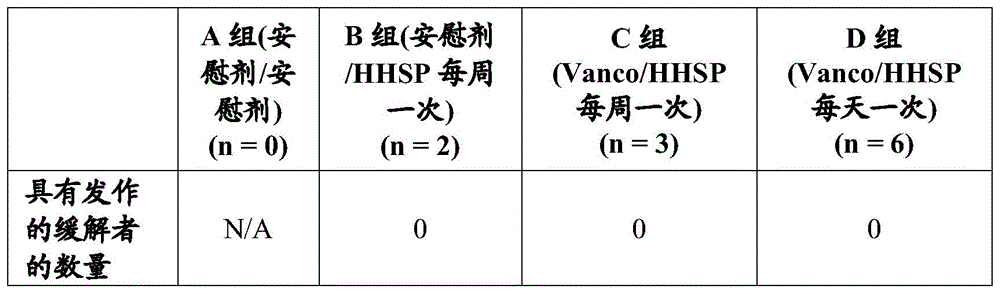
不良事件adverse event
作为临床试验方案的一部分,在8周诱导期结束时记录并评估不良事件。一般来说,与安慰剂对照相比,用HHSP治疗的患者具有的胃肠道相关不良事件更少。在接受每天一次HHSP(D组)的患者中观察到最显著差异,这与HHSP的剂量依赖性作用一致。Adverse events were recorded and assessed at the end of the 8-week induction period as part of the clinical trial protocol. In general, patients treated with HHSP had fewer gastrointestinal-related adverse events than placebo controls. The most significant differences were observed in patients receiving HHSP once daily (group D), which is consistent with the dose-dependent effect of HHSP.
与用微生物组组合物治疗相关的不良事件水平低表明,包含来自健康人供体粪便的纯化的芽孢群体的微生物组组合物可安全地用于治疗溃疡性结肠炎,包括轻度至中度UC。安慰剂组与所治疗的受试者之间不良事件的最大差异是胃肠病症的类别(安慰剂组中45.5%对比每天一次治疗组中13.3%)。这种差异在接受每天一次施用纯化芽孢群体的患者中最为明显(安慰剂组中45.5%对比D组中13.3%)。Low levels of adverse events associated with treatment with microbiome compositions suggest that microbiome compositions comprising purified spore populations from healthy human donor feces are safe for use in the treatment of ulcerative colitis, including mild to moderate UC . The largest difference in adverse events between placebo and treated subjects was the category of gastrointestinal disorders (45.5% in the placebo group vs. 13.3% in the once-daily treatment group). This difference was most pronounced in patients who received the once-daily administration of the purified spore population (45.5% in the placebo group vs. 13.3% in the D group).
实施例2:用芽孢制剂(HHSP)进行治疗的溃疡性结肠炎患者中的移植和/或增强Example 2: Transplantation and/or Augmentation in Ulcerative Colitis Patients Treated with Spore Preparation (HHSP)
如实施例1中所述,HHSP的治疗能够在UC患者中提供持久的治疗作用。用于治疗疾病的微生物组组合物的一个潜在优点是,微生物组组合物可提供持久的作用,因为所述微生物组组合物的至少一些有益物种可移植在所治疗的受试者中,从而提供了有益功能的持续来源并且可促进不在所述组合物中的有益细菌的增殖(增强)。缺乏持久作用不仅是必须定期给药以达到治疗水平的药物的问题,而且已经注意到,必须以高频率服用许多益生菌以维持治疗作用(Walter J.,等人,Curr Opin Biotechnol 49:129-139,2018)。因此,对于微生物组组合物中的细菌而言,移植的能力是所期望的特征,从而使得除其他特征外,与使用药物或非移植益生菌可能需要的相比更低的给药频率。某些微生物组组合物的第二个新颖特征是,在用微生物组组合物治疗之前,有益的细菌物种的增强不能在患者中检测到或以低水平存在。As described in Example 1, treatment of HHSP can provide durable therapeutic effects in UC patients. A potential advantage of a microbiome composition for the treatment of disease is that the microbiome composition can provide long-lasting effects because at least some of the beneficial species of the microbiome composition can be transplanted in the treated subject, thereby providing Provides a continuous source of beneficial functions and can promote the proliferation (enhancement) of beneficial bacteria not present in the composition. Lack of durable effect is not only a problem with drugs that must be administered regularly to achieve therapeutic levels, but it has been noted that many probiotics must be taken at high frequency to maintain therapeutic effect (Walter J., et al., Curr Opin Biotechnol 49:129- 139, 2018). Thus, the ability to engraft is a desirable feature for bacteria in a microbiome composition, allowing, among other features, a less frequent dosing than might be required with drugs or non-engrafting probiotics. A second novel feature of certain microbiome compositions is that enhancement of beneficial bacterial species is either undetectable or present at low levels in patients prior to treatment with the microbiome composition.
申请人已经鉴定了移植或增强并且还与缓解相关的特定OTU或物种。此类OTU或物种可用于设计用于治疗IBD(例如溃疡性结肠炎或癌症)的组合物。Applicants have identified specific OTUs or species that are transplanted or enhanced and also associated with remission. Such OTUs or species can be used to design compositions for the treatment of IBD such as ulcerative colitis or cancer.
为了确定微生物组组合物是否能够移植和/或增强,在治疗前(基线)和用HHSP初始治疗后最多12周(即,使用HHSP的最后治疗后最多4周),使用互补基因组学方法来表征溃疡性结肠炎患者的微生物群。使用全基因组鸟枪测序(WGS)表征UC受试者的粪便微生物组和HHSP剂量。WGS是一种已广泛使用并在文献(例如,Lloyd-Price等人,Nature 550:61-66,2017)中报告的高分辨率方法,所述方法可以进行物种水平的分类学鉴定(Truong等人,Nature Meth 12:203-209,2015)。粪便样品和HHSP中存在的物种的相对丰富度是通过使用开源软件MetaPhlAn2(2.6.0版)以及专有的内部数据库更新获得的。为了分析移植,将通过MetaPhlAn2在UC患者和HHSP中鉴定出的物种集针对专有的、经过策划的芽孢形成物种数据库进行过滤。To determine whether the microbiome composition is capable of engraftment and/or enhancement, a complementary genomics approach was used to characterize before treatment (baseline) and up to 12 weeks after initial treatment with HHSP (ie, up to 4 weeks after final treatment with HHSP). Microbiota in patients with ulcerative colitis. Characterization of the fecal microbiome and HHSP dose in UC subjects using whole-genome shotgun sequencing (WGS). WGS is a high-resolution method that has been widely used and reported in the literature (e.g., Lloyd-Price et al., Nature 550:61-66, 2017) for taxonomic identification at the species level (Truong et al. Human, Nature Meth 12: 203-209, 2015). The relative richness of species present in fecal samples and HHSPs was obtained by using the open-source software MetaPhlAn2 (version 2.6.0) and a proprietary in-house database update. To analyze engraftment, the set of species identified by MetaPhlAn2 in UC patients and HHSP was filtered against a proprietary, curated database of spore-forming species.
如图2A所示,对HHSP中鉴定的移植物种数量的分析显示,与安慰剂对照(A组)相比,HHSP物种的移植最早于初始HHSP剂量后1周出现在所有治疗组(即组B、C和D)中。移植的确定是基于治疗开始后评估受试者粪便中的HHSP中存在或不存在芽孢形成细菌。用万古霉素预治疗的患者(例如B组对比C组)中移植更大。在用万古霉素预治疗、然后接受每天一次HHSP的患者中观察到最高移植。在最终HHSP施用后,移植也持久至少4周(参见图2A中的56天和84天)。令人感兴趣的是,如图2B和2C所示,可将移植物种进一步分为长期移植物的那些(图2B)和短期移植物的那些(图2C)。根据跨患者样本的共生移植物种的两个不同簇的鉴定,可将物种分类为长期移植物种与短期移植物。短期移植物(TE)在开始给予HHSP后的1-2周移植达到峰值,并且在C组和D组中显示出相似的移植概况。长期移植物(LTE)在早期时间点显示出剂量依赖性应答,并且在施用最后一个剂量后至少4周(第13次随访)持久地存在于患者中。表5提供了被鉴定为长期移植物或短期移植物的不同细菌物种的列表。重要的是,HHSP中存在的许多物种并未以可检测的水平移植,从而表明移植不是HHSP中物种的普遍属性。As shown in Figure 2A, analysis of the number of engrafted species identified in HHSP showed that engraftment of HHSP species occurred as early as 1 week after the initial HHSP dose in all treatment groups (i.e., Group B) compared to the placebo control (Group A). , C and D). Determination of engraftment was based on assessment of the presence or absence of spore-forming bacteria in HHSP in the subject's feces after initiation of treatment. Transplantation was greater in patients pretreated with vancomycin (eg, Group B vs. Group C). The highest engraftment was observed in patients pretreated with vancomycin and then receiving HHSP once daily. Transplantation also persisted for at least 4 weeks after final HHSP administration (see
这一移植数据反映破坏UC患者的稳定但生态失调微生物组的要求。在许多生态系统中,除非群落经历强烈破坏,否则它们是稳定的。在此,需要万古霉素预治疗来破坏现有UC微生物组并打开用于移植HHSP细菌的小生境。在生态系统破坏后,在达到最终稳定顶级群落之前通常出现一系列群落。通常需要中间群落(称为演替系列群落(或演替系列))来改变环境,从而建立后续群落。在用万古霉素破坏UC微生物组后,TE物种形成演替系列群落,随后建立LTE物种,其形成稳定的顶级群落。因此,持久的治疗干预可能需要施用TE和LTE物种两者(在用万古霉素破坏现有群落之后);TE和LTE物种可其改变UC中胃肠道的环境所需的独特作用。This engraftment data reflects the requirement to disrupt the stable but dysbiosis microbiome of UC patients. In many ecosystems, communities are stable unless they experience severe disruption. Here, vancomycin pretreatment is required to disrupt the existing UC microbiome and open up the niche for transplanting HHSP bacteria. Following ecosystem disruption, a series of colonies typically emerge before reaching a final stable top colony. Intermediate communities (called successional series of communities (or successional series)) are often required to alter the environment, thereby establishing subsequent communities. After disruption of the UC microbiome with vancomycin, TE species formed a successional series of communities, followed by the establishment of LTE species, which formed stable apical communities. Therefore, durable therapeutic intervention may require administration of both TE and LTE species (after disruption of existing colonies with vancomycin); TE and LTE species may have unique effects required to alter the environment of the gastrointestinal tract in UC.
支持TE和LTE物种的独特作用,这两组物种的比较基因组分析表明,它们在功能上是不同的。例如,用于氧和活性氧物质代谢的途径富含TE物种,包括过氧化氢酶、超氧化物歧化酶、渗透保护剂转运系统和超氧化物还原酶。由于宿主在炎症过程中产生活性氧物质,这对于将TE物种早期移植在发炎的肠道中可能是一个重要特征。TE物种除去活性氧物质可实现LTE物种的后续移植。Supporting the unique roles of TE and LTE species, comparative genomic analysis of these two groups of species showed that they are functionally distinct. For example, pathways for oxygen and reactive oxygen species metabolism are enriched in TE species, including catalase, superoxide dismutase, osmoprotectant transport systems, and superoxide reductase. Since the host produces reactive oxygen species during inflammation, this may be an important feature for early transplantation of TE species in the inflamed gut. Removal of reactive oxygen species from TE species enables subsequent transplantation of LTE species.
实施例3:治疗对溃疡性结肠炎患者的微生物组的影响Example 3: The effect of treatment on the microbiome of patients with ulcerative colitis
为了确定增加的移植对溃疡性结肠炎患者的微生物组是否有任何影响,在初始HHSP施用后的各个时间点,将所治疗患者的微生物组的芽孢形成物组合物与基线(即HHSP施用前)进行比较。具体地,在所有采样时间点,计算了所有组受试者微生物组的芽孢形成部分与合并的HHSP剂量物种含量之间的二进制杰卡德距离。二进制杰卡德距离在介于-1与1之间的范围内,其中0表示共享完全相同的一组物种的样品,而1表示没有共同物种的样品。度量的计算中不考虑物种的丰度。相似性度量值越高,表明受试者微生物组与HHSP之间的相似性越高。To determine whether the increased engraftment had any effect on the microbiome of patients with ulcerative colitis, the spore-forming composition of the microbiome of the treated patients was compared with baseline (ie, before HHSP administration) at various time points after initial HHSP administration. Compare. Specifically, at all sampling time points, binary Jaccard distances were calculated between the spore-forming fraction of the microbiome of all groups of subjects and the species content of the pooled HHSP dose. The binary Jaccard distance is in the range between -1 and 1, where 0 represents samples that share the exact same set of species, and 1 represents samples that have no common species. Species abundance is not considered in the calculation of the metric. The higher the similarity measure, the higher the similarity between the subject's microbiome and the HHSP.
如图3所示,在8周诱导疗法治疗结束时,来自C组(万古霉素预治疗/HHSP每周一次)和D组(万古霉素预治疗/HHSP每天一次)的患者的微生物组的芽孢形成部分与基线相比,与HHSP组合物更相似。如临床功效所观察到的(参见实施例1),与其他治疗组相比,在用万古霉素和每日剂量的HHSP(D组)预治疗的患者中,作用更为明显。As shown in Figure 3, at the end of the 8-week induction therapy treatment, the microbiome of patients from groups C (vancomycin pretreatment/HHSP once a week) and D (vancomycin pretreatment/HHSP once a day) The sporulation fraction was more similar to the HHSP composition than baseline. As observed for clinical efficacy (see Example 1), the effect was more pronounced in patients pretreated with vancomycin and daily doses of HHSP (group D) compared to the other treatment groups.
实施例4:微生物组变化与临床结果的相关性Example 4: Correlation of Microbiome Changes with Clinical Outcomes
用HHSP组合物进行治疗改变缓解者和非缓解者的微生物组的芽孢形成部分和非芽孢形成部分两者。进行了进一步的分析以确定特定细菌物种是否与在临床试验受试者中观察到的临床缓解相关。用MetaPhlAn数据库(如上文所述)所获得的受试者粪便微生物组和HHSP的分类学谱用于使用自举套索逻辑回归鉴定与D组中的临床结果相关的物种。Treatment with the HHSP composition altered both the spore-forming and non-spore-forming portions of the microbiome of remission and non-relievers. Further analyses were performed to determine whether specific bacterial species were associated with clinical remissions observed in clinical trial subjects. Taxonomic profiles of subject fecal microbiome and HHSP obtained with the MetaPhlAn database (described above) were used to identify species associated with clinical outcomes in panel D using bootstrapped lasso logistic regression.
申请人发现,早在初始HHSP给药后7天,缓解期患者(缓解者)与未缓解患者(非缓解者)中某些细菌物种的流行存在明显区别。这种区别在治疗期结束后持续至少4周,这与观察到的与HHSP治疗相关的治疗作用的持久性(维持)一致。Applicants have found that the prevalence of certain bacterial species differs markedly between patients in remission (responders) and non-responders (non-responders) as early as 7 days after initial HHSP administration. This difference persisted for at least 4 weeks after the end of the treatment period, which is consistent with the observed persistence (maintenance) of the therapeutic effect associated with HHSP treatment.
总共31种不同的细菌物种被鉴定为预测临床结果。所鉴定的物种包括至少存在于一些HHSP组合物中的物种,以及通过治疗而增强的物种(即,不存在于HHSP组合物中,或以低于检测限的浓度存在)。所述物种的20种与缓解相关,并且11种与非缓解相关。表3提供了31种鉴定的细菌物种的16S rDNA序列的SEQ ID NO,以及具有至少99%序列同一性的16SrDNA序列的参考物种的名称。A total of 31 different bacterial species were identified as predictive of clinical outcome. Species identified include those present in at least some HHSP compositions, as well as those that are enhanced by treatment (ie, not present in the HHSP composition, or present at concentrations below the detection limit). Twenty of the species were associated with remission and 11 were associated with non-remission. Table 3 provides the SEQ ID NOs of the 16S rDNA sequences of the 31 identified bacterial species, and the names of reference species with 16S rDNA sequences that have at least 99% sequence identity.
表3.与临床结果相关的细菌物种Table 3. Bacterial species associated with clinical outcomes


表3中与缓解相关的细菌物种在DE中有用。因此,在本发明的一些方面,微生物组组合物包含表3中鉴定的缓解者相关的物种或具有与缓解者相关物种具有至少97%同一性的16S rDNA的物种中的至少一种。在一些情况下,所述微生物组合物是HHSP。在一些情况下,所述微生物组合物是DE。一般来说,如果组合物是DE,则其不包括与未缓解相关的细菌。The bacterial species associated with mitigation in Table 3 are useful in DE. Thus, in some aspects of the invention, the microbiome composition comprises at least one of the Miter-related species identified in Table 3 or species having 16S rDNA that is at least 97% identical to the Miter-related species. In some cases, the microbial composition is HHSP. In some cases, the microbial composition is DE. In general, if the composition is DE, it does not include bacteria associated with non-remission.
在一些方面,测试用于芽孢组合物制造的HHSP或物质中与未缓解相关的一种或多种物种。此类物种的存在可用作在微生物组组合物中排除HHSP或物质的标准。在一些方面,测试用于制造芽孢组合物的HHSP或物质中与缓解相关的细菌物种的存在,并且一种或多种此类物种的存在是在微生物组组合物中使用HHSP或物质的标准。In some aspects, the HHSP or substance used in the manufacture of the spore composition is tested for one or more species associated with non-mitigation. The presence of such species can be used as a criterion for exclusion of HHSPs or substances in a microbiome composition. In some aspects, the HHSP or substance used to make the spore composition is tested for the presence of bacterial species associated with mitigation, and the presence of one or more such species is a criterion for the use of the HHSP or substance in the microbiome composition.
实施例5:代谢组学分析Example 5: Metabolomic Analysis
本领域已知多种细菌物种可能能够执行相似的功能。申请人认为,通过鉴定与缓解相关的细菌的关键功能,可设计组合物,所述组合物包含具有使用表3中鉴定为与缓解相关的细菌的此类功能的细菌和/或在表3中未鉴定但以其他方式被证明具有一种或多种鉴定的功能的细菌物种。因此,申请人进一步表征了与所有治疗组的患者的临床缓解和未缓解相关的细菌的代谢特征。如下所述确定它们与鉴定的细菌物种的相关性。It is known in the art that various bacterial species may be able to perform similar functions. Applicants believe that by identifying key functions of bacteria associated with mitigation, compositions can be designed comprising bacteria that use such functions of bacteria identified as associated with mitigation in Table 3 and/or in Table 3 An unidentified bacterial species that is otherwise demonstrated to have one or more of the identified functions. Accordingly, Applicants further characterized the bacterial metabolic profile associated with clinical remission and non-remission of patients in all treatment groups. Their correlation to the identified bacterial species was determined as described below.
所有方法均使用与加热的电喷雾电离(HESI-II)源和以35,000质量分辨率运行的Orbitrap质量分析仪界面连接Waters ACQUITY超高效液相色谱
使用动态排阻,在MS与数据依赖性MSn扫描之间交替MS分析。扫描范围在方法之间略有不同,但覆盖70-1000m/z。Using dynamic size exclusion, MS analysis was alternated between MS and data-dependent MSn scans. The scan range varies slightly between methods, but covers 70-1000m/z.
通过基于保留时间/指数(RI)、质荷比(m/z)和色谱数据(包括MS/MS光谱数据)与纯化的标准品的文库条目进行比较来鉴定代谢物。尽管基于这些因素之一在这些分子之间可能存在相似性,但是可利用所有三个数据点来区分和分辨生物化学物质。使用曲线下面积对峰进行定量。Metabolites were identified by comparison to library entries of purified standards based on retention time/index (RI), mass-to-charge ratio (m/z), and chromatographic data (including MS/MS spectral data). Although there may be similarities between these molecules based on one of these factors, all three data points can be used to differentiate and resolve biochemicals. Peaks were quantified using the area under the curve.
这些分析的结果表明,与临床结果相关的物种与某些代谢物之间具有强相关性。例如,如图4所示,与未进入临床缓解期的患者相比,进入缓解期的溃疡性结肠炎患者(无论治疗组如何)在他们的粪便样品中具有显著更高水平的7-α-脱羟基化次级胆汁酸。两种此类次级胆汁酸(脱氧胆酸和石胆酸)不仅能够降低LPS刺激的PBMC的TNF-α产生,而且增加IL-10产生。分别参见图5A和5B。与临床结果相关的代谢物的其他非限制性实例包括:(i)色氨酸衍生的代谢物(例如,吲哚和3-甲基吲哚),(ii)中链脂肪酸,(iii)内源性大麻素,(iv)鞘脂和(v)犬尿氨酸。出人意料地,某些SCFA与缓解呈负相关。所述强相关性似乎表明这些物种可能介导与临床结果相关的关键代谢物的活性。临床缓解的代谢组学特征包括许多不同的功能途径,其中许多牵涉于炎性肠病例如溃疡性结肠炎中。The results of these analyses showed strong correlations between species associated with clinical outcomes and certain metabolites. For example, as shown in Figure 4, ulcerative colitis patients who entered remission (regardless of treatment group) had significantly higher levels of 7-alpha- Dehydroxylated secondary bile acids. Two such secondary bile acids (deoxycholic acid and lithocholic acid) were able to not only reduce LPS-stimulated TNF-α production but also increase IL-10 production. See Figures 5A and 5B, respectively. Other non-limiting examples of metabolites relevant to clinical outcomes include: (i) tryptophan-derived metabolites (eg, indole and 3-methylindole), (ii) medium chain fatty acids, (iii) intracellular Cannabinoids, (iv) sphingolipids and (v) kynurenine. Unexpectedly, some SCFAs were inversely associated with remission. The strong correlation appears to suggest that these species may mediate the activity of key metabolites associated with clinical outcome. The metabolomic signature of clinical remission includes many distinct functional pathways, many of which are implicated in inflammatory bowel diseases such as ulcerative colitis.
代谢物与临床结果的相关性Correlation of metabolites with clinical outcomes
为了确认物种与某些代谢物之间的以上鉴定的相关性,比较了在8周治疗期结束时来自临床试验的所有治疗组(B组、C组和D组)的缓解者与无应答者之间选定的鉴定的代谢物(即选定的色氨酸代谢物(吲哚和3-甲基吲哚))的水平。To confirm the above-identified correlations between species and certain metabolites, responders and non-responders from all treatment arms of the clinical trial (arms B, C, and D) at the end of the 8-week treatment period were compared with non-responders between selected identified metabolites (ie selected tryptophan metabolites (indole and 3-methylindole)).
成对的分类学和代谢组学谱的标准分析通常涉及物种与代谢物丰度之间的成对相关性(例如,Spearman或Pearson相关性),以鉴定其丰度与代谢物丰度相关的那些物种。这种类型的相关分析通常产生与大量代谢物相关的大量物种,正如在群组研究和干预研究中所观察到。这意味着这种类型的标准相关分析不能充分地鉴定哪些物种真正地在机制上参与选定的代谢功能。Standard analyses of pairwise taxonomic and metabolomic profiles often involve pairwise correlations (e.g., Spearman or Pearson correlations) between species and metabolite abundances to identify those whose abundances correlate with metabolite abundances. those species. This type of correlation analysis often yields a large number of species associated with a large number of metabolites, as observed in cohort studies and intervention studies. This means that this type of standard correlation analysis cannot adequately identify which species are really mechanistically involved in the selected metabolic function.
为了解决标准相关分析的不足,申请人使用一种新颖的方法来鉴定成对的分类学和代谢组学谱中的特定物种-代谢物关系。进行了计算分析,分析了(i)不同代谢物的存在和水平与(ii)单独细菌物种和细菌物种的组合的存在之间的关系。另外,进行了评估细菌物种和代谢物的相对丰度的分析。To address the deficiencies of standard correlation analysis, Applicants used a novel approach to identify specific species-metabolite relationships in paired taxonomic and metabolomic profiles. Computational analyses were performed to analyze the relationship between (i) the presence and levels of different metabolites and (ii) the presence of individual bacterial species and combinations of bacterial species. Additionally, analyses to assess the relative abundance of bacterial species and metabolites were performed.
如图6A和6B所示,在HHSP施用后进入缓解状态的溃疡性结肠炎患者具有较高水平的吲哚和3-甲基吲哚,从而表明这些色氨酸代谢物的水平升高与临床缓解之间呈正相关。图6C解释了对于3-甲基吲哚所观察到的大变化性(图6B)。色氨酸代谢物水平升高与HHSP组合物中鉴定出的两种细菌物种相关:布氏瘤胃球菌和惰性真杆菌。因此,在图6B中观察到的3-甲基吲哚水平的变化性可能是由于一些溃疡性结肠炎患者的胃肠微生物组中具有这两种细菌物种中的零种、一种或两种所致。例如,如图6C所示,与不携带这些物种的患者相比,在其微生物组中具有两种细菌物种的患者具有较高的3-甲基吲哚水平和较高的临床缓解率。这些数据还表明,在一些方面,在微生物组组合物中包含布氏瘤胃球菌和/或惰性真杆菌是有利的,例如,用于诱导和/或维持缓解。此外,包含一种或两种物种可用于增加所治疗受试者中3-甲基吲哚的产生。As shown in Figures 6A and 6B, patients with ulcerative colitis who entered remission after HHSP administration had higher levels of indole and 3-methylindole, suggesting that elevated levels of these tryptophan metabolites are associated with clinical There was a positive correlation between remissions. Figure 6C illustrates the large variability observed for 3-methylindole (Figure 6B). Elevated levels of tryptophan metabolites were associated with two bacterial species identified in the HHSP composition: Ruminococcus brucei and Eubacterium inerts. Therefore, the variability in 3-methylindole levels observed in Figure 6B may be due to the presence of zero, one, or both of these two bacterial species in the gastrointestinal microbiome of some patients with ulcerative colitis caused. For example, as shown in Figure 6C, patients with two bacterial species in their microbiome had higher levels of 3-methylindole and higher rates of clinical remission compared with patients who did not carry these species. These data also suggest that, in some aspects, it may be beneficial to include Ruminococcus brucei and/or Eubacterium inerts in a microbiome composition, eg, for inducing and/or maintaining remission. In addition, inclusion of one or both species can be used to increase the production of 3-methylindole in a treated subject.
据报告,通过诱导基因表达的广泛变化,AhR活化与肠道上皮屏障和粘膜稳态的增强相关。如图7A所示,吲哚和3-甲基吲哚(其与微生物组组合物在溃疡性结肠炎患者中的临床功效相关)以及其他相关代谢物(例如3-吲哚乙酸和吲哚丙烯酸酯)在肠上皮类器官中诱导AhR介导的cyp1a1表达。Cyp1al表达的增加被认为是AhR介导的基因表达的特定量度。当用已知会产生上述代谢物的细菌上清液处理上皮类器官时,也发生cyp1a1表达的增加。参见图7B。除色氨酸代谢物外,细菌上清液还含有多种SCFA、MCFA和BCFA,并且据报告SCFA可增强AhR反应性基因的表达,从而表明两类代谢物的组合可增强细菌菌株的保护作用(JinU.H.,等人,Sci Rep 7(10):10163(2017))。AhR activation has been reported to be associated with enhancement of the intestinal epithelial barrier and mucosal homeostasis by inducing broad changes in gene expression. As shown in Figure 7A, indole and 3-methylindole, which are associated with the clinical efficacy of microbiome compositions in patients with ulcerative colitis, as well as other related metabolites such as 3-indoleacetic acid and indoleacrylic acid ester) induces AhR-mediated cyp1a1 expression in intestinal epithelial organoids. The increase in Cyp1al expression is considered to be a specific measure of AhR-mediated gene expression. Increased cyp1a1 expression also occurred when epithelial organoids were treated with bacterial supernatants known to produce the above-mentioned metabolites. See Figure 7B. In addition to tryptophan metabolites, bacterial supernatants also contained multiple SCFAs, MCFAs, and BCFAs, and SCFAs were reported to enhance the expression of AhR-responsive genes, suggesting that the combination of the two classes of metabolites could enhance the protective effect of bacterial strains (Jin U.H., et al., Sci Rep 7(10): 10163 (2017)).
因此,这些结果表明,与HHSP相关的细菌影响UC改善的一种机制是通过调节诱导AhR介导的cyp1a1表达的代谢物来恢复上皮屏障完整性。Thus, these results suggest that one mechanism by which HHSP-associated bacteria influence UC improvement is by modulating metabolites that induce AhR-mediated cyp1a1 expression to restore epithelial barrier integrity.
这些数据表明,包含细菌的组合物可用于治疗UC,所述细菌可增加某些色氨酸代谢物例如但不限于吲哚和/或3-甲基吲哚的水平。These data suggest that compositions comprising bacteria that increase levels of certain tryptophan metabolites such as, but not limited to, indole and/or 3-methylindole, can be used to treat UC.
实施例6:屏障完整性分析Example 6: Barrier Integrity Analysis
如上所述,与UC缓解相关的某些细菌可产生特定色氨酸代谢物,并且那些代谢物与更稳健的肠上皮屏障和粘膜稳态相关。由于上皮细胞之间紧密连接的破坏和由慢性炎症引起的细胞凋亡所致的正常屏障功能的破坏是炎性肠病发病机制中的重要因素。粘膜愈合和屏障完整性的重建与溃疡性结肠炎的改善(例如,临床缓解)以及患者结果的改善相关(Lee S.H.,IntestRes 13:11-18,2015)。在评估屏障完整性恢复的测定中,使用了几种细菌物种和另外的代谢物进一步研究了这种作用。As discussed above, certain bacteria associated with UC remission can produce specific tryptophan metabolites, and those metabolites are associated with a more robust intestinal epithelial barrier and mucosal homeostasis. Disruption of normal barrier function due to disruption of tight junctions between epithelial cells and apoptosis caused by chronic inflammation are important factors in the pathogenesis of inflammatory bowel disease. Reconstruction of mucosal healing and barrier integrity is associated with improvement in ulcerative colitis (eg, clinical remission) and improved patient outcomes (Lee S.H., IntestRes 13:11-18, 2015). This effect was further investigated using several bacterial species and additional metabolites in assays assessing restoration of barrier integrity.
使用初级上皮细胞单层屏障完整性测定进行了所述测定。如图8A和图8B所示,测定设备具有由可渗透膜上的单层上皮细胞分隔的顶侧和基侧。干扰素-γ(IFN-γ)的添加破坏上皮单层的紧密连接并诱导上皮细胞凋亡。可通过将FITC-葡聚糖添加至设备的顶侧并测量其可通过基底外侧区室的速度来评估膜的泄漏。与具有完整单层的单层相比,泄漏单层将使FITC-葡聚糖更快地到达设备的基底侧。The assay was performed using a primary epithelial cell monolayer barrier integrity assay. As shown in Figures 8A and 8B, the assay device has apical and basal sides separated by a monolayer of epithelial cells on a permeable membrane. Addition of interferon-gamma (IFN-gamma) disrupts tight junctions in epithelial monolayers and induces epithelial cell apoptosis. Membrane leakage can be assessed by adding FITC-dextran to the apical side of the device and measuring the speed at which it can pass through the basolateral compartment. A leaky monolayer would allow the FITC-dextran to reach the basolateral side of the device faster than a monolayer with an intact monolayer.
简言之,如下进行屏障完整性测定。由分离的结肠隐窝建立的原代人结肠类器官培养物在
如图9A所示,以约5mM的浓度开始,添加短链脂肪酸(丁酸酯和丙酸酯)或色氨酸代谢物(3-吲哚丙酸;IPA)在这些条件下恢复了屏障完整性。图9B表明,据告与临床缓解相关的某些细菌物种(例如肠道柯林斯氏菌)的添加也可恢复屏障完整性。图9B还示出某些细菌(例如大肠杆菌如氨基酸球菌属D21)可能对上皮屏障完整性具有有害作用。这表明用于治疗IBD的细菌的选择可基于功能特征。As shown in Figure 9A, starting at a concentration of about 5 mM, addition of short-chain fatty acids (butyrate and propionate) or tryptophan metabolites (3-indolepropionic acid; IPA) restored barrier integrity under these conditions sex. Figure 9B shows that the addition of certain bacterial species (eg, Collins enterica) reported to be associated with clinical remission also restores barrier integrity. Figure 9B also shows that certain bacteria (eg, E. coli such as Aminococcus D21) may have deleterious effects on epithelial barrier integrity. This suggests that the selection of bacteria for the treatment of IBD can be based on functional characteristics.
一般而言,这些数据表明与屏障完整性的恢复相关的细菌和/或产生与屏障完整性的恢复相关的某些代谢物可用于治疗溃疡性结肠炎。因此,此类细菌可用于用以治疗与胃肠屏障完整性受损相关的疾患(例如IBD)的细菌组合物中。这些数据还表明某些细菌,埃希氏菌属和氨基酸球菌属可能不期望包含在用于治疗其中受损的屏障完整性是一种特征的疾患的微生物组组合物中。In general, these data suggest that bacteria associated with restoration of barrier integrity and/or production of certain metabolites associated with restoration of barrier integrity may be useful in the treatment of ulcerative colitis. Accordingly, such bacteria are useful in bacterial compositions for the treatment of disorders associated with impaired gastrointestinal barrier integrity, such as IBD. These data also suggest that certain bacteria, Escherichia and Aminococcus, may not be desirable for inclusion in microbiome compositions for the treatment of disorders in which impaired barrier integrity is a feature.
实施例7:溃疡性结肠炎的动物模型中的抗炎作用的评估Example 7: Evaluation of anti-inflammatory effects in an animal model of ulcerative colitis
为了进一步评估微生物组组合物(包括设计的组合物)对临床缓解的影响,使用了溃疡性结肠炎的动物模型。简言之,将从脾C57B1/6小鼠(使用RAG IBD细胞分离方案)获得的初始T细胞(CD4+CD45RB高)过继转移到RAGn12小鼠中。十天后,将小鼠用口服抗生素处理五天,以耗竭它们的天然肠道菌群。从T细胞转移后的第14天开始,一些小鼠使用管饲法接受了总共21个剂量的芽孢组合物(SP)或设计的组合物(DE1)。DE1是由14种细菌物种组成的合成组合物:结肠厌氧球菌、延长布劳特氏菌、难辨梭菌、双孢梭菌、戈氏梭菌、乙二醇梭菌、无害梭菌、乳酸发酵梭菌,绿色梭菌,真杆菌属WAL 14571、毛螺菌科细菌31 57FA、毛螺菌科细菌口腔分类群F15、Lactonifactor longoviformis和酸奶瘤胃球菌。总之,不同的实验组包括以下:(i)初次接受试验的动物(无疾病,即无T细胞转移;n=5);(ii)未治疗的疾病对照(仅T细胞转移;n=15);(iii)抗生素治疗的疾病对照(仅T细胞转移+抗生素治疗;n=15);(iv)HHSP治疗(T细胞转移+抗生素治疗+HHSP治疗;n=15);以及(v)DE1治疗(T细胞转移+抗生素治疗+SP治疗;n=15)。图10提供所述方案的示意图。To further assess the impact of microbiome compositions, including designed compositions, on clinical remission, an animal model of ulcerative colitis was used. Briefly, naive T cells (CD4+CD45RB high) obtained from splenic C57B1/6 mice (using the RAG IBD cell isolation protocol) were adoptively transferred into RAGn12 mice. Ten days later, the mice were treated with oral antibiotics for five days to deplete their natural gut flora. Starting on
如图11所示,与未治疗的疾病对照动物和仅抗生素治疗的疾病对照动物相比,接受HHSP或DE1的动物的病理学评分显著降低。病理评分是基于4个独立参数的总和:炎症、腺体丢失、糜烂和增生(评分为0-5,0=正常,5=严重)。使用nCounter Mouse ImmunologyPanel用来自小鼠结肠的分离的总RNA生成了Nanostring基因表达数据。使用QiagenRNeasy Plus Mini试剂盒按照制造商的方案从储存在-80℃的RNAlater(ThermoFisher)中的结肠组织分离RNA。然后使用InvitrogenTM SuperScriptTM III第一链合成系统从小鼠总RNA中生成cDNA用于后续RT-qPCR分析。As shown in Figure 11, animals receiving HHSP or DE1 had significantly lower pathology scores compared to untreated disease control animals and antibiotic-only disease control animals. The pathology score is based on the sum of 4 independent parameters: inflammation, glandular loss, erosion and hyperplasia (score from 0-5, 0=normal, 5=severe). Nanostring gene expression data were generated with isolated total RNA from mouse colon using an nCounter Mouse ImmunologyPanel. RNA was isolated from colon tissue stored in RNAlater (ThermoFisher) at -80°C using the Qiagen RNeasy Plus Mini kit following the manufacturer's protocol. cDNA was then generated from mouse total RNA using the Invitrogen ™ SuperScript ™ III First Strand Synthesis System for subsequent RT-qPCR analysis.
这些数据证明,包含源自健康供体的粪便或芽孢形成物种的子集的芽孢形成细菌的组合物可有效治疗UC。These data demonstrate that compositions comprising spore-forming bacteria derived from feces from healthy donors or a subset of spore-forming species are effective in the treatment of UC.
来自小鼠的结肠样品的NanoString基因表达谱表明不同组之间几种基因表达的差异。与疾病对照动物相比,以下基因在用HHSP治疗的动物中下调:(i)T细胞活化(例如Ctla4、Il18r1、Cxcl10/11、Lilrb3/4、Ifng、Nos2),(ii)促炎性细胞因子(例如,Tnf、Il1b、Ifng),和(iii)先天性免疫细胞募集或活化(例如Cxcl1、Cxcl3、Ccl2、Cxcr6、Ltb、Cybb)。与疾病对照动物相比,以下基因在用HHSP治疗的动物中上调:(i)抑制炎症(例如C4bp、Zeb1、Cd109),和(ii)粘附分子(例如,Ncam1、Cd34/36、Fn1、Cdh5、Tjp1、Tjp2和Ocln)。促炎性细胞因子基因Illb(图12A)、Tnfa(图12B)的表达水平降低,以及粘附分子基因Tjp1(图12C)、Tjp2(图12D)和Ocln(图12E)的表达增加通过qPCR和/或ELISA进一步确认。使用AppliedBiosystems QuantStudio 7 Flex System上的Applied BiosystemsTM TaqManTM FastAdvanced Master Mix生成基于RT-qPCR的基因表达数据。NanoString gene expression profiles of colon samples from mice indicated differences in the expression of several genes between the different groups. The following genes were down-regulated in animals treated with HHSP compared to disease control animals: (i) T cell activation (e.g. Ctla4, Il18r1, Cxcl10/11, Lilrb3/4, Ifng, Nos2), (ii) pro-inflammatory cells Factors (eg, Tnf, Illb, Ifng), and (iii) innate immune cell recruitment or activation (eg, Cxcl1, Cxcl3, Ccl2, Cxcr6, Ltb, Cybb). The following genes were upregulated in animals treated with HHSP compared to disease control animals: (i) inhibition of inflammation (eg, C4bp, Zeb1, Cd109), and (ii) adhesion molecules (eg, Ncam1, Cd34/36, Fn1, Cdh5, Tjp1, Tjp2 and Ocln). The expression levels of pro-inflammatory cytokine genes Illb (Fig. 12A), Tnfa (Fig. 12B) were decreased, and the expression levels of adhesion molecule genes Tjp1 (Fig. 12C), Tjp2 (Fig. 12D) and Ocln (Fig. 12E) were increased by qPCR and /or ELISA for further confirmation. RT-qPCR-based gene expression data were generated using the Applied Biosystems ™ TaqMan ™ FastAdvanced Master Mix on an
在不依赖任何特定理论的情况下,以上数据表明此类细菌可通过多种途径治疗溃疡性结肠炎,如通过改变患者的微生物群、调节各种生物分子(例如,粪便钙卫蛋白、次级胆汁酸、色氨酸代谢物、短链和中链脂肪酸、鞘脂和犬尿氨酸)的产生。这些代谢物和细菌代谢的其他产物可全局调控结肠中(例如胃肠固有层中)不同免疫基因的表达,从而减轻炎症及其相关的组织病理学。Without relying on any particular theory, the above data suggest that such bacteria may treat ulcerative colitis through multiple pathways, such as by altering the patient's microbiota, modulating various biomolecules (eg, fecal calprotectin, secondary production of bile acids, tryptophan metabolites, short- and medium-chain fatty acids, sphingolipids, and kynurenine). These metabolites and other products of bacterial metabolism can globally regulate the expression of different immune genes in the colon (eg, in the gastrointestinal lamina propria), thereby reducing inflammation and its associated histopathology.
实施例8:通过HDAC抑制测定评估SCFA产生Example 8: Assessment of SCFA production by HDAC inhibition assay
短链脂肪酸(SCFA)被描述为在调控宿主免疫力中发挥作用。研究已经描述了在不同胃肠疾病(例如结肠炎)患者中SCFA模式的改变,并且据报告丁酸酯和丙酸酯的施用在结肠炎动物模型中具有治疗作用。在体外和体内,SCFA均显示抑制组蛋白脱乙酰基(HDAC)活性,其然后可进而调控免疫应答的许多方面(例如,诱导FoxP3+调控性T细胞)。因此,可产生SCFA的细菌可用于治疗IBD(例如UC)患者。Short-chain fatty acids (SCFAs) have been described to play a role in the regulation of host immunity. Studies have described altered SCFA patterns in patients with various gastrointestinal diseases such as colitis, and administration of butyrate and propionate has been reported to have therapeutic effects in animal models of colitis. Both in vitro and in vivo, SCFAs have been shown to inhibit histone deacetylation (HDAC) activity, which can then in turn regulate many aspects of the immune response (eg, induction of FoxP3 + regulatory T cells). Therefore, SCFA-producing bacteria can be used to treat patients with IBD (eg, UC).
考虑到具有粪便浆液的发酵液中SCFA产生的类型和水平取决于所使用的碳源(Yang等人,Anaerobe 23:74-81(2013)),因此在包括单糖、二糖、多糖和猪粘蛋白在内的各种碳(C)源中生长的细菌菌株的上清液中评估了HDAC抑制。对于这些实验,将600μL于单独或补充有0.5%的7种碳源之一(葡萄糖、岩藻糖、蔗糖、淀粉、果胶、FOS/菊粉或粘蛋白)的蛋白胨/酵母提取物培养基(PY)中的培养物接种于96深孔板中并厌氧生长4天。通过离心沉淀微生物细胞,并将上清液用于HDAC抑制测定(HDAC-Glo I/II测定试剂盒,Promega),并且HeLa核提取物(Promega)作为HDAC酶的来源。用15μL上清液、10μL 1M Tris pH 8、75μL含有稀释的HeLa核提取物的测定缓冲液进行测定,在添加显影剂之前将其预孵育15分钟。20分钟后测量发光。在这些条件下,掺有15mM丁酸酯的无菌上清液产生65%-75%的HDAC抑制。Considering that the type and level of SCFA production in fermentation broth with fecal slurry depends on the carbon source used (Yang et al., Anaerobe 23: 74-81 (2013)), it is important to HDAC inhibition was assessed in supernatants of bacterial strains grown on various carbon (C) sources, including mucin. For these experiments, 600 μL of peptone/yeast extract medium alone or supplemented with 0.5% of one of the 7 carbon sources (glucose, fucose, sucrose, starch, pectin, FOS/inulin or mucin) The cultures in (PY) were seeded in 96 deep well plates and grown anaerobically for 4 days. Microbial cells were pelleted by centrifugation and the supernatant was used in an HDAC inhibition assay (HDAC-Glo I/II assay kit, Promega) and HeLa nuclear extract (Promega) as a source of HDAC enzymes. Assays were performed with 15 μL of supernatant, 10 μL of
如图13所示,许多细菌菌株与抑制HDAC活性的能力有关。基于它们在不同营养源中生长时抑制HDAC活性的能力(在本文中称为“HDAC簇”),将细菌分为七个表型簇之一(在图13中表示为0-6)。例如,簇0对应于在岩藻糖(一种作为粘蛋白糖蛋白的组分发现的糖)上生长时能够抑制HDAC、但在其他底物上不能抑制HDAC的菌株。这些菌株利用岩藻糖作为丙酸酯产生的底物,而不是基础培养基中存在的氨基酸或在其他条件下添加的其他简单和复杂的碳水化合物。表型簇5对应于当仅在单糖或淀粉存在下生长时抑制HDAC的菌株。表型簇4对应于在所有条件下均抑制HDAC的菌株,但是其活性并未因添加糖或多糖而增加。因此,尽管许多细菌菌株具有HDAC抑制的能力,但它们仅在某些底物(例如岩藻糖、粘蛋白或淀粉)存在下才能够表达所述能力。As shown in Figure 13, many bacterial strains were associated with the ability to inhibit HDAC activity. Bacteria were grouped into one of seven phenotypic clusters (denoted 0-6 in Figure 13) based on their ability to inhibit HDAC activity when grown in different nutrient sources (referred to herein as "HDAC clusters"). For example,
以上数据表明,为了最大化体内SCFA的产生,在用于治疗炎性疾病(例如溃疡性结肠炎)的细菌组合物中包含至少一种来自每个表型簇的代表性细菌可能是有用的。上文在实施例7中描述的DE1组合物是这种组合物的一个实例(即,每个HDAC簇包括至少一个代表)。在一些方面,微生物组组合物的细菌共同能够利用这些碳源中的至少2、3、4、5、6或7个。The above data suggest that in order to maximize SCFA production in vivo, it may be useful to include at least one representative bacterium from each phenotypic cluster in bacterial compositions for the treatment of inflammatory diseases such as ulcerative colitis. The DE1 composition described above in Example 7 is an example of such a composition (ie, each HDAC cluster includes at least one representative). In some aspects, the bacteria of the microbiome composition are collectively capable of utilizing at least 2, 3, 4, 5, 6, or 7 of these carbon sources.
实施例9:肠上皮细胞的抗炎活性Example 9: Anti-inflammatory activity of intestinal epithelial cells
UC患者的发炎肠粘膜中IL-8水平通常升高。因此,抑制肠上皮细胞中IL-8诱导的能力是用于鉴定可调节UC患者的抗炎先天免疫应答的细菌物种的相关读数。简言之,将在补充有10%FBS、GlutaMAX和Pen/Strep的McCoys培养基中培养的HT29细胞(源自结肠直肠癌的上皮细胞系)以50k个细胞/孔的密度接种到96孔格式中,并且使其生长5天直至完全汇合。每两天更换培养基。在第5天,在暴露于1.25ng/ml重组人TNF-α(Peprotech)之前,将细胞用细菌代谢物(丁酸酯、丙酸酯或乙酸酯;图14A)或用细菌上清液(在细胞培养基中10%;如14B)预处理1小时。将细胞孵育4小时。收集培养上清液,并通过ELISA(R&D systems)或AlphaLISA(Perkin Elmer)测定人IL-8蛋白。将测试样品的IL-8水平相对于炎性对照(即暴露于1.25ng/ml TNF-α的经10%空白细菌培养基预处理的样品)标准化。为了测量单独细菌菌株的促炎能力,在没有TNF-α刺激的情况下,在用10%细菌上清液处理的细胞培养上清液中测量人IL-8浓度。IL-8 levels are often elevated in the inflamed intestinal mucosa of UC patients. Thus, the ability to inhibit IL-8 induction in intestinal epithelial cells is a relevant readout for identifying bacterial species that may modulate anti-inflammatory innate immune responses in UC patients. Briefly, HT29 cells (a colorectal cancer-derived epithelial cell line) cultured in McCoys medium supplemented with 10% FBS, GlutaMAX, and Pen/Strep were seeded into 96-well format at a density of 50k cells/well. medium and allowed to grow for 5 days until fully confluent. Change the medium every two days. On
如图14A所示,用所测试的任何短链脂肪酸(即,丁酸酯、丙酸酯或乙酸酯)处理IEC导致降低的TNF-α依赖性IL-8分泌水平。重要的是,体外生长的HHSP的上清液还能够以剂量依赖的方式抑制IEC的IL-8分泌(参见图14B),从而证明微生物组组合物例如在IBD如溃疡性结肠炎中减轻炎症的能力。As shown in Figure 14A, treatment of IECs with any of the short chain fatty acids tested (ie, butyrate, propionate, or acetate) resulted in decreased levels of TNF-alpha-dependent IL-8 secretion. Importantly, supernatants of in vitro grown HHSPs were also able to inhibit IL-8 secretion by IECs in a dose-dependent manner (see Figure 14B), demonstrating the role of microbiome compositions in reducing inflammation, for example, in IBD such as ulcerative colitis. ability.
由于细菌还可直接通过toll样受体(TLR)活化诱导IL-8,因此设计了促炎测定来鉴定具有这种能力的细菌菌株(即,能够TNF-α非依赖性IL-8活化的细菌)。此类菌株在体内可能是促炎的,因此加剧了UC患者的炎症。因此,在微生物组组合物中包含表现出这种活性的细菌菌株可能是不希望的。Since bacteria can also induce IL-8 directly through toll-like receptor (TLR) activation, pro-inflammatory assays were designed to identify bacterial strains with this ability (ie, bacteria capable of TNF-α-independent IL-8 activation). ). Such strains may be pro-inflammatory in vivo, thus exacerbating inflammation in UC patients. Therefore, it may be undesirable to include bacterial strains exhibiting this activity in a microbiome composition.
如图15A和15B中,许多上清液(每个圆圈代表单独上清液)表现出调节(例如降低)TNF-α依赖性IL-8分泌(y轴)的能力,并且抗炎活性通常与抑制上清液的HDAC活性(x轴)相关。但是,一些上清液尽管具有HDAC抑制活性,但在IEC中没有抗炎活性,或甚至比TNF-α诱导的产生额外的IL-8产生(即,这些是y轴上的IL-8抗炎活性与x轴上的HDAC抑制不相关的点)。这些异常值中的大多数是在促炎测定中具有活性的上清液(浅灰色);也就是说,这些菌株导致IL-8分泌,其可减轻甚至超过它们抑制HDAC活性的抗炎作用。此外,在密切相关的菌株的促炎性质中观察到了菌株水平变化性,从而表明在同一物种的不同菌株之间(至少在毛螺菌科物种中)胆汁酸活性和促炎性质并非总是保守的(图17)。对于Wnt活性观察到相似的结果(图16)。As in Figures 15A and 15B, a number of supernatants (each circle represents a separate supernatant) exhibited the ability to modulate (eg, decrease) TNF-α-dependent IL-8 secretion (y-axis), and anti-inflammatory activity was generally associated with Inhibition of HDAC activity in the supernatant (x-axis). However, some supernatants, despite their HDAC inhibitory activity, had no anti-inflammatory activity in IEC, or even had additional IL-8 production than TNF-α-induced production (ie, these were IL-8 anti-inflammatory on the y-axis Points where activity does not correlate with HDAC inhibition on the x-axis). Most of these outliers were supernatants (light grey) that were active in pro-inflammatory assays; that is, these strains resulted in IL-8 secretion that attenuated or even exceeded their anti-inflammatory effects of inhibiting HDAC activity. Furthermore, strain-level variability was observed in the pro-inflammatory properties of closely related strains, suggesting that bile acid activity and pro-inflammatory properties are not always conserved between different strains of the same species (at least in Lachnospira species) (Figure 17). Similar results were observed for Wnt activity (Figure 16).
这些结果强调了以下事实:抗炎活性不是产生SCFA并抑制HDAC的细菌菌株的固有性质,而是需要对菌株进行测试,例如直接在基于细胞的测定中进行测试以鉴定具有它们自己的促炎活性的菌株。这些数据表明,当构建微生物组组合物时,尽管密切相关的细菌(例如,物种或OTU)通常可共享导致例如促炎或抗炎活性的功能特征,但测定待用于组合物中的特定菌株以及整个组合物以定义适当的免疫调节功能集可能是有利的。These results underscore the fact that anti-inflammatory activity is not an inherent property of bacterial strains that produce SCFAs and inhibit HDACs, but that strains need to be tested, such as directly in cell-based assays, to identify those with their own pro-inflammatory activity strains. These data suggest that while closely related bacteria (eg, species or OTUs) can often share functional characteristics that lead to, for example, pro- or anti-inflammatory activity when constructing microbiome compositions, the determination of specific strains to be used in compositions and the overall composition to define an appropriate set of immunomodulatory functions may be advantageous.
实施例10:单一菌株上清液中SCFA和色氨酸代谢物谱的测定Example 10: Determination of SCFA and tryptophan metabolite profiles in single strain supernatants
如上文所述,某些色氨酸(Trp)代谢物与用HHSP治疗的患者的缓解相关。因此,申请人测试了各种细菌物种在其上清液中SCFA或色氨酸代谢物的存在。使用用于检测吲哚化合物(Indole Reagent,Anaerob Systems)的比色测定来确定色氨酸代谢物的存在。在此测定中,吲哚产生浅蓝色,而其他Trp代谢物产生紫色。使用HDAC测定(上文描述)测试SCFA的存在。通过GC-MS进一步分析通过比色吲哚测定而鉴定为Trp代谢物的产生者的选定菌株和/或通过HDAC测定鉴定为SCFA的产生者的选定菌株的上清液,以鉴定所产生的特定代谢物。As noted above, certain tryptophan (Trp) metabolites are associated with remission in patients treated with HHSP. Accordingly, Applicants tested various bacterial species for the presence of SCFA or tryptophan metabolites in their supernatants. The presence of tryptophan metabolites was determined using a colorimetric assay for the detection of indole compounds (Indole Reagent, Anaerob Systems). In this assay, indole produces a light blue color, while other Trp metabolites produce a purple color. The presence of SCFAs was tested using the HDAC assay (described above). The supernatants of selected strains identified as producers of Trp metabolites by colorimetric indole assay and/or selected as producers of SCFAs by HDAC assay were further analyzed by GC-MS to identify the produced specific metabolites.
SCFA分析的结果在图18中示出,并且Trp代谢物的结果在图19中示出。许多细菌上清液含有一种或多种通常在文献中与抗炎活性相关的SCFA(丁酸酯和丙酸酯)(参见图18)。The results of the SCFA analysis are shown in FIG. 18 , and the results of the Trp metabolites are shown in FIG. 19 . Many bacterial supernatants contained one or more SCFAs (butyrate and propionate) commonly associated with anti-inflammatory activity in the literature (see Figure 18).
此外,几种细菌物种产生支链脂肪酸、2-甲基-丙酸酯、3-甲基-丁酸酯和3-甲基-戊酸酯,它们是通过支链氨基酸的细菌发酵而产生的,并且显示具有HDAC抑制活性。In addition, several bacterial species produce branched-chain fatty acids, 2-methyl-propionate, 3-methyl-butyrate, and 3-methyl-valerate, which are produced by bacterial fermentation of branched-chain amino acids , and showed HDAC inhibitory activity.
若干物种被鉴定为中链脂肪酸(MCFA)(例如戊酸酯和己酸酯)的产生者,戊酸酯和己酸酯两者都与代谢组学临床数据的功效出人意料地相关,并且因此产生这些的物种是用于UC治疗的候选者。产生戊酸酯的物种包括结肠厌氧球菌、生孢梭菌、普氏黄杆菌、厌氧消化链球菌和口炎消化链球菌。产生己酸酯的菌株包括结肠厌氧球菌、生孢梭菌、普氏黄杆菌、乙二醇梭菌、无害梭菌和肠道罗斯氏菌。Several species have been identified as producers of medium-chain fatty acids (MCFAs), such as valerate and caproate, both of which have been unexpectedly correlated with the efficacy of metabolomic clinical data, and thus the generation of these Species are candidates for UC therapy. Valerate-producing species include anaerobes colon, Clostridium sporogenes, Flavobacterium prevotella, anaerobic digestive streptococci, and Peptostreptococcus stomatitis. Caproate-producing strains include anaerobes colon, Clostridium sporogenes, Flavobacterium prevotella, Clostridium glycolis, Clostridium innocuous, and R. enterica.
总体而言,以上数据表明细菌的功能属性可用于鉴定可用于治疗疾病并靶向多种宿主途径(如溃疡性结肠炎)的细菌物种。以下表4中提供了本文公开的不同细菌菌株的表型谱的总结。Overall, the above data suggest that the functional properties of bacteria can be used to identify bacterial species that can be used to treat disease and target multiple host pathways, such as ulcerative colitis. A summary of the phenotypic profiles of the different bacterial strains disclosed herein is provided in Table 4 below.
实施例11:过氧化氢酶活性Example 11: Catalase Activity
与本文公开的疾病或病症相关的炎性疾患(例如,IBD)导致对于许多共生生物体而言为毒性的高活性氧物质(ROS)丰度。例如,UC和克罗恩氏病患者的肠上皮细胞可表达高水平的DouxA,其将过氧化氢释放到内腔中。活化的巨噬细胞可释放额外的ROS。一些细菌具有ROS脱氧酶,如过氧化氢酶和超氧化物歧化酶,这使它们能够在炎性条件下存活并且因此可特别适合移植到UC患者中。Inflammatory disorders (eg, IBD) associated with the diseases or disorders disclosed herein result in high abundance of reactive oxygen species (ROS) that are toxic to many commensal organisms. For example, intestinal epithelial cells from patients with UC and Crohn's disease express high levels of DouxA, which releases hydrogen peroxide into the lumen. Activated macrophages can release additional ROS. Some bacteria possess ROS deoxygenases, such as catalase and superoxide dismutase, which enable them to survive inflammatory conditions and are therefore particularly suitable for transplantation into UC patients.
通过添加5ul的30%过氧化氢溶液,筛选大量细菌共生体的培养物的过氧化氢酶活性。通过培养物中氧气泡的出现来检测过氧化氢酶活性。在所测试的大约400株菌株中,只有19株的过氧化氢酶活性呈阳性,从而表明这在筛选的物种中是罕见的功能。过氧化氢酶阳性物种的非限制性实例包括拟杆菌属116、拟杆菌属1130、卵形拟杆菌、肠道拟杆菌、粪拟杆菌、萨利尔斯氏拟杆菌、埃氏拟杆菌、迟缓埃格特菌、毛螺菌科细菌5 1 57FAA、拉瓦氏梭菌、活泼瘤胃球菌和哈氏梭菌。在细菌组合物(例如,本文公开的那些)中包含这些物种中的一种或多种对于在患有本文公开的疾病(例如,UC和克罗恩氏病)的患者中施用的细菌组合物的存活可能是有益的。Cultures of a large number of bacterial symbionts were screened for catalase activity by adding 5 ul of a 30% hydrogen peroxide solution. Catalase activity was detected by the appearance of oxygen bubbles in the culture. Of the approximately 400 strains tested, only 19 were positive for catalase activity, suggesting that this is a rare function in the species screened. Non-limiting examples of catalase-positive species include
实施例12:通过细菌上清液活化Wnt途径Example 12: Activation of the Wnt pathway by bacterial supernatants
不断补充肠上皮细胞,以维持组织稳态。组织更新由活跃的肠干细胞区室驱动,所述区室依赖于Wnt途径活化。由于Lgr5的特异性表达,肠干细胞对Wnt非常敏感。Lgr5与ZNRF3、膜E3泛素连接酶和Wnt途径负反馈调节剂形成R-spondin共受体复合物,所述Wnt途径负反馈调节剂靶向Wnt受体以从细胞表面除去。在存在R-spondin的情况下,Lgr5+肠干细胞在细胞表面上维持升高水平的Wnt受体(卷曲蛋白),从而实现持续的途径活化(Clevers等人Science.2014)。R-Spondin已显示出通过促进肠干细胞驱动的组织恢复来保护损伤后的肠上皮(Takashima等人,The Journal of Experimental Medicine.2011)。Intestinal epithelial cells are continuously replenished to maintain tissue homeostasis. Tissue turnover is driven by an active intestinal stem cell compartment that is dependent on Wnt pathway activation. Intestinal stem cells are very sensitive to Wnt due to the specific expression of Lgr5. Lgr5 forms an R-spondin co-receptor complex with ZNRF3, a membrane E3 ubiquitin ligase, and a negative feedback regulator of the Wnt pathway that targets Wnt receptors for removal from the cell surface. In the presence of R-spondin, Lgr5+ intestinal stem cells maintain elevated levels of the Wnt receptor (Frizzled) on the cell surface, enabling sustained pathway activation (Clevers et al. Science. 2014). R-Spondin has been shown to protect the intestinal epithelium after injury by promoting intestinal stem cell-driven tissue recovery (Takashima et al., The Journal of Experimental Medicine. 2011).
为了评估共生细菌在肠干细胞中扩增Wnt途径活化是否有助于强化上皮屏障和组织稳态,使用了Wnt途径报告细胞系(HEK 293 STF(ATCC CRL-3249))。所述细胞系用于评价细菌培养上清液和代谢物以类似于R-spondin的方式活化报告基因的能力。向培养的HEK293STF细胞中添加Wnt途径刺激化合物(如Wnt3a蛋白或R-Spondin)导致可通过发光检测进行测量的荧光素酶的产生。为了测量细菌上清液增强Wnt途径活化的能力,将在补充有10%FBS、GlutaMAX和Pen/Strep的DMEM培养基中培养的HEK 293 STF细胞以每孔50k个细胞的密度接种到96孔格式中,并且使其生长3天直至完全汇合。每隔一天更换培养基。在第3天,在Wnt3a条件培养基(由L-Wnt3a细胞ATCC CRL-2647产生)中用10%细菌上清液处理细胞,并孵育过夜。将具有250ng/ml重组人R-spondin的Wnt3a条件培养基补充剂(R&Dsystems Cat#4645)用作增强Wnt途径活化的阳性对照。在处理孵育后,将Bright-Glo荧光素酶检测试剂(Promega)添加到所有孔中,并在室温下孵育20分钟。在Perkin ElmerEnvision多模式酶标仪上测量发光。当添加到Wnt3a条件培养基中时,来自体外生长的DE的上清液差异性地活化HEK 293 STF报告基因。如图16所示,细菌上清液能够增强Wnt途径表达,并且HDAC抑制与Wnt活化之间存在正相关。这些结果表明,在设计细菌组合物中包含能够增强Wnt途径活化的细菌物种可能有益于治疗以上皮损害为特征的疾病,如本文公开的那些疾病(例如,UC和移植物抗宿主病)。To assess whether the expansion of Wnt pathway activation by commensal bacteria in intestinal stem cells contributes to strengthening the epithelial barrier and tissue homeostasis, a Wnt pathway reporter cell line (
实施例13:设计细菌组合物和筛选功能性质Example 13: Designing bacterial compositions and screening for functional properties
在设计本公开的细菌组合物时,将组合物构建为具有一种或多种以下特征:(1)当施用至受试者时能够移植(长期和/或短期)一种或多种物种;(2)能够具有抗炎活性(例如,在体外抑制上皮细胞中TNF-α驱动的IL-8分泌,和/或下调炎性基因(例如,CXCL1、CXCL2、CXCL3、CXCL11、ICAM1))的表达的能力;(3)不能诱导促炎活性(例如,不诱导IEC产生IL-8);(4)能够产生次级胆汁酸(例如,7α-脱羟基酶和胆汁盐水解酶活性);(5)不能产生熊去氧胆酸(例如,7β-羟基类固醇脱氢酶活性);(6)能够产生色氨酸代谢物(例如,吲哚、3-甲基吲哚、吲哚丙酸);(7)能够产生中链脂肪酸(例如戊酸酯和己酸酯)和/或短链脂肪酸(例如,丁酸酯和丙酸酯);(8)当与至少一种碳源一起生长时能够抑制HDAC活性;(9)包括属于一个或多个HDAC簇的物种;(10)如通过原代上皮细胞单层屏障完整性测定所确定,能够恢复上皮完整性;(11)具有能够与炎性肠病的临床缓解相关的细菌物种;(12)缺乏能够与炎性肠病的未缓解相关的细菌物种;(13)能够表达过氧化氢酶活性;(14)能够具有α-岩藻糖苷酶活性;(15)能够诱导Wnt活化;以及(16)不能活化toll样受体途径,如toll样受体5(TLR5)和/或toll样受体4(TLR4);(17)能够诱导巨噬细胞中抗炎细胞因子的表达;(18)不能诱导巨噬细胞中促炎性细胞因子的表达。这通过在不同的设计组合物中包含一种或多种具有上述特征的细菌来实现。In designing the bacterial compositions of the present disclosure, the compositions are constructed to have one or more of the following characteristics: (1) capable of engrafting (long-term and/or short-term) one or more species when administered to a subject; (2) Capable of having anti-inflammatory activity (eg, inhibiting TNF-α-driven IL-8 secretion in epithelial cells in vitro, and/or downregulating the expression of inflammatory genes (eg, CXCL1, CXCL2, CXCL3, CXCL11, ICAM1)) (3) inability to induce pro-inflammatory activity (eg, not inducing IEC to produce IL-8); (4) capable of producing secondary bile acids (eg, 7α-dehydroxylase and bile salt hydrolase activities); (5) ) cannot produce ursodeoxycholic acid (eg, 7β-hydroxysteroid dehydrogenase activity); (6) can produce tryptophan metabolites (eg, indole, 3-methylindole, indole propionic acid); (7) capable of producing medium chain fatty acids (eg, valerate and caproate) and/or short chain fatty acids (eg, butyrate and propionate); (8) capable of inhibiting when grown with at least one carbon source HDAC activity; (9) includes species belonging to one or more HDAC clusters; (10) is capable of restoring epithelial integrity as determined by primary epithelial cell monolayer barrier integrity assays; (11) has the ability to interact with inflammatory bowel Bacterial species associated with clinical remission of inflammatory bowel disease; (12) lack of bacterial species that can be associated with non-remission of inflammatory bowel disease; (13) capable of expressing catalase activity; (14) capable of alpha-fucosidase activity (15) can induce Wnt activation; and (16) cannot activate toll-like receptor pathways, such as toll-like receptor 5 (TLR5) and/or toll-like receptor 4 (TLR4); (17) can induce macrophage expression of anti-inflammatory cytokines; (18) could not induce the expression of pro-inflammatory cytokines in macrophages. This is achieved by including one or more bacteria having the above-mentioned characteristics in different designed compositions.
总共构建了五十六(56)种不同的设计的组合物(DE1-DE56)。如下筛选了它们中的许多在体外作为细菌群落生长时表现出的功能性质。将设计的细菌组合物以大约1-5x10⁷个菌落形成单位(CFU)/ml营养细菌和大约1x104-1x105CFU/ml芽孢形成细菌(如果相关)以等比率混合,并冷冻在15%甘油中。为了培养,将细菌组合物解冻,除去甘油,并且当混合物中含有芽孢制剂时,将混合物在0.5%BHI/Oxgall中在室温下萌发1小时。含有营养细菌的组合物没有经历萌发。然后洗掉萌发剂,并将培养物稀释至5x107cfu/ml的最终浓度,并作为生物学复制品接种在合成衍生的粪便培养基4(FCM4)中,所述培养基支持许多厌氧肠道细菌的生长。在测定细菌群落产生次级胆汁酸的实验中,FCM4补充有最终浓度为50uM的缀合胆汁酸(乙醇酸、牛磺胆酸、甘氨鹅脱氧胆酸和牛磺鹅脱氧胆酸)。将细菌培养物在37℃下厌氧培养7天,然后通过100μL培养物在600nm处的吸光度测量其生物质。将剩余的培养物以4000rpm离心,上清液通过0.2uM过滤器并用于生物化学测定和基于细胞的测定中。如先前实施例中所述进行HDAC抑制测定、IEC中的促炎性测定、IEC中的抗炎测定、上皮完整性测定、巨噬细胞信号传导测定和Wnt活化测定、SCFA、MCFA和色氨酸代谢物Tr的测定。In total, fifty-six (56) different designed compositions (DE1-DE56) were constructed. Many of them were screened for their functional properties when grown as bacterial colonies in vitro as follows. The designed bacterial composition was mixed in equal ratios at approximately 1-5x10⁷ colony-forming units (CFU)/ml vegetative bacteria and approximately 1x10⁴-1x10⁵ CFU/ml spore - forming bacteria (if relevant) and frozen at 15% in glycerin. For cultivation, bacterial compositions were thawed, glycerol removed, and when spore preparations were included in the mixture, the mixture was germinated in 0.5% BHI/Oxgall for 1 hour at room temperature. Compositions containing vegetative bacteria did not undergo germination. Germination agents were then washed off and cultures were diluted to a final concentration of 5x10 7 cfu/ml and inoculated as biological replicates in synthetically derived fecal medium 4 (FCM4), which supports many anaerobic intestinal tracts growth of bacteria. In experiments measuring secondary bile acid production by bacterial communities, FCM4 was supplemented with conjugated bile acids (glycolic acid, taurocholic acid, glycochenodeoxycholic acid, and taurochenodeoxycholic acid) at a final concentration of 50 uM. Bacterial cultures were grown anaerobically at 37°C for 7 days, and their biomass was then measured by absorbance at 600 nm of 100 μL of the culture. The remaining cultures were centrifuged at 4000 rpm and the supernatant passed through a 0.2 uM filter and used in biochemical and cell-based assays. HDAC inhibition assay, pro-inflammatory assay in IEC, anti-inflammatory assay in IEC, epithelial integrity assay, macrophage signaling assay and Wnt activation assay, SCFA, MCFA and tryptophan were performed as described in previous examples Determination of metabolite Tr.
为了测定胆汁酸代谢物,然后用等体积的乙腈提取100μL无细菌细胞的上清液,并通过0.2μm过滤器过滤,从而产生用于LC-MS分析的样品。使用配备有前置了0.2μm柱前过滤器的Microsolv双齿C18柱的Agilent 1260HPLC分离胆汁酸。使用具有0.1%甲酸的水和乙腈梯度,在0.4ml/分钟的流速下实现分离。以5μL的体积注射样品。HPLC系统与使用Agilent低质量调谐混合物校正至50至1700m/z的质量范围的Bruker CompassTM qTOF质谱仪联用。每次运行都相对于在每次运行开始时注射的参考质量溶液加以另外校正。胆汁酸以负性模式检测,并且通过相较于已知纯净标准物的独特m/z和保留时间来鉴定。使用Bruker数据分析软件确定峰下面积。使用由浓度在0.001μM至100μM范围内的纯净标准物产生的校准曲线对胆汁酸进行定量。For the determination of bile acid metabolites, 100 μL of bacterial cell-free supernatant was then extracted with an equal volume of acetonitrile and filtered through a 0.2 μm filter, resulting in samples for LC-MS analysis. Bile acids were separated using an Agilent 1260 HPLC equipped with a Microsolv bidentate C18 column equipped with a 0.2 μm pre-column filter. Separation was achieved using a gradient of water and acetonitrile with 0.1% formic acid at a flow rate of 0.4 ml/min. Samples were injected in a volume of 5 μL. The HPLC system was coupled to a Bruker Compass ™ qTOF mass spectrometer calibrated to a mass range of 50 to 1700 m/z using an Agilent low mass tuning mixture. Each run was additionally corrected relative to the reference mass of solution injected at the beginning of each run. Bile acids were detected in negative mode and identified by unique m/z and retention time compared to known pure standards. Areas under the peaks were determined using Bruker data analysis software. Bile acids were quantified using calibration curves generated from neat standards with concentrations ranging from 0.001 μM to 100 μM.
还测定了来自DE的上清液活化TLR4和TLR5途径的能力。Toll样受体(TLR)是结合至病原体相关分子模式(PAMP)如细菌细胞壁组分,即肽聚糖、脂多糖、表面蛋白等的模式识别受体(PRR)。已知TLR4和TLR5受体结合至抗原并诱导促炎性应答。TLR4结合至革兰氏阴性细菌中存在的脂多糖(LPS),而TLR5结合至运动细菌中发现的鞭毛蛋白(FLA)。预测排除革兰氏阴性和IL-8诱导型细菌菌株的设计的细菌组合物不应活化TLR4或TLR5。利用TLR受体报告基因细胞系HEK-Blue hTLR4(Invivogen,cat#hkb-htlr4)、hTLR5(Invivogen,cat#hkb-htlr5)来评价细菌培养上清液和代谢物活化TLR4和TLR5受体的能力。包括HEK-BlueNull1(Invivogen,cat#hkb-null1)细胞作为在亲代细胞系HEK 293中内源性表达的TLR受体的对照报告基因细胞系,其允许测量背景HEK-Blue信号。将HEK-Blue TLR报告基因细胞系与被设计为在NF-kB和AP-1启动子(Invivogen)控制下过表达给定TLR受体和分泌型碱性磷酸酶(SEAP)基因的质粒共转染。给定TLR报告基因的活化导致溶液中SEAP的分泌,这通过吸光度(655nm)进行测量。为了测量细菌上清液对TLR4和TLR5的活化,将在补充有10%FBS的DMEM培养基中培养的HEK-Blue hTLR4、hTLR5和HEK-Blue Null1细胞以50,000个细胞/孔的密度接种于96孔格式中,并允许在培养5-7天后达到100%汇合。每隔一天更换培养基。一旦孔100%汇合,就用细胞培养基中的10%细菌上清液处理细胞并孵育过夜。对于HEK-BluehTLR4报告基因测定阳性对照,使用补充有100ng/ml LPS-EK(Invivogen cat#tlrl-peklps)和10%FCM4+培养基的细胞培养基。对于HEK-Blue hTLR5报告基因测定阳性对照,使用补充有60ng/ml FLA-BS(invivogen cat#tlrl-pbsfla)和10%FCM4+培养基的细胞培养基。每种TLR报告基因细胞系具有经相同处理和相应的阳性对照的Null板。在处理孵育过夜后,将HEK-Blue检测培养基(Invivogen,cat#hb-det3)添加至所有孔中,并在37℃、5%CO2下孵育2小时。使用Spectramax酶标仪作为吸光度(655nm)测量SEAP分泌。The ability of supernatants from DE to activate the TLR4 and TLR5 pathways was also determined. Toll-like receptors (TLRs) are pattern recognition receptors (PRRs) that bind to pathogen-associated molecular patterns (PAMPs) such as bacterial cell wall components, ie, peptidoglycans, lipopolysaccharides, surface proteins, and the like. TLR4 and TLR5 receptors are known to bind to antigens and induce pro-inflammatory responses. TLR4 binds to lipopolysaccharide (LPS) present in Gram-negative bacteria, while TLR5 binds to flagellin (FLA) found in motile bacteria. Bacterial compositions that are predicted to exclude Gram-negative and IL-8-inducible bacterial strains should not activate TLR4 or TLR5. The ability of bacterial culture supernatants and metabolites to activate TLR4 and TLR5 receptors was assessed using the TLR receptor reporter cell lines HEK-Blue hTLR4 (Invivogen, cat#hkb-htlr4), hTLR5 (Invivogen, cat#hkb-htlr5) . HEK-BlueNull1 (Invivogen, cat#hkb-null1) cells were included as a control reporter cell line for TLR receptors endogenously expressed in the parental
还如下评价了细菌组合物上清液调节原代人结肠类器官中的基因表达的能力。由分离的结肠隐窝建立的原代人结肠类器官培养物在

表6总结了本文公开的示例性设计的组合物中具有这些性质中的几种的菌株的数量。表6描述了聚生体中存在的菌株的数量:a)具有HDAC抑制表型(行HDAC簇0、HDAC簇1、HDAC簇2、HDAC簇3、HDAC簇4、HDAC簇5、HDAC簇6),b)产生短链和中链脂肪酸(行丙酸、丁酸、戊酸、己酸),c)产生色氨酸代谢物(行吲哚、3-甲基吲哚、3-吲哚丙烯酸),d)具有胆汁酸代谢活性(行BSH gCA[对胆酸的胆汁盐水解酶活性]、BSH tCA[对牛磺胆酸的胆汁盐水解酶活性]、BSH gCDCA[对甘氨鹅脱氧胆酸的胆汁盐水解酶活性]、BSH tCDCA[对牛磺鹅脱氧胆酸的胆汁盐水解酶活性]、7aD CA[对胆酸的7α-脱羟基酶活性]、7aD CDCA[对鹅脱氧胆酸的7α-脱羟基酶活性]、7bHSDH UDCA[对CDCA的7β-羟基类固醇脱氢酶活性]),e)表达过氧化氢酶活性(行过氧化氢酶),f)具有岩藻糖苷酶活性(行a-L-岩藻糖苷酶),g)诱导IL-8(行IL8炎性),h)长期移植物(行LTE)或短期移植物(行TE);i)与临床缓解(行缓解相关)或未缓解(行未缓解相关)相关。Table 6 summarizes the number of strains with several of these properties in the exemplary designed compositions disclosed herein. Table 6 describes the number of strains present in the consortium: a) with an HDAC-inhibiting phenotype (row HDAC cluster 0, HDAC cluster 1, HDAC cluster 2, HDAC cluster 3, HDAC cluster 4, HDAC cluster 5, HDAC cluster 6) , b) production of short and medium chain fatty acids (line propionic acid, butyric acid, valeric acid, caproic acid), c) production of tryptophan metabolites (line indole, 3-methylindole, 3-indoleacrylic acid) ), d) has bile acid metabolism activity (BSH gCA [bile salt hydrolase activity to bile acid], BSH tCA [bile salt hydrolase activity to taurocholic acid], BSH gCDCA [glycinechenodeoxycholic acid] Acid bile salt hydrolase activity], BSH tCDCA [bile salt hydrolase activity towards taurochenodeoxycholic acid], 7aD CA [7α-dehydroxylase activity towards cholic acid], 7aD CDCA [p-chenodeoxycholic acid 7α-dehydroxylase activity], 7bHSDH UDCA [7β-hydroxysteroid dehydrogenase activity against CDCA]), e) express catalase activity (line catalase), f) have fucosidase activity (with a-L-fucosidase), g) induction of IL-8 (with IL8 inflammatory), h) long-term grafts (with LTE) or short-term grafts (with TE); i) associated with clinical remission (with remission) ) or non-remission (row non-remission-related).
图31、32、33和34鉴定包含在不同设计的组合物中的细菌物种。取决于它们的细菌物种组成,设计的细菌组合物表现出不同的功能活性-参见例如,图20B、21B、23A和25B(抑制HDAC活性);图20C、21C、22C、23L、23M、23N、23O和和22P(抗炎活性);图20D、21E、22D和22Q(促炎活性);图20E、21D、22E、23K(恢复上皮完整性);图20I-20L、21H-21K、22F-22H和23B-23F(短链和中链脂肪酸产生);图20M、21L、21M、22I、22J、23G和23H(色氨酸代谢物产生);图21N-21P、22K-22M和59A-59C(次级胆汁酸产生);图20N-20Q、22N和22P(与炎性应答相关的基因的调控);图20R-20T(与Wnt活化相关的基因的调控);以及图20G、20H、21F、21G、22Q和22R(toll样受体途径的活化)。并且,如图26A和26B所示,与FMT以及甚至某些健康人芽孢产物(DXE)相比,本文公开的许多设计的组合物在产生吲哚和丁酸(与抗炎应答相关的代谢物)方面相似或更好。Figures 31, 32, 33 and 34 identify bacterial species included in the different designed compositions. Depending on their bacterial species composition, engineered bacterial compositions exhibit different functional activities - see eg, Figures 20B, 21B, 23A and 25B (inhibition of HDAC activity); Figures 20C, 21C, 22C, 23L, 23M, 23N, 23O and 22P (anti-inflammatory activity); Figures 20D, 21E, 22D and 22Q (pro-inflammatory activity); Figures 20E, 21D, 22E, 23K (restoration of epithelial integrity); Figures 20I-20L, 21H-21K, 22F- 22H and 23B-23F (short and medium chain fatty acid production); Figures 20M, 21L, 21M, 22I, 22J, 23G and 23H (tryptophan metabolite production); Figures 21N-21P, 22K-22M and 59A-59C (secondary bile acid production); Figures 20N-20Q, 22N, and 22P (regulation of genes associated with inflammatory responses); Figures 20R-20T (regulation of genes associated with Wnt activation); and Figures 20G, 20H, 21F , 21G, 22Q and 22R (activation of the toll-like receptor pathway). Also, as shown in Figures 26A and 26B, many of the engineered compositions disclosed herein produced indole and butyrate (metabolites associated with anti-inflammatory responses) in comparison to FMT and even certain healthy human spore products (DXE). ) is similar or better.
从构建的五十六(56)种不同的设计的组合物(DE1-DE56)中,大多数被设计为对UC具有有益性质,而另外两种(DE9和DE38)被设计为包括有害性质,如在IEC测定中包含具有强促炎活性的菌株,以测试从治疗性组合物中排除此类菌株的重要性。此处显示的结果清楚地表明,尽管两种阴性对照组合物(DE9和DE38)具有HDAC抑制活性,但它们均不能抑制TNFα驱动的IL8产生、单独刺激IL8,并且不能抑制由干扰素γ引起的上皮原代单层的破坏。此外,阴性对照组合物在TLR4和TLR5活化测定中呈阳性(图20G和20H),未能抑制结肠类器官中促炎性基因的TNFa驱动的表达(图20C)。相比之下,所测试的所有其他36种组合物均未表现出这些有害功能中的任一种,从而证明如本实施例所述从组合物中排除诱导IL8的菌株的重要性。From fifty-six (56) different engineered compositions constructed (DE1-DE56), most were designed to have beneficial properties for UC, while the other two (DE9 and DE38) were designed to include detrimental properties, Strains with strong proinflammatory activity were included as in the IEC assay to test the importance of excluding such strains from therapeutic compositions. The results presented here clearly demonstrate that, although the two negative control compositions (DE9 and DE38) have HDAC inhibitory activity, neither of them inhibits TNFα-driven IL8 production, stimulates IL8 alone, and fails to inhibit IL8 induced by interferon γ. Disruption of epithelial primary monolayers. In addition, the negative control composition was positive in TLR4 and TLR5 activation assays (Figures 20G and 20H) and failed to inhibit TNFa-driven expression of pro-inflammatory genes in colon organoids (Figure 20C). In contrast, all other 36 compositions tested did not exhibit any of these deleterious functions, demonstrating the importance of excluding IL8-inducing strains from the compositions as described in this example.
此外,尽管所有细菌组合物均被设计为包含具有HDAC抑制活性的物种,但此类菌株的数量较少或本文所述的不同HDAC簇的覆盖率较低的组合物(例如,DE984662.1(DE3)和DE698478.1(DE10))导致总体HDAC抑制活性降低,即使在培养物达到饱和后也是如此。这一结果突出显示了包含高代表性的HDAC抑制性菌株和簇的重要性,以最大程度地利用营养物来产生SCFA和抑制HDAC。Furthermore, while all bacterial compositions were designed to contain species with HDAC inhibitory activity, compositions with fewer such strains or lower coverage of the different HDAC clusters described herein (eg, DE984662.1 ( DE3) and DE698478.1 (DE10)) resulted in a decrease in overall HDAC inhibitory activity, even after the cultures reached saturation. This result highlights the importance of including highly representative HDAC-inhibiting strains and clusters to maximize nutrient utilization for SCFA production and HDAC inhibition.
基于IEC测定中的单一菌株活性,将大多数本文所述的治疗性组合物设计为具有抗炎活性,但是还在上述原代结肠类器官中评价了上清液的作用,以探索抗炎活性的宽度并评价另外的疾病相关途径的调节。对用TNFa处理的结肠类器官进行的转录分析揭示,促炎性细胞因子与溃疡性结肠炎有关(在UC中在HMP2中的表达更高),诸如CXCL1、CXCL2、CXCL3和CXCL11也在体外诱导。此外,在存在具有最高水平的HDAC抑制的DE(图20H、20I、20J和20K)的情况下下,TNFa处理的结肠类器官中这些转录物的这些水平都降低,从而强调了如在此所述设计具有最大HDAC抑制能力的组合物的重要性。令人感兴趣的是,被设计为无效DE的DE8并未导致TNFa诱导的转录物丰度的任何降低,从而验证了从设计的组合物中排除诱导IL8的菌株。另外,Wnt途径靶基因CD44和LRP6显示出响应于最强烈活化HEK 293 STFWnt途径报告基因细胞测定的DE而具有增加的表达(图20R、图20S和图20T)。这些数据表明,Wnt活化聚生体可有助于支持Wnt途径驱动的肠上皮稳态,以促进与本文公开的疾病或病症(例如,IBD)相关的粘膜损伤的修复。Most of the therapeutic compositions described herein were designed to have anti-inflammatory activity based on single strain activity in IEC assays, but the effect of supernatants was also evaluated in the primary colon organoids described above to explore anti-inflammatory activity breadth and assess the modulation of additional disease-related pathways. Transcriptional analysis of colon organoids treated with TNFa revealed that pro-inflammatory cytokines associated with ulcerative colitis (higher expression in HMP2 in UC), such as CXCL1, CXCL2, CXCL3 and CXCL11 were also induced in vitro . Furthermore, in the presence of DE with the highest levels of HDAC inhibition (Figures 20H, 20I, 20J and 20K), these levels of these transcripts were all reduced in TNFa-treated colon organoids, underscoring that as shown here The importance of designing compositions with maximal HDAC inhibitory capacity. Interestingly, DE8, which was designed as a null DE, did not result in any reduction in TNFa-induced transcript abundance, validating the exclusion of IL8-inducing strains from the designed composition. In addition, Wnt pathway target genes CD44 and LRP6 were shown to have increased expression in response to DE as determined by the most strongly activated
另外,IFN-γ是高效的免疫调节Th1细胞因子,发现在UC患者中升高,并由固有层中活化的免疫细胞分泌。参见,例如,Olsen等人,Cytokine 56(3):633-640(2011)。为了评估细菌组合物逆转由IFN-γ诱导的炎症途径的能力,在10ng/ml IFN-γ存在或不存在的情况下,将人初级类器官与5%细菌上清液一起孵育过夜。过夜孵育后,从每个孔中吸出处理液,用150μl RLT缓冲液(Qiagen Rneasy试剂盒)+β-巯基乙醇(β-ME)孵育类器官液滴15分钟,然后作为细胞裂解物于-80℃下储存,直到进行转录组学分析。为了进行与炎症相关的基因表达变化的初始分析,将裂解物解冻,并在65℃下与Nanostring人自身免疫小组(包括参照基因在内的770个基因靶标)的捕获和报道分子标签(NanoString Technologies,Inc.)杂交18小时。Nanostring制备站用于纯化探针结合的RNA,并被装载到柱体上。然后使用Nanostring数字分析仪直接对转录物进行计数。然后使用NSolver软件高级分析对计数结果进行分析。In addition, IFN-γ is a potent immunoregulatory Th1 cytokine found elevated in UC patients and secreted by activated immune cells in the lamina propria. See, eg, Olsen et al., Cytokine 56(3):633-640 (2011). To assess the ability of bacterial compositions to reverse the inflammatory pathway induced by IFN-γ, human primary organoids were incubated overnight with 5% bacterial supernatant in the presence or absence of 10 ng/ml IFN-γ. After overnight incubation, the treatment solution was aspirated from each well and the organoid droplets were incubated with 150 μl RLT buffer (Qiagen RNeasy kit) + β-mercaptoethanol (β-ME) for 15 min, and then used as cell lysates at -80 Store at °C until transcriptomic analysis. For initial analysis of inflammation-related gene expression changes, lysates were thawed and incubated at 65°C with capture and reporter tags (NanoString Technologies) from the Nanostring Human Autoimmune Panel (770 gene targets including reference genes). , Inc.) hybridized for 18 hours. The Nanostring Prep Station is used to purify the probe-bound RNA and loaded onto the cartridge. Transcripts were then counted directly using a Nanostring digital analyzer. The count results were then analyzed using NSolver software advanced analysis.
如上文对于经TNFa处理的结肠类器官所观察到的,如在结肠类器官中所测量的,本文公开的一些设计的细菌组合物也能够下调由IFN-γ诱导的许多基因途径。此类基因的实例包括与炎症趋化因子信号传导(图35A)、NF-κB信号传导(图35B)、TNF家族信号传导(图35C)、I型干扰素信号传导(图35D)、II型干扰素信号传导(图35E)、TLR信号传导(图35F)、淋巴细胞运输(图36A)、Th17细胞分化(图36B)、Th1细胞分化(图36C)、Th2细胞分化(图36D)、凋亡(图37A)、炎症小体(图37B)、自噬(图37C)、氧化应激(图37D)、MHC I类和II类抗原呈递(分别为图38A和38B)、补体系统(图39A)、mTOR(图39B)和nod样受体信号传导(图39C)相关的那些基因。As observed above for TNFα-treated colon organoids, some of the engineered bacterial compositions disclosed herein were also able to downregulate a number of gene pathways induced by IFN-γ, as measured in colon organoids. Examples of such genes include inflammatory chemokine signaling (FIG. 35A), NF-κB signaling (FIG. 35B), TNF family signaling (FIG. 35C), type I interferon signaling (FIG. 35D), type II Interferon signaling (FIG. 35E), TLR signaling (FIG. 35F), lymphocyte trafficking (FIG. 36A), Th17 cell differentiation (FIG. 36B), Th1 cell differentiation (FIG. 36C), Th2 cell differentiation (FIG. 36D), apoptosis apoptosis (Fig. 37A), inflammasome (Fig. 37B), autophagy (Fig. 37C), oxidative stress (Fig. 37D), MHC class I and class II antigen presentation (Fig. 38A and 38B, respectively), complement system (Fig. 39A), mTOR (FIG. 39B) and nod-like receptor signaling (FIG. 39C) related genes.
在个体基因水平,本文公开的一些设计的组合物能够诱导基因表达变化,所述基因表达变化类似于在用IFN-γ攻击的结肠类器官中对于HHSP所观察到的基因表达变化(参见,例如,图41A和41B)。例如,对于DE935045.1(DE37)和DE935045.2(DE39)组合物所观察到的基因表达谱密切反映了对于HHSP所观察到的基因表达谱(图40A)。对于被专门构建为促炎性的DE821956.1(DE9)组合物,与对于HHSP观察到的基因表达谱有一定相关性,所述相关性总体上不是很强,并且所用炎症基因小组中的多个基因未被成功地调节(图40B)。这些结果表明,细菌组合物可被专门设计成重现复杂细菌聚生体(bacterialconsortia)的许多特性。At the individual gene level, some of the engineered compositions disclosed herein are capable of inducing changes in gene expression similar to those observed for HHSP in colon organoids challenged with IFN-γ (see, e.g. , Figures 41A and 41B). For example, the gene expression profiles observed for the DE935045.1 (DE37) and DE935045.2 (DE39) compositions closely mirrored those observed for HHSP (Figure 40A). For the DE821956.1 (DE9) composition, which was specifically constructed to be pro-inflammatory, there was some correlation with the gene expression profile observed for HHSP, which was generally not very strong, and many of the inflammatory gene panels used genes were not successfully regulated (FIG. 40B). These results suggest that bacterial compositions can be specifically designed to reproduce many properties of complex bacterial consortia.
为了支持本文公开的许多设计的组合物的抗炎性质,一些经测试的组合物能够降低促炎性细胞因子基因(例如,IL1B和IL15)的表达,同时增加某些被认为与抗炎和/或粘膜伤口愈合相关的细胞因子基因(例如,TGFB1、IL18和IL33)的表达(参见图41A)。另外,这些组合物能够下调参与细胞凋亡的基因(例如,半胱天冬酶Casp1、Casp3、Casp5、Casp8、Fas和Bcl2)以及MHC抗原呈递标志物的表达,所有这些基因均由IFN-γ诱导(图41B)。参见,例如,McEntee等人,Front Immunol 10:1266(2019)。In support of the anti-inflammatory properties of many of the designed compositions disclosed herein, some of the compositions tested were able to reduce the expression of pro-inflammatory cytokine genes (eg, IL1B and IL15), while increasing certain compounds thought to be associated with anti-inflammatory and/or or expression of cytokine genes (eg, TGFB1, IL18, and IL33) associated with mucosal wound healing (see Figure 41A). Additionally, these compositions are able to downregulate the expression of genes involved in apoptosis (eg, caspases Casp1, Casp3, Casp5, Casp8, Fas, and Bcl2) and MHC antigen presentation markers, all of which are mediated by IFN-γ induction (FIG. 41B). See, eg, McEntee et al., Front Immunol 10:1266 (2019).
为了证实上述使用Nanostring的结果,还使用Illumina NovaSeq 6000仪器,利用RNASeq评估了基因表达变化。使用快速预排序基因集富集分析的R包(fgsea v 1.10.1)对差异基因表达数据进行途径富集分析。对于每个DE基因列表,测试了总共330个KEGG途径(注释于2019年1月24日下载)。基因排序通过差异表达的t统计来确定,将倍数变化和显著性封装到单一的测试统计中。对每个基因集进行总共100,000次排列,以创建可靠的背景分布来计算稳健的富集评分,以评估每个测试的途径的显著性。To corroborate the above results using Nanostring, gene expression changes were also assessed using RNASeq using an
如图42所示,用IFN-γ处理结肠类器官还诱导了KEGG数据库中许多炎症途径的活化,所述炎症途径包括炎性肠病、细胞因子-细胞因子受体相互作用、IL17、JAK-STAT、NFKb、TNF、Toll样受体和NOD样受体信号途径、补体和凝血级联反应、移植物抗宿主疾病以及抗原加工和呈递。受IFNg调节的其他途径包括凋亡和坏死状凋亡(necroptosis)、PPAR信号传导和维生素B6代谢。如对于Nanostring数据所观察到的,用DE935045.2(DE39)或HHSP共处理结肠类器官逆转了IFN-γ诱导的基因标记(gene signature)。促炎性DE821956.1(DE9)组合物的效果不太明显。重要的是,在轻度至中度UC的基于HHSP的临床试验中,通过用细菌上清液和IFN-γ共处理结肠类器官而实现的途径表达的变化与UC患者的结肠活检中在缓解者与非缓解者之间差异表达的途径重叠(NCT02618187)。这些结果表明,本文公开的某些设计的细菌组合物可以类似于天然完整孢子群落(HHSP)地调节宿主基因表达,并诱导与临床环境中的缓解相关的基因表达变化。As shown in Figure 42, treatment of colonic organoids with IFN-γ also induced activation of many inflammatory pathways in the KEGG database, including inflammatory bowel disease, cytokine-cytokine receptor interaction, IL17, JAK- STAT, NFKb, TNF, Toll-like receptor and NOD-like receptor signaling pathways, complement and coagulation cascades, graft-versus-host disease, and antigen processing and presentation. Other pathways regulated by IFNg include apoptosis and necroptosis, PPAR signaling and vitamin B6 metabolism. As observed for the Nanostring data, co-treatment of colonic organoids with DE935045.2 (DE39) or HHSP reversed the IFN-γ-induced gene signature. The effect of the pro-inflammatory DE821956.1 (DE9) composition was less pronounced. Importantly, changes in pathway expression achieved by co-treatment of colonic organoids with bacterial supernatants and IFN-γ in HHSP-based clinical trials in mild-to-moderate UC were associated with remission in colon biopsies from UC patients. The pathways that are differentially expressed between responders and non-responders overlap (NCT02618187). These results demonstrate that certain engineered bacterial compositions disclosed herein can modulate host gene expression similarly to native whole spore populations (HHSPs) and induce gene expression changes associated with remission in clinical settings.
如本文中所述,一些设计的细菌组合物被构建成几乎不表现或不表现炎症活性(例如,DE935045.1(DE37)和DE935045.2(DE39))。还通过评估此类设计的细菌组合物对巨噬细胞功能的影响来测试它们的抗炎特性。具体而言,在用本文所述的设计的细菌组合物处理的人巨噬细胞中,评估了活力以及抗炎和促炎细胞因子的表达和产生。人巨噬细胞源自THP-1单核细胞系(ATCC)。在补充有10%FBS、Pen/Strep和丙酮酸钠的RPMI(Gibco)中生长THP-1单核细胞。通过用25ug/mL佛波醇12-肉豆蔻酸-13-乙酸酯(PMA,Peprotech)孵育24小时,将细胞分化为巨噬细胞。将细胞在96孔组织培养处理的无菌微量滴定板(Corning)中生长,其中每孔接种100,000个细胞。通过定量对组织培养生长板的附着(细胞粘附测定)和巨噬细胞表面标志物的表达(通过流式细胞术测定的)来确认巨噬细胞的分化。然后用新鲜培养基替换分化培养基,并将细胞静息24小时以使细胞返回到基础信号传导状态。静息后,用1%细菌培养上清液、每个巨噬细胞20个细菌细胞(通过流式细胞术计数)的感染复数(MOI)或1%上清液和MOI20细菌细胞的组合刺激分化的巨噬细胞。1%上清液检查了细菌代谢物和<0.2um的可过滤的细菌细胞表面产物对巨噬细胞信号传导的影响,使用全细菌细胞检查了细菌细胞表面(及其固有的刺激分子)对巨噬细胞信号传导的贡献。其组合检查了两种成分(细菌代谢物和产物以及表面分子)的巨噬细胞感知。作为先天免疫细胞,巨噬细胞被调节成感知微生物细胞及其产物。As described herein, some engineered bacterial compositions were constructed to exhibit little or no inflammatory activity (eg, DE935045.1 (DE37) and DE935045.2 (DE39)). Such engineered bacterial compositions were also tested for their anti-inflammatory properties by evaluating their effect on macrophage function. Specifically, viability and expression and production of anti-inflammatory and pro-inflammatory cytokines were assessed in human macrophages treated with the designed bacterial compositions described herein. Human macrophages were derived from the THP-1 monocyte cell line (ATCC). THP-1 monocytes were grown in RPMI (Gibco) supplemented with 10% FBS, Pen/Strep and sodium pyruvate. Cells were differentiated into macrophages by incubating with 25ug/mL phorbol 12-myristate-13-acetate (PMA, Peprotech) for 24 hours. Cells were grown in sterile 96-well tissue culture-treated microtiter plates (Corning), seeded at 100,000 cells per well. Macrophage differentiation was confirmed by quantifying attachment to tissue culture growth plates (cell adhesion assay) and expression of macrophage surface markers (determined by flow cytometry). The differentiation medium was then replaced with fresh medium, and the cells were rested for 24 hours to return the cells to a basal signaling state. After rest, differentiation was stimulated with 1% bacterial culture supernatant, a multiplicity of infection (MOI) of 20 bacterial cells per macrophage (counted by flow cytometry), or a combination of 1% supernatant and MOI20 bacterial cells of macrophages. 1% supernatant was examined for the effect of bacterial metabolites and <0.2um filterable bacterial cell surface products on macrophage signaling, using whole bacterial cells to examine the effect of bacterial cell surfaces (and their intrinsic stimulatory molecules) on macrophage signaling. Contribution of phagocytic signaling. Its combination examined macrophage sensing of two components: bacterial metabolites and products and surface molecules. As innate immune cells, macrophages are regulated to sense microbial cells and their products.
刺激24小时后,收集培养上清液用于细胞因子测量(Luminex)。收获细胞用于测定活力或将细胞用于产生细胞裂解物以用于转录分析。在直接测量细胞ATP(细胞健康的标志物;CellTiterGlo 2.0,Promega)的测定中通过发光测量细胞活力。通过ATP标准曲线来控制CellTiterGlo的测定性能,并且将细胞活力以相应的仅有培养基(非刺激的)的孔作标准化。用利用商业标准的ThermoFisher multi-plexed Luminex组进行细胞因子产生的定量。所有分析物标准曲线都在xPONENT(定制Luminex软件)中进行质量控制,并且检测到细胞因子高于每种相应分析物的定量限。通过NanoString(人髓样2.0组)用类似的杂交和跨细胞处理的样品制备条件评估转录变化。使用nSolver(NanoString软件)对原始探针计数进行标准化,对样品进行类似的背景校正和数据标准化。内部阴性和阳性对照(在每个小组中由NanoString商业提供的)都通过了样品的质量控制。在GraphPad Prism 8.4.3中绘制数据。After 24 hours of stimulation, culture supernatants were collected for cytokine measurement (Luminex). Cells were harvested for viability assays or used to generate cell lysates for transcriptional analysis. Cell viability was measured by luminescence in an assay that directly measures cellular ATP (marker of cellular health; CellTiterGlo 2.0, Promega). CellTiterGlo assay performance was controlled by an ATP standard curve and cell viability was normalized to the corresponding medium only (non-stimulated) wells. Quantification of cytokine production was performed with the ThermoFisher multi-plexed Luminex panel utilizing commercial standards. All analyte standard curves were quality controlled in xPONENT (custom Luminex software) and cytokines were detected above the limit of quantitation for each respective analyte. Transcriptional changes were assessed by NanoString (human myeloid 2.0 panel) with similar sample preparation conditions for hybridization and transcellular treatment. Raw probe counts were normalized using nSolver (NanoString software), and samples were similarly background corrected and data normalized. Internal negative and positive controls (commercially provided by NanoString in each panel) passed the quality control of the samples. Data were plotted in GraphPad Prism 8.4.3.
如图44A-44C中所示,用被设计为表现出强炎症特性的DE821956.1组合物(DE9)处理的巨噬细胞产生的ATP量显著低于另外的组,这突出了炎症对巨噬细胞活力的负面影响。另外,利用三种HSSP(源自健康供体的天然群落试造批)(PNP167020、PNP167021和PNP167022)的处理也显著降低巨噬细胞活力。相反,用DE935045.2(DE39)组合物处理的巨噬细胞在上清液、上清液加细菌细胞或细菌细胞的不同处理组中表现出强健的活力。如在本公开的其他地方所解释的,DE935045.2(DE39)组合物被专门设计成表现出最小的炎症特性,并且避免包含任何可能诱导炎症的细菌菌株。作为支持,用DE935045.2(DE39)组合物处理的巨噬细胞也产生更大的抗炎性IL-10偏态的IL-10/IL-6比率(例如,与用DE821956.1(在本文中也称为“DE9”)处理的巨噬细胞相比)或三个天然健康群落(参见图45),同时几乎不产生或不产生炎性细胞因子,诸如IL-6(参见图46A-46E)、TNF-α(参见图47A-47E)、IL-1β(参见图48A-48E)、IL-23(参见图49A-49E)和IL-12(参见图50A-50C)。与HHSP诱导的炎症细胞因子表达相比,DE935045.2(DE39)处理后炎症细胞因子表达的减少在基因和蛋白质水平上都是明显的。当与巨噬细胞功能相关的其他基因表达时,观察到类似的作用(参见图43A-43H)。这些数据一致表明,被设计为抗炎同时避免包含具有炎性特性的菌株的组合物在人巨噬细胞中诱导的抗炎特性比在源自健康人供体的复杂群落中诱导的抗炎特性更加强健。另外,还在人类器官系统中评价了参与屏障保护和免疫调节的Ahr途径控制下的基因表达。如例如在图20O中观察到的,设计的组合物能够在AhR途径中诱导Cyp1A1基因的表达,所述Cyp1A1基因编码细胞色素P450超家族的酶。重要的是,诱导Cyp1A1的能力与吲哚的丰度直接相关,并且描述的AhR激动剂在上清液中并且与Wnt和抗炎活性相反,与SCFA和HDAC抑制不成比例,从而表明设计组合物成功地影响通过多于一种作用机制进行的宿主应答。As shown in Figures 44A-44C, macrophages treated with DE821956.1 composition (DE9) designed to exhibit strong inflammatory properties produced significantly lower amounts of ATP than the other groups, highlighting the effect of inflammation on macrophages Negative effects on cell viability. Additionally, treatment with three HSSPs (native colony trial batches derived from healthy donors) (PNP167020, PNP167021 and PNP167022) also significantly reduced macrophage viability. In contrast, macrophages treated with the DE935045.2 (DE39) composition showed robust viability in different treatment groups of supernatant, supernatant plus bacterial cells, or bacterial cells. As explained elsewhere in this disclosure, DE935045.2 (DE39) compositions are specifically designed to exhibit minimal inflammatory properties and avoid the inclusion of any bacterial strains that might induce inflammation. As a support, macrophages treated with the DE935045.2 (DE39) composition also produced a greater anti-inflammatory IL-10 skewed IL-10/IL-6 ratio (e.g., compared to treatment with DE821956.1 (herein). (also referred to as "DE9") treated macrophages) or three naive healthy colonies (see Figure 45), while producing little or no inflammatory cytokines such as IL-6 (see Figures 46A-46E ), TNF-α (see Figures 47A-47E), IL-1β (see Figures 48A-48E), IL-23 (see Figures 49A-49E), and IL-12 (see Figures 50A-50C). The reduction in inflammatory cytokine expression following DE935045.2(DE39) treatment was evident at both the gene and protein levels compared to HHSP-induced inflammatory cytokine expression. Similar effects were observed when other genes related to macrophage function were expressed (see Figures 43A-43H). These data consistently demonstrate that compositions designed to be anti-inflammatory while avoiding the inclusion of strains with inflammatory properties induce anti-inflammatory properties in human macrophages than in complex populations derived from healthy human donors more robust. In addition, gene expression under the control of the Ahr pathway involved in barrier protection and immune regulation was also evaluated in human organ systems. As observed, for example, in Figure 200, the designed composition was able to induce the expression of the Cyp1A1 gene, which encodes an enzyme of the cytochrome P450 superfamily, in the AhR pathway. Importantly, the ability to induce Cyp1A1 correlates directly with the abundance of indole, and the described AhR agonist is in the supernatant and in contrast to Wnt and anti-inflammatory activity, is disproportionate to SCFA and HDAC inhibition, suggesting that the designed composition Successfully affects host responses through more than one mechanism of action.
最后,如可在图26A至26C、27A和27B中所观察到,本文所述的设计组合物具有与健康供体的FMT和芽孢分数(HHSP)相似的(如果不是更好的)性质:HDAC抑制、抗炎活性和SCFA产生。重要的是,对结肠类器官中基因表达的分析表明,TNFα处理的类器官的基因表达特征与UC受试者的活检物中的基因表达之间存在非常显著的重叠,并且HHSP和组合物上清液均可逆转很大一部分所述特征,包括若干炎症相关基因,如Cxcl1、Cxcl2和ICAM1。这些结果表明,按此处描述的标准设计的组合物概括了复杂天然产物的许多特征,并且具有调节宿主基因表达以恢复肠道健康的潜力。Finally, as can be observed in Figures 26A to 26C, 27A and 27B, the designed compositions described herein have similar (if not better) properties to the FMT and spore fraction (HHSP) of healthy donors: HDAC Inhibition, anti-inflammatory activity and SCFA production. Importantly, analysis of gene expression in colonic organoids revealed a very significant overlap between the gene expression signatures of TNFα-treated organoids and those in biopsies from UC subjects, and that both HHSP and compositional Serums reversed a large proportion of these features, including several inflammation-related genes, such as Cxcl1, Cxcl2, and ICAM1. These results demonstrate that compositions designed according to the criteria described here recapitulate many features of complex natural products and have the potential to modulate host gene expression to restore gut health.
这些结果证明细菌组合物可被设计成具有特定的功能特征。这种能力表明,取决于所涉及的途径,可设计不同的组合物来治疗多种疾病和/或病症。结果还表明,与复杂得多的产品(例如FMT和芽孢制剂组合物)相比,本文公开的设计的组合物在产生某些代谢物方面是优异的,所述代谢物在治疗某些炎性疾病中可能是重要的。These results demonstrate that bacterial compositions can be designed to have specific functional characteristics. This capability suggests that, depending on the pathway involved, different compositions can be designed to treat a variety of diseases and/or conditions. The results also show that the designed compositions disclosed herein are superior in producing certain metabolites that are useful in the treatment of certain inflammatory conditions compared to much more complex products such as FMT and spore formulation compositions. may be important in disease.
总体而言,本文公开的结果表明,将关于菌株和细菌聚生体的功能特征的数据与关于将在人受试者中移植哪些物种的数据相结合(表5)确保当向人受试者施用时,所述聚生体将表达这些功能特征。重要的是,结果进一步证明,尽管可选择许多菌株,所述菌株可具有本文公开的一种或多种所需的功能特征,但是当施用至人受试者时,此类物种将不一定移植。因此,此类物质将不太可能具有治疗价值,因为当施用至患者时它们将不能表达这些功能特征并具有所需的作用。本文公开的细菌组合物包含一种或多种细菌,所述一种或多种细菌不仅使组合物发挥本文公开的不同功能特征,而且当施用至人受试者时也能够移植。Overall, the results disclosed herein demonstrate that combining data on the functional characteristics of strains and bacterial consortia with data on which species will be transplanted in human subjects (Table 5) ensures that when administered to human subjects , the consortium will express these functional characteristics. Importantly, the results further demonstrate that while many strains can be selected that may possess one or more of the desired functional characteristics disclosed herein, such species will not necessarily engraft when administered to human subjects . Therefore, such substances would be unlikely to have therapeutic value since they would not be able to express these functional characteristics and have the desired effect when administered to a patient. The bacterial compositions disclosed herein comprise one or more bacteria that not only enable the compositions to exert the various functional characteristics disclosed herein, but are also capable of transplantation when administered to a human subject.
此外,将关于菌株的功能特征的数据及其与人受试者的临床缓解的关联性相结合(表3)可确保所述聚生体将表达具有治疗益处的功能特征,同时不会通过其他机制促进未缓解。Furthermore, combining data on the functional characteristics of the strains and their association with clinical remission in human subjects (Table 3) ensures that the consortium will express functional characteristics of therapeutic benefit, while not through other mechanisms Promote unrelieved.
跨这些聚生体的数据进一步显示,例如:1)含有多种(例如5、7、10、15、18种)HDAC抑制菌株的聚生体(有时来自不同的HDAC簇)与具有较少HDAC抑制菌株(例如2、3、4、5种)的那些相比具有更强的HDAC抑制能力,2)不同于HDAC,尽管只有一种或几种具有所述功能的菌株,聚生体同样影响某些其他功能靶标,3)排除促炎性菌株产生肠上皮屏障的更好修复,4)这些设计的组合物与供体来源的HHSP或粪便微生物移植对与溃疡性结肠炎相关的多种基因的宿主表达具有相同的作用,5)被设计用于影响几种不同分子(例如短链脂肪酸和色氨酸代谢物)的水平的组合物可调节不同的疾病相关途径,并且具有多种作用机制(分别减少促炎性细胞因子表达和增加Wnt途径表达或增加AhR途径的表达)。Data across these consortia further showed, for example: 1) Consortia containing multiple (eg, 5, 7, 10, 15, 18) HDAC-inhibiting strains (sometimes from different HDAC clusters) versus strains with less HDAC-inhibiting strains (
实施14:对设计的组合物在IL-10-/-动物模型中治疗结肠炎的效果的分析Example 14: Analysis of the efficacy of the designed composition in the treatment of colitis in an IL-10-/- animal model
接下来,使用用作结肠炎模型的IL-10敲除(KO)小鼠模型来评估本文所述的不同设计的组合物在体内发挥治疗作用的能力。参见,例如,Scheinin等人,Clin Exp Immunol133(1):38-43(2003年7月)。简言之,如图51A所示,DE935045.2(DE39)或DE916091.1(IgA+)细菌组合物定殖无菌IL-10KO动物。如本文所述,DE935045.2被特别构建成展示可用于治疗UC的各种性质(例如,能够发挥抗炎活性)。相反地,DE916091.1(一种由分离自UC患者的IgA结合菌株整合的组合物)被设计为促炎性的,并显示诱导IL8(图23Q)和TLR4(图23I)表达。作为进一步的对照,使用UC患者的粪便定殖一些动物。然后,每周测量体重和粪便脂质运载蛋白水平。在定殖后8周,处死动物用于进一步分析。Next, the IL-10 knockout (KO) mouse model used as a model of colitis was used to assess the ability of the variously designed compositions described herein to exert therapeutic effects in vivo. See, eg, Scheinin et al., Clin Exp Immunol 133(1):38-43 (July 2003). Briefly, as shown in Figure 51A, DE935045.2 (DE39) or DE916091.1 (IgA+) bacterial compositions colonized sterile IL-10KO animals. As described herein, DE935045.2 was specifically constructed to exhibit various properties useful in the treatment of UC (eg, the ability to exert anti-inflammatory activity). In contrast, DE916091.1, a composition integrated by an IgA-binding strain isolated from UC patients, was designed to be pro-inflammatory and was shown to induce IL8 (FIG. 23Q) and TLR4 (FIG. 23I) expression. As a further control, some animals were colonized using UC patient feces. Then, body weight and fecal lipocalin levels were measured weekly. Eight weeks after colonization, animals were sacrificed for further analysis.
如图51B和51C所示,与其他组相比,用DE935045.2定殖的IL-10KO小鼠具有改善的体重,并且在它们的粪便样品中没有可检测的粪便脂质运载蛋白水平,表明这些动物未患结肠炎。相反地,用DE916091.1定殖的动物体重减轻(与其他组相比),并且粪便样品中的粪便脂质运载蛋白水平高。DE916091.1定殖的动物还具有显著更高的组织学评分(炎性损伤的测量),特别是在盲肠和近端结肠内,证实了这些动物中结肠炎的发作(图51D-51F)。相反,用DE935045.2定殖的动物的肠组织没有明显的炎性损伤。并且,如图51G-51Q所示,用DE935045.2定殖的动物通常具有更多数量的调节性T细胞(Treg)(包括结肠外周Treg)以及更少数量的效应CD4+T细胞(Th17和Th1细胞)和效应CD8+T细胞。As shown in Figures 51B and 51C, IL-10KO mice colonized with DE935045.2 had improved body weight and no detectable levels of fecal lipocalin in their fecal samples compared to the other groups, indicating that These animals did not suffer from colitis. In contrast, animals colonized with DE916091.1 lost weight (compared to the other groups) and had high levels of fecal lipocalin in fecal samples. Animals colonized with DE916091.1 also had significantly higher histological scores (a measure of inflammatory lesions), particularly in the cecum and proximal colon, confirming the onset of colitis in these animals (Figures 51D-51F). In contrast, animals colonized with DE935045.2 showed no apparent inflammatory lesions in the intestinal tissue. Also, as shown in Figures 51G-51Q, animals colonized with DE935045.2 generally had higher numbers of regulatory T cells (Tregs) (including pericolonic Tregs) and lower numbers of effector CD4+ T cells (Th17 and Th1 cells) and effector CD8+ T cells.
实施例15:在DSS诱导的结肠炎动物模型中分析设计的组合物的效果Example 15: Analysis of the effect of designed compositions in an animal model of DSS-induced colitis
为了证实实施例14中观察到的结果,还在DSS诱导的结肠炎动物模型中评估了设计的细菌组合物的治疗功效。简言之,如图52A所示,用以下细菌组合物之一定殖无菌C57BL/6小鼠:(i)DE935045.2(DE39);(ii)DE935045.1(DE37);或(iii)DE916091.1(IgA+)。类似于DE935045.2,如本文中所述,DE935045.1也被设计成产生最低程度的炎症活性。然后,在定殖后4周(即第0天),处死一些动物,收集血清、粪便沉淀、结肠和盲肠内容物用于分析。剩余的动物在他们的饮用水中给予2.5%的DSS六天,以诱导结肠炎。在第7天,DSS处理的动物也被处死用于进一步分析。To confirm the results observed in Example 14, the therapeutic efficacy of the designed bacterial compositions was also evaluated in an animal model of DSS-induced colitis. Briefly, as shown in Figure 52A, germ-free C57BL/6 mice were colonized with one of the following bacterial compositions: (i) DE935045.2 (DE39); (ii) DE935045.1 (DE37); or (iii) DE916091.1 (IgA+). Similar to DE935045.2, DE935045.1 is also designed to produce minimal inflammatory activity as described herein. Then, 4 weeks post-colonization (ie, day 0), some animals were sacrificed and serum, fecal pellet, colon and cecal contents were collected for analysis. The remaining animals were given 2.5% DSS in their drinking water for six days to induce colitis. On
如图52B-52H所示,类似于对于IL-10KO动物模型观察到的结果,用DE935045.2或DE935045.1组合物对动物进行定殖导致数量显著更多的Treg(包括结肠外周Treg)和数量减少的效应细胞(例如,Th1和Th17细胞)。As shown in Figures 52B-52H, colonization of animals with DE935045.2 or DE935045.1 compositions resulted in significantly higher numbers of Tregs (including pericolonic Tregs) and Reduced numbers of effector cells (eg, Th1 and Th17 cells).
总体而言,实施例14和15中所述的结果证实了细菌组合物可被设计成发挥特定的特性(例如,能够诱导抗炎活性),并且此类组合物可以在体内具有治疗效果。与DE935045.2组合物相关的各种性质可用于治疗炎性病症,诸如UC。Overall, the results described in Examples 14 and 15 demonstrate that bacterial compositions can be designed to exert specific properties (eg, capable of inducing anti-inflammatory activity) and that such compositions can have therapeutic effects in vivo. Various properties associated with DE935045.2 compositions are useful in the treatment of inflammatory disorders, such as UC.
实施例16:对设计的组合物对针对免疫检查点抑制剂的抗肿瘤反应的作用的分析Example 16: Analysis of the effect of designed compositions on antitumor responses to immune checkpoint inhibitors
为了评估本文公开的设计的组合物是否也可用于治疗癌症,使用了MC38肿瘤模型。简言之,在肿瘤接种之前大约三周,将DE286037.1(DE1)组合物施用至动物。在第-3周,以每菌株107的剂量施用一次DE1;在第0天在肿瘤细胞接种之前允许定殖3周。然后,将MC38肿瘤细胞移植到动物中(经由皮下施用)。在肿瘤接种后第7天、第10天、第13天和第16天向动物施用抗PD-1抗体。对照动物改为接受对照同种型抗体。在肿瘤接种后第8天、第10天、第13天、第15天和第17天测量肿瘤体积。在第17天,处死动物,并测定动物肿瘤中的肿瘤浸润CD8 T细胞和调控性T细胞的百分比。To assess whether the designed compositions disclosed herein can also be used to treat cancer, the MC38 tumor model was used. Briefly, DE286037.1 (DE1) compositions were administered to animals approximately three weeks prior to tumor inoculation. On week -3, DE1 was administered once at a dose of 107 per strain; colonization was allowed for 3 weeks on
出人意料地,如图28B所示,与对照动物相比,接受DE1(DE286037.1)组合物和抗PD-1抗体两者的动物具有更大的肿瘤体积减小。早在肿瘤接种后8-10天,肿瘤体积的减小增加是明显的。对肿瘤体积的改善作用与肿瘤中CD8 T细胞的百分比增加相关,从而导致CD8 T细胞:Treg比率增加(图28C)。用DE2(DE924221.1)组合物与抗PD-1抗体的组合观察到相似的结果(图29A、29B和29C)。Surprisingly, as shown in Figure 28B, animals that received both the DE1 (DE286037.1) composition and the anti-PD-1 antibody had a greater reduction in tumor volume compared to control animals. A decrease in tumor volume was evident as early as 8-10 days after tumor inoculation. The improvement in tumor volume was associated with an increase in the percentage of CD8 T cells in the tumor, resulting in an increase in the CD8 T cell:Treg ratio (Figure 28C). Similar results were observed with the DE2 (DE924221.1) composition in combination with anti-PD-1 antibody (Figures 29A, 29B and 29C).
接下来,为了确认上述DE1组合物的抗肿瘤作用,使用了BP肿瘤模型。肿瘤是源自Braf/pTEN敲除小鼠的黑素瘤。简言之,将DE1组合物施用于动物,然后大约三周后,将动物皮下接种BP肿瘤细胞。在肿瘤接种后第5天、第8天、第11天和第14天向动物施用抗PD-L1抗体或对照同种型抗体。在肿瘤接种后第8天、第10天、第12天和第15天测量肿瘤体积。在第15天,处死动物,并分析肿瘤。Next, in order to confirm the antitumor effect of the above DE1 composition, a BP tumor model was used. The tumors were melanomas derived from Braf/pTEN knockout mice. Briefly, DE1 compositions were administered to animals, then approximately three weeks later, animals were subcutaneously inoculated with BP tumor cells. Animals were administered anti-PD-L1 antibody or control isotype antibody on
与较早的数据一致,与对照组相比,接受抗PD-L1抗体与DE286037.1(DE1)组合物的组合的动物的肿瘤体积减小增加(图30B)。再次,用抗PD-L1抗体和DE1的组合治疗的动物在其肿瘤中具有更大百分比的CD8 T细胞,从而导致增加的CD8 T细胞:Treg比率(图30C和30D)。与对照动物相比,肿瘤还具有更大百分比的CD4 T细胞(图30E)。Consistent with earlier data, animals receiving the anti-PD-L1 antibody in combination with the DE286037.1 (DE1) composition had an increased reduction in tumor volume compared to the control group (FIG. 30B). Again, animals treated with the combination of anti-PD-L1 antibody and DE1 had a greater percentage of CD8 T cells in their tumors, resulting in an increased CD8 T cell:Treg ratio (Figures 30C and 30D). Tumors also had a greater percentage of CD4 T cells compared to control animals (Figure 30E).
为了进一步评估上述抗肿瘤效果,接下来评估了设计的细菌组合物在MC38动物肿瘤模型中对抗PD-1抗体和抗CTLA-4抗体治疗的组合的功效的影响。如图53A所示,用DE935045.2(DE39)或DE916091.1定殖C57BL/6无菌小鼠。然后,6周后,通过皮下施用给小鼠接种MC38细胞(5x105)。在肿瘤接种后第5周、第8周、第11周和第15周,用同型抗体或抗PD1和抗CTLA-4抗体的组合(200μg/mL;i.p.施用)处理小鼠。然后,在第第5周、第8周、第12周和第15周,评估动物的肿瘤体积。To further evaluate the above anti-tumor effect, the effect of the designed bacterial composition on the efficacy of the combination of anti-PD-1 antibody and anti-CTLA-4 antibody treatment in the MC38 animal tumor model was next evaluated. As shown in Figure 53A, C57BL/6 germ-free mice were colonized with DE935045.2 (DE39) or DE916091.1. Then, 6 weeks later, mice were inoculated with MC38 cells ( 5x10⁵ ) by subcutaneous administration. Mice were treated with isotype antibodies or a combination of anti-PD1 and anti-CTLA-4 antibodies (200 μg/mL; ip administration) at
如图53B所示,无论动物是否接受联合治疗或同种型对照抗体,早期用促炎性DE916091.1组合物定殖的动物未能控制肿瘤生长。相反,用DE935045.2(DE39)组合物定殖并随后用抗PD-1抗体和抗CTLA-4抗体的组合治疗的小鼠显示出肿瘤大小减小。与肿瘤体积数据一致的是,用DE935045.2(DE39)定殖并随后用组合免疫检查点抑制疗法治疗的动物在引流淋巴结中具有最多数量的肿瘤特异性CD8+T细胞(如通过IFN-γ表达测定的),表明T细胞免疫反应增强。As shown in Figure 53B, animals colonized early with the pro-inflammatory DE916091.1 composition failed to control tumor growth, regardless of whether the animals received combination therapy or an isotype control antibody. In contrast, mice colonized with the DE935045.2 (DE39) composition and subsequently treated with a combination of anti-PD-1 and anti-CTLA-4 antibodies showed reduced tumor size. Consistent with the tumor volume data, animals colonized with DE935045.2 (DE39) and subsequently treated with combination immune checkpoint inhibition therapy had the highest numbers of tumor-specific CD8+ T cells in draining lymph nodes (eg, by IFN-γ). expression assay), indicating an enhanced T cell immune response.
总体而言,上述数据表明,当与免疫检查点抑制剂组合施用时,本文公开的一些设计的细菌组合物(例如,DE286037.1(DE1)、DE924221.1(DE2)和DE935045.2(DE39)组合物)可用于治疗某些癌症。如上所述,并且癌症免疫疗法通常旨在增加靶向癌细胞的宿主促炎反应。因此,没有合理地预期设计成具有抗炎特性的细菌组合物(例如,DE1、DE2和DE39)会有效增强抗肿瘤反应,而促炎组合物(DE916091.1)不能有效增强抗肿瘤反应。这些结果进一步强调了细菌组合物可以被设计成靶向多个免疫途径,从而治疗多种疾病,包括炎性疾病和癌症。Overall, the above data demonstrate that some of the engineered bacterial compositions disclosed herein (eg, DE286037.1 (DE1), DE924221.1 (DE2), and DE935045.2 (DE39) when administered in combination with immune checkpoint inhibitors ) compositions) can be used to treat certain cancers. As discussed above, and cancer immunotherapy is often aimed at increasing host proinflammatory responses targeting cancer cells. Thus, bacterial compositions designed to have anti-inflammatory properties (eg, DE1, DE2 and DE39) would not be reasonably expected to be effective in enhancing anti-tumor responses, whereas pro-inflammatory compositions (DE916091.1) would not be effective in enhancing anti-tumor responses. These results further emphasize that bacterial compositions can be designed to target multiple immune pathways to treat a variety of diseases, including inflammatory diseases and cancer.
实施例17:设计的细菌组合物对抗肿瘤免疫的影响Example 17: Effects of engineered bacterial compositions on antitumor immunity
为了进一步理解上述实施例16中描述的抗肿瘤作用,还评估了设计的细菌组合物在体外调节人T细胞功能的能力。简言之,将原代人CD8 T细胞在37℃下解冻24小时,并用与α-CD3和α-CD28抗体缀合的珠粒在37℃下活化2天。然后用来自下列之一的上清液在37℃下处理细胞24小时:(1)细菌培养基,(2)DE916091.1,(3)DE821956.1(DE9),(4)DE935045.2(DE39),(5)HHSP#1,(6)HHSP#2,和(7)HHSP#3。将初次接触试验的T细胞(即,未用α-CD3和α-CD28珠粒或细菌组合物刺激的)用作对照。然后,与T细胞功能相关的各种基因的表达通过Nanostring基因表达或多重小组进行评估。对于IFN-γ,细胞内蛋白也通过流式细胞术和Luminex测定进行定量。To further understand the anti-tumor effects described in Example 16 above, the designed bacterial compositions were also evaluated for their ability to modulate human T cell function in vitro. Briefly, primary human CD8 T cells were thawed at 37°C for 24 h and activated with beads conjugated to α-CD3 and α-CD28 antibodies for 2 days at 37°C. Cells were then treated with supernatant from one of the following for 24 hours at 37°C: (1) bacterial medium, (2) DE916091.1, (3) DE821956.1 (DE9), (4) DE935045.2 ( DE39), (5)
如图57A-57C所示,与其他处理组相比,用DE935045.2组合物(DE39)培养的T细胞活化程度更高,如由CD45RA基因(在初次接触试验的T细胞上表达并在活化时被下调)表达的更大降低以及CD45RO和CD69基因(活化标志物)表达的多得多的增加所证明。与增强的活化表型一致,用DE935045.2(DE39)培养的T细胞也更具功能性,因为它们表现出与细胞毒性T细胞功能相关的几种基因(IL-24、TNF-α、穿孔素和IFN-γ)的更高表达(图57D-57F;和图60A-60C)。T细胞还与与衰竭相关的基因(例如,TIGIT、TIM-3和LAG-3)的表达减少相关(图59C-59E),进一步证明了DE935045.2组合物(DE39)对T细胞活化的积极作用。As shown in Figures 57A-57C, T cells cultured with the DE935045.2 composition (DE39) were more activated compared to the other treatment groups, as indicated by the CD45RA gene (expressed on T cells in the primary exposure test and in activated T cells) was down-regulated), as evidenced by a greater decrease in expression of CD45RO and CD69 genes (activation markers), a much greater increase. Consistent with the enhanced activation phenotype, T cells cultured with DE935045.2 (DE39) were also more functional, as they exhibited several genes (IL-24, TNF-α, perforation) associated with cytotoxic T cell function. and IFN-gamma) (Figures 57D-57F; and Figures 60A-60C). T cells were also associated with reduced expression of exhaustion-related genes (eg, TIGIT, TIM-3, and LAG-3) (Figures 59C-59E), further demonstrating the positive effect of DE935045.2 composition (DE39) on T cell activation effect.
接下来,为了评估上述积极效果是否可与实施例16中观察到的增强的抗肿瘤作用相关,开发了体外CD8+T细胞细胞毒性测定。简言之,将原代人CD8+T细胞加入到96孔板中,并使用与抗CD28抗体和抗CD3抗体缀合的珠粒进行活化。然后,在细菌组合物存在或不存在的情况下,将活化的CD8+T细胞与HT29细胞(人结肠癌细胞系)共培养24小时,并通过流式细胞术评估活化的CD8+T细胞杀伤HT29细胞的能力。Next, to assess whether the above positive effects could be related to the enhanced anti-tumor effects observed in Example 16, an in vitro CD8+ T cell cytotoxicity assay was developed. Briefly, primary human CD8+ T cells were added to 96-well plates and activated using beads conjugated to anti-CD28 and anti-CD3 antibodies. Activated CD8+ T cells were then co-cultured with HT29 cells (a human colon cancer cell line) in the presence or absence of the bacterial composition for 24 hours, and activated CD8+ T cell killing was assessed by flow cytometry capacity of HT29 cells.
如图61所示,与其他组相比,在DE935045.2组合物(DE39)存在的情况下培养的活化的T细胞表现出杀伤肿瘤细胞的能力增强。相反,与促炎性组合物DE821956.1(DE9)和DE916091.1(IgA-plus)的上清液一起孵育的活化的T细胞未显示增强的肿瘤细胞杀伤。总体而言,上述数据进一步证明了细菌组合物可被设计成表现出某些特性,所述特性可用于治疗各种炎性疾病以及治疗癌症。这一结论也得到前面实施例中肿瘤模型数据的支持,但出乎意料,因为主流文献指出炎症诱导是肿瘤学中微生物组效应的作用机制。不受任何一种理论的束缚,上述数据还表明,存在于DE935045.2组合物(DE39)中的细菌物种也可能有助于增强CD8 T细胞活性,而与免疫检查点抑制剂无关,从而导致更大的抗肿瘤功效。As shown in Figure 61, compared to the other groups, activated T cells cultured in the presence of the DE935045.2 composition (DE39) exhibited an enhanced ability to kill tumor cells. In contrast, activated T cells incubated with supernatants of the pro-inflammatory compositions DE821956.1 (DE9) and DE916091.1 (IgA-plus) did not show enhanced tumor cell killing. Overall, the above data provide further evidence that bacterial compositions can be designed to exhibit certain properties that are useful in the treatment of various inflammatory diseases as well as in the treatment of cancer. This conclusion is also supported by the tumor model data in the previous examples, but was unexpected since the mainstream literature pointed to inflammation induction as a mechanism of action for microbiome effects in oncology. Without being bound by any one theory, the above data also suggest that the bacterial species present in the DE935045.2 composition (DE39) may also contribute to enhanced CD8 T cell activity independent of immune checkpoint inhibitors, leading to Greater antitumor efficacy.
表4.表型总结Table 4. Phenotypic Summary


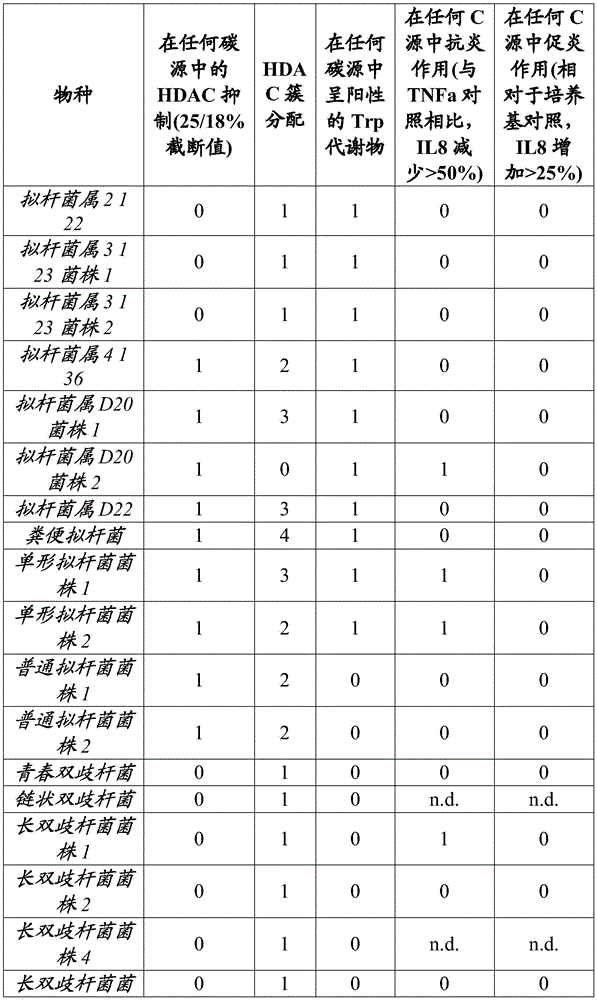


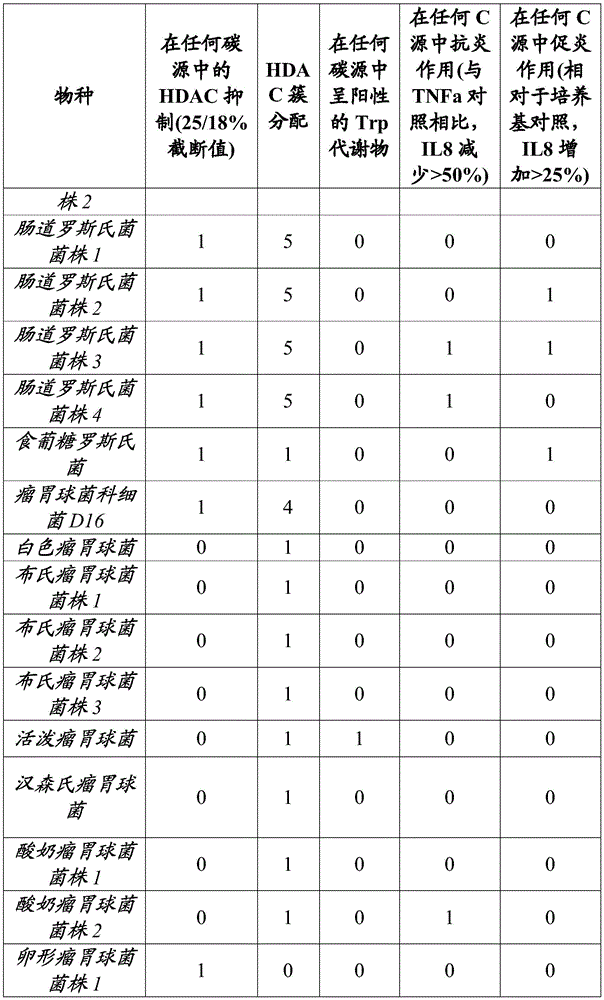

表5.移植总结Table 5. Transplantation Summary

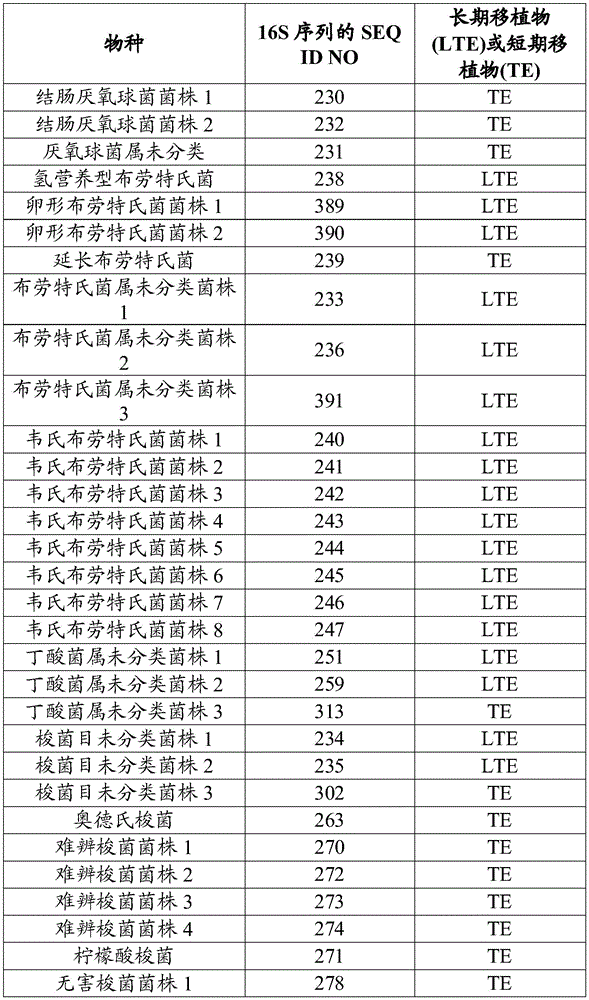


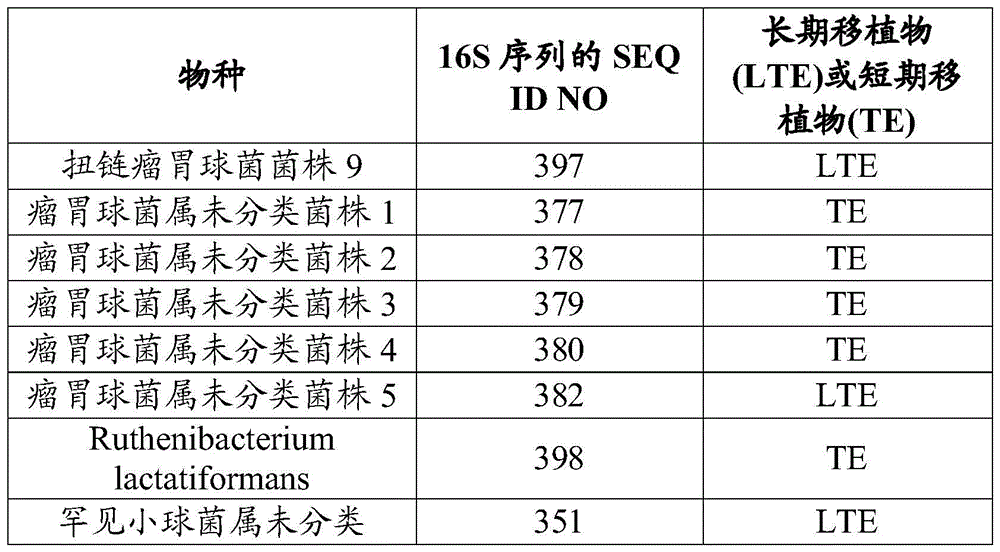
表6.设计的细菌组合物(DE1和DE3-DE12)性质Table 6. Designed bacterial composition (DE1 and DE3-DE12) properties


表7.设计的细菌组合物(DE13-DE19和DE21-DE23)性质Table 7. Designed bacterial composition (DE13-DE19 and DE21-DE23) properties


表8.设计的细菌组合物(DE20、DE24-DE30、DE32和DE33)性质Table 8. Designed bacterial composition (DE20, DE24-DE30, DE32 and DE33) properties
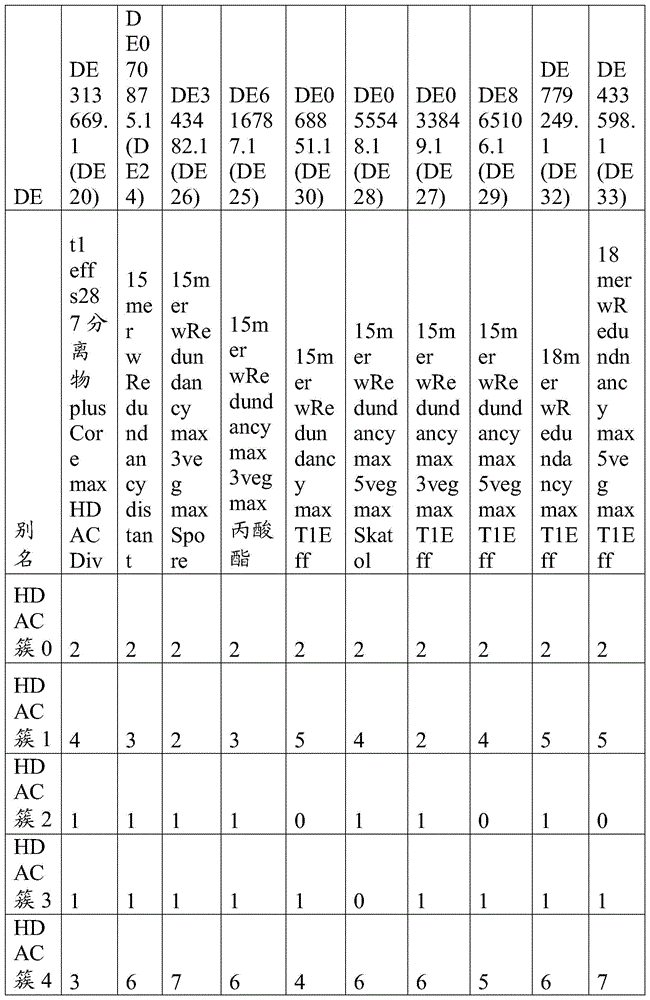
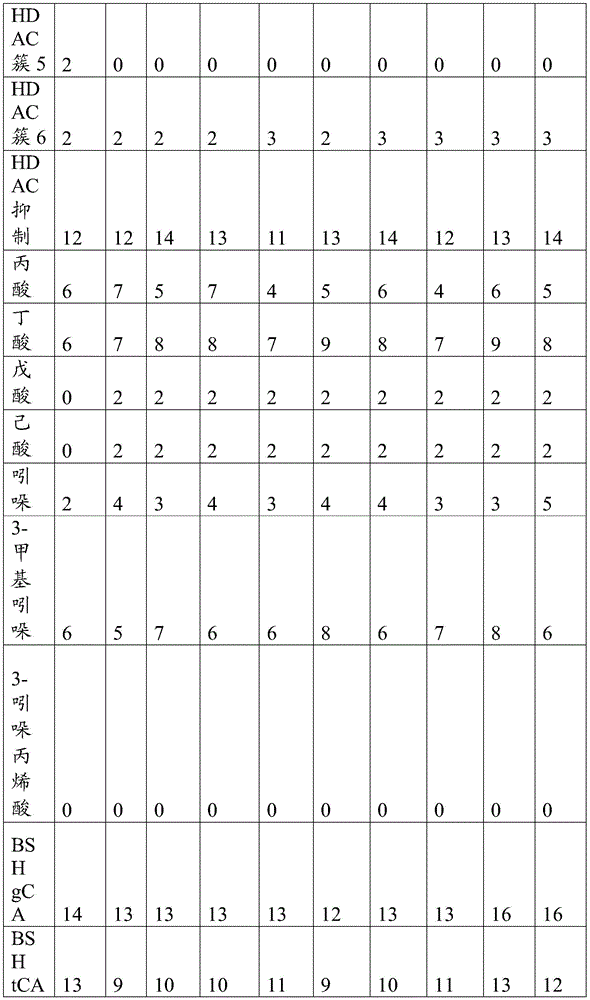

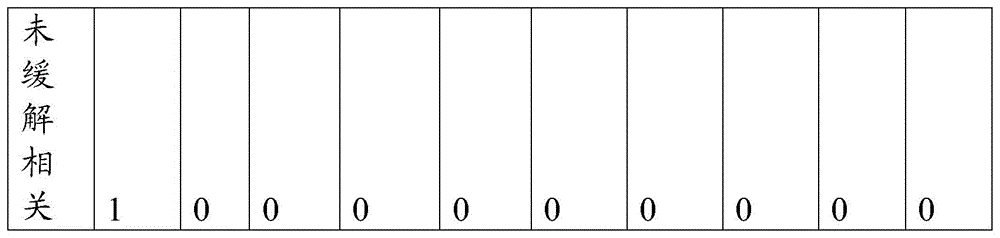
表9.设计的细菌组成(DE2、DE9、DE31和DE34-DE38)性质Table 9. Engineered bacterial composition (DE2, DE9, DE31 and DE34-DE38) properties


Claims (107)
Applications Claiming Priority (3)
| Application Number | Priority Date | Filing Date | Title |
|---|---|---|---|
| US201962941534P | 2019-11-27 | 2019-11-27 | |
| US62/941,534 | 2019-11-27 | ||
| PCT/US2020/062440 WO2021108728A1 (en) | 2019-11-27 | 2020-11-25 | Designed bacterial compositions and uses thereof |
Publications (1)
| Publication Number | Publication Date |
|---|---|
| CN115175575A true CN115175575A (en) | 2022-10-11 |
Family
ID=76130424
Family Applications (1)
| Application Number | Title | Priority Date | Filing Date |
|---|---|---|---|
| CN202080094490.XA Pending CN115175575A (en) | 2019-11-27 | 2020-11-25 | Engineered bacterial compositions and uses thereof |
Country Status (10)
| Country | Link |
|---|---|
| US (1) | US20230125810A1 (en) |
| EP (1) | EP4064862A4 (en) |
| JP (1) | JP2023505098A (en) |
| KR (1) | KR20220120573A (en) |
| CN (1) | CN115175575A (en) |
| AU (1) | AU2020394211A1 (en) |
| BR (1) | BR112022010411A2 (en) |
| CA (1) | CA3159711A1 (en) |
| MX (1) | MX2022006407A (en) |
| WO (1) | WO2021108728A1 (en) |
Families Citing this family (7)
| Publication number | Priority date | Publication date | Assignee | Title |
|---|---|---|---|---|
| RU2020117775A (en) | 2017-10-30 | 2021-12-01 | Серес Терапеутикс, Инк. | COMPOSITIONS AND METHODS FOR TREATMENT OF ANTIBIOTIC RESISTANCE |
| EP4102984A4 (en) * | 2020-02-10 | 2024-06-26 | Native Microbials, Inc. | MICROBIAL COMPOSITIONS AND METHODS FOR USE IN ENTEROPATHY AND DYSBIOSIS IN DOGS |
| EP4370654A4 (en) * | 2021-07-10 | 2025-09-03 | Microba Ip Pty Ltd | COMPOSITIONS AND METHODS FOR TREATING DISEASES II |
| EP4469607A4 (en) * | 2022-01-24 | 2026-01-07 | Gusto Global Llc | SINGLE-LOCI AND MULTI-LOCI DIRECTED SINGLE-POINT AMPLICONE FRAGMENT SEQUALIZATION |
| WO2024130119A2 (en) * | 2022-12-16 | 2024-06-20 | Prolacta Bioscience, Inc. | Synbiotic compositions for short chain fatty acid production |
| GB2627012A (en) * | 2023-02-13 | 2024-08-14 | Acad Medisch Ct | Predictive biomarker of neonatal E.coli mediated sepsis |
| WO2025075714A1 (en) * | 2023-10-04 | 2025-04-10 | Rowan University | Point-of-care test diagnostic markers and adjuvant treatments for gastrointestinal diseases |
Citations (7)
| Publication number | Priority date | Publication date | Assignee | Title |
|---|---|---|---|---|
| US20060067924A1 (en) * | 2003-05-14 | 2006-03-30 | Lee Margie D | Probiotic bacteria and methods |
| WO2017091783A2 (en) * | 2015-11-24 | 2017-06-01 | Seres Therapeutics, Inc. | Designed bacterial compositions |
| US20170165302A1 (en) * | 2012-11-23 | 2017-06-15 | Seres Therapeutics, Inc. | Synergistic bacterial compositions and methods of production and use thereof |
| CN108135944A (en) * | 2014-11-25 | 2018-06-08 | 伊夫罗生物科学公司 | Probiotics and prebiotic compositions and its method and purposes for adjusting microorganism group |
| CN109715177A (en) * | 2016-03-14 | 2019-05-03 | 赫罗微生物群公司 | Alimentary canal microorganism group is adjusted to treat mental disease or central nervous system disease |
| US20190134107A1 (en) * | 2017-11-09 | 2019-05-09 | Vedanta Biosciences, Inc. | Compositions and methods for the treatment of allergy |
| US20190192581A1 (en) * | 2013-02-04 | 2019-06-27 | Seres Therapeutics, Inc. | Methods of Populating a Gastrointestinal Tract |
Family Cites Families (5)
| Publication number | Priority date | Publication date | Assignee | Title |
|---|---|---|---|---|
| WO2018112371A1 (en) * | 2016-12-16 | 2018-06-21 | Vedanta Biosciences, Inc. | Methods and compositions for determining bacterial integrity |
| KR102564766B1 (en) * | 2016-12-23 | 2023-08-08 | 각고호우징 게이오기주크 | Compositions and methods for induction of CD8+ T-cells |
| BR112020023933A2 (en) * | 2018-05-24 | 2021-04-27 | Seres Therapeutics, Inc. | designed bacterial compositions and uses of these |
| WO2020118054A1 (en) * | 2018-12-05 | 2020-06-11 | Seres Therapeutics, Inc. | Compositions for stabilizing bacteria and uses thereof |
| JP2022549133A (en) * | 2019-09-16 | 2022-11-24 | ヴェダンタ バイオサイエンシーズ インコーポレーテッド | Methods and compositions for preserving bacteria |
-
2020
- 2020-11-25 BR BR112022010411A patent/BR112022010411A2/en not_active Application Discontinuation
- 2020-11-25 CA CA3159711A patent/CA3159711A1/en active Pending
- 2020-11-25 MX MX2022006407A patent/MX2022006407A/en unknown
- 2020-11-25 JP JP2022531587A patent/JP2023505098A/en active Pending
- 2020-11-25 AU AU2020394211A patent/AU2020394211A1/en active Pending
- 2020-11-25 US US17/780,831 patent/US20230125810A1/en not_active Abandoned
- 2020-11-25 CN CN202080094490.XA patent/CN115175575A/en active Pending
- 2020-11-25 KR KR1020227021246A patent/KR20220120573A/en not_active Withdrawn
- 2020-11-25 WO PCT/US2020/062440 patent/WO2021108728A1/en not_active Ceased
- 2020-11-25 EP EP20894012.2A patent/EP4064862A4/en not_active Withdrawn
Patent Citations (9)
| Publication number | Priority date | Publication date | Assignee | Title |
|---|---|---|---|---|
| US20060067924A1 (en) * | 2003-05-14 | 2006-03-30 | Lee Margie D | Probiotic bacteria and methods |
| US20170165302A1 (en) * | 2012-11-23 | 2017-06-15 | Seres Therapeutics, Inc. | Synergistic bacterial compositions and methods of production and use thereof |
| US20190350988A1 (en) * | 2012-11-23 | 2019-11-21 | Seres Therapeutics, Inc. | Synergistic Bacterial Compositions and Methods of Production and Use Thereof |
| US20190192581A1 (en) * | 2013-02-04 | 2019-06-27 | Seres Therapeutics, Inc. | Methods of Populating a Gastrointestinal Tract |
| CN108135944A (en) * | 2014-11-25 | 2018-06-08 | 伊夫罗生物科学公司 | Probiotics and prebiotic compositions and its method and purposes for adjusting microorganism group |
| WO2017091783A2 (en) * | 2015-11-24 | 2017-06-01 | Seres Therapeutics, Inc. | Designed bacterial compositions |
| CN109661236A (en) * | 2015-11-24 | 2019-04-19 | 赛里斯治疗公司 | The bacteria composition of design |
| CN109715177A (en) * | 2016-03-14 | 2019-05-03 | 赫罗微生物群公司 | Alimentary canal microorganism group is adjusted to treat mental disease or central nervous system disease |
| US20190134107A1 (en) * | 2017-11-09 | 2019-05-09 | Vedanta Biosciences, Inc. | Compositions and methods for the treatment of allergy |
Also Published As
| Publication number | Publication date |
|---|---|
| BR112022010411A2 (en) | 2022-08-23 |
| KR20220120573A (en) | 2022-08-30 |
| WO2021108728A1 (en) | 2021-06-03 |
| AU2020394211A1 (en) | 2022-07-14 |
| EP4064862A1 (en) | 2022-10-05 |
| MX2022006407A (en) | 2022-08-25 |
| US20230125810A1 (en) | 2023-04-27 |
| EP4064862A4 (en) | 2024-07-10 |
| CA3159711A1 (en) | 2021-06-03 |
| JP2023505098A (en) | 2023-02-08 |
Similar Documents
| Publication | Publication Date | Title |
|---|---|---|
| US20250367242A1 (en) | Designed bacterial compositions and uses thereof | |
| CN115175575A (en) | Engineered bacterial compositions and uses thereof | |
| JP7503335B2 (en) | Compositions and methods for the induction of CD8+ T cells | |
| US20220323511A1 (en) | Probiotic and prebiotic compositions, and methods of use thereof for modulation of the microbiome | |
| US20240000859A1 (en) | Designed bacterial compositions for treating graft-versus-host-disease | |
| CN112118852A (en) | Compositions and methods for treating inflammatory bowel disease | |
| RU2846926C2 (en) | Developed bacterial compositions and use thereof | |
| US20240066072A1 (en) | Clostrodioides difficile treatment |
Legal Events
| Date | Code | Title | Description |
|---|---|---|---|
| PB01 | Publication | ||
| PB01 | Publication | ||
| SE01 | Entry into force of request for substantive examination | ||
| SE01 | Entry into force of request for substantive examination | ||
| WD01 | Invention patent application deemed withdrawn after publication | ||
| WD01 | Invention patent application deemed withdrawn after publication |
Application publication date: 20221011 |