CN1151744A - Phosphonic acid compound and its preparation and application - Google Patents
Phosphonic acid compound and its preparation and application Download PDFInfo
- Publication number
- CN1151744A CN1151744A CN95193981A CN95193981A CN1151744A CN 1151744 A CN1151744 A CN 1151744A CN 95193981 A CN95193981 A CN 95193981A CN 95193981 A CN95193981 A CN 95193981A CN 1151744 A CN1151744 A CN 1151744A
- Authority
- CN
- China
- Prior art keywords
- group
- compound
- formula
- ring
- substituted
- Prior art date
- Legal status (The legal status is an assumption and is not a legal conclusion. Google has not performed a legal analysis and makes no representation as to the accuracy of the status listed.)
- Pending
Links
Classifications
-
- C—CHEMISTRY; METALLURGY
- C07—ORGANIC CHEMISTRY
- C07F—ACYCLIC, CARBOCYCLIC OR HETEROCYCLIC COMPOUNDS CONTAINING ELEMENTS OTHER THAN CARBON, HYDROGEN, HALOGEN, OXYGEN, NITROGEN, SULFUR, SELENIUM OR TELLURIUM
- C07F9/00—Compounds containing elements of Groups 5 or 15 of the Periodic Table
- C07F9/02—Phosphorus compounds
- C07F9/547—Heterocyclic compounds, e.g. containing phosphorus as a ring hetero atom
- C07F9/6564—Heterocyclic compounds, e.g. containing phosphorus as a ring hetero atom having phosphorus atoms, with or without nitrogen, oxygen, sulfur, selenium or tellurium atoms, as ring hetero atoms
- C07F9/6571—Heterocyclic compounds, e.g. containing phosphorus as a ring hetero atom having phosphorus atoms, with or without nitrogen, oxygen, sulfur, selenium or tellurium atoms, as ring hetero atoms having phosphorus and oxygen atoms as the only ring hetero atoms
- C07F9/657163—Heterocyclic compounds, e.g. containing phosphorus as a ring hetero atom having phosphorus atoms, with or without nitrogen, oxygen, sulfur, selenium or tellurium atoms, as ring hetero atoms having phosphorus and oxygen atoms as the only ring hetero atoms the ring phosphorus atom being bound to at least one carbon atom
- C07F9/657181—Heterocyclic compounds, e.g. containing phosphorus as a ring hetero atom having phosphorus atoms, with or without nitrogen, oxygen, sulfur, selenium or tellurium atoms, as ring hetero atoms having phosphorus and oxygen atoms as the only ring hetero atoms the ring phosphorus atom being bound to at least one carbon atom the ring phosphorus atom and, at least, one ring oxygen atom being part of a (thio)phosphonic acid derivative
-
- C—CHEMISTRY; METALLURGY
- C07—ORGANIC CHEMISTRY
- C07F—ACYCLIC, CARBOCYCLIC OR HETEROCYCLIC COMPOUNDS CONTAINING ELEMENTS OTHER THAN CARBON, HYDROGEN, HALOGEN, OXYGEN, NITROGEN, SULFUR, SELENIUM OR TELLURIUM
- C07F9/00—Compounds containing elements of Groups 5 or 15 of the Periodic Table
- C07F9/02—Phosphorus compounds
- C07F9/28—Phosphorus compounds with one or more P—C bonds
- C07F9/38—Phosphonic acids [RP(=O)(OH)2]; Thiophosphonic acids ; [RP(=X1)(X2H)2(X1, X2 are each independently O, S or Se)]
- C07F9/3804—Phosphonic acids [RP(=O)(OH)2]; Thiophosphonic acids ; [RP(=X1)(X2H)2(X1, X2 are each independently O, S or Se)] not used, see subgroups
- C07F9/3882—Arylalkanephosphonic acids
-
- C—CHEMISTRY; METALLURGY
- C07—ORGANIC CHEMISTRY
- C07F—ACYCLIC, CARBOCYCLIC OR HETEROCYCLIC COMPOUNDS CONTAINING ELEMENTS OTHER THAN CARBON, HYDROGEN, HALOGEN, OXYGEN, NITROGEN, SULFUR, SELENIUM OR TELLURIUM
- C07F9/00—Compounds containing elements of Groups 5 or 15 of the Periodic Table
- C07F9/02—Phosphorus compounds
- C07F9/28—Phosphorus compounds with one or more P—C bonds
- C07F9/38—Phosphonic acids [RP(=O)(OH)2]; Thiophosphonic acids ; [RP(=X1)(X2H)2(X1, X2 are each independently O, S or Se)]
- C07F9/40—Esters thereof
- C07F9/4003—Esters thereof the acid moiety containing a substituent or a structure which is considered as characteristic
- C07F9/4056—Esters of arylalkanephosphonic acids
-
- C—CHEMISTRY; METALLURGY
- C07—ORGANIC CHEMISTRY
- C07F—ACYCLIC, CARBOCYCLIC OR HETEROCYCLIC COMPOUNDS CONTAINING ELEMENTS OTHER THAN CARBON, HYDROGEN, HALOGEN, OXYGEN, NITROGEN, SULFUR, SELENIUM OR TELLURIUM
- C07F9/00—Compounds containing elements of Groups 5 or 15 of the Periodic Table
- C07F9/02—Phosphorus compounds
- C07F9/547—Heterocyclic compounds, e.g. containing phosphorus as a ring hetero atom
- C07F9/553—Heterocyclic compounds, e.g. containing phosphorus as a ring hetero atom having one nitrogen atom as the only ring hetero atom
- C07F9/576—Six-membered rings
- C07F9/60—Quinoline or hydrogenated quinoline ring systems
-
- C—CHEMISTRY; METALLURGY
- C07—ORGANIC CHEMISTRY
- C07F—ACYCLIC, CARBOCYCLIC OR HETEROCYCLIC COMPOUNDS CONTAINING ELEMENTS OTHER THAN CARBON, HYDROGEN, HALOGEN, OXYGEN, NITROGEN, SULFUR, SELENIUM OR TELLURIUM
- C07F9/00—Compounds containing elements of Groups 5 or 15 of the Periodic Table
- C07F9/02—Phosphorus compounds
- C07F9/547—Heterocyclic compounds, e.g. containing phosphorus as a ring hetero atom
- C07F9/655—Heterocyclic compounds, e.g. containing phosphorus as a ring hetero atom having oxygen atoms, with or without sulfur, selenium, or tellurium atoms, as the only ring hetero atoms
- C07F9/65515—Heterocyclic compounds, e.g. containing phosphorus as a ring hetero atom having oxygen atoms, with or without sulfur, selenium, or tellurium atoms, as the only ring hetero atoms the oxygen atom being part of a five-membered ring
- C07F9/65517—Heterocyclic compounds, e.g. containing phosphorus as a ring hetero atom having oxygen atoms, with or without sulfur, selenium, or tellurium atoms, as the only ring hetero atoms the oxygen atom being part of a five-membered ring condensed with carbocyclic rings or carbocyclic ring systems
-
- C—CHEMISTRY; METALLURGY
- C07—ORGANIC CHEMISTRY
- C07F—ACYCLIC, CARBOCYCLIC OR HETEROCYCLIC COMPOUNDS CONTAINING ELEMENTS OTHER THAN CARBON, HYDROGEN, HALOGEN, OXYGEN, NITROGEN, SULFUR, SELENIUM OR TELLURIUM
- C07F9/00—Compounds containing elements of Groups 5 or 15 of the Periodic Table
- C07F9/02—Phosphorus compounds
- C07F9/547—Heterocyclic compounds, e.g. containing phosphorus as a ring hetero atom
- C07F9/655—Heterocyclic compounds, e.g. containing phosphorus as a ring hetero atom having oxygen atoms, with or without sulfur, selenium, or tellurium atoms, as the only ring hetero atoms
- C07F9/6552—Heterocyclic compounds, e.g. containing phosphorus as a ring hetero atom having oxygen atoms, with or without sulfur, selenium, or tellurium atoms, as the only ring hetero atoms the oxygen atom being part of a six-membered ring
- C07F9/65522—Heterocyclic compounds, e.g. containing phosphorus as a ring hetero atom having oxygen atoms, with or without sulfur, selenium, or tellurium atoms, as the only ring hetero atoms the oxygen atom being part of a six-membered ring condensed with carbocyclic rings or carbocyclic ring systems
-
- C—CHEMISTRY; METALLURGY
- C07—ORGANIC CHEMISTRY
- C07F—ACYCLIC, CARBOCYCLIC OR HETEROCYCLIC COMPOUNDS CONTAINING ELEMENTS OTHER THAN CARBON, HYDROGEN, HALOGEN, OXYGEN, NITROGEN, SULFUR, SELENIUM OR TELLURIUM
- C07F9/00—Compounds containing elements of Groups 5 or 15 of the Periodic Table
- C07F9/02—Phosphorus compounds
- C07F9/547—Heterocyclic compounds, e.g. containing phosphorus as a ring hetero atom
- C07F9/6553—Heterocyclic compounds, e.g. containing phosphorus as a ring hetero atom having sulfur atoms, with or without selenium or tellurium atoms, as the only ring hetero atoms
- C07F9/655345—Heterocyclic compounds, e.g. containing phosphorus as a ring hetero atom having sulfur atoms, with or without selenium or tellurium atoms, as the only ring hetero atoms the sulfur atom being part of a five-membered ring
-
- C—CHEMISTRY; METALLURGY
- C07—ORGANIC CHEMISTRY
- C07F—ACYCLIC, CARBOCYCLIC OR HETEROCYCLIC COMPOUNDS CONTAINING ELEMENTS OTHER THAN CARBON, HYDROGEN, HALOGEN, OXYGEN, NITROGEN, SULFUR, SELENIUM OR TELLURIUM
- C07F9/00—Compounds containing elements of Groups 5 or 15 of the Periodic Table
- C07F9/02—Phosphorus compounds
- C07F9/547—Heterocyclic compounds, e.g. containing phosphorus as a ring hetero atom
- C07F9/6553—Heterocyclic compounds, e.g. containing phosphorus as a ring hetero atom having sulfur atoms, with or without selenium or tellurium atoms, as the only ring hetero atoms
- C07F9/655381—Heterocyclic compounds, e.g. containing phosphorus as a ring hetero atom having sulfur atoms, with or without selenium or tellurium atoms, as the only ring hetero atoms the sulfur atom being part of a seven-(or more) membered ring
- C07F9/65539—Heterocyclic compounds, e.g. containing phosphorus as a ring hetero atom having sulfur atoms, with or without selenium or tellurium atoms, as the only ring hetero atoms the sulfur atom being part of a seven-(or more) membered ring condensed with carbocyclic rings or carbocyclic ring systems
-
- C—CHEMISTRY; METALLURGY
- C07—ORGANIC CHEMISTRY
- C07F—ACYCLIC, CARBOCYCLIC OR HETEROCYCLIC COMPOUNDS CONTAINING ELEMENTS OTHER THAN CARBON, HYDROGEN, HALOGEN, OXYGEN, NITROGEN, SULFUR, SELENIUM OR TELLURIUM
- C07F9/00—Compounds containing elements of Groups 5 or 15 of the Periodic Table
- C07F9/02—Phosphorus compounds
- C07F9/547—Heterocyclic compounds, e.g. containing phosphorus as a ring hetero atom
- C07F9/6561—Heterocyclic compounds, e.g. containing phosphorus as a ring hetero atom containing systems of two or more relevant hetero rings condensed among themselves or condensed with a common carbocyclic ring or ring system, with or without other non-condensed hetero rings
Landscapes
- Chemical & Material Sciences (AREA)
- Organic Chemistry (AREA)
- Health & Medical Sciences (AREA)
- Life Sciences & Earth Sciences (AREA)
- Biochemistry (AREA)
- General Health & Medical Sciences (AREA)
- Molecular Biology (AREA)
- Pharmaceuticals Containing Other Organic And Inorganic Compounds (AREA)
Abstract
Description
发明领域field of invention
本发明涉及促进骨生成(骨形成)的膦酸衍生物或其盐及它们的制备方法和应用。The present invention relates to phosphonic acid derivatives or salts thereof for promoting osteogenesis (bone formation), their preparation methods and applications.
发明背景Background of the invention
骨质疏松是一种与某些由于骨量减少到一定程度而导致的症状或危险有关的病理状态或疾病。其主要症状有脊柱后突及胸椎(背腰骨)、腰椎、股骨颈、桡骨远端、肋骨、肱骨近端和其它骨骨折。在正常骨组织中,骨的破坏也经常发生,但骨生成和骨吸收之间存在良好的平衡;在骨生成和骨吸收中成骨细胞和破骨细胞分别起着重要作用。这种平衡一旦破坏,骨吸收超过骨生成,导致与骨量减少有关的骨质疏松发作。通常使用骨吸收抑制剂如雌激素、降钙素和二膦酸盐预防和治疗骨质疏松。但在某些情况下,这些骨吸收抑制剂还不能达到令人满意的效果,这是由于患者的局限性或其不确定的疗效所致。因此需要一种可有效增加曾一度减少的骨量的新的骨生成促进剂,用作骨质疏松预防/治疗药物。Osteoporosis is a pathological state or disease associated with certain symptoms or risks resulting from a reduction in bone mass to a certain extent. The main symptoms are kyphosis and thoracic (back lumbar), lumbar, femoral neck, distal radius, ribs, proximal humerus and other bone fractures. In normal bone tissue, bone destruction also occurs frequently, but there is a good balance between osteogenesis and bone resorption; osteoblasts and osteoclasts play an important role in bone formation and bone resorption, respectively. Once this balance is disturbed, bone resorption exceeds bone production, resulting in the onset of osteoporosis associated with osteopenia. Bone resorption inhibitors such as estrogens, calcitonin, and bisphosphonates are commonly used to prevent and treat osteoporosis. However, in some cases, these bone resorption inhibitors have not been able to achieve satisfactory results due to patient limitations or their uncertain efficacy. Therefore, there is a need for a new osteogenesis-promoting agent that can effectively increase once-decreased bone mass for use as an osteoporosis preventive/therapeutic drug.
欧洲专利申请EP-524023-A1记载了一种式:的骨生成促进剂。日本专利未审公开第232880/1991和364179/1992号公开了用作骨质疏松治疗药物的3,4-二氢-2-苯并噻喃-1-甲酰胺衍生物和1,2,4,5,-四氢-3-苯并硫杂环庚三烯(benzothiepin)-2-甲酰胺衍生物。European Patent Application EP-524023-A1 describes a formula: osteogenesis enhancer. Japanese Patent Unexamined Publication Nos. 232880/1991 and 364179/1992 disclose 3,4-dihydro-2-benzothiopyran-1-carboxamide derivatives and 1,2,4 ,5'-tetrahydro-3-benzothiepin (benzothiepin)-2-carboxamide derivatives.
日本专利未审公开第230570/1989和232864/1991号公开了3,4-二氢萘-2-甲酰胺衍生物和2,3-二氢-1-苯并氧杂环庚三烯(benzoxepin)-4-甲酰胺衍生物。然而,含有取代的苯基的膦酸N-取代物是未知的。Japanese Patent Unexamined Publication No. 230570/1989 and No. 232864/1991 disclose 3,4-dihydronaphthalene-2-carboxamide derivatives and 2,3-dihydro-1-benzoxepin (benzoxepin )-4-carboxamide derivatives. However, phosphonic acid N-substituents containing substituted phenyl groups are unknown.
发明描述Description of the invention
本发明试图开发一种更广泛适用的能直接作用于骨促进骨的生成的药物,发现下式(I)代表的膦酸衍生物可激活成骨细胞功能促进钙化,成骨细胞的功能与骨生成促进作用有直接关系。本发明者基于这一发现进行了进一步研究,从而完成了本发明。骨生成促进作用有直接关系。本发明者基于这一发现进行了进一步研究,从而完成了本发明。The present invention attempts to develop a more widely applicable drug that can directly act on bone to promote bone formation, and finds that the phosphonic acid derivatives represented by the following formula (I) can activate the function of osteoblasts to promote calcification, and the function of osteoblasts is related to that of bone. There is a direct relationship between generation facilitation. The present inventors conducted further studies based on this finding, and thus completed the present invention. It is directly related to the promotion of osteogenesis. The present inventors conducted further studies based on this finding, and thus completed the present invention.
因此,本发明涉及:Therefore, the present invention relates to:
(1)式(I)的化合物或其盐:
(2)第(1)款的化合物,其中X是二价烃基并且Y是组成5-7元B环的二价基团,(2) The compound of paragraph (1), wherein X is a divalent hydrocarbon group and Y is a divalent group constituting a 5-7 membered B ring,
(3)第(1)款的化合物,其中Q1是式:基团,其中E′是二价芳香烃基;W′是一个键或亚烷基;R1和R2可以相同或不同,它们是氢或低级烷基,或者可结合在一起形成环,(3) The compound of paragraph (1), wherein Q 1 is the formula: A group, wherein E' is a divalent aromatic hydrocarbon group; W' is a bond or an alkylene group; R1 and R2 can be the same or different, they are hydrogen or lower alkyl, or can be combined to form a ring,
(4)第(3)款的化合物,其中二价芳香烃基是二价单环芳香烃基,(4) The compound of paragraph (3), wherein the divalent aromatic hydrocarbon group is a divalent monocyclic aromatic hydrocarbon group,
(5)第(4)款的化合物,其中二价芳香单环烃基是亚苯基,(5) The compound of paragraph (4), wherein the divalent aromatic monocyclic hydrocarbon group is phenylene,
(6)第(1)款的化合物,其中R1和R2都是链状低级烷基,(6) The compound of paragraph (1), wherein R 1 and R 2 are both chain lower alkyl groups,
(7)第(6)款的化合物,其中低级烷基具有1至6个碳原子,(7) The compound of paragraph (6), wherein the lower alkyl group has 1 to 6 carbon atoms,
(8)第(1)款的化合物,其中R1和R2都是乙基,(8) The compound of paragraph (1), wherein R 1 and R 2 are both ethyl groups,
(9)第(1)款的化合物,其中R1和R2都是甲基,(9) The compound of paragraph (1), wherein R 1 and R 2 are both methyl groups,
(10)第(1)款的化合物,其中R1和R2结合在一起形成-Z-,其中Z表示可至少具有一个侧链的链长是2-4个原子的碳链,(10) The compound of paragraph (1), wherein R 1 and R 2 are combined to form -Z-, wherein Z represents a carbon chain with a chain length of 2-4 atoms that may have at least one side chain,
(11)第(10)款的化合物,其中Z是-(CH2)3-,(11) The compound of paragraph (10), wherein Z is -(CH 2 ) 3 -,
(12)第(1)款的化合物,其中Q2是氢或低级烷基,(12) The compound of paragraph (1), wherein Q 2 is hydrogen or lower alkyl,
(13)第(1)款的化合物,其中Y是亚烷基链,(13) The compound of paragraph (1), wherein Y is an alkylene chain,
(14)第(13)款的化合物,其中亚烷基链是-(CH2)2-,(14) The compound of paragraph (13), wherein the alkylene chain is -(CH 2 ) 2 -,
(15)第(1)款的化合物,其中式-CON(Q1)(Q2)基团与a位碳原子相连,(15) The compound of paragraph (1), wherein the group of formula -CON(Q 1 )(Q 2 ) is connected to the carbon atom at position a,
(16)第(1)款的化合物,其中A环被烷基或芳香烃基取代,(16) The compound of paragraph (1), wherein ring A is substituted by an alkyl group or an aromatic hydrocarbon group,
(17)第(1)款的化合物,它是式(I′):的化合物或其盐,其中W′是一个键或亚烷基,并且其它符号如第(1)款中所定义,(17) The compound of paragraph (1), which is formula (I'): or a salt thereof, wherein W' is a bond or an alkylene group, and the other symbols are as defined in paragraph (1),
(18)第(1)款的化合物,它是7-环己基-N-(4-二乙氧磷酰甲基苯基)-3,4-二氢萘-2-甲酰胺,(18) The compound of paragraph (1), which is 7-cyclohexyl-N-(4-diethoxyphosphorylmethylphenyl)-3,4-dihydronaphthalene-2-carboxamide,
(19)第(1)款的化合物,它是7-苯基-N-(4-二乙氧磷酰甲基苯基)-3,4-二氢萘-2-甲酰胺,(19) The compound of paragraph (1), which is 7-phenyl-N-(4-diethoxyphosphorylmethylphenyl)-3,4-dihydronaphthalene-2-carboxamide,
(20)第(1)款的化合物,它是7-苯基-N-(4-二甲氧磷酰甲基苯基)-3,4-二氢萘-2-甲酰胺,(20) The compound of paragraph (1), which is 7-phenyl-N-(4-dimethoxyphosphorylmethylphenyl)-3,4-dihydronaphthalene-2-carboxamide,
(21)一种制备下式(I)化合物或其盐的方法:



(22)一种药用组合物,包含治疗有效量的第(1)款化合物与药学上可接受的载体、赋形剂或稀释剂的混合物,(22) A pharmaceutical composition comprising a therapeutically effective amount of a compound of (1) in admixture with a pharmaceutically acceptable carrier, excipient or diluent,
(23)一种促进骨生成的药用组合物,包含治疗有效量的第(1)款化合物与药学上可接受的载体、赋形剂或稀释剂的混合物,(23) A pharmaceutical composition for promoting bone formation, comprising a mixture of a therapeutically effective amount of the compound of paragraph (1) and a pharmaceutically acceptable carrier, excipient or diluent,
(24)一种促进骨折愈合的药用组合物,包含治疗有效量的第(1)款化合物与药学上可接受的载体、赋形剂或稀释剂的混合物,(24) A pharmaceutical composition for promoting fracture healing, comprising a mixture of a therapeutically effective amount of the compound of paragraph (1) and a pharmaceutically acceptable carrier, excipient or diluent,
(25)一种预防或治疗哺乳动物骨质疏松的方法,包括给所述哺乳动物施用治疗有效量的第(1)款化合物,及(25) A method for preventing or treating osteoporosis in mammals, comprising administering a therapeutically effective amount of the compound of paragraph (1) to said mammals, and
(26)第(1)款化合物用于制备作为骨生成促进剂的药物的应用。(26) Use of the compound of paragraph (1) for the preparation of a medicament as an osteogenesis-promoting agent.
对于通式(I)[下文包括(I′)]和(II),A环可具有一个或多个取代基。这些取代基的实例包括卤原子、硝基、可被取代的烷基、可被取代的羟基、可被取代的硫羟基、可被取代的氨基、可被取代的酰基、可被酯化的羧基和可被取代的芳环基团。For the general formulas (I) [including (I') below] and (II), the A ring may have one or more substituents. Examples of such substituents include halogen atoms, nitro groups, alkyl groups which may be substituted, hydroxyl groups which may be substituted, thiol groups which may be substituted, amino groups which may be substituted, acyl groups which may be substituted, carboxyl groups which may be esterified and aromatic ring groups that may be substituted.
作为A环取代基的卤素可例举氟、氯、溴和碘,优选氟和氯。Halogen as the ring A substituent includes fluorine, chlorine, bromine and iodine, preferably fluorine and chlorine.
作为A环取代基的可被取代的烷基可例举1-10个碳原子的烷基,无论是直链、支链或环状的。直链或支链烷基包括C1-10烷基,如甲基、乙基、丙基、异丙基、丁基、异丁基、仲丁基、叔丁基、戊基、异戊基、新戊基、己基、庚基、辛基、壬基和癸基,优选的是低级(C1-6)烷基。环状烷基包括C3-7环烷基,如环丙基、环丁基、环戊基、环己基和环庚基。所述可被取代的烷基的取代基包括卤素(如氟、氯、碘)、硝基、羟基、硫羟基、氨基和羧基。The alkyl group which may be substituted as the ring A substituent is exemplified by an alkyl group having 1 to 10 carbon atoms, no matter it is linear, branched or cyclic. Straight chain or branched chain alkyl includes C 1-10 alkyl, such as methyl, ethyl, propyl, isopropyl, butyl, isobutyl, sec-butyl, tert-butyl, pentyl, isopentyl , neopentyl, hexyl, heptyl, octyl, nonyl and decyl, preferably lower (C 1-6 )alkyl. Cyclic alkyl groups include C 3-7 cycloalkyl groups such as cyclopropyl, cyclobutyl, cyclopentyl, cyclohexyl and cycloheptyl. The substituents of the optionally substituted alkyl include halogen (such as fluorine, chlorine, iodine), nitro, hydroxyl, thiol, amino and carboxyl.
作为A环取代基的可被取代的羟基,可例举羟基和具有适宜的取代基的羟基,尤其是具有羟基保护基的羟基,如烷氧基、链烯氧基、芳烷氧基和酰氧基及芳氧基。所述烷氧基优选具有1-10个碳原子的烷氧基(如甲氧基、乙氧基、丙氧基、异丙氧基、丁氧基、异丁氧基、仲丁氧基、叔丁氧基、戊氧基、异戊氧基、新戊氧基、己氧基、庚氧基、壬氧基、环丁氧基、环戊氧基、环己氧基),更优选1-6个碳原子的烷氧基。所述链烯氧基可例举具有2-10个碳原子的链烯氧基,如烯丙氧基、2-丁烯氧基、2-戊烯氧基、3-己烯氧基、2-环戊烯基甲氧基和2-环己烯基甲氧基。所述芳烷氧基可例举苯基-C1-4烷氧基(如苄氧基、苯乙基氧)。所述酰氧基可例举2-4个碳原子的链烷酰氧基(如乙酰氧基、丙酰氧基、丁酰氧基、异丁酰氧基)。所述芳氧基可例举苯氧基和4-氯苯氧基。Hydroxy groups which may be substituted as ring A substituents are exemplified by hydroxyl groups and hydroxyl groups with suitable substituents, especially hydroxyl groups with hydroxyl protecting groups such as alkoxy, alkenyloxy, aralkoxy and acyloxy groups. Oxygen and aryloxy. The alkoxy group is preferably an alkoxy group having 1 to 10 carbon atoms (such as methoxy, ethoxy, propoxy, isopropoxy, butoxy, isobutoxy, sec-butoxy, tert-butoxy, pentyloxy, isopentyloxy, neopentyloxy, hexyloxy, heptyloxy, nonyloxy, cyclobutoxy, cyclopentyloxy, cyclohexyloxy), more preferably 1 - an alkoxy group of 6 carbon atoms. The alkenyloxy group can be exemplified by alkenyloxy groups having 2-10 carbon atoms, such as allyloxy, 2-butenyloxy, 2-pentenyloxy, 3-hexenyloxy, 2 - cyclopentenylmethoxy and 2-cyclohexenylmethoxy. The aralkoxy group may, for example, be phenyl-C 1-4 alkoxy (such as benzyloxy, phenethyloxy). The acyloxy group may, for example, be an alkanoyloxy group with 2-4 carbon atoms (such as acetyloxy, propionyloxy, butyryloxy, isobutyryloxy). The aryloxy group may, for example, be phenoxy or 4-chlorophenoxy.
作为A环取代基的可被取代的硫羟基可例举硫羟基和带有适宜取代基的硫羟基,尤其是带有硫羟基保护基的硫羟基,如烷硫基、芳烷硫基和酰硫基。所述烷硫基优选具有1-10个碳原子的烷硫基(如甲硫基、乙硫基、丙硫基、异丙硫基、丁硫基、异丁硫基、仲丁硫基、叔丁硫基、戊硫基、异戊硫基、新戊硫基、己硫基、庚硫基、壬硫基、环丁硫基、环戊硫基、环己硫基)所述芳烷硫基可例举苯基-C1-4烷硫基(如苄硫基、苯乙硫基)。所述酰硫基优选具有2-4个碳原子的链烷酰硫基(如乙酰硫基、丙酰硫基、丁酰硫基、异丁酰硫基)。The thiol which may be substituted as ring A substituent is exemplified by thiol and thiol with suitable substituents, especially thiol with thiol protecting groups such as alkylthio, aralkylthio and acylthio Sulfur base. The alkylthio group is preferably an alkylthio group having 1-10 carbon atoms (such as methylthio, ethylthio, propylthio, isopropylthio, butylthio, isobutylthio, sec-butylthio, tert-butylthio, pentylthio, isopentylthio, neopentylthio, hexylthio, heptylthio, nonylthio, cyclobutylthio, cyclopentylthio, cyclohexylthio) said arane The thio group may, for example, be phenyl-C 1-4 alkylthio (such as benzylthio, phenethylthio). The acylthio group is preferably an alkanoylthio group having 2 to 4 carbon atoms (such as acetylthio, propionylthio, butyrylthio, isobutyrylthio).
作为A环取代基的可被取代的氨基包括具有1-10个碳原子的链状或环状烷基,具有2-10个碳原子的链烯基,芳基和酰基;氨基(-NH2)上可存在1或2个此类取代基。这类烷基包括C1-10的烷基,如甲基、乙基、异丙基、丁基、异丁基、仲丁基、叔丁基、戊基、异戊基、新戊基、己基、辛基、壬基和癸基,优选低级(C1-6)烷基,C3-7环烷基,如环丙基、环丁基、环戊基、环己基和环庚基等。此类链烯基包括2-丁烯基、2-戊烯基、3-己烯基、2-环戊烯基甲基和2-环己烯基甲基。此类芳基包括苯基、萘基、蒽基和吡啶基。这类酰基包括甲酰基和那些由1-10个碳原子的烷基、2-10个碳原子的烯基或芳基与羰基结合而得的基团,如乙酰基、丙酰基、丁酰基、异丁酰基、戊酰基、异戊酰基、新戊酰基、己酰基、庚酰基、辛酰基、环丁羰基、环戊羰基、环己羰基、环庚羰基、2-丁烯酰基、2-环己烯羰基、苯甲酰基和烟酰基。The amino group that can be substituted as the A ring substituent includes chain or cyclic alkyl groups with 1-10 carbon atoms, alkenyl groups with 2-10 carbon atoms, aryl groups and acyl groups; amino (-NH 2 ) may be present with 1 or 2 such substituents. Such alkyl groups include C 1-10 alkyl groups such as methyl, ethyl, isopropyl, butyl, isobutyl, sec-butyl, tert-butyl, pentyl, isopentyl, neopentyl, Hexyl, octyl, nonyl and decyl, preferably lower (C 1-6 ) alkyl, C 3-7 cycloalkyl, such as cyclopropyl, cyclobutyl, cyclopentyl, cyclohexyl and cycloheptyl, etc. . Such alkenyl groups include 2-butenyl, 2-pentenyl, 3-hexenyl, 2-cyclopentenylmethyl and 2-cyclohexenylmethyl. Such aryl groups include phenyl, naphthyl, anthracenyl and pyridyl. Such acyl groups include formyl and those groups obtained by combining an alkyl group of 1-10 carbon atoms, an alkenyl group of 2-10 carbon atoms or an aryl group with a carbonyl group, such as acetyl, propionyl, butyryl, Isobutyryl, valeryl, isovaleryl, pivaloyl, hexanoyl, heptanoyl, octanoyl, cyclobutanylcarbonyl, cyclopentylcarbonyl, cyclohexylcarbonyl, cycloheptanoyl, 2-butenoyl, 2-cyclohexyl Alkenyl carbonyl, benzoyl and nicotinoyl.
作为A环取代基的可被取代的酰基可例举甲酰基和由1-10个碳原子的烷基、2-10个碳原子的烯基或芳基与羰基结合而得到的酰基(如乙酰基、丙酰基、丁酰基、异丁酰基、戊酰基、异戊酰基、新戊酰基、己酰基、庚酰基、辛酰基、环丁羰基、环戊羰基、环己羰基、环庚羰基、2-丁烯酰基、2-环己烯羰基、苯甲酰基和烟酰基)。可取代酰基的取代基包括卤素(如氟、氯、溴、碘)、硝基、羟基、硫羟基、氨基和羧基。The acyl group that can be substituted as the A ring substituent can be exemplified by formyl and an acyl group (such as acetyl Base, propionyl, butyryl, isobutyryl, pentanoyl, isovaleryl, pivaloyl, hexanoyl, heptanoyl, octanoyl, cyclobutylcarbonyl, cyclopentylcarbonyl, cyclohexylcarbonyl, cycloheptanoyl, 2- crotonyl, 2-cyclohexenecarbonyl, benzoyl and nicotinoyl). Substituents for substitutable acyl groups include halogen (eg, fluoro, chloro, bromo, iodo), nitro, hydroxy, thiol, amino and carboxy.
作为A环取代基的所述得自酯化可被酯化的羧基的酯基是低级烷氧羰基或芳氧羰基,优选甲氧羰基、乙氧羰基、丙氧羰基、苯氧羰基和1-萘氧羰基。The ester group derived from the esterified carboxyl group which can be esterified as the A ring substituent is lower alkoxycarbonyl or aryloxycarbonyl, preferably methoxycarbonyl, ethoxycarbonyl, propoxycarbonyl, phenoxycarbonyl and 1- Naphthaleneoxycarbonyl.
作为A环取代基的可被取代的芳环基团可例举C6-14芳香烃基,如苯基、萘基和蒽基,杂环可被取代的芳基,如吡啶基、呋喃基、噻吩基、咪唑基和噻唑基。这些芳香环的取代基包括卤原子、硝基、低级(C1-6)烷基、羟基、硫羟基、氨基和羧基。The aryl ring group that can be substituted as the A ring substituent can exemplify C 6-14 aromatic hydrocarbon group, such as phenyl, naphthyl and anthracenyl, the aryl group that the heterocycle can be substituted, such as pyridyl, furyl, Thienyl, imidazolyl and thiazolyl. Substituents for these aromatic rings include halogen atoms, nitro groups, lower (C 1-6 ) alkyl groups, hydroxyl groups, thiol groups, amino groups and carboxyl groups.
A环上的1至4个取代基可以相同或不同,并且可取代于环的任意位置。假如A环上的取代基彼此相连,则它们可连在一起形成-(CH2)m-或-O-(CH2)n-O-(m表示3-5的整数,优选2或3;n表示1-3的整数,优选1或2)所示的环。1 to 4 substituents on ring A may be the same or different, and may be substituted at any position of the ring. If the substituents on ring A are connected to each other, they can be connected together to form -(CH 2 ) m -or -O-(CH 2 ) n -O-(m represents an integer of 3-5, preferably 2 or 3; n represents an integer of 1-3, preferably a ring represented by 1 or 2).
A环优选是未取代的苯环,或者被烷基、卤原子、烷氧基或芳香烃基取代的苯环。Ring A is preferably an unsubstituted benzene ring, or a benzene ring substituted by an alkyl group, a halogen atom, an alkoxy group or an aromatic hydrocarbon group.
对于式(I)[包括(I′)]和(II)而言,组成5至8元B环的二价基团Y可以是任一种基团,只要它能使B环形成5至8元环。B环优选形成5至7元环。此类二价基团包括如(1)-(CH2)a1-O-(CH2)a2-(a1和a2可以相同或不同,代表0、1、2或3,并且a1和a2之和不超过3),-(CH2)a3-O-(CH2)a4-(CH=CH)-(CH2)a5-或-(CH2)a5-(CH=CH)-(CH2)a4-O-(CH2)a3-(a3、a4和a5可以相同或不同,代表0或1,并且a3、a4和a5之和不超过1),-O-(CH=C=CH)-或-(CH=C=CH)-O-;(2)-(CH2)b1-S-(CH2)b2-(b1和b2可以相同或不同,代表0、1、2或3,并且b1和b2之和不超过3),-(CH2)b3-S-(CH2)b4-(CH=CH)-(CH2)b5-或-(CH2)b5-(CH=CH)-(CH2)b4-S-(CH2)b3-(b3、b4和b5可以相同或不同,代表0或1,并且b3、b4和b5之和不超过1),-S-(CH=C=CH)-或-(CH=C=CH)-S-;(3)-(CH2)d1-(d1代表1、2、3或4),-(CH2)d2-(CH=CH)-(CH2)d3-(d2和d3可以相同或不同,代表0、1或2,并且d2和d3之和不超过2),-CH=C=CH-;(4)-(CH2)e1-NH-(CH2)e2-(e1和e2可以相同或不同,代表0、1、2或3,并且e1和e2之和不超过3),0-(CH2)e3-NH-(CH2)e4-(CH=CH)-(CH2)e5-或-(CH2)e5-(CH=CH)-(CH2)e4-NH-(CH2)e3-(e3、e4和e5可以相同或不同,代表0或1,并且e3、e4和e5之和不超过1),-NH-(CH=C=CH)-或-(CH=C=CH)-NH-,-(CH2)e6-(N=CH)-(CH2)e7-或-(CH2)e7-(CH=N)-(CH2)e6-(e6和e7可以相同或不同,代表0、1或2,并且e6和e7之和不超过2),-(CH2)e8-(N=N)-(CH2)e9-(e8和e9可以相同或不同,代表0、1或2,并且e8和e9之和不超过2)。这类二价基团优选包括例如-O-,-O-CH2-,-O-CH2-CH2-,-O-CH=CH-,-S-,-S-CH2-,-S-CH2-CH2-,-S-CH=CH-,由-(CH2)k-所示的亚烷基链(k表示1到3的整数),-CH=CH-,-CH=CH-CH2-,-CH2-CH=CH-,-NH-,-N=CH-,-CH=N-和-N=N-(每个基团与A环相连),优选-O-,-O-CH2-,-O-CH2-CH2-,-S-,-S-CH2-,-S-CH2-CH2-或-(CH2)K-表示的亚烷基链(K表示1到3的整数),-CH=CH-等,更优选-(CH2)2-等。所述二价基团可以有一个或多个取代基,取代基可以是任一种,只要它能够与该二价基团结合,可例举低级(C1-3)烷基(如甲基、乙基、丙基),氧,羟基。所述二价基团还可以是-O-C(O)-(与A环相连)等。For formulas (I) [including (I')] and (II), the divalent group Y constituting the 5- to 8-membered B ring can be any group as long as it can make the B ring form 5 to 8 Yuan ring. The B ring preferably forms a 5- to 7-membered ring. Such divalent groups include such as (1)-(CH 2 ) a1 -O-(CH 2 ) a2 -(a1 and a2 may be the same or different, representing 0, 1, 2 or 3, and the sum of a1 and a2 Not more than 3), -(CH 2 ) a3 -O-(CH 2 ) a4 -(CH=CH)-(CH 2 ) a5 -or-(CH 2 ) a5 -(CH=CH)-(CH 2 ) a4 -O-(CH 2 ) a3 -(a3, a4 and a5 can be the same or different, representing 0 or 1, and the sum of a3, a4 and a5 does not exceed 1), -O-(CH=C=CH)- or -(CH=C=CH)-O-; (2)-(CH 2 ) b1 -S-(CH 2 ) b2 -(b1 and b2 may be the same or different, represent 0, 1, 2 or 3, and The sum of b1 and b2 does not exceed 3), -(CH 2 ) b3 -S-(CH 2 ) b4 -(CH=CH)-(CH 2 ) b5 -or -(CH 2 ) b5 -(CH=CH) -(CH 2 ) b4 -S-(CH 2 ) b3 -(b3, b4 and b5 can be the same or different, representing 0 or 1, and the sum of b3, b4 and b5 does not exceed 1), -S-(CH= C=CH)- or -(CH=C=CH)-S-; (3)-(CH 2 ) d1 -(d1 represents 1, 2, 3 or 4), -(CH 2 ) d2 -(CH= CH)-(CH 2 ) d3 -(d2 and d3 can be the same or different, representing 0, 1 or 2, and the sum of d2 and d3 does not exceed 2), -CH=C=CH-; (4)-(CH 2 ) e1 -NH-(CH 2 ) e2 -(e1 and e2 can be the same or different, representing 0, 1, 2 or 3, and the sum of e1 and e2 does not exceed 3), 0-(CH 2 ) e3 -NH -(CH 2 ) e4 -(CH=CH)-(CH 2 ) e5 -or-(CH 2 ) e5 -(CH=CH)-(CH 2 ) e4 -NH-(CH 2 ) e3 -(e3, e4 and e5 can be the same or different, represent 0 or 1, and the sum of e3, e4 and e5 does not exceed 1), -NH-(CH=C=CH)- or -(CH=C=CH)-NH-, -(CH 2 ) e6 -(N=CH)-(CH 2 ) e7 -or-(CH 2 ) e7 -(CH=N)-(CH 2 ) e6 -(e6 and e7 can be the same or different, representing 0 , 1 or 2, and the sum of e6 and e7 does not exceed 2), -(CH 2 ) e8 -(N=N)-(CH 2 ) e9 -(e8 and e9 can be the same or different, representing 0, 1 or 2 , and the sum of e8 and e9 does not exceed 2). Such divalent groups preferably include for example -O-, -O- CH2- , -O- CH2 - CH2- , -O-CH=CH-, -S-, -S- CH2- , - S-CH 2 -CH 2 -, -S-CH=CH-, an alkylene chain represented by -(CH 2 ) k - (k represents an integer from 1 to 3), -CH=CH-, -CH =CH-CH 2 -, -CH 2 -CH=CH-, -NH-, -N=CH-, -CH=N- and -N=N- (each group is connected to ring A), preferably - O-, -O-CH 2 -, -O-CH 2 -CH 2 -, -S-, -S-CH 2 -, -S-CH 2 -CH 2 - or -(CH 2 ) K - An alkylene chain (K represents an integer of 1 to 3), -CH=CH- and the like, more preferably -(CH 2 ) 2 - and the like. The divalent group can have one or more substituents, and the substituent can be any, as long as it can be combined with the divalent group, for example, lower (C 1-3 ) alkyl (such as methyl , ethyl, propyl), oxygen, hydroxyl. The divalent group may also be -OC(O)- (linked to ring A) and the like.
对于通式(i)和(ii)而言,二价基团X可例举那些由-E-W-代表的基团(E表示二价脂环烃基、脂环-脂族烃基、芳脂族烃基(芳烷基)、芳香烃基或芳香杂环基;W代表一个键或可以有至少一个取代基的链长为1-4个原子的碳链)。通式(i)和(ii)可进一步地分别用通式(i′)和(ii′)表示。 For the general formulas (i) and (ii), the divalent group X can be exemplified by those represented by -EW- (E represents a divalent alicyclic hydrocarbon group, alicyclic-aliphatic hydrocarbon group, araliphatic hydrocarbon group (aralkyl), aromatic hydrocarbon group or aromatic heterocyclic group; W represents a bond or a carbon chain with a chain length of 1-4 atoms which may have at least one substituent). General formulas (i) and (ii) can be further represented by general formulas (i') and (ii'), respectively.
对于通式(i′)和(ii′),二价脂环烃基E可例举由3-7个碳原子的饱和脂环烃基衍生的二价残基,如环丙基、环丁基、环戊基、环己基和环庚基,5-7个碳原子的不饱和脂环烃基,如1-环戊烯基、2-环戊烯基、3-环戊烯基、1-环己烯基、2-环己烯基、3-环己烯基、1-环庚烯基、2-环庚烯基、3-环庚烯基和2,4-环庚二烯基等。For general formulas (i') and (ii'), the divalent alicyclic hydrocarbon group E can be exemplified by divalent residues derived from saturated alicyclic hydrocarbon groups with 3-7 carbon atoms, such as cyclopropyl, cyclobutyl, Cyclopentyl, cyclohexyl and cycloheptyl, unsaturated alicyclic hydrocarbon groups with 5-7 carbon atoms, such as 1-cyclopentenyl, 2-cyclopentenyl, 3-cyclopentenyl, 1-cyclohexyl alkenyl, 2-cyclohexenyl, 3-cyclohexenyl, 1-cycloheptenyl, 2-cycloheptenyl, 3-cycloheptenyl, 2,4-cycloheptenyl and the like.
脂环-脂族烃基E可例举由上述脂环烃基和脂族烃基结合得到的基团。所述脂族羟基可例举由1-8个碳原子的饱和脂族烃基和2-8个碳原子的不饱和脂族烃基等衍生的二价残基,所述1-8个碳原子的饱和脂族烃基是例如甲基、乙基、丙基、异丙基、丁基、异丁基、仲丁基、叔丁基、戊基、异戊基、新戊基、叔戊基、己基、异己基、庚基和辛基,所述2-8个碳原子的不饱和脂族烃基是例如乙烯基、1-丙烯基、2-丙烯基、1-丁烯基、2-丁烯基、3-丁烯基、2-甲基-1-丙烯基、1-戊烯基、2-戊烯基、3-戊烯基、4-戊烯基、3-甲基-2-丁烯基、1-己烯基、3-己烯基、2,4-己二烯基、5-己烯基、1-庚烯基、1-辛烯基、乙炔基、1-丙炔基、2-丙炔基、1-丁炔基、2-丁炔基、3-丁炔基、1-戊炔基、2-戊炔基、3-戊炔基、4-戊炔基、1-己炔基、3-己炔基、2,4-己二炔基、5-己炔基、1-庚炔基和1-辛炔基。所述脂环-脂族烃基优选由具有4-9个碳原子的那些衍生的二价残基,如环丙甲基、环丙乙基、环丁甲基、环戊甲基、2-环戊烯基甲基、3-环戊烯基甲基、环己甲基、2-环己烯基甲基、3-环己烯基甲基、环己乙基、环己丙基、环庚甲基和环庚乙基。The alicyclic-aliphatic hydrocarbon group E may, for example, be a group obtained by combining the aforementioned alicyclic hydrocarbon group and aliphatic hydrocarbon group. The aliphatic hydroxyl group can be exemplified by divalent residues derived from saturated aliphatic hydrocarbon groups of 1-8 carbon atoms and unsaturated aliphatic hydrocarbon groups of 2-8 carbon atoms. Saturated aliphatic hydrocarbon radicals are, for example, methyl, ethyl, propyl, isopropyl, butyl, isobutyl, sec-butyl, tert-butyl, pentyl, isopentyl, neopentyl, tert-pentyl, hexyl , isohexyl, heptyl and octyl, the unsaturated aliphatic hydrocarbon group of 2-8 carbon atoms is for example vinyl, 1-propenyl, 2-propenyl, 1-butenyl, 2-butenyl , 3-butenyl, 2-methyl-1-propenyl, 1-pentenyl, 2-pentenyl, 3-pentenyl, 4-pentenyl, 3-methyl-2-butene Base, 1-hexenyl, 3-hexenyl, 2,4-hexadienyl, 5-hexenyl, 1-heptenyl, 1-octenyl, ethynyl, 1-propynyl, 2-propynyl, 1-butynyl, 2-butynyl, 3-butynyl, 1-pentynyl, 2-pentynyl, 3-pentynyl, 4-pentynyl, 1- Hexynyl, 3-hexynyl, 2,4-hexadiynyl, 5-hexynyl, 1-heptynyl and 1-octynyl. The alicyclic-aliphatic hydrocarbon groups are preferably divalent residues derived from those having 4 to 9 carbon atoms, such as cyclopropylmethyl, cyclopropylethyl, cyclobutylmethyl, cyclopentylmethyl, 2-cyclopentene Cyclohexylmethyl, 3-cyclopentenylmethyl, cyclohexylmethyl, 2-cyclohexenylmethyl, 3-cyclohexenylmethyl, cyclohexylethyl, cyclohexylpropyl, cycloheptylmethyl and cycloheptyl ethyl.
芳脂族烃基(芳烷基)E可例举由7-9个碳原子的苯烷基、11-13个碳原子的萘烷基等衍生的二价残基,所述7-9个碳原子的苯烷基有例如苄基、苯乙基、1-苯基乙基、3-苯基丙基、2-苯基丙基和1-苯基丙基,所述11-13个碳原子的萘烷基有例如α-萘基甲基、β-萘基甲基、α萘基乙基、β-萘基乙基等。The araliphatic hydrocarbon group (arylalkyl) E can exemplify divalent residues derived from phenylalkyl groups with 7-9 carbon atoms, decalyl groups with 11-13 carbon atoms, etc., the 7-9 carbon atoms Atomic phenylalkyl groups include, for example, benzyl, phenethyl, 1-phenylethyl, 3-phenylpropyl, 2-phenylpropyl and 1-phenylpropyl, and the 11-13 carbon atoms Examples of decalyl groups include α-naphthylmethyl, β-naphthylmethyl, α-naphthylethyl, β-naphthylethyl and the like.
芳香烃基E可例举由苯基、萘基(α-萘基、β-萘基)等衍生的二价基团。The aromatic hydrocarbon group E may, for example, be a divalent group derived from phenyl, naphthyl (α-naphthyl, β-naphthyl), or the like.
芳香杂环基团E可例举由下述基团衍生的二价基团:2-吡啶基、3-吡啶基、4-吡啶基、2-嘧啶基、4-嘧啶基、5-嘧啶基、6-嘧啶基、3-哒嗪基、4-哒嗪基、2-吡嗪基、2-吡咯基、3-吡咯基、2-咪唑基、4-咪唑基、5-咪唑基、3-吡唑基、4-吡唑基、异噻唑基、异噁唑基、2-噻唑基、4-噻唑基、5-噻唑基、2-噁唑基、4-噁唑基、5-噁唑基、1,2,4-三唑-3-基、1,2,3-三唑-4-基、四唑-5-基、苯并咪唑-2-基、吲哚-3-基、苯并吡唑-3-基、1H-吡咯并[2,3-b]吡嗪-2-基、1H-吡咯并[2,3-b]吡啶-6-基、1H-咪唑并[4,5-b]吡啶-2-基、1H-咪唑并[4,5-c]吡啶-2-基和1H-咪唑并[4,5-b]吡嗪-2-基。The aromatic heterocyclic group E can be exemplified by divalent groups derived from the following groups: 2-pyridyl, 3-pyridyl, 4-pyridyl, 2-pyrimidinyl, 4-pyrimidinyl, 5-pyrimidinyl , 6-pyrimidinyl, 3-pyridazinyl, 4-pyridazinyl, 2-pyrazinyl, 2-pyrrolyl, 3-pyrrolyl, 2-imidazolyl, 4-imidazolyl, 5-imidazolyl, 3 -pyrazolyl, 4-pyrazolyl, isothiazolyl, isoxazolyl, 2-thiazolyl, 4-thiazolyl, 5-thiazolyl, 2-oxazolyl, 4-oxazolyl, 5-oxazolyl Azolyl, 1,2,4-triazol-3-yl, 1,2,3-triazol-4-yl, tetrazol-5-yl, benzimidazol-2-yl, indol-3-yl , Benzopyrazol-3-yl, 1H-pyrrolo[2,3-b]pyrazin-2-yl, 1H-pyrrolo[2,3-b]pyridin-6-yl, 1H-imidazo[ 4,5-b]pyridin-2-yl, 1H-imidazo[4,5-c]pyridin-2-yl and 1H-imidazo[4,5-b]pyrazin-2-yl.
二价基团X亦优选二价烃基。The divalent group X is also preferably a divalent hydrocarbon group.
通式(i′)中的E上除-W-P(O)(OR1)(OR2)所示的基团外,在任意位置上还可有一至二个取代基。类似地,通式(ii′)中的E上除-W-P(O)(OR3)(OR4)所示的基团外,在任意位置上还可有一至二个取代基。这些取代基包括脂族链烃基、脂环烃基、芳基、芳香杂环基、非芳香杂环基、卤原子、硝基、可被取代的氨基、可被取代的酰基、可被取代的羟基、可被取代的硫羟基、可被酯化的羧基和可被酯化的膦酰基。这类脂族链烃基包括直链的或支链的脂族烃基,如烷基,优选1-10个碳原子的烷基;链烯基,优选2-10个碳原子的链烯基;和2-6个碳原子的炔基。这些烷基包括甲基、乙基、丙基、异丙基、丁基、异丁基、仲丁基、叔丁基、戊基、异戊基、新戊基、叔戊基、1-乙基丙基、己基、异己基、1,1-二甲基丁基、2,2-二甲基丁基、3,3-二甲基丁基、2-乙基丁基、己基、戊基、辛基、壬基和癸基。这些链烯基包括乙烯基、烯丙基、异丙烯基、1-丙烯基、2-甲基-1-丙烯基、1-丁烯基、2-丁烯基、3-丁烯基、2-乙基-1-丁烯基、3-甲基-2-丁烯基、1-戊烯基、2-戊烯基、3-戊烯基、4-戊烯基、4-甲基-3-戊烯基、1-己烯基、2-己烯基、3-己烯基、4-己烯基和5-己烯基。这些炔基包括乙炔基、1-丙炔基、2-丙炔基、1-丁炔基、2-丁炔基、3-丁炔基、1-戊炔基、2-戊炔基、3-戊炔基、4-戊炔基、1-己炔基、2-己炔基、3-己炔基、4-己炔基和5-己炔基。这类脂环烃基包括饱和的或不饱和的脂环烃基,如环烷基、环烯基和环二烯基。优选的环烷基包括环丙基、环丁基、环戊基、环己基、环庚基、环辛基、二环[2.2∶1]庚基、二环[2.2.2]辛基、二环[3.2.1]辛基、二环[3.2.2]壬基、二环[3.3.1]壬基、二环[4.2.1]壬基和[4.3.1]癸基。优选的环烯基包括2-环戊烯-1-基、3-环戊烯-1-基、2-环己烯-1-基和3-环己烯-1-基。优选的环二烯基包括2,4-环戊二烯-1-基、2,4-环己二烯-1-基和2,5-环己二烯-1-基。这类芳基是单环的或稠合多环的芳香烃基,优选苯基、萘基、蒽基、菲基、苊基等等,尤其优选苯基、1-萘基和2-萘基等。优选的芳香杂环基团包括芳香单环杂环基例如呋喃基、噻吩基、吡咯基、噁唑基、异噁唑基、噻唑基、异噻唑基、咪唑基、吡唑基、1,2,3-噁二唑基、1,2,4-噁二唑基、1,3,4-噁二唑基、呋咱基、1,2,3-噻二唑基、1,2,4-噻二唑基、1,3,4-噻二唑基、1,2,3-三唑基、1,2,4-三唑基、四唑基、吡啶基、哒嗪基、嘧啶基、吡嗪基和三嗪基;芳香稠合杂环基如苯并呋喃基、异苯并呋喃基、苯并[b]噻吩基、吲哚基、异吲哚基、1H-吲唑基、苯并咪唑基、苯并噁唑基、1,2-苯并异噁唑基、苯并噻唑基、1,2-苯并异噻唑基、1H-苯并三唑基、喹啉基、异喹啉基、肉啉基、喹唑啉基、喹喔啉基、2,3-二氮杂萘基、naphthylizinyl(萘嗪基)、嘌呤基、喋啶基、咔唑基、α-咔啉基、β-咔啉基、γ-咔啉基、吖啶基、吩噁嗪基、吩噻嗪基、吩嗪基、phenoxathiinyl、噻蒽烯基、菲啶基、菲咯啉基、中氮茚基、吡咯并[1,2-b]哒嗪基、吡唑并[1,5-a]吡啶基、咪唑并[1,2-a]吡啶基、咪唑并[1,5-a]吡啶基、咪唑并[1,2-b]哒嗪基、咪唑并[1,2-a]嘧啶基、1,2,4-三唑并[4,3-a]吡啶基和1,2,4-三唑并[4,3-b]哒嗪基。优选的非芳香杂环基包括oxylanyl、氮杂环丁基、氧杂环丁基(oxetanyl)、硫杂环丁基(thietanyl)、吡咯烷基、四氢呋喃基、硫杂环戊基(thiolanyl)、piperizinyl、四氢吡喃基、吗啉基、硫代吗啉基和哌嗪基。这类卤原子包括氟、氯、溴和碘,优选氟和氯。这类可被取代的氨基包括被1至2个取代基取代的氨基(-NH2),所述取代基是1-10个碳原子的烷基,2-10个碳原子的链烯基、芳香基团和2-10个碳原子的酰基(如甲氨基、二甲氨基、乙氨基、二乙氨基、二丁氨基、二烯丙氨基、环己氨基、苯氨基、N-甲基-N-苯基氨基、乙酰氨基、丙酰氨基、苯甲酰氨基)。这类可被取代的酰基包括甲酰基和那些由1-10个碳原子的烷基、2-10个碳原子的烯基或芳基与羰基结合而得到的酰基(如乙酰基、丙酰基、丁酰基、异丁酰基、戊酰基、异戊酰基、新戊酰基、己酰基、庚酰基、辛酰基、环丁羰基、环戊羰基、环己羰基、环庚羰基、2-丁烯酰基、2-环己羰基、苯甲酰基和烟酰基)。这类可被取代的羟基包括羟基和带有适宜取代基的羟基,尤其是带有取代基是羟基保护基的羟基,如烷氧基、链烯氧基、芳烷氧基、酰氧基和芳氧基。所述烷氧基优选具有1-10个碳原子的烷氧基(如甲氧基、乙氧基、丙氧基、异丙氧基、丁氧基、异丁氧基、仲丁氧基、叔丁氧基、戊氧基、异戊氧基、新戊氧基、己氧基、庚氧基、壬氧基、环丁氧基、环戊氧基、环己氧基)。所述链烯氧基可例举那些具有2-10个碳原子的基团,如烯丙氧基、2-丁烯基氧基、2-戊烯基氧基、3-己烯基氧基、2-环戊烯基甲氧基和2-环己烯基甲氧基。所述芳烷氧基可例举苯基-C1-4烷氧基(如苄氧基、苯乙氧基)。所述酰氧基优选具有2-4个碳原子的链烷酰氧基(如乙酰氧基、丙酰氧基、丁酰氧基和异丁酰氧基)。所述芳氧基可例举苯氧基和4-氯苯氧基。所述可被取代的硫羟基可例举硫羟基和带有适宜取代基的硫羟基,尤其是带有作为硫羟基保护基的取代基的硫羟基,如烷硫基、芳烷硫基和酰硫基。所述烷硫基优选具有1-10个碳原子的烷硫基(如甲硫基、乙硫基、丙硫基、异丙硫基、丁硫基、异丁硫基、仲丁硫基、叔丁硫基、戊硫基、异戊硫基、新戊硫基、己硫基、庚硫基、壬硫基、环丁硫基、环戊硫基、环己硫基)所述芳烷硫基可例举苯基-C1-4烷硫基(如苄硫基、苯乙硫基)。所述酰硫基优选具有2-4个碳原子的酰硫基(如乙酰硫基、丙酰硫基、丁酰硫基、异丁酰硫基)。所述由可被酯化的羧基酯化得到的酯基,可例举羧基与1-10个碳原子的烷基结合得到的基团,如甲氧羰基、乙氧羰基、丙氧羰基、异丙氧羰基、丁氧羰基、异丁氧羰基、仲丁氧羰基、叔丁氧羰基、戊氧羰基和己氧羰基;羧基与3-6个碳原子的链烯基结合得到的基团,如烯丙氧羰基、2-丁烯氧羰基、2-戊烯氧羰基和3-己烯氧羰基;和羰基与芳烷基结合得到的基团,如苄氧羰基和苯乙氧羰基。所述可被酯化的膦酰基可例举式P(O)(OR5)(OR6)所示的基团(R5和R6分别可例举下面R1和R2中所给出的相同实例)。In addition to the group represented by -WP(O)(OR 1 )(OR 2 ), E in the general formula (i′) may have one to two substituents at any position. Similarly, in addition to the group represented by -WP(O)(OR 3 )(OR 4 ), E in the general formula (ii′) may have one or two substituents at any position. These substituents include aliphatic chain hydrocarbon groups, alicyclic hydrocarbon groups, aryl groups, aromatic heterocyclic groups, non-aromatic heterocyclic groups, halogen atoms, nitro groups, amino groups that may be substituted, acyl groups that may be substituted, hydroxyl groups that may be substituted , a thiol group that can be substituted, a carboxyl group that can be esterified, and a phosphono group that can be esterified. Such aliphatic chain hydrocarbon groups include linear or branched chain aliphatic hydrocarbon groups, such as alkyl groups, preferably alkyl groups of 1-10 carbon atoms; alkenyl groups, preferably alkenyl groups of 2-10 carbon atoms; and Alkynyl of 2-6 carbon atoms. These alkyl groups include methyl, ethyl, propyl, isopropyl, butyl, isobutyl, sec-butyl, tert-butyl, pentyl, isopentyl, neopentyl, tert-pentyl, 1-ethyl propyl, hexyl, isohexyl, 1,1-dimethylbutyl, 2,2-dimethylbutyl, 3,3-dimethylbutyl, 2-ethylbutyl, hexyl, pentyl , octyl, nonyl and decyl. These alkenyl groups include vinyl, allyl, isopropenyl, 1-propenyl, 2-methyl-1-propenyl, 1-butenyl, 2-butenyl, 3-butenyl, 2-butenyl, -Ethyl-1-butenyl, 3-methyl-2-butenyl, 1-pentenyl, 2-pentenyl, 3-pentenyl, 4-pentenyl, 4-methyl- 3-pentenyl, 1-hexenyl, 2-hexenyl, 3-hexenyl, 4-hexenyl and 5-hexenyl. These alkynyl groups include ethynyl, 1-propynyl, 2-propynyl, 1-butynyl, 2-butynyl, 3-butynyl, 1-pentynyl, 2-pentynyl, 3 - pentynyl, 4-pentynyl, 1-hexynyl, 2-hexynyl, 3-hexynyl, 4-hexynyl and 5-hexynyl. Such alicyclic hydrocarbon groups include saturated or unsaturated alicyclic hydrocarbon groups such as cycloalkyl, cycloalkenyl and cycloalkadienyl. Preferred cycloalkyl groups include cyclopropyl, cyclobutyl, cyclopentyl, cyclohexyl, cycloheptyl, cyclooctyl, bicyclo[2.2:1]heptyl, bicyclo[2.2.2]octyl, bicyclo[2.2.2]octyl, Cyclo[3.2.1]octyl, bicyclo[3.2.2]nonyl, bicyclo[3.3.1]nonyl, bicyclo[4.2.1]nonyl and [4.3.1]decyl. Preferred cycloalkenyl groups include 2-cyclopenten-1-yl, 3-cyclopenten-1-yl, 2-cyclohexen-1-yl and 3-cyclohexen-1-yl. Preferred cycloaldienyl groups include 2,4-cyclopentadien-1-yl, 2,4-cyclohexadien-1-yl and 2,5-cyclohexadien-1-yl. Such aryl groups are monocyclic or fused polycyclic aromatic hydrocarbon groups, preferably phenyl, naphthyl, anthracenyl, phenanthrenyl, acenaphthyl, etc., especially preferably phenyl, 1-naphthyl and 2-naphthyl, etc. . Preferred aromatic heterocyclic groups include aromatic monocyclic heterocyclic groups such as furyl, thienyl, pyrrolyl, oxazolyl, isoxazolyl, thiazolyl, isothiazolyl, imidazolyl, pyrazolyl, 1,2 , 3-oxadiazolyl, 1,2,4-oxadiazolyl, 1,3,4-oxadiazolyl, furazanyl, 1,2,3-thiadiazolyl, 1,2,4 -thiadiazolyl, 1,3,4-thiadiazolyl, 1,2,3-triazolyl, 1,2,4-triazolyl, tetrazolyl, pyridyl, pyridazinyl, pyrimidinyl , pyrazinyl and triazinyl; aromatic fused heterocyclic groups such as benzofuryl, isobenzofuryl, benzo[b]thienyl, indolyl, isoindolyl, 1H-indazolyl, Benzimidazolyl, benzoxazolyl, 1,2-benzisoxazolyl, benzothiazolyl, 1,2-benzisothiazolyl, 1H-benzotriazolyl, quinolinyl, iso Quinolinyl, cinnolinyl, quinazolinyl, quinoxalinyl, 2,3-diazinyl, naphthylizinyl (naphthylizinyl), purinyl, pteridyl, carbazolyl, α-carboline Base, β-carboline group, γ-carboline group, acridinyl group, phenoxazinyl group, phenothiazinyl group, phenazinyl group, phenoxathiinyl group, thianthranyl group, phenanthridine group, phenanthroline group, and nitrogen Indenyl, pyrrolo[1,2-b]pyridazinyl, pyrazolo[1,5-a]pyridyl, imidazo[1,2-a]pyridyl, imidazo[1,5-a] Pyridyl, imidazo[1,2-b]pyridazinyl, imidazo[1,2-a]pyrimidinyl, 1,2,4-triazolo[4,3-a]pyridyl and 1,2 , 4-triazolo[4,3-b]pyridazinyl. Preferred non-aromatic heterocyclic groups include oxylanyl, azetidinyl, oxetanyl, thietanyl, pyrrolidinyl, tetrahydrofuranyl, thiolanyl, piperazinyl, tetrahydropyranyl, morpholinyl, thiomorpholinyl and piperazinyl. Such halogen atoms include fluorine, chlorine, bromine and iodine, preferably fluorine and chlorine. Such substitutable amino groups include amino groups (-NH2) substituted by 1 to 2 substituents, which are alkyl groups of 1 to 10 carbon atoms, alkenyl groups of 2 to 10 carbon atoms, aromatic groups and acyl groups of 2-10 carbon atoms (such as methylamino, dimethylamino, ethylamino, diethylamino, dibutylamino, diallylamino, cyclohexylamino, phenylamino, N-methyl-N- phenylamino, acetamido, propionylamino, benzamido). Such acyl groups that may be substituted include formyl and those acyl groups obtained by combining an alkyl group of 1-10 carbon atoms, an alkenyl group of 2-10 carbon atoms or an aryl group with a carbonyl group (such as acetyl, propionyl, Butyryl, isobutyryl, pentanoyl, isovaleryl, pivaloyl, hexanoyl, heptanoyl, octanoyl, cyclobutanylcarbonyl, cyclopentanoyl, cyclohexylcarbonyl, cycloheptanoyl, 2-butenoyl, 2 - cyclohexylcarbonyl, benzoyl and nicotinoyl). Such hydroxy groups which may be substituted include hydroxy groups and hydroxy groups with suitable substituents, especially hydroxy groups with substituents which are hydroxy protecting groups, such as alkoxy, alkenyloxy, aralkoxy, acyloxy and Aryloxy. The alkoxy group is preferably an alkoxy group having 1 to 10 carbon atoms (such as methoxy, ethoxy, propoxy, isopropoxy, butoxy, isobutoxy, sec-butoxy, tert-butoxy, pentyloxy, isopentyloxy, neopentyloxy, hexyloxy, heptyloxy, nonyloxy, cyclobutoxy, cyclopentyloxy, cyclohexyloxy). The alkenyloxy group can exemplify those groups with 2-10 carbon atoms, such as allyloxy, 2-butenyloxy, 2-pentenyloxy, 3-hexenyloxy , 2-cyclopentenylmethoxy and 2-cyclohexenylmethoxy. The aralkoxy group may, for example, be phenyl-C 1-4 alkoxy (such as benzyloxy, phenethoxy). The acyloxy group is preferably an alkanoyloxy group having 2 to 4 carbon atoms (such as acetyloxy, propionyloxy, butyryloxy and isobutyryloxy). The aryloxy group may, for example, be phenoxy or 4-chlorophenoxy. The thiol which may be substituted is exemplified by thiol and thiol with suitable substituents, especially thiol with substituents as thiol protecting groups, such as alkylthio, aralkylthio and acylthio Sulfur base. The alkylthio group is preferably an alkylthio group having 1-10 carbon atoms (such as methylthio, ethylthio, propylthio, isopropylthio, butylthio, isobutylthio, sec-butylthio, tert-butylthio, pentylthio, isopentylthio, neopentylthio, hexylthio, heptylthio, nonylthio, cyclobutylthio, cyclopentylthio, cyclohexylthio) said arane The thio group may, for example, be phenyl-C 1-4 alkylthio (such as benzylthio, phenethylthio). The acylthio group is preferably an acylthio group having 2 to 4 carbon atoms (such as acetylthio, propionylthio, butyrylthio, isobutyrylthio). The ester group obtained by esterification of a carboxyl group that can be esterified can be, for example, a group obtained by combining a carboxyl group with an alkyl group of 1-10 carbon atoms, such as methoxycarbonyl, ethoxycarbonyl, propoxycarbonyl, iso Propoxycarbonyl, butoxycarbonyl, isobutoxycarbonyl, sec-butoxycarbonyl, tert-butoxycarbonyl, pentyloxycarbonyl and hexyloxycarbonyl; groups obtained by combining a carboxyl group with an alkenyl group of 3-6 carbon atoms, such as alkenyl Propoxycarbonyl, 2-buteneoxycarbonyl, 2-penteneoxycarbonyl, and 3-hexenyloxycarbonyl; and groups obtained by combining a carbonyl group with an aralkyl group, such as benzyloxycarbonyl and phenethoxycarbonyl. The phosphono group that can be esterified can be exemplified by the group shown in the formula P(O)(OR 5 )(OR 6 ) (R 5 and R 6 can be exemplified by the following R 1 and R 2 respectively. the same instance of ).
通式(i′)和(ii′)中作为E的二价脂环烃基、脂环-脂族烃基、芳脂族烃基、芳香烃基或芳香杂环基团的取代基还可以在任何可能的位置上有1个或多于1个的适宜的取代基,优选1-3个取代基。这些取代基包括低级(C1-6)烷基(如甲基、乙基、丙基、异丙基、丁基、异丁基、仲丁基、叔丁基、戊基、异戊基、新戊基、己基),低级链烯基(如乙烯基、烯丙基、异丙烯基、1-丙烯基、2-甲基-1-丙烯基、1-丁烯基、2-丁烯基、3-丁烯基、2-乙基-1-丁烯基、3-甲基-2-丁烯基、1-戊烯基、2-戊烯基、3-戊烯基、4-戊烯基、4-甲基-3-戊烯基、1-己烯基、2-己烯基、3-己烯基、4-己烯基、5-己烯基),低级炔基(如乙炔基、1-丙炔基、2-丙炔基、1-丁炔基、2-丁炔基、3-丁炔基、1-戊炔基、2-戊炔基、3-戊炔基、4-戊炔基、1-己炔基、2-己炔基、3-己炔基、4-己炔基、5-己炔基),环烷基(如环丙基、环丁基、环戊基、环己基、环庚基),芳基(如苯基、1-萘基、2-萘基),芳香杂环基,非芳香杂环基,芳烷基,氨基,N-单取代的氨基(如甲氨基、乙氨基、环己氨基、苯氨基),N,N-二取代的氨基(如二甲氨基、二乙氨基、二丁氨基、二烯丙氨基、N-甲基-N-苯基氨基),脒基,酰基,氨基甲酰基,N-单取代的氨基甲酰基(如甲氨基甲酰基、乙氨基甲酰基、环己氨基甲酰基、苯氨基甲酰基),N,N-二取代的氨基甲酰基(如二甲氨基甲酰基、二乙氨基甲酰基、二丁氨基甲酰基、二烯丙氨基甲酰基、N-甲基-N-苯基氨基甲酰基),氨磺酰基、N-单取代的氨磺酰基(如甲氨磺酰基、乙氨磺酰基、环己氨磺酰基、苯氨磺酰基),N,N-二取代的氨磺酰基(如二甲氨磺酰基、二乙氨磺酰基、二丁氨磺酰基、二烯丙氨磺酰基、N-甲基-N-苯基氨磺酰基),羧基,低级烷氧羰基(如甲氧羰基、乙氧羰基、丙氧羰基、异丙氧羰基、丁氧羰基、异丁氧羰基、仲丁氧羰基、叔丁氧羰基、戊氧羰基、己氧羰基、),羟基,低级烷氧基(如甲氧基、乙氧基、丙氧基、异丙氧基、丁氧基、异丁氧基、仲丁氧基、叔丁氧基、戊氧基),低级链烯氧基(如烯丙氧基、2-丁烯基氧基、2-戊烯基氧基、3-己烯基氧基),环烷氧基(如环丙氧基、环丁氧基、环戊氧基、环己氧基、环庚氧基),低级烷硫基(如甲硫基、乙硫基、丙硫基、异丙硫基、丁硫基、异丁硫基、仲丁硫基、叔丁硫基、戊硫基、异戊硫基、新戊硫基、己硫基),芳烷硫基,芳硫基,磺基,氰基,叠氮基,卤原子(如氟、氯、溴、碘),硝基,亚硝基及可被酯化的膦酰基。所述芳烷基是带有芳基(如苯基、1-萘基、2-萘基)为取代基的烷基(如甲基、乙基、丙基、异丙基、丁基、异丁基、仲丁基、叔丁基、戊基、异戊基、新戊基、己基)。所述芳烷硫基是带有芳烷基为取代的硫羟基;芳烷基可例举上面给出的相同实例。所述芳硫基是带有芳基(如苯基、1-萘基、2-萘基)为取代基的硫羟基。所述芳香杂环基团、非芳香杂环基团、酰基或可被酯化的膦酰基可例举上述作为E的脂环烃基、脂环-脂族烃基、芳脂族烃基、芳香烃基或芳香杂环烃基的取代基中所给出的相同实例。In the general formula (i') and (ii'), the substituent of the divalent alicyclic hydrocarbon group, alicyclic-aliphatic hydrocarbon group, araliphatic hydrocarbon group, aromatic hydrocarbon group or aromatic heterocyclic group as E can also be in any possible One or more suitable substituents, preferably 1-3 substituents, are present on a position. These substituents include lower (C 1-6 ) alkyl groups (such as methyl, ethyl, propyl, isopropyl, butyl, isobutyl, sec-butyl, tert-butyl, pentyl, isopentyl, neopentyl, hexyl), lower alkenyl (such as vinyl, allyl, isopropenyl, 1-propenyl, 2-methyl-1-propenyl, 1-butenyl, 2-butenyl , 3-butenyl, 2-ethyl-1-butenyl, 3-methyl-2-butenyl, 1-pentenyl, 2-pentenyl, 3-pentenyl, 4-pentenyl alkenyl, 4-methyl-3-pentenyl, 1-hexenyl, 2-hexenyl, 3-hexenyl, 4-hexenyl, 5-hexenyl), lower alkynyl (such as Ethynyl, 1-propynyl, 2-propynyl, 1-butynyl, 2-butynyl, 3-butynyl, 1-pentynyl, 2-pentynyl, 3-pentynyl , 4-pentynyl, 1-hexynyl, 2-hexynyl, 3-hexynyl, 4-hexynyl, 5-hexynyl), cycloalkyl (such as cyclopropyl, cyclobutyl , cyclopentyl, cyclohexyl, cycloheptyl), aryl (such as phenyl, 1-naphthyl, 2-naphthyl), aromatic heterocyclic group, non-aromatic heterocyclic group, aralkyl group, amino group, N- Monosubstituted amino (such as methylamino, ethylamino, cyclohexylamino, phenylamino), N, N-disubstituted amino (such as dimethylamino, diethylamino, dibutylamino, diallylamino, N-methylamino -N-phenylamino), amidino, acyl, carbamoyl, N-monosubstituted carbamoyl (such as methylcarbamoyl, ethylcarbamoyl, cyclohexylcarbamoyl, phenylcarbamoyl), N,N-disubstituted carbamoyl (such as dimethylcarbamoyl, diethylcarbamoyl, dibutylcarbamoyl, diallylcarbamoyl, N-methyl-N-phenylcarbamoyl) , sulfamoyl, N-monosubstituted sulfamoyl (such as methanesulfonyl, sulfamoyl, cyclamate, phenylsulfamoyl), N, N-disubstituted sulfamoyl (such as two Methylsulfamoyl, diethylsulfamoyl, dibutylsulfamoyl, diallylsulfamoyl, N-methyl-N-phenylsulfamoyl), carboxyl, lower alkoxycarbonyl (such as methoxycarbonyl, Ethoxycarbonyl, propoxycarbonyl, isopropoxycarbonyl, butoxycarbonyl, isobutoxycarbonyl, sec-butoxycarbonyl, tert-butoxycarbonyl, pentyloxycarbonyl, hexyloxycarbonyl, ), hydroxy, lower alkoxy (such as Methoxy, ethoxy, propoxy, isopropoxy, butoxy, isobutoxy, sec-butoxy, tert-butoxy, pentyloxy), lower alkenyloxy (such as allyl oxy, 2-butenyloxy, 2-pentenyloxy, 3-hexenyloxy), cycloalkoxy (such as cyclopropoxy, cyclobutoxy, cyclopentyloxy, cyclo Hexyloxy, cycloheptyloxy), lower alkylthio (such as methylthio, ethylthio, propylthio, isopropylthio, butylthio, isobutylthio, sec-butylthio, tert-butylthio group, pentylthio, isopentylthio, neopentylthio, hexylthio), aralkylthio, arylthio, sulfo, cyano, azido, halogen atoms (such as fluorine, chlorine, bromine, iodine), nitro, nitroso and phosphono groups which can be esterified. The aralkyl group is an alkyl group (such as methyl, ethyl, propyl, isopropyl, butyl, isopropyl) with an aryl group (such as phenyl, 1-naphthyl, 2-naphthyl) as a substituent butyl, sec-butyl, tert-butyl, pentyl, isopentyl, neopentyl, hexyl). The aralkylthio group is a thiol group substituted with an aralkyl group; the aralkyl group can be exemplified by the same examples given above. The arylthio group is a thiol group with an aryl group (such as phenyl, 1-naphthyl, 2-naphthyl) as a substituent. The aromatic heterocyclic group, non-aromatic heterocyclic group, acyl group or phosphono group that can be esterified can be exemplified by the above-mentioned alicyclic hydrocarbon group, alicyclic-aliphatic hydrocarbon group, araliphatic hydrocarbon group, aromatic hydrocarbon group or The same examples given in the substituents of the aromatic heterocyclic hydrocarbon group.
通式(i′)和(ii′)中的W是可被取代的链长为1-4个原子的碳链的任一种,只要它是直链部分由1-4个原子组成的二价链即可。构成直链部分的二价链可例举式-(CH2)k1-(k1代表1至4的整数)表示的亚烷基链和式-(CH2)k2-(CH=CH)-(CH2)k3-(k2和k3可以相同或不同,它们代表0、1或2,并且k2和k3之和不超过4)。所述取代基可以是任一种,只要它们能够与组成直链部分的二价链结合即可。这类取代包括1-6个碳原子的低级烷基(如甲基、乙基、丙基、异丙基、丁基、异丁基、仲丁基、叔丁基、戊基、异戊基、新戊基、己基),低级(C3-7)环烷基(如环丙基、环丁基、环戊基、环己基、环庚基),可被酯化的膦酰基,可被酯化的羧基,和羟基,优选具有1-6个碳原子的烷基,更优选C1-3烷基。所述可被酯化的膦酰基以式P(O)(OR7)(OR8)(R7和R8分别可例举下面R1和R2中给出的相同实例)表示。所述可被酯化的羧基的酯可例举羧基与1-6个碳原子的烷基结合得到的基团,如甲氧羰基、乙氧羰基、丙氧羰基、异丙氧羰基、丁氧羰基、异丁氧羰基、仲丁氧羰基、叔丁氧羰基、戊氧羰基和己氧羰基。W in the general formulas (i') and (ii') is any carbon chain with a chain length of 1-4 atoms that can be substituted, as long as it is a dichotomy in which the straight chain part is composed of 1-4 atoms. value chain. The divalent chain constituting the linear part may, for example, be an alkylene chain represented by the formula -(CH 2 ) k1 - (k1 represents an integer from 1 to 4) and the formula -(CH 2 ) k2 -(CH=CH)-( CH 2 ) k3 - (k2 and k3 may be the same or different, they represent 0, 1 or 2, and the sum of k2 and k3 does not exceed 4). The substituents may be of any kind as long as they can be combined with the divalent chains constituting the straight chain portion. Such substitutions include lower alkyl groups of 1-6 carbon atoms (such as methyl, ethyl, propyl, isopropyl, butyl, isobutyl, sec-butyl, tert-butyl, pentyl, isopentyl , neopentyl, hexyl), lower (C 3-7 ) cycloalkyl (such as cyclopropyl, cyclobutyl, cyclopentyl, cyclohexyl, cycloheptyl), phosphono that can be esterified, can be Esterified carboxyl, and hydroxyl groups are preferably alkyl groups having 1-6 carbon atoms, more preferably C 1-3 alkyl groups. The phosphono group that can be esterified is represented by the formula P(O)(OR 7 )(OR 8 ) (R 7 and R 8 can be exemplified by the same examples given in R 1 and R 2 below, respectively). The ester of the carboxyl group that can be esterified can be, for example, a group obtained by combining a carboxyl group with an alkyl group of 1-6 carbon atoms, such as methoxycarbonyl, ethoxycarbonyl, propoxycarbonyl, isopropoxycarbonyl, butoxy Carbonyl, isobutoxycarbonyl, sec-butoxycarbonyl, tert-butoxycarbonyl, pentyloxycarbonyl and hexyloxycarbonyl.
通式(i′)和(ii′)中的E优选是二价芳香烃基,更优选单环芳香烃基(如邻亚苯基、间亚苯基、对亚苯基)。E in the general formulas (i') and (ii') is preferably a divalent aromatic hydrocarbon group, more preferably a monocyclic aromatic hydrocarbon group (such as o-phenylene, m-phenylene, p-phenylene).
通式(i′)和(ii′)中的W优选是亚烷基链。W in general formulas (i') and (ii') is preferably an alkylene chain.
通式(i′)的基团优选由下式表示:

通式(ii′)优选由下式表示:
通式(i)和(i′)的R1和R2是低级烷基时可例举1-6个碳原子的直链或支链的烷基(如甲基、乙基、丙基、异丙基、丁基、异丁基、仲丁基、叔丁基、戊基、异戊基、新戊基、己基)和低级(C3-7)环烷基(如环丙基、环丁基、环戊基、环己基、环庚基),优选具有1-6个碳原子的低级烷基,更优选C1-3的低级烷基。虽然,R1和R2可以相同或不同,但优选它们是相同的。R1和R2可以结合在一起形成环,例如R1和R2结合在一起形成由-Z-表示的环(Z表示可带有侧链的链长为2-4个原子的碳链)。General formula (i) and (i') R 1 and R 2 When lower alkyl, can exemplify straight chain or branched chain alkyl (such as methyl, ethyl, propyl, Isopropyl, butyl, isobutyl, sec-butyl, tert-butyl, pentyl, isopentyl, neopentyl, hexyl) and lower (C 3-7 ) cycloalkyl (such as cyclopropyl, cyclo butyl, cyclopentyl, cyclohexyl, cycloheptyl), preferably a lower alkyl group having 1-6 carbon atoms, more preferably a C 1-3 lower alkyl group. Although, R1 and R2 can be the same or different, it is preferred that they are the same. R1 and R2 can be combined to form a ring, for example, R1 and R2 can be combined to form a ring represented by -Z- (Z represents a carbon chain with a chain length of 2-4 atoms that can have a side chain) .
通式(ii)和(ii′)的R3和R4是低级烷基时可例举1-6个碳原子的直链或支链的烷基(如甲基、乙基、丙基、异丙基、丁基、异丁基、仲丁基、叔丁基、戊基、异戊基、新戊基、己基)和低级(C3-7)环烷基(如环丙基、环丁基、环戊基、环己基、环庚基),优选具有1-6个碳原子的低级烷基,更优选C1-3的低级烷基。虽然,R3和R4可以相同或不同,但优选它们是相同的。R3和R4可以结合在一起形成环,例如R3和R4可结合在一起形成由-Z-表示的环(Z表示可带有侧链的链长为2-4个原子的碳链)。General formula (ii) and (ii') R 3 and R 4 when lower alkyl can exemplify 1-6 carbon atoms straight or branched chain alkyl (such as methyl, ethyl, propyl, Isopropyl, butyl, isobutyl, sec-butyl, tert-butyl, pentyl, isopentyl, neopentyl, hexyl) and lower (C 3-7 ) cycloalkyl (such as cyclopropyl, cyclo butyl, cyclopentyl, cyclohexyl, cycloheptyl), preferably a lower alkyl group having 1-6 carbon atoms, more preferably a C 1-3 lower alkyl group. Although, R3 and R4 can be the same or different, it is preferred that they are the same. R 3 and R 4 can be combined to form a ring, for example, R 3 and R 4 can be combined to form a ring represented by -Z- (Z represents a carbon chain that can have a side chain with a chain length of 2-4 atoms ).
Z可例举W碳链的中所给出的相同实例,但链长是2-4个原子,尤其是由R1与R2或R3与R4结合得到的那些基团,如-(CH2)2-,-(CH2)3-,-(CH2)4-,-CH(CH3)-CH2-,-CH(CH3)-CH(CH3)-,-CH2-C(CH3)2-CH2-,-CH2-CH(C2H5)-CH2-和-CH(CH3)-CH2-CH(CH3)-,优选-(CH2)2-,-(CH2)3-,-(CH2)4-等,更优选-(CH2)3-。Z可带有侧链。这类侧链包括1-4个碳原子的低级烷基(如甲基、乙基、丙基、异丙基、丁基、异丁基、仲丁基、叔丁基)。侧链上可带有一个或多个取代基;例如,侧链可被羟基或卤素等取代。Z can exemplify the same examples given in the W carbon chain, but the chain length is 2-4 atoms, especially those groups obtained by combining R 1 and R 2 or R 3 and R 4 , such as -( CH 2 ) 2 -, -(CH 2 ) 3 -, -(CH 2 ) 4 -, -CH(CH 3 )-CH 2 -, -CH(CH 3 )-CH(CH 3 )-, -CH 2 -C(CH 3 ) 2 -CH 2 -, -CH 2 -CH(C 2 H 5 )-CH 2 - and -CH(CH 3 )-CH 2 -CH(CH 3 )-, preferably -(CH 2 ) 2 -, -(CH 2 ) 3 -, -(CH 2 ) 4 -, etc., more preferably -(CH 2 ) 3 -. Z may have side chains. Such side chains include lower alkyl groups of 1 to 4 carbon atoms (eg, methyl, ethyl, propyl, isopropyl, butyl, isobutyl, sec-butyl, tert-butyl). There may be one or more substituents on the side chain; for example, the side chain may be substituted by hydroxyl or halogen.
通式(I)和(II)中Q2的可被取代的烃基是脂族烃基,脂环烃基,脂环-脂族烃基,芳脂族烃基(芳烷基)或芳烃基。所述脂族烃基可例举1-8个碳原子的饱和脂族烃基,如甲基、乙基、丙基、异丙基、丁基、异丁基、仲丁基、叔丁基、戊基、异戊基、新戊基、叔戊基、己基、异己基、庚基和辛基;及2-8个碳原子的不饱和脂族烃基,如乙烯基、1-丙烯基、2-丙烯基、1-丁烯基、2-丁烯基、3-丁烯基、2-甲基-1-丙烯基、1-戊烯基、2-戊烯基、3-戊烯基、4-戊烯基、3-甲基-2-丁烯基、1-己烯基、3-己烯基、2,4-己二烯基、5-己烯基、1-庚烯基、1-辛烯基、乙炔基、1-丙炔基、2-丙炔基、1-丁炔基、2-丁炔基、3-丁炔基、1-戊炔基、2-戊炔基、3-戊炔基、4-戊炔基、1-己炔基、3-己炔基、2,4-己二炔基、5-己炔基、1-庚炔基和1-辛炔基等。所述脂环烃基可例举3-7个碳原子的饱和脂环烃基,如环丙基、环丁基、环戊基、环己基和环庚基;和5-7个碳原子的不饱和脂环烃基,如1-环戊烯基、2-环戊烯基、3-环戊烯基、1-环己烯基、2-环己烯基、3-环己烯基、1-环庚烯基、2-环庚烯基、3-环庚烯基和2,4-环庚二烯基。所述脂环-脂族烃基可例举由上述脂环烃基和脂族烃基结合得到的4-9个碳原子的基团,如环丙甲基、环丙乙基、环丁甲基、环戊甲基、2-环戊烯基甲基、3-环戊烯基甲基、环己甲基、2-环己烯基甲基、3-环己烯基甲基、环己乙基、环己丙基、环庚甲基和环庚乙基。所述芳脂族烃基(芳烷基)可例举7-9个碳原子的苯烷基,如苄基、苯乙基、1-苯基乙基、3-苯基丙基、2-苯基丙基和1-苯基丙基;11-13个碳原子的萘烷基,如α-萘甲基、α-萘乙基、β-萘甲基和β-萘乙基等。所述芳烃基可例举苯基和萘基(α-萘基,β-萘基)。The hydrocarbon group that can be substituted for Q2 in the general formulas (I) and (II) is an aliphatic hydrocarbon group, an alicyclic hydrocarbon group, an alicyclic-aliphatic hydrocarbon group, an araliphatic hydrocarbon group (arylalkyl group) or an aromatic hydrocarbon group. The aliphatic hydrocarbon group can exemplify a saturated aliphatic hydrocarbon group with 1-8 carbon atoms, such as methyl, ethyl, propyl, isopropyl, butyl, isobutyl, sec-butyl, tert-butyl, pentyl Base, isopentyl, neopentyl, tert-pentyl, hexyl, isohexyl, heptyl and octyl; and unsaturated aliphatic hydrocarbon groups with 2-8 carbon atoms, such as vinyl, 1-propenyl, 2- propenyl, 1-butenyl, 2-butenyl, 3-butenyl, 2-methyl-1-propenyl, 1-pentenyl, 2-pentenyl, 3-pentenyl, 4 -pentenyl, 3-methyl-2-butenyl, 1-hexenyl, 3-hexenyl, 2,4-hexadienyl, 5-hexenyl, 1-heptenyl, 1 -octenyl, ethynyl, 1-propynyl, 2-propynyl, 1-butynyl, 2-butynyl, 3-butynyl, 1-pentynyl, 2-pentynyl, 3-pentynyl, 4-pentynyl, 1-hexynyl, 3-hexynyl, 2,4-hexadiynyl, 5-hexynyl, 1-heptynyl, and 1-octynyl wait. The alicyclic hydrocarbon group can exemplify a saturated alicyclic hydrocarbon group of 3-7 carbon atoms, such as cyclopropyl, cyclobutyl, cyclopentyl, cyclohexyl and cycloheptyl; and an unsaturated group of 5-7 carbon atoms Alicyclic hydrocarbon groups, such as 1-cyclopentenyl, 2-cyclopentenyl, 3-cyclopentenyl, 1-cyclohexenyl, 2-cyclohexenyl, 3-cyclohexenyl, 1-cyclohexenyl Heptenyl, 2-cycloheptenyl, 3-cycloheptenyl and 2,4-cycloheptadienyl. The alicyclic-aliphatic hydrocarbon group can exemplify a group of 4-9 carbon atoms obtained by combining the above-mentioned alicyclic hydrocarbon group and aliphatic hydrocarbon group, such as cyclopropylmethyl, cyclopropylethyl, cyclobutylmethyl, cyclopentamethylene Base, 2-cyclopentenylmethyl, 3-cyclopentenylmethyl, cyclohexylmethyl, 2-cyclohexenylmethyl, 3-cyclohexenylmethyl, cyclohexylethyl, cyclohexyl Propyl, Cycloheptylmethyl and Cycloheptylethyl. The araliphatic hydrocarbon group (arylalkyl) can be exemplified by phenylalkyl groups with 7-9 carbon atoms, such as benzyl, phenethyl, 1-phenylethyl, 3-phenylpropyl, 2-benzene 1-phenylpropyl and 1-phenylpropyl; 11-13 carbon atoms of decalin, such as α-naphthylmethyl, α-naphthylethyl, β-naphthylmethyl and β-naphthylethyl, etc. The aromatic hydrocarbon group may, for example, be phenyl or naphthyl (α-naphthyl, β-naphthyl).
通式(I)和(II)中可被取代的杂环基Q2可例举含有一个硫、氮或氧原子的5至7元杂环基团,含有2-4个氮原子的5或6元杂环基团及含有1或2个氮原子和1个硫或氧原子的5或6元杂环基团。这些杂环基团可与含有2个或少于2个氮原子的6元环、苯环或者含有1个硫原子的5元环稠合。所述杂环基团优选是芳香杂环基团,可例举2-吡啶基、3-吡啶基、4-吡啶基、2-嘧啶基、4-嘧啶基、5-嘧啶基、6-嘧啶基、3-哒嗪基、4-哒嗪基、2-吡嗪基、2-吡咯基、3-吡咯基、2-咪唑基、4-咪唑基、5-咪唑基、3-吡唑基、4-吡唑基、异噻唑基、异噁唑基、2-噻唑基、4-噻唑基、5-噻唑基、2-噁唑基、4-噁唑基、5-噁唑基、1,2,4-三唑-3-基、1,2,3-三唑-4-基、四唑-5-基、苯并咪唑-2-基、吲哚-3-基、苯并吡唑-3-基、1H-吡咯并[2,3-b]吡嗪-2-基、1H-吡咯并[2,3-b]吡啶-6-基、1H-咪唑并[4,5-b]吡啶-2-基、1H-咪唑并[4,5-c]吡啶-2-基和1H-咪唑并[4,5-b]吡嗪-2-基。The heterocyclic group Q that can be substituted in the general formula (I) and (II) can exemplify a 5-7 membered heterocyclic group containing a sulfur, nitrogen or oxygen atom, a 5 or 7-membered heterocyclic group containing 2-4 nitrogen atoms 6-membered heterocyclic groups and 5- or 6-membered heterocyclic groups containing 1 or 2 nitrogen atoms and 1 sulfur or oxygen atom. These heterocyclic groups may be fused with a 6-membered ring containing 2 or less nitrogen atoms, a benzene ring, or a 5-membered ring containing 1 sulfur atom. The heterocyclic group is preferably an aromatic heterocyclic group, such as 2-pyridyl, 3-pyridyl, 4-pyridyl, 2-pyrimidinyl, 4-pyrimidinyl, 5-pyrimidinyl, 6-pyrimidine Base, 3-pyridazinyl, 4-pyridazinyl, 2-pyrazinyl, 2-pyrrolyl, 3-pyrrolyl, 2-imidazolyl, 4-imidazolyl, 5-imidazolyl, 3-pyrazolyl , 4-pyrazolyl, isothiazolyl, isoxazolyl, 2-thiazolyl, 4-thiazolyl, 5-thiazolyl, 2-oxazolyl, 4-oxazolyl, 5-oxazolyl, 1 , 2,4-triazol-3-yl, 1,2,3-triazol-4-yl, tetrazol-5-yl, benzimidazol-2-yl, indol-3-yl, benzopyridine Azol-3-yl, 1H-pyrrolo[2,3-b]pyrazin-2-yl, 1H-pyrrolo[2,3-b]pyridin-6-yl, 1H-imidazo[4,5- b] pyridin-2-yl, 1H-imidazo[4,5-c]pyridin-2-yl and 1H-imidazo[4,5-b]pyrazin-2-yl.
上述通式(I)和(II)中Q2的烃基或杂环基可在其任意位置有1至3个取代基。这些取代基包括脂族链烃基,脂环烃基、芳基、芳香杂环基、非芳香杂环基、卤原子、硝基、可被取代的氨基、可被取代的酰基、可被取代的羟基、可被取代的硫羟基、可被酯化的羧基和可被酯化的膦酰基。此类脂族链烃基包括直链或支链脂族烃基,如烷基,优选1-10个碳原子的烷基;链烯基,优选2-10个碳原子的链烯基;和2-6个碳原子的炔基。这类烷基包括甲基、乙基、丙基、异丙基、丁基、异丁基、仲丁基、叔丁基、戊基、异戊基、新戊基、叔戊基、1-乙基丙基、己基、异己基、1,1-二甲基丁基、2,2-二甲基丁基、3,3-二甲基丁基、2-乙基丁基、己基、戊基、辛基、壬基和癸基。这些链烯基包括乙烯基、烯丙基、异丙烯基、1-丙烯基、2-甲基-1-丙烯基、1-丁烯基、2-丁烯基、3-丁烯基、2-乙基-1-丁烯基、3-甲基-2-丁烯基、1-戊烯基-戊烯基、3-戊烯基、4-戊烯基、4-甲基-3-戊烯基、1-己烯基、2-己烯基、3-己烯基、4-己烯基和5-己烯基。这些炔基包括乙炔基、1-丙炔基、2-丙炔基、1-丁炔基、2-丁炔基、3-丁炔基、1-戊炔基、2-戊炔基、3-戊炔基、4-戊炔基、1-己炔基、2-己炔基、3-己炔基、4-己炔基和5-己炔基。这类脂环烃基包括饱和和不饱和的脂环烃基,如环烷基、环烯基和环二烯基。优选的环烷基包括环丙基、环丁基、环戊基、环己基、环庚基、环辛基、二环[2.2.1]庚基、二环[2.2.2]辛基、二环[3.2.1]辛基、二环[3.2.2]壬基、二环[3.3.1]壬基、二环[4.2.1]壬基和二环[4.3.1]癸基。优选的环烯基包括2-环戊烯-1-基、3-环戊烯-1-基、2-环己烯-1-基和3-环己烯-1-基。优选的环二烯基包括2,4-环戊二烯-1-基、2,4-环己二烯-1-基和2,5-环己二烯-1-基。这类芳基是单环的或稠合多环的芳香烃基,优选苯基、萘基、蒽基、菲基、苊基等等,尤其优选苯基、1-萘基和2-萘基等。优选的芳香杂环基团包括芳香单环杂环基例如呋喃基、噻吩基、吡咯基、噁唑基、异噁唑基、噻唑基、异噻唑基、咪唑基、吡唑基、1,2,3-噁二唑基、1,2,4-噁二唑基、1,3,4-噁二唑基、呋咱基、1,2,3-噻二唑基、1,2,4-噻二唑基、1,3,4-噻二唑基、1,2,3-三唑基、1,2,4-三唑基、四唑基、吡啶基、哒嗪基、嘧啶基、吡嗪基和三嗪基;和芳香稠合杂环基如苯并呋喃基、异苯并呋喃基、苯并[b]噻吩基、吲哚基、异吲哚基、1H-吲唑基、苯并咪唑基、苯并噁唑基、1,2-苯并异噁唑基、苯并噻唑基、1,2-苯并异噻唑基、1H-苯并三唑基、喹啉基、异喹啉基、肉啉基、喹唑啉基、喹喔啉基、2,3-二氮杂萘基、萘嗪基、嘌呤基、喋啶基、咔唑基、α-咔啉基、β-咔啉基、γ-咔啉基、吖啶基、吩噁嗪基、吩噻嗪基、吩嗪基、phenoxathiinyl、噻蒽烯基、菲啶基、菲咯啉基、中氮茚基、吡咯并[1,2-b]哒嗪基、吡唑并[1,5-a]吡啶基、咪唑并[1,2-a]吡啶基、咪唑并[1,5-a]吡啶基、咪唑并[1,2-b]哒嗪基、咪唑并[1,2-a]嘧啶基、1,2,4-三唑并[4,3-a]吡啶基和1,2,4-三唑并[4,3-b]哒嗪基。优选的非芳香杂环基包括oxylanyl、氮oxylanyl、氮杂环丁基、氧杂环丁基、硫杂环丁基、吡咯烷基、四氢呋喃基、硫杂环戊基、piperizinyl、四氢吡喃基、吗啉基、硫代吗啉基和哌嗪基。这类卤原子包括氟原子、氯原子、溴原子和碘原子,优选氟和氯。这类可被取代的氨基包括被1至2个取代基取代的氨基(-NH2),所述取代基是1-10个碳原子的烷基,2-10个的碳原子的链烯基,芳香基团和2-10个碳原子的酰基(如甲氨基、二甲氨基、乙氨基、二乙氨基、二丁氨基、二烯丙氨基、环己氨基、苯氨基、N-甲基-N-苯基氨基、乙酰氨基、丙酰氨基、苯甲酰氨基)。这类可被取代的酰基包括甲酰基和那些由1-10个碳原子的烷基、2-10个碳原子的烯基或芳基与羰基结合而得到的酰基(如乙酰基、丙酰基、丁酰基、异丁酰基、戊酰基、异戊酰基、新戊酰基、己酰基、庚酰基、辛酰基、环丁羰基、环戊羰基、环己羰基、环庚羰基、2-丁烯酰基、2-环己羰基、苯甲酰基和烟酰基)。所述可被取代的羟基包括羟基和带有适宜取代基的羟基,尤其是带有取代基是羟基保护基的羟基,如烷氧基、链烯氧基、芳烷氧基、酰氧基和芳氧基。所述烷氧基优选具有1-10个碳原子的烷氧基(如甲氧基、乙氧基、丙氧基、异丙氧基、丁氧基、异丁氧基、叔丁氧基、戊氧基、异戊氧基、新戊氧基、己氧基、庚氧基、壬氧基、环丁氧基、环戊氧基、环己氧基)。所述链烯氧基可例举那些具有2-10个碳原子的基团,如烯丙氧基、2-丁烯基氧基、2-戊烯基氧基、3-己烯基氧基、2-环戊烯基甲氧基和2-环己烯基甲氧基。所述芳烷氧基可例举苯基-C1-4烷氧基(如苄氧基、苯乙氧基)。所述酰氧基优选具有2-4个碳原子的链烷酰氧基(如乙酰氧基、丙酰氧基、丁酰氧基和异丁酰氧基)。所述芳氧基可例举苯氧基和4-氯苯氧基。所述可被取代的硫羟基可例举硫羟基和带有适宜取代基的硫羟基,尤其是带有硫羟基保护基的硫羟基,如烷硫基、芳烷硫基和酰硫基。所述烷硫基优选具有1-10个碳原子的烷硫基(如甲硫基、乙硫基、丙硫基、异丙硫基、丁硫基、异丁硫基、仲丁硫基、叔丁硫基、戊硫基、异戊硫基、新戊硫基、己硫基、庚硫基、壬硫基、环丁硫基、环戊硫基、环己硫基)所述芳烷硫基可例举苯基-C1-4烷硫基(如苄硫基、苯乙硫基)。所述酰硫基优选具有2-4个碳原子的酰硫基(如乙酰硫基、丙酰硫基、丁酰硫基、异丁酰硫基)。所述由可被酯化的羧基酯化得到的酯基,可例举羧基与1-6个碳原子的烷基结合得到的基团,如甲氧羰基、乙氧羰基、丙氧羰基、异丙氧羰基、丁氧羰基、异丁氧羰基、仲丁氧羰基、叔丁氧羰基、戊氧羰基和己氧羰基;羧基与3-6个碳原子的链烯基结合得到的基团,如烯丙氧羰基、2-丁烯氧羰基、2-戊烯氧羰基和3-己烯氧羰基;和羰基与芳烷基结合得到的基团,如苄氧羰基和苯乙氧羰基。所述可被酯化的膦酰基可例举式P(O)(OR9)(OR10)所示的基团(R9和R10分别可例举上述R1和R2中所给出的相同实例)。 The hydrocarbyl or heterocyclic group of Q in the above general formulas (I) and (II) may have 1 to 3 substituents at any position thereof. These substituents include aliphatic chain hydrocarbon groups, alicyclic hydrocarbon groups, aryl groups, aromatic heterocyclic groups, non-aromatic heterocyclic groups, halogen atoms, nitro groups, amino groups that may be substituted, acyl groups that may be substituted, hydroxyl groups that may be substituted , a thiol group that can be substituted, a carboxyl group that can be esterified, and a phosphono group that can be esterified. Such aliphatic chain hydrocarbon groups include straight chain or branched chain aliphatic hydrocarbon groups, such as alkyl, preferably 1-10 carbon atom alkyl; alkenyl, preferably 2-10 carbon atom alkenyl; and 2- Alkynyl of 6 carbon atoms. Such alkyl groups include methyl, ethyl, propyl, isopropyl, butyl, isobutyl, sec-butyl, tert-butyl, pentyl, isopentyl, neopentyl, tert-pentyl, 1- Ethylpropyl, hexyl, isohexyl, 1,1-dimethylbutyl, 2,2-dimethylbutyl, 3,3-dimethylbutyl, 2-ethylbutyl, hexyl, pentyl octyl, nonyl and decyl. These alkenyl groups include vinyl, allyl, isopropenyl, 1-propenyl, 2-methyl-1-propenyl, 1-butenyl, 2-butenyl, 3-butenyl, 2-butenyl, -Ethyl-1-butenyl, 3-methyl-2-butenyl, 1-pentenyl-pentenyl, 3-pentenyl, 4-pentenyl, 4-methyl-3- Pentenyl, 1-hexenyl, 2-hexenyl, 3-hexenyl, 4-hexenyl and 5-hexenyl. These alkynyl groups include ethynyl, 1-propynyl, 2-propynyl, 1-butynyl, 2-butynyl, 3-butynyl, 1-pentynyl, 2-pentynyl, 3 - pentynyl, 4-pentynyl, 1-hexynyl, 2-hexynyl, 3-hexynyl, 4-hexynyl and 5-hexynyl. Such alicyclic hydrocarbon groups include saturated and unsaturated alicyclic hydrocarbon groups such as cycloalkyl, cycloalkenyl and cycloalkadienyl. Preferred cycloalkyl groups include cyclopropyl, cyclobutyl, cyclopentyl, cyclohexyl, cycloheptyl, cyclooctyl, bicyclo[2.2.1]heptyl, bicyclo[2.2.2]octyl, bicyclo[2.2.2]octyl, Cyclo[3.2.1]octyl, bicyclo[3.2.2]nonyl, bicyclo[3.3.1]nonyl, bicyclo[4.2.1]nonyl and bicyclo[4.3.1]decyl. Preferred cycloalkenyl groups include 2-cyclopenten-1-yl, 3-cyclopenten-1-yl, 2-cyclohexen-1-yl and 3-cyclohexen-1-yl. Preferred cycloaldienyl groups include 2,4-cyclopentadien-1-yl, 2,4-cyclohexadien-1-yl and 2,5-cyclohexadien-1-yl. Such aryl groups are monocyclic or fused polycyclic aromatic hydrocarbon groups, preferably phenyl, naphthyl, anthracenyl, phenanthrenyl, acenaphthyl, etc., especially preferably phenyl, 1-naphthyl and 2-naphthyl, etc. . Preferred aromatic heterocyclic groups include aromatic monocyclic heterocyclic groups such as furyl, thienyl, pyrrolyl, oxazolyl, isoxazolyl, thiazolyl, isothiazolyl, imidazolyl, pyrazolyl, 1,2 , 3-oxadiazolyl, 1,2,4-oxadiazolyl, 1,3,4-oxadiazolyl, furazanyl, 1,2,3-thiadiazolyl, 1,2,4 -thiadiazolyl, 1,3,4-thiadiazolyl, 1,2,3-triazolyl, 1,2,4-triazolyl, tetrazolyl, pyridyl, pyridazinyl, pyrimidinyl , pyrazinyl and triazinyl; and aromatic fused heterocyclic groups such as benzofuryl, isobenzofuryl, benzo[b]thienyl, indolyl, isoindolyl, 1H-indazolyl , benzoimidazolyl, benzoxazolyl, 1,2-benzisoxazolyl, benzothiazolyl, 1,2-benzisothiazolyl, 1H-benzotriazolyl, quinolinyl, Isoquinolyl, cinnolinyl, quinazolinyl, quinoxalinyl, 2,3-diazinyl, naphthazinyl, purinyl, pteridyl, carbazolyl, α-carbolinyl, β-carbolinyl, γ-carbolinyl, acridinyl, phenoxazinyl, phenothiazinyl, phenazinyl, phenoxathiinyl, thianthranyl, phenanthridinyl, phenanthrolinyl, indolizinyl , pyrrolo[1,2-b]pyridazinyl, pyrazolo[1,5-a]pyridyl, imidazo[1,2-a]pyridyl, imidazo[1,5-a]pyridyl , imidazo[1,2-b]pyridazinyl, imidazo[1,2-a]pyrimidinyl, 1,2,4-triazolo[4,3-a]pyridinyl and 1,2,4 - triazolo[4,3-b]pyridazinyl. Preferred non-aromatic heterocyclic groups include oxylanyl, nitrogen oxylanyl, azetidinyl, oxetanyl, thietanyl, pyrrolidinyl, tetrahydrofuranyl, thiolanyl, piperazinyl, tetrahydropyranyl morpholinyl, thiomorpholinyl and piperazinyl. Such halogen atoms include fluorine, chlorine, bromine and iodine atoms, preferably fluorine and chlorine. Such amino groups which may be substituted include amino groups (-NH 2 ) substituted by 1 to 2 substituents, which are alkyl groups of 1 to 10 carbon atoms, alkenyl groups of 2 to 10 carbon atoms , aromatic groups and acyl groups of 2-10 carbon atoms (such as methylamino, dimethylamino, ethylamino, diethylamino, dibutylamino, diallylamino, cyclohexylamino, phenylamino, N-methyl- N-phenylamino, acetylamino, propionylamino, benzamido). Such acyl groups that may be substituted include formyl and those acyl groups obtained by combining an alkyl group of 1-10 carbon atoms, an alkenyl group of 2-10 carbon atoms or an aryl group with a carbonyl group (such as acetyl, propionyl, Butyryl, isobutyryl, pentanoyl, isovaleryl, pivaloyl, hexanoyl, heptanoyl, octanoyl, cyclobutanylcarbonyl, cyclopentanoyl, cyclohexylcarbonyl, cycloheptanoyl, 2-butenoyl, 2 -cyclohexylcarbonyl, benzoyl and nicotinoyl). Said hydroxy groups which may be substituted include hydroxy groups and hydroxy groups with suitable substituents, especially hydroxy groups with substituents which are hydroxy protecting groups, such as alkoxy, alkenyloxy, aralkoxy, acyloxy and Aryloxy. The alkoxy group is preferably an alkoxy group having 1 to 10 carbon atoms (such as methoxy, ethoxy, propoxy, isopropoxy, butoxy, isobutoxy, tert-butoxy, pentyloxy, isopentyloxy, neopentyloxy, hexyloxy, heptyloxy, nonyloxy, cyclobutoxy, cyclopentyloxy, cyclohexyloxy). The alkenyloxy group can exemplify those groups with 2-10 carbon atoms, such as allyloxy, 2-butenyloxy, 2-pentenyloxy, 3-hexenyloxy , 2-cyclopentenylmethoxy and 2-cyclohexenylmethoxy. The aralkoxy group may, for example, be phenyl-C1-4 alkoxy group (such as benzyloxy group, phenethoxy group). The acyloxy group is preferably an alkanoyloxy group having 2 to 4 carbon atoms (such as acetyloxy, propionyloxy, butyryloxy and isobutyryloxy). The aryloxy group may, for example, be phenoxy or 4-chlorophenoxy. The thiol which may be substituted is exemplified by thiol and thiol with suitable substituents, especially thiol with thiol protecting groups, such as alkylthio, aralkylthio and acylthio. The alkylthio group is preferably an alkylthio group having 1-10 carbon atoms (such as methylthio, ethylthio, propylthio, isopropylthio, butylthio, isobutylthio, sec-butylthio, tert-butylthio, pentylthio, isopentylthio, neopentylthio, hexylthio, heptylthio, nonylthio, cyclobutylthio, cyclopentylthio, cyclohexylthio) said arane The thio group may, for example, be phenyl-C 1-4 alkylthio (such as benzylthio, phenethylthio). The acylthio group is preferably an acylthio group having 2 to 4 carbon atoms (such as acetylthio, propionylthio, butyrylthio, isobutyrylthio). The ester group obtained by esterification of a carboxyl group that can be esterified can be, for example, a group obtained by combining a carboxyl group with an alkyl group of 1-6 carbon atoms, such as methoxycarbonyl, ethoxycarbonyl, propoxycarbonyl, iso Propoxycarbonyl, butoxycarbonyl, isobutoxycarbonyl, sec-butoxycarbonyl, tert-butoxycarbonyl, pentyloxycarbonyl and hexyloxycarbonyl; groups obtained by combining a carboxyl group with an alkenyl group of 3-6 carbon atoms, such as alkenyl Propoxycarbonyl, 2-buteneoxycarbonyl, 2-penteneoxycarbonyl, and 3-hexenyloxycarbonyl; and groups obtained by combining a carbonyl group with an aralkyl group, such as benzyloxycarbonyl and phenethoxycarbonyl. The phosphono group that can be esterified can be exemplified by the group represented by the formula P(O)(OR 9 )(OR 10 ) (R 9 and R 10 can be exemplified by the above R 1 and R 2 respectively. the same instance of ).
上述通式(I)和(II)中作为Q2的可被取代的烃基或杂环基的取代基还可以在任何可能的位置上有1个或多个适宜的取代基,优选1-3个取代基。这些取代基包括低级(C1-6)烷基(如甲基、乙基、丙基、异丙基、丁基、异丁基、仲丁基、叔丁基、戊基、异戊基、新戊基、己基),低级链烯基(如乙烯基、烯丙基、异丙烯基、1-丙烯基、2-甲基-1-丙烯基、1-丁烯基、2-丁烯基、3-丁烯基、2-乙基-1-丁烯基、3-甲基-2-丁烯基、1-戊烯基、2-戊烯基、3-戊烯基、4-戊烯基、4-甲基-3-戊烯基、1-己烯基、2-己烯基、3-己烯基、4-己烯基、5-己烯基),低级炔基(如乙炔基、1-丙炔基、2-丙炔基、1-丁炔基、2-丁炔基、3-丁炔基、1-戊炔基、2-戊炔基、3-戊炔基、4-戊炔基、1-己炔基、2-己炔基、3-己炔基、4-己炔基、5-己炔基),环烷基(如环丙基、环丁基、环戊基、环己基、环庚基),芳基(如苯基、1-萘基、2-萘基),芳香杂环基,非芳香杂环基,芳烷基,氨基,N-单取代的氨基(如甲氨基、乙氨基、环己氨基、苯氨基),N,N-二取代的氨基(如二甲氨基、二乙氨基、二丁氨基、二烯丙氨基、N-甲基-N-苯基氨基),脒基,酰基,氨基甲酰基,N-单取代的氨基甲酰基(如甲氨基甲酰基、乙氨基甲酰基、环己氨基甲酰基、苯氨基甲酰基),N,N-二取代的氨基甲酰基(如二甲氨基甲酰基、二乙氨基甲酰基、二丁氨基甲酰基、二烯丙氨基甲酰基、N-甲基-N-苯基氨基甲酰基),氨磺酰基,N-单取代的氨磺酰基(如甲氨磺酰基、乙氨磺酰基、环己氨磺酰基、苯氨磺酰基),N,N-二取代的氨磺酰基(如二甲氨磺酰基、二乙氨磺酰基、二丁氨磺酰基、二烯丙氨磺酰基、N-甲基-N-苯基氨磺酰基),羧基,低级烷氧羰基(如甲氧羰基、乙氧羰基、丙氧羰基、异丙氧羰基、丁氧羰基、异丁氧羰基、仲丁氧羰基、叔丁氧羰基、戊氧羰基、己氧羰基、),羟基,低级烷氧基(如甲氧基、乙氧基、丙氧基、异丙氧基、丁氧基、异丁氧基、仲丁氧基、叔丁氧基、戊氧基),低级链烯氧基(如烯丙氧基羰基、2-丁烯基氧基羰基、2-戊烯基氧基羰基、3-己烯基氧基羰基、),环烷氧基(如环丙氧基、环丁氧基、环戊氧基、环己氧基、环庚氧基),低级烷硫基(如甲硫基、乙硫基、丙硫基、异丙硫基、丁硫基、异丁硫基、仲丁硫基、叔丁硫基、戊硫基、异戊硫基、新戊硫基、己硫基),芳烷硫基,芳硫基,磺基,氰基,叠氮基,卤原子(如氟、氯、溴、碘),硝基,亚硝基及可被酯化的膦酰基。所述芳烷基是带有芳基(如苯基、1-萘基、2-萘基)为取代基的烷基(如甲基、乙基、丙基、异丙基、丁基、异丁基、仲丁基、叔丁基、戊基、异戊基、新戊基、己基)。所述芳烷硫基是带有芳烷基为取代基的硫羟基;芳烷基可例举上述给出的相同实例。所述芳硫基是带有芳基(如苯基、1-萘基、2-萘基)为取代基的硫羟基。所述芳香杂环基团、非芳香杂环基团和酰基可例举上述作为Q2的烃基或杂环烃基的取代基中所给出的相同实例。所述可被酯化的膦酰基由式P(O)(OR11)(OR12)(R11和R12可分别例举上述R1和R2中所给出的相同实例)表示。In the above-mentioned general formulas (I) and (II), as the substituent of the hydrocarbon group or heterocyclic group that can be substituted by Q , there can also be one or more suitable substituents at any possible position, preferably 1-3 a substituent. These substituents include lower (C 1-6 ) alkyl groups (such as methyl, ethyl, propyl, isopropyl, butyl, isobutyl, sec-butyl, tert-butyl, pentyl, isopentyl, neopentyl, hexyl), lower alkenyl (such as vinyl, allyl, isopropenyl, 1-propenyl, 2-methyl-1-propenyl, 1-butenyl, 2-butenyl , 3-butenyl, 2-ethyl-1-butenyl, 3-methyl-2-butenyl, 1-pentenyl, 2-pentenyl, 3-pentenyl, 4-pentenyl alkenyl, 4-methyl-3-pentenyl, 1-hexenyl, 2-hexenyl, 3-hexenyl, 4-hexenyl, 5-hexenyl), lower alkynyl (such as Ethynyl, 1-propynyl, 2-propynyl, 1-butynyl, 2-butynyl, 3-butynyl, 1-pentynyl, 2-pentynyl, 3-pentynyl , 4-pentynyl, 1-hexynyl, 2-hexynyl, 3-hexynyl, 4-hexynyl, 5-hexynyl), cycloalkyl (such as cyclopropyl, cyclobutyl , cyclopentyl, cyclohexyl, cycloheptyl), aryl (such as phenyl, 1-naphthyl, 2-naphthyl), aromatic heterocyclic group, non-aromatic heterocyclic group, aralkyl group, amino group, N- Monosubstituted amino (such as methylamino, ethylamino, cyclohexylamino, phenylamino), N, N-disubstituted amino (such as dimethylamino, diethylamino, dibutylamino, diallylamino, N-methylamino -N-phenylamino), amidino, acyl, carbamoyl, N-monosubstituted carbamoyl (such as methylcarbamoyl, ethylcarbamoyl, cyclohexylcarbamoyl, phenylcarbamoyl), N,N-disubstituted carbamoyl (such as dimethylcarbamoyl, diethylcarbamoyl, dibutylcarbamoyl, diallylcarbamoyl, N-methyl-N-phenylcarbamoyl) , Sulfamoyl, N-monosubstituted sulfamoyl (such as methanesulfonyl, ethylsulfamoyl, cyclohexasulfonyl, phenylsulfamoyl), N, N-disubstituted sulfamoyl (such as two Methylsulfamoyl, diethylsulfamoyl, dibutylsulfamoyl, diallylsulfamoyl, N-methyl-N-phenylsulfamoyl), carboxyl, lower alkoxycarbonyl (such as methoxycarbonyl, Ethoxycarbonyl, propoxycarbonyl, isopropoxycarbonyl, butoxycarbonyl, isobutoxycarbonyl, sec-butoxycarbonyl, tert-butoxycarbonyl, pentyloxycarbonyl, hexyloxycarbonyl, ), hydroxy, lower alkoxy (such as Methoxy, ethoxy, propoxy, isopropoxy, butoxy, isobutoxy, sec-butoxy, tert-butoxy, pentyloxy), lower alkenyloxy (such as allyl Oxycarbonyl, 2-butenyloxycarbonyl, 2-pentenyloxycarbonyl, 3-hexenyloxycarbonyl, ), cycloalkoxy (such as cyclopropoxy, cyclobutoxy, cyclo Pentyloxy, cyclohexyloxy, cycloheptyloxy), lower alkylthio (such as methylthio, ethylthio, propylthio, isopropylthio, butylthio, isobutylthio, sec-butylthio group, tert-butylthio group, pentylthio group, isopentylthio group, neopentylthio group, hexylthio group), aralkylthio group, arylthio group, sulfo group, cyano group, azido group, halogen atom (such as fluorine , chlorine, bromine, iodine), nitro, nitroso and phosphono groups that can be esterified. The aralkyl group is an alkyl group (such as methyl, ethyl, propyl, isopropyl, butyl, isopropyl) with an aryl group (such as phenyl, 1-naphthyl, 2-naphthyl) as a substituent butyl, sec-butyl, tert-butyl, pentyl, isopentyl, neopentyl, hexyl). The aralkylthio group is a thiol group having an aralkyl group as a substituent; the aralkyl group can be exemplified by the same examples given above. The arylthio group is a thiol group with an aryl group (such as phenyl, 1-naphthyl, 2-naphthyl) as a substituent. The aromatic heterocyclic group, non-aromatic heterocyclic group and acyl group can be exemplified by the same examples given above as the substituent of the hydrocarbon group or heterocyclic hydrocarbon group of Q2. The phosphono group that can be esterified is represented by the formula P(O)(OR 11 )(OR 12 ) (R 11 and R 12 can be exemplified by the same examples given above for R 1 and R 2 , respectively).
上述通式(I)和(III)中的Q2优选氢,1-6个碳原子的低级烷基(如甲基、乙基、丙基、异丙基、丁基、异丁基、仲丁基、叔丁基、戊基、异戊基、新戊基、己基),低级(C3-7)环烷基(如环丙基、环丁基、环戊基、环己基、环庚基)等,更优选氢和1-6个碳原子的低级烷基(尤其更优选1-3个碳原子的低级烷基)。Q in above-mentioned general formula (I) and (III) Preferably hydrogen , the lower alkyl of 1-6 carbon atom (such as methyl, ethyl, propyl, isopropyl, butyl, isobutyl, secondary Butyl, tert-butyl, pentyl, isopentyl, neopentyl, hexyl), lower (C 3-7 ) cycloalkyl (such as cyclopropyl, cyclobutyl, cyclopentyl, cyclohexyl, cycloheptyl group), etc., more preferably hydrogen and a lower alkyl group of 1 to 6 carbon atoms (especially more preferably a lower alkyl group of 1 to 3 carbon atoms).
通式(I)中,式-CON(Q1)(Q2)基可结合在a位或b位,但优选结合在a位。In the general formula (I), the group of the formula -CON(Q 1 )(Q 2 ) can be bonded at the a-position or the b-position, but is preferably bonded at the a-position.
上述通式(I)的化合物优选是通式(I′)化合物:
本发明的化合物可例举7-环己基-N-(4-二乙氧基磷酰甲基苯基)-3,4-二氢萘-2-甲酰胺,7-环己基-N-(4-二甲氧基磷酰甲基苯基)-3,4-二氢萘-2-甲酰胺,N-(4-二乙氧基磷酰甲基苯基)-萘-2-甲酰胺,N-(4-二乙氧基磷酰甲基苯基)-6,7-亚甲二氧基-2-氧代色烯-3-甲酰胺,7-环己基-N-(4-三亚甲二氧基磷酰甲基苯基)-3,4-二氢萘-2-甲酰胺,7-环己基-N-(4-四亚甲二氧基磷酰甲基苯基)-3,4-二氢萘-2-甲酰胺,N-(4-二乙氧基磷酰甲基苯基)-3,4-二氢萘-2-甲酰胺,7-苯基-N-(4-三亚甲二氧基磷酰甲基苯基)-3,4-二氢萘-2-甲酰胺和7-苯基-N-(4-四亚甲二氧基磷酰甲基苯基)-3,4-二氢萘-2-甲酰胺。The compound of the present invention can exemplify 7-cyclohexyl-N-(4-diethoxyphosphorylmethylphenyl)-3,4-dihydronaphthalene-2-carboxamide, 7-cyclohexyl-N-( 4-Dimethoxyphosphorylmethylphenyl)-3,4-dihydronaphthalene-2-carboxamide, N-(4-diethoxyphosphorylmethylphenyl)-naphthalene-2-carboxamide , N-(4-diethoxyphosphorylmethylphenyl)-6,7-methylenedioxy-2-oxochromene-3-carboxamide, 7-cyclohexyl-N-(4- Trimethylenedioxyphosphorylmethylphenyl)-3,4-dihydronaphthalene-2-carboxamide, 7-cyclohexyl-N-(4-tetramethylenedioxyphosphorylmethylphenyl)- 3,4-Dihydronaphthalene-2-carboxamide, N-(4-diethoxyphosphorylmethylphenyl)-3,4-dihydronaphthalene-2-carboxamide, 7-phenyl-N- (4-Trimethylenedioxyphosphorylmethylphenyl)-3,4-dihydronaphthalene-2-carboxamide and 7-phenyl-N-(4-tetramethylenedioxyphosphorylmethylbenzene base)-3,4-dihydronaphthalene-2-carboxamide.
本发明的包括通式(I′)的通式(I)化合物的盐优选药学上可接受的盐,例如与无机碱、有机碱、无机酸、有机酸及碱性或酸性氨基酸形成的盐。优选的与无机碱形成的盐包括碱金属盐,如钠盐和钾盐;碱土金属盐,如钙盐和镁盐;铝盐和铵盐。优选的与有机碱形成的盐包括与三甲基胺、三乙基胺、吡啶、甲基吡啶、乙醇胺、二乙醇胺、三乙醇胺、二环己基胺和N,N′-二苄基亚乙基二胺形成的盐。优选的与无机酸形成的盐包括与盐酸、氢溴酸、硝酸、硫酸和磷酸形成的盐。优选的与有机酸形成的盐包括与甲酸、乙酸、三氟乙酸、富马酸、草酸、酒石酸、马来酸、柠檬酸、琥珀酸、苹果酸、甲磺酸、苯磺酸和对甲苯磺酸形成的盐。优选的与碱性氨基酸形成的盐包括与精氨酸、赖氨酸和鸟氨酸形成的盐。优选的与酸性氨基酸形成的盐包括与天冬氨酸和谷氨酸形成的盐。The salts of compounds of general formula (I) including general formula (I') in the present invention are preferably pharmaceutically acceptable salts, such as salts formed with inorganic bases, organic bases, inorganic acids, organic acids and basic or acidic amino acids. Preferred salts with inorganic bases include alkali metal salts, such as sodium and potassium; alkaline earth metal salts, such as calcium and magnesium; aluminum and ammonium. Preferred salts with organic bases include those with trimethylamine, triethylamine, pyridine, picoline, ethanolamine, diethanolamine, triethanolamine, dicyclohexylamine and N,N'-dibenzylethylene Salts of diamines. Preferred salts with inorganic acids include those with hydrochloric, hydrobromic, nitric, sulfuric and phosphoric acids. Preferred salts with organic acids include those with formic acid, acetic acid, trifluoroacetic acid, fumaric acid, oxalic acid, tartaric acid, maleic acid, citric acid, succinic acid, malic acid, methanesulfonic acid, benzenesulfonic acid and p-toluenesulfonic acid. Salts formed from acids. Preferred salts with basic amino acids include salts with arginine, lysine and ornithine. Preferred salts with acidic amino acids include salts with aspartic acid and glutamic acid.
本发明的通式(I)化合物或其盐(下文简称为化合物(I),包括化合物(I)的盐和通式(I′)化合物及其盐)可经口或不经口施用,可单独或与药理学上可接受的载体配合施用,施用形式可以是固体制剂,如片剂、胶囊、颗粒剂和粉剂或液体制剂,如糖浆和注射剂。The compound of general formula (I) or its salt (hereinafter referred to simply as compound (I), including the salt of compound (I) and the compound of general formula (I′) and salt thereof) of the present invention can be administered orally or parenterally, and can be Administered alone or in combination with a pharmacologically acceptable carrier, the administration form can be solid preparations such as tablets, capsules, granules and powders or liquid preparations such as syrups and injections.
药理学上可接受的载体是制药学领域中常用的各种有机或无机载体物质,对固体制剂而言,包括赋形剂、润滑剂、粘合剂和崩解剂;对液体制剂而言,包括溶剂、助溶剂、助悬剂、等渗剂、缓冲剂和缓和剂(soothingagent)。如果需要可以使用其它药用添加剂,如防腐剂、抗氧化剂、着色剂和甜味剂。优选的赋形剂包括乳糖、蔗糖、D-甘露醇、淀粉、结晶纤维素和轻质硅酸酐。优选的润滑剂包括硬脂酸镁、硬脂酸钙、滑石和胶态硅石。优选的粘合剂包括结晶纤维素、蔗糖、D-甘露醇、糊精、羟丙基纤维素、羟丙基甲基纤维素和聚乙烯吡咯烷酮。优选的崩解剂包括淀粉、羧甲基纤维素、羧甲基纤维素钙、交联羧甲基纤维素钠(crosscalmellosesodium)和羧甲基淀粉钠。优选的溶剂包括注射用水、乙醇、丙二醇、聚乙二醇(macrogol)、芝麻油和玉米油。优选的助溶剂包括聚乙二醇、丙二醇、D-甘露醇、苯甲酸苄酯、乙醇、三氨基甲烷、胆甾醇、三乙醇胺、碳酸钠和柠檬酸钠。优选的助悬剂包括表面活性剂,如硬脂酰三乙醇胺、月桂硫基酸钠、月桂基氨基丙酸、卵磷脂、氯化苄烷铵、氯化苯齐松和单硬脂酸甘油酯,和亲水性聚合物,如聚乙烯醇、聚乙烯吡咯烷酮、羧甲基纤维素钠、甲基纤维素、羟甲基纤维素、羟乙基纤维素和羟丙基纤维素。优选的等渗剂包括氯化钠、甘油和D-甘露醇。优选的缓冲剂包括磷酸盐、乙酸盐、碳酸盐和柠檬酸盐的缓冲溶液。优选的缓和剂包括苄醇。优选的防腐剂包括对羟苯甲酸酯类、氯代丁醇、苄醇、苯乙醇、脱氢乙酸和山梨酸。优选的抗氧化剂包括亚硫酸盐和抗坏血酸。Pharmacologically acceptable carriers are various organic or inorganic carrier substances commonly used in the field of pharmacy, for solid preparations, including excipients, lubricants, binding agents and disintegrants; for liquid preparations, Included are solvents, solubilizers, suspending agents, isotonic agents, buffers and soothing agents. Other pharmaceutical additives such as preservatives, antioxidants, coloring agents and sweetening agents may be used if necessary. Preferred excipients include lactose, sucrose, D-mannitol, starch, crystalline cellulose and light silicic anhydride. Preferred lubricants include magnesium stearate, calcium stearate, talc and colloidal silica. Preferred binders include crystalline cellulose, sucrose, D-mannitol, dextrin, hydroxypropylcellulose, hydroxypropylmethylcellulose and polyvinylpyrrolidone. Preferred disintegrants include starch, carboxymethyl cellulose, carboxymethyl cellulose calcium, crosscalmellose sodium, and carboxymethyl starch sodium. Preferred solvents include water for injection, ethanol, propylene glycol, polyethylene glycol (macrogol), sesame oil, and corn oil. Preferred co-solvents include polyethylene glycol, propylene glycol, D-mannitol, benzyl benzoate, ethanol, trisaminomethane, cholesterol, triethanolamine, sodium carbonate and sodium citrate. Preferred suspending agents include surfactants such as stearyl triethanolamine, sodium laurylsulfurate, laurylalanine, lecithin, benzalkonium chloride, benzizone chloride, and glyceryl monostearate , and hydrophilic polymers such as polyvinyl alcohol, polyvinylpyrrolidone, sodium carboxymethylcellulose, methylcellulose, hydroxymethylcellulose, hydroxyethylcellulose, and hydroxypropylcellulose. Preferred isotonic agents include sodium chloride, glycerin and D-mannitol. Preferred buffers include buffered solutions of phosphate, acetate, carbonate and citrate. Preferred demulcents include benzyl alcohol. Preferred preservatives include parabens, chlorobutanol, benzyl alcohol, phenylethyl alcohol, dehydroacetic acid and sorbic acid. Preferred antioxidants include sulfites and ascorbic acid.
本发明还提供制备化合物(I)的方法。The present invention also provides a method for preparing compound (I).
化合物(I)可用如下文所述的已知方法制备。通式(II)、(III)、(I-1)和(I-2)化合物的盐与化合物(I)的盐相同。Compound (I) can be produced by known methods as described below. The salts of the compounds of the general formulas (II), (III), (I-1) and (I-2) are the same as the salts of the compound (I).
在下述各反应中,当原料化合物具有氨基、羧基或羟基取代基时,它们可带有肽化学中常用的保护基。反应完毕后,按需除去保护基可获得目标化合物。In each of the following reactions, when the starting compounds have amino, carboxyl or hydroxyl substituents, they may have protective groups commonly used in peptide chemistry. After the reaction is complete, the protecting group can be removed as needed to obtain the target compound.
氨基保护基的例子包括任意取代的C1-6烷基羰基(如甲酰基、甲基羰基和乙基羰基),苯基羰基,C1-6烷氧基羰基(甲氧羰基和乙氧羰基),苯氧羰基(如苯甲酰氧羰基),C7-10芳烷基-羰基(如苄氧羰基),三苯甲游基和邻苯二甲酰基。它们的取代基的例子包括卤原子(如氟、氯、溴和碘),C1-6烷基羰基(如甲基羰基、乙基羰基和丁基羰基)和硝基,取代基的数目可以是约1-3个。Examples of amino protecting groups include optionally substituted C 1-6 alkylcarbonyl (such as formyl, methylcarbonyl and ethylcarbonyl), phenylcarbonyl, C 1-6 alkoxycarbonyl (methoxycarbonyl and ethoxycarbonyl ), phenoxycarbonyl (such as benzoyloxycarbonyl), C 7-10 aralkyl-carbonyl (such as benzyloxycarbonyl), trityl and phthaloyl. Examples of their substituents include halogen atoms (such as fluorine, chlorine, bromine, and iodine), C 1-6 alkylcarbonyl groups (such as methylcarbonyl, ethylcarbonyl, and butylcarbonyl) and nitro groups, and the number of substituents can vary. It is approximately 1-3 units.
羧基保护基的例子包括C1-6烷基(如甲基、乙基、正丙基、异丙基、正丁基和叔丁基),苯基,三苯甲游基和甲硅烷基。它们的取代基的例子包括卤原子(如氟、氯、溴和碘),C1-6烷基羰基(甲酰基甲基羰基、乙基羰基和丁基羰基)和硝基,取代基的数量可以是约1-3个。Examples of the carboxy protecting group include C 1-6 alkyl (such as methyl, ethyl, n-propyl, i-propyl, n-butyl and tert-butyl), phenyl, trityl and silyl. Examples of their substituents include halogen atoms (such as fluorine, chlorine, bromine, and iodine), C 1-6 alkylcarbonyl groups (formylmethylcarbonyl, ethylcarbonyl, and butylcarbonyl) and nitro groups, the number of substituents It can be about 1-3.
羟基保护基的例子包括任意取代的C1-6烷基(如甲基、乙基、正丙基、异丙基、正丁基和叔丁基),苯基,C7-10芳烷基(如苄基),C1-6烷基羰基(如甲酰基、甲基羰基和乙基羰基),苯氧基羰基,C7-10芳烷氧羰基(如苄氧羰基),吡喃基,呋喃基和甲硅烷基。使用卤原子(如氟、氯、溴和碘),C1-6烷基,苯基,C7-10芳烷基和硝基作为上述取代基。取代基的数目可以是约1-4个。Examples of hydroxy protecting groups include optionally substituted C 1-6 alkyl (such as methyl, ethyl, n-propyl, i-propyl, n-butyl and tert-butyl), phenyl, C 7-10 aralkyl (such as benzyl), C 1-6 alkylcarbonyl (such as formyl, methylcarbonyl and ethylcarbonyl), phenoxycarbonyl, C 7-10 aralkyloxycarbonyl (such as benzyloxycarbonyl), pyranyl , furyl and silyl. Halogen atoms (such as fluorine, chlorine, bromine and iodine), C 1-6 alkyl, phenyl, C 7-10 aralkyl and nitro are used as the above-mentioned substituents. The number of substituents may be about 1-4.
可运用公知的方法或与其相似的方法引入或除去保护基(例如<有机化学中的保护基团>(J.F.W.McOmie等人,Plenum出版社)中所述的方法)。更具体地说,这些保护基通过用例如酸、碱、还原、紫外线、肼、苯肼、N-甲基二硫代氨基甲酸钠、氟化四丁基铵或乙酸钯去除。The protecting group can be introduced or removed using a known method or a method similar thereto (for example, the method described in <Protecting Groups in Organic Chemistry> (J.F.W.McOmie et al., Plenum Press)). More specifically, these protecting groups are removed by using, for example, acid, base, reduction, ultraviolet light, hydrazine, phenylhydrazine, sodium N-methyldithiocarbamate, tetrabutylammonium fluoride or palladium acetate.
方法A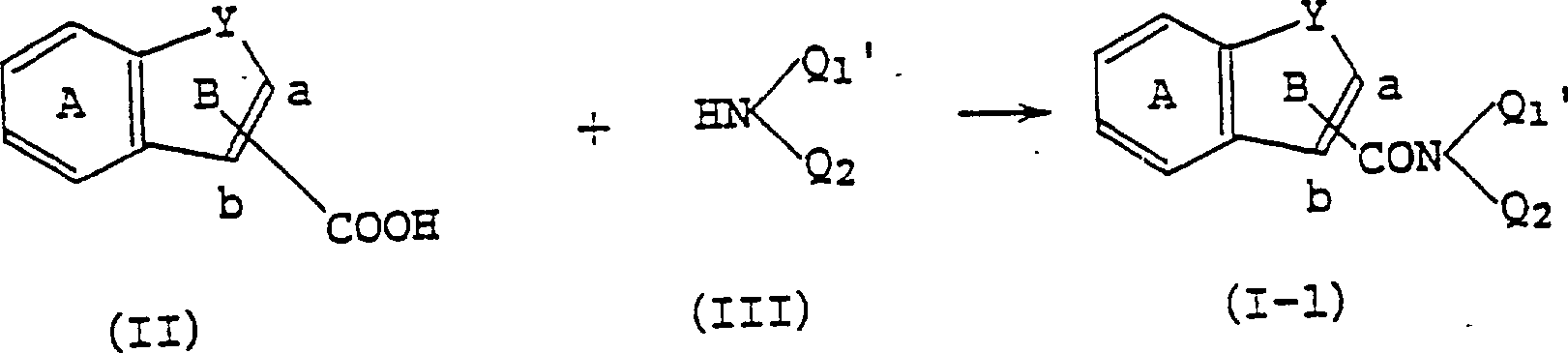
在该方法中,由化合物(II)与化合物(III)反应制备化合物(I-1)。In this method, compound (I-1) is produced by reacting compound (II) with compound (III).
按常规的肽合成方法进行化合物(II)和化合物(III)的缩合反应。可选择任意已知的方法合成该肽。这些方法包括由M.Bodansky和M.A.Ondetti在<肽合成>(Interscience出版社,纽约(1966))中和F.M.Finn和K.Hofmann在<蛋白质>,第2卷(H.Nenrath和R.L.Hill编辑,Academic Press Inc.,纽约(1976))中和Nobuo Izumiya等人在Peptide(Gosei No Kiso To Jikken,(日语),Maruzen(1985)中描述的方法,这些方法分别是叠氮化物法,氯化物法,酸酐法,混合酸酐法,DCC法,活化酯法,采用Woodward试剂K法,羰基二咪唑法,氧化还原法,DCC/HONB法和采用氰基磷酸二乙酯(diethylphosphoro cyanidate)(DEPC)法。该缩合反应可在溶剂中进行。该溶剂可例举无水或水合N,N-二甲基甲酰胺,二甲亚砜,吡啶,氯仿,二氯甲烷,四氢呋喃,二氧六环,乙腈和它们的适宜混合物。反应温度一般在约-20℃至50℃,优选在约-10℃至30℃。反应时间一般为约1至100小时,优选为约2至40小时。The condensation reaction of compound (II) and compound (III) is carried out according to a conventional peptide synthesis method. The peptide can be synthesized by any known method. These methods include those by M. Bodansky and M.A. Ondetti in "Peptide Synthesis" (Interscience Press, New York (1966)) and F.M. Finn and K. Hofmann in "Proteins", Vol. 2 (eds. H. Nenrath and R.L. Hill, Academic Press Inc., New York (1976)) and the methods described by Nobuo Izumiya et al. in Peptide (Gosei No Kiso To Jikken, (Japanese), Maruzen (1985), these methods are azide method, chloride method , acid anhydride method, mixed anhydride method, DCC method, activated ester method, using Woodward reagent K method, carbonyldiimidazole method, redox method, DCC/HONB method and using diethylphosphoro cyanidate (DEPC) method The condensation reaction can be carried out in a solvent. The solvent can be exemplified by anhydrous or hydrated N,N-dimethylformamide, dimethylsulfoxide, pyridine, chloroform, dichloromethane, tetrahydrofuran, dioxane, acetonitrile and their suitable mixture. The reaction temperature is generally about -20°C to 50°C, preferably about -10°C to 30°C. The reaction time is generally about 1 to 100 hours, preferably about 2 to 40 hours.
如此得到的膦酸酯衍生物(I-1)可采用已知的分离和纯化方法进行分离和纯化,如浓缩、减压浓缩、溶剂萃取、结晶、重结晶、再溶解和色谱方法。The phosphonate derivative (I-1) thus obtained can be isolated and purified by known isolation and purification methods such as concentration, concentration under reduced pressure, solvent extraction, crystallization, recrystallization, redissolution and chromatography.
方法B其中Q1″表示式-X-P(O)(OH)2;其它符号与上面给出的定义相同。Method B wherein Q 1 ″ represents the formula -XP(O)(OH) 2 ; other symbols have the same definitions given above.
在该方法中,使方法A制备的膦酸酯衍生物(I-1)进行水解反应得到相应的膦酸(I-2)。In this method, the phosphonate derivative (I-1) prepared by method A is hydrolyzed to obtain the corresponding phosphonic acid (I-2).
该反应使用无机酸如盐酸或氢溴酸或或者卤代三烷基硅烷在不会对反应产生干扰的溶剂中进行。The reaction is carried out using a mineral acid such as hydrochloric or hydrobromic acid or a halotrialkylsilane in a solvent which does not interfere with the reaction.
当使用无机酸如盐酸或氢溴酸时,有用的溶剂包括醇类,如甲醇、乙醇、2-甲氧基乙醇、乙二醇、丙醇和丁醇、水和它们的混合物。一般使用过量的酸,反应温度一般在约0至150℃,优选在约30-100℃,反应时间是约1-50小时。When mineral acids such as hydrochloric acid or hydrobromic acid are used, useful solvents include alcohols such as methanol, ethanol, 2-methoxyethanol, ethylene glycol, propanol and butanol, water and mixtures thereof. Generally, excess acid is used, the reaction temperature is generally about 0 to 150°C, preferably about 30-100°C, and the reaction time is about 1-50 hours.
当使用卤代烷基硅烷如氯代三甲基硅烷、溴代三甲基硅烷或碘代三甲基硅烷时,有用的溶剂包括卤代烃如四氯化碳、氯仿、二氯甲烷、1,2-二氯乙烷和1,1,2,2-四氯乙烷、乙腈和它们的混合物。When using haloalkylsilanes such as chlorotrimethylsilane, bromotrimethylsilane, or iodotrimethylsilane, useful solvents include halogenated hydrocarbons such as carbon tetrachloride, chloroform, dichloromethane, 1,2 - Dichloroethane and 1,1,2,2-tetrachloroethane, acetonitrile and mixtures thereof.
对于每当量化合物(I-1)而言,卤代烷基硅烷的用量一般是约1-10当量,优选约2-5当量。反应温度一般在约-30至100℃,优选在约-10至50℃,反应时间一般为约30分钟到100小时。The haloalkylsilane is generally used in an amount of about 1 to 10 equivalents, preferably about 2 to 5 equivalents, per equivalent of compound (I-1). The reaction temperature is generally about -30 to 100°C, preferably about -10 to 50°C, and the reaction time is generally about 30 minutes to 100 hours.
可使用碱如氢氧化钾、氢氧化钠、甲醇钠、氨或有机胺进行常规处理,将如此得到的膦酸转化成盐。The phosphonic acids thus obtained can be converted into salts by customary treatment with bases such as potassium hydroxide, sodium hydroxide, sodium methoxide, ammonia or organic amines.
如此得到的膦酸衍生物(I-2)可采用已知的分离和纯化方法进行分离和纯化,如浓缩、减压浓缩、溶剂萃取、结晶、重结晶、再溶解和色谱方法。The phosphonic acid derivative (I-2) thus obtained can be isolated and purified by known isolation and purification methods such as concentration, concentration under reduced pressure, solvent extraction, crystallization, recrystallization, redissolution and chromatography.
方法A的原料化合物(II)可以是公知的化合物,或者可容易地按照科技文献或专利文献中所述的方法[如<有机合成>,第26卷第28页(1946);日本专利未审公开说明书第230570/1989号,Bull.Soc.Chim.Fr.,第512页(1950);<有机合成>,合订第3卷第165页(1955)]或者它们的改良法来合成。例如,又以通式(II-1)表示的通式(II)化合物可采用方法C-1和C-2制备。The raw material compound (II) of method A may be a known compound, or may be easily followed by a method described in a scientific literature or a patent literature [such as <Organic Synthesis>, Vol. 26, p. 28 (1946); Japanese Patent Unexamined Publication No. 230570/1989, Bull.Soc.Chim.Fr., page 512 (1950); <Organic Synthesis>, bound volume 3, page 165 (1955)] or their improved methods to synthesize. For example, compounds of general formula (II) also represented by general formula (II-1) can be prepared by methods C-1 and C-2.
方法C-1在上述分子式中,G代表低级烷基;Y′代表形成5至8元B环的不含不饱和键的二价基团;其它符号与上面给出的定义相同。Method C-1 In the above molecular formula, G represents a lower alkyl group; Y' represents a divalent group not containing an unsaturated bond forming a 5- to 8-membered B ring; and other symbols are as defined above.
低级烷基G可例举上述R1和R2中给出的低级烷基基团的相同例子,但具有1-4个碳原子。The lower alkyl group G can be exemplified by the same examples of the lower alkyl group given above for R 1 and R 2 , but having 1 to 4 carbon atoms.
在该方法中,首先在多磷酸的存在下加热通式(IV)化合物,或者使用亚硫酰氯、草酰氯、磷酰氯、五氯化磷等将式(IV)化合物转化成酰氯,之后按照常规Friedel-Crafts反应法,使其环化得到化合物(V)。然后在碱的存在下,将化合物(V)与碳酸酯反应得到酮酯(VI)。通过催化氢化或用硼氢化钠还原等将化合物(VI)转化为化合物(VII)。酯水解反应之后,在酸存在下,加热化合物(VII)得到不饱和羧酸(II-1)。In this method, the compound of general formula (IV) is first heated in the presence of polyphosphoric acid, or the compound of formula (IV) is converted into acid chloride by using thionyl chloride, oxalyl chloride, phosphorus oxychloride, phosphorus pentachloride, etc., and then according to the conventional Friedel-Crafts reaction method, making it cyclized to obtain compound (V). Compound (V) is then reacted with carbonate in the presence of a base to give ketoester (VI). Compound (VI) is converted into compound (VII) by catalytic hydrogenation or reduction with sodium borohydride or the like. After ester hydrolysis reaction, compound (VII) is heated in the presence of acid to give unsaturated carboxylic acid (II-1).
作为方法C的合成中间体的大多数化合物(V)是文献已知的。例如,它们被记载于<化学与药物学通报>,第26卷504页(1978);<化学与药物学通报>,第31卷2349页(1983);<化学与药物学通报>,第32卷130页(1984)和<日本农业化学会志>,第26卷28页(1946)。可采用方法C-1将这些化合物转化为化合物(II-1)。Most of the compounds (V) which are synthetic intermediates for process C are known from the literature. For example, they are described in <Chemical and Pharmacological Bulletin>, Vol. 26, p. 504 (1978); <Chemical and Pharmacological Bulletin>, Vol. 31, p. 2349 (1983); <Chemical and Pharmacological Bulletin>, No. 32 Vol. 130 (1984) and <Journal of the Japanese Agricultural Chemical Society>, Vol. 26, p. 28 (1946). These compounds can be converted into compound (II-1) by method C-1.
方法C-2其中的符号与上述给出的定义相同。Method C-2 The symbols therein have the same definitions as given above.
在该方法中,首先用已知方法将通式(V)化合物转化为氰醇(VIII),然后进行脱水反应,得到化合物(IX)。之后再使化合物(IX)进行已知的酸或碱水解反应,得到化合物(II-2)。In this method, the compound of general formula (V) is first converted into cyanohydrin (VIII) by a known method, and then subjected to dehydration reaction to obtain compound (IX). Then compound (IX) is subjected to known acid or base hydrolysis reaction to obtain compound (II-2).
化合物(III-1),R3和R4结合形成环的通式(III)的一种化合物,例如可通过方法D制备。Compound (III-1), a compound of general formula (III) in which R 3 and R 4 combine to form a ring, can be prepared by method D, for example.
方法D
在该方法中,使通式(X)的化合物与氯化剂反应,然后与二醇(XI)反应得到化合物(XII)。再将化合物(XII)还原成化合物(III-1)。In this method, compound (XII) is obtained by reacting a compound of general formula (X) with a chlorinating agent and then reacting with diol (XI). Compound (XII) is then reduced to compound (III-1).
化合物(X)的氯化在适宜溶剂或没有溶剂的情况下进行。溶剂可例举芳香烃类,如苯、甲苯和二甲苯,醚类,如二噁烷、四氢呋喃和二甲氧基乙烷,吡啶,氯仿,二氯甲烷,1,2-二氯乙烷,1,1,2,2-四氯乙烷和它们的混合物。氯化剂包括亚硫酰氯、草酰氯、磷酰氯和五氯化磷,优选亚硫酰氯和草酰氯。反应在有催化量的N,N-二甲基甲酰胺存在下进行是有益的。反应温度一般在约-100至150℃,优选在约-80至100℃。对于每摩尔当量的化合物(X)而言,氯化剂的用量一般是约1-10摩尔当量,优选是约1-5摩尔当量。反应时间一般在0.5-10小时。之后再与二醇(XI)反应,得到化合物(XII)。该反应在碱的存在下在适宜溶剂中进行。溶剂可例举芳香烃类,如苯、甲苯和二甲苯,醚类,如二烷、四氢呋喃和二甲氧基乙烷,乙腈,氯仿,二氯甲烷,1,2-二氯乙烷,1,1,2,2-四氯乙烷和它们的混合物。碱可例举碱金属盐,如氢氧化钠、氢氧化钾、碳酸钾、碳酸钠和碳酸氢钠;胺类,如吡啶、三乙胺和N,N-二甲基苯胺;氢化钠和氢化钾。对于每摩尔当量化合物(X)而言,碱的用量优选为约1-5摩尔当量。对于每摩尔当量化合物(X)而言,二醇的用量优选为约1-5摩尔当量。该反应一般在约-80至150℃之间,优选约-80至80℃之间进行约1至50小时。Chlorination of compound (X) is carried out with or without a suitable solvent. Solvents are exemplified by aromatic hydrocarbons such as benzene, toluene and xylene, ethers such as dioxane, tetrahydrofuran and dimethoxyethane, pyridine, chloroform, methylene chloride, 1,2-dichloroethane, 1,1,2,2-Tetrachloroethane and mixtures thereof. Chlorinating agents include thionyl chloride, oxalyl chloride, phosphorus oxychloride and phosphorus pentachloride, preferably thionyl chloride and oxalyl chloride. The reaction is advantageously carried out in the presence of a catalytic amount of N,N-dimethylformamide. The reaction temperature is generally about -100 to 150°C, preferably about -80 to 100°C. The chlorinating agent is generally used in an amount of about 1-10 molar equivalents, preferably about 1-5 molar equivalents, per molar equivalent of compound (X). The reaction time is generally 0.5-10 hours. Then react with diol (XI) to obtain compound (XII). The reaction is carried out in a suitable solvent in the presence of a base. Examples of solvents include aromatic hydrocarbons such as benzene, toluene and xylene, ethers such as dioxane, tetrahydrofuran and dimethoxyethane, acetonitrile, chloroform, dichloromethane, 1,2-dichloroethane, 1 , 1,2,2-tetrachloroethane and their mixtures. The base may be exemplified by alkali metal salts such as sodium hydroxide, potassium hydroxide, potassium carbonate, sodium carbonate and sodium bicarbonate; amines such as pyridine, triethylamine and N,N-dimethylaniline; sodium hydride and hydrogenated potassium. The base is preferably used in an amount of about 1 to 5 molar equivalents per molar equivalent of compound (X). The diol is preferably used in an amount of about 1 to 5 molar equivalents per molar equivalent of compound (X). The reaction is generally carried out at about -80 to 150°C, preferably at about -80 to 80°C, for about 1 to 50 hours.
化合物(XII)的还原反应可采用已知方法进行。可采用的方法包括用金属氢化物还原法,用金属-氢配合化合物还原法,用乙硼烷或取代硼烷的还原法和催化氢化方法。换句话说,该反应通过使化合物(XII)与还原剂反应实现。还原剂包括碱金属硼氢化物(如硼氢化钠、硼氢化锂);金属-氢配合化合物,如氢化铝锂;金属氢化物,如氢化钠;有机锡化合物(如氢化三苯基锡);金属和金属盐,如镍化合物和锌化合物;基于过渡金属如钯、铂或铑和氢结合的催化还原剂;及乙硼烷。有益的是采用过渡金属如钯、铂或铑与氢结合通过催化还原进行该反应。该反应在不影响反应的有机溶剂中进行。这类溶剂包括芳香烃,如苯、甲苯和二甲苯;卤代烃,如氯仿、四氯化碳、二氯甲烷、1,2-二氯乙烷和1,1,2,2-四氯乙烷;醚类,如乙醚、四氢呋喃和二噁烷;醇类,如甲醇、乙醇、丙醇、异丙醇和2-甲氧基乙醇;酰胺类,如N,N-二甲基甲酰胺,和它们的混合物,根据还原剂加以适当选择。反应温度一般在约-20至150℃之间,优选在约0至100℃之间;反应时间是约1至24小时。The reduction reaction of compound (XII) can be carried out by a known method. Usable methods include reduction with a metal hydride, reduction with a metal-hydrogen complex compound, reduction with diborane or substituted borane, and catalytic hydrogenation. In other words, this reaction is achieved by reacting compound (XII) with a reducing agent. Reducing agents include alkali metal borohydrides (such as sodium borohydride, lithium borohydride); metal-hydrogen complex compounds, such as lithium aluminum hydride; metal hydrides, such as sodium hydride; organotin compounds (such as triphenyltin hydride); Metals and metal salts such as nickel compounds and zinc compounds; catalytic reducing agents based on transition metals such as palladium, platinum or rhodium in combination with hydrogen; and diborane. Advantageously, the reaction is carried out by catalytic reduction using a transition metal such as palladium, platinum or rhodium in combination with hydrogen. The reaction is carried out in an organic solvent that does not affect the reaction. Such solvents include aromatic hydrocarbons such as benzene, toluene, and xylene; halogenated hydrocarbons such as chloroform, carbon tetrachloride, methylene chloride, 1,2-dichloroethane, and 1,1,2,2-tetrachloro Ethane; ethers, such as diethyl ether, tetrahydrofuran, and dioxane; alcohols, such as methanol, ethanol, propanol, isopropanol, and 2-methoxyethanol; amides, such as N,N-dimethylformamide, And their mixture, according to the reducing agent to be properly selected. The reaction temperature is generally about -20 to 150°C, preferably about 0 to 100°C; the reaction time is about 1 to 24 hours.
如此得到的化合物(III-1)可采用已知的分离和纯化方法进行分离和纯化,如浓缩、减压浓缩、溶剂萃取、结晶、重结晶、再溶解和色谱方法。Compound (III-1) thus obtained can be isolated and purified by known isolation and purification methods such as concentration, concentration under reduced pressure, solvent extraction, crystallization, recrystallization, redissolution and chromatography.
化合物(I)可用于预防和治疗人类和非人类动物(如小鼠、大鼠、猫、狗、兔、牛、猪)的各种代谢性骨骼疾病,如骨质疏松,因为它能有效地刺激骨的生成。由于其低毒性,化合物(I)可安全地使用。例如当给小鼠口服施用100mg/kg,或腹膜内施用50mg/kg剂量的下述实施例1的化合物时,没有死亡发生。同样,给小鼠口服施用300mg/kg,或腹膜内施用200mg/kg剂量的实施例45的化合物时,也没有死亡发生。Compound (I) can be used for the prevention and treatment of various metabolic skeletal diseases, such as osteoporosis, in humans and non-human animals (such as mice, rats, cats, dogs, rabbits, cattle, pigs), because it can effectively Stimulates bone production. Compound (I) can be used safely due to its low toxicity. For example, when the compound of Example 1 described below was orally administered to mice at a dose of 100 mg/kg or intraperitoneally at a dose of 50 mg/kg, no death occurred. Likewise, no death occurred when the compound of Example 45 was orally administered to mice at a dose of 300 mg/kg or intraperitoneally at a dose of 200 mg/kg.
化合物(I)可用作骨生成刺激剂,如用作预防/治疗剂用于骨生成(骨形成),或者骨折愈合促进剂。Compound (I) can be used as an osteogenesis stimulator, such as a prophylactic/therapeutic agent for osteogenesis (bone formation), or a fracture healing accelerator.
施用活性成分化合物(I)的每日剂量取决于患者的症状和体重及施用方法,对于成年患者(体重50kg),口服的每日剂量是5-1000mg,优选10-600mg,每日分1-3次服用。The daily dose of the active ingredient compound (I) depends on the patient's symptoms and body weight and the method of administration. For adult patients (body weight 50kg), the oral daily dose is 5-1000 mg, preferably 10-600 mg, divided into 1-600 mg per day. 3 servings.
由于化合物(I)可有效地促进骨的生成,它可有益地用于预防和治疗人类或非人类动物的各种代谢性骨骼疾病,如骨质疏松。Since compound (I) is effective in promoting bone formation, it can be beneficially used for the prevention and treatment of various metabolic bone diseases such as osteoporosis in humans or non-human animals.
实现本发明的最佳方式BEST MODE FOR CARRYING OUT THE INVENTION
下文将通过测试实施例、参考实施例和研究实施例更详细地描述本发明,但这些实施例并不对本发明构成任何限制。Hereinafter, the present invention will be described in more detail through test examples, reference examples and research examples, but these examples do not constitute any limitation to the present invention.
测试实施例Test Example
刺激骨形成作用Stimulates bone formation
使用由正常大鼠的股骨骨髓制备的基质细胞,测定其碱性磷酸酶活性作为骨生成指数。具体地说,将按照Maniatopoulos等人的方法[<细胞组织研究>,第254卷第317页(1988)]由7周龄雄性Sprague-Dawley大鼠的股骨骨髓制备的基质细胞在含有地塞米松(10-7M)和β-甘油磷酸(10-2M)的α-MEM(最低必需培养基)溶液中培养,以使其在体外生成矿化似骨组织。一周后,将试验化合物(10-7M或10-5M)加到融合细胞中,然后再在上述培养基中培养10至14天。用磷酸盐缓冲液冲洗后,把细胞刮到0.2%Nonidet P-40中,对其进行声处理并在3000rpm下离心10分钟。采用Lowry等人的方法[<生物化学杂志>,第207卷第19页(1954)]分析所得上清液的碱性磷酸酶活性。得到的值在表1中以平均值±标准误差的形式给出。用Student′s t-检验对数据进行统计学分析。表1(1)实验1
如上所述,化合物(I)对成骨细胞表型的表达表现出显著的刺激作用,可用作代谢性骨骼疾病包括骨质疏松的预防/治疗剂。在矫形外科领域中,任何具有骨生成刺激活性的化合物皆可用于治疗骨折、骨骼缺损和骨骼疾病,如骨质疏松。可预计它们在牙科学领域包括由于牙周炎导致的牙周组织缺损的修复、人工齿根的稳固、边缘形成和裂腭的修复中也有效果。As described above, Compound (I) exhibits a significant stimulating effect on the expression of osteoblast phenotype and is useful as a preventive/therapeutic agent for metabolic bone diseases including osteoporosis. In the field of orthopedics, any compound having osteogenesis stimulating activity can be used in the treatment of bone fractures, bone defects and bone diseases such as osteoporosis. They are also expected to be effective in the field of dentistry including repair of periodontal tissue defects due to periodontitis, stabilization of artificial tooth roots, rim formation and repair of cleft palate.
下列参考实施例和实施例中的室温范围是从约15℃至约25℃。The room temperature in the following Reference Examples and Examples ranges from about 15°C to about 25°C.
参考实施例1Reference Example 1
在冰冷却条件下,往粉状无水氯化铝(16.0g)的1,2-二氯乙烷(160ml)悬浮液中滴加乙基琥珀酰氯(19.8g),然后滴加苯基环己烷(16.0g)。回流2.5小时后,将该反应混合物倾入6N盐酸(50ml)中,然后搅拌1小时。收集有机层,而将水层用二氯甲烷萃取。将萃取液与有机层合并,合并的有机层依次用3N盐酸、水和盐水洗涤,并干燥(MgSO4),之后蒸除溶剂。然后将残余的油状物进行硅胶柱色谱,以乙酸乙酯-己烷(1∶9,v/v)洗脱,得到3-(4-环己基苯甲酰)丙酸乙酯(14.3g,50%),然后在己烷中重结晶得到无色棱晶,熔点是54-55℃。Under ice cooling, add ethyl succinyl chloride (19.8 g) dropwise to a suspension of powdered anhydrous aluminum chloride (16.0 g) in 1,2-dichloroethane (160 ml), and then add phenyl ring Hexane (16.0 g). After reflux for 2.5 hours, the reaction mixture was poured into 6N hydrochloric acid (50 ml), followed by stirring for 1 hour. The organic layer was collected, and the aqueous layer was extracted with dichloromethane. The extract was combined with the organic layer, and the combined organic layer was washed successively with 3N hydrochloric acid, water and brine, and dried ( MgSO4 ), after which the solvent was evaporated. The residual oil was then subjected to silica gel column chromatography, eluting with ethyl acetate-hexane (1:9, v/v) to obtain ethyl 3-(4-cyclohexylbenzoyl)propionate (14.3 g, 50%), and then recrystallized in hexane to give colorless prisms with a melting point of 54-55°C.
参考实施例2Reference Example 2
用参考实施例1的相同方式,由邻二甲苯和乙基琥珀酰氯得到3-(3,4-二甲基苯甲酰)丙酸乙酯,为油状物。In the same manner as in Reference Example 1, ethyl 3-(3,4-dimethylbenzoyl)propionate was obtained as an oil from o-xylene and ethylsuccinyl chloride.
NMR(δppm,CDCl3):1.26(3H,t,J=7.0Hz),2.31(6H,NMR (δppm, CDCl 3 ): 1.26 (3H, t, J=7.0Hz), 2.31 (6H,
s),2.74(2H,t,J=6.7Hz),3.28(2H,t,J=6.7Hz),4.16s), 2.74 (2H, t, J=6.7Hz), 3.28 (2H, t, J=6.7Hz), 4.16
(2H,q,J=7.0Hz),7.18-7.26(1H,m),7.69-7.75(2H,m)(2H, q, J=7.0Hz), 7.18-7.26 (1H, m), 7.69-7.75 (2H, m)
参考实施例3Reference Example 3
往3-(4-环己基苯甲酰)丙酸乙酯(19.6g)的甲醇(150ml)溶液中加入2N氢氧化钾(102ml),然后在室温搅拌1.5小时。将该反应混合物倾入水(200ml)中,用浓盐酸酸化,并用乙酸乙酯萃取。将乙酸乙酯层用水洗并干燥(MgSO4),之后蒸除溶剂,得到3-(4-环己基苯甲酰)丙酸(10.8g,61%),然后用异丙醚重结晶,得到无色棱晶,熔点是140-141℃。To a solution of ethyl 3-(4-cyclohexylbenzoyl)propionate (19.6 g) in methanol (150 ml) was added 2N potassium hydroxide (102 ml), followed by stirring at room temperature for 1.5 hours. The reaction mixture was poured into water (200ml), acidified with concentrated hydrochloric acid, and extracted with ethyl acetate. The ethyl acetate layer was washed with water and dried (MgSO 4 ), after which the solvent was evaporated to give 3-(4-cyclohexylbenzoyl)propionic acid (10.8 g, 61%), which was then recrystallized from isopropyl ether to give Colorless prism, melting point is 140-141°C.
参考实施例4Reference Example 4
按参考实施例3的方式处理3-(3,4-二甲基苯甲酰)丙酸乙酯,得到3-(3,4-二甲基苯甲酰)丙酸,然后在异丙醚中重结晶,得到无色棱晶,熔点是131-132℃。Process 3-(3,4-dimethylbenzoyl) ethyl propionate in the manner of Reference Example 3 to obtain 3-(3,4-dimethylbenzoyl) propionic acid, and then in isopropyl ether Medium recrystallization gave colorless prisms with a melting point of 131-132°C.
参考实施例5Reference Example 5
在冰冷却条件下,往琥珀酸酐(33.02g)、粉状无水氯化铝(88.0g)、硝基苯(50ml)和1,2-二氯乙烷(150ml)的混合物中滴加异丙基苯(40.0g)。回流2小时后,将该反应混合物倾入冰水中,加入浓盐酸(80ml),然后搅拌1小时。收集有机层,同时用二氯甲烷萃取水层。将萃取液与有机层合并,并用水洗,干燥(MgSO4),之后蒸除溶剂。用己烷过滤收集残余结晶,得到3-(4-异丙基苯甲酰)丙酸(30.9g,43%),然后用乙酸乙酯-己烷重结晶,得到浅棕色棱晶,熔点是142-144℃。Under ice-cooling conditions, add iso Propylbenzene (40.0 g). After reflux for 2 hours, the reaction mixture was poured into ice water, concentrated hydrochloric acid (80 ml) was added, followed by stirring for 1 hour. The organic layer was collected while the aqueous layer was extracted with dichloromethane. The extracts were combined with the organic layer, washed with water, dried ( MgSO4 ), and the solvent was evaporated. The residual crystals were collected by filtration with hexane to obtain 3-(4-isopropylbenzoyl)propionic acid (30.9 g, 43%), and then recrystallized with ethyl acetate-hexane to obtain light brown prisms with a melting point of 142-144°C.
参考实施例6Reference Example 6
在室温和常压下,在5%钯碳(50%湿,3.0g)存在下,氢化3-(4-环己基苯甲酰)丙酸(10.7g)、乙酸(100ml)和高氯酸(2.3ml)的溶液。过滤除去催化剂后,减压下浓缩滤液。加入水(100ml)后,残留物用乙酸乙酯萃取。有机层用水和盐水洗,并干燥(MgSO4),蒸除溶剂后,得到油状4-(4-环己基苯基)丁酸(10.4g,100%)。Hydrogenation of 3-(4-cyclohexylbenzoyl)propionic acid (10.7g), acetic acid (100ml) and perchloric acid in the presence of 5% palladium on carbon (50% wet, 3.0g) at room temperature and pressure (2.3ml) solution. After removing the catalyst by filtration, the filtrate was concentrated under reduced pressure. After adding water (100ml), the residue was extracted with ethyl acetate. The organic layer was washed with water and brine and dried ( MgSO4 ) to give 4-(4-cyclohexylphenyl)butanoic acid (10.4 g, 100%) as an oil after evaporation of the solvent.
NMR(δppm,CDCl3):1.35-1.82(10H,m),2.00(2H,t,J=7NMR (δppm, CDCl 3 ): 1.35-1.82 (10H, m), 2.00 (2H, t, J=7
Hz),2.35(2H,t,J=7Hz),2.47(1H,宽单峰),2.62(2H,t,Hz), 2.35 (2H, t, J=7Hz), 2.47 (1H, broad singlet), 2.62 (2H, t,
J=7Hz),7.12(4H,s),9.06(1H,宽单峰)J=7Hz), 7.12(4H, s), 9.06(1H, broad single peak)
参考实施例7Reference Example 7
以参考实施例6的方式催化氢化3-(4-异丙基苯甲酰)丙酸,得到4-(4-异丙基苯基)丁酸,然后在己烷中重结晶,得到无色棱晶,熔点是50-51℃。Catalyzed hydrogenation of 3-(4-isopropylbenzoyl)propionic acid in the manner of Reference Example 6 to obtain 4-(4-isopropylphenyl)butanoic acid, which was then recrystallized in hexane to obtain colorless Prism, melting point is 50-51 ℃.
参考实施例8Reference Example 8
以参考实施例6的方式催化氢化3-(3,4-二甲基苯甲酰)丙酸,得到4-(3,4-二甲苯基)丁酸,然后在二氯甲烷-己烷中重结晶,得到无色棱晶,熔点是50-51℃。Catalyzed hydrogenation of 3-(3,4-dimethylbenzoyl)propionic acid in the manner of Reference Example 6 to obtain 4-(3,4-xylyl)butyric acid, and then in dichloromethane-hexane Recrystallization gave colorless prisms with a melting point of 50-51°C.
参考实施例9Reference Example 9
往4-(4-环己基苯基)丁酸(10.2g)、亚硫酰氯(7.4g)和甲苯(50ml)的混合物中加入吡啶(1滴)。回流1.5小时后,减压蒸除溶剂。残余物溶于二氯甲烷(20ml)中;在冰冷却条件下,将该溶液滴加到粉状无水氯化铝(8.3g)在二氯甲烷(100ml)中的悬浮液中。室温搅拌3小时后,将反应混合物倾入1.2N盐酸(150ml)中,然后搅拌30分钟。收集有机层,同时水层用二氯甲烷萃取。将萃取液与有机层合并,并依次用水和盐水洗,并干燥(MgSO4),之后蒸除溶剂。将残余的油状物进行硅胶柱色谱,用乙酸乙酯-己烷(1∶10,v/v)洗脱,得到油状7-环己基-1-四氢萘酮(9.4g,100%)。To a mixture of 4-(4-cyclohexylphenyl)butanoic acid (10.2g), thionyl chloride (7.4g) and toluene (50ml) was added pyridine (1 drop). After refluxing for 1.5 hours, the solvent was distilled off under reduced pressure. The residue was dissolved in dichloromethane (20ml); this solution was added dropwise to a suspension of powdery anhydrous aluminum chloride (8.3g) in dichloromethane (100ml) under ice-cooling. After stirring at room temperature for 3 hours, the reaction mixture was poured into 1.2N hydrochloric acid (150 ml), followed by stirring for 30 minutes. The organic layer was collected while the aqueous layer was extracted with dichloromethane. The extracts were combined with the organic layer and washed successively with water and brine and dried ( MgSO4 ) before the solvent was evaporated. The residual oil was subjected to silica gel column chromatography, eluting with ethyl acetate-hexane (1:10, v/v) to give 7-cyclohexyl-1-tetralone (9.4 g, 100%) as oil.
NMR(δppm,CDCl3):1.40-1.79(10H,m),2.10(2H,m),NMR (δppm, CDCl 3 ): 1.40-1.79 (10H, m), 2.10 (2H, m),
2.52(1H,宽单峰),2.64(2H,t,J=6Hz),2.92(2H,t,J=62.52 (1H, broad singlet), 2.64 (2H, t, J=6Hz), 2.92 (2H, t, J=6
Hz),7.16(1H,d,J=9Hz),7.33(1H,dd,J=8 & 2Hz),7.90Hz), 7.16 (1H, d, J=9Hz), 7.33 (1H, dd, J=8 & 2Hz), 7.90
(1H,d,J=2Hz)(1H, d, J=2Hz)
参考实施例10Reference Example 10
按参考实施例9的相同方式处理4-(4-异丙基苯基)丁酸,得到油状7-异丙基-1-四氢萘酮。4-(4-Isopropylphenyl)butanoic acid was treated in the same manner as in Reference Example 9 to obtain 7-isopropyl-1-tetralone as oil.
NMR(δppm,CDCl3):1.25(6H,d,J=7Hz),2.11(2H,m),NMR (δppm, CDCl 3 ): 1.25 (6H, d, J=7Hz), 2.11 (2H, m),
2.64(2H,t,J=6.8Hz),2.89-2.96(3H,m),7.18(1H,d,2.64(2H, t, J=6.8Hz), 2.89-2.96(3H, m), 7.18(1H, d,
J=8.0Hz),7.35(1H,dd,J=8.0 & 2.2Hz),7.91(1H,d,J=8.0Hz), 7.35(1H, dd, J=8.0 & 2.2Hz), 7.91(1H,d,
J=2.2Hz)J=2.2Hz)
参考实施例11Reference Example 11
按参考实施例9的相同方式处理4-(3,4-二甲苯基)丁酸,得到6,7-二甲基-1-四氢萘酮,然后在己烷中重结晶,得到无色棱晶,熔点是47-48℃。4-(3,4-Xylyl)butanoic acid was treated in the same manner as in Reference Example 9 to obtain 6,7-dimethyl-1-tetralone, which was then recrystallized in hexane to obtain colorless Prism, the melting point is 47-48 ℃.
参考实施例12Reference Example 12
使7-环己基-1-四氢萘酮(9.4g)、甲醇钠(8.9g)和碳酸二甲酯(65ml)的混合物在氮气流下回流30分钟。反应混合物冷却后,过滤收集得到的结晶,并将其悬浮于乙酸乙酯(250ml)中,然后加入6N盐酸(50ml)。收集有机层,同时水层用乙酸乙酯萃取。将萃取液和有机层合并,依次用水和盐水洗并干燥(MgSO4),之后蒸除溶剂,得到油状7-环己基-1-四氢萘酮-2-甲酸甲酯(8.6g,74%)。A mixture of 7-cyclohexyl-1-tetralone (9.4 g), sodium methoxide (8.9 g) and dimethyl carbonate (65 ml) was refluxed for 30 minutes under a stream of nitrogen. After the reaction mixture was cooled, the resulting crystals were collected by filtration and suspended in ethyl acetate (250ml), and then 6N hydrochloric acid (50ml) was added. The organic layer was collected, while the aqueous layer was extracted with ethyl acetate. The extracts and organic layers were combined, washed successively with water and brine and dried (MgSO 4 ), after which the solvent was evaporated to give methyl 7-cyclohexyl-1-tetralone-2-carboxylate (8.6 g, 74% ).
NMR(δppm,CDCl3):1.37-1.80(10H,m),2.27-2.77(4H,NMR (δppm, CDCl 3 ): 1.37-1.80 (10H, m), 2.27-2.77 (4H,
m),2.54(1H,宽单峰),2.80(3H,m),2.99(1H,t,J=6Hz),m), 2.54 (1H, broad singlet), 2.80 (3H, m), 2.99 (1H, t, J=6Hz),
7.10-7.40(2H,m),7.65(0.5H,d,J=2Hz),7.89(0.5H,d,7.10-7.40 (2H, m), 7.65 (0.5H, d, J=2Hz), 7.89 (0.5H, d,
J=2Hz)J=2Hz)
参考实施例13Reference Example 13
以参考实施例12的方式处理7-异丙基-1-四氢萘酮,得到油状7-异丙基-1-四氢萘酮-2-甲酸甲酯。7-Isopropyl-1-tetralone was treated in the same manner as in Reference Example 12 to obtain oily methyl 7-isopropyl-1-tetralone-2-carboxylate.
NMR(δppm,CDCl3):1.21-1.29(6H,m),2.35-3.03(5H,NMR (δppm, CDCl 3 ): 1.21-1.29 (6H, m), 2.35-3.03 (5H,
m),3.61(1/4H,dd,J=10.0 & 5.2Hz),3.78(3/4H,s),3.82m), 3.61(1/4H, dd, J=10.0 & 5.2Hz), 3.78(3/4H, s), 3.82
(9/4H,s),7.07-7.92(3H,m),12.47(3/4H,s)(9/4H, s), 7.07-7.92 (3H, m), 12.47 (3/4H, s)
参考实施例14Reference Example 14
以参考实施例12的相同方式处理6,7-二甲基-1-四氢萘酮,得到6,7-二甲基-1-四氢萘酮-2-甲酸甲酯,然后在乙酸乙酯-己烷中重结晶,得到无色棱晶,熔点是80-81℃。Treat 6,7-dimethyl-1-tetralone in the same manner as in Reference Example 12 to obtain 6,7-dimethyl-1-tetralone-2-formic acid methyl ester, and then in ethyl acetate Recrystallization from ester-hexane gave colorless prisms, melting at 80-81°C.
参考实施例15Reference Example 15
以参考实施例12的相同方式处理5,7-二甲基-1-四氢萘酮,得到油状5,7-二甲基-1-四氢萘酮-2-甲酸甲酯。5,7-Dimethyl-1-tetralone was treated in the same manner as in Reference Example 12 to obtain oily methyl 5,7-dimethyl-1-tetralone-2-carboxylate.
NMR(δppm,CDCl3):2.26(3H,s),2.32(3H,s),2.30-NMR (δppm, CDCl 3 ): 2.26 (3H, s), 2.32 (3H, s), 2.30-
3.00(4H,m),3.58(1/2H,dd,J=10.0 & 5.0Hz),3.77(3/2H,3.00(4H, m), 3.58(1/2H, dd, J=10.0 & 5.0Hz), 3.77(3/2H,
s),3.82(3/2H,s),7.03(1/2H,s),7.20(1/2H,s),7.51s), 3.82(3/2H, s), 7.03(1/2H, s), 7.20(1/2H, s), 7.51
(1/2H,s),12.40(1/2H,s)(1/2H, s), 12.40 (1/2H, s)
参考实施例16Reference Example 16
将7-环己基-1-四氢萘酮-2-甲酸甲酯(8.6g)溶于二氯甲烷(40ml)-甲醇(50ml)中。在室温下,往该溶液中逐渐加入硼氢化钠(1.13g)。将该反应混合物倾入水(80ml)中并用二氯甲烷萃取。该二氯甲烷层依次用水和盐水洗,并干燥(MgSO4),之后蒸除溶剂。将残余的油状物溶于甲醇(40ml),然后在室温滴加2N NaOH(45ml)并搅拌1小时。反应混合物用乙醚洗;水层以浓盐酸酸化并用二氯甲烷萃取。二氯甲烷层依次用水和盐水洗并干燥(MgSO4),之后蒸除溶剂。往该残余的油状物中加入二噁烷(25ml)和浓盐酸(4.2ml),然后在90℃搅拌40分钟,再在减压下浓缩该混合物。加入水后,残余物用乙酸乙酯萃取。该乙酸乙酯层依次用水和盐水洗,并干燥(MgSO4),随后蒸除溶剂,得到7-环己基-3,4-二氢萘-2-甲酸(1.57g,20%),然后在乙醇中重结晶,得到无色棱晶,熔点是179-180℃。7-Cyclohexyl-1-tetralone-2-carboxylic acid methyl ester (8.6 g) was dissolved in dichloromethane (40 ml)-methanol (50 ml). Sodium borohydride (1.13 g) was gradually added to the solution at room temperature. The reaction mixture was poured into water (80ml) and extracted with dichloromethane. The dichloromethane layer was washed successively with water and brine, and dried ( MgSO4 ), after which the solvent was evaporated. The residual oil was dissolved in methanol (40ml), then 2N NaOH (45ml) was added dropwise at room temperature and stirred for 1 hour. The reaction mixture was washed with ether; the aqueous layer was acidified with concentrated hydrochloric acid and extracted with dichloromethane. The dichloromethane layer was washed successively with water and brine and dried ( MgSO4 ), after which the solvent was evaporated. Dioxane (25 ml) and concentrated hydrochloric acid (4.2 ml) were added to the residual oil, followed by stirring at 90°C for 40 minutes, and the mixture was concentrated under reduced pressure. After adding water, the residue was extracted with ethyl acetate. The ethyl acetate layer was washed successively with water and brine and dried (MgSO 4 ), followed by evaporation of the solvent to give 7-cyclohexyl-3,4-dihydronaphthalene-2-carboxylic acid (1.57 g, 20%), which was then Recrystallization from ethanol gives colorless prisms with a melting point of 179-180°C.
参考实施例17Reference Example 17
以参考实施例16的相同方式处理7-异丙基-1-四氢萘酮-2-甲酸甲酯,得到7-异丙基-3,4-二氢萘-2-甲酸,然后在乙酸乙酯-己烷中重结晶,得到无色针晶,熔点是160-162℃。7-isopropyl-1-tetralone-2-carboxylic acid methyl ester was treated in the same manner as in Reference Example 16 to obtain 7-isopropyl-3,4-dihydronaphthalene-2-carboxylic acid, and then in acetic acid Recrystallization from ethyl ester-hexane gave colorless needles with a melting point of 160-162°C.
参考实施例18Reference Example 18
以参考实施例16的相同方式处理6,7-二甲基-1-四氢萘酮-2-甲酸甲酯,得到3,4-二氢-6,7-二甲基萘-2-甲酸,然后在氯仿-己烷中重结晶,得到无色棱晶,熔点是222-223℃。6,7-Dimethyl-1-tetralone-2-carboxylic acid methyl ester was treated in the same manner as in Reference Example 16 to obtain 3,4-dihydro-6,7-dimethylnaphthalene-2-carboxylic acid , and then recrystallized from chloroform-hexane to give colorless prisms with a melting point of 222-223°C.
参考实施例19Reference Example 19
以参考实施例16的相同方式处理5,7-二甲基-1-四氢萘酮-2-甲酸甲酯,得到3,4-二氢-5,7-二甲基萘-2-甲酸,然后在乙酸乙酯-己烷中重结晶,得到无色针晶,熔点是194-195℃。5,7-Dimethyl-1-tetralone-2-carboxylic acid methyl ester was treated in the same manner as in Reference Example 16 to obtain 3,4-dihydro-5,7-dimethylnaphthalene-2-carboxylic acid , and then recrystallized from ethyl acetate-hexane to give colorless needles with a melting point of 194-195°C.
参考实施例20Reference Example 20
将4-硝基苄基膦酸(37.40g)、亚硫酰氯(150ml)和N,N-二甲基甲酰胺(5滴)的混合物回流5小时,然后减压浓缩。将该残余物溶于四氢呋喃(500ml);在-78℃用15分钟往该溶液中滴加乙二醇(10.69g)的乙腈(90ml)溶液。然后在相同温度下用15分钟滴加吡啶(28.61g);并在室温搅拌该混合物15小时。过滤出不溶性物质后,减压浓缩滤液;将残余物溶于氯仿(400ml)。将预先滤出的不溶性物质分配到水(800ml)和氯仿(200ml)中;收集氯仿层。将上述残余物溶液与该氯仿层合并,依次用1N盐酸、水、饱和碳酸氢钠水溶液、水和盐水洗,并干燥(MgSO4)。混合物用活性炭处理,蒸除溶剂,得到2-(4-硝基苄基)-1,3,2-二氧杂磷杂环戊烷(dioxaphosphoran)-2-氧化物(8.86g,21%),然后用乙醇-己烷重结晶,得到无色片状物,熔点是144-145℃。A mixture of 4-nitrobenzylphosphonic acid (37.40 g), thionyl chloride (150 ml) and N,N-dimethylformamide (5 drops) was refluxed for 5 hours, then concentrated under reduced pressure. The residue was dissolved in tetrahydrofuran (500ml); to this solution was added dropwise a solution of ethylene glycol (10.69g) in acetonitrile (90ml) at -78°C over 15 minutes. Then pyridine (28.61 g) was added dropwise at the same temperature over 15 minutes; and the mixture was stirred at room temperature for 15 hours. After insoluble matter was filtered off, the filtrate was concentrated under reduced pressure; the residue was dissolved in chloroform (400 ml). The previously filtered insoluble material was partitioned between water (800ml) and chloroform (200ml); the chloroform layer was collected. The above residue solution was combined with the chloroform layer, washed sequentially with 1N hydrochloric acid, water, saturated aqueous sodium bicarbonate, water and brine, and dried ( MgSO4 ). The mixture was treated with activated carbon, and the solvent was distilled off to give 2-(4-nitrobenzyl)-1,3,2-dioxaphosphoran-2-oxide (8.86 g, 21%) , and then recrystallized from ethanol-hexane to give colorless flakes, melting at 144-145°C.
参考实施例21Reference Example 21
在-78℃下,将草酰氯(22.09g)滴加到4-硝基苄基膦酸(17.99g)、吡啶(13.76g)和四氢呋喃(500ml)的混合物中。将该混合物在-78℃搅拌30分钟后,再在室温搅拌1.5小时,滤除不溶性固体。将滤液在减压下浓缩;将残余的油状物溶于四氢呋喃(500ml)中。在-78℃用15分钟往该溶液中滴加1,3-丙二醇(2.58g)的乙腈(30ml)溶液。然后在相同温度下用5分钟滴加吡啶(5.62g);将该混合物在室温搅拌15小时。过滤除去不溶物后,减压浓缩滤液。将残余物进行硅胶柱色谱,用乙酸乙酯-氯仿-甲醇(10∶10∶1,v/v)洗脱,得到2-(4-硝基苄基)-1,3,2-二氧杂磷杂环己烷(dioxaphosphorinan)-2-氧化物(5.62g,26%),然后在乙醇-己烷中重结晶,得到无色针晶,熔点是144-145℃。Oxalyl chloride (22.09 g) was added dropwise to a mixture of 4-nitrobenzylphosphonic acid (17.99 g), pyridine (13.76 g) and tetrahydrofuran (500 ml) at -78°C. After the mixture was stirred at -78°C for 30 minutes and at room temperature for 1.5 hours, the insoluble solid was filtered off. The filtrate was concentrated under reduced pressure; the residual oil was dissolved in tetrahydrofuran (500ml). To this solution was added dropwise a solution of 1,3-propanediol (2.58 g) in acetonitrile (30 ml) at -78°C over 15 minutes. Then pyridine (5.62 g) was added dropwise at the same temperature over 5 minutes; the mixture was stirred at room temperature for 15 hours. After removing insoluble matter by filtration, the filtrate was concentrated under reduced pressure. The residue was subjected to silica gel column chromatography, eluting with ethyl acetate-chloroform-methanol (10:10:1, v/v) to give 2-(4-nitrobenzyl)-1,3,2-dioxo Dioxaphosphorinan-2-oxide (5.62 g, 26%), then recrystallized from ethanol-hexane, gave colorless needles, mp 144-145°C.
参考实施例22Reference Example 22
以参考实施例20的相同方式处理4-硝基苄基膦酸和2,2-二甲基-1,3-丙二醇,得到5,5-二甲基-2-(4-硝基苄基)-1,3,2-二氧杂磷杂环己烷-2-氧化物,然后在乙醇-己烷中重结晶,得到无色片状物,熔点是176-177℃。4-nitrobenzylphosphonic acid and 2,2-dimethyl-1,3-propanediol were treated in the same manner as in Reference Example 20 to obtain 5,5-dimethyl-2-(4-nitrobenzyl )-1,3,2-dioxaphosphorinane-2-oxide, and then recrystallized from ethanol-hexane to give colorless flakes with a melting point of 176-177°C.
参考实施例23Reference Example 23
以参考实施例20的相同方式处理4-硝基苄基膦酸和2,4-戊二醇,得到4,6-二甲基-2-(4-硝基苄基)-1,3,2-二氧杂磷杂环己烷-2-氧化物,然后在乙醇-己烷中重结晶,得到无色针晶,熔点是152-153℃。4-nitrobenzylphosphonic acid and 2,4-pentanediol were treated in the same manner as in Reference Example 20 to obtain 4,6-dimethyl-2-(4-nitrobenzyl)-1,3, 2-Dioxaphosphorinane-2-oxide, then recrystallized from ethanol-hexane to give colorless needles, mp 152-153°C.
参考实施例24Reference Example 24
以参考实施例20的相同方式处理4-硝基苄基膦酸和1,4-丁二醇,得到2-(4-硝基苄基)-1,3,2-二氧杂磷杂环庚烷(dioxaphosphepan)-2-氧化物,然后在乙醇-己烷中重结晶,得到无色针晶,熔点是136-137℃。4-nitrobenzylphosphonic acid and 1,4-butanediol were treated in the same manner as in Reference Example 20 to obtain 2-(4-nitrobenzyl)-1,3,2-dioxaphosphorine Heptane (dioxaphosphepan)-2-oxide, then recrystallized from ethanol-hexane, gave colorless needles, mp 136-137°C.
参考实施例25Reference Example 25
以参考实施例20的相同方式处理4-硝基苄基膦酸和2-甲基-1,3-丙二醇,得到5-甲基-2-(4-硝基苄基)-1,3,2-二氧杂磷杂环己烷-2-氧化物,然后在乙醇-己烷中重结晶,得到无色棱晶,熔点是170-171℃。4-nitrobenzylphosphonic acid and 2-methyl-1,3-propanediol were treated in the same manner as in Reference Example 20 to obtain 5-methyl-2-(4-nitrobenzyl)-1,3, 2-Dioxaphosphorinane-2-oxide, then recrystallized from ethanol-hexane to give colorless prisms, mp 170-171°C.
参考实施例26Reference Example 26
以参考实施例20的相同方式处理4-硝基苄基膦酸和2-乙基-2-甲基-1,3-丙二醇,得到5-乙基-5-甲基-2-(4-硝基苄基)-1,3,2-二氧杂磷杂环己烷-2-氧化物,然后在乙醇-己烷中重结晶,得到无色棱晶,熔点是184-185℃。4-nitrobenzylphosphonic acid and 2-ethyl-2-methyl-1,3-propanediol were treated in the same manner as in Reference Example 20 to obtain 5-ethyl-5-methyl-2-(4- Nitrobenzyl)-1,3,2-dioxaphosphorinane-2-oxide, then recrystallized from ethanol-hexane to give colorless prisms, melting point 184-185°C.
参考实施例27Reference Example 27
以参考实施例20的相同方式处理4-硝基苄基膦酸和2,2-二乙基-1,3-丙二醇,得到5,5-二乙基-2-(4-硝基苄基)-1,3,2-二氧杂磷杂环己烷-2-氧化物,然后在乙醇-己烷中重结晶,得到无色棱晶,熔点是159-160℃。4-nitrobenzylphosphonic acid and 2,2-diethyl-1,3-propanediol were treated in the same manner as in Reference Example 20 to obtain 5,5-diethyl-2-(4-nitrobenzyl )-1,3,2-dioxaphosphorinane-2-oxide, and then recrystallized from ethanol-hexane to give colorless prisms with a melting point of 159-160°C.
参考实施例28Reference Example 28
以参考实施例20的相同方式处理4-硝基苄基膦酸和2-丁基-2-乙基-1,3-丙二醇,得到5-丁基-5-乙基-2-(4-硝基苄基)-1,3,2-二氧杂磷杂环己烷-2-氧化物,然后在乙醇-己烷中重结晶,得到无色棱晶,熔点是111-112℃。4-nitrobenzylphosphonic acid and 2-butyl-2-ethyl-1,3-propanediol were treated in the same manner as in Reference Example 20 to obtain 5-butyl-5-ethyl-2-(4- Nitrobenzyl)-1,3,2-dioxaphosphorinane-2-oxide, then recrystallized from ethanol-hexane to give colorless prisms, melting point 111-112°C.
参考实施例29Reference Example 29
在室温和常压下,在5%钯/碳(50%湿,4.0g)存在下,氢化2-(4-硝基苄基)-1,3,2-二氧杂磷杂环戊烷-2-氧化物(8.56g)的甲醇(300ml)溶液。过滤除去催化剂后,减压下浓缩滤液,得到2-(4-氨基苄基)-1,3,2-二氧杂磷杂环戊烷-2-氧化物(4.25g,57%),然后在乙醇-己烷中重结晶,得到无色棱晶,熔点是183-184℃。Hydrogenation of 2-(4-nitrobenzyl)-1,3,2-dioxaphospholane in the presence of 5% palladium on carbon (50% wet, 4.0 g) at room temperature and pressure -2-Oxide (8.56g) in methanol (300ml). After removing the catalyst by filtration, the filtrate was concentrated under reduced pressure to obtain 2-(4-aminobenzyl)-1,3,2-dioxaphospholane-2-oxide (4.25g, 57%), and then Recrystallization from ethanol-hexane gave colorless prisms, melting at 183-184°C.
参考实施例30Reference Example 30
以参考实施例29的相同方式催化氢化2-(4-硝基苄基)-1,3,2-二氧杂磷杂环己烷-2-氧化物,得到2-(4-氨基苄基)-1,3,2-二氧杂磷杂环己烷-2-氧化物,然后在乙醇-己烷中重结晶,得到无色针晶,熔点是172-173℃。Catalytic hydrogenation of 2-(4-nitrobenzyl)-1,3,2-dioxaphosphorinane-2-oxide in the same manner as in Reference Example 29 to give 2-(4-aminobenzyl )-1,3,2-dioxaphosphorinane-2-oxide, and then recrystallized from ethanol-hexane to give colorless needles with a melting point of 172-173°C.
参考实施例31Reference Example 31
以参考实施例29的相同方式催化氢化5,5-二甲基-2-(4-硝基苄基)-1,3,2-二氧杂磷杂环己烷-2-氧化物,得到2-(4-氨基苄基)-5,5-二甲基-1,3,2-二氧杂磷杂环己烷-2-氧化物,然后在乙醇-己烷中重结晶,得到无色针晶,熔点是152-153℃。Catalytic hydrogenation of 5,5-dimethyl-2-(4-nitrobenzyl)-1,3,2-dioxaphosphorinane-2-oxide in the same manner as in Reference Example 29 to obtain 2-(4-aminobenzyl)-5,5-dimethyl-1,3,2-dioxaphosphorinane-2-oxide, then recrystallized from ethanol-hexane to give Color needle crystal, melting point is 152-153 ℃.
参考实施例32Reference Example 32
以参考实施例29的相同方式催化氢化4,6-二甲基-2-(4-硝基苄基)-1,3,2-二氧杂磷杂环己烷-2-氧化物,得到2-(4-氨基苄基)-4,6-二甲基-1,3,2-二氧杂磷杂环己烷-2-氧化物,然后在乙醇-己烷中重结晶,得到无色棱晶,熔点是160-161℃。Catalytic hydrogenation of 4,6-dimethyl-2-(4-nitrobenzyl)-1,3,2-dioxaphosphorinane-2-oxide in the same manner as in Reference Example 29 to obtain 2-(4-aminobenzyl)-4,6-dimethyl-1,3,2-dioxaphosphorinane-2-oxide, then recrystallized from ethanol-hexane to give Color prism, melting point is 160-161 ℃.
参考实施例33Reference Example 33
以参考实施例29的相同方式催化氢化2-(4-硝基苄基)-1,3,2-二氧杂磷杂环庚烷-2-氧化物,得到2-(4-氨基苄基)-1,3,2-二氧杂磷杂环庚烷-2-氧化物,然后在乙醇-己烷中重结晶,得到无色棱晶,熔点是128-129℃。Catalytic hydrogenation of 2-(4-nitrobenzyl)-1,3,2-dioxaphosphopane-2-oxide in the same manner as in Reference Example 29 to give 2-(4-aminobenzyl )-1,3,2-dioxaphosphopane-2-oxide, then recrystallized from ethanol-hexane to give colorless prisms with a melting point of 128-129°C.
参考实施例34Reference Example 34
以参考实施例29的相同方式催化氢化5-甲基-2-(4-硝基苄基)-1,3,2-二氧杂磷杂环己烷-2-氧化物,得到2-(4-氨基苄基)-5-甲基-1,3,2-二氧杂磷杂环己烷-2-氧化物,然后在乙醇-己烷中重结晶,得到无色针晶,熔点是158-159℃。Catalytic hydrogenation of 5-methyl-2-(4-nitrobenzyl)-1,3,2-dioxaphosphorinane-2-oxide in the same manner as in Reference Example 29 to give 2-( 4-aminobenzyl)-5-methyl-1,3,2-dioxaphosphorinane-2-oxide, and then recrystallized from ethanol-hexane to give colorless needles, melting point is 158-159°C.
参考实施例35Reference Example 35
以参考实施例29的相同方式催化氢化5-乙基-5-甲基-2-(4-硝基苄基)-1,3,2-二氧杂磷杂环己烷-2-氧化物,得到2-(4-氨基苄基)-5-乙基-5-甲基-1,3,2-二氧杂磷杂环己烷-2-氧化物,然后在乙醇-己烷中重结晶,得到无色针晶,熔点是130-131℃。Catalytic hydrogenation of 5-ethyl-5-methyl-2-(4-nitrobenzyl)-1,3,2-dioxaphosphorinane-2-oxide in the same manner as in Reference Example 29 , to obtain 2-(4-aminobenzyl)-5-ethyl-5-methyl-1,3,2-dioxaphosphorinane-2-oxide, which was then reconstituted in ethanol-hexane Crystallization gave colorless needles with a melting point of 130-131°C.
参考实施例36Reference Example 36
以参考实施例29的相同方式催化氢化5,5-二乙基-2-(4-硝基苄基)-1,3,2-二氧杂磷杂环己烷-2-氧化物,得到2-(4-氨基苄基)-5,5-二乙基-1,3,2-二氧杂磷杂环己烷-2-氧化物,然后在乙醇-己烷中重结晶,得到无色棱晶,熔点是128-129℃。Catalytic hydrogenation of 5,5-diethyl-2-(4-nitrobenzyl)-1,3,2-dioxaphosphorinane-2-oxide in the same manner as in Reference Example 29 to obtain 2-(4-aminobenzyl)-5,5-diethyl-1,3,2-dioxaphosphorinane-2-oxide, then recrystallized from ethanol-hexane to give Color prism, melting point is 128-129 ℃.
参考实施例37Reference Example 37
以参考实施例29的相同方式催化氢化5-丁基-5-乙基-2-(4-硝基苄基)-1,3,2-二氧杂磷杂环己烷-2-氧化物,得到2-(4-氨基苄基)-5-丁基-5-乙基-1,3,2-二氧杂磷杂环己烷-2-氧化物,然后在乙醇-己烷中重结晶,得到无色棱晶,熔点是90-91℃。Catalytic hydrogenation of 5-butyl-5-ethyl-2-(4-nitrobenzyl)-1,3,2-dioxaphosphorinane-2-oxide in the same manner as in Reference Example 29 , to obtain 2-(4-aminobenzyl)-5-butyl-5-ethyl-1,3,2-dioxaphosphorinane-2-oxide, which was then reconstituted in ethanol-hexane Crystallization gives colorless prisms, melting point 90-91°C.
参考实施例38Reference Example 38
往芝麻酚(8.28g)、原甲酸乙酯(53.58g)和苯(120ml)的混合物中加入粉状无水氯化铝(12.0g),然后在室温搅拌1小时。然后将该混合物倾入5%盐酸(180ml)中并在室温下搅拌30分钟。滤除不溶物后,滤液用乙醚萃取。乙醚层用水洗并干燥(MgSO4),之后蒸除溶剂。将残余物进行硅胶柱色谱,用乙酸乙酯-己烷(1∶8,v/v)洗脱,得到2-羟基-4,5-亚甲二氧基苯甲醛(3.48g,35%),熔点是128-129℃。To a mixture of sesamol (8.28g), ethyl orthoformate (53.58g) and benzene (120ml) was added powdery anhydrous aluminum chloride (12.0g), followed by stirring at room temperature for 1 hour. The mixture was then poured into 5% hydrochloric acid (180ml) and stirred at room temperature for 30 minutes. After filtering off insoluble matter, the filtrate was extracted with ether. The ether layer was washed with water and dried ( MgSO4 ), after which the solvent was evaporated. The residue was subjected to silica gel column chromatography, eluting with ethyl acetate-hexane (1:8, v/v) to give 2-hydroxy-4,5-methylenedioxybenzaldehyde (3.48 g, 35%) , the melting point is 128-129°C.
参考实施例39Reference Example 39
将2-羟基-4,5-亚甲二氧基苯甲醛(1.16g)、丙二酸二乙酯(1.34g)、哌啶(0.3g)、乙酸(0.035ml)和乙醇(30ml)的混合物回流4小时。使反应混合物冷却后,过滤收集所得的结晶,得到6,7-亚甲二氧基-2-氧代-1-苯并吡喃-3-甲酸乙酯(1.29g,70%),熔点是200-201℃。2-Hydroxy-4,5-methylenedioxybenzaldehyde (1.16g), diethyl malonate (1.34g), piperidine (0.3g), acetic acid (0.035ml) and ethanol (30ml) The mixture was refluxed for 4 hours. After allowing the reaction mixture to cool, the resulting crystals were collected by filtration to give ethyl 6,7-methylenedioxy-2-oxo-1-chromene-3-carboxylate (1.29 g, 70%), melting at 200-201°C.
参考实施例40Reference Example 40
往6,7-亚甲二氧基-2-氧代-1-苯并吡喃-3-甲酸乙酯(0.26g)的甲醇(20ml)悬浮液中加入2N氢氧化钾(1.5ml),然后在室温搅拌2小时。将该反应混合物倾入水中并用盐酸酸化;过滤收集所得结晶,得到6,7-亚甲二氧基-2-氧代-1-苯并吡喃-3-甲酸(0.1g,44%),然后在N,N-二甲基甲酰胺-水中重结晶,得到浅黄色棱晶,熔点是279-280℃。To a suspension of ethyl 6,7-methylenedioxy-2-oxo-1-chromene-3-carboxylate (0.26 g) in methanol (20 ml) was added 2N potassium hydroxide (1.5 ml), It was then stirred at room temperature for 2 hours. The reaction mixture was poured into water and acidified with hydrochloric acid; the resulting crystals were collected by filtration to give 6,7-methylenedioxy-2-oxo-1-chromene-3-carboxylic acid (0.1 g, 44%), It was then recrystallized in N,N-dimethylformamide-water to obtain pale yellow prisms with a melting point of 279-280°C.
参考实施例41Reference Example 41
将硼氢化钠(0.24g)于0℃加至5-硝基-2-噻酚甲醛(thiophenecarboxalde-hyde)(1.0g)和乙醇(30ml)的混合物中,然后将该混合物在同样温度下搅拌40分钟。将反应混合物倾入水中并用二氯甲烷萃取。将二氯甲烷层用水洗涤并干燥(MgSO4),之后蒸除溶剂,得到2-羟基甲基-5-硝基噻酚(0.5g,49%)。Sodium borohydride (0.24 g) was added to a mixture of 5-nitro-2-thiophene carboxaldehyde (thiophenecarboxalde-hyde) (1.0 g) and ethanol (30 ml) at 0° C., and the mixture was stirred at the same temperature 40 minutes. The reaction mixture was poured into water and extracted with dichloromethane. The dichloromethane layer was washed with water and dried ( MgSO4 ), after which the solvent was evaporated to give 2-hydroxymethyl-5-nitrothiophene (0.5 g, 49%).
NMR(δppm,CDCl3):2.75(1H,br s),4.88(2H,d,J=5.2Hz),NMR (δppm, CDCl 3 ): 2.75 (1H, br s), 4.88 (2H, d, J=5.2Hz),
6.93(1H,d,J=4.2Hz),7.81(1H,d,J=4.2Hz).6.93(1H, d, J=4.2Hz), 7.81(1H, d, J=4.2Hz).
参考实施例42Reference Example 42
将三溴化磷(PBr3)(10.45g)滴加到2-羟甲基-5-硝基噻吩(17.7g)和甲苯(150ml)的混合物中并使该混合物在70℃搅拌1.5小时。将该反应混合物倾入水中并用乙醚萃取。醚层用水洗并干燥(MgSO4),之后蒸除溶剂。残余的油状物上硅胶柱色谱,用氯仿洗脱得到油状2-溴甲基-5-硝基噻吩(22.43g,92%)。Phosphorus tribromide (PBr 3 ) (10.45 g) was added dropwise to a mixture of 2-hydroxymethyl-5-nitrothiophene (17.7 g) and toluene (150 ml) and the mixture was stirred at 70° C. for 1.5 hours. The reaction mixture was poured into water and extracted with ether. The ether layer was washed with water and dried ( MgSO4 ), after which the solvent was evaporated. The residual oil was subjected to silica gel column chromatography and eluted with chloroform to give 2-bromomethyl-5-nitrothiophene (22.43 g, 92%) as an oil.
NMR(δppm,CDCl3):4.63(2H,s),7.07(1H,d,J=4.2Hz),NMR (δppm, CDCl 3 ): 4.63 (2H, s), 7.07 (1H, d, J=4.2Hz),
7.78(1H,d,J=4.2Hz).7.78(1H, d, J=4.2Hz).
参考实施例43Reference Example 43
将2-溴甲基-5-硝基噻吩(10.0g)和亚磷酸三乙酯((C2H5O)3P)(8.49ml)的混合物搅拌回流3小时。将该反应混合物在减压下浓缩。将残余物上硅胶柱色谱,用氯仿-甲醇(10∶1,v/v)洗脱,得到油状2-二乙氧基磷酰甲基-5-硝基噻吩(11.91g,95%)。A mixture of 2-bromomethyl-5-nitrothiophene (10.0 g) and triethyl phosphite ((C 2 H 5 O) 3 P) (8.49 ml) was stirred at reflux for 3 hours. The reaction mixture was concentrated under reduced pressure. The residue was subjected to silica gel column chromatography and eluted with chloroform-methanol (10:1, v/v) to obtain 2-diethoxyphosphorylmethyl-5-nitrothiophene (11.91 g, 95%) as an oil.
NMR(δppm,CDCl3):1.27-1.38(6H,m),3.36(2H,d,J=21.6Hz),NMR (δppm, CDCl 3 ): 1.27-1.38 (6H, m), 3.36 (2H, d, J=21.6Hz),
4.05-4.21(4H,m),6.95-6.99(1H,m),7.79-7.82(1H,m).4.05-4.21(4H, m), 6.95-6.99(1H, m), 7.79-7.82(1H, m).
参考实施例44Reference Example 44
以参考实施例29的相同方式催化氢化2-二乙氧基磷酰甲基-5-硝基噻吩,得到油状5-氨基-2-二乙氧基磷酰甲基噻吩。Catalytic hydrogenation of 2-diethoxyphosphorylmethyl-5-nitrothiophene was carried out in the same manner as in Reference Example 29 to obtain oily 5-amino-2-diethoxyphosphorylmethylthiophene.
NMR(δppm,CDCl3):1.29(6H,t,J=7Hz),3.18(2H,d,J=20.2Hz),NMR (δppm, CDCl 3 ): 1.29 (6H, t, J=7Hz), 3.18 (2H, d, J=20.2Hz),
3.40-3.90(2H,br s),4.06(2H,q,J=7Hz),4.10(2H,q,J=7Hz),3.40-3.90(2H, br s), 4.06(2H, q, J=7Hz), 4.10(2H, q, J=7Hz),
6.04(1H,d,J=3.4Hz),6.52(1H,m).6.04(1H, d, J=3.4Hz), 6.52(1H, m).
参考实施例45Reference Example 45
以参考实施例43的相同方式处理1-溴甲基-4-硝基萘和亚磷酸三甲酯((CH3O)3P),得到(4-硝基-1-萘基)甲基膦酸二甲酯,然后在乙醇-己烷中重结晶,得到熔点是128-129℃的黄色棱晶。1-Bromomethyl-4-nitronaphthalene and trimethyl phosphite ((CH 3 O) 3 P) were treated in the same manner as in Reference Example 43 to obtain (4-nitro-1-naphthyl)methyl Dimethyl phosphonate, then recrystallized from ethanol-hexane, gave yellow prisms, mp 128-129°C.
参考实施例46Reference Example 46
以参考实施例29的方式催化氢化(4-硝基-1-萘基)甲基膦酸二甲酯,得到油状(4-氨基-1-萘基)甲基膦酸二甲酯。Dimethyl (4-nitro-1-naphthyl)methylphosphonate was catalytically hydrogenated in the same manner as in Reference Example 29 to obtain dimethyl (4-amino-1-naphthyl)methylphosphonate as oil.
NMR(δppm,CDCl3):3.23(2H,br s),3.55(2H,d,J=22Hz),NMR (δppm, CDCl 3 ): 3.23 (2H, br s), 3.55 (2H, d, J=22Hz),
3.55(3H,s),3.61(3H,s),6.75(1H,dd,J=8 & 1Hz),3.55(3H, s), 3.61(3H, s), 6.75(1H, dd, J=8 & 1Hz),
7.28(1H,dd,J=8 & 4Hz),7.43-7.58(2H,m),7.82-7.87(1H,m),7.28(1H, dd, J=8 & 4Hz), 7.43-7.58(2H, m), 7.82-7.87(1H, m),
8.00-8.05(1H,m).8.00-8.05(1H, m).
参考实施例47Reference Example 47
以参考实施例43的相同方式处理1-溴甲基-4-硝基萘和亚磷酸三乙酯((C2H5O)3P),得到(4-氨基-1-萘基)甲基膦酸二乙酯,然后在乙酸乙酯-己烷中重结晶,得到熔点是73-74℃的黄色棱晶。1-Bromomethyl-4-nitronaphthalene and triethyl phosphite ((C 2 H 5 O) 3 P) were treated in the same manner as in Reference Example 43 to obtain (4-amino-1-naphthyl)methanol diethyl phosphonate, and then recrystallized from ethyl acetate-hexane to give yellow prisms with a melting point of 73-74°C.
参考实施例48Reference Example 48
以参考实施例29的方式催化氢化(4-硝基-1-萘基)甲基膦酸二乙酯,得到油状(4-氨基-1-萘基)甲基膦酸二乙酯。Diethyl (4-nitro-1-naphthyl)methylphosphonate was catalytically hydrogenated in the same manner as in Reference Example 29 to obtain diethyl (4-amino-1-naphthyl)methylphosphonate as an oil.
NMR(δppm,CDCl3):1.15(6H,t,J=7Hz),3.39(2H,br s),NMR (δppm, CDCl 3 ): 1.15 (6H, t, J=7Hz), 3.39 (2H, br s),
3.53(2H,d,J=21Hz),3.83-3.98(4H,m),6.74(1H,dd,J=8 & 1Hz),3.53(2H, d, J=21Hz), 3.83-3.98(4H, m), 6.74(1H, dd, J=8 & 1Hz),
7.28(1H,dd,J=8 & 4Hz),7.41-7.57(2H,m),7.81-7.86(1H,m),7.28(1H, dd, J=8 & 4Hz), 7.41-7.57(2H, m), 7.81-7.86(1H, m),
8.03-8.08(1H,m).8.03-8.08 (1H, m).
参考实施例49Reference Example 49
以参考实施例43的相同方式处理2-溴甲基-5-硝基噻吩和亚磷酸三甲酯((CH3O)3P),得到油状2-二甲氧基磷酰甲基-5-硝基噻吩。2-Bromomethyl-5-nitrothiophene and trimethyl phosphite ((CH 3 O) 3 P) were treated in the same manner as in Reference Example 43 to obtain oily 2-dimethoxyphosphorylmethyl-5 - Nitrothiophene.
NMR(δppm,CDCl3):3.38(2H,d,J=22Hz),3.76(3H,s),NMR (δppm, CDCl 3 ): 3.38 (2H, d, J=22Hz), 3.76 (3H, s),
3.81(3H,s),6.95-6.99(1H,m),7.79-7.81(1H,m).3.81(3H, s), 6.95-6.99(1H, m), 7.79-7.81(1H, m).
参考实施例50Reference Example 50
以参考实施例29的相同方式催化氢化2-二甲氧基磷酰甲基-5-硝基噻吩,得到油状5-氨基-2-二甲氧基磷酰甲基噻吩。Catalytic hydrogenation of 2-dimethoxyphosphorylmethyl-5-nitrothiophene was carried out in the same manner as in Reference Example 29 to obtain oily 5-amino-2-dimethoxyphosphorylmethylthiophene.
NMR(δppm,CDCl3):3.20(2H,d,J=20Hz),3.70(3H,s),NMR (δppm, CDCl 3 ): 3.20 (2H, d, J=20Hz), 3.70 (3H, s),
3.76(3H,s),6.03-6.05(1H,m),6.51-6.54(1H,m).3.76(3H, s), 6.03-6.05(1H, m), 6.51-6.54(1H, m).
参考实施例51Reference Example 51
以参考实施例1的相同方式处理叔丁基苯和乙基琥珀酰氯,得到油状4-(4-叔丁基苯基)-4-氧代丁酸乙酯。t-Butylbenzene and ethyl succinyl chloride were treated in the same manner as in Reference Example 1 to obtain oily ethyl 4-(4-t-butylphenyl)-4-oxobutanoate.
NMR(δppm,CDCl3):1.27(3H,t,J=7Hz),1.34(9H,s),NMR (δppm, CDCl 3 ): 1.27 (3H, t, J=7Hz), 1.34 (9H, s),
2.75(2H,t,J=6.6Hz),3.30(2H,t,J=6.6Hz),4.16(2H,q,J=7Hz),2.75(2H, t, J=6.6Hz), 3.30(2H, t, J=6.6Hz), 4.16(2H, q, J=7Hz),
7.48(2H,d,J=8Hz),7.9 3(2H,d,J=8Hz).7.48(2H, d, J=8Hz), 7.9 3(2H, d, J=8Hz).
参考实施例52Reference Example 52
以参考实施例3的相同方式水解4-(4-叔丁基苯基)-4-氧代丁酸乙酯,得到4-(4-叔丁基苯基)-4-氧代丁酸,然后在乙酸乙酯-己烷中重结晶得到熔点124-125℃的浅棕色棱晶。Hydrolysis of ethyl 4-(4-tert-butylphenyl)-4-oxobutyrate in the same manner as in Reference Example 3 gave 4-(4-tert-butylphenyl)-4-oxobutanoic acid, Then recrystallization from ethyl acetate-hexane gave light brown prisms with a melting point of 124-125°C.
参考实施例53Reference Example 53
以参考实施例6的相同方式催化氢化4-(4-叔丁基苯基)-4-氧代丁酸,得到4-(4-叔丁基苯基)丁酸,然后在己烷中重结晶得到熔点58-59℃的无色棱晶。Catalyzed hydrogenation of 4-(4-tert-butylphenyl)-4-oxobutanoic acid in the same manner as in Reference Example 6 to obtain 4-(4-tert-butylphenyl) butanoic acid, which was then regenerated in hexane Crystallization gave colorless prisms with a melting point of 58-59°C.
参考实施例54Reference Example 54
以参考实施例9的相同方式处理4-(4-叔丁基苯基)丁酸,得到7-叔丁基-1-四氢萘酮,然后在异丙醚中重结晶得到熔点101-102℃的无色棱晶。4-(4-tert-butylphenyl)butyric acid was treated in the same manner as in Reference Example 9 to obtain 7-tert-butyl-1-tetralone, which was then recrystallized in isopropyl ether to obtain mp 101-102 °C colorless prisms.
参考实施例55Reference Example 55
以参考实施例12的相同方式处理7-叔丁基-1-四氢萘酮,得到油状7-叔丁基-1-四氢萘酮-甲酸甲酯。7-tert-butyl-1-tetralone was treated in the same manner as in Reference Example 12 to obtain oily 7-tert-butyl-1-tetralone-methyl formate.
NMR(δppm,CDCl3):1.32(2.7H,s),1.34(6.3H,s),2.29-NMR (δppm, CDCl 3 ): 1.32 (2.7H, s), 1.34 (6.3H, s), 2.29-
2.60(2H,m),2.74-3.03(2H,m),3.61(0.3H,dd,J=10 & 5Hz),2.60(2H, m), 2.74-3.03(2H, m), 3.61(0.3H, dd, J=10 & 5Hz),
3.79(0.9H,s),7.11(0.7H,d,J=8Hz),7.19(0.3H,d,J=8Hz),3.79(0.9H, s), 7.11(0.7H, d, J=8Hz), 7.19(0.3H, d, J=8Hz),
7.37(0.7H,dd,J=8 & 2Hz),7.55(0.3H,dd,J=8 & 2.2Hz),7.37(0.7H, dd, J=8 & 2Hz), 7.55(0.3H, dd, J=8 & 2.2Hz),
7.84(0.7H,d,J=2Hz),8.06(0.3H,d,J=2.2Hz),12.49(0.7H,s).7.84(0.7H, d, J=2Hz), 8.06(0.3H, d, J=2.2Hz), 12.49(0.7H, s).
参考实施例56Reference Example 56
以参考实施例16的相同方式处理7-叔丁基-1-四氢萘酮-甲酸甲酯,得到3,4-二氢-7-叔丁基萘-2-甲酸,然后在异丙醚中重结晶得到熔点185-186℃的无色棱晶。7-tert-butyl-1-tetralone-methyl formate was treated in the same manner as in Reference Example 16 to obtain 3,4-dihydro-7-tert-butylnaphthalene-2-carboxylic acid, and then in isopropyl ether Moderate recrystallization gave colorless prisms with a melting point of 185-186°C.
参考实施例57Reference Example 57
以参考实施例1的相同方式处理联苯和乙基琥珀酰氯,得到4-(4-苯基苯基)-4-氧代丁酸乙酯,然后在乙酸乙酯-己烷中重结晶得到熔点100-101℃的黄色棱晶。Biphenyl and ethyl succinyl chloride were treated in the same manner as in Reference Example 1 to obtain ethyl 4-(4-phenylphenyl)-4-oxobutanoate, which was then recrystallized in ethyl acetate-hexane to obtain Yellow prism with a melting point of 100-101°C.
参考实施例58Reference Example 58
以参考实施例3的相同方式水解4-(4-苯基苯基)-4-氧代丁酸乙酯,得到4-(4-苯基苯基)-4-氧代丁酸,然后在乙酸乙酯-己烷中重结晶得熔点187-189℃的无色棱晶。Hydrolyze 4-(4-phenylphenyl)-4-oxobutyric acid ethyl ester in the same manner as in Reference Example 3 to obtain 4-(4-phenylphenyl)-4-oxobutyric acid, and then in Recrystallize from ethyl acetate-hexane to obtain colorless prisms with a melting point of 187-189°C.
参考实施例59Reference Example 59
以参考实施例6的相同方式催化氢化4-(4-苯基苯基)-4-氧代丁酸,得到4-(4-苯基苯基)丁酸,然后在乙酸乙酯-己烷中重结晶得熔点120-121℃的无色棱晶。Catalyzed hydrogenation of 4-(4-phenylphenyl)-4-oxobutyric acid in the same manner as in Reference Example 6 to obtain 4-(4-phenylphenyl) butyric acid, and then in ethyl acetate-hexane Medium recrystallization yields colorless prisms with a melting point of 120-121°C.
参考实施例60Reference Example 60
以参考实施例9的相同方式处理4-(4-苯基苯基)丁酸,得到7-苯基-1-四氢萘酮,然后在异丙醚中重结晶得熔点68-69℃的无色棱晶。4-(4-phenylphenyl) butyric acid was treated in the same manner as in Reference Example 9 to obtain 7-phenyl-1-tetralone, which was then recrystallized in isopropyl ether to obtain 68-69° C. Colorless prism.
参考实施例61Reference Example 61
以参考实施例12的相同方式处理7-苯基-1-四氢萘酮,得到油状7-苯基-1-四氢萘酮-2-甲酸甲酯。7-Phenyl-1-tetralone was treated in the same manner as in Reference Example 12 to obtain oily methyl 7-phenyl-1-tetralone-2-carboxylate.
NMR(δppm,CDCl3):2.35-2.64(2H,m),NMR (δppm, CDCl 3 ): 2.35-2.64 (2H, m),
2.86(1.4H,t,J=8Hz),2.86(1.4H,t,J=8Hz),
3.00-3.15(0.6H,m),3.67(0.3H,dd,J=10 & 4.8Hz),3.00-3.15(0.6H, m), 3.67(0.3H, dd, J=10 & 4.8Hz),
3.80(0.9H,s),3.80(0.9H, s),
3.84(2.1H,s),7.23-7.77(7H,m),8.06(0.7H,dd,J=1.6Hz),3.84(2.1H, s), 7.23-7.77(7H, m), 8.06(0.7H, dd, J=1.6Hz),
8.30(0.3H,d,J=1.8Hz),12.48(0.7H,s).8.30(0.3H, d, J=1.8Hz), 12.48(0.7H, s).
参考实施例62Reference Example 62
以参考实施例16的相同方式处理7-苯基-1-四氢萘酮-2-甲酸甲酯,得到3,4-二氢-7-苯基萘-2-甲酸,然后在乙醇中重结晶得到熔点208-209℃的无色棱晶。7-Phenyl-1-tetralone-2-carboxylic acid methyl ester was treated in the same manner as in Reference Example 16 to obtain 3,4-dihydro-7-phenylnaphthalene-2-carboxylic acid, which was then reconstituted in ethanol Crystallization gave colorless prisms with a melting point of 208-209°C.
参考实施例63Reference Example 63
以参考实施例1的相同方式处理1,2-二氢化茚和乙基琥珀酰氯,得到4-(5-(1,2-二氢化茚基))-4-氧代丁酸乙酯,然后在异丙醚中重结晶得到熔点51-52℃的无色棱晶。1,2-indane and ethyl succinyl chloride were treated in the same manner as in Reference Example 1 to obtain 4-(5-(1,2-indanyl))-4-oxobutanoic acid ethyl ester, and then Recrystallization from isopropyl ether gave colorless prisms with a melting point of 51-52°C.
参考实施例64Reference Example 64
以参考实施例3的相同方式水解4-(5-(1,2-二氢化茚基))-4-氧代丁酸乙酯,得到4-(5-(1,2-二氢化茚基))-4-氧代丁酸,然后在乙酸乙酯-己烷中重结晶得熔点125-126℃的无色针晶。Hydrolysis of ethyl 4-(5-(1,2-indanyl))-4-oxobutanoate in the same manner as in Reference Example 3 gave 4-(5-(1,2-indanyl ))-4-oxobutyric acid, and then recrystallized in ethyl acetate-hexane to obtain colorless needles with a melting point of 125-126°C.
参考实施例65Reference Example 65
以参考实施例6的相同方式催化氢化4-(5-(1,2-二氢化茚基))-4-氧代丁酸,得到4-(5-(1,2-二氢化茚基))丁酸,然后在己烷中重结晶得熔点57-58℃的无色棱晶。Catalytic hydrogenation of 4-(5-(1,2-indanyl))-4-oxobutanoic acid in the same manner as in Reference Example 6 to obtain 4-(5-(1,2-indanyl) ) butyric acid, and then recrystallized in hexane to obtain colorless prisms with a melting point of 57-58°C.
参考实施例66Reference Example 66
以参考实施例9的相同方式处理4-(5-(1,2-二氢化茚基))丁酸,得到油状2,3,5,6,7,8-六氢-1H-苯并[f]茚-5-酮(见下式)。
NMR(δppm,CDCl3):2.00-2.16(4H,m),2.59-2.66(2H,m),2.87-2.95(6H,m),7.10(1H,s),7.89(1H,s).NMR (δppm, CDCl 3 ): 2.00-2.16 (4H, m), 2.59-2.66 (2H, m), 2.87-2.95 (6H, m), 7.10 (1H, s), 7.89 (1H, s).
参考实施例67Reference Example 67
以参考实施例12的相同方式处理2,3,5,6,7,8-六氢-1H-苯并[f]茚-5-酮,得到2,3,5,6,7,8-六氢-5-氧代-1H-苯并[f]茚-6-甲酸甲酯(见下式),然后在己烷中重结晶得熔点73-75℃的无色棱晶。
参考实施例68Reference Example 68
以参考实施例16的相同方式处理2,3,5,6,7,8-六氢-5-氧代-1H-苯并[f]茚-6-甲酸甲酯,得到2,3,5,6-四氢-1H-苯并[f]茚-7-甲酸(见下式),然后在乙酸乙酯中重结晶得熔点227-228℃的无色结晶。
实施例1Example 1
在冰冷却条件下,往7-环己基-3,4-二氢萘-2-甲酸(0.51g)的N,N-二甲基甲酰胺(DMF)(15ml)溶液中加入氰基磷酸二乙酯(DEPC)(0.36g),然后搅拌30分钟。再按顺序加入4-氨基苄基膦酸二乙酯(0.54g)和三乙胺(0.22g),随后在冰冷却条件下搅拌2小时,之后将反应混合物倾入水中并用乙酸乙酯萃取。乙酸乙酯层用水和盐水洗,并干燥(MgSO4),之后蒸除溶剂。残余物上硅胶柱色谱,用乙酸乙酯-己烷(1∶2,v/v)洗脱,得到无色棱晶状7-环己基-N-(4-二乙氧基磷酰甲基苯基)-3,4-二氢萘-2-甲酰胺(0.43g,45%),熔点137-138℃。Under ice-cooling, to a solution of 7-cyclohexyl-3,4-dihydronaphthalene-2-carboxylic acid (0.51g) in N,N-dimethylformamide (DMF) (15ml) was added cyanophosphoric acid di Ethyl ester (DEPC) (0.36 g), then stirred for 30 minutes. Diethyl 4-aminobenzylphosphonate (0.54 g) and triethylamine (0.22 g) were added in that order, followed by stirring under ice-cooling for 2 hours, after which the reaction mixture was poured into water and extracted with ethyl acetate. The ethyl acetate layer was washed with water and brine and dried ( MgSO4 ), after which the solvent was evaporated. The residue was subjected to silica gel column chromatography, eluting with ethyl acetate-hexane (1:2, v/v), to give 7-cyclohexyl-N-(4-diethoxyphosphorylmethyl) as colorless prisms Phenyl)-3,4-dihydronaphthalene-2-carboxamide (0.43 g, 45%), melting point 137-138°C.
实施例2Example 2
在0℃下,将碘代三甲基硅烷[(CH3)3SiI](0.458g)加到7-环己基-N-(4-二乙氧基磷酰甲基苯基)-3,4-二氢萘-2-甲酰胺(0.5g)的四氯化碳(10ml)悬浮液中。在0℃搅拌1小时后再在室温搅拌15小时,将该混合物减压浓缩。往该残余物中加入甲醇(6ml);并在室温下用1N盐酸使该混合物酸化30分钟。过滤收集所得结晶,并用甲醇-水重结晶得到浅黄色棱晶状7-环己基-N-(4-膦酰甲基苯基)-3,4-二氢萘-2-甲酰胺(0.28g,63%),熔点203-205℃。Iodotrimethylsilane [(CH 3 ) 3 SiI] (0.458 g) was added to 7-cyclohexyl-N-(4-diethoxyphosphorylmethylphenyl)-3 at 0°C, 4-Dihydronaphthalene-2-carboxamide (0.5g) in carbon tetrachloride (10ml) suspension. After stirring at 0°C for 1 hour and at room temperature for 15 hours, the mixture was concentrated under reduced pressure. Methanol (6 ml) was added to the residue; and the mixture was acidified with 1N hydrochloric acid at room temperature for 30 minutes. The resulting crystals were collected by filtration, and recrystallized from methanol-water to obtain pale yellow prisms of 7-cyclohexyl-N-(4-phosphonomethylphenyl)-3,4-dihydronaphthalene-2-carboxamide (0.28 g , 63%), melting point 203-205°C.
实施例3Example 3
将草酰氯(0.305g)加到7-环己基-3,4-二氢萘-2-甲酰胺(0.5g)的四氢呋喃(20ml)溶液中,然后加入N,N-二甲基甲酰胺(1滴)。在室温搅拌1小时后,减压浓缩该混合物。残余物溶于四氢呋喃(20ml)中;并将该溶液滴加到3-氨基苄基膦酸二乙酯(0.54g)、三乙胺(0.223g)和四氢呋喃(20ml)的混合物中。在室温搅拌2小时后,将反应混合物倾入水中并用氯仿萃取。氯仿层用水和盐水洗并干燥(MgSO4),之后蒸除溶剂。将残余物上硅胶柱色谱,用氯仿-甲醇(20∶1,v/v)洗脱,得到无色结晶状7-环己基-N-(3-二乙氧基磷酰甲基苯基)-3,4-二氢萘-2-甲酰胺(0.23g,24%),熔点54-56℃。Oxalyl chloride (0.305g) was added to a solution of 7-cyclohexyl-3,4-dihydronaphthalene-2-carboxamide (0.5g) in tetrahydrofuran (20ml), then N,N-dimethylformamide ( 1 drop). After stirring at room temperature for 1 hour, the mixture was concentrated under reduced pressure. The residue was dissolved in tetrahydrofuran (20ml); and this solution was added dropwise to a mixture of diethyl 3-aminobenzylphosphonate (0.54g), triethylamine (0.223g) and tetrahydrofuran (20ml). After stirring at room temperature for 2 hours, the reaction mixture was poured into water and extracted with chloroform. The chloroform layer was washed with water and brine and dried ( MgSO4 ), after which the solvent was evaporated. The residue was subjected to silica gel column chromatography and eluted with chloroform-methanol (20:1, v/v) to obtain 7-cyclohexyl-N-(3-diethoxyphosphorylmethylphenyl) as colorless crystals -3,4-Dihydronaphthalene-2-carboxamide (0.23g, 24%), melting point 54-56°C.
实施例4Example 4
以实施例3的相同方式使7-环己基-3,4-二氢萘-2-甲酰胺与2-氨基苄基膦酸二乙酯反应,得到7-环己基-N-(2-二乙氧基磷酰甲基苯基)-3,4-二氢萘-2-甲酰胺(53%),然后在乙醇-水中重结晶得熔点102-103℃的无色结晶。In the same manner as in Example 3, 7-cyclohexyl-3,4-dihydronaphthalene-2-formamide was reacted with 2-aminobenzylphosphonic acid diethyl ester to obtain 7-cyclohexyl-N-(2-dihydronaphthalene Ethoxyphosphorylmethylphenyl)-3,4-dihydronaphthalene-2-carboxamide (53%), and then recrystallized from ethanol-water to obtain colorless crystals with a melting point of 102-103°C.
实施例5-18Example 5-18
以实施例3的相同方式制备表2中列出的化合物。The compounds listed in Table 2 were prepared in the same manner as in Example 3.
表2


制剂实施例Formulation example
采用下述配方制备含有本发明的式(I)化合物(或其盐)为活性成分的骨生成促进剂(如骨质疏松预防/治疗剂,骨折愈合促进剂):Adopt the following formula to prepare the bone formation accelerator (such as osteoporosis prevention/treatment agent, fracture healing accelerator) containing the compound of formula (I) of the present invention (or its salt) as active ingredient:
1.胶囊1. Capsules
(1)实施例1得到的化合物 10mg(1) Compound 10mg obtained in Example 1
(2)乳糖 90mg(2) Lactose 90mg
(3)微粉化纤维素 70mg(3) Micronized cellulose 70mg
(4)硬脂酸镁 10mg(4) Magnesium stearate 10mg
每粒胶囊总重180mg The total weight of each capsule is 180mg
将组份(1),(2)和(3)与半量的组份(4)混合并制粒。往该颗粒中加入剩余的组份(4),将该总混合物装入胶囊中。Components (1), (2) and (3) are mixed with half the amount of component (4) and granulated. The remaining component (4) is added to the granules and the total mixture is filled into capsules.
2.片剂2. Tablets
(1)实施例32得到的化合物 10mg(1) 10 mg of the compound obtained in Example 32
(2)乳糖 35mg(2) Lactose 35mg
(3)玉米淀粉 150mg(3) Corn starch 150mg
(4)微粉化纤维素 30mg(4) Micronized cellulose 30mg
(5)硬脂酸镁 5mg(5) Magnesium stearate 5mg
每片总重230mg
将组份(1),(2)和(3)与三分之二份的组份(4)和半量的组份(5)混合并制粒。往该颗粒中加入剩余的组份(4)和(5),用压片机将该总混合物压片。Components (1), (2) and (3) are mixed with two thirds of component (4) and half of component (5) and granulated. To the granules are added the remaining components (4) and (5) and the total mixture is compressed using a tablet machine.
工业实用性Industrial Applicability
式(I)化合物由于其能有效地促进骨的生成,可有益地用于预防和治疗人类和非人类动物的各种代谢性骨骼疾病例如骨质疏松。Compounds of formula (I) can be beneficially used in the prevention and treatment of various metabolic bone diseases such as osteoporosis in humans and non-human animals due to their effective promotion of bone formation.
Claims (26)



Applications Claiming Priority (2)
| Application Number | Priority Date | Filing Date | Title |
|---|---|---|---|
| JP15248294 | 1994-07-04 | ||
| JP152482/94 | 1994-07-04 |
Publications (1)
| Publication Number | Publication Date |
|---|---|
| CN1151744A true CN1151744A (en) | 1997-06-11 |
Family
ID=15541464
Family Applications (1)
| Application Number | Title | Priority Date | Filing Date |
|---|---|---|---|
| CN95193981A Pending CN1151744A (en) | 1994-07-04 | 1995-07-03 | Phosphonic acid compound and its preparation and application |
Country Status (8)
| Country | Link |
|---|---|
| US (1) | US5716944A (en) |
| EP (1) | EP0769015B1 (en) |
| CN (1) | CN1151744A (en) |
| AT (1) | ATE199721T1 (en) |
| AU (1) | AU2808495A (en) |
| CA (1) | CA2191980A1 (en) |
| DE (1) | DE69520360T2 (en) |
| WO (1) | WO1996001267A1 (en) |
Cited By (4)
| Publication number | Priority date | Publication date | Assignee | Title |
|---|---|---|---|---|
| CN102988957A (en) * | 1999-09-13 | 2013-03-27 | 惠氏公司 | Pharmaceutical compositions and methods of using secreted frizzled related protein |
| CN104497043A (en) * | 2014-11-28 | 2015-04-08 | 浙江大学 | Method for preparing formylaryl phosphonate by dehydrogenation coupling of aromatic aldehyde and H-phosphonate |
| CN106822089A (en) * | 2017-01-23 | 2017-06-13 | 广州中大南沙科技创新产业园有限公司 | Application of the one class benzene Inner acyl alkene esteramides analog derivatives in osteosporosis resistant medicament is prepared |
| CN107019687A (en) * | 2017-05-08 | 2017-08-08 | 上海市伤骨科研究所 | The purposes of the naphthalenecarboxamide class compound of N (4 chlorphenyl) 3 hydroxyl 2 |
Families Citing this family (33)
| Publication number | Priority date | Publication date | Assignee | Title |
|---|---|---|---|---|
| US5910492A (en) * | 1995-06-05 | 1999-06-08 | Takeda Chemical Industries, Ltd. | Osteogenic promoting pharmaceutical composition |
| CA2221784A1 (en) * | 1995-06-05 | 1996-12-12 | Takeda Chemical Industries, Ltd. | Osteogenetic promoting pharmaceutical composition |
| JP2001524468A (en) * | 1997-11-21 | 2001-12-04 | エヌピーエス ファーマシューティカルズ インコーポレーテッド | Metabotropic glutamate receptor antagonists for treating central nervous system disorders |
| AU748064B2 (en) * | 1997-12-19 | 2002-05-30 | Takeda Chemical Industries Ltd. | Pharmaceutical composition for antagonizing CCR5 comprising anilide derivative |
| WO1999032468A1 (en) | 1997-12-19 | 1999-07-01 | Takeda Chemical Industries, Ltd. | Anilide derivative, production and use thereof |
| WO1999045016A2 (en) | 1998-03-06 | 1999-09-10 | Metabasis Therapeutics, Inc. | Novel prodrugs for phosphorus-containing compounds |
| US6312662B1 (en) | 1998-03-06 | 2001-11-06 | Metabasis Therapeutics, Inc. | Prodrugs phosphorus-containing compounds |
| US6096780A (en) | 1998-08-20 | 2000-08-01 | Takeda Chemical Industries, Ltd. | Quaternary ammonium salts and their use |
| US6235771B1 (en) | 1998-12-21 | 2001-05-22 | Takeda Chemical Industries, Ltd. | Anilide derivative, production and use thereof |
| US7205404B1 (en) | 1999-03-05 | 2007-04-17 | Metabasis Therapeutics, Inc. | Phosphorus-containing prodrugs |
| AU4145200A (en) | 1999-05-07 | 2000-11-21 | Takeda Chemical Industries Ltd. | Cyclic compounds and uses thereof |
| US6566535B1 (en) | 1999-05-18 | 2003-05-20 | Takeda Chemical Industries, Ltd. | Processes for the preparation of 2,3-dihydrothiepine derivatives |
| AU5426500A (en) * | 1999-06-16 | 2001-01-02 | Takeda Chemical Industries Ltd. | Benzazepine derivatives, process for the preparation of the same and uses thereof |
| CA2459172C (en) | 2001-08-08 | 2011-07-05 | Takeda Chemical Industries, Ltd. | Bicyclic compound, production and use thereof |
| FR2831166B1 (en) * | 2001-10-18 | 2004-02-27 | Sanofi Synthelabo | ARALKYL-TETRAHYDRO-PYRIDINES, THEIR PREPARATION AND PHARMACEUTICAL COMPOSITIONS CONTAINING THEM |
| WO2003076411A1 (en) * | 2002-03-12 | 2003-09-18 | Takeda Pharmaceutical Company Limited | Process for producing optically active sulfoxide derivative |
| AU2003213436A1 (en) * | 2002-03-12 | 2003-09-22 | Ube Industries, Ltd. | Method for preparing 6,7-dihydroxycoumarin-3-carboxy compound |
| AU2003299492B2 (en) | 2002-05-13 | 2010-06-10 | Metabasis Therapeutics, Inc. | Cyclic prodrugs of PMEA one of its analogues |
| NZ536327A (en) | 2002-05-13 | 2007-08-31 | Metabasis Therapeutics Inc | PMEA and PMPA cyclic producing synthesis |
| JP4689274B2 (en) | 2002-10-31 | 2011-05-25 | リガンド・ファーマシューティカルズ・インコーポレイテッド | Novel cytarabine monophosphate prodrug |
| EP1593680A4 (en) * | 2003-02-07 | 2008-05-07 | Takeda Pharmaceutical | FUSE CYCLE PYRIDINE DERIVATIVE, METHOD FOR PRODUCING THE SAME, AND USES THEREOF |
| US20060160864A1 (en) * | 2003-02-07 | 2006-07-20 | Mitsuru Shiraishi | Acrylamide derivative, process for producing the same, and use |
| EP1593681A4 (en) * | 2003-02-07 | 2007-09-05 | Takeda Pharmaceutical | TRICYCLIC COMPOUND, PROCESS FOR PRODUCTION AND USE THEREOF |
| RU2530889C2 (en) * | 2004-05-14 | 2014-10-20 | Эмисфире Текнолоджис, Инк. | Compounds and formulations for active substance delivery |
| CA2565966A1 (en) | 2004-06-08 | 2005-12-29 | Metabasis Therapeutics, Inc. | Lewis acid mediated synthesis of cyclic esters |
| GB201102468D0 (en) * | 2011-02-11 | 2011-03-30 | Univ Manchester | Biocompatible composite materials |
| WO2015123352A1 (en) | 2014-02-13 | 2015-08-20 | Ligand Pharmaceuticals, Inc. | Prodrug compounds and their uses |
| CN106687118A (en) | 2014-07-02 | 2017-05-17 | 配体药物公司 | Prodrug compounds and uses thereof |
| ES2760266T3 (en) | 2014-09-09 | 2020-05-13 | Bristol Myers Squibb Co | Phenyl- (aza) cycloalkyl carboxylic acid GPR120 modulators |
| US10526349B2 (en) | 2014-12-23 | 2020-01-07 | Tobira Therapeutics, Inc. | Process of making cenicriviroc and related analogs |
| SG11201811140UA (en) | 2016-06-21 | 2019-01-30 | Tobira Therapeutics Inc | Purified cenicriviroc and purified intermediates for making cenicriviroc |
| KR20190057066A (en) | 2016-08-31 | 2019-05-27 | 토비라 쎄라퓨틱스, 인크. | Preparation of solid form of senicrylic mesylate and solid form of senicrylic mesylate |
| CN111788196A (en) | 2018-01-09 | 2020-10-16 | 配体药物公司 | Acetal compounds and their therapeutic uses |
Family Cites Families (7)
| Publication number | Priority date | Publication date | Assignee | Title |
|---|---|---|---|---|
| IL85700A0 (en) * | 1987-03-24 | 1988-08-31 | Takeda Chemical Industries Ltd | 1,4-disubstituted piperazine compounds,their production and use |
| US4937246A (en) * | 1987-11-25 | 1990-06-26 | Takeda Chemical Industries, Ltd. | PAF antagonist, 1,4-disubstituted piperazine compounds and production thereof |
| DK656789A (en) * | 1988-12-28 | 1990-06-29 | Takeda Chemical Industries Ltd | BENZOHETEROCYCLIC COMPOUNDS |
| EP0460488B1 (en) * | 1990-05-30 | 2001-07-11 | Takeda Chemical Industries, Ltd. | Sulfur-containing heterocyclic compounds |
| JP3165866B2 (en) * | 1990-06-06 | 2001-05-14 | 武田薬品工業株式会社 | Sulfur-containing heterocyclic compounds |
| US5300687A (en) * | 1991-07-18 | 1994-04-05 | Ortho Pharmaceutical Corporation | Trifluoromethylbenzylphosphonates useful in treating osteoporosis |
| EP0625522B1 (en) * | 1993-05-18 | 1998-08-19 | Takeda Chemical Industries, Ltd. | Benzopyran derivatives and their use |
-
1995
- 1995-07-03 AT AT95923575T patent/ATE199721T1/en not_active IP Right Cessation
- 1995-07-03 WO PCT/JP1995/001328 patent/WO1996001267A1/en not_active Ceased
- 1995-07-03 EP EP95923575A patent/EP0769015B1/en not_active Expired - Lifetime
- 1995-07-03 US US08/501,022 patent/US5716944A/en not_active Expired - Fee Related
- 1995-07-03 CN CN95193981A patent/CN1151744A/en active Pending
- 1995-07-03 DE DE69520360T patent/DE69520360T2/en not_active Expired - Fee Related
- 1995-07-03 CA CA002191980A patent/CA2191980A1/en not_active Abandoned
- 1995-07-03 AU AU28084/95A patent/AU2808495A/en not_active Abandoned
Cited By (6)
| Publication number | Priority date | Publication date | Assignee | Title |
|---|---|---|---|---|
| CN102988957A (en) * | 1999-09-13 | 2013-03-27 | 惠氏公司 | Pharmaceutical compositions and methods of using secreted frizzled related protein |
| CN104497043A (en) * | 2014-11-28 | 2015-04-08 | 浙江大学 | Method for preparing formylaryl phosphonate by dehydrogenation coupling of aromatic aldehyde and H-phosphonate |
| CN104497043B (en) * | 2014-11-28 | 2016-09-14 | 浙江大学 | The method that formoxyl aryl phosphine acid esters is prepared in aromatic aldehyde and H-phosphonate ester dehydrogenation coupling |
| CN106822089A (en) * | 2017-01-23 | 2017-06-13 | 广州中大南沙科技创新产业园有限公司 | Application of the one class benzene Inner acyl alkene esteramides analog derivatives in osteosporosis resistant medicament is prepared |
| CN106822089B (en) * | 2017-01-23 | 2019-09-20 | 广州中大南沙科技创新产业园有限公司 | Application of a Class of Phenylactoyl Enylamide Derivatives in the Preparation of Anti-Osteoporosis Drugs |
| CN107019687A (en) * | 2017-05-08 | 2017-08-08 | 上海市伤骨科研究所 | The purposes of the naphthalenecarboxamide class compound of N (4 chlorphenyl) 3 hydroxyl 2 |
Also Published As
| Publication number | Publication date |
|---|---|
| EP0769015A1 (en) | 1997-04-23 |
| AU2808495A (en) | 1996-01-25 |
| EP0769015B1 (en) | 2001-03-14 |
| ATE199721T1 (en) | 2001-03-15 |
| DE69520360D1 (en) | 2001-04-19 |
| DE69520360T2 (en) | 2001-08-09 |
| WO1996001267A1 (en) | 1996-01-18 |
| CA2191980A1 (en) | 1996-01-18 |
| US5716944A (en) | 1998-02-10 |
Similar Documents
| Publication | Publication Date | Title |
|---|---|---|
| CN1151744A (en) | Phosphonic acid compound and its preparation and application | |
| CN1022630C (en) | The preparation method of (cycloalkylamino) methylene bis (phosphonic acid) compound | |
| CN1118451C (en) | Acylated derivatives of melatonin and its analogues, useful as medicaments | |
| CN100341876C (en) | Spiro-substituted pyrrolopyrimidines | |
| AU2003272879A1 (en) | Triazaspiro[5.5]undecane derivatives and drugs comprising the same as the active ingredient | |
| CN1639159A (en) | N-aminoacetyl-pyrrolidine-2-carbonitriles and their use as DDP-IV inhibitors | |
| CN1839139A (en) | Proteasome inhibitors and methods of use thereof | |
| CN1832927A (en) | Novel gamma-secretase inhibitors | |
| CN1440395A (en) | COLCHINOL derivatives as vascular damaging agents | |
| CN1131948A (en) | Pyrazolo[1,5-a]pyrimidine derivatives | |
| CN1085212A (en) | Indole derivatives | |
| CN1040211C (en) | Matrix Metalloproteinase Inhibitors | |
| CN1331076A (en) | Fused pyrazolyl compound, composition comprising the compound and use of the compound | |
| CN1094726A (en) | Thiazolidinedione derivatives, their preparation and use | |
| CN1934120A (en) | New chymase inhibitors | |
| CN1055537A (en) | 3, two replacement-2-different azoles alkane of 5-and different azoles, its preparation method contain the preparation and the application thereof of this composition | |
| CN1062532A (en) | Novel Methylene Bisphosphonic Acid Derivatives | |
| CN1934083A (en) | 2,7-substituted 5-amino-4-hydroxy-8-(1h-indol-5-yl)-octan amide derivatives as renin inhibitors for the treatment of hypertension | |
| CN1771231A (en) | Calcium receptor modulating compounds and uses thereof | |
| CN1151165A (en) | Triterpene derivative and medicinal composition | |
| CN1805966A (en) | Pyrimidine compounds having phosphonate groups as antiviral nucleotide analogs | |
| CN1014058B (en) | Process for preparing 2-pyrrolidone derivatives | |
| CN1337960A (en) | Piperdine and piperazine derivatives as inhibitors of the ABETA fibril formation | |
| CN1649843A (en) | Novel chalcone derivatives and uses thereof | |
| CN1106001A (en) | Lactol derivatives and their preparation and use |
Legal Events
| Date | Code | Title | Description |
|---|---|---|---|
| C06 | Publication | ||
| PB01 | Publication | ||
| C10 | Entry into substantive examination | ||
| SE01 | Entry into force of request for substantive examination | ||
| C01 | Deemed withdrawal of patent application (patent law 1993) | ||
| WD01 | Invention patent application deemed withdrawn after publication |