CN115160470A - Preparation method of TPX polymer, catalyst and preparation method thereof - Google Patents
Preparation method of TPX polymer, catalyst and preparation method thereof Download PDFInfo
- Publication number
- CN115160470A CN115160470A CN202210841276.7A CN202210841276A CN115160470A CN 115160470 A CN115160470 A CN 115160470A CN 202210841276 A CN202210841276 A CN 202210841276A CN 115160470 A CN115160470 A CN 115160470A
- Authority
- CN
- China
- Prior art keywords
- catalyst
- reaction
- ligand
- pentene
- polymer
- Prior art date
- Legal status (The legal status is an assumption and is not a legal conclusion. Google has not performed a legal analysis and makes no representation as to the accuracy of the status listed.)
- Granted
Links
- 239000003054 catalyst Substances 0.000 title claims abstract description 86
- 229920000642 polymer Polymers 0.000 title claims abstract description 37
- 238000002360 preparation method Methods 0.000 title claims abstract description 16
- 239000003446 ligand Substances 0.000 claims abstract description 44
- WSSSPWUEQFSQQG-UHFFFAOYSA-N 4-methyl-1-pentene Chemical compound CC(C)CC=C WSSSPWUEQFSQQG-UHFFFAOYSA-N 0.000 claims abstract description 34
- -1 divinyl chlorodimethylsilyl Chemical class 0.000 claims abstract description 30
- 150000001875 compounds Chemical class 0.000 claims abstract description 27
- 229910007926 ZrCl Inorganic materials 0.000 claims abstract description 20
- 239000002994 raw material Substances 0.000 claims abstract description 14
- 150000001336 alkenes Chemical class 0.000 claims abstract description 7
- JRZJOMJEPLMPRA-UHFFFAOYSA-N olefin Natural products CCCCCCCC=C JRZJOMJEPLMPRA-UHFFFAOYSA-N 0.000 claims abstract description 7
- 238000006243 chemical reaction Methods 0.000 claims description 95
- UHOVQNZJYSORNB-UHFFFAOYSA-N Benzene Chemical compound C1=CC=CC=C1 UHOVQNZJYSORNB-UHFFFAOYSA-N 0.000 claims description 36
- 238000000034 method Methods 0.000 claims description 26
- VLKZOEOYAKHREP-UHFFFAOYSA-N n-Hexane Chemical compound CCCCCC VLKZOEOYAKHREP-UHFFFAOYSA-N 0.000 claims description 26
- 239000002904 solvent Substances 0.000 claims description 17
- PYDCMJRUHDFHII-UHFFFAOYSA-N 4,8-dimethyl-1,2,3,5,6,7-hexahydro-s-indacene Chemical compound CC1=C2CCCC2=C(C)C2=C1CCC2 PYDCMJRUHDFHII-UHFFFAOYSA-N 0.000 claims description 15
- 238000006482 condensation reaction Methods 0.000 claims description 13
- 229920000306 polymethylpentene Polymers 0.000 claims description 13
- 239000011116 polymethylpentene Substances 0.000 claims description 13
- YMWUJEATGCHHMB-UHFFFAOYSA-N Dichloromethane Chemical compound ClCCl YMWUJEATGCHHMB-UHFFFAOYSA-N 0.000 claims description 12
- 238000002156 mixing Methods 0.000 claims description 10
- 239000000463 material Substances 0.000 claims description 8
- 238000005406 washing Methods 0.000 claims description 8
- 238000004519 manufacturing process Methods 0.000 claims description 7
- HEDRZPFGACZZDS-UHFFFAOYSA-N Chloroform Chemical compound ClC(Cl)Cl HEDRZPFGACZZDS-UHFFFAOYSA-N 0.000 claims description 6
- 239000000203 mixture Substances 0.000 claims description 5
- 239000000126 substance Substances 0.000 claims description 5
- 229960001701 chloroform Drugs 0.000 claims description 4
- 238000001914 filtration Methods 0.000 claims description 3
- 230000008901 benefit Effects 0.000 abstract description 8
- 230000000694 effects Effects 0.000 abstract description 8
- 238000011161 development Methods 0.000 abstract description 3
- 239000002861 polymer material Substances 0.000 abstract description 3
- 238000007334 copolymerization reaction Methods 0.000 abstract 1
- IJGRMHOSHXDMSA-UHFFFAOYSA-N Atomic nitrogen Chemical compound N#N IJGRMHOSHXDMSA-UHFFFAOYSA-N 0.000 description 36
- 229910052757 nitrogen Inorganic materials 0.000 description 18
- XLYOFNOQVPJJNP-UHFFFAOYSA-N water Chemical compound O XLYOFNOQVPJJNP-UHFFFAOYSA-N 0.000 description 18
- 238000011049 filling Methods 0.000 description 14
- LFQSCWFLJHTTHZ-UHFFFAOYSA-N Ethanol Chemical compound CCO LFQSCWFLJHTTHZ-UHFFFAOYSA-N 0.000 description 12
- 230000015572 biosynthetic process Effects 0.000 description 11
- 238000003786 synthesis reaction Methods 0.000 description 11
- 239000002131 composite material Substances 0.000 description 10
- QVGXLLKOCUKJST-UHFFFAOYSA-N atomic oxygen Chemical compound [O] QVGXLLKOCUKJST-UHFFFAOYSA-N 0.000 description 7
- DOBRDRYODQBAMW-UHFFFAOYSA-N copper(i) cyanide Chemical compound [Cu+].N#[C-] DOBRDRYODQBAMW-UHFFFAOYSA-N 0.000 description 7
- 150000002466 imines Chemical class 0.000 description 7
- 239000001301 oxygen Substances 0.000 description 7
- 229910052760 oxygen Inorganic materials 0.000 description 7
- 230000001376 precipitating effect Effects 0.000 description 7
- 238000007086 side reaction Methods 0.000 description 7
- YWAKXRMUMFPDSH-UHFFFAOYSA-N pentene Chemical compound CCCC=C YWAKXRMUMFPDSH-UHFFFAOYSA-N 0.000 description 6
- 239000012295 chemical reaction liquid Substances 0.000 description 5
- 238000001035 drying Methods 0.000 description 5
- 238000012986 modification Methods 0.000 description 5
- 230000004048 modification Effects 0.000 description 5
- 230000035484 reaction time Effects 0.000 description 5
- 238000001291 vacuum drying Methods 0.000 description 5
- 238000006116 polymerization reaction Methods 0.000 description 3
- 238000011160 research Methods 0.000 description 3
- 238000001704 evaporation Methods 0.000 description 2
- 239000012299 nitrogen atmosphere Substances 0.000 description 2
- 238000002390 rotary evaporation Methods 0.000 description 2
- 230000004075 alteration Effects 0.000 description 1
- 239000003153 chemical reaction reagent Substances 0.000 description 1
- 238000004891 communication Methods 0.000 description 1
- 230000000052 comparative effect Effects 0.000 description 1
- 238000009826 distribution Methods 0.000 description 1
- 239000012776 electronic material Substances 0.000 description 1
- 238000005516 engineering process Methods 0.000 description 1
- 238000002474 experimental method Methods 0.000 description 1
- 238000009413 insulation Methods 0.000 description 1
- 239000012567 medical material Substances 0.000 description 1
- 125000004817 pentamethylene group Chemical class [H]C([H])([*:2])C([H])([H])C([H])([H])C([H])([H])C([H])([H])[*:1] 0.000 description 1
- 238000000746 purification Methods 0.000 description 1
- 230000002194 synthesizing effect Effects 0.000 description 1
Images

Classifications
-
- C—CHEMISTRY; METALLURGY
- C08—ORGANIC MACROMOLECULAR COMPOUNDS; THEIR PREPARATION OR CHEMICAL WORKING-UP; COMPOSITIONS BASED THEREON
- C08F—MACROMOLECULAR COMPOUNDS OBTAINED BY REACTIONS ONLY INVOLVING CARBON-TO-CARBON UNSATURATED BONDS
- C08F210/00—Copolymers of unsaturated aliphatic hydrocarbons having only one carbon-to-carbon double bond
- C08F210/14—Monomers containing five or more carbon atoms
Landscapes
- Chemical & Material Sciences (AREA)
- Health & Medical Sciences (AREA)
- Chemical Kinetics & Catalysis (AREA)
- Medicinal Chemistry (AREA)
- Polymers & Plastics (AREA)
- Organic Chemistry (AREA)
- Low-Molecular Organic Synthesis Reactions Using Catalysts (AREA)
- Catalysts (AREA)
- Addition Polymer Or Copolymer, Post-Treatments, Or Chemical Modifications (AREA)
Abstract
The invention particularly relates to a preparation method of a TPX polymer, a catalyst and a preparation method thereof, belonging to the technical field of catalyst development, wherein the catalyst comprises the following raw materials: ligand and ZrCl 4 (ii) a Wherein the raw materials of the ligand comprise divinyl chlorodimethylsilyl derivative and Li compound; the catalyst has high activity, can obtain TPX polymer with high molecular weight, reduces the dosage of the catalyst, has certain economic benefit, simultaneously catalyzes (4-methyl-1-pentene) and olefin copolymerization to obtain polymer with high crystallinity, and improves the performance of polymer materials, such as transparency and mechanical property.
Description
Technical Field
The invention belongs to the technical field of catalyst development, and particularly relates to a preparation method of a TPX polymer, a catalyst and a preparation method thereof.
Background
TPX is a novel polymeric material with an isotactic structure. With the development of industrial technology, the process of TPX polymerization is more mature. The application in the medical field, the electronic field, the micropore structure, the communication equipment and the like is wider and more demanding. In addition, TPX has a low dielectric constant and can be used to make high frequency connectors. At present, china consumes about 200 tons every year, but the Chinese medicinal composition is bought abroad, so that the future use demand is still good, and the market application prospect is good. Because the current research on the synthesis process is not sufficient, further intensive research is needed.
The catalyst for synthesizing the TPX polymer at present is expensive, the activity of the catalyst is not high, and a large amount of cocatalyst is required, so that the purification of the polymer is difficult, and the cost is increased. But it has a special structure and thus has excellent properties including chemical resistance and mechanical properties, insulation properties, and high transparency. The high-end medical material and the electronic material have important applications. Therefore, further research on synthetic processes is necessary to improve polymer properties and economic benefits.
Disclosure of Invention
The application aims to provide a preparation method of a TPX polymer, a catalyst and a preparation method thereof, so as to solve the problem that the activity of the existing catalyst is not high.
The embodiment of the invention provides a catalyst, which comprises the following raw materials: ligand and ZrCl 4 (ii) a Wherein the raw material of the ligand comprises divinyl chlorodimethylsilyl derivative and Li compound.
Optionally, the raw materials of the catalyst comprise, by mass: ligand 1 part and ZrCl 4 3 parts of ligand, wherein the raw materials of the ligand comprise the following components in mass: 1 part of divinyl chlorodimethylsilyl derivative and 1 part of Li compound.
Optionally, the Li compound is 1,2,3,5,6,7-Hexahydro-4,8-dimethyl-s-indacene.
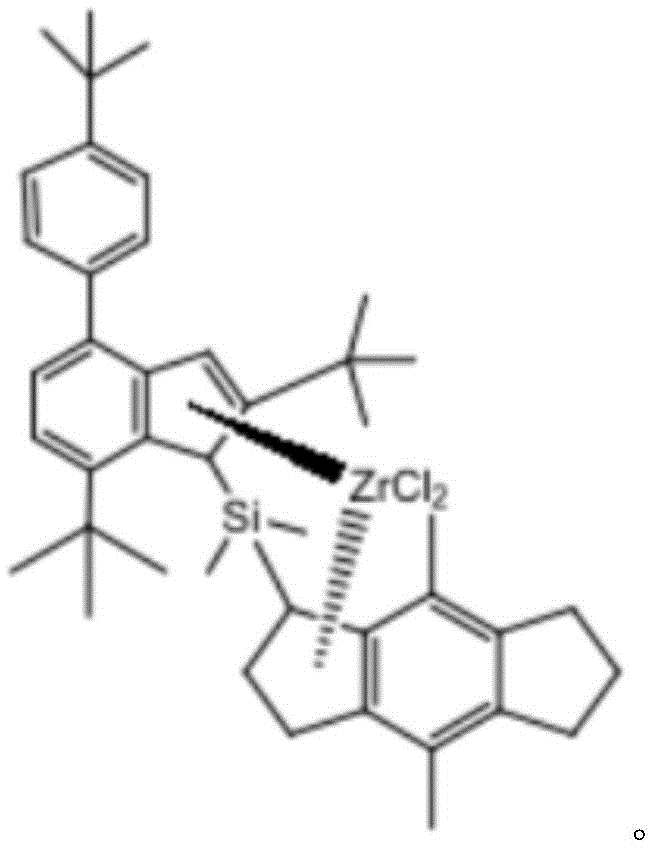
Optionally, the catalyst has the chemical formula:

based on the same inventive concept, the embodiment of the present invention further provides a preparation method of the catalyst, which includes:
carrying out condensation reaction on divinyl chlorodimethyl silicon-based derivative and Li compound to obtain a ligand;
reacting said ligand with ZrCl 4 Mixing the mixture in a first solvent to carry out a first reaction to obtain the catalyst.
Optionally, the condensation reaction time is 10-15h;
the solvent comprises at least one of benzene, dichloromethane, trichloromethane and n-hexane;
the time of the first reaction is 8-19h.
Based on the same inventive concept, the embodiment of the invention also provides the application of the catalyst, which comprises the application of the catalyst to the preparation of the poly (4-methyl-1-pentene).
Based on the same inventive concept, the embodiment of the invention also provides a preparation method of the TPX polymer, which comprises the following steps:
mixing 4-methyl-1-pentene, a catalyst, olefin and a second solvent for reaction, and then filtering and washing to obtain a TPX polymer;
wherein the catalyst comprises a catalyst as described above.
Optionally, the amount of material of the catalyst is less than the amount of material of the 4-methyl-1-pentene.
Optionally, the ratio of the amount of the material of the catalyst to the amount of the material of the 4-methyl-1-pentene is (0.1-0.5): 1.
One or more technical solutions in the embodiments of the present invention at least have the following technical effects or advantages:
the catalyst provided by the embodiment of the invention has high activity, can obtain TPX polymer with high molecular weight, reduces the using amount of the catalyst, has certain economic benefit, simultaneously catalyzes (4-methyl-1-pentene) and copolymerizes with olefin to obtain polymer with high crystallinity, and improves the properties of polymer materials, such as transparency and mechanical properties.
The foregoing description is only an overview of the technical solutions of the present invention, and the embodiments of the present invention are described below in order to make the technical means of the present invention more clearly understood and to make the above and other objects, features, and advantages of the present invention more clearly understandable.
Drawings
In order to more clearly illustrate the technical solutions in the embodiments of the present invention, the drawings needed to be used in the description of the embodiments are briefly introduced below, and it is obvious that the drawings in the following description are some embodiments of the present invention, and it is obvious for those skilled in the art to obtain other drawings based on the drawings without creative efforts.
Fig. 1 is a flow chart of a method provided by an embodiment of the invention.
Detailed Description
The present invention will be described in detail below with reference to specific embodiments and examples, and the advantages and various effects of the present invention will be more clearly apparent therefrom. It will be understood by those skilled in the art that these specific embodiments and examples are for the purpose of illustrating the invention and are not to be construed as limiting the invention.
Throughout the specification, unless otherwise specifically noted, terms used herein should be understood as having meanings as commonly used in the art. Accordingly, unless defined otherwise, all technical and scientific terms used herein have the same meaning as commonly understood by one of ordinary skill in the art to which this invention belongs. If there is a conflict, the present specification will control.
Unless otherwise specifically stated, various raw materials, reagents, instruments, equipment and the like used in the present invention are commercially available or can be prepared by existing methods.
In order to solve the technical problems, the general idea of the embodiment of the application is as follows:
according to an exemplary embodiment of the present invention, there is provided a catalyst whose raw materials include: ligand and ZrCl 4 (ii) a Wherein the raw material of the ligand comprises divinyl chlorodimethylsilyl derivative and Li compound.
In this embodiment, the Li compound is 1,2,3,5,6,7-Hexahydro-4,8-dimethyl-s-indacene.
In this example, the structural formula of the divinyl chlorodimethylsilyl derivative is as follows:
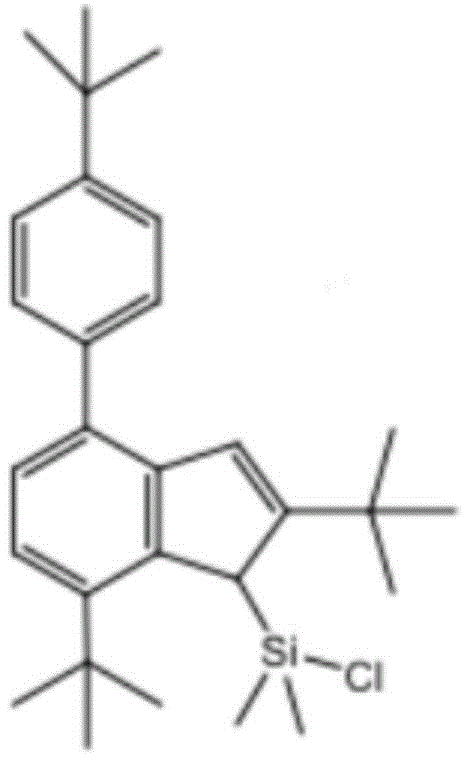
the structural formula of the Li-compound is as follows:

the structural formula of the ligand is as follows:

in this embodiment, the raw materials of the catalyst include, by mass: ligand 1 part and ZrCl 4 3 parts of ligand, wherein the raw materials of the ligand comprise the following components in mass: 1 part of divinyl chlorodimethylsilyl derivative and 1 part of Li compound.
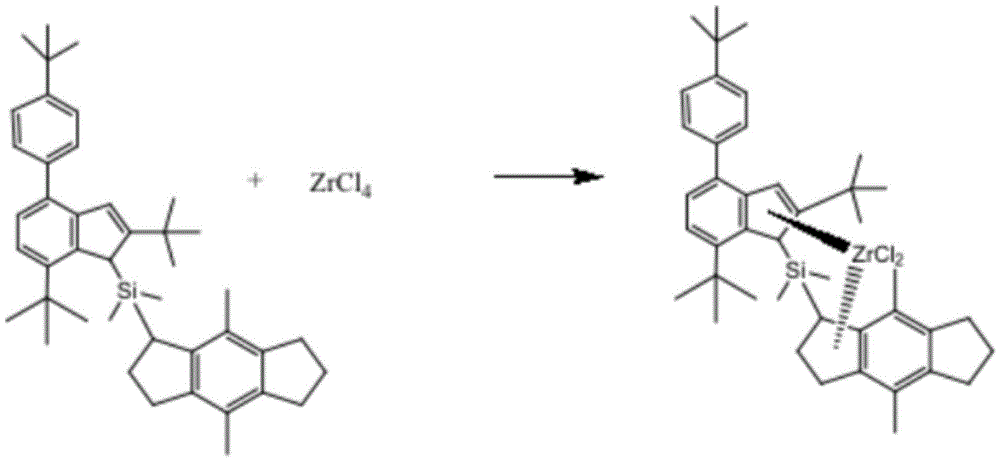
Specifically, the chemical formula of the catalyst is as follows:
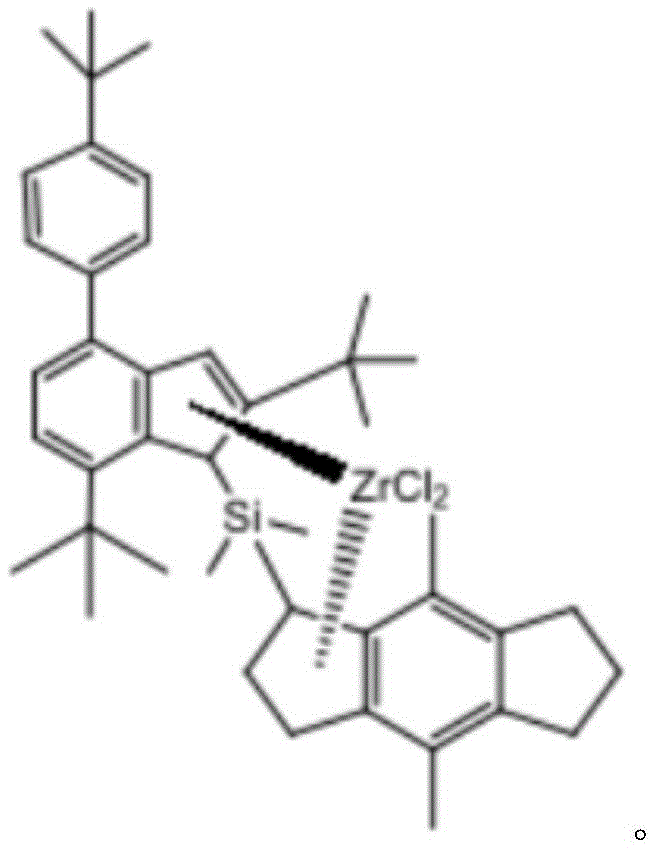
according to another exemplary embodiment of the present invention, there is provided a method of preparing the catalyst as described above, the method including:
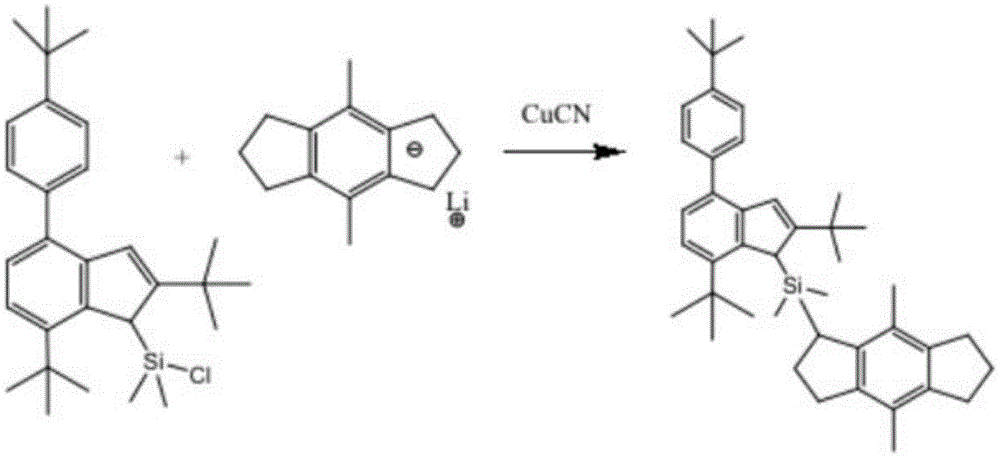
s1, carrying out condensation reaction on divinyl chlorodimethyl silicon-based derivative and a Li compound to obtain a ligand;
specifically, in this embodiment, water vapor in a reaction bottle is removed, then the reaction bottle is filled with nitrogen, and the reaction is performed in an oxygen-free environment to avoid side reactions caused by oxygen, and a proper amount of Li compound, copper cyanide and a solvent are added into the reaction bottle, and then divinyl chlorodimethylsilyl derivative, divinyl chlorodimethylsilyl derivative complex and Li compound are added to perform a condensation reaction to obtain the ligand.
Wherein, the divinyl chlorodimethylsilyl derivative: the Li compound molar ratio is 1:1; the Li compound is 1,2,3,5,6,7-Hexahydro-4,8-dimethyl-s-indacene; the reaction time is 10 to 15 hours; the solvent is at least one of benzene, dichloromethane, chloroform and n-hexane, preferably n-hexane.
The reaction process of the above steps is as follows:
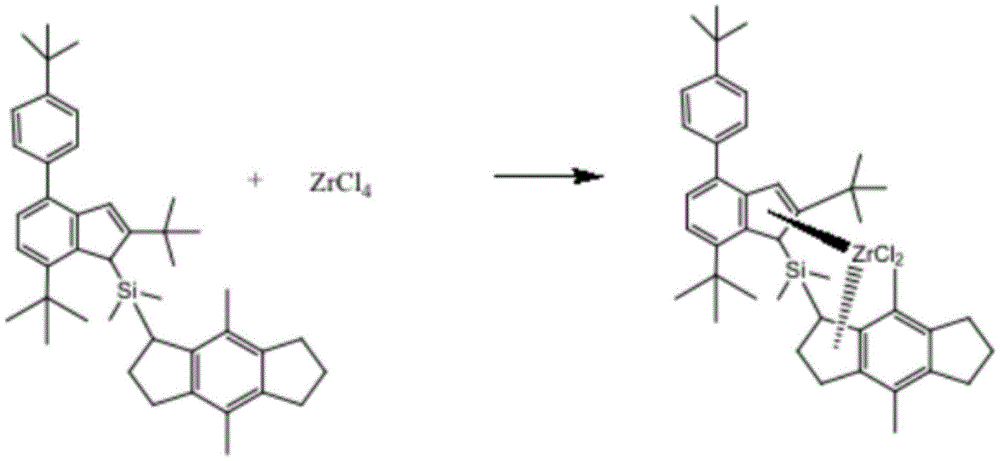
s2, mixing the ligand and ZrCl 4 Mixing the mixture in a first solvent to carry out a first reaction to obtain the catalyst.
Specifically, in this example, a divinyl chlorodimethylsilyl derivative complex and a ligand obtained from a Li compound were subjected to a first reaction with benzene as a solvent under a nitrogen atmosphere, and the ligand and an appropriate amount of ZrCl were added to a reaction flask 4 Adding into a reaction bottle, reacting at room temperature, evaporating the solvent by using a rotary evaporation instrument, and precipitating the obtained compound by using n-hexane to obtain the catalyst.
Wherein the ligand compound is reacted with ZrCl 4 Is 1:3; the first reaction time is 8 to 19 hours.
The reaction process of the above steps is as follows:
according to another exemplary embodiment of the present invention, there is provided a use of the catalyst as described above, comprising using the catalyst for catalyzing the preparation of poly (4-methyl-1-pentene).
According to another exemplary embodiment of the present invention, there is provided a method of preparing a TPX polymer, the method including:
s1, carrying out condensation reaction on divinyl chlorine dimethyl silicon-based derivatives and Li compounds to obtain ligands;
specifically, in this embodiment, water vapor in the reaction bottle is removed, then the reaction bottle is filled with nitrogen, the reaction is performed in an oxygen-free environment, so as to avoid side reactions caused by oxygen, a proper amount of Li compound, copper cyanide and solvent are added into the reaction bottle, then divinyl chlorodimethylsilyl derivative, divinyl chlorodimethylsilyl derivative complex and Li compound are added for condensation reaction, and the ligand is obtained.
Wherein, the divinyl chlorodimethylsilyl derivative: the Li compound molar ratio is 1:1; the Li compound is 1,2,3,5,6,7-Hexahydro-4,8-dimethyl-s-indacene; the reaction time is 10 to 15 hours; the solvent is at least one of benzene, dichloromethane, chloroform and n-hexane, preferably n-hexane.
The reaction process of the above steps is as follows:

s2, mixing the ligand and ZrCl 4 Mixing the mixture in a first solvent to carry out a first reaction to obtain the catalyst.
Specifically, in this example, a divinyl chlorodimethylsilyl derivative complex and a ligand obtained from a Li compound were subjected to a first reaction with benzene as a solvent under a nitrogen atmosphere, and the ligand and an appropriate amount of ZrCl were added to a reaction flask 4 Adding into a reaction bottle, reacting at room temperature, evaporating the solvent by using a rotary evaporation instrument, and precipitating the obtained compound by using n-hexane to obtain the catalyst.
Wherein the ligand compound is reacted with ZrCl 4 Is 1:3; the first reaction time is 8 to 19 hours。
The reaction process of the steps is as follows:
s3, mixing 4-methyl-1-pentene, a catalyst, olefin and a second solvent for reaction, and then filtering and washing to obtain the TPX polymer.
Specifically, in this example, the reaction flask was purged with nitrogen after removing water vapor at high temperature, an appropriate amount of 4-methyl-1-pentene, olefin, and benzene solution, and a high-efficiency catalyst were added to the reaction flask, and after polymerization was carried out at 30 ℃ for 3 hours, the reaction was stopped, the polymer was filtered, then washed with ethanol 3 times, and dried in a vacuum oven at 60 ℃ to a constant weight.
Wherein, 4-methyl-1-pentene: the high-efficiency catalyst has a molar ratio of 1: in the range of 0.5 to 0.1, preferably 1:0.1. the polymerization time is from 2 to 8 hours, preferably from 3 to 5 hours.
In general, pentenes may be used as the olefin.
The catalyst of the present application, the preparation method and the application thereof will be described in detail with reference to examples, comparative examples and experimental data.
Example 1
A method of making a TPX polymer, the method comprising:
(1) Synthesis of high efficiency catalyst
(a) Removing water vapor in a reaction bottle, filling nitrogen in the reaction bottle, reacting in an oxygen-free environment to avoid side reaction caused by oxygen, adding 10mmol 1,2,3,5,6,7-Hexahydro-4,8-dimethyl-s-indacene and 5ml copper cyanide into the reaction bottle, setting the temperature at 110 ℃, reacting for 4 hours, adding 10mmol divinyl chlorodimethyl silicon-based derivative complex into the reaction bottle, and carrying out condensation reaction on 1,2,3,5,6,7-Hexahydro-4,8-dimethyl-s-indacene and divinyl chlorodimethyl silicon-based derivative complex, setting the temperature at 120 ℃, and reacting for 12 hours to obtain the catalyst ligand.
(b) Removing water vapor from the reaction flask by baking the reaction flask at high temperature, and dryingFilling nitrogen into a reaction bottle, reacting in an oxygen-free environment, and reacting 16mmol of catalyst ligand and 16mmol of ZrCl 4 And (4) carrying out reaction, setting the temperature to be 80 ℃, and finally obtaining the imine catalyst.
(2) Synthesis of poly (4-methyl-1-pentene)
(c) The method comprises the following steps of roasting a reaction bottle at a high temperature, removing water vapor in the reaction bottle, filling nitrogen into the reaction bottle, reacting in an oxygen-free environment, adding a proper amount of benzene solution into the reaction bottle, adding 16mmol of 4-methyl-1-pentene and 25mmol of pentene into the reaction bottle, adding 12umol of high-efficiency catalyst, reacting for 4 hours at 30 ℃, precipitating reaction liquid in n-hexane to obtain a composite polymer of poly (4-methyl-1-pentene) and polypentene, washing the composite polymer for three times by using ethanol, and drying in a vacuum drying oven at 60 ℃ to constant weight.
Example 2
A method of making a TPX polymer, the method comprising:
(1) Synthesis of high efficiency catalyst
(a) Removing water vapor in a reaction bottle, filling nitrogen in the reaction bottle, reacting in an oxygen-free environment to avoid side reaction caused by oxygen, adding 12mmol 1,2,3,5,6,7-Hexahydro-4,8-dimethyl-s-indacene and 5ml copper cyanide into the reaction bottle, setting the temperature at 110 ℃, reacting for 4h, adding 12mmol divinyl chlorodimethyl silicon-based derivative complex into the reaction bottle, and carrying out condensation reaction on 1,2,3,5,6,7-Hexahydro-4,8-dimethyl-s-indacene and divinyl chlorodimethyl silicon-based derivative complex, setting the temperature at 120 ℃, and reacting for 12 h to obtain the catalyst ligand.
(b) Removing water vapor from the reaction flask by baking the reaction flask at high temperature, filling nitrogen into the reaction flask, reacting in oxygen-free environment, and reacting with 20mmol of catalyst ligand and 20mmol of ZrCl 4 Carrying out reaction, setting the temperature to 80 ℃, and finally obtaining the imine catalyst
(2) Synthesis of poly (4-methyl-1-pentene)
(c) The method comprises the following steps of roasting a reaction bottle at a high temperature, removing water vapor in the reaction bottle, filling nitrogen into the reaction bottle, reacting in an oxygen-free environment, adding a proper amount of benzene solution into the reaction bottle, adding 20mmol of 4-methyl-1-pentene and 25mmol of pentene into the reaction bottle, adding 15umol of imine catalyst, reacting for 4 hours at 30 ℃, precipitating reaction liquid in n-hexane to obtain a composite polymer of poly (4-methyl-1-pentene) and polypentene, washing the composite polymer with ethanol for three times, and drying in a vacuum drying oven at 60 ℃ to constant weight.
Example 3
A method of making a TPX polymer, the method comprising:
(1) Synthesis of high efficiency catalyst
(a) Removing water vapor in a reaction bottle, filling nitrogen in the reaction bottle, reacting in an oxygen-free environment to avoid side reaction caused by oxygen, adding 15mmol 1,2,3,5,6,7-Hexahydro-4,8-dimethyl-s-indacene and 8ml copper cyanide into the reaction bottle, setting the temperature at 110 ℃, reacting for 4h, adding 15mmol divinyl chlorodimethyl silicon-based derivative complex into the reaction bottle, and carrying out condensation reaction on 1,2,3,5,6,7-Hexahydro-4,8-dimethyl-s-indacene and divinyl chlorodimethyl silicon-based derivative complex, setting the temperature at 120 ℃, and reacting for 12 h to obtain the catalyst ligand.
(b) Removing water vapor from the reaction flask by baking the reaction flask at high temperature, filling nitrogen into the reaction flask, reacting in oxygen-free environment, and adding 25mmol of catalyst ligand and 30mmol of ZrCl 4 Carrying out reaction, setting the temperature to 80 ℃, and finally obtaining the imine catalyst
(2) Synthesis of poly (4-methyl-1-pentene)
(c) The method comprises the following steps of roasting a reaction bottle at a high temperature, removing water vapor in the reaction bottle, filling nitrogen into the reaction bottle, reacting in an oxygen-free environment, adding a proper amount of benzene solution into the reaction bottle, adding 16mmol of 4-methyl-1-pentene and 25mmol of pentene into the reaction bottle, adding 20umol of imine catalyst, reacting for 4 hours at 30 ℃, precipitating reaction liquid in n-hexane to obtain a composite polymer of poly (4-methyl-1-pentene) and polypentene, washing the composite polymer with ethanol for three times, and drying in a vacuum drying oven at 60 ℃ to constant weight.
Example 4
A method of making a TPX polymer, the method comprising:
(1) Synthesis of high efficiency catalyst
(a) Removing water vapor in a reaction bottle, filling nitrogen in the reaction bottle, reacting in an oxygen-free environment to avoid side reaction caused by oxygen, adding 20mmol 1,2,3,5,6,7-Hexahydro-4,8-dimethyl-s-indacene and 10ml of copper cyanide into the reaction bottle, setting the temperature at 110 ℃, reacting for 4 hours, adding 25mmol divinyl chlorodimethyl silicon-based derivative complex into the reaction bottle, and carrying out condensation reaction on 1,2,3,5,6,7-Hexahydro-4,8-dimethyl-s-indacene and divinyl chlorodimethyl silicon-based derivative complex, setting the temperature at 120 ℃, and reacting for 12 hours to obtain the catalyst ligand.
(b) Removing water vapor from the reaction flask by baking the reaction flask at high temperature, filling nitrogen into the reaction flask, reacting in oxygen-free environment, and adding 30mmol of catalyst ligand and 40mmol of ZrCl 4 Carrying out reaction, setting the temperature to 80 ℃, and finally obtaining the imine catalyst
(2) Synthesis of poly (4-methyl-1-pentene)
(c) The method comprises the following steps of roasting a reaction bottle at a high temperature, removing water vapor in the reaction bottle, filling nitrogen into the reaction bottle, reacting in an oxygen-free environment, adding a proper amount of benzene solution into the reaction bottle, adding 16mmol of 4-methyl-1-pentene and 25mmol of pentene into the reaction bottle, adding 25umol of high-efficiency catalyst, reacting for 4 hours at 30 ℃, precipitating reaction liquid in n-hexane to obtain a composite polymer of poly (4-methyl-1-pentene) and polypentene, washing the composite polymer for three times by using ethanol, and drying in a vacuum drying oven at 60 ℃ to constant weight.
Example 5
A method of making a TPX polymer, the method comprising:
(1) Synthesis of high efficiency catalyst
(a) Removing water vapor in a reaction bottle, filling nitrogen in the reaction bottle, reacting in an oxygen-free environment to avoid side reaction caused by oxygen, adding 40mmol 1,2,3,5,6,7-Hexahydro-4,8-dimethyl-s-indacene and 8ml copper cyanide into the reaction bottle, setting the temperature at 120 ℃, reacting for 4h, adding 45mmol divinyl chlorodimethyl silicon-based derivative complex into the reaction bottle, and carrying out condensation reaction on 1,2,3,5,6,7-Hexahydro-4,8-dimethyl-s-indacene and divinyl chlorodimethyl silicon-based derivative complex, setting the temperature at 120 ℃, and reacting for 12 h to obtain the catalyst ligand.
(b) Removing water vapor from the reaction flask by baking the reaction flask at high temperature, filling nitrogen into the reaction flask, reacting in oxygen-free environment, and mixing 40mmol of catalyst ligand and 50mmol of ZrCl 4 The reaction is carried out, the temperature is set to be 90 ℃, and finally the imine catalyst is obtained
(2) Synthesis of poly (4-methyl-1-pentene)
(c) The method comprises the following steps of roasting a reaction bottle at a high temperature, removing water vapor in the reaction bottle, filling nitrogen into the reaction bottle, reacting in an oxygen-free environment, adding a proper amount of benzene solution into the reaction bottle, adding 16mmol of 4-methyl-1-pentene and 25mmol of pentene into the reaction bottle, adding 30umol of high-efficiency catalyst, reacting for 4 hours at 30 ℃, precipitating reaction liquid in n-hexane to obtain a composite polymer of poly (4-methyl-1-pentene) and polypentene, washing the composite polymer for three times by using ethanol, and drying in a vacuum drying oven at 60 ℃ to constant weight.
Examples of the experiments
The TPX polymeric materials from examples 1-5 were analyzed for properties and the results are shown in the following tables.
| Number average molecular weight | Molecular weight distribution | Degree of crystallinity (%) | |
| Example 1 | 12101g mol -1 | 1.28 | 58.7 |
| Example 2 | 13105g mol -1 | 1.31 | 59.7 |
| Example 3 | 13862g mol -1 | 1.29 | 59.9 |
| Example 4 | 15414g mol -1 | 1.31 | 60.1 |
| Example 5 | 16714g mol -1 | 1.32 | 61.2 |
From the above table, the catalyst content is increased, the molecular weight and the crystallinity are improved to different degrees, and the crystallinity is over 50 percent, namely, the regularity of the polymer is high.
One or more technical solutions in the embodiments of the present invention at least have the following technical effects or advantages:
the catalyst provided by the embodiment of the invention has high activity, can obtain a TPX polymer with high molecular weight, reduces the using amount of the catalyst, has certain economic benefit, and simultaneously catalyzes (4-methyl-1-pentene) and pentene to copolymerize to obtain a polymer with high crystallinity, thereby improving the properties of polymer materials, such as transparency and mechanical properties.
Finally, it should be further noted that the terms "comprises," "comprising," or any other variation thereof, are intended to cover a non-exclusive inclusion, such that a process, method, article, or apparatus that comprises a list of elements does not include only those elements but may include other elements not expressly listed or inherent to such process, method, article, or apparatus.
While preferred embodiments of the present invention have been described, additional variations and modifications in those embodiments may occur to those skilled in the art once they learn of the basic inventive concepts. Therefore, it is intended that the appended claims be interpreted as including preferred embodiments and all such alterations and modifications as fall within the scope of the invention.
It will be apparent to those skilled in the art that various changes and modifications may be made in the present invention without departing from the spirit and scope of the invention. Thus, if such modifications and variations of the present invention fall within the scope of the claims of the present invention and their equivalents, the present invention is also intended to include such modifications and variations.
Claims (10)
1. A catalyst, wherein the feedstock for the catalyst comprises: ligand and ZrCl 4 (ii) a Wherein the raw material of the ligand comprises divinyl chlorodimethylsilyl derivative and Li compound.
2. The catalyst according to claim 1, wherein the raw materials of the catalyst comprise, in terms of mass: ligand 1 part and ZrCl 4 3 parts of the ligand, wherein the raw materials of the ligand comprise the following components in mass: 1 part of divinyl chlorodimethylsilyl derivative and 1 part of Li compound.
3. The catalyst of claim 1, wherein the Li-compound is
1,2,3,5,6,7-Hexahydro-4,8-dimethyl-s-indacene。
4. The catalyst of claim 1, wherein the catalyst has the formula:
5. a process for preparing a catalyst according to any one of claims 1 to 4, characterized in that it comprises:
carrying out condensation reaction on divinyl chlorodimethyl silicon-based derivative and Li compound to obtain a ligand;
reacting said ligand with ZrCl 4 Mixing the mixture in a first solvent to carry out a first reaction to obtain the catalyst.
6. The method for preparing the catalyst according to claim 5, wherein the time of the condensation reaction is 10 to 15 hours;
the solvent comprises at least one of benzene, dichloromethane, trichloromethane and n-hexane;
the time of the first reaction is 8-19h.
7. Use of a catalyst according to any one of claims 1 to 4, wherein the use comprises the use of the catalyst for catalysing the preparation of poly (4-methyl-1-pentene).
8. A method of making a TPX polymer, comprising:
mixing 4-methyl-1-pentene, a catalyst, olefin and a second solvent for reaction, and then filtering and washing to obtain a TPX polymer;
wherein the catalyst comprises the catalyst of any one of claims 1 to 4.
9. The method of claim 8, wherein the amount of the catalyst material is less than the amount of the 4-methyl-1-pentene material.
10. The method of claim 8 or 9, wherein the ratio of the amount of the substance of the catalyst to the amount of the substance of 4-methyl-1-pentene is (0.1-0.5): 1.
Priority Applications (1)
| Application Number | Priority Date | Filing Date | Title |
|---|---|---|---|
| CN202210841276.7A CN115160470B (en) | 2022-07-18 | 2022-07-18 | Preparation method of TPX polymer, catalyst and preparation method thereof |
Applications Claiming Priority (1)
| Application Number | Priority Date | Filing Date | Title |
|---|---|---|---|
| CN202210841276.7A CN115160470B (en) | 2022-07-18 | 2022-07-18 | Preparation method of TPX polymer, catalyst and preparation method thereof |
Publications (2)
| Publication Number | Publication Date |
|---|---|
| CN115160470A true CN115160470A (en) | 2022-10-11 |
| CN115160470B CN115160470B (en) | 2023-06-30 |
Family
ID=83494593
Family Applications (1)
| Application Number | Title | Priority Date | Filing Date |
|---|---|---|---|
| CN202210841276.7A Active CN115160470B (en) | 2022-07-18 | 2022-07-18 | Preparation method of TPX polymer, catalyst and preparation method thereof |
Country Status (1)
| Country | Link |
|---|---|
| CN (1) | CN115160470B (en) |
Citations (11)
| Publication number | Priority date | Publication date | Assignee | Title |
|---|---|---|---|---|
| DE10003581A1 (en) * | 2000-01-28 | 2001-08-02 | Bayer Ag | Organometallic compounds with fused indenyl ligands |
| CN1890272A (en) * | 2003-12-10 | 2007-01-03 | 巴塞尔聚烯烃股份有限公司 | Organometallic transition metal compound, biscyclopentadienyl ligand system, catalyst system and preparation of polyolefins |
| JP2016172714A (en) * | 2015-03-17 | 2016-09-29 | 日本ポリエチレン株式会社 | Metallocene compound, olefin polymerization catalyst component and olefin polymerization catalyst containing the same, and method for producing olefin polymer using the olefin polymerization catalyst |
| KR20170009596A (en) * | 2015-07-17 | 2017-01-25 | 주식회사 엘지화학 | Metallocene compounds, catalyst compositions comprising the same, and method for preparing olefin polymers using the same |
| US20190161561A1 (en) * | 2017-11-29 | 2019-05-30 | Exxonmobil Chemical Patents Inc. | Catalysts that Produce Polyethylene with Broad, Bimodal Molecular Weight Distribution |
| JP2020050614A (en) * | 2018-09-27 | 2020-04-02 | 三井化学株式会社 | Transition metal compound, olefin polymerization catalyst, and olefin polymer production method |
| CN111372954A (en) * | 2017-11-14 | 2020-07-03 | 埃克森美孚化学专利公司 | Preparation of polyethylene (bis) silicon-bridged metallocenes with broad molecular weight distribution and molecular weight |
| CN111448223A (en) * | 2017-11-14 | 2020-07-24 | 埃克森美孚化学专利公司 | Polyethylene compositions and articles made therefrom |
| US20210017307A1 (en) * | 2018-03-19 | 2021-01-21 | Borealis Ag | Catalysts for olefin polymerization |
| KR20220009900A (en) * | 2020-07-16 | 2022-01-25 | 주식회사 엘지화학 | Transition metal compound and catalyst composition comprising the same |
| CN114269798A (en) * | 2019-07-17 | 2022-04-01 | 埃克森美孚化学专利公司 | High propylene content EP with low glass transition temperature |
-
2022
- 2022-07-18 CN CN202210841276.7A patent/CN115160470B/en active Active
Patent Citations (11)
| Publication number | Priority date | Publication date | Assignee | Title |
|---|---|---|---|---|
| DE10003581A1 (en) * | 2000-01-28 | 2001-08-02 | Bayer Ag | Organometallic compounds with fused indenyl ligands |
| CN1890272A (en) * | 2003-12-10 | 2007-01-03 | 巴塞尔聚烯烃股份有限公司 | Organometallic transition metal compound, biscyclopentadienyl ligand system, catalyst system and preparation of polyolefins |
| JP2016172714A (en) * | 2015-03-17 | 2016-09-29 | 日本ポリエチレン株式会社 | Metallocene compound, olefin polymerization catalyst component and olefin polymerization catalyst containing the same, and method for producing olefin polymer using the olefin polymerization catalyst |
| KR20170009596A (en) * | 2015-07-17 | 2017-01-25 | 주식회사 엘지화학 | Metallocene compounds, catalyst compositions comprising the same, and method for preparing olefin polymers using the same |
| CN111372954A (en) * | 2017-11-14 | 2020-07-03 | 埃克森美孚化学专利公司 | Preparation of polyethylene (bis) silicon-bridged metallocenes with broad molecular weight distribution and molecular weight |
| CN111448223A (en) * | 2017-11-14 | 2020-07-24 | 埃克森美孚化学专利公司 | Polyethylene compositions and articles made therefrom |
| US20190161561A1 (en) * | 2017-11-29 | 2019-05-30 | Exxonmobil Chemical Patents Inc. | Catalysts that Produce Polyethylene with Broad, Bimodal Molecular Weight Distribution |
| US20210017307A1 (en) * | 2018-03-19 | 2021-01-21 | Borealis Ag | Catalysts for olefin polymerization |
| JP2020050614A (en) * | 2018-09-27 | 2020-04-02 | 三井化学株式会社 | Transition metal compound, olefin polymerization catalyst, and olefin polymer production method |
| CN114269798A (en) * | 2019-07-17 | 2022-04-01 | 埃克森美孚化学专利公司 | High propylene content EP with low glass transition temperature |
| KR20220009900A (en) * | 2020-07-16 | 2022-01-25 | 주식회사 엘지화학 | Transition metal compound and catalyst composition comprising the same |
Non-Patent Citations (3)
| Title |
|---|
| ILYA E. NIFANT’EV等: "Asymmetric ansa-Zirconocenes Containing a 2-Methyl-4- aryltetrahydroindacene Fragment: Synthesis, Structure, and Catalytic Activity in Propylene Polymerization and Copolymerization", 《ORGANOMETALLICS》, vol. 30, pages 5744 - 5752, XP008162994, DOI: 10.1021/om200610b * |
| LUIGI RESCONI等: "C1-Symmetric Heterocyclic Zirconocenes as Catalysts for Propylene Polymerization, 2 ansa-Zirconocenes with Linked Dithienocyclopentadienyl-Substituted Indenyl Ligands", 《MACROMOLECULAR CHEMISTRY AND PHYSICS》, vol. 206, pages 1405 - 1438, XP002392580, DOI: 10.1002/macp.200400533 * |
| 王佰全等: "柄型茂金属化合物∗(Ⅲ) 四甲基二硅桥连二(1-茚基和四氢茚基)钛和锆 化合物的合成及催化乙烯聚合", 《高等学校化学学报》, vol. 20, no. 1, pages 77 - 80 * |
Also Published As
| Publication number | Publication date |
|---|---|
| CN115160470B (en) | 2023-06-30 |
Similar Documents
| Publication | Publication Date | Title |
|---|---|---|
| CN110437452B (en) | A kind of heteroatom doped phosphazene functionalized POSS-based hybrid porous polymer and its preparation method and application | |
| CN109942814B (en) | A kind of conjugated microporous polymer containing pyridyl group and its preparation method and application | |
| CN115155666B (en) | Preparation of temperature-sensitive copper-based metal organic framework catalyst and application of temperature-sensitive copper-based metal organic framework catalyst in boron addition reaction | |
| CN112574370B (en) | A kind of three-dimensional hydroxyl-containing covalent organic framework material and preparation method thereof | |
| CN1220669A (en) | Novel compounds containing group 13 elements linked to mono- or dianionic tridentate ligands, processes for their preparation and their use as polymerization catalysts | |
| CN115160470B (en) | Preparation method of TPX polymer, catalyst and preparation method thereof | |
| CN113912829B (en) | Method for catalyzing ring-opening copolymerization of epoxide and cyclic anhydride by metal organic framework | |
| CN114874365B (en) | Catalyst of TPX polymer and preparation method and application thereof | |
| CN112126074B (en) | A kind of HfC/C ceramic precursor polymer and preparation method thereof | |
| CN102516554A (en) | Method for preparing hydroxyl-terminated polytetrahydrofuran polypropylene oxide block copolyether | |
| CN114920861B (en) | Catalyst and preparation method thereof, and preparation method of TPX polymer | |
| CN118374004A (en) | A three-dimensional ordered macroporous ZIF-8@ZIF-67 for lactide ring-opening polymerization and a preparation method thereof | |
| CN118772416A (en) | Intrinsically high thermal conductivity polysiloxane and preparation method and polymer material thereof | |
| CN115044057B (en) | Benzenesulfonic acid-based ionic hydrogen bonding organic framework material and its preparation method and application | |
| CN114989339A (en) | Method for improving regularity of TPX polymer | |
| CN104530435A (en) | Synthesis method of Fe-Si-C ceramic precursor | |
| Seçkin et al. | Sol-gel synthesis of Ru (II) complex of 3-4, 5-dihydroimidazol-1-yl-propyltriethoxysilane aerogels and xerogels | |
| CN101270187A (en) | Preparation of Organotin Functionalized Periodic Mesoporous Silicone | |
| CN117563558B (en) | Modified porous spherical silica gel and preparation method thereof | |
| CN118496178B (en) | A water-soluble morpholine lactamide acrylate bio-based monomer and its polymer | |
| CN115073643B (en) | Preparation method of poly 4-methyl-1-pentene material, catalyst system and application thereof | |
| Diaz et al. | Immobilization of Cobalt Complexes on Mesoporous MCM-41 Support Materials | |
| CN120137169B (en) | A kind of high crystalline thermal conductive polysulfate and its preparation method and application | |
| CN119823364A (en) | Schiff base catalyst for epoxide and carbon disulfide copolymerization reaction | |
| CN120438063B (en) | MOF modified metal catalyst and preparation method and application thereof |
Legal Events
| Date | Code | Title | Description |
|---|---|---|---|
| PB01 | Publication | ||
| PB01 | Publication | ||
| SE01 | Entry into force of request for substantive examination | ||
| SE01 | Entry into force of request for substantive examination | ||
| GR01 | Patent grant | ||
| GR01 | Patent grant |