CN115135236A - Improved personal health data collection - Google Patents
Improved personal health data collection Download PDFInfo
- Publication number
- CN115135236A CN115135236A CN202080096718.9A CN202080096718A CN115135236A CN 115135236 A CN115135236 A CN 115135236A CN 202080096718 A CN202080096718 A CN 202080096718A CN 115135236 A CN115135236 A CN 115135236A
- Authority
- CN
- China
- Prior art keywords
- body part
- pressure
- blood pressure
- artery
- subject
- Prior art date
- Legal status (The legal status is an assumption and is not a legal conclusion. Google has not performed a legal analysis and makes no representation as to the accuracy of the status listed.)
- Pending
Links
Images


Classifications
-
- A—HUMAN NECESSITIES
- A61—MEDICAL OR VETERINARY SCIENCE; HYGIENE
- A61B—DIAGNOSIS; SURGERY; IDENTIFICATION
- A61B5/00—Measuring for diagnostic purposes; Identification of persons
- A61B5/02—Detecting, measuring or recording for evaluating the cardiovascular system, e.g. pulse, heart rate, blood pressure or blood flow
- A61B5/021—Measuring pressure in heart or blood vessels
- A61B5/022—Measuring pressure in heart or blood vessels by applying pressure to close blood vessels, e.g. against the skin; Ophthalmodynamometers
- A61B5/02225—Measuring pressure in heart or blood vessels by applying pressure to close blood vessels, e.g. against the skin; Ophthalmodynamometers using the oscillometric method
-
- A—HUMAN NECESSITIES
- A61—MEDICAL OR VETERINARY SCIENCE; HYGIENE
- A61B—DIAGNOSIS; SURGERY; IDENTIFICATION
- A61B5/00—Measuring for diagnostic purposes; Identification of persons
- A61B5/0048—Detecting, measuring or recording by applying mechanical forces or stimuli
- A61B5/0053—Detecting, measuring or recording by applying mechanical forces or stimuli by applying pressure, e.g. compression, indentation, palpation, grasping, gauging
-
- A—HUMAN NECESSITIES
- A61—MEDICAL OR VETERINARY SCIENCE; HYGIENE
- A61B—DIAGNOSIS; SURGERY; IDENTIFICATION
- A61B5/00—Measuring for diagnostic purposes; Identification of persons
- A61B5/02—Detecting, measuring or recording for evaluating the cardiovascular system, e.g. pulse, heart rate, blood pressure or blood flow
- A61B5/02007—Evaluating blood vessel condition, e.g. elasticity, compliance
-
- A—HUMAN NECESSITIES
- A61—MEDICAL OR VETERINARY SCIENCE; HYGIENE
- A61B—DIAGNOSIS; SURGERY; IDENTIFICATION
- A61B5/00—Measuring for diagnostic purposes; Identification of persons
- A61B5/02—Detecting, measuring or recording for evaluating the cardiovascular system, e.g. pulse, heart rate, blood pressure or blood flow
- A61B5/02028—Determining haemodynamic parameters not otherwise provided for, e.g. cardiac contractility or left ventricular ejection fraction
-
- A—HUMAN NECESSITIES
- A61—MEDICAL OR VETERINARY SCIENCE; HYGIENE
- A61B—DIAGNOSIS; SURGERY; IDENTIFICATION
- A61B5/00—Measuring for diagnostic purposes; Identification of persons
- A61B5/02—Detecting, measuring or recording for evaluating the cardiovascular system, e.g. pulse, heart rate, blood pressure or blood flow
- A61B5/02028—Determining haemodynamic parameters not otherwise provided for, e.g. cardiac contractility or left ventricular ejection fraction
- A61B5/02035—Determining blood viscosity
-
- A—HUMAN NECESSITIES
- A61—MEDICAL OR VETERINARY SCIENCE; HYGIENE
- A61B—DIAGNOSIS; SURGERY; IDENTIFICATION
- A61B5/00—Measuring for diagnostic purposes; Identification of persons
- A61B5/02—Detecting, measuring or recording for evaluating the cardiovascular system, e.g. pulse, heart rate, blood pressure or blood flow
- A61B5/021—Measuring pressure in heart or blood vessels
- A61B5/02108—Measuring pressure in heart or blood vessels from analysis of pulse wave characteristics
- A61B5/02125—Measuring pressure in heart or blood vessels from analysis of pulse wave characteristics of pulse wave propagation time
-
- A—HUMAN NECESSITIES
- A61—MEDICAL OR VETERINARY SCIENCE; HYGIENE
- A61B—DIAGNOSIS; SURGERY; IDENTIFICATION
- A61B5/00—Measuring for diagnostic purposes; Identification of persons
- A61B5/02—Detecting, measuring or recording for evaluating the cardiovascular system, e.g. pulse, heart rate, blood pressure or blood flow
- A61B5/021—Measuring pressure in heart or blood vessels
- A61B5/022—Measuring pressure in heart or blood vessels by applying pressure to close blood vessels, e.g. against the skin; Ophthalmodynamometers
- A61B5/0225—Measuring pressure in heart or blood vessels by applying pressure to close blood vessels, e.g. against the skin; Ophthalmodynamometers the pressure being controlled by electric signals, e.g. derived from Korotkoff sounds
- A61B5/02255—Measuring pressure in heart or blood vessels by applying pressure to close blood vessels, e.g. against the skin; Ophthalmodynamometers the pressure being controlled by electric signals, e.g. derived from Korotkoff sounds the pressure being controlled by plethysmographic signals, e.g. derived from optical sensors
-
- A—HUMAN NECESSITIES
- A61—MEDICAL OR VETERINARY SCIENCE; HYGIENE
- A61B—DIAGNOSIS; SURGERY; IDENTIFICATION
- A61B5/00—Measuring for diagnostic purposes; Identification of persons
- A61B5/02—Detecting, measuring or recording for evaluating the cardiovascular system, e.g. pulse, heart rate, blood pressure or blood flow
- A61B5/024—Measuring pulse rate or heart rate
- A61B5/02438—Measuring pulse rate or heart rate with portable devices, e.g. worn by the patient
-
- A—HUMAN NECESSITIES
- A61—MEDICAL OR VETERINARY SCIENCE; HYGIENE
- A61B—DIAGNOSIS; SURGERY; IDENTIFICATION
- A61B5/00—Measuring for diagnostic purposes; Identification of persons
- A61B5/02—Detecting, measuring or recording for evaluating the cardiovascular system, e.g. pulse, heart rate, blood pressure or blood flow
- A61B5/026—Measuring blood flow
- A61B5/0261—Measuring blood flow using optical means, e.g. infrared light
-
- A—HUMAN NECESSITIES
- A61—MEDICAL OR VETERINARY SCIENCE; HYGIENE
- A61B—DIAGNOSIS; SURGERY; IDENTIFICATION
- A61B5/00—Measuring for diagnostic purposes; Identification of persons
- A61B5/02—Detecting, measuring or recording for evaluating the cardiovascular system, e.g. pulse, heart rate, blood pressure or blood flow
- A61B5/026—Measuring blood flow
- A61B5/0285—Measuring or recording phase velocity of blood waves
-
- A—HUMAN NECESSITIES
- A61—MEDICAL OR VETERINARY SCIENCE; HYGIENE
- A61B—DIAGNOSIS; SURGERY; IDENTIFICATION
- A61B5/00—Measuring for diagnostic purposes; Identification of persons
- A61B5/103—Measuring devices for testing the shape, pattern, colour, size or movement of the body or parts thereof, for diagnostic purposes
- A61B5/107—Measuring physical dimensions, e.g. size of the entire body or parts thereof
- A61B5/1079—Measuring physical dimensions, e.g. size of the entire body or parts thereof using optical or photographic means
-
- A—HUMAN NECESSITIES
- A61—MEDICAL OR VETERINARY SCIENCE; HYGIENE
- A61B—DIAGNOSIS; SURGERY; IDENTIFICATION
- A61B5/00—Measuring for diagnostic purposes; Identification of persons
- A61B5/24—Detecting, measuring or recording bioelectric or biomagnetic signals of the body or parts thereof
- A61B5/25—Bioelectric electrodes therefor
- A61B5/279—Bioelectric electrodes therefor specially adapted for particular uses
- A61B5/28—Bioelectric electrodes therefor specially adapted for particular uses for electrocardiography [ECG]
-
- A—HUMAN NECESSITIES
- A61—MEDICAL OR VETERINARY SCIENCE; HYGIENE
- A61B—DIAGNOSIS; SURGERY; IDENTIFICATION
- A61B5/00—Measuring for diagnostic purposes; Identification of persons
- A61B5/48—Other medical applications
- A61B5/486—Biofeedback
-
- A—HUMAN NECESSITIES
- A61—MEDICAL OR VETERINARY SCIENCE; HYGIENE
- A61B—DIAGNOSIS; SURGERY; IDENTIFICATION
- A61B5/00—Measuring for diagnostic purposes; Identification of persons
- A61B5/48—Other medical applications
- A61B5/4869—Determining body composition
- A61B5/4875—Hydration status, fluid retention of the body
-
- A—HUMAN NECESSITIES
- A61—MEDICAL OR VETERINARY SCIENCE; HYGIENE
- A61B—DIAGNOSIS; SURGERY; IDENTIFICATION
- A61B5/00—Measuring for diagnostic purposes; Identification of persons
- A61B5/68—Arrangements of detecting, measuring or recording means, e.g. sensors, in relation to patient
- A61B5/6801—Arrangements of detecting, measuring or recording means, e.g. sensors, in relation to patient specially adapted to be attached to or worn on the body surface
- A61B5/6843—Monitoring or controlling sensor contact pressure
-
- A—HUMAN NECESSITIES
- A61—MEDICAL OR VETERINARY SCIENCE; HYGIENE
- A61B—DIAGNOSIS; SURGERY; IDENTIFICATION
- A61B5/00—Measuring for diagnostic purposes; Identification of persons
- A61B5/68—Arrangements of detecting, measuring or recording means, e.g. sensors, in relation to patient
- A61B5/6801—Arrangements of detecting, measuring or recording means, e.g. sensors, in relation to patient specially adapted to be attached to or worn on the body surface
- A61B5/6844—Monitoring or controlling distance between sensor and tissue
-
- A—HUMAN NECESSITIES
- A61—MEDICAL OR VETERINARY SCIENCE; HYGIENE
- A61B—DIAGNOSIS; SURGERY; IDENTIFICATION
- A61B5/00—Measuring for diagnostic purposes; Identification of persons
- A61B5/68—Arrangements of detecting, measuring or recording means, e.g. sensors, in relation to patient
- A61B5/6887—Arrangements of detecting, measuring or recording means, e.g. sensors, in relation to patient mounted on external non-worn devices, e.g. non-medical devices
- A61B5/6898—Portable consumer electronic devices, e.g. music players, telephones, tablet computers
-
- A—HUMAN NECESSITIES
- A61—MEDICAL OR VETERINARY SCIENCE; HYGIENE
- A61B—DIAGNOSIS; SURGERY; IDENTIFICATION
- A61B5/00—Measuring for diagnostic purposes; Identification of persons
- A61B5/72—Signal processing specially adapted for physiological signals or for diagnostic purposes
- A61B5/7203—Signal processing specially adapted for physiological signals or for diagnostic purposes for noise prevention, reduction or removal
- A61B5/7207—Signal processing specially adapted for physiological signals or for diagnostic purposes for noise prevention, reduction or removal of noise induced by motion artifacts
-
- A—HUMAN NECESSITIES
- A61—MEDICAL OR VETERINARY SCIENCE; HYGIENE
- A61B—DIAGNOSIS; SURGERY; IDENTIFICATION
- A61B2560/00—Constructional details of operational features of apparatus; Accessories for medical measuring apparatus
- A61B2560/02—Operational features
- A61B2560/0223—Operational features of calibration, e.g. protocols for calibrating sensors
-
- A—HUMAN NECESSITIES
- A61—MEDICAL OR VETERINARY SCIENCE; HYGIENE
- A61B—DIAGNOSIS; SURGERY; IDENTIFICATION
- A61B2562/00—Details of sensors; Constructional details of sensor housings or probes; Accessories for sensors
- A61B2562/02—Details of sensors specially adapted for in-vivo measurements
- A61B2562/0209—Special features of electrodes classified in A61B5/24, A61B5/25, A61B5/283, A61B5/291, A61B5/296, A61B5/053
-
- A—HUMAN NECESSITIES
- A61—MEDICAL OR VETERINARY SCIENCE; HYGIENE
- A61B—DIAGNOSIS; SURGERY; IDENTIFICATION
- A61B2562/00—Details of sensors; Constructional details of sensor housings or probes; Accessories for sensors
- A61B2562/02—Details of sensors specially adapted for in-vivo measurements
- A61B2562/0219—Inertial sensors, e.g. accelerometers, gyroscopes, tilt switches
-
- A—HUMAN NECESSITIES
- A61—MEDICAL OR VETERINARY SCIENCE; HYGIENE
- A61B—DIAGNOSIS; SURGERY; IDENTIFICATION
- A61B2562/00—Details of sensors; Constructional details of sensor housings or probes; Accessories for sensors
- A61B2562/02—Details of sensors specially adapted for in-vivo measurements
- A61B2562/0233—Special features of optical sensors or probes classified in A61B5/00
-
- A—HUMAN NECESSITIES
- A61—MEDICAL OR VETERINARY SCIENCE; HYGIENE
- A61B—DIAGNOSIS; SURGERY; IDENTIFICATION
- A61B2562/00—Details of sensors; Constructional details of sensor housings or probes; Accessories for sensors
- A61B2562/02—Details of sensors specially adapted for in-vivo measurements
- A61B2562/0247—Pressure sensors
-
- A—HUMAN NECESSITIES
- A61—MEDICAL OR VETERINARY SCIENCE; HYGIENE
- A61B—DIAGNOSIS; SURGERY; IDENTIFICATION
- A61B5/00—Measuring for diagnostic purposes; Identification of persons
- A61B5/0002—Remote monitoring of patients using telemetry, e.g. transmission of vital signals via a communication network
- A61B5/0004—Remote monitoring of patients using telemetry, e.g. transmission of vital signals via a communication network characterised by the type of physiological signal transmitted
- A61B5/0008—Temperature signals
-
- A—HUMAN NECESSITIES
- A61—MEDICAL OR VETERINARY SCIENCE; HYGIENE
- A61B—DIAGNOSIS; SURGERY; IDENTIFICATION
- A61B5/00—Measuring for diagnostic purposes; Identification of persons
- A61B5/01—Measuring temperature of body parts ; Diagnostic temperature sensing, e.g. for malignant or inflamed tissue
-
- A—HUMAN NECESSITIES
- A61—MEDICAL OR VETERINARY SCIENCE; HYGIENE
- A61B—DIAGNOSIS; SURGERY; IDENTIFICATION
- A61B5/00—Measuring for diagnostic purposes; Identification of persons
- A61B5/02—Detecting, measuring or recording for evaluating the cardiovascular system, e.g. pulse, heart rate, blood pressure or blood flow
- A61B5/021—Measuring pressure in heart or blood vessels
- A61B5/02108—Measuring pressure in heart or blood vessels from analysis of pulse wave characteristics
- A61B5/02116—Measuring pressure in heart or blood vessels from analysis of pulse wave characteristics of pulse wave amplitude
-
- A—HUMAN NECESSITIES
- A61—MEDICAL OR VETERINARY SCIENCE; HYGIENE
- A61B—DIAGNOSIS; SURGERY; IDENTIFICATION
- A61B5/00—Measuring for diagnostic purposes; Identification of persons
- A61B5/02—Detecting, measuring or recording for evaluating the cardiovascular system, e.g. pulse, heart rate, blood pressure or blood flow
- A61B5/024—Measuring pulse rate or heart rate
- A61B5/02416—Measuring pulse rate or heart rate using photoplethysmograph signals, e.g. generated by infrared radiation
- A61B5/02427—Details of sensor
- A61B5/02433—Details of sensor for infrared radiation
-
- A—HUMAN NECESSITIES
- A61—MEDICAL OR VETERINARY SCIENCE; HYGIENE
- A61B—DIAGNOSIS; SURGERY; IDENTIFICATION
- A61B5/00—Measuring for diagnostic purposes; Identification of persons
- A61B5/145—Measuring characteristics of blood in vivo, e.g. gas concentration or pH-value ; Measuring characteristics of body fluids or tissues, e.g. interstitial fluid or cerebral tissue
- A61B5/14542—Measuring characteristics of blood in vivo, e.g. gas concentration or pH-value ; Measuring characteristics of body fluids or tissues, e.g. interstitial fluid or cerebral tissue for measuring blood gases
-
- A—HUMAN NECESSITIES
- A61—MEDICAL OR VETERINARY SCIENCE; HYGIENE
- A61B—DIAGNOSIS; SURGERY; IDENTIFICATION
- A61B5/00—Measuring for diagnostic purposes; Identification of persons
- A61B5/145—Measuring characteristics of blood in vivo, e.g. gas concentration or pH-value ; Measuring characteristics of body fluids or tissues, e.g. interstitial fluid or cerebral tissue
- A61B5/1455—Measuring characteristics of blood in vivo, e.g. gas concentration or pH-value ; Measuring characteristics of body fluids or tissues, e.g. interstitial fluid or cerebral tissue using optical sensors, e.g. spectral photometrical oximeters
- A61B5/14551—Measuring characteristics of blood in vivo, e.g. gas concentration or pH-value ; Measuring characteristics of body fluids or tissues, e.g. interstitial fluid or cerebral tissue using optical sensors, e.g. spectral photometrical oximeters for measuring blood gases
- A61B5/14552—Details of sensors specially adapted therefor
-
- A—HUMAN NECESSITIES
- A61—MEDICAL OR VETERINARY SCIENCE; HYGIENE
- A61B—DIAGNOSIS; SURGERY; IDENTIFICATION
- A61B5/00—Measuring for diagnostic purposes; Identification of persons
- A61B5/24—Detecting, measuring or recording bioelectric or biomagnetic signals of the body or parts thereof
- A61B5/316—Modalities, i.e. specific diagnostic methods
- A61B5/318—Heart-related electrical modalities, e.g. electrocardiography [ECG]
- A61B5/346—Analysis of electrocardiograms
- A61B5/349—Detecting specific parameters of the electrocardiograph cycle
-
- A—HUMAN NECESSITIES
- A61—MEDICAL OR VETERINARY SCIENCE; HYGIENE
- A61B—DIAGNOSIS; SURGERY; IDENTIFICATION
- A61B5/00—Measuring for diagnostic purposes; Identification of persons
- A61B5/72—Signal processing specially adapted for physiological signals or for diagnostic purposes
- A61B5/7235—Details of waveform analysis
- A61B5/7264—Classification of physiological signals or data, e.g. using neural networks, statistical classifiers, expert systems or fuzzy systems
- A61B5/7267—Classification of physiological signals or data, e.g. using neural networks, statistical classifiers, expert systems or fuzzy systems involving training the classification device
-
- A—HUMAN NECESSITIES
- A61—MEDICAL OR VETERINARY SCIENCE; HYGIENE
- A61B—DIAGNOSIS; SURGERY; IDENTIFICATION
- A61B5/00—Measuring for diagnostic purposes; Identification of persons
- A61B5/72—Signal processing specially adapted for physiological signals or for diagnostic purposes
- A61B5/7271—Specific aspects of physiological measurement analysis
- A61B5/7278—Artificial waveform generation or derivation, e.g. synthesizing signals from measured signals
Landscapes
- Health & Medical Sciences (AREA)
- Life Sciences & Earth Sciences (AREA)
- Engineering & Computer Science (AREA)
- Animal Behavior & Ethology (AREA)
- Public Health (AREA)
- Veterinary Medicine (AREA)
- Biophysics (AREA)
- Pathology (AREA)
- Physics & Mathematics (AREA)
- Biomedical Technology (AREA)
- Heart & Thoracic Surgery (AREA)
- Medical Informatics (AREA)
- Molecular Biology (AREA)
- Surgery (AREA)
- General Health & Medical Sciences (AREA)
- Cardiology (AREA)
- Physiology (AREA)
- Vascular Medicine (AREA)
- Hematology (AREA)
- Signal Processing (AREA)
- Computer Vision & Pattern Recognition (AREA)
- Artificial Intelligence (AREA)
- Ophthalmology & Optometry (AREA)
- Psychiatry (AREA)
- Multimedia (AREA)
- Biodiversity & Conservation Biology (AREA)
- Dentistry (AREA)
- Oral & Maxillofacial Surgery (AREA)
- Measuring Pulse, Heart Rate, Blood Pressure Or Blood Flow (AREA)
Abstract
本文中公开的本发明涉及个人健康数据收集的改进。本发明还涉及个人健康监测器(PHM),该个人健康监测器可以是个人手持式监测器(PHHM),其包括信号采集装置(SAD)和处理器及其附带的屏幕和其他外围设备。SAD适于获取信号,这些信号可以用于得出与使用者健康有关的一个或多个参数的测量。与SAD整合的PHM的计算和其他设施适于控制和分析从SAD接收的信号。由SAD收集的个人健康数据可以包括与以下一者或多者相关的数据:血压;脉搏;血氧水平(SpO2);体温;呼吸频率;心电图;心输出量;心脏功能计时;动脉硬度;组织硬度;水合作用;血液成分(如葡萄糖或酒精)的浓度;血液粘度;血压变异性;以及使用者身份。
The invention disclosed herein relates to improvements in personal health data collection. The present invention also relates to a personal health monitor (PHM), which may be a personal hand-held monitor (PHHM), comprising a signal acquisition device (SAD) and a processor with its accompanying screen and other peripherals. The SAD is adapted to acquire signals that can be used to derive measurements of one or more parameters related to the health of the user. The computation and other facilities of the PHM integrated with the SAD are adapted to control and analyze the signals received from the SAD. Personal health data collected by SAD may include data related to one or more of the following: blood pressure; pulse; blood oxygen level (SpO 2 ); body temperature; respiratory rate; electrocardiogram; cardiac output; timing of cardiac function; arterial stiffness; Tissue stiffness; hydration; concentration of blood components (such as glucose or alcohol); blood viscosity; blood pressure variability; and user identity.
Description
技术领域technical field
本文中公开的本发明涉及个人健康数据收集的改进。本发明还涉及个人健康监测器(PHM),该个人健康监测器可以是个人手持式监测器(PHHM),其包括信号采集装置(SAD)和处理器及其附带的屏幕和其他外围设备。SAD适于获取信号,这些信号可以用于得出与使用者健康有关的一个或多个参数的测量。与SAD连接或整合的PHM的计算和其他设施适于控制和分析从SAD接收的信号。由SAD收集的个人健康数据可以包括与以下一者或多者相关的数据:血压;脉搏;血氧水平(SpO2);体温;呼吸频率;心电图;心输出量;心脏功能计时;动脉硬度;组织硬度;水合作用;血液成分(如葡萄糖或酒精)的浓度;血液粘度;血压变异性;以及使用者身份。The invention disclosed herein relates to improvements in personal health data collection. The present invention also relates to a personal health monitor (PHM), which may be a personal hand-held monitor (PHHM), comprising a signal acquisition device (SAD) and a processor with its accompanying screen and other peripherals. The SAD is adapted to acquire signals that can be used to derive measurements of one or more parameters related to the health of the user. Computing and other facilities of the PHM connected or integrated with the SAD are adapted to control and analyze the signals received from the SAD. Personal health data collected by SAD may include data related to one or more of the following: blood pressure; pulse; blood oxygen level (SpO 2 ); body temperature; respiratory rate; electrocardiogram; cardiac output; timing of cardiac function; arterial stiffness; Tissue stiffness; hydration; concentration of blood components (such as glucose or alcohol); blood viscosity; blood pressure variability; and user identity.
一般的背景技术General Background Art
许多测量血压的方法是已知的,如示波法(使用袖带中的压力的测量)、PPG光学法(使用动脉中血液对光的吸收的测量)、听诊法(使用血液流经动脉时声音的变化)或直接法(使用超声成像或任何其他检测动脉从封堵到通畅时管腔面积或大小差异的方法)Many methods of measuring blood pressure are known, such as oscillometric (measurement using the pressure in the cuff), PPG optical method (using the measurement of the absorption of light by blood in the arteries), auscultation (using the measurement of blood flowing through the arteries) changes in sound) or direct methods (using ultrasound imaging or any other method of detecting the difference in lumen area or size as the artery goes from occlusion to patency)
WO2013/001265(PCT1)公开了一种个人手持式监测器(PHHM),其中信号采集装置(SAD)与诸如蜂窝电话之类的个人手持式计算装置(PHHCD)整合在一起,适于测量例如血压或若干其他健康相关的参数中的一个或多个。SAD适合按压在身体部位上或让身体部位按压在它上面,例如,身体部位是手指的侧面。这允许进行无袖带的封堵测量。该SAD还包括电传感器,该电传感器可以用于检测两只手之间的1导联心电图。WO2013/001265 (PCT1) discloses a Personal Handheld Monitor (PHHM) in which a Signal Acquisition Device (SAD) is integrated with a Personal Handheld Computing Device (PHHCD) such as a cellular phone, suitable for measuring eg blood pressure or one or more of several other health-related parameters. The SAD is suitable for pressing on or having a body part press on it, eg the body part is the side of a finger. This allows for cuffless occlusion measurements. The SAD also includes an electrical sensor that can be used to detect a 1-lead electrocardiogram between the two hands.
WO2014/125431(PCT2)公开了PCT1中所述发明的若干改进,这些改进包括使用:测量压力的凝胶;与身体部位互动的马鞍形表面;动脉相对于装置的实际位置的校正;以及使用对使用者的互动指示。WO2014/125431 (PCT2) discloses several improvements to the invention described in PCT1, including the use of: gels that measure pressure; saddle surfaces that interact with body parts; correction of the actual position of the artery relative to the device; User interaction instructions.
WO/2014/125355(PCT3)公开了PCT1中公开的无创血液分析的改进,此改进包括对测量的特异性和准确性的改进。WO/2014/125355 (PCT3) discloses improvements to the non-invasive blood analysis disclosed in PCT1, including improvements in the specificity and accuracy of the measurements.
WO2016/096919(PCT4)公开了PCT1和PCT2中描述的发明的若干的进一步改进,这些改进包括:对凝胶和压力感测手段的改进;对用于提取血压的数学程序和其他信号处理发明的使用;用于识别使用者的手段;对用于测量的电气系统以及对装置的测试和校准的若干方面的改进。PCT4,第11页,第5至8行公开了为了进行PWA,可以使用照相机通过皮肤颜色的变化来检测脉搏的到达。例如,这允许可以找出脸部和手指处的脉搏时间的差异。WO2016/096919 (PCT4) discloses several further improvements to the inventions described in PCT1 and PCT2, these improvements include: improvements in gel and pressure sensing means; mathematical procedures for extracting blood pressure and other signal processing inventions Use; Means for Identifying Users; Improvements in Several Aspects of Electrical Systems for Measurement and Testing and Calibration of Devices. PCT4, page 11, lines 5 to 8 discloses that in order to perform PWA, a camera can be used to detect the arrival of a pulse by a change in skin color. For example, this allows the difference in pulse times at the face and fingers to be found.
WO2017/140748(PCT5)公开了对提取血压和若干其他可从测量数据中得出的健康相关参数的进一步改进。WO2017/140748 (PCT5) discloses further improvements to the extraction of blood pressure and several other health-related parameters that can be derived from measured data.
WO2017/198981(PCT6)公开了对PCT3中公开的发明的改进,据此可以使用小型和廉价的部件建造该装置。WO2017/198981 (PCT6) discloses an improvement over the invention disclosed in PCT3, whereby the device can be built using small and inexpensive components.
WO2019/211807(PCT7)公开了对以上公开的发明的若干改进,这些改进包括以下方面:该装置适于使用指尖或脸颊中的动脉,与早期申请相比,这两种情况都导致施加压力的变更增加。WO2019/211807 (PCT7) discloses several improvements over the invention disclosed above, including the following aspects: the device is suitable for use with arteries in fingertips or cheeks, both of which result in the application of pressure compared to earlier applications changes increased.
PCT1至PCT7都是以Leman Micro Devices SA的名义提出的,因此被统称为"Leman申请"。特此,Leman申请通过引用以其全部内容纳入本申请中。PCT1 to PCT7 are all filed in the name of Leman Micro Devices SA and are therefore collectively referred to as the "Leman Applications". The Leman application is hereby incorporated by reference in its entirety.
Leman申请所公开的发明是有效的、相当准确的、易于使用的,并且可以整合到蜂窝电话。蜂窝电话的制造数量以亿计,其部件的价格至关重要。这些发明使得血压测量的成本能够降低到蜂窝电话可以接受的水平,部分原因是它们去除了传统装置中确保恒定施加压力的昂贵而沉重的部件。The invention disclosed in the Leman application is efficient, reasonably accurate, easy to use, and can be integrated into cellular telephones. Cell phones are manufactured in the billions, and the price of their components is critical. These inventions allowed the cost of blood pressure measurement to be reduced to levels acceptable for cellular phones, in part because they eliminated the expensive and heavy components of traditional devices that ensure constant application of pressure.
动脉的面积在舒张期和收缩期之间发生变化,因为动脉内血液的压力和动脉周围的组织的压力之间的差异发生了变化。这导致了动脉壁的拉伸。如果可以检测并测量这种拉伸,就能够在不使用袖带的情况下找出舒张压和收缩压。The area of the artery changes between diastole and systole because the difference between the pressure of the blood within the artery and the pressure of the tissue surrounding the artery changes. This causes stretching of the arterial wall. If this stretch can be detected and measured, diastolic and systolic blood pressure can be found without the use of a cuff.
因此,这种无袖带封堵的测量原理对使用者和全球健康有许多好处,但它需要使用者主动将装置按压在身体部位上,或身体部位以受控的方式按压在装置上。本发明通过允许更短的测量时间和补偿对按压动作产生的压力波动,减少了这方面的缺点。还公开了使用感测装置的同一集合的额外测量能力。Therefore, this measurement principle of cuffless occlusion has many benefits for the user and global health, but it requires the user to actively press the device against the body part, or the body part to be pressed against the device in a controlled manner. The present invention reduces this disadvantage by allowing shorter measurement times and compensating for pressure fluctuations that result from the pressing action. Additional measurement capabilities using the same set of sensing devices are also disclosed.
本发明涉及通过为Leman申请中所述的发明创建新的特征来对测量进行的若干改进。The present invention involves several improvements in measurement by creating new features for the invention described in the Leman application.
第一方面的背景The first aspect of the background
自动无创测量血压的装置主要有三类:封堵装置;脉搏波速度(PWV)装置;以及脉搏波分析(PWA)装置。There are three main types of devices for automatic non-invasive blood pressure measurement: occlusion devices; pulse wave velocity (PWV) devices; and pulse wave analysis (PWA) devices.
封堵装置发现必须在动脉外施加的压力来平衡动脉内的血液压力。这些装置可以提供无需个人校准的血压绝对测量值。示波式自动袖带装置使用这种封堵原理。Leman申请公开了一种独特的无袖带封堵装置,其在本发明的第一方面得到了利用。The occlusion device found that the pressure must be exerted outside the artery to balance the blood pressure inside the artery. These devices can provide absolute blood pressure measurements without the need for personal calibration. The oscillometric automatic cuff device uses this occlusion principle. The Leman application discloses a unique cuffless occlusion device which is utilized in the first aspect of the present invention.
脉搏波速度(PWV)装置测量的是与压力波沿动脉传播的速度有关的特性,而这又与动脉的硬度以及动脉内血液的压力与动脉外组织的压力之间的差异有关。这些都是对血压的相对测量,因此在为使用者校准后可用于检测血压的变化。PWV是众所周知的,其工作原理是通过将动脉系统中两点之间的距离除以脉搏在两点之间行进所花费的时间(脉搏传导时间PTT)来估计压力波沿动脉传播的速度。有两种方法可以做到这一点:Pulse wave velocity (PWV) devices measure properties related to the speed at which a pressure wave propagates along an artery, which in turn is related to the stiffness of the artery and the difference between the pressure of the blood within the artery and the pressure of the tissue outside the artery. These are relative measurements of blood pressure, so can be used to detect changes in blood pressure after calibration for the user. PWV is well known and works by estimating the speed at which a pressure wave propagates along an artery by dividing the distance between two points in the arterial system by the time it takes the pulse to travel between the two points (pulse transit time, PTT). There are two ways to do this:
(i)通过使用电传感器检测表示心脏开始跳动的电信号并使用光学传感器检测压力脉搏到达远端点的时间来测量脉搏从心脏到远端点的时间;电信号和脉搏到达之间的时间间隔包括电信号和心脏收缩之间的延迟,称为射血前期(PEP);和(i) Measure the time of the pulse from the heart to the distal point by using an electrical sensor to detect an electrical signal indicating the onset of the heart beat and an optical sensor to detect the time when the pressure pulse reaches the distal point; the time interval between the electrical signal and the arrival of the pulse includes the delay between electrical signals and the heart's contraction, known as pre-ejection (PEP); and
(ii)使用两个或更多的光学传感器来检测不同点的脉搏的到达,并测量它们之间的PTT。(ii) Use two or more optical sensors to detect the arrival of pulses at different points and measure the PTT between them.
脉搏波分析(PWA)装置分析在远端点测量的脉搏波的形状。这通常是由光学传感器测量的,但也可以用超声传感器、检测位移的传感器或压力传感器测量。PWA与脉搏波速度有关。PWA装置分析与动脉面积有关的信号的波形以推断血压。它们可以通过明确估计PWV(例如,见Tavallali等人,《科学报告》8,文章编号:1014,2018)或通过其中隐含速度的贡献的直接分析(例如,见Gircys等人,《应用科学》,2019,9,2236;doi:10.3390/app9112236)来做到这一点。PWA装置在为经使用者校准后可以用于检测血压的变化。A pulse wave analysis (PWA) device analyzes the shape of the pulse wave measured at the distal point. This is usually measured by optical sensors, but can also be measured with ultrasonic sensors, sensors that detect displacement, or pressure sensors. PWA is related to pulse wave velocity. The PWA device analyzes the waveform of the signal related to arterial area to infer blood pressure. They can be obtained by estimating the PWV explicitly (see, for example, Tavallali et al., Scientific Reports 8, Article No. 1014, 2018) or by direct analysis of the contribution of the implied velocity therein (see, for example, Gircys et al., Applied Science , 2019, 9, 2236; doi:10.3390/app9112236) to do just that. The PWA device can be used to detect changes in blood pressure after being calibrated by the user.
PWA和PWV装置的另一个特征在于,它们可以适于为在每次心跳时对血压进行瞬时估计。这对于向使用者提供生物反馈和允许使用者得出短期血压变异性的估计都是有用的。Another feature of PWA and PWV devices is that they can be adapted for instantaneous estimation of blood pressure at each heartbeat. This is useful both for providing biofeedback to the user and for allowing the user to derive estimates of short-term blood pressure variability.
本发明的第一方面涉及组合封堵装置、脉搏波速度(PWV)装置和脉搏波分析(PWA)装置的优点的新方法,以创建一种更准确和/或更容易、更快速使用和/或提供额外测量能力的装置。A first aspect of the present invention relates to a new method that combines the advantages of an occlusion device, a pulse wave velocity (PWV) device and a pulse wave analysis (PWA) device to create a more accurate and/or easier, faster to use and/or Or a device that provides additional measurement capability.
本发明的第一方面first aspect of the invention
Leman的申请公开了能够进行封堵、PWV和PWA测量的装置。Leman的申请公开了可以结合两个或更多的测量以达到更高的准确性。PCT1的第16页的表格指出:The Leman application discloses a device capable of occlusion, PWV and PWA measurements. The Leman application discloses that two or more measurements can be combined to achieve greater accuracy. The table on page 16 of PCT1 states:
"结合可能不仅仅是简单的平均;处理过程可能会根据所有可用的信息找出最可能的值,使用贝叶斯估计器等技术来考虑包括脉搏之间的变化的所有数据"。"Combining may be more than a simple average; processing may find the most likely value based on all available information, using techniques such as Bayesian estimators to account for all data including variations between pulses."
本发明的第一方面超越了将独立找出的两个值结合起来,并利用配合来进行血压或另一个健康相关的参数的测量,该测量比根据PCT1中的公开内容可以进行的测量更准确或更容易进行或更快速。A first aspect of the present invention goes beyond combining two values found independently and using the fit to make a measurement of blood pressure or another health-related parameter that is more accurate than can be made according to the disclosure in PCT1 or easier to do or faster.
根据本发明的这一方面,已经发现有可能以各种组合使用封堵装置、PWV装置和PWA装置,以减少使用它们可能导致的血压和其他健康相关参数测量的误差,并使获得这种测量更容易和更快速。According to this aspect of the invention, it has been discovered that it is possible to use occlusion devices, PWV devices and PWA devices in various combinations to reduce errors in blood pressure and other health-related parameter measurements that may result from their use, and to enable such measurements to be obtained Easier and faster.
本发明第一方面的各种套件和装置公开在所附独立权利要求1、2、4、5、7、8、10和11中。Various kits and devices of the first aspect of the invention are disclosed in the accompanying
本发明这方面的优选套件和装置在所附从属权利要求3、6、9和12至27中阐明。Preferred kits and devices for this aspect of the invention are set forth in the appended dependent claims 3, 6, 9 and 12 to 27.
关于包括两个装置以及分析手段的套件的权利要求,分析手段可以是完全独立的项目,完全作为装置中的一者、另一者或两者的一部分存在,或者部分作为装置中的一者或另一者的一部分存在并部分存在于独立的项目。With regard to the claims of a kit comprising two devices and analysis means, the analysis means may be a completely separate item, existing entirely as part of one of the devices, the other or both, or partly as one of the devices or Part of the other exists and part exists in a separate project.
在本发明第一方面的任何套件中,分析手段可以借助任何合适的手段,(如经由电缆、Wifi、蓝牙或任何其他合适的手段),接收来自套件或整合装置中的其他部件的信号,这对于本领域的技术人员来说是众所周知的。In any kit of the first aspect of the invention, the analysis means may receive signals from other components in the kit or integrated device by any suitable means (eg via cable, Wifi, Bluetooth or any other suitable means), which It is well known to those skilled in the art.
特别是,已经发现莱曼申请中公开的类型的装置可以适于针对封堵、PWV和PWA测量进行必要的测量,并将两个或更多的测量合作地结合起来,以提高测量的准确性或提高莱曼申请中公开的装置的处理速度。In particular, it has been found that a device of the type disclosed in the Lyman application can be adapted to make the necessary measurements for occlusion, PWV and PWA measurements, and to cooperatively combine two or more measurements to improve the accuracy of the measurements Or increase the processing speed of the apparatus disclosed in the Lyman application.
优选的是,接触接触手段的身体部位是手指,更优选的是手指末端,但也可以使用身体上任何有可接触动脉的部位(如面部、颈部、脚趾、手腕等)。同样,PWV和PWA测量可以在身体的任何两个单独的部位之间进行,例如用电传感器测量心脏处的开始时间、用光学传感器测量手指处的结束时间或者用相机观察面部的面部处的开始时间以用光学传感器测量手指处的结束时间。Preferably, the part of the body that contacts the contact means is the finger, more preferably the end of the finger, but any part of the body that has arterial access (eg, face, neck, toes, wrists, etc.) can be used. Likewise, PWV and PWA measurements can be made between any two separate parts of the body, such as the start time at the heart with an electrical sensor, the end time at the fingers with an optical sensor, or the start at the face with a camera looking at the face Time to measure the end time at the finger with an optical sensor.
优选地,接触手段不包括袖带。Preferably, the contact means does not include a cuff.
优选地,套件或装置适于向使用者提供指示,使其更用力或更柔和地按下,创建施加压力的范围。Preferably, the kit or device is adapted to provide instructions to the user to press harder or softer to create a range of applied pressure.
动脉面积的变化可以用光学传感器来找出,以类似于脉搏血氧仪的方式测量动脉中的血液对光的吸收。Changes in arterial area can be found with optical sensors that measure the absorption of light by the blood in the arteries in a manner similar to a pulse oximeter.
第二方面的背景Background of the second aspect
在莱曼申请公开的装置中,用于封堵动脉的压力是由使用者的肌肉动作形成的。这种动作不可避免地具有波动性。心跳之间的波动并不关键,因为LMD装置的算法能够接受任何顺序的数据,但在心跳中的波动会造成重大的误差。In the device disclosed in the Lyman application, the pressure used to occlude the artery is created by the muscular action of the user. This action is inevitably volatile. The fluctuations between heartbeats are not critical, because the algorithm of the LMD device can accept data in any order, but fluctuations in the heartbeat can cause significant errors.
传统的血压测量装置假设动脉周围的组织中的压力在心跳期间是恒定的,或者至少在舒张期和收缩期之间是恒定的。还假设动脉周围的组织中的压力与施加的压力相同。于是,通过绘制关于动脉面积变化的属性值与施加的压力的关系,就可以简单地估计血压。各种专有算法用于从该曲线找出舒张压和收缩压。Conventional blood pressure measurement devices assume that the pressure in the tissue surrounding the artery is constant during a heartbeat, or at least constant between diastole and systole. It is also assumed that the pressure in the tissue surrounding the artery is the same as the applied pressure. Thus, the blood pressure can be simply estimated by plotting the relationship between the attribute value regarding the change in the arterial area and the applied pressure. Various proprietary algorithms are used to find diastolic and systolic blood pressure from this curve.
如果动脉周围的组织的压力是恒定的这一假设不成立的话,这种方法就不太有效,因此测量的血压也不太准确。这可能是因为在心跳期间,动脉面积的变化导致动脉周围的组织中的压力发生明显变化。这在任何装置上都会发生,但在实践中,对于像传统的肱动脉袖带这样的装置来说是可以忽略不计的。然而,如果动脉占被测量组织体积的很大一部分(例如用于测量的身体部位是手指的侧面),那么这种变化就会变得更加明显。如果对动脉周围的组织施加压力的机制没有施加恒定的压力(例如,如果它是由一个人将装置按压在身体部位上或将身体部位按压在装置上而产生的);这个人的肌肉可能以比心跳短的时间常数摇晃,那么这种变化就会变得更加明显。If the assumption that the pressure in the tissue surrounding the artery is constant does not hold, the method is less effective and therefore less accurate in measuring blood pressure. This may be because changes in arterial area cause significant changes in pressure in the tissue surrounding the arteries during a heartbeat. This happens with any device, but in practice is negligible for devices like traditional brachial cuffs. However, this variation becomes more pronounced if the artery accounts for a significant portion of the volume of the tissue being measured (eg the body part used for the measurement is the side of the finger). If the mechanism that applies pressure to the tissue surrounding the artery does not apply constant pressure (for example, if it is produced by a person pressing the device against a body part or pressing a body part against the device); the person's muscles may Shake with a time constant shorter than a heartbeat, then the change becomes more pronounced.
这种局限限制了测量血压的方式的使用,这些方式可能比已知的装置更便宜、更准确、更容易使用或更小,例如Leman申请中公开的那些方式。在这些中,用于封堵动脉的压力是由使用者的肌肉动作形成的。这种动作不可避免地具有波动性。心跳之间的波动并不关键,因为莱曼申请中公开的装置中的算法能够接受任何顺序的数据,但在心跳中的波动会造成重大误差。This limitation limits the use of modalities for measuring blood pressure that may be less expensive, more accurate, easier to use or smaller than known devices, such as those disclosed in the Leman application. In these, the pressure used to occlude the artery is created by the user's muscle action. This action is inevitably volatile. Fluctuations between heartbeats are not critical because the algorithm in the device disclosed in the Lyman application can accept data in any order, but fluctuations in heartbeats can cause significant errors.
本发明的第二方面克服了或大大减轻了由于压力变化而产生的局限,因此给一系列测量血压的方法(如Leman申请中公开的那些方法)带来了好处。The second aspect of the present invention overcomes or greatly alleviates the limitations due to changes in pressure, thereby bringing benefits to a range of methods of measuring blood pressure, such as those disclosed in the Leman application.
本发明的第二方面Second aspect of the invention
本发明的第二方面涉及一种利用等压分析减少由于装置和身体部位之间的压力变动而产生的误差的方法。A second aspect of the invention relates to a method of using isobaric analysis to reduce errors due to pressure variations between a device and a body part.
本发明的第二方面涉及一种用于测量血压的装置,该装置测量与作为施加到该动脉的压力的函数的动脉面积变化有关的属性,并且能够适应在一次心跳期间施加压力的变化。A second aspect of the invention relates to a device for measuring blood pressure that measures a property related to changes in arterial area as a function of pressure applied to the artery, and is capable of adapting to changes in pressure applied during a heartbeat.
与面积变化有关的属性可以是测量的袖带压力的变化(示波法)、光的吸收的变化(光学法)、声音的变化(听诊法)或动脉由于从封堵变为通畅的管腔面积或大小的变化(直接法)。Attributes related to changes in area can be changes in measured cuff pressure (oscillometric methods), changes in light absorption (optical methods), changes in sound (auscultation methods), or changes in arteries due to change from occluded to unobstructed lumen Change in area or size (direct method).
因此,本发明的第二方面提供了一种用于无创测量血压的装置,该装置包括用于测量心跳期间管腔动脉面积变化的装置、对包含动脉的身体部位施加压力的装置和用于测量对包含动脉的身体部位施加的瞬时压力的装置,其中:Accordingly, a second aspect of the present invention provides a device for non-invasive measurement of blood pressure, the device comprising a device for measuring changes in the area of a luminal artery during a heartbeat, a device for applying pressure to a body part containing an artery, and a device for measuring A device for applying instantaneous pressure to a body part containing an artery, wherein:
通过分析作为施加到包含动脉的身体部位的瞬时压力的函数的动脉面积的变化来找出血压;以及find blood pressure by analyzing changes in arterial area as a function of instantaneous pressure applied to the body part containing the arteries; and
装置适于通过补偿在心跳期间施加到包含动脉的身体部位的瞬时压力的任何显著变化来进行血压的准确测量。The device is adapted to make accurate measurements of blood pressure by compensating for any significant changes in instantaneous pressure applied to the body part containing the arteries during a heartbeat.
优选地,用于测量心跳期间管腔动脉面积变化的手段是示波法。Preferably, the means for measuring changes in luminal artery area during a heartbeat is oscillometric.
另选地,用于测量心跳期间管腔动脉面积变化的手段是光学法。Alternatively, the means for measuring changes in luminal artery area during a heartbeat is an optical method.
进一步另选地,用于测量心跳期间管腔动脉面积变化的手段是听诊法。Further alternatively, the means for measuring changes in luminal artery area during a heartbeat is auscultation.
再进一步另选地,用于测量心跳期间管腔动脉面积变化的手段是超声。Still further alternatively, the means for measuring changes in luminal artery area during a heartbeat is ultrasound.
优选地,用于补偿在心跳期间施加到包含动脉的身体部位的瞬时压力的变化的手段使用对测量心跳期间在舒张期和收缩期的管腔动脉面积变化的手段找出的值的单独分析。Preferably, the means for compensating for changes in the instantaneous pressure applied to the arterial containing body part during a heartbeat uses a separate analysis of the values found by the means for measuring changes in luminal artery area during diastole and systole during a heartbeat.
优选地,单独分析使用曲线拟合算法来创建表示舒张期和收缩期的值的两条参数曲线。曲线拟合算法可以是Loess算法。Preferably, the separate analysis uses a curve fitting algorithm to create two parametric curves representing the values of diastole and systole. The curve fitting algorithm may be the Loess algorithm.
优选地,两条参数曲线之间的差异被用于创建一组伪心跳,这些伪心跳在舒张期和收缩期施加到包含动脉的身体部位的瞬时压力相同,然后如果施加到包含动脉的身体部位的瞬时压力在心跳期间不发生显著变化,就可以用与分析真实心跳的相同方式分析这组伪心跳。Preferably, the difference between the two parametric curves is used to create a set of pseudo-beats that apply the same instantaneous pressure to the arterial-containing body part during diastole and systole, then if applied to the artery-containing body part This set of pseudo-beats can be analyzed in the same way that real heartbeats are analyzed without changing the instantaneous pressure significantly during the heartbeat.
优选地,血压是通过分析作为施加到包含动脉的身体部位的瞬时压力的函数的动脉面积变化的定时而找出的。Preferably, the blood pressure is found by analyzing the timing of changes in arterial area as a function of instantaneous pressure applied to the body part containing the arteries.
本发明的第一和第二方面可以发挥协同作用,因为第二方面的准确性的提高使第一方面的封堵测量得到更大的依赖。同样明显的是,尽管这两个方面是在Leman申请的背景下发明的,但其效用更广泛地扩展到其他形式的血压测量装置。The first and second aspects of the invention may act synergistically, as the increased accuracy of the second aspect enables greater reliance on the occlusion measurement of the first aspect. It is also evident that although these two aspects were invented in the context of the Leman application, their utility extends more broadly to other forms of blood pressure measuring devices.
第三方面的背景The background of the third aspect
Leman申请所公开的装置具有若干传感器,这些传感器创建了丰富的数据集。这些传感器可以协作使用,以提高装置的准确性、易用性或功能。The device disclosed in the Leman application has several sensors that create a rich dataset. These sensors can be used cooperatively to improve the accuracy, ease of use or functionality of the device.
本发明的第三方面是利用Leman申请公开的装置所收集或可能收集的数据的特征来改进或扩展所收集的个人健康数据的范围。A third aspect of the present invention is to utilize the characteristics of the data collected or likely to be collected by the devices disclosed in the Leman application to improve or expand the scope of personal health data collected.
两个具体的机会是:Two specific opportunities are:
利用PPG数据的动态变化来确定血液的粘度;这越来越被认为是一种有价值的诊断性生命体征(例如,见"为什么血液粘度测试可能是Covid-19治疗的一个重要关键",《侵入性心脏病学杂志》,2020年8月3日);以及Using dynamic changes in PPG data to determine blood viscosity; this is increasingly recognized as a valuable diagnostic vital sign (see, for example, "Why blood viscosity testing may be an important key to Covid-19 treatment", " Journal of Invasive Cardiology, 3 August 2020); and
利用PPG信号检测装置对身体部位的逼近程度;如果传感器和身体部位之间的距离是已知的,那么通过检测身体部位的热辐射来测量温度可以更加准确。The PPG signal is used to detect the proximity of the device to the body part; if the distance between the sensor and the body part is known, then measuring the temperature by detecting the thermal radiation of the body part can be more accurate.
本发明的第三方面Third aspect of the invention
PPG信号受到心跳时动脉的管腔面积的变化和动脉周围的组织(包括局部血管(微动脉和静脉)中的血液)对光的吸收两方面的强烈影响。当身体部位和SAD之间的压力发生变化时,组织会变形,血液会流入或流出局部血管。这种变形和血流的时间常数通常为几秒钟。The PPG signal is strongly influenced by both changes in the luminal area of the artery during heartbeat and the absorption of light by tissues surrounding the artery, including blood in local blood vessels (arterioles and veins). When the pressure between the body part and the SAD changes, the tissue deforms and blood flows into or out of the local blood vessels. The time constant for this deformation and blood flow is typically a few seconds.
这个时间常数的值部分取决于血液的粘度。PPG信号变化的大小取决于被照射的身体部位的形状和构成以及PPG光的波长。波长确定了由于含氧血液、脱氧血液和组织的相对吸收。The value of this time constant depends in part on the viscosity of the blood. The magnitude of the change in the PPG signal depends on the shape and composition of the irradiated body part and the wavelength of the PPG light. The wavelength determines the relative absorption due to oxygenated blood, deoxygenated blood and tissue.
本发明的第三方面既利用了高频PPG信号(由动脉的管腔面积变动引起的波动),又利用了低频PPG信号(通过过滤高频信号获得)。它还利用了LMD装置的能力,指示使用者在装置和身体部位之间建立受控的施加压力,并根据需要变动该压力。A third aspect of the invention utilizes both high frequency PPG signals (fluctuations caused by changes in the lumen area of the artery) and low frequency PPG signals (obtained by filtering high frequency signals). It also takes advantage of the ability of the LMD device to instruct the user to establish a controlled applied pressure between the device and the body part, and to vary that pressure as needed.
通过控制施加压力获得的高频和低频信号与血液粘度之间的关系必须根据经验来确定。这可以用监督下的机器学习来完成,据此,训练数据集包括:The relationship between the high and low frequency signals obtained by controlling the applied pressure and blood viscosity must be determined empirically. This can be done with supervised machine learning, whereby the training dataset consists of:
在各种受控的施加的压力模式下测得的高、低频信号;以及High and low frequency signals measured under various controlled applied pressure modes; and
用传统的侵入性装置(如Benson粘度计)测得的血液粘度。Blood viscosity measured with a conventional invasive device such as a Benson viscometer.
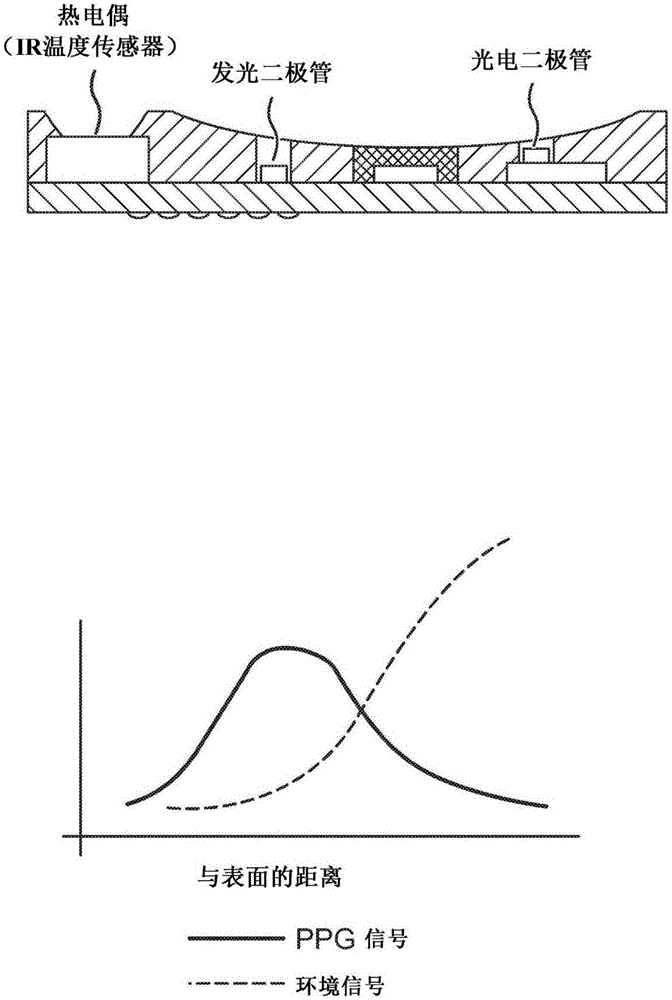
PPG光学系统也可作为接近检测器使用。在根据Leman申请的装置中,发射光的LED和检测光的光电探测器一般相距约6毫米。如果在LED亮起时,反射或散射的表面向装置移动,则接收到的信号将在这个距离左右达到峰值。同时,由于装置逼近表面时,背景光造成的环境信号将因阴影而下降。PPG optics can also be used as proximity detectors. In the device according to the Leman application, the LEDs that emit the light and the photodetectors that detect the light are typically about 6 millimeters apart. If the reflective or scattering surface moves towards the device while the LED is on, the received signal will peak around this distance. At the same time, the ambient signal due to background light will be degraded by shadows as the device approaches the surface.
本发明第三方面的特征公开在独立权利要求38和50中,这方面的优选特征分别公开在从属权利要求39至49以及51至54中。The features of the third aspect of the invention are disclosed in independent claims 38 and 50, and preferred features of this aspect are disclosed in dependent claims 39 to 49 and 51 to 54, respectively.
附图说明Description of drawings
下面仅以实施例的方式阐明本发明各方面的实施例。可以理解的是,本发明并不限于这些实施例。本发明的范围阐述在所附权利要求中。Examples of aspects of the invention are illustrated below by way of example only. It is to be understood that the present invention is not limited to these examples. The scope of the invention is set forth in the appended claims.
在实施例中,参考了附图,附图仅以说明的方式提供,并不限制本发明的范围,在附图中:In the embodiments, reference is made to the accompanying drawings, which are provided by way of illustration only and do not limit the scope of the invention, in which:
图1是心跳中动脉中的压力和该动脉的面积的表示;Figure 1 is a representation of the pressure in an artery in a heartbeat and the area of that artery;
图2示出了面积的变化是如何作为施加压力的函数而变动的;Figure 2 shows how the change in area varies as a function of applied pressure;
图3是自动示波袖带中压力的记录;Figure 3 is a recording of pressure in an automated oscillometric cuff;
图4示出了使用测量的PPG信号的示例性过程的第一步;以及FIG. 4 illustrates the first step of an exemplary process using measured PPG signals; and
图5是根据本发明第三方面的装置的剖面,同时示出了接近信号的表示。Figure 5 is a cross-section of a device according to a third aspect of the present invention, while showing a representation of a proximity signal.
具体实施方式Detailed ways
实施例1:PWV和PWA的校准Example 1: Calibration of PWV and PWA
所有PWV和PWA技术的局限性在于,它们必须针对每个使用者进行校准。这就要求使用者在测量PWV或PWA的同时,使用封堵(袖带)装置对血压进行若干次测量。这使得可以对PWV或PWA进行校准,然后用于检测用袖带测量的血压的变化。校准通常在几天到几周的时段内保持有效,之后必须重复校准。这限制了PWV或PWA技术的效用,因为它还需要获得袖带装置。A limitation of all PWV and PWA techniques is that they must be calibrated for each user. This requires the user to take several blood pressure measurements using an occlusion (cuff) device while measuring PWV or PWA. This allows the PWV or PWA to be calibrated and then used to detect changes in blood pressure measured with the cuff. Calibration typically remains valid for a period of days to weeks after which it must be repeated. This limits the utility of PWV or PWA technology as it also requires access to a cuff device.
用无袖带封堵法(使用单独的装置作为套件的一部分或作为整合装置的一部分)绝对测量血压可用作PWV或PWA测量的校准。于是,PWV或PWA测量可以用于快速、容易地测量血压,直到有必要重新校准。Absolute blood pressure measurement with cuffless occlusion (using a separate device as part of a kit or as part of an integrated device) can be used as a calibration for PWV or PWA measurements. Thus, PWV or PWA measurements can be used to quickly and easily measure blood pressure until recalibration is necessary.
通过在不同条件下(例如在一天的不同时间或在运动前后)进行若干次校准,可以进一步加强校准程序。可以利用这种分布式校准来提高随后的PWV或PWA测量的准确性,或延长有必要重新校准之前的时段。The calibration procedure can be further enhanced by performing several calibrations under different conditions (eg at different times of the day or before and after exercise). This distributed calibration can be utilized to improve the accuracy of subsequent PWV or PWA measurements, or to extend the period before recalibration is necessary.
实施例2:脉搏波分析的稳定性Example 2: Stability of Pulse Wave Analysis
PWA简单易行,但要达到足够的准确性并不容易。其中一个原因是,测量的光波取决于使用者将测量装置按压在身体部位上的力度。压力装置中的压力传感器可以与其光学传感器一起使用,通过向使用者提供反馈,使其更用力或更柔和地按压,从而产生特定压力的PWA波形。这可用于确保测量压力与用于校准的压力相同,或者可用于为PWA分析提供一组在不同压力下捕获的波形。PWAs are simple and easy, but achieving sufficient accuracy is not easy. One reason is that the measured light waves depend on how hard the user presses the measuring device against the body part. A pressure sensor in a pressure device can be used with its optical sensor to generate a pressure-specific PWA waveform by providing feedback to the user to press harder or softer. This can be used to ensure that the measured pressure is the same as the pressure used for calibration, or it can be used to provide a set of waveforms captured at different pressures for PWA analysis.
另选地,实际测量的施加压力可以在不向使用者提供反馈的情况下用作PWA算法的输入,以提高其准确性和/或延长需要重新校准前的时间。Alternatively, the actual measured applied pressure can be used as input to the PWA algorithm without providing feedback to the user to improve its accuracy and/or extend the time before recalibration is required.
实施例3:射血前期(PEP)的估计Example 3: Estimation of Pre-Ejection Period (PEP)
使用电信号找出的PTT包括PEP,因此估计的PWV将不正确。PEP对一个人来说是相当稳定的,因此可以用偶尔测量来校正测量的PTT。The PTT found using the electrical signal includes the PEP, so the estimated PWV will be incorrect. PEP is fairly stable to a person, so occasional measurements can be used to correct the measured PTT.
PCT 4、图9和PCT 4的第九方面显示,根据Leman申请的装置可以直接测量PEP。这种测量也许用于提高PWV估计的准确性。PCT 4, Figure 9 and the ninth aspect of PCT 4 show that the device according to the Leman application can directly measure PEP. Such measurements may be used to improve the accuracy of PWV estimates.
实施例4:动脉硬度的直接估计Example 4: Direct estimation of arterial stiffness
PWV经由动脉硬度与血压相关。如果此硬度是已知的,就能够对这种关系做出更准确的估计,从而对由PWV得出的血压做出更准确的估计。由于由PWV分析的波形也取决PWV,因此硬度也可以用于提高PWV的准确性。PWV is related to blood pressure via arterial stiffness. If this stiffness is known, a more accurate estimate of this relationship, and therefore of blood pressure derived from PWV, can be made. Since the waveform analyzed by PWV also depends on PWV, hardness can also be used to improve the accuracy of PWV.
PCT 4,第11页,第9至14行公开了局部动脉硬度可以由Leman装置直接测量。PCT 4, page 11, lines 9 to 14 discloses that local arterial stiffness can be measured directly by the Leman device.
实施例5:周围组织硬度的直接估计Example 5: Direct estimation of surrounding tissue stiffness
动脉的有效硬度也取决于其周围组织的硬度。PCT 5的第5方面公开了根据Leman申请的装置可以对该组织的硬度进行估计,包括其因水化而产生的变化。这也可以按照与以上第四实施例相似的方式用于提高PWV和PWA测量的准确性。The effective stiffness of an artery also depends on the stiffness of its surrounding tissue. Aspect 5 of PCT 5 discloses that the device according to the Leman application can estimate the stiffness of the tissue, including its changes due to hydration. This can also be used to improve the accuracy of PWV and PWA measurements in a similar manner to the fourth embodiment above.
实施例6:利用PWV数据改进无袖带封堵技术Example 6: Using PWV data to improve cuffless occlusion techniques
PCT 2第24至30行公开了,无袖带封堵装置可以使用动脉硬度的估计来改进一些从封堵数据中提取血压的技术。假设直接从测量的数据找出估计,但是使用独立的估计(即从PWV或PWA测量得出的)是有好处的。这对结果的准确性和处理的速度都有帮助。PCT 2 lines 24 to 30 disclose that cuffless occlusion devices can use estimates of arterial stiffness to improve some techniques for extracting blood pressure from occlusion data. It is assumed that estimates are derived directly from the measured data, but it is beneficial to use independent estimates (ie from PWV or PWA measurements). This helps both the accuracy of the results and the speed of processing.
LMD申请公开了用于从使用搜索或优化算法的传感器得出的数据中提取血压的若干技术。这些技术通过搜索解决方案空间(包括搜索舒张压和收缩压)进行操作。从PWV或PWA得出的这些值的估计可用于缩小搜索空间,或至少用于指示搜索的起始值。这减少了搜索花费的时间,并降低了搜索选择次优解决方案值的风险。The LMD application discloses several techniques for extracting blood pressure from sensor derived data using search or optimization algorithms. These techniques operate by searching the solution space, including searching for diastolic and systolic blood pressure. Estimates of these values derived from PWV or PWA can be used to narrow the search space, or at least to indicate starting values for the search. This reduces the time spent searching and reduces the risk that the search chooses suboptimal solution values.
实施例7:等压线校正Example 7: Isobar Correction
参考图1,虚线示出了动脉的典型管腔面积是动脉血的瞬时压力和动脉周围的组织的瞬时压力之差的函数。竖直的点线示出了收缩期(当动脉压力最大从而差值最小时)和舒张期(当动脉压力最小从而差值最大时)的压力差。标有deltaA的双端箭头示出了收缩期和舒张期之间的面积变化。Referring to Figure 1, the dashed line shows the typical lumen area of an artery as a function of the difference between the instantaneous pressure of the arterial blood and the instantaneous pressure of the tissue surrounding the artery. The vertical dotted line shows the pressure difference during systole (when arterial pressure is greatest and therefore the difference is smallest) and diastolic (when arterial pressure is smallest and therefore greatest in difference). Double-ended arrows labeled deltaA show the area change between systole and diastole.
注意图1的确切形式和竖直比例将取决于动脉的大小和硬度、周围组织的硬度以及测量手段的特性。Note that the exact form and vertical scale of Figure 1 will depend on the size and stiffness of the artery, the stiffness of the surrounding tissue, and the characteristics of the measurement means.
显然,deltaA的值取决于动脉周围的组织的压力。图2是deltaA作为动脉周围的组织压力(标记为"施加的压力")的函数的典型图。图2上标出了舒张压(DBP)和收缩压(SBP)的典型值。Obviously, the value of deltaA depends on the pressure of the tissue surrounding the artery. Figure 2 is a typical plot of deltaA as a function of tissue pressure around the artery (labeled "Applied Pressure"). Typical values for diastolic blood pressure (DBP) and systolic blood pressure (SBP) are marked on Figure 2.
通过在图2中绘制deltaA,并在必要时以该图中deltaA的最大值进行归一化,图1的竖直比例不再有意义。By plotting deltaA in Figure 2, and normalizing if necessary by the maximum value of deltaA in this figure, the vertical scale of Figure 1 no longer makes sense.
这是一种用于测量血压的装置的成熟技术,其中周围组织中的压力在一次心跳内不会有明显变化。图3示出了这一点。这是传统的自动示波血压监测器的袖带中的压力记录。每次心跳的压力变化最多只有2.5毫米汞柱,这是临床上可以接受的不确定性水平。然而,如果这些变化要大得多,无论是随机的还是系统的,就不可能对动脉周围的组织的压力做出合理的估计。收缩期时的压力对舒张期来说是错误的,舒张期时的压力对收缩期来说也是错误的,对两者来说都是错误的平均压力是没有意义的,因为图1是非线性的。This is a well-established technology for devices that measure blood pressure, where the pressure in the surrounding tissue does not change significantly within a heartbeat. Figure 3 shows this. This is the pressure recording in the cuff of a traditional automatic oscillometric blood pressure monitor. The change in pressure per heartbeat was at most 2.5 mmHg, a clinically acceptable level of uncertainty. However, if these changes were much larger, either random or systematic, it would be impossible to make a reasonable estimate of the pressure in the tissue surrounding the artery. The pressure at systole is wrong for diastole, the pressure at diastole is wrong for systole, and the mean pressure is wrong for both is meaningless, because figure 1 is non-linear .
本发明的这一方面没有直接使用deltaA。相反,它使用了以下的步骤序列:This aspect of the invention does not use deltaA directly. Instead, it uses the following sequence of steps:
1.从数据中提取ADBP的估计(即,每次心跳时舒张期的动脉的管腔面积),并同时测量瞬时施加的压力(假设与动脉周围的压力相同);1. Extract an estimate of the ADBP (i.e., the luminal area of the artery in diastole at each heartbeat) from the data, and simultaneously measure the instantaneously applied pressure (assuming the same pressure as the surrounding arteries);
2.绘制ADBP为瞬时施加压力的函数图;2. Plot A DBP as a function of instantaneous applied pressure;
3.通过表示ADBP与瞬时施加的压力的点拟合出一条平滑曲线,从而给出ADBP与瞬时施加的压力的参数模型;3. Fitting a smooth curve through the points representing A DBP and instantaneously applied pressure, thereby giving a parametric model of A DBP and instantaneously applied pressure;
4.对于ASBP与瞬时施加压力,重复步骤1到3;以及4. Repeat steps 1 through 3 for A SBP and momentary applied pressure; and
5.创建一组"伪心跳",其中deltaA是通过从其参数模型给出的ADBP的值减去其参数模型给出的ASBP值来估计的,这两个值都是在相同的瞬时施加压力下取得的(术语"等压"反映了这种相同的瞬时压力)。5. Create a set of "fake heartbeats" where deltaA is estimated by subtracting the value of A SBP given by its parametric model from the value of A DBP given by its parametric model, both at the same instant Obtained under applied pressure (the term "isobaric" reflects this same instantaneous pressure).
然后,可以利用用于实际的心跳的任何一种分析方法分析这组伪心跳,但要有已知的瞬时施加压力。The set of pseudo-beats can then be analyzed using any of the analysis methods used for actual heartbeats, but with a known instantaneous applied pressure.
可以使用本领域技术人员所熟知的曲线拟合技术(如Loess算法)来找出平滑曲线。除了提供参数化的模型外,还可以选择曲线拟合技术的参数来平滑数据,从而减少测量噪声的影响。The smooth curve can be found using curve fitting techniques well known to those skilled in the art, such as the Loess algorithm. In addition to providing a parametric model, parameters for curve fitting techniques can be selected to smooth the data, thereby reducing the effects of measurement noise.
如果动脉周围的组织的瞬时压力位于舒张压和收缩压之间,则当瞬时动脉压力超过动脉周围的组织的瞬时压力时,动脉的管腔面积将迅速增大。当瞬时动脉压力下降到低于动脉周围的组织的瞬时压力时,它也会迅速下降。心跳期间这两个事件的定时也可以按照类似于deltaA的使用方式用于估计舒张压和收缩压。例如,在没有噪声的理想模型中,如果动脉周围的组织的瞬时压力等于或超过收缩压,这两个时间的间隔就是零。类似地,如果动脉周围的组织的瞬时压力等于或小于舒张压,则该间隔等于心跳的持续时间TH。If the instantaneous pressure of the tissue surrounding the artery lies between the diastolic and systolic pressures, the luminal area of the artery will rapidly increase when the instantaneous arterial pressure exceeds the instantaneous pressure of the tissue surrounding the artery. It also drops rapidly when the instantaneous arterial pressure drops below that of the tissue surrounding the artery. The timing of these two events during a heartbeat can also be used to estimate diastolic and systolic blood pressure in a manner similar to the use of deltaA. For example, in an ideal model without noise, if the instantaneous pressure of the tissue surrounding the artery equals or exceeds the systolic blood pressure, the interval between these two times is zero. Similarly, if the instantaneous pressure of the tissue surrounding the artery is equal to or less than the diastolic pressure, the interval is equal to the duration TH of the heartbeat.
用于找出舒张压和收缩压的一些技术利用了这个间隔。它们可以通过与用于deltaA的相同技术来补偿不同的施加压力的影响,其中同等的步骤是:Some techniques for finding diastolic and systolic blood pressure take advantage of this interval. They can compensate for the effects of different applied pressures by the same technique used for deltaA, where the equivalent steps are:
1.从数据中提取TR的估计(即,每次心跳时动脉的管腔面积迅速增长的时间),并同时测量瞬时施加的压力(假设与动脉周围的压力相同);1. Extract an estimate of TR from the data (i.e., the time during which the luminal area of the artery rapidly increases with each heartbeat), and simultaneously measure the instantaneously applied pressure (assuming the same pressure as the surrounding artery);
2.绘制TR为瞬时施加压力的函数图;2. Plot TR as a function of instantaneous applied pressure;
3.通过表示TR与瞬时施加的压力的点拟合出一条平滑曲线,从而给出TR与瞬时施加的压力的参数模型。3. Fit a smooth curve through the points representing TR and instantaneously applied pressure, thereby giving a parametric model of TR and instantaneously applied pressure.
4.对于TF(即,每次心跳时动脉的管腔面积迅速下降的时间)与瞬时施加压力,重复步骤1到3;以及4. Repeat steps 1 to 3 for TF (i.e., the time during which the lumen area of the artery rapidly decreases with each heartbeat) and the instantaneous applied pressure; and
5.创建一组"伪心跳",其中deltaT是通过从其参数模型给出的TF的值减去其参数模型给出的TR值来估计的,这两个值都是在相同的瞬时施加压力下取得的。5. Create a set of "fake heartbeats" where deltaT is estimated by subtracting the value of TR given by its parametric model from the value of TF given by its parametric model, both at the same instant obtained under pressure.
然后,可以用任何用于实际心跳的分析方法来分析这组伪心跳,但要有已知的瞬时施加压力。对本领域的技术人员来说,显然可以使用TF、TR和TH的其他组合,例如(TF-TR)/TH。The set of pseudo-beats can then be analyzed with any analysis method used for actual heartbeats, but with a known instantaneous applied pressure. It will be apparent to those skilled in the art that other combinations of TF , TR and TH can be used, eg (TF- TR ) / TH .
实施例8--血液的粘度Example 8 - Viscosity of blood
图4示出了使用测量的PPG信号作为压力函数的示例性过程的第一步,在此情况下为绿光。其只示出了低频信号。由于动脉的管腔面积造成的高频波动太小以至于在这个图上看不到。Figure 4 shows the first step of an exemplary process using the measured PPG signal as a function of pressure, in this case green light. It only shows low frequency signals. The high frequency fluctuations due to the luminal area of the artery are too small to be seen on this graph.
图4还示出了如何通过在模型中加入以下方面将压力信号作为输入来有效地对该信号建模:Figure 4 also shows how the pressure signal can be effectively modeled by including the following aspects in the model as input:
与压力积分有关的项;terms related to the pressure integral;
与收缩压有关的项,超过收缩压,动脉就会封堵;Items related to systolic blood pressure, exceeding systolic blood pressure, arteries will be blocked;
由于组织的变形而产生的敏感性的线性变动;以及Linear changes in sensitivity due to tissue deformation; and
与瞬时压力和压力变化率有关的小项。Small terms related to instantaneous pressure and rate of change of pressure.
对于其他颜色的PPG光(包括但不限于红光和红外光)以及对于高频PPG信号,也可以获得类似的结果。Similar results can be obtained for other colors of PPG light (including but not limited to red and infrared light) and for high frequency PPG signals.
模型参数被用作机器学习的输入,以找出最能预测血液粘度的参数组合。The model parameters were used as input to machine learning to find the combination of parameters that best predicted blood viscosity.
实施例9--接近检测Example 9 - Proximity Detection
图5示出了LMD装置的剖面以及接近信号的表示。这些信号可以由信号处理手段进行分析,以估计与表面的距离。该距离可用于向使用者提供反馈,使其将装置置于正确的距离。另选地,估计的距离可用于校正在不触及身体部位时由对任何测量的距离造成的误差。Figure 5 shows a cross-section of the LMD device and a representation of the proximity signal. These signals can be analyzed by signal processing means to estimate the distance to the surface. This distance can be used to provide feedback to the user to place the device at the correct distance. Alternatively, the estimated distance may be used to correct for errors caused by any measured distances when no body part is touched.
应该清楚地理解,对于本发明的所有方面,实施例和图及其描述纯粹是以说明的方式提供的,本发明的范围不限于这种对具体实施方式的描述;本发明的范围阐明在所附的权利要求中。It should be clearly understood that for all aspects of the invention, the examples and figures and description thereof are provided by way of illustration only and that the scope of the invention is not limited to such description of specific embodiments; the scope of the invention is set forth in the in the attached claims.
Claims (54)
Applications Claiming Priority (5)
| Application Number | Priority Date | Filing Date | Title |
|---|---|---|---|
| GB1918579.2 | 2019-12-17 | ||
| GBGB1918579.2A GB201918579D0 (en) | 2019-12-17 | 2019-12-17 | Measurement of blood pressure using hybrid technique |
| GB1918576.8 | 2019-12-17 | ||
| GBGB1918576.8A GB201918576D0 (en) | 2019-12-17 | 2019-12-17 | Measurement of blood pressure using isobaric analysis |
| PCT/IB2020/061894 WO2021124071A1 (en) | 2019-12-17 | 2020-12-14 | Improved personal health data collection |
Publications (1)
| Publication Number | Publication Date |
|---|---|
| CN115135236A true CN115135236A (en) | 2022-09-30 |
Family
ID=73855521
Family Applications (1)
| Application Number | Title | Priority Date | Filing Date |
|---|---|---|---|
| CN202080096718.9A Pending CN115135236A (en) | 2019-12-17 | 2020-12-14 | Improved personal health data collection |
Country Status (4)
| Country | Link |
|---|---|
| US (1) | US20230034358A1 (en) |
| EP (1) | EP4076162A1 (en) |
| CN (1) | CN115135236A (en) |
| WO (1) | WO2021124071A1 (en) |
Families Citing this family (8)
| Publication number | Priority date | Publication date | Assignee | Title |
|---|---|---|---|---|
| US11904953B2 (en) * | 2021-11-03 | 2024-02-20 | Zoomlion Heavy Industry Na, Inc. | Modular saddle mount retained in a frame cross member for reducing vibration in heavy equipment cabs |
| US11840284B2 (en) * | 2021-11-03 | 2023-12-12 | Zoomlion Heavy Industry Na, Inc. | Modular saddle mount with isolator retained in a frame for reducing vibration in heavy equipment cabs |
| GB202116701D0 (en) | 2021-11-19 | 2022-01-05 | Mercer Christopher Paul | Measurement of blood pressure using passive pressure |
| WO2024263653A2 (en) * | 2023-06-19 | 2024-12-26 | Lmd Ip, Llc | Method of taking blood pressure with staged pressures |
| WO2024263654A2 (en) * | 2023-06-19 | 2024-12-26 | Lmd Ip, Llc | Extrapolation methods for blood pressure measurement |
| US12414698B2 (en) * | 2023-09-29 | 2025-09-16 | Qualcomm Incorporated | Devices and systems for controlling pressure during sensing |
| US20250114003A1 (en) * | 2023-10-04 | 2025-04-10 | Qualcomm Incorporated | Sensors and systems for determining a physiological parameter using external pressure |
| US20250248603A1 (en) * | 2024-02-05 | 2025-08-07 | Wisconsin Alumni Research Foundation | Apparatus and Method for Characterizing Arterial Stiffness |
Citations (5)
| Publication number | Priority date | Publication date | Assignee | Title |
|---|---|---|---|---|
| CN103648373A (en) * | 2011-06-30 | 2014-03-19 | 莱曼微设备有限公司 | Personal health data collection |
| CN103892818A (en) * | 2012-12-28 | 2014-07-02 | 吴健康 | Non-invasive central aortic blood pressure measuring method and device |
| WO2014125431A1 (en) * | 2013-02-13 | 2014-08-21 | Léman Micro Devices Sa | Personal health data collection |
| WO2017140748A2 (en) * | 2016-02-18 | 2017-08-24 | Leman Micro Devices Sa | Personal hand-held monitor |
| EP3232918A1 (en) * | 2014-12-16 | 2017-10-25 | Leman Micro Devices SA | Personal health data collection |
Family Cites Families (9)
| Publication number | Priority date | Publication date | Assignee | Title |
|---|---|---|---|---|
| CH678690A5 (en) * | 1989-03-08 | 1991-10-31 | Asulab Sa | |
| US5865755A (en) * | 1996-10-11 | 1999-02-02 | Dxtek, Inc. | Method and apparatus for non-invasive, cuffless, continuous blood pressure determination |
| FR2794961B1 (en) * | 1999-06-16 | 2001-09-21 | Global Link Finance | PROCESS FOR DETERMINING THE TIME OFFSET BETWEEN THE INSTANTS OF THE PASSAGE OF A SAME PULSE WAVE IN TWO DISTINCT MEASUREMENT POINTS OF AN ARTERIAL NETWORK OF A LIVING BEING AND ESTIMATING ITS AORTIC PRESSURE |
| JP2010508056A (en) * | 2006-10-30 | 2010-03-18 | エルフィ−テック リミテッド | System and method for in vivo measurement of biological parameters |
| KR20100060141A (en) * | 2008-11-27 | 2010-06-07 | 삼성전자주식회사 | Portable device for measuring blood pressure and method thereof |
| JP6520140B2 (en) * | 2015-01-22 | 2019-05-29 | Tdk株式会社 | Information processing apparatus, blood pressure value calculation method and program |
| US10398324B2 (en) * | 2016-03-03 | 2019-09-03 | Board Of Trustees Of Michigan State University | Method and apparatus for cuff-less blood pressure measurement in a mobile device |
| GB201608781D0 (en) | 2016-05-19 | 2016-07-06 | Leman Micro Devices Sa | Non-invasive blood analysis |
| US20210236013A1 (en) | 2018-05-04 | 2021-08-05 | Leman Micro Devices Sa | Improved personal health data collection |
-
2020
- 2020-12-14 CN CN202080096718.9A patent/CN115135236A/en active Pending
- 2020-12-14 US US17/786,955 patent/US20230034358A1/en active Pending
- 2020-12-14 WO PCT/IB2020/061894 patent/WO2021124071A1/en not_active Ceased
- 2020-12-14 EP EP20828128.7A patent/EP4076162A1/en active Pending
Patent Citations (5)
| Publication number | Priority date | Publication date | Assignee | Title |
|---|---|---|---|---|
| CN103648373A (en) * | 2011-06-30 | 2014-03-19 | 莱曼微设备有限公司 | Personal health data collection |
| CN103892818A (en) * | 2012-12-28 | 2014-07-02 | 吴健康 | Non-invasive central aortic blood pressure measuring method and device |
| WO2014125431A1 (en) * | 2013-02-13 | 2014-08-21 | Léman Micro Devices Sa | Personal health data collection |
| EP3232918A1 (en) * | 2014-12-16 | 2017-10-25 | Leman Micro Devices SA | Personal health data collection |
| WO2017140748A2 (en) * | 2016-02-18 | 2017-08-24 | Leman Micro Devices Sa | Personal hand-held monitor |
Also Published As
| Publication number | Publication date |
|---|---|
| EP4076162A1 (en) | 2022-10-26 |
| US20230034358A1 (en) | 2023-02-02 |
| WO2021124071A1 (en) | 2021-06-24 |
Similar Documents
| Publication | Publication Date | Title |
|---|---|---|
| CN115135236A (en) | Improved personal health data collection | |
| TWI905281B (en) | Biometric system, biometric method and one or more non-transitory media having software stored thereon of non-invasive blood pressure estimation and blood vessel monitoring based on photoacoustic plethysmography | |
| US20240023898A1 (en) | Pulse Wave Velocity, Arterial Compliance, and Blood Pressure | |
| US11576583B2 (en) | Noninvasive blood pressure measurement method and device | |
| Esmaili et al. | Nonlinear cuffless blood pressure estimation of healthy subjects using pulse transit time and arrival time | |
| CN107405090B (en) | Method and device for measuring blood pressure | |
| Teng et al. | Theoretical study on the effect of sensor contact force on pulse transit time | |
| US6477405B2 (en) | Heart-sound detecting apparatus, system for measuring pre-ejection period by using heart-sound detecting apparatus, and system for obtaining pulse-wave-propagation-velocity-relating information by using heart-sound detecting apparatus | |
| US6616613B1 (en) | Physiological signal monitoring system | |
| JP2021519621A (en) | A method for estimating blood pressure and arterial wall sclerosis based on photoplethysmographic (PPG) signals | |
| US20160106327A1 (en) | Apparatus and method for acquiring bio-information | |
| US10694959B2 (en) | Image based blood pressure monitoring method | |
| CN115776869B (en) | Hemodynamic parameter estimation | |
| EP3897363B1 (en) | Control unit for deriving a measure of arterial compliance | |
| CN101181156A (en) | Device and method for monitoring motion | |
| US12059234B2 (en) | Method and a system for estimating a measure of cardiovascular health of a subject | |
| Bote et al. | Evaluation of blood pressure estimation models based on pulse arrival time | |
| EP4422482B1 (en) | Device, system and method for calibrating a blood pressure surrogate for use in monitoring a subject's blood pressure | |
| Freithaler et al. | Smartphone-based blood pressure monitoring via the oscillometric finger pressing method: Analysis of oscillation width variations can improve diastolic pressure computation | |
| WO2007132865A1 (en) | Blood vessel senescence detection system | |
| EP3048961A1 (en) | Heart rate monitor system and method of determining a warming-up status of a user | |
| Myint et al. | Blood pressure measurement from photo-plethysmography to pulse transit time | |
| GB2552455A (en) | Blood monitoring | |
| EP4173555A1 (en) | Device, system and method for calibrating a blood pressure surrogate for use in monitoring a subject's blood pressure | |
| Lui et al. | A novel calibration procedure of pulse transit time based blood pressure measurement with heart rate and respiratory rate |
Legal Events
| Date | Code | Title | Description |
|---|---|---|---|
| PB01 | Publication | ||
| PB01 | Publication | ||
| SE01 | Entry into force of request for substantive examination | ||
| SE01 | Entry into force of request for substantive examination | ||
| TA01 | Transfer of patent application right | ||
| TA01 | Transfer of patent application right |
Effective date of registration: 20240724 Address after: Oklahoma Applicant after: LEMAN MICRO DEVICES S.A. Country or region after: U.S.A. Address before: Lausanne Applicant before: LEMAN MICRO DEVICES S.A. Country or region before: Switzerland |
|
| TA01 | Transfer of patent application right | ||
| TA01 | Transfer of patent application right |
Effective date of registration: 20240807 Address after: Oklahoma Applicant after: LMD Intellectual Property Co.,Ltd. Country or region after: U.S.A. Address before: Oklahoma Applicant before: LEMAN MICRO DEVICES S.A. Country or region before: U.S.A. |