CN115134308A - Method for avoiding head of line blocking through data packet bouncing in lossless network of data center - Google Patents
Method for avoiding head of line blocking through data packet bouncing in lossless network of data center Download PDFInfo
- Publication number
- CN115134308A CN115134308A CN202210740937.7A CN202210740937A CN115134308A CN 115134308 A CN115134308 A CN 115134308A CN 202210740937 A CN202210740937 A CN 202210740937A CN 115134308 A CN115134308 A CN 115134308A
- Authority
- CN
- China
- Prior art keywords
- data packet
- bounce
- current
- delay
- port
- Prior art date
- Legal status (The legal status is an assumption and is not a legal conclusion. Google has not performed a legal analysis and makes no representation as to the accuracy of the status listed.)
- Granted
Links
Images


Classifications
-
- H—ELECTRICITY
- H04—ELECTRIC COMMUNICATION TECHNIQUE
- H04L—TRANSMISSION OF DIGITAL INFORMATION, e.g. TELEGRAPHIC COMMUNICATION
- H04L47/00—Traffic control in data switching networks
- H04L47/10—Flow control; Congestion control
- H04L47/28—Flow control; Congestion control in relation to timing considerations
- H04L47/283—Flow control; Congestion control in relation to timing considerations in response to processing delays, e.g. caused by jitter or round trip time [RTT]
-
- H—ELECTRICITY
- H04—ELECTRIC COMMUNICATION TECHNIQUE
- H04L—TRANSMISSION OF DIGITAL INFORMATION, e.g. TELEGRAPHIC COMMUNICATION
- H04L47/00—Traffic control in data switching networks
- H04L47/10—Flow control; Congestion control
- H04L47/29—Flow control; Congestion control using a combination of thresholds
-
- H—ELECTRICITY
- H04—ELECTRIC COMMUNICATION TECHNIQUE
- H04L—TRANSMISSION OF DIGITAL INFORMATION, e.g. TELEGRAPHIC COMMUNICATION
- H04L47/00—Traffic control in data switching networks
- H04L47/50—Queue scheduling
- H04L47/52—Queue scheduling by attributing bandwidth to queues
- H04L47/522—Dynamic queue service slot or variable bandwidth allocation
- H04L47/524—Queue skipping
Landscapes
- Engineering & Computer Science (AREA)
- Computer Networks & Wireless Communication (AREA)
- Signal Processing (AREA)
- Data Exchanges In Wide-Area Networks (AREA)
Abstract
Description
技术领域technical field
本发明涉及数据处理技术领域,尤其指一种数据中心无损网络中通过数据包弹跳避免队头阻塞的方法。The invention relates to the technical field of data processing, in particular to a method for avoiding head-of-line blocking by data packet bouncing in a lossless network of a data center.
背景技术Background technique
过去几年中,在主要云提供商如微软和谷歌的现代数据中心已在融合以太网广泛部署了远程直接内存访问(RDMA)的网络协议(RoCEv2),实现了以极低CPU开销的低延时和高吞吐率的数据传输。为了避免因数据包丢失导致RDMA性能急剧下降,RoCEv2使用基于优先级的流控机制(PFC)来防止交换机缓存溢出。当交换机入端口(或队列)的缓存占用超过一定阈值,则触发PFC机制,暂停上游交换机相关的端口(或队列),直到入端口的队列长度下降到另一个阈值则恢复上游交换机端口的数据传输。由于PFC是基于端口(或队列)的工作机制,当一个端口被PFC暂停后,该端口中与造成拥塞无关的无辜流也会被暂停,即出现队头阻塞的问题。Over the past few years, the Remote Direct Memory Access (RDMA) networking protocol (RoCEv2) has been widely deployed on converged Ethernet in modern data centers of major cloud providers such as Microsoft and Google, enabling low latency with extremely low CPU overhead. time and high throughput data transfer. To avoid drastic degradation of RDMA performance due to packet loss, RoCEv2 uses a priority-based flow control mechanism (PFC) to prevent switch buffer overflow. When the buffer occupancy of the ingress port (or queue) of the switch exceeds a certain threshold, the PFC mechanism is triggered to suspend the relevant ports (or queues) of the upstream switch, until the queue length of the ingress port drops to another threshold, then the data transmission of the upstream switch port is resumed . Since PFC is a port (or queue)-based working mechanism, when a port is suspended by PFC, innocent flows in the port that are not related to causing congestion will also be suspended, that is, the problem of head-of-line blocking occurs.
为了缓解拥塞,减少PFC触发,缓解PFC引起的负面影响,很多端到端的传输协议如DCQCN,TIMELY,HPCC,Swift等被提出来。但他们没有区分与拥塞无关的无辜流和真正导致拥塞的拥塞流,造成对无辜流不必要的降速。最近提出的PCN识别真正的拥塞流并仅对这些拥塞流进行速率调节。但这些传输协议都是端到端的拥塞控制,拥塞信号的反馈至少需要1个往返延时(RTT),因此它们不能及时解决突发流量引起的瞬时拥塞,也很难控制在一个RTT内就发送完数据的小流。而现代高速数据中心网络中有大概60%~90%的流可以在一个RTT内完成。因此,即使部署了端到端的传输协议,PFC仍然会触发,造成队头阻塞,显著增加了流的完成时间。总之,为了提升应用性能和用户体验,PFC的队头阻塞是一个亟待解决的问题。In order to alleviate congestion, reduce PFC triggering, and alleviate the negative impact caused by PFC, many end-to-end transport protocols such as DCQCN, TIMELY, HPCC, Swift, etc. have been proposed. But they do not distinguish between innocent flows unrelated to congestion and congested flows that really cause congestion, causing unnecessary slowdowns for innocent flows. The recently proposed PCN identifies true congested flows and rates only these congested flows. However, these transmission protocols are all end-to-end congestion control, and the feedback of the congestion signal requires at least 1 round-trip delay (RTT), so they cannot solve the instantaneous congestion caused by burst traffic in time, and it is difficult to control the transmission within one RTT. A small stream of finished data. In modern high-speed data center networks, about 60% to 90% of the flows can be completed within one RTT. Therefore, even if an end-to-end transport protocol is deployed, the PFC still triggers, causing head-of-line blocking and significantly increasing the completion time of the flow. In conclusion, in order to improve application performance and user experience, head-of-line blocking of PFC is an urgent problem to be solved.
发明内容SUMMARY OF THE INVENTION
为了解决数据中心无损网络中PFC大的队头阻塞问题,本发明提供一种数据中心无损网络中通过数据包弹跳避免队头阻塞的方法。In order to solve the problem of head-of-line blocking due to a large PFC in a lossless network of a data center, the present invention provides a method for avoiding head-of-line blocking by packet bouncing in a lossless network of a data center.
为了解决上述技术问题,本发明采用如下技术方法:一种数据中心无损网络中通过数据包弹跳避免队头阻塞的方法,包括:In order to solve the above-mentioned technical problems, the present invention adopts the following technical method: a method for avoiding head-of-line blocking by packet bouncing in a data center lossless network, comprising:
步骤一,初始化链路基础往返延时RTT、链路带宽C、链路基础延时d、弹跳阈值更新周期Tth、PFC触发阈值QPFC、ECN阈值QECN、交换机出端口数量N、入端口转发最后一个无辜流数据包的时间t[i]、出端口转发最后一个拥塞流数据包序号f.SEQ、弹跳阈值Qth、弹跳阈值更新周期的起始时间t、交换机活跃流数量n0、无辜流检测时间窗口T;Step 1: Initialize basic link round-trip delay RTT, link bandwidth C, link basic delay d, bounce threshold update period T th , PFC trigger threshold Q PFC , ECN threshold Q ECN , number of switch egress ports N, and ingress ports Time t[i] for forwarding the last innocent flow data packet, sequence number f.SEQ of the last congested flow data packet forwarded by the egress port, bounce threshold Q th , start time t of the bounce threshold update period, number of active flows n 0 on the switch, Innocent flow detection time window T;
步骤二,交换机监听是否有新数据包到达,若有新数据包到达,转步骤三;否则继续监听是否有新数据包到达;Step 2, the switch monitors whether a new data packet arrives, if a new data packet arrives, go to
步骤三,判断当前数据包是否为拥塞流数据包,若是,转步骤四;否则,转发当前数据包到目的出端口,设置当前入端口转发最后一个无辜流数据包的时间t[i]为当前时间;
步骤四,判断出端口队列长度是否大于或等于弹跳阈值Qth,若是,转步骤五;否则,转步骤六;Step 4, determine whether the port queue length is greater than or equal to the bounce threshold Q th , if so, go to Step 5; otherwise, go to Step 6;
步骤五,判断当前拥塞流数据包的入端口是否有无辜流,若是,将当前数据包从最小负载出端口转发到相邻上游交换机;否则,将转发当前数据包到目的出端口;Step 5, judge whether the ingress port of the current congested flow data packet has innocent flow, if so, forward the current data packet from the minimum load egress port to the adjacent upstream switch; otherwise, forward the current data packet to the destination egress port;
步骤六,判断当前数据包是否是有序数据包,若是,则转发当前数据包到目的出端口,设置当前出端口转发最后一个拥塞流数据包序号f.SEQ为当前数据包序号;否则,转步骤七;Step 6, judge whether the current data packet is an ordered data packet, if so, forward the current data packet to the destination outgoing port, and set the current outgoing port to forward the last congested flow data packet sequence number f.SEQ is the current data packet sequence number; otherwise, go to Step seven;
步骤七,判断数据包弹跳延时是否小于乱序重传延时,若是,则将当前数据包从最小负载出端口转发到相邻上游交换机;否则,转发当前数据包到目的出端口。Step 7: Determine whether the data packet bounce delay is less than the out-of-order retransmission delay, if so, forward the current data packet from the minimum load egress port to the adjacent upstream switch; otherwise, forward the current data packet to the destination egress port.
进一步地,所述步骤一中,初始化时,链路带宽C设置为交换机出端口的带宽值;链路基础延时d设置为5μs;链路基础往返延时RTT设置为60us;弹跳阈值更新周期Tth设置为50μs;PFC触发阈值QPFC设置为256KB;ECN阈值QECN设置为32KB;无辜流检测时间窗口T设为3RTT;入端口转发最后一个无辜流数据包的时间t[i]、出端口转发最后一个拥塞流数据包序号f.SEQ、弹跳阈值Qth、弹跳阈值更新周期的起始时间t、交换机活跃流数量n0均设置为0。Further, in the
进一步地,从所述步骤二中监听到有新数据包到达至步骤七执行前的任一时间,判断当前时间与弹跳阈值更新周期的起始时间t的差值是否大于或等于弹跳阈值更新周期Tth,若大于或等于弹跳阈值更新周期Tth,则更新弹跳阈值Qth,并将弹跳阈值更新周期的起始时间t设置为当前时间,否则直接转至下一步。Further, from the step 2, it is detected that a new data packet arrives at any time before the execution of step 7, and it is judged whether the difference between the current time and the start time t of the bounce threshold update period is greater than or equal to the bounce threshold update period. If T th is greater than or equal to the bounce threshold update period T th , update the bounce threshold Q th , and set the start time t of the bounce threshold update period as the current time, otherwise go to the next step directly.
更进一步地,更新所述弹跳阈值Qth的方法如下:Further, the method for updating the bounce threshold Q th is as follows:
假设在时刻tb触发弹跳机制时的出端口队列长度为Qth,交换机当前活跃的n条流中有m条流的数据包发生弹跳,在数据包弹跳期间Tb,n-m条未弹跳流的流量为NT,在时刻tb+Tb时,最大的弹跳流量为BT,则在弹跳结束时,最大的出端口队列长度Q(tb+Tb)为:Assuming that the queue length of the outgoing port when the bounce mechanism is triggered at time t b is Q th , the data packets of m flows in the n flows currently active on the switch bounce, and during the bouncing period of packets T b , the number of n flows that are not bouncing The traffic is NT, and at time t b +T b , the maximum bounce traffic is BT, then at the end of the bounce, the maximum outgoing port queue length Q(t b +T b ) is:

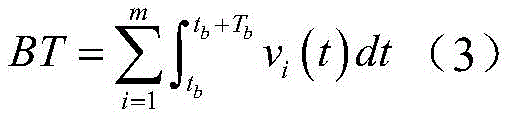
其中,NT和BT采用如下公式进行计算:Among them, NT and BT are calculated using the following formulas:

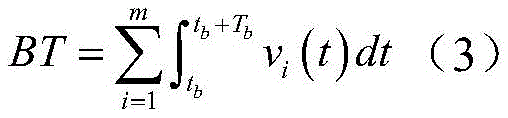
为了保证弹跳的数据包返回到交换机时不触发PFC,在弹跳结束时最大的出端口队列长度Q(tb+Tb)需满足以下条件:In order to ensure that the bounced data packets are returned to the switch without triggering the PFC, the maximum outgoing port queue length Q(t b +T b ) at the end of the bounce must meet the following conditions:

其中,N为交换机出端口数量;Among them, N is the number of outgoing ports of the switch;
同时,为了保证弹跳机制不会使得端到端的拥塞信号(如ECN通知和重复ACK)被阻塞,更新后的弹跳阈值Qth需满足以下条件:At the same time, in order to ensure that the bounce mechanism will not block end-to-end congestion signals (such as ECN notifications and repeated ACKs), the updated bounce threshold Q th must meet the following conditions:
Qth>QECN (5)Q th >Q ECN (5)
综合公式(1)、(4)、(5),得到更新后的弹跳阈值Qth的取值范围为:Combining formulas (1), (4) and (5), the value range of the updated bounce threshold Q th is obtained as follows:

取数据包的最小弹跳时间为2d,得到更新后的弹跳阈值Qth为:Taking the minimum bounce time of the data packet as 2d, the updated bounce threshold Q th is obtained as:

更进一步地,所述步骤三中,判断当前数据包是否为拥塞流数据包的方法是,若出端口的队列长度>=1,则判断到该出端口的所有数据包都是拥塞流数据包。Further, in the third step, the method for judging whether the current data packet is a congested flow data packet is, if the queue length of the outgoing port is >= 1, then it is determined that all data packets of the outgoing port are congested flow data packets. .
更进一步地,所述步骤五中,判断当前拥塞流数据包的入端口是否有无辜流的方法是,当前时间减去入端口转发最后一个无辜流数据包的时间t[i]小于或等于无辜流检测时间窗口T时,则认为当前拥塞流数据包的入端口有无辜流,否则,认为当前拥塞流数据包的入端口没有无辜流,则将转发当前数据包到目的出端口。Further, in the step 5, the method for judging whether the ingress port of the current congested flow data packet has an innocent flow is that the current time minus the time t[i] when the ingress port forwards the last innocent flow data packet is less than or equal to the innocent flow. When the flow detection time window is T, it is considered that the ingress port of the current congested flow data packet has innocent flow; otherwise, it is considered that the ingress port of the current congested flow data packet has no innocent flow, and the current data packet is forwarded to the destination egress port.
再进一步地,所述步骤六中,根据数据包序号来判断当前数据包是否是有序数据包。Still further, in the sixth step, it is determined whether the current data packet is an ordered data packet according to the data packet sequence number.
优选地,在步骤七中,判断数据包弹跳延时是否小于乱序重传延时,弹跳造成的延时增加的最大值=2d×(k-1),其中k为当前乱序数据包的序号与期望数据包的序号之间的差。Preferably, in step 7, it is judged whether the data packet bounce delay is less than the out-of-order retransmission delay, and the maximum delay increase caused by bounce = 2d×(k-1), where k is the current out-of-order data packet The difference between the sequence number and the sequence number of the expected packet.
优选地,在步骤七中,判断数据包弹跳延时是否小于乱序重传延时,乱序重传延时按最小的重传延时计算,所述最小的重传延时为一个链路基础往返延时RTT。Preferably, in step 7, it is determined whether the data packet bounce delay is less than the out-of-order retransmission delay, and the out-of-order retransmission delay is calculated according to the minimum retransmission delay, and the minimum retransmission delay is a link Base round-trip delay RTT.
本发明所涉数据中心无损网络中通过数据包弹跳避免队头阻塞的方法,主要通过在交换机上的数据包弹跳机制解决数据中心无损网络中的PFC队头阻塞的问题,同时在弹跳和乱序延时之间进行折中,保证延时开销最小的有序传输。具体而言,当出端口出现拥塞,其队列长度超过一定阈值时,将与无辜流共入端口的拥塞流数据包从最小负载出端口弹跳到相邻的上游交换机,从而避免触发PFC,避免出现队头阻塞问题。而当出端口的队列长度减小到弹跳阈值以下,为了保证有序传输和低延时开销,如果弹跳的数据包是乱序数据包,则在弹跳延时和乱序延时之间进行折中,再决定是否继续弹跳。如果弹跳延时小于乱序重传延时,则继续弹跳数据包。否则直接转发数据包到目的出端口。The method for avoiding head-of-line blocking by data packet bouncing in the data center lossless network of the present invention mainly solves the problem of PFC head-of-line blocking in the data center lossless network through the data packet bouncing mechanism on the switch. A compromise is made between delays to ensure ordered transmission with minimal delay overhead. Specifically, when the outgoing port is congested and its queue length exceeds a certain threshold, the congested flow data packets that share the ingress port with innocent flows will be bounced from the minimum load outgoing port to the adjacent upstream switch, thereby avoiding triggering PFC and avoiding the occurrence of Head of line blocking problem. When the queue length of the outgoing port is reduced below the bounce threshold, in order to ensure orderly transmission and low latency overhead, if the bounced data packets are out-of-order packets, a tradeoff is made between the bounce delay and the out-of-order delay. , and then decide whether to continue bouncing. If the bounce delay is less than the out-of-order retransmission delay, continue to bounce packets. Otherwise, the packet is directly forwarded to the destination egress port.
附图说明Description of drawings
图1为本发明所涉数据中心无损网络中通过数据包弹跳避免队头阻塞的方法流程图;1 is a flowchart of a method for avoiding head-of-line blocking by packet bouncing in a lossless network of a data center according to the present invention;
图2为本发明实施方式中NS-3仿真测试场景拓扑图;2 is a topology diagram of an NS-3 simulation test scene in an embodiment of the present invention;
图3为本发明实施方式中真实网络环境的测试平台测试场景拓扑图;3 is a topological diagram of a test platform test scene of a real network environment in an embodiment of the present invention;
图4为本发明实施方式中NS-3大规模仿真性能测试图;4 is a large-scale simulation performance test diagram of NS-3 in an embodiment of the present invention;
图5为本发明实施方式中真实网络测试平台下web search工作负载在链路带宽变化场景下的性能测试图。FIG. 5 is a performance test diagram of a web search workload under a real network test platform in a scenario of link bandwidth variation in an embodiment of the present invention.
具体实施方式Detailed ways
为了便于本领域技术人员的理解,下面结合实施例与附图对本发明作进一步的说明,实施方式提及的内容并非对本发明的限定。In order to facilitate the understanding of those skilled in the art, the present invention will be further described below with reference to the embodiments and the accompanying drawings, and the contents mentioned in the embodiments are not intended to limit the present invention.
本发明充分利用数据中心网络中大量的并行链路容量,及时将阻塞无辜流的拥塞流的数据包反弹到有空余容量的并行路径上,避免触发PFC,从而避免出现队头阻塞的问题。当出端口出现拥塞,其队列长度增加,则到此出端口的流都为拥塞流。本发明首先识别哪些拥塞流与无辜流共享入端口,只有这些拥塞流才可能伤害无辜流,使无辜流遭遇队头阻塞。当出端口的队列长度超过弹跳阈值时,只将会影响无辜流的拥塞流数据包从最小负载出端口反弹到相邻的上游交换机,就避免了入端口队列继续增长,从而不会触发PFC,不会出现队头阻塞现象。反弹的数据包再次回到该交换机后,再继续根据目的出端口的队列长度判断是否继续弹跳。如果此时目的出端口的队列长度仍超过弹跳阈值,则该数据包继续从最小负载出端口弹跳到相邻的上游交换机以避免触发PFC。如果此时目的出端口的队列长度小于弹跳阈值,则要根据数据包的序列号判断是否是乱序包。如果不是乱序数据包则直接转发到目的出端口。如果是乱序包,则再比较乱序造成的重传延时和弹跳延时,如果重传延时小,则直接转发到目的出端口,否则继续从最小负载出端口弹跳到相邻上游交换机,直到最终转发到目的出端口。这样就有效避免了触发PFC,避免了队头阻塞,同时保证延时开销最小的有序传输。The invention makes full use of a large amount of parallel link capacity in the data center network, and bounces the data packets of the congested flow blocking the innocent flow to the parallel path with spare capacity in time to avoid triggering the PFC, thereby avoiding the problem of head-of-line blocking. When the outgoing port is congested and its queue length increases, all flows to this outgoing port are congested flows. The present invention first identifies which congested flows share the ingress port with innocent flows, and only these congested flows may harm innocent flows and cause innocent flows to suffer head-of-line blocking. When the queue length of the outgoing port exceeds the bounce threshold, only the congested flow packets that affect the innocent flow will be bounced from the outgoing port with the minimum load to the adjacent upstream switch, which prevents the ingress port queue from continuing to grow, and thus will not trigger the PFC. There will be no head-of-line blocking. After the bounced data packet returns to the switch again, it will continue to judge whether to continue bouncing according to the queue length of the destination egress port. If the queue length of the destination egress port still exceeds the bounce threshold at this time, the packet continues to bounce from the least loaded egress port to the adjacent upstream switch to avoid triggering PFC. If the queue length of the destination outgoing port is less than the bounce threshold at this time, it is necessary to judge whether it is an out-of-order packet according to the sequence number of the data packet. If the packet is not out of sequence, it will be forwarded directly to the destination egress port. If it is an out-of-order packet, then compare the retransmission delay and bounce delay caused by the out-of-order packet. If the retransmission delay is small, it will be directly forwarded to the destination egress port, otherwise it will continue to bounce from the minimum load egress port to the adjacent upstream switch. , until it is finally forwarded to the destination egress port. This effectively avoids triggering PFC, avoids head-of-line blocking, and ensures orderly transmission with minimal delay overhead.
下面详细描述本发明所涉数据中心无损网络中通过数据包弹跳避免队头阻塞的方法,如图1所示,包括:The method for avoiding head-of-line blocking by packet bouncing in the data center lossless network of the present invention is described in detail below, as shown in FIG. 1 , including:
步骤一,初始化:链路带宽C设置为交换机出端口的带宽值;链路基础延时d设置为5μs;链路基础往返延时RTT设置为60us;弹跳阈值更新周期Tth设置为50μs;PFC触发阈值QPFC设置为256KB;ECN阈值QECN设置为32KB;无辜流检测时间窗口T设为3RTT;入端口转发最后一个无辜流数据包的时间t[i]、出端口转发最后一个拥塞流数据包序号f.SEQ、弹跳阈值Qth、弹跳阈值更新周期的起始时间t、交换机活跃流数量n0均设置为0。
步骤二,交换机监听是否有新数据包到达,若有新数据包到达,先判断当前时间与弹跳阈值更新周期的起始时间t的差值是否大于或等于弹跳阈值更新周期Tth,若大于或等于弹跳阈值更新周期Tth,则更新弹跳阈值Qth,并将弹跳阈值更新周期的起始时间t设置为当前时间,然后转至下一步,若小于弹跳阈值更新周期Tth,则直接转至下一步;若没有新数据包到达,则交换机继续监听是否有新数据包到达。In step 2, the switch monitors whether a new data packet arrives. If a new data packet arrives, first determine whether the difference between the current time and the start time t of the bounce threshold update period is greater than or equal to the bounce threshold update period T th , if it is greater than or equal to the bounce threshold update period T th . is equal to the bounce threshold update period T th , then update the bounce threshold Q th , and set the start time t of the bounce threshold update period as the current time, and then go to the next step, if it is less than the bounce threshold update period T th , go directly to Next step; if no new data packets arrive, the switch continues to monitor whether new data packets arrive.
步骤三,判断当前数据包是否为拥塞流数据包,若出端口的队列长度>=1,则判断到该出端口的所有数据包都是拥塞流数据包,则转步骤四;否则,转发当前数据包到目的出端口,设置当前入端口转发最后一个无辜流数据包的时间t[i]为当前时间。Step 3: Judge whether the current data packet is a congested flow data packet. If the queue length of the outgoing port is >= 1, then it is judged that all data packets of the outgoing port are congested flow data packets, and then go to Step 4; otherwise, forward the current data packet. When the data packet arrives at the destination outgoing port, set the time t[i] at which the current ingress port forwards the last innocent flow data packet as the current time.
步骤四,判断出端口队列长度是否大于或等于弹跳阈值Qth,若是,转步骤五;否则,转步骤六。Step 4, determine whether the port queue length is greater than or equal to the bounce threshold Q th , if so, go to Step 5; otherwise, go to Step 6.
步骤五,判断当前拥塞流数据包的入端口是否有无辜流,当前时间减去入端口转发最后一个无辜流数据包的时间t[i]小于或等于无辜流检测时间窗口T时,则认为当前拥塞流数据包的入端口有无辜流,则将当前数据包从最小负载出端口转发到相邻上游交换机;否则,认为当前拥塞流数据包的入端口没有无辜流,则将转发当前数据包到目的出端口。Step 5: Determine whether the ingress port of the current congested flow data packet has an innocent flow. When the current time minus the time t[i] when the ingress port forwards the last innocent flow data packet is less than or equal to the innocent flow detection time window T, it is considered that the current time If the ingress port of the congested flow packet has innocent flow, the current data packet will be forwarded from the minimum load egress port to the adjacent upstream switch; otherwise, it is considered that the ingress port of the current congested flow packet has no innocent flow, and the current data packet will be forwarded to the adjacent upstream switch. Destination outgoing port.
步骤六,根据数据包序号来判断当前数据包是否是有序数据包,若是,则转发当前数据包到目的出端口,设置当前出端口转发最后一个拥塞流数据包序号f.SEQ为当前数据包序号;否则,转步骤七;Step 6, according to the data packet sequence number to determine whether the current data packet is an ordered data packet, if so, forward the current data packet to the destination outgoing port, and set the current outgoing port to forward the last congested flow data packet sequence number f.SEQ is the current data packet serial number; otherwise, go to step 7;
步骤七、依次确认数据包弹跳延时和乱序重传延时的值,其中,弹跳造成的延时增加的最大值=2d×(k-1),k为当前乱序数据包的序号与期望数据包的序号之间的差,而乱序重传延时按最小的重传延时计算,该最小的重传延时为一个链路基础往返延时RTT。判断前述弹跳造成的延时增加的最大值是否小于一个链路基础往返延时RTT,若是,则将当前数据包从最小负载出端口转发到相邻上游交换机;否则,转发当前数据包到目的出端口。Step 7. Confirm the values of packet bounce delay and out-of-order retransmission delay in turn, wherein the maximum value of the delay increase caused by bounce = 2d×(k-1), and k is the sequence number of the current out-of-order data packet and The difference between the sequence numbers of the expected data packets, and the out-of-order retransmission delay is calculated according to the minimum retransmission delay, which is the basic round-trip delay RTT of a link. Determine whether the maximum delay increase caused by the aforementioned bounce is less than the basic round-trip delay RTT of a link. If so, forward the current data packet from the minimum load outgoing port to the adjacent upstream switch; otherwise, forward the current data packet to the destination outgoing port. port.
前述更新弹跳阈值Qth的方法如下:The aforementioned method for updating the bounce threshold Q th is as follows:
假设在时刻tb触发弹跳机制时的出端口队列长度为Qth,交换机当前活跃的n条流中有m条流的数据包发生弹跳,在数据包弹跳期间Tb,n-m条未弹跳流的流量为NT,在时刻tb+Tb时,最大的弹跳流量为BT,则在弹跳结束时,最大的出端口队列长度Q(tb+Tb)为:Assuming that the queue length of the outgoing port when the bounce mechanism is triggered at time t b is Q th , the data packets of m flows in the n flows currently active on the switch bounce, and during the bouncing period of packets T b , the number of n flows that are not bouncing The traffic is NT, and at time t b +T b , the maximum bounce traffic is BT, then at the end of the bounce, the maximum outgoing port queue length Q(t b +T b ) is:

其中,NT和BT采用如下公式进行计算:Among them, NT and BT are calculated using the following formulas:


为了保证弹跳的数据包返回到交换机时不触发PFC,在弹跳结束时最大的出端口队列长度Q(tb+Tb)需满足以下条件:In order to ensure that the bounced data packets are returned to the switch without triggering the PFC, the maximum outgoing port queue length Q(t b +T b ) at the end of the bounce must meet the following conditions:
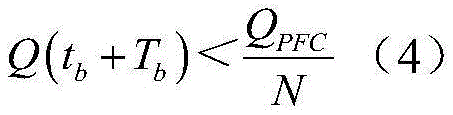
其中,N为交换机出端口数量;Among them, N is the number of outgoing ports of the switch;
同时,为了保证弹跳机制不会使得端到端的拥塞信号(如ECN通知和重复ACK)被阻塞,更新后的弹跳阈值Qth需满足以下条件:At the same time, in order to ensure that the bounce mechanism will not block end-to-end congestion signals (such as ECN notifications and repeated ACKs), the updated bounce threshold Q th must meet the following conditions:
Qth>QECN(5)Q th >Q ECN (5)
综合公式(1)、(4)、(5),得到更新后的弹跳阈值Qth的取值范围为:Combining formulas (1), (4) and (5), the value range of the updated bounce threshold Q th is obtained as follows:

取数据包的最小弹跳时间为2d,得到更新后的弹跳阈值Qth为:Taking the minimum bounce time of the data packet as 2d, the updated bounce threshold Q th is obtained as:

值得注意的是,“判断当前时间与弹跳阈值更新周期的起始时间t的差值是否大于或等于弹跳阈值更新周期Tth,若大于或等于弹跳阈值更新周期Tth,则更新弹跳阈值Qth,并将弹跳阈值更新周期的起始时间t设置为当前时间,然后转至下一步,若小于弹跳阈值更新周期Tth,则直接转至下一步”这一步骤除了可以从步骤二监听到有新数据包到达开始,亦可以从步骤三开始至步骤七执行前的其他任一时间内。It is worth noting that "determine whether the difference between the current time and the start time t of the bounce threshold update period is greater than or equal to the bounce threshold update period T th , if it is greater than or equal to the bounce threshold update period T th , then update the bounce threshold Q th , and set the start time t of the bounce threshold update period as the current time, and then go to the next step. If it is less than the bounce threshold update period T th , go directly to the next step.” This step can be monitored from step 2. The arrival of the new data packet can also start from
为了验证本发明的有效性,本发明利用NS-3网络仿真平台和真实试验床来实现,并进行了性能测试,实验设置如下:在NS-3仿真实验中,采用胖树拓扑,12个pod,共432台服务器,链路带宽都为40Gbps。图2为测试场景拓扑图。实验生成两种典型的工作负载,即webserver和data mining。Web server工作负载中的所有流都小于1MB。Data mining流量呈典型的重尾分布,83%的流小于100KB,95%的数据字节来自大于35MB的约3.6%的流。所有流在随机选择的端主机间产生,流的发送时间服从泊松分布。网络负载从0.3变化到0.7。本发明分别与DCQCN、TIMELY、Swift和PCN四种传输协议集成。In order to verify the effectiveness of the present invention, the present invention is realized by using the NS-3 network simulation platform and the real test bed, and the performance test is carried out. The experimental settings are as follows: , a total of 432 servers, the link bandwidth is 40Gbps. Figure 2 is a topology diagram of the test scene. The experiments generate two typical workloads, webserver and data mining. All streams in the web server workload are less than 1MB. Data mining traffic has a typical heavy-tailed distribution, with 83% of the streams smaller than 100KB and 95% of the data bytes coming from about 3.6% of the streams larger than 35MB. All streams are generated between randomly selected end hosts, and the sending time of streams obeys a Poisson distribution. The network load changed from 0.3 to 0.7. The present invention is respectively integrated with DCQCN, TIMELY, Swift and PCN four transmission protocols.
在试验床测试评估中,采用叶-脊网络拓扑结构,由12台服务器(Dell PRECISIONTOWER 5820台式机)组成,使用100Gbps链路连接到两个可编程100BF-32X硬件交换机,两个叶交换机之间提供20条等价路径,20条并行链路带宽为40Gbps,链路延迟为5μs。每个交换机有32个全双工100Gbps端口和22MB共享缓冲区。在每个入口端口启用PFC。每台服务器都配备10核Intel Xeon W-2255CPU、64GB内存、Mellanox ConnectX-5 100GbE NIC,支持DPDK和Ubuntu 20.04.1(Linux版本5.4.0-42-generic)。图3为测试场景拓扑图。弹跳阈值Qth设置为300KB。我们分别评估了本发明与DCQCN、Swift和PCN集成的性能。In the test bed test evaluation, a leaf-spine network topology was used, consisting of 12 servers (Dell PRECISIONTOWER 5820 desktops) connected to two programmable 100BF-32X hardware switches using a 100Gbps link, between the two leaf switches Provides 20 equivalent paths, 20 parallel links with a bandwidth of 40Gbps and a link delay of 5μs. Each switch has 32 full-duplex 100Gbps ports and a 22MB shared buffer. Enable PFC on each ingress port. Each server is equipped with a 10-core Intel Xeon W-2255CPU, 64GB RAM, Mellanox ConnectX-5 100GbE NIC, supports DPDK and Ubuntu 20.04.1 (Linux version 5.4.0-42-generic). Figure 3 is a test scene topology diagram. The bounce threshold Qth is set to 300KB. We evaluate the performance of our invention integrated with DCQCN, Swift and PCN, respectively.
图4为NS-3大规模仿真性能测试图,其中,图4(a)和图4(b)分别为web server和data mining的队头阻塞流示意图,图4(c)和图4(d)分别为web server和data mining的PFC暂停帧速率示意图,图4(e)和图4(f)分别为web server和data mining的平均流完成时间示意图。从图中可以看出,QBounce将队头阻塞流的比率保持在接近零的水平,有效降低了PFC暂停帧的速率,同时显著降低了流的平均完成时间。由于web server工作负载中,都是小流,QBounce有效控制了小流引起的PFC触发,因此QBounce在web server中对平均流完成时间的性能改进高于在data mining工作负载中的性能改进。Figure 4 is a large-scale simulation performance test diagram of NS-3, in which, Figure 4(a) and Figure 4(b) are schematic diagrams of head-of-line blocking flow of web server and data mining, respectively, Figure 4(c) and Figure 4(d) ) are schematic diagrams of the PFC pause frame rate of the web server and data mining, respectively, and Figure 4(e) and Figure 4(f) are the schematic diagrams of the average flow completion time of the web server and data mining, respectively. As can be seen from the figure, QBounce keeps the rate of head-of-line blocked flows close to zero, effectively reducing the rate at which PFC pauses frames, while significantly reducing the average completion time of flows. Since the web server workloads are all small flows, QBounce effectively controls the PFC triggering caused by small flows. Therefore, the performance improvement of QBounce on the average flow completion time in the web server is higher than that in the data mining workload.
图5为试验平台测试环境中,web search工作负载在链路带宽变化场景下的性能测试图,其中,图5(a)为队头阻塞流的示意图,图5(b)为PFC暂停帧速率的示意图,图5(c)为平均流完成时间的示意图,图5(d)为小于100KB的小流的99分位流完成时间示意图。本发明命名为QBounce。从图5(a)中可以看出,QBounce与端到端拥塞控制相结合,通过将数据包反弹到未充分利用的上游链路,成功地避免了无辜流遭受PFC队头阻塞。在更高速的链路速率如100Gbps下,队列累积更快,因此在没有部署QBounce时,有更多的无辜流被队头阻塞。图5(b)显示QBounce及时缓解瞬时拥塞,显著减少了PFC暂停帧的速率。值得注意的是,由于QBounce仅反弹与非阻塞流共享入口端口的阻塞流,因此PFC仍在仅被阻塞流占用的其他入口端口触发。图5(c)和图5(d)显示QBounce有效减小了所有流的平均完成时间,显著减小了小流的拖尾流完成时间。Figure 5 is the performance test diagram of the web search workload in the scenario of link bandwidth change in the test platform test environment, in which Figure 5(a) is a schematic diagram of the head-of-line blocking flow, and Figure 5(b) is the PFC pause frame rate Figure 5(c) is a schematic diagram of the average flow completion time, and Figure 5(d) is a schematic diagram of the 99th percentile flow completion time of a small flow less than 100KB. The present invention is named QBounce. As can be seen in Figure 5(a), QBounce combined with end-to-end congestion control successfully avoids innocent flows from PFC head-of-line blocking by bouncing packets to underutilized upstream links. At higher link rates such as 100Gbps, queue accumulation is faster, so when QBounce is not deployed, more innocent flows are blocked by the head of the queue. Figure 5(b) shows that QBounce relieves transient congestion in time, significantly reducing the rate of PFC pause frames. It's worth noting that since QBounce only bounces blocking flows that share an ingress port with non-blocking flows, PFC is still firing on other ingress ports that are only occupied by blocking flows. Figures 5(c) and 5(d) show that QBounce effectively reduces the average completion time of all flows and significantly reduces the completion time of trailing flows for small flows.
上述实施例为本发明较佳的实现方案,除此之外,本发明还可以其它方式实现,在不脱离本技术方案构思的前提下任何显而易见的替换均在本发明的保护范围之内。The above-mentioned embodiment is a preferred implementation scheme of the present invention. In addition, the present invention can also be implemented in other ways, and any obvious replacements are within the protection scope of the present invention without departing from the concept of the technical solution.
为了让本领域普通技术人员更方便地理解本发明相对于现有技术的改进之处,本发明的一些附图和描述已经被简化,并且为了清楚起见,本申请文件还省略了一些其他元素,本领域普通技术人员应该意识到这些省略的元素也可构成本发明的内容。In order to make it easier for those skilled in the art to understand the improvements of the present invention relative to the prior art, some drawings and descriptions of the present invention have been simplified, and for the sake of clarity, some other elements are also omitted in this application document, One of ordinary skill in the art would realize that these omitted elements may also constitute the subject matter of the present invention.
Claims (9)





Priority Applications (1)
| Application Number | Priority Date | Filing Date | Title |
|---|---|---|---|
| CN202210740937.7A CN115134308B (en) | 2022-06-27 | 2022-06-27 | Method for avoiding head-of-line blocking through data packet bouncing in lossless network of data center |
Applications Claiming Priority (1)
| Application Number | Priority Date | Filing Date | Title |
|---|---|---|---|
| CN202210740937.7A CN115134308B (en) | 2022-06-27 | 2022-06-27 | Method for avoiding head-of-line blocking through data packet bouncing in lossless network of data center |
Publications (2)
| Publication Number | Publication Date |
|---|---|
| CN115134308A true CN115134308A (en) | 2022-09-30 |
| CN115134308B CN115134308B (en) | 2023-11-03 |
Family
ID=83379588
Family Applications (1)
| Application Number | Title | Priority Date | Filing Date |
|---|---|---|---|
| CN202210740937.7A Active CN115134308B (en) | 2022-06-27 | 2022-06-27 | Method for avoiding head-of-line blocking through data packet bouncing in lossless network of data center |
Country Status (1)
| Country | Link |
|---|---|
| CN (1) | CN115134308B (en) |
Cited By (2)
| Publication number | Priority date | Publication date | Assignee | Title |
|---|---|---|---|---|
| CN115134302A (en) * | 2022-06-27 | 2022-09-30 | 长沙理工大学 | Flow isolation method for avoiding head of line congestion and congestion diffusion in lossless network |
| CN117478615A (en) * | 2023-12-28 | 2024-01-30 | 贵州大学 | Method for solving burst disorder problem in reliable transmission of deterministic network |
Citations (4)
| Publication number | Priority date | Publication date | Assignee | Title |
|---|---|---|---|---|
| US20110289162A1 (en) * | 2010-04-02 | 2011-11-24 | Furlong Wesley J | Method and system for adaptive delivery of digital messages |
| US20170068963A1 (en) * | 2015-09-04 | 2017-03-09 | Hcl Technologies Limited | System and a method for lean methodology implementation in information technology |
| CN110351187A (en) * | 2019-08-02 | 2019-10-18 | 中南大学 | Data center network Road diameter switches the adaptive load-balancing method of granularity |
| US20210288910A1 (en) * | 2020-11-17 | 2021-09-16 | Intel Corporation | Network interface device with support for hierarchical quality of service (qos) |
-
2022
- 2022-06-27 CN CN202210740937.7A patent/CN115134308B/en active Active
Patent Citations (4)
| Publication number | Priority date | Publication date | Assignee | Title |
|---|---|---|---|---|
| US20110289162A1 (en) * | 2010-04-02 | 2011-11-24 | Furlong Wesley J | Method and system for adaptive delivery of digital messages |
| US20170068963A1 (en) * | 2015-09-04 | 2017-03-09 | Hcl Technologies Limited | System and a method for lean methodology implementation in information technology |
| CN110351187A (en) * | 2019-08-02 | 2019-10-18 | 中南大学 | Data center network Road diameter switches the adaptive load-balancing method of granularity |
| US20210288910A1 (en) * | 2020-11-17 | 2021-09-16 | Intel Corporation | Network interface device with support for hierarchical quality of service (qos) |
Non-Patent Citations (3)
| Title |
|---|
| JESUS ESCUDERO-SAHUQUILLO: "OBQA: Smart and cost-efficient queue scheme for Head-of-Line blocking elimination in fat-trees", 《JOURNAL OF PARALLEL AND DISTRIBUTED COMPUTING》 * |
| 张劲声: "数据中心网络流量调度方案的研究与实现", 《硕士电子期刊》 * |
| 蔡岳平;张文鹏;罗森;: "数据中心网络差分流传输控制协议研究", 西安交通大学学报, no. 06 * |
Cited By (4)
| Publication number | Priority date | Publication date | Assignee | Title |
|---|---|---|---|---|
| CN115134302A (en) * | 2022-06-27 | 2022-09-30 | 长沙理工大学 | Flow isolation method for avoiding head of line congestion and congestion diffusion in lossless network |
| CN115134302B (en) * | 2022-06-27 | 2024-01-16 | 长沙理工大学 | Traffic isolation method for avoiding queue head blocking and congestion diffusion in lossless network |
| CN117478615A (en) * | 2023-12-28 | 2024-01-30 | 贵州大学 | Method for solving burst disorder problem in reliable transmission of deterministic network |
| CN117478615B (en) * | 2023-12-28 | 2024-02-27 | 贵州大学 | A method for reliable transmission in deterministic networks |
Also Published As
| Publication number | Publication date |
|---|---|
| CN115134308B (en) | 2023-11-03 |
Similar Documents
| Publication | Publication Date | Title |
|---|---|---|
| US20250193110A1 (en) | System and method for facilitating data-driven intelligent network with endpoint congestion detection and control | |
| CN115134302B (en) | Traffic isolation method for avoiding queue head blocking and congestion diffusion in lossless network | |
| JP7212441B2 (en) | Flow management in networks | |
| US8437252B2 (en) | Intelligent congestion feedback apparatus and method | |
| CN109714267B (en) | Transmission control method and system for managing reverse queue | |
| CN110351187B (en) | Adaptive load balancing method for path switching granularity in data center network | |
| CN115134308B (en) | Method for avoiding head-of-line blocking through data packet bouncing in lossless network of data center | |
| Xu et al. | Throughput optimization of TCP incast congestion control in large-scale datacenter networks | |
| US9654399B2 (en) | Methods and devices in an IP network for congestion control | |
| CN115022227B (en) | Data transmission method and system based on loop or rerouting in data center network | |
| CN115396357B (en) | Traffic load balancing method and system in data center network | |
| CN118337742A (en) | Time-sensitive network order-preserving caching method | |
| Suchara et al. | TCP MaxNet-Implementation and Experiments on the WAN in Lab | |
| CN121283950A (en) | Adaptive backpressure in network devices | |
| Sun et al. | Adaptive drop-tail: A simple and efficient active queue management algorithm for internet flow control | |
| Bullibabu et al. | Traffic congestion control in mobile ad-hoc networks | |
| Mukund et al. | Improving RED for reduced UDP packet-drop |
Legal Events
| Date | Code | Title | Description |
|---|---|---|---|
| PB01 | Publication | ||
| PB01 | Publication | ||
| SE01 | Entry into force of request for substantive examination | ||
| SE01 | Entry into force of request for substantive examination | ||
| GR01 | Patent grant | ||
| GR01 | Patent grant |