CN115063979B - Traffic information quantification method and system under intelligent networking environment - Google Patents
Traffic information quantification method and system under intelligent networking environment Download PDFInfo
- Publication number
- CN115063979B CN115063979B CN202210995518.8A CN202210995518A CN115063979B CN 115063979 B CN115063979 B CN 115063979B CN 202210995518 A CN202210995518 A CN 202210995518A CN 115063979 B CN115063979 B CN 115063979B
- Authority
- CN
- China
- Prior art keywords
- information
- traffic information
- traffic
- information source
- source
- Prior art date
- Legal status (The legal status is an assumption and is not a legal conclusion. Google has not performed a legal analysis and makes no representation as to the accuracy of the status listed.)
- Active
Links
Images


Classifications
-
- G—PHYSICS
- G08—SIGNALLING
- G08G—TRAFFIC CONTROL SYSTEMS
- G08G1/00—Traffic control systems for road vehicles
- G08G1/01—Detecting movement of traffic to be counted or controlled
- G08G1/0104—Measuring and analyzing of parameters relative to traffic conditions
- G08G1/0125—Traffic data processing
-
- G—PHYSICS
- G06—COMPUTING OR CALCULATING; COUNTING
- G06V—IMAGE OR VIDEO RECOGNITION OR UNDERSTANDING
- G06V10/00—Arrangements for image or video recognition or understanding
- G06V10/40—Extraction of image or video features
- G06V10/44—Local feature extraction by analysis of parts of the pattern, e.g. by detecting edges, contours, loops, corners, strokes or intersections; Connectivity analysis, e.g. of connected components
- G06V10/443—Local feature extraction by analysis of parts of the pattern, e.g. by detecting edges, contours, loops, corners, strokes or intersections; Connectivity analysis, e.g. of connected components by matching or filtering
- G06V10/449—Biologically inspired filters, e.g. difference of Gaussians [DoG] or Gabor filters
- G06V10/451—Biologically inspired filters, e.g. difference of Gaussians [DoG] or Gabor filters with interaction between the filter responses, e.g. cortical complex cells
- G06V10/454—Integrating the filters into a hierarchical structure, e.g. convolutional neural networks [CNN]
-
- G—PHYSICS
- G06—COMPUTING OR CALCULATING; COUNTING
- G06V—IMAGE OR VIDEO RECOGNITION OR UNDERSTANDING
- G06V10/00—Arrangements for image or video recognition or understanding
- G06V10/70—Arrangements for image or video recognition or understanding using pattern recognition or machine learning
- G06V10/82—Arrangements for image or video recognition or understanding using pattern recognition or machine learning using neural networks
-
- G—PHYSICS
- G06—COMPUTING OR CALCULATING; COUNTING
- G06V—IMAGE OR VIDEO RECOGNITION OR UNDERSTANDING
- G06V20/00—Scenes; Scene-specific elements
- G06V20/40—Scenes; Scene-specific elements in video content
-
- G—PHYSICS
- G06—COMPUTING OR CALCULATING; COUNTING
- G06V—IMAGE OR VIDEO RECOGNITION OR UNDERSTANDING
- G06V20/00—Scenes; Scene-specific elements
- G06V20/50—Context or environment of the image
- G06V20/56—Context or environment of the image exterior to a vehicle by using sensors mounted on the vehicle
- G06V20/58—Recognition of moving objects or obstacles, e.g. vehicles or pedestrians; Recognition of traffic objects, e.g. traffic signs, traffic lights or roads
-
- G—PHYSICS
- G06—COMPUTING OR CALCULATING; COUNTING
- G06V—IMAGE OR VIDEO RECOGNITION OR UNDERSTANDING
- G06V20/00—Scenes; Scene-specific elements
- G06V20/50—Context or environment of the image
- G06V20/56—Context or environment of the image exterior to a vehicle by using sensors mounted on the vehicle
- G06V20/58—Recognition of moving objects or obstacles, e.g. vehicles or pedestrians; Recognition of traffic objects, e.g. traffic signs, traffic lights or roads
- G06V20/582—Recognition of moving objects or obstacles, e.g. vehicles or pedestrians; Recognition of traffic objects, e.g. traffic signs, traffic lights or roads of traffic signs
-
- G—PHYSICS
- G06—COMPUTING OR CALCULATING; COUNTING
- G06V—IMAGE OR VIDEO RECOGNITION OR UNDERSTANDING
- G06V20/00—Scenes; Scene-specific elements
- G06V20/50—Context or environment of the image
- G06V20/56—Context or environment of the image exterior to a vehicle by using sensors mounted on the vehicle
- G06V20/58—Recognition of moving objects or obstacles, e.g. vehicles or pedestrians; Recognition of traffic objects, e.g. traffic signs, traffic lights or roads
- G06V20/584—Recognition of moving objects or obstacles, e.g. vehicles or pedestrians; Recognition of traffic objects, e.g. traffic signs, traffic lights or roads of vehicle lights or traffic lights
-
- G—PHYSICS
- G06—COMPUTING OR CALCULATING; COUNTING
- G06V—IMAGE OR VIDEO RECOGNITION OR UNDERSTANDING
- G06V20/00—Scenes; Scene-specific elements
- G06V20/50—Context or environment of the image
- G06V20/56—Context or environment of the image exterior to a vehicle by using sensors mounted on the vehicle
- G06V20/588—Recognition of the road, e.g. of lane markings; Recognition of the vehicle driving pattern in relation to the road
-
- G—PHYSICS
- G08—SIGNALLING
- G08G—TRAFFIC CONTROL SYSTEMS
- G08G1/00—Traffic control systems for road vehicles
- G08G1/01—Detecting movement of traffic to be counted or controlled
- G08G1/0104—Measuring and analyzing of parameters relative to traffic conditions
- G08G1/0108—Measuring and analyzing of parameters relative to traffic conditions based on the source of data
- G08G1/0112—Measuring and analyzing of parameters relative to traffic conditions based on the source of data from the vehicle, e.g. floating car data [FCD]
-
- G—PHYSICS
- G08—SIGNALLING
- G08G—TRAFFIC CONTROL SYSTEMS
- G08G1/00—Traffic control systems for road vehicles
- G08G1/01—Detecting movement of traffic to be counted or controlled
- G08G1/0104—Measuring and analyzing of parameters relative to traffic conditions
- G08G1/0125—Traffic data processing
- G08G1/0133—Traffic data processing for classifying traffic situation
-
- G—PHYSICS
- G08—SIGNALLING
- G08G—TRAFFIC CONTROL SYSTEMS
- G08G1/00—Traffic control systems for road vehicles
- G08G1/01—Detecting movement of traffic to be counted or controlled
- G08G1/0104—Measuring and analyzing of parameters relative to traffic conditions
- G08G1/0137—Measuring and analyzing of parameters relative to traffic conditions for specific applications
- G08G1/0141—Measuring and analyzing of parameters relative to traffic conditions for specific applications for traffic information dissemination
-
- G—PHYSICS
- G08—SIGNALLING
- G08G—TRAFFIC CONTROL SYSTEMS
- G08G1/00—Traffic control systems for road vehicles
- G08G1/09—Arrangements for giving variable traffic instructions
- G08G1/0962—Arrangements for giving variable traffic instructions having an indicator mounted inside the vehicle, e.g. giving voice messages
- G08G1/0967—Systems involving transmission of highway information, e.g. weather, speed limits
-
- G—PHYSICS
- G06—COMPUTING OR CALCULATING; COUNTING
- G06V—IMAGE OR VIDEO RECOGNITION OR UNDERSTANDING
- G06V2201/00—Indexing scheme relating to image or video recognition or understanding
- G06V2201/07—Target detection
-
- Y—GENERAL TAGGING OF NEW TECHNOLOGICAL DEVELOPMENTS; GENERAL TAGGING OF CROSS-SECTIONAL TECHNOLOGIES SPANNING OVER SEVERAL SECTIONS OF THE IPC; TECHNICAL SUBJECTS COVERED BY FORMER USPC CROSS-REFERENCE ART COLLECTIONS [XRACs] AND DIGESTS
- Y02—TECHNOLOGIES OR APPLICATIONS FOR MITIGATION OR ADAPTATION AGAINST CLIMATE CHANGE
- Y02T—CLIMATE CHANGE MITIGATION TECHNOLOGIES RELATED TO TRANSPORTATION
- Y02T10/00—Road transport of goods or passengers
- Y02T10/10—Internal combustion engine [ICE] based vehicles
- Y02T10/40—Engine management systems
Landscapes
- Engineering & Computer Science (AREA)
- General Physics & Mathematics (AREA)
- Physics & Mathematics (AREA)
- Theoretical Computer Science (AREA)
- Chemical & Material Sciences (AREA)
- Analytical Chemistry (AREA)
- Multimedia (AREA)
- Evolutionary Computation (AREA)
- Artificial Intelligence (AREA)
- Computer Vision & Pattern Recognition (AREA)
- Health & Medical Sciences (AREA)
- General Health & Medical Sciences (AREA)
- Life Sciences & Earth Sciences (AREA)
- Medical Informatics (AREA)
- Computing Systems (AREA)
- Biomedical Technology (AREA)
- Software Systems (AREA)
- Biodiversity & Conservation Biology (AREA)
- Databases & Information Systems (AREA)
- Molecular Biology (AREA)
- Atmospheric Sciences (AREA)
- Traffic Control Systems (AREA)
- Image Analysis (AREA)
Abstract
Description
技术领域technical field
本发明涉及交通信息量化技术领域,尤其是涉及一种智能网联环境下的交通信息量化方法及其系统。The invention relates to the technical field of traffic information quantification, in particular to a method and system for quantifying traffic information in an intelligent network environment.
背景技术Background technique
交通信息作为路网环境的认知载体,以语音、图像、文字、符号等形式传递给驾驶员,其发布目的是为消除驾驶员行车过程中对实时交通状况的不确定性,保证行车安全的同时提高出行效率。智能网联环境下驾驶人行车信息包含人、车、路和环境方面的信息,但从驾驶人信息感知和处理特点角度可划分为视距内信息和视距外信息,即“看的见的信息”和“看不见的信息”,其中“看的见信息”即为能直接观察到的视觉信息,而“看不见的信息”包含被遮挡的信息、远距离信息和听觉信息等。As the cognitive carrier of the road network environment, traffic information is transmitted to drivers in the form of voice, image, text, symbols, etc. The purpose of its release is to eliminate the uncertainty of real-time traffic conditions during driving and ensure driving safety. At the same time improve travel efficiency. In the intelligent network environment, the driver's traffic information includes information on people, vehicles, roads and the environment, but from the perspective of driver information perception and processing characteristics, it can be divided into information within the visual distance and information outside the visual distance, that is, "visible and visible information". Information” and “invisible information”, where “visible information” refers to visual information that can be directly observed, while “invisible information” includes occluded information, long-distance information and auditory information, etc.
在智能网联环境下,各种交通信息均可通过车载设备采集,并提供给驾驶人。但是交通信息这个概念本身比较抽象,我们需要将信息量化。早在1948年,香农(Shannon)在他著名的《通信的数学原理》论文中指出:“信息是用来消除随机不确定性的东西”,并提出了“信息熵”的概念(借用了热力学中熵的概念),来解决信息的度量问题。In the intelligent network environment, all kinds of traffic information can be collected by on-board equipment and provided to the driver. However, the concept of traffic information itself is relatively abstract, and we need to quantify the information. As early as 1948, Shannon (Shannon) pointed out in his famous paper "Mathematical Principles of Communication": "Information is something used to eliminate random uncertainty", and proposed the concept of "information entropy" (borrowed from thermodynamics The concept of entropy) to solve the problem of information measurement.
现有技术下大多只计算了交通基础设施的信息量,并未具体计算驾驶场景的信息量。Most of the existing technologies only calculate the amount of information of the traffic infrastructure, and do not specifically calculate the amount of information of the driving scene.
发明内容Contents of the invention
本发明的目的是提供一种智能网联环境下的交通信息量化方法及其系统,将驾驶人驾驶过程的行车信息进行量化,计算出信息量,能将不确定的信息转化为确定的信息,提高驾驶效率,帮助驾驶人优化驾驶过程,保障驾驶安全。The purpose of the present invention is to provide a method and system for quantifying traffic information in an intelligent network environment, which quantifies the driving information of the driver during driving, calculates the amount of information, and converts uncertain information into definite information. Improve driving efficiency, help drivers optimize the driving process, and ensure driving safety.
为实现上述目的,本发明提供了一种智能网联环境下的交通信息量化方法,具体步骤如下:In order to achieve the above purpose, the present invention provides a traffic information quantification method in an intelligent network connection environment, the specific steps are as follows:
步骤S1:根据采集到的视频提取交通信息源,并将交通信息源进行种类划分;Step S1: extract traffic information sources according to the collected video, and classify the traffic information sources;
步骤S2:通过实际观测和计算获得各交通信息源的状态集和概率分布;Step S2: Obtain the state set and probability distribution of each traffic information source through actual observation and calculation;
步骤S3:采用信息论量化交通信息源。Step S3: Use information theory to quantify traffic information sources.
优选的,在步骤S1中,交通信息源的种类包括交通参与者、车、路以及环境;Preferably, in step S1, the types of traffic information sources include traffic participants, vehicles, roads and environments;
划分的具体步骤如下:The specific steps of division are as follows:
步骤S11:汽车摄像头实时采集图像,并将采集到的图像发送至卷积神经网络模型中,卷积神经网络模型包括卷积层和全连接层;Step S11: The car camera collects images in real time, and sends the collected images to a convolutional neural network model, which includes a convolutional layer and a fully connected layer;
步骤S12:将图像输入Resnet框架后,进行Zeropad操作并使用滑动窗口来处理场景图像,卷积层操作之后,通过BN正则化操作,Relu激活函数,最大池化操作,对原始图像进行信息特征提取;Step S12: After inputting the image into the Resnet framework, perform the Zeropad operation and use the sliding window to process the scene image. After the convolution layer operation, perform information feature extraction on the original image through BN regularization operation, Relu activation function, and maximum pooling operation ;
步骤S13:将提取的信息特征输入串联的两种不同的残差块,残差块的输出进行Average-Pooling操作,再将其进行Flatten操作得到高级特征;Step S13: Input the extracted information features into two different residual blocks connected in series, and perform the Average-Pooling operation on the output of the residual block, and then perform the Flatten operation on it to obtain advanced features;
步骤S14:高级特征输入到全连接层中对图像进行分类,得到交通参与者、车辆、道路和背景环境的交通信息源。Step S14: The high-level features are input to the fully connected layer to classify the image, and the traffic information sources of traffic participants, vehicles, roads and background environment are obtained.
优选的,在步骤S2中,根据步骤S1获取的各个交通信息源,通过实际观测得到每个信息源的状态集,通过计算获得概率分布,Preferably, in step S2, according to each traffic information source obtained in step S1, the state set of each information source is obtained through actual observation, and the probability distribution is obtained through calculation,
设


优选的,在步骤S3中,具体步骤如下:Preferably, in step S3, the specific steps are as follows:
步骤S31:计算单个交通信息源的信息量,Step S31: Calculate the information volume of a single traffic information source,
在信息论中,信息由交通信息源输出的,交通信息源为
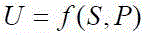
记交通信息源


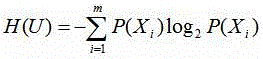
信息熵可以表示交通信息源的不确定程度,用所有可能发生状态的信息量的总体平均值来表示,信息熵与交通信息源的不确定程度正相关,交通信息源

当每个状态发出的信息概率相等,则When the probability of information sent by each state is equal, then

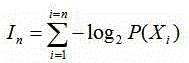
步骤S32:计算驾驶场景的信息量,计算公式如下:Step S32: Calculate the amount of information of the driving scene, the calculation formula is as follows:
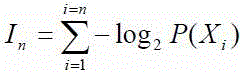
其中,
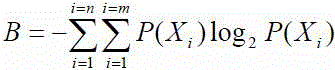
驾驶场景的信息熵计算公式如下:The formula for calculating the information entropy of the driving scene is as follows:
一种基于智能网联环境下的交通信息量化方法的系统,包括信息源提取设备、处理器以及存储器,A system based on a traffic information quantification method in an intelligent network environment, including an information source extraction device, a processor, and a memory,
所述信息源提取设备包括采集驾驶场景图像的摄像头和用于提取交通信息源识别的卷积神经网络模型;The information source extraction device includes a camera for collecting driving scene images and a convolutional neural network model for extracting traffic information source identification;
处理器用于计算交通信息源的状态概率分布和交通信息量;The processor is used to calculate the state probability distribution and traffic information volume of the traffic information source;
所述储存器中存储有执行程序和各交通信息源的状态集及概率分布。The memory stores the execution program and the state set and probability distribution of each traffic information source.
因此,本发明采用上述一种智能网联环境下的交通信息量化方法及其系统,具有以下有益效果:Therefore, the present invention adopts the above-mentioned method and system for quantifying traffic information in an intelligent network environment, and has the following beneficial effects:
(1)本发明将驾驶人驾驶过程的行车信息进行量化,计算出信息量,能将不确定的信息转化为确定的信息。(1) The present invention quantifies the driving information in the driving process of the driver, calculates the amount of information, and converts uncertain information into definite information.
(2)通过计算单个信息源的信息量从而得到驾驶情景的信息量,可以将视距外的交通信息量化,在实际应用中可以根据信息量的大小来确定哪些是驾驶人需要的关键信息,然后提供给驾驶人,从而提高驾驶效率,帮助优化驾驶人的驾驶过程,保障驾驶安全。(2) By calculating the information volume of a single information source to obtain the information volume of the driving scene, the traffic information beyond the line of sight can be quantified. In practical applications, the key information that the driver needs can be determined according to the amount of information. Then provide it to the driver to improve driving efficiency, help optimize the driver's driving process, and ensure driving safety.
下面通过附图和实施例,对本发明的技术方案做进一步的详细描述。The technical solutions of the present invention will be described in further detail below with reference to the accompanying drawings and embodiments.
附图说明Description of drawings
图1为本发明一种智能网联环境下的交通信息量化方法流程图;Fig. 1 is a flow chart of a method for quantifying traffic information in an intelligent network connection environment according to the present invention;
图2为本发明提取过程图;Fig. 2 is the extraction process figure of the present invention;
图3为本发明ResNet50具体实现流程图。FIG. 3 is a flow chart of the specific implementation of ResNet50 of the present invention.
具体实施方式detailed description
实施例Example
图1为本发明一种智能网联环境下的交通信息量化方法流程图,如图1所示,一种智能网联环境下的交通信息量化方法,具体步骤如下:Fig. 1 is a flow chart of a traffic information quantification method in an intelligent network connection environment of the present invention. As shown in Fig. 1, a traffic information quantification method in an intelligent network connection environment, the specific steps are as follows:
步骤S1:根据采集到的视频提取交通信息源,并将交通信息源进行种类划分。如图2所示,交通信息源的种类包括交通参与者、车、路以及环境,交通参与者分为行人和骑行者;车是指该驾驶场景中的车辆;路是指道路状况,包括信号灯、交通标志与护栏等;环境主要是指行车周围环境情况,包含管理设施和气候条件等。Step S1: Extract traffic information sources according to the collected video, and classify traffic information sources into categories. As shown in Figure 2, the types of traffic information sources include traffic participants, cars, roads, and the environment. Traffic participants are divided into pedestrians and cyclists; cars refer to vehicles in the driving scene; roads refer to road conditions, including signal lights , traffic signs and guardrails, etc.; the environment mainly refers to the surrounding environment of driving, including management facilities and climate conditions.
划分的具体步骤如下:The specific steps of division are as follows:
步骤S11:汽车摄像头实时采集图像,并将采集到的图像发送至卷积神经网络模型中,卷积神经网络模型包括卷积层和全连接层。Step S11: The car camera collects images in real time, and sends the collected images to a convolutional neural network model, which includes a convolutional layer and a fully connected layer.
卷积神经网络模型(CNN),在目标检测方面表现出优越性,可以从原始数据中发现判别特征。通过使用局部连接模式和对权重施加约束来整合有关二维形状不变性的知识。在网络中权重共享架构大大减少了权重的数量,图像可以直接作为输入,避免了传统识别算法中特征提取的复杂过程。Convolutional neural network models (CNN), which have shown superiority in object detection, can discover discriminative features from raw data. Incorporates knowledge about shape invariance in 2D by using local connectivity patterns and imposing constraints on weights. The weight sharing architecture in the network greatly reduces the number of weights, and images can be directly used as input, avoiding the complicated process of feature extraction in traditional recognition algorithms.
神经网络的作用机制主要有两部分构成:The mechanism of action of the neural network mainly consists of two parts:
卷积层,负责提取图像特征,从原始低维特征中转化出有利于神经网络分类的高级特征。The convolutional layer is responsible for extracting image features and transforming the original low-dimensional features into high-level features that are beneficial to neural network classification.
全连接层,利用卷积层获取的高级特征对图像进行分类。The fully connected layer uses the high-level features obtained by the convolutional layer to classify the image.
本方法使用ResNet50作为基础框架,Resnet50网络中包含了49个卷积层和一个全连接层。Resnet50网络结构的核心思想是Residual net(残差网络)残差网络的构建,将靠前若干层的某一层数据输出直接跳过多层引入到后面数据层的输入部分。意味着后面的特征层的内容会有一部分由其前面的某一层线性贡献,提高模型的鲁棒性,且ResNet50网络框架,可以在提供优秀计算效果的同时,提高计算效率。在Resnet50网络结构中通过两种不同的残差块:CONV BLOCK和Identity Block串联,构成整体框架,每个残差块都包含三层卷积层。如图3所示,整体网络结构可以分成七个部分,第一部分不包含残差块,主要对输入进行卷积、正则化、激活函数、最大池化的计算,第二、三、四、五部分结构都包含了残差块。This method uses ResNet50 as the basic framework, and the Resnet50 network contains 49 convolutional layers and a fully connected layer. The core idea of the Resnet50 network structure is the construction of the Residual net (residual network) residual network. The data output of a certain layer of the first few layers is directly skipped over multiple layers and introduced into the input part of the subsequent data layer. It means that part of the content of the following feature layer will be linearly contributed by a certain layer in front of it, which improves the robustness of the model, and the ResNet50 network framework can provide excellent computing effects while improving computing efficiency. In the Resnet50 network structure, two different residual blocks: CONV BLOCK and Identity Block are connected in series to form an overall framework, and each residual block contains three convolutional layers. As shown in Figure 3, the overall network structure can be divided into seven parts. The first part does not contain residual blocks, and mainly performs convolution, regularization, activation functions, and maximum pooling calculations on the input. The second, third, fourth, and fifth Some structures contain residual blocks.
步骤S12:将图像输入Resnet框架后,进行Zeropad操作并使用滑动窗口来处理场景图像,并通过BN正则化操作,Relu激活函数,最大池化操作,对原始图像进行信息特征提取。Step S12: After inputting the image into the Resnet framework, perform Zeropad operation and use the sliding window to process the scene image, and perform information feature extraction on the original image through BN regularization operation, Relu activation function, and maximum pooling operation.
步骤S13:将提取的信息特征输入串联的两种不同的残差块,残差块的输出进行Average-Pooling操作,再将其进行Flatten操作得到高级特征。Step S13: Input the extracted information features into two different residual blocks connected in series, the output of the residual block is subjected to the Average-Pooling operation, and then the Flatten operation is performed to obtain advanced features.
步骤S14:高级特征输入到全连接层中对图像进行分类,得到交通参与者、车辆、道路和背景环境的交通信息源。Step S14: The high-level features are input to the fully connected layer to classify the image, and the traffic information sources of traffic participants, vehicles, roads and background environment are obtained.
步骤S2:通过实际观测和计算获得各交通信息源的状态集和概率分布。根据步骤S1获取的各个交通信息源,通过实际观测得到每个信息源的状态集,通过计算获得概率分布,设


其中一些信息源的计算方式如下:Some of these sources of information are calculated as follows:
1、信号灯1. Signal lights
根据交警部门设定的信号周期来获得红绿黄灯的概率,根据所占时间比例来计算。According to the signal period set by the traffic police department, the probability of obtaining traffic, green and yellow lights is calculated according to the proportion of the time.
信号灯的状态集为S={红灯、绿灯、黄灯};概率分布为P(红灯)=红灯时长/信号周期、P(绿灯)=绿灯时长/信号周期、P(黄灯)=黄灯时长/信号周期。The state set of the signal light is S={red light, green light, yellow light}; the probability distribution is P(red light)=red light duration/signal period, P(green light)=green light duration/signal period, P(yellow light)= Yellow light duration/signal period.
2、交通标志2. Traffic signs
按照《道路交通标志和标线》(GB5768-2022),交通标志主要分为七类:禁令标志、警告标志、指示标志、指路标志、旅游区标志、告示标志、辅助标志。可以将其分为两类:指路标志和非指路标志。According to "Road Traffic Signs and Markings" (GB5768-2022), traffic signs are mainly divided into seven categories: prohibition signs, warning signs, instruction signs, guide signs, tourist area signs, notice signs, and auxiliary signs. They can be divided into two categories: guiding signs and non-guiding signs.
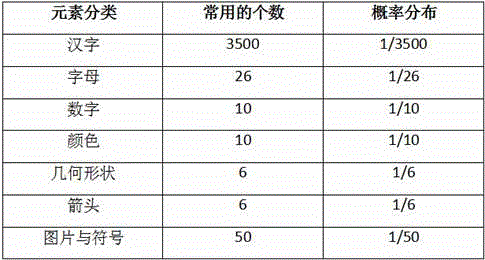
对于非指路标志,是由不同类型的元素组合而成,分为汉字、字母、数字、颜色、几何形状、图片与符号。For non-guiding signs, they are composed of different types of elements, including Chinese characters, letters, numbers, colors, geometric shapes, pictures and symbols.
按照《通用规范汉字表》,常用的汉字有3500个;英文字母为26个;数字为0-9,计10个;按照《道路交通标志和标线》(GB5768-2022)规定,交通标志允许使用的颜色有10种:红色、蓝色、黄色/荧光黄色、荧光黄绿色、绿色、棕色、橙色/荧光橙色、粉红色/荧光粉红色、黑色、白色;允许使用的几何形状有6种:正八边形、倒等边三角形、圆形、正等边三角形、叉形、矩形;箭头有6种;交通标志中常用的图片与符号有50多种。According to the "General Standard Chinese Character List", there are 3,500 commonly used Chinese characters; 26 English letters; 10 colors are used: red, blue, yellow/fluorescent yellow, fluorescent chartreuse, green, brown, orange/fluorescent orange, pink/fluorescent pink, black, white; 6 geometric shapes are allowed: Regular octagon, inverted equilateral triangle, circle, regular equilateral triangle, fork, rectangle; there are 6 types of arrows; there are more than 50 kinds of pictures and symbols commonly used in traffic signs.
表1 交通标志的组成Table 1 Composition of traffic signs
对于指路标志:地名出现的概率P=1/m,m是指该地方所有的地名;其他符号计算同非指路标志。For guiding signs: the probability of place names appearing P=1/m, m refers to all the place names in this place; calculation of other symbols is the same as non-guiding signs.
3、车辆信息3. Vehicle information
可以根据GPS定位来获取其他车辆的信息,得出周围车辆的状态集及概率。The information of other vehicles can be obtained according to GPS positioning, and the state set and probability of surrounding vehicles can be obtained.
4、交通参与者4. Traffic participants
各种状态是等可能发生的,则概率分布为等比例,即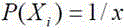
其中
5、交通标线与护栏5. Traffic markings and guardrails
按照所占道路的长度计算其概率,计算公式如下:The probability is calculated according to the length of the occupied road, and the calculation formula is as follows:

式中

步骤S3:采用信息论量化交通信息源。Step S3: Use information theory to quantify traffic information sources.
具体步骤如下:Specific steps are as follows:
步骤S31:计算单个交通信息源的信息量,Step S31: Calculate the information volume of a single traffic information source,
在信息论中,信息由交通信息源输出的,交通信息源为

记交通信息源



信息熵可以表示交通信息源的不确定程度,用所有可能发生状态的信息量的总体平均值来表示,信息熵与交通信息源的不确定程度正相关,交通信息源

当每个状态发出的信息概率相等,则When the probability of information sent by each state is equal, then

步骤S32:计算驾驶场景的信息量,计算公式如下:Step S32: Calculate the amount of information of the driving scene, the calculation formula is as follows:
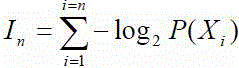
其中,
驾驶场景的信息熵计算公式如下:The formula for calculating the information entropy of the driving scene is as follows:
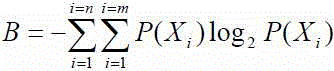
一种基于智能网联环境下的交通信息量化方法的系统,包括信息源提取设备、处理器以及存储器。A system based on a traffic information quantification method in an intelligent network environment, including an information source extraction device, a processor, and a memory.
信息源提取设备包括采集驾驶场景图像的摄像头和用于提取交通信息源识别的卷积神经网络模型,根据实际提取的信息源的种类,还可以添加其他检测设备或与其他检测设备通讯获取信息源数据。Information source extraction equipment includes a camera for collecting driving scene images and a convolutional neural network model for extracting traffic information source identification. According to the type of information source actually extracted, other detection equipment can also be added or communicated with other detection equipment to obtain information sources data.
处理器用于计算交通信息源的状态概率分布和交通信息量。The processor is used to calculate the state probability distribution and the amount of traffic information of the traffic information source.
所述储存器中存储有执行程序和各交通信息源的状态集及概率分布。The memory stores the execution program and the state set and probability distribution of each traffic information source.
因此,本发明采用上述一种智能网联环境下的交通信息量化方法及其系统,一种智能网联环境下的交通信息量化方法及其系统,将驾驶人驾驶过程的行车信息进行量化,计算出信息量,能将不确定的信息转化为确定的信息,提高驾驶效率,帮助驾驶人优化驾驶过程,保障驾驶安全。Therefore, the present invention adopts the above-mentioned traffic information quantification method and system in an intelligent network environment, a traffic information quantification method and system in an intelligent network environment, to quantify the driving information of the driver in the driving process, and calculate It can convert uncertain information into definite information, improve driving efficiency, help drivers optimize the driving process, and ensure driving safety.
最后应说明的是:以上实施例仅用以说明本发明的技术方案而非对其进行限制,尽管参照较佳实施例对本发明进行了详细的说明,本领域的普通技术人员应当理解:其依然可以对本发明的技术方案进行修改或者等同替换,而这些修改或者等同替换亦不能使修改后的技术方案脱离本发明技术方案的精神和范围。Finally, it should be noted that the above embodiments are only used to illustrate the technical solutions of the present invention and not to limit them. Although the present invention has been described in detail with reference to the preferred embodiments, those of ordinary skill in the art should understand that: it still Modifications or equivalent replacements can be made to the technical solutions of the present invention, and these modifications or equivalent replacements cannot make the modified technical solutions deviate from the spirit and scope of the technical solutions of the present invention.
Claims (2)











Priority Applications (2)
| Application Number | Priority Date | Filing Date | Title |
|---|---|---|---|
| CN202210995518.8A CN115063979B (en) | 2022-08-19 | 2022-08-19 | Traffic information quantification method and system under intelligent networking environment |
| US18/200,626 US12548436B2 (en) | 2022-08-19 | 2023-05-23 | Traffic information quantization method in the intelligent network environment and its system |
Applications Claiming Priority (1)
| Application Number | Priority Date | Filing Date | Title |
|---|---|---|---|
| CN202210995518.8A CN115063979B (en) | 2022-08-19 | 2022-08-19 | Traffic information quantification method and system under intelligent networking environment |
Publications (2)
| Publication Number | Publication Date |
|---|---|
| CN115063979A CN115063979A (en) | 2022-09-16 |
| CN115063979B true CN115063979B (en) | 2022-12-23 |
Family
ID=83207607
Family Applications (1)
| Application Number | Title | Priority Date | Filing Date |
|---|---|---|---|
| CN202210995518.8A Active CN115063979B (en) | 2022-08-19 | 2022-08-19 | Traffic information quantification method and system under intelligent networking environment |
Country Status (1)
| Country | Link |
|---|---|
| CN (1) | CN115063979B (en) |
Families Citing this family (2)
| Publication number | Priority date | Publication date | Assignee | Title |
|---|---|---|---|---|
| CN116168363A (en) * | 2023-03-13 | 2023-05-26 | 合众新能源汽车股份有限公司 | Data screening method, device and computer readable medium based on information entropy |
| CN118840866B (en) * | 2024-07-26 | 2025-03-18 | 武汉大学 | Urban traffic chaos measurement method and system based on vehicle trajectory and vehicle-mounted video |
Family Cites Families (7)
| Publication number | Priority date | Publication date | Assignee | Title |
|---|---|---|---|---|
| WO2002101594A2 (en) * | 2001-06-11 | 2002-12-19 | Hrl Laboratories, Llc | Method and apparatus for determining and assessing information to be collected based on information-theoretic measures |
| US7912628B2 (en) * | 2006-03-03 | 2011-03-22 | Inrix, Inc. | Determining road traffic conditions using data from multiple data sources |
| AU2020306013A1 (en) * | 2019-06-24 | 2022-02-10 | Insurance Services Office, Inc. | Machine learning systems and methods for improved localization of image forgery |
| DE112020003043T5 (en) * | 2019-06-25 | 2022-08-18 | Nvidia Corporation | DETECTION AND CLASSIFICATION OF CROSSROADS REGIONS FOR AUTONOMOUS MACHINE APPLICATIONS |
| CN112818853B (en) * | 2021-02-01 | 2022-07-19 | 中国第一汽车股份有限公司 | Traffic element identification method, device, equipment and storage medium |
| CN113434483B (en) * | 2021-06-29 | 2022-02-15 | 无锡四维时空信息科技有限公司 | Visual modeling method and system based on space-time big data |
| CN113808011B (en) * | 2021-09-30 | 2023-08-11 | 深圳万兴软件有限公司 | Style migration method and device based on feature fusion and related components thereof |
-
2022
- 2022-08-19 CN CN202210995518.8A patent/CN115063979B/en active Active
Also Published As
| Publication number | Publication date |
|---|---|
| US20240062649A1 (en) | 2024-02-22 |
| CN115063979A (en) | 2022-09-16 |
Similar Documents
| Publication | Publication Date | Title |
|---|---|---|
| CN107886073B (en) | A fine-grained vehicle multi-attribute recognition method based on convolutional neural network | |
| CN107239778B (en) | Efficient and accurate license plate recognition method | |
| CN115063979B (en) | Traffic information quantification method and system under intelligent networking environment | |
| CN111209880A (en) | Vehicle behavior identification method and device | |
| CN106934374B (en) | A method and system for identifying traffic signs in smog scene | |
| CN112381101B (en) | An Infrared Road Scene Segmentation Method Based on Class Prototype Regression | |
| CN112819000A (en) | Streetscape image semantic segmentation system, streetscape image semantic segmentation method, electronic equipment and computer readable medium | |
| CN108492584A (en) | A kind of traffic accident alarm method and device based on wisdom lamp stand | |
| CN115187886A (en) | Vehicle violation detection method and device and electronic equipment | |
| CN109670450B (en) | Video-based man-vehicle object detection method | |
| CN113033352B (en) | Real-time mobile traffic violation detection method based on combination of improved target semantic segmentation and target detection model | |
| CN114495060B (en) | Road traffic marking recognition method and device | |
| CN109448397A (en) | A kind of group's mist monitoring method based on big data | |
| CN106934378A (en) | A kind of dazzle light identifying system and method based on video depth study | |
| CN113538903B (en) | Traffic jam prediction method based on traffic flow characteristic extraction and classification | |
| WO2023169273A1 (en) | Image recognition method and apparatus, device, and storage medium | |
| CN109615869A (en) | Distributed vehicle real-time intelligent illegal capture and reporting system | |
| Karthigadevi et al. | Speed limit signboard recognition and audio alert for driver using CNN | |
| CN113962600A (en) | A kind of traffic safety risk diagnosis method and device | |
| CN115601717A (en) | Deep learning-based traffic violation classification detection method and SoC chip | |
| CN106919939B (en) | Method and system for tracking and identifying traffic signs | |
| CN109166336B (en) | A real-time road condition information collection and push method based on blockchain technology | |
| CN115171013A (en) | Vehicle scheduling system and method based on intelligent traffic accident rescue | |
| CN113033363A (en) | Vehicle dense target detection method based on deep learning | |
| CN110503049B (en) | A method for estimating the number of vehicles in satellite video based on generative adversarial network |
Legal Events
| Date | Code | Title | Description |
|---|---|---|---|
| PB01 | Publication | ||
| PB01 | Publication | ||
| SE01 | Entry into force of request for substantive examination | ||
| SE01 | Entry into force of request for substantive examination | ||
| GR01 | Patent grant | ||
| GR01 | Patent grant |