CN115048756A - Optimization device, optimization program, and optimization method - Google Patents
Optimization device, optimization program, and optimization method Download PDFInfo
- Publication number
- CN115048756A CN115048756A CN202111583244.3A CN202111583244A CN115048756A CN 115048756 A CN115048756 A CN 115048756A CN 202111583244 A CN202111583244 A CN 202111583244A CN 115048756 A CN115048756 A CN 115048756A
- Authority
- CN
- China
- Prior art keywords
- optimization
- bits
- bit
- inversion
- energy function
- Prior art date
- Legal status (The legal status is an assumption and is not a legal conclusion. Google has not performed a legal analysis and makes no representation as to the accuracy of the status listed.)
- Granted
Links
Images



Classifications
-
- G—PHYSICS
- G06—COMPUTING OR CALCULATING; COUNTING
- G06F—ELECTRIC DIGITAL DATA PROCESSING
- G06F7/00—Methods or arrangements for processing data by operating upon the order or content of the data handled
- G06F7/38—Methods or arrangements for performing computations using exclusively denominational number representation, e.g. using binary, ternary, decimal representation
- G06F7/48—Methods or arrangements for performing computations using exclusively denominational number representation, e.g. using binary, ternary, decimal representation using non-contact-making devices, e.g. tube, solid state device; using unspecified devices
- G06F7/544—Methods or arrangements for performing computations using exclusively denominational number representation, e.g. using binary, ternary, decimal representation using non-contact-making devices, e.g. tube, solid state device; using unspecified devices for evaluating functions by calculation
- G06F7/5443—Sum of products
-
- G—PHYSICS
- G06—COMPUTING OR CALCULATING; COUNTING
- G06F—ELECTRIC DIGITAL DATA PROCESSING
- G06F17/00—Digital computing or data processing equipment or methods, specially adapted for specific functions
- G06F17/10—Complex mathematical operations
- G06F17/11—Complex mathematical operations for solving equations, e.g. nonlinear equations, general mathematical optimization problems
-
- G—PHYSICS
- G06—COMPUTING OR CALCULATING; COUNTING
- G06F—ELECTRIC DIGITAL DATA PROCESSING
- G06F30/00—Computer-aided design [CAD]
- G06F30/20—Design optimisation, verification or simulation
-
- G—PHYSICS
- G06—COMPUTING OR CALCULATING; COUNTING
- G06F—ELECTRIC DIGITAL DATA PROCESSING
- G06F17/00—Digital computing or data processing equipment or methods, specially adapted for specific functions
- G06F17/10—Complex mathematical operations
- G06F17/15—Correlation function computation including computation of convolution operations
-
- G—PHYSICS
- G06—COMPUTING OR CALCULATING; COUNTING
- G06F—ELECTRIC DIGITAL DATA PROCESSING
- G06F2111/00—Details relating to CAD techniques
- G06F2111/08—Probabilistic or stochastic CAD
Landscapes
- Engineering & Computer Science (AREA)
- Physics & Mathematics (AREA)
- General Physics & Mathematics (AREA)
- Theoretical Computer Science (AREA)
- Mathematical Physics (AREA)
- Mathematical Optimization (AREA)
- Computational Mathematics (AREA)
- Pure & Applied Mathematics (AREA)
- Mathematical Analysis (AREA)
- General Engineering & Computer Science (AREA)
- Data Mining & Analysis (AREA)
- Algebra (AREA)
- Computing Systems (AREA)
- Databases & Information Systems (AREA)
- Software Systems (AREA)
- Evolutionary Computation (AREA)
- Geometry (AREA)
- Computer Hardware Design (AREA)
- Operations Research (AREA)
- Complex Calculations (AREA)
- Human Computer Interaction (AREA)
Abstract
The present disclosure relates to an optimization apparatus, an optimization program, and an optimization method. The optimization device comprises a memory and an arithmetic unit. The memory stores one or more coupling coefficients representing interactions of a plurality of variables corresponding to a plurality of bits included in the energy function. The arithmetic unit is configured to select adoption or rejection of bit inversion to perform optimization based on a difference in values of the energy function associated with inversion of a value of each of the plurality of bits. The operation unit specifies, from among the one or more coupling coefficients, a coupling coefficient corresponding to an auxiliary variable that is a product of variables corresponding to the respective bits from which variables corresponding to a specific bit in the energy function are excluded, and performs calculation of a third-order or higher-order term of a difference associated with inversion of the specific bit using the auxiliary variable and the coupling coefficient.
Description
Technical Field
The embodiments discussed herein relate to an optimization apparatus, an optimization program, and an optimization method.
Background
Information processing is performed in various fields of the current society. Such information processing is performed by an arithmetic device such as a computer, which performs operations and reorganization on various data and obtains meaningful results to perform prediction, determination, control, and the like. Optimization is one method of such information processing and has become an important field.
One method of optimization processing is to solve a discrete optimization problem. In a large-scale multivariable discrete optimization problem, the number of combinations explosively grows, and in a technique of exhaustively performing calculation to calculate all the combinations, the calculation time sometimes does not fall within a realistic range.
An example of a method for solving such a large-scale multivariable discrete optimization problem includes Simulated Annealing (SA) using an inching-type energy function. In such SA, calculation is performed by replacing the problem to be calculated with an izod model, which is a model representing the spin behavior of the magnetic material.
In the optimization calculation using the Esinon model, bits are randomly inverted to calculate an energy variation in the case of inverting one bit, and bit inversion is accepted depending on whether the energy variation is adopted, thereby searching for an optimal solution that minimizes energy.
[ list of references ]
[ patent document ]
[ patent document 1] Japanese laid-open patent publication No. 2019-145010
[ patent document 2] Japanese laid-open patent publication No. 2019-46038
[ patent document 3] International publication Manual No. WO 2015/190593
[ patent document 4] U.S. patent application publication No. 2019/0087388
Disclosure of Invention
[ problem ] to
However, the related art described above has problems in that: that is, in the case of searching for the minimum value of the energy function e (x) including higher-order terms of the third order or higher, the number of parameter elements to be transferred from the memory to the calculation resource becomes enormous.
For example, an example describing the energy function e (x) associated with all orders is represented by the following equation (1), where k represents the order, where the kth-order coupling coefficient represents the kth-order array W 1,2…,k . The coupling coefficient represents a mutual coupling strength of each of the plurality of spins in the Esinon model, where each of the plurality of variables is considered to be each of the plurality of spins of the magnetic material.
[ mathematical formula 1]

Here, j 1 、……、j k Represents the element position in each order, and x represents a binary (0, 1) or a spin (1, -1). W denotes an array that is different for each order, which is typically a multi-dimensional array.
The formula (1) is rewritten to the following formula (2). ZK represents the coupling coefficient of the kth order term, which is a k-dimensional array.
[ mathematical formula 2]

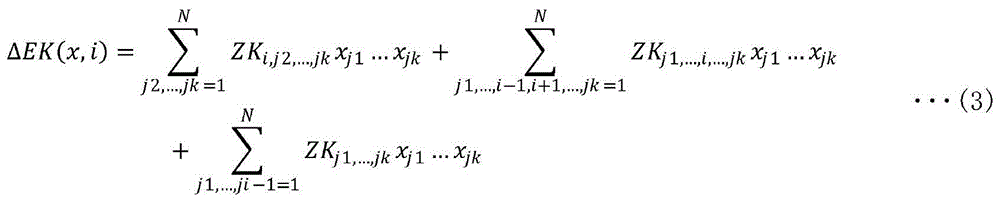
Here, the expressions (3) and (4) are as follows, the expression (3) being a calculation formula of the energy change Δ Ek (x, i) of the kth order term associated with the inversion of the ith element of x, and the expression (4) being a total calculation formula. Note that E0 disappeared, since it was a change.
[ mathematical formula 3]
[ mathematical formula 4]
ΔE(x,i)=ΔEK(x,i)+…+ΔE1(x,i)…(4)
For example, in the third order term, the calculation is made by dividing x j1 x j2 x j3 X 'obtained by inverting 1 bit' j1 x′ j2 x′ j3 . Therefore, when the inversion portion is set to m and the potential difference is set to Δ x m The third order term is the calculated Z m,j2,j3 Δx m x j2 x j3 、Z j1,m,j3 x j1 Δx m x j3 And Z j1,j2,m x j1 x j2 Δx m And (4) summing.
That is, for example, the amount of memory accesses to perform a computation requires a hyperplane of Z by order. The case of fourth order or higher is applicable in a similar manner. Transferring values of k x N ^ (k-1) elements from memory to the computing resources.
FIG. 7 is a block diagram illustrating an exemplary conventional structure for minimum solution search. As shown in fig. 7, the arithmetic processing unit 201 reads a coupling coefficient (ZK) as a parameter to be used for calculation from the memory 202, and calculates an ith bit x at x i Energy difference in a state of a certain order k. j is a function of 1 To j k May take values from 1 to N.
The arithmetic processing unit 201 includes a reading unit 203, operation units 204 to 206, and an addition unit 207. The arithmetic processing unit 201 determines the position (i) for bit reversal, the input comprising x i Difference Deltax before and after inversion i Reads a predetermined section from the kth order coupling coefficient ZK stored in the memory 202, and outputs an energy difference Δ Ek of the term.
For a certain dimension of the multi-dimensional array Z, the reading unit 203 selects a hyperplane in which the position (i) of x for bit inversion is fixed for each dimension, and reads it from the memory 202 to prepare k segments. This reading from the memory 202 is a position where a transfer load to the arithmetic processing unit 201 as a calculation resource is generated.
The arithmetic units 204 to 206 and the addition unit 207 perform product-sum operation on each hyperplane output from the reading unit 203. For example, when k is 3, the operation in the operation unit 204 is as follows.
[ math figure 5]
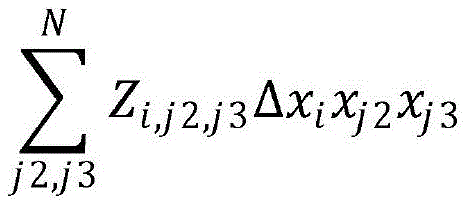
The addition unit 207 adds up the calculation results of the operation units 204 to 206 to output Δ Ek.
FIG. 8 is an explanatory diagram showing exemplary conventional operations for minimum solution search. In fig. 8, it is assumed that the initial value of E is calculated in advance according to equation (2). It is assumed that the initial value is not included in the transmission amount because it is the first time.
As shown in fig. 8, the arithmetic processing units 201a to 201c correspond to the arithmetic processing unit 201 of fig. 7, and perform operations of the case of order K, 3, or 2. In the first order case, the multiplication unit 208 will change the value of U (U) at position (i) i ) Multiplied by Δ x i 。
After the arithmetic processing units 201a to 201c and the operation of the multiplication unit 208, the addition unit 209 adds the respective results to generate Δ E (x, i). The adoption/rejection determination unit 210 determines adoption/rejection of a bit changed according to the well-known metropolis criterion or the like based on Δ E (x, i). The adoption/rejection determination unit 210 sets, in the case of adoption, en + Δ E (x, i) for the current energy E, and sets en + E in the case of rejection.
Fig. 9 is an explanatory diagram showing an example of reading a hyperplane from a memory. In the example of fig. 9, a third order term is chosen. As shown in fig. 9, in order to calculate the difference in energy using the calculation resources (arithmetic processing unit 201 and the like) based on bit inversion, the hyperplane of the order is read from the memory (memory 202 and the like).
For example, where order k is 3 and the number of bits is N, 3N is transferred from memory to the computing resource 2 The number of individual elements. Therefore, in the case of searching for the minimum value of the energy function e (x) including the higher-order term, the transmission amount increases, and the transmission time may be longer. In the case where the order is four or higher and N is larger, the transfer amount further increases, and the transfer time increases.
In one aspect, it is intended to provide an optimization apparatus, an optimization program, and an optimization method capable of suppressing the data transfer amount at the time of optimization operation.
[ solution of problems ]
According to one embodiment, an optimization device includes a memory and a processor. The memory is configured to store one or more coupling coefficients representing an interaction of a plurality of variables, the plurality of variables corresponding to a plurality of bits included in the energy function. The arithmetic unit is configured to select adoption or rejection of bit inversion to perform optimization based on a difference in values of the energy function associated with inversion of a value of each of the plurality of bits. The arithmetic unit is further configured to: specifying, from among one or more coupling coefficients stored in a memory, a coupling coefficient corresponding to an auxiliary variable that is a product of variables corresponding to respective bits from which variables corresponding to particular bits in the energy function are excluded; and performing a calculation of a third or higher order term of a difference associated with the inversion of the particular bit using the auxiliary variable and the coupling coefficient.
[ advantageous effects of the invention ]
The amount of data transfer at the time of the optimization operation can be suppressed.
Drawings
Fig. 1 is a block diagram showing an exemplary structure of an information processing apparatus according to an embodiment;
FIG. 2 is a block diagram illustrating an exemplary structure of a minimum solution search unit;
fig. 3 is a flowchart showing an exemplary operation of the information processing apparatus according to the embodiment;
FIG. 4 is an explanatory diagram showing exemplary parameters;
fig. 5 is an explanatory diagram showing a comparative example of the time chart;
fig. 6 is an explanatory diagram showing the transfer amount of the coupling coefficient at each time;
FIG. 7 is a block diagram illustrating an exemplary conventional structure for minimum solution search;
FIG. 8 is an explanatory diagram showing exemplary conventional operations for minimum solution search; and
fig. 9 is an explanatory diagram showing an example of reading a hyperplane from a memory.
Detailed Description
Hereinafter, an optimization apparatus, an optimization program, and an optimization method according to embodiments will be described with reference to the accompanying drawings. Configurations having the same function in the embodiment are denoted by the same reference numerals, and redundant description will be omitted. Note that the optimization apparatus, the optimization program, and the optimization method to be described in the following embodiments are merely examples, and do not limit the embodiments. Further, the following embodiments may be appropriately combined unless otherwise contradicted.
In the embodiment, an information processing apparatus that performs various arithmetic processes is exemplified as an example of the optimization apparatus. In the information processing apparatus, in simulated annealing using an ising-type energy function, adoption/rejection of bit inversion is selected based on a difference of energy functions accompanying bit inversion (inversion) to perform optimization as one arithmetic process. Specifically, for example, in the case where the bit is inverted, the information processing apparatus randomly inverts one or more bits and calculates an energy variation, and adopts whether or not bit inversion is accepted depending on the energy variation, thereby searching for an optimal solution that minimizes energy. Note that the present embodiment is not limited to the case of solving the optimization problem using the izod model, and may also be applied to the case of solving the optimization problem using a model including a higher-order term of third order or higher.
The information processing apparatus according to the embodiment uses a Monte Carlo (Monte Carlo) method in which one or more bits are randomly inverted to search for an optimal solution, thereby obtaining a state x, which is the minimum energy of the energy function (E). Here, the amount of change (difference) in the energy function (E) from the energy before inversion caused by inversion of the ith bit as an inversion candidate is set to Δ E i . Information processing apparatus according to an embodiment calculates Δ E i Then based on Δ E i The adoption/rejection of the inversion in the ith bit is determined (selected) using the metropolis criterion or the like.
Here, Δ E in the information processing apparatus according to the embodiment will be described i And (4) calculating. First, with respect to the above formula (2), terms of the third order or higher are enclosed in Z, and rewritten as the following formula (5).
[ mathematical formula 6]

Here, considering the energy difference Δ E caused by bit inversion,e in formula (5) 0 Is constant and therefore it is not necessary. Further, although the variable x is a discrete value and cannot undergo differentiation, the principal difference is set to Δ x, which focuses on the difference (principal difference) due to a bit change in the coupled x. In the case where Δ x is used to reduce the number of variables of x coupled by 1, Δ E i The following formula (6) was obtained.
[ math figure 7]

Next, in equation (6), an auxiliary bit (also referred to as an auxiliary variable) y that can be computed from x is introduced i,m . Auxiliary bit y i,m By deriving from all variables x (x) j1 、……、x jk ) Excluding the variable x whose ith bit is to be inverted i And the resulting product. Since y can be calculated from x, introducing y does not add the bit itself. In the introduction of an auxiliary bit y i,m In the case of (3), the formula (6) can be rewritten as the following formula (7).
[ mathematical formula 8]

Here, z is introduced i,m 。z i,m Is and y i,m Corresponding coupling coefficient, therefore Δ E i Can be represented by the following formula (8). In the operation of equation (8), the sum of g i The number of elements of Z referenced is reduced by one order.
[ mathematical formula 9]

In the case of bit reversal, there are a plurality of auxiliary variables y i,m Due to variable x for energy update j The possibility of change. While the variation is set to Δ y i,m In the case of (2), energy is updated byThe following formula (9).
[ mathematical formula 10]
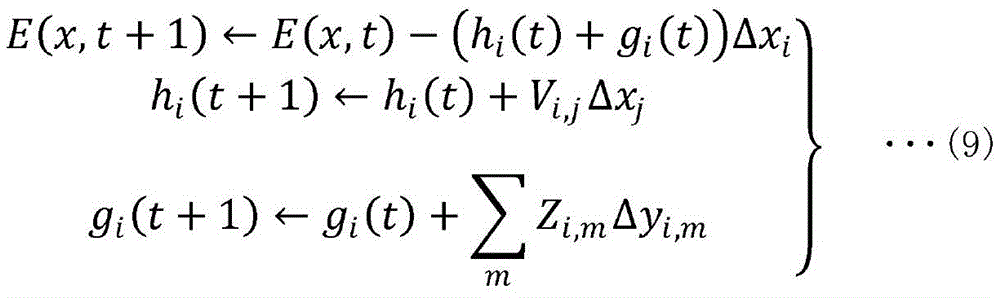
In the information processing apparatus according to the embodiment, Δ E is calculated as in equations (8) and (9) i Of the calculation of (a). Specifically, for example, the information processing apparatus uses the auxiliary variable y i,m And y i,m Corresponding coupling coefficient Z i,m To calculate Δ E i Auxiliary variable y i,m Is a product of variables corresponding to respective bits excluding variables corresponding to bits to be candidates for inversion. At this time, the information processing apparatus reads the coupling coefficient Z corresponding to the auxiliary variable from the memory storing the coupling coefficients corresponding to all the bits relating to the energy function i,m . Therefore, the information processing apparatus can reduce the number of elements to be read from the memory by one order, thereby being able to suppress the data transfer amount at the time of operation.
Fig. 1 is a block diagram showing an exemplary structure of an information processing apparatus according to an embodiment. As shown in fig. 1, the information processing apparatus 100 includes: UI 1, minimum solution search unit 2, and general Central Processing Unit (CPU)3, and these respective units are connected by a bus or the like. For example, a Personal Computer (PC) or the like may be used as the information processing apparatus 100.
The UI 1 is a User Interface (UI) that performs data input from a user, output of processing results, and the like. The user inputs parameters given from the outside, such as the coupling coefficient Z and the temperature corresponding to all bits related to the energy function, via the UI 1.
The minimum solution search unit 2 is a processing unit that performs arithmetic processing related to optimization and searches for an optimum solution that minimizes energy, and includes a memory 10 and an arithmetic processing unit 20. The general-purpose CPU 3 is a general-purpose CPU that processes applications for processing the UI 1, the arithmetic processing unit 20, and the like.
The memory 10 is a Hard Disk Drive (HDD), a Random Access Memory (RAM), or the like, which stores parameters such as the coupling coefficient W input via the UI 1.
The arithmetic processing unit 20 is a processing unit that: which calculates Delta E from the formula (8) and the formula (9) i And is based on Δ E i The adoption/rejection of the inversion in the ith bit is determined using the metropolis criterion or the like to search for the optimal solution. A dedicated hardware device such as an Application Specific Integrated Circuit (ASIC), a Field Programmable Gate Array (FPGA), a Graphic Processing Unit (GPU), a general-purpose CPU, or the like may be applied to the arithmetic processing unit 20.
For example, the arithmetic processing unit 20 reads and executes a program stored in the memory 10, thereby executing arithmetic processing relating to optimization. Note that the program to be executed by the arithmetic processing unit 20 is not necessarily stored in the memory 10. For example, a program stored in a storage medium that can be read by the information processing apparatus 100 may be read, and the arithmetic processing unit 20 may execute the program. For example, the storage medium that can be read by the information processing apparatus 100 corresponds to: a portable recording medium such as a CD-ROM, a DVD disk, or a Universal Serial Bus (USB) memory, a semiconductor memory such as a flash memory, a hard disk drive, or the like. Further, the program may be stored in advance in a device connected to a public line, the internet, a LAN, or the like, and the information processing device 100 may read the program from these devices to execute it. Further, various processing functions realized by the arithmetic processing unit 20 may be executed by a plurality of computers cooperating through cloud computing.
Fig. 2 is a block diagram showing an exemplary structure of the arithmetic processing unit 20. As shown in fig. 2, the arithmetic processing unit 20 includes: an arithmetic unit 21, arithmetic units 22 and 23, an adding unit 24, an adding unit 25 and 26, a multiplying unit 27, and a adoption/rejection determining unit 28. Note that, in the arithmetic processing unit 20, it is assumed that the initial value of E and h are calculated in advance according to expression (8) i And g i Of (4) is calculated. In the example shown in the figure, the configuration of the arithmetic processing unit 20 that mainly calculates Δ y, m, calculates Δ E from the result thereof, and determines adoption/rejection is illustrated.
The arithmetic unit 21 reads out the coupling coefficient Z corresponding to all the bits stored in the memory 10 excluding the coupling coefficient Z corresponding to the bit to be operatedZ of dimension corresponding to bit of candidate for inversion i,m And an operation is performed according to equation (8).
The arithmetic unit 22 calculates Δ y, m from the variable x and the candidate bit i to be changed.
The arithmetic unit 23 and the adding unit 24 perform the AND-h according to equation (8) i And (4) calculating correlation. Note whether h is updated or not i Depends on the adoption/rejection determination by the adoption/rejection determination unit 28, and updates h in the case where the adoption/rejection determination unit 28 determines adoption i 。
The addition unit 25 performs the addition and the subtraction according to equation (8) based on the operation result of the operation unit 21 i And (4) calculating correlation. Note whether g is updated or not i Depends on the adoption/rejection determination by the adoption/rejection determination unit 28, and updates g in the case where the adoption/rejection determination unit 28 determines the adoption i 。
The addition unit 26 adds the operation results of the addition unit 24 and the addition unit 25. The multiplication unit 27 multiplies the operation result of the addition unit 26 by- Δ x i . For example, in the operation of the addition unit 26 and the multiplication unit 27, Δ E is calculated from equation (8) i 。
The adoption/rejection determination unit 28 determines adoption/rejection of bits changed according to the metropolis criterion based on Δ E (x, i) which is the operation result up to the multiplication unit 27.
Fig. 3 is a flowchart illustrating an exemplary operation of the information processing apparatus according to the embodiment. Specifically, for example, the flowchart of fig. 3 shows an exemplary operation in the case where the minimum solution (x) of the energy function having the third order term is obtained.
As shown in fig. 3, when the processing starts, the arithmetic processing unit 20 obtains an initial value E (0) of the energy function E for an initial value x0 of x according to the following expression (10) relating to the energy function (S1).
[ mathematical formula 11]

Next, the arithmetic processing unit 20 is according to the following equation(11) Preparation h i Initial value h of i (0) (S2). Here, h i Representing a vector of N bits (N: number of bits).
[ mathematical formula 12]

Next, the arithmetic processing unit 20 prepares g according to the following expression (12) i Initial value g of i (0) (S3). Here, g i Representing a vector of N bits.
[ mathematical formula 13]

Next, the arithmetic processing unit 20 randomly selects 1 bit (i) to be inverted at x, and sets the difference between the selected bit before and after inversion to Δ x i (S4)。
Next, the arithmetic processing unit 20 follows the following expression (13), following Δ x i 、h i And g i Calculating Delta E i (S5)。
[ mathematical formula 14]
ΔE i =-(h i +g i )Δx i …(13)
Next, the adoption/rejection determining unit 28 of the arithmetic processing unit 20 uses the calculated Δ E i The adoption/rejection of bit reversal is determined based on metropolis criteria, etc. (S6). For example, in the case of the metropolis criterion, the adoption/rejection determination unit 28 generates the uniform random number rand in the section 0 ≦ rand ≦ 1, as an example. Next, if rand > exp (Δ E × β), the adoption/rejection determination unit 28 determines that bit inversion is to be adopted. Here, β represents the inverse temperature (inverse temperature).
In the case of rejection (rejection in S6), the arithmetic processing unit 20 proceeds to S10 in processing. In the case of adoption (adoption in S6), the arithmetic processing unit 20 updates the energy E according to the following expression (14) (S7). The updated energy E (x, t +1) is onE before update and Δ E of equation (13) i Value obtained by addition, Delta E i Is the result of the operation of the multiplication unit 27.
[ mathematical formula 15]
E(x,t+1)←E(x,t)-(h i (t)+g i (t))Δx j …(14)
Next, the arithmetic processing unit 20 updates h according to the following expression (15) based on the operations of the operation unit 23 and the addition unit 24 i (S8)。
[ mathematical formula 16]
h i (t+1)←h i (t)+V i,j Δx j …(15)
Next, the arithmetic processing unit 20 updates gi according to equation (16) based on the operations of the operation unit 21, the operation unit 22, and the addition unit 25 (S9). Here, Δ y, m is Δ y, and m is Δ x j Δx k .
[ mathematical formula 17]

Next, the arithmetic processing unit 20 determines whether a termination condition is satisfied (S10), such as whether the arithmetic processing of S4 to S9 is repeated a predetermined number of times or whether a predetermined energy is obtained. If the termination condition is satisfied (yes in S10), the arithmetic processing unit 20 terminates the processing assuming that the optimization has been achieved. If the termination condition is not satisfied (NO in S10), the arithmetic processing unit 20 returns the process to S4. In this way, the arithmetic processing unit 20 repeats bit inversion until a predetermined number of times or a predetermined energy is obtained.
As described above, the information processing apparatus 100 uses the auxiliary variable (y) i,m ) And a coupling coefficient (Z) corresponding to the auxiliary variable i,m ) Performing a calculation on a third or higher order term of the difference accompanied by the inversion of a particular bit (i) in the energy function, the auxiliary variable (y) i,m ) Is the product of variables corresponding to the respective bits excluding variables corresponding to bits to be candidates for inversion. Then, at the time of this calculation, the information processing apparatus 100 compares the stored representation with the energy functionThe memory 10 of the interactive coupling coefficients (Z) of the plurality of variables corresponding to all bits of the off reads the coupling coefficients corresponding to the auxiliary variables. Therefore, the information processing apparatus 100 can reduce the number of elements to be read from the memory 10 by one order, thereby being able to suppress the data transfer amount at the time of operation.
Further, in the case of employing the inversion of the specific bits, the information processing apparatus 100 calculates the change of the auxiliary variable due to the inversion of the variable corresponding to the specific bits (S8 and S9). Therefore, in the case where inversion of a specific bit is employed, the information processing apparatus 100 can update the value of the auxiliary variable in accordance with the bit inversion.
Fig. 4 is an explanatory diagram showing exemplary parameters. Specifically, for example, fig. 4 illustrates the parameter Z i,m The third order case of (1). Although Δ x is included in FIG. 4 i But when x is i When changed, x j And x k But may also be changed (in case the same bit position is pointed to). Therefore, as shown in fig. 4, it is sufficient to access the changed part at the time of update. Thus, one access to the coupling coefficients (Z) corresponding to all bits related to the energy function is not N 3 And "maximum" is N 2 。
Fig. 5 is an explanatory diagram showing a comparative example of the time chart. In fig. 5, a case C1 is a time chart of arithmetic processing relating to a conventional optimum solution search, and a case C2 is a time chart of arithmetic processing relating to an optimum solution search according to the embodiment.
As shown in fig. 5, in the conventional case C1, the process for calculating Δ E is performed at least after the coupling coefficient (Z) is transferred in the hyperplane unit. On the other hand, in case C2 of the embodiment, each of g1(t) to gn (t) may be independently transmitted and processed. In most cases, the number of bits > order, and thus the number of coupling coefficients to be transmitted at one time in the conventional case C1 is larger than that in the case C2 of the embodiment. Therefore, in case C2, the total time associated with the data load is short.
In conventional optimal solution search, for each calculation of energy difference, 1-bit inversion is correlatedThe amount of data transferred from memory to computing resources is kN (k-1) Where the number of spins (number of bits) is N and the order is k. In the optimal solution search according to the present embodiment, N may be set for one calculation of the energy difference (k-1) Or smaller.
Fig. 6 is an explanatory diagram showing the amount of transmission of the coupling coefficient per one time. The relationship between N and k and the data transfer amount is as shown in a graph G1 of fig. 6, and the data transfer amount can be suppressed according to the optimum solution search in the present embodiment as compared with the conventional case. Further, although the data transfer amount increases as k increases in the conventional optimum solution search, in the present embodiment, a method using an auxiliary variable is recursively applied, whereby the number of elements of the coupling coefficient to be transferred can be set to be similar to the case where k is 3. Therefore, in the present embodiment, as k increases, the effect of suppressing the data transfer amount is further enhanced. For example, in the case where a satisfiability problem (SAT) is applied to the itaxin model to perform the optimal solution search, k increases, whereby the effect of suppressing the data transfer amount becomes more significant.
Claims (7)
1. An optimization device, comprising:
a memory configured to store one or more coupling coefficients representing an interaction of a plurality of variables, the plurality of variables corresponding to a plurality of bits included in an energy function; and
an arithmetic unit configured to: selecting an adoption or rejection of bit inversion to perform optimization based on a difference in values of the energy function associated with inversion of a value of each of the plurality of bits, wherein,
the arithmetic unit is further configured to:
specifying, from among the one or more coupling coefficients stored in the memory, a coupling coefficient corresponding to an auxiliary variable that is a product of variables corresponding to respective bits from which variables corresponding to particular bits in the energy function are excluded, and
performing a calculation of a third or higher order term of a difference associated with an inversion of the particular bit using the auxiliary variable and the coupling coefficient.
2. The optimization device of claim 1,
when the specific bit is inverted, the operation unit specifies an amount of change in the auxiliary variable due to inversion of a variable corresponding to the specific bit.
3. The optimization device of claim 2,
the arithmetic unit updates the auxiliary variable based on a variation amount of the auxiliary variable.
4. An optimization program in which a computer that selects adoption or rejection of bit reversal to perform optimization based on a difference in a value of an energy function associated with reversal of a value of each of a plurality of bits included in the energy function performs:
specifying, from among one or more coupling coefficients stored in a memory included in an optimization apparatus, a coupling coefficient corresponding to an auxiliary variable that is a product of variables corresponding to respective bits from which variables corresponding to specific bits in the energy function are excluded, the one or more coupling coefficients representing interactions of a plurality of variables corresponding to the plurality of bits; and
performing a calculation of a third or higher order term of a difference associated with an inversion of the particular bit using the auxiliary variable and the coupling coefficient.
5. The optimizer of claim 4, the process further comprising: specifying an amount of change in the auxiliary variable due to inversion of a variable corresponding to the specific bit when the specific bit is inverted.
6. An optimization method performed by an optimization apparatus that selects adoption or rejection of bit reversal to perform optimization based on a difference in a value of an energy function associated with reversal of a value of each bit of a plurality of bits included in the energy function, the optimization method comprising:
specifying, from among one or more coupling coefficients stored in a memory included in the optimization apparatus, a coupling coefficient corresponding to an auxiliary variable that is a product of variables corresponding to respective bits from which variables corresponding to specific bits in the energy function are excluded, the one or more coupling coefficients representing interactions of a plurality of variables corresponding to the plurality of bits; and
performing a calculation of a third or higher order term of a difference associated with an inversion of the particular bit using the auxiliary variable and the coupling coefficient.
7. The optimization device of claim 6, further comprising:
specifying an amount of change in the auxiliary variable due to inversion of a variable corresponding to the specific bit when the specific bit is inverted.
Applications Claiming Priority (2)
| Application Number | Priority Date | Filing Date | Title |
|---|---|---|---|
| JP2021-036691 | 2021-03-08 | ||
| JP2021036691A JP7600776B2 (en) | 2021-03-08 | 2021-03-08 | Optimization device, optimization program, and optimization method |
Publications (2)
| Publication Number | Publication Date |
|---|---|
| CN115048756A true CN115048756A (en) | 2022-09-13 |
| CN115048756B CN115048756B (en) | 2025-09-30 |
Family
ID=78820328
Family Applications (1)
| Application Number | Title | Priority Date | Filing Date |
|---|---|---|---|
| CN202111583244.3A Active CN115048756B (en) | 2021-03-08 | 2021-12-22 | Optimizing equipment, procedures, and methods |
Country Status (4)
| Country | Link |
|---|---|
| US (1) | US20220283733A1 (en) |
| EP (1) | EP4057132B1 (en) |
| JP (1) | JP7600776B2 (en) |
| CN (1) | CN115048756B (en) |
Citations (14)
| Publication number | Priority date | Publication date | Assignee | Title |
|---|---|---|---|---|
| US20160282489A1 (en) * | 2015-03-24 | 2016-09-29 | Saudi Arabian Oil Company | Processing geophysical data using 3d norm-zero optimization for smoothing geophysical inversion data |
| US20170364477A1 (en) * | 2016-06-17 | 2017-12-21 | Fujitsu Limited | Information processing apparatus, ising device, and information processing apparatus control method |
| US20190130295A1 (en) * | 2017-10-30 | 2019-05-02 | Hitachi, Ltd. | Information Processing Apparatus and Information Processing Method |
| US20200042570A1 (en) * | 2018-07-31 | 2020-02-06 | Fujitsu Limited | Optimization apparatus and method for controlling thereof |
| CN111008696A (en) * | 2018-10-04 | 2020-04-14 | 富士通株式会社 | Optimization device and method for controlling the same |
| CN111078621A (en) * | 2018-10-19 | 2020-04-28 | 富士通株式会社 | Optimization device and control method of optimization device |
| CN111381495A (en) * | 2018-12-26 | 2020-07-07 | 富士通株式会社 | Optimization device and control method of optimization device |
| CA3135128A1 (en) * | 2019-03-28 | 2020-10-01 | Kabushiki Kaisha Toshiba | Information processing device, information processing system, information processing method, storage medium, and program |
| WO2020196872A1 (en) * | 2019-03-28 | 2020-10-01 | 株式会社 東芝 | Information processing device, information processing system, information processing method, storage medium and program |
| CN112101512A (en) * | 2019-06-18 | 2020-12-18 | 富士通株式会社 | Sampling device and sampling method |
| US20200401651A1 (en) * | 2019-06-18 | 2020-12-24 | Fujitsu Limited | Information processing device and optimization method |
| CN112215779A (en) * | 2020-10-28 | 2021-01-12 | 青岛大学 | Image processing method, device, equipment and computer readable storage medium |
| CN112434398A (en) * | 2019-08-26 | 2021-03-02 | 富士通株式会社 | Combination optimization apparatus, combination optimization method, and computer-readable recording medium |
| US20210173978A1 (en) * | 2018-09-14 | 2021-06-10 | Fujitsu Limited | Optimization device, optimization device control method, and computer-readable recording medium recording optimization device control program |
Family Cites Families (6)
| Publication number | Priority date | Publication date | Assignee | Title |
|---|---|---|---|---|
| WO2015190593A1 (en) | 2014-06-12 | 2015-12-17 | 学校法人早稲田大学 | Information processing method, information processing device, and program therefor |
| US10691771B2 (en) | 2017-03-13 | 2020-06-23 | Universities Space Research Association | System and method to hardcode interger linear optimization problems on physical implementations of the Ising model |
| JP6951155B2 (en) | 2017-08-31 | 2021-10-20 | 株式会社デンソー | Evaluation function converter and program |
| JP6836529B2 (en) | 2018-02-23 | 2021-03-03 | 株式会社東芝 | Calculation device, calculation program, recording medium and calculation method |
| WO2020196883A1 (en) * | 2019-03-28 | 2020-10-01 | 株式会社 東芝 | Information processing device, information processing system, information processing method, storage medium, and program |
| JP7184166B2 (en) | 2019-03-29 | 2022-12-06 | 株式会社ニコン | Determination method, determination device, exposure device and program |
-
2021
- 2021-03-08 JP JP2021036691A patent/JP7600776B2/en active Active
- 2021-12-01 EP EP21211636.2A patent/EP4057132B1/en active Active
- 2021-12-07 US US17/543,774 patent/US20220283733A1/en active Pending
- 2021-12-22 CN CN202111583244.3A patent/CN115048756B/en active Active
Patent Citations (15)
| Publication number | Priority date | Publication date | Assignee | Title |
|---|---|---|---|---|
| US20160282489A1 (en) * | 2015-03-24 | 2016-09-29 | Saudi Arabian Oil Company | Processing geophysical data using 3d norm-zero optimization for smoothing geophysical inversion data |
| US20170364477A1 (en) * | 2016-06-17 | 2017-12-21 | Fujitsu Limited | Information processing apparatus, ising device, and information processing apparatus control method |
| US20190130295A1 (en) * | 2017-10-30 | 2019-05-02 | Hitachi, Ltd. | Information Processing Apparatus and Information Processing Method |
| US20200042570A1 (en) * | 2018-07-31 | 2020-02-06 | Fujitsu Limited | Optimization apparatus and method for controlling thereof |
| US20210173978A1 (en) * | 2018-09-14 | 2021-06-10 | Fujitsu Limited | Optimization device, optimization device control method, and computer-readable recording medium recording optimization device control program |
| CN111008696A (en) * | 2018-10-04 | 2020-04-14 | 富士通株式会社 | Optimization device and method for controlling the same |
| CN111078621A (en) * | 2018-10-19 | 2020-04-28 | 富士通株式会社 | Optimization device and control method of optimization device |
| CN111381495A (en) * | 2018-12-26 | 2020-07-07 | 富士通株式会社 | Optimization device and control method of optimization device |
| WO2020196872A1 (en) * | 2019-03-28 | 2020-10-01 | 株式会社 東芝 | Information processing device, information processing system, information processing method, storage medium and program |
| CA3135128A1 (en) * | 2019-03-28 | 2020-10-01 | Kabushiki Kaisha Toshiba | Information processing device, information processing system, information processing method, storage medium, and program |
| CN112101512A (en) * | 2019-06-18 | 2020-12-18 | 富士通株式会社 | Sampling device and sampling method |
| US20200401651A1 (en) * | 2019-06-18 | 2020-12-24 | Fujitsu Limited | Information processing device and optimization method |
| CN112434398A (en) * | 2019-08-26 | 2021-03-02 | 富士通株式会社 | Combination optimization apparatus, combination optimization method, and computer-readable recording medium |
| EP3786815A1 (en) * | 2019-08-26 | 2021-03-03 | Fujitsu Limited | Combinatorial optimization apparatus, combinatorial optimization method, and combinatorial optimization program |
| CN112215779A (en) * | 2020-10-28 | 2021-01-12 | 青岛大学 | Image processing method, device, equipment and computer readable storage medium |
Non-Patent Citations (1)
| Title |
|---|
| 杜卫林;李斌;田宇;: "量子退火算法研究进展", 计算机研究与发展, no. 09, 15 September 2008 (2008-09-15), pages 1501 - 1508 * |
Also Published As
| Publication number | Publication date |
|---|---|
| JP7600776B2 (en) | 2024-12-17 |
| EP4057132B1 (en) | 2024-08-14 |
| CN115048756B (en) | 2025-09-30 |
| EP4057132A1 (en) | 2022-09-14 |
| US20220283733A1 (en) | 2022-09-08 |
| JP2022136877A (en) | 2022-09-21 |
Similar Documents
| Publication | Publication Date | Title |
|---|---|---|
| JP7323777B2 (en) | Optimization device and optimization method | |
| Erickson et al. | Comparison of Gaussian process modeling software | |
| JP7206476B2 (en) | Optimization device, optimization device control method, and optimization device control program | |
| Regis | Evolutionary programming for high-dimensional constrained expensive black-box optimization using radial basis functions | |
| JP2019028896A (en) | Matrix decomposition apparatus, matrix decomposition method, and matrix decomposition program | |
| Upadhya et al. | Robust inference of population size histories from genomic sequencing data | |
| Green et al. | Ultra high-dimensional semiparametric longitudinal data analysis | |
| JP2021111097A (en) | Noise estimation method, noise estimation program, and noise estimation device | |
| Chang et al. | Mechanical property prediction of random copolymers using uncertainty-based active learning | |
| JP6902006B2 (en) | Arithmetic logic unit, calculation program, recording medium and calculation method | |
| CN115048756B (en) | Optimizing equipment, procedures, and methods | |
| JP7571428B2 (en) | Information processing device, information processing method, and information processing program | |
| CN118898229A (en) | Cutting plane method, device, computer equipment, and medium for VLSI partitioning | |
| US12373514B2 (en) | Optimization method, information processing apparatus, and system using the same | |
| JP7628866B2 (en) | Information processing system, information processing method, and information processing program | |
| Du et al. | IQSeq: integrated isoform quantification analysis based on next-generation sequencing | |
| Du et al. | Unbiased Markov chain quasi-Monte Carlo for Gibbs samplers | |
| Crimmins et al. | Quantum array multiplier | |
| Boulier et al. | Towards an automated reduction method for polynomial ODE models of biochemical reaction systems | |
| Fei et al. | Binary quantum control optimization with uncertain Hamiltonians | |
| Yamaka | Variable selection and estimation in kink regression model | |
| Shaikh et al. | Neural minimization methods (NMM) for solving variable order fractional delay differential equations (FDDEs) with simulated annealing (SA) | |
| Komatsu et al. | Algebraic Design of Physical Computing System for Time-Series Generation | |
| Kupryianau et al. | Qrisp Implementation and Resource Analysis of a T-Count-Optimised Non-Restoring Quantum Square-Root Circuit | |
| Camacho | Model Selection for Contextual Bandits and Reinforcement Learning |
Legal Events
| Date | Code | Title | Description |
|---|---|---|---|
| PB01 | Publication | ||
| PB01 | Publication | ||
| SE01 | Entry into force of request for substantive examination | ||
| SE01 | Entry into force of request for substantive examination | ||
| GR01 | Patent grant | ||
| GR01 | Patent grant |