CN115003299A - Methods and compounds for restoring mutant p53 function - Google Patents
Methods and compounds for restoring mutant p53 function Download PDFInfo
- Publication number
- CN115003299A CN115003299A CN202080081345.8A CN202080081345A CN115003299A CN 115003299 A CN115003299 A CN 115003299A CN 202080081345 A CN202080081345 A CN 202080081345A CN 115003299 A CN115003299 A CN 115003299A
- Authority
- CN
- China
- Prior art keywords
- group
- compound
- substituted
- mixture
- etoac
- Prior art date
- Legal status (The legal status is an assumption and is not a legal conclusion. Google has not performed a legal analysis and makes no representation as to the accuracy of the status listed.)
- Pending
Links
Classifications
-
- C—CHEMISTRY; METALLURGY
- C07—ORGANIC CHEMISTRY
- C07D—HETEROCYCLIC COMPOUNDS
- C07D405/00—Heterocyclic compounds containing both one or more hetero rings having oxygen atoms as the only ring hetero atoms, and one or more rings having nitrogen as the only ring hetero atom
- C07D405/14—Heterocyclic compounds containing both one or more hetero rings having oxygen atoms as the only ring hetero atoms, and one or more rings having nitrogen as the only ring hetero atom containing three or more hetero rings
-
- A—HUMAN NECESSITIES
- A61—MEDICAL OR VETERINARY SCIENCE; HYGIENE
- A61K—PREPARATIONS FOR MEDICAL, DENTAL OR TOILETRY PURPOSES
- A61K31/00—Medicinal preparations containing organic active ingredients
- A61K31/33—Heterocyclic compounds
- A61K31/395—Heterocyclic compounds having nitrogen as a ring hetero atom, e.g. guanethidine or rifamycins
- A61K31/40—Heterocyclic compounds having nitrogen as a ring hetero atom, e.g. guanethidine or rifamycins having five-membered rings with one nitrogen as the only ring hetero atom, e.g. sulpiride, succinimide, tolmetin, buflomedil
- A61K31/403—Heterocyclic compounds having nitrogen as a ring hetero atom, e.g. guanethidine or rifamycins having five-membered rings with one nitrogen as the only ring hetero atom, e.g. sulpiride, succinimide, tolmetin, buflomedil condensed with carbocyclic rings, e.g. carbazole
- A61K31/404—Indoles, e.g. pindolol
- A61K31/4045—Indole-alkylamines; Amides thereof, e.g. serotonin, melatonin
-
- A—HUMAN NECESSITIES
- A61—MEDICAL OR VETERINARY SCIENCE; HYGIENE
- A61K—PREPARATIONS FOR MEDICAL, DENTAL OR TOILETRY PURPOSES
- A61K31/00—Medicinal preparations containing organic active ingredients
- A61K31/33—Heterocyclic compounds
- A61K31/395—Heterocyclic compounds having nitrogen as a ring hetero atom, e.g. guanethidine or rifamycins
- A61K31/435—Heterocyclic compounds having nitrogen as a ring hetero atom, e.g. guanethidine or rifamycins having six-membered rings with one nitrogen as the only ring hetero atom
- A61K31/44—Non condensed pyridines; Hydrogenated derivatives thereof
- A61K31/445—Non condensed piperidines, e.g. piperocaine
- A61K31/4523—Non condensed piperidines, e.g. piperocaine containing further heterocyclic ring systems
- A61K31/454—Non condensed piperidines, e.g. piperocaine containing further heterocyclic ring systems containing a five-membered ring with nitrogen as a ring hetero atom, e.g. pimozide, domperidone
-
- A—HUMAN NECESSITIES
- A61—MEDICAL OR VETERINARY SCIENCE; HYGIENE
- A61K—PREPARATIONS FOR MEDICAL, DENTAL OR TOILETRY PURPOSES
- A61K31/00—Medicinal preparations containing organic active ingredients
- A61K31/33—Heterocyclic compounds
- A61K31/395—Heterocyclic compounds having nitrogen as a ring hetero atom, e.g. guanethidine or rifamycins
- A61K31/535—Heterocyclic compounds having nitrogen as a ring hetero atom, e.g. guanethidine or rifamycins having six-membered rings with at least one nitrogen and one oxygen as the ring hetero atoms, e.g. 1,2-oxazines
- A61K31/5375—1,4-Oxazines, e.g. morpholine
- A61K31/5377—1,4-Oxazines, e.g. morpholine not condensed and containing further heterocyclic rings, e.g. timolol
-
- A—HUMAN NECESSITIES
- A61—MEDICAL OR VETERINARY SCIENCE; HYGIENE
- A61P—SPECIFIC THERAPEUTIC ACTIVITY OF CHEMICAL COMPOUNDS OR MEDICINAL PREPARATIONS
- A61P35/00—Antineoplastic agents
-
- C—CHEMISTRY; METALLURGY
- C07—ORGANIC CHEMISTRY
- C07D—HETEROCYCLIC COMPOUNDS
- C07D209/00—Heterocyclic compounds containing five-membered rings, condensed with other rings, with one nitrogen atom as the only ring hetero atom
- C07D209/02—Heterocyclic compounds containing five-membered rings, condensed with other rings, with one nitrogen atom as the only ring hetero atom condensed with one carbocyclic ring
- C07D209/04—Indoles; Hydrogenated indoles
- C07D209/10—Indoles; Hydrogenated indoles with substituted hydrocarbon radicals attached to carbon atoms of the hetero ring
-
- C—CHEMISTRY; METALLURGY
- C07—ORGANIC CHEMISTRY
- C07D—HETEROCYCLIC COMPOUNDS
- C07D209/00—Heterocyclic compounds containing five-membered rings, condensed with other rings, with one nitrogen atom as the only ring hetero atom
- C07D209/02—Heterocyclic compounds containing five-membered rings, condensed with other rings, with one nitrogen atom as the only ring hetero atom condensed with one carbocyclic ring
- C07D209/04—Indoles; Hydrogenated indoles
- C07D209/10—Indoles; Hydrogenated indoles with substituted hydrocarbon radicals attached to carbon atoms of the hetero ring
- C07D209/14—Radicals substituted by nitrogen atoms, not forming part of a nitro radical
-
- C—CHEMISTRY; METALLURGY
- C07—ORGANIC CHEMISTRY
- C07D—HETEROCYCLIC COMPOUNDS
- C07D401/00—Heterocyclic compounds containing two or more hetero rings, having nitrogen atoms as the only ring hetero atoms, at least one ring being a six-membered ring with only one nitrogen atom
- C07D401/02—Heterocyclic compounds containing two or more hetero rings, having nitrogen atoms as the only ring hetero atoms, at least one ring being a six-membered ring with only one nitrogen atom containing two hetero rings
- C07D401/12—Heterocyclic compounds containing two or more hetero rings, having nitrogen atoms as the only ring hetero atoms, at least one ring being a six-membered ring with only one nitrogen atom containing two hetero rings linked by a chain containing hetero atoms as chain links
-
- C—CHEMISTRY; METALLURGY
- C07—ORGANIC CHEMISTRY
- C07D—HETEROCYCLIC COMPOUNDS
- C07D401/00—Heterocyclic compounds containing two or more hetero rings, having nitrogen atoms as the only ring hetero atoms, at least one ring being a six-membered ring with only one nitrogen atom
- C07D401/14—Heterocyclic compounds containing two or more hetero rings, having nitrogen atoms as the only ring hetero atoms, at least one ring being a six-membered ring with only one nitrogen atom containing three or more hetero rings
-
- C—CHEMISTRY; METALLURGY
- C07—ORGANIC CHEMISTRY
- C07D—HETEROCYCLIC COMPOUNDS
- C07D403/00—Heterocyclic compounds containing two or more hetero rings, having nitrogen atoms as the only ring hetero atoms, not provided for by group C07D401/00
- C07D403/02—Heterocyclic compounds containing two or more hetero rings, having nitrogen atoms as the only ring hetero atoms, not provided for by group C07D401/00 containing two hetero rings
- C07D403/06—Heterocyclic compounds containing two or more hetero rings, having nitrogen atoms as the only ring hetero atoms, not provided for by group C07D401/00 containing two hetero rings linked by a carbon chain containing only aliphatic carbon atoms
-
- C—CHEMISTRY; METALLURGY
- C07—ORGANIC CHEMISTRY
- C07D—HETEROCYCLIC COMPOUNDS
- C07D403/00—Heterocyclic compounds containing two or more hetero rings, having nitrogen atoms as the only ring hetero atoms, not provided for by group C07D401/00
- C07D403/02—Heterocyclic compounds containing two or more hetero rings, having nitrogen atoms as the only ring hetero atoms, not provided for by group C07D401/00 containing two hetero rings
- C07D403/12—Heterocyclic compounds containing two or more hetero rings, having nitrogen atoms as the only ring hetero atoms, not provided for by group C07D401/00 containing two hetero rings linked by a chain containing hetero atoms as chain links
-
- C—CHEMISTRY; METALLURGY
- C07—ORGANIC CHEMISTRY
- C07D—HETEROCYCLIC COMPOUNDS
- C07D405/00—Heterocyclic compounds containing both one or more hetero rings having oxygen atoms as the only ring hetero atoms, and one or more rings having nitrogen as the only ring hetero atom
- C07D405/02—Heterocyclic compounds containing both one or more hetero rings having oxygen atoms as the only ring hetero atoms, and one or more rings having nitrogen as the only ring hetero atom containing two hetero rings
- C07D405/06—Heterocyclic compounds containing both one or more hetero rings having oxygen atoms as the only ring hetero atoms, and one or more rings having nitrogen as the only ring hetero atom containing two hetero rings linked by a carbon chain containing only aliphatic carbon atoms
-
- C—CHEMISTRY; METALLURGY
- C07—ORGANIC CHEMISTRY
- C07D—HETEROCYCLIC COMPOUNDS
- C07D405/00—Heterocyclic compounds containing both one or more hetero rings having oxygen atoms as the only ring hetero atoms, and one or more rings having nitrogen as the only ring hetero atom
- C07D405/02—Heterocyclic compounds containing both one or more hetero rings having oxygen atoms as the only ring hetero atoms, and one or more rings having nitrogen as the only ring hetero atom containing two hetero rings
- C07D405/12—Heterocyclic compounds containing both one or more hetero rings having oxygen atoms as the only ring hetero atoms, and one or more rings having nitrogen as the only ring hetero atom containing two hetero rings linked by a chain containing hetero atoms as chain links
-
- C—CHEMISTRY; METALLURGY
- C07—ORGANIC CHEMISTRY
- C07D—HETEROCYCLIC COMPOUNDS
- C07D409/00—Heterocyclic compounds containing two or more hetero rings, at least one ring having sulfur atoms as the only ring hetero atoms
- C07D409/02—Heterocyclic compounds containing two or more hetero rings, at least one ring having sulfur atoms as the only ring hetero atoms containing two hetero rings
- C07D409/12—Heterocyclic compounds containing two or more hetero rings, at least one ring having sulfur atoms as the only ring hetero atoms containing two hetero rings linked by a chain containing hetero atoms as chain links
-
- C—CHEMISTRY; METALLURGY
- C07—ORGANIC CHEMISTRY
- C07D—HETEROCYCLIC COMPOUNDS
- C07D409/00—Heterocyclic compounds containing two or more hetero rings, at least one ring having sulfur atoms as the only ring hetero atoms
- C07D409/14—Heterocyclic compounds containing two or more hetero rings, at least one ring having sulfur atoms as the only ring hetero atoms containing three or more hetero rings
-
- C—CHEMISTRY; METALLURGY
- C07—ORGANIC CHEMISTRY
- C07D—HETEROCYCLIC COMPOUNDS
- C07D413/00—Heterocyclic compounds containing two or more hetero rings, at least one ring having nitrogen and oxygen atoms as the only ring hetero atoms
- C07D413/02—Heterocyclic compounds containing two or more hetero rings, at least one ring having nitrogen and oxygen atoms as the only ring hetero atoms containing two hetero rings
- C07D413/06—Heterocyclic compounds containing two or more hetero rings, at least one ring having nitrogen and oxygen atoms as the only ring hetero atoms containing two hetero rings linked by a carbon chain containing only aliphatic carbon atoms
-
- C—CHEMISTRY; METALLURGY
- C07—ORGANIC CHEMISTRY
- C07D—HETEROCYCLIC COMPOUNDS
- C07D413/00—Heterocyclic compounds containing two or more hetero rings, at least one ring having nitrogen and oxygen atoms as the only ring hetero atoms
- C07D413/02—Heterocyclic compounds containing two or more hetero rings, at least one ring having nitrogen and oxygen atoms as the only ring hetero atoms containing two hetero rings
- C07D413/12—Heterocyclic compounds containing two or more hetero rings, at least one ring having nitrogen and oxygen atoms as the only ring hetero atoms containing two hetero rings linked by a chain containing hetero atoms as chain links
-
- C—CHEMISTRY; METALLURGY
- C07—ORGANIC CHEMISTRY
- C07D—HETEROCYCLIC COMPOUNDS
- C07D413/00—Heterocyclic compounds containing two or more hetero rings, at least one ring having nitrogen and oxygen atoms as the only ring hetero atoms
- C07D413/14—Heterocyclic compounds containing two or more hetero rings, at least one ring having nitrogen and oxygen atoms as the only ring hetero atoms containing three or more hetero rings
-
- C—CHEMISTRY; METALLURGY
- C07—ORGANIC CHEMISTRY
- C07D—HETEROCYCLIC COMPOUNDS
- C07D417/00—Heterocyclic compounds containing two or more hetero rings, at least one ring having nitrogen and sulfur atoms as the only ring hetero atoms, not provided for by group C07D415/00
- C07D417/14—Heterocyclic compounds containing two or more hetero rings, at least one ring having nitrogen and sulfur atoms as the only ring hetero atoms, not provided for by group C07D415/00 containing three or more hetero rings
-
- C—CHEMISTRY; METALLURGY
- C07—ORGANIC CHEMISTRY
- C07D—HETEROCYCLIC COMPOUNDS
- C07D451/00—Heterocyclic compounds containing 8-azabicyclo [3.2.1] octane, 9-azabicyclo [3.3.1] nonane, or 3-oxa-9-azatricyclo [3.3.1.0<2,4>] nonane ring systems, e.g. tropane or granatane alkaloids, scopolamine; Cyclic acetals thereof
- C07D451/02—Heterocyclic compounds containing 8-azabicyclo [3.2.1] octane, 9-azabicyclo [3.3.1] nonane, or 3-oxa-9-azatricyclo [3.3.1.0<2,4>] nonane ring systems, e.g. tropane or granatane alkaloids, scopolamine; Cyclic acetals thereof containing not further condensed 8-azabicyclo [3.2.1] octane or 3-oxa-9-azatricyclo [3.3.1.0<2,4>] nonane ring systems, e.g. tropane; Cyclic acetals thereof
- C07D451/04—Heterocyclic compounds containing 8-azabicyclo [3.2.1] octane, 9-azabicyclo [3.3.1] nonane, or 3-oxa-9-azatricyclo [3.3.1.0<2,4>] nonane ring systems, e.g. tropane or granatane alkaloids, scopolamine; Cyclic acetals thereof containing not further condensed 8-azabicyclo [3.2.1] octane or 3-oxa-9-azatricyclo [3.3.1.0<2,4>] nonane ring systems, e.g. tropane; Cyclic acetals thereof with hetero atoms directly attached in position 3 of the 8-azabicyclo [3.2.1] octane or in position 7 of the 3-oxa-9-azatricyclo [3.3.1.0<2,4>] nonane ring system
-
- C—CHEMISTRY; METALLURGY
- C07—ORGANIC CHEMISTRY
- C07D—HETEROCYCLIC COMPOUNDS
- C07D471/00—Heterocyclic compounds containing nitrogen atoms as the only ring hetero atoms in the condensed system, at least one ring being a six-membered ring with one nitrogen atom, not provided for by groups C07D451/00 - C07D463/00
- C07D471/02—Heterocyclic compounds containing nitrogen atoms as the only ring hetero atoms in the condensed system, at least one ring being a six-membered ring with one nitrogen atom, not provided for by groups C07D451/00 - C07D463/00 in which the condensed system contains two hetero rings
- C07D471/04—Ortho-condensed systems
-
- C—CHEMISTRY; METALLURGY
- C07—ORGANIC CHEMISTRY
- C07D—HETEROCYCLIC COMPOUNDS
- C07D471/00—Heterocyclic compounds containing nitrogen atoms as the only ring hetero atoms in the condensed system, at least one ring being a six-membered ring with one nitrogen atom, not provided for by groups C07D451/00 - C07D463/00
- C07D471/02—Heterocyclic compounds containing nitrogen atoms as the only ring hetero atoms in the condensed system, at least one ring being a six-membered ring with one nitrogen atom, not provided for by groups C07D451/00 - C07D463/00 in which the condensed system contains two hetero rings
- C07D471/08—Bridged systems
-
- C—CHEMISTRY; METALLURGY
- C07—ORGANIC CHEMISTRY
- C07D—HETEROCYCLIC COMPOUNDS
- C07D491/00—Heterocyclic compounds containing in the condensed ring system both one or more rings having oxygen atoms as the only ring hetero atoms and one or more rings having nitrogen atoms as the only ring hetero atoms, not provided for by groups C07D451/00 - C07D459/00, C07D463/00, C07D477/00 or C07D489/00
- C07D491/02—Heterocyclic compounds containing in the condensed ring system both one or more rings having oxygen atoms as the only ring hetero atoms and one or more rings having nitrogen atoms as the only ring hetero atoms, not provided for by groups C07D451/00 - C07D459/00, C07D463/00, C07D477/00 or C07D489/00 in which the condensed system contains two hetero rings
- C07D491/10—Spiro-condensed systems
- C07D491/107—Spiro-condensed systems with only one oxygen atom as ring hetero atom in the oxygen-containing ring
-
- C—CHEMISTRY; METALLURGY
- C07—ORGANIC CHEMISTRY
- C07D—HETEROCYCLIC COMPOUNDS
- C07D498/00—Heterocyclic compounds containing in the condensed system at least one hetero ring having nitrogen and oxygen atoms as the only ring hetero atoms
- C07D498/02—Heterocyclic compounds containing in the condensed system at least one hetero ring having nitrogen and oxygen atoms as the only ring hetero atoms in which the condensed system contains two hetero rings
- C07D498/06—Peri-condensed systems
-
- C—CHEMISTRY; METALLURGY
- C07—ORGANIC CHEMISTRY
- C07D—HETEROCYCLIC COMPOUNDS
- C07D498/00—Heterocyclic compounds containing in the condensed system at least one hetero ring having nitrogen and oxygen atoms as the only ring hetero atoms
- C07D498/02—Heterocyclic compounds containing in the condensed system at least one hetero ring having nitrogen and oxygen atoms as the only ring hetero atoms in which the condensed system contains two hetero rings
- C07D498/08—Bridged systems
-
- C—CHEMISTRY; METALLURGY
- C07—ORGANIC CHEMISTRY
- C07F—ACYCLIC, CARBOCYCLIC OR HETEROCYCLIC COMPOUNDS CONTAINING ELEMENTS OTHER THAN CARBON, HYDROGEN, HALOGEN, OXYGEN, NITROGEN, SULFUR, SELENIUM OR TELLURIUM
- C07F7/00—Compounds containing elements of Groups 4 or 14 of the Periodic Table
- C07F7/02—Silicon compounds
- C07F7/08—Compounds having one or more C—Si linkages
- C07F7/0803—Compounds with Si-C or Si-Si linkages
- C07F7/081—Compounds with Si-C or Si-Si linkages comprising at least one atom selected from the elements N, O, halogen, S, Se or Te
- C07F7/0812—Compounds with Si-C or Si-Si linkages comprising at least one atom selected from the elements N, O, halogen, S, Se or Te comprising a heterocyclic ring
-
- C—CHEMISTRY; METALLURGY
- C07—ORGANIC CHEMISTRY
- C07H—SUGARS; DERIVATIVES THEREOF; NUCLEOSIDES; NUCLEOTIDES; NUCLEIC ACIDS
- C07H15/00—Compounds containing hydrocarbon or substituted hydrocarbon radicals directly attached to hetero atoms of saccharide radicals
- C07H15/26—Acyclic or carbocyclic radicals, substituted by hetero rings
Landscapes
- Chemical & Material Sciences (AREA)
- Organic Chemistry (AREA)
- Health & Medical Sciences (AREA)
- General Health & Medical Sciences (AREA)
- Life Sciences & Earth Sciences (AREA)
- Medicinal Chemistry (AREA)
- Pharmacology & Pharmacy (AREA)
- Veterinary Medicine (AREA)
- Public Health (AREA)
- Animal Behavior & Ethology (AREA)
- Epidemiology (AREA)
- General Chemical & Material Sciences (AREA)
- Chemical Kinetics & Catalysis (AREA)
- Nuclear Medicine, Radiotherapy & Molecular Imaging (AREA)
- Genetics & Genomics (AREA)
- Biotechnology (AREA)
- Biochemistry (AREA)
- Molecular Biology (AREA)
- Engineering & Computer Science (AREA)
- Pharmaceuticals Containing Other Organic And Inorganic Compounds (AREA)
- Nitrogen Condensed Heterocyclic Rings (AREA)
- Plural Heterocyclic Compounds (AREA)
- Peptides Or Proteins (AREA)
- Micro-Organisms Or Cultivation Processes Thereof (AREA)
- Measuring Or Testing Involving Enzymes Or Micro-Organisms (AREA)
- Saccharide Compounds (AREA)
- Medicines Containing Material From Animals Or Micro-Organisms (AREA)
Abstract
Mutations in oncogenes and tumor suppressor genes contribute to the development and progression of cancer. The present disclosure describes compounds and methods for restoring wild-type function to p53 mutants. The compounds of the invention bind to mutant p53 and restore the ability of the p53 mutant to bind to DNA and activate downstream effectors involved in tumor suppression. The disclosed compounds are useful for reducing the progression of cancers containing the p53 mutation.
Description
Cross-referencing
The present application claims U.S. provisional application No. 62/904,369 filed on 23/9/2019; and united states provisional application No. 63/038,388 filed on 12.6.2020, which is incorporated herein by reference in its entirety.
Sequence listing
This application contains a sequence listing that has been submitted electronically in ASCII format and is hereby incorporated by reference in its entirety. The ASCII copy was created at 18 months 9/2020 named 44727-705.601 Sequence listing. txt, size 2,578 bytes.
Background
Cancer, an uncontrolled cellular proliferation, is a multifactorial disease characterized by tumor formation, growth, and in some cases metastasis. Replication of cells carrying activated oncogenes, damaged genomes, or other oncogenic changes may be prevented by a complex tumor suppressor network. The core component of this tumor suppressor network is p53, which is one of the most potent tumor suppressor genes in cells. Both wild type and mutant conformations of p53 are associated with cancer progression.
Is incorporated by reference
Each patent, publication, and non-patent document cited in this application is hereby incorporated by reference in its entirety as if each patent, publication, and non-patent document were individually incorporated by reference.
Disclosure of Invention
In some embodiments, described herein is a compound comprising: a heterocyclyl group comprising a halo substituent, wherein the compound binds to mutant p53 protein and increases wild-type p53 activity of mutant p53 protein.
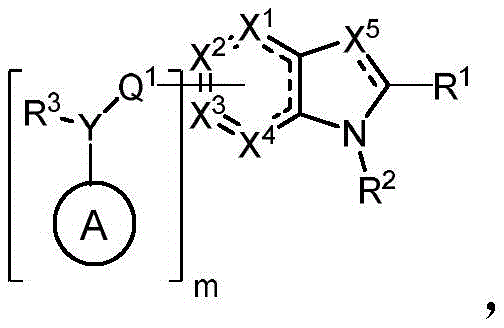
In some embodiments, described herein are compounds of the formula:
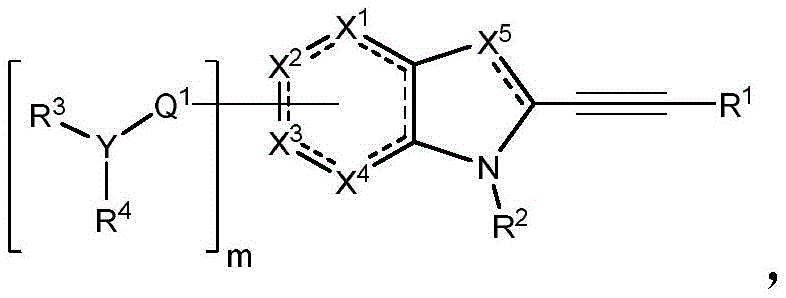
wherein:
-each of Independently a single or double bond;
-X 1 is CR 5 、CR 5 R 6 、N、NR 5 O, S, C-O, C-S or connected to Q 1 A carbon atom of (a);
-X 2 is CR 7 、CR 7 R 8 、N、NR 7 O, S, C-O, C-S or connected to Q 1 A carbon atom of (a);
-X 3 is CR 9 、CR 9 R 10 、N、NR 9 O, S, C-O, C-S or connected to Q 1 A carbon atom of (a);
-X 4 is CR 11 、CR 11 R 12 、N、NR 11 O, S, C-O, C-S or connected to Q 1 A carbon atom of (a);
-X 5 is CR 13 N or NR 13 ;
Wherein X 1 、X 2 、X 3 And X 4 Is connected to Q 1 A carbon atom of (a);
-Q 1 is C-O, C-S, C-CR 14 R 15 、C=NR 14 Alkylene, alkenylene, or alkynylene, each independently substituted or unsubstituted; or is a bond;
-m is 1, 2, 3 or 4;
-Y is N, O or absent;
-R 1 is-C (O) R 16 、-C(O)OR 16 、-C(O)NR 16 R 17 、-OR 16 、-SR 16 、-NR 16 R 17 、-NR 16 C(O)R 16 、-OC(O)R 16 、C=O、C=S、-CN、-SiR 16 R 17 R 18 Alkyl, alkenyl, alkynyl, aryl, heteroaryl, or heterocyclyl, each of which is independently substituted or unsubstituted; or is hydrogen;
each R 3 And R 4 Independently is-C (O) R 19 、-C(O)OR 19 、-C(O)NR 19 R 20 、-SOR 19 、-SO 2 R 19 Alkyl, alkylene, alkenyl, alkenylene, alkynyl, aryl, heteroaryl, or heterocyclyl, each of which is independently substituted or unsubstituted; or is hydrogen, or R 3 And R 4 Together with R 3 And R 4 The combined Y atoms together form a ring, wherein the ring is substituted or unsubstituted, or R 3 Is absent;
each R 2 、R 5 、R 6 、R 7 、R 8 、R 9 、R 10 、R 11 、R 12 、R 13 、R 14 、R 15 、R 16 、R 17 And R 18 Independently is-C (O) R 21 、-C(O)OR 21 、-C(O)NR 21 R 22 、-OR 21 、-SR 21 、-NR 21 R 22 、-NR 21 C(O)R 22 、-OC(O)R 21 Alkyl, alkenyl, alkynyl, aryl, heteroaryl, or heterocyclyl, each independently substituted or unsubstituted; or is hydrogen or halogen;
each R 19 And R 20 Is C (O) R 23 、-C(O)OR 23 、-C(O)NR 23 R 24 、-OR 23 、-SR 23 、-NR 23 R 24 、-NR 23 C(O)R 24 、-OC(O)R 23 Alkyl, alkenyl, alkynyl, aryl, heteroaryl or heterocyclyl, each of whichIndependently is substituted or unsubstituted; or is hydrogen or halogen;
each R 21 And R 22 Independently is an alkyl, alkenyl, alkynyl, aryl, heteroaryl, or heterocyclyl group, each of which is independently substituted or unsubstituted; or is hydrogen; and is
Each R 23 And R 24 Independently is an alkyl, alkenyl, alkynyl, aryl, heteroaryl, or heterocyclyl group, each of which is independently substituted or unsubstituted; or is a hydrogen atom or a hydrogen atom,
Or a pharmaceutically acceptable salt thereof, wherein the compound is not a compound of table 1.
In some embodiments, described herein are compounds of the formula:
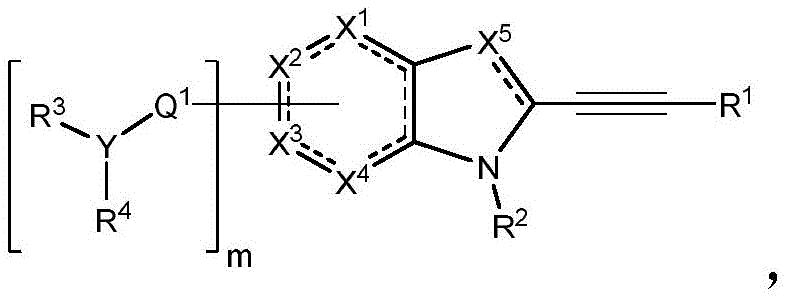
wherein:
-each of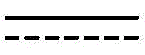 Independently a single or double bond;
-X 1 is CR 5 、CR 5 R 6 、N、NR 5 O, S, C-O, C-S or connected to Q 1 A carbon atom of (a);
-X 2 is CR 7 、CR 7 R 8 、N、NR 7 O, S, C-O, C-S or connected to Q 1 A carbon atom of (a);
-X 3 is CR 9 、CR 9 R 10 、N、NR 9 O, S, C-O, C-S or connected to Q 1 A carbon atom of (a);
-X 4 is CR 11 、CR 11 R 12 、N、NR 11 O, S, C-O, C-S or connected to Q 1 A carbon atom of (a);
-X 5 is CR 13 N or NR 13 ;
Wherein X 1 、X 2 、X 3 And X 4 Is connected to Q 1 A carbon atom of (a);
-Q 1 is C-O, C-S, C-CR 14 R 15 、C=NR 14 Alkylene, alkenylene, or alkynylene, each independently substituted or unsubstituted; or is a bond;
-m is 1, 2, 3 or 4;
-Y is N, O or absent;
-R 1 is-C (O) R 16 、-C(O)OR 16 、-C(O)NR 16 R 17 、-OR 16 、-SR 16 、-NR 16 R 17 、-NR 16 C(O)R 16 、-OC(O)R 16 、C=O、C=S、-CN、-SiR 16 R 17 R 18 Alkyl, alkenyl, alkynyl, aryl, heteroaryl, or heterocyclyl, each independently substituted or unsubstituted; or is hydrogen;
each R 3 And R 4 Independently is-C (O) R 19 、-C(O)OR 19 、-C(O)NR 19 R 20 、-SOR 19 、-SO 2 R 19 Alkyl, alkylene, alkenyl, alkenylene, alkynyl, aryl, heteroaryl, or heterocyclyl, each of which is independently substituted or unsubstituted; or is hydrogen, or R 3 And R 4 Together with R 3 And R 4 The bound nitrogen atoms together form a ring, wherein the ring is substituted or unsubstituted, or R 3 Is absent, wherein R 3 And R 4 Is alkyl, alkylene, alkenyl, alkenylene, alkynyl, aryl, heteroaryl or heterocyclyl, each of which is at least halo-substituted;
each R 2 、R 5 、R 6 、R 7 、R 8 、R 9 、R 10 、R 11 、R 12 、R 13 、R 14 、R 15 、R 16 、R 17 And R 18 Independently is-C (O) R 21 、-C(O)OR 21 、-C(O)NR 21 R 22 、-OR 21 、-SR 21 、-NR 21 R 22 、-NR 21 C(O)R 22 、-OC(O)R 21 Alkyl groupAlkenyl, alkynyl, aryl, heteroaryl or heterocyclyl, each independently substituted or unsubstituted; or is hydrogen or halogen;
each R 19 And R 20 Is C (O) R 23 、-C(O)OR 23 、-C(O)NR 23 R 24 、-OR 23 、-SR 23 、-NR 23 R 24 、-NR 23 C(O)R 24 、-OC(O)R 23 Alkyl, alkenyl, alkynyl, aryl, heteroaryl, or heterocyclyl, each independently substituted or unsubstituted; or is hydrogen or halogen;
each R 21 And R 22 Independently is an alkyl, alkenyl, alkynyl, aryl, heteroaryl, or heterocyclyl group, each of which is independently substituted or unsubstituted; or is hydrogen; and is
Each R 23 And R 24 Independently an alkyl, alkenyl, alkynyl, aryl, heteroaryl, or heterocyclyl group, each of which is independently substituted or unsubstituted; or is a hydrogen atom or a hydrogen atom,
or a pharmaceutically acceptable salt thereof.
In some embodiments, described herein is a compound comprising: a heterocyclyl group comprising a halo substituent, wherein the compound binds to mutant p53 protein and increases wild-type p53 activity of mutant p 53.
In some embodiments, described herein is a method of treating cancer comprising administering to a subject in need thereof a compound of formula (I):

wherein:
-each of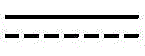 Independently a single or double bond;
-X 1 is CR 5 、CR 5 R 6 、N、NR 5 O, S, C-O, C-S or connected to Q 1 A carbon atom of (a);
-X 2 is CR 7 、CR 7 R 8 、N、NR 7 O, S, C-O, C-S or connected to Q 1 A carbon atom of (a);
-X 3 is CR 9 、CR 9 R 10 、N、NR 9 O, S, C-O, C-S or connected to Q 1 A carbon atom of (a);
-X 4 is CR 11 、CR 11 R 12 、N、NR 11 O, S, C-O, C-S or connected to Q 1 A carbon atom of (a);
-X 5 is CR 13 N or NR 13 ;
Wherein X 1 、X 2 、X 3 And X 4 Is connected to Q 1 A carbon atom of (a);
-Q 1 is C-O, C-S, C-CR 14 R 15 、C=NR 14 Alkylene, alkenylene, or alkynylene, each independently substituted or unsubstituted; or is a bond;
-m is 1, 2, 3 or 4;
-Y is N, O or absent;
-R 1 is-C (O) R 16 、-C(O)OR 16 、-C(O)NR 16 R 17 、-OR 16 、-SR 16 、-NR 16 R 17 、-NR 16 C(O)R 16 、-OC(O)R 16 、C=O、C=S、-CN、-SiR 16 R 17 R 18 Alkyl, alkenyl, alkynyl, aryl, heteroaryl, or heterocyclyl, each independently substituted or unsubstituted; or is hydrogen;
each R 3 And R 4 Independently is-C (O) R 19 、-C(O)OR 19 、-C(O)NR 19 R 20 、-SOR 19 、-SO 2 R 19 Alkyl, alkylene, alkenyl, alkenylene, alkynyl, aryl, heteroaryl, or heterocyclyl, each of which is independently substituted or unsubstituted; or is hydrogen, or R 3 And R 4 Together with R 3 And R 4 The bonded Y atoms together form a ring, wherein the ring isSubstituted or unsubstituted, or R 3 Is absent;
each R 2 、R 5 、R 6 、R 7 、R 8 、R 9 、R 10 、R 11 、R 12 、R 13 、R 14 、R 15 、R 16 、R 17 And R 18 Independently is-C (O) R 21 、-C(O)OR 21 、-C(O)NR 21 R 22 、-OR 21 、-SR 21 、-NR 21 R 22 、-NR 21 C(O)R 22 、-OC(O)R 21 Alkyl, alkenyl, alkynyl, aryl, heteroaryl, or heterocyclyl, each of which is independently substituted or unsubstituted; or is hydrogen or halogen;
each R 19 And R 20 Is C (O) R 23 、-C(O)OR 23 、-C(O)NR 23 R 24 、-OR 23 、-SR 23 、-NR 23 R 24 、-NR 23 C(O)R 24 、-OC(O)R 23 Alkyl, alkenyl, alkynyl, aryl, heteroaryl, or heterocyclyl, each independently substituted or unsubstituted; or is hydrogen or halogen;
each R 21 And R 22 Independently is an alkyl, alkenyl, alkynyl, aryl, heteroaryl, or heterocyclyl group, each of which is independently substituted or unsubstituted; or is hydrogen; and is provided with
Each R 23 And R 24 Independently an alkyl, alkenyl, alkynyl, aryl, heteroaryl, or heterocyclyl group, each of which is independently substituted or unsubstituted; or is a hydrogen atom or a hydrogen atom,
or a pharmaceutically acceptable salt thereof;
wherein the compound is selective for SC of p 53Y 220C as measured by a homogeneous time-resolved fluorescence (HTRF) assay 150 The value is less than 1. mu.M.
In some embodiments, described herein are compounds of the formula:

wherein:
-each of Independently a single or double bond;
-X 1 is CR 5 、CR 5 R 6 、N、NR 5 O, S, C-O, C-S or connected to Q 1 A carbon atom of (a);
-X 2 is CR 7 、CR 7 R 8 、N、NR 7 O, S, C-O, C-S or connected to Q 1 A carbon atom of (a);
-X 3 is CR 9 、CR 9 R 10 、N、NR 9 O, S, C-O, C-S or connected to Q 1 A carbon atom of (a);
-X 4 is CR 11 、CR 11 R 12 、N、NR 11 O, S, C-O, C-S or connected to Q 1 A carbon atom of (a);
-X 5 is CR 13 N or NR 13 ;
Wherein X 1 、X 2 、X 3 And X 4 Is connected to Q 1 A carbon atom of (a);
-a is a linking group;
-Q 1 is C-O, C-S, C-CR 14 R 15 、C=NR 14 Alkylene, alkenylene, or alkynylene, each independently substituted or unsubstituted; or is a bond;
-m is 1, 2, 3 or 4;
-Y is N, O or absent;
-R 1 is-C (O) R 16 、-C(O)OR 16 、-C(O)NR 16 R 17 、-OR 16 、-SR 16 、-NR 16 R 17 、-NR 16 C(O)R 16 、-OC(O)R 16 、-SiR 16 R 17 R 18 Alkyl, alkenyl, alkynyl, alkoxy, aryl, heteroaryl, heterocyclyl or halo, each of which is independently substituted or unsubstituted; or is hydrogen;
each R 3 And R 4 Independently is-C (O) R 19 、-C(O)OR 19 、-C(O)NR 19 R 20 、-SOR 19 、-SO 2 R 19 Alkyl, alkenyl, alkynyl, aryl, heteroaryl, or heterocyclyl, each of which is independently substituted or unsubstituted; or is hydrogen, or R 3 And R 4 Together with R 3 And R 4 The bound nitrogen atoms together form a ring, wherein the ring is substituted or unsubstituted, or R 3 Is absent; wherein R is 3 And R 4 Is alkyl, alkylene, alkenyl, alkenylene, alkynyl, alkynylene, aryl, heteroaryl or heterocyclyl, each of which is substituted with at least halo;
Each R 2 、R 5 、R 6 、R 7 、R 8 、R 9 、R 10 、R 11 、R 12 、R 13 、R 14 、R 15 、R 16 、R 17 And R 18 Independently is-C (O) R 21 、-C(O)OR 21 、-C(O)NR 21 R 22 、-OR 21 、-SR 21 、-NR 21 R 22 、-NR 21 C(O)R 22 、-OC(O)R 21 Alkyl, alkenyl, alkynyl, aryl, heteroaryl, or heterocyclyl, each independently substituted or unsubstituted; or is hydrogen or halogen;
each R 19 And R 20 Independently is-C (O) R 23 、-C(O)OR 23 、-C(O)NR 23 R 24 、-OR 23 、-SR 23 、-NR 23 R 24 、-NR 23 C(O)R 24 、-OC(O)R 23 Alkyl, alkenyl, alkynyl, aryl, heteroaryl, or heterocyclyl, each independently substituted or unsubstituted; or is hydrogen or halogen;
each R 21 And R 22 Independently is an alkyl, alkenyl, alkynyl, aryl, heteroaryl, or heterocyclyl group, each of which is independently substituted or unsubstituted; or is hydrogen; and is
Each R 23 And R 24 Independent of each otherIs alkyl, alkenyl, alkynyl, aryl, heteroaryl or heterocyclyl, each of which is independently substituted or unsubstituted; or is a hydrogen atom or a hydrogen atom,
or a pharmaceutically acceptable salt thereof.
In some embodiments, described herein are compounds of the formula:

wherein:
-each of Independently a single or double bond;
-X 1 is CR 5 、CR 5 R 6 、N、NR 5 O, S, C-O, C-S or connected to Q 1 A carbon atom of (a);
-X 2 is CR 7 、CR 7 R 8 、N、NR 7 O, S, C-O, C-S or connected to Q 1 A carbon atom of (a);
-X 3 is CR 9 、CR 9 R 10 、N、NR 9 O, S, C-O, C-S or connected to Q 1 A carbon atom of (a);
-X 4 is CR 11 、CR 11 R 12 、N、NR 11 O, S, C O, C S or connected to Q 1 A carbon atom of (a);
-X 5 Is CR 13 N or NR 13 ;
Wherein X 1 、X 2 、X 3 And X 4 Is connected to Q 1 A carbon atom of (a);
-a is a linking group;
-Q 1 is C-O, C-S, C-CR 14 R 15 、C=NR 14 Alkylene, alkenylene, or alkynylene, each independently substituted or unsubstituted; or is a bond;
-m is 1, 2, 3 or 4;
-Y is N, O or absent;
-R 1 is-C (O) R 16 、-C(O)OR 16 、-C(O)NR 16 R 17 、-OR 16 、-SR 16 、-NR 16 R 17 、-NR 16 C(O)R 16 、-OC(O)R 16 、-SiR 16 R 17 R 18 Alkyl, alkenyl, alkynyl, alkoxy, aryl, heteroaryl, heterocyclyl or halo, each of which is independently substituted or unsubstituted; or is hydrogen;
each R 3 And R 4 Independently is-C (O) R 19 、-C(O)OR 19 、-C(O)NR 19 R 20 、-SOR 19 、-SO 2 R 19 Alkyl, alkenyl, alkynyl, aryl, heteroaryl, or heterocyclyl, each independently substituted or unsubstituted; or is hydrogen, or R 3 And R 4 Together with R 3 And R 4 The bound nitrogen atoms together form a ring, wherein the ring is substituted or unsubstituted, or R 3 Is absent;
each R 2 、R 5 、R 6 、R 7 、R 8 、R 9 、R 10 、R 11 、R 12 、R 13 、R 14 、R 15 、R 16 、R 17 And R 18 Independently is-C (O) R 21 、-C(O)OR 21 、-C(O)NR 21 R 22 、-OR 21 、-SR 21 、-NR 21 R 22 、-NR 21 C(O)R 22 、-OC(O)R 21 Alkyl, alkenyl, alkynyl, aryl, heteroaryl, or heterocyclyl, each of which is independently substituted or unsubstituted; or is hydrogen or halogen;
each R 19 And R 20 Independently is-C (O) R 23 、-C(O)OR 23 、-C(O)NR 23 R 24 、-OR 23 、-SR 23 、-NR 23 R 24 、-NR 23 C(O)R 24 、-OC(O)R 23 Alkyl, alkenyl, alkynyl, aryl, heteroaryl, or heterocyclyl, each of which is independently substituted or unsubstituted; or is hydrogen Or halogen;
each R 21 And R 22 Independently is an alkyl, alkenyl, alkynyl, aryl, heteroaryl, or heterocyclyl group, each of which is independently substituted or unsubstituted; or is hydrogen; and is
Each R 23 And R 24 Independently is an alkyl, alkenyl, alkynyl, aryl, heteroaryl, or heterocyclyl group, each of which is independently substituted or unsubstituted; or is a hydrogen atom or a hydrogen atom,
or a pharmaceutically acceptable salt thereof, wherein the compound is not a compound of table 1.
In some embodiments, described herein is a method of inducing apoptosis of a cell comprising contacting the cell with a therapeutically effective amount of a compound of the present disclosure that binds to a p53 mutant, wherein the compound increases the ability of the p53 mutant to bind to DNA, wherein the cell expresses the p53 mutant.
In some embodiments, described herein is a method of treating cancer comprising administering to a subject in need thereof a therapeutically effective amount of a compound of the present disclosure.
Detailed Description
The present invention provides compounds and methods for restoring wild-type function of mutant p 53. The compounds of the invention can bind to mutant p53 and restore the ability of the p53 mutant to bind to DNA. Restoration of P53 mutant activity may allow activation of downstream effectors of P53, resulting in inhibition of cancer progression. The invention also provides methods of treating a cancerous lesion or tumor that carries a p53 mutation.
Cancer is a collection of related diseases characterized by uncontrolled proliferation of cells with the potential for systemic metastasis. Cancers can be divided into five broad categories, including, for example: cancers, which can arise from cells that encompass the interior and exterior of the body (e.g., lung, breast, and colon); sarcomas, which can be produced by cells located in bone, cartilage, fat, connective tissue, muscle and other supporting tissues; lymphomas, which can occur in lymph nodes and immune system tissues; leukemia, which can occur in the bone marrow and accumulate in the bloodstream; and adenomas, which may occur in thyroid, pituitary gland, adrenal gland and other glandular tissues.
Although different cancers can develop in almost any tissue of the body and have unique characteristics, in all forms of the disease, the basic processes leading to cancer may be similar. Cancer begins when a cell breaks loose from the normal limits of cell division and begins to grow and divide uncontrollably. Genetic mutations in cells may prevent the ability of the cell to repair damaged DNA or initiate apoptosis, and may lead to uncontrolled growth and division of the cell.
The proliferative capacity of a tumor cell population depends not only on the rate of cell proliferation but also on the rate of cell depletion. Programmed cell death or apoptosis represents the major mechanism of cell depletion. Cancer cells can evade apoptosis through a variety of strategies, for example by inhibiting p53 function, thereby inhibiting expression of pro-apoptotic proteins.
Oncogenes and tumor suppressor genes can regulate cell proliferation. Genetic mutations can affect oncogenes and tumor suppressor genes, possibly activating or inhibiting activities abnormally, further promoting uncontrolled cell division. Oncogenes contribute to cell growth, while tumor suppressor genes slow cell division by repairing damaged DNA and activating apoptosis. Cellular oncogenes that may be mutated in cancer include, for example, Cdk1, Cdk2, Cdk3, Cdk4, Cdk6, EGFR, PDGFR, VEGF, HER2, Raf kinase, K-Ras, and myc. Tumor suppressor genes that may be mutated in cancer include, for example, BRCA1, BRCA2, cyclin-dependent kinase inhibitor 1C, retinoblastoma protein (pRb), PTEN, p16, p27, p53, and p 73.
Tumor suppressor gene p53.
The tumor suppressor protein p53 is a 393 amino acid transcription factor that regulates cell growth in response to cellular stresses including, for example, UV radiation, hypoxia, oncogene activation and DNA damage. p53 has a variety of mechanisms for inhibiting cancer progression including, for example, initiation of apoptosis, maintenance of genomic stability, cell cycle arrest, senescence induction and inhibition of angiogenesis. Due to the critical role of p53 in tumor suppression, p53 is inactivated in almost all cancers either by direct mutation or by perturbation of the relevant signaling pathways involved in tumor suppression. Homozygous deletion of the p53 gene occurs in almost all types of cancer, including breast, colon and lung cancer. In several types of human cancers, the presence of certain p53 mutations may be associated with a less favorable patient prognosis.
In the absence of a stress signal, p53 levels were maintained at low levels by the interaction of p53 with Mdm2, an E3 ubiquitin ligase. In stress-free cells, Mdm2 can target p53 for degradation by the proteasome. Under stress conditions, the interaction between Mdm2 and p53 was disrupted and p53 accumulated. The key event leading to p53 activation is phosphorylation of the N-terminal domain of p53 by protein kinases, transducing upstream stress signals. phosphorylation of p53 results in a conformational change that can facilitate binding of p53 to DNA and allow transcription of downstream effectors. Activation of p53 may induce, for example, endogenous apoptotic pathways, exogenous apoptotic pathways, cell cycle arrest, senescence and DNA repair. p53 activates proteins involved in the above pathway, including, for example, Fas/Apo1, KILLER/DR5, Bax, Puma, Noxa, Bid, caspase-3, caspase-6, caspase-7, caspase-8, caspase-9 and p21(WAF 1). In addition, p53 can inhibit transcription of multiple genes, such as c-MYC, cyclin B, VEGF, RAD51, and hTERT.
Each strand of the p53 tetramer is composed of several functional domains, including a transactivation domain (amino acids 1-100), a DNA binding domain (amino acids 101-306), and a tetramerization domain (amino acids 307-355), which are highly mobile and predominantly unstructured. Most p53 cancer mutations are located in the DNA-binding core domain of the protein, which contains a central β -sandwich of antiparallel β -sheets that act as the basic scaffold for DNA-binding surfaces. The DNA binding surface consists of two β -turn loops L2 and L3, which are stabilized by zinc ions at, for example, Arg175 and Arg248, and a loop-fold-helix motif. Together, these structural elements form an extended DNA binding surface that is rich in positively charged amino acids and that is in specific contact with various p53 response elements.
Since the p53 mutation is common in almost all types of cancer, reactivation of wild-type p53 function in cancer cells may be an effective therapy. The p53 mutation located in the periphery of the DNA binding domain or DNA binding surface of the protein results in abnormal protein folding required for DNA recognition and binding. For example, mutations in p53 may occur at amino acids Val143, His168, Arg175, Tyr220, Gly245, Arg248, Arg249, Phe270, Arg273, and Arg 282. P53 mutations that may abolish p53 activity include, for example, R175H, Y220C, G245S, R248Q, R248W, R273H, and R282H. These p53 mutations may distort the structure of the DNA binding site or thermodynamically destabilize the folded protein at body temperature. Wild type function of the p53 mutant can be restored by combining the p53 mutant with a compound that shifts the fold-unfold equilibrium to the folded state, thereby reducing the rate of unfolding and destabilization.
Non-limiting examples of amino acids include: alanine (a, Ala); arginine (R, Arg); asparagine (N, Asn); aspartic acid (D, Asp); cysteine (C, Cys); glutamic acid (E, Glu); glutamine (Q, Gln); glycine (G, Gly); histidine (H, His); isoleucine (I, Ile); leucine (L, Leu); lysine (K, Lys); methionine (M, Met); phenylalanine (F, Phe); proline (P, Pro); serine (S, Ser); threonine (T, Thr); tryptophan (W, Trp); tyrosine (Y, Tyr); and valine (V, Val).
The mechanism of the compounds of the present invention.
The compounds of the invention can selectively bind to p53 mutants and restore wild type activity of p53 mutants, including, for example, DNA binding function and activation of downstream targets involved in tumor suppression. In some embodiments, the compounds of the invention bind selectively to the p 53Y 220C mutant. The Y220C mutant is a temperature sensitive mutant that binds to DNA at lower temperatures and denatures at body temperature. The compounds of the present invention can stabilize the Y220C mutant to reduce the possibility of protein denaturation at body temperature.
The aromatic ring of Y220 is located at the periphery of the p53 β -sandwich connecting the β -chains S7 and S8 and is an integral part of the hydrophobic core of the β -sandwich. The Y220C abrupt change may be highly destabilized due to the formation of the inner surface cavity. The compounds of the invention can bind to and occupy this surface cleft to stabilize the β -sandwich, thereby restoring wild-type p53 DNA binding activity.
To determine the ability of the compounds of the invention to bind and stabilize mutant p53, assays can be used to detect, for example, conformational changes in the p53 mutant or activation of the wild-type p53 target. Conformational changes of p53 can be measured, for example, by Differential Scanning Fluorescence (DSF), Isothermal Titration Calorimetry (ITC), nuclear magnetic resonance spectroscopy (NMR), or X-ray crystallography. In addition, antibodies specific for the wild type of the p53 mutant conformation can be used to detect conformational changes by, for example, Immunoprecipitation (IP), Immunofluorescence (IF), or immunoblotting.
Methods for detecting the ability of p53 mutants to bind to DNA may include, for example, DNA affinity immunoblotting, modified enzyme-linked immunosorbent assays (ELISA), Electrophoretic Mobility Shift Assays (EMSA), Fluorescence Resonance Energy Transfer (FRET), homogeneous time-resolved fluorescence (HTRF), and chromatin immunoprecipitation (ChIP) assays.
To determine whether the compounds described herein are capable of reactivating the transcriptional activity of p53, activation of downstream targets in the p53 signaling cascade can be measured. Activation of the P53 effector protein can be detected by, for example, immunohistochemistry (IHC-P), reverse transcription polymerase chain reaction (RT-PCR), and western blotting. p53 activation can also be measured by induction of apoptosis through the caspase cascade, and using methods including, for example, annexin V staining, TUNEL assay, procaspase and caspase levels, and cytochrome c levels. Another consequence of p53 activation is senescence, which can be measured using methods such as β -galactosidase staining.
The p53 mutant, which can be used to determine the effectiveness of the compounds of the invention to improve the DNA binding ability of the p53 mutant, is a p53 truncation mutant, which comprises only amino acids 94-312, encompassing the DNA binding domain of p 53. For example, the sequence of the p 53Y 220C mutant used to test the efficacy of a compound may be:
SSSVPSQ KTYQGSYGFR LGFLHSGTAK SVTCTYSPAL NKMFCQLAKT CPVQLWVDST PPPGTRVRAM AIYKQSQHMT EVVRRCPHHE RCSDSDGLAP PQHLIRVEGN LRVEYLDDRN TFRHSVVVPC EPPEVGSDCT TIHYNYMCNS SCMGGMNRRP ILTIITLEDS SGNLLGRNSF EVHVCACPGR DRRTEEENLR KKGEPHHELP PGSTKRALSN NT(SEQ ID NO.1)
A compound of the invention may increase the ability of a p53 mutant to bind DNA by at least or at most about 0.1%, at least or at most about 0.2%, at least or at most about 0.3%, at least or at most about 0.4%, at least or at most about 0.5%, at least or at most about 0.6%, at least or at most about 0.7%, at least or at most about 0.8%, at least or at most about 0.9%, at least or at most about 1%, at least or at most about 2%, at least or at most about 3%, at least or at most about 4%, at least or at most about 5%, at least or at most about 6%, at least or at most about 7%, at least or at most about 8%, at least or at most about 9%, at least or at most about 10%, at least or at most about 11%, at least or at most about 12%, at least or at most about 13%, at least or at most about 14%, at least or at most about 15%, compared to the ability of the p53 mutant to bind DNA in the absence of the compound of the invention, At least or up to about 16%, at least or up to about 17%, at least or up to about 18%, at least or up to about 19%, at least or up to about 20%, at least or up to about 21%, at least or up to about 22%, at least or up to about 23%, at least or up to about 24%, at least or up to about 25%, at least or up to about 26%, at least or up to about 27%, at least or up to about 28%, at least or up to about 29%, at least or up to about 30%, at least or up to about 31%, at least or up to about 32%, at least or up to about 33%, at least or up to about 34%, at least or up to about 35%, at least or up to about 36%, at least or up to about 37%, at least or up to about 38%, at least or up to about 39%, at least or up to about 40%, at least or up to about 41%, at least or up to about 42%, at least or up to about 43%, at least or up to about 44%, (iii), At least or up to about 45%, at least or up to about 46%, at least or up to about 47%, at least or up to about 48%, at least or up to about 49%, at least or up to about 50%, at least or up to about 51%, at least or up to about 52%, at least or up to about 53%, at least or up to about 54%, at least or up to about 55%, at least or up to about 56%, at least or up to about 57%, at least or up to about 58%, at least or up to about 59%, at least or up to about 60%, at least or up to about 61%, at least or up to about 62%, at least or up to about 63%, at least or up to about 64%, at least or up to about 65%, at least or up to about 66%, at least or up to about 67%, at least or up to about 68%, at least or up to about 69%, at least or up to about 70%, at least or up to about 71%, at least or up to about 72%, at least or up to about 73% >, or up to about 73%, At least or at most about 74%, at least or at most about 75%, at least or at most about 76%, at least or at most about 77%, at least or at most about 78%, at least or at most about 79%, at least or at most about 80%, at least or at most about 81%, at least or at most about 82%, at least or at most about 83%, at least or at most about 84%, at least or at most about 85%, at least or at most about 86%, at least or at most about 87%, at least or at most about 88%, at least or at most about 89%, at least or at most about 90%, at least or at most about 91%, at least or at most about 92%, at least or at most about 93%, at least or at most about 94%, at least or at most about 95%, at least or at most about 96%, at least or at most about 97%, at least or at most about 98%, at least or at most about 99%, at least or at most about 100%, at least or at most about 125%, at least or at most about 150%, (iii/v), At least or up to about 175%, at least or up to about 200%, at least or up to about 225%, or at least or up to about 250%.
The compounds described herein may increase the activity of a p53 mutant, e.g., by at least or up to about 2 fold, at least or up to about 3 fold, at least or up to about 4 fold, at least or up to about 5 fold, at least or up to about 6 fold, at least or up to about 7 fold, at least or up to about 8 fold, at least or up to about 9 fold, at least or up to about 10 fold, at least or up to about 11 fold, at least or up to about 12 fold, at least or up to about 13 fold, at least or up to about 14 fold, at least or up to about 15 fold, at least or up to about 16 fold, at least or up to about 17 fold, at least or up to about 18 fold, at least or up to about 19 fold, at least or up to about 20 fold, at least or up to about 25 fold, at least or up to about 30 fold, at least or up to about 35 fold, at least or up to about 40 fold, at least or up to about 45 fold, of the activity of a p53 mutant in the absence of the compound, At least or up to about 50 times, at least or up to about 55 times, at least or up to about 60 times, at least or up to about 65 times, at least or up to about 70 times, at least or up to about 75 times, at least or up to about 80 times, at least or up to about 85 times, at least or up to about 90 times, at least or up to about 95 times, at least or up to about 100 times, at least or up to about 110 times, at least or up to about 120 times, at least or up to about 130 times, at least or up to about 140 times, at least or up to about 150 times, at least or up to about 160 times, at least or up to about 170 times, at least or up to about 180 times, at least or up to about 190 times, at least or up to about 200 times, at least or up to about 250 times, at least or up to about 300 times, at least or up to about 350 times, at least or up to about 400 times, at least or up to about 450 times, at least or up to about 500 times, at least or up to about 550 times, at least or up to about 600 times, At least or up to about 650 times, at least or up to about 700 times, at least or up to about 750 times, at least or up to about 800 times, at least or up to about 850 times, at least or up to about 900 times, at least or up to about 950 times, at least or up to about 1,000 times, at least or up to about 1,500 times, at least or up to about 2,000 times, at least or up to about 3,000 times, at least or up to about 4,000 times, at least or up to about 5,000 times, at least or up to about 6,000 times, at least or up to about 7,000 times, at least or up to about 8,000 times, at least or up to about 9,000 times, or at least or up to about 10,000 times.
For example, the compounds of the invention may be used to induce apoptosis, cell cycle arrest or senescence in cells. In some embodiments, the cell is a cancer cell. In some embodiments, the cell carries a mutation in p 53.
The compounds of the present invention.
In some embodiments, a compound of the present disclosure comprises a heterocyclyl group comprising a halo substituent, wherein the compound binds to a mutant p53 protein and increases wild-type p53 activity of the mutant protein. In some embodiments, the compound further comprises an indole group. In some embodiments, the indole group has a 1,1, 1-trifluoroethyl substituent at the 1-position of the indole group.
In some embodiments, the indole group has a propargyl substituent at the 2-position of the indole group. In some embodiments, the propargyl substituent is attached to the indole group through an sp carbon atom of the propargyl substituent. In some embodiments, the propargyl substituent is attached to the nitrogen atom of the aniline group through the methylene group of the propargyl substituent. In some embodiments, the indole group comprises an amino substituent at the 4-position of the indole group. In some embodiments, an amino substituent is attached to a heterocyclyl group. In some embodiments, the heterocyclyl group is a piperidine group. In some embodiments, the halo substituent is a fluoro group. In some embodiments, the halo substituent is a chloro group. In some embodiments, the oral bioavailability of the compound is at least about 50% greater than the oral bioavailability of a similar compound lacking a halo substituent on the heterocyclyl group.
Non-limiting examples of compounds of the present invention include compounds of any of the following formulae:
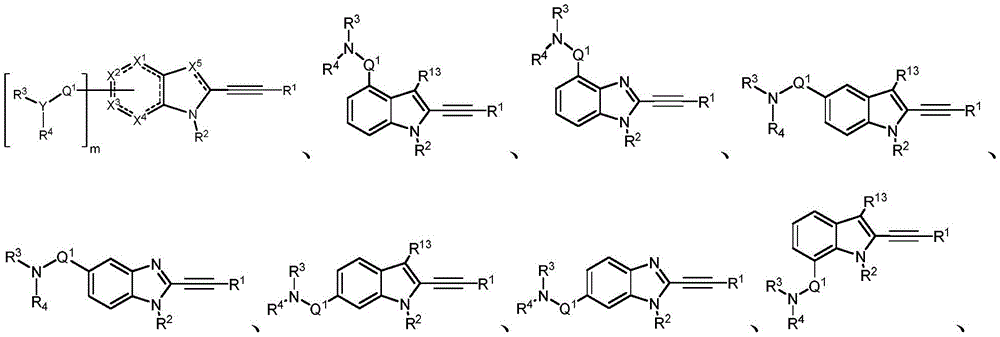


in some embodiments, the present disclosure provides a compound of the formula:
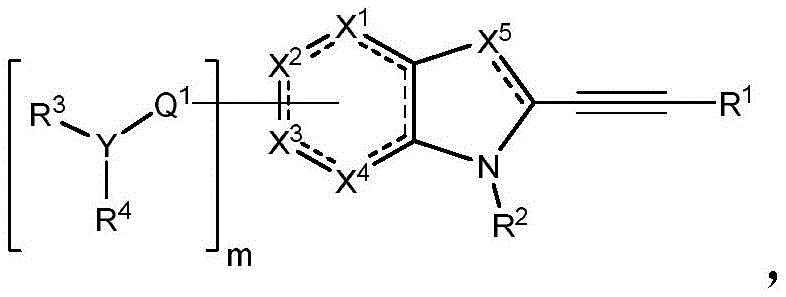
wherein:
-each of Independently a single or double bond;
-X 1 is CR 5 、CR 5 R 6 、N、NR 5 O, S, C-O, C-S or connected to Q 1 A carbon atom of (a);
-X 2 is CR 7 、CR 7 R 8 、N、NR 7 O, S, C-O, C-S or connected to Q 1 A carbon atom of (a);
-X 3 is CR 9 、CR 9 R 10 、N、NR 9 O, S, C-O, C-S or connected to Q 1 A carbon atom of (a);
-X 4 is CR 11 、CR 11 R 12 、N、NR 11 O, S, C-O, C-S or connected to Q 1 A carbon atom of (a);
-X 5 is CR 13 N or NR 13 ;
Wherein X 1 、X 2 、X 3 And X 4 Is connected to Q 1 A carbon atom of (a);
-Q 1 is C-O, C-S, C-CR 14 R 15 、C=NR 14 Alkylene, alkenylene, or alkynylene, each independently substituted or unsubstituted; or is a bond;
-m is 1, 2, 3 or 4;
-Y is N, O or absent;
-R 1 is-C (O) R 16 、-C(O)OR 16 、-C(O)NR 16 R 17 、-OR 16 、-SR 16 、-NR 16 R 17 、-NR 16 C(O)R 16 、-OC(O)R 16 、C=O、C=S、-CN、-SiR 16 R 17 R 18 Alkyl, alkenyl, alkynyl, aryl, heteroarylOr a heterocyclic group, each of which is independently substituted or unsubstituted; or is hydrogen;
each R 3 And R 4 Independently is-C (O) R 19 、-C(O)OR 19 、-C(O)NR 19 R 20 、-SOR 19 、-SO 2 R 19 Alkyl, alkylene, alkenyl, alkenylene, alkynyl, aryl, heteroaryl, or heterocyclyl, each of which is independently substituted or unsubstituted; or is hydrogen, or R 3 And R 4 Together with R 3 And R 4 The combined Y atoms together form a ring, wherein the ring is substituted or unsubstituted, or R 3 Is absent;
each R 2 、R 5 、R 6 、R 7 、R 8 、R 9 、R 10 、R 11 、R 12 、R 13 、R 14 、R 15 、R 16 、R 17 And R 18 Independently is-C (O) R 21 、-C(O)OR 21 、-C(O)NR 21 R 22 、-OR 21 、-SR 21 、-NR 21 R 22 、-NR 21 C(O)R 22 、-OC(O)R 21 Alkyl, alkenyl, alkynyl, aryl, heteroaryl, or heterocyclyl, each independently substituted or unsubstituted; or is hydrogen or halogen;
each R 19 And R 20 Is C (O) R 23 、-C(O)OR 23 、-C(O)NR 23 R 24 、-OR 23 、-SR 23 、-NR 23 R 24 、-NR 23 C(O)R 24 、-OC(O)R 23 Alkyl, alkenyl, alkynyl, aryl, heteroaryl, or heterocyclyl, each independently substituted or unsubstituted; or is hydrogen or halogen;
each R 21 And R 22 Independently is an alkyl, alkenyl, alkynyl, aryl, heteroaryl, or heterocyclyl group, each of which is independently substituted or unsubstituted; or is hydrogen; and is
Each R 23 And R 24 Independently an alkyl, alkenyl, alkynyl, aryl, heteroaryl or heterocyclyl group, each of which is independentlyIs substituted or unsubstituted; or is a hydrogen atom or a hydrogen atom,
or a pharmaceutically acceptable salt thereof, wherein the compound is not a compound of table 1.
In some embodiments, disclosed herein are compounds of the formula:

wherein:
-each of Independently a single or double bond;
-X 1 is CR 5 、CR 5 R 6 、N、NR 5 O, S, C-O, C-S or connected to Q 1 A carbon atom of (a);
-X 2 is CR 7 、CR 7 R 8 、N、NR 7 O, S, C-O, C-S or connected to Q 1 A carbon atom of (a);
-X 3 is CR 9 、CR 9 R 10 、N、NR 9 O, S, C-O, C-S or connected to Q 1 A carbon atom of (a);
-X 4 is CR 11 、CR 11 R 12 、N、NR 11 O, S, C-O, C-S or connected to Q 1 A carbon atom of (a);
-X 5 is CR 13 N or NR 13 ;
Wherein X 1 、X 2 、X 3 And X 4 Is connected to Q 1 A carbon atom of (a);
-Q 1 is C-O, C-S, C-CR 14 R 15 、C=NR 14 Alkylene, alkenylene, or alkynylene, each independently substituted or unsubstituted; or is a bond;
-m is 1, 2, 3 or 4;
-Y is N, O or absent;
-R 1 is-C (O) R 16 、-C(O)OR 16 、-C(O)NR 16 R 17 、-OR 16 、-SR 16 、-NR 16 R 17 、-NR 16 C(O)R 16 、-OC(O)R 16 、C=O、C=S、-CN、-SiR 16 R 17 R 18 Alkyl, alkenyl, alkynyl, aryl, heteroaryl, or heterocyclyl, each independently substituted or unsubstituted; or is hydrogen;
each R 3 And R 4 Independently is-C (O) R 19 、-C(O)OR 19 、-C(O)NR 19 R 20 、-SOR 19 、-SO 2 R 19 Alkyl, alkylene, alkenyl, alkenylene, alkynyl, aryl, heteroaryl, or heterocyclyl, each of which is independently substituted or unsubstituted; or is hydrogen, or R 3 And R 4 Together with R 3 And R 4 The bound nitrogen atoms together form a ring, wherein the ring is substituted or unsubstituted, or R 3 Is absent, wherein R 3 And R 4 Is alkyl, alkylene, alkenyl, alkenylene, alkynyl, aryl, heteroaryl or heterocyclyl, each of which is at least halo-substituted;
each R 2 、R 5 、R 6 、R 7 、R 8 、R 9 、R 10 、R 11 、R 12 、R 13 、R 14 、R 15 、R 16 、R 17 And R 18 Independently is-C (O) R 21 、-C(O)OR 21 、-C(O)NR 21 R 22 、-OR 21 、-SR 21 、-NR 21 R 22 、-NR 21 C(O)R 22 、-OC(O)R 21 Alkyl, alkenyl, alkynyl, aryl, heteroaryl, or heterocyclyl, each independently substituted or unsubstituted; or is hydrogen or halogen;
each R 19 And R 20 Is C (O) R 23 、-C(O)OR 23 、-C(O)NR 23 R 24 、-OR 23 、-SR 23 、-NR 23 R 24 、-NR 23 C(O)R 24 、-OC(O)R 23 Alkyl, alkenyl, alkynylAryl, heteroaryl or heterocyclyl, each independently substituted or unsubstituted; or is hydrogen or halogen;
each R 21 And R 22 Independently is an alkyl, alkenyl, alkynyl, aryl, heteroaryl, or heterocyclyl group, each of which is independently substituted or unsubstituted; or is hydrogen; and is provided with
Each R 23 And R 24 Independently is an alkyl, alkenyl, alkynyl, aryl, heteroaryl, or heterocyclyl group, each of which is independently substituted or unsubstituted; or is a hydrogen atom or a hydrogen atom,
or a pharmaceutically acceptable salt thereof.
In some embodiments, the compound has the formula (la):

wherein:
-each of Independently a single or double bond;
-X 1 is CR 5 、CR 5 R 6 、N、NR 5 O, S, C-O, C-S or connected to Q 1 A carbon atom of (a);
-X 2 is CR 7 、CR 7 R 8 、N、NR 7 O, S, C-O, C-S or connected to Q 1 A carbon atom of (a);
-X 3 is CR 9 、CR 9 R 10 、N、NR 9 O, S, C-O, C-S or connected to Q 1 A carbon atom of (a);
-X 4 is CR 11 、CR 11 R 12 、N、NR 11 O, S, C-O, C-S or connected to Q 1 A carbon atom of (a);
-X 5 is CR 13 N or NR 13 ;
Wherein X 1 、X 2 、X 3 And X 4 Is connected to Q 1 A carbon atom of (a);
-a is a linking group;
-Q 1 is C-O, C-S, C-CR 14 R 15 、C=NR 14 Alkylene, alkenylene, or alkynylene, each independently substituted or unsubstituted; or is a bond;
-m is 1, 2, 3 or 4;
-Y is N, O or absent;
-R 1 is-C (O) R 16 、-C(O)OR 16 、-C(O)NR 16 R 17 、-OR 16 、-SR 16 、-NR 16 R 17 、-NR 16 C(O)R 16 、-OC(O)R 16 、-SiR 16 R 17 R 18 Alkyl, alkenyl, alkynyl, alkoxy, aryl, heteroaryl, heterocyclyl or halo, each of which is independently substituted or unsubstituted; or is hydrogen;
each R 3 And R 4 Independently is-C (O) R 19 、-C(O)OR 19 、-C(O)NR 19 R 20 、-SOR 19 、-SO 2 R 19 Alkyl, alkenyl, alkynyl, aryl, heteroaryl, or heterocyclyl, each independently substituted or unsubstituted; or is hydrogen, or R 3 And R 4 Together with R 3 And R 4 The bound nitrogen atoms together form a ring, wherein the ring is substituted or unsubstituted, or R 3 Is absent; wherein R is 3 And R 4 Is alkyl, alkylene, alkenyl, alkenylene, alkynyl, alkynylene, aryl, heteroaryl, or heterocyclyl, each of which is substituted with at least halo;
each R 2 、R 5 、R 6 、R 7 、R 8 、R 9 、R 10 、R 11 、R 12 、R 13 、R 14 、R 15 、R 16 、R 17 And R 18 Independently is-C (O) R 21 、-C(O)OR 21 、-C(O)NR 21 R 22 、-OR 21 、-SR 21 、-NR 21 R 22 、-NR 21 C(O)R 22 、-OC(O)R 21 Alkyl, alkenyl, alkynyl, aryl, heteroaryl, or heterocyclyl, each of which is independently substituted or unsubstituted; or is hydrogen or halogen;
each R 19 And R 20 Independently is-C (O) R 23 、-C(O)OR 23 、-C(O)NR 23 R 24 、-OR 23 、-SR 23 、-NR 23 R 24 、-NR 23 C(O)R 24 、-OC(O)R 23 Alkyl, alkenyl, alkynyl, aryl, heteroaryl, or heterocyclyl, each independently substituted or unsubstituted; or is hydrogen or halogen;
each R 21 And R 22 Independently is an alkyl, alkenyl, alkynyl, aryl, heteroaryl, or heterocyclyl group, each of which is independently substituted or unsubstituted; or is hydrogen; and is
Each R 23 And R 24 Independently is an alkyl, alkenyl, alkynyl, aryl, heteroaryl, or heterocyclyl group, each of which is independently substituted or unsubstituted; or is a mixture of hydrogen and a nitrogen-containing compound,
or a pharmaceutically acceptable salt thereof.
In some embodiments, the compound has the formula (la):

wherein:
-each of Independently a single or double bond;
-X 1 is CR 5 、CR 5 R 6 、N、NR 5 O, S, C-O, C-S or connected to Q 1 A carbon atom of (a);
-X 2 is CR 7 、CR 7 R 8 、N、NR 7 O, S, C-O, C-S or connected to Q 1 A carbon atom of (a);
-X 3 is CR 9 、CR 9 R 10 、N、NR 9 、O、SC O, C ═ S or connected to Q 1 A carbon atom of (a);
-X 4 is CR 11 、CR 11 R 12 、N、NR 11 O, S, C-O, C-S or connected to Q 1 A carbon atom of (a);
-X 5 is CR 13 N or NR 13 ;
Wherein X 1 、X 2 、X 3 And X 4 Is connected to Q 1 A carbon atom of (a);
-a is a linking group;
-Q 1 is C-O, C-S, C-CR 14 R 15 、C=NR 14 Alkylene, alkenylene, or alkynylene, each independently substituted or unsubstituted; or is a bond;
-m is 1, 2, 3 or 4;
-Y is N, O or absent;
-R 1 is-C (O) R 16 、-C(O)OR 16 、-C(O)NR 16 R 17 、-OR 16 、-SR 16 、-NR 16 R 17 、-NR 16 C(O)R 16 、-OC(O)R 16 、-SiR 16 R 17 R 18 Alkyl, alkenyl, alkynyl, alkoxy, aryl, heteroaryl, heterocyclyl or halo, each of which is independently substituted or unsubstituted; or is hydrogen;
each R 3 And R 4 Independently is-C (O) R 19 、-C(O)OR 19 、-C(O)NR 19 R 20 、-SOR 19 、-SO 2 R 19 Alkyl, alkenyl, alkynyl, aryl, heteroaryl, or heterocyclyl, each independently substituted or unsubstituted; or is hydrogen, or R 3 And R 4 Together with R 3 And R 4 The bound nitrogen atoms together form a ring, wherein the ring is substituted or unsubstituted, or R 3 Is absent;
each R 2 、R 5 、R 6 、R 7 、R 8 、R 9 、R 10 、R 11 、R 12 、R 13 、R 14 、R 15 、R 16 、R 17 And R 18 Independently is-C (O) R 21 、-C(O)OR 21 、-C(O)NR 21 R 22 、-OR 21 、-SR 21 、-NR 21 R 22 、-NR 21 C(O)R 22 、-OC(O)R 21 Alkyl, alkenyl, alkynyl, aryl, heteroaryl, or heterocyclyl, each independently substituted or unsubstituted; or is hydrogen or halogen;
each R 19 And R 20 Independently is-C (O) R 23 、-C(O)OR 23 、-C(O)NR 23 R 24 、-OR 23 、-SR 23 、-NR 23 R 24 、-NR 23 C(O)R 24 、-OC(O)R 23 Alkyl, alkenyl, alkynyl, aryl, heteroaryl, or heterocyclyl, each independently substituted or unsubstituted; or is hydrogen or halogen;
each R 21 And R 22 Independently is an alkyl, alkenyl, alkynyl, aryl, heteroaryl, or heterocyclyl group, each of which is independently substituted or unsubstituted; or is hydrogen; and is provided with
Each R 23 And R 24 Independently an alkyl, alkenyl, alkynyl, aryl, heteroaryl, or heterocyclyl group, each of which is independently substituted or unsubstituted; or is a hydrogen atom or a hydrogen atom,
Or a pharmaceutically acceptable salt thereof, wherein the compound is not a compound of table 1.
In some embodiments, a is alkylene, alkenylene, or alkynylene, each of which is substituted or unsubstituted. In some embodiments, a is alkylene. In some embodiments, a is alkenylene. In some embodiments, a is alkynylene.
In some embodiments, the compound of formula (la) is:
wherein:
-each of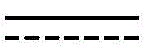 Independently a single or double bond;
-X 1 is CR 5 、CR 5 R 6 、N、NR 5 O, S, C O, C S or connected to Q 1 A carbon atom of (a);
-X 2 is CR 7 、CR 7 R 8 、N、NR 7 O, S, C O, C S or connected to Q 1 A carbon atom of (a);
-X 3 is CR 9 、CR 9 R 10 、N、NR 9 O, S, C-O, C-S or connected to Q 1 A carbon atom of (a);
-X 4 is CR 11 、CR 11 R 12 、N、NR 11 O, S, C-O, C-S or connected to Q 1 A carbon atom of (a);
-X 5 is CR 13 N or NR 13 ;
Wherein X 1 、X 2 、X 3 And X 4 Is connected to Q 1 A carbon atom of (a);
-Q 1 is C-O, C-S, C-CR 14 R 15 、C=NR 14 Alkylene, alkenylene, or alkynylene, each independently substituted or unsubstituted; or is a bond;
-m is 1, 2, 3 or 4;
-Y is N, O or absent;
-a is a cyclic group substituted by at least halo;
-R 1 is-C (O) R 16 、-C(O)OR 16 、-C(O)NR 16 R 17 、-OR 16 、-SR 16 、-NR 16 R 17 、-NR 16 C(O)R 16 、-OC(O)R 16 、C=O、C=S、-CN、-SiR 16 R 17 R 18 Alkyl, alkenyl, alkynyl, aryl, heteroaryl, or heterocyclyl, each independently substituted or unsubstituted; or is hydrogen;
-R 3 is-C (O) R 19 、-C(O)OR 19 、-C(O)NR 19 R 20 、-SOR 19 、-SO 2 R 19 Alkyl, alkylene, alkenyl, alkenylene, alkynyl, aryl, heteroaryl, or heterocyclyl, each of which is independently substituted or unsubstituted; or is hydrogen, or R 3 And A together with R 3 And the nitrogen atom to which A is bound, together form a ring, wherein the ring is substituted or unsubstituted, or R 3 In the absence of the presence of the agent,
each R 2 、R 5 、R 6 、R 7 、R 8 、R 9 、R 10 、R 11 、R 12 、R 13 、R 14 、R 15 、R 16 、R 17 And R 18 Independently is-C (O) R 21 、-C(O)OR 21 、-C(O)NR 21 R 22 、-OR 21 、-SR 21 、-NR 21 R 22 、-NR 21 C(O)R 22 、-OC(O)R 21 Alkyl, alkenyl, alkynyl, aryl, heteroaryl, or heterocyclyl, each independently substituted or unsubstituted; or is hydrogen or halogen;
each R 19 And R 20 Is C (O) R 23 、-C(O)OR 23 、-C(O)NR 23 R 24 、-OR 23 、-SR 23 、-NR 23 R 24 、-NR 23 C(O)R 24 、-OC(O)R 23 Alkyl, alkenyl, alkynyl, aryl, heteroaryl, or heterocyclyl, each of which is independently substituted or unsubstituted; or is hydrogen or halogen;
each R 21 And R 22 Independently an alkyl, alkenyl, alkynyl, aryl, heteroaryl, or heterocyclyl group, each of which is independently substituted or unsubstituted; or is hydrogen; and is
Each R 23 And R 24 Independently is an alkyl, alkenyl, alkynyl, aryl, heteroaryl, or heterocyclyl group, each of which is independently substituted or unsubstituted; or is a mixture of hydrogen and a nitrogen-containing compound,
or a pharmaceutically acceptable salt thereof.
In some embodiments, the compound has the formula (la):

wherein:
-each of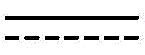 Independently a single or double bond;
-X 1 Is CR 5 、CR 5 R 6 、N、NR 5 O, S, C-O, C-S or connected to Q 1 A carbon atom of (a);
-X 2 is CR 7 、CR 7 R 8 、N、NR 7 O, S, C-O, C-S or connected to Q 1 A carbon atom of (a);
-X 3 is CR 9 、CR 9 R 10 、N、NR 9 O, S, C-O, C-S or connected to Q 1 A carbon atom of (a);
-X 4 is CR 11 、CR 11 R 12 、N、NR 11 O, S, C-O, C-S or connected to Q 1 A carbon atom of (a);
-X 5 is CR 13 N or NR 13 ;
Wherein X 1 、X 2 、X 3 And X 4 Is connected to Q 1 A carbon atom of (a);
-Q 1 is C-O, C-S, C-CR 14 R 15 、C=NR 14 Alkylene, alkenylene, or alkynylene, each independently substituted or unsubstituted; or is a bond;
-m is 1, 2, 3 or 4;
-Y is N, O or absent;
-a is a cyclic group substituted by at least halo;
-R 1 is-C (O) R 16 、-C(O)OR 16 、-C(O)NR 16 R 17 、-OR 16 、-SR 16 、-NR 16 R 17 、-NR 16 C(O)R 16 、-OC(O)R 16 、C=O、C=S、-CN、-SiR 16 R 17 R 18 Alkyl, alkenyl, alkynyl, aryl, heteroaryl, or heterocyclyl, each independently substituted or unsubstituted; or is hydrogen;
-R 3 is-C (O) R 19 、-C(O)OR 19 、-C(O)NR 19 R 20 、-SOR 19 、-SO 2 R 19 Alkyl, alkylene, alkenyl, alkenylene, alkynyl, aryl, heteroaryl, or heterocyclyl, each of which is independently substituted or unsubstituted; or is hydrogen, or R 3 And A together with R 3 And the nitrogen atom bound to A together form a ring, wherein the ring is substituted or unsubstituted, or R 3 There is no need to provide a solution to the problem,
each R 2 、R 5 、R 6 、R 7 、R 8 、R 9 、R 10 、R 11 、R 12 、R 13 、R 14 、R 15 、R 16 、R 17 And R 18 Independently is-C (O) R 21 、-C(O)OR 21 、-C(O)NR 21 R 22 、-OR 21 、-SR 21 、-NR 21 R 22 、-NR 21 C(O)R 22 、-OC(O)R 21 Alkyl, alkenyl, alkynyl, aryl, heteroaryl, or heterocyclyl, each independently substituted or unsubstituted; or is hydrogen or halogen;
Each R 19 And R 20 Is C (O) R 23 、-C(O)OR 23 、-C(O)NR 23 R 24 、-OR 23 、-SR 23 、-NR 23 R 24 、-NR 23 C(O)R 24 、-OC(O)R 23 Alkyl, alkenyl, alkynyl, aryl, heteroaryl, or heterocyclyl, each independently substituted or unsubstituted; or is hydrogen or halogen;
each R 21 And R 22 Independently an alkyl, alkenyl, alkynyl, aryl, heteroaryl, or heterocyclyl group, each of which is independently substituted or unsubstituted; or is hydrogen; and is
Each R 23 And R 24 Independently is alkyl, alkenyl, alkynyl, aryl, heteroarylA group or a heterocyclic group, each of which is independently substituted or unsubstituted; or is a mixture of hydrogen and a nitrogen-containing compound,
or a pharmaceutically acceptable salt thereof.
In some embodiments, the pattern of dashed bonds is selected to provide an aromatic system, e.g., indole, indoline, pyrrolopyridine, pyrrolopyrimidine, or pyrrolopyrazine.
In some embodiments, X 1 Is CR 5 、CR 5 R 6 Or is connected to Q 1 Carbon atom (b) of (a). In some embodiments, X 2 Is CR 7 、CR 7 R 8 Or is connected to Q 1 Carbon atom (b) of (a). In some embodiments, X 3 Is CR 9 、CR 9 R 10 Or is connected to Q 1 Carbon atom (b) of (a). In some embodiments, X 4 Is CR 11 、CR 11 R 12 Or is connected to Q 1 Carbon atom (b) of (a). In some embodiments, X 5 Is CR 13 N or NR 13 . In some embodiments, X 1 To be connected to Q 1 Carbon atom (b) of (a). In some embodiments, X 2 To be connected to Q 1 Carbon atom (b) of (a). In some embodiments, X 3 To be connected to Q 1 Carbon atom (b) of (a). In some embodiments, X 4 To be connected to Q 1 Carbon atom (b) of (a). In some embodiments, X 5 Is N.
In some embodiments, Q 1 Is a key. In some embodiments, Q 1 Is C 1 -an alkylene group.
In some embodiments, m is 1. In some embodiments, m is 2. In some embodiments, m is 3. In some embodiments, m is 4.
In some embodiments, ring a is aryl, heteroaryl, or heterocyclyl, each of which is substituted or unsubstituted. In some embodiments, ring a is substituted aryl. In some embodiments, ring a is aryl-substituted with fluoro. In some embodiments, ring a is chloro-substituted aryl. In some embodiments, ring a is substituted heteroaryl, and in some embodiments, ring a is heteroaryl-substituted with fluoro. In some embodiments, ring a is chloro-substituted heteroaryl. In some embodiments, ring a is substituted heterocyclyl. In some embodiments, ring a is a heterocyclyl-substituted with fluoro. In some embodiments, ring a is a chloro-substituted heterocyclyl.
In some embodiments, R 1 Is alkyl, alkenyl, -C (O) R 16 、-C(O)OR 16 or-C (O) NR 16 R 17 Each of which is unsubstituted or substituted. In some embodiments, R 1 Is a substituted alkyl group. In some embodiments, R 1 Is being NR 16 R 17 A substituted alkyl group.
In some embodiments, each R is 16 And R 17 Independently an alkyl, alkenyl, aryl, heteroaryl, heterocyclyl, each of which is independently substituted or unsubstituted; or hydrogen. In some embodiments, R 16 Is hydrogen or alkyl. In some embodiments, R 17 Is aryl, heteroaryl or heterocyclyl, each of which is independently substituted or unsubstituted. In some embodiments, R 17 Is a substituted aryl group. In some embodiments, R 17 Is a substituted phenyl group. In some embodiments, R 17 Is phenyl substituted with a sulfoxide group, a carboxyl group, an amide group, an amino group, an alkyl group, an alkoxy group, a hydroxyl group, a halo group, a cyano group, or a heterocyclic group, each of which is independently substituted or unsubstituted. In some embodiments, R 17 Is phenyl substituted by methoxy. In some embodiments, R 17 Is phenyl substituted with a substituted sulfoxide group. In some embodiments, R 17 Is phenyl substituted by a carboxyl group. In some embodiments, R 17 Is phenyl substituted with a substituted amide group.
In some embodiments, the compound has the formula (la):

in some embodiments, Q 1 Is C-O, C-S, C-CR 14 R 15 、C=NR 14 Alkylene, alkenylene, or alkynylene, each independently substituted or unsubstituted; or a bond. In some embodiments, Q 1 Is alkylene, alkenylene or alkynylene. In some embodiments, Q 1 Is C 1 -alkylene or a bond. In some embodiments, Q 1 Is C 1 -an alkylene group. In some embodiments, Q 1 Is a bond.
In some embodiments, Y is N. In some embodiments, Y is O. In some embodiments, Y is absent.
In some embodiments, R 2 Is hydrogen or alkyl. In some embodiments, R 2 Is an alkyl group. In some embodiments, R 2 Is substituted C 1 -C 5 An alkyl group. In some embodiments, R 2 Is trifluoroethyl. In some embodiments, R 2 Is a cycloalkyl group. In some embodiments, R 2 Is cyclopropyl.
In some embodiments, R 13 Is alkyl, alkenyl, hydrogen or halogen. In some embodiments, R 13 Is hydrogen.
In some embodiments, R 2 Is C 1 -C 5 -alkyl, and R 13 Is C 1 -C 5 -an alkyl group. In some embodiments, R 2 Is C 1 -C 5 -alkyl, and R 13 Is hydrogen. In some embodiments, R 2 Is substituted C 1 -C 5 An alkylene group. In some embodiments, R 2 Is methyl, ethyl, propyl, isopropyl, butyl or tert-butyl, each of which is substituted or unsubstituted. In some embodiments, R 13 Is methyl, ethyl, propyl, isopropyl, butyl or tert-butyl. In some embodiments, R 2 Is hydrogen, and R 13 Is hydrogen. In some embodiments, R 2 Is trifluoroethyl, and R 13 Is hydrogen.
In some embodiments, the compound has the formula (la):

in some embodiments, the compound has the formula (la):

in some embodiments, R 3 Is H, and R 4 is-C (O) R 19 、-C(O)OR 19 、-C(O)NR 19 R 20 、-SOR 19 、-SO 2 R 19 Alkyl, alkylene, alkenyl, alkenylene, alkynyl, aryl, heteroaryl, or heterocyclyl, each of which is independently substituted or unsubstituted. In some embodiments, each R is independently selected from R, and R 3 And R 4 Independently is substituted or unsubstituted C 1 -C 6 An alkylene group. In some embodiments, R 3 Is H; and R is 4 Is substituted or unsubstituted C 1 -C 4 An alkylene group. In some embodiments, R 3 Is H, and R 4 Is a substituted or unsubstituted heterocyclic group. In some embodiments, R 3 Is H, and R 4 Is a substituted or unsubstituted piperidinyl group. In some embodiments, R 3 Is H, and R 4 Is a substituted or unsubstituted cycloalkyl. In some embodiments, R 3 Is H, and R 4 Is cycloalkyl substituted by an amino group. In some embodiments, R 3 Is H, and R 4 Is a substituted or unsubstituted cyclobutyl group. In some embodiments, R 3 Is H, and R 4 Is cyclobutyl substituted by an amino group. In some embodiments, R 3 Is H, and R 4 Is a substituted or unsubstituted cyclohexyl group. In some embodiments, R 3 Is H, and R 4 Is cyclohexyl substituted by an amino group.
In some embodiments, the compound has the formula (la):

in some embodiments, the compound has the formula (la):
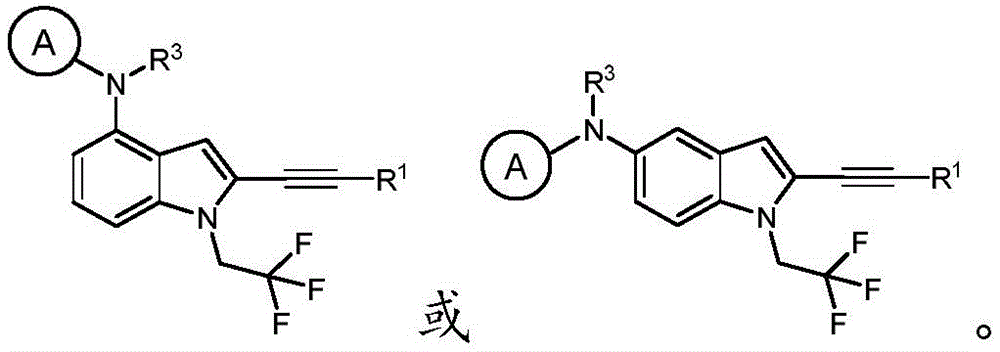
R 1 may be a group substituted with one or more substituents selected from the group consisting of a hydroxyl group, a sulfhydryl group, a halogen, an amino group, a nitro group, a nitroso group, a cyano group, an azido group, a sulfoxide group, a sulfone group, a sulfonamide group, a carboxyl group, a formaldehyde group, an imine group, an alkyl group, a halo-alkyl group, a cycloalkyl group, an alkenyl group, a halo-alkenyl group, an alkynyl group, a halo-alkynyl group, an alkoxy group, an aryl group, an aryloxy group, an aralkyl group, an arylalkoxy group, a heterocyclyl group, an acyl group, an acyloxy group, a carbamate group, an amide group, a urethane group, and an ester group. In some embodiments, R 1 Is alkyl, alkenyl, -C (O) R 16 、-C(O)OR 16 or-C (O) NR 16 R 17 . In some embodiments, R 1 Is substituted or unsubstituted C 1 -C 3 An alkyl group. In some embodiments, R 1 Is C substituted by amine groups 1 -C 3 -an alkyl group. In some embodiments, R 1 Is being NR 16 R 17 Substituted C 1 -an alkyl group. In some embodiments, each R is 16 And R 17 Independently is aryl, heteroaryl or heterocyclyl, each independently being substituted or unsubstituted; or hydrogen. In some embodiments, R 16 Is H, and R 17 Is a substituted aryl group. In some embodiments, R 16 Is H, and R 17 Is a substituted phenyl group. In some embodiments, R 16 Is H, and R 17 Is substituted by alkyl, alkoxy, halo, sulfonamide, sulfone, or carboxylA phenyl group substituted with a group. In some embodiments, R 16 Is H, and R 17 Is a substituted heteroaryl group. In some embodiments, R 16 Is H, and R 17 Is a substituted heterocyclic group.
In some embodiments, R 3 is-C (O) R 19 、-C(O)OR 19 Alkyl, alkenyl, alkynyl, aryl, heteroaryl, or heterocyclyl, each independently substituted or unsubstituted; or is hydrogen, and R 4 is-C (O) R 19 、-C(O)OR 19 Alkyl, alkenyl, alkynyl, aryl, heteroaryl, or heterocyclyl, each independently substituted or unsubstituted; or hydrogen. In some embodiments, R 3 Is alkyl, alkenyl, alkynyl, aryl, heteroaryl, or heterocyclyl, each of which is independently substituted or unsubstituted; or hydrogen. In some embodiments, R 3 Is a substituted alkyl group. In some embodiments, R 3 Is H.
In some embodiments, R 3 Is hydrogen, and R 4 Is ring A. In some embodiments, R 4 Or ring a is cycloalkyl, aryl, heteroaryl, or heterocyclyl, each independently substituted or unsubstituted. In some embodiments, R 4 Or ring a is substituted or unsubstituted aryl. In some embodiments, R 4 Or ring a is substituted or unsubstituted phenyl. In some embodiments, R 4 Or ring a is substituted or unsubstituted cycloalkyl. In some embodiments, R 4 Or ring a is a substituted or unsubstituted cyclopropyl. In some embodiments, R 4 Or ring a is substituted cyclopropyl. In some embodiments, R 4 Or ring a is substituted cyclohexyl. In some embodiments, R 4 Or ring a is cyclohexyl substituted with an amino group.
In some embodiments, R 3 Is H, and R 4 Or ring a is an unsubstituted or substituted heterocyclic group. In some embodiments, R 4 Or ring A is a heterocyclic group. In some embodiments, R 4 Or ring A is piperidinyl, piperazinyl, tetrahydropyranyl, morpholinyl or pyrroleAlkyl, each of which is independently substituted or unsubstituted. In some embodiments, R 3 Is H, and R 4 Or ring a is substituted piperidinyl. In some embodiments, R 3 Is H, and R 4 Or ring a is piperidine substituted with an alkyl, carboxyl, heterocyclyl or amide group. In some embodiments, R 3 Is H, and R 4 Or ring a is unsubstituted or substituted methylpiperidinyl. In some embodiments, R 3 Is H, and R 4 Or ring A is 3-fluoro-1-methylpiperidinyl. In some embodiments, R 3 Is H, and R 4 Or ring a is piperidinyl substituted with methoxypropanol. In some embodiments, R 3 Is H, and R 4 Or ring A is 3-fluoro-1- (2-hydroxy-3-methoxypropyl) piperidinyl. In some embodiments, R 3 Is H, and R 4 Or ring a is unsubstituted or substituted tetrahydropyranyl. In some embodiments, R 3 Is H, and R 4 Or ring a is unsubstituted tetrahydropyranyl. In some embodiments, R 3 Is H, and R 4 Or ring a is tetrahydropyranyl substituted with alkyl. In some embodiments, R 3 Is H, and R 4 Or ring A is tetrahydrothiopyran-1, 1-dioxide.
In some embodiments, R 4 Or ring a is cycloalkyl, aryl, heteroaryl or heterocyclyl, each of which is at least halo-substituted. In some embodiments, R 4 Or ring A is C which is at least halo-substituted 4 -C 6 -a cycloalkyl group. In some embodiments, R 4 Or ring a is cyclohexyl which is at least halo-substituted. In some embodiments, R 4 Or ring a is aryl substituted with at least halo-. In some embodiments, R 4 Or ring a is phenyl which is at least halo-substituted. In some embodiments, R 4 Or ring a is aryl substituted with fluoro. In some embodiments, R 4 Or ring a is phenyl substituted with fluoro. In some embodiments, R 4 Or ring a is chloro-substituted aryl. In some embodiments, R 4 Or ring a is chloro-substituted phenyl. In some embodiments, R 4 Or ring a is heteroaryl at least halo-substituted. In some embodiments, R 4 Or ring a is heteroaryl substituted with fluoro. In some embodiments, R 4 Or ring a is a chloro-substituted heteroaryl. In some embodiments, R 4 Or ring A is C which is at least halo-substituted 4 -C 6 -a heterocyclic group. In some embodiments, R 4 Or ring a is a fluoro-substituted heterocyclic group. In some embodiments, R 4 Or ring a is a chloro-substituted heterocyclic group.
In some embodiments, R 4 Or ring a is piperidinyl, piperazinyl, tetrahydropyranyl, morpholinyl or pyrrolidinyl, each of which is independently at least halo-substituted. In some embodiments, R 4 Or ring a is halo-substituted piperidinyl. In some embodiments, R 4 Or ring a is halo-substituted methylpiperidinyl. In some embodiments, R 4 Or ring A is 3-fluoro-1-methylpiperidinyl. In some embodiments, R 4 Or ring A is 3-fluoro-1- (2-hydroxy-3-methoxypropyl) piperidinyl. In some embodiments, R 4 Or ring a is tetrahydropyranyl, at least halo-substituted.
In some embodiments, R 4 Or ring a is a ring which is:

wherein the ring is substituted or unsubstituted. In some embodiments, the ring is halo-substituted. In some embodiments, the ring is substituted with fluoro. In some embodiments, R 3 Is H, and R 4 Is a ring, the ring is Wherein the ring is substituted or unsubstituted. In some embodiments, the ring is halo-substituted. In some embodiments, the ring is substituted with fluoro. In some embodiments, R 3 Is H, and R 4 Is a ring, the ring is
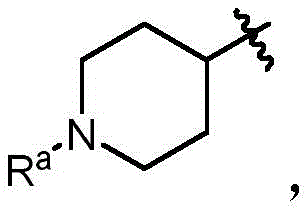 Wherein the ring is substituted or unsubstituted. In some embodiments, R a Is an alkylene group. In some embodiments, R a Is methyl. In some embodiments, the ring is substituted with halo. In some embodiments, the ring is substituted with fluoro. In some embodiments, R 3 Is H, and R 4 Is a ring, which is
 Wherein the ring is substituted or unsubstituted. In some embodiments, the ring is substituted with halo. In some embodiments, the ring is substituted with fluoro. In some embodiments, R 3 Is H, and R 4 Is a ring, the ring is
 Wherein the ring is substituted or unsubstituted.
In some embodiments, R 4 Or ring a is substituted with one or more substituents selected from the group consisting of a hydroxyl group, a sulfhydryl group, a halogen, an amino group, a nitro group, a nitroso group, a cyano group, an azido group, a sulfoxide group, a sulfone group, a sulfonamide group, a carboxyl group, a formaldehyde group, an imine group, an alkyl group, a halo-alkyl group, a cycloalkyl group, an alkenyl group, a halo-alkenyl group, an alkynyl group, a halo-alkynyl group, an alkoxy group, an aryl group, an aryloxy group, an aralkyl group, an arylalkoxy group, a heterocyclyl group, an acyl group, an acyloxy group, a carbamate group, an amide group, a urethane group, and an ester group.
In some embodiments, R 3 And R 4 Together with R 3 And R 4 The bound nitrogen atoms together form a ring, wherein the ring is substituted or unsubstituted. In some embodiments, R 3 And R 4 Together with R 3 And R 4 The bound nitrogen atoms together form a substituted heterocyclic ring. In some embodiments, R 3 And R 4 Together with R 3 And R 4 The bound nitrogen atoms together form a heterocyclic ring substituted with a hydroxyl group, a halogen, an amino group, or an alkyl group. In some embodiments, R 3 And R 4 Together with R 3 And R 4 The bound nitrogen atoms together form a heterocyclic ring, wherein the heterocyclic ring is substituted with a substituted or unsubstituted heterocyclic ring.
In some embodiments, the compound has the formula (la):
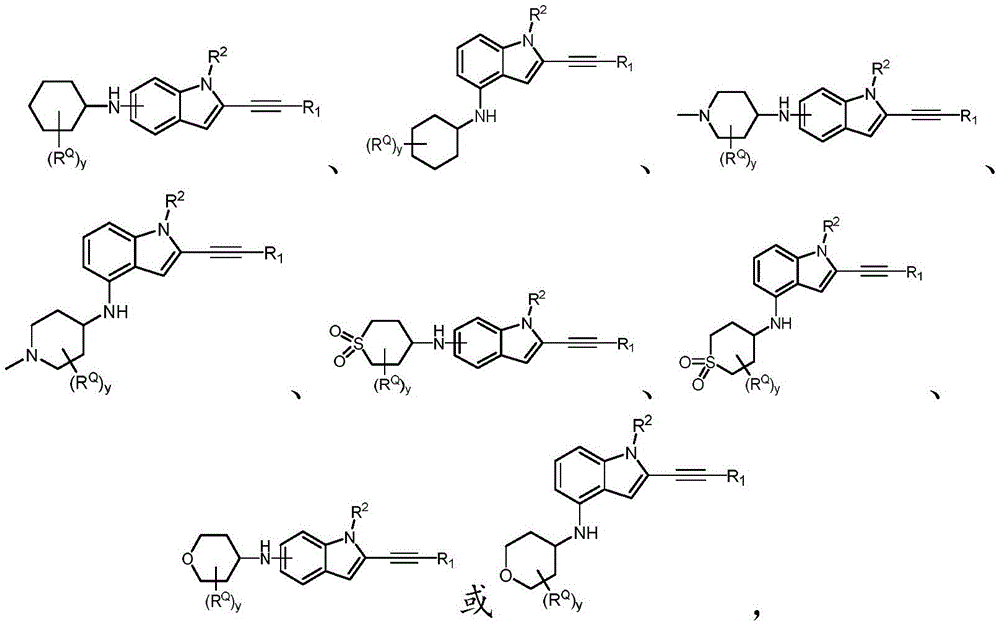
wherein:
-R 1 is-C (O) R 16 、-C(O)OR 16 、-C(O)NR 16 R 17 、-OR 16 、-SR 16 、-NR 16 R 17 、-NR 16 C(O)R 16 、-OC(O)R 16 、C=O、C=S、-CN、-SiR 16 R 17 R 18 Alkyl, alkenyl, alkynyl, aryl, heteroaryl, or heterocyclyl, each independently substituted or unsubstituted; or is hydrogen;
each R Q Independently is-C (O) R 21 、-C(O)OR 21 、-C(O)NR 21 R 22 、-OR 21 、-SR 21 、-NR 21 R 22 、-NR 21 C(O)R 22 、-OC(O)R 21 Alkyl, alkenyl, alkynyl, aryl, heteroaryl, or heterocyclyl, each independently substituted or unsubstituted; or is hydrogen or halogen;
-y is 0, 1, 2, 3 or 4;
each R 16 、R 17 And R 18 Independently is-C (O) R 21 、-C(O)OR 21 、-C(O)NR 21 R 22 、-OR 21 、-SR 21 、-NR 21 R 22 、-NR 21 C(O)R 22 、-OC(O)R 21 Alkyl, alkenyl, alkynyl, aryl, heteroaryl, or heterocyclyl, each of which is independently substituted or unsubstituted; or is hydrogen or halogen;
Each R 19 And R 20 Is C (O) R 23 、-C(O)OR 23 、-C(O)NR 23 R 24 、-OR 23 、-SR 23 、-NR 23 R 24 、-NR 23 C(O)R 24 、-OC(O)R 23 Alkyl, alkenyl, alkynyl, aryl, heteroaryl, or heterocyclyl, each independently substituted or unsubstituted; or is hydrogen or halogen;
each R 21 And R 22 Independently is an alkyl, alkenyl, alkynyl, aryl, heteroaryl, or heterocyclyl group, each of which is independently substituted or unsubstituted; or is hydrogen; and is
Each R 23 And R 24 Independently is an alkyl, alkenyl, alkynyl, aryl, heteroaryl, or heterocyclyl group, each of which is independently substituted or unsubstituted; or is a mixture of hydrogen and a nitrogen-containing compound,
or a pharmaceutically acceptable salt thereof.
In some embodiments, R 1 is-C (O) R 16 、-C(O)OR 16 、-C(O)NR 16 R 17 、-OR 16 、-SR 16 、-NR 16 R 17 、-NR 16 C(O)R 16 、-OC(O)R 16 、-SiR 16 R 17 R 18 Alkyl, alkenyl, alkynyl, alkoxy, aryl, heteroaryl, or heterocyclyl, each of which is independently substituted or unsubstituted; or hydrogen. In some embodiments, R 1 Is alkyl, alkylene, alkoxy, -NR 21 R 22 Or aryl, each independently substituted or unsubstituted; halogen or hydrogen.
In some embodiments, R 1 Is substituted C 1 -C 3 -an alkyl group. In some embodiments, R 1 Is being NR 16 R 17 Substituted C 1 -C 3 -an alkyl group. In some embodiments, R 1 Is being NR 16 R 17 Substituted methyl, wherein each R 16 And R 17 Independently an alkyl group, a cycloalkyl group, an aryl group, a heteroaryl group, a heterocyclic group, an alkoxy group, a carboxyl group, an amino group, an acyl group, an acyloxy group or an amide group, of these Either is unsubstituted or substituted; or hydrogen. In some embodiments, R 1 Is being NR 16 R 17 Substituted methyl, wherein R 16 Is hydrogen, and R 17 Is a substituted carboxyl group. In some embodiments, R 1 Is by NR 16 R 17 Substituted methyl, wherein R 16 Is hydrogen, and R 17 Is a substituted aryl group. In some embodiments, R 1 Is being NR 16 R 17 Substituted methyl, wherein R 16 Is hydrogen, and R 17 Is a substituted phenyl group. In some embodiments, R 1 Is being NR 16 R 17 Substituted methyl, wherein R 16 Is hydrogen, and R 17 Is phenyl substituted with a sulfoxide group, a carboxyl group, an amide group, an amino group, an alkyl group, an alkoxy group, a hydroxyl group, a halo group, a cyano group, or a heterocyclic group, each of which is independently substituted or unsubstituted. In some embodiments, R 17 Is phenyl substituted by methoxy. In some embodiments, R 17 Is phenyl substituted with a substituted sulfoxide group. In some embodiments, R 17 Is phenyl substituted by a carboxyl group. In some embodiments, R 17 Is a substituted amide group. In some embodiments, R 17 Substituted by methoxy and sulfonamide.
In some embodiments, R 2 Is hydrogen or alkyl. In some embodiments, R 2 Is substituted C 1 -C 5 An alkylene group. In some embodiments, R 2 Is trifluoroethyl.
In some embodiments, the compound has the formula (la):

or a pharmaceutically acceptable salt thereof, wherein the variables are as defined above.
In some embodiments, each R is Q Independently is-C (O) R 21 、-C(O)OR 21 、-C(O)NR 21 R 22 、-OR 21 、-SR 21 、-NR 21 R 22 、-NR 21 C(O)R 22 、-OC(O)R 21 Alkyl, alkenyl, alkynyl, aryl, heteroaryl, or heterocyclyl, each independently substituted or unsubstituted; or hydrogen or halogen. In some embodiments, each R is Q Is composed of
In some embodiments, y is 1. In some embodiments, y is 2. In some embodiments, y is 3. In some embodiments, y is 4.
In some embodiments, R 1 is-C (O) R 16 、-C(O)OR 16 、-C(O)NR 16 R 17 、-OR 16 、-SR 16 、-NR 16 R 17 、-NR 16 C(O)R 16 、-OC(O)R 16 、-SiR 16 R 17 R 18 Alkyl, alkenyl, alkynyl, alkoxy, aryl, heteroaryl, or heterocyclyl, each of which is independently substituted or unsubstituted; or hydrogen. In some embodiments, R 1 Is alkyl, alkylene, alkoxy, -NR 21 R 22 Or aryl, each independently substituted or unsubstituted; halogen or hydrogen.
In some embodiments, R 1 Is a substituted alkyl group. In some embodiments, R 1 Is substituted C 1 -C 3 -an alkyl group. In some embodiments, R 1 Is being NR 16 R 17 A substituted alkyl group. In some embodiments, R 1 Is being NR 16 R 17 Substituted C 1 -C 3 -an alkyl group. In some embodiments, R 1 Is by NR 16 R 17 Substituted methyl, wherein each R 16 And R 17 Independently is an alkyl group, a cycloalkyl group, an aryl group, a heteroaryl group, a heterocyclic group, an alkoxy group, a carboxyl group, an amino group, an acyl group, an acyloxy group, or an amide group, any of which is unsubstituted or substituted; or hydrogen. In some embodiments, R 1 Is being NR 16 R 17 Substituted methyl, wherein R 16 Is hydrogen, and R 17 Being substituted carboxyl groupsA group.
In some embodiments, R 16 Is alkyl, alkenyl, aryl, heteroaryl, heterocyclyl or hydrogen, and R 17 Is aryl, heteroaryl or heterocyclyl. In some embodiments, R 16 Is hydrogen, and R 17 Is phenyl, indolyl, piperidinyl, imidazolyl, thiazolyl, morpholinyl, pyrrolyl or pyridinyl, each of which is substituted or unsubstituted.
In some embodiments, the compound has the formula (la):
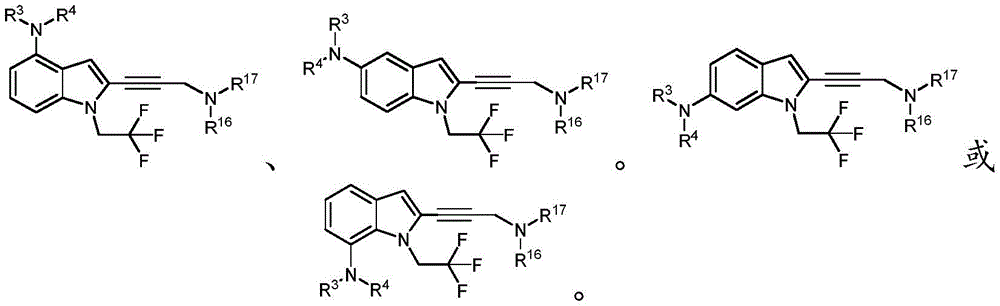
in some embodiments, each R is 16 And R 17 Independently an alkyl, alkenyl, aryl, heteroaryl, heterocyclyl or hydrogen. In some embodiments, R 16 Is aryl, and R 17 Is an alkyl group. In some embodiments, R 16 Is aryl, and R is 17 Is hydrogen. In some embodiments, R 16 Is heteroaryl, and R 17 Is an alkyl group. In some embodiments, R 16 Is heteroaryl, and R 17 Is hydrogen. In some embodiments, R 16 Is substituted heteroaryl, and R 17 Is hydrogen. In some embodiments, R 16 Is a substituted alkyl group, and R 17 Is hydrogen. In some embodiments, R 17 Is aryl, heteroaryl or heterocyclyl, each of which is independently substituted or unsubstituted with halogen, alkyl or hydroxy. In some embodiments, R 16 Is hydrogen, and R 17 Is aryl or heteroaryl, substituted or unsubstituted by halogen or alkyl. In some embodiments, R 16 Is alkyl, and R 17 Is heteroaryl substituted by halogen or alkyl. In some embodiments, R 16 Is hydrogen. In some embodiments, R 17 Is aryl, heteroaryl or heterocyclyl, each of which is independently substituted with alkyl or unsubstituted. In some embodiments, R 17 Is aryl or heteroaryl, each of which is independently substituted with alkyl, wherein alkyl isOptionally substituted with fluoro, chloro, bromo, iodo or cyano. In some embodiments, R 16 Is alkyl, alkenyl, aryl, heteroaryl, heterocyclyl or hydrogen, and R 17 Is aryl, heteroaryl or heterocyclyl. In some embodiments, R 16 Is hydrogen, and R 17 Is phenyl, indolyl, piperidinyl, imidazolyl, thiazolyl, morpholinyl, pyrrolyl or pyridinyl, each of which is substituted or unsubstituted. In some embodiments, R 16 Is hydrogen, and R 17 Is a substituted phenyl group. In some embodiments, R 16 Is hydrogen, and R 17 Is phenyl substituted with a sulfoxide group, a carboxyl group, an amide group, an amino group, an alkyl group, an alkoxy group, a hydroxyl group, a halo group, a cyano group, or a heterocyclic group, each of which is independently substituted or unsubstituted. In some embodiments, R 17 Is phenyl substituted by methoxy. In some embodiments, R 17 Is phenyl substituted with a substituted sulfoxide group. In some embodiments, R 17 Is phenyl substituted by a carboxyl group. In some embodiments, R 17 Is a substituted amide group. In some embodiments, R 17 Substituted by methoxy and sulfonamide.
In some embodiments, each R is independently selected from R, and R 3 And R 4 Independently unsubstituted or substituted alkyl. In some embodiments, R 3 Is hydrogen, and R 4 is-C (O) R 19 、-C(O)OR 19 Alkyl, alkenyl, alkynyl, aryl, heteroaryl, or heterocyclyl, each of which is independently substituted or unsubstituted. In some embodiments, R 3 Is hydrogen, and R 4 Is an alkyl, aryl, heteroaryl or heterocyclyl group, each of which is independently substituted or unsubstituted. In some embodiments, R 3 Is H, and R 4 Is a substituted heterocyclic group. In some embodiments, R 3 Is H, and R 4 Is substituted or unsubstituted C 4 -C 6 -a heterocyclic group. In some embodiments, R 3 Is H, and R 4 Is a substituted alkyl group. In some embodiments, R 3 Is H, and R 4 Is substituted C 1 -C 6 -an alkyl group. In some embodiments, R 3 Is H, and R 4 Is a substituted or unsubstituted cycloalkyl. In some embodiments, R 3 Is H, and R 4 Is substituted or unsubstituted C 4 -C 6 -a cycloalkyl group. In some embodiments, R 3 Is H, and R 4 Is C substituted by an amino group 4 -C 6 -a cycloalkyl group.
In some embodiments, the compound has the formula (la):

wherein:
-Q 1 is C-O, C-S, C-CR 14 R 15 、C=NR 14 Alkylene, alkenylene, or alkynylene, each independently substituted or unsubstituted; or is a bond;
-R 1 is-C (O) R 16 、-C(O)OR 16 、-C(O)NR 16 R 17 、-OR 16 、-SR 16 、-NR 16 R 17 、-NR 16 C(O)R 16 、-OC(O)R 16 、C=O、C=S、-CN、-SiR 16 R 17 R 18 Alkyl, alkenyl, alkynyl, aryl, heteroaryl, or heterocyclyl, each independently substituted or unsubstituted; or is hydrogen;
each R 3 And R 4 Independently is-C (O) R 19 、-C(O)OR 19 、-C(O)NR 19 R 20 、-SOR 19 、-SO 2 R 19 Alkyl, alkylene, alkenyl, alkenylene, alkynyl, aryl, heteroaryl, or heterocyclyl, each of which is independently substituted or unsubstituted; or is hydrogen, or R 3 And R 4 Together with R 3 And R 4 The bound nitrogen atoms together form a ring, wherein the ring is substituted or unsubstituted, or R 3 Is absent wherein R 3 And R 4 At least one of which is alkyl, alkylene, alkenyl, alkenylene, alkynyl, aryl, heteroaryl orHeterocyclyl, each of which is at least halo-substituted;
each Z 1 And Z 2 Independently is CR 28 、CR 29 Or N;
each R 2 、R 5 、R 6 、R 7 、R 8 、R 9 、R 10 、R 11 、R 12 、R 13 、R 14 、R 15 、R 16 、R 17 And R 18 Independently is-C (O) R 21 、-C(O)OR 21 、-C(O)NR 21 R 22 、-OR 21 、-SR 21 、-NR 21 R 22 、-NR 21 C(O)R 22 、-OC(O)R 21 Alkyl, alkenyl, alkynyl, aryl, heteroaryl, or heterocyclyl, each of which is independently substituted or unsubstituted; or is hydrogen or halogen;
each R 19 And R 20 Is C (O) R 23 、-C(O)OR 23 、-C(O)NR 23 R 24 、-OR 23 、-SR 23 、-NR 23 R 24 、-NR 23 C(O)R 24 、-OC(O)R 23 Alkyl, alkenyl, alkynyl, aryl, heteroaryl, or heterocyclyl, each of which is independently substituted or unsubstituted; or is hydrogen or halogen;
each R 21 And R 22 Independently an alkyl, alkenyl, alkynyl, aryl, heteroaryl, or heterocyclyl group, each of which is independently substituted or unsubstituted; or is hydrogen;
each R 23 And R 24 Independently is an alkyl, alkenyl, alkynyl, aryl, heteroaryl, or heterocyclyl group, each of which is independently substituted or unsubstituted; or is hydrogen; and is provided with
Each R 25 、R 26 、R 27 、R 28 And R 29 Independently hydrogen or a substituent selected from the group consisting of a hydroxyl group, a thiol group, a halogen, an amino group, a nitro group, a nitroso group, a cyano group, an azido group, a sulfoxide group, a sulfone group, a sulfonamide group, a carboxyl group, a formaldehyde group, an imine group, an alkyl group, a halo-alkane A radical group, an alkenyl group, a halo-alkenyl group, an alkynyl group, a halo-alkynyl group, an alkoxy group, an aryl group, an aryloxy group, an aralkyl group, an arylalkoxy group, a heterocyclyl group, an acyl group, an acyloxy group, a carbamate group, an amide group, an ureido group, an epoxy group, and an ester group.
Or a pharmaceutically acceptable salt thereof.
In some embodiments, Z 1 Is N. In some embodiments, Z 1 And Z 2 Is N. In some embodiments, each R is 25 And R 26 Independently a halogen. In some embodiments, R 25 Is composed of In some embodiments, R 25 Is a substituted sulfone group. In some embodiments, R 25 Is a sulfone group substituted with an alkyl group. In some embodiments, R 25 Is a methanesulfonyl group. In some embodiments, R 25 Is a sulfone group substituted with an amino group. In some embodiments, R 25 Is a sulfonamide. In some embodiments, R 25 Is a carboxyl group. In some embodiments, R 25 Is a methoxycarbonyl group.
In some embodiments, the compound has the formula (la):

wherein:
-R 2 is-C (O) R 21 、-C(O)OR 21 、-C(O)NR 21 R 22 、-OR 21 、-SR 21 、-NR 21 R 22 、-NR 21 C(O)R 22 、-OC(O)R 21 Alkyl, alkenyl, alkynyl, aryl, heteroaryl, or heterocyclyl, each independently substituted or unsubstituted; or is hydrogen or halogen;
Each R Q Independently is-C (O) R 21 、-C(O)OR 21 、-C(O)NR 21 R 22 、-OR 21 、-SR 21 、-NR 21 R 22 、-NR 21 C(O)R 22 、-OC(O)R 21 Alkyl, alkenyl, alkynyl, aryl, heteroaryl, or heterocyclyl, each independently substituted or unsubstituted;
-y is 0, 1, 2, 3 or 4;
each R 21 And R 22 Independently an alkyl, alkenyl, alkynyl, aryl, heteroaryl, or heterocyclyl group, each of which is independently substituted or unsubstituted; or is hydrogen; and is provided with
Each R 25 、R 26 、R 27 、R 28 And R 29 Independently hydrogen or a substituent selected from the group consisting of a hydroxyl group, a mercapto group, a halogen, an amino group, a nitro group, a nitroso group, a cyano group, an azido group, a sulfoxide group, a sulfone group, a sulfonamide group, a carboxyl group, a formaldehyde group, an imine group, an alkyl group, a halo-alkyl group, an alkenyl group, a halo-alkenyl group, an alkynyl group, a halo-alkynyl group, an alkoxy group, an aryl group, an aryloxy group, an aralkyl group, an arylalkoxy group, a heterocyclic group, an acyl group, an acyloxy group, a carbamate group, an amide group, a ureido group, an epoxy group, and an ester group.
Or a pharmaceutically acceptable salt thereof.
In some embodiments, the compound has the formula (la):
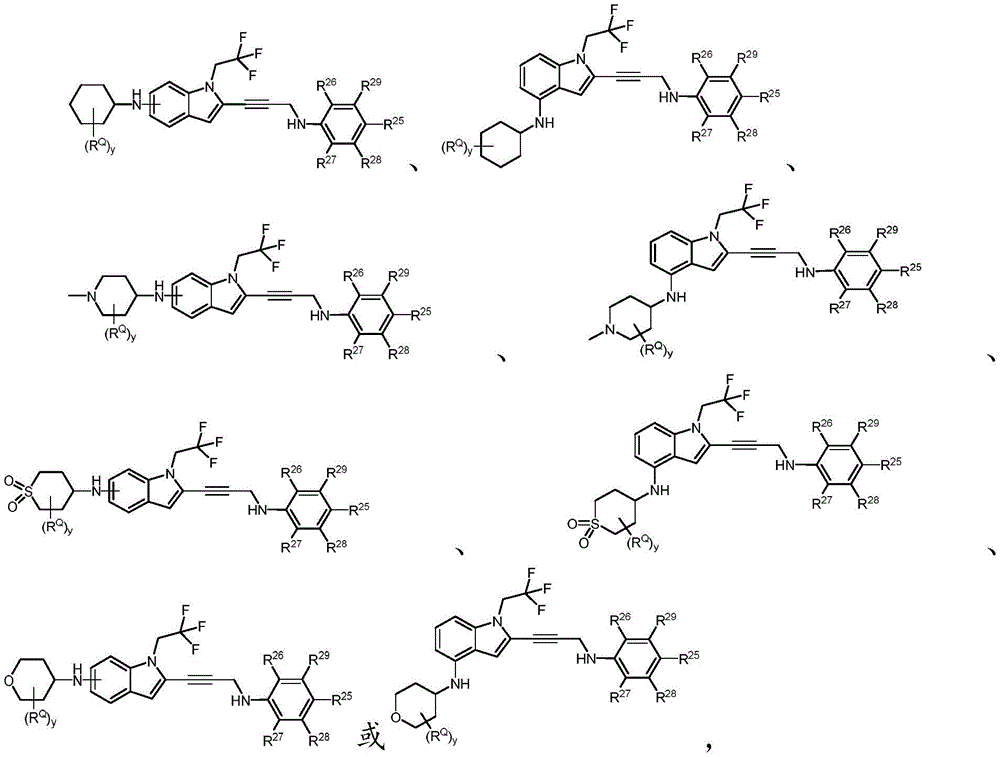
in some embodiments, R 25 Is a substituted sulfone group. In some embodiments, R 25 Is a sulfone group substituted with an alkyl group. In some embodiments, R 25 Is a methanesulfonyl group. In some embodiments, R 25 Is a sulfone group substituted with an amino group. In some embodiments, R 25 Is a sulfonamide. In some embodiments, R 25 Is a carboxyl groupA group. In some embodiments, R 25 Is a methoxycarbonyl group.
In some embodiments, the compound has the formula (la):
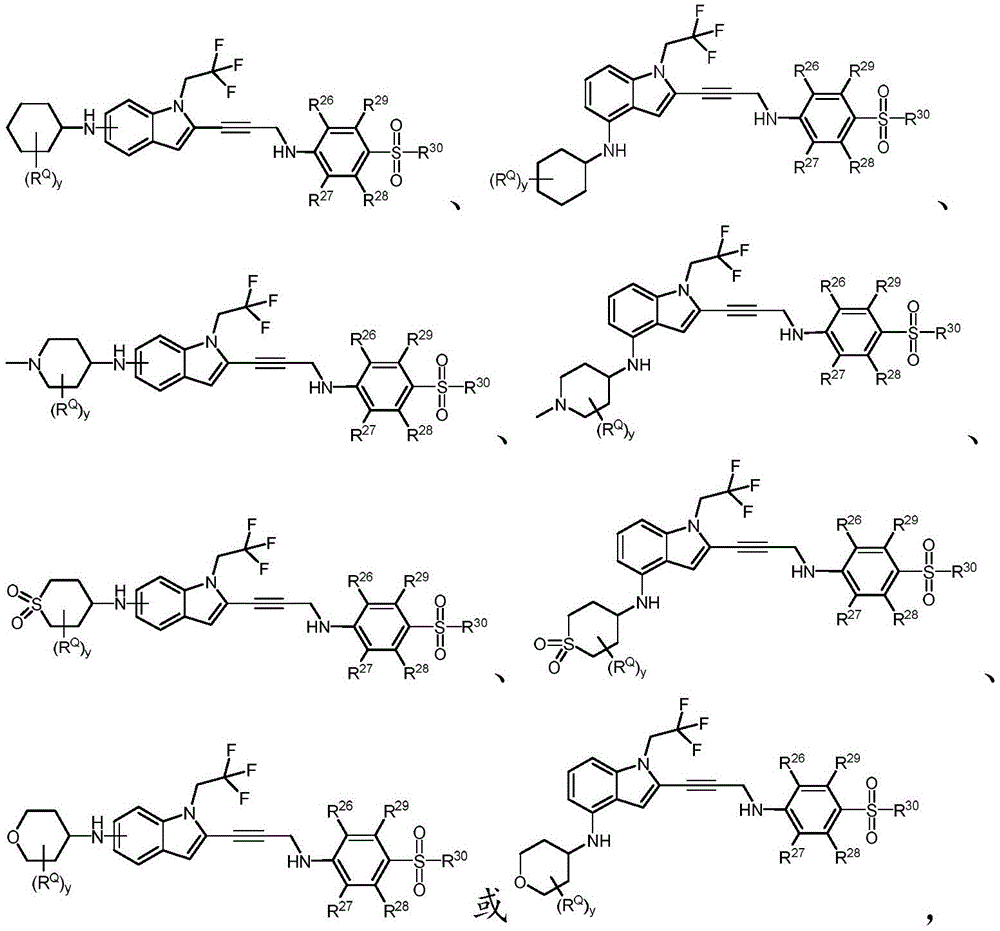
wherein:
each R Q Independently is-C (O) R 21 、-C(O)OR 21 、-C(O)NR 21 R 22 、-OR 21 、-SR 21 、-NR 21 R 22 、-NR 21 C(O)R 22 、-OC(O)R 21 Alkyl, alkenyl, alkynyl, aryl, heteroaryl, or heterocyclyl, each independently substituted or unsubstituted;
-y is 0, 1, 2, 3 or 4;
each R 21 And R 22 Independently is an alkyl, alkenyl, alkynyl, aryl, heteroaryl, or heterocyclyl group, each of which is independently substituted or unsubstituted; or is hydrogen;
each R 26 、R 27 、R 28 And R 29 Independently hydrogen or a substituent selected from the group consisting of a hydroxyl group, a mercapto group, a halogen, an amino group, a nitro group, a nitroso group, a cyano group, an azido group, a sulfoxide group, a sulfone group, a sulfonamide group, a carboxyl group, a formaldehyde group, an imine group, an alkyl group, a halo-alkyl group, an alkenyl group, a halo-alkenyl group, an alkynyl group, a halo-alkynyl group, an alkoxy group, an aryl group, an aryloxy group, an aralkyl group, an arylalkoxy group, a heterocyclic group, an acyl group, an acyloxy group, a carbamate group, an amide group, a ureido group, an epoxy group, and an ester group; and is
-R 30 Is an alkyl or amino group, each of which is substituted or unsubstituted, or a pharmaceutically acceptable salt thereof.
In some embodiments, R 30 Is methyl. In some embodiments, R 30 Is NH 2 . In thatIn some embodiments, R 30 Is NHMe. In some embodiments, R 30 Is NMe 2 。
In some embodiments, the compound has the formula (la):

wherein R is 30 Are alkyl or amino groups, each of which is unsubstituted or substituted. In some embodiments, R 30 Is methyl.
Non-limiting examples of compounds of the present disclosure include the following:

or a pharmaceutically acceptable salt thereof.
Non-limiting examples of compounds of the present disclosure include the following:

or a pharmaceutically acceptable salt thereof.
Non-limiting examples of compounds of the present disclosure include the following:

or a pharmaceutically acceptable salt thereof.
Non-limiting examples of compounds of the present disclosure include the following:

or a pharmaceutically acceptable salt thereof.
Non-limiting examples of compounds of the present disclosure include the following:
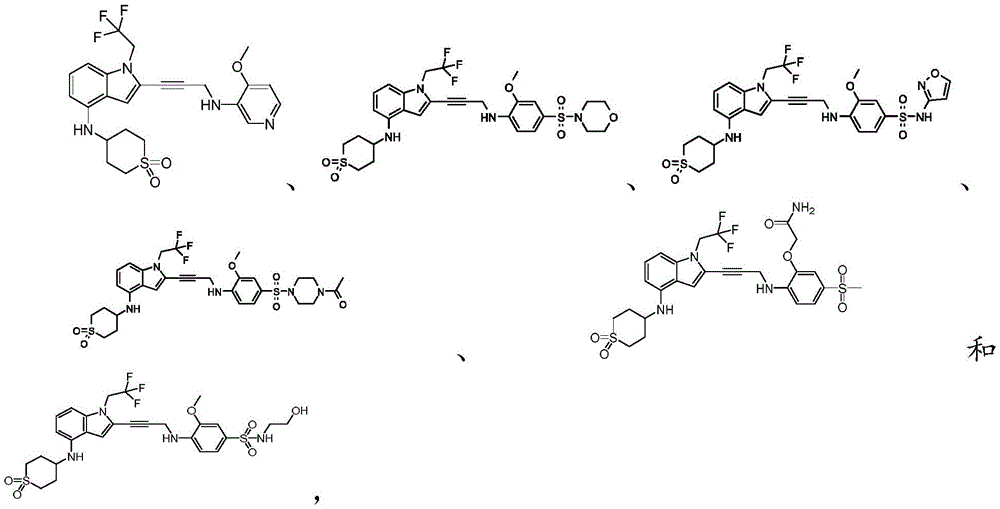
or a pharmaceutically acceptable salt thereof.
Non-limiting examples of compounds of the present disclosure include the following:

or a pharmaceutically acceptable salt thereof.
Non-limiting examples of compounds of the present disclosure include the following:
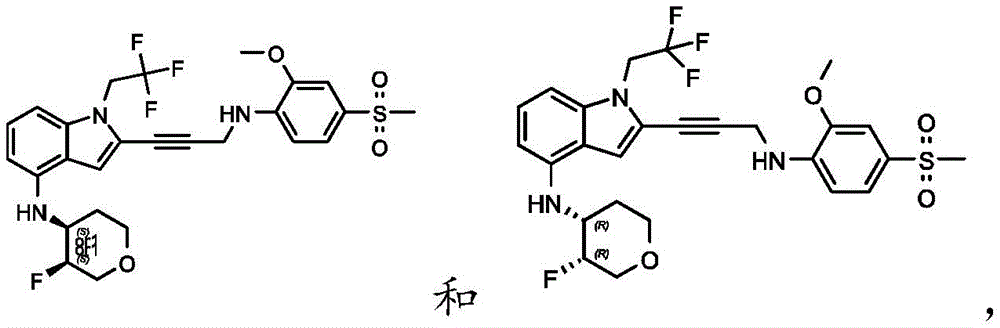
Or a pharmaceutically acceptable salt thereof.
The compounds herein may include all stereoisomers, enantiomers, diastereomers, mixtures, racemates, atropisomers and tautomers thereof.
Non-limiting examples of optional substituents include hydroxyl groups, mercapto groups, halogens, amino groups, nitro groups, nitroso groups, cyano groups, azido groups, sulfoxide groups, sulfone groups, sulfonamide groups, carboxyl groups, formaldehyde groups, imine groups, alkyl groups, halo-alkyl groups, alkenyl groups, halo-alkenyl groups, alkynyl groups, halo-alkynyl groups, alkoxy groups, aryl groups, aryloxy groups, aralkyl groups, arylalkoxy groups, heterocyclyl groups, acyl groups, acyloxy groups, carbamate groups, amide groups, ureido groups, epoxy groups, and ester groups.
Non-limiting examples of alkyl and alkylene groups include straight chain, branched chain, and cyclic alkyl and alkylene groups. The alkyl or alkylene group may be, for example, C 1 、C 2 、C 3 、C 4 、C 5 、C 6 、C 7 、C 8 、C 9 、C 10 、C 11 、C 12 、C 13 、C 14 、C 15 、C 16 、C 17 、C 18 、C 19 、C 20 、C 21 、C 22 、C 23 、C 24 、C 25 、C 26 、C 27 、C 28 、C 29 、C 30 、C 31 、C 32 、C 33 、C 34 、C 35 、C 36 、C 37 、C 38 、C 39 、C 40 、C 41 、C 42 、C 43 、C 44 、C 45 、C 46 、C 47 、C 48 、C 49 Or C 50 Groups, which are substituted or unsubstituted.
Non-limiting examples of straight chain alkyl groups include methyl, ethyl, propyl, butyl, pentyl, hexyl, heptyl, octyl, nonyl, and decyl.
Branched alkyl groups include any straight chain alkyl group substituted with any number of alkyl groups. Non-limiting examples of branched alkyl groups include isopropyl, isobutyl, sec-butyl, and tert-butyl.
Non-limiting examples of substituted alkyl groups include hydroxymethyl, chloromethyl, trifluoromethyl, aminomethyl, 1-chloroethyl, 2-hydroxyethyl, 1, 2-difluoroethyl and 3-carboxypropyl.
Non-limiting examples of cyclic alkyl groups include cyclopropyl, cyclobutyl, cyclopentyl, cyclohexyl, cycloheptyl, and cyclooctyl groups. Cyclic alkyl groups also include fused-, bridged-, and spiro-bicyclic, as well as higher fused, bridged, and spiro ring systems. The cyclic alkyl group may be substituted with any number of linear, branched, or cyclic alkyl groups. Non-limiting examples of cyclic alkyl groups include cyclopropyl, 2-methyl-cycloprop-1-yl, cycloprop-2-en-1-yl, cyclobutyl, 2, 3-dihydroxycyclobut-1-yl, cyclobut-2-en-1-yl, cyclopentyl, cyclopent-2-en-1-yl, cyclopent-2, 4-dien-1-yl, cyclohexyl, cyclohex-2-en-1-yl, cycloheptyl, cyclooctyl, 2, 5-dimethylcyclopenten-1-yl, 3, 5-dichlorocyclohex-1-yl, 4-hydroxycyclohex-1-yl, 3, 5-trimethylcyclohex-1-yl, octahydropentalenyl, octahydrocyclopentadien-1-yl, octahydro-1H-indenyl, 3a,4,5,6,7,7 a-hexahydro-3H-inden-4-yl, decahydroazulenyl, bicyclo [2.1.1] hexyl, bicyclo [2.2.1] heptyl, bicyclo [3.1.1] heptyl, 1, 3-dimethyl [2.2.1] hept-2-yl, bicyclo [2.2.2] octyl and bicyclo [3.3.3] undecyl.
Non-limiting examples of alkenyl and alkenylene groups include straight chain, branched chain, and cyclic alkenyl groups. One or more alkenes of an alkenyl group may be, for example, E-, Z-, cis-, trans-, terminal-, or exo-methyl ene (methylene). The alkenyl or alkenylene group may be, for example, C 2 、C 3 、C 4 、C 5 、C 6 、C 7 、C 8 、C 9 、C 10 、C 11 、C 12 、C 13 、C 14 、C 15 、C 16 、C 17 、C 18 、C 19 、C 20 、C 21 、C 22 、C 23 、C 24 、C 25 、C 26 、C 27 、C 28 、C 29 、C 30 、C 31 、C 32 、C 33 、C 34 、C 35 、C 36 、C 37 、C 38 、C 39 、C 40 、C 41 、C 42 、C 43 、C 44 、C 45 、C 46 、C 47 、C 48 、C 49 Or C 50 Groups, which are substituted or unsubstituted. Non-limiting examples of alkenyl and alkenylene groups include ethenyl, prop-1-en-1-yl, isopropenyl, but-1-en-4-yl; 2-chloroethenyl, 4-hydroxybuten-1-yl, 7-hydroxy-7-methyloct-4-en-2-yl and 7-hydroxy-7-methyloct-3, 5-dien-2-yl.
Non-limiting examples of alkynyl or alkynylene groups include straight chain alkynyl, branched chain alkynyl, and cyclic alkynyl groups. The triple bond of the alkynyl or alkynylene group may be internal or terminal. The alkynyl or alkynylene group may be, for example, C 2 、C 3 、C 4 、C 5 、C 6 、C 7 、C 8 、C 9 、C 10 、C 11 、C 12 、C 13 、C 14 、C 15 、C 16 、C 17 、C 18 、C 19 、C 20 、C 21 、C 22 、C 23 、C 24 、C 25 、C 26 、C 27 、C 28 、C 29 、C 30 、C 31 、C 32 、C 33 、C 34 、C 35 、C 36 、C 37 、C 38 、C 39 、C 40 、C 41 、C 42 、C 43 、C 44 、C 45 、C 46 、C 47 、C 48 、C 49 Or C 50 Groups, which are substituted or unsubstituted. Non-limiting examples of alkynyl or alkynylene groups include ethynyl, prop-2-yn-1-yl, prop-1-yn-1-yl, and 2-methyl-hex-4-yn-1-yl; 5-hydroxy-5-methylhexan-3-yn-1-yl, 6-hydroxy-6-methylhept-3-yn-2-yl and 5-hydroxy-5-ethylhept-3-yn-1-yl.
A halo-alkyl group may be any alkyl group substituted with any number of halogen atoms, such as fluorine, chlorine, bromine, and iodine atoms. A halo-alkenyl group may be any alkenyl group substituted with any number of halogen atoms. A halo-alkynyl group can be any alkynyl group substituted with any number of halogen atoms.
An alkoxy group may be, for example, an oxygen atom substituted with any alkyl, alkenyl, or alkynyl group. The ether or ether group comprises an alkoxy group. Non-limiting examples of alkoxy groups include methoxy, ethoxy, propoxy, isopropoxy, and isobutoxy.
The aryl group may be heterocyclic or non-heterocyclic. The aryl group may be monocyclic or polycyclic. The aryl group can be substituted with any number of substituents described herein, for example, hydrocarbyl groups, alkyl groups, alkoxy groups, and halogen atoms. Non-limiting examples of aryl groups include phenyl, toluyl, naphthyl, pyrrolyl, pyridyl, imidazolyl, thienyl and furyl. Non-limiting examples of substituted aryl groups include 3, 4-dimethylphenyl, 4-tert-butylphenyl, 4-cyclopropylphenyl, 4-diethylaminophenyl, 4- (trifluoromethyl) phenyl, 4- (difluoromethoxy) -phenyl, 4- (trifluoromethoxy) phenyl, 3-chlorophenyl, 4-chlorophenyl, 3, 4-dichlorophenyl, 2-fluorophenyl, 2-chlorophenyl, 2-iodophenyl, 3-iodophenyl, 4-iodophenyl, 2-methylphenyl, 3-fluorophenyl, 3-methylphenyl, 3-methoxyphenyl, 4-fluorophenyl, 4-methylphenyl, 4-methoxyphenyl, 2, 3-difluorophenyl, 3, 4-difluorophenyl, 3, 5-difluorophenyl group, 2, 3-dichlorophenyl group, 3, 4-dichlorophenyl group, 3, 5-dichlorophenyl group, 2-hydroxyphenyl group, 3-hydroxyphenyl group, 4-hydroxyphenyl group, 2-methoxyphenyl group, 3-methoxyphenyl group, 4-methoxyphenyl group, 2, 3-dimethoxyphenyl group, 3, 4-dimethoxyphenyl group, 3, 5-dimethoxyphenyl group, 2, 4-difluorophenyl group, 2, 5-difluorophenyl group, 2, 6-difluorophenyl group, 2,3, 4-trifluorophenyl group, 2,3, 5-trifluorophenyl group, 2,3, 6-trifluorophenyl group, 2,4, 5-trifluorophenyl group, 2,4, 6-trifluorophenyl group, 2, 4-dichlorophenyl group, 2, 5-dichlorophenyl group, 2, 6-dichlorophenyl group, 3, 4-dichlorophenyl group, 2,3, 4-trichlorophenyl group, 2,3, 5-trichlorophenyl group, 2,3, 6-trichlorophenyl group, 2,4, 5-trichlorophenyl group, 3,4, 5-trichlorophenyl group, 2,4, 6-trichlorophenyl group, 2, 3-dimethylphenyl group, 2, 4-dimethylphenyl group, 2, 5-dimethylphenyl group, 2, 6-dimethylphenyl group, 2,3, 4-trimethylphenyl group, 2,3, 5-trimethylphenyl group, 2,3, 6-trimethylphenyl group, 2,4, 5-trimethylphenyl group, 2,4, 6-trimethylphenyl group, 2-ethylphenyl group, 3-ethylphenyl group, 4-ethylphenyl group, 2, 3-diethylphenyl group, 2, 4-diethylphenyl group, 2, 5-diethylphenyl group, 2, 6-diethylphenyl group, 3, 4-diethylphenyl group, 2,3, 4-triethylphenyl group, 2,3, 5-triethylphenyl group, 2,3, 6-triethylphenyl group, 2,4, 5-triethylphenyl group, 2,4, 6-triethylphenyl group, 2-isopropylphenyl group, 3-isopropylphenyl group and 4-isopropylphenyl group.
Non-limiting examples of substituted aryl groups include 2-aminophenyl, 2- (N-methylamino) phenyl, 2- (N, N-dimethylamino) phenyl, 2- (N-ethylamino) phenyl, 2- (N, N-diethylamino) phenyl, 3-aminophenyl, 3- (N-methylamino) phenyl, 3- (N, N-dimethylamino) phenyl, 3- (N-ethylamino) phenyl, 3- (N, N-diethylamino) phenyl, 4-aminophenyl, 4- (N-methylamino) phenyl, 4- (N, N-dimethylamino) phenyl, 4- (N-ethylamino) phenyl, and 4- (N, N-diethylamino) phenyl.
The heterocyclic ring may be any ring containing a ring atom other than carbon, for example, N, O, S, P, Si, B, or any other heteroatom. The heterocyclic ring may be substituted with any number of substituents, such as alkyl groups and halogen atoms. Heterocycles can be aromatic (heteroaryl) or non-aromatic. Non-limiting examples of heterocycles include pyrrole, pyrrolidine, pyridine, piperidine, succinamide, maleimide, morpholine, imidazole, thiophene, furan, tetrahydrofuran, pyran, and tetrahydropyran.
Non-limiting examples of heterocycles include: a heterocyclic unit having a monocyclic ring containing one or more heteroatoms, non-limiting examples of which include bisaziridinyl, aziridinyl, azetidinyl, pyrazolidinyl, imidazolidinyl, oxazolidinyl, isoxazolinyl, thiazolidinyl, isothiazolinyl, oxathiazolidinonyl, oxazolidinonyl, hydantoinyl, tetrahydrofuranyl, pyrrolidinyl, morpholinyl, piperazinyl, piperidinyl, dihydropyranyl, tetrahydropyranyl, piperidin-2-onyl, 2,3,4, 5-tetrahydro-1H-azepinyl, 2, 3-dihydro-1H-indole, and 1,2,3, 4-tetrahydroquinoline; and ii) a heterocyclic unit having two or more rings, wherein one ring is a heterocyclic ring, non-limiting examples of which include hexahydro-1H-pyrrolizinyl, 3a,4,5,6,7,7 a-hexahydro-1H-benzo [ d ] imidazolyl, 3a,4,5,6,7,7 a-hexahydro-1H-indolyl, 1,2,3, 4-tetrahydroquinolyl, and decahydro-1H-cyclooctatetraeno [ b ] pyrrolyl.
Non-limiting examples of heteroaryl groups include: i) heteroaryl rings containing a monocyclic ring, non-limiting examples of which include 1,2,3, 4-tetrazolyl, [1,2,3] triazolyl, [1,2,4] triazolyl, triazinyl, thiazolyl, 1H-imidazolyl, oxazolyl, isoxazolyl, isothiazolyl, furyl, thienyl, pyrimidinyl, 2-phenylpyrimidinyl, pyridyl, 3-methylpyridyl, and 4-dimethylaminopyridyl; and ii) heteroaryl rings containing 2 or more fused rings, wherein one fused ring is a heteroaryl ring, non-limiting examples of which include: 7H-purinyl, 9H-purinyl, 6-amino-9H-purinyl, 5H-pyrrolo [3,2-d ] pyrimidinyl, 7H-pyrrolo [2,3-d ] pyrimidinyl, pyrido [2,3-d ] pyrimidinyl, 4,5,6, 7-tetrahydro-1-H-indolyl, quinoxalinyl, quinazolinyl, quinolinyl, 8-hydroxy-quinolinyl, and isoquinolinyl.
Any of the compounds herein can be purified. The compounds herein can be at least 1% pure, at least 2% pure, at least 3% pure, at least 4% pure, at least 5% pure, at least 6% pure, at least 7% pure, at least 8% pure, at least 9% pure, at least 10% pure, at least 11% pure, at least 12% pure, at least 13% pure, at least 14% pure, at least 15% pure, at least 16% pure, at least 17% pure, at least 18% pure, at least 19% pure, at least 20% pure, at least 21% pure, at least 22% pure, at least 23% pure, at least 24% pure, at least 25% pure, at least 26% pure, at least 27% pure, at least 28% pure, at least 29% pure, at least 30% pure, at least 31% pure, at least 32% pure, at least 33% pure, at least 34% pure, at least 35% pure, at least 36% pure, at least 14% pure, at least 15% pure, at least, At least 37% purity, at least 38% purity, at least 39% purity, at least 40% purity, at least 41% purity, at least 42% purity, at least 43% purity, at least 44% purity, at least 45% purity, at least 46% purity, at least 47% purity, at least 48% purity, at least 49% purity, at least 50% purity, at least 51% purity, at least 52% purity, at least 53% purity, at least 54% purity, at least 55% purity, at least 56% purity, at least 57% purity, at least 58% purity, at least 59% purity, at least 60% purity, at least 61% purity, at least 62% purity, at least 63% purity, at least 64% purity, at least 65% purity, at least 66% purity, at least 67% purity, at least 68% purity, at least 69% purity, at least 70% purity, at least 71% purity, at least 72% purity, at least 73% purity, at least 64% purity, at least, At least 74% purity, at least 75% purity, at least 76% purity, at least 77% purity, at least 78% purity, at least 79% purity, at least 80% purity, at least 81% purity, at least 82% purity, at least 83% purity, at least 84% purity, at least 85% purity, at least 86% purity, at least 87% purity, at least 88% purity, at least 89% purity, at least 90% purity, at least 91% purity, at least 92% purity, at least 93% purity, at least 94% purity, at least 95% purity, at least 96% purity, at least 97% purity, at least 98% purity, at least 99% purity, at least 99.1% purity, at least 99.2% purity, at least 99.3% purity, at least 99.4% purity, at least 99.5% purity, at least 99.6% purity, at least 99.7% purity, at least 99.8% purity, or at least 99.9% purity.
In some embodiments, the compounds of the present disclosure do not include a compound of table 1, or a pharmaceutically acceptable salt thereof.
TABLE 1 list of compounds
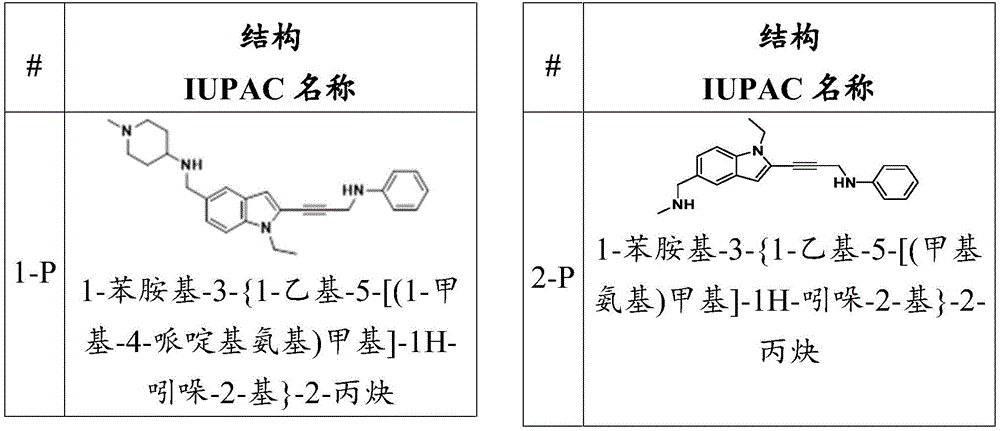
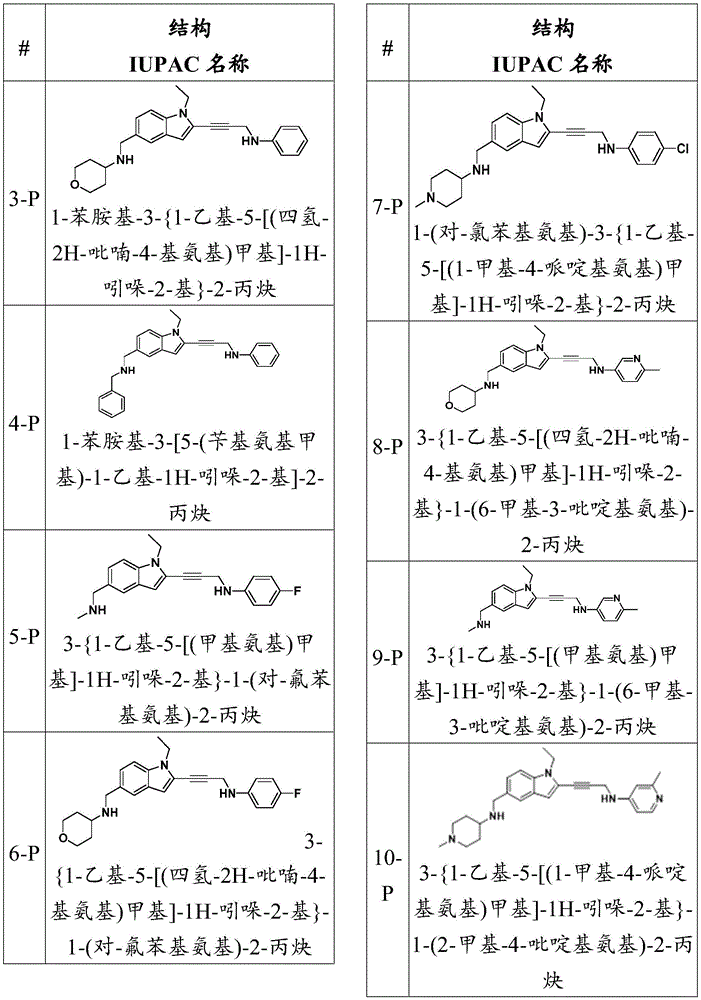
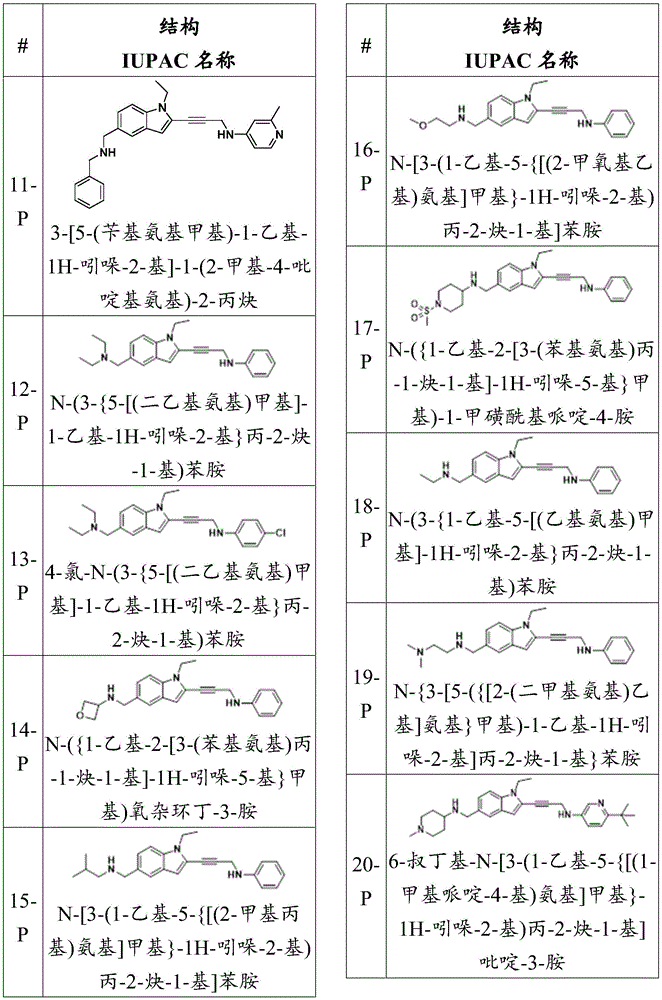

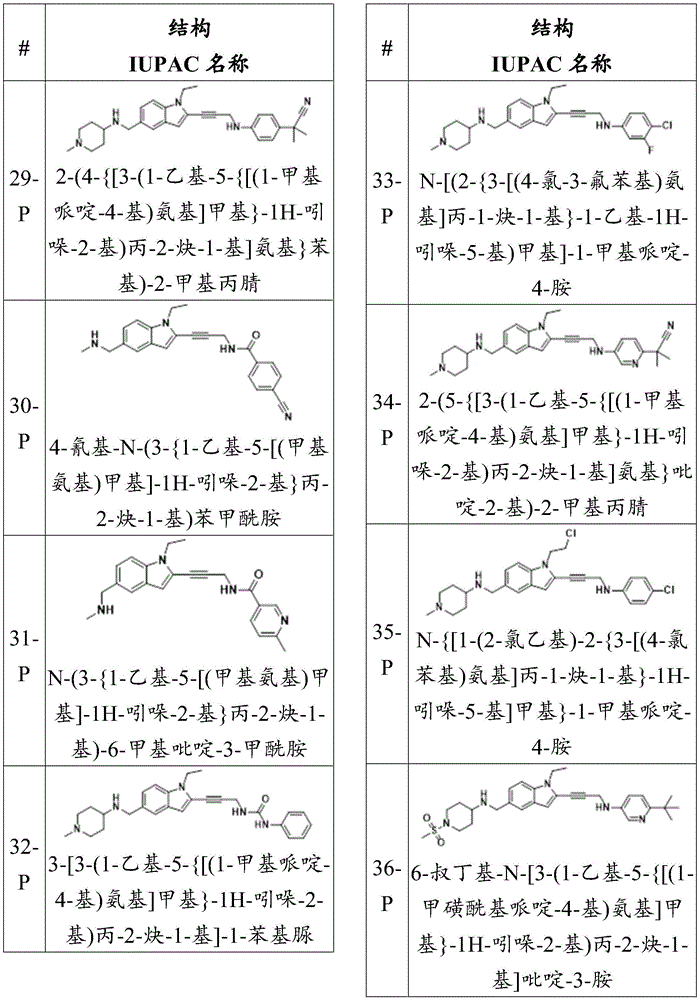
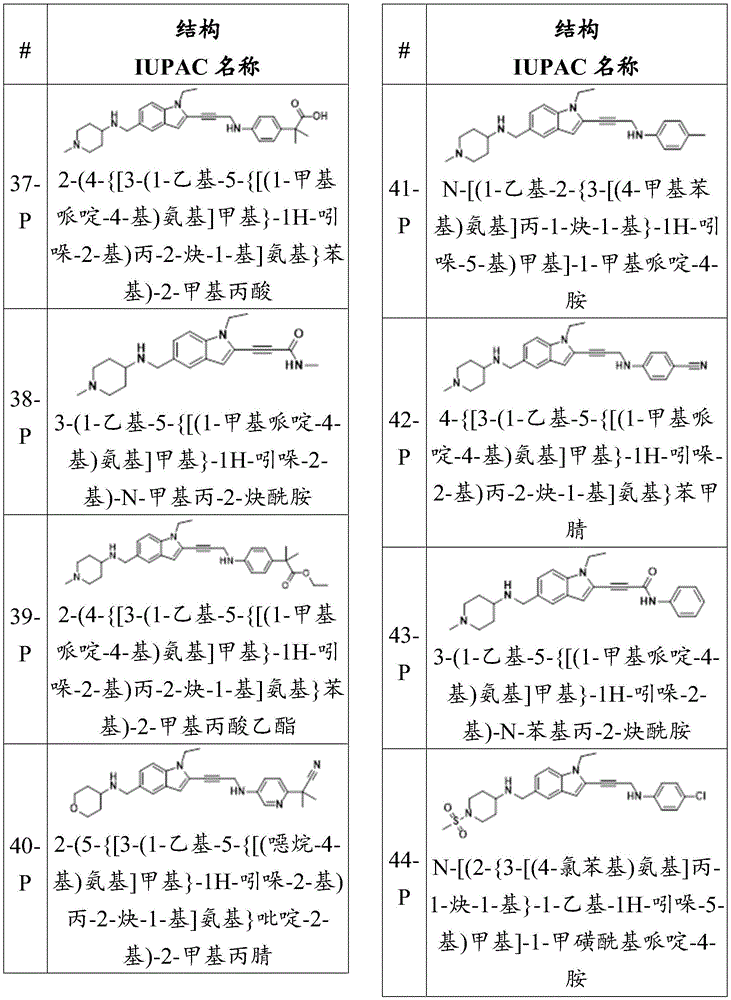

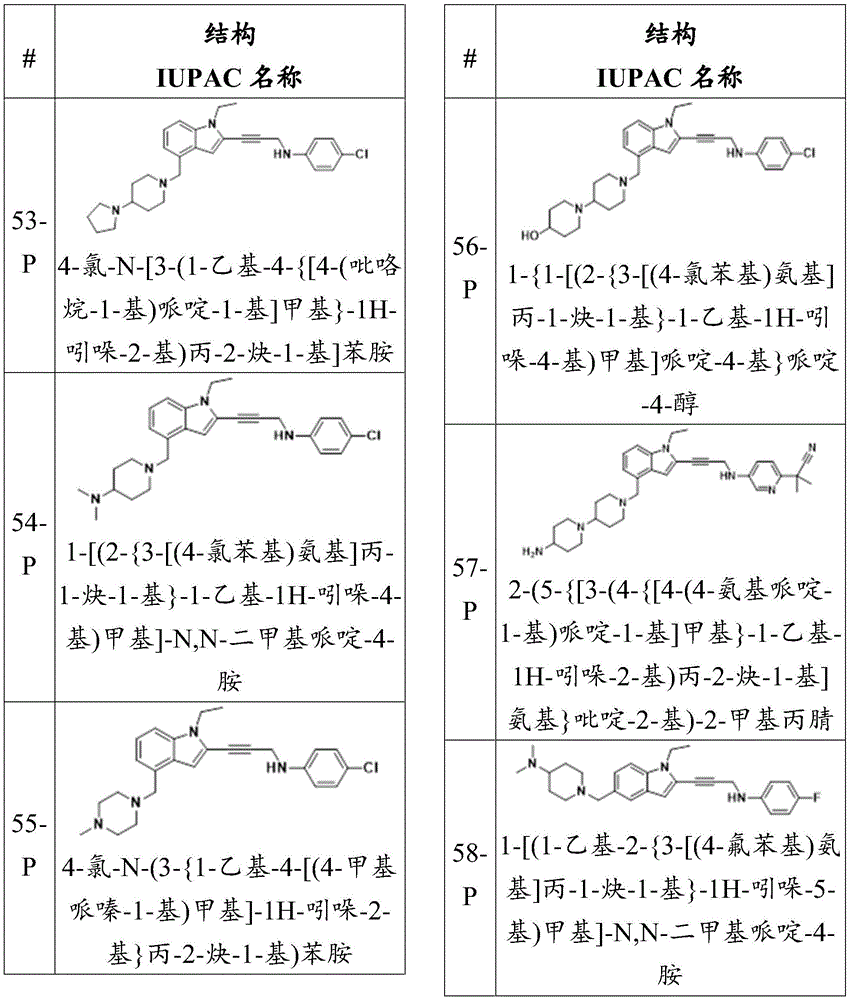


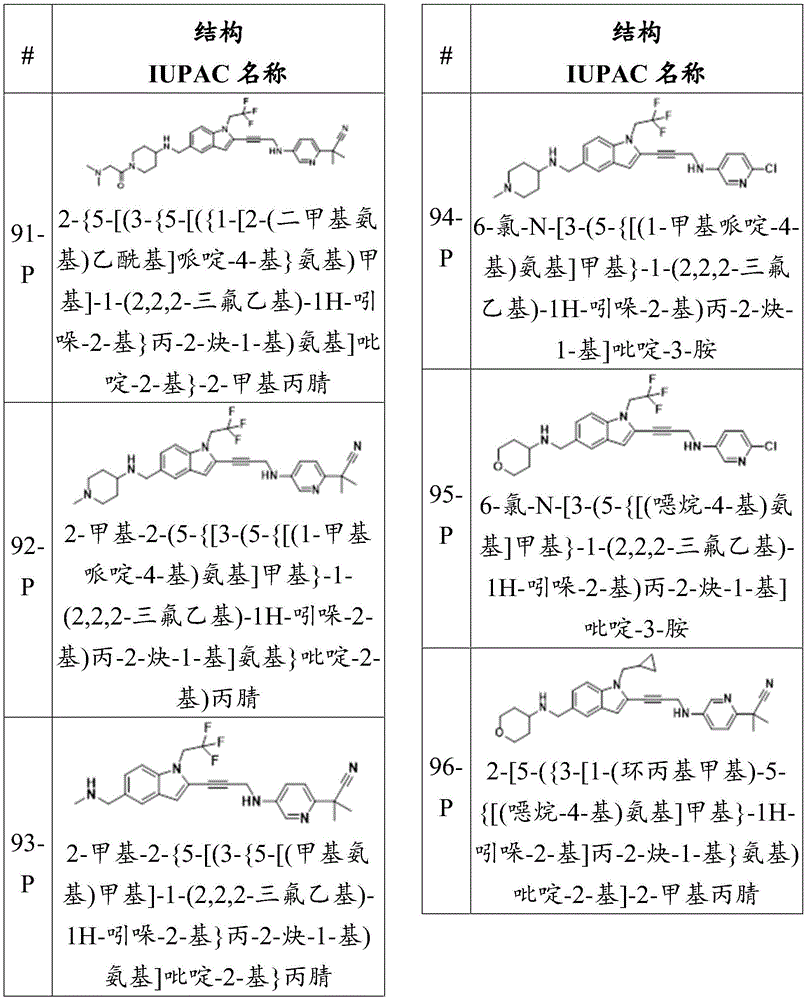

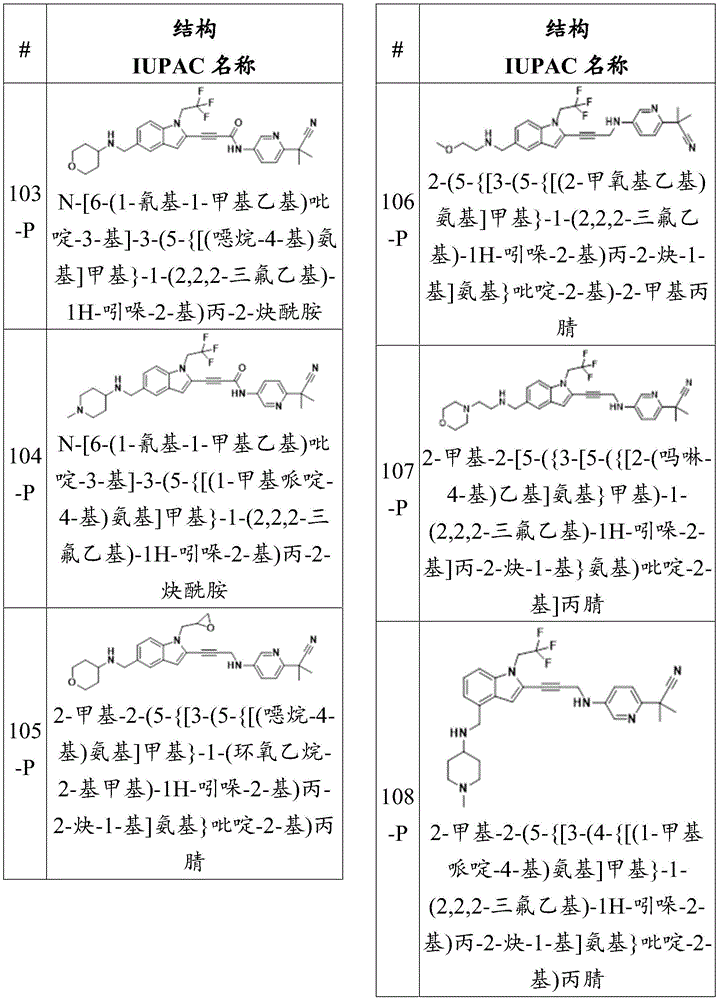


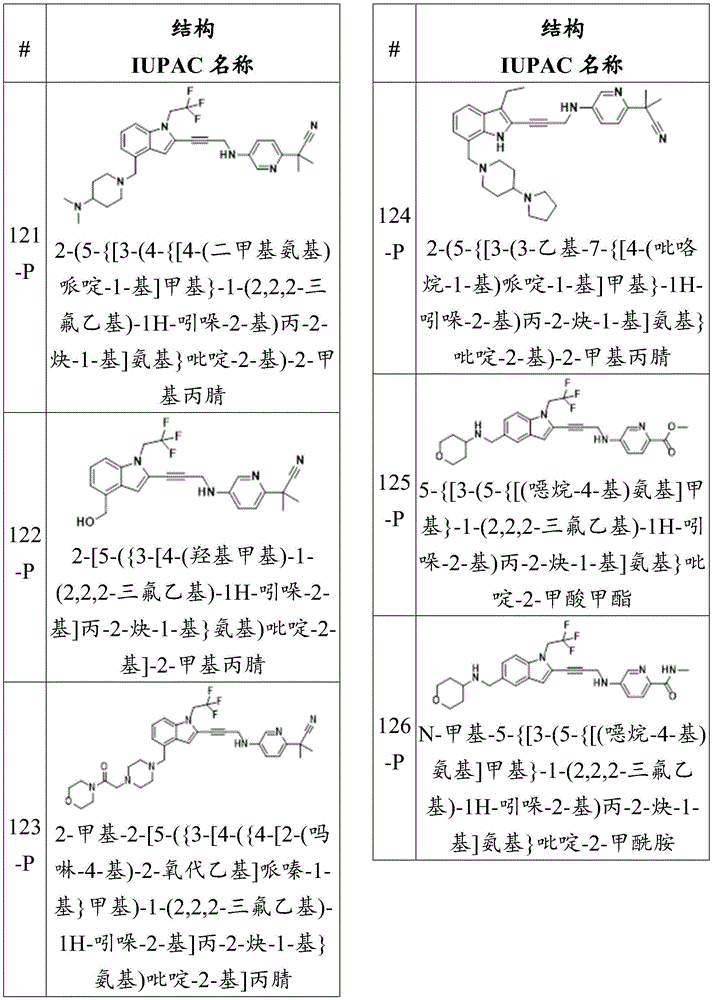

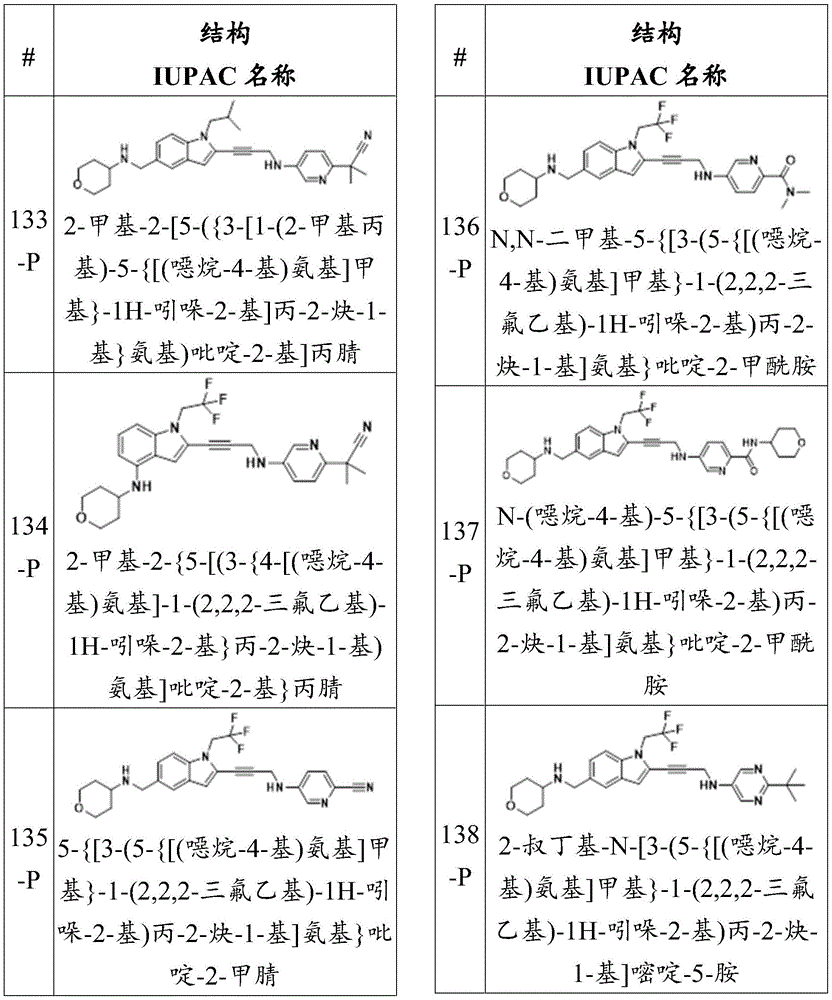


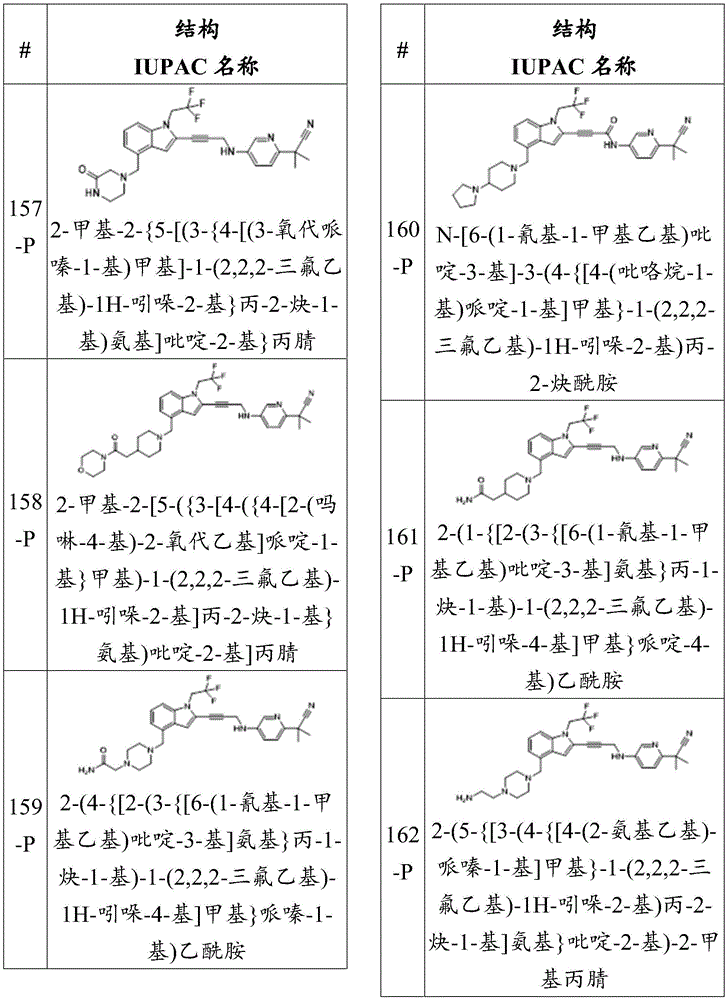


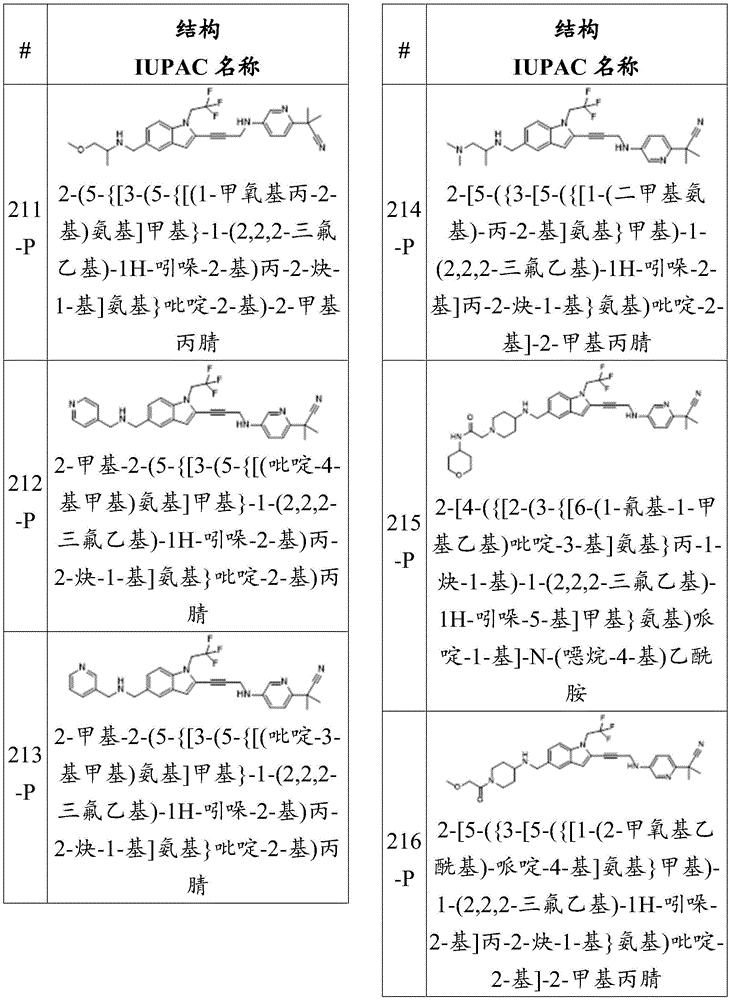


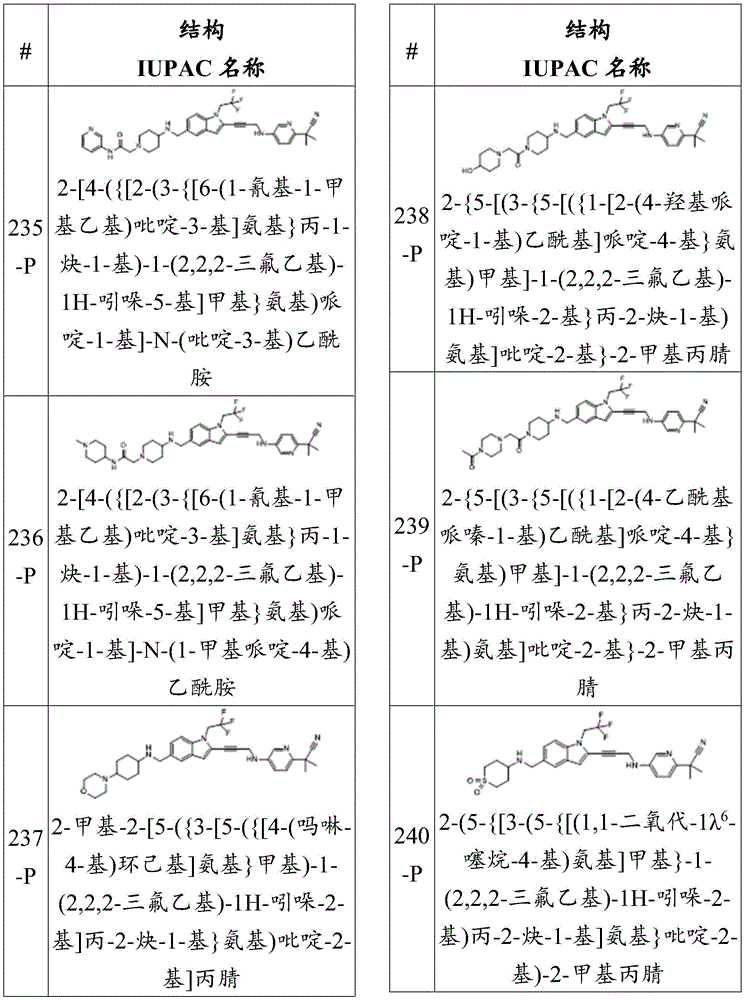

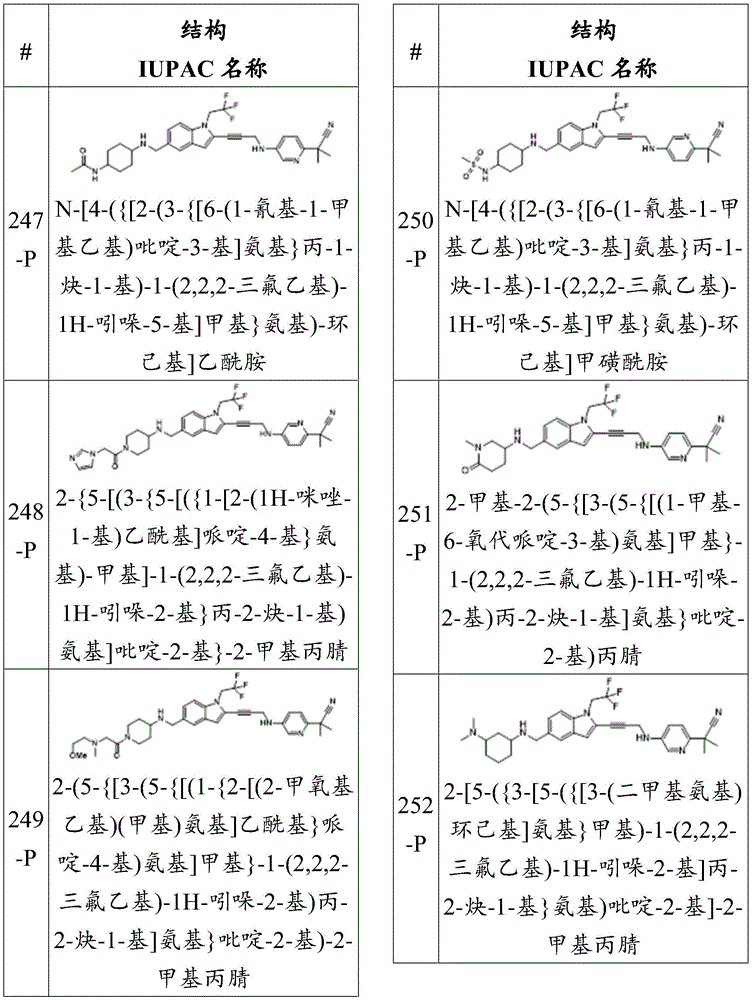


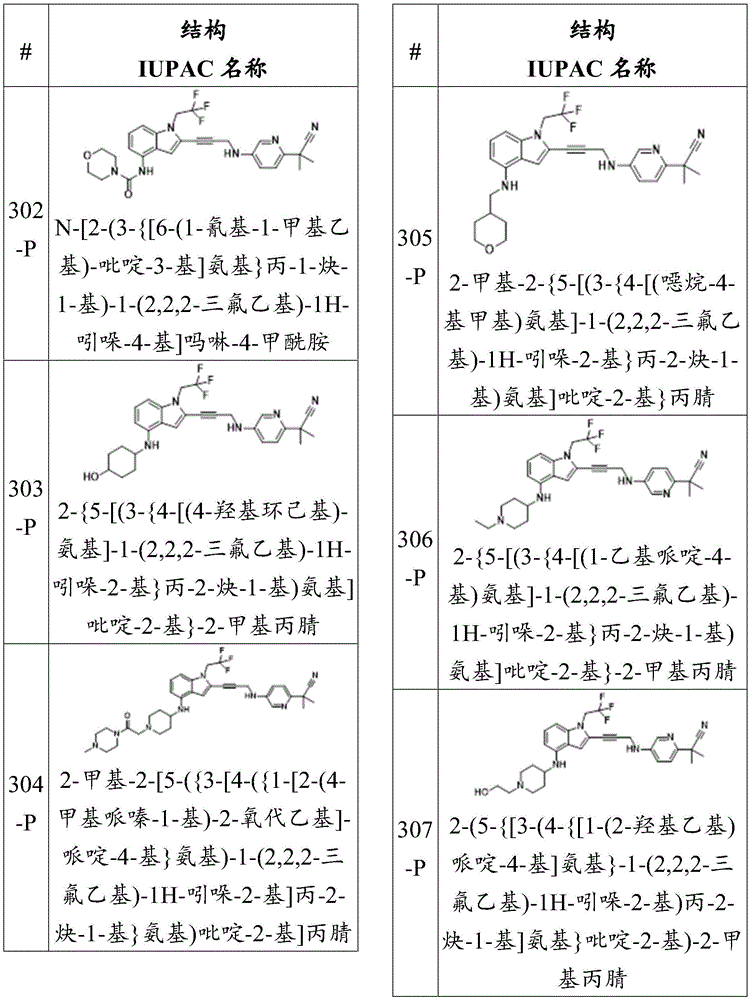


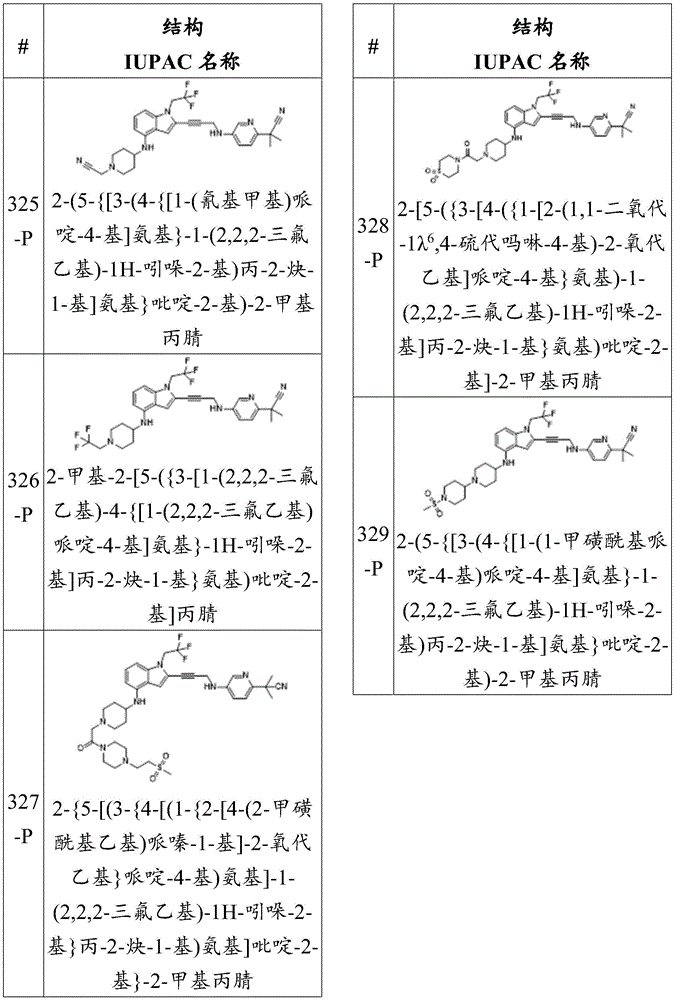


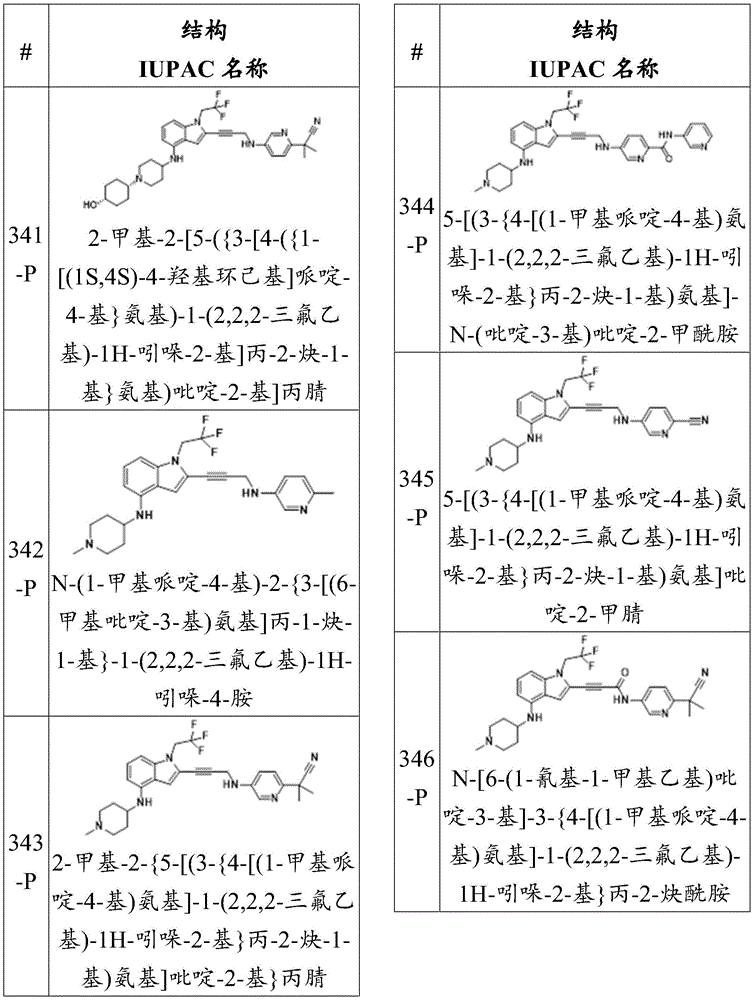


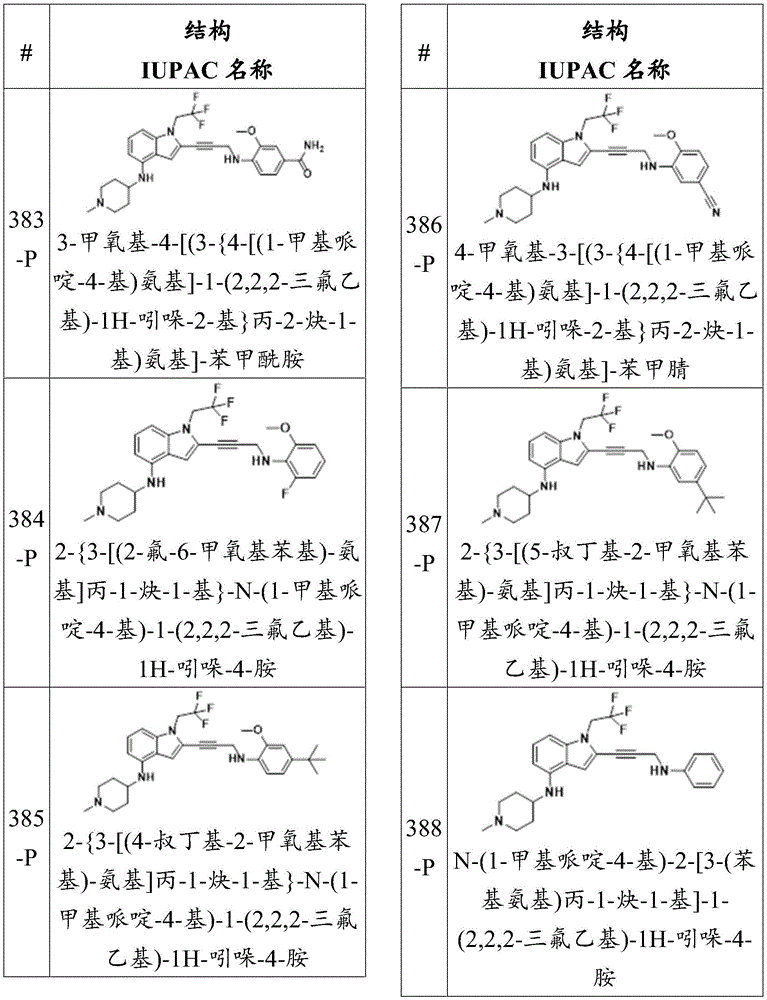
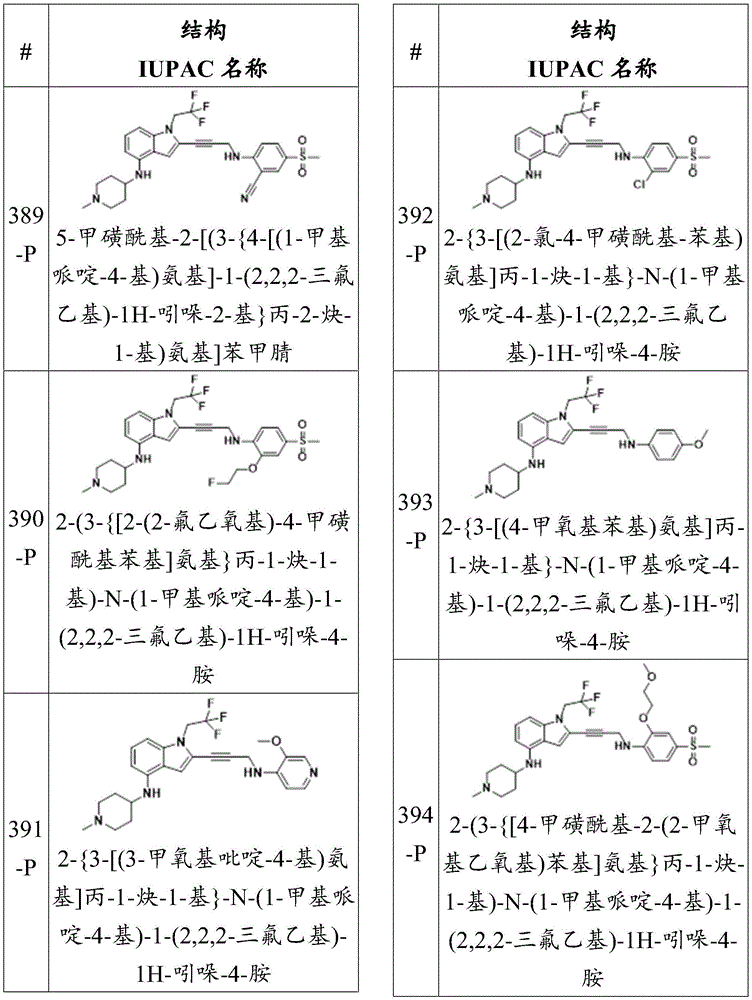

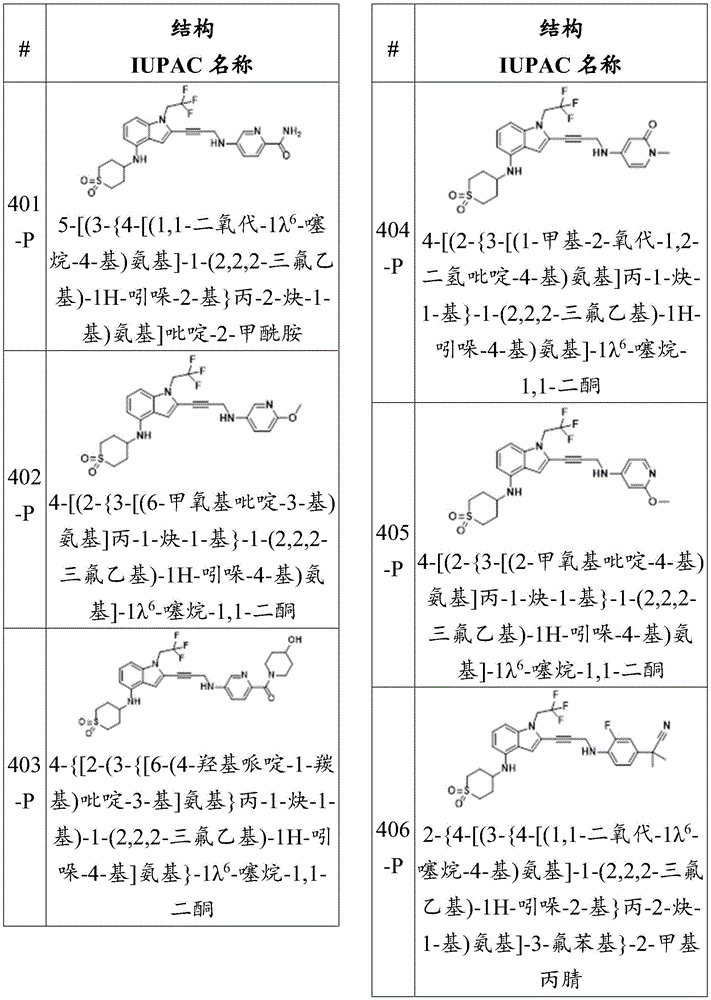


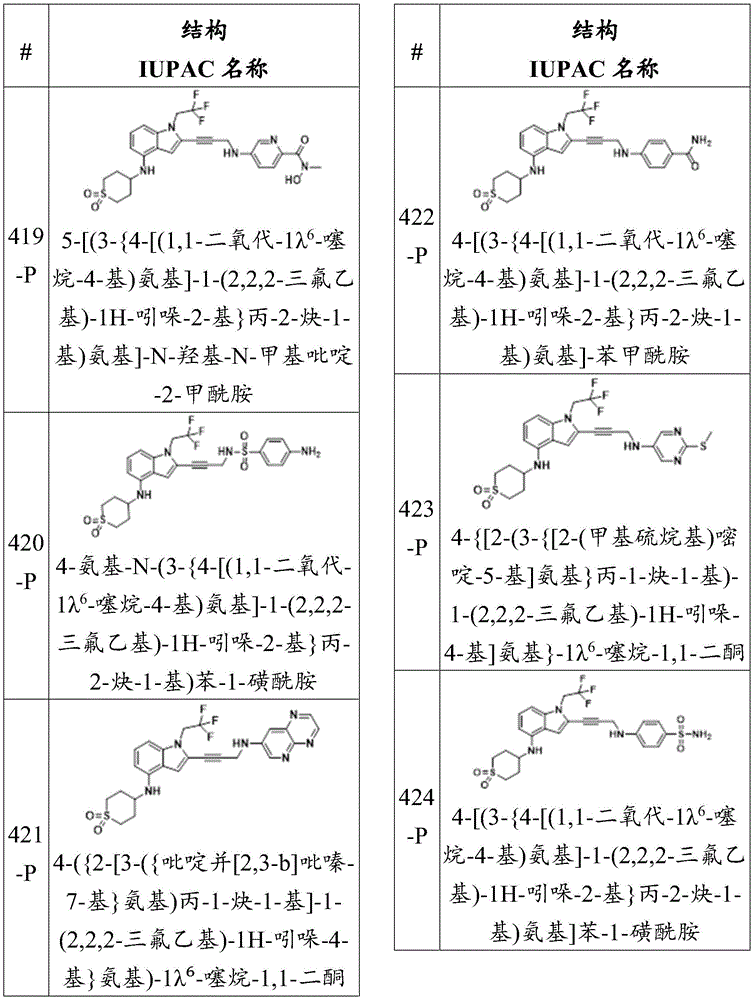


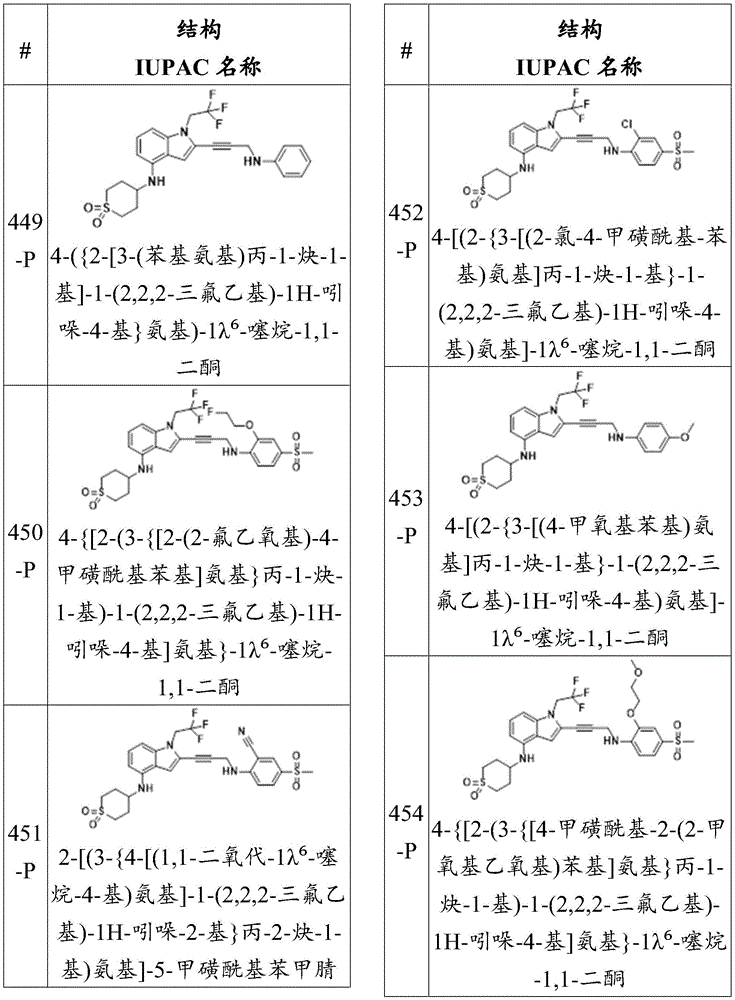
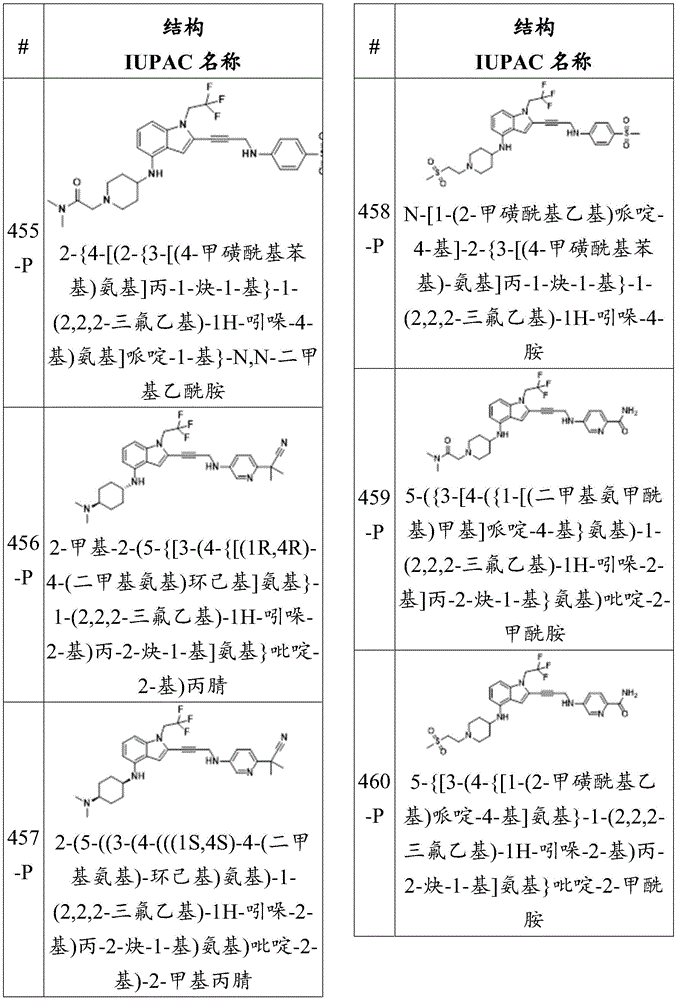
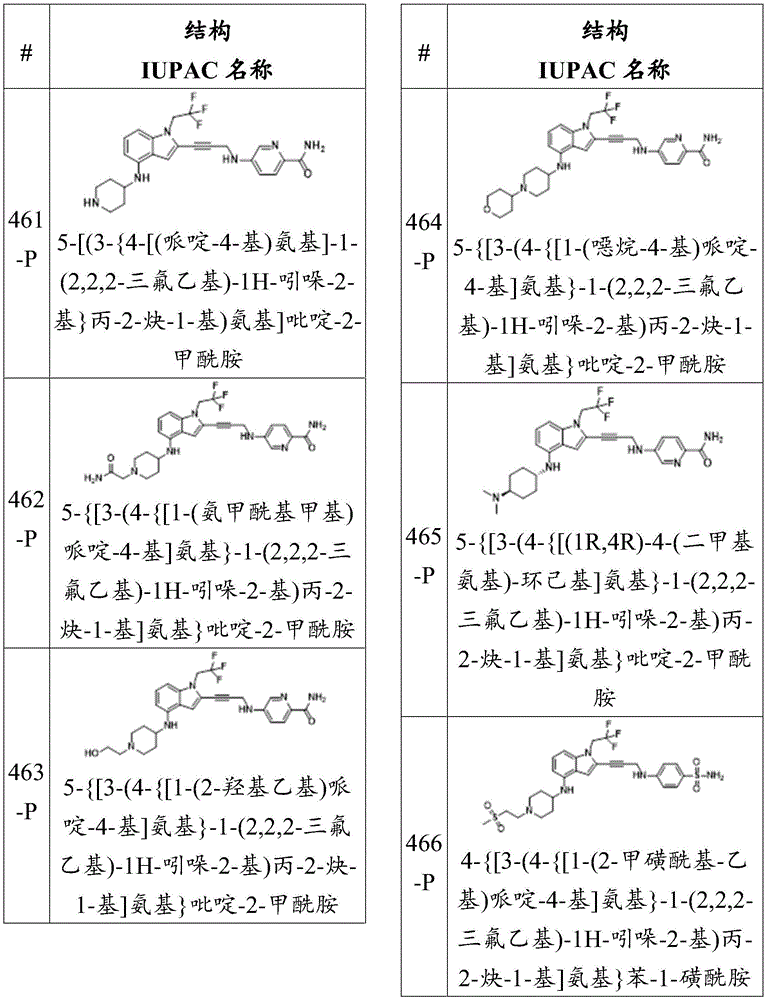

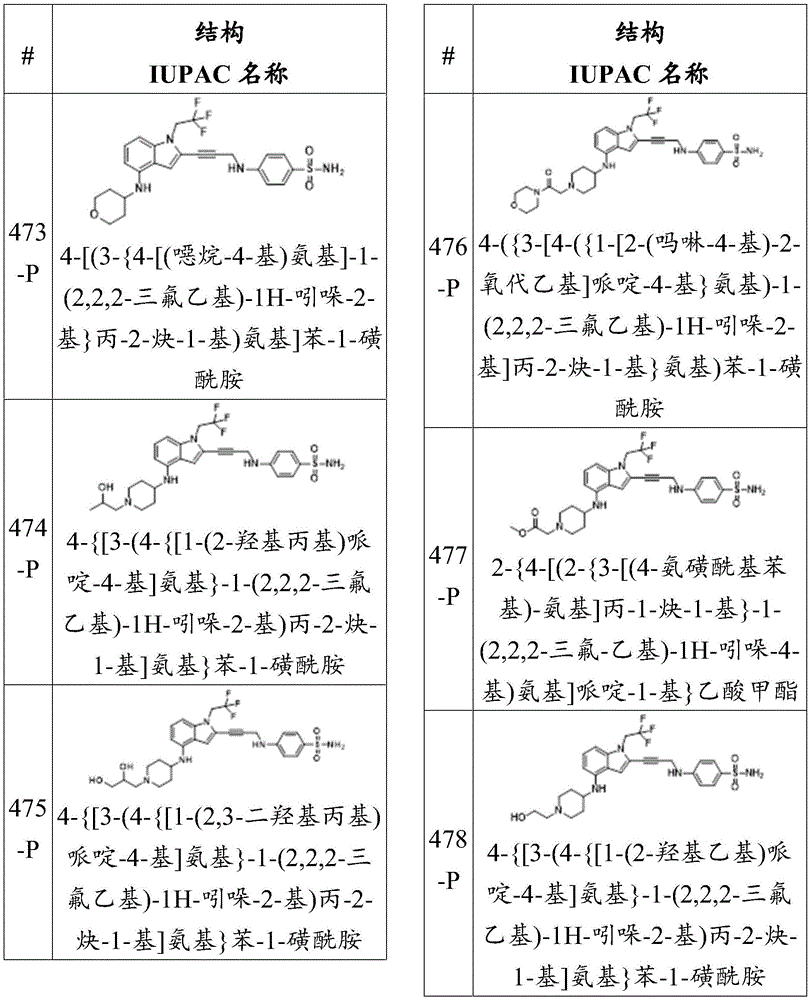


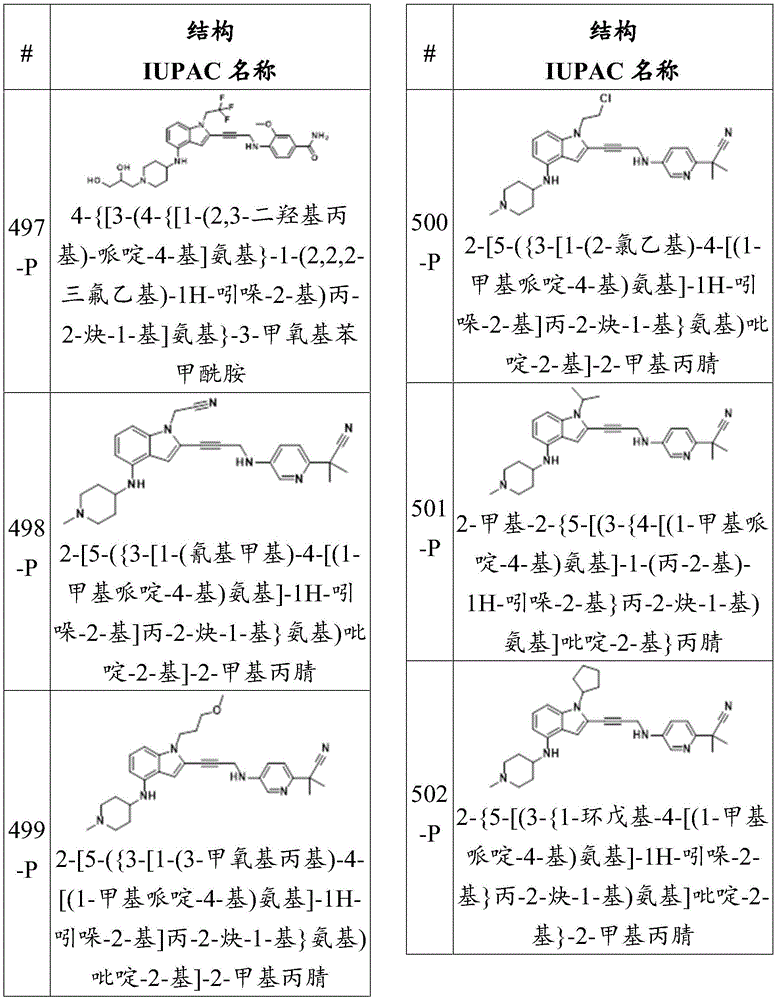


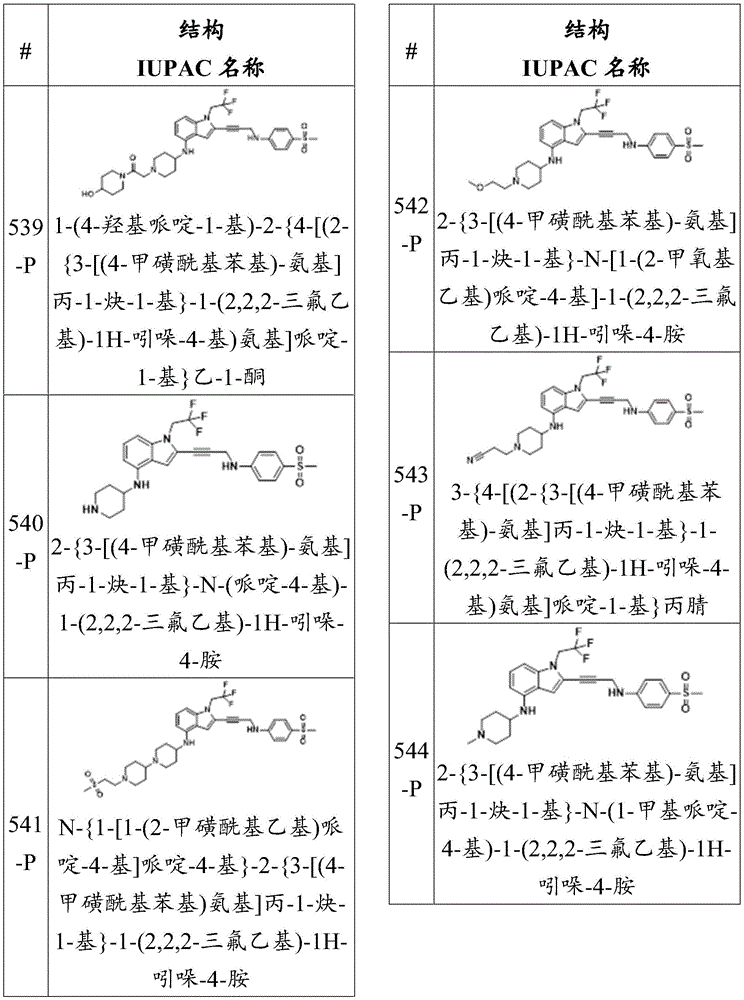


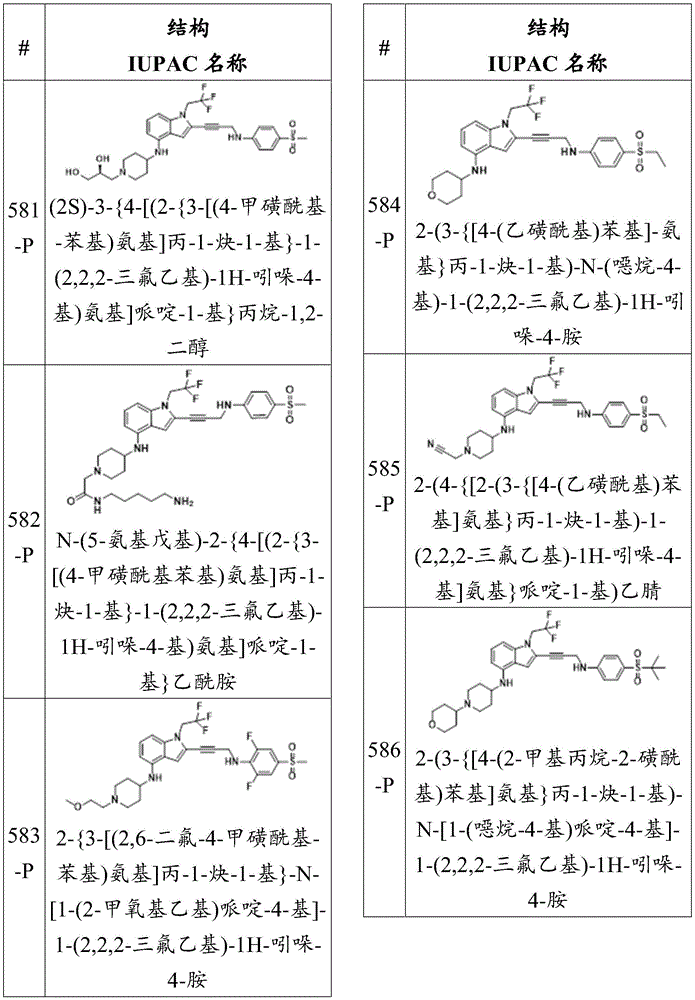

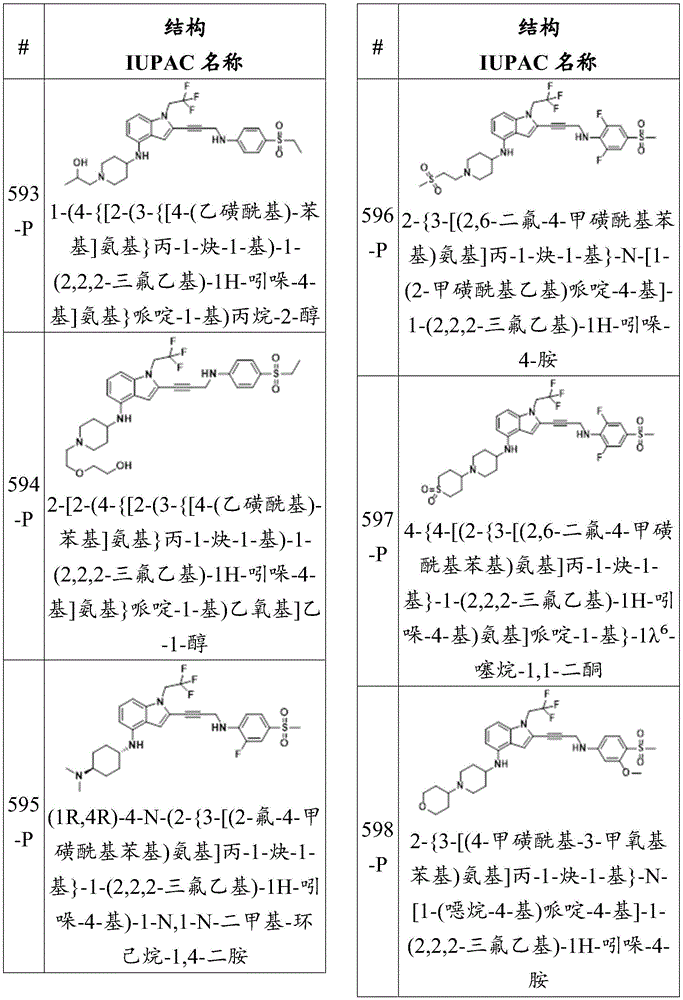
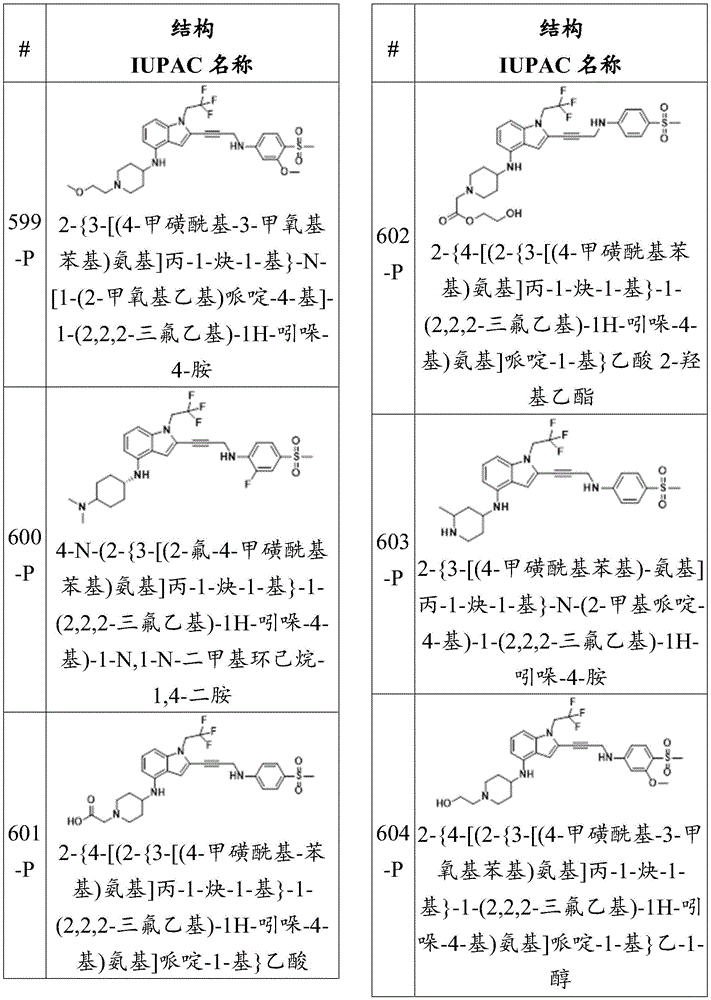

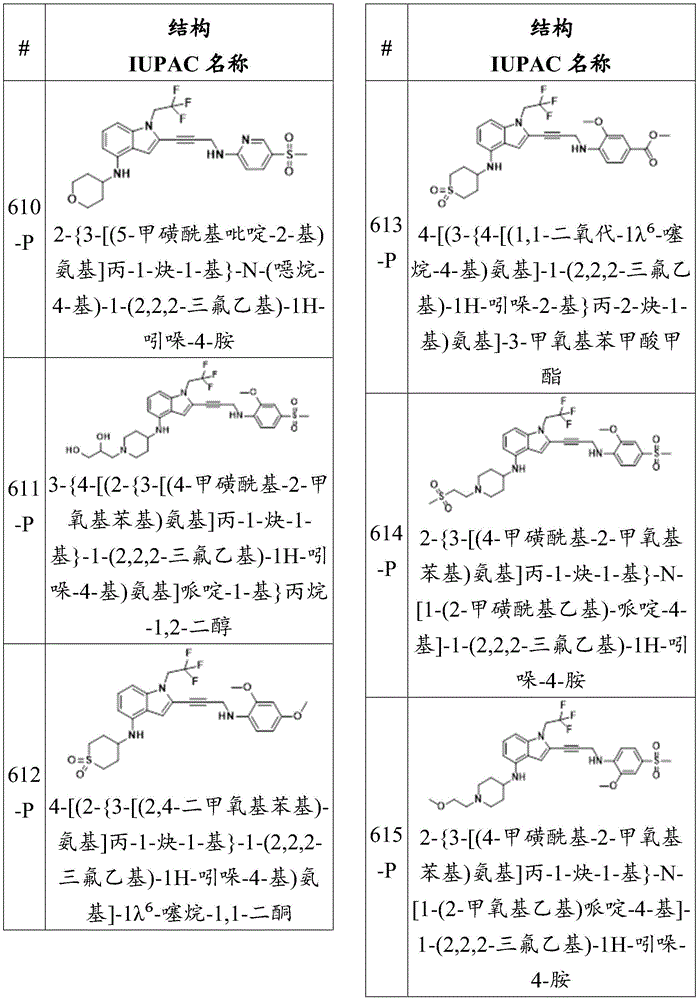
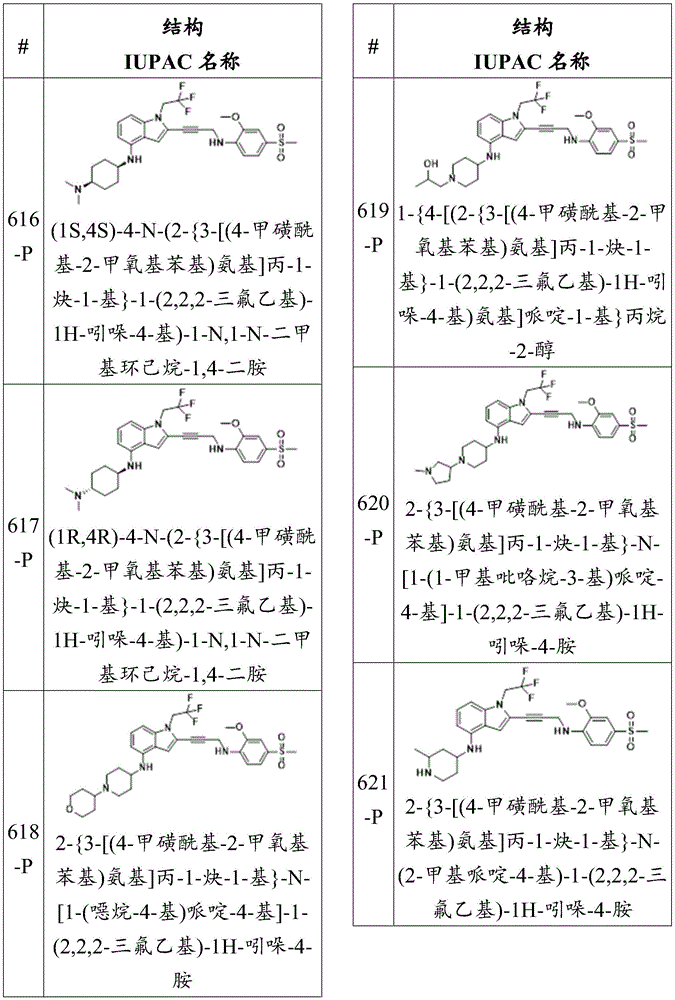


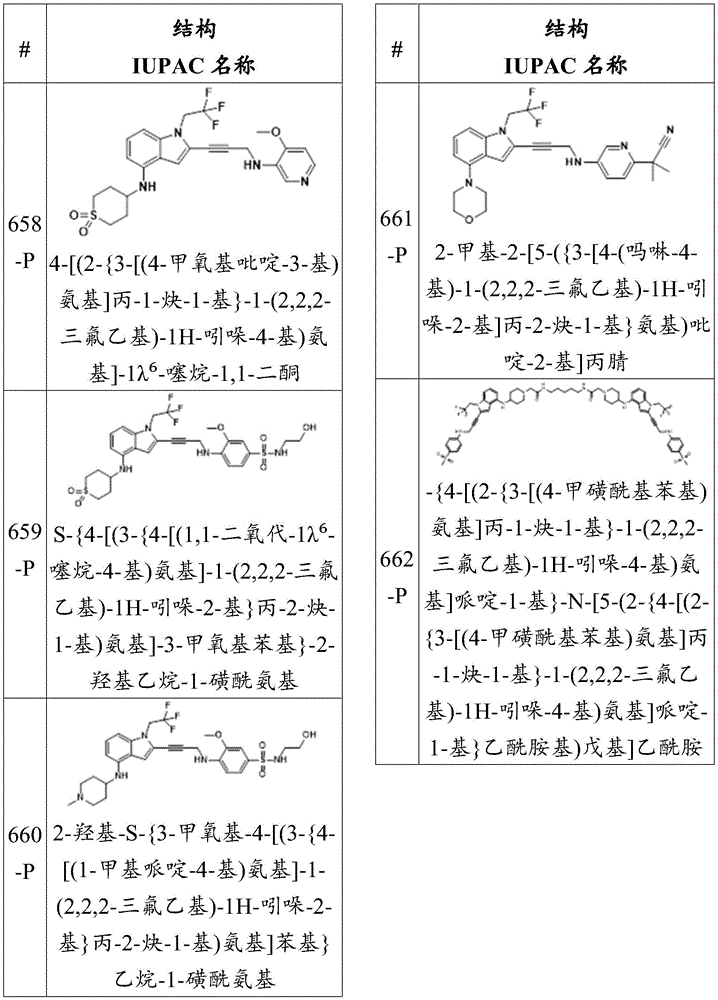


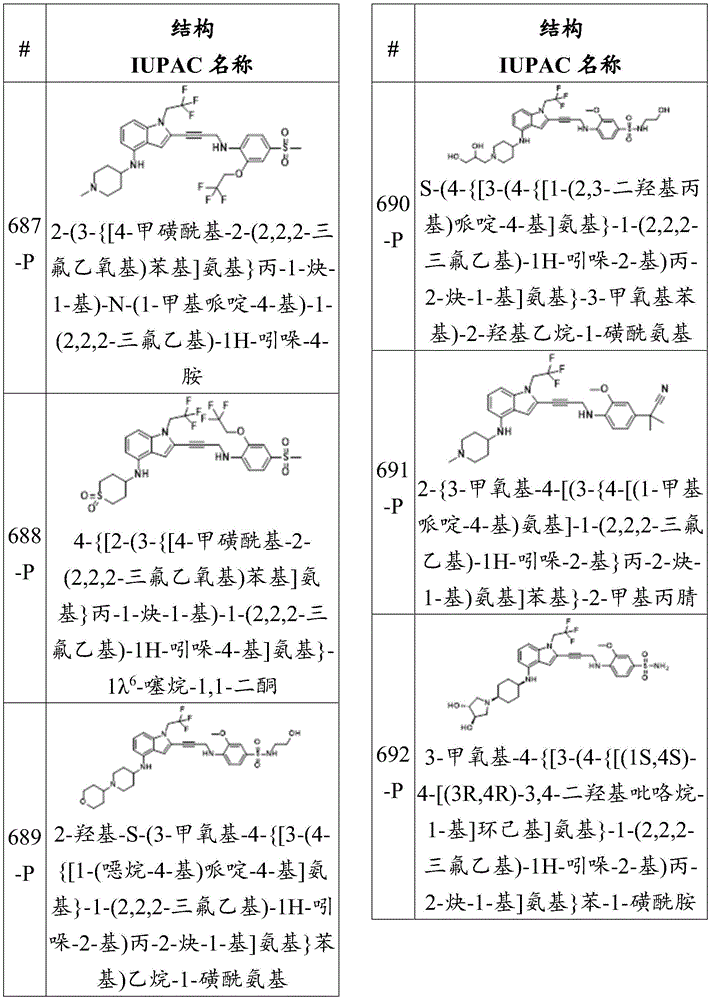


In some embodiments, disclosed herein is a method of treating cancer comprising administering to a subject in need thereof a therapeutically effective amount of a compound of the present disclosure. For example, the compounds of the invention can slow the proliferation of cancer cell lines or kill cancer cells. Non-limiting examples of cancers that may be treated by the compounds of the present invention include: acute lymphoblastic leukemia, acute myeloid leukemia, adrenocortical carcinoma, AIDS-related cancer, AIDS-related lymphoma, anal cancer, appendiceal cancer, astrocytoma, basal gangliaBasal cell carcinoma, cholangiocarcinoma, bladder carcinoma, bone carcinoma, brain tumors (such as cerebellar astrocytoma, cerebral astrocytoma/glioblastoma, ependymoma, medulloblastoma, supratentorial primitive neuroectoblastoma (supratentorial primary), visual pathway and hypothalamic glioma), breast carcinoma, bronchial adenoma, Burkitt lymphoma (Burkitt lymphoma), carcinomas of unknown primary origin, central nervous system lymphoma, cerebellar astrocytoma, cervical carcinoma, childhood carcinoma, chronic lymphocytic leukemia, chronic myelogenous leukemia, chronic myeloproliferative disease, colon carcinoma, cutaneous T-cell lymphoma, desmoplastic small round cell tumor, endometrial carcinoma, ependymoma, esophageal carcinoma, Ewing's sarcoma, germ cell tumor, gallbladder carcinoma, gastric carcinoma, gastrointestinal carcinoid tumor, gastrointestinal stromal tumor, gastrointestinal tumor, and cancer, Glioma, hairy cell leukemia, head and neck cancer, heart cancer, hepatocellular (liver) carcinoma, hodgkin's lymphoma, hypopharyngeal carcinoma, intraocular melanoma, islet cell carcinoma, kaposi's sarcoma, kidney cancer, larynx cancer, lip and oral cavity cancer, liposarcoma, liver cancer, lung cancer (e.g., non-small cell and small cell lung cancer), lymphoma, leukemia, macroglobulinemia, malignant fibrous histiocytoma/osteosarcoma of bone, medulloblastoma, melanoma, mesothelioma, latent primary metastatic squamous neck cancer, oral cavity cancer, multiple endocrine tumor syndrome, myelodysplastic syndrome, myeloid leukemia, nasal and paranasal sinus cancers, nasopharyngeal cancer, neuroblastoma, non-hodgkin's lymphoma, non-small cell lung cancer, oral cancer (orcancer), oropharyngeal cancer, osteosarcoma/malignant fibrous histiocytoma of bone, ovarian cancer, epithelial ovarian cancer, human immunodeficiency virus, human, Ovarian germ cell tumors, pancreatic cancers, pancreatic islet cell pancreatic cancers, paranasal sinus and nasal cavity cancers, parathyroid cancer, penile cancer, pharyngeal cancer (pharyngel cancer), pheochromocytoma, pineal astrocytoma, pineal germ cell tumor, pituitary adenoma, pleuropulmonoblastoma, plasmacytoma, primary central nervous system lymphoma, prostate cancer, rectal cancer, renal cell carcinoma, transitional cell carcinoma of the renal pelvis and ureter, retinoblastoma, rhabdomyosarcoma, salivary gland carcinoma, sarcoma, skin cancer, merkel cell carcinoma (skin carcinoma merkel), Small bowel cancer, soft tissue sarcoma, squamous cell carcinoma, gastric cancer, T-cell lymphoma, laryngeal carcinoma, thymoma, thymus cancer, thyroid cancer, trophoblastic tumor (gestational), cancer of unknown primary site, cancer of urethra, uterine sarcoma, vaginal cancer, vulvar cancer, waldenstrom macroglobulinemia: ( macrogolbulilinimia), and Wilms tumor (Wilms tumor).
In some embodiments, the compounds of the present invention exhibit non-lethal toxicity.
In some embodiments, disclosed herein is a method of treating cancer comprising administering to a subject in need thereof a compound of formula (I):

wherein:
-each of Independently a single or double bond;
-X 1 is CR 5 、CR 5 R 6 、N、NR 5 O, S, C-O, C-S or connected to Q 1 A carbon atom of (a);
-X 2 is CR 7 、CR 7 R 8 、N、NR 7 O, S, C-O, C-S or connected to Q 1 A carbon atom of (a);
-X 3 is CR 9 、CR 9 R 10 、N、NR 9 O, S, C-O, C-S or connected to Q 1 A carbon atom of (a);
-X 4 is CR 11 、CR 11 R 12 、N、NR 11 O, S, C-O, C-S or connected to Q 1 A carbon atom of (a);
-X 5 is CR 13 N or NR 13 ;
Wherein X 1 、X 2 、X 3 And X 4 Is connected to Q 1 A carbon atom of (a);
-Q 1 is C-O, C-S, C-CR 14 R 15 、C=NR 14 Alkylene, alkenylene, or alkynylene, each independently substituted or unsubstituted; or is a bond;
-m is 1, 2, 3 or 4;
-Y is N, O or absent;
-R 1 is-C (O) R 16 、-C(O)OR 16 、-C(O)NR 16 R 17 、-OR 16 、-SR 16 、-NR 16 R 17 、
-NR 16 C(O)R 16 、-OC(O)R 16 、C=O、C=S、-CN、-SiR 16 R 17 R 18 Alkyl, alkenyl, alkynyl, aryl, heteroaryl, or heterocyclyl, each independently substituted or unsubstituted; or is hydrogen;
each R 3 And R 4 Independently is-C (O) R 19 、-C(O)OR 19 、-C(O)NR 19 R 20 、-SOR 19 、
-SO 2 R 19 Alkyl, alkylene, alkenyl, alkenylene, alkynyl, aryl, heteroaryl, or heterocyclyl, each of which is independently substituted or unsubstituted; or is hydrogen, or R 3 And R 4 Together with R 3 And R 4 The combined Y atoms together form a ring, wherein the ring is substituted or unsubstituted, or R 3 Is absent;
each R 2 、R 5 、R 6 、R 7 、R 8 、R 9 、R 10 、R 11 、R 12 、R 13 、R 14 、R 15 、R 16 、R 17 And R 18 Independently is-C (O) R 21 、-C(O)OR 21 、-C(O)NR 21 R 22 、-OR 21 、-SR 21 、
-NR 21 R 22 、-NR 21 C(O)R 22 、-OC(O)R 21 Alkyl, alkenyl, alkynyl, arylA group, heteroaryl or heterocyclyl, each of which is independently substituted or unsubstituted; or is hydrogen or halogen;
each R 19 And R 20 Is C (O) R 23 、-C(O)OR 23 、-C(O)NR 23 R 24 、-OR 23 、-SR 23 、
-NR 23 R 24 、-NR 23 C(O)R 24 、-OC(O)R 23 Alkyl, alkenyl, alkynyl, aryl, heteroaryl, or heterocyclyl, each independently substituted or unsubstituted; or is hydrogen or halogen;
each R 21 And R 22 Independently is an alkyl, alkenyl, alkynyl, aryl, heteroaryl, or heterocyclyl group, each of which is independently substituted or unsubstituted; or is hydrogen; and is provided with
Each R 23 And R 24 Independently is an alkyl, alkenyl, alkynyl, aryl, heteroaryl, or heterocyclyl group, each of which is independently substituted or unsubstituted; or is a hydrogen atom or a hydrogen atom,
Or a pharmaceutically acceptable salt thereof;
wherein the SC of the compound to p 53Y 220C as measured by a homogeneous time-resolved fluorescence (HTRF) assay 150 The value is less than 1. mu.M.
In some embodiments, disclosed herein are methods of inducing apoptosis in a cell, comprising contacting the cell with a therapeutically effective amount of a compound that binds to a p53 mutant, wherein the compound is a compound disclosed herein. In some embodiments, the compound increases the ability of the p53 mutant to bind to DNA. In some embodiments, the cell expresses p 53. In some embodiments, the p53 mutant has a mutation at amino acid 220. In some embodiments, the p53 mutant is p 53Y 220C. In some embodiments, the compound induces a conformational change in the p53 mutant. In some embodiments, the compound selectively binds to the p53 mutant as compared to wild-type p 53. In some embodiments, the therapeutically effective amount is from about 50mg to about 3000 mg. In some embodiments, the compound increases the stability of the biologically active conformation of the p53 mutant relative to the stability of the biologically active conformation of the p53 mutant in the absence of the compound.
A pharmaceutically acceptable salt.
The present invention provides the use of a pharmaceutically acceptable salt of any of the therapeutic compounds described herein. Pharmaceutically acceptable salts include, for example, acid addition salts and base addition salts. The acid added to the compound to form an acid addition salt may be an organic acid or an inorganic acid. The base added to the compound to form a base addition salt may be an organic base or an inorganic base. In some embodiments, the pharmaceutically acceptable salt is a metal salt. In some embodiments, the pharmaceutically acceptable salt is an ammonium salt.
The metal salt may result from the addition of an inorganic base to the compounds of the present invention. The inorganic base consists of a metal cation paired with a basic counter ion, such as hydroxide, carbonate, bicarbonate or phosphate. The metal may be an alkali metal, an alkaline earth metal, a transition metal or a main group metal. In some embodiments, the metal is lithium, sodium, potassium, cesium, cerium, magnesium, manganese, iron, calcium, strontium, cobalt, titanium, aluminum, copper, cadmium, or zinc.
In some embodiments, the metal salt is a lithium, sodium, potassium, cesium, cerium, magnesium, manganese, iron, calcium, strontium, cobalt, titanium, aluminum, copper, cadmium, or zinc salt.
Ammonium salts may result from the addition of ammonia or an organic amine to the compounds of the present invention. In some embodiments, the organic amine is triethylamine, diisopropylamine, ethanolamine, diethanolamine, triethanolamine, morpholine, N-methylmorpholine, piperidine, N-methylpiperidine, N-ethylpiperidine, dibenzylamine, piperazine, pyridine, pyrazole, piprazole, imidazole, pyrazine, or piprazine.
In some embodiments, the ammonium salt is a triethylamine salt, a diisopropylamine salt, an ethanolamine salt, a diethanolamine salt, a triethanolamine salt, a morpholine salt, an N-methylmorpholine salt, a piperidine salt, an N-methylpiperidine salt, an N-ethylpiperidine salt, a dibenzylamine salt, a piperazine salt, a pyridine salt, a pyrazole salt, a piperazine salt, an imidazole salt, a pyrazine salt, or a piperazine salt.
Acid addition salts may be produced by adding an acid to a compound of the invention. In some embodiments, the acid is organic. In some embodiments, the acid is inorganic. In some embodiments, the acid is hydrochloric acid, hydrobromic acid, hydroiodic acid, nitric acid, nitrous acid, sulfuric acid, sulfurous acid, phosphoric acid, isonicotinic acid, lactic acid, salicylic acid, tartaric acid, ascorbic acid, gentisic acid, gluconic acid, glucuronic acid, saccharic acid (saccaric acid), formic acid, benzoic acid, glutamic acid, pantothenic acid, acetic acid, propionic acid, butyric acid, fumaric acid, succinic acid, methanesulfonic acid, ethanesulfonic acid, benzenesulfonic acid, p-toluenesulfonic acid, citric acid, oxalic acid, or maleic acid.
In some embodiments, the salt is a hydrochloride, hydrobromide, hydroiodide, nitrate, nitrite, sulfate, sulfite, phosphate, isonicotinate, lactate, salicylate, tartrate, ascorbate, gentisate, gluconate, glucuronate, saccharinate, formate, benzoate, glutamate, pantothenate, acetate, propionate, butyrate, fumarate, succinate, methanesulfonate (methanesulfonate), ethanesulfonate, benzenesulfonate, p-toluenesulfonate, citrate, oxalate or maleate salt.
The invention relates to a pharmaceutical composition.
The pharmaceutical composition of the invention may be used, for example, before, during or after treatment of a subject with, for example, another agent.
For example, the subject may be an elderly human, an adult human, an adolescent human, a pre-pubertal child, a toddler, an infant human, a neonate, and a non-human animal. In some embodiments, the subject is a patient.
The pharmaceutical compositions of the present invention may be a combination of any of the pharmaceutical compounds described herein with other chemical components, such as carriers, stabilizers, diluents, dispersing agents, suspending agents, thickening agents, and/or excipients. The pharmaceutical composition facilitates administration of the compound to an organism. The pharmaceutical compositions can be administered in a therapeutically effective amount as a pharmaceutical composition by a variety of forms and routes including, for example, intravenous, subcutaneous, intramuscular, oral, parenteral, ophthalmic, subcutaneous, transdermal, nasal, vaginal and topical administration.
The pharmaceutical compositions may be administered in a topical manner, for example, by direct injection of the compound into an organ, optionally in the form of a depot or sustained formulation or implant. The pharmaceutical composition may be provided in the form of a rapid release formulation, an extended release formulation or an intermediate release formulation. The quick release form may provide immediate release. Extended release formulations may provide controlled release or sustained delayed release.
For oral administration, pharmaceutical compositions may be formulated by combining the active compound with a pharmaceutically acceptable carrier or excipient. Such carriers can be used to formulate liquids, gels, syrups, elixirs, slurries or suspensions for oral ingestion by a subject. Non-limiting examples of solvents used in oral soluble formulations may include water, ethanol, isopropanol, saline, physiological saline, DMSO, dimethylformamide, potassium phosphate buffer, Phosphate Buffered Saline (PBS), sodium phosphate buffer, 4-2-hydroxyethyl-1-piperazineethanesulfonic acid buffer (HEPES), 3- (N-morpholino) propanesulfonic acid buffer (MOPS), piperazine-N, N' -bis (2-ethanesulfonic acid) buffer (PIPES), and saline sodium citrate buffer (SSC). Non-limiting examples of co-solvents used in oral soluble formulations may include sucrose, urea, cremaphor, DMSO, and potassium phosphate buffer.
The pharmaceutical formulation may be formulated for intravenous administration. The pharmaceutical compositions may be in a form suitable for parenteral injection, as a sterile suspension, solution or emulsion in an oily or aqueous vehicle, and may contain formulatory agents such as suspending, stabilizing and/or dispersing agents. Pharmaceutical formulations for parenteral administration include aqueous solutions of the active compounds in water-soluble form. Suspensions of the active compounds may be prepared as oily injection suspensions. Suitable lipophilic solvents or vehicles include fatty oils, such as sesame oil, or synthetic fatty acid esters, such as ethyl oleate or triglycerides, or liposomes. The suspension may also contain suitable stabilizers or agents that increase the solubility of the compounds to allow for the preparation of highly concentrated solutions. Alternatively, the active ingredient may be in powder form for constitution with a suitable vehicle, e.g., sterile pyrogen-free water, before use.
The active compounds can be administered topically and can be formulated in a variety of topically administrable compositions such as solutions, suspensions, lotions, gels, pastes, sticks, balms, creams and ointments. Such pharmaceutical compositions may comprise solubilizers, stabilizers, tonicity enhancing agents, buffers and preservatives.
The compounds of the invention may be topically applied to the skin or body cavity of a subject, such as the oral cavity, vagina, bladder, skull, spine, thorax, or pelvic cavity. The compounds of the present invention may be applied to accessible body cavities.
The compounds may also be formulated in rectal compositions such as enemas, rectal gels, rectal foams, rectal aerosols, suppositories, jelly suppositories, or retention enemas, containing conventional suppository bases such as cocoa butter or other glycerides, and synthetic polymers such as polyvinylpyrrolidone and PEG. In suppository forms of the composition, a low melting wax, such as a mixture of fatty acid glycerides, optionally in combination with cocoa butter, may be melted.
In practicing the treatment or methods of use provided herein, a therapeutically effective amount of a compound described herein is administered in the form of a pharmaceutical composition to a subject having a disease or condition to be treated. In some embodiments, the subject is a mammal, e.g., a human. The therapeutically effective amount may vary widely depending on the severity of the disease, the age and relative health of the subject, the potency of the compound used, and other factors. These compounds may be used alone or may be used in combination with one or more therapeutic agents as components of a mixture.
Pharmaceutical compositions may be formulated using one or more physiologically acceptable carriers comprising excipients and auxiliaries, which facilitate processing of the active compounds into preparations which can be used pharmaceutically. Depending on the route of administration chosen, the formulation may be modified. Pharmaceutical compositions comprising the compounds described herein can be manufactured, for example, by mixing, dissolving, emulsifying, encapsulating, entrapping or compressing processes.
The pharmaceutical compositions may comprise at least one pharmaceutically acceptable carrier, diluent or excipient and a compound described herein as a free base or a pharmaceutically acceptable salt. The pharmaceutical composition may comprise solubilizers, stabilizers, tonicity enhancing agents, buffers and preservatives.
Methods of preparing compositions comprising the compounds described herein include formulating the compounds with one or more inert, pharmaceutically acceptable excipients or carriers to form solid, semi-solid, or liquid compositions. Solid compositions include, for example, powders, tablets, dispersible granules, capsules, and cachets. Liquid compositions include, for example, solutions in which the compounds are dissolved, emulsions comprising the compounds, or solutions comprising liposomes, micelles, or nanoparticles containing the compounds disclosed herein. Semisolid compositions include, for example, gels, suspensions, and creams. The compositions may be in the form of liquid solutions or suspensions, solid forms suitable for dissolution or suspension in a liquid prior to use, or as emulsions. These compositions may also contain minor amounts of non-toxic auxiliary substances such as wetting or emulsifying agents, pH buffering agents and other pharmaceutically acceptable additives.
Non-limiting examples of dosage forms suitable for use in the present invention include liquids, powders, gels, nanosuspensions, nanoparticles, microgels, aqueous or oily suspensions, emulsions, and any combination thereof.
Non-limiting examples of pharmaceutically acceptable excipients suitable for use in the present invention include binders, disintegrants, anti-adherents, antistatic agents, surfactants, antioxidants, coating agents, colorants, plasticizers, preservatives, suspending agents, emulsifiers, antimicrobial agents, spheronizing agents, and any combination thereof.
The compositions of the invention may be, for example, in immediate release form or in controlled release formulation. Immediate release formulations can be formulated to allow the compound to act rapidly. Non-limiting examples of immediate release formulations include readily soluble formulations. The controlled release formulation may be a pharmaceutical formulation that has been modified such that the release rate and release profile of the active agent can be matched to physiological and temporal therapy requirements, or alternatively, has been formulated to achieve release of the active agent at a planned rate. Non-limiting examples of controlled release formulations include particles, delayed release particles, hydrogels (e.g., of synthetic or natural origin), other gelling agents (e.g., gel-forming dietary fibers), matrix-based formulations (e.g., formulations comprising a polymeric material in which at least one active ingredient is dispersed), particles within a matrix, polymer mixtures, and particulate materials.
In some cases, the controlled release formulation is a delayed release form. The delayed release form may be formulated to delay the action of the compound for an extended period of time. The delayed release form may be formulated to delay the release of the effective dose of one or more compounds, for example by about 4, about 8, about 12, about 16 or about 24 hours.
The controlled release formulation may be in a sustained release form. For example, sustained release forms can be formulated to maintain the effect of the compound over an extended period of time. The sustained release form can be formulated to provide an effective dose of any of the compounds described herein (e.g., to provide a physiologically effective blood distribution) over about 4 hours, about 8 hours, about 12 hours, about 16 hours, or about 24 hours.
Non-limiting examples of pharmaceutically acceptable excipients can be found, for example, in Remington: The Science and Practice of Pharmacy, 19 th edition (Easton, Pa.: Mack Publishing Company, 1995); hoover, John e., Remington's Pharmaceutical Sciences, Mack Publishing co., Easton, Pennsylvania 1975; liberman, h.a. and Lachman, l. japan, Pharmaceutical document Forms, Marcel Decker, New York, n.y., 1980; and Pharmaceutical document Forms and Drug Delivery Systems, 7 th edition (Lippincott Williams & Wilkins1999), each of which is incorporated by reference in its entirety.
Multiple therapeutic agents may be administered in any order or simultaneously. In some embodiments, the compounds of the invention are administered in combination with another therapeutic agent or before or after treatment with another therapeutic agent. If administered simultaneously, multiple therapeutic agents may be provided in a single, unified form or in multiple forms, e.g., as multiple separate pills. These agents may be packaged together or separately, in a single package or in multiple packages. One or all of the therapeutic agents may be administered in multiple doses. The timing between doses may vary up to about one month if not simultaneously administered.
The therapeutic agents described herein can be administered before, during, or after the onset of a disease or condition, and the timing of administration of the therapeutic agent-containing composition can vary. For example, the compositions can be used as prophylactic agents, and can be continuously administered to a subject having a predisposition to a disease or condition, to reduce the likelihood of the occurrence of the disease or condition. The composition may be administered to the subject during or as soon as possible after the onset of symptoms. Administration of the therapeutic agent can begin within the first 48 hours of symptom onset, within the first 24 hours of symptom onset, within the first 6 hours of symptom onset, or within 3 hours of symptom onset. Initial administration may be by any practical route, e.g., by any route described herein using any formulation described herein.
Upon detection or suspicion of the onset of a disease or condition, the compound may be administered as soon as possible, if feasible, and for a length of time required to treat the disease, such as, for example, about 1 month to about 3 months. In some embodiments, the compound may be administered for a length of time of about 1 day, about 2 days, about 3 days, about 4 days, about 5 days, about 6 days, about 1 week, about 2 weeks, about 3 weeks, about 4 weeks, about 1 month, about 5 weeks, about 6 weeks, about 7 weeks, about 8 weeks, about 2 months, about 9 weeks, about 10 weeks, about 11 weeks, about 12 weeks, about 3 months, about 13 weeks, about 14 weeks, about 15 weeks, about 16 weeks, about 4 months, about 17 weeks, about 18 weeks, about 19 weeks, about 20 weeks, about 5 months, about 21 weeks, about 22 weeks, about 23 weeks, about 24 weeks, about 6 months, about 7 months, about 8 months, about 9 months, about 10 months, about 11 months, about 1 year, about 13 months, about 14 months, about 15 months, about 16 months, about 17 months, about 18 months, about 19 months, about 20 months, about 22 months, about 23 months, about 1 year, about 13 months, about 14 months, about 15 months, about 16 months, About 2 years, about 2.5 years, about 3 years, about 3.5 years, about 4 years, about 4.5 years, about 5 years, about 6 years, about 7 years, about 8 years, about 9 years, or about 10 years. The length of time of treatment may vary for each subject.
The pharmaceutical compositions described herein may be in unit dosage forms suitable for single administration of precise dosages. In unit dosage form, the preparation is divided into unit doses containing appropriate quantities of one or more compounds. The unit dose can be in the form of a package containing discrete quantities of the formulation. Non-limiting examples are packaged injections, vials or ampoules. The aqueous suspension composition may be packaged in a single-dose non-reclosable container. For example, a multi-dose reclosable container may be used with or without a preservative. Formulations for injection may be presented in unit dosage form, for example, in ampoules, or in multi-dose containers containing a preservative.
The pharmaceutical compositions provided herein can be administered in conjunction with other therapies, e.g., chemotherapy, radiation therapy, surgery, anti-inflammatory agents, and selected vitamins. The other agent may be administered before, after, or simultaneously with the pharmaceutical composition.
Depending on the intended mode of administration, the pharmaceutical composition may be in the form of a solid, semi-solid, or liquid dosage form, such as, for example, a tablet, suppository, pill, capsule, powder, liquid, suspension, lotion, cream, or gel, e.g., in a unit dosage form suitable for single administration of a precise dose.
For solid compositions, non-toxic solid carriers include, for example, pharmaceutical grades of mannitol, lactose, starch, magnesium stearate, sodium saccharin, talcum, cellulose, glucose, sucrose, and magnesium carbonate.
Non-limiting examples of pharmaceutically active agents suitable for combination with the compositions of the present disclosure include anti-infective agents, i.e., aminoglycosides, antiviral agents, antimicrobial agents, anticholinergic/spasmolytic agents, antidiabetic agents, antihypertensive agents, antineoplastic agents, cardiovascular agents, central nervous system agents, thrombomodulin, hormones, immunological agents, immunosuppressive agents and ophthalmic agents.
The compounds may be delivered by liposome technology. The use of liposomes as drug carriers can improve the therapeutic index of the compounds. Liposomes are composed of natural phospholipids and may contain mixed lipid chains with surfactant properties (e.g., egg phosphatidylethanolamine). Liposome designs can utilize surface ligands to attach to unhealthy tissues. Non-limiting examples of liposomes include multilamellar vesicles (MLVs), Small Unilamellar Vesicles (SUVs) and Large Unilamellar Vesicles (LUVs). The physicochemical properties of the liposomes can be adjusted to optimize permeation through biological barriers and retention at the site of administration, and to reduce the likelihood of developing premature degradation and toxicity to non-target tissues. The optimal liposome properties depend on the route of administration: large size liposomes show good retention upon local injection, and small size liposomes are more suitable for achieving passive targeting. Pegylation can reduce uptake of liposomes by the liver and spleen and increase circulation time, leading to increased localization of inflammatory sites due to Enhanced Permeability and Retention (EPR) effects. In addition, the liposome surface can be modified to achieve selective delivery of the encapsulated drug to specific target cells. Non-limiting examples of targeting ligands include monoclonal antibodies, vitamins, peptides and polysaccharides specific for receptors that are concentrated on the cell surface associated with the disease.
Non-limiting examples of dosage forms suitable for use in the present disclosure include liquids, elixirs, nanosuspensions, aqueous or oily suspensions, drops, syrups, and any combination thereof. Non-limiting examples of pharmaceutically acceptable excipients suitable for use in the present disclosure include granulating agents, binders, lubricants, disintegrating agents, sweetening agents, glidants, antiadherents, antistatic agents, surfactants, antioxidants, gums, coating agents, coloring agents, flavoring agents, coating agents, plasticizers, preservatives, suspending agents, emulsifying agents, plant cellulosic materials and spheronizing agents and any combination thereof.
The compositions of the invention may be packaged into kits. In some embodiments, the kit includes written instructions regarding the administration/use of the composition. For example, the written material may be a label. The written material may suggest a conditional method of administration. The instructions provide the subject and the attending physician with the best guidance to achieve the best clinical result by administering the therapy. The written material may be a label. In some embodiments, the tag may be approved by a regulatory agency, such as the U.S. Food and Drug Administration (FDA), European Medicines Agency (EMA), or other regulatory agency.
And (4) dosage.
The pharmaceutical compositions described herein may be in unit dosage forms suitable for single administration of precise dosages. In unit dosage form, the preparation is divided into unit doses containing appropriate quantities of one or more compounds. The unit dose can be in the form of a package containing discrete quantities of the formulation. Non-limiting examples are liquids in vials or ampoules. The aqueous suspension composition may be packaged in a single-dose non-reclosable container. For example, a multi-dose reclosable container may be used in combination with a preservative. Formulations for parenteral injection may be presented in unit dosage form, for example, in ampoules, or in multi-dose containers containing a preservative.
The dosage may be expressed as the amount of drug divided by the mass of the subject, e.g., milligrams of drug per kilogram of body weight of the subject. The compounds described herein may be administered in an amount of about 1mg to about 2000 mg; about 100mg to about 2000 mg; about 10mg to about 2000 mg; from about 5mg to about 1000mg, from about 10mg to about 500mg, from about 50mg to about 250mg, from about 100mg to about 200mg, from about 1mg to about 50mg, from about 50mg to about 100mg, from about 100mg to about 150mg, from about 150mg to about 200mg, from about 200mg to about 250mg, from about 250mg to about 300mg, from about 300mg to about 350mg, from about 350mg to about 400mg, from about 400mg to about 450mg, from about 450mg to about 500mg, from about 500mg to about 550mg, from about 550mg to about 600mg, from about 600mg to about 650mg, from about 650mg to about 700mg, from about 700mg to about 750mg, from about 750mg to about 800mg, from about 800mg to about 850mg, from about 850mg to about 900mg, from about 900mg to about 950mg, or from about 950mg to about 1000mg are present in the composition.
In some embodiments, the compound is administered in an amount ranging from about 5mg/kg to about 50mg/kg, 250mg/kg to about 2000mg/kg, about 10mg/kg to about 800mg/kg, about 50mg/kg to about 400mg/kg, about 100mg/kg to about 300mg/kg, or about 150mg/kg to about 200 mg/kg. In some embodiments, the compounds described herein may be present in the composition in the range of about 20mg/kg to about 400 mg/kg. In some embodiments, the compounds described herein may be present in the composition in the range of about 20mg/kg to about 240 mg/kg. In some embodiments, the compounds described herein may be present in the composition in the range of about 75mg/kg to about 150 mg/kg. In some embodiments, the compounds described herein may be present in the composition in the range of about 75mg/kg to about 150 mg/kg. In some embodiments, the compounds described herein may be present in the composition in the range of about 100mg/kg to about 150 mg/kg.
In some embodiments, a compound described herein may be present in the composition in an amount of about 75 mg/kg. In some embodiments, a compound described herein may be present in a composition in an amount of about 100 mg/kg. In some embodiments, a compound described herein may be present in a composition in an amount of about 150 mg/kg. In some embodiments, a compound described herein may be present in a composition in an amount of about 200 mg/kg. In some embodiments, a compound described herein may be present in a composition in an amount of about 250 mg/kg. In some embodiments, a compound described herein may be present in a composition in an amount of about 400 mg/kg.
The compounds described herein may be administered in an amount of about 1mg, about 2mg, about 3mg, about 4mg, about 5mg, about 10mg, about 15mg, about 20mg, about 25mg, about 30mg, about 35mg, about 40mg, about 45mg, about 50mg, about 55mg, about 60mg, about 65mg, about 70mg, about 75mg, about 80mg, about 85mg, about 90mg, about 95mg, about 100mg, about 125mg, about 150mg, about 175mg, about 200mg, about 250mg, about 300mg, about 350mg, about 400mg, about 450mg, about 500mg, about 550mg, about 600mg, about 650mg, about 700mg, about 750mg, about 800mg, about 850mg, about 900mg, about 950mg, about 1000mg, about 1050mg, about 1100mg, about 1150mg, about 1200mg, about 1250mg, about 1300mg, about 1800mg, about 1600mg, about 1550mg, about 0mg, about 400mg, about 450mg, about 500mg, about 1400mg, about 800mg, about 20mg, about 300mg, about 20mg, about 10mg, about 20mg, about 10mg, and about 10mg, About 1950mg or about 2000mg are present in the composition.
In some embodiments, a compound described herein may be present in a composition in an amount of about 100mg, about 120mg, about 140mg, about 160mg, about 180mg, about 200mg, about 220mg, about 240mg, about 260mg, about 280mg, or about 300 mg. In some embodiments, a compound described herein may be present in a composition in an amount of about 150 mg. In some embodiments, a compound described herein may be present in a composition in an amount of about 170 mg. In some embodiments, a compound described herein may be present in a composition in an amount of about 280 mg. In some embodiments, a compound described herein may be present in a composition in an amount of about 300 mg.
Examples
A. And (3) synthesizing an alkynyl reagent.
Example a 1: synthesis of 3- (fluoromethoxy) -N-methyl-4- (prop-2-yn-1-ylamino) benzamide.

Step 1. to a solution of 3-methoxy-N-methyl-4- (prop-2-yn-1-ylamino) benzamide (947.37mg,4.12mmol,1 eq) in DCM (50mL) at-10 deg.C, BBr was added dropwise 3 (3.62g,14.43mmol,1.39mL,3.5 equiv.). The mixture was stirred at 0 ℃ for 2 hours. TLC analysis (DCM: MeOH ═ 20:1, R) f 0.4) indicated that about 10% of the starting material remained and a new spot was detected, which was less polar than the starting material. Saturated NaOH solution was added until the pH of the mixture was greater than 11. The mixture was extracted with DCM (50mL x 3) and the organic layer was discarded. 12M HCl was added to the aqueous phase until pH 8. The aqueous phase was extracted with EtOAc (150mL x 3), the combined organic layers were washed with brine (150mL x 3), dried over anhydrous sodium sulfate, filtered, and concentrated under reduced pressure. The resulting residue was stirred in PE (50mL) at 25 ℃ for 12 h. The mixture was then filtered to give 3-hydroxy-N-methyl-4- (prop-2-yn-1-ylamino) benzamide (0.7g,3.08mmol, 74.81% yield) as a yellow solid.
Step 2. to a solution of 3-hydroxy-N-methyl-4- (prop-2-yn-1-ylamino) benzamide (0.3g,1.32mmol,1 eq.) and bromofluoromethane (298.60mg,2.64mmol, 251.45. mu.L, 2 eq.) in DMF (10mL) was added K 2 CO 3 (365.45mg,2.64mmol,2 equiv.). The mixture was stirred at 50 ℃ for 1 hour, followed by TLC analysis (DCM: MeOH ═ 20:1, R) f 0.5) indicated complete consumption of the starting phenol and a new spot was observed. The mixture was poured into water (20mL) and extracted with EtOAc (20mL x 3). The combined organic layers were washed with brine (20mL x 3), dried over anhydrous sodium sulfate, filtered and concentrated. By preparative TLC (DCM: MeOH ═ 20:1, R) f Not 0.5) purifying the resulting residue to give3- (fluoromethoxy) -N-methyl-4- (prop-2-yn-1-ylamino) benzamide (0.3g,1.08mmol, 81.64% yield) was a yellow solid.
Example a 2: synthesis of 3- (2-cyanoethoxy) -N-methyl-4- (prop-2-yn-1-ylamino) benzamide.

In N 2 Next, a mixture of 3-hydroxy-N-methyl-4- (prop-2-yn-1-ylamino) benzamide (200mg, 685.52. mu. mol,1 eq.) and benzyl (trimethyl) ammonium hydroxide (3.82mg, 6.86. mu. mol, 4.15. mu.L, 30% pure, 0.01 eq.) was stirred in acrylonitrile (1.09g,20.57mmol,1.36mL,30 eq.) at 85 ℃ for 16 h. TLC analysis indicated that about 50% of the starting phenol remained and a new spot was observed, which was less polar than the starting material. The mixture was concentrated under reduced pressure to give a residue which was purified by preparative TLC (DCM: MeOH ═ 20:1, R) f 0.5) to yield 3- (2-cyanoethoxy) -N-methyl-4- (prop-2-yn-1-ylamino) benzamide (100mg,349.80 μmol, 39.69% yield) as a yellow solid.
Example a 3: synthesis of 3- (cyanomethoxy) -4- (prop-2-yn-1-ylamino) benzenesulfonamide.

Step 1. to a solution of 3-methoxy-4- (prop-2-yn-1-ylamino) benzenesulfonamide (0.4g,1.42mmol,1 eq) in DCM (10mL) at-10 deg.C, BBr is added dropwise 3 (1.24g,4.95mmol, 477.20. mu.L, 3.5 equiv.). The mixture was stirred at 0 ℃ for 2 h, followed by TLC analysis (DCM: MeOH ═ 10:1, R) f 0.4) indicates that about 10% of the starting methyl ether remained and two new spots were observed, which were more polar than the starting material. 1N NaOH was added until the pH of the mixture was greater than 11. The mixture was extracted with DCM (50mL x 3) and the organic layer was discarded. 12M HCl was added to the aqueous phase until pH equal to 8 and the aqueous phase was extracted with EtOAc (150mL x 3). The combined organic layers were washed with brine (150 mL. times.3)Dried over anhydrous sodium sulfate, filtered and concentrated under reduced pressure. By preparative TLC (DCM: MeOH ═ 10:1, R) f 0.4) to give 3-hydroxy-4- (prop-2-yn-1-ylamino) benzenesulfonamide (0.25g,983.42 μmol, 69.50% yield) as a yellow solid.
Step 2. to a solution of 3-hydroxy-4- (prop-2-yn-1-ylamino) benzenesulfonamide (0.25g, 983.42. mu. mol,1 eq.) and bromoacrylonitrile (235.92mg,1.97mmol, 131.07. mu.L, 2 eq.) in DMF (10mL) was added K 2 CO 3 (271.84mg,1.97mmol,2 equiv.). The mixture was stirred at 50 ℃ for 2 hours. TLC analysis (DCM: MeOH ═ 10:1, R) f 0.5) indicated complete consumption of the starting phenol and a new spot was observed. The mixture was poured into water (30mL) and extracted with EtOAc (30mL x 3). The combined organic layers were washed with brine (30mL x 3), dried over anhydrous sodium sulfate, filtered and concentrated under reduced pressure. By preparative TLC (DCM: MeOH ═ 10:1, R) f 0.5) to give 3- (cyanomethoxy) -4- (prop-2-yn-1-ylamino) benzenesulfonamide (0.2g,716.20 μmol, 72.83% yield) as a yellow solid.
Example a 4: general procedure for the preparation of 2- (fluoromethoxy) -4- (methylsulfonyl) -N- (prop-2-yn-1-yl) aniline and 2- (5- (methylsulfonyl) -2- (prop-2-yn-1-ylamino) phenoxy) acetonitrile.

Synthesis of 5- (methylsulfonyl) -2- (prop-2-yn-1-ylamino) phenol: to a solution of 2-methoxy-4- (methylsulfonyl) -N- (prop-2-yn-1-yl) aniline (5g,19.85mmol,1 eq) in DCM (50mL) at-10 deg.C was added BBr dropwise 3 (12.43g,49.63mmol,4.78mL,2.5 equiv.). The mixture was stirred at 0 ℃ for 2 hours. TLC analysis (PE: EtOAc ═ 1:1, R) f 0.4) indicates that about 10% of the starting methyl ether remained and a major new spot was observed, which was more polar than the starting material. 1N NaOH was added until the pH of the mixture was greater than 11. The mixture was extracted with DCM (50mL x 3) and the organic layer was discarded. Add 12M HCl to the aqueous phase until pH equals 8 and use EtOAc (150mL x)3) The aqueous phase is extracted. The combined organic layers were washed with brine (150mL x 3), dried over anhydrous sodium sulfate, filtered and concentrated under reduced pressure. The resulting residue was stirred in PE (50mL) at 25 ℃ for 12 h. The mixture was then filtered and dried to give 5- (methylsulfonyl) -2- (prop-2-yn-1-ylamino) phenol (8g,30.19mmol, 76.04% yield) as a yellow solid.
Synthesis of 2- (fluoromethoxy) -4- (methylsulfonyl) -N- (prop-2-yn-1-yl) aniline and 2- (5- (methylsulfonyl) -2- (prop-2-yn-1-ylamino) phenoxy) acetonitrile: to a solution of 5- (methylsulfonyl) -2- (prop-2-yn-1-ylamino) phenol (0.5g,2.22mmol,1 eq) and 2-bromoacetonitrile (450mg,3.77mmol,2 eq) or bromofluoromethane (422 mg,3.77mmol,2 eq) in DMF (10mL) was added K 2 CO 3 (521.5mg,3.77mmol,2 equiv.). The mixture was stirred at 50 ℃ for 2 hours, and the mixture was poured into water (50 mL). The mixture was extracted with EtOAc (30mL x3), the combined organic layers were washed with brine (40mL x3), dried over anhydrous sodium sulfate, filtered, and concentrated under reduced pressure. The resulting residue was purified by column chromatography to give 2- (fluoromethoxy) -4- (methylsulfonyl) -N- (prop-2-yn-1-yl) aniline (700mg, crude) or 2- (5- (methylsulfonyl) -2- (prop-2-yn-1-ylamino) phenoxy) acetonitrile as a yellow gum.
Example a 5: general procedure for the preparation of N- ((3-methoxy-4- (prop-2-yn-1-ylamino) phenyl) sulfonyl) acetamide and N- ((3-methoxy-4- (prop-2-yn-1-ylamino) phenyl) sulfonyl) propionamide.

At 25 ℃ under N 2 Next, to a mixture of 3-methoxy-4- (prop-2-yn-1-ylamino) benzenesulfonamide (1 equivalent), DMAP (0.1 equivalent), and TEA (1 equivalent) in THF (4mL) was added (R) 1 ) 2 O (2 equivalents). The mixture was stirred at 25 ℃ for 2 hours and TLC analysis indicated that the reaction was complete. The reaction mixture was diluted with water (20mL) and extracted with EtOAc (20mLx 3). The combined organic layers were washed with brine (20mL), dried over anhydrous sodium sulfate, filtered and concentrated under reduced pressure. Passing the residue through Preparative TLC purification gave the desired product as a yellow oil.
Example a 6: preparation of N- ((3-methoxy-4- (prop-2-yn-1-ylamino) phenyl) sulfonyl) -N-methylpropanamide.

To a solution of 3-methoxy-N-methyl-4- (prop-2-yn-1-ylamino) benzenesulfonamide (0.06g,235.94 μmol,1 eq) in THF (2mL) was added DMAP (2.88mg,23.59 μmol,0.1 eq), TEA (23.87mg,235.94 μmol,32.84 μ L,1 eq) and propionic anhydride (61.41mg,471.87 μmol,60.80 μ L,2 eq). The reaction mixture was stirred at 25 ℃ for 10 hours. LC-MS analysis detected the desired mass. The reaction mixture was concentrated under reduced pressure and passed through preparative TLC (SiO) 2 ,PE:EtOAc=1:1,R f ═ 0.43) the resulting residue was purified to give N- ((3-methoxy-4- (prop-2-yn-1-ylamino) phenyl) sulfonyl) -N-methylpropanamide (0.04g,90.22 μmol, 38.24% yield) as a yellow solid.
Example a 7: preparation of N-methyl-5- (methylsulfonyl) -2- (prop-2-yn-1-yloxy) aniline, N-dimethyl-5- (methylsulfonyl) -2- (prop-2-yn-1-yloxy) aniline and N- (5- (methylsulfonyl) -2- (prop-2-yn-1-yloxy) phenyl) acetamide.

Synthesis of 4- (methylsulfonyl) -2-nitro-1- (prop-2-yn-1-yloxy) benzene: to a mixture of propargyl bromide (2.74g,23mmol,1.98mL,5 equiv.) and 4- (methylsulfonyl) -2-nitrophenol (1g,4.60mmol,1 equiv.) in DMF (10mL) was added K 2 CO 3 (1.91g,13.80mmol,3 equiv.). The mixture was stirred at 50 ℃ for 2 h, followed by TLC (EtOAc, Rf ═ 0.43) to show completion of the reaction. The reaction mixture was quenched with water (150mL) and extracted with EtOAc (50mL x 3). The combined organic layers were dried over anhydrous sodium sulfate, filtered and concentrated under reduced pressure to give crude 4- (methylsulfonyl) -2-nitro-1- (prop-2-yn-1-yloxy) benzeneIt is a pale yellow solid.
Synthesis of 5- (methylsulfonyl) -2- (prop-2-yn-1-yloxy) aniline: to a solution of 4- (methylsulfonyl) -2-nitro-1- (prop-2-yn-1-yloxy) benzene (1.2g,4.70mmol,1 eq) in AcOH (10mL) was added Fe (1.31g,23.51mmol,5 eq). The mixture was stirred at 70 ℃ for 2 hours followed by TLC analysis (PE: EtOAc ═ 1:1, R) f 0.43) indicating completion of the reaction. The reaction mixture was concentrated under reduced pressure to remove the solvent and diluted with EtOAc (50 mL). By addition of saturated NaHCO at 25 deg.C 3 The reaction mixture was quenched (200mL) with a solution and extracted with EtOAc (50mL x 3). The combined organic layers were dried over anhydrous sodium sulfate, filtered and concentrated under reduced pressure. By column chromatography (SiO) 2 PE EtOAc ═ 1:1) purification of the residue afforded 5- (methylsulfonyl) -2- (prop-2-yn-1-yloxy) aniline (0.86g,3.44mmol, 73.09% yield) as a light yellow solid.
Synthesis of N- (5- (methylsulfonyl) -2- (prop-2-yn-1-yloxy) phenyl) acetamide: a mixture of 5- (methylsulfonyl) -2- (prop-2-yn-1-yloxy) aniline (100mg, 399.53. mu. mol,1 eq), acetic anhydride (203.94mg,2mmol, 187.10. mu.L, 5 eq) and TEA (80.86mg, 799.06. mu. mol, 111.22. mu.L, 2 eq) in DCM (3mL) was stirred at 50 ℃ for 2 hours. TLC analysis (EtOAc, R) f 0.24) indicating completion of the reaction. The reaction mixture was concentrated under reduced pressure to remove the solvent. The residue was purified by preparative TLC to give N- (5- (methylsulfonyl) -2- (prop-2-yn-1-yloxy) phenyl) acetamide (100mg,374.11 μmol, 93.64% yield) as a light yellow solid.
Synthesis of N-methyl-5- (methylsulfonyl) -2- (prop-2-yn-1-yloxy) aniline: to a solution of 5- (methylsulfonyl) -2- (prop-2-yn-1-yloxy) aniline (0.5g,2.2mmol,1 eq) in MeOH (5mL) was added AcOH (53.3mg, 887.8. mu. mol, 50.8. mu.L, 0.4 eq) and NaBH 3 CN (418.5mg,6.66mmol,3 equiv.). The mixture was stirred at 25 ℃ for 0.5 h, then formaldehyde (234.2mg,2.9mmol, 214.8. mu.L, 1.3 equiv.) was added. The mixture was stirred at 25 ℃ for a further 9.5 hours, and subsequent LC-MS analysis indicated that the reaction was complete. By addition of saturated NaHCO 3 The reaction mixture was partitioned between solution (30mL) and EtOAc (10mL) and extracted with EtOAc (5mL x 3).The combined organic layers were washed with brine (10mL x 3), dried over anhydrous sodium sulfate, filtered and concentrated under reduced pressure. The residue was first purified by preparative TLC (PE: EtOAc ═ 2:1, R) f 2- (2-yn-1-yloxy) aniline (100mg,376.11 μmol, 16.94% yield) as a colorless oil.
Synthesis of N, N-dimethyl-5- (methylsulfonyl) -2- (prop-2-yn-1-yloxy) aniline: to a solution of 5- (methylsulfonyl) -2- (prop-2-yn-1-yloxy) aniline (0.2g,887.8 μmol,1 eq) in MeOH (5mL) was added AcOH (21.3mg,355.1 μmol,20.3 μ L,0.4 eq) and NaBH 3 CN (167.4mg,2.66mmol,3 equiv.). The mixture was stirred at 25 ℃ for 0.5 h, then formaldehyde (216.2mg,2.7mmol,198.3 μ L,3 equiv.) was added. The mixture was stirred at 25 ℃ for a further 9.5 hours, and subsequent LC-MS analysis indicated that the reaction was complete. By addition of saturated NaHCO 3 The reaction mixture was partitioned between solution (30mL) and EtOAc (10mL) and extracted with EtOAc (5 mL. times.3). The combined organic layers were washed with brine (10mL x 3), dried over anhydrous sodium sulfate, and concentrated under reduced pressure. The residue was first purified by preparative TLC (PE: EtOAc ═ 2:1, R) f 0.6) to yield N, N-dimethyl-5- (methylsulfonyl) -2- (prop-2-yn-1-yloxy) aniline (0.1g,355.29 μmol, 40% yield) as a colorless oil.
Example A8: preparation of 4- (methylsulfonyl) -N- (prop-2-yn-1-yl) -2- (trifluoromethyl) aniline.

Synthesis of methyl (4-nitro-3- (trifluoromethyl) phenyl) sulfane: in N 2 Next, NaSMe (33.52g,95.65mmol,30.47mL, 20% purity, 2 equiv.) was added in one portion to a solution of 4-fluoro-1-nitro-2- (trifluoromethyl) benzene (10g,47.82mmol,1 equiv.) in DMF (100mL) at 0 ℃. The mixture was stirred at 25 ℃ for 60 minutes, and subsequent TLC analysis indicated that the reaction was complete. The reaction was diluted with water (100mL) and extracted with EtOAc (100mL x 3). The organic layer was then washed with half saturated brine (100mL x 5), dried over anhydrous sodium sulfate,filtration and concentration gave 4-methylsulfanyl-1-nitro-2- (trifluoromethyl) benzene (11.4g, crude) as a brown liquid which was used in the next step without purification.
Synthesis of 4- (methylsulfonyl) -1-nitro-2- (trifluoromethyl) benzene: in N 2 Next, potassium peroxymonosulfate (51.84g,84.32mmol,2 equivalents) was added in one portion to a solution of 4-methylsulfanyl-1-nitro-2- (trifluoromethyl) benzene (10g,42.16mmol,1 equivalent) in acetone (100mL), water (100mL), and MeOH (10mL) at 0 deg.C. The mixture was stirred at 25 ℃ for 60 minutes, and subsequent TLC and LC-MS analysis indicated that the reaction was complete. By adding saturated Na 2 S 2 O 3 The solution quenched the reaction. The reaction mixture was added slowly to saturated NaHCO 3 (15mL) and then saturated Na was added 2 S 2 O 3 (20 mL). The completion of the reaction was monitored using KI starch paper. The mixture was then extracted with EtOAc (50mL x 3) and the organic phase was washed with brine (40mL x 3). The organic phase was dried over anhydrous sodium sulfate, filtered and concentrated in vacuo to give crude 4-methylsulfonyl-1-nitro-2- (trifluoromethyl) benzene (9.8g,36.40mmol, 86.35% yield) as a white solid.
Synthesis of 4- (methylsulfonyl) -2- (trifluoromethyl) aniline: 4-methylsulfonyl-1-nitro-2- (trifluoromethyl) benzene (9.5g,35.29mmol,1 eq) was dissolved in EtOH (200mL) and NH 4 A solution in Cl (aq) (50mL) was heated to 90 deg.C, then Fe (9.85g,176.45mmol,5 equiv.) was added in one portion at 90 deg.C. The reaction mixture was stirred at 90 ℃ for 1 hour and subsequent TLC analysis indicated that the reaction was complete. The reaction was filtered while the reaction mixture was still hot. The filtrate was diluted with water (100mL) and extracted with EtOAc (200 mL. times.4). The combined organic layers were washed with brine (200mL × 2), dried over anhydrous sodium sulfate, filtered and concentrated to give crude 4-methylsulfonyl-2- (trifluoromethyl) aniline (7.2g) as a yellow solid. The crude product is purified by column chromatography (SiO) 2 PE: EtOAc ═ 2:1 to 1:1) purification afforded 4-methylsulfonyl-2- (trifluoromethyl) aniline (6.8g,28.43mmol, 97.14% yield) as a yellow solid.
(4- (methylsulfonyl) -2- (trifluoromethyl) phenyl) carbamic acid tert-butyl ester and (tert-butoxycarbonyl) (4- (methylsulfonyl) -2- (trifluoromethyl) phenyl)Synthesis of tert-butyl carbamate: to a solution of 4-methylsulfonyl-2- (trifluoromethyl) aniline (4g,16.72mmol,1 eq) in THF (25mL) was added Boc 2 O (4.38g,20.07mmol,4.61mL,1.2 equiv.) and DMAP (2.45g,20.07mmol,1.2 equiv.). The reaction mixture was stirred at 70 ℃ for 1 hour, and subsequent TLC analysis indicated that the reaction was complete. The reaction was diluted with water (30mL) and extracted with EtOAc (30mL × 3). The combined organic layers were washed with water (30mL x 3) and brine (30mL x 3), dried over anhydrous sodium sulfate, filtered and concentrated in vacuo. The residue was purified by column chromatography (SiO) 2 PE EtOAc 6:1 to 4:1) to give N- [ 4-methylsulfonyl-2- (trifluoromethyl) phenyl]Carbamic acid tert-butyl ester and N-tert-butoxycarbonyl-N- [ 4-methylsulfonyl-2- (trifluoromethyl) phenyl]A mixture of tert-butyl carbamates as yellow gums.
Synthesis of tert-butyl (4- (methylsulfonyl) -2- (trifluoromethyl) phenyl) carbamate: to the mixture of the previous step (2.5g,5.69mmol,1 eq) dissolved in MeOH (40mL) was added K in one portion 2 CO 3 (2.36g,17.07mmol,3 equiv.). The mixture was stirred at 25 ℃ for 6 hours and subsequent LC-MS analysis indicated that the reaction was complete. The reaction was filtered and concentrated to give N- [ 4-methylsulfonyl-2- (trifluoromethyl) phenyl]Tert-butyl carbamate (2.0g, crude) as a red solid.
Synthesis of tert-butyl (4- (methylsulfonyl) -2- (trifluoromethyl) phenyl) (prop-2-yn-1-yl) carbamate: to the N- [ 4-methylsulfonyl-2- (trifluoromethyl) phenyl group]A solution of tert-butyl carbamate (2g,5.89mmol,1 eq) in DMF (12mL) was added Cs 2 CO 3 (5.76g,17.68mmol,3 equiv.) and propargyl bromide (2.10g,17.68mmol,1.52mL,3 equiv.). The reaction mixture was stirred at 25 ℃ for 1.5 h, followed by TLC analysis (PE: EtOAc ═ 1:1, R) f (starting material) 0.68, product R f (products) 0.50) indicating completion of the reaction. The reaction was diluted with water (30mL) and extracted with EtOAc (30mL x 3). The combined organic layers were washed with water (30mL x 3) and brine (30mL x 3), dried over anhydrous sodium sulfate, filtered and concentrated. The residue was purified by column chromatography (SiO) 2 PE EtOAc ═ 4:1 to 2:1) purification to give N- [ 4-methylsulfonyl-2- (trifluoromethyl) phenyl]-N-prop-2-ynyl-carbamic acid tert-butyl esterThe ester (1.7g,4.50mmol, 76.43% yield) was a colorless gum.
Synthesis of 4- (methylsulfonyl) -N- (prop-2-yn-1-yl) -2- (trifluoromethyl) aniline: reacting N- [ 4-methylsulfonyl-2- (trifluoromethyl) phenyl]A solution of (e) -N-prop-2-ynyl-carbamic acid tert-butyl ester (1.7g,4.50mmol,1 eq) in HCl/EtOAc (4M,34mL,30.19 eq) was stirred at 25 ℃ for 1 hour followed by TLC analysis (PE: EtOAc ═ 1:1, R ═ 1: 1) f (starting material) =0.49,R f (products) 0.27) indicating completion of the reaction. The reaction was directly concentrated to give 4-methylsulfonyl-N-prop-2-ynyl-2- (trifluoromethyl) aniline (1.1g,3.97mmol, 88.07% yield) as a white solid.
Example a 9: preparation of 2-chloro-4- (methylsulfonyl) -N- (prop-2-yn-1-yl) aniline.

Synthesis of (3-chloro-4-nitrophenyl) (methyl) sulfane: in N 2 Next, NaSMe (39.93g,113.93mmol,36.30mL, 20% purity, 2 equiv.) was added in one portion to a mixture of 2-chloro-4-fluoro-1-nitro-benzene (10g,56.97mmol,1 equiv.) in DMF (120mL) at 0 ℃. The mixture was stirred at 25 ℃ for 60 min, followed by TLC analysis (PE: EtOAc: 10:1, R) f1 =0.66,R f2 0.55) indicating completion of the reaction. The reaction was diluted with water (100mL) and extracted with EtOAc (100mL x 3). The combined organic layers were washed with half-saturated brine (100mL x 5), dried over anhydrous sodium sulfate, filtered and concentrated. The residue was purified by column chromatography (SiO) 2 EtOAc ═ 5:1) to give 2-chloro-4-methylsulfanyl-1-nitro-benzene (4.3g,21.12mmol, 37.07% yield) as a yellow solid.
Synthesis of 2-chloro-4- (methylsulfonyl) -1-nitrobenzene: at N 2 Next, to a mixture of 2-chloro-4-methylsulfanyl-1-nitro-benzene (4.3g,21.12mmol,1 eq.) in toluene (25mL), MeOH (2.5mL), and water (25mL) at 0 deg.C was added potassium peroxymonosulfate (25.96g,42.23mmol,2 eq.) in one portion. The mixture was stirred at 25 ℃ for 60 min, followed by TLC (PE: EtOAc ═ 1:1, R) f(sm) =0.63,R f(pdt) 0.51) indicates a reactionAnd (4) finishing. The reaction was saturated with Na 2 S 2 O 3 Quenched (200mL) and extracted with EtOAc (100mL x 3). The combined organic layers were washed with brine (100mL x 2), dried over anhydrous sodium sulfate, filtered and concentrated to give crude 2-chloro-4-methylsulfonyl-1-nitro-benzene (5.0g, crude) as a yellow solid.
Synthesis of 2-chloro-4- (methylsulfonyl) aniline: 2-chloro-4-methylsulfonyl-1-nitro-benzene (4.5g,19.10mmol,1 eq) was dissolved in EtOH (40mL) and saturated NH 4 The mixture in Cl solution (10mL) was heated to 90 deg.C, then Fe (3.20g,57.29mmol,3 equiv.) was added in one portion. The reaction mixture was stirred at 90 ℃ for 1 hour, followed by TLC analysis (PE: EtOAc ═ 1:1, R) f (starting material) =0.7,R f (products) 0.31) indicating completion of the reaction. The reaction was diluted with water (50mL) and extracted with EtOAc (100mL x 3). The combined organic layers were washed with water (50mL x 3) and brine (50mL x2), dried over anhydrous sodium sulfate, filtered and concentrated under reduced pressure. The residue was purified by column chromatography (SiO) 2 PE: EtOAc ═ 4:1 to 2:1) to give 2-chloro-4-methylsulfonyl-aniline (3.7g,17.99mmol, 94.21% yield) as a pale white solid.
Synthesis of tert-butyl (2-chloro-4- (methylsulfonyl) phenyl) carbamate: to 2-chloro-4-methylsulfonyl-aniline (3.7g,17.99mmol,1 eq.) and (Boc) 2 DMAP (2.20g,17.99mmol,1 eq.) was added in one portion to a mixture of O (4.71g,21.59mmol,4.96mL,1.2 eq.) in THF (50 mL). The mixture was stirred at 70 ℃ for 12 h, followed by TLC (PE: EtOAc ═ 1:1, R f(sm) =0.45,R f(pdt) 0.66) showed that some starting primary amine remained in the mixture. The reaction was diluted with water (30mL) and extracted with EtOAc (30mL x 3). The combined organic layers were washed with water (30mL x 3) and brine (30mL x2), dried over anhydrous sodium sulfate, filtered and concentrated. The residue was purified by column chromatography (SiO) 2 EtOAc ═ 4:1 to 2:1) to give tert-butyl N- (2-chloro-4-methylsulfonyl-phenyl) carbamate (2.7g,8.83mmol, 49.08% yield) as a white solid.
Synthesis of tert-butyl (2-chloro-4- (methylsulfonyl) phenyl) (prop-2-yn-1-yl) carbamate: to the solution of tert-butyl N- (2-chloro-4-methylsulfonyl-phenyl) carbamate (2.4 g)7.85mmol,1 eq) in DMF (24mL) was added Cs 2 CO 3 (7.67g,23.55mmol,3 equiv.) and propargyl bromide (2.80g,23.55mmol,2.03mL,3 equiv.). The reaction mixture was stirred at 25 ℃ for 1.5 h, followed by TLC analysis (PE: EtOAc ═ 1:1, R) f (starting material) =0.68,R f (products) 0.60) indicating completion of the reaction. The reaction was diluted with water (30mL) and extracted with EtOAc (30mL × 3). The combined organic layers were washed with water (30mL x 3) and brine (30mL x 2), dried over anhydrous sodium sulfate, filtered and concentrated. The residue was purified by column chromatography (SiO) 2 EtOAc ═ 4:1 to 3:1) to give N- (2-chloro-4-methylsulfonyl-phenyl) -N-prop-2-ynyl-carbamic acid tert-butyl ester (1.7g,4.94mmol, 62.99% yield) as a colourless gum.
Synthesis of 2-chloro-4- (methylsulfonyl) -N- (prop-2-yn-1-yl) aniline: a solution of N- (2-chloro-4-methylsulfonyl-phenyl) -N-prop-2-ynyl-carbamic acid tert-butyl ester (300mg,872.54mmol,1 eq) in HCl/EtOAc (4M,6.59L,30.19 eq) was stirred at 25 ℃ for 1 hour, followed by LC-MS analysis indicating that the reaction was complete. The reaction mixture was directly concentrated to give crude 2-chloro-4-methylsulfonyl-N-prop-2-ynyl-aniline (180mg, crude) as a brown solid.
Example a 10: preparation of 3-methoxy-N-methyl-4- (prop-2-yn-1-ylamino) benzamide.

A mixture of 3-methoxy-4- (prop-2-yn-1-ylamino) benzoic acid (50mg,207.11 μmol,1 eq.), HATU (94.50mg,248.53 μmol,1.2 eq.), and DIPEA (53.53mg,414.21 μmol,72.15 μ L,2 eq.) in DMF (3mL) was stirred at 25 ℃ for 15 minutes and NH was added 2 Me (20.97mg, 310.66. mu. mol,1.5 equiv). The mixture was stirred for 3.75 hours and subsequent LC-MS analysis indicated that the reaction was complete. The reaction mixture was quenched by the addition of water (40mL) and the resulting mixture was extracted with EtOAc (10mL x 4). The combined organic layers were dried over anhydrous sodium sulfate, filtered and concentrated under reduced pressure. The residue was purified by preparative TLC (SiO) 2 ,EtOAc:PE=2:1,R f 0.25) to yield 3-methoxy-N-methyl-4- (prop-2-yn-1-ylamino) benzamide (45mg,185.57 μmol, 89.60% yield) as a light yellow oil.
Example a 11: preparation of N, N-bis (2-hydroxyethyl) -3-methoxy-4- (prop-2-yn-1-ylamino) benzenesulfonamide.

Synthesis of N, N-bis (2-hydroxyethyl) -3-methoxy-4-nitrobenzenesulfonamide: to a mixture of diethanolamine (835.59mg,7.95mmol, 766.59. mu.L, 2 equiv.) and TEA (804.23mg,7.95mmol,1.11mL,2 equiv.) in DCM (10mL) was added a solution of 3-methoxy-4-nitrobenzenesulfonyl chloride (1g,3.97mmol,1 equiv.) in DCM (5mL) at 0 ℃. The reaction was warmed to 25 ℃ over 1 hour with stirring, followed by TLC analysis (PE: EtOAc ═ 1:2, R) f 0.3) indicating completion of the reaction. The reaction mixture was diluted with water (20mL) and extracted with EtOAc (20mL x 3). The combined organic layers were washed with brine (20mL), dried over anhydrous sodium sulfate, filtered and concentrated under reduced pressure. The residue obtained is purified by column chromatography (SiO) 2 ,PE:EtOAc=1:2,R f 0.3) to yield N, N-bis (2-hydroxyethyl) -3-methoxy-4-nitrobenzenesulfonamide (1.2g,3.0mmol, 75.42% yield) as a yellow solid.
Synthesis of 4-amino-N, N-bis (2-hydroxyethyl) -3-methoxybenzenesulfonamide: to N, N-bis (2-hydroxyethyl) -3-methoxy-4-nitrobenzenesulfonamide (1.2g,3mmol,1 eq.) and NH at 70 deg.C 4 A mixture of Cl (801.55mg,15mmol, 523.89. mu.L, 5 equiv.) in EtOH (20mL) and water (4mL) was added Fe (836.92mg,15mmol,5 equiv.). The mixture was stirred at 70 ℃ for 1 hour and subsequent LC-MS analysis indicated that the reaction was complete. The reaction mixture was diluted with water (20mL) and extracted with EtOAc (20mL × 3). The combined organic layers were washed with brine (20mL), dried over anhydrous sodium sulfate, filtered and concentrated under reduced pressure. The residue obtained is purified by column chromatography (SiO) 2 ,EtOAc,R f 0.28) to give 4-amino-N, N-bis (2-hydroxyethyl) -3-methoxybenzenesulphonamide (0.8g,2.20mmol, 73.55% yield) as a yellow oil.
Synthesis of N, N-bis (2-hydroxyethyl) -3-methoxy-4- (prop-2-yn-1-ylamino) benzenesulfonamide: 4-amino-N, N-bis (2-hydroxyethyl) -3-methoxybenzenesulfonamide (0.1g, 275.54. mu. mol,1 eq.), propargyl bromide (49.17mg, 413.32. mu. mol, 35.63. mu.L, 1.5 eq.) and K 2 CO 3 A mixture of (38.08mg, 275.54. mu. mol,1 eq.) in DMF (2mL) was stirred at 50 ℃ for 12 hours, and subsequent LC-MS analysis indicated the desired product was present in the mixture. The reaction mixture was diluted with water (20mL) and extracted with EtOAc (20mLx 3). The combined organic layers were washed with brine (20mL), dried over anhydrous sodium sulfate, filtered and concentrated under reduced pressure. The residue was purified by preparative TLC (SiO) 2 ,EtOAc:PE=1:1,R f 0.31) to yield N, N-bis (2-hydroxyethyl) -3-methoxy-4- (prop-2-yn-1-ylamino) benzenesulfonamide (0.05g,121.81 μmol, 44.21% yield) as a yellow oil.
Example a 12: preparation of 2-methoxy-4- ((4-methylpiperazin-1-yl) sulfonyl) -N- (prop-2-yn-1-yl) aniline.

Synthesis of 1- ((4-fluoro-3-methoxyphenyl) sulfonyl) -4-methylpiperazine: to a solution of N-methylpiperazine (312.12mg,3.12mmol,345.65 μ L,2 eq) in DCM (2mL) was added TEA (315.32mg,3.12mmol,433.73 μ L,2 eq). The resulting solution was then added dropwise to a solution of 4-fluoro-3-methoxybenzenesulfonyl chloride (350mg,1.56mmol,1 eq) in DCM (4 mL). The reaction mixture was warmed to 25 ℃ over 2 hours with stirring, followed by TLC analysis (PE: EtOAc ═ 1:1, R) f 0.40) indicating completion of the reaction. The reaction mixture was quenched by addition of water (60mL) at 25 ℃ and extracted with EtOAc (20 mL. times.4). The combined organic layers were dried over anhydrous sodium sulfate, filtered and concentrated under reduced pressure. The residue obtained is purified by column chromatography (SiO) 2 PE: EtOAc ═ 1:0 to 1:1) purification afforded 1- ((4-fluoro-3-methoxyphenyl) sulfonyl) -4-methylpiperazine (410mg,1.35mmol, 86.70% yield) as a light yellow solid. MS (ES) + ,m/z):288.9。
2-methoxy-4- ((4-methyl)Synthesis of the phenylpiperazin-1-yl) sulfonyl) -N- (prop-2-yn-1-yl) aniline: in a sealed tube, 1- ((4-fluoro-3-methoxyphenyl) sulfonyl) -4-methylpiperazine (100mg,329.47 μmol,1 eq), propynylamine (1.72g,31.23mmol,2mL,94.78 eq), K 2 CO 3 A mixture of (91.07mg, 658.95. mu. mol,2 equivalents) and KF (38.28mg, 658.95. mu. mol, 15.44. mu.L, 2 equivalents) was stirred at 100 ℃ for 12 hours followed by TLC analysis (PE: EtOAc ═ 1:1, R: 1) f 0.23) new compound was detected. The reaction mixture was quenched by addition of water (40mL) and extracted with EtOAc (10mL x 3). The combined organic layers were dried over anhydrous sodium sulfate, filtered and concentrated under reduced pressure. The residue was purified by preparative TLC (SiO) 2 EtOAc ═ 1:1) was purified in two runs to give 2-methoxy-4- ((4-methylpiperazin-1-yl) sulfonyl) -N- (prop-2-yn-1-yl) aniline (25mg,69.57 μmol, 21.12% yield) as a light yellow solid.
Example a 13: preparation of 2- (5- (methylsulfonyl) -2- (prop-2-yn-1-ylamino) phenoxy) acetamide.

Synthesis of 5- (methylthio) -2-nitrophenol: to a solution of 5-fluoro-2-nitrophenol (5g,31.83mmol,1 eq) in DMF (50mL) at 0 deg.C was added NaSMe (66.93g,190.98mmol,60.85mL,6 eq). The mixture was heated to 50 ℃ for 5 hours, and subsequent HPLC and LC-MS analysis indicated the reaction was complete. The residue was poured into saturated NH 4 Aqueous Cl (300mL) and the aqueous phase extracted with EtOAc (200mL × 3). The combined organic layers were washed with brine (200mL x 3), dried over anhydrous sodium sulfate, filtered and concentrated in vacuo to give 5- (methylsulfanyl) -2-nitrophenol (5.20g, crude) as a yellow solid.
Synthesis of 5- (methylsulfonyl) -2-nitrophenol: to a solution of 5- (methylthio) -2-nitrophenol (1g,5.40mmol,1 eq) in acetone (10mL), water (10mL) and MeOH (1mL) at 0 deg.C was added potassium peroxymonosulfate (8.30g,13.50mmol,2.50 eq). The mixture was warmed to 20 ℃ and stirred for 5r hours, and subsequent LC-MS analysis indicated that the reaction was complete. Pouring the residue to saturationAnd Na 2 SO 3 Aqueous solution (50mL) and 12N HCl (20mL) was added to adjust the pH of the solution to less than 7. The aqueous phase was extracted with EtOAc (50mL x 3). The organic phase was dried over anhydrous sodium sulfate, filtered and concentrated in vacuo to give 5- (methylsulfonyl) -2-nitrophenol (1.10g, crude) as a yellow solid.
Synthesis of 2- (5- (methylsulfonyl) -2-nitrophenoxy) acetamide: to a mixture of 5- (methylsulfonyl) -2-nitrophenol (500mg,2.30mmol,1 eq) in DMF (10mL) was added K 2 CO 3 (953.65mg,6.90mmol,3 equiv.), 2-chloroacetamide (537.68mg,5.75mmol,2.50 equiv.), and KI (382.14mg,2.30mmol,1 equiv.). The mixture was stirred at 50 ℃ for 2 hours and subsequent HPLC analysis indicated a 1:1 ratio of reactants to product. The second portion of 2-chloroacetamide (215.07mg,2.30mmol,1 eq.), K 2 CO 3 (476.82mg,3.45mmol,1.50 equiv.) and KI (190.90mg,1.15mmol,0.50 equiv.) were added to the reaction and the resulting mixture was stirred at 50 ℃ for a further 2 h. HPLC analysis indicated a 1:5 reactant to product ratio. The residue was poured into water (30mL) and the aqueous phase was extracted with EtOAc (30mL x 3). The combined organic layers were washed with brine (30mL x 3), dried over anhydrous sodium sulfate, filtered and concentrated in vacuo to give 2- (5- (methylsulfonyl) -2-nitrophenoxy) acetamide (380mg, crude) as a yellow solid.
Synthesis of 2- (2-amino-5- (methylsulfonyl) phenoxy) acetamide: to a solution of 2- (5- (methylsulfonyl) -2-nitrophenoxy) acetamide (380mg,1.39mmol,1 eq) in EtOH (3mL) was added NH 4 Cl (74.12mg,1.39mmol, 48.44. mu.L, 1 equiv.). The mixture was heated to 70 ℃ and Fe (773.86mg,13.86mmol,10 equiv.) was added. The reaction mixture was stirred at 70 ℃ for 1 hour, and subsequent HPLC analysis indicated completion of the reaction. The mixture was poured into water (50mL), filtered through celite, and extracted with EtOAc (50mL × 3). The combined organic layers were washed with brine (50mL x 3), dried over anhydrous sodium sulfate, filtered and concentrated in vacuo to give 2- (2-amino-5- (methylsulfonyl) phenoxy) acetamide (270mg, crude) as a dark brown solid.
Synthesis of 2- (5- (methylsulfonyl) -2- (prop-2-yn-1-ylamino) phenoxy) acetamide: to 2- (2-amino-5)- (Methylsulfonyl) phenoxy) acetamide (240mg, 982.52. mu. mol,1 eq) in DMF (8mL) was added K 2 CO 3 (407.38mg,2.95mmol,3 equiv.) and 3-bromoprop-1-yne (584.40mg,4.91mmol, 423.48. mu.L, 5 equiv.). The mixture was stirred at 70 ℃ for 3 hours, and subsequent HPLC analysis indicated 29.5% of the starting primary amine remained and 25.5% of the desired compound was detected, the percentage values being peak areas. The reaction mixture was poured into water (20mL) and extracted with EtOAc (20mL x 3). The combined organic layers were washed with brine (10mL x 3), dried over anhydrous sodium sulfate, filtered and concentrated under reduced pressure. The residue was purified by preparative TLC (DCM: MeOH ═ 10:1, R) f 0.40) to give 2- (5- (methylsulfonyl) -2- (prop-2-yn-1-ylamino) phenoxy) acetamide (80mg,276.68 μmol, 28.16% yield) as a pale red solid. MS (ES) + ,m/z):283.0。
Example a 14: preparation of N- (isoxazol-3-yl) -3-methoxy-4- (prop-2-yn-1-ylamino) benzenesulfonamide.

Synthesis of N- (isoxazol-3-yl) -3-methoxy-4-nitrobenzenesulfonamide: to a solution of 3-methoxy-4-nitrobenzenesulfonyl chloride (2g,7.95mmol,1 eq) in pyridine (10mL) was added isoxazol-3-amine (801.86mg,9.54mmol,703.39 μ L,1.2 eq). The mixture was stirred at 20 ℃ for 2 h, followed by TLC analysis (EtOAc: DCM: PE: TEA ═ 1:1:3:0.5, R f (starting material) =0.40,R f (products) 0.04) indicates that the starting material was consumed. The reaction mixture was poured into water (20mL) and extracted with EtOAc (20mL x 2,10mL x 1). The combined organic layers were dried over anhydrous sodium sulfate, filtered and concentrated under reduced pressure. The residue was purified by column chromatography to give N- (isoxazol-3-yl) -3-methoxy-4-nitrobenzenesulfonamide (6.5g,21.72mmol, 91.10% yield) as a dark brown oil. MS (ES) + ,m/z):300.0。
Synthesis of N- (isoxazol-3-yl) -3-methoxy-4-nitro-N- ((2- (trimethylsilyl) ethoxy) methyl) benzenesulfonamide: in N 2 At 0 deg.C, to N- (isoxazole)A solution of (2g,6.68mmol,1 eq) of (3-yl) -3-methoxy-4-nitrobenzenesulfonamide in THF (20mL) was added NaH (534.60mg,13.37mmol, 60% in mineral oil, 2 eq). The mixture was stirred at 0 ℃ for 30 min and (2- (chloromethoxy) ethyl) trimethylsilane (SEMCl) (1.67g,10.02mmol,1.77mL,1.5 eq.) was added. The resulting mixture was stirred at 0 ℃ for 1 hour, followed by TLC analysis (PE: EtOAc ═ 3:1, R) f (starting material) =0.60,R f (products) 0.35) indicating completion of the reaction. The residue was poured into water (100mL) and the aqueous phase was extracted with EtOAc (40mL x 3). The combined organic layers were dried over anhydrous sodium sulfate, filtered and concentrated in vacuo. The residue was purified by silica gel chromatography (PE: EtOAc ═ 1:0 to 10:1) to give N- (isoxazol-3-yl) -3-methoxy-4-nitro-N- ((2- (trimethylsilyl) ethoxy) methyl) benzenesulfonamide (1.8g,3.98mmol, 59.57% yield) as a dark brown oil.
Synthesis of 4-amino-N- (isoxazol-3-yl) -3-methoxy-N- ((2- (trimethylsilyl) ethoxy) methyl) benzenesulfonamide: to a solution of N- (isoxazol-3-yl) -3-methoxy-4-nitro-N- ((2- (trimethylsilyl) ethoxy) methyl) benzenesulfonamide (1.8g,3.98mmol,1 eq) in EtOH (10mL) was added saturated NH 4 Cl solution (0.5 mL). The mixture was heated to 70 ℃, Fe (2.22g,39.81mmol,10 equiv.) was added and the mixture was further stirred at 70 ℃ for 2 hours. TLC analysis (PE: EtOAc ═ 3:1, R) f 0.35) indicating completion of the reaction. The mixture was poured into saturated NaHCO 3 Aqueous (100mL), filtered through celite, and extracted with EtOAc (60mL × 3). The combined organic layers were dried over anhydrous sodium sulfate, filtered and concentrated in vacuo. The residue was purified by silica gel chromatography (PE: EtOAc ═ 1:0 to 3:1) to give 4-amino-N- (isoxazol-3-yl) -3-methoxy-N- ((2- (trimethylsilyl) ethoxy) methyl) benzenesulfonamide (1g,2.25mmol, 56.58% yield) as a dark brown oil.
Synthesis of N- (isoxazol-3-yl) -3-methoxy-4- (prop-2-yn-1-ylamino) -N- ((2- (trimethylsilyl) ethoxy) methyl) benzenesulfonamide: to a solution of 4-amino-N- (isoxazol-3-yl) -3-methoxy-N- ((2- (trimethylsilyl) ethoxy) methyl) benzenesulfonamide (450mg,1.01mmol,1 eq) in CHCl 3 (10mL) ofDIEA (655.04mg,5.07mmol, 882.80. mu.L, 5 equiv.) was added. The mixture was heated to 70 ℃, propargyl bromide (241.17mg,2.03mmol,174.76 μ L,2 equivalents) was added, and the mixture was further stirred for 12 hours. LC-MS and HPLC analysis indicated about 58% of the starting primary amine remained, 11% of the product was detected, and the percentage values refer to peak area. Another portion of propargyl bromide (602.93mg,5.07mmol, 436.91. mu.L, 5 equiv.) was added and the mixture was stirred at 70 ℃ for a further 6 hours. LC-MS and HPLC analysis indicated about 15% of the starting primary amine remained, 45% of the desired product was detected, and the percentage values refer to peak area. The mixture was poured into water (30mL) and extracted with EtOAc (20mL x 3). The combined organic layers were dried over anhydrous sodium sulfate, filtered and concentrated in vacuo. The residue was purified by silica gel chromatography (PE: EtOAc ═ 1:0 to 10:1) to give N- (isoxazol-3-yl) -3-methoxy-4- (prop-2-yn-1-ylamino) -N- ((2- (trimethylsilyl) ethoxy) methyl) benzenesulfonamide (340mg,568.29 μmol, 56% yield) as a yellow oil.
Synthesis of N- (isoxazol-3-yl) -3-methoxy-4- (prop-2-yn-1-ylamino) benzenesulfonamide: to a solution of N- (isoxazol-3-yl) -3-methoxy-4- (prop-2-yn-1-ylamino) -N- ((2- (trimethylsilyl) ethoxy) methyl) benzenesulfonamide (280mg,468.01 μmol,1 eq) in DCM (4mL) was added TFA (1 mL). The mixture was stirred at 20 ℃ for 12 hours, and subsequent LC-MS and HPLC analysis indicated that the reaction was complete. The mixture was poured into saturated NaHCO 3 Aqueous (40mL) and extracted with EtOAc (25 mL. times.3). The combined organic layers were dried over anhydrous sodium sulfate, filtered and concentrated in vacuo. The residue was purified by silica gel chromatography (PE: EtOAc ═ 1:0 to 3:1) to give N- (isoxazol-3-yl) -3-methoxy-4- (prop-2-yn-1-ylamino) benzenesulfonamide (150mg,379.50 μmol, 81% yield) as a yellow solid.
Example a 15: preparation of N- (2-hydroxyethyl) -3-methoxy-N-methyl-4- (prop-2-yn-1-ylamino) benzenesulfonamide.

N- (2-hydroxyethyl) -3-methoxy-N-methyl-4-nitroSynthesis of phenylbenzenesulfonamide to a mixture of 3-methoxy-4-nitrobenzenesulfonyl chloride (2.5g,9.93mmol,1 eq.) and 2- (methylamino) ethan-1-ol (969.59mg,12.91mmol,1.04mL,1.3 eq.) in DCM (25mL) at 25 deg.C was added TEA (5.03g,49.65mmol,6.91mL,5 eq.). The mixture was stirred at 25 ℃ for 12 hours and subsequent LC-MS analysis indicated that the reaction was complete. The mixture was poured into water (100mL) and extracted with DCM (80mL × 3). The combined organic layers were dried over anhydrous sodium sulfate, filtered and concentrated in vacuo to give N- (2-hydroxyethyl) -3-methoxy-N-methyl-4-nitrobenzenesulfonamide (2.1g, crude) as a dark brown oil. MS (ES) + ,m/z):291.1。
Synthesis of 4-amino-N- (2-hydroxyethyl) -3-methoxy-N-methylbenzenesulfonamide: n- (2-hydroxyethyl) -3-methoxy-N-methyl-4-nitrobenzenesulfonamide (2.1g,7.23mmol,1 eq.) was dissolved in AcOH (20mL) and the mixture was heated to 70 ℃. Then Fe (4.04g,72.34mmol,10 equiv.) was added and the mixture was stirred at 70 ℃ for a further 2 hours, followed by LC-MS analysis to show completion of the reaction. The residue was poured into saturated NaHCO 3 In aqueous solution (500mL), filtered over celite, and extracted with EtOAc (300 mL. times.3). The combined organic layers were dried over anhydrous sodium sulfate, filtered and concentrated in vacuo. The residue was purified by silica gel chromatography to give 4-amino-N- (2-hydroxyethyl) -3-methoxy-N-methylbenzenesulfonamide (1.8g,6.22mmol, 86% yield) as a dark brown solid. MS (ES) + ,m/z):261.2。
Synthesis of N- (2-hydroxyethyl) -3-methoxy-N-methyl-4- (prop-2-yn-1-ylamino) benzenesulfonamide to 4-amino-N- (2-hydroxyethyl) -3-methoxy-N-methylbenzenesulfonamide (500mg,1.73mmol,1 eq) in CHCl 3 (5mL) DIPEA (1.12g,8.64mmol,1.51mL,5 equiv.) was added to the mixture. The mixture was heated to 70 ℃ and propargyl bromide (1.03g,8.64mmol,745.10 μ L,5 equivalents) was added. The mixture was stirred at 70 ℃ for 12 hours, and subsequent HPLC and LC-MS analysis indicated that 12.6% of the starting material remained, 68.1% of the product was detected, and 7.7% of the by-product was detected (percentage values refer to peak area). The mixture was poured into water (60mL) and extracted with EtOAc (60mL × 3). The combined organic layers were dried over anhydrous sodium sulfate, filtered and concentrated in vacuo And (4) shrinking. The residue was purified by silica gel chromatography (column height: 250mm, diameter: 100mm, 100-mesh 200-mesh silica gel), concentrated, dissolved in PE: EtOAc 1:1(20mL) and heated to 70 ℃. Additional EtOAc (5mL) was added to dissolve any residual solid and the mixture was stirred for a further 1 hour. The mixture was cooled to 25 ℃ and the resulting solid precipitate was filtered. The mother liquor was subjected to two rounds of preparative HPLC, then the two fractions were combined to give N- (2-hydroxyethyl) -3-methoxy-N-methyl-4- (prop-2-yn-1-ylamino) benzenesulfonamide (0.28g, 50.0% yield) as a yellow solid. MS (ES) + ,m/z):299.1。
EXAMPLE A16 preparation of 3-methoxy-N- (5-methylisoxazol-3-yl) -4- (prop-2-yn-1-ylamino) benzenesulfonamide.
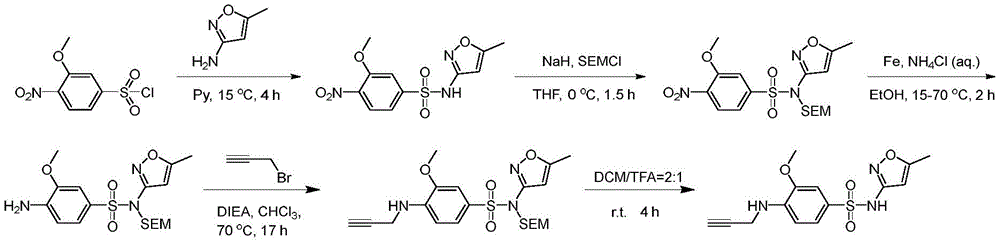
3-methoxy-N- (5-methylisoxazol-3-yl) -4- (prop-2-yn-1-ylamino) benzenesulfonamide was prepared by a procedure analogous to the synthesis of N- (isoxazol-3-yl) -3-methoxy-4- (prop-2-yn-1-ylamino) benzenesulfonamide according to example a14, using 5-methylisoxazol-3-amine instead of isoxazol-3-amine.
Example a 17: preparation of 2- (2- (dimethylamino) ethoxy) -4- (methylsulfonyl) -N- (prop-2-yn-1-yl) aniline hydrochloride.

Synthesis of N, N-dimethyl-2- (5- (methylsulfonyl) -2-nitrophenoxy) ethan-1-amine: to a mixture of 5- (methylsulfonyl) -2-nitrophenol (prepared according to the first two steps of example A13) (200mg, 920.81. mu. mol,1 eq.) in THF (10mL) was added KI (29.96mg, 180.48. mu. mol,0.196 eq.), 2-chloro-N, N-dimethyl-ethylamine (213.54mg,1.48mmol,1.61 eq., HCl) and Cs 2 CO 3 (738.05mg,2.27mmol,2.46 equiv.). The mixture was stirred at 70 ℃ for 16 hours, and subsequent HPLC analysis indicated a reactant to product ratio of 4: 1. The mixture was poured into water (40mL) and extracted with EtOAc (20mL × 3).The combined organic layers were washed with brine (20mL x 3), dried over anhydrous sodium sulfate, filtered and concentrated under reduced pressure to give N, N-dimethyl-2- (5- (methylsulfonyl) -2-nitrophenoxy) ethan-1-amine (300mg, crude) as a yellow oil. MS (ES) + ,m/z):288.9。
Synthesis of 2- (2- (dimethylamino) ethoxy) -4- (methylsulfonyl) aniline: to a solution of N, N-dimethyl-2- (5- (methylsulfonyl) -2-nitrophenoxy) ethan-1-amine (0.5g,1.73mmol,1 eq) in MeOH (50mL) was added Pd/C (50mg,227.18mmol, 15% purity, 131 eq). Degassing the mixture and reacting with H 2 (349.59ug, 173.42. mu. mol,2.33 e-2. mu.L) with a purge at 20 ℃ in H 2 Stirring was carried out for 12 hours (50psi) and subsequent LC-MS analysis indicated completion of the reaction. The mixture was poured into MeOH (100mL), filtered over celite and concentrated to give 2- (2- (dimethylamino) ethoxy) -4- (methylsulfonyl) aniline (450mg, crude) as a dark brown oil. MS (ES) + ,m/z):259.1。
Synthesis of tert-butyl (tert-butoxycarbonyl) (2- (2- (dimethylamino) ethoxy) -4- (methylsulfonyl) phenyl) carbamate: to a solution of 2- (2- (dimethylamino) ethoxy) -4- (methylsulfonyl) aniline (200mg,774.18 μmol,1 eq) in dioxane (7mL) was added Boc 2 O (1.01g,4.65mmol,1.07mL,6 equivalents) and DMAP (94.58mg, 774.18. mu. mol,1 equivalent). The reaction was then stirred at 110 ℃ for 16 hours, and subsequent LC-MS analysis indicated completion of the reaction. The mixture was poured into water (50mL) and extracted with EtOAc (30mL x 3). The combined organic layers were washed with brine (30mL x 3), dried over anhydrous sodium sulfate, filtered and concentrated under reduced pressure to give tert-butyl (tert-butoxycarbonyl) (2- (2- (dimethylamino) ethoxy) -4- (methylsulfonyl) phenyl) carbamate (550mg, crude) as a dark brown oil. MS (ES) + ,m/z):459.1。
Synthesis of tert-butyl (2- (2- (dimethylamino) ethoxy) -4- (methylsulfonyl) phenyl) carbamate: to a solution of tert-butyl (tert-butoxycarbonyl) (2- (2- (dimethylamino) ethoxy) -4- (methylsulfonyl) phenyl) carbamate (550mg,1.20mmol,1 eq) in MeOH (10mL) was added K 2 CO 3 (497.29mg,3.60mmol,3 equiv.). The resulting mixture was stirred at 40 ℃ for 4 hoursThe subsequent LC-MS analysis indicated that the reaction was complete. The mixture was concentrated in vacuo, diluted with EtOAc (30mL) and water (30mL), and extracted with EtOAc (30 mL. times.3). The combined organic layers were washed with brine (30mL x 3), dried over anhydrous sodium sulfate, filtered and concentrated in vacuo. The residue was purified by column chromatography (SiO) 2 DCM to DCM MeOH ═ 10:1) to give tert-butyl (2- (2- (dimethylamino) ethoxy) -4- (methylsulfonyl) phenyl) carbamate (210mg,535.18 μmol, 44.6% yield) as a yellow oil. MS (ES) + ,m/z):359.1。
Synthesis of tert-butyl (2- (2- (dimethylamino) ethoxy) -4- (methylsulfonyl) phenyl) (prop-2-yn-1-yl) carbamate: to a mixture of tert-butyl (2- (2- (dimethylamino) ethoxy) -4- (methylsulfonyl) phenyl) carbamate (50mg,127.42 μmol,1 eq) in DMF (1.5mL) at 0 deg.C was added NaH (10.19mg,254.85 μmol, 60% in mineral oil, 2 eq). The mixture was stirred at 0 ℃ for 0.5 h, then a solution of propargyl bromide (22.74mg, 191.13. mu. mol, 16.48. mu.L, 1.5 eq.) in DMF (0.5mL) was added dropwise. The mixture was stirred at 0 ℃ for a further 1 h and then analyzed by TLC (DCM: MeOH ═ 20:1, R) f (starting material) =0.23,R f (products) 0.17) new spots were observed. The mixture was poured into saturated NH 4 To aqueous Cl (10mL) was added EtOAc (10mL) and the resulting mixture was extracted with EtOAc (10mL x 3). The combined organic layers were washed with brine (10mL x 3), dried over anhydrous sodium sulfate, filtered and concentrated in vacuo. The residue was purified by preparative TLC to give tert-butyl (2- (2- (dimethylamino) ethoxy) -4- (methylsulfonyl) phenyl) (prop-2-yn-1-yl) carbamate (35mg,80.26 μmol, 31.5% yield) as a yellow oil. MS (ES) + ,m/z):397.4。
Synthesis of 2- (2- (dimethylamino) ethoxy) -4- (methylsulfonyl) -N- (prop-2-yn-1-yl) aniline hydrochloride: a solution of tert-butyl (2- (2- (dimethylamino) ethoxy) -4- (methylsulfonyl) phenyl) (prop-2-yn-1-yl) carbamate (35mg, 80.26. mu. mol,1 eq) in HCl/EtOAc (4M, 20.06. mu.L) was stirred at 15 ℃ for 1 hour, followed by HPLC and LC-MS analysis to show completion of the reaction. The mixture was concentrated in vacuo to give 2- (2- (dimethylamino) ethoxy) -4- (methylsulfonyl) -N- (propane)-2-yn-1-yl) aniline hydrochloride (30mg, crude) as a yellow oil. MS (ES) + ,m/z):296.9。
Example a 18: preparation of 2-methoxy-4- (morpholinosulfonyl) -N- (prop-2-yn-1-yl) aniline.

2-methoxy-4- (morpholinosulfonyl) -N- (prop-2-yn-1-yl) aniline was prepared by a procedure analogous to the synthesis of N- (2-hydroxyethyl) -3-methoxy-N-methyl-4- (prop-2-yn-1-ylamino) benzenesulfonamide according to example A15, using morpholine instead of 2- (methylamino) ethan-1-ol. MS (ES) + ,m/z):311.1。
Example a 19: preparation of 1- (4- ((3-methoxy-4- (prop-2-yn-1-ylamino) phenyl) sulfonyl) piperazin-1-yl) ethan-1-one.

1- (4- ((3-methoxy-4- (prop-2-yn-1-ylamino) phenyl) sulfonyl) piperazin-1-yl) ethan-1-one was prepared by a procedure analogous to the synthesis of N- (2-hydroxyethyl) -3-methoxy-N-methyl-4- (prop-2-yn-1-ylamino) benzenesulfonamide according to example A15, using N-acetylpiperazine instead of 2- (methylamino) ethan-1-ol.
Example a 20: preparation of N- (2, 3-dihydroxypropyl) -3-methoxy-4- (prop-2-yn-1-ylamino) benzenesulfonamide.

N- (2, 3-dihydroxypropyl) -3-methoxy-4- (prop-2-yn-1-ylamino) benzenesulfonamide was prepared by a procedure analogous to the synthesis of N- (2-hydroxyethyl) -3-methoxy-N-methyl-4- (prop-2-yn-1-ylamino) benzenesulfonamide according to example a15, using (rac) -3-aminopropane-1, 2-diol instead of 2- (methylamino) ethan-1-ol.
Example a 21: preparation of 2- (fluoromethoxy) -4- (methylsulfonyl) -N- (prop-2-yn-1-yl) aniline.

In N 2 Next, to a solution of 5- (methylsulfonyl) -2- (prop-2-yn-1-ylamino) phenol (400mg,1.60mmol,1 eq) in DMF (8mL) was added K in one portion 2 CO 3 (662.61mg,4.79mmol,3 equiv.) and bromo (fluoro) methane (360.95mg,3.20mmol,2 equiv.). The mixture was stirred at 40 ℃ for 60 minutes and TLC and LC-MS analysis indicated that the reaction was complete. The reaction was diluted with water (30mL) and extracted with EtOAc (30mL x 3). The combined organic layers were washed with water (30mL x 3) and brine (30mL x 2), dried over anhydrous sodium sulfate, filtered and concentrated in vacuo. The crude residue is purified by column chromatography (SiO) 2 PE: EtOAc 1.5:1 to 1:1) to give the desired product (320mg,1.24mmol, 77.83% yield) as a pink solid. MS (ES) + ,m/z):258.0。
Example a 22: preparation of methyl 2- (5- (methylsulfonyl) -2- (prop-2-yn-1-ylamino) phenoxy) acetate

To a solution of 5- (methylsulfonyl) -2- (prop-2-yn-1-ylamino) phenol (0.3g,1.3mmol,1 eq) in acetonitrile (5mL) was added K 2 CO 3 (552.18mg,4mmol,3 equiv.) and methyl 2-bromoacetate (1.5 equiv.). Then, in N 2 The mixture was stirred at 40 ℃ for 0.5 hour. TLC analysis indicated the reaction was complete. The reaction was quenched with water (20mL) and extracted with EtOAc (20 mL. times.3). The combined organic layers were washed with saturated brine (20mL x 3), dried over anhydrous sodium sulfate, filtered and concentrated in vacuo. The residue was passed through preparative TLC (SiO) 2 DCM: MeOH ═ 1:0) to give the desired product as a yellow solid. 75.8% yield, MS (ES) + ,m/z):298.1。
Example a 23: preparation of 6- (methylsulfonyl) -3- (prop-2-yn-1-yl) benzo [ d ] oxazol-2 (3H) -one.

To a solution of 5- (methylsulfonyl) -2- (prop-2-yn-1-ylamino) phenol (0.9g,4mmol,1 eq) in DMF (9mL) at 25 ℃ was added CDI (777.40mg,4.79mmol,1.2 eq). The mixture was stirred at 25 ℃ for 1 hour and then at 80 ℃ for 1 hour. LC-MS analysis indicated complete consumption of starting material and detection of one major peak with the expected product mass. The mixture was poured into water (50mL) and the resulting mixture was extracted with DCM (20mL × 3). The combined organic layers were washed with water (20mL x 3), dried over anhydrous sodium sulfate, filtered and concentrated under reduced pressure to give a residue. The crude residue was lyophilized to give the desired product (1g, crude) as a yellow solid. MS (ES) + ,m/z):252.0。
Example a 24: synthesis of (3R,4R) -3-methoxy-N- (prop-2-yn-1-yl) tetrahydro-2H-pyran-4-amine.

To the CH of (3R) -3-methoxytetrahydropyran-4-amine (0.1g,596.54 μmol,1 equivalent, HCl) 3 Solution in CN (2mL) added K 2 CO 3 (0.5g,3.62mmol,6 equiv.) and 3-bromoprop-1-yne (56.77mg, 477.23. mu. mol, 41.14. mu.L, 0.8 equiv.). The mixture was stirred at 25 ℃ for 1 hour. LC-MS analysis indicated that the reaction was complete. The reaction was concentrated under reduced pressure and passed through preparative TLC (SiO) 2 DCM: MeOH ═ 20:1) gave the desired product (0.029g,145.67 μmol, 24.4% yield) as a yellow oil. MS (ES) + ,m/z):170.2。
Example a 25: synthesis of 2-fluoro-5-methoxy-4- (prop-2-yn-1-ylamino) benzoic acid.

Preparation of 2-fluoro-5-methoxy-4-nitrobenzoic acid: to a solution of 2, 5-difluoro-4-nitro-benzoic acid (5g,24.62mmol,1 eq) in MeOH (60mL) was added dropwise a solution of KOH (4.14g,73.86mmol,3 eq) in MeOH (20 mL). The mixture was heated under reflux for 2 hours (oil bath temperature: 80 ℃ C.). The resulting mixture was stirred at 80 ℃ for 2 hours. LC-MS analysis indicated the reaction was complete. 2N HCl was added to the reaction mixture at 20 ℃ to adjust the pH of the mixture to 2. The mixture was then concentrated to remove MeOH. The residue was extracted with water (100mL) and EtOAc (100 mL. times.3). The organic layer was washed with brine (100mL), dried over anhydrous sodium sulfate, filtered and concentrated to give the crude product (5.2g, crude) as a yellow solid.
Preparation of methyl 2-fluoro-5-methoxy-4-nitrobenzoate: a solution of 2-fluoro-5-methoxy-4-nitrobenzoic acid (0.3g,1.39mmol,1 eq.) in HCl/MeOH (10mL) was stirred at 25 ℃ for 3 hours until a yellow solid formed. LC-MS analysis indicated the reaction was complete. The reaction was concentrated under reduced pressure to give the desired product (0.3g,1.24mmol, 89.2% yield) as a yellow solid.
Preparation of methyl 4-amino-2-fluoro-5-methoxybenzoate: to methyl 2-fluoro-5-methoxy-4-nitro-benzoate (0.3g,1.24mmol,1 eq) in EtOH (3mL) and saturated NH at 90 deg.C 4 Fe (347.26mg,6.22mmol,5 equiv.) was added to a mixture of Cl in water (1 mL). The mixture was stirred at 90 ℃ for 1 hour. TLC analysis indicated the reaction was complete. The mixture was extracted with EtOAc (20mL x 3). The organic layer was washed with brine (20mL x 2), dried over anhydrous sodium sulfate, filtered and concentrated under reduced pressure. The residue was purified by preparative TLC (SiO) 2 EtOAc 3:1) gave the desired product (0.22g,994.08 μmol, 79.93% yield) as an orange solid.
Preparation of methyl 4- ((tert-butoxycarbonyl) amino) -2-fluoro-5-methoxybenzoate: a solution of 4-amino-2-fluoro-5-methoxy-benzoic acid methyl ester (200mg, 903.71. mu. mol,1 eq) in di-tert-butyl dicarbonate (4.75g,21.76mmol,5mL,24.08 eq) is stirred at 110 ℃ for 6 h. LC-MS analysis indicated that some starting material remained. The reaction mixture was concentrated under reduced pressure and passed through preparative TLC (SiO) 2 PE: EtOAc ═ 4:1) purification afforded the desired product (0.23g,691.63 μmol, 76.53% yield)) It is a white solid. MS (ES) + ,m/z):300.2。
Preparation of methyl 4- ((tert-butoxycarbonyl) (prop-2-yn-1-yl) amino) -2-fluoro-5-methoxybenzoate: to a solution of methyl 4- ((tert-butoxycarbonyl) amino) -2-fluoro-5-methoxybenzoate (0.2g,601.42 μmol,1 eq) in DMF (4mL) was added Cs 2 CO 3 (587.86mg,1.80mmol,3 equiv.) and 3-bromoprop-1-yne (143.09mg,1.20mmol, 103.69. mu.L, 2 equiv.). The reaction mixture was stirred at 40 ℃ for 1 hour. LC-MS analysis indicated the reaction was complete. The reaction mixture was poured into EtOAc (15mL) and extracted with EtOAc (15mL × 3). The combined organic layers were washed with brine (15mL x 3), dried over anhydrous sodium sulfate, filtered and concentrated under reduced pressure. The residue was purified by preparative TLC (SiO) 2 EtOAc ═ 5:1) to give the desired product (0.18g,480.22 μmol, 79.85% yield) as a white oil.
Preparation of 4- ((tert-butoxycarbonyl) (prop-2-yn-1-yl) amino) -2-fluoro-5-methoxybenzoic acid: to a solution of methyl 4- ((tert-butoxycarbonyl) (prop-2-yn-1-yl) amino) -2-fluoro-5-methoxybenzoate (0.16g,426.87 μmol,1 eq) in THF (1mL), MeOH (1mL) and water (1mL) was added lithium hydroxide hydrate (53.74mg,1.28mmol,3 eq). The mixture was stirred at 25 ℃ for 1 hour. TLC analysis indicated the reaction was complete. 1M HCl was added to adjust the pH of the reaction mixture to 2. The mixture was extracted with EtOAc (20mL x 3). The organic layer was washed with brine (20mL x 3), dried over anhydrous sodium sulfate, filtered and concentrated under reduced pressure to give the crude product (0.14g, crude) as a white solid. The crude product was used without purification.
Preparation of 2-fluoro-5-methoxy-4- (prop-2-yn-1-ylamino) benzoic acid: a solution of 4- ((tert-butoxycarbonyl) (prop-2-yn-1-yl) amino) -2-fluoro-5-methoxybenzoic acid (0.15g, 463.94. mu. mol,1 eq) in 4N HCl/EtOAc (6mL,51.73 eq) was stirred at 25 ℃ for 1 h. LC-MS analysis indicated the reaction was complete. The reaction was concentrated under reduced pressure to give the crude product (0.1g, crude, HCl) as a yellow solid. The crude product was used without purification. MS (ES) + ,m/z):222.0。
Example a 26: preparation of (3S) -3-methoxy-N- (prop-2-yn-1-yl) tetrahydro-2H-pyran-4-amine.

To (3S) -3-methoxytetrahydro-2H-pyran-4-amine (0.5g,3.81mmol,1 eq) in CH 3 CN (8mL) solution to add K 2 CO 3 (1.58g,11.44mmol,3 equiv.). The mixture was stirred at 25 ℃ and 3-bromoprop-1-yne (362.76mg,3.05mmol,262.87 μ L,0.8 equiv.) was added to the solution. The resulting reaction mixture was stirred at 25 ℃ for 3 hours. TLC analysis indicated that the reaction was complete and some starting material remained. The reaction was filtered and concentrated under reduced pressure. The residue was purified by column chromatography (SiO) 2 PE: EtOAc ═ 10:1 to 5:1) to give the desired product (0.33g,1.76mmol, 46.04% yield) as a yellow oil. MS (ES) + ,m/z):170.1。
Example a 27: synthesis of 2- (COOR) -4- (methylsulfonyl) -N- (prop-2-yn-1-yl) aniline.

To a solution of 5- (methylsulfonyl) -2- (prop-2-yn-1-ylamino) phenol (1 eq) in DCM (5mL) was added pyridine (1 eq) and R-anhydride (1 eq). The mixture was stirred at 25 ℃ for 2 hours. LC-MS analysis showed the desired product. The reaction mixture was quenched by addition of water (100mL) at 0 ℃ and extracted with EtOAc (30mL x 3). The combined organic layers were washed with brine (30mL), dried over anhydrous sodium sulfate, filtered and concentrated under reduced pressure. The residue was purified by preparative TLC (SiO) 2 ,PE:EtOAc=PE:EtOAc=1:1,R f 0.5) to yield the desired product.
Example a 28: synthesis of 4- (methylsulfonyl) -N- (prop-2-yn-1-yl) -2- (trifluoromethoxy) aniline.

Preparation of 4- (methylsulfonyl) -2- (trifluoromethoxy) anilinePreparing: to a mixture of 4-bromo-2- (trifluoromethoxy) aniline (5g,19.53mmol,2.96mL,1 equiv.) and sodium methylsulfate (5.98g,58.59mmol,3 equiv.) in DMSO (50mL) was added L-proline (1.12g,9.76mmol,0.5 equiv.) and CuI (1.49g,7.81mmol,0.4 equiv.). The reaction mixture is stirred under N 2 The mixture was stirred at 100 ℃ for 16 hours. TLC analysis showed some starting material remaining. The mixture was stirred at 20 ℃ for 1 h and extracted with EtOAc (50mL × 3). The combined organic layers were washed with brine (50mL x 3), dried over anhydrous sodium sulfate, filtered and concentrated under reduced pressure. The residue was purified by column chromatography (SiO) 2 PE: EtOAc ═ 10:1 to 1:1) purification afforded the desired product (2.6g,10.19mmol, 52.16% yield) as a white solid.
Preparation of tert-butyl (4- (methylsulfonyl) -2- (trifluoromethoxy) phenyl) carbamate: to a solution of tert-butyl (4- (methylsulfonyl) -2- (trifluoromethoxy) phenyl) carbamate (500mg,1.76mmol,1 eq) in THF (10mL) was added Boc 2 O (461.78mg,2.12mmol, 486.09. mu.L, 1.2 equiv.) and DMAP (258.49mg,2.12mmol,1.2 equiv.). The reaction mixture was stirred at 70 ℃ for 1 hour. TLC and LC-MS analysis indicated the reaction was complete. The reaction was diluted with water (20mL) and extracted with EtOAc (20mL x 3). The combined organic layers were washed with brine (20mL x 3), dried over anhydrous sodium sulfate, filtered and concentrated under reduced pressure. The crude residue is purified by column chromatography (SiO) 2 EtOAc ═ 10:1 to 1:1) to give tert-butyl (4- (methylsulfonyl) -2- (trifluoromethoxy) phenyl) carbamate (900mg,1.98mmol, 112.07% yield) and N, N-bis (tert-butoxycarbonyl) -4- (methylsulfonyl) -2- (trifluoromethoxy) aniline (900mg,2.53mmol, 143.65% yield) as a white solid.
The reaction mixture was stirred with tert-butyl (4- (methylsulfonyl) -2- (trifluoromethoxy) phenyl) carbamate (700mg,1.54mmol,1 equiv.), N-bis (tert-butoxycarbonyl) -4- (methylsulfonyl) -2- (trifluoromethoxy) aniline (700mg,1.97mmol,1.28 equiv.), and K 2 CO 3 A mixture of (637.25mg,4.61mmol,3 equiv.) in MeOH (18mL) was stirred at 40 deg.C for 2 h. LC-MS analysis indicated the reaction was complete. The reaction mixture was filtered and concentrated under reduced pressure to give the crude product (1g) as a pale yellow solid.
(4- (A)Preparation of tert-butyl phenylsulfonyl) -2- (trifluoromethoxy) phenyl) (prop-2-yn-1-yl) carbamate: to a solution of tert-butyl (4- (methylsulfonyl) -2- (trifluoromethoxy) phenyl) carbamate (0.8g,2.25mmol,1 eq) in DMF (20mL) at 25 deg.C was added Cs 2 CO 3 (2.20g,6.75mmol,3 equiv.) and 3-bromoprop-1-yne (803.49mg,6.75mmol, 582.24. mu.L, 3 equiv.). The mixture was stirred for 1 hour. TLC and LC-MS indicated that the reaction was complete. The reaction was diluted with water (20mL) and extracted with EtOAc (10 mL. times.3). The combined organic layers were washed with brine (10mL x 3), dried over anhydrous sodium sulfate, filtered and concentrated in vacuo. The crude residue is purified by column chromatography (SiO) 2 DCM: MeOH ═ 10:1) gave the desired product (0.65g,1.49mmol, 66.05% yield) as a yellow solid.
Preparation of 4- (methylsulfonyl) -N- (prop-2-yn-1-yl) -2- (trifluoromethoxy) aniline: a solution of tert-butyl (4- (methylsulfonyl) -2- (trifluoromethoxy) phenyl) (prop-2-yn-1-yl) carbamate (650mg,1.49mmol,1 eq) in HCl/EtOAc (4M,13.50mL,36.31 eq) was stirred at 25 ℃ for 0.5 h. LC-MS analysis indicated the reaction was complete. The reaction was diluted with EtOAc (10mL) and concentrated in vacuo. The desired product (340mg, crude, HCl) was obtained as a yellow solid. MS (ES) + ,m/z):291.9。
Example a 29: synthesis of 2-methyl-4- (methylsulfonyl) -N- (prop-2-yn-1-yl) aniline

To a solution of 2-methyl-4- (methylsulfonyl) aniline (1g,5.40mmol,1 eq) in DMF (10mL) at 70 deg.C was added K 2 CO 3 (2.24g,16.19mmol,3 equiv.) and 3-bromoprop-1-yne (642.18mg,5.40mmol, 465.35. mu.L, 1 equiv.). The mixture was stirred at 70 ℃ for 12 hours. TLC analysis showed some starting material remaining. The reaction was poured into water (20mL) and extracted with EtOAc (20mL x 3). The combined organic layers were washed with brine (20mL x 3), dried over anhydrous sodium sulfate, filtered and concentrated in vacuo. The residue was purified by column chromatography (SiO) 2 PE: EtOAc ═ 10:1 to 1:1) purification afforded the desired product (0)5g,2.02mmol, 37.33% yield) as a yellow solid. MS (ES) + ,m/z):224.1。
Example a 30: synthesis of 2-fluoro-5-methoxy-N-methyl-4- (prop-2-yn-1-ylamino) benzamide

Preparation of 2-fluoro-5-methoxy-4-nitrobenzoic acid: to a solution of 2, 5-difluoro-4-nitro-benzoic acid (4g,19.69mmol,1 eq) in MeOH (64mL) at 80 deg.C was added a solution of KOH (3.31g,59.08mmol,3 eq.; dropwise) in MeOH (16 mL). The resulting mixture was stirred at 80 ℃ for 2 hours. HPLC analysis indicated the reaction was complete. 2N HCl was added to the solution at 20 ℃ to adjust the pH of the mixture to 2. The mixture was concentrated to remove MeOH, and the residue was extracted with water (30mL) and EtOAc (40mL × 3). The organic layer was washed with brine (30mL), dried over anhydrous sodium sulfate, filtered and concentrated. The crude product (4g,18.59mmol, 94.41% yield) was obtained as a yellow solid, which was used without purification.
Preparation of 4-amino-2-fluoro-5-methoxybenzoic acid: a mixture of 2-fluoro-5-methoxy-4-nitrobenzoic acid (4g,18.59mmol,1 eq) and Pd/C (2g,1.88mmol, 10% purity, 1.01e-1 eq) in MeOH (50mL) was degassed with N 2 Purging three times and in H 2 Next (15Psi) was stirred at 20 ℃ for 5 hours. LC-MS and HPLC analysis indicated the reaction was complete. The mixture was filtered through silica gel and the filtrate was concentrated. The crude residue (3.5g,17.01mmol, 91.50% yield) was obtained as a yellow solid which was used without purification. MS (ES) + ,m/z):184.2。
Preparation of 4-amino-2-fluoro-5-methoxy-N-methylbenzamide: a mixture of 4-amino-2-fluoro-5-methoxybenzoic acid (2g,10.80mmol,1 eq), methylamine hydrochloride (1.46g,21.60mmol,2 eq), HOBt (2.19g,16.20mmol,1.5 eq), EDCI (3.11g,16.20mmol,1.5 eq) and TEA (4.37g,43.21mmol,6mL,4 eq) in DCM (30mL) was degassed and N-charged 2 Purging was carried out three times. Mixing the mixture in N 2 The mixture was stirred at 20 ℃ for 2 hours. LC-MS analysis indicated the reaction was complete. The mixture was washed with water (30mL) andDCM (50mL × 5) extract. The organic layer was washed with brine (40mL), dried over anhydrous sodium sulfate, filtered and concentrated. The residue was purified by column chromatography (SiO) 2 PE: EtOAc ═ 3:1) to give the desired product (1.1g,5mmol, 46.24% yield) as a white solid. MS (ES) + ,m/z):199.1。
Preparation of 2-fluoro-5-methoxy-N-methyl-4- (prop-2-yn-1-ylamino) benzamide: 4-amino-2-fluoro-5-methoxy-N-methylbenzamide (0.7g,3.18mmol,1 eq.), 3-bromoprop-1-yne (2.27g,19.07mmol,1.64mL,6 eq.) and K 2 CO 3 A mixture of (1.32g,9.54mmol,3 equiv.) in DMF (10mL) was degassed and N was used 2 Purging three times and in N 2 The mixture was then stirred at 105 ℃ for 12 hours. TLC analysis indicated the starting material was consumed. The reaction mixture was extracted with water (60mL) and EtOAc (40 mL. times.3). The organic layer was washed with brine (15mL x 3), dried over anhydrous sodium sulfate, filtered and concentrated in vacuo. The residue was purified by column chromatography (SiO) 2 PE: EtOAc ═ 5:1 to 3:1) to give the desired product (0.6g,1.78mmol, 55.93% yield) as a yellow solid.
Example a 31: synthesis of 2-amino-N- ((3-methoxy-4- (prop-2-yn-1-ylamino) phenyl) sulfonyl) acetamide.

Preparation of tert-butyl (2- ((3-methoxy-4- (prop-2-yn-1-ylamino) phenyl) sulfonamido) -2-oxoethyl) carbamate: to a solution of (tert-butoxycarbonyl) glycine (437.45mg,2.50mmol, 70.16. mu.L, 2 equiv.) in DCM (6mL) was added HATU (949.47mg,2.50mmol,2 equiv.) and TEA (252.68mg,2.50mmol, 347.57. mu.L, 2 equiv.). The mixture was stirred at 25 ℃ for 0.5 hour. Then, 3-methoxy-4- (prop-2-yn-1-ylamino) benzenesulfonamide (300mg,1.25mmol,1 eq) was added to the reaction and the mixture was stirred at 25 ℃ for 2 h. TLC analysis showed 40% starting material remained. A second portion of 3-methoxy-4- (prop-2-yn-1-ylamino) benzenesulfonamide (437.45mg,2.50mmol,2 equiv.), HATU (949.47mg,2.50mmol,2 equiv.), and TEA (252.68mg,2.50mmol, 347.57. mu.L, 2 equiv.) was added to the reaction and the mixture was stirred at 25 ℃ for a further 10 hours. TLC analysis indicated the starting material was consumed. The mixture was poured into water (10mL) and the aqueous phase was extracted with DCM (10mL × 3). The combined organic layers were washed with brine (10mL x 3), dried over anhydrous sodium sulfate, filtered and concentrated in vacuo. The residue was purified by silica gel chromatography (PE: EtOAc ═ 1:1 to 1:2) to give the desired product (560mg,845.40 μmol, 67.71% yield) as a colorless oil.
Preparation of 2-amino-N- ((3-methoxy-4- (prop-2-yn-1-ylamino) phenyl) sulfonyl) acetamide: tert-butyl (2- ((3-methoxy-4- (prop-2-yn-1-ylamino) phenyl) sulfonylamino) -2-oxoethyl) carbamate (490mg,739.72 μmol,1 eq) was dissolved in 4N HCl in EtOAc (5mL) and the solution was stirred at 25 ℃ for 1 hour. LC-MS analysis indicated the reaction was complete. The residue was concentrated in vacuo to give the crude product (350mg, crude) as a white solid. MS (ES) + ,m/z):298.1。
Example a 32: synthesis of 4-methoxy-N-prop-2-ynyl-pyridin-3-amine.

Preparation of tert-butyl N-tert-butoxycarbonyl-N- (4-methoxy-3-pyridyl) carbamate: to a solution of 4-methoxypyridin-3-amine (810mg,6.52mmol,1 eq) in THF (25mL) was added LiHMDS (1M,399.55 μ L,2.48 eq). The solution is treated with N 2 Purging three times and in N 2 The mixture was then stirred at 0 ℃ for 30 minutes. Then, the Boc was added 2 O (2.85g,13.04mmol,3mL,2 equiv.) is added to the reaction and the reaction is quenched in N 2 The mixture was stirred at 0 ℃ for 2 hours. TLC analysis indicated partial consumption of starting material and one spot of the desired product was detected. The reaction mixture was poured into saturated NH 4 Cl solution (100mL) and extracted with EtOAc (50mL x1, then 25mL x 2). The combined organic layers were dried over anhydrous sodium sulfate, filtered and concentrated under reduced pressure to give tert-butyl N-tert-butoxycarbonyl-N- (4-methoxy-3-pyridinyl) carbamate (1.5g, crude) as a yellow oil.
Preparation of tert-butyl N- (4-methoxy-3-pyridyl) carbamate: tert-butyl N-tert-butoxycarbonyl-N- (4-methoxy-3-pyridyl) carbamate (1.50g,4.62mmol,1 eq.) and K 2 CO 3 A mixture of (639.13mg,4.62mmol,1 eq) in MeOH (2mL) was degassed and N was used 2 Purging was carried out three times. Mixing the mixture in N 2 The mixture was stirred at 50 ℃ for 16 hours. TLC analysis indicated that the starting material was consumed and one spot of the desired product was observed. The reaction mixture was poured into water (100mL) and extracted with EtOAc (50mL x 1, then 25mL x 2). The combined organic layers were dried over anhydrous sodium sulfate, filtered and concentrated under reduced pressure. The crude product was purified by column chromatography to give tert-butyl N- (4-methoxy-3-pyridinyl) carbamate (1g,4.01mmol, 86.87% yield) as a yellow oil.
Preparation of N- (4-methoxy-3-pyridinyl) -N-prop-2-ynyl-carbamic acid tert-butyl ester: at N 2 Next, a mixture of tert-butyl N- (4-methoxy-3-pyridyl) carbamate (500mg,2.23mmol,1 eq.) and NaH (160.56mg,6.69mmol,3 eq., 60% in mineral oil) in THF (25mL) was stirred at 0 deg.C for 1 h. Then 3-bromoprop-1-yne (530.46mg,4.46mmol, 384.39. mu.L, 2 equiv.) was added under N 2 The resulting mixture was then stirred at 0 ℃ for 1 hour. TLC analysis indicated that the starting material was consumed and a new spot of the desired product was observed. The reaction mixture was poured into water (100mL) and extracted with EtOAc (50mL x 1, then 25mL x 2). The combined organic layers were dried over anhydrous sodium sulfate, filtered and concentrated under reduced pressure. The crude product was purified by column chromatography (PE: EtOAc ═ 2:1) to give N- (4-methoxy-3-pyridinyl) -N-prop-2-ynyl-carbamic acid tert-butyl ester (200mg,762.49 μmol, 34.19% yield) as a yellow oil.
Preparation of 4-methoxy-N-prop-2-ynyl-pyridin-3-amine: to a solution of N- (4-methoxy-3-pyridyl) -N-prop-2-ynyl-carbamic acid tert-butyl ester (200mg,762.49 μmol,1 eq) in EtOH (10mL) was added HCl/EtOAc (4M,190.62 μ L,1 eq). The solution is treated with N 2 Purging three times and in N 2 The mixture was stirred at 25 ℃ for 2 hours. TLC analysis indicated that the starting material was consumed and one spot of the desired product was observed. Mixing the mixture inConcentration under reduced pressure gave 4-methoxy-N-prop-2-ynyl-pyridin-3-amine (150mg,755.10 μmol, 99.03% yield, HCl) as a yellow solid. The desired product was used without further purification.
Example a 33: synthesis of 2-methoxy-N-prop-2-ynyl-4- (trifluoromethyl) aniline.

Synthesis of 2-methoxy-1-nitro-4- (trifluoromethyl) benzene: to a solution of 2-fluoro-1-nitro-4- (trifluoromethyl) benzene (23g,110mmol,1 eq) in MeOH (350mL) at 80 ℃ was added a solution of KOH (18.51g,329.99mmol,3 eq) in MeOH (100 mL). The resulting mixture was stirred at 80 ℃ for 2 hours. TLC analysis (R) f (products) PE: EtOAc: 5:1) indicated that the starting material was consumed and a new spot was formed. 2N HCl was added to the reaction mixture to adjust the pH of the mixture to 2. Then, the solution was concentrated. The crude residue was washed with water (150mL) and extracted with EtOAc (300mL × 2). The organic layer was washed with brine (15mL), dried over anhydrous sodium sulfate, filtered and concentrated in vacuo to give 2-methoxy-1-nitro-4- (trifluoromethyl) benzene (22.5g,91.57mmol, 83.25% yield) as a yellow solid. The crude residue was used without any purification.
Synthesis of 2-methoxy-4- (trifluoromethyl) aniline: to 2-methoxy-1-nitro-4- (trifluoromethyl) benzene (23.8g,96.86mmol,1 eq) in EtOH (300mL) and saturated NH over 10 min at 70 deg.C 4 Fe (27.05g,484.32mmol,5 equiv.) was added in portions to a solution of Cl (100 mL). The resulting mixture was stirred at 70 ℃ for 0.5 hour. TLC analysis (R) f (products) 0.50, PE: EtOAc: 5:1) indicates completion of the reaction. The reaction mixture was poured into EtOAc (1500mL) and the resulting mixture was washed with water (500mL) and extracted with EtOAc (300mL × 2). The organic layer was washed with brine (200mL × 2), dried over anhydrous sodium sulfate, filtered and concentrated in vacuo to give 2-methoxy-4- (trifluoromethyl) aniline (19g,89.46mmol, 92.35% yield) as a yellow oil. The residue was used without any purification.
Synthesis of 2-methoxy-N-prop-2-ynyl-4- (trifluoromethyl) aniline: preparation of 2-methoxy-4- (trifluoromethyl) aniline (1g,5.23mmol,1 eq), 3-bromoprop-1-yne (3.11g,26.16mmol,2.25mL,5 eq), K in DMF (10mL) 2 CO 3 (2.17g,15.69mmol,3 equiv.). Degassing the mixture and applying N 2 Purging three times at N 2 The mixture was stirred at 105 ℃ for 8 hours under an atmosphere. TLC analysis indicated the starting material was consumed (PE: EtOAc ═ 5: 1). The mixture was washed with water (60mL) and extracted with EtOAc (40mL x 3). The combined organic layers were washed with brine (15mL x 3), dried over anhydrous sodium sulfate, filtered and concentrated in vacuo. The residue was purified by column chromatography (SiO) 2 PE: EtOAc ═ 25:1 to 15:1) to give 2-methoxy-N-prop-2-ynyl-4- (trifluoromethyl) aniline (0.8g,2.44mmol, 46.70% yield) as a yellow oil.
Example a 34: synthesis of ((4- ((tert-butoxycarbonyl) (prop-2-yn-1-yl) amino) -3-methoxyphenyl) sulfonyl) methyl acetate.

Preparation of (3-methoxy-4-nitrophenyl) (methyl) sulfane: to a solution of 4-fluoro-2-methoxy-1-nitrobenzene (2g,11.69mmol,1 eq) in DMF (20mL) was added sodium methyl mercaptide (5.32g,15.19mmol,4.84mL, 20% pure, 1.3 eq). The mixture was stirred at 20 ℃ for 2 hours. TLC analysis indicated the reaction was complete. By adding saturated NH 4 The reaction mixture was diluted with Cl solution (100 mL). The mixture was filtered and concentrated under reduced pressure to give (3-methoxy-4-nitrophenyl) (methyl) sulfane (2.4g, crude) as a yellow solid.
Preparation of ((3-methoxy-4-nitrophenyl) thio) methyl acetate: to a solution of (3-methoxy-4-nitrophenyl) (methyl) sulfane (1.4g,7.03mmol,1 eq) in DCE (15mL) was added phenyl- λ 3 Iodoalkanediyl diacetate (3.40g,10.54mmol,1.5 equiv.) and Pd (OAc) 2 (473.30mg,2.11mmol,0.3 equiv.). Mixing the mixture in N 2 The mixture was stirred at 100 ℃ for 6 hours. TLC analysis indicated the reaction was complete. The reaction mixture is washed with water (30) 0mL) and extracted with EtOAc (100mL x 3). The combined organic layers were washed with brine (100mL x 2), dried over anhydrous sodium sulfate, filtered and concentrated under reduced pressure. The residue was purified by column chromatography (SiO) 2 PE: EtOAc ═ 8:1 to 3:1) purification gave ((3-methoxy-4-nitrophenyl) thio) methyl acetate (1g,3.89mmol, 55.31% yield) as a yellow solid.
Preparation of ((3-methoxy-4-nitrophenyl) sulfonyl) methyl acetate: to a solution of ((3-methoxy-4-nitrophenyl) thio) methyl acetate (0.9g,3.50mmol,1 eq) in a mixture of acetone (4mL), water (0.4mL), and MeOH (4mL) was added potassium monopersulfate (oxone) (6.45g,10.50mmol,3 eq). The mixture was stirred at 25 ℃ for 5 hours. LC-MS analysis indicated the reaction was complete. The reaction mixture was saturated with Na 2 S 2 O 3 The solution (200mL) was diluted and extracted with EtOAc (50mL x 3). The combined organic layers were washed with brine (50mL × 2), dried over anhydrous sodium sulfate, filtered and concentrated under reduced pressure to give ((3-methoxy-4-nitrophenyl) sulfonyl) methyl acetate (1g, crude) as a yellow solid. The crude product was used in the next step without purification. MS (ES) + ,m/z):311.9。
Preparation of ((4-amino-3-methoxyphenyl) sulfonyl) methyl acetate: to a solution of ((3-methoxy-4-nitrophenyl) sulfonyl) methyl acetate (0.9g,3.11mmol,1 eq) in EtOH (8mL) was added saturated NH 4 Cl solution (166.43mg,3.11mmol,2mL,1 equiv.) and Fe (521.26mg,9.33mmol,3 equiv.). The mixture was stirred at 60 ℃ for 2 hours. TLC analysis indicated the reaction was complete. The reaction mixture was filtered, diluted with water (100mL) and extracted with EtOAc (50mL x 3). The combined organic layers were washed with brine (50mL x 2), dried over anhydrous sodium sulfate, filtered and concentrated under reduced pressure. The crude residue is purified by column chromatography (SiO) 2 PE: EtOAc ═ 10:1 to 4:1) to give ((4-amino-3-methoxyphenyl) sulfonyl) methyl acetate (580mg,2.24mmol, 71.90% yield) as a yellow solid.
Preparation of ((4- ((tert-butoxycarbonyl) amino) -3-methoxyphenyl) sulfonyl) methyl acetate: ((4-amino-3-methoxyphenyl) sulfonyl) methyl acetate (0.49g,1.89mmol,1 equiv.) in tert-butoxycarbonylA solution of tert-butyl carbonate (20.62g,94.49mmol,21.71mL,50 equivalents) was stirred at 130 ℃ for 4 hours. LC-MS analysis indicated the reaction was complete. The reaction mixture was filtered, diluted with water (100mL) and extracted with EtOAc (50mL × 3). The combined organic layers were washed with brine (50mL x 2), dried over anhydrous sodium sulfate, filtered and concentrated under reduced pressure. The crude residue is purified by column chromatography (SiO) 2 PE: EtOAc ═ 10:1 to 4:1) to give ((4- ((tert-butoxycarbonyl) amino) -3-methoxyphenyl) sulfonyl) methyl acetate (0.45g,1.25mmol, 66.25% yield) as a white oil.
Preparation of ((4- ((tert-butoxycarbonyl) (prop-2-yn-1-yl) amino) -3-methoxyphenyl) sulfonyl) methyl acetate: to a solution of ((4- ((tert-butoxycarbonyl) amino) -3-methoxyphenyl) sulfonyl) methyl acetate (0.35g,973.86 μmol,1 eq) in DMF (4mL) was added 3-bromoprop-1-yne (217.22mg,1.46mmol,157.41 μ L,1.5 eq) and Cs 2 CO 3 (634.61mg,1.95mmol,2 equiv.). In N 2 The mixture was then stirred at 25 ℃ for 1 hour. LC-MS analysis indicated the reaction was complete. The reaction mixture was diluted with water (100mL) and extracted with EtOAc (50mL × 2). The combined organic layers were washed with water (50mL x 2) and brine (50mL x 2), dried over anhydrous sodium sulfate, filtered and concentrated under reduced pressure. The crude residue was passed through preparative TLC (SiO) 2 PE: EtOAc ═ 1:1) purification gave ((4- ((tert-butoxycarbonyl) (prop-2-yn-1-yl) amino) -3-methoxyphenyl) sulfonyl) methyl acetate (0.3g,754.83 μmol, 77.51% yield) as a yellow oil. MS (ES) + ,m/z):342.0。
Example a 35: synthesis of tert-butyl (5-fluoro-2-methoxy-4- (methylcarbamoyl) phenyl) (prop-2-yn-1-yl) carbamate.
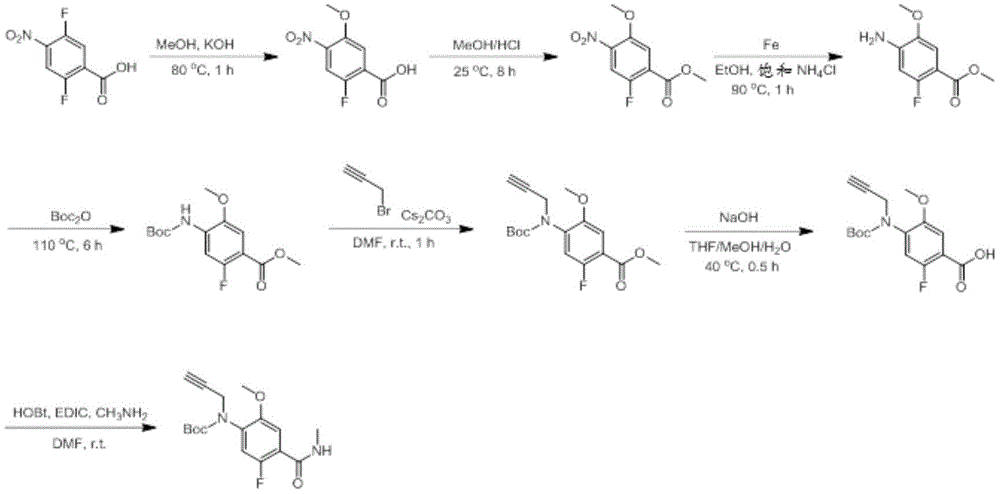
Preparation of 2-fluoro-5-methoxy-4-nitro-benzoic acid: to a mixture of 2, 5-difluoro-4-nitro-benzoic acid (20g,98.47mmol,1 eq) in MeOH (200mL) was added KOH (16.57g,295.42mmol,3 eq) in MeOH (50mL) dropwise at 80 ℃. The mixture was stirred at 80 ℃ for 1 hour. TLC analysisPrecipitation of (SiO) 2 ,DCM:MeOH:AcOH=400:20:1,R f 0.6) indicating complete consumption of starting material. 6M HCl was added dropwise to the mixture to adjust the pH of the solution to pH<2. Then, the mixture was concentrated under reduced pressure to remove MeOH. The mixture was diluted with water (200mL) and EtOAc (200mL) and extracted with EtOAc (200mL x 3). The combined organic layers were washed with brine (200mL x 3), dried over anhydrous sodium sulfate, filtered and concentrated under reduced pressure to give the crude product. The crude product was used directly in the next step without purification. 1 H NMR(400MHz,DMSO-d 6 )δ8.02-7.99(d,J=9.6Hz,1H),7.67-7.66(d,J=5.6Hz,1H),3.956(s,3H)。
Preparation of 2-fluoro-5-methoxy-4-nitro-benzoic acid methyl ester: a mixture of 2-fluoro-5-methoxy-4-nitro-benzoic acid (19.5g,90.64mmol,1 eq) in HCl/MeOH (4M,195mL,8.61 eq) was stirred at 25 ℃ for 8 h. TLC (SiO) 2 ,PE:EtOAc=2:1,R f 0.5) indicates complete consumption of the starting material. The reaction mixture was concentrated under reduced pressure to remove the solvent to give a residue. The crude product (19g) was obtained as a yellow solid and used in the next step without purification. 1 H NMR(400MHz,DMSO-d 6 )δ8.21-8.20(d,J=4.0Hz,1H),7.50-7.48(d,J=8.0Hz,1H),4.01(s,3H),3.71(s,3H)。
Preparation of 4-amino-2-fluoro-5-methoxy-benzoic acid methyl ester: to methyl 2-fluoro-5-methoxy-4-nitro-benzoate (19g,82.91mmol,1 eq.) and NH at 90 deg.C 4 A solution of Cl (26.61g,497.46mmol,6 equiv.) in EtOH (200mL) and water (40mL) was added Fe (13.89g,248.73mmol,3 equiv.) and the resulting mixture was stirred for 1 hour. LC-MS analysis showed 23% nitro starting material remained, several new peaks were observed, and 22% of the desired compound was detected. Fe (9.26g,165.82mmol,2 equiv.) was added to the mixture and the mixture was stirred at 90 ℃ for a further 2 hours. TLC analysis indicated complete consumption of starting material. The mixture was diluted with EtOH (200mL) and filtered through a pad of celite. The filtrate was concentrated under reduced pressure to give the crude product, which was purified by column chromatography (SiO) 2 PE: EtOAc ═ 30:1 to PE: EtOAc: DCM ═ 30:2:3, R f 0.5) purification. To obtain 4-amino-2-fluoro-5-methoxy-benzoic acid methyl ester (17 g)80.23mmol, 53.27% yield) as a pale yellow solid. 1 H NMR(400MHz,DMSO-d 6 )δ7.16-7.15(d,J=2.0Hz,1H),6.02-6.01(d,J=6.4Hz,1H),3.74(s,3H),3.41(s,3H)。MS(ES+,m/z):199.1。
Preparation of methyl 4- (tert-butoxycarbonylamino) -2-fluoro-5-methoxy-benzoate: 4-amino-2-fluoro-5-methoxy-benzoic acid methyl ester (16g,80.33mmol,1 eq.) and Boc 2 A mixture of O (152g,696.46mmol,160mL,8.67 eq.) was stirred at 110 deg.C for 6 hours. TLC analysis (SiO) 2 ,PE:EtOAc=4:1,R f 0.6) showed that 10% of the starting material remained and a major new spot was detected, which was less polar than the starting material. The reaction mixture was concentrated under reduced pressure to remove the solvent to give a residue. The residue was purified by column chromatography (SiO) 2 PE: EtOAc 60:1 to 50:1, R f 0.6). Methyl 4- (tert-butoxycarbonylamino) -2-fluoro-5-methoxy-benzoate (17g,51.12mmol, 63.64% yield) was obtained as a pale yellow solid. 1 H NMR(400MHz,DMSO-d 6 )δ8.45(s,1H),7.62(d,J=6.0Hz,1H),7.45(d,J=5.6Hz,1H),3.90(s,3H),3.80(s,3H),1.48(s,6H)。
Preparation of methyl 4- ((tert-butoxycarbonyl) (prop-2-yn-1-yl) amino) -2-fluoro-5-methoxybenzoate: to methyl 4- (tert-butoxycarbonylamino) -2-fluoro-5-methoxy-benzoate (15g,45.11mmol,1 eq) and Cs 2 CO 3 (29.39g,90.21mmol,2 equiv.) A mixture of propargyl bromide (10.73g,90.21mmol,7.78mL,2 equiv.) in DMF (110mL) was added. The mixture was stirred at 25 ℃ for 1 hour. TLC (SiO) 2 PE: EtOAc ═ 8:1, Rf ═ 0.5) indicated complete consumption of starting material. The mixture was diluted with water (500 mL). The mixture was extracted with EtOAc (200mL x 3). The combined organic layers were washed with saturated brine (200mL x3), dried over anhydrous sodium sulfate, filtered and concentrated under reduced pressure to give the crude product. The residue was purified by column chromatography (SiO) 2 PE: EtOAc ═ 0:1) purification yielded methyl 4- ((tert-butoxycarbonyl) (prop-2-yn-1-yl) amino) -2-fluoro-5-methoxybenzoate. 1H NMR (400MHz, DMSO-d6) δ 7.45(d, J ═ 2.4Hz,1H),7.30(d, J ═ 5.6Hz,1H),7.35(s,2H),3.90(s,3H),3.80(s,3H),3.20(s,1H),1.35(s, 6H).
Preparation of 4- ((tert-butoxycarbonyl) (prop-2-yn-1-yl) amino) -2-fluoro-5-methoxybenzoic acid: to a solution of methyl 4- ((tert-butoxycarbonyl) (prop-2-yn-1-yl) amino) -2-fluoro-5-methoxybenzoate (2g,5.93mmol,1 eq) in THF (5mL), MeOH (5mL) and water (5mL) was added NaOH (474.26mg,11.86mmol,2 eq). The mixture was stirred at 40 ℃ for 0.5 h. TLC analysis indicated the reaction was complete. The reaction was quenched with water (50mL) and the pH of the mixture was adjusted to 3 using 1N HCl. The resulting mixture was filtered and concentrated to give 4- ((tert-butoxycarbonyl) (prop-2-yn-1-yl) amino) -2-fluoro-5-methoxybenzoic acid as a pale yellow solid.
Preparation of tert-butyl (5-fluoro-2-methoxy-4- (methylcarbamoyl) phenyl) (prop-2-yn-1-yl) carbamate: to a solution of 4- ((tert-butoxycarbonyl) (prop-2-yn-1-yl) amino) -2-fluoro-5-methoxybenzoic acid (1.7g,5.26mmol,1 eq) in DMF (15mL) were added HOBt (1.42g,10.52mmol,2 eq), EDIC (2.02g,10.52mmol,2 eq), DIPEA (2.04g,15.77mmol,2.75mL,3 eq) and methylamine (1.07g,15.77mmol,3 eq, HCl salt). In N 2 The mixture was then stirred at 25 ℃ for 1 hour. TLC analysis indicated the reaction was complete. The reaction was quenched with water (50mL) and extracted with EtOAc (30 mL). The combined organic layers were washed with brine (30mL x 3), dried over anhydrous sodium sulfate, filtered and concentrated in vacuo. The crude residue is purified by column chromatography (SiO) 2 PE: EtOAc ═ 4:1 to 2:1) to give tert-butyl (5-fluoro-2-methoxy-4- (methylcarbamoyl) phenyl) (prop-2-yn-1-yl) carbamate (1.6g,4.76mmol, 90.47% yield) as a yellow oil.
Example a 36: synthesis of 3-methoxy-N, N-dimethyl-4- (prop-2-yn-1-ylamino) benzenesulfonamide.

Preparation of 3-methoxy-N, N-dimethyl-4-nitrobenzenesulfonamide: to a solution of dimethylamine (145.82mg,1.79mmol,1.5 equiv) in DCM (1mL) was added TEA (241.27mg,2.38mmol, 331.87. mu.L, 2 equiv.). The resulting mixture was then added dropwise to a solution of 3-methoxy-4-nitrobenzenesulfonyl chloride (300mg,1.19mmol,1 eq) in DCM with stirring at 25 deg.CStirring for 2 hours. TLC analysis (PE: EtOAc ═ 3:1, R) f 0.40) indicating completion of the reaction. The mixture was quenched with water (40mL) and extracted with EtOAc (20mL x 3). The combined organic layers were dried over anhydrous sodium sulfate, filtered and concentrated under reduced pressure. The crude residue was passed through preparative TLC (SiO) 2 EtOAc ═ 3:1) to give 3-methoxy-N, N-dimethyl-4-nitrobenzenesulfonamide (270mg,933.66 μmol, 78.32% yield) as a light yellow solid.
Preparation of 4-amino-3-methoxy-N, N-dimethylbenzenesulfonamide: to 3-methoxy-N, N-dimethyl-4-nitrobenzenesulfonamide (250mg, 864.50. mu. mol,1 eq.) and solid NH at 70 deg.C 4 A solution of Cl (231.22mg,4.32mmol,5 equiv.) in EtOH (5mL) and water (1mL) was added Fe (482.78mg,8.64mmol,10 equiv.). The mixture was stirred for 2 hours. TLC analysis (PE: EtOAc ═ 1:1, R) f 0.24) indicating completion of the reaction. The mixture was quenched with water (60mL) and extracted with EtOAc (20mL × 3). The combined organic layers were dried over anhydrous sodium sulfate, filtered and concentrated under reduced pressure to give 4-amino-3-methoxy-N, N-dimethylbenzenesulfonamide (210mg, crude) as a light yellow solid.
Preparation of 3-methoxy-N, N-dimethyl-4- (prop-2-yn-1-ylamino) benzenesulfonamide: 4-amino-3-methoxy-N, N-dimethylbenzenesulfonamide (330mg, 1.43. mu. mol,1 eq.) in CHCl 3 (10mL) was added a solution of 3-bromoprop-1-yne (340.94mg, 2.87. mu. mol, 247.06. mu.L, 2 equiv.) and DIPEA (926.02mg,7.17mmol,1.25mL,5 equiv.) in CHCl 3 (3 mL). The mixture was stirred at 70 ℃ for 16 hours. TLC analysis (PE: EtOAc ═ 1:1, R) f 0.43) indicating completion of the reaction. The mixture was quenched with water (40mL) and extracted with EtOAc (20mL × 3). The combined organic layers were dried over anhydrous sodium sulfate, filtered and concentrated under reduced pressure. The residue was passed through preparative TLC (SiO) 2 EtOAc ═ 1:1) to give 3-methoxy-N, N-dimethyl-4- (prop-2-yn-1-ylamino) benzenesulfonamide (210mg, 47.5% yield) as a pale yellow solid. MS (ES) + ,m/z):269.2。
Example a 37: synthesis of tert-butyl (2-fluoro-6-methoxy-4- (methylsulfonyl) phenyl) (prop-2-yn-1-yl) carbamate.

Preparation of 2-fluoro-6-methoxy-4- (methylsulfonyl) aniline: to a solution of 4-bromo-2-fluoro-6-methoxyaniline (626.34mg,6.14mmol,3 equiv.) in DMSO (15mL) was added DL-proline (117.73mg,1.02mmol,0.5 equiv.), CuI (389.49mg,2.05mmol,1 equiv.), and NaOH (81.80mg,2.05mmol,1 equiv.). The reaction mixture is stirred under N 2 The mixture was stirred at 90 ℃ for 16 hours. TLC analysis (PE: EtOAc ═ 2:1, R) f 0.5) indicated complete consumption of the starting material and a major new spot was detected, which was less polar than the starting material. The mixture was diluted with saturated EDTA solution (100mL) and extracted with EtOAc (30mL x 3). The combined organic layers were washed with brine (30mL x 3), dried over anhydrous sodium sulfate, filtered and concentrated under reduced pressure. The crude residue is purified by column chromatography (SiO) 2 PE: EtOAc 10:1 to 2:1) gave the desired product (1.2g,5.47mmol, 89.22% yield) as a white solid.
Preparation of 2-fluoro-6-methoxy-N, N-di (tert-butyloxycarbonyl) -4- (methylsulfonyl) aniline: to 2-fluoro-6-methoxy-4- (methylsulfonyl) aniline (1.2g,4.93mmol,1 eq) and Boc 2 A mixture of O (4.30g,19.71mmol,4.53mL,4 equiv.) in 1, 4-dioxane (12mL) was added DMAP (60.18mg,492.63 μmol,0.1 equiv.) and TEA (1.99g,19.71mmol,2.74mL,4 equiv.). The reaction mixture was stirred at 110 ℃ for 6 hours. TLC analysis (PE: EtOAc ═ 2:1, R) f 0.5) indicates complete consumption of starting material and a major new spot was detected, which was less polar than the starting material. The mixture was diluted with water (100mL) and extracted with EtOAc (30mL x 3). The combined organic layers were washed with brine (30mL x3), dried over anhydrous sodium sulfate, filtered and concentrated under reduced pressure. The residue was purified by column chromatography (SiO) 2 PE: EtOAc ═ 20:1 to 2:1) purification afforded the desired product (1.9g,4.08mmol, 82.75% yield) as a yellow oil.
Preparation of tert-butyl (2-fluoro-6-methoxy-4- (methylsulfonyl) phenyl) carbamate: reacting 2-fluoro-6-methoxy-N, N-di (tert-butyloxycarbonyl) -4- (methylsulfonyl) aniline(900mg,1.93mmol,1 equiv.) and K 2 CO 3 A mixture of (1.33g,9.66mmol,5 equiv.) in MeOH (10mL) was stirred at 25 ℃ for 2 h. The mixture was then heated to 40 ℃ and stirred for a further 2 hours. TLC analysis (PE: EtOAc ═ 2:1, R) f 0.4) indicated complete consumption of the starting material and a major new spot was detected, which was more polar than the starting material. The reaction mixture was concentrated under reduced pressure. The crude residue was diluted with water (200mL) and extracted with EtOAc (70mL x 3). The combined organic layers were washed with brine (30mL x3), dried over anhydrous sodium sulfate, filtered and concentrated under reduced pressure. The crude residue (1.6g, crude) was obtained as a pale yellow solid and used directly in the next step.
Preparation of tert-butyl (2-fluoro-6-methoxy-4- (methylsulfonyl) phenyl) (prop-2-yn-1-yl) carbamate: tert-butyl (2-fluoro-6-methoxy-4- (methylsulfonyl) phenyl) carbamate (1.5g,4.23mmol,1 eq) and Cs 2 CO 3 A mixture of (2.75g,8.45mmol,2 equiv.) in DMF (16mL) was stirred at 25 ℃ for 1 hour. TLC analysis (PE: EtOAc ═ 2:1, R) f 0.4) indicates complete consumption of starting material and a major new spot was detected, which was less polar than the starting material. The mixture was diluted with water (100mL) and extracted with EtOAc (30mL x 3). The combined organic layers were washed with brine (30mL x 3), dried over anhydrous sodium sulfate, filtered and concentrated under reduced pressure. The crude residue is purified by column chromatography (SiO) 2 PE: EtOAc ═ 20:1 to 4:1) purification afforded tert-butyl (2-fluoro-6-methoxy-4- (methylsulfonyl) phenyl) (prop-2-yn-1-yl) carbamate (1.9g,3.99mmol, 94.32% yield) as a pale yellow oil.
Example a 38: synthesis of 3-methoxy-N, N-dimethyl-4- (prop-2-yn-1-ylamino) benzenesulfonamide.
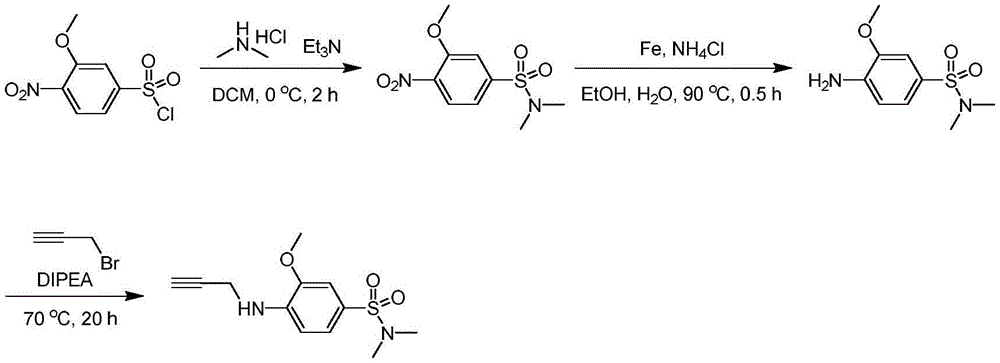
Preparation of 3-methoxy-N, N-dimethyl-4-nitrobenzenesulfonamide: at 0 ℃ under N 2 N-Methylmethylamine (194.43mg,2.38mmol, 218.46. mu.L, 1.2 equiv., HCl) was prepared in DCM (15mL) and Et 3 N(1.01g,9.93mmol,1.38mL,5 equivalents). A solution of 3-methoxy-4-nitrobenzenesulfonyl chloride (500mg,1.99mmol,1 eq) in DCM (5mL) was added dropwise to the mixture and the mixture was stirred at 20 ℃ for 2 h. TLC analysis (PE: EtOAc ═ 1:1, R) f 0.42) indicating completion of the reaction. The mixture was concentrated in vacuo and purified by column chromatography (SiO) 2 PE: EtOAc ═ 20:1 to 0:1, R f 0.42) to give the desired product (500mg,1.86mmol, 93.69% yield) as a yellow solid. MS (ES) + ,m/z):261.1。
Preparation of 4-amino-3-methoxy-N, N-dimethylbenzenesulfonamide: in N 2 Next, to a solution of 3-methoxy-N, N-dimethyl-4-nitrobenzenesulfonamide (450mg,1.68mmol,1 equiv.) in EtOH (15mL) and water (5mL) was added NH 4 Cl (448.09mg,8.38mmol, 292.87. mu.L, 5 equiv.). Fe (467.85mg,8.38mmol,5 equiv.) is added to the mixture at 90 deg.C and the resulting mixture is stirred at 90 deg.C for 0.5 h. TLC analysis (PE: EtOAc ═ 1:1, R) f 0.39) indicating completion of the reaction. The reaction mixture was subjected to hot filtration, filtered and concentrated in vacuo. The crude residue is purified by column chromatography (SiO) 2 PE: EtOAc 10:1 to 0:1, R f 0.39) to give the desired product (380mg,1.54mmol, 91.99% yield) as a light yellow solid. MS (ES) + ,m/z):231.0。
Preparation of 3-methoxy-N, N-dimethyl-4- (prop-2-yn-1-ylamino) benzenesulfonamide: to 4-amino-3-methoxy-N, N-dimethylbenzenesulfonamide in CHCl 3 (10mL) was added DIPEA (865.91mg,6.70mmol,1.17mL,5 equiv.) and 3-bromoprop-1-yne (797.03mg,6.70mmol, 577.56. mu.L, 5 equiv.). The mixture was degassed and treated with N at 20 deg.C 2 Purged three times and the mixture was stirred at 70 ℃ for 10 hours. DIPEA (346.37mg,2.68mmol, 466.81. mu.L, 2 equiv.) and 3-bromoprop-1-yne (318.81mg,2.68mmol, 231.02. mu.L, 2 equiv.) were then added to the mixture, and the resulting mixture was further stirred at 70 ℃ for 10 hours. LC-MS and TLC analysis (PE: EtOAc ═ 1:1, R) f 0.50) showed that 20% of the starting material remained and a major new spot was found. The mixture was concentrated in vacuo and purified by column chromatography (SiO) 2 PE: EtOAc 10:1 to 0:1, R f 0.5) to obtain the expected productThe product of (120mg,290.69 μmol, 21.69% yield) was a light yellow solid. MS (ES) + ,m/z):268.9。
Example a 41: synthesis of 4-methoxy-6- (methylsulfonyl) -N- (prop-2-yn-1-yl) pyridin-3-amine.

Preparation of 4-methoxy-2- (methylsulfanyl) -5-nitropyridine: to a solution of 2-chloro-4-methoxy-5-nitro-pyridine (1.50g,7.95mmol,1 eq) in DMF (20mL) was added NaSMe (3.34g,47.70mmol,3.04mL,6 eq). The mixture was stirred at 15 ℃ for 2 hours. LC-MS analysis indicated complete consumption of starting material and a major peak with the expected product mass was detected. The reaction mixture was partitioned by adding water (50mL) and EtOAc (50 mL). The organic phase was separated, washed with brine (10mL x 3), dried over anhydrous sodium sulfate, filtered and concentrated under reduced pressure to give the desired product (1.30g,6.49mmol, 81.68% yield) as a brown solid. MS (ES) + ,m/z):200.8。
Preparation of 4-methoxy-2- (methylsulfonyl) -5-nitropyridine: to a solution of 4-methoxy-2- (methylthio) -5-nitropyridine (1.30g,6.49mmol,1 eq) in acetone (20mL), MeOH (2mL), and water (20mL) was added potassium monopersulfate (oxone) (11.98g,19.48mmol,3 eq). The mixture was stirred at 0-15 ℃ for 2 hours. LC-MS analysis indicated complete consumption of starting material and detection of one major peak with the desired mass. Using saturated Na 2 S 2 O 4 The reaction mixture was partitioned between solution (100mL) and EtOAc (100 mL). The organic phase was separated, washed with brine (30mL x 3), dried over anhydrous sodium sulfate, filtered and concentrated under reduced pressure to give the desired product (1.45g,5.68mmol, 87.56% yield) as a yellow solid. MS (ES) + ,m/z):233.1。
Preparation of 4-methoxy-6- (methylsulfonyl) pyridin-3-amine: to a solution of 4-methoxy-2-methylsulfonyl-5-nitro-pyridine (1g,4.31mmol,1 eq) in AcOH (20mL) was added Fe (2.41g,43.10mmol,10 eq). The mixture was stirred at 50 ℃ for 2 hours. LC-MS analysis indicated the original sourceThe charge was completely consumed and a main peak of the desired mass was detected. The reaction mixture was partitioned by adding water (100mL) and EtOAc (100 mL). The organic phase was separated, washed with brine (30mL x 3), dried over anhydrous sodium sulfate, filtered and concentrated under reduced pressure to give a residue. The residue was purified by column chromatography (SiO) 2 PE: EtOAc ═ 10:1 to 1:1) purification afforded the desired product (510mg,2.52mmol, 58.51% yield) as a brown solid. MS (ES) + ,m/z):202.8。
Preparation of tert-butyl (4-methoxy-6- (methylsulfonyl) pyridin-3-yl) carbamate: to a solution of 4-methoxy-6- (methylsulfonyl) pyridin-3-amine (650mg,3.21mmol,1 eq) in dioxane (10mL) was added Boc 2 O (4.20g,19.26mmol,4.42mL,6 equiv.). The mixture was stirred at 110 ℃ for 14 hours. LC-MS analysis indicated complete consumption of starting material and detection of one major peak with the desired mass. The reaction mixture was concentrated under reduced pressure to give a residue. The residue was purified by column chromatography (SiO) 2 PE: EtOAc ═ 10:1 to 1:1) purification afforded the desired product (0.65g,2.15mmol, 66.97% yield) as a yellow oil. MS (ES) + ,m/z):302.9。
Preparation of tert-butyl (4-methoxy-6- (methylsulfonyl) pyridin-3-yl) (prop-2-yn-1-yl) carbamate: to a mixture of NaH (529.20mg,13.23mmol, 60% in mineral oil, 10 equiv.) in DMF (4mL) was added tert-butyl (4-methoxy-6- (methylsulfonyl) pyridin-3-yl) carbamate (400mg,1.32mmol,1 equiv.). The mixture was stirred at 0 ℃ for 30 min, and 3-bromoprop-1-yne (236.07mg,1.98mmol,171.07 μ L,1.50 equiv.) was added to the mixture. LC-MS analysis indicated complete consumption of starting material and detection of one major peak with the desired mass. The reaction mixture was partitioned by adding water (40mL) and EtOAc (40 mL). The organic phase was separated, washed with brine (10mL x 3), dried over anhydrous sodium sulfate, filtered and concentrated under reduced pressure to give a residue. The residue was purified by column chromatography (SiO) 2 PE: EtOAc 10:1 to 1:1) to give the desired product (250mg,734.44 μmol, 55.51% yield) as a yellow oil. MS (ES) + ,m/z):341.2。
4-methoxy-6- (methylsulfonyl) -N- (prop-2-yn-1-yl)) Preparation of pyridin-3-amine: to a solution of tert-butyl (4-methoxy-6- (methylsulfonyl) pyridin-3-yl) (prop-2-yn-1-yl) carbamate (170mg, 499.42. mu. mol,1 eq) was added HCl/EtOAc (4M,2.02mL,16.17 eq). The mixture was stirred at 15 ℃ for 1 hour. LC-MS analysis indicated complete consumption of starting material and detection of one major peak with the desired mass. The reaction mixture was concentrated under reduced pressure to give the desired product (100mg,361.35 μmol, 72.35% yield, HCl) as a brown solid. MS (ES) + ,m/z):241.1。
Example a 42: synthesis of 2- (4-methoxy-5- (prop-2-yn-1-ylamino) pyridin-2-yl) -2-methylpropanenitrile.
Route 1:

preparation of 2- (4-methoxy-5-nitropyridin-2-yl) -2-methylpropanenitrile: in N 2 Next, KHMDS (1M,53.03mL,5 equiv.) is added dropwise to a solution of 2-chloro-4-methoxy-5-nitropyridine (2g,10.61mmol,1 equiv.) in THF (5mL) at 0 deg.C. Isobutyronitrile (2.20g,31.82mmol,3 equivalents) was then added and the resulting mixture was stirred at 0 ℃ for 2 hours. TLC analysis (PE: EtOAc ═ 1:1) indicated complete consumption of the starting material. The reaction was quenched by slow addition of ice and the mixture was extracted with EtOAc (10mL x 2). The combined organic layers were washed with brine (10mL), dried over anhydrous sodium sulfate, filtered and concentrated in vacuo. The residue was purified by column chromatography (SiO) 2 PE: EtOAc ═ 10:1 to 1:1) purification afforded 2- (4-methoxy-5-nitropyridin-2-yl) -2-methylpropanenitrile (0.66g,2.98mmol, 28.13% yield) as a yellow solid.
Preparation of 2- (5-amino-4-methoxypyridin-2-yl) -2-methylpropanenitrile: in N 2 Next, to a solution of 2- (4-methoxy-5-nitropyridin-2-yl) -2-methylpropanenitrile (0.35g,1.58mmol,1 eq) in EtOH (5mL) and water (1mL) at 90 ℃ NH was added in that order 4 Cl (423.16mg,7.91mmol, 276.57. mu.L, 5 equiv.) and Fe (441.83mg,7.91mmol,5 equiv.). The mixture was heated to 90 ℃ and stirred for 1 hour. TLC analysis indicated the reaction was complete. The mixture was filtered and concentrated under reduced pressure. The residue was poured into a mixture of DCM and water (w/w ═ 1:1) (20mL) and stirred for 30 min. The aqueous phase was extracted with DCM (5mL × 2). The combined organic layers were washed with brine (5mL), dried over anhydrous sodium sulfate, filtered and concentrated in vacuo. The residue was passed through preparative TLC (SiO) 2 PE: EtOAc ═ 1:1) purification afforded the desired product (0.22g,1.15mmol, 72.71% yield) as a yellow solid.
Preparation of 2- (4-methoxy-5- (prop-2-yn-1-ylamino) pyridin-2-yl) -2-methylpropanenitrile: in N 2 Next, to a mixture of 2- (5-amino-4-methoxypyridin-2-yl) -2-methylpropanenitrile (0.24g,1.26mmol,1 eq) and 3-bromoprop-1-yne (746.50mg,6.28mmol, 540.94. mu.L, 5 eq) in DMF (5mL) at 25 ℃ K was added in one portion 2 CO 3 (520.36mg,3.77mmol,3 equiv.). The mixture was stirred at 70 ℃ for 12 hours. LC-MS and TLC analysis (PE: EtOAc ═ 1:1, R) f 0.45) indicating completion of the reaction. The mixture was poured into water (50mL) and stirred for 2 minutes. The aqueous phase was extracted with EtOAc (20mL x 3). The combined organic layers were washed with brine (20mL), dried over anhydrous sodium sulfate, filtered and concentrated in vacuo. The crude residue was purified by silica gel chromatography (PE: EtOAc ═ 10:1 to 0:1) to give the desired product (0.255g,889.75 μmol, 70.89% yield) as a yellow solid. MS (ES) + ,m/z):230.0。
Route 2:

preparation of tert-butyl (6- (2-cyanoprop-2-yl) -4-methoxypyridin-3-yl) carbamate: in N 2 Next, a solution of 2- (5-amino-4-methoxypyridin-2-yl) -2-methylpropanenitrile (0.15g, 784.40. mu. mol,1 eq) in dioxane (5mL) was added in one portion (Boc) at 25 deg.C 2 O (855.96mg,3.92mmol, 901.01. mu.L, 5 equiv.) and DMAP (191.66mg,1.57mmol,2 equiv.). The mixture was stirred at 110 ℃ for 12 hours. LC-MS analysis indicated that the reaction was complete and a di-Boc by-product was detected. The mixture was cooled to 25 ℃ and concentrated under reduced pressure at 50 ℃. The residue was added to 500mg of solid Na 2 CO 3 In solution in MeOH (10mL)To convert the di-Boc by-product to the desired mono-Boc-protected product. The mixture was stirred at 40 ℃ for 2 hours. The mixture was cooled to 25 ℃ and concentrated under reduced pressure at 40 ℃. The crude residue was purified by silica gel chromatography (PE: EtOAc ═ 30:1 to 3:1) to give the desired product (0.18g,586.93 μmol, 74.83% yield) as a colourless oil. MS (ES) + ,m/z):291.9。=
Preparation of tert-butyl (6- (2-cyanoprop-2-yl) -4-methoxypyridin-3-yl) (prop-2-yn-1-yl) carbamate: in N 2 To a mixture of tert-butyl (6- (2-cyanoprop-2-yl) -4-methoxypyridin-3-yl) carbamate (0.18g,617.82 μmol,1 eq) in DMF (2mL) was added NaH (37.07mg,926.74 μmol, 60% in mineral oil, 1.5 eq) in one portion at 0 ℃. The mixture was stirred at 0 ℃ for 30 minutes and then under N 2 3-bromoprop-1-yne (88.20mg, 741.39. mu. mol, 63.91. mu.L, 1.2 equiv.) was added in one portion at 0 ℃. The mixture was stirred at 0 ℃ for 1.5 hours. LC-MS analysis indicated the reaction was complete. The mixture was poured into water (20mL) and stirred for 2 minutes. The aqueous phase was extracted with EtOAc (10mL × 2). The combined organic layers were washed with brine (10mL), dried over anhydrous sodium sulfate, filtered and concentrated in vacuo. The crude residue was purified by silica gel chromatography (PE: EtOAc ═ 30:1 to 3:1) to give the desired product (0.15g,432.61 μmol, 70.02% yield) as a colorless oil. MS (ES) + ,m/z):329.9。
Preparation of 2- (4-methoxy-5- (prop-2-yn-1-ylamino) pyridin-2-yl) -2-methylpropanenitrile: in N 2 A solution of tert-butyl (6- (2-cyanoprop-2-yl) -4-methoxypyridin-3-yl) (prop-2-yn-1-yl) carbamate (120mg, 364.31. mu. mol,1 eq.) in HCl/EtOAc (5mL) was prepared at 0 ℃ and stirred for 2 h at 0 ℃. TLC analysis (PE: EtOAc: 3:1, R) f 0) indicates that the reaction is complete. The mixture was poured over saturated Na 2 CO 3 To the solution (50mL) and stirred for 2 min. The aqueous phase was extracted with EtOAc (10mL x 3). The combined organic layers were washed with brine (10mL), dried over anhydrous sodium sulfate, filtered and concentrated in vacuo. The crude residue was purified by preparative TLC (PE: EtOAc ═ 3:1, R) f Purification ═ 0.4) to give the desired product (100mg,417.88 μmol) as a white solid. MS (ES) + ,m/z):230.3。
Example a 43: synthesis of 3-methoxy-4- (prop-2-yn-1-ylamino) benzoic acid.

Reacting 4- [ tert-butyloxycarbonyl (prop-2-ynyl) amino]A solution of-3-methoxy-benzoic acid (1.1g,3.60mmol,1 eq.) in 4N HCl/EtOAc (50mL) was stirred at 20 ℃ for 2 h. TLC analysis (PE: EtOAc ═ 1:1, R) f 0.5) indicates that the starting material was consumed. The mixture was concentrated to give the crude product (0.8g,3.51mmol, 97.39% yield) as a yellow solid. The crude product was used without purification.
Example a 44: synthesis of methyl 3-methoxy-4- (prop-2-yn-1-ylamino) benzoate.

Preparation of methyl 3-methoxy-4- (prop-2-yn-1-ylamino) benzoate: a solution of methyl 4- ((tert-butoxycarbonyl) (prop-2-yn-1-yl) amino) -3-methoxybenzoate in 4N HCl (20mL) in EtOAc and degassed with N 2 Purging was carried out three times. Then, in N 2 The mixture was then stirred at 20 ℃ for 1 hour. TLC analysis (PE: EtOAc ═ 3:1, R) f 0.55) indicates that the starting material was consumed and a new spot was formed. By addition of saturated NaHCO 3 The reaction mixture was quenched with solution (30mL) and extracted with EtOAc (40 mL. times.3). The combined organic layers were washed with brine (25mL x 3), dried over anhydrous sodium sulfate, filtered and concentrated under reduced pressure. The crude product (0.58g,2.12mmol, 67.59% yield) was obtained as a yellow solid, which was used without purification.
Preparation of 3-methoxy-4- (prop-2-yn-1-ylamino) benzoic acid: a solution of methyl 3-methoxy-4- (prop-2-yn-1-ylamino) benzoate in MeOH and water (10mL, MeOH: water ═ 1:3) is degassed and treated with N 2 Purging was carried out three times. In N 2 The solution was then stirred at 20 ℃ for 1 hour. TLC analysis (PE: EtOAc ═ 3:1, R) f 0) indicates the starting sourceMaterial remained and a major new spot was detected. The reaction mixture was extracted with EtOAc (50mL × 2) and the pH of the mixture was adjusted to 3-4 by addition of 2M HCl. The organic layer was washed with brine (50mL x 3), dried over anhydrous sodium sulfate, filtered and concentrated under reduced pressure to give the desired product (0.6g,2.34mmol, 42.73% yield) as a yellow solid.
Example a 45: synthesis of 3-methoxy-4- (prop-2-yn-1-ylamino) benzamide.

Preparation of 4-amino-3-methoxybenzoic acid: at N 2 Next, to a solution of methyl 4-amino-3-methoxybenzoate (4.5g,23.59mmol,1 eq) in MeOH (45mL), water (15mL) and THF (15mL) at 25 deg.C was added LiOH (4.95g,117.97mmol,5 eq) in one portion. The mixture was stirred at 25 ℃ for 12 hours. TLC analysis (PE: EtOAc: 3:1, R) f 0) indicates that the reaction is complete. The mixture was concentrated at 40 ℃ under reduced pressure. The residue was poured into water (50mL) and stirred for 1 min. The aqueous phase was extracted with EtOAc (30mL x 3). 2N HCl was added to the aqueous phase to adjust the pH of the solution to 2. The aqueous phase was filtered and concentrated in vacuo to give the desired product (4g,22.73mmol, 96.35% yield) as a pale yellow solid.
Preparation of 4-amino-3-methoxybenzamide: in N 2 Next, NH was added in one portion to a solution of 4-amino-3-methoxybenzoic acid (4g,22.73mmol,1 eq, 95% purity) in DMF (50mL) at 25 deg.C 4 OAc (8.76g,113.66mmol,5 equiv.), DIPEA (29.38g,227.32mmol,39.60mL,10 equiv.), and HATU (17.29g,45.46mmol,2 equiv.). The mixture was stirred at 25 ℃ for 2 hours. TLC analysis (PE: EtOAc ═ 0:1, R f 0.30) indicating completion of the reaction. The mixture was poured into water (800mL) and stirred for 2 minutes. The aqueous phase was extracted with EtOAc (300mL x 3). The combined organic layers were washed with brine (300mL x 1), dried over anhydrous sodium sulfate, filtered and concentrated in vacuo. The residue was chromatographed on silica gel (SiO) 2 PE: EtOAc 100:1 to 0:1) to give the desired product (5g,18.05mmol, 79.42% yield) as yellowAnd (5) obtaining oil.
Preparation of 3-methoxy-4- (prop-2-yn-1-ylamino) benzamide: in N 2 Next, K was added in one portion to a mixture of 4-amino-3-methoxybenzamide (5g,18.05mmol,1 eq, 60% purity) and 3-bromoprop-1-yne (4.52g,36.11mmol,3.28mL,2 eq, 95% purity) in DMF (50mL) at 25 deg.C 2 CO 3 (7.49g,54.16mmol,3 equiv.). The mixture was stirred at 70 ℃ for 4 hours. TLC analysis (PE: EtOAc ═ 0:1, R f 0.40) indicating completion of the reaction. The mixture was cooled to 25 ℃ and the residue was poured into water (500mL) and stirred for 2 minutes. The aqueous phase was extracted with EtOAc (200 mL. times.3). The combined organic layers were washed with brine (300mL x 1), dried over anhydrous sodium sulfate, filtered and concentrated in vacuo. The residue was chromatographed on silica gel (SiO) 2 PE: EtOAc 100:1 to 0:1) gave the desired product (3.32g,12.19mmol, 67.54% yield) as a yellow solid.
Example a 46: synthesis of 2- ((3-methoxy-4- (prop-2-yn-1-ylamino) phenyl) sulfonyl) ethan-1-ol.
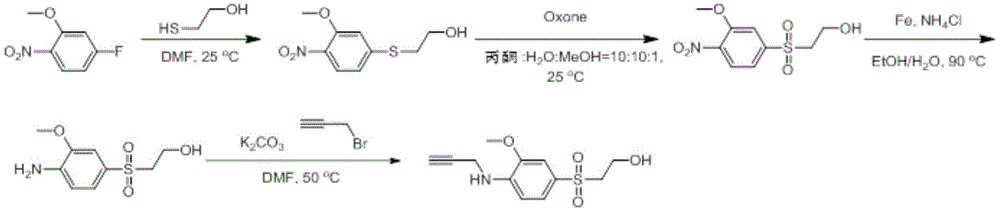
Preparation of 2- ((3-methoxy-4-nitrophenyl) thio) ethan-1-ol: a solution of 4-fluoro-2-methoxy-1-nitrobenzene (1.24g,11.69mmol,1 eq.) and 2-mercaptoethan-1-ol (1.83g,23.37mmol,1.63mL,2 eq.) was degassed and treated with N 2 Purging was carried out three times. Placing the mixture in N 2 The mixture was stirred at 25 ℃ for 19 hours. TLC analysis (PE: EtOAc ═ 5:1, R) f =0.05;DCM:MeOH=10:1,R f 0.45) indicating completion of the reaction. The residue was poured into water (200mL) and stirred for 30 minutes. The mixture was filtered and concentrated in vacuo. The residue was poured into water (200mL) and the mixture was extracted with EtOAc (100mL x 3). The combined organic layers were washed with brine (80mL x 3), filtered and concentrated in vacuo. The crude product (2.8g, crude) was obtained as a yellow solid which was used without purification.
Preparation of 2- ((3-methoxy-4-nitrophenyl) sulfonyl) ethan-1-ol: to 2- ((3-methoxy-4-nitrophenyl) thio) ethan-1-ol (2.8 g)12.21mmol,1 eq) in acetone (40mL), water (40mL) and MeOH (4mL) was added potassium monopersulfate (oxone) (15.02g,24.43mmol,2 eq). The mixture was stirred at 25 ℃ for 2 hours. TLC analysis (DCM: MeOH ═ 10:1, R) f 0.4) indicated complete consumption of starting material and a new spot was detected. The residue was poured over saturated Na 2 SO 3 (300mL) and stirred for 30 min. The mixture was filtered and concentrated in vacuo. The residue was poured over saturated Na 2 SO 3 To solution (300mL) and stirred for 30 min, the mixture was extracted with EtOAc (100mL x 3). The combined organic layers were washed with brine (80mL x 3), filtered and concentrated in vacuo. The crude product (3g, crude) was obtained as a white solid, which was used without purification.
Preparation of 2- ((4-amino-3-methoxyphenyl) sulfonyl) ethan-1-ol: to a solution of 2- ((3-methoxy-4-nitrophenyl) sulfonyl) ethan-1-ol (3g,11.48mmol,1 eq) in EtOH (20mL) and water (4mL) at 90 deg.C was added NH 4 Cl (3.69g,68.90mmol,6 equiv.) and Fe (1.92g,34.45mmol,3 equiv.). The mixture was stirred at 90 ℃ for 0.5 hour. TLC analysis (DCM: MeOH ═ 10:1, R) f 0.5) indicated that 50% of the starting material remained and two major new spots were detected, which were more polar than the starting material. An additional portion of Fe (1.28g,22.97mmol,2 equiv.) was added to the mixture and the mixture was stirred at 90 ℃ for 1 hour. TLC analysis (DCM: MeOH ═ 10:1, R) f 0.5) indicated complete consumption of the starting material and a major new spot was detected, which was more polar than the starting material. The residue was diluted with EtOAc (400 mL). The mixture was diluted with water (400mL) and extracted with EtOAc (200mL × 3). The combined organic layers were washed with brine (200mL x 3), dried over anhydrous sodium sulfate, filtered and concentrated under reduced pressure. The crude product (2.8g, crude) was obtained as a white oil. MS (ES) + ,m/z):232.0。1H NMR(400MHz,DMSO-d6)δppm 3.27-3.35(m,2H)3.60-3.68(m,2H)3.80-3.88(m,3H)4.78-4.87(m,1H)5.67-5.81(m,2H)6.69-6.77(m,1H)7.13-7.18(m,1H)7.18-7.24(m,1H)。
Preparation of 2- ((3-methoxy-4- (prop-2-yn-1-ylamino) phenyl) sulfonyl) ethan-1-ol: to 2- ((4-amino-3-methoxyphenyl) sulfonic acidAcyl) Ether-1-ol (0.15g, 648.6. mu. mol,1 eq.) in DMF (1mL) was added K 2 CO 3 (179.3mg,1.30mmol,2 equiv.) and 3-bromoprop-1-yne (67.51mg, 454.02. mu. mol, 48.92. mu.L, 0.7 equiv.). Degassing the mixture and applying N 2 Purging three times at N 2 The mixture was then stirred at 50 ℃ for 19 hours. TLC analysis (PE: EtOAc ═ 1:2, R f 0.5) indicated that 10% of the starting material remained and a major new spot was detected, which was less polar than the starting material. The residue was diluted with water (50mL) and extracted with EtOAc (30mL × 3). The combined organic layers were washed with brine (30mL x 3), dried over anhydrous sodium sulfate, filtered and concentrated under reduced pressure. The residue was purified by preparative TLC (SiO) 2 EtOAc ═ 0:1) to give the desired product (0.053g,177.12 μmol, 27.31% yield) as a yellow oil. 1HNMR (400MHz, DMSO-d6) δ ppm 3.09(s,1H)3.33-3.37(m,2H)3.63(q, J ═ 6.44Hz,2H)3.87(s,3H)4.00(br d, J ═ 4.16Hz,2H)4.84(t, J ═ 5.56Hz,1H)6.26-6.38(m,1H)6.69-6.80(m,1H)7.11-7.24(m,1H)7.35(br d, J ═ 8.19Hz, 1H).
Example a 47: synthesis of 3-methoxy-N-methyl-4- (prop-2-yn-1-ylamino) benzenesulfonamide and 3-methoxy-N, N-dimethyl-4- (prop-2-yn-1-ylamino) benzenesulfonamide.

To a solution of 3-methoxy-4- (prop-2-yn-1-ylamino) benzenesulfonamide (1g,4.16mmol,1 eq) in acetone (10mL) was added K 2 CO 3 (1.15g,8.32mmol,2 equiv.) and CH 3 I (708.87mg,4.99mmol, 310.91. mu.L, 1.2 equiv.). The mixture was stirred at 50 ℃ for 6 hours. LC-MS analysis showed 27% starting material remained and the desired compound was detected. The reaction mixture was diluted with water (300mL) and extracted with EtOAc (100mL × 2). The combined organic layers were washed with water (200mL x 2) and brine (200mL x 2), dried over anhydrous sodium sulfate, filtered and concentrated under reduced pressure. The residue was purified by preparative TLC (SiO) 2 PE: EtOAc ═ 1:1) purification afforded the desired product as a yellow oil. 3-methoxy-N-methyl-4- (prop-2-yn-1-ylamino) benzenesulfonic acidAmide (0.7g,2.75mmol), 66.08% yield, MS (ES) + M/z) 255.1; 3-methoxy-N, N-dimethyl-4- (prop-2-yn-1-ylamino) benzenesulfonamide (0.2g,745.35 μmol), 17.91% yield, MS (ES) + ,m/z):269.1。
Example a 48: synthesis of 5- ((tert-butoxycarbonyl) (prop-2-yn-1-yl) amino) thiophene-2-carboxylic acid.
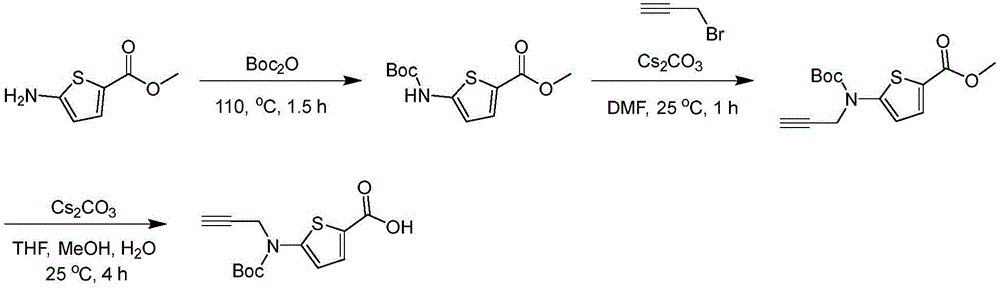
Preparation of methyl 5- ((tert-butoxycarbonyl) amino) thiophene-2-carboxylate: 5-aminothiophene-2-carboxylic acid methyl ester (1g,6.36mmol,1 eq) and Boc 2 A mixture of O (4.17g,19.09mmol,4.38mL,3 equivalents) was degassed and N was used 2 Purging three times and in N 2 The mixture was then stirred at 110 ℃ for 1.5 hours. TLC analysis (PE: EtOAc ═ 3:1, R) f 0.50) indicated that starting material remained and a major new spot was detected. The reaction mixture was quenched by the addition of PE (200mL) and the mixture was stirred for 1 hour. The mixture was filtered and concentrated under reduced pressure to give a residue. The crude product (1.6g,5.60mmol, 87.97% yield) was obtained as a yellow solid, which was used without further purification. MS (ES) + ,m/z):258.1。
Preparation of methyl 5- ((tert-butoxycarbonyl) (prop-2-yn-1-yl) amino) thiophene-2-carboxylate: methyl 5- (tert-Butoxycarbonylamino) thiophene-2-carboxylate (1.5g,5.25mmol,1 equiv.), 3-bromoprop-1-yne (686.56mg,5.77mmol, 497.51. mu.L, 1.1 equiv.), and Cs 2 CO 3 A mixture of (5.13g,15.74mmol,3 equiv.) in DMF (20mL) was degassed and N was used 2 Purge three times, then at N 2 The mixture was then stirred at 25 ℃ for 4 hours. TLC analysis (PE: EtOAc: 3:1, R) f 0.60) indicated that starting material remained and a major new spot was detected. The reaction mixture was quenched by the addition of water (200mL) and the mixture was extracted with EtOAc (100mL x 3). The combined organic layers were washed with brine (30mL x 4), filtered and concentrated under reduced pressure to give a residue. The residue was purified by column chromatography (SiO) 2 PE purification of EtOAc 1:0 to 40:1) afforded the desired product (1.1g,3.35mmol, 63.89%Yield) as a yellow solid.
Preparation of 5- ((tert-butoxycarbonyl) (prop-2-yn-1-yl) amino) thiophene-2-carboxylic acid: methyl 5- ((tert-butoxycarbonyl) (prop-2-yn-1-yl) amino) thiophene-2-carboxylate (0.5g,1.69mmol,1 eq.) and Cs 2 CO 3 A mixture of (5.52g,16.93mmol,10 equiv.) in MeOH (5mL), water (5mL), and THF (5mL) was degassed and N was used 2 Purging was carried out three times. In N 2 The mixture was stirred at 25 ℃ for 4 hours under an atmosphere. TLC analysis (EtOAc ═ 1, R) f 0.3) indicated that starting material remained and a major new spot was detected. The reaction mixture was concentrated under reduced pressure to remove THF and MeOH. The residue was diluted with water (10mL) and 2N HCl was added to adjust the pH of the mixture to 5. The mixture was then extracted with EtOAc (30mL x 3). The combined organic layers were washed with brine (20mL x 3), dried over anhydrous sodium sulfate, filtered and concentrated under reduced pressure. The crude product (0.43g,1.36mmol, 80.36% yield) was obtained as a yellow solid, which was used without purification. MS (ES) + ,m/z):282.0。
Example a 49: synthesis of ethyl 3-methoxy-4- (prop-2-yn-1-ylamino) benzoate.

Preparation of ethyl 3-methoxy-4- (prop-2-yn-1-ylamino) benzoate: to a solution of 3-methoxy-4- (prop-2-yn-1-ylamino) benzoic acid (500mg,2.44mmol,1 eq) in DMF (6mL) was added iodoethane (570.02mg,3.65mmol, 292.32. mu.L, 1.5 eq) and K 2 CO 3 (1.01g,7.31mmol,3 equiv.). The mixture was stirred at 50 ℃ for 1 hour. TLC analysis indicated the reaction was complete. The reaction mixture was quenched by addition of water (80mL) and extracted with EtOAc (30mL x 3). The combined organic layers were washed with brine (50mL x 3), dried over anhydrous sodium sulfate, filtered and concentrated under reduced pressure. The desired product (540mg, crude) was obtained as a yellow solid, which was used without purification.
Example a 50: synthesis of 3-hydroxy-4- (prop-2-yn-1-ylamino) benzenesulfonamide.

In N 2 Next, boron tribromide (886.24mg,3.54mmol,340.86 μ L,5 equiv.) is added to a solution of 3-methoxy-4- (prop-2-yn-1-ylamino) benzenesulfonamide (0.2g,707.51 μmol,1 equiv.) in DCM (2mL) at 0 deg.C. The mixture was stirred at 0-25 ℃ for 1 hour. TLC analysis indicated the reaction was complete. The reaction mixture was quenched by addition of water (100mL) at 0 deg.C and extracted with EtOAc (30 mL. times.3). The combined organic layers were washed with brine (30mL), dried over anhydrous sodium sulfate, filtered and concentrated under reduced pressure. The crude residue was passed through preparative TLC (SiO) 2 EtOAc ═ 1:3) to give the desired product (0.12g,424.31 μmol, 59.97% yield) as a yellow oil.
B. Compounds having a 2-ethynyl-N- (alkyl) -1H-indol-4-amine core
Example B1: synthesis of compounds 6A, 7A, 8A and 9A.

Preparation of 1- (2-iodo-1- (2,2, 2-trifluoroethyl) -1H-indol-4-yl) -3- (1-methylpiperidin-4-yl) urea and N- (2-iodo-1- (2,2, 2-trifluoroethyl) -1H-indol-4-yl) -4-methylpiperazine-1-carboxamide: to a solution of 2-iodo-1- (2,2, 2-trifluoroethyl) -1H-indol-4-amine (1 eq) and DIPEA (12 eq) in DCM (6mL) was added triphosgene (441.07 μmol,1 eq). The mixture was stirred at 0 ℃ for 0.5 h. Then, 1-methylpiperazine or 1-methylpiperidin-4-amine (1.2 equivalents) was added to the mixture, and the resulting mixture was further stirred at 0 ℃ for 0.5 hours. The reaction mixture was poured onto saturated Na 2 CO 3 Aqueous (20mL) and extracted with DCM (20mL × 3). The combined organic layers were concentrated under reduced pressure to give a residue. The crude residue was dissolved in toluene and concentrated (10mL x 2) to give the desired product.
N- [ 2-iodo-1- (2,2, 2-trifluoroethyl) indol-4-yl]Preparation of 4-methyl-piperazine-1-carboxamide: to 2-iodo-1- (2,2, 2-trifluoroethyl group)) A solution of indol-4-amine (150mg, 441.07. mu. mol,1 eq) and DIPEA (684mg,5.29mmol, 921.92. mu.L, 12 eq) in DCM (2mL) was added triphosgene (131mg, 441.07. mu. mol,1 eq). The mixture was stirred at 0 ℃ for 0.5 h. 1-methylpiperazine (53mg, 529.28. mu. mol, 59. mu.L, 1.2 eq.) was added to the mixture and the mixture was stirred at 0 ℃ for 0.5 h. TLC analysis (DCM: MeOH ═ 20:1, R) f 0.2) indicated complete consumption of starting material and a new spot was detected. The reaction mixture was poured over saturated Na 2 CO 3 Aqueous (20mL) and extracted with DCM (20mL × 3). The combined organic layers were concentrated under reduced pressure to give a residue. The residue was diluted with toluene (10mL) and the mixture was concentrated under reduced pressure to give a residue. After repeating the toluene dilution step twice, the residue was diluted with toluene (10mL) and filtered to give the desired product. N- [ 2-iodo-1- (2,2, 2-trifluoroethyl) indol-4-yl]-4-methyl-piperazine-1-carboxamide (150mg,294.06 μmol, 66.67% yield). LC-MS (ES +, M/z):467.0[ (M + H) + ]。
Preparation of the final product: to a mixture of 3-methoxy-4- (prop-2-yn-1-ylamino) benzamide or 2-methoxy-4- (methylsulfonyl) -N- (prop-2-yn-1-yl) aniline (1-2 equiv.) in DMSO (2mL) was added i-Pr 2 NH (10-30 equivalents), CuI (1-2 equivalents), 1- (2-iodo-1- (2,2, 2-trifluoroethyl) -1H-indol-4-yl) -3- (1-methylpiperidin-4-yl) urea or N- (2-iodo-1- (2,2, 2-trifluoroethyl) -1H-indol-4-yl) -4-methylpiperazine-1-carboxamide (1 equivalent) and Pd (PPh) 3 ) 4 (0.20-0.50 equivalent). In N 2 The mixture is then stirred at 20-40 ℃ for 1-3 hours. Completion of the reaction was detected by LC-MS or TLC analysis. The mixture was poured into saturated EDTA solution (20mL) and stirred for 1 hour and the aqueous phase was extracted with EtOAc (20mL × 3). The combined organic layers were washed with saturated brine (20mL x 3), dried over anhydrous sodium sulfate, filtered and concentrated in vacuo. The residue was purified by TLC, prep-TLC or prep-HPLC to give the desired product.
3-methoxy-4- { [3- (4- { [ (1-methylpiperidin-4-yl) carbamoyl]Amino } -1- (2,2, 2-trifluoroethyl) -1H-indol-2-yl) prop-2-yn-1-yl]Amino } benzamide, MS (ES) + M/z): 557.1; 3- (2- {3- [ (4-methylsulfonyl-2)-methoxyphenyl) amino]Prop-1-yn-1-yl } -1- (2,2, 2-trifluoroethyl) -1H-indol-4-yl) -1- (1-methylpiperidin-4-yl) urea, MS (ES) + M/z) 592.1; n- (2- {3- [ (4-carbamoyl-2-methoxyphenyl) amino group]Prop-1-yn-1-yl } -1- (2,2, 2-trifluoroethyl) -1H-indol-4-yl) -4-methylpiperazine-1-carboxamide, MS (ES) + M/z) 543.1; and N- (2- {3- [ (4-methanesulfonyl-2-methoxyphenyl) amino]Prop-1-yn-1-yl } -1- (2,2, 2-trifluoroethyl) -1H-indol-4-yl) -4-methylpiperazine-1-carboxamide, MS (ES) + ,m/z):578.3。
Example B2: synthesis of compounds 13A, 15A, 16A and 17A.

Preparation of 4- (3- (2-iodo-1- (2,2, 2-trifluoroethyl) -1H-indol-4-yl) ureido) piperidine-1-carboxylic acid tert-butyl ester 1- (2-iodo-1- (2,2, 2-trifluoroethyl) -1H-indol-4-yl) -3- (piperidin-4-yl) urea: to a solution of 2-iodo-1- (2,2, 2-trifluoroethyl) -1H-indol-4-amine (800mg,2.35mmol) and DIPEA (3.65g,28.23mmol,4.92mL,12 equiv) in DCM (10mL) was added triphosgene (698.07mg,2.35mmol,1 equiv). The mixture was then stirred at 0 ℃ for 0.5 h. Tert-butyl 4-aminopiperidine-1-carboxylate (565.35mg,2.82mmol,1.2 equivalents) was added to the mixture and the resulting mixture was stirred at 0 ℃ for 0.5 hours. TLC analysis (PE: EtOAc ═ 1:1, R) f 0.16) indicates complete consumption of the starting material. Saturated NaHCO 3 The solution (30mL) was added to the reaction mixture and the aqueous phase was extracted with EtOAc (20mL x 3). The combined organic layers were concentrated in vacuo to afford the crude product. MS (ES) + ,m/z):566.8。
Preparation of 1- (2-iodo-1- (2,2, 2-trifluoroethyl) -1H-indol-4-yl) -3- (piperidin-4-yl) urea: to a solution of 4- (3- (2-iodo-1- (2,2, 2-trifluoroethyl) -1H-indol-4-yl) ureido) piperidine-1-carboxylic acid tert-butyl ester-1- (2-iodo-1- (2,2, 2-trifluoroethyl) -1H-indol-4-yl) -3- (piperidin-4-yl) urea (0.8g,1.34mmol,1 eq) in DCM (3mL) was added TFA (4.59g,40.26mmol,2.98mL,30 eq). The reaction mixture was stirred at 25 ℃ for 0.5 h. LC-MS analysis indicated complete consumption of the starting material. The reaction mixture is saturated with waterAnd NaHCO 3 The solution (30mL) was washed and extracted with EtOAc (5 mL. times.3). The combined organic layers were washed with brine (80mL), dried over anhydrous sodium sulfate, filtered and concentrated under reduced pressure to give the crude product as a brown solid (350mg, 55.9% yield). MS (ES) + ,m/z):467.0。
Preparation of 2-iodo-N-C (O) R-1- (2,2, 2-trifluoroethyl) -1H-indol-4-amine: to a mixture of 1- (2-iodo-1- (2,2, 2-trifluoroethyl) -1H-indol-4-yl) -3- (piperidin-4-yl) urea (100mg, 214.48. mu. mol,1 eq) and R-Br (428.96. mu. mol,2 eq) in DMF (3mL) was added K 2 CO 3 (59.29mg, 428.96. mu. mol,2 equiv.). The mixture was stirred at 25 ℃ for 4 hours. LC-MS or TLC analysis indicated that the reaction was complete. The reaction mixture was quenched by the addition of water (40mL) and the mixture was extracted with EtOAc (50mL x 3). The combined organic layers were dried over anhydrous sodium sulfate, filtered and concentrated under reduced pressure. The residue was purified by preparative TLC to give the desired product as a brown oil.
2- (4- (3- (2-iodo-1- (2,2, 2-trifluoroethyl) -1H-indol-4-yl) ureido) piperidin-1-yl) acetamide, 36% yield, MS (ES) + M/z) 524.0; 1- (1- (2-hydroxyethyl) piperidin-4-yl) -3- (2-iodo-1- (2,2, 2-trifluoroethyl) -1H-indol-4-yl) urea, 34% yield, MS (ES) + M/z) is 511.0; 1- (2-iodo-1- (2,2, 2-trifluoroethyl) -1H-indol-4-yl) -3- (1- (2-methoxyethyl) piperidin-4-yl) urea, MS (ES) + M/z) 525.0; 1- (1- (2, 3-dihydroxypropyl) piperidin-4-yl) -3- (2-iodo-1- (2,2, 2-trifluoroethyl) -1H-indol-4-yl) urea, 37% yield, MS (ES) + ,m/z):541.0。
Preparation of 2- (3- ((2-methoxy-4- (methylsulfonyl) phenyl) amino) prop-1-yn-1-yl) -N-c (o) R-1- (2,2, 2-trifluoroethyl) -1H-indol-4-amine: to a solution of 2-methoxy-4- (methylsulfonyl) -N- (prop-2-yn-1-yl) aniline (26.90mg, 112.44. mu. mol,1.5 eq) in DMSO (3mL) was added 2-iodo-N-C (O) R-1- (2,2, 2-trifluoroethyl) -1H-indol-4-amine (45mg, 74.96. mu. mol,1 eq), CuI (1 eq), N-isopropylpropan-2-amine (1 eq) and Pd (PPh) 3 ) 4 (0.02 eq). The mixture was stirred at 45 ℃ for 1 hour. LC-MS or TLC analysis indicated that the reaction was complete. The reaction was carried out at 25 ℃ by adding saturated EDTA solution (40mL)The mixture was quenched and the mixture was extracted with EtOAc (20mL × 3). The combined organic layers were dried over anhydrous sodium sulfate, filtered and concentrated under reduced pressure to give a residue. The residue was purified by preparative TLC (SiO) 2 ,DCM:MeOH=10:1,R f 0.24) and preparative-HPLC purification gave the desired product as a light yellow solid.
2- (4- { [ (2- {3- [ (4-methanesulfonyl-2-methoxyphenyl) amino)]Prop-1-yn-1-yl } -1- (2,2, 2-trifluoroethyl) -1H-indol-4-yl) carbamoyl]Amino } piperidin-1-yl) acetamide, MS (ES) + M/z) 635.5; 1- [1- (2-hydroxyethyl) piperidin-4-yl]-3- (2- {3- [ (4-methanesulfonyl-2-methoxyphenyl) amino]Prop-1-yn-1-yl } -1- (2,2, 2-trifluoroethyl) -1H-indol-4-yl) urea, MS (ES) + M/z) 622.3; 3- (2- {3- [ (4-methanesulfonyl-2-methoxyphenyl) amino]Prop-1-yn-1-yl } -1- (2,2, 2-trifluoroethyl) -1H-indol-4-yl) -1- [1- (2-methoxyethyl) piperidin-4-yl]Urea, MS (ES) + M/z) 636.1; and 1- [1- (2, 3-dihydroxypropyl) piperidin-4-yl]-3- (2- {3- [ (4-methanesulfonyl-2-methoxyphenyl) amino]Prop-1-yn-1-yl } -1- (2,2, 2-trifluoroethyl) -1H-indol-4-yl) urea, MS (ES) + ,m/z):652.2。
Example B3: synthesis of 3- (2- {3- [ (4-methanesulfonyl-2-methoxyphenyl) amino ] prop-1-yn-1-yl } -1- (2,2, 2-trifluoroethyl) -1H-indol-4-yl) -1- [1- (oxan-4-yl) piperidin-4-yl ] urea (Compound 14A).
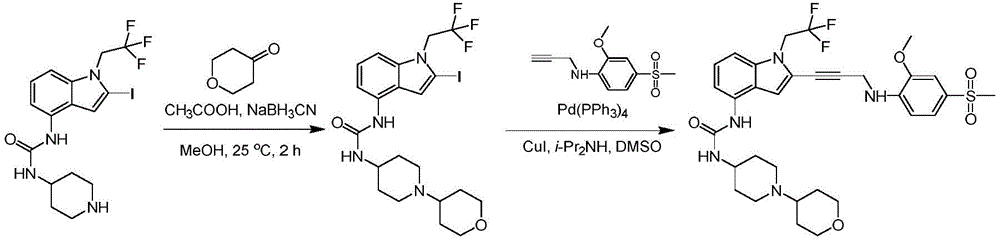
Preparation of 1- (2-iodo-1- (2,2, 2-trifluoroethyl) -1H-indol-4-yl) -3- (1- (tetrahydro-2H-pyran-4-yl) piperidin-4-yl) urea: 1- (2-iodo-1- (2,2, 2-trifluoroethyl) -1H-indol-4-yl) -3- (piperidin-4-yl) urea (107.37mg,1.07mmol, 98.50. mu.L, 5 equiv.), tetrahydro-4H-pyran-4-one (100mg, 214.48. mu. mol,1 equiv.), AcOH (12.88. mu.g, 2.14 e-1. mu. mol,1.23 e-2. mu.L, 0.001 equiv.), and NaBH 3 A mixture of CN (26.96mg, 428.96. mu. mol,2 equiv.) in MeOH (2mL) was stirred at 25 ℃ for 2 h. LC-MS analysis confirmed the reaction was complete. By adding saturated NH 4 HCO 3 The reaction mixture was quenched with solution (40mL) and washed with waterThe mixture was extracted with EtOAc (50 mL. times.3). The combined organic layers were dried over anhydrous sodium sulfate, filtered and concentrated under reduced pressure to give a residue. The crude residue was passed through preparative TLC (SiO) 2 ,DCM:MeOH=10:1,R f 0.24) to afford the desired product as a brown solid. 29% yield, MS (ES) + ,m/z):551.0。
3- (2- {3- [ (4-methanesulfonyl-2-methoxyphenyl) amino)]Prop-1-yn-1-yl } -1- (2,2, 2-trifluoroethyl) -1H-indol-4-yl) -1- [1- (oxan-4-yl) piperidin-4-yl ]Preparation of urea: to a solution of 2-methoxy-4- (methylsulfonyl) -N- (prop-2-yn-1-yl) aniline (22.17mg, 92.67. mu. mol,1.5 equivalents) in DMSO (3mL) was added 1- (2-iodo-1- (2,2, 2-trifluoroethyl) -1H-indol-4-yl) -3- (1- (tetrahydro-2H-pyran-4-yl) piperidin-4-yl) urea (40mg, 61.78. mu. mol,1 equivalent), CuI (11.77mg, 61.78. mu. mol,1 equivalent), N-isopropylprop-2-amine (6.25mg, 61.78. mu. mol, 8.73. mu.L, 1 equivalent), and Pd (PPh) 3 ) 4 (1.43mg, 1.24. mu. mol,0.02 eq.). The mixture was stirred at 45 ℃ for 1 hour. LC-MS analysis indicated the reaction was complete. The reaction mixture was quenched by addition of saturated EDTA solution (40mL) at 25 ℃ and the mixture was extracted with EtOAc (20mL x 3). The combined organic layers were dried over anhydrous sodium sulfate, filtered and concentrated under reduced pressure to give a residue. The residue was purified by preparative HPLC to give the desired product (17.2mg,25.89 μmol, 41.91% yield) as a light yellow solid. 3- (2- {3- [ (4-methanesulfonyl-2-methoxyphenyl) amino]Prop-1-yn-1-yl } -1- (2,2, 2-trifluoroethyl) -1H-indol-4-yl) -1- [1- (oxan-4-yl) piperidin-4-yl]Urea, MS (ES) + ,m/z):662.3。
Example B4: synthesis of compounds 10A, 11A and 12A.

General procedure for the preparation of 1- (4- (dimethylamino) cyclohexyl) -3- (2-iodo-1- (2,2, 2-trifluoroethyl) -1H-indol-4-yl) urea and 1- (2-iodo-1- (2,2, 2-trifluoroethyl) -1H-indol-4-yl) -3- (pyridin-4-yl) urea: to 2-iodo-1- (2,2, 2-trifluoroethyl) -1H-indol-4-amine (1 eq) and DIPEA (12 eq) in DCM Triphosgene (1 equivalent) was added to the solution. The mixture was stirred at 0 ℃ for 0.5 h, and N was added 1 ,N 1 -dimethylcyclohexane-1, 4-diamine or pyridin-4-amine (1.2 eq.) was added to the reaction. The resulting reaction mixture was further stirred at 0 ℃ for 0.5 hour. TLC analysis indicated complete consumption of starting material. By adding saturated Na 2 CO 3 The solution quenched the reaction mixture. The reaction mixture was partitioned by adding EtOAc and the aqueous phase was extracted with EtOAc (× 3). The organic phase was washed with brine (× 3), dried over anhydrous sodium sulfate, filtered and concentrated in vacuo to afford the crude product. The residue was purified by preparative TLC to give the desired product as a brown solid.
Preparation of 1- (4- (dimethylamino) cyclohexyl) -3- (2-iodo-1- (2,2, 2-trifluoroethyl) -1H-indol-4-yl) urea and 1- (2-iodo-1- (2,2, 2-trifluoroethyl) -1H-indol-4-yl) -3- (pyridin-4-yl) urea: to a solution of 2-methoxy-4- (methylsulfonyl) -N- (prop-2-yn-1-yl) aniline (1.2 eq) in DMSO at 25 deg.C was added i-Pr 2 NH (10 equiv.), CuI (1 equiv.), 1- (4- (dimethylamino) cyclohexyl) -3- (2-iodo-1- (2,2, 2-trifluoroethyl) -1H-indol-4-yl) urea or 1- (2-iodo-1- (2,2, 2-trifluoroethyl) -1H-indol-4-yl) -3- (pyridin-4-yl) urea (1 equiv.), and Pd (PPh) 3 ) 4 (0.2 eq). In N 2 The mixture was then stirred at 25 ℃ for 1-2 hours. LC-MS and TLC analysis indicated that the reaction was complete. The reaction mixture was quenched by the addition of saturated EDTA solution and the mixture was stirred at 25 ℃ for 2 hours. The reaction mixture was partitioned by adding EtOAc and the aqueous phase was extracted with EtOAc. The organic phase was washed with brine, dried over anhydrous sodium sulfate, filtered and concentrated in vacuo. The residue was purified by preparative TLC, preparative HPLC to give a solution of the desired product. The solution was lyophilized to give the desired product as a yellow solid.
3- (2- {3- [ (4-methanesulfonyl-2-methoxyphenyl) amino]Prop-1-yn-1-yl } -1- (2,2, 2-trifluoroethyl) -1H-indol-4-yl) -1- [ (1R,4R) -4- (dimethylamino) cyclohexyl]Urea, MS (ES) + M/z) 620.3; 3- (2- {3- [ (4-methanesulfonyl-2-methoxyphenyl) amino]Prop-1-yn-1-yl } -1- (2,2, 2-trifluoroethyl) -1H-indol-4-yl) -1- [ (1S,4S) -4- (dimethylamino)Cyclohexyl radical]Urea, MS (ES) + M/z) 620.3; and 1- (2- (3- ((2-methoxy-4- (methylsulfonyl) phenyl) amino) prop-1-yn-1-yl) -1- (2,2, 2-trifluoroethyl) -1H-indol-4-yl) -3- (pyridin-4-yl) urea, MS (ES) + ,m/z):572.3。
Example B5: preparation of the compound 2- {3- [ (4-methanesulfonyl-2-methoxyphenyl) amino ] prop-1-yn-1-yl } -N, N-dimethyl-1- (2,2, 2-trifluoroethyl) -1H-indol-4-amine (compound 1A).
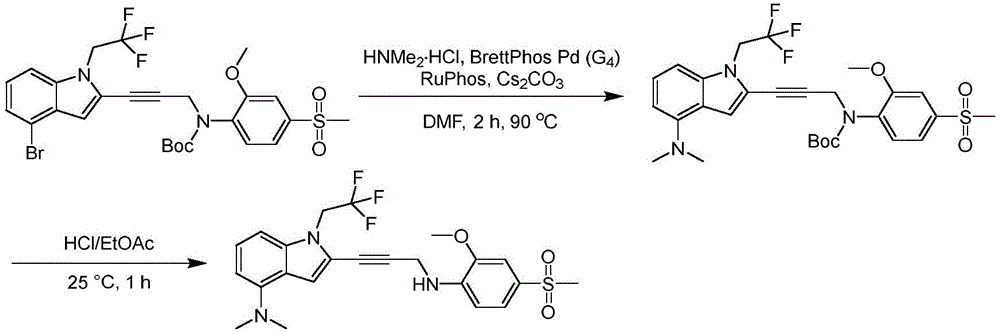
Preparation of tert-butyl (3- (4- (dimethylamino) -1- (2,2, 2-trifluoroethyl) -1H-indol-2-yl) prop-2-yn-1-yl) (2-methoxy-4- (methylsulfonyl) phenyl) carbamate: to a mixture of tert-butyl (3- (4-bromo-1- (2,2, 2-trifluoroethyl) -1H-indol-2-yl) prop-2-yn-1-yl) (2-methoxy-4- (methylsulfonyl) phenyl) carbamate (150mg, 238.8. mu. mol,1 eq) and dimethylamine hydrochloride (31mg, 262.73. mu. mol,1.1 eq) in DMF (2mL) was added Brettphos Pd (G) 4 ) (15mg, 16.72. mu. mol,0.07 equiv.), Cs 2 CO 3 (233mg, 716.54. mu. mol,3 equivalents) and RuPhos (15mg, 33.44. mu. mol,0.14 equivalents). The reaction mixture is degassed and treated with N 2 And (5) purging. The mixture was heated to 90 ℃ and stirred for 2 hours, followed by TLC (PE: EtOAc ═ 1:1, R) f 0.45) and LC-MS analysis indicated that the reaction was complete. The mixture was poured into a saturated EDTA solution (10mL) and stirred for 1 hour. The mixture was extracted with EtOAc (20mL x 3), and the combined organic layers were washed with brine (10mL), dried over anhydrous sodium sulfate, and concentrated. The crude residue is purified by column chromatography (SiO) 2 EtOAc ═ 8:1 to 3:1) to give tert-butyl (3- (4- (dimethylamino) -1- (2,2, 2-trifluoroethyl) -1H-indol-2-yl) prop-2-yn-1-yl) (2-methoxy-4- (methylsulfonyl) phenyl) carbamate (100mg,141.47 μmol, 72% yield).
Preparation of the final product: to a solution of tert-butyl (3- (4- (dimethylamino) -1- (2,2, 2-trifluoroethyl) -1H-indol-2-yl) prop-2-yn-1-yl) (2-methoxy-4- (methylsulfonyl) phenyl) carbamate (0.1g, 172.52. mu. mol,1 eq) in EtOAc (2mL)HCl/EtOAc (4M,10mL,231.85 eq) was added. The mixture was stirred at 25 ℃ for 1 hour, followed by TLC analysis (PE: EtOAc ═ 1:1, R) f 0.3) indicating completion of the reaction. The reaction mixture was filtered and concentrated in vacuo. The residue was purified by preparative HPLC to give 2- {3- [ (4-methanesulfonyl-2-methoxyphenyl) amino]Prop-1-yn-1-yl } -N, N-dimethyl-1- (2,2, 2-trifluoroethyl) -1H-indol-4-amine (27.6mg,57.56 μmol, 33.36% yield) as a light yellow solid.
Example B6: preparation of the compound 4- [ (3- {4- [ (1, 5-dihydroxypent-3-yl) amino ] -1- (2,2, 2-trifluoroethyl) -1H-indol-2-yl } prop-2-yn-1-yl) amino ] -3-methoxybenzene-1-sulphonamide (compound 4A).

Synthesis of 3- ((2-iodo-1- (2,2, 2-trifluoroethyl) -1H-indol-4-yl) amino) pentane-1, 5-diol: to a mixture of 2-iodo-1- (2,2, 2-trifluoroethyl) -1H-indol-4-amine (0.1g, 294.05. mu. mol,1 eq.) in MeOH (5mL) was added 1, 5-dihydroxypentan-3-one (69.47mg, 588.09. mu. mol, 40.50. mu.L, 2 eq.) and SnCl 2 -2H 2 O (13.27mg, 58.81. mu. mol, 4.90. mu.L, 0.20 eq) and then PMHS (70.57mg,1.18mmol,4 eq) was added. The resulting mixture was stirred at 70 ℃ for 3 hours, and subsequent LC-MS analysis indicated that a substance of the desired mass had formed. The mixture was concentrated under reduced pressure to give a crude residue which was passed through preparative TLC (SiO) 2 ,EtOAc:PE=2:1,R f 0.16). 3- ((2-iodo-1- (2,2, 2-trifluoroethyl) -1H-indol-4-yl) amino) pentane-1, 5-diol (0.05g, 96.11. mu. mol, 32.68% yield) was obtained as a yellow oil. MS (ES) + ,m/z):443.1。
Synthesis of final product: to a mixture of 3-methoxy-4- (prop-2-yn-1-ylamino) benzenesulfonamide (40.75mg,144.16 μmol,1.5 equivalents) and 3- ((2-iodo-1- (2,2, 2-trifluoroethyl) -1H-indol-4-yl) amino) pentan-1, 5-diol (0.05g,96.11 μmol,1 equivalent) in DMSO (2mL) was added CuI (18.30mg,96.11 μmol,1 equivalent), followed by Pd (PPh) 3 ) 4 (11.11mg, 9.61. mu. mol,0.10 eq.) and N-isopropylpropan-2-amine (973mg,96.11 μmol,13.58 μ L,1 eq). In N 2 The reaction mixture was stirred at 30 ℃ for 1 hour, followed by TLC analysis (PE: EtOAc ═ 1:2, R) f 0.30) indicating completion of the reaction. The reaction mixture was quenched by the addition of saturated EDTA solution (30 mL). EtOAc (10mL) was added, the resulting mixture was stirred at 25 ℃ for 1 hour, and the mixture was extracted with EtOAc (20mLx 3). The combined organic layers were washed with brine (30mL), dried over anhydrous sodium sulfate, filtered and concentrated under reduced pressure. The residue obtained is passed through preparative TLC (SiO) 2 ,PE:EtOAc=1:2,R f = 0.30) and further purified by preparative HPLC to give 4- [ (3- {4- [ (1, 5-dihydroxypent-3-yl) amino group]-1- (2,2, 2-trifluoroethyl) -1H-indol-2-yl } prop-2-yn-1-yl) amino]3-methoxybenzene-1-sulfonamide (0.007g, 12.47. mu. mol, 12.98% yield) as a white solid. MS (ES) + ,m/z):555.2。
Example B7: synthesis of 2- [ (2- {3- [ (2-methoxy-4-sulfamoylphenyl) amino ] prop-1-yn-1-yl } -1- (2,2, 2-trifluoroethyl) -1H-indol-4-yl) amino ] acetamide (Compound 3A).
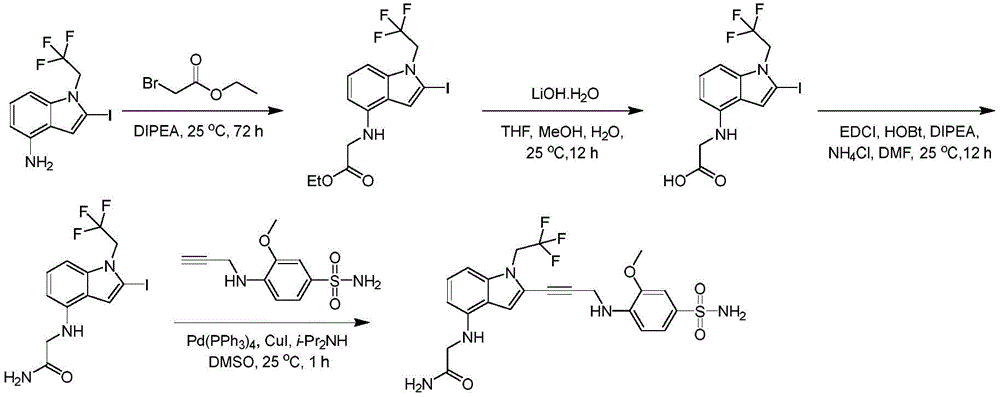
Synthesis of ethyl (2-iodo-1- (2,2, 2-trifluoroethyl) -1H-indol-4-yl) glycinate: in N 2 Next, DIPEA (1.28mL,4.41mmol,3 equiv.) was added in one portion to a mixture of 2-iodo-1- (2,2, 2-trifluoroethyl) -1H-indol-4-amine (0.5g,1.47mmol,1 equiv.) and ethyl 2-bromoacetate (2.46g,14.70mmol,1.63mL,10 equiv.) in THF (5mL) at 25 ℃. The mixture was stirred at 25 ℃ for 96 h, followed by TLC analysis (PE: EtOAc ═ 5:1, R) f 0.4) indicating completion of the reaction. The mixture was concentrated in vacuo at 45 ℃ and the residue was chromatographed on silica gel (SiO) 2 EtOAc 100:1 to 5:1) to give (2-iodo-1- (2,2, 2-trifluoroethyl) -1H-indol-4-yl) glycine ethyl ester (400mg,844.73 μmol, 57.46% yield) as a yellow solid.
Synthesis of (2-iodo-1- (2,2, 2-trifluoroethyl) -1H-indol-4-yl) glycine: in N 2 Then, at 25 deg.C to (2-iodo-1- (2,2, 2-trifluoroethyl) -1H-indoleA mixture of ethyl-4-yl) glycinate (400mg, 938.59. mu. mol,1 eq) in MeOH (3mL), THF (9mL) and water (3mL) was added LiOH. H.in one portion 2 O (196.93mg,4.69mmol,5 equiv.). The mixture was stirred at 25 ℃ for 12 hours and subsequent LC-MS analysis indicated that the reaction was complete. The mixture was concentrated at 40 ℃ under reduced pressure, and the residue was poured into water (10mL) and stirred for 1 min. The aqueous phase was extracted with EtOAc (10mL x 2), adjusted to pH 2 by addition of 2N HCl, and the mixture was re-extracted with EtOAc (10mL x 2). The combined organic layers were washed with brine (10mL), dried over anhydrous sodium sulfate, filtered and concentrated in vacuo to give (2-iodo-1- (2,2, 2-trifluoroethyl) -1H-indol-4-yl) glycine (280mg,668.14 μmol, 71.19% yield) as a yellow solid.
Synthesis of 2- ((2-iodo-1- (2,2, 2-trifluoroethyl) -1H-indol-4-yl) amino) acetamide: in N 2 Next, to a mixture of (2-iodo-1- (2,2, 2-trifluoroethyl) -1H-indol-4-yl) glycine (120mg, 301.42. mu. mol,1 equivalent) in DMF (5mL) was added 1- (3-dimethylaminopropyl) -3-Ethylcarbodiimide (EDCI) (115.56mg, 602.84. mu. mol,2 equivalents), HOBt (81.46mg, 602.84. mu. mol,2 equivalents), DIPEA (155.82mg,1.21mmol, 210.01. mu.L, 4 equivalents) and NH 4 Cl (32.25mg, 602.84. mu. mol, 21.08. mu.L, 2 equivalents). The mixture was stirred at 25 ℃ for 12 hours and subsequent LC-MS analysis indicated that the reaction was complete. The mixture was poured into water (30mL) and stirred for 2 min, and the aqueous phase was extracted with EtOAc (20mL × 5). The combined organic layers were washed with brine (10mL), dried over anhydrous sodium sulfate, filtered and concentrated in vacuo. The residue was washed with DCM (10mL × 3), filtered and concentrated in vacuo to give 2- ((2-iodo-1- (2,2, 2-trifluoroethyl) -1H-indol-4-yl) amino) acetamide (70mg,96.66 μmol, 32.07% yield) as a light yellow solid.
Preparation of final product: in N 2 Next, to a mixture of 3-methoxy-4- (prop-2-yn-1-ylamino) benzenesulfonamide (36.30mg,151.08 μmol,1.2 equivalents) in DMSO (2mL) was added i-Pr 2 NH (127.40mg,1.26mmol, 177.93. mu.L, 10 equiv.), CuI (23.98mg, 125.90. mu. mol,1 equiv.), 2- ((2-iodo-1- (2,2, 2-trifluoroethyl) -1H-indol-4-yl) amino) acetamide (50mg, 125.90. mu. mol,1 equiv.), and Pd (PPh) 3 ) 4 (29.10mg, 25.18. mu. mol,0.2 equiv.). Will be mixed withThe compound was stirred at 45 ℃ for 1 hour, followed by LC-MS and TLC analysis (PE: EtOAc ═ 0:1, R) f 0.32) indicating completion of the reaction. EtOAc (10mL) was added and the mixture was poured into saturated EDTA solution (40mL) and stirred for 15 min. The aqueous phase was extracted with EtOAc (40mL × 2) and the organic layer was poured again into saturated EDTA solution (40mL) and stirred for 1 hour. The aqueous phase was re-extracted with EtOAc (40 mL. times.3). The combined organic layers were washed with brine (40mL x 3), dried over anhydrous sodium sulfate, treated with activated carbon, filtered and concentrated in vacuo. The residue was purified by preparative TLC (PE: EtOAc ═ 0:1, R) f = 0.32) and further purified by preparative HPLC to give 2- [ (2- {3- [ (2-methoxy-4-sulfamoylphenyl) amino group]Prop-1-yn-1-yl } -1- (2,2, 2-trifluoroethyl) -1H-indol-4-yl) amino]Acetamide (5.1mg,9.04 μmol, 7.18% yield) as a light yellow solid. MS (ES) + ,m/z):510.1。
Table 2 shows compounds with a 2-ethynyl-N- (alkyl) -1H-indol-4-amine core.
TABLE 2
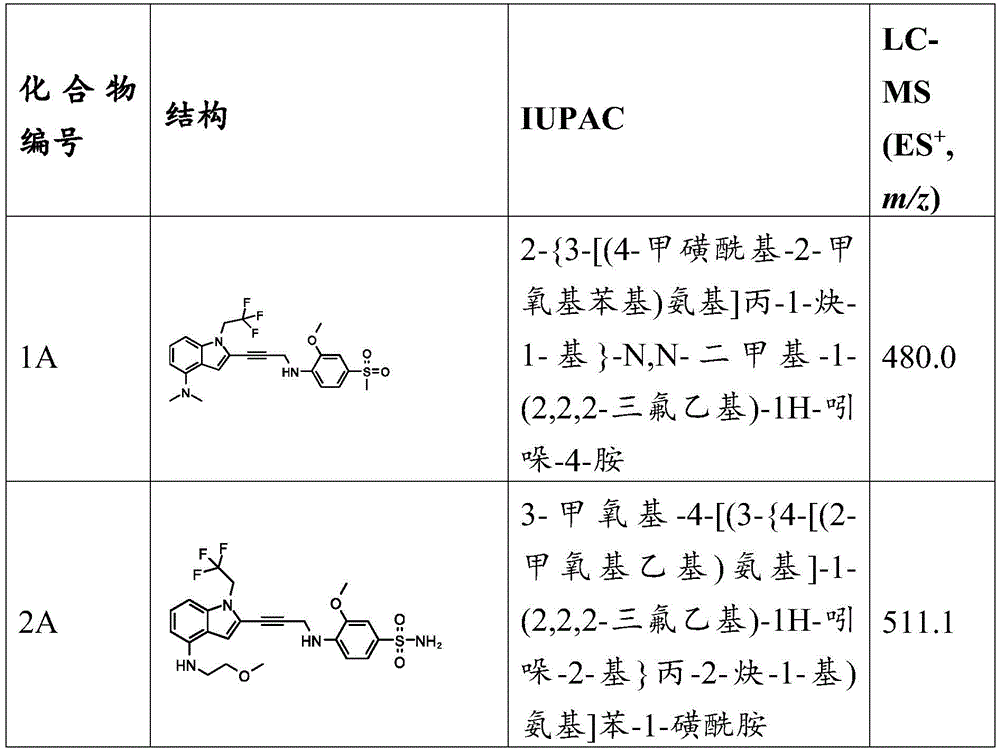


C. Compounds having a 2-ethynyl-N- (cycloalkyl) -1H-indol-4-amine core
Example C1: synthesis of compounds 31A, 32A, 33A, 34A and 35A.

General procedure for the preparation of 4- ((2-iodo-1- (2,2, 2-trifluoroethyl) -1H-indol-4-yl) amino) -1-methylcyclohexan-1-ol and 4- ((2-iodo-1- (2,2, 2-trifluoroethyl) -1H-indol-4-yl) amino) cyclohexane-1-carbonitrile: to a solution of 2-iodo-1- (2,2, 2-trifluoroethyl) -1H-indol-4-amine (1 eq) in EtOH was added 4-hydroxy-4-methylcyclohexan-1-one or 4-oxocyclohexane-1-carbonitrile (5 eq) and Ti (OEt) 4 (5 equivalents). The reaction mixture was stirred at 50 ℃ for 3-5 hours. Then, at 0 ℃ under N 2 The NaBH is added 3 CN (5 equivalents) was added to the reaction and the mixture was stirred for 5 minutes. The reaction mixture was warmed to 50 ℃ and stirred for a further 1 hour. TLC analysis indicated complete consumption of starting material. The solution was dried in vacuo to give a crude residue which was purified by column chromatography or preparative TLC to give 4- ((2-iodo-1- (2,2, 2-trifluoroethyl) -1H-indol-4-yl) amino) -1-methylcyclohexan-1-ol and 4- ((2-iodo-1- (2,2, 2-trifluoroethyl) -1H-indol-4-yl) amino) cyclohexane-1-carbonitrile as a yellow or brown oil.
Preparation of the final product: to a mixture of 3-methoxy-N-methyl-4- (prop-2-yn-1-ylamino) benzamide (1.2 equivalents) in DMSO at 25 deg.C was added i-Pr 2 NH (10 equiv.), CuI (1 equiv.), 4- ((2-iodo-1- (2,2, 2-trifluoroethyl) -1H-indol-4-yl) amino) -1-methylcyclohexan-1-ol or 4- ((2-iodo-1- (2,2, 2-trifluoroethyl) -1H-indol-4-yl) amino) cyclohexane-1-carbonitrile (1 equiv.) and Pd (PPh) 3 ) 4 (0.2 eq). In N 2 The mixture was stirred for 1-2 hours. LC-MS and TLC analysis indicated that the reaction was complete. The reaction mixture was quenched by addition of saturated EDTA solution at 25 ℃ and the mixture was stirred for 2 hours. The reaction mixture was partitioned by adding EtOAc and the aqueous phase was extracted with EtOAc. The organic phase was washed with brine, dried over anhydrous sodium sulfate, filtered and concentrated in vacuo. The crude residue is purified by column chromatography or preparative TLC, followed by further purification by preparative HPLC to yield the desired periodSolution of the desired product. The solution was lyophilized to give the desired product as a yellow solid.
3-methoxy-N-methyl-4- { [3- (4- { [ (1R,4R) -4-hydroxy-4-methylcyclohexyl]Amino } -1- (2,2, 2-trifluoroethyl) -1H-indol-2-yl) prop-2-yn-1-yl]Amino } benzamide, MS (ES) + M/z) 543.2; 3-methoxy-N-methyl-4- { [3- (4- { [ (1S,4S) -4-hydroxy-4-methylcyclohexyl]Amino } -1- (2,2, 2-trifluoroethyl) -1H-indol-2-yl) prop-2-yn-1-yl]Amino } benzamide, MS (ES) + M/z) 543.2; 4- [ (3- {4- [ (4-cyanocyclohexyl) amino group]-1- (2,2, 2-trifluoroethyl) -1H-indol-2-yl } prop-2-yn-1-yl) amino]-3-methoxy-N-methylbenzamide, MS (ES) + M/z) 538.2; 3-methoxy-N-methyl-4- { [3- (4- { [ (1R,4R) -4-cyanocyclohexyl]Amino } -1- (2,2, 2-trifluoroethyl) -1H-indol-2-yl) prop-2-yn-1-yl]Amino } benzamide, MS (ES) + M/z) 538.2; and 3-methoxy-N-methyl-4- { [3- (4- { [ (1S,4S) -4-cyanocyclohexyl]Amino } -1- (2,2, 2-trifluoroethyl) -1H-indol-2-yl) prop-2-yn-1-yl]Amino } benzamide, MS (ES) + ,m/z):538.2。
Example C2: synthesis of compounds 279A and 280A.

To a solution of 3-methoxy-4- (prop-2-yn-1-ylamino) benzoic acid (52.68mg,231.06 μmol,1.5 eq) in DMSO (3mL) was added N- (4- (2-oxa-6-azaspiro [ 3.3)]Hept-6-yl) cyclohexyl) -2-iodo-1- (2,2, 2-trifluoroethyl) -1H-indol-4-amine (100mg, 154.04. mu. mol,1 eq.), CuI (29.34mg, 154.04. mu. mol,1 eq.), N-isopropylpropan-2-amine (15.59mg, 154.04. mu. mol, 21.77. mu.L, 1 eq.) and Pd (PPh) 3 ) 4 (3.56mg, 3.08. mu. mol,0.02 eq.). The resulting mixture was stirred at 45 ℃ for 1 hour. TLC analysis (DCM: MeOH ═ 10:1, R) f 0.24) indicating completion of the reaction. The reaction mixture was quenched with saturated EDTA solution (40mL) at 25 ℃ and extracted with EtOAc (20 mL. times.3). The combined organic layers were dried over anhydrous sodium sulfate, filtered and concentrated under reduced pressure. The crude residue was passed through preparative TLC (SiO) 2 ,DCM:MeOH=10:1) And purification by preparative HPLC gave the desired product as a yellow solid.
4- ((3- (4- (((1R,4R) -4- (2-oxa-6-azaspiro [ 3.3))]Hept-6-yl) cyclohexyl) amino) -1- (2,2, 2-trifluoroethyl) -1H-indol-2-yl) prop-2-yn-1-yl) amino) -3-methoxybenzoic acid (26.6mg, 44.27. mu. mol, 28.74% yield), MS (ES) + M/z) 597.2; and 4- ((3- (4- (((1S,4S) -4- (2-oxa-6-azaspiro [ 3.3))]Hept-6-yl) cyclohexyl) amino) -1- (2,2, 2-trifluoroethyl) -1H-indol-2-yl) prop-2-yn-1-yl) amino) -3-methoxybenzoic acid (26.3mg, 40.51. mu. mol, 26.30% yield), MS (ES) + ,m/z):597.2。
Example C3: synthesis of 3-methoxy-N-methyl-4- { [3- (4- { [ (1S,4S) -4-aminocyclohexyl ] amino } -1- (2,2, 2-trifluoroethyl) -1H-indol-2-yl) prop-2-yn-1-yl ] amino } benzamide (Compound 25A).
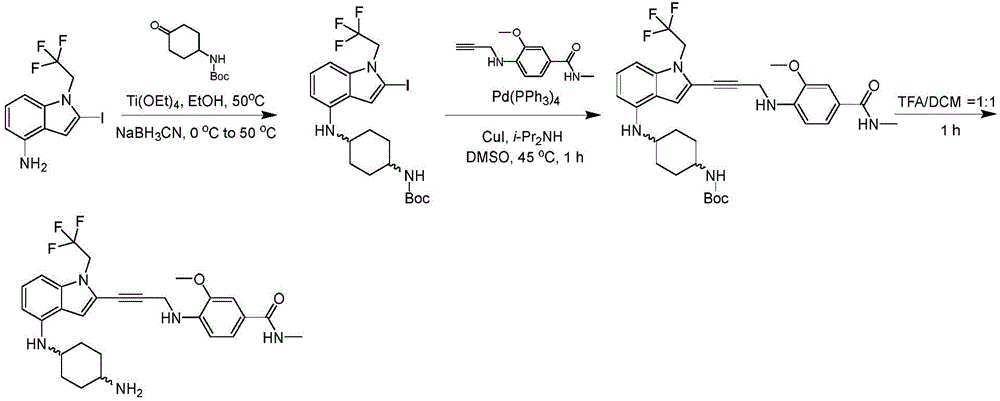
Preparation of tert-butyl (4- ((2-iodo-1- (2,2, 2-trifluoroethyl) -1H-indol-4-yl) amino) cyclohexyl) carbamate: to a solution of 2-iodo-1- (2,2, 2-trifluoroethyl) -1H-indol-4-amine (300mg, 882.14. mu. mol,1 eq) in EtOH (3mL) was added tert-butyl (4-oxocyclohexyl) carbamate (940.68mg,4.41mmol, 940.68. mu.L, 5 eq) and Ti (OEt) 4 (1.01g,4.41mmol, 914.66. mu.L, 5 equiv.). The reaction mixture was stirred at 50 ℃ for 3 hours. Then, at 0 ℃ under N 2 NaBH is reacted with 3 CN (184.78mg,2.94mmol,5 equiv.) was added to the reaction and the reaction mixture was stirred for a further 5 min. The reaction mixture was warmed to 50 ℃ and stirred for a further 1 hour. TLC analysis indicated complete consumption of starting material. The solution was dried in vacuo and the crude residue was purified by column chromatography or preparative TLC to give the desired product (300mg, crude) as a yellow oil or solid. MS (ES) + ,m/z):552.1。
Preparation of tert-butyl (4- ((2- (3- ((2-methoxy-4- (methylcarbamoyl) phenyl) amino) prop-1-yn-1-yl) -1- (2,2, 2-trifluoroethyl) -1H-indol-4-yl) amino) cyclohexyl) carbamate: in N 2 Down to 3-methoxyTo a mixture of yl-N-methyl-4- (prop-2-yn-1-ylamino) benzamide (73.11mg,334.97 μmol,2 equiv.) and tert-butyl (4- ((2-iodo-1- (2,2, 2-trifluoroethyl) -1H-indol-4-yl) amino) cyclohexyl) carbamate (100mg,167.49 μmol,1 equiv.) in DMSO (3mL) was added i-Pr 2 NH (16.95mg, 167.49. mu. mol, 23.67. mu.L, 1 eq.), Pd (PPh) 3 ) 4 (3.87mg, 3.35. mu. mol,0.02 eq.) and CuI (31.90mg, 167.49. mu. mol,1 eq.). The reaction mixture was stirred at 45 ℃ for 1 hour. TLC analysis indicated the reaction was complete. The reaction mixture was quenched by addition of saturated EDTA solution (40mL) at 25 deg.C and the mixture was extracted with EtOAc (20 mL. times.3). The combined organic layers were dried over anhydrous sodium sulfate, filtered and concentrated under reduced pressure to give a residue. The crude residue was purified by preparative TLC to give tert-butyl (4- ((2- (3- ((2-methoxy-4- (methylcarbamoyl) phenyl) amino) prop-1-yn-1-yl) -1- (2,2, 2-trifluoroethyl) -1H-indol-4-yl) amino) cyclohexyl) carbamate (70% yield) as a light yellow solid.
3-methoxy-N-methyl-4- { [3- (4- { [ (1S,4S) -4-aminocyclohexyl]Amino } -1- (2,2, 2-trifluoroethyl) -1H-indol-2-yl) prop-2-yn-1-yl]Preparation of amino benzamide: a solution of tert-butyl (4- ((2- (3- ((2-methoxy-4- (methylcarbamoyl) phenyl) amino) prop-1-yn-1-yl) -1- (2,2, 2-trifluoroethyl) -1H-indol-4-yl) amino) cyclohexyl) carbamate (80mg, 114.71. mu. mol,1 eq) in a 1:1 mixture of DCM (0.5mL) and TFA (0.5mL) was stirred at 25 ℃ for 1H. TLC analysis indicated the reaction was complete. The reaction mixture was concentrated under reduced pressure and purified by preparative TLC and preparative HPLC to give the desired product (13.4mg,24.51 μmol, 21.37% yield) as a light yellow solid. MS (ES) + ,m/z):528.2。
Example C4: synthesis of compounds 269A, 270A, 396A and 397A.

General procedure: to a mixture of 4- (ethylsulfonyl) -2-methoxy-N- (prop-2-yn-1-yl) aniline (1.3 equivalents) in DMSO at 25 deg.C was added i-Pr 2 NH(10 equivalent), CuI (0.5 equivalent), N- (4- (2-oxa-6-azaspiro [3.3 ]]Hept-6-yl) cyclohexyl) -2-iodo-1- (2,2, 2-trifluoroethyl) -1H-indol-4-amine or N- (4- (2-oxa-7-azaspiro [ 3.5)]Non-7-yl) cyclohexyl) -2-iodo-1- (2,2, 2-trifluoroethyl) -1H-indol-4-amine (1 eq) and Pd (PPh) 3 ) 4 (0.20 eq). The mixture was stirred for 1 hour. LC-MS analysis indicated the reaction was complete. EtOAc was poured into the reaction, and the resulting mixture was poured into saturated EDTA solution and stirred for 1 hour. The aqueous phase was extracted with EtOAc (3 ×). The combined organic layers were washed with brine (3 ×), dried over anhydrous sodium sulfate, mixed with activated carbon to remove color, and concentrated in vacuo. The crude residue was purified by preparative TLC and preparative HPLC to give the desired product as a light yellow solid.
N- ((1R,4R) -4- (2-oxa-6-azaspiro [ 3.3)]Hept-6-yl) cyclohexyl) -2- (3- ((4- (ethylsulfonyl) -2-methoxyphenyl) amino) prop-1-yn-1-yl) -1- (2,2, 2-trifluoroethyl) -1H-indol-4-amine, MS (ES) + M/z) 645.2; n- ((1S,4S) -4- (2-oxa-6-azaspiro [ 3.3)]Hept-6-yl) cyclohexyl) -2- (3- ((4- (ethylsulfonyl) -2-methoxyphenyl) amino) prop-1-yn-1-yl) -1- (2,2, 2-trifluoroethyl) -1H-indol-4-amine, MS (ES) + M/z) 645.2; n- ((1R,4R) -4- (2-oxa-7-azaspiro [ 3.5)]Non-7-yl) cyclohexyl) -2- (3- ((4- (ethylsulfonyl) -2-methoxyphenyl) amino) prop-1-yn-1-yl) -1- (2,2, 2-trifluoroethyl) -1H-indol-4-amine, MS (ES) + M/z) 673.2; and N- ((1S,4S) -4- (2-oxa-7-azaspiro [ 3.5) ]Non-7-yl) cyclohexyl) -2- (3- ((4- (ethylsulfonyl) -2-methoxyphenyl) amino) prop-1-yn-1-yl) -1- (2,2, 2-trifluoroethyl) -1H-indol-4-amine, MS (ES) + ,m/z):673.2。
Example C5: synthesis of 3-methoxy-4- { [3- (4- { [ (1R,4R) -4- (pyrrolidin-1-yl) cyclohexyl ] amino } -1- (2,2, 2-trifluoroethyl) -1H-indol-2-yl) prop-2-yn-1-yl ] amino } benzene-1-sulfonamide (Compound 422A).
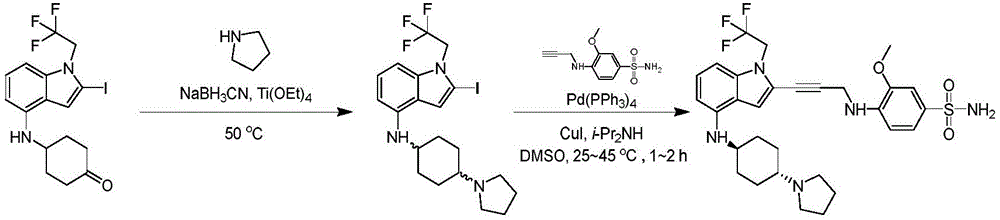
For 2-iodo-N- (4- (pyrrolidin-1-yl) cyclohexyl) -1- (2,2, 2-trifluoroethyl)) General procedure for the preparation of 1H-indol-4-amine: to a solution of 4- ((2-iodo-1- (2,2, 2-trifluoroethyl) -1H-indol-4-yl) amino) cyclohex-1-one (1 eq) in EtOH was added pyrrolidine (5 eq) and Ti (OEt) 4 (5 equivalents). The reaction mixture was stirred at 50 ℃ for 3 hours. Then, at 0 ℃ under N 2 NaBH is reacted with 3 CN (5 equivalents) was added to the reaction and the resulting mixture was stirred for 5 minutes. The reaction mixture was warmed to 50 ℃ and stirred for 1 hour. TLC and LC-MS analysis indicated complete consumption of the starting material. The solution is dried in vacuo and the crude residue is purified by column chromatography (SiO) 2 ) Purification to obtain 2-iodo-N- (4- (pyrrolidin-1-yl) cyclohexyl) -1- (2,2, 2-trifluoroethyl) -1H-indol-4-amine.
General procedure for the preparation of 3-methoxy-4- ((3- (4- (((1R,4R) -4- (pyrrolidin-1-yl) cyclohexyl) amino) -1- (2,2, 2-trifluoroethyl) -1H-indol-2-yl) prop-2-yn-1-yl) amino) benzenesulfonamide: to a mixture of 3-methoxy-4- (prop-2-yn-1-ylamino) benzenesulfonamide (1.2 equivalents) in DMSO at 25-45 ℃ was added i-Pr 2 NH (10 equiv.), CuI (1 equiv.), 2-iodo-N- (4- (pyrrolidin-1-yl) cyclohexyl) -1- (2,2, 2-trifluoroethyl) -1H-indol-4-amine (1 equiv.), and Pd (PPh) 3 ) 4 (0.2 eq). In N 2 The mixture was stirred for 1 hour. LC-MS and TLC analysis indicated that the reaction was complete. The reaction mixture was quenched by the addition of saturated EDTA solution and the resulting mixture was stirred at 25 ℃ for 2 hours. EtOAc was added to the reaction mixture and the aqueous phase was extracted with EtOAc. The organic phase was washed with brine, dried over anhydrous sodium sulfate, filtered and concentrated in vacuo to give the crude product. The crude residue was purified by preparative TLC and preparative HPLC to give a solution of the desired product. The solution was lyophilized to give 3-methoxy-4- { [3- (4- { [ (1R,4R) -4- (pyrrolidin-1-yl) cyclohexyl]Amino } -1- (2,2, 2-trifluoroethyl) -1H-indol-2-yl) prop-2-yn-1-yl]Amino } benzene-1-sulfonamide. MS (ES) + ,m/z):604.2。
Example C6: synthesis of compounds 331A, 332A, 333A and 334A.
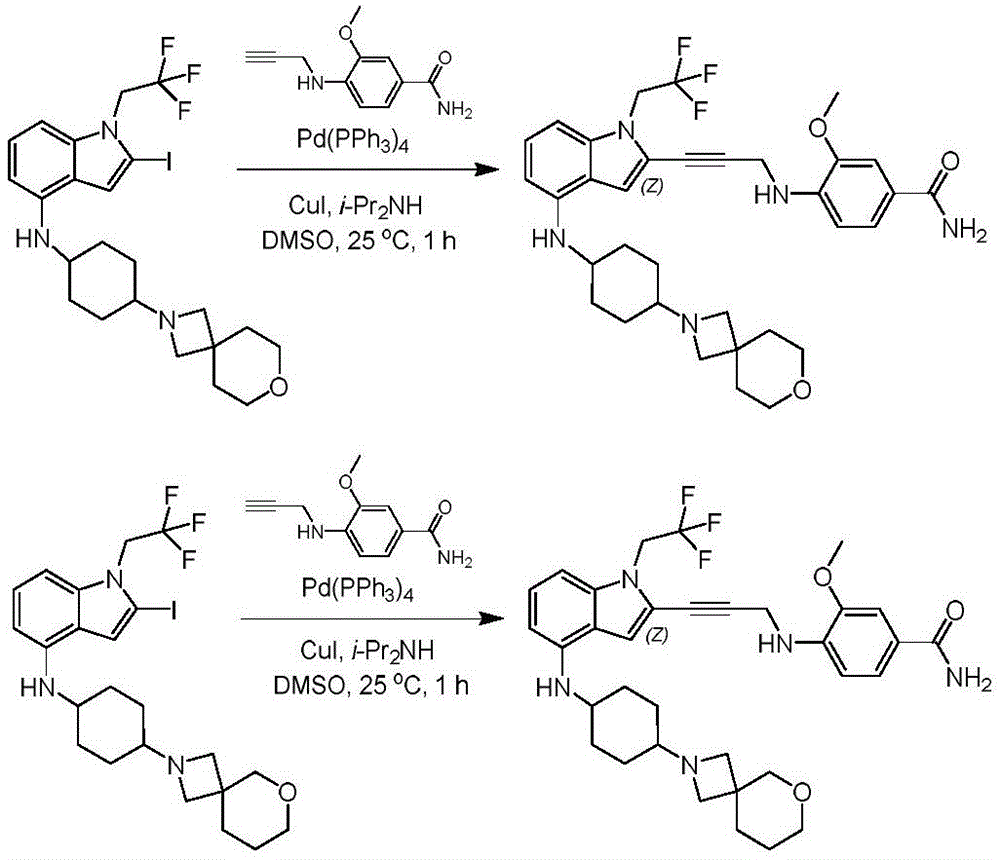
To a solution of 3-methoxy-4- (prop-2-yn-1-ylamino) benzamide (35.88mg, 147.97. mu. mol,1.5 eq) in DMSO (3mL) at 25 ℃ was added i-Pr 2 NH (9.98mg, 98.65. mu. mol, 13.94. mu.L, 1 equiv), CuI (626.26mg,3.29mmol,2 equiv), N- (4- (7-oxa-2-azaspiro [3.5 equiv.), and ]Non-2-yl) cyclohexyl) -2-iodo-1- (2,2, 2-trifluoroethyl) -1H-indol-4-amine or N- (4- (6-oxa-2-azaspiro [ 3.5)]Nonan-2-yl) cyclohexyl) -2-iodo-1- (2,2, 2-trifluoroethyl) -1H-indol-4-amine (60mg, 98.65. mu. mol,1 eq.) and Pd (PPh) 3 ) 4 (2.28mg, 1.97. mu. mol,0.02 eq.). In N 2 The mixture was then stirred at 25 ℃ for 1 hour. The mixture was poured into saturated EDTA solution (20mL), stirred at 25 ℃ for 1 hour, and extracted with EtOAc (20 mL. times.3). The combined organic layers were concentrated under reduced pressure to give a residue which was purified by preparative TLC and preparative HPLC to give the desired product.
3-methoxy-4- { [3- (4- { [ (1R,4R) -4- { 7-oxa-2-azaspiro [3.5 ]]Non-2-yl cyclohexyl]Amino } -1- (2,2, 2-trifluoroethyl) -1H-indol-2-yl) prop-2-yn-1-yl]Amino } benzamide, MS (ES) + M/z) 624.3; 4- ((3- (4- (((1S,4S) -4- (7-oxa-2-azaspiro [ 3.5))]Non-2-yl) cyclohexyl) amino) -1- (2,2, 2-trifluoroethyl) -1H-indol-2-yl) prop-2-yn-1-yl) amino) -3-methoxybenzamide, MS (ES) + M/z) 624.3; 3-methoxy-4- { [3- (4- { [ (1R,4R) -4- { 6-oxa-2-azaspiro [3.5 ]]Non-2-yl cyclohexyl]Amino } -1- (2,2, 2-trifluoroethyl) -1H-indol-2-yl) prop-2-yn-1-yl ]Amino } benzamide, MS (ES) + M/z) 624.3; 4- ((3- (4- (((1S,4S) -4- (6-oxa-2-azaspiro [ 3.5))]Non-2-yl) cyclohexyl) amino) -1- (2,2, 2-trifluoroethyl) -1H-indol-2-yl) prop-2-yn-1-yl) amino) -3-methoxybenzamide. MS (ES) + ,m/z):624.3。
Example C7: 3-methoxy-4- { [3- (4- { [ (1R,4R) -4- (1, 1-dioxo-1. lamda.) - 6 -thiomorpholin-4-yl) cyclohexyl]Amino } -1- (2,2, 2-trifluoroethyl) -1H-indol-2-yl) prop-2-yn-1-yl]Synthesis of amino } benzene-1-sulfonamide (Compound 372A)

Preparation of 2-iodo-N- (4-thiomorpholino cyclohexyl) -1- (2,2, 2-trifluoroethyl) -1H-indol-4-amine: to a solution of 4- ((2-iodo-1- (2,2, 2-trifluoroethyl) -1H-indol-4-yl) amino) cyclohex-1-one (1 eq) in thiomorpholine (10.90g,105.63mmol,10mL,51.20 eq) was added AcOH (1 eq). The reaction mixture was stirred at 25 ℃ for 2 hours. Then, at 0 ℃ under N 2 NaBH is reacted with 3 CN (5 equivalents) was added to the reaction mixture and the mixture was stirred for 5 minutes. The reaction mixture was warmed to 50 ℃ and stirred for a further 3 hours. TLC and LC-MS analysis indicated complete consumption of the starting material. The reaction was partitioned by adding water (100mL) and EtOAc (20 mL). The residue was purified by column chromatography (SiO) 2 PE: EtOAc ═ 10:1 to 0:1) purification to give 2-iodo-N- (4-thiomorpholino cyclohexyl) -1- (2,2, 2-trifluoroethyl) -1H-indol-4-amine.
Preparation of 4- (4- ((2-iodo-1- (2,2, 2-trifluoroethyl) -1H-indol-4-yl) amino) cyclohexyl) thiomorpholine 1, 1-dioxide: to 2-iodo-N- (4-thiomorpholino cyclohexyl) -1- (2,2, 2-trifluoroethyl) -1H-indol-4-amine (1 eq) in CHCl at 0 deg.C 3 (20mL) of the mixture was added m-CPBA (5 equiv.). The mixture was stirred at 0-25 ℃ for 5 hours. TLC and LC-MS analysis indicated the reaction was complete. By adding saturated Na 2 CO 3 The reaction was partitioned between solution (200mL) and EtOAc (50 mL). The residue was purified by column chromatography (SiO) 2 ) Purification gave 4- (4- ((2-iodo-1- (2,2, 2-trifluoroethyl) -1H-indol-4-yl) amino) cyclohexyl) thiomorpholine 1, 1-dioxide.
3-methoxy-4- { [3- (4- { [ (1R,4R) -4- (1, 1-dioxo-1. lamda.) 6 -thiomorpholin-4-yl) cyclohexyl]Amino } -1- (2,2, 2-trifluoroethyl) -1H-indol-2-yl) prop-2-yn-1-yl]Preparation of amino } benzene-1-sulfonamide: to a solution of 3-methoxy-4- (prop-2-yn-1-ylamino) benzenesulfonamide (1.2 equiv.) in DMSO (1mL) at 25 deg.C was added i-Pr 2 NH (10 equiv.), CuI (1 equiv.), 4- (4- ((2-iodo-1- (2,2, 2-trifluoroethyl) -1H-indol-4-yl) amino) cyclohexyl) thiomorpholine 1, 1-dioxide (1 equiv.) and Pd (PPh) 3 ) 4 (0.2 eq). In N 2 Mixing the raw materialsThe mixture was stirred for 1 hour. LC-MS and TLC analysis indicated that the reaction was complete. The reaction mixture was quenched by the addition of saturated EDTA solution (30mL) at 25 ℃ and the mixture was stirred for 2 hours. The resulting mixture was partitioned by adding EtOAc (10mL) and the aqueous phase was extracted with EtOAc (10mL x 3). The organic phase was washed with brine (10mL x 3), dried over anhydrous sodium sulfate, filtered and concentrated in vacuo to give the crude product. The crude residue was purified by preparative TLC and preparative HPLC to give a solution of the desired product. The solution was lyophilized to give 3-methoxy-4- { [3- (4- { [ (1R,4R) -4- (1, 1-dioxo-1. lamda.) - 6 -thiomorpholin-4-yl) cyclohexyl]Amino } -1- (2,2, 2-trifluoroethyl) -1H-indol-2-yl) prop-2-yn-1-yl]Amino-benzene-1-sulfonamide. MS (ES) + ,m/z):668.2。
Example C8: synthesis of compounds 77A and 78A.
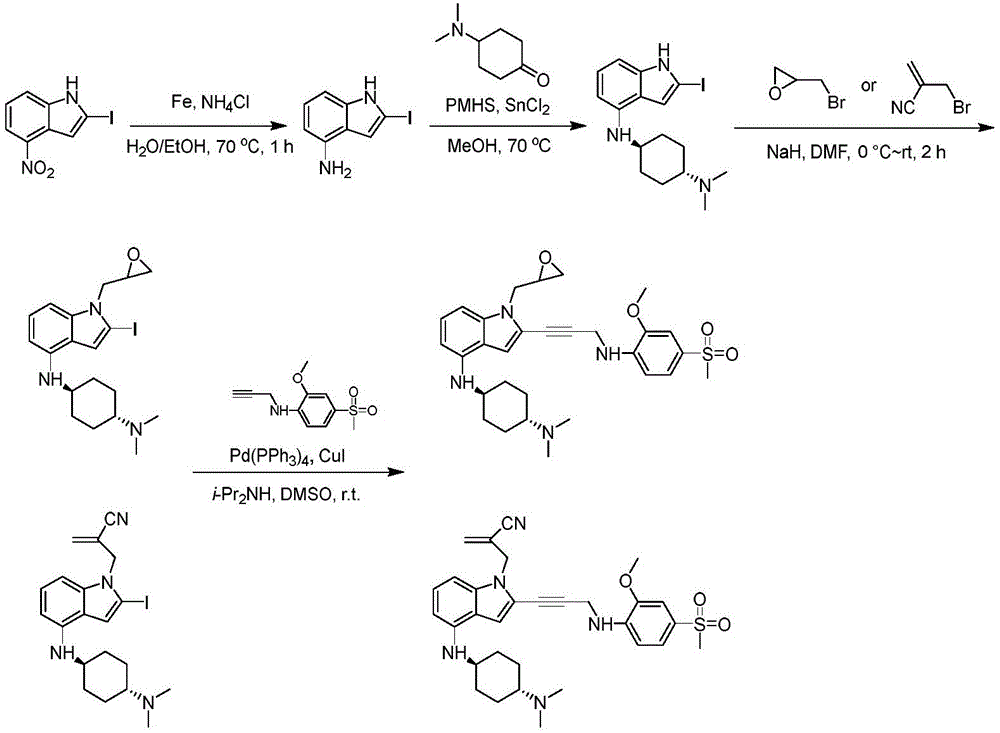
Preparation of 2-iodo-1H-indol-4-amine: to a solution of 2-iodo-4-nitro-1H-indole (3g,10.4mmol,1 eq) in EtOH (30mL) at 25 deg.C was added saturated NH 4 Cl solution (5 mL). The mixture was heated to 70 ℃ and Fe (2.9g,52.1mmol,5 equiv.) was added. The resulting mixture was stirred at 70 ℃ for 1 hour. TLC analysis (PE: EtOAc ═ 3:1, R) f 0.5) indicating completion of the reaction. The reaction mixture was dried and the residue was dissolved in EtOAc (15mL) and washed with water (50 mL). The organic layer was then concentrated and the crude product was purified by column chromatography (PE: EtOAc ═ 2:1) to give 2-iodo-1H-indol-4-amine (2.5g,9.7mmol, 93% yield) as a dark brown solid.
(1R,4R)-N 1 - (2-iodo-1H-indol-4-yl) -N 4 ,N 4 Preparation of dimethylcyclohexane-1, 4-diamine: to a solution of 2-iodo-1H-indol-4-amine (0.5g,1.9mmol,1 eq) in MeOH (5mL) was added 4- (dimethylamino) cyclohexanone (1.37g,9.7mmol,5 eq), Polymethylhydrosiloxane (PMHS) (581.26mg,9.69mmol,5 eq) and SnCl 2 ·2H 2 O (437.20mg,1.94mmol,1 equiv.). The mixture was stirred at 70 ℃ for 3 hours. LC-MS analysis indicated the reaction was complete. Will be provided with 2g of sodium sulfate were added to the reaction, and the mixture was filtered. The filtered solution was concentrated in vacuo and the crude product was passed through preparative TLC (MeOH, R) f Not 0.3) to give (1R,4R) -N 1 - (2-iodo-1H-indol-4-yl) -N 4 ,N 4 Dimethylcyclohexane-1, 4-diamine (260mg,474.9 μmol, 24.5% yield) as a grey solid. MS (ES) + ,m/z):382.0。
(1R,4R)-N 1 - (2-iodo-1- (oxiran-2-ylmethyl) -1H-indol-4-yl) -N 4 ,N 4 Preparation of dimethylcyclohexane-1, 4-diamine and 2- ((4- (((1R,4R) -4- (dimethylamino) cyclohexyl) amino) -2-iodo-1H-indol-1-yl) methyl) acrylonitrile: to (1R,4R) -N 1 - (2-iodo-1H-indol-4-yl) -N 4 ,N 4 -dimethylcyclohexane-1, 4-diamine (1 eq) in DMF (10mL) NaH (2 eq) was added. The reaction mixture was stirred at 0 ℃ for 20 minutes and 2- (bromomethyl) oxirane or 2- (bromomethyl) acrylonitrile (1.2 equivalents) was added. The reaction mixture was further stirred at 0-25 ℃ for 40 minutes. LC-MS analysis indicated the reaction was complete. The reaction mixture was quenched with water (10mL) and extracted with EtOAc (10 mL). The combined organic layers were dried over sodium sulfate, filtered and concentrated in vacuo. The crude product was purified by preparative TLC to give the desired product as a brown solid. (1R,4R) -N 1 - (2-iodo-1- (oxiran-2-ylmethyl) -1H-indol-4-yl) -N 4 ,N 4 Dimethylcyclohexane-1, 4-diamine, MS (ES) + M/z) 440.2; and 2- ((4- (((1R,4R) -4- (dimethylamino) cyclohexyl) amino) -2-iodo-1H-indol-1-yl) methyl) acrylonitrile, MS (ES) + ,m/z):449.0。
For (1R,4R) -N 4 - (2- {3- [ (4-methanesulfonyl-2-methoxyphenyl) amino]Prop-1-yn-1-yl } -1- [ (oxiran-2-yl) methyl]-1H-indol-4-yl) -N 1 ,N 1 -dimethylcyclohexane-1, 4-dioxane and 2- [ (2- {3- [ (4-methanesulfonyl-2-methoxyphenyl) amino)]Prop-1-yn-1-yl } -4- { [ (1R,4R) -4- (dimethylamino) cyclohexyl]Amino } -1H-indol-1-yl) methyl]General procedure for the preparation of prop-2-enenitrile: to a mixture of 2-methoxy-4- (methylsulfonyl) -N- (prop-2-yn-1-yl) aniline (1.3 equivalents) in DMSO at 25 deg.C was added i-Pr 2 NH(10 equivalents), CuI (1 equivalent), (1R,4R) -N 1 - (2-iodo-1- (oxiran-2-ylmethyl) -1H-indol-4-yl) -N 4 ,N 4 -dimethylcyclohexane-1, 4-diamine or 2- ((4- (((1R,4R) -4- (dimethylamino) cyclohexyl) amino) -2-iodo-1H-indol-1-yl) methyl) acrylonitrile (1 eq) and Pd (PPh) 3 ) 4 (0.2 eq). In N 2 The mixture was stirred for 1 hour. LC-MS or TLC analysis indicated that the reaction was complete. The reaction mixture was quenched by the addition of saturated EDTA solution and the resulting mixture was stirred at 25 ℃ for 2 hours. The reaction mixture was partitioned by adding EtOAc. The layers were separated and the aqueous phase was extracted with EtOAc. The organic phase was washed with brine, dried over anhydrous sodium sulfate, filtered and concentrated in vacuo. The crude residue was purified by preparative TLC and preparative HPLC to give a solution of the desired product. The solution was lyophilized to give the desired product as a light yellow solid. (1R,4R) -N 4 - (2- {3- [ (4-methanesulfonyl-2-methoxyphenyl) amino]Prop-1-yn-1-yl } -1- [ (oxiran-2-yl) methyl]-1H-indol-4-yl) -N 1 ,N 1 Dimethylcyclohexane-1, 4-diamine, MS (ES) + M/z) 551.2; and 2- [ (2- {3- [ (4-methanesulfonyl-2-methoxyphenyl) amino group]Prop-1-yn-1-yl } -4- { [ (1R,4R) -4- (dimethylamino) cyclohexyl]Amino } -1H-indol-1-yl) methyl]Prop-2-enenitrile, MS (ES) + ,m/z):560.3。
Example C9: synthesis of compounds 119A, 120A, 314A and 315A.

For N- (4- (7-oxa-2-azaspiro [3.5 ]]Nonan-2-yl) cyclohexyl) -2-iodo-1- (2,2, 2-trifluoroethyl) -1H-indol-4-amine and N 1 - (2-iodo-1- (2,2, 2-trifluoroethyl) -1H-indol-4-yl) -N 4 ,N 4 General procedure for the preparation of dimethylcyclohexane-1, 4-diamine: to a solution of 4- ((2-iodo-1- (2,2, 2-trifluoroethyl) -1H-indol-4-yl) amino) cyclohex-1-one (1 eq) in EtOH was added 7-oxa-2-azaspiro [ 3.5%]Nonane or dimethylamine (5 equivalents), Ti (OEt) 4 (5 equiv.) and i-Pr 2 NH (1 equivalent). The reaction mixture is added at 5Stirred at 0 ℃ for 3 hours. Then, at 0 ℃ under N 2 The NaBH is added 3 CN (5 equivalents) was added to the reaction mixture and the mixture was stirred for a further 5 minutes, warmed to 50 ℃ and stirred for 1 hour. TLC and LC-MS analysis indicated complete consumption of the starting material. The solution was concentrated under reduced pressure to give the crude product. The crude residue is purified by column chromatography (SiO) 2 ) Purification to give the desired product.
Preparation of the final product: to a solution of 4- (ethylsulfonyl) -2-methoxy-N- (prop-2-yn-1-yl) aniline (1.2 eq) in DMSO at 25 deg.C was added i-Pr 2 NH (10 equivalents), CuI (1 equivalent), N- (4- (7-oxa-2-azaspiro [3.5 ]]Non-2-yl) cyclohexyl) -2-iodo-1- (2,2, 2-trifluoroethyl) -1H-indol-4-amine or N 1 - (2-iodo-1- (2,2, 2-trifluoroethyl) -1H-indol-4-yl) -N 4 ,N 4 Dimethylcyclohexane-1, 4-diamine (1 eq.) and Pd (PPh) 3 ) 4 (0.2 eq). In N 2 Next, the mixture was stirred at 25 ℃ for 1 hour. LC-MS and TLC analysis indicated that the reaction was complete. The reaction mixture was quenched by addition of saturated EDTA solution at 25 ℃ and the mixture was stirred for 2 hours. EtOAc was added to the mixture and the aqueous phase was extracted with EtOAc, the organic phase was washed with brine, dried over anhydrous sodium sulfate, filtered and concentrated in vacuo to give the crude product. The crude residue was purified by preparative TLC and preparative HPLC to give a solution of the desired product. The solution was lyophilized to give the desired product.
2- (3- { [4- (ethylsulfonyl) -2-methoxyphenyl]Amino } prop-1-yn-1-yl) -N- [ (1R,4R) -4- { 7-oxa-2-azaspiro [3.5]Non-2-yl cyclohexyl]-1- (2,2, 2-trifluoroethyl) -1H-indol-4-amine, MS (ES) + M/z) 673.4; 2- (3- { [4- (ethylsulfonyl) -2-methoxyphenyl]Amino } prop-1-yn-1-yl) -N- [ (1S,4S) -4- { 7-oxa-2-azaspiro [3.5]Non-2-yl cyclohexyl]-1- (2,2, 2-trifluoroethyl) -1H-indol-4-amine, MS (ES) + ,m/z):673.3;(1R,4R)-N 4 - [2- (3- { [4- (ethylsulfonyl) -2-methoxyphenyl)]Amino } prop-1-yn-1-yl) -1- (2,2, 2-trifluoroethyl) -1H-indol-4-yl]-N 1 ,N 1 Dimethylcyclohexane-1, 4-diamine, MS (ES) + M/z) 591.4; and (1S,4S) -N 4 - [2- (3- { [4- (ethanesulfonic acid)Acyl) -2-methoxyphenyl]Amino } prop-1-yn-1-yl) -1- (2,2, 2-trifluoroethyl) -1H-indol-4-yl]-N 1 ,N 1 Dimethylcyclohexane-1, 4-diamine, MS (ES) + ,m/z):591.3。
Example C10: synthesis of compounds 153A and 154A.

(1R,4R)-N 1 - (2-iodo-1- (2,2, 2-trifluoroethyl) -1H-indol-4-yl) -N 4 - (2-methoxyethyl) -N 4 Methylcyclohexane-1, 4-diamine and (1S,4S) -N 1 - (2-iodo-1- (2,2, 2-trifluoroethyl) -1H-indol-4-yl) -N 4 - (2-methoxyethyl) -N 4 Preparation of methylcyclohexane-1, 4-diamine: to a solution of 4- ((2-iodo-1- (2,2, 2-trifluoroethyl) -1H-indol-4-yl) amino) cyclohex-1-one (1g,2.20mmol,1 eq) and 2-methoxy-N-methyl-ethylamine (980.84mg,11mmol,1.18mL,5 eq) in EtOH (10mL) was added Ti (OEt) 4 (2.01g,8.80mmol,1.83mL,4 equiv.). The mixture was stirred at 50 ℃ for 4 hours and NaBH was added 3 CN (276.59mg,4.40mmol,2 equiv.). The resulting mixture was stirred at 50 ℃ for 1 hour. LC-MS and TLC analysis (PE: EtOAc ═ 3:1, R f1 =0.05,R f2 0.10) indicating completion of the reaction. The reaction mixture was poured into saturated NaHCO 3 The aqueous solution (60mL) was filtered to obtain a filtrate. The filtrate was extracted with EtOAc (60mL x 3). The combined organic layers were washed with brine (40mL), dried over anhydrous sodium sulfate, filtered and concentrated in vacuo. The residue was purified by column chromatography (SiO) 2 ,PE:EtOAc:TEA=20:20:1,R f1 =0.3,R f2 0.4) to yield the desired product as a yellow oil.
(1R,4R)-N 1 - (2-iodo-1- (2,2, 2-trifluoroethyl) -1H-indol-4-yl) -N 4 - (2-methoxyethyl) -N 4 -methylcyclohexane-1, 4-diamine (600mg,1.06mmol, 48.17% yield); and (1S,4S) -N 1 - (2-iodo-1- (2,2, 2-trifluoroethyl) -1H-indol-4-yl) -N 4 - (2-methoxyethyl) -N 4 Methylcyclohexane-1, 4-diamine (500mg, 883.49. mu. mol, 40.14% yield).
Preparation of N-ethyl-3-methoxy-4- ((3- (4- ((4- ((2-methoxyethyl) (methyl) amino) cyclohexyl) -amino) -1- (2,2, 2-trifluoroethyl) -1H-indol-2-yl) prop-2-yn-1-yl) amino) benzamide: to a mixture of N-ethyl-3-methoxy-4- (prop-2-yn-1-ylamino) benzamide (1-2 equivalents, HCl or free) in DMSO (1-10mL) at 20-45 deg.C was added i-Pr 2 NH (10-30 equivalents), CuI (1-2 equivalents), (1R,4R) -N 1 - (2-iodo-1- (2,2, 2-trifluoroethyl) -1H-indol-4-yl) -N 4 - (2-methoxyethyl) -N 4 -methylcyclohexane-1, 4-diamine or (1S,4S) -N 1 - (2-iodo-1- (2,2, 2-trifluoroethyl) -1H-indol-4-yl) -N 4 - (2-methoxyethyl) -N 4 Methylcyclohexane-1, 4-diamine (1 eq) and Pd (PPh) 3 ) 4 (0.20-0.50 equivalent). The mixture was stirred at 20-45 ℃ for 1-4 hours. EtOAc (10mL) was poured into the reaction mixture, and the resulting mixture was poured into 2N aqueous EDTA (40mL) and stirred for 15 minutes. The aqueous phase was extracted with EtOAc (30 mL. times.3). The organic layer was again poured into a saturated EDTA solution (30mL) (saturated) and stirred for a further 1 hour. The aqueous phase was extracted with EtOAc (30mL x 3). The combined organic layers were washed with brine (30mL x 3), dried over anhydrous sodium sulfate, treated with activated carbon, filtered and concentrated in vacuo. The crude residue is purified by preparative TLC or column chromatography followed by preparative HPLC once or twice to give N-ethyl-3-methoxy-4- ((3- (4- ((4- ((2-methoxyethyl) (methyl) amino) cyclohexyl) amino) -1- (2,2, 2-trifluoroethyl) -1H-indol-2-yl) prop-2-yn-1-yl) amino) benzamide.
Example C11: synthesis of Compounds 117A, 118A, 155A, 156A and 661A.
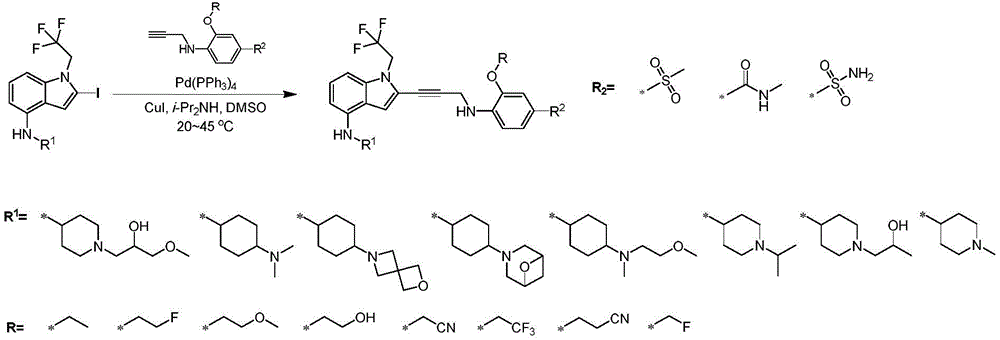
General procedure: to the above R-and R 2 -mixture of substituted alkyne compounds (1-2 equivalents) in DMSO addition of i-Pr 2 NH (10-30 equivalent), CuI (1-2 equivalent), R 1 Substituted 2-iodo-1- (2,2, 2-trifluoroethyl) -1H-indol-4-amine (1 eq) and Pd (PPh) 3 ) 4 (0.20-0.50 equivalent). In N 2 The mixture is then stirred at 20-45 ℃ for 1-3 hours. The mixture was poured into saturated aqueous EDTA and stirred for 1 hour and the aqueous phase was extracted with EtOAc (3 ×). The combined organic layers were washed with brine (3 ×), dried over anhydrous sodium sulfate, filtered and concentrated in vacuo. The residue was purified by TLC, preparative HPLC, or TLC and preparative HPLC to give the desired product.
(1R,4R)-N 1 - (2- (3- ((2- (fluoromethoxy) -4- (methylsulfonyl) phenyl) amino) prop-1-yn-1-yl) -1- (2,2, 2-trifluoroethyl) -1H-indol-4-yl) -N 4 ,N 4 Dimethylcyclohexane-1, 4-diamine, MS (ES) + ,m/z):595.2;(1S,4S)-N 1 - (2- (3- ((2- (fluoromethoxy) -4- (methylsulfonyl) phenyl) amino) prop-1-yn-1-yl) -1- (2,2, 2-trifluoroethyl) -1H-indol-4-yl) -N 4 ,N 4 Dimethylcyclohexane-1, 4-diamine, MS (ES) + ,m/z):595.2;(1R,4R)-N 1 - (2- (3- ((2- (fluoromethoxy) -4- (methylsulfonyl) phenyl) amino) prop-1-yn-1-yl) -1- (2,2, 2-trifluoroethyl) -1H-indol-4-yl) -N 4 - (2-methoxyethyl) -N 4 Methylcyclohexane-1, 4-diamine, MS (ES) + ,m/z):639.3;(1S,4S)-N 1 - (2- (3- ((2- (fluoromethoxy) -4- (methylsulfonyl) phenyl) amino) prop-1-yn-1-yl) -1- (2,2, 2-trifluoroethyl) -1H-indol-4-yl) -N 4 - (2-methoxyethyl) -N 4 Methylcyclohexane-1, 4-diamine, MS (ES) + M/z) 639.3; and 2- (2- { [3- (4- { [1- (2-hydroxypropyl) piperidin-4-yl]Amino } -1- (2,2, 2-trifluoroethyl) -1H-indol-2-yl) prop-2-yn-1-yl]Amino } -5-methanesulfonylphenoxy) acetonitrile, MS (ES) + ,m/z):618.2。
Example C12: synthesis of compounds 183A and 184A.

Preparation of 2-iodo-N- ((1R,4R) -4-morpholinocyclohexyl) -1- (2,2, 2-trifluoroethyl) -1H-indol-4-amine and 2-iodo-N- ((1S,4S) -4-morpholinocyclohexyl) -1- (2,2, 2-trifluoroethyl) -1H-indol-4-amine: to 4- ((2-iodo-1- (2,2, 2-trifluoroethyl) -1H-indole-4-yl) amino) cyclohex-1-one (1g,2.20mmol,1 equiv.) and morpholine (9.59g,110.04mmol,9.68mL,50 equiv.) A mixture was added AcOH (158.59mg,2.64mmol, 151.04. mu.L, 1.2 equiv.). The mixture was stirred at 25 ℃ for 4 hours and NaBH was added 3 CN (276.60mg,4.40mmol,2 equiv.). The resulting mixture was stirred at 25 ℃ for 1 hour. LC-MS and TLC analysis (PE: EtOAc ═ 3:1, R f1 =0.1,R f2 0.15) indicating completion of the reaction. The reaction mixture was poured into saturated NaHCO 3 Aqueous solution (60mL) and filtered to give a filtrate. Then, it was extracted with EtOAc (60mL × 3). The combined organic layers were washed with brine (40mL), dried over anhydrous sodium sulfate, filtered and concentrated in vacuo. The crude residue is purified by column chromatography (SiO) 2 PE: EtOAc ═ 2:1 to 0:1, R f1 =0.2,R f2 0.3) to give the desired product as a light yellow solid. 2-iodo-N- ((1R,4R) -4-morpholinocyclohexyl) -1- (2,2, 2-trifluoroethyl) -1H-indol-4-amine (550mg,975.70 μmol, 44.33% yield); and 2-iodo-N- ((1S,4S) -4-morpholinocyclohexyl) -1- (2,2, 2-trifluoroethyl) -1H-indol-4-amine (500mg,887 μmol, 40.30% yield).
N-Ethyl-3-methoxy-4- { [3- (4- { [ (1R,4R) -4- (morpholin-4-yl) cyclohexyl]Amino } -1- (2,2, 2-trifluoroethyl) -1H-indol-2-yl) prop-2-yn-1-yl]Preparation of amino } benzamide and N-ethyl-3-methoxy-4- ((3- (4- (((1S,4S) -4-morpholinocyclohexyl) amino) -1- (2,2, 2-trifluoroethyl) -1H-indol-2-yl) prop-2-yn-1-yl) amino) benzamide: to a solution of N-ethyl-3-methoxy-4- (prop-2-yn-1-ylamino) benzamide (1-2 equiv., HCl or free) in DMSO (1-10mL) at 20-45 deg.C was added i-Pr 2 NH (10-30 equiv.), CuI (1-2 equiv.), 2-iodo-N- ((1R,4R) -4-morpholinocyclohexyl) -1- (2,2, 2-trifluoroethyl) -1H-indol-4-amine or 2-iodo-N- ((1S,4S) -4-morpholinocyclohexyl) -1- (2,2, 2-trifluoroethyl) -1H-indol-4-amine (1 equiv.), and Pd (PPh) 3 ) 4 (0.20-0.50 equivalent). The mixture was stirred at 20-45 ℃ for 1-4 hours. EtOAc (10mL) was poured into the mixture, and the resulting mixture was poured into 2N aqueous EDTA (40mL) and stirred for 15 minutes. The aqueous phase was extracted with EtOAc (3 ×). The combined organic layers were poured into 2N aqueous EDTA and stirred for 1 hour. The aqueous phase was washed with EtOAc (3X) and And (5) performing secondary extraction. The combined organic layers were washed with brine (3 ×), dried over anhydrous sodium sulfate, treated with activated carbon, filtered and concentrated in vacuo. The crude mixture is purified by preparative TLC or column chromatography, followed by one or two purifications using preparative HPLC to give the desired product.
N-Ethyl-3-methoxy-4- { [3- (4- { [ (1R,4R) -4- (morpholin-4-yl) cyclohexyl]Amino } -1- (2,2, 2-trifluoroethyl) -1H-indol-2-yl) prop-2-yn-1-yl]Amino } benzamide, MS (ES) + M/z) 612.3; and N-ethyl-3-methoxy-4- ((3- (4- (((1S,4S) -4-morpholinocyclohexyl) amino) -1- (2,2, 2-trifluoroethyl) -1H-indol-2-yl) prop-2-yn-1-yl) amino) benzamide, MS (ES) + ,m/z):612.3。
Example C13: synthesis of compounds 324A and 325A.

N- ((1R,4R) -4- (7-oxa-2-azaspiro [ 3.5)]Non-2-yl) cyclohexyl) -2- (3- ((2- (fluoromethoxy) -4- (methylsulfonyl) phenyl) amino) prop-1-yn-1-yl) -1- (2,2, 2-trifluoroethyl) -1H-indol-4-amine and N- ((1S,4S) -4- (7-oxa-2-azaspiro [ 3.5)]Preparation of non-2-yl) cyclohexyl) -2- (3- ((2- (fluoromethoxy) -4- (methylsulfonyl) phenyl) amino) prop-1-yn-1-yl) -1- (2,2, 2-trifluoroethyl) -1H-indol-4-amine: in N 2 Down-ward N- (4- (7-oxa-2-azaspiro [3.5 ] ]Non-2-yl) cyclohexyl) -2-iodo-1- (2,2, 2-trifluoroethyl) -1H-indol-4-amine (1 equivalent) and 2- (fluoromethoxy) -4- (methylsulfonyl) -N- (prop-2-yn-1-yl) aniline (1.2 equivalents) in DMSO (3mL) were added i-Pr in one portion 2 NH (10 equiv.), CuI (1 equiv.), and Pd (PPh) 3 ) 4 (0.2 eq). The mixture was stirred at 20 ℃ for 2 hours. LC-MS analysis indicated the reaction was complete. The reaction mixture was diluted with EtOAc (20mL) and the resulting mixture was poured into saturated EDTA solution (10mL) and stirred for 0.5 h. The organic layer was poured into a saturated EDTA solution (20mL) and stirred for a further 1 hour. The resulting aqueous phase was extracted with EtOAc (20 mL. times.3). The combined organic layers were washed with water (25mL x 3) and brine (15mL x 2), dried over anhydrous sodium sulfate, filtered and vacuum filteredAnd (4) concentrating. The crude residue was purified by preparative TLC and preparative HPLC to give the desired product as a white solid. N- ((1R,4R) -4- (7-oxa-2-azaspiro [ 3.5)]Non-2-yl) cyclohexyl) -2- (3- ((2- (fluoromethoxy) -4- (methylsulfonyl) phenyl) amino) prop-1-yn-1-yl) -1- (2,2, 2-trifluoroethyl) -1H-indol-4-amine, MS (ES) + M/z) 677.3; and N- ((1S,4S) -4- (7-oxa-2-azaspiro [ 3.5)]Non-2-yl) cyclohexyl) -2- (3- ((2- (fluoromethoxy) -4- (methylsulfonyl) phenyl) amino) prop-1-yn-1-yl) -1- (2,2, 2-trifluoroethyl) -1H-indol-4-amine, MS (ES) + ,m/z):677.3。
Example C14: synthesis of compounds 83A, 84A, 85A and 86A.

To N- ((3-methoxy-4- (prop-2-yn-1-ylamino) phenyl) sulfonyl) acetamide or N- ((3-methoxy-4- (prop-2-yn-1-ylamino) phenyl) sulfonyl) propionamide (1.5 equivalents) and N at 30 deg.C 1 - (2-iodo-1- (2,2, 2-trifluoroethyl) -1H-indol-4-yl) -N 4 ,N 4 Mixture of-dimethylcyclohexane-1, 4-diamine (1 eq) in DMSO (2mL) CuI (1 eq), Pd (PPh) 3 ) 4 (0.10 equiv.) and N-isopropylpropan-2-amine (1 equiv.). At N 2 The mixture was stirred for 1 hour. TLC analysis indicated the reaction was complete. The reaction mixture was quenched by the addition of saturated EDTA solution (30mL) and EtOAc (10mL) and the mixture was stirred at 25 ℃ for 1 hour. The aqueous phase was extracted with EtOAc (20mL x 3). The combined organic layers were washed with brine (30mL), dried over anhydrous sodium sulfate, filtered and concentrated under reduced pressure. The crude residue was purified by preparative TLC and preparative HPLC to give the desired product.
N- (3-methoxy-4- { [3- (4- { [ (1R,4R) -4- (dimethylamino) cyclohexyl]Amino } -1- (2,2, 2-trifluoroethyl) -1H-indol-2-yl) prop-2-yn-1-yl]Amino } benzenesulfonyl) acetamide, C-MS (ES) + M/z) 620.1; n- (3-methoxy-4- { [3- (4- { [ (1S,4S) -4- (dimethylamino) cyclohexyl ]Amino } -1- (2,2, 2-trifluoroethyl) -1H-indol-2-yl) prop-2-yn-1-yl]Amino } benzenesulfonyl) acetamide,C-MS(ES + M/z) 620.3; n- (3-methoxy-4- { [3- (4- { [ (1R,4R) -4- (dimethylamino) cyclohexyl]Amino } -1- (2,2, 2-trifluoroethyl) -1H-indol-2-yl) prop-2-yn-1-yl]Amino } benzenesulfonyl) propanamide, C-MS (ES) + M/z) 634.3; and N- (3-methoxy-4- { [3- (4- { [ (1S,4S) -4- (dimethylamino) cyclohexyl]Amino } -1- (2,2, 2-trifluoroethyl) -1H-indol-2-yl) prop-2-yn-1-yl]Amino } benzenesulfonyl) acrylamide, MS (ES) + ,m/z):634.2。
Example C15: synthesis of compounds 95A, 234A, 329A, 330A, 346A, 347A, 393A, 394A, 518A.

To a solution of 2-ethoxy-4- (methylsulfonyl) -N- (prop-2-yn-1-yl) aniline (1.5 eq) in DMSO (25mg/mL) was added 2-iodo-N- (R) 1 ) -1- (2,2, 2-trifluoroethyl) -1H-indol-4-amine (1 equivalent), CuI (1 equivalent), i-Pr 2 NH (1 eq) and Pd (PPh) 3 ) 4 (0.02 eq). The mixture was stirred at 45 ℃ for 1 hour. TLC analysis (EtOAc: TEA ═ 10:1, R f 0.24) indicating completion of the reaction. The reaction mixture was quenched by addition of saturated EDTA solution (40mL) at 25 deg.C and the mixture was extracted with EtOAc (20 mL. times.3). The combined organic layers were dried over anhydrous sodium sulfate, filtered and concentrated under reduced pressure. The crude residue was purified by preparative TLC and preparative HPLC to give the desired product as a yellow solid.
N- ((1R,4R) -4- (2-oxa-7-azaspiro [ 3.5)]Non-7-yl) cyclohexyl) -2- (3- ((2-ethoxy-4- (methylsulfonyl) phenyl) amino) prop-1-yn-1-yl) -1- (2,2, 2-trifluoroethyl) -1H-indol-4-amine, MS (ES) + M/z) 673.2; n- ((1S,4S) -4- (2-oxa-7-azaspiro [ 3.5)]Non-7-yl) cyclohexyl) -2- (3- ((2-ethoxy-4- (methylsulfonyl) phenyl) amino) prop-1-yn-1-yl) -1- (2,2, 2-trifluoroethyl) -1H-indol-4-amine, MS (ES) + M/z) 673.2; n- ((1R,4R) -4- (7-oxa-2-azaspiro [ 3.5)]Non-2-yl) cyclohexyl) -2- (3- ((2-ethoxy-4- (methylsulfonyl) phenyl) amino) prop-1-yn-1-yl) -1- (2,2, 2-trifluoroethyl) -1H-indol-4-amine,MS(ES + m/z) 673.3; n- ((1S,4S) -4- (7-oxa-2-azaspiro [ 3.5)]Non-2-yl) cyclohexyl) -2- (3- ((2-ethoxy-4- (methylsulfonyl) phenyl) amino) prop-1-yn-1-yl) -1- (2,2, 2-trifluoroethyl) -1H-indol-4-amine, MS (ES) + M/z) 673.3; 2- (3- ((2-ethoxy-4- (methylsulfonyl) phenyl) amino) prop-1-yn-1-yl) -N- (1-methylpiperidin-4-yl) -1- (2,2, 2-trifluoroethyl) -1H-indol-4-amine, MS (ES) + M/z) 563.2; 2- (3- ((2-ethoxy-4- (methylsulfonyl) phenyl) amino) prop-1-yn-1-yl) -N- ((1R,4R) -4-morpholinocyclohexyl) -1- (2,2, 2-trifluoroethyl) -1H-indol-4-amine, MS (ES) + M/z) 633.2; 2- (3- ((2-ethoxy-4- (methylsulfonyl) phenyl) amino) prop-1-yn-1-yl) -N- ((1S,4S) -4-morpholinocyclohexyl) -1- (2,2, 2-trifluoroethyl) -1H-indol-4-amine, MS (ES) + M/z) 633.2; 2- {3- [ (2-ethoxy-4-methanesulfonylphenyl) amino]Prop-1-yn-1-yl } -N- [ (1R,4R) -4- { 2-oxa-6-azaspiro [3.3]Hept-6-yl } cyclohexyl]-1- (2,2, 2-trifluoroethyl) -1H-indol-4-amine, MS (ES) + M/z) 645.2; and (1R,4R) -N 4 - (2- {3- [ (2-ethoxy-4-methanesulfonylphenyl) amino]Prop-1-yn-1-yl } -1- (2,2, 2-trifluoroethyl) -1H-indol-4-yl) -N 1 ,N 1 Dimethylcyclohexane-1, 4-diamine, MS (ES) + ,m/z):591.2。
Example C16: synthesis of compounds 174A, 175A, 176A, 177A, 178A, 179A and 180A.

Preparation of 2-iodo-4-nitro-1- (phenylsulfonyl) -1H-indole: to a solution of 2-iodo-4-nitro-1H-indole (3g,10.4mmol,1 eq) in THF (30mL) was added NaH (1.3g,31.3mmol, 60% in mineral oil, 3 eq). The reaction mixture was stirred at 0 ℃ for 10 minutes, then benzenesulfonyl chloride (2.8g,15.7mmol,2mL,1.5 equiv.) was added to the solution. The reaction mixture was stirred at 25 ℃ for 50 minutes. TLC analysis (PE: EtOAc ═ 5:1, R) f 0.5) indicating completion of the reaction. The reaction mixture was quenched by addition of water (50mL) and extracted with EtOAc (50 mL). The crude product was washed with PE (100mL) and the resulting solution was filtered and concentrated Condensation gave the desired product (4.15g,9.7mmol, 93.1% yield) as a yellow solid.
Preparation of 2-iodo-1- (phenylsulfonyl) -1H-indol-4-amine: a solution of 2-iodo-4-nitro-1- (phenylsulfonyl) -1H-indole (1.3g,3mmol,1 eq) in AcOH (15mL) was heated to 70 deg.C, and Fe (847.7mg,15.2mmol,5 eq) was added. The resulting mixture was further stirred at 70 ℃ for 1 hour. TLC analysis (PE: EtOAc ═ 3:1, R) f 0.5) indicating completion of the reaction. The reaction mixture was concentrated and the crude product was extracted with EtOAc (15mL) and washed with water (50 mL). The crude residue was purified by silica gel chromatography (PE: EtOAc ═ 2:1) and purified again by preparative HPLC to give the desired product (1g,2.51mmol, 82.71% yield) as a yellow oil. MS (ES) + ,m/z):399.1。
Preparation of 2-iodo-N- ((1R,4R) -4-morpholinocyclohexyl) -1- (phenylsulfonyl) -1H-indol-4-amine: to a mixture of 2-iodo-1- (phenylsulfonyl) -1H-indol-4-amine (1g,2.5mmol,1 equiv) and 4-morpholinocyclohexanone (920.3mg,5mmol,2 equiv) in DMF (10mL) was added TMSCl (545.6mg,5mmol, 637.4. mu.L, 2 equiv). The mixture was stirred at 0 ℃ for 1 hour and under N 2 By reacting BH 3 THF (1M,7.5mL,3 equivalents) was added to the reaction mixture. The mixture was further stirred at 0 ℃ for 2 hours. TLC analysis (PE: EtOAc ═ 5:1, R) f 0.5) indicates complete consumption of the starting material. The reaction mixture was partitioned by adding water (100mL) and EtOAc (100 mL). Separating the organic phase over anhydrous Na 2 SO 4 Dried, filtered and concentrated under reduced pressure to give a filtrate. The filtrate was further dried in vacuo to give the crude product as a yellow oil. The yellow oil was purified by chromatography on a silica gel column (PE: EtOAc ═ 5:1) to give the desired product (0.55g, crude) as a yellow oil.
Preparation of 2-iodo-N- ((1R,4R) -4-morpholinocyclohexyl) -1H-indol-4-amine: to a solution of 2-iodo-N- ((1R,4R) -4-morpholinocyclohexyl) -1- (phenylsulfonyl) -1H-indol-4-amine (0.3g, 530.5. mu. mol,1 eq) in MeOH (10mL) at 20 ℃ K was added 2 CO 3 (586.6mg,4.2mmol,8 equiv.). The mixture was heated to 80 ℃ and stirred for 2 hours. LC-MS analysis indicated the reaction was complete. Concentrating the reaction mixtureCondensed and chromatographed using silica gel column (PE: EtOAc ═ 1:1, Et added 3 N,R f 0.5) to give the desired product (0.2g,470. mu. mol, 88.6% yield) as a yellow solid.
General procedure for the preparation of R-substituted 2-iodo-1-R-N- ((1R,4R) -4-morpholinocyclohexyl) -1H-indol-4-amine: to a solution of 2-iodo-N- ((1R,4R) -4-morpholinocyclohexyl) -1H-indol-4-amine (1 eq) in DMF (10mL) was added NaH (2 eq; 60% in mineral oil). The reaction mixture was stirred at 0 ℃ for 20 minutes and R-Br (1-1.2 equiv.) was added. The resulting reaction mixture was stirred at 0-25 ℃ for 40 minutes. LC-MS analysis indicated that the reaction was complete. The reaction mixture was quenched by addition of water (10mL) and extracted with EtOAc (10 mL). The organic phase was concentrated in vacuo and purified by preparative TLC to give the desired product as a brown solid.
General procedure for preparation of final product: to a mixture of 2-methoxy-4- (methylsulfonyl) -N- (prop-2-yn-1-yl) aniline or 3-methoxy-N-methyl-4- (prop-2-yn-1-ylamino) benzamide (1.3 equivalents) in DMSO at 25 deg.C was added i-Pr 2 NH (10 equiv.), CuI (1 equiv.), 2-iodo-1- (R-substituted) -N- ((1R,4R) -4-morpholinocyclohexyl) -1H-indol-4-amine (1 equiv.), and Pd (PPh) 3 ) 4 (0.2 eq). At N 2 Next, the mixture was stirred for 1 hour. LC-MS or TLC analysis indicated that the reaction was complete. The reaction mixture was quenched by addition of saturated EDTA solution at 25 ℃ and the mixture was stirred for 2 hours. The reaction mixture was partitioned by adding EtOAc and the aqueous phase was extracted with EtOAc. The organic phase was washed with brine, over anhydrous Na 2 SO 4 Dried, filtered and concentrated in vacuo to afford the crude product. The crude residue was purified by preparative TLC and preparative HPLC to give a solution of the desired product. The solution was lyophilized to give the desired product as a light yellow solid.
1- (2-fluoroethyl) -2- {3- [ (4-methanesulfonyl-2-methoxyphenyl) amino]Prop-1-yn-1-yl } -N- [ (1R,4R) -4- (morpholin-4-yl) cyclohexyl]-1H-indol-4-amine, MS (ES) + M/z) 583.3; 1- (2, 2-Difluoroethyl) -2- {3- [ (4-Methylsulfonyl-2-methoxyphenyl) amino ]Prop-1-yn-1-yl } -N- [ (1R,4R) -4- (morpholin-4-yl) cyclohexylBase of]-1H-indol-4-amine, MS (ES) + M/z) 601.3; 2- (2- {3- [ (4-methanesulfonyl-2-methoxyphenyl) amino)]Prop-1-yn-1-yl } -4- { [ (1R,4R) -4- (morpholin-4-yl) cyclohexyl]Amino } -1H-indol-1-yl) acetonitrile, MS (ES) + M/z) 576.3; 4- ({3- [1- (2-fluoroethyl) -4- { [ (1R,4R) -4- (morpholin-4-yl) cyclohexyl]Amino } -1H-indol-2-yl]Prop-2-yn-1-yl } amino) -3-methoxy-N-methylbenzamide, MS (ES) + M/z) 562.3; 4- ({3- [1- (cyanomethyl) -4- { [ (1R,4R) -4- (morpholin-4-yl) cyclohexyl]Amino } -1H-indol-2-yl]Prop-2-yn-1-yl } amino) -3-methoxy-N-methylbenzamide, MS (ES) + M/z) 555.3; 2- {3- [ (4-Methylsulfonyl-2-methoxyphenyl) amino]Prop-1-yn-1-yl } -1-propyl-N- [ (1R,4R) -4- (morpholin-4-yl) cyclohexyl]-1H-indol-4-amine, MS (ES) + M/z) 579.3; and 2- {3- [ (4-methanesulfonyl-2-methoxyphenyl) amino]Prop-1-yn-1-yl } -1- (2-methylpropyl) -N- [ (1R,4R) -4- (morpholin-4-yl) cyclohexyl]-1H-indol-4-amine, MS (ES) + ,m/z):593.3。
Example C17: synthesis of compounds 309A, 310A, 311A and 312A.
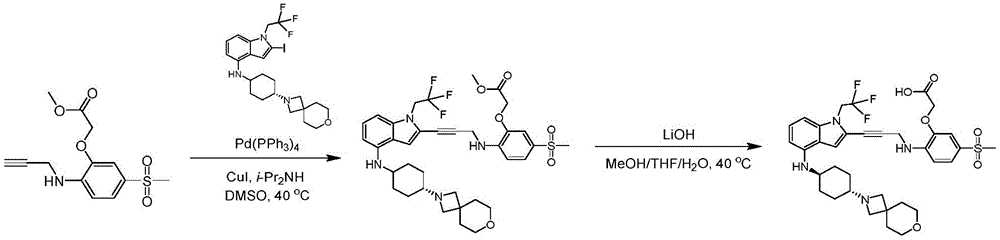
2- (2- ((3- (4- ((4- (7-oxa-2-azaspiro [ 3.5))]Preparation of methyl non-2-yl) cyclohexyl) amino) -1- (2,2, 2-trifluoroethyl) -1H-indol-2-yl) prop-2-yn-1-yl) amino) -5- (methylsulfonyl) phenoxy) acetate: to a solution of methyl 2- (5- (methylsulfonyl) -2- (prop-2-yn-1-ylamino) phenoxy) acetate (19.55mg, 65.77. mu. mol,1.2 eq) in DMSO (2mL) was added i-Pr 2 NH (16.64mg, 164.42. mu. mol, 23.24. mu.L, 3 equivalents), CuI (10.44mg, 54.81. mu. mol,1 equivalent), N- (4- (7-oxa-2-azaspiro [3.5 equivalents)]Non-2-yl) cyclohexyl) -2-iodo-1- (2,2, 2-trifluoroethyl) -1H-indol-4-amine (0.03g, 54.81. mu. mol,1 eq.) and Pd (PPh) 3 ) 4 (6.33mg, 5.48. mu. mol,0.1 equiv.). In N 2 The mixture was then stirred at 40 ℃ for 10 minutes. LC-MS analysis indicated the reaction was complete. The reaction was diluted with EtOAc (20mL) and saturated EDTA solution (20mL) and stirred at 20 ℃ for 1 h. The mixture was then extracted with EtOAc (20mL × 3). IncorporatingThe organic layer was washed with brine (50mL), dried over anhydrous sodium sulfate, filtered and concentrated under reduced pressure. The crude residue was purified by preparative HPLC to give the desired product (0.0103g,13.84 μmol, 25.25% yield) as a light yellow solid. MS (ES) + ,m/z):717.2。
2- (2- ((3- (4- (((1R,4R) -4- (7-oxa-2-azaspiro [ 3.5))]Preparation of non-2-yl) cyclohexyl) amino) -1- (2,2, 2-trifluoroethyl) -1H-indol-2-yl) prop-2-yn-1-yl) amino) -5- (methylsulfonyl) phenoxy) acetic acid: to 2- (2- ((3- (4- ((4- (7-oxa-2-azaspiro [3.5 ]))]Non-2-yl) cyclohexyl) amino) -1- (2,2, 2-trifluoroethyl) -1H-indol-2-yl) prop-2-yn-1-yl) amino) -5- (methylsulfonyl) phenoxy) acetic acid methyl ester (0.08g, 111.61. mu. mol,1 eq) in THF (1mL) was added MeOH (1mL), water (0.4mL) and LiOH. H 2 O (9.37mg, 223.21. mu. mol,2 equiv.). In N 2 The mixture was then stirred at 40 ℃ for 0.5 h. LC-MS analysis indicated the reaction was complete. The pH of the reaction mixture was adjusted to 6 using 2M aqueous formic acid and the resulting white solid was filtered and concentrated. The crude residue was purified by preparative HPLC to give the desired product (0.0085g,12.09 μmol, 10.84% yield) as a white solid. MS (ES) + ,m/z):703.2。

2- (2- ((3- (4- (((1S,4S) -4- (7-oxa-2-azaspiro [ 3.5))]Preparation of methyl non-2-yl) cyclohexyl) amino) -1- (2,2, 2-trifluoroethyl) -1H-indol-2-yl) prop-2-yn-1-yl) amino) -5- (methylsulfonyl) phenoxy) acetate: to 2-iodo-N- [4- (7-oxa-2-azaspiro [3.5 ]]Non-2-yl) cyclohexyl](ii) -1- (2,2, 2-trifluoroethyl) indol-4-amine (0.15g, 274.03. mu. mol,1 eq) in DMSO (5mL) was added i-Pr 2 NH (83.19mg, 822.08. mu. mol, 116.18. mu.L, 3 equivalents), CuI (52.19mg, 274.03. mu. mol,1 equivalent), methyl 2- (5- (methylsulfonyl) -2- (prop-2-yn-1-ylamino) phenoxy) acetate (122.21mg, 411.04. mu. mol,1.5 equivalents) and Pd (PPh) 3 ) 4 (31.67mg, 27.40. mu. mol,0.1 eq.). In N 2 The mixture was then stirred at 40 ℃ for 10 minutes. TLC analysis indicated the reaction was complete.The reaction was diluted with EtOAc (20mL) and saturated EDTA solution and stirred at 20 ℃ for a further 1 h. The reaction mixture was extracted with EtOAc (20mL x 3). The combined organic layers were washed with brine (50mL), dried over anhydrous sodium sulfate, filtered and concentrated under reduced pressure. The crude residue was passed through preparative TLC (SiO) 2 DCM: MeOH ═ 20:1) and preparative HPLC purification afforded the desired product (0.0169g,23.46 μmol, 8.56% yield) as a light yellow solid. MS (ES) + ,m/z):717.2。
2- (2- ((3- (4- (((1S,4S) -4- (7-oxa-2-azaspiro [ 3.5))]Preparation of non-2-yl) cyclohexyl) amino) -1- (2,2, 2-trifluoroethyl) -1H-indol-2-yl) prop-2-yn-1-yl) amino) -5- (methylsulfonyl) phenoxy) acetic acid: to 2- (2- ((3- (4- (((1S,4S) -4- (7-oxa-2-azaspiro [3.5 ]))]Nonan-2-yl) cyclohexyl) amino) -1- (2,2, 2-trifluoroethyl) -1H-indol-2-yl) prop-2-yn-1-yl) amino) -5- (methylsulfonyl) phenoxy) acetic acid methyl ester (0.06g, 83.70. mu. mol,1 eq) in MeOH (0.5mL) was added THF (0.5mL), water (0.2mL) and LiOH. H 2 O (7.02mg, 167.41. mu. mol,2 equiv.). At N 2 The mixture was then stirred at 40 ℃ for 0.5 h. LC-MS analysis indicated the reaction was complete. The mixture was purified by preparative HPLC to give the desired product (0.0162g,23.05 μmol, 27.54% yield) as a white solid. MS (ES) + ,m/z):703.2。
Example C18: synthesis of compounds 130A, 131A, 265A, 266A, 512A and 716A.

Preparation of 4-chloro-2-methoxy-N- (prop-2-yn-1-yl) aniline: to a mixture of 4-chloro-2-methoxyaniline (2g,1 eq.) and 3-bromoprop-1-yne (1.27g,0.8 eq.) in CHCl 3 DIPEA (6.30mL,3 equiv.) was added to a mixture of (10mL) and THF (10 mL). The mixture was stirred at 70 ℃ for 6 hours. LC-MS or TLC analysis indicated that the reaction was complete. The reaction mixture was concentrated under vacuum. The crude product was poured into water and the aqueous phase was extracted with EtOAc (200mL x 3). The combined organic layers were washed with brine (80mL) and dried over anhydrous Na 2 SO 4 Drying, filtering and vacuumAnd (5) concentrating. The crude residue was purified by column chromatography to give the desired product (700mg, 26.71% yield) as a yellow oil. MS (ES) + ,m/z):196.0。
For 2- (3- ((4-chloro-2-methoxyphenyl) amino) prop-1-yn-1-yl) -N-R 1 General procedure for the preparation of substituted-1- (2,2, 2-trifluoroethyl) -1H-indol-4-amines: to a solution of 4-chloro-2-methoxy-N- (prop-2-yn-1-yl) aniline (2 eq) in DMSO (3mL) was added i-Pr 2 NH (10 equivalents), CuI (1 equivalent), 2-iodo-N-R 1 -substituted-1- (2,2, 2-trifluoroethyl) -1H-indol-4-amine (1 eq) and Pd (PPh) 3 ) 4 (0.40 eq). In N 2 The mixture was then stirred at 45 ℃ for 2-5 hours. LC-MS or TLC analysis indicated that the reaction was complete. The mixture was poured into a saturated EDTA solution and stirred for 1 hour. The aqueous phase was extracted with EtOAc (3 ×). The combined organic layers were washed with brine (3 ×), dried over anhydrous sodium sulfate, filtered and concentrated in vacuo. The residue was purified by TLC, preparative HPLC, or TLC and preparative HPLC to give the desired product.
(1R,4R)-N 4 - (2- {3- [ (4-chloro-2-methoxyphenyl) amino]Prop-1-yn-1-yl } -1- (2,2, 2-trifluoroethyl) -1H-indol-4-yl) -N 1 ,N 1 Dimethylcyclohexane-1, 4-diamine, MS (ES) + ,m/z):533.2;(1S,4S)-N 1 - (2- (3- ((4-chloro-2-methoxyphenyl) amino) prop-1-yn-1-yl) -1- (2,2, 2-trifluoroethyl) -1H-indol-4-yl) -N 4 ,N 4 Dimethylcyclohexane-1, 4-diamine, MS (ES) + M/z) 533.2; n- ((1R,4R) -4- (2-oxa-6-azaspiro [ 3.3)]Hept-6-yl) cyclohexyl) -2- (3- ((4-chloro-2-methoxyphenyl) amino) prop-1-yn-1-yl) -1- (2,2, 2-trifluoroethyl) -1H-indol-4-amine, MS (ES) + M/z) 587.2; n- ((1S,4S) -4- (2-oxa-6-azaspiro [ 3.3)]Hept-6-yl) cyclohexyl) -2- (3- ((4-chloro-2-methoxyphenyl) amino) prop-1-yn-1-yl) -1- (2,2, 2-trifluoroethyl) -1H-indol-4-amine, MS (ES) + M/z) 587.2; 2- {3- [ (4-chloro-2-methoxyphenyl) amino]Prop-1-yn-1-yl } -N- (1-methylpiperidin-4-yl) -1- (2,2, 2-trifluoroethyl) -1H-indol-4-amine, MS (ES) + M/z) 505.1; and 1- {4- [ (2- {3- [ (4-chloro-2-methoxyphenyl) amino group]Prop-1-yn-1-yl } -1- (2,2, 2-trifluoroethyl) -1H-indol-4-yl) amino]Piperidin-1-yl } -3-methoxypropan-2-ol, MS (ES) + ,m/z):579.2。
Example C19: synthesis of 4- (3- (4- (((1R,4R) -4- (7-oxa-2-azaspiro [3.5] non-2-yl) cyclohexyl) amino) -1- (2,2, 2-trifluoroethyl) -1H-indol-2-yl) prop-2-yn-1-yl) -7- (methylsulfonyl) -2H-benzo [ b ] [1,4] oxazin-3 (4H) -one (Compound 326A).

2- (2- ((3- (4- (((1R,4R) -4- (7-oxa-2-azaspiro [ 3.5))]Preparation of non-2-yl) cyclohexyl) amino) -1- (2,2, 2-trifluoroethyl) -1H-indol-2-yl) prop-2-yn-1-yl) amino) -5- (methylsulfonyl) phenoxy) acetonitrile: to 6- (methylsulfonyl) -3- (prop-2-yn-1-yl) benzo [ d ] at 25 deg.C]Solution of oxazol-2 (3H) -one (706.14mg,2.14mmol,1.3 equiv.) in DMSO (10mL) was added i-Pr 2 NH (4.99g,49.32mmol,6.97mL,30 equiv.), CuI (626.26mg,3.29mmol,2 equiv.), N- ((1R,4R) -4- (7-oxa-2-azaspiro [3.5 |)]Non-2-yl) cyclohexyl) -2-iodo-1- (2,2, 2-trifluoroethyl) -1H-indol-4-amine (1g,1.64mmol,1 eq) and Pd (PPh) 3 ) 4 (474.98mg, 411.04. mu. mol,0.25 equiv.). In N 2 The mixture was then stirred at 25 ℃ for 1 hour. TLC analysis (DCM: TEA: MeOH ═ 100:1:10, R) f 0.3) indicates complete consumption of the starting material. The mixture was poured into saturated EDTA solution (100mL), stirred at 25 ℃ for 1 hour, and extracted with EtOAc (50mL × 3). The combined organic layers were poured into a saturated EDTA solution (200mL) and stirred at 25 ℃ for 1 hour. The aqueous phase was extracted with EtOAc (100 mL. times.3). The combined organic layers were concentrated under reduced pressure to give a residue which was purified by column chromatography (DCM: MeOH: 50:1 to 5:1) to give the desired product (1g,1.46mmol, 88.95% yield). MS (ES) + ,m/z):684.3。
4- (3- (4- (((1R,4R) -4- (7-oxa-2-azaspiro [ 3.5))]Non-2-yl) cyclohexyl) amino) -1- (2,2, 2-trifluoroethyl) -1H-indol-2-yl) prop-2-yn-1-yl) -7- (methylsulfonyl) -2H-benzo [ b][1,4]Preparation of oxazin-3 (4H) -one: to 2- (2- ((3- (4- (((1R,4R) -4- (7-oxa-2-azaspiro [3.5 ]) at 25 deg.C]Non-2-yl) cyclohexyl) amineBase) -1- (2,2, 2-trifluoroethyl) -1H-indol-2-yl) prop-2-yn-1-yl) amino) -5- (methylsulfonyl) phenoxy) acetonitrile (0.5g, 731.23. mu. mol,1 eq) in a mixture of acetonitrile (10mL) and water (10mL) was added TFA (19.25g,168.83mmol,12.50mL,230.88 eq). The mixture was stirred at 25 ℃ for 8 hours. LC-MS analysis indicated complete consumption of the starting material. The mixture was poured over saturated Na 2 CO 3 In solution (50mL) and extracted with EtOAc (30mL x 3). The combined organic layers were washed with brine (30mL x 3), dried over anhydrous sodium sulfate, filtered and concentrated under reduced pressure. The crude residue was purified by preparative TLC (DCM: MeOH ═ 10:1, R) f 0.3) and further purified by preparative HPLC. The resulting solution was concentrated under reduced pressure to remove acetonitrile. Saturated Na 2 CO 3 The solution was added dropwise to the mixture to adjust the pH of the solution to 8. The mixture was then extracted with EtOAc (30mL x 3). The combined organic layers were washed with brine (30mL x 3), dried over anhydrous sodium sulfate, filtered and concentrated under reduced pressure to give the desired product (154.4mg,220.52 μmol, 30.16% yield) as a yellow solid. MS (ES) + ,m/z):685.3。
Example C20: synthesis of compounds 125A, 126A, 291A, 292A, 493A, and 671A.

General procedure: to 6- (methylsulfonyl) -3- (prop-2-yn-1-yl) benzo [ d]Solution of oxazol-2 (3H) -one (2 equiv.) in DMSO (1mL) was added i-Pr 2 NH (30 equiv.), CuI (1-2 equiv.), 2-iodo-N-R 1 -1- (2,2, 2-trifluoroethyl) -1H-indol-4-amine (1 eq) and Pd (PPh) 3 ) 4 (0.15-0.50 equivalent). Mixing the mixture in N 2 The mixture was stirred at 25 ℃ for 1 hour. LC-MS or TLC analysis indicated that the reaction was complete. The mixture was poured into a saturated EDTA solution and stirred for 1 hour. The aqueous phase was extracted with EtOAc (3 ×). The combined organic layers were washed with brine (3 ×), dried over anhydrous sodium sulfate, filtered and concentrated in vacuo. The residue was purified by preparative TLC, preparative HPLC or both preparative TLC and preparative HPLC to give the desired product.
3- (3- (4- (((1R,4R) -4- (2-oxa-6-azaspiro [ 3.3))]Hept-6-yl) cyclohexyl) amino) -1- (2,2, 2-trifluoroethyl) -1H-indol-2-yl) prop-2-yn-1-yl) -6- (methylsulfonyl) benzo [ d]Oxazol-2 (3H) -ones, MS (ES) + M/z) 643.2; 3- (3- (4- (((1S,4S) -4- (2-oxa-6-azaspiro [ 3.3))]Hept-6-yl) cyclohexyl) amino) -1- (2,2, 2-trifluoroethyl) -1H-indol-2-yl) prop-2-yn-1-yl) -6- (methylsulfonyl) benzo [ d ]Oxazol-2 (3H) -ones, MS (ES) + M/z) 643.2; 3- (3- (4- ((1- (2-hydroxy-3-methoxypropyl) piperidin-4-yl) amino) -1- (2,2, 2-trifluoroethyl) -1H-indol-2-yl) prop-2-yn-1-yl) -6- (methylsulfonyl) benzo [ d]Oxazol-2 (3H) -ones, MS (ES) + M/z) 635.3; 3- (3- (4- ((1-methylpiperidin-4-yl) amino) -1- (2,2, 2-trifluoroethyl) -1H-indol-2-yl) prop-2-yn-1-yl) -6- (methylsulfonyl) benzo [ d]Oxazol-2 (3H) -ones, MS (ES) + M/z) 561.2; 3- (3- (4- (((1R,4R) -4- (dimethylamino) cyclohexyl) amino) -1- (2,2, 2-trifluoroethyl) -1H-indol-2-yl) prop-2-yn-1-yl) -6- (methylsulfonyl) benzo [ d ] c]Oxazol-2 (3H) -ones, MS (ES) + M/z) 589.2; 3- (3- (4- (((1S,4S) -4- (dimethylamino) cyclohexyl) amino) -1- (2,2, 2-trifluoroethyl) -1H-indol-2-yl) prop-2-yn-1-yl) -6- (methylsulfonyl) benzo [ d]Oxazol-2 (3H) -ones, MS (ES) + ,m/z):589.2。
Example C21: synthesis of compounds 148A, 187A and 395A.

To a solution of 3-methoxy-N-methyl-4- (prop-2-yn-1-ylamino) benzenesulfonamide (2-2.2 equiv.) in DMSO (2-4mL) was added i-Pr 2 NH (10 equivalents) and CuI (1 equivalent). Then, 2-iodo-4-R-1- (2,2, 2-trifluoroethyl) -1H-indole (1 eq) and Pd (PPh) were added 3 ) 4 (0.2-0.4 equivalent) in the presence of N 2 Next, the resulting mixture was stirred at 25 ℃ for 60 minutes. TLC and LC-MS analysis were used to monitor the reaction. The reaction mixture was diluted with EtOAc (15mL) and poured into saturated EDTA solution (20mL) and stirred for 1 h. The aqueous phase was then extracted with EtOAc (20mL x 3). The combined organic layers were washed with water (20 mL. times.2) and salt Water (20mL x 2), dried over anhydrous sodium sulfate, filtered and concentrated to give a residue. The residue was purified by preparative TLC and preparative HPLC to give the desired product.
3-methoxy-N-methyl-4- { [3- (4- { [ (1R,4R) -4- { 2-oxa-7-azaspiro [3.5 ]]Non-7-yl cyclohexyl]Amino } -1- (2,2, 2-trifluoroethyl) -1H-indol-2-yl) prop-2-yn-1-yl]Amino } benzene-1-sulfonamide, MS (ES) + M/z) 674.2; 3-methoxy-N-methyl-4- { [3- (4- { [ (1R,4R) -4- (morpholin-4-yl) cyclohexyl]Amino } -1- (2,2, 2-trifluoroethyl) -1H-indol-2-yl) prop-2-yn-1-yl]Amino } benzene-1-sulfonamide, MS (ES) + M/z) 634.3; and 3-methoxy-N-methyl-4- { [3- (4- { [ (1R,4R) -4- (diethylamino) cyclohexyl]Amino } -1- (2,2, 2-trifluoroethyl) -1H-indol-2-yl) prop-2-yn-1-yl]Amino } benzene-1-sulfonamide, MS (ES) + ,m/z):620.2。
Example C22: synthesis of 3-methoxy-N, N-dimethyl-4- { [3- (4- { [ (1R,4R) -4- (dimethylamino) cyclohexyl ] amino } -1- (2,2, 2-trifluoroethyl) -1H-indol-2-yl) prop-2-yn-1-yl ] amino } benzene-1-sulfonamide (Compound 127A).

To a solution of 3-methoxy-N, N-dimethyl-4- (prop-2-yn-1-ylamino) benzenesulfonamide (1.5-2 equivalents) in DMSO (2mL) was added i-Pr 2 NH (10 equivalents) and CuI (1 equivalent). Then, (1S,4S) -N is added 1 - (2-iodo-1- (2,2, 2-trifluoroethyl) -1H-indol-4-yl) -N 4 ,N 4 Dimethylcyclohexane-1, 4-diamine (1 eq.) and Pd (PPh) 3 ) 4 (0.4 eq.) and in N 2 The mixture was then stirred at 25 ℃ for 60 minutes. TLC and LC-MS analysis were used to monitor the reaction. The reaction mixture was diluted with EtOAc (15mL) and poured into saturated EDTA solution (20mL) and stirred for 1 h. The aqueous phase was extracted with EtOAc (20mL x 3). The combined organic layers were washed with water (20mL x 2) and brine (20mL x 2), dried over anhydrous sodium sulfate, filtered and concentrated to give a residue. The residue was purified by preparative TLC and preparative HPLC to give the desired product. MS (ES) + ,m/z):606.2。
Example C23: synthesis of 2-fluoro-5-methoxy-N-methyl-4- { [3- (4- { [ (1R,4R) -4- (dimethylamino) cyclohexyl ] amino } -1- (2,2, 2-trifluoroethyl) -1H-indol-2-yl) prop-2-yn-1-yl ] amino } benzamide (Compound 136A).

Reacting (1R,4R) -N 1 - (2-iodo-1- (2,2, 2-trifluoroethyl) -1H-indol-4-yl) -N 4 ,N 4 -dimethylcyclohexane-1, 4-diamine (180mg, 386.85. mu. mol), 2-fluoro-5-methoxy-N-methyl-4- (prop-2-ynylamino) benzamide (91.39mg, 386.85. mu. mol,1 eq), CuI (73.68mg, 386.85. mu. mol,1 eq), Pd (PPh) 3 ) 4 (89.41mg, 77.37. mu. mol,0.2 eq.) and i-Pr 2 A mixture of NH (391.46mg,3.87mmol, 546.73. mu.L, 10 equiv.) in DMSO (3mL) was degassed and N added 2 Purging was carried out three times. Then, in N 2 The mixture was then stirred at 20 ℃ for 1 hour. TLC analysis (EtOAc: TEA ═ 10:1, R f 0.5) indicated that starting material remained and a major new spot was detected. The mixture was added to a saturated EDTA solution and dissolved in N 2 The mixture was stirred at 20 ℃ for 1 hour. The reaction mixture was quenched by addition of water (20mL) and extracted with EtOAc (15mL × 3). The combined organic layers were washed with brine (10mL x 3), dried over anhydrous sodium sulfate, filtered and concentrated under reduced pressure to give a residue. The residue was purified by preparative TLC (SiO) 2 EtOAc: TEA ═ 10:1) and preparative HPLC purification afforded the desired product (0.058g,100.61 μmol, 26.01% yield) as a yellow solid. MS (ES) + ,m/z):574.3。
Example C24: synthesis of N- [ (7S,8R) -7-fluoro-1, 4-dioxaspiro [4.5] dec-8-yl ] -2- {3- [ (4-methanesulfonyl-2-methoxyphenyl) amino ] prop-1-yn-1-yl } -1- (2,2, 2-trifluoroethyl) -1H-indol-4-amine (compound 870A).

(3- (4- (((7S,8R) -7-fluoro-)1, 4-dioxaspiro [4.5]]Preparation of dec-8-yl) amino) -1- (2,2, 2-trifluoroethyl) -1H-indol-2-yl) prop-2-yn-1-yl) (2-methoxy-4- (methylsulfonyl) phenyl) carbamic acid tert-butyl ester: at N 2 To tert-butyl (3- (4-bromo-1- (2,2, 2-trifluoroethyl) -1H-indol-2-yl) prop-2-yn-1-yl) (2-methoxy-4- (methylsulfonyl) phenyl) carbamate (500mg, 812.40. mu. mol,1 eq.) and 7-fluoro-1, 4-dioxaspiro [ 4.5% ]Dec-8-amine (189.15mg, 893.64. mu. mol,1.1 equiv., HCl) in dioxane (5mL) was added Cs 2 CO 3 (794.09mg,2.44mmol,3 equiv.), RuPhos (49.28mg, 105.61. mu. mol,0.13 equiv.), and Brettphos (Pd, G) 4 ) (44.87mg, 48.74. mu. mol,0.06 eq.). In N 2 The mixture was stirred at 20 ℃ and slowly warmed to 110 ℃. Then, the mixture was stirred at 110 ℃ for 17 hours. TLC analysis (PE: EtOAc ═ 1:1, R) f 0.5) indicated that 10% of the starting material remained and a major new spot was detected, which was more polar than the starting material. The reaction mixture was quenched by the addition of saturated EDTA solution (100mL) and extracted with EtOAc (100 mL. times.3). The combined organic layers were washed with brine (50mL x 3), dried over anhydrous sodium sulfate, filtered and concentrated under reduced pressure. The crude residue is purified by column chromatography (SiO) 2 PE: EtOAc ═ 5:1 to 1:1) and reverse phase HPLC purification afforded the desired product (240mg,324.62 μmol, 38.40% yield) as a yellow solid. MS (ES) + ,m/z):710.3。
N- [ (7S,8R) -7-fluoro-1, 4-dioxaspiro [4.5 ]]Decyl-8-yl]-2- {3- [ (4-methanesulfonyl-2-methoxyphenyl) amino]Preparation of prop-1-yn-1-yl } -1- (2,2, 2-trifluoroethyl) -1H-indol-4-amine: mixing (3- (4- (((7S,8R) -7-fluoro-1, 4-dioxaspiro [4.5 ]) with water ]Dec-8-yl) amino) -1- (2,2, 2-trifluoroethyl) -1H-indol-2-yl) prop-2-yn-1-yl) (2-methoxy-4- (methylsulfonyl) phenyl) carbamic acid tert-butyl ester (30mg, 40.58. mu. mol,1 eq) in TFA (770mg,6.75mmol,0.5mL,166.42 eq) and DCM (1mL) was degassed and degassed with a solution of N 2 Purging was carried out three times. In N 2 The mixture was then stirred at 25 ℃ for 30 minutes. TLC analysis (PE: EtOAc ═ 1:1, R) f 0.4) indicates that 10% of the starting material remained and a major new spot was detected, which was more polar than the starting material. Concentrating the reaction mixture under reduced pressureTo remove the solvent. The residue was taken up with saturated Na 2 CO 3 The solution (5mL) was diluted and extracted with EtOAc (20mL x 3). The combined organic layers were washed with brine (3mL x 3), dried over anhydrous sodium sulfate, filtered and concentrated under reduced pressure. The crude product was purified by reverse phase HPLC to give the desired product (11.4mg,18.59 μmol, 45.81% yield) as a white solid. MS (ES) + ,m/z):610.2。
Example C25: synthesis of compounds 273A, 274A, 281A, 282A, 521A and 696A.
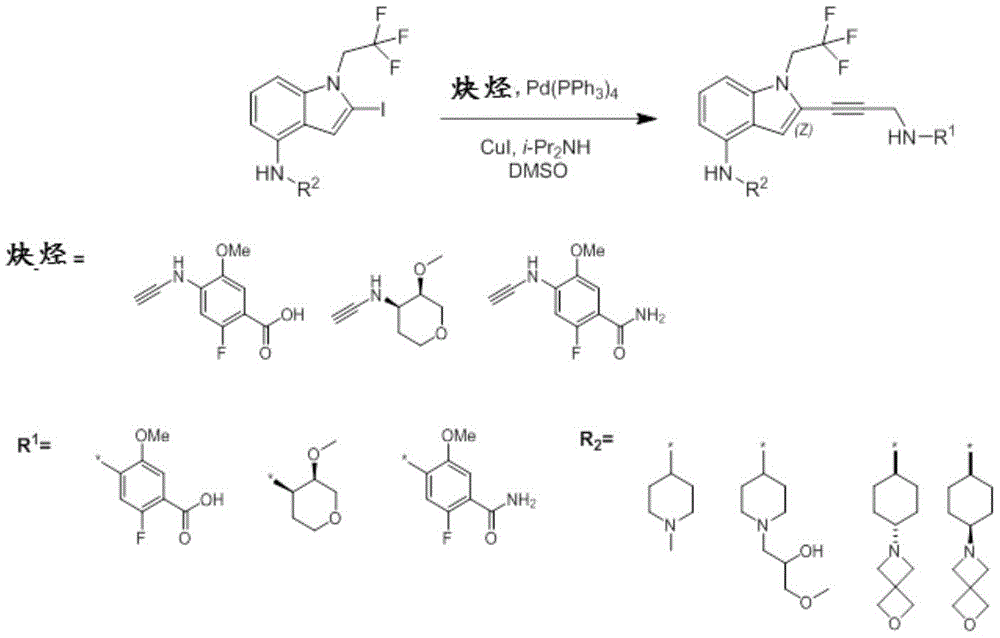
General procedure: to a mixture of alkynes (1-2 equiv.) in DMSO (2mL) was added i-Pr 2 NH (3-10 equivalent), CuI (0.20-1 equivalent), 2-iodine-N- (R) 2 -substituted) -1- (2,2, 2-trifluoroethyl) -1H-indol-4-amine (1 eq) and Pd (PPh) 3 ) 4 (0.20-0.50 equivalent). In N 2 The mixture is then stirred at 20-40 ℃ for 1-3 hours. The completion of the reaction was detected by LC-MS or TLC analysis. The mixture was poured into a saturated EDTA solution and stirred for 1 hour. The aqueous phase was extracted with EtOAc (3 ×). The combined organic layers were washed with brine (3 ×), dried over anhydrous sodium sulfate, filtered and concentrated in vacuo. The residue was purified by preparative TLC and then by preparative HPLC to give the desired compound.
2-fluoro-5-methoxy-4- { [3- (4- { [ (1R,4R) -4- { 2-oxa-6-azaspiro [3.3 ]]Hept-6-yl } cyclohexyl radical]Amino } -1- (2,2, 2-trifluoroethyl) -1H-indol-2-yl) prop-2-yn-1-yl]Amino } benzamide), MS (ES) + M/z) 614.2; 4- ((3- (4- (((1S,4S) -4- (2-oxa-6-azaspiro [ 3.3))]Hept-6-yl) cyclohexyl) amino) -1- (2,2, 2-trifluoroethyl) -1H-indol-2-yl) prop-2-yn-1-yl) amino) -2-fluoro-5-methoxybenzamide, MS (ES) + M/z) 614.2; 2-fluoro-5-methoxy-4- { [3- (4- { [ (1R,4R) -4- { 2-oxa-6-azaspiro [3.3 ]]Hept-6-yl } cyclohexyl]Amino } -1- (2,2, 2-trifluoroethyl) -1H-indol-2-yl) prop-2-yn-1-yl]Amino } benzoic acid, MS (ES) + M/z) 615.2; 4- ((3- (4- (((1S,4S) -4- (2-oxa-6-azaspiro [ 3.3))]Hept-6-yl) cyclohexyl) amino) -1- (2,2 -trifluoroethyl) -1H-indol-2-yl) prop-2-yn-1-yl) amino) -2-fluoro-5-methoxybenzoic acid, MS (ES) + M/z) 615.2; 2- (3- (((3R,4R) -3-methoxytetrahydro-2H-pyran-4-yl) amino) prop-1-yn-1-yl) -N- (1-methylpiperidin-4-yl) -1- (2,2, 2-trifluoroethyl) -1H-indol-4-amine, MS (ES) + M/z) 497.2; and 1-methoxy-3- (4- ((2- (3- (((3R,4R) -3-methoxytetrahydro-2H-pyran-4-yl) amino) prop-1-yn-1-yl) -1- (2,2, 2-trifluoroethyl) -1H-indol-4-yl) amino) piperidin-1-yl) propan-2-ol, MS (ES) + ,m/z):553.2。
Example C26: synthesis of compounds 305A and 306A.

General procedure: to a mixture of N- ((3-methoxy-4- (prop-2-yn-1-ylamino) phenyl) sulfonyl) acetamide (1.3 eq) in DMSO at 25 ℃ was added i-Pr 2 NH (10 equivalents), CuI (0.5 equivalent), N- (4- (7-oxa-2-azaspiro [3.5 ]]Non-2-yl) cyclohexyl) -2-iodo-1- (2,2, 2-trifluoroethyl) -1H-indol-4-amine (1 eq) and Pd (PPh) 3 ) 4 (0.20 eq). The mixture was stirred at 25 ℃ for 1 hour. LC-MS analysis indicated that the reaction was complete. EtOAc (20mL) was poured into the mixture and the resulting mixture was poured into saturated EDTA solution (30mL) and stirred for 1 hour. The aqueous phase was extracted with EtOAc (20 mL. times.3). The combined organic layers were washed with brine (30mL x3), dried over anhydrous sodium sulfate, treated with charcoal, filtered and concentrated in vacuo. The residue was purified by preparative TLC and preparative HPLC to give the desired product as a white solid.
N- ((4- ((3- (4- (((1R,4R) -4- (7-oxa-2-azaspiro [ 3.5))]Non-2-yl) cyclohexyl) amino) -1- (2,2, 2-trifluoroethyl) -1H-indol-2-yl) prop-2-yn-1-yl) amino) -3-methoxyphenyl) sulfonyl) acetamide, MS (ES) + M/z) 702.3; and N- ((4- ((3- (4- (((1S,4S) -4- (7-oxa-2-azaspiro [ 3.5))]Non-2-yl) cyclohexyl) amino) -1- (2,2, 2-trifluoroethyl) -1H-indol-2-yl) prop-2-yn-1-yl) amino) -3-methoxyphenyl) sulfonyl) acetamide, MS (ES) + ,m/z):702.3。
Example C27: synthesis of compounds 307A and 308A.

General procedure: to a mixture of 2-amino-N- ((3-methoxy-4- (prop-2-yn-1-ylamino) phenyl) sulfonyl) acetamide (1.2 eq) in DMSO at 25 ℃ was added i-Pr 2 NH (10 equivalents), CuI (0.5 equivalent), N- (4- (7-oxa-2-azaspiro [3.5 ]]Non-2-yl) cyclohexyl) -2-iodo-1- (2,2, 2-trifluoroethyl) -1H-indol-4-amine (1 eq) and Pd (PPh) 3 ) 4 (0.20 eq). The mixture was stirred at 25 ℃ for 1 hour. LC-MS and HPLC analysis indicated the reaction was complete. EtOAc (10mL) was poured into the mixture and the resulting mixture was poured into saturated EDTA solution (30mL) and stirred for 15 minutes. The aqueous phase was extracted with EtOAc (30 mL. times.2). The organic layer was poured into a saturated EDTA solution (30mL) and stirred for a further 1 hour. The aqueous phase was extracted with EtOAc (30mL x 3). The combined organic layers were washed with brine (30mL x 3), dried over anhydrous sodium sulfate, filtered and concentrated in vacuo. The crude residue was purified by preparative HPLC to afford the desired product as a light yellow solid.
N- ((4- ((3- (4- (((1R,4R) -4- (7-oxa-2-azaspiro [ 3.5))]Non-2-yl) cyclohexyl) amino) -1- (2,2, 2-trifluoroethyl) -1H-indol-2-yl) prop-2-yn-1-yl) amino) -3-methoxyphenyl) sulfonyl) -2-aminoacetamide, MS (ES) + M/z) 717.3; and N- ((4- ((3- (4- (((1S,4S) -4- (7-oxa-2-azaspiro [ 3.5))]Non-2-yl) cyclohexyl) amino) -1- (2,2, 2-trifluoroethyl) -1H-indol-2-yl) prop-2-yn-1-yl) amino) -3-methoxyphenyl) sulfonyl) -2-aminoacetamide, MS (ES) + ,m/z):717.3。
Example C28: synthesis of compounds 514A, 513A, 683A, 684A, 132A, 133A, 128A, 129A, 271A and 272A.

General procedure: to (3S,4R) -3-methoxy-N- (prop-2-yn-1-yl) tetrahydro-2H(ii) -pyran-4-amine or 2-fluoro-5-methoxy-4- (prop-2-yn-1-ylamino) benzamide (1-2 equiv.) in DMSO (2mL) was added i-Pr 2 NH (3-10 equivalent), CuI (0.20-1 equivalent), 2-iodine-N- (R) 2 -substituted) -1- (2,2, 2-trifluoroethyl) -1H-indol-4-amine (1 eq) and Pd (PPh) 3 ) 4 (0.20-0.50 equivalent). In N 2 The mixture is then stirred at 20-40 ℃ for 1-3 hours. LC-MS or TLC analysis indicated that the reaction was complete. The mixture was poured into a saturated EDTA solution and stirred for 1 hour. The aqueous phase was extracted with EtOAc (3 ×). The combined organic layers were washed with brine (3 ×), dried over anhydrous sodium sulfate, filtered and concentrated in vacuo. The residue was purified by preparative TLC and preparative HPLC to give the desired product.
2-fluoro-5-methoxy-4- [ (3- {4- [ (1-methylpiperidin-4-yl) amino]-1- (2,2, 2-trifluoroethyl) -1H-indol-2-yl } prop-2-yn-1-yl) amino]Benzamide, MS (ES) + M/z) 532.2; 2- (3- (((3S,4R) -3-methoxytetrahydro-2H-pyran-4-yl) amino) prop-1-yn-1-yl) -N- (1-methylpiperidin-4-yl) -1- (2,2, 2-trifluoroethyl) -1H-indol-4-amine, MS (ES) + M/z) 479.2; 2-fluoro-4- { [3- (4- { [1- (2-hydroxy-3-methoxypropyl) piperidin-4-yl]Amino } -1- (2,2, 2-trifluoroethyl) -1H-indol-2-yl) prop-2-yn-1-yl]Amino } -5-methoxybenzamide, MS (ES) + M/z) 606.2; 1-methoxy-3- (4- ((2- (3- (((3S,4R) -3-methoxytetrahydro-2H-pyran-4-yl) amino) prop-1-yn-1-yl) -1- (2,2, 2-trifluoroethyl) -1H-indol-4-yl) amino) piperidin-1-yl) propan-2-ol, MS (ES) + M/z) 553.2; 4- ((3- (4- (((1R,4R) -4- (dimethylamino) cyclohexyl) amino) -1- (2,2, 2-trifluoroethyl) -1H-indol-2-yl) prop-2-yn-1-yl) amino) -2-fluoro-5-methoxybenzamide, MS (ES) + M/z) 560.2; 4- ((3- (4- (((1S,4S) -4- (dimethylamino) cyclohexyl) amino) -1- (2,2, 2-trifluoroethyl) -1H-indol-2-yl) prop-2-yn-1-yl) amino) -2-fluoro-5-methoxybenzamide, MS (ES) + ,m/z):560.2;(1R,4R)-N 1 - (2- (3- (((3S,4R) -3-methoxytetrahydro-2H-pyran-4-yl) amino) prop-1-yn-1-yl) -1- (2,2, 2-trifluoroethyl) -1H-indol-4-yl) -N 4 ,N 4 Dimethylcyclohexane-1, 4-diamine, MS (ES) + ,m/z):507.3;(1S,4S)-N 1 - (2- (3- (((3S,4R) -3-methoxy)Tetrakis-2H-pyran-4-yl) amino) prop-1-yn-1-yl) -1- (2,2, 2-trifluoroethyl) -1H-indol-4-yl) -N 4 ,N 4 Dimethylcyclohexane-1, 4-diamine, MS (ES) + M/z) 507.3; n- ((1R,4R) -4- (2-oxa-6-azaspiro [ 3.3)]Hept-6-yl) cyclohexyl) -2- (3- (((3S,4R) -3-methoxytetrahydro-2H-pyran-4-yl) amino) prop-1-yn-1-yl) -1- (2,2, 2-trifluoroethyl) -1H-indol-4-amine, MS (ES) + M/z) 561.3; and N- ((1S,4S) -4- (2-oxa-6-azaspiro [ 3.3)]Hept-6-yl) cyclohexyl) -2- (3- (((3S,4R) -3-methoxytetrahydro-2H-pyran-4-yl) amino) prop-1-yn-1-yl) -1- (2,2, 2-trifluoroethyl) -1H-indol-4-amine, MS (ES) + ,m/z):561.3。
Example C29: synthesis of (3S,4R) -3-fluoro-4- [ (2- {3- [ (4-methanesulfonyl-2-methoxyphenyl) amino ] prop-1-yn-1-yl } -1- (2,2, 2-trifluoroethyl) -1H-indol-4-yl) amino ] cyclohex-1-ol (Compound 43A).

(3- (4- (((7S,8R) -7-fluoro-1, 4-dioxaspiro [4.5 ])]Preparation of dec-8-yl) amino) -1- (2,2, 2-trifluoroethyl) -1H-indol-2-yl) prop-2-yn-1-yl) (2-methoxy-4- (methylsulfonyl) phenyl) carbamic acid tert-butyl ester: at N 2 To tert-butyl (3- (4-bromo-1- (2,2, 2-trifluoroethyl) -1H-indol-2-yl) prop-2-yn-1-yl) (2-methoxy-4- (methylsulfonyl) phenyl) carbamate (0.5g, 812.40. mu. mol,1 eq), Cs at 25 ℃ was added 2 CO 3 (794.09mg,2.44mmol,3 equiv.), RuPhos (49.28mg, 105.61. mu. mol,0.13 equiv.), and (7R,8R) -7-fluoro-1, 4-dioxaspiro [4.5 ]]A mixture of dec-8-amine (189.15mg,893.64 μmol,1.1 equiv, HCl) in dioxane (10mL) was added BrettPhos (Pd, G4) (44.87mg,48.74 μmol,0.06 equiv). The mixture was degassed and heated to 110 ℃ and under N 2 Stirred for 12 hours. TLC analysis (PE: EtOAc ═ 1:1, R) f 0.2) showed that 10% of the starting material remained and a major new spot was detected, which was more polar than the starting material. The reaction mixture was concentrated under reduced pressure to remove dioxane. The residue was diluted with water (50mL) and extracted with EtOAc (50mL × 3). The combined organic layers were washed with brine(50 mL. times.3), dried over anhydrous sodium sulfate, filtered and concentrated under reduced pressure. The crude residue is purified by column chromatography (SiO) 2 PE: EtOAc 10:1 to 1:2) to give the desired product (0.6g,798.88 μmol, 56.70% yield) as a yellow solid.
Preparation of (3S,4R) -3-fluoro-4- ((2- (3- ((2-methoxy-4- (methylsulfonyl) phenyl) amino) prop-1-yn-1-yl) -1- (2,2, 2-trifluoroethyl) -1H-indol-4-yl) amino) cyclohex-1-one: to (3- (4- (((7S,8R) -7-fluoro-1, 4-dioxaspiro [4.5 ]) at 0 DEG C ]Dec-8-yl) amino) -1- (2,2, 2-trifluoroethyl) -1H-indol-2-yl) prop-2-yn-1-yl) (2-methoxy-4- (methylsulfonyl) phenyl) carbamic acid tert-butyl ester (100mg, 140.90. mu. mol,1 eq) in water (0.3mL) was added TFA (3 mL). The mixture was stirred for 45 minutes. TLC analysis (PE: EtOAc ═ 1:1) indicated that the starting material remained and a new spot was detected. The mixture was poured over saturated Na 2 CO 3 Aqueous (50mL) and extracted with EtOAc (20 mL. times.3). The combined organic layers were washed with brine (20mL x 3), dried over anhydrous sodium sulfate, filtered and concentrated under reduced pressure to give the desired product (0.09g, crude) as a yellow solid.
(3S,4R) -3-fluoro-4- [ (2- {3- [ (4-methanesulfonyl-2-methoxyphenyl) amino]Prop-1-yn-1-yl } -1- (2,2, 2-trifluoroethyl) -1H-indol-4-yl) amino]Preparation of cyclohexan-1-ol: to a solution of (3S,4R) -3-fluoro-4- ((2- (3- ((2-methoxy-4- (methylsulfonyl) phenyl) amino) prop-1-yn-1-yl) -1- (2,2, 2-trifluoroethyl) -1H-indol-4-yl) amino) cyclohex-1-one (50mg, 88.41. mu. mol,1 eq) in DCE (1mL) was added AcOH (0.2mL) and NaBH (OAc) 3 (37.47mg, 176.81. mu. mol,2 equiv.). The mixture was stirred at 0 ℃ for 1 hour. TLC analysis (PE: EtOAc ═ 1:2, R f 0.2) indicated that 30% of the starting material remained and a major new spot was detected, which was more polar than the starting material. The mixture was poured over saturated Na 2 CO 3 Aqueous (40mL) and extracted with EtOAc (30mL x 3). The combined organic layers were washed with brine (20mL x 3), dried over anhydrous sodium sulfate, filtered and concentrated under reduced pressure. The crude residue was purified by preparative TLC (PE: EtOAc: DCM: MeOH ═ 50:50:30:3) and preparative HPLC to give the desired product (15mg,25.58 μmol)28.94% yield) as a white solid. MS (ES) + ,m/z):568.2。
Example C30: synthesis of compounds 37A, 38A, 39A, 40A, 41A and 42A.

2- (((4- ((trimethylsilyl) oxy) cyclohex-3-en-1-yl) - λ 2 -azanyl) carbonyl) benzoic acid preparation: to 2- (((4-oxocyclohexyl) -lambda) at-78 deg.C 2 -Azoalkyl) carbonyl) benzoic acid (10g,41.11mmol,1 equiv) in THF (150mL) LDA (2M,30.83mL,1.5 equiv) was added. The mixture was stirred at-78 ℃ for 10 minutes, then warmed to 20 ℃ and stirred at 20 ℃ for a further 10 minutes. The mixture was then cooled to-78 ℃ and TMSCl (4.91g,45.22mmol,5.74mL,1.1 equiv) was added to the reaction. The mixture was then stirred at-78 ℃ for 0.5 hour, then warmed to 20 ℃ for 1 hour. TLC analysis (PE: EtOAc: 3:1, R) f 0.4) showed that 30% of the starting material remained and a major new spot was detected, which was less polar than the starting material. The mixture was poured into saturated NH 4 Cl solution (100mL) and extracted with EtOAc (100mL x 3). The combined organic layers were washed with brine (100mL x 3), dried over anhydrous sodium sulfate, filtered and concentrated under reduced pressure. The crude residue is purified by column chromatography (SiO) 2 PE: EtOAc ═ 50:1 to 1:1) purification afforded the desired product (4g,11.41mmol, 27.76% yield) as a light yellow solid.
2- (((3-fluoro-4-oxocyclohexyl) -lambda. 2 -aminoalkyl) carbonyl) benzoic acid preparation: to 2- (((4- ((trimethylsilyl) oxy) cyclohex-3-en-1-yl) -lambda at 0 deg.C 2 -Azoalkyl) carbonyl) benzoic acid (1.5g,4.76mmol,1 equiv.) to a solution of DMF (16mL) Selectfluor TM (1.85g,5.23mmol,1.1 equiv.) in DMF (12 mL). In N 2 Next, the mixture was slowly warmed to 20 ℃ and stirred for 1 hour. TLC analysis (PE: EtOAc ═ 3:1, R) f 0.1) indicated complete consumption of starting material and a new spot was detected. The reaction mixture was washed with saturated NH 4 The Cl solution (100mL) was diluted and extracted with EtOAc (40mL x 3). The combined organic layers were washed with brine (40mL x 3), dried over anhydrous sodium sulfate, filtered and concentrated under reduced pressure to give the desired product (1g, crude) as a light yellow solid.

Preparation of (3- (4- ((4- (1, 3-dioxoisoindolin-2-yl) -2-fluorocyclohexyl) amino) -1- (2,2, 2-trifluoroethyl) -1H-indol-2-yl) prop-2-yn-1-yl) (2-methoxy-4- (methylsulfonyl) phenyl) -carbamic acid tert-butyl ester: to tert-butyl (3- (4-amino-1- (2,2, 2-trifluoroethyl) -1H-indol-2-yl) prop-2-yn-1-yl) (2-methoxy-4- (methylsulfonyl) phenyl) carbamate (500mg, 906.49. mu. mol,1 eq.) and 2- (((3-fluoro-4-oxocyclohexyl) -. lamda.) -at 0 ℃ was added 2 -Azoalkyl) carbonyl) benzoic acid (473.64mg,1.81mmol,2 equiv.) A mixture in DMF (10mL) was added TMSCl (246.21mg,2.27mmol, 287.63. mu.L, 2.5 equiv.). The mixture is stirred at 0 ℃ for 1 hour, BH is added at 0 DEG C 3 THF (1M,2.72mL,3 equivalents) was added to the mixture and the resulting mixture was further stirred at 0 ℃ for 1 hour. HPLC analysis showed 5% starting material remained and 57.3% of the desired compound was detected. The mixture was poured over saturated Na 2 CO 3 Aqueous (20mL) and extracted with EtOAc (20mL x 3). The combined organic layers were washed with brine (20mL x 3), dried over anhydrous sodium sulfate, filtered and concentrated under reduced pressure. The crude residue was purified by preparative HPLC.
By adding saturated Na 2 CO 3 Solution the solution obtained from Peak 2 (retention time 3.6min) was adjusted to pH>9. The mixture was then extracted with EtOAc (20mL x 3). The combined organic layers were washed with brine (20mL x 3), dried over anhydrous sodium sulfate, filtered and concentrated under reduced pressure to give N- [3- [4- [ [4- (1, 3-dioxoisoindolin-2-yl) -2-fluoro-cyclohexyl]Amino group]-1- (2,2, 2-trifluoroethyl) indol-2-yl]Prop-2-ynyl]-tert-butyl N- (2-methoxy-4-methylsulfonyl-phenyl) carbamate (0.2g, 144.57. mu. mol, 15.95% yield) as a yellow solid。
Preparation of tert-butyl (3- (4- ((4-amino-2-fluorocyclohexyl) amino) -1- (2,2, 2-trifluoroethyl) -1H-indol-2-yl) prop-2-yn-1-yl) (2-methoxy-4- (methylsulfonyl) phenyl) carbamate: to a solution of tert-butyl (3- (4- ((4- (1, 3-dioxoisoindolin-2-yl) -2-fluorocyclohexyl) amino) -1- (2,2, 2-trifluoroethyl) -1H-indol-2-yl) prop-2-yn-1-yl) (2-methoxy-4- (methylsulfonyl) phenyl) carbamate (0.18g, 221.83. mu. mol,1 eq) in MeOH (3mL) at 65 ℃ was added NH 2 NH 2 .H 2 O (33.31mg, 665.49. mu. mol, 32.34. mu.L, 3 equivalents). In N 2 Next, the mixture was stirred for 2.5 hours. LC-MS and HPLC analysis indicated complete consumption of starting material and a major peak with the expected mass was detected. The mixture was poured over saturated Na 2 CO 3 In solution (30mL) and extracted with EtOAc (20mL x 3). The combined organic layers were washed with brine (20mL x 3), dried over anhydrous sodium sulfate, filtered and concentrated under reduced pressure to give the desired product (0.16g, crude) as a yellow solid. MS (ES) + ,m/z):667.3。
Preparation of Boc-protected intermediate: to a solution of tert-butyl (3- (4- ((4-amino-2-fluorocyclohexyl) amino) -1- (2,2, 2-trifluoroethyl) -1H-indol-2-yl) prop-2-yn-1-yl) (2-methoxy-4- (methylsulfonyl) phenyl) carbamate (0.14g, 209.98. mu. mol,1 eq) in MeOH (1mL) at 50 deg.C was added AcOH (37.11mg, 617.91. mu. mol, 35.34. mu.L, 2.94 eq), paraformaldehyde (31.52mg) and NaBH 3 CN (65.98mg,1.05mmol,5 equiv.). In N 2 The mixture was stirred for 1.5 hours. LC-MS analysis indicated that the starting material remained and several new peaks were observed. The reaction mixture was saturated with Na 2 CO 3 The solution (30mL) was diluted and extracted with EtOAc (20mL x 3). The combined organic layers were washed with brine (20mL x 3), dried over anhydrous sodium sulfate, filtered and concentrated under reduced pressure. The residue was purified by preparative TLC (PE: EtOAc: DCM: MeOH: TEA ═ 50:50:100:10:30) to give the desired product as a yellow solid.
(3- (4- ((4- (dimethylamino) -2-fluorocyclohexyl) amino) -1- (2,2, 2-trifluoroethyl) -1H-indol-2-yl) prop-2-yn-1-yl) (2-methoxy-4- (methylsulfonyl) phenyl) amino Tert-butyl benzoate (15mg, 21.59. mu. mol, 30% yield), MS (ES) + M/z) 695.3; tert-butyl (3- (4- ((2-fluoro-4- (methylamino) cyclohexyl) amino) -1- (2,2, 2-trifluoroethyl) -1H-indol-2-yl) prop-2-yn-1-yl) (2-methoxy-4- (methylsulfonyl) phenyl) carbamate (15mg,22.03 μmol, 30.62% yield), MS (ES) + M/z) 681.2; tert-butyl (3- (4- ((4-amino-2-fluorocyclohexyl) amino) -1- (2,2, 2-trifluoroethyl) -1H-indol-2-yl) prop-2-yn-1-yl) (2-methoxy-4- (methylsulfonyl) phenyl) carbamate (30mg,43.29 μmol, 60.15% yield), MS (ES) (rt 2 mg, was added, mg, was added, mg + ,m/z):667.2。
General procedure for preparation of final product: to tert-butyl (3- (4- ((4- (dimethylamino) -2-fluorocyclohexyl) amino) -1- (2,2, 2-trifluoroethyl) -1H-indol-2-yl) prop-2-yn-1-yl) (2-methoxy-4- (methylsulfonyl) phenyl) carbamate at 25 ℃; (3- (4- ((2-fluoro-4- (methylamino) cyclohexyl) amino) -1- (2,2, 2-trifluoroethyl) -1H-indol-2-yl) prop-2-yn-1-yl) (2-methoxy-4- (methylsulfonyl) phenyl) carbamic acid tert-butyl ester; or tert-butyl (3- (4- ((4-amino-2-fluorocyclohexyl) amino) -1- (2,2, 2-trifluoroethyl) -1H-indol-2-yl) prop-2-yn-1-yl) (2-methoxy-4- (methylsulfonyl) phenyl) carbamate (30mg,45 μmol,1 eq) to a solution in EtOAc (1mL) was added HCl/EtOAc (4M,2.08mL,185 eq). The mixture was stirred for 1 hour. LC-MS analysis indicated complete consumption of starting material and a major peak with the expected mass was detected. The mixture was poured over saturated Na 2 CO 3 In solution (20mL) and extracted with EtOAc (20mL x 3). The combined organic layers were washed with brine (20mL x 3), dried over anhydrous sodium sulfate, filtered and concentrated under reduced pressure. The crude residue was purified by preparative HPLC to give the desired product.
(1R,2R,4S) -2-fluoro-N 1 - (2- (3- ((2-methoxy-4- (methylsulfonyl) phenyl) amino) prop-1-yn-1-yl) -1- (2,2, 2-trifluoroethyl) -1H-indol-4-yl) -N 4 ,N 4 Dimethylcyclohexane-1, 4-diamine, MS (ES) + M/z) 595.3; (1R,2R,4S) -2-fluoro-N 1 - (2- (3- ((2-methoxy-4- (methylsulfonyl) phenyl) amino) prop-1-yn-1-yl) -1- (2,2, 2-trifluoroethyl) -1H-indol-4-yl) -N 4 -methylcyclohexane1, 4-diamine, MS (ES) + M/z) 581.3; and (1R,2R,4S) -2-fluoro-N 1 - (2- (3- ((2-methoxy-4- (methylsulfonyl) phenyl) amino) prop-1-yn-1-yl) -1- (2,2, 2-trifluoroethyl) -1H-indol-4-yl) cyclohexane-1, 4-diamine, MS (ES) + M/z) 567.2; 2-fluoro-N 1 - (2- (3- ((2-methoxy-4- (methylsulfonyl) phenyl) amino) prop-1-yn-1-yl) -1- (2,2, 2-trifluoroethyl) -1H-indol-4-yl) -N 4 ,N 4 Dimethylcyclohexane-1, 4-diamine, MS (ES) + M/z) 595.3; 2-fluoro-N 1 - (2- {3- [ (4-methanesulfonyl-2-methoxyphenyl) amino]Prop-1-yn-1-yl } -1- (2,2, 2-trifluoroethyl) -1H-indol-4-yl) -N 4 Methylcyclohexane-1, 4-diamine, MS (ES) + M/z) 581.3; 2-fluoro-N 1 - (2- (3- ((2-methoxy-4- (methylsulfonyl) phenyl) amino) prop-1-yn-1-yl) -1- (2,2, 2-trifluoroethyl) -1H-indol-4-yl) cyclohexane-1, 4-diamine, MS (ES) + ,m/z):567.2。
Example C31: synthesis of compounds 58A, 475A, 481A, 545A, 546A, 556A, 560A, 561A, 615A, 693A, 717A, 1004A and 1005A.

To a solution of alkyne (1-2 equiv., HCl or free) in DMSO (1-10mL) at 20-45 deg.C was added i-Pr 2 NH (10-30 equiv.), CuI (1-2 equiv.), 1- (2, 2-difluoroethyl) -2-iodo-N- (R) 1 -substituted) -1H-indol-4-amine (1 eq), Pd (PPh) 3 ) 4 (0.20-0.50 equivalent). The mixture was stirred for 1-4 hours. Completion of the reaction was detected by TLC or LC-MS analysis. EtOAc (10mL) was poured into the mixture and the resulting mixture was poured into saturated EDTA solution (40mL) and stirred for 15 minutes. The aqueous phase was extracted with EtOAc (40 mL. times.2). The combined organic layers were poured into a saturated EDTA solution (40mL) and stirred for a further 1 hour. The aqueous phase was extracted with EtOAc (40mL x 3). The combined organic layers were washed with brine (40mL x 3), dried over anhydrous sodium sulfate, treated with activated carbon, filtered and concentrated in vacuo. Purifying the mixture by preparative TLC or column chromatography, and then by preparative HPLC once or twice to obtain To the desired product.
3-methoxy-4- { [3- (4- { [ (1S,4S) -4- [ (3S,4S) -3, 4-dihydroxypyrrolidin-1-yl]Cyclohexyl radical]Amino } -1- (2,2, 2-trifluoroethyl) -1H-indol-2-yl) prop-2-yn-1-yl]Amino } benzene-1-sulfonamide, MS (ES) + M/z): 621.3, respectively; 3-methoxy-4- ((3- (4- ((1-methylpiperidin-4-yl) amino) -1- (2,2, 2-trifluoroethyl) -1H-indol-2-yl) prop-2-yn-1-yl) amino) benzoic acid, MS (ES) + M/z) 515.1; 2- (2- (4- ((2- (3- ((2-methoxy-4- (methylsulfonyl) phenyl) amino) prop-1-yn-1-yl) -1- (2,2, 2-trifluoroethyl) -1H-indol-4-yl) amino) piperidin-1-yl) ethoxy) ethan-1-ol, MS (ES) + M/z) 623.2; 3-methoxy-4- ((3- (4- ((tetrahydro-2H-pyran-4-yl) amino) -1- (2,2, 2-trifluoroethyl) -1H-indol-2-yl) prop-2-yn-1-yl) amino) benzoic acid, MS (ES) + M/z) 502.2; 2- (4- ((2- (3- ((2-methoxy-4- (methylsulfonyl) phenyl) amino) prop-1-yn-1-yl) -1- (2,2, 2-trifluoroethyl) -1H-indol-4-yl) amino) piperidin-1-yl) ethan-1-ol, MS (ES) + M/z) 579.2; 4- ((3- (4- ((1- (2, 3-dihydroxypropyl) piperidin-4-yl) amino) -1- (2,2, 2-trifluoroethyl) -1H-indol-2-yl) prop-2-yn-1-yl) amino) -3-methoxybenzoic acid, MS (ES) + M/z) 575.2; methyl 3-methoxy-4- ((3- (4- ((tetrahydro-2H-pyran-4-yl) amino) -1- (2,2, 2-trifluoroethyl) -1H-indol-2-yl) prop-2-yn-1-yl) amino) benzoate, MS (ES) + M/z) 516.2; methyl 4- ((3- (4- ((1- (2, 3-dihydroxypropyl) piperidin-4-yl) amino) -1- (2,2, 2-trifluoroethyl) -1H-indol-2-yl) prop-2-yn-1-yl) amino) -3-methoxybenzoate, MS (ES) + M/z) 589.2; 2- (3- ((2-methoxy-4- (methylsulfonyl) phenyl) amino) prop-1-yn-1-yl) -N- (1- (2-methoxyethyl) piperidin-4-yl) -1- (2,2, 2-trifluoroethyl) -1H-indol-4-amine, MS (ES) + M/z) 593.2; 3- (4- ((2- (3- ((2-methoxy-4- (methylsulfonyl) phenyl) amino) prop-1-yn-1-yl) -1- (2,2, 2-trifluoroethyl) -1H-indol-4-yl) amino) piperidin-1-yl) propane-1, 2-diol, MS (ES) + M/z) 609.3; 3-methoxy-4- ({3- [4- ({1- [ (2-oxo-1, 3-dioxolan-4-yl) methyl)]Piperidin-4-yl } amino) -1- (2,2, 2-trifluoroethyl) -1H-indol-2-yl]Prop-2-yn-1-yl } amino) benzene-1-sulphonamide, MS (ES) + M/z) 636.2; 4- ({4- [ (2- {3- [ (4-methylsulfonyl) sulfonyl-)Radical-2-methoxyphenyl) amino]Prop-1-yn-1-yl } -1- (2,2, 2-trifluoroethyl) -1H-indol-4-yl) amino]Piperidin-1-yl } methyl) -1, 3-dioxolan-2-one, MS (ES) + M/z) 635.2; and 6-fluoro-2- {3- [ (4-methanesulfonyl-2-methoxyphenyl) amino]Prop-1-yn-1-yl } -N- (1-methylpiperidin-4-yl) -1- (2,2, 2-trifluoroethyl) -1H-indol-4-amine, MS (ES) + ,m/z):567.2。
Example C32: synthesis of compounds 202A, 203A, 204A, 205A, 398A, 399A, 400A, 401A and 1047A.
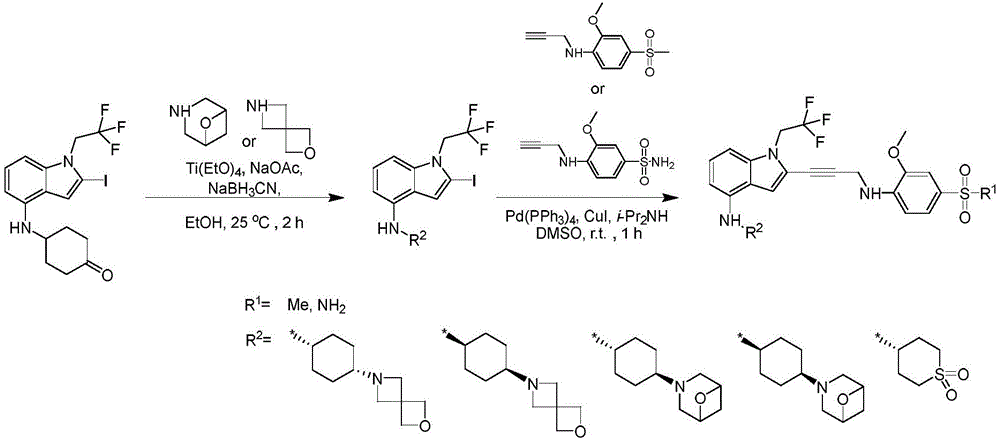
For 2-iodo-N- (R) 2 General procedure for the preparation of-substituted) -1- (2,2, 2-trifluoroethyl) -1H-indol-4-amine: reacting 6-oxa-3 lambda at 25 DEG C 2 -azabicyclo [3.1.1]Heptane or 2-oxa-6 lambda 2 -azaspiro [3.3]Heptane (1.5 eq) 4- ((2-iodo-1- (2,2, 2-trifluoroethyl) -1H-indol-4-yl) amino) cyclohex-1-one (1 eq) with NaOAc (2 eq) and Ti (OEt) 4 (2 equiv.) A mixture in EtOH (10mL) was stirred for 1-11 h and NaBH was added 3 CN (2 equivalents). The reaction mixture was stirred at 25 ℃ for 1 hour. TLC analysis indicated complete consumption of starting material and two new spots were detected. The reaction mixture was poured into saturated NaHCO 3 Aqueous solution, and filtered. The filtrate was extracted with EtOAc (2 ×). The combined organic layers were concentrated under reduced pressure to give a residue. The residue was purified by column chromatography (SiO) 2 PE: EtOAc ═ 2:1 to 1:1) purification afforded the desired product.
Preparation of the final product: to a solution of 2-methoxy-4- (methylsulfonyl) -N- (prop-2-yn-1-yl) aniline or 3-methoxy-4- (prop-2-yn-1-ylamino) benzenesulfonamide (1.2 equivalents) in DMSO, CuI (1 equivalent) and N-isopropylprop-2-amine (10 equivalents) were added. Mixing the mixture with N 2 Degassing three times, and adding 2-iodo-N- (R) 2 -substituted) -1- (2,2, 2-trifluoroethyl) -1H-indol-4-amine (1 eq) and Pd (PPh) 3 ) 4 (0.2 eq). The mixture was stirred at 25 ℃ for 1 hour. TLC analysis (DCM: MeOH ═ 10:1, R) f 0.25) indicates initiationThe raw material was completely consumed and a main peak with the desired mass was detected. The reaction mixture was diluted with EtOAc and the resulting mixture was poured into saturated EDTA solution (30mL), stirred for 2 hours, and extracted with EtOAc (2 ×). The combined organic layers were washed with brine (10mL), then the organic layer was concentrated under reduced pressure to give a residue. The residue was purified by preparative TLC to give a residue, and the residue was further purified by preparative HPLC to give the final product.
2- {3- [ (4-Methylsulfonyl-2-methoxyphenyl) amino]Prop-1-yn-1-yl } -N- [ (1R,4R) -4- { 2-oxa-6-azaspiro [3.3]Hept-6-yl } cyclohexyl radical]-1- (2,2, 2-trifluoroethyl) -1H-indol-4-amine, 27% yield, MS (ES) + M/z) 631.2; 2- {3- [ (4-Methylsulfonyl-2-methoxyphenyl) amino]Prop-1-yn-1-yl } -N- [ (1S,4S) -4- { 2-oxa-6-azaspiro [3.3]Hept-6-yl } cyclohexyl]-1- (2,2, 2-trifluoroethyl) -1H-indol-4-amine, 18% yield, MS (ES) + M/z) 631.2; 3-methoxy-4- { [3- (4- { [ (1R,4R) -4- { 2-oxa-6-azaspiro [3.3 ]]Hept-6-yl } cyclohexyl]Amino } -1- (2,2, 2-trifluoroethyl) -1H-indol-2-yl) prop-2-yn-1-yl]Amino } benzene-1-sulfonamide, 14.2% yield, MS (ES) + M/z) 632.2; 3-methoxy-4- { [3- (4- { [ (1S,4S) -4- { 2-oxa-6-azaspiro [3.3 ]]Hept-6-yl } cyclohexyl]Amino } -1- (2,2, 2-trifluoroethyl) -1H-indol-2-yl) prop-2-yn-1-yl]Amino } benzene-1-sulfonamide, 13.7% yield, MS (ES) + M/z) 632.2; 2- {3- [ (4-Methylsulfonyl-2-methoxyphenyl) amino]Prop-1-yn-1-yl } -N- [ (1R,4R) -4- { 6-oxa-3-azabicyclo [3.1.1]Hept-3-yl } cyclohexyl]-1- (2,2, 2-trifluoroethyl) -1H-indol-4-amine, 27.1% yield, MS (ES) + M/z) 631.2; 2- {3- [ (4-Methylsulfonyl-2-methoxyphenyl) amino]Prop-1-yn-1-yl } -N- [ (1S,4S) -4- { 6-oxa-3-azabicyclo [3.1.1]Hept-3-yl } cyclohexyl]-1- (2,2, 2-trifluoroethyl) -1H-indol-4-amine, 21.5% yield, MS (ES) + M/z) 631.2; 3-methoxy-4- { [3- (4- { [ (1R,4R) -4- { 6-oxa-3-azabicyclo [3.1.1 ] e]Hept-3-yl } cyclohexyl]Amino } -1- (2,2, 2-trifluoroethyl) -1H-indol-2-yl) prop-2-yn-1-yl]Amino } benzene-1-sulfonamide, 23% yield, MS (ES) + M/z) 632.2; 3-methoxy-4- { [3- (4- { [ (1S,4S) -4- { 6-oxa-3-azabicyclo [3.1.1 ] e ]Hept-3-yl } cyclohexanesBase of]Amino } -1- (2,2, 2-trifluoroethyl) -1H-indol-2-yl) prop-2-yn-1-yl]Amino } benzene-1-sulfonamide, 13.1% yield, MS (ES) + M/z) 632.2; and 4- [ (2- {3- [ (2-methoxy-4- { 2-oxa-6-azaspiro [3.3 ]]Heptane-6-sulfonyl } phenyl) amino]Prop-1-yn-1-yl } -1- (2,2, 2-trifluoroethyl) -1H-indol-4-yl) amino]-1λ 6 Thiane-1, 1-dione, 12.5% yield, MS (ES) + ,m/z):667.1。
Example C33: synthesis of 200A and 201A.
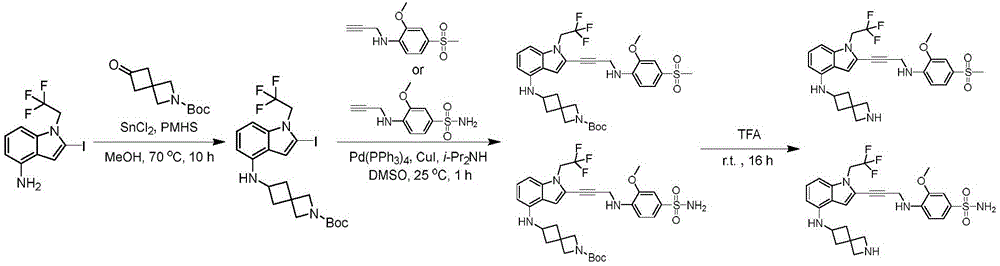
6- ((2-iodo-1- (2,2, 2-trifluoroethyl) -1H-indol-4-yl) amino) -2-azaspiro [3.3]Preparation of tert-butyl heptane-2-carboxylate: to a solution of 2-iodo-1- (2,2, 2-trifluoroethyl) -1H-indol-4-amine (0.5g,1.47mmol,1 eq) in MeOH (5mL) was added 6-oxo-2-azaspiro [3.3]Heptane-2-carboxylic acid tert-butyl ester (776.49mg,3.68mmol, 40.50. mu.L, 2.5 equiv.) and SnCl 2 ·2H 2 O (66.35mg, 294.05. mu. mol, 24.48. mu.L, 0.20 equiv.). Then, 6-oxo-2-azaspiro [3.3 ] is reacted at 70 ℃]Tert-butyl heptane-2-carboxylate (352.86mg,5.88mmol,4 equivalents) was added to the mixture and the reaction mixture was stirred for 3 hours. TLC analysis indicated the reaction was complete. The mixture was concentrated and the crude residue was purified by column chromatography to give the desired product as a white solid. MS (ES) + ,m/z):535.9。
For 6- ((2- (3- ((2-methoxy-4- (methylsulfonyl) phenyl) amino) prop-1-yn-1-yl) -1- (2,2, 2-trifluoroethyl) -1H-indol-4-yl) amino) -2-azaspiro [3.3]Heptane-2-carboxylic acid tert-butyl ester and 6- ((2- (3- ((2-methoxy-4-sulfamoylphenyl) amino) -prop-1-yn-1-yl) -1- (2,2, 2-trifluoroethyl) -1H-indol-4-yl) amino) -2-azaspiro [3.3]General procedure for the preparation of tert-butyl heptane-2-carboxylate: to 2-methoxy-4- (methylsulfonyl) -N- (prop-2-yn-1-yl) aniline or 3-methoxy-4- (prop-2-yn-1-ylamino) benzenesulfonamide (1.5 equivalents) and 6- ((2-iodo-1- (2,2, 2-trifluoroethyl) -1H-indol-4-yl) amino) -2-azaspiro [3.3]Mixture of tert-butyl heptane-2-carboxylate (1 eq) in DMSO CuI (1 eq), Pd (PPh) 3 ) 4 (0.10 eq.) and N-isopropylpropan-2-amine (1 eq.). Mixing the mixture in N 2 The mixture was stirred at 25 ℃ for 1 hour. LC-MS analysis indicated the reaction was complete. The reaction was poured into saturated EDTA solution (50mL) and extracted with EtOAc (20mL × 3). The combined organic layers were washed with saturated EDTA solution (20mL) by stirring the mixture for 1 hour. The organic layer was washed with brine (50mL), dried over anhydrous sodium sulfate, filtered, and concentrated under reduced pressure. The crude product was purified by preparative TLC to give the desired product as a yellow solid.
General procedure for the preparation of 2- (3- ((2-methoxy-4- (methylsulfonyl) phenyl) amino) prop-1-yn-1-yl) -N- (2-azaspiro [3.3] hept-6-yl) -1- (2,2, 2-trifluoroethyl) -1H-indol-4-amine and 4- ((3- (4- ((2-azaspiro [3.3] hept-6-yl) amino) -1- (2,2, 2-trifluoroethyl) -1H-indol-2-yl) prop-2-yn-1-yl) amino) -3-methoxybenzenesulfonamide: to a solution of tert-butyl 6- ((2- (3- ((2-methoxy-4- (methylsulfonyl) phenyl) amino) prop-1-yn-1-yl) -1- (2,2, 2-trifluoroethyl) -1H-indol-4-yl) amino) -2-azaspiro [3.3] heptane-2-carboxylate or tert-butyl 6- ((2- (3- ((2-methoxy-4-sulfamoylphenyl) amino) prop-1-yn-1-yl) -1- (2,2, 2-trifluoroethyl) -1H-indol-4-yl) amino) -2-azaspiro [3.3] heptane-2-carboxylate (1 equivalent) in DCM was added 2 at 20 ℃,2, 2-trifluoroacetic acid (175 eq). The mixture was stirred for 16 hours. LC-MS analysis indicated that the starting material was consumed and a major peak with the expected mass was detected. The reaction mixture was concentrated under reduced pressure to remove the solvent. The residue was purified by preparative HPLC to give the desired product as a yellow solid.
2- (3- ((2-methoxy-4- (methylsulfonyl) phenyl) amino) prop-1-yn-1-yl) -N- (2-azaspiro [ 3.3) ]Heptane-6-yl) -1- (2,2, 2-trifluoroethyl) -1H-indol-4-amine, MS (ES) + M/z) 547.2; and 4- ((3- (4- ((2-azaspiro [3.3 ]]Hept-6-yl) amino) -1- (2,2, 2-trifluoroethyl) -1H-indol-2-yl) prop-2-yn-1-yl) amino) -3-methoxybenzenesulphonamide, MS (ES) + ,m/z):548.2。
Example C34: synthesis of compounds 79A, 80A, 487A, 621A, 731A, and 1009A.

General procedure: to a mixture of 5- (methylsulfonyl) -2- (prop-2-yn-1-ylamino) phenol (1.2 eq) in DMSO at 25 deg.C was added i-Pr 2 NH (10 equiv.), CuI (1 equiv.), 2-iodo-N- (R) 1 -substituted) -1- (2,2, 2-trifluoroethyl) -1H-indol-4-amine (1 eq) and Pd (PPh) 3 ) 4 (0.20 eq). In N 2 The mixture was stirred for 2 hours. LC-MS and TLC analysis indicated that the reaction was complete. The reaction mixture was quenched by the addition of saturated EDTA solution and the resulting mixture was stirred at 25 ℃ for 2 hours. The reaction mixture was partitioned by adding EtOAc and the aqueous phase was extracted with EtOAc. The combined organic layers were washed with brine, dried over anhydrous sodium sulfate, filtered and concentrated in vacuo. The residue was purified by preparative TLC and preparative HPLC to give a solution of the desired product. The solution was lyophilized to give the desired product as a light yellow solid.
5-methanesulfonyl-2- [ (3- {4- [ (Oxam-4-yl) amino group]-1- (2,2, 2-trifluoroethyl) -1H-indol-2-yl } prop-2-yn-1-yl) amino]Phenol, MS (ES) + M/z) 522.1; 2- { [3- (4- { [1- (2-hydroxy-3-methoxypropyl) piperidin-4-yl]Amino } -1- (2,2, 2-trifluoroethyl) -1H-indol-2-yl) prop-2-yn-1-yl]Amino } -5-methanesulfonylphenol, MS (ES) + M/z) 609.2; 5-Methanesulfonyl-2- { [3- (4- { [ (1R,4R) -4- (dimethylamino) cyclohexyl]Amino } -1- (2,2, 2-trifluoroethyl) -1H-indol-2-yl) prop-2-yn-1-yl]Amino } phenol, MS (ES) + M/z) 563.2; 5-methanesulfonyl-2- { [3- (4- { [ (1S,4S) -4- (dimethylamino) cyclohexyl [ ]]Amino } -1- (2,2, 2-trifluoroethyl) -1H-indol-2-yl) prop-2-yn-1-yl]Amino } phenol, MS (ES) + M/z) 563.1; 2-hydroxy-1- {4- [ (2- {3- [ (2-hydroxy-4-methanesulfonyl-phenyl) amino]Prop-1-yn-1-yl } -1- (2,2, 2-trifluoroethyl) -1H-indol-4-yl) amino]Piperidin-1-yl } ethan-1-one, MS (ES) + M/z) 579.2; and 2- {3- [ (4-methanesulfonyl-2-methoxyphenyl) amino]Prop-1-yn-1-yl } -6-methoxy-N- (1-methylpiperidin-4-yl) -1- (2,2, 2-trifluoroethyl) -1H-indol-4-amine, MS (ES) + ,m/z):579.2。
Example C35: synthesis of compounds 52A, 53A, 90A, 91A, 216A, 217A, 218A, 219A, 224A, 636A, 640A and 641A.
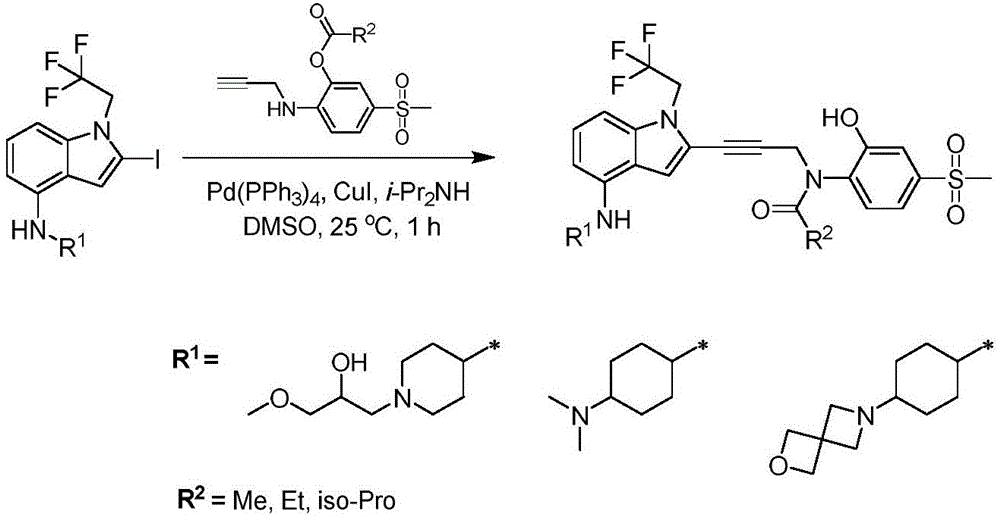
To R 2 Substituted alkynes (1.2 equiv.) and 2-iodo-N- (R) 1 Mixture of-substituted) -1- (2,2, 2-trifluoroethyl) -1H-indol-4-amine (1 eq) in DMSO (2mL) CuI (1 eq), Pd (PPh) 3 ) 4 (0.10 equiv.) and N-isopropylpropan-2-amine (1 equiv.). In N 2 The mixture was then stirred at 25-30 ℃ for 1 hour. LC-MS analysis indicated the reaction was complete. The reaction mixture was quenched by the addition of saturated EDTA solution (30mL) and EtOAc (10mL) and the resulting mixture was stirred at 25 ℃ for 1 hour. The aqueous phase was extracted with EtOAc (20 mL. times.3). The combined organic layers were washed with brine (30mL), dried over anhydrous sodium sulfate, filtered and concentrated under reduced pressure to give a residue. The residue was purified by preparative TLC and preparative HPLC to give the desired product.
N- (3- (4- (((1S,4S) -4- (2-oxa-6-azaspiro [ 3.3))]Hept-6-yl) cyclohexyl) amino) -1- (2,2, 2-trifluoroethyl) -1H-indol-2-yl) prop-2-yn-1-yl) -N- (2-hydroxy-4- (methylsulfonyl) phenyl) propanamide, MS (ES) + M/z) 673.1; n- (3- (4- ((1- (2-hydroxy-3-methoxypropyl) piperidin-4-yl) amino) -1- (2,2, 2-trifluoroethyl) -1H-indol-2-yl) prop-2-yn-1-yl) -N- (2-hydroxy-4- (N-propionylsulfamoyl) phenyl) propanamide MS (ES) + M/z) 722.3; n- (3- (4- (((1R,4R) -4- (2-oxa-6-azaspiro [ 3.3)) ]Hept-6-yl) cyclohexyl) amino) -1- (2,2, 2-trifluoroethyl) -1H-indol-2-yl) prop-2-yn-1-yl) -N- (2-hydroxy-4- (methylsulfonyl) phenyl) propanamide, MS (ES) + M/z) 673.1; and N- (3- (4- (((1S,4S) -4- (dimethylamino) cyclohexyl) amino) -1- (2,2, 2-trifluoroethyl) -1H-indol-2-yl) prop-2-yn-1-yl) -N- (2-hydroxy-4- (methylsulfonyl) phenyl) propanamide. MS (ES) + ,m/z):619.1。
Compounds 90A, 91A, 640A, 218A, 224A, 618A and 641A were synthesized using the methods described above.
N- (3- (4- ((1- (2-hydroxy)-3-methoxypropyl) piperidin-4-yl) amino) -1- (2,2, 2-trifluoroethyl) -1H-indol-2-yl) prop-2-yn-1-yl) -N- (2-hydroxy-4- (methylsulfonyl) phenyl) propanamide, MS (ES) + M/z) 665.3; n- (3- (4- ((1- (2-hydroxy-3-methoxypropyl) piperidin-4-yl) amino) -1- (2,2, 2-trifluoroethyl) -1H-indol-2-yl) prop-2-yn-1-yl) -N- (2-hydroxy-4- (methylsulfonyl) phenyl) isobutyramide, MS (ES) + M/z) 679.3; n- (2-hydroxy-4-methanesulfonylphenyl) -2-methyl-N- [3- (4- { [ (1R,4R) -4- { 2-oxa-6-azaspiro [3.3 ]]Hept-6-yl } cyclohexyl radical]Amino } -1- (2,2, 2-trifluoroethyl) -1H-indol-2-yl) prop-2-yn-1-yl]Propionamide, MS (ES) + M/z) 687.2; n- (3- (4- (((1S,4S) -4- (2-oxa-6-azaspiro [ 3.3)) ]Hept-6-yl) cyclohexyl) amino) -1- (2,2, 2-trifluoroethyl) -1H-indol-2-yl) prop-2-yn-1-yl) -N- (2-hydroxy-4- (methylsulfonyl) phenyl) isobutyramide, MS (ES) + M/z) 687.2; 5-Methanesulfonyl-2- { [3- (4- { [ (1S,4S) -4- { 2-oxa-6-azaspiro [3.3 ]]Hept-6-yl } cyclohexyl]Amino } -1- (2,2, 2-trifluoroethyl) -1H-indol-2-yl) prop-2-yn-1-yl]Amino } phenyl 2-methylpropionate, MS (ES) + M/z) 687.4; n- (3- (4- (((1R,4R) -4- (dimethylamino) cyclohexyl) amino) -1- (2,2, 2-trifluoroethyl) -1H-indol-2-yl) prop-2-yn-1-yl) -N- (2-hydroxy-4- (methylsulfonyl) phenyl) isobutyramide, MS (ES) + M/z) 633.3; and N- (3- (4- (((1S,4S) -4- (dimethylamino) cyclohexyl) amino) -1- (2,2, 2-trifluoroethyl) -1H-indol-2-yl) prop-2-yn-1-yl) -N- (2-hydroxy-4- (methylsulfonyl) phenyl) isobutyramide, MS (ES) + ,m/z):633.3。
Example C36: synthesis of compounds 140A, 141A, 142A, 143A, 283A, 284A, 285A, 286A, 703A and 710A.

General procedure: to a solution of 2- (R-substituted) -4- (methylsulfonyl) -N- (prop-2-yn-1-yl) aniline (1.5 eq; examples A28 and A29) in DMSO was added 2-iodo-N- (R-substituted) -N- (R-pyridin-1-yl) aniline 1 -substituted) -1- (2,2, 2-trifluoroethyl) -1H-indol-4-amine (1 equivalent), CuI (1 equivalent), i-Pr 2 NH (1 eq) and Pd (PPh) 3 ) 4 (0.02 eq). The mixture was stirred at 45 ℃ for 1 hour. TLC analysis (EtOAc: TEA ═ 10:1, R f 0.24) indicating completion of the reaction. The reaction mixture was quenched by addition of saturated EDTA solution (40mL) at 25 deg.C and the resulting mixture was extracted with EtOAc (20 mL. times.3). The combined organic layers were dried over anhydrous sodium sulfate, filtered and concentrated under reduced pressure. The residue was purified by preparative TLC and preparative HPLC to give the desired product as a light yellow solid.
1- {4- [ (2- {3- [ (4-methanesulfonyl-2-methylphenyl) amino group]Prop-1-yn-1-yl } -1- (2,2, 2-trifluoroethyl) -1H-indol-4-yl) amino]Piperidin-1-yl } -3-methoxypropan-2-ol, MS (ES) + ,m/z):607.3;(1R,4R)-N 4 - [2- (3- { [ 4-methanesulfonyl-2- (trifluoromethoxy) phenyl ] sulfonyl]Amino } prop-1-yn-1-yl) -1- (2,2, 2-trifluoroethyl) -1H-indol-4-yl]-N 1 ,N 1 Dimethylcyclohexane-1, 4-diamine, MS (ES) + ,m/z):631.1;(1S,4S)-N 1 ,N 1 -dimethyl-N 4 - (2- (3- ((4- (methylsulfonyl) -2- (trifluoromethoxy) phenyl) amino) prop-1-yn-1-yl) -1- (2,2, 2-trifluoroethyl) -1H-indol-4-yl) cyclohexane-1, 4-diamine, MS (ES) + ,m/z):631.1;(1R,4R)-N 4 - (2- {3- [ (4-methanesulfonyl-2-methylphenyl) amino]Prop-1-yn-1-yl } -1- (2,2, 2-trifluoroethyl) -1H-indol-4-yl) -N 1 ,N 1 Dimethylcyclohexane-1, 4-diamine, MS (ES) + ,m/z):561.3;(1S,4S)-N 1 ,N 1 -dimethyl-N 4 - (2- (3- ((2-methyl-4- (methylsulfonyl) phenyl) amino) prop-1-yn-1-yl) -1- (2,2, 2-trifluoroethyl) -1H-indol-4-yl) cyclohexane-1, 4-diamine, MS (ES) + M/z) 561.3; 2- {3- [ (4-Methylsulfonyl-2-methylphenyl) amino group]Prop-1-yn-1-yl } -N- [ (1R,4R) -4- { 2-oxa-6-azaspiro [3.3]Hept-6-yl } cyclohexyl]-1- (2,2, 2-trifluoroethyl) -1H-indol-4-amine, MS (ES) + M/z) 615.3; n- ((1S,4S) -4- (2-oxa-6-azaspiro [ 3.3)]Hept-6-yl) cyclohexyl) -2- (3- ((2-methyl-4- (methylsulfonyl) phenyl) amino) prop-1-yn-1-yl) -1- (2,2, 2-trifluoroethyl) -1H-indol-4-amine, MS (ES) + M/z) 615.3; 2- (3- { [ 4-Methylsulfonyl-2- (trifluoromethoxy) phenyl]Amino } prop-1-yn-1-yl) -N- [ (1R,4R) -4- { 2-oxa-6-azaspiro [3.3]Hept-6-ylCyclohexyl radical]-1- (2,2, 2-trifluoroethyl) -1H-indol-4-amine, MS (ES) + M/z) 685.2; n- ((1S,4S) -4- (2-oxa-6-azaspiro [ 3.3)]Hept-6-yl) cyclohexyl) -2- (3- ((4- (methylsulfonyl) -2- (trifluoromethoxy) phenyl) amino) prop-1-yn-1-yl) -1- (2,2, 2-trifluoroethyl) -1H-indol-4-amine, MS (ES) + M/z) 685.2; and 1- (4- { [2- (3- { [ 4-methanesulfonyl-2- (trifluoromethoxy) phenyl]Amino } prop-1-yn-1-yl) -1- (2,2, 2-trifluoroethyl) -1H-indol-4-yl ]Amino } piperidin-1-yl) -3-methoxypropan-2-ol, MS (ES) + ,m/z):677.1。
Example C37: synthesis of compounds 249A and 250A.
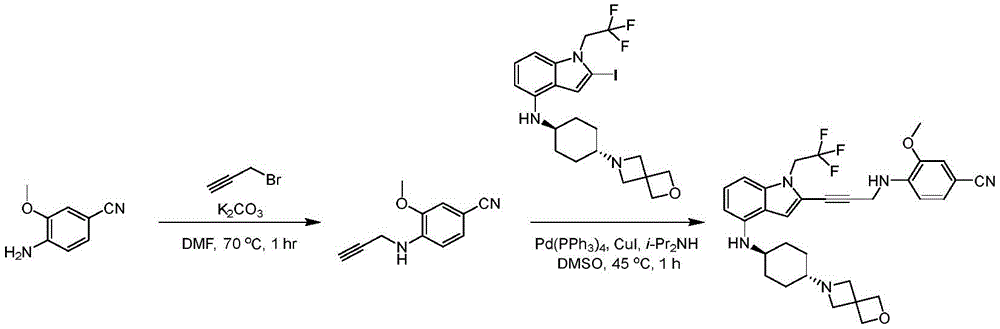
General procedure for the preparation of 3-methoxy-4- (prop-2-yn-1-ylamino) benzonitrile: to a solution of 4-amino-3-methoxybenzonitrile (1 eq) in DMF was added K 2 CO 3 (3 equiv.) and 3-bromoprop-1-yne (3 equiv.). The mixture was stirred at 70 ℃ for 1 hour. TLC analysis (PE: EtOAc ═ 3:1) indicated that 10% of the starting material remained and a major new spot was detected, which was less polar than the starting material. The reaction mixture was diluted with water (10mL) and extracted with EtOAc. The combined organic layers were washed with brine, dried over anhydrous sodium sulfate, filtered and concentrated under reduced pressure to give a residue. The residue was purified by preparative TLC to give the desired product as a brown solid.
General procedure for preparation of final product: to a solution of 3-methoxy-4- (prop-2-yn-1-ylamino) benzonitrile (1.2 eq) in DMSO at 45 ℃ was added i-Pr 2 NH (10 equiv.), CuI (1 equiv.), N- ((1R,4R) -4- (2-oxa-6-azaspiro [ 3.3)]Hept-6-yl) cyclohexyl) -2-iodo-1- (2,2, 2-trifluoroethyl) -1H-indol-4-amine (1 eq) and Pd (PPh) 3 ) 4 (0.2 eq). At N 2 The mixture was then stirred at 45 ℃ for 1 hour. LC-MS and TLC analysis indicated that the reaction was complete. The reaction mixture was quenched by the addition of saturated EDTA solution at 25 ℃ and the resulting mixture was stirred for 2 hours. The reaction mixture was partitioned by adding EtOAcAnd the aqueous phase was extracted with EtOAc. The organic phase was washed with brine, dried over anhydrous sodium sulfate, filtered and concentrated in vacuo to give the crude product. The residue was purified by preparative TLC and preparative HPLC to give a solution of the desired product. The solution was lyophilized to give the desired final product as a light yellow solid.
3-methoxy-4- [ (3- {4- [ (4- { 2-oxa-6-azaspiro [3.3 ]]Hept-6-yl } cyclohexyl) amino]-1- (2,2, 2-trifluoroethyl) -1H-indol-2-yl } prop-2-yn-1-yl) amino]Benzonitrile, MS (ES) + M/z) 578.2; and 3-methoxy-4- { [3- (4- { [ (1S,4S) -4- { 2-oxa-6-azaspiro [3.3 ]]Hept-6-yl } cyclohexyl]Amino } -1- (2,2, 2-trifluoroethyl) -1H-indol-2-yl) prop-2-yn-1-yl]Amino } benzonitrile, MS (ES) + ,m/z):578.3。
Example C38: synthesis of compounds 121A, 122A, 251A, 252A, 301A, 302A and 665A.

General procedure for the preparation of 2- (3-methoxy-4-nitrophenyl) acetonitrile: to a mixture of 1-methoxy-2-nitrobenzene (10g,65.30mmol,8mL,1 eq.) and 2- (4-chlorophenoxy) acetonitrile (1.3 eq.) (14.23g,84.89mmol,1.3 eq.) in DMF (1mL) at-20 deg.C was added a solution of t-BuOK (2.2 eq.) in DMF (2 mL). The mixture was stirred at-20 ℃ for 30 minutes, poured into ice-cold 2M HCl, and stirred for a further 1 hour. TLC analysis (PE: EtOAc ═ 3:1) indicated that 40% of the starting material remained and two major new spots were detected, which were more polar than the starting material. The mixture was poured into ice-cold 2M HCl and stirred for a further 1 hour. The reaction mixture was then diluted with water and extracted with EtOAc (100 mL). The combined organic layers were washed with brine, dried over anhydrous sodium sulfate, filtered and concentrated under reduced pressure. The crude residue was purified by column chromatography to afford the desired product as a brown solid.
General procedure for the preparation of 2- (3-methoxy-4-nitrophenyl) -2-methylpropanenitrile: to a mixture of 2- (3-methoxy-4-nitrophenyl) acetonitrile (1 eq) and tetrabutylammonium bromide(TBAB; 1.8 equiv.) A mixture of NaOH (1.67g,41.63mmol,10 equiv.) and CH was added to the toluene 3 I (10 equiv.). The mixture was stirred at 25 ℃ for 1 hour. TLC analysis (PE: EtOAc ═ 3:1) indicated complete consumption of the starting material and two new spots were detected. The reaction mixture was diluted with water (20mL) and extracted with EtOAc (40 mL). The combined organic layers were washed with brine (20mL), dried over anhydrous sodium sulfate, filtered and concentrated under reduced pressure to give a residue. The residue was passed through preparative TLC (SiO) 2 PE: EtOAc ═ 3:1) purification afforded the desired product as a yellow solid.
Preparation of 2- (4-amino-3-methoxyphenyl) -2-methylpropanenitrile: to a solution of 2- (3-methoxy-4-nitrophenyl) -2-methylpropanenitrile (1 eq) in EtOH (2mL) and water (0.5mL) was added NH 4 Cl (5 equivalents) and Fe (5 equivalents). The mixture was stirred at 70 ℃ for 2 hours. LC-MS analysis indicated complete consumption of starting material and detection of the desired mass. The reaction mixture was diluted with water (10mL) and extracted with EtOAc (20 mL). The combined organic layers were washed with saturated brine (20mL), dried over anhydrous sodium sulfate, filtered and concentrated under reduced pressure. The crude residue was passed through preparative TLC (SiO) 2 PE: EtOAc ═ 3:1) purification afforded the desired product as a yellow oil.
Preparation of tert-butyl (4- (2-cyanoprop-2-yl) -2-methoxyphenyl) carbamate: to a solution of 2- (4-amino-3-methoxyphenyl) -2-methylpropanenitrile (1 eq) in dioxane (4mL) was added (Boc) 2 O (2 equivalents). The mixture was stirred at 110 ℃ for 2 hours. TLC analysis (PE: EtOAc ═ 3:1) showed 10% starting material remaining and two new spots were detected. The reaction mixture was diluted with water (20mL) and extracted with EtOAc (10 mL). The combined organic layers were washed with saturated brine (10mL), dried over anhydrous sodium sulfate, filtered and concentrated under reduced pressure to give a residue. The residue was passed through preparative TLC (SiO) 2 PE: EtOAc ═ 3:1) purification afforded the desired product as a pale yellow oil.
Preparation of tert-butyl (4- (2-cyanoprop-2-yl) -2-methoxyphenyl) (prop-2-yn-1-yl) carbamate: to a solution of tert-butyl (4- (2-cyanoprop-2-yl) -2-methoxyphenyl) carbamate (0.3g,1.03mmol,1 eq.) at 0 deg.CA solution in DMF (2mL) was added NaH (3 equivalents, 60% in mineral oil). The mixture was stirred at 0 ℃ for 10 minutes and 3-bromoprop-1-yne (368.73mg,3.10mmol, 267.20. mu.L, 3 equivalents) was added to the mixture at 0 ℃. The mixture was stirred for a further 20 minutes. LC-MS analysis indicated complete consumption of starting material and detection of the desired mass. The reaction mixture was washed with saturated NH 4 The Cl solution (10mL) was diluted and extracted with EtOAc (20mL x 3). The combined organic layers were washed with brine (10mL), dried over anhydrous sodium sulfate, filtered and concentrated under reduced pressure. The crude product was obtained as a pale yellow oil.
Preparation of 2- (3-methoxy-4- (prop-2-yn-1-ylamino) phenyl) -2-methylpropanenitrile: to a solution of tert-butyl (4- (2-cyanoprop-2-yl) -2-methoxyphenyl) (prop-2-yn-1-yl) carbamate (1 eq) in EtOAc (1mL) was added HCl/EtOAc (5 mL; 4N). The mixture was stirred at 25 ℃ for 1 hour. LC-MS analysis indicated complete consumption of starting material and detection of the desired mass. The reaction mixture was washed with saturated NaHCO 3 The solution (10mL) was diluted and extracted with EtOAc (10 mL). The combined organic layers were washed with saturated brine (10mL), dried over anhydrous sodium sulfate, filtered and concentrated under reduced pressure. The crude residue was passed through preparative TLC (SiO) 2 PE: EtOAc ═ 5:1) purification afforded the desired product as a yellow oil.
Preparation of the final product: to a solution of 2- (3-methoxy-4- (prop-2-yn-1-ylamino) phenyl) -2-methylpropanenitrile (1.2 eq) in DMSO (2mL) was added i-Pr 2 NH (10 equiv.), CuI (1 equiv.), 2-iodo-N- (R-substituted) -1- (2,2, 2-trifluoroethyl) -1H-indol-4-amine (1 equiv.), Pd (PPh) 3 ) 4 (0.2 eq). In N 2 The mixture was then stirred at room temperature for 1 hour. LC-MS and TLC analysis indicated that the reaction was complete. The reaction mixture was quenched by the addition of saturated EDTA solution (20mL) at 45 ℃ and the resulting mixture was stirred for 1 hour. The reaction mixture was partitioned by adding EtOAc (10mL) and the aqueous phase was extracted with EtOAc (10mL × 2). The organic phase was washed with brine (10mL x 3), dried over anhydrous sodium sulfate, filtered and concentrated in vacuo. The crude residue was purified by preparative TLC and preparative HPLC to give a solution of the desired product. Lyophilizing the solution to obtain the desired productMaterial, light yellow oil.
2- (3-methoxy-4- { [3- (4- { [ (1R,4R) -4- { 2-oxa-6-azaspiro [3.3 ]]Hept-6-yl } cyclohexyl]Amino } -1- (2,2, 2-trifluoroethyl) -1H-indol-2-yl) prop-2-yn-1-yl]Amino } phenyl) -2-methylpropanenitrile, MS (ES) + M/z) 620.3; 2- (4- ((3- (4- (((1S,4S) -4- (2-oxa-6-azaspiro [ 3.3))]Hept-6-yl) cyclohexyl) amino) -1- (2,2, 2-trifluoroethyl) -1H-indol-2-yl) prop-2-yn-1-yl) amino) -3-methoxyphenyl) -2-methylpropanenitrile, MS (ES) + M/z) 620.3; 2- (3-methoxy-4- { [3- (4- { [ (1R,4R) -4- { 7-oxa-2-azaspiro [3.5 ]]Non-2-yl cyclohexyl]Amino } -1- (2,2, 2-trifluoroethyl) -1H-indol-2-yl) prop-2-yn-1-yl ]Amino } phenyl) -2-methylpropanenitrile, MS (ES) + M/z) 648.4; 2- (4- ((3- (4- (((1S,4S) -4- (7-oxa-2-azaspiro [ 3.5))]Non-2-yl) cyclohexyl) amino) -1- (2,2, 2-trifluoroethyl) -1H-indol-2-yl) prop-2-yn-1-yl) amino) -3-methoxyphenyl) -2-methylpropanenitrile, MS (ES) + M/z) 648.4; 2- (3-methoxy-4- { [3- (4- { [ (1R,4R) -4- (dimethylamino) cyclohexyl]Amino } -1- (2,2, 2-trifluoroethyl) -1H-indol-2-yl) prop-2-yn-1-yl]Amino } phenyl) -2-methylpropanenitrile, MS (ES) + M/z) 566.2; 2- (4- ((3- (4- (((1S,4S) -4- (dimethylamino) cyclohexyl) amino) -1- (2,2, 2-trifluoroethyl) -1H-indol-2-yl) prop-2-yn-1-yl) amino) -3-methoxyphenyl) -2-methylpropanenitrile, MS (ES) + M/z) 566.2; and 2- (4- { [3- (4- { [1- (2-hydroxy-3-methoxypropyl) piperidin-4-yl]Amino } -1- (2,2, 2-trifluoroethyl) -1H-indol-2-yl) prop-2-yn-1-yl]Amino } -3-methoxyphenyl) -2-methylpropanenitrile, MS (ES) + ,m/z):612.3。
Example C39: synthesis of compounds 160A, 161A, 181A, 182A, 204A, 205A, 375A, 377A and 378A.

General procedure: at 45 deg.C, to 2-methoxy-4- (R) 2 A mixture of-substituted) -N- (prop-2-yn-1-yl) aniline (100mg, 164.42. mu. mol,1 eq) in DMSO (3mL) was added i-Pr 2 NH (16.64mg, 164.42. mu. mol, 23.24. mu.L, 1 eq.), CuI (31.31mg,164 42. mu. mol,1 eq), 2-iodo-N- (4- (R) 1 -substituted) cyclohexyl) -1- (2,2, 2-trifluoroethyl) -1H-indol-4-amine (1 eq) and Pd (PPh) 3 ) 4 (0.2 eq). In N 2 Next, the mixture was stirred at 45 ℃ for 1 hour. LC-MS and TLC analysis indicated that the reaction was complete. The reaction mixture was quenched at 25 ℃ for 1 hour by the addition of saturated EDTA solution (40 mL). The reaction mixture was partitioned by adding EtOAc (20mL) and the aqueous phase was extracted with EtOAc (20 mL. times.3). The organic phase was washed with brine (20mL x 3), dried over anhydrous sodium sulfate, filtered and concentrated in vacuo. The crude residue was passed through preparative TLC (SiO) 2 ,EtOAc:MeOH:TEA=10:1:1,R f 0.43) and preparative HPLC purification to give a solution of the desired product. The solution was lyophilized to give the desired product as a light yellow solid.
3-methoxy-N-methyl-4- { [3- (4- { [ (1R,4R) -4- { 2-oxa-7-azaspiro [3.5 ]]Non-7-yl cyclohexyl]Amino } -1- (2,2, 2-trifluoroethyl) -1H-indol-2-yl) prop-2-yn-1-yl]Amino } benzamide, MS (ES) + M/z) 638.4; 3-methoxy-N-methyl-4- { [3- (4- { [ (1S,4S) -4- { 2-oxa-7-azaspiro [3.5 ]]Non-7-yl cyclohexyl]Amino } -1- (2,2, 2-trifluoroethyl) -1H-indol-2-yl) prop-2-yn-1-yl]Amino } benzamide, MS (ES) + M/z) 638.3; 3-methoxy-4- { [3- (4- { [ (1R,4R) -4- [ (2-methoxyethyl) (methyl) amino ]Cyclohexyl radical]Amino } -1- (2,2, 2-trifluoroethyl) -1H-indol-2-yl) prop-2-yn-1-yl]Amino } benzene-1-sulfonamide, MS (ES) + M/z) 622.2; 3-methoxy-4- ((3- (4- (((1S,4S) -4- ((2-methoxyethyl) (methyl) amino) cyclohexyl) amino) -1- (2,2, 2-trifluoroethyl) -1H-indol-2-yl) prop-2-yn-1-yl) amino) benzenesulfonamide, MS (ES) + M/z) 622.2; 3-methoxy-4- { [3- (4- { [ (1R,4R) -4- { 2-oxa-7-azaspiro [3.5 ]]Non-7-yl cyclohexyl]Amino } -1- (2,2, 2-trifluoroethyl) -1H-indol-2-yl) prop-2-yn-1-yl]Amino } benzene-1-sulfonamide, MS (ES) + M/z) 660.2; 4- ((3- (4- (((1S,4S) -4- (2-oxa-7-azaspiro [ 3.5))]Non-7-yl) cyclohexyl) amino) -1- (2,2, 2-trifluoroethyl) -1H-indol-2-yl) prop-2-yn-1-yl) amino) -3-methoxybenzenesulphonamide, MS (ES) + M/z) 660.2; 3-methoxy-4- { [3- (4- { [ (1R,4R) -4- { 2-oxa-6-azaspiro [3.3 ]]Hept-6-yl } cyclohexyl]Amino } -1- (2,2, 2-trifluoroethyl) -1H-indol-2-yl) prop-2-yn-1-yl]Amino } benzene-1-sulfonamide, MS (ES) + M/z) 632.2; 3-methoxy-4- { [3- (4- { [ (1S,4S) -4- { 2-oxa-6-azaspiro [3.3 ]]Hept-6-yl } cyclohexyl]Amino } -1- (2,2, 2-trifluoroethyl) -1H-indol-2-yl) prop-2-yn-1-yl]Amino } benzene-1-sulfonamide, MS (ES) + M/z) 632.2; 3-methoxy-4- ((3- (4- (((1R,4R) -4-morpholinocyclohexyl) amino) -1- (2,2, 2-trifluoroethyl) -1H-indol-2-yl) prop-2-yn-1-yl) amino) benzenesulfonamide, MS (ES) + M/z) 620.2; and 3-methoxy-4- ((3- (4- (((1S,4S) -4-morpholinocyclohexyl) amino) -1- (2,2, 2-trifluoroethyl) -1H-indol-2-yl) prop-2-yn-1-yl) amino) benzenesulfonamide, MS (ES) + ,m/z):620.2。
Example C40: synthesis of compounds 46A, 47A, 49A, 51A, 58A, 59A, 60A, 360A, 361A, 465A, 470A, 548A, 552A, 768A, 993A and 1041A.

General procedure: at 20-45 deg.C, to R 2 -substituted alkynes (1-2 equiv., HCl or free) in DMSO (1-10mL) with addition of i-Pr 2 NH (10-30 equiv.), CuI (1-2 equiv.), 2-iodo-N- (R) 1 -substituted) methyl-1- (2,2, 2-trifluoroethyl) -1H-indol-4-amine (1 eq) and Pd (PPh) 3 ) 4 (0.20-0.50 equivalent). The mixture was stirred for 1-4 hours. Completion of the reaction was detected by TLC or LC-MS analysis. EtOAc (10mL) was poured into the mixture and the resulting mixture was poured into 2N aqueous EDTA (40mL) and stirred for 15 minutes. The aqueous phase was extracted with EtOAc (3 ×). The organic layer was poured into a saturated EDTA solution and stirred for 1 hour. The aqueous phase was extracted with EtOAc (3 ×). The combined organic layers were washed with brine (3 ×), dried over anhydrous sodium sulfate, combined with activated carbon, filtered and concentrated in vacuo. The mixture was purified by preparative TLC or column chromatography, followed by further purification by preparative HPLC to give the desired compound.
3-methoxy-4- { [3- (4- { [ (1S,4S) -4- [ (3S,4S) -3, 4-dihydroxypyrrolidin-1-yl]Cyclohexyl radical]Amino } -1- (2,2, 2-trifluoroethyl) -1H-indoleIndol-2-yl) prop-2-yn-1-yl]Amino } benzene-1-sulfonamide, MS (ES) + M/z) 636.2; 4- ((3- (4- (((1R,4S) -4- ((3S,4S) -3, 4-dihydroxypyrrolidin-1-yl) cyclohexyl) amino) -1- (2,2, 2-trifluoroethyl) -1H-indol-2-yl) prop-2-yn-1-yl) amino) -3-methoxybenzenesulfonamide, MS (ES) + M/z) 636.2; 3-methoxy-4- ((3- (4- (((1R,4R) -4-morpholinocyclohexyl) amino) -1- (2,2, 2-trifluoroethyl) -1H-indol-2-yl) prop-2-yn-1-yl) amino) benzenesulfonamide, MS (ES) + M/z) 620.3; 3-methoxy-4- ((3- (4- (((1S,4S) -4-morpholinocyclohexyl) amino) -1- (2,2, 2-trifluoroethyl) -1H-indol-2-yl) prop-2-yn-1-yl) amino) benzenesulfonamide, MS (ES) + M/z) 636.2; 4- ((3- (4- (((1R,4R) -4- (dimethylamino) cyclohexyl) amino) -1- (2,2, 2-trifluoroethyl) -1H-indol-2-yl) prop-2-yn-1-yl) amino) -3-methoxybenzenesulfonamide, MS (ES) + M/z) 578.2; 4- ((3- (4- (((1S,4S) -4- (dimethylamino) cyclohexyl) amino) -1- (2,2, 2-trifluoroethyl) -1H-indol-2-yl) prop-2-yn-1-yl) amino) -3-methoxybenzenesulfonamide, MS (ES) + M/z) 578.3; 3-methoxy-4- ((3- (4- ((1-methylpiperidin-4-yl) amino) -1- (2,2, 2-trifluoroethyl) -1H-indol-2-yl) prop-2-yn-1-yl) amino) benzenesulfonamide, MS (ES) + M/z) 550.2; 4- ((3- (4- (((1R,4R) -4- ((3R,4R) -3, 4-dihydroxypyrrolidin-1-yl) cyclohexyl) amino) -1- (2,2, 2-trifluoroethyl) -1H-indol-2-yl) prop-2-yn-1-yl) amino) -3-methoxybenzenesulfonamide, MS (ES) + M/z) 636.2; 4- { [3- (4- { [1- (2, 3-dihydroxypropyl) piperidin-4-yl]Amino } -1- (2,2, 2-trifluoroethyl) -1H-indol-2-yl) prop-2-yn-1-yl]Amino } -3-methoxy-N- (oxan-4-yl) benzene-1-sulfonamide, MS (ES) + M/z) 694.3; 3-methoxy-N- (oxan-4-yl) -4- [ (3- {4- [ (oxan-4-yl) amino group]-1- (2,2, 2-trifluoroethyl) -1H-indol-2-yl } prop-2-yn-1-yl) amino]Benzene-1-sulfonamides, MS (ES) + M/z) 621.3; 4- [ (3- {4- [ (1, 1-dioxo-1. lamda.) -1 6 -thian-4-yl) amino]-1- (2,2, 2-trifluoroethyl) -1H-indol-2-yl } prop-2-yn-1-yl) amino]-3-methoxy-N- (oxan-4-yl) benzene-1-sulfonamide, MS (ES) + M/z) 669.1; 3-methoxy-4- ((3- (4- ((1- (tetrahydro-2H-pyran-4-yl) piperidin-4-yl) amino) -1- (2,2, 2-trifluoroethyl) -1H-indol-2-yl) prop-2-yn-1-yl) amino) benzenesulfonamide, MS (ES) + M/z) 620.2; 3-methoxy-N- (Oxen-4-yl) -4- { [3- (4- { [ (1R,4R) -4- (dimethylamino) cyclohexyl]Amino } -1- (2,2, 2-trifluoroethyl) -1H-indol-2-yl) prop-2-yn-1-yl ]Amino } benzene-1-sulfonamide, MS (ES) + M/z) 662.2; 3-methoxy-4- [ (3- {4- [ (1-methylpiperidin-4-yl) amino group]-1- (2,2, 2-trifluoroethyl) -1H-indol-2-yl } prop-2-yn-1-yl) amino]-N- (oxan-4-yl) benzene-1-sulfonamide, MS (ES) + M/z) 634.2; and 3-methoxy-N- (Oxen-4-yl) -4- { [3- (4- { [ (1S,4S) -4- (dimethylamino) cyclohexyl]Amino } -1- (2,2, 2-trifluoroethyl) -1H-indol-2-yl) prop-2-yn-1-yl]Amino } benzene-1-sulfonamide, MS (ES) + ,m/z):662.3。
Example C41: synthesis of compounds 44A and 45A.

Preparation of 2,2' - ((4- ((2-iodo-1- (2,2, 2-trifluoroethyl) -1H-indol-4-yl) amino) cyclohexyl) azanediyl) bis (ethan-1-ol): to a solution of 4- ((2-iodo-1- (2,2, 2-trifluoroethyl) -1H-indol-4-yl) amino) cyclohex-1-one (80mg, 179. mu. mol,1 eq) in EtOH (5mL) was added 2,2' -azaalkanediyl bis (ethan-1-ol) (112.91mg,1.07mmol, 103.59. mu.L, 6 eq) and Ti (OEt) 4 (204.15mg, 894.98. mu. mol, 185.59. mu.L, 5 equiv.). The mixture was stirred at 50 ℃ for 12 hours. The mixture was then cooled to 20 ℃ and the NaBH was added 3 CN (56.24mg, 894.98. mu. mol,5 equivalents) was added to the reaction. The resulting reaction mixture was stirred at 20 ℃ for 4 hours. LC-MS analysis showed 33% starting material remaining. The mixture was stirred at 50 ℃ for 12 hours. HPLC analysis showed 13% starting material remaining. The reaction mixture was poured into saturated NaHCO 3 Aqueous solution (30mL) and stirred for 30 minutes. The mixture was then filtered through celite and washed with EtOAc (30 mL). The aqueous layer was extracted with EtOAc (30mL x 3). The combined organic layers were washed with brine (30mL x 3), dried over anhydrous sodium sulfate, filtered and concentrated in vacuo. The residue was passed through preparative TLC (SiO) 2 ,EtOAc:TEA=10:1,R f 0.24) to give the desired product (30mg) as a yellow solid. MS (ES) + ,m/z):526.2。
Preparation of the final product: to a solution of 3-methoxy-4- (prop-2-yn-1-ylamino) benzenesulfonamide (29.48mg,104.27 μmol,2 equivalents) in DMSO (1mL) at 25 deg.C was added i-Pr 2 NH (52.76mg, 521.37. mu. mol, 73.68. mu.L, 10 equivalents), CuI (9.93mg, 52.14. mu. mol,1 equivalent), 2,2' - ((4- ((2-iodo-1- (2,2, 2-trifluoroethyl) -1H-indol-4-yl) amino) cyclohexyl) azanediyl) bis (ethan-1-ol) (30mg, 52.14. mu. mol,1 equivalent), and Pd (PPh) 3 ) 4 (12.05mg, 10.43. mu. mol,0.20 equiv.). In N 2 The mixture was then stirred at 25 ℃ for 1 hour. LC-MS and TLC analysis indicated that the reaction was complete. EtOAc (10mL) was poured into the mixture and the resulting mixture was poured into 2N aqueous EDTA (40mL) and stirred for 15 minutes. The aqueous phase was extracted with EtOAc (40mL x 2). The organic layer was poured into 2N aqueous EDTA (40mL) and stirred for 1 hour, and the aqueous phase was extracted with EtOAc (40mL × 3). The combined organic layers were washed with brine (40mL x 3), dried over anhydrous sodium sulfate, treated with activated carbon, filtered and concentrated in vacuo. The crude residue was purified by preparative TLC and preparative HPLC to give the desired product as a light yellow solid.
3-methoxy-4- { [3- (4- { [ (1R,4R) -4- [ bis (2-hydroxyethyl) amino]Cyclohexyl radical]Amino } -1- (2,2, 2-trifluoroethyl) -1H-indol-2-yl) prop-2-yn-1-yl]Amino } benzene-1-sulfonamide, MS (ES) + M/z) 638.3; and 3-methoxy-4- { [3- (4- { [ (1S,4S) -4- [ bis (2-hydroxyethyl) amino [ ]]Cyclohexyl radical]Amino } -1- (2,2, 2-trifluoroethyl) -1H-indol-2-yl) prop-2-yn-1-yl]Amino } benzene-1-sulfonamide, MS (ES) + ,m/z):638.3。
Example C42: synthesis of compounds 134A, 135A, 277A, 278A and 515A.

2-iodo-N- (R-substituted) -1- (2,2, 2-trifluoroethyl) -1H-indol-4-amine (1 equivalent), 2-methoxy-N- (prop-2-yn-1-yl) -4- (trifluoromethyl) aniline (1-3 equivalents), CuI (21.78mg, 114.35. mu. mol,1 equivalent), i-Pr 2 NH (115.71mg,1.14mmol, 161.61. mu.L, 10 equiv.) and Pd (PPh) 3 ) 4 (52.86mg, 45.74. mu. mol,0.4 equiv.) mixture in DMSO (1mL) was degassed and treated with N 2 Purge three times, then at N 2 Stirring is carried out at 50 ℃ for 1 to 2 hours. Saturated EDTA solution (15mL) was added to the reaction and the mixture was stirred for a further 1.5 hours. The resulting mixture was extracted with EtOAc (15mL x 3). The combined organic layers were washed with brine (10mL), dried over anhydrous sodium sulfate, filtered and concentrated. The crude residue was purified by preparative HPLC to give the desired compound.
2- (3- { [ 2-methoxy-4- (trifluoromethyl) phenyl]Amino } prop-1-yn-1-yl) -N- (1-methylpiperidin-4-yl) -1- (2,2, 2-trifluoroethyl) -1H-indol-4-amine, MS (ES) + M/z) 539.2; 2- (3- { [ 2-methoxy-4- (trifluoromethyl) phenyl]Amino } prop-1-yn-1-yl) -N- [ (1R,4R) -4- { 2-oxa-6-azaspiro [3.3]Hept-6-yl } cyclohexyl]-1- (2,2, 2-trifluoroethyl) -1H-indol-4-amine, MS (ES) + M/z) 621.2; n- ((1S,4S) -4- (2-oxa-6-azaspiro [ 3.3)]Hept-6-yl) cyclohexyl) -2- (3- ((2-methoxy-4- (trifluoromethyl) phenyl) amino) prop-1-yn-1-yl) -1- (2,2, 2-trifluoroethyl) -1H-indol-4-amine, MS (ES) + ,m/z):621.2;(1R,4R)-N 4 - [2- (3- { [ 2-methoxy-4- (trifluoromethyl) phenyl group]Amino } prop-1-yn-1-yl) -1- (2,2, 2-trifluoroethyl) -1H-indol-4-yl]-N 1 ,N 1 Dimethylcyclohexane-1, 4-diamine, MS (ES) + M/z) 567.2; and (1S,4S) -N 1 - (2- (3- ((2-methoxy-4- (trifluoromethyl) phenyl) amino) prop-1-yn-1-yl) -1- (2,2, 2-trifluoroethyl) -1H-indol-4-yl) -N 4 ,N 4 Dimethylcyclohexane-1, 4-diamine, MS (ES) + ,m/z):567.2。
Example C43: synthesis of compounds 136A, 137A, 275A, 276A, 335A, 516A and 690A.

2-iodo-N- (R-substituted) -1- (2,2, 2-trifluoroethyl) -1H-indol-4-amine (1 eq), 2-fluoro-5-methoxy-N-methyl-4- (prop-2-yn-1-ylamino) benzamide (51.98mg,220.02mol,5 eq), DIPEA (189.57mg,1.47mmol, 255.49. mu.L, 10 eq), CuI (27 equiv) 94mg, 146.68. mu. mol,1 eq.) and Pd (PPh) 3 ) 4 (33.90mg, 29.34. mu. mol,0.2 eq.) mixture in DMSO (5mL) was degassed and treated with N 2 Purging three times at N 2 The mixture was then stirred at 20 ℃ for 1 hour. Saturated EDTA solution (25mL) was added to the mixture, and the mixture was further stirred for 1.5 hours. The mixture was then extracted with EtOAc (20mL x 3). The organic layer was washed with brine (10mL), dried over anhydrous sodium sulfate, filtered and concentrated under reduced pressure. The residue was purified by preparative TLC (SiO) 2 ,EtOAc:TEA=50:1,R f 0.5) and preparative HPLC gave the desired product.
2-fluoro-4- { [3- (4- { [1- (2-hydroxy-3-methoxypropyl) piperidin-4-yl]Amino } -1- (2,2, 2-trifluoroethyl) -1H-indol-2-yl) prop-2-yn-1-yl]Amino } -5-methoxy-N-methylbenzamide, MS (ES) + M/z) 620.3; 2-fluoro-5-methoxy-N-methyl-4- [ (3- {4- [ (1-methylpiperidin-4-yl) amino]-1- (2,2, 2-trifluoroethyl) -1H-indol-2-yl } prop-2-yn-1-yl) amino]Benzamide, MS (ES) + M/z) 546.2; 2-fluoro-5-methoxy-N-methyl-4- { [3- (4- { [ (1R,4R) -4- { 2-oxa-6-azaspiro [3.3 ]]Hept-6-yl } cyclohexyl]Amino } -1- (2,2, 2-trifluoroethyl) -1H-indol-2-yl) prop-2-yn-1-yl]Amino } benzamide, MS (ES) + M/z) 628.2; 4- ((3- (4- (((1S,4S) -4- (2-oxa-6-azaspiro [ 3.3)) ]Hept-6-yl) cyclohexyl) amino) -1- (2,2, 2-trifluoroethyl) -1H-indol-2-yl) prop-2-yn-1-yl) amino) -2-fluoro-5-methoxy-N-methylbenzamide, MS (ES) + M/z) 628.2; 2-fluoro-5-methoxy-N-methyl-4- { [3- (4- { [ (1R,4R) -4- (dimethylamino) cyclohexyl]Amino } -1- (2,2, 2-trifluoroethyl) -1H-indol-2-yl) prop-2-yn-1-yl]Amino } benzamide, MS (ES) + M/z) 574.3; 4- ((3- (4- (((1S,4S) -4- (dimethylamino) cyclohexyl) amino) -1- (2,2, 2-trifluoroethyl) -1H-indol-2-yl) prop-2-yn-1-yl) amino) -2-fluoro-5-methoxy-N-methylbenzamide, MS (ES) + M/z) 574.2; and
2-fluoro-5-methoxy-N-methyl-4- { [3- (4- { [ (1R,4R) -4- { 7-oxa-2-azaspiro [3.5 ]]Non-2-yl } cyclohexyl]Amino } -1- (2,2, 2-trifluoroethyl) -1H-indol-2-yl) prop-2-yn-1-yl]Amino } benzamide, MS (ES) + ,m/z):656.3。
Example C44: preparation of compounds 71A, 72A, 74A, 75A, 170A, 171A, 482A, 484A, 596A, 601A, 609A, 620A, 1003A and 1008A.
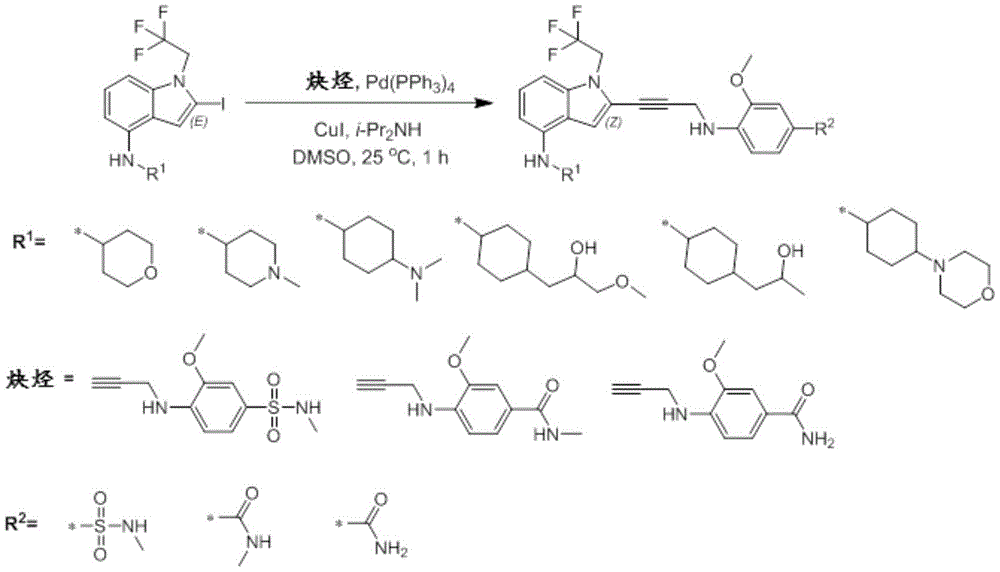
General procedure: to a mixture of alkynes (1.2 equiv) in DMSO at 25 ℃ was added i-Pr 2 NH (10 equiv.), CuI (1 equiv.), 2-iodo-N- (R) 1 -substituted) -1- (2,2, 2-trifluoroethyl) -1H-indol-4-amine (1 eq) and Pd (PPh) 3 ) 4 (0.2 eq). In N 2 The mixture was then stirred at 25 ℃ for 1 hour. LC-MS and TLC analysis indicated that the reaction was complete. The reaction mixture was quenched by the addition of saturated EDTA solution and the resulting mixture was stirred at 25 ℃ for 2 hours. The reaction mixture was partitioned by adding EtOAc and the aqueous phase was extracted with EtOAc. The combined organic phases were washed with brine, dried over anhydrous sodium sulfate, filtered and concentrated in vacuo. The crude residue was purified by preparative TLC and preparative HPLC to give a solution of the desired product. The solution was lyophilized to give the desired product as a yellow solid.
3-methoxy-N-methyl-4- [ (3- {4- [ (oxan-4-yl) amino group]-1- (2,2, 2-trifluoroethyl) -1H-indol-2-yl } prop-2-yn-1-yl) amino]Benzene-1-sulfonamides, MS (ES) + M/z) 551.2; 3-methoxy-N-methyl-4- [ (3- {4- [ (1-methylpiperidin-4-yl) amino group]-1- (2,2, 2-trifluoroethyl) -1H-indol-2-yl } prop-2-yn-1-yl) amino]Benzene-1-sulfonamides, MS (ES) + M/z) 564.2; 4- { [3- (4- { [1- (2-hydroxy-3-methoxypropyl) piperidin-4-yl]Amino } -1- (2,2, 2-trifluoroethyl) -1H-indol-2-yl) prop-2-yn-1-yl]Amino } -3-methoxy-N-methylbenzene-1-sulphonamide, MS (ES) + M/z) 638.2; 3-methoxy-N-methyl-4- [ (3- {4- [ (oxan-4-yl) amino group ]-1- (2,2, 2-trifluoroethyl) -1H-indol-2-yl } prop-2-yn-1-yl) amino]Benzamide, MS (ES) + M/z) 515.2; 3-methoxy-N-methyl-4- [ (3- {4- [ (1-methylpiperidin-4-yl) amino group]-1- (2,2, 2-trifluoroethyl) -1H-indol-2-yl } prop-2-yn-1-yl) amino]Benzamide, MS (ES) + M/z) 528.2; 4- { [3- (4- { [1- (2-hydroxy-3-methyl) methaneOxypropyl) piperidin-4-yl]Amino } -1- (2,2, 2-trifluoroethyl) -1H-indol-2-yl) prop-2-yn-1-yl]Amino } -3-methoxy-N-methylbenzamide, MS (ES) + M/z) 602.4; 4- { [3- (4- { [1- (2-hydroxypropyl) piperidin-4-yl]Amino } -1- (2,2, 2-trifluoroethyl) -1H-indol-2-yl) prop-2-yn-1-yl]Amino } -3-methoxy-N-methylbenzamide, MS (ES) + M/z) 572.3; 4- { [3- (4- { [1- (2-hydroxy-3-methoxypropyl) piperidin-4-yl]Amino } -1- (2,2, 2-trifluoroethyl) -1H-indol-2-yl) prop-2-yn-1-yl]Amino } -3-methoxybenzamide, MS (ES) + M/z) 588.3; 3-methoxy-N-methyl-4- { [3- (4- { [ (1R,4R) -4- (dimethylamino) cyclohexyl]Amino } -1- (2,2, 2-trifluoroethyl) -1H-indol-2-yl) prop-2-yn-1-yl]Amino } benzene-1-sulfonamide, MS (ES) + M/z) 592.2; 3-methoxy-N-methyl-4- { [3- (4- { [ (1S,4S) -4- (dimethylamino) cyclohexyl]Amino } -1- (2,2, 2-trifluoroethyl) -1H-indol-2-yl) prop-2-yn-1-yl ]Amino } benzene-1-sulfonamide, MS (ES) + M/z) 592.3; 3-methoxy-N-methyl-4- { [3- (4- { [ (1R,4R) -4- (dimethylamino) cyclohexyl]Amino } -1- (2,2, 2-trifluoroethyl) -1H-indol-2-yl) prop-2-yn-1-yl]Amino } benzamide, MS (ES) + M/z) 556.3; 3-methoxy-N-methyl-4- { [3- (4- { [ (1S,4S) -4- (dimethylamino) cyclohexyl]Amino } -1- (2,2, 2-trifluoroethyl) -1H-indol-2-yl) prop-2-yn-1-yl]Amino } benzamide, MS (ES) + M/z) 556.3; 3-methoxy-4- { [3- (4- { [ (1R,4R) -4- (morpholin-4-yl) cyclohexyl]Amino } -1- (2,2, 2-trifluoroethyl) -1H-indol-2-yl) prop-2-yn-1-yl]Amino } benzamide, MS (ES) + M/z) 584.2; and 3-methoxy-4- { [3- (4- { [ (1S,4S) -4- (morpholin-4-yl) cyclohexyl]Amino } -1- (2,2, 2-trifluoroethyl) -1H-indol-2-yl) prop-2-yn-1-yl]Amino } benzamide, MS (ES) + ,m/z):584.2。
Example C45: general procedure for the preparation of compounds 123A, 124A, 149A, 150A, 157A, 158A, 185A, 186A, 303A, 304A, 407A, 408A, 489A, 663A and 664A.

To R-substituted alkynes(1-2 equiv.) mixtures in DMSO (2mL) were charged with i-Pr 2 NH (10-30 equivalents). Then, CuI (1-2 equiv.), R 1 Substituted indoles (1 equivalent) and Pd (PPh) 3 ) 4 (0.20-0.50 equiv.) is added to the mixture and stirred under N 2 The mixture is then stirred at 20-40 ℃ for 1-3 hours. The reaction progress was monitored by LC-MS or TLC analysis. The mixture was poured into a saturated EDTA solution (15mL) and stirred for 1 hour. The aqueous phase was extracted with EtOAc (20mL x 3), and the combined organic layers were washed with brine (20mL x 3), dried over anhydrous sodium sulfate, filtered, and concentrated in vacuo. The residue was purified by preparative TLC, preparative HPLC or preparative TLC followed by preparative HPLC to give the desired compound.
2- { 5-Methylsulfonyl-2- [ (3- {4- [ (1-methylpiperidin-4-yl) amino ] carbonyl]-1- (2,2, 2-trifluoroethyl) -1H-indol-2-yl } prop-2-yn-1-yl) amino]Phenoxy } acetonitrile, MS (ES) + M/z) 574.3; 1- (4- { [2- (3- { [2- (fluoromethoxy) -4-methanesulfonylphenyl]Amino } prop-1-yn-1-yl) -1- (2,2, 2-trifluoroethyl) -1H-indol-4-yl]Amino } piperidin-1-yl) -3-methoxypropan-2-ol, MS (ES) + M/z) 641.6; 3- (Fluoromethoxy) -N-methyl-4- { [3- (4- { [ (1R,4R) -4- [ (2-methoxyethyl) (methyl) amino]Cyclohexyl radical]Amino } -1- (2,2, 2-trifluoroethyl) -1H-indol-2-yl) prop-2-yn-1-yl]Amino } benzamide, MS (ES) + M/z) 618.3; 3- (Fluoromethoxy) -N-methyl-4- { [3- (4- { [ (1S,4S) -4- [ (2-methoxyethyl) (methyl) amino ]Cyclohexyl radical]Amino } -1- (2,2, 2-trifluoroethyl) -1H-indol-2-yl) prop-2-yn-1-yl]Amino } benzamide, MS (ES) + M/z) 618.3; 3- (Fluoromethoxy) -4- { [3- (4- { [1- (2-hydroxy-3-methoxypropyl) piperidin-4-yl]Amino } -1- (2,2, 2-trifluoroethyl) -1H-indol-2-yl) prop-2-yn-1-yl]Amino } -N-methylbenzamide, MS (ES) + M/z) 620.2; 3- (cyanomethoxy) -4- { [3- (4- { [ (1R,4R) -4- (dimethylamino) cyclohexyl]Amino } -1- (2,2, 2-trifluoroethyl) -1H-indol-2-yl) prop-2-yn-1-yl]Amino } benzene-1-sulfonamide, MS (ES) + M/z) 603.4; 3- (cyanomethoxy) -4- { [3- (4- { [ (1S,4S) -4- (dimethylamino) cyclohexyl]Amino } -1- (2,2, 2-trifluoroethyl) -1H-indol-2-yl) prop-2-yn-1-yl]Amino } benzene-1-sulfonamide, MS (ES) + M/z) 603.3; 2- (5-Methanesulfonyl-2)- { [3- (4- { [ (1R,4R) -4- (morpholin-4-yl) cyclohexyl]Amino } -1- (2,2, 2-trifluoroethyl) -1H-indol-2-yl) prop-2-yn-1-yl]Amino } phenoxy) acetonitrile, MS (ES) + M/z) 644.2; 2- (5-Methylsulfonyl-2- { [3- (4- { [ (1S,4S) -4- (morpholin-4-yl) cyclohexyl]Amino } -1- (2,2, 2-trifluoroethyl) -1H-indol-2-yl) prop-2-yn-1-yl]Amino } phenoxy) acetonitrile, MS (ES) + M/z) 644.2; 2- (5-Methylsulfonyl-2- { [3- (4- { [ (1R,4R) -4- [ (2-methoxyethyl) (methyl) amino ]Cyclohexyl radical]Amino } -1- (2,2, 2-trifluoroethyl) -1H-indol-2-yl) prop-2-yn-1-yl]Amino } phenoxy) acetonitrile, MS (ES) + M/z) 646.2; 2- (5-Methylsulfonyl-2- { [3- (4- { [ (1S,4S) -4- [ (2-methoxyethyl) (methyl) amino]Cyclohexyl radical]Amino } -1- (2,2, 2-trifluoroethyl) -1H-indol-2-yl) prop-2-yn-1-yl]Amino } phenoxy) acetonitrile, MS (ES) + M/z) 646.2; 2- (5-Methylsulfonyl-2- { [3- (4- { [ (1R,4R) -4- { 6-oxa-3-azabicyclo [3.1.1 ] e]Hept-3-yl } cyclohexyl]Amino } -1- (2,2, 2-trifluoroethyl) -1H-indol-2-yl) prop-2-yn-1-yl]Amino } phenoxy) acetonitrile, MS (ES) + M/z) 656.2; 2- (5-Methylsulfonyl-2- { [3- (4- { [ (1R,4R) -4- { 6-oxa-3-azabicyclo [3.1.1 ] e]Hept-3-yl } cyclohexyl radical]Amino } -1- (2,2, 2-trifluoroethyl) -1H-indol-2-yl) prop-2-yn-1-yl]Amino } phenoxy) acetonitrile, MS (ES) + M/z) 656.2; 2- (5-Methylsulfonyl-2- { [3- (4- { [ (1R,4R) -4- { 7-oxa-2-azaspiro [3.5 ]]Non-2-yl cyclohexyl]Amino } -1- (2,2, 2-trifluoroethyl) -1H-indol-2-yl) prop-2-yn-1-yl]Amino } phenoxy) acetonitrile, MS (ES) + M/z) 684.3; and 2- (5-Methylsulfonyl-2- { [3- (4- { [ (1S,4S) -4- { 7-oxa-2-azaspiro [3.5 ]]Non-2-yl cyclohexyl]Amino } -1- (2,2, 2-trifluoroethyl) -1H-indol-2-yl) prop-2-yn-1-yl ]Amino } phenoxy) acetonitrile, MS (ES) + ,m/z):684.3。
Example C46: general procedure for the preparation of compounds 253A, 254A, 255A, 256A, 257A, 258A, 259A and 260A.
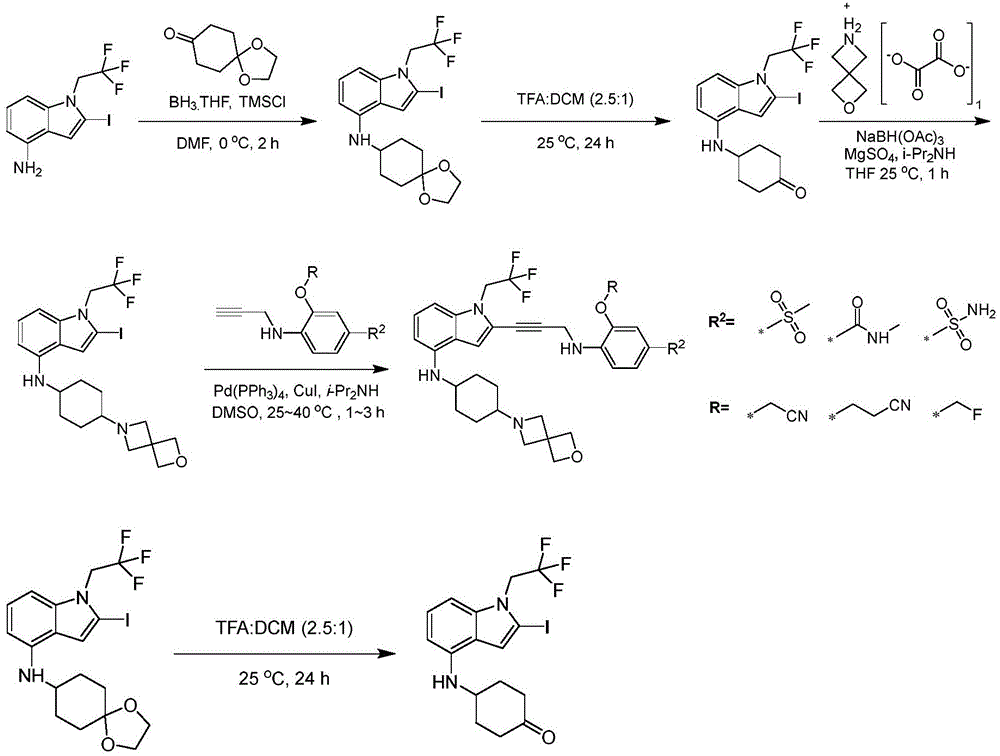
2-iodo-N- (1, 4-dioxaspiro [4.5 ]]Synthesis of dec-8-yl) -1- (2,2, 2-trifluoroethyl) -1H-indol-4-amine: to 2-iodine-1- (2,2, 2-trifluoroethyl) -1H-indol-4-amine (10g,29.40mmol,1 eq) and 1, 4-dioxaspiro [4.5 ]]Decan-8-one (11.48g,73.51mmol,2.5 equiv.) in DMF (100mL) was added BH 3 THF (1M,88.21mL,3 equiv.). The mixture was stirred at 0 ℃ for 1h, TMSCl (7.99g,73.51mmol,9.33mL,2.5 equiv.) was added to the reaction, and the mixture was stirred at 0 ℃ for 1 h. LC-MS and TLC analysis indicated that the reaction was complete. The reaction mixture was poured into ice water (1000mL) and the aqueous phase was extracted with EtOAc (300mL x 3). The combined organic layers were washed with brine (100mL x 2), dried over anhydrous sodium sulfate, filtered and concentrated in vacuo to give a residue. The residue was washed with PE (20mL) for 10 h at 25 deg.C and filtered to give the desired compound 2-iodo-N- (1, 4-dioxaspiro [4.5 ]]Dec-8-yl) -1- (2,2, 2-trifluoroethyl) -1H-indol-4-amine (30g,61.84mmol, 70.10% yield) as a light yellow solid.

N- ((1R,4R) -4- (2-oxa-6-azaspiro [ 3.3) ]Hept-6-yl) cyclohexyl) -2-iodo-1- (2,2, 2-trifluoroethyl) -1H-indol-4-amine and N- ((1S,4S) -4- (2-oxa-6-azaspiro [3.3]Synthesis of hept-6-yl) cyclohexyl) -2-iodo-1- (2,2, 2-trifluoroethyl) -1H-indol-4-amine: to 2-iodo-N- (1, 4-dioxaspiro [4.5 ]]Dec-8-yl) -1- (2,2, 2-trifluoroethyl) -1H-indol-4-amine (5.5g,10.72mmol,1 eq.) and 2-oxa-6-azaspiro [3.3]A solution of hept-6-ium oxalate (2.43g,12.86mmol,1.2 equiv.) in THF (100mL) was added MgSO 4 (6.45g,53.59mmol,5 equiv.) and i-Pr 2 NH (5.42g,53.59mmol,7.57mL,5 equiv). The mixture was stirred at 25 ℃ for 0.5 hour. Reacting NaBH (OAc) 3 (4.54g,21.43mmol,2 equiv.) was added to the reaction and the resulting mixture was stirred at 25 ℃ for 1 hour, followed by TLC analysis to show complete consumption of the ketone starting material. The reaction mixture was then poured into water (200mL) and the residue was extracted with EtOAc (100mL x 3). The combined organic layers were washed with brine (100mL x 3), dried over anhydrous sodium sulfate, filtered and concentrated under reduced pressure to give a residue which was purified by column chromatography (SiO) 2 PE EtOAc ═ 2:1 to EtOAc to DCM: MeOH ═10:1) to yield the desired diastereomer, N- ((1R,4R) -4- (2-oxa-6-azaspiro [ 3.3) in the form of a yellow solid ]Hept-6-yl) cyclohexyl) -2-iodo-1- (2,2, 2-trifluoroethyl) -1H-indol-4-amine (3g,4.91mmol, 91.63% yield) and N- ((1S,4S) -4- (2-oxa-6-azaspiro [3.3 ] as a yellow solid]Hept-6-yl) cyclohexyl) -2-iodo-1- (2,2, 2-trifluoroethyl) -1H-indol-4-amine (1.7g,2.78mmol, 51.92% yield).

Representative procedure: to 2- [ 5-methylsulfonyl-2- (prop-2-ynylamino) phenoxy group]A solution of acetonitrile (81.4mg, 231. mu. mol,1.5 equiv) in DMSO (2mL) was added i-Pr 2 NH (4.62mmol, 650. mu.L, 30 equiv.), CuI (58.7mg, 308. mu. mol,2 equiv.), 2-iodo-N- [4- (2-oxa-6-azaspiro [3.3 ]]Hept-6-yl) cyclohexyl]-1- (2,2, 2-trifluoroethyl) indol-4-amine (100mg, 154. mu. mol,1 eq) and Pd (PPh) 3 ) 4 (44.5mg, 38.5. mu. mol,0.25 equiv.). Mixing the mixture in N 2 The mixture was stirred at 25 ℃ for 1 hour. TLC analysis (DCM: MeOH ═ 20:1, R) f 0.21) indicated complete consumption of iodide and a new spot was detected. The mixture was poured into saturated aqueous EDTA (20mL) and stirred at 25 ℃ for 1 hour. The mixture was extracted with EtOAc (20 mL. times.3). The combined organic layers were washed with brine (20mL x 3), dried over anhydrous sodium sulfate, filtered and concentrated under reduced pressure to give a residue which was purified by preparative TLC (DCM: MeOH: TEA ═ 150:10:0.5) and then by preparative HPLC to give 2- [ 5-methylsulfonyl-2- [3- [4- [ [4- (2-oxa-6-azaspiro [3.3 ] a ]Hept-6-yl) cyclohexyl]Amino group]-1- (2,2, 2-trifluoroethyl) indol-2-yl]Prop-2-ynylamino]Phenoxy radical]Acetonitrile (10.1mg,13.9 μmol, 9.0% yield, FA salt) as a light yellow solid. The same procedure was used to prepare other analogues in the series.
3- (2-cyanoethoxy) -N-methyl-4- { [3- (4- { [ (1R,4R) -4- { 2-oxa-6-azaspiro [3.3 [)]Hept-6-yl } cyclohexyl]Amino } -1- (2,2, 2-trifluoroethyl) -1H-indol-2-yl) prop-2-yn-1-yl]Amino } benzamide, MS (ES) + M/z) 649.3; 3- (2-cyanoethoxy) -N-methyl-4- { [3- (4- { [ (1S,4S) -4- { 2-oxa-6-azaspiro [3.3 ]]Hept-6-yl } cyclohexyl]Amino } -1- (2,2, 2-trifluoroethyl) -1H-indol-2-yl) prop-2-yn-1-yl]Amino } benzamide, MS (ES) + M/z) 649.3; 2- (3- { [2- (fluoromethoxy) -4-methanesulfonylphenyl]Amino } prop-1-yn-1-yl) -N- [ (1R,4R) -4- { 2-oxa-6-azaspiro [3.3]Hept-6-yl } cyclohexyl]-1- (2,2, 2-trifluoroethyl) -1H-indol-4-amine, (ES) + M/z) 649.3; 2- (3- { [2- (fluoromethoxy) -4-methanesulfonylphenyl]Amino } prop-1-yn-1-yl) -N- [ (1S,4S) -4- { 2-oxa-6-azaspiro [3.3]Hept-6-yl } cyclohexyl]-1- (2,2, 2-trifluoroethyl) -1H-indol-4-amine, (ES) + M/z) 649.3; 3- (Fluoromethoxy) -N-methyl-4- { [3- (4- { [ (1R,4R) -4- { 2-oxa-6-azaspiro [3.3 ] ]Hept-6-yl } cyclohexyl]Amino } -1- (2,2, 2-trifluoroethyl) -1H-indol-2-yl) prop-2-yn-1-yl]Amino benzamide, (ES) + M/z) 628.3; 3- (Fluoromethoxy) -N-methyl-4- { [3- (4- { [ (1S,4S) -4- { 2-oxa-6-azaspiro [ 3.3%]Hept-6-yl } cyclohexyl]Amino } -1- (2,2, 2-trifluoroethyl) -1H-indol-2-yl) prop-2-yn-1-yl]Amino benzamide, (ES) + M/z) 628.3; 3- (Cyanomethoxy) -4- { [3- (4- { [ (1R,4R) -4- { 2-oxa-6-azaspiro [3.3 ]]Hept-6-yl } cyclohexyl]Amino } -1- (2,2, 2-trifluoroethyl) -1H-indol-2-yl) prop-2-yn-1-yl]Amino } benzene-1-sulfonamide, (ES) + M/z) 657.4; and 3- (cyanomethoxy) -4- { [3- (4- { [ (1S,4S) -4- { 2-oxa-6-azaspiro [3.3 ]]Hept-6-yl } cyclohexyl]Amino } -1- (2,2, 2-trifluoroethyl) -1H-indol-2-yl) prop-2-yn-1-yl]Amino } benzene-1-sulfonamide, (ES) + ,m/z):657.4。
Example C47: general procedure for the preparation of compounds 389A and 390A.

N- ((1R,4R) -4- (2-oxa-7-azaspiro [ 3.5)]Non-7-yl) cyclohexyl) -2-iodo-1- (2,2, 2-trifluoroethyl) -1H-indol-4-amine and N- ((1S,4S) -4- (2-oxa-7-azaspiro [ 3.5)]Synthesis of non-7-yl) cyclohexyl) -2-iodo-1- (2,2, 2-trifluoroethyl) -1H-indol-4-amine: to 4- ((2-iodo-1- (2,2, 2-trifluoroethyl) -1H-indol-4-yl) amino) cyclohex-1-one and 2-oxa-7-azaspiro [3.5 ] ]A solution of nonan-7-ium oxalate (1.15g,5.31mmol,5 equiv.) in DCE (4mL) was added MgSO 4 (640mg,5.31mmol,5 equiv.), molecular Sieve powder (400mg) and i-Pr 2 NH (10.6mmol,1.50mL,10 equiv.). The mixture was heated and stirred at 50 ℃ for 0.5 h, then NaBH (OAc) was added 3 (450.4mg,2.13mmol,2 equiv.). The mixture was heated and stirred at 70-100 ℃ for 1 hour, and subsequent LC-MS analysis indicated complete consumption of the starting ketone and detection of a major peak related to the expected product mass. The reaction mixture was diluted with DCM (20mL), filtered and concentrated under reduced pressure to give a residue which was purified by preparative HPLC to give the desired diastereomer N- ((1R,4R) -4- (2-oxa-7-azaspiro [3.5 ]]Non-7-yl) cyclohexyl) -2-iodo-1- (2,2, 2-trifluoroethyl) -1H-indol-4-amine (0.1g, 176. mu. mol, 8.0% yield) and N- ((1S,4S) -4- (2-oxa-7-azaspiro [ 3.5%]Non-7-yl) cyclohexyl) -2-iodo-1- (2,2, 2-trifluoroethyl) -1H-indol-4-amine (0.1g,179 μmol, 8.2% yield) as a yellow solid.

Representative procedure for trans isomers: to 2- [ 5-methylsulfonyl-2- (prop-2-ynylamino) phenoxy group at 25 deg.C]A solution of acetonitrile (44.6mg, 143. mu. mol,2 equiv.) in DMSO (1mL) was added i-Pr 2 NH (2.15mmol, 303. mu.L, 30 equiv.), CuI (27.3mg, 143. mu. mol,2 equiv.), 2-iodo-N- [4- (2-oxa-7-azaspiro [3.5 ]]Non-7-yl) cyclohexyl]-1- (2,2, 2-trifluoroethyl) indol-4-amine (40mg, 71.7. mu. mol,1 eq.) and Pd (PPh) 3 ) 4 (20.7mg, 17.9. mu. mol,0.25 equiv.). In N 2 The mixture was then stirred at 25 ℃ for 1 hour. TLC analysis (DCM: MeOH ═ 10:1, R) f 0.25) indicated complete consumption of iodide starting material and a new spot was detected. The mixture was poured into saturated aqueous EDTA (20mL) and stirred at 25 ℃ for 1 hour. The mixture was then extracted with EtOAc (3 × 20 mL). The combined organic layers were washed with brine (3 × 20mL), dried over anhydrous sodium sulfate, filtered, and concentrated under reduced pressure to give a residue which was purified by preparative TLC (DCM: MeOH ═ 10:1, R) f 0.25), followed by purification by filtrationFurther purification by preparative HPLC afforded 2- [ 5-methylsulfonyl-2- [3- [4- [ [4- (2-oxa-7-azaspiro [3.5 ]]Non-7-yl) cyclohexyl]Amino group]-1- (2,2, 2-trifluoroethyl) indol-2-yl]Prop-2-ynylamino]Phenoxy radical]Acetonitrile (18.0mg,24.4 μmol, 34.1% yield, FA salt) as a yellow solid.
The corresponding cis isomer was synthesized using the methods described above. MS (ES) + M/z) 538.2, 89.6% yield
2- (5-Methylsulfonyl-2- { [3- (4- { [ (1R,4R) -4- { 2-oxa-7-azaspiro [3.5 ]]Non-7-yl cyclohexyl]Amino } -1- (2,2, 2-trifluoroethyl) -1H-indol-2-yl) prop-2-yn-1-yl]Amino } phenoxy) acetonitrile, MS (ES) + M/z) 684.2; and 2- (5-Methylsulfonyl-2- { [3- (4- { [ (1S,4S) -4- { 2-oxa-7-azaspiro [3.5 ]]Non-7-yl cyclohexyl]Amino } -1- (2,2, 2-trifluoroethyl) -1H-indol-2-yl) prop-2-yn-1-yl]Amino } phenoxy) acetonitrile, MS (ES) + ,m/z):684.2。
Example C48: general procedure for the preparation of compounds 162A, 163A, 322A, 323A, 350A, 351A, 424A, 425A, 436A, 437A, 442A and 443A.

Representative procedure for reductive amination: to 4- [ [ 2-iodo-1- (2,2, 2-trifluoroethyl) indol-4-yl group]Amino group]Cyclohexanone (600mg,1.24mmol,1 equiv.) in EtOH (3mL) was added 4-methoxypiperidine (6.19mmol, 59. mu.L, 5 equiv.) and Ti (OEt) 4 (6.19mmol,1.28mL,5 equiv.). The reaction mixture was heated and stirred at 50 ℃ for 4 hours. Then, in N 2 Add NaBH to the reaction mixture 3 CN (389mg,6.19mmol,5 equivalents). The reaction mixture was warmed and stirred at 50 ℃ for 1 hour. TLC analysis (DCM: MeOH ═ 10:1, R) f1 =0.3,R f2 0.25) indicates that the starting material was consumed. The solution was dried under vacuum to give the crude product. The residue was purified by column chromatography (SiO) 2 PE EtOAc ═ 5:1 to 0:1) purification to give the intermediate product 2-iodo-N- [4- (4-methoxy-1-piperidinyl) cyclohexyl]-1- (2,2, 2-trifluoroethyl) indol-4-amine (550mg,1.03mmol, 83.0% yield) as a brown oil.
Step 2: the R-substituted iodoindole indicated above was coupled with 2-methoxy-4- (methylsulfonyl) -N- (prop-2-yn-1-yl) aniline according to the general procedure indicated in example C47. In each case, TLC/LC-MS analysis indicated complete consumption of the starting material after 2 hours of heating at 45 ℃.
2- {3- [ (4-Methylsulfonyl-2-methoxyphenyl) amino]Prop-1-yn-1-yl } -N- [ (1R,4R) -4- (pyrrolidin-1-yl) cyclohexyl]-1- (2,2, 2-trifluoroethyl) -1H-indol-4-amine, MS (ES) + M/z) 603.2; 2- {3- [ (4-Methylsulfonyl-2-methoxyphenyl) amino]Prop-1-yn-1-yl } -N- [ (1S,4S) -4- (pyrrolidin-1-yl) cyclohexyl]-1- (2,2, 2-trifluoroethyl) -1H-indol-4-amine, MS (ES) + ,m/z):603.2;(1R,4R)-N 1 ,N 1 -diethyl-N 4 - (2- {3- [ (4-methanesulfonyl-2-methoxyphenyl) amino]Prop-1-yn-1-yl } -1- (2,2, 2-trifluoroethyl) -1H-indol-4-yl) cyclohexane-1, 4-diamine, MS (ES) + ,m/z):605.4;(1S,4S)-N 1 ,N 1 -diethyl-N 4 - (2- {3- [ (4-methanesulfonyl-2-methoxyphenyl) amino]Prop-1-yn-1-yl } -1- (2,2, 2-trifluoroethyl) -1H-indol-4-yl) cyclohexane-1, 4-diamine, MS (ES) + M/z) 605.2; 2- {3- [ (4-Methylsulfonyl-2-methoxyphenyl) amino]Prop-1-yn-1-yl } -N- [ (1R,4R) -4- (4-methoxypiperidin-1-yl) cyclohexyl]-1- (2,2, 2-trifluoroethyl) -1H-indol-4-amine, MS (ES) + M/z) 647.3; 2- {3- [ (4-Methylsulfonyl-2-methoxyphenyl) amino]Prop-1-yn-1-yl } -N- [ (1S,4S) -4- (4-methoxypiperidin-1-yl) cyclohexyl]-1- (2,2, 2-trifluoroethyl) -1H-indol-4-amine, MS (ES) + M/z) 647.2; 2- {3- [ (4-Methylsulfonyl-2-methoxyphenyl) amino]Prop-1-yn-1-yl } -N- [ (1R,4R) -4- [4- (trifluoromethyl) piperidin-1-yl ] -amide]Cyclohexyl radical]-1- (2,2, 2-trifluoroethyl) -1H-indol-4-amine, MS (ES) + M/z) 685.2; 2- {3- [ (4-Methylsulfonyl-2-methoxyphenyl) amino]Prop-1-yn-1-yl } -N- [ (1S,4S) -4- [4- (trifluoromethyl) piperidin-1-yl]Cyclohexyl radical]-1- (2,2, 2-trifluoroethyl) -1H-indol-4-amine, MS (ES) + M/z) 685.2; 2- {3- [ (4-Methylsulfonyl-2-methoxyphenyl) amino]Prop-1-yn-1-yl } -N- [ (1R,4R) -4- (4-methanesulfonylpiperidin-1-yl) cyclohexyl]-1- (2,2, 2-trifluoroethyl) -1H-indol-4-amine, MS (ES) + ,m/z):695.2; 2- {3- [ (4-Methylsulfonyl-2-methoxyphenyl) amino]Prop-1-yn-1-yl } -N- [ (1S,4S) -4- (4-methanesulfonylpiperidin-1-yl) cyclohexyl]-1- (2,2, 2-trifluoroethyl) -1H-indol-4-amine, MS (ES) + M/z) 695.2; 2- {3- [ (4-Methylsulfonyl-2-methoxyphenyl) amino]Prop-1-yn-1-yl } -N- [ (1R,4R) -4- { 6-oxa-2-azaspiro [3.5 ] spirol]Non-2-yl cyclohexyl]-1- (2,2, 2-trifluoroethyl) -1H-indol-4-amine, MS (ES) + M/z) 659.2; and 2- {3- [ (4-methanesulfonyl-2-methoxyphenyl) amino]Prop-1-yn-1-yl } -N- [ (1S,4S) -4- { 6-oxa-2-azaspiro [3.5 ]]Non-2-yl } cyclohexyl]-1- (2,2, 2-trifluoroethyl) -1H-indol-4-amine, MS (ES) + ,m/z):659.2。
Example C49: general procedure for the preparation of compounds 144A, 145A, 318A, 319A, 352A, 353A, 420A, 421A, 438A, 439A, 444A and 445A.

Compounds 144A, 145A, 318A, 319A, 352A, 353A, 420A, 421A, 438A, 439A, 444A and 445A were prepared by procedures analogous to the synthesis of the compound described in example C32, using 3-methoxy-N-methyl-4- (prop-2-yn-1-ylamino) benzamide instead of 2-methoxy-4- (methylsulfonyl) -N- (prop-2-yn-1-yl) aniline.
3-methoxy-N-methyl-4- { [3- (4- { [ (1R,4R) -4- (pyrrolidin-1-yl) cyclohexyl]Amino } -1- (2,2, 2-trifluoroethyl) -1H-indol-2-yl) prop-2-yn-1-yl]Amino } benzamide, MS (ES) + M/z) 582.3; 3-methoxy-N-methyl-4- { [3- (4- { [ (1S,4S) -4- (pyrrolidin-1-yl) cyclohexyl ]Amino } -1- (2,2, 2-trifluoroethyl) -1H-indol-2-yl) prop-2-yn-1-yl]Amino } benzamide, MS (ES) + M/z) 582.3; 3-methoxy-N-methyl-4- { [3- (4- { [ (1R,4R) -4- (diethylamino) cyclohexyl]Amino } -1- (2,2, 2-trifluoroethyl) -1H-indol-2-yl) prop-2-yn-1-yl]Amino } benzamide, MS (ES) + M/z) 584.3; 3-methoxy-N-methyl-4- { [3- (4- { [ (1S,4S) -4- (diethylamino) cyclohexyl]Amino } -1- (2,2, 2-trifluoroethyl) -1H-indol-2-yl) prop-2-yn-1-yl]Amino } benzamide, MS (ES) + ,m/z):584.3;3-methoxy-N-methyl-4- { [3- (4- { [ (1R,4R) -4- (4-methoxypiperidin-1-yl) cyclohexyl]Amino } -1- (2,2, 2-trifluoroethyl) -1H-indol-2-yl) prop-2-yn-1-yl]Amino } benzamide, MS (ES) + M/z) 626.3; 3-methoxy-N-methyl-4- { [3- (4- { [ (1S,4S) -4- (4-methoxypiperidin-1-yl) cyclohexyl]Amino } -1- (2,2, 2-trifluoroethyl) -1H-indol-2-yl) prop-2-yn-1-yl]Amino } benzamide, MS (ES) + M/z) 626.3; 3-methoxy-N-methyl-4- { [3- (4- { [ (1R,4R) -4- [4- (trifluoromethyl) piperidin-1-yl]Cyclohexyl radical]Amino } -1- (2,2, 2-trifluoroethyl) -1H-indol-2-yl) prop-2-yn-1-yl]Amino } benzamide, MS (ES) + M/z) 664.3; 3-methoxy-N-methyl-4- { [3- (4- { [ (1S,4S) -4- [4- (trifluoromethyl) piperidin-1-yl ]Cyclohexyl radical]Amino } -1- (2,2, 2-trifluoroethyl) -1H-indol-2-yl) prop-2-yn-1-yl]Amino } benzamide, MS (ES) + M/z) 664.2; 3-methoxy-N-methyl-4- { [3- (4- { [ (1R,4R) -4- (4-methanesulfonylpiperidin-1-yl) cyclohexyl]Amino } -1- (2,2, 2-trifluoroethyl) -1H-indol-2-yl) prop-2-yn-1-yl]Amino } benzamide, MS (ES) + M/z) 674.3; 3-methoxy-N-methyl-4- { [3- (4- { [ (1S,4S) -4- (4-methanesulfonylpiperidin-1-yl) cyclohexyl]Amino } -1- (2,2, 2-trifluoroethyl) -1H-indol-2-yl) prop-2-yn-1-yl]Amino } benzamide, MS (ES) + M/z) 674.3; 3-methoxy-N-methyl-4- { [3- (4- { [ (1R,4R) -4- { 6-oxa-2-azaspiro [3.5 ]]Non-2-yl cyclohexyl]Amino } -1- (2,2, 2-trifluoroethyl) -1H-indol-2-yl) prop-2-yn-1-yl]Amino } benzamide, MS (ES) + M/z) 638.3; and 3-methoxy-N-methyl-4- { [3- (4- { [ (1S,4S) -4- { 6-oxa-2-azaspiro [3.5 ]]Non-2-yl } cyclohexyl]Amino } -1- (2,2, 2-trifluoroethyl) -1H-indol-2-yl) prop-2-yn-1-yl]Amino } benzamide, MS (ES) + ,m/z):638.3。
Example C50: general procedure for the preparation of compounds 146A, 147A, 320A, 321A, 354A, 355A, 422A, 423A, 440A, 441A, 446A and 447A.

Compounds 146A, 147A, 320A, 321A, 354A, 355A, 422A, 423A, 440A, 441A, 446A, and 447A were prepared by procedures analogous to the synthesis of the compound described in example C32, using 3-methoxy-4- (prop-2-yn-1-ylamino) benzenesulfonamide instead of 2-methoxy-4- (methylsulfonyl) -N- (prop-2-yn-1-yl) aniline.
3-methoxy-4- { [3- (4- { [ (1R,4R) -4- (pyrrolidin-1-yl) cyclohexyl]Amino } -1- (2,2, 2-trifluoroethyl) -1H-indol-2-yl) prop-2-yn-1-yl]Amino } benzene-1-sulfonamide, MS (ES) + M/z) 604.3; 3-methoxy-4- { [3- (4- { [ (1S,4S) -4- (pyrrolidin-1-yl) cyclohexyl]Amino } -1- (2,2, 2-trifluoroethyl) -1H-indol-2-yl) prop-2-yn-1-yl]Amino } benzene-1-sulfonamide, MS (ES) + M/z) 604.2; 3-methoxy-4- { [3- (4- { [ (1R,4R) -4- (diethylamino) cyclohexyl]Amino } -1- (2,2, 2-trifluoroethyl) -1H-indol-2-yl) prop-2-yn-1-yl]Amino } benzene-1-sulfonamide, MS (ES) + M/z) 606.2; 3-methoxy-4- { [3- (4- { [ (1S,4S) -4- (diethylamino) cyclohexyl]Amino } -1- (2,2, 2-trifluoroethyl) -1H-indol-2-yl) prop-2-yn-1-yl]Amino } benzene-1-sulfonamide, MS (ES) + M/z) 606.2; 3-methoxy-4- { [3- (4- { [ (1R,4R) -4- (4-methoxypiperidin-1-yl) cyclohexyl]Amino } -1- (2,2, 2-trifluoroethyl) -1H-indol-2-yl) prop-2-yn-1-yl]Amino } benzene-1-sulfonamide, MS (ES) + M/z) 648.3; 3-methoxy-4- { [3- (4- { [ (1S,4S) -4- (4-methoxypiperidin-1-yl) cyclohexyl]Amino } -1- (2,2, 2-trifluoroethyl) -1H-indol-2-yl) prop-2-yn-1-yl]Amino } benzene-1-sulfonamide, MS (ES) + M/z) 648.3; 3-methoxy-4- { [3- (4- { [ (1R,4R) -4- [4- (trifluoromethyl) piperidin-1-yl ]Cyclohexyl radical]Amino } -1- (2,2, 2-trifluoroethyl) -1H-indol-2-yl) prop-2-yn-1-yl]Amino } benzene-1-sulfonamide, MS (ES) + M/z) 686.2; 3-methoxy-4- { [3- (4- { [ (1S,4S) -4- [4- (trifluoromethyl) piperidin-1-yl]Cyclohexyl radical]Amino } -1- (2,2, 2-trifluoroethyl) -1H-indol-2-yl) prop-2-yn-1-yl]Amino } benzene-1-sulfonamide, MS (ES) + M/z) 686.2; 3-methoxy-4- { [3- (4- { [ (1R,4R) -4- (4-methanesulfonylpiperidin-1-yl) cyclohexyl]Amino } -1- (2,2, 2-trifluoroethyl) -1H-indol-2-yl) prop-2-yn-1-yl]Amino } benzene-1-sulfonamide, MS (ES) + M/z) 696.2; 3-methoxy-4- { [3- (4- { [ (1S,4S) -4- (4-methanesulfonylpiperidin-1-yl) cyclohexyl]Amino } -1- (2,2, 2-trifluoroethyl) -1H-indol-2-yl) prop-2-yn-1-yl]Amino benzene1-sulfonamide, MS (ES) + M/z) 696.2; 3-methoxy-4- { [3- (4- { [ (1R,4R) -4- { 6-oxa-2-azaspiro [3.5 ]]Non-2-yl } cyclohexyl]Amino } -1- (2,2, 2-trifluoroethyl) -1H-indol-2-yl) prop-2-yn-1-yl]Amino } benzene-1-sulfonamide, MS (ES) + M/z) 660.3; and 3-methoxy-4- { [3- (4- { [ (1S,4S) -4- { 6-oxa-2-azaspiro [3.5 ]]Non-2-yl cyclohexyl]Amino } -1- (2,2, 2-trifluoroethyl) -1H-indol-2-yl) prop-2-yn-1-yl]Amino } benzene-1-sulfonamide, MS (ES) + ,m/z):660.3。
Example C51: preparation of compounds 194A and 195A.

Synthesis of N- ((1R,4R) -4- (2-azaspiro [3.3] hept-2-yl) cyclohexyl) -2-iodo-1- (2,2, 2-trifluoroethyl) -1H-indol-4-amine and N- ((1S,4S) -4- (2-azaspiro [3.3] hept-2-yl) cyclohexyl) -2-iodo-1- (2,2, 2-trifluoroethyl) -1H-indol-4-amine:
step 1: to 4- [ [ 2-iodo-1- (2,2, 2-trifluoroethyl) indol-4-yl group]Amino group]Cyclohexanone (600mg,1.24mmol,1 equiv.) in EtOH (1mL) was added 2-azaspiro [ 3.3%]Heptane oxalate (1.76g,6.20mmol,5 equiv.), Ti (OEt) 4 (6.20mmol,1.29mL,5 equiv.) and i-Pr 2 NH (1.24mmol, 175. mu.L, 1 eq.). The reaction mixture was stirred at 50 ℃ for 3 hours. The reaction mixture was then cooled and heated at 0 ℃ under N 2 NaBH is reacted with 3 CN (389.6mg,6.20mmol,5 equivalents) was added to the reaction. The reaction mixture was stirred for 5 minutes and then warmed to 50 ℃ for 1 hour. TLC analysis (EtOAc: TEA ═ 20:1, R f1 =0.6,R f2 0.55) indicating complete consumption of the starting material. The solution was dried under vacuum to give the crude product. The residue was purified by column chromatography (SiO) 2 PE: EtOAc ═ 5:1 to 0:1) purification to afford N- [4- (2-azaspiro [ 3.3)]Hept-2-yl) cyclohexyl]-2-iodo-1- (2,2, 2-trifluoroethyl) indol-4-amine (600mg,1.16mmol, 93.5% yield) as a brown oil.
Step 2: to a solution of 2-methoxy-4-methylsulfonyl-N-prop-2-ynyl-aniline (92.5mg, 348. mu. mol,1.2 eq) in DMSO (3mL) was added i-Pr 2 NH (2.90mmol, 410. mu.L, 10 equiv.), Pd (PPh) 3 ) 4 (67.0mg, 58. mu. mol,0.2 eq.), N- [4- (2-azaspiro [3.3 ]]Hept-2-yl) cyclohexyl]-2-iodo-1- (2,2, 2-trifluoroethyl) indol-4-amine (150mg,290 μmol,1 eq) and CuI (55.2mg,290 μmol,1 eq). In N 2 The mixture was then stirred at 25 ℃ for 2 hours. TLC analysis (EtOAc: TEA ═ 20:1, R f =0.3,R f 0.2) indicates complete consumption of the starting material. The reaction mixture was quenched by the addition of saturated aqueous EDTA (30mL) and the mixture was stirred at 25 ℃ for 2 hours. The reaction mixture was partitioned with EtOAc and the aqueous phase was extracted with EtOAc (3 × 10 mL). The organic phase was washed with brine (10mL x 3), dried over anhydrous sodium sulfate, filtered and concentrated in vacuo to give the crude product. The residue was purified by preparative TLC (EtOAc: TEA ═ 20:1, R) f =0.3,R f 0.2) followed by further purification by preparative HPLC to give cis-N- [4- (2-azaspiro [ 3.3)]Hept-2-yl) cyclohexyl]-2- [3- (2-methoxy-4-methylsulfonyl-anilino) prop-1-ynyl]-1- (2,2, 2-trifluoroethyl) indol-4-amine (45.2mg, 71.9. mu. mol, 24.8% yield) MS (ES) + M/z) 629.2, and trans-N- [4- (2-azaspiro [3.3 ]]Hept-2-yl) cyclohexyl]-2- [3- (2-methoxy-4-methylsulfonyl-anilino) prop-1-ynyl ]-1- (2,2, 2-trifluoroethyl) indol-4-amine (46.5mg, 74.0. mu. mol, 25.5% yield) MS (ES) + M/z) 629.2 as a yellow solid.
Example C52: preparation of compounds 196A and 197A.

The desired product was prepared by a procedure similar to example C51 using 3-methoxy-N-methyl-4- (prop-2-yn-1-ylamino) benzamide instead of 2-methoxy-4- (methylsulfonyl) -N- (prop-2-yn-1-yl) aniline.
3-methoxy-N-methyl-4- { [3- (4- { [ (1R,4R) -4- { 2-azaspiro [ 3.3%]Hept-2-yl } cyclohexyl radical]Amino } -1- (2,2, 2-trifluoroethyl) -1H-indol-2-yl) prop-2-yn-1-yl]Amino } benzamide, MS (ES) + M/z) 608.3; 3-methoxy-N-methyl-4- { [3- (4- { [ (1S,4S) -4- { 2-azaspiro [ 3.3%]Hept-2-ylCyclohexyl radical]Amino } -1- (2,2, 2-trifluoroethyl) -1H-indol-2-yl) prop-2-yn-1-yl]Amino } benzamide, MS (ES) + ,m/z):608.3。
Example C53: preparation of compounds 198A and 199A.

The desired product was prepared by a procedure similar to example C51 using 3-methoxy-4- (prop-2-yn-1-ylamino) benzenesulfonamide instead of 2-methoxy-4- (methylsulfonyl) -N- (prop-2-yn-1-yl) aniline.
3-methoxy-4- { [3- (4- { [ (1R,4R) -4- { 2-azaspiro [ 3.3%]Hept-2-yl } cyclohexyl]Amino } -1- (2,2, 2-trifluoroethyl) -1H-indol-2-yl) prop-2-yn-1-yl ]Amino } benzene-1-sulfonamide, MS (ES) + M/z) 630.3; and 3-methoxy-4- { [3- (4- { [ (1S,4S) -4- { 2-azaspiro [3.3 ]]Hept-2-yl } cyclohexyl radical]Amino } -1- (2,2, 2-trifluoroethyl) -1H-indol-2-yl) prop-2-yn-1-yl]Amino } benzene-1-sulfonamide, MS (ES) + ,m/z):630.3。
Example C54: preparation of compounds 362A, 363A, 364A and 365A.

Synthesis of 1- (((difluoro-l 3-methyl) -l 2-fluoralkyl) methyl) -2-iodo-N- (4-thiomorpholinocyclohexyl) -1H-indol-4-amine: to a solution of 4- ((2-iodo-1- (2,2, 2-trifluoroethyl) -1H-indol-4-yl) amino) cyclohex-1-one (1g,2.06mmol,1 eq) in thiomorpholine (105.6mmol,10mL,51 eq) was added AcOH (2.06mmol,118 μ L,1 eq). The reaction mixture was stirred at 25 ℃ for 2 hours and at 0 ℃ under N 2 Adding NaBH in 3 CN (5 equivalents). The mixture was stirred for a further 5 minutes, then heated to 50 ℃ and stirred for 3 hours, subsequent TLC and LC-MS analysis showed complete consumption of the ketone starting material. The reaction was partitioned by adding water (100mL) and EtOAc (20 mL). The residue was purified by column chromatography (SiO) 2 ) (PE: EtOAc ═ 10:1 to 0:1) purification to give 1- (((difluoro- λ) 3 -methyl radical)-λ 2 -Fluoroalkyl) methyl) -2-iodo-N- (4-thiomorpholino cyclohexyl) -1H-indol-4-amine (1.1g, crude) (ES) + ,m/z):523.8。
4- (4- ((1- (((difluoro-. lambda.)) 3 -methyl) -lambda 2 -fluoralkyl) methyl) -2-iodo-1H-indol-4-yl) amino) cyclohexyl) thiomorpholine 1, 1-dioxide synthesis: at 0 deg.C, to 1- (((difluoro-. lambda.)) 3 -methyl) -lambda 2 -Fluoroalkyl) methyl) -2-iodo-N- (4-thiomorpholinocyclohexyl) -1H-indol-4-amine (1g,1.91mmol,1 eq) in CHCl 3 (20mL) m-CPBA (2.06g,9.55mmol, 80% purity, 5 equiv) was added. The mixture was stirred at 0-25 ℃ for 5 hours, and subsequent TLC and LC-MS analysis indicated that the reaction was complete. By adding saturated Na 2 CO 3 The reaction was partitioned between aqueous (200mL) and EtOAc (50 mL). The residue was purified by column chromatography (SiO) 2 ) (PE: EtOAc ═ 5:1 to 0:1, DCM: MeOH ═ 10:1) purification afforded 4- (4- ((1- (((difluoro-l 3-methyl) -l 2-fluoralkyl) methyl) -2-iodo-1H-indol-4-yl) amino) cyclohexyl) thiomorpholine 1, 1-dioxide (0.8g,1.44mmol, 75.4% yield). MS (ES) + ,m/z):555.7
Preparation of final product: following the general procedure indicated in example C51, 4- (4- ((1- (((difluoro- λ) s) 3 -methyl) -lambda 2 -fluoralkyl) methyl) -2-iodo-1H-indol-4-yl) amino) cyclohexyl) thiomorpholine 1, 1-dioxide was coupled with 2-methoxy-4- (methylsulfonyl) -N- (prop-2-yn-1-yl) aniline. In each case, TLC and LC-MS analysis showed complete consumption of the starting material after stirring the reaction mixture at 25 ℃ for 1 hour. The resulting product was purified by preparative HPLC to give the desired pure compound.
4- [ (1R,4R) -4- [ (2- {3- [ (4-methanesulfonyl-2-methoxyphenyl) amino group]Prop-1-yn-1-yl } -1- (2,2, 2-trifluoroethyl) -1H-indol-4-yl) amino]Cyclohexyl radical]-1λ 6 Thiomorpholine-1, 1-dione, MS (ES) + M/z) 667.2; 4- [ (1S,4S) -4- [ (2- {3- [ (4-methanesulfonyl-2-methoxyphenyl) amino group]Prop-1-yn-1-yl } -1- (2,2, 2-trifluoroethyl) -1H-indol-4-yl) amino]Cyclohexyl radical]-1λ 6 Thiomorpholine-1, 1-dione, MS (ES) + M/z) 667.2; 4- [ (1R,4R) -4- [ (2- {3- [ (4-methanesulfonyl-2-methoxyphenyl) amino group]Prop-1-yn-1-yl } -1- (2,2, 2-trifluoroethyl) -1H-indol-4-yl) amino]Cyclohexyl radical]1. lamda.4-thiomorpholin-1-one, MS (ES) + M/z) 651.2; 4- [ (1S,4S) -4- [ (2- {3- [ (4-methanesulfonyl-2-methoxyphenyl) amino group]Prop-1-yn-1-yl } -1- (2,2, 2-trifluoroethyl) -1H-indol-4-yl) amino]Cyclohexyl radical]1. lamda.4-thiomorpholin-1-one, MS (ES) + ,m/z):651.2。
Example C55: preparation of compounds 366A, 367A, 368A and 369A.
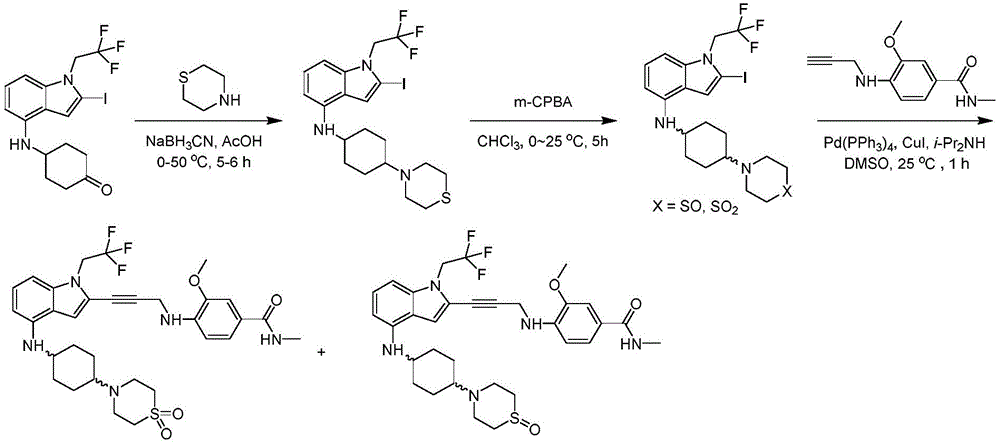
Compounds 366A, 367A, 368A and 369A were prepared by a procedure analogous to example C54 using 3-methoxy-N-methyl-4- (prop-2-yn-1-ylamino) benzamide instead of 2-methoxy-4- (methylsulfonyl) -N- (prop-2-yn-1-yl) aniline.
4- ((3- (4- (((1S,4S) -4- (1, 1-thiomorpholino) cyclohexyl) amino) -1- (2,2, 2-trifluoroethyl) -1H-indol-2-yl) prop-2-yn-1-yl) amino) -3-methoxy-N-methylbenzamide, MS (ES) + M/z) 646.2; 3-methoxy-N-methyl-4- { [3- (4- { [ (1R,4R) -4- (1-oxo-1. lamda.) - 4 -thiomorpholin-4-yl) cyclohexyl]Amino } -1- (2,2, 2-trifluoroethyl) -1H-indol-2-yl) prop-2-yn-1-yl]Amino } benzamide, MS (ES) + M/z) 630.6; and 3-methoxy-N-methyl-4- { [3- (4- { [ (1S,4S) -4- (1-oxo-1. lamda.) 4 -thiomorpholin-4-yl) cyclohexyl]Amino } -1- (2,2, 2-trifluoroethyl) -1H-indol-2-yl) prop-2-yn-1-yl]Amino } benzamide, MS (ES) + ,m/z):630.2。
Example C56: preparation of compounds 370A, 371A, 372A and 373A.

Compounds 370A, 371A, 372A and 373A were prepared by a procedure similar to example C54 using 3-methoxy-4- (prop-2-yn-1-ylamino) benzenesulfonamide instead of 2-methoxy-4- (methylsulfonyl) -N- (prop-2-yn-1-yl) aniline.
3-methoxy-4- { [3- (4- { [ (1S,4S) -4- (1, 1-dioxo-1. lamda.) - 6 -thiomorpholin-4-yl) cyclohexyl]Amino } -1- (2,2, 2-trifluoroethyl) -1H-indol-2-yl) prop-2-yn-1-yl]Amino } benzene-1-sulfonamide, MS (ES) + M/z) 668.1; 3-methoxy-4- { [3- (4- { [ (1R,4R) -4- (1-oxo-1. lamda.) 4 -thiomorpholin-4-yl) cyclohexyl]Amino } -1- (2,2, 2-trifluoroethyl) -1H-indol-2-yl) prop-2-yn-1-yl]Amino } benzene-1-sulfonamide, MS (ES) + M/z) 652.2; and 3-methoxy-4- { [3- (4- { [ (1S,4S) -4- (1-oxo-1. lamda.4-thiomorpholin-4-yl) cyclohexyl ]Amino } -1- (2,2, 2-trifluoroethyl) -1H-indol-2-yl) prop-2-yn-1-yl]Amino } benzene-1-sulfonamide, MS (ES) + ,m/z):652.1。
Example C57: general procedure for the preparation of Compounds 348A, 349A, 414A and 415A

Step 1: to a solution of 4- ((2-iodo-1- (2,2, 2-trifluoroethyl) -1H-indol-4-yl) amino) cyclohex-1-one (1 eq) and amine RH (2 eq) in THF (2mL) was added MgSO 4 (5 equivalents). The mixture was stirred at 25 ℃ for 0.5 h and NaBH (OAc) was added 3 (2 equivalents). The mixture was stirred at 25 ℃ for 1 hour, and subsequent TLC/LC-MS analysis indicated complete consumption of the starting material. The reaction mixture was diluted with water (10mL) and extracted with EtOAc (2mL × 2). The combined organic layers were washed with brine (10mL), dried over anhydrous sodium sulfate, filtered and concentrated under reduced pressure. The residue was purified by column chromatography (SiO) 2 PE: EtOAc ═ 3:1 to DCM: MeOH ═ 10:1) purification to give 2-iodo-N- [4- (3-methoxy-1-piperidinyl) cyclohexyl]-1- (2,2, 2-trifluoroethyl) indol-4-amine (600mg, crude) as a yellow solid.
Step 2: the R-substituted iodoindole indicated above was coupled with 2-methoxy-4- (methylsulfonyl) -N- (prop-2-yn-1-yl) aniline according to the general procedure indicated in example C51. In each case, TLC/LC-MS analysis indicated complete consumption of the starting material after 1 hour of heating at 45 ℃.
2- {3- [ (4-Methylsulfonyl-2-methoxyphenyl) aminoBase (C)]Prop-1-yn-1-yl } -N- [ (1R,4R) -4- (3-methoxypiperidin-1-yl) cyclohexyl]-1- (2,2, 2-trifluoroethyl) -1H-indol-4-amine, MS (ES) + M/z) 647.2; 2- {3- [ (4-Methylsulfonyl-2-methoxyphenyl) amino]Prop-1-yn-1-yl } -N- [ (1S,4S) -4- (3-methoxypiperidin-1-yl) cyclohexyl]-1- (2,2, 2-trifluoroethyl) -1H-indol-4-amine, MS (ES) + M/z) 647.2; 2- {3- [ (4-Methylsulfonyl-2-methoxyphenyl) amino]Prop-1-yn-1-yl } -N- [ (1R,4R) -4- { 3-oxa-9-azaspiro [5.5 ] z]Undec-9-yl cyclohexyl]-1- (2,2, 2-trifluoroethyl) -1H-indol-4-amine, MS (ES) + M/z) 687.3; and 2- {3- [ (4-methanesulfonyl-2-methoxyphenyl) amino]Prop-1-yn-1-yl } -N- [ (1S,4S) -4- { 3-oxa-9-azaspiro [5.5 ]]Undec-9-yl cyclohexyl]-1- (2,2, 2-trifluoroethyl) -1H-indol-4-amine, MS (ES) + ,m/z):687.3。
Example C58: general procedure for the preparation of compounds 356A, 357A, 416A, and 417A.

Compounds 356A, 357A, 416A and 417A were prepared by a procedure analogous to example C51 using 3-methoxy-N-methyl-4- (prop-2-yn-1-ylamino) benzamide instead of 2-methoxy-4- (methylsulfonyl) -N- (prop-2-yn-1-yl) aniline.
3-methoxy-N-methyl-4- { [3- (4- { [ (1R,4R) -4- (3-methoxypiperidin-1-yl) cyclohexyl ]Amino } -1- (2,2, 2-trifluoroethyl) -1H-indol-2-yl) prop-2-yn-1-yl]Amino } benzamide, MS (ES) + M/z) 626.3; 3-methoxy-N-methyl-4- { [3- (4- { [ (1S,4S) -4- (3-methoxypiperidin-1-yl) cyclohexyl]Amino } -1- (2,2, 2-trifluoroethyl) -1H-indol-2-yl) prop-2-yn-1-yl]Amino } benzamide, MS (ES) + M/z) 626.3; 3-methoxy-N-methyl-4- { [3- (4- { [ (1R,4R) -4- { 3-oxa-9-azaspiro [5.5 ]]Undec-9-yl cyclohexyl]Amino } -1- (2,2, 2-trifluoroethyl) -1H-indol-2-yl) prop-2-yn-1-yl]Amino } benzamide, MS (ES) + M/z) 666.4; and 3-methoxy-N-methyl-4- { [3- (4- { [ (1S,4S) -4- { 3-oxa-9-azaspiro [5.5 ]]Undec-9-yl cyclohexyl]Amino } -1- (2,2, 2-trifluoroethyl) -1H-indol-2-yl radical) Prop-2-yn-1-yl]Amino } benzamide, MS (ES) + ,m/z):666.3。
Example C59: general procedure for the preparation of compounds 358A, 359A, 418A and 419A.
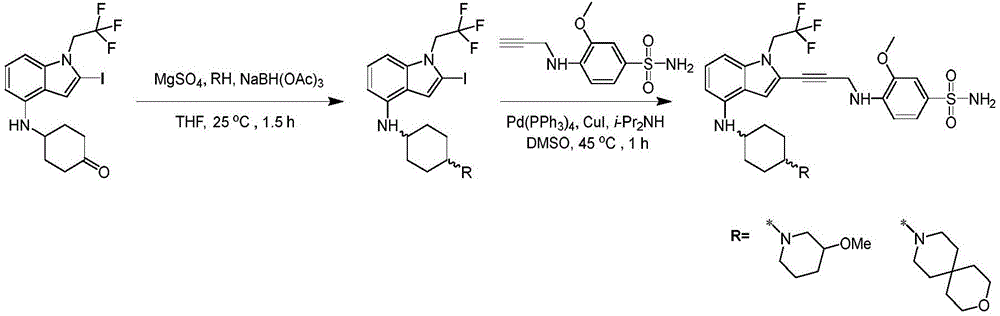
Compounds 358A, 359A, 418A and 419A were prepared by a procedure similar to example C51 using 3-methoxy-4- (prop-2-yn-1-ylamino) benzenesulfonamide instead of 2-methoxy-4- (methylsulfonyl) -N- (prop-2-yn-1-yl) aniline.
3-methoxy-4- { [3- (4- { [ (1R,4R) -4- (3-methoxypiperidin-1-yl) cyclohexyl]Amino } -1- (2,2, 2-trifluoroethyl) -1H-indol-2-yl) prop-2-yn-1-yl ]Amino } benzene-1-sulfonamide, MS (ES) + M/z) 648.3; 3-methoxy-4- { [3- (4- { [ (1S,4S) -4- (3-methoxypiperidin-1-yl) cyclohexyl]Amino } -1- (2,2, 2-trifluoroethyl) -1H-indol-2-yl) prop-2-yn-1-yl]Amino } benzene-1-sulfonamide, MS (ES) + M/z) 648.3; 3-methoxy-4- { [3- (4- { [ (1R,4R) -4- { 3-oxa-9-azaspiro [5.5 ]]Undec-9-yl cyclohexyl]Amino } -1- (2,2, 2-trifluoroethyl) -1H-indol-2-yl) prop-2-yn-1-yl]Amino } benzene-1-sulfonamide, MS (ES) + M/z) 688.3; and 3-methoxy-4- { [3- (4- { [ (1S,4S) -4- { 3-oxa-9-azaspiro [5.5 ]]Undec-9-yl cyclohexyl]Amino } -1- (2,2, 2-trifluoroethyl) -1H-indol-2-yl) prop-2-yn-1-yl]Amino } benzene-1-sulfonamide, MS (ES) + ,m/z):688.3。
Example (b): general procedure for the preparation of compounds 188A, 189A, 336A, 337A, 383A, 384A, 432A, 433A, 451A and 452A.
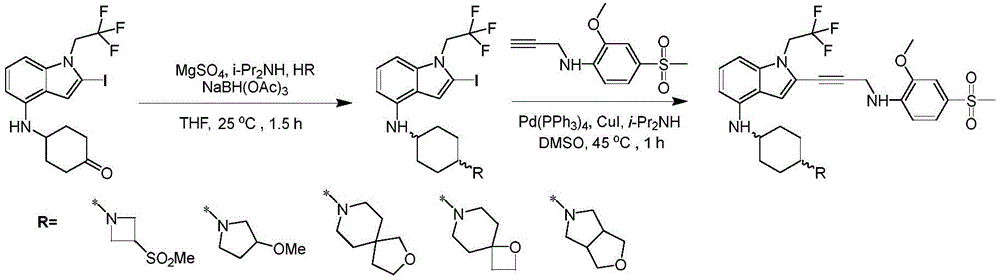
Representative procedure:
step 1: to 4- [ [ 2-iodo-1- (2,2, 2-trifluoroethyl) indol-4-yl group]Amino group]Cyclohexanone (600mg,1.31mmol,1 eq.) and a solution of 3-methoxypiperidine (301mg,2.61mmol,2 eq.) in THF (5mL) were added MgSO 4 (786.4mg,6.53mmol5 equivalents). The mixture was stirred at 25 ℃ for 0.5 hour. Mixing NaBH (OAc) 3 (553.9mg,2.61mmol,2 equiv.) was added to the mixture and the mixture was stirred at 25 ℃ for 1 hour. TLC analysis (DCM: MeOH ═ 10:1) indicated complete consumption of the ketone and detected two major new spots, more polar than the starting material. The reaction mixture was diluted with water (10mL) and extracted with EtOAc (10mL × 2). The combined organic layers were washed with brine (10mL), dried over anhydrous sodium sulfate, filtered and concentrated under reduced pressure to give a residue. The residue was purified by column chromatography (SiO) 2 PE: EtOAc ═ 3:1 to DCM: MeOH ═ 10:1) purification to give 2-iodo-N- [4- (3-methoxy-1-piperidinyl) cyclohexyl]-1- (2,2, 2-trifluoroethyl) indol-4-amine (600mg, crude) as a yellow solid.
Step 2: the R-substituted iodoindole indicated above was coupled with 2-methoxy-4- (methylsulfonyl) -N- (prop-2-yn-1-yl) aniline according to the general procedure indicated in example C51. In each case, TLC/LC-MS analysis indicated complete consumption of the starting material after 1 hour of heating at 45 ℃.
2- {3- [ (4-Methylsulfonyl-2-methoxyphenyl) amino]Prop-1-yn-1-yl } -N- [ (1R,4R) -4- (3-methanesulfonylazetidin-1-yl) cyclohexyl]-1- (2,2, 2-trifluoroethyl) -1H-indol-4-amine, MS (ES) + M/z) 667.2; 2- {3- [ (4-Methylsulfonyl-2-methoxyphenyl) amino]Prop-1-yn-1-yl } -N- [ (1S,4S) -4- (3-methanesulfonylazetidin-1-yl) cyclohexyl]-1- (2,2, 2-trifluoroethyl) -1H-indol-4-amine, MS (ES) + M/z) 667.2; 2- (3- ((2-methoxy-4- (methyl- (methylene) sulfinyl) phenyl) amino) prop-1-yn-1-yl) -N- ((1R,4R) -4- (3-methoxypyrrolidin-1-yl) cyclohexyl) -1- (2,2, 2-trifluoroethyl) -1H-indol-4-amine, MS (ES) + M/z) 633.2; 2- (3- ((2-methoxy-4- (methyl- (methylene) sulfinyl) phenyl) amino) prop-1-yn-1-yl) -N- ((1S,4S) -4- (3-methoxypyrrolidin-1-yl) cyclohexyl) -1- (2,2, 2-trifluoroethyl) -1H-indol-4-amine, MS (ES) + M/z) 633.2; n- ((1R,4R) -4- (2-oxa-8-azaspiro [ 4.5)]Dec-8-yl) cyclohexyl) -2- (3- ((2-methoxy-4- (methylsulfonyl) phenyl) amino) prop-1-yn-1-yl) -1- (2,2, 2-trifluoroethyl) -1H-benzo [ d]Imidazole-4-amine, MS (ES) + ,m/z):673.3;N-((1S,4S)-4-(2-oxa-8-azaspiro [4.5 ]]Dec-8-yl) cyclohexyl) -2- (3- ((2-methoxy-4- (methylsulfonyl) phenyl) amino) prop-1-yn-1-yl) -1- (2,2, 2-trifluoroethyl) -1H-benzo [ d]Imidazole-4-amine, MS (ES) + M/z) 673.3; 2- {3- [ (4-Methylsulfonyl-2-methoxyphenyl) amino]Prop-1-yn-1-yl } -N- [ (1R,4R) -4- { 1-oxa-7-azaspiro [3.5 ]]Non-7-yl cyclohexyl]-1- (2,2, 2-trifluoroethyl) -1H-indol-4-amine, MS (ES) + M/z) 659.3; 2- {3- [ (4-Methylsulfonyl-2-methoxyphenyl) amino]Prop-1-yn-1-yl } -N- [ (1S,4S) -4- { 1-oxa-7-azaspiro [3.5 ] spirol]Non-7-yl cyclohexyl]-1- (2,2, 2-trifluoroethyl) -1H-indol-4-amine, MS (ES) + M/z) 659.3; 2- {3- [ (4-Methylsulfonyl-2-methoxyphenyl) amino]Prop-1-yn-1-yl } -N- [ (1R,4R) -4- { hexahydro-1H-furo [3, 4-c)]Pyrrol-5-yl } cyclohexyl]-1- (2,2, 2-trifluoroethyl) -1H-indol-4-amine, MS (ES) + M/z) 645.2; and 2- {3- [ (4-methanesulfonyl-2-methoxyphenyl) amino]Prop-1-yn-1-yl } -N- [ (1S,4S) -4- { hexahydro-1H-furo [3, 4-c) ]Pyrrol-5-yl } cyclohexyl]-1- (2,2, 2-trifluoroethyl) -1H-indol-4-amine, MS (ES) + ,m/z):645.2。
Example C60: general procedure for the preparation of compounds 192A, 193A, 385A, 386A, 428A, 429A, 434A, 435A, 453A and 454A.
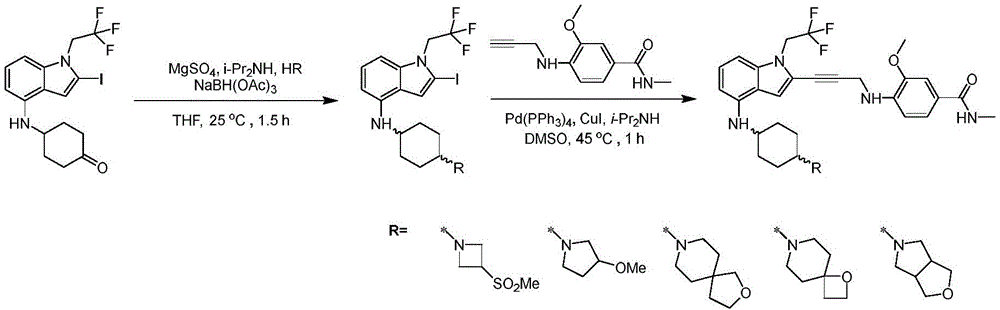
Compounds 192A, 193A, 385A, 386A, 428A, 429A, 434A, 435A, 453A, and 454A were prepared by procedures analogous to the synthesis of the compound described in example C51, using 3-methoxy-N-methyl-4- (prop-2-yn-1-ylamino) benzamide instead of 2-methoxy-4- (methylsulfonyl) -N- (prop-2-yn-1-yl) aniline.
3-methoxy-N-methyl-4- { [3- (4- { [ (1R,4R) -4- (3-methanesulfonyl azetidin-1-yl) cyclohexyl]Amino } -1- (2,2, 2-trifluoroethyl) -1H-indol-2-yl) prop-2-yn-1-yl]Amino } benzamide, MS (ES) + M/z) 646.2; 3-methoxy-N-methyl-4- { [3- (4- { [ (1S,4S) -4- (3-methanesulfonyl azetidin-1-yl) cyclohexyl]Amino } -1- (2,2, 2-trifluoroethyl) -1H-indol-2-yl) prop-2-yn-1-yl]Amino-benzoylAmine, MS (ES) + M/z) 646.2; 3-methoxy-N-methyl-4- { [3- (4- { [ (1R,4R) -4- (3-methoxypyrrolidin-1-yl) cyclohexyl]Amino } -1- (2,2, 2-trifluoroethyl) -1H-indol-2-yl) prop-2-yn-1-yl]Amino } benzamide, MS (ES) + ,m/z):612.3;
3-methoxy-N-methyl-4- { [3- (4- { [ (1S,4S) -4- (3-methoxypyrrolidin-1-yl) cyclohexyl]Amino } -1- (2,2, 2-trifluoroethyl) -1H-indol-2-yl) prop-2-yn-1-yl]Amino } benzamide, MS (ES) + M/z) 612.3; 4- ((3- (4- (((1R,4R) -4- (2-oxa-8-azaspiro [ 4.5))]Dec-8-yl) cyclohexyl) amino) -1- (2,2, 2-trifluoroethyl) -1H-benzo [ d]Imidazol-2-yl) prop-2-yn-1-yl) amino) -3-methoxy-N-methylbenzamide, MS (ES) + M/z) 652.3; 4- ((3- (4- (((1S,4S) -4- (2-oxa-8-azaspiro [ 4.5))]Dec-8-yl) cyclohexyl) amino) -1- (2,2, 2-trifluoroethyl) -1H-benzo [ d]Imidazol-2-yl) prop-2-yn-1-yl) amino) -3-methoxy-N-methylbenzamide, MS (ES) + M/z) 652.3; 4- ((3- (4- (((1S,4S) -4- (2-oxa-8-azaspiro [ 4.5))]Dec-8-yl) cyclohexyl) amino) -1- (2,2, 2-trifluoroethyl) -1H-benzo [ d]Imidazol-2-yl) prop-2-yn-1-yl) amino) -3-methoxy-N-methylbenzamide, MS (ES) + M/z) 652.3; 3-methoxy-N-methyl-4- { [3- (4- { [ (1R,4R) -4- { 1-oxa-7-azaspiro [3.5 ]]Non-7-yl cyclohexyl]Amino } -1- (2,2, 2-trifluoroethyl) -1H-indol-2-yl) prop-2-yn-1-yl]Amino } benzamide, MS (ES) + M/z) 638.3; 3-methoxy-N-methyl-4- { [3- (4- { [ (1S,4S) -4- { 1-oxa-7-azaspiro [3.5 ] ]Non-7-yl cyclohexyl]Amino } -1- (2,2, 2-trifluoroethyl) -1H-indol-2-yl) prop-2-yn-1-yl]Amino } benzamide, MS (ES) + M/z) 638.3; 3-methoxy-N-methyl-4- { [3- (4- { [ (1R,4R) -4- { hexahydro-1H-furo [3, 4-c)]Pyrrol-5-yl } cyclohexyl]Amino } -1- (2,2, 2-trifluoroethyl) -1H-indol-2-yl) prop-2-yn-1-yl]Amino } benzamide, MS (ES) + M/z) 624.3; and 3-methoxy-N-methyl-4- { [3- (4- { [ (1S,4S) -4- { hexahydro-1H-furo [3, 4-c)]Pyrrol-5-yl } cyclohexyl]Amino } -1- (2,2, 2-trifluoroethyl) -1H-indol-2-yl) prop-2-yn-1-yl]Amino } benzamide, MS (ES) + ,m/z):624.3。
Example C61: general procedure for the preparation of compounds 190A, 191A, 338A, 339A, 387A, 388A, 412A, 413A, 430A and 431A.
Compounds 190A, 191A, 338A, 339A, 387A, 388A, 412A, 413A, 430A and 431A were prepared by a procedure similar to example C51, using 3-methoxy-4- (prop-2-yn-1-ylamino) benzenesulfonamide instead of 2-methoxy-4- (methylsulfonyl) -N- (prop-2-yn-1-yl) aniline.
3-methoxy-4- { [3- (4- { [ (1R,4R) -4- (3-methanesulfonyl azetidin-1-yl) cyclohexyl]Amino } -1- (2,2, 2-trifluoroethyl) -1H-indol-2-yl) prop-2-yn-1-yl]Amino } benzene-1-sulfonamide, MS (ES) + M/z) 668.2; 3-methoxy-4- { [3- (4- { [ (1S,4S) -4- (3-methanesulfonylazetidin-1-yl) cyclohexyl]Amino } -1- (2,2, 2-trifluoroethyl) -1H-indol-2-yl) prop-2-yn-1-yl]Amino } benzene-1-sulfonamide, MS (ES) + M/z) 668.2; 3-methoxy-4- ((3- (4- (((1R,4R) -4- (3-methoxypyrrolidin-1-yl) cyclohexyl) amino) -1- (2,2, 2-trifluoroethyl) -1H-indol-2-yl) prop-2-yn-1-yl) amino) benzenesulfonamide, MS (ES) + M/z) 634.3; 3-methoxy-4- ((3- (4- (((1S,4S) -4- (3-methoxypyrrolidin-1-yl) cyclohexyl) amino) -1- (2,2, 2-trifluoroethyl) -1H-indol-2-yl) prop-2-yn-1-yl) amino) benzenesulfonamide, MS (ES) + M/z) 634.3; 4- ((3- (4- (((1R,4R) -4- (2-oxa-8-azaspiro [ 4.5))]Dec-8-yl) cyclohexyl) amino) -1- (2,2, 2-trifluoroethyl) -1H-benzo [ d]Imidazol-2-yl) prop-2-yn-1-yl) amino) -3-methoxybenzenesulfonamide, MS (ES) + M/z) 674.3; 4- ((3- (4- (((1S,4S) -4- (2-oxa-8-azaspiro [ 4.5))]Dec-8-yl) cyclohexyl) amino) -1- (2,2, 2-trifluoroethyl) -1H-benzo [ d]Imidazol-2-yl) prop-2-yn-1-yl) amino) -3-methoxybenzenesulfonamide, MS (ES) + M/z) 674.3; 3-methoxy-4- { [3- (4- { [ (1R,4R) -4- { 1-oxa-7-azaspiro [3.5 ]]Non-7-yl cyclohexyl]Amino } -1- (2,2, 2-trifluoroethyl) -1H-indol-2-yl) prop-2-yn-1-yl ]Amino } benzene-1-sulfonamide, MS (ES) + M/z) 660.3; 3-methoxy-4- { [3- (4- { [ (1S,4S) -4- { 1-oxa-7-azaspiro [3.5 ]]Non-7-yl cyclohexyl]Amino } -1- (2,2, 2-trifluoroethyl) -1H-indol-2-yl) prop-2-yn-1-yl]Amino } benzene-1-sulfonamide, MS (ES) + M/z) 660.3; 3-methoxy-4- { [3- (4- { [ (1R,4R) -4- { hexahydro-1H-furo [3, 4-c)]Pyrrol-5-yl } cyclohexyl]Amino } -1- (2,2, 2-trifluoroethyl) -1H-indole-2-yl) prop-2-yn-1-yl]Amino } benzene-1-sulfonamide, MS (ES) + M/z) 646.3; and 3-methoxy-4- { [3- (4- { [ (1S,4S) -4- { hexahydro-1H-furo [3, 4-c)]Pyrrol-5-yl } cyclohexyl]Amino } -1- (2,2, 2-trifluoroethyl) -1H-indol-2-yl) prop-2-yn-1-yl]Amino } benzene-1-sulfonamide, MS (ES) + ,m/z):646.3。
Example C62: general procedure for the preparation of compounds 206A, 207A, 208A, 209A, 606A, 607A, 624A, 627A, 628A, 761A and 760A.

R is prepared according to the general procedure indicated in example C51 2 Substituted alkynes with R as indicated above 1 -substituted iodoindole coupling. The reaction was considered complete after stirring for 1 hour at 30 ℃ in each case.
N- [ 3-methoxy-4- ({3- [4- ({1- [ (2-oxo-1, 3-dioxolan-4-yl) methyl)]Piperidin-4-yl } amino) -1- (2,2, 2-trifluoroethyl) -1H-indol-2-yl ]Prop-2-yn-1-yl } amino) benzenesulfonyl]Acetamide, MS (ES) + M/z) 678.2. N- ((3-methoxy-4- ((3- (4- ((1- ((2-oxo-1, 3-dioxolan-4-yl) methyl) piperidin-4-yl) amino) -1- (2,2, 2-trifluoroethyl) -1H-indol-2-yl) prop-2-yn-1-yl) amino) phenyl) sulfonyl) propanamide, MS (ES) + M/z) 692.2; n- (4- { [3- (4- { [1- (2-hydroxy-3-methoxypropyl) piperidin-4-yl]Amino } -1- (2,2, 2-trifluoroethyl) -1H-indol-2-yl) prop-2-yn-1-yl]Amino } -3-methoxybenzenesulfonyl) -N-methylpropanamide, MS (ES) + M/z) 694.3; n- (3-methoxy-4- { [3- (4- { [ (1R,4R) -4- { 2-oxa-6-azaspiro [3.3 ]]Hept-6-yl } cyclohexyl radical]Amino } -1- (2,2, 2-trifluoroethyl) -1H-indol-2-yl) prop-2-yn-1-yl]Amino } benzenesulfonyl) acetamide, MS (ES) + M/z) 674.3; n- (3-methoxy-4- { [3- (4- { [ (1S,4S) -4- { 2-oxa-6-azaspiro [3.3 ]]Hept-6-yl } cyclohexyl radical]Amino } -1- (2,2, 2-trifluoroethyl) -1H-indol-2-yl) prop-2-yn-1-yl]Amino } benzenesulfonyl) acetamide, MS (ES) + M/z) 674.3; n- (3-methoxy-4- { [3- (4- { [ (1R,4R) -4- { 2-oxa-6-azaspiro [3.3 ]]Hept-6-yl } cyclohexyl]Amino } -1- (2,2, 2-trisFluoroethyl) -1H-indol-2-yl) prop-2-yn-1-yl]Amino } benzenesulfonyl) propanamide, MS (ES) + M/z) 688.4; and N- (3-methoxy-4- { [3- (4- { [ (1S,4S) -4- { 2-oxa-6-azaspiro [3.3 ]]Hept-6-yl } cyclohexyl]Amino } -1- (2,2, 2-trifluoroethyl) -1H-indol-2-yl) prop-2-yn-1-yl]Amino } benzenesulfonyl) propanamide, MS (ES) + M/z) 688.4; n- (4- { [3- (4- { [1- (2-hydroxy-3-methoxypropyl) piperidin-4-yl]Amino } -1- (2,2, 2-trifluoroethyl) -1H-indol-2-yl) prop-2-yn-1-yl]Amino } -3-methoxybenzenesulfonyl) acetamide, MS (ES) + M/z) 666.2; 1-methoxy-3- (4- { [2- (3- { [ 2-methoxy-4- (propionamidosulfonyl) phenyl]Amino } prop-1-yn-1-yl) -1- (2,2, 2-trifluoroethyl) -1H-indol-4-yl]Amino } piperidin-1-yl) propan-2-yl propionate, MS (ES) + M/z) 736.3; 1- (4- { [2- (3- { [ 2-methoxy-4- (propionamidosulfonyl) phenyl]Amino } prop-1-yn-1-yl) -1- (2,2, 2-trifluoroethyl) -1H-indol-4-yl]Amino } piperidin-1-yl) -3- (propionyloxy) propan-2-yl propionate, MS (ES) + M/z) 778.1; and N- (4- { [3- (4- { [1- (2-hydroxy-3-methoxypropyl) piperidin-4-yl]Amino } -1- (2,2, 2-trifluoroethyl) -1H-indol-2-yl) prop-2-yn-1-yl]Amino } -3-methoxybenzenesulfonyl) propanamide, MS (ES) + ,m/z):680.3。
Example C63: general procedure for the preparation of compounds 94A, 100A, 109A, 112A, 115A, 116A, 233A, 245A, 246A, 488A and 651A.

R indicated above was prepared according to the general procedure indicated in example C51 1 -substituted iodoindoles with R 2 -substituted alkyne coupling. In each case, the reaction was deemed complete after stirring for 1 hour at 45 ℃, and the crude compound was first purified by preparative TLC and further purified by preparative HPLC.
(1R,4R)-N 4 - {2- [3- (2-amino-4-methanesulfonylphenoxy) prop-1-yn-1-yl]-1- (2,2, 2-trifluoroethyl) -1H-indol-4-yl } -N 1 ,N 1 Dimethylcyclohexane-1, 4-diamine, MS (ES) + ,m/z):563.2;(1S,4S)-N 4 - {2- [3- (2-amino-4-methanesulfonylphenoxy) prop-1-yn-1-yl]-1- (2,2, 2-trifluoroethyl) -1H-indol-4-yl } -N 1 ,N 1 Dimethylcyclohexane-1, 4-diamine, MS (ES) + M/z) 563.1; n- (5-Methylsulfonyl-2- { [3- (4- { [ (1R,4R) -4- (dimethylamino) cyclohexyl]Amino } -1- (2,2, 2-trifluoroethyl) -1H-indol-2-yl) prop-2-yn-1-yl]Oxy } phenyl) acetamide, MS (ES) + M/z) 605.2; n- (5-methanesulfonyl-2- { [3- (4- { [ (1S,4S) -4- (dimethylamino) cyclohexyl [ ]]Amino } -1- (2,2, 2-trifluoroethyl) -1H-indol-2-yl) prop-2-yn-1-yl]Oxy } phenyl) acetamide, MS (ES) + M/z) 605.2; 1- {4- [ (2- {3- [ 4-methanesulfonyl-2- (methylamino) phenoxy ] phenoxy [ ]]Prop-1-yn-1-yl } -1- (2,2, 2-trifluoroethyl) -1H-indol-4-yl) amino ]Piperidin-1-yl } -3-methoxypropan-2-ol, MS (ES) + ,m/z):623.4;(1R,4R)-N 4 - (2- {3- [ 4-methanesulfonyl-2- (methylamino) phenoxy)]Prop-1-yn-1-yl } -1- (2,2, 2-trifluoroethyl) -1H-indol-4-yl) -N 1 ,N 1 Dimethylcyclohexane-1, 4-diamine, MS (ES) + M/z) 577.3; 2- {3- [ 4-Methylsulfonyl-2- (methylamino) phenoxy group]Prop-1-yn-1-yl } -N- [ (1R,4R) -4- { 2-oxa-6-azaspiro [3.3]Hept-6-yl } cyclohexyl]-1- (2,2, 2-trifluoroethyl) -1H-indol-4-amine, MS (ES) + M/z) 631.2; 2- [3- (2-amino-4-methanesulfonylphenoxy) prop-1-yn-1-yl]-N- [ (1R,4R) -4- { 2-oxa-6-azaspiro [3.3]Hept-6-yl } cyclohexyl]-1- (2,2, 2-trifluoroethyl) -1H-indol-4-amine, MS (ES) + M/z) 617.2; 2- [3- (2-amino-4-methanesulfonylphenoxy) prop-1-yn-1-yl]-N- [ (1S,4S) -4- { 2-oxa-6-azaspiro [3.3]Hept-6-yl } cyclohexyl]-1- (2,2, 2-trifluoroethyl) -1H-indol-4-amine, MS (ES) + ,m/z):617.1;(1R,4R)-N 4 - (2- {3- [2- (dimethylamino) -4-methanesulfonylphenoxy)]Prop-1-yn-1-yl } -1- (2,2, 2-trifluoroethyl) -1H-indol-4-yl) -N 1 ,N 1 Dimethylcyclohexane-1, 4-diamine, MS (ES) + M/z) 591.2; and 2- {3- [2- (dimethylamino) -4-methanesulfonylphenoxy]Prop-1-yn-1-yl } -N- (1-methylpiperidin-4-yl) -1- (2,2, 2-trifluoroethyl) -1H-indol-4-amine, MS (ES) + ,m/z):563.2。
Example C64: general procedure for the preparation of compounds 164A, 165A, 166A, 167A, 168A, 169A, 261A, 262A, 299A, 300A, 316A, 317A, 340A, 341A, 342A, 343A, 344A, 345A, 379A, 380A, 381A, 382A, 391A, 392A, 490A, 666A, 667A and 668A.

(1R,4R)-N 1 - (2-iodo-1- (2,2, 2-trifluoroethyl) -1H-indol-4-yl) -N 4 - (2-methoxyethyl) -N 4 Methylcyclohexane-1, 4-diamine and (1S,4S) -N 1 - (2-iodo-1- (2,2, 2-trifluoroethyl) -1H-indol-4-yl) -N 4 - (2-methoxyethyl) -N 4 Preparation of methylcyclohexane-1, 4-diamine: a mixture of 4- ((2-iodo-1- (2,2, 2-trifluoroethyl) -1H-indol-4-yl) amino) cyclohex-1-one (300mg,0.675mmol,1 eq), 2-methoxy-N-methyl-ethylamine (2.70mmol, 290. mu.L, 4 eq) and Ti (OEt) 4 A mixture (2.70mmol, 560. mu.L, 4 equiv.) in EtOH (3mL) was stirred at 50 ℃ for 11 h. Then NaBH is added 3 CN (84.7mg,1.35mmol,2 equiv.), and the mixture was further stirred at 50 ℃ for 1 hour. TLC analysis (PE: EtOAc: 3:1, R) f 0.01) indicating completion of the reaction. By addition of saturated NaHCO at 25 deg.C 3 The reaction mixture was quenched (60mL) with water (20mL) and extracted with EtOAc (30mL x 3). The combined organic layers were dried over anhydrous sodium sulfate, filtered and concentrated under reduced pressure. The resulting residue was passed through preparative TLC (PE: EtOAc: TEA ═ 5:5:1, Rf) 1 =0.24,Rf 2 0.43) was purified. To obtain (1R,4R) -N 1 - (2-iodo-1- (2,2, 2-trifluoroethyl) -1H-indol-4-yl) -N 4 - (2-methoxyethyl) -N 4 -methylcyclohexane-1, 4-diamine (90mg, 159. mu. mol, 23.6% yield) and (1S,4S) -N 1 - (2-iodo-1- (2,2, 2-trifluoroethyl) -1H-indol-4-yl) -N 4 - (2-methoxyethyl) -N 4 Methylcyclohexane-1, 4-diamine (130mg, 231. mu. mol, 34.2% yield) as a pale yellow solid.

(1R,4R)-N 1 - (2-iodo-1- (2,2, 2-trifluoroethyl) -1H-indol-4-yl) -N 4 ,N 4 Bis (2-methoxyethyl) cyclohexane-1, 4-diamine and (1S,4S) -N 1 - (2-iodo-1- (2,2, 2-trifluoroethyl) -1H-indol-4-yl) -N 4 ,N 4 Preparation of bis (2-methoxyethyl) cyclohexane-1, 4-diamine: to a mixture of 4- ((2-iodo-1- (2,2, 2-trifluoroethyl) -1H-indol-4-yl) amino) cyclohex-1-one (250mg, 573. mu. mol,1 eq) and AcOH (1.15mmol, 65.6. mu.L, 2 eq) in pure bis (2-methoxyethyl) amine (16.93mmol,2.50mL,29.5 eq) was added NaBH 3 CN (72.0mg,1.15mmol,2 equiv.). The mixture was stirred at 50 ℃ for 1 hour, followed by TLC analysis (PE: EtOAc ═ 3:1, Rf) 1 =0.18,Rf 2 0.24) indicating completion of the reaction. The reaction mixture was quenched with water (40mL) and extracted with EtOAc (20mL × 3). The combined organic layers were dried over anhydrous sodium sulfate, filtered, and concentrated under reduced pressure to give a residue which was passed through preparative TLC (SiO) 2 PE: EtOAc ═ 3:1) purification. To obtain (1R,4R) -N 1 - (2-iodo-1- (2,2, 2-trifluoroethyl) -1H-indol-4-yl) -N 4 ,N 4 Bis (2-methoxyethyl) cyclohexane-1, 4-diamine (120mg, 184. mu. mol, 32.2% yield) and (1S,4S) -N 1 - (2-iodo-1- (2,2, 2-trifluoroethyl) -1H-indol-4-yl) -N 4 ,N 4 Bis (2-methoxyethyl) cyclohexane-1, 4-diamine (110mg,179 μmol, 31.2% yield) as a light yellow solid.
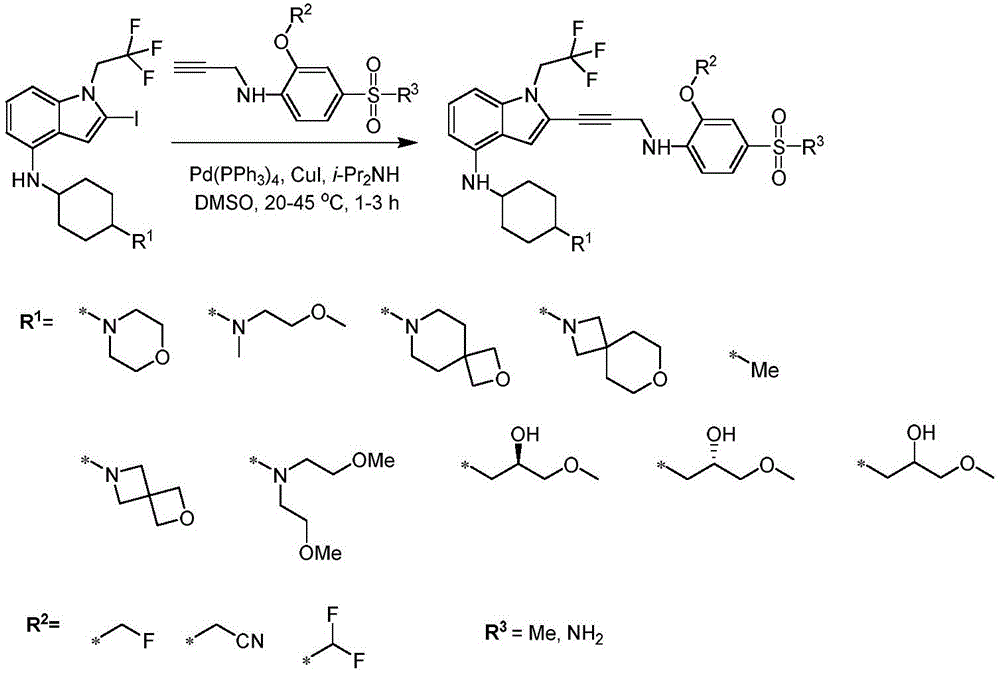
Preparation of the final product: to R 2 And R 3 Mixture of substituted alkynes (1-2 equiv.) in DMSO (5mL) was added i-Pr 2 NH (10-30 equivalents). Then, CuI (1-2 equiv.), R 1 Substituted iodoindoles (1 equivalent) and Pd (PPh) 3 ) 4 (0.20-0.50 equivalents) was added to the mixture. In N 2 The mixture is then stirred at 20-45 ℃ for 1-3 hours. Completion of the reaction was detected by LC-MS or TLC analysis. The mixture was poured into a saturated EDTA solution (30mL) and stirred for 1 hour. The aqueous phase was extracted with EtOAc (10mL x 3). The combined organic layers were washed with brine (10 mL. times.3)Washed, dried over anhydrous sodium sulfate, filtered and concentrated in vacuo. The residue was purified by TLC, preparative HPLC, or TLC and preparative HPLC to give the desired compound.
3- (cyanomethoxy) -4- { [3- (4- { [ (1R,4R) -4- (morpholin-4-yl) cyclohexyl]Amino } -1- (2,2, 2-trifluoroethyl) -1H-indol-2-yl) prop-2-yn-1-yl ]Amino } benzene-1-sulfonamide, MS (ES) + M/z) 645.2; 3- (cyanomethoxy) -4- { [3- (4- { [ (1S,4S) -4- (morpholin-4-yl) cyclohexyl]Amino } -1- (2,2, 2-trifluoroethyl) -1H-indol-2-yl) prop-2-yn-1-yl]Amino } benzene-1-sulfonamide, MS (ES) + M/z) 645.2; 3- (cyanomethoxy) -4- { [3- (4- { [ (1R,4R) -4- [ (2-methoxyethyl) (methyl) amino]Cyclohexyl radical]Amino } -1- (2,2, 2-trifluoroethyl) -1H-indol-2-yl) prop-2-yn-1-yl]Amino } benzene-1-sulfonamide, MS (ES) + M/z) 647.2; 3- (cyanomethoxy) -4- { [3- (4- { [ (1S,4S) -4- [ (2-methoxyethyl) (methyl) amino]Cyclohexyl radical]Amino } -1- (2,2, 2-trifluoroethyl) -1H-indol-2-yl) prop-2-yn-1-yl]Amino } benzene-1-sulfonamide, MS (ES) + M/z) 647.2; 3- (cyanomethoxy) -4- { [3- (4- { [ (1R,4R) -4- { 2-oxa-7-azaspiro [3.5 ]]Non-7-yl cyclohexyl]Amino } -1- (2,2, 2-trifluoroethyl) -1H-indol-2-yl) prop-2-yn-1-yl]Amino } benzene-1-sulfonamide, MS (ES) + M/z) 685.2; 3- (Cyanomethoxy) -4- { [3- (4- { [ (1S,4S) -4- { 2-oxa-7-azaspiro [3.5 ]]Non-7-yl cyclohexyl]Amino } -1- (2,2, 2-trifluoroethyl) -1H-indol-2-yl) prop-2-yn-1-yl]Amino } benzene-1-sulfonamide, MS (ES) + M/z) 685.2; 3- (cyanomethoxy) -4- { [3- (4- { [ (1R,4R) -4- { 7-oxa-2-azaspiro [3.5 ] ]Non-2-yl cyclohexyl]Amino } -1- (2,2, 2-trifluoroethyl) -1H-indol-2-yl) prop-2-yn-1-yl]Amino } benzene-1-sulfonamide, MS (ES) + M/z) 685.2; 3- (Cyanomethoxy) -4- { [3- (4- { [ (1S,4S) -4- { 7-oxa-2-azaspiro [3.5 ]]Non-2-yl cyclohexyl]Amino } -1- (2,2, 2-trifluoroethyl) -1H-indol-2-yl) prop-2-yn-1-yl]Amino } benzene-1-sulfonamide, MS (ES) + M/z) 685.2; 3- (Fluoromethoxy) -4- { [3- (4- { [ (1R,4R) -4- (morpholin-4-yl) cyclohexyl]Amino } -1- (2,2, 2-trifluoroethyl) -1H-indol-2-yl) prop-2-yn-1-yl]Amino } benzene-1-sulfonamide, MS (ES) + M/z) 638.2; 3- (Fluoromethoxy) -4- { [3- (4- { [ (1S,4S) -4- (morpholin-4-yl) cyclohexyl]Amino } -1- (2)2, 2-trifluoroethyl) -1H-indol-2-yl) prop-2-yn-1-yl]Amino } benzene-1-sulfonamide, MS (ES) + M/z) 3- (fluoromethoxy) -4- { [3- (4- { [ (1R,4R) -4- [ (2-methoxyethyl) (methyl) amino]Cyclohexyl radical]Amino } -1- (2,2, 2-trifluoroethyl) -1H-indol-2-yl) prop-2-yn-1-yl]Amino } benzene-1-sulfonamide, MS (ES) + M/z) 640.2; 3- (Fluoromethoxy) -4- { [3- (4- { [ (1S,4S) -4- [ (2-methoxyethyl) (methyl) amino]Cyclohexyl radical]Amino } -1- (2,2, 2-trifluoroethyl) -1H-indol-2-yl) prop-2-yn-1-yl]Amino } benzene-1-sulfonamide, MS (ES) + M/z) 640.2; 3- (Fluoromethoxy) -4- { [3- (4- { [ (1R,4R) -4- { 2-oxa-6-azaspiro [3.3 ] ]Hept-6-yl } cyclohexyl]Amino } -1- (2,2, 2-trifluoroethyl) -1H-indol-2-yl) prop-2-yn-1-yl]Amino } benzene-1-sulfonamide, MS (ES) + M/z) 650.2; 3- (Fluoromethoxy) -4- { [3- (4- { [ (1S,4S) -4- { 2-oxa-6-azaspiro [3.3 ]]Hept-6-yl } cyclohexyl]Amino } -1- (2,2, 2-trifluoroethyl) -1H-indol-2-yl) prop-2-yn-1-yl]Amino } benzene-1-sulfonamide, MS (ES) + M/z) 650.2; 3- (Fluoromethoxy) -4- { [3- (4- { [ (1R,4R) -4- { 2-oxa-7-azaspiro [3.5 ]]Non-7-yl cyclohexyl]Amino } -1- (2,2, 2-trifluoroethyl) -1H-indol-2-yl) prop-2-yn-1-yl]Amino } benzene-1-sulfonamide, MS (ES) + M/z) 678.2; 3- (Fluoromethoxy) -4- { [3- (4- { [ (1S,4S) -4- { 2-oxa-7-azaspiro [3.5 ]]Non-7-yl cyclohexyl]Amino } -1- (2,2, 2-trifluoroethyl) -1H-indol-2-yl) prop-2-yn-1-yl]Amino } benzene-1-sulfonamide, MS (ES) + M/z) 678.2; 3- (Fluoromethoxy) -4- { [3- (4- { [ (1R,4R) -4- { 7-oxa-2-azaspiro [3.5 ]]Non-2-yl cyclohexyl]Amino } -1- (2,2, 2-trifluoroethyl) -1H-indol-2-yl) prop-2-yn-1-yl]Amino } benzene-1-sulfonamide, MS (ES) + M/z) 678.2; 3- (Fluoromethoxy) -4- { [3- (4- { [ (1S,4S) -4- { 7-oxa-2-azaspiro [3.5 ]]Non-2-yl cyclohexyl]Amino } -1- (2,2, 2-trifluoroethyl) -1H-indol-2-yl) prop-2-yn-1-yl ]Amino } benzene-1-sulfonamide, MS (ES) + M/z) 678.2; 3- (Fluoromethoxy) -4- { [3- (4- { [ (1R,4R) -4- [ bis (2-methoxyethyl) amino]Cyclohexyl radical]Amino } -1- (2,2, 2-trifluoroethyl) -1H-indol-2-yl) prop-2-yn-1-yl]Amino } benzene-1-sulfonamide, MS (ES) + M/z) 684.2; 3- (Fluoromethoxy) -4- { [3- (4- { [ (1S,4S) -4- [ bis (2-methoxyethyl) amino [)]Cyclohexyl radical]Amino } -1- (2,2, 2-trifluoroethyl) -1H-indol-2-yl) propan-2-yl-alkyn-1-yl]Amino } benzene-1-sulfonamide, MS (ES) + M/z) 684.2; (2R) -1- (4- { [2- (3- { [2- (fluoromethoxy) -4-methanesulfonylphenyl ] sulfonyl]Amino } prop-1-yn-1-yl) -1- (2,2, 2-trifluoroethyl) -1H-indol-4-yl]Amino } piperidin-1-yl) -3-methoxypropan-2-ol, MS (ES) + M/z) 641.2; (2S) -1- (4- { [2- (3- { [2- (fluoromethoxy) -4-methanesulfonylphenyl ] sulfonyl]Amino } prop-1-yn-1-yl) -1- (2,2, 2-trifluoroethyl) -1H-indol-4-yl]Amino } piperidin-1-yl) -3-methoxypropan-2-ol, MS (ES) + M/z) 641.2; 2- (3- { [2- (fluoromethoxy) -4-methanesulfonylphenyl]Amino } prop-1-yn-1-yl) -N- (1-methylpiperidin-4-yl) -1- (2,2, 2-trifluoroethyl) -1H-indol-4-amine, MS (ES) + M/z) 641.2; 2- (3- { [2- (fluoromethoxy) -4-methanesulfonylphenyl]Amino } prop-1-yn-1-yl) -N- [ (1R,4R) -4- { 2-oxa-7-azaspiro [3.5 ]Non-7-yl cyclohexyl]-1- (2,2, 2-trifluoroethyl) -1H-indol-4-amine, MS (ES) + M/z) 677.3; 2- (3- { [2- (fluoromethoxy) -4-methanesulfonylphenyl]Amino } prop-1-yn-1-yl) -N- [ (1S,4S) -4- { 2-oxa-7-azaspiro [3.5]Non-7-yl cyclohexyl]-1- (2,2, 2-trifluoroethyl) -1H-indol-4-amine, MS (ES) + M/z) 677.3; 2- (3- { [2- (fluoromethoxy) -4-methanesulfonylphenyl]Amino } prop-1-yn-1-yl) -N- [ (1R,4R) -4- (morpholin-4-yl) cyclohexyl]-1- (2,2, 2-trifluoroethyl) -1H-indol-4-amine, MS (ES) + M/z) 637.2; 2- (3- { [2- (fluoromethoxy) -4-methanesulfonylphenyl]Amino } prop-1-yn-1-yl) -N- [ (1S,4S) -4- (morpholin-4-yl) cyclohexyl]-1- (2,2, 2-trifluoroethyl) -1H-indol-4-amine, MS (ES) + M/z) 637.2; and 1- (4- { [2- (3- { [2- (di-fluoromethoxy) -4-methanesulfonylphenyl ] sulfonyl]Amino } prop-1-yn-1-yl) -1- (2,2, 2-trifluoroethyl) -1H-indol-4-yl]Amino } piperidin-1-yl) -3-methoxypropan-2-ol, MS (ES) + ,m/z):659.2。
Example C65: general procedure for the preparation of compounds 139A, 138A, 287A, 288A, 289A, 290A, 708A and 713A.

In N 2 To 4-methylsulfonyl-N-prop-2-ynyl-2- (trifluoromethyl) aniline (1-2.5 equivalents) or 2-chloro-4- (methyl)Sulfonyl) -N- (prop-2-yn-1-yl) aniline (1-2.5 eq) in DMSO (2mL) was added i-PrNH at one time 2 (10 equiv.), CuI (1 equiv.), R-substituted iodoindole (0.1g, 195.57. mu. mol,1 equiv.), and Pd (PPh) 3 ) 4 (74.51mg, 64.48. mu. mol,0.3 equiv.). The mixture was stirred at 25 ℃ for 60 minutes, and subsequent TLC analysis indicated that the reaction was complete. The reaction was diluted with EtOAc (20mL) and then poured into 2M aqueous EDTA (20mL) and stirred for 1 hour. The mixture was extracted with EtOAc (20mL x 3) and the combined organic layers were washed with water (20mL x2) and brine (20mL x2), dried over anhydrous sodium sulfate, filtered, and concentrated. The residue was purified by column chromatography (SiO) 2 EtOAc: TEA 100:2) and then further purified by preparative HPLC to give the desired product as a white solid.
1- (4- { [2- (3- { [ 4-methanesulfonyl-2- (trifluoromethyl) phenyl group]Amino } prop-1-yn-1-yl) -1- (2,2, 2-trifluoroethyl) -1H-indol-4-yl]Amino } piperidin-1-yl) -3-methoxypropan-2-ol, MS (ES) + ,m/z):661.3;(1R,4R)-N 4 - [2- (3- { [ 4-methanesulfonyl-2- (trifluoromethyl) phenyl group]Amino } prop-1-yn-1-yl) -1- (2,2, 2-trifluoroethyl) -1H-indol-4-yl]-N 1 ,N 1 Dimethylcyclohexane-1, 4-diamine, MS (ES) + ,m/z):615.3;(1S,4S)-N 4 - [2- (3- { [ 4-methanesulfonyl-2- (trifluoromethyl) phenyl ] sulfonyl]Amino } prop-1-yn-1-yl) -1- (2,2, 2-trifluoroethyl) -1H-indol-4-yl]-N 1 ,N 1 Dimethylcyclohexane-1, 4-diamine, MS (ES) + M/z) 615.3; 2- (3- { [ 4-Methylsulfonyl-2- (trifluoromethyl) phenyl group]Amino } prop-1-yn-1-yl) -N- [ (1R,4R) -4- { 2-oxa-6-azaspiro [3.3]Hept-6-yl } cyclohexyl]-1- (2,2, 2-trifluoroethyl) -1H-indol-4-amine, MS (ES) + M/z) 669.2; 2- (3- { [ 4-methanesulfonyl-2- (trifluoromethyl) phenyl]Amino } prop-1-yn-1-yl) -N- [ (1S,4S) -4- { 2-oxa-6-azaspiro [3.3]Hept-6-yl } cyclohexyl]-1- (2,2, 2-trifluoroethyl) -1H-indol-4-amine, MS (ES) + M/z) 669.2; 1- {4- [ (2- {3- [ (2-chloro-4-methanesulfonylphenyl) amino group]Prop-1-yn-1-yl } -1- (2,2, 2-trifluoroethyl) -1H-indol-4-yl) amino]Piperidin-1-yl } -3-methoxypropan-2-ol, MS (ES) + M/z) 627.4; 2- {3- [ (2-chloro-4-methanesulfonylphenyl) amino]Prop-1-yn-1-yl } -N- [ (1R,4R) -4- {2-Oxa-6-azaspiro [3.3 ]]Hept-6-yl } cyclohexyl radical]-1- (2,2, 2-trifluoroethyl) -1H-indol-4-amine, MS (ES) + M/z) 635.3; and 2- {3- [ (2-chloro-4-methanesulfonylphenyl) amino]Prop-1-yn-1-yl } -N- [ (1S,4S) -4- { 2-oxa-6-azaspiro [3.3]Hept-6-yl } cyclohexyl]-1- (2,2, 2-trifluoroethyl) -1H-indol-4-amine, MS (ES) + ,m/z):635.2。
Example C66: general procedure for the preparation of compounds 67A, 68A, 480A, 582A and 1002A.

Following the general procedure indicated in example C51, 2-methoxy-4- (morpholinosulfonyl) -N- (prop-2-yn-1-yl) aniline was reacted with R as indicated above 1 -substituted iodoindole coupling. In each case, the reaction was deemed complete after stirring at 30 ℃ for 1 hour, and the crude compound was purified by preparative TLC and further purified by preparative HPLC.
3- (4- { [2- (3- { [ 2-methoxy-4- (morpholine-4-sulfonyl) phenyl]Amino } prop-1-yn-1-yl) -1- (2,2, 2-trifluoroethyl) -1H-indol-4-yl]Amino } piperidin-1-yl) propane-1, 2-diol, MS (ES) + M/z) 680.2; 2- (3- { [ 2-methoxy-4- (morpholine-4-sulfonyl) phenyl]Amino } prop-1-yn-1-yl) -N- (oxan-4-yl) -1- (2,2, 2-trifluoroethyl) -1H-indol-4-amine, MS (ES) + M/z) 607.2; 2- (3- { [ 2-methoxy-4- (morpholine-4-sulfonyl) phenyl]Amino } prop-1-yn-1-yl) -N- (1-methylpiperidin-4-yl) -1- (2,2, 2-trifluoroethyl) -1H-indol-4-amine, MS (ES) + ,m/z):620.2;(1R,4R)-N 4 - [2- (3- { [ 2-methoxy-4- (morpholine-4-sulfonyl) phenyl group]Amino } prop-1-yn-1-yl) -1- (2,2, 2-trifluoroethyl) -1H-indol-4-yl]-N 1 ,N 1 Dimethylcyclohexane-1, 4-diamine, MS (ES) + M/z) 648.2; and (1S,4S) -N 4 - [2- (3- { [ 2-methoxy-4- (morpholine-4-sulfonyl) phenyl group]Amino } prop-1-yn-1-yl) -1- (2,2, 2-trifluoroethyl) -1H-indol-4-yl]-N 1 ,N 1 Dimethylcyclohexane-1, 4-diamine, MS (ES) + ,m/z):648.3。
Example C67: general procedure for the preparation of compounds 69A, 70A, 483A, 595A and 1007A.

Following the general procedure indicated in example C51, N-bis (2-hydroxyethyl) -3-methoxy-4- (prop-2-yn-1-ylamino) benzenesulfonamide is reacted with R indicated above 1 -substituted iodoindole coupling. In each case, the reaction was deemed complete after stirring for 1 hour at 30 ℃, and the crude compound was first purified by preparative TLC and further purified by preparative HPLC.
N, N-bis (2-hydroxyethyl) -3-methoxy-4- { [3- (4- { [ (1R,4R) -4- (dimethylamino) cyclohexyl]Amino } -1- (2,2, 2-trifluoroethyl) -1H-indol-2-yl) prop-2-yn-1-yl]Amino } benzene-1-sulfonamide, MS (ES) + M/z) 666.2; n, N-bis (2-hydroxyethyl) -3-methoxy-4- { [3- (4- { [ (1S,4S) -4- (dimethylamino) cyclohexyl]Amino } -1- (2,2, 2-trifluoroethyl) -1H-indol-2-yl) prop-2-yn-1-yl]Amino } benzene-1-sulfonamide, MS (ES) + M/z) 666.3; n, N-bis (2-hydroxyethyl) -4- { [3- (4- { [1- (2-hydroxypropyl) piperidin-4-yl]Amino } -1- (2,2, 2-trifluoroethyl) -1H-indol-2-yl) prop-2-yn-1-yl]Amino } -3-methoxybenzene-1-sulphonamide, MS (ES) + M/z) 682.2; n, N-bis (2-hydroxyethyl) -3-methoxy-4- [ (3- {4- [ (oxan-4-yl) amino group]-1- (2,2, 2-trifluoroethyl) -1H-indol-2-yl } prop-2-yn-1-yl) amino ]Benzene-1-sulfonamides, MS (ES) + M/z) 625.2; and N, N-bis (2-hydroxyethyl) -3-methoxy-4- [ (3- {4- [ (1-methylpiperidin-4-yl) amino]-1- (2,2, 2-trifluoroethyl) -1H-indol-2-yl } prop-2-yn-1-yl) amino]Benzene-1-sulfonamides, MS (ES) + ,m/z):638.2。
Example C68: general procedure for the preparation of compounds 76A, 485A, 559A, 1048A and 1011A.
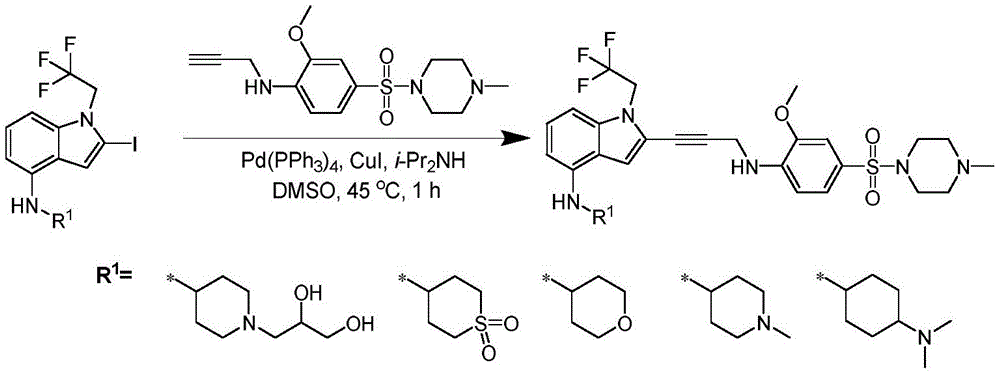
Following the general procedure indicated in example C51, 2-methoxy-4- ((4-methylpiperazin-1-yl) sulfonyl) -N- (prop-2-yn-1-yl) aniline with R indicated above 1 -substituted iodoindole coupling. In each case, the reaction was deemed complete after stirring at 45 ℃ for 1 hour, and the crude compound was first purified by preparative TLC and further purified by preparative HPLC.
3- [4- ({2- [3- ({ 2-methoxy-4- [ (4-methylpiperazin-1-yl) sulfonyl) amino]Phenyl } amino) prop-1-yn-1-yl]-1- (2,2, 2-trifluoroethyl) -1H-indol-4-yl } amino) piperidin-1-yl]Propane-1, 2-diol, MS (ES) + M/z) 693.3; 4- ({2- [3- ({ 2-methoxy-4- [ (4-methylpiperazin-1-yl) sulfonyl) amino]Phenyl } amino) prop-1-yn-1-yl]-1- (2,2, 2-trifluoroethyl) -1H-indol-4-yl } amino) -1 λ 6 Thiane-1, 1-dione, MS (ES) + M/z) 668.2; 2- [3- ({ 2-methoxy-4- [ (4-methylpiperazin-1-yl) sulfonyl ] amino ]Phenyl } amino) prop-1-yn-1-yl]-N- (oxan-4-yl) -1- (2,2, 2-trifluoroethyl) -1H-indol-4-amine, MS (ES) + M/z) 620.4; 2- [3- ({ 2-methoxy-4- [ (4-methylpiperazin-1-yl) sulfonyl ] amino]Phenyl } amino) prop-1-yn-1-yl]-N- (1-methylpiperidin-4-yl) -1- (2,2, 2-trifluoroethyl) -1H-indol-4-amine, MS (ES) + M/z) 633.3; and (1R,4R) -N 4 - {2- [3- ({ 2-methoxy-4- [ (4-methylpiperazin-1-yl) sulfonyl)]Phenyl } amino) prop-1-yn-1-yl]-1- (2,2, 2-trifluoroethyl) -1H-indol-4-yl } -N 1 ,N 1 Dimethylcyclohexane-1, 4-diamine, MS (ES) + ,m/z):661.4。
Example C69: general procedure for the preparation of compounds 63A and 64A.

2-iodo-N- (1, 4-dioxaspiro [4.5 ]]Synthesis of dec-8-yl) -1- (2,2, 2-trifluoroethyl) -1H-indol-4-amine: to a solution of 2-iodo-1- (2,2, 2-trifluoroethyl) -1H-indol-4-amine (500mg,1.47mmol,1 eq) in MeOH (5mL) was added 1, 4-dioxaspiro [4.5 ]]Decan-8-one (1.15g,7.35mmol,5 equiv.) and SnCl 2 ·2H 2 O (66.4mg, 294. mu. mol,0.2 eq). Polymethylhydrosiloxane (PMHS) (197.2mg,2.94mmol,2 equiv.) was then added in one portion and the resulting mixture was heated and stirred at 70 ℃ for 1 hour, followed byLC-MS analysis of (a) indicated completion of the reaction. The mixture was dried over anhydrous sodium sulfate, filtered over celite, and concentrated in vacuo. The residue was chromatographed on silica gel (SiO) 2 PE purification of EtOAc 50:1 to 5:1) to give 2-iodo-N- (1, 4-dioxaspiro [4.5 ] spiro]Decan-8-yl) -1- (2,2, 2-trifluoroethyl) -1H-indol-4-amine (800mg,1.33mmol, 90.6% yield) as a yellow oil.
Preparation of the final product: in N 2 Next, to a mixture of R-substituted alkyne (1.2 equiv.) in DMSO (2mL) was added diisopropylamine (3.12mmol, 441. mu.L, 10 equiv.), CuI (59.5mg, 312. mu. mol,1 equiv.), 2-iodo-N- (1, 4-dioxaspiro [4.5 ] spiro]Dec-8-yl) -1- (2,2, 2-trifluoroethyl) -1H-indol-4-amine (150mg, 312. mu. mol,1 eq.) and Pd (PPh) 3 ) 4 (72.2mg, 62.5. mu. mol,0.2 equiv.). The mixture was stirred at 25 ℃ for 1 hour, and subsequent LC-MS and TLC analysis indicated that the reaction was complete. Then 10mL of EtOAc were added and the mixture was poured into saturated EDTA solution (40mL) and stirred for 15 min. The aqueous phase was extracted with EtOAc (40 mL. times.2) and the organic phase was poured into saturated EDTA solution (40mL) and stirred for 1 hour. The aqueous phase was re-extracted with EtOAc (40mL x 3) and the combined organic layers were washed with brine (40mL x 3), dried over anhydrous sodium sulfate, treated with charcoal, filtered, and concentrated in vacuo. The residue was purified by preparative TLC and then further purified by preparative HPLC to give the desired compound.
4- ({3- [4- ({1, 4-dioxaspiro [4.5 ]]Dec-8-yl } amino) -1- (2,2, 2-trifluoroethyl) -1H-indol-2-yl]Prop-2-yn-1-yl } amino) -3-methoxybenzene-1-sulphonamide, MS (ES) + M/z) 593.2; and N- {1, 4-dioxaspiro [4.5 ]]Dec-8-yl } -2- {3- [ (4-methanesulfonyl-2-methoxyphenyl) amino]Prop-1-yn-1-yl } -1- (2,2, 2-trifluoroethyl) -1H-indol-4-amine, MS (ES) + ,m/z):592.2。
Example C70: general procedure for the preparation of compounds 56A, 57A, 202A, 203A, 204A, 205A, 212A, 213A, 293A, 294A, 313A, 374A, 398A, 399A, 400A, 401A and 1047A.
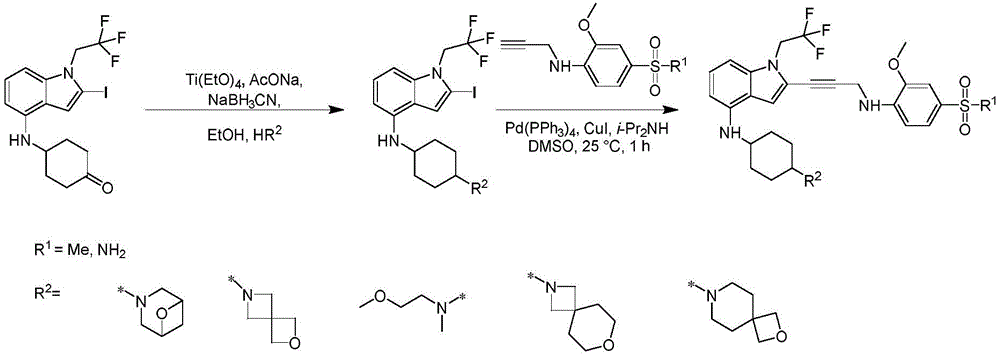
Representative procedure for reductive amination reaction: at 25 deg.C, 4- [ [ 2-iodo-1- (2,2, 2-trifluoroethyl) indol-4-yl group]Amino group]Cyclohexanone (380mg, 854. mu. mol,1 eq.), 6-oxa-3-azabicyclo [3.1.1]A solution of heptane (308mg,1.28mmol,1.5 equiv.), NaOAc (140mg,1.71mmol,2 equiv.), and titanium tetraethoxide (1.71mmol,354 μ L,2 equiv.) in EtOH (10mL) was stirred for 1 hour. Then NaBH is added 3 CN (107.3mg,1.71mmol,2 equivalents) was added to the reaction and the resulting reaction mixture was stirred at 25 ℃ for 1 hour. TLC analysis indicated complete consumption of ketone and two new spots were detected. The reaction mixture was poured into saturated NaHCO 3 (20mL) and filtered, and the filtrate was extracted with EtOAc (20 mL. times.2). The organic layer was concentrated under reduced pressure to give a residue. The residue was purified by column chromatography (SiO) 2 PE: EtOAc ═ 2:1 to 1:1) purification.
Representative procedure for Sonogashira coupling reaction: at N 2 To 2-methoxy-4-methylsulfonyl-N-prop-2-ynyl-aniline (874.9mg,3.33mmol,1.2 equivalents) and 2-iodo-N- [4- (6-oxa-3-azabicyclo [ 3.1.1)]Hept-3-yl) cyclohexyl]-1- (2,2, 2-trifluoroethyl) indol-4-amine (1.8g,2.77mmol,1 eq) in DMSO (30mL) is added CuI (528mg,2.77mmol,1 eq) and N-isopropylpropan-2-amine (27.7mmol,3.92mL,10 eq), and Pd (PPh) 3 ) 4 (640.8mg, 555. mu. mol,0.2 eq.). The reaction mixture was stirred at 25 ℃ for 1 hour. LC-MS analysis indicated the reaction was complete. The reaction mixture was quenched by addition of saturated aqueous EDTA (50mL) and stirred at 25 ℃ for 1h, then extracted with EtOAc (50mL x 3). The combined organic layers were dried over anhydrous sodium sulfate, filtered and concentrated under reduced pressure to give a residue. The residue was purified by column chromatography (SiO) 2 EtOAc ═ 2:1 to 1:1) and further purified by preparative HPLC to give the desired product as a yellow solid.
2- {3- [ (4-Methylsulfonyl-2-methoxyphenyl) amino]Prop-1-yn-1-yl } -N- [ (1R,4R) -4- { 2-oxa-6-azaspiro [3.3]Hept-6-yl } cyclohexyl]-1- (2,2, 2-trifluoroethyl) -1H-indol-4-amine, MS (ES) + M/z) 631.2; 2- {3- [ (4-Methylsulfonyl-2-methoxyphenyl) amino]Prop-1-yn-1-yl } -N- [ (1S,4S) -4- { 2-oxa-6-azaspiro [3.3]Hept-6-ylCyclohexyl radical]-1- (2,2, 2-trifluoroethyl) -1H-indol-4-amine, MS (ES) + M/z) 631.2; 3-methoxy-4- { [3- (4- { [ (1R,4R) -4- { 2-oxa-6-azaspiro [3.3 ]]Hept-6-yl } cyclohexyl radical]Amino } -1- (2,2, 2-trifluoroethyl) -1H-indol-2-yl) prop-2-yn-1-yl]Amino } benzene-1-sulfonamide, MS (ES) + M/z) 632.2; 3-methoxy-4- { [3- (4- { [ (1S,4S) -4- { 2-oxa-6-azaspiro [3.3 ]]Hept-6-yl } cyclohexyl]Amino } -1- (2,2, 2-trifluoroethyl) -1H-indol-2-yl) prop-2-yn-1-yl]Amino } benzene-1-sulfonamide, MS (ES) + M/z) 632.2; 2- {3- [ (4-Methylsulfonyl-2-methoxyphenyl) amino]Prop-1-yn-1-yl } -N- [ (1R,4R) -4- { 6-oxa-3-azabicyclo [3.1.1]Hept-3-yl } cyclohexyl]-1- (2,2, 2-trifluoroethyl) -1H-indol-4-amine, MS (ES) + M/z) 631.2; 2- {3- [ (4-Methylsulfonyl-2-methoxyphenyl) amino]Prop-1-yn-1-yl } -N- [ (1S,4S) -4- { 6-oxa-3-azabicyclo [3.1.1]Hept-3-yl } cyclohexyl]-1- (2,2, 2-trifluoroethyl) -1H-indol-4-amine, MS (ES) + M/z) 631.2; 3-methoxy-4- { [3- (4- { [ (1R,4R) -4- { 6-oxa-3-azabicyclo [3.1.1 ] e]Hept-3-yl } cyclohexyl radical ]Amino } -1- (2,2, 2-trifluoroethyl) -1H-indol-2-yl) prop-2-yn-1-yl]Amino } benzene-1-sulfonamide, MS (ES) + M/z) 632.2; 3-methoxy-4- { [3- (4- { [ (1S,4S) -4- { 6-oxa-3-azabicyclo [3.1.1 ] e]Hept-3-yl } cyclohexyl]Amino } -1- (2,2, 2-trifluoroethyl) -1H-indol-2-yl) prop-2-yn-1-yl]Amino } benzene-1-sulfonamide, MS (ES) + M/z) 632.2; 4- [ (2- {3- [ (2-methoxy-4- { 2-oxa-6-azaspiro [3.3 ]]Heptane-6-sulfonyl } phenyl) amino]Prop-1-yn-1-yl } -1- (2,2, 2-trifluoroethyl) -1H-indol-4-yl) amino]-1λ 6 Thiane-1, 1-dione, MS (ES) + M/z) 667.1; 3-methoxy-4- { [3- (4- { [ (1R,4R) -4- { 2-oxa-6-azaspiro [3.3 ]]Hept-6-yl } cyclohexyl]Amino } -1- (2,2, 2-trifluoroethyl) -1H-indol-2-yl) prop-2-yn-1-yl]Amino } benzamide, MS (ES) + M/z) 596.1; 3-methoxy-4- { [3- (4- { [ (1S,4S) -4- { 2-oxa-6-azaspiro [3.3 ]]Hept-6-yl } cyclohexyl radical]Amino } -1- (2,2, 2-trifluoroethyl) -1H-indol-2-yl) prop-2-yn-1-yl]Amino } benzamide, MS (ES) + M/z) 596.1; 2- {3- [ (4-Methylsulfonyl-2-methoxyphenyl) amino]Prop-1-yn-1-yl } -N- [ (1R,4R) -4- { 7-oxa-2-azaspiro [3.5 ]]Non-2-yl } cyclohexyl]-1- (2,2, 2-trifluoroethyl) -1H-indole4-amine, MS (ES) + M/z) 659.3; 2- {3- [ (4-Methylsulfonyl-2-methoxyphenyl) amino]Prop-1-yn-1-yl } -N- [ (1S,4S) -4- { 7-oxa-2-azaspiro [3.5 ] spirol]Non-2-yl cyclohexyl]-1- (2,2, 2-trifluoroethyl) -1H-indol-4-amine, MS (ES) + M/z) 659.4; 2- {3- [ (4-Methylsulfonyl-2-methoxyphenyl) amino]Prop-1-yn-1-yl } -N- [ (1R,4R) -4- { 2-oxa-7-azaspiro [3.5 ] spirol]Non-7-yl cyclohexyl]-1- (2,2, 2-trifluoroethyl) -1H-indol-4-amine, MS (ES) + M/z) 659.2; 2- {3- [ (4-Methylsulfonyl-2-methoxyphenyl) amino]Prop-1-yn-1-yl } -N- [ (1S,4S) -4- { 2-oxa-7-azaspiro [3.5 ]]Non-7-yl cyclohexyl]-1- (2,2, 2-trifluoroethyl) -1H-indol-4-amine, MS (ES) + ,m/z):659.3;(1R,4R)-N 4 - (2- {3- [ (4-methanesulfonyl-2-methoxyphenyl) amino]Prop-1-yn-1-yl } -1- (2,2, 2-trifluoroethyl) -1H-indol-4-yl) -N 1 - (2-methoxyethyl) -N 1 Methylcyclohexane-1, 4-diamine, MS (ES) + M/z) 621.3; and (1S,4S) -N 4 - (2- {3- [ (4-methanesulfonyl-2-methoxyphenyl) amino]Prop-1-yn-1-yl } -1- (2,2, 2-trifluoroethyl) -1H-indol-4-yl) -N 1 - (2-methoxyethyl) -N 1 Methylcyclohexane-1, 4-diamine, MS (ES) + ,m/z):621.3。
Example C71: general procedure for the preparation of compounds 21A and 22A.

6- ((2-iodo-1- (2,2, 2-trifluoroethyl) -1H-indol-4-yl) amino) -2-azaspiro [3.3 ]Synthesis of tert-butyl heptane-2-carboxylate: to a solution of 2-iodo-1- (2,2, 2-trifluoroethyl) -1H-indol-4-amine (0.5g,1.47mmol,1 eq) in MeOH (5mL) was added 6-oxo-2-azaspiro [3.3]Heptane-2-carboxylic acid tert-butyl ester (776.5mg,3.68mmol,2.5 equiv.) and SnCl 2 ·2H 2 O (66.4mg, 294. mu. mol,0.20 equiv.). Polymethylhydrosiloxane (PMHS) (352.9mg,5.88mmol,4 equiv.) was then added and the mixture was stirred at 70 ℃ for 3 hours, followed by TLC analysis to show completion of the reaction. The mixture was evaporated to give the crude product which was then purified by column chromatography to give 6- ((2-iodo-1- (2,2, 2-trifluoroethyl) -1H-indol-4-yl)) Amino) -2-azaspiro [3.3]Tert-butyl heptane-2-carboxylate as a white solid.
6- ((2- (3- ((2-methoxy-4-sulfamoylphenyl) amino) prop-1-yn-1-yl) -1- (2,2, 2-trifluoroethyl) -1H-indol-4-yl) amino) -2-azaspiro [3.3]Heptane-2-carboxylic acid tert-butyl ester and 6- ((2- (3- ((2-methoxy-4- (methylsulfonyl) phenyl) amino) prop-1-yn-1-yl) -1- (2,2, 2-trifluoroethyl) -1H-indol-4-yl) amino) -2-azaspiro [3.3]Synthesis of tert-butyl heptane-2-carboxylate: in N 2 To 2-iodo-N- [4- (2-oxa-6-azaspiro [3.3 ]]Hept-6-yl) cyclohexyl]Mixture of-1- (2,2, 2-trifluoroethyl) indol-4-amine (50mg, 86.7. mu. mol,1 eq) and 2-methoxy-4-methylsulfonyl-N-prop-2-ynyl-aniline (27.3mg, 104. mu. mol,1.2 eq) in DMSO (3mL) CuI (16.5mg, 86.7. mu. mol,1 eq), N-isopropylprop-2-amine (86.7. mu. mol, 12.2. mu.L, 1 eq) and Pd (PPh) 3 ) 4 (2.0mg, 1.73. mu. mol,0.02 eq.). The reaction mixture was stirred at 25 ℃ for 1 hour. LC-MS analysis indicated all iodide consumption. The reaction mixture was quenched by addition of saturated aqueous EDTA (60mL) at 25 ℃ and the mixture was stirred for 1 hour then extracted with EtOAc (20mL x 4). The combined organic layers were dried over anhydrous sodium sulfate, filtered and concentrated under reduced pressure to give a residue. The residue was purified by preparative TLC (SiO) 2 ,DCM:MeOH=10:1,R f1 =0.43,R f2 0.37) and further purified by preparative HPLC to give the desired product as a yellow solid.
General procedure for preparation of final product: a solution of Boc-protected amine (1 eq) in DCM was added to 2,2, 2-trifluoroacetic acid (174.7 eq) and stirred for 16 h at 20 ℃. LC-MS analysis indicated that the starting material was consumed and one major mass with the desired compound was observed. The reaction mixture was concentrated under reduced pressure and the residue was purified by preparative HPLC to give the compound as a yellow solid.
N- { 2-azaspiro [3.3]Hept-6-yl } -2- {3- [ (4-methanesulfonyl-2-methoxyphenyl) amino]Prop-1-yn-1-yl } -1- (2,2, 2-trifluoroethyl) -1H-indol-4-amine, MS (ES) + M/z) 547.2; and 4- ({3- [4- ({ 2-azaspiro [3.3 ] ]Hept-6-yl } amino) -1- (2,2, 2-trifluoroethyl) -1H-indole-2-radical]Prop-2-yn-1-yl } amino) -3-methoxybenzene-1-sulphonamide, MS (ES) + ,m/z):548.2。
Example C72: general procedure for the preparation of compounds 151A, 152A, 295A, 296A, 375A and 376A.

Representative procedure: in N 2 To 3-methoxy-N-methyl-4- (prop-2-ynylamino) benzamide (38.6mg, 159. mu. mol,1.5 equivalents) and N 1 - [ 2-iodo-1- (2,2, 2-trifluoroethyl) indol-4-yl group]-N 4 - (2-methoxyethyl) -N 4 Mixture of-methyl-cyclohexane-1, 4-diamine (60.0mg, 106.0. mu. mol,1 equiv) in DMSO (3mL) was added N-isopropylpropan-2-amine (106. mu. mol, 15. mu.L, 1 equiv) and Pd (PPh) 3 ) 4 (2.5mg, 2.1. mu. mol,0.02 eq), followed by the addition of CuI (20.2mg, 106. mu. mol,1 eq). The reaction mixture was stirred at 45 ℃ for 1 hour and monitored by TLC analysis (DCM: MeOH ═ 10: 1). The reaction mixture was quenched by the addition of saturated EDTA solution (40mL) and extracted with EtOAc (20 mL. times.3). The combined organic layers were dried over anhydrous sodium sulfate, filtered and concentrated under reduced pressure. The residue obtained is passed through preparative TLC (SiO) 2 DCM: MeOH ═ 10:1) and further purification by preparative HPLC gave 3-methoxy-4- [3- [4- [ [4- [ 2-methoxyethyl (methyl) amino ]Cyclohexyl radical]Amino group]-1- (2,2, 2-trifluoroethyl) indol-2-yl]Prop-2-ynylamino]-N-methyl-benzamide (17.0mg,27.5 μmol, 26.0% yield) as a light yellow solid.
3-methoxy-N-methyl-4- { [3- (4- { [ (1R,4R) -4- [ (2-methoxyethyl) (methyl) amino]Cyclohexyl radical]Amino } -1- (2,2, 2-trifluoroethyl) -1H-indol-2-yl) prop-2-yn-1-yl]Amino } benzamide, MS (ES) + M/z) 600.3; 3-methoxy-N-methyl-4- { [3- (4- { [ (1S,4S) -4- [ (2-methoxyethyl) (methyl) amino]Cyclohexyl radical]Amino } -1- (2,2, 2-trifluoroethyl) -1H-indol-2-yl) prop-2-yn-1-yl]Amino } benzamide, MS (ES) + M/z) 600.3; 3-methoxy-N-methyl-4- { [3- (4- { [ (1R,4R) -4- { 7-oxa-2-azaspiro [3.5 ]]Non-2-yl cyclohexyl]Amino } -1- (2,2, 2-trifluoroethyl)) -1H-indol-2-yl) prop-2-yn-1-yl]Amino } benzamide, MS (ES) + M/z) 638.4; 3-methoxy-N-methyl-4- { [3- (4- { [ (1S,4S) -4- { 7-oxa-2-azaspiro [3.5 ]]Non-2-yl cyclohexyl]Amino } -1- (2,2, 2-trifluoroethyl) -1H-indol-2-yl) prop-2-yn-1-yl]Amino } benzamide, MS (ES) + M/z) 638.4; 3-methoxy-N-methyl-4- { [3- (4- { [ (1R,4R) -4- { 2-oxa-7-azaspiro [3.5 ]]Non-7-yl cyclohexyl]Amino } -1- (2,2, 2-trifluoroethyl) -1H-indol-2-yl) prop-2-yn-1-yl ]Amino } benzamide, MS (ES) + M/z) 638.4; and 3-methoxy-N-methyl-4- { [3- (4- { [ (1S,4S) -4- { 2-oxa-7-azaspiro [3.5 ]]Non-7-yl cyclohexyl]Amino } -1- (2,2, 2-trifluoroethyl) -1H-indol-2-yl) prop-2-yn-1-yl]Amino } benzamide, MS (ES) + ,m/z):638.3。
Example C73: general procedure for the preparation of compounds 297A, 298A, 400A and 401A.

Representative procedure for reductive amination: to 4- [ [ 2-iodo-1- (2,2, 2-trifluoroethyl) indol-4-yl group]Amino group]Cyclohexanone (5g,11.1mmol,1 eq.) and 7-oxa-2-azaspiro [ 3.5%]A solution of nonanoic oxalic acid (4.60g,13.3mmol,1.2 equiv.) in THF (100mL) was added i-Pr 2 NH (55.6mmol,7.86mL,5 equiv.) and MgSO 4 (6.69g,55.6mmol,5 equiv.). The mixture was heated and stirred at 35 ℃ for 0.5 h, and NaBH (OAc) 3 (4.71g,22.2mmol,2 equiv.) was added to the reaction. The resulting mixture was further stirred at 35 ℃ for 1 hour. TLC analysis (PE: EtOAc ═ 3:1) indicated completion of the reaction. The reaction mixture was poured into water (100mL) and the aqueous phase was extracted with EtOAc (40mL x 3). The combined organic layers were washed with brine (40mL), dried over anhydrous sodium sulfate, filtered and concentrated in vacuo. The residue was purified by column chromatography (SiO) 2 PE EtOAc ═ 3:1 to 0:1) purification to give the desired product 2-iodo-N- [4- (7-oxa-2-azaspiro [ 3.5) ]Non-2-yl) cyclohexyl]-1- (2,2, 2-trifluoroethyl) indol-4-amine (10g,16.4mmol, 49.3% yield) as a light yellow solid.
Representative procedure for Sonogashira coupling: in thatN 2 Next, i-Pr was added to a solution of 3-methoxy-4- (prop-2-ynylamino) benzenesulfonamide (1.58g,5.92mmol,1.2 equiv.) in DMSO (30mL) at 45 deg.C 2 NH (49.3mmol,6.97mL,10 equiv.) and CuI (939mg,4.93mmol,1 equiv.). Then, 2-iodo-N- [4- (7-oxa-2-azaspiro [3.5 ]]Non-2-yl) cyclohexyl]-1- (2,2, 2-trifluoroethyl) indol-4-amine (3g,4.93mmol,1 eq) and Pd (PPh) 3 ) 4 (1.14g, 986. mu. mol,0.2 eq.) was added to the reaction. The resulting mixture was stirred at 45 ℃ for 1 hour. TLC analysis (DCM: MeOH ═ 10:1) indicated completion of the reaction. The mixture was poured into saturated aqueous EDTA (100mL) and stirred for 1 hour. The aqueous phase was extracted with EtOAc (200 mL. times.3). The combined organic layers were washed with brine (60mL), dried over anhydrous sodium sulfate, filtered and concentrated in vacuo. The resulting residue was purified by preparative TLC and preparative HPLC to give the desired product 3-methoxy-4- [3- [4- [ [4- (7-oxa-2-azaspiro [3.5 ]]Non-2-yl) cyclohexyl]Amino group]-1- (2,2, 2-trifluoroethyl) indol-2-yl]Prop-2-ynylamino ]Benzenesulfonamide (6g,8.64mmol, 58.4% yield).
3-methoxy-4- { [3- (4- { [ (1R,4R) -4- { 7-oxa-2-azaspiro [3.5 ]]Non-2-yl cyclohexyl]Amino } -1- (2,2, 2-trifluoroethyl) -1H-indol-2-yl) prop-2-yn-1-yl]Amino } benzene-1-sulfonamide, MS (ES) + M/z) 660.3; 3-methoxy-4- { [3- (4- { [ (1S,4S) -4- { 7-oxa-2-azaspiro [3.5 ]]Non-2-yl cyclohexyl]Amino } -1- (2,2, 2-trifluoroethyl) -1H-indol-2-yl) prop-2-yn-1-yl]Amino } benzene-1-sulfonamide, MS (ES) + M/z) 660.3; 3-methoxy-4- { [3- (4- { [ (1R,4R) -4- { 6-oxa-3-azabicyclo [3.1.1 ] e]Hept-3-yl } cyclohexyl radical]Amino } -1- (2,2, 2-trifluoroethyl) -1H-indol-2-yl) prop-2-yn-1-yl]Amino } benzene-1-sulfonamide, MS (ES) + M/z) 632.2; and 3-methoxy-4- { [3- (4- { [ (1S,4S) -4- { 6-oxa-3-azabicyclo [3.1.1 ] e]Hept-3-yl } cyclohexyl radical]Amino } -1- (2,2, 2-trifluoroethyl) -1H-indol-2-yl) prop-2-yn-1-yl]Amino } benzene-1-sulfonamide, MS (ES) + ,m/z):632.2。
Example C74: preparation of compounds 210A and 211A.

From N- (4- (2-oxa-6-azaspiro [3.3 ]]Hept-6-yl) cyclohexyl) -2-iodo-1- (2,2, 2-trifluoroethyl) -1H-indol-4-amine and 2- (2-fluoroethoxy) -4- (methylsulfonyl) -N- (prop-2-yn-1-yl) aniline, compounds 210A and 211A were prepared by a procedure similar to the synthesis of compounds 389A and 390A according to example C47. Reacting (2- (3- { [2- (2-fluoroethoxy) -4-methylsulfonylphenyl) ]Amino } prop-1-yn-1-yl) -N- [ (1R,4R) -4- { 2-oxa-6-azaspiro [3.3]Hept-6-yl } cyclohexyl]-1- (2,2, 2-trifluoroethyl) -1H-indol-4-amine) by column chromatography (SiO 2 PE: EtOAc ═ 2:1 to EtOAc to DCM: MeOH ═ 10:1, R f Purification ═ 0.3) and further purification by preparative HPLC gave the desired product (830.2mg,1.25mmol, MS (ES) in 50.8% yield (1.25 mmol) + M/z) 663.2) as a yellow solid. Reacting (2- (3- { [2- (2-fluoroethoxy) -4-methylsulfonylphenyl)]Amino } prop-1-yn-1-yl) -N- [ (1S,4S) -4- { 2-oxa-6-azaspiro [3.3]Hept-6-yl } cyclohexyl]-1- (2,2, 2-trifluoroethyl) -1H-indol-4-amine) was purified by preparative TLC (DCM: MeOH ═ 20:1) and further purified by preparative HPLC to give the desired product (10.3mg,14.26 μmol, MS (ES) in 17.4% yield + M/z) 663.2) as a yellow solid.
Example C75: general procedure for the preparation of compounds 48A, 50A, 54A, 55A, 469A, 471A, 472A, 473A, 477A, 479A, 528A, 529A, 544A, 547A, 551A, 553A, 555A, 564A, 572A, 577A, 718A, 726A, 992A, 994A, 996A, 999A, 1000A, 1001A, 1015A, 1036A, 1037A, 1038A, 1039A, 1040A, 1042A, 1043A, 1044A, 1045A, 1046A, 1052A and 1053A.

Representative procedure: to a mixture of 2-methoxy-4-methylsulfonyl-N-prop-2-ynyl-aniline (18.4mg, 66.9. mu. mol,0.87 eq, HCl) in DMSO (2mL) at 25 ℃ was added i-Pr 2 NH (769. mu. mol, 108. mu.L, 10 equivalents), CuI (14.6mg, 76.9. mu. mol,1 equivalent), 2-iodo-N- (1-tetrahydropyran-4-yl-4-piperidinyl) -1- (2,2, 2-trifluoroethyl) indol-4-amine (50.0mg, 76.9. mu.m)ol,1 equivalent) and Pd (PPh) 3 ) 4 (88.8mg, 76.9. mu. mol,1 eq.). The mixture was stirred at 25 ℃ for 1 hour. TLC and LC-MS analysis indicated the reaction was complete. EtOAc (10mL) was poured into the mixture, and the mixture was poured into saturated aqueous EDTA (30mL) and stirred for 15 min. The aqueous phase was extracted with EtOAc (30 mL. times.2). The organic layer was poured into saturated aqueous EDTA (30mL) and stirred for 1 hour. The aqueous phase was extracted with EtOAc (30 mL. times.3). The combined organic layers were washed with brine (30mL x 3), dried over anhydrous sodium sulfate, treated with charcoal, filtered and concentrated in vacuo. The residue was purified by preparative TLC and preparative HPLC to give 2- [3- (2-methoxy-4-methylsulfonyl-anilino) prop-1-ynyl]-N- (1-tetrahydropyran-4-yl-4-piperidinyl) -1- (2,2, 2-trifluoroethyl) indol-4-amine (13.3mg,20.2 μmol, 26.3% yield) as a light yellow solid. Other compounds were prepared using the same procedure.
2- (2- ((3- (4- ((1, 1-dioxotetrahydro-2H-thiopyran-4-yl) amino) -1- (2,2, 2-trifluoroethyl) -1H-indol-2-yl) prop-2-yn-1-yl) amino) -5- (methylsulfonyl) phenoxy) acetamide, MS (ES) + M/z) 627.2; 2- (2- ((3- (4- ((1-methylpiperidin-4-yl) amino) -1- (2,2, 2-trifluoroethyl) -1H-indol-2-yl) prop-2-yn-1-yl) amino) -5- (methylsulfonyl) phenoxy) acetamide, MS (ES) + M/z) 592.2; 4- ((3- (4- ((1, 1-dioxotetrahydro-2H-thiopyran-4-yl) amino) -1- (2,2, 2-trifluoroethyl) -1H-indol-2-yl) prop-2-yn-1-yl) amino) -N- (2-hydroxyethyl) -3-methoxybenzenesulfonamide, MS (ES) + M/z) 629.2; n- (2-hydroxyethyl) -3-methoxy-4- ((3- (4- ((tetrahydro-2H-pyran-4-yl) amino) -1- (2,2, 2-trifluoroethyl) -1H-indol-2-yl) prop-2-yn-1-yl) amino) benzenesulfonamide, MS (ES) + M/z) 581.2; n- (2-hydroxyethyl) -3-methoxy-4- ((3- (4- ((1- (tetrahydro-2H-pyran-4-yl) piperidin-4-yl) amino) -1- (2,2, 2-trifluoroethyl) -1H-indol-2-yl) prop-2-yn-1-yl) amino) benzenesulfonamide, MS (ES) + M/z) 664.3; 4- ((3- (4- ((1- (2, 3-dihydroxypropyl) piperidin-4-yl) amino) -1- (2,2, 2-trifluoroethyl) -1H-indol-2-yl) prop-2-yn-1-yl) amino) -N- (2-hydroxyethyl) -3-methoxybenzenesulfonamide, MS (ES) + M/z) 654.2; 2- [2- (2- {4- [ (2- {3- [ (4-methanesulfonyl-2-methoxyphenyl) amino)]Propane-1-Alkyn-1-yl } -1- (2,2, 2-trifluoroethyl) -1H-indol-4-yl) amino]Piperidin-1-yl } ethoxy) ethoxy]Ethan-1-ol, MS (ES) + M/z) 667.2; n- (2-hydroxyethyl) -3-methoxy-4- ((3- (4- ((1-methylpiperidin-4-yl) amino) -1- (2,2, 2-trifluoroethyl) -1H-indol-2-yl) prop-2-yn-1-yl) amino) benzenesulfonamide, MS (ES) + M/z) 594.2; 3-methoxy-4- [ (3- {4- [ (Oxan-4-yl) amino group]-1- (2,2, 2-trifluoroethyl) -1H-indol-2-yl } prop-2-yn-1-yl) amino]-N- (1, 2-oxazol-3-yl) benzene-1-sulfonamide, MS (ES) + M/z) 604.2; 4- [ (3- {4- [ (1, 1-dioxo-1. lamda.) -1 6 -thian-4-yl) amino]-1- (2,2, 2-trifluoroethyl) -1H-indol-2-yl } prop-2-yn-1-yl) amino]-N- (2-hydroxyethyl) -3-methoxy-N-methylbenzene-1-sulfonamide, MS (ES) + M/z) 643.1; 4- { [3- (4- { [1- (2, 3-dihydroxypropyl) piperidin-4-yl]Amino } -1- (2,2, 2-trifluoroethyl) -1H-indol-2-yl) prop-2-yn-1-yl]Amino } -3-methoxy-N- (1, 2-oxazol-3-yl) benzene-1-sulphonamide, MS (ES) + M/z) 604.2; 3-methoxy-N- (1, 2-oxazol-3-yl) -4- { [3- (4- { [ (1R,4R) -4- (dimethylamino) cyclohexyl]Amino } -1- (2,2, 2-trifluoroethyl) -1H-indol-2-yl) prop-2-yn-1-yl ]Amino } benzene-1-sulfonamide, MS (ES) + M/z) 645.3; 3-methoxy-N- (1, 2-oxazol-3-yl) -4- { [3- (4- { [ (1S,4S) -4- (dimethylamino) cyclohexyl]Amino } -1- (2,2, 2-trifluoroethyl) -1H-indol-2-yl) prop-2-yn-1-yl]Amino } benzene-1-sulfonamide, MS (ES) + M/z) 645.2; 3-methoxy-N- (5-methyl-1, 2-oxazol-3-yl) -4- [ (3- {4- [ (1-methylpiperidin-4-yl) amino]-1- (2,2, 2-trifluoroethyl) -1H-indol-2-yl } prop-2-yn-1-yl) amino]Benzene-1-sulfonamides, MS (ES) + M/z) 631.2; 3-methoxy-N- (5-methyl-1, 2-oxazol-3-yl) -4- [ (3- {4- [ (oxan-4-yl) amino]-1- (2,2, 2-trifluoroethyl) -1H-indol-2-yl } prop-2-yn-1-yl) amino]Benzene-1-sulfonamides, MS (ES) + M/z) 618.2; 4- ({2- [3- ({2- [2- (dimethylamino) ethoxy) ethyl ester]-4-methanesulfonylphenyl } amino) prop-1-yn-1-yl]-1- (2,2, 2-trifluoroethyl) -1H-indol-4-yl } amino) -1 λ 6 Thiane-1, 1-dione, MS (ES) + M/z) 641.2; 4- [ (3- {4- [ (1, 1-dioxo-1. lamda.) -4 6 -thian-4-yl) amino]-1- (2,2, 2-trifluoroethyl) -1H-indol-2-yl } prop-2-yn-1-yl) amino]-3-methoxy-N- (5-methyl-1, 2-oxazol-3-yl) benzene1-sulfonamide, MS (ES) + M/z) 666.2; 4- { [3- (4- { [1- (2, 3-dihydroxypropyl) piperidin-4-yl]Amino } -1- (2,2, 2-trifluoroethyl) -1H-indol-2-yl) prop-2-yn-1-yl ]Amino } -3-methoxy-N- (5-methyl-1, 2-oxazol-3-yl) benzene-1-sulfonamide, MS (ES) + M/z) 691.2; 4- { [3- (4- { [1- (2, 3-dihydroxypropyl) piperidin-4-yl]Amino } -1- (2,2, 2-trifluoroethyl) -1H-indol-2-yl) prop-2-yn-1-yl]Amino } -N- (2-hydroxyethyl) -3-methoxy-N-methylbenzene-1-sulphonamide, MS (ES) + M/z) 668.2; 4- { [2- (3- { [ 2-methoxy-4- (morpholine-4-sulfonyl) phenyl]Amino } prop-1-yn-1-yl) -1- (2,2, 2-trifluoroethyl) -1H-indol-4-yl]Amino } -1 lambda 6 Thiane-1, 1-dione, MS (ES) + M/z) 655.3; 4- [ (3- {4- [ (1, 1-dioxo-1. lamda.) -1 6 -thian-4-yl) amino]-1- (2,2, 2-trifluoroethyl) -1H-indol-2-yl } prop-2-yn-1-yl) amino]-3-methoxy-N- (1, 2-oxazol-3-yl) benzene-1-sulfonamide, MS (ES) + M/z) 652.1; 3-methoxy-4- [ (3- {4- [ (1-methylpiperidin-4-yl) amino ] carbonyl]-1- (2,2, 2-trifluoroethyl) -1H-indol-2-yl } prop-2-yn-1-yl) amino]-N- (1, 2-oxazol-3-yl) benzene-1-sulfonamide, MS (ES) + M/z) 617.2; n- [2- (dimethylamino) ethyl group]-4- [ (3- {4- [ (1, 1-dioxo-1. lamda.) -4 6 -thian-4-yl) amino]-1- (2,2, 2-trifluoroethyl) -1H-indol-2-yl } prop-2-yn-1-yl) amino]-3-methoxy-N-methylbenzene-1-sulfonamide, MS (ES) + M/z) 670.2; 3-methoxy-N- (2-methoxyethyl) -N-methyl-4- [ (3- {4- [ (1-methylpiperidin-4-yl) amino ]-1- (2,2, 2-trifluoroethyl) -1H-indol-2-yl } prop-2-yn-1-yl) amino]Benzene-1-sulfonamides, MS (ES) + M/z) 622.2; n- (2, 3-dihydroxypropyl) -4- [ (3- {4- [ (1, 1-dioxo-1. lamda.) - 6 -thian-4-yl) amino]-1- (2,2, 2-trifluoroethyl) -1H-indol-2-yl } prop-2-yn-1-yl) amino]-3-methoxybenzene-1-sulphonamide, MS (ES) + M/z) 659.1; 3-methoxy-N- (5-methyl-1, 2-oxazol-3-yl) -4- { [3- (4- { [ (1R,4R) -4- (dimethylamino) cyclohexyl]Amino } -1- (2,2, 2-trifluoroethyl) -1H-indol-2-yl) prop-2-yn-1-yl]Amino } benzene-1-sulfonamide, MS (ES) + M/z) 659.3; 3-methoxy-N- (5-methyl-1, 2-oxazol-3-yl) -4- { [3- (4- { [ (1S,4S) -4- (dimethylamino) cyclohexyl]Amino } -1- (2,2, 2-trifluoroethyl) -1H-indol-2-yl) prop-2-yn-1-yl]Amino-1-benzenesulfonyl radicalAmine, MS (ES) + M/z) 659.2; n- (2-hydroxyethyl) -3-methoxy-N-methyl-4- [ (3- {4- [ (oxan-4-yl) amino group]-1- (2,2, 2-trifluoroethyl) -1H-indol-2-yl } prop-2-yn-1-yl) amino]Benzene-1-sulfonamides, MS (ES) + M/z) 595.2; n- (2-hydroxyethyl) -3-methoxy-N-methyl-4- [ (3- {4- [ (1-methylpiperidin-4-yl) amino]-1- (2,2, 2-trifluoroethyl) -1H-indol-2-yl } prop-2-yn-1-yl) amino]Benzene-1-sulfonamides, MS (ES) + M/z) 608.2; n- (2-hydroxyethyl) -3-methoxy-N-methyl-4- { [3- (4- { [1- (oxa-4-yl) piperidin-4-yl ]Amino } -1- (2,2, 2-trifluoroethyl) -1H-indol-2-yl) prop-2-yn-1-yl]Amino } benzene-1-sulfonamide, MS (ES) + M/z) 678.3; 3-methoxy-N, N-dimethyl-4- [ (3- {4- [ (1-methylpiperidin-4-yl) amino group]-1- (2,2, 2-trifluoroethyl) -1H-indol-2-yl } prop-2-yn-1-yl) amino]Benzene-1-sulfonamides, MS (ES) + M/z) 578.2; 4- [ (3- {4- [ (1, 1-dioxo-1. lamda.) -4 6 -thian-4-yl) amino]-1- (2,2, 2-trifluoroethyl) -1H-indol-2-yl } prop-2-yn-1-yl) amino]-3-methoxy-N, N-dimethylbenzene-1-sulfonamide, MS (ES) + M/z) 613.1; 3-methoxy-N, N-dimethyl-4- [ (3- {4- [ (oxan-4-yl) amino group]-1- (2,2, 2-trifluoroethyl) -1H-indol-2-yl } prop-2-yn-1-yl) amino]Benzene-1-sulfonamides, MS (ES) + M/z) 565.2; 4- { [3- (4- { [1- (2, 3-dihydroxypropyl) piperidin-4-yl]Amino } -1- (2,2, 2-trifluoroethyl) -1H-indol-2-yl) prop-2-yn-1-yl]Amino } -3-methoxy-N, N-dimethylbenzene-1-sulfonamide, MS (ES) + M/z) 638.3; 1- (4- { 3-methoxy-4- [ (3- {4- [ (1-methylpiperidin-4-yl) amino group]-1- (2,2, 2-trifluoroethyl) -1H-indol-2-yl } prop-2-yn-1-yl) amino]Benzenesulfonyl } piperazin-1-yl) eth-1-one, MS (ES) + M/z) 661.3; 4- ({2- [3- ({4- [ (4-acetylpiperazin-1-yl) sulfonyl)]-2-methoxyphenyl } amino) prop-1-yn-1-yl ]-1- (2,2, 2-trifluoroethyl) -1H-indol-4-yl } amino) -1 λ 6 Thiane-1, 1-dione, MS (ES) + M/z) 696.2; 1- (4- { 3-methoxy-4- [ (3- {4- [ (oxan-4-yl) amino) carbonyl ] amino]-1- (2,2, 2-trifluoroethyl) -1H-indol-2-yl } prop-2-yn-1-yl) amino]Benzenesulfonyl } piperazin-1-yl) eth-1-one, MS (ES) + M/z) 648.2; 1- [4- (4- { [3- (4- { [1- (2, 3-dihydroxypropyl) piperidin-4-yl)]Amino } -1- (2,2, 2-trifluoroethyl) -1H-indol-2-yl) prop-2-yn-1-yl]Amino } -3-methoxybenzenesulfonyl) piperazin-1-yl]Ethan-1-one, MS (ES) + M/z) 721.3; 4- [ (3- {4- [ (1, 1-dioxo-1. lamda.) -1 6 -thian-4-yl) amino]-1- (2,2, 2-trifluoroethyl) -1H-indol-2-yl } prop-2-yn-1-yl) amino]-3-methoxy-N- (2-methoxyethyl) -N-methylbenzene-1-sulfonamide, MS (ES) + M/z) 657.2; 3-methoxy-N- (2-methoxyethyl) -N-methyl-4- [ (3- {4- [ (oxan-4-yl) amino group]-1- (2,2, 2-trifluoroethyl) -1H-indol-2-yl } prop-2-yn-1-yl) amino]Benzene-1-sulfonamides, MS (ES) + M/z) 609.2; and 4- { [3- (4- { [1- (2, 3-dihydroxypropyl) piperidin-4-yl]Amino } -1- (2,2, 2-trifluoroethyl) -1H-indol-2-yl) prop-2-yn-1-yl]Amino } -3-methoxy-N- (2-methoxyethyl) -N-methylbenzene-1-sulfonamide, MS (ES) + ,m/z):682.2。
Example C76: synthesis of compounds 263A, 264A, 327A, 328A and 617A.

Representative procedure for reductive amination: preparation of 2-iodo-4- (R-substituted) -1- (2,2, 2-trifluoroethyl) -1H-indole: at 25 ℃, 4- [ [ 2-iodo-1- (2,2, 2-trifluoroethyl) indol-4-yl]Amino group]Cyclohexanone (2.5g,5.73mmol,1 eq.), 7-oxa-2-azaspiro [3.5]Nonane oxalate (1.97g,5.73mmol,1 eq.) and NaBH (OAc) 3 (2.43g,11.5mmol,2 equiv.) and MgSO 4 A mixture of (3.45g,28.7mmol,5 equiv.) in THF (10mL) was stirred for 1 hour. Then i-Pr is added 2 NH (28.7mmol,4.05mL,5 equivalents) was added to the reaction and stirred for an additional 1 h. LC-MS analysis indicated the reaction was complete. By adding saturated NaHCO at 25 deg.C 3 The reaction mixture was quenched with aqueous solution (40 mL). The mixture was diluted with water (100mL) and extracted with EtOAc (100 mL. times.2). The combined organic layers were dried over anhydrous sodium sulfate, filtered and concentrated under reduced pressure to give a residue. The residue was chromatographed on silica gel (SiO) 2 ,DCM:MeOH=10:1,R f1 =0.28,R f2 0.24) to obtain 2-iodo-N- [4- (7-oxa-2-azaspiro [ 3.5)]Non-2-yl) cyclohexyl]-1- (2,2, 2-trifluoroethyl) indol-4-amine (3g,5.48mmol, 47.8% yield) as light yellowAnd (3) a solid. 1 H NMR(400MHz,DMSO)δ=7.24(s,1H),6.90-6.86(m,1H),6.75-6.73(d,2H),6.13-6.11(d,1H),5.57-5.35(d,1H),5-4.94(m,2H),3.50-3.48(m,4H),3.39(s,1H),3.17-3.16(d,2H),2.89(m,4H),2.39(m,1H),2.16(m,1H),1.67-1.59(m,10H),1.57-1.41(m,1H)。
Representative procedure (Sonogashira coupling): to N- [ 3-methoxy-4- (prop-2-ynylamino) phenyl at 25 ℃ ]Sulfonylacetamide (43.0mg, 137. mu. mol,1.5 equiv) in DMSO (2mL) was added i-Pr 2 NH (913. mu. mol, 129. mu.L, 10 equivalents), CuI (8.7mg, 46. mu. mol,0.5 equivalents), 2-iodo-N- [4- (7-oxa-2-azaspiro [3.5 ]]Non-2-yl) cyclohexyl]-1- (2,2, 2-trifluoroethyl) indol-4-amine (50mg, 91.3. mu. mol,1 eq.) and Pd (PPh) 3 ) 4 (21.1mg, 18.3. mu. mol,0.2 equiv.). The mixture was stirred for 1 hour. TLC analysis (DCM: MeOH ═ 10:1, R) f 0.6) indicating completion of the reaction. EtOAc (10mL) was poured into the reaction and the mixture was poured into saturated aqueous EDTA (30mL) and stirred for 15 minutes. The aqueous phase was extracted with EtOAc (30 mL. times.2). The organic layer was poured into saturated aqueous EDTA (30mL) and stirred for 1 hour. The aqueous phase was extracted with EtOAc (30mL x 3). The combined organic layers were washed with brine (30mL x 3), dried over anhydrous sodium sulfate, and concentrated in vacuo. The mixture was passed through preparative TLC (DCM: MeOH ═ 10:1, R) f 0.5) and then by preparative HPLC to give the desired product as a white solid (18.5mg,24.2 μmol, formate).
3-methoxy-4- { [3- (4- { [1- (2-methoxyethyl) piperidin-4-yl]Amino } -1- (2,2, 2-trifluoroethyl) -1H-indol-2-yl) prop-2-yn-1-yl]Amino } -N-methylbenzene-1-sulphonamide, MS (ES) + M/z) 608.2; 4- ((3- (4- (((1R,4R) -4- (7-oxa-2-azaspiro [ 3.5))]Non-2-yl) cyclohexyl) amino) -1- (2,2, 2-trifluoroethyl) -1H-indol-2-yl) prop-2-yn-1-yl) amino) -3-methoxy-N-methylbenzenesulfonamide, MS (ES) + M/z) 674.3; 4- ((3- (4- (((1S,4S) -4- (7-oxa-2-azaspiro [ 3.5))]Non-2-yl) cyclohexyl) amino) -1- (2,2, 2-trifluoroethyl) -1H-indol-2-yl) prop-2-yn-1-yl) amino) -3-methoxy-N-methylbenzenesulfonamide, MS (ES) + M/z) 674.3; 4- ((3- (4- (((1S,4S) -4- (2-oxa-6-azaspiro [ 3.3))]Hept-6-yl) cyclohexyl) amino) -1- (2,2, 2-trifluoroethyl) -1H-indol-2-yl) prop-2-yn-1-yl) amino) -3-methoxy-N-methylbenzenesulfonamide, and MS (ES) + M/z) 646.2; 4- ((3- (4- (((1R,4R) -4- (2-oxa-6-azaspiro [ 3.3))]Hept-6-yl) cyclohexyl) amino) -1- (2,2, 2-trifluoroethyl) -1H-indol-2-yl) prop-2-yn-1-yl) amino) -3-methoxy-N-methylbenzenesulfonamide, MS (ES) + ,m/z):646.3。
Example C77: synthesis of compounds 267A and 268A.

To a mixture of 3-methoxy-N, N-dimethyl-4- (prop-2-ynylamino) benzenesulfonamide (31.0mg, 115.5. mu. mol,1.2 equivalents) in DMSO (3mL) was added i-Pr 2 NH (963. mu. mol, 136. mu.L, 10 equivalents), CuI (3.7mg, 19.6. mu. mol,0.2 equivalents), followed by addition of 2-iodo-N- [4- (2-oxa-6-azaspiro [3.3 ] ]Hept-6-yl) cyclohexyl]-1- (2,2, 2-trifluoroethyl) indol-4-amine (50mg, μmol,1 eq) and Pd (PPh) 3 ) 4 (11.1mg, 9.63. mu. mol,0.1 equiv.). Mixing the mixture in N 2 The mixture was stirred at 25 ℃ for 1 hour. LC-MS analysis indicated that the reaction was complete. The reaction mixture was stirred at 25 ℃ with saturated aqueous EDTA (50mL) and EtOAc (25mL) for 1h, then extracted with EtOAc (25mL x 2). The organic layer was washed with water (100mL x 2) and brine (100mL x 2), dried over anhydrous sodium sulfate, stirred with activated carbon, filtered, and concentrated under reduced pressure to give a residue. The residue was passed through preparative TLC (SiO) 2 PE EtOAc: TEA ═ 1:1:0.2) and further purified by preparative HPLC to give the product 3-methoxy-N, N-dimethyl-4- [3- [4- [ [4- (2-oxa-6-azaspiro [ 3.3)]Hept-6-yl) cyclohexyl]Amino group]-1- (2,2, 2-trifluoroethyl) indol-2-yl]Prop-2-ynylamino]Benzenesulfonamide (17.2mg, 26.1. mu. mol, 27.1% yield).
4- ((3- (4- (((1R,4R) -4- (2-oxa-6-azaspiro [ 3.3))]Hept-6-yl) cyclohexyl) amino) -1- (2,2, 2-trifluoroethyl) -1H-indol-2-yl) prop-2-yn-1-yl) amino) -3-methoxy-N, N-dimethylbenzenesulfonamide, MS (ES) + M/z) 660.2; 4- ((3- (4- (((1S,4S) -4- (2-oxa-6-azaspiro [ 3.3)) ]Hept-6-yl) cyclohexyl) amino) -1- (2,2, 2-trifluoroethyl) -1H-indole-2-yl) prop-2-yn-1-yl) amino) -3-methoxy-N, N-dimethylbenzenesulfonamide, MS (ES) + ,m/z):660.2。
Table 3 shows compounds with a 2-ethynyl-N- (cycloalkyl) -1H-indol-4-amine core.
TABLE 3
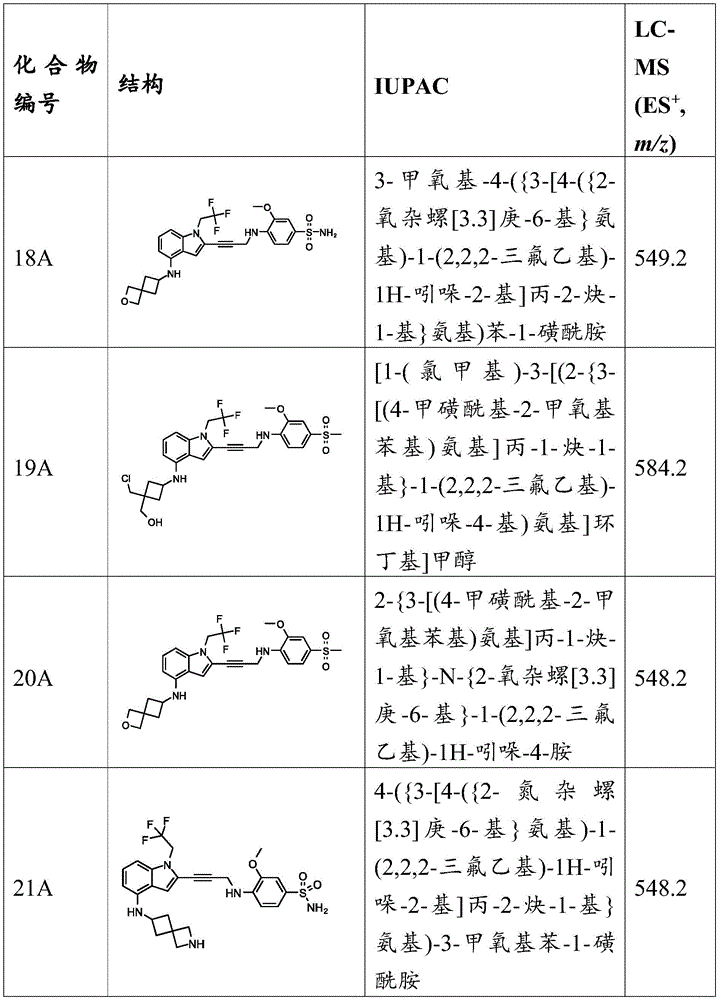


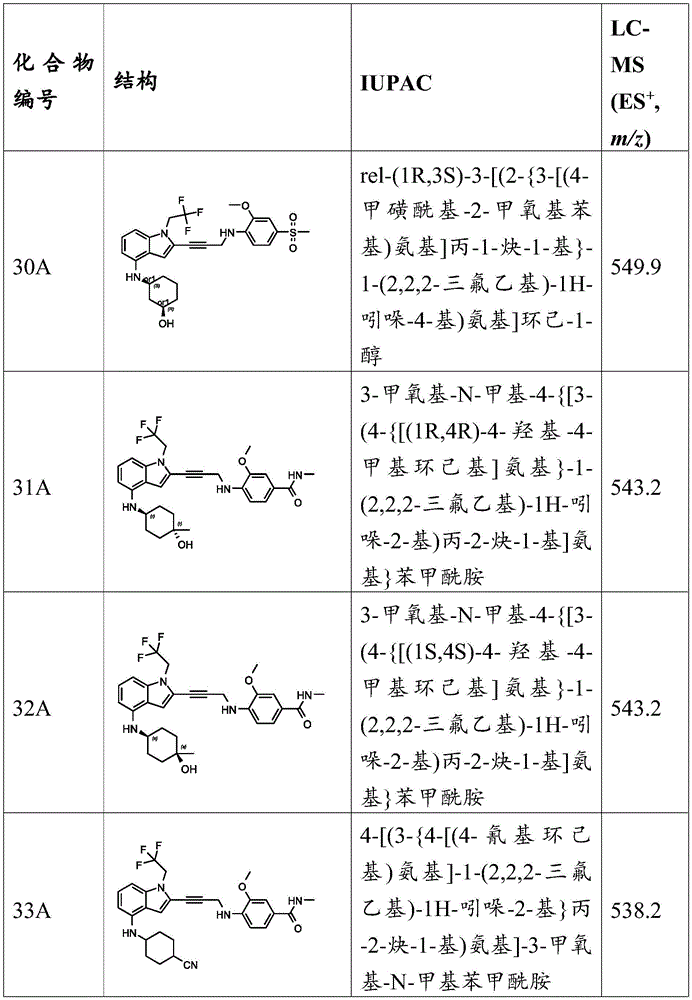


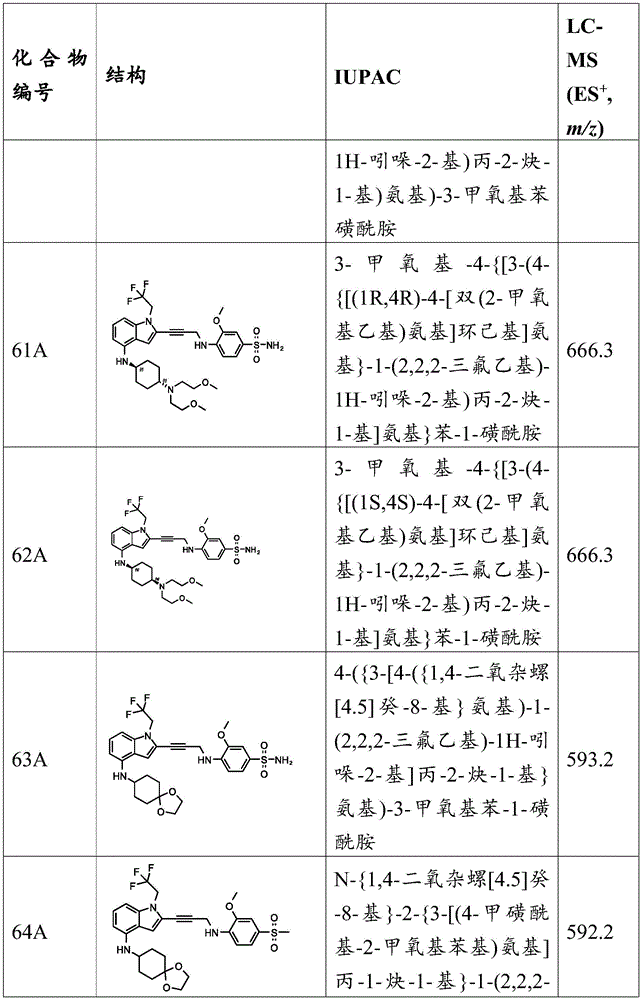

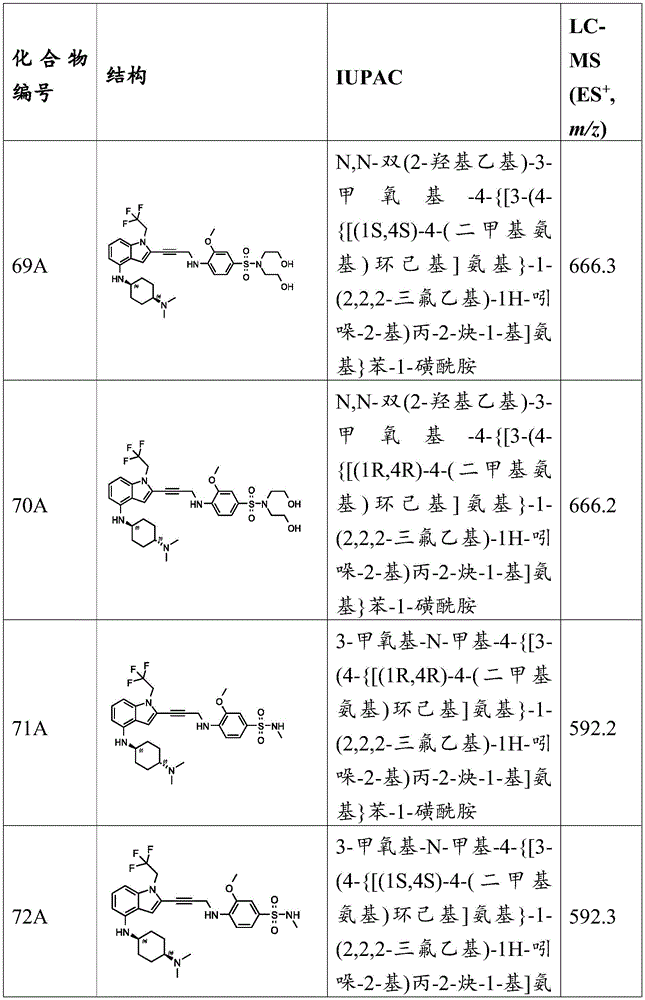


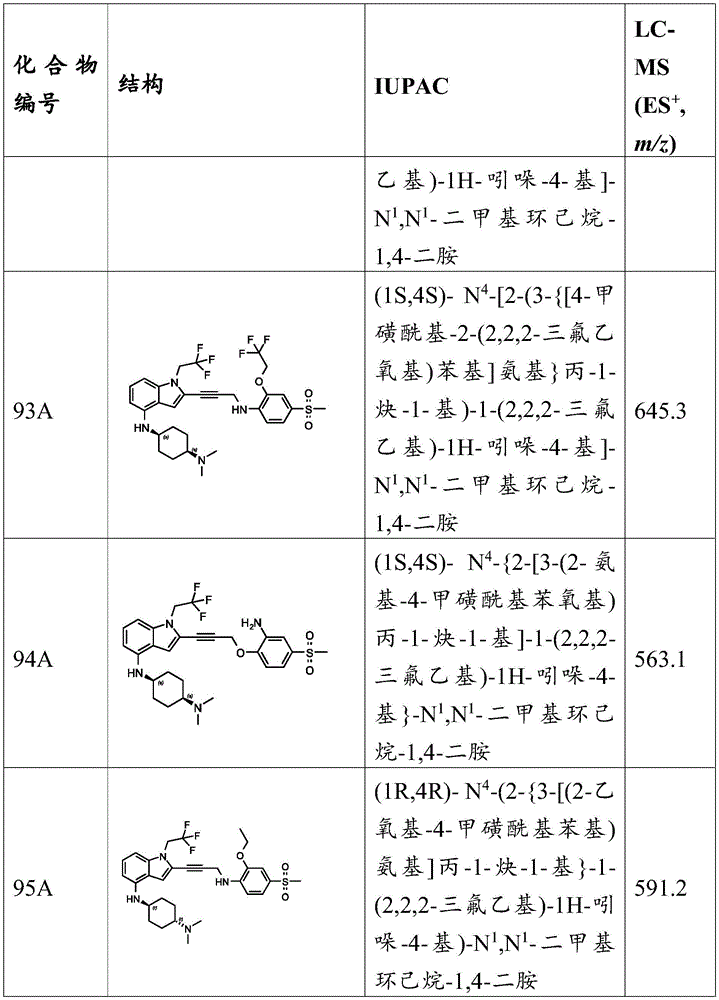


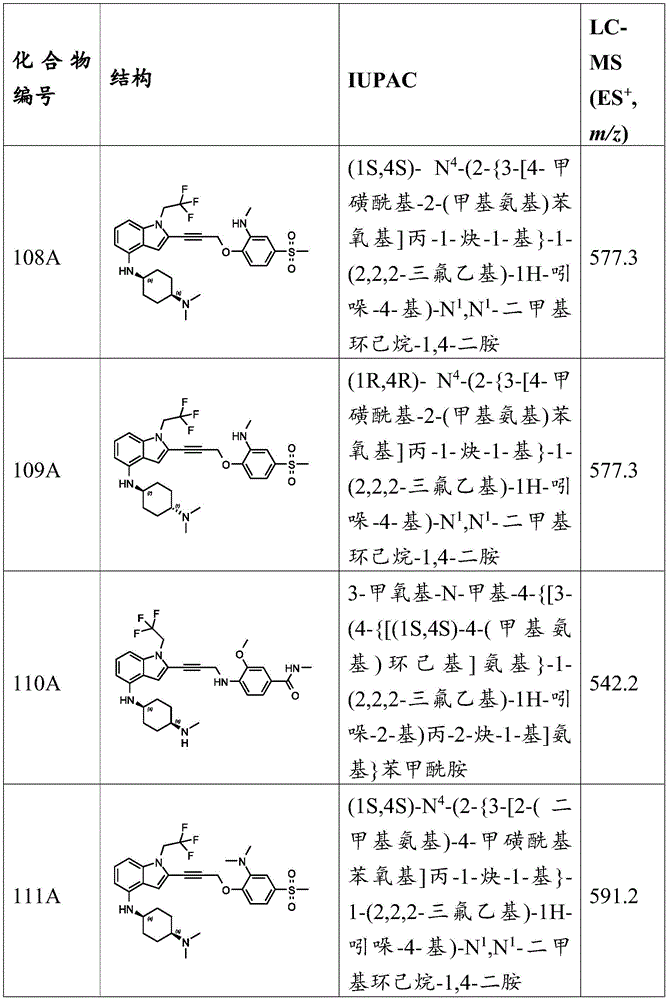

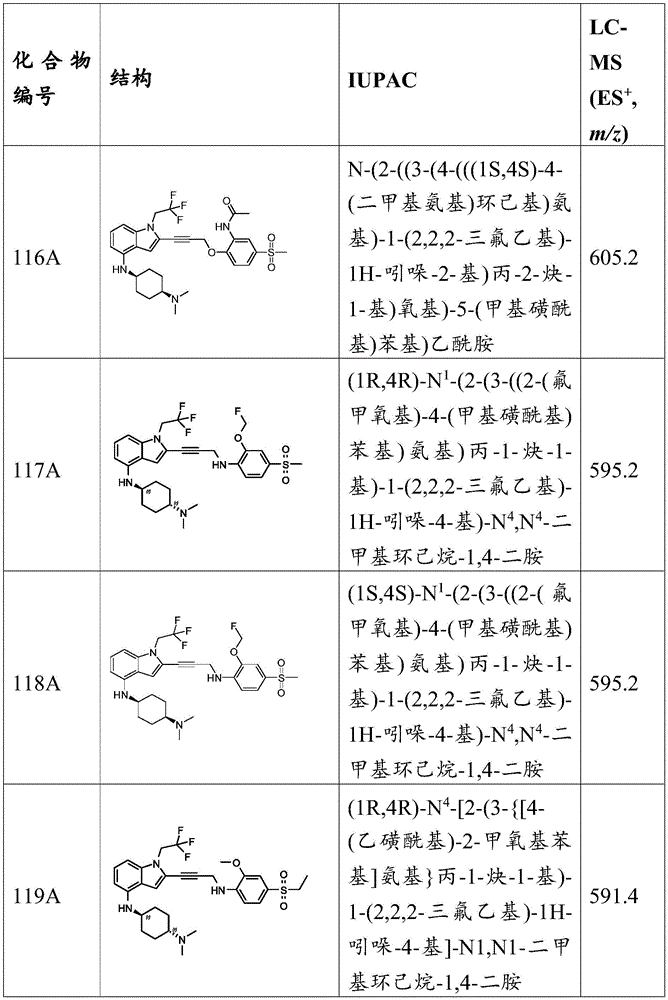


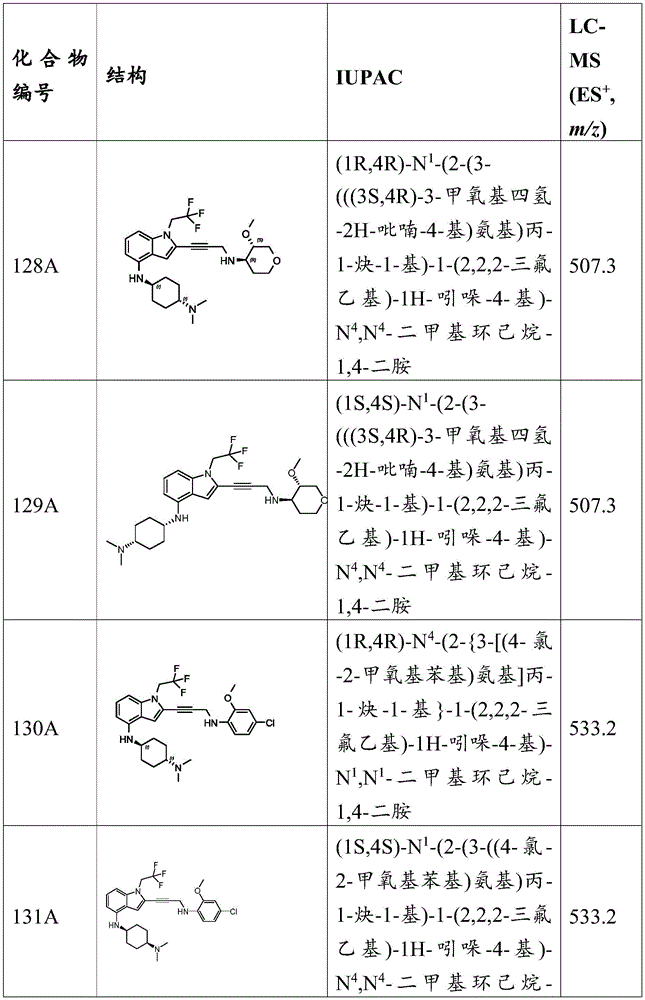


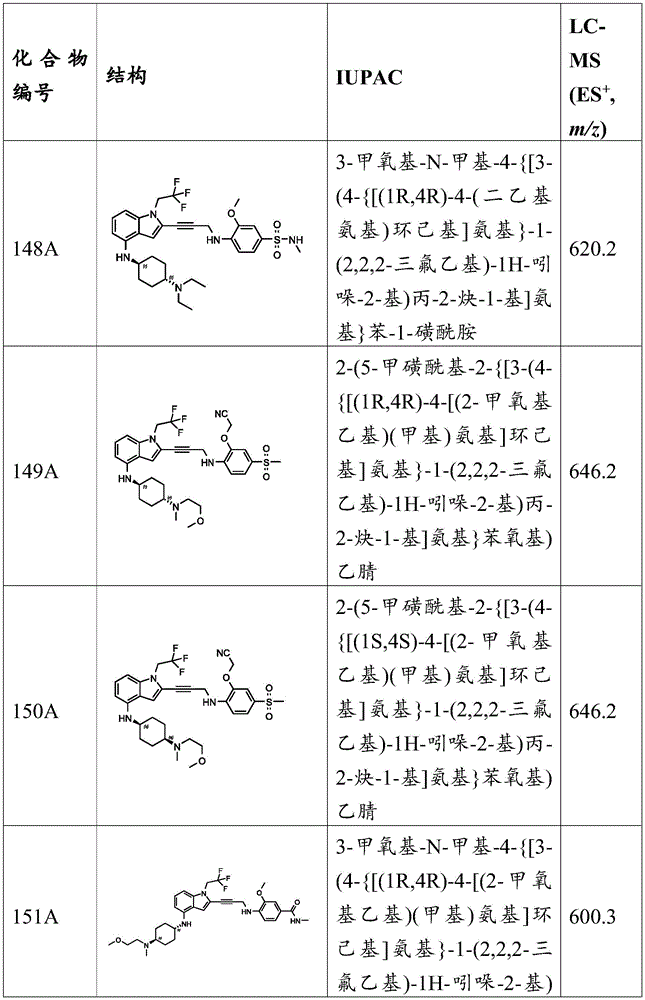
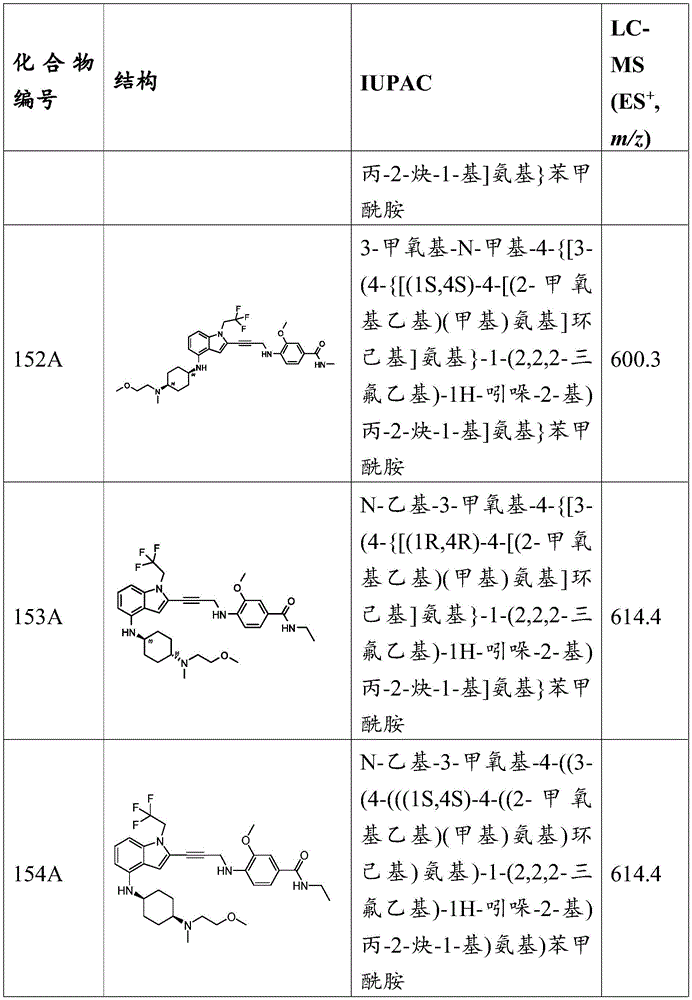


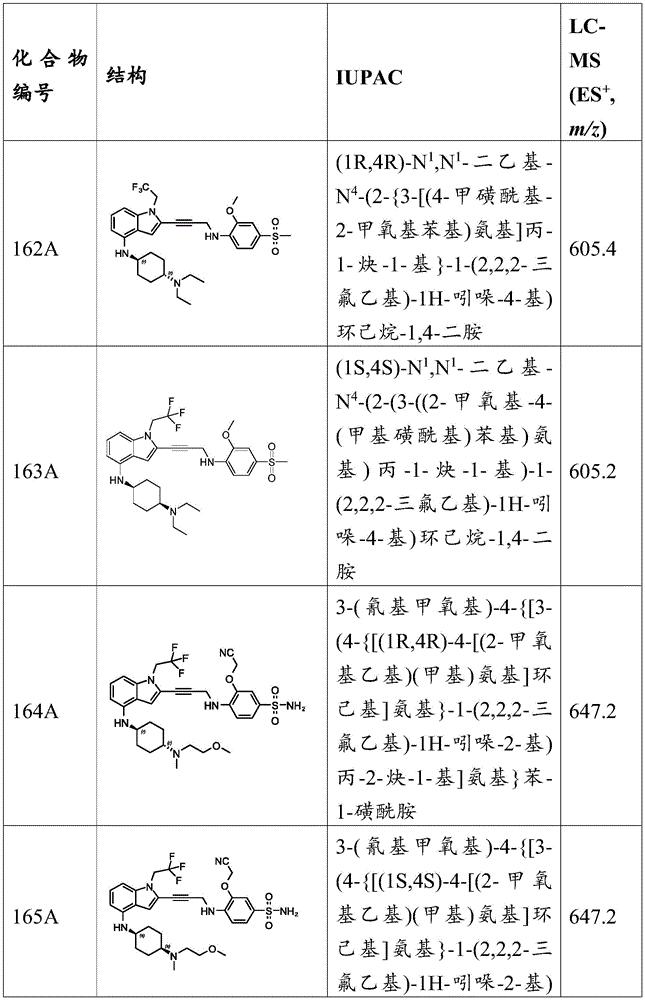
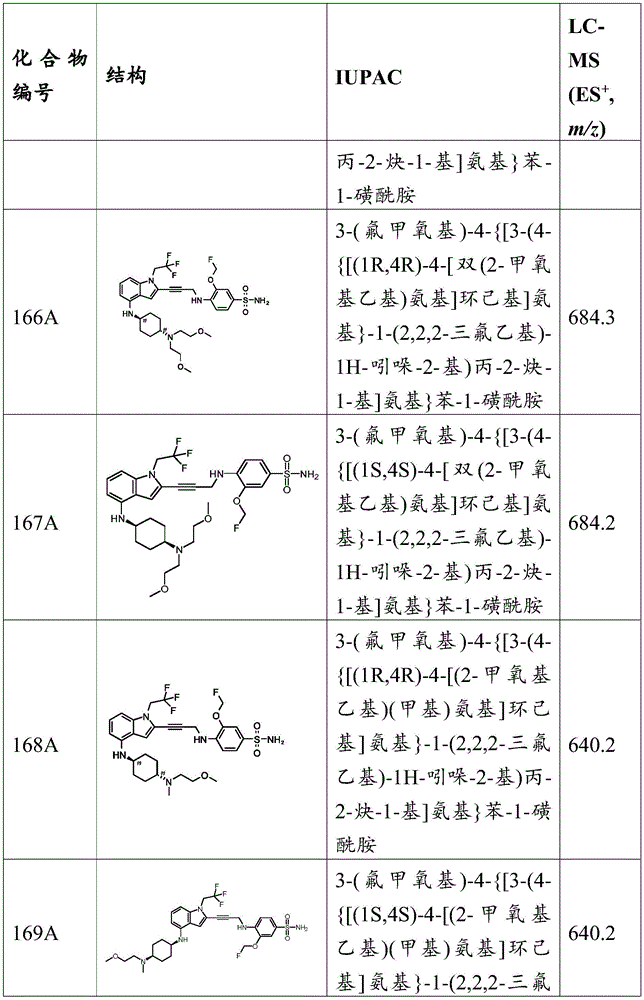


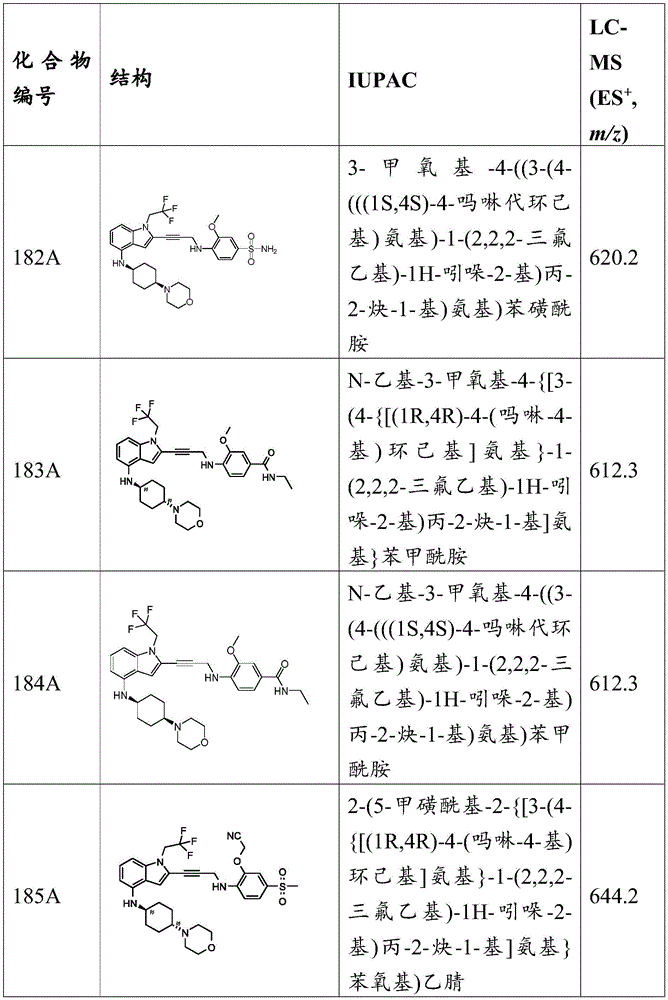

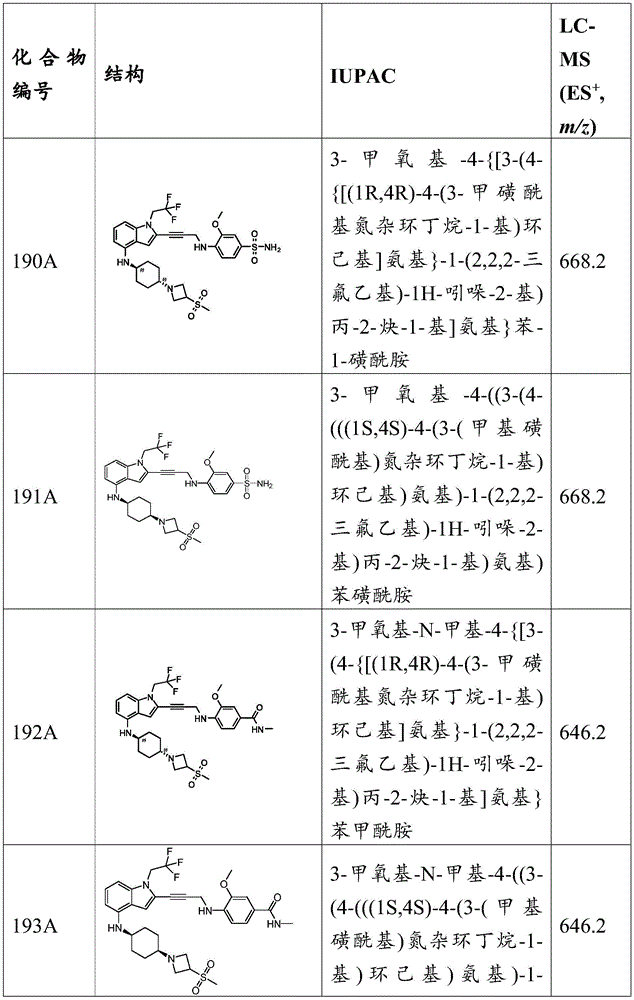


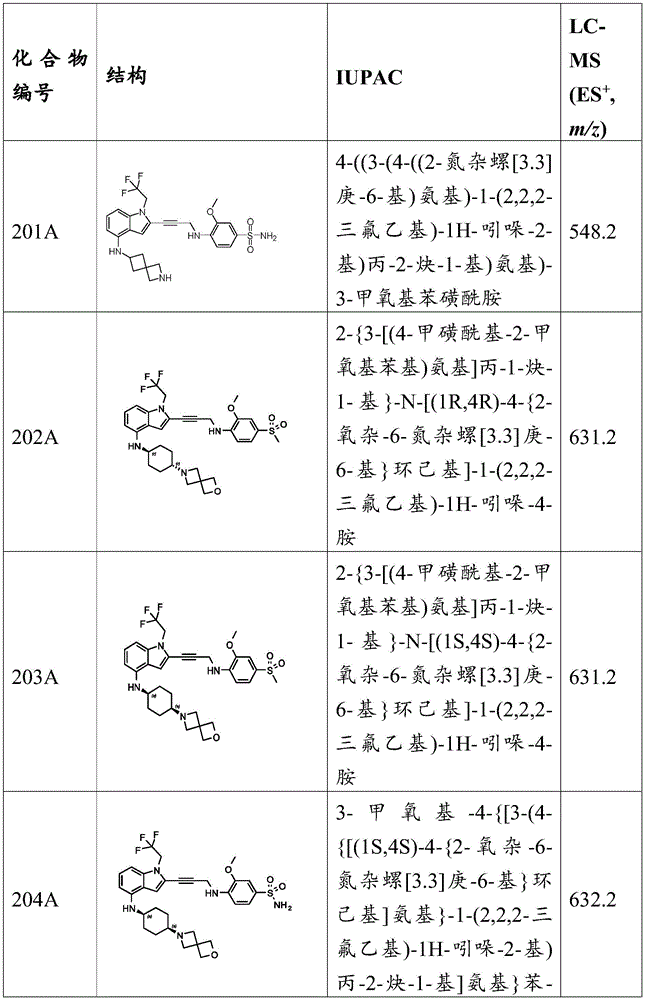


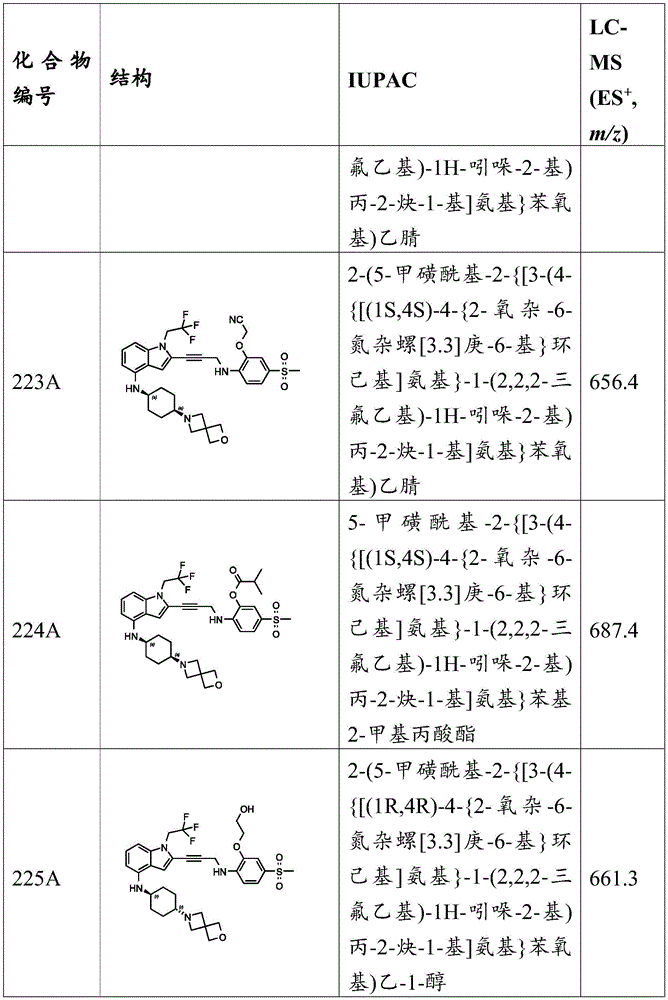


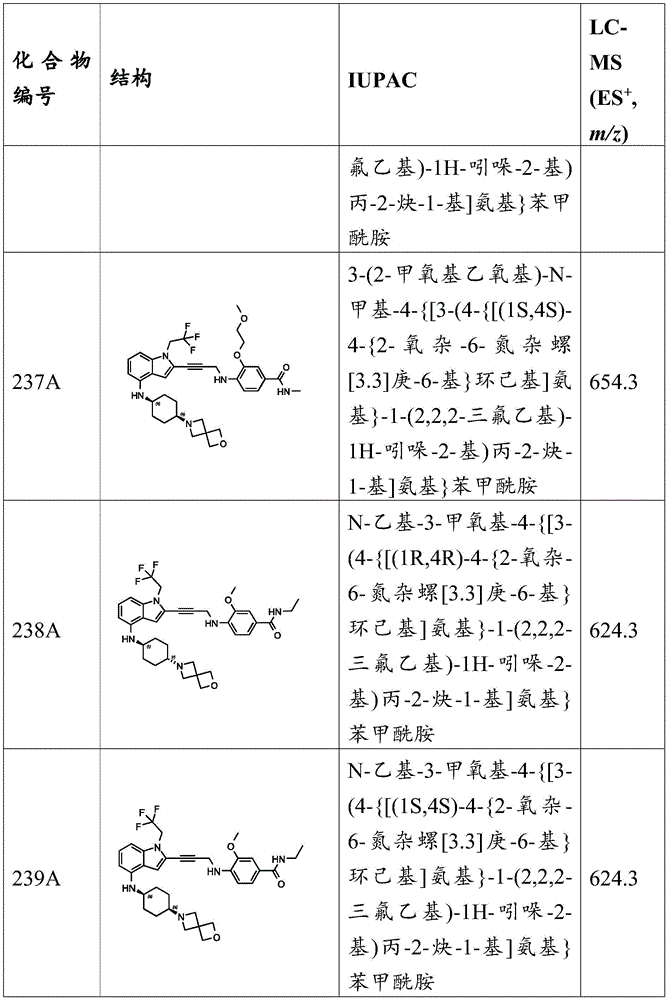


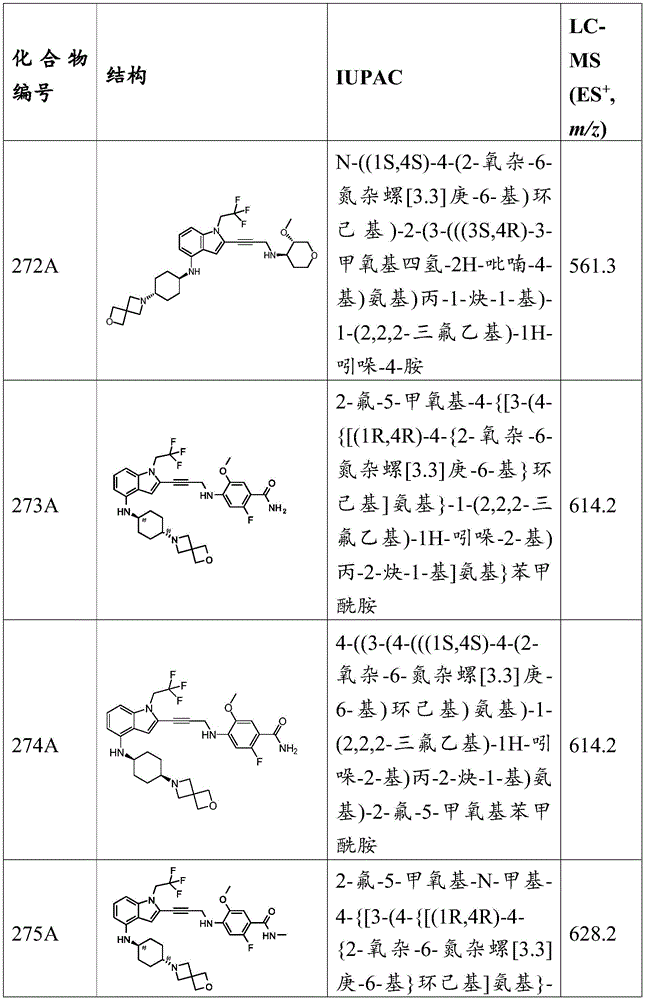


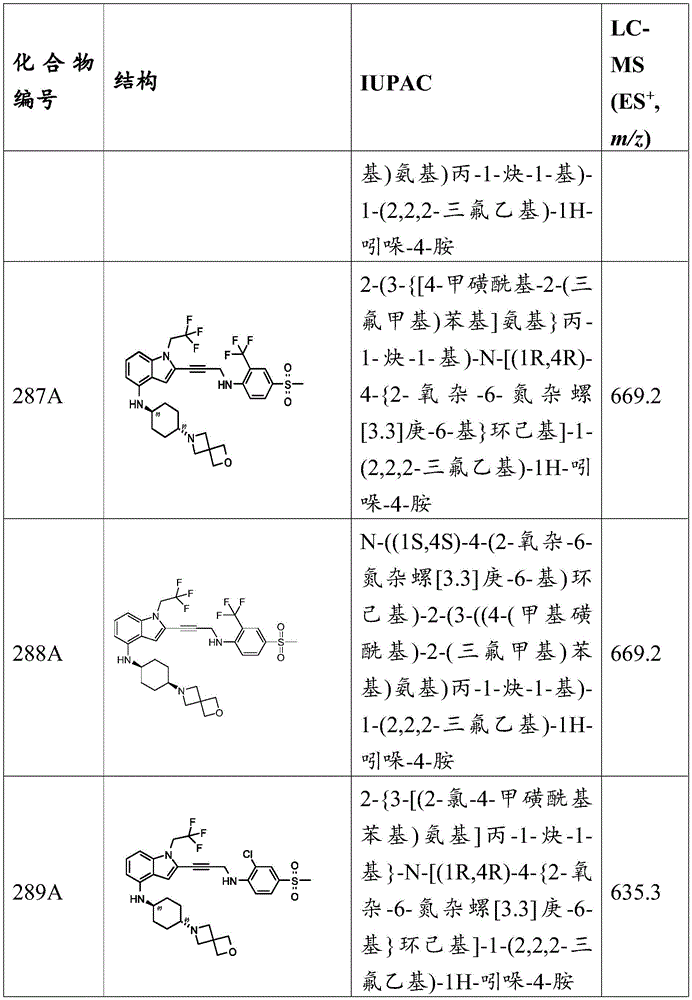

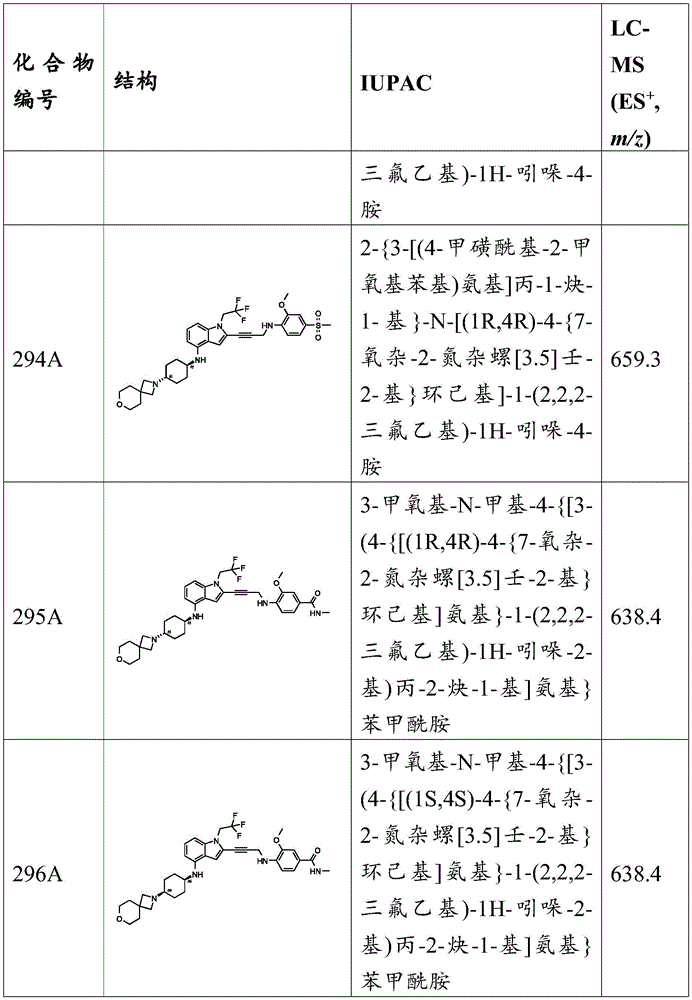


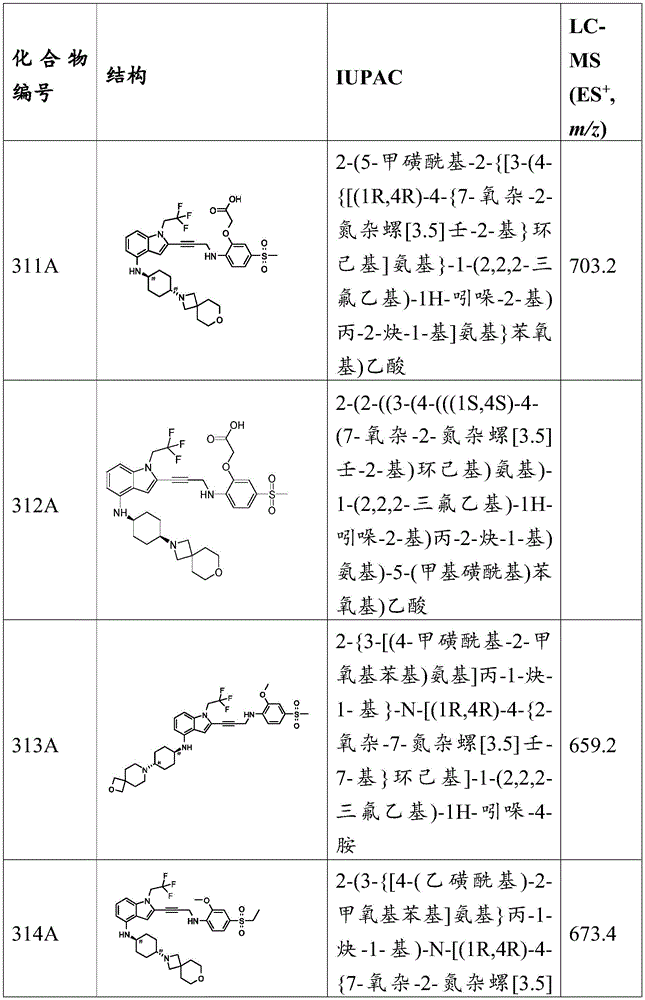

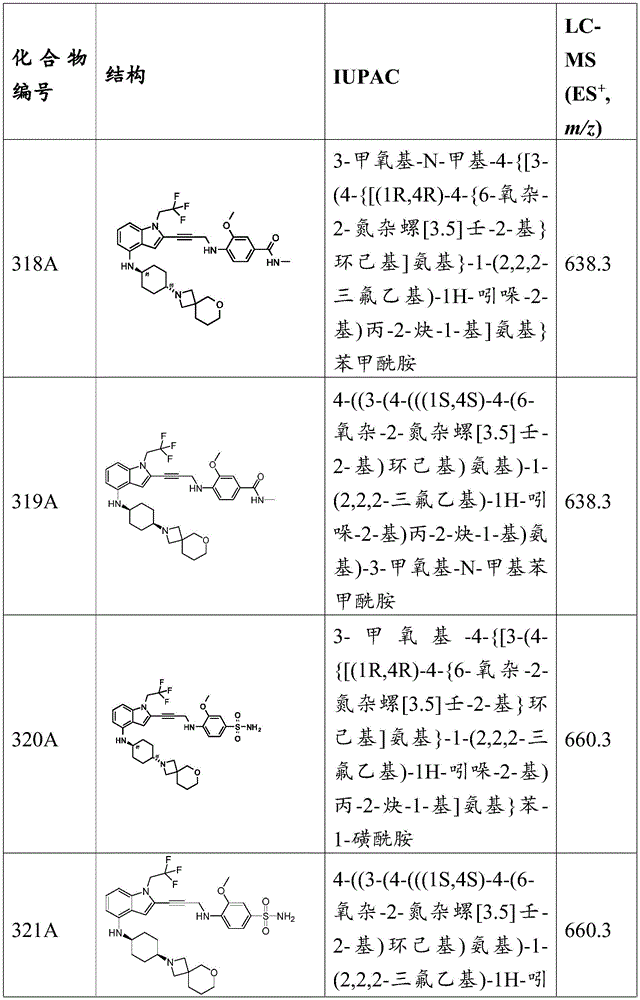


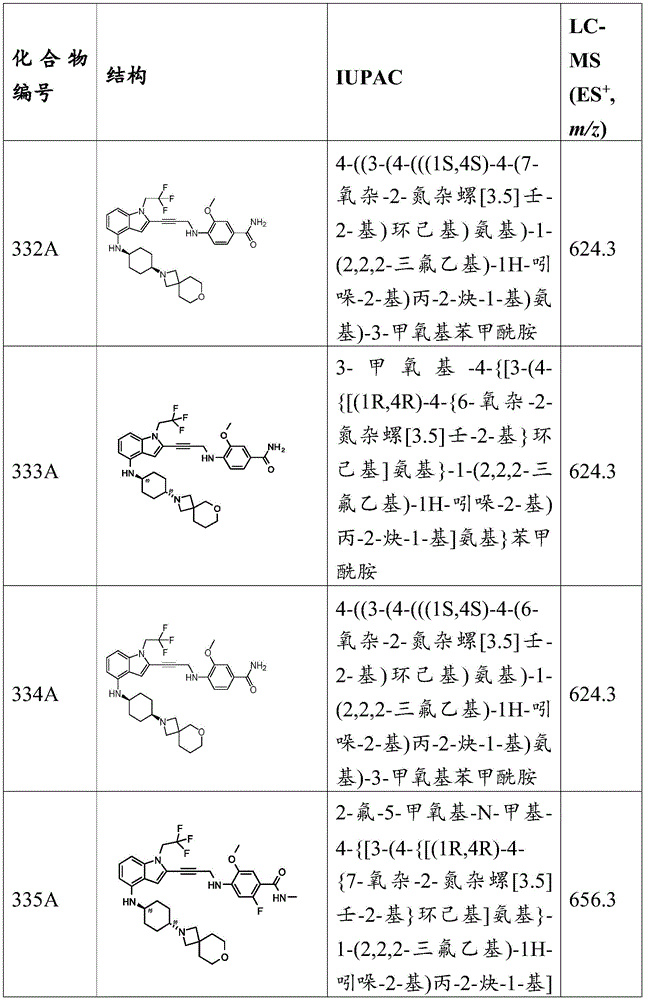
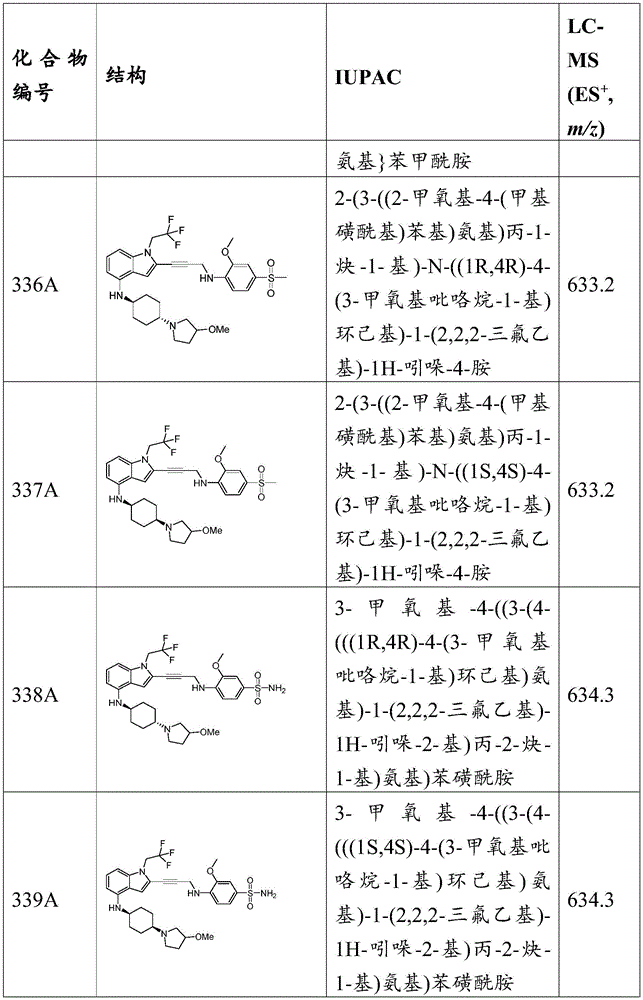
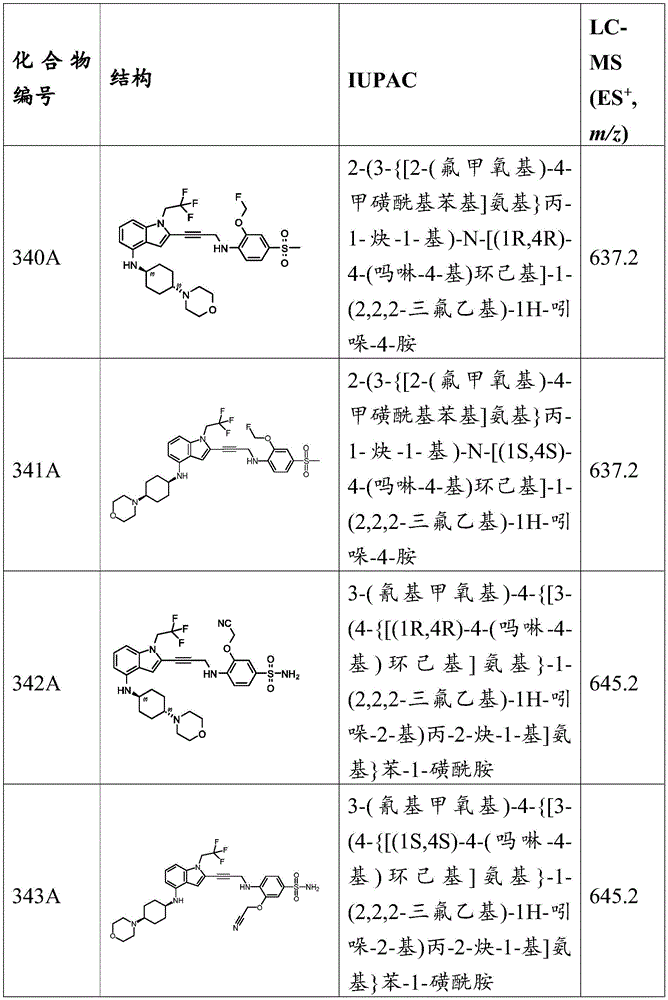


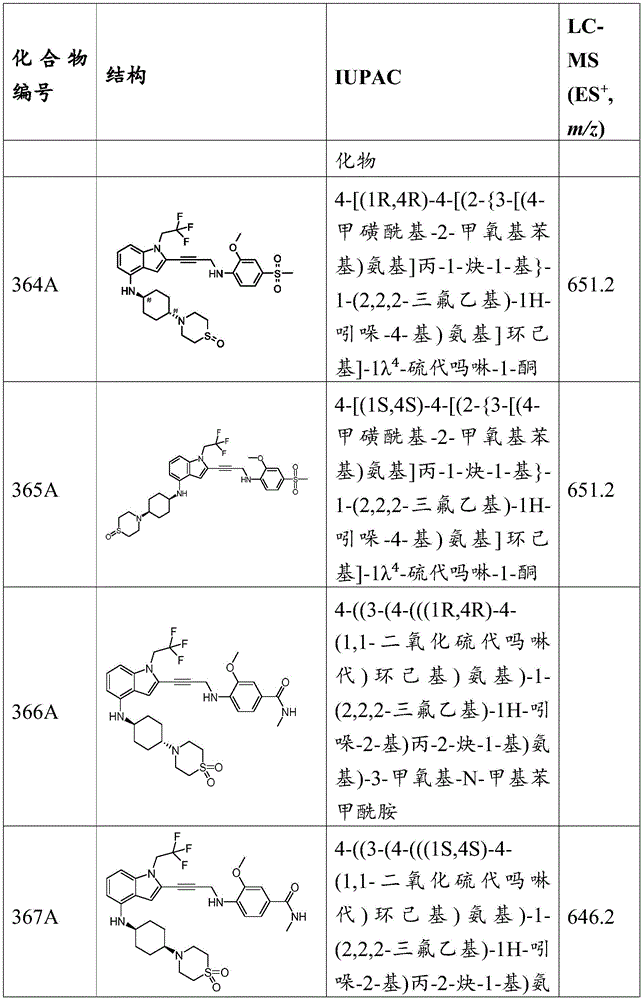
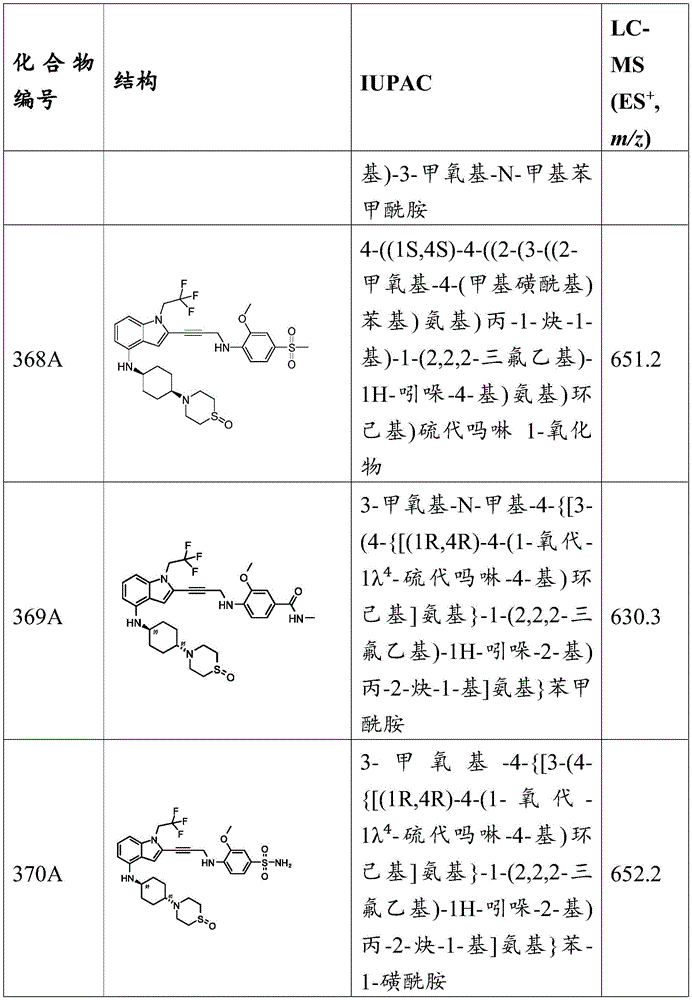

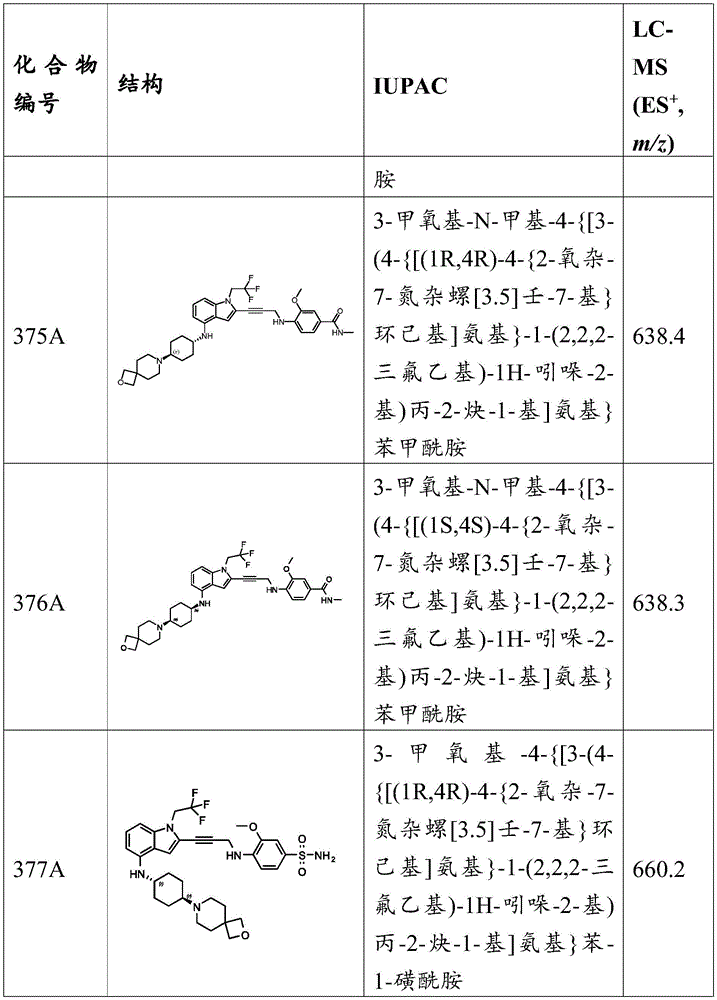

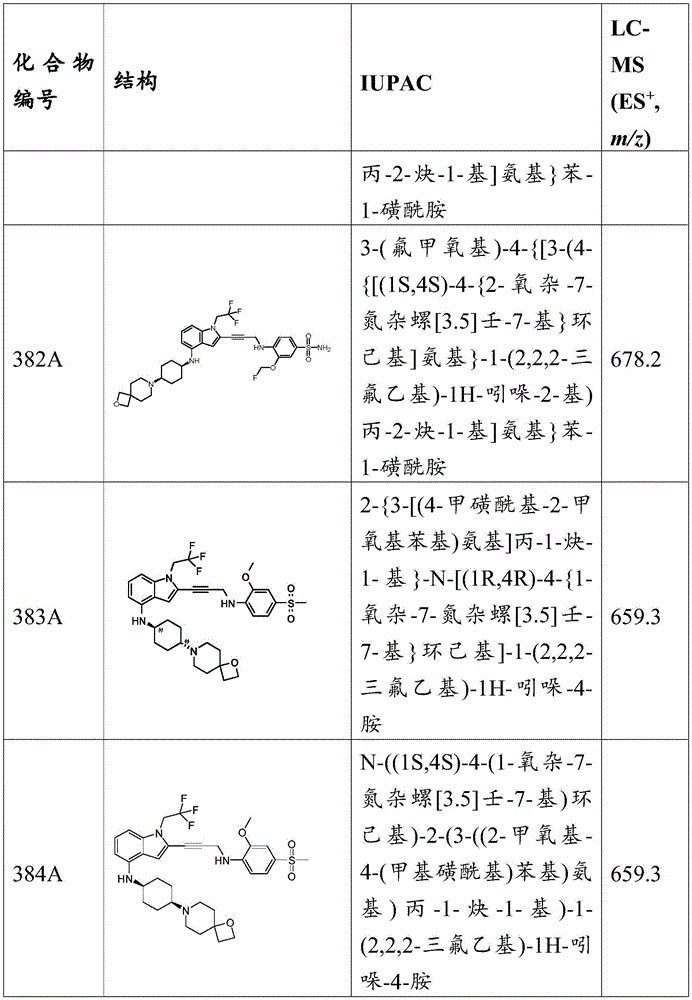
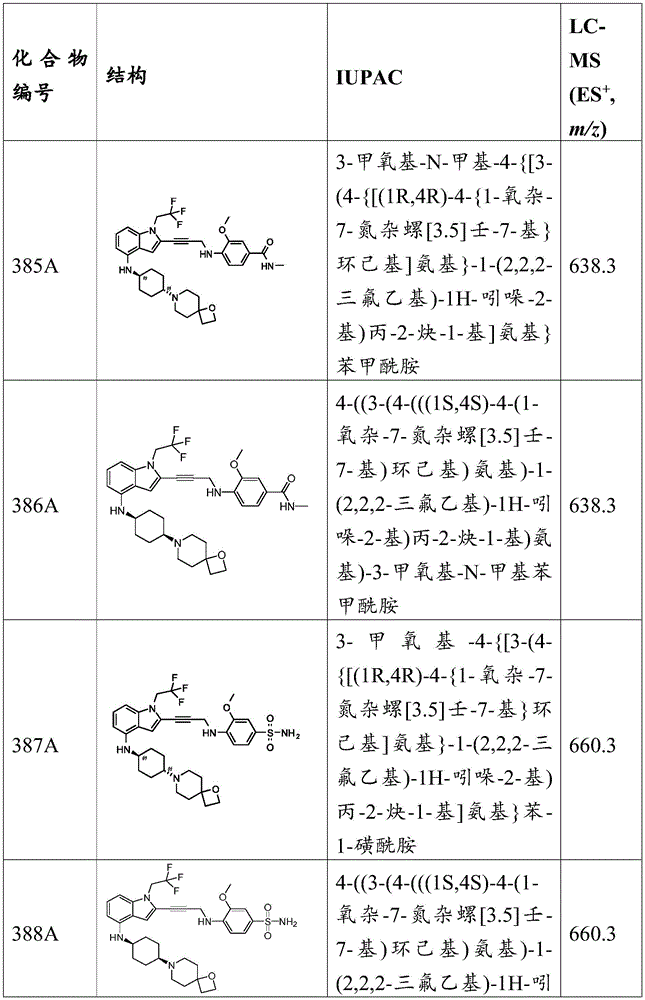

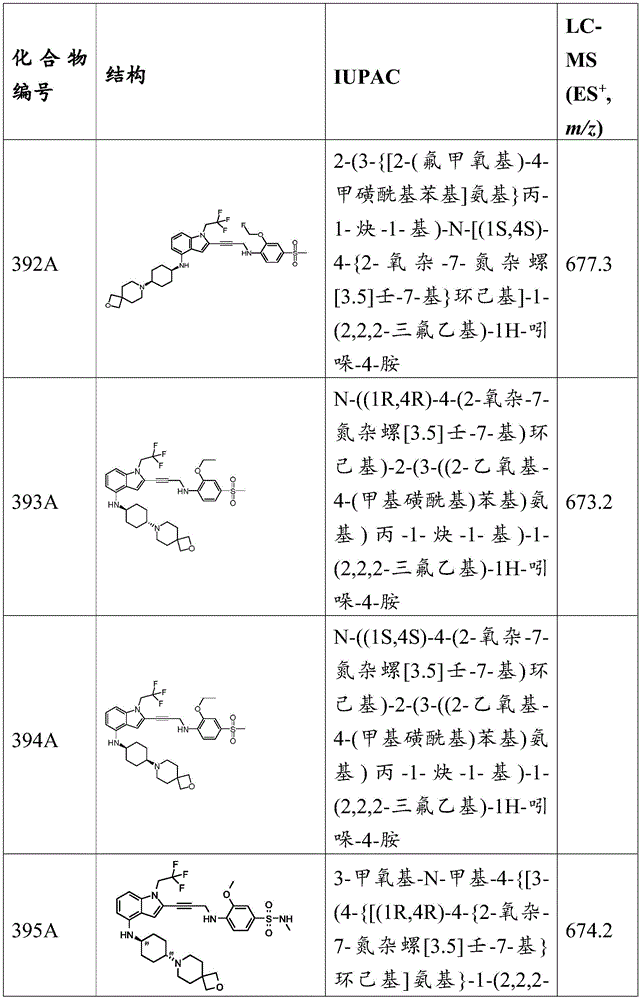


D. Compounds having a 2-ethynyl-N- (N-heterocyclyl) -1H-indol-4-amine core
Example D1: synthesis of 2- (3- ((4-methoxypyridin-3-yl) amino) prop-1-yn-1-yl) -N- (1-methylpiperidin-4-yl) -1- (2,2, 2-trifluoroethyl) -1H-indol-4-amine (Compound 527A).

Preparation of tert-butyl (4-methoxypyridin-3-yl) (3- (4- ((1-methylpiperidin-4-yl) amino) -1- (2,2, 2-trifluoroethyl) -1H-indol-2-yl) prop-2-yn-1-yl) carbamate: to a solution of 2-iodo-N- (1-methyl-4-piperidinyl) -1- (2,2, 2-trifluoroethyl) indol-4-amine (80mg, 183. mu. mol,1 eq) in DMSO (3mL) was added N- (4-methoxy-3-pyridinyl) -N-prop-2-ynyl-carbamic acid tert-butyl ester (96.0mg, 366. mu. mol,2 eq), CuI (34.9mg, 183. mu. mol,1 eq), Pd (PPh) 3 ) 4 (21.1mg, 18.3. mu. mol,0.10 eq.) and N-isopropylpropan-2-amine (1.10mmol, 154.3. mu.L, 6 eq.). The mixture was stirred at 40 ℃ for 2 hours. The reaction mixture was partitioned by adding saturated EDTA solution (20 mL). The mixture was stirred for 2 hours, and EtOAc was added to the mixture (20 mL). The organic phase was separated, washed with water (10mL), dried over anhydrous sodium sulfate, filtered and concentrated under reduced pressure. The crude residue was purified by preparative TLC to give N- (4-methoxy-3-pyridyl) -N- [3- [4- [ (1-methyl-4-piperidyl) amino ]-1- (2,2, 2-trifluoroethyl) indol-2-yl]Prop-2-ynyl]Tert-butyl carbamate (70mg, 122.5. mu. mol, 66.9% yield) as a dark yellow solid. MS (ES) + ,m/z):572.2。
2- [3- [ (4-methoxy-3-pyridyl) amino group]Prop-1-ynyl]Preparation of (E) -N- (1-methyl-4-piperidinyl) -1- (2,2, 2-trifluoroethyl) indol-4-amine: to N- (4-methoxy-3-pyridyl) -N- [3- [4- [ (1-methyl-4-piperidyl) amino]-1- (2,2, 2-trifluoroethyl) indol-2-yl]Prop-2-ynyl]A solution of tert-butyl carbamate (40mg, 70.0. mu. mol,1 eq) in EtOAc (2mL) was added HCl/EtOAc (4M,4mL,1 eq). The mixture was stirred at 25 ℃ for 2 hours. TLC analysis indicated that the starting material was consumed and a new spot corresponding to the desired product was detected. The reaction mixture was concentrated under reduced pressure and purified by preparative HPLC to give 2- [3- [ (4-methoxy-3-pyridyl) amino group]Prop-1-ynyl]-N- (1-methyl-4-piperidinyl) -1- (2,2, 2-trifluoroethyl)Indol-4-amine (9.8mg,20.6 μmol, 29.5% yield) as a white solid. MS (ES) + ,m/z):472.2。
Example D2: synthesis of 2- {3- [ (5-fluoro-4-methanesulfonyl-2-methoxyphenyl) amino ] prop-1-yn-1-yl } -N- (1-methylpiperidin-4-yl) -1- (2,2, 2-trifluoroethyl) -1H-indol-4-amine (compound 522A).

A mixture of 5-fluoro-2-methoxy-4- (methylsulfonyl) -N- (prop-2-yn-1-yl) aniline (90.2mg, 315.6. mu. mol,3 equivalents) in DMSO (2mL) was added to i-Pr 2 NH (1.05mmol, 150. mu.L, 10 equiv.), CuI (10.0mg, 52.6. mu. mol,0.5 equiv.), 2-iodo-N- (1-methylpiperidin-4-yl) -1- (2,2, 2-trifluoroethyl) -1H-indol-4-amine (50mg, 105.2. mu. mol,1 equiv.), and Pd (PPh) 3 ) 4 (2.43mg, 2.10. mu. mol,0.02 eq.). In N 2 The mixture was then stirred at 40 ℃ for 1.5 hours. TLC analysis (PE: EtOAc: TEA ═ 100:100:1, R f 0.5) indicated that 50% of the starting material remained and a major new spot was detected, which was more polar than the starting material. The reaction mixture was poured into a saturated EDTA solution (50mL) and the resulting mixture was stirred at 25 ℃ for 1 hour. The mixture was extracted with EtOAc (90mL x 3). The combined organic layers were washed with brine (90mL x 3), dried over anhydrous sodium sulfate, filtered and concentrated under reduced pressure. The crude residue was purified by preparative TLC (PE: EtOAc: DCM: MeOH ═ 10:10:1, R f = 0.5) and preparative HPLC to give 2- {3- [ (5-fluoro-4-methanesulfonyl-2-methoxyphenyl) amino]Prop-1-yn-1-yl } -N- (1-methylpiperidin-4-yl) -1- (2,2, 2-trifluoroethyl) -1H-indol-4-amine (19.6mg,33.5 μmol, 37.1% yield) as a light yellow solid. MS (ES) + ,m/z):567.2。
Example D3: synthesis of compound 537A and 538A.

N- (1-ethylpiperidin-4-yl) -2-iodo-1- (2,2, 2-trifluoroethyl)) -synthesis of 1H-indol-4-amine: to a solution of 2-iodo-N- (piperidin-4-yl) -1- (2,2, 2-trifluoroethyl) -1H-indol-4-amine (150mg,1 eq) in DMF (1mL) was added K 2 CO 3 (147mg,1.06mmol,3 equiv.). Bromoethane (53 μ L,2 equivalents) was then added to the mixture and the reaction mixture was stirred at 25 ℃ for 3 hours. TLC analysis in MeOH indicated complete consumption of starting material and formation of a new spot. The reaction mixture was diluted with water (40mL) and extracted with EtOAc (15mL × 3). The combined organic layers were washed with brine (10mL), dried over anhydrous sodium sulfate, filtered and concentrated in vacuo to give crude N- (1-ethylpiperidin-4-yl) -2-iodo-1- (2,2, 2-trifluoroethyl) -1H-indol-4-amine (150mg) as a brown solid.
Representative procedure for Sonogashira coupling reaction: in N 2 Next, to a mixture of N- (1-ethyl-4-piperidinyl) -2-iodo-1- (2,2, 2-trifluoroethyl) indol-4-amine (150mg, 266. mu. mol,1 equivalent) and 2-methoxy-4-methylsulfonyl-N-prop-2-ynyl-aniline (159.1mg, 531.8. mu. mol,2 equivalents) in DMSO (3mL) was added N-isopropylprop-2-amine (266. mu. mol, 38. mu.L, 1 equivalent) and Pd (PPh) 3 ) 4 (6.2mg, 5.3. mu. mol,0.02 eq), followed by the addition of CuI (50.6mg, 266. mu. mol,1 eq). The reaction mixture was stirred at 45 ℃ for 1 hour. LC-MS analysis indicated the reaction was complete. The mixture was poured into saturated aqueous EDTA (20mL) and stirred for 1 hour. The aqueous phase was extracted with EtOAc (10 mL. times.3). The combined organic layers were washed with brine (10mL), dried over anhydrous sodium sulfate, filtered and concentrated under reduced pressure to give a residue. The residue was passed through preparative TLC (SiO) 2 PE: EtOAc ═ 1:1) and preparative HPLC purification afforded the desired product (17.8mg,30.9 μmol, 11.6% yield). N- (1-ethylpiperidin-4-yl) -2- {3- [ (4-methanesulfonyl-2-methoxyphenyl) amino]Prop-1-yn-1-yl } -1- (2,2, 2-trifluoroethyl) -1H-indol-4-amine, MS (ES) + M/z) 563.2; and 4- [ (3- {4- [ (1-ethylpiperidin-4-yl) amino group]-1- (2,2, 2-trifluoroethyl) -1H-indol-2-yl } prop-2-yn-1-yl) amino]-3-methoxybenzene-1-sulphonamide, MS (ES) + ,m/z):564.2。
Example D3: synthesis of 2- {3- [ (4-methanesulfonyl-2-methoxyphenyl) amino ] prop-1-yn-1-yl } -N- [1- (prop-2-yl) piperidin-4-yl ] -1- (2,2, 2-trifluoroethyl) -1H-indol-4-amine (compound 542A).
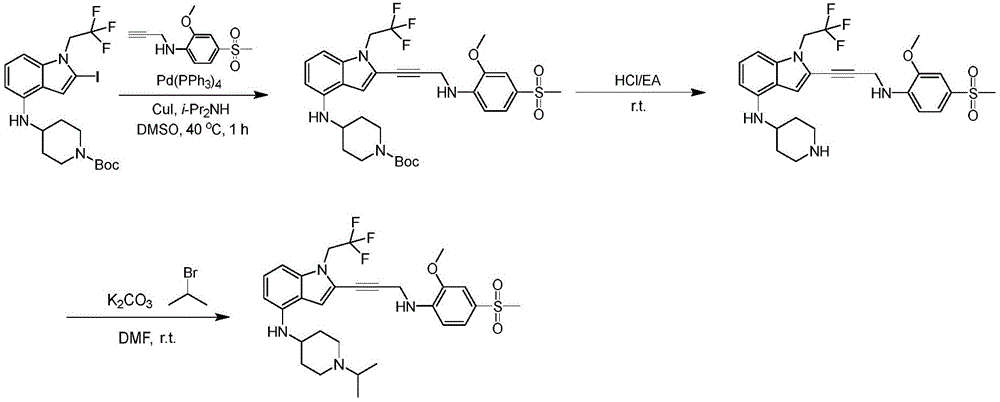
Synthesis of tert-butyl 4- ((2- (3- ((2-methoxy-4- (methylsulfonyl) phenyl) amino) prop-1-yn-1-yl) -1- (2,2, 2-trifluoroethyl) -1H-indol-4-yl) amino) piperidine-1-carboxylate: to a solution of 2-methoxy-4- (methylsulfonyl) -N- (prop-2-yn-1-yl) aniline (1.92g,8.03mmol,1.2 eq) in DMSO (70mL) was added i-Pr 2 NH (6.77g,66.9mmol,9.45mL,10 equiv.), CuI (382.1mg,2.01mmol,0.3 equiv.), tert-butyl 4- ((2-iodo-1- (2,2, 2-trifluoroethyl) -1H-indol-4-yl) amino) piperidine-1-carboxylate (3.5g,6.69mmol,1 equiv.), and Pd (PPh) 3 ) 4 (772.8mg, 669. mu. mol,0.1 equiv.). In N 2 The resulting mixture was then stirred at 40 ℃ for 1 hour. TLC analysis indicated the reaction was complete. The reaction mixture was diluted with EtOAc (500mL) and 2MEDTA in water (500mL) and stirred at 20 ℃ for a further 1 h. The mixture was extracted with EtOAc (× 3 500mL), washed with brine (500mL), dried over anhydrous sodium sulfate and concentrated under reduced pressure to give the crude product. The crude residue is purified by column chromatography (SiO) 2 PE EtOAc ═ 4:1 to 1:0) purification afforded tert-butyl 4- ((2- (3- ((2-methoxy-4- (methylsulfonyl) phenyl) amino) prop-1-yn-1-yl) -1- (2,2, 2-trifluoroethyl) -1H-indol-4-yl) amino) piperidine-1-carboxylate (9g,14.18mmol) as a yellow solid.
Synthesis of 2- (3- ((2-methoxy-4- (methylsulfonyl) phenyl) amino) prop-1-yn-1-yl) -N- (piperidin-4-yl) -1- (2,2, 2-trifluoroethyl) -1H-indol-4-amine: tert-butyl 4- ((2- (3- ((2-methoxy-4- (methylsulfonyl) phenyl) amino) prop-1-yn-1-yl) -1- (2,2, 2-trifluoroethyl) -1H-indol-4-yl) amino) piperidine-1-carboxylate (3g,4.73mmol,1 eq) in EtOAc (20mL) was added HCl/EtOAc (4M,60mL,50.78 eq). At N 2 The resulting mixture was then stirred at 25 ℃ for 1 hour. TLC analysis indicated the reaction was complete. The reaction was quenched with saturated NaHCO 3 Aqueous (200mL) was quenched and the mixture was extracted with EtOAc (200 mL. times.3). The combined organic layers were washed with brine (200 mL. times.2) and over anhydrous sodium sulfateDried, filtered and concentrated in vacuo. The residue was purified by column chromatography (SiO) 2 EtOAc ═ 1:1 to 5% TEA in EtOAc) to give 2- (3- ((2-methoxy-4- (methylsulfonyl) phenyl) amino) prop-1-yn-1-yl) -N- (piperidin-4-yl) -1- (2,2, 2-trifluoroethyl) -1H-indol-4-amine (6.6g,12.1mmol) as a dark brown solid.
1H NMR(400MHz,DMSO-d6)δppm 7.39(dd,J=8.38,1.90Hz,1H)7.26(d,J=1.96Hz,1H)7.13(s,1H)7.01(t,J=7.49Hz,1H)6.89(d,J=8.44Hz,1H)6.72(d,J=8.31Hz,1H)6.50(t,J=6.24Hz,1H)6.21(d,J=7.82Hz,1H)5.69(d,J=7.95Hz,1H)4.94(q,J=9.05Hz,2H)4.36(d,J=6.24Hz,2H)3.88-4.08(m,3H)3.49-3.64(m,1H)3.08-3.27(m,5H)2.81-3.06(m,2H)1.96-2.06(m,2H)1.48-1.64(m,2H)。
Synthesis of N- (1-isopropylpiperidin-4-yl) -2- (3- ((2-methoxy-4- (methylsulfonyl) phenyl) amino) prop-1-yn-1-yl) -1- (2,2, 2-trifluoroethyl) -1H-indol-4-amine: to a solution of 2- (3- ((2-methoxy-4- (methylsulfonyl) phenyl) amino) prop-1-yn-1-yl) -N- (piperidin-4-yl) -1- (2,2, 2-trifluoroethyl) -1H-indol-4-amine (0.25g, 468. mu. mol,1 eq) in DMF (5mL) was added 2-bromopropane (1723mg,1.40mmol,3 eq) and K 2 CO 3 (193.9mg,1.40mmol,3 equiv.). In N 2 The resulting mixture was then stirred at 25 ℃ for 6 hours. TLC analysis indicated 15% starting material remained and 60% of the desired product was detected. The reaction was quenched with water (20mL) and the mixture was extracted with EtOAc (20mL x 3). The combined organic layers were washed with brine (20mL x 2), dried over anhydrous sodium sulfate, filtered and concentrated in vacuo. The residue was passed through preparative TLC (SiO) 2 DCM: MeOH ═ 20:1) and then by preparative HPLC (neutral conditions) to give 2- {3- [ (4-methanesulfonyl-2-methoxyphenyl) amino]Prop-1-yn-1-yl } -N- [1- (prop-2-yl) piperidin-4-yl]-1- (2,2, 2-trifluoroethyl) -1H-indol-4-amine (0.0545g,91.3 μmol, 19.5% yield) as a light yellow solid. MS (ES) + ,m/z):577.3。
1H NMR(400MHz,DMSO-d6)δppm 7.39(dd,J=8.38,1.90Hz,1H)7.25(d,J=1.96Hz,1H)7.08(s,1H)6.99(t,J=8.01Hz,1H)6.89(d,J=8.44Hz,1H)6.67(d,J=8.44Hz,1H)6.49(t,J=6.17Hz,1H)6.15(d,J=7.82Hz,1H)5.46(d,J=8.07Hz,1H)4.92(q,J=9.13Hz,2H)4.35(d,J=6.11Hz,2H)3.89(s,3H)3.21-3.31(m,1H)3.09(s,3H)2.62-2.83(m,2H)2.53-2.60(m,1H)2.21(br t,J=10.58Hz,2H)1.93(br d,J=11.98Hz,2H)1.36-1.48(m,2H)0.97(d,J=6.60Hz,6H)。
Example D4: synthesis of 1-methoxy-3- (4- { [2- (3- { [ 2-methoxy-4- (trifluoromethyl) phenyl ] amino } prop-1-yn-1-yl) -1- (2,2, 2-trifluoroethyl) -1H-indol-4-yl ] amino } piperidin-1-yl) propan-2-ol (compound 689A).

1- [4- [ [ 2-iodo-1- (2,2, 2-trifluoroethyl) indol-4-yl]Amino group]-1-piperidinyl group]-3-methoxy-prop-2-ol (0.05g, 97.8. mu. mol,1 eq.), 2-methoxy-N-prop-2-ynyl-4- (trifluoromethyl) aniline (44.8mg, 195.6. mu. mol,2 eq.), CuI (9.3mg, 48.9. mu. mol,0.5 eq.), Pd (dppf) Cl 2 (7.2mg, 9.78. mu. mol,0.1 equiv.) and i-Pr 2 A mixture of NH (196. mu. mol, 27.6. mu.L, 2 equiv.) in DMSO (1mL) was degassed and treated with N 2 Purging was carried out three times. Then, in N 2 The mixture was stirred at 20 ℃ for 4 hours under an atmosphere. LC-MS and HPLC analysis indicated that the starting material was consumed and the desired product was detected. To the mixture was added 2M aqueous EDTA (15 mL). The resulting mixture was stirred for 1.5 hours. The mixture was then extracted with EtOAc (10mL × 8). The organic layer was washed with brine (10mL), dried over anhydrous sodium sulfate, filtered and concentrated in vacuo. The crude residue was passed through preparative TLC (SiO) 2 EtOAc TEA 50:1) and preparative HPLC purification to give 1-methoxy-3- [4- [ [2- [3- [ 2-methoxy-4- (trifluoromethyl) anilino group]Prop-1-ynyl]-1- (2,2, 2-trifluoroethyl) indol-4-yl]Amino group]-1-piperidinyl group]Propan-2-ol (15.3mg, 24.5. mu. mol, 25.1% yield) as a white solid. MS (ES) + ,m/z):613.3。
Example D5: synthesis of 1- {4- [ (2- {3- [ (5-fluoro-4-methanesulfonyl-2-methoxyphenyl) amino ] prop-1-yn-1-yl } -1- (2,2, 2-trifluoroethyl) -1H-indol-4-yl) amino ] piperidin-1-yl } -3-methoxyprop-2-ol (compound 677A).

A solution of 5-fluoro-2-methoxy-4- (methylsulfonyl) -N- (prop-2-yn-1-yl) aniline (83.0mg, 290. mu. mol,3 equivalents) in DMSO (2mL) was added to i-Pr 2 NH (968. mu. mol, 137. mu.L, 10 equivalents), CuI (9.2mg, 48.4. mu. mol,0.5 equivalents), 1- (4- ((2-iodo-1- (2,2, 2-trifluoroethyl) -1H-indol-4-yl) amino) piperidin-1-yl) -3-methoxypropan-2-ol (50mg, 96.81. mu. mol,1 equivalent), and Pd (PPh) 3 ) 4 (2.2mg, 1.94. mu. mol,0.02 eq.). In N 2 The reaction mixture was then stirred at 40 ℃ for 1.5 hours. LC-MS analysis indicated 24% starting material remained. Several new peaks were observed and 36% of the desired product was detected. The reaction mixture was poured into a saturated EDTA solution (120 mL). The mixture was stirred at 25 ℃ for 1 hour. The mixture was extracted with EtOAc (90mL x 3). The combined organic layers were washed with brine (200mL x 3), dried over anhydrous sodium sulfate, filtered and concentrated under reduced pressure. The crude residue was purified by preparative TLC (PE: EtOAc: TEA ═ 100:100:1, R) f = 0.45) and preparative HPLC purification to give 1- {4- [ (2- {3- [ (5-fluoro-4-methanesulfonyl-2-methoxyphenyl) amino]Prop-1-yn-1-yl } -1- (2,2, 2-trifluoroethyl) -1H-indol-4-yl) amino]Piperidin-1-yl } -3-methoxypropan-2-ol (27.5mg, 63.1. mu. mol) as a pale yellow solid. MS (ES) + ,m/z):641.2。
Example D6: synthesis of 3-methoxy-N-methyl-4- ({3- [4- ({1- [ (2-oxo-1, 3-dioxolan-4-yl) methyl ] piperidin-4-yl } amino) -1- (2,2, 2-trifluoroethyl) -1H-indol-2-yl ] prop-2-yn-1-yl } amino) benzamide (Compound 762A).

Preparation of 4- ((4- ((2-iodo-1- (2,2, 2-trifluoroethyl) -1H-indol-4-yl) amino) cyclohexyl) methyl) -1, 3-dioxolan-2-one: to a solution of 3- (4- ((2-iodo-1- (2,2, 2-trifluoroethyl) -1H-indol-4-yl) amino) cyclohexyl) propane-1, 2-diol (150mg,272 μmol,1 eq) in DMF (3mL) at 0 ℃ was added 1, 1' -Carbonyldiimidazole (CDI) (88.0mg,543 μmol,2 eq).The mixture was stirred at 0 ℃ for 2 hours. TLC analysis (EtOAc: TEA ═ 20:1, R f 0.43) indicating completion of the reaction. The reaction mixture was diluted with water (30mL) and extracted with EtOAc (20mL × 3). The combined organic layers were dried over anhydrous sodium sulfate, filtered and concentrated under reduced pressure. The crude product was obtained as a pale yellow oil (200mg, crude), which was used without further purification.
3-methoxy-N-methyl-4- ({3- [4- ({1- [ (2-oxo-1, 3-dioxolan-4-yl) methyl)]Piperidin-4-yl } amino) -1- (2,2, 2-trifluoroethyl) -1H-indol-2-yl]Preparation of prop-2-yn-1-yl } amino) benzamide: at N 2 Next, to a mixture of 3-methoxy-N-methyl-4- (prop-2-yn-1-ylamino) benzamide (100.1mg, 458.6. mu. mol,2 equivalents) and 4- ((4- ((2-iodo-1- (2,2, 2-trifluoroethyl) -1H-indol-4-yl) amino) cyclohexyl) methyl) -1, 3-dioxolan-2-one (150mg, 229. mu. mol,1 equivalent) in DMSO (3mL) was added i-Pr 2 NH (229. mu. mol, 32.4. mu.L, 1 eq.), Pd (PPh) 3 ) 4 (5.3mg, 4.6. mu. mol,0.02 eq.) and CuI (43.7mg, 229. mu. mol,1 eq.). The resulting mixture was stirred at 45 ℃ for 1 hour. TLC analysis (DCM: MeOH ═ 10:1, R) f 0.24) indicating completion of the reaction. The reaction mixture was quenched by addition of saturated aqueous EDTA (40mL) at 25 ℃ and then extracted with EtOAc (20 mL. times.3). The combined organic layers were dried over anhydrous sodium sulfate, filtered and concentrated under reduced pressure to give a residue. The residue was passed through preparative TLC (SiO) 2 MeOH ═ 10:1) and preparative HPLC purification to give 3-methoxy-N-methyl-4- ({3- [4- ({1- [ (2-oxo-1, 3-dioxolan-4-yl) methyl]Piperidin-4-yl } amino) -1- (2,2, 2-trifluoroethyl) -1H-indol-2-yl ]Prop-2-yn-1-yl } amino) benzamide (40mg, 64.4. mu. mol, 28.1% yield) was a light yellow solid. MS (ES) + ,m/z):614.3。
Example D7: synthesis of compounds 777A and 778A.

To 4- ((3- (4- ((3-fluoropiperidin-4-yl) amino) -1- (2,2, 2-trifluoroethyl) -1H-indol-2-yl) prop-2-yn-1-yl) amino) -3-methoxybenzeneA solution of methyl acid (0.6g,1.13mmol,1 equiv.) and paraformaldehyde (67.7mg,2.25mmol,2 equiv.) in MeOH (5mL) was added NaBH 3 CN (212.4mg,3.38mmol,3 equiv.) and AcOH (1.13mmol, 64. mu.L, 1 equiv.). The mixture was stirred at 50 ℃ for 2 hours. TLC analysis (R) f EtOAc: TEA ═ 10:1) indicated completion of the reaction. The mixture was poured into saturated NaHCO 3 Aqueous (80mL) and the mixture extracted with EtOAc (80mL x 3). The combined organic layers were washed with brine (30mL x 2), dried over anhydrous sodium sulfate, filtered and concentrated under reduced pressure. The residue was purified by preparative TLC to give the desired product.
rac-4- { [3- (4- { [ (3R,4R) -3-fluoro-1-methylpiperidin-4-yl]Amino } -1- (2,2, 2-trifluoroethyl) -1H-indol-2-yl) prop-2-yn-1-yl]Amino } -3-methoxybenzoic acid methyl ester, MS (ES) + M/z) 547.3; and rac-4- { [3- (4- { [ (3R,4S) -3-fluoro-1-methylpiperidin-4-yl]Amino } -1- (2,2, 2-trifluoroethyl) -1H-indol-2-yl) prop-2-yn-1-yl ]Amino } -3-methoxybenzoic acid methyl ester, MS (ES) + ,m/z):547.2。
Example D8: synthesis of 3- (4- (((3S,4R) -3-fluoro-1-methylpiperidin-4-yl) amino) -1- (2,2, 2-trifluoroethyl) -1H-indol-2-yl) prop-2-yn-1-ol (compound 895A).

To a solution of prop-2-yn-1-ol (14.8mg, 263.6. mu. mol,1.2 eq.) in DMSO (3mL) was added i-Pr 2 NH (2.20mmol, 189. mu.L, 10 equiv.), CuI (8.4mg, 43.9. mu. mol,0.2 equiv.), N- ((3S,4R) -3-fluoro-1-methylpiperidin-4-yl) -2-iodo-1- (2,2, 2-trifluoroethyl) -1H-indol-4-amine ((0.1g, 220. mu. mol,1 equiv.), and Pd (PPh) 3 ) 4 (12.7mg, 11.0. mu. mol,0.05 eq.). The mixture was heated and stirred at 40 ℃ for 1 hour. TLC analysis indicated that some starting material remained and a major new spot was detected. The reaction mixture was quenched by the addition of saturated aqueous EDTA (30mL) and the mixture was further stirred at 20 ℃ for 1 hour. The mixture was then diluted with water (10mL) and extracted with EtOAc (20mL × 3). The combined organic layers were washed with brine (15 mL. times.3) and concentratedDried over anhydrous sodium sulfate, filtered and concentrated under reduced pressure. The crude residue was passed through preparative TLC (SiO) 2 DCM: MeOH ═ 10:1) and then by preparative HPLC gave 3- (4- (((3S,4R) -3-fluoro-1-methylpiperidin-4-yl) amino) -1- (2,2, 2-trifluoroethyl) -1H-indol-2-yl) prop-2-yn-1-ol (0.03g,77.9 μmol, 35.5% yield). MS (ES) + ,m/z):384.1。
Example D9: synthesis of 4- { [3- (4- { [ (3S,4R) -3-fluoro-1-methylpiperidin-4-yl ] amino } -1- (2,2, 2-trifluoroethyl) -1H-indol-2-yl) prop-2-yn-1-yl ] amino } -3-methoxybenzene-1-sulfonic acid (Compound 931A).
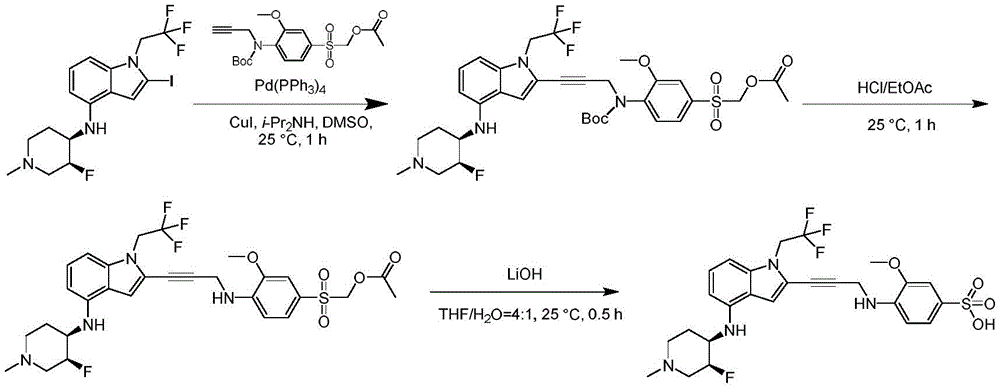
Preparation of ((4- ((tert-butoxycarbonyl) (3- (4- (((3S,4R) -3-fluoro-1-methylpiperidin-4-yl) amino) -1- (2,2, 2-trifluoroethyl) -1H-indol-2-yl) prop-2-yn-1-yl) amino) -3-methoxyphenyl) sulfonyl) methyl acetate: to a mixture of ((4- ((tert-butoxycarbonyl) (prop-2-yn-1-yl) amino) -3-methoxyphenyl) sulfonyl) mEtOAc (113.5mg, 285.6. mu. mol,1.3 eq) in DMSO (3mL) was added i-Pr 2 NH (2.20mmol, 310. mu.L, 10 equiv.), CuI (8.8mg, 43.9. mu. mol,0.2 equiv.), N- ((3S,4R) -3-fluoro-1-methylpiperidin-4-yl) -2-iodo-1- (2,2, 2-trifluoroethyl) -1H-indol-4-amine (0.1g, 220. mu. mol,1 equiv.), and Pd (PPh) 3 ) 4 (25.4mg, 22. mu. mol,0.1 equiv.). In N 2 The mixture was then stirred at 25 ℃ for 1 hour. TLC analysis indicated the reaction was complete. The reaction mixture was stirred with saturated EDTA solution (100mL) and EtOAc (50mL) at 25 ℃. The mixture was then extracted with EtOAc (50mL x 2) and the organic layer was washed with brine (100mL x 2). The combined organic layers were dried over anhydrous sodium sulfate, filtered and concentrated under reduced pressure. The crude residue was passed through preparative TLC (SiO) 2 DCM: MeOH ═ 10:1) was purified to give ((4- ((tert-butoxycarbonyl) (3- (4- (((3S,4R) -3-fluoro-1-methylpiperidin-4-yl) amino) -1- (2,2, 2-trifluoroethyl) -1H-indol-2-yl) prop-2-yn-1-yl) amino) -3-methoxyphenyl) sulfonyl) etoac (0.14g,193.2 μmol, 87.9% yield) as a yellow solid.
((4-((3-(4Preparation of (- ((3S,4R) -3-fluoro-1-methylpiperidin-4-yl) amino) -1- (2,2, 2-trifluoroethyl) -1H-indol-2-yl) prop-2-yn-1-yl) amino) -3-methoxyphenyl) sulfonyl) methyl acetate: to a solution of ((4- ((tert-butoxycarbonyl) (3- (4- (((3S,4R) -3-fluoro-1-methylpiperidin-4-yl) amino) -1- (2,2, 2-trifluoroethyl) -1H-indol-2-yl) prop-2-yn-1-yl) amino) -3-methoxyphenyl) sulfonyl) methyl acetate (30mg,41.4 μmol,1 eq) in EtOAc (0.5mL) was added HCl/EtOAc (4M,0.5mL,48.32 eq). In N 2 The mixture was then stirred at 25 ℃ for 1 hour. LC-MS analysis indicated the reaction was complete. The reaction mixture was washed with saturated NaHCO 3 Dilute and adjust pH to 8. The resulting mixture was extracted with EtOAc (50mL x 2) and the combined organic layers were washed with water (50mL x 2) and brine (50mL x 2). The organic phase was then dried over anhydrous sodium sulfate, filtered and concentrated under reduced pressure to give ((4- ((3- (4- (((3S,4R) -3-fluoro-1-methylpiperidin-4-yl) amino) -1- (2,2, 2-trifluoroethyl) -1H-indol-2-yl) prop-2-yn-1-yl) amino) -3-methoxyphenyl) sulfonyl) methyl acetate (40mg, crude) as a yellow solid. The crude product was used in the next step without purification. MS (ES) + ,m/z):625.2。
4- { [3- (4- { [ (3S,4R) -3-fluoro-1-methylpiperidin-4-yl]Amino } -1- (2,2, 2-trifluoroethyl) -1H-indol-2-yl) prop-2-yn-1-yl]Preparation of amino } -3-methoxybenzene-1-sulfonic acid: to a solution of ((4- ((3- (4- (((3S,4R) -3-fluoro-1-methylpiperidin-4-yl) amino) -1- (2,2, 2-trifluoroethyl) -1H-indol-2-yl) prop-2-yn-1-yl) amino) -3-methoxyphenyl) sulfonyl) methyl acetate (30mg,48.0 μmol,1 eq) in THF (2mL) and water (0.4mL) was added LiOH 2 O (6.1mg, 144. mu. mol,3 equivalents). In N 2 The mixture was then stirred at 25 ℃ for 30 minutes. LC-MS analysis indicated the reaction was complete. The reaction mixture was washed with saturated NaHCO 3 Dilute and adjust the pH of the mixture to 8. The reaction mixture was then extracted with EtOAc (50mL x 2) and the combined organic layers were washed with water (50mL x 2) and brine (50mL x 2). The organic phase was then dried over anhydrous sodium sulfate, filtered and concentrated under reduced pressure. The crude residue was purified by preparative HPLC to give 4- { [3- (4- { [ (3S,4R) -3-fluoro-1-methylpiperidin-4-yl]Amino } -1- (2,2, 2-trifluoroethyl) -1H-indoleIndol-2-yl) prop-2-yn-1-yl]Amino } -3-methoxybenzene-1-sulfonic acid (8.6mg, 14.6. mu. mol, 30.4% yield) as a white solid. MS (ES) + ,m/z):569.2。
Example D10: synthesis of compounds 922A and 923A.
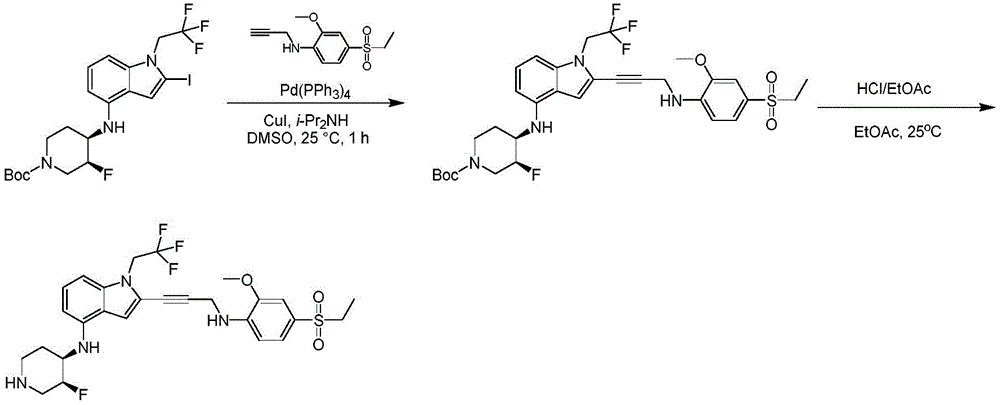
(3S,4R) -4- { [2- (3- { [4- (ethylsulfonyl) -2-methoxyphenyl]Amino } prop-1-yn-1-yl) -1- (2,2, 2-trifluoroethyl) -1H-indol-4-yl]Preparation of amino } -3-fluoropiperidine-1-carboxylic acid tert-butyl ester: to a solution of 4- (ethylsulfonyl) -2-methoxy-N- (prop-2-yn-1-yl) aniline (103mg, 406. mu. mol,1.1 eq) in DMSO (2mL) was added i-Pr 2 NH (3.69mmol, 522. mu.L, 10 equiv.), CuI (7.0mg, 37. mu. mol,0.1 equiv), ((3S, 4R) -3-fluoro-4- ((2-iodo-1- (2,2, 2-trifluoroethyl) -1H-indol-4-yl) amino) piperidine-1-carboxylic acid tert-butyl ester (0.2g, 369. mu. mol,1 equiv.) and Pd (PPh) 3 ) 4 (8.5mg, 7.39. mu. mol,0.02 eq.). Degassing the solution and applying N 2 Purging was carried out three times. The mixture was stirred at 25 ℃ for 1 hour. TLC analysis (PE: EtOAc ═ 1:1, R) f 0.35) indicated that the starting material was consumed and a new spot was detected. The reaction mixture was quenched by the addition of 2M EDTA solution (20mL) and the resulting mixture was stirred for 0.5 hours. The mixture was extracted with EtOAc (25mL x 3) and the combined organic layers were washed with brine (15mL), dried over anhydrous sodium sulfate, filtered and concentrated under reduced pressure. The crude residue was passed through preparative TLC (SiO) 2 PE: EtOAc ═ 1:1) purification afforded (3S,4R) -4- { [2- (3- { [4- (ethanesulfonyl) -2-methoxyphenyl) ]Amino } prop-1-yn-1-yl) -1- (2,2, 2-trifluoroethyl) -1H-indol-4-yl]Amino } -3-fluoropiperidine-1-carboxylic acid tert-butyl ester as a pale yellow solid. 63% yield, MS (ES) + ,m/z):667.3。
Preparation of 2- (3- ((4- (ethylsulfonyl) -2-methoxyphenyl) amino) prop-1-yn-1-yl) -N- ((3S,4R) -3-fluoropiperidin-4-yl) -1- (2,2, 2-trifluoroethyl) -1H-indol-4-amine: a mixture of (3S,4R) -4- { [2- (3- { [4- (ethylsulfonyl) -2-methoxyphenyl ] n]Amino } prop-1-yn-1-yl) -1- (2,2, 2-trifluoroethyl) -1H-indol-4-yl]Amino } -3-fluoropiperidine-A solution of tert-butyl 1-carboxylate (0.1g, 150. mu. mol,1 eq.) in 4M HCl/EtOAc (5mL) was stirred at 25 ℃ for 1 hour. TLC analysis (PE: EtOAc ═ 0:1, R f 0.12) indicates complete consumption of the starting material and formation of a new spot. By adding saturated Na 2 CO 3 The solution was quenched to adjust the pH of the mixture to 8. The mixture was then extracted with EtOAc (20mL x 3). The combined organic layers were washed with brine (10mL), dried over anhydrous sodium sulfate, filtered and concentrated under reduced pressure to give 2- (3- ((4- (ethylsulfonyl) -2-methoxyphenyl) amino) prop-1-yn-1-yl) -N- ((3S,4R) -3-fluoropiperidin-4-yl) -1- (2,2, 2-trifluoroethyl) -1H-indol-4-amine as a yellow solid. MS (ES) + ,m/z):567.2。
Example D11: synthesis of compounds 786A and 787A.

Preparation of tert-butyl (3- (4-amino-1- (2,2, 2-trifluoroethyl) -1H-indol-2-yl) prop-2-yn-1-yl) (5-fluoro-2-methoxy-4- (methylcarbamoyl) phenyl) carbamate: to the N- [ 5-fluoro-2-methoxy-4- (methylcarbamoyl) phenyl group]-N-Prop-2-alkynyl-carbamic acid tert-butyl ester (1.38g,4.09mmol,1.1 equiv.) in DMSO (15mL) was added i-Pr 2 NH (11.2mmol,1.58mL,3 equiv.), CuI (212.4mg,1.12mmol,0.3 equiv.), 2-iodo-1- (2,2, 2-trifluoroethyl) indol-4-amine (1.4g,3.72mmol,1 equiv., HCl salt), and Pd (PPh) 3 ) 4 (214.8mg, 186. mu. mol,0.05 eq.). At N 2 The mixture was then stirred at 40 ℃ for 0.5 h. TLC analysis indicated the reaction was complete. The reaction was quenched by the addition of saturated aqueous EDTA (30mL) and the mixture was extracted with EtOAc (30mL x 3). The combined organic layers were washed with brine (30mL x 2), dried over anhydrous sodium sulfate, filtered and concentrated in vacuo. The residue was purified by column chromatography (SiO) 2 PE: EtOAc ═ 4:1 to 1:1) purification afforded the desired intermediate.
(3R,4S) -4- ((2- (3- ((tert-butoxycarbonyl) (5-fluoro-2-methoxy-4- (methylcarbamoyl) phenyl) amino) prop-1-yn-1-yl) -1- (2,2, 2-trifluoroethyl) -1H-indol-4-yl) amino) -preparation of 3-fluoropiperidine-1-carboxylic acid tert-butyl ester: to a mixture of tert-butyl (3- (4-amino-1- (2,2, 2-trifluoroethyl) -1H-indol-2-yl) prop-2-yn-1-yl) (5-fluoro-2-methoxy-4- (methylcarbamoyl) phenyl) carbamate (1.5g,2.73mmol,1 eq) and tert-butyl 3-fluoro-4-oxo-piperidine-1-carboxylate (2.97g,13.7mmol,5 eq) in DMF (30mL) was added TMSCl (27.4mmol,3.47mL,10 eq) at 0 ℃. In N 2 The mixture was stirred for 1 hour and BH was added at 0 deg.C 3 THF (1M,5.47mL,2 equiv.). The resulting mixture was stirred at 0 ℃ for 0.5 hour. TLC analysis indicated the reaction was complete. The reaction was quenched with water (100mL) and the mixture was extracted with EtOAc (50mL x 3). The combined organic layers were washed with brine (50mL x 2), dried over anhydrous sodium sulfate, filtered, and concentrated in vacuo to give the crude product. The crude product was purified by preparative HPLC to give tert-butyl (3R,4S) -4- ((2- (3- ((tert-butoxycarbonyl) (5-fluoro-2-methoxy-4- (methylcarbamoyl) phenyl) amino) prop-1-yn-1-yl) -1- (2,2, 2-trifluoroethyl) -1H-indol-4-yl) amino) -3-fluoropiperidine-1-carboxylate (0.7g,934 μmol, 34.1% yield) as a yellow solid.
Preparation of 2-fluoro-4- ((3- (4- (((3R,4S) -3-fluoropiperidin-4-yl) amino) -1- (2,2, 2-trifluoroethyl) -1H-indol-2-yl) prop-2-yn-1-yl) amino) -5-methoxy-N-methylbenzamide: a solution of (3R,4S) -4- ((2- (3- ((tert-butoxycarbonyl) (5-fluoro-2-methoxy-4- (methylcarbamoyl) phenyl) amino) prop-1-yn-1-yl) -1- (2,2, 2-trifluoroethyl) -1H-indol-4-yl) amino) -3-fluoropiperidine-1-carboxylic acid tert-butyl ester (0.6g, 800. mu. mol,1 eq) was treated with HCl/EtOAc (4M,30mL,150 eq) and stirred at 25 ℃ for 0.5H. TLC analysis indicated the reaction was complete. The reaction was quenched with saturated NaHCO 3 Aqueous (50mL) quenched and extracted with EtOAc (30 mL. times.3). The combined organic layers were washed with brine (50mL x 2), dried over anhydrous sodium sulfate, filtered, and concentrated in vacuo to give 2-fluoro-4- ((3- (4- (((3R,4S) -3-fluoropiperidin-4-yl) amino) -1- (2,2, 2-trifluoroethyl) -1H-indol-2-yl) prop-2-yn-1-yl) amino) -5-methoxy-N-methylbenzamide (0.5g, crude) as a yellow oil.
2-fluoro-4- ((3- (4- (((3R,4S) -3-fluoro-1-methylpiperidin-4-yl) amino) -1- (2,2, 2-trifluoroethyl) -1H-indol-2-yl) prop-2-yn-1-yl)) Preparation of amino) -5-methoxy-N-methylbenzamide: to the resulting solution of 2-fluoro-4- ((3- (4- (((3R,4S) -3-fluoropiperidin-4-yl) amino) -1- (2,2, 2-trifluoroethyl) -1H-indol-2-yl) prop-2-yn-1-yl) amino) -5-methoxy-N-methylbenzamide (0.45g, 819. mu. mol,1 eq) in MeOH (10mL) was added paraformaldehyde (98.4mg,3.28mmol,4 eq), AcOH (2.3. mu.L, 0.05 eq), and NaBH 3 CN (257mg,4.09mmol,5 equiv.). Heating the mixture to N 2 The mixture was stirred at 50 ℃ for 6 hours. TLC analysis indicated the reaction was complete. The reaction was quenched with saturated NaHCO 3 Aqueous (30mL) was quenched and extracted with EtOAc (30mL x 3). The combined organic layers were washed with brine (30mL x 2), dried over anhydrous sodium sulfate, filtered and concentrated in vacuo. The residue was purified by preparative HPLC to give 2-fluoro-4- ((3- (4- (((3R,4S) -3-fluoro-1-methylpiperidin-4-yl) amino) -1- (2,2, 2-trifluoroethyl) -1H-indol-2-yl) prop-2-yn-1-yl) amino) -5-methoxy-N-methylbenzamide (0.25g,444 μmol, 54.2% yield) as a light yellow solid.
2-fluoro-4- ((3- (4- (((3R,4S) -3-fluoro-1-methylpiperidin-4-yl) amino) -1- (2,2, 2-trifluoroethyl) -1H-indol-2-yl) prop-2-yn-1-yl) amino) -5-methoxy-N-methylbenzamide was isolated by SFC to give the desired product as a white solid.
2-fluoro-4- ((3- (4- (((3R,4S) -3-fluoro-1-methylpiperidin-4-yl) amino) -1- (2,2, 2-trifluoroethyl) -1H-indol-2-yl) prop-2-yn-1-yl) amino) -5-methoxy-N-methylbenzamide, MS (ES) + M/z) 564.3; and 2-fluoro-4- ((3- (4- (((3S,4R) -3-fluoro-1-methylpiperidin-4-yl) amino) -1- (2,2, 2-trifluoroethyl) -1H-indol-2-yl) prop-2-yn-1-yl) amino) -5-methoxy-N-methylbenzamide, MS (ES) + ,m/z):564.3。
Example D12: synthesis of compounds 928A and 941A.

(3S,4R) -4- [ (2- {3- [ (2-ethoxy-4-methanesulfonylphenyl) amino]Prop-1-yn-1-yl } -1- (2,2, 2-trifluoroethyl) -1H-indol-4-yl) amino]Preparation of tert-butyl 3-fluoropiperidine-1-carboxylate: to the direction ofA solution of 2-ethoxy-4- (methylsulfonyl) -N- (prop-2-yn-1-yl) aniline (1.2 eq) in DMSO (3mL) was added i-Pr 2 NH (10 equiv.), CuI (0.2 equiv), ((3S,4R) -3-fluoro-4- ((2-iodo-1- (2,2, 2-trifluoroethyl) -1H-indol-4-yl) amino) piperidine-1-carboxylic acid tert-butyl ester (0.2g, 369. mu. mol,1 equiv.) and Pd (PPh) 3 ) 4 (0.05 eq). In N 2 The mixture was then stirred at 40 ℃ for 1 hour. TLC analysis (PE: EtOAc ═ 1:3, R) f 0.4) indicates complete consumption of the starting material and formation of a new spot. The reaction mixture was quenched by the addition of saturated EDTA solution (30mL) and the mixture was stirred at 20 ℃ for 1 hour. The mixture was then diluted with water (10mL) and extracted with EtOAc (40mL x 3). The combined organic layers were washed with brine (30mL x 3), dried over anhydrous sodium sulfate, filtered and concentrated under reduced pressure to give a residue. The residue was passed through preparative TLC (SiO) 2 EtOAc 1:1) and preparative HPLC purification to give (3S,4R) -4- [ (2- {3- [ (2-ethoxy-4-methanesulfonylphenyl) amino group]Prop-1-yn-1-yl } -1- (2,2, 2-trifluoroethyl) -1H-indol-4-yl) amino]-3-fluoropiperidine-1-carboxylic acid tert-butyl ester as yellow solid. MS (ES) + M/z) 611.2 (M-tert-butyl).
2- {3- [ (2-ethoxy-4-methanesulfonylphenyl) amino]Prop-1-yn-1-yl } -N- [ (3S,4R) -3-fluoropiperidin-4-yl]Preparation of (E) -1- (2,2, 2-trifluoroethyl) -1H-indol-4-amine: reacting (3S,4R) -4- [ (2- {3- [ (2-ethoxy-4-methylsulfonylphenyl) amino group]Prop-1-yn-1-yl } -1- (2,2, 2-trifluoroethyl) -1H-indol-4-yl) amino]A mixture of tert-butyl-3-fluoropiperidine-1-carboxylate (1 eq) and HCl/EtOAc (4M,2mL) in EtOAc (1mL) was stirred at 20 ℃ for 0.5 h. TLC analysis indicated complete consumption of the starting material and formation of a new spot. By adding saturated Na 2 CO 3 Aqueous solution to adjust the pH of the mixture to>7, quenching the reaction mixture. The mixture was then diluted with water (20mL) and extracted with EtOAc (20mL x 3). The combined organic layers were washed with brine (20mL x3), dried over anhydrous sodium sulfate, filtered and concentrated under reduced pressure. The crude residue was purified by preparative HPLC to give 2- {3- [ (2-ethoxy-4-methanesulfonylphenyl) amino]Prop-1-yn-1-yl } -N- [ (3S,4R) -3-fluoropiperidin-4-yl]-1- (2,2, 2-trifluoroethyl) -1H-indol-4-amine,as a yellow solid. 51% yield, MS (ES) + ,m/z):567.3。
Example D13: synthesis of compounds 460A, 609A, 622A and 730A.

Preparation of the desired product: at N 2 Down to R 1 Mixture of substituted 2-iodo-1- (2,2, 2-trifluoroethyl) -1H-indol-4-amine (30mg, 58.7. mu. mol,1 eq) and 3-methoxy-N, N-dimethyl-4- (prop-2-yn-1-ylamino) benzenesulfonamide or 3-methoxy-N-methyl-4- (prop-2-yn-1-ylamino) benzenesulfonamide (20.4mg, 64.5. mu. mol,1.1 eq) in DMSO (3mL) CuI (11.2mg, 59. mu. mol,1 eq), N-isopropylprop-2-amine (559. mu. mol, 8.3. mu.L, 1 eq) and Pd (PPh) 3 ) 4 (1.36mg, 1.17. mu. mol,0.02 eq.). The mixture was stirred at 25 ℃ for 1 hour. TLC analysis indicated the reaction was complete. The reaction mixture was quenched by the addition of saturated EDTA solution (60mL) at 25 ℃ and the mixture was stirred for 1 hour. The mixture was then extracted with EtOAc (20mL x 4). The combined organic layers were dried over anhydrous sodium sulfate, filtered and concentrated under reduced pressure. The residue was purified by preparative TLC to give the desired product as a light yellow solid.
4- { [3- (4- { [1- (2-hydroxy-3-methoxypropyl) piperidin-4-yl]Amino } -1- (2,2, 2-trifluoroethyl) -1H-indol-2-yl) prop-2-yn-1-yl]Amino } -3-methoxy-N, N-dimethylbenzene-1-sulfonamide, MS (ES) + M/z) 652.4; 4- { [3- (4- { [1- (2-Hydroxyacetyl) piperidin-4-yl]Amino } -1- (2,2, 2-trifluoroethyl) -1H-indol-2-yl) prop-2-yn-1-yl]Amino } -3-methoxy-N, N-dimethylbenzene-1-sulfonamide, MS (ES) + M/z) 622.4; 3-methoxy-N, N-dimethyl-4- [ (3- {4- [ (piperidin-4-yl) amino group]-1- (2,2, 2-trifluoroethyl) -1H-indol-2-yl } prop-2-yn-1-yl) amino]Benzene-1-sulfonamides, MS (ES) + M/z) 564.3; and 4- { [3- (4- { [1- (2-hydroxy-3-methoxypropyl) piperidin-4-yl]Amino } -1- (2,2, 2-trifluoroethyl) -1H-indol-2-yl) prop-2-yn-1-yl]Amino } -3-methoxy-N-methylbenzene-1-sulphonamide, MS (ES) + ,m/z):638.2。
Example D14: synthesis of Compounds 570A and 571A.

Preparation of 1- (4- ((2-iodo-1- (2,2, 2-trifluoroethyl) -1H-indol-4-yl) amino) piperidin-1-yl) -3-methoxypropan-2-ol and 1-ethoxy-3- (4- ((2-iodo-1- (2,2, 2-trifluoroethyl) -1H-indol-4-yl) amino) piperidin-1-yl) propan-2-ol: to a solution of the compound 2-iodo-N- (piperidin-4-yl) -1- (2,2, 2-trifluoroethyl) -1H-indol-4-amine (10g,22.45mmol,1 eq) in DMF (300mL) was added 2- (methoxymethyl) oxirane or 2- (ethoxymethyl) oxirane (5 eq) and K 2 CO 3 (3 equivalents). The mixture was stirred at 50 ℃ for 12 hours. TLC or LC-MS analysis indicated complete consumption of the starting material. The reaction mixture was diluted by adding water (500mL) and extracted with EtOAc (200mL x 3). The combined organic layers were washed with brine (40mL), dried over anhydrous sodium sulfate, filtered and concentrated. The crude residue was purified by preparative TLC to give the desired product.
Preparation of 1- (4- ((2- (3- ((4- (ethylsulfonyl) -2-methoxyphenyl) amino) prop-1-yn-1-yl) -1- (2,2, 2-trifluoroethyl) -1H-indol-4-yl) amino) piperidin-1-yl) -3-methoxypropan-2-ol and 1-ethoxy-3- (4- ((2- (3- ((2-methoxy-4- (methylsulfonyl) phenyl) amino) prop-1-yn-1-yl) -1- (2,2, 2-trifluoroethyl) -1H-indol-4-yl) amino) piperidin-1-yl) propan-2-ol: to a mixture of 2-methoxy-4- (methylsulfonyl) -N- (prop-2-yn-1-yl) aniline or 4- (ethylsulfonyl) -2-methoxy-N- (prop-2-yn-1-yl) aniline (64.6mg, 178. mu. mol,1.2 equiv) in DMSO (3mL) at 25 ℃ was added i-Pr 2 NH (10 equivalents), CuI (1 equivalent), 1- (4- ((2-iodo-1- (2,2, 2-trifluoroethyl) -1H-indol-4-yl) amino) piperidin-1-yl) -3-methoxypropan-2-ol or 1-ethoxy-3- (4- ((2-iodo-1- (2,2, 2-trifluoroethyl) -1H-indol-4-yl) amino) piperidin-1-yl) propan-2-ol (1 equivalent), and Pd (PPh) 3 ) 4 (0.2 eq). In N 2 The mixture was then stirred at 25 ℃ for 1 hour. LC-MS and TLC analysis indicated that the reaction was complete. The reaction mixture was quenched at 25 ℃ by the addition of saturated aqueous EDTA solution (30mL)Quench and stir the mixture for 2 hours. The reaction mixture was partitioned by adding EtOAc (10 mL). The aqueous phase was extracted with EtOAc (10 mL. times.3). The organic phase was washed with brine (10mL x 3), dried over anhydrous sodium sulfate, filtered and concentrated in vacuo. The crude residue was purified by preparative TLC, confirmed by HPLC and LC-MS, and then purified by preparative HPLC to give a solution of the desired product, which was isolated by lyophilization.
1- (4- ((2- (3- ((4- (ethylsulfonyl) -2-methoxyphenyl) amino) prop-1-yn-1-yl) -1- (2,2, 2-trifluoroethyl) -1H-indol-4-yl) amino) piperidin-1-yl) -3-methoxypropan-2-ol, MS (ES) + M/z) 637.2; 1-ethoxy-3- (4- ((2- (3- ((2-methoxy-4- (methylsulfonyl) phenyl) amino) prop-1-yn-1-yl) -1- (2,2, 2-trifluoroethyl) -1H-indol-4-yl) amino) piperidin-1-yl) propan-2-ol, MS (ES) + ,m/z):637.3。
Example D15: synthesis of compounds 880A and 884A.

Preparation of 2-iodo-1H-indol-4-amine: to a solution of 2-iodo-4-nitro-1H-indole (4g,13.9mmol,1 eq) in EtOH (32mL) was added saturated NH 4 Cl solution (8mL) and Fe (2.33g,41.7mmol,3 equiv.). The mixture was stirred at 60 ℃ for 0.5 hour. TLC analysis indicated the reaction was complete. The reaction mixture was filtered, extracted with EtOAc (100mL x 2), and washed with water (250mL x 2) and brine (250mL x 2). The combined organic layers were dried over anhydrous sodium sulfate, filtered and concentrated under reduced pressure to give a residue. The residue was purified by column chromatography (SiO) 2 PE: EtOAc ═ 10:1 to 8:1) purification afforded 2-iodo-1H-indol-4-amine (3.2g,12.40mmol, 89.3% yield) as a pale white solid.
Preparation of 2-iodo-1-propyl-1H-indol-4-amine: to a solution of 2-iodo-1H-indol-4-amine (2g,7.75mmol,1 eq) in DMF (15mL) at 0 deg.C was added NaH (930mg,23.3mmol, 60% in mineral oil, 3 eq). The reaction mixture was stirred at 0 ℃ for 0.5 h, and 1-bromopropane (11.6mmol,1.06mL,1.5 equiv.) was added at 25 ℃. The resulting mixture was stirred at 25 ℃ for 05 hours. TLC analysis indicated the reaction was complete. At 0 ℃ with saturated NH 4 The reaction mixture was quenched with aqueous Cl (100 mL). The mixture was extracted with EtOAc (100mL x 2) and washed with water (250mL x 2) and brine (250mL x 2). The combined organic layers were dried over anhydrous sodium sulfate, filtered and concentrated under reduced pressure. The crude residue is purified by column chromatography (SiO) 2 PE: EtOAc ═ 30:1 to 10:1) purification afforded 2-iodo-1-propyl-1H-indol-4-amine (2.1g,7mmol, 90.3% yield) as a brown solid.
Preparation of tert-butyl (3- (4-amino-1-propyl-1H-indol-2-yl) prop-2-yn-1-yl) (2-methoxy-4- (methylsulfonyl) phenyl) carbamate and tert-butyl (3- (4-amino-1-propyl-1H-indol-2-yl) prop-2-yn-1-yl) (2-fluoro-6-methoxy-4- (methylsulfonyl) phenyl) carbamate: to a solution of tert-butyl (2-methoxy-4- (methylsulfonyl) phenyl) (prop-2-yn-1-yl) carbamate (1.53g,4.50mmol,1.5 equivalents) or tert-butyl (2-fluoro-6-methoxy-4- (methylsulfonyl) phenyl) (prop-2-yn-1-yl) carbamate (857.36mg,2.40mmol,1.2 equivalents) in DMSO (8-10mL) was added i-Pr 2 NH (10 equiv.), CuI (0.2 equiv.), 2-iodo-1-propyl-1H-indol-4-amine (1 equiv.), and Pd (PPh) 3 ) 4 (0.1 equiv.). In N 2 The mixture was then stirred at 25 ℃ for 1 hour. TLC analysis indicated the reaction was complete. The reaction mixture was partitioned at 25 ℃ by the addition of saturated EDTA solution (150mL) and EtOAc (50 mL). The resulting mixture was filtered, extracted with EtOAc (250mL x 2), and washed with water (100mL x 2) and brine (100mL x 2). The combined organic layers were dried over anhydrous sodium sulfate, filtered and concentrated under reduced pressure. The crude residue is purified by column chromatography (SiO) 2 PE: EtOAc ═ 20:1 to 2:1) purification afforded the desired product as a yellow solid. Tert-butyl (3- (4-amino-1-propyl-1H-indol-2-yl) prop-2-yn-1-yl) (2-methoxy-4- (methylsulfonyl) phenyl) carbamate, 78.2% yield; and tert-butyl (3- (4-amino-1-propyl-1H-indol-2-yl) prop-2-yn-1-yl) (2-fluoro-6-methoxy-4- (methylsulfonyl) phenyl) carbamate in 63.3% yield.
4- ((2- (3- ((tert-butoxycarbonyl) (2-methoxy-4- (methylsulfonyl) phenyl) amino) prop-1-yn-1-yl) -1-propyl-1H-indol-4-yl) amino) -3-fluoropiperidine-1-me-thylPreparation of tert-butyl ester and tert-butyl 4- ((2- (3- ((tert-butoxycarbonyl) (2-fluoro-6-methoxy-4- (methylsulfonyl) phenyl) amino) prop-1-yn-1-yl) -1-propyl-1H-indol-4-yl) amino) -3-fluoropiperidine-1-carboxylate: to a solution of tert-butyl (3- (4-amino-1-propyl-1H-indol-2-yl) prop-2-yn-1-yl) (2-methoxy-4- (methylsulfonyl) phenyl) carbamate or tert-butyl (3- (4-amino-1-propyl-1H-indol-2-yl) prop-2-yn-1-yl) (2-fluoro-6-methoxy-4- (methylsulfonyl) phenyl) carbamate (1.56mmol,1 eq) in DMF (10mL) was added tert-butyl 3-fluoro-4-oxopiperidine-1-carboxylate (5 eq) and TMSCl (10 eq). The mixture was stirred at 0 ℃ for 1 hour and BH was added 3 THF (1M,10 equivalents). The resulting mixture was stirred at 25 ℃ for 1 hour. LC-MS and TLC analysis indicated that the reaction was complete. The reaction mixture was quenched by the addition of ice water (150mL) and the mixture was extracted with EtOAc (100mL × 2). The combined organic layers were washed with water (250mL x2) and brine (250mL x2), dried over anhydrous sodium sulfate, filtered and concentrated under reduced pressure to give the desired product.
Preparation of (3R,4S) -tert-butyl 4- ((2- (3- ((tert-butoxycarbonyl) (2-methoxy-4- (methylsulfonyl) phenyl) amino) prop-1-yn-1-yl) -1-propyl-1H-indol-4-yl) amino) -3-fluoropiperidine-1-carboxylate and tert-butyl (3R,4S) -4- ((2- (3- ((tert-butoxycarbonyl) (2-fluoro-6-methoxy-4- (methylsulfonyl) phenyl) amino) prop-1-yn-1-yl) -1-propyl-1H-indol-4-yl) amino) -3-fluoropiperidine-1-carboxylate: tert-butyl 4- ((2- (3- ((tert-butoxycarbonyl) (2-methoxy-4- (methylsulfonyl) phenyl) amino) prop-1-yn-1-yl) -1-propyl-1H-indol-4-yl) amino) -3-fluoropiperidine-1-carboxylate and tert-butyl 4- ((2- (3- ((tert-butoxycarbonyl) (2-fluoro-6-methoxy-4- (methylsulfonyl) phenyl) amino) prop-1-yn-1-yl) -1-propyl-1H-indol-4-yl) amino) -3-fluoropiperidine-1-carboxylate were purified by preparative HPLC. Using saturated Na 2 CO 3 The aqueous solution adjusted the pH of the solution to 8. The aqueous phase was then extracted with EtOAc (100mL x 2). The combined organic layers were washed with brine (250mL x 2), dried over anhydrous sodium sulfate, filtered, and concentrated in vacuo to give the desired product as a yellow solid.
(3R,4S) -4- ((2- (3- ((tert-butoxycarbonyl) (2-methoxy-4- (methylsulfonyl) benzene)Yl) amino) prop-1-yn-1-yl) -1-propyl-1H-indol-4-yl) amino) -3-fluoropiperidine-1-carboxylic acid tert-butyl ester, 33% yield, MS (ES) + M/z) 713.3; and tert-butyl (3R,4S) -4- ((2- (3- ((tert-butoxycarbonyl) (2-fluoro-6-methoxy-4- (methylsulfonyl) phenyl) amino) prop-1-yn-1-yl) -1-propyl-1H-indol-4-yl) amino) -3-fluoropiperidine-1-carboxylate, 21.1% yield, MS (ES) + ,m/z):731.4。
Preparation of N- ((3R,4S) -3-fluoropiperidin-4-yl) -2- (3- ((2-methoxy-4- (methylsulfonyl) phenyl) amino) prop-1-yn-1-yl) -1-propyl-1H-indol-4-amine and 2- (3- ((2-fluoro-6-methoxy-4- (methylsulfonyl) phenyl) amino) prop-1-yn-1-yl) -N- ((3R,4S) -3-fluoropiperidin-4-yl) -1-propyl-1H-indol-4-amine: to (3R,4S) -4- ((2- (3- ((tert-butoxycarbonyl) (2-methoxy-4- (methylsulfonyl) phenyl) amino) prop-1-yn-1-yl) -1-propyl-1H-indol-4-yl) amino) -3-fluoropiperidine-1-carboxylic acid tert-butyl ester (350.70. mu. mol 1 eq) or (3R,4S) -4- ((2- (3- ((tert-butoxycarbonyl) (2-fluoro-6-methoxy-4- (methylsulfonyl) phenyl) amino) prop-1-yn-1-yl) -1-propyl-1H-indol-4-yl) amino) -3-fluoropiperidine-1-carboxylic acid tert-butyl ester (1 eq) ) A solution in EtOAc (3mL) was added HCl/EtOAc (4M,3 mL). The mixture was stirred at 25 ℃ for 0.5 hour. TLC analysis indicated the reaction was complete. The reaction mixture was quenched with water (100mL) and saturated Na was used 2 CO 3 The aqueous solution adjusted the pH of the mixture to 8. The resulting mixture was extracted with EtOAc (250mL x 2). The combined organic layers were washed with brine (250mL x 2), dried over anhydrous sodium sulfate, filtered and concentrated in vacuo. The crude residue was passed through preparative TLC (SiO) 2 DCM: MeOH ═ 10:1) purification afforded the desired product as a yellow solid.
(2R) -1- [ (3RS,4SR) -3-fluoro-4- [ (2- {3- [ (4-methanesulfonyl-2-methoxyphenyl) amino ] prop-1-yn-1-yl } -1-propyl-1H-indol-4-yl) amino ] piperidin-1-yl ] -3-methoxypropan-2-ol and (2R) -1- [ (3RS,4SR) -3-fluoro-4- [ (2- {3- [ (2-fluoro-4-methanesulfonyl-6-methoxyphenyl) amino ] prop-1-yn-1-yl } -1-propyl-1H-indol-4-yl) amino ] piperidin-1-yl Preparation of 3-methoxypropan-2-ol: to a solution of N- ((3R,4S) -3-fluoropiperidin-4-yl) -2- (3- ((2-methoxy-4- (methylsulfonyl) phenyl) amino) prop-1-yn-1-yl) -1-propyl-1H-indol-4-amine or 2- (3- ((2-fluoro-6-methoxy-4- (methylsulfonyl) phenyl) amino) prop-1-yn-1-yl) -N- ((3R,4S) -3-fluoropiperidin-4-yl) -1-propyl-1H-indol-4-amine (1 eq) in EtOH (3mL) was added (2R) -2- (methoxymethyl) oxirane (6 eq). The mixture was stirred at 90 ℃ for 2 hours. LC-MS and TLC analysis indicated that the reaction was complete. The reaction mixture was quenched with water (50mL) and extracted with EtOAc (50mL × 2). The combined organic layers were washed with brine (50mL x 2), dried over anhydrous sodium sulfate, filtered and concentrated under reduced pressure. The crude residue was purified by preparative HPLC to afford the desired product as a white solid.
N- ((3R,4S) -3-Fluoropiperidin-4-yl) -2- (3- ((2-methoxy-4- (methylsulfonyl) phenyl) amino) prop-1-yn-1-yl) -1-propyl-1H-indol-4-amine, MS (ES) + M/z) 601.2; and 2- (3- ((2-fluoro-6-methoxy-4- (methylsulfonyl) phenyl) amino) prop-1-yn-1-yl) -N- ((3R,4S) -3-fluoropiperidin-4-yl) -1-propyl-1H-indol-4-amine, MS (ES) + ,m/z):619.3。
Example D16: synthesis of (R) -1- ((3R,4S) -4- ((1-allyl-2- (3- ((2-methoxy-4- (methylsulfonyl) phenyl) amino) prop-1-yn-1-yl) -1H-indol-4-yl) amino) -3-fluoropiperidin-1-yl) -3-methoxypropan-2-ol (Compound 881A)

Preparation of 1-allyl-2-iodo-1H-indol-4-amine: in N 2 Next, to a solution of 2-iodo-1H-indol-4-amine (187.5mg,1.55mmol,0.5 equiv) in DMF (15mL) at 0 deg.C was added NaH (372mg,9.30mmol, 60% in mineral oil, 3 equiv) in one portion. The mixture was stirred at 0 ℃ for 30 min and 3-bromoprop-1-ene (3.10mmol, 18. mu.L, 1 eq.) was added. The mixture was stirred at 0 ℃ for 0.5 h. TLC analysis indicated that 30% of the starting material remained and two new spots were detected, which were less polar than the starting material. An additional portion of 3-bromoprop-1-ene (1.55mmol,0.5 eq.) was added to the reaction and the resulting mixture was stirred at 0 ℃ for an additional 0.5 h. TLC analysis indicated 10% starting material remained. The reaction was diluted with water (20mL) and extracted with EtOAc (25 mL. times.2). Merging Washed with brine (25mL x 2), dried over anhydrous sodium sulfate, filtered and concentrated to give a residue. The crude residue is purified by column chromatography (SiO) 2 PE: EtOAc ═ 6:1 to 4:1) to give the desired product (530mg,1.78mmol, 57.4% yield) as a brown solid.
Preparation of tert-butyl (3- (1-allyl-4-amino-1H-indol-2-yl) prop-2-yn-1-yl) (2-methoxy-4- (methylsulfonyl) phenyl) carbamate: in N 2 Next, to a solution of tert-butyl (2-methoxy-4- (methylsulfonyl) phenyl) (prop-2-yn-1-yl) carbamate (724.1mg,2.13mmol,1.2 eq) in DMSO (10mL) was added i-Pr 2 NH (10.7mmol,1.51mL,6 equiv.) and CuI (338.6mg,1.78mmol,1 equiv.). Then, 1-allyl-2-iodo-1H-indol-4-amine (530mg,1.78mmol,1 eq.) and Pd (PPh) were added 3 ) 4 (205.4mg, 178. mu. mol,0.1 eq.) and the mixture was stirred at 25 ℃ for 60 minutes. TLC analysis indicated the reaction was complete. The reaction was diluted with water (30mL) and extracted with EtOAc (30mL x 3). The organic phase was washed with water (30mL x 3) and brine (30mL x 3), dried over anhydrous sodium sulfate, filtered, and concentrated to give a residue. The crude residue was passed through preparative TLC (SiO) 2 EtOAc 1:1) gave the desired product (460mg,903 μmol, 50.8% yield) as a brown solid.
Preparation of tert-butyl (3R,4S) -4- ((1-allyl-2- (3- ((tert-butoxycarbonyl) (2-methoxy-4- (methylsulfonyl) phenyl) amino) prop-1-yn-1-yl) -1H-indol-4-yl) amino) -3-fluoropiperidine-1-carboxylate: in N 2 Next, TMSCl (7.85mmol, 996. mu.L, 10 equiv.) is added in one portion to a mixture of tert-butyl (3- (1-allyl-4-amino-1H-indol-2-yl) prop-2-yn-1-yl) (2-methoxy-4- (methylsulfonyl) phenyl) carbamate (400mg, 785. mu. mol,1 equiv.) and tert-butyl (3R) -3-fluoro-4-oxo-piperidine-1-carboxylate (511.5mg,2.35mmol,3 equiv.) in DMF (10mL) at 0 ℃. The mixture was stirred at 0 ℃ for 60 minutes and BH was added 3 THF (1M,7.85mL,10 equiv.). The mixture was further stirred at 20 ℃ for 2 hours. LC-MS analysis indicated the reaction was complete. The reaction mixture was poured into water (30mL) and extracted with EtOAc (30mL x 3). The organic phase was washed with water (30mL x 2) and brine (30mL x 3) and treated with anhydrous sulfuric acidSodium was dried, filtered, and concentrated in vacuo to give a residue. The crude residue was purified by preparative HPLC to give the desired product (150mg,211 μmol, 26.9% yield) as a brown solid. MS (ES) + ,m/z):711.3。
Preparation of 1-allyl-N- ((3R,4S) -3-fluoropiperidin-4-yl) -2- (3- ((2-methoxy-4- (methylsulfonyl) phenyl) amino) prop-1-yn-1-yl) -1H-indol-4-amine: to a solution of (3R,4S) -4- ((1-allyl-2- (3- ((tert-butoxycarbonyl) (2-methoxy-4- (methylsulfonyl) phenyl) amino) prop-1-yn-1-yl) -1H-indol-4-yl) amino) -3-fluoropiperidine-1-carboxylic acid tert-butyl ester (140mg,197 μmol,1 eq) in HCl/EtOAc (4M,5mL,102 eq) was stirred at 25 ℃ for 0.5H. TLC analysis indicated the reaction was complete. By adding saturated NaHCO 3 Solution (20mL) the reaction mixture was adjusted to pH 8 and the organic phase was extracted with EtOAc (25mL x 3). The combined organic layers were washed with brine (25mL × 2), dried over anhydrous sodium sulfate, filtered and concentrated to give the desired product (90mg,176 μmol, 89.5% yield) as a brown gum. MS (ES) + ,m/z):511.2。
Preparation of (R) -1- ((3R,4S) -4- ((1-allyl-2- (3- ((2-methoxy-4- (methylsulfonyl) phenyl) amino) prop-1-yn-1-yl) -1H-indol-4-yl) amino) -3-fluoropiperidin-1-yl) -3-methoxypropan-2-ol: a mixture of 1-allyl-N- ((3R,4S) -3-fluoropiperidin-4-yl) -2- (3- ((2-methoxy-4- (methylsulfonyl) phenyl) amino) prop-1-yn-1-yl) -1H-indol-4-amine (50mg,97.9 μmol,1 eq) and (2R) -2- (methoxymethyl) oxirane (490 μmol,44 μ L,5 eq) in EtOH (2mL) was heated to 90 ℃ and stirred for 2 hours. TLC analysis indicated the reaction was complete. The reaction was diluted with water (20mL) and extracted with EtOAc (20 mL. times.2). The combined organic layers were washed with water (20mL x 2) and brine (20mL x 2), dried over anhydrous sodium sulfate, filtered and concentrated to give a residue. The crude residue was purified by preparative HPLC to give the desired product (12.1mg,20.2 μmol, 20.6% yield) as a white solid. MS (ES) + ,m/z):599.3。
Example D17: synthesis of rac-4- { [3- (4- { [ (3R,4S) -3-fluoro-1-methylpiperidin-4-yl ] amino } -1- (2,2, 2-trifluoroethyl) -1H-indol-2-yl) prop-2-yn-1-yl ] amino } -N- (2-hydroxy-3-methoxypropyl) -3-methoxybenzamide (Compound 816A)

Preparation of 1-amino-3-methoxypropan-2-ol: 2- (methoxymethyl) oxirane (5.68mmol, 505. mu.L, 1 eq.) was added to the NH 3 (7M, 811. mu.L, 1 eq.) in MeOH (20 mL). The solution was stirred at 20 ℃ for 18 hours. The mixture was concentrated and the crude residue was used without purification.
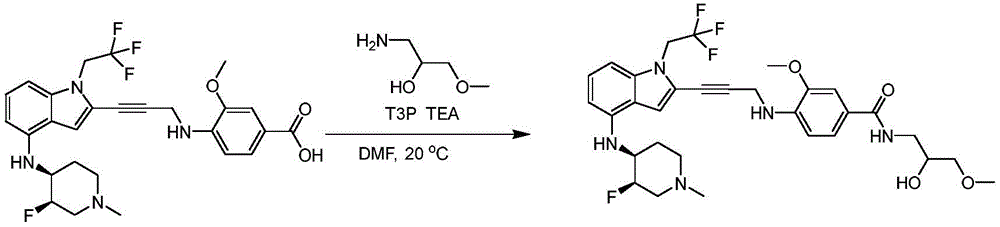
rac-4- { [3- (4- { [ (3R,4S) -3-fluoro-1-methylpiperidin-4-yl]Amino } -1- (2,2, 2-trifluoroethyl) -1H-indol-2-yl) prop-2-yn-1-yl]Preparation of amino } -N- (2-hydroxy-3-methoxypropyl) -3-methoxybenzamide: to 4- [3- [4- [ [ (3R,4S) -3-fluoro-1-methyl-4-piperidinyl at 0 DEG C]Amino group]-1- (2,2, 2-trifluoroethyl) indol-2-yl]Prop-2-ynylamino]A mixture of-3-methoxy-benzoic acid (0.1g, 178. mu. mol,1 eq), 1-amino-3-methoxy-propan-2-ol (37.5mg, 357. mu. mol,2 eq) and TEA (1.43mmol, 28.5. mu.L, 8 eq) in DMF (3mL) was added (357. mu. mol, 106.1. mu.L, 2 equiv, 50% (wt%) pure EtOAc solution). The mixture was stirred at 20 ℃ for 16 hours. TLC analysis (R) f 0.5, DCM: MeOH ═ 10:1) indicated that half of the starting material remained and some desired product was detected. The mixture was extracted with water (10mL) and EtOAc (15mL x 3). The combined organic layers were washed with brine (5mL x 3), dried over anhydrous sodium sulfate, filtered and concentrated. The crude residue was purified by preparative HPLC to give the desired product (0.026g,40.1 μmol, 22.5% yield) as a yellow solid. MS (ES) + ,m/z):620.4。
Example D18: synthesis of rac-N- (2- { bis [ (pyridin-2-yl) methyl ] amino } ethyl) -4- { [3- (4- { [ (3R,4S) -3-fluoro-1-methylpiperidin-4-yl ] amino } -1- (2,2, 2-trifluoroethyl) -1H-indol-2-yl) prop-2-yn-1-yl ] amino } -3-methoxybenzamide (Compound 830A)

Preparation of tert-butyl (2- (bis (pyridin-2-ylmethyl) amino) ethyl) carbamate: 2- (chloromethyl) pyridine (5g,30.5mmol,1 eq, HCl), N- (2-aminoethyl) carbamic acid tert-butyl ester (2.44g,15.2mmol,2.39mL,0.5 eq) and Na 2 CO 3 A mixture of (16.15g,152.4mmol,5 equiv.) in EtOH (150mL) was degassed and N was used 2 Purging three times and in N 2 The mixture was then stirred at 80 ℃ for 12 hours. TLC analysis (R) f 0.5 EtOAc: TEA 10:1) indicated completion of the reaction. The mixture was concentrated and saturated Na 2 CO 3 The crude residue was extracted with EtOAc (80 mL. times.3). The combined organic layers were washed with brine (50mL), dried over anhydrous sodium sulfate, filtered and concentrated. The crude residue is purified by column chromatography (SiO) 2 PE: EtOAc ═ 2:1 to 0:1) purification to afford N- [2- [ bis (2-pyridylmethyl) amino group]Ethyl radical]Tert-butyl carbamate (3.5g,9.20mmol, 30.2% yield) as yellow oil.
Preparation of N ', N' -bis (pyridin-2-ylmethyl) ethane-1, 2-diamine: to a solution of N- [2- [ bis (2-pyridylmethyl) amino ] ethyl ] carbamic acid tert-butyl ester (0.5g,1.31mmol,1 eq) in DCM (50mL) at 20 deg.C was added TFA (5 mL). The mixture was stirred at 20 ℃ for 1 hour. The mixture was concentrated to give the desired product (0.43g,1.09mmol, 82.6% yield, TFA) as a yellow oil. The crude product was used without purification.
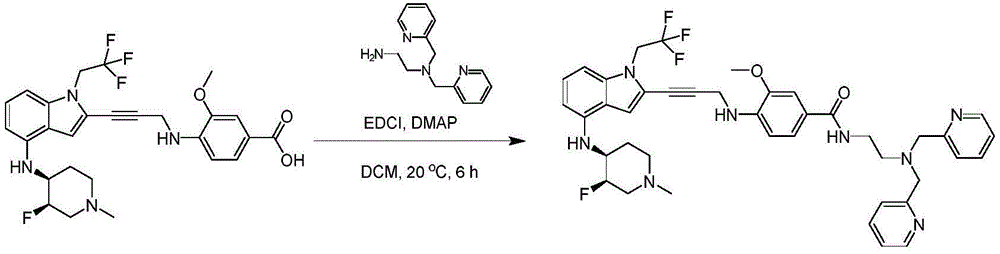
rac-N- (2- { bis [ (pyridin-2-yl) methyl)]Amino } ethyl) -4- { [3- (4- { [ (3R,4S) -3-fluoro-1-methylpiperidin-4-yl]Amino } -1- (2,2, 2-trifluoroethyl) -1H-indol-2-yl) prop-2-yn-1-yl]Preparation of amino } -3-methoxybenzamide: at 20 deg.C, 4- [3- [4- [ [ (3R,4S) -3-fluoro-1-methyl-4-piperidineBase of]Amino group]-1- (2,2, 2-trifluoroethyl) indol-2-yl]Prop-2-ynylamino]A solution of-3-methoxy-benzoic acid (0.1g,187.8 μmol,1 eq) in DCM (10mL) was added EDCI (108mg,563 μmol,3 eq), N' -bis (2-pyridylmethyl) ethane-1, 2-diamine (54.6mg,225.3 μmol,1.2 eq) and DMAP (22.9mg,187.8 μmol,1 eq). The mixture was stirred at 20 ℃ for 6 hours. LC-MS and HPLC analysis indicated the reaction was complete. The mixture was extracted with water (15mL) and DCM (15mL × 3). The organic layer was washed with brine (10mL), dried over anhydrous sodium sulfate, filtered and concentrated. The crude residue was purified by preparative HPLC to give the desired product (0.031g,37.7 μmol, 20.1% yield) as a yellow solid. MS (ES) + ,m/z):757.4。
Example D19: 4-hydroxy-9- [ (2- {3- [ (4-methanesulfonyl-2-methoxyphenyl) amino]Prop-1-yn-1-yl } -1- (2,2, 2-trifluoroethyl) -1H-indol-4-yl) amino]-2-oxa-6. lambda 5 -azaspiro [5.5]Synthesis of undec-6-ium (Compound 674A).

Preparation of 2- ((fluoromethoxy) methyl) oxirane: to a solution of oxiran-2-ylcarbinol (1g,13.50mmol,1 eq) in DMF (10mL) at 25 ℃ were added NaOH (539.9mg,13.5mmol,1 eq) and bromofluoromethane (1.52g,13.5mmol,1 eq). The mixture was stirred at 25 ℃ for 2 hours. TLC analysis (PE: EtOAc ═ 1:1, R) f 0.5) indicating completion of the reaction. Saturated NH is used for reaction 4 The Cl solution (20mL) was quenched and extracted with EtOAc (40 mL. times. 3). The combined organic layers were washed with brine (40mL x3), dried over anhydrous sodium sulfate, filtered and concentrated to give the desired product (500mg, crude) as a pale yellow oil.

1- (fluoromethoxy) -3- (4- ((2- (3- ((2-methoxy-4- (methylsulfonyl) phenyl) amino) prop-1-yn-1-yl) -1- (2,2, 2-trifluoroethyl) -1H-indol-4-yl) amino) piperidin-1-yl) propan-2-olThe preparation of (1): to a solution of 2- (3- ((2-methoxy-4- (methylsulfonyl) phenyl) amino) prop-1-yn-1-yl) -N- (piperidin-4-yl) -1- (2,2, 2-trifluoroethyl) -1H-indol-4-amine hydrochloride (200mg,350.2 μmol,1 eq, HCl) in DMF (4mL) at 25 ℃ was added 2- ((fluoromethoxy) methyl) oxirane (371.6mg,3.50mmol,10 eq) and K 2 CO 3 (242.0mg,1.75mmol,5 equiv.). The mixture was heated to 50 ℃ and stirred for a further 12 hours. LC-MS analysis indicated 50% conversion of the starting material to product. Reacting with saturated NH 4 The Cl solution (20mL) was quenched and extracted with EtOAc (30 mL. times.3). The combined organic layers were washed with brine (30mL x 3), dried over anhydrous sodium sulfate, filtered and concentrated to give 1- (fluoromethoxy) -3- (4- ((2- (3- ((2-methoxy-4- (methylsulfonyl) phenyl) amino) prop-1-yn-1-yl) -1- (2,2, 2-trifluoroethyl) -1H-indol-4-yl) amino) piperidin-1-yl) propan-2-ol (300mg, crude) as a dark brown oil.
4-hydroxy-9- [ (2- {3- [ (4-methanesulfonyl-2-methoxyphenyl) amino)]Prop-1-yn-1-yl } -1- (2,2, 2-trifluoroethyl) -1H-indol-4-yl) amino]-2-oxa-6. lambda 5 -azaspiro [5.5]Preparation of undecan-6-onium: to a solution of 1- (fluoromethoxy) -3- (4- ((2- (3- ((2-methoxy-4- (methylsulfonyl) phenyl) amino) prop-1-yn-1-yl) -1- (2,2, 2-trifluoroethyl) -1H-indol-4-yl) amino) piperidin-1-yl) propan-2-ol (250mg, 390.2. mu. mol,1 eq) in ACN (3mL) and water (3mL) at 25 ℃ K was added in one portion 2 CO 3 (53.9mg, 390.2. mu. mol,1 eq.). The mixture was stirred at 25 ℃ for 12 hours. LC-MS and HPLC analysis indicated the reaction was complete. The reaction was quenched with water (20mL) and extracted with EtOAc (30mL x 3). The desired product was found in the aqueous phase, which was concentrated and purified by preparative HPLC to give the desired product (7.0mg,10.5 μmol, 2.7% yield) as a white solid. MS (ES) + ,m/z):622.2。
Example D20: synthesis of 1- {4- [ (2- {3- [ (4-methanesulfonyl-2-methoxyphenyl) amino ] prop-1-yn-1-yl } -1- (2,2, 2-trifluoroethyl) -1H-indol-4-yl) amino ] piperidin-1-yl } -3- (2,2, 2-trifluoroethoxy) propan-2-ol (compound 673A).

Preparation of 2- ((2,2, 2-trifluoroethoxy) methyl) oxirane: to a solution of oxirane2-ylcarbinol (1g,13.5mmol,1 eq) in DMF (10 mL) at 25 deg.C were added NaOH (540mg,13.5mmol,1 eq) and CF 3 CH 2 OTf (3.13g,13.5mmol,1 equiv.). The mixture was stirred at 25 ℃ for 2 hours. TLC analysis (PE: EtOAc ═ 1:1, R) f 0.5) indicating completion of the reaction. Reacting with saturated NH 4 The Cl solution (20mL) was quenched and extracted with EtOAc (40mL x 3). The combined organic layers were washed with brine (40mL x 3), dried over anhydrous sodium sulfate, filtered and concentrated to give 2- ((2,2, 2-trifluoroethoxy) methyl) oxirane (700mg, crude) as a pale yellow oil.

1- {4- [ (2- {3- [ (4-methanesulfonyl-2-methoxyphenyl) amino group]Prop-1-yn-1-yl } -1- (2,2, 2-trifluoroethyl) -1H-indol-4-yl) amino]Preparation of piperidin-1-yl } -3- (2,2, 2-trifluoroethoxy) propan-2-ol: to a solution of 2- (3- ((2-methoxy-4- (methylsulfonyl) phenyl) amino) prop-1-yn-1-yl) -N- (piperidin-4-yl) -1- (2,2, 2-trifluoroethyl) -1H-indol-4-amine hydrochloride (200mg,350.2 μmol,1 eq, HCl) in DMF (3mL) at 25 ℃ were added 2- ((2,2, 2-trifluoroethoxy) methyl) oxirane (547mg,3.50mmol,10 eq) and K 2 CO 3 (242.0mg,1.75mmol,5 equiv.). The mixture was heated to 50 ℃ and stirred for 12 hours. LC-MS analysis indicated the reaction was complete. Reacting with saturated NH 4 The Cl solution (20mL) was quenched and extracted with EtOAc (20 mL. times.3). The combined organic layers were washed with brine (20mL x 3), dried over anhydrous sodium sulfate, filtered and concentrated. The residue was purified by preparative HPLC to give the desired product (33.7mg,44.7 μmol, 12.8% yield) as a yellow solid. MS (ES) + ,m/z):691.2。
Example D21: synthesis of compounds 519A and 714A.

Preparation of tert-butyl (2-fluoro-6-methoxy-4- (methylsulfonyl) phenyl) (3- (4- ((1-methylpiperidin-4-yl) amino) -1- (2,2, 2-trifluoroethyl) -1H-indol-2-yl) prop-2-yn-1-yl) carbamate and tert-butyl (2-fluoro-6-methoxy-4- (methylsulfonyl) phenyl) (3- (4- ((1- (2-hydroxy-3-methoxypropyl) piperidin-4-yl) amino) -1- (2,2, 2-trifluoroethyl) -1H-indol-2-yl) prop-2-yn-1-yl) carbamate: to a solution of tert-butyl (2-fluoro-6-methoxy-4- (methylsulfonyl) phenyl) (prop-2-yn-1-yl) carbamate (1.2 eq) in DMSO (1mL) at 25 deg.C was added i-Pr 2 NH (30 equiv.), CuI (2 equiv.), 2-iodo-N- (1-methylpiperidin-4-yl) -1- (2,2, 2-trifluoroethyl) -1H-indol-4-amine or 1- (4- ((2-iodo-1- (2,2, 2-trifluoroethyl) -1H-indol-4-yl) amino) piperidin-1-yl) -3-methoxypropan-2-ol (114. mu. mol),1 equiv.) and Pd (PPh) 3 ) 4 (0.25 eq). At N 2 The mixture was then stirred at 25 ℃ for 1 hour. The reaction mixture was poured into saturated EDTA solution (10mL) and the mixture was stirred at 25 ℃ for 1 hour and extracted with EtOAc. The combined organic layers were washed with brine (20mL x 3), dried over anhydrous sodium sulfate, filtered and concentrated under reduced pressure. The crude residue was purified by preparative TLC to give the desired product.
1- {4- [ (2- {3- [ (2-fluoro-4-methanesulfonyl-6-methoxyphenyl) amino group]Prop-1-yn-1-yl } -1- (2,2, 2-trifluoroethyl) -1H-indol-4-yl) amino]Piperidin-1-yl } -3-methoxypropan-2-ol and 2- {3- [ (2-fluoro-4-methanesulfonyl-6-methoxyphenyl) amino]Preparation of prop-1-yn-1-yl } -N- (1-methylpiperidin-4-yl) -1- (2,2, 2-trifluoroethyl) -1H-indol-4-amine: (2-fluoro-6-methoxy-4- (methylsulfonyl) phenyl) (3- (4- ((1-methylpiperidin-4-yl) amino) -1- (2,2, 2-trifluoroethyl) -1H-indol-2-yl) prop-2-yn-1-yl) carbamic acid tert-butyl ester or (2-fluoro-6-methoxy-4- (methylsulfonyl) phenyl) (3- (4- ((1- (2-hydroxy-3-methoxypropyl) piperidin-4-yl) amino) -1- (2,2, 2-trifluoroethyl) -1H-indol-2-yl) prop-2-yn-1-yl) carbamic acid tert-butyl ester (1 eq) in HCl- The solution in EtOAc (4M,2mL) was stirred at 25 ℃ for 0.5 h. Saturated Na 2 CO 3 The solution (100mL) was added dropwise to the solution to adjustpH of the whole mixture to>7. The mixture was extracted with EtOAc (30mL × 3). The combined organic layers were washed with brine (30mL x 3), dried over anhydrous sodium sulfate, filtered and concentrated under reduced pressure to give a residue. The residue was purified by preparative TLC or preparative HPLC to give the desired product. 1- {4- [ (2- {3- [ (2-fluoro-4-methanesulfonyl-6-methoxyphenyl) amino group]Prop-1-yn-1-yl } -1- (2,2, 2-trifluoroethyl) -1H-indol-4-yl) amino]Piperidin-1-yl } -3-methoxypropan-2-ol, MS (ES) + M/z) 641.2; and 2- {3- [ (2-fluoro-4-methanesulfonyl-6-methoxyphenyl) amino]Prop-1-yn-1-yl } -N- (1-methylpiperidin-4-yl) -1- (2,2, 2-trifluoroethyl) -1H-indol-4-amine, MS (ES) + ,m/z):567.2。
Example D22: synthesis of 2- (4- ((2- (3- ((2-methoxy-4- (methylsulfonyl) phenyl) amino) prop-1-yn-1-yl) -1- (2,2, 2-trifluoroethyl) -1H-indol-4-yl) amino) piperidin-1-yl) ethan-1-ol (Compound 693A).

Preparation of tert-butyl 4- ((2-iodo-1- (2,2, 2-trifluoroethyl) -1H-indol-4-yl) amino) piperidine-1-carboxylate: to a solution of 2-iodo-1- (2,2, 2-trifluoroethyl) indol-4-amine (4g,11.8mmol,1 eq) and 4-oxopiperidine-1-carboxylic acid tert-butyl ester (11.8g,58.8mmol,5 eq) in MeOH (100mL) was added SnCl 2 ·2H 2 O (530.8mg,2.35mmol,0.20 equiv.) and PMHS (CAS [9004-73-3 ]]3.53g,58.81mmol,5 equiv). The mixture was stirred at 70 ℃ for 2 hours. LC-MS analysis indicated complete consumption of starting material and a major peak with expected MS data was detected. The reaction mixture was concentrated under reduced pressure. To the crude residue was added PE (700mL) and the resulting mixture was stirred at 15 ℃ for 1 hour. The mixture was filtered and concentrated to give tert-butyl 4- ((2-iodo-1- (2,2, 2-trifluoroethyl) -1H-indol-4-yl) amino) piperidine-1-carboxylate (4.40g,7.99mmol, 67.9% yield) as a grey solid. MS (ES) + ,m/z):524.1。
Preparation of 2-iodo-N- (piperidin-4-yl) -1- (2,2, 2-trifluoroethyl) -1H-indol-4-amine: preparation of 4- ((2-iodo-1- (2,2, 2-trifluoroethyl) -1H-indol-4-yl) amino)Piperidine-1-carboxylic acid tert-butyl ester (2.40g,4.59mmol,1 eq.) in CF 3 COOH (4mL) and DCM (16 mL). The reaction mixture was stirred at 25 ℃ for 30 minutes. LC-MS analysis indicated complete consumption of starting material and a major peak with expected MS data was detected. The reaction mixture was concentrated under reduced pressure to give 2-iodo-N- (piperidin-4-yl) -1- (2,2, 2-trifluoroethyl) -1H-indol-4-amine (1.70g,3.44mmol, 75.0% yield) as a gray solid. MS (ES) + ,m/z):424.1。
Preparation of 2- (4- ((2-iodo-1- (2,2, 2-trifluoroethyl) -1H-indol-4-yl) amino) piperidin-1-yl) ethan-1-ol: to a solution of 2-iodo-N- (piperidin-4-yl) -1- (2,2, 2-trifluoroethyl) -1H-indol-4-amine (500mg,1.18mmol,1 eq) in DMF (10mL) was added K 2 CO 3 (816.4mg,5.91mmol,5 equiv.) and 2-bromoethanol (1.77mmol, 125.8. mu.L, 1.50 equiv.). The mixture was stirred at 50 ℃ for 2 hours. LC-MS analysis indicated complete consumption of starting material and a major peak with expected MS data was detected. The reaction mixture was partitioned with water (50mL) and EtOAc (50 mL). The organic phase was separated. The aqueous phase was washed with EtOAc (10 mL. times.3). The combined organic layers were dried over anhydrous sodium sulfate, filtered and concentrated under reduced pressure to give a residue. The residue was purified by column chromatography (SiO) 2 EtOAc ═ 10:1 to 1:1) to give the desired product (400mg,856.0 μmol, 72.6% yield) as a brown solid. MS (ES) + ,m/z):468.2。
Preparation of 2- (4- ((2- (3- ((2-methoxy-4- (methylsulfonyl) phenyl) amino) prop-1-yn-1-yl) -1- (2,2, 2-trifluoroethyl) -1H-indol-4-yl) amino) piperidin-1-yl) ethan-1-ol: a solution of 2-methoxy-4-methylsulfonyl-N-prop-2-ynyl-aniline (265.6mg, 963. mu. mol,1.50 eq., HCl) in DMSO (5mL) was diluted with N 2 And (5) flushing. CuI (122.3mg, 642. mu. mol,1 eq.) and N-isopropylpropan-2-amine (1.93mmol, 270. mu.L, 3 eq.) were added to the mixture. 2- (4- ((2-iodo-1- (2,2, 2-trifluoroethyl) -1H-indol-4-yl) amino) piperidin-1-yl) ethan-1-ol (300mg, 642. mu. mol,1 eq) was added and the mixture was stirred with N 2 Washed and added again 2-methoxy-4-methylsulfonyl-N-prop-2-ynyl-aniline (265.6mg, 963. mu. mol,1.50 eq, HCl). The reaction mixture is treated with N 2 Rinsed again and stirred at 45 ℃ for 2 hoursThen (c) is performed. LC-MS analysis indicated complete consumption of starting material and a major peak with expected MS data was detected. The reaction mixture was partitioned with saturated EDTA solution (20mL) and EtOAc (20 mL). The organic phase was separated and the aqueous phase was washed with EtOAc (5mL x 3). The combined organic layers were dried over anhydrous sodium sulfate, filtered and concentrated under reduced pressure. The crude residue was purified by preparative HPLC to give the desired product (52.2mg,90.2 μmol, 14.1% yield) as a white solid. MS (ES) + ,m/z):579.2。
Example D23: synthesis of 4- { [3- (4- { [1- (2-hydroxy-3-methoxypropyl) piperidin-4-yl ] amino } -1- (2,2, 2-trifluoroethyl) -1H-indol-2-yl) prop-2-yn-1-yl ] amino } -3-methoxybenzoic acid (Compound 705A).

1- (4- ((2-iodo-1- (2,2, 2-trifluoroethyl) -1H-indol-4-yl) amino) piperidin-1-yl) -3-methoxypropan-2-ol, 3-methoxy-4- (prop-2-ynylamino) benzoic acid (48.16mg, 234.68. mu. mol,1.2 equiv), CuI (37.25mg, 195.57. mu. mol,1 equiv), Pd (PPh) 3 ) 4 (45.20mg, 39.11. mu. mol,0.2 eq.) and i-Pr 2 A mixture of NH (197.90mg,1.96mmol, 276.39. mu.L, 10 equiv.) in DMSO (3mL) was degassed and N added 2 Purging was carried out three times. In N 2 The mixture was then stirred at 20 ℃ for 1 hour. TLC analysis (EtOAc: TEA ═ 10:1, R) f 0.02) indicated complete consumption of starting material and a major new spot was detected. The crude reaction mixture was added to a saturated aqueous EDTA solution and stirred at 20 ℃ for 1 hour. The mixture was extracted with EtOAc (15mL x 3) and the combined organic layers were washed with brine (10mL x 3), dried over anhydrous sodium sulfate, filtered and concentrated under reduced pressure. The residue obtained was passed through preparative TLC (SiO) 2 EtOAc: TEA ═ 15:1) and purification by preparative HPLC gave the desired product: 4- { [3- (4- { [1- (2-hydroxy-3-methoxypropyl) piperidin-4-yl]Amino } -1- (2,2, 2-trifluoroethyl) -1H-indol-2-yl) prop-2-yn-1-yl]Amino } -3-methoxybenzoic acid (40mg, 67.28. mu. mol, 34.40% yield) as a yellow solid. MS (ES) + ,m/z):589.3。
Example D24: synthesis of 2- {3- [ (4-methanesulfonyl-2-methoxyphenyl) amino ] prop-1-yn-1-yl } -N- [1- (3-methanesulfonylpropyl) piperidin-4-yl ] -1- (2,2, 2-trifluoroethyl) -1H-indol-4-amine (Compound 706A).
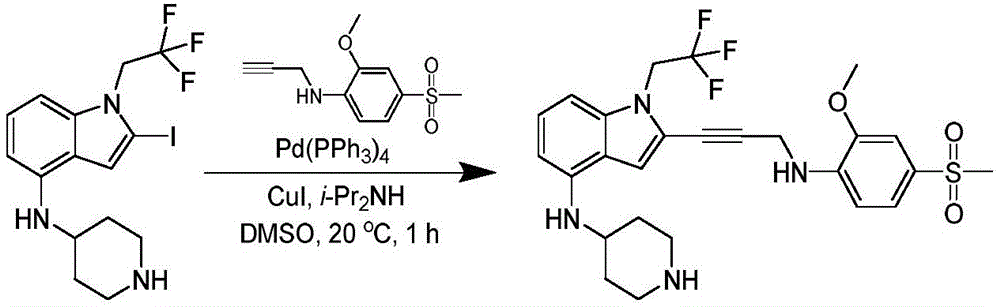
Preparation of 2- (3- ((2-methoxy-4- (methylsulfonyl) phenyl) amino) prop-1-yn-1-yl) -N- (piperidin-4-yl) -1- (2,2, 2-trifluoroethyl) -1H-indol-4-amine: 2-iodo-N- (piperidin-4-yl) -1- (2,2, 2-trifluoroethyl) -1H-indol-4-amine (0.2g, 472.57. mu. mol,1 eq.), 2-methoxy-4-methylsulfonyl-N-prop-2-ynyl-aniline (135.70mg, 567.09. mu. mol,1.2 eq.), CuI (90mg, 472.57. mu. mol,1 eq.), i-Pr 2 NH (478.20mg,4.73mmol, 667.87. mu.L, 10 equiv.) and Pd (PPh) 3 ) 4 A mixture of (109.22mg, 94.51. mu. mol,0.2 equiv) in DMSO (3mL) was degassed and N added 2 Purging was carried out three times. In N 2 The mixture was then stirred at 20 ℃ for 1 hour. TLC analysis (EtOAc: TEA ═ 10:1, R f 0.1) indicated complete consumption of starting material and a major new spot was detected. Saturated aqueous EDTA was added to the crude reaction mixture and the resulting mixture was stirred at 20 ℃ for 1 hour. The mixture was extracted with EtOAc (15mL x 3). The combined organic layers were washed with brine (10mL x 3), dried over anhydrous sodium sulfate, filtered and concentrated under reduced pressure. The crude product, 2- (3- ((2-methoxy-4- (methylsulfonyl) phenyl) amino) prop-1-yn-1-yl) -N- (piperidin-4-yl) -1- (2,2, 2-trifluoroethyl) -1H-indol-4-amine (0.11g,185.19 μmol, 39.19% yield), was obtained as a yellow solid and was used in the next step without further purification.
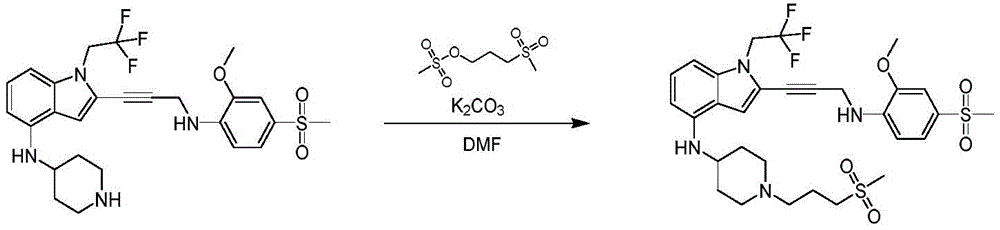
In N 2 Next, 2- (3- ((2-methoxy-4- (methylsulfonyl) phenyl) amino) prop-1-yn-1-yl) -N- (piperidin-4-yl) -1- (2,2, 2-trifluoroethyl) -1H-indol-4-amine (0.1g, 187.06. mu. mol,1 eq), 3-methylsulphonyl, was addedAcylpropyl methanesulfonate (121.37mg, 561.18. mu. mol,3 equivalents) and K 2 CO 3 A mixture of (129.26mg, 935.29. mu. mol,5 equivalents) in DMF (3mL) was stirred at 80 ℃ for 2 hours. TLC analysis (EtOAc: TEA ═ 10:1, R f 0.25) indicates that a major new spot was detected. The mixture was filtered and concentrated under reduced pressure. The crude residue was purified by preparative HPLC to give the desired product 2- {3- [ (4-methanesulfonyl-2-methoxyphenyl) amino]Prop-1-yn-1-yl } -N- [1- (3-methanesulfonylpropyl) piperidin-4-yl]-1- (2,2, 2-trifluoroethyl) -1H-indol-4-amine (0.025g,37.80 μmol, 20.21% yield) as a yellow solid. MS (ES) + ,m/z):655.2。
Example D25: synthesis of compounds 586A, 587A, 588A and 589A.

Preparation of 3- (4- ((2-iodo-1- (2,2, 2-trifluoroethyl) -1H-indol-4-yl) amino) piperidin-1-yl) propane-1, 2-diol: to a mixture of 2-iodo-N- (piperidin-4-yl) -1- (2,2, 2-trifluoroethyl) -1H-indol-4-amine (2g,4.54mmol,1 eq) in DMF (20mL) was added oxiran-2-ylcarbinol (1.68g,22.72mmol,1.50mL,5 eq) and K 2 CO 3 (1.88g,13.63mmol,3 equiv.). The mixture was stirred at 50 ℃ for 5 hours. TLC and LC-MS analysis indicated complete consumption of the starting material. The reaction was partitioned by adding water (100mL) and EtOAc (100 mL). The aqueous phase was extracted with EtOAc (100mL x 3). The combined organic layers were washed with brine (100mL x 3), dried over anhydrous sodium sulfate, filtered and concentrated to give the crude product (1.2g,2.22mmol, 48.85% yield) as a dark brown oil. MS (ES) + ,m/z):497.8。
Preparation of 3- (4- ((2-iodo-1- (2,2, 2-trifluoroethyl) -1H-indol-4-yl) amino) piperidin-1-yl) propane-1, 2-dipropionate and 3- (4- ((2-iodo-1- (2,2, 2-trifluoroethyl) -1H-indol-4-yl) amino) piperidin-1-yl) propane-1, 2-diylbis (2-methylpropionate): to a mixture of 3- (4- ((2-iodo-1- (2,2, 2-trifluoroethyl) -1H-indol-4-yl) amino) piperidin-1-yl) propane-1, 2-diol (200mg,361.96 μmol,1 eq) in DCM (3mL) was added propionic anhydride (117.76mg,904.90 μmol,116.60 μ L,2.5 equivalents) or isobutyric anhydride (143.15mg,904.90 μmol,150.05 μ L,2.5 equivalents). The mixture was stirred at 50 ℃ for 5 hours. TLC and LC-MS analysis indicated complete consumption of the starting material. The reaction was partitioned by adding water (100mL) and EtOAc (20 mL). The aqueous phase was extracted with EtOAc (50mL x 3). The combined organic layers were washed with brine (100mL x 3), dried over anhydrous sodium sulfate, filtered and concentrated in vacuo. The crude product was purified by preparative TLC (PE: EtOAc ═ 1:1, R) f 0.63) to give the desired product (120mg, crude) as a pale brown oil. 3- (4- ((2-iodo-1- (2,2, 2-trifluoroethyl) -1H-indol-4-yl) amino) piperidin-1-yl) propane-1, 2-dipropionate, MS (ES) + M/z) 609.9; 3- (4- ((2-iodo-1- (2,2, 2-trifluoroethyl) -1H-indol-4-yl) amino) piperidin-1-yl) propane-1, 2-diylbis (2-methylpropionate), MS (ES) + ,m/z):638.3。
Preparation of 3- (4- ((2- (3- ((2-methoxy-4- (methylsulfonyl) phenyl) amino) prop-1-yn-1-yl) -1- (2,2, 2-trifluoroethyl) -1H-indol-4-yl) amino) piperidin-1-yl) propane-1, 2-diyl dipropionate: to a solution of 3- (4- ((2-iodo-1- (2,2, 2-trifluoroethyl) -1H-indol-4-yl) amino) piperidin-1-yl) propane-1, 2-dipropionate (60mg, 98.45. mu. mol,1 equivalent) in DMSO (2mL) was added 2-methoxy-4-methylsulfonyl-N-prop-2-ynyl-aniline (31.41mg, 118.15. mu. mol,1.2 equivalents), i-PrNH 2 (58.20mg, 984.54. mu. mol, 84.59. mu.L, 10 equivalents), CuI (18.75mg, 98.45. mu. mol,1 equivalent), and Pd (PPh) 3 ) 4 (22.75mg, 19.69. mu. mol,0.2 eq.). At N 2 The mixture was then stirred at 25 ℃ for 2 hours. LC-MS and TLC analysis (PE: EtOAc ═ 1:1, R) f 0.5) indicates complete consumption of the starting material. The reaction mixture was quenched by addition of saturated aqueous EDTA (20mL) at 25 ℃ and stirred for 2 hours. The reaction mixture was partitioned between EtOAc and water. The aqueous phase was extracted with EtOAc (5mL x 3) and the organic phase was washed with brine 30mL (10mL x 3), dried over anhydrous sodium sulfate, filtered, and concentrated in vacuo to give the crude product. The residue was purified by preparative TLC and lyophilized to give the product [3- [4- [ [2- [3- (2-methoxy-4-methylsulfonyl-anilino) prop-1-ynyl ]-1- (2,2, 2-trifluoroethyl) indol-4-yl]Amino group]-1-piperidinyl group]-2-propionyloxy-propyl]Propanoate ester (21.5)mg,27.92 μmol, 28.36% yield) as a yellow solid. The remaining compounds were synthesized using a similar method.
1- {4- [ (2- {3- [ (4-methanesulfonyl-2-methoxyphenyl) amino group]Prop-1-yn-1-yl } -1- (2,2, 2-trifluoroethyl) -1H-indol-4-yl) amino]Piperidin-1-yl } -3- (propionyloxy) propan-2-yl propionate, (21.5mg, 28.4% yield) MS (ES) + M/z) 721.3; 1- {4- [ (2- {3- [ (2-methoxy-4-sulfamoylphenyl) amino group]Prop-1-yn-1-yl } -1- (2,2, 2-trifluoroethyl) -1H-indol-4-yl) amino]Piperidin-1-yl } -3- (propionyloxy) propan-2-yl propionate, (58.1mg, 53.8% yield) MS (ES) + M/z) 722.2; 1- {4- [ (2- {3- [ (4-methanesulfonyl-2-methoxyphenyl) amino)]Prop-1-yn-1-yl } -1- (2,2, 2-trifluoroethyl) -1H-indol-4-yl) amino]Piperidin-1-yl } -3- [ (2-methylpropanoyl) oxy group]Prop-2-yl 2-methylpropionate, (21.4mg, 21.7% yield) MS (ES) + M/z) 749.3; and 1- {4- [ (2- {3- [ (2-methoxy-4-sulfamoylphenyl) amino group]Prop-1-yn-1-yl } -1- (2,2, 2-trifluoroethyl) -1H-indol-4-yl) amino]Piperidin-1-yl } -3- [ (2-methylpropanoyl) oxy group]Propan-2-yl 2-methylpropionate, (23.8mg, 26.6% yield) MS (ES) + ,m/z):750.3。
Example D26: synthesis of compounds 590A and 591A.
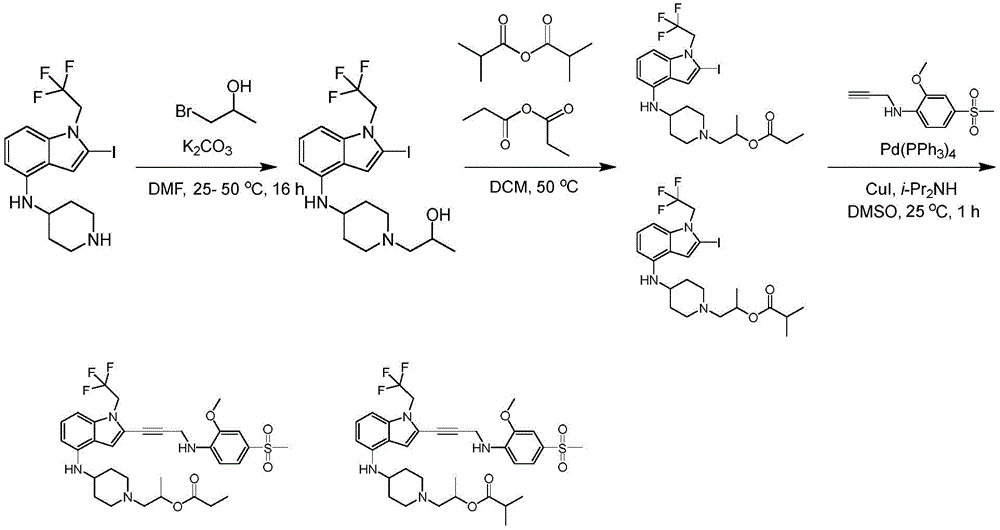
Preparation of 1- (4- ((2-iodo-1- (2,2, 2-trifluoroethyl) -1H-indol-4-yl) amino) piperidin-1-yl) propan-2-ol: to a mixture of 2-iodo-N- (piperidin-4-yl) -1- (2,2, 2-trifluoroethyl) -1H-indol-4-amine (2g,4.63mmol,1 eq) in DMF (20mL) at 25 deg.C was added 1-bromopropan-2-ol (9.20g,46.31mmol,10 eq) and K 2 CO 3 (3.20g,23.16mmol,5 equiv.). The mixture was stirred at 50 ℃ for 12 hours. TLC and LC-MS analysis indicated complete consumption of the starting material. The reaction was partitioned by adding water (20mL) and EtOAc (50 mL). The aqueous phase was extracted with EtOAc (50mL x 3). The combined organic layers were washed with brine (50mL x 3), dried over anhydrous sodium sulfate, filtered, and concentrated in vacuo to give the desired product 1- (4- ((2-iodo-1- (2,2, 2-trifluoroethyl) -1H-indol-4-yl) amino)Piperidin-1-yl) propan-2-ol (3.8g, crude) as a dark brown oil. MS (ES) + ,m/z):482.0。
Preparation of 1- (4- ((2-iodo-1- (2,2, 2-trifluoroethyl) -1H-indol-4-yl) amino) piperidin-1-yl) propan-2-yl isobutyrate: to 1- [4- [ [ 2-iodo-1- (2,2, 2-trifluoroethyl) indol-4-yl group]Amino group]-1-piperidinyl group]A solution of propan-2-ol (0.1g, 187. mu. mol,1 eq) in DCM (5mL) was added 2-methylpropanoyl 2-methylpropionate (118.33mg, 747.99. mu. mol, 124.03. mu.L, 4 eq) and the reaction mixture was stirred at 50 ℃ for 10 h. TLC analysis indicated completion of the reaction (EtOAc, R) f 0.6). The reaction mixture was quenched by addition of water (10mL) and extracted with EtOAc (15mL x 3). The combined organic layers were washed with brine (50mL) and water (50mL), dried over anhydrous sodium sulfate, filtered and concentrated to give the crude product. The crude product was passed through preparative TLC (EtOAc, R) f ═ 0.6) to give [2- [4- [ [ 2-iodo-1- (2,2, 2-trifluoroethyl) indol-4-yl ] a]Amino group]-1-piperidinyl group]-1-methyl-ethyl]2-methylpropionate (90mg, 163.23. mu. mol, 87.29% yield) as a yellow oil. MS (ES) + M/z) 552.0. 1- (4- ((2-iodo-1- (2,2, 2-trifluoroethyl) -1H-indol-4-yl) amino) piperidin-1-yl) propan-2-yl propionate was prepared according to the procedure described above. 160mg, 89.57% yield) MS (ES) + ,m/z):538.2。
1- {4- [ (2- {3- [ (4-methanesulfonyl-2-methoxyphenyl) amino group]Prop-1-yn-1-yl } -1- (2,2, 2-trifluoroethyl) -1H-indol-4-yl) amino]Piperidin-1-yl } prop-2-yl propionate and 1- {4- [ (2- {3- [ (4-methanesulfonyl-2-methoxyphenyl) amino]Prop-1-yn-1-yl } -1- (2,2, 2-trifluoroethyl) -1H-indol-4-yl) amino]Preparation of piperidin-1-yl } prop-2-yl 2-methylpropionate: to a mixture of 2-methoxy-4- (methylsulfonyl) -N- (prop-2-yn-1-yl) aniline (39.84mg, 166.49. mu. mol,1.2 eq) in DMSO (2mL) at 25 ℃ was added i-Pr 2 NH (82.01mg,1.39mmol, 119.20. mu.L, 10 equivalents), CuI (26.42mg, 138.74. mu. mol,1 equivalent), 1- (4- ((2-iodo-1- (2,2, 2-trifluoroethyl) -1H-indol-4-yl) amino) piperidin-1-yl) propan-2-yl propionate (90mg, 138.74. mu. mol,1 equivalent) or 1- (4- ((2-iodo-1- (2,2, 2-trifluoroethyl) -1H-indol-4-yl) amino) piperidin-1-yl) propan-2-yl isobutyrate and Pd (PPh) 3 ) 4 (32.06mg, 27.75. mu. mol,0.2 equiv.). In N 2 Next, the mixture was stirred at 25 ℃ for 1 hour. LC-MS and TLC analysis indicated that the reaction was complete. The reaction mixture was quenched by the addition of saturated aqueous EDTA (20mL) at 25 ℃ and stirred for 2 hours. The reaction mixture was partitioned by adding EtOAc (5mL) and the aqueous phase was extracted with EtOAc (5mL x 3). The organic phase was washed with brine (5mL x 3), dried over anhydrous sodium sulfate, filtered, and concentrated in vacuo. The crude product (100mg) was obtained. The crude residue was purified by preparative TLC (DCM: MeOH ═ 20:1, R) f 0.5) and preparative HPLC gave the desired product as a light yellow solid.
1- {4- [ (2- {3- [ (4-methanesulfonyl-2-methoxyphenyl) amino group]Prop-1-yn-1-yl } -1- (2,2, 2-trifluoroethyl) -1H-indol-4-yl) amino]Piperidin-1-yl } prop-2-ylpropionate (6.3mg, 6.98% yield), MS (ES) + M/z) 649.3; and 1- {4- [ (2- {3- [ (4-methanesulfonyl-2-methoxyphenyl) amino group ]Prop-1-yn-1-yl } -1- (2,2, 2-trifluoroethyl) -1H-indol-4-yl) amino]Piperidin-1-yl } prop-2-yl 2-methylpropionate (11.6mg, 12.11% yield) MS (ES) + ,m/z):663.3。
Example D27: synthesis of 2-hydroxy-3- {4- [ (2- {3- [ (4-methanesulfonyl-2-methoxyphenyl) amino ] prop-1-yn-1-yl } -1- (2,2, 2-trifluoroethyl) -1H-indol-4-yl) amino ] piperidin-1-yl } propyl 2-methylpropionate (Compound 592A).

Preparation of 3- (4- ((2-iodo-1- (2,2, 2-trifluoroethyl) -1H-indol-4-yl) amino) piperidin-1-yl) propane-1, 2-diol: to a mixture of 2-iodo-N- (piperidin-4-yl) -1- (2,2, 2-trifluoroethyl) -1H-indol-4-amine) (2g,4.54mmol,1 eq) in DMF (15mL) at 25 deg.C was added oxido-2-ylcarbinol (1.77g,22.68mmol,1.58mL,5 eq) and K 2 CO 3 (1.88g,13.61mmol,3 equivalents). The mixture was stirred at 50 ℃ for 12 hours. TLC and LC-MS analysis indicated complete consumption of the starting material. The reaction was partitioned by the addition of water (20mL) and EtOAc (10mL), the aqueous phase was extracted with EtOAc (20mL x 3), the combined organic layers were washed with brine (20mL x 3), dried over anhydrous sodium sulfate, filtered and dried in vacuoDrying afforded the desired product 3- (4- ((2-iodo-1- (2,2, 2-trifluoroethyl) -1H-indol-4-yl) amino) piperidin-1-yl) propane-1, 2-diol (2.1g, 83.7% yield) as a dark brown oil.
2-hydroxy-3- [4- [ [ 2-iodo-1- (2,2, 2-trifluoroethyl) indol-4-yl]Amino group]-1-piperidinyl group]Propyl radical]Preparation of 2-methylpropionate: to 3- [4- [ [ 2-iodo-1- (2,2, 2-trifluoroethyl) indol-4-yl group]Amino group]-1-piperidinyl group]A solution of propane-1, 2-diol (120mg, 217.18. mu. mol,1 eq) in DCM (3mL) was added 2-methylpropanoyl 2-methylpropionate (30.92mg, 195.46. mu. mol, 32.41. mu.L, 0.9 eq). The mixture was stirred at 25 ℃ for 5 hours. TLC analysis (PE: EtOAc ═ 1:1, R) f 0.63) indicated complete consumption of starting material and product detected. The reaction mixture was partitioned by the addition of water (100mL) and EtOAc (10 mL). The aqueous phase was extracted with EtOAc (10mL x 3). The combined organic layers were washed with brine (50mL x 3), dried over anhydrous sodium sulfate, filtered, and concentrated in vacuo to give the crude product. The crude product was purified by preparative TLC (PE: EtOAc ═ 1:1, R) f 0.63) to yield the desired product [ 2-hydroxy-3- [4- [ [ 2-iodo-1- (2,2, 2-trifluoroethyl) indol-4-yl ] -4-carboxylic acid methyl ester]Amino group]-1-piperidinyl group]Propyl radical]2-Methylpropionate (70mg, crude) as a pale brown oil. MS (ES) + ,m/z):568.2。
Preparation of 2-hydroxy-3- (4- ((2-iodo-1- (2,2, 2-trifluoroethyl) -1H-indol-4-yl) amino) piperidin-1-yl) propyl isobutyrate: to a solution of 2-methoxy-4- (methylsulfonyl) -N- (prop-2-yn-1-yl) aniline (39.36mg, 148.05. mu. mol,1.2 eq) in DMSO (2mL) at 25 ℃ was added i-Pr 2 NH (72.93mg,1.23mmol, 106. mu.L, 10 equivalents), CuI (23.50mg, 123.37. mu. mol,1 equivalent), [ 2-hydroxy-3- [4- [ [ 2-iodo-1- (2,2, 2-trifluoroethyl) indol-4-yl]Amino group]-1-piperidinyl group]Propyl radical]2-methylpropionate (70mg, 123.37. mu. mol,1 eq.) and Pd (PPh) 3 ) 4 (28.51mg, 24.67. mu. mol,0.2 eq.). In N 2 The mixture was then stirred at 25 ℃ for 1 hour. LC-MS and TLC analysis indicated that the reaction was complete. The reaction mixture was quenched by the addition of saturated aqueous EDTA (20mL) at 25 ℃ and the mixture was stirred for 2 hours. The reaction mixture was partitioned by adding EtOAc (10 mL). The aqueous phase was extracted with EtOAc (5mL x 3). The organic phase was washed with brine (10 mL. times.3) over anhydrous sodium sulfateDried, filtered and concentrated in vacuo. The residue was purified by preparative TLC and by preparative HPLC to give the desired product (9.4mg,12.82 μmol, 10.39% yield) as a light yellow solid. MS (ES) + ,m/z):679.3。
Example D28: synthesis of (4- ((3- (4- (((3S,4R) -3-fluoro-1-methylpiperidin-4-yl) amino) -1- (2,2, 2-trifluoroethyl) -1H-indol-2-yl) prop-2-yn-1-yl) amino) -3-methoxybenzoyl) -L-glutamic acid (compound 973A).

To a solution of 4- ((3- (4- (((3S,4R) -3-fluoro-1-methylpiperidin-4-yl) amino) -1- (2,2, 2-trifluoroethyl) -1H-indol-2-yl) prop-2-yn-1-yl) amino) -3-methoxybenzoic acid (0.08g,150.23 μmol,1 eq) in DMF (2mL) at 25 ℃ was added TEA (45.60mg,450.68 μmol,62.73 μ L,3 eq) and HATU (85.68mg,225.34 μmol,1.5 eq). The mixture was stirred at 25 ℃ for 0.5 hour. Then diethyl L-glutamate hydrochloride (43.21mg,180.27 μmol,1.2 equivalents, HCl) was added and the mixture was stirred at 50 ℃ for 2 hours. TLC analysis indicated complete consumption of starting material. An aqueous solution (0.5mL) of NaOH (12.02mg,300.45 μmol,2 equivalents) was added to the mixture, and the mixture was stirred at 50 ℃ for 0.5 h. LC-MS analysis indicated the reaction was complete. The mixture was purified by preparative HPLC (without work-up) to give the desired product (4- ((3- (4- (((3S,4R) -3-fluoro-1-methylpiperidin-4-yl) amino) -1- (2,2, 2-trifluoroethyl) -1H-indol-2-yl) prop-2-yn-1-yl) amino) -3-methoxybenzoyl) -L-glutamic acid (0.033g,47.77 μmol, 31.80% yield) as a yellow solid. MS (ES) + ,m/z):662.3。
Example D29: synthesis of (4- ((3- (4- (((3S,4R) -3-fluoro-1-methylpiperidin-4-yl) amino) -1- (2,2, 2-trifluoroethyl) -1H-indol-2-yl) prop-2-yn-1-yl) amino) -3-methoxybenzoyl) -L-glutamine (Compound 974A).

To a solution of 4- ((3- (4- (((3S,4R) -3-fluoro-1-methylpiperidin-4-yl) amino) -1- (2,2, 2-trifluoroethyl) -1H-indol-2-yl) prop-2-yn-1-yl) amino) -3-methoxybenzoic acid (0.08g,150.23 μmol,1 eq) in DMF (3mL) at 25 ℃ were added TEA (45.60mg,450.68 μmol,62.73 μ L,3 eq) and HATU (85.68mg,225.34 μmol,1.5 eq). The mixture was stirred for 0.5 hour. Then, L-glutamine (26.35mg, 180.27. mu. mol,1.2 eq.) was added and the resulting mixture was stirred at 50 ℃ for 4 hours. LC-MS analysis indicated complete consumption of the starting material. The mixture was directly purified by preparative HPLC to give the desired product (0.031g,46.11 μmol, 30.69% yield) as a white solid. MS (ES) + ,m/z):661.3。
Example D30: synthesis of (4- ((3- (4- (((3S,4R) -3-fluoro-1-methylpiperidin-4-yl) amino) -1- (2,2, 2-trifluoroethyl) -1H-indol-2-yl) prop-2-yn-1-yl) amino) -3-methoxybenzoyl) -L-glutamine (Compound 975A).

To a solution of 4- ((3- (4- (((3S,4R) -3-fluoro-1-methylpiperidin-4-yl) amino) -1- (2,2, 2-trifluoroethyl) -1H-indol-2-yl) prop-2-yn-1-yl) amino) -3-methoxybenzoic acid (100mg,187.78 μmol,1 eq) in DMF (3mL) at 20 ℃ were added TEA (57.01mg,563.35 μmol,78.41 μ L,3 eq) and HATU (107.10mg,281.67 μmol,1.5 eq). The mixture was stirred at 25 ℃ for 0.5 hour. Dimethyl L-glutamate (47.69mg,225.34 μmol,1.2 eq, HCl) was added and the resulting mixture was warmed to 50 ℃ and stirred for 2 hours. LC-MS analysis indicated complete consumption of the starting material. The mixture was purified by preparative HPLC to give the desired product (41mg,58.79 μmol, 31.31% yield) as a white solid. MS (ES) + ,m/z):690.4。
Example D31: synthesis of compounds 474A and 475A.

Preparation of 4-bromo-6-fluoro-1- ((2- (trimethylsilyl) ethoxy) methyl) -1H-indole: to a mixture of NaH (2.80g,70.08mmol, 60% in mineral oil, 3 equivalents) in THF (80mL) at 0 deg.C was added a solution of 4-bromo-6-fluoro-1H-indole (5g,23.36mmol,1 equivalent) in THF (80 mL). The mixture was stirred for 1 hour. SEMCl (6.62g,39.71mmol,7.03mL,1.7 equiv.) was then added at 0 ℃. The mixture was stirred at 0 ℃ for 1 hour. LC-MS analysis indicated complete consumption of starting material and detection of the desired product. By adding saturated NH 4 The reaction mixture was quenched with aqueous Cl (100mL) and extracted with EtOAc (30 mL. times.3). The combined organic layers were dried over anhydrous sodium sulfate, filtered and concentrated under reduced pressure. The crude residue is purified by column chromatography (SiO) 2 PE: EtOAc ═ 1:0 to 20:1) to give the desired product (10g,29.04mmol, 62.17% yield) as a pale yellow oil.
Preparation of 6-fluoro-N- (1-methylpiperidin-4-yl) -1- ((2- (trimethylsilyl) ethoxy) methyl) -1H-indol-4-amine: to a mixture of 4-bromo-6-fluoro-1- ((2- (trimethylsilyl) ethoxy) methyl) -1H-indole (7g,20.33mmol,1 equiv.), 1-methylpiperidin-4-amine (23.22g,203.31mmol,10 equiv.), t-BuONa (2.54g,26.43mmol,1.3 equiv.) and di-tert-butyl- (2-phenylphenyl) phosphane (1.21g,4.07mmol,0.2 equiv.) in toluene (10mL) at 20 deg.C was added Pd 2 (dba) 3 (2.79g,3.05mmol,0.15 equiv.). Using N in sealed tubes 2 The mixture was rinsed and stirred at 60 ℃ for 12 hours. LC-MS analysis indicated that the starting material was consumed. The reaction mixture was quenched by addition of saturated aqueous EDTA (200mL) at 25 ℃ for 1 hour and extracted with EtOAc (20mL x 4). The combined organic layers were dried over anhydrous sodium sulfate, filtered and concentrated under reduced pressure to give a residue. The residue was purified by column chromatography (SiO) 2 DCM: MeOH ═ 1:0 to 25:1, R f 0.43) to give the desired product (4.3g,11.39mmol, 56.01% yield) as a dark brown oil. MS (ES) + ,m/z):378.1。
Preparation of tert-butyl (6-fluoro-1- ((2- (trimethylsilyl) ethoxy) methyl) -1H-indol-4-yl) (1-methylpiperidin-4-yl) carbamate: at 20 deg.C, 6-fluoro-N- (1-methylpiperidin-4-yl) -1- ((2- (trimethylsilyl) ethoxy)Yl) methyl) -1H-indol-4-amine (2g,5.30mmol,1 eq) in t-BuOH (2mL) was added (Boc) 2 O (34.68g,158.91mmol,36.51mL,30 equiv.). The mixture was stirred at 100 ℃ for 24 hours. LC-MS analysis indicated that the starting material was consumed and a new major spot was detected. The reaction mixture was concentrated under reduced pressure and the crude residue was purified by column chromatography (SiO) 2 DCM: MeOH ═ 1:0 to 20:1, R f 0.43) to afford the desired product (3g,4.40mmol, 41.50% yield) as a dark brown solid. MS (ES) + ,m/z):478.3。
Preparation of tert-butyl (6-fluoro-1H-indol-4-yl) (1-methylpiperidin-4-yl) carbamate: a solution of tert-butyl (6-fluoro-1- ((2- (trimethylsilyl) ethoxy) methyl) -1H-indol-4-yl) (1-methylpiperidin-4-yl) carbamate (1.6g,2.34mmol,1 eq) in THF (3mL) was added to TBAF (1M,9.38mL,4 eq) at 20 ℃. The mixture was stirred at 80 ℃ for 10 hours. LC-MS analysis indicated that the starting material was consumed and a major spot with the mass of the desired product was detected. The reaction mixture was quenched by addition of saturated aqueous EDTA (100mL) at 25 ℃ and extracted with EtOAc (30mL x 7). The combined organic layers were dried over anhydrous sodium sulfate, filtered and concentrated under reduced pressure to give a residue. The residue was purified by column chromatography (SiO) 2 DCM: MeOH ═ 50:1 to 20:1, Rf ═ 0.43) purification afforded the desired product (1.8g,3.11mmol, 66.29% yield) as a dark brown oil.
Preparation of tert-butyl (6-fluoro-1- (phenylsulfonyl) -1H-indol-4-yl) (1-methylpiperidin-4-yl) carbamate: a mixture of NaH (310.86mg,7.77mmol, 60% in mineral oil, 3 equivalents) in THF (5mL) was added to a solution of tert-butyl (6-fluoro-1H-indol-4-yl) (1-methylpiperidin-4-yl) carbamate (1.5g,2.59mmol,1 equivalent) in THF (5mL) at 0 deg.C. The mixture was stirred for 1 hour, then benzenesulfonyl chloride (915.06mg,5.18mmol,663.09 μ L,2 equiv.) was added at 0 ℃. The resulting mixture was stirred at 0 ℃ for 1 hour. LC-MS analysis indicated that the starting material was consumed and one of the desired products was detected. At 20 ℃ by adding saturated NH 4 The reaction mixture was quenched with aqueous Cl (100mL) and extracted with EtOAc (20 mL. times.4). Are combined withThe organic layer was dried over anhydrous sodium sulfate, filtered and concentrated under reduced pressure to give a residue. The residue was passed through preparative TLC (SiO) 2 ,DCM:MeOH=10:1,R f 0.43) to give the desired product (1.1g,1.80mmol, 34.84% yield) as a dark brown oil. MS (ES) + ,m/z):488.1。
Preparation of tert-butyl (6-fluoro-2-iodo-1- (phenylsulfonyl) -1H-indol-4-yl) (1-methylpiperidin-4-yl) carbamate: to a solution of tert-butyl (6-fluoro-1- (phenylsulfonyl) -1H-indol-4-yl) (1-methylpiperidin-4-yl) carbamate (300mg, 492.22. mu. mol,1 eq) in THF (3mL) at-78 ℃ was added LDA (2M, 861.39. mu.L, 3.5 eq). The mixture was stirred at-78 ℃ for 1 hour and I was added 2 (499.72mg,1.97mmol, 396.60. mu.L, 4 equiv.) in THF (2mL) and the resulting mixture was stirred at-78 ℃ for 1 h. LC-MS analysis indicated complete consumption of the starting material. At 20 ℃ by adding saturated NH 4 The reaction mixture was quenched with aqueous Cl (60mL) and extracted with EtOAc (20 mL. times.3). The combined organic layers were dried over anhydrous sodium sulfate, filtered and concentrated under reduced pressure to give a residue. The crude product was obtained as a dark brown oil (1g,489.01 μmol, 49.67% yield) and used in the next step without further purification. MS (ES +, m/z) 613.9.
Preparation of tert-butyl (6-fluoro-2-iodo-1H-indol-4-yl) (1-methylpiperidin-4-yl) carbamate: tert-butyl (6-fluoro-2-iodo-1- (phenylsulfonyl) -1H-indol-4-yl) (1-methylpiperidin-4-yl) carbamate (800mg, 782.42. mu. mol,1 eq) and K 2 CO 3 A mixture of (540.68mg,3.91mmol,5 equiv.) in MeOH (3mL) was stirred at 60 deg.C for 2 h. LC-MS analysis indicated complete consumption of starting material and detection of a spot of the desired compound. The reaction mixture was quenched by addition of water (100mL) at 20 ℃ and extracted with EtOAc (30mL x 4). The combined organic layers were dried over anhydrous sodium sulfate, filtered and concentrated under reduced pressure to give a residue. The residue was passed through preparative TLC (SiO) 2 ,DCM:MeOH=8:1,R f 0.43) to give the desired product (160mg,250.15 μmol, 31.97% yield) as a dark brown oil. MS (ES +, m/z) 473.9.
(6-fluoro-2-iodo-1- (2,2, 2-trifluoroethyl)) Preparation of tert-butyl (1-methylpiperidin-4-yl) -1H-indol-4-yl) (1-methylpiperidin-4-yl) carbamate: to a mixture of NaH (30.02mg, 750.44. mu. mol in mineral oil, 60%, 3 equivalents) in THF (2mL) at 0 deg.C was added a solution of tert-butyl (6-fluoro-2-iodo-1H-indol-4-yl) (1-methylpiperidin-4-yl) carbamate (0.16g, 250.15. mu. mol,1 equivalent) in THF (1 mL). The mixture was stirred at 0 ℃ for 1h, and 2,2, 2-trifluoroethyl trifluoromethanesulfonate (290.30mg,1.25mmol,5 equivalents) was added and the mixture was stirred at 0 ℃ for 1 h. LC-MS analysis indicated the reaction was complete. By addition of saturated NH 4 The reaction mixture was quenched with Cl solution (15mL) and extracted with EtOAc (20 mL. times.3). The combined organic layers were washed with brine (5mL), dried over anhydrous sodium sulfate, and concentrated in vacuo. The crude residue (0.16g, crude) was obtained as a yellow solid and was not used in the next step without purification. MS (ES +, m/z) 555.8.
Preparation of tert-butyl (6-fluoro-2- (3- ((2-methoxy-4- (methylsulfonyl) phenyl) amino) prop-1-yn-1-yl) -1- (2,2, 2-trifluoroethyl) -1H-indol-4-yl) (1-methylpiperidin-4-yl) carbamate and tert-butyl (6-fluoro-2- (3- ((2-methoxy-4-sulfamoylphenyl) amino) prop-1-yn-1-yl) -1- (2,2, 2-trifluoroethyl) -1H-indol-4-yl) (1-methylpiperidin-4-yl) carbamate: in N 2 Next, to a solution of tert-butyl (6-fluoro-2-iodo-1- (2,2, 2-trifluoroethyl) -1H-indol-4-yl) (1-methylpiperidin-4-yl) carbamate (80mg, 122.45. mu. mol,1 equivalent) in DMSO (3mL) was added 2-methoxy-4- (methylsulfonyl) -N- (prop-2-yn-1-yl) aniline (42.26mg, 160.71. mu. mol,1.5 equivalents) or 3-methoxy-4- (prop-2-yn-1-ylamino) benzenesulfonamide (73.55mg, 244.89. mu. mol,2 equivalents), CuI (25.65mg, 134.69. mu. mol,1.10 equivalents), N-isopropylpropan-2-amine (12.39mg, 122.45. mu. mol,17.30 μ L,1 eq) and Pd (PPh) 3 ) 4 (28.30mg, 24.49. mu. mol,0.20 equiv.). The mixture was stirred at 45 ℃ for 1 hour. LC-MS analysis indicated complete consumption of starting material and a new major spot with the desired product mass was detected. The reaction mixture was quenched at 25 ℃ by the addition of saturated aqueous EDTA (100 mL). The mixture was stirred for 1 hour and extracted with EtOAc (50mL x 3). The combined organic layers were dried over anhydrous sodium sulfate, filtered and concentrated under reduced pressure to give a residue. Removing the residuePurification by preparative TLC afforded the desired product as a dark brown solid.
Tert-butyl (6-fluoro-2- (3- ((2-methoxy-4- (methylsulfonyl) phenyl) amino) prop-1-yn-1-yl) -1- (2,2, 2-trifluoroethyl) -1H-indol-4-yl) (1-methylpiperidin-4-yl) carbamate (25.0mg, 28% yield), MS (ES) + M/z) 667.0; and tert-butyl (6-fluoro-2- (3- ((2-methoxy-4-sulfamoylphenyl) amino) prop-1-yn-1-yl) -1- (2,2, 2-trifluoroethyl) -1H-indol-4-yl) (1-methylpiperidin-4-yl) carbamate (35.0mg, 38.5% yield), MS (ES) + ,m/z):668.0。
4- [ (3- { 6-fluoro-4- [ (1-methylpiperidin-4-yl) amino group]-1- (2,2, 2-trifluoroethyl) -1H-indol-2-yl } prop-2-yn-1-yl) amino]-3-methoxybenzene-1-sulphonamide and 6-fluoro-2- {3- [ (4-methanesulfonyl-2-methoxyphenyl) amino ]Preparation of prop-1-yn-1-yl } -N- (1-methylpiperidin-4-yl) -1- (2,2, 2-trifluoroethyl) -1H-indol-4-amine: tert-butyl (6-fluoro-2- (3- ((2-methoxy-4- (methylsulfonyl) phenyl) amino) prop-1-yn-1-yl) -1- (2,2, 2-trifluoroethyl) -1H-indol-4-yl) (1-methylpiperidin-4-yl) carbamate (20mg, 24. mu. mol,1 eq) or tert-butyl (6-fluoro-2- (3- ((2-methoxy-4-sulfamoylphenyl) amino) prop-1-yn-1-yl) -1- (2,2, 2-trifluoroethyl) -1H-indol-4-yl) (1-methylpiperidin-4-yl) carbamate (35mg, 47.18. mu. mol,1 eq) in EtOAc (0.5mL) was added to HCl/EtOAc (4M,2mL,169.58 eq) and stirred for 20 min. LC-MS analysis indicated complete consumption of starting material and detected a major spot with the mass of the desired product. The reaction mixture was concentrated under reduced pressure. The crude residue was purified by preparative HPLC to afford the desired product as a light yellow solid. 4- [ (3- { 6-fluoro-4- [ (1-methylpiperidin-4-yl) amino group]-1- (2,2, 2-trifluoroethyl) -1H-indol-2-yl } prop-2-yn-1-yl) amino]-3-methoxybenzene-1-sulfonamide (0.6mg, 3.9% yield), MS (ES) + M/z) 567.2; and 6-fluoro-2- {3- [ (4-methanesulfonyl-2-methoxyphenyl) amino ]Prop-1-yn-1-yl } -N- (1-methylpiperidin-4-yl) -1- (2,2, 2-trifluoroethyl) -1H-indol-4-amine (3.8mg, 13.9% yield), MS (ES) + ,m/z):568.2。
Example D32: synthesis of 4- [ (3- {4- [ (1-acetylpiperidin-4-yl) amino ] -1- (2,2, 2-trifluoroethyl) -1H-indol-2-yl } prop-2-yn-1-yl) amino ] -3-methoxybenzene-1-sulfonamide (Compound 749A).
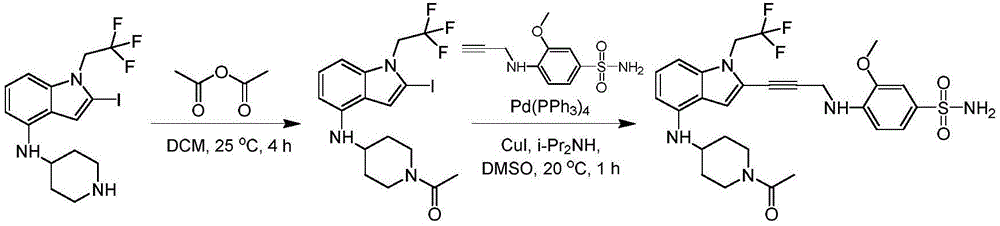
Preparation of 1- (4- ((2-iodo-1- (2,2, 2-trifluoroethyl) -1H-indol-4-yl) amino) piperidin-1-yl) ethan-1-one: to a mixture of 2-iodo-N- (piperidin-4-yl) -1- (2,2, 2-trifluoroethyl) -1H-indol-4-amine (100mg,226.84 μmol,1 eq) in DCM (3mL) was added acetic anhydride (20.84mg,204.15 μmol,19.12 μ L,0.9 eq). The mixture was stirred at 25 ℃ for 4 hours. TLC and LC-MS analysis indicated complete consumption of the starting material. The reaction was concentrated to give the crude product as a dark brown oil (110.0mg) which was used in the next step without purification. MS (ES) + ,m/z):466.1。
Preparation of 4- ((3- (4- ((1-acetylpiperidin-4-yl) amino) -1- (2,2, 2-trifluoroethyl) -1H-indol-2-yl) prop-2-yn-1-yl) amino) -3-methoxybenzenesulfonamide: to a solution of 1- (4- ((2-iodo-1- (2,2, 2-trifluoroethyl) -1H-indol-4-yl) amino) piperidin-1-yl) ethan-1-one (110mg,236.43 μmol,1 eq) and 3-methoxy-4- (prop-2-yn-1-ylamino) benzenesulfonamide (85.21mg,283.72 μmol,1.2 eq) in DMSO (3mL) was added i-Pr 2 NH (139.76mg,2.36mmol, 203.13. mu.L, 10 equiv.), CuI (45.03mg, 236.43. mu. mol,1 equiv.), and Pd (PPh) 3 ) 4 (54.64mg, 47.29. mu. mol,0.2 equiv.). The mixture was stirred at 25 ℃ for 1 hour. LC-MS and TLC analysis indicated that the reaction was complete. The reaction mixture was quenched by addition of saturated aqueous EDTA (20mL) at 25 ℃ and stirred for 2 hours. The reaction mixture was partitioned by adding EtOAc (10mL) and the aqueous phase was extracted with EtOAc (5 mL. times.3). The organic phase was washed with brine (10mL x 3), dried over anhydrous sodium sulfate, filtered and concentrated in vacuo. The crude residue was purified by preparative TLC (PE: EtOAc ═ 0:1, R) f 0.35) and preparative HPLC gave the desired product 18.3mg, 12.9% yield as a light yellow solid. MS (ES) + ,m/z):578.1。
Example D33: synthesis of 4- [ (3- {4- [ (1-acetylpiperidin-4-yl) amino ] -1- (2,2, 2-trifluoroethyl) -1H-indol-2-yl } prop-2-yn-1-yl) amino ] -3-methoxy-N, N-dimethylbenzene-1-sulfonamide (Compound 755A).

To a mixture of 3-methoxy-N, N-dimethyl-4- (prop-2-yn-1-ylamino) benzenesulfonamide (119.79mg, 290.17. mu. mol,1.5 equiv.) in DMSO (1-10mL) (4mL) at 20 deg.C was added i-Pr 2 NH (195.75mg,1.93mmol, 273.39. mu.L, 10 equiv.), CuI (36.84mg, 193.44. mu. mol,1 equiv.), 1- (4- ((2-iodo-1- (2,2, 2-trifluoroethyl) -1H-indol-4-yl) amino) piperidin-1-yl) ethan-1-one (100mg, 193.44. mu. mol,1 equiv.) and Pd (PPh) 3 ) 4 (44.71mg, 38.69. mu. mol,0.2 eq.). The mixture was stirred at 20 ℃ for 1 hour. EtOAc (10mL) was added to the mixture, and the resulting mixture was poured into saturated EDTA solution (40mL) and stirred for 15 minutes. The aqueous phase was extracted with EtOAc (40 mL. times.2) and the organic layer was poured into 2N aqueous EDTA (40mL) and stirred for a further 1 h. The aqueous phase was extracted with EtOAc (40mL x 3). The combined organic layers were washed with brine (40mL x3), dried over anhydrous sodium sulfate, combined with activated carbon, filtered and concentrated in vacuo. The mixture was purified by preparative HPLC to give the desired product in 31.6mg, 26.8% yield. MS (ES) + ,m/z):606.2。
Example D34: synthesis of 1- (4- { [2- (3- { [ 2-methoxy-4- (morpholine-4-sulfonyl) phenyl ] amino } prop-1-yn-1-yl) -1- (2,2, 2-trifluoroethyl) -1H-indol-4-yl ] amino } piperidin-1-yl) ethan-1-one (Compound 758A).
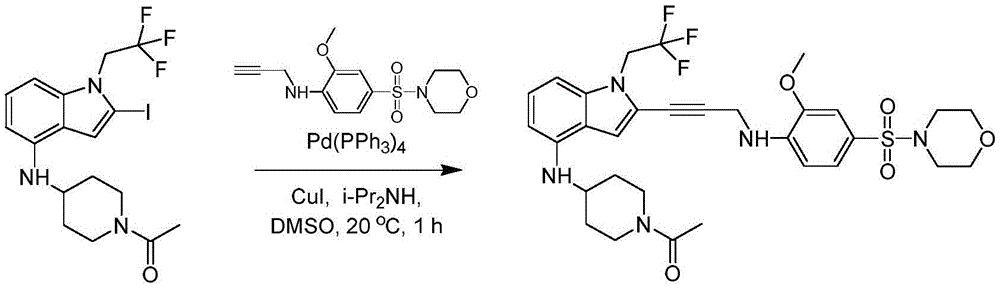
To a solution of 2-methoxy-4- (morpholinosulfonyl) -N- (prop-2-yn-1-yl) aniline (72.77mg, 232.13. mu. mol,1.5 eq) in DMSO (2mL) at 20 ℃ was added i-Pr 2 NH (156.60mg,1.55mmol, 218.71. mu.L, 10 equiv.), CuI (29.47mg, 154.76. mu. mol,1 equiv.), 1- (4- ((2-iodo-1- (2,2, 2-trifluoroethyl) -1H-indol-4-yl) amino) piperidin-1-yl) ethan-1-one (80mg, 154.76. mu. mol,1 equiv.) and Pd (PPh) 3 ) 4 (35.77mg, 30.95. mu. mol,0.2 equiv.). The mixture was stirred at 20 ℃ for 1 hour. LC-MS analysis indicated the reaction was complete. EtOAc (10mL) was added to the mixture, and the resulting mixture was poured into saturated aqueous EDTA (40mL) and stirred for 1 hour. The aqueous phase was extracted with EtOAc (40mL x 3). The combined organic layers were washed with brine (40mL x 3), dried over anhydrous sodium sulfate, combined with activated carbon, filtered and concentrated in vacuo. The mixture was purified by preparative TLC or column chromatography followed by preparative HPLC to give the desired product (28.04mg, 30.5% yield), MS (ES) + ,m/z):648.2。
Example D35: synthesis of 1- (4- ((2- (3- ((2-methoxy-4- (methylsulfonyl) phenyl) amino) prop-1-yn-1-yl) -1- (2,2, 2-trifluoroethyl) -1H-indol-4-yl) amino) -2-methylpiperidin-1-yl) ethan-1-one (Compound 738A).

Preparation of 2-iodo-N- (2-methylpiperidin-4-yl) -1- (2,2, 2-trifluoroethyl) -1H-indol-4-amine: to a solution of tert-butyl 4- ((2-iodo-1- (2,2, 2-trifluoroethyl) -1H-indol-4-yl) amino) -2-methylpiperidine-1-carboxylate (320mg,595.51 μmol,1 eq) in DCM (2mL) was added TFA (2.04g,17.87mmol,1.32mL,30 eq). The mixture was stirred at 20 ℃ for 2 hours. TLC analysis (PE: EtOAc ═ 1:1, R) f 0.1) indicating completion of the reaction. The reaction mixture was poured into saturated NaHCO 3 Solution (20mL) and extract the aqueous phase with EtOAc (10mL x 3). The combined organic layers were washed with brine (20mL), dried over anhydrous sodium sulfate, filtered and concentrated in vacuo. The crude residue (370mg, crude) was obtained as a pale yellow solid and used in the next step without purification. MS (ES) + ,m/z):437.9。
Preparation of 1- (4- ((2-iodo-1- (2,2, 2-trifluoroethyl) -1H-indol-4-yl) amino) -2-methylpiperidin-1-yl) ethan-1-one: at 0 ℃ under N 2 Preparation of 2-iodo-N- (2-methylpiperidin-4-yl) -1- (2,2, 2-trifluoroethyl) -1H-indol-4-amine and Et 3 A mixture of N (256.89mg,2.54mmol, 353.35. mu.L, 3 equiv.) in DCM (4 mL). Acetyl chloride (66.43 m)g, 846.22. mu. mol, 60.39. mu.L, 1 eq.) in DCM (1mL) was added dropwise to the mixture. The reaction mixture was stirred at 20 ℃ for 2 hours. LC-MS and TLC analysis (PE: EtOAc ═ 1:1, R) f 0.43) indicating completion of the reaction. The mixture was poured into saturated NaHCO 3 In solution (20 mL). The aqueous phase was extracted with EtOAc (20 mL. times.3). The combined organic layers were washed with brine (40mL), dried over anhydrous sodium sulfate, filtered and concentrated in vacuo. The crude residue was purified by preparative TLC (PE: EtOAc ═ 1:1, R) f 0.43) to give the desired product (160mg,282.09 μmol, 33.34% yield) as a light yellow solid.
Preparation of 1- (4- ((2- (3- ((2-methoxy-4- (methylsulfonyl) phenyl) amino) prop-1-yn-1-yl) -1- (2,2, 2-trifluoroethyl) -1H-indol-4-yl) amino) -2-methylpiperidin-1-yl) ethan-1-one: to a solution of 2-methoxy-4- (methylsulfonyl) -N- (prop-2-yn-1-yl) aniline (103.02mg, 370.25. mu. mol,1.5 eq) in DMSO (5mL) at 20 ℃ was added i-Pr 2 NH (249.77mg,2.47mmol, 348.84. mu.L, 10 equiv.), CuI (47.01mg, 246.83. mu. mol,1 equiv.), 1- (4- ((2-iodo-1- (2,2, 2-trifluoroethyl) -1H-indol-4-yl) amino) -2-methylpiperidin-1-yl) ethan-1-one (140mg, 246.83. mu. mol,1 equiv.) and Pd (PPh) 3 ) 4 (57.05mg, 49.37. mu. mol,0.2 eq.). The mixture was stirred at 20 ℃ for 1 hour. EtOAc (10mL) was added to the mixture, and the resulting mixture was poured into 2N aqueous EDTA (40mL) and stirred for 15 minutes. The aqueous phase was extracted with EtOAc (40 mL. times.2). The organic layer was poured into 2N aqueous EDTA (40mL) and stirred for 1 hour. The aqueous phase was extracted with EtOAc (40 mL. times.3). The combined organic layers were washed with brine (40mL x 3), dried over anhydrous sodium sulfate, combined with activated carbon, filtered and concentrated in vacuo. The mixture was passed through preparative TLC (PE: EtOAc ═ 0:1, R) f 0.42) followed by preparative HPLC to give the desired product (14.9mg, 16.1% yield), MS (ES) + ,m/z):591.2。
Example D36: synthesis of 1- {4- [ (2- {3- [ (4-methanesulfonyl-2-methoxyphenyl) amino ] prop-1-yn-1-yl } -1- (2,2, 2-trifluoroethyl) -1H-indol-4-yl) amino ] azepan-1-yl } -3-methoxypropan-2-ol (compound 989A).

Preparation of tert-butyl 4- ((2-iodo-1- (2,2, 2-trifluoroethyl) -1H-indol-4-yl) amino) azepane-1-carboxylate: to a solution of 2-iodo-1- (2,2, 2-trifluoroethyl) -1H-indol-4-amine (0.5g,1.47mmol,1 eq) in DMF (5mL) was added tert-butyl 4-oxoazepane-1-carboxylate (627.12mg,2.94mmol,2 eq) and TMSCl (479.19mg,4.41mmol, 559.80. mu.L, 3 eq). In N 2 The reaction mixture was then stirred at 20 ℃ for 0.5 h. Then, in N 2 At 0 ℃ BH 3 ·Me 2 S (10M, 441.07. mu.L, 3 equivalents) was added dropwise to the reaction mixture and stirred for 0.5 h. LC-MS analysis indicated that the reaction was complete. The reaction was quenched with ice water (20mL) and the mixture was extracted with EtOAc (20mL × 3). The combined organic layers were washed with brine (20mL x 2), dried over anhydrous sodium sulfate, filtered and concentrated in vacuo. The crude residue is purified by column chromatography (SiO) 2 EtOAc ═ 20:1 to 10:1) to give tert-butyl 4- ((2-iodo-1- (2,2, 2-trifluoroethyl) -1H-indol-4-yl) amino) azepane-1-carboxylate (0.69g,1.28mmol, 87.34% yield) as a red oil. MS (ES) + ,m/z):538.1。
Preparation of tert-butyl 4- ((2-iodo-1- (2,2, 2-trifluoroethyl) -1H-indol-4-yl) amino) azepane-1-carboxylate: to a solution of tert-butyl 4- ((2-iodo-1- (2,2, 2-trifluoroethyl) -1H-indol-4-yl) amino) azepane-1-carboxylate (0.6g,1.12mmol,1 eq) in DCM (10mL) was added TFA (7.70g,67.53mmol,5mL,60.48 eq). In N 2 The mixture was then stirred at 20 ℃ for 0.5 h. LC-MS analysis indicated that the reaction was complete. With cold saturated NaHCO 3 The reaction was quenched with aqueous solution (20mL) and the mixture was extracted with DCM (20mL × 3). The combined organic layers were washed with brine (20mL x 2), dried over anhydrous sodium sulfate, filtered, and concentrated in vacuo to give tert-butyl 4- ((2-iodo-1- (2,2, 2-trifluoroethyl) -1H-indol-4-yl) amino) azepane-1-carboxylate (0.55g, crude) as a red solid. MS (ES) + ,m/z):438.2。
1- (4- ((2-iodo-1- (2,2, 2-trifluoroethyl) -1H-indol-4-yl) amino) azepan-1-yl) -3Preparation of-methoxypropan-2-ol: to a solution of tert-butyl 4- ((2-iodo-1- (2,2, 2-trifluoroethyl) -1H-indol-4-yl) amino) azepane-1-carboxylate (0.45g,1.03mmol,1 eq) in DMF (10mL) was added 2- (methoxymethyl) oxirane (453.38mg,5.15mmol, 457.96. mu.L, 5 eq) and K 2 CO 3 (426.72mg,3.09mmol,3 equiv.). In N 2 The mixture was then stirred at 50 ℃ for 8 hours. TLC analysis showed 60% of the desired product and 20% of the starting material. The reaction was quenched with water (20mL) and extracted with EtOAc (20 mL. times.3). The combined organic layers were washed with brine (20mL x 2), dried over anhydrous sodium sulfate, filtered and concentrated in vacuo. The crude residue was passed through preparative TLC (SiO) 2 DCM: MeOH ═ 10:1) gave 1- (4- ((2-iodo-1- (2,2, 2-trifluoroethyl) -1H-indol-4-yl) amino) azepan-1-yl) -3-methoxypropan-2-ol (0.22g,418.77 μmol, 40.69% yield) as a yellow oil.
1- {4- [ (2- {3- [ (4-methanesulfonyl-2-methoxyphenyl) amino group]Prop-1-yn-1-yl } -1- (2,2, 2-trifluoroethyl) -1H-indol-4-yl) amino]Preparation of azepan-1-yl } -3-methoxypropan-2-ol: to a solution of 2-methoxy-4-methylsulfonyl-N-prop-2-ynyl-aniline (43.73mg, 182.74. mu. mol,1.2 eq) in DMSO (5mL) was added i-Pr 2 NH (154.09mg,1.52mmol, 215.21. mu.L, 10 equiv.), CuI (8.70mg, 45.68. mu. mol,0.3 equiv.), 1- (4- ((2-iodo-1- (2,2, 2-trifluoroethyl) -1H-indol-4-yl) amino) azepan-1-yl) -3-methoxypropan-2-ol (0.08g, 152.28. mu. mol,1 equiv.), and Pd (PPh) 3 ) 4 (8.80mg, 7.61. mu. mol,0.05 eq.). At N 2 The mixture was then stirred at 40 ℃ for 0.5 h. LC-MS analysis indicated the reaction was complete. The reaction was diluted with EtOAc (20mL) and saturated EDTA solution (20mL) and stirred at 20 ℃ for 1 h. The mixture was then extracted with EtOAc (20mL x 3) and washed with brine (50mL), dried over anhydrous sodium sulfate and concentrated under reduced pressure. The crude residue was purified by preparative HPLC to give 1- {4- [ (2- {3- [ (4-methanesulfonyl-2-methoxyphenyl) amino group]Prop-1-yn-1-yl } -1- (2,2, 2-trifluoroethyl) -1H-indol-4-yl) amino]Azepan-1-yl } -3-methoxypropan-2-ol (0.0223g, 32.82. mu. mol, 21.55% yield) was a yellow solid. MS (ES) + ,m/z):637.2。
Example D37: synthesis of 3- (4- ((2- (3- ((2-methoxy-4- (methylsulfonyl) phenyl) amino) prop-1-yn-1-yl) -1- (2,2, 2-trifluoroethyl) -1H-indol-4-yl) amino) piperidin-1-yl) propane-1, 2-diol (compound 556A).

At N 2 Next, to a solution of 2- (3- ((2-methoxy-4- (methylsulfonyl) phenyl) amino) prop-1-yn-1-yl) -N- (piperidin-4-yl) -1- (2,2, 2-trifluoroethyl) -1H-indol-4-amine (10.5g,19.64mmol,1 eq) in acetonitrile (100mL) was added K 2 CO 3 (5.43g,39.28mmol,2 equiv.) and oxirane-2-ylmethanol (2.91g,39.28mmol,2.60mL,2 equiv.; dropwise). The reaction mixture was stirred at 80 ℃ for 12 hours. TLC analysis (PE: EtOAc ═ 0:1) indicated complete consumption of the starting material. The reaction is performed with Na 2 CO 3 Aqueous solution (500mL) was quenched and extracted with DCM (50mL x 2). The combined organic layers were washed with brine (100mL), dried over anhydrous sodium sulfate, filtered and concentrated in vacuo. The residue was purified by column chromatography (SiO) 2 DCM: MeOH ═ 1000:1 to 20:1) and preparative HPLC gave the desired product (3.6g,5.86mmol, 29.81% yield) as a yellow solid. MS (ES) + ,m/z):609.3。
1 H NMR(400MHz,DMSO-d 6 )δppm 7.39-7.36(dd,1H),7.23-7.22(d,J=1.6Hz,1H),7.05(s,1H),6.99-6.86(t,J=8.4Hz,1H),6.77-6.47(d,J=8.4Hz,1H),6.47-6.49(m,1H),6.47-6.34(t,J=8.4Hz,1H),6.16-6.14(d,J=8.0Hz,1H),4.92-4.85(q,J=26.8Hz,2H),4.35-4.34(d,J=5.2Hz,2H),3.87(s,3H),3.61-3.58(m,1H),3.33-3.30(m,3H),3.01(s,3H),2.85-2.67(m,2H),2.36-2.26(m,2H),2.11-2.10(m,2H),1.91-1.89(m,2H)1.49-1.44(m,2H)。
Example D38: synthesis of 3- (2-hydroxy-3- {4- [ (2- {3- [ (4-methanesulfonyl-2-methoxyphenyl) amino ] prop-1-yn-1-yl } -1- (2,2, 2-trifluoroethyl) -1H-indol-4-yl) amino ] piperidin-1-yl } propoxy) propane-1, 2-diol (compound 669A).
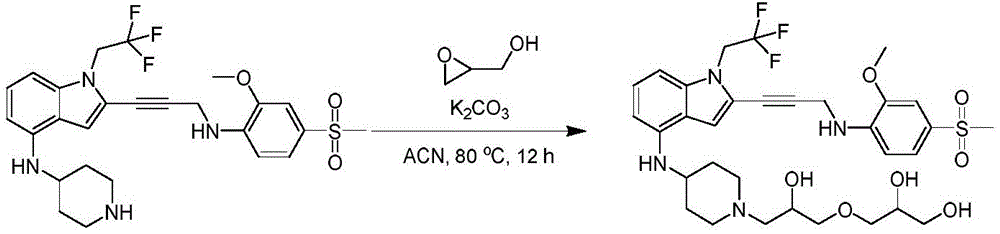
At N 2 To 2- [3- (2-methoxy-4-methylsulfonyl-anilino) prop-1-ynyl]A solution of (E) -N- (4-piperidinyl) -1- (2,2, 2-trifluoroethyl) indol-4-amine hydrochloride (0.5g, 875.5. mu. mol,1 eq) in acetonitrile (20mL) was added K 2 CO 3 (484.05mg,3.50mmol,4 equiv.) and oxirane2-ylcarbinol (129.72mg,1.75mmol, 115.82. mu.L, 2 equiv.). The reaction mixture was stirred at 80 ℃ for 16 hours. TLC analysis (PE: EtOAc ═ 0:1) indicated complete consumption of the starting material. The reaction was saturated with Na 2 CO 3 Aqueous solution (100mL) was quenched and extracted with DCM (20mL × 2). The combined organic layers were washed with brine (20mL), dried over anhydrous sodium sulfate, filtered and concentrated in vacuo. The crude residue was passed through preparative TLC (SiO) 2 DCM: MeOH ═ 10:1) and preparative HPLC purification afforded the desired product (0.3g,443.59 μmol, 50.66% yield) as a yellow solid. MS (ES) + ,m/z):683.2。
1 H NMR(400MHz,DMSO-d 6 )δppm 7.39-7.36(dd,1H),7.23-7.22(d,J=1.6Hz,1H),7.05(s,1H),6.99-6.86(t,J=8.4Hz,1H),6.77-6.47(d,J=8.4Hz,1H),6.47-6.49(m,1H),6.47-6.34(t,J=8.4Hz,1H),6.16-6.14(d,J=8.0Hz,1H),4.92-4.85(q,J=26.8Hz,2H),4.35-4.34(d,J=5.2Hz,2H),3.87(s,3H),3.61-3.58(m,1H),3.33-3.30(m,3H),3.01(s,3H),2.85-2.67(m,2H),2.36-2.26(m,2H),2.11-2.10(m,2H),1.91-1.89(m,2H)1.49-1.44(m,2H)。
Example D39: synthesis of 3-methoxy-4- ((3- (4- ((1- (2-methoxyethyl) piperidin-4-yl) amino) -1- (2,2, 2-trifluoroethyl) -1H-indol-2-yl) prop-2-yn-1-yl) amino) benzenesulfonamide (compound 614A).

Preparation of 2-iodo-N- (1- (2-methoxyethyl) piperidin-4-yl) -1- (2,2, 2-trifluoroethyl) -1H-indol-4-amine: to a solution of 2-iodo-N- (piperidin-4-yl) -1- (2,2, 2-trifluoroethyl) -1H-indol-4-amine (100mg, 222.11. mu. mol,1 eq) in DMF (2mL) was added K 2 CO 3 (153.48mg,1.11mmol,5 equivalents) and 1-bromo-2-methoxyethane (61.74mg, 444.22. mu. mol, 41.72. mu.L, 2 equivalents). The reaction mixture was stirred at 50 ℃ for 1 hour. TLC analysis (DCM: MeOH ═ 10:1, R) f 0.43) indicating completion of the reaction. The reaction mixture was quenched by addition of water (40mL) at 25 ℃ and the mixture was extracted with EtOAc (10mL x 3). The combined organic layers were dried over anhydrous sodium sulfate, filtered and concentrated under reduced pressure. The crude residue was passed through preparative TLC (SiO) 2 DCM: MeOH ═ 10:1) gave the desired product (80mg,141.29 μmol, 63.61% yield) as a pale yellow oil. MS (ES) + ,m/z):481.9。
Preparation of 3-methoxy-4- ((3- (4- ((1- (2-methoxyethyl) piperidin-4-yl) amino) -1- (2,2, 2-trifluoroethyl) -1H-indol-2-yl) prop-2-yn-1-yl) amino) benzenesulfonamide: in N 2 Next, to a mixture of 2-iodo-N- (1- (2-methoxyethyl) piperidin-4-yl) -1- (2,2, 2-trifluoroethyl) -1H-indol-4-amine (70mg, 123.63. mu. mol,1 eq.) and 3-methoxy-4- (prop-2-yn-1-ylamino) benzenesulfonamide (41.94mg, 148.35. mu. mol,1.2 eq.) in DMSO (3mL) was added CuI (23.54mg, 123.63. mu. mol,1 eq.), N-isopropylpropan-2-amine (12.51mg, 123.63. mu. mol, 17.47. L,1 eq.) and Pd (PPh) 3 ) 4 (2.86mg, 2.47. mu. mol,0.02 eq.). The mixture was stirred at 25 ℃ for 1 hour. TLC analysis (DCM: MeOH ═ 10:1, R) f 0.30) indicating completion of the reaction. The reaction mixture was quenched by the addition of saturated aqueous EDTA (60mL) at 25 deg.C and the mixture was stirred for 1 hour. The mixture was then extracted with EtOAc (20mL × 4). The combined organic layers were dried over anhydrous sodium sulfate, filtered and concentrated under reduced pressure. The crude residue was passed through preparative TLC (SiO) 2 DCM: MeOH ═ 10:1) and preparative HPLC purification afforded the desired product (16.1mg,25.19 μmol, 20.38% yield) as a light yellow solid. MS (ES) + ,m/z):594.3。
Example D40: synthesis of compounds 600A, 608A and 618A.

2- (4- ((2-iodo-1- (2,2, 2-trifluoroethyl) -1)Preparation of H-indol-4-yl) amino) piperidin-1-yl) ethan-1-ol: to a solution of 2-iodo-N- (piperidin-4-yl) -1- (2,2, 2-trifluoroethyl) -1H-indol-4-amine (1g,2.22mmol,1 eq) in DMF (10mL) was added K 2 CO 3 (460.47mg,3.33mmol,1.5 equiv.) and 2-bromoethan-1-ol (555.12mg,4.44mmol, 315.41. mu.L, 2 equiv.). The reaction mixture was stirred at 50 ℃ for 4 hours. TLC analysis (DCM: MeOH ═ 10:1, R) f 0.24) indicating completion of the reaction. The reaction mixture was quenched by addition of water (200mL) at 25 ℃ and the mixture was extracted with EtOAc (40 mL. times.3). The combined organic layers were dried over anhydrous sodium sulfate, filtered and concentrated under reduced pressure. The crude product (1.2g, crude) was obtained as a dark brown oil and used in the next step without further purification. MS (ES) + ,m/z):468.2。
Preparation of 2- (4- ((2-iodo-1- (2,2, 2-trifluoroethyl) -1H-indol-4-yl) amino) piperidin-1-yl) EtOAc, 2- (4- ((2-iodo-1- (2,2, 2-trifluoroethyl) -1H-indol-4-yl) amino) piperidin-1-yl) ethylpropionate, and 2- (4- ((2-iodo-1- (2,2, 2-trifluoroethyl) -1H-indol-4-yl) amino) piperidin-1-yl) ethylisobutyrate: to a solution of 2- (4- ((2-iodo-1- (2,2, 2-trifluoroethyl) -1H-indol-4-yl) amino) piperidin-1-yl) ethan-1-ol (100mg,192.61 μmol,1 eq) in DCM (3mL) was added acetic anhydride (13.93mg,136.43 μmol,12.78 μ L,0.5 eq) or propionic anhydride (23.67mg,181.91 μmol,23.44 μ L,1 eq) or isobutyric anhydride (152.35mg,963.05 μmol,159.69 μ L,5 eq) at 50 ℃. The mixture was stirred at 50 ℃ for 2 hours. TLC analysis (DCM: MeOH ═ 10:1, R) f 0.50) indicating completion of the reaction. The reaction mixture was concentrated under reduced pressure and passed through preparative TLC (SiO) 2 ,EtOAc:PE=8:1,R f 0.43) to afford the desired product as a light yellow solid. 2- (4- ((2-iodo-1- (2,2, 2-trifluoroethyl) -1H-indol-4-yl) amino) piperidin-1-yl) EtOAc (60mg,106.03 μmol, 38.9% yield), MS (ES) + M/z) 510.1; 2- (4- ((2-iodo-1- (2,2, 2-trifluoroethyl) -1H-indol-4-yl) amino) piperidin-1-yl) ethylpropionate, (60mg,103.19 μmol, 56.72% yield), MS (ES) + M/z) 524.1; and 2- (4- ((2-iodo-1- (2,2, 2-trifluoroethyl) -1H-indol-4-yl) amino) piperidin-1-yl) ethyl isobutyrate, (95mg,159.11 μmol, 82.61% yield).
2- {4- [ (2- {3- [ (2-methoxy-4-sulfamoylphenyl) amino group]Prop-1-yn-1-yl } -1- (2,2, 2-trifluoroethyl) -1H-indol-4-yl) amino]Piperidin-1-yl } EtOAc, 2- {4- [ (2- {3- [ (2-methoxy-4-sulfamoylphenyl) amino]Prop-1-yn-1-yl } -1- (2,2, 2-trifluoroethyl) -1H-indol-4-yl) amino]Piperidin-1-yl } ethyl propionate and 2- {4- [ (2- {3- [ (2-methoxy-4-sulfamoylphenyl) amino]Prop-1-yn-1-yl } -1- (2,2, 2-trifluoroethyl) -1H-indol-4-yl) amino]Preparation of piperidin-1-yl } ethyl 2-methylpropionate: in N 2 Next, to 2- (4- ((2-iodo-1- (2,2, 2-trifluoroethyl) -1H-indol-4-yl) amino) piperidin-1-yl) EtOAc (60mg,106.03 μmol,1 eq) or 2- (4- ((2-iodo-1- (2,2, 2-trifluoroethyl) -1H-indol-4-yl) amino) piperidin-1-yl) ethylpropionate (60mg,97.45 μmol,1 eq); or 2- (4- ((2-iodo-1- (2,2, 2-trifluoroethyl) -1H-indol-4-yl) amino) piperidin-1-yl) ethylisobutyrate (95mg, 159.11. mu. mol,1 eq.) and 3-methoxy-4- (prop-2-yn-1-ylamino) benzenesulfonamide (35.97mg, 127.23. mu. mol,1.2 eq.) in DMSO (3mL) CuI (20.19mg, 106.03. mu. mol,1 eq.), N-isopropylpropan-2-amine (10.73mg, 106.03. mu. mol, 14.98. mu.L, 1 eq.) and Pd (PPh) 3 ) 4 (2.45mg, 2.12. mu. mol,0.02 eq.). The mixture was stirred at 25 ℃ for 1 hour. LC-MS analysis indicated the reaction was complete. The reaction mixture was quenched by the addition of saturated aqueous EDTA (60mL) at 25 deg.C and the mixture was stirred for 1 hour. The mixture was then extracted with EtOAc (20mL x 4). The combined organic layers were dried over anhydrous sodium sulfate, filtered and concentrated under reduced pressure. The residue was purified by preparative TLC (SiO) 2 ,DCM:MeOH=10:1,R f 0.30) and preparative HPLC gave the desired product as a light yellow solid. 2- {4- [ (2- {3- [ (2-methoxy-4-sulfamoylphenyl) amino group]Prop-1-yn-1-yl } -1- (2,2, 2-trifluoroethyl) -1H-indol-4-yl) amino]Piperidin-1-yl } EtOAc (22.9mg, 36.06. mu. mol, 34.01% yield) MS (ES) + M/z) 622.3; 2- {4- [ (2- {3- [ (2-methoxy-4-sulfamoylphenyl) amino group]Prop-1-yn-1-yl } -1- (2,2, 2-trifluoroethyl) -1H-indol-4-yl) amino]Piperidin-1-yl } ethyl propionate (20mg, 25.17. mu. mol, 25.83% yield), MS (ES) + M/z) 636.2; and 2- {4- [ (2- {3- [ (2-methoxy-4-sulfamoylphenyl) amino group]Prop-1-yn-1-yl } -1- (2,2, 2-trifluoroethyl) ethaneYl) -1H-indol-4-yl) amino]Piperidin-1-yl } ethyl 2-methylpropionate (20.5mg, 31.24. mu. mol, 19.63% yield), MS (ES) + ,m/z):650.3。
Example D41: synthesis of compounds 534A and 541A.

Preparation of N- (1-ethylpiperidin-4-yl) -2-iodo-1- (2,2, 2-trifluoroethyl) -1H-indol-4-amine: in N 2 Next, to a solution of 2-iodo-N- (piperidin-4-yl) -1- (2,2, 2-trifluoroethyl) -1H-indol-4-amine (200mg, 448.95. mu. mol,1 eq) in DMF (8mL) was added K in one portion 2 CO 3 (186.14mg,1.35mmol,3 equiv.) and bromoethane (489.19mg,4.49mmol, 335.06. mu.L, 10 equiv.). The mixture was stirred at 40 ℃ for 60 minutes. LC-MS analysis indicated that the reaction was complete. The reaction was diluted with water (30mL) and extracted with EtOAc (30mL × 3). The combined organic layers were washed with water (25mL x2) and brine (25mL x2), dried over anhydrous sodium sulfate, filtered and concentrated in vacuo. The crude residue was passed through preparative TLC (SiO) 2 ,DCM:MeOH=10:1,R f 0.29) to give the desired product (140mg,310.24 μmol, 69.10% yield) as a yellow gum. MS (ES) + ,m/z):452.2。

Preparation of 2-iodo-N- (1-isopropylpiperidin-4-yl) -1- (2,2, 2-trifluoroethyl) -1H-indol-4-amine: in N 2 Next, to a solution of 2-iodo-N- (piperidin-4-yl) -1- (2,2, 2-trifluoroethyl) -1H-indol-4-amine (200mg, 448.95. mu. mol,1 eq) in DMF (2mL) was added K in one portion 2 CO 3 (186.15mg,1.35mmol,3 equiv.) and 2-bromopropane (552.16mg,4.49mmol, 421.50. mu.L, 10 equiv.). The mixture was stirred at 40 ℃ for 60 minutes. LC-MS analysis indicated 15% starting material remained and the desired product was detected. The reaction was diluted with water (30mL) and extracted with EtOAc (30mL × 3). The combined organic layers were washed with water (25mL x2) and brine (25mL x2), dried over anhydrous sodium sulfate, and concentrated under reduced pressure Filtered and concentrated in vacuo. The crude residue was passed through preparative TLC (SiO) 2 ,DCM:MeOH=10:1,R f 0.29) to give the desired product (130mg,279.39 μmol, 62.23% yield) as a yellow solid. MS (ES) + ,m/z):466.1。

N- (1-ethylpiperidin-4-yl) -2- (3- { [2- (fluoromethoxy) -4-methanesulfonylphenyl ] -amide]Amino } prop-1-yn-1-yl) -1- (2,2, 2-trifluoroethyl) -1H-indol-4-amine and 2- (3- { [2- (fluoromethoxy) -4-methanesulfonylphenyl]Amino } prop-1-yn-1-yl) -N- [1- (prop-2-yl) piperidin-4-yl]Preparation of (E) -1- (2,2, 2-trifluoroethyl) -1H-indol-4-amine: in N 2 To a mixture of N- (1-ethylpiperidin-4-yl) -2-iodo-1- (2,2, 2-trifluoroethyl) -1H-indol-4-amine (50mg,110.80 μmol,1 equivalent) or 2-iodo-N- (1-isopropylpiperidin-4-yl) -1- (2,2, 2-trifluoroethyl) -1H-indol-4-amine (50mg,107.46 μmol,1 equivalent) and 2- (fluoromethoxy) -4- (methylsulfonyl) -N- (prop-2-yn-1-yl) aniline (34.21mg,132.96 μmol,1.2 equivalents) in DMSO (3mL) was added N-isopropylprop-2-amine (112.12mg,1.11mmol, 156.59. mu.L, 10 equivalents), CuI (63.31mg, 332.40. mu. mol,3 equivalents) and Pd (PPh) 3 ) 4 (64.02mg, 55.40. mu. mol,0.5 equiv.). In N 2 The mixture was then stirred at 25 ℃ for 60 minutes. LC-MS and TLC analysis indicated that the reaction was complete. The reaction mixture was diluted with EtOAc (20mL) and the resulting mixture was poured into saturated aqueous EDTA (10mL) and stirred for a further 0.5 h. The organic layer was poured into saturated aqueous EDTA (20mL) and stirred for 1 hour, and the aqueous phase was extracted with EtOAc (20mL × 3). The combined organic layers were washed with water (25mL x 3) and brine (15mL x 2), dried over anhydrous sodium sulfate, filtered and concentrated in vacuo. The crude residue was purified by preparative TLC and preparative HPLC to give the desired product as a white solid. N- (1-ethylpiperidin-4-yl) -2- (3- { [2- (fluoromethoxy) -4-methanesulfonylphenyl ] -amide ]Amino } prop-1-yn-1-yl) -1- (2,2, 2-trifluoroethyl) -1H-indol-4-amine (15.4mg, 25.59. mu. mol, 23.10% yield), MS (ES) + M/z) 581.3; and 2- (3- { [2- (fluoromethoxy) -4-methanesulfonylphenyl]Amino group }Prop-1-yn-1-yl) -N- [1- (prop-2-yl) piperidin-4-yl]-1- (2,2, 2-trifluoroethyl) -1H-indol-4-amine (11.0mg, 18.04. mu. mol, 16.78% yield), MS (ES) + ,m/z):595.2。
Example D42: synthesis of N- (1, 5-dihydroxypent-3-yl) -4- { [3- (4- { [ (3S,4R) -3-fluoro-1-methylpiperidin-4-yl ] amino } -1- (2,2, 2-trifluoroethyl) -1H-indol-2-yl) prop-2-yn-1-yl ] amino } -3-methoxybenzamide (compound 965A).

Preparation of 3-aminopentane-1, 5-diol: to a solution of dimethyl 3-aminoglutarate (0.2g,1.14mmol,1 eq) in THF (10mL) at-20 deg.C was added LiAlH 4 (86.66mg,2.28mmol,2 equiv.). The mixture was warmed to 25 ℃ and stirred for 16 hours. Sodium sulfate 10H 2 O (0.5g) was slowly added to the mixture and stirred for 0.5 hour. The mixture was filtered and concentrated. Dissolving the residue in CH 3 CN (20mL) and concentrated to remove water. The crude product (0.12g, crude) was obtained as a yellow oil and used in the next step without purification.

To a solution of 4- ((3- (4- (((3S,4R) -3-fluoro-1-methylpiperidin-4-yl) amino) -1- (2,2, 2-trifluoroethyl) -1H-indol-2-yl) prop-2-yn-1-yl) amino) -3-methoxybenzoic acid (0.06g,112.67 μmol,1 eq) in DMF (2mL) was added TEA (34.20mg,338.01 μmol,47.05 μ L,3 eq) and HATU (64.26mg,169 μmol,1.5 eq). Then, 3-aminopentane-1, 5-diol (16.11mg,135.20 μmol,1.2 eq.) was added and the mixture was warmed to 50 ℃ and stirred for 1.5 hours. The mixture was directly purified using preparative HPLC to give the desired product (0.033g,47.88 μmol, 42.49% yield) as a yellow solid. MS (ES) + ,m/z):634.3。
Example D43: synthesis of 4- ((3- (4- (((3S,4R) -3-fluoro-1-methylpiperidin-4-yl) amino) -1- (2,2, 2-trifluoroethyl) -1H-indol-2-yl) prop-2-yn-1-yl) amino) -N- ((S) -2-hydroxypropyl) -3-methoxybenzamide (compound 959A).

To a solution of 4- ((3- (4- (((3S,4R) -3-fluoro-1-methylpiperidin-4-yl) amino) -1- (2,2, 2-trifluoroethyl) -1H-indol-2-yl) prop-2-yn-1-yl) amino) -3-methoxybenzoic acid (0.06g,112.67 μmol,1 eq) in DMF (1mL) at 25 ℃ were added TEA (22.80mg,225.34 μmol,31.36 μ L,2 eq) and HATU (64.26mg,169 μmol,1.5 eq). The mixture was stirred for 0.5 hour. Then, (S) -1-aminopropan-2-ol (10.16mg, 135.20. mu. mol, 10.64. mu.L, 1.2 eq.) was added and the mixture was warmed to 50 ℃ and stirred for 1 hour. The reaction mixture was directly purified using preparative HPLC and chiral SFC to give the desired product (0.030g,46.70 μmol, 41.45% yield) as a yellow solid. MS (ES) + ,m/z):590.2。
Example D44: synthesis of N- [ (2S) -2, 3-dihydroxypropyl ] -4- { [3- (4- { [ (3S,4R) -3-fluoro-1-methylpiperidin-4-yl ] amino } -1- (2,2, 2-trifluoroethyl) -1H-indol-2-yl) prop-2-yn-1-yl ] amino } -3-methoxybenzamide (compound 964A).

To a solution of 4- ((3- (4- (((3S,4R) -3-fluoro-1-methylpiperidin-4-yl) amino) -1- (2,2, 2-trifluoroethyl) -1H-indol-2-yl) prop-2-yn-1-yl) amino) -3-methoxybenzoic acid (0.07g,131.45 μmol,1 eq) in DMF (2mL) at 25 ℃ were added TEA (39.90mg,394.34 μmol,54.89 μ L,3 eq) and HATU (74.97mg,197.17 μmol,1.5 eq). The mixture was stirred for 0.5 hour. Then, (S) -3-aminopropane-1, 2-diol (13.17mg, 144.59. mu. mol, 11.16. mu.L, 1.1 eq.) was added and the mixture was stirred at 25 ℃ for 11.5 hours. The reaction mixture was directly purified using preparative HPLC to give the desired product (0.031g,50.09 μmol, 38.10% yield) as a yellow solid. MS (ES) + ,m/z):606.2。
Example D45: synthesis of compounds 951A, 952A, 953A, 954A, and 955A.
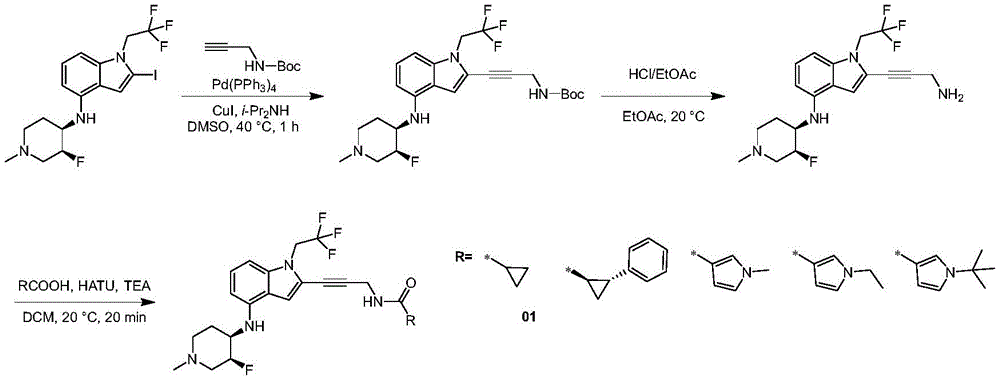
Preparation of tert-butyl (3- (4- (((3S,4R) -3-fluoro-1-methylpiperidin-4-yl) amino) -1- (2,2, 2-trifluoroethyl) -1H-indol-2-yl) prop-2-yn-1-yl) carbamate: to a solution of tert-butyl prop-2-yn-1-ylcarbamate (204.55mg,1.32mmol,1.2 equiv.) in DMSO (5mL) was added i-Pr 2 NH ((1.11g,10.98mmol,1.55mL,10 equiv.), CuI (41.84mg, 219.67. mu. mol,0.2 equiv.), N- ((3S,4R) -3-fluoro-1-methylpiperidin-4-yl) -2-iodo-1- (2,2, 2-trifluoroethyl) -1H-indol-4-amine (0.5g,1.10mmol,1 equiv.), and Pd (PPh) 3 ) 4 (63.46mg, 54.92. mu. mol,0.05 eq.). The mixture was stirred at 40 ℃ for 1 hour. TLC analysis indicated complete consumption of the starting material and formation of a new spot. The reaction mixture was quenched by the addition of saturated aqueous EDTA (30mL) and the mixture was stirred at 20 ℃ for 1 hour. The reaction mixture was diluted with water (10mL) and extracted with EtOAc (40mL x 3). The combined organic layers were washed with brine (30mL x 3), dried over anhydrous sodium sulfate, filtered and concentrated under reduced pressure to give a residue. The residue was purified by column chromatography (SiO) 2 PE: EtOAc ═ 10:1 to 0:1) purification afforded the desired product as a yellow solid. (0.45g, 774.07. mu. mol, 70.48% yield).
Preparation of 2- (3-aminopropyl-1-yn-1-yl) -N- ((3S,4R) -3-fluoro-1-methylpiperidin-4-yl) -1- (2,2, 2-trifluoroethyl) -1H-indol-4-amine: a mixture of (3- (4- (((3S,4R) -3-fluoro-1-methylpiperidin-4-yl) amino) -1- (2,2, 2-trifluoroethyl) -1H-indol-2-yl) prop-2-yn-1-yl) carbamic acid tert-butyl ester (0.35g, 725.37. mu. mol,1 eq) and 4M HCl/EtOAc (3mL) was degassed and treated with N 2 Purging was carried out three times. In N 2 The mixture was then stirred at 20 ℃ for 1 hour. TLC analysis indicated complete consumption of starting material and formation of a new spot. By adding saturated Na 2 CO 3 The aqueous solution quenches the reaction mixture to adjust the pH of the mixture to>7. The mixture was then diluted with water (10mL) and extracted with EtOAc (30mL x 3). The combined organic layers were washed with brine (30 mL. times.3)Washing, drying over anhydrous sodium sulfate, filtration and concentration under reduced pressure gave the desired product as a yellow solid (0.25g,588.39 μmol, 81.12% yield).
Preparation of the desired product: to a mixture of 2- (3-aminoprop-1-yn-1-yl) -N- ((3S,4R) -3-fluoro-1-methylpiperidin-4-yl) -1- (2,2, 2-trifluoroethyl) -1H-indol-4-amine (0.05g,130.75 μmol,1 eq) and cyclopropanecarboxylic acid (11.26mg,130.75 μmol,10.33 μ L,1 eq) in DMF (3mL) was added TEA (66.15mg,653.77 μmol,91 μ L,5 eq) and HATU (59.66mg,156.90 μmol,1.2 eq). The mixture was stirred at 20 ℃ for 20 minutes. TLC analysis (DCM: MeOH ═ 10:1, R) f 0.5) indicates that the starting material was consumed. The reaction mixture was quenched by the addition of water (10mL) and the mixture was extracted with EtOAc (10mL x 3). The combined organic layers were washed with brine (10mL x 3), dried over anhydrous sodium sulfate, filtered and concentrated under reduced pressure to give a residue. The residue was passed through preparative TLC (SiO) 2 DCM: MeOH ═ 10:1) purification afforded the desired product as a yellow solid.
N- [3- (4- { [ (3S,4R) -3-fluoro-1-methylpiperidin-4-yl)]Amino } -1- (2,2, 2-trifluoroethyl) -1H-indol-2-yl) prop-2-yn-1-yl]Cyclopropanecarboxamide, (0.018g, 39.24. mu. mol, 30% yield), MS (ES) + M/z) 451.2; (1R,2R) -N- [3- (4- { [ (3S,4R) -3-fluoro-1-methylpiperidin-4-yl]Amino } -1- (2,2, 2-trifluoroethyl) -1H-indol-2-yl) prop-2-yn-1-yl]-2-phenylcyclopropane-1-carboxamide, (0.026g,48.64 μmol, 37% yield), MS (ES) + M/z) 527.3; n- [3- (4- { [ (3S,4R) -3-fluoro-1-methylpiperidin-4-yl]Amino } -1- (2,2, 2-trifluoroethyl) -1H-indol-2-yl) prop-2-yn-1-yl]-1-methyl-1H-pyrrole-3-carboxamide, (0.021g, 42.34. mu. mol, 32% yield), MS (ES) + M/z) 490.2; 1-Ethyl-N- [3- (4- { [ (3S,4R) -3-fluoro-1-methylpiperidin-4-yl]Amino } -1- (2,2, 2-trifluoroethyl) -1H-indol-2-yl) prop-2-yn-1-yl ]-1H-pyrrole-3-carboxamide, (0.021g, 40.87. mu. mol, 31% yield), MS (ES) + M/z) 504.2; and 1-tert-butyl-N- [3- (4- { [ (3S,4R) -3-fluoro-1-methylpiperidin-4-yl]Amino } -1- (2,2, 2-trifluoroethyl) -1H-indol-2-yl) prop-2-yn-1-yl]-1H-pyrrole-3-carboxamide (0.016g, 29.68. mu. mol, 23% yield), MS (ES) + ,m/z):532.3。
Example D46: synthesis of 2- (3- ((4-methoxy-6- (methylsulfonyl) pyridin-3-yl) amino) prop-1-yn-1-yl) -N- (1-methylpiperidin-4-yl) -1- (2,2, 2-trifluoroethyl) -1H-indol-4-amine (compound 476A).
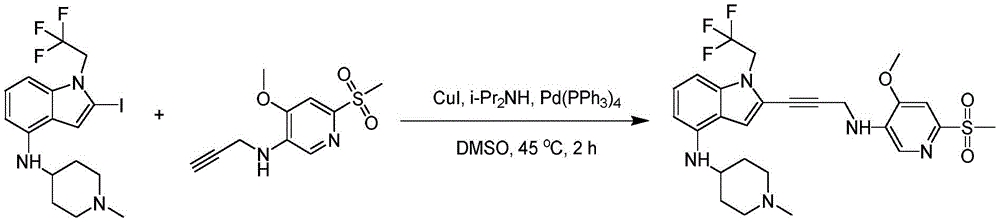
Preparation of 2- (3- ((4-methoxy-6- (methylsulfonyl) pyridin-3-yl) amino) prop-1-yn-1-yl) -N- (1-methylpiperidin-4-yl) -1- (2,2, 2-trifluoroethyl) -1H-indol-4-amine: a solution of 4-methoxy-6- (methylsulfonyl) -N- (prop-2-yn-1-yl) pyridin-3-amine (50mg, 180.68. mu. mol,1.2 eq, HCl) in DMSO (2mL) was diluted with N 2 And (5) flushing. To the mixture was added CuI (28.67mg, 150.56. mu. mol,1 equiv.), N-isopropylpropan-2-amine (45.71mg, 451.69. mu. mol, 63.84. mu.L, 3 equiv.), and 2-iodo-N- (1-methylpiperidin-4-yl) -1- (2,2, 2-trifluoroethyl) -1H-indol-4-amine (65.83mg, 150.56. mu. mol,1 equiv.) and Pd (PPh) 3 ) 4 (13.92mg, 12.05. mu. mol,0.08 eq.). The reaction mixture is treated with N 2 Rinsed again and stirred at 45 ℃ for 2 hours. LC-MS analysis indicated complete consumption of starting material and a major peak with the expected mass was detected. Saturated aqueous EDTA (20mL) was added and the mixture was stirred at 15 ℃ for 1 hour. Then, EtOAc (20mL) was added. The organic phase was separated, washed with brine (5mL x 3), dried over anhydrous sodium sulfate, filtered and concentrated under reduced pressure to give a residue. The residue was purified by preparative HPLC to give the desired product (9.6mg,17.47 μmol, 12% yield) as a white solid. MS (ES) + ,m/z):550.1。
Example D47: synthesis of compounds 468A and 554A.

At N 2 Then, 2- [ 4-methoxy-5- (prop-2-ynylamino) -2-pyridyl at 25 deg.C]A solution of-2-methyl-propionitrile (44.26mg, 193.05. mu. mol,1.2 equivalents) in DMSO (2mL) was added i-Pr in one portion 2 NH(162.79mg,1.61mmol,227.35μL,10Equiv.), CuI (30.64mg, 160.87. mu. mol,1 equiv.), 3- [4- [ [ 2-iodo-1- (2,2, 2-trifluoroethyl) indol-4-yl]Amino group]-1-piperidinyl group]Propane-1, 2-diol (80mg, 160.87. mu. mol,1 eq.) and Pd (PPh) 3 ) 4 (37.18mg, 32.17. mu. mol,0.2 equiv.). The mixture was stirred at 45 ℃ for 1 hour. LC-MS and TLC analysis (EtOAc: MeOH ═ 2:1, R) f 0.45) indicating completion of the reaction. EtOAc (10mL) was poured into the mixture and the resulting mixture was poured into saturated aqueous EDTA (40mL) and stirred for 15 minutes. The aqueous phase was extracted with EtOAc (40 mL. times.2). The organic layer was poured into saturated aqueous EDTA (40mL) and stirred for 1 hour. The aqueous phase was extracted with EtOAc (40mL x 3). The combined organic layers were washed with brine (40mL x 3), dried over anhydrous sodium sulfate, filtered and concentrated in vacuo. The residue was purified by preparative TLC (EtOAc: MeOH ═ 2:1, R) f 0.45) followed by further purification by preparative HPLC gave the desired product.
2- { 4-methoxy-5- [ (3- {4- [ (1-methylpiperidin-4-yl) amino ] carbonyl ]-1- (2,2, 2-trifluoroethyl) -1H-indol-2-yl } prop-2-yn-1-yl) amino]Pyridin-2-yl } -2-methylpropanenitrile (3.2mg, 5.68. mu. mol, 3% yield), MS (ES) + M/z) 539.3; 2- (5- { [3- (4- { [1- (2, 3-dihydroxypropyl) piperidin-4-yl]Amino } -1- (2,2, 2-trifluoroethyl) -1H-indol-2-yl) prop-2-yn-1-yl]Amino } -4-methoxypyridin-2-yl) -2-methylpropanenitrile (22.8mg, 37.17. mu. mol, 23% yield), MS (ES) + M/z) 599.3; and 2- {5- [ (3- {4- [ (1, 1-dioxo-1. lamda.) -5 6 -thian-4-yl) amino]-1- (2,2, 2-trifluoroethyl) -1H-indol-2-yl } prop-2-yn-1-yl) amino]-4-methoxypyridin-2-yl } -2-methylpropanenitrile (3.5mg, 6.04. mu. mol, 4% yield), MS (ES) + ,m/z):574.2。
Example D48: synthesis of compounds 530A, 692A, 719A, 720A and 763A.
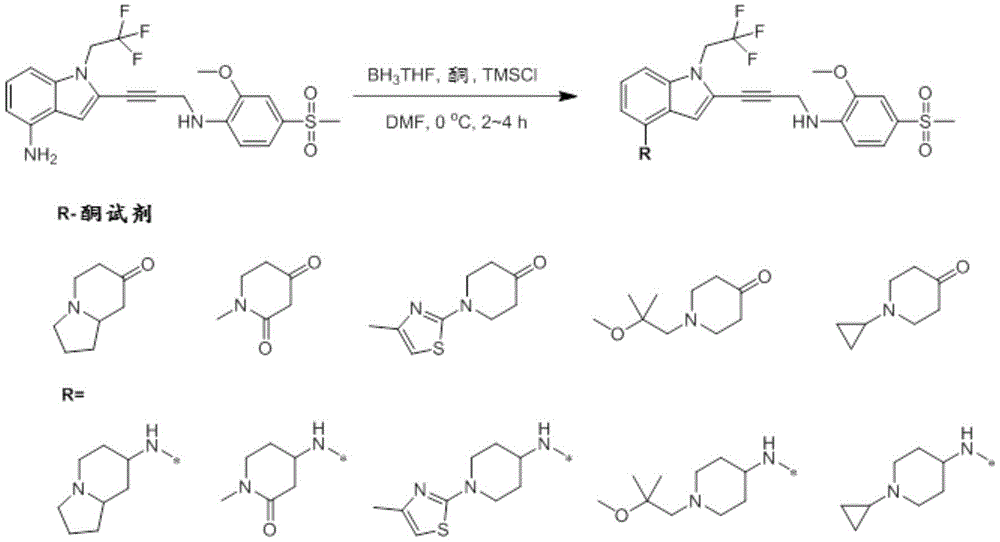
To 2- [3- (2-methoxy-4-methylsulfonyl-anilino) prop-1-ynyl]-1- (2,2, 2-trifluoroethyl) indol-4-amine (50mg, 99.68. mu. mol,1 eq.) and 1-methylpiperidine-2, 4-dione (95.05mg, 598.06. mu. mol,6 eq.) in DMF (3mL)The solution was added (27.07mg, 249.19. mu. mol, 31.63. mu.L, 2.5 equiv.). The mixture was stirred at 0 ℃ for 2 hours. Then, in N 2 Adding BH in 3 THF (1M,498.38 μ L,5 equiv.) and the mixture was stirred at 25 ℃ for 2 h. LC-MS or TLC analysis indicated that the reaction was complete. By adding saturated Na 2 CO 3 The reaction mixture was quenched with aqueous solution (30 mL). The resulting mixture was then diluted with water (10mL) and extracted with EtOAc (20mL × 2). The combined organic layers were washed with brine (10mL), dried over anhydrous sodium sulfate, filtered and concentrated under reduced pressure. The residue was purified by preparative HPLC to give the desired product as a light yellow solid.
2- {3- [ (4-Methylsulfonyl-2-methoxyphenyl) amino]Prop-1-yn-1-yl } -N- [1- (4-methyl-1, 3-thiazol-2-yl) piperidin-4-yl]-1- (2,2, 2-trifluoroethyl) -1H-indol-4-amine (30mg, 45.83. mu. mol, 21% yield), MS (ES) + M/z) 632.2; 2- {3- [ (4-Methylsulfonyl-2-methoxyphenyl) amino]Prop-1-yn-1-yl } -N- [1- (2-methoxy-2-methylpropyl) piperidin-4-yl]-1- (2,2, 2-trifluoroethyl) -1H-indol-4-amine (31.7mg, 50. mu. mol, 50% yield) MS (ES) + M/z) 621.2; 2- (3- ((2-methoxy-4- (methylsulfonyl) phenyl) amino) prop-1-yn-1-yl) -N- (octahydroindolizin-7-yl) -1- (2,2, 2-trifluoroethyl) -1H-indol-4-amine (10mg,17.14 μmol, 39% yield), MS (ES) + M/z) 575.2; n- (1-Cyclopropylpiperidin-4-yl) -2- {3- [ (4-methanesulfonyl-2-methoxyphenyl) amino]Prop-1-yn-1-yl } -1- (2,2, 2-trifluoroethyl) -1H-indol-4-amine, (61mg, 104.03. mu. mol, 58% yield), MS (ES) + M/z) 575.2; 4- ((2- (3- ((2-methoxy-4- (methylsulfonyl) phenyl) amino) prop-1-yn-1-yl) -1- (2,2, 2-trifluoroethyl) -1H-indol-4-yl) amino) -1-methylpiperidin-2-one (23.7mg,41.75 μmol, 42% yield), MS (ES) + ,m/z):563.2。
Example D49: synthesis of compounds 491A, 492A, 496A, 497A, 498A and 499A.

To 3-methoxy-4- [3- [4- [ (1-methyl-4-piperidinyl) amino group]-1- (2,2, 2-trifluoroethyl) indoleIndole-2-yl]Prop-2-ynylamino]A solution of benzoic acid (150mg, 87.46. mu. mol,1 eq.) and 2-aminoethanol (8.01mg, 131.19. mu. mol, 7.93. mu.L, 1.5 eq.) in DCM (5mL) was added Et 3 N (53.10mg, 524.74. mu. mol, 73.04. mu.L, 6 equivalents). The mixture was cooled to 0 ℃ and propylphosphoric anhydride (T3P) (83.48mg, 131.19. mu. mol, 78.02. mu.L, 50% purity, 1.5 equivalents) was added. The resulting mixture was stirred at 20 ℃ for 1-2 hours. The reaction mixture was diluted with water (30mL) and extracted with DCM (10mL × 3). The combined organic layers were washed with brine (10mL), dried over anhydrous sodium sulfate, filtered and concentrated under reduced pressure to give a residue. The residue was passed through preparative TLC (SiO) 2 DCM: MeOH ═ 10:1) and further purification by preparative HPLC gave the desired product.
N- (2-hydroxyethyl) -3-methoxy-4- [ (3- {4- [ (1-methylpiperidin-4-yl) amino group ]-1- (2,2, 2-trifluoroethyl) -1H-indol-2-yl } prop-2-yn-1-yl) amino]Benzamide (15.1mg, 26.60. mu. mol, 30% yield), MS (ES) + M/z) 558.2; 3-methoxy-N- (2-methoxyethyl) -4- [ (3- {4- [ (1-methylpiperidin-4-yl) amino)]-1- (2,2, 2-trifluoroethyl) -1H-indol-2-yl } prop-2-yn-1-yl) amino]Benzamide (20.2mg, 35.03. mu. mol, 40% yield) MS (ES) + M/z) 572.2; 3-methoxy-N- (1-methylpiperidin-4-yl) -4- [ (3- {4- [ (1-methylpiperidin-4-yl) amino]-1- (2,2, 2-trifluoroethyl) -1H-indol-2-yl } prop-2-yn-1-yl) amino]Benzamide (14.3mg, 23.25. mu. mol, 27% yield), MS (ES) + M/z) 611.3; 2- (3- { [ 2-methoxy-4- (morpholine-4-carbonyl) phenyl]Amino } prop-1-yn-1-yl) -N- (1-methylpiperidin-4-yl) -1- (2,2, 2-trifluoroethyl) -1H-indol-4-amine (23.1mg, 39.14. mu. mol, 34% yield) MS (ES) + M/z) 584.3; 1- { 3-methoxy-4- [ (3- {4- [ (1-methylpiperidin-4-yl) amino group]-1- (2,2, 2-trifluoroethyl) -1H-indol-2-yl } prop-2-yn-1-yl) amino]Benzoyl } piperidin-4-ol (19.6mg, 32.37. mu. mol, 21% yield), MS (ES) + M/z) 598.3; 2- [3- ({4- [4- (dimethylamino) piperidine-1-carbonyl)]-2-methoxyphenyl } amino) prop-1-yn-1-yl]-N- (1-methylpiperidin-4-yl) -1- (2,2, 2-trifluoroethyl) -1H-indol-4-amine (22.1mg, 34.95. mu. mol, 30% yield) MS (ES) + ,m/z):625.3。
Example D50: synthesis of 3-methoxy-4- [ (3- {4- [ (1-methylpiperidin-4-yl) amino ] -1- (2,2, 2-trifluoroethyl) -1H-indol-2-yl } prop-2-yn-1-yl) amino ] -N- (oxan-4-yl) benzamide (Compound 500A).

Preparation of 3-methoxy-4- ((3- (4- ((1-methylpiperidin-4-yl) amino) -1- (2,2, 2-trifluoroethyl) -1H-indol-2-yl) prop-2-yn-1-yl) amino) benzoic acid: 2-iodo-N- (1-methylpiperidin-4-yl) -1- (2,2, 2-trifluoroethyl) -1H-indol-4-amine (1.3g,2.97mmol,1 eq.), 3-methoxy-4- (prop-2-yn-1-ylamino) benzoic acid (610.13mg,2.97mmol,1 eq.), N-isopropylprop-2-amine (601.71mg,5.95mmol, 840.38. mu.L, 2 eq.), CuI (283.12mg,1.49mmol,0.5 eq.) and Pd (PPh) 3 ) 4 A mixture of (343.57mg, 297.32. mu. mol,0.1 equiv) in DMSO (15mL) was degassed and treated with N 2 Purging was carried out three times. Then, in N 2 The mixture was then stirred at 20 ℃ for 1 hour. TLC analysis (THF: MeOH ═ 5:2, R) f 0.1) indicating completion of the reaction. Saturated aqueous EDTA (100mL) was added to the mixture, and the resulting mixture was stirred for 1 hour. The mixture was extracted with EtOAc (150mL x 8). The combined organic layers were washed with brine (50mL x 2), dried over anhydrous sodium sulfate, filtered and concentrated under reduced pressure. The crude product (2g,2.33mmol, 78% yield) was obtained as a yellow solid, which was used without purification.
3-methoxy-4- [ (3- {4- [ (1-methylpiperidin-4-yl) amino group]-1- (2,2, 2-trifluoroethyl) -1H-indol-2-yl } prop-2-yn-1-yl) amino]Preparation of (E) -N- (Oxen-4-yl) benzamide: to a mixture of 3-methoxy-4- ((3- (4- ((1-methylpiperidin-4-yl) amino) -1- (2,2, 2-trifluoroethyl) -1H-indol-2-yl) prop-2-yn-1-yl) amino) benzoic acid (0.15g, 291.52. mu. mol,1 eq), tetrahydropyran-4-amine (44.23mg, 437.29. mu. mol,1.5 eq) and TEA (88.50mg, 874.57. mu. mol, 121.73. mu.L, 3 eq) in DCM (10mL) was added (278.27mg, 437.29. mu. mol, 260.07. mu.L, 50% purity, 1.5 equivalents). In N 2 The mixture is stirred at 20 DEG CFor 1 hour. LC-MS analysis detected the presence of the desired product. The mixture was diluted with water (15mL) and extracted with DCM (20mL × 3). The combined organic layers were washed with brine (10mL), dried over anhydrous sodium sulfate, filtered and concentrated under reduced pressure. The crude residue was purified by preparative HPLC to give the desired product (0.013g,20.66 μmol, 7% yield) as a white solid. MS (ES) + ,m/z):598.3。
Example D51: synthesis of 2- {3- [ (2-methoxy-4- { 2-oxa-6-azaspiro [3.3] heptane-6-carbonyl } phenyl) amino ] prop-1-yn-1-yl } -N- (1-methylpiperidin-4-yl) -1- (2,2, 2-trifluoroethyl) -1H-indol-4-amine (Compound 502A).

In N 2 To 3-methoxy-4- ((3- (4- ((1-methylpiperidin-4-yl) amino) -1- (2,2, 2-trifluoroethyl) -1H-indol-2-yl) prop-2-yn-1-yl) amino) benzoic acid (0.15g, 291.52. mu. mol,1 eq), 2-oxa-6-azaspiro [3.3]A mixture of hept-6-ium oxalate (82.72mg, 437.29. mu. mol,1.5 equivalents), TEA (147.50mg,1.46mmol, 202.88. mu.L, 5 equivalents) in DCM (20mL) was added dropwise (propanephosphonic anhydride) (278.27mg, 437.29. mu. mol, 260. mu.L, 50% purity, 1.5 equivalents). In N 2 The mixture was then stirred at 20 ℃ for 1 hour. LC-MS and HPLC analysis detected the presence of the desired product. The mixture was diluted with water (40mL) and extracted with DCM (50mL × 3). The combined organic layers were washed with brine (30mL), dried over anhydrous sodium sulfate, filtered and concentrated under reduced pressure. The crude residue was purified by preparative HPLC to give the desired product (0.043g,68.58 μmol, 23.52% yield) as a yellow solid. MS (ES) + ,m/z):596.3。
Example D52: synthesis of 2- (3- { [ 2-methoxy-4- (4-methylpiperazine-1-carbonyl) phenyl ] amino } prop-1-yn-1-yl) -N- (1-methylpiperidin-4-yl) -1- (2,2, 2-trifluoroethyl) -1H-indol-4-amine (Compound 501A).

In N 2 Next, a mixture of 3-methoxy-4- ((3- (4- ((1-methylpiperidin-4-yl) amino) -1- (2,2, 2-trifluoroethyl) -1H-indol-2-yl) prop-2-yn-1-yl) amino) benzoic acid (0.15g,291.52 μmol,1 equivalent), 1-methylpiperazine (44mg,437.29 μmol,48.50 μ L,1.5 equivalents), TEA (88.50mg,874.57 μmol,121.73 μ L,3 equivalents) in DCM (20mL) was added dropwise  (propanephosphonic anhydride) (278.27mg, 437.29. mu. mol, 260. mu.L, 50% purity, 1.5 equivalents). In N 2 The mixture was then stirred at 20 ℃ for 1 hour. LC-MS and HPLC analysis detected the presence of the desired product. The mixture was diluted with water (40mL) and extracted with DCM (50mL × 3). The combined organic layers were washed with brine (30mL), dried over anhydrous sodium sulfate, filtered and concentrated under reduced pressure. The crude residue was purified by preparative HPLC to give the desired product (0.021g,33.43 μmol, 11.47% yield) as a yellow solid. MS (ES) + ,m/z):597.3。
Example D53: synthesis of 2- {3- [ (2-methoxy-4- { 7-oxa-2-azaspiro [3.5] nonane-2-carbonyl } phenyl) amino ] prop-1-yn-1-yl } -N- (1-methylpiperidin-4-yl) -1- (2,2, 2-trifluoroethyl) -1H-indol-4-amine (Compound 511A).

In N 2 To 3-methoxy-4- ((3- (4- ((1-methylpiperidin-4-yl) amino) -1- (2,2, 2-trifluoroethyl) -1H-indol-2-yl) prop-2-yn-1-yl) amino) benzoic acid (0.1g, 194.35. mu. mol,1 eq), 7-oxa-2-azaspiro [3.5]A mixture of nonan-2-onium oxalate (80.32mg, 233.22. mu. mol,1.2 equivalents), TEA (98.33mg, 971.75. mu. mol, 135.26. mu.L, 5 equivalents) in DCM (20mL) was added dropwise (Propylphosphonic acid anhydride) (185.51mg, 291.52. mu. mol, 173.38. mu.L50% purity, 1.5 equivalents). In N 2 The mixture was then stirred at 20 ℃ for 1 hour. LC-MS and HPLC analysis detected the presence of the desired product. The mixture was diluted with water (40mL) and extracted with DCM (50mL × 3). The combined organic layers were washed with brine (30mL), dried over anhydrous sodium sulfate, filtered and concentrated under reduced pressure. The crude residue was purified by preparative HPLC to give the desired product (0.026g,38.71 μmol, 19.92% yield) as a yellow solid. MS (ES) + ,m/z):624.3。
Example D54: synthesis of 3-methoxy-4- { [3- (4- { [1- (oxan-4-yl) piperidin-4-yl ] amino } -1- (2,2, 2-trifluoroethyl) -1H-indol-2-yl) prop-2-yn-1-yl ] amino } benzoic acid (Compound 724A).

2-iodo-N- (1- (tetrahydro-2H-pyran-4-yl) piperidin-4-yl) -1- (2,2, 2-trifluoroethyl) -1H-indol-4-amine (0.1g, 197.11. mu. mol,1 eq.), 3-methoxy-4- (prop-2-yn-1-ylamino) benzoic acid (49mg, 236.53. mu. mol,1.2 eq.) CuI (38mg, 197.11. mu. mol,1 eq.), Pd (PPh) 3 ) 4 (49.89mg, 43.17. mu. mol,0.2 eq.) and i-Pr 2 A mixture of NH (218.42mg,2.16mmol, 305.06. mu.L, 10 equiv.) in DMSO (3mL) was degassed and N added 2 Purging was carried out three times. In N 2 The mixture was then stirred at 25 ℃ for 1 hour. TLC analysis (EtOAc: TEA ═ 10:1, R f 0.1) indicated that the starting material was consumed and a new spot was detected. In N 2 Next, a saturated aqueous EDTA solution (20mL) was added to the reaction mixture and stirred at 20 ℃ for 1 hour. The reaction mixture was extracted with EtOAc (15mL x 3). The combined organic layers were washed with brine (10mL x 3), dried over anhydrous sodium sulfate, filtered and concentrated under reduced pressure to give a residue. The residue was passed through preparative TLC (SiO) 2 EtOAc: TEA ═ 15:1) and preparative HPLC gave the desired product (0.03g,54.77 μmol, 25.38% yield) as a yellow solid. MS (ES) + ,m/z):585.3。
Example D55: synthesis of 4- [ (3- {4- [ (1-cyclopropylpiperidin-4-yl) amino ] -1- (2,2, 2-trifluoroethyl) -1H-indol-2-yl } prop-2-yn-1-yl) amino ] -3-methoxybenzoic acid (Compound 721A).

3-methoxy-4- (prop-2-yn-1-ylamino) benzoic acid (53mg,259.02 μmol,1.2 equiv.), N- (1-cyclopropylpiperidin-4-yl) -2-iodo-1- (2,2, 2-trifluoroethyl) -1H-indol-4-amine (0.1g,215.85 μmol,1 equiv.), CuI (37.54mg,197.11 μmol,1 equiv.), Pd (PPh) 3 ) 4 (45.55mg, 39.42. mu. mol,0.2 eq.) and i-Pr 2 A mixture of NH (199.46mg,1.97mmol, 278.57. mu.L, 10 equiv.) in DMSO (3mL) was degassed and N added 2 Purging was carried out three times. In N 2 The mixture was then stirred at 20 ℃ for 1 hour. TLC analysis (EtOAc: TEA ═ 10:1, R f 0.05) indicated that the starting material was consumed and a new spot was detected. Saturated aqueous EDTA (20mL) was added and the reaction solution was stirred under N 2 The resulting mixture was then stirred at 20 ℃ for 1 hour. The reaction mixture was quenched by addition of water (20mL) and extracted with EtOAc (15mL x 3). The combined organic layers were washed with brine (10mL x 3), dried over anhydrous sodium sulfate, filtered and concentrated under reduced pressure to give a residue. The residue was purified by preparative TLC (SiO) 2 EtOAc: TEA ═ 15:1) and preparative HPLC purification afforded the desired product (0.04g,67.53 μmol, 34.26% yield) as a yellow solid. MS (ES) + ,m/z):541.2。
Example D56: synthesis of 4- { [3- (4- { [1- (3-methanesulfonylpropyl) piperidin-4-yl ] amino } -1- (2,2, 2-trifluoroethyl) -1H-indol-2-yl) prop-2-yn-1-yl ] amino } -3-methoxybenzoic acid (Compound 707A).

Preparation of 2-iodo-N- (1- (3- (methylsulfonyl) propyl) piperidin-4-yl) -1- (2,2, 2-trifluoroethyl) -1H-indol-4-amine: to a solution of 2-iodo-N- (piperidin-4-yl) -1- (2,2, 2-trifluoroethyl) -1H-indol-4-amine (0.2g, 472.57. mu. mol,1 eq) in DMF (3mL) was added K 2 CO 3 (195.94mg,1.42mmol,3 equiv.) and 3- (methylsulfonyl) propyl methanesulfonate (306.62mg,1.42mmol,3 equiv.). The mixture was stirred at 80 ℃ for 2 hours. TLC analysis (EtOAc: TEA ═ 10:1, R f 0.7) indicates that the starting material was consumed and a new spot was detected. The reaction mixture was quenched by addition of water (20mL) and extracted with EtOAc (15mL × 3). The combined organic layers were washed with brine (10mL x 3), dried over anhydrous sodium sulfate, filtered and concentrated under reduced pressure to give a residue. The residue was passed through preparative TLC (SiO) 2 EtOAc ═ 1) to give the desired product (0.13g,191.39 μmol, 40.50% yield) as a yellow oil.
4- { [3- (4- { [1- (3-methanesulfonylpropyl) piperidin-4-yl]Amino } -1- (2,2, 2-trifluoroethyl) -1H-indol-2-yl) prop-2-yn-1-yl]Preparation of amino } -3-methoxybenzoic acid: 2-iodo-N- (1- (3- (methylsulfonyl) propyl) piperidin-4-yl) -1- (2,2, 2-trifluoroethyl) -1H-indol-4-amine (0.1g, 184.03. mu. mol,1 eq.), 3-methoxy-4- (prop-2-yn-1-ylamino) benzoic acid (0.1g, 184.03. mu. mol,1 eq.), CuI (35.05mg, 184.03. mu. mol,1 eq.), Pd (PPh) 3 ) 4 (42.53mg, 36.81. mu. mol,0.2 eq.) and i-Pr 2 A mixture of NH (186.22mg,1.84mmol, 260.09. mu.L, 10 equiv.) in DMSO (3mL) was degassed and N was used 2 Purging was carried out three times. At N 2 The mixture was then stirred at 20 ℃ for 1 hour. TLC analysis (EtOAc: TEA ═ 10:1, R f 0) indicated complete consumption of starting material and a major new spot was detected. The reaction mixture was quenched by addition of water (20mL) and extracted with EtOAc (15mL x 3). The combined organic layers were washed with brine (10mL x3), dried over anhydrous sodium sulfate, filtered and concentrated under reduced pressure to give a residue. The crude residue was purified by preparative HPLC to give the desired product (0.035g,56.39 μmol, 30.64% yield) as a yellow solid. MS (ES) + ,m/z):621.3。
Example D57: synthesis of 2- {3- [ (4-methanesulfonyl-2-methoxyphenyl) amino ] prop-1-yn-1-yl } -3-methyl-N- (1-methylpiperidin-4-yl) -1- (2,2, 2-trifluoroethyl) -1H-indol-4-amine (compound 520A).

(E) Preparation of (E) -1- (3-nitrophenyl) -2-propylidene hydrazine: aqueous 2M NaOH (90mL) was added slowly to a stirred suspension of (3-nitrophenyl) hydrazine hydrochloride (13g,68.57mmol,1 eq.) in EtOH (200mL) until the pH was 6. AcOH (37mL) was added to the mixture followed by propionaldehyde (4.78g,82.28mmol,5.99mL,1.2 equiv.). Then, the mixture was stirred at 20 ℃ for 3 hours. TLC analysis (R) f PE: EtOAc ═ 2:1) indicated that the starting material was consumed and a new spot was detected. The mixture was poured into ice water (800mL) and the resulting precipitate was isolated by filtration, washed with water and dried in vacuo. The crude product (11.5g,53.57mmol, 78.13% yield) was obtained as a yellow solid, which was used without purification.
Preparation of 3-methyl-4-nitro-1H-indole: (E) -1- (3-Nitrophenyl) -2-propylidenylhydrazine (2g,10.35mmol,1 eq.) and H 3 PO 4 A mixture (15mL) in toluene (15mL) was stirred at 100 ℃ for 2 h. TLC analysis (PE: EtOAc ═ 2:1) indicated that the reaction was complete. The mixture was concentrated to remove toluene. Then, 10N NaOH (5mL) was added to adjust the pH of the mixture to 8. The mixture was diluted with water (10mL) and extracted with EtOAc (10mL x 3). The combined organic layers were washed with brine (10mL x 2), dried over anhydrous sodium sulfate, filtered and concentrated. The residue was purified by preparative HPLC to give the desired product (6g) as a yellow solid. MS (ES) + ,m/z):177.1。
Preparation of 3-methyl-4-nitro-1- (phenylsulfonyl) -1H-indole: in N 2 Next, NaH (1.70g,42.57mmol, 60% in mineral oil, 1.5 equiv.) was added to a solution of 3-methyl-4-nitro-1H-indole (5g,28.38mmol,1 equiv.) in DMF (6mL) and THF (60mL) at 0 deg.C. The mixture was stirred at 0 ℃ for 0.5 h, and benzenesulfonyl chloride (5.51g,31.22mmol,4mL,1.1 equiv.) was added to the reaction mixture at 0 ℃. The resulting mixture was stirred at 0 ℃ for 1 hour. TLC analysis (PE: EtOAc ═ 2:1, R) f 0.6) detects a major new blob. The reaction mixture was poured onto saturated NH 4 Cl solution (15mL) and extract the aqueous phase with EtOAc (100 mL. times.3). The combined organic layers were washed with brine (20mL x 3),dried over anhydrous sodium sulfate, filtered, and concentrated in vacuo to give the crude product (8.5g,24.18mmol, 85.21% yield) as a yellow solid which was used without purification.
Preparation of 2-iodo-3-methyl-4-nitro-1- (phenylsulfonyl) -1H-indole: to a solution of 3-methyl-4-nitro-1- (phenylsulfonyl) -1H-indole (5g,15.81mmol,1 eq) in THF (150mL) at-60 deg.C was added LDA (2M,31.61mL,4 eq; slowly added). The mixture was stirred at-40 ℃ for 0.5 h. The mixture was then cooled to-60 ℃ and I was added slowly over 1 hour 2 (6.02g,23.71mmol,4.78mL,1.5 equiv.) in THF (150 mL). The mixture was stirred at-60 ℃ for 4 hours. HPLC analysis indicated the reaction was complete. Water (300mL) was added slowly to the reaction and the mixture was extracted with EtOAc (300mL x 3). The combined organic layers were washed with brine (200mL), dried over anhydrous sodium sulfate, filtered, and concentrated in vacuo to give the crude product (6.5g, crude) as a yellow solid, which was used without purification.
Preparation of 2-iodo-3-methyl-4-nitro-1H-indole: in N 2 Next, a mixture of 2-iodo-3-methyl-4-nitro-1- (phenylsulfonyl) -1H-indole (6.5g,14.70mmol,1 eq) and NaOH (5.88g,146.98mmol,10 eq) in dioxane (75mL) and water (25mL) was stirred at 100 ℃ for 3 hours. TLC analysis (R) f 0.35, PE: EtOAc: 4:1) indicated almost complete consumption of the starting material. The mixture was extracted with water (100mL) and EtOAc (120 mL. times.3). The organic layer was washed with brine (50mL), dried over anhydrous sodium sulfate, filtered and concentrated under reduced pressure. The crude residue is purified by column chromatography (SiO) 2 PE: EtOAc ═ 80:1 to 50:1) to give the desired product (2g,5.96mmol, 40.54% yield) as a yellow solid.
Preparation of 2-iodo-3-methyl-4-nitro-1- (2,2, 2-trifluoroethyl) -1H-indole: at N 2 2-iodo-3-methyl-4-nitro-1H-indole (0.4g,1.32mmol,1 eq.), 2,2, 2-trifluoroethyl trifluoromethanesulfonate (922.05mg,3.97mmol,3 eq.) and K under an atmosphere 2 CO 3 A mixture of (915.07mg,6.62mmol,5 equiv.) in DMF (5mL) was stirred at 20 ℃ for 3 h. TLC analysis (R) f PE: EtOAc ═ 4:1) indicated completion of the reaction. Mixing the reaction mixturePour into water (200mL) and extract with EtOAc (150 mL. times.3). The organic layer was washed with brine (30mL x 5), dried over anhydrous sodium sulfate, filtered and concentrated. The residue was purified by column chromatography (SiO) 2 EtOAc ═ 40:1 to 30:1) to give 2-iodo-3-methyl-4-nitro-1- (2,2, 2-trifluoroethyl) indole (0.25g,650.89 μmol, 49% yield) as a yellow solid.
Preparation of 2-iodo-3-methyl-1- (2,2, 2-trifluoroethyl) -1H-indol-4-amine: to 2-iodo-3-methyl-4-nitro-1- (2,2, 2-trifluoroethyl) -1H-indole (1.2g,3.12mmol,1 eq) in EtOH (30mL), NH at 60 deg.C 4 Cl (10mL) and saturated NH 4 A solution of Cl in water (2.5mL) was added Fe (872.37mg,15.62mmol,5 equiv.). The mixture was stirred at 60 ℃ for 1 hour. TLC analysis (PE: EtOAc ═ 4:1, R) f 0.35) indicating completion of the reaction. The mixture was poured into EtOAc (30mL) and extracted with water (20mL) and EtOAc (10mL × 2). The organic layer was washed with brine (15mL), dried over anhydrous sodium sulfate, filtered and concentrated. The crude residue is purified by column chromatography (SiO) 2 PE: EtOAc ═ 20:1 to 5:1) to give the desired product (0.75g,1.91mmol, 61.01% yield) as a yellow solid.
Preparation of 2-iodo-3-methyl-N- (1-methylpiperidin-4-yl) -1- (2,2, 2-trifluoroethyl) -1H-indol-4-amine: at 50 ℃ under N 2 Next, to a mixture of 2-iodo-3-methyl-1- (2,2, 2-trifluoroethyl) -1H-indol-4-amine (0.05g, 141.20. mu. mol,1 eq.) and 1-methylpiperidin-4-one (39.94mg, 353. mu. mol, 41.05. mu.L, 2.5 eq.) in EtOH (5mL) was added Ti (OEt) 4 (96.63mg, 423.60. mu. mol, 87.84. mu.L, 3 equiv.). The mixture was stirred for 16 hours. Reacting NaBH 3 CN (26.62mg, 423.60. mu. mol,3 equivalents) was added to the mixture under N 2 The mixture was then stirred at 50 ℃ for a further 3 hours. The mixture was poured into saturated NaHCO 3 Solution (15mL) and extracted with EtOAc (25mL x 3). The combined organic layers were filtered through silica and the filtrate was concentrated. The crude residue was passed through preparative TLC (SiO) 2 EtOAc: TEA ═ 10:1) to give the desired product (0.038g,75.79 μmol, 53.67% yield) as a brown oil.
2- (3- ((2-methoxy-4- (methylsulfonyl) phenyl) amino) prop-1-yn-1-yl)) Preparation of-3-methyl-N- (1-methylpiperidin-4-yl) -1- (2,2, 2-trifluoroethyl) -1H-indol-4-amine: 2-iodo-3-methyl-N- (1-methylpiperidin-4-yl) -1- (2,2, 2-trifluoroethyl) -1H-indol-4-amine (0.038g, 75.79. mu. mol,1 eq), 2-methoxy-4- (methylsulfonyl) -N- (prop-2-yn-1-yl) aniline (27.20mg, 113.68. mu. mol,1.5 eq), i-Pr 2 NH (76.69mg, 757.87. mu. mol, 107.11. mu.L, 10 equiv.), CuI (14.43mg, 75.79. mu. mol,1 equiv.), and Pd (PPh) 3 ) 4 A mixture of (17.52mg, 15.16. mu. mol,0.2 equiv) in DMSO (1.5mL) was degassed and N added 2 Purging was carried out three times. In N 2 The mixture was then stirred at 20 ℃ for 1 hour. TLC analysis (R) f 0.25 EtOAc: TEA 10:1) indicated completion of the reaction. Saturated EDTA solution (15mL) was added to the mixture, and the resulting mixture was stirred for 1 hour. The mixture was then extracted with EtOAc (20mL × 3). The combined organic layers were washed with brine (3mL x 5), dried over anhydrous sodium sulfate, filtered and concentrated. The residue was passed through preparative TLC (SiO) 2 ,EtOAc:TEA=10:1,R f 0.25) and preparative HPLC to give the desired product (0.0205g,36.44 μmol, 48.08% yield) as a yellow solid. MS (ES) + ,m/z):563.3。
Example D58: synthesis of 1- {4- [ (2- {3- [ (4-methanesulfonyl-2-methoxyphenyl) amino ] prop-1-yn-1-yl } -3-methyl-1- (2,2, 2-trifluoroethyl) -1H-indol-4-yl) amino ] piperidin-1-yl } -3-methoxyprop-2-ol (compound 676A).

Preparation of 1- (4- ((2-iodo-3-methyl-1- (2,2, 2-trifluoroethyl) -1H-indol-4-yl) amino) piperidin-1-yl) -3-methoxypropan-2-ol: at 50 ℃ under N 2 Next, to a mixture of 2-iodo-3-methyl-1- (2,2, 2-trifluoroethyl) -1H-indol-4-amine (0.05g, 141.20. mu. mol,1 eq.) and 1- (2-hydroxy-3-methoxypropyl) piperidin-4-one (66.09mg, 353. mu. mol,2.5 eq.) in EtOH (3mL) was added Ti (OEt) 4 (64.42mg, 282.40. mu. mol, 58.56. mu.L, 2 equiv.). The mixture was stirred for 16 hours. Reacting NaBH 3 CN (26.62mg, 423.60. mu. mol,3 equivalents) was added to the mixture under N 2 The mixture was then stirred at 50 ℃ for 3 hours. TLC analysis (EtOAc: TEA ═ 10:1, R f 0.3) indicated that a small amount of starting material remained and the desired product was detected. The mixture was poured into saturated NaHCO 3 Aqueous (15mL) and extracted with EtOAc (30mL x 3). The combined organic layers were filtered through silica and the filtrate was concentrated. The crude residue was passed through preparative TLC (SiO) 2 EtOAc: TEA ═ 10:1) to give the desired product (0.041g,70.24 μmol, 49.74% yield) as a brown oil.
Preparation of 1-methoxy-3- (4- ((2- (3- ((2-methoxy-4- (methylsulfonyl) phenyl) amino) prop-1-yn-1-yl) -3-methyl-1- (2,2, 2-trifluoroethyl) -1H-indol-4-yl) amino) piperidin-1-yl) propan-2-ol: 1- (4- ((2-iodo-3-methyl-1- (2,2, 2-trifluoroethyl) -1H-indol-4-yl) amino) piperidin-1-yl) -3-methoxypropan-2-ol (0.041g, 78.04. mu. mol,1 eq), 2-methoxy-4- (methylsulfonyl) -N- (prop-2-yn-1-yl) aniline (28.01mg, 117.07. mu. mol,1.5 eq), i-Pr 2 NH (78.97mg, 780.44. mu. mol, 110.30. mu.L, 10 equiv.), CuI (14.86mg, 78.04. mu. mol,1 equiv.), and Pd (PPh) 3 ) 4 A mixture of (18.04mg, 15.61. mu. mol,0.2 eq) in DMSO (1mL) was degassed and N added 2 Purging was carried out three times. Then, in N 2 The mixture was then stirred at 20 ℃ for 1 hour. TLC analysis (EtOAc: TEA ═ 10:1, R f 0.2) indicating completion of the reaction. Saturated aqueous EDTA (15mL) was added to the mixture and the resulting mixture was stirred for 1 hour. The mixture was then extracted with EtOAc (20mL x 3). The combined organic layers were washed with brine (3mL x 5), dried over anhydrous sodium sulfate, filtered and concentrated. The crude residue was passed through preparative TLC (SiO) 2 ,EtOAc:TEA=10:1,R f 0.25) and preparative HPLC to give the desired product (0.023g,35.69 μmol, 45.73% yield) as a yellow solid. MS (ES) + ,m/z):637.2。
Example D59: synthesis of compounds 462A, 583A, 725A, 727A and 728A.
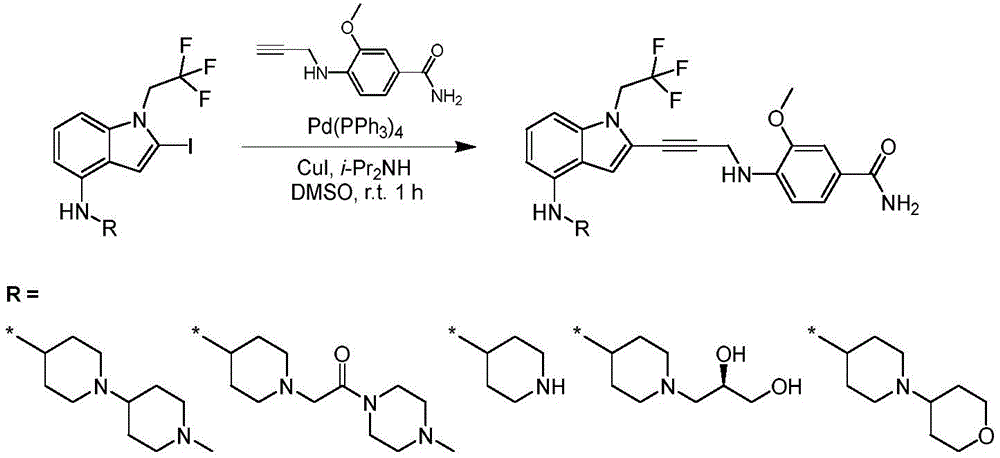
To the 3-methoxy groupA solution of (E) -4- (prop-2-yn-1-ylamino) benzamide (27.89mg, 129.72. mu. mol,1.5 eq) in DMSO (1mL) was added i-Pr 2 NH (262.52mg,2.59mmol, 364.61. mu.L, 30 equivalents), CuI (32.94mg, 172.95. mu. mol,2 equivalents), 2-iodo-N- [1- (1-methyl-4-piperidinyl) -4-piperidinyl]-1- (2,2, 2-trifluoroethyl) indol-4-amine (50mg,86.48 μmol,1 eq) and Pd (PPh) 3 ) 4 (24.98mg, 21.62. mu. mol,0.25 equiv.). In N 2 The mixture was then stirred at 20 ℃ for 1 hour. TLC or LC-MS analysis was used to detect completion of the reaction. The reaction mixture was poured into a saturated EDTA solution (20mL) and the resulting mixture was stirred at 20 ℃ for 15 minutes. The mixture was extracted with EtOAc (30mL x 3) and the combined organic layers were concentrated under reduced pressure to a volume of 30 mL. The organic solution was poured into a saturated EDTA solution (20mL) and stirred at 20 ℃ for 1 hour. The mixture was extracted with EtOAc (30mL × 3). The combined organic layers were washed with brine, dried over anhydrous sodium sulfate, mixed with activated carbon, filtered and concentrated under reduced pressure to give a residue. The crude residue was purified by preparative TLC and preparative HPLC to give the desired product.
3-methoxy-4- ((3- (4- ((1 '-methyl- [1,4' -bipiperidine)]-4-yl) amino) -1- (2,2, 2-trifluoroethyl) -1H-indol-2-yl) prop-2-yn-1-yl) amino) benzamide (11mg, 16.91. mu. mol, 20% yield, FA) MS (ES) + M/z) 597.3; 3-methoxy-4- ((3- (4- ((1- (2- (4-methylpiperazin-1-yl) -2-oxoethyl) piperidin-4-yl) amino) -1- (2,2, 2-trifluoroethyl) -1H-indol-2-yl) prop-2-yn-1-yl) amino) benzamide (6.90mg,8.95 μmol, 10% yield, FA) MS (ES) + M/z) 640.3; 3-methoxy-4- ((3- (4- (piperidin-4-ylamino) -1- (2,2, 2-trifluoroethyl) -1H-indol-2-yl) prop-2-yn-1-yl) amino) benzamide (29mg, 53.16. mu. mol, 46% yield, FA) MS (ES) + M/z) 500.3; 4- ({3- [4- ({1- [ (2R) -2, 3-dihydroxypropyl)]Piperidin-4-yl } amino) -1- (2,2, 2-trifluoroethyl) -1H-indol-2-yl]Prop-2-yn-1-yl } amino) -3-methoxybenzamide (95.5mg, 165.82. mu. mol, 56% yield) MS (ES) + M/z) 574.2. (ii) a 3-methoxy-4- [3- [4- [ (1-tetrahydropyran-4-yl-4-piperidinyl) amino group]-1- (2,2, 2-trifluoroethyl) indol-2-yl]Prop-2-ynylamino]Benzamide, (8.40mg,13.07 μmol, 15.79% yield, FA) MS (ES) + ,m/z):584.3。
Example D60: synthesis of compounds 849A and 850A.

Preparation of tert-butyl 4- ((2- (3- ((4-carbamoyl-2-methoxyphenyl) amino) prop-1-yn-1-yl) -1- (2,2, 2-trifluoroethyl) -1H-indol-4-yl) amino) -3-fluoropiperidine-1-carboxylate: tert-butyl 3-fluoro-4- ((2-iodo-1- (2,2, 2-trifluoroethyl) -1H-indol-4-yl) amino) piperidine-1-carboxylate (100mg, 184.73. mu. mol,1 eq), 3-methoxy-4- (prop-2-yn-1-ylamino) benzamide (56.59mg, 277.10. mu. mol,1.5 eq), CuI (35.18mg, 184.73. mu. mol,1 eq), Pd (PPh) 3 ) 4 (35.18mg, 184.73. mu. mol,1 eq.) and i-Pr 2 A mixture of NH (186.93mg,1.85mmol, 261.08. mu.L, 10 equiv.) in DMSO (25mL) was degassed and N added 2 Purging was carried out three times. In N 2 The mixture was then stirred at 25 ℃ for 1 hour. TLC and LC-MS analysis indicated the reaction was complete. The reaction mixture was added to a saturated aqueous EDTA solution (30mL) and stirred for 1 hour. The mixture was then extracted with EtOAc (30mL x 3). The combined organic layers were separated, washed with water (30mL x2) and brine (30mL x2), dried over anhydrous sodium sulfate, filtered and concentrated under reduced pressure. The crude residue was passed through preparative TLC (SiO) 2 DCM: MeOH ═ 20:1) purification afforded the desired product (63.10% yield) as a light yellow solid. MS (ES) + ,m/z):618.2。
A solution of tert-butyl 4- ((2- (3- ((4-carbamoyl-2-methoxyphenyl) amino) prop-1-yn-1-yl) -1- (2,2, 2-trifluoroethyl) -1H-indol-4-yl) amino) -3-fluoropiperidine-1-carboxylate (100mg,161.91 μmol,1 eq) in DCM (2mL) and TFA (2mL) was stirred at 25 ℃ for 1 hour. TLC and LC-MS analysis indicated the reaction was complete. The reaction mixture was poured into ice water (20mL) and saturated Na 2 CO 3 The aqueous solution was slowly added to the mixture to adjust the pH to 8-9. The mixture was then extracted with DCM (30mL x 3). The combined organic layers were separated, washed with water (30mL x2) and brine (30mL x2), dried over anhydrous sodium sulfate, filtered and concentrated under reduced pressure. Passing the crude residue through Purification by preparative HPLC gave the desired product as a light yellow solid.
4- { [3- (4- { [ (3S,4R) -3-Fluoropiperidin-4-yl]Amino } -1- (2,2, 2-trifluoroethyl) -1H-indol-2-yl) prop-2-yn-1-yl]Amino } -3-methoxybenzamide (28.9mg, 53.61. mu. mol, 33% yield), MS (ES) + M/z) 518.2; and 4- { [3- (4- { [ (3R,4S) -3-Fluoropiperidin-4-yl]Amino } -1- (2,2, 2-trifluoroethyl) -1H-indol-2-yl) prop-2-yn-1-yl]Amino } -3-methoxy-N-methylbenzamide (39.9mg, 77.10. mu. mol, 60% yield), MS (ES) + ,m/z):518.2。
Example D61: synthesis of compounds 733A and 736A.

Preparation of tert-butyl 4- ((2-iodo-1- (2,2, 2-trifluoroethyl) -1H-indol-4-yl) amino) -3-methylpiperidine-1-carboxylate: to a solution of 2-iodo-1- (2,2, 2-trifluoroethyl) indol-4-amine (0.5g,1.47mmol,1 eq) and 3-methyl-4-oxo-piperidine-1-carboxylic acid tert-butyl ester (940.68mg,4.41mmol,3 eq) in DMF (5mL) at 0 ℃ was added TMSCl (399.32mg,3.68mmol,466.50 μ L,2.5 eq). The mixture was stirred at 0 ℃ for 2 hours and then at 0 ℃ under N 2 By reacting BH 3 THF (1M,7.35mL,5 equiv.) was added to the solution. The resulting mixture was further stirred at 25 ℃ for 1 hour. LC-MS analysis indicated the reaction was complete. The reaction mixture was poured over saturated Na at 0 deg.C 2 CO 3 Aqueous (8mL) and extracted with EtOAc (10mL x 3). The organic phase was washed with brine (10mL x 3), dried over anhydrous sodium sulfate, filtered and concentrated under reduced pressure. The crude residue is purified by column chromatography (SiO) 2 PE: EtOAc ═ 1:0 to 10:1) and preparative HPLC purified to give the desired product (0.365g,665.67 μmol, 45.28% yield) as a yellow solid.
Preparation of 2-iodo-N- (3-methylpiperidin-4-yl) -1- (2,2, 2-trifluoroethyl) -1H-indol-4-amine: to a solution of tert-butyl 4- ((2-iodo-1- (2,2, 2-trifluoroethyl) -1H-indol-4-yl) amino) -3-methylpiperidine-1-carboxylate (0.1g, 182.37. mu. mol,1 eq) in DCM (3mL) was added TFA (1.51g,13.24mmol, 980. mu.L, 72.58 mL)Amount). The mixture was stirred at 25 ℃ for 0.5 hour. TLC analysis indicated the reaction was complete. Saturated Na 2 CO 3 An aqueous solution was added to the mixture to adjust the pH of the mixture to 9. The mixture was then extracted with EtOAc (20mL x 3). The combined organic layers were washed with brine (20mL x 3), dried over anhydrous sodium sulfate, filtered and concentrated under reduced pressure. The crude product (0.08g) was obtained as a yellow solid and used without purification.
Preparation of N- (1, 3-dimethylpiperidin-4-yl) -2-iodo-1- (2,2, 2-trifluoroethyl) -1H-indol-4-amine: to a mixture of 2-iodo-N- (3-methylpiperidin-4-yl) -1- (2,2, 2-trifluoroethyl) -1H-indol-4-amine (0.08g, 182.97. mu. mol,1 eq) and formaldehyde (54.94mg,1.83mmol, 50.40. mu.L, 10 eq) in MeOH (3mL) was added AcOH (10.99ug,1.83 e-1. mu. mol,1.05 e-2. mu.L, 0.001 eq) and stirred at 50 ℃ for 1 hour. Then, add NaBH 3 CN (57.49mg, 914.83. mu. mol,5 eq.) and the mixture was stirred at 50 ℃ for a further 1 h. TLC analysis indicated the reaction was complete. The reaction mixture was poured into water (10mL) and extracted with EtOAc (10mL × 3). The organic layer was washed with brine (10mL x3), dried over anhydrous sodium sulfate, filtered and concentrated under reduced pressure. The residue was passed through preparative TLC (SiO) 2 DCM: MeOH ═ 10:1) gave the desired product (0.07g,155.12 μmol, 85% yield) as a yellow solid.
Preparation of N- (1, 3-dimethylpiperidin-4-yl) -2- (3- ((2-methoxy-4- (methylsulfonyl) phenyl) amino) prop-1-yn-1-yl) -1- (2,2, 2-trifluoroethyl) -1H-indol-4-amine: to a mixture of 2-methoxy-4- (methylsulfonyl) -N- (prop-2-yn-1-yl) aniline (44.54mg, 186.14. mu. mol,1.2 equiv.) in DMSO (2mL) was added i-Pr 2 NH (156.96mg,1.55mmol, 219.22. mu.L, 10 equiv.), CuI (29.54mg, 155.12. mu. mol,1 equiv.), N- (1, 3-dimethylpiperidin-4-yl) -2-iodo-1- (2,2, 2-trifluoroethyl) -1H-indol-4-amine (0.07g, 155.12. mu. mol,1 equiv.), and Pd (PPh) 3 ) 4 (71.70mg, 62.05. mu. mol,0.4 equiv.). At N 2 The mixture was then stirred at 25 ℃ for 1 hour. LC-MS or TLC analysis indicated that the reaction was complete. The mixture was poured into saturated aqueous EDTA (15mL) and stirred for 1 hour. The aqueous phase was extracted with EtOAc (10mL x 3). The combined organic layers were washed with brine (10 mL. times.3) and dried over magnesium sulfate Dried over anhydrous sodium sulfate, filtered and concentrated in vacuo. The residue was passed through preparative TLC (SiO) 2 DCM: MeOH ═ 10:1) and preparative HPLC purification gave the desired product.
N- ((3S,4S) -1, 3-dimethylpiperidin-4-yl) -2- (3- ((2-methoxy-4- (methylsulfonyl) phenyl) amino) prop-1-yn-1-yl) -1- (2,2, 2-trifluoroethyl) -1H-indol-4-amine, 16.6mg, 14.6% yield, MS (ES) + M/z) 563.2; and N- ((3R,4S) -1, 3-dimethylpiperidin-4-yl) -2- (3- ((2-methoxy-4- (methylsulfonyl) phenyl) amino) prop-1-yn-1-yl) -1- (2,2, 2-trifluoroethyl) -1H-indol-4-amine, 17.6mg, 20.1% yield, MS (ES) + ,m/z):563.2。
Example D62: synthesis of compounds 701A and 702A.
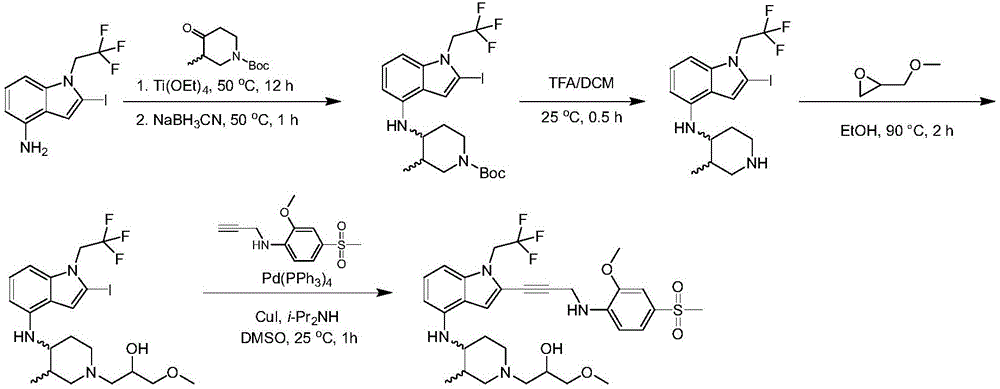
Preparation of tert-butyl 4- ((2-iodo-1- (2,2, 2-trifluoroethyl) -1H-indol-4-yl) amino) -3-methylpiperidine-1-carboxylate: to a mixture of 2-iodo-1- (2,2, 2-trifluoroethyl) indol-4-amine (0.1g,294.05 μmol,1 eq) and 3-methyl-4-oxo-piperidine-1-carboxylic acid tert-butyl ester (940.68mg,4.41mmol,3 eq) in EtOH (5mL) was added Ti (OEt) 4 (1.68g,7.35mmol,1.52mL,5 equiv.). The mixture was stirred at 50 ℃ for 12 hours and NaBH was added 3 CN (461.96mg,7.35mmol,5 equivalents) was added to the reaction. The mixture was further stirred at 50 ℃ for 1 hour. LC-MS analysis indicated the reaction was complete. The reaction mixture was poured over saturated Na at 0 deg.C 2 CO 3 Aqueous (8mL) then extracted with EtOAc (10mL x 3). The organic layer was washed with brine (10mL x 3), dried over anhydrous sodium sulfate, filtered and concentrated under reduced pressure. The residue was purified by column chromatography (SiO) 2 EtOAc 1:0 to 10:1) and preparative HPLC gave the desired product (0.262g,438.82 μmol, 29.85% yield) as a light yellow solid.
Preparation of 2-iodo-N- (3-methylpiperidin-4-yl) -1- (2,2, 2-trifluoroethyl) -1H-indol-4-amine: to tert-butyl 4- ((2-iodo-1- (2,2, 2-trifluoroethyl) -1H-indol-4-yl) amino) -3-methylpiperidine-1-carboxylate (0.15g, 273.56. mu. mol,1 am)Amount) in DCM (3mL) was added TFA (1.51g,13.24mmol,980 μ L,48.38 eq). The mixture was stirred at 25 ℃ for 0.5 hour. TLC analysis indicated the reaction was complete. Saturated Na 2 CO 3 An aqueous solution was added to the reaction mixture to adjust the pH of the mixture to 9. The mixture was then extracted with EtOAc (20mL x 3), washed with brine (20mL x 3), dried over anhydrous sodium sulfate, filtered and concentrated under reduced pressure. The crude product (0.1g) was obtained as a yellow solid and used without purification. MS (ES) + ,m/z):438.1。
Preparation of 1- (4- ((2-iodo-1- (2,2, 2-trifluoroethyl) -1H-indol-4-yl) amino) -3-methylpiperidin-1-yl) -3-methoxypropan-2-ol: to a solution of 2-iodo-N- (3-methylpiperidin-4-yl) -1- (2,2, 2-trifluoroethyl) -1H-indole-4- (0.1g, 224.13. mu. mol,1 eq) in EtOH (3mL) was added 2- (methoxymethyl) oxirane (29.62mg, 336.20. mu. mol, 29.92. mu.L, 1.5 eq). The reaction mixture was stirred at 90 ℃ for 2 hours. TLC analysis indicated the reaction was complete. The reaction mixture was concentrated under reduced pressure and passed through preparative TLC (SiO) 2 DCM: MeOH ═ 10:1) gave the desired product (0.08g,152.28 μmol, 68% yield) as a yellow oil.
Preparation of 1-methoxy-3- (4- ((2- (3- ((2-methoxy-4- (methylsulfonyl) phenyl) amino) prop-1-yn-1-yl) -1- (2,2, 2-trifluoroethyl) -1H-indol-4-yl) amino) -3-methylpiperidin-1-yl) propan-2-ol: to a solution of 2-methoxy-4- (methylsulfonyl) -N- (prop-2-yn-1-yl) aniline 2(43.73mg, 182.74. mu. mol,1.2 equiv.) in DMSO (2mL) was added i-Pr 2 NH (154.09mg,1.52mmol, 215.21. mu.L, 10 equiv.), CuI (29mg, 152.28. mu. mol,1 equiv.), 1- (4- ((2-iodo-1- (2,2, 2-trifluoroethyl) -1H-indol-4-yl) amino) -3-methylpiperidin-1-yl) -3-methoxypropan-2-ol (0.08g, 152.28. mu. mol,1 equiv.), and Pd (PPh) 3 ) 4 (70.39mg, 60.91. mu. mol,0.4 equiv.). In N 2 The mixture was then stirred at 25 ℃ for 1 hour. LC-MS or TLC analysis indicated that the reaction was complete. The mixture was poured into saturated aqueous EDTA (15mL) and stirred for 1 hour. The aqueous phase was extracted with EtOAc (10 mL. times.3). The combined organic layers were washed with brine (10mL x3), dried over anhydrous sodium sulfate, filtered and concentrated in vacuo. The residue was passed through preparative TLC (SiO) 2 ,DCM:MeOH10:1) and preparative HPLC gave the desired product.
rac-1- [ (3R,4R) -4- [ (2- {3- [ (4-methanesulfonyl-2-methoxyphenyl) amino]Prop-1-yn-1-yl } -1- (2,2, 2-trifluoroethyl) -1H-indol-4-yl) amino]-3-methylpiperidin-1-yl]-3-methoxypropan-2-ol, 6mg, 18.5% yield, MS (ES) + M/z) 637.3; and rac-1- [ (3R,4S) -4- [ (2- {3- [ (4-methanesulfonyl-2-methoxyphenyl) amino]Prop-1-yn-1-yl } -1- (2,2, 2-trifluoroethyl) -1H-indol-4-yl) amino]-3-methylpiperidin-1-yl]-3-methoxypropan-2-ol, 20mg, 48.9% yield, MS (ES) + ,m/z):637.3。
Example D63: synthesis of compounds 675A, 682A, 686A and 687A.

To a solution of 2- (3- ((2-methoxy-4- (methylsulfonyl) phenyl) amino) prop-1-yn-1-yl) -N- (piperidin-4-yl) -1- (2,2, 2-trifluoroethyl) -1H-indol-4-amine (100mg, 187.06. mu. mol,1 eq) in DMF (3mL) was added K 2 CO 3 (51.71mg, 374.12. mu. mol,2 equiv.) and 4-bromobutyronitrile (83.05mg, 561.18. mu. mol, 40.08. mu.L, 3 equiv.). The mixture was stirred at 50 ℃ for 2 hours. LC-MS or TLC analysis indicated that the reaction was complete. The reaction mixture was quenched by adding water (40mL) to the reaction mixture at 25 ℃ and the mixture was extracted with EtOAc (10mL x 3). The combined organic layers were washed with brine (20mL), dried over anhydrous sodium sulfate, filtered and concentrated under reduced pressure. The crude residue was passed through preparative TLC (SiO) 2 ,DCM:MeOH=10:1,R f 0.43) and preparative HPLC gave the desired product as a light yellow solid.
2- {3- [ (4-Methylsulfonyl-2-methoxyphenyl) amino]Prop-1-yn-1-yl } -N- [1- (3-methoxypropyl) piperidin-4-yl]-1- (2,2, 2-trifluoroethyl) -1H-indol-4-amine, 15.3mg, 26.8% yield, MS (ES) + M/z) 607.2; 3- {4- [ (2- {3- [ (4-methanesulfonyl-2-methoxyphenyl) amino group]Prop-1-yn-1-yl } -1- (2,2, 2-trifluoroethyl) -1H-indol-4-yl) amino]Piperidin-1-yl } propionitrile, 20.4mg, 17.0% yield, MS (ES) + ,m/z):588.2;4-(4-((2-(3- ((2-methoxy-4- (methylsulfonyl) phenyl) amino) prop-1-yn-1-yl) -1- (2,2, 2-trifluoroethyl) -1H-indol-4-yl) amino) piperidin-1-yl) butanenitrile, 24.6mg, 21.4% yield, MS (ES) + M/z) 602.2; and 2- (3- ((2-methoxy-4- (methylsulfonyl) phenyl) amino) prop-1-yn-1-yl) -N- (1- ((tetrahydrofuran-2-yl) methyl) piperidin-4-yl) -1- (2,2, 2-trifluoroethyl) -1H-indol-4-amine, 24.0mg, 20.4% yield, MS (ES) + ,m/z):619.2。
Example D64: synthesis of compounds 678A and 679A.

To a mixture of 2- (3- ((2-methoxy-4- (methylsulfonyl) phenyl) amino) prop-1-yn-1-yl) -N- (piperidin-4-yl) -1- (2,2, 2-trifluoroethyl) -1H-indol-4-amine (100mg, 187.06. mu. mol,1 eq) and oxetan-3-one (40.44mg, 561.18. mu. mol,3 eq) or dihydrofuran-3 (2H) -one (48.31mg, 561.18. mu. mol,3 eq) in THF (3mL) was added MgSO 3 4 (112.58mg, 935.29. mu. mol,5 equiv.). The reaction mixture was stirred at 40 ℃ for 2 hours, then NaBH (OAc) was added 3 (198.23mg, 935.29. mu. mol,5 equivalents) and the reaction mixture was stirred for a further 1 hour. TLC analysis (DCM: MeOH ═ 10:1, R) f 0.43) indicating completion of the reaction. By adding saturated NaHCO at 25 deg.C 3 The reaction mixture was quenched with aqueous solution (40mL) and extracted with EtOAc (20 mL. times.3). The combined organic layers were dried over anhydrous sodium sulfate, filtered and concentrated under reduced pressure. The crude residue was passed through preparative TLC (SiO) 2 ,DCM:MeOH=10:1,R f 0.43) and preparative HPLC gave the desired product as a light yellow solid.
2- {3- [ (4-Methylsulfonyl-2-methoxyphenyl) amino]Prop-1-yn-1-yl } -N- [1- (oxetan-3-yl) piperidin-4-yl]-1- (2,2, 2-trifluoroethyl) -1H-indol-4-amine, 13.2mg, 11.4% yield, MS (ES) + M/z) 591.2; and 2- (3- ((2-methoxy-4- (methylsulfonyl) phenyl) amino) prop-1-yn-1-yl) -N- (1- (tetrahydrofuran-3-yl) piperidin-4-yl) -1- (2,2, 2-trifluoroethyl) -1H-indol-4-amine, 20.5mg, 18.0% yield, MS (ES) + ,m/z):605.3。
Example D65: synthesis of 4- ((2- (3- ((2-methoxy-4- (methylsulfonyl) phenyl) amino) prop-1-yn-1-yl) -1- (2,2, 2-trifluoroethyl) -1H-indol-4-yl) amino) -N, N-dimethylpiperidine-1-carboxamide (compound 754A).
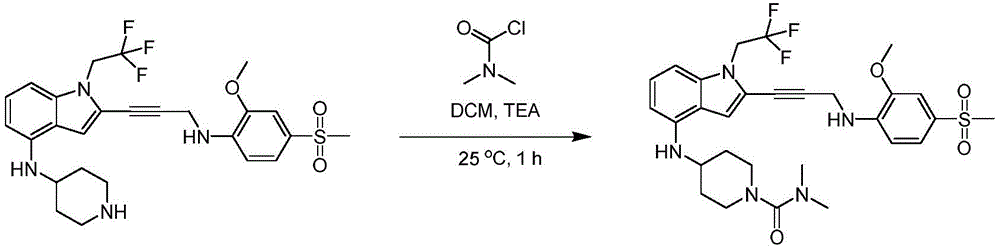
To a solution of 2- (3- ((2-methoxy-4- (methylsulfonyl) phenyl) amino) prop-1-yn-1-yl) -N- (piperidin-4-yl) -1- (2,2, 2-trifluoroethyl) -1H-indol-4-amine (100mg,187.06 μmol,1 eq) in DCM (3mL) was added TEA (37.86mg,374.12 μmol,52.07 μ L,2 eq) and dimethylcarbamoyl chloride (40.23mg,374.12 μmol,34.39 μ L,2 eq). The mixture was stirred at 25 ℃ for 1 hour. LC-MS analysis indicated the reaction was complete. The reaction mixture was quenched by addition of water (40mL) at 25 ℃ and the mixture was extracted with EtOAc (30mL × 2). The combined organic layers were dried over anhydrous sodium sulfate, filtered and concentrated under reduced pressure to give a residue. The residue was purified by preparative HPLC to give the desired product (23.0mg,37.97 μmol, 20.30% yield) as a light yellow solid. MS (ES) + ,m/z):606.2。
Example D66: synthesis of 2- (4- { [3- (4- { [ (3S,4R) -3-fluoro-1-methylpiperidin-4-yl ] amino } -1- (2,2, 2-trifluoroethyl) -1H-indol-2-yl) prop-2-yn-1-yl ] amino } -3-methoxybenzenesulfonyl) ethan-1-ol (compound 939A).
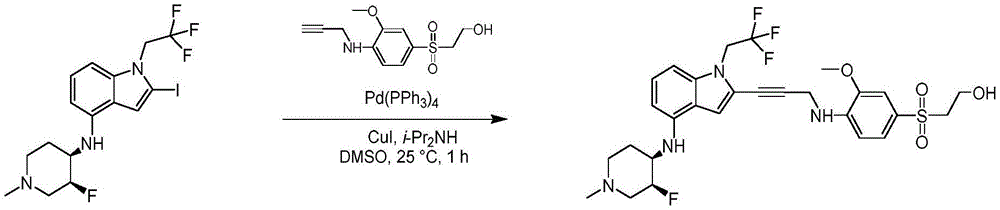
To a solution of 2- ((3-methoxy-4- (prop-2-yn-1-ylamino) phenyl) sulfonyl) ethan-1-ol (52.06mg,193.31 μmol,1.1 equiv.) in DMSO (1mL) was added i-Pr 2 NH (266.74mg,2.64mmol, 372.54. mu.L, 15 equiv.), CuI (3.35mg, 17.57. mu. mol,0.1 equiv.), N- ((3S,4R) -3-fluoro-1-methylpiperidin-4-yl) -2-iodo-1- (2,2, 2-trifluoroethyl) -1H-indol-4-amine (0.08g, 175.73. mu. mol,1 equiv.), and Pd (PPh) 3 ) 4 (3.05mg, 2.64. mu. mol,0.015 equivalent). At N 2 The mixture is stirred at 25 DEG CStirring for 1 hour. TLC analysis (DCM: MeOH ═ 10:1, R) f 0.4) indicates that 10% of the starting material remained and a major new spot was detected, which was more polar than the starting material. The reaction mixture was quenched by the addition of saturated aqueous EDTA (120mL) and stirred for 1 hour. The mixture was extracted with EtOAc (40mL x 3). The combined organic layers were washed with brine (40mL x 3), dried over anhydrous sodium sulfate, filtered and concentrated under reduced pressure. The crude residue was passed through preparative TLC (SiO) 2 DCM: MeOH ═ 10:1) and reverse phase HPLC purification afforded the desired product (28.5mg,47.29 μmol, 26.91% yield) as a yellow solid. MS (ES) + ,m/z):597.2。
1H NMR(400MHz,DMSO-d6)δppm 1.64-1.75(m,1H)1.84-2.00(m,1H)2.11-2.26(m,5H)2.30-2.37(m,1H)2.78-2.86(m,1H)3.01-3.09(m,1H)3.28-3.35(m,2H)3.61-3.65(m,2H)3.81-3.93(m,3H)4.28-4.41(m,2H)4.68-4.79(m,1H)4.82-4.95(m,2H)6.15-6.31(m,1H)6.72(d,J=8.07Hz,1H)6.88(d,J=8.44Hz,1H)6.95-7.07(m,1H)7.12-7.23(m,2H)7.27-7.38(m,1H)8.14-8.26(m,1H)。
Example D67: synthesis of compounds 847A and 848A.

4- [ [2- [3- (N-tert-butoxycarbonyl-2-methoxy-4-methylsulfonyl-anilino) prop-1-ynyl]-1- (2,2, 2-trifluoroethyl) indol-4-yl]Amino group]Preparation of 3-fluoro-piperidine-1-carboxylic acid tert-butyl ester: to N- [3- [ 4-amino-1- (2,2, 2-trifluoroethyl) indol-2-yl at 50 deg.C]Prop-2-ynyl]A solution of tert-butyl (2-methoxy-4-methylsulfonyl-phenyl) carbamate (20g,36.26mmol,1 eq) in AcOH (160mL) and DCE (80mL) was added tert-butyl 3-fluoro-4-oxo-piperidine-1-carboxylate (23.63g,108.78mmol,3 eq). The mixture is stirred at 50 ℃ for 10 minutes, and NaBH (OAc) 3 (7.68g,36.26mmol,1 eq.) was added to the mixture. After 15 minutes of stirring, a second charge of NaBH (OAc) 3 (3.84g,18.13mmol,0.5 equiv.) is added to the reaction and three further batches (1.92g,9.06mmol,0.25 equiv; 3.84g,18.13mmol,0.5 equiv; and 960.61 m) are added at 15 minute intervalsg,4.53mmol,0.125 equiv). The mixture was stirred at 50 ℃ for 25 minutes. TLC analysis indicated that 3% of the starting material remained and a major new spot was detected, which was less polar than the starting material. The reaction mixture was quenched by the addition of water (2000mL) and the mixture was diluted with an aqueous solution of NaOH (120g) (500mL) to adjust the pH of the solution to pH>10. The resulting mixture was extracted with EtOAc (500mL × 3). The combined organic layers were washed with brine (500mL x3), dried over anhydrous sodium sulfate, filtered and concentrated under reduced pressure to give a residue. The residue was purified by column chromatography (SiO) 2 PE: EtOAc ═ 5:1 to EtOAc: DCM ═ 2: 1). The product was triturated with PE: EtOAc 120mL:40mL for 12 h at 25 ℃. The residue was then purified by reverse phase HPLC to give the compound 4- [ [2- [3- (N-tert-butoxycarbonyl-2-methoxy-4-methylsulfonyl-anilino) prop-1-ynyl]-1- (2,2, 2-trifluoroethyl) indol-4-yl ]Amino group]-3-fluoro-piperidine-1-carboxylic acid tert-butyl ester (35g,45.98mmol, 63% yield) as a yellow solid.
Preparation of (3S,4R) -4- [ [2- [3- (N-tert-butoxycarbonyl-2-methoxy-4-methylsulfonyl-anilino) prop-1-ynyl ] -1- (2,2, 2-trifluoroethyl) indol-4-yl ] amino ] -3-fluoro-piperidine-1-carboxylic acid tert-butyl ester: 4- [ [2- [3- (N-tert-butoxycarbonyl-2-methoxy-4-methylsulfonyl-anilino) prop-1-ynyl ] -1- (2,2, 2-trifluoroethyl) indol-4-yl ] amino ] -3-fluoro-piperidine-1-carboxylic acid tert-butyl ester (35g,46.49mmol,1 eq) was further isolated by SFC to give the desired compound. To give (3S,4R) -4- [ [2- [3- (N-tert-butoxycarbonyl-2-methoxy-4-methylsulfonyl-anilino) prop-1-ynyl ] -1- (2,2, 2-trifluoroethyl) indol-4-yl ] amino ] -3-fluoro-piperidine-1-carboxylic acid tert-butyl ester (16g,21.10mmol, 45% yield) as a red solid. To give (3R,4S) -4- [ [2- [3- (N-tert-butoxycarbonyl-2-methoxy-4-methylsulfonyl-anilino) prop-1-ynyl ] -1- (2,2, 2-trifluoroethyl) indol-4-yl ] amino ] -3-fluoro-piperidine-1-carboxylic acid tert-butyl ester (16g,20.36mmol, 44% yield) as a yellow solid.
N- [ (3S,4R) -3-fluoro-4-piperidinyl]-2- [3- (2-methoxy-4-methylsulfonyl-anilino) prop-1-ynyl ]Preparation of (E) -1- (2,2, 2-trifluoroethyl) indol-4-amine: in N 2 (3S,4R) -4- [ [2- [3- (N-tert-butoxycarbonyl-2-methoxy-4-methylsulfonyl-benzene)Amino) prop-1-ynyl]-1- (2,2, 2-trifluoroethyl) indol-4-yl]Amino group]A mixture of tert-butyl-3-fluoro-piperidine-1-carboxylate (15g,19.93mmol,1 eq), 4M HCl/EtOAc (373.60mL,75 eq) in EtOAc (75mL) was stirred at 20 ℃ for 1 h. TLC analysis indicated complete consumption of starting material and a new spot was detected. The reaction mixture was filtered to give a solid and dried under reduced pressure. The crude product was triturated with EtOH (150mL) for 12 hours at 20 ℃. To obtain N- [ (3S,4R) -3-fluoro-4-piperidinyl)]-2- [3- (2-methoxy-4-methylsulfonyl-anilino) prop-1-ynyl]-1- (2,2, 2-trifluoroethyl) indol-4-amine as a yellow solid (10.4g,16.29mmol, 82% yield, 2 HCl). MS (ES +, m/z) 553.2.
Example D68: synthesis of compounds 834A and 835A.
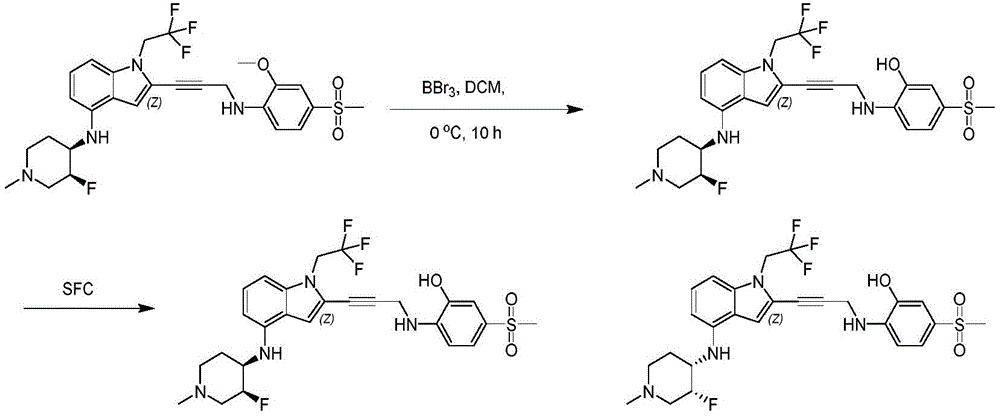
To a solution of N- ((3S,4R) -3-fluoro-1-methylpiperidin-4-yl) -2- (3- ((2-methoxy-4- (methylsulfonyl) phenyl) amino) prop-1-yn-1-yl) -1- (2,2, 2-trifluoroethyl) -1H-indol-4-amine (200mg,347.33 μmol,1 eq) in DCM (2mL) at 0 ℃ was added BBr 3 (304.55mg,1.22mmol, 117.13. mu.L, 3.5 equiv.; dropwise). The mixture was stirred at 0 ℃ for 2 hours. TLC analysis (DCM: MeOH: TEA ═ 100:5:2, R f 0.4) indicates that some starting material remained and a major new spot was detected, which was more polar than the starting material. Will be the other part of BBr 3 (304.55mg,1.22mmol, 117.13. mu.L, 3.5 equiv.) was added to the reaction and the mixture was stirred at 0 ℃ for 2 h. TLC analysis indicated 30% starting material remained. Adding a third part of BBr 3 (304.55mg,1.22mmol, 117.13. mu.L, 3.5 equiv.) and the reaction mixture was stirred at 0 ℃ for a further 6 h. TLC analysis indicated complete consumption of starting material. Saturated NaHCO 3 The solution was added to the mixture to adjust the pH of the solution to 8. The mixture was extracted with EtOAc (40 mL. times.3). The combined organic layers were washed with brine (30mL x 3), dried over anhydrous sodium sulfate, filtered and concentrated under reduced pressure. The residue was passed through preparative TLC (SiO) 2 DCM: MeOH: TEA ═ 100:5:2) and SFC purificationTo give 2- { [3- (4- { [ (3S,4R) -3-fluoro-1-methylpiperidin-4-yl]Amino } -1- (2,2, 2-trifluoroethyl) -1H-indol-2-yl) prop-2-yn-1-yl]Amino } -5-methanesulfonylphenol (40mg, 70.65. mu. mol, 20.34% yield) and 2- { [3- (4- { [ (3R,4S) -3-fluoro-1-methylpiperidin-4-yl]Amino } -1- (2,2, 2-trifluoroethyl) -1H-indol-2-yl) prop-2-yn-1-yl]Amino } -5-methanesulfonylphenol (40mg, 71.30. mu. mol, 20.53% yield) as a yellow solid.
2- { [3- (4- { [ (3S,4R) -3-fluoro-1-methylpiperidin-4-yl]Amino } -1- (2,2, 2-trifluoroethyl) -1H-indol-2-yl) prop-2-yn-1-yl]Amino } -5-methanesulfonylphenol, MS (ES) + M/z) 553.2; and 2- { [3- (4- { [ (3R,4S) -3-fluoro-1-methylpiperidin-4-yl]Amino } -1- (2,2, 2-trifluoroethyl) -1H-indol-2-yl) prop-2-yn-1-yl]Amino } -5-methanesulfonylphenol, MS (ES) + ,m/z):553.2。
Example D69: synthesis of compounds 800A and 801A.

Preparation of 4- ((3- (4-amino-1- (2,2, 2-trifluoroethyl) -1H-indol-2-yl) prop-2-yn-1-yl) amino) -3-methoxybenzamide: 2-iodo-1- (2,2, 2-trifluoroethyl) -1H-indol-4-amine hydrochloride (1g,2.94mmol,1 eq), 3-methoxy-4- (prop-2-yn-1-ylamino) benzamide (720.62mg,3.53mmol,1.2 eq), CuI (672.01mg,3.53mmol,1.2 eq), Pd (PPh) 3 ) 4 (679.58mg, 588.09. mu. mol,0.2 eq.) and i-Pr 2 A mixture of NH (2.98g,29.40mmol,4.16mL,10 equiv.) in DMSO (10mL) was degassed and N added 2 Purging was carried out three times. In N 2 The mixture was then stirred at 20 ℃ for 1 hour. TLC analysis (PE: EtOAc ═ 5:1, R) f 0) shows one major new blob. The reaction mixture was quenched by the addition of saturated aqueous EDTA (100mL) and the mixture was stirred for 1 hour. The mixture was extracted with EtOAc (60 mL. times.4). The combined organic layers were washed with brine (20mL x 2), filtered and concentrated under reduced pressure. The residue was purified by column chromatography (SiO) 2 PE: EtOAc ═ 1:1 to 0:1) purification afforded the desired product (1g,2.16mmol, 73.51% yield) as a yellow solid.
Preparation of tert-butyl (3R,4S) -4- ((2- (3- ((4-carbamoyl-2-methoxyphenyl) amino) prop-1-yn-1-yl) -1- (2,2, 2-trifluoroethyl) -1H-indol-4-yl) amino) -3-fluoropiperidine-1-carboxylate: to a mixture of 4- ((3- (4-amino-1- (2,2, 2-trifluoroethyl) -1H-indol-2-yl) prop-2-yn-1-yl) amino) -3-methoxybenzamide (0.8g,1.92mmol,1 eq), tert-butyl 3-fluoro-4-oxopiperidine-1-carboxylate (2.09g,9.61mmol,5 eq), TMSCl (532.46mg,4.80mmol, 622.03. mu.L, 98% purity, 2.5 eq) in DMF (10mL) was added BH 3 THF (1M,5.76mL,3 equiv.). At N 2 The mixture was stirred at 0 ℃ for 1 hour. TLC analysis (PE: EtOAc ═ 0:1, R f 0.3) indicated that starting material remained and a major new spot was detected. By adding water (100mL) and saturated Na 2 CO 3 The reaction mixture was quenched with solution (20 mL). The mixture was extracted with EtOAc (40mL x 3). The combined organic layers were washed with brine (20mL x 4), dried over anhydrous sodium sulfate, filtered and concentrated under reduced pressure. The crude residue is purified by column chromatography (SiO) 2 EtOAc ═ 3:1 to 0:1) and preparative HPLC purification afforded the desired product (0.58g) as a yellow solid.
Preparation of 4- ((3- (4- (((3R,4S) -3-fluoropiperidin-4-yl) amino) -1- (2,2, 2-trifluoroethyl) -1H-indol-2-yl) prop-2-yn-1-yl) amino) -3-methoxybenzamide: in N 2 Next, a solution of tert-butyl (3R,4S) -4- ((2- (3- ((4-carbamoyl-2-methoxyphenyl) amino) prop-1-yn-1-yl) -1- (2,2, 2-trifluoroethyl) -1H-indol-4-yl) amino) -3-fluoropiperidine-1-carboxylate (0.58g, 939.07. mu. mol,1 eq) in HCl/EtOAc (20mL) was stirred at 20 ℃ for 1 hour. TLC analysis (DCM: MeOH ═ 10:1, R) f 0.10) indicates that a major new spot is formed. By adding water (15mL) and saturated Na 2 CO 3 The reaction mixture was quenched with aqueous solution (15 mL). The mixture was extracted with EtOAc (40mL x 3). The combined organic layers were washed with brine (20mL x 2), filtered and concentrated under reduced pressure. The crude product (0.4g, crude) was obtained as a yellow solid, which was used without purification.
4- { [3- (4- { [ (3S,4R) -3-fluoro-1-methylpiperidin-4-yl]Amino } -1- (2,2, 2-trifluoroethyl) -1H-indol-2-yl) prop-2-yn-1-yl]Amino } -3-methoxybenzoylAmines and 4- { [3- (4- { [ (3R,4S) -3-fluoro-1-methylpiperidin-4-yl]Amino } -1- (2,2, 2-trifluoroethyl) -1H-indol-2-yl) prop-2-yn-1-yl]Preparation of amino } -3-methoxybenzamide: to a mixture of 4- ((3- (4- (((3R,4S) -3-fluoropiperidin-4-yl) amino) -1- (2,2, 2-trifluoroethyl) -1H-indol-2-yl) prop-2-yn-1-yl) amino) -3-methoxybenzamide (0.3g, 579.69. mu. mol,1 eq.) and (CH) 2 O) n (174.08mg,5.80mmol,10 equiv.) in MeOH (3mL) was added AcOH (34.81mg, 579.69. mu. mol,1 equiv.). The reaction mixture was stirred at 20 ℃ for 10 hours and NaBH was added 3 CN (109.28mg,1.74mmol,3 equiv.) in N 2 The mixture was then stirred at 20 ℃ for a further 2 hours. TLC analysis (DCM: MeOH ═ 10:1, R) f 0.35) indicated that starting material remained and a major new spot was detected. By adding saturated Na 2 CO 3 The reaction mixture was quenched with solution (50mL) and extracted with EtOAc (40 mL. times.4). The combined organic layers were washed with brine (20mL x 2), filtered and concentrated under reduced pressure to give a residue. The residue was passed through preparative TLC (SiO) 2 DCM: MeOH ═ 10:1) and SFC purification afforded the desired product as a yellow solid.
4- { [3- (4- { [ (3S,4R) -3-fluoro-1-methylpiperidin-4-yl]Amino } -1- (2,2, 2-trifluoroethyl) -1H-indol-2-yl) prop-2-yn-1-yl]Amino } -3-methoxybenzamide (0.066g, 122.55. mu. mol, 50.11% yield), MS (ES) + M/z) 532.2; and 4- { [3- (4- { [ (3R,4S) -3-fluoro-1-methylpiperidin-4-yl]Amino } -1- (2,2, 2-trifluoroethyl) -1H-indol-2-yl) prop-2-yn-1-yl]Amino } -3-methoxybenzamide (0.063g, 116.39. mu. mol, 47.59% yield), MS (ES) + ,m/z):532.2。
Example D70: synthesis of compounds 814A and 815A.

To 4- ((3- (4- (((3R,4S) -3-fluoro-1-methylpiperidin-4-yl) amino) -1- (2,2, 2-trifluoroethyl) -1H-indol-2-yl) prop-2-yn-1-yl) amino) -3-methoxybenzoic acid (0.1g, 187.78. mu. mol,1 eq), N-methylmethanamine hydrochloride (30.63mg, 375.57. mu. mol,2 eq) or 2-methoxy-methylamine hydrochloride (30.63mg, 375.57. mu. mol,2 eq)Ethylamine (28.21mg, 375.57. mu. mol, 32.65. mu.L, 2 equiv.), TEA (114.01mg,1.13mmol, 156.82. mu.L, 6 equiv.) in DMF (5mL) was added (239mg, 375.57. mu. mol, 223.36. mu.L, 50% pure, 2 equivalents). In N 2 The mixture was then stirred at 20 ℃ for 3 hours. TLC analysis (EtOAc: TEA ═ 10:1, R f 0.37) indicates that a major new spot is formed. The reaction mixture was quenched by addition of water (20mL) and extracted with EtOAc (25mL × 4). The combined organic layers were washed with brine (10mL x 3), filtered and concentrated under reduced pressure to give a residue. The residue was passed through preparative TLC (SiO) 2 EtOAc: TEA ═ 10:1) and preparative HPLC purification afforded the desired product as a yellow solid.
rac-4- { [3- (4- { [ (3R,4S) -3-fluoro-1-methylpiperidin-4-yl]Amino } -1- (2,2, 2-trifluoroethyl) -1H-indol-2-yl) prop-2-yn-1-yl]Amino } -3-methoxy-N- (2-methoxyethyl) benzamide (0.04g, 71.12. mu. mol, 37.87% yield), MS (ES) + M/z) 590.4; rac-4- { [3- (4- { [ (3R,4S) -3-fluoro-1-methylpiperidin-4-yl]Amino } -1- (2,2, 2-trifluoroethyl) -1H-indol-2-yl) prop-2-yn-1-yl]Amino } -3-methoxy-N, N-dimethylbenzamide (0.04g, 67.37. mu. mol, 35.87% yield), MS (ES) + ,m/z):560.3。
Example D71: synthesis of compounds 697A and 698A.
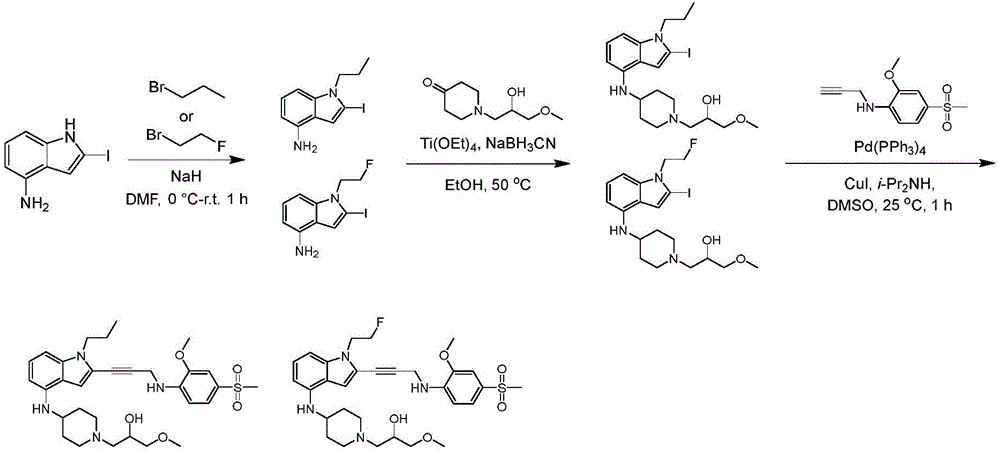
Preparation of 2-iodo-1-propyl-1H-indol-4-amine and 1- (2-fluoroethyl) -2-iodo-1H-indol-4-amine: to a solution of 2-iodo-1H-indol-4-amine (80mg, 310.01. mu. mol,1 eq) in DMF (3mL) at 0 ℃ was added NaH (37.20mg, 930.02. mu. mol, 60% in mineral oil, 3 eq). The mixture was stirred at 0 ℃ for 30 minutes. Then, 1-bromopropane (142.98mg,1.16mmol,105.91 μ L,1.5 equiv.) or 1-bromo-2-fluoroethane (59.04mg,465.01 μmol,1.5 equiv.) was added and the mixture was stirred at 25 ℃ for 30 minutes. LC-MS analysis indicated that the reaction was complete. At 0 deg.C by adding saturated NH 4 The reaction mixture was quenched with aqueous Cl (50mL) and extracted with EtOAc (50 mL. times.2). The organic layer was washed with water (100mL x 2) and brine (100mL x 2), dried over anhydrous sodium sulfate, filtered and concentrated under reduced pressure to give a residue. The residue (SiO) 2 PE: EtOAc ═ 4:1), to afford the desired product.
2-iodo-1-propyl-indol-4-amine (0.17g,566.41 μmol, 73% yield) was obtained as a dark brown oil. 1- (2-fluoroethyl) -2-iodo-indol-4-amine (70mg,230.19 μmol, 74% yield) was obtained as a yellow solid.
Preparation of 1- (4- ((2-iodo-1-propyl-1H-indol-4-yl) amino) piperidin-1-yl) -3-methoxypropan-2-ol and 1- (4- ((1- (2-fluoroethyl) -2-iodo-1H-indol-4-yl) amino) piperidin-1-yl) -3-methoxypropan-2-ol: to a solution of 2-iodo-1-propyl-1H-indol-4-amine (0.15g,499.77 μmol,1 eq) and 1- (2-fluoroethyl) -2-iodo-1H-indol-4-amine (60mg,197.30 μmol,1 eq) in EtOH (3mL) was added 1- (2-hydroxy-3-methoxypropyl) piperidin-4-one (147.77mg,789.21 μmol,4 eq) and titanium tetraethoxide (90.01mg,394.60 μmol,81.83 μ L,2 eq). The mixture was stirred at 50 ℃ for 1 hour and NaBH was added 3 CN (24.80mg, 394.60. mu. mol,2 equiv.). The resulting mixture was further stirred at 50 ℃ for 1 hour. TLC analysis indicated the reaction was complete. By adding saturated NaHCO 3 The reaction mixture was quenched with aqueous solution (100mL) and the mixture was extracted with EtOAc (50mL x 2). The combined organic layers were washed with water (100mL x2) and brine (100mL x2), dried over anhydrous sodium sulfate, filtered and concentrated under reduced pressure. The crude residue was passed through preparative TLC (SiO) 2 DCM: MeOH ═ 10:1) to give the desired product.
1- [4- [ (2-iodo-1-propyl-indol-4-yl) amino ] -1-piperidinyl ] -3-methoxy-propan-2-ol (0.18g,381.86 μmol, 76% yield) was obtained as a yellow oil. To give 1- [4- [ [1- (2-fluoroethyl) -2-iodo-indol-4-yl ] amino ] -1-piperidinyl ] -3-methoxy-propan-2-ol (70mg,147.26 μmol, 75% yield) as a yellow oil.
1- {4- [ (2- {3- [ (4-methanesulfonyl-2-methoxyphenyl) amino group]Prop-1-yn-1-yl } -1-propyl-1H-indol-4-yl) amino]Piperidin-1-yl } -3-methoxypropan-2-ol and 1- (4- { [1- (2-fluoroethyl) -2- {3- [ (4-methanesulfonyl-2-methoxy-2-carbonyl ] ethyl esterPhenyl) amino]Prop-1-yn-1-yl } -1H-indol-4-yl]Preparation of amino } piperidin-1-yl) -3-methoxypropan-2-ol: to a solution of 2-methoxy-4- (methylsulfonyl) -N- (prop-2-yn-1-yl) aniline (38.07mg, 159.11. mu. mol,1.5 equivalents) in DMSO (3mL) was added i-Pr 2 NH (107.34mg,1.06mmol, 149.91. mu.L, 10 equivalents), CuI (4.04mg, 21.21. mu. mol,0.2 equivalents), 1- (4- ((2-iodo-1-propyl-1H-indol-4-yl) amino) piperidin-1-yl) -3-methoxypropan-2-ol (50mg, 106.07. mu. mol,1 equivalent) or 1- (4- ((1- (2-fluoroethyl) -2-iodo-1H-indol-4-yl) amino) piperidin-1-yl) -3-methoxypropan-2-ol (50mg, 105.19. mu. mol,1 equivalent), and Pd (PPh) 3 ) 4 (12.16mg, 10.52. mu. mol,0.1 equiv.). In N 2 The mixture was then stirred at 25 ℃ for 1 hour. TLC analysis indicated the reaction was complete. The reaction mixture was quenched at 25 ℃ by the addition of saturated EDTA solution (50mL) and EtOAc (25 mL). The aqueous layer was filtered and extracted with EtOAc (50mL × 2). The combined organic layers were washed with water (100mL x 2) and brine (100mL x 2), dried over anhydrous sodium sulfate, filtered and concentrated under reduced pressure. The crude residue was passed through preparative TLC (SiO) 2 DCM: MeOH ═ 10:1) and preparative HPLC purification afforded the desired product as a white solid.
1- {4- [ (2- {3- [ (4-methanesulfonyl-2-methoxyphenyl) amino group]Prop-1-yn-1-yl } -1-propyl-1H-indol-4-yl) amino]Piperidin-1-yl } -3-methoxypropan-2-ol, 18.1mg, 29.3% yield, MS (ES) + M/z) 583.3; and 1- (4- { [1- (2-fluoroethyl) -2- {3- [ (4-methanesulfonyl-2-methoxyphenyl) amino]Prop-1-yn-1-yl } -1H-indol-4-yl]Amino } piperidin-1-yl) -3-methoxypropan-2-ol, 21.5mg, 34.8% yield, MS (ES) + ,m/z):587.2。
Example D72: synthesis of 1- (4- { [1- (2-chloroethyl) -2- {3- [ (4-methanesulfonyl-2-methoxyphenyl) amino ] prop-1-yn-1-yl } -1H-indol-4-yl ] amino } piperidin-1-yl) -3-methoxypropan-2-ol (Compound 700A).

Preparation of 1- (2-chloroethyl) -2-iodo-1H-indol-4-amine: to 2-iodo-1H-indol-4-amine (0.2g, 775.02. mu. mol,1 eq.)) KOH (130.45mg,2.33mmol,3 equiv.) and TBAI (57.25mg, 155. mu. mol,0.2 equiv.) were added as a solution in DCE (4 mL). The mixture was stirred at 25 ℃ for 2 hours. TLC analysis indicated the reaction was complete. The reaction mixture was diluted with water (100mL) and extracted with EtOAc (50mL × 2). The combined organic layers were washed with water (100mL x 2) and brine (100mL x 2), dried over anhydrous sodium sulfate, filtered and concentrated under reduced pressure. The residue was passed through preparative TLC (SiO) 2 EtOAc ═ 4:1) to give the desired product (0.2g,623.92 μmol, 80.50% yield) as a brown solid.
Preparation of 1- (4- ((1- (2-chloroethyl) -2-iodo-1H-indol-4-yl) amino) piperidin-1-yl) -3-methoxypropan-2-ol: to a solution of 1- (2-chloroethyl) -2-iodo-1H-indol-4-amine (0.18g, 561.52. mu. mol,1 eq) in EtOH (4mL) was added 1- (2-hydroxy-3-methoxypropyl) piperidin-4-one (420.55mg,2.25mmol,4 eq) and titanium tetraethoxide (256.18mg,1.12mmol, 232.89. mu.L, 2 eq). The mixture was stirred at 50 ℃ for 1 hour, then NaBH was added 3 CN (70.57mg,1.12mmol,2 equiv.). The resulting mixture was stirred at 50 ℃ for 3 hours. TLC analysis indicated the reaction was complete. By adding saturated NaHCO 3 The reaction mixture was quenched with aqueous (100mL) and EtOAc (50 mL). The organic layer was filtered under reduced pressure to give a liquid phase, which was extracted with EtOAc (50mL × 2). The combined organic layers were washed with water (100mL x 2) and brine (100mL x 2), dried over anhydrous sodium sulfate, filtered and concentrated under reduced pressure. The residue was passed through preparative TLC (SiO) 2 DCM: MeOH ═ 10:1) gave the desired product (0.22g,447.34 μmol, 79.67% yield) as a yellow oil.
1- (4- { [1- (2-chloroethyl) -2- {3- [ (4-methanesulfonyl-2-methoxyphenyl) amino ]Prop-1-yn-1-yl } -1H-indol-4-yl]Preparation of amino } piperidin-1-yl) -3-methoxypropan-2-ol: to a solution of 2-methoxy-4-methylsulfonyl-N-prop-2-ynyl-aniline (36.49mg,152.50 μmol,1.5 equiv.) in DMSO (3mL) was added i-Pr 2 NH (102.88mg,1.02mmol, 143.69. mu.L, 10 equiv.), CuI (3.87mg, 20.33. mu. mol,0.2 equiv.), 1- (4- ((1- (2-chloroethyl) -2-iodo-1H-indol-4-yl) amino) piperidin-1-yl) -3-methoxypropan-2-ol (50mg, 101.67. mu. mol,1 equiv.), and Pd (PPh) 3 ) 4 (11.75mg, 10.17. mu. mol,0.1 eq.)). In N 2 The mixture was then stirred at 25 ℃ for 1 hour. TLC analysis indicated the reaction was complete. The reaction mixture was stirred at 25 ℃ by the addition of saturated aqueous EDTA (50mL) and EtOAc (25 mL). The aqueous layer was filtered and extracted with EtOAc (50mL × 2). The combined organic layers were washed with water (100mL x 2) and brine (100mL x 2), dried over anhydrous sodium sulfate, filtered and concentrated under reduced pressure. The crude residue was passed through preparative TLC (SiO) 2 DCM: MeOH ═ 10:1) and preparative HPLC purification afforded the desired product (16.1mg,26.69 μmol, 26.25% yield) as a white solid. MS (ES) + ,m/z):603.2。
Example D73: synthesis of 1- (4- { [1- (2, 2-difluoroethyl) -2- {3- [ (4-methanesulfonyl-2-methoxyphenyl) amino ] prop-1-yn-1-yl } -1H-indol-4-yl ] amino } piperidin-1-yl) -3-methoxypropan-2-ol (Compound 709A).

Preparation of 1- (2, 2-difluoroethyl) -2-iodo-4-nitro-1H-indole: to a solution of 2-iodo-4-nitro-1H-indole (0.5g,1.74mmol,1 eq) in acetone (5mL) was added 1, 1-difluoro-2-iodo-ethane (3.33g,17.36mmol, 9.64. mu.L, 10 eq.) and K 2 CO 3 (719.74mg,5.21mmol,3 equiv.). The mixture was stirred at 80 ℃ for 16 hours. TLC analysis indicated the reaction was complete. The reaction mixture was diluted with water (100mL) and extracted with EtOAc (50mL × 2). The combined organic layers were washed with water (100mL x2) and brine (100mL x2), dried over anhydrous sodium sulfate, filtered and concentrated under reduced pressure. The residue was washed by PE to give the desired product (0.52g,1.48mmol, 85.08% yield) as a yellow solid.
Preparation of 1- (2, 2-difluoroethyl) -2-iodo-1H-indol-4-amine: to a solution of 1- (2, 2-difluoroethyl) -2-iodo-4-nitro-1H-indole (0.45g,1.28mmol,1 eq) in EtOH (4mL) was added saturated NH 4 Aqueous Cl (68.37mg,1.28mmol,1mL) and Fe (214.13mg,3.83mmol,3 equiv.). The mixture was stirred at 60 ℃ for 1 hour. TLC analysis indicated the reaction was complete. The reaction mixture was filtered and extracted with EtOAc (50mL × 2). The organic layer was washed with water (100 mL. times. 2) and saltWater (100mL x2), dried over anhydrous sodium sulfate, filtered and concentrated under reduced pressure. The residue was passed through preparative TLC (SiO) 2 PE: EtOAc ═ 4:1) to give the desired product (0.38g,1.18mmol, 92.31% yield) as a yellow solid.
Preparation of 1- (4- ((1- (2, 2-difluoroethyl) -2-iodo-1H-indol-4-yl) amino) piperidin-1-yl) -3-methoxypropan-2-ol: to a solution of 1- (2, 2-difluoroethyl) -2-iodo-1H-indol-4-amine (0.15g, 465.71. mu. mol,1 eq) in EtOH (4mL) was added 1- (2-hydroxy-3-methoxypropyl) piperidin-4-one (348.79mg,1.86mmol,4 eq) and titanium tetraethoxide (212.46mg, 931.41. mu. mol, 193.15. mu.L, 2 eq). The mixture was stirred at 50 ℃ for 1 hour and NaBH was added 3 CN (58.53mg, 931.41. mu. mol,2 equivalents) was added to the reaction. The resulting mixture was stirred at 50 ℃ for 1 hour. TLC analysis indicated the reaction was complete. By adding saturated NaHCO 3 The reaction mixture was quenched with aqueous (100mL) and EtOAc (50 mL). The mixture was filtered under reduced pressure and extracted with EtOAc (50mL × 2). The combined organic layers were washed with water (100mL x 2) and brine (100mL x 2), dried over anhydrous sodium sulfate, filtered and concentrated under reduced pressure. The residue was passed through preparative TLC (SiO) 2 DCM: MeOH ═ 10:1) gave the desired product (0.18g,364.87 μmol, 78.35% yield) as a yellow oil.
1- (4- { [1- (2, 2-difluoroethyl) -2- {3- [ (4-methanesulfonyl-2-methoxyphenyl) amino ]Prop-1-yn-1-yl } -1H-indol-4-yl]Preparation of amino } piperidin-1-yl) -3-methoxypropan-2-ol: to a solution of 2-methoxy-4-methylsulfonyl-N-prop-2-ynyl-aniline (36.38mg, 152.03. mu. mol,1.5 eq) in DMSO (3mL) was added i-Pr 2 NH (102.56mg,1.01mmol, 143.24. mu.L, 10 equiv.), CuI (3.86mg, 20.27. mu. mol,0.2 equiv.), 1- (4- ((1- (2, 2-difluoroethyl) -2-iodo-1H-indol-4-yl) amino) piperidin-1-yl) -3-methoxypropan-2-ol (50mg, 101.35. mu. mol,1 equiv.), and Pd (PPh) 3 ) 4 (11.71mg, 10.14. mu. mol,0.1 equiv.). At N 2 The mixture was then stirred at 25 ℃ for 1 hour. TLC analysis indicated the reaction was complete. The reaction mixture was quenched at 25 ℃ by the addition of saturated aqueous EDTA (50mL) and EtOAc (25 mL). The mixture was filtered and extracted with EtOAc (50mL × 2). The combined organic layers were washed with water (100 mL. times.2) And brine (100mL x 2), dried over anhydrous sodium sulfate, filtered and concentrated under reduced pressure. The crude residue was passed through preparative TLC (SiO) 2 DCM: MeOH ═ 10:1) and preparative HPLC purification afforded the desired product (23.6mg,38.13 μmol, 37.62% yield) as a white solid. MS (ES) + ,m/z):605.2。
Example D74: synthesis of 1- {4- [ (2- {3- [ (4-methanesulfonyl-2-methoxyphenyl) amino ] prop-1-yn-1-yl } -1- (3,3, 3-trifluoropropyl) -1H-indol-4-yl) amino ] piperidin-1-yl } -3-methoxypropan-2-ol (Compound 711A).

Preparation of 2-iodo-4-nitro-1- (3,3, 3-trifluoropropyl) -1H-indole: to a solution of 2-iodo-4-nitro-1H-indole (0.5g,1.74mmol,1 eq) in DMF (5mL) was added 1,1, 1-trifluoro-3-iodopropane (3.11g,13.89mmol,1.63mL,8 eq). Then, K is added 2 CO 3 (719.74mg,5.21mmol,3 equiv.), and the mixture was stirred at 80 ℃ for 5 h. TLC analysis indicated 60% starting material remained and 30% of the desired product was detected. The reaction mixture was diluted with water (150mL) and extracted with EtOAc (50mL × 2). The combined organic layers were washed with water (100mL x 2) and brine (100mL x 2), dried over anhydrous sodium sulfate, filtered and concentrated under reduced pressure. The residue was passed through preparative TLC (SiO) 2 EtOAc ═ 4:1) to give the desired product (0.15g,390.53 μmol, 22.50% yield) as a white solid.
Preparation of 2-iodo-1- (3,3, 3-trifluoropropyl) -1H-indol-4-amine: to a solution of 2-iodo-4-nitro-1- (3,3, 3-trifluoropropyl) -1H-indole (0.12g, 312.42. mu. mol,1 eq) in EtOH (2mL) was added NH 4 Aqueous Cl (4.18mg in 0.5mL water, 78.11. mu. mol) and Fe (52.35mg, 937.27. mu. mol,3 equiv). The mixture was stirred at 60 ℃ for 1 hour. TLC analysis indicated the reaction was complete. The reaction mixture was filtered and extracted with EtOAc (50mL × 2). The combined organic layers were washed with water (100mL x 2) and brine (100mL x 2), dried over anhydrous sodium sulfate, filtered and concentrated under reduced pressure. The crude product (0.12g, crude) was obtained as a white solid Solid, which was used without purification.
Preparation of 1- (4- ((2-iodo-1- (3,3, 3-trifluoropropyl) -1H-indol-4-yl) amino) piperidin-1-yl) -3-methoxypropan-2-ol: to a solution of 2-iodo-1- (3,3, 3-trifluoropropyl) -1H-indol-4-amine (0.1g,282.40 μmol,1 eq) in EtOH (2mL) was added 1- (2-hydroxy-3-methoxy-propyl) piperidin-4-one (211.50mg,1.13mmol,4 eq) and titanium tetraethoxide (128.83mg,564.80 μmol,117.12 μ L,2 eq). The mixture was stirred at 50 ℃ for 1 hour and NaBH was added 3 CN (35.49mg, 564.80. mu. mol,2 equiv.). The mixture was stirred at 50 ℃ for 1 hour. TLC analysis indicated the reaction was complete. By adding saturated NaHCO 3 The reaction mixture was quenched with aqueous (100mL) and EtOAc (50 mL). The mixture was filtered under reduced pressure to give a liquid phase and extracted with EtOAc (50mL × 2). The combined organic layers were washed with water (100mL x 2) and brine (100mL x 2), dried over anhydrous sodium sulfate, filtered and concentrated under reduced pressure. The residue was passed through preparative TLC (SiO) 2 DCM: MeOH ═ 10:1) gave the desired product (0.11g,209.39 μmol, 74.15% yield) as a yellow oil.
1- {4- [ (2- {3- [ (4-methanesulfonyl-2-methoxyphenyl) amino)]Prop-1-yn-1-yl } -1- (3,3, 3-trifluoropropyl) -1H-indol-4-yl) amino ]Preparation of piperidin-1-yl } -3-methoxypropan-2-ol: to a solution of 2-methoxy-4-methylsulfonyl-N-prop-2-ynyl-aniline (34.16mg,142.76 μmol,1.5 eq) in DMSO (3mL) was added i-Pr 2 NH (96.31mg, 951.76. mu. mol, 134.51. mu.L, 10 equiv.), CuI (3.63mg, 19.04. mu. mol,0.2 equiv.), 1- (4- ((2-iodo-1- (3,3, 3-trifluoropropyl) -1H-indol-4-yl) amino) piperidin-1-yl) -3-methoxypropan-2-ol (50mg, 95.18. mu. mol,1 equiv.), and Pd (PPh) 3 ) 4 (11mg, 9.52. mu. mol,0.1 equiv.). In N 2 The mixture was then stirred at 25 ℃ for 1 hour. TLC analysis indicated the reaction was complete. The reaction mixture was stirred at 25 ℃ by the addition of saturated aqueous EDTA (50mL) and EtOAc (25 mL). The mixture was filtered and extracted with EtOAc (50mL × 2). The combined organic layers were washed with water (100mL x 2) and brine (100mL x 2), dried over anhydrous sodium sulfate, filtered and concentrated under reduced pressure. The residue was passed through preparative TLC (SiO) 2 DCM: MeOH ═ 10:1) and preparative HPLC purification afforded the desired productThe product (19.9mg,31.25 μmol, 32.84% yield) was a white solid. MS (ES) + ,m/z):637.3。
Example D75: synthesis of 1- (4- { [1- (2, 2-difluoropropyl) -2- {3- [ (4-methanesulfonyl-2-methoxyphenyl) amino ] prop-1-yn-1-yl } -1H-indol-4-yl ] amino } piperidin-1-yl) -3-methoxypropan-2-ol (Compound 712A).
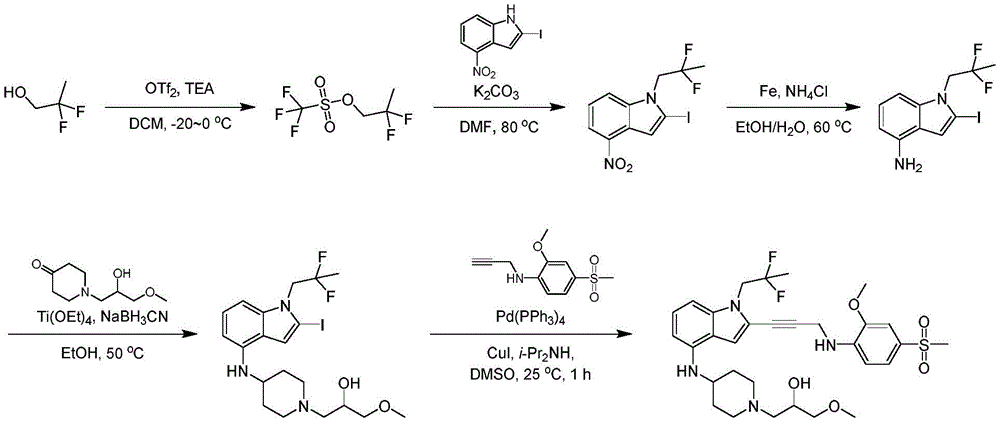
Preparation of 2, 2-difluoropropyl trifluoromethanesulfonate: to a solution of 2, 2-difluoropropan-1-ol (0.5g,5.20mmol,1 eq) in DCM (5mL) was added TEA (1.05g,10.41mmol,1.45mL,2 eq) and trifluoromethanesulfonyl trifluoromethanesulfonate (1.91g,6.77mmol,1.12mL,1.3 eq) dropwise at-20 ℃. The mixture was stirred at-20 deg.C-0 deg.C for 12 hours. The reaction mixture was diluted by addition of DCM (20mL) and the resulting mixture was poured into ice water (100mL) and extracted with DCM (25mL × 2). The combined organic layers were washed with 20% Na 2 CO 3 Aqueous solution (100mL x 2), water (100mL x 2) and brine (100mL x 2), dried over anhydrous sodium sulfate, filtered and concentrated under reduced pressure. The crude product (0.6g, crude) was obtained as a dark brown oil and used in the next step without purification.
Preparation of 1- (2, 2-difluoropropyl) -2-iodo-4-nitro-1H-indole: to a solution of 2-iodo-4-nitro-1H-indole (0.2g, 694.34. mu. mol,1 eq) in DMF (3mL) was added 2, 2-difluoropropyl trifluoromethanesulfonate (396.02mg,1.74mmol,2.5 eq) and K 2 CO 3 (287.89mg,2.08mmol,3 equiv.). The mixture was stirred at 80 ℃ for 2 hours. TLC analysis indicated the reaction was complete. The reaction mixture was diluted with water (100mL) and extracted with EtOAc (50mL × 2). The combined organic layers were washed with water (100mL x 2) and brine (100mL x 2), dried over anhydrous sodium sulfate, filtered and concentrated under reduced pressure. The residue was passed through preparative TLC (SiO) 2 EtOAc ═ 4:1) to give the desired product (0.2g,546.30 μmol, 78.68% yield) as a yellow solid.
Preparation of 1- (2, 2-difluoropropyl) -2-iodo-1H-indol-4-amine: to 1- (2, 2-difluoropropyl) -2A solution of-iodo-4-nitro-1H-indole (0.18g, 491.67. mu. mol,1 eq.) in EtOH (4mL) was added NH 4 Aqueous Cl (68.37mg in 1mL of water, 1.28mmol) and Fe (82.38mg,1.47mmol,3 equiv.). The mixture was stirred at 60 ℃ for 1 hour. TLC analysis indicated the reaction was complete. The reaction mixture was filtered, extracted with EtOAc (50mL x 2), and washed with water (100mL x 2) and brine (100mL x 2). The organic layer was dried over anhydrous sodium sulfate, filtered and concentrated under reduced pressure to give a residue. The crude product (0.18g, crude) was obtained as a brown solid, which was used without purification. MS (ES) + ,m/z):337.0。
Preparation of 1- (4- ((1- (2, 2-difluoropropyl) -2-iodo-1H-indol-4-yl) amino) piperidin-1-yl) -3-methoxypropan-2-ol: to a mixture of 1- (2, 2-difluoropropyl) -2-iodo-1H-indol-4-amine (0.15g,357.02 μmol,1 eq) in EtOH (3mL) was added 1- (2-hydroxy-3-methoxy-propyl) piperidin-4-one (267.38mg,1.43mmol,4 eq) and titanium tetraethoxide (162.88mg,714.03 μmol,148.07 μ L,2 eq). The mixture was stirred at 50 ℃ for 1 hour and NaBH was added 3 CN (44.87mg, 714.03. mu. mol,2 equiv.). The resulting mixture was stirred at 50 ℃ for 1 hour. TLC analysis indicated the reaction was complete. By adding saturated NaHCO 3 The reaction mixture was quenched with aqueous (100mL) and EtOAc (50 mL). The mixture was filtered and concentrated under reduced pressure. The solution was extracted with EtOAc (50 mL. times.2). The combined organic layers were washed with water (100mL x 2) and brine (100mL x 2), dried over anhydrous sodium sulfate, filtered and concentrated under reduced pressure to give a residue. The residue was passed through preparative TLC (SiO) 2 DCM: MeOH ═ 10:1) gave the desired product (0.15g,295.65 μmol, 82.81% yield) as a brown oil. MS (ES) + ,m/z):508.2。
1- (4- { [1- (2, 2-difluoropropyl) -2- {3- [ (4-methanesulfonyl-2-methoxyphenyl) amino]Prop-1-yn-1-yl } -1H-indol-4-yl]Preparation of amino } piperidin-1-yl) -3-methoxypropan-2-ol: to a solution of 2-methoxy-4-methylsulfonyl-N-prop-2-ynyl-aniline (35.37mg, 147.83. mu. mol,1.5 eq) in DMSO (3mL) was added i-Pr 2 NH (99.72mg, 985.50. mu. mol, 139.28. mu.L, 10 equivalents), CuI (3.75mg, 19.71. mu. mol,0.2 equivalents), 1- (4- ((1- (2, 2-difluoropropyl) -2-iodo-1H-indol-4-yl) amino) piperidin-1-yl) -3-methoxypropan-2-ol (50mg, 98.55. mu. mol,1 eq.) and Pd (PPh) 3 ) 4 (11.39mg, 9.86. mu. mol,0.1 equiv.). In N 2 The mixture was then stirred at 25 ℃ for 1 hour. LC-MS analysis indicated that the reaction was complete. The reaction mixture was quenched at 25 ℃ by the addition of saturated aqueous EDTA (50mL) and EtOAc (25 mL). The mixture was filtered and extracted with EtOAc (50mL x 2), washed with water (100mL x 2) and brine (100mL x 2). The combined organic layers were dried over anhydrous sodium sulfate, filtered and concentrated under reduced pressure to give a residue. The residue was passed through preparative TLC (SiO) 2 DCM: MeOH ═ 10:1) and preparative HPLC gave the desired product (23.3mg,37.66 μmol, 38.21% yield) as a white solid. MS (ES) + ,m/z):619.3。
Example D76: synthesis of compounds 466A, 467A, 991A, 1035A, and 1051A.

Preparation of 4- (methylsulfonyl) -1-nitro-2- (2,2, 2-trifluoroethoxy) benzene: to a solution of 5- (methylsulfonyl) -2-nitrophenol (1.50g,6.91mmol,1 eq) in DMF (10mL) was added K 2 CO 3 (2.87g,20.73mmol,3 equiv.) and 2,2, 2-trifluoroethyl trifluoromethanesulfonate (2.41g,10.37mmol,1.50 equiv.). The mixture was stirred at 50 ℃ for 3 hours. HPLC analysis indicated the reaction was complete. The residue was poured into water (50mL) and the aqueous phase was extracted with EtOAc (50mL x 3). The combined organic layers were washed with brine (50mL x3), dried over anhydrous sodium sulfate, filtered, and concentrated in vacuo to give the desired product (1.70g, crude) as a yellow solid.
Preparation of 4- (methylsulfonyl) -2- (2,2, 2-trifluoroethoxy) aniline: to a solution of 4- (methylsulfonyl) -1-nitro-2- (2,2, 2-trifluoroethoxy) benzene (1.70g,5.68mmol,1 eq) in EtOH (20mL) was added NH 4 Aqueous Cl (3.04g of 2mL aqueous solution, 56.81mmol,10 equiv.). The mixture was heated to 70 ℃ and Fe (3.17g,56.81mmol,10 equiv.) was added to the mixture. The resulting reaction mixture was further stirred at 70 ℃ for 2 hours. LC-MS and HPLC analysis indicated the starting materialAnd (4) remaining. An additional portion of Fe (3.17g,56.81mmol,10 equiv.) was added to the reaction and the mixture was stirred at 70 ℃ for a further 3 h. LC-MS analysis indicated that the reaction was complete. The residue was poured into saturated NaHCO 3 Aqueous (100mL) and EtOAc (40mL) was added. The mixture was filtered through a pad of celite and the aqueous phase was extracted with EtOAc (40mL x 3). The combined organic layers were dried over anhydrous sodium sulfate, filtered, and concentrated in vacuo to give the desired product (1.30g, crude) as a dark brown oil. MS (ES) + ,m/z):270.1。
Preparation of 4- (methylsulfonyl) -N- (prop-2-yn-1-yl) -2- (2,2, 2-trifluoroethoxy) aniline: to a solution of 4- (methylsulfonyl) -2- (2,2, 2-trifluoroethoxy) aniline (1.20g,4.46mmol,1 eq) in DMF (15mL) was added 3-bromoprop-1-yne (1.06g,8.92mmol, 768.93. mu.L, 2 eq) and K 2 CO 3 (1.85g,13.38mmol,3 equiv.). The mixture was heated to 70 ℃ and stirred for 12 hours. TLC analysis indicated 60% starting material remained. An additional portion of 3-bromoprop-1-yne (1.06g,8.92mmol,768.93 μ L,2 equiv.) was added to the reaction and the mixture was stirred at 70 ℃ for 3 hours. TLC analysis indicated 40% starting material remained. A third portion of 3-bromoprop-1-yne (1.06g,8.92mmol,768.93 μ L,2 equiv.) was added to the reaction and the mixture was stirred at 70 ℃ for 3 hours. TLC analysis indicated 20% starting material remained. The residue was poured into water (50mL) and the aqueous phase was extracted with EtOAc (40mL x 3). The combined organic layers were washed with brine (50mL x 3), dried over anhydrous sodium sulfate, filtered and concentrated in vacuo. The crude residue was purified by silica gel chromatography (PE: EtOAc ═ 10:1 to 5:1) to give the desired product (800mg,2.21mmol, 49.56% yield) as a yellow solid.

Preparation of 4- (methylsulfonyl) -2- (trifluoromethoxy) aniline: to a mixture of 4-bromo-2- (trifluoromethoxy) aniline (0.5g,1.95mmol,295.86 μ L,1 equiv.) and sodium methylsulfate (598.13mg,5.86mmol,3 equiv.) in DMSO (8mL) was added proline (112.42mg,976.49 μmol,0.5 equiv.) and CuI (148.78mg, 781.1) 9 μmol,0.4 eq). The reaction mixture was stirred at 100 ℃ for 16 hours. LC-MS and TLC analysis (PE: EtOAc ═ 1:1, R) f 0.4) indicated that 50% of the starting material remained and a major new spot was detected, which was more polar than the starting material. The reaction mixture was poured into a saturated aqueous EDTA solution (50mL) and stirred at 20 ℃ for 1 hour. The mixture was then extracted with EtOAc (50mL x 3). The combined organic layers were washed with brine (50mL x 3), dried over anhydrous sodium sulfate, filtered and concentrated under reduced pressure. The crude residue is purified by column chromatography (SiO) 2 EtOAc ═ 10:1 to 1:1) to give the desired product (0.13g,509.38 μmol, 26.08% yield) as a white solid. MS (ES) + ,m/z):258.2。
Preparation of N, N-bis (tert-butoxycarbonyl) -4- (methylsulfonyl) -2- (trifluoromethoxy) aniline: a mixture of 4- (methylsulfonyl) -2- (trifluoromethoxy) aniline (0.08g,313.46 μmol,1 eq) and di-tert-butyl dicarbonate (136.82mg,626.92 μmol,144.03 μ L,2 eq) in dioxane (2mL) was added DMAP (38.30mg,313.46 μmol,1 eq). The mixture was stirred at 110 ℃ for 12 hours. LC-MS analysis indicated complete consumption of starting material and detection of two new main peaks of the desired mass. The reaction mixture was poured into water (20mL) and extracted with EtOAc (20mL x 3). The combined organic layers were washed with 30mL brine (10mL x 3), dried over anhydrous sodium sulfate, filtered and concentrated under reduced pressure. The crude residue was purified by preparative TLC (PE: EtOAc ═ 2:1, R) f2 Purification ═ 0.4) to give the desired product (0.12g,233.44 μmol, 93.09% yield) as a white solid.
Preparation of tert-butyl (4- (methylsulfonyl) -2- (trifluoromethoxy) phenyl) carbamate: n, N-bis (tert-butoxycarbonyl) -4- (methylsulfonyl) -2- (trifluoromethoxy) aniline (120mg, 231.86. mu. mol,4.68 eq.) and K 2 CO 3 A mixture of (34.23mg, 247.66. mu. mol,5 equiv.) in MeOH (5mL) was stirred at 20 ℃ for 2 h. TLC analysis (PE: EtOAc ═ 2:1, R) f 0.4) indicated complete consumption of starting material and a new spot of the desired product was detected. The reaction mixture was concentrated under reduced pressure to remove the solvent. The residue was diluted with water (20mL) and extracted with EtOAc (20mL × 3).The combined organic layers were washed with brine (20mL x 3), dried over anhydrous sodium sulfate, filtered and concentrated under reduced pressure to give the crude product (0.075g, crude) as a yellow solid.
Preparation of tert-butyl (4- (methylsulfonyl) -2- (trifluoromethoxy) phenyl) (prop-2-yn-1-yl) carbamate: to a solution of tert-butyl (4- (methylsulfonyl) -2- (trifluoromethoxy) phenyl) carbamate (0.24g, 675.43. mu. mol,1 eq) in DMF (8mL) at 0 ℃ was added NaH (54.03mg,1.35mmol, 60% in mineral oil, 2 eq). The mixture was stirred at 0 ℃ for 0.5 h. A solution of 3-bromoprop-1-yne (120.52mg,1.01mmol, 87.34. mu.L, 1.5 equiv.) in DMF (1mL) was added dropwise to the reaction mixture, and the mixture was stirred at 0 ℃ for 0.5 h and at 20 ℃ for 0.5 h. TLC analysis (PE: EtOAc ═ 2:1, R) f 0.3) indicates complete consumption of the starting material. The reaction mixture was poured into water (10mL) and extracted with EtOAc (10mL x 3). The combined organic layers were washed with brine (5mL x 3), dried over anhydrous sodium sulfate, filtered and concentrated under reduced pressure to give a residue. The crude residue is purified by column chromatography (SiO) 2 PE: EtOAc 10:1 to 2:1) gave the desired product (0.24g,488.08 μmol, 72.26% yield) as a pale yellow oil.
Preparation of 4- (methylsulfonyl) -N- (prop-2-yn-1-yl) -2- (trifluoromethoxy) aniline: a mixture of tert-butyl (4- (methylsulfonyl) -2- (trifluoromethoxy) phenyl) (prop-2-yn-1-yl) carbamate (0.05g, 101.68. mu. mol,1 eq.) and HCl/EtOAc (4M,2mL,78.68 eq.) was stirred at 20 ℃ for 2 h. HPLC analysis indicated complete consumption of starting material and a major peak was detected. The reaction mixture was concentrated under reduced pressure to give the desired product (0.03g, crude, HCl) as a light yellow solid.

To 4- (methylsulfonyl) -N- (prop-2-yn-1-yl) -2- (2,2, 2-trifluoroethoxy) aniline (62.08mg, 171.53. mu. mol,1.5 equivalents), 4- (methylsulfonyl) -N- (prop-2-yn-1-yl) -2- (trifluoromethoxy) aniline (50.01mg, 138.16. mu. mol,1.5 equivalents) or A mixture of 4- (methylsulfonyl) -N- (prop-2-yn-1-yl) -2- (trifluoromethoxy) aniline (29.93mg, 90.76. mu. mol,0.77 eq, HCl) in DMSO (1-10mL) was added i-Pr 2 NH (115.71mg,1.14mmol, 161.61. mu.L, 10 equivalents), CuI (21.78mg, 114.35. mu. mol,1 equivalent), 2-iodo-N-R 2 -1- (2,2, 2-trifluoroethyl) -1H-indol-4-amine (50mg, 114.35. mu. mol,1 eq.) and Pd (PPh) 3 ) 4 (26.43mg, 22.87. mu. mol,0.20 equiv.). The mixture is stirred at a temperature of 20-45 ℃ for 1-4 hours. TLC or LC-MS analysis was used to detect completion of the reaction. EtOAc (10mL) was poured into the mixture and the resulting mixture was poured into saturated aqueous EDTA (40 mL). The mixture was stirred for 15 min, and the aqueous phase was extracted with EtOAc (40mL × 2). The organic layer was poured into saturated aqueous EDTA (40mL) and stirred for 1 hour. The aqueous phase was extracted with EtOAc (40 mL. times.3). The combined organic layers were washed with brine (40mL x 3), dried over anhydrous sodium sulfate, combined with activated carbon, filtered and concentrated in vacuo. The mixture was purified by preparative TLC or column chromatography and then once or twice again by preparative HPLC to give the desired product.
N- (1-methylpiperidin-4-yl) -2- (3- ((4- (methylsulfonyl) -2- (2,2, 2-trifluoroethoxy) phenyl) amino) prop-1-yn-1-yl) -1- (2,2, 2-trifluoroethyl) -1H-indol-4-amine, 24.7mg, 31.7% yield, MS (ES) + M/z) 617.2; 4- ((2- (3- ((4- (methylsulfonyl) -2- (2,2, 2-trifluoroethoxy) phenyl) amino) prop-1-yn-1-yl) -1- (2,2, 2-trifluoroethyl) -1H-indol-4-yl) amino) tetrahydro-2H-thiopyran 1, 1-dioxide, 8.1mg, 13.5% yield, MS (ES) + M/z) 652.1; 2- (3- { [ 4-Methylsulfonyl-2- (trifluoromethoxy) phenyl]Amino } prop-1-yn-1-yl) -N- (oxan-4-yl) -1- (2,2, 2-trifluoroethyl) -1H-indol-4-amine, 18.1mg, 26.1% yield, MS (ES) + M/z) 590.3; 2- (3- { [ 4-Methylsulfonyl-2- (trifluoromethoxy) phenyl]Amino } prop-1-yn-1-yl) -N- (1-methylpiperidin-4-yl) -1- (2,2, 2-trifluoroethyl) -1H-indol-4-amine, 38.2mg, 49.0% yield, MS (ES) + M/z) 603.1; 4- { [2- (3- { [ 4-methanesulfonyl-2- (trifluoromethoxy) phenyl]Amino } prop-1-yn-1-yl) -1- (2,2, 2-trifluoroethyl) -1H-indol-4-yl]Amino } -1. lambda 6 Thiane-1, 1-dione, 16.7mg, 24.7% yield, MS (ES) + ,m/z):638.1。
Example D77: synthesis of compounds 680A and 681A.
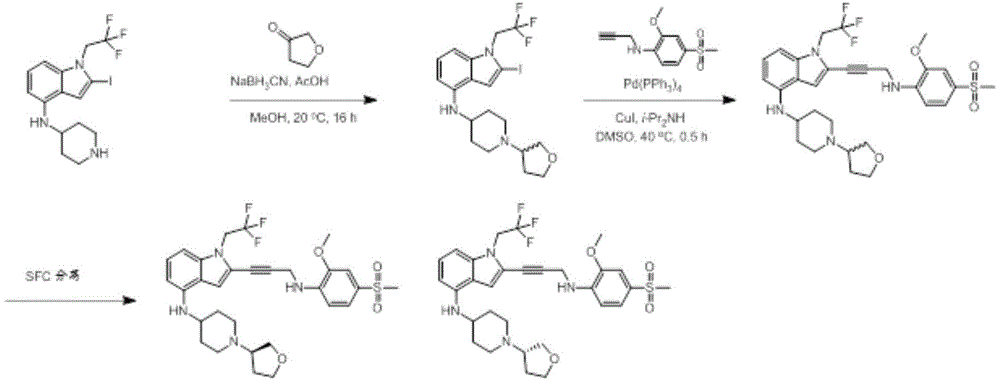
Preparation of 2-iodo-N- (1- (tetrahydrofuran-3-yl) piperidin-4-yl) -1- (2,2, 2-trifluoroethyl) -1H-indol-4-amine: to a mixture of 2-iodo-N- (piperidin-4-yl) -1- (2,2, 2-trifluoroethyl) -1H-indol-4-amine (10g,23.63mmol,1 eq) and tetrahydrofuran-3-one (8.14g,94.51mmol,4 eq) in MeOH (100mL) was added NaBH 3 CN (4.45g,70.89mmol,3 equiv.) and AcOH (1.42g,23.63mmol,1.35mL,1 equiv.). The mixture was stirred at 20 ℃ for 16 hours. TLC analysis (R) f 0.6 EtOAc: TEA ═ 10:1) indicated that most of the starting material was consumed. With saturated NaHCO 3 The mixture was extracted with solution (300mL) and EtOAc (350mL x 3). The organic layer was washed with brine (300mL), dried over anhydrous sodium sulfate, filtered and concentrated. The residue was purified by column chromatography (SiO) 2 PE: EtOAc ═ 3:1 to 0:1) to give the desired product (8.3g,15.14mmol, 64.09% yield) as a pale white solid.
Preparation of 2-iodo-N- (piperidin-4-yl) -1- (2,2, 2-trifluoroethyl) -1H-indol-4-amine: 2-iodo-N- (1- (tetrahydrofuran-3-yl) piperidin-4-yl) -1- (2,2, 2-trifluoroethyl) -1H-indol-4-amine (6g,12.16mmol,1 eq), 2-methoxy-4-methylsulfonyl-N-prop-2-ynyl-aniline (3.78g,15.81mmol,1.3 eq), i-Pr 2 NH (12.31g,121.63mmol,17.19mL,10 equiv.), CuI (1.16g,6.08mmol,0.5 equiv.), and Pd (PPh) 3 ) 4 (1.41g,1.22mmol,0.1 equiv.) mixture in DMSO (60mL) was degassed and treated with N 2 Purging was carried out three times. At N 2 The mixture was then stirred at 20 ℃ for 1 hour. TLC analysis (R) f EtOAc: TEA ═ 10:1) indicated completion of the reaction. Saturated aqueous EDTA (200mL) and EtOAc (200mL) were added to the mixture and stirred for 1 hour. The mixture was then extracted with EtOAc (200mL x 3). The organic layer was washed with brine (150mL x 3), dried over anhydrous sodium sulfate, filtered and concentrated. The residue was purified by column chromatography (SiO) 2 PE: EtOAc ═ 3:1 to 0:1) and preparative HPLC purification. Purifying the residueFurther purification by SFC afforded the desired product.
(R) -2- (3- ((2-methoxy-4- (methylsulfonyl) phenyl) amino) prop-1-yn-1-yl) -N- (1- (tetrahydrofuran-3-yl) piperidin-4-yl) -1- (2,2, 2-trifluoroethyl) -1H-indol-4-amine (0.075g, 124.03. mu. mol, 1.02% yield), MS (ES) + M/z) 605.3; (S) -2- (3- ((2-methoxy-4- (methylsulfonyl) phenyl) amino) prop-1-yn-1-yl) -N- (1- (tetrahydrofuran-3-yl) piperidin-4-yl) -1- (2,2, 2-trifluoroethyl) -1H-indol-4-amine (0.085g, 140.57. mu. mol, 1.16% yield), MS (ES) + ,m/z):605.3。
Example D78: synthesis of compounds 878A and 879A.

To a mixture of methyl 4- ((3- (4- (((3S,4S) -3-fluoropiperidin-4-yl) amino) -1- (2,2, 2-trifluoroethyl) -1H-indol-2-yl) prop-2-yn-1-yl) amino) -3-methoxybenzoate (0.15g, 281.67. mu. mol,1 eq) and (2R) -2- (methoxymethyl) oxirane (124.08mg,1.41mmol, 125.33. mu.L, 5 eq) in DMF (5mL) was added K 2 CO 3 (116.79mg, 845.02. mu. mol,3 equiv.). The mixture was stirred at 50 ℃ for 12 hours. TLC analysis (EtOAc: TEA ═ 10:1, R f 0.75) a new blob is detected. The reaction mixture was quenched by the addition of water (10mL) and then extracted with EtOAc (10mL x 3). The combined organic layers were washed with brine (10mL x 3), dried over anhydrous sodium sulfate, filtered and concentrated under reduced pressure to give a residue. The residue was purified by preparative HPLC to give 4- [3- [4- [ [ (3R,4S) -3-fluoro-1- [ (2R) -2-hydroxy-3-methoxy-propyl ] -ethyl acetate ]-4-piperidinyl group]Amino group]-1- (2,2, 2-trifluoroethyl) indol-2-yl]Prop-2-ynylamino]-3-methoxy-benzoic acid methyl ester (0.07g,107.15 μmol, 38.04% yield) as a yellow solid.
The residue was separated by SFC to give 4- [3- [4- [ [ (3R,4S) -3-fluoro-1- [ (2R) -2-hydroxy-3-methoxy-propyl ] -ethyl acetate]-4-piperidinyl group]Amino group]-1- (2,2, 2-trifluoroethyl) indol-2-yl]Prop-2-ynylamino]-3-methoxy-benzoic acid methyl ester (0.03g,47.76 μmol, 41% yield). MS (ES) + M/z) 621.3. And 4- [3- [4 ]- [ [ (3S,4R) -3-fluoro-1- [ (2R) -2-hydroxy-3-methoxy-propyl ] ester]-4-piperidinyl group]Amino group]-1- (2,2, 2-trifluoroethyl) indol-2-yl]Prop-2-ynylamino]-3-methoxy-benzoic acid methyl ester (0.03g,46.69 μmol, 40% yield). MS (ES) + ,m/z):621.4。
Example D79: synthesis of compounds 783A and 784A.

Preparation of 4- ((3- (4-amino-1- (2,2, 2-trifluoroethyl) -1H-indol-2-yl) prop-2-yn-1-yl) amino) -3-methoxy-N-methylbenzamide: 2-iodo-1- (2,2, 2-trifluoroethyl) -1H-indol-4-amine hydrochloride (1g,2.94mmol,1 eq), 3-methoxy-N-methyl-4- (prop-2-yn-1-ylamino) benzamide (770.11mg,3.53mmol,1.2 eq), CuI (560.01mg,2.94mmol,1 eq), Pd (PPh) 3 ) 4 (679.58mg, 588.09. mu. mol,0.2 eq.) and i-Pr 2 A mixture of NH (2.98g,29.40mmol,4.16mL,10 equiv.) in DMSO (10mL) was degassed and N added 2 Purging was carried out three times. At N 2 The mixture was then stirred at 20 ℃ for 1 hour. TLC analysis (PE: EtOAc ═ 5:1, R) f =0;PE:EtOAc=0:1,R f 0.5) indicates that a major new spot is formed. The reaction mixture was quenched by the addition of saturated aqueous EDTA (40mL) and stirred for 1 hour. The mixture was diluted with EtOAc (20mL) and extracted with EtOAc (20mL x 3). The combined organic layers were washed with brine (15mL x 3), dried over anhydrous sodium sulfate, filtered and concentrated under reduced pressure to give a residue. The crude product was triturated with DCM at 20 ℃ for 10 min. The residue was purified by column chromatography (SiO) 2 PE: EtOAc ═ 2:1 to 0:1) purification afforded the desired product (1.1g,2.04mmol, 69.53% yield) as a yellow solid.
Preparation of tert-butyl (3R,4S) -3-fluoro-4- ((2- (3- ((2-methoxy-4- (methylcarbamoyl) phenyl) amino) prop-1-yn-1-yl) -1- (2,2, 2-trifluoroethyl) -1H-indol-4-yl) amino) piperidine-1-carboxylate: to 4- ((3- (4-amino-1- (2,2, 2-trifluoroethyl) -1H-indol-2-yl) prop-2-yn-1-yl) amino) -3-methoxy-N-methylbenzamide (0.9g,2.09mmol,1 eq) and 3-fluoro-4-oxopiperonate at 0 deg.CA mixture of pyridine-1-carboxylic acid tert-butyl ester (2.27g,10.45mmol,5 equiv.) in DMF (10mL) was added TMSCl (567.92mg,5.23mmol, 663.46. mu.L, 2.5 equiv.). The resulting mixture was stirred at 0 ℃ for 1 hour, and BH was added at 0 ℃ to 3 THF (1M,6.27mL,3 equivalents) was added to the reaction. The mixture was further stirred at 0 ℃ for 1 hour. TLC analysis (PE: EtOAc ═ 0:1, R f 0.55) indicated that starting material remained and a new spot was detected. By adding saturated Na 2 CO 3 The reaction mixture was quenched with aqueous solution (30mL), diluted with water (30mL), and extracted with EtOAc (30mL × 3). The combined organic layers were washed with brine (30mL x 3), dried over anhydrous sodium sulfate, filtered and concentrated under reduced pressure to give a residue. The residue was purified by column chromatography (SiO) 2 EtOAc ═ 3:1 to 0:1) and preparative HPLC purification afforded the desired product and tert-butyl (3S,4S) -3-fluoro-4- ((2- (3- ((2-methoxy-4- (methylcarbamoyl) phenyl) amino) prop-1-yn-1-yl) -1- (2,2, 2-trifluoroethyl) -1H-indol-4-yl) amino) piperidine-1-carboxylate as a yellow solid.
Preparation of 4- ((3- (4- (((3R,4S) -3-fluoropiperidin-4-yl) amino) -1- (2,2, 2-trifluoroethyl) -1H-indol-2-yl) prop-2-yn-1-yl) amino) -3-methoxy-N-methylbenzamide: in N 2 Next, a solution of (3R,4S) -3-fluoro-4- ((2- (3- ((2-methoxy-4- (methylcarbamoyl) phenyl) amino) prop-1-yn-1-yl) -1- (2,2, 2-trifluoroethyl) -1H-indol-4-yl) amino) piperidine-1-carboxylic acid tert-butyl ester (0.65g,1.03mmol,1 eq) in HCl/EtOAc (20mL,4M) was stirred at 20 ℃ for 0.5H. TLC analysis (DCM: MeOH ═ 10:1, R) f 0.1) indicated complete consumption of starting material and a new spot was detected. By adding saturated NaHCO 3 The reaction mixture was quenched with aqueous (30mL), the mixture was diluted with water (30mL), and the mixture was extracted with EtOAc (40mL x 3). The combined organic layers were washed with brine (20mL x 3), dried over anhydrous sodium sulfate, filtered and concentrated under reduced pressure to give a residue. The crude product (0.5g,846.59 μmol, 82.27% yield) was obtained as a yellow solid and was used without purification.
4- ((3- (4- (((3R,4S) -3-fluoro-1-methylpiperidin-4-yl) amino) -1- (2,2, 2-trifluoroethyl) -1H-indol-2-yl) prop-2-yn-1-yl) amino) -3-Preparation of methoxy-N-methylbenzamide: to a solution of 4- ((3- (4- (((3R,4S) -3-fluoropiperidin-4-yl) amino) -1- (2,2, 2-trifluoroethyl) -1H-indol-2-yl) prop-2-yn-1-yl) amino) -3-methoxy-N-methylbenzamide (169.49mg,5.64mmol,10 equivalents) and paraformaldehyde (169.49mg,5.64mmol,10 equivalents) in MeOH (3mL) was added NaBH 3 CN (106.40mg,1.69mmol,3 equiv.) and AcOH (33.89mg, 564.39. mu. mol, 32.28. mu.L, 1 equiv.). Degassing the mixture and applying N 2 Purge three times, then at N 2 The mixture was stirred at 20 ℃ for 12 hours. TLC analysis (DCM: MeOH ═ 10:1, R) f 0.6) indicated that starting material remained and a major new spot was detected. By adding saturated Na 2 CO 3 The reaction mixture was quenched with aqueous solution (30mL), diluted with water (30mL), and extracted with EtOAc (30mL × 3). The combined organic layers were washed with brine (20mL x 3), dried over anhydrous sodium sulfate, filtered and concentrated under reduced pressure to give a residue. The residue was passed through preparative TLC (SiO) 2 DCM: MeOH ═ 10:1) gave the desired product (0.11g,189.53 μmol, 33.58% yield) as a yellow solid.
Separating the residue by SFC to obtain 4- [3- [4- [ [ (3R,4S) -3-fluoro-1-methyl-4-piperidinyl group]Amino group]-1- (2,2, 2-trifluoroethyl) indol-2-yl]Prop-2-ynylamino]-3-methoxy-N-methyl-benzamide (0.06g,107.34 μmol, 45% yield) as a yellow solid. MS (ES) + M/z) 546.3 and 4- [3- [4- [ [ (3S,4R) -3-fluoro-1-methyl-4-piperidinyl]Amino group]-1- (2,2, 2-trifluoroethyl) indol-2-yl]Prop-2-ynylamino]-3-methoxy-N-methyl-benzamide (0.055g,98.90 μmol, 42% yield). MS (ES) + ,m/z):546.3。
Example D80: synthesis of 4- ((3- (4- (((3R,4S) -3-fluoro-1-methylpiperidin-4-yl) amino) -1- (2,2, 2-trifluoroethyl) -1H-indol-2-yl) prop-2-yn-1-yl) amino) -N-isopropyl-3-methoxybenzamide (compound 807A).

To 4- ((3- (4- (((3R,4S) -3-fluoro-1-methylpiperidin-4-yl) amino) -1- (2,2, 2-trifluoroethyl) -1H-indol-2-yl)) Prop-2-yn-1-yl) amino) -3-methoxybenzoic acid (0.1g, 187.78. mu. mol,1 eq), prop-2-amine (22.20mg, 375.57. mu. mol, 32.27. mu.L, 2 eq), TEA (114.01mg,1.13mmol, 156.82. mu.L, 6 eq) in DMF (3mL) was added to a mixture (358.49mg, 563.35. mu. mol, 335.04. mu.L, 50% pure, 3 equivalents). At N 2 The mixture was then stirred at 50 ℃ for 3 hours. TLC analysis (DCM: MeOH ═ 10:1, R) f 0.36) indicated that the starting material was consumed and a major new spot was detected. The reaction mixture was quenched by addition of water (30mL) and extracted with EtOAc (20mL x 3). The combined organic layers were washed with brine (15mL x 3), dried over anhydrous sodium sulfate, filtered and concentrated under reduced pressure to give a residue. The residue was passed through preparative TLC (SiO) 2 EtOAc: TEA ═ 10:1) and further purified by preparative HPLC to give 4- [3- [4- [ [ (3R,4S) -3-fluoro-1-methyl-4-piperidinyl]Amino group]-1- (2,2, 2-trifluoroethyl) indol-2-yl]Prop-2-ynylamino]-N-isopropyl-3-methoxy-benzamide (0.04g,68.97 μmol, 37% yield) as a white solid. MS (ES) + ,m/z):574.2。
Example D81: synthesis of (4- ((3- (4- (((3S,4R) -3-fluoro-1-methylpiperidin-4-yl) amino) -1- (2,2, 2-trifluoroethyl) -1H-indol-2-yl) prop-2-yn-1-yl) amino) -3-methoxybenzoyl) glycine (Compound 896A).

Preparation of (4- ((3- (4- (((3S,4R) -3-fluoro-1-methylpiperidin-4-yl) amino) -1- (2,2, 2-trifluoroethyl) -1H-indol-2-yl) prop-2-yn-1-yl) amino) -3-methoxybenzoyl) glycine: in N 2 Next, to a mixture of 4- ((3- (4- (((3S,4R) -3-fluoro-1-methylpiperidin-4-yl) amino) -1- (2,2, 2-trifluoroethyl) -1H-indol-2-yl) prop-2-yn-1-yl) amino) -3-methoxybenzoic acid (0.1g, mmol,1 eq) and methyl 2-aminoacetate hydrochloride (35.71mg, 220.38. mu. mol,1.2 eq, HCl) in DMF (2mL) at 25 ℃ were added DIPEA (71.21mg,3 eq) and HATU (104.75mg,1.5 mmAmount). The mixture was stirred at 25 ℃ for 1 hour. TLC analysis (DCM: MeOH ═ 10:1, R) f 0.4) indicating completion of the reaction. The residue was poured into water (10mL) and the aqueous phase was extracted with EtOAc (10mL × 3). The combined organic layers were washed with brine (10mL x 1), dried over anhydrous sodium sulfate, filtered and concentrated in vacuo. The crude product (0.1g, crude) was obtained as a pale yellow solid and used in the next step without purification.
Preparation of methyl (4- ((3- (4- (((3S,4R) -3-fluoro-1-methylpiperidin-4-yl) amino) -1- (2,2, 2-trifluoroethyl) -1H-indol-2-yl) prop-2-yn-1-yl) amino) -3-methoxybenzoyl) glycinate: to a solution of (4- ((3- (4- (((3S,4R) -3-fluoro-1-methylpiperidin-4-yl) amino) -1- (2,2, 2-trifluoroethyl) -1H-indol-2-yl) prop-2-yn-1-yl) amino) -3-methoxybenzoyl) glycine (80mg,132.54 μmol,1 eq) in THF (1mL), water (1mL) and MeOH (1mL) was added NaOH (10.60mg,265.07 μmol,2 eq) and LiOH 2 O (11.12mg, 265.07. mu. mol,2 equiv.). The mixture was stirred at 50 ℃ for 2 hours. TLC analysis (DCM: MeOH ═ 10:1, R) f 0.1) indicating completion of the reaction. The residue was poured into water (10mL) and 1M aqueous HCl was added to the mixture to adjust the pH to 5. The aqueous phase was extracted with EtOAc (10mL x 3). The combined organic layers were washed with brine (10mL x 1), dried over anhydrous sodium sulfate, filtered and concentrated in vacuo. The residue was purified by preparative HPLC to give the desired product as a light yellow solid (44%). MS (ES) + ,m/z):590.2。
Example D82: synthesis of compounds 906A, 907A, 917A and 962A.

In N 2 Next, a mixture of 4- ((3- (4- (((3S,4R) -3-fluoro-1-methylpiperidin-4-yl) amino) -1- (2,2, 2-trifluoroethyl) -1H-indol-2-yl) prop-2-yn-1-yl) amino) -3-methoxybenzoic acid (80mg, 146.92. mu. mol,1 equivalent) R-amine (33.35mg, 176.31. mu. mol,1.2 equivalents) and TEA (74.34mg, 734.61. mu. mol, 102.25. mu.L, 5 equivalents) in DMF (3mL) was added dropwise at 0 deg.C (140.24mg, 220.38. mu. mol, 131.07. mu.L, 50% pure, 1.5 equivalents). The mixture was stirred at 25 ℃ for 1 hour. TLC analysis indicated complete consumption of starting material and a new spot was detected. The reaction mixture was quenched by addition of water (5mL) and extracted with EtOAc (5mL × 3). The combined organic layers were washed with brine (5mL x 3), dried over anhydrous sodium sulfate, filtered and concentrated under reduced pressure to give a residue. The residue was purified by preparative HPLC to give the desired product as a yellow solid.
N- [ (3S,4R) -3-fluoro-1-methylpiperidin-4-yl]-2- {3- [ (2-methoxy-4- { 2-oxa-6-azaspiro [3.3 ]]Heptane-6-carbonyl } phenyl) amino]Prop-1-yn-1-yl } -1- (2,2, 2-trifluoroethyl) -1H-indol-4-amine, (28.3mg, 36.9% yield) MS (ES) + M/z) 614.3; n- [ (3S,4R) -3-fluoro-1-methylpiperidin-4-yl]-2- {3- [ (2-methoxy-4- { 7-oxa-2-azaspiro [3.5 ]]Nonane-2-carbonyl } phenyl) amino]Prop-1-yn-1-yl } -1- (2,2, 2-trifluoroethyl) -1H-indol-4-amine, (13.7mg, 13.9% yield) MS (ES) + M/z) 642.3; n- (2, 3-dihydroxypropyl) -4- { [3- (4- { [ (3S,4R) -3-fluoro-1-methylpiperidin-4-yl]Amino } -1- (2,2, 2-trifluoroethyl) -1H-indol-2-yl) prop-2-yn-1-yl]Amino } -3-methoxybenzamide, (32.7mg, 36.5% yield) MS (ES) + M/z) 606.3; 4- { [3- (4- { [ (3S,4R) -3-fluoro-1-methylpiperidin-4-yl]Amino } -1- (2,2, 2-trifluoroethyl) -1H-indol-2-yl) prop-2-yn-1-yl]Amino } -3-methoxy-N- (1, 3-thiazol-2-yl) benzamide, (13.7mg, 14.9% yield) MS (ES) + ,m/z):615.2。
Example D83: synthesis of compounds 957A, 960A and 963A.
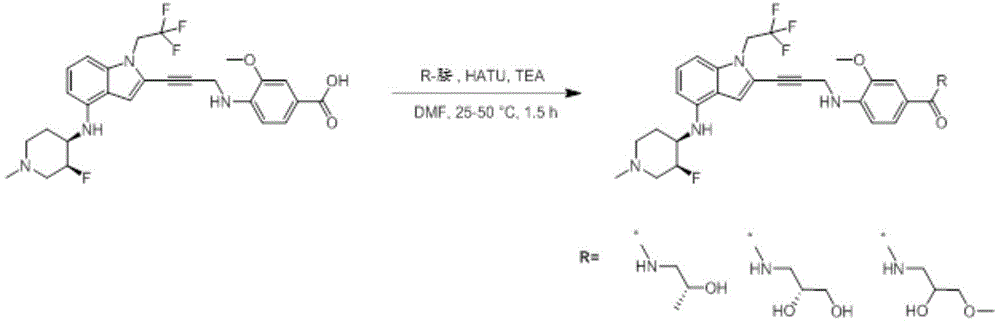
In N 2 Next, Et is added in one portion to a solution of 4- ((3- (4- (((3S,4R) -3-fluoro-1-methylpiperidin-4-yl) amino) -1- (2,2, 2-trifluoroethyl) -1H-indol-2-yl) prop-2-yn-1-yl) amino) -3-methoxybenzoic acid (70mg, 130. mu. mol,1 eq) and amine (19.53mg, 260. mu. mol, 20.47. mu.L, 2 eq) in DMF (2mL) at 25 ℃ 3 N(39.46mg,390.01μmol,54.28 μ L,3 eq) and HATU (74.15mg,195 μmol,1.5 eq). The mixture was stirred for 0.5 h and R-amine (2 eq) was added. The resulting reaction mixture was stirred at 50 ℃ for 1 hour. TLC analysis indicated complete consumption of starting material and a new spot was detected. The reaction mixture was quenched with water (5mL) and extracted with EtOAc (5mL × 3). The combined organic layers were washed with brine (5mL x 3), dried over anhydrous sodium sulfate, filtered and concentrated under reduced pressure to give a residue. The residue was purified by preparative HPLC to give the desired product as a yellow solid.
4- ((3- (4- (((3S,4R) -3-fluoro-1-methylpiperidin-4-yl) amino) -1- (2,2, 2-trifluoroethyl) -1H-indol-2-yl) prop-2-yn-1-yl) amino) -N- ((R) -2-hydroxypropyl) -3-methoxybenzamide, (28.8mg, 37.1% yield), MS (ES) + M/z) 590.2; n- [ (2R) -2, 3-dihydroxypropyl group]-4- { [3- (4- { [ (3S,4R) -3-fluoro-1-methylpiperidin-4-yl]Amino } -1- (2,2, 2-trifluoroethyl) -1H-indol-2-yl) prop-2-yn-1-yl]Amino } -3-methoxybenzamide, (32.7mg, 47.0% yield), MS (ES) + M/z) 606.2; 4- { [3- (4- { [ (3S,4R) -3-fluoro-1-methylpiperidin-4-yl]Amino } -1- (2,2, 2-trifluoroethyl) -1H-indol-2-yl) prop-2-yn-1-yl ]Amino } -N- (2-hydroxy-3-methoxypropyl) -3-methoxybenzamide, (34.3mg, 49.4% yield). MS (ES) + ,m/z):620.3。
Example D84: synthesis of 4- ((3- (4- (((3S,4R) -3-fluoro-1-methylpiperidin-4-yl) amino) -1- (2,2, 2-trifluoroethyl) -1H-indol-2-yl) prop-2-yn-1-yl) amino) -3-methoxy-N- ((2R,3R,4R,5S,6R) -2,4, 5-trihydroxy-6- (hydroxymethyl) tetrahydro-2H-pyran-3-yl) benzamide (compound 948A).

Preparation of 4- ((3- (4- (((3S,4R) -3-fluoro-1-methylpiperidin-4-yl) amino) -1- (2,2, 2-trifluoroethyl) -1H-indol-2-yl) prop-2-yn-1-yl) amino) -3-methoxy-N- ((2R,3R,4R,5S,6R) -2,4, 5-trihydroxy-6- (hydroxymethyl) tetrahydro-2H-pyran-3-yl) benzamide: in N 2 4- ((3- (4- (((3S,4R) -3-fluoro-1-methylpiperidin-4-yl) amino) -1 at 25 ℃ C- (2,2, 2-trifluoroethyl) -1H-indol-2-yl) prop-2-yn-1-yl) amino) -3-methoxybenzoic acid (0.1g, 183.65. mu. mol,1 eq) in CH 2 Cl 2 (0.5mL) and THF (0.5mL) were added DIPEA (118.68mg, 918.26. mu. mol, 159.94. mu.L, 5 equivalents), HATU (139.66mg, 367.30. mu. mol,2 equivalents) and [ (2R,3S,4R,5R,6S) -3,4, 6-triacetoxy-5-aminotetrahydropyran-2-yl]mEtOAc hydrochloride (154.36mg, 367.30. mu. mol,2 equivalents, HCl). The mixture was stirred at 50 ℃ for 2 hours. LC-MS analysis indicated the reaction was complete. The residue was poured into water (10mL) and the aqueous phase was extracted with EtOAc (10mL × 3). The combined organic layers were washed with brine (10mL x 1), dried over anhydrous sodium sulfate, filtered and concentrated in vacuo. The residue was passed through preparative TLC (SiO) 2 ,DCM:MeOH=20:1,R f Purification No. 0.4) afforded the desired product (150mg,147.94 μmol, 80.55% yield) as a light yellow solid.
Preparation of (2S,3R,4R,5S,6R) -6- (acetoxymethyl) -3- (4- ((3- (4- (((3S,4R) -3-fluoro-1-methylpiperidin-4-yl) amino) -1- (2,2, 2-trifluoroethyl) -1H-indol-2-yl) prop-2-yn-1-yl) amino) -3-methoxybenzamido) tetrahydro-2H-pyran-2, 4, 5-triyltriacetate: to a solution of 4- ((3- (4- (((3S,4R) -3-fluoro-1-methylpiperidin-4-yl) amino) -1- (2,2, 2-trifluoroethyl) -1H-indol-2-yl) prop-2-yn-1-yl) amino) -3-methoxy-N- ((2R,3R,4R,5S,6R) -2,4, 5-trihydroxy-6- (hydroxymethyl) tetrahydro-2H-pyran-3-yl) benzamide (140mg,138.08 μmol,1 eq) in THF (10mL) and MeOH (30mL) at 0 ℃ was added NaOMe (2.98g,13.81mmol,4mL, 25% purity, 100 eq). The mixture was stirred at 25 ℃ for 2 hours. LC-MS analysis indicated the reaction was complete. The reaction mixture was adjusted to pH 5 by dropwise addition of citric acid (100mL) and then lyophilized. The residue was purified by preparative HPLC to give the desired product (26.9mg,37.62 μmol,1 equivalent) as a light yellow solid. MS (ES) + ,m/z):694.3。
Example D85: synthesis of compounds 790A, 791A, 837A, 838A, 841A, 842A, 843A, and 844A.
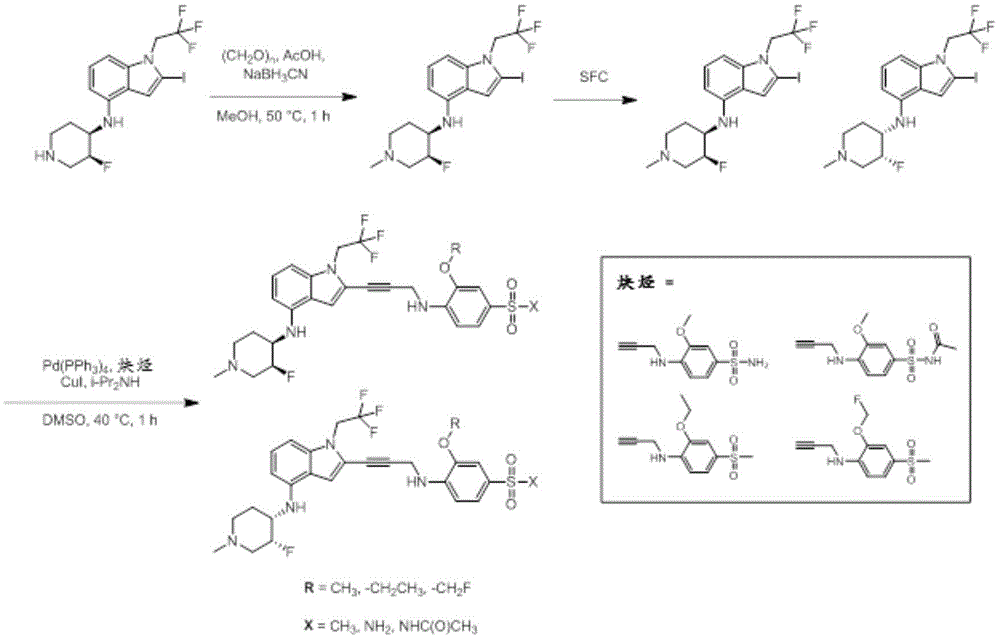
Preparation of N- ((3S,4R) -3-fluoro-1-methylpiperidin-4-yl) -2-iodo-1- (2,2, 2-trifluoroethyl) -1H-indol-4-amine and N- ((3R,4S) -3-fluoro-1-methylpiperidin-4-yl) -2-iodo-1- (2,2, 2-trifluoroethyl) -1H-indol-4-amine: to a mixture of N- ((3S,4R) -3-fluoropiperidin-4-yl) -2-iodo-1- (2,2, 2-trifluoroethyl) -1H-indol-4-amine (4.5g,10.20mmol,1 eq) and formaldehyde (1.53g,51mmol,1.40mL,5 eq) in MeOH (70mL) at 25 deg.C was added dropwise AcOH (612.49mg,10.20mmol, 583.33. mu.L, 1 eq). Then, NaBH is added 3 CN (1.28g,20.40mmol,2 equiv.) was added to the mixture. The mixture was stirred at 50 ℃ for 1 hour. TLC analysis indicated complete consumption of starting material and a new spot was detected. The mixture was poured over saturated Na 2 CO 3 Aqueous solution (500mL) and the mixture was stirred at 25 ℃ for 0.5 h. The mixture was extracted with EtOAc (200mL x 3). The combined organic layers were washed with brine (200mL x 3), dried over anhydrous sodium sulfate, filtered and concentrated to give a residue. The crude residue is purified by column chromatography (SiO) 2 PE: EtOAc ═ 3:1 to 2:1 to EtOAc: MeOH: TEA ═ 10:1:0.1 purification afforded N- ((3S,4R) -3-fluoro-1-methylpiperidin-4-yl) -2-iodo-1- (2,2, 2-trifluoroethyl) -1H-indol-4-amine as a white solid (3.9g, 78.9% yield).
Isolation of N- ((3S,4R) -3-fluoro-1-methylpiperidin-4-yl) -2-iodo-1- (2,2, 2-trifluoroethyl) -1H-indol-4-amine by SFC afforded the desired product. N- ((3S,4R) -3-fluoro-1-methylpiperidin-4-yl) -2-iodo-1- (2,2, 2-trifluoroethyl) -1H-indol-4-amine, (1.7g, 42.9% yield); and N- ((3R,4S) -3-fluoro-1-methylpiperidin-4-yl) -2-iodo-1- (2,2, 2-trifluoroethyl) -1H-indol-4-amine, (1.8g, 43.9% yield).
Preparation of the final product: to 3-methoxy-4- (prop-2-yn-1-ylamino) benzenesulfonamide; n- ((3-methoxy-4- (prop-2-yn-1-ylamino) phenyl) sulfonyl) acetamide; 2-ethoxy-4- (methylsulfonyl) -N- (prop-2-yn-1-yl) aniline (71.23mg,253.06 μmol,1.2 equivalents); or 2- (fluoromethoxy) -4- (methylsulfonyl) -N- (prop-2-yn-1-yl) aniline (67.82mg, 263.60. mu. mol,1.2 eq.) in DMSO (4mL) was added i-Pr 2 NH (129.85mg,2.20mmol, 188.73. mu.L, 10 equiv.), CuI (8.37mg, 43.93. mu. mol,0.2 equiv.), N- ((3S,4R) -3-fluoro-1-methylpiperidin-4-yl) -2-iodo-1- (2,2-trifluoroethyl) -1H-indol-4-amine (0.1g, 219.67. mu. mol,1 eq) or N- ((3R,4S) -3-fluoro-1-methylpiperidin-4-yl) -2-iodo-1- (2,2, 2-trifluoroethyl) -1H-indol-4-amine (0.1g, 219.67. mu. mol,1 eq) and Pd (PPh) 3 ) 4 (12.69mg, 10.98. mu. mol,0.05 eq.). The mixture was stirred at 40 ℃ for 1 hour. TLC analysis indicated complete consumption of starting material and a new spot was detected. The reaction mixture was quenched by the addition of saturated aqueous EDTA (30mL) and stirred at 20 ℃ for 1 hour. The mixture was then diluted with water (20mL) and extracted with EtOAc (30mL x 3). The combined organic layers were washed with brine (25mL x 3), dried over anhydrous sodium sulfate, filtered and concentrated under reduced pressure to give a residue. The residue was passed through preparative TLC (SiO) 2 DCM: MeOH ═ 10:1) and preparative HPLC purification gave the desired product. The residue was passed through preparative TLC (SiO) 2 DCM: MeOH ═ 10:1) and preparative HPLC purification gave the desired product.
4- { [3- (4- { [ (3R,4S) -3-fluoro-1-methylpiperidin-4-yl]Amino } -1- (2,2, 2-trifluoroethyl) -1H-indol-2-yl) prop-2-yn-1-yl]Amino } -3-methoxybenzene-1-sulphonamide, 28mg, 25% yield, MS (ES) + M/z) 568.3; 4- { [3- (4- { [ (3S,4R) -3-fluoro-1-methylpiperidin-4-yl]Amino } -1- (2,2, 2-trifluoroethyl) -1H-indol-2-yl) prop-2-yn-1-yl]Amino } -3-methoxybenzene-1-sulphonamide, 28.1mg, 23% yield, MS (ES) + M/z) 568.3; n- (4- { [3- (4- { [ (3S,4R) -3-fluoro-1-methylpiperidin-4-yl) ]Amino } -1- (2,2, 2-trifluoroethyl) -1H-indol-2-yl) prop-2-yn-1-yl]Amino } -3-methoxybenzenesulfonyl) acetamide, 30mg, 21% yield, MS (ES) + M/z) 610.2; n- (4- { [3- (4- { [ (3R,4S) -3-fluoro-1-methylpiperidin-4-yl)]Amino } -1- (2,2, 2-trifluoroethyl) -1H-indol-2-yl) prop-2-yn-1-yl]Amino } -3-methoxybenzenesulfonyl) acetamide, 30mg, 21% yield, MS (ES) + M/z) 610.2; 2- {3- [ (2-ethoxy-4-methanesulfonylphenyl) amino]Prop-1-yn-1-yl } -N- [ (3S,4R) -3-fluoro-1-methylpiperidin-4-yl]-1- (2,2, 2-trifluoroethyl) -1H-indol-4-amine, 22mg, 18% yield, MS (ES) + M/z) 581.1; 2- {3- [ (2-ethoxy-4-methanesulfonylphenyl) amino]Prop-1-yn-1-yl } -N- [ (3R,4S) -3-fluoro-1-methylpiperidin-4-yl]-1- (2,2, 2-trifluoroethyl) -1H-indol-4-amine, 38mg, 25%Yield, MS (ES) + M/z) 581.1; n- [ (3S,4R) -3-fluoro-1-methylpiperidin-4-yl]-2- (3- { [2- (fluoromethoxy) -4-methanesulfonylphenyl ] -methyl-o-phenyl]Amino } prop-1-yn-1-yl) -1- (2,2, 2-trifluoroethyl) -1H-indol-4-amine, 35mg, 27% yield, MS (ES) + M/z) 585.3; and N- [ (3R,4S) -3-fluoro-1-methylpiperidin-4-yl]-2- (3- { [2- (fluoromethoxy) -4-methanesulfonylphenyl]Amino } prop-1-yn-1-yl) -1- (2,2, 2-trifluoroethyl) -1H-indol-4-amine, 34.0mg, MS (ES) + ,m/z):585.3。
Example D86: synthesis of compounds 924A, 933A, 949A, 956A and 969A.

To a solution of 4- ((3- (4- (((3S,4R) -3-fluoro-1-methylpiperidin-4-yl) amino) -1- (2,2, 2-trifluoroethyl) -1H-indol-2-yl) prop-2-yn-1-yl) amino) -3-methoxybenzoic acid (0.07g,127.50 μmol,1 eq) in DMF (2mL) was added 2-morpholinoethylamine (33.20mg,255 μmol,33.47 μ L,2 eq), HATU (42.84mg,112.67 μmol,1.2 eq) and TEA (95.01mg,938.92 μmol,130.69 μ L,10 eq). The mixture was stirred at 25-50 ℃ for 2-3 hours. TLC analysis (DCM: MeOH ═ 10:1, R) f 0.30) indicated complete consumption of starting material and a new spot was detected. The reaction mixture was quenched by addition of water (15mL) and extracted with EtOAc (15mL x 3). The combined organic layers were washed with brine (10mL x 1), dried over anhydrous sodium sulfate, filtered and concentrated under reduced pressure. The residue was purified by preparative HPLC to give the desired product as a yellow solid.
2- [3- ({4- [4- (dimethylamino) piperidine-1-carbonyl)]-2-methoxyphenyl } amino) prop-1-yn-1-yl]-N- [ (3S,4R) -3-fluoro-1-methylpiperidin-4-yl]-1- (2,2, 2-trifluoroethyl) -1H-indol-4-amine, 38.0mg 44.1% yield, MS (ES) + M/z) 643.3; 4- { [3- (4- { [ (3S,4R) -3-fluoro-1-methylpiperidin-4-yl ]Amino } -1- (2,2, 2-trifluoroethyl) -1H-indol-2-yl) prop-2-yn-1-yl]Amino } -3-methoxy-N- [2- (morpholin-4-yl) ethyl]Benzamide, 25.0mg 41.1% yield, MS (ES) + M/z) 645.4; 4- ((3- (4- (((3S,4R) -3-fluoro-1-methylpiperidin-4-yl) amino) -1- (2,2, 2-trifluoroethyl) -1H-indol-2-yl) prop-2-yn-1-yl) amino) -N- (1-hydroxypropan-2-yl) -3-methoxybenzamide, 40.0mg, MS (ES) + M/z) 590.3; (2S) -4-carbamoyl-2- [ (4- { [3- (4- { [ (3S,4R) -3-fluoro-1-methylpiperidin-4-yl)]Amino } -1- (2,2, 2-trifluoroethyl) -1H-indol-2-yl) prop-2-yn-1-yl]Amino } -3-methoxyphenyl) carboxamides]Butyric acid methyl ester, 3.0mg MS (ES) + M/z) 675.3; and 4- { [3- (4- { [ (3S,4R) -3-fluoro-1-methylpiperidin-4-yl]Amino } -1- (2,2, 2-trifluoroethyl) -1H-indol-2-yl) prop-2-yn-1-yl]Amino } -N- (2-methanesulfonylethyl) -3-methoxybenzamide, 25.7% yield, MS (ES) + M/z) 638.1. [4- [3- [4- [ [ (3S,4R) -3-fluoro-1-methyl-4-piperidinyl group]Amino group]-1- (2,2, 2-trifluoroethyl) indol-2-yl]Prop-2-ynylamino]-3-methoxy-phenyl]- (2-oxa-6-azaspiro [3.3 ]]Hept-6-yl) methanone (0.02g, 32.23. mu. mol, 79% yield), MS (ES) + M/z) 614.3. To obtain the compound [4- [3- [4- [ [ (3S,4R) -3-fluoro-1-methyl-4-piperidinyl ] ]Amino group]-1- (2,2, 2-trifluoroethyl) indol-2-yl]Prop-2-ynylamino]-3-methoxy-phenyl]- (7-oxa-2-azaspiro [3.5 ]]Nonan-2-yl) methanone (0.025g,38.96 μmol, 42% yield) as a yellow solid. MS (ES) + ,m/z):642.3。
Example D87: synthesis of compounds 812A and 813A.

Preparation of N- ((3R,4S) -1-ethyl-3-fluoropiperidin-4-yl) -2- (3- ((2-methoxy-4- (methylsulfonyl) phenyl) amino) prop-1-yn-1-yl) -1- (2,2, 2-trifluoroethyl) -1H-indol-4-amine: to a solution of N- ((3R,4S) -3-fluoropiperidin-4-yl) -2- (3- ((2-methoxy-4- (methylsulfonyl) phenyl) amino) prop-1-yn-1-yl) -1- (2,2, 2-trifluoroethyl) -1H-indol-4-amine (150mg, 271.45. mu. mol,1 eq) in DMF (2mL) was added K 2 CO 3 (112.55mg, 814.36. mu. mol,3 equivalents) and iodoethane (84.67mg, 542.90. mu. mol, 43.42. mu.L, 2 equivalents). The reaction mixture was stirred at 35 ℃ for 1 hour. LC-MS analysis indicated complete consumption of the starting material and a main peak with the expected mass was observed. By addition of saturated NaHCO at 25 deg.C 3 (20mL) the reaction mixture was quenched and then extracted with EtOAc (20 mL). The combined organic layers were dried over anhydrous sodium sulfate, filtered and concentrated in vacuo. The crude residue was purified by preparative TLC (DCM: MeOH ═ 10:1) and preparative HPLC to give the desired product (100mg,172.22 μmol, 63% yield) as a white solid. MS (ES) + ,m/z):581.3。
N- ((3R,4S) -1-ethyl-3-fluoropiperidin-4-yl) -2- (3- ((2-methoxy-4- (methylsulfonyl) phenyl) amino) prop-1-yn-1-yl) -1- (2,2, 2-trifluoroethyl) -1H-indol-4-amine was purified by SFC to give the final desired product as a white solid. N- [ (3R,4S) -1-ethyl-3-fluoropiperidin-4-yl]-2- {3- [ (4-methanesulfonyl-2-methoxyphenyl) amino]Prop-1-yn-1-yl } -1- (2,2, 2-trifluoroethyl) -1H-indol-4-amine (19mg, 32.72. mu. mol,1 eq.), MS (ES) + M/z) 581.3; and N- [ (3S,4R) -1-ethyl-3-fluoropiperidin-4-yl]-2- {3- [ (4-methanesulfonyl-2-methoxyphenyl) amino]Prop-1-yn-1-yl } -1- (2,2, 2-trifluoroethyl) -1H-indol-4-amine, (19mg, 32.72. mu. mol,1 eq.), MS (ES) + ,m/z):581.3。
Example D88: synthesis of 2- ((3R,4S) -3-fluoro-4- ((2- (3- ((2-methoxy-4- (methylsulfonyl) phenyl) amino) prop-1-yn-1-yl) -1- (2,2, 2-trifluoroethyl) -1H-indol-4-yl) amino) piperidin-1-yl) acetamide (compound 916A).

To a solution of N- ((3R,4S) -3-fluoropiperidin-4-yl) -2- (3- ((2-methoxy-4- (methylsulfonyl) phenyl) amino) prop-1-yn-1-yl) -1- (2,2, 2-trifluoroethyl) -1H-indol-4-amine (150mg, 271.45. mu. mol,1 eq) in DMF (1mL) was added K 2 CO 3 (112.55mg, 814.36. mu. mol,3 equivalents) and 2-chloroacetamide (76.15mg, 814.36. mu. mol, 57.90. mu.L, 3 equivalents). The reaction mixture was stirred at 50 ℃ for 1 hour. LC-MS analysis indicated complete consumption of the starting material and a main peak with the desired mass was observed. The reaction mixture was filtered and concentrated in vacuo, and purified by preparative HPLC to give the desired product (25mg,40.60 μmol) as a white solid. MS (ES) + ,m/z):610.2。
Example D89: synthesis of Compounds 808A, 819A, 909A, 910A, 918A, 919A, 924A, and 947A.

To a mixture of 4- ((3- (4- (((3S,4R) -3-fluoro-1-methylpiperidin-4-yl) amino) -1- (2,2, 2-trifluoroethyl) -1H-indol-2-yl) prop-2-yn-1-yl) amino) -3-methoxybenzoic acid (0.07g, 127.50. mu. mol,1 eq), 1-methylpiperidin-4-amine (29.12mg, 255.01. mu. mol, 25.96. mu.L, 2 eq), TEA (129.02mg,1.28mmol, 177.47. mu.L, 10 eq) in DMF (3mL) was added (243.42mg, 382.51. mu. mol, 227.49. mu.L, 50% pure, 3 equivalents). In N 2 The mixture was then stirred at 25-50 ℃ for 2 hours. TLC analysis indicated complete consumption of starting material and a new spot was detected. The reaction mixture was quenched by addition of water (5mL) and extracted with EtOAc (5mL × 3). The combined organic layers were washed with brine (5mL x 3), dried over anhydrous sodium sulfate, filtered and concentrated under reduced pressure to give a residue. The residue was purified by preparative HPLC to give the desired product as a yellow solid.
4- { [3- (4- { [ (3S,4R) -3-fluoro-1-methylpiperidin-4-yl]Amino } -1- (2,2, 2-trifluoroethyl) -1H-indol-2-yl) prop-2-yn-1-yl]Amino } -3-methoxy-N- (prop-2-yl) benzamide, 20.0mg, 18% yield, MS (ES) + M/z) 574.4; 4- { [3- (4- { [ (3S,4R) -3-fluoro-1-methylpiperidin-4-yl]Amino } -1- (2,2, 2-trifluoroethyl) -1H-indol-2-yl) prop-2-yn-1-yl]Amino } -N- (2-hydroxyethyl) -3-methoxybenzamide, 3.0mg, 3.8% yield, MS (ES) + M/z) 576.3; 4- { [3- (4- { [ (3S,4R) -3-fluoro-1-methylpiperidin-4-yl]Amino } -1- (2,2, 2-trifluoroethyl) -1H-indol-2-yl) prop-2-yn-1-yl]Amino } -3-methoxy-N- [2- (morpholin-4-yl) ethyl]Benzamide, 25mg, 12% yield, MS (ES) + M/z) 645.4; 4- { [3- (4- { [ (3S,4R) -3-fluoro-1-methylpiperidin-4-yl]Amino } -1- (2,2, 2-trifluoroethyl) -1H-indol-2-yl) prop-2-yn-1-yl]Amino } -3-carboxylic acid methyl esteroxy-N- (oxan-4-yl) benzamide, 50mg, 54% yield, MS (ES) + M/z) 616.3; 4- { [3- (4- { [ (3S,4R) -3-fluoro-1-methylpiperidin-4-yl]Amino } -1- (2,2, 2-trifluoroethyl) -1H-indol-2-yl) prop-2-yn-1-yl]Amino } -3-methoxy-N- (1-methylpiperidin-4-yl) benzamide, 35.0mg, 42% yield, MS (ES) + M/z) 629.3; n- [ (3S,4R) -3-fluoro-1-methylpiperidin-4-yl]-2- (3- { [ 2-methoxy-4- (4-methylpiperazine-1-carbonyl) phenyl]Amino } prop-1-yn-1-yl) -1- (2,2, 2-trifluoroethyl) -1H-indol-4-amine, 45mg, 53% yield, MS (ES) + M/z) 615.4; n- [ (3S,4R) -3-fluoro-1-methylpiperidin-4-yl ]-2- (3- { [ 2-methoxy-4- (morpholine-4-carbonyl) phenyl]Amino } prop-1-yn-1-yl) -1- (2,2, 2-trifluoroethyl) -1H-indol-4-amine, 45mg, 56% yield, MS (ES) + M/z) 602.3 and 1- (4- { [3- (4- { [ (3S,4R) -3-fluoro-1-methylpiperidin-4-yl)]Amino } -1- (2,2, 2-trifluoroethyl) -1H-indol-2-yl) prop-2-yn-1-yl]Amino } -3-methoxybenzoyl) piperidin-4-ol, 31mg, 30% yield, MS (ES) + ,m/z):616.3。
Example D90: synthesis of 3-methoxy-4- { [3- (4- { [1- (2-methoxyethyl) piperidin-4-yl ] amino } -1- (2,2, 2-trifluoroethyl) -1H-indol-2-yl) prop-2-yn-1-yl ] amino } -N-methylbenzene-1-sulfonamide (Compound 617A).

Preparation of 2-iodo-N- (1- (2-methoxyethyl) piperidin-4-yl) -1- (2,2, 2-trifluoroethyl) -1H-indol-4-amine: to a solution of 2-iodo-N- (piperidin-4-yl) -1- (2,2, 2-trifluoroethyl) -1H-indol-4-amine (100mg, 222.11. mu. mol,1 eq) in DMF (2mL) was added K 2 CO 3 (153.48mg,1.11mmol,5 equiv.) and 1-bromo-2-methoxyethane (61.74mg, 444.22. mu. mol, 41.72. mu.L, 2 equiv.). The reaction mixture was stirred at 50 ℃ for 1 hour. TLC analysis (DCM: MeOH ═ 10:1, R) f 0.43) indicating completion of the reaction. The reaction mixture was quenched by addition of water (40mL) at 25 ℃ and the mixture was extracted with EtOAc (10mL x 3). The combined organic layers were dried over sodium sulfate, filtered and concentrated under reduced pressure. The crude residue was passed through preparative TLC (SiO) 2 ,DCM:MeOH ═ 10:1) to give the desired product (80mg,141.29 μmol, 63.61% yield) as a pale yellow oil. MS (ES) + ,m/z):481.9。
3-methoxy-4- { [3- (4- { [1- (2-methoxyethyl) piperidin-4-yl]Amino } -1- (2,2, 2-trifluoroethyl) -1H-indol-2-yl) prop-2-yn-1-yl]Preparation of amino } -N-methylbenzene-1-sulphonamide: to a solution of 3-methoxy-N-methyl-4- (prop-2-yn-1-ylamino) benzenesulfonamide (31.70mg,124.66 μmol,1.2 equiv.) in DMSO (3mL) was added i-Pr 2 NH (105.12mg,1.04mmol, 146.82. mu.L, 10 equiv.), CuI (3.96mg, 20.78. mu. mol,0.2 equiv.), 2-iodo-N- (1- (2-methoxyethyl) piperidin-4-yl) -1- (2,2, 2-trifluoroethyl) -1H-indol-4-amine (50mg, 103.89. mu. mol,1 equiv.), and Pd (PPh) 3 ) 4 (12mg, 10.39. mu. mol,0.1 equiv.). In N 2 The mixture was then stirred at 25 ℃ for 1 hour. LC-MS analysis indicated the reaction was complete. The reaction mixture was quenched at 25 ℃ by the addition of saturated aqueous EDTA (50mL) and EtOAc (25 mL). The mixture was extracted with EtOAc (25mL × 2). The combined organic layers were washed with water (100mL x 2) and brine (100mL x 2), dried over anhydrous sodium sulfate, stirred with activated carbon, filtered, and concentrated under reduced pressure. The residue was passed through preparative TLC (SiO) 2 DCM: MeOH ═ 10:1) and preparative HPLC gave the desired product (23.4mg,38.51 μmol, 37.07% yield) as a white solid. MS (ES) + ,m/z):608.2。
Example D91: synthesis of compounds 845A, 846A, 847A, and 848A.
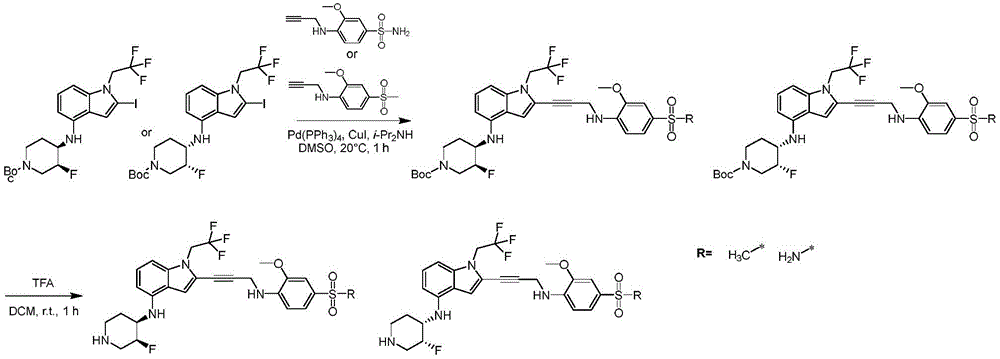
Preparation of (3S,4R) -4- ((2- (3- ((4- (R-sulfonyl) -2-methoxyphenyl) amino) prop-1-yn-1-yl) -1- (2,2, 2-trifluoroethyl) -1H-indol-4-yl) amino) -3-fluoropiperidine-1-carboxylic acid tert-butyl ester and (3R,4S) -4- ((2- (3- ((4- (R-sulfonyl) -2-methoxyphenyl) amino) prop-1-yn-1-yl) -1- (2,2, 2-trifluoroethyl) -1H-indol-4-yl) amino) -3-fluoropiperidine-1-carboxylic acid tert-butyl ester: in N 2 To 3-methoxy-4- (prop-2-yn-1-ylamino) benzenesulfonamide or 2-methoxy-4- (methylsulfonyl) -N- (prop-2-yn-1-yl) aniline (99.46)mg, 415.65. mu. mol,1.5 equiv.) in DMSO (2mL) was added i-Pr in one portion 2 NH (280.40mg,2.77mmol, 391.62. mu.L, 10 equiv.) and CuI (52.77mg, 277.10. mu. mol,1 equiv.). Then (3S,4R) -3-fluoro-4- ((2-iodo-1- (2,2, 2-trifluoroethyl) -1H-indol-4-yl) amino) piperidine-1-carboxylic acid tert-butyl ester (150mg,277.10 μmol,1 eq) or (3R,4S) -3-fluoro-4- ((2-iodo-1- (2,2, 2-trifluoroethyl) -1H-indol-4-yl) amino) piperidine-1-carboxylic acid tert-butyl ester (150mg,277.10 μmol,1 eq) and Pd (PPh) 3 ) 4 (32.02mg, 27.71. mu. mol,0.1 equiv.) was added to the mixture. Mixing the mixture with N 2 Purged three times and stirred at 20 ℃ for 1 hour. LC-MS analysis indicated that some starting material remained and the desired product was detected. EtOAc (20mL) was poured into the mixture and the resulting mixture was poured into saturated aqueous EDTA (30mL) and stirred for 1 hour. The aqueous phase was extracted with EtOAc (20mL x 3). The combined organic layers were washed with brine (30mL x 3), dried over anhydrous sodium sulfate, filtered and concentrated in vacuo to give a residue. The residue was passed through preparative TLC (SiO) 2 PE: EtOAc ═ 2:1) purification afforded the desired product (170 mg).
Preparation of the final product: at N 2 Next, to tert-butyl (3S,4R) -4- ((2- (3- ((4- (R-sulfonyl) -2-methoxyphenyl) amino) prop-1-yn-1-yl) -1- (2,2, 2-trifluoroethyl) -1H-indol-4-yl) amino) -3-fluoropiperidine-1-carboxylate or tert-butyl (3R,4S) -4- ((2- (3- ((4- (R-sulfonyl) -2-methoxyphenyl) amino) prop-1-yn-1-yl) -1- (2,2, 2-trifluoroethyl) -1H-indol-4-yl) amino) -3-fluoropiperidine-1-carboxylate (100 mg) at 20 ℃ 153.21 μmol,1 eq) in DCM (3mL) was added TFA (1mL) in one portion. The mixture was stirred at 20 ℃ for 60 minutes. TLC analysis indicated the reaction was complete. By adding saturated Na 2 CO 3 The aqueous solution was quenched to adjust the pH of the mixture to 9 and extracted with EtOAc (15mL x 3). The combined organic layers were washed with brine (15mL x 2), dried over anhydrous sodium sulfate, filtered and concentrated in vacuo. The residue was purified by preparative HPLC to give the desired product as a white solid.
N- ((3S,4R) -3-fluoropiperidin-4-yl) -2- (3- ((2-methoxy-4- (methylsulfonyl) phenyl) amino) prop-1-yn-1-yl) -1- (2,2, 2-trifluoroethyl) -1H-indol-4-amine,32.7mg, 38% yield, MS (ES) + M/z) 553.2; n- ((3R,4S) -3-Fluoropiperidin-4-yl) -2- (3- ((2-methoxy-4- (methylsulfonyl) phenyl) amino) prop-1-yn-1-yl) -1- (2,2, 2-trifluoroethyl) -1H-indol-4-amine, 39.7mg, 31% yield, MS (ES) + M/z) 553.2; 4- { [3- (4- { [ (3S,4R) -3-Fluoropiperidin-4-yl]Amino } -1- (2,2, 2-trifluoroethyl) -1H-indol-2-yl) prop-2-yn-1-yl]Amino } -3-methoxybenzene-1-sulphonamide, 36.6mg, 42% yield, MS (ES) + M/z) 554.2; 4- { [3- (4- { [ (3R,4S) -3-Fluoropiperidin-4-yl]Amino } -1- (2,2, 2-trifluoroethyl) -1H-indol-2-yl) prop-2-yn-1-yl]Amino } -3-methoxybenzene-1-sulphonamide, 37mg, 29% yield, MS (ES) + ,m/z):554.2。
Example D92: synthesis of compounds 864A, 865A, 866A and 867A.
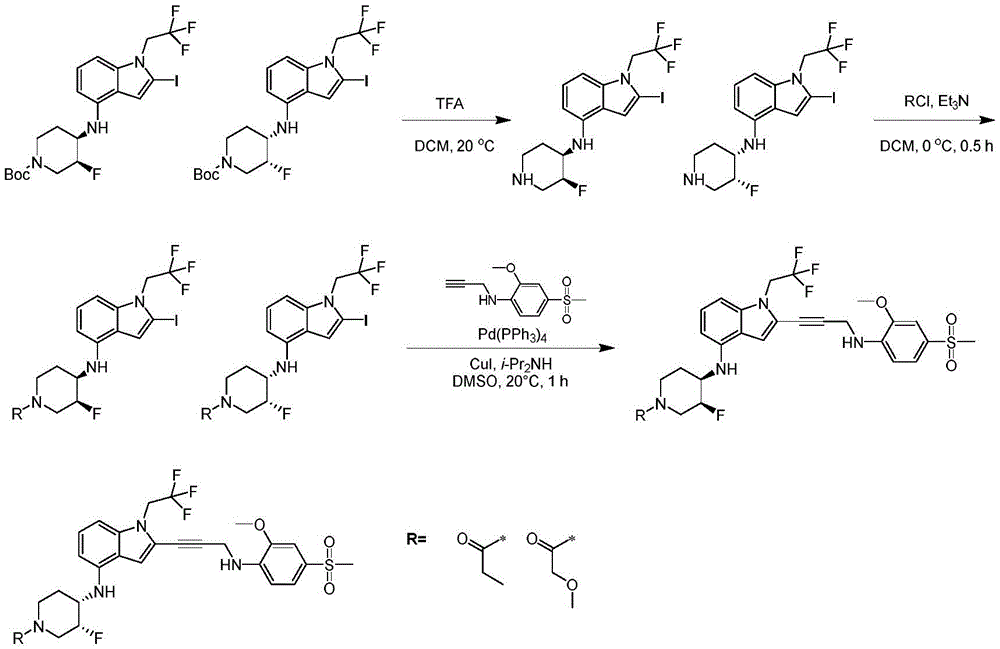
Preparation of N- ((3S,4R) -3-fluoropiperidin-4-yl) -2-iodo-1- (2,2, 2-trifluoroethyl) -1H-indol-4-amine and N- ((3R,4S) -3-fluoropiperidin-4-yl) -2-iodo-1- (2,2, 2-trifluoroethyl) -1H-indol-4-amine: to a solution of (3S,4R) -3-fluoro-4- ((2-iodo-1- (2,2, 2-trifluoroethyl) -1H-indol-4-yl) amino) piperidine-1-carboxylic acid tert-butyl ester (1g,1.85mmol,1 eq) or (3R,4S) -3-fluoro-4- ((2-iodo-1- (2,2, 2-trifluoroethyl) -1H-indol-4-yl) amino) piperidine-1-carboxylic acid tert-butyl ester (1g,1.85mmol,1 eq) in DCM (9mL) was added TFA (3mL) in one portion. The mixture was stirred at 20 ℃ for 1 hour. TLC analysis indicated the reaction was complete. By adding saturated Na 2 CO 3 The reaction was quenched with aqueous solution, the pH of the mixture was adjusted to 8, and the mixture was extracted with EtOAc (20mL x 3). The organic layer was washed with brine (20mL x 2), dried over anhydrous sodium sulfate, filtered, and concentrated in vacuo to give the desired product.
Preparation of R-substituted N- ((3S,4R) -3-fluoropiperidin-4-yl) -2-iodo-1- (2,2, 2-trifluoroethyl) -1H-indol-4-amine and R-substituted N- ((3R,4S) -3-fluoropiperidin-4-yl) -2-iodo-1- (2,2, 2-trifluoroethyl) -1H-indol-4-amine: to N- ((3S,4R) -3-Fluoropiperidin-4-yl) -2-iodo-1- (2,2, 2-trifluoroethyl) -1H-indol-4-amine or N- ((3R,4S) -3-Fluoropiperidine at 0 DEG CA solution of (4-yl) -2-iodo-1- (2,2, 2-trifluoroethyl) -1H-indol-4-amine (150mg, 339.98. mu. mol,1 eq) in DCM (4mL) was added Et in one portion 3 N (103.21mg,1.02mmol, 141.96. mu.L, 3 equivalents) and propionyl chloride (37.75mg, 407.97. mu. mol, 37.75. mu.L, 1.2 equivalents). The reaction mixture was stirred at 0 ℃ for 0.5 h. TLC analysis indicated the reaction was complete. The reaction was diluted with water (20mL) and extracted with EtOAc (20mL x 3). The combined organic layers were washed with brine (20mL x 2), dried over anhydrous sodium sulfate, filtered and concentrated in vacuo. The residue was passed through preparative TLC (SiO) 2 EtOAc 1:2) to afford the desired product 1- [ (3S,4R) -3-fluoro-4- [ [ 2-iodo-1- (2,2, 2-trifluoroethyl) indol-4-yl]Amino group]-1-piperidinyl group]Propan-1-one (140mg,281.54 μmol, 82.81% yield).
Preparation of the final product: in N 2 Next, to a solution of 2-methoxy-4- (methylsulfonyl) -N- (prop-2-yn-1-yl) aniline (96.24mg, 402.20. mu. mol,2 equivalents) in DMSO (2mL) was added i-Pr in one portion 2 NH (203.49mg,2.01mmol, 284.21. mu.L, 10 equiv.) and CuI (38.30mg, 201.10. mu. mol,1 equiv.). Then, R-substituted N- ((3S,4R) -3-fluoropiperidin-4-yl) -2-iodo-1- (2,2, 2-trifluoroethyl) -1H-indol-4-amine (100mg, 201.10. mu. mol,1 eq.) or R-substituted N- ((3R,4S) -3-fluoropiperidin-4-yl) -2-iodo-1- (2,2, 2-trifluoroethyl) -1H-indol-4-amine (100mg, 201.10. mu. mol,1 eq.) and Pd (PPh) were added 3 ) 4 (23.24mg, 20.11. mu. mol,0.1 equiv.). The mixture is mixed with N 2 Purged three times and the reaction mixture was stirred at 20 ℃ for 1 hour. TLC analysis indicated the reaction was complete. EtOAc (20mL) was poured into the reaction and the resulting mixture was poured into saturated aqueous EDTA (30mL) and stirred for 1 hour. The aqueous phase was extracted with EtOAc (20mL x 3). The combined organic layers were washed with brine (30mL x 3), dried over anhydrous sodium sulfate, filtered and concentrated in vacuo. The residue was purified by preparative TLC and preparative HPLC to give the desired product.
1- [ (3S,4R) -3-fluoro-4- [ (2- {3- [ (4-methanesulfonyl-2-methoxyphenyl) amino group]Prop-1-yn-1-yl } -1- (2,2, 2-trifluoroethyl) -1H-indol-4-yl) amino]Piperidin-1-yl radical]Propan-1-one, 36.7mg, 30% yield, MS (ES) + M/z) 609.3; 1- [ (3R,4S) -3-fluoro-4- [ (2- {3- [ (4-methanesulfonyl-2-methoxyphenyl) amino group ]Prop-1-yne-1-yl } -1- (2,2, 2-trifluoroethyl) -1H-indol-4-yl) amino]Piperidin-1-yl radical]Propan-1-one, 29.3mg, 24% yield, MS (ES) + M/z) 609.3; 1- [ (3S,4R) -3-fluoro-4- [ (2- {3- [ (4-methanesulfonyl-2-methoxyphenyl) amino ] carbonyl]Prop-1-yn-1-yl } -1- (2,2, 2-trifluoroethyl) -1H-indol-4-yl) amino]Piperidin-1-yl radical]-2-methoxyethyl-1-one, 26.1mg, 21% yield, MS (ES) + M/z) 625.3; and 1- [ (3R,4S) -3-fluoro-4- [ (2- {3- [ (4-methanesulfonyl-2-methoxyphenyl) amino)]Prop-1-yn-1-yl } -1- (2,2, 2-trifluoroethyl) -1H-indol-4-yl) amino]Piperidin-1-yl]-2-methoxyethyl-1-one, 20.4mg, 17% yield, MS (ES) + ,m/z):625.3。
Example D93: synthesis of compounds 732A, 742A, 743A, 744A, 745A, 746A, 747A, 748A, 750A, 751A, 752A, 753A, 756A, and 757A.

2-iodo-N- (1- (R) 2 Preparation of-substituted) piperidin-4-yl) -1- (2,2, 2-trifluoroethyl) -1H-indol-4-amine: to a solution of 2-iodo-N- (piperidin-4-yl) -1- (2,2, 2-trifluoroethyl) -1H-indol-4-amine (100mg,226.84 μmol,1 equivalent) in DMF (3mL) were added 2-methylpropionic acid (21.98mg,249.52 μmol,23.14 μ L,1.1 equivalents), DIEA (58.63mg,453.67 μmol,79.02 μ L,2 equivalents) and HATU (129.37mg,340.25 μmol,1.5 equivalents). The mixture was stirred at 25 ℃ for 1 hour. TLC and LC-MS analysis indicated complete consumption of the starting material. The reaction was partitioned by adding water (50mL) and EtOAc (5 mL). The aqueous phase was extracted with EtOAc (30mL x 3). The combined organic layers were washed with brine (50mL x 3), dried over anhydrous sodium sulfate and filtered to give a filtrate. Vacuum drying the filtrate to obtain crude product 1- [4- [ [ 2-iodo-1- (2,2, 2-trifluoroethyl) indol-4-yl ]Amino group]-1-piperidinyl group]-2-methyl-propan-1-one (110mg, crude) as oil.
Preparation of the final product: to a solution of 2-methoxy-4- (methylsulfonyl) -N- (prop-2-yn-1-yl) aniline (46.20mg, 173.75. mu. mol,1.2 equiv) or 3-methoxy-4- (prop-2-yn-1-ylamino) benzenesulfonamide (40.18mg, 133.79. mu. mol,1.2 equiv) in DMSO (2mL) at 25 ℃ was added i-Pr 2 NH (65.90mg,1.11mmol, 95.79. mu.L, 10 equiv.), CuI (21.23mg, 111.49. mu. mol,1 equiv.), 2-iodo-N- (1- (R) 2 -substituted) piperidin-4-yl) -1- (2,2, 2-trifluoroethyl) -1H-indol-4-amine 1- [4- [ [ 2-iodo-1- (2,2, 2-trifluoroethyl) indol-4-yl]Amino group]-1-piperidinyl group]-2-methyl-propan-1-one (55mg,111.49 μmol,1 eq.) and Pd (PPh) 3 ) 4 (25.77mg, 22.30. mu. mol,0.2 eq.). In N 2 The mixture was stirred for 1 hour. LC-MS and TLC analysis indicated that the reaction was complete. The reaction mixture was quenched by the addition of saturated aqueous EDTA (20mL) at 25 ℃ and stirred for 2 hours. The reaction mixture was partitioned by adding EtOAc (30 mL). The aqueous phase was extracted with EtOAc (30mL x 2), the organic phase was washed with brine (30mL x 2), dried over anhydrous sodium sulfate, filtered, and concentrated in vacuo to give the crude product. The residue was purified by preparative TLC and preparative HPLC to give a solution of the desired product. The solution was lyophilized to give the desired product.
2-hydroxy-1- {4- [ (2- {3- [ (4-methanesulfonyl-2-methoxyphenyl) amino]Prop-1-yn-1-yl } -1- (2,2, 2-trifluoroethyl) -1H-indol-4-yl) amino]Piperidin-1-yl } ethan-1-one, (9.8mg, 11.2% yield) MS (ES) + M/z) 539.0; 4- { [3- (4- { [1- (2-Hydroxyacetyl) piperidin-4-yl]Amino } -1- (2,2, 2-trifluoroethyl) -1H-indol-2-yl) prop-2-yn-1-yl]Amino } -3-methoxybenzene-1-sulphonamide, (11.2mg, 13.4% yield) MS (ES) + M/z) 594.2; 2-methoxy-1- (4- ((2- (3- ((2-methoxy-4- (methylsulfonyl) phenyl) amino) prop-1-yn-1-yl) -1- (2,2, 2-trifluoroethyl) -1H-indol-4-yl) amino) piperidin-1-yl) ethan-1-one, (13.4mg, 14.5% yield) (MS (ES) + M/z) 607.2; 3-methoxy-4- ((3- (4- ((1- (2-methoxyacetyl) piperidin-4-yl) amino) -1- (2,2, 2-trifluoroethyl) -1H-indol-2-yl) prop-2-yn-1-yl) amino) benzenesulfonamide, (17.1mg, 19.8% yield) MS (ES) + M/z) 607.2; 2- (dimethylamino) -1- {4- [ (2- {3- [ (4-methanesulfonyl-2-methoxyphenyl) amino]Prop-1-yn-1-yl } -1- (2,2, 2-trifluoroethyl) -1H-indol-4-yl) amino]Piperidin-1-yl } ethan-1-one, (14.5mg, 15.3% yield) (MS (ES) + M/z) 620.2; 4- ((3- (4- ((1- (dimethylglycyl) piperidin-4-yl) amino) -1- (2,2, 2-trifluoroethyl) -1H-indol-2-yl) prop-2-yn-1-yl) amino) -3-methoxybenzenesulfonyl Amine, (11.3mg, 13.7% yield) MS (ES) + M/z) 621.2; 2-hydroxy-1- {4- [ (2- {3- [ (4-methanesulfonyl-2-methoxyphenyl) amino]Prop-1-yn-1-yl } -1- (2,2, 2-trifluoroethyl) -1H-indol-4-yl) amino]Piperidin-1-yl } propan-1-one, (9.6mg, 8.8% yield) MS (ES) + M/z) 607.2; 4- { [3- (4- { [1- (2-hydroxypropionyl) piperidin-4-yl]Amino } -1- (2,2, 2-trifluoroethyl) -1H-indol-2-yl) prop-2-yn-1-yl]Amino } -3-methoxybenzene-1-sulphonamide, (10.7mg, 10.8% yield) MS (ES) + M/z) 608.2; 3- {4- [ (2- {3- [ (4-methanesulfonyl-2-methoxyphenyl) amino group]Prop-1-yn-1-yl } -1- (2,2, 2-trifluoroethyl) -1H-indol-4-yl) amino]Piperidin-1-yl } -3-oxopropanenitrile, (9.8mg, 8.9% yield) MS (ES) + M/z) 602.2; 4- { [3- (4- { [1- (2-cyanoacetyl) piperidin-4-yl]Amino } -1- (2,2, 2-trifluoroethyl) -1H-indol-2-yl) prop-2-yn-1-yl]Amino } -3-methoxybenzene-1-sulphonamide, (7.5mg, 5.8% yield) MS (ES) + M/z) 603.2; 1- {4- [ (2- {3- [ (4-methanesulfonyl-2-methoxyphenyl) amino)]Prop-1-yn-1-yl } -1- (2,2, 2-trifluoroethyl) -1H-indol-4-yl) amino]Piperidin-1-yl } propan-1-one, (15.3mg, 21.7% yield) MS (ES) + M/z) 591.2; 3-methoxy-4- [ (3- {4- [ (1-propionylpiperidin-4-yl) amino) ]-1- (2,2, 2-trifluoroethyl) -1H-indol-2-yl } prop-2-yn-1-yl) amino]Benzene-1-sulfonamide, (11.5mg, 16.8% yield) MS (ES) + M/z) 592.1; 1- {4- [ (2- {3- [ (4-methanesulfonyl-2-methoxyphenyl) amino group]Prop-1-yn-1-yl } -1- (2,2, 2-trifluoroethyl) -1H-indol-4-yl) amino]Piperidin-1-yl } -2-methylpropan-1-one, (10.3mg, 14.3% yield) (MS (ES) + M/z) 605.2; 3-methoxy-4- { [3- (4- { [1- (2-methylpropanoyl) piperidin-4-yl]Amino } -1- (2,2, 2-trifluoroethyl) -1H-indol-2-yl) prop-2-yn-1-yl]Amino } benzene-1-sulfonamide, (13.1mg, 19.3% yield) MS (ES) + ,606.2)
Example D94: synthesis of compounds 766A and 767A.

(3S,4S) -3-hydroxy-4- ((2-iodo-1- (2,2, 2-trifluoroethyl) -1H-indol-4-yl) amino) piperidine-1-carboxylic acid tert-butyl ester and (3S,4S) -4-hydroxy-Preparation of tert-butyl 3- ((2-iodo-1- (2,2, 2-trifluoroethyl) -1H-indol-4-yl) amino) piperidine-1-carboxylate: to 7-oxa-4-azabicyclo [4.1.0]Heptane-4-carboxylic acid tert-butyl ester (878.81mg,4.41mmol,3 equivalents) and 2-iodo-1- (2,2, 2-trifluoroethyl) indol-4-amine (0.5g,1.47mmol,1 equivalent) in CH 3 ZrCl is added to a mixture in CN (5mL) 4 (34.26mg, 147.02. mu. mol, 12.24. mu.L, 0.1 equiv.). The mixture was stirred at 25 ℃ for 2 hours. TLC and LC-MS analysis indicated the reaction was complete. The reaction was filtered through a pad of celite and concentrated under reduced pressure. The residue was passed through preparative TLC (SiO) 2 EtOAc ═ 3:1) and preparative HPLC purification afforded the desired product as a yellow solid.
(3S,4S) -3-hydroxy-4- ((2-iodo-1- (2,2, 2-trifluoroethyl) -1H-indol-4-yl) amino) piperidine-1-carboxylic acid tert-butyl ester (0.14g, 233.62. mu. mol, 15.89% yield), MS (ES) + M/z) 540.2; and tert-butyl (3S,4S) -4-hydroxy-3- ((2-iodo-1- (2,2, 2-trifluoroethyl) -1H-indol-4-yl) amino) piperidine-1-carboxylate (0.24g,400.50 μmol, 27.24% yield).
Preparation of (3S,4S) -4- ((2-iodo-1- (2,2, 2-trifluoroethyl) -1H-indol-4-yl) amino) piperidin-3-ol and (3S,4S) -3- ((2-iodo-1- (2,2, 2-trifluoroethyl) -1H-indol-4-yl) amino) piperidin-4-ol: to a solution of tert-butyl (3S,4S) -3-hydroxy-4- ((2-iodo-1- (2,2, 2-trifluoroethyl) -1H-indol-4-yl) amino) piperidine-1-carboxylate (0.15g,250.31 μmol,1 eq) or tert-butyl (3S,4S) -4-hydroxy-3- ((2-iodo-1- (2,2, 2-trifluoroethyl) -1H-indol-4-yl) amino) piperidine-1-carboxylate (0.15g,250.31 μmol,1 eq) in DCM (3mL) was added TFA (1.39g,12.16mmol,899.98 μ L,48.56 eq). The mixture was stirred at 25 ℃ for 0.5-1 hour. TLC analysis indicated the reaction was complete. Saturated Na 2 CO 3 An aqueous solution (10mL) was added to the reaction mixture to adjust the pH of the mixture to 9. The mixture was then extracted with DCM (10mL x 3). The combined organic layers were washed with brine, dried over anhydrous sodium sulfate, filtered and concentrated under reduced pressure. The crude product was obtained as a yellow solid and used in the next step without purification.
(3S,4S) -4- ((2-iodo-1- (2,2, 2-trifluoroethyl) -1H-indol-4-yl) amino) -1-methylpiperidin-3-ol and (3S,4S) -3- ((2-iodo-1- (2,2, 2-trifluoroethyl) -1H-indolePreparation of indol-4-yl) amino) -1-methylpiperidin-4-ol: to a mixture of formaldehyde (12.31mg,409.82 μmol,11.29 μ L,2 equivalents) and (3S,4S) -4- ((2-iodo-1- (2,2, 2-trifluoroethyl) -1H-indol-4-yl) amino) piperidin-3-ol or (3S,4S) -3- ((2-iodo-1- (2,2, 2-trifluoroethyl) -1H-indol-4-yl) amino) piperidin-4-ol (0.09g,204.91 μmol,1 equivalent) in MeOH (3mL) was added AcOH (12.30mg,204.91 μmol,11.72 μ L,1 equivalent). The mixture was stirred at 50 ℃ for 10 minutes and NaBH was added 3 CN (64.38mg,1.02mmol,5 equiv.). The resulting reaction mixture was further stirred at 50 ℃ for 1 hour. TLC analysis indicated the reaction was complete. The reaction was poured onto saturated Na 2 CO 3 Aqueous (10mL) and extracted with DCM (10mL × 3). The residue was passed through preparative TLC (SiO) 2 DCM: MeOH ═ 10:1) gave the desired product as a yellow solid.
Preparation of the final product: to a solution of 2-methoxy-4-methylsulfonyl-N-prop-2-ynyl-aniline (42.76mg, 178.71. mu. mol,1.5 equivalents) in DMSO (2mL) was added N-isopropylprop-2-amine (120.56mg,1.19mmol, 168.38. mu.L, 10 equivalents), CuI (22.69mg, 119.14. mu. mol,1 equivalent), then (3S,4S) -4- ((2-iodo-1- (2,2, 2-trifluoroethyl) -1H-indol-4-yl) amino) -1-methylpiperidin-3-ol (0.06g, 119.14. mu. mol,1 equivalent) or (3S,4S) -3- ((2-iodo-1- (2,2, 2-trifluoroethyl) -1H-indol-4-yl) amino) -1-methylpiperidin-4-yl Alcohol (70mg, 154.44. mu. mol,1 eq.) and Pd (PPh) 3 ) 4 (71.39mg, 61.78. mu. mol,0.4 equiv.). The mixture was stirred at 25 ℃ for 1 hour. TLC analysis indicated the reaction was complete. The reaction was diluted with EtOAc (20mL), poured into saturated aqueous EDTA (20mL) and stirred at 25 ℃ for 1 h. The resulting mixture was extracted with EtOAc (20 mL. times.3). The combined organic layers were washed with brine (20mL x 3), dried over anhydrous sodium sulfate, filtered and concentrated under reduced pressure. The residue was purified by preparative HPLC to give the desired product as a light yellow solid.
rac- (3R,4R) -4- [ (2- {3- [ (4-methanesulfonyl-2-methoxyphenyl) amino ] carbonyl]Prop-1-yn-1-yl } -1- (2,2, 2-trifluoroethyl) -1H-indol-4-yl) amino]-1-methylpiperidin-3-ol, (41.6mg, 61.1% yield) MS (ES) + M/z) 565.1; and rac- (3R,4S) -3- [ (2- {3- [ (4-methanesulfonyl-2-methoxyphenyl) amino]Prop-1-yn-1-yl-1- (2,2, 2-trifluoroethyl) -1H-indol-4-yl) amino]-1-methylpiperidin-4-ol, (43.3mg, 49.4% yield) MS (ES) + ,m/z):565.3。
Example D95: synthesis of compounds 523A, 524A, 525A and 526A.

Preparation of 5- ((tert-butoxycarbonyl) (3- (4- ((1-methylpiperidin-4-yl) amino) -1- (2,2, 2-trifluoroethyl) -1H-indol-2-yl) prop-2-yn-1-yl) amino) thiophene-2-carboxylic acid: to a solution of 5- ((tert-butoxycarbonyl) (prop-2-yn-1-yl) amino) thiophene-2-carboxylic acid (0.4g,1.42mmol,1 eq) in DMSO (2mL) was added i-Pr 2 NH (1.44g,14.22mmol,2.01mL,10 equiv.), CuI (54.16mg, 284.37. mu. mol,0.2 equiv.), 2-iodo-N- (1-methyl-4-piperidinyl) -1- (2,2, 2-trifluoroethyl) indol-4-amine (621.68mg,1.42mmol,1 equiv.), and Pd (PPh) 3 ) 4 (82.15mg, 71.09. mu. mol,0.05 eq.). In N 2 The mixture was then stirred at 25 ℃ for 1 hour. TLC analysis (DCM: MeOH: TEA ═ 10:1:1, R f 0.2) indicated complete consumption of starting material and a new spot was detected. The reaction mixture was quenched by the addition of saturated aqueous EDTA (20mL) and the mixture was stirred at 20 ℃ for 1 hour. The mixture was then extracted with EtOAc (40mL x 3). The combined organic layers were washed with brine (30mL x 3), dried over anhydrous sodium sulfate, filtered and concentrated under reduced pressure to give a residue. The residue was purified by column chromatography (SiO) 2 PE: EtOAc ═ 3:1 to 0:1 to DCM: MeOH ═ 10:1) purification afforded the desired product (0.71g,1.14mmol, 80.32% yield) as a yellow solid.
Preparation of 5- ((3- (4- ((1-methylpiperidin-4-yl) amino) -1- (2,2, 2-trifluoroethyl) -1H-indol-2-yl) prop-2-yn-1-yl) amino) thiophene-2-carboxylic acid: to a solution of 5- ((tert-butoxycarbonyl) (3- (4- ((1-methylpiperidin-4-yl) amino) -1- (2,2, 2-trifluoroethyl) -1H-indol-2-yl) prop-2-yn-1-yl) amino) thiophene-2-carboxylic acid (0.06g,101.58 μmol,1 eq) in DCM (2mL) was added 2, 6-lutidine (326.54mg,3.05mmol,354.94 μ L,30 eq) and TMSI (609.78mg,3.05mmol,414.81 μ L,30 eq). The mixture is heated at 25 DEG to Stirred for 5 hours. LC-MS analysis indicated complete consumption of starting material and detection of the desired mass. The reaction mixture was filtered and concentrated under reduced pressure to give a residue. The residue was purified by preparative HPLC to give the desired product (0.015g,27.34 μmol, 26.91% yield) as a yellow solid. MS (ES) + ,m/z):489.9。

Preparation of (5- (methylcarbamoyl) thiophen-2-yl) (tert-butyl 3- (4- ((1-methylpiperidin-4-yl) amino) -1- (2,2, 2-trifluoroethyl) -1H-indol-2-yl) prop-2-yn-1-yl) carbamate and N, N-dimethyl-5- ((3- (4- ((1-methylpiperidin-4-yl) amino) -1- (2,2, 2-trifluoroethyl) -1H-indol-2-yl) prop-2-yn-1-yl) amino) thiophene-2-carboxamide: to a solution of 5- ((3- (4- ((1-methylpiperidin-4-yl) amino) -1- (2,2, 2-trifluoroethyl) -1H-indol-2-yl) prop-2-yn-1-yl) amino) thiophene-2-carboxylic acid (0.2g,338.61 μmol,1 eq) and methylamine hydrochloride (45.72mg,677.21 μmol,2 eq) or N-methylmethylamine hydrochloride (55.22mg,677.21 μmol,2 eq) in DCM (2mL) and DMF (2mL) was added TEA (171.32mg,1.69mmol,235.65 μ L,5 eq), HOBt (68.63mg,507.91 μmol,1.5 eq) and EDCI (97.37mg,507.91 μmol,1.5 eq). The mixture was stirred at 25 ℃ for 20 hours. HPLC analysis showed the starting material remained. The reaction was quenched by addition of water (30mL) and extracted with EtOAc (20mL x 3). The combined organic layers were washed with brine (10mL x 2), dried over anhydrous sodium sulfate, filtered and concentrated under reduced pressure. The residue was purified by preparative HPLC to give the desired product as a yellow solid.
(5- (methylcarbamoyl) thiophen-2-yl) (tert-butyl 3- (4- ((1-methylpiperidin-4-yl) amino) -1- (2,2, 2-trifluoroethyl) -1H-indol-2-yl) prop-2-yn-1-yl) carbamate (0.08g, 129.87. mu. mol, 38.35% yield), MS (ES) + M/z) 604.2; and N, N-dimethyl-5- ((3- (4- ((1-methylpiperidin-4-yl) amino) -1- (2,2, 2-trifluoroethyl) -1H-indol-2-yl) prop-2-yn-1-yl) amino) thiophene-2-carboxamide (0.075g,118.99 μmol, 35.14% yield).
Preparation of N-methyl-5- ((3- (4- ((1-methylpiperidin-4-yl) amino) -1- (2,2, 2-trifluoroethyl) -1H-indol-2-yl) prop-2-yn-1-yl) amino) thiophene-2-carboxamide and N, N-dimethyl-5- ((3- (4- ((1-methylpiperidin-4-yl) amino) -1- (2,2, 2-trifluoroethyl) -1H-indol-2-yl) prop-2-yn-1-yl) amino) thiophene-2-carboxamide: tert-butyl (5- (methylcarbamoyl) thiophen-2-yl) (3- (4- ((1-methylpiperidin-4-yl) amino) -1- (2,2, 2-trifluoroethyl) -1H-indol-2-yl) prop-2-yn-1-yl) carbamate (0.06g, 97.40. mu. mol,1 eq) or N, N-dimethyl-5- ((3- (4- ((1-methylpiperidin-4-yl) amino) -1- (2,2, 2-trifluoroethyl) -1H-indol-2-yl) prop-2-yn-1-yl) amino) thiophene-2-carboxamide (0.06g, 97.13. mu. mol,1 eq.) in 4N HCl/EtOAc (5mL) was stirred at 25 ℃ for 1 hour. LC-MS analysis showed the desired compound. The reaction mixture was filtered and concentrated under reduced pressure to give a residue. The residue was purified by preparative HPLC to give the desired product as a yellow solid.
N-methyl-5- ((3- (4- ((1-methylpiperidin-4-yl) amino) -1- (2,2, 2-trifluoroethyl) -1H-indol-2-yl) prop-2-yn-1-yl) amino) thiophene-2-carboxamide (0.035g,65.12 μmol, 66.86% yield), MS (ES) (MS (4-methyl-piperidin-4-yl) amino) + M/z) 504.2; and N, N-dimethyl-5- ((3- (4- ((1-methylpiperidin-4-yl) amino) -1- (2,2, 2-trifluoroethyl) -1H-indol-2-yl) prop-2-yn-1-yl) amino) thiophene-2-carboxamide (0.036g,65.31 μmol, 67.24% yield).

Preparation of N- (1-methylpiperidin-4-yl) -2- (3- ((5- (methylsulfonyl) thiophen-2-yl) amino) prop-1-yn-1-yl) -1- (2,2, 2-trifluoroethyl) -1H-indol-4-amine: a solution of tert-butyl (3- (4- ((1-methylpiperidin-4-yl) amino) -1- (2,2, 2-trifluoroethyl) -1H-indol-2-yl) prop-2-yn-1-yl) (5- (methylsulfonyl) thiophen-2-yl) carbamate (0.06g, 96.04. mu. mol,1 eq) in 4NHCl/EtOAc (3mL) was stirred at 25 ℃ for 1H. HPLC analysis indicated 74.1% formation of the desired compound. By adding saturated Na 2 CO 3 The reaction mixture was quenched with solution (10mL) to adjust the pH of the mixture to 8 and extracted with EtOAc (10mL x 3). Combined organic matterThe layer was washed with brine (10mL), filtered and concentrated under reduced pressure. The residue was purified by preparative HPLC to give the desired product (0.017g,30.85 μmol, 32.12% yield) as a yellow solid. MS (ES) + ,m/z):525.2。
Example D96: synthesis of compounds 839A and 840A.

Preparation of ethyl 4- ((3- (4- (((3S,4R) -3-fluoro-1-methylpiperidin-4-yl) amino) -1- (2,2, 2-trifluoroethyl) -1H-indol-2-yl) prop-2-yn-1-yl) amino) -3-methoxybenzoate and ethyl 4- ((3- (4- (((3R,4S) -3-fluoro-1-methylpiperidin-4-yl) amino) -1- (2,2, 2-trifluoroethyl) -1H-indol-2-yl) prop-2-yn-1-yl) amino) -3-methoxybenzoate: to a solution of ethyl 3-methoxy-4- (prop-2-yn-1-ylamino) benzoate (66.61mg, 285.57. mu. mol,1.3 eq) in DMSO (3mL) was added i-Pr 2 NH (222.28mg,2.20mmol, 310.45. mu.L, 10 equivalents), CuI (8.37mg, 43.93. mu. mol,0.2 equivalents), N- ((3R,4S) -3-fluoro-1-methylpiperidin-4-yl) -2-iodo-1- (2,2, 2-trifluoroethyl) -1H-indol-4-amine (100mg, 219.67. mu. mol,1 equivalent) or N- ((3S,4R) -3-fluoro-1-methylpiperidin-4-yl) -2-iodo-1- (2,2, 2-trifluoroethyl) -1H-indol-4-amine (100mg, 219.67. mu. mol,1 equivalent) and Pd (PPh) 3 ) 4 (25.38mg, 21.97. mu. mol,0.1 equiv.). In N 2 The mixture was then stirred at 25 ℃ for 1 hour. TLC analysis indicated the reaction was complete. At 25 ℃, the reaction mixture was quenched by the addition of saturated aqueous EDTA (100mL) and EtOAc (50mL) and the mixture was further extracted with EtOAc (50mL × 2). The combined organic layers were washed with brine (100mL x 2), dried over anhydrous sodium sulfate, filtered and concentrated under reduced pressure to give a residue. The residue was passed through preparative TLC (SiO) 2 DCM: MeOH ═ 10:1) and preparative HPLC purification afforded the desired product as a white solid.
Ethyl 4- ((3- (4- (((3S,4R) -3-fluoro-1-methylpiperidin-4-yl) amino) -1- (2,2, 2-trifluoroethyl) -1H-indol-2-yl) prop-2-yn-1-yl) amino) -3-methoxybenzoate, 36.1mg, 29.3% yield, MS (ES) + M/z) 561.3; and 4- ((3- (4- (((3R,4S) -3-fluoro)-1-methylpiperidin-4-yl) amino) -1- (2,2, 2-trifluoroethyl) -1H-indol-2-yl) prop-2-yn-1-yl) amino) -3-methoxybenzoic acid ethyl ester, 33.2mg, 27.0% yield, MS (ES) + ,m/z):561.3。
Example D97: synthesis of Compounds 851A, 852A, 857A and 858A.

Preparation of 3-fluoro-4- ((2-iodo-1- (2,2, 2-trifluoroethyl) -1H-indol-4-yl) amino) piperidine-1-carboxylic acid tert-butyl ester: to a solution of 2-iodo-1- (2,2, 2-trifluoroethyl) -1H-indol-4-amine hydrochloride (60g,26.56mmol,27.60mL,1 eq, HCl) in AcOH (1500mL) and DCE (500mL) at 20 deg.C was added tert-butyl 3-fluoro-4-oxo-piperidine-1-carboxylate (28.85g,132.79mmol,5 eq) and NaBH (OAc) 3 (14.07g,66.39mmol,2.5 equiv.). The mixture was stirred at 40 ℃ for 2 hours. LC-MS analysis indicated the reaction was complete. The reaction mixture was quenched by the addition of ice water (2000mL) at 0 ℃, 2N aqueous NaOH was added to adjust the pH of the mixture to 8 and the mixture was extracted with EtOAc (1000mL x 4). The combined organic layers were washed with brine (1000mL x 2), dried over anhydrous sodium sulfate, filtered and concentrated under reduced pressure to give a residue. The residue was purified by column chromatography (SiO) 2 PE: EtOAc ═ 10:1 to 8:1) purification afforded the desired product (100g) as a yellow solid.
Preparation of (3S,4R) -3-fluoro-4- ((2-iodo-1- (2,2, 2-trifluoroethyl) -1H-indol-4-yl) amino) piperidine-1-carboxylic acid tert-butyl ester and (3R,4S) -3-fluoro-4- ((2-iodo-1- (2,2, 2-trifluoroethyl) -1H-indol-4-yl) amino) piperidine-1-carboxylic acid tert-butyl ester: tert-butyl 3-fluoro-4- ((2-iodo-1- (2,2, 2-trifluoroethyl) -1H-indol-4-yl) amino) piperidine-1-carboxylate was purified by preparative HPLC and SFC to give the desired product as a white solid. Tert-butyl (3S,4R) -3-fluoro-4- ((2-iodo-1- (2,2, 2-trifluoroethyl) -1H-indol-4-yl) amino) piperidine-1-carboxylate, 46.8% yield; and (3R,4S) -3-fluoro-4- ((2-iodo-1- (2,2, 2-trifluoroethyl) -1H-indol-4-yl) amino) piperidine-1-carboxylic acid tert-butyl ester in 46.4% yield.
(3S,4R) -4- ((2- (3- ((4- (R-carbonyl) -2-methoxyphenyl)) Preparation of amino) prop-1-yn-1-yl) -1- (2,2, 2-trifluoroethyl) -1H-indol-4-yl) amino) -3-fluoropiperidine-1-carboxylic acid tert-butyl ester and (3S,4R) -4- ((2- (3- ((4- (R-carbonyl) -2-methoxyphenyl) amino) prop-1-yn-1-yl) -1- (2,2, 2-trifluoroethyl) -1H-indol-4-yl) amino) -3-fluoropiperidine-1-carboxylic acid tert-butyl ester: to a solution of R-substituted alkyne (73.92mg,360.23 μmol,1.3 equiv.) in DMSO (4mL) was added i-Pr 2 NH (280.40mg,2.77mmol, 391.62. mu.L, 10 equiv.), CuI (10.55mg, 55.42. mu. mol,0.2 equiv), ((3S, 4R) -3-fluoro-4- ((2-iodo-1- (2,2, 2-trifluoroethyl) -1H-indol-4-yl) amino) piperidine-1-carboxylic acid tert-butyl ester or (3R,4S) -3-fluoro-4- ((2-iodo-1- (2,2, 2-trifluoroethyl) -1H-indol-4-yl) amino) piperidine-1-carboxylic acid tert-butyl ester (0.15g, 277.10. mu. mol,1 equiv.) and Pd (PPh) 3 ) 4 (32.02mg, 27.71. mu. mol,0.1 equiv.). In N 2 The mixture was then stirred at 25 ℃ for 1 hour. TLC analysis indicated the reaction was complete. The reaction mixture was quenched by the addition of saturated aqueous EDTA (100mL) and EtOAc (50mL) and stirring at 25 ℃ for 2 h. The mixture was further extracted with EtOAc (50mL x 2). The combined organic layers were washed with brine (100mL x 2), dried over anhydrous sodium sulfate, filtered and concentrated under reduced pressure. The crude residue was passed through preparative TLC (SiO) 2 DCM: MeOH ═ 10:1) gave the desired product as a yellow solid.
Preparation of the final product: to (3S,4R) -4- ((2- (3- ((4- (R-carbonyl) -2-methoxyphenyl) amino) prop-1-yn-1-yl) -1- (2,2, 2-trifluoroethyl) -1H-indol-4-yl) amino) -3-fluoropiperidine-1-carboxylic acid tert-butyl ester (100mg, 161.65. mu. mol,1 equivalent) or (3S,4R) -4- ((2- (3- ((4- (R-carbonyl) -2-methoxyphenyl) amino) prop-1-yn-1-yl) -1- (2,2, 2-trifluoroethyl) -1H-indol-4-yl) amino) -3-fluoropiperidine-1-carboxylic acid tert-butyl ester A mixture of ester (100mg, 161.65. mu. mol,1 eq.) in DCM (3mL) was added TFA (1 mL). In N 2 The mixture was then stirred at 25 ℃ for 1 hour. TLC indicated the reaction was complete. The reaction mixture was quenched by addition of saturated aqueous sodium carbonate (100mL) and extracted with EtOAc (50mL × 2). The combined organic layers were washed successively with brine solution (100mLx 2). Then dried over anhydrous sodium sulfate, filtered and concentrated under reduced pressure to give a residue. The residue was purified by preparative HPLC to give the desired product as a white solidAnd (3) a body.
4- [3- [4- [ [ (3S,4R) -3-fluoro-4-piperidinyl]Amino group]-1- (2,2, 2-trifluoroethyl) indol-2-yl]Prop-2-ynylamino]-3-methoxy-benzamide, 28.9mg, 33.1% yield, MS (ES) + M/z) 518.2); 4- [3- [4- [ [ (3R,4S) -3-fluoro-4-piperidinyl group]Amino group]-1- (2,2, 2-trifluoroethyl) indol-2-yl]Prop-2-ynylamino]-3-methoxy-benzamide 39.9mg, 59.52% yield, MS (ES) + M/z) 518.2); 4- { [3- (4- { [ (3S,4R) -3-Fluoropiperidin-4-yl)]Amino } -1- (2,2, 2-trifluoroethyl) -1H-indol-2-yl) prop-2-yn-1-yl]Amino } -3-methoxy-N-methylbenzamide, 27.4mg, 38.0% yield, MS (ES) + M/z) 532.2; 4- { [3- (4- { [ (3R,4S) -3-Fluoropiperidin-4-yl]Amino } -1- (2,2, 2-trifluoroethyl) -1H-indol-2-yl) prop-2-yn-1-yl]Amino } -3-methoxy-N-methylbenzamide, 30.5mg, 36.1% yield, MS (ES) + M/z) 532.2; 4- { [3- (4- { [ (3S,4R) -3-Fluoropiperidin-4-yl]Amino } -1- (2,2, 2-trifluoroethyl) -1H-indol-2-yl) prop-2-yn-1-yl]Amino } -3-methoxybenzoic acid, 32.8mg, 31% yield, MS (ES) + M/z) 519.2 and 4- { [3- (4- { [ (3R,4S) -3-fluoropiperidin-4-yl]Amino } -1- (2,2, 2-trifluoroethyl) -1H-indol-2-yl) prop-2-yn-1-yl]Amino } -3-methoxybenzoic acid, 30.6mg, 36.1% yield, MS (ES) + ,m/z):519.2。
Example D98: synthesis of Compounds 823A and 824A.

Preparation of N- ((3S,4R) -3-fluoropiperidin-4-yl) -2-iodo-1- (2,2, 2-trifluoroethyl) -1H-indol-4-amine and N- ((3R,4S) -3-fluoropiperidin-4-yl) -2-iodo-1- (2,2, 2-trifluoroethyl) -1H-indol-4-amine: to a solution of tert-butyl (3S,4R) -3-fluoro-4- ((2-iodo-1- (2,2, 2-trifluoroethyl) -1H-indol-4-yl) amino) piperidine-1-carboxylate (0.3g,554.20 μmol,1 eq) or (3R,4S) -3-fluoro-4- ((2-iodo-1- (2,2, 2-trifluoroethyl) -1H-indol-4-yl) amino) piperidine-1-carboxylate (0.3g,554.20 μmol,1 eq) in DCM (3mL) was added TFA (1 mL). At N 2 The reaction mixture was stirred at 25 ℃ for 1 hour. LC-MS analysis indicated the reaction was complete. By adding saturated Na 2 CO 3 The reaction mixture was quenched with aqueous solution and extracted with EtOAc (50mL × 2) to adjust the pH of the mixture to 8. The combined organic layers were washed with brine (100mL x 2), dried over anhydrous sodium sulfate, filtered and concentrated under reduced pressure. The desired product was obtained as a yellow solid.
N- ((3S,4R) -3-Fluoropiperidin-4-yl) -2-iodo-1- (2,2, 2-trifluoroethyl) -1H-indol-4-amine, MS (ES) + M/z) 442.0; and N- ((3R,4S) -3-Fluoropiperidin-4-yl) -2-iodo-1- (2,2, 2-trifluoroethyl) -1H-indol-4-amine, MS (ES) + ,m/z):442.0。
Preparation of N- ((3S,4R) -1-ethyl-3-fluoropiperidin-4-yl) -2-iodo-1- (2,2, 2-trifluoroethyl) -1H-indol-4-amine and N- ((3R,4S) -1-ethyl-3-fluoropiperidin-4-yl) -2-iodo-1- (2,2, 2-trifluoroethyl) -1H-indol-4-amine: to a solution of N- ((3S,4R) -3-fluoropiperidin-4-yl) -2-iodo-1- (2,2, 2-trifluoroethyl) -1H-indol-4-amine (0.24g, 543.97. mu. mol,1 eq) or N- ((3R,4S) -3-fluoropiperidin-4-yl) -2-iodo-1- (2,2, 2-trifluoroethyl) -1H-indol-4-amine (300mg, 679.96. mu. mol,1 eq) in DMF (3mL) was added iodoethane (127.26mg, 815.95. mu. mol, 65.26. mu.L, 1.5 eq) and K 2 CO 3 (225.54mg,1.63mmol,3 equiv.). The mixture was stirred at 50 ℃ for 1 hour. LC-MS analysis indicated the reaction was complete. The reaction mixture was quenched by addition of water (80mL) and extracted with EtOAc (30mL x 3). The combined organic layers were washed with brine (50mL x 3), dried over anhydrous sodium sulfate, filtered and concentrated under reduced pressure. The desired product was obtained as a yellow solid.
N- ((3S,4R) -1-Ethyl-3-fluoropiperidin-4-yl) -2-iodo-1- (2,2, 2-trifluoroethyl) -1H-indol-4-amine, MS (ES) + M/z) 470.0; and N- ((3R,4S) -1-ethyl-3-fluoropiperidin-4-yl) -2-iodo-1- (2,2, 2-trifluoroethyl) -1H-indol-4-amine, MS (ES) + ,m/z):470.0。
Preparation of the final product: to a solution of ethyl 3-methoxy-4- (prop-2-yn-1-ylamino) benzoate (74.56mg,319.65 μmol,1.5 eq) in DMSO (3mL) was added i-Pr 2 NH (215.64mg,2.13mmol, 301.17. mu.L, 10 equiv.), CuI (8.12mg, 42.62. mu. mol 0.2 equiv.), N- ((3S,4R) -1-ethyl-3-fluoropiperidin-4-yl) -2-iodo-1- (2,2, 2-trifluoroethyl) -1H-indol-4-amine (0.1g, 213.10. mu. mol,1 equiv.) or N- ((3R,4S) -1-ethyl-3-fluoropipenserPyridin-4-yl) -2-iodo-1- (2,2, 2-trifluoroethyl) -1H-indol-4-amine (0.1g, 213.10. mu. mol,1 eq.) and Pd (PPh) 3 ) 4 (24.63mg, 21.31. mu. mol,0.1 equiv.). In N 2 The mixture was then stirred at 25 ℃ for 1 hour. TLC analysis indicated the reaction was complete. At 25 deg.C, the reaction mixture was quenched by the addition of saturated aqueous EDTA (100mL) and extracted with EtOAc (50 mL). The resulting mixture was further extracted with EtOAc (50mL x 2). The combined organic layers were washed with brine (100mL x 2), dried over anhydrous sodium sulfate, filtered and concentrated under reduced pressure. The residue was purified by preparative TLC and preparative HPLC to give the desired product as a white solid.
4- { [3- (4- { [ (3S,4R) -1-Ethyl-3-Fluoropiperidin-4-yl]Amino } -1- (2,2, 2-trifluoroethyl) -1H-indol-2-yl) prop-2-yn-1-yl]Amino } -3-methoxybenzoic acid ethyl ester, 33.4mg, 27.1% yield, MS (ES) + M/z) 575.3; and 4- { [3- (4- { [ (3R,4S) -1-ethyl-3-fluoropiperidin-4-yl]Amino } -1- (2,2, 2-trifluoroethyl) -1H-indol-2-yl) prop-2-yn-1-yl]Amino } -3-methoxybenzoic acid ethyl ester, 27.9mg, 22.8% yield, MS (ES) + ,m/z):575.3。
Example D99: synthesis of compounds 796A and 797A.

Preparation of methyl 4- ((3- (4- (((3R,4S) -3-fluoro-1-isopropylpiperidin-4-yl) amino) -1- (2,2, 2-trifluoroethyl) -1H-indol-2-yl) prop-2-yn-1-yl) amino) -3-methoxybenzoate: to a solution of methyl 4- ((3- (4- (((3R,4S) -3-fluoropiperidin-4-yl) amino) -1- (2,2, 2-trifluoroethyl) -1H-indol-2-yl) prop-2-yn-1-yl) amino) -3-methoxybenzoate (0.3g,563.35 μmol,1 eq) in MeOH (3mL) was added acetone (327.19mg,5.63mmol,414.16 μ L,10 eq). The mixture was stirred at 25 ℃ for 1 hour, and NaBH was added 3 CN (70.80mg,1.13mmol,2 equiv.) was added to the reaction. The resulting reaction mixture was stirred at 25 ℃ for 1 hour, and then at 50 ℃ for a further 12 hours. TLC analysis indicated the reaction was complete. The reaction mixture was quenched with water (100mL) and extracted with EtOAc (50mL × 2). For combined organic layers Brine (100mL × 2), dried over anhydrous sodium sulfate, filtered and concentrated under reduced pressure. The crude residue was passed through preparative TLC (SiO) 2 DCM: MeOH ═ 10:1) gave the desired product (0.3g,522.09 μmol, 92.68% yield) as a yellow oil.
Preparation of 4- ((3- (4- (((3R,4S) -3-fluoro-1-isopropylpiperidin-4-yl) amino) -1- (2,2, 2-trifluoroethyl) -1H-indol-2-yl) prop-2-yn-1-yl) amino) -3-methoxybenzoic acid: to a solution of methyl 4- ((3- (4- (((3R,4S) -3-fluoro-1-isopropylpiperidin-4-yl) amino) -1- (2,2, 2-trifluoroethyl) -1H-indol-2-yl) prop-2-yn-1-yl) amino) -3-methoxybenzoate (0.25g, 435.08. mu. mol,1 eq) in MeOH (3mL) was added LiOH. H 2 O (365.12mg,8.70mmol,20 equiv.). Then, water (3mL) was added, and the mixture was stirred at 50 ℃ for 2 hours. TLC analysis indicated the reaction was complete. The reaction mixture was quenched by addition of water (100mL) and extracted with EtOAc (50mL × 2). The combined organic layers were washed with brine (100mL x 2), dried over anhydrous sodium sulfate, filtered and concentrated under reduced pressure to give a residue. The residue was purified by preparative HPLC to give the desired product (22.8mg,40.67 μmol, 45.60% yield) as a white solid. MS (ES) + ,m/z):561.3。
Preparation of ethyl 4- ((3- (4- (((3R,4S) -3-fluoro-1-isopropylpiperidin-4-yl) amino) -1- (2,2, 2-trifluoroethyl) -1H-indol-2-yl) prop-2-yn-1-yl) amino) -3-methoxybenzoate: to a solution of 4- ((3- (4- (((3R,4S) -3-fluoro-1-isopropylpiperidin-4-yl) amino) -1- (2,2, 2-trifluoroethyl) -1H-indol-2-yl) prop-2-yn-1-yl) amino) -3-methoxybenzoic acid (60mg, 107.03. mu. mol,1 eq) in DMF (3mL) was added iodoethane (50.08mg, 321.10. mu. mol, 25.68. mu.L, 3 eq) and K 2 CO 3 (44.38mg, 321.10. mu. mol,3 equivalents). The mixture was stirred at 50 ℃ for 1 hour. LC-MS analysis indicated that the reaction was complete. The reaction mixture was quenched by addition of water (100mL) and extracted with EtOAc (50mL × 2). The combined organic layers were washed with brine (100mL x 2), dried over anhydrous sodium sulfate, filtered and concentrated under reduced pressure to give a residue. The residue was purified by preparative HPLC to give the desired product (25.0mg,42.47 μmol, 39.68% yield) as a white solid. MS (ES) + ,m/z):589.3。
Example D100: synthesis of compounds 809A, 810A, 821A and 825A.
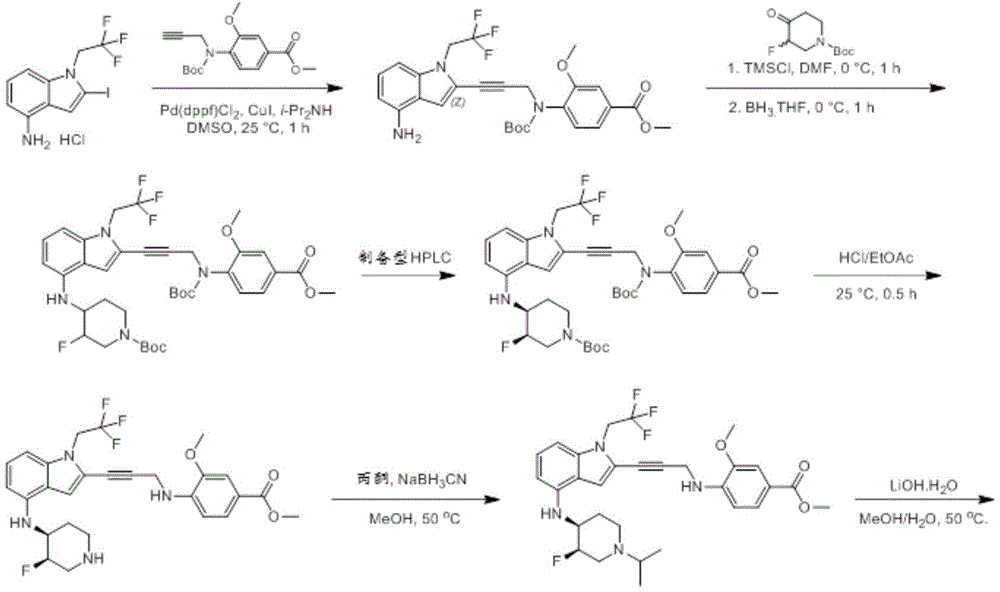

Preparation of methyl 4- ((3- (4-amino-1- (2,2, 2-trifluoroethyl) -1H-indol-2-yl) prop-2-yn-1-yl) (tert-butoxycarbonyl) amino) -3-methoxybenzoate: to a solution of methyl 4- ((tert-butoxycarbonyl) (prop-2-yn-1-yl) amino) -3-methoxybenzoate (1.2 eq) in DMSO (80mL) was added i-Pr 2 NH (10 equiv.), CuI (0.2 equiv.), 2-iodo-1- (2,2, 2-trifluoroethyl) -1H-indol-4-amine hydrochloride (9g,1 equiv.), and Pd (PPh) 3 ) 4 (0.05 eq). In N 2 The mixture was then stirred at 25 ℃ for 1 hour. TLC analysis indicated the reaction was complete. Saturated aqueous EDTA (300mL) and EtOAc (100mL) were added to the reaction mixture at 25 ℃. The resulting mixture was filtered and extracted with EtOAc (150mL x 2). The organic phase was washed with water (500mL x 2) and brine (500mL x 2), dried over anhydrous sodium sulfate, filtered and concentrated under reduced pressure. The crude residue is purified by column chromatography (SiO) 2 PE: EtOAc ═ 20:1 to 2:1) purification afforded the desired product (13.5g,25.40mmol) (86.4% yield) as a dark brown oil.
Preparation of tert-butyl 4- ((2- (3- ((tert-butoxycarbonyl) (2-methoxy-4- (methoxycarbonyl) phenyl) amino) prop-1-yn-1-yl) -1- (2,2, 2-trifluoroethyl) -1H-indol-4-yl) amino) -3-fluoropiperidine-1-carboxylate: to a solution of methyl 4- ((3- (4-amino-1- (2,2, 2-trifluoroethyl) -1H-indol-2-yl) prop-2-yn-1-yl) (tert-butoxycarbonyl) amino) -3-methoxybenzoate (11g,1 eq) in DMF (100mL) was added tert-butyl 3-fluoro-4-oxopiperidine-1-carboxylate (5 eq) and TMSCl (2.5 eq). The mixture was stirred at 0 ℃ for 1 hour, and BH was added 3 THF (1M,3 equivalents) was added to the mixture. The resulting reaction mixture was stirred at 0 ℃ for 1 hour. LC-MS analysis indicated that the reaction was complete. The reaction mixture was quenched by the addition of ice water (250mL) and the mixture was extracted with EtOAc (250mL x 2). The combined organic layers were washed with water (500mL x 2) and brine (500mL x 2), dried over anhydrous sodium sulfate, filtered and concentrated under reduced pressure to give the desired product (20g, crude) as a dark brown oil. MS (ES) + ,m/z):755.3。
Preparation of tert-butyl (3R,4S) -4- ((2- (3- ((tert-butoxycarbonyl) (2-methoxy-4- (methoxycarbonyl) phenyl) amino) prop-1-yn-1-yl) -1- (2,2, 2-trifluoroethyl) -1H-indol-4-yl) amino) -3-fluoropiperidine-1-carboxylate: tert-butyl 4- ((2- (3- ((tert-butoxycarbonyl) (2-methoxy-4- (methoxycarbonyl) phenyl) amino) prop-1-yn-1-yl) -1- (2,2, 2-trifluoroethyl) -1H-indol-4-yl) amino) -3-fluoropiperidine-1-carboxylate was purified by preparative HPLC. By adding saturated Na 2 CO 3 The pH of the solution was adjusted to 8. The solution was concentrated and the mixture was extracted with EtOAc (250mL x 2). The combined organic layers were washed with brine (500mL × 2), dried over anhydrous sodium sulfate, filtered and concentrated in vacuo to give the desired product (10.5g,14.33mmol, 58.33% yield) as a white solid.
Preparation of methyl 4- ((3- (4- (((3R,4S) -3-fluoropiperidin-4-yl) amino) -1- (2,2, 2-trifluoroethyl) -1H-indol-2-yl) prop-2-yn-1-yl) amino) -3-methoxybenzoate: to a solution of tert-butyl (3R,4S) -4- ((2- (3- ((tert-butoxycarbonyl) (2-methoxy-4- (methoxycarbonyl) phenyl) amino) prop-1-yn-1-yl) -1- (2,2, 2-trifluoroethyl) -1H-indol-4-yl) amino) -3-fluoropiperidine-1-carboxylate (2g,2.73mmol,1 eq) in EtOAc (10mL) was added HCl/EtOAc (4M,20mL,29.31 eq). The mixture was stirred at 25 ℃ for 0.5 hour. TLC analysis indicated the reaction was complete. The reaction mixture was quenched by the addition of water (100mL) and saturated Na by the addition 2 CO 3 The pH of the solution was adjusted to 8. The resulting mixture was extracted with EtOAc (100 mL. times.2). The combined organic layers were washed with brine (100mL x 2), dried over anhydrous sodium sulfate, filtered, and concentrated in vacuo to afford the desired product (1.6g, crude) as a white solid.
4- ((3- (4- (((3R,4S) -3-fluoro-1-isopropylpiperidin-4-yl) amino) -1- (2,2, 2-trifluoroethyl) -1H-indol-2-yl) prop-2-yn-1-yl) amino) -3-methoxybenzenePreparation of methyl formate: to a solution of methyl 4- ((3- (4- (((3R,4S) -3-fluoropiperidin-4-yl) amino) -1- (2,2, 2-trifluoroethyl) -1H-indol-2-yl) prop-2-yn-1-yl) amino) -3-methoxybenzoate (0.45g,845.02 μmol,1 eq) in MeOH (5mL) was added acetone (490.78mg,8.45mmol,621.24 μ L,10 eq). The mixture was stirred at 50 ℃ for 1 hour, and NaBH was added 3 CN (106.21mg,1.69mmol,2 equiv.) was added to the reaction. The resulting mixture was stirred at 50 ℃ for 11 hours. TLC analysis indicated the reaction was complete. The reaction mixture was quenched by the addition of water (100mL) and the mixture was extracted with EtOAc (50mL × 2). The combined organic layers were washed with brine (100mL x 2), dried over anhydrous sodium sulfate, filtered and concentrated under reduced pressure. The crude residue was passed through preparative TLC (SiO) 2 DCM: MeOH ═ 10:1) gave the desired product (0.45g,783.14 μmol, 92.68% yield) as a yellow oil.
Preparation of 4- ((3- (4- (((3R,4S) -3-fluoro-1-isopropylpiperidin-4-yl) amino) -1- (2,2, 2-trifluoroethyl) -1H-indol-2-yl) prop-2-yn-1-yl) amino) -3-methoxybenzoic acid: to a solution of methyl 4- ((3- (4- (((3R,4S) -3-fluoro-1-isopropylpiperidin-4-yl) amino) -1- (2,2, 2-trifluoroethyl) -1H-indol-2-yl) prop-2-yn-1-yl) amino) -3-methoxybenzoate (0.4g,696.13 μmol,1 eq) in MeOH (3mL) was added lioh.h 2 O (584.19mg,13.92mmol,20 equiv.). Then, water (3mL) was added to the reaction, and the mixture was stirred at 50 ℃ for 2 hours. TLC analysis indicated the reaction was complete. The reaction mixture was quenched by the addition of water (100mL) and the resulting mixture was extracted with EtOAc (50mL x 3). The combined organic layers were washed with brine (100mL x 2), dried over anhydrous sodium sulfate, filtered and concentrated under reduced pressure to give the desired product (0.4g, crude) as a yellow solid.
Isolation of 4- ((3- (4- (((3R,4S) -3-fluoro-1-isopropylpiperidin-4-yl) amino) -1- (2,2, 2-trifluoroethyl) -1H-indol-2-yl) prop-2-yn-1-yl) amino) -3-methoxybenzoic acid by SFC afforded the desired product. 4- { [3- (4- { [ (3S,4R) -3-fluoro-1- (prop-2-yl) piperidin-4-yl]Amino } -1- (2,2, 2-trifluoroethyl) -1H-indol-2-yl) prop-2-yn-1-yl]Amino } -3-methoxybenzoic acid, MS (ES) + M/z) 561.2; and 4- { [3- (4- { [ (3R,4S) -3-fluoro-1- (prop-2-yl) piperidine-4-yl]Amino } -1- (2,2, 2-trifluoroethyl) -1H-indol-2-yl) prop-2-yn-1-yl]Amino } -3-methoxybenzoic acid, MS (ES) + ,m/z):561.2。
Preparation of ethyl 4- ((3- (4- (((3R,4S) -3-fluoro-1-isopropylpiperidin-4-yl) amino) -1- (2,2, 2-trifluoroethyl) -1H-indol-2-yl) prop-2-yn-1-yl) amino) -3-methoxybenzoate: to a solution of 4- ((3- (4- (((3R,4S) -3-fluoro-1-isopropylpiperidin-4-yl) amino) -1- (2,2, 2-trifluoroethyl) -1H-indol-2-yl) prop-2-yn-1-yl) amino) -3-methoxybenzoic acid (0.15g, 267.58. mu. mol,1 eq) in DMF (3mL) was added iodoethane (41.73mg, 267.58. mu. mol, 21.40. mu.L, 1 eq) and K 2 CO 3 (110.94mg, 802.74. mu. mol,3 equiv.). The mixture was stirred at 50 ℃ for 1 hour. TLC analysis indicated the reaction was complete. The reaction mixture was quenched by the addition of water (100mL) and the resulting mixture was extracted with EtOAc (50mL × 2). The combined organic layers were washed with brine (100mL x 2), dried over anhydrous sodium sulfate, filtered and concentrated under reduced pressure to give the desired product (0.14g, crude) as a yellow solid.
Ethyl 4- ((3- (4- (((3R,4S) -3-fluoro-1-isopropylpiperidin-4-yl) amino) -1- (2,2, 2-trifluoroethyl) -1H-indol-2-yl) prop-2-yn-1-yl) amino) -3-methoxybenzoate was isolated by SFC to give the desired product as a white solid. 4- { [3- (4- { [ (3R,4S) -3-fluoro-1- (prop-2-yl) piperidin-4-yl]Amino } -1- (2,2, 2-trifluoroethyl) -1H-indol-2-yl) prop-2-yn-1-yl]Amino } -3-methoxybenzoic acid ethyl ester, MS (ES) + M/z) 589.2; and 4- { [3- (4- { [ (3S,4R) -3-fluoro-1- (prop-2-yl) piperidin-4-yl]Amino } -1- (2,2, 2-trifluoroethyl) -1H-indol-2-yl) prop-2-yn-1-yl]Amino } -3-methoxybenzoic acid ethyl ester, MS (ES) + ,m/z):589.2。
Example D101: synthesis of compounds 822A, 823A, 824A, 828A, 829A and 958A.

Process for preparing methyl 4- ((3- (4- (((3R,4S) -1-ethyl-3-fluoropiperidin-4-yl) amino) -1- (2,2, 2-trifluoroethyl) -1H-indol-2-yl) prop-2-yn-1-yl) amino) -3-methoxybenzoatePreparation: to a solution of methyl 4- ((3- (4- (((3R,4S) -3-fluoropiperidin-4-yl) amino) -1- (2,2, 2-trifluoroethyl) -1H-indol-2-yl) prop-2-yn-1-yl) amino) -3-methoxybenzoate (0.45g, 845.02. mu. mol,1 eq) in DMF (5mL) was added iodoethane (197.69mg,1.27mmol, 101.38. mu.L, 1.5 eq) and K 2 CO 3 (350.37mg,2.54mmol,3 equiv.). The mixture was stirred at 50 ℃ for 1 hour. TLC analysis indicated the reaction was complete. The reaction mixture was quenched with water (100mL) and the mixture was extracted with EtOAc (50mL × 2). The combined organic layers were washed with brine (50mL x 2), dried over anhydrous sodium sulfate, filtered and concentrated under reduced pressure. The crude residue was passed through preparative TLC (SiO) 2 DCM: MeOH ═ 10:1) gave the desired product (0.43g,767.06 μmol, 90.77% yield) as a yellow oil.
Preparation of 4- ((3- (4- (((3R,4S) -1-ethyl-3-fluoropiperidin-4-yl) amino) -1- (2,2, 2-trifluoroethyl) -1H-indol-2-yl) prop-2-yn-1-yl) amino) -3-methoxybenzoic acid: to a solution of methyl 4- ((3- (4- (((3R,4S) -1-ethyl-3-fluoropiperidin-4-yl) amino) -1- (2,2, 2-trifluoroethyl) -1H-indol-2-yl) prop-2-yn-1-yl) amino) -3-methoxybenzoate (0.38g, 677.87. mu. mol,1 eq) in MeOH (3mL) was added LiOH. H 2 O (568.92mg,13.56mmol,20 equiv.). Then, water (3mL) was added to the reaction, and the mixture was stirred at 50 ℃ for 1 hour. TLC analysis indicated the reaction was complete. The reaction mixture was quenched by the addition of water (100mL) and the resulting mixture was extracted with EtOAc (50mL x 3). The combined organic layers were washed with brine (100mL x 2), dried over anhydrous sodium sulfate, filtered and concentrated under reduced pressure. The residue was purified by preparative HPLC to give the desired product (20.8mg,38.06 μmol) as a white solid. MS (ES) + ,m/z):574.2。
Preparation of compounds 828A and 829A: 4- ((3- (4- (((3R,4S) -1-ethyl-3-fluoropiperidin-4-yl) amino) -1- (2,2, 2-trifluoroethyl) -1H-indol-2-yl) prop-2-yn-1-yl) amino) -3-methoxybenzoic acid was isolated by SFC to give the desired product as a white solid. 4- { [3- (4- { [ (3R,4S) -1-Ethyl-3-Fluoropiperidin-4-yl ]Amino } -1- (2,2, 2-trifluoroethyl) -1H-indol-2-yl) prop-2-yn-1-yl]Amino } -3-methoxybenzoic acid, MS (ES) + ,m/z):547.3;4-{[3-(4-{[(3S,4R) -1-ethyl-3-fluoropiperidin-4-yl]Amino } -1- (2,2, 2-trifluoroethyl) -1H-indol-2-yl) prop-2-yn-1-yl]Amino } -3-methoxybenzoic acid, MS (ES) + ,m/z):547.3。
Preparation of ethyl 4- ((3- (4- (((3R,4S) -1-ethyl-3-fluoropiperidin-4-yl) amino) -1- (2,2, 2-trifluoroethyl) -1H-indol-2-yl) prop-2-yn-1-yl) amino) -3-methoxybenzoate: to a solution of 4- ((3- (4- (((3R,4S) -1-ethyl-3-fluoropiperidin-4-yl) amino) -1- (2,2, 2-trifluoroethyl) -1H-indol-2-yl) prop-2-yn-1-yl) amino) -3-methoxybenzoic acid (0.15g, 274.45. mu. mol,1 eq) in DMF (3mL) was added iodoethane (64.21mg, 411.67. mu. mol, 32.93. mu.L, 1.5 eq) and K 2 CO 3 (113.79mg, 823.34. mu. mol,3 equiv.). The mixture was stirred at 50 ℃ for 1 hour. LC-MS analysis indicated the reaction was complete. The reaction mixture was quenched by the addition of water (100mL) and the mixture was extracted with EtOAc (50mL × 2). The combined organic layers were washed with brine (100mL x 2), dried over anhydrous sodium sulfate, filtered and concentrated under reduced pressure. The crude residue was purified by preparative HPLC to give the desired product (6.0mg,10.44 μmol) as a white solid. MS (ES) + ,m/z):575.2。
Preparation of compounds 823A and 824A: ethyl 4- ((3- (4- (((3R,4S) -1-ethyl-3-fluoropiperidin-4-yl) amino) -1- (2,2, 2-trifluoroethyl) -1H-indol-2-yl) prop-2-yn-1-yl) amino) -3-methoxybenzoate was isolated by SFC to give the desired product as a white solid. 4- { [3- (4- { [ (3R,4S) -1-Ethyl-3-Fluoropiperidin-4-yl]Amino } -1- (2,2, 2-trifluoroethyl) -1H-indol-2-yl) prop-2-yn-1-yl]Amino } -3-methoxybenzoic acid ethyl ester, MS (ES) + M/z) 575.2; 4- { [3- (4- { [ (3S,4R) -1-Ethyl-3-Fluoropiperidin-4-yl]Amino } -1- (2,2, 2-trifluoroethyl) -1H-indol-2-yl) prop-2-yn-1-yl]Amino } -3-methoxybenzoic acid ethyl ester, MS (ES) + ,m/z):575.2。
Example D102: synthesis of compounds 872A and 873A.
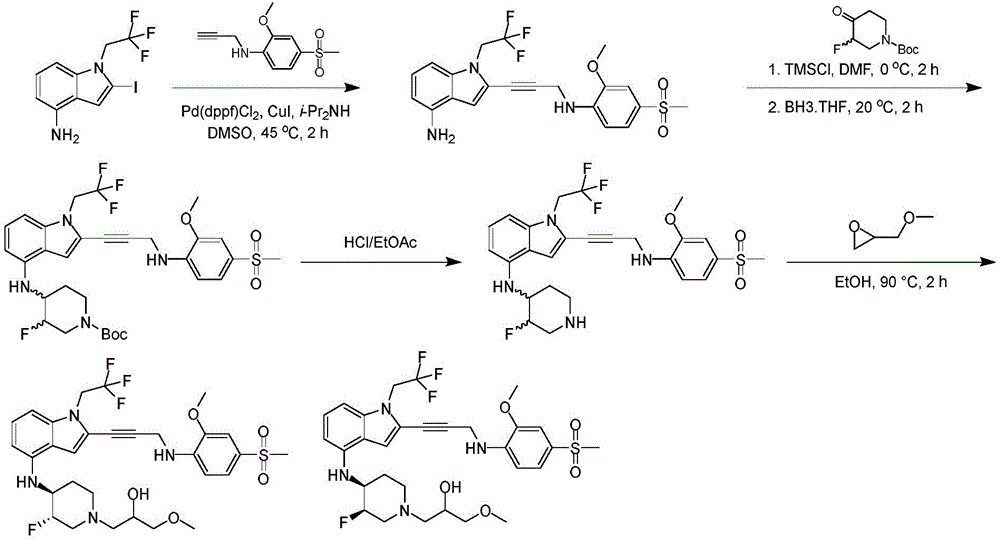
2- (3- ((2-methoxy-4- (methylsulfonyl) phenyl) amino) prop-1-yn-1-yl)) Preparation of (E) -1- (2,2, 2-trifluoroethyl) -1H-indol-4-amine: in N 2 To a mixture of 2-iodo-1- (2,2, 2-trifluoroethyl) -1H-indol-4-amine (1g,2.94mmol,1 eq) and 2-methoxy-4-methylsulfonyl-N-prop-2-ynyl-aniline (1.41g,5.88mmol,2 eq) in DMSO (15mL) was added N-isopropylprop-2-amine (2.98g,29.40mmol,4.16mL,10 eq), Pd (dppf) Cl 2 (215.16mg, 294.05. mu. mol,0.1 eq.) and CuI (560.01mg,2.94mmol,1 eq.). The mixture was stirred at 45 ℃ for 2 hours. LC-MS and TLC analysis (PE: EtOAc ═ 1:1) indicated that the reaction was complete. The reaction mixture was quenched by addition of saturated aqueous EDTA (100mL) at 25 deg.C and the resulting mixture was extracted with EtOAc (50 mL. times.3). The combined organic layers were dried over anhydrous sodium sulfate, filtered and concentrated in vacuo. The crude residue was purified by column chromatography (PE: EtOAc ═ 2:1 to 1:1) to give the desired product (0.8g,1.68mmol, 57.25% yield) as a light yellow solid. MS (ES) + ,m/z):452.0。
Preparation of 3-fluoro-4- ((2- (3- ((2-methoxy-4- (methylsulfonyl) phenyl) amino) prop-1-yn-1-yl) -1- (2,2, 2-trifluoroethyl) -1H-indol-4-yl) amino) piperidine-1-carboxylic acid tert-butyl ester: to 2- (3- ((2-methoxy-4- (methylsulfonyl) phenyl) amino) prop-1-yn-1-yl) -1- (2,2, 2-trifluoroethyl) -1H-indol-4-amine (360.89mg,1.66mmol,2.5 equivalents) and 2- [3- (2-methoxy-4-methylsulfonyl-anilino) prop-1-ynyl]A mixture of-1- (2,2, 2-trifluoroethyl) indol-4-amine (300mg, 664.51. mu. mol,1 eq) in DMF (6mL) was added TMSCl (180.48mg,1.66mmol, 210.84. mu.L, 2.5 eq). The mixture was stirred at 0 ℃ for 2 hours and under N 2 By reacting BH 3 THF (1M,3.32mL,5 equiv.) was added to the reaction. The mixture was stirred at 20 ℃ for 2 hours. LC-MS analysis indicated the reaction was complete. By adding saturated Na 2 CO 3 The reaction mixture was quenched with aqueous solution (30mL), diluted with water (10mL), and extracted with EtOAc (20mL × 2). The combined organic layers were washed with brine (10mL), dried over anhydrous sodium sulfate, filtered and concentrated in vacuo. The crude residue was purified by preparative HPLC to give the desired product (160mg,245.14 μmol, 36.89% yield) as a yellow solid. MS (ES) + ,m/z):653.2。
N- (3-Fluoropiperidin-4-yl) -2- (3- ((2-methoxy-4) Preparation of- (methylsulfonyl) phenyl) amino) prop-1-yn-1-yl) -1- (2,2, 2-trifluoroethyl) -1H-indol-4-amine: a solution of tert-butyl 3-fluoro-4- ((2- (3- ((2-methoxy-4- (methylsulfonyl) phenyl) amino) prop-1-yn-1-yl) -1- (2,2, 2-trifluoroethyl) -1H-indol-4-yl) amino) piperidine-1-carboxylate (80mg, 122.57. mu. mol,1 eq) in HCl/EtOAc (4M,8mL,261.08 eq) was stirred at 25 ℃ for 10 min. LC-MS analysis indicated the reaction was complete. The solution was dried in vacuo to give the crude product. By adding saturated Na 2 CO 3 The crude product was neutralized with aqueous solution (100mL) and extracted with EtOAc (20 mL). The combined organic layers were washed with brine (100mL x 3), dried over anhydrous sodium sulfate, filtered, and concentrated in vacuo to give the crude product (80mg, crude) as a pale yellow solid. MS (ES) + ,m/z):553.1。
Preparation of the final product: to a solution of N- (3-fluoropiperidin-4-yl) -2- (3- ((2-methoxy-4- (methylsulfonyl) phenyl) amino) prop-1-yn-1-yl) -1- (2,2, 2-trifluoroethyl) -1H-indol-4-amine (60mg,108.58 μmol,1 eq) in EtOH (3mL) was added 2- (methoxymethyl) oxirane (57.40mg,651.49 μmol,57.98 μ L,6 eq). In N 2 The mixture was then stirred at 90 ℃ for 2 hours. LC-MS analysis indicated that the reaction was complete. The reaction mixture was concentrated in vacuo and the crude residue was purified by preparative HPLC to give the desired product as a yellow solid.
1- ((3S,4S) -3-fluoro-4- ((2- (3- ((2-methoxy-4- (methylsulfonyl) phenyl) amino) prop-1-yn-1-yl) -1- (2,2, 2-trifluoroethyl) -1H-indol-4-yl) amino) piperidin-1-yl) -3-methoxypropan-2-ol, 25mg, 35.0% yield, MS (ES) + M/z) 641.2; and 1- ((3R,4S) -3-fluoro-4- ((2- (3- ((2-methoxy-4- (methylsulfonyl) phenyl) amino) prop-1-yn-1-yl) -1- (2,2, 2-trifluoroethyl) -1H-indol-4-yl) amino) piperidin-1-yl) -3-methoxypropan-2-ol, 25mg, 35.0% yield, MS (ES) + ,m/z):641.2。
Example D103: synthesis of compounds 733A and 734A.

Preparation of (3S,4S) -4- ((2-iodo-1- (2,2, 2-trifluoroethyl) -1H-indol-4-yl) amino) -3-methylpiperidine-1-carboxylic acid tert-butyl ester and (3R,4S) -4- ((2-iodo-1- (2,2, 2-trifluoroethyl) -1H-indol-4-yl) amino) -3-methylpiperidine-1-carboxylic acid tert-butyl ester: to a mixture of 2-iodo-1- (2,2, 2-trifluoroethyl) indol-4-amine (2.5g,7.35mmol,1 eq) and 3-methyl-4-oxo-piperidine-1-carboxylic acid tert-butyl ester (4.70g,22.05mmol,3 eq) in EtOH (25mL) was added Ti (OEt) 4 (8.38g,36.76mmol,7.62mL,5 equiv.). The mixture was stirred at 50 ℃ for 12 hours and NaBH was added 3 CN (2.31g,36.76mmol,5 equiv.) was added to the reaction mixture. The resulting reaction mixture was stirred at 50 ℃ for 1 hour. LC-MS and TLC analysis indicated that the reaction was complete. The reaction was poured over saturated Na at 0 deg.C 2 CO 3 Aqueous (8mL) and the resulting mixture extracted with EtOAc (40mL x 3). The combined organic layers were washed with brine (40mL x3), dried over anhydrous sodium sulfate, filtered and concentrated under reduced pressure. The residue was purified by column chromatography (SiO) 2 PE: EtOAc 1:0 to 10:1) and preparative HPLC purification afforded the desired product as a grey solid.
Preparation of 2-iodo-N- ((3S,4S) -3-methylpiperidin-4-yl) -1- (2,2, 2-trifluoroethyl) -1H-indol-4-amine: to a solution of tert-butyl (3S,4S) -4- ((2-iodo-1- (2,2, 2-trifluoroethyl) -1H-indol-4-yl) amino) -3-methylpiperidine-1-carboxylate (490mg,911.87 μmol,1 eq) in DCM (6mL) was added TFA (3.08g,27.01mmol,2mL,29.62 eq). The mixture was stirred at 25 ℃ for 0.5 hour. TLC analysis indicated the reaction was complete. Saturated Na 2 CO 3 An aqueous solution (20mL) was added to the mixture to adjust the pH of the mixture to 9, and the resulting mixture was extracted with EtOAc (20mL x 3). The combined organic layers were washed with brine (20mL x3), dried over anhydrous sodium sulfate, filtered and concentrated under reduced pressure to give the desired product (0.36g, crude) as a brown solid.
Preparation of N- ((3S,4S) -1, 3-dimethylpiperidin-4-yl) -2-iodo-1- (2,2, 2-trifluoroethyl) -1H-indol-4-amine: to a mixture of 2-iodo-N- ((3S,4S) -3-methylpiperidin-4-yl) -1- (2,2, 2-trifluoroethyl) -1H-indol-4-amine (0.28g, 640.38. mu. mol,1 eq) and formaldehyde (38.46mg,1.28mmol, 35.28. mu.L, 2 eq) in MeOH (6mL) was added AcOH (38.46ug, 0.64. mu. mol,3 mL) 66e-2 μ L,0.001 eq). The mixture was then stirred at 50 ℃ for 1 hour, and NaBH was added 3 CN (201.21mg,3.20mmol,5 equivalents) was added to the reaction. The reaction mixture was further stirred at 50 ℃ for 1 hour. LC-MS analysis indicated the reaction was complete. The reaction mixture was poured into water (15mL) and the resulting mixture was extracted with EtOAc (15mL x 3). The combined organic layers were washed with brine (15mL x 3), dried over anhydrous sodium sulfate, filtered and concentrated under reduced pressure. The residue was passed through preparative TLC (SiO) 2 DCM: MeOH ═ 10:1) gave the desired product (0.24g,531.84 μmol, 83.05% yield) as a yellow solid. MS (ES) + ,m/z):452.1。
Preparation of N- ((3S,4S) -1, 3-dimethylpiperidin-4-yl) -2- (3- ((2-methoxy-4- (methylsulfonyl) phenyl) amino) prop-1-yn-1-yl) -1- (2,2, 2-trifluoroethyl) -1H-indol-4-amine: to a solution of 2-methoxy-4-methylsulfonyl-N-prop-2-ynyl-aniline (127.26mg, 531.84. mu. mol,1.2 equivalents) in DMSO (2mL) was added N-isopropylprop-2-amine (448.47mg,4.43mmol, 626.36. mu.L, 10 equivalents), CuI (84.41mg, 443.20. mu. mol,1 equivalent), N- ((3S,4S) -1, 3-dimethylpiperidin-4-yl) -2-iodo-1- (2,2, 2-trifluoroethyl) -1H-indol-4-amine (0.2g, 443.20. mu. mol,1 equivalent), and Pd (PPh) 3 ) 4 (204.86mg, 177.28. mu. mol,0.4 equiv.). In N 2 The mixture was then stirred at 25 ℃ for 1 hour. TLC analysis indicated the reaction was complete. The reaction was diluted with EtOAc (15mL) and the resulting mixture was poured into saturated aqueous EDTA (15mL) and stirred at 25 ℃ for 1 h. The mixture was extracted with EtOAc (10mL), and the combined organic layers were washed with brine (10mL x 3), dried over anhydrous sodium sulfate, filtered, and concentrated under reduced pressure. The crude residue was passed through preparative TLC (SiO) 2 DCM: MeOH ═ 10:1) and preparative HPLC gave the desired product (0.1g,177.73 μmol, 40.10% yield) as a yellow solid.
Preparation of the final product: n- ((3S,4S) -1, 3-dimethylpiperidin-4-yl) -2- (3- ((2-methoxy-4- (methylsulfonyl) phenyl) amino) prop-1-yn-1-yl) -1- (2,2, 2-trifluoroethyl) -1H-indol-4-amine was purified by SFC to give the final product. N- ((3S,4S) -1, 3-dimethylpiperidin-4-yl) -2- (3- ((2-methoxy-4- (methylsulfonyl) phenyl) amino) prop-1-yn-1-yl) -1- (2,2, 2-trifluoroethyl) -1H-indol-4-amine (0.0224g, 39.81. mu. mol), MS (ES) + M/z) 563.2; and N- ((3R,4R) -1, 3-dimethylpiperidin-4-yl) -2- (3- ((2-methoxy-4- (methylsulfonyl) phenyl) amino) prop-1-yn-1-yl) -1- (2,2, 2-trifluoroethyl) -1H-indol-4-amine (0.0222g,39.26 μmol), MS (ES) + ,m/z):563.3。
Example D104: synthesis of compounds 736A and 737A.

Preparation of 2-iodo-N- ((3R,4S) -3-methylpiperidin-4-yl) -1- (2,2, 2-trifluoroethyl) -1H-indol-4-amine: to (3R,4S) -4- [ [ 2-iodo-1- (2,2, 2-trifluoroethyl) indol-4-yl]Amino group]A solution of tert-butyl-3-methyl-piperidine-1-carboxylate (0.5g, 930.48. mu. mol,1 eq.) in DCM (3mL) was added TFA (7.70g,67.53mmol,5mL,72.58 eq.). The mixture was stirred at 25 ℃ for 0.5 h. TLC analysis indicated the reaction was complete. Saturated Na 2 CO 3 Aqueous solution (20mL) was added to the reaction to adjust the pH of the mixture to 9 and the mixture was extracted with EtOAc (20mL x 3). The combined organic layers were washed with brine (20mL x 3), dried over anhydrous sodium sulfate, filtered and concentrated under reduced pressure. The crude product (0.4g, crude) was obtained as a yellow solid and used in the next step without purification.
Preparation of N- ((3R,4S) -1, 3-dimethylpiperidin-4-yl) -2-iodo-1- (2,2, 2-trifluoroethyl) -1H-indol-4-amine: to a mixture of 2-iodo-N- ((3R,4S) -3-methylpiperidin-4-yl) -1- (2,2, 2-trifluoroethyl) -1H-indol-4-amine (0.35g,800.47 μmol,1 eq) and formaldehyde (120.17mg,4mmol,110.25 μ L,5 eq) in MeOH (3mL) was added AcOH (48.07ug,0.8 μmol,4.58e-2 μ L,0.001 eq). The mixture was stirred at 50 ℃ for 1 hour, and NaBH was added 3 CN (251.51mg,4mmol,5 equiv.) was added to the reaction. The reaction mixture was further stirred at 50 ℃ for 1 hour. TLC analysis indicated the reaction was complete. The reaction mixture was poured into water (10mL) and extracted with EtOAc (10mL x 3). The combined organic layers were washed with brine (10mL x 3), dried over anhydrous sodium sulfate, filtered and concentrated under reduced pressure. The residue was passed through preparative TLC (SiO) 2 ,DCM: MeOH ═ 10:1) to give the desired product (0.13g,288.08 μmol, 35.99% yield) as a yellow solid.
Preparation of N- ((3R,4S) -1, 3-dimethylpiperidin-4-yl) -2- (3- ((2-methoxy-4- (methylsulfonyl) phenyl) amino) prop-1-yn-1-yl) -1- (2,2, 2-trifluoroethyl) -1H-indol-4-amine: to a solution of 2-methoxy-4-methylsulfonyl-N-prop-2-ynyl-aniline (63.63mg, 265.92. mu. mol,1.2 eq) in DMSO (2mL) was added N-isopropylprop-2-amine (224.24mg,2.22mmol, 313.18. mu.L, 10 eq) and CuI (42.20mg, 221.60. mu. mol,1 eq), N- ((3R,4S) -1, 3-dimethylpiperidin-4-yl) -2-iodo-1- (2,2, 2-trifluoroethyl) -1H-indol-4-amine (0.1g, 221.60. mu. mol,1 eq) and Pd (PPh) 3 ) 4 (102.43mg, 88.64. mu. mol,0.4 equiv.). At N 2 The mixture was then stirred at 25 ℃ for 1 hour. TLC analysis indicated the reaction was complete. The reaction mixture was diluted with EtOAc (15mL) and the resulting mixture was poured into saturated aqueous EDTA (15mL) and stirred at 25 ℃ for a further 1 hour. The mixture was extracted with EtOAc (10mL x 3) and the combined organic layers were washed with brine (10mL x 3), dried over anhydrous sodium sulfate, filtered and concentrated under reduced pressure. The residue was passed through preparative TLC (SiO) 2 DCM: MeOH ═ 10:1) and preparative HPLC gave the desired product (27.80mg,49.41 μmol, 22.30% yield) as a white solid.
Preparation of final product: n- ((3R,4S) -1, 3-dimethylpiperidin-4-yl) -2- (3- ((2-methoxy-4- (methylsulfonyl) phenyl) amino) prop-1-yn-1-yl) -1- (2,2, 2-trifluoroethyl) -1H-indol-4-amine was purified by SFC to give the desired product as a white solid. N- ((3R,4S) -1, 3-dimethylpiperidin-4-yl) -2- (3- ((2-methoxy-4- (methylsulfonyl) phenyl) amino) prop-1-yn-1-yl) -1- (2,2, 2-trifluoroethyl) -1H-indol-4-amine, MS (ES) + M/z) 563.2; and N- ((3S,4R) -1, 3-dimethylpiperidin-4-yl) -2- (3- ((2-methoxy-4- (methylsulfonyl) phenyl) amino) prop-1-yn-1-yl) -1- (2,2, 2-trifluoroethyl) -1H-indol-4-amine, MS (ES) + ,m/z):563.3。
Example D105: synthesis of Compounds 780A and 781A.

At N 2 The reaction mixture is prepared by reacting methyl 4- ((3- (4- (((3R,4S) -3-fluoropiperidin-4-yl) amino) -1- (2,2, 2-trifluoroethyl) -1H-indol-2-yl) prop-2-yn-1-yl) amino) -3-methoxybenzoate, NaBH 3 A mixture of CN (53.10mg, 845.02. mu. mol,3 equiv.), AcOH (16.91mg, 281.67. mu. mol, 16.11. mu.L, 1 equiv.), and formaldehyde (84.59mg,2.82mmol,10 equiv.) in MeOH (3mL) was stirred at 20 ℃ for 16 h. TLC analysis (EtOAc: TEA ═ 10:1, R f 0.65) indicated complete consumption of starting material and a new spot was detected. The reaction mixture was quenched by addition of water (10mL) and extracted with EtOAc (10mL x 3). The combined organic layers were washed with brine (10mL x3), dried over anhydrous sodium sulfate, filtered and concentrated under reduced pressure to give a residue. The residue was purified by preparative HPLC to give methyl 4- ((3- (4- (((3R,4S) -3-fluoro-1-methylpiperidin-4-yl) amino) -1- (2,2, 2-trifluoroethyl) -1H-indol-2-yl) prop-2-yn-1-yl) amino) -3-methoxybenzoate (0.07g,121.67 μmol, 43.20% yield) as a yellow solid.
Methyl 4- ((3- (4- (((3R,4S) -3-fluoro-1-methylpiperidin-4-yl) amino) -1- (2,2, 2-trifluoroethyl) -1H-indol-2-yl) prop-2-yn-1-yl) amino) -3-methoxybenzoate was isolated by SFC to give the desired final product as a yellow solid. 4- { [3- (4- { [ (3R,4S) -3-fluoro-1-methylpiperidin-4-yl]Amino } -1- (2,2, 2-trifluoroethyl) -1H-indol-2-yl) prop-2-yn-1-yl]Amino } -3-methoxybenzoic acid (0.03g, 54.23. mu. mol, 42.34% yield), MS (ES) + M/z) 533.2; and 4- { [3- (4- { [ (3S,4R) -3-fluoro-1-methylpiperidin-4-yl]Amino } -1- (2,2, 2-trifluoroethyl) -1H-indol-2-yl) prop-2-yn-1-yl ]Amino } -3-methoxybenzoic acid (0.03g, 54.67. mu. mol, 42.69% yield), MS (ES) + ,m/z):533.2。
Example D106: synthesis of compounds 832A and 833A.

To 4- ((3- (4- ((3-fluoro-1-methylpiperidin-4-yl) amino) -1- (2,2, 2-trifluoroethyl) -1H-indol-2-yl)) Methyl prop-2-yn-1-yl) amino) -3-methoxybenzoate (0.18g,329.34 μmol,1 eq) in MeOH (20mL) was added LiOH. H 2 O (20mL,10mol/L,10mL) in N 2 The reaction mixture was then stirred at 50 ℃ for 16 hours. TLC analysis (EtOAc: TEA ═ 10:1, R) f 0.01) indicates that starting material remained and a major new spot was detected. The reaction mixture was quenched by addition of EtOAc (30mL) and the resulting mixture was further extracted with EtOAc (30mL x 3). The combined organic layers were washed with brine (20mL x 3), dried over anhydrous sodium sulfate, filtered and concentrated under reduced pressure to give a residue. The crude residue was purified by preparative HPLC to give the desired product as a yellow solid (0.1g, 54.17% yield).
rac-4- ((3- (4- (((3R,4S) -3-fluoro-1-methylpiperidin-4-yl) amino) -1- (2,2, 2-trifluoroethyl) -1H-indol-2-yl) prop-2-yn-1-yl) amino) -3-methoxybenzoic acid, MS (ES) + M/z) 533.2; and rac-4- { [3- (4- { [ (3R,4R) -3-fluoro-1-methylpiperidin-4-yl ]Amino } -1- (2,2, 2-trifluoroethyl) -1H-indol-2-yl) prop-2-yn-1-yl]Amino } -3-methoxybenzoic acid, MS (ES) + ,m/z):533.1。
Example D107: synthesis of compounds 874A and 875A.

Preparation of methyl 4- ((3- (4- ((3-fluoro-1- ((R) -2-hydroxy-3-methoxypropyl) piperidin-4-yl) amino) -1- (2,2, 2-trifluoroethyl) -1H-indol-2-yl) prop-2-yn-1-yl) amino) -3-methoxybenzoate: to a solution of methyl 4- ((3- (4- ((3-fluoropiperidin-4-yl) amino) -1- (2,2, 2-trifluoroethyl) -1H-indol-2-yl) prop-2-yn-1-yl) amino) -3-methoxybenzoate (0.5g,938.92 μmol,1 eq) and (2R) -2- (methoxymethyl) oxirane (413.62mg,4.69mmol,417.79 μ L,5 eq) in DMF (5mL) was added K 2 CO 3 (389.29mg,2.82mmol,3 equiv.). The mixture was stirred at 50 ℃ for 12 hours. TLC analysis (EtOAc: TEA ═ 10:1, R) f 0.75) detects a major new blob. LC-MS analysis showed complete consumption of the starting material and detected a single compound with the expectationM/z or the desired mass. The reaction mixture was quenched by addition of water (40mL) and extracted with EtOAc (35mL x 3). The combined organic layers were washed with brine (25mL x 3), dried over anhydrous sodium sulfate, filtered and concentrated under reduced pressure. The crude residue was purified by column chromatography to give the desired product (0.35g,420.70 μmol, 44.81% yield) as a yellow solid. MS (ES) + ,m/z):621.4。
Preparation of 4- ((3- (4- ((3-fluoro-1- ((R) -2-hydroxy-3-methoxypropyl) piperidin-4-yl) amino) -1- (2,2, 2-trifluoroethyl) -1H-indol-2-yl) prop-2-yn-1-yl) amino) -3-methoxybenzoic acid: at N 2 Methyl 4- ((3- (4- ((3-fluoro-1- ((R) -2-hydroxy-3-methoxypropyl) piperidin-4-yl) amino) -1- (2,2, 2-trifluoroethyl) -1H-indol-2-yl) prop-2-yn-1-yl) amino) -3-methoxybenzoate (0.1g, 161.13. mu. mol,1 eq) and LiOH. H 2 A mixture of O (67.61mg,1.61mmol,10 equiv.) in water (0.5mL) and MeOH (3mL) was stirred at 50 ℃ for 12 h. TLC analysis (EtOAc: TEA ═ 10:1, R) f 0) indicates complete consumption of starting material. Several new peaks were shown on LC-MS and the desired compound was detected. The reaction mixture was quenched by addition of EtOAc (30mL) and the mixture was further extracted with EtOAc (30mL x 3). The combined organic layers were washed with brine (20mL x 3), dried over anhydrous sodium sulfate, filtered and concentrated under reduced pressure. LC-MS and HPLC analysis indicated the reaction was complete. The residue was purified by preparative HPLC to give the desired product as a blue solid.
4- ((3- (4- (((3R,4S) -3-fluoro-1- ((R) -2-hydroxy-3-methoxypropyl) piperidin-4-yl) amino) -1- (2,2, 2-trifluoroethyl) -1H-indol-2-yl) prop-2-yn-1-yl) amino) -3-methoxybenzoic acid, (35mg) MS (ES) + M/z) 607.2; and 4- ((3- (4- (((3S,4S) -3-fluoro-1- ((R) -2-hydroxy-3-methoxypropyl) piperidin-4-yl) amino) -1- (2,2, 2-trifluoroethyl) -1H-indol-2-yl) prop-2-yn-1-yl) amino) -3-methoxybenzoic acid, (35mg) MS (ES) + ,m/z):607.3。
Example D108: synthesis of compounds 876A and 877A.

Preparation of 4- ((3- (4- (((3R,4S) -3-fluoro-1- ((R) -2-hydroxy-3-methoxypropyl) piperidin-4-yl) amino) -1- (2,2, 2-trifluoroethyl) -1H-indol-2-yl) prop-2-yn-1-yl) amino) -3-methoxybenzoic acid: in N 2 Next, methyl 4- ((3- (4- (((3R,4S) -3-fluoro-1- ((R) -2-hydroxy-3-methoxypropyl) piperidin-4-yl) amino) -1- (2,2, 2-trifluoroethyl) -1H-indol-2-yl) prop-2-yn-1-yl) amino) -3-methoxybenzoate (0.2g, 322.25. mu. mol,1 eq) and LiOH. H 2 A solution of O (135.23mg,3.22mmol,10 equiv.) in MeOH (15mL) and water (3mL) was stirred at 20 deg.C for 12 h. TLC analysis (EtOAc: TEA ═ 10:1, R f 0) indicates complete consumption of starting material. The reaction mixture was quenched by addition of EtOAc (30mL) and extracted with EtOAc (30mL x 3). The combined organic layers were washed with brine (20mL x3), dried over anhydrous sodium sulfate, filtered and concentrated under reduced pressure. The residue was passed through preparative TLC (SiO) 2 DCM: THF ═ 3:1) was purified to give 4- ((3- (4- (((3R,4S) -3-fluoro-1- ((R) -2-hydroxy-3-methoxypropyl) piperidin-4-yl) amino) -1- (2,2, 2-trifluoroethyl) -1H-indol-2-yl) prop-2-yn-1-yl) amino) -3-methoxybenzoic acid (0.11g,170.46 μmol, 52.90% yield) as a yellow oil.
Preparation of the final product: isolation of 4- ((3- (4- (((3R,4S) -3-fluoro-1- ((R) -2-hydroxy-3-methoxypropyl) piperidin-4-yl) amino) -1- (2,2, 2-trifluoroethyl) -1H-indol-2-yl) prop-2-yn-1-yl) amino) -3-methoxybenzoic acid by SFC afforded the desired product. 4- ((3- (4- (((3R,4S) -3-fluoro-1- ((R) -2-hydroxy-3-methoxypropyl) piperidin-4-yl) amino) -1- (2,2, 2-trifluoroethyl) -1H-indol-2-yl) prop-2-yn-1-yl) amino) -3-methoxybenzoic acid, MS (ES) + M/z) 607.3; and 4- ((3- (4- (((3S,4R) -3-fluoro-1- ((R) -2-hydroxy-3-methoxypropyl) piperidin-4-yl) amino) -1- (2,2, 2-trifluoroethyl) -1H-indol-2-yl) prop-2-yn-1-yl) amino) -3-methoxybenzoic acid, MS (ES) + ,m/z):607.3。
Example D109: synthesis of compounds 940A, 942A, 943A, 945A, 946A and 947A.
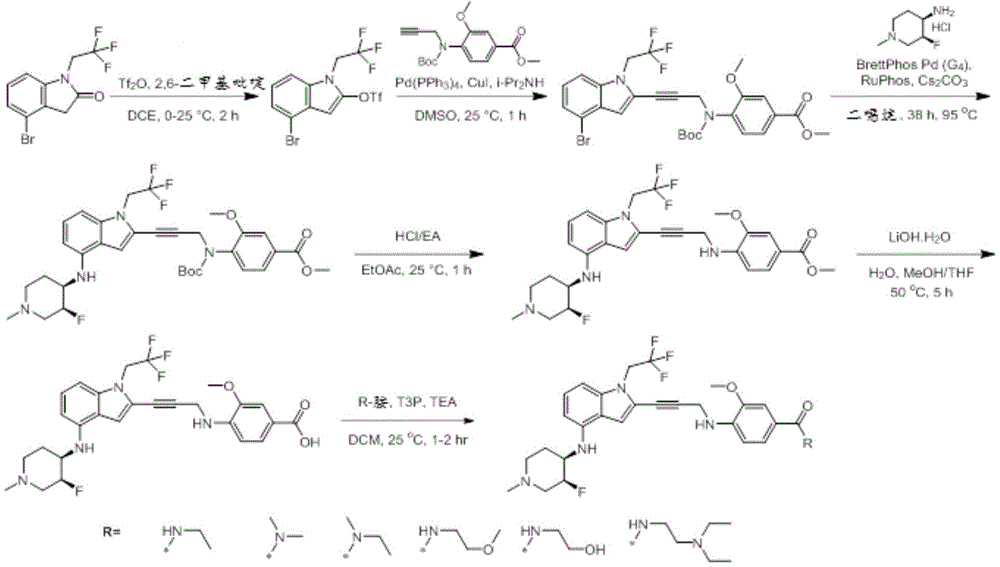
Preparation of 4-bromo-1- (2,2, 2-trifluoroethyl) -1H-indol-2-yl trifluoromethanesulfonate: to a solution of 4-bromo-1- (2,2, 2-trifluoroethyl) indolin-2-one (10g,34.01mmol,1 eq) and 2, 6-lutidine (4.37g,40.81mmol,4.75mL,1.2 eq) in DCM (100mL) was added dropwise trifluoromethanesulfonyl triflate (9.59g,34.01mmol,5.61mL,1 eq) at 25 ℃ and the reaction mixture was stirred at 25 ℃ for 2 h. TLC analysis indicated the reaction was complete. The reaction mixture was poured onto saturated NH 4 Aqueous Cl solution (100 mL). The aqueous phase was extracted with DCM (60 mL. times.3) and saturated NaHCO 3 Aqueous (100mL) wash. The combined organic layers were washed with brine (20mL), dried over anhydrous sodium sulfate, filtered and concentrated in vacuo. The residue was purified by column chromatography (SiO) 2 PE: EtOAc ═ 1:0 to 100:1, R f ═ 0.5) purification to give [ 4-bromo-1- (2,2, 2-trifluoroethyl) indol-2-yl group]Triflate (13.0g,27.46mmol, 81% yield) as a yellow solid.
Preparation of methyl 4- ((3- (4-bromo-1- (2,2, 2-trifluoroethyl) -1H-indol-2-yl) prop-2-yn-1-yl) (tert-butoxycarbonyl) amino) -3-methoxybenzoate: to a solution of methyl 4- ((tert-butoxycarbonyl) (prop-2-yn-1-yl) amino) -3-methoxybenzoate (3.20g,10.03mmol,0.9 eq) in DMSO (50mL) at 20 ℃ was added i-Pr 2 NH (11.28g,111.47mmol,15.75mL,10 equiv.), CuI (106.15mg, 557.34. mu. mol,0.05 equiv.), and 4-bromo-1- (2,2, 2-trifluoroethyl) -1H-indol-2-yl trifluoromethanesulfonate (5g,11.15mmol,1 equiv.). Then, Pd (PPh) 3 ) 4 (644.04mg, 557.34. mu. mol,0.05 eq.) was added to the reaction and the mixture was stirred with N 2 Purging was carried out three times. Then, the mixture was stirred at 25 ℃ for 1 hour. TLC analysis (PE: EtOAc ═ 5:1, R) f 0.3) indicated complete consumption of starting material and a new spot was detected. The reaction mixture was quenched by the addition of saturated aqueous EDTA (500mL) and the resulting mixture was extracted with EtOAc (200 mL. times.3). The combined organic layers were washed with brine (200mL x 3), dried over anhydrous sodium sulfate, filtered and concentrated under reduced pressure. The crude residue is purified by column chromatography (SiO) 2 PE: EtOAc 15:1 to 8:1) to afford the desired product (6.2g,8.85mmol, 79.40% yield) as a yellow solid.
1 H NMR:(400MHz,DMSO-d6)δppm 1.28-1.41(m,9H)3.86(s,3H)3.88(s,3H)4.48-4.78(m,2H)5.05(q,J=8.63Hz,2H)6.74-6.78(m,1H)7.18-7.25(m,1H)7.34-7.48(m,5H)7.57-7.64(m,3H)。
Preparation of methyl 4- ((tert-butoxycarbonyl) (3- (4- (((3S,4R) -3-fluoro-1-methylpiperidin-4-yl) amino) -1- (2,2, 2-trifluoroethyl) -1H-indol-2-yl) prop-2-yn-1-yl) amino) -3-methoxybenzoate: to methyl 4- ((3- (4-bromo-1- (2,2, 2-trifluoroethyl) -1H-indol-2-yl) prop-2-yn-1-yl) (tert-butoxycarbonyl) amino) -3-methoxybenzoate (5g,8.40mmol,1 eq), (3S,4R) -3-fluoro-1-methylpiperidin-4-amine hydrochloride (1.89g,9.24mmol,1.1 eq, 2HCl) and Cs at 20 deg.C 2 CO 3 (10.94G,33.59mmol,4 equiv.) of a mixture in dioxane (50mL) RuPhos (548.62mg,1.18mmol,0.14 equiv.) and BrettPhos (Pd, G) 4 ) (541.12mg, 587.84. mu. mol,0.07 eq.). The mixture obtained is treated with N 2 Purged three times and stirred at 95 ℃ for 38 hours. TLC analysis (EtOAc: TEA ═ 10:1, R f 0.3) indicated that 10% of the starting material remained and a major new spot was detected, which was more polar than the starting material. The reaction mixture was quenched by the addition of saturated aqueous EDTA (500 mL). The mixture was extracted with EtOAc (100mL x 3). The combined organic layers were washed with brine (100mL x 3), dried over anhydrous sodium sulfate, filtered and concentrated under reduced pressure to give a residue. The crude residue is purified by column chromatography (SiO) 2 PE: EtOAc ═ 8:1 to 0:1) and the crude product triturated with MTBE: PE ═ 10mL:5mL at 25 ℃ for 12 hours to give the desired product (3g,4.54mmol, 54.03% yield) as a yellow solid.
1 H NMR:(400MHz,DMSO-d6)δppm 1.22-1.52(m,9H)1.64-1.76(m,1H)1.87-1.99(m,1H)2.08(br t,J=11.58Hz,1H)2.14-2.30(m,4H)2.77-2.86(m,1H)2.96-3.06(m,1H)3.47-3.66(m,1H)3.83-3.90(m,6H)4.52-4.72(m,2H)4.75(br s,1H)4.80-4.97(m,3H)5.49-5.59(m,1H)6.20-6.29(m,1H)6.69-6.83(m,1H)6.98-7.08(m,1H)7.20(d,J=2.21Hz,1H)7.38-7.46(m,1H)7.59(br d,J=3.53Hz,2H)。
4- ((3- (4- (((3S,4R) -3-fluoro-1-)Preparation of methyl methylpiperidin-4-yl) amino) -1- (2,2, 2-trifluoroethyl) -1H-indol-2-yl) prop-2-yn-1-yl) amino) -3-methoxybenzoate: a solution of methyl 4- ((tert-butoxycarbonyl) (3- (4- (((3S,4R) -3-fluoro-1-methylpiperidin-4-yl) amino) -1- (2,2, 2-trifluoroethyl) -1H-indol-2-yl) prop-2-yn-1-yl) amino) -3-methoxybenzoate (3g,4.50mmol,1 eq) was prepared in HCl/EtOAc (4M,90mL) and the mixture was stirred at 25 ℃ for 1H. TLC analysis (EtOAc: TEA ═ 10:1, R f 0.4) indicates complete consumption of starting material and a major new spot was detected, which was more polar than the starting material. The mixture was filtered and the filter cake was saturated with Na 2 CO 3 Aqueous (200mL) diluted and extracted with EtOAc (80mL x 3). The combined organic layers were washed with brine (50mL x 3), dried over anhydrous sodium sulfate, filtered and concentrated under reduced pressure to give a residue. The crude product (2.5g, crude) was obtained as a yellow solid and was not used in the next step without purification.
Preparation of 4- ((3- (4- (((3S,4R) -3-fluoro-1-methylpiperidin-4-yl) amino) -1- (2,2, 2-trifluoroethyl) -1H-indol-2-yl) prop-2-yn-1-yl) amino) -3-methoxybenzoic acid: to methyl 4- ((3- (4- (((3S,4R) -3-fluoro-1-methylpiperidin-4-yl) amino) -1- (2,2, 2-trifluoroethyl) -1H-indol-2-yl) prop-2-yn-1-yl) amino) -3-methoxybenzoate (2.5g,4.57mmol,1 eq), LiOH 2 A solution of O (2.88g,68.61mmol,15 equivalents) and NaOH (731.80mg,18.30mmol,4 equivalents) in THF (20mL), MeOH (20mL) and water (20mL) was stirred at 50 ℃ for 5 h. TLC analysis (EtOAc: MeOH ═ 2:1, R) f 0.3) indicating completion of the reaction. The reaction mixture was concentrated to remove MeOH and THF. Water (100mL) was added to the residue, and 0.5M HCl was added to adjust the pH of the mixture to pH 5. The mixture was extracted with EtOAc (200mL x 12). The combined organic layers were washed with brine (50mL x 3), dried over anhydrous sodium sulfate, filtered and concentrated under reduced pressure to give a residue. Trituration of the crude product with ACN: MTBA ═ 10mL:80mL at 25 ℃ for 60 min afforded the desired product (1.9g,3.53mmol, 77.14% yield) as a yellow solid.
1H NMR:(400MHz,DMSO-d 6 )δppm 1.88-1.99(m,1H)2.12-2.27(m,1H)2.70-2.82(m,3H)3.12-3.22(m,1H)3.38-3.58(m,2H)3.65-3.78(m,1H)3.80-3.97(m,4H)4.27-4.44(m,2H)4.84-5.00(m,2H)5.02-5.18(m,1H)5.70-5.82(m,1H)6.23-6.35(m,2H)6.75-6.83(m,2H)6.96-7.07(m,1H)7.14-7.23(m,1H)7.29-7.37(m,1H)7.52(d,J=8.19Hz,1H)10.14-10.47(m,1H)12.08-12.40(m,1H)。
Preparation of the final product: to a mixture of 4- ((3- (4- (((3S,4R) -3-fluoro-1-methylpiperidin-4-yl) amino) -1- (2,2, 2-trifluoroethyl) -1H-indol-2-yl) prop-2-yn-1-yl) amino) -3-methoxybenzoic acid (0.07g,131.45 μmol,1 equivalent), R-amine (11.85mg,262.90 μmol,17.20 μ L,2 equivalents), TEA (66.51mg,657.24 μmol,91.48 μ L,5 equivalents) in DCM (3mL) DMF (3mL) was added T3P (209.12mg,657.24 μmol,195.44 μ L,5 equivalents). In N 2 The mixture was stirred at 20 ℃ for 1 hour under an atmosphere. TLC analysis indicated complete consumption of starting material and a new spot was detected. The reaction mixture was quenched by addition of water (5mL) and extracted with EtOAc (5mL × 3). The combined organic layers were washed with brine (5mL x 3), dried over anhydrous sodium sulfate, filtered and concentrated under reduced pressure to give a residue. The residue was purified by preparative HPLC to give the desired product as a yellow solid.
N-Ethyl-4- { [3- (4- { [ (3S,4R) -3-fluoro-1-methylpiperidin-4-yl]Amino } -1- (2,2, 2-trifluoroethyl) -1H-indol-2-yl) prop-2-yn-1-yl]Amino } -3-methoxybenzamide, 28.0mg, 37.7% yield, MS (ES) + M/z) 560.2; 4- { [3- (4- { [ (3S,4R) -3-fluoro-1-methylpiperidin-4-yl]Amino } -1- (2,2, 2-trifluoroethyl) -1H-indol-2-yl) prop-2-yn-1-yl]Amino } -3-methoxy-N, N-dimethylbenzamide, 28.0mg, 38.0% yield, MS (ES) + M/z) 560.3; n-ethyl-4- ((3- (4- (((3S,4R) -3-fluoro-1-methylpiperidin-4-yl) amino) -1- (2,2, 2-trifluoroethyl) -1H-indol-2-yl) prop-2-yn-1-yl) amino) -3-methoxy-N-methylbenzamide, 38.7% yield, MS (ES) + M/z) 588.3; 4- { [3- (4- { [ (3S,4R) -3-fluoro-1-methylpiperidin-4-yl ]Amino } -1- (2,2, 2-trifluoroethyl) -1H-indol-2-yl) prop-2-yn-1-yl]Amino } -3-methoxy-N- (2-methoxyethyl) benzamide, 29.0mg, 37% yield, MS (ES) + M/z) 590.2; 4- { [3- (4- { [ (3S,4R) -3-fluoro-1-methylpiperidin-4-yl]Amino } -1- (2,2, 2-trifluoroethyl) -1H-indol-2-yl) prop-2-yn-1-yl]Amino } -N- (2-hydroxy)Ethyl) -3-methoxybenzamide, 30.0mg, 31.3% yield, MS (ES) + M/z) 576.3; and N- [2- (di-ethylamino) ethyl]-4- { [3- (4- { [ (3S,4R) -3-fluoro-1-methylpiperidin-4-yl]Amino } -1- (2,2, 2-trifluoroethyl) -1H-indol-2-yl) prop-2-yn-1-yl]Amino } -3-methoxybenzamide, 24.0mg, 28.7% yield, MS (ES) + ,m/z):631.4。
Example D110: synthesis of 4- { [3- (4- { [ (3S,4R) -3-fluoro-1-methylpiperidin-4-yl ] amino } -1- (2,2, 2-trifluoroethyl) -1H-indol-2-yl) prop-2-yn-1-yl ] amino } -N- (3-hydroxy-2-methoxypropyl) -3-methoxybenzamide (compound 966A).

Preparation of 2- (3- (benzyloxy) -2-hydroxypropyl) isoindoline-1, 3-dione: to a solution of phthalimide (2g,13.59mmol,1 eq.) and 2- (benzyloxymethyl) oxirane (2.68g,116.31mmol,2.48mL,1.2 eq.) in EtOH (20mL) was added K 2 CO 3 (150.30mg,1.09mmol,0.08 equiv.). The mixture was stirred at 80 ℃ for 12 hours. LC-MS and TLC analysis (PE: EtOAc ═ 2:1, R f 0.35) indicating completion of the reaction. The reaction mixture was concentrated in vacuo and purified by column chromatography (SiO) 2 PE: EtOAc ═ 5:1 to 3:1, R f 0.3) to give the desired product (3g,9.64mmol, 70.89% yield) as a pale yellow oil. 1H NMR (400MHz, DMSO-d6) δ 7.87-7.82(m,4H),7.31-7.24(m,5H),5.15(d, J ═ 4.2Hz,1H),4.47(s,2H),4.01-3.99(m,2H),3.63-3.61(m,2H),3.46-3.41(m,2H)
Preparation of 2- (3- (benzyloxy) -2-methoxypropyl) isoindoline-1, 3-dione: at N 2 Next, NaH (481.80mg,12.05mmol,1.5 equiv.) was added to a solution of 2- (3- (benzyloxy) -2-hydroxypropyl) isoindoline-1, 3-dione (2.5g,8.03mmol,1 equiv.) in DMF (30mL) at 0 deg.C. The mixture was stirred for 0.5 h and MeI (2.28g,16.06mmol,999.81 μ L,2 equiv.) was added dropwise to the reaction. The resulting reaction mixture was stirred at 25 ℃ for 1 hour. TLC analysis (PE: EtOAc ═ 2:1, Rf 0.4) indicating completion of the reaction. The reaction mixture was poured onto saturated NH 4 Cl (100mL) WaterTo the solution, and extract the aqueous phase with EtOAc (40mL × 3). The combined organic layers were washed with brine (40 mL. times.1) and over anhydrous Na 2 SO 4 Dried, filtered and concentrated in vacuo. The residue was purified by column chromatography (SiO) 2 PE: EtOAc: 10:1 to 7:1, R f Purification ═ 0.4) afforded the desired product (1g,3.07mmol, 38.28% yield) as a pale yellow oil.
Preparation of 3- (benzyloxy) -2-methoxypropan-1-amine: in N 2 Next, to a solution of 2- (3- (benzyloxy) -2-methoxypropyl) isoindoline-1, 3-dione (1g,3.07mmol,1 eq.) in EtOH (20mL) at 50 deg.C was added N 2 H 4 ·H 2 O (314mg,6.15mmol, 304.86. mu.L, 2 equiv.). The mixture was stirred at 80 ℃ for 2 hours. LC-MS analysis indicated that 20% of the starting material remained and 65% of the desired product was detected. The reaction mixture was concentrated in vacuo and purified by preparative HPLC to give the desired product 0.2g, 1.02mmol, 33.33% yield as a pale yellow oil.
Preparation of 3-amino-2-methoxypropan-1-ol: to a solution of 3- (benzyloxy) -2-methoxypropan-1-amine (0.1g,512.14 μmol,1 eq) in EtOH (2mL) was added Pd/C (0.1g,93.97 μmol, 10% pure, 1.83e-1 eq). The mixture was stirred at 40 ℃ for 8 hours and filtered through a pad of silica. The crude residue was purified by preparative HPLC to give the desired product (50mg) as a colourless oil.

To a solution of 4- ((3- (4- (((3S,4R) -3-fluoro-1-methylpiperidin-4-yl) amino) -1- (2,2, 2-trifluoroethyl) -1H-indol-2-yl) prop-2-yn-1-yl) amino) -3-methoxybenzoic acid (0.08g,150.23 μmol,1 eq) in DMF (5mL) at 25 ℃ were added TEA (45.60mg,450.68 μmol,62.73 μ L,3 eq) and HATU (85.68mg,225.34 μmol,1.5 eq). The mixture was stirred for 0.5 h and 3-amino-2-methoxy-propan-1-ol (17.37mg,165.25 μmol,47.85 μ L,1.1 equiv) was added to the mixture. The resulting mixture was stirred at 50 ℃ for 1 hour. LC-MS and HPLC analysis indicated the reaction was complete. The mixture was directly purified using preparative HPLC, The desired product was obtained as a yellow solid. 31.0mg, 28% yield, MS (ES) + ,m/z):620.3。
Example D111: synthesis of 1- [ (4- { [3- (4- { [ (3S,4R) -3-fluoro-1-methylpiperidin-4-yl ] amino } -1- (2,2, 2-trifluoroethyl) -1H-indol-2-yl) prop-2-yn-1-yl ] amino } -3-methoxyphenyl) carboxamido ] -3- [ (2-methylpropionyl) oxy ] prop-2-yl 2-methylpropionate (compound 967A).

To N- (2, 3-dihydroxypropyl) -4- ((3- (4- (((3S,4R) -3-fluoro-1-methylpiperidin-4-yl) amino) -1- (2,2, 2-trifluoroethyl) -1H-indol-2-yl) prop-2-yn-1-yl) amino) -3-methoxybenzamide (80mg, 132.10. mu. mol,1 eq) in DCM (3mL) and CHCl at 25 deg.C 3 (3mL) TEA (40.10mg, 396.29. mu. mol, 55.16. mu.L, 3 equivalents) and 2-methylpropanoyl 2-methylpropanoate (43.88mg, 277.40. mu. mol, 46. mu.L, 2.1 equivalents) were added. The mixture was stirred at 60 ℃ for 16 hours. LC-MS analysis detected the desired product. The mixture was concentrated and the residue was purified by preparative HPLC to give the desired product as a yellow oil (28.0mg, 28% yield). MS (ES) + ,m/z):746.3。
Example D112: synthesis of 4- { [3- (4- { [ (3S,4R) -3-fluoro-1-methylpiperidin-4-yl ] amino } -1- (2,2, 2-trifluoroethyl) -1H-indol-2-yl) prop-2-yn-1-yl ] amino } -3-methoxy-N- [ (2-oxo-1, 3-dioxolan-4-yl) methyl ] benzamide (Compound 968A).

To a solution of N- (2, 3-dihydroxypropyl) -4- ((3- (4- (((3S,4R) -3-fluoro-1-methylpiperidin-4-yl) amino) -1- (2,2, 2-trifluoroethyl) -1H-indol-2-yl) prop-2-yn-1-yl) amino) -3-methoxybenzamide (0.08g,132.10 μmol,1 eq) in toluene (5mL) at 25 ℃ were added TEA (40.10mg,396.29 μmol,55.16 μ L,3 eq) and CDI (44.98mg,277.40 μmol,2.1 eq). The mixture was stirred at 50 ℃ for 12 hours. LC-MS and HPLC analysis indicated the reaction was complete. The mixture was concentrated and the residue was purified by preparative HPLC to give the desired product as a yellow solid (26.0mg, 29.9% yield). MS (ES) + ,m/z):632.2。
Example D113: preparation of compound 461A.

Synthesis of tert-butyl 4- ((2- (3- ((2- (cyanomethoxy) -4- (methylsulfonyl) phenyl) amino) prop-1-yn-1-yl) -1- (2,2, 2-trifluoroethyl) -1H-indol-4-yl) amino) piperidine-1-carboxylate: to a solution of 2- (5- (methylsulfonyl) -2- (prop-2-yn-1-ylamino) phenoxy) acetonitrile (prepared according to example A4) (101.01mg, 305.73. mu. mol,2 equiv.) in DMSO (1mL) was added i-Pr 2 NH (464.06mg,4.59mmol, 648.13. mu.L, 30 equivalents), CuI (58.23mg, 305.73. mu. mol,2 equivalents), tert-butyl 4- ((2-iodo-1- (2,2, 2-trifluoroethyl) -1H-indol-4-yl) amino) piperidine-1-carboxylate (80mg, 152.87. mu. mol,1 equivalent), and Pd (PPh) 3 ) 4 (44.16mg, 38.22. mu. mol,0.25 eq.). At N 2 The mixture was then stirred at 25 ℃ for 1 hour. TLC analysis (DCM: MeOH ═ 20:1, R) f 0.5) indicates complete consumption of the starting material. The mixture was poured into saturated aqueous EDTA (20mL), stirred at 25 ℃ for 1 hour, and extracted with EtOAc (20 mL. times.3). The combined organic layers were washed with brine (20mL x 3), dried over anhydrous sodium sulfate, filtered and concentrated under reduced pressure. The resulting residue was purified by preparative TLC (DCM: MeOH ═ 20:1, R) f Purification ═ 0.5) afforded the desired compound tert-butyl 4- ((2- (3- ((2- (cyanomethoxy) -4- (methylsulfonyl) phenyl) amino) prop-1-yn-1-yl) -1- (2,2, 2-trifluoroethyl) -1H-indol-4-yl) amino) piperidine-1-carboxylate (80mg,103.07 μmol, 67.43% yield) as a yellow solid.
Synthesis of final product: to a solution of compound 4- ((2- (3- ((2- (cyanomethoxy) -4- (methylsulfonyl) phenyl) amino) prop-1-yn-1-yl) -1- (2,2, 2-trifluoroethyl) -1H-indol-4-yl) amino) piperidine-1-carboxylic acid tert-butyl ester (30mg,38.65 μmol,1 eq) in DCM (1mL) was added formic acid (732mg,15.90mmol,600 μ L,411.46 equivalents). The mixture was stirred at 25 ℃ for 1 hour, and subsequent LC-MS analysis indicated complete consumption of Boc-protected piperidine. The mixture was concentrated under reduced pressure to give a residue, which was purified by preparative HPLC to give 2- { 5-methanesulfonyl-2- [ (3- {4- [ (piperidin-4-yl) amino group ]-1- (2,2, 2-trifluoroethyl) -1H-indol-2-yl } prop-2-yn-1-yl) amino]Phenoxy } acetonitrile (13.2mg,20.38 μmol, 52.72% yield) as a yellow solid. MS (ES) + ,m/z):560.2。
Example D114: preparation of compound 715A.

Synthesis of (S) -1- (4- ((2-iodo-1- (2,2, 2-trifluoroethyl) -1H-indol-4-yl) amino) piperidin-1-yl) -3-methoxypropan-2-yl propionate: to a solution of (S) -1- (4- ((2-iodo-1- (2,2, 2-trifluoroethyl) -1H-indol-4-yl) amino) piperidin-1-yl) -3-methoxypropan-2-ol (prepared according to the first step of example D142 using (S) -glycidyl methyl ether instead of racemic glycidyl methyl ether) (1.5g,2.79mmol,1 eq) in DCM (50mL) was added propionic anhydride (435.23mg,3.34mmol,430.92 μ L,1.2 eq). The mixture was stirred at 45 ℃ for 4 hours followed by TLC analysis (PE: EtOAc ═ 1:1, R) f 0.5) indicating completion of the reaction. The mixture was concentrated in vacuo and the residue was purified by column chromatography (SiO) 2 PE: EtOAc ═ 5:1 to 0:1, R f = 0.5) to give (S) -1- (4- ((2-iodo-1- (2,2, 2-trifluoroethyl) -1H-indol-4-yl) amino) piperidin-1-yl) -3-methoxypropan-2-ylpropionate (2g,3.17mmol, 56.92% yield) as a pale yellow oil. MS (ES) + ,m/z):568.1。
Synthesis of final product: in N 2 Next, to a solution of 2-methoxy-4-methylsulfonyl-N-prop-2-ynyl-aniline (830.67mg,3.43mmol,1.2 equivalents) in DMSO (25mL) was added diisopropylamine (2.89g,28.55mmol,4.04mL,10 equivalents) and CuI (108.76mg, 571.04. mu. mol,0.2 equivalents), followed by (S) -1- (4- ((2-iodo-1- (2,2, 2-trifluoroethyl) -1H-indol-4-yl) amino) piperidin-1-yl) -3-methoxyprop-2-yl propionate (1.8g,2.86mmol,1 equivalent) and Pd (PPh) 3 ) 4 (164.97mg, 142.76. mu. mol,0.05 eq.). The mixture was stirred at 25 ℃ for 1 hour, followed by TLC analysis (PE: EtOAc: 0:1, R) f 0.3) indicating completion of the reaction. The residue was poured into saturated aqueous EDTA (200mL) and stirred for 1 hour and extracted with EtOAc (100mL × 3). The combined organic layers were washed with brine (100mL), dried over anhydrous sodium sulfate, filtered and concentrated in vacuo. The residue was purified by column chromatography (SiO) 2 PE: EtOAc ═ 1:1 to 0:1, R f 0.3) and then further purified by preparative HPLC to give the desired product (3.78g,5.49mmol, 93.08% yield) as a light yellow solid.
(2S) -1- {4- [ (2- {3- [ (4-methanesulfonyl-2-methoxyphenyl) amino ] carbonyl]Prop-1-yn-1-yl } -1- (2,2, 2-trifluoroethyl) -1H-indol-4-yl) amino]Piperidin-1-yl } -3-methoxypropan-2-yl propionate; 1 H NMR(400MHz,DMSO-d6)δppm 1.04(t,J=7.52Hz,3H)1.33-1.52(m,2H)1.74-1.98(m,2H)2.05-2.20(m,2H)2.26-2.31(m,2H)2.43(br d,J=5.01Hz,3H)2.59-2.73(m,1H)2.77-2.99(m,2H)3.09(s,4H)3.25(s,3H)3.30(br s,1H)3.44(d,J=4.65Hz,2H)3.89(s,3H)4.35(br d,J=6.11Hz,2H)4.92(q,J=8.97Hz,2H)5.00-5.12(m,1H)5.47(br d,J=7.95Hz,1H)6.15(d,J=7.83Hz,1H)6.49(t,J=6.30Hz,1H)6.67(br d,J=8.31Hz,1H)6.89(d,J=8.44Hz,1H)6.94-7.04(m,1H)7.07(s,1H)7.25(d,J=1.83Hz,1H)7.38(dd,J=8.31,1.83Hz,1H)7.35-7.43(m,1H)。MS(ES + ,m/z):679.3。
example D115: preparation of compound 638A.

Compound 638A was prepared according to a procedure analogous to the synthesis of compound 715A of example D114, using isobutyric anhydride instead of propionic anhydride.
(2S) -1- {4- [ (2- {3- [ (4-methanesulfonyl-2-methoxyphenyl) amino]Prop-1-yn-1-yl } -1- (2,2, 2-trifluoroethyl) -1H-indol-4-yl) amino]Piperidin-1-yl } -3-methoxypropan-2-yl 2-methylpropionate; 1 H NMR(400MHz,DMSO-d6)δppm 1.09(dd,J=10.45,6.91Hz,6H)1.34-1.50(m,2H)1.89(br s,2H)2.01-2.22(m,2H)2.33(br s,2H)2.43(br s,2H)2.76-2.94(m,2H)3.09(s,3H)3.25(s,3H)3.30(br s,1H)3.44(br d,J=4.65Hz,2H)3.89(s,3H)4.35(br d,J=5.99Hz,2H)4.92(q,J=8.56Hz,2H)5.07(br d,J=5.50Hz,1H)5.47(br d,J=7.83Hz,1H)6.14(br d,J=7.83Hz,1H)6.49(br t,J=6.24Hz,1H)6.67(br d,J=8.19Hz,1H)6.89(d,J=8.44Hz,1H)6.99(br t,J=7.95Hz,1H)7.08(s,1H)7.25(d,J=1.59Hz,1H)7.38(br d,J=6.85Hz,1H)。MS(ES + ,m/z):693.4。
Example D116: preparation of compound 482A.

Synthesis of 2-iodo-N- (1-methylpiperidin-4-yl) -1- (2,2, 2-trifluoroethyl) -1H-indol-4-amine: in N 2 Next, to a mixture of 1-methylpiperidin-4-one (8.32g,73.51mmol,8.55mL,5 equivalents) and 2-iodo-1- (2,2, 2-trifluoroethyl) indol-4-amine (5g,14.70mmol,1 equivalent) in toluene (100mL) is added Ti (OEt) 4 (6.71g,29.40mmol,6.10mL,2 equiv.). The reaction mixture was stirred at 110 ℃ for 1 hour. The reaction mixture was then concentrated and the resulting residue was dissolved with MeOH (100 mL). Then, add NaBH 4 (1.11g,29.40mmol,2 equiv.) and stirred at 40 ℃ for 16 h. TLC analysis (PE: EtOAc ═ 0:1, R) f 0.0) indicating complete consumption of starting material. The reaction mixture was filtered and the filter cake was washed with DCM (200mL × 2). The combined organic layers were washed with brine (200mL), dried over anhydrous sodium sulfate, filtered and concentrated in vacuo. The residue was purified by column chromatography (SiO) 2 PE: EtOAc ═ 3:1 to 0:1) purification afforded the product (6.5g,14.12mmol, 48.03% yield) as a pale yellow solid.
1 H NMR(400MHz,DMSO-d6)δppm 1.17(t,J=7.09Hz,1H)1.40-1.55(m,2H)1.91(br d,J=11.13Hz,2H)1.97(br d,J=1.71Hz,1H)1.99-2.05(m,2H)2.17(s,3H)2.76(br d,J=11.74Hz,2H)3.25(br s,1H)4.03(q,J=7.13Hz,1H)4.98(q,J=8.97Hz,2H)5.40(d,J=8.07Hz,1H)6.15(d,J=7.82Hz,1H)6.77(d,J=8.19Hz,1H)6.90(t,J=8.01Hz,1H)7.16(s,1H)。
Synthesis of final product: at N 2 Downward, toward 3-methoxy-A solution of N-methyl-4- (prop-2-ynylamino) benzamide (1.11g,5.10mmol,1.2 equiv.) in DMSO (40mL) was added diisopropylamine (4.30g,42.54mmol,6.01mL,10 equiv.) and CuI (162.03mg, 850.79. mu. mol,0.2 equiv.), followed by 2-iodo-N- (1-methylpiperidin-4-yl) -1- (2,2, 2-trifluoroethyl) -1H-indol-4-amine (2g,4.25mmol,1 equiv.) and Pd (PPh) 3 ) 4 (245.78mg, 212.70. mu. mol,0.05 eq.). The mixture was stirred at 45 ℃ for 1 hour, followed by TLC analysis (DCM: MeOH ═ 10:1, R) f 0.3) indicating completion of the reaction. The residue was poured into saturated aqueous EDTA (50mL) and stirred for 1 hour. The aqueous phase was extracted with EtOAc (30mL x 3), and the combined organic layers were washed with brine (40mL), dried over anhydrous sodium sulfate, filtered, and concentrated in vacuo. The residue was purified by column chromatography (SiO) 2 PE: EtOAc ═ 2:1 to DCM: MeOH ═ 10:1, R f 0.3) and then further purified by preparative HPLC. Then, the concentrated eluate was mixed with saturated Na 2 CO 3 The aqueous solutions (50mL) were combined to adjust the pH of the solution to 8, stirred for 1 hour, and extracted with EtOAc (30mL x 3). The combined organic layers were washed with brine (40mL), dried over anhydrous sodium sulfate, filtered and concentrated in vacuo to give the desired product (3.04g,5.67mmol, 88.16% yield) as a light yellow solid.
3-methoxy-N-methyl-4- [ (3- {4- [ (1-methylpiperidin-4-yl) amino]-1- (2,2, 2-trifluoroethyl) -1H-indol-2-yl } prop-2-yn-1-yl) amino]Benzamide: 1 H NMR(400MHz,DMSO-d6)δppm 1.41-1.56(m,2H)1.92(br d,J=11.37Hz,2H)2.06(br d,J=11.00Hz,2H)2.20(s,3H)2.72-2.84(m,5H)3.23-3.29(m,1H)3.84(s,3H)4.31(br d,J=6.24Hz,2H)4.90(q,J=9.05Hz,2H)5.48(d,J=7.95Hz,1H)5.98(t,J=6.36Hz,1H)6.15(d,J=7.70Hz,1H)6.67(d,J=8.07Hz,1H)6.75(d,J=8.31Hz,1H)6.99(t,J=7.95Hz,1H)7.06(s,1H)7.35(d,J=1.59Hz,1H)7.42(dd,J=8.25,1.53Hz,1H)8.10(br d,J=4.52Hz,1H)。MS(ES + ,m/z):528.2。
example D117: general procedure for the preparation of compounds 586A, 587A, 588A and 589A.

Step 1: to a mixture of 3- (4- ((2-iodo-1- (2,2, 2-trifluoroethyl) -1H-indol-4-yl) amino) piperidin-1-yl) propane-1, 2-diol (200mg,361.96 μmol,1 eq) in DCM (3mL) was added propionyl propionate (117.76mg,904.90 μmol,116.60 μ L,2.5 eq). The mixture was stirred at about 50 ℃ for about 5 hours. TLC and LC-MS analysis indicated complete consumption of the starting material. The reaction was partitioned between water (100mL) and EtOAc (10mL) and then extracted with EtOAc (10mL x 3). The combined organic layers were washed with brine (50mL x 3), dried over anhydrous sodium sulfate, and filtered. The filtrate was concentrated in vacuo to give the desired compound 120mg as a pale brown oil. MS (ES) + M/z) 610.2. The same procedure was repeated to prepare isobutyryl-protected analogs.
At 25 ℃ towards R 2 -mixture of substituted alkynes (31.41mg, 118.15. mu. mol,1.2 equiv.) in DMSO (2mL) was added i-Pr 2 NH (58.20mg, 984.54. mu. mol,10 equivalents), CuI (18.75mg, 98.45. mu. mol,1 equivalent), R 1 Substituted iodoindoles (60mg, 98.45. mu. mol,1 eq.) and Pd (PPh) 3 ) 4 (22.75mg, 19.69. mu. mol,0.2 eq.). In N 2 The mixture was stirred at 25 ℃ for 2 hours, after which time LC-MS and TLC analysis in each case indicated that the reaction was complete. The reaction mixture was quenched by the addition of saturated aqueous EDTA (20mL) and the resulting mixture was stirred at 25 ℃ for 2 hours. The reaction was partitioned between water (10mL) and EtOAc (10mL) and then extracted with EtOAc (20mL x 3). The combined organic layers were washed with brine (10mL x 3), dried over anhydrous sodium sulfate, filtered and concentrated in vacuo. The residue was purified by preparative TLC and then further purified by preparative HPLC to give a solution of the desired product. The solution was lyophilized to give the desired compound as a pale yellow solid.
1- {4- [ (2- {3- [ (4-methanesulfonyl-2-methoxyphenyl) amino group]Prop-1-yn-1-yl } -1- (2,2, 2-trifluoroethyl) -1H-indol-4-yl) amino ]Piperidin-1-yl } -3- (propionyloxy) propan-2-yl propionate, (21.5mg) MS (ES) + M/z) 721.3; 1- {4- [ (2- {3- [ (2-methoxy-4-sulfamoylphenyl) amino group]Prop-1-yn-1-yl } -1- (2,2, 2-trifluoroethyl) -1H-indol-4-yl) amino]Piperidin-1-yl } -3- (propionyl)Aryloxy) propan-2-yl propionate, (12.7mg) MS (ES) + M/z) 722.2; 1- {4- [ (2- {3- [ (4-methanesulfonyl-2-methoxyphenyl) amino group]Prop-1-yn-1-yl } -1- (2,2, 2-trifluoroethyl) -1H-indol-4-yl) amino]Piperidin-1-yl } -3- [ (2-methylpropanoyl) oxy]Propan-2-yl 2-methylpropionate, (21.4mg) MS (ES) + M/z) 749.3; and 1- {4- [ (2- {3- [ (2-methoxy-4-sulfamoylphenyl) amino group]Prop-1-yn-1-yl } -1- (2,2, 2-trifluoroethyl) -1H-indol-4-yl) amino]Piperidin-1-yl } -3- [ (2-methylpropanoyl) oxy]Propan-2-yl 2-methylpropionate, (23.8mg) MS (ES) + ,m/z):750.3。
Example D118: general procedure for the preparation of compounds 590A and 591A.

Step 1: to a mixture of 2-iodo-N- (piperidin-4-yl) -1- (2,2, 2-trifluoroethyl) -1H-indol-4-amine (2g,4.63mmol,1 eq) in DMF (20mL) was added 1-bromopropan-2-ol (9.20g,46.31mmol,10 eq) and K 2 CO 3 (3.20g,23.16mmol 5 equiv.). The mixture was stirred at 50 ℃ for 12 hours, and subsequent TLC analysis indicated complete consumption of the starting material. The reaction was partitioned between water (20mL) and EtOAc (20mL) and then extracted with EtOAc (50mL x 3). The combined organic layers were washed with brine (50mL x 3), dried over anhydrous sodium sulfate, and filtered. The filtrate was concentrated in vacuo to give 1- (4- ((2-iodo-1- (2,2, 2-trifluoroethyl) -1H-indol-4-yl) amino) piperidin-1-yl) propan-2-ol as a dark brown oil (3.8 g).
Step 2: to a mixture of 1- (4- ((2-iodo-1- (2,2, 2-trifluoroethyl) -1H-indol-4-yl) amino) piperidin-1-yl) propan-2-ol (210mg,436.32 μmol,1 eq) in DCM (3mL) was added propionyl propionate (62.46mg,479.96 μmol,1.1 eq). The mixture was stirred at 50 ℃ for 3 hours. TLC and LC-MS analysis indicated complete consumption of the starting material. The reaction was partitioned between water (15mL) and EtOAc (10mL) and then extracted with EtOAc (20 mL. times.3). The combined organic layers were washed with brine (30mL), dried over anhydrous sodium sulfate, and filtered. The filtrate was concentrated in vacuo. The crude product was purified by preparative TLC (PE: EtOAc ═ 0:1, R) f 0.5) to yield the product (140mg, crude) as a pale yellow oil. MS (ES) + ,m/z):254.9。
Step-synthesis of the final product: to [2- [4- [ [ 2-iodo-1- (2,2, 2-trifluoroethyl) indol-4-yl ] group]Amino group]-1-piperidinyl group]-1-methyl-ethyl]A solution of propionate (120mg, 223.32. mu. mol,1 equiv.) in DMSO (3mL) was added 3-methoxy-4- (prop-2-ynylamino) benzenesulfonamide (75.75mg, 267.98. mu. mol,1.2 equiv.), i-PrNH 2 (132mg,2.23mmol, 191.86. mu.L, 10 equiv.), CuI (42.53mg, 223.32. mu. mol,1 equiv.), and Pd (PPh) 3 ) 4 (51.61mg, 44.66. mu. mol,0.2 equiv.). Mixing the mixture with N 2 Rinsed and stirred at 25 ℃ for 2 hours. TLC analysis (PE: EtOAc ═ 0:1, R f 0.55) indicating completion of the reaction. The reaction mixture was quenched by the addition of saturated aqueous EDTA (20mL) at 25 ℃ and the resulting mixture was stirred for 2 hours. The mixture was then extracted with EtOAc (10mL x 3). The organic phase was washed with brine (10mL x 3), dried over anhydrous sodium sulfate, filtered and concentrated in vacuo to afford the crude product. The residue was purified by preparative TLC (PE: EtOAc ═ 0:1, R) f 0.45) followed by further purification by preparative HPLC to give the final product.
[2- [4- [ [2- [3- (2-methoxy-4-sulfamoyl-anilino) prop-1-ynyl]-1- (2,2, 2-trifluoroethyl) indol-4-yl]Amino group]-1-piperidinyl group]-1-methyl-ethyl]Propionate, 21.9mg, 14.34% yield, MS (ES) + M/z) 650.2; [2- [4- [ [2- [3- (2-methoxy-4-methylsulfonyl-anilino) prop-1-ynyl]-1- (2,2, 2-trifluoroethyl) indol-4-yl]Amino group]-1-piperidinyl group]-1-methyl-ethyl]Propionate, 6.3mg, 6.98% yield, MS (ES) + M/z) 649.3; [2- [4- [ [2- [3- (2-methoxy-4-methylsulfonyl-anilino) prop-1-ynyl]-1- (2,2, 2-trifluoroethyl) indol-4-yl]Amino group]-1-piperidinyl group]-1-methyl-ethyl]2-methylpropionate, 11.6mg, 12.11% yield; [2- [4- [ [2- [3- (2-methoxy-4-sulfamoyl-anilino) prop-1-ynyl ] group ]-1- (2,2, 2-trifluoroethyl) indol-4-yl]Amino group]-1-piperidinyl group]-1-methyl-ethyl]2-Methylpropionate (20mg, 10.16% yield. MS (ES) + ,m/z):663.3。
(rac) -1- {4- [ (2- {3- [ (4-methanesulfonyl-2-methoxyphenyl) amino]Prop-1-yn-1-yl } -1- (2, 2)2-trifluoroethyl) -1H-indol-4-yl) amino]Piperidin-1-yl } prop-2-ylpropionate, MS (ES) + M/z) 649.3; and (rac) -1- {4- [ (2- {3- [ (4-methanesulfonyl-2-methoxyphenyl) amino]Prop-1-yn-1-yl } -1- (2,2, 2-trifluoroethyl) -1H-indol-4-yl) amino]Piperidin-1-yl } prop-2-yl 2-methylpropionate, MS (ES) + ,m/z):663.3。
Example D119: general procedure for the preparation of compounds 592A and 594A.

The desired product was prepared according to the procedure indicated in example D117, except that 0.9 equivalents of anhydride O (R) was used 1 ) 2 。
2-hydroxy-3- {4- [ (2- {3- [ (4-methanesulfonyl-2-methoxyphenyl) amino ] carbonyl]Prop-1-yn-1-yl } -1- (2,2, 2-trifluoroethyl) -1H-indol-4-yl) amino]Piperidin-1-yl } propyl propionate, MS (ES) + M/z) 665.3; and 2-hydroxy-3- {4- [ (2- {3- [ (4-methanesulfonyl-2-methoxyphenyl) amino ] carbonyl]Prop-1-yn-1-yl } -1- (2,2, 2-trifluoroethyl) -1H-indol-4-yl) amino]Piperidin-1-yl } propyl 2-methylpropionate, MS (ES) + ,m/z):679.3。
Example D120: general procedure for the preparation of compounds 853A, 854A, 859A, 860A, 862A and 863A.

Synthesis of (3S,4R) -3-fluoro-4- ((2- (3- ((2-methoxy-4- (methylsulfonyl) phenyl) amino) prop-1-yn-1-yl) -1- (2,2, 2-trifluoroethyl) -1H-indol-4-yl) amino) piperidine-1-carboxylic acid tert-butyl ester: to a solution of 2-methoxy-4- (methylsulfonyl) -N- (prop-2-yn-1-yl) aniline (1.13g,3.33mmol) in DMSO (15mL) was added i-Pr 2 NH (2.80g,27.71mmol,10 equiv.), CuI (105.55mg, 554.20. mu. mol,0.2 equiv.), (3S,4R) -3-fluoro-4- ((2-iodo-1- (2,2, 2-trifluoroethyl) -1H-indol-4-yl) amino) piperidine-1-carboxylic acid tert-butyl ester (1.5g,2.77mmol) and Pd (PPh) 3 ) 4 (160.10mg,138.55. mu. mol,0.05 eq). In N 2 The mixture was stirred at 40 ℃ for 1 hour under atmosphere, followed by TLC (PE: EtOAc ═ 2:1, R) f(sm) =0.6,R f(pdt) 0.1) indicates complete consumption of the starting material and formation of a new spot. The reaction mixture was quenched by the addition of saturated aqueous EDTA (30mL), the mixture was stirred at 20 ℃ for 1 hour, the mixture was diluted with water (10mL), and the resulting mixture was extracted with EtOAc (20mL × 3). The combined organic layers were washed with brine (15mL x 3), dried over anhydrous sodium sulfate, filtered and concentrated in vacuo. The residue obtained is purified by column chromatography (SiO) 2 EtOAc ═ 4:1 to 2:1) purification to give (3S,4R) -3-fluoro-4- ((2- (3- ((2-methoxy-4- (methylsulfonyl) phenyl) amino) prop-1-yn-1-yl) -1- (2,2, 2-trifluoroethyl) -1H-indol-4-yl) amino) piperidine-1-carboxylic acid tert-butyl ester as a yellow solid (1.8 g). 1 H NMR(400MHz,DMSO-d6)δppm 1.31-1.43(18H,m)1.65-1.74(1H,m)1.75-1.86(1H,m)2.80-3.05(1H,m)3.09-3.28(4H,m)3.72-3.87(1H,m)3.92(3H,s)4.04-4.12(1H,m)4.16-4.36(1H,m)4.50-4.81(2H,m)4.82-4.98(3H,m)5.54-5.64(1H,m)6.25-6.33(1H,m)6.70-6.82(1H,m)7.00-7.07(1H,m)7.16-7.19(1H,m)7.51-7.54(2H,m)7.57(1H,s).
The procedure was repeated using (3R,4S) -3-fluoro-4- ((2-iodo-1- (2,2, 2-trifluoroethyl) -1H-indol-4-yl) amino) piperidine-1-carboxylic acid tert-butyl ester instead of (3S,4R) -3-fluoro-4- ((2-iodo-1- (2,2, 2-trifluoroethyl) -1H-indol-4-yl) amino) piperidine-1-carboxylic acid tert-butyl ester to give (3R,4S) -4- ((2- (3- ((tert-butoxycarbonyl) (2-methoxy-4- (methylsulfonyl) phenyl) amino) prop-1-yn-1-yl) -1- (2,2, 2-trifluoroethyl) -1H-indol-4-yl) amino) -3-fluoropiperidine-1-carboxylate.
Synthesis of N- ((3S,4R) -3-fluoropiperidin-4-yl) -2- (3- ((2-methoxy-4- (methylsulfonyl) phenyl) amino) prop-1-yn-1-yl) -1- (2,2, 2-trifluoroethyl) -1H-indol-4-amine and N- ((3R,4S) -3-fluoropiperidin-4-yl) -2- (3- ((2-methoxy-4- (methylsulfonyl) phenyl) amino) prop-1-yn-1-yl) -1- (2,2, 2-trifluoroethyl) -1H-indol-4-amine: in N 2 Under an atmosphere, (3S,4R) -3-fluoro-4- ((2- (3- ((2-methoxy-4- (methylsulfonyl) phenyl) amino) prop-1-yn-1-yl) -1- (2,2, 2-trifluoroethyl) -1H-indol-4-yl) amino) piperidine-1-carboxylic acid tert-butyl ester (1.8g,2.39mmol,1 eq) was added toA solution of HCl/EtOAc (4M,36mL,60.23 eq.) was stirred at 20 ℃ for 1 hour. TLC analysis (EtOAc: TEA ═ 10:1, R) f1 =0.91,R f2 0.1) indicated complete consumption of starting material and a new spot was detected. The reaction mixture was saturated with Na 2 CO 3 Aqueous (10mL) was quenched and extracted with EtOAc (10mL x 3). The combined organic layers were washed with brine (10mL x 3), dried over anhydrous sodium sulfate, filtered and concentrated under reduced pressure to give N- ((3S,4R) -3-fluoropiperidin-4-yl) -2- (3- ((2-methoxy-4- (methylsulfonyl) phenyl) amino) prop-1-yn-1-yl) -1- (2,2, 2-trifluoroethyl) -1H-indol-4-amine as a yellow solid (1.0 g). 1 H NMR(400MHz,DMSO-d6)δppm 1.61-1.69(1H,m)1.75(1H,qd,J=12.07,3.56Hz)2.56-2.69(1H,m)2.72-2.89(1H,m)2.95-3.03(1H,m)3.05-3.10(3H,m)3.12-3.20(1H,m)3.60-3.77(1H,m)3.87-3.91(3H,m)4.32-4.40(2H,m)4.65-4.81(1H,m)4.86-5.01(2H,m)5.48-5.56(1H,m)6.19-6.31(1H,m)6.45-6.54(1H,m)6.69-6.77(1H,m)6.84-6.92(1H,m)6.94-7.04(1H,m)7.17-7.22(1H,m)7.23-7.28(1H,m)7.37-7.41(1H,m).
(3R,4S) -4- ((2- (3- ((tert-butoxycarbonyl) (2-methoxy-4- (methylsulfonyl) phenyl) amino) prop-1-yn-1-yl) -1- (2,2, 2-trifluoroethyl) -1H-indol-4-yl) amino) -3-fluoropiperidine-1-carboxylic acid tert-butyl ester was used instead of (3S,4R) -4- ((2- (3- ((tert-butoxycarbonyl) (2-methoxy-4- (methylsulfonyl) phenyl) amino) prop-1-yn-1-yl) -1- (2,2, 2-trifluoroethyl) -1H-indol-4-yl) amino) -3-fluoropiperidine-1- Tert-butyl formate the procedure was repeated to give N- ((3R,4S) -3-fluoropiperidin-4-yl) -2- (3- ((2-methoxy-4- (methylsulfonyl) phenyl) amino) prop-1-yn-1-yl) -1- (2,2, 2-trifluoroethyl) -1H-indol-4-amine.
Synthesis of final product: to a solution of N- ((3S,4R) -3-fluoropiperidin-4-yl) -2- (3- ((2-methoxy-4- (methylsulfonyl) phenyl) amino) prop-1-yn-1-yl) -1- (2,2, 2-trifluoroethyl) -1H-indol-4-amine (0.05g,90.48 μmol,1 eq) and acetyl chloride (56.54mg,452.42 μmol,5 eq) (RX ═ 2-bromoethan-1-ol or 1-bromo-2-methoxyethane) in DMF (3mL) was added K 2 CO 3 (37.52mg, 271.45. mu. mol,3 equiv.). The mixture was stirred at 50 ℃ for 2 hours. TLC analysis (EtOAc: TEA ═ 10:1, R f 0.3) indicates that the starting material was consumed and testedTo a main new blob. The reaction mixture was quenched with water (10mL) and then extracted with EtOAc (10mL x 3). The combined organic layers were washed with brine (10mL x 3), dried over anhydrous sodium sulfate, filtered and concentrated under reduced pressure. The residue was purified by preparative HPLC to give the desired product.
1- [ (3S,4R) -3-fluoro-4- [ (2- {3- [ (4-methanesulfonyl-2-methoxyphenyl) amino group]Prop-1-yn-1-yl } -1- (2,2, 2-trifluoroethyl) -1H-indol-4-yl) amino]Piperidin-1-yl radical]Ethan-1-one, 27mg, 27% yield, MS (ES) + M/z) 595.2; 2- [ (3S,4R) -3-fluoro-4- [ (2- {3- [ (4-methanesulfonyl-2-methoxyphenyl) amino group]Prop-1-yn-1-yl } -1- (2,2, 2-trifluoroethyl) -1H-indol-4-yl) amino]Piperidin-1-yl radical]Ethan-1-ol, 28mg, 21% yield, MS (ES) + M/z) 597.2; and N- [ (3S,4R) -3-fluoro-1- (2-methoxyethyl) piperidin-4-yl]-2- {3- [ (4-methanesulfonyl-2-methoxyphenyl) amino]Prop-1-yn-1-yl } -1- (2,2, 2-trifluoroethyl) -1H-indol-4-amine, 30mg, 27% yield, MS (ES) + ,m/z):611.2。
The procedure was repeated using N- ((3R,4S) -3-fluoropiperidin-4-yl) -2- (3- ((2-methoxy-4- (methylsulfonyl) phenyl) amino) prop-1-yn-1-yl) -1- (2,2, 2-trifluoroethyl) -1H-indol-4-amine instead of N- ((3S,4R) -3-fluoropiperidin-4-yl) -2- (3- ((2-methoxy-4- (methylsulfonyl) phenyl) amino) prop-1-yn-1-yl) -1- (2,2, 2-trifluoroethyl) -1H-indol-4-amine.
1- [ (3R,4S) -3-fluoro-4- [ (2- {3- [ (4-methanesulfonyl-2-methoxyphenyl) amino group]Prop-1-yn-1-yl } -1- (2,2, 2-trifluoroethyl) -1H-indol-4-yl) amino]Piperidin-1-yl radical]Ethan-1-one, (22mg, 23% yield, MS (ES) + M/z) 595.2; 2- [ (3R,4S) -3-fluoro-4- [ (2- {3- [ (4-methanesulfonyl-2-methoxyphenyl) amino group]Prop-1-yn-1-yl } -1- (2,2, 2-trifluoroethyl) -1H-indol-4-yl) amino]Piperidin-1-yl radical]Ethan-1-ol, (26mg 24% yield, MS (ES) + M/z) 597.2; and N- [ (3R,4S) -3-fluoro-1- (2-methoxyethyl) piperidin-4-yl]-2- {3- [ (4-methanesulfonyl-2-methoxyphenyl) amino]Prop-1-yn-1-yl } -1- (2,2, 2-trifluoroethyl) -1H-indol-4-amine), (30mg) 27% yield, MS (ES) + ,m/z):611.2。
Example D121: preparation of compounds 871A and 894A.

In N 2 A mixture of N- ((3S,4R) -3-fluoropiperidin-4-yl) -2- (3- ((2-methoxy-4- (methylsulfonyl) phenyl) amino) prop-1-yn-1-yl) -1- (2,2, 2-trifluoroethyl) -1H-indol-4-amine (0.1g, 180.97. mu. mol 1 eq) and propylene oxide (31.53mg, 542.90. mu. mol,3 eq) in EtOH (3mL) was stirred at 90 ℃ for 18 hours under an atmosphere. TLC analysis indicated the formation of a major new spot. The reaction mixture was quenched with water (10mL) and extracted with EtOAc (20mL x 3). The combined organic layers were washed with brine (15mL x 3), dried over anhydrous sodium sulfate, filtered and concentrated under reduced pressure. The residue was passed through preparative TLC (SiO) 2 EtOAc TEA ═ 10:1) and further purified by preparative HPLC to give 1- [ (3S,4R) -3-fluoro-4- [ (2- {3- [ (4-methanesulfonyl-2-methoxyphenyl) amino]Prop-1-yn-1-yl } -1- (2,2, 2-trifluoroethyl) -1H-indol-4-yl) amino]Piperidin-1-yl radical]Propan-2-ol, (24mg, 21.7% yield) MS (ES) + ,m/z):611.2。
The procedure was repeated using N- ((3R,4S) -3-fluoropiperidin-4-yl) -2- (3- ((2-methoxy-4- (methylsulfonyl) phenyl) amino) prop-1-yn-1-yl) -1- (2,2, 2-trifluoroethyl) -1H-indol-4-amine instead of N- ((3S,4R) -3-fluoropiperidin-4-yl) -2- (3- ((2-methoxy-4- (methylsulfonyl) phenyl) amino) prop-1-yn-1-yl) -1- (2,2, 2-trifluoroethyl) -1H-indol-4-amine, to obtain 1- [ (3R,4S) -3-fluoro-4- [ (2- {3- [ (4-methanesulfonyl-2-methoxyphenyl) amino group]Prop-1-yn-1-yl } -1- (2,2, 2-trifluoroethyl) -1H-indol-4-yl) amino]Piperidin-1-yl]Propan-2-ol, MS (ES) + ,m/z):611.2。
Example D122: preparation of compounds 853A and 854A.

To N- ((3S,4R) -3-fluoropiperidin-4-yl) -2- (3- ((2-methoxy-4- (methylsulfonyl) phenyl) amino) prop-1-yn-1-yl) -1- (2,2, 2-trifluoroethyl) -1H-indol-4-amine (0.05g, 90.48. mu. mol and 2- (dimethylamino) acetic acid (18.66mg, 180.9)7 μmol,2 equiv) in DMF (3mL) was added HATU (68.81mg,180.97 μmol,2 equiv.) and TEA (27.47mg,271.45 μmol,37.78 μ L,3 equiv.). The mixture was stirred at 50 ℃ for 2 hours. TLC (EtOAc: TEA ═ 10:1, R f 0.35) indicated complete consumption of starting material and a new spot was detected. With saturated Na 2 CO 3 The reaction mixture was quenched with aqueous solution (10mL), diluted with water (10mL), and extracted with EtOAc (20mL × 3). The combined organic layers were washed with brine (15mL x 3), dried over anhydrous sodium sulfate, filtered and concentrated under reduced pressure. The residue was purified by preparative HPLC to give 2- [ (3S,4R) -3-fluoro-4- [ (2- {3- [ (4-methanesulfonyl-2-methoxyphenyl) amino)]Prop-1-yn-1-yl } -1- (2,2, 2-trifluoroethyl) -1H-indol-4-yl) amino]Piperidin-1-yl radical]Ethan-1-ol, 27mg, 46.2% yield. MS (ES) + ,m/z):638.3。
Example D123: preparation of compounds 892A and 893A.

(2- ((3S,4R) -3-fluoro-4- ((2- (3- ((2-methoxy-4- (methylsulfonyl) phenyl) amino) prop-1-yn-1-yl) -1- (2,2, 2-trifluoroethyl) -1H-indol-4-yl) amino) piperidin-1-yl) -2-oxoethyl) carbamic acid tert-butyl ester and (2- ((3R,4S) -3-fluoro-4- ((2- (3- ((2-methoxy-4- (methylsulfonyl) phenyl) amino) prop-1-yn-1-yl) -1- (2,2, synthesis of 2-trifluoroethyl) -1H-indol-4-yl) amino) piperidin-1-yl) -2-oxoethyl) carbamic acid tert-butyl ester: to a solution of N- ((3S,4R) -3-fluoropiperidin-4-yl) -2- (3- ((2-methoxy-4- (methylsulfonyl) phenyl) amino) prop-1-yn-1-yl) -1- (2,2, 2-trifluoroethyl) -1H-indol-4-amine (0.1g,180.97 μmol,1 eq) and 2- (tert-butoxycarbonylamino) acetic acid (63.40mg,361.94 μmol,2 eq) in DMF (2mL) was added TEA (91.56mg,904.84 μmol,125.94 μ L,5 eq) and HATU (206.43mg,542.90 μmol,3 eq). At N 2 The mixture was stirred at 25 ℃ for 2 hours under atmosphere, followed by TLC analysis (EtOAc: TEA ═ 10:1, R) f1 =0.1,R f2 0.55) indicates complete consumption of the starting material and formation of a new spot. The reaction mixture was quenched with water (15mL) at 25 ℃ andextract with EtOAc (15 mL. times.3). The combined organic layers were washed with brine (10mL), dried over anhydrous sodium sulfate, filtered and concentrated under reduced pressure. The residue was passed through preparative TLC (SiO) 2 EtOAc: TEA ═ 10:1) to give tert-butyl (2- ((3S,4R) -3-fluoro-4- ((2- (3- ((2-methoxy-4- (methylsulfonyl) phenyl) amino) prop-1-yn-1-yl) -1- (2,2, 2-trifluoroethyl) -1H-indol-4-yl) amino) piperidin-1-yl) -2-oxoethyl) carbamate (100mg, 70% yield) as a yellow solid.
The procedure was repeated using N- ((3R,4S) -3-fluoropiperidin-4-yl) -2- (3- ((2-methoxy-4- (methylsulfonyl) phenyl) amino) prop-1-yn-1-yl) -1- (2,2, 2-trifluoroethyl) -1H-indol-4-amine instead of N- ((3S,4R) -3-fluoropiperidin-4-yl) -2- (3- ((2-methoxy-4- (methylsulfonyl) phenyl) amino) prop-1-yn-1-yl) -1- (2,2, 2-trifluoroethyl) -1H-indol-4-amine, tert-butyl (2- ((3R,4S) -3-fluoro-4- ((2- (3- ((2-methoxy-4- (methylsulfonyl) phenyl) amino) prop-1-yn-1-yl) -1- (2,2, 2-trifluoroethyl) -1H-indol-4-yl) amino) piperidin-1-yl) -2-oxoethyl) carbamate was obtained (68% yield) as a yellow solid.
Synthesis of final product: tert-butyl (2- ((3S,4R) -3-fluoro-4- ((2- (3- ((2-methoxy-4- (methylsulfonyl) phenyl) amino) prop-1-yn-1-yl) -1- (2,2, 2-trifluoroethyl) -1H-indol-4-yl) amino) piperidin-1-yl) -2-oxoethyl) carbamate (0.1g,140.89 μmol,1 eq) was added to HCl/EtOAc (4N,5 mL). The resulting mixture was stirred at 25 ℃ for 0.5 h, followed by TLC analysis (EtOAc: TEA ═ 10:1, R) f1 =0.5,R f1 0.25) indicated complete consumption of Boc-protected starting material and formation of a new spot. The reaction mixture was saturated with Na 2 CO 3 Aqueous (10mL) quenched and extracted with EtOAc (10 mL. times.3). The combined organic layers were washed with brine (10mL), filtered and concentrated under reduced pressure. The residue was purified by preparative HPLC to give 2-amino-1- [ (3S,4R) -3-fluoro-4- [ (2- {3- [ (4-methanesulfonyl-2-methoxyphenyl) amino]Prop-1-yn-1-yl } -1- (2,2, 2-trifluoroethyl) -1H-indol-4-yl) amino]Piperidin-1-yl]Ethan-1-one (35mg, 40.7% yield) as a yellow solid. MS (ES) + ,m/z):610.2。
(2- ((3R,4S) -3-fluoro-4- ((2- (3- ((2-methoxy)-4- (methylsulfonyl) phenyl) amino) prop-1-yn-1-yl) -1- (2,2, 2-trifluoroethyl) -1H-indol-4-yl) amino) piperidin-1-yl) -2-oxoethyl) carbamic acid tert-butyl ester instead of tert-butyl (2- ((3S,4R) -3-fluoro-4- ((2- (3- ((2-methoxy-4- (methylsulfonyl) phenyl) amino) prop-1-yn-1-yl) -1- (2,2, 2-trifluoroethyl) -1H-indol-4-yl) amino) piperidin-1-yl) -2-oxoethyl) carbamate the procedure is repeated, to obtain 2-amino-1- [ (3R,4S) -3-fluoro-4- [ (2- {3- [ (4-methanesulfonyl-2-methoxyphenyl) amino group ]Prop-1-yn-1-yl } -1- (2,2, 2-trifluoroethyl) -1H-indol-4-yl) amino]Piperidin-1-yl radical]Ethan-1-one (30mg, 36% yield) as a yellow solid. MS (ES) + ,m/z):610.2。
Example D124: preparation of compounds 861A and 869A.

To a solution of (rac) -4- ((3- (4- (((3R,4S) -3-fluoropiperidin-4-yl) amino) -1- (2,2, 2-trifluoroethyl) -1H-indol-2-yl) prop-2-yn-1-yl) amino) -3-methoxybenzenesulfonamide (150mg,270.97 μmol,1 eq) in EtOH (2mL) was added (R) -2- (methoxymethyl) oxirane (143.24mg,1.63mmol,144.69 μ l,6 eq). The mixture was stirred at 90 ℃ for 2 h, followed by TLC analysis (DCM: MeOH ═ 10:1) indicating consumption of the secondary amine starting material and formation of a new spot. The reaction mixture was concentrated under reduced pressure. The resulting residue was purified by preparative HPLC to give a mixture of diastereomers (80mg,124.67 μmol, 46.01% yield), which was then resolved by chiral SFC to give the isolated diastereomers as a light yellow solid.
4- { [3- (4- { [ (3R,4S) -3-fluoro-1- [ (2R) -2-hydroxy-3-methoxypropyl ] -amide]Piperidin-4-yl radical]Amino } -1- (2,2, 2-trifluoroethyl) -1H-indol-2-yl) prop-2-yn-1-yl]Amino } -3-methoxybenzene-1-sulphonamide, MS (ES) + M/z) 624.3; and 4- { [3- (4- { [ (3S,4R) -3-fluoro-1- [ (2R) -2-hydroxy-3-methoxypropyl ] -amide ]Piperidin-4-yl radical]Amino } -1- (2,2, 2-trifluoroethyl) -1H-indol-2-yl) prop-2-yn-1-yl]Amino } -3-methoxybenzene-1-sulphonamide, MS (ES) + ,m/z):624.3。
Example D125: preparation of compounds 882A and 883A.

To a solution of (rac) -4- ((3- (4- (((3R,4S) -3-fluoropiperidin-4-yl) amino) -1- (2,2, 2-trifluoroethyl) -1H-indol-2-yl) prop-2-yn-1-yl) amino) -3-methoxybenzenesulfonamide (300mg,541.94 μmol,1 eq) in EtOH (7mL) was added (S) -oxiran-2-ylcarbinol (200.73mg,2.71mmol,179.22 μ l,5 eq). The mixture was stirred at 90 ℃ for 2 h, followed by TLC analysis (DCM: MeOH: 10:1, Rf: 0.43) indicating completion of the reaction. The reaction mixture was concentrated under reduced pressure to remove the solvent, and the residue was passed through preparative TLC (SiO) 2 DCM: MeOH ═ 10:1) purification. The residue was then further purified by preparative HPLC to give a mixture of diastereomers (100mg,159.32 μmol, 29.40% yield) as a light yellow solid. The by-product (65mg,91.33 μmol), also obtained as a light yellow solid, was subjected to resolution by chiral SFC to give the desired enantiomerically pure product.
4- { [3- (4- { [ (3R,4S) -1- [ (2R) -2, 3-dihydroxypropyl ] -ether]-3-fluoropiperidin-4-yl]Amino } -1- (2,2, 2-trifluoroethyl) -1H-indol-2-yl) prop-2-yn-1-yl ]Amino } -3-methoxybenzene-1-sulphonamide, MS (ES) + M/z) 628.3; 4- { [3- (4- { [ (3S,4R) -1- [ (2R) -2, 3-dihydroxypropyl ] ester]-3-fluoropiperidin-4-yl]Amino } -1- (2,2, 2-trifluoroethyl) -1H-indol-2-yl) prop-2-yn-1-yl]Amino } -3-methoxybenzene-1-sulphonamide, MS (ES) + M/z) 628.3; and N- [ (2R) -2, 3-dihydroxypropyl group]-4- { [3- (4- { [ (3RS,4SR) -3-fluoro-1- [ (2R) -2-hydroxy-3-methoxypropyl ] -e]Piperidin-4-yl radical]Amino } -1- (2,2, 2-trifluoroethyl) -1H-indol-2-yl) prop-2-yn-1-yl]Amino } -3-methoxybenzene-1-sulphonamide, MS (ES) + ,m/z):702.2(M-Me)。
Example D126: preparation of compounds 882A and 883A.

Mixing 4- ((3- (4- (((3R,4S) -1- ((R) -2, 3-dihydroxypropane)Base) -3-fluoropiperidin-4-yl) amino) -1- (2,2, 2-trifluoroethyl) -1H-indol-2-yl) prop-2-yn-1-yl) amino) -3-methoxybenzenesulfonamide (300mg,406.28 μmol,1 eq) in acetic anhydride (8.34g,81.68mmol,7.65mL,201.04 eq) was stirred at 20 ℃ for 1 hour followed by TLC analysis (DCM: MeOH ═ 10:1, R: 10: 1) f 0.43) indicating completion of the reaction. The reaction mixture was concentrated in vacuo and the residue was passed through preparative TLC (SiO) 2 DCM: MeOH: 10:1, Rf: 0.43). Diastereoisomeric mixture (R) -3- ((3R,4S) -3-fluoro-4- ((2- (3- ((2-methoxy-4-sulfamoylphenyl) amino) prop-1-yn-1-yl) -1- (2,2, 2-trifluoroethyl) -1H-indol-4-yl) amino) piperidin-1-yl) propane-1, 2-diyl diacetate (100mg, 136.15. mu. mol, 33.51% yield) was obtained as a pale yellow solid, this was then further purified by chiral SFC to give 4- { [3- (4- { [ (3S,4R) -1- [ (2R) -2, 3-dihydroxypropyl. ]-3-fluoropiperidin-4-yl]Amino } -1- (2,2, 2-trifluoroethyl) -1H-indol-2-yl) prop-2-yn-1-yl]Amino } -3-methoxybenzene-1-sulphonamide (25.1mg, 34.77. mu. mol) as a pale yellow solid (MS (ES) + M/z) 628.3), and 4- { [3- (4- { [ (3R,4S) -1- [ (2R) -2, 3-dihydroxypropyl ] S]-3-fluoropiperidin-4-yl]Amino } -1- (2,2, 2-trifluoroethyl) -1H-indol-2-yl) prop-2-yn-1-yl]Amino } -3-methoxybenzene-1-sulphonamide (22.7mg, 31.16. mu. mol) as a pale yellow solid (MS (ES) + ,m/z):628.3).
Example D127: preparation of compound 891A.

N 1 ,N 1 Synthesis of bis (pyridin-2-ylmethyl) ethane-1, 2-diamine: to a solution of tert-butyl (2- (bis (pyridin-2-ylmethyl) amino) ethyl) carbamate (1.5g,4.38mmol,1 eq) in DCM (5mL) was added TFA (11.55g,101.30mmol,7.50mL,23.12 eq). The resulting mixture was stirred at 25 ℃ for 0.5 h, and subsequent LC-MS analysis indicated that the reaction was complete. Saturated Na at 25 deg.C 2 CO 3 The reaction mixture was quenched with solution (100mL) and then extracted with EtOAc (100 mL. times.10). The combined organic layers were dried over anhydrous sodium sulfate, filtered and concentrated under reduced pressure to giveN 1 ,N 1 Bis (pyridin-2-ylmethyl) ethane-1, 2-diamine (1.1g, crude) as a pale yellow oil. MS (ES) + ,m/z):243.1。
Synthesis of N- (2- (bis (pyridin-2-ylmethyl) amino) ethyl) -2-chloroacetamide: to N 1 ,N 1 A solution of bis (pyridin-2-ylmethyl) ethane-1, 2-diamine (500mg,2.06mmol,1 equiv.) in DCM (3mL) was added chloroacetyl chloride (233.05mg,2.06mmol, 164.12. mu.L, 1 equiv.). The mixture was stirred at 25 ℃ for 5 min, followed by TLC analysis (DCM: MeOH ═ 10:1, R) f 0.24) indicating completion of the reaction. At 25 ℃ by addition of saturated Na 2 CO 3 The reaction mixture was quenched with solution (40mL) and extracted with DCM (25mL × 4). The combined organic layers were dried over anhydrous sodium sulfate, filtered, and concentrated under reduced pressure to give N- (2- (bis (pyridin-2-ylmethyl) amino) ethyl) -2-chloroacetamide (550mg, crude) as a pale yellow oil.
Synthesis of final product: to a solution of (rac) -N- ((3R,4S) -3-fluoropiperidin-4-yl) -2- (3- ((2-methoxy-4- (methylsulfonyl) phenyl) amino) prop-1-yn-1-yl) -1- (2,2, 2-trifluoroethyl) -1H-indol-4-amine (100mg, 180.97. mu. mol,1 eq) in MeCN (3mL) was added K 2 CO 3 (250.12mg,1.81mmol,10 equiv.) and then N- (2- (bis (pyridin-2-ylmethyl) amino) ethyl) -2-chloroacetamide (144.23mg, 361.94. mu. mol,2 equiv.) are added. The mixture was stirred at 70 ℃ for 24 hours and subsequent LC-MS analysis indicated that the reaction was complete. The reaction mixture was filtered and then concentrated under reduced pressure to remove the solvent. The residue was purified by preparative HPLC to give rac-N- (2- { bis [ (pyridin-2-yl) methyl ] methyl ]Amino } ethyl) -2- [ (3R,4S) -3-fluoro-4- [ (2- {3- [ (4-methanesulfonyl-2-methoxyphenyl) amino]Prop-1-yn-1-yl } -1- (2,2, 2-trifluoroethyl) -1H-indol-4-yl) amino]Piperidin-1-yl radical]Acetamide (25.8mg,30.78 μmol, 17.01% yield) as a light yellow solid.
Example D128: preparation of compounds 795A, 802A, 803A.
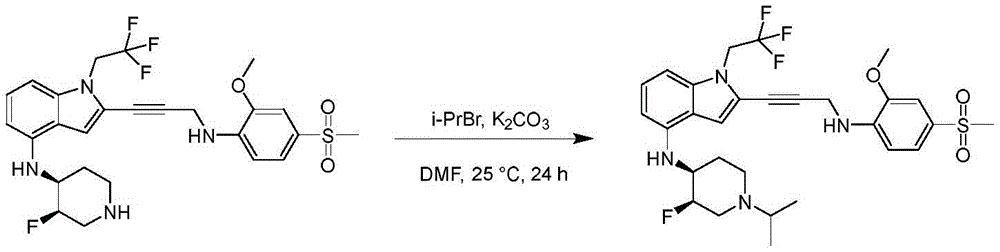
To (rac) -N- ((3R,4S) -3-fluoroPiperidin-4-yl) -2- (3- ((2-methoxy-4- (methylsulfonyl) phenyl) amino) prop-1-yn-1-yl) -1- (2,2, 2-trifluoroethyl) -1H-indol-4-amine (200mg, 361.9. mu. mol,1 eq) in DMF (4mL) was added K 2 CO 3 (150.1mg,1.1mmol,3 equiv.) followed by the addition of 2-bromopropane (445.2mg,3.6mmol, 339.8. mu.l, 10 equiv.). The reaction mixture was stirred at 25 ℃ for 24 hours, and subsequent TLC analysis indicated complete consumption of the starting material. The reaction mixture was quenched with water (40mL) and EtOAc (50mL) was added. The mixture was extracted with EtOAc (20mL x 3) and the combined organic layers were washed with brine (20mL x 3), dried over anhydrous sodium sulfate, filtered and concentrated in vacuo. The residue was passed through preparative TLC (SiO) 2 DCM: MeOH ═ 10:1), dissolved in DCM (5mL), filtered and concentrated under reduced pressure. The residue was further purified by preparative HPLC to give (rac) -N- [ (3R,4S) -3-fluoro-1- (propan-2-yl) piperidin-4-yl ]-2- {3- [ (4-methanesulfonyl-2-methoxyphenyl) amino]Prop-1-yn-1-yl } -1- (2,2, 2-trifluoroethyl) -1H-indol-4-amine. Then, the constituent enantiomers are resolved by chiral SFC to give N- [ (3R,4S) -3-fluoro-1- (propan-2-yl) piperidin-4-yl]-2- {3- [ (4-methanesulfonyl-2-methoxyphenyl) amino]Prop-1-yn-1-yl } -1- (2,2, 2-trifluoroethyl) -1H-indol-4-amine (20.4mg, 34.27. mu. mol) as a light yellow solid (MS (ES) + M/z) 595.3). To obtain N- [ (3S,4R) -3-fluoro-1- (prop-2-yl) piperidin-4-yl]-2- {3- [ (4-methanesulfonyl-2-methoxyphenyl) amino]Prop-1-yn-1-yl } -1- (2,2, 2-trifluoroethyl) -1H-indol-4-amine (20.8mg, 34.45. mu. mol) as a light yellow solid (MS (ES) + ,m/z):595.3)。
Example D129: preparation of compounds 780A and 792A.

Synthesis of 4-bromo-1- (2,2, 2-trifluoroethyl) -1H-indol-2-yl trifluoromethanesulfonate: to a solution of 4-bromo-1- (2,2, 2-trifluoroethyl) indolin-2-one (10g,34.01mmol,1 eq) and 2, 6-lutidine (4.37g,40.81mmol,4.75mL,1.2 eq) in DCM (100mL) was added dropwise trifluoromethanesulfonyl triflate (9.59g,34.01mmol,5.61mL,1 eq) at 25 deg.C. The reaction mixture was stirred at 25 ℃ for 2 hours followed by TLC analysis (PE: EtOAc ═ 3:1, R) f 0.5) indicating completion of the reaction. The reaction mixture was poured onto saturated NH 4 Aqueous Cl (100mL) and extracted with DCM (60mL × 3). The remaining aqueous phase was added to saturated NaHCO 3 Solution (100mL) and re-extracted with DCM (60mL x 3). The combined organic layers were washed with brine (20mL), dried over anhydrous sodium sulfate, filtered and concentrated in vacuo. The residue was purified by column chromatography (SiO) 2 PE: EtOAc ═ 1:0 to 100:1, R f ═ 0.5) to give [ 4-bromo-1- (2,2, 2-trifluoroethyl) indol-2-yl ] amine]Triflate (13.0g,27.46mmol, 80.74% yield) as a yellow solid.
Synthesis of methyl 4- ((3- (4-bromo-1- (2,2, 2-trifluoroethyl) -1H-indol-2-yl) prop-2-yn-1-yl) (tert-butoxycarbonyl) amino) -3-methoxybenzoate: to a solution of methyl 4- ((tert-butoxycarbonyl) (prop-2-yn-1-yl) amino) -3-methoxybenzoate (10.72g,33.56mmol,1.1 eq) in DMSO (130mL) at 20 deg.C was added i-Pr 2 NH (30.87g,305.07mmol,43.11mL,10 equiv.), CuI (290.50mg,1.53mmol,0.05 equiv.), and 4-bromo-1- (2,2, 2-trifluoroethyl) -1H-indol-2-yl trifluoromethanesulfonate (13g,30.51mmol,1 equiv.). Then Pd (PPh) is added 3 ) 4 (1.76g,1.53mmol,0.05 eq.) and the mixture was washed with N 2 Purging was carried out three times. The mixture was stirred at 25 ℃ for 1 hour, followed by TLC analysis (R) f 0.5, PE: EtOAc: 3:1) indicated that the starting material was consumed. EtOAc (200mL) and saturated aqueous EDTA solution (300mL) were added and stirred at 25 ℃ for 1 hour. The mixture was extracted with EtOAc (200mL x 3) and the combined organic layers were washed with brine (50mL x 3), dried over anhydrous sodium sulfate, filtered and concentrated. The residue was purified by column chromatography (SiO) 2 EtOAc ═ 15:1 to 8:1) and the solid concentrated eluate was washed with MTBE (45mL) to give methyl 4- ((3- (4-bromo-1- (2,2, 2-trifluoroethyl) -1H-indol-2-yl) prop-2-yn-1-yl) (tert-butoxycarbonyl) amino) -3-methoxybenzoate (14.1g,23.45mmol, 76.87% yield) as a yellow solid.
4- ((tert-Butoxycarbonyl) (3- (4- (((3S,4R) -3-fluoro-1-methylpiperidin-4-yl) amino) -1- (2,2, 2-trifluoroethyl) -1H-indol-2-yl) prop-2-yn-1-yl) amino) -synthesis of methyl 3-methoxybenzoate: to methyl 4- ((3- (4-bromo-1- (2,2, 2-trifluoroethyl) -1H-indol-2-yl) prop-2-yn-1-yl) (tert-butoxycarbonyl) amino) -3-methoxybenzoate (12g,20.15mmol,1 eq), (3S,4R) -3-fluoro-1-methylpiperidin-4-amine dihydrochloride (4.55g,22.17mmol,1.1 eq) and Cs at 20 deg.C 2 CO 3 (26.27G,80.62mmol,4 equiv.) of a mixture in dioxane (360mL) RuPhos (1.32G,2.82mmol,0.14 equiv.) and BrettPhos (Pd, G) 4 ) (1.30g,1.41mmol,0.07 eq.) and then the mixture is treated with N 2 Purging was carried out three times. The mixture was stirred at 110 ℃ for 16 h, and subsequent HPLC indicated consumption of the starting bromoindole. EtOAc (500mL) and saturated EDTA solution (800mL) were added at 20 ℃ and stirred for 1 hour. The mixture was then extracted with EtOAc (300mL x 3), and the combined organic layers were washed with brine (100mL x 2), dried over anhydrous sodium sulfate, filtered, and concentrated. The residue was purified by column chromatography (SiO) 2 PE EtOAc ═ 2:1 to 0:1) was purified and the solid concentrated eluate was washed with MTBE (20mL) to give methyl 4- ((tert-butoxycarbonyl) (3- (4- (((3S,4R) -3-fluoro-1-methylpiperidin-4-yl) amino) -1- (2,2, 2-trifluoroethyl) -1H-indol-2-yl) prop-2-yn-1-yl) amino) -3-methoxybenzoate (10.1g,15.13mmol, 75.09% yield) as a yellow solid.
Synthesis of methyl 4- ((3- (4- (((3S,4R) -3-fluoro-1-methylpiperidin-4-yl) amino) -1- (2,2, 2-trifluoroethyl) -1H-indol-2-yl) prop-2-yn-1-yl) amino) -3-methoxybenzoate: a mixture of methyl 4- ((tert-butoxycarbonyl) (3- (4- (((3S,4R) -3-fluoro-1-methylpiperidin-4-yl) amino) -1- (2,2, 2-trifluoroethyl) -1H-indol-2-yl) prop-2-yn-1-yl) amino) -3-methoxybenzoate (10.1g,15.13mmol,1 eq) in 4N HCl/EtOAc (300mL) was stirred at 20 ℃ for 1H. TLC analysis (R) f 0.45 EtOAc: TEA ═ 10:1) indicated complete consumption of starting material. The mixture was filtered and washed with saturated NaHCO 3 The filtrate was washed with aqueous solution (200mL) and extracted with EtOAc (200 mL. times.3). The combined organic layers were washed with brine (50mL), dried over anhydrous sodium sulfate, filtered, and concentrated to give methyl 4- ((3- (4- (((3S,4R) -3-fluoro-1-methylpiperidin-4-yl) amino) -1- (2,2, 2-trifluoroethyl) -1H-indol-2-yl) prop-2-yn-1-yl) amino) -3-methoxybenzoate (8.0g,13.91 mmol) 91.88% yield) as a yellow solid. The residue was used directly in the next step.
4- { [3- (4- { [ (3S,4R) -3-fluoro-1-methylpiperidin-4-yl]Amino } -1- (2,2, 2-trifluoroethyl) -1H-indol-2-yl) prop-2-yn-1-yl]Synthesis of amino } -3-methoxybenzoic acid: in N 2 Compound 4- { [3- (4- { [ (3S,4R) -3-fluoro-1-methylpiperidin-4-yl]Amino } -1- (2,2, 2-trifluoroethyl) -1H-indol-2-yl) prop-2-yn-1-yl]Amino } -3-methoxybenzoic acid methyl ester (7g,12.17mmol,1 eq), LiOH. H 2 A mixture of O (10.21g,243.34mmol,20 equiv.) and NaOH (1.95g,48.67mmol,4 equiv.) in THF (70mL), MeOH (70mL) and water (70mL) was stirred at 50 ℃ for 5 h, followed by TLC analysis (R f 0.3 EtOAc: MeOH ═ 2:1) indicated complete consumption of the starting material. The organic solvent was removed in vacuo and the concentrate was diluted with water (200mL) and adjusted to pH 5 with 4N HCl. The resulting precipitate was filtered and the retentate washed with water (20mL x 2) and lyophilized to give a first batch of 4- { [3- (4- { [ (3S,4R) -3-fluoro-1-methylpiperidin-4-yl]Amino } -1- (2,2, 2-trifluoroethyl) -1H-indol-2-yl) prop-2-yn-1-yl]Amino } -3-methoxybenzoic acid (4.8g, 98.083% purity) as a yellow solid. The filtrate was extracted with EtOAc (250mL x 3), and the combined organic layers were washed with brine (50mL x 2), dried over anhydrous sodium sulfate, filtered, and concentrated. The residue was triturated with MTBE (50mL) to give a second batch of 4- { [3- (4- { [ (3S,4R) -3-fluoro-1-methylpiperidin-4-yl ]Amino } -1- (2,2, 2-trifluoroethyl) -1H-indol-2-yl) prop-2-yn-1-yl]Amino } -3-methoxybenzoic acid (2g) as a yellow solid.
4- { [3- (4- { [ (3S,4R) -3-fluoro-1-methylpiperidin-4-yl]Amino } -1- (2,2, 2-trifluoroethyl) -1H-indol-2-yl) prop-2-yn-1-yl]Amino } -3-methoxybenzoic acid: 1 H NMR(400MHz,DMSO-d 6 )δ=12.21(br s,1H),7.52(d,J=8.5Hz,1H),7.34(d,J=1.5Hz,1H),7.18(s,1H),7.02(t,J=8.0Hz,1H),6.79(br d,J=8.3Hz,1H),6.76(br d,J=8.3Hz,1H),6.32-6.22(m,2H),5.61(br d,J=8.4Hz,1H),5.04-4.84(m,3H),4.34(br d,J=6.1Hz,2H),3.84(s,3H),3.75-3.60(m,1H),3.42-3.37(m,1H),3.15-2.98(m,1H),2.84-2.53(m,2H),2.47-2.39(m,3H),2.20-1.93(m,1H),1.81(br d,J=11.9Hz,1H)。MS(ES + ,m/z):533.2。
example D130: preparation of compounds 783A, 804A and 805A.

Synthesis of 4-bromo-1- (2,2, 2-trifluoroethyl) indoline-2, 3-dione: to a mixture of tert-butyl (2-methoxy-4- (methylcarbamoyl) phenyl) (prop-2-yn-1-yl) carbamate (10.68g,33.56mmol,1.1 eq) in DMSO (130mL) at 20 deg.C was added i-Pr 2 NH (30.87g,305.07mmol,43.11mL,10 equiv.), CuI (581.01mg,3.05mmol,0.1 equiv.), 4-bromo-1- (2,2, 2-trifluoroethyl) -1H-indol-2-yl trifluoromethanesulfonate (13g,30.51mmol,1 equiv.), and Pd (PPh) 3 ) 4 (2.12g,1.83mmol,0.06 equiv.). Then the mixture is treated with N 2 Purging was carried out three times. The reaction mixture was stirred at 40 ℃ for 1 hour, followed by TLC analysis (R) f PE: EtOAc ═ 1:1) indicated completion of the reaction. EtOAc (500mL) and saturated aqueous EDTA solution (500mL) were then added and the mixture was further stirred at 20 ℃ for 1 hour. The mixture was extracted with EtOAc (500mL x 3) and the combined organic layers were dried over anhydrous sodium sulfate, filtered and concentrated. The residue was purified by column chromatography (SiO) 2 PE: EtOAc ═ 3:1 to 1:2) purification afforded 4-bromo-1- (2,2, 2-trifluoroethyl) indoline-2, 3-dione (13g, 65% yield) as a yellow solid.
Synthesis of (rac) -tert-butyl (3- (4- (((3S,4R) -3-fluoro-1-methylpiperidin-4-yl) amino) -1- (2,2, 2-trifluoroethyl) -1H-indol-2-yl) prop-2-yn-1-yl) (2-methoxy-4- (methylcarbamoyl) phenyl) carbamate: to a mixture of 4-bromo-1- (2,2, 2-trifluoroethyl) indoline-2, 3-dione (10g,16.82mmol,1 eq), (rac) - (3R,4S) -3-fluoro-1-methyl-piperidin-4-amine (3.80g,18.51mmol,1.1 eq, dihydrochloride) in dioxane (300mL) was added Cs 2 CO 3 (16.44G,50.47mmol,3 equiv.), RuPhos (1.02G,2.19mmol,0.13 equiv.), and Brettphos (Pd, G4) (929.16mg,1.01mmol,0.06 equiv.). Degassing the mixture and adding N 2 Purged three times and then stirred at 110 ℃ for 6 hours. TLC analysis (EtOAc: TEA ═ 10:1, R f 0.35) indicating complete consumption of starting material. By adding saturated EDTA aqueous solutionThe reaction mixture was quenched (400mL) and stirred at 25 ℃ for 2 h. The mixture was extracted with EtOAc (100mL x 4) and the extract was treated with 2M HCl solution to adjust the pH of the mixture to 3. Then adding saturated Na 2 CO 3 The aqueous solution was added to adjust the pH of the mixture to 8, the mixture was filtered and concentrated under reduced pressure. The residue was purified by column chromatography (SiO) 2 PE: EtOAc ═ 1:1 to EtOAc: TEA: MeOH ═ 10:1:0.2) purification afforded (rac) -tert-butyl (3- (4- (((3S,4R) -3-fluoro-1-methylpiperidin-4-yl) amino) -1- (2,2, 2-trifluoroethyl) -1H-indol-2-yl) prop-2-yn-1-yl) (2-methoxy-4- (methylcarbamoyl) phenyl) carbamate (9.5g,13.24mmol, 78.71% yield) as a yellow solid.
rac-4- { [3- (4- { [ (3R,4S) -3-fluoro-1-methylpiperidin-4-yl]Amino } -1- (2,2, 2-trifluoroethyl) -1H-indol-2-yl) prop-2-yn-1-yl]Synthesis of amino } -3-methoxy-N-methylbenzamide and 4- { [3- (4- { [ (3S,4R) -3-fluoro-1-methylpiperidin-4-yl]Amino } -1- (2,2, 2-trifluoroethyl) -1H-indol-2-yl) prop-2-yn-1-yl]Amino } -3-methoxy-N-methylbenzamide and 4- { [3- (4- { [ (3R,4S) -3-fluoro-1-methylpiperidin-4-yl]Amino } -1- (2,2, 2-trifluoroethyl) -1H-indol-2-yl) prop-2-yn-1-yl]Chiral resolution of amino } -3-methoxy-N-methylbenzamide: in N 2 A mixture of (rac) -tert-butyl (3- (4- (((3S,4R) -3-fluoro-1-methylpiperidin-4-yl) amino) -1- (2,2, 2-trifluoroethyl) -1H-indol-2-yl) prop-2-yn-1-yl) (2-methoxy-4- (methylcarbamoyl) phenyl) carbamate (6.3g,9.76mmol,1 eq) in 4N HCl/EtOAc (300mL) was stirred at 25 ℃ for 1H under an atmosphere. TLC analysis (EtOAc: TEA ═ 10:1, R f 0.30) indicated complete consumption of starting material and a new spot was observed. Then saturated Na is used 2 CO 3 The mixture was treated with aqueous solution to adjust the pH of the mixture to 8 and extracted with EtOAc (100mL x 4). The combined organic layers were washed with brine (50mL x 2), dried over anhydrous sodium sulfate, filtered and concentrated under reduced pressure. The resulting residue was stirred in EtOH (10mL) for 10 h at 25 ℃ and then filtered to give (rac) -4- { [3- (4- { [ (3R,4S) -3-fluoro-1-methylpiperidin-4-yl]Amino } -1- (2,2, 2-trifluoroethyl) -1H-indol-2-yl) prop-2-yn-1-yl]Amino } -3-methoxy-N-methylbenzamide (4.9g,8.53mmol, 87.45% yield),as a yellow solid.
(Rac) -4- { [3- (4- { [ (3R,4S) -3-fluoro-1-methylpiperidin-4-yl ] amino } -1- (2,2, 2-trifluoroethyl) -1H-indol-2-yl) prop-2-yn-1-yl ] amino } -3-methoxy-N-methylbenzamide (7.2g,13.20mmol,1 eq) was resolved into the corresponding enantiomer by chiral SFC to give 4- { [3- (4- { [ (3S,4R) -3-fluoro-1-methylpiperidin-4-yl ] amino } -1- (2,2, 2-trifluoroethyl) -1H-indol-2-yl) prop-2-yne as a yellow solid 1-yl ] amino } -3-methoxy-N-methylbenzamide (3.34g,6.04mmol, 45.74% yield) and 4- { [3- (4- { [ (3R,4S) -3-fluoro-1-methylpiperidin-4-yl ] amino } -1- (2,2, 2-trifluoroethyl) -1H-indol-2-yl) prop-2-yn-1-yl ] amino } -3-methoxy-N-methylbenzamide as a yellow solid (2.34g,4.16mmol, 31.56% yield).
4- { [3- (4- { [ (3S,4R) -3-fluoro-1-methylpiperidin-4-yl]Amino } -1- (2,2, 2-trifluoroethyl) -1H-indol-2-yl) prop-2-yn-1-yl]Amino } -3-methoxy-N-methylbenzamide: 1 HNMR(400MHz,DMSO-d6)δppm 1.65-1.72(m,1H)1.87-1.98(m,1H)2.04-2.12(m,1H)2.14-2.29(m,4H)2.72-2.84(m,4H)3.02(br t,J=10.76Hz,1H)3.47-3.62(m,1H)3.80-3.89(m,3H)4.31(d,J=6.24Hz,2H)4.72-4.87(m,1H)4.92(q,J=9.05Hz,2H)5.42-5.55(m,1H)5.94-6.03(m,1H)6.19-6.29(m,1H)6.70-6.79(m,2H)7.00(t,J=7.95Hz,1H)7.17(s,1H)7.35(s,1H)7.39-7.46(m,1H)8.08-8.13(m,1H)。MS(ES + m/z) 546.3; 4- { [3- (4- { [ (3R,4S) -3-fluoro-1-methylpiperidin-4-yl]Amino } -1- (2,2, 2-trifluoroethyl) -1H-indol-2-yl) prop-2-yn-1-yl]Amino } -3-methoxy-N-methylbenzamide, MS (ES) + ,m/z):546.3。
Example D131: general procedure for the preparation of compounds 772 and 773A.
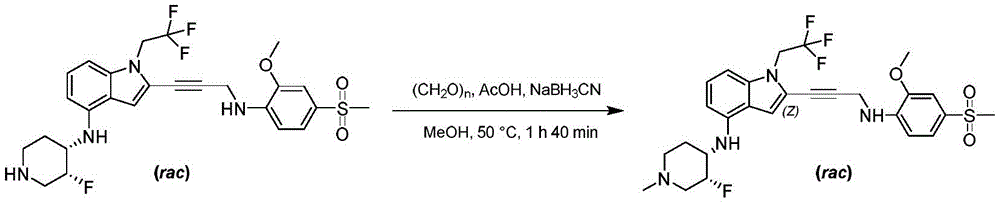
To a solution of (rac) -N- ((3R,4S) -3-fluoropiperidin-4-yl) -2- (3- ((2-methoxy-4- (methylsulfonyl) phenyl) amino) prop-1-yn-1-yl) -1- (2,2, 2-trifluoroethyl) -1H-indol-4-amine (30g,53.48mmol,1 eq) in MeOH (300mL) were added AcOH (9.31g,155mmol,8.87mL,2.90 eq), paraformaldehyde (8.03g) and NaBH 3 CN (16.80g,267.38mmol,5 equiv.). In N 2 The reaction mixture was stirred at 50 ℃ for 1 hour 40 minutes followed by TLC analysis (EtOAc: TEA ═ 10:1, R) f 0.4) indicates that starting material remained and a major new spot was detected, which was less polar than the starting material. Then an additional portion of AcOH (6.21g,103.34mmol,5.91mL,1.93 equiv.), paraformaldehyde (1.61g) and NaBH was added 3 CN (3.36g,53.48mmol,1 equiv.) and the mixture was stirred further at 50 ℃ for 0.5 h. TLC analysis (EtOAc: TEA ═ 10:1, R f 0.4) indicates that the starting material remained. Add last portion of paraformaldehyde (802.83mg) and NaBH 3 CN (3.36g,53.48mmol,1 equiv.) and the mixture was stirred at 50 ℃ for a further 10 minutes. TLC analysis (EtOAc: TEA ═ 10:1, R f 0.4) indicates complete consumption of the starting material. The reaction mixture was poured onto saturated Na 2 CO 3 Aqueous (4L) and extracted with EtOAc (1L x 3). The combined organic layers were saturated with Na 2 CO 3 The aqueous solution (1L) and brine (1L x 2) were washed, dried over anhydrous sodium sulfate, filtered and concentrated to about 500 mL. The concentrate was filtered to give the crude product as the retentate. The retentate was purified by column chromatography (SiO) 2 EtOAc) and the enantiomers were separated by chiral SFC to give the desired pure enantiomer as a light yellow solid.
N- [ (3S,4R) -3-fluoro-1-methylpiperidin-4-yl]-2- {3- [ (4-methanesulfonyl-2-methoxyphenyl) amino]Prop-1-yn-1-yl } -1- (2,2, 2-trifluoroethyl) -1H-indol-4-amine: 1 H NMR(400MHz,DMSO-d 6 )δppm 7.39(dd,J=8.38,1.77Hz,1H)7.25(d,J=1.83Hz,1H)7.18(s,1H)7.01(t,J=8.01Hz,1H)6.89(d,J=8.44Hz,1H)6.73(d,J=8.19Hz,1H)6.48(t,J=6.17Hz,1H)6.24(d,J=7.82Hz,1H)5.49(d,J=8.56Hz,1H)4.93(q,J=9.17Hz,2H)4.70-4.87(m,1H)4.36(d,J=6.11Hz,2H)3.89(s,3H)3.47-3.64(m,1H)3.09(s,3H)3.02(br t,J=10.51Hz,1H)2.79(br d,J=11.00Hz,1H)2.14-2.30(m,4H)2.02-2.13(m,1H)1.92(qd,J=12.17,3.48Hz,1H)1.69(br d,J=9.78Hz,1H)。MS(ES + m/z) 567.2; n- [ (3R,4S) -3-fluoro-1-methylpiperidin-4-yl]-2- {3- [ (4-methanesulfonyl-2-methoxyphenyl) amino]Prop-1-yn-1-yl } -1- (2,2, 2-trifluoroethyl) -1H-indol-4-amine, MS: (ES + ,m/z):567.2。
Example D132: preparation of compound 459A.

Synthesis of tert-butyl 4- ((2- (3- ((2-methoxy-4- (morpholinosulfonyl) phenyl) amino) prop-1-yn-1-yl) -1- (2,2, 2-trifluoroethyl) -1H-indol-4-yl) amino) piperidine-1-carboxylate: to a mixture of 2-methoxy-4-morpholinosulfonyl-N-prop-2-ynyl-aniline (89.05mg,283.76 μmol,1.5 equivalents) and tert-butyl 4- ((2-iodo-1- (2,2, 2-trifluoroethyl) -1H-indol-4-yl) amino) piperidine-1-carboxylate (0.1g,189.17 μmol,1 equivalent) (99%) in DMSO (2mL) was added CuI (36.03mg,189.17 μmol,1 equivalent), Pd (PPh) 3 ) 4 (21.86mg, 18.92. mu. mol,0.10 equiv.) and diisopropylamine (19.14mg, 189.17. mu. mol, 26.74. mu.L, 1 equiv.). In N 2 The reaction mixture was stirred at 30 ℃ for 1 hour and subsequent LC-MS analysis indicated that the reaction was complete. The reaction was poured into saturated aqueous EDTA (50mL) and extracted with EtOAc (20mL x 3), and the combined organic layers were washed with saturated aqueous EDTA (20mL) and stirred for 1 hour. The organic layer was then washed with brine (50mL), dried over anhydrous sodium sulfate, and concentrated in vacuo. The crude residue was purified by preparative TLC (PE: EtOAc ═ 1:1, R) f = 0.32) to give tert-butyl 4- ((2- (3- ((2-methoxy-4- (morpholinosulfonyl) phenyl) amino) prop-1-yn-1-yl) -1- (2,2, 2-trifluoroethyl) -1H-indol-4-yl) amino) piperidine-1-carboxylate (0.08g,90.68 μmol, 47.93% yield) as a yellow solid.
Preparation of the final product: to a mixture of tert-butyl 4- ((2- (3- ((2-methoxy-4- (morpholinosulfonyl) phenyl) amino) prop-1-yn-1-yl) -1- (2,2, 2-trifluoroethyl) -1H-indol-4-yl) amino) piperidine-1-carboxylate (0.07g,79.34 μmol,1 eq) was added HCl/EtOAc (4M,34.26mL,1726.94 eq). In N 2 The mixture was then stirred at 25 ℃ for 1 hour, and subsequent LC-MS analysis indicated that the reaction was complete. The mixture was directly concentrated to give a crude residue which was purified by preparative HPLC to give 2- (3- { [ 2-methoxy-4- (morpholine-4-sulfonyl) phenyl ]Amino-prop-1-yne-1-yl) -N- (piperidin-4-yl) -1- (2,2, 2-trifluoroethyl) -1H-indol-4-amine (0.0166g,26.89 μmol, 33.89% yield) as a white solid. MS (ES) + ,m/z):606.2。
Example D133: general procedure for the preparation of compounds 482A and 1003A.

Following the general procedure indicated in example D120, 3-methoxy-N-methyl-4- (prop-2-yn-1-ylamino) benzamide is reacted with R 1 -substituted iodoindole coupling. In each case, the reaction was deemed complete after stirring for 1 hour at 30 ℃, and the crude compound was first purified by preparative TLC and further purified by preparative HPLC.
3-methoxy-N-methyl-4- [ (3- {4- [ (Oxan-4-yl) amino group]-1- (2,2, 2-trifluoroethyl) -1H-indol-2-yl } prop-2-yn-1-yl) amino]Benzamide, MS (ES) + M/z) 515.2; and 3-methoxy-N-methyl-4- [ (3- {4- [ (1-methylpiperidin-4-yl) amino group]-1- (2,2, 2-trifluoroethyl) -1H-indol-2-yl } prop-2-yn-1-yl) amino]Benzamide, MS (ES) + ,m/z):528.2。
Example D134: preparation of methyl 4- ((3- (4- (((3S,4R) -3-fluoropiperidin-4-yl) amino) -1- (2,2, 2-trifluoroethyl) -1H-indol-2-yl) prop-2-yn-1-yl) amino) -3-methoxybenzoate.
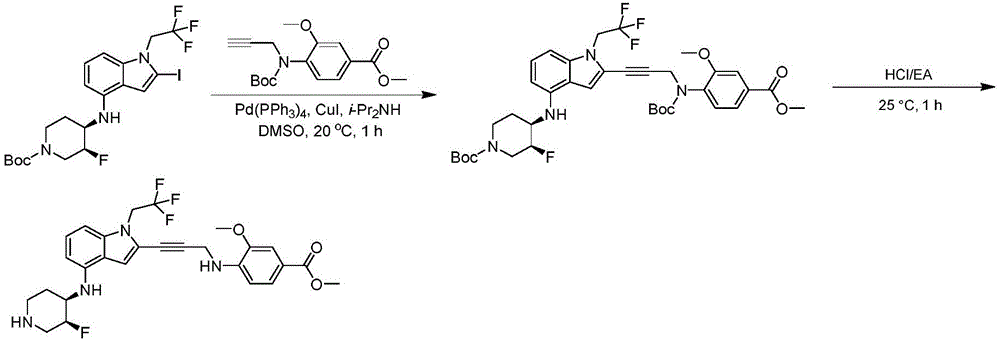
(3S,4R) -4- ((2- (3- ((tert-butoxycarbonyl) (2-methoxy-4- (methoxycarbonyl) phenyl) amino) prop-1-yn-1-yl) -1- (2,2, 2-trifluoroethyl) -1H-indol-4-yl) amino) -3-fluoropiperidine-1-carboxylic acid tert-butyl ester and (3R,4S) -4- ((2- (3- ((tert-butoxycarbonyl) (2-methoxy-4- (methoxycarbonyl) phenyl) amino) prop-1-yn-1-yl) -1- (2,2, 2-trifluoroethyl) -1H-indol-4-yl) amino) -3-fluoropiperidine-1-carboxylic acid tert-butyl ester Synthesis of butyl ester: to methyl 4- ((tert-butoxycarbonyl) (prop-2-yn-1-yl) amino) -3-methoxybenzoate (3.54g,11.08mmol,1.2 eq) in DMSO (50mL) solution in i-Pr was added 2 NH (9.35g,92.37mmol,13.05mL,10 equiv.) and CuI (351.83mg,1.85mmol,0.2 equiv.). Degassing the mixture and applying N 2 Purged and added (3S,4R) -3-fluoro-4- ((2-iodo-1- (2,2, 2-trifluoroethyl) -1H-indol-4-yl) amino) piperidine-1-carboxylic acid tert-butyl ester (5g,9.24mmol,1 eq) and Pd (PPh) 3 ) 4 (1.07g, 923.67. mu. mol,0.1 equiv.). In N 2 The mixture was stirred at 20 ℃ for 1 hour under atmosphere, followed by TLC analysis (PE: EtOAc ═ 2:1, R) f 0.47) indicating complete consumption of starting material. The reaction mixture was quenched with saturated aqueous EDTA (250mL) and extracted with EtOAc (150 mL. times.3). The combined organic layers were washed with brine (50mL x 2), dried over anhydrous sodium sulfate, filtered and concentrated under reduced pressure to give a residue. The residue was purified by column chromatography (SiO) 2 EtOAc ═ 7:1 to 0:1) to give (3S,4R) -4- ((2- (3- ((tert-butoxycarbonyl) (2-methoxy-4- (methoxycarbonyl) phenyl) amino) prop-1-yn-1-yl) -1- (2,2, 2-trifluoroethyl) -1H-indol-4-yl) amino) -3-fluoropiperidine-1-carboxylic acid tert-butyl ester as a yellow solid (76% yield). MS (ES) + ,m/z):733.3。
The procedure was repeated using (3R,4S) -3-fluoro-4- ((2-iodo-1- (2,2, 2-trifluoroethyl) -1H-indol-4-yl) amino) piperidine-1-carboxylic acid tert-butyl ester instead of (3S,4R) -3-fluoro-4- ((2-iodo-1- (2,2, 2-trifluoroethyl) -1H-indol-4-yl) amino) piperidine-1-carboxylic acid tert-butyl ester to give (3R,4S) -4- ((2- (3- ((tert-butoxycarbonyl) (2-methoxy-4- (methoxycarbonyl) phenyl) amino) prop-1-yn-1-yl) -1- (2,2, 2-trifluoroethyl) -1H-indol-4-yl) amino) -3-fluoropiperidine-1-carboxylic acid tert-butyl ester.
Synthesis of methyl 4- ((3- (4- (((3S,4R) -3-fluoropiperidin-4-yl) amino) -1- (2,2, 2-trifluoroethyl) -1H-indol-2-yl) prop-2-yn-1-yl) amino) -3-methoxybenzoate: a solution of (3S,4R) -4- ((2- (3- ((tert-butoxycarbonyl) (2-methoxy-4- (methoxycarbonyl) phenyl) amino) prop-1-yn-1-yl) -1- (2,2, 2-trifluoroethyl) -1H-indol-4-yl) amino) -3-fluoropiperidine-1-carboxylic acid tert-butyl ester (6g,7.07mmol,1 eq) was dissolved in 4N HCl/EtOAc (30 mL). The mixture was stirred at 25 ℃ for 1 hour, and subsequent HPLC analysis indicated complete consumption of the starting material. By adding saturated Na 2 CO 3 Aqueous solution (150 m)L) the reaction mixture was quenched until the pH of the mixture was about 9. The mixture was extracted with EtOAc (100mL x 3) and the combined organic layers were washed with brine (30mL x 2), dried over anhydrous sodium sulfate, filtered and concentrated under reduced pressure to give crude methyl 4- ((3- (4- (((3S,4R) -3-fluoropiperidin-4-yl) amino) -1- (2,2, 2-trifluoroethyl) -1H-indol-2-yl) prop-2-yn-1-yl) amino) -3-methoxybenzoate (78% yield) as a yellow solid.
1 H NMR:(400MHz,DMSO-d 6 )δppm 1.59-1.66(m,1H)1.68-1.78(m,1H)2.55-2.61(m,1H)2.69-2.82(m,1H)2.92-3.00(m,1H)3.06-3.14(m,1H)3.31(br s,1H)3.59-3.72(m,1H)3.78(s,3H)3.85(s,3H)4.32-4.37(m,2H)4.62-4.78(m,1H)4.88-4.97(m,2H)5.47-5.55(m,1H)6.22-6.28(m,1H)6.37-6.43(m,1H)6.70-6.75(m,1H)6.79-6.85(m,1H)6.97-7.02(m,1H)7.17-7.21(m,1H)7.32-7.35(m,1H)7.53-7.56(m,1H)。
(3R,4S) -4- ((2- (3- ((tert-butoxycarbonyl) (2-methoxy-4- (methoxycarbonyl) phenyl) amino) prop-1-yn-1-yl) -1- (2,2, 2-trifluoroethyl) -1H-indol-4-yl) amino) -3-fluoropiperidine-1-carboxylic acid tert-butyl ester was used instead of (3S,4R) -4- ((2- (3- ((tert-butoxycarbonyl) (2-methoxy-4- (methoxycarbonyl) phenyl) amino) prop-1-yn-1-yl) -1- (2,2, 2-trifluoroethyl) -1H-indol-4-yl) amino) -3-fluoropiperidine-1- Tert-butyl formate the procedure was repeated to give methyl 4- ((3- (4- (((3R,4S) -3-fluoropiperidin-4-yl) amino) -1- (2,2, 2-trifluoroethyl) -1H-indol-2-yl) prop-2-yn-1-yl) amino) -3-methoxybenzoate.
Example D135: preparation of compounds 899A, 903A, 908A and 912A.

4- { [3- (4- { [ (3S,4R) -3-fluoro-1- (2-hydroxyethyl) piperidin-4-yl]Amino } -1- (2,2, 2-trifluoroethyl) -1H-indol-2-yl) prop-2-yn-1-yl]Synthesis of methyl amino } -3-methoxybenzoate: to a solution of methyl 4- ((3- (4- (((3S,4R) -3-fluoropiperidin-4-yl) amino) -1- (2,2, 2-trifluoroethyl) -1H-indol-2-yl) prop-2-yn-1-yl) amino) -3-methoxybenzoate (prepared according to example D134) (300mg, 450.68. mu. mol,1 eq) in DMF (3mL)Liquid addition of K 2 CO 3 (311.43mg,2.25mmol,5 equiv.) and 2-bromoethanol (225.28mg,1.80mmol, 128. mu.L, 4 equiv.). The mixture was stirred at 50 ℃ for 6 h, followed by TLC (DCM: MeOH ═ 10:1, R) f 0.38) indicates complete consumption of the starting material and formation of a new spot. The reaction mixture was quenched with water (20mL) and extracted with EtOAc (15 mL. times.3). The combined organic layers were washed with brine (10mL), dried over anhydrous sodium sulfate, filtered and concentrated under reduced pressure. The residue was purified by column chromatography (SiO) 2 PE EtOAc ═ 3:1 to 0:1) purification to give 4- { [3- (4- { [ (3S,4R) -3-fluoro-1- (2-hydroxyethyl) piperidin-4-yl]Amino } -1- (2,2, 2-trifluoroethyl) -1H-indol-2-yl) prop-2-yn-1-yl]Methyl amino } -3-methoxybenzoate (49% yield) as a yellow solid. MS (ES) + ,m/z):577.3。
4- { [3- (4- { [ (3R,4S) -3-fluoro-1- (2-hydroxyethyl) piperidin-4-yl]Amino } -1- (2,2, 2-trifluoroethyl) -1H-indol-2-yl) prop-2-yn-1-yl]Synthesis of methyl amino } -3-methoxybenzoate: to a solution of methyl 4- ((3- (4- (((3R,4S) -3-fluoropiperidin-4-yl) amino) -1- (2,2, 2-trifluoroethyl) -1H-indol-2-yl) prop-2-yn-1-yl) amino) -3-methoxybenzoate (1 eq) in DMF (3mL) was added K 2 CO 3 (5 equiv.) and 2-bromoethanol (4 equiv.). The mixture was stirred at 50 ℃ for 12 hours, and subsequent TLC analysis indicated complete consumption of the starting material and formation of a new spot. The reaction mixture was quenched with water (5mL) and extracted with EtOAc (5mL x 3). The combined organic layers were washed with brine (5mL x 3), dried over anhydrous sodium sulfate, filtered and concentrated under reduced pressure. The residue was purified by column chromatography (SiO) 2 PE EtOAc ═ 1:1 to 0:1) and further purified by preparative HPLC to give 4- { [3- (4- { [ (3R,4S) -3-fluoro-1- (2-hydroxyethyl) piperidin-4-yl]Amino } -1- (2,2, 2-trifluoroethyl) -1H-indol-2-yl) prop-2-yn-1-yl]Methyl amino } -3-methoxybenzoate (38% yield) as a yellow solid. MS (ES) + ,m/z):577.2。
4- { [3- (4- { [ (3S,4R) -3-fluoro-1- (2-hydroxyethyl) piperidin-4-yl]Amino } -1- (2,2, 2-trifluoroethyl) -1H-indol-2-yl) prop-2-yn-1-yl ]Amino } -3-methoxybenzoic acid and 4- { [3- (4- { [ (3R,4S) -3-fluoro-1- (2-hydroxyethyl) piperidin-4-yl]Amino } -1- (2, 2)2-trifluoroethyl) -1H-indol-2-yl) prop-2-yn-1-yl]Synthesis of amino } -3-methoxybenzoic acid: to 4- { [3- (4- { [ (3S,4R) -3-fluoro-1- (2-hydroxyethyl) piperidin-4-yl]Amino } -1- (2,2, 2-trifluoroethyl) -1H-indol-2-yl) prop-2-yn-1-yl]A solution of methyl amino } -3-methoxybenzoate (0.1g, 155.57. mu. mol,1 eq) in THF (1mL), water (1mL) and MeOH (1mL) was added NaOH (31.11mg, 777.86. mu. mol,5 eq) and LiOH. H 2 O (32.64mg, 777.86. mu. mol,5 equiv.). The mixture was stirred at 40 ℃ for 18 h, followed by TLC analysis (DCM: MeOH ═ 10:1, R) f 0.2) indicated complete consumption of starting material and formation of a new spot. Then 2N HCl (20mL) was added to adjust the pH of the mixture to 3 and the mixture was extracted with EtOAc (20mL x 3). The combined organic layers were washed with brine (20mL), dried over anhydrous sodium sulfate, filtered and concentrated under reduced pressure. The residue was purified by preparative HPLC to give 4- { [3- (4- { [ (3S,4R) -3-fluoro-1- (2-hydroxyethyl) piperidin-4-yl]Amino } -1- (2,2, 2-trifluoroethyl) -1H-indol-2-yl) prop-2-yn-1-yl]Amino } -3-methoxybenzoic acid (45% yield) as a yellow solid. MS (ES) + ,m/z):563.2。
Use of 4- { [3- (4- { [ (3R,4S) -3-fluoro-1- (2-hydroxyethyl) piperidin-4-yl]Amino } -1- (2,2, 2-trifluoroethyl) -1H-indol-2-yl) prop-2-yn-1-yl]Amino } -3-methoxybenzoic acid methyl ester instead of 4- { [3- (4- { [ (3S,4R) -3-fluoro-1- (2-hydroxyethyl) piperidin-4-yl]Amino } -1- (2,2, 2-trifluoroethyl) -1H-indol-2-yl) prop-2-yn-1-yl]The procedure was repeated with methyl amino } -3-methoxybenzoate to give 4- { [3- (4- { [ (3R,4S) -3-fluoro-1- (2-hydroxyethyl) piperidin-4-yl]Amino } -1- (2,2, 2-trifluoroethyl) -1H-indol-2-yl) prop-2-yn-1-yl]Amino } -3-methoxybenzoic acid (27% yield) as a yellow solid. MS (ES) + ,m/z):563.2。
Example D136: preparation of compounds 897A, 898A, 902A and 904A.
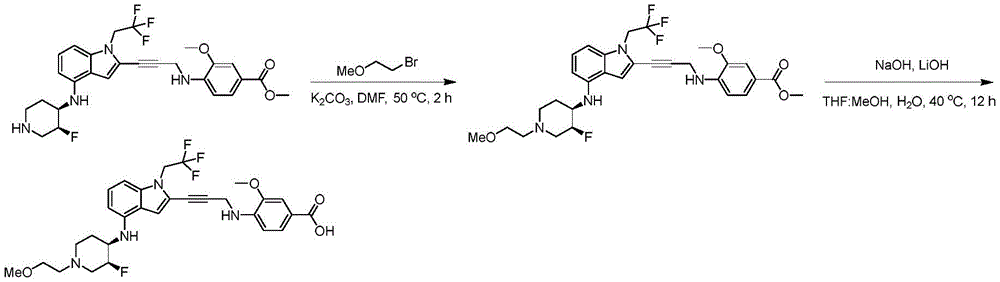
Compounds 897A, 898A, 902A, and 904A were prepared by a procedure similar to example D135, using 1-bromo-2-methoxy-ethane instead of 2-bromoethanol.
4- { [3- (4- { [ (3S,4R) -3-fluoro-1- (2-methoxyethyl) piperidin-4-yl]Amino } -1- (2,2, 2-trifluoroethyl) -1H-indol-2-yl) prop-2-yn-1-yl]Amino } -3-methoxybenzoic acid methyl ester, MS (ES) + M/z) 591.3; 4- { [3- (4- { [ (3R,4S) -3-fluoro-1- (2-methoxyethyl) piperidin-4-yl]Amino } -1- (2,2, 2-trifluoroethyl) -1H-indol-2-yl) prop-2-yn-1-yl]Amino } -3-methoxybenzoic acid methyl ester, MS (ES) + M/z) 591.3; 4- { [3- (4- { [ (3S,4R) -3-fluoro-1- (2-methoxyethyl) piperidin-4-yl]Amino } -1- (2,2, 2-trifluoroethyl) -1H-indol-2-yl) prop-2-yn-1-yl]Amino } -3-methoxybenzoic acid, MS (ES) + M/z) 577.2; and 4- { [3- (4- { [ (3R,4S) -3-fluoro-1- (2-methoxyethyl) piperidin-4-yl]Amino } -1- (2,2, 2-trifluoroethyl) -1H-indol-2-yl) prop-2-yn-1-yl]Amino } -3-methoxybenzoic acid, MS (ES) + ,m/z):577.3。
Example D137: preparation of compounds 900A, 905A, 911A and 921A.
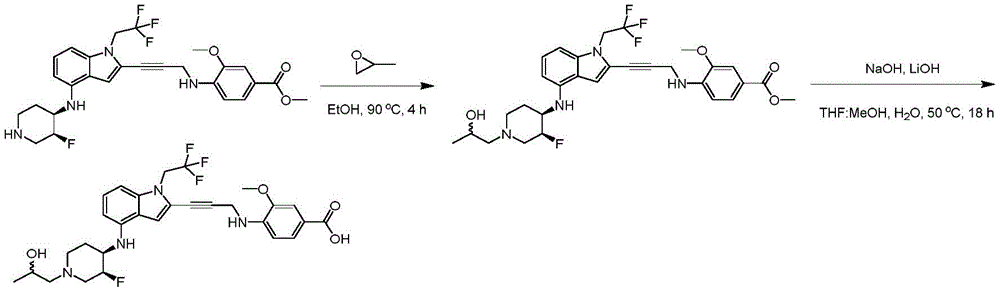
The compound 4- { [3- (4- { [ (3S,4R) -3-fluoro-1- (2-hydroxypropyl) piperidin-4-yl]Amino } -1- (2,2, 2-trifluoroethyl) -1H-indol-2-yl) prop-2-yn-1-yl]Methyl amino } -3-methoxybenzoate and 4- { [3- (4- { [ (3R,4S) -3-fluoro-1- (2-hydroxypropyl) piperidin-4-yl]Amino } -1- (2,2, 2-trifluoroethyl) -1H-indol-2-yl) prop-2-yn-1-yl]Synthesis of methyl amino } -3-methoxybenzoate: a mixture of methyl 4- ((3- (4- (((3S,4R) -3-fluoropiperidin-4-yl) amino) -1- (2,2, 2-trifluoroethyl) -1H-indol-2-yl) prop-2-yn-1-yl) amino) -3-methoxybenzoate (0.2g, 375.57. mu. mol,1 eq) and 2-methyloxirane (109.06mg,1.88mmol, 131.72. mu.L, 5 eq) in EtOH (3mL) was stirred at 90 ℃ for 4H, followed by TLC analysis (DCM: MeOH ═ 10:1, R: 4R ═ 1) f 0.32) indicates complete consumption of the starting material and formation of a new spot. The reaction mixture was concentrated under reduced pressure. The residue was passed through preparative TLC (SiO) 2 DCM: MeOH ═ 10:1) and further purification by preparative HPLC gave 4- { [3- (4- { [ (3S,4R) -3-fluoro-1- (2-hydroxypropyl) piperidin-4-yl]Amino group} -1- (2,2, 2-trifluoroethyl) -1H-indol-2-yl) prop-2-yn-1-yl]Methyl amino } -3-methoxybenzoate (180mg, 43% yield) as a yellow solid. MS (ES) + ,m/z):591.2。
The procedure was repeated using methyl 4- ((3- (4- (((3R,4S) -3-fluoropiperidin-4-yl) amino) -1- (2,2, 2-trifluoroethyl) -1H-indol-2-yl) prop-2-yn-1-yl) amino) -3-methoxybenzoate instead of methyl 4- ((3- (4- (((3S,4R) -3-fluoropiperidin-4-yl) amino) -1- (2,2, 2-trifluoroethyl) -1H-indol-2-yl) prop-2-yn-1-yl) amino) -3-methoxybenzoate to give 4- { [3- (4- { [ (3R,4S) -3-fluoro-1- (2-hydroxypropyl) piperidin-4-yl]Amino } -1- (2,2, 2-trifluoroethyl) -1H-indol-2-yl) prop-2-yn-1-yl]Amino } -3-methoxybenzoic acid methyl ester. MS (ES) + ,m/z):591.2。
4- { [3- (4- { [ (3S,4R) -3-fluoro-1- (2-hydroxypropyl) piperidin-4-yl]Amino } -1- (2,2, 2-trifluoroethyl) -1H-indol-2-yl) prop-2-yn-1-yl]Amino } -3-methoxybenzoic acid and 4- { [3- (4- { [ (3R,4S) -3-fluoro-1- (2-hydroxypropyl) piperidin-4-yl ]Amino } -1- (2,2, 2-trifluoroethyl) -1H-indol-2-yl) prop-2-yn-1-yl]Synthesis of amino } -3-methoxybenzoic acid: to 4- { [3- (4- { [ (3S,4R) -3-fluoro-1- (2-hydroxypropyl) piperidin-4-yl]Amino } -1- (2,2, 2-trifluoroethyl) -1H-indol-2-yl) prop-2-yn-1-yl]A solution of methyl amino } -3-methoxybenzoate (0.1g, 151.71. mu. mol,1 eq) in THF (1mL), MeOH (1mL) and water (1mL) was added NaOH (30.34mg, 758.54. mu. mol,5 eq) and LiOH. H 2 O (31.83mg, 758.54. mu. mol,5 equiv.). At N 2 The mixture was stirred at 50 ℃ for 18 h under atmosphere, followed by TLC analysis (DCM: MeOH ═ 10:1, R) f 0.12) indicates complete consumption of the ester starting material and formation of two new spots. The reaction mixture was quenched by addition of 2N HCl (15mL) to adjust the pH of the mixture to 3 and extracted with EtOAc (15mL x 3). The combined organic layers were washed with brine (10mL x 2), dried over anhydrous sodium sulfate, filtered and concentrated under reduced pressure. The residue was purified by preparative HPLC to give 4- { [3- (4- { [ (3S,4R) -3-fluoro-1- (2-hydroxypropyl) piperidin-4-yl]Amino } -1- (2,2, 2-trifluoroethyl) -1H-indol-2-yl) prop-2-yn-1-yl]Amino } -3-methoxybenzoic acid (45% yield) as a yellow solid. MS (ES) + ,m/z):577.3。
Using a 4-tone[3- (4- { [ (3R,4S) -3-fluoro-1- (2-hydroxypropyl) piperidin-4-yl ]Amino } -1- (2,2, 2-trifluoroethyl) -1H-indol-2-yl) prop-2-yn-1-yl]Amino } -3-methoxybenzoic acid methyl ester instead of 4- { [3- (4- { [ (3S,4R) -3-fluoro-1- (2-hydroxypropyl) piperidin-4-yl]Amino } -1- (2,2, 2-trifluoroethyl) -1H-indol-2-yl) prop-2-yn-1-yl]The procedure was repeated for methyl amino } -3-methoxybenzoate to give 4- { [3- (4- { [ (3R,4S) -3-fluoro-1- (2-hydroxypropyl) piperidin-4-yl]Amino } -1- (2,2, 2-trifluoroethyl) -1H-indol-2-yl) prop-2-yn-1-yl]Amino } -3-methoxybenzoic acid. MS (ES) + ,m/z):577.3。
Example D138: preparation of compounds 901A, 915A, 925A and 926A.
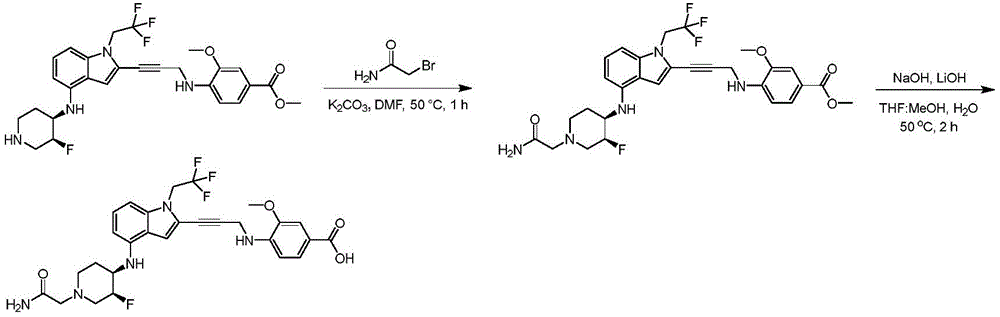
4- { [3- (4- { [ (3S,4R) -1- (carbamoylmethyl) -3-fluoropiperidin-4-yl]Amino } -1- (2,2, 2-trifluoroethyl) -1H-indol-2-yl) prop-2-yn-1-yl]Amino } -3-methoxybenzoic acid methyl ester and 4- { [3- (4- { [ (3R,4S) -1- (carbamoylmethyl) -3-fluoropiperidin-4-yl]Amino } -1- (2,2, 2-trifluoroethyl) -1H-indol-2-yl) prop-2-yn-1-yl]Synthesis of methyl amino } -3-methoxybenzoate: to a solution of methyl 4- ((3- (4- (((3S,4R) -3-fluoropiperidin-4-yl) amino) -1- (2,2, 2-trifluoroethyl) -1H-indol-2-yl) prop-2-yn-1-yl) amino) -3-methoxybenzoate (0.2g, 375.57. mu. mol,1 eq) in DMF (2mL) was added 2-bromoacetamide (155.44mg,1.13mmol,3 eq) and K 2 CO 3 (259.53mg,1.88mmol,5 equiv.). At N 2 The mixture was stirred at 50 ℃ for 1 hour under atmosphere, followed by TLC analysis (DCM: MeOH ═ 10:1, R) f 0.46) indicates complete consumption of starting material and formation of a new spot. The reaction mixture was quenched with water (20mL) and extracted with EtOAc (20mL x 3). The combined organic layers were washed with brine (10mL), dried over anhydrous sodium sulfate, filtered and concentrated under reduced pressure. The residue was passed through preparative TLC (SiO) 2 DCM MeOH ═ 20:1) to give 4- { [3- (4- { [ (3S,4R) -1- (carbamoylmethyl) -3-fluoropiperidin-4-yl]Amino } -1- (2,2, 2-trifluoroethyl) -1H-indol-2-yl) prop-2-yn-1-yl]Methyl amino } -3-methoxybenzoate (42% yield),as a yellow oil. MS (ES) + ,m/z):590.2。
The procedure was repeated using 4- ((3- (4- (((3R,4S) -3-fluoropiperidin-4-yl) amino) -1- (2,2, 2-trifluoroethyl) -1H-indol-2-yl) prop-2-yn-1-yl) amino) -3-methoxybenzoate instead of methyl 4- ((3- (4- (((3S,4R) -3-fluoropiperidin-4-yl) amino) -1- (2,2, 2-trifluoroethyl) -1H-indol-2-yl) prop-2-yn-1-yl) amino) -3-methoxybenzoate to give 4- { [3- (4- { [ (3R,4S) -1- (carbamoylmethyl) -3-fluoropiperidin-4-yl]Amino } -1- (2,2, 2-trifluoroethyl) -1H-indol-2-yl) prop-2-yn-1-yl ]Amino } -3-methoxybenzoic acid methyl ester. MS (ES) + ,m/z):590.2。
4- { [3- (4- { [ (3S,4R) -1- (carbamoylmethyl) -3-fluoropiperidin-4-yl]Amino } -1- (2,2, 2-trifluoroethyl) -1H-indol-2-yl) prop-2-yn-1-yl]Amino } -3-methoxybenzoic acid and 4- { [3- (4- { [ (3R,4S) -1- (carbamoylmethyl) -3-fluoropiperidin-4-yl]Amino } -1- (2,2, 2-trifluoroethyl) -1H-indol-2-yl) prop-2-yn-1-yl]Synthesis of amino } -3-methoxybenzoic acid: 4- { [3- (4- { [ (3S,4R) -1- (carbamoylmethyl) -3-fluoropiperidin-4-yl]Amino } -1- (2,2, 2-trifluoroethyl) -1H-indol-2-yl) prop-2-yn-1-yl]A mixture of methyl amino } -3-methoxybenzoate (1 eq), NaOH (5 eq) and LiOH (5 eq) in THF (1mL), MeOH (1mL) and water (1mL) was degassed and treated with N 2 And (5) purging. At N 2 The mixture was stirred at 50 ℃ for 12 hours under an atmosphere and subsequent LC-MS analysis indicated that some starting material remained and the desired compound was present. The reaction mixture was quenched with water (5mL) and then extracted with EtOAc (5mL x 3). The combined organic layers were washed with brine (5mL x 3), dried over anhydrous sodium sulfate, filtered and concentrated under reduced pressure. The residue was purified by preparative HPLC. To give 4- { [3- (4- { [ (3S,4R) -1- (carbamoylmethyl) -3-fluoropiperidin-4-yl ]Amino } -1- (2,2, 2-trifluoroethyl) -1H-indol-2-yl) prop-2-yn-1-yl]Amino } -3-methoxybenzoic acid (12% yield) as a yellow solid. MS (ES) + ,m/z):576.2。
Use of 4- { [3- (4- { [ (3R,4S) -1- (carbamoylmethyl) -3-fluoropiperidin-4-yl]Amino } -1- (2,2, 2-trifluoroethyl) -1H-indol-2-yl) prop-2-yn-1-yl]Amino } -3-methoxybenzoic acid methyl ester instead of 4- { [3- (4- { [ (3S,4R) -1- (carbamoylmethyl) -3-fluoropiperazinePyridin-4-yl]Amino } -1- (2,2, 2-trifluoroethyl) -1H-indol-2-yl) prop-2-yn-1-yl]The procedure was repeated with methyl amino } -3-methoxybenzoate to give 4- { [3- (4- { [ (3R,4S) -1- (carbamoylmethyl) -3-fluoropiperidin-4-yl]Amino } -1- (2,2, 2-trifluoroethyl) -1H-indol-2-yl) prop-2-yn-1-yl]Amino } -3-methoxybenzoic acid. MS (ES) + ,m/z):576.2。
Example D139: preparation of compounds 913A, 914A, 920A, 927A and 934A.
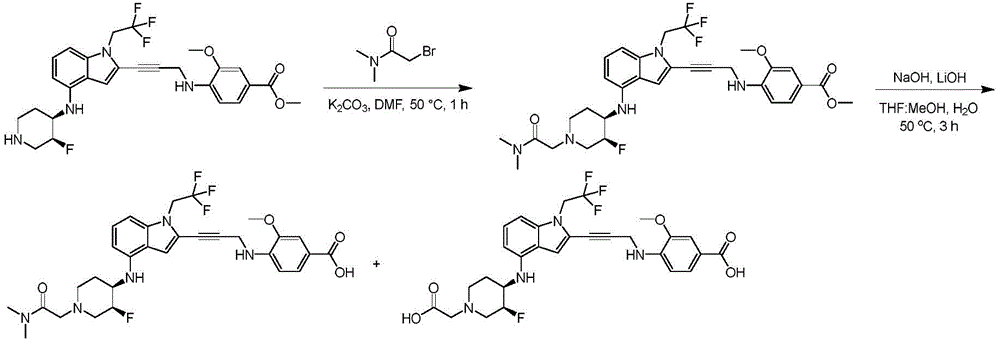
Compounds 913A, 914A, 920A and 927A were prepared by procedures analogous to the synthesis of the compound described in example D138, using 2-bromo-N, N-dimethyl-acetamide instead of 2-bromoacetamide. Compound 934A is obtained as a by-product of the final step. Compounds 913A and 914A were prepared by prep-TLC (SiO) 2 DCM: MeOH ═ 10:1) and preparative HPLC (column: c18100x30 mm 5 μm; mobile phase: [ Water (0.2% FA) -ACN ](ii) a 25% -55% of B%, and 10 minutes) purifying. Compounds 920A, 914A and 934A were prepared by preparative HPLC (column: C18100X 30mm 5 μm; mobile phase: [ water (0.2% FA) -ACN)](ii) a 15% -45% of B%, and 10 minutes) purifying.
4- { [3- (4- { [ (3S,4R) -1- [ (dimethylcarbamoyl) methyl]-3-fluoropiperidin-4-yl]Amino } -1- (2,2, 2-trifluoroethyl) -1H-indol-2-yl) prop-2-yn-1-yl]Amino } -3-methoxybenzoic acid methyl ester, MS (ES) + M/z) 618.3; 4- { [3- (4- { [ (3R,4S) -1- [ (dimethylcarbamoyl) methyl]-3-fluoropiperidin-4-yl]Amino } -1- (2,2, 2-trifluoroethyl) -1H-indol-2-yl) prop-2-yn-1-yl]Amino } -3-methoxybenzoic acid methyl ester, MS (ES) + M/z) 618.3; 4- { [3- (4- { [ (3S,4R) -1- [ (dimethylcarbamoyl) methyl]-3-fluoropiperidin-4-yl]Amino } -1- (2,2, 2-trifluoroethyl) -1H-indol-2-yl) prop-2-yn-1-yl]Amino } -3-methoxybenzoic acid), MS (ES) + M/z) 604.3; 4- { [3- (4- { [ (3R,4S) -1- [ (dimethylcarbamoyl) methyl]-3-fluoropiperidin-4-yl]Amino } -1- (2,2, 2-trifluoroethyl) -1H-indol-2-yl) prop-2-yn-1-yl]Amino } -3-methoxybenzoic acid, MS (ES) + M/z) 604.2; and 4- { [3- (4- { [ (3S,4R) -1- (carboxylmethyl)Yl) -3-fluoropiperidin-4-yl]Amino } -1- (2,2, 2-trifluoroethyl) -1H-indol-2-yl) prop-2-yn-1-yl ]Amino } -3-methoxybenzoic acid, MS (ES) + ,m/z):577.2。
Example D140: preparation of compound 487A.

Synthesis of 2-iodo-6-methoxy-N- (1-methylpiperidin-4-yl) -1- (2,2, 2-trifluoroethyl) -1H-indol-4-amine: a mixture of 1-methylpiperidin-4-one (30.57mg, 270.19. mu. mol, 31.42. mu.L, 2 equivalents), 2-iodo-6-methoxy-1- (2,2, 2-trifluoroethyl) indol-4-amine (0.05g, 135.10. mu. mol,1 equivalent) and TMSCl (36.69mg, 337.74. mu. mol, 42.86. mu.L, 2.5 equivalents) in DMF (2mL) was degassed and N was used 2 Purging, then adding BH 3 THF (1M, 337.74. mu.L, 2.5 equiv.). In N 2 The mixture was stirred at 0 ℃ for 1 hour under atmosphere, followed by TLC analysis (EtOAc: MeOH ═ 20:1, R) f 0.24) indicating completion of the reaction. The reaction mixture was quenched with water (100mL) at 0 ℃ and extracted with EtOAc (30mL x 3). The combined organic layers were washed with brine (30mL), dried over anhydrous sodium sulfate, filtered and concentrated under reduced pressure. The residue was passed through preparative TLC (SiO) 2 ,EtOAc:MeOH=20:1,R f = 0.24) to give 2-iodo-6-methoxy-N- (1-methylpiperidin-4-yl) -1- (2,2, 2-trifluoroethyl) -1H-indol-4-amine (0.04g,68.48 μmol, 50.69% yield) as a yellow solid.
2- {3- [ (4-Methylsulfonyl-2-methoxyphenyl) amino]Synthesis of prop-1-yn-1-yl } -6-methoxy-N- (1-methylpiperidin-4-yl) -1- (2,2, 2-trifluoroethyl) -1H-indol-4-amine: to a mixture of 2-methoxy-4- (methylsulfonyl) -N- (prop-2-yn-1-yl) aniline (23.41mg,89.03 μmol,1.3 equivalents) and 2-iodo-6-methoxy-N- (1-methylpiperidin-4-yl) -1- (2,2, 2-trifluoroethyl) -1H-indol-4-amine (0.04g,68.48 μmol,1 equivalent) in DMSO (2mL) was added CuI (13.04mg,68.48 μmol,1 equivalent), followed by Pd (PPh) 3 ) 4 (7.91mg, 6.85. mu. mol,0.10 equiv.) and diisopropylamine (6.93mg, 68.48. mu. mol, 9.68. mu.L, 1 equiv.). In N 2 The mixture was stirred at 30 ℃ for 1 hour, followed byLC-MS analysis indicated the reaction was complete. The reaction mixture was quenched with saturated aqueous EDTA (30mL) and stirred with EtOAc (10mL) for 1h at 25 ℃. The resulting mixture was extracted with EtOAc (20mL x 3). The combined organic layers were washed with brine (30mL), dried over anhydrous sodium sulfate, filtered and concentrated under reduced pressure. The residue was passed through preparative TLC (SiO) 2 ,PE:EtOAc=0:1,R f 2- {3- [ (4-methanesulfonyl-2-methoxyphenyl) amino ] amino was obtained by purification with preparative HPLC]Prop-1-yn-1-yl } -6-methoxy-N- (1-methylpiperidin-4-yl) -1- (2,2, 2-trifluoroethyl) -1H-indol-4-amine (0.0072g,11.12 μmol, 16.24% yield) as a yellow solid. MS (ES) + ,m/z):579.2。
Example D141: preparation of compound 643A.
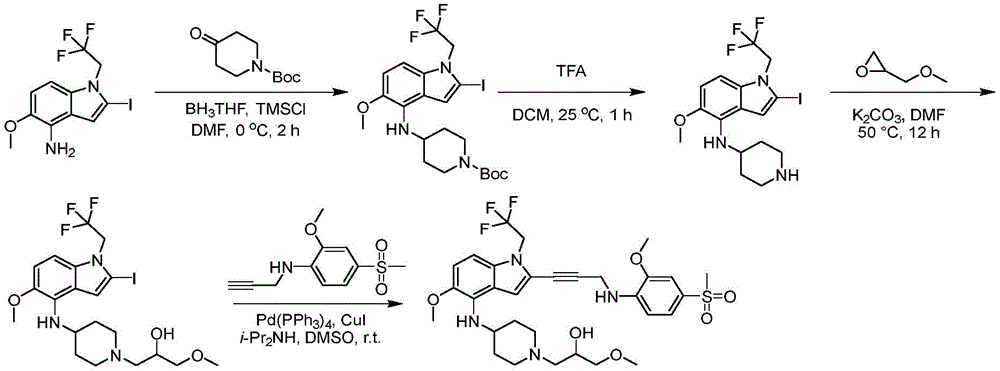
Synthesis of tert-butyl 4- ((2-iodo-5-methoxy-1- (2,2, 2-trifluoroethyl) -1H-indol-4-yl) amino) piperidine-1-carboxylate: to a mixture of tert-butyl 4-oxopiperidine-1-carboxylate (116.28mg, 583.61. mu. mol, 26.80. mu.L, 3 equivalents) and 2-iodo-5-methoxy-1- (2,2, 2-trifluoroethyl) -1H-indol-4-amine (0.08g, 194.54. mu. mol,1 equivalent) in DMF (2mL) was added TMSCl (52.84mg, 486.34. mu. mol, 61.72. mu.L, 2.5 equivalents). The mixture was then cooled to 0 ℃ and kept under N 2 Adding BH in 3 THF (1M, 486.34. mu.L, 2.5 equiv.). The mixture was stirred at 0 ℃ for 1 hour, and subsequent LC-MS analysis indicated that the reaction was complete. The reaction mixture was quenched with water (100mL) at 0 ℃ and then extracted with EtOAc (30mL x 3). The combined organic layers were washed with brine (30mL) and Na 2 SO 4 Dried, filtered and concentrated under reduced pressure. The residue was passed through preparative TLC (SiO) 2 ,PE:EtOAc=1:1,R f ═ 0.43) to give tert-butyl 4- ((2-iodo-5-methoxy-1- (2,2, 2-trifluoroethyl) -1H-indol-4-yl) amino) piperidine-1-carboxylate (0.08g,115.66 μmol, 59.45% yield) as a yellow oil. MS (ES) + ,m/z):554.0。
Synthesis of 2-iodo-5-methoxy-N- (piperidin-4-yl) -1- (2,2, 2-trifluoroethyl) -1H-indol-4-amine:to a mixture of tert-butyl 4- ((2-iodo-5-methoxy-1- (2,2, 2-trifluoroethyl) -1H-indol-4-yl) amino) piperidine-1-carboxylate (0.07g,101.20 μmol,1 eq) in DCM (0.5mL) was added TFA (5.39g,47.27mmol,3.50mL,467.10 eq). The mixture was stirred at 25 ℃ for 1 hour and subsequent LC-MS analysis indicated that the reaction was complete. The reaction mixture was washed with saturated NaHCO at 0 deg.C 3 The solution was quenched (100mL), diluted with EtOAc (20mL), and extracted with EtOAc (30mL x 3). The combined organic layers were washed with brine (20mL) and Na 2 SO 4 Drying, filtration and concentration under reduced pressure gave 2-iodo-5-methoxy-N- (piperidin-4-yl) -1- (2,2, 2-trifluoroethyl) -1H-indol-4-amine (0.050g,88.25 μmol, 87.21% yield) as a yellow solid, which was used directly in the next step. MS (ES) + ,m/z):453.8。
Synthesis of 1- (4- ((2-iodo-5-methoxy-1- (2,2, 2-trifluoroethyl) -1H-indol-4-yl) amino) piperidin-1-yl) -3-methoxypropan-2-ol: 2-iodo-5-methoxy-N- (piperidin-4-yl) -1- (2,2, 2-trifluoroethyl) -1H-indol-4-amine (0.04g, 70.60. mu. mol,1 eq), glycidyl methyl ether (31.10mg, 353.01. mu. mol, 31.42. mu.L, 5 eq) and K 2 CO 3 A mixture of (29.27mg, 211.81. mu. mol,3 equivalents) in DMF (1mL) was stirred at 50 ℃ for 10 hours, and subsequent LC-MS analysis indicated the presence of the product of the desired mass. The reaction mixture was quenched with water (100mL) at 0 ℃ and extracted with EtOAc (30mL x 3). The combined organic layers were washed with brine (30mL) and Na 2 SO 4 Dried, filtered and concentrated under reduced pressure. The residue was passed through preparative TLC (SiO) 2 ,PE:EtOAc=1:1,R f = 0.43) to give 1- (4- ((2-iodo-5-methoxy-1- (2,2, 2-trifluoroethyl) -1H-indol-4-yl) amino) piperidin-1-yl) -3-methoxypropan-2-ol (0.04g,59.11 μmol, 83.72% yield) as a yellow solid. MS (ES) + ,m/z):542.0。
Synthesis of final product: to a mixture of 2-methoxy-4- (methylsulfonyl) -N- (prop-2-yn-1-yl) aniline (17.87mg, 70.93. mu. mol,1.2 equivalents) and 1- (4- ((2-iodo-5-methoxy-1- (2,2, 2-trifluoroethyl) -1H-indol-4-yl) amino) piperidin-1-yl) -3-methoxypropan-2-ol (0.04g, 59.11. mu. mol,1 equivalent) in DMSO (2mL) was added CuI (11.26mg, 59.11. mu. mol,1 equivalent),then Pd (PPh) is added 3 ) 4 (6.83mg, 5.91. mu. mol,0.10 equiv.) and diisopropylamine (5.98mg, 59.11. mu. mol, 8.35. mu.L, 1 equiv.). In N 2 The mixture was then stirred at 30 ℃ for 1 hour and subsequent LC-MS analysis indicated that the reaction was complete. The reaction mixture was quenched with saturated aqueous EDTA and EtOAc (ca 10mL), stirred at 25 ℃ for 1h, and extracted with EtOAc (20mL x 3). The combined organic layers were washed with brine (30mL), dried over anhydrous sodium sulfate, filtered and concentrated under reduced pressure. The residue was passed through preparative TLC (SiO) 2 ,DCM:MeOH=10:1,R f = 0.24) to give 1- {4- [ (2- {3- [ (4-methanesulfonyl-2-methoxyphenyl) amino group]Prop-1-yn-1-yl } -5-methoxy-1- (2,2, 2-trifluoroethyl) -1H-indol-4-yl) amino]Piperidin-1-yl } -3-methoxypropan-2-ol (0.0157g, 23.57. mu. mol, 39.88% yield) was a light yellow solid. MS (ES) + ,m/z):653.4。
Example D142: preparation of compounds 976A, 977A, 978A and 979A.
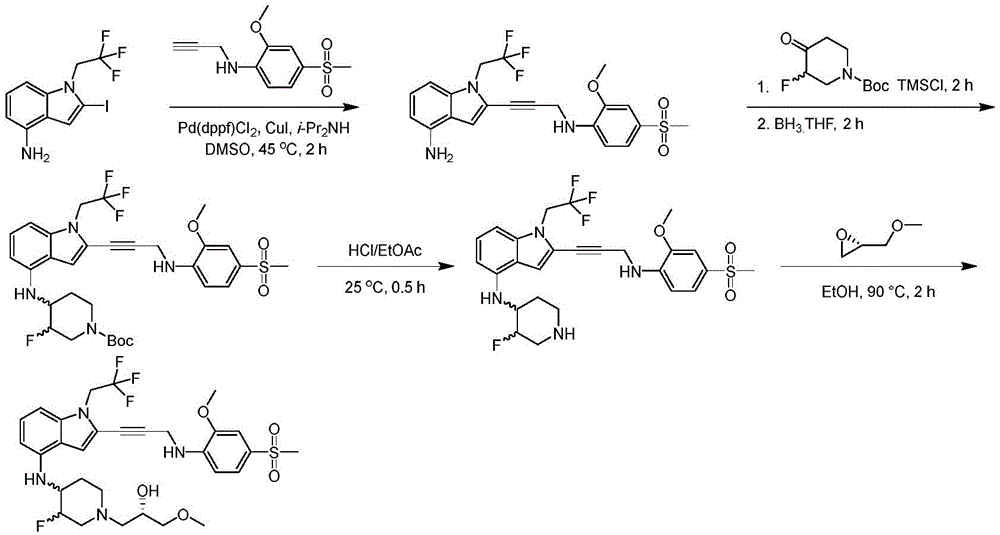
Synthesis of 2- (3- ((2-methoxy-4- (methylsulfonyl) phenyl) amino) prop-1-yn-1-yl) -1- (2,2, 2-trifluoroethyl) -1H-indol-4-amine: in N 2 To a mixture of 2-iodo-1- (2,2, 2-trifluoroethyl) -1H-indol-4-amine (1g,2.94mmol,1 eq) and 2-methoxy-4-methylsulfonyl-N-prop-2-ynyl-aniline (1.41g,5.88mmol,2 eq) in DMSO (15mL) was added diisopropylamine (2.98g,29.40mmol,4.16mL,10 eq) and Pd (dppf) Cl 2 (215.16mg, 294.05. mu. mol,0.1 eq.) followed by the addition of CuI (560.01mg,2.94mmol,1 eq.). The reaction mixture was stirred at 45 ℃ for 2 hours, then LC-MS and TLC (PE: EtOAc ═ 1:1) indicated completion of the reaction. The reaction mixture was quenched by addition of saturated aqueous EDTA (100mL) at 25 ℃ and then extracted with EtOAc (50 mL. times.3). The combined organic layers were dried over anhydrous sodium sulfate, filtered and concentrated in vacuo. The resulting residue was purified by column chromatography (PE: EtOAc ═ 2:1 to 1:1) to give 2- (3- ((2-methoxy-4- (methylsulfonyl) phenyl) amino) prop-1-yn-1-yl) -1- (2,2, 2-trifluoroethyl) -1H-indol-4-amine (0.8)g,1.68mmol, 57.25% yield) as a light yellow solid.
(rac) -tert-butyl (3R,4S) -3-fluoro-4- ((2- (3- ((2-methoxy-4- (methylsulfonyl) phenyl) amino) prop-1-yn-1-yl) -1- (2,2, 2-trifluoroethyl) -1H-indol-4-yl) amino) piperidine-1-carboxylate and (rac) -tert-butyl (3S,4S) -3-fluoro-4- ((2- (3- ((2-methoxy-4- (methylsulfonyl) phenyl) amino) prop-1-yn-1-yl) -1- (2,2, 2-trifluoroethyl) -1H-indol-4-yl) amino) piperidine-1-carboxylate The synthesis of (2): to 3-fluoro-4-oxopiperidine-1-carboxylic acid tert-butyl ester (360.89mg,1.66mmol,2.5 equiv.) and 2- [3- (2-methoxy-4-methylsulfonyl-anilino) prop-1-ynyl ]A solution of-1- (2,2, 2-trifluoroethyl) indol-4-amine (300mg, 664.51. mu. mol,1 eq) in DMF (6mL) was added TMSCl (180.48mg,1.66mmol, 210.84. mu.L, 2.5 eq) and the resulting mixture was stirred at 0 ℃ for 2 h. Then in N 2 Under addition of BH 3 THF (1M,3.32mL,5 equiv.) and the mixture was further stirred at 20 ℃ for 2 hours, final LC-MS analysis indicated completion of the reaction. By adding saturated Na 2 CO 3 The reaction mixture was quenched with aqueous solution (30mL), diluted with water (10mL), and extracted with EtOAc (20mL × 2). The combined organic layers were washed with brine (10mL), dried over anhydrous sodium sulfate, filtered and concentrated in vacuo. The crude residue was purified by preparative HPLC to give (rac) -tert-butyl (3R,4S) -3-fluoro-4- ((2- (3- ((2-methoxy-4- (methylsulfonyl) phenyl) amino) prop-1-yn-1-yl) -1- (2,2, 2-trifluoroethyl) -1H-indol-4-yl) amino) piperidine-1-carboxylate (80mg, 37% yield) and (rac) -tert-butyl (3S,4S) -3-fluoro-4- ((2- (3- ((2-methoxy-4- (methylsulfonyl) phenyl) amino) prop-1-yn-1-yl) -1- (2,2, 2-trifluoroethyl) -1H-indol-4-yl) amino) piperidine-1-carboxylate (80mg, 37% yield) as a yellow solid.
General procedure for the synthesis of (rac) -N- ((3S,4S) -3-fluoropiperidin-4-yl) -2- (3- ((2-methoxy-4- (methylsulfonyl) phenyl) amino) prop-1-yn-1-yl) -1- (2,2, 2-trifluoroethyl) -1H-indol-4-amine and (rac) -N- ((3S,4R) -3-fluoropiperidin-4-yl) -2- (3- ((2-methoxy-4- (methylsulfonyl) phenyl) amino) prop-1-yn-1-yl) -1- (2,2, 2-trifluoroethyl) -1H-indol-4-amine: (rac) -tert-butyl (3R,4S) -3-fluoro-4- ((2- (3- ((2-methoxy-4- (methylsulfonyl) phenyl) amino) prop-1-yn-1- A solution of yl) -1- (2,2, 2-trifluoroethyl) -1H-indol-4-yl) amino) piperidine-1-carboxylate (80mg, 122.57. mu. mol,1 eq) or (rac) -tert-butyl (3S,4S) -3-fluoro-4- ((2- (3- ((2-methoxy-4- (methylsulfonyl) phenyl) amino) prop-1-yn-1-yl) -1- (2,2, 2-trifluoroethyl) -1H-indol-4-yl) amino) piperidine-1-carboxylate (80mg, 122.57. mu. mol,1 eq) in HCl/EtOAc (4M,8mL,261.08 eq) was stirred at 25 ℃ for 10 min, subsequent LC-MS analysis indicated the reaction was complete. The solution was concentrated in vacuo. By adding saturated Na 2 CO 3 The crude residue was neutralized with aqueous solution (100mL) and the resulting mixture was extracted with EtOAc (200 mL). The combined organic layers were washed with brine (100mL x 3), dried over anhydrous sodium sulfate, and filtered to give crude (rac) -N- ((3S,4S) -3-fluoropiperidin-4-yl) -2- (3- ((2-methoxy-4- (methylsulfonyl) phenyl) amino) prop-1-yn-1-yl) -1- (2,2, 2-trifluoroethyl) -1H-indol-4-amine or (rac) -N- ((3S,4R) -3-fluoropiperidin-4-yl) -2- (3- ((2-methoxy-4- (methylsulfonyl) phenyl) amino) prop-1-yn-1-yl) -1- (2,2, 2-trifluoroethyl) -1H-indol-4-amine as a light yellow solid.
Synthesis of final product: to (rac) -N- ((3S,4S) -3-fluoropiperidin-4-yl) -2- (3- ((2-methoxy-4- (methylsulfonyl) phenyl) amino) prop-1-yn-1-yl) -1- (2,2, 2-trifluoroethyl) -1H-indol-4-amine or (rac) -N- ((3S,4R) -3-fluoropiperidin-4-yl) -2- (3- ((2-methoxy-4- (methylsulfonyl) phenyl) amino) prop-1-yn-1-yl) -1- (2,2, 2-trifluoroethyl) -1H-indol-4-amine (180.97. mu. mol,1 eq) in EtOH (3mL) was added (S) -glycidyl methyl ether (95.67mg,1.09mmol, 96.63. mu.L, 6 eq). In N 2 The mixture was stirred at 90 ℃ for 2 hours under an atmosphere, and subsequent LC-MS analysis indicated that the reaction was complete. The reaction mixture was concentrated in vacuo and purified by preparative HPLC to give the epimeric product as a white solid (55mg,85.85 μmol, 47.44% yield) which was then resolved by chiral SFC to give the desired pure enantiomer.
(S) -1- ((3R,4R) -3-fluoro-4- ((2- (3- ((2-methoxy-4- (methylsulfonyl) phenyl) amino) prop-1-yn-1-yl) -1- (2,2, 2-trifluoroethyl) -1H-indol-4-yl) amino) piperidin-1-yl) -3-methoxypropan-2-ol, MS (ES) + M/z) 641.2; (S) -1- ((3S,4S) -3-fluoro-4- ((2- (3- ((2-methoxy)-4- (methylsulfonyl) phenyl) amino) prop-1-yn-1-yl) -1- (2,2, 2-trifluoroethyl) -1H-indol-4-yl) amino) piperidin-1-yl) -3-methoxypropan-2-ol, MS (ES) + M/z) 641.2; (S) -1- ((3R,4S) -3-fluoro-4- ((2- (3- ((2-methoxy-4- (methylsulfonyl) phenyl) amino) prop-1-yn-1-yl) -1- (2,2, 2-trifluoroethyl) -1H-indol-4-yl) amino) piperidin-1-yl) -3-methoxypropan-2-ol, MS (ES) + M/z) 641.3; and (S) -1- ((3S,4R) -3-fluoro-4- ((2- (3- ((2-methoxy-4- (methylsulfonyl) phenyl) amino) prop-1-yn-1-yl) -1- (2,2, 2-trifluoroethyl) -1H-indol-4-yl) amino) piperidin-1-yl) -3-methoxypropan-2-ol, MS (ES) + ,m/z):641.3。
Example D143: preparation of 980A and 981A.
Compounds 980A and 981A were prepared by a procedure analogous to the synthesis shown in example D142, using racemic glycidyl methyl ether instead of (S) -glycidyl methyl ether.
(rac) -1- ((3S,4S) -3-fluoro-4- ((2- (3- ((2-methoxy-4- (methylsulfonyl) phenyl) amino) prop-1-yn-1-yl) -1- (2,2, 2-trifluoroethyl) -1H-indol-4-yl) amino) piperidin-1-yl) -3-methoxypropan-2-ol, MS (ES) + M/z) 641.3; and (rac) -1- ((3R,4S) -3-fluoro-4- ((2- (3- ((2-methoxy-4- (methylsulfonyl) phenyl) amino) prop-1-yn-1-yl) -1- (2,2, 2-trifluoroethyl) -1H-indol-4-yl) amino) piperidin-1-yl) -3-methoxypropan-2-ol, MS (ES) + ,m/z):641.3。
Example D144: general procedure for the preparation of compounds 982A, 983A, 984A and 985A.
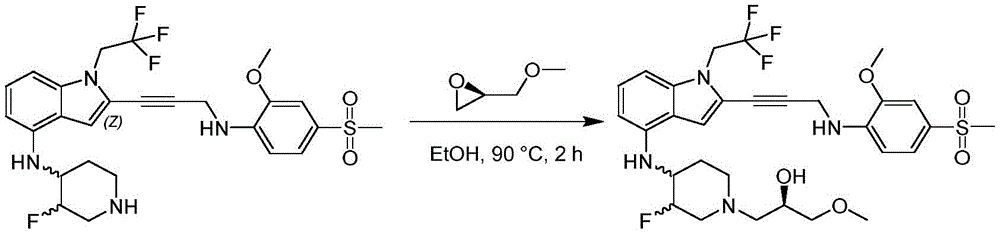
Compounds 982A, 983A, 984A and 985A were prepared by a procedure analogous to the synthesis shown in example D142, using (R) -glycidyl methyl ether instead of (S) -glycidyl methyl ether.
The epimer mixture was resolved by chiral SFC to give the desired pure enantiomer. (R) -1- ((3S,4S) -3-fluoro-4- ((2- (3- ((2-methoxy-4- (methylsulfonyl) phenyl) amino) prop-1-yn-1-yl) -1- (2,2, 2-trifluoro-l Ethyl) -1H-indol-4-yl) amino) piperidin-1-yl) -3-methoxypropan-2-ol, MS (ES) + M/z) 641.2; (R) -1- ((3R,4R) -3-fluoro-4- ((2- (3- ((2-methoxy-4- (methylsulfonyl) phenyl) amino) prop-1-yn-1-yl) -1- (2,2, 2-trifluoroethyl) -1H-indol-4-yl) amino) piperidin-1-yl) -3-methoxypropan-2-ol, MS (ES) + M/z) 641.2; (R) -1- ((3R,4S) -3-fluoro-4- ((2- (3- ((2-methoxy-4- (methylsulfonyl) phenyl) amino) prop-1-yn-1-yl) -1- (2,2, 2-trifluoroethyl) -1H-indol-4-yl) amino) piperidin-1-yl) -3-methoxypropan-2-ol, MS (ES) + M/z) 641.3; and (R) -1- ((3S,4R) -3-fluoro-4- ((2- (3- ((2-methoxy-4- (methylsulfonyl) phenyl) amino) prop-1-yn-1-yl) -1- (2,2, 2-trifluoroethyl) -1H-indol-4-yl) amino) piperidin-1-yl) -3-methoxypropan-2-ol, MS (ES) + ,m/z):641.3。
Example D145: preparation of compound 987A.

Synthesis of tert-butyl (3- (4-amino-1- (2,2, 2-trifluoroethyl) -1H-indol-2-yl) prop-2-yn-1-yl) (2-methoxy-4- (methylsulfonyl) phenyl) carbamate: at N 2 To a mixture of 2-iodo-1- (2,2, 2-trifluoroethyl) -1H-indol-4-amine hydrochloride (5g,13.28mmol,1 eq) and N- (2-methoxy-4-methylsulfonyl-phenyl) -N-prop-2-ynyl-carbamic acid tert-butyl ester (8.11g,23.90mmol,1.8 eq) in DMSO (50mL) under an atmosphere was added diisopropylamine (13.44g,132.79mmol,18.77mL,10 eq) and Pd (dppf) Cl 2 (485.81mg, 663.93. mu. mol,0.05 eq.) followed by the addition of CuI (1.26g,6.64mmol,0.5 eq.). The mixture was stirred at 45 ℃ for 2 h, followed by LC-MS and TLC analysis (PE: EtOAc ═ 1:1) indicating completion of the reaction. The reaction mixture was quenched by addition of saturated aqueous EDTA (150mL) at 25 ℃ and extracted with EtOAc (150mL x 3). The combined organic layers were dried over anhydrous sodium sulfate, filtered and concentrated in vacuo. The residue was purified by column chromatography (SiO) 2 PE: EtOAc ═ 3:1 to 1:1) purification to give (3- (4-amino-1- (2,2, 2-trifluoroethyl) -1H-indol-2-yl) prop-2-yn-1-yl) (2-methoxy-4- (methylsulfonyl) phenyl) carbamic acid tert-butyl esterEster (4.5g,8.16mmol, 61.44% yield) as a red gum.
Synthesis of tert-butyl 4- ((2- (3- ((tert-butoxycarbonyl) (2-methoxy-4- (methylsulfonyl) phenyl) amino) prop-1-yn-1-yl) -1- (2,2, 2-trifluoroethyl) -1H-indol-4-yl) amino) -3, 3-difluoropiperidine-1-carboxylate: to a solution of intermediate 3, 3-difluoro-4, 4-dihydroxypiperidine-1-carboxylic acid tert-butyl ester (2.48g,9.80mmol,4 equivalents) and (3- (4-amino-1- (2,2, 2-trifluoroethyl) -1H-indol-2-yl) prop-2-yn-1-yl) (2-methoxy-4- (methylsulfonyl) phenyl) carbamic acid tert-butyl ester (1.5g,2.45mmol,1 equivalent) in DMF (15mL) was added TMSCl (798.50mg,7.35mmol, 932.83. mu.L, 3 equivalents). The mixture was stirred at 0 ℃ for 2 hours and then under N 2 Adding BH under atmosphere 3 THF (1M,12.25mL,5 equiv.). The mixture was stirred at 25 ℃ for a further 3 hours, and subsequent TLC analysis indicated a ratio of starting primary amine to product of about 2: 1. By adding saturated Na 2 CO 3 The reaction mixture was quenched with aqueous solution (300mL), diluted with water (10mL) and extracted with EtOAc (150mL x 2). The combined organic layers were then washed with brine (10mL), dried over anhydrous sodium sulfate, filtered and concentrated under reduced pressure. The residue was purified by column chromatography (PE: EtOAc ═ 3:1 to 2:1) to give tert-butyl 4- ((2- (3- ((tert-butoxycarbonyl) (2-methoxy-4- (methylsulfonyl) phenyl) amino) prop-1-yn-1-yl) -1- (2,2, 2-trifluoroethyl) -1H-indol-4-yl) amino) -3, 3-difluoropiperidine-1-carboxylate (1.5g,1.65mmol, 67.51% yield) as a yellow solid.
Synthesis of N- (3, 3-difluoropiperidin-4-yl) -2- (3- ((2-methoxy-4- (methylsulfonyl) phenyl) amino) prop-1-yn-1-yl) -1- (2,2, 2-trifluoroethyl) -1H-indol-4-amine: a solution of tert-butyl 4- ((2- (3- ((tert-butoxycarbonyl) (2-methoxy-4- (methylsulfonyl) phenyl) amino) prop-1-yn-1-yl) -1- (2,2, 2-trifluoroethyl) -1H-indol-4-yl) amino) -3, 3-difluoropiperidine-1-carboxylate (250mg, 275.69. mu. mol,1 eq) in HCl/EtOAc (4M,5mL,72.55 eq) was stirred at 25 ℃ for 30 minutes, followed by LC-MS analysis to indicate completion of the reaction. The solution was dried in vacuo to give a crude residue which was purified by addition of saturated Na 2 CO 3 Aqueous solution (100mL) was neutralized. The mixture was extracted with EtOAc (200mL), washed with brine (100 mL. times.3) and driedDried over sodium sulfate, filtered and concentrated to give crude N- (3, 3-difluoropiperidin-4-yl) -2- (3- ((2-methoxy-4- (methylsulfonyl) phenyl) amino) prop-1-yn-1-yl) -1- (2,2, 2-trifluoroethyl) -1H-indol-4-amine (130mg) as a yellow solid.
Synthesis of final product: to a solution of N- (3, 3-difluoropiperidin-4-yl) -2- (3- ((2-methoxy-4- (methylsulfonyl) phenyl) amino) prop-1-yn-1-yl) -1- (2,2, 2-trifluoroethyl) -1H-indol-4-amine (100mg,175.26 μmol,1 eq) in EtOH (3mL) was added glycidyl methyl ether (92.65mg,1.05mmol,93.58 μ L,6 eq). At N 2 The mixture was stirred at 90 ℃ for 2 hours under an atmosphere, and subsequent LC-MS analysis indicated that the reaction was complete. The reaction mixture was concentrated in vacuo and purified by preparative HPLC to give 1- (3, 3-difluoro-4- ((2- (3- ((2-methoxy-4- (methylsulfonyl) phenyl) amino) prop-1-yn-1-yl) -1- (2,2, 2-trifluoroethyl) -1H-indol-4-yl) amino) piperidin-1-yl) -3-methoxypropan-2-ol (21.7mg,32.85 μmol, 18.74% yield) as a yellow solid. MS (ES) + ,m/z):659.2。
Example D146: general procedure for the preparation of compounds 769A, 770A, 771A, 772A, 773A and 774A.

To (rac) -N- ((3S,4S) -3-fluoropiperidin-4-yl) -2- (3- ((2-methoxy-4- (methylsulfonyl) phenyl) amino) prop-1-yn-1-yl) -1- (2,2, 2-trifluoroethyl) -1H-indol-4-amine or (rac) -N- ((3S,4R) -3-fluoropiperidin-4-yl) -2- (3- ((2-methoxy-4- (methylsulfonyl) phenyl) amino) prop-1-yn-1-yl) -1- (2,2, 2-trifluoroethyl) -1H-indol-4-amine (200mg,289.55 μmol,1 eq.) and (CH) 2 O) n (43.47mg,1.45mmol, 39.88. mu.L, 5 equiv.) in MeOH (3mL) was added acetic acid (17.39ug, 0.29. mu. mol,0.001 equiv.) and NaBH 3 CN (90.98mg,1.45mmol,5 equiv.). The mixture was stirred at 50 ℃ for 4 h and then analyzed by TLC (DCM: MeOH: 10:1, R) f 0.43) indicating completion of the reaction. By adding saturated NaHCO 3 The reaction was quenched with aqueous solution (60mL) and then extracted with EtOAc (20 mL. times.3). Subjecting the combined organic layers to anhydrous sulfuric acidSodium dried, filtered and concentrated under reduced pressure to give a residue. The residue was purified by preparative HPLC to give the desired racemic compound as a light yellow solid. The enantiomers were separated by chiral SFC to give the desired product.
(rac) -N- ((3R,4R) -3-fluoro-1-methylpiperidin-4-yl) -2- (3- ((2-methoxy-4- (methylsulfonyl) phenyl) amino) prop-1-yn-1-yl) -1- (2,2, 2-trifluoroethyl) -1H-indol-4-amine, MS (ES) + M/z) 567.2; (rac) -N- ((3R,4S) -3-fluoro-1-methylpiperidin-4-yl) -2- (3- ((2-methoxy-4- (methylsulfonyl) phenyl) amino) prop-1-yn-1-yl) -1- (2,2, 2-trifluoroethyl) -1H-indol-4-amine, MS (ES) + M/z) 567.2; n- ((3R,4R) -3-fluoro-1-methylpiperidin-4-yl) -2- (3- ((2-methoxy-4- (methylsulfonyl) phenyl) amino) prop-1-yn-1-yl) -1- (2,2, 2-trifluoroethyl) -1H-indol-4-amine, MS (ES) + M/z) 567.2; n- ((3R,4S) -3-fluoro-1-methylpiperidin-4-yl) -2- (3- ((2-methoxy-4- (methylsulfonyl) phenyl) amino) prop-1-yn-1-yl) -1- (2,2, 2-trifluoroethyl) -1H-indol-4-amine, MS (ES) + M/z) 567.2; n- ((3S,4S) -3-fluoro-1-methylpiperidin-4-yl) -2- (3- ((2-methoxy-4- (methylsulfonyl) phenyl) amino) prop-1-yn-1-yl) -1- (2,2, 2-trifluoroethyl) -1H-indol-4-amine), MS (ES) + M/z) 567.2; and N- ((3S,4R) -3-fluoro-1-methylpiperidin-4-yl) -2- (3- ((2-methoxy-4- (methylsulfonyl) phenyl) amino) prop-1-yn-1-yl) -1- (2,2, 2-trifluoroethyl) -1H-indol-4-amine), MS (ES) + ,m/z):567.2。
Example D147: general procedure for the preparation of compounds 775A, 776A, 790A and 791A.
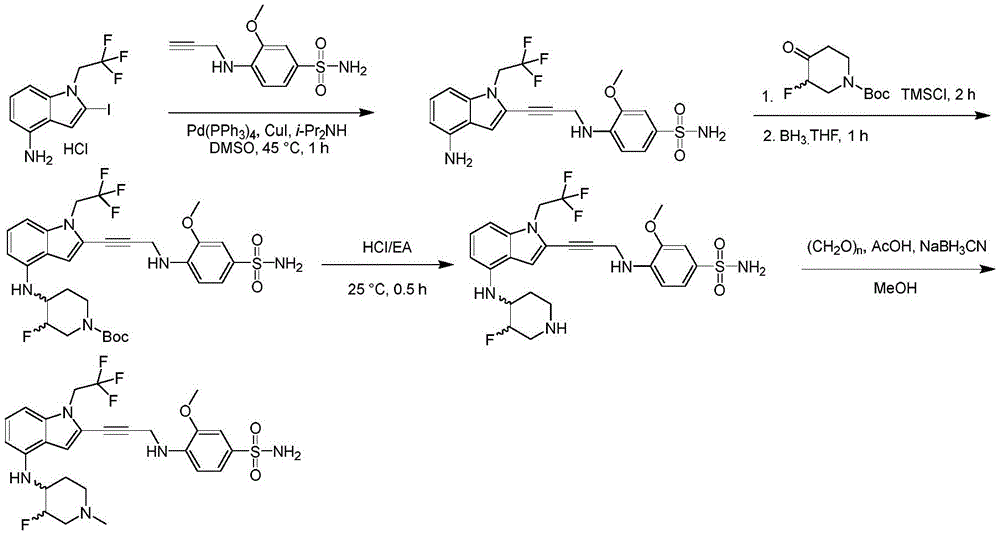
3-methoxy-4- (prop-2-yn-1-ylamino) benzenesulfonamide instead of 2-methoxy-4- (methylsulfonyl) -N- (prop-2-yn-1-yl) aniline and example D146 was synthesized by reaction with (rac) -N- ((3S,4S) -3-fluoropiperidin-4-yl) -2- (3- ((2-methoxy-4- (methylsulfonyl) phenyl) amino) prop-1-yn-1-yl) -1- (2,2, 2-trifluoroethyl) -1H-indol-4-amine and (rac) -N- ((3S, synthesis of 4R) -3-fluoropiperidin-4-yl) -2- (3- ((2-methoxy-4- (methylsulfonyl) phenyl) amino) prop-1-yn-1-yl) -1- (2,2, 2-trifluoroethyl) -1H-indol-4-amine Compounds 775A, 776A, 790A and 791A are prepared in analogy to procedures.
(rac) -4- ((3- (4- (((3R,4R) -3-fluoro-1-methylpiperidin-4-yl) amino) -1- (2,2, 2-trifluoroethyl) -1H-indol-2-yl) prop-2-yn-1-yl) amino) -3-methoxybenzenesulfonamide, MS (ES) + M/z) 568.1; (rac) -4- ((3- (4- (((3R,4S) -3-fluoro-1-methylpiperidin-4-yl) amino) -1- (2,2, 2-trifluoroethyl) -1H-indol-2-yl) prop-2-yn-1-yl) amino) -3-methoxybenzenesulfonamide, MS (ES) + M/z) 568.2; 4- ((3- (4- (((3R,4S) -3-fluoro-1-methylpiperidin-4-yl) amino) -1- (2,2, 2-trifluoroethyl) -1H-indol-2-yl) prop-2-yn-1-yl) amino) -3-methoxybenzenesulfonamide, MS (ES) + M/z) 568.3; and 4- ((3- (4- (((3S,4R) -3-fluoro-1-methylpiperidin-4-yl) amino) -1- (2,2, 2-trifluoroethyl) -1H-indol-2-yl) prop-2-yn-1-yl) amino) -3-methoxybenzenesulfonamide, MS (ES) + ,m/z):568.3。
Example D148: general procedure for the preparation of compound 986A.

4- ((3- (4- (((3R,4S) -3-fluoro-1- ((R) -2-hydroxy-3-methoxypropyl) piperidin-4-yl) amino) -1- (2,2, 2-trifluoroethyl) -1H-indol-2-yl) prop-2-yn-1-yl) amino) -3-methoxy-4- (prop-2-yn-1-yl) benzenesulfonamide instead of (S) -glycidyl methyl ether and 3-methoxy-4- (prop-2-yn-1-ylamino) benzenesulfonamide instead of 2-methoxy-4- (methylsulfonyl) -N- (prop-2-yn-1-yl) aniline was prepared by a procedure similar to example D142 A benzenesulfonamide. 4- ((3- (4- (((3R,4S) -3-fluoro-1- ((R) -2-hydroxy-3-methoxypropyl) piperidin-4-yl) amino) -1- (2,2, 2-trifluoroethyl) -1H-indol-2-yl) prop-2-yn-1-yl) amino) -3-methoxybenzenesulfonamide was purified by preparative HPLC and was obtained as a white solid.
4- ((3- (4- (((3RS,4SR) -3-fluoro-1- ((R) -2-hydroxy-3-methoxypropyl) piperidin-4-yl) amino) -1- (2,2, 2-trifluoroethyl) -1H-indol-2-yl) prop-2-yn-1-yl) amino) -3-methoxybenzeneSulfonamides, MS (ES) + ,m/z):642.3。
Example D149: preparation of compounds 549A and 550A.

Synthesis of 3- (4- ((2-iodo-1- (2,2, 2-trifluoroethyl) -1H-indol-4-yl) amino) piperidin-1-yl) propane-1, 2-diol: to a solution of 2-iodo-N- (piperidin-4-yl) -1- (2,2, 2-trifluoroethyl) -1H-indol-4-amine (0.3g, 708.86. mu. mol,1 eq) in DMF (3mL) was added R-glycidol (262.56mg,3.54mmol, 234.43. mu.L, 5 eq) and K 2 CO 3 (293.92mg,2.13mmol,3 equiv.). The reaction mixture was stirred at 50 ℃ for 10 h, quenched with water (10mL), and extracted with EtOAc (10 mL. times.3). The combined organic layers were washed with brine (5mL), dried over anhydrous sodium sulfate and concentrated to give crude 3- (4- ((2-iodo-1- (2,2, 2-trifluoroethyl) -1H-indol-4-yl) amino) piperidin-1-yl) propane-1, 2-diol (0.3g) as a yellow oil. The crude product was used in the next step without further purification.
Synthesis of final product: to a solution of 3-methoxy-4- (prop-2-yn-1-ylamino) benzenesulfonamide (116mg,1.3 equivalents) in DMSO (10mL) was added CuI (71mg,1 equivalent) and diisopropylamine (217mg,10 equivalents). With N 2 The reaction was degassed and 3- (4- ((2-iodo-1- (2,2, 2-trifluoroethyl) -1H-indol-4-yl) amino) piperidin-1-yl) propane-1, 2-diol (183mg,1 eq) and Pd (PPh) 3 ) 4 (85mg,0.2 eq.) with N 2 The reaction mixture was degassed again. The reaction mixture was stirred at 25 ℃ for 2 hours, and subsequent LC-MS analysis indicated that the reaction was complete. Then, EtOAc (20mL) was added to the reaction mixture and the mixture was poured into saturated aqueous EDTA (50mL) and stirred at 25 ℃ for 2 h. The aqueous phase was extracted with EtOAc (30mL x 3) and the combined organic layers were washed with brine (40mL x 1), dried over anhydrous sodium sulfate, treated with charcoal, filtered and concentrated in vacuo to give the crude product. The residue was purified by preparative TLC or silica gel chromatography (DCM: MeOH ═ 10:1, R) f (0.4) and then further purified by preparative HPLC to give (rac) -4- ({3- [4- ({1- [2, 3-bis)Hydroxy propyl group]Piperidin-4-yl } amino) -1- (2,2, 2-trifluoroethyl) -1H-indol-2-yl]Prop-2-yn-1-yl } amino) -3-methoxybenzene-1-sulphonamide as a yellow solid. MS (ES) + M/z) 610.2. The same procedure was used starting from S-glycidol to give the other enantiomers.
Example D150: general procedure for the preparation of compounds 580A and 581A.

Synthesis of 1- (4- ((2-iodo-1- (2,2, 2-trifluoroethyl) -1H-indol-4-yl) amino) piperidin-1-yl) -3-methoxypropan-2-ol: in N 2 Next, K was added once to a mixture of 2-iodo-N- (piperidin-4-yl) -1- (2,2, 2-trifluoroethyl) -1H-indol-4-amine (1.5g,3.40mmol,1 eq) and glycidyl methyl ether (1.58g,17.01mmol,1.59mL,5 eq, 95% pure) in DMF (30mL) at 25 deg.C 2 CO 3 (1.41g,10.21mmol,3 equiv.). The mixture was then stirred at 50 ℃ for 12 h, followed by TLC analysis (EtOAc: MeOH ═ 5:1, R) f 0.40) indicating completion of the reaction. The mixture was cooled to 25 ℃, poured into water (150mL) and stirred for 1 minute. The aqueous phase was extracted with EtOAc (50mL x 3) and the combined organic layers were washed with brine (50mL), dried over anhydrous sodium sulfate, filtered and concentrated in vacuo. The residue was chromatographed on silica gel (SiO) 2 EtOAc/MeOH ═ 1/0,5/1) to give 1- (4- ((2-iodo-1- (2,2, 2-trifluoroethyl) -1H-indol-4-yl) amino) piperidin-1-yl) -3-methoxypropan-2-ol (1.6g,2.82mmol, 82.77% yield) as a red oil.
Synthesis of N- (1- (2, 3-dimethoxypropyl) piperidin-4-yl) -2-iodo-1- (2,2, 2-trifluoroethyl) -1H-indol-4-amine: in N 2 Next, NaH (56.32mg,1.41mmol, 60% in mineral oil, 4 equiv.) is added in one portion to a mixture of 1- (4- ((2-iodo-1- (2,2, 2-trifluoroethyl) -1H-indol-4-yl) amino) piperidin-1-yl) -3-methoxypropan-2-ol (200mg, 352.03. mu. mol,1 equiv.) in THF (3mL) at 0 ℃. The mixture was stirred at 0 ℃ for 30 minutes and then under N 2 Next, dimethyl sulfate (44.40mg, 352.03. mu. mol, 33.39. mu.L, 1 eq.) was added in one portion at 0 ℃. Will be provided withThe reaction mixture was warmed to 25 ℃ and stirred for 1 hour, followed by TLC analysis (EtOAc: MeOH ═ 5:1, R) f 0.72) and LC-MS analysis indicated that the reaction was complete. The mixture was poured into saturated NH 4 Aqueous Cl (20mL), stirred for 2 min, and the aqueous phase extracted with EtOAc (10 mL. times.3). The combined organic layers were washed with brine (10mL), dried over anhydrous sodium sulfate, filtered and concentrated in vacuo. The residue was purified by preparative TLC (EtOAc: MeOH ═ 5:1, R) f 0.72) to give N- (1- (2, 3-dimethoxypropyl) piperidin-4-yl) -2-iodo-1- (2,2, 2-trifluoroethyl) -1H-indol-4-amine (135mg,154.18 μmol, 43.80% yield) as a yellow solid.
Synthesis of final product: compounds 580A and 581A were prepared by a procedure analogous to example C69, using N- (1- (2, 3-dimethoxypropyl) piperidin-4-yl) -2-iodo-1- (2,2, 2-trifluoroethyl) -1H-indol-4-amine instead of 3- (4- ((2-iodo-1- (2,2, 2-trifluoroethyl) -1H-indol-4-yl) amino) piperidin-1-yl) propane-1, 2-diol.
N- [1- (2, 3-Dimethoxypropyl) piperidin-4-yl]-2- {3- [ (4-methanesulfonyl-2-methoxyphenyl) amino]Prop-1-yn-1-yl } -1- (2,2, 2-trifluoroethyl) -1H-indol-4-amine, MS (ES) + M/z) 637.3; and 4- { [3- (4- { [1- (2, 3-dimethoxypropyl) piperidin-4-yl]Amino } -1- (2,2, 2-trifluoroethyl) -1H-indol-2-yl) prop-2-yn-1-yl]Amino } -3-methoxybenzene-1-sulphonamide, MS (ES) + ,m/z):638.2。
Example D151: general procedure for preparation of compounds 569A and 574A.
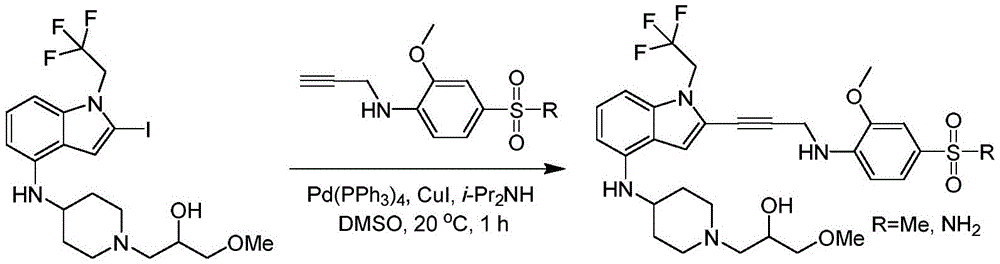
Compounds 569A and 574A were prepared by a procedure similar to example C69 using 1- (4- ((2-iodo-1- (2,2, 2-trifluoroethyl) -1H-indol-4-yl) amino) piperidin-1-yl) -3-methoxypropan-2-ol instead of 3- (4- ((2-iodo-1- (2,2, 2-trifluoroethyl) -1H-indol-4-yl) amino) piperidin-1-yl) propane-1, 2-diol.
1- {4- [ (2- {3- [ (4-methanesulfonyl-2-methoxyphenyl) amino group]Prop-1-yn-1-yl } -1- (2,2, 2-trifluoroethyl) -1H-indol-4-yl) amino]Piperidin-1-yl } -3-methoxy-acidPropan-2-ol, MS (ES) + M/z) 623.3; and 4- { [3- (4- { [1- (2-hydroxy-3-methoxypropyl) piperidin-4-yl]Amino } -1- (2,2, 2-trifluoroethyl) -1H-indol-2-yl) prop-2-yn-1-yl]Amino } -3-methoxybenzene-1-sulphonamide, MS (ES) + ,m/z):624.2。
Example D152: general procedure for the preparation of compounds 573 and 579A.

Synthesis of 3- (4- ((2-iodo-1- (2,2, 2-trifluoroethyl) -1H-indol-4-yl) amino) piperidin-1-yl) propane-1, 2-diyl diacetate: to a solution of 3- (4- ((2-iodo-1- (2,2, 2-trifluoroethyl) -1H-indol-4-yl) amino) piperidin-1-yl) propane-1, 2-diol (100mg,1 eq) in DCM (2mL) was added acetic anhydride (37mg,2 eq) and the mixture was stirred at 25 ℃ for 4 hours, followed by TLC and LC-MS analysis indicating complete consumption of the starting diol. By using N 2 The stream was bubbled to remove the solvent. The resulting residue was purified by preparative TLC (DCM: MeOH ═ 5:1, R) f ═ 0.80) to give 3- (4- ((2-iodo-1- (2,2, 2-trifluoroethyl) -1H-indol-4-yl) amino) piperidin-1-yl) propane-1, 2-diyl diacetate as a pale brown oil.
Synthesis of final product: compounds 573 and 579A were prepared by a procedure analogous to example C69 using 3- (4- ((2-iodo-1- (2,2, 2-trifluoroethyl) -1H-indol-4-yl) amino) piperidin-1-yl) propane-1, 2-diyl diacetate instead of 3- (4- ((2-iodo-1- (2,2, 2-trifluoroethyl) -1H-indol-4-yl) amino) piperidin-1-yl) propane-1, 2-diol.
1- (acetyloxy) -3- {4- [ (2- {3- [ (4-methanesulfonyl-2-methoxyphenyl) amino]Prop-1-yn-1-yl } -1- (2,2, 2-trifluoroethyl) -1H-indol-4-yl) amino]Piperidin-1-yl } prop-2-ylacetate, MS (ES) + M/z) 693.2; and 1- (acetyloxy) -3- {4- [ (2- {3- [ (2-methoxy-4-sulfamoylphenyl) amino group]Prop-1-yn-1-yl } -1- (2,2, 2-trifluoroethyl) -1H-indol-4-yl) amino]Piperidin-1-yl } prop-2-ylacetate, MS (ES) + ,m/z):694.2。
Example D153: general procedure for the preparation of compounds 566A and 568A.

Synthesis of 3- (4- ((2-iodo-1- (2,2, 2-trifluoroethyl) -1H-indol-4-yl) amino) piperidin-1-yl) propane-1, 2-diyl diacetate: to a solution of 2-iodo-N- (piperidin-4-yl) -1- (2,2, 2-trifluoroethyl) -1H-indol-4-amine (300mg,1 eq) and (R) -2, 2-dimethyl-1, 3-dioxolane-4-carbaldehyde (354mg,4 eq) in 1, 2-dichloroethane (20mL) was added NaBH (OAc) 3 (577mg,4 equiv.). The mixture was stirred at 22 ℃ for 1 hour, and subsequent LC-MS and TLC analysis indicated that the reaction was complete. The reaction mixture was washed with water (300mL) and the organic phase was dried over anhydrous sodium sulfate, filtered and concentrated in vacuo. The residue was purified by preparative TLC (PE: EtOAc ═ 5:1, Rf ═ 0.5) to give (R) -N- (1- ((2, 2-dimethyl-1, 3-dioxolan-4-yl) methyl) piperidin-4-yl) -2-iodo-1- (2,2, 2-trifluoroethyl) -1H-indol-4-amine as a yellow oil. (187mg, 40.9% yield)
Synthesis of final product: compounds 566A and 568A were prepared by a procedure analogous to example C69 using (R) -N- (1- ((2, 2-dimethyl-1, 3-dioxolan-4-yl) methyl) piperidin-4-yl) -2-iodo-1- (2,2, 2-trifluoroethyl) -1H-indol-4-amine instead of 3- (4- ((2-iodo-1- (2,2, 2-trifluoroethyl) -1H-indol-4-yl) amino) piperidin-1-yl) propane-1, 2-diol.
N- (1- { [ (4R) -2, 2-dimethyl-1, 3-dioxolan-4-yl]Methyl } piperidin-4-yl) -2- {3- [ (4-methanesulfonyl-2-methoxyphenyl) amino]Prop-1-yn-1-yl } -1- (2,2, 2-trifluoroethyl) -1H-indol-4-amine, MS (ES) + M/z) 649.3; and 4- [ (3- {4- [ (1- { [ (4R) -2, 2-dimethyl-1, 3-dioxolan-4-yl)]Methyl-piperidin-4-yl) amino]-1- (2,2, 2-trifluoroethyl) -1H-indol-2-yl } prop-2-yn-1-yl) amino ]-3-methoxybenzene-1-sulphonamide, MS (ES) + ,m/z):650.3。
Example D154: preparation of compounds 782A and 783A.
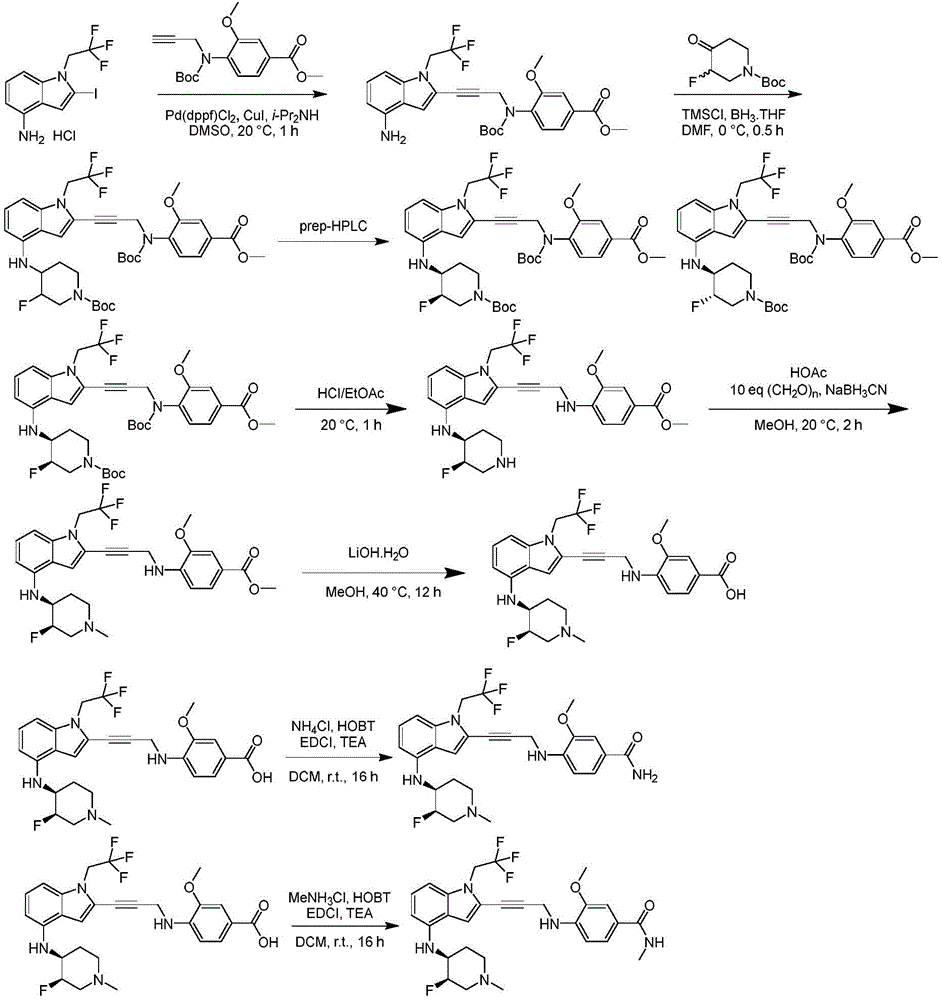
Synthesis of methyl 4- ((3- (4-amino-1- (2,2, 2-trifluoroethyl) -1H-indol-2-yl) prop-2-yn-1-yl) (tert-butoxycarbonyl) amino) -3-methoxybenzoate: in N 2 Next, to a solution of methyl 4- ((tert-butoxycarbonyl) (prop-2-yn-1-yl) amino) -3-methoxybenzoate (6.9g,21.39mmol,1.2 equiv.) in DMSO (50mL) was added CuI (1.02g,5.35mmol,0.3 equiv.), diisopropylamine (18.04g,178.25mmol,25.19mL,10 equiv.), Pd (PPh) 3 ) 4 (1.03g, 891.26. mu. mol,0.05 eq.) and 2-iodo-1- (2,2, 2-trifluoroethyl) -1H-indol-4-amine hydrochloride (6.06g,17.83mmol,1 eq.). The reaction mixture was stirred at 20 ℃ for 1 hour, followed by TLC analysis (PE: EtOAc ═ 2:1, R) f 0.24) indicating completion of the reaction. The reaction mixture was quenched with saturated aqueous EDTA (500mL) at 25 deg.C, stirred for 1h, and then extracted with EtOAc (200 mL. times.3). The combined organic layers were dried over anhydrous sodium sulfate, filtered and concentrated under reduced pressure. The residue was purified by column chromatography (SiO) 2 PE: EtOAc ═ 3:1 to 1:2, PE: EtOAc ═ 1:1, R f = 0.24) to give methyl 4- ((3- (4-amino-1- (2,2, 2-trifluoroethyl) -1H-indol-2-yl) prop-2-yn-1-yl) (tert-butoxycarbonyl) amino) -3-methoxybenzoate (10g,13.73mmol, 77.05% yield) as a brown oil.
(rac) -tert-butyl (3R,4S) -4- ((2- (3- ((tert-butoxycarbonyl) (2-methoxy-4- (methoxycarbonyl) phenyl) amino) prop-1-yn-1-yl) -1- (2,2, 2-trifluoroethyl) -1H-indol-4-yl) amino) -3-fluoropiperidine-1-carboxylate and (rac) -tert-butyl (3S,4S) -4- ((2- (3- ((tert-butoxycarbonyl) (2-methoxy-4- (methoxycarbonyl) phenyl) amino) prop-1-yn-1-yl) -1- (2,2, 2-trifluoroethyl) -1H-indol-4-yl) amino) -3 -synthesis of fluoropiperidine-1-carboxylate: to a solution of tert-butyl 3-fluoro-4-oxopiperidine-1-carboxylate (16g,73.65mmol,4 equiv.) and methyl 4- ((3- (4-amino-1- (2,2, 2-trifluoroethyl) -1H-indol-2-yl) prop-2-yn-1-yl) (tert-butoxycarbonyl) amino) -3-methoxybenzoate (9.79g,18.41mmol,1 equiv.) in DMF (20mL) was added TMSCl (6g,55.24mmol,7.01mL,3 equiv.). The mixture was stirred at 0 ℃ for 0.5 h, thereafter under N 2 Adding BH in 3 THF (1M,184.13mL,10 equiv.). The mixture was further stirred at 0 ℃ for 0.5 h, followed by LC-MS analysisIndicating complete consumption of the starting primary amine. With saturated Na 2 CO 3 The reaction mixture was adjusted to pH about 8 with aqueous solution, diluted with water (50mL), and extracted with EtOAc 600mL (150 mL. times.4). The combined organic layers were washed with brine (100mL), dried over anhydrous sodium sulfate, filtered and concentrated under reduced pressure. The residue was purified by preparative HPLC to give (rac) -tert-butyl (3S,4S) -4- ((2- (3- ((tert-butoxycarbonyl) (2-methoxy-4- (methoxycarbonyl) phenyl) amino) prop-1-yn-1-yl) -1- (2,2, 2-trifluoroethyl) -1H-indol-4-yl) amino) -3-fluoropiperidine-1-carboxylate (5.7g,7.78mmol, 42.25% yield) as a yellow solid. The trans diastereomer was also isolated in 35% yield (4.7 g).
Synthesis of methyl (rac) -4- ((3- (4- (((3R,4S) -3-fluoropiperidin-4-yl) amino) -1- (2,2, 2-trifluoroethyl) -1H-indol-2-yl) prop-2-yn-1-yl) amino) -3-methoxybenzoate: to a solution of (rac) -tert-butyl (3S,4S) -4- ((2- (3- ((tert-butoxycarbonyl) (2-methoxy-4- (methoxycarbonyl) phenyl) amino) prop-1-yn-1-yl) -1- (2,2, 2-trifluoroethyl) -1H-indol-4-yl) amino) -3-fluoropiperidine-1-carboxylate (5g,6.82mmol,1 eq) was added 4N HCl/EtOAc (34.12mmol,20mL,5 eq). The mixture was stirred at 20 ℃ for 1 hour, and subsequent TLC analysis (DCM: MeOH ═ 10:1) indicated complete consumption of the protected starting material and showed a new spot. With saturated Na 2 CO 3 The reaction mixture was adjusted to pH about 8 with aqueous solution, diluted with water (50mL) and extracted with EtOAc (50mL × 4). The combined organic layers were washed with NaCl (10mL), dried over anhydrous sodium sulfate, filtered and concentrated under reduced pressure to give crude methyl (rac) -4- ((3- (4- (((3R,4S) -3-fluoropiperidin-4-yl) amino) -1- (2,2, 2-trifluoroethyl) -1H-indol-2-yl) prop-2-yn-1-yl) amino) -3-methoxybenzoate (4.1g, crude) as a yellow solid.
Synthesis of methyl (rac) -4- ((3- (4- (((3R,4S) -3-fluoro-1-methylpiperidin-4-yl) amino) -1- (2,2, 2-trifluoroethyl) -1H-indol-2-yl) prop-2-yn-1-yl) amino) -3-methoxybenzoate: (rac) -methyl 4- ((3- (4- (((3R,4S) -3-fluoropiperidin-4-yl) amino) -1- (2,2, 2-trifluoroethyl) -1H-indol-2-yl) prop-2-yn-1-yl) amino) -3-methoxybenzoate (0.6g,1.13mmol,1 eq), paraformaldehyde (338.30mg,11.27mmol, 310.37. mu.L, 10 eq) NaBH 3 A mixture of CN (212.41mg,3.38mmol,3 equiv.) and AcOH (67.66mg,1.13mmol, 64.44. mu.L, 1 equiv.) in MeOH (20mL) was degassed and N was used 2 And (5) purging. At N 2 The mixture was stirred at 20 ℃ for 2 hours under atmosphere followed by TLC analysis (EtOAc: TEA ═ 10:1, R) f 0.65) indicates that a new spot is displayed. With saturated NaHCO 3 The reaction mixture was quenched with aqueous solution (30mL) and then extracted with EtOAc (40mL x 3). The combined organic layers were washed with brine (25mL x 3), dried over anhydrous sodium sulfate, filtered and concentrated under reduced pressure. The residue was passed through preparative TLC (SiO) 2 EtOAc: TEA ═ 20:1) to give methyl (rac) -4- ((3- (4- (((3R,4S) -3-fluoro-1-methylpiperidin-4-yl) amino) -1- (2,2, 2-trifluoroethyl) -1H-indol-2-yl) prop-2-yn-1-yl) amino) -3-methoxybenzoate (0.4g,658.67 μmol, 58.46% yield) as a yellow solid.
Synthesis of (rac) -4- ((3- (4- (((3R,4S) -3-fluoro-1-methylpiperidin-4-yl) amino) -1- (2,2, 2-trifluoroethyl) -1H-indol-2-yl) prop-2-yn-1-yl) amino) -3-methoxybenzoic acid: methyl (rac) -4- ((3- (4- (((3R,4S) -3-fluoro-1-methylpiperidin-4-yl) amino) -1- (2,2, 2-trifluoroethyl) -1H-indol-2-yl) prop-2-yn-1-yl) amino) -3-methoxybenzoate (0.4g, 731.86. mu. mol,1 eq) was placed in LiOH. H 2 A mixture of O (10mL,10M) and MeOH (10mL) was degassed and N was used 2 And (5) purging. At N 2 The mixture was stirred at 40 ℃ for 12 hours under atmosphere, followed by TLC analysis (EtOAc: TEA ═ 10:1, R) f 0) indicates that a new spot is displayed. The reaction mixture was extracted with EtOAc (40mL x 3). The combined organic layers were washed with brine (30mL x 3), dried over anhydrous sodium sulfate, filtered and concentrated under reduced pressure. The residue was passed through preparative TLC (SiO) 2 EtOAc: TEA ═ 10:1) to give (rac) -4- ((3- (4- (((3R,4S) -3-fluoro-1-methylpiperidin-4-yl) amino) -1- (2,2, 2-trifluoroethyl) -1H-indol-2-yl) prop-2-yn-1-yl) amino) -3-methoxybenzoic acid (0.2g,338.01 μmol, 46.19% yield) as a yellow solid.
(rac) -4- { [3- (4- { [ (3R,4S) -3-fluoro-1-methylpiperidin-4-yl]Amino } -1- (2,2, 2-trifluoroethyl) -1H-indol-2-yl) prop-2-yn-1-yl]Synthesis of amino } -3-methoxybenzamide: reacting (rac) -4- ((3- (4- (((3R, 4S))3-fluoro-1-methylpiperidin-4-yl) amino) -1- (2,2, 2-trifluoroethyl) -1H-indol-2-yl) prop-2-yn-1-yl) amino) -3-methoxybenzoic acid (0.12g, 225.34. mu. mol,1 eq), NH 4 A mixture of Cl (24.11mg, 450.68. mu. mol,2 equivalents), HOBt (45.67mg, 338.01. mu. mol,1.5 equivalents), EDCI (64.80mg, 338.01. mu. mol,1.5 equivalents) and TEA (91.21mg, 901.36. mu. mol, 125.46. mu.L, 4 equivalents) in DCM (5mL) was degassed and N was used to degas 2 And (5) purging. At N 2 The mixture was stirred at 20 ℃ for 16 h under atmosphere followed by TLC analysis (EtOAc: TEA ═ 10:1, R) f 0.1) indicates that a new major new spot is displayed. The reaction mixture was diluted with EtOAc (15mL) and extracted with EtOAc (20 mL. times.3). The combined organic layers were washed with brine (20mL x 3), dried over anhydrous sodium sulfate, filtered and concentrated under reduced pressure. The residue was purified by preparative HPLC to give (rac) -4- { [3- (4- { [ (3R,4S) -3-fluoro-1-methylpiperidin-4-yl]Amino } -1- (2,2, 2-trifluoroethyl) -1H-indol-2-yl) prop-2-yn-1-yl]Amino } -3-methoxybenzamide as a yellow solid (24.5mg, 20.5% yield). MS (ES) + ,m/z):532.2。
rac-4- { [3- (4- { [ (3R,4S) -3-fluoro-1-methylpiperidin-4-yl]Amino } -1- (2,2, 2-trifluoroethyl) -1H-indol-2-yl) prop-2-yn-1-yl]Synthesis of amino } -3-methoxy-N-methylbenzamide: a mixture of (rac) -4- ((3- (4- (((3R,4S) -3-fluoro-1-methylpiperidin-4-yl) amino) -1- (2,2, 2-trifluoroethyl) -1H-indol-2-yl) prop-2-yn-1-yl) amino) -3-methoxybenzoic acid (0.12g, 225.34. mu. mol,1 eq), methylamine hydrochloride (30.43mg, 450.68. mu. mol,2 eq), HOBt (45.67mg, 338.01. mu. mol,1.5 eq), EDCI (64.80mg, 338.01. mu. mol,1.5 eq) and TEA (91.21mg, 901.36. mu. mol, 125.46. mu.L, 4 eq) in DCM (5mL) was degassed and N was used to degas with 2 And (5) purging. At N 2 The mixture was stirred at 20 ℃ for 16 h under atmosphere followed by TLC analysis (EtOAc: TEA ═ 10:1, R) f 0.2) indicates that a new main spot is formed. The reaction mixture was diluted with EtOAc (15mL) and extracted with EtOAc (20 mL. times.3). The combined organic layers were washed with brine (20mL x 3), dried over anhydrous sodium sulfate, filtered and concentrated under reduced pressure. The residue was passed through preparative TLC (SiO) 2 EtOAc: TEA ═ 10:1) and further purified by preparative HPLC to give (rac) -4- { [3- (4- { [ (3R, 4)S) -3-fluoro-1-methylpiperidin-4-yl]Amino } -1- (2,2, 2-trifluoroethyl) -1H-indol-2-yl) prop-2-yn-1-yl]Amino } -3-methoxy-N-methylbenzamide as a yellow solid (22.1mg, 18.0% yield) MS (ES) + ,m/z):546.3。
Example D155: preparation of compounds 788A and 789A.

(rac) -methyl 4- ((3- (4- (((3S,4S) -3-fluoropiperidin-4-yl) amino) -1- (2,2, 2-trifluoroethyl) -1H-indol-2-yl) prop-2-yn-1-yl) amino) -3-methoxybenzoate was used instead of methyl (rac) -4- ((3- (4- (((3R,4S) -3-fluoropiperidin-4-yl) amino) -1- (2,2, 2-trifluoroethyl) -1H-indol-2-yl) prop-2-yn-1-yl) amino) -3-methoxybenzoate, preparation of 4- { [3- (4- { [ (3R,4R) -3-fluoro-1-methylpiperidin-4-yl ] amino } -1- (2,2, 2-trifluoroethyl) -1H-indol-2-yl) prop-2-yn-1-yl) amino } -3-methoxybenzoic acid by a procedure analogous to the synthesis of (rac) -4- ((3- (4- (((3R,4S) -3-fluoro-1-methylpiperidin-4-yl) amino) -1- (2,2, 2-trifluoroethyl) -1H-indol-2-yl) prop-2-yn-1-yl) amino } -3-methoxybenzoic acid according to step 3-5 of example D154 And (3) benzoic acid. The racemate product is resolved into its constituent enantiomers by chiral SFC.
To give 4- { [3- (4- { [ (3R,4R) -3-fluoro-1-methylpiperidin-4-yl]Amino } -1- (2,2, 2-trifluoroethyl) -1H-indol-2-yl) prop-2-yn-1-yl]Amino } -3-methoxybenzoic acid (32mg, 60.09. mu. mol, 41.05% yield) as a white solid (MS (ES) + M/z) 533.1). To give 4- { [3- (4- { [ (3S,4S) -3-fluoro-1-methylpiperidin-4-yl]Amino } -1- (2,2, 2-trifluoroethyl) -1H-indol-2-yl) prop-2-yn-1-yl]Amino } -3-methoxybenzoic acid (26mg, 48.82. mu. mol, 33.36% yield) as a white solid (MS (ES) + ,m/z):533.1).
Example D156: synthesis of compounds 885A, 886A and 887A.

Compound 4- ((3- (4- (((3SR, 4))Synthesis of SR) -3-fluoro-1- ((R) -2-hydroxy-3-methoxypropyl) piperidin-4-yl) amino) -1- (2,2, 2-trifluoroethyl) -1H-indol-2-yl) prop-2-yn-1-yl) amino) -3-methoxybenzoic acid methyl ester: to a solution of methyl (rac) -4- ((3- (4- (((3S,4S) -3-fluoropiperidin-4-yl) amino) -1- (2,2, 2-trifluoroethyl) -1H-indol-2-yl) prop-2-yn-1-yl) amino) -3-methoxybenzoate (500mg, 938.92. mu. mol,1 eq) and (R) -glycidylmethyl ether (413.62mg,4.69mmol, 417.80. mu.L, 5 eq) in DMF (10mL) was added K 2 CO 3 (389.29mg,2.82mmol,3 equiv.). The mixture was stirred at 50 ℃ for 12 h, followed by TLC analysis (PE: EtOAc ═ 0:1) indicating completion of the reaction. The reaction mixture was quenched with water (60mL) and extracted with EtOAc (20mL x 3). The combined organic layers were washed with brine (30mL), dried over anhydrous sodium sulfate, filtered and concentrated under reduced pressure. The residue was passed through preparative TLC (SiO) 2 EtOAc ═ 0:1) to give methyl 4- ((3- (4- (((3SR,4SR) -3-fluoro-1- ((R) -2-hydroxy-3-methoxypropyl) piperidin-4-yl) amino) -1- (2,2, 2-trifluoroethyl) -1H-indol-2-yl) prop-2-yn-1-yl) amino) -3-methoxybenzoate (240mg,386.70 μmol, 41.19% yield) as a yellow solid.
Synthesis of final product: to a solution of methyl 4- ((3- (4- (((3SR,4SR) -3-fluoro-1- ((R) -2-hydroxy-3-methoxypropyl) piperidin-4-yl) amino) -1- (2,2, 2-trifluoroethyl) -1H-indol-2-yl) prop-2-yn-1-yl) amino) -3-methoxybenzoate (200mg,322.25 μmol,1 eq) in THF (2mL), water (1mL) and MeOH (1mL) was added LiOH-water (135.23mg,3.22mmol,10 eq). The mixture was stirred at 50 ℃ for 12 h, followed by TLC (DCM: MeOH ═ 10:1, R) f 0.19) indicating completion of the reaction. The reaction mixture was quenched with water (60mL) at 25 ℃ and then extracted with EtOAc (20 mL. times.3). The combined organic layers were washed with brine (30mL), dried over anhydrous sodium sulfate, filtered and concentrated under reduced pressure. The residue was passed through preparative TLC (SiO) 2 ,DCM:MeOH=10:1,R f 0.19) and further purified by preparative HPLC to give the diastereoisomeric mixture 4- ((3- (4- (((3SR,4SR) -3-fluoro-1- ((R) -2-hydroxy-3-methoxypropyl) piperidin-4-yl) amino) -1- (2,2, 2-trifluoroethyl) -1H-indol-2-yl) prop-2-yn-1-yl) amino) -3-methoxybenzoic acid (160mg,255.85 μmol) 79.39% yield) as a white solid. MS (ES) + ,m/z):607.3。
The diastereomers were then separated by preparative HPLC to give 4- ((3- (4- (((3S,4S) -3-fluoro-1- ((R) -2-hydroxy-3-methoxypropyl) piperidin-4-yl) amino) -1- (2,2, 2-trifluoroethyl) -1H-indol-2-yl) prop-2-yn-1-yl) amino) -3-methoxybenzoic acid and 4- ((3- (4- (((3R,4R) -3-fluoro-1- ((R) -2-hydroxy-3-methoxypropyl) piperidin-4-yl) amino) -1- (2,2, 2-trifluoroethyl) -1H-indol-2-yl) prop-2-yn-1-yl) amino) -3-methoxybenzoic acid.
Example D157: preparation of compounds 786A and 793A.

rac-4- { [3- (4- { [ (3R,4R) -3-fluoro-1-methylpiperidin-4-yl]Amino } -1- (2,2, 2-trifluoroethyl) -1H-indol-2-yl) prop-2-yn-1-yl]Preparation of amino } -3-methoxybenzamide: using 4- { [3- (4- { [ (3S,4S) -3-fluoro-1-methylpiperidin-4-yl]Amino } -1- (2,2, 2-trifluoroethyl) -1H-indol-2-yl) prop-2-yn-1-yl]Amino } -3-methoxybenzoic acid (0.08g, 150.23. mu. mol,1 eq) instead of (rac) -4- ((3- (4- (((3R,4S) -3-fluoro-1-methylpiperidin-4-yl) amino) -1- (2,2, 2-trifluoroethyl) -1H-indol-2-yl) prop-2-yn-1-yl) amino) -3-methoxybenzoic acid rac-4- { [3- (4- { [ (3R,4R) -3-fluoro-1-methylpiperidin-4-yl) was prepared by a procedure analogous to example D154 ]Amino } -1- (2,2, 2-trifluoroethyl) -1H-indol-2-yl) prop-2-yn-1-yl]Amino } -3-methoxybenzamide. The crude residue was purified by preparative HPLC (column: C18100X 305 μm; mobile phase: [ water (0.225% FA) -ACN](ii) a B%: 1% -30%, 15 min) purification to give (rac) -4- { [3- (4- { [ (3R,4R) -3-fluoro-1-methylpiperidin-4-yl]Amino } -1- (2,2, 2-trifluoroethyl) -1H-indol-2-yl) prop-2-yn-1-yl]Amino } -3-methoxybenzamide as a white solid (0.03g, 56.44. mu. mol, 37.57% yield). MS (ES) + ,m/z):532.2。
(rac) -4- { [3- (4- { [ (3R,4R) -3-fluoro-1-methylpiperidin-4-yl]Amino } -1- (2,2, 2-trifluoroethyl) -1H-indol-2-yl) prop-2-yn-1-yl]Synthesis of amino } -3-methoxy-N-methylbenzamide: use 4- { [3- (4- { [ (3S,4S) -3-fluoro-1-methylpiperidin-4-yl]Amino } -1- (2,2, 2-trifluoroethyl) -1H-indol-2-yl) prop-2-yn-1-yl]Amino } -3-Methoxybenzoic acid (80mg, 150.23. mu. mol,1 eq.) instead of (rac) -4- ((3- (4- (((3R,4S) -3-fluoro-1-methylpiperidin-4-yl) amino) -1- (2,2, 2-trifluoroethyl) -1H-indol-2-yl) prop-2-yn-1-yl) amino) -3-methoxybenzoic acid (rac) -4- { [3- (4- { [ (3R,4R) -3-fluoro-1-methylpiperidin-4-yl) was prepared by a procedure similar to example D154 ]Amino } -1- (2,2, 2-trifluoroethyl) -1H-indol-2-yl) prop-2-yn-1-yl]Amino } -3-methoxy-N-methylbenzamide. The crude residue was purified by preparative HPLC (column: C18100X 305 μm; mobile phase: [ water (0.225% FA) -ACN](ii) a B%: 1% -30%, 15 min) purification to give (rac) -4- { [3- (4- { [ (3R,4R) -3-fluoro-1-methylpiperidin-4-yl]Amino } -1- (2,2, 2-trifluoroethyl) -1H-indol-2-yl) prop-2-yn-1-yl]Amino } -3-methoxy-N-methylbenzamide as a white solid (0.03g, 54.99. mu. mol, 36.60% yield). MS (ES) + ,m/z):546.2。
Example D158: preparation of compound 1054A.

3- ((3-methoxy-4-nitrophenyl) sulfonyl) -6-oxa-3-azabicyclo [3.1.1]And (3) synthesis of heptane: to 6-oxa-3-azabicyclo [3.1.1]A solution of heptane (486.28mg,1.79mmol,1.1 equiv.) in DCM (10mL) was added TEA (329.73mg,3.26mmol, 453.56. mu.L, 2 equiv.) and 3-methoxy-4-nitrobenzenesulfonyl chloride (410mg,1.63mmol,1 equiv.). The resulting mixture was stirred at 25 ℃ for 2 h, followed by TLC (PE: EtOAc: 3:1, R) f 0.19) indicated complete consumption of the starting sulfonyl chloride and a new spot was observed. The reaction mixture was poured into water (50mL) and filtered through celite. The aqueous phase was extracted with EtOAc (10mL x 3) and the combined organic layers were dried over anhydrous sodium sulfate, filtered and concentrated in vacuo. The residue obtained is purified by column chromatography (SiO) 2 PE EtOAc ═ 4:1 to 1:1) purification to give 3- ((3-methoxy-4-nitrophenyl) sulfonyl) -6-oxa-3-azabicyclo [ 3.1.1)]Heptane (320mg,1.02mmol, 62.49% yield) as a light yellow solid.
4- ((6-oxa-3-azabicyclo [ 3.1.1)]Synthesis of hept-3-yl) sulfonyl) -2-methoxyaniline: to 3- ((3-methoxy-4-nitrophenyl) sulfonyl) -6-oxa-3-azabicyclo [3.1.1 ] at 25 deg.C]A solution of heptane (310mg, 986.28. mu. mol,1 eq.) in EtOH (10mL) and water (2mL) was added saturated NH 4 Aqueous Cl (263.79mg,4.93mmol, 172.41. mu.L, 5 equiv.). Then, Fe (275.39mg,4.93mmol,5 equiv.) was added and the mixture was stirred at 70 ℃ for 2 hours. TLC analysis (PE: EtOAc ═ 1:1, R) f 0.20) indicating complete consumption of the starting nitro compound and a new spot was detected. The mixture was concentrated, the resulting residue was extracted with EtOAc (60mL), and the EtOAc solution was concentrated to give 4- ((6-oxa-3-azabicyclo [ 3.1.1)]Hept-3-yl) sulfonyl) -2-methoxyaniline (260mg,914.43 μmol, 92.72% yield) as a dark brown solid.
(4- ((6-oxa-3-azabicyclo [ 3.1.1)]Synthesis of hept-3-yl) sulfonyl) -2-methoxyphenyl) carbamic acid tert-butyl ester: to 4- ((6-oxa-3-azabicyclo [ 3.1.1) ]Hept-3-yl) sulfonyl) -2-methoxyaniline (210mg,738.58 μmol,1 eq) in DCM (10mL) was added DMAP (90.23mg,738.58 μmol,1 eq) and Boc 2 O (322.38mg,1.48mmol, 339.35. mu.L, 2 equiv.). The mixture was stirred at 25 ℃ for 12 h, followed by TLC analysis (PE: EtOAc ═ 0.20, R f 0.20) indicated complete consumption of the starting primary amine and a major peak with the expected product mass was detected by LC-MS. The reaction mixture was then poured into water (40mL) and filtered through celite. The aqueous phase was extracted with EtOAc (6mL x 3) and the combined organic layers were dried over anhydrous sodium sulfate, filtered and concentrated in vacuo. The residue was purified by preparative TLC (PE: EtOAc ═ 5:1, R) f (0.20) to give (4- ((6-oxa-3-azabicyclo [ 3.1.1)]Hept-3-yl) sulfonyl) -2-methoxyphenyl) carbamic acid tert-butyl ester (130mg,338.15 μmol, 45.78% yield) as a yellow oil.
(4- ((6-oxa-3-azabicyclo [ 3.1.1)]Synthesis of hept-3-yl) sulfonyl) -2-methoxyphenyl) (prop-2-yn-1-yl) carbamic acid tert-butyl ester: to (4- ((6-oxa-3-azabicyclo [ 3.1.1)]Hept-3-yl) sulfonyl) -2-methoxyphenyl) carbamic acid tert-butyl ester (130mg,338.15 μmol,1 eq) in DMF (4mL) NaH (27.05mg, 676.30. mu. mol, 60% w/w,2 equivalents) was added. The mixture was stirred at 0 ℃ for 30 minutes, then propargyl bromide (48.27mg, 405.78. mu. mol, 34.98. mu.L, 1.2 equiv.) was added. The mixture was stirred at 25 ℃ for 1.5 h, followed by TLC analysis (PE: EtOAc: 5:1, R) f 0.26) indicated complete consumption of the starting secondary amine and a major peak with the expected product mass was detected by LC-MS. The reaction mixture was poured into water (30mL) and filtered through celite. The aqueous phase was extracted with EtOAc (6mL x 3). The combined organic layers were dried over anhydrous sodium sulfate, filtered and concentrated in vacuo. The residue was purified by preparative TLC (PE: EtOAc ═ 5:1, R) f (0.26) to give (4- ((6-oxa-3-azabicyclo [ 3.1.1)]Hept-3-yl) sulfonyl) -2-methoxyphenyl) (prop-2-yn-1-yl) carbamic acid tert-butyl ester (100mg,236.69 μmol, 70% yield) as a yellow oil.
4- ((6-oxa-3-azabicyclo [ 3.1.1)]Synthesis of hept-3-yl) sulfonyl) -2-methoxy-N- (prop-2-yn-1-yl) aniline: to (4- ((6-oxa-3-azabicyclo [ 3.1.1)]Hept-3-yl) sulfonyl) -2-methoxyphenyl) (prop-2-yn-1-yl) carbamic acid tert-butyl ester (100mg,236.69 μmol,1 eq) in DCM (6mL) was added TFA (2mL) and the mixture was stirred at 25 ℃ for 1 h. TLC analysis (PE: EtOAc ═ 1:1, R) f 0.22) indicated complete consumption of the starting Boc-amine. The residue was poured into saturated NaHCO 3 Aqueous solution (30mL) and filtered through celite. The aqueous phase was extracted with EtOAc (6mL x 3), and the combined organic layers were dried over anhydrous sodium sulfate, filtered, and concentrated in vacuo. Will contain crude 4- ((6-oxa-3-azabicyclo [ 3.1.1)]Hept-3-yl) sulfonyl) -2-methoxy-N- (prop-2-yn-1-yl) aniline (50mg) as a dark brown solid residue was used directly in the next step.
Synthesis of final product: to 4- ((6-oxa-3-azabicyclo [ 3.1.1)]Hept-3-yl) sulfonyl) -2-methoxy-N- (prop-2-yn-1-yl) aniline (31.52mg, 97.79. mu. mol,1 eq) in DMSO (4mL) was added diisopropylamine (98.95mg, 977.86. mu. mol, 138.20. mu.L, 10 eq) and CuI (18.62mg, 97.79. mu. mol,1 eq). Then using N 2 The mixture was degassed and 1- (4- ((2-iodo-1- (2,2, 2-trifluoroethyl) -1H-indol-4-yl) amino) piperidin-1-yl) -3-methoxypropan-2-ol (50mg, 97.79. mu. mol,1 eq.) and Pd (PPh) were added 3 ) 4 (22.60mg, 19.56. mu. mol,0.2 eq.). The mixture was stirred at 25 ℃ for 2 h, followed by TLC analysis (PE: EtOAc ═ 1:1, R) f 0.21) indicated about 10% iodoindole remained and a major peak with the expected product mass was detected by LC-MS. The reaction mixture was diluted with EtOAc (5mL), poured into saturated EDTA solution (30mL), and stirred for 1 hour. The mixture was then extracted with EtOAc (15mL x 2) and the combined organic layers were washed with brine (10mL) and concentrated under reduced pressure. The resulting residue was purified by preparative TLC (PE: EtOAc ═ 1:1, R) f Purification ═ 0.21) to give 1- (4- ((2- (3- ((4- ((6-oxa-3-azabicyclo [ 3.1.1) a]Hept-3-yl) sulfonyl) -2-methoxyphenyl) amino) prop-1-yn-1-yl) -1- (2,2, 2-trifluoroethyl) -1H-indol-4-yl) amino) piperidin-1-yl) -3-methoxypropan-2-ol (4.5mg,6.22 μmol, 6.36% yield) as a yellow solid. MS (ES) + ,m/z):706.3。
Example D159: synthesis of 4- { [3- (4- { [1- (2-hydroxy-3-methoxypropyl) piperidin-4-yl ] amino } -1- (2,2, 2-trifluoroethyl) -1H-indol-2-yl) prop-2-yn-1-yl ] amino } -3-methoxybenzene-1-sulfonamide (Compound 574A).

To a mixture of 3-hydroxy-4- (prop-2-ynylamino) benzenesulfonamide (41.48mg,146.68 μmol,1.5 equivalents) and 1- (4- ((2-iodo-1- (2,2, 2-trifluoroethyl) -1H-indol-4-yl) amino) piperidin-1-yl) -3-methoxypropan-2-ol (0.05g,97.79 μmol,1 equivalent) in DMSO (2mL) was added CuI (18.62mg,97.79 μmol,1 equivalent), Pd (PPh) 3 ) 4 (11.30mg, 9.78. mu. mol,0.10 equiv.) and N-isopropylpropan-2-amine (9.89mg, 97.79. mu. mol, 13.82. mu.L, 1 equiv.). In N 2 The mixture was then stirred at 30 ℃ for 1 hour. TLC analysis (PE: EtOAc ═ 0:1, R f 0.23) indicating completion of the reaction. The reaction mixture was quenched by the addition of saturated aqueous EDTA (30mL) and EtOAc (10mL) and the mixture was stirred at 25 ℃ for 1 hour. The aqueous phase was extracted with EtOAc (20 mL. times.3). The combined organic layers were washed with brine (30mL), dried over anhydrous sodium sulfate, filtered and concentrated under reduced pressure to give a residue . The residue was passed through preparative TLC (SiO) 2 ,PE:EtOAc=0:1,R f 0.24) to yield the desired product. MS (ES) + ,m/z):624.2。
Example D160: synthesis of N- (3- (4- ((1- (2-hydroxy-3-methoxypropyl) piperidin-4-yl) amino) -1- (2,2, 2-trifluoroethyl) -1H-indol-2-yl) prop-2-yn-1-yl) -N- (2-hydroxy-4- (N-propionylsulfamoyl) phenyl) propionamide (Compound 636A).

To a mixture of N- (2-hydroxy-4- (N-propionylsulfamoyl) phenyl) -N- (prop-2-yn-1-yl) propionamide (57.86mg,117.34 μmol,1.2 equivalents) and 1- (4- ((2-iodo-1- (2,2, 2-trifluoroethyl) -1H-indol-4-yl) amino) piperidin-1-yl) -3-methoxypropan-2-ol (0.05g,97.79 μmol,1 equivalent) in DMSO (2mL) was added CuI (18.62mg,97.79 μmol,1 equivalent), Pd (PPh) 3 ) 4 (11.30mg, 9.78. mu. mol,0.10 eq.) and N-isopropylpropan-2-amine (9.89mg, 97.79. mu. mol, 13.82. mu.L, 1 eq.). In N 2 The mixture was then stirred at 30 ℃ for 1 hour. LC-MS analysis indicated the reaction was complete. The reaction mixture was quenched by the addition of saturated aqueous EDTA (30mL) and EtOAc (10mL) and the mixture was stirred at 25 ℃ for 1 hour. The aqueous phase was extracted with EtOAc (20 mL. times.3). The combined organic layers were washed with brine (30mL), dried over anhydrous sodium sulfate, filtered and concentrated under reduced pressure to give a residue. The residue was passed through preparative TLC (SiO) 2 ,PE:EtOAc=0:1,R f 0.24) and preparative HPLC to give the desired product (12.6mg,15.71 μmol, 16.07% yield) as a yellow solid. MS (ES) + ,m/z):722.3。
Example D161: general procedure for the preparation of compounds 536A, 540A and 729A.

Synthesis of 2-iodo-N- (piperidin-4-yl) -1- (2,2, 2-trifluoroethyl) -1H-indol-4-amine: to 4- ((2-iodo-1- (2,2, 2-trifluoroethyl)A solution of-1H-indol-4-yl) amino) piperidine-1-carboxylic acid tert-butyl ester (6g,10.89mmol,1 eq) in DCM (50mL) was added TFA (50 mL). The mixture was stirred at 0 ℃ for 1 hour, followed by LC-MS and TLC analysis (PE: EtOAc ═ 5:1, R) f 0.1) indicating completion of the reaction. The reaction mixture was concentrated in vacuo, and the residue was poured into water (300mL) and taken up by addition of saturated Na 2 CO 3 Aqueous solution (100mL) was neutralized. The aqueous phase was extracted with EtOAc (200 mL. times.3). The combined organic layers were washed with brine (100mL), dried over anhydrous sodium sulfate, filtered and concentrated in vacuo. The residue was stirred in PE (20mL) for 1H at 25 ℃ and filtered to give 2-iodo-N- (piperidin-4-yl) -1- (2,2, 2-trifluoroethyl) -1H-indol-4-amine (15g,31.90mmol, 97.62% yield) as a light yellow solid.
Synthesis of N- (1-ethylpiperidin-4-yl) -2-iodo-1- (2,2, 2-trifluoroethyl) -1H-indol-4-amine and 2-iodo-N- (1-isopropylpiperidin-4-yl) -1- (2,2, 2-trifluoroethyl) -1H-indol-4-amine: to a mixture of 2-iodo-N- (piperidin-4-yl) -1- (2,2, 2-trifluoroethyl) -1H-indol-4-amine (100mg, 212.66. mu. mol,1 eq) in DMF (2mL) was added isopropyl or ethyl bromide (45 eq) and K 2 CO 3 (146.95mg,1.06mmol,5 equiv.). In N 2 The resulting mixture was then stirred at 50 ℃ for 2-5 hours. The mixture was poured into water (30mL) and then extracted with EtOAc (30mL x 3). The combined organic layers were washed with brine (30mL x3), dried over anhydrous sodium sulfate, filtered and concentrated under reduced pressure to give a residue which was purified by preparative TLC to give the desired compound N- (1-ethylpiperidin-4-yl) -2-iodo-1- (2,2, 2-trifluoroethyl) -1H-indol-4-amine or 2-iodo-N- (1-isopropylpiperidin-4-yl) -1- (2,2, 2-trifluoroethyl) -1H-indol-4-amine as a yellow solid.
Synthesis of 1- (4- ((2-iodo-1- (2,2, 2-trifluoroethyl) -1H-indol-4-yl) amino) piperidin-1-yl) ethan-1-one: to a solution of 2-iodo-N- (piperidin-4-yl) -1- (2,2, 2-trifluoroethyl) -1H-indol-4-amine (0.2g, 425.32. mu. mol,1 eq) and TEA (129.11mg,1.28mmol, 177.60. mu.L, 3 eq) in DCM (2mL) was added acetic anhydride (52.10mg, 510.38. mu. mol, 47.80. mu.L, 1.2 eq). The resulting mixture was stirred at 0 ℃ for 2 hours and then poured into water (10 mL). The mixture was extracted with DCM (10mL × 3). The combined organic layers were washed with brine (10mL x3), dried over anhydrous sodium sulfate, filtered and concentrated under reduced pressure. The resulting residue was washed with PE (10mL x3) to give the desired compound 1- (4- ((2-iodo-1- (2,2, 2-trifluoroethyl) -1H-indol-4-yl) amino) piperidin-1-yl) ethan-1-one (0.15g,290.17 μmol, 68.22% yield) as a yellow solid.
Synthesis of final product: to a mixture of 2- (5- (methylsulfonyl) -2- (prop-2-yn-1-ylamino) phenoxy) acetonitrile (prepared according to example A4) (1-2 equivalents) in DMSO (2mL) was added i-Pr 2 NH (10-30 equivalents). Then adding CuI (1-2 equivalent), R 3 Substituted iodoindoles (1 equivalent) and Pd (PPh) 3 ) 4 (0.20-0.50 equiv.) is added to the mixture. In N 2 The mixture was then stirred at 20-40 ℃ for 1-3 hours and the reaction progress was monitored by LC-MS or TLC. The mixture was poured into a saturated EDTA solution (15mL) and stirred for 1 hour. The aqueous phase was extracted with EtOAc (20mL x 3), and the combined organic layers were washed with brine (20mL x 3), dried over anhydrous sodium sulfate, filtered, and concentrated in vacuo. The residue was purified by preparative TLC, preparative HPLC or preparative TLC followed by preparative HPLC to give the desired compound.
2- (5-Methanesulfonyl-2- { [3- (4- { [1- (propan-2-yl) piperidin-4-yl)]Amino } -1- (2,2, 2-trifluoroethyl) -1H-indol-2-yl) prop-2-yn-1-yl]Amino } phenoxy) acetonitrile, MS (ES) + M/z) 602.3; 2- {2- [ (3- {4- [ (1-ethylpiperidin-4-yl) amino ] methyl ester]-1- (2,2, 2-trifluoroethyl) -1H-indol-2-yl } prop-2-yn-1-yl) amino]-5-methanesulfonylphenoxy } acetonitrile, MS (ES) + M/z) 588.2; and 2- {2- [ (3- {4- [ (1-acetylpiperidin-4-yl) amino group]-1- (2,2, 2-trifluoroethyl) -1H-indol-2-yl } prop-2-yn-1-yl) amino]-5-methanesulfonylphenoxy } acetonitrile, MS (ES) + ,m/z):602.2。
Example D162: preparation of 1- [ (4- { [3- (4- { [ (3S,4R) -3-fluoro-1-methylpiperidin-4-yl ] amino } -1- (2,2, 2-trifluoroethyl) -1H-indol-2-yl) prop-2-yn-1-yl ] amino } -3-methoxyphenyl) -carboxamido ] -3-methoxypropan-2-yl 2-methylpropionate

N- [4- [ (2-hydroxy-3-methoxy-propyl) carbamoyl]-2-methoxy-phenyl]Synthesis of tert-butyl (N-prop-2-ynyl) -carbamate to 4- [ tert-butoxycarbonyl (prop-2-ynyl) amino]A solution of-3-methoxy-benzoic acid (200mg, 655.04. mu. mol,1 eq) in DMF (2mL) was added 1-amino-3-methoxy-propan-2-ol (103.3mg, 982.56. mu. mol,1.5 eq), HATU (498.1mg,1.31mmol,2 eq) and TEA (331.4mg,3.28mmol, 456. mu.L, 5 eq). Degassing the mixture with N 2 Purging 3 times and in N 2 Stirred under an atmosphere at 50 ℃ for 2 hours. TLC analysis (PE: EtOAc ═ 1:1, Rf ═ 0.4) indicated consumption of benzoic acid starting material. The reaction mixture was diluted with water (30mL) and extracted with EtOAc (20mL × 3). The combined organic layers were washed with brine (10 mL. times.3) and over anhydrous Na 2 SO 4 Dried, filtered and concentrated under reduced pressure to give a crude residue. The residue was passed through preparative TLC (SiO) 2 PE: EtOAc ═ 1:1) purification afforded the desired product (170mg, 66% yield).
[1- [ [ [4- [ tert-butoxycarbonyl (prop-2-ynyl) amino ] amino]-3-methoxy-benzoyl]Amino group]Methyl radical]-2-methoxy-ethyl]Synthesis of 2-methylpropionate N- [4- [ (2-hydroxy-3-methoxy-propyl) carbamoyl]-2-methoxy-phenyl]A solution of-N-prop-2-ynyl-carbamic acid tert-butyl ester (170mg, 433.18. mu. mol,1 eq) in DCM (2mL) was added TEA (306.8mg,3.03mmol, 422. mu.L, 7 eq) and 2-methylpropanoyl 2-methylpropanoate (342.6mg,2.17mmol, 359. mu.L, 5 eq). In N 2 The mixture was stirred at 25 ℃ for 4 hours under an atmosphere. The reaction progress was monitored by TLC analysis (PE: EtOAc: 1, Rf: 0.45). After completion of the reaction, the reaction mixture was quenched by addition of water (20mL) and extracted with DCM (15mL × 3). The combined organic layers were washed with brine (10mL x 2) over anhydrous Na 2 SO 4 Drying, filtering and concentrating under reduced pressure to give crude [1- [ [ [4- [ tert-butoxycarbonyl (prop-2-ynyl) amino ] product]-3-methoxy-benzoyl]Amino group]Methyl radical]-2-methoxy-ethyl]2-methylpropionate (160mg), which was used in the next reaction without further purification.
[1- (methoxymethyl) -2- [ [ 3-methoxy-4- (prop-2-ynylamino) benzoylBase (C)]-amino group]Ethyl radical]Synthesis of 2-methylpropionate [1- [ [ [4- [ tert-butoxycarbonyl (prop-2-ynyl) amino ] -methyl ] -propionic acid]-3-methoxy-benzoyl]Amino group]Methyl radical]-2-methoxy-ethyl]A solution of 2-methylpropionate (160mg, 345.92. mu. mol,1 eq.) in TFA (1.5mL) and DCM (3mL) was stirred at 25 ℃ for 15 min. TLC analysis (PE: EtOAc: 1, Rf: 0.25) indicated 95% consumption of starting material and a major new spot was detected. By adding saturated Na 2 CO 3 The solution was quenched to adjust the pH of the solution to 8. The mixture was extracted with DCM (30mL x 3). The combined organic layers were washed with brine (10mL x 2) over anhydrous Na 2 SO 4 Dry, filter and concentrate to dryness under reduced pressure. The crude residue was passed through preparative TLC (SiO) 2 DCM: MeOH ═ 10:1) purification afforded the desired product (85mg, 68% yield).
[1- [ [ [4- [3- [4- [ [ (3S,4R) -3-fluoro-1-methyl-4-piperidinyl ] S]Amino group]-1- (2,2, 2-trifluoroethyl) indol-2-yl]Prop-2-ynylamino]-3-methoxy-benzoyl]Amino group]Methyl radical]-2-methoxy-ethyl]Synthesis of 2-methylpropionate to [1- (methoxymethyl) -2- [ [ 3-methoxy-4- (prop-2-ynylamino) benzoyl ] methyl ]Amino group]Ethyl radical]A solution of 2-methylpropionate (79.6mg, 219.67. mu. mol,1 equiv.) in DMSO (2mL) was added i-Pr 2 NH (222.3mg,2.20mmol, 310.45. mu.L, 10 equiv.), N- [ (3S,4R) -3-fluoro-1-methyl-4-piperidinyl]-2-iodo-1- (2,2, 2-trifluoroethyl) indol-4-amine (100mg,219.67 μmol,1 eq), CuI (8.4mg,43.93 μmol,0.2 eq) and Pd (PPh) 3 ) 4 (12.7mg, 10.98. mu. mol,0.05 eq.). Degassing the reaction mixture with N 2 Purge 3 times and stir at 50 ℃ for 2 hours. TLC analysis (DCM: MeOH: 10:1, Rf: 0.38) indicated complete consumption of starting material and a new spot was observed. The reaction mixture was quenched by the addition of saturated EDTA solution (20mL) and extracted with EtOAc (20 mL. times.3). The combined organic layers were washed with brine (10mL x 2) over anhydrous Na 2 SO 4 Dried, filtered and concentrated under reduced pressure to give a residue. The residue was passed through preparative TLC (SiO) 2 DCM: MeOH ═ 10:1) and purified by preparative HPLC (Phenomenex Luna C18:200x 40mm,10 um; mobile phase: [ Water (0.2% FA)/ACN](ii) a 20 percent to 60 percent of B percent, 10 minutes) purification,the product was obtained (30mg, 43% yield). LC-MS (ES) + ,m/z):660.1[(M+H) + ]。
Example D163: preparation of 4- { [3- (4- { [ (3S,4R) -3-fluoro-1-methylpiperidin-4-yl ] amino } -1- (2,2, 2-trifluoroethyl) -1H-indol-2-yl) prop-2-yn-1-yl ] amino } -N- (1-hydroxyprop-2-yl) -3-methoxybenzamide

To a solution of 4- ((3- (4- (((3S,4R) -3-fluoro-1-methylpiperidin-4-yl) amino) -1- (2,2, 2-trifluoroethyl) -1H-indol-2-yl) prop-2-yn-1-yl) amino) -3-methoxybenzoic acid (100mg,187.78 μmol,1 eq) and 2-aminopropan-1-ol (16mg,206.56 μmol,16.45 μ L,1.1 eq) in DMF (2mL) was added HATU (107.1mg,281.67 μmol,1.5 eq) and TEA (57.01mg,563.35 μmol,78.41 μ L,3 eq). Degassing the mixture with N 2 Purge 3 times and stir at 25 ℃ for 2 hours. LC-MS analysis indicated complete consumption of the starting material. Several new peaks were observed on LC-MS and 34% of the desired compound was detected. The residue was diluted with water (30mL) and extracted with EtOAc (30mL × 3). The combined organic layers were washed with brine (20 mL. times.3) over anhydrous Na 2 SO 4 Dried, filtered and concentrated under reduced pressure to give a residue. The crude product was passed through reverse phase HPLC (column: Phenomenex Luna C18200 x 40mm,10 um; mobile phase: [ water (0.2% FA) -ACN)](ii) a B%: 20% -50%, 10 min) to give the desired amide product as a yellow solid (18.6mg, 17% yield). LC-MS (ES) + ,m/z):590.1[(M+H) + ]
Example D164: preparation of 4- { [3- (4- { [ (3S,4R) -3-fluoro-1-methylpiperidin-4-yl ] amino } -1- (2,2, 2-trifluoroethyl) -1H-indol-2-yl) prop-2-yn-1-yl ] amino } -N- (2-hydroxypropyl) -3-methoxybenzamide.

To 4- ((3- (4- (((3S,4R) -3-fluoro-1-methylpiperidin-4-yl) amino) -1- (2,2, 2-trifluoroethyl) -1H-indol-2-yl) prop-2-yn-1-yl) amino) -3-methoxybenzoic acid (100mg, 187.78. mu. mol,1 eq) and 1-aminoprop-2-ol (15.5mg, 206.56. mu. mol, 16.18. mu.L, 1.1 eq) in DMF (2mL) were added HATU (107.1mg, 281.67. mu. mol,1.5 eq) and TEA (57.01mg, 563.34. mu. mol, 78.41. mu.L, 3 eq). Degassing the mixture with N 2 Purge 3 times and stir at 25 ℃ for 2 hours. LC-MS analysis indicated complete consumption of the starting material. Several new peaks were shown on LC-MS and 35% of the desired compound was detected. The residue was diluted with water (30mL) and extracted with EtOAc (30mL × 3). The combined organic layers were washed with brine (20 mL. times.3) and over anhydrous Na 2 SO 4 Dried, filtered and concentrated under reduced pressure to give a residue. The crude product was purified by reverse phase HPLC (column: Phenomenex Luna C18200 x 40mm,10 um; mobile phase: [ water (0.2% FA) -ACN](ii) a B%: 20% -50%, 10 min) to give the desired amide product as a yellow solid (30.8mg, 27% yield). LC-MS (ES) + ,m/z):590.1[(M+H) + ]
Example D165: preparation of 4- { [3- (4- { [ (3S,4R) -3-fluoro-1-methylpiperidin-4-yl ] amino } -1- (2,2, 2-trifluoroethyl) -1H-indol-2-yl) prop-2-yn-1-yl ] amino } -3-hydroxy-N-methylbenzamide

Synthesis of 3-hydroxy-N-methyl-4- (prop-2-ynylamino) benzamide to a mixture of 3-methoxy-N-methyl-4- (prop-2-ynylamino) benzamide (500mg,2.29mmol,1 eq) in DCM (10mL) at-10 deg.C was added BBr 3 (1.43g,5.73mmol, 551.85. mu.L, 2.5 equiv.). The mixture was stirred at 0 ° for 1 hour. LC-MS analysis showed that 27% of the starting material remained. Several new peaks were observed on LC-MS and 57% of the desired compound was detected. By adding saturated Na 2 CO 3 The solution (80mL) was quenched to adjust the pH to 7-8. The mixture was then extracted with DCM: MeOH (100:1,50mL x 3), filtered and concentrated to dryness under reduced pressure. The crude residue was passed through preparative TLC (SiO) 2 PE purification of EtOAc ═ 1:1) afforded the product (80mg, 15%Yield). LC-MS (ES) + ,m/z):205.0[(M+H) + ]。
4- [3- [4- [ [ (3S,4R) -3-fluoro-1-methyl-4-piperidinyl]Amino group]-1- (2,2, 2-trifluoroethyl) indol-2-yl]Prop-2-ynylamino]Synthesis of 3-hydroxy-N-methyl-benzamide to a solution of 3-hydroxy-N-methyl-4- (prop-2-ynylamino) benzamide (27.4mg,120.82 μmol,1.1 equiv.) in DMSO (1mL) was added i-Pr 2 NH (111.1mg,1.10mmol, 155. mu.L, 10 equiv.), CuI (2.1mg, 10.98. mu. mol,0.1 equiv.), and N- [ (3S,4R) -3-fluoro-1-methyl-4-piperidinyl ]-2-iodo-1- (2,2, 2-trifluoroethyl) indol-4-amine (50mg,109.83 μmol,1 eq), Pd (PPh) 3 ) 4 (6.4mg, 5.49. mu. mol,0.05 eq.). Degassing the mixture with N 2 Purging 3 times and in N 2 Stirred under an atmosphere at 40 ℃ for 1 hour. LC-MS analysis indicated complete consumption of starting material and detection of the desired mass. The reaction mixture was quenched by the addition of saturated EDTA solution (20mL) and the mixture was stirred for 0.5 h. The mixture was then extracted with EtOAc (10mL x 3). The combined organic layers were washed with brine (10 mL. times.1) over anhydrous Na 2 SO 4 Dry, filter and concentrate to dryness under reduced pressure. The crude residue was purified by preparative HPLC (Phenomenex Luna C18100 x 30mm,5 um; mobile phase: [ water (0.2% FA) -ACN)](ii) a B% 10% -30%, 12 min) to give the desired product (11.8mg, 20% yield). LC-MS (ES) + ,m/z):532.2[(M+H) + ]
Example D166: preparation of 3-ethoxy-4- { [3- (4- { [ (3S,4R) -3-fluoro-1-methylpiperidin-4-yl ] amino } -1- (2,2, 2-trifluoroethyl) -1H-indol-2-yl) prop-2-yn-1-yl ] amino } benzamide

Synthesis of 4-amino-3-ethoxy-benzoic acid methyl ester to 4-amino-3-hydroxy-benzoic acid methyl ester (200mg,1.20mmol,1 eq.), K 2 CO 3 (330.7mg,2.39mmol,2 equiv.) A mixture in DMF (4mL) was added iodoethane (223.92mg,1.44mmol, 114.83. mu.L, 1.2 equiv.). In N 2 The mixture was stirred at 20 ℃ for 16 hours under an atmosphere. TLC analysis(PE: EtOAc ═ 3:1, Rf ═ 0.35) indicated complete consumption of the starting material and a new spot was observed. The reaction mixture was quenched by addition of water (60mL) and extracted with EtOAc (35mL × 3). The combined organic layers were washed with brine (10mL x 2) over anhydrous Na 2 SO 4 Dry, filter and concentrate to dryness under reduced pressure. The crude residue was passed through preparative TLC (SiO) 2 PE: EtOAc ═ 3:1) purification afforded the desired product (140mg, 60% yield).
Synthesis of methyl 4- (tert-Butoxycarbonylamino) -3-ethoxy-benzoate methyl 4-amino-3-ethoxy-benzoate (140mg, 717.16. mu. mol,1 eq) was added under Boc 2 The mixture in O (782.6mg,3.59mmol, 823.79. mu.L, 5 equiv.) was degassed and N was used 2 Purging 3 times and in N 2 Stirred under an atmosphere at 110 ℃ for 2 hours. TLC analysis (PE: EtOAc: 3:1, Rf: 0.39) indicated complete consumption of the starting material and a new spot was observed. The reaction mixture was quenched by addition of water (20mL) and extracted with EtOAc (15mL × 2). The combined organic layers were washed with brine (8mL) and dried over anhydrous Na 2 SO 4 Dry, filter and concentrate to dryness under reduced pressure. The crude residue was passed through preparative TLC (SiO) 2 PE: EtOAc ═ 3:1) purification afforded the desired product (120mg, 45% yield). LC-MS (ES) + ,m/z):240.0[(M-tBu) + ]
4- [ tert-Butoxycarbonyl (prop-2-ynyl) amino]Synthesis of methyl 4- (tert-Butoxycarbonylamino) -3-ethoxy-benzoate (100mg, 338.60. mu. mol,1 eq.), Cs 2 CO 3 A mixture of (220.7mg, 677.21. mu. mol,2 equiv.), 3-bromoprop-1-yne (75.5mg, 507.91. mu. mol, 54.73. mu.L, 1.5 equiv.) in DMF (2mL) was degassed and N was used 2 Purging was performed 3 times. In N 2 The mixture was stirred at 25 ℃ for 3 hours under an atmosphere. LC-MS analysis indicated complete consumption of starting material and detection of the desired mass. The reaction mixture was quenched by addition of water (40mL) and extracted with EtOAc (20mL x 3). The combined organic layers were washed with brine (10mL) and dried over anhydrous Na 2 SO 4 Dry, filter and concentrate to dryness under reduced pressure to give the crude product (100 mg). The crude product was used in the next step without further purification. LC (liquid Crystal)-MS(ES + ,m/z):278.0[(M-tBu) + ]
4- [ tert-Butoxycarbonyl (prop-2-ynyl) amino]Synthesis of (E) -3-ethoxy-benzoic acid 4- [ tert-butoxycarbonyl (prop-2-ynyl) amino]-3-ethoxy-benzoic acid methyl ester (100mg,299.96 μmol,1 equivalent) and lioh 2 A mixture of O (62.9mg,1.50mmol,5 equiv.) in MeOH (1.5mL) and water (0.5mL) was degassed and N was used 2 Purging 3 times. In N 2 The mixture was stirred at 25 ℃ for 2 hours under an atmosphere. TLC analysis (PE: EtOAc ═ 3:1, Rf ═ 0.3) indicated complete consumption of the ester starting material and a new spot was observed. The reaction mixture was concentrated under reduced pressure to remove MeOH and quenched by addition of 1N HCl to adjust the pH of the solution to 3-4, and extracted with EtOAc (20mL × 3). The combined organic layers were washed with brine (20mL) and dried over anhydrous Na 2 SO 4 Drying, filtration and concentration to dryness under reduced pressure gives crude 4- [ tert-butoxycarbonyl (prop-2-ynyl) amino]-3-ethoxy-benzoic acid (80% yield). The crude product was used in the next reaction without further purification.
Synthesis of N- (4-carbamoyl-2-ethoxy-phenyl) -N-prop-2-ynyl-carbamic acid tert-butyl ester 4- [ tert-butoxycarbonyl (prop-2-ynyl) amino]A mixture of-3-ethoxy-benzoic acid (80mg, 250.51. mu. mol,1 eq), ammonia hydrochloride (40.20mg, 751.52. mu. mol,3 eq), HOBt (67.7mg, 501.02. mu. mol,2 eq), EDCI (96.0mg, 501.02. mu. mol,2 eq) and TEA (253.49mg,2.51mmol, 349. mu.L, 10 eq) in DMF (2mL) was degassed with N, N 2 Purging 3 times and in N 2 Stirred under an atmosphere at 25 ℃ for 4 hours. LC-MS analysis showed the mass of the desired product. The reaction mixture was quenched by addition of water (30mL) and extracted with EtOAc (15mL x 3). The combined organic layers were washed with brine (10mL) and dried over anhydrous Na 2 SO 4 Dried, filtered and concentrated under reduced pressure to give a residue. The crude residue was passed through preparative TLC (SiO) 2 PE: EtOAc ═ 1:1) purification afforded the desired product (60mg, 68% yield). LC-MS (ES) + ,m/z):263.0[(M-tBu) + ]。
N- (4-carbamoyl-2-ethoxy-phenyl) -N- [3- [4- [ [ (3S,4R) -3-fluoro-1-methyl-4-piperidinyl]Amino group]-1- (2,2, 2-trifluoroethyl) indole-2-Base of]Prop-2-ynyl]Synthesis of tert-butyl carbamate to a solution of N- (4-carbamoyl-2-ethoxy-phenyl) -N-prop-2-ynyl-tert-butyl carbamate (51.3mg, 144.98. mu. mol,1.1 eq) in DMSO (2mL) was added i-Pr 2 NH (134mg,1.32mmol, 186. mu.L, 10 equiv.), CuI (2.5mg, 13.18. mu. mol,0.1 equiv.), N- [ (3S,4R) -3-fluoro-1-methyl-4-piperidinyl]-2-iodo-1- (2,2, 2-trifluoroethyl) indol-4-amine (60mg,131.80 μmol,1 eq) and Pd (PPh) 3 ) 4 (7.62mg, 6.59. mu. mol,0.05 equiv.). Degassing the reaction mixture with N 2 Purging 3 times and in N 2 Stirred under an atmosphere at 40 ℃ for 1 hour. TLC analysis (EtOAc: MeOH ═ 5:1, Rf ═ 0.30) indicated complete consumption of the starting material and a new spot was observed. The reaction was quenched by the addition of saturated EDTA solution (30mL) and the mixture was stirred for 0.5 h and extracted with EtOAc (20mL x 3). The combined organic layers were washed with brine (10mL) and dried over anhydrous Na 2 SO 4 Dried, filtered and concentrated under reduced pressure to give a residue. The crude residue was passed through preparative TLC (SiO) 2 EtOAc: MeOH ═ 5:1) purification afforded the desired product (75mg, 82% yield).
3-ethoxy-4- [3- [4- [ [ (3S,4R) -3-fluoro-1-methyl-4-piperidinyl]Amino group]-1- (2,2, 2-trifluoroethyl) indol-2-yl]Prop-2-ynylamino]Synthesis of benzamides at N 2 N- (4-carbamoyl-2-ethoxy-phenyl) -N- [3- [4- [ [ (3S,4R) -3-fluoro-1-methyl-4-piperidinyl ] under an atmosphere]Amino group]-1- (2,2, 2-trifluoroethyl) indol-2-yl]Prop-2-ynyl]A mixture of tert-butyl carbamate (75mg, 116.16. mu. mol,1 eq.) in HCl/EtOAc (3mL) was stirred at 25 ℃ for 1 h. TLC analysis (EtOAc: MeOH: 5:1, Rf: 0.38) indicated complete consumption of starting material and a new spot was observed. The reaction mixture was concentrated under reduced pressure to remove EtOAc, and saturated Na was added 2 CO 3 The solution was quenched by adjusting the pH to 9. The mixture was then extracted with EtOAc (20mL × 2). The combined organic layers were washed with brine (20mL) and dried over anhydrous Na 2 SO 4 Dried, filtered and concentrated under reduced pressure to give a residue. The crude residue was passed through preparative TLC (SiO) 2 EtOAc: MeOH ═ 5: 1). The residue was passed through preparative HPLC (FA conditions; column: Welch Xtimate) C18150 x 25 mm,5 um; mobile phase: [ Water (0.2% FA) -ACN](ii) a B% 20% -40%, 10 min) to give the desired product (25mg, 39.5% yield). LC-MS (ES) + ,m/z):546.2[(M+H) + ]
Example D167: preparation of N-ethyl-4- { [3- (4- { [ (3S,4R) -3-fluoro-1-methylpiperidin-4-yl ] amino } -1- (2,2, 2-trifluoroethyl) -1H-indol-2-yl) prop-2-yn-1-yl ] amino } -3-hydroxybenzamide

N- [4- (ethylcarbamoyl) -2-methoxy-phenyl]Synthesis of tert-butyl (N-prop-2-ynyl) -carbamate to 4- [ tert-butoxycarbonyl (prop-2-ynyl) amino]A solution of-3-methoxy-benzoic acid (1g,3.28mmol,1 eq) in DMF (10mL) was added TEA (3.31g,32.75mmol,4.56mL,10 eq), HOBt (885.1mg,6.55mmol,2 eq), EDCI (1.26g,6.55mmol,2 eq) and ethylamine (267.1mg,3.28mmol, 387.63. mu.L, 1 eq, HCl). Degassing the reaction mixture with N 2 Purging 3 times and in N 2 Stirred under an atmosphere at 30 ℃ for 2 hours. TLC analysis (PE: EtOAc: 2:1, Rf: 0.41) indicated complete consumption of starting material and a new spot was observed. The reaction mixture was quenched by addition of water (100mL) and extracted with EtOAc (50mL × 2). The combined organic layers were washed with brine (50mL) and dried over anhydrous Na 2 SO 4 Dried, filtered and concentrated under reduced pressure to give a residue. The crude residue is purified by column chromatography (SiO) 2 PE/EtOAc ═ 0:1 to 3:1) purification afforded the desired product (800mg, 74% yield).
Synthesis of N-ethyl-3-methoxy-4- (prop-2-ynylamino) benzamide N- [4- (ethylcarbamoyl) -2-methoxy-phenyl]A mixture of-N-prop-2-ynyl-carbamic acid tert-butyl ester (800mg,2.41mmol,1 eq) in DCM (8mL) and TFA (4mL) was degassed and N was used 2 Purging 3 times and in N 2 The mixture was stirred at 25 ℃ for 0.5 h under an atmosphere. TLC analysis (PE: EtOAc: 1, Rf: 0.4) indicated complete consumption of starting material and a new spot was observed. By adding saturated Na 2 CO 3 Solution mixing the reaction mixtureQuench, adjust the pH of the solution to 7-8, and extract the mixture with DCM (100mL x 3). The combined organic layers were washed with brine (50mL) and dried over anhydrous Na 2 SO 4 Dried, filtered and concentrated under reduced pressure to give a residue. The residue was purified by column chromatography (SiO) 2 PE: EtOAc 0:1 to 1:1) to afford the desired product (470mg, 84% yield).
Synthesis of N-Ethyl-3-hydroxy-4- (prop-2-ynylamino) benzamide to a mixture of N-Ethyl-3-methoxy-4- (prop-2-ynylamino) benzamide (400mg,1.45mmol,1 eq) in DCM (10mL) was added BBr at 0 deg.C 3 (1.09g,4.34mmol, 418.49. mu.L, 3 equiv.). The mixture was stirred at 0 ℃ for 1.5 hours. LC-MS analysis indicated 3.5% starting material remained. Several new peaks were shown on LC-MS and 84% of the desired compound was detected. By adding saturated Na 2 CO 3 The solution quenched the reaction mixture and 1N HCl was added to the mixture to adjust the pH of the solution to 6. The mixture was then extracted with DCM: MeOH 200:1(100mL × 2), filtered and concentrated under reduced pressure to give a residue. The crude product was precipitated with DCM (15mL), filtered and concentrated under reduced pressure to give the desired product (180mg, 53% yield). LC-MS (ES) + ,m/z):219.1[(M+H) + ]。
N-ethyl-4- [3- [4- [ [ (3S,4R) -3-fluoro-1-methyl-4-piperidinyl]Amino group]-1- (2,2, 2-trifluoroethyl) indol-2-yl]Prop-2-ynylamino]Synthesis of 3-hydroxy-benzamide to a solution of N-ethyl-3-hydroxy-4- (prop-2-ynylamino) benzamide (41.0mg, 169.14. mu. mol,1.1 equiv) in DMSO (1mL) was added i-Pr 2 NH (155.6mg,1.54mmol, 217.32. mu.L, 10 equivalents), CuI (2.9mg, 15.38. mu. mol,0.1 equivalent), N- [ (3S,4R) -3-fluoro-1-methyl-4-piperidinyl]-2-iodo-1- (2,2, 2-trifluoroethyl) indol-4-amine (70mg,153.77 μmol,1 eq) and Pd (PPh) 3 ) 4 (8.9mg, 7.69. mu. mol,0.05 eq.). The reaction mixture is degassed and treated with N 2 Purge 3 times, then at N 2 Stirred at 40 ℃ for 1 hour under an atmosphere. TLC analysis (EtOAc: MeOH: 4:1, Rf: 0.26) indicated complete consumption of starting material and a new spot was observed. The mixture was quenched by the addition of saturated EDTA solution (40mL), the resulting mixture was stirred for 0.5 h, and extracted with EtOAc (R) (EtOAc/R) 25mL x 2) extract the mixture. The combined organic layers were washed with brine (10mL) and dried over anhydrous Na 2 SO 4 Dried, filtered and concentrated under reduced pressure to give a residue. The residue was purified by preparative HPLC (Phenomenex Luna C18200 x 40mm,10 um; mobile phase: [ water (0.2% FA) -ACN)](ii) a B% 1% -30%, 8 min) to give the desired product (26mg, 31% yield). LC-MS (ES) + ,m/z):546.3[(M+H) + ]。
Example D168: preparation of 3- [ (4- { [3- (4- { [ (3S,4R) -3-fluoro-1-methylpiperidin-4-yl ] amino } -1- (2,2, 2-trifluoroethyl) -1H-indol-2-yl) prop-2-yn-1-yl ] amino } -3-methoxyphenyl) -carboxamido ] -2-methoxypropyl 2-methylpropionate.
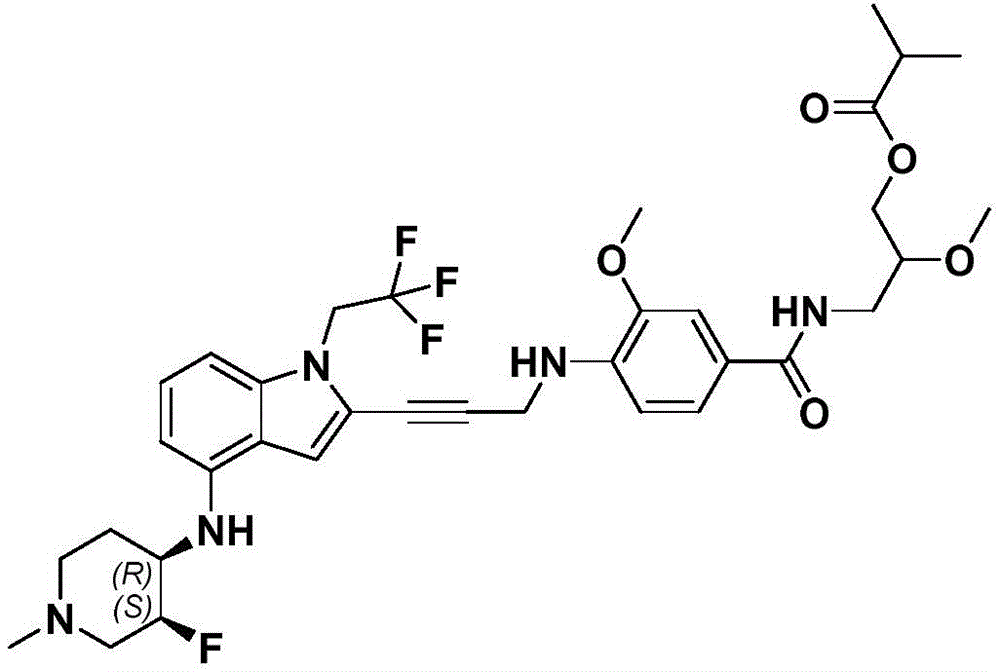
Synthesis of 2- (3- (benzyloxy) -2-hydroxypropyl) isoindoline-1, 3-dione to a solution of 2- ((benzyloxy) methyl) oxirane (2.68g,1.2 eq.), isoindoline-1, 3-dione (2g,1 eq.) in EtOH (20mL) was added K 2 CO 3 (150.29mg,0.08 eq.). The mixture was stirred at 80 ℃ for 12 hours. LCMS analysis showed complete consumption of the starting material and a major peak of the desired mass was observed. The reaction mixture was concentrated to dryness under reduced pressure. The crude residue is purified by column chromatography (SiO) 2 PE: EtOAc ═ 20:1 to 2:1) purification. 2- (3- (benzyloxy) -2-hydroxypropyl) isoindoline-1, 3-dione was obtained as a white solid (3.1 g).
Synthesis of 2- (3- (benzyloxy) -2-methoxypropyl) isoindoline-1, 3-dione to a solution of 2- (3- (benzyloxy) -2-hydroxypropyl) -isoindoline-1, 3-dione (2g,1 eq.) and MeI (1.37g,1.5 eq.) in THF (20mL) at 0 deg.C was added NaH (385.40mg, 60% pure, 1.5 eq.) and the mixture was stirred at 25 deg.C for 16 h. TLC analysis (PE: EtOAc ═ 2:1, R) f 0.6) indicated complete consumption of starting material and a new spot was observed. The reaction mixture was poured onto NH 4 Cl (150 mL). The aqueous phase was extracted with EtOAc (60mL x 3). The combined organic phases were washed with brine (40mL) and anhydrous Na 2 SO 4 Dried, filtered and concentrated in vacuo. The residue was purified by column chromatography (SiO) 2 PE: EtOAc ═ 20:1 to 15:1) purification afforded the desired product as a pale yellow oil (1.2 g).
Synthesis of 3- (benzyloxy) -2-methoxypropan-1-amine in N 2 Next, N was added to a solution of 2- (3- (benzyloxy) -2-methoxypropyl) isoindoline-1, 3-dione (1.2g,1 eq) in EtOH (12mL) at 50 deg.C 2 H 4 Water (376.80mg, 98% purity, 2 eq) and the mixture was then stirred at 80 ℃ for 2 h. LCMS analysis showed complete consumption of the starting material and a major peak with the expected m/z was observed. The reaction mixture was concentrated under reduced pressure to remove the solvent. The crude product was passed through reverse phase HPLC (column: Xtimate C1810 u 250mM 80 mM; mobile phase: [ water (10mM NH4HCO3) -ACN) ](ii) a B% is 1% -20%, 27 minutes) purification. 3- (benzyloxy) -2-methoxypropan-1-amine was obtained as a clear oil (0.19 g). LCMS (ES) + ,m/z):391.2[(M+1) + ]
Synthesis of 3-amino-2-methoxypropan-1-ol 2 To a solution of 3- (benzyloxy) -2-methoxypropan-1-amine (204.71mg,1.05mmol,1 eq) in MeOH (2mL) under atmosphere was added Pd/C (10%, 0.15 g). Degassing the suspension and applying H 2 Purging 3 times. The mixture was reacted at 25 ℃ in H 2 Stirring was carried out for 16 hours at 50psi or atm. TLC analysis (DCM: MeOH ═ 10:1, R) f 0.2) indicates complete consumption of the starting material. The reaction mixture was filtered and concentrated under reduced pressure to give a residue. The crude product was used directly in the next step. 3-amino-2-methoxypropan-1-ol was obtained as a white oil (90mg, crude). 1 H NMR (400MHz, chloroform-d) δ 2.89-2.95(m,1H),2.97-3.05(m,1H),3.28(br d, J ═ 2.63Hz,1H),3.43-3.46(m,3H),3.69-3.76(m,1H),3.79-3.86(m,1H),7.30(br s, 1H).
Synthesis of 4- ((3- (4- (((3S,4R) -3-fluoro-1-methylpiperidin-4-yl) amino) -1- (2,2, 2-trifluoroethyl) -1H-indol-2-yl) prop-2-yn-1-yl) amino) -N- (3-hydroxy-2-methoxypropyl) -3-methoxybenzamide to 4- ((3- (4- (((3S,4R) -3-fluoro-1-methylpiperidin-4-yl) amino) -1- (2,2, 2-trifluoroethyl) -1H-indol-2-yl) prop-2-yn-1-yl) amino) -3-methoxybenzene Formic acid (150mg,1 eq) in DMF (2mL) was added as a solution HATU (160.65mg,1.5 equiv.) and TEA (85.51mg,3 equiv.). Degassing the mixture and applying N 2 Purging for 3 times, then adding dropwise3-Ammonia 2-methoxypropan-1-ol (A), (B), (C), (D), (E), (D), (E) and (E) wherein32.58mg,1.1 eq) and the mixture was stirred at 25 ℃ for 1 hour. LCMS analysis showed complete consumption of the starting material and three major peaks with the expected m/z were observed. The residue was diluted with water (50mL) and extracted with EtOAc (30mL × 3). The combined organic layers were washed with brine (30mL x 3) and dried over anhydrous Na 2 SO 4 Dried, filtered and concentrated under reduced pressure to give a residue. The residue was passed through preparative TLC (SiO) 2 DCM: MeOH ═ 10:1) was purified to give 4- ((3- (4- (((3S,4R) -3-fluoro-1-methylpiperidin-4-yl) amino) -1- (2,2, 2-trifluoroethyl) -1H-indol-2-yl) prop-2-yn-1-yl) amino) -N- (3-hydroxy-2-methoxypropyl) -3-methoxybenzamide as a yellow solid (100 mg). LCMS (ES) + ,m/z):620.3[(M+1) + ]
3- [ (4- { [3- (4- { [ (3S,4R) -3-fluoro-1-methylpiperidin-4-yl)]Amino } -1- (2,2, 2-trifluoroethyl) -1H-indol-2-yl) prop-2-yn-1-yl]Amino } -3-methoxyphenyl) -carboxamido]Synthesis of-2-methoxypropyl 2-methylpropionate to a solution of 4- ((3- (4- (((3S,4R) -3-fluoro-1-methylpiperidin-4-yl) amino) -1- (2,2, 2-trifluoroethyl) -1H-indol-2-yl) prop-2-yn-1-yl) amino) -N- (3-hydroxy-2-methoxypropyl) -3-methoxybenzamide (90mg,1 eq) in DCM (5mL) was added 2-methylpropanoyl 2-methylpropionate (25.3mg,1.1 eq) and TEA (44.09mg,3 eq) and the mixture was stirred at 45 ℃ for 16H. TLC analysis (DCM: MeOH ═ 10:1, R) f 0.5) indicated complete consumption of starting material and a new spot was observed. The mixture was filtered and concentrated under reduced pressure to give a residue. The residue was passed through preparative TLC (SiO) 2 DCM: MeOH ═ 10:1) purification. The residue was passed through preparative TLC (SiO) 2 DCM: MeOH ═ 10:1) purification afforded the desired product as a yellow solid (24.2 mg). LCMS (ES) + ,m/z):690.2[(M+1) + ]。
Example D169: preparation of N-ethyl-4- { [3- (4- { [ (3S,4R) -3-fluoropiperidin-4-yl ] amino } -1- (2,2, 2-trifluoroethyl) -1H-indol-2-yl) prop-2-yn-1-yl ] amino } -3-methoxybenzamide

Synthesis of tert-butyl (4- (ethylcarbamoyl) -2-methoxyphenyl) (prop-2-yn-1-yl) carbamate A mixture of 4- ((tert-butoxycarbonyl) (prop-2-yn-1-yl) amino) -3-methoxybenzoic acid (0.4g,1.31mmol,1 eq) and ethylamine (106.83mg,1.31mmol, 155.05. mu.L, 1 eq, HCl) in DMF (2mL) was added to HOBt (354.04mg,2.62mmol,2 eq), EDCI (502.28mg,2.62mmol,2 eq) and TEA (397.70mg,3.93mmol, 547.04. mu.L, 3 eq). Degassing the mixture and applying N 2 Purge 3 times, then at N 2 The mixture was stirred at 25 ℃ for 2 hours under an atmosphere. TLC analysis (PE: EtOAc ═ 2:1, R) f 0.4) indicated complete consumption of starting material and a new spot was observed. The residue was diluted with water (50mL) and extracted with EtOAc (30mL × 3). The combined organic layers were washed with brine (20 mL. times.3) over anhydrous Na 2 SO 4 Dried, filtered and concentrated under reduced pressure to give a residue. The residue was passed through preparative TLC (SiO) 2 PE: EtOAc ═ 2:1) purification afforded tert-butyl (4- (ethylcarbamoyl) -2-methoxyphenyl) (prop-2-yn-1-yl) carbamate as a clear oil (400mg, 83% yield). 1 H NMR(400MHz,DMSO-d 6 )δ=1.10-1.17(m,3H),1.20-1.42(m,9H),3.06-3.14(m,1H),3.31(br s,2H),3.81-3.89(m,3H),3.99-4.63(m,2H),7.20-7.31(m,1H),7.37-7.44(m,1H),7.47-7.53(m,1H),8.44-8.56(m,1H)。
Synthesis of (3S,4R) -4- ((2- (3- ((tert-butoxycarbonyl) (4- (ethylcarbamoyl) -2-methoxyphenyl) amino) prop-1-yn-1-yl) -1- (2,2, 2-trifluoroethyl) -1H-indol-4-yl) amino) -3-fluoropiperidine-1-carboxylic acid tert-butyl ester to a solution of tert-butyl (4- (ethylcarbamoyl) -2-methoxyphenyl) (prop-2-yn-1-yl) carbamate (55.26mg, 166.26. mu. mol,0.9 eq) in DMSO (2mL) was added i-PrNH 2 (109.20mg,1.85mmol, 158.72. mu.L, 10 equiv.) and CuI (1.76mg, 9.24. mu. mol,0.05 equiv.). Then (3S,4R) -3-fluoro-4- ((2-iodo-1- (2,2, 2-trifluoroethyl) -1H-indol-4-yl) amino) piperidine-1-carboxylic acid tert-butyl ester (100mg, 184.73. mu. mol,1 eq.) and Pd (PPh) were added 3 ) 4 (10.67mg, 9.24. mu. mol,0.05 eq.) and the resulting mixture is diluted with N 2 Purging 3 times. The mixture was stirred at 25 ℃ for 1 hour. TLC analysis (DCM: MeOH ═ 10:1, R) f 0.45) indicated complete consumption of starting material and a new spot was observed. The reaction mixture was quenched by addition of saturated EDTA solution (100mL) and extracted with EtOAc (90mL x 3). The combined organic layers were washed with brine (30mL x 3) and dried over anhydrous Na 2 SO 4 Dried, filtered, and concentrated under reduced pressure to give a residue. The crude residue was passed through preparative TLC (SiO) 2 DCM: MeOH ═ 10:1) purification afforded the desired product as a yellow solid (70mg, 50% yield). LC-MS (ES) + ,m/z):797.5[(M+1) + ]
N-Ethyl-4- { [3- (4- { [ (3S,4R) -3-fluoropiperidin-4-yl]Amino } -1- (2,2, 2-trifluoroethyl) -1H-indol-2-yl) prop-2-yn-1-yl]Synthesis of amino } -3-methoxybenzamide A solution of tert-butyl (3S,4R) -4- ((2- (3- ((tert-butoxycarbonyl) (4- (ethylcarbamoyl) -2-methoxyphenyl) amino) prop-1-yn-1-yl) -1- (2,2, 2-trifluoroethyl) -1H-indol-4-yl) amino) -3-fluoropiperidine-1-carboxylate (70mg, 93.86. mu. mol,1 eq) in HCl/EtOAc (4M,2mL) was stirred at 25 ℃ for 1 hour. TLC analysis (DCM: MeOH ═ 10:1, R) f 0.5) indicated complete consumption of starting material and a new spot was observed. The reaction mixture was saturated with Na 2 CO 3 The solution (50mL) was diluted and extracted with EtOAc (30 mL. times.3). The combined organic layers were washed with brine (30mL x 3) and dried over anhydrous Na 2 SO 4 Dried, filtered and concentrated under reduced pressure to give a residue. The residue was passed through preparative TLC (SiO) 2 DCM: MeOH ═ 10:1) and then purified by reverse phase HPLC (column: welch Xtimate C18150 x 25mm,5 um; mobile phase: [ Water (0.2% FA) -ACN ](ii) a B%: 25% -50%, 10 min) to give the desired product as a yellow solid (20.6mg, 40% yield).
Example D170: preparation of 4- { [3- (4- { [ (3S,4R) -1-ethyl-3-fluoropiperidin-4-yl ] amino } -1- (2,2, 2-trifluoroethyl) -1H-indol-2-yl) prop-2-yn-1-yl ] amino } -3-methoxybenzamide

Synthesis of N- ((3S,4R) -1-Ethyl-3-fluoropiperidin-4-yl) -2-iodo-1- (2,2, 2-trifluoroethyl) -1H-indol-4-amine to a solution of N- ((3S,4R) -3-fluoropiperidin-4-yl) -2-iodo-1- (2,2, 2-trifluoroethyl) -1H-indol-4-amine (0.15g, 339.98. mu. mol,1 eq) in DMF (2mL) were added EtI (79.5mg, 509.97. mu. mol, 41. mu.L, 1.5 eq) and K 2 CO 3 (234.9mg,1.70mmol,5 equiv.). In N 2 The mixture was stirred at 25 ℃ for 2 hours under an atmosphere. TLC analysis (PE: EtOAc ═ 2:1, R) f 0.4) indicated complete consumption of starting material and a new spot was observed. The residue was diluted with water (20mL) and extracted with EtOAc (30mL × 3). The combined organic layers were washed with brine (20 mL. times.3) over anhydrous Na 2 SO 4 Dried, filtered and concentrated under reduced pressure to give a residue. The residue was passed through preparative TLC (SiO) 2 PE: EtOAc ═ 2:1) purification. N- ((3S,4R) -1-ethyl-3-fluoropiperidin-4-yl) -2-iodo-1- (2,2, 2-trifluoroethyl) -1H-indol-4-amine was obtained as a yellow solid (120mg, 68% yield). 1 H NMR(400MHz,DMSO-d 6 )δ=1.00(t,J=7.09Hz,3H)1.66-1.77(m,1H)1.85-1.96(m,1H)2.05-2.14(m,1H)2.16-2.31(m,1H)2.37(br d,J=7.09Hz,2H)2.90-2.94(m,1H)3.07-3.17(m,1H)3.51-3.70(m,1H)4.72-4.92(m,1H)4.96-5.05(m,2H)5.35-5.44(m,1H)6.19-6.28(m,1H)6.79-6.86(m,1H)6.88-6.97(m,1H)7.22-7.30(m,1H)。
Synthesis of tert-butyl (4-carbamoyl-2-methoxyphenyl) (3- (4- (((3S,4R) -1-ethyl-3-fluoropiperidin-4-yl) amino) -1- (2,2, 2-trifluoroethyl) -1H-indol-2-yl) prop-2-yn-1-yl) carbamate to a solution of tert-butyl (4-carbamoyl-2-methoxyphenyl) (prop-2-yn-1-yl) carbamate (58.4mg, 191.79. mu. mol,0.9 eq) in DMSO (2mL) was added i-PrNH 2 (126mg,2.13mmol, 183. mu.L, 10 equiv.), CuI (2.03mg, 10.66. mu. mol,0.05 equiv.), N- ((3S,4R) -1-ethyl-3-fluoropiperidin-4-yl) -2-iodo-1- (2,2, 2-trifluoroethyl) -1H-indol-4-amine (100mg, 213.10. mu. mol,1 equiv.), and Pd (PPh) 3 ) 4 (12.31mg, 10.66. mu. mol,0.05 eq.). Mixing the mixture with N 2 Purge 3 times, then stir at 25 ℃ for 1 hour. TLC analysis (DCM: MeOH ═ 10:1, R) f =0.5) Indicating complete consumption of the starting material and a new spot was observed. The reaction mixture was quenched by addition of saturated EDTA solution (100mL) and extracted with EtOAc (90mL x 3). The combined organic layers were washed with brine (30mL x 3) and dried over anhydrous Na 2 SO 4 Dried, filtered, and concentrated under reduced pressure to give a residue. The residue was passed through preparative TLC (SiO) 2 DCM: MeOH ═ 10:1) to give tert-butyl (4-carbamoyl-2-methoxyphenyl) (3- (4- (((3S,4R) -1-ethyl-3-fluoropiperidin-4-yl) amino) -1- (2,2, 2-trifluoroethyl) -1H-indol-2-yl) prop-2-yn-1-yl) carbamate as a yellow solid (100mg, 69% yield). LC-MS (ES) + ,m/z):678.8[(M+1) + ]。
4- { [3- (4- { [ (3S,4R) -1-Ethyl-3-Fluoropiperidin-4-yl]Amino } -1- (2,2, 2-trifluoroethyl) -1H-indol-2-yl) prop-2-yn-1-yl]Synthesis of amino } -3-methoxybenzamide A solution of tert-butyl (4-carbamoyl-2-methoxyphenyl) (3- (4- (((3S,4R) -1-ethyl-3-fluoropiperidin-4-yl) amino) -1- (2,2, 2-trifluoroethyl) -1H-indol-2-yl) prop-2-yn-1-yl) carbamate (100mg, 154.87. mu. mol,1 eq) in HCl/EtOAc (4M,2mL) was stirred at 25 ℃ for 1 hour. TLC analysis (DCM: MeOH ═ 10:1, R) f 0.4) indicated complete consumption of starting material and a new spot was observed. The reaction mixture was saturated with Na 2 CO 3 The solution (50mL) was diluted and extracted with EtOAc (30mL x 3). The combined organic layers were washed with brine (30 mL. times.3) and over anhydrous Na 2 SO 4 Dried, filtered and concentrated under reduced pressure to give a residue. The crude residue was passed through preparative TLC (SiO) 2 DCM: MeOH ═ 10:1) and then by preparative TLC (SiO) 2 EtOAc: MeOH: TEA ═ 20:1:1) was purified again to give 4- { [3- (4- { [ (3S,4R) -1-ethyl-3-fluoropiperidin-4-yl]Amino } -1- (2,2, 2-trifluoroethyl) -1H-indol-2-yl) prop-2-yn-1-yl]Amino } -3-methoxybenzamide as a yellow solid (25.2mg, 30% yield). LC-MS (ES) + ,m/z):546.2[(M+1) + ]。
Example D171: preparation of 5- { [3- (4- { [ (3S,4R) -3-fluoro-1-methylpiperidin-4-yl ] amino } -1- (2,2, 2-trifluoroethyl) -1H-indol-2-yl) prop-2-yn-1-yl ] amino } -4-methoxy-N, N-dimethylpyridine-2-carboxamide

Synthesis of 5-bromo-4-methoxy-pyridine-2-carboxylic acid methyl 5-bromo-4-methoxy-pyridine-2-carboxylate (1g,4.06mmol,1 eq.), LiOH 2 A mixture of O (852.7mg,20.32mmol,5 equiv.) in THF (8mL) and water (8mL) was degassed and N was used 2 Purge 3 times, then at N 2 Stirred at 25 ℃ for 1 hour under an atmosphere. TLC analysis (PE: EtOAc: 2:1, Rf: 0.02) indicated complete consumption of starting material and a new spot was observed. The reaction mixture was quenched by addition of 1N HCl to adjust the solution to pH 4 and extracted with EtOAc (30mL x 15). The combined organic layers were washed with brine (20 mL. times.2) over anhydrous Na 2 SO 4 Dried, filtered and concentrated under reduced pressure to give crude 5-bromo-4-methoxy-pyridine-2-carboxylic acid (750 mg). LC-MS (ES) + ,m/z):231.9[(M-H) + ]. The crude product was used in the next step without further purification.
Synthesis of 5-bromo-4-methoxy-N, N-dimethyl-pyridine-2-carboxamide A mixture of 5-bromo-4-methoxy-pyridine-2-carboxylic acid (700mg,3.02mmol,1 eq), N-methyl methylamine (2M,1.96mL,1.3 eq), HATU (1.38g,3.62mmol,1.2 eq) and TEA (1.53g,15.08mmol,2.10mL,5 eq) in DMF (10mL) was degassed and N-methyl-pyridine-2-carboxamide was used 2 Purging 3 times and in N 2 The mixture was stirred at 25 ℃ for 15 hours under an atmosphere. TLC analysis (PE: EtOAc: 2:1, Rf: 0.13) indicated that 10% of the starting material remained and a major new spot was detected. The reaction mixture was quenched by the addition of water (100mL) and extracted with EtOAc (50mL × 5). The combined organic layers were washed with brine (20 mL. times.2) over anhydrous Na 2 SO 4 Dried, filtered and concentrated under reduced pressure to give a residue. The residue was passed through preparative TLC (SiO) 2 PE: EtOAc ═ 2:1) purification afforded 5-bromo-4-methoxy-N, N-dimethyl-pyridine-2-carboxamide (500mg, 64% yield).
N- [6- (dimethylcarbamoyl) -4-methoxy-3-pyridinyl]Synthesis of tert-butyl carbamate 5-bromo-4-methoxy-N, N-dimethyl-pyridine-2-carboxamide (30)0mg,1.16mmol,1 equiv.) of dioxane (10mL) was added NH 2 Boc (271mg,2.32mmol,2 equiv.), Cs 2 CO 3 (1.13g,3.47mmol,3 equiv.), XPhos (331mg, 694.71. mu. mol,0.6 equiv.), and Pd (OAc) 2 (169mg, 752.61. mu. mol,0.65 eq.). Degassing the mixture and adding N 2 Purge 3 times, then stir at 120 ℃ for 2 hours. TLC analysis (PE: EtOAc: 1, Rf: 20) indicated complete consumption of starting material and a new spot was detected. The reaction mixture was quenched by the addition of water (300mL) and extracted with EtOAc (50mL × 5). The combined organic layers were washed with brine (30 mL. times.2) and over anhydrous Na 2 SO 4 Dried, filtered and concentrated under reduced pressure to give a residue. The residue was passed through preparative TLC (SiO) 2 PE: EtOAc ═ 1:1) purification afforded the desired product (200mg, 59% yield). LC-MS (ES) + ,m/z):296.1[(M+H) + ]。
N- [6- (dimethylcarbamoyl) -4-methoxy-3-pyridinyl]Synthesis of (E) -N-prop-2-ynyl-carbamic acid tert-butyl ester (E) -N- [6- (dimethylcarbamoyl) -4-methoxy-3-pyridinyl]A solution of tert-butyl carbamate (150mg, 507.90. mu. mol,1 eq.) in DMF (3mL) was added Cs 2 CO 3 (331mg,1.02mmol,2 equiv.) and 3-bromoprop-1-yne (98.18mg, 660.27. mu. mol, 71.15. mu.L, 1.3 equiv.). In N 2 The mixture was stirred at 25 ℃ for 10 hours under an atmosphere. TLC analysis (PE: EtOAc ═ 0:1, Rf ═ 0.40) indicated complete consumption of the starting material and a new spot was detected. The reaction mixture was quenched by addition of water (80mL) and extracted with EtOAc (20mL × 3). The combined organic layers were washed with brine (10 mL. times.2) and over anhydrous Na 2 SO 4 Dried, filtered and concentrated under reduced pressure to give a residue. The crude residue was passed through preparative TLC (SiO) 2 PE EtOAc ═ 0:1) purification to afford N- [6- (dimethylcarbamoyl) -4-methoxy-3-pyridinyl]-N-prop-2-ynyl-carbamic acid tert-butyl ester (115mg, 68% yield). LC-MS (ES) + ,m/z):334.1[(M+H) + ]
N- [6- (dimethylcarbamoyl) -4-methoxy-3-pyridinyl]-N- [3- [4- [ [ (3S,4R) -3-fluoro-1-methyl-4-piperidinyl]Amino group]-1- (2,2, 2-trifluoroethyl) indol-2-yl]Prop-2-ynyl]Synthesis of tert-butyl carbamateN- [ (3S,4R) -3-fluoro-1-methyl-4-piperidinyl]A solution of (E) -2-iodo-1- (2,2, 2-trifluoroethyl) indol-4-amine (130mg, 285.57. mu. mol,1 eq) in DMSO (2mL) was added i-Pr 2 NH (288.97mg,2.86mmol, 403.59. mu.L, 10 equiv.), N- [6- (dimethylcarbamoyl) -4-methoxy-3-pyridinyl]-N-prop-2-ynyl-carbamic acid tert-butyl ester (104.72mg, 314.13. mu. mol,1.1 equiv), CuI (10.88mg, 57.11. mu. mol,0.2 equiv) and Pd (PPh) 3 ) 4 (16.50mg, 14.28. mu. mol,0.05 eq.). Degassing the mixture and applying N 2 Purge 3 times, then at N 2 Stirred under an atmosphere at 50 ℃ for 1 hour. TLC analysis (DCM: MeOH: 10:1, Rf: 0.50) indicated complete consumption of starting material and a new spot was detected. The reaction mixture was quenched by the addition of saturated EDTA solution (150mL) and stirred for 30 min, then extracted with EtOAc (40mL x 3). The combined organic layers were washed with brine (20 mL. times.2) over anhydrous Na 2 SO 4 Dry, filter and concentrate to dryness under reduced pressure. The crude residue was passed through preparative TLC (SiO) 2 DCM: MeOH ═ 10:1) to give N- [6- (dimethylcarbamoyl) -4-methoxy-3-pyridinyl ]-N- [3- [4- [ [ (3S,4R) -3-fluoro-1-methyl-4-piperidinyl]Amino group]-1- (2,2, 2-trifluoroethyl) indol-2-yl]Prop-2-ynyl]Tert-butyl carbamate (100mg, 53% yield). LC-MS (ES +, M/z):661.3[ (M + H) + ]。
5- [3- [4- [ [ (3S,4R) -3-fluoro-1-methyl-4-piperidinyl]Amino group]-1- (2,2, 2-trifluoroethyl) indol-2-yl]Prop-2-ynylamino]Synthesis of (E) -4-methoxy-N, N-dimethyl-pyridine-2-carboxamide N- [6- (dimethylcarbamoyl) -4-methoxy-3-pyridinyl]-N- [3- [4- [ [ (3S,4R) -3-fluoro-1-methyl-4-piperidinyl]Amino group]-1- (2,2, 2-trifluoroethyl) indol-2-yl]Prop-2-ynyl]A mixture of tert-butyl carbamate (100mg, 151.35. mu. mol,1 eq) in EtOAc (10mL) and 4M HCl/EtOAc (3mL) was degassed and treated with N 2 Purge 3 times, then at N 2 Stirring was carried out at 25 ℃ for 0.5 hour under an atmosphere. LC-MS analysis showed complete consumption of starting material and detection of the desired mass. By adding saturated Na 2 CO 3 The reaction mixture was quenched to adjust the solution to pH 9 and extracted with EtOAc (20mL x 3). The combined organic layers were washed with brine (10mL x 2) over anhydrous Na 2 SO 4 Drying and passing throughFiltered and concentrated to dryness under reduced pressure. The crude residue was passed through preparative HPLC (column: Phenomenex Luna C18200 x 40mM,10 um; mobile phase: [ water (10mM NH) 4 HCO 3 )-ACN](ii) a 20% -50% of B%, 10 min) purification to obtain 5- [3- [4- [ [ (3S,4R) -3-fluoro-1-methyl-4-piperidyl)]Amino group]-1- (2,2, 2-trifluoroethyl) indol-2-yl]Prop-2-ynylamino]-4-methoxy-N, N-dimethyl-pyridine-2-carboxamide (27.5mg, 32% yield). LC-MS (ES +, M/z):561.1[ (M + H) + ]。
Example D172: preparation of 5- { [3- (4- { [ (3S,4R) -3-fluoro-1-methylpiperidin-4-yl ] amino } -1- (2,2, 2-trifluoroethyl) -1H-indol-2-yl) prop-2-yn-1-yl ] amino } -4-methoxy-N-methylpyridine-2-carboxamide

Synthesis of 5- (tert-butoxycarbonylamino) -4-methoxy-pyridine-2-carboxylic acid methyl ester to a solution of 5-bromo-4-methoxy-pyridine-2-carboxylic acid methyl ester (300mg,1.22mmol,1 eq) in dioxane (10mL) was added NH 2 Boc (285.65mg,2.44mmol,2 equiv.), Cs 2 CO 3 (1.19g,3.66mmol,3 equiv.), XPhos (348.74mg, 731.53. mu. mol,0.6 equiv.), and Pd (OAc) 2 (177.92mg, 792.50. mu. mol,0.65 eq.). Degassing the mixture and applying N 2 Purge 3 times, then at N 2 Stirred at 120 ℃ for 2 hours under an atmosphere. TLC analysis (PE: EtOAc: 1, Rf: 0.16) indicated complete consumption of starting material and detection of new spots. The reaction mixture was quenched by the addition of water (300mL) and extracted with EtOAc (50mL × 5). The combined organic layers were washed with brine (30 mL. times.2) and over anhydrous Na 2 SO 4 Dried, filtered and concentrated under reduced pressure to give a residue. The residue was passed through preparative TLC (SiO) 2 EtOAc ═ 1:1) purification to give methyl 5- (tert-butoxycarbonylamino) -4-methoxy-pyridine-2-carboxylate (160mg, 47% yield).
5- [ tert-Butoxycarbonyl (prop-2-ynyl) amino]Synthesis of methyl 4-methoxy-pyridine-2-carboxylate methyl 5- (tert-butoxycarbonylamino) -4-methoxy-pyridine-2-carboxylate (133.8mg, 474.04. mu. mol,1 eq.), Cs 2 CO 3 A mixture of (386.1mg,1.19mmol,2.5 equiv.) and 3-bromoprop-1-yne (105.7mg, 711.06. mu. mol, 76.62. mu.L, 1.5 equiv.) in DMF (2mL) was degassed and N was used 2 Purge 3 times, then at N 2 Stirred under an atmosphere at 25 ℃ for 2 hours. TLC analysis (PE: EtOAc ═ 0:1, Rf ═ 0.37) indicated complete consumption of the starting material and a new spot was detected. The reaction mixture was quenched by the addition of water (80mL) and extracted with EtOAc (20mL x 3). The combined organic layers were washed with brine (10mL x 2) over anhydrous Na 2 SO 4 Dry, filter and concentrate to dryness under reduced pressure. The residue was passed through preparative TLC (SiO) 2 PE: EtOAc ═ 0:1) purification afforded 5- [ tert-butoxycarbonyl (prop-2-ynyl) amino]-4-methoxy-pyridine-2-carboxylic acid methyl ester (125mg, 82.3% yield).
N- [ 4-methoxy-6- (methylcarbamoyl) -3-pyridyl]Synthesis of tert-butyl (N-prop-2-ynyl) -carbamate 5- [ tert-butoxycarbonyl (prop-2-ynyl) amino]A mixture of methyl-4-methoxy-pyridine-2-carboxylate (105mg, 327.78. mu. mol,1 equivalent), methylamine (10.2mg, 327.78. mu. mol,1mL,1 equivalent) in THF (1mL) was degassed and N was used 2 Purge 3 times, then at N 2 Stirred under an atmosphere at 25 ℃ for 5 hours. TLC analysis [ (PE: EtOAc: 1) (DCM: MeOH: 10:1), Rf: 0.45]Indicating complete consumption of the starting material and a new spot was detected. The reaction mixture was quenched by the addition of water (50mL) and extracted with EtOAc (20mL x 3). The combined organic layers were washed with brine (10mL x 2) over anhydrous Na 2 SO 4 Dry, filter and concentrate to dryness under reduced pressure. The crude product N- [ 4-methoxy-6- (methylcarbamoyl) -3-pyridyl]-N-prop-2-ynyl-carbamic acid tert-butyl ester (95mg, 91% yield) was used in the next step without further purification. LC-MS (ES) + ,m/z):320.1[(M+H) + ]。
N- [3- [4- [ [ (3S,4R) -3-fluoro-1-methyl-4-piperidinyl]Amino group]-1- (2,2, 2-trifluoroethyl) indol-2-yl]Prop-2-ynyl]-N- [ 4-methoxy-6- (methylcarbamoyl) -3-pyridyl]Synthesis of t-butyl carbamate N- [ (3S,4R) -3-fluoro-1-methyl-4-piperidinyl group ]A solution of (E) -2-iodo-1- (2,2, 2-trifluoroethyl) indol-4-amine (120mg, 263.60. mu. mol,1 eq) in DMSO (2mL) was added i-Pr 2 NH(266.74mg2.64mmol, 372.54. mu.L, 10 equiv.), N- [ 4-methoxy-6- (methylcarbamoyl) -3-pyridyl]-N-prop-2-ynyl-carbamic acid tert-butyl ester (92.60mg, 289.96. mu. mol,1.1 equiv), CuI (10.04mg, 52.72. mu. mol,0.2 equiv) and Pd (PPh) 3 ) 4 (15.23mg, 13.18. mu. mol,0.05 eq.). Degassing the mixture and adding N 2 Purge 3 times, then at N 2 Stirred under an atmosphere at 40 ℃ for 1 hour. TLC analysis (DCM: MeOH: 10:1, Rf: 0.38) indicated complete consumption of starting material and a new spot was detected. The reaction mixture was quenched by the addition of saturated EDTA solution (100mL) and the mixture was stirred for 30 min and extracted with EtOAc (30mL x 3). The combined organic layers were washed with brine (20 mL. times.2) over anhydrous Na 2 SO 4 Dry, filter and concentrate to dryness under reduced pressure. The crude residue was passed through preparative TLC (SiO) 2 DCM: MeOH 10:1) to afford N- [3- [4- [ [ (3S,4R) -3-fluoro-1-methyl-4-piperidinyl]Amino group]-1- (2,2, 2-trifluoroethyl) indol-2-yl]Prop-2-ynyl]-N- [ 4-methoxy-6- (methylcarbamoyl) -3-pyridyl]Tert-butyl carbamate (100mg, 59% yield).
5- [3- [4- [ [ (3S,4R) -3-fluoro-1-methyl-4-piperidinyl ]Amino group]-1- (2,2, 2-trifluoroethyl) indol-2-yl]Prop-2-ynylamino]Synthesis of (E) -4-methoxy-N-methyl-pyridine-2-carboxamide N- [3- [4- [ [ (3S,4R) -3-fluoro-1-methyl-4-piperidinyl]Amino group]-1- (2,2, 2-trifluoroethyl) indol-2-yl]Prop-2-ynyl]-N- [ 4-methoxy-6- (methylcarbamoyl) -3-pyridyl]A mixture of tert-butyl carbamate (100mg, 154.64. mu. mol,1 eq) in EtOAc (10mL) and 4M HCl/EtOAc (3mL) was degassed and treated with N 2 Purge 3 times, then at N 2 The mixture was stirred at 25 ℃ for 1.5 hours under an atmosphere. LC-MS analysis showed that the desired mass was detected. By adding saturated Na 2 CO 3 The reaction mixture was quenched to adjust the solution to pH 9 and extracted with EtOAc (20mL x 4). The combined organic layers were washed with brine (10 mL. times.2) and over anhydrous Na 2 SO 4 Dry, filter and concentrate to dryness under reduced pressure. The crude residue was passed through preparative HPLC (neutral conditions: column: Waters Xbridge Prep OBD C18150 x 40mM,10 um; mobile phase: [ water (10mM NH. sub.H.) 4 HCO 3 )-ACN](ii) a 25% -55% of B%, 8 minutes) to obtain 5- [3- [4- [ [ (3S,4R) -3-fluoro-1-methyl-4-piperidinyl group]Amino group]-1- (2,2, 2-trifluoroethyl) indol-2-yl]Prop-2-ynylamino]-4-methoxy-N-methyl-pyridine-2-carboxamide (30mg, 36% yield). LC-MS (ES) + ,m/z):547.1[(M+H) + ]。
Example D173: 1-tert-butyl-N- [3- (4- { [ (3S,4R) -3-fluoro-1-methylpiperidin-4-yl ] amino } -1- (2,2, 2-trifluoroethyl) -1H-indol-2-yl) prop-2-yn-1-yl ] -1H-pyrazole-4-carboxamide

Synthesis of tert-butyl (3- (4- (((3S,4R) -3-fluoro-1-methylpiperidin-4-yl) amino) -1- (2,2, 2-trifluoroethyl) -1H-indol-2-yl) prop-2-yn-1-yl) carbamate to a solution of tert-butyl prop-2-yn-1-ylcarbamate (61.36mg, 395.40. mu. mol,0.9 eq) in DMSO (2mL) were added i-Pr2NH (444.57mg,4.39mmol, 620.90. mu.L, 10 eq), CuI (4.18mg, 21.97. mu. mol,0.05 eq) and N- ((3S,4R) -3-fluoro-1-methylpiperidin-4-yl) -2-iodo-1- (2,2, 2-trifluoroethyl) -1H-indol-4-amine (200mg, 439.34. mu. mol,1 eq) and then Pd (PPh) was added 3 ) 4 (25.38mg, 21.97. mu. mol,0.05 equiv.). Mixing the mixture with N 2 Purge 3 times and stir at 25 ℃ for 1 hour. TLC analysis (DCM: MeOH ═ 10:1, R) f 0.4) indicated complete consumption of starting material and a new spot was detected. The reaction mixture was quenched by the addition of saturated EDTA solution (50mL) and extracted with EtOAc (40mL x 3). The combined organic layers were washed with brine (30mL x 3) and dried over anhydrous Na 2 SO 4 Dry, filter and concentrate to dryness under reduced pressure. The crude residue was passed through preparative TLC (SiO) 2 DCM: MeOH ═ 10:1) to give tert-butyl (3- (4- (((3S,4R) -3-fluoro-1-methylpiperidin-4-yl) amino) -1- (2,2, 2-trifluoroethyl) -1H-indol-2-yl) prop-2-yn-1-yl) carbamate as a yellow solid (100mg, 46% yield). 1 H NMR(400MHz,DMSO-d 6 )δ=1.41(s,9H),1.65-1.76(m,1H),1.86-2.01(m,1H),2.04-2.15(m,1H),2.17-2.31(m,4H),2.75-2.88(m,1H),3.04(br t,J=10.58Hz,1H),3.47-3.73(m,1H),4.03(d,J=5.62Hz,2H),4.89(br s,1H),4.95-5.12(m,2H)5.48-5.59(m,1H)6.19-6.34(m,1H)6.72-6.84(m,1H)7.03(t,J=8.01Hz,1H)7.17-7.26(m,1H)7.41(br s,1H)。
Synthesis of 2- (3-aminopropyl-1-yn-1-yl) -N- ((3S,4R) -3-fluoro-1-methylpiperidin-4-yl) -1- (2,2, 2-trifluoroethyl) -1H-indol-4-amine to a solution of tert-butyl (3- (4- (((3S,4R) -3-fluoro-1-methylpiperidin-4-yl) amino) -1- (2,2, 2-trifluoroethyl) -1H-indol-2-yl) prop-2-yn-1-yl) carbamate (100mg, 207.25. mu. mol,1 eq) in DCM (2.64g,31.08mmol,2mL,149.98 eq) was added TFA (1.54g,13.51mmol,1mL,65.17 equivalents), and the resulting mixture is stirred at 25 ℃ for 1 hour. TLC analysis (PE: EtOAc ═ 0:1, R f 0.2) indicated complete consumption of starting material and formation of a new spot. The reaction mixture was concentrated under nitrogen to remove the solvent. Water (50mL) was then added, and saturated Na was added 2 CO 3 The solution was adjusted to pH 10. The product was extracted with EtOAc (50mL x 3). The combined organic layers were washed with brine (30 mL. times.3) and over anhydrous Na 2 SO 4 Dry, filter and concentrate to dryness under reduced pressure. The crude residue was passed through reverse phase HPLC (column: Phenomenex Luna C18200X 40 mm,10 um; mobile phase: [ water (0.2% FA) -ACN) ](ii) a B%: 1% -40%, 10 min) to give 2- (3-aminopropyl-1-yn-1-yl) -N- ((3S,4R) -3-fluoro-1-methylpiperidin-4-yl) -1- (2,2, 2-trifluoroethyl) -1H-indol-4-amine as a yellow solid (21.6mg, 27% yield). 1 H NMR(400MHz,DMSO-d 6 )δ=1.67-1.75(m,1H),1.88-2.02(m,1H),2.06-2.14(m,1H),2.16-2.31(m,4H),2.82(br d,J=11.37Hz,1H),2.99-3.09(m,1H),3.53-3.63(m,1H),3.76(s,2H),4.76-4.90(m,1H),5.02-5.12(m,2H),5.40-5.64(m,1H),6.23-6.31(m,1H),6.74-6.82(m,1H),6.99-7.07(m,1H),7.18-7.25(m,1H),8.24-8.27(m,1H)。
1-tert-butyl-N- [3- (4- { [ (3S,4R) -3-fluoro-1-methylpiperidin-4-yl]Amino } -1- (2,2, 2-trifluoroethyl) -1H-indol-2-yl) prop-2-yn-1-yl]Synthesis of-1H-pyrazole-4-carboxamide to a solution of 1- (tert-butyl) -1H-pyrazole-4-carboxylic acid (48.4mg, 287.66. mu. mol,1.1 eq) in DMF (2mL) were added HOBt (70.67mg, 523.02. mu. mol,2 eq), EDCI (100.26mg, 523.02. mu. mol,2 eq), TEA (79.39mg, 784.52. mu. mol, 109.20. mu.L, 3 eq) and 2- (3-aminopropyl-1-yn-1-yl) -N- ((3S,4R) -3-fluoro-1-methylpiperidine-4-yl) -1- (2,2, 2-trifluoroethyl) -1H-indol-4-amine (0.1g,261.51 μmol,1 eq). At N 2 The resulting mixture was stirred at 25 ℃ for 1 hour under an atmosphere. TLC analysis (EtOAc: TEA ═ 20:1, R f 0.6) indicates complete consumption of starting material and a new spot was detected. The residue was diluted with water (60mL) and extracted with EtOAc (30mL × 3). The combined organic layers were washed with brine (20 mL. times.3) and over anhydrous Na 2 SO 4 Dried, filtered and concentrated under reduced pressure to give a residue. The crude product was passed through reverse phase HPLC (column: Phenomenex Luna C18200 x 40mm,10 um; mobile phase: [ water (0.2% FA) -ACN) ](ii) a 20 percent to 60 percent of B percent and 10 minutes) purification. To give 1-tert-butyl-N- [3- (4- { [ (3S,4R) -3-fluoro-1-methylpiperidin-4-yl)]Amino } -1- (2,2, 2-trifluoroethyl) -1H-indol-2-yl) prop-2-yn-1-yl]-1H-pyrazole-4-carboxamide as a yellow solid (30.1mg, 22% yield). LCMS (ES) + ,m/z):533.1[(M+H) + ]。
Example D174: preparation of rac-N- [ (3R,4S) -4-fluoro-1-methylpiperidin-3-yl ] -2- {3- [ (4-methanesulfonyl-2-methoxyphenyl) amino ] prop-1-yn-1-yl } -1- (2,2, 2-trifluoroethyl) -1H-indol-4-amine

Synthesis of N- [3- [ 4-bromo-1- (2,2, 2-trifluoroethyl) indol-2-yl ] prop-2-ynyl ] -2-methoxy-4-methylsulfonyl-aniline A mixture of N- [3- [ 4-bromo-1- (2,2, 2-trifluoroethyl) indol-2-yl ] prop-2-ynyl ] -N- (2-methoxy-4-methylsulfonyl-phenyl) carbamic acid tert-butyl ester (300mg, 487.44. mu. mol,1.1 eq) and HCl/EtOAc (4M,5mL,45.1 eq) was stirred at 25 ℃ for 2 hours. TLC showed the reaction was complete. The residue was filtered and concentrated in vacuo to give the product (200mg, crude) as a yellow oil, which was used in the next step without purification.
(3R,4S) -4-fluoro-3- [ [2- [3- (2-methoxy-4-methylsulfonyl-anilino) prop-1-ynyl]-1- (2,2, 2-trifluoroethyl) indol-4-yl]Amino group]Synthesis of tert-butyl piperidine-1-carboxylate in N 2 Then, N- [3- [ 4-bromo-1- (2,2, 2-trifluoroethyl) indol-2-yl ] at 20 DEG C]Prop-2-ynyl]-2-methoxy-4-methylA mixture of benzenesulfonyl-aniline (200mg, 388.09. mu. mol,1.1 equiv.) and (3R,4S) -3-amino-4-fluoro-piperidine-1-carboxylic acid tert-butyl ester (80mg, 366.52. mu. mol,1.0 equiv.) in THF (7mL) was added XPhos-Pd-G4(33.7mg, 36.65. mu. mol,0.1 equiv.), dicyclohexyl- [2- (2, 6-diisopropoxyphenyl) phenyl]Phosphane (34.2mg, 73.30. mu. mol,0.2 eq.) and Cs 2 CO 3 (358.3mg, 1100.00. mu. mol,3.0 equiv.). The reaction mixture was then heated to 90 ℃ and stirred for 2 hours. TLC and LCMS analysis showed the reaction was complete. The residue was poured into a saturated EDTA solution (20mL) and stirred for 120 min. The aqueous phase was extracted with EtOAc (20mL x 3). The combined organic phases were washed with brine (20 mL. times.3) and anhydrous Na 2 SO 4 Drying, filtering and concentrating to dryness under reduced pressure to obtain (3R,4S) -4-fluoro-3- [ [2- [3- (2-methoxy-4-methylsulfonyl-anilino) prop-1-ynyl]-1- (2,2, 2-trifluoroethyl) indol-4-yl]Amino group]Piperidine-1-carboxylic acid tert-butyl ester as a yellow solid (150mg, crude). It was used in the next reaction without further purification. LC-MS (ES) + ,m/z):653.3[(M+H) + ]。1H NMR(400MHz,DMSO-d6)δ=7.38(dd,J=8.40,2.00Hz,1H),7.25(d,J=2.00Hz,1H),7.17(s,1H),7.03(t,J=8.00Hz,1H),6.89(d,J=8.44Hz,1H),6.79(d,J=8.20Hz,1H),6.48(t,J=6.30Hz,1H),6.31(d,J=7.82Hz,1H),5.53(d,J=8.44Hz,1H),5.13-4.86(m,3H),4.36(d,J=6.24Hz,2H),3.89(s,3H),3.76-3.62(m,1H),3.96-3.59(m,1H),3.09(s,3H),2.05-1.96(m,1H),2.17-1.68(m,2H),1.35(s,9H)。
N- [ (3R,4S) -4-fluoro-3-piperidinyl]-2- [3- (2-methoxy-4-methylsulfonyl-anilino) prop-1-ynyl ]Synthesis of (1- (2,2, 2-trifluoroethyl) indol-4-amine (3R,4S) -4-fluoro-3- [ [2- [3- (2-methoxy-4-methylsulfonyl-anilino) prop-1-ynyl) at 20 deg.C]-1- (2,2, 2-trifluoroethyl) indol-4-yl]Amino group]A mixture of tert-butyl piperidine-1-carboxylate (150mg, 229.81. mu. mol,1.0 equiv) was added to HCl/EtOAc (4M,2.31mL,40.2 equiv.) in one portion and the mixture was stirred for 1 hour. TLC and LCMS analysis showed the reaction was complete. The residue was poured into NaHCO 3 (sat) (10mL) and extract the aqueous phase with EtOAc (20mL x 3). The combined organic phases were washed with brine (20 mL. times.3) over anhydrous Na 2 SO 4 Drying, filtering and concentrating to dryness under reduced pressure to obtainCrude product as a white solid (70 mg). The crude product was used in the next step without further purification. LC-MS (ES) + ,m/z):553.2[(M+H) + ]。1H NMR(400MHz,DMSO-d6)δ=7.39(dd,J=8.38,1.76Hz,1H),7.25(d,J=1.76Hz,1H),7.16(s,1H),7.01(t,J=8.04Hz,1H),6.89(d,J=8.38Hz,1H),6.75(d,J=8.16Hz,1H),6.49(t,J=6.16Hz,1H),6.26(d,J=7.72Hz,1H),5.44(d,J=8.82Hz,1H),5.07-4.86(m,3H),4.36(d,J=6.16Hz,2H),3.89(s,3H),3.78-3.59(m,1H),3.09(s,3H),2.96-2.64(m,4H),1.99-1.67(m,2H)。
N- [ (3R,4S) -4-fluoro-1-methyl-3-piperidinyl]-2- [3- (2-methoxy-4-methylsulfonyl-anilino) prop-1-ynyl]Synthesis of (E) -1- (2,2, 2-trifluoroethyl) indol-4-amine at N 2 Then, at 20 ℃, to N- [ (3R,4S) -4-fluoro-3-piperidinyl]-2- [3- (2-methoxy-4-methylsulfonyl-anilino) prop-1-ynyl]A mixture of-1- (2,2, 2-trifluoroethyl) indol-4-amine (70mg, 126.68. mu. mol,1.0 eq.) and formaldehyde (38mg, 1270.00. mu. mol,0.034mL,10.0 eq.) in MeOH (3mL) was added sodium cyanoborohydride (23.88mg, 380.03. mu. mol,3.0 eq.) and AcOH (0.76mg, 12.67. mu. mol,0.1 eq.) in one portion. The mixture was heated to 50 ℃ and stirred for 1.5 hours. LCMS analysis showed the reaction was complete. The residue was poured into a saturated EDTA solution (20mL) and stirred for 120 min. The aqueous phase was extracted with EtOAc (30 mL. times.3). The combined organic phases were washed with brine (30 mL. times.3) and over anhydrous Na 2 SO 4 Dried, filtered and concentrated in vacuo. The crude product was purified by preparative HPLC (column: Waters Xbridge BEH C18100 x 25mM,5 um; mobile phase: [ water (10mM NH) 4 HCO 3 )-ACN](ii) a 40% -70% of B) for 10 minutes) to obtain N- [ (3R,4S) -4-fluoro-1-methyl-3-piperidyl]-2- [3- (2-methoxy-4-methylsulfonyl-anilino) prop-1-ynyl]-1- (2,2, 2-trifluoroethyl) indol-4-amine as a white solid (23.1mg, 32% yield). LC-MS (ES) + ,m/z):567.3[(M+H) + ]。
Example D175: n- [ (3S,4R) -1-tert-butyl-3-fluoro-4-piperidinyl ] -2- [3- (2-methoxy-4-methylsulfonyl-anilino) prop-1-ynyl ] -1- (2,2, 2-trifluoroethyl) indol-4-amine and N- [ (3R,4S) -1-tert-butyl-3-fluoro-4-piperidinyl ] -2- [3- (2-methoxy-4-methylsulfonyl-anilino) prop-1-ynyl ] -1- (2,2, 2-trifluoroethyl) indol-4-amine
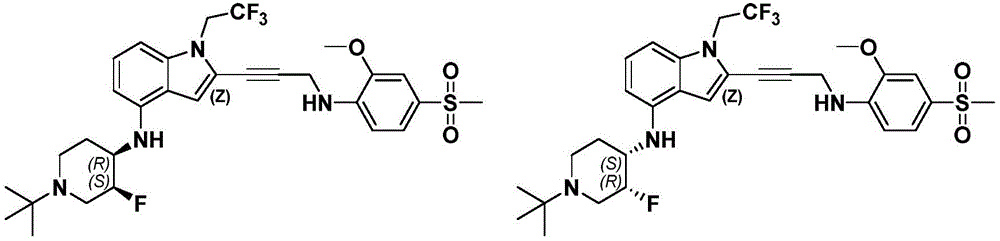
Synthesis of rac-N- (1-tert-butyl-3-fluoro-4-piperidinyl) -2-iodo-1- (2,2, 2-trifluoroethyl) -indol-4-amine 2 Next, to a mixture of 2-iodo-1- (2,2, 2-trifluoroethyl) indol-4-amine (140mg, 371.80. mu. mol,1.0 eq, HCl) and 1-tert-butyl-3-fluoro-piperidin-4-one (193.22mg,1.12mmol,3.0 eq) in EtOH (3mL) at 50 ℃ is added Ti (OEt) in one portion 4 (848.1mg,3.72mmol, 771.01. mu.L, 10.0 equiv.). The reaction mixture was stirred for 14 hours, then NaBH was added 3 CN (233.7mg,3.72mmol,10.0 equiv.), then the reaction was heated to 50 ℃ and stirred for 2 hours. TLC and LCMS analysis showed the desired mass. The aqueous phase was extracted with EtOAc (20mL x 3) and water (30 mL). The combined organic phases were washed with brine (20 mL. times.3) over anhydrous Na 2 SO 4 Dried, filtered and concentrated under reduced pressure. The crude product was passed through preparative TLC (SiO) 2 DCM/MEOH ═ 10:1) was purified to give rac-N- ((3S,4R) -1- (tert-butyl) -3-fluoropiperidin-4-yl) -2-iodo-1- (2,2, 2-trifluoroethyl) -1H-indol-4-amine as a yellow oil (90mg, 49% yield) and rac-N- ((3R,4R) -1- (tert-butyl) -3-fluoropiperidin-4-yl) -2-iodo-1- (2,2, 2-trifluoroethyl) -1H-indol-4-amine as a yellow oil (45mg, 24% yield). LC-MS (ES) + ,m/z):498.2[(M+H) + ]。
N- [ (3S,4R) -1-tert-butyl-3-fluoro-4-piperidinyl]-2- [3- (2-methoxy-4-methylsulfonyl-anilino) prop-1-ynyl]-1- (2,2, 2-trifluoroethyl) indol-4-amine and N- [ (3R,4S) -1-tert-butyl-3-fluoro-4-piperidinyl]-2- [3- (2-methoxy-4-methylsulfonyl-anilino) prop-1-ynyl]Synthesis of (E) -1- (2,2, 2-trifluoroethyl) indol-4-amine at N 2 Next, to a mixture of rac-N- ((3S,4R) -1- (tert-butyl) -3-fluoropiperidin-4-yl) -2-iodo-1- (2,2, 2-trifluoroethyl) -1H-indol-4-amine (90.0mg, 162.88. mu. mol,1.0 equiv.) and 2-methoxy-4-methylsulfonyl-N-prop-2-ynyl-aniline (77.95mg, 325.75. mu. mol,2.0 equiv.) in DMSO (2mL) at 25 ℃ were added CuI (310.2ug, 1.63. mu. mol,0.1 equiv.), N-isopropylprop-2-amine (164.8mg,1.63mmol, 230. mu.L, 10.0 equiv.) and Pd (PPh) 3 ) 4 (9.4mg, 8.14. mu. mol,0.1 eq.) then the reaction was stirred for 1 hour. LCMS analysis showed the desired product. The residue was poured into a saturated EDTA solution (20mL) and the biphasic mixture was stirred for 120 min. The layers were separated and the aqueous phase was extracted with EtOAc (20mL x 3). The combined organic phases were washed with brine (20 mL. times.3) and over anhydrous Na 2 SO 4 Dry, filter and concentrate to dryness under reduced pressure. The crude residue was purified by preparative HPLC (Waters Xbridge Prep OBD C18150 x 40mM,10 um; mobile phase: [ water (10mM NH. RTM.) ] 4 HCO 3 )-ACN](ii) a 60% -80% of B%, 8 minutes) to obtain rac-N- [ (3S,4R) -1-tert-butyl-3-fluoro-4-piperidyl]-2- [3- (2-methoxy-4-methylsulfonyl-anilino) prop-1-ynyl]-1- (2,2, 2-trifluoroethyl) indol-4-amine as a white solid (40mg, 36% yield). LC-MS (ES) + ,m/z):609.2[(M+H) + ]。
Then, the mixture was passed through chiral SFC (WHELK-01, 0.1% NH) 3 H 2 O, EtOH) coupling rac-N- [ (3S,4R) -1-tert-butyl-3-fluoro-4-piperidinyl]-2- [3- (2-methoxy-4-methylsulfonyl-anilino) prop-1-ynyl]Enantiomeric separation of (E) -1- (2,2, 2-trifluoroethyl) indol-4-amine gives: n- [ (3S,4R) -1-tert-butyl-3-fluoro-4-piperidinyl]-2- [3- (2-methoxy-4-methylsulfonyl-anilino) prop-1-ynyl]-1- (2,2, 2-trifluoroethyl) indol-4-amine (pre-peak): 13.4mg, 37% yield. LC-MS (ES) + ,m/z):609.3[(M+H) + ](ii) a N- [ (3R,4S) -1-tert-butyl-3-fluoro-4-piperidinyl]-2- [3- (2-methoxy-4-methylsulfonyl-anilino) prop-1-ynyl]-1- (2,2, 2-trifluoroethyl) indol-4-amine (back peak): 15.2mg, 42% yield. LC-MS (ES) + ,m/z):609.3[(M+H) + ]。
Example D176: preparation of 4- [3- [4- [ [ (3S,4R) -1-tert-butyl-3-fluoro-4-piperidinyl ] amino ] -1- (2,2, 2-trifluoroethyl) indol-2-yl ] prop-2-ynylamino ] -3-methoxy-benzoic acid and 4- [3- [4- [ [ (3R,4S) -1-tert-butyl-3-fluoro-4-piperidinyl ] amino ] -1- (2,2, 2-trifluoroethyl) indol-2-yl ] prop-2-ynylamino ] -3-methoxy-benzoic acid
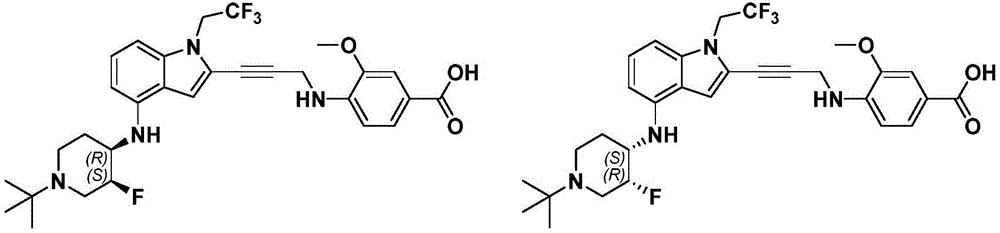
Synthesis of 3-methoxy-4- (prop-2-ynylamino) benzoate 4- [ tert-butoxycarbonyl (prop-2-ynylamino) amino ] methyl ester at 25 deg.C]A mixture of methyl-3-methoxy-benzoate (400mg,1.25mmol,1.0 equiv.) in DCM (5mL) was added TFA (1.54g,13.51mmol,1mL,10.9 equiv.) in one portion. The mixture was stirred for 2 hours. LCMS analysis showed the reaction was complete. Adding saturated NaHCO 3 The solution was adjusted to pH 8. The aqueous phase was extracted with EtOAc (20mL x 3). The combined organic phases were washed with brine (20 mL. times.3) over anhydrous Na 2 SO 4 Drying, filtration and concentration under reduced pressure gave the desired product as a yellow oil (270mg, crude). LC-MS (ES) + ,m/z):220.1[(M+H) + ]
Synthesis of 3-methoxy-4- (prop-2-ynylamino) benzoic acid to a mixture of crude methyl 3-methoxy-4- (prop-2-ynylamino) benzoate (270mg,1.23mmol,1.0 equiv.) in MeOH (2mL) and water (0.5mL) at 40 deg.C was added NaOH (147.8mg,3.69mmol,3.0 equiv.) in one portion, and the mixture was stirred for 2 hours. TLC analysis showed the reaction was complete. 2M HCl was added to adjust the solution to pH 6. The aqueous phase was extracted with EtOAc (20mL x 3). The combined organic phases were washed with brine (20 mL. times.3) over anhydrous Na 2 SO 4 Dried, filtered and concentrated under reduced pressure. Trituration of the crude product with EtOAc at 20 ℃ for 10 min afforded 3-methoxy-4- (prop-2-ynylamino) benzoic acid as a white solid (200mg,974.61 μmol, 79.14% yield).
4- [3- [4- [ [ (3S,4R) -1-tert-butyl-3-fluoro-4-piperidinyl]Amino group]-1- (2,2, 2-trifluoroethyl) indol-2-yl]Prop-2-ynylamino]-3-methoxy-benzoic acid and 4- [3- [4- [ [ (3R,4S) -1-tert-butyl-3-fluoro-4-piperidinyl]Amino group]-1- (2,2, 2-trifluoroethyl) indol-2-yl]Prop-2-ynylamino]Synthesis of (E) -3-methoxy-benzoic acid (N) 2 Next, to a mixture of rac-N- ((3S,4R) -1- (tert-butyl) -3-fluoropiperidin-4-yl) -2-iodo-1- (2,2, 2-trifluoroethyl) -1H-indol-4-amine (80mg, 144.78. mu. mol,1.0 equiv.) and 3-methoxy-4- (prop-2-ynylamino) benzoic acid (44.6mg, 217.17. mu. mol,1.5 equiv.) in DMSO (3mL) at 25 ℃ were added CuI (2.76mg, 14.48. mu. mol,0.1 equiv.), N-isopropylprop-2-amine (146.5mg,1.45mmol, 204.61. mu.L, 10.0 equiv.) and Pd (PPh) 3 ) 4 (84mg, 7.24. mu. mol,0.1 equiv). The mixture was then stirred for 3 hours and LCMS analysis showed the reaction was complete. The residue was poured into a saturated EDTA solution (20mL) and stirred for 120 min. The layers were separated and the aqueous phase was extracted with EtOAc (20mL x 3). The combined organic phases were washed with brine (20 mL. times.3) over anhydrous Na 2 SO 4 Dried, filtered and concentrated under reduced pressure. The crude racemic product was first passed through preparative HPLC (Waters Xbridge Prep OBD C18150X 40mM,10 um; mobile phase: [ water (10mM NH. sub.H.) 4 HCO 3 )-ACN](ii) a B% 60% -80%, 8 min), then passing chiral SFC: (1) OJ, MeOH — IPAm) to give: 4- [3- [4- [ [ (3S,4R) -1-tert-butyl-3-fluoro-4-piperidinyl]Amino group]-1- (2,2, 2-trifluoroethyl) indol-2-yl]Prop-2-ynylamino]-3-methoxy-benzoic acid (pre-peak): 12.9mg, 16% yield. LC-MS (ES) + ,m/z):588.3[(M+H) + ](ii) a And 4- [3- [4- [ [ (3R,4S) -1-tert-butyl-3-fluoro-4-piperidinyl]Amino group]-1- (2,2, 2-trifluoroethyl) indol-2-yl]Prop-2-ynylamino]-3-methoxy-benzoic acid (late peak): 16.8mg, 20% yield. LC-MS (ES) + ,m/z):588.3[(M+H) + ]
Example D177: preparation of 4- [3- [4- [ [ (3S,4R) -1-tert-butyl-3-fluoro-4-piperidinyl ] amino ] -1- (2,2, 2-trifluoroethyl) indol-2-yl ] -prop-2-ynylamino ] -3-methoxy-N-methyl-benzamide and 4- [3- [4- [ [ (3R,4S) -1-tert-butyl-3-fluoro-4-piperidinyl ] amino ] -1- (2,2, 2-trifluoroethyl) indol-2-yl ] prop-2-ynylamino ] -3-methoxy-N-methyl-benzamide.

In N 2 Next, to a mixture of rac-N- ((3S,4R) -1- (tert-butyl) -3-fluoropiperidin-4-yl) -2-iodo-1- (2,2, 2-trifluoroethyl) -1H-indol-4-amine (160mg, 289.56. mu. mol,1.0 equiv.) and 3-methoxy-N-methyl-4- (prop-2-ynylamino) benzamide (126.39mg, 579.12. mu. mol,2.0 equiv.) in DMSO (4mL) at 25 ℃ was added CuI (551.5 u. mu. mol)g, 2.90. mu. mol,0.1 equiv), N-isopropylpropan-2-amine (293.0mg,2.90mmol, 409.22. mu.L, 10.0 equiv) and Pd (PPh) 3 ) 4 (16.7mg, 14.48. mu. mol,0.1 equiv.). The reaction mixture was then stirred for 3 hours. LCMS analysis showed the desired product. Saturated EDTA solution (20mL) was added and the mixture was stirred for 2 hours. The phases were separated and the aqueous phase was extracted with EtOAc (20mL x 3). The combined organic phases were washed with brine (20 mL. times.3) over anhydrous Na 2 SO 4 Dry, filter and concentrate to dryness under reduced pressure. The crude racemic product was first passed through preparative HPLC (Waters Xbridge Prep OBD C18150 x 40mM,10 um; mobile phase: 10mM NH) 4 HCO 3 -MeCN; b% 60% -80%, 8 min) and then separating the enantiomers by chiral SFC (ChiralPak AD, isopropyl alcohol IPAm) to yield: 4- [3- [4- [ [ (3S,4R) -1-tert-butyl-3-fluoro-4-piperidinyl]Amino group]-1- (2,2, 2-trifluoroethyl) indol-2-yl ]-prop-2-ynylamino]-3-methoxy-N-methyl-benzamide (pre-peak): 52.6mg, 31% yield. LC-MS (ES) + ,m/z):588.3[(M+H) + ](ii) a 4- [3- [4- [ [ (3R,4S) -1-tert-butyl-3-fluoro-4-piperidinyl]Amino group]-1- (2,2, 2-trifluoroethyl) indol-2-yl]Prop-2-ynylamino]-3-methoxy-N-methyl-benzamide (back peak): 33.7mg, 19.6% yield. LC-MS (ES) + ,m/z):588.3[(M+H) + ]。
Example D178: preparation of 4- { [3- (4- { [ (3S,4R) -1-ethyl-3-fluoropiperidin-4-yl ] amino } -1- (2,2, 2-trifluoroethyl) -1H-indol-2-yl) prop-2-yn-1-yl ] amino } -3-methoxy-N-methylbenzamide and 4- { [3- (4- { [ (3R,4S) -1-ethyl-3-fluoropiperidin-4-yl ] amino } -1- (2,2, 2-trifluoroethyl) -1H-indol-2-yl) prop-2-yn-1-yl ] amino } -3-methoxy-N-methylbenzamide.
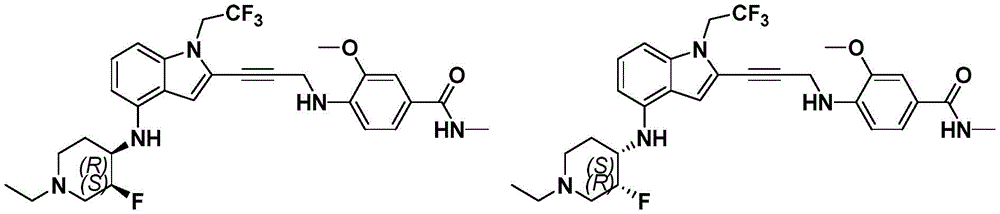
N- [ (3S,4R) -1-ethyl-3-fluoro-4-piperidinyl]Synthesis of (E) -2-iodo-1- (2,2, 2-trifluoroethyl) indol-4-amine (E) -N- [ (3S,4R) -3-fluoro-4-piperidinyl]A solution of (E) -2-iodo-1- (2,2, 2-trifluoroethyl) indol-4-amine (200mg, 453.30. mu. mol,1.0 eq) in DMF (4ml) was added K 2 CO 3 (125.3mg,906.61 μmol,2.0 equivalents) and iodoethane (106.1mg,679.96 μmol,54.38 μ L,1.5 equivalents). The reaction mixture was stirred at 20 ℃ for 2 hours. LCMS and TLC analysis (SiO) 2 DCM/MEOH ═ 10:1) showed the reaction was complete. The reaction was quenched by the addition of water (20mL) and the mixture was extracted with EtOAc (20mL x 3). The combined organic phases were washed with brine (20 mL. times.3) and over anhydrous Na 2 SO 4 Dried, filtered and concentrated in vacuo. The crude product was passed through preparative TLC (SiO) 2 DCM/MEOH ═ 10:1) purification to give N- [ (3S,4R) -1-ethyl-3-fluoro-4-piperidinyl]-2-iodo-1- (2,2, 2-trifluoroethyl) indol-4-amine as a yellow oil (190mg, 89% yield). LC-MS (ES) + ,m/z):470.1[(M+H) + ]。
4- [3- [4- [ [ (3S,4R) -1-ethyl-3-fluoro-4-piperidinyl]Amino group]-1- (2,2, 2-trifluoroethyl) indol-2-yl]Prop-2-ynylamino]-3-methoxy-N-methyl-benzamide and 4- [3- [4- [ [ (3R,4S) -1-ethyl-3-fluoro-4-piperidinyl]Amino group]-1- (2,2, 2-trifluoroethyl) indol-2-yl]Prop-2-ynylamino]Synthesis of (E) -3-methoxy-N-methyl-benzamide at 20 ℃ to N- [ (3S,4R) -1-ethyl-3-fluoro-4-piperidinyl]A mixture of-2-iodo-1- (2,2, 2-trifluoroethyl) indol-4-amine (200mg, 426.21. mu. mol,1.0 eq.) and 3-methoxy-N-methyl-4- (prop-2-ynylamino) benzamide (102.32mg, 468.83. mu. mol,1.1 eq.) in DMSO (5ml) was added CuI (8.12mg, 42.62. mu. mol,0.1 eq.), Pd (PPh) 3 ) 4 (24.63mg, 21.31. mu. mol,0.05 eq.) and N-isopropylpropan-2-amine (431.28mg,4.26mmol, 602.34. mu.L, 10.0 eq.), and the reaction was stirred for 1 hour. LCMS analysis showed the reaction was complete. The residue was poured into a saturated EDTA solution (20ml) and stirred for 120 min. The aqueous phase was extracted with EtOAc (30mL x 3). The combined organic phases were washed with brine (30 mL. times.3) over anhydrous Na 2 SO 4 Dried, filtered and concentrated in vacuo. The crude residue was purified by preparative HPLC (Phenomenex Luna C1875 x 30mm,3 um; mobile phase: [ water (0.2% FA) -ACN)](ii) a 20% -40% of B%, 10 minutes) to obtain a racemic product. Then, by chiral SFC (DAICEL CHIRALCEL OJ 250x 30mm,10 um); mobile phase: [ 0.1% NH ] 3 H 2 EtOH solution of O](ii) a 45% -45% of B%, 10 minutes) separating the enantiomers to obtain: 4- [3- [4- [ [ (3S,4R) -1-ethyl-3-fluoro-4-piperidinyl]Amino group]-1- (2,2, 2-trifluoroethyl) indol-2-yl]Prop-2-ynylamino]-3-methoxy-N-methyl-benzamide (38.6mg, 16% yield). LC-MS (ES) + ,m/z):560.1[(M+H) + ](ii) a And 4- [3- [4- [ [ (3R,4S) -1-ethyl-3-fluoro-4-piperidinyl]Amino group]-1- (2,2, 2-trifluoroethyl) indol-2-yl]Prop-2-ynylamino]-3-methoxy-N-methyl-benzamide (27mg, 11% yield). LC-MS (ES) + ,m/z):560.1[(M+H) + ]。
Table 4 shows compounds with a 2-ethynyl-N- (heterocyclyl) -1H-indol-4-amine core.
TABLE 4


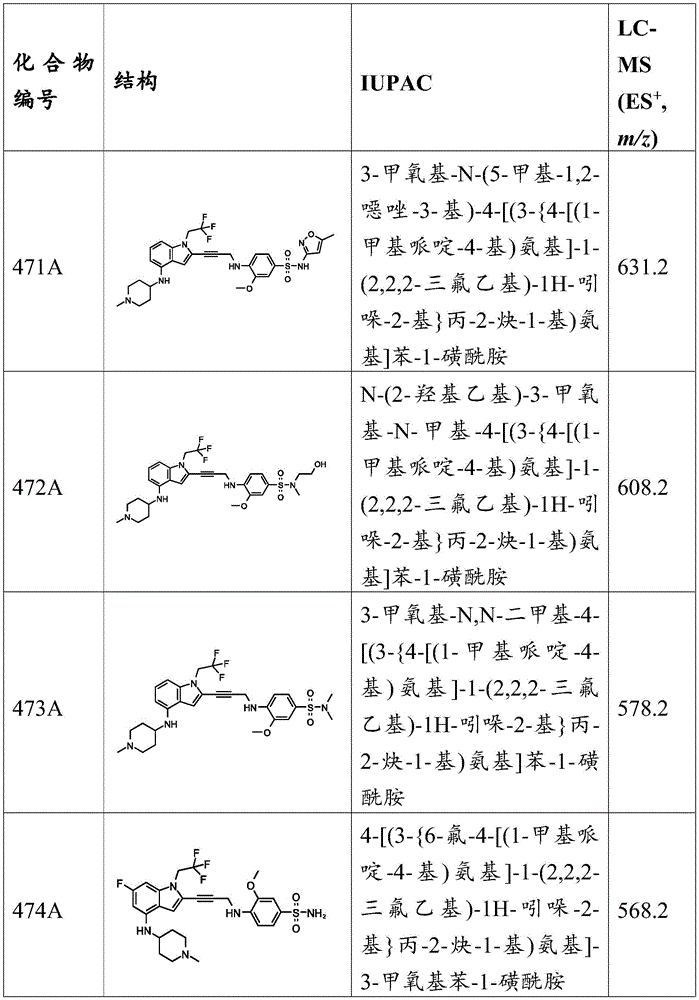
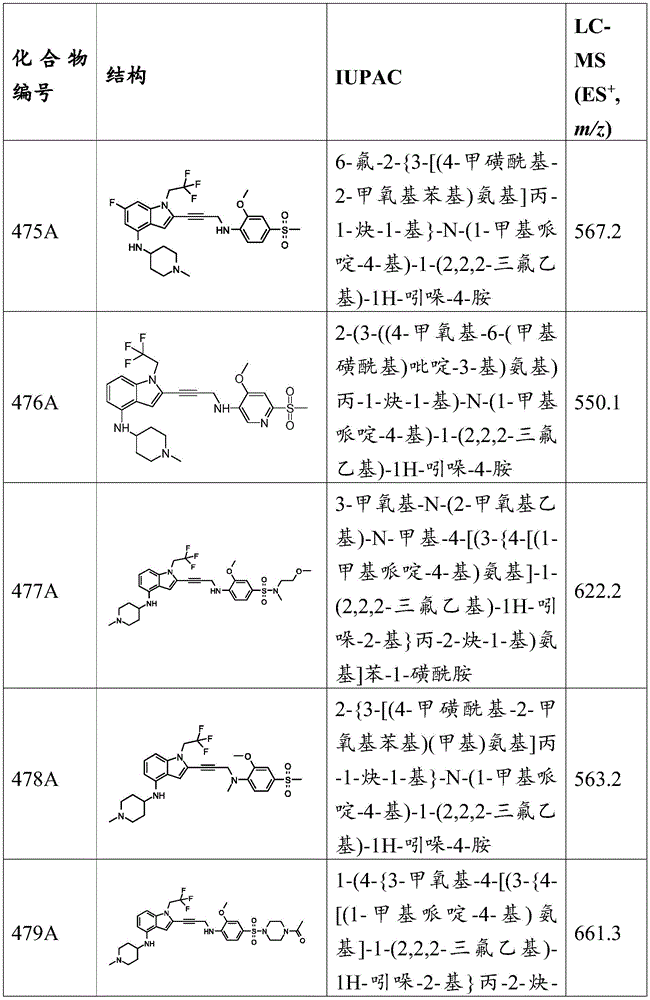

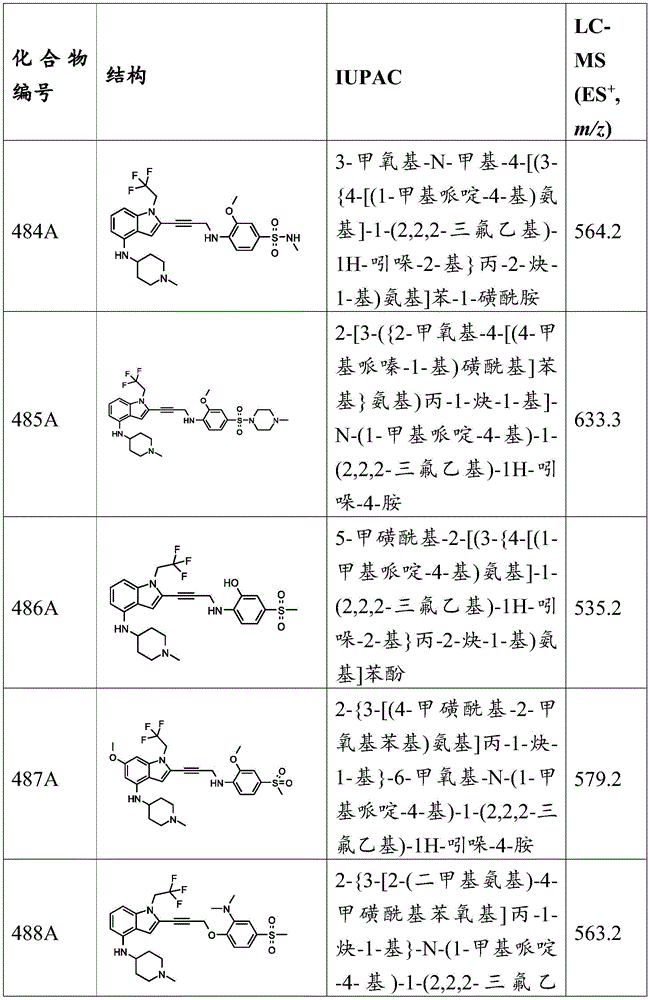
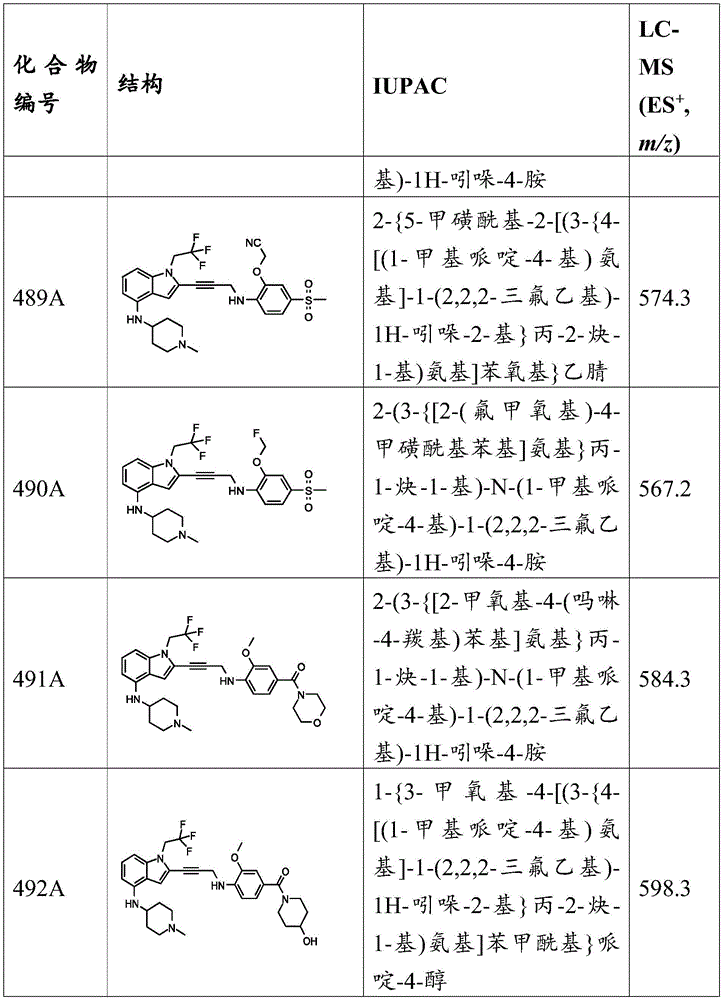


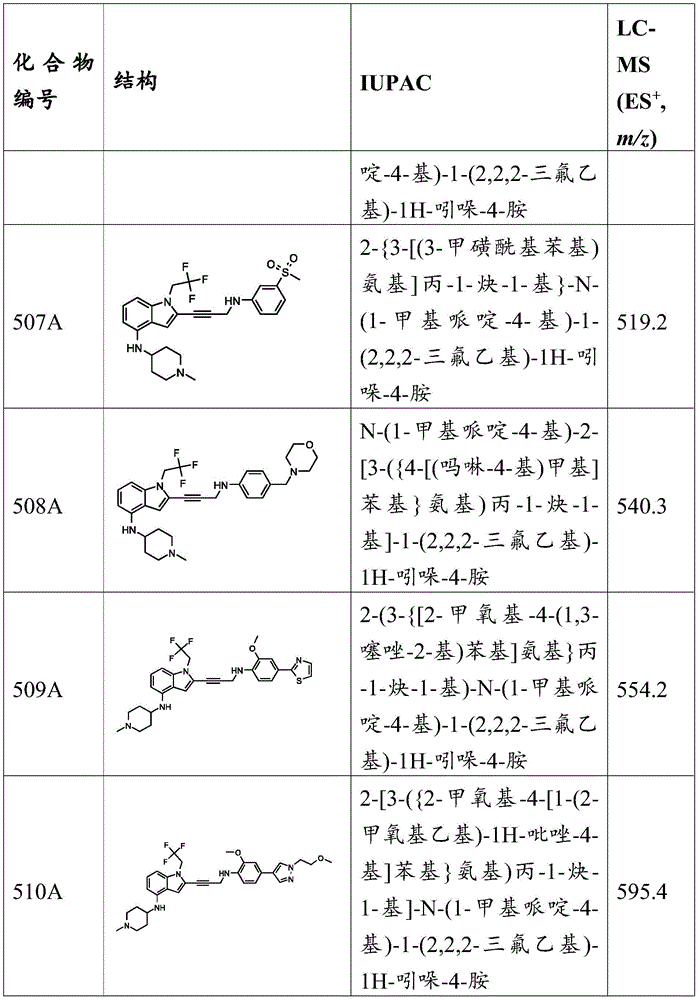


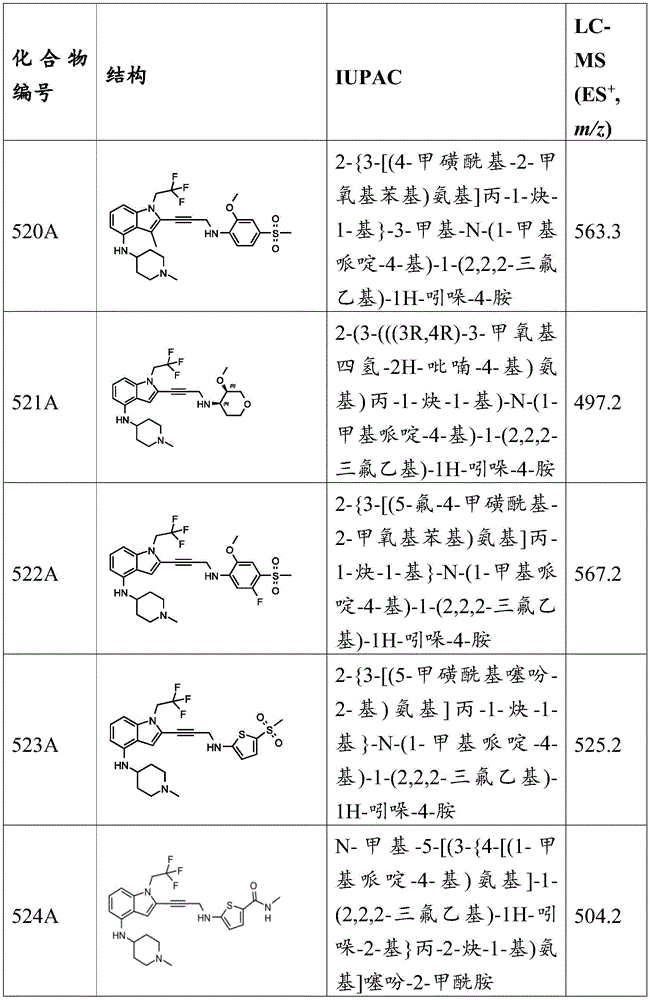


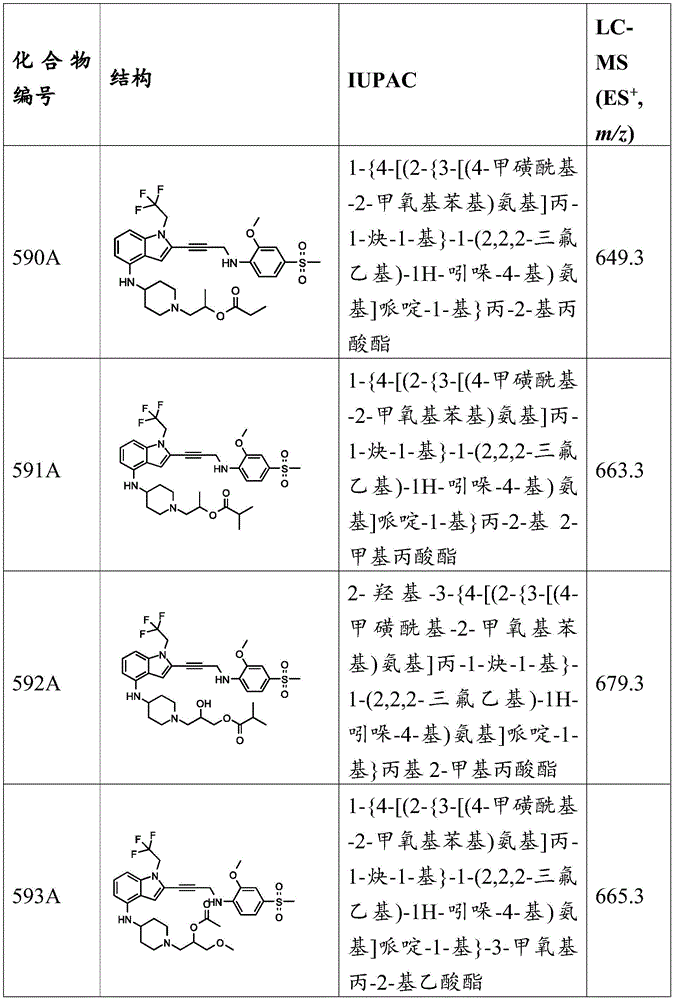
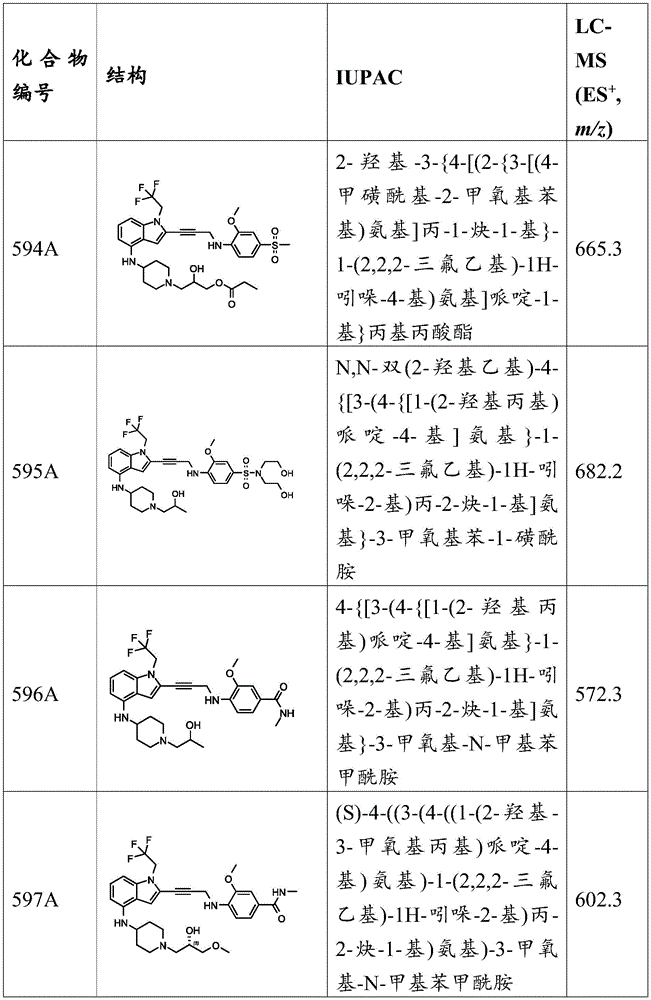


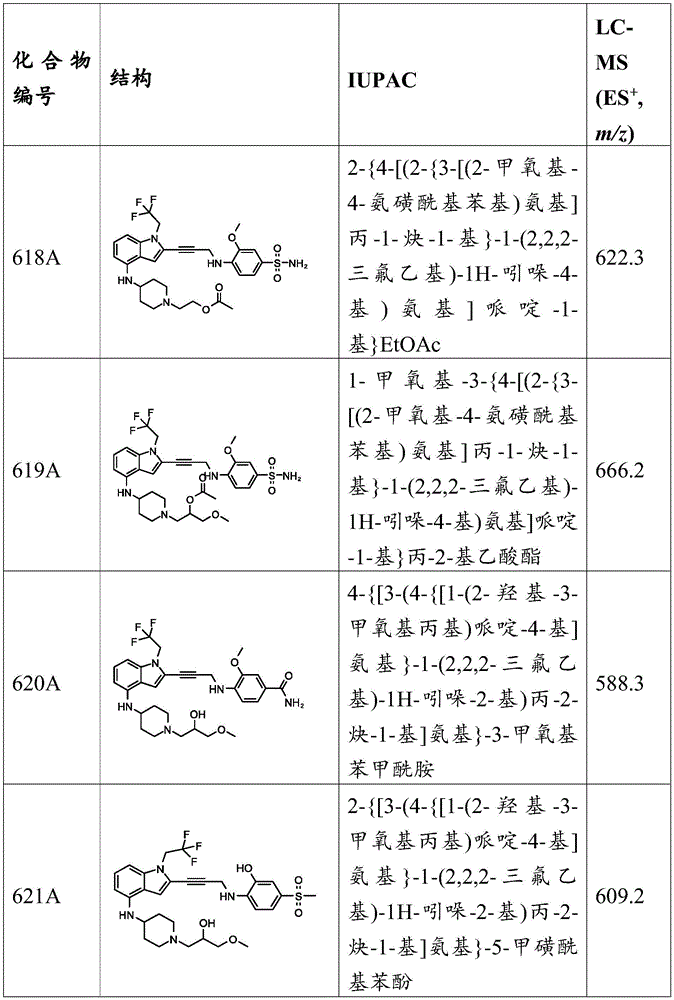

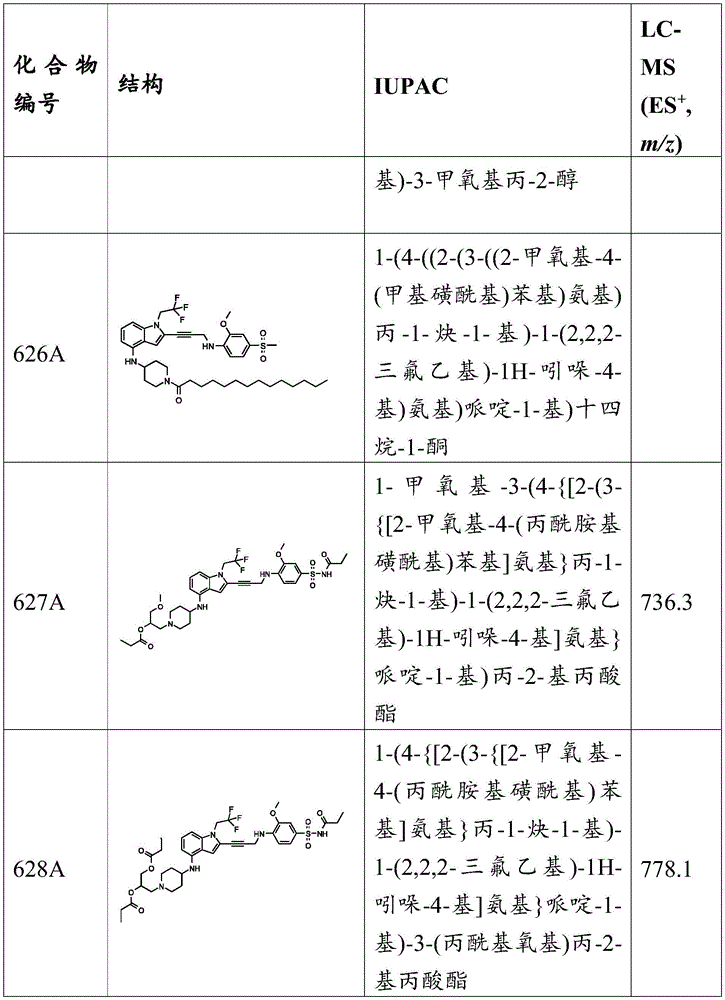

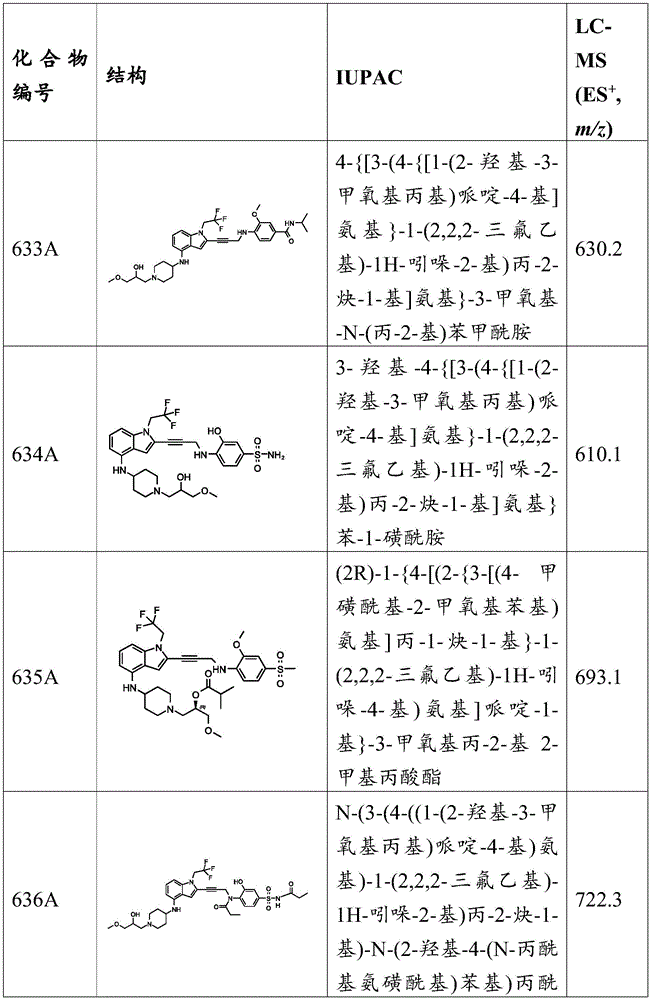

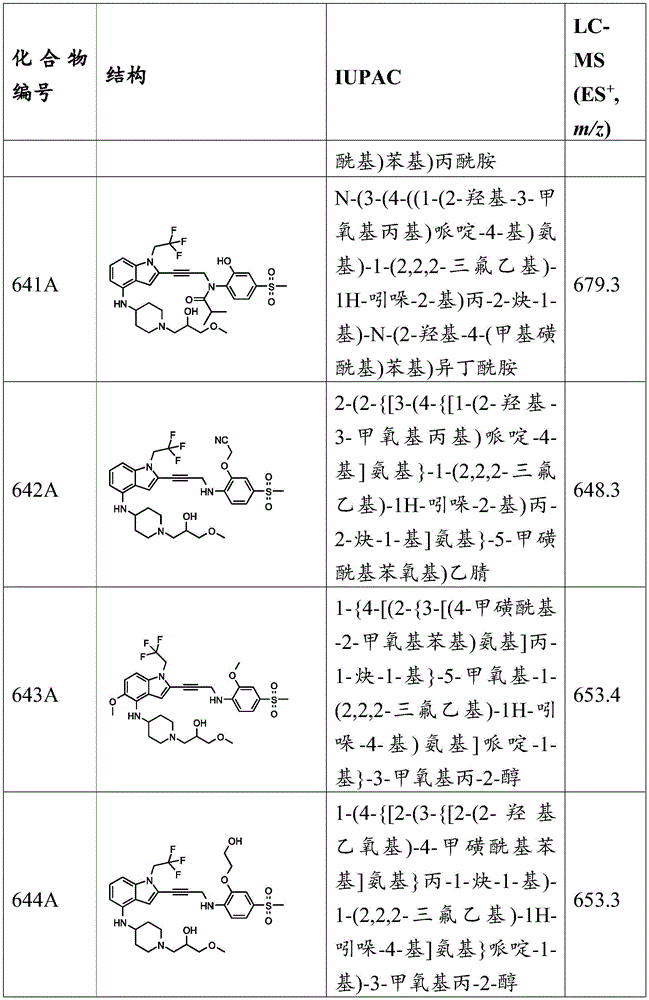
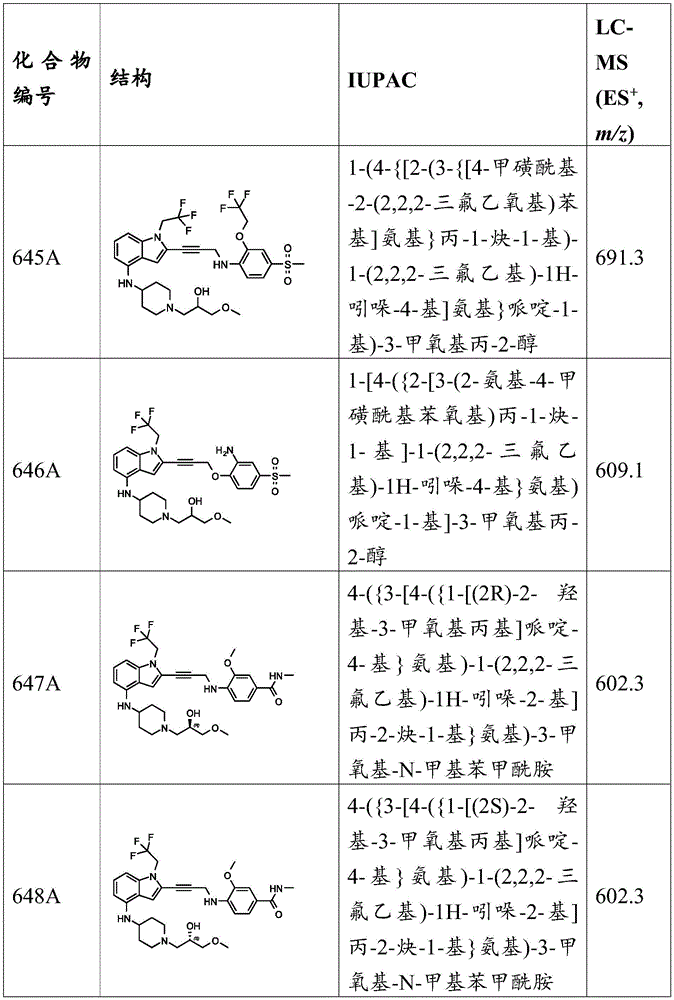

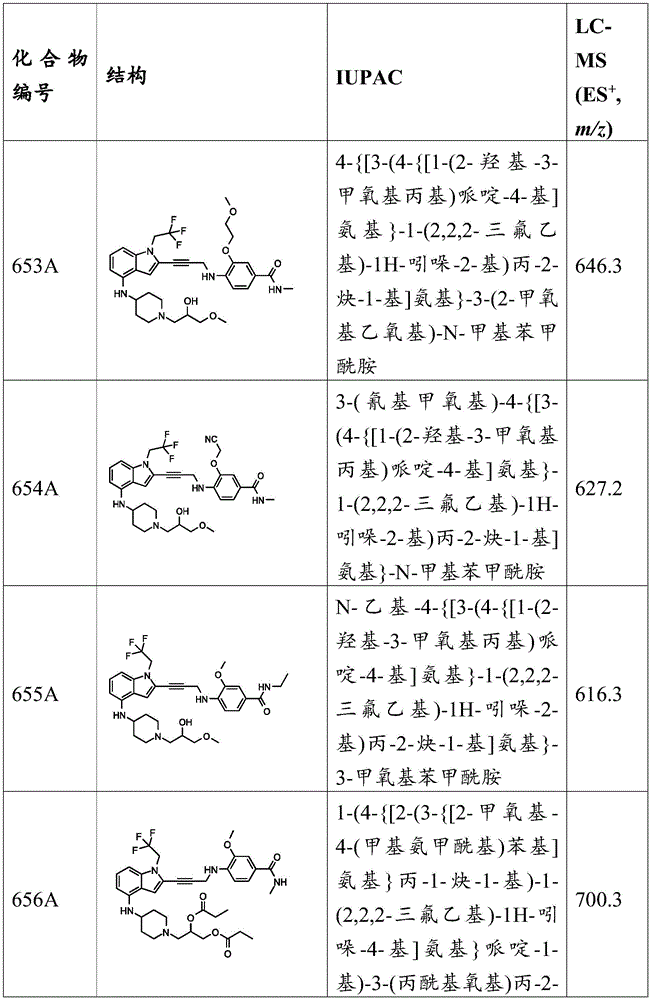
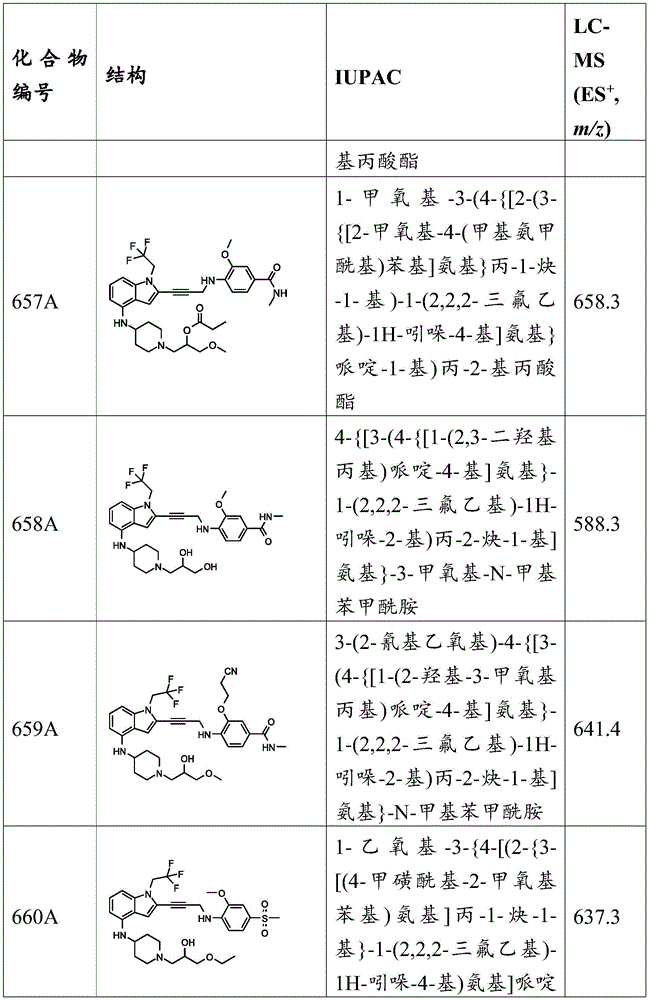

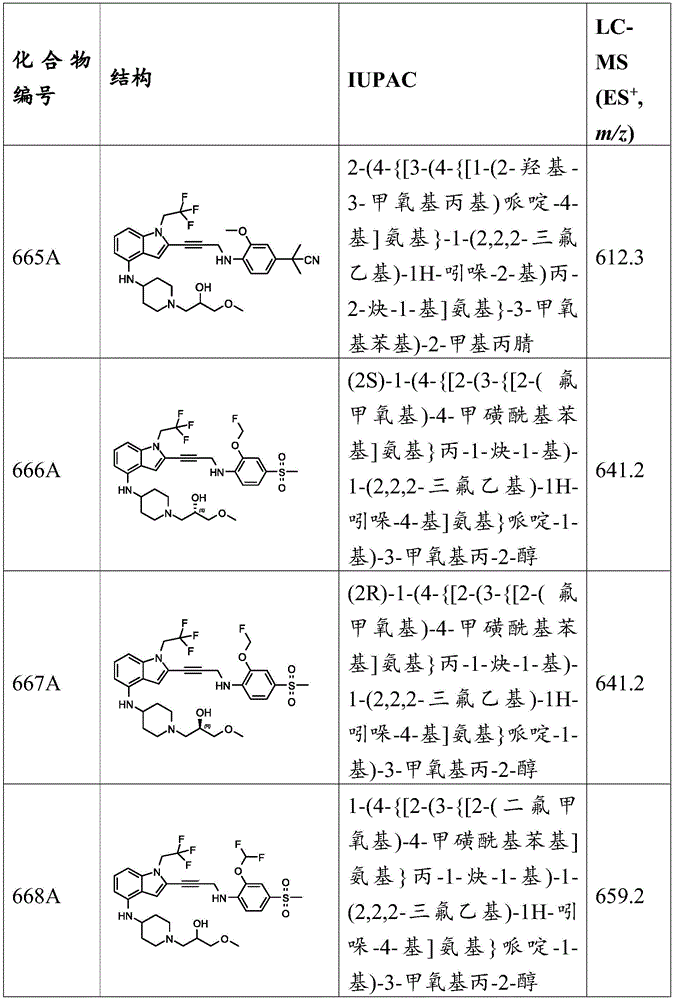


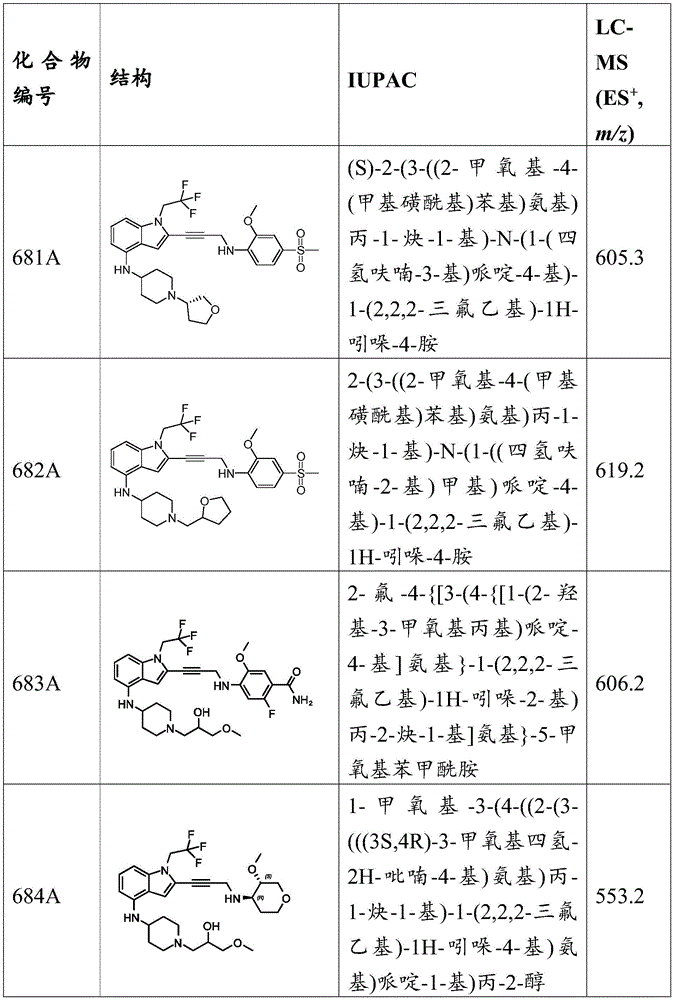

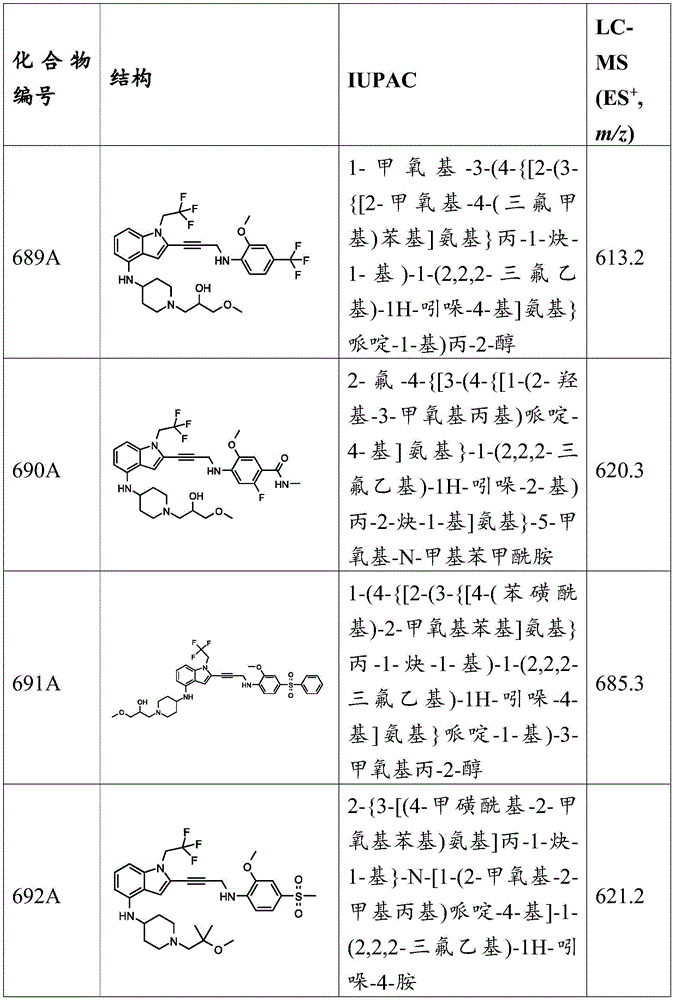

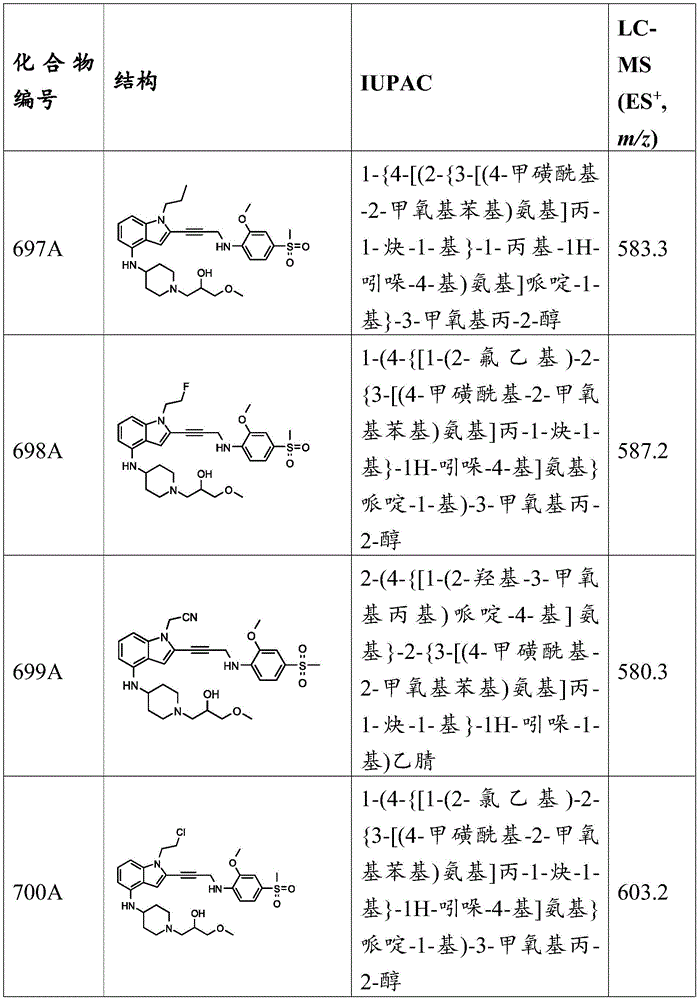
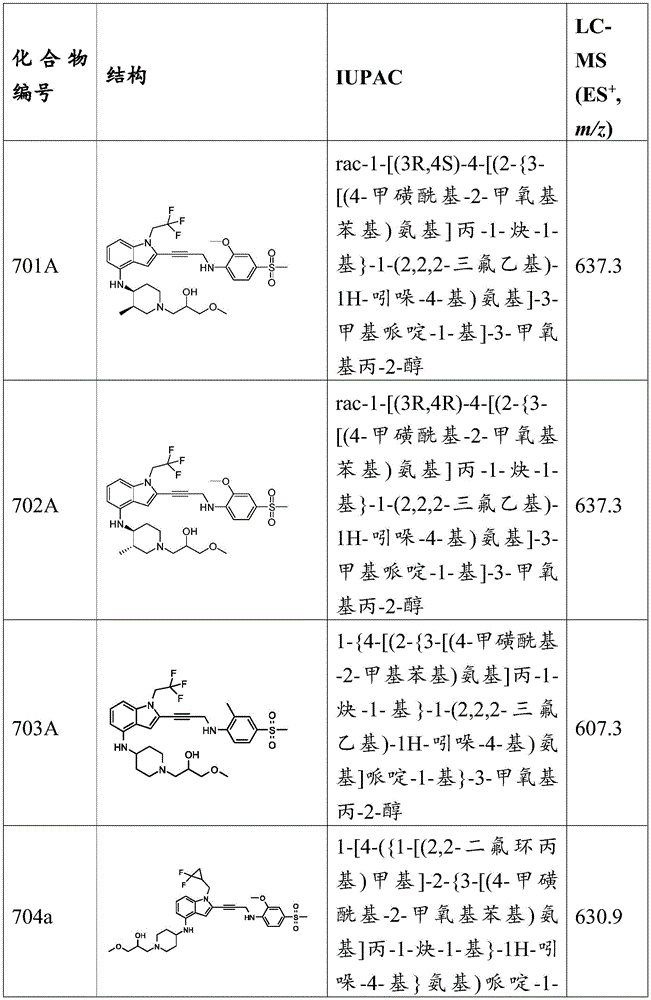


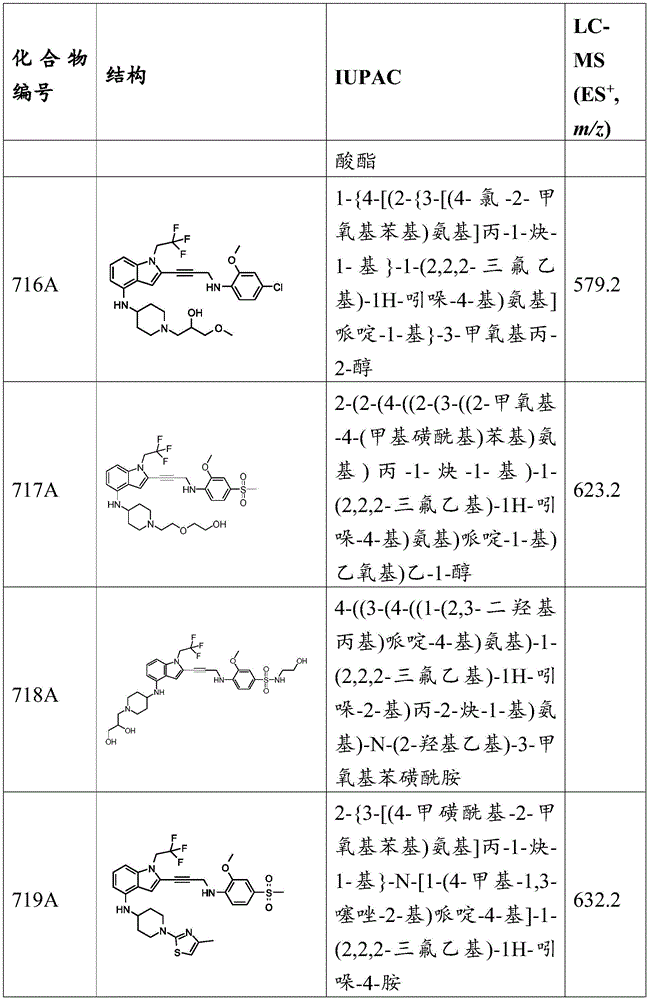


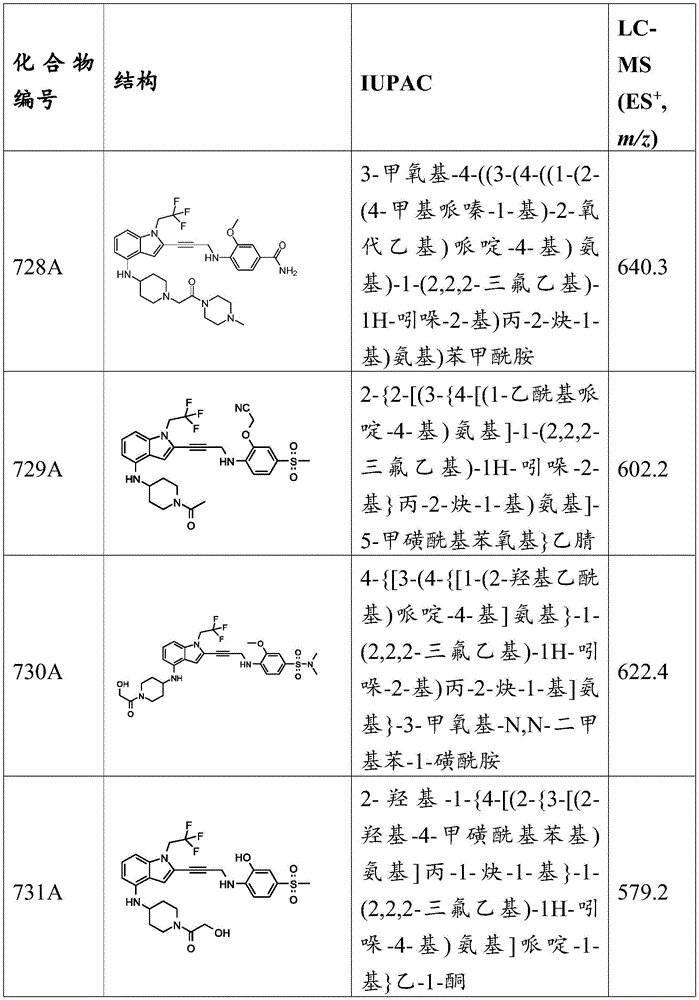


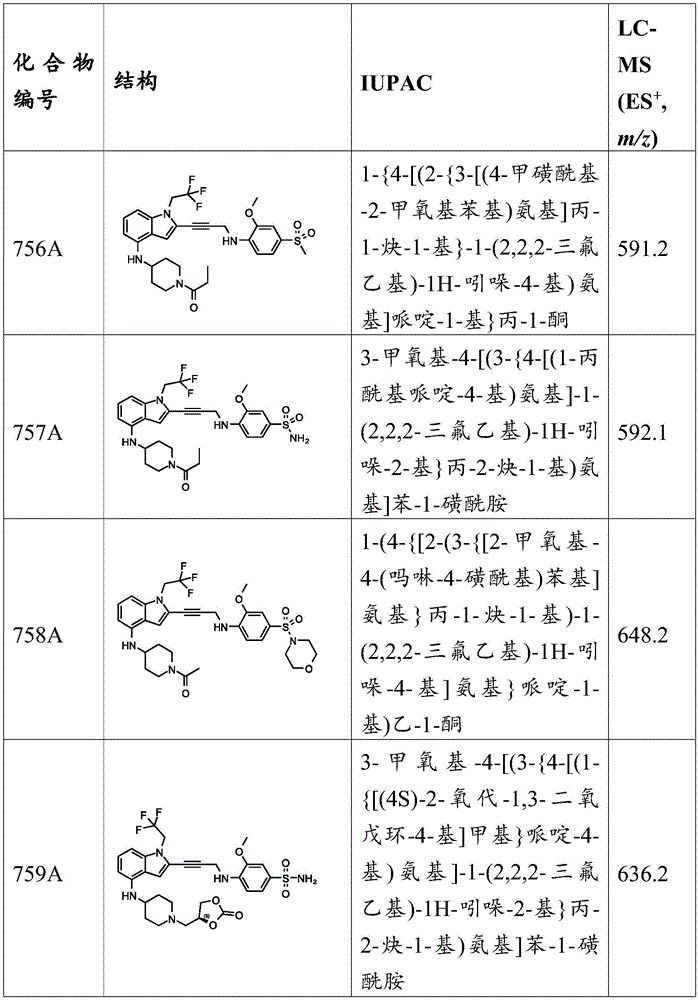


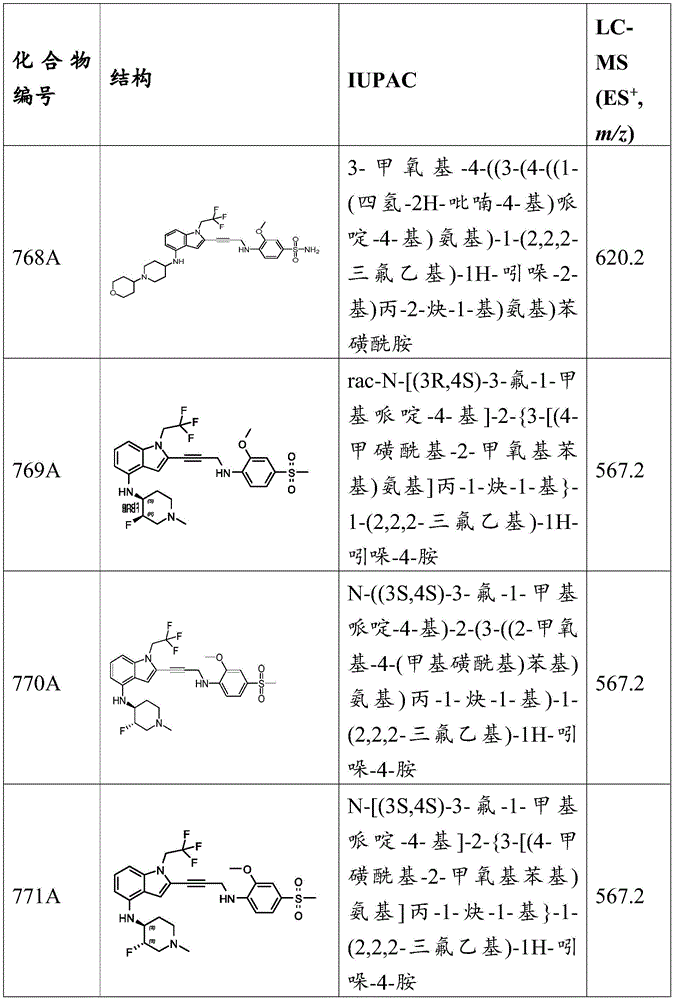
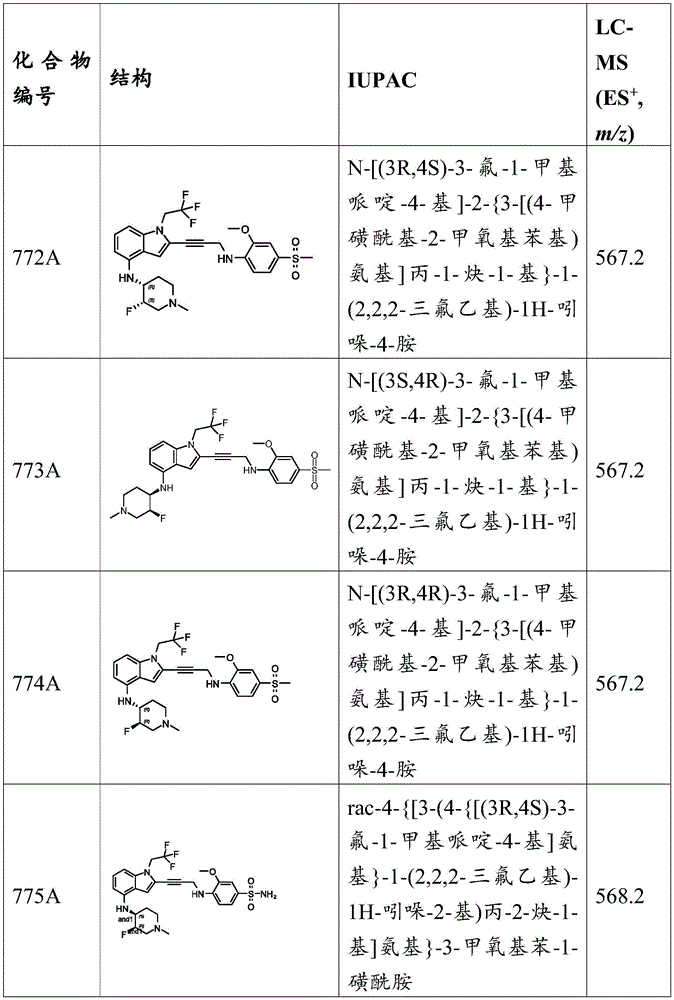
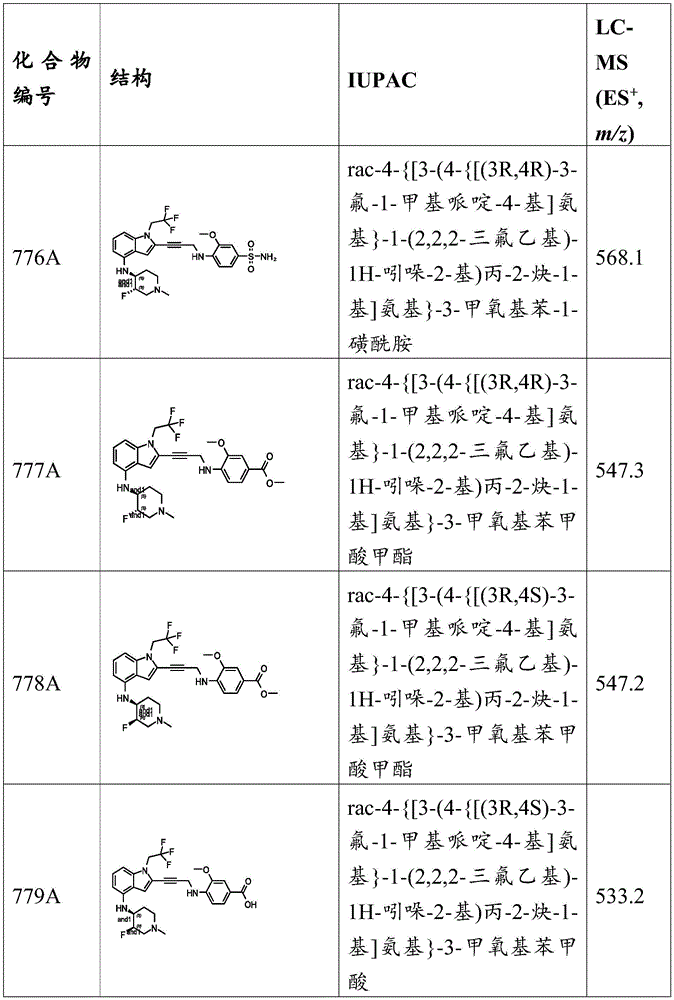


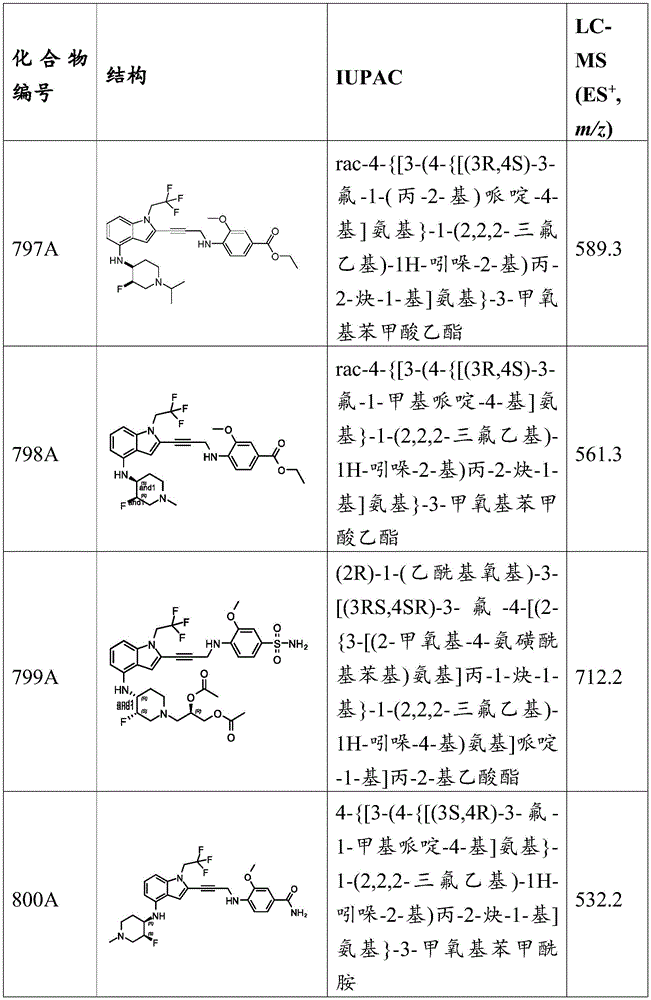

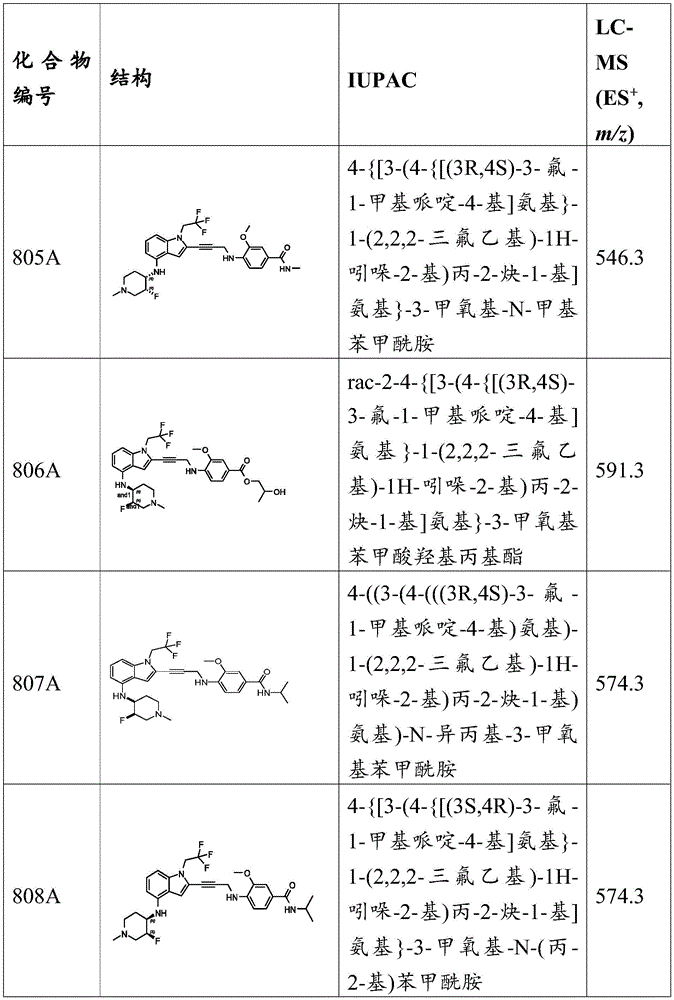
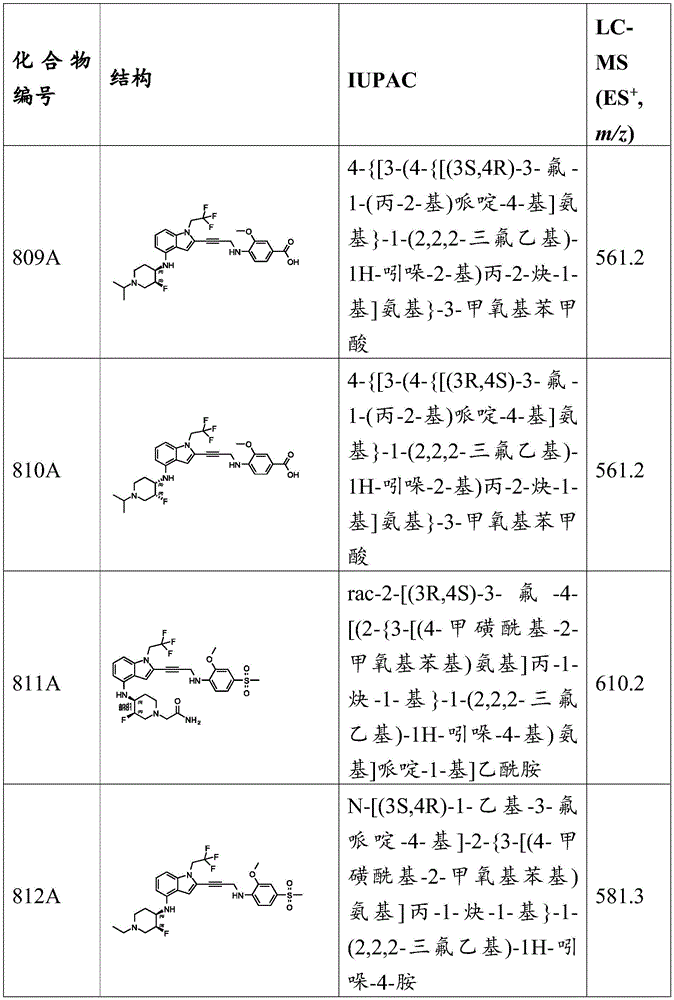


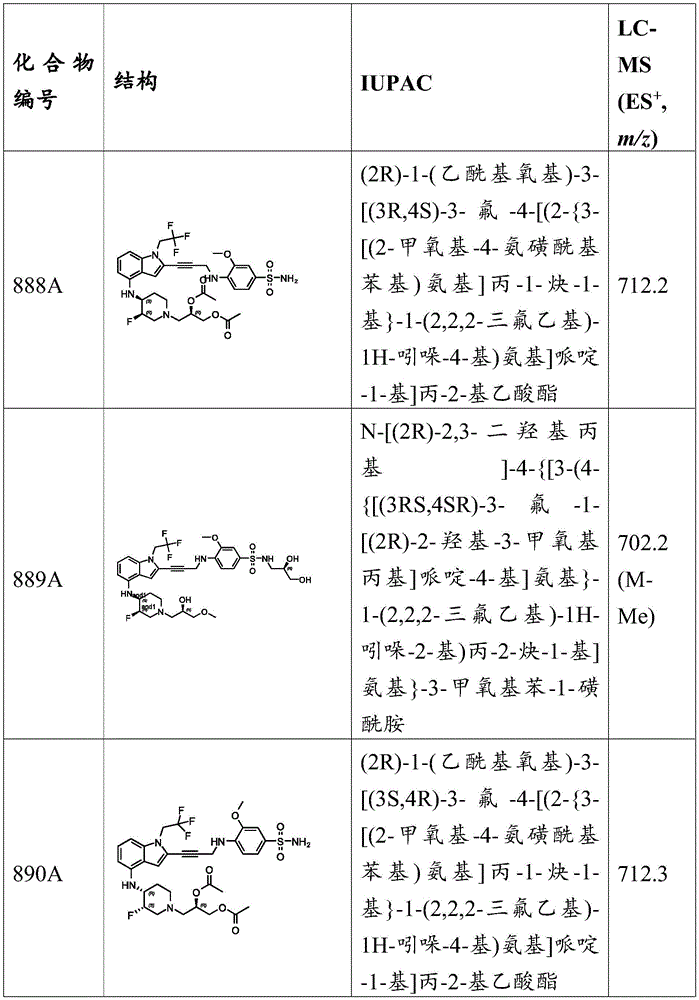

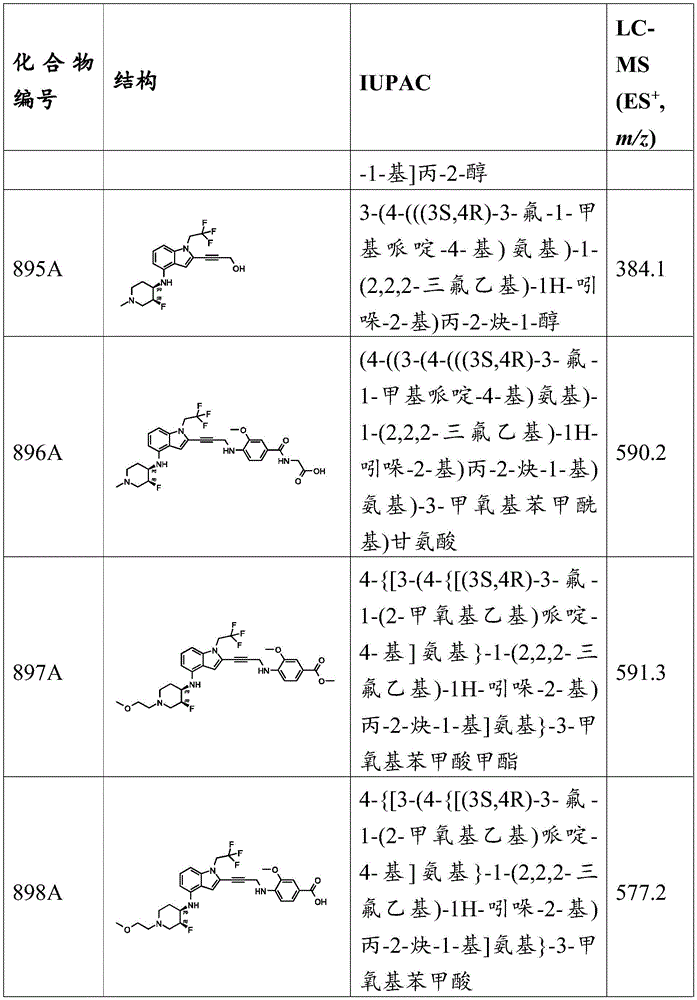


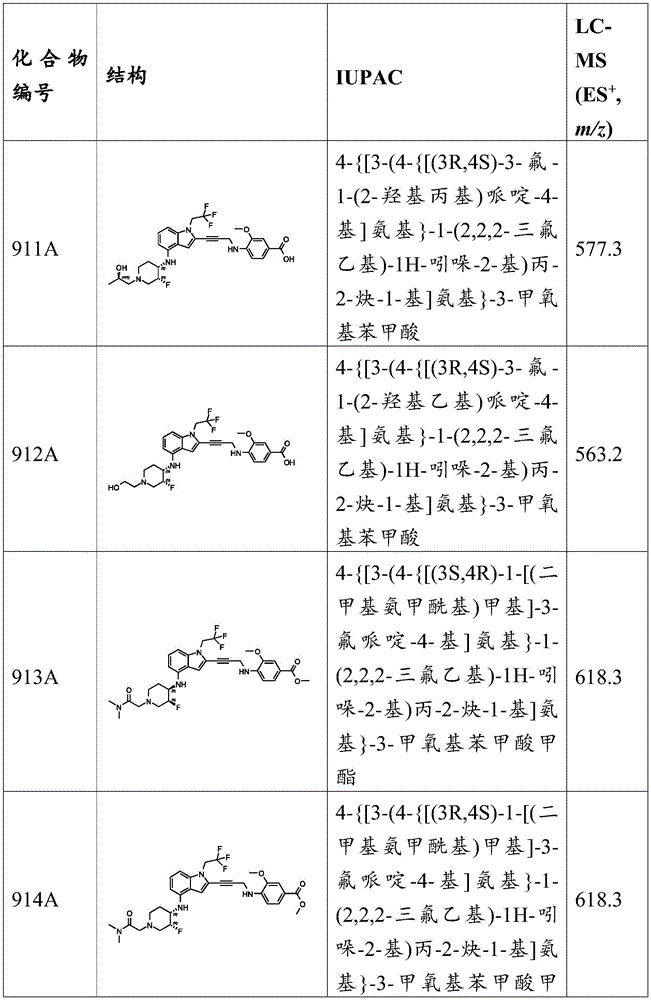


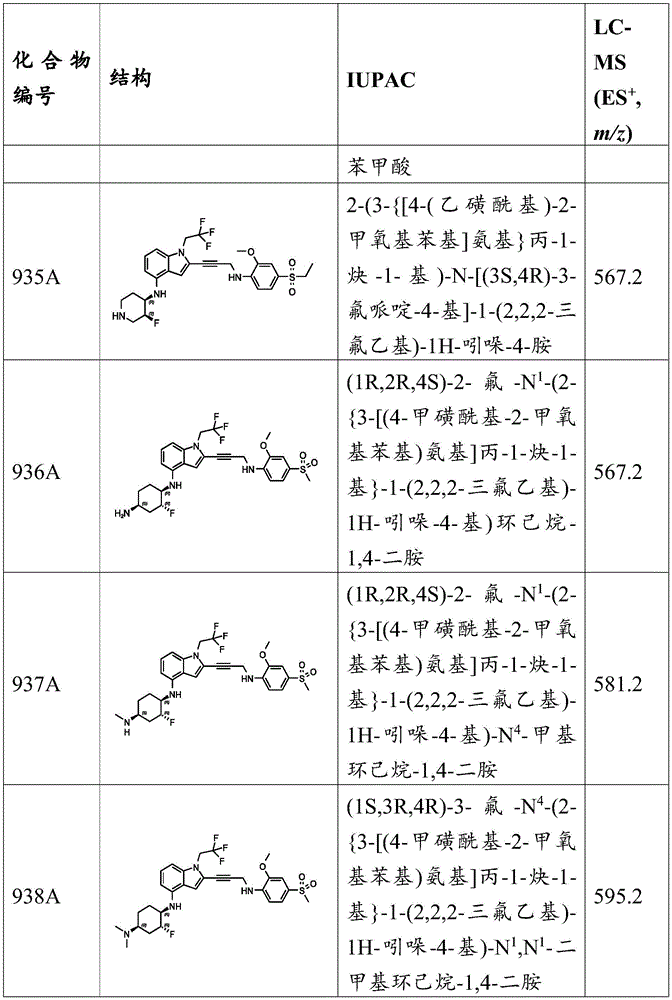
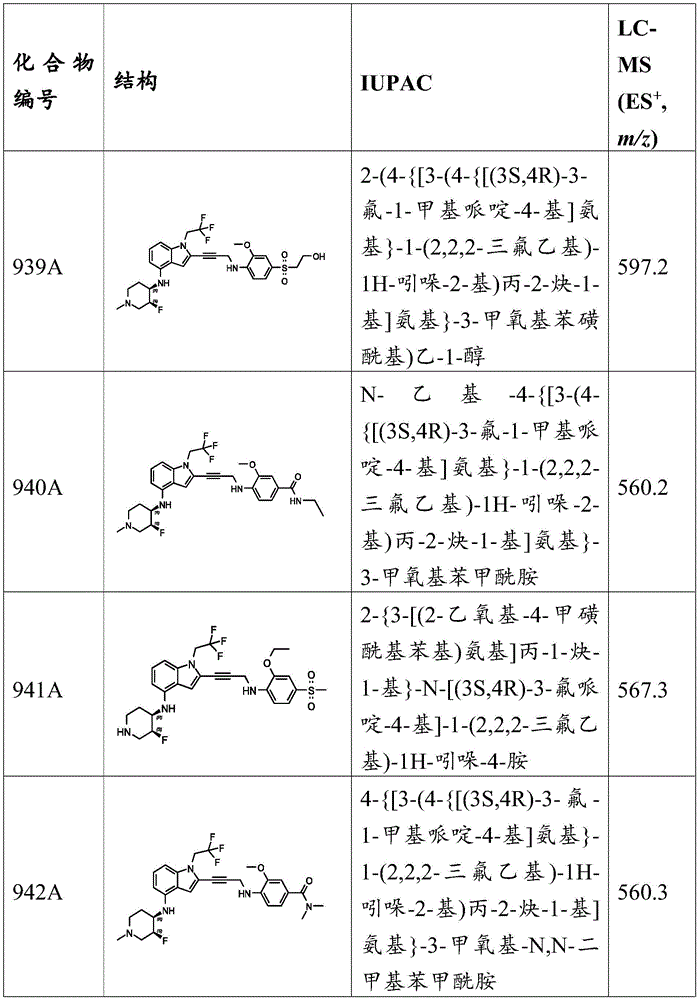

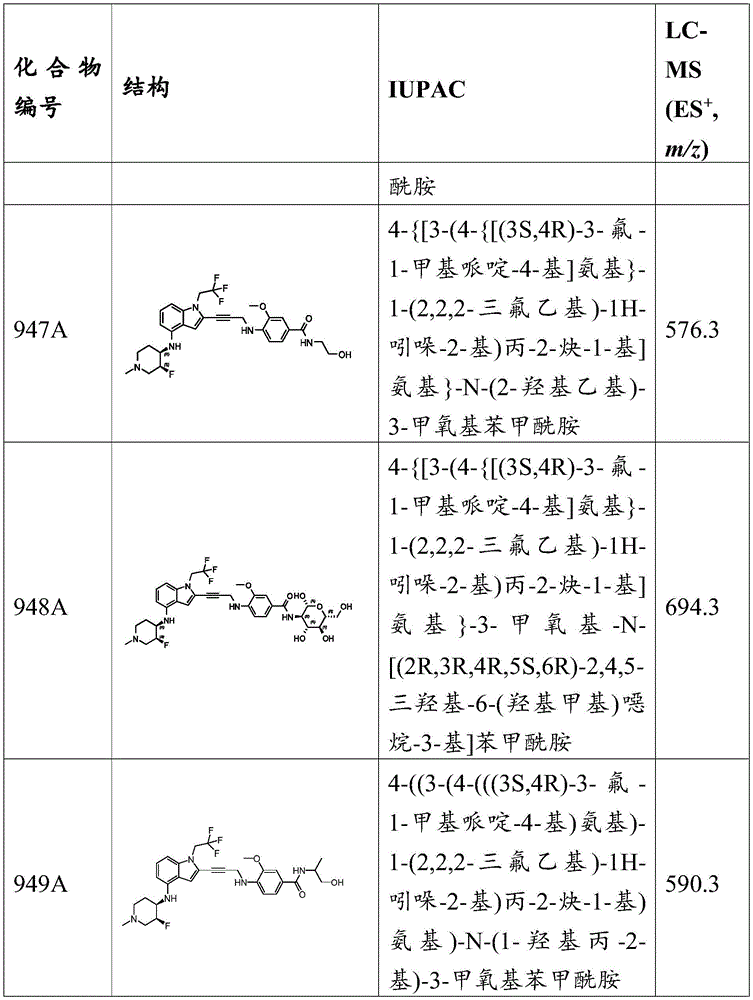


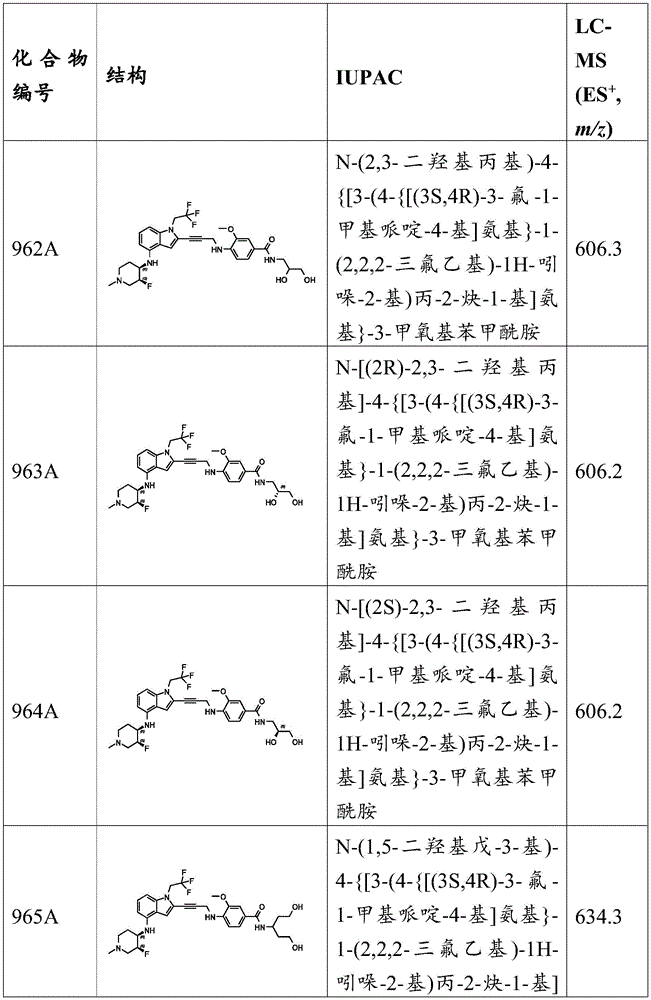


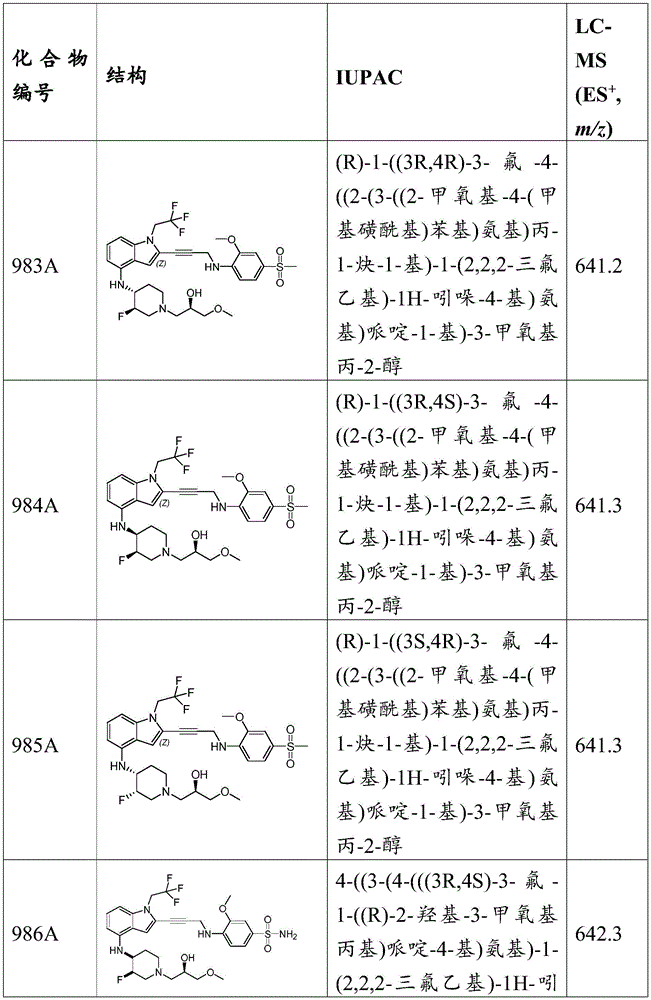

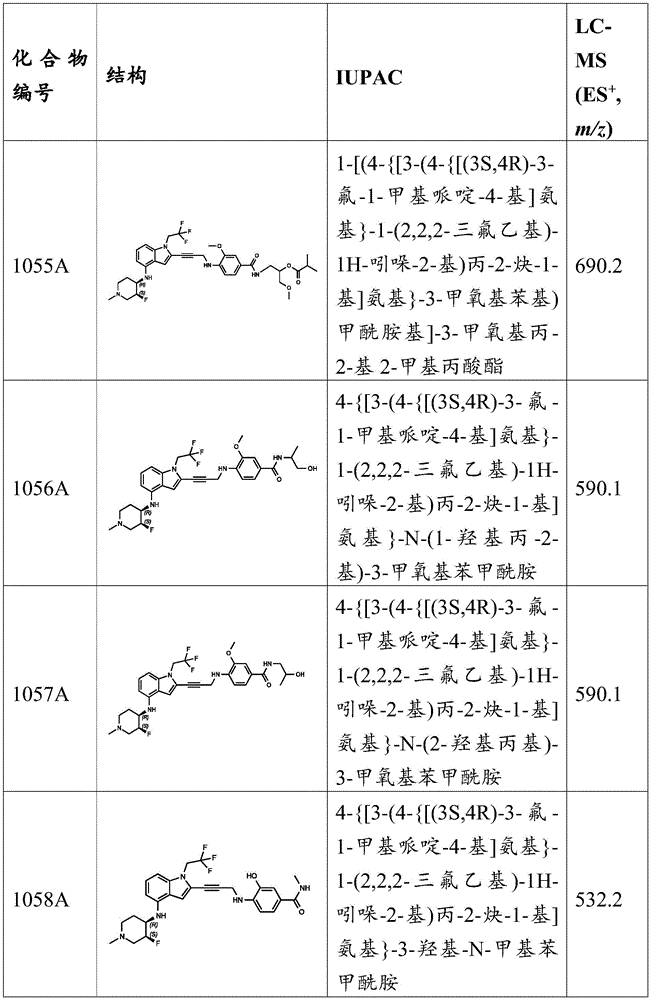
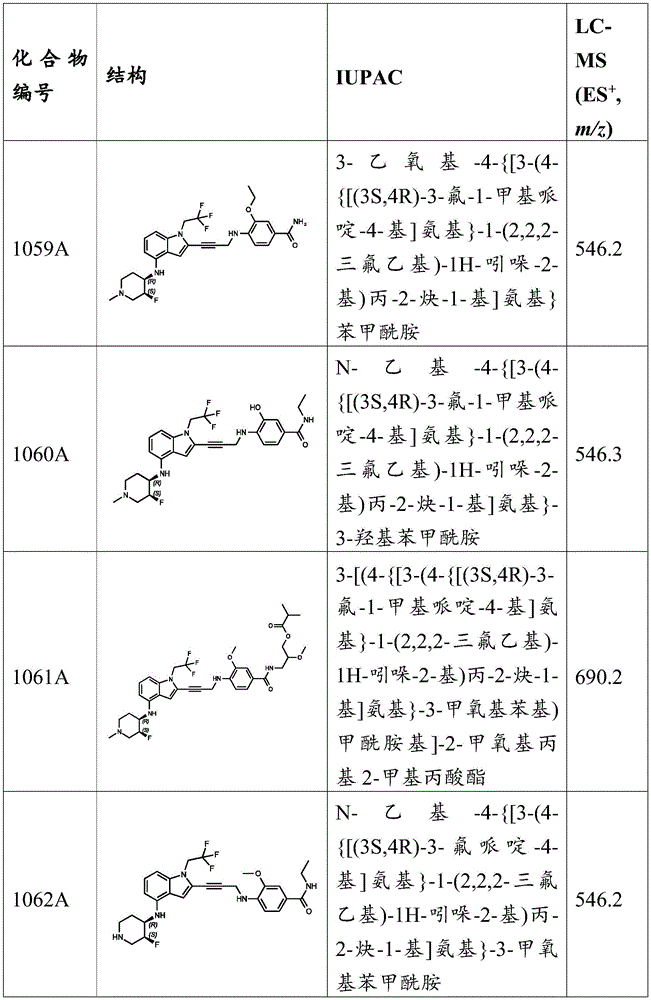
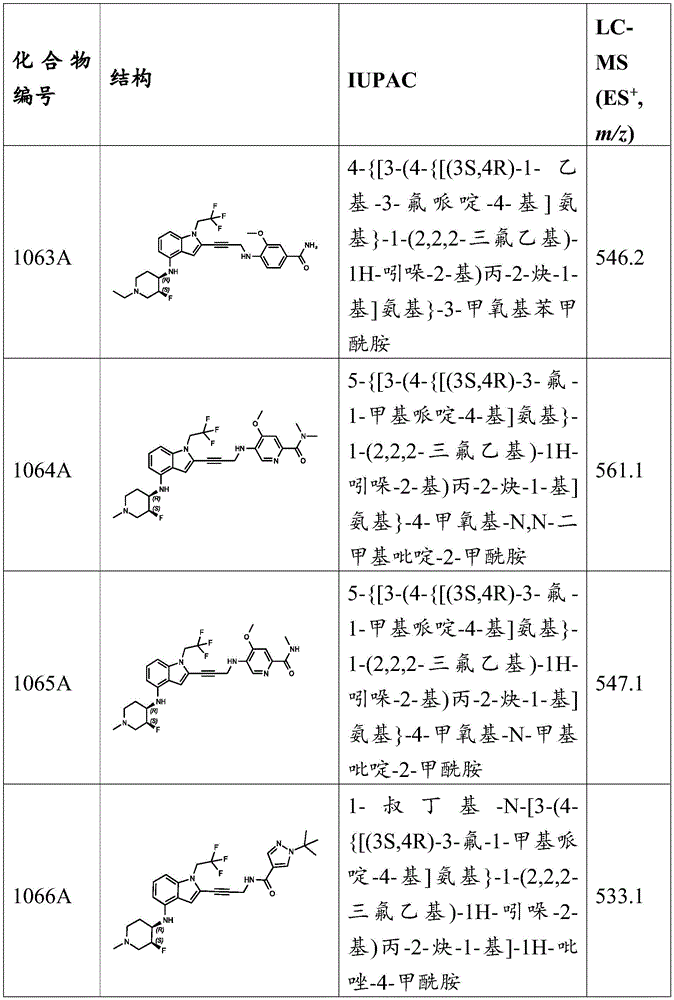


E. Compounds having a 2-ethynyl-N- (tetrahydropyran-4-yl) -1H-indol-4-amine core
Example E1: synthesis of compounds 1023A and 1024A.

Preparation of 2-iodo-N- ((3R,4S) -3-methoxytetrahydro-2H-pyran-4-yl) -1- (2,2, 2-trifluoroethyl) -1H-indol-4-amine and 2-iodo-N- ((3S,4S) -3-methoxytetrahydro-2H-pyran-4-yl) -1- (2,2, 2-trifluoroethyl) -1H-indol-4-amine: to a solution of 2-iodo-1- (2,2, 2-trifluoroethyl) indol-4-amine (0.5g,1.47mmol,1 eq) and 3-methoxytetrahydropyran-4-one (765.35mg,5.88mmol,4 eq) in DMF (5mL) at 0 deg.C was added TMSCl (399.32mg,3.68mmol, 466.50. mu.L, 2.5 eq). The reaction mixture was stirred at 0 ℃ for 2 hours and then at 0 ℃ under N 2 Next, BH is reacted 3 THF (1M,7.35mL,5 equiv.) was added to the mixture. The resulting mixture was stirred at 25 ℃ for 1 hour. LC-MS analysis showed the reaction was complete. The reaction was poured into saturated NH 4 Aqueous Cl (15mL) and extracted with EtOAc (15mL × 3). The combined organic layers were washed with brine (15mL x 3), dried over anhydrous sodium sulfate, filtered and concentrated under reduced pressure. The residue was passed through preparative TLC (SiO) 2 PE: EtOAc ═ 2:1) and preparative HPLC gave the desired racemic product as a pale yellow solid. 2-iodo-N- [ (3R,4R) -3-methoxytetrahydropyran-4-yl]-1- (2,2, 2-trifluoroethyl) indol-4-amine (0.04g, 79.26. mu. mol, 5.39% yield), MS (ES) + M/z) 455.1; 2-iodo-N- [ (3S,4R) -3-methoxytetrahydropyran-4-yl]-1- (2,2, 2-trifluoroethyl) indol-4-amine (0.03g,59.44 μmol, 4.04% yield), MS (ES) + ,m/z):455.1。
Preparation of the final product: to a solution of 2-methoxy-4- (methylsulfonyl) -N- (prop-2-yn-1-yl) aniline (1.2 eq, HCl) in DMSO was added N-isopropylprop-2-amine (10 eq), CuI (1 eq), 2-iodo-N- [ (3R,4R) -3-methoxytetrahydropyran-4-yl)]-1- (2,2, 2-trifluoro-2Ethyl) indol-4-amine or 2-iodo-N- [ (3S,4R) -3-methoxytetrahydropyran-4-yl]-1- (2,2, 2-trifluoroethyl) indol-4-amine (1 eq) and Pd (PPh) 3 ) 4 (0.4 equiv.). The reaction mixture was stirred at 25 ℃ for 1 hour. LC-MS analysis showed the reaction was complete. The reaction was diluted with EtOAc (15mL) and the resulting mixture was poured into saturated aqueous EDTA (15mL) and stirred at 25 ℃ for 1 h. The mixture was extracted with EtOAc (10mL x 3). The combined organic layers were washed with brine (10mL x 3), dried over anhydrous sodium sulfate, filtered and concentrated under reduced pressure. The residue was passed through preparative TLC (SiO) 2 DCM: MeOH ═ 10:1) and preparative HPLC gave the desired product as a light yellow solid.
2- (3- ((2-methoxy-4- (methylsulfonyl) phenyl) amino) prop-1-yn-1-yl) -N- ((3R,4S) -3-methoxytetrahydro-2H-pyran-4-yl) -1- (2,2, 2-trifluoroethyl) -1H-indol-4-amine, MS (ES) + M/z) 566.2; and 2- (3- ((2-methoxy-4- (methylsulfonyl) phenyl) amino) prop-1-yn-1-yl) -N- ((3S,4S) -3-methoxytetrahydro-2H-pyran-4-yl) -1- (2,2, 2-trifluoroethyl) -1H-indol-4-amine, MS (ES) + ,m/z):566.2。
Example E2: synthesis of compound 1025A and 1026A.

Preparation of N- ((3S,4S) -3-fluorotetrahydro-2H-pyran-4-yl) -2- (3- ((2-methoxy-4- (methylsulfonyl) phenyl) amino) prop-1-yn-1-yl) -1- (2,2, 2-trifluoroethyl) -1H-indol-4-amine: to a mixture of N- (3- (4-bromo-1- (2,2, 2-trifluoroethyl) -1H-indol-2-yl) prop-2-yn-1-yl) -2-methoxy-4- (methylsulfonyl) aniline (50mg,97.02 μmol,1 equivalent) and (3S,4S) -3-fluorotetrahydropyran-4-amine (30.19mg,194.05 μmol,2 equivalents, HCl) in dioxane (6.25mL) was added NaOtBu (35.43mg,368.69 μmol,3.8 equivalents) and RuPhos (14.49mg,31.05 μmol,0.32 equivalents). The reaction mixture was stirred at 80 ℃ for 40 minutes. TLC analysis showed no reaction. NaOtBu (35.43mg, 368.69. mu. mol,3.8 equivalents) and BrettphosPdG4(89.31mg, 97.02. mu. mol,1 equivalent) were added to the reaction, and the mixture was further stirred at 80 ℃ for 40 minutes . TLC analysis showed very little starting material remaining and a new major spot of the desired product was detected. EtOAc (20mL) was poured into the mixture, and the resulting mixture was then poured into a saturated EDTA solution (30mL) and stirred for 1 hour. The aqueous phase was extracted with EtOAc (20 mL. times.3). The combined organic layers were washed with brine (30mL x 3), dried over anhydrous sodium sulfate, treated with activated carbon to remove color, filtered and concentrated in vacuo. The crude residue was passed through preparative TLC (SiO) 2 EtOAc 1:1) and preparative HPLC gave the desired product (105mg,189.68 μmol, 32.58% yield) as a yellow solid. MS (ES) + ,m/z):554.2。
Preparation of N- [ (3S,4S) -3-fluorooxan-4-yl ] -2- {3- [ (4-methanesulfonyl-2-methoxyphenyl) amino ] prop-1-yn-1-yl } -1- (2,2, 2-trifluoroethyl) -1H-indol-4-amine and N- [ (3R,4R) -3-fluorooxan-4-yl ] -2- {3- [ (4-methanesulfonyl-2-methoxyphenyl) amino ] prop-1-yn-1-yl } -1- (2,2, 2-trifluoroethyl) -1H-indol-4-amine: the residue from the previous step was purified by preparative SFC to give the desired product as a white solid.
N- [ (3S,4S) -3-fluorooxan-4-yl]-2- {3- [ (4-methanesulfonyl-2-methoxyphenyl) amino]Prop-1-yn-1-yl } -1- (2,2, 2-trifluoroethyl) -1H-indol-4-amine (15.4mg, 27.76. mu. mol, 14.64% yield), MS (ES) + M/z) 554.2; and N- [ (3R,4R) -3-fluorooxan-4-yl]-2- {3- [ (4-methanesulfonyl-2-methoxyphenyl) amino]Prop-1-yn-1-yl } -1- (2,2, 2-trifluoroethyl) -1H-indol-4-amine (21.2mg, 38.30. mu. mol, 20.19% yield), MS (ES) + ,m/z):554.2。
Example E3: synthesis of 3-methoxy-4- ((3- (4- ((tetrahydro-2H-pyran-4-yl) amino) -1- (2,2, 2-trifluoroethyl) -1H-indol-2-yl) prop-2-yn-1-yl) amino) benzamide (compound 1006A).

In N 2 Next, i-Pr was added in one portion to a solution of 3-methoxy-4- (prop-2-yn-1-ylamino) benzamide (1.1g,4.85mmol,1.44 equiv.) in DMSO (15mL) at 25 deg.C 2 NH(3.40g,33.59mmol,4.75mL,10 equiv.), CuI (639.77mg,3.36mmol,1 equiv.), 2-iodo-N- (tetrahydro-2H-pyran-4-yl) -1- (2,2, 2-trifluoroethyl) -1H-indol-4-amine (1.5g,3.36mmol,1 equiv.), and Pd (PPh) 3 ) 4 (776.37mg, 671.85. mu. mol,0.2 equiv.). The mixture was stirred at 25 ℃ for 1 hour. TLC analysis (PE: EtOAc ═ 0:1, R f 0.36) shows the reaction is complete. EtOAc (30mL) was poured into the mixture and the resulting mixture was poured into saturated aqueous EDTA (100mL) and stirred for 15 min. The aqueous phase was extracted with EtOAc (50 mL. times.2). The organic layer was poured into saturated aqueous EDTA (100mL) and stirred for 1 hour. The aqueous phase was extracted with EtOAc (50mL x 3). The combined organic layers were washed with brine (50mL x 3), dried over anhydrous sodium sulfate, treated with activated carbon, filtered and concentrated in vacuo. The crude residue was chromatographed on silica gel (SiO) 2 PE: EtOAc ═ 1:0 to 0:1) and preparative HPLC purification afforded the desired product as a yellow solid. MS (ES) + ,m/z):501.1。
Example E4: synthesis of Compounds 997A and 998A.


Preparation of 4-bromo-6-fluoro-1- ((2- (trimethylsilyl) ethoxy) methyl) -1H-indole: to a mixture of NaH (2.80g,70.08mmol, 60% in mineral oil, 3 equivalents) in THF (5mL) at 0 deg.C was added a solution of 2- (chloromethoxy) ethyl-trimethyl-silane (5.84g,35.04mmol,6.20mL,1.5 equivalents) in THF (5 mL). The mixture was stirred at 0 ℃ for 1H, and 4-bromo-6-fluoro-1H-indole (5g,23.36mmol,1 eq) was added to the reaction. The resulting reaction mixture was stirred at 0 ℃ for 1 hour. TLC analysis (PE: EtOAc ═ 5:1, R) f 0.43) showed the reaction was complete. By adding saturated NH 4 The reaction mixture was quenched with aqueous Cl (50mL) and the mixture was extracted with EtOAc (200mL x 3). The organic layer was washed with brine (500mL), dried over anhydrous sodium sulfate, filtered and concentrated inConcentrating under reduced pressure. The crude product is purified by column chromatography (SiO) 2 ,PE:EtOAc=5:1,R f 0.43) to give the desired product (14g,32.12mmol, 68.76% yield) as a yellow oil. MS (ES) + ,m/z):346.0。
Preparation of 6-fluoro-N- (tetrahydro-2H-pyran-4-yl) -1- ((2- (trimethylsilyl) ethoxy) methyl) -1H-indol-4-amine: to a solution of tetrahydro-2H-pyran-4-amine (4.87g,48.19mmol,3 equiv.) in toluene (10mL) at 20 deg.C was added 4-bromo-6-fluoro-1- ((2- (trimethylsilyl) ethoxy) methyl) -1H-indole (7g,16.06mmol,1 equiv.), Pd 2 (dba) 3 (2.94g,3.21mmol,0.20 equiv.), NaOtBu (2.01g,20.88mmol,1.30 equiv.), and di-tert-butyl- (2-phenylphenyl) phosphine (958.57mg,3.21mmol,0.20 equiv.). In a sealed tube, the mixture was stirred at 85 ℃ for 12 hours. LC-MS analysis showed conversion of the starting material to one major product. The reaction mixture was poured into saturated aqueous EDTA (150mL) and extracted with EtOAc (200mL × 3). The combined organic layers were stirred with a saturated EDTA solution (200mL) for 1 hour. The organic layer was washed with brine (100mL), dried over anhydrous sodium sulfate, filtered and concentrated under reduced pressure. The crude product is purified by column chromatography (SiO) 2 ,PE:EtOAc=5:1,R f 0.43) to give the desired product (5.5g,9.51mmol, 59.18% yield) as a yellow oil. MS (ES) + ,m/z):365.0。
Preparation of tert-butyl (6-fluoro-1- ((2- (trimethylsilyl) ethoxy) methyl) -1H-indol-4-yl) (tetrahydro-2H-pyran-4-yl) carbamate: to a solution of 6-fluoro-N- (tetrahydro-2H-pyran-4-yl) -1- ((2- (trimethylsilyl) ethoxy) methyl) -1H-indol-4-amine (5.5g,9.51mmol,1 eq) in t-BuOH (30mL) at 20 ℃ was added Boc 2 O (20.75g,95.05mmol,21.84mL,10 equiv.). The mixture was stirred at 100 ℃ for 20 hours. LC-MS and HPLC analysis showed 50% product formation. The reaction mixture was added to water (500mL) and extracted with EtOAc (200mL x 3). The organic layer was washed with brine (500mL), dried over anhydrous sodium sulfate, filtered and concentrated in vacuo. The crude product is purified by column chromatography (SiO) 2 ,PE:EtOAc=5:1,R f 0.43) to give the desired product (0.8g,1.21mmol, 12.68% yield) as a yellow oil. MS (Mass Spectrometry)(ES + ,m/z):469.5。
Preparation of tert-butyl (6-fluoro-1H-indol-4-yl) (tetrahydro-2H-pyran-4-yl) carbamate: to a solution of tert-butyl (6-fluoro-1- ((2- (trimethylsilyl) ethoxy) methyl) -1H-indol-4-yl) (tetrahydro-2H-pyran-4-yl) carbamate (1.5g,2.10mmol,1 eq) in THF (5mL) at 20 ℃ was added TBAF (1M,20.98mL,10 eq). The mixture was stirred at 100 ℃ for 4 hours. HPLC analysis showed the reaction was complete. With saturated NaHCO 3 The reaction mixture was quenched with aqueous solution (50mL) and extracted with EtOAc (100 mL. times.3). The organic layer was washed with brine (50mL), dried over anhydrous sodium sulfate, filtered and concentrated under reduced pressure. The crude product is purified by column chromatography (SiO) 2 EtOAc ═ 4:1) to give the desired product (0.42g,879.23 μmol, 41.90% yield) as a yellow solid.
Preparation of tert-butyl (6-fluoro-1- (phenylsulfonyl) -1H-indol-4-yl) (tetrahydro-2H-pyran-4-yl) carbamate: to a mixture of NaH (100.48mg,2.51mmol, 60% in mineral oil, 3 equivalents) in THF (2mL) was added a solution of tert-butyl (6-fluoro-1H-indol-4-yl) (tetrahydro-2H-pyran-4-yl) carbamate (0.4g, 837.36. mu. mol,1 equivalent) in THF (2mL) at 0 ℃. The mixture was stirred at 0 ℃ for 1h, and benzenesulfonyl chloride (221.84mg,1.26mmol, 160.76. mu.L, 1.5 equiv.) was added to the reaction. The mixture was further stirred at 0 ℃ for 1 hour. LC-MS analysis showed the reaction was complete. Reacting with saturated NH 4 Aqueous Cl (50mL) was quenched and extracted with EtOAc (10 mL. times.3). The organic layer was washed with brine (5mL), dried over anhydrous sodium sulfate, filtered and concentrated under reduced pressure. The crude product is purified by column chromatography (SiO) 2 EtOAc ═ 2:1) to give the desired product (0.3g,606.90 μmol, 72.48% yield) as a yellow solid.
Preparation of tert-butyl (6-fluoro-2-iodo-1- (phenylsulfonyl) -1H-indol-4-yl) (tetrahydro-2H-pyran-4-yl) carbamate: to a solution of tert-butyl (6-fluoro-1- (phenylsulfonyl) -1H-indol-4-yl) (tetrahydro-2H-pyran-4-yl) carbamate (0.11g,213.26 μmol,1 eq) in THF (3mL) at-78 deg.C was added LDA (2M,373.20 μ L,3.5 eq). The mixture was stirred at-78 ℃ for 1 hour, and I was added 2 (216.51mg,853.03μmol171.83 μ L,4 equivalents) in THF (2mL) was added to the reaction. The mixture was further stirred at-78 ℃ for 1 hour. LC-MS analysis showed the reaction was complete. By adding saturated NH 4 The reaction mixture was quenched with aqueous Cl and the mixture was extracted with EtOAc (20mL x 3). The organic layer was washed with brine (5mL), dried over anhydrous sodium sulfate, filtered and concentrated in vacuo. The crude product was purified by preparative TLC (PE: EtOAc ═ 1:1) to give the desired product (0.25g,416.36 μmol, 65.08% yield) as a yellow solid.
Preparation of tert-butyl (6-fluoro-2-iodo-1H-indol-4-yl) (tetrahydro-2H-pyran-4-yl) carbamate: to a solution of tert-butyl (6-fluoro-2-iodo-1- (phenylsulfonyl) -1H-indol-4-yl) (tetrahydro-2H-pyran-4-yl) carbamate (0.12g, 199.85. mu. mol,1 eq) in MeOH (3mL) was added K 2 CO 3 (110.49mg, 799.41. mu. mol,4 equiv.). The mixture was stirred at 60 ℃ for 2 hours. HPLC analysis indicated the reaction was complete. The reaction mixture was added to water (50mL) and extracted with EtOAc (20mL x 3). The organic layer was washed with brine (50mL), dried over anhydrous sodium sulfate, filtered and concentrated to give the crude product (0.16g, crude) as a yellow solid.
Preparation of tert-butyl (6-fluoro-2-iodo-1- (2,2, 2-trifluoroethyl) -1H-indol-4-yl) (tetrahydro-2H-pyran-4-yl) carbamate: to a mixture of NaH (28.68mg, 716.95. mu. mol in mineral oil, 60%, 3 equivalents) in THF (2mL) at 0 deg.C was added a solution of tert-butyl (6-fluoro-2-iodo-1H-indol-4-yl) (tetrahydro-2H-pyran-4-yl) carbamate (0.11g, 238.98. mu. mol,1 equivalent) in THF (1 mL). The mixture was stirred at 0 ℃ for 1h and trifluoromethanesulfonic acid 2,2, 2-trifluoroethyl ester (277.34mg,1.19mmol,5 equivalents) was added to the reaction. The resulting reaction mixture was further stirred at 0 ℃ for 1 hour. LC-MS analysis indicated that the reaction was complete. By adding saturated NH 4 The reaction mixture was quenched with aqueous Cl (15mL) and the mixture was extracted with EtOAc (20 mL. times.3). The organic layer was washed with brine (5mL), dried over anhydrous sodium sulfate, filtered and concentrated under reduced pressure to give the crude product (0.11g, crude) as a yellow solid.
(6-fluoro-2- (3- ((2-methoxy-4- (methylsulfonyl) phenyl) amino) prop-1-yn-1-yl) -1- (2,2, 2-trifluoroethyl) ethanePreparation of yl) -1H-indol-4-yl) (tetrahydro-2H-pyran-4-yl) carbamic acid tert-butyl ester and (6-fluoro-2- (3- ((2-methoxy-4-sulfamoylphenyl) amino) prop-1-yn-1-yl) -1- (2,2, 2-trifluoroethyl) -1H-indol-4-yl) (tetrahydro-2H-pyran-4-yl) carbamic acid tert-butyl ester: to a mixture of 2-methoxy-4- (methylsulfonyl) -N- (prop-2-yn-1-yl) aniline or 3-methoxy-4- (prop-2-yn-1-ylamino) benzenesulfonamide (2 equivalents) and tert-butyl (6-fluoro-2-iodo-1- (2,2, 2-trifluoroethyl) -1H-indol-4-yl) (tetrahydro-2H-pyran-4-yl) carbamate (0.07g, 129.08. mu. mol,1 equivalent) in DMSO (5mL) was added CuI (1 equivalent), Pd (PPh) 3 ) 4 (0.10 equiv.) and N-isopropylpropan-2-amine (1 equiv.). The mixture was stirred at 25 ℃ for 1 hour. LC-MS analysis showed the reaction was complete. The reaction mixture was poured into water (50mL) and extracted with EtOAc (20mL × 3). The combined organic layers were washed with saturated aqueous EDTA (20mL) by stirring the mixture for 1 hour. The organic layer was washed with brine (50mL), dried over anhydrous sodium sulfate, filtered, and concentrated under reduced pressure. The crude product was purified by preparative TLC to give the desired product as a yellow solid.
Preparation of 6-fluoro-2- {3- [ (4-methanesulfonyl-2-methoxyphenyl) amino ] prop-1-yn-1-yl } -N- (oxan-4-yl) -1- (2,2, 2-trifluoroethyl) -1H-indol-4-amine and 4- [ (3- { 6-fluoro-4- [ (oxan-4-yl) amino ] -1- (2,2, 2-trifluoroethyl) -1H-indol-2-yl } prop-2-yn-1-yl) amino ] -3-methoxybenzene-1-sulfonamide: tert-butyl (6-fluoro-2- (3- ((2-methoxy-4- (methylsulfonyl) phenyl) amino) prop-1-yn-1-yl) -1- (2,2, 2-trifluoroethyl) -1H-indol-4-yl) (tetrahydro-2H-pyran-4-yl) carbamate or tert-butyl (6-fluoro-2- (3- ((2-methoxy-4-sulfamoylphenyl) amino) prop-1-yn-1-yl) -1- (2,2, 2-trifluoroethyl) -1H-indol-4-yl) (tetrahydro-2H-pyran-4-yl) carbamate (50mg,1 eq) in 4N HCl/EtOAc (4mL,254 eq.) was stirred at 25 ℃ for 1 hour. LC-MS analysis showed the reaction was complete. The reaction was concentrated to give the crude product.
6-fluoro-2- {3- [ (4-methanesulfonyl-2-methoxyphenyl) amino]Prop-1-yn-1-yl } -N- (oxan-4-yl) -1- (2,2, 2-trifluoroethyl) -1H-indol-4-amine, MS (ES) + M/z) 554.1; and 4- [ (3- { 6-fluoro-4- [ (oxan-4-yl) amino group]-1- (2,2, 2-trifluoro-2Ethyl) -1H-indol-2-yl } prop-2-yn-1-yl) amino]-3-methoxybenzene-1-sulphonamide, MS (ES) + ,m/z):555.1。
Example E5: synthesis of compounds 1016A, 1017A, 1018A, 1019A, 1020A, 1021A, 1027A, 1028A, 1029A, 1030A, 1031A and 1032A.

Preparation of 2-iodo-N- (2-methyltetrahydro-2H-pyran-4-yl) -1- (2,2, 2-trifluoroethyl) -1H-indol-4-amine and N- ((2R,6S) -2, 6-dimethyltetrahydro-2H-pyran-4-yl) -2-iodo-1- (2,2, 2-trifluoroethyl) -1H-indol-4-amine: to a mixture of 2-iodo-1- (2,2, 2-trifluoroethyl) -1H-indol-4-amine (500mg,1 eq) and 2-methyltetrahydro-4H-pyran-4-one (500mg,1 eq) or (2R,6S) -2, 6-dimethyltetrahydro-4H-pyran-4-one (376mg,2 eq) in DMF (10mL) was added TMSCl (399mg,2.5 eq). The mixture was stirred at 0 ℃ for 1 hour and under N 2 Down to BH 3 THF (379mg,3 equivalents, 1M) was added to the reaction. The mixture was stirred at 0 ℃ for 12 hours. TLC (PE: EtOAc: 5:1, Rf: 0.50) indicated completion of the reaction. The reaction mixture was poured into water (150mL) and then extracted with EtOAc (80mL x 3). The combined organic layers were washed with saturated brine (80mL), filtered and concentrated under reduced pressure to give the desired compound.
Preparation of final product: to a solution of alkyne (1.2 equiv) in DMSO (5mL) were added CuI (1 equiv.) and i-Pr 2 NH (10 equivalents). The solution is treated with N 2 Degassed three times and 2-iodo-N- (2-methyltetrahydro-2H-pyran-4-yl) -1- (2,2, 2-trifluoroethyl) -1H-indol-4-amine or N- ((2R,6S) -2, 6-dimethyltetrahydro-2H-pyran-4-yl) -2-iodo-1- (2,2, 2-trifluoroethyl) -1H-indol-4-amine (1 eq) and Pd (PPh) 3 ) 4 (0.2 eq) was added to the solution. The reaction mixture was stirred at 25 ℃ for 2 hours. TLC analysis showed complete consumption of starting material and detection of one major peak of the desired mass. The reaction mixture was diluted with EtOAc (5mL) and the resulting mixture was poured into saturated aqueous EDTA (30mL) and stirred for 1 hour. The mixture was then extracted with EtOAc (15mL × 2). MergingThe organic layer was washed with brine (10mL) and concentrated under reduced pressure. The crude residue was purified by preparative TLC to give the desired product.
3-methoxy-4- { [3- (4- { [ (2S,4R) -2-methyloxan-4-yl]Amino } -1- (2,2, 2-trifluoroethyl) -1H-indol-2-yl) prop-2-yn-1-yl]Amino } benzamide, MS (ES) + M/z) 515.2; 3-methoxy-4- { [3- (4- { [ (2S,4S) -2-methyloxan-4-yl]Amino } -1- (2,2, 2-trifluoroethyl) -1H-indol-2-yl) prop-2-yn-1-yl]Amino } benzamide, MS (ES) + M/z) 515.2; 3-methoxy-4- { [3- (4- { [ (2S,4R) -2-methyloxan-4-yl ]Amino } -1- (2,2, 2-trifluoroethyl) -1H-indol-2-yl) prop-2-yn-1-yl]Amino } benzene-1-sulfonamide, MS (ES) + M/z) 551.2; 3-methoxy-4- { [3- (4- { [ (2S,4S) -2-methyloxan-4-yl]Amino } -1- (2,2, 2-trifluoroethyl) -1H-indol-2-yl) prop-2-yn-1-yl]Amino } benzene-1-sulfonamide, MS (ES) + M/z) 551.2; 3-methoxy-4- { [3- (4- { [ (2R,4S,6S) -2, 6-dimethyloxan-4-yl]Amino } -1- (2,2, 2-trifluoroethyl) -1H-indol-2-yl) prop-2-yn-1-yl]Amino } benzamide, MS (ES) + M/z) 529.2; 3-methoxy-4- { [3- (4- { [ (2R,4R,6S) -2, 6-dimethyloxan-4-yl]Amino } -1- (2,2, 2-trifluoroethyl) -1H-indol-2-yl) prop-2-yn-1-yl]Amino } benzamide, MS (ES) + M/z) 529.2; 2- {3- [ (4-Methylsulfonyl-2-methoxyphenyl) amino]Prop-1-yn-1-yl } -N- [ (2R,4S,6S) -2, 6-dimethyloxan-4-yl]-1- (2,2, 2-trifluoroethyl) -1H-indol-4-amine, MS (ES) + M/z) 564.2; 2- {3- [ (4-Methylsulfonyl-2-methoxyphenyl) amino]Prop-1-yn-1-yl } -N- [ (2R,4R,6S) -2, 6-dimethyloxan-4-yl]-1- (2,2, 2-trifluoroethyl) -1H-indol-4-amine, MS (ES) + M/z) 564.2; 3-methoxy-4- { [3- (4- { [ (2R,4S,6S) -2, 6-dimethyloxan-4-yl]Amino } -1- (2,2, 2-trifluoroethyl) -1H-indol-2-yl) prop-2-yn-1-yl ]Amino } benzene-1-sulfonamide, MS (ES) + M/z) 565.2; and 3-methoxy-4- { [3- (4- { [ (2R,4R,6S) -2, 6-dimethyloxan-4-yl]Amino } -1- (2,2, 2-trifluoroethyl) -1H-indol-2-yl) prop-2-yn-1-yl]Amino } benzene-1-sulfonamide, MS (ES) + M/z) 565.2; 2- {3- [ (4-Methylsulfonyl-2-methoxyphenyl) amino]Prop-1-yn-1-yl } -N- [ (2S,4S) -2-methyloxan-4-yl]-1- (2,2, 2-trifluoroethyl) -1H-indol-4-amine,MS(ES + m/z) 550.2; 2- {3- [ (4-Methylsulfonyl-2-methoxyphenyl) amino]Prop-1-yn-1-yl } -N- [ (2S,4R) -2-methyloxan-4-yl]-1- (2,2, 2-trifluoroethyl) -1H-indol-4-amine, MS (ES) + ,m/z):550.2。
Example E6: general procedure for the preparation of compounds 1010A and 1012A.

Synthesis of 5-methoxy-4-nitro-1- (phenylsulfonyl) -1H-indole: in each of two separate identical batches, a solution of 5-methoxy-4-nitro-1H-indole (2g,10.41mmol,1 eq.) in THF (1mL) was added at 0 ℃ to a mixture of NaH (1.25g,31.22mmol, 60% in mineral oil, 3 eq.) and THF (3 mL). The mixture was stirred at 0 ℃ for 1 hour, then benzenesulfonyl chloride (2.76g,15.61mmol,2mL,1.5 equiv.) was added. The mixture was stirred at 0 ℃ for an additional 1 hour, followed by TLC (PE: EtOAc ═ 4:1, R) f 0.43) indicating completion of the reaction. The batches were combined and saturated NH was added at 0 deg.C 4 The resulting mixture was quenched with aqueous Cl (20mL), then diluted with EtOAc (20mL) and extracted with EtOAc (20 mL. times.3). The combined organic layers were washed with brine (20mL), dried over anhydrous sodium sulfate, filtered and concentrated under reduced pressure. The crude residue was washed with PE (20mL) to give 5-methoxy-4-nitro-1- (phenylsulfonyl) -1H-indole (7g,16.85mmol, 80.96% yield) as a yellow solid, which was used in the next step without further purification.
Synthesis of 2-iodo-5-methoxy-4-nitro-1- (phenylsulfonyl) -1H-indole: to each of two separate identical batches containing a mixture of 5-methoxy-4-nitro-1- (phenylsulfonyl) -1H-indole (0.5g,1.20mmol,1 eq) in THF (30mL) at-78 deg.C was added lithium diisopropylamide (2M,2.41mL,4 eq). At N 2 The mixture was then stirred at-78 ℃ for 1 hour. Then I in THF (13mL) was added 2 (1.22g,4.81mmol, 969.81. mu.L, 4 equiv.) in N 2 The mixture was then stirred at-78 ℃ for a further 1 hour. The batches were then combined and the resulting mixture was mixedThe mixture is poured into saturated NH 4 Aqueous Cl (25mL) and stirred for 5 min, then extracted with EtOAc (25mL x 3). The combined organic layers were washed with brine (20mL x 3), dried over anhydrous sodium sulfate, filtered and concentrated in vacuo. The residue was passed through preparative TLC (SiO) 2 EtOAc ═ 4:1) to give 2-iodo-5-methoxy-4-nitro-1- (phenylsulfonyl) -1H-indole (0.7g,763.81 μmol, 31.73% yield) as a yellow solid.
Synthesis of 2-iodo-5-methoxy-4-nitro-1H-indole: 2-iodo-5-methoxy-4-nitro-1- (phenylsulfonyl) -1H-indole (0.7g, 763.81. mu. mol,1 eq.) and K 2 CO 3 A mixture of (316.69mg,2.29mmol,3 equiv.) in MeOH (5mL) was stirred at 70 deg.C for 2 h, followed by LC-MS analysis to show completion of the reaction. The residue was poured into water (25mL), stirred for 5 min, then extracted with EtOAc (25mL × 3). The combined organic layers were washed with brine (20mL x 3), dried over anhydrous sodium sulfate, filtered and concentrated in vacuo. The residue was purified by column chromatography (SiO) 2 ,PE:EtOAc=4:1,R f 0.31) to give 2-iodo-5-methoxy-4-nitro-1H-indole (0.1g,251.52 μmol, 32.93% yield) as a yellow solid.
Synthesis of 2-iodo-5-methoxy-4-nitro-1- (2,2, 2-trifluoroethyl) -1H-indole: to a mixture of NaH (30.18mg, 754.56. mu. mol in mineral oil, 60% in 3 equivalents) in THF (2mL) was added 2-iodo-5-methoxy-4-nitro-1H-indole (0.1g, 251.52. mu. mol,1 equivalent) in THF (2mL) at 0 ℃. The mixture was stirred at 0 ℃ for 1h and 2,2, 2-trifluoroethyl trifluoromethanesulfonate (291.89mg,1.26mmol,5 equivalents) was added. The mixture was stirred at 0 ℃ for an additional 1 hour, followed by TLC analysis (PE: EtOAc 1:1, R) f 0.43) indicating completion of the reaction. Then, at 0 ℃ by adding saturated NH 4 The reaction mixture was quenched with aqueous Cl (20mL), diluted with EtOAc (20mL), and extracted with EtOAc (20 mL. times.3). The combined organic layers were washed with brine (20mL), dried over anhydrous sodium sulfate, filtered and concentrated under reduced pressure to give 2-iodo-5-methoxy-4-nitro-1- (2,2, 2-trifluoroethyl) -1H-indole (0.1g, crude) as a yellow solid. The crude residue was used directly in the next step.
2-iodo-5-methoxy-1- (2,2, 2-tris)Synthesis of fluoroethyl) -1H-indol-4-amine: to a mixture of 2-iodo-5-methoxy-4-nitro-1- (2,2, 2-trifluoroethyl) -1H-indole (0.1g, 249.94. mu. mol,1 eq) in EtOH (5mL) and water (1mL) was added saturated NH 4 Aqueous Cl (66.85mg,1.25mmol, 43.69. mu.L, 5 equiv.). The mixture was heated to 70 ℃ and Fe (69.79mg,1.25mmol,5 equiv.) was added. The mixture was stirred at 70 ℃ for 1 hour, and subsequent LC-MS analysis indicated that the reaction was complete. Water (20mL) was added, and the mixture was extracted with EtOAc (20 mL. times.3). The combined organic layers were washed with brine (20mL), dried over anhydrous sodium sulfate, filtered and concentrated under reduced pressure. The residue was passed through preparative TLC (SiO) 2 ,PE:EtOAc=1:1R f 0.43) to give 2-iodo-5-methoxy-1- (2,2, 2-trifluoroethyl) -1H-indol-4-amine (0.035g,80.38 μmol, 32.16% yield) as a yellow solid.

Synthesis of 2-iodo-5-methoxy-N- (tetrahydro-2H-pyran-4-yl) -1- (2,2, 2-trifluoroethyl) -1H-indol-4-amine: to a mixture of tetrahydropyran-4-one (24.14mg,241.15 μmol,22.15 μ L,3 equivalents) and 2-iodo-5-methoxy-1- (2,2, 2-trifluoroethyl) -1H-indol-4-amine (0.035g,80.38 μmol,1 equivalent) in DMF (2mL) was added TMSCl (21.83mg,200.95 μmol,25.50 μ L,2.5 equivalents). The mixture was cooled to 0 ℃ and then at N 2 Adding BH in 3 THF (1M, 200.95. mu.L, 2.5 equiv.). The mixture was stirred at 0 ℃ for 1 hour and subsequent LC-MS analysis indicated that the reaction was complete. The reaction mixture was quenched by addition of water (100mL) at 0 deg.C, then extracted with EtOAc (30mL x 3). The combined organic layers were washed with brine (30mL), dried over anhydrous sodium sulfate, filtered, and concentrated under reduced pressure. The residue was passed through preparative TLC (SiO) 2 ,PE:EtOAc=1:1,R f 0.28) to give 2-iodo-5-methoxy-N- (tetrahydro-2H-pyran-4-yl) -1- (2,2, 2-trifluoroethyl) -1H-indol-4-amine (0.03g,56.14 μmol, 69.84% yield) as a yellow solid.
Preparation of the final product: following the general procedure indicated in example C51, 2-iodo-5-methoxy-N- (tetrahydro-2H-pyran-4-yl) -1- (2,2, 2-trifluoroethyl) -1H-indol-4-amine is coupled with the R-substituted alkyne indicated above. In each case, the reaction was considered complete after stirring for 1 hour at 30 ℃, and the crude compound was first purified by preparative TLC and further purified by preparative HPLC.
3-methoxy-4- [ (3- { 5-methoxy-4- [ (oxan-4-yl) amino group]-1- (2,2, 2-trifluoroethyl) -1H-indol-2-yl } prop-2-yn-1-yl) amino]Benzene-1-sulfonamides, MS (ES) + M/z) 567.3; and 2- {3- [ (4-methanesulfonyl-2-methoxyphenyl) amino]Prop-1-yn-1-yl } -5-methoxy-N- (oxan-4-yl) -1- (2,2, 2-trifluoroethyl) -1H-indol-4-amine, MS (ES) + ,m/z):566.2。
Example E7: preparation of compound 1013A.

2-iodo-6-methoxy-1- (2,2, 2-trifluoroethyl) -1H-indol-4-amine was prepared by a procedure analogous to the synthesis of 2-iodo-5-methoxy-1- (2,2, 2-trifluoroethyl) -1H-indol-4-amine according to example E6, using 6-methoxy-4-nitro-1H-indole instead of 5-methoxy-4-nitro-1H-indole.

Synthesis of 2-iodo-6-methoxy-N- (tetrahydro-2H-pyran-4-yl) -1- (2,2, 2-trifluoroethyl) -1H-indol-4-amine: to a mixture of tetrahydropyran-4-one (27.59mg, 275.59. mu. mol, 25.31. mu.L, 3 equivalents) and 2-iodo-6-methoxy-1- (2,2, 2-trifluoroethyl) indol-4-amine (0.04g, 91.86. mu. mol,1 equivalent) in DMF (2mL) was added TMSCl (24.95mg, 229.66. mu. mol, 29.15. mu.L, 2.5 equivalents). The mixture was cooled to 0 ℃ and then at N 2 Under addition of BH 3 THF (1M, 229.66. mu.L, 2.5 equiv.). The mixture was stirred at 0 ℃ for 1 hour and subsequent LC-MS analysis indicated that the reaction was complete. The reaction mixture was quenched by addition of water (100mL) at 0 deg.C, then extracted with EtOAc (30mL x 3). The combined organic layers were washed with brine (30mL) and dried over anhydrous sulfur The sodium salt was dried, filtered and concentrated under reduced pressure. The residue was passed through preparative TLC (SiO) 2 ,PE:EtOAc=4:1,R f = 0.44) to give 2-iodo-6-methoxy-N- (tetrahydro-2H-pyran-4-yl) -1- (2,2, 2-trifluoroethyl) -1H-indol-4-amine (0.035g,61.64 μmol, 67.10% yield) as a yellow solid.
Preparation of the final product: to a mixture of 3-methoxy-4- (prop-2-yn-1-ylamino) benzenesulfonamide (24.45mg,91.58 μmol,1.3 equivalents) and 2-iodo-6-methoxy-N- (tetrahydro-2H-pyran-4-yl) -1- (2,2, 2-trifluoroethyl) -1H-indol-4-amine (0.04g,70.45 μmol,1 equivalent) in DMSO (2mL) was added CuI (13.42mg,70.45 μmol,1 equivalent), followed by Pd (PPh) 3 ) 4 (8.14mg, 7.04. mu. mol,0.10 equiv.) and diisopropylamine (7.13mg, 70.45. mu. mol, 9.96. mu.L, 1 equiv.). In N 2 The mixture was then stirred at 30 ℃ for 1 hour followed by TLC analysis (PE: EtOAc ═ 1:1, R f 0.23) indicating completion of the reaction. The reaction mixture was quenched by the addition of saturated aqueous EDTA (30mL) and EtOAc (10mL), stirred at 25 ℃ for 1h, and extracted with EtOAc (20mL x 3). The combined organic layers were washed with brine (30mL), dried over anhydrous sodium sulfate, filtered and concentrated under reduced pressure. The residue was passed through preparative TLC (SiO) 2 ,PE:EtOAc=0:1,R f = 0.24) followed by further purification by preparative HPLC to give 3-methoxy-4- [ (3- { 6-methoxy-4- [ (oxan-4-yl) amino group ]-1- (2,2, 2-trifluoroethyl) -1H-indol-2-yl } prop-2-yn-1-yl) amino]Benzene-1-sulfonamide (0.0155g,26.59 μmol, 37.74% yield) as a white solid. MS (ES +, m/z) 567.0.
Table 5 shows compounds with a 2-ethynyl-N- (tetrahydropyran-4-yl) -1H-indol-4-amine core.
TABLE 5


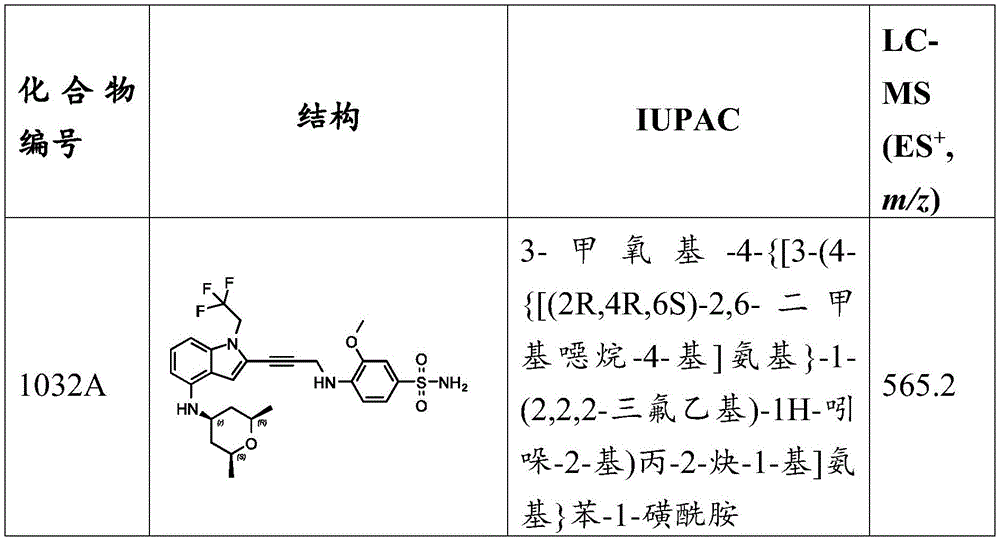
F. A compound having a 4- ((2-ethynyl-1H-indol-4-yl) amino) tetrahydro-2H-thiopyran 1, 1-dioxide core.
Example F1: synthesis of 4- ((2- (3- ((4-methoxypyridin-3-yl) amino) prop-1-yn-1-yl) -1- (2,2, 2-trifluoroethyl) -1H-indol-4-yl) amino) tetrahydro-2H-thiopyran 1, 1-dioxide (compound 1033A).

4-methoxy-N-prop-2-ynyl-pyridin-3-amine is prepared using the method described in example D1.
To a solution of N- (1, 1-dioxothian-4-yl) -2-iodo-1- (2,2, 2-trifluoroethyl) indol-4-amine (70mg, 148.22. mu. mol,1 eq) in DMSO (3mL) was added 4-methoxy-N-prop-2-ynyl-pyridin-3-amine (36.06mg, 222.34. mu. mol,1.50 eq), CuI (28.23mg, 148.22. mu. mol,1 eq), Pd (PPh) 3 ) 4 (17.13mg, 14.82. mu. mol,0.10 eq.) and N-isopropylpropan-2-amine (89.99mg, 889.34. mu. mol, 124.99. mu.L, 6 eq.). The mixture was stirred at 40 ℃ for 2 hours. The reaction mixture was quenched with saturated aqueous EDTA (20mL) and stirred for 2 hours. Then, EtOAc (20mL) was added to the mixture. The organic phase was separated, washed with water (10mL), dried over anhydrous sodium sulfate, filtered and concentrated under reduced pressure. The crude residue was purified by preparative HPLC to give N- (1, 1-dioxothian-4-yl) -2- [3- [ (4-methoxy-3-pyridyl) amino ]Prop-1-ynyl]-1- (2,2, 2-trifluoroethyl) indol-4-amine (5mg,9.87 μmol, 6.66% yield) as a white solid. MS (ES) + ,m/z):507.1。
Example F2: synthesis of 4- ((2- (3- ((4-methoxy-6- (methylsulfonyl) pyridin-3-yl) amino) prop-1-yn-1-yl) -1- (2,2, 2-trifluoroethyl) -1H-indol-4-yl) amino) tetrahydro-2H-thiopyran 1, 1-dioxide (compound 1050A).
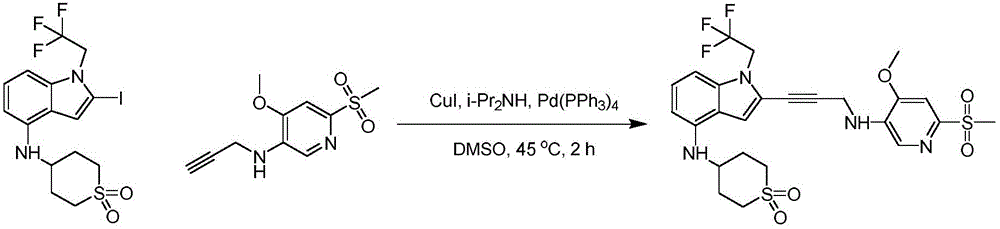
4-methoxy-6- (methylsulfonyl) -N- (prop-2-yn-1-yl) pyridin-3-amine was prepared using the method described in example D47.
With N 2 A solution of 4-methoxy-6- (methylsulfonyl) -N- (prop-2-yn-1-yl) pyridin-3-amine (35.16mg, 127.05. mu. mol,1.2 equivalents, HCl) in DMSO (2mL) was rinsed. CuI (20.16mg, 105.87. mu. mol,1 eq.) and N-isopropylamine (32.14mg, 317.62. mu. mol, 44.89. mu.L, 3 eq.) were added to the mixture. Adding 4- ((2-iodo-1- (2,2, 2-trifluoroethyl) -1H-indol-4-yl) amino) tetrahydro-2H-Thiopyran 1, 1-dioxide (50mg, 105.87. mu. mol,1 equivalent) and Pd (PPh) 3 ) 4 (9.79mg, 8.47. mu. mol,0.08 eq.) with N 2 The resulting mixture was rinsed again. The resulting reaction mixture was stirred at 45 ℃ for 2 hours. LC-MS analysis showed complete consumption of starting material and detected a major peak with the expected mass. Saturated aqueous EDTA (20mL) was added and the mixture was stirred at 15 ℃ for 1 hour. The reaction mixture was partitioned by the addition of saturated aqueous EDTA (20mL) and EtOAc (20 mL). The organic phase was separated, washed with brine (5mL x 3), dried over anhydrous sodium sulfate, filtered and concentrated under reduced pressure to give a residue. The residue was purified by preparative HPLC to give the desired product (7.8mg,13.34 μmol, 12.60% yield) as a white solid. MS (ES) + ,m/z):585.0。
Example F3: procedure for the preparation of compound 1047A.

6- ((3-methoxy-4-nitrophenyl) sulfonyl) -2-oxa-6-azaspiro [3.3]And (3) synthesis of heptane: to 2-oxa-6-azaspiro [3.3 ] at 0 deg.C]A solution of heptane (451.03mg,2.38mmol,1.2 equiv.) in DCM (5mL) was added TEA (402.12mg,3.97mmol, 553.12. mu.L, 2 equiv.) followed by 3-methoxy-4-nitrobenzenesulfonyl chloride (500mg,1.99mmol,1 equiv.). The temperature was slowly raised to 25 ℃ and stirred for 16 h, followed by TLC analysis (PE: EtOAc ═ 2:1, R) f 0.43) indicates the initial sulfonyl chloride consumption. The reaction mixture was quenched by addition of water (40mL) at 25 ℃ and then extracted with EtOAc (40mL x 3). The combined organic layers were dried over anhydrous sodium sulfate, filtered and concentrated under reduced pressure. The residue obtained is purified by column chromatography (SiO) 2 PE EtOAc ═ 5:1 to 1:1) purification to give 6- ((3-methoxy-4-nitrophenyl) sulfonyl) -2-oxa-6-azaspiro [3.3]Heptane (550mg,1.57mmol, 39.63% yield) as a yellow solid.
4- ((2-oxa-6-azaspiro [ 3.3)]Synthesis of hept-6-yl) sulfonyl) -2-methoxyaniline: 6- ((3-methoxy-4-nitrophenyl) sulfonyl) -2-oxa-6-azaspiro [ 2 ], [ alpha ] -amino acid at 70 ℃3.3]Heptane (550mg,1.57mmol,1 eq.) and NH 4 A solution of Cl (421.21mg,7.87mmol, 275.30. mu.L, 5 equivalents) in EtOH (10mL) and water (2mL) was added to Fe (879.48mg,15.75mmol,10 equivalents) and stirred for 2 hours, after which LC-MS analysis indicated that the starting nitro compound was consumed and a major peak with the expected product mass was detected. The mixture was filtered, diluted with water (100mL) and extracted with EtOAc (30mL x 3). The combined organic layers were dried over anhydrous sodium sulfate, filtered and concentrated under reduced pressure. Will contain 4- ((2-oxa-6-azaspiro [ 3.3)]Hept-6-yl) sulfonyl) -2-methoxyaniline (450mg,1.35mmol, 85.42% yield) was used in the next step without further purification.
4- ((2-oxa-6-azaspiro [ 3.3)]Synthesis of hept-6-yl) sulfonyl) -2-methoxy-N- (prop-2-yn-1-yl) aniline: to a solution of propargyl bromide (355.63mg,2.99mmol, 257.70. mu.L, 20 equivalents) in DMF (2mL) was added 4- ((2-oxa-6-azaspiro [ 3.3)]Hept-6-yl) sulfonyl) -2-methoxyaniline (50mg, 149.47. mu. mol,1 eq.) and K 2 CO 3 (41.32mg, 298.95. mu. mol,2 equiv.). The mixture was stirred at 70 ℃ for 12 hours. LC-MS analysis indicated 80% of the starting primary amine was consumed and a main peak with the expected product mass was detected. The reaction mixture was quenched by addition of water (40mL) at 25 ℃ and then extracted with EtOAc (10mL x 3). The combined organic layers were dried over anhydrous sodium sulfate, filtered and concentrated under reduced pressure. The residue obtained is passed through preparative TLC (SiO) 2 ,PE:EtOAc=1:1,R f Purification (0.32) to give 4- ((2-oxa-6-azaspiro [ 3.3)]Hept-6-yl) sulfonyl) -2-methoxy-N- (prop-2-yn-1-yl) aniline (40mg,111.67 μmol, 74.71% yield) as a light yellow solid.
Preparation of the final product: in N 2 Next, 4- ((2-iodo-1- (2,2, 2-trifluoroethyl) -1H-indol-4-yl) amino) tetrahydro-2H-thiopyran 1, 1-dioxide (50mg, 105.87. mu. mol,1 equivalent) and 4- ((2-oxa-6-azaspiro [3.3 ] were added]Hept-6-yl) sulfonyl) -2-methoxy-N- (prop-2-yn-1-yl) aniline (40mg, 111.67. mu. mol,1.05 eq) in DMSO (3mL) was added CuI (20.16mg, 105.87. mu. mol,1 eq) and diisopropylamine (10.71mg, 105.87. mu. mol, 14.96. mu.L, 1 eq) followed by Pd (PPh) 3 ) 4 (2.45mg,2.12μmol,0.02 equivalents). The reaction mixture was then stirred at 25 ℃ for 1 hour, and subsequent LC-MS analysis indicated complete consumption of the starting iodoindole and detection of one major peak with the expected product mass. The reaction mixture was quenched by addition of saturated aqueous EDTA (60mL), the mixture was stirred at 25 ℃ for 1 hour, then the mixture was extracted with EtOAc (20mL × 4). The combined organic layers were dried over anhydrous sodium sulfate, filtered and concentrated under reduced pressure. The residue obtained was passed through preparative TLC (SiO) 2 ,EtOAc:MeOH=2:1,R f Purified 0.30) and further purified by preparative HPLC to give 4- ((2- (3- ((4- ((2-oxa-6-azaspiro [ 3.3) ]Hept-6-yl) sulfonyl) -2-methoxyphenyl) amino) prop-1-yn-1-yl) -1- (2,2, 2-trifluoroethyl) -1H-indol-4-yl) amino) tetrahydro-2H-thiopyran 1, 1-dioxide (8.8mg,13.20 μmol, 12.47% yield) as a light yellow solid. MS (ES +, m/z) 667.1.
Table 6 shows compounds having a 4- ((2-ethynyl-1H-indol-4-yl) amino) tetrahydro-2H-thiopyran 1, 1-dioxide core.
TABLE 6


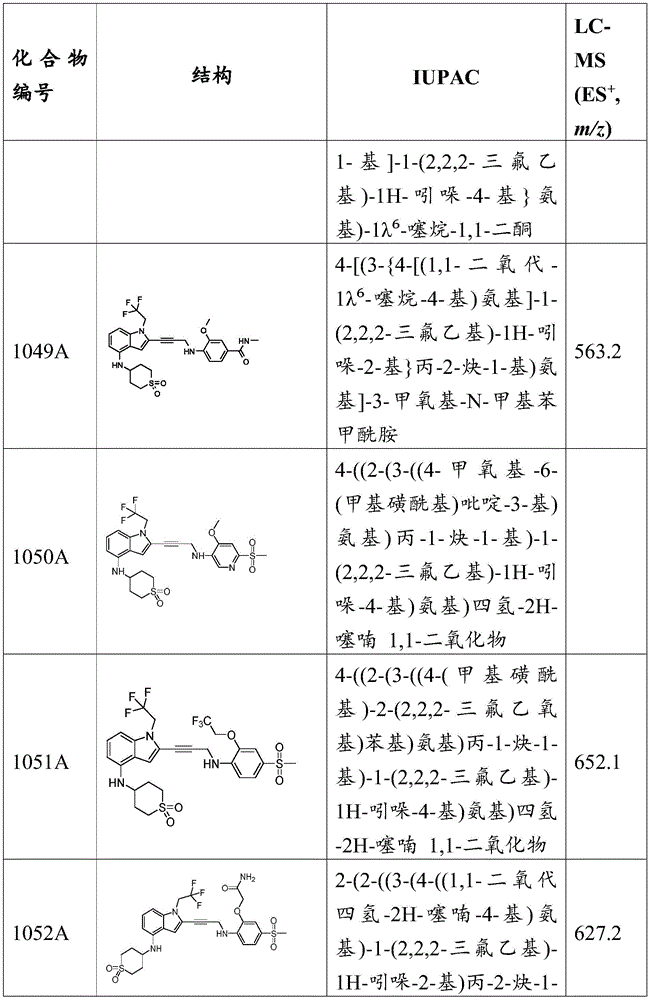
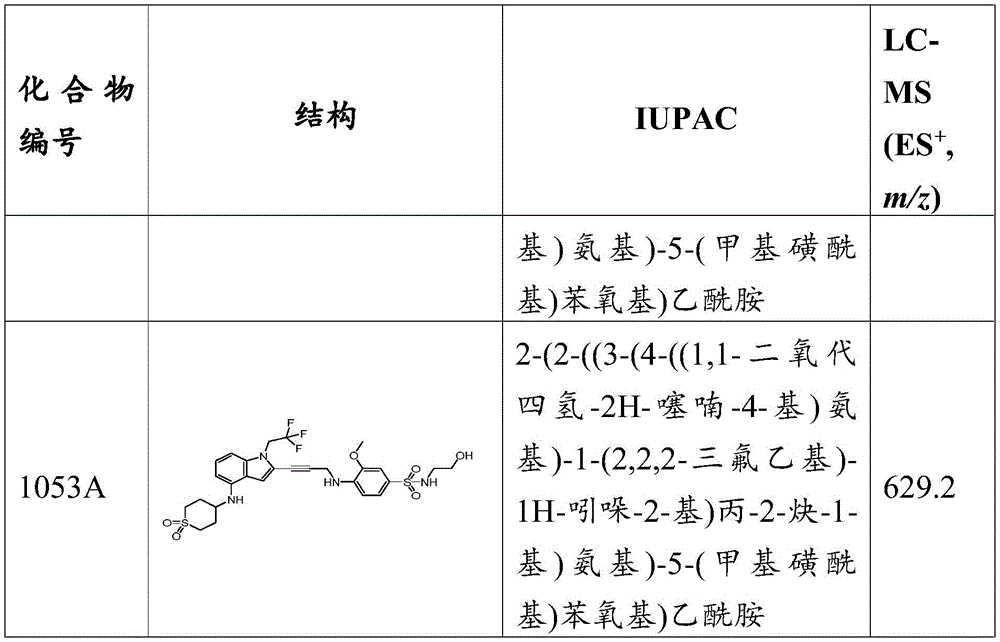
Example G: in vitro DNA binding Activity assay
The ability of the compounds of the invention to stabilize p53Y220C and increase the DNA binding activity of p53Y220C was measured by a homogeneous time-resolved fluorescence (HTRF) assay. Recombinant His-tagged p53Y220C for HTRF assay was expressed in bacterial e. The recombinant protein is a truncated mutant comprising only amino acids 94-312 of p53, which includes the DNA Binding Domain (DBD) of p53 (SEQ ID No.: 1). The DNA binding ability of His-tagged p53Y220C was tested with the consensus sequence of DNA (DNA duplex with sequence 5'-ATTAGGCATGTCTAGGCATGTCTAGG-3'; SEQ ID NO.: 2). Then, SEQ ID No. 2 was conjugated to a biotin tag and used for activity assay.
Binding of the recombinant His-tagged p53Y220C protein to biotin-tagged consensus DNA was measured using Fluorescence Resonance Energy Transfer (FRET). For FRET assay, binding between the p53 mutant and the DNA sequence was measured by detecting fluorescence of the interaction between an anti-His antibody conjugated to Allophycocyanin (APC) and streptavidin conjugated to europium to detect biotin-tagged DNA.
Test compounds were prepared as 4.5mM stock solutions in dimethyl sulfoxide (DMSO). The compounds of the present disclosure were used to test the stabilization of p 53Y 220C and the increase in DNA binding activity of p 53Y 220C. The stock solution was then serially diluted 3-fold in DMSO and 1.2 μ Ι _ of the diluted solution was added to each well of a 384-well polypropylene black plate. mu.L of an ice-cold assay buffer 1(50mM Tris-HCl, pH 7.4; 75mM KCl; 0.75mM DTT; and 0.2mg/mL Bovine Serum Albumin (BSA)) solution of recombinant His-tagged p 53Y 220C protein in 181nM and 12.1nM of APC-conjugated anti-His-tagged antibody was added to each well containing the test compound.
As a background control, 30 μ L of assay buffer 1 containing 12.1nM APC anti-His antibody was added to a second set of serially diluted compound plates. The test and control samples were spun at 1200rpm for 1 minute and incubated at room temperature for 15 minutes. The samples were then incubated for a further 60 minutes at 27 ℃ or 29 ℃.5 microliters of 311nM biotin-tagged consensus DNA (SEQ ID NO.:2) and 13.03nM europium-conjugated streptavidin in assay buffer 2(50mM Tris-HCl, pH 7.4; 75mM KCl; and 0.2mg/mL BSA) solution was added to each well of both the test and control plates. The plate was rotated at 1200rpm for 1 minute and incubated at room temperature for 20 minutes. The assay signal was monitored by reading excitation at 340nm and emitted fluorescence at 615nm and 665nm on a microplate reader.
Normalized time-resolved fluorescence resonance energy transfer (TR-FRET) assay signal (R) n ) Calculated by the following formula:
R n =[(A-B a -CD)/(D-B d )](D c -B d )
wherein A is the fluorescence intensity of the sample at 665 nm;
d is the fluorescence intensity of the sample at 615 nm;
B a and B d Plate background readings at 665nm and 615nm, respectively; and is
D c The fluorescence intensity of 1.8nM Eu-SA in buffer was measured at 615 nM.
The crosstalk factor (C) is determined by the following formula:
C=(A c -B a )/(D c -B d )
wherein A is c The fluorescence intensity of 1.8nM Eu-labeled anti-FLAG antibody in buffer was determined at 665 nM.
The percent activation of protein DNA binding in the presence of the compound of the invention is determined by SC in comparison to the absence of the compound of the invention 150 Values represent the concentration of compound required to increase DNA binding activity by 50%. Using Prism TM Or ActivityBase TM Computing SC 150 The value is obtained.
TABLE 7
+=0μM≤SC 150 <0.05μM +++=0.1μM≤SC 150 <0.2μM
++=0.05μM≤SC 150 <0.1μM ++++=0.2μM≤SC 150 <1μM
Compound number/SC 150 (μM)


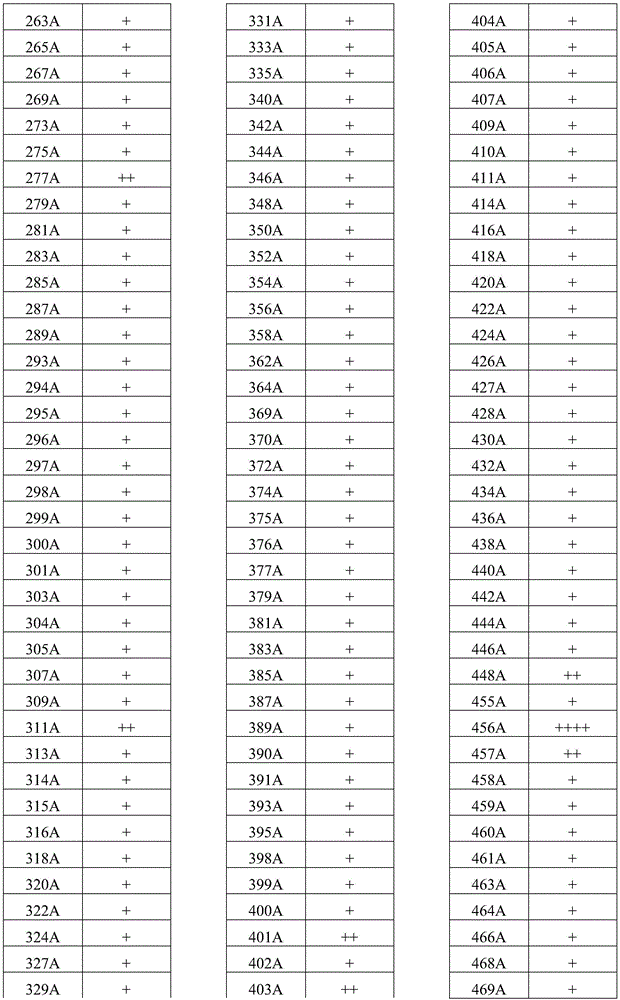


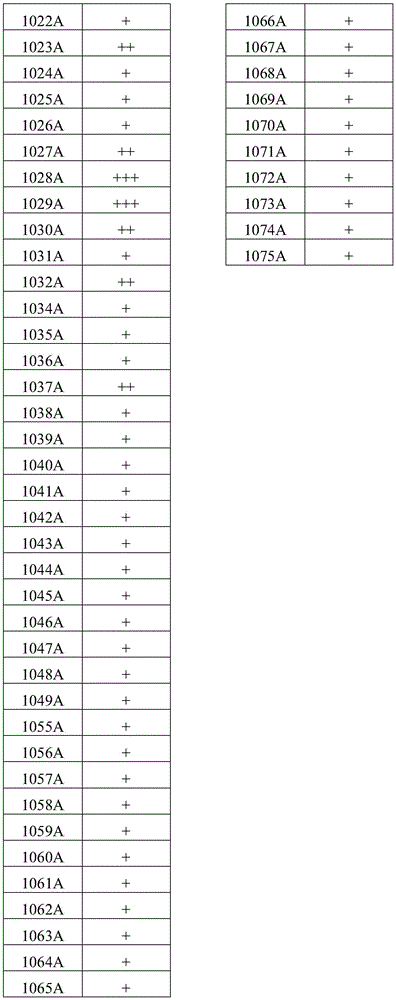
+=0μM≤SC 150 <0.05μM +++=0.1μM≤SC 150 <0.2μM
++=0.05μM≤SC 150 <0.1μM ++++=0.2μM≤SC 150 <1μM
Detailed description of the preferred embodiments
The following non-limiting embodiments provide illustrative examples of the invention, but do not limit the scope of the invention.
Embodiment 1. a compound of the formula:

wherein:
-each of Independently a single or double bond;
-X 1 is CR 5 、CR 5 R 6 、N、NR 5 O, S, C-O, C-S or connected to Q 1 A carbon atom of (a);
-X 2 is CR 7 、CR 7 R 8 、N、NR 7 O, S, C-O, C-S or connected to Q 1 A carbon atom of (a);
-X 3 Is CR 9 、CR 9 R 10 、N、NR 9 O, S, C-O, C-S or connected to Q 1 A carbon atom of (a);
-X 4 is CR 11 、CR 11 R 12 、N、NR 11 O, S, C-O, C-S or connected to Q 1 A carbon atom of (a);
-X 5 is CR 13 N or NR 13 ;
Wherein X 1 、X 2 、X 3 And X 4 Is connected to Q 1 A carbon atom of (a);
-Q 1 is C-O, C-S, C-CR 14 R 15 、C=NR 14 Alkylene, alkenylene, or alkynylene, each independently substituted or unsubstituted; or is a bond;
-m is 1, 2, 3 or 4;
-Y is N, O or absent;
-R 1 is-C (O) R 16 、-C(O)OR 16 、-C(O)NR 16 R 17 、-OR 16 、-SR 16 、-NR 16 R 17 、-NR 16 C(O)R 16 、-OC(O)R 16 、C=O、C=S、-CN、-SiR 16 R 17 R 18 Alkyl, alkenyl, alkynyl, aryl, heteroaryl or heterocyclyl, each of which is independently substitutedOr unsubstituted; or is hydrogen;
each R 3 And R 4 Independently is-C (O) R 19 、-C(O)OR 19 、-C(O)NR 19 R 20 、-SOR 19 、-SO 2 R 19 Alkyl, alkylene, alkenyl, alkenylene, alkynyl, aryl, heteroaryl, or heterocyclyl, each of which is independently substituted or unsubstituted; or is hydrogen, or R 3 And R 4 Together with R 3 And R 4 The combined Y atoms together form a ring, wherein the ring is substituted or unsubstituted, or R 3 Is absent;
each R 2 、R 5 、R 6 、R 7 、R 8 、R 9 、R 10 、R 11 、R 12 、R 13 、R 14 、R 15 、R 16 、R 17 And R 18 Independently is-C (O) R 21 、-C(O)OR 21 、-C(O)NR 21 R 22 、-OR 21 、-SR 21 、-NR 21 R 22 、-NR 21 C(O)R 22 、-OC(O)R 21 Alkyl, alkenyl, alkynyl, aryl, heteroaryl, or heterocyclyl, each independently substituted or unsubstituted; or is hydrogen or halogen;
each R 19 And R 20 Is C (O) R 23 、-C(O)OR 23 、-C(O)NR 23 R 24 、-OR 23 、-SR 23 、-NR 23 R 24 、-NR 23 C(O)R 24 、-OC(O)R 23 Alkyl, alkenyl, alkynyl, aryl, heteroaryl, or heterocyclyl, each of which is independently substituted or unsubstituted; or is hydrogen or halogen;
Each R 21 And R 22 Independently is an alkyl, alkenyl, alkynyl, aryl, heteroaryl, or heterocyclyl group, each of which is independently substituted or unsubstituted; or is hydrogen; and is
Each R 23 And R 24 Independently is an alkyl, alkenyl, alkynyl, aryl, heteroaryl, or heterocyclyl group, each of which is independently substituted or unsubstituted; or is a mixture of hydrogen and a nitrogen-containing compound,
or a pharmaceutically acceptable salt thereof, wherein the compound is not a compound of table 1.
Embodiment 2. a compound of the formula:
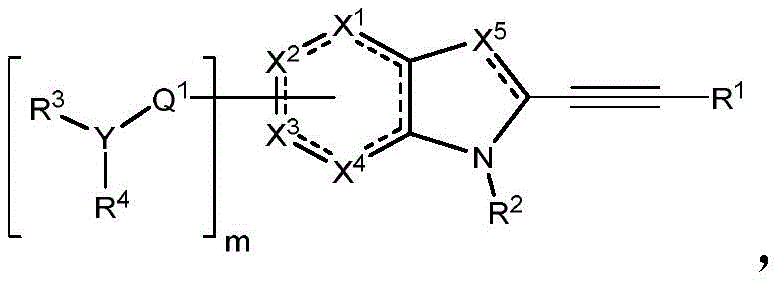
wherein:
-each of Independently a single or double bond;
-X 1 is CR 5 、CR 5 R 6 、N、NR 5 O, S, C-O, C-S or connected to Q 1 A carbon atom of (a);
-X 2 is CR 7 、CR 7 R 8 、N、NR 7 O, S, C-O, C-S or connected to Q 1 A carbon atom of (a);
-X 3 is CR 9 、CR 9 R 10 、N、NR 9 O, S, C-O, C-S or connected to Q 1 A carbon atom of (a);
-X 4 is CR 11 、CR 11 R 12 、N、NR 11 O, S, C-O, C-S or connected to Q 1 A carbon atom of (a);
-X 5 is CR 13 N or NR 13 ;
Wherein X 1 、X 2 、X 3 And X 4 Is connected to Q 1 A carbon atom of (a);
-Q 1 is C-O, C-S, C-CR 14 R 15 、C=NR 14 Alkylene, alkenylene, or alkynylene, each independently substituted or unsubstituted; or is a bond;
-m is 1, 2, 3 or 4;
-Y is N, O or absent;
-R 1 is-C (O) R 16 、-C(O)OR 16 、-C(O)NR 16 R 17 、-OR 16 、-SR 16 、-NR 16 R 17 、-NR 16 C(O)R 16 、-OC(O)R 16 、C=O、C=S、-CN、-SiR 16 R 17 R 18 Alkyl, alkenyl, alkynyl, aryl, heteroaryl, or heterocyclyl, each independently substituted or unsubstituted; or is hydrogen;
Each R 3 And R 4 Independently is-C (O) R 19 、-C(O)OR 19 、-C(O)NR 19 R 20 、-SOR 19 、-SO 2 R 19 Alkyl, alkylene, alkenyl, alkenylene, alkynyl, aryl, heteroaryl, or heterocyclyl, each of which is independently substituted or unsubstituted; or is hydrogen, or R 3 And R 4 Together with R 3 And R 4 The bound nitrogen atoms together form a ring, wherein the ring is substituted or unsubstituted, or R 3 Is absent, wherein R 3 And R 4 Is alkyl, alkylene, alkenyl, alkenylene, alkynyl, aryl, heteroaryl or heterocyclyl, each of which is at least halo-substituted;
each R 2 、R 5 、R 6 、R 7 、R 8 、R 9 、R 10 、R 11 、R 12 、R 13 、R 14 、R 15 、R 16 、R 17 And R 18 Independently is-C (O) R 21 、-C(O)OR 21 、-C(O)NR 21 R 22 、-OR 21 、-SR 21 、-NR 21 R 22 、-NR 21 C(O)R 22 、-OC(O)R 21 Alkyl, alkenyl, alkynyl, aryl, heteroaryl, or heterocyclyl, each of which is independently substituted or unsubstituted; or is hydrogen or halogen;
each R 19 And R 20 Is C (O) R 23 、-C(O)OR 23 、-C(O)NR 23 R 24 、-OR 23 、-SR 23 、-NR 23 R 24 、-NR 23 C(O)R 24 、-OC(O)R 23 Alkyl, alkenyl, alkynyl, aryl, heteroaryl or heterocyclyl, each of which is independently a substituentSubstituted or unsubstituted; or is hydrogen or halogen;
each R 21 And R 22 Independently is an alkyl, alkenyl, alkynyl, aryl, heteroaryl, or heterocyclyl group, each of which is independently substituted or unsubstituted; or is hydrogen; and is
Each R 23 And R 24 Independently is an alkyl, alkenyl, alkynyl, aryl, heteroaryl, or heterocyclyl group, each of which is independently substituted or unsubstituted; or is a hydrogen atom or a hydrogen atom,
Or a pharmaceutically acceptable salt thereof.
Embodiment 3. the compound of embodiment 1 or 2, wherein X 1 To be connected to Q 1 Carbon atom (b) of (a).
Embodiment 4. the compound of embodiment 1 or 2, wherein X 2 To be connected to Q 1 Carbon atom (b) of (a).
Embodiment 5. the compound of any of embodiments 1-4, wherein Q 1 Is a bond.
Embodiment 6. the compound of any one of embodiments 1 to 5, wherein Y is N or O.
Embodiment 7. the compound of any one of embodiments 1 to 6, wherein Y is N.
Embodiment 8. the compound of any one of embodiments 1 to 7, wherein m is 1.
Embodiment 9 a compound according to any one of embodiments 1 to 7 wherein m is 2.
Embodiment 10. the compound of any one of embodiments 1-3 and 5-8, wherein the compound is of formula (la):
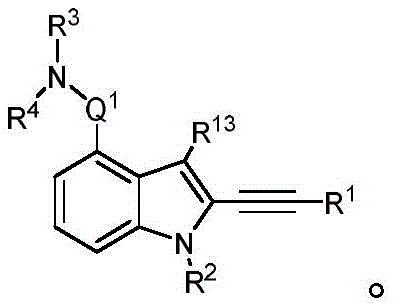
embodiment 11 the compound of any one of embodiments 1-3, 5-8, and 10, wherein said compound has the formula:

embodiment 12 the compound of any one of embodiments 1, 2, and 4-8, wherein the compound is of formula (la):
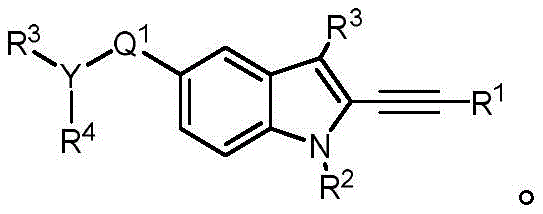
embodiment 13 the compound of any one of embodiments 1, 2, 4-8, and 12, wherein said compound has the formula:
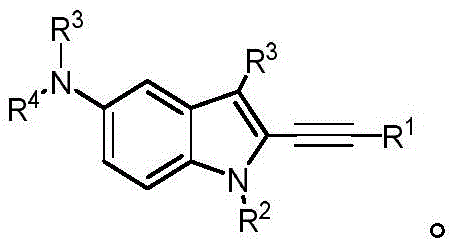
Embodiment 14. the compound of any of embodiments 1-13, wherein R 1 Is alkyl, alkenyl, -C (O) R 16 、-C(O)OR 16 or-C (O) NR 16 R 17 。
Embodiment 15. the compound of any of embodiments 1-14, wherein R 1 Is a substituted alkyl group.
Embodiment 16. the compound of any of embodiments 1-15, wherein R 1 Is being NR 16 R 17 A substituted alkyl group.
Embodiment 17. the compound of any one of embodiments 1-8, 10, 11, and 14-16, wherein the compound is of formula (la):

embodiment 18 the compound of any one of embodiments 1-8, 10, 11, and 14-17, wherein the compound has the formula:

embodiment 19. the compound of any one of embodiments 1-8 and 12-16, wherein the compound is of formula (la):

embodiment 20 the compound of any one of embodiments 1-8, 12-16, and 19, wherein said compound has the formula:

embodiment 21. the compound of any one of embodiments 1 to 20, wherein each R 16 And R 17 Independently an alkyl, alkenyl, aryl, heteroaryl, heterocyclyl, each of which is independently substituted or unsubstituted; or hydrogen.
Embodiment 22. the compound of any one of embodiments 1 to 21, wherein R 16 Is hydrogen or alkyl.
Embodiment 23. the compound of any of embodiments 1-22, wherein R 17 Is aryl, heteroaryl or heterocyclyl, each of which is independently substituted or unsubstituted.
Embodiment 24. the compound of any of embodiments 1-23, wherein R 17 Is a substituted aryl group.
Embodiment 25. the compound of any one of embodiments 1 to 24, wherein R 17 Is a substituted phenyl group.
Embodiment 26. the compound of any one of embodiments 1 to 25, wherein R 17 Is phenyl substituted with a sulfoxide group, a carboxyl group, an amide group, an amino group, an alkyl group, an alkoxy group, a hydroxyl group, a halo group, a cyano group, or a heterocyclic group, each of which is independently substituted or unsubstituted.
Embodiment 27. the compound of any one of embodiments 1 to 26, wherein R 17 Is phenyl substituted by methoxy.
Embodiment 28. the compound of any one of embodiments 1 to 26, wherein R 17 Being a substituted sulphoxy groupA phenyl group substituted with a group.
Embodiment 29. the compound of any one of embodiments 1 to 26, wherein R 17 Is phenyl substituted by a carboxyl group.
Embodiment 30. the compound of any one of embodiments 1 to 26, wherein R 17 Is phenyl substituted with a substituted amide group.
Embodiment 31. the compound of any of embodiments 1-30, wherein R 2 Is hydrogen or substituted or unsubstituted alkyl.
Embodiment 32. the compound of any of embodiments 1-31, wherein R 2 Is substituted C 1 -C 5 -an alkyl group.
Embodiment 33. the compound of any of embodiments 1-32, wherein R 2 Is trifluoroethyl.
Embodiment 34. the compound of any of embodiments 1-32, wherein R 2 Is a cycloalkyl group.
Embodiment 35. the compound of any of embodiments 1-34, wherein R 13 Is alkyl, alkenyl, hydrogen or halogen.
Embodiment 36. the compound of any of embodiments 1-35, wherein R 13 Is hydrogen.
Embodiment 37. the compound of any one of embodiments 1-3, 4-8, 10, 11, 14-18, 21-33, 35, and 36, wherein the compound has the formula:

embodiment 38 the compound of any one of embodiments 1, 2, 4-8, 12-16, 19-33, 35, and 36, wherein the compound has the formula:
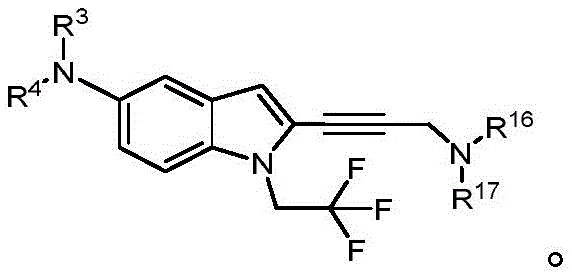
embodiment 39. any of embodiments 1-38The compound of (1), wherein R 3 And R 4 Is aryl, heteroaryl or heterocyclyl, each of which is at least halo-substituted.
Embodiment 40. the compound of any of embodiments 1-39, wherein R 3 Is H, and R 4 Is aryl, heteroaryl or heterocyclyl, each of which is at least halo-substituted.
Embodiment 41. the compound of any of embodiments 1-40, wherein R 3 Is H, and R 4 Is an aryl group at least fluorine-substituted.
Embodiment 42. the compound of any one of embodiments 1 to 40, wherein R 3 Is H, and R 4 Is heteroaryl at least substituted by fluoro.
Embodiment 43. the compound of any one of embodiments 1 to 42, wherein R 3 Is H, and R 4 Is a heterocyclic group at least fluorine-substituted.
Embodiment 44. the compound of any of embodiments 1-43, wherein R 3 And R 4 Is aryl, heteroaryl or heterocyclyl, each of which is at least chloro-substituted.
Embodiment 45. the compound of any of embodiments 1-44, wherein R 3 Is H, and R 4 Is a heterocyclic group at least chloro-substituted.
Embodiment 46. the compound of any of embodiments 1-45, wherein R 4 Is a substituted piperidinyl group.
Embodiment 47. the compound of any one of embodiments 1 to 47, wherein R 4 Is piperidinyl substituted with at least an alkyl, carboxyl, heterocyclyl or amide group, each of which is substituted or unsubstituted.
Embodiment 48. the compound of any of embodiments 1-47, wherein R 4 Is unsubstituted or substituted methylpiperidinyl.
Embodiment 49. the compound of any of embodiments 1-48, wherein R 4 Is 3-fluoro-1-methylpiperidine.
Embodiment 50. the compound of any of embodiments 1-47, wherein R 4 Is a substituted or unsubstituted methoxypropanol substituted piperidinyl group.
Embodiment 51. the compound of any one of embodiments 1 to 47 and 50, wherein R 4 Is 3-fluoro-1- (2-hydroxy-3-methoxypropyl) piperidinyl.
Embodiment 52. the compound of any of embodiments 1-45, wherein R 4 Is unsubstituted or substituted tetrahydropyranyl.
Embodiment 53. the compound of any of embodiments 1 to 45 and 52, wherein R 4 Is unsubstituted tetrahydropyranyl.
Embodiment 54 the compound of any one of embodiments 1-45 and 52, wherein R 4 Is tetrahydropyranyl substituted with alkyl.
Embodiment 55. the compound of any one of embodiments 1 to 45, 52 and 54, wherein R 4 Is tetrahydrothiopyran-1, 1-dioxide.
Embodiment 56. the compound of any one of embodiments 1-3, 5-8, 10, 11, 14-18, 21-28, 31-33, and 35-37, wherein the compound is:

Embodiment 57 the compound of any one of embodiments 1-3, 5-8, 10, 11, 14-18, 21-28, 31-33, and 35-37, wherein the compound is:

embodiment 58 the compound of any one of embodiments 1-3, 5-8, 10, 11, 14-18, 21-28, 31-33, and 35-37, wherein the compound is:

embodiment 59. the compound of any one of embodiments 1-3, 5-8, 10, 11, 14-18, 21-28, 31-33, 35-37, and 39-49, wherein the compound is:

embodiment 60. the compound of any one of embodiments 1-3, 5-8, 10, 11, 14-18, 21-28, 31-33, 35-37, and 39-49, wherein the compound is:
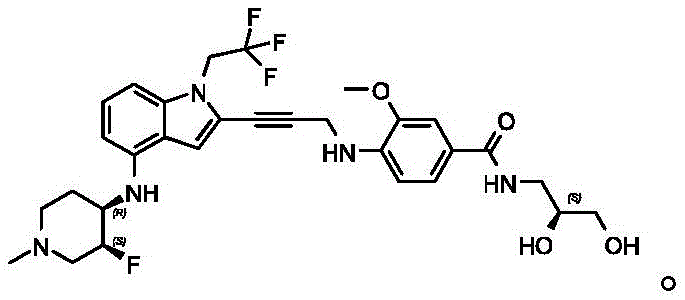
embodiment 61. the compound of any one of embodiments 1-3, 5-8, 10, 11, 14-18, 21-28, 31-33, and 35-37, wherein the compound is:
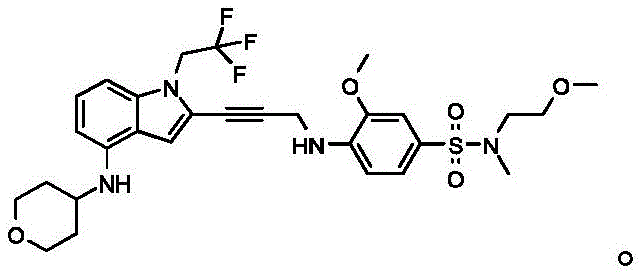
embodiment 62 the compound of any one of embodiments 1-3, 5-8, 10, 11, 14-18, 21-28, 31-33, and 35-37, wherein the compound is:

embodiment 63 the compound of any one of embodiments 1-3, 5-8, 10, 11, 14-18, 21-28, 31-33, and 35-37, wherein the compound is:

embodiment 64 the compound of any one of embodiments 1-3, 5-8, 10, 11, 14-18, 21-28, 31-33, 35-37, and 39-49, wherein said compound is:
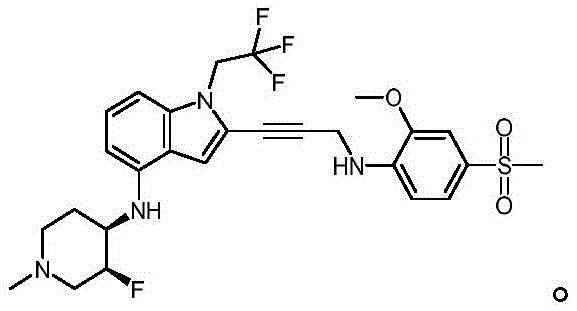
Embodiment 65. a compound comprising: a heterocyclyl group comprising a halogen substituent, wherein the compound binds to mutant p53 protein and increases wild-type p53 activity of the mutant p53 protein.
Embodiment 66. the compound of embodiment 65, wherein the compound further comprises an indole group attached to a heterocyclyl group.
Embodiment 67. the compound of embodiment 66, wherein the indole group has a 1,1, 1-trifluoroethyl substituent at the 1-position of the indole group.
Embodiment 68. the compound of any of embodiments 65-67, wherein the indole group has a propargyl substituent at the 2-position of the indole group.
Embodiment 69 the compound of embodiment 68, wherein the propargyl substituent is attached to the indole group through an sp carbon atom of the propargyl substituent.
Embodiment 70 the compound of embodiment 68 or 69, wherein the propargyl substituent is attached to the nitrogen atom of the aniline group through the methylene group of the propargyl substituent.
Embodiment 71. the compound of any one of embodiments 66 to 70, wherein the indole group comprises an amino substituent at the 4-position of the indole group.
Embodiment 72 the compound of embodiment 71, wherein the amino substituent is attached to the heterocyclyl group.
Embodiment 73. the compound of any of embodiments 65-72, wherein said heterocyclyl group is a piperidine group.
Embodiment 74 the compound of any of embodiments 65-73, wherein the halo substituent comprises a fluoro group.
Embodiment 75 the compound of any of embodiments 65-73, wherein the halo substituent comprises a chloro group.
Embodiment 76 the compound of any of embodiments 65-75, wherein said heterocyclyl group further comprises at least one substituent group.
Embodiment 77 the compound of any of embodiments 65-76, wherein the heterocyclyl group comprises an alkyl group.
Embodiment 78 the compound of any one of embodiments 65 to 77, wherein said heterocyclyl group comprises a methyl group.
Embodiment 79 a compound of any of embodiments 65 to 78, wherein said heterocyclyl group is a methylpiperidine group.
Embodiment 80. the compound of any of embodiments 65-79, wherein the heterocyclyl group is 1-methylpiperidinyl.
Embodiment 81. the compound of any of embodiments 65-80, wherein the heterocyclyl group is 1-methylpiperidin-4-yl.
Embodiment 82. the compound of any of embodiments 65-81, wherein said heterocyclyl group is 3-fluoro-1-methylpiperidin-4-yl.
Embodiment 83. the compound of embodiment 70, wherein the anilino group is substituted with a hydroxyl group, a thiol group, a halogen, an amino group, a nitro group, a nitroso group, a cyano group, an azido group, a sulfoxide group, a sulfone group, a sulfonamide group, a carboxyl group, a formaldehyde group, an imine group, an alkyl group, a halo-alkyl group, a cycloalkyl group, an alkenyl group, a halo-alkenyl group, an alkynyl group, a halo-alkynyl group, an alkoxy group, an aryl group, an aryloxy group, an aralkyl group, an arylalkoxy group, a heterocyclyl group, an acyl group, an acyloxy group, a carbamate group, an amide group, a urethane group, and an ester group.
Embodiment 84. the compound of embodiment 70 or 83, wherein the anilino group is substituted with an alkoxy group.
Embodiment 85 the compound of any one of embodiments 70, 83, or 84, wherein the anilino group is substituted with a sulfonamide group.
Embodiment 86. the compound of any of embodiments 70 or 83-85, wherein the anilino group is substituted with an amide.
Embodiment 87 the compound of any one of embodiments 65-86, wherein the compound is of formula (la):

wherein:
-each of Independently a single or double bond;
-X 1 is CR 5 、CR 5 R 6 、N、NR 5 O, S, C-O, C-S or connected to Q 1 A carbon atom of (a);
-X 2 is CR 7 、CR 7 R 8 、N、NR 7 O, S, C O, C S or connected to Q 1 A carbon atom of (a);
-X 3 is CR 9 、CR 9 R 10 、N、NR 9 O, S, C-O, C-S or connected to Q 1 A carbon atom of (a);
-X 4 is CR 11 、CR 11 R 12 、N、NR 11 O, S, C-O, C-S or connected to Q 1 A carbon atom of (a);
-X 5 is CR 13 N or NR 13 ;
Wherein X 1 、X 2 、X 3 And X 4 Is connected to Q 1 A carbon atom of (a);
-a is a linking group;
-Q 1 is C-O, C-S, C-CR 14 R 15 、C=NR 14 Alkylene, alkenylene or alkynyleneEach of which is independently substituted or unsubstituted; or is a bond;
-m is 1, 2, 3 or 4;
-Y is N, O or absent;
-R 1 is-C (O) R 16 、-C(O)OR 16 、-C(O)NR 16 R 17 、-OR 16 、-SR 16 、-NR 16 R 17 、-NR 16 C(O)R 16 、-OC(O)R 16 、-SiR 16 R 17 R 18 Alkyl, alkenyl, alkynyl, alkoxy, aryl, heteroaryl, heterocyclyl or halo, each of which is independently substituted or unsubstituted; or is hydrogen;
each R 3 And R 4 Independently is-C (O) R 19 、-C(O)OR 19 、-C(O)NR 19 R 20 、-SOR 19 、-SO 2 R 19 Alkyl, alkenyl, alkynyl, aryl, heteroaryl, or heterocyclyl, each of which is independently substituted or unsubstituted; or is hydrogen, or R 3 And R 4 Together with R 3 And R 4 The bound nitrogen atoms together form a ring, wherein the ring is substituted or unsubstituted, or R 3 Is absent; wherein R is 3 And R 4 Is alkyl, alkylene, alkenyl, alkenylene, alkynyl, alkynylene, aryl, heteroaryl or heterocyclyl, each of which is substituted with at least halo;
each R 2 、R 5 、R 6 、R 7 、R 8 、R 9 、R 10 、R 11 、R 12 、R 13 、R 14 、R 15 、R 16 、R 17 And R 18 Independently is-C (O) R 21 、-C(O)OR 21 、-C(O)NR 21 R 22 、-OR 21 、-SR 21 、-NR 21 R 22 、-NR 21 C(O)R 22 、-OC(O)R 21 Alkyl, alkenyl, alkynyl, aryl, heteroaryl, or heterocyclyl, each independently substituted or unsubstituted; or is hydrogen or halogen;
each R 19 And R 20 Independently is-C (O) R 23 、-C(O)OR 23 、-C(O)NR 23 R 24 、-OR 23 、-SR 23 、-NR 23 R 24 、-NR 23 C(O)R 24 、-OC(O)R 23 Alkyl, alkenyl, alkynyl, aryl, heteroaryl, or heterocyclyl, each independently substituted or unsubstituted; or is hydrogen or halogen;
each R 21 And R 22 Independently is an alkyl, alkenyl, alkynyl, aryl, heteroaryl, or heterocyclyl group, each of which is independently substituted or unsubstituted; or is hydrogen; and is
Each R 23 And R 24 Independently is an alkyl, alkenyl, alkynyl, aryl, heteroaryl, or heterocyclyl group, each of which is independently substituted or unsubstituted; or is a hydrogen atom or a hydrogen atom,
or a pharmaceutically acceptable salt thereof.
Embodiment 88 the compound of any one of embodiments 65-87, wherein the compound is of formula (la):
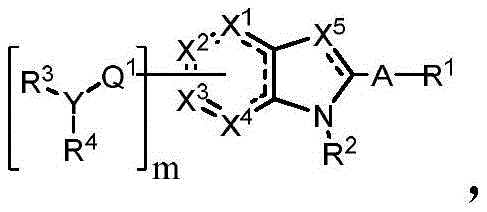
Wherein:
-each of Independently a single or double bond;
-X 1 is CR 5 、CR 5 R 6 、N、NR 5 O, S, C-O, C-S or connected to Q 1 A carbon atom of (a);
-X 2 is CR 7 、CR 7 R 8 、N、NR 7 O, S, C-O, C-S or connected to Q 1 A carbon atom of (a);
-X 3 is CR 9 、CR 9 R 10 、N、NR 9 O, S, C-O, C-S or connected to Q 1 A carbon atom of (a);
-X 4 is CR 11 、CR 11 R 12 、N、NR 11 O, S, C-O, C-S or connected to Q 1 A carbon atom of (a);
-X 5 is CR 13 N or NR 13 ;
Wherein X 1 、X 2 、X 3 And X 4 Is connected to Q 1 A carbon atom of (a);
-a is a linking group;
-Q 1 is C-O, C-S, C-CR 14 R 15 、C=NR 14 Alkylene, alkenylene, or alkynylene, each independently substituted or unsubstituted; or is a bond;
-m is 1, 2, 3 or 4;
-Y is N, O or absent;
-R 1 is-C (O) R 16 、-C(O)OR 16 、-C(O)NR 16 R 17 、-OR 16 、-SR 16 、-NR 16 R 17 、-NR 16 C(O)R 16 、-OC(O)R 16 、-SiR 16 R 17 R 18 Alkyl, alkenyl, alkynyl, alkoxy, aryl, heteroaryl, heterocyclyl or halo, each of which is independently substituted or unsubstituted; or is hydrogen;
each R 3 And R 4 Independently is-C (O) R 19 、-C(O)OR 19 、-C(O)NR 19 R 20 、-SOR 19 、-SO 2 R 19 Alkyl, alkenyl, alkynyl, aryl, heteroaryl, or heterocyclyl, each independently substituted or unsubstituted; or is hydrogen, or R 3 And R 4 Together with R 3 And R 4 The bound nitrogen atoms together form a ring, wherein the ring is substituted or unsubstituted, or R 3 Is absent;
each R 2 、R 5 、R 6 、R 7 、R 8 、R 9 、R 10 、R 11 、R 12 、R 13 、R 14 、R 15 、R 16 、R 17 And R 18 Independently is-C (O) R 21 、-C(O)OR 21 、-C(O)NR 21 R 22 、-OR 21 、-SR 21 、-NR 21 R 22 、-NR 21 C(O)R 22 、-OC(O)R 21 Alkyl, alkenyl, alkynyl, aryl, heteroaryl, or heterocyclyl, each independently substituted or unsubstituted; or is hydrogen or halogen;
each R 19 And R 20 Independently is-C (O) R 23 、-C(O)OR 23 、-C(O)NR 23 R 24 、-OR 23 、-SR 23 、-NR 23 R 24 、-NR 23 C(O)R 24 、-OC(O)R 23 Alkyl, alkenyl, alkynyl, aryl, heteroaryl, or heterocyclyl, each of which is independently substituted or unsubstituted; or is hydrogen or halogen;
each R 21 And R 22 Independently is an alkyl, alkenyl, alkynyl, aryl, heteroaryl, or heterocyclyl group, each of which is independently substituted or unsubstituted; or is hydrogen; and is
Each R 23 And R 24 Independently is an alkyl, alkenyl, alkynyl, aryl, heteroaryl, or heterocyclyl group, each of which is independently substituted or unsubstituted; or is a hydrogen atom or a hydrogen atom,
or a pharmaceutically acceptable salt thereof, wherein the compound is not a compound of table 1.
Embodiment 89 the compound of any one of embodiments 65-88, wherein the compound is of formula (la):

wherein:
-each of Independently a single or double bond;
-X 1 is CR 5 、CR 5 R 6 、N、NR 5 O, S, C-O, C-S or connected to Q 1 A carbon atom of (a);
-X 2 is CR 7 、CR 7 R 8 、N、NR 7 O, S, C-O, C-S or connected to Q 1 A carbon atom of (a);
-X 3 is CR 9 、CR 9 R 10 、N、NR 9 O, S, C-O, C-S or connected to Q 1 A carbon atom of (a);
-X 4 is CR 11 、CR 11 R 12 、N、NR 11 O, S, C-O, C-S or connected to Q 1 A carbon atom of (a);
-X 5 is CR 13 N or NR 13 ;
Wherein X 1 、X 2 、X 3 And X 4 Is connected to Q 1 A carbon atom of (a);
-Q 1 is C-O, C-S, C-CR 14 R 15 、C=NR 14 Alkylene, alkenylene, or alkynylene, each independently substituted or unsubstituted; or is a bond;
-m is 1, 2, 3 or 4;
-Y is N, O or absent;
-R 1 is-C (O) R 16 、-C(O)OR 16 、-C(O)NR 16 R 17 、-OR 16 、-SR 16 、-NR 16 R 17 、-NR 16 C(O)R 16 、-OC(O)R 16 、C=O、C=S、-CN、-SiR 16 R 17 R 18 Alkyl, alkenyl, alkynyl, aryl, heteroaryl, or heterocyclyl, each independently substituted or unsubstituted; or is hydrogen;
each R 3 And R 4 Independently is-C (O) R 19 、-C(O)OR 19 、-C(O)NR 19 R 20 、-SOR 19 、-SO 2 R 19 Alkyl, alkylene, alkenyl, alkenylene, alkynyl, aryl, heteroaryl, or heterocyclyl, each of which is independently substituted or unsubstituted; or is hydrogen, or R 3 And R 4 Together with R 3 And R 4 The combined Y atoms together form a ring, wherein the ring is substituted or unsubstituted, or R 3 Is absent;
each R 2 、R 5 、R 6 、R 7 、R 8 、R 9 、R 10 、R 11 、R 12 、R 13 、R 14 、R 15 、R 16 、R 17 And R 18 Independently is-C (O) R 21 、-C(O)OR 21 、-C(O)NR 21 R 22 、-OR 21 、-SR 21 、-NR 21 R 22 、-NR 21 C(O)R 22 、-OC(O)R 21 Alkyl, alkenyl, alkynyl, aryl, heteroaryl, or heterocyclyl, each of which is independently substituted or unsubstituted; or is hydrogen or halogen;
each R 19 And R 20 Is C (O) R 23 、-C(O)OR 23 、-C(O)NR 23 R 24 、-OR 23 、-SR 23 、-NR 23 R 24 、-NR 23 C(O)R 24 、-OC(O)R 23 Alkyl, alkenyl, alkynyl, aryl, heteroaryl, or heterocyclyl, each of which is independently substituted or unsubstituted; or is hydrogen or halogen;
Each R 21 And R 22 Independently an alkyl, alkenyl, alkynyl, aryl, heteroaryl, or heterocyclyl group, each of which is independently substituted or unsubstituted; or is hydrogen; and is
Each R 23 And R 24 Independently is an alkyl, alkenyl, alkynyl, aryl, heteroaryl, or heterocyclyl group, each of which is independently substituted or unsubstituted; or is a mixture of hydrogen and a nitrogen-containing compound,
or a pharmaceutically acceptable salt thereof, wherein the compound is not a compound of table 1.
Embodiment 90 the compound of any one of embodiments 65-89, wherein the compound is of formula (la):

wherein:
-each of Independently a single or double bond;
-X 1 is CR 5 、CR 5 R 6 、N、NR 5 O, S, C-O, C-S or connected to Q 1 A carbon atom of (a);
-X 2 is CR 7 、CR 7 R 8 、N、NR 7 O, S, C-O, C-S or connected to Q 1 A carbon atom of (a);
-X 3 is CR 9 、CR 9 R 10 、N、NR 9 O, S, C-O, C-S or connected to Q 1 A carbon atom of (a);
-X 4 is CR 11 、CR 11 R 12 、N、NR 11 O, S, C-O, C-S or connected to Q 1 A carbon atom of (a);
-X 5 is CR 13 N or NR 13 ;
Wherein X 1 、X 2 、X 3 And X 4 Is connected to Q 1 A carbon atom of (a);
-Q 1 is C-O, C-S, C-CR 14 R 15 、C=NR 14 Alkylene, alkenylene, or alkynylene, each independently substituted or unsubstituted; or is a bond;
-m is 1, 2, 3 or 4;
-Y is N, O or absent;
-R 1 is-C (O) R 16 、-C(O)OR 16 、-C(O)NR 16 R 17 、-OR 16 、-SR 16 、-NR 16 R 17 、-NR 16 C(O)R 16 、-OC(O)R 16 、C=O、C=S、-CN、-SiR 16 R 17 R 18 Alkyl, alkenyl, alkynyl, aryl, heteroaryl, or heterocyclyl, each independently substituted or unsubstituted; or is hydrogen;
each R 3 And R 4 Independently is-C (O) R 19 、-C(O)OR 19 、-C(O)NR 19 R 20 、-SOR 19 、-SO 2 R 19 Alkyl, alkyleneAn alkyl, alkenyl, alkenylene, alkynyl, aryl, heteroaryl, or heterocyclyl group, each of which is independently substituted or unsubstituted; or is hydrogen, or R 3 And R 4 Together with R 3 And R 4 The bound nitrogen atoms together form a ring, wherein the ring is substituted or unsubstituted, or R 3 Is absent, wherein R 3 And R 4 Is alkyl, alkylene, alkenyl, alkenylene, alkynyl, aryl, heteroaryl or heterocyclyl, each of which is at least halo-substituted;
each R 2 、R 5 、R 6 、R 7 、R 8 、R 9 、R 10 、R 11 、R 12 、R 13 、R 14 、R 15 、R 16 、R 17 And R 18 Independently is-C (O) R 21 、-C(O)OR 21 、-C(O)NR 21 R 22 、-OR 21 、-SR 21 、-NR 21 R 22 、-NR 21 C(O)R 22 、-OC(O)R 21 Alkyl, alkenyl, alkynyl, aryl, heteroaryl, or heterocyclyl, each independently substituted or unsubstituted; or is hydrogen or halogen;
each R 19 And R 20 Is C (O) R 23 、-C(O)OR 23 、-C(O)NR 23 R 24 、-OR 23 、-SR 23 、-NR 23 R 24 、-NR 23 C(O)R 24 、-OC(O)R 23 Alkyl, alkenyl, alkynyl, aryl, heteroaryl, or heterocyclyl, each independently substituted or unsubstituted; or is hydrogen or halogen;
each R 21 And R 22 Independently is an alkyl, alkenyl, alkynyl, aryl, heteroaryl, or heterocyclyl group, each of which is independently substituted or unsubstituted; or is hydrogen; and is
Each R 23 And R 24 Independently is an alkyl, alkenyl, alkynyl, aryl, heteroaryl, or heterocyclyl group, each of which is independently substituted or unsubstituted; or is a hydrogen atom or a hydrogen atom,
or a pharmaceutically acceptable salt thereof.
Embodiment 91. the compound of embodiment 87 or 88, wherein a is alkylene, alkenylene, or alkynylene, each of which is substituted or unsubstituted.
Embodiment 92 the compound of any one of embodiments 87, 88 or 91 wherein a is alkylene.
Embodiment 93 a compound of any one of embodiments 87, 88 or 91 wherein a is alkenylene.
Embodiment 94 the compound of any one of embodiments 87, 99 or 91 wherein a is alkynylene.
Embodiment 95 the compound of any one of embodiments 87 to 90, wherein Q 1 Is a bond.
Embodiment 96 a compound of any one of embodiments 87 to 90 wherein m is 1.
Embodiment 97 the compound of any one of embodiments 87 to 90 wherein m is 2.
Embodiment 98 the compound of any one of embodiments 87 to 90, wherein Y is N or O.
Embodiment 99. the compound of any one of embodiments 87 to 98, Y is N.
Embodiment 100. the compound of any of embodiments 87 to 99, wherein R 1 Is alkyl, alkenyl, -C (O) R 16 、-C(O)OR 16 or-C (O) NR 16 R 17 。
Embodiment 101. the compound of any one of embodiments 87 to 100, wherein R 1 Is a substituted alkyl group.
Embodiment 102 the compound of any one of embodiments 87-101, wherein R 1 Is by NR 16 R 17 A substituted alkyl group.
Embodiment 103. the compound of any one of embodiments 87 to 102, wherein each R 16 And R 17 Independently an alkyl, alkenyl, aryl, heteroaryl, heterocyclyl, each of which is independently substituted or unsubstituted; or hydrogen.
Embodiment 104. eThe compound of any of embodiments 87-103 wherein R 16 Is hydrogen or alkyl.
Embodiment 105 the compound of any one of embodiments 87-104, wherein R 17 Is aryl, heteroaryl or heterocyclyl, each of which is independently substituted or unsubstituted.
Embodiment 106. the compound of any of embodiments 87 to 105, wherein R 17 Is a substituted aryl group.
Embodiment 107. the compound of any of embodiments 87-106, wherein R 17 Is a substituted phenyl group.
Embodiment 108. the compound of any one of embodiments 87 to 107, wherein R 17 Is phenyl substituted with a sulfoxide group, a carboxyl group, an amide group, an amino group, an alkyl group, an alkoxy group, a hydroxyl group, a halo group, a cyano group, or a heterocyclic group, each independently substituted or unsubstituted.
Embodiment 109 the compound of any one of embodiments 87-108, wherein R 17 Is phenyl substituted by methoxy.
Embodiment 110 the compound of any one of embodiments 87-108, wherein R 17 Is phenyl substituted with a substituted sulfoxide group.
Embodiment 111. the compound of any one of embodiments 87 to 108, wherein R 17 Is phenyl substituted by a carboxyl group.
Embodiment 112 the compound of any one of embodiments 87-108, wherein R 17 Is phenyl substituted with a substituted amide group.
Embodiment 113 the compound of any one of embodiments 87-112, wherein R 2 Is hydrogen or substituted or unsubstituted alkyl.
Embodiment 114. the compound of any one of embodiments 87 to 113, wherein R 2 Is a substituted alkyl group.
Embodiment 115. the compound of any one of embodiments 87 to 114, wherein R 2 Is trifluoroethyl.
Embodiment 116. the compound of any of embodiments 87 to 114, wherein R 2 Is a substituted or unsubstituted cycloalkyl.
Embodiment 117. the compound of any one of embodiments 87 to 116, wherein R 13 Is a substituted or unsubstituted alkyl or alkenyl group; hydrogen or halogen.
Embodiment 118 the compound of any one of embodiments 87 to 117, wherein R 13 Is hydrogen.
Embodiment 119. the compound of any one of embodiments 87 to 118, wherein R 3 And R 4 Is aryl, heteroaryl or heterocyclyl, each of which is at least halo-substituted.
Embodiment 120. the compound of any one of embodiments 87 to 119, wherein R 3 Is H, and R 4 Is aryl, heteroaryl or heterocyclyl, each of which is at least halo-substituted.
Embodiment 121. the compound of any one of embodiments 87 to 120, wherein R 4 Is an aryl group at least fluorine-substituted.
Embodiment 122. the compound of any one of embodiments 87 to 120, wherein R 4 Is heteroaryl at least fluorine-substituted.
Embodiment 123. the compound of any one of embodiments 87 to 120, wherein R 4 Is a heterocyclic group at least fluorine-substituted.
Embodiment 124 the compound of any one of embodiments 87-120 or 123 wherein R 4 Is a substituted piperidinyl group.
Embodiment 125 the compound of any one of embodiments 87 to 120, 123 or 124, wherein R 4 Is piperidinyl substituted with at least an alkyl, carboxyl, heterocyclyl or amide group, each of which is substituted or unsubstituted.
Embodiment 126. the compound of any one of embodiments 87-120 or 123-125, wherein R 4 Is unsubstituted or substituted methylpiperidinyl.
Embodiment 127. as in embodiment 87-120 or 123-126, wherein R 4 Is 3-fluoro-1-methylpiperidine.
Embodiment 128. the compound of any one of embodiments 87 to 120 or 123-125, wherein R 4 Is piperidinyl substituted with substituted or unsubstituted methoxypropanol.
Embodiment 129. the compound of any one of embodiments 87-120, 123-125 or 128, wherein R 4 Is 3-fluoro-1- (2-hydroxy-3-methoxypropyl) piperidinyl.
Embodiment 130 the compound of any one of embodiments 87-120 wherein R 4 Is unsubstituted or substituted tetrahydropyranyl.
Embodiment 131. the compound of any one of embodiments 87-120 or 130, wherein R 4 Is tetrahydropyranyl substituted with alkyl.
Embodiment 132 a compound as described in any of embodiments 87-120, 130 or 131 wherein R 4 Is tetrahydrothiopyran-1, 1-dioxide.
Embodiment 133 the compound of any one of embodiments 65-132, wherein the compound binds to the mutant p53 protein and reforms the mutant p53 protein into the wild-type conformation p 53.
Embodiment 134 the compound of any of embodiments 65-133, wherein the oral bioavailability of the compound is at least about 50% greater than the oral bioavailability of a similar compound lacking a halo substituent on the heterocyclyl group.
Embodiment 135 a method of treating cancer, comprising administering to a subject in need thereof a compound of formula (I):

wherein:
-each of Independently is a single bond or bisA key;
-X 1 is CR 5 、CR 5 R 6 、N、NR 5 O, S, C-O, C-S or connected to Q 1 A carbon atom of (a);
-X 2 is CR 7 、CR 7 R 8 、N、NR 7 O, S, C O, C S or connected to Q 1 A carbon atom of (a);
-X 3 is CR 9 、CR 9 R 10 、N、NR 9 O, S, C-O, C-S or connected to Q 1 A carbon atom of (a);
-X 4 is CR 11 、CR 11 R 12 、N、NR 11 O, S, C-O, C-S or connected to Q 1 A carbon atom of (a);
-X 5 is CR 13 N or NR 13 ;
Wherein X 1 、X 2 、X 3 And X 4 Is connected to Q 1 A carbon atom of (a);
-Q 1 is C-O, C-S, C-CR 14 R 15 、C=NR 14 Alkylene, alkenylene, or alkynylene, each independently substituted or unsubstituted; or is a bond;
-m is 1, 2, 3 or 4;
-Y is N, O or absent;
-R 1 is-C (O) R 16 、-C(O)OR 16 、-C(O)NR 16 R 17 、-OR 16 、-SR 16 、-NR 16 R 17 、-NR 16 C(O)R 16 、-OC(O)R 16 、C=O、C=S、-CN、-SiR 16 R 17 R 18 Alkyl, alkenyl, alkynyl, aryl, heteroaryl, or heterocyclyl, each independently substituted or unsubstituted; or is hydrogen;
each R 3 And R 4 Independently is-C (O) R 19 、-C(O)OR 19 、-C(O)NR 19 R 20 、-SOR 19 、-SO 2 R 19 Alkyl, alkylene, alkenyl, alkenylene, alkynyl, aryl, heteroaryl or heterocycleEach of which is independently substituted or unsubstituted; or is hydrogen, or R 3 And R 4 Together with R 3 And R 4 The combined Y atoms together form a ring, wherein the ring is substituted or unsubstituted, or R 3 Is absent;
each R 2 、R 5 、R 6 、R 7 、R 8 、R 9 、R 10 、R 11 、R 12 、R 13 、R 14 、R 15 、R 16 、R 17 And R 18 Independently is-C (O) R 21 、-C(O)OR 21 、-C(O)NR 21 R 22 、-OR 21 、-SR 21 、-NR 21 R 22 、-NR 21 C(O)R 22 、-OC(O)R 21 Alkyl, alkenyl, alkynyl, aryl, heteroaryl, or heterocyclyl, each independently substituted or unsubstituted; or is hydrogen or halogen;
each R 19 And R 20 Is C (O) R 23 、-C(O)OR 23 、-C(O)NR 23 R 24 、-OR 23 、-SR 23 、-NR 23 R 24 、-NR 23 C(O)R 24 、-OC(O)R 23 Alkyl, alkenyl, alkynyl, aryl, heteroaryl, or heterocyclyl, each independently substituted or unsubstituted; or is hydrogen or halogen;
each R 21 And R 22 Independently is an alkyl, alkenyl, alkynyl, aryl, heteroaryl, or heterocyclyl group, each of which is independently substituted or unsubstituted; or is hydrogen; and is
Each R 23 And R 24 Independently is an alkyl, alkenyl, alkynyl, aryl, heteroaryl, or heterocyclyl group, each of which is independently substituted or unsubstituted; or is a hydrogen atom or a hydrogen atom,
or a pharmaceutically acceptable salt thereof;
wherein the SC of said compound to p53Y220C as measured by a homogeneous time-resolved fluorescence (HTRF) assay 150 The value is less than 1. mu.M.
Embodiment 136 the method of embodiment 135, wherein the cancer has a p53 mutation.
Embodiment 137 the method of embodiment 135 or 136, wherein the one p53 mutation is Y220C.
Embodiment 138 the method of embodiment 135, wherein the cancer has two p53 mutations.
Embodiment 139 the method of embodiment 138, wherein one of the two p53 mutations is Y220C.
Embodiment 140 the method of embodiment 138 or 139, wherein one of the two p53 mutations is a mutation to R306.
Embodiment 141 the method of embodiment 138 or 139, wherein one of the two p53 mutations is a mutation to a 74.
Embodiment 142 the method of embodiment 138, wherein one of said two p53 mutations is a mutation to M237.
Embodiment 143. the method of any one of embodiments 135-142, wherein the SC of the compound 150 The value was less than 0.2. mu.M.
Embodiment 144 the method of any one of embodiments 135-143, wherein the SC of the compound 150 The value was less than 0.1. mu.M.
Embodiment 145. the method of any one of embodiments 135-144, wherein the SC of the compound 150 The value was less than 0.05. mu.M.
Embodiment 146. a compound of the formula:
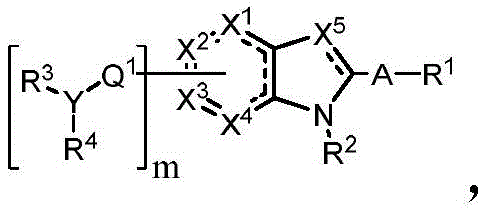
wherein:
-each of Independently a single or double bond;
-X 1 is CR 5 、CR 5 R 6 、N、NR 5 O, S, C-O, C-S or connected to Q 1 Carbon of (2)An atom;
-X 2 is CR 7 、CR 7 R 8 、N、NR 7 O, S, C-O, C-S or connected to Q 1 A carbon atom of (a);
-X 3 is CR 9 、CR 9 R 10 、N、NR 9 O, S, C-O, C-S or connected to Q 1 A carbon atom of (a);
-X 4 is CR 11 、CR 11 R 12 、N、NR 11 O, S, C-O, C-S or connected to Q 1 A carbon atom of (a);
-X 5 is CR 13 N or NR 13 ;
Wherein X 1 、X 2 、X 3 And X 4 Is connected to Q 1 A carbon atom of (a);
-a is a linking group;
-Q 1 is C-O, C-S, C-CR 14 R 15 、C=NR 14 Alkylene, alkenylene, or alkynylene, each independently substituted or unsubstituted; or is a bond;
-m is 1, 2, 3 or 4;
-Y is N, O or absent;
-R 1 is-C (O) R 16 、-C(O)OR 16 、-C(O)NR 16 R 17 、-OR 16 、-SR 16 、-NR 16 R 17 、-NR 16 C(O)R 16 、-OC(O)R 16 、-SiR 16 R 17 R 18 Alkyl, alkenyl, alkynyl, alkoxy, aryl, heteroaryl, heterocyclyl or halo, each of which is independently substituted or unsubstituted; or is hydrogen;
Each R 3 And R 4 Independently is-C (O) R 19 、-C(O)OR 19 、-C(O)NR 19 R 20 、-SOR 19 、-SO 2 R 19 Alkyl, alkenyl, alkynyl, aryl, heteroaryl, or heterocyclyl, each of which is independently substituted or unsubstituted; or is hydrogen, or R 3 And R 4 Together with R 3 And R 4 Bonding ofAre taken together to form a ring, wherein the ring is substituted or unsubstituted, or R 3 Is absent; wherein R is 3 And R 4 Is alkyl, alkylene, alkenyl, alkenylene, alkynyl, alkynylene, aryl, heteroaryl or heterocyclyl, each of which is substituted with at least halo;
each R 2 、R 5 、R 6 、R 7 、R 8 、R 9 、R 10 、R 11 、R 12 、R 13 、R 14 、R 15 、R 16 、R 17 And R 18 Independently is-C (O) R 21 、-C(O)OR 21 、-C(O)NR 21 R 22 、-OR 21 、-SR 21 、-NR 21 R 22 、-NR 21 C(O)R 22 、-OC(O)R 21 Alkyl, alkenyl, alkynyl, aryl, heteroaryl, or heterocyclyl, each independently substituted or unsubstituted; or is hydrogen or halogen;
each R 19 And R 20 Independently is-C (O) R 23 、-C(O)OR 23 、-C(O)NR 23 R 24 、-OR 23 、-SR 23 、-NR 23 R 24 、-NR 23 C(O)R 24 、-OC(O)R 23 Alkyl, alkenyl, alkynyl, aryl, heteroaryl, or heterocyclyl, each of which is independently substituted or unsubstituted; or is hydrogen or halogen;
each R 21 And R 22 Independently is an alkyl, alkenyl, alkynyl, aryl, heteroaryl, or heterocyclyl group, each of which is independently substituted or unsubstituted; or is hydrogen; and is
Each R 23 And R 24 Independently is an alkyl, alkenyl, alkynyl, aryl, heteroaryl, or heterocyclyl group, each of which is independently substituted or unsubstituted; or is a hydrogen atom or a hydrogen atom,
Or a pharmaceutically acceptable salt thereof.
Embodiment 147. a compound of the formula:
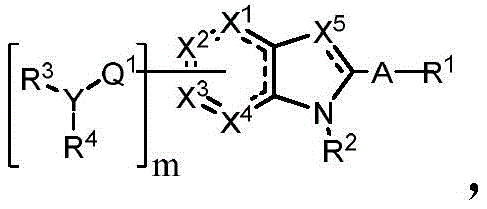
wherein:
-each of Independently a single or double bond;
-X 1 is CR 5 、CR 5 R 6 、N、NR 5 O, S, C-O, C-S or connected to Q 1 A carbon atom of (a);
-X 2 is CR 7 、CR 7 R 8 、N、NR 7 O, S, C-O, C-S or connected to Q 1 A carbon atom of (a);
-X 3 is CR 9 、CR 9 R 10 、N、NR 9 O, S, C-O, C-S or connected to Q 1 A carbon atom of (a);
-X 4 is CR 11 、CR 11 R 12 、N、NR 11 O, S, C-O, C-S or connected to Q 1 A carbon atom of (a);
-X 5 is CR 13 N or NR 13 ;
Wherein X 1 、X 2 、X 3 And X 4 Is connected to Q 1 A carbon atom of (a);
-a is a linking group;
-Q 1 is C-O, C-S, C-CR 14 R 15 、C=NR 14 Alkylene, alkenylene, or alkynylene, each independently substituted or unsubstituted; or is a bond;
-m is 1, 2, 3 or 4;
-Y is N, O or absent;
-R 1 is-C (O) R 16 、-C(O)OR 16 、-C(O)NR 16 R 17 、-OR 16 、-SR 16 、-NR 16 R 17 、-NR 16 C(O)R 16 、-OC(O)R 16 、-SiR 16 R 17 R 18 Alkyl, alkenyl, alkynyl, alkoxy, aryl, heteroaryl, heterocyclyl or halo, each of which is independentlyIs unsubstituted or substituted; or is hydrogen;
each R 3 And R 4 Independently is-C (O) R 19 、-C(O)OR 19 、-C(O)NR 19 R 20 、-SOR 19 、-SO 2 R 19 Alkyl, alkenyl, alkynyl, aryl, heteroaryl, or heterocyclyl, each independently substituted or unsubstituted; or is hydrogen, or R 3 And R 4 Together with R 3 And R 4 The bound nitrogen atoms together form a ring, wherein the ring is substituted or unsubstituted, or R 3 Is absent;
each R 2 、R 5 、R 6 、R 7 、R 8 、R 9 、R 10 、R 11 、R 12 、R 13 、R 14 、R 15 、R 16 、R 17 And R 18 Independently is-C (O) R 21 、-C(O)OR 21 、-C(O)NR 21 R 22 、-OR 21 、-SR 21 、-NR 21 R 22 、-NR 21 C(O)R 22 、-OC(O)R 21 Alkyl, alkenyl, alkynyl, aryl, heteroaryl, or heterocyclyl, each independently substituted or unsubstituted; or is hydrogen or halogen;
each R 19 And R 20 Independently is-C (O) R 23 、-C(O)OR 23 、-C(O)NR 23 R 24 、-OR 23 、-SR 23 、-NR 23 R 24 、-NR 23 C(O)R 24 、-OC(O)R 23 Alkyl, alkenyl, alkynyl, aryl, heteroaryl, or heterocyclyl, each independently substituted or unsubstituted; or is hydrogen or halogen;
each R 21 And R 22 Independently is an alkyl, alkenyl, alkynyl, aryl, heteroaryl, or heterocyclyl group, each of which is independently substituted or unsubstituted; or is hydrogen; and is
Each R 23 And R 24 Independently is an alkyl, alkenyl, alkynyl, aryl, heteroaryl, or heterocyclyl group, each of which is independently substituted or unsubstituted; or is a hydrogen atom or a hydrogen atom,
or a pharmaceutically acceptable salt thereof, wherein the compound is not a compound of table 1.
Embodiment 148 the compound of embodiment 146 or 147, wherein X 1 To be connected to Q 1 Carbon atom (b) of (a).
Embodiment 149. the compound of embodiment 146 or 147, wherein X 2 To be connected to Q 1 Carbon atom (b) of (a).
Embodiment 150. the compound of any one of embodiments 146-149, wherein Q 1 Is a bond.
Embodiment 151. the compound of any one of embodiments 146-150 wherein Y is N or O.
Embodiment 152 the compound of any one of embodiments 146-151 wherein Y is N.
Embodiment 153 the compound of any one of embodiments 146-152 wherein m is 1.
Embodiment 154. the compound of any one of embodiments 146-152, wherein m is 2.
Embodiment 155 the compound of any one of embodiments 146-154 wherein a is alkylene, alkenylene, or alkynylene, each of which is substituted or unsubstituted.
Embodiment 156 the compound of any one of embodiments 146-155 wherein a is alkylene.
Embodiment 157. the compound of any one of embodiments 146-155, wherein a is alkenylene.
Embodiment 158 the compound of any one of embodiments 146-155, wherein a is alkynylene.
Embodiment 159. the compound of any one of embodiments 146 and 154, wherein a is a substituted or unsubstituted aryl group.
Embodiment 160 the compound of any one of embodiments 146-154 wherein a is a substituted or unsubstituted heteroaryl group.
Embodiment 161 the compound of any one of embodiments 146-154, wherein a is a substituted or unsubstituted heterocyclyl group.
Embodiment 162 the compound of any one of embodiments 146-148, 150-153, 155 or 158 wherein the compound is of formula (la):
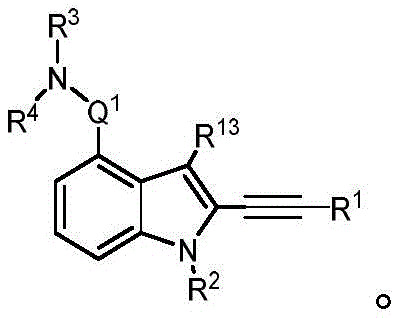
embodiment 163. the compound of any one of embodiments 146-148, 141, 151-153, 155 or 158 wherein the compound is of formula (la):

embodiment 164. the compound of any one of embodiments 146, 147, 149, 153, 155 or 158 wherein the compound has the formula:

embodiment 165 the compound of any one of embodiments 146, 147, 151, 153, 155 or 158 wherein the compound has the formula:
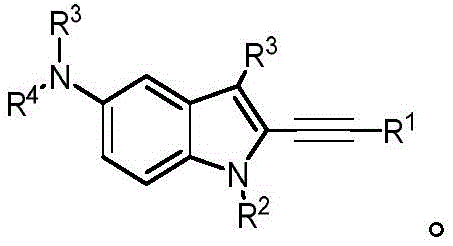
embodiment 166. the compound of any one of embodiments 146-165, wherein R 1 Is alkyl, alkenyl, -C (O) R 16 、-C(O)OR 16 or-C (O) NR 16 R 17 。
Embodiment 167. the compound according to any one of embodiments 146-166, wherein R 1 Is a substituted alkyl group.
Embodiment 168. the compound of any one of embodiments 146 and 167, wherein R 1 Is being NR 16 R 17 A substituted alkyl group.
Embodiment 169 the compound of any one of embodiments 146-:

embodiment 170. the compound of any one of embodiments 146-:
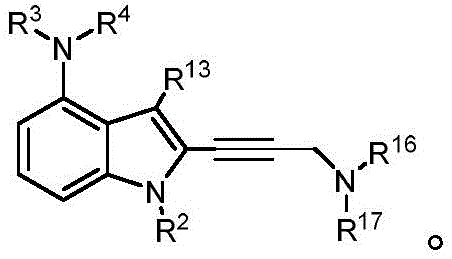
Embodiment 171. the compound of any one of embodiments 146, 147, 149, 153, 155, 158 or 166-168, wherein the compound is of the formula:

embodiment 172. the compound of any one of embodiments 146, 147, 151, 153, 155, 158 or 166, 168, wherein the compound is of the formula:

embodiment 173 the compound of any one of embodiments 146-172, wherein each R 16 And R 17 Independently an alkyl, alkenyl, aryl, heteroaryl, heterocyclyl, each independently substituted or unsubstituted; or hydrogen.
Embodiment 174. the compound according to any one of embodiments 146 and 173, wherein R 16 Is hydrogen or alkyl.
Embodiment 175 the compound of any one of embodiments 146 and 174, wherein R 17 Is aryl, heteroaryl or heterocyclyl, each of which is independently substituted or unsubstituted.
Embodiment 176. the compound of any one of embodiments 146 and 175, wherein R 17 Is a substituted aryl group.
Embodiment 177. the compound of any one of embodiments 146-176, wherein R 17 Is a substituted phenyl group.
Embodiment 178 the compound of any one of embodiments 146-177, wherein R 17 Is phenyl substituted with a sulfoxide group, a carboxyl group, an amide group, an amino group, an alkyl group, an alkoxy group, a hydroxyl group, a halo group, a cyano group, or a heterocyclic group, each independently substituted or unsubstituted.
Embodiment 179. the compound according to any one of embodiments 146 and 178, wherein R 17 Is phenyl substituted by methoxy.
Embodiment 180. the compound of any one of embodiments 146-179, wherein R 17 Is phenyl substituted with a substituted sulfoxide group.
Embodiment 181 the compound of any one of embodiments 146-179, wherein R 17 Is phenyl substituted by a carboxyl group.
Embodiment 182. the compound according to any one of embodiments 146 and 179, wherein R 17 Is phenyl substituted with a substituted amide group.
Embodiment 183. the compound according to any one of embodiments 146 and 182, wherein R 2 Is hydrogen or substituted or unsubstituted alkyl.
Embodiment 184. the compound of any one of embodiments 146-183, wherein R 2 Is a substituted alkyl group.
Embodiment 185. the compound of any one of embodiments 146-184, wherein R 2 Is trifluoroethyl.
Embodiment 186. the compound of any one of embodiments 146 and 184, wherein R 2 Is a substituted or unsubstituted cycloalkyl.
Embodiment 187 the compound as defined in any one of embodiments 146 and 186, wherein R 13 Is a substituted or unsubstituted alkyl or alkenyl group;hydrogen or halogen.
Embodiment 188. the compound of any one of embodiments 146-187, wherein R 13 Is hydrogen.
Embodiment 189. the compound according to any one of embodiments 146-148, 141, 151-153, 155, 158, 166-168, 173-185, 187 or 188, wherein the compound has the formula:

embodiment 190 the compound of any one of embodiments 146, 147, 151, 153, 155, 158, 166, 168, 173, 185, 187 or 188, wherein the compound has the formula:

embodiment 191 a compound as described in any of embodiments 146-190 wherein R 3 And R 4 Is aryl, heteroaryl or heterocyclyl, each of which is at least halo-substituted.
Embodiment 192. the compound of any one of embodiments 146-191 wherein R 3 Is H, and R 4 Is aryl, heteroaryl or heterocyclyl, each of which is at least halo-substituted.
Embodiment 193 the compound of any one of embodiments 146 and 192, wherein R 4 Is an aryl group at least fluorine-substituted.
Embodiment 194 the compound of any one of embodiments 146-192 wherein R 4 Is heteroaryl at least fluorine-substituted.
Embodiment 195 the compound of any one of embodiments 146-192, wherein R 4 Is a heterocyclic group at least fluorine-substituted.
Embodiment 196 the compound of any one of embodiments 146-191 wherein R 3 And R 4 At least one of which is aryl, heteroaryl or heterocycleEach of which is at least chloro-substituted.
Embodiment 197 the compound of any one of embodiments 146-191 or 196 wherein R 3 Is H, and R 4 Is a heterocyclic group at least chloro-substituted.
Embodiment 198. the compound of any one of embodiments 146-191 or 197, wherein R 4 Is a substituted piperidinyl group.
Embodiment 199 the compound of any one of embodiments 146-191, 197 or 198, wherein R 4 Is a piperidinyl group substituted with at least an alkyl, carboxyl, heterocyclyl or amide group, each of which is substituted or unsubstituted.
Embodiment 200 the compound of any one of embodiments 146-191 or 197-199, wherein R 4 Is unsubstituted or substituted methylpiperidinyl.
Embodiment 201 the compound according to any one of embodiments 146-191 or 197-200, wherein R is 4 Is 3-fluoro-1-methylpiperidine.
Embodiment 202 the compound according to any one of embodiments 146-191 or 197-199, wherein R 4 Is a substituted or unsubstituted methoxypropanol substituted piperidinyl group.
Embodiment 203. the compound of any one of embodiments 146, 192, 195 or 202, wherein R 4 Is 3-fluoro-1- (2-hydroxy-3-methoxypropyl) piperidinyl.
Embodiment 204. the compound of any one of embodiments 146, 192, 195, 197, wherein R 4 Is unsubstituted or substituted tetrahydropyranyl.
Embodiment 205. the compound of any one of embodiments 146, 192, 195, 197 or 204, wherein R 4 Is unsubstituted tetrahydropyranyl.
Embodiment 206. the compound of any one of embodiments 146, 192, 195, 197 or 204, wherein R 4 Is tetrahydropyranyl substituted with alkyl.
Embodiment 207. the compound according to any one of embodiments 146 and 192, 195, 197, 204 or 206, whichIn R 4 Is tetrahydrothiopyran-1, 1-dioxide.
Embodiment 208 the compound as described in any one of embodiments 147, 148, 150, 153, 155, 158, 166, 168, 173, 180, 183, 185, 187, 188 or 189, wherein the compound is:
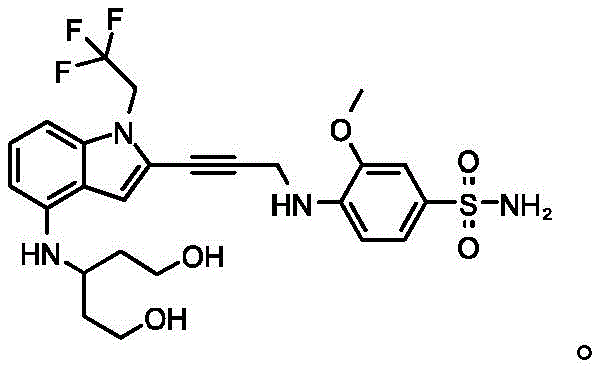
Embodiment 209 compounds as described in any of embodiments 147, 148, 150, 153, 155, 158, 166, 168, 173, 180, 183, 185, 187, 188 or 189, wherein the compounds are:

embodiment 210. the compound according to any one of embodiments 147, 148, 150, 153, 155, 158, 166, 168, 173, 185, 187, 188 or 189, wherein the compound is:

embodiment 211. the compound according to any one of embodiments 146-:

embodiment 212. the compound according to any one of embodiments 146-:

embodiment 213. the compound according to any one of embodiments 147, 148, 150, 153, 155, 158, 166, 168, 173, 185, 187, 188 or 189, wherein the compound is:

embodiment 214. the compound according to any one of embodiments 147, 148, 150, 153, 155, 158, 166, 168, 173, 185, 187, 188 or 189, wherein the compound is:

embodiment 215. the compound of any one of embodiments 147, 148, 150, 153, 155, 158, 166, 168, 173, 185, 187, 188 or 189, wherein the compound is:

Embodiment 216 the compound according to any one of embodiments 146-148, 150-153, 155, 158, 166-168, 173-180, 183-185, 187, 188 or 189, wherein the compound is:

embodiment 217 a method of inducing apoptosis in a cell, the method comprising contacting the cell with a therapeutically effective amount of a compound that binds to a p53 mutant, wherein the compound is a compound of any one of embodiments 1-216.
Embodiment 218 the method of embodiment 217, wherein the compound increases the ability of the p53 mutant to bind DNA.
Embodiment 219 the method of embodiment 217 or 218, wherein said cell expresses said p 53.
Embodiment 220 the method of any one of embodiments 217 and 219, wherein the p53 mutant has a mutation at amino acid 220.
Embodiment 221. the method of any one of embodiments 217-220, wherein the p53 mutant is p 53Y 220C.
Embodiment 222 the method of any one of embodiments 217-221, wherein the compound induces a conformational change in the p53 mutant.
Embodiment 223 the method of any one of embodiments 217-222, wherein the compound binds selectively to the p53 mutant as compared to wild-type p 53.
Embodiment 224 the method of any one of embodiments 217 and 223, wherein the therapeutically effective amount is from about 50mg to about 3000 mg.
Embodiment 225 the method of any one of embodiments 217-224, wherein the compound increases the stability of the biologically active conformation of the p53 mutant relative to the stability of the biologically active conformation of the p53 mutant in the absence of the compound.
Embodiment 226. a method of treating cancer comprising administering to a subject in need thereof a therapeutically effective amount of a compound of any one of embodiments 1-216.
Embodiment 227 the method of embodiment 226, wherein the cancer is ovarian cancer.
Embodiment 228 the method of embodiment 226, wherein the cancer is breast cancer.
Embodiment 229 the method of embodiment 226, wherein said cancer is lung cancer.
Embodiment 230 the method of any one of embodiments 226-229, wherein the therapeutically effective amount is from about 20mg to about 2000 mg.
The method of any one of embodiments 74-78, wherein said administering is oral.
Embodiment 232 the method of any one of embodiments 74-78, wherein said administering is intravenous.
Embodiment 233 the method of any one of embodiments 74-78, wherein the administering is subcutaneous.
The method of any one of embodiments 74-78, wherein said administering is topical.
Embodiment 235 the method of any one of embodiments 74-82, wherein the subject is a human.
Embodiment 236 the method of any one of embodiments 74-83, wherein the compound increases the stability of the biologically active conformation of the p53 mutant relative to the stability of the biologically active conformation of the p53 mutant in the absence of the compound.
Sequence listing
<110> PymevV pharmaceutical Co
<120> methods and compounds for restoring function of mutant p53
<130> 44727-705.601
<140> Herewith
<141> Herewith
<150> 62/904,369
<151> 2019-09-23
<150> 63/038,388
<151> 2020-06-12
<160> 2
<170> PatentIn version 3.5
<210> 1
<211> 219
<212> PRT
<213> Artificial sequence
<220>
<223> description of artificial sequences: synthesized
Polypeptides
<400> 1
Ser Ser Ser Val Pro Ser Gln Lys Thr Tyr Gln Gly Ser Tyr Gly Phe
1 5 10 15
Arg Leu Gly Phe Leu His Ser Gly Thr Ala Lys Ser Val Thr Cys Thr
20 25 30
Tyr Ser Pro Ala Leu Asn Lys Met Phe Cys Gln Leu Ala Lys Thr Cys
35 40 45
Pro Val Gln Leu Trp Val Asp Ser Thr Pro Pro Pro Gly Thr Arg Val
50 55 60
Arg Ala Met Ala Ile Tyr Lys Gln Ser Gln His Met Thr Glu Val Val
65 70 75 80
Arg Arg Cys Pro His His Glu Arg Cys Ser Asp Ser Asp Gly Leu Ala
85 90 95
Pro Pro Gln His Leu Ile Arg Val Glu Gly Asn Leu Arg Val Glu Tyr
100 105 110
Leu Asp Asp Arg Asn Thr Phe Arg His Ser Val Val Val Pro Cys Glu
115 120 125
Pro Pro Glu Val Gly Ser Asp Cys Thr Thr Ile His Tyr Asn Tyr Met
130 135 140
Cys Asn Ser Ser Cys Met Gly Gly Met Asn Arg Arg Pro Ile Leu Thr
145 150 155 160
Ile Ile Thr Leu Glu Asp Ser Ser Gly Asn Leu Leu Gly Arg Asn Ser
165 170 175
Phe Glu Val His Val Cys Ala Cys Pro Gly Arg Asp Arg Arg Thr Glu
180 185 190
Glu Glu Asn Leu Arg Lys Lys Gly Glu Pro His His Glu Leu Pro Pro
195 200 205
Gly Ser Thr Lys Arg Ala Leu Ser Asn Asn Thr
210 215
<210> 2
<211> 26
<212> DNA
<213> Artificial sequence
<220>
<223> description of artificial sequences: synthesized
Oligonucleotides
<400> 2
attaggcatg tctaggcatg tctagg 26
Claims (26)


Applications Claiming Priority (5)
| Application Number | Priority Date | Filing Date | Title |
|---|---|---|---|
| US201962904369P | 2019-09-23 | 2019-09-23 | |
| US62/904,369 | 2019-09-23 | ||
| US202063038388P | 2020-06-12 | 2020-06-12 | |
| US63/038,388 | 2020-06-12 | ||
| PCT/US2020/051998 WO2021061643A1 (en) | 2019-09-23 | 2020-09-22 | METHODS AND COMPOUNDS FOR RESTORING MUTANT p53 FUNCTION |
Publications (1)
| Publication Number | Publication Date |
|---|---|
| CN115003299A true CN115003299A (en) | 2022-09-02 |
Family
ID=75166806
Family Applications (1)
| Application Number | Title | Priority Date | Filing Date |
|---|---|---|---|
| CN202080081345.8A Pending CN115003299A (en) | 2019-09-23 | 2020-09-22 | Methods and compounds for restoring mutant p53 function |
Country Status (22)
| Country | Link |
|---|---|
| US (2) | US11814373B2 (en) |
| EP (2) | EP4034104B1 (en) |
| JP (3) | JP7374309B2 (en) |
| KR (1) | KR102838154B1 (en) |
| CN (1) | CN115003299A (en) |
| AU (1) | AU2020352516A1 (en) |
| BR (1) | BR112022005460A2 (en) |
| DK (1) | DK4034104T3 (en) |
| ES (1) | ES3040401T3 (en) |
| FI (1) | FI4034104T3 (en) |
| HR (1) | HRP20251115T1 (en) |
| HU (1) | HUE072804T2 (en) |
| IL (1) | IL291593B1 (en) |
| LT (1) | LT4034104T (en) |
| MX (1) | MX2022003456A (en) |
| PH (1) | PH12022550707A1 (en) |
| PL (1) | PL4034104T3 (en) |
| PT (1) | PT4034104T (en) |
| RS (1) | RS67247B1 (en) |
| SI (1) | SI4034104T1 (en) |
| SM (1) | SMT202500339T1 (en) |
| WO (1) | WO2021061643A1 (en) |
Cited By (6)
| Publication number | Priority date | Publication date | Assignee | Title |
|---|---|---|---|---|
| CN117247340A (en) * | 2023-09-15 | 2023-12-19 | 韶远科技(上海)有限公司 | A kind of preparation method of 1-nitro-2-halogen-4-methylthiobenzene |
| CN117466785A (en) * | 2023-11-02 | 2024-01-30 | 韶远科技(上海)有限公司 | A kind of preparation method of 2-halo-4-(methylsulfonyl)-1-nitrobenzene |
| WO2024083223A1 (en) * | 2022-10-21 | 2024-04-25 | 正大天晴药业集团股份有限公司 | Macrocyclic compounds and medical use thereof |
| WO2024120471A1 (en) * | 2022-12-08 | 2024-06-13 | Jacobio Pharmaceuticals Co., Ltd. | Compounds targeting mutant of p53 |
| WO2025055856A1 (en) * | 2023-09-11 | 2025-03-20 | 长春金赛药业有限责任公司 | P53-y220c-selective small-molecule reactivator compound, pharmaceutical composition, and use thereof |
| WO2025077778A1 (en) * | 2023-10-12 | 2025-04-17 | 上海宇道生物技术有限公司 | Carboxylic acid compound and preparation method therefor and use thereof |
Families Citing this family (14)
| Publication number | Priority date | Publication date | Assignee | Title |
|---|---|---|---|---|
| US20230024905A1 (en) * | 2020-06-22 | 2023-01-26 | Pmv Pharmaceuticals, Inc. | Uses of p53 x-ray co-crystal structures |
| KR20230028371A (en) | 2020-06-24 | 2023-02-28 | 피엠브이 파마슈티컬스 인코포레이티드 | Companion Diagnostic Tool for Mutant P53 Reactivating Compounds |
| CN116096704A (en) | 2020-06-24 | 2023-05-09 | 皮姆维制药公司 | Combination therapy for the treatment of cancer |
| WO2022213975A1 (en) * | 2021-04-08 | 2022-10-13 | Jacobio Pharmaceuticals Co., Ltd. | Compounds targeting y220c mutant of p53 |
| JP2024530952A (en) * | 2021-08-10 | 2024-08-27 | ジャコバイオ ファーマスーティカルズ カンパニー リミテッド | Compounds targeting mutant p53 |
| WO2023025324A1 (en) * | 2021-08-27 | 2023-03-02 | 杭州紫晶医药科技有限公司 | Compound serving as p53 regulator |
| MX2024009235A (en) | 2022-01-27 | 2024-08-06 | Pmv Pharmaceuticals Inc | Deuterated compounds for restoring mutant p53 function. |
| WO2024017384A1 (en) * | 2022-07-22 | 2024-01-25 | 深圳众格生物科技有限公司 | Compound for recovering p53 mutation function and use thereof |
| CN119968361A (en) * | 2022-08-22 | 2025-05-09 | 北京加科思新药研发有限公司 | Compounds targeting the p53 Y220 mutant |
| WO2024238404A2 (en) * | 2023-05-12 | 2024-11-21 | Pmv Pharmaceuticals, Inc. | Combination therapy for treatment of cancer |
| WO2024263573A1 (en) * | 2023-06-19 | 2024-12-26 | Board Of Regents, The University Of Texas System | Combination therapy methods for treating tp53-y220c mutant and tp53 wildtype leukemias |
| CN119350323B (en) * | 2023-10-20 | 2025-06-13 | 上海宇道生物技术有限公司 | A class of N-sulfonylamide nitrogen-containing fused heterocyclic compounds targeting p53 mutation and their application |
| WO2026008604A1 (en) * | 2024-07-01 | 2026-01-08 | Onco3R Therapeutics Bv | Compounds and pharmaceutical compositions thereof for the treatment of proliferative diseases |
| WO2026025042A1 (en) | 2024-07-26 | 2026-01-29 | Dana-Farber Cancer Institute, Inc. | P53 targeting compounds and uses thereof |
Citations (5)
| Publication number | Priority date | Publication date | Assignee | Title |
|---|---|---|---|---|
| US20020048271A1 (en) * | 1998-12-02 | 2002-04-25 | Farzan Rastinejad | Methods and composition for restoring conformational stability of a protein of the p53 family |
| US8871759B2 (en) * | 2009-03-27 | 2014-10-28 | Merck Sharp & Dohme Corp. | Inhibitors of hepatitis C virus replication |
| WO2018075937A1 (en) * | 2016-10-21 | 2018-04-26 | Nimbus Lakshmi, Inc. | Tyk2 inhibitors and uses thereof |
| WO2018191587A1 (en) * | 2017-04-14 | 2018-10-18 | Syros Pharmaceuticals, Inc. | Tam kinase inhibitors |
| CN109069481A (en) * | 2016-02-19 | 2018-12-21 | 皮姆维制药公司 | Methods and compounds for restoring function of mutant p53 |
Family Cites Families (21)
| Publication number | Priority date | Publication date | Assignee | Title |
|---|---|---|---|---|
| US6770652B2 (en) | 2001-10-18 | 2004-08-03 | Duquesne University Of The Holy Ghost | Multiple acting anti-angiogenic and cytotoxic compounds and methods for using the same |
| CA2571937A1 (en) | 2004-07-08 | 2006-02-09 | Boehringer Ingelheim Pharmaceuticals, Inc. | Pyrimidine derivatives useful as inhibitors of pkc-theta |
| WO2006136823A1 (en) | 2005-06-21 | 2006-12-28 | Astex Therapeutics Limited | Heterocyclic containing amines as kinase b inhibitors |
| GB2440736A (en) | 2006-08-10 | 2008-02-13 | Medical Res Council | Crystals of mutant p53 polypeptidtes |
| WO2009112075A1 (en) | 2008-03-13 | 2009-09-17 | Universita' Degli Studi Di Trieste | Peptides and aptamers thereof as specific modulators of mutant p53 function |
| GB0808282D0 (en) | 2008-05-07 | 2008-06-11 | Medical Res Council | Compounds for use in stabilizing p53 mutants |
| DE102010049877A1 (en) | 2010-11-01 | 2012-05-03 | Merck Patent Gmbh | 7 - ((1,2,3) triazol-4-yl) -pyrrolo (2,3) pyrazine derivatives |
| RU2598842C2 (en) | 2011-01-20 | 2016-09-27 | Мерк Шарп Энд Домэ Корп. | Mineralocorticoid receptor antagonists |
| WO2012135149A2 (en) | 2011-03-25 | 2012-10-04 | Indiana University Research And Technology Corporation | Small molecule modulators of sirt1 activity activate p53 and suppress tumor growth |
| GB201110390D0 (en) | 2011-06-20 | 2011-08-03 | Medical Res Council | Compounds for use in stabilising p53 mutants |
| EP2753635A4 (en) | 2011-09-09 | 2015-08-12 | Agency Science Tech & Res | PEPTIDES THAT ACTIVATE P53 PROTEIN |
| WO2013101911A2 (en) | 2011-12-28 | 2013-07-04 | Allergan, Inc. | Benzimidazole derivatives as selective blockers of persistent sodium current |
| WO2014018953A1 (en) | 2012-07-27 | 2014-01-30 | Indiana University Resarch And Technology Corporation | Inauhzin analogues that induce p53, inhibit cell growth, and have antitumor activity |
| US8822689B2 (en) | 2012-09-19 | 2014-09-02 | Merial Limited | Aryloazol-2-yl cyanoethylamino compounds, method of making and method of using thereof |
| US10144737B2 (en) | 2014-05-19 | 2018-12-04 | Jiangsu Hengrui Medicine Co., Ltd. | Substituted ethynyl heterobicyclic compounds as tyrosine kinase inhibitors |
| CN104119332B (en) | 2014-07-08 | 2019-03-29 | 上海科州药物研发有限公司 | Benzoheterocyclic compounds as protein kinase inhibitors and their preparation methods and uses |
| WO2016004513A1 (en) | 2014-07-11 | 2016-01-14 | Simon Fraser University | Anti-bacterial pyruvate kinase modulator compounds, compositions, uses and methods |
| CN104672241B (en) | 2015-01-29 | 2018-04-24 | 王磊 | Pyrrolo- [2,3-d] pyrimidines and application thereof |
| US20190002460A1 (en) | 2017-06-28 | 2019-01-03 | The Regents Of The University Of Michigan | Small molecule inhibitors of egfr and pi3k |
| CN111542318A (en) * | 2017-11-10 | 2020-08-14 | 密歇根大学董事会 | ASH1L degraders and methods of treatment therewith |
| KR102577241B1 (en) | 2017-12-28 | 2023-09-11 | 주식회사 대웅제약 | Amino-fluoropiperidine derivatives as kinase inhibitor |
-
2020
- 2020-09-22 KR KR1020227013573A patent/KR102838154B1/en active Active
- 2020-09-22 EP EP20869828.2A patent/EP4034104B1/en active Active
- 2020-09-22 ES ES20869828T patent/ES3040401T3/en active Active
- 2020-09-22 BR BR112022005460A patent/BR112022005460A2/en unknown
- 2020-09-22 SM SM20250339T patent/SMT202500339T1/en unknown
- 2020-09-22 EP EP25179753.6A patent/EP4644387A3/en active Pending
- 2020-09-22 MX MX2022003456A patent/MX2022003456A/en unknown
- 2020-09-22 HR HRP20251115TT patent/HRP20251115T1/en unknown
- 2020-09-22 CN CN202080081345.8A patent/CN115003299A/en active Pending
- 2020-09-22 LT LTEPPCT/US2020/051998T patent/LT4034104T/en unknown
- 2020-09-22 RS RS20250964A patent/RS67247B1/en unknown
- 2020-09-22 SI SI202030659T patent/SI4034104T1/en unknown
- 2020-09-22 FI FIEP20869828.2T patent/FI4034104T3/en active
- 2020-09-22 PT PT208698282T patent/PT4034104T/en unknown
- 2020-09-22 US US17/028,720 patent/US11814373B2/en active Active
- 2020-09-22 DK DK20869828.2T patent/DK4034104T3/en active
- 2020-09-22 JP JP2022518287A patent/JP7374309B2/en active Active
- 2020-09-22 AU AU2020352516A patent/AU2020352516A1/en active Pending
- 2020-09-22 HU HUE20869828A patent/HUE072804T2/en unknown
- 2020-09-22 PH PH1/2022/550707A patent/PH12022550707A1/en unknown
- 2020-09-22 PL PL20869828.2T patent/PL4034104T3/en unknown
- 2020-09-22 WO PCT/US2020/051998 patent/WO2021061643A1/en not_active Ceased
-
2022
- 2022-03-22 IL IL291593A patent/IL291593B1/en unknown
-
2023
- 2023-06-02 US US18/328,433 patent/US12428406B2/en active Active
- 2023-08-25 JP JP2023137268A patent/JP2023153388A/en not_active Withdrawn
-
2025
- 2025-07-17 JP JP2025120610A patent/JP2025142090A/en active Pending
Patent Citations (6)
| Publication number | Priority date | Publication date | Assignee | Title |
|---|---|---|---|---|
| US20020048271A1 (en) * | 1998-12-02 | 2002-04-25 | Farzan Rastinejad | Methods and composition for restoring conformational stability of a protein of the p53 family |
| US8871759B2 (en) * | 2009-03-27 | 2014-10-28 | Merck Sharp & Dohme Corp. | Inhibitors of hepatitis C virus replication |
| CN109069481A (en) * | 2016-02-19 | 2018-12-21 | 皮姆维制药公司 | Methods and compounds for restoring function of mutant p53 |
| US20190119249A1 (en) * | 2016-02-19 | 2019-04-25 | Pmv Pharmaceuticals, Inc. | METHODS AND COMPOUNDS FOR RESTORING MUTANT p53 FUNCTION |
| WO2018075937A1 (en) * | 2016-10-21 | 2018-04-26 | Nimbus Lakshmi, Inc. | Tyk2 inhibitors and uses thereof |
| WO2018191587A1 (en) * | 2017-04-14 | 2018-10-18 | Syros Pharmaceuticals, Inc. | Tam kinase inhibitors |
Non-Patent Citations (1)
| Title |
|---|
| MONICA DELL’ ACQUA等: "MediaChrom: Discovering a Class of Pyrimidoindolone-Based Polarity-Sensitive Dyes", THE JOURNAL OF ORGANIC CHEMISTRY, vol. 80, no. 21, 6 November 2015 (2015-11-06), pages 9, XP055592871, DOI: 10.1021/acs.joc.5b02066 * |
Cited By (6)
| Publication number | Priority date | Publication date | Assignee | Title |
|---|---|---|---|---|
| WO2024083223A1 (en) * | 2022-10-21 | 2024-04-25 | 正大天晴药业集团股份有限公司 | Macrocyclic compounds and medical use thereof |
| WO2024120471A1 (en) * | 2022-12-08 | 2024-06-13 | Jacobio Pharmaceuticals Co., Ltd. | Compounds targeting mutant of p53 |
| WO2025055856A1 (en) * | 2023-09-11 | 2025-03-20 | 长春金赛药业有限责任公司 | P53-y220c-selective small-molecule reactivator compound, pharmaceutical composition, and use thereof |
| CN117247340A (en) * | 2023-09-15 | 2023-12-19 | 韶远科技(上海)有限公司 | A kind of preparation method of 1-nitro-2-halogen-4-methylthiobenzene |
| WO2025077778A1 (en) * | 2023-10-12 | 2025-04-17 | 上海宇道生物技术有限公司 | Carboxylic acid compound and preparation method therefor and use thereof |
| CN117466785A (en) * | 2023-11-02 | 2024-01-30 | 韶远科技(上海)有限公司 | A kind of preparation method of 2-halo-4-(methylsulfonyl)-1-nitrobenzene |
Also Published As
Similar Documents
| Publication | Publication Date | Title |
|---|---|---|
| US12428406B2 (en) | Methods and compounds for restoring mutant p53 function | |
| CN102753522B (en) | Substituted pyrrolidine-2-carboxamides | |
| TWI522354B (en) | BCL-2-selective apoptosis inducer for the treatment of cancer and immune diseases | |
| CN102159207B (en) | Substituted pyrrolidine-2-carboxamides | |
| TW202342458A (en) | Inhibitors of parg | |
| CN1744899A (en) | Piperidine derivatives as CCR5 antagonists | |
| CN1976915A (en) | HIV integrase inhibitors | |
| CN107949562B (en) | Positive allosteric modulators of muscarinic M2 receptors | |
| JP2023526052A (en) | Methods and compounds for restoring mutant p53 function | |
| KR20050044407A (en) | N,n'-substituted-1,3-diamino-2-hydroxypropane derivatives | |
| CN105051005A (en) | Cyclopropylamine compounds and uses thereof | |
| CN1440391A (en) | Propane-1,3-dione derivatives | |
| CN121013839A (en) | 1-(([1,1',-biphenyl]-2-yl)sulfonyl)-4-fluoro-N-(3-(methylsulfonyl)allyl)piperidine-4-carboxamide derivatives used as RAS-PI3K modulators in the treatment of cancer, for example. | |
| WO2008072634A1 (en) | Fused heterocyclic compound | |
| US20230024905A1 (en) | Uses of p53 x-ray co-crystal structures | |
| CN1329614A (en) | Fused pyridazine derivatives, process for preparation of same and uses thereof | |
| CN1816551A (en) | Pyrrolopyrimidine A2b selective antagonist compounds, their synthesis and use | |
| JP2019526577A (en) | Imidazole derivatives and their use in the treatment of autoimmune or inflammatory diseases or cancer | |
| US20060223826A1 (en) | Indole derivatives as somatostatin agonists or antagonists | |
| CN1067656A (en) | 2 of aminomethyl replacement, the 3-dihydropyrane is [2,3-b] pyridines also, preparation method and the application in medicine | |
| HK40077029A (en) | Methods and compounds for restoring mutant p53 function | |
| WO2021107125A1 (en) | Compound having lysophosphatidic acid receptor agonistic activity and pharmaceutical use of said compound | |
| CA3152160C (en) | 1h-indol-2-propynyl derivatives and pharmaceutical compositions thereof useful for restoring mutant p53 function | |
| JP2004300133A (en) | Amine derivative | |
| CN1738798A (en) | Indole derivatives as somatostatin agonists or antagonists |
Legal Events
| Date | Code | Title | Description |
|---|---|---|---|
| PB01 | Publication | ||
| PB01 | Publication | ||
| SE01 | Entry into force of request for substantive examination | ||
| SE01 | Entry into force of request for substantive examination | ||
| REG | Reference to a national code |
Ref country code: HK Ref legal event code: DE Ref document number: 40077029 Country of ref document: HK |