CN114981283A - Novel nucleotide analogs and methods of use - Google Patents
Novel nucleotide analogs and methods of use Download PDFInfo
- Publication number
- CN114981283A CN114981283A CN202080063617.1A CN202080063617A CN114981283A CN 114981283 A CN114981283 A CN 114981283A CN 202080063617 A CN202080063617 A CN 202080063617A CN 114981283 A CN114981283 A CN 114981283A
- Authority
- CN
- China
- Prior art keywords
- base
- nucleotide
- blocking group
- anchor
- analog
- Prior art date
- Legal status (The legal status is an assumption and is not a legal conclusion. Google has not performed a legal analysis and makes no representation as to the accuracy of the status listed.)
- Pending
Links
Images




Classifications
-
- C—CHEMISTRY; METALLURGY
- C07—ORGANIC CHEMISTRY
- C07H—SUGARS; DERIVATIVES THEREOF; NUCLEOSIDES; NUCLEOTIDES; NUCLEIC ACIDS
- C07H19/00—Compounds containing a hetero ring sharing one ring hetero atom with a saccharide radical; Nucleosides; Mononucleotides; Anhydro-derivatives thereof
- C07H19/02—Compounds containing a hetero ring sharing one ring hetero atom with a saccharide radical; Nucleosides; Mononucleotides; Anhydro-derivatives thereof sharing nitrogen
- C07H19/04—Heterocyclic radicals containing only nitrogen atoms as ring hetero atom
- C07H19/06—Pyrimidine radicals
- C07H19/10—Pyrimidine radicals with the saccharide radical esterified by phosphoric or polyphosphoric acids
-
- C—CHEMISTRY; METALLURGY
- C07—ORGANIC CHEMISTRY
- C07H—SUGARS; DERIVATIVES THEREOF; NUCLEOSIDES; NUCLEOTIDES; NUCLEIC ACIDS
- C07H19/00—Compounds containing a hetero ring sharing one ring hetero atom with a saccharide radical; Nucleosides; Mononucleotides; Anhydro-derivatives thereof
- C07H19/02—Compounds containing a hetero ring sharing one ring hetero atom with a saccharide radical; Nucleosides; Mononucleotides; Anhydro-derivatives thereof sharing nitrogen
- C07H19/04—Heterocyclic radicals containing only nitrogen atoms as ring hetero atom
- C07H19/16—Purine radicals
- C07H19/20—Purine radicals with the saccharide radical esterified by phosphoric or polyphosphoric acids
-
- C—CHEMISTRY; METALLURGY
- C12—BIOCHEMISTRY; BEER; SPIRITS; WINE; VINEGAR; MICROBIOLOGY; ENZYMOLOGY; MUTATION OR GENETIC ENGINEERING
- C12Q—MEASURING OR TESTING PROCESSES INVOLVING ENZYMES, NUCLEIC ACIDS OR MICROORGANISMS; COMPOSITIONS OR TEST PAPERS THEREFOR; PROCESSES OF PREPARING SUCH COMPOSITIONS; CONDITION-RESPONSIVE CONTROL IN MICROBIOLOGICAL OR ENZYMOLOGICAL PROCESSES
- C12Q1/00—Measuring or testing processes involving enzymes, nucleic acids or microorganisms; Compositions therefor; Processes of preparing such compositions
- C12Q1/68—Measuring or testing processes involving enzymes, nucleic acids or microorganisms; Compositions therefor; Processes of preparing such compositions involving nucleic acids
- C12Q1/6813—Hybridisation assays
- C12Q1/6816—Hybridisation assays characterised by the detection means
-
- C—CHEMISTRY; METALLURGY
- C12—BIOCHEMISTRY; BEER; SPIRITS; WINE; VINEGAR; MICROBIOLOGY; ENZYMOLOGY; MUTATION OR GENETIC ENGINEERING
- C12Q—MEASURING OR TESTING PROCESSES INVOLVING ENZYMES, NUCLEIC ACIDS OR MICROORGANISMS; COMPOSITIONS OR TEST PAPERS THEREFOR; PROCESSES OF PREPARING SUCH COMPOSITIONS; CONDITION-RESPONSIVE CONTROL IN MICROBIOLOGICAL OR ENZYMOLOGICAL PROCESSES
- C12Q1/00—Measuring or testing processes involving enzymes, nucleic acids or microorganisms; Compositions therefor; Processes of preparing such compositions
- C12Q1/68—Measuring or testing processes involving enzymes, nucleic acids or microorganisms; Compositions therefor; Processes of preparing such compositions involving nucleic acids
- C12Q1/6869—Methods for sequencing
- C12Q1/6874—Methods for sequencing involving nucleic acid arrays, e.g. sequencing by hybridisation
Landscapes
- Chemical & Material Sciences (AREA)
- Organic Chemistry (AREA)
- Life Sciences & Earth Sciences (AREA)
- Health & Medical Sciences (AREA)
- Engineering & Computer Science (AREA)
- Proteomics, Peptides & Aminoacids (AREA)
- General Health & Medical Sciences (AREA)
- Genetics & Genomics (AREA)
- Biotechnology (AREA)
- Biochemistry (AREA)
- Molecular Biology (AREA)
- Wood Science & Technology (AREA)
- Zoology (AREA)
- Biophysics (AREA)
- Microbiology (AREA)
- Immunology (AREA)
- Bioinformatics & Cheminformatics (AREA)
- General Engineering & Computer Science (AREA)
- Analytical Chemistry (AREA)
- Physics & Mathematics (AREA)
- Measuring Or Testing Involving Enzymes Or Micro-Organisms (AREA)
- Investigating Or Analysing Materials By The Use Of Chemical Reactions (AREA)
Abstract
Description
本申请要求于2019年7月9日提交的美国临时申请第62/872,164号的优先权,所述美国临时申请的内容特此通过引用并入。This application claims priority to US Provisional Application No. 62/872,164, filed July 9, 2019, the contents of which are hereby incorporated by reference.
贯穿本申请,引用了各种出版物和专利。这些参考文献的完整引用在紧接在权利要求书前的说明书的结尾处可见。这些出版物和专利的公开内容以其全文通过引用特此并入本申请中,以更全面地描述本发明所属领域的现状。Throughout this application, various publications and patents are cited. Full citations of these references can be found at the end of the specification immediately preceding the claims. The disclosures of these publications and patents in their entireties are hereby incorporated by reference into this application to more fully describe the state of the art to which this invention pertains.
本申请通过引用并入了核苷酸和/或氨基酸序列,所述核苷酸和/或氨基酸序列存在于名为“200824_90884-A-PCT_Sequence_Listing_BI.txt”的文件中,所述文件大小为2.81千字节,并且所述文件于2020年8月19日以与MS-Windows具有操作系统兼容性的的IBM-PC机器格式创建,所述文件包含在于2020年8月24日提交的文本文件中作为本申请的一部分。This application incorporates by reference the nucleotide and/or amino acid sequences present in a file named "200824_90884-A-PCT_Sequence_Listing_BI.txt", which is 2.81k in size bytes, and the file was created on August 19, 2020 in the IBM-PC machine format with operating system compatibility with MS-Windows, and is included in the text file submitted on August 24, 2020 as part of this application.
背景技术Background technique
DNA测序是生物和医学研究中的基本工具,并且对于个性化医疗范式而言尤其重要。为了最终实现1,000美元基因组的目标,已经研究了各种新的DNA测序方法;主要的方法是边合成边测序(SBS),这是一种在聚合酶反应期间确定DNA序列的方法(Hyman 1988;Ronaghi等人1998;Ju等人2003;Li 2003;Braslavsky等人2003;Ruparel等人2005;Margulies等人2005;Ju等人2006;Wu等人2007;Guo等人2008;Bentley等人2008;Harris等人2008;Eid等人2009;Rothberg等人2011)。DNA sequencing is an essential tool in biological and medical research, and is especially important for the personalized medicine paradigm. Various new DNA sequencing methods have been investigated in order to eventually achieve the goal of a $1,000 genome; the predominant method is sequencing by synthesis (SBS), a method of determining the DNA sequence during a polymerase reaction (Hyman 1988; Ronaghi et al 1998; Ju et al 2003; Li 2003; Braslavsky et al 2003; Ruparel et al 2005; Margulies et al 2005; Ju et al 2006; Wu et al 2007; Guo et al 2008; Man 2008; Eid et al 2009; Rothberg et al 2011).
发明内容SUMMARY OF THE INVENTION
本发明提供了一种核苷酸类似物,其具有以下结构:The present invention provides a nucleotide analog having the following structure:

其中:in:
碱基包括腺嘌呤、鸟嘌呤、胞嘧啶、胸腺嘧啶、尿嘧啶、次黄嘌呤或其类似物;Bases include adenine, guanine, cytosine, thymine, uracil, hypoxanthine or analogs thereof;
可切割接头包括DTM、偶氮基、2-硝基苄基、烯丙基、叠氮基甲基或TCO衍生物并通过嘧啶(C、U)的5位置或去氮嘌呤(A、G、I)的7位置连接到所述碱基;并且Cleavable linkers include DTM, azo, 2-nitrobenzyl, allyl, azidomethyl or TCO derivatives and pass through the 5 position of pyrimidine (C, U) or deazapurine (A, G, I) is linked to said base at
标记包括荧光染料、pH响应性荧光染料、荧光染料簇、pH响应性荧光染料簇、用于染料连接的锚定物、用于染料连接的锚定物簇、或锚定物和染料。Labels include fluorescent dyes, pH-responsive fluorescent dyes, fluorescent dye clusters, pH-responsive fluorescent dye clusters, anchors for dye attachment, anchor clusters for dye attachment, or anchors and dyes.
本发明提供了一种核苷酸类似物,其具有以下结构:The present invention provides a nucleotide analog having the following structure:

其中:in:
碱基包括腺嘌呤、鸟嘌呤、胞嘧啶、胸腺嘧啶、尿嘧啶、次黄嘌呤或其类似物;Bases include adenine, guanine, cytosine, thymine, uracil, hypoxanthine or analogs thereof;
R包括甲基、乙基、丙基、叔丁基、芳基、烷基芳基;R includes methyl, ethyl, propyl, tert-butyl, aryl, alkylaryl;
可切割接头包括DTM、偶氮基、2-硝基苄基、烯丙基、叠氮基甲基或TCO衍生物;并且Cleavable linkers include DTM, azo, 2-nitrobenzyl, allyl, azidomethyl, or TCO derivatives; and
标记包括荧光染料、pH响应性荧光染料、荧光染料簇、pH响应性荧光染料簇、用于连接荧光染料的锚定物、用于连接荧光染料的锚定物簇、或锚定物和染料。Labels include fluorescent dyes, pH-responsive fluorescent dyes, fluorescent dye clusters, pH-responsive fluorescent dye clusters, anchors for attaching fluorescent dyes, anchor clusters for attaching fluorescent dyes, or anchors and dyes.
本发明提供了一种核苷酸类似物,其具有以下结构:The present invention provides a nucleotide analog having the following structure:

其中:in:
碱基包括腺嘌呤、鸟嘌呤、胞嘧啶、胸腺嘧啶、尿嘧啶、次黄嘌呤或其类似物;Bases include adenine, guanine, cytosine, thymine, uracil, hypoxanthine or analogs thereof;
可切割接头包括DTM、偶氮基、2-硝基苄基、烯丙基、叠氮基甲基或TCO衍生物或这些可切割接头中的多于一个可切割接头,包含其中一个可切割接头存在于所述碱基与阻断剂之间并且第二个不同的可切割接头存在于所述阻断剂与标记之间的特殊情况;Cleavable linkers include DTM, azo, 2-nitrobenzyl, allyl, azidomethyl or TCO derivatives or more than one of these cleavable linkers, including one of them The special case where a second, different cleavable linker exists between the base and the blocker and between the blocker and the label;
阻断剂是包括无碱基糖或经修饰的核苷或其组合的2-50个单体单元的核苷酸或寡核苷酸;并且阻断剂通过可切割接头连接到嘧啶(C、U)的5位置和去氮嘌呤(A、G、I)的7位置;The blocking agent is a nucleotide or oligonucleotide of 2-50 monomer units comprising abasic sugars or modified nucleosides or combinations thereof; and the blocking agent is linked to the pyrimidine (C, U) at the 5 position and deazapurine (A, G, I) at the 7 position;
其中阻断剂是在掺入之后防止另外的核苷酸或核苷酸类似物进一步掺入到引物链中的部分;并且wherein the blocker is a moiety that, after incorporation, prevents further incorporation of additional nucleotides or nucleotide analogs into the primer strand; and
标记包括荧光染料、pH响应性荧光染料、荧光染料簇、pH响应性荧光染料簇、用于连接荧光染料的锚定物、用于连接荧光染料的锚定物簇、或锚定物和染料,其中所述标记连接到所述阻断剂。Labels include fluorescent dyes, pH-responsive fluorescent dyes, fluorescent dye clusters, pH-responsive fluorescent dye clusters, anchors for attaching fluorescent dyes, anchor clusters for attaching fluorescent dyes, or anchors and dyes, wherein the label is attached to the blocking agent.
本发明提供了一种核苷酸类似物,其具有以下结构:The present invention provides a nucleotide analog having the following structure:

其中:in:
碱基包括腺嘌呤、鸟嘌呤、胞嘧啶、尿嘧啶、胸腺嘧啶、次黄嘌呤或其类似物;并且The bases include adenine, guanine, cytosine, uracil, thymine, hypoxanthine or analogs thereof; and
R是可切割化学基团,所述可切割化学基团包括烷基DTM、偶氮基、2-硝基苄基、烯丙基和叠氮基甲基衍生物。R is a cleavable chemical group including alkyl DTM, azo, 2-nitrobenzyl, allyl and azidomethyl derivatives.
本发明提供了一种核苷酸类似物,其具有以下结构:The present invention provides a nucleotide analog having the following structure:

其中:in:
碱基包括腺嘌呤、鸟嘌呤、胞嘧啶、胸腺嘧啶、尿嘧啶、次黄嘌呤或其类似物;并且The bases include adenine, guanine, cytosine, thymine, uracil, hypoxanthine or analogs thereof; and
标记包括荧光染料、pH响应性荧光染料、荧光染料簇、pH响应性荧光染料簇、用于染料连接的锚定物、用于染料连接的锚定物簇、或锚定物和染料。Labels include fluorescent dyes, pH-responsive fluorescent dyes, fluorescent dye clusters, pH-responsive fluorescent dye clusters, anchors for dye attachment, anchor clusters for dye attachment, or anchors and dyes.
本发明提供了一种核苷酸类似物,其具有以下结构:The present invention provides a nucleotide analog having the following structure:

其中碱基包括腺嘌呤、鸟嘌呤、胞嘧啶、胸腺嘧啶、尿嘧啶、次黄嘌呤或其类似物。The bases include adenine, guanine, cytosine, thymine, uracil, hypoxanthine or analogs thereof.
本发明提供了一种核苷酸类似物,其具有以下结构:The present invention provides a nucleotide analog having the following structure:

其中:in:
碱基包括腺嘌呤、鸟嘌呤、胞嘧啶、胸腺嘧啶、尿嘧啶、次黄嘌呤或其类似物;Bases include adenine, guanine, cytosine, thymine, uracil, hypoxanthine or analogs thereof;
标记包括荧光染料、pH响应性荧光染料、荧光染料簇、pH响应性荧光染料簇、用于染料连接的锚定物、用于染料连接的锚定物簇、或锚定物和染料;并且Labels include fluorescent dyes, pH-responsive fluorescent dyes, fluorescent dye clusters, pH-responsive fluorescent dye clusters, anchors for dye attachment, anchor clusters for dye attachment, or anchors and dyes; and
R包括甲基、乙基、丙基、叔丁基、芳基、烷基芳基。R includes methyl, ethyl, propyl, t-butyl, aryl, alkylaryl.
本发明提供了一种核苷酸类似物,其具有以下结构:The present invention provides a nucleotide analog having the following structure:

其中:in:
碱基包括腺嘌呤、鸟嘌呤、胞嘧啶、胸腺嘧啶、尿嘧啶、次黄嘌呤或其类似物;并且The bases include adenine, guanine, cytosine, thymine, uracil, hypoxanthine or analogs thereof; and
R包括甲基、乙基、丙基、叔丁基、芳基、烷基芳基。R includes methyl, ethyl, propyl, t-butyl, aryl, alkylaryl.
本发明提供了一种核苷酸类似物,其具有以下结构:The present invention provides a nucleotide analog having the following structure:

其中碱基包括腺嘌呤、鸟嘌呤、胞嘧啶、胸腺嘧啶、尿嘧啶、次黄嘌呤或其类似物。The bases include adenine, guanine, cytosine, thymine, uracil, hypoxanthine or analogs thereof.
本发明提供了一种对核酸进行测序的方法,所述方法包括:The present invention provides a method for sequencing nucleic acid, the method comprising:
a)提供各自与引物杂交的多个核酸模板和核酸聚合酶,其中每个模板具有与待测序的所述核酸相同的序列;a) providing a plurality of nucleic acid templates and nucleic acid polymerases each hybridizing to a primer, wherein each template has the same sequence as the nucleic acid to be sequenced;
b)使所述核酸模板与两种不同的经标记的核苷酸类似物接触,并且所述接触在以下条件下进行:如果所述经标记的核苷酸类似物中的一种核苷酸类似物与紧邻与所述引物的3'端核苷酸残基杂交的所述核酸模板的核苷酸残基的5'的核苷酸残基互补,则允许所述核酸聚合酶用所述核苷酸类似物延伸所述引物,其中所述两种不同的经标记的核苷酸类似物是:b) contacting the nucleic acid template with two different labeled nucleotide analogs, and the contacting is performed under the following conditions: if one of the labeled nucleotide analogs The analog is complementary to the nucleotide residue immediately 5' of the nucleotide residue of the nucleic acid template to which the 3' terminal nucleotide residue of the primer hybridizes, allowing the nucleic acid polymerase to use the Nucleotide analogs extend the primer, wherein the two different labeled nucleotide analogs are:
(i)(A)荧光标记的双脱氧核苷酸类似物,所述荧光标记的双脱氧核苷酸类似物包括碱基和通过可切割接头与所述碱基连接的荧光标记,以及(B)锚定物标记的双脱氧核苷酸类似物,所述锚定物标记的双脱氧核苷酸类似物包括碱基和通过可切割接头与所述碱基连接的锚定物,(i) (A) a fluorescently labeled dideoxynucleotide analog comprising a base and a fluorescent label attached to the base through a cleavable linker, and (B) ) an anchor-labeled dideoxynucleotide analog comprising a base and an anchor linked to the base by a cleavable linker,
其中所述可切割接头可由相同的切割剂切割;wherein the cleavable linker is cleavable by the same cleaving agent;
(ii)(A)荧光标记的核苷酸类似物,所述荧光标记的核苷酸类似物包括碱基和通过可切割接头与所述碱基连接的荧光标记以及在3'-OH位置处的阻断基,其中所述阻断基防止随后的核苷酸类似物掺入到延伸的引物链中,以及(B)锚定物标记的核苷酸类似物,所述锚定物标记的核苷酸类似物包括碱基和通过可切割接头与所述碱基连接的锚定物以及在3'-OH位置处的阻断基,其中所述阻断基防止随后的核苷酸类似物掺入到延伸的引物链中,(ii) (A) a fluorescently labeled nucleotide analog comprising a base and a fluorescent label attached to the base through a cleavable linker and at the 3'-OH position A blocking group, wherein the blocking group prevents the incorporation of subsequent nucleotide analogs into the extended primer strand, and (B) an anchor-labeled nucleotide analog, the anchor-labeled Nucleotide analogs include a base and an anchor attached to the base by a cleavable linker and a blocking group at the 3'-OH position, wherein the blocking group prevents subsequent nucleotide analogs incorporated into the extended primer strand,
其中所述可切割接头和所述3'-OH基团可由相同的切割剂切割;或者wherein the cleavable linker and the 3'-OH group are cleavable by the same cleaving agent; or
(iii)(A)荧光标记的核苷酸类似物,所述荧光标记的核苷酸类似物包括碱基、通过可切割接头与所述碱基连接的阻断基和在所述阻断基的远端与所述碱基连接的荧光标记,其中所述阻断基防止或极大地减少随后的核苷酸类似物掺入到延伸的引物链中,以及(B)锚定物标记的核苷酸类似物,所述锚定物标记的核苷酸类似物包括碱基、通过可切割接头与所述碱基连接的阻断基和在所述阻断基的远端与所述碱基连接的锚定物,其中所述阻断基防止或极大地减少随后的核苷酸类似物掺入到延伸的引物链中,(iii) (A) a fluorescently labeled nucleotide analog comprising a base, a blocking group attached to the base through a cleavable linker, and a blocking group at the blocking group A fluorescent label attached to the base at its distal end, wherein the blocking group prevents or greatly reduces subsequent incorporation of nucleotide analogs into the extending primer strand, and (B) an anchor-labeled nucleus nucleotide analogs, the anchor-labeled nucleotide analogs include a base, a blocking group connected to the base through a cleavable linker, and a distal end of the blocking group with the base a linked anchor, wherein the blocking group prevents or greatly reduces subsequent incorporation of nucleotide analogs into the extended primer strand,
其中所述可切割接头可由相同的切割剂切割;wherein the cleavable linker is cleavable by the same cleaving agent;
c)用不具有任何碱基修饰并且包括3'-O阻断基的核苷酸类似物延伸未延伸的引物,其中步骤(c)在步骤(b)之前、同时或之后发生;c) extending the unextended primer with a nucleotide analog that does not have any base modifications and includes a 3'-O blocking group, wherein step (c) occurs before, concurrently with or after step (b);
d)鉴定由于掺入荧光标记的核苷酸类似物而产生的任何荧光信号;d) identifying any fluorescent signal resulting from incorporation of the fluorescently labeled nucleotide analog;
e)使来自步骤(b)的所掺入的核苷酸类似物与锚定物结合基团接触,所述锚定物结合基团结合到步骤(b)的所提供的锚定物标记的核苷酸类似物的所述锚定物,其中所述锚定物结合基团包括与步骤(b)的所述荧光标记的核苷酸类似物的所述荧光标记相同的荧光标记;e) contacting the incorporated nucleotide analog from step (b) with an anchor-binding group that binds to the provided anchor-labeled The anchor of nucleotide analogs, wherein the anchor-binding group comprises the same fluorescent label as the fluorescent label of the fluorescently labeled nucleotide analog of step (b);
f)鉴定由于所述锚定物结合基团与步骤(b)的任何掺入的锚定物标记的核苷酸类似物的所述锚定物的结合而产生的任何荧光信号;f) identifying any fluorescent signal resulting from the binding of said anchor-binding group to said anchor of any incorporated anchor-labeled nucleotide analog of step (b);
g)用两种不同的经标记的核苷酸类似物重复步骤(b)-(f),所述两种不同的经标记的核苷酸类似物不同于来自步骤(b)的先前迭代的所述两种不同的经标记的核苷酸类似物;g) Repeat steps (b)-(f) with two different labeled nucleotide analogs different from the one from the previous iteration of step (b) the two different labeled nucleotide analogs;
h)从所掺入的核苷酸类似物中切割所述可切割接头,由此从步骤(b)的所掺入的核苷酸类似物中去除任何标记、锚定物或阻断基;h) cleaving the cleavable linker from the incorporated nucleotide analog, thereby removing any label, anchor or blocking group from the incorporated nucleotide analog of step (b);
i)从来自步骤(c)的任何掺入的核苷酸类似物中切割所述3'-O阻断基;以及i) cleavage of the 3'-O blocking group from any incorporated nucleotide analogs from step (c); and
j)针对待测序的所述核酸的每个残基迭代地重复步骤(b)到(i),j) iteratively repeating steps (b) to (i) for each residue of said nucleic acid to be sequenced,
由此获得所述核酸的序列。The sequence of the nucleic acid is thus obtained.
本发明提供了一种对核酸进行测序的方法,所述方法包括:The present invention provides a method for sequencing nucleic acid, the method comprising:
a)提供各自与引物杂交的多个核酸模板,其中每个模板具有与待测序的所述核酸相同的序列,并且提供核酸聚合酶;a) providing a plurality of nucleic acid templates each hybridizing to a primer, wherein each template has the same sequence as the nucleic acid to be sequenced, and providing a nucleic acid polymerase;
b)使所述核酸模板与四种不同的经标记的核苷酸类似物(A、C、T、G)接触,并且所述接触在以下条件下进行:如果所述经标记的核苷酸类似物中的一种核苷酸类似物与紧邻与所述引物的3'端核苷酸残基杂交的所述核酸模板的核苷酸残基的5'的核苷酸残基互补,则允许所述核酸聚合酶用所述核苷酸类似物延伸所述引物,其中所述四种不同的经标记的核苷酸类似物是:b) contacting the nucleic acid template with four different labeled nucleotide analogs (A, C, T, G), and the contacting is performed under the following conditions: if the labeled nucleotides A nucleotide analog in the analogs is complementary to the nucleotide residue immediately 5' of the nucleotide residue of the nucleic acid template that hybridizes to the nucleotide residue at the 3' end of the primer, then The nucleic acid polymerase is allowed to extend the primer with the nucleotide analogs, wherein the four different labeled nucleotide analogs are:
(i)(A)荧光标记的双脱氧核苷酸类似物,所述荧光标记的双脱氧核苷酸类似物包括碱基和通过可切割接头与所述碱基连接的荧光标记,(B)pH响应性荧光标记的双脱氧核苷酸类似物,所述pH响应性荧光标记的双脱氧核苷酸类似物包括碱基和通过可切割接头与所述碱基连接的pH响应性荧光标记,(C)两种不同的锚定物标记的双脱氧核苷酸类似物,其中每种类似物包括通过可切割接头与碱基连接的不同锚定物,(i) (A) a fluorescently labeled dideoxynucleotide analog comprising a base and a fluorescent label attached to the base via a cleavable linker, (B) a pH-responsive fluorescently labeled dideoxynucleotide analog comprising a base and a pH-responsive fluorescent label attached to the base through a cleavable linker, (C) two different anchor-labeled dideoxynucleotide analogs, wherein each analog includes a different anchor attached to the base via a cleavable linker,
其中所述可切割接头可由相同的切割剂切割;wherein the cleavable linker is cleavable by the same cleaving agent;
(ii)(A)荧光标记的核苷酸类似物,所述荧光标记的核苷酸类似物包括碱基和通过可切割接头与所述碱基连接的荧光标记以及在3'-OH位置处的阻断基,其中所述阻断基防止随后的核苷酸类似物掺入到延伸的引物链中,和(B)pH响应性荧光标记的核苷酸类似物,所述pH响应性荧光标记的核苷酸类似物包括碱基和通过可切割接头与所述碱基连接的荧光标记以及在3'-OH位置处的阻断基,其中所述阻断基防止随后的核苷酸类似物掺入到延伸的引物链中,以及(C)两种不同的锚定物标记的核苷酸类似物,所述两种不同的锚定物标记的核苷酸类似物包括碱基和通过可切割接头与所述碱基连接的锚定物以及在3'-OH位置处的阻断基,其中所述阻断基防止随后的核苷酸类似物掺入到延伸的引物链中,其中每种类似物包括通过可切割接头与所述碱基连接的不同锚定物,(ii) (A) a fluorescently labeled nucleotide analog comprising a base and a fluorescent label attached to the base through a cleavable linker and at the 3'-OH position A blocking group, wherein the blocking group prevents subsequent incorporation of the nucleotide analog into the extended primer strand, and (B) a pH-responsive fluorescently labeled nucleotide analog that is fluorescent Labeled nucleotide analogs include a base and a fluorescent label attached to the base via a cleavable linker and a blocking group at the 3'-OH position, wherein the blocking group prevents subsequent nucleotide analogs incorporation of primers into the extended primer strand, and (C) two different anchor-labeled nucleotide analogs including base and via An anchor with a cleavable linker attached to the base and a blocking group at the 3'-OH position, wherein the blocking group prevents subsequent incorporation of nucleotide analogs into the extended primer strand, wherein Each analog includes a different anchor attached to the base via a cleavable linker,
其中所述可切割接头和所述3'-O阻断基可由相同的切割剂切割;或者wherein the cleavable linker and the 3'-O blocking group are cleavable by the same cleaving agent; or
(iii)(A)荧光标记的核苷酸类似物,所述荧光标记的核苷酸类似物包括碱基、通过可切割接头与所述碱基连接的阻断基和在所述阻断基的远端与所述碱基连接的荧光标记,其中所述阻断基防止或极大地减少随后的核苷酸类似物掺入到延伸的引物链中,(B)pH响应性荧光标记的核苷酸类似物,所述pH响应性荧光标记的核苷酸类似物包括碱基、通过可切割接头与所述碱基连接的阻断基和在所述阻断基的远端与所述碱基连接的pH响应性荧光标记,其中所述阻断基防止或极大地减少随后的核苷酸类似物掺入到延伸的引物链中,以及(C)两种不同的锚定物标记的核苷酸类似物,所述两种不同的锚定物标记的核苷酸类似物包括碱基、通过可切割接头与所述碱基连接的阻断基和在所述阻断基的远端与所述碱基连接的锚定物,其中所述阻断基防止或极大地减少随后的核苷酸类似物掺入到延伸的引物链中,其中每种类似物包括通过可切割接头与所述碱基连接的不同锚定物,(iii) (A) a fluorescently labeled nucleotide analog comprising a base, a blocking group attached to the base through a cleavable linker, and a blocking group at the blocking group The distal end of the fluorescent label attached to the base, wherein the blocking group prevents or greatly reduces the subsequent incorporation of nucleotide analogs into the extended primer strand, (B) pH-responsive fluorescently labeled nucleus nucleotide analogs, the pH-responsive fluorescently labeled nucleotide analogs include a base, a blocking group connected to the base through a cleavable linker, and a distal end of the blocking group with the base A base-linked pH-responsive fluorescent label in which the blocking group prevents or greatly reduces subsequent incorporation of nucleotide analogs into the extending primer strand, and (C) two different anchor-labeled nuclei nucleotide analogs, the two different anchor-labeled nucleotide analogs include a base, a blocking group attached to the base via a cleavable linker, and a distal end of the blocking group with The base-linked anchor, wherein the blocking group prevents or greatly reduces the incorporation of subsequent nucleotide analogs into the extended primer strand, wherein each analog comprises a cleavable linker with the different anchors linked by bases,
其中所述可切割接头可由相同的切割剂切割;wherein the cleavable linker is cleavable by the same cleaving agent;
c)用不具有任何碱基修饰并且包括3'-O阻断基的核苷酸类似物延伸未延伸的引物,其中步骤(c)在步骤(b)之前、同时或之后发生;c) extending the unextended primer with a nucleotide analog that does not have any base modifications and includes a 3'-O blocking group, wherein step (c) occurs before, concurrently with or after step (b);
d)在所述pH响应性荧光标记具有与所述荧光标记的核苷酸类似物上的所述荧光标记相同或相似的吸收和发射曲线的pH下洗去任何未掺入的核苷酸类似物,并且鉴定由于掺入来自步骤(b)的经标记的核苷酸类似物而产生的任何荧光信号;d) washing away any unincorporated nucleotide analogs at pH where the pH-responsive fluorescent label has the same or similar absorption and emission profiles as the fluorescent label on the fluorescently labeled nucleotide analog and identify any fluorescent signal resulting from incorporation of the labeled nucleotide analog from step (b);
e)使来自步骤(b)的所掺入的核苷酸类似物与以下接触:(A)与步骤(b)的所述锚定物标记的核苷酸类似物中的仅一种锚定物标记的核苷酸类似物的所述锚定物结合的锚定物结合基团,其中所述锚定物结合基团包括与步骤(b)的所述荧光标记的核苷酸类似物相同的荧光标记;以及(B)仅与剩余的锚定物标记的核苷酸类似物的所述锚定物结合的锚定物结合基团,其中所述锚定物结合基团包括与步骤(b)的所述pH响应性荧光标记的核苷酸类似物相同的pH响应性荧光标记;e) contacting the incorporated nucleotide analogs from step (b) with: (A) anchoring with only one of the anchor-labeled nucleotide analogs of step (b) The anchor-bound anchor-binding group of the labeled nucleotide analog, wherein the anchor-binding group comprises the same as the fluorescently-labeled nucleotide analog of step (b) and (B) an anchor-binding group that binds only to the anchor of the remaining anchor-labeled nucleotide analogs, wherein the anchor-binding group comprises a combination with step ( b) the same pH-responsive fluorescent label as the pH-responsive fluorescently labeled nucleotide analog;
f)在所述pH响应性荧光标记具有与所述荧光标记的核苷酸类似物上的所述荧光标记相同或相似的吸收和发射曲线的pH下洗去任何未掺入的核苷酸类似物,并且鉴定由于掺入来自步骤(b)的锚定物标记的核苷酸类似物而产生的任何荧光信号;f) washing away any unincorporated nucleotide analogs at pH where the pH-responsive fluorescent label has the same or similar absorption and emission profiles as the fluorescent label on the fluorescently labeled nucleotide analog and identify any fluorescent signal resulting from incorporation of the anchor-labeled nucleotide analog from step (b);
g)在所述pH响应性荧光标记不再具有与所述荧光标记的核苷酸类似物上的所述荧光标记相同或相似的吸收和发射曲线的pH下洗涤来自步骤(b)的所掺入的核苷酸类似物,并且鉴定由于掺入来自步骤(b)的经标记的核苷酸类似物而产生的任何荧光信号;g) washing the spiked protein from step (b) at a pH where the pH-responsive fluorescent label no longer has the same or similar absorption and emission profiles as the fluorescent label on the fluorescently labeled nucleotide analog. incorporated nucleotide analogs, and identifying any fluorescent signals resulting from incorporation of the labeled nucleotide analogs from step (b);
h)从所掺入的核苷酸类似物中切割所述可切割接头,由此从步骤(b)的所掺入的核苷酸类似物中去除任何标记、锚定物或阻断基;h) cleaving the cleavable linker from the incorporated nucleotide analog, thereby removing any label, anchor or blocking group from the incorporated nucleotide analog of step (b);
i)从来自步骤(c)的任何掺入的核苷酸类似物中切割所述3'-O阻断基;以及i) cleavage of the 3'-O blocking group from any incorporated nucleotide analogs from step (c); and
j)针对待测序的所述核酸的每个残基迭代地重复步骤(b)到(i),j) iteratively repeating steps (b) to (i) for each residue of said nucleic acid to be sequenced,
由此获得所述核酸的序列。The sequence of the nucleic acid is thus obtained.
本发明提供了一种对核酸进行测序的方法,所述方法包括:The present invention provides a method for sequencing nucleic acid, the method comprising:
a)提供各自与引物杂交的多个核酸模板和核酸聚合酶,其中每个模板具有与待测序的所述核酸相同的序列;a) providing a plurality of nucleic acid templates and nucleic acid polymerases each hybridizing to a primer, wherein each template has the same sequence as the nucleic acid to be sequenced;
b)使所述核酸模板与两种不同的经标记的核苷酸类似物接触,并且所述接触在以下条件下进行:如果所述经标记的核苷酸类似物中的一种核苷酸类似物与紧邻与所述引物的3'端核苷酸残基杂交的所述核酸模板的核苷酸残基的5'的核苷酸残基互补,则允许所述核酸聚合酶用所述核苷酸类似物延伸所述引物,其中所述两种不同的经标记的核苷酸类似物是:b) contacting the nucleic acid template with two different labeled nucleotide analogs, and the contacting is performed under the following conditions: if one of the labeled nucleotide analogs The analog is complementary to the nucleotide residue immediately 5' of the nucleotide residue of the nucleic acid template to which the 3' terminal nucleotide residue of the primer hybridizes, allowing the nucleic acid polymerase to use the Nucleotide analogs extend the primer, wherein the two different labeled nucleotide analogs are:
(i)(A)荧光标记的双脱氧核苷酸类似物,所述荧光标记的双脱氧核苷酸类似物包括碱基和通过可切割接头与所述碱基连接的荧光标记,以及(B)pH响应性荧光标记的双脱氧核苷酸类似物,所述pH响应性荧光标记的双脱氧核苷酸类似物包括碱基和通过可切割接头与所述碱基连接的pH响应性荧光标记,(i) (A) a fluorescently labeled dideoxynucleotide analog comprising a base and a fluorescent label attached to the base through a cleavable linker, and (B) ) pH-responsive fluorescently labeled dideoxynucleotide analogs comprising a base and a pH-responsive fluorescent label attached to the base via a cleavable linker ,
其中所述可切割接头可由相同的切割剂切割;wherein the cleavable linker is cleavable by the same cleaving agent;
(ii)(A)荧光标记的核苷酸类似物,所述荧光标记的核苷酸类似物包括碱基和通过可切割接头与所述碱基连接的荧光标记以及在3'-OH位置处的阻断基,其中所述阻断基防止随后的核苷酸类似物掺入到延伸的引物链中,以及(B)pH响应性荧光标记的核苷酸类似物,所述pH响应性荧光标记的核苷酸类似物包括碱基和通过可切割接头与所述碱基连接的pH响应性荧光标记以及在3'-OH位置处的阻断基,其中所述阻断基防止随后的核苷酸类似物掺入到延伸的引物链中,(ii) (A) a fluorescently labeled nucleotide analog comprising a base and a fluorescent label attached to the base through a cleavable linker and at the 3'-OH position A blocking group, wherein the blocking group prevents the subsequent incorporation of nucleotide analogs into the extended primer strand, and (B) a pH-responsive fluorescently labeled nucleotide analog, the pH-responsive fluorescent Labeled nucleotide analogs include a base and a pH-responsive fluorescent label attached to the base via a cleavable linker and a blocking group at the 3'-OH position, wherein the blocking group prevents subsequent nuclear The nucleotide analog is incorporated into the extended primer strand,
其中所述可切割接头和所述3'-O阻断基可由相同的切割剂切割;或者wherein the cleavable linker and the 3'-O blocking group are cleavable by the same cleaving agent; or
(iii)(A)荧光标记的核苷酸类似物,所述荧光标记的核苷酸类似物包括碱基、通过可切割接头与所述碱基连接的阻断基和在所述阻断基的远端与所述碱基连接的荧光标记,其中所述阻断基防止或极大地减少随后的核苷酸类似物掺入到延伸的引物链中,以及(B)pH响应性荧光标记的核苷酸类似物,所述pH响应性荧光标记的核苷酸类似物包括碱基、通过可切割接头与所述碱基连接的阻断基和在所述阻断基的远端与所述碱基连接的pH响应性荧光标记,其中所述阻断基防止或极大地减少随后的核苷酸类似物掺入到延伸的引物链中,其中所述可切割接头可由相同的切割剂切割;(iii) (A) a fluorescently labeled nucleotide analog comprising a base, a blocking group attached to the base through a cleavable linker, and a blocking group at the blocking group The distal end of the fluorescent label is attached to the base, wherein the blocking group prevents or greatly reduces subsequent incorporation of nucleotide analogs into the extended primer strand, and (B) pH-responsive fluorescent labeling Nucleotide analogs, the pH-responsive fluorescently labeled nucleotide analogs include a base, a blocking group connected to the base through a cleavable linker, and a distal end of the blocking group with the base A base-linked pH-responsive fluorescent label, wherein the blocking group prevents or greatly reduces subsequent incorporation of nucleotide analogs into the extended primer strand, wherein the cleavable linker is cleavable by the same cleaving agent;
c)用不具有任何碱基修饰并且包括3'-O阻断基的核苷酸类似物延伸未延伸的引物,其中步骤(c)在步骤(b)之前、同时或之后发生;c) extending the unextended primer with a nucleotide analog that does not have any base modifications and includes a 3'-O blocking group, wherein step (c) occurs before, concurrently with or after step (b);
d)在所述pH响应性荧光标记具有与所述荧光标记的核苷酸类似物上的所述荧光标记相同或相似的吸收和发射曲线的pH下洗去任何未掺入的核苷酸类似物,并且鉴定由于掺入来自步骤(b)的经标记的核苷酸类似物而产生的任何荧光信号;d) washing away any unincorporated nucleotide analogs at pH where the pH-responsive fluorescent label has the same or similar absorption and emission profiles as the fluorescent label on the fluorescently labeled nucleotide analog and identify any fluorescent signal resulting from incorporation of the labeled nucleotide analog from step (b);
e)用两种不同的经标记的核苷酸类似物重复步骤(b)-(d),所述两种不同的经标记的核苷酸类似物不同于来自步骤(b)的先前迭代的所述两种不同的经标记的核苷酸类似物;e) Repeat steps (b)-(d) with two different labeled nucleotide analogs different from the one from the previous iteration of step (b) the two different labeled nucleotide analogs;
f)在所述pH响应性荧光标记具有与所述荧光标记的核苷酸类似物上的所述荧光标记相同或相似的吸收和发射曲线的pH下洗去任何未掺入的核苷酸类似物,并且鉴定由于掺入来自步骤(b)的经标记的核苷酸类似物而产生的任何荧光信号;f) washing away any unincorporated nucleotide analogs at pH where the pH-responsive fluorescent label has the same or similar absorption and emission profiles as the fluorescent label on the fluorescently labeled nucleotide analog and identify any fluorescent signal resulting from incorporation of the labeled nucleotide analog from step (b);
其中步骤(e)和(f)可以以相反的顺序执行;wherein steps (e) and (f) can be performed in reverse order;
g)从所掺入的核苷酸类似物中切割所述可切割接头,由此从步骤(b)的所掺入的核苷酸类似物中去除任何标记或阻断基;g) cleaving the cleavable linker from the incorporated nucleotide analog, thereby removing any label or blocking group from the incorporated nucleotide analog of step (b);
h)从来自步骤(c)的任何掺入的核苷酸类似物中切割所述3'-O阻断基;以及h) cleavage of the 3'-O blocking group from any incorporated nucleotide analogs from step (c); and
i)针对待测序的所述核酸的每个残基迭代地重复步骤(b)到(h),i) iteratively repeating steps (b) to (h) for each residue of said nucleic acid to be sequenced,
由此获得所述核酸的序列。The sequence of the nucleic acid is thus obtained.
本发明提供了一种对核酸进行测序的方法,所述方法包括:The present invention provides a method for sequencing nucleic acid, the method comprising:
a)提供各自与引物杂交的多个核酸模板和核酸聚合酶,其中每个模板具有与待测序的所述核酸相同的序列;a) providing a plurality of nucleic acid templates and nucleic acid polymerases each hybridizing to a primer, wherein each template has the same sequence as the nucleic acid to be sequenced;
b)使所述核酸模板与四种不同的经标记的核苷酸类似物接触,并且所述接触在以下条件下进行:如果所述经标记的核苷酸类似物中的一种核苷酸类似物与紧邻与所述引物的3'端核苷酸残基杂交的所述核酸模板的核苷酸残基的5'的核苷酸残基互补,则允许所述核酸聚合酶用所述核苷酸类似物延伸所述引物,其中所述四种不同的经标记的核苷酸类似物是:b) contacting the nucleic acid template with four different labeled nucleotide analogs, and the contacting is performed under the following conditions: if one of the labeled nucleotide analogs The analog is complementary to the nucleotide residue immediately 5' of the nucleotide residue of the nucleic acid template to which the 3' terminal nucleotide residue of the primer hybridizes, allowing the nucleic acid polymerase to use the Nucleotide analogs extend the primer, wherein the four different labeled nucleotide analogs are:
(i)(A)荧光标记的双脱氧核苷酸类似物,所述荧光标记的双脱氧核苷酸类似物包括碱基和通过第一可切割接头与所述碱基连接的荧光标记,(B)荧光标记的双脱氧核苷酸类似物,所述荧光标记的双脱氧核苷酸类似物包括碱基和通过氨甲酰基TCO接头与所述碱基连接的荧光标记,(C)锚定物标记的双脱氧核苷酸类似物,所述锚定物标记的双脱氧核苷酸类似物包括碱基和通过所述第一可切割接头与所述碱基连接的锚定物,以及(D)锚定物标记的双脱氧核苷酸类似物,所述锚定物标记的双脱氧核苷酸类似物包括碱基和通过氨甲酰基TCO接头与所述碱基连接的锚定物;(i) (A) a fluorescently labeled dideoxynucleotide analog comprising a base and a fluorescent label attached to the base through a first cleavable linker, ( B) a fluorescently labeled dideoxynucleotide analog comprising a base and a fluorescent label attached to the base via a carbamoyl TCO linker, (C) anchoring an anchor-labeled dideoxynucleotide analog comprising a base and an anchor attached to the base through the first cleavable linker, and ( D) An anchor-labeled dideoxynucleotide analog comprising a base and an anchor attached to the base through a carbamoyl TCO linker;
(ii)(A)荧光标记的核苷酸类似物,所述荧光标记的核苷酸类似物包括碱基和通过第一可切割接头与所述碱基连接的荧光标记以及在3'-OH位置处的阻断基,其中所述阻断基防止随后的核苷酸类似物掺入到延伸的引物链中,(B)荧光标记的核苷酸类似物,所述荧光标记的核苷酸类似物包括碱基和通过氨甲酰基TCO接头与所述碱基连接的荧光标记以及在3'-OH位置处的阻断基,其中所述阻断基防止随后的核苷酸类似物掺入到延伸的引物链中,(C)锚定物标记的核苷酸类似物,所述锚定物标记的核苷酸类似物包括碱基和通过所述第一可切割接头与所述碱基连接的锚定物以及在3'-OH位置处的阻断基,其中所述阻断基防止随后的核苷酸类似物掺入到延伸的引物链中,以及(D)锚定物标记的核苷酸类似物,所述锚定物标记的核苷酸类似物包括碱基和通过氨甲酰基TCO接头与所述碱基连接的锚定物以及在3'-OH位置处的阻断基,其中所述阻断基防止随后的核苷酸类似物掺入到延伸的引物链中,其中所述3'-O阻断基和所述第一可切割接头可由相同的切割剂切割;或者(ii) (A) a fluorescently labeled nucleotide analog comprising a base and a fluorescent label attached to the base through a first cleavable linker and at the 3'-OH a blocking group at position, wherein the blocking group prevents the incorporation of subsequent nucleotide analogs into the extended primer strand, (B) a fluorescently labeled nucleotide analog, the fluorescently labeled nucleotide Analogs include a base and a fluorescent label attached to the base via a carbamoyl TCO linker and a blocking group at the 3'-OH position, wherein the blocking group prevents subsequent incorporation of the nucleotide analog into the extended primer strand, (C) an anchor-labeled nucleotide analog that includes a base and is bound to the base through the first cleavable linker An anchor attached and a blocking group at the 3'-OH position, wherein the blocking group prevents subsequent incorporation of nucleotide analogs into the extended primer strand, and (D) anchor-labeled Nucleotide analogs, the anchor-labeled nucleotide analogs include a base and an anchor attached to the base via a carbamoyl TCO linker and a blocking group at the 3'-OH position , wherein the blocking group prevents the incorporation of subsequent nucleotide analogs into the extended primer strand, wherein the 3'-O blocking group and the first cleavable linker are cleavable by the same cleaving agent; or
(iii)(A)荧光标记的核苷酸类似物,所述荧光标记的核苷酸类似物包括碱基、通过第一可切割接头与所述碱基连接的阻断基和在所述阻断基的远端与所述碱基连接的荧光标记,其中所述阻断基防止或极大地减少随后的核苷酸类似物掺入到延伸的引物链中,(B)荧光标记的核苷酸类似物,所述荧光标记的核苷酸类似物包括碱基、通过氨甲酰基TCO接头与所述碱基连接的阻断基和在所述阻断基的远端与所述碱基连接的荧光标记,其中所述阻断基防止或极大地减少随后的核苷酸类似物掺入到延伸的引物链中,(C)锚定物标记的核苷酸类似物,所述锚定物标记的核苷酸类似物包括碱基、通过第一可切割接头与所述碱基连接的阻断基和在所述阻断基的远端与所述碱基连接的锚定物,其中所述阻断基防止或极大地减少随后的核苷酸类似物掺入到延伸的引物链中,以及(D)锚定物标记的核苷酸类似物,所述锚定物标记的核苷酸类似物包括碱基、通过氨甲酰基TCO接头与所述碱基连接的阻断基和在所述阻断基的远端与所述碱基连接的锚定物,其中所述阻断基防止或极大地减少随后的核苷酸类似物掺入到延伸的引物链中,(iii) (A) a fluorescently labeled nucleotide analog comprising a base, a blocking group linked to the base through a first cleavable linker, and a blocking group at the blocking A fluorescent label attached to the base at the distal end of the cleavage group, wherein the blocking group prevents or greatly reduces subsequent incorporation of nucleotide analogs into the extended primer strand, (B) a fluorescently labeled nucleoside Acid analogs, the fluorescently labeled nucleotide analogs include a base, a blocking group attached to the base via a carbamoyl TCO linker, and a distal end of the blocking group attached to the base A fluorescent label in which the blocking group prevents or greatly reduces subsequent incorporation of nucleotide analogs into the extended primer strand, (C) an anchor-labeled nucleotide analog, the anchor Labeled nucleotide analogs include a base, a blocking group attached to the base via a first cleavable linker, and an anchor attached to the base distal to the blocking group, wherein the The blocking group prevents or greatly reduces the subsequent incorporation of nucleotide analogs into the extended primer strand, and (D) anchor-labeled nucleotide analogs, the anchor-labeled nucleotides Analogs include a base, a blocking group attached to the base via a carbamoyl TCO linker, and an anchor attached to the base distal to the blocking group, wherein the blocking group prevents or greatly reduce the subsequent incorporation of nucleotide analogs into the extended primer strand,
其中每种类似物上的所述荧光标记是相同的,wherein the fluorescent label on each analog is the same,
其中每种类似物上的所述锚定物是相同的;wherein the anchor on each analog is the same;
c)用不具有任何碱基修饰并且包括3'-O阻断基的核苷酸类似物延伸未延伸的引物,其中步骤(c)在步骤(b)之前、同时或之后发生;c) extending the unextended primer with a nucleotide analog that does not have any base modifications and includes a 3'-O blocking group, wherein step (c) occurs before, concurrently with or after step (b);
d)鉴定由于掺入荧光标记的核苷酸类似物而产生的任何荧光信号;d) identifying any fluorescent signal resulting from incorporation of the fluorescently labeled nucleotide analog;
e)使来自步骤(b)的所掺入的核苷酸类似物与锚定物结合基团接触,所述锚定物结合基团结合到步骤(b)的所提供的锚定物标记的核苷酸类似物的所述锚定物,其中所述锚定物结合基团包括与步骤(b)的所述荧光标记的核苷酸类似物的所述荧光标记相同的荧光标记;e) contacting the incorporated nucleotide analog from step (b) with an anchor-binding group that binds to the provided anchor-labeled The anchor of nucleotide analogs, wherein the anchor-binding group comprises the same fluorescent label as the fluorescent label of the fluorescently labeled nucleotide analog of step (b);
f)鉴定由于所述锚定物结合基团与步骤(b)的任何掺入的锚定物标记的核苷酸类似物的所述锚定物的结合而产生的任何荧光信号;f) identifying any fluorescent signal resulting from the binding of said anchor-binding group to said anchor of any incorporated anchor-labeled nucleotide analog of step (b);
g)使所掺入的核苷酸类似物与四嗪衍生物接触以点击所述氨甲酰基TCO接头的TCO部分以释放通过氨甲酰基TCO接头连接的任何标记或锚定物,并且鉴定由于掺入来自步骤(b)的经标记的核苷酸类似物而产生的任何荧光信号;g) contacting the incorporated nucleotide analog with a tetrazine derivative to click on the TCO portion of the carbamoyl TCO linker to release any tags or anchors attached through the carbamoyl TCO linker, and identifying any fluorescent signal resulting from incorporation of the labeled nucleotide analog from step (b);
h)使所掺入的核苷酸类似物与切割所述第一可切割接头和任何3'-O阻断基的切割剂接触;以及h) contacting the incorporated nucleotide analog with a cleavage agent that cleaves the first cleavable linker and any 3'-O blocking groups; and
i)针对待测序的所述核酸的每个残基迭代地重复步骤(b)到(h),i) iteratively repeating steps (b) to (h) for each residue of said nucleic acid to be sequenced,
由此获得所述核酸的序列。The sequence of the nucleic acid is thus obtained.
本发明提供了一种对核酸进行测序的方法,所述方法包括:The present invention provides a method for sequencing nucleic acid, the method comprising:
a)提供各自与引物杂交的多个核酸模板和核酸聚合酶,其中每个模板具有与待测序的所述核酸相同的序列;a) providing a plurality of nucleic acid templates and nucleic acid polymerases each hybridizing to a primer, wherein each template has the same sequence as the nucleic acid to be sequenced;
b)使所述核酸模板与四种不同的经标记的核苷酸类似物接触,并且所述接触在以下条件下进行:如果所述经标记的核苷酸类似物中的一种核苷酸类似物与紧邻与所述引物的3'端核苷酸残基杂交的所述核酸模板的核苷酸残基的5'的核苷酸残基互补,则允许所述核酸聚合酶用所述核苷酸类似物延伸所述引物,其中所述四种不同的经标记的核苷酸类似物是:b) contacting the nucleic acid template with four different labeled nucleotide analogs, and the contacting is performed under the following conditions: if one of the labeled nucleotide analogs The analog is complementary to the nucleotide residue immediately 5' of the nucleotide residue of the nucleic acid template to which the 3' terminal nucleotide residue of the primer hybridizes, allowing the nucleic acid polymerase to use the Nucleotide analogs extend the primer, wherein the four different labeled nucleotide analogs are:
(i)(A)荧光标记的双脱氧核苷酸类似物,所述荧光标记的双脱氧核苷酸类似物包括碱基和通过可切割接头与所述碱基连接的荧光标记,(B)荧光标记的双脱氧核苷酸类似物,所述荧光标记的双脱氧核苷酸类似物包括碱基以及通过可切割接头与所述碱基连接的荧光标记和第一锚定物,(C)锚定物标记的双脱氧核苷酸类似物,所述锚定物标记的双脱氧核苷酸类似物包括碱基以及通过可切割接头与所述碱基连接的所述第一锚定物和第二锚定物,以及(D)锚定物标记的双脱氧核苷酸类似物,所述锚定物标记的双脱氧核苷酸类似物包括碱基和通过可切割接头与所述碱基连接的所述第二锚定物,其中所述可切割接头可由相同的切割剂切割;(i) (A) a fluorescently labeled dideoxynucleotide analog comprising a base and a fluorescent label attached to the base via a cleavable linker, (B) A fluorescently labeled dideoxynucleotide analog comprising a base and a fluorescent label and a first anchor attached to the base through a cleavable linker, (C) An anchor-labeled dideoxynucleotide analog comprising a base and the first anchor linked to the base by a cleavable linker and A second anchor, and (D) an anchor-labeled dideoxynucleotide analog comprising a base and a cleavable linker linked to the base the second anchor attached, wherein the cleavable linker is cleavable by the same cleaving agent;
(ii)(A)荧光标记的核苷酸类似物,所述荧光标记的核苷酸类似物包括碱基和通过可切割接头与所述碱基连接的荧光标记以及在3'-OH位置处的阻断基,其中所述阻断基防止随后的核苷酸类似物掺入到延伸的引物链中,(B)荧光标记的核苷酸类似物,所述荧光标记的核苷酸类似物包括碱基和通过可切割接头与所述碱基连接的荧光标记和第一锚定物以及在3'-OH位置处的阻断基,其中所述阻断基防止随后的核苷酸类似物掺入到延伸的引物链中,(C)锚定物标记的核苷酸类似物,所述锚定物标记的核苷酸类似物包括碱基和通过所述可切割接头与所述碱基连接的所述第一锚定物和第二锚定物以及在3'-OH位置处的阻断基,其中所述阻断基防止随后的核苷酸类似物掺入到延伸的引物链中,以及(D)锚定物标记的核苷酸类似物,所述锚定物标记的核苷酸类似物包括碱基和通过可切割接头与所述碱基连接的所述第二锚定物以及在3'-OH位置处的阻断基,其中所述阻断基防止随后的核苷酸类似物掺入到延伸的引物链中,其中所述可切割接头和所述3'-O阻断基可由相同的切割剂切割;或者(ii) (A) a fluorescently labeled nucleotide analog comprising a base and a fluorescent label attached to the base through a cleavable linker and at the 3'-OH position A blocking group, wherein the blocking group prevents the incorporation of subsequent nucleotide analogs into the extended primer strand, (B) a fluorescently labeled nucleotide analog, the fluorescently labeled nucleotide analog Include a base and a fluorescent label attached to the base via a cleavable linker and a first anchor and a blocking group at the 3'-OH position, wherein the blocking group prevents subsequent nucleotide analogs Incorporated into the extended primer strand, (C) an anchor-labeled nucleotide analog that includes a base and is bound to the base via the cleavable linker The first and second anchors are linked and a blocking group at the 3'-OH position, wherein the blocking group prevents subsequent incorporation of nucleotide analogs into the extended primer strand , and (D) an anchor-labeled nucleotide analog comprising a base and the second anchor linked to the base by a cleavable linker and a blocking group at the 3'-OH position, wherein the blocking group prevents subsequent incorporation of nucleotide analogs into the extended primer strand, wherein the cleavable linker and the 3'-O block The cleavage base can be cleaved by the same cleaving agent; or
(iii)(A)荧光标记的核苷酸类似物,所述荧光标记的核苷酸类似物包括碱基、通过可切割接头与所述碱基连接的阻断基和在所述阻断基的远端与所述碱基连接的荧光标记,其中所述阻断基防止或极大地减少随后的核苷酸类似物掺入到延伸的引物链中,(B)荧光标记的核苷酸类似物,所述荧光标记的核苷酸类似物包括碱基、通过可切割接头与所述碱基连接的阻断基以及在所述阻断基的远端与所述碱基连接的荧光标记和第一锚定物,其中所述阻断基防止或极大地减少随后的核苷酸类似物掺入到延伸的引物链中,(C)锚定物标记的核苷酸类似物,所述锚定物标记的核苷酸类似物包括碱基、通过可切割接头与所述碱基连接的阻断基以及在所述阻断基的远端与所述碱基连接的所述第一锚定物和第二锚定物,其中所述阻断基防止或极大地减少随后的核苷酸类似物掺入到延伸的引物链,以及(D)锚定物标记的核苷酸类似物,所述锚定物标记的核苷酸类似物包括碱基、通过可切割接头与所述碱基连接的阻断基和在所述阻断基的远端与所述碱基连接的所述第二锚定物,其中所述阻断基防止或极大地减少随后的核苷酸类似物掺入到延伸的引物链中,其中所述可切割接头可由相同的切割剂切割,(iii) (A) a fluorescently labeled nucleotide analog comprising a base, a blocking group attached to the base through a cleavable linker, and a blocking group at the blocking group The distal end of the fluorescent label attached to the base, wherein the blocking group prevents or greatly reduces the subsequent incorporation of the nucleotide analog into the extended primer strand, (B) the fluorescently labeled nucleotide analog The fluorescently labeled nucleotide analogs include a base, a blocking group linked to the base through a cleavable linker, and a fluorescent label linked to the base at the distal end of the blocking group and a first anchor, wherein the blocking group prevents or greatly reduces the incorporation of subsequent nucleotide analogs into the extended primer strand, (C) an anchor-labeled nucleotide analog, the anchor An anchor-labeled nucleotide analog includes a base, a blocking group attached to the base via a cleavable linker, and the first anchor attached to the base distal to the blocking group and a second anchor, wherein the blocking group prevents or greatly reduces subsequent incorporation of nucleotide analogs into the extended primer strand, and (D) anchor-labeled nucleotide analogs, so The anchor-labeled nucleotide analog includes a base, a blocking group connected to the base through a cleavable linker, and the second base connected to the base at the distal end of the blocking group. An anchor, wherein the blocking group prevents or greatly reduces subsequent incorporation of nucleotide analogs into the extended primer strand, wherein the cleavable linker is cleavable by the same cleaving agent,
其中每种类似物上的所述荧光标记是相同的;wherein the fluorescent label on each analog is the same;
c)用不具有任何碱基修饰并且包括3'-O阻断基的核苷酸类似物延伸未延伸的引物,其中步骤(c)在步骤(b)之前、同时或之后发生;c) extending the unextended primer with a nucleotide analog that does not have any base modifications and includes a 3'-O blocking group, wherein step (c) occurs before, concurrently with or after step (b);
d)鉴定由于掺入荧光标记的核苷酸类似物而产生的任何荧光信号;d) identifying any fluorescent signal resulting from incorporation of the fluorescently labeled nucleotide analog;
e)使来自步骤(b)的所掺入的核苷酸类似物与锚定物结合基团接触,所述锚定物结合基团结合到步骤(b)的所述核苷酸类似物的所述第二锚定物,其中所述锚定物结合基团包括与步骤(b)的所述荧光标记的核苷酸类似物的荧光标记相同的荧光标记;e) contacting the incorporated nucleotide analog from step (b) with an anchor binding group that binds to the nucleotide analog of step (b) the second anchor, wherein the anchor binding group comprises the same fluorescent label as the fluorescent label of the fluorescently labeled nucleotide analog of step (b);
f)鉴定由于所述锚定物结合基团与步骤(b)的任何掺入的核苷酸类似物的所述锚定物的结合而产生的任何荧光信号;f) identifying any fluorescent signal resulting from the binding of said anchor binding group to said anchor of any incorporated nucleotide analog of step (b);
g)使所掺入的核苷酸类似物与第二锚定物结合基团接触,所述第二锚定物结合基团结合到步骤(b)的所述核苷酸类似物的所述第一锚定物并且包括使与所述锚定物结合基团连接到的所述核苷酸类似物连接的任何荧光标记的所述荧光信号猝灭的部分,并且鉴定由于掺入荧光标记的核苷酸类似物而产生的任何荧光信号;g) contacting the incorporated nucleotide analog with a second anchor binding group that binds to the nucleotide analog of step (b) The first anchor and includes a moiety that quenches the fluorescent signal of any fluorescent label attached to the nucleotide analog to which the anchor binding group is attached, and identifies the any fluorescent signal resulting from nucleotide analogs;
h)使所掺入的核苷酸类似物与切割所述可切割接头和任何3'-O阻断基的切割剂接触;以及h) contacting the incorporated nucleotide analog with a cleavage agent that cleaves the cleavable linker and any 3'-O blocking groups; and
i)针对待测序的所述核酸的每个残基迭代地重复步骤(b)到(h),i) iteratively repeating steps (b) to (h) for each residue of said nucleic acid to be sequenced,
由此获得所述核酸的序列。The sequence of the nucleic acid is thus obtained.
本发明提供了一种对核酸进行测序的方法,所述方法包括:The present invention provides a method for sequencing nucleic acid, the method comprising:
a)提供各自与引物杂交的多个核酸模板和核酸聚合酶,其中每个模板具有与待测序的所述核酸相同的序列;a) providing a plurality of nucleic acid templates and nucleic acid polymerases each hybridizing to a primer, wherein each template has the same sequence as the nucleic acid to be sequenced;
b)使所述核酸模板与四种不同的经标记的核苷酸类似物接触,并且所述接触在以下条件下进行:如果所述经标记的核苷酸类似物中的一种核苷酸类似物与紧邻与所述引物的3'端核苷酸残基杂交的所述核酸模板的核苷酸残基的5'的核苷酸残基互补,则允许所述核酸聚合酶用所述核苷酸类似物延伸所述引物,其中所述四种不同的经标记的核苷酸类似物是:b) contacting the nucleic acid template with four different labeled nucleotide analogs, and the contacting is performed under the following conditions: if one of the labeled nucleotide analogs The analog is complementary to the nucleotide residue immediately 5' of the nucleotide residue of the nucleic acid template to which the 3' terminal nucleotide residue of the primer hybridizes, allowing the nucleic acid polymerase to use the Nucleotide analogs extend the primer, wherein the four different labeled nucleotide analogs are:
(i)(A)荧光标记的双脱氧核苷酸类似物,所述荧光标记的双脱氧核苷酸类似物包括碱基和通过第一可切割接头与所述碱基连接的荧光标记,(B)荧光标记的双脱氧核苷酸类似物,所述荧光标记的双脱氧核苷酸类似物包括碱基和通过所述第一可切割接头和在所述第一可切割接头的远端连接的氨甲酰基TCO接头与所述碱基连接的荧光标记,(C)锚定物标记的双脱氧核苷酸类似物,所述锚定物标记的双脱氧核苷酸类似物包括碱基和通过所述第一可切割接头和在所述第一可切割接头的远端连接的氨甲酰基TCO接头与所述碱基连接的锚定物,以及(D)锚定物标记的双脱氧核苷酸类似物,所述锚定物标记的双脱氧核苷酸类似物包括碱基和通过所述第一可切割接头与所述碱基连接的锚定物;(i) (A) a fluorescently labeled dideoxynucleotide analog comprising a base and a fluorescent label attached to the base through a first cleavable linker, ( B) Fluorescently labeled dideoxynucleotide analogs comprising a base and linked through and at the distal end of the first cleavable linker The carbamoyl TCO linker is a fluorescent label attached to the base, (C) an anchor-labeled dideoxynucleotide analog, the anchor-labeled dideoxynucleotide analog includes the base and An anchor attached to the base via the first cleavable linker and a carbamoyl TCO linker attached at the distal end of the first cleavable linker, and (D) an anchor-labeled dideoxy core A nucleotide analog, the anchor-labeled dideoxynucleotide analog comprising a base and an anchor connected to the base through the first cleavable linker;
(ii)(A)荧光标记的核苷酸类似物,所述荧光标记的核苷酸类似物包括碱基和通过第一可切割接头与所述碱基连接的荧光标记以及在3'-OH位置处的阻断基,其中所述阻断基防止随后的核苷酸类似物掺入到延伸的引物链中,(B)荧光标记的核苷酸类似物,所述荧光标记的核苷酸类似物包括碱基和通过所述第一可切割接头和在所述第一可切割接头的远端连接的氨甲酰基TCO接头与所述碱基连接的荧光标记以及在3'-OH位置处的阻断基,其中所述阻断基防止随后的核苷酸类似物掺入到延伸的引物链中,(C)锚定物标记的核苷酸类似物,所述锚定物标记的核苷酸类似物包括碱基和通过所述第一可切割接头与所述碱基连接的锚定物以及在3'-OH位置处的阻断基,其中所述阻断基防止随后的核苷酸类似物掺入到延伸的引物链中,以及(D)锚定物标记的核苷酸类似物,所述锚定物标记的核苷酸类似物包括碱基和通过所述第一可切割接头和在所述第一可切割接头的远端连接的氨甲酰基TCO接头与所述碱基连接的锚定物以及在3'-OH位置处的阻断基,其中所述阻断基防止随后的核苷酸类似物掺入到延伸的引物链中,其中所述3'-OH阻断基和所述第一可切割接头可由相同的试剂切割;或者(ii) (A) a fluorescently labeled nucleotide analog comprising a base and a fluorescent label attached to the base through a first cleavable linker and at the 3'-OH a blocking group at position, wherein the blocking group prevents the incorporation of subsequent nucleotide analogs into the extended primer strand, (B) a fluorescently labeled nucleotide analog, the fluorescently labeled nucleotide Analogs include a base and a fluorescent label attached to the base through the first cleavable linker and a carbamoyl TCO linker attached at the distal end of the first cleavable linker and at the 3'-OH position A blocking group, wherein the blocking group prevents the incorporation of subsequent nucleotide analogs into the extended primer strand, (C) an anchor-labeled nucleotide analog, the anchor-labeled nuclear The nucleotide analog includes a base and an anchor attached to the base through the first cleavable linker and a blocking group at the 3'-OH position, wherein the blocking group prevents subsequent nucleosides The acid analog is incorporated into the extended primer strand, and (D) an anchor-labeled nucleotide analog comprising a base and cleavable by the first A linker and a carbamoyl TCO linker attached at the distal end of the first cleavable linker are attached to the base with an anchor and a blocking group at the 3'-OH position, wherein the blocking group prevents Subsequent nucleotide analogs are incorporated into the extended primer strand, wherein the 3'-OH blocking group and the first cleavable linker are cleavable by the same reagent; or
(iii)(A)荧光标记的核苷酸类似物,所述荧光标记的核苷酸类似物包括碱基、通过第一可切割接头与所述碱基连接的阻断基和在所述阻断基的远端与所述碱基连接的荧光标记,其中所述阻断基防止或极大地减少随后的核苷酸类似物掺入到延伸的引物链中,(B)荧光标记的核苷酸类似物,所述荧光标记的核苷酸类似物包括碱基、通过所述第一可切割接头与所述碱基连接的阻断基和通过所述阻断基远端的氨甲酰基TCO接头与所述碱基连接的荧光标记,其中所述阻断基防止或极大地减少随后的核苷酸类似物掺入到延伸的引物链中,(C)锚定物标记的核苷酸类似物,所述锚定物标记的核苷酸类似物包括碱基、通过第一可切割接头与所述碱基连接的阻断基和在所述阻断基的远端与所述碱基连接的锚定物,其中所述阻断基防止或极大地减少随后的核苷酸类似物掺入到延伸的引物链中,以及(D)锚定物标记的核苷酸类似物,所述锚定物标记的核苷酸类似物包括碱基、通过所述第一可切割接头与所述碱基连接的阻断基和通过所述阻断基远端的氨甲酰基TCO接头与所述碱基连接的锚定物,其中所述阻断基防止或极大地减少随后的核苷酸类似物掺入到延伸的引物链中,(iii) (A) a fluorescently labeled nucleotide analog comprising a base, a blocking group linked to the base through a first cleavable linker, and a blocking group at the blocking A fluorescent label attached to the base at the distal end of the cleavage group, wherein the blocking group prevents or greatly reduces subsequent incorporation of nucleotide analogs into the extended primer strand, (B) a fluorescently labeled nucleoside Acid analogs, the fluorescently labeled nucleotide analogs include a base, a blocking group connected to the base through the first cleavable linker, and a carbamoyl TCO distal to the blocking group A fluorescent label to which the linker is attached to the base, wherein the blocking group prevents or greatly reduces subsequent incorporation of nucleotide analogs into the extended primer strand, (C) Anchor-labeled nucleotide analogs The anchor-labeled nucleotide analog includes a base, a blocking group attached to the base through a first cleavable linker, and a distal end of the blocking group attached to the base An anchor, wherein the blocking group prevents or greatly reduces subsequent incorporation of nucleotide analogs into the extended primer strand, and (D) an anchor-labeled nucleotide analog, the anchor The quantitation-labeled nucleotide analog includes a base, a blocking group connected to the base through the first cleavable linker, and a carbamoyl TCO linker distal to the blocking group and the base base-linked anchors, wherein the blocking group prevents or greatly reduces subsequent incorporation of nucleotide analogs into the extended primer strand,
其中每种类似物上的所述荧光标记是相同的,wherein the fluorescent label on each analog is the same,
其中每种类似物上的所述锚定物是相同的;wherein the anchor on each analog is the same;
c)用不具有任何碱基修饰并且包括3'-O阻断基的核苷酸类似物延伸未延伸的引物,其中步骤(c)在步骤(b)之前、同时或之后发生;c) extending the unextended primer with a nucleotide analog that does not have any base modifications and includes a 3'-O blocking group, wherein step (c) occurs before, concurrently with or after step (b);
d)鉴定由于在步骤(b)中掺入荧光标记的核苷酸类似物而产生的任何荧光信号;d) identifying any fluorescent signal resulting from the incorporation of the fluorescently labeled nucleotide analog in step (b);
e)使来自步骤(b)的所掺入的核苷酸类似物与锚定物结合基团接触,所述锚定物结合基团结合到步骤(b)的所提供的锚定物标记的核苷酸类似物的所述锚定物,其中所述锚定物结合基团包括与步骤(b)的所述荧光标记的核苷酸类似物的所述荧光标记相同的荧光标记;e) contacting the incorporated nucleotide analog from step (b) with an anchor-binding group that binds to the provided anchor-labeled The anchor of nucleotide analogs, wherein the anchor-binding group comprises the same fluorescent label as the fluorescent label of the fluorescently labeled nucleotide analog of step (b);
f)鉴定由于所述锚定物结合基团与步骤(b)的任何掺入的锚定物标记的核苷酸类似物的所述锚定物的结合而产生的任何荧光信号;f) identifying any fluorescent signal resulting from the binding of said anchor-binding group to said anchor of any incorporated anchor-labeled nucleotide analog of step (b);
g)使所掺入的核苷酸类似物与四嗪衍生物接触以点击所述氨甲酰基TCO接头的TCO部分以释放通过氨甲酰基TCO接头连接的任何标记或锚定物,并且鉴定由于掺入来自步骤(b)的经标记的核苷酸类似物而产生的任何荧光信号;g) contacting the incorporated nucleotide analog with a tetrazine derivative to click on the TCO portion of the carbamoyl TCO linker to release any tags or anchors attached through the carbamoyl TCO linker, and identifying any fluorescent signal resulting from incorporation of the labeled nucleotide analog from step (b);
h)使所掺入的核苷酸类似物与切割所述第一可切割接头和任何3'-O阻断基的切割剂接触;以及h) contacting the incorporated nucleotide analog with a cleavage agent that cleaves the first cleavable linker and any 3'-O blocking groups; and
i)针对待测序的所述核酸的每个残基迭代地重复步骤(b)到(h),i) iteratively repeating steps (b) to (h) for each residue of said nucleic acid to be sequenced,
由此获得所述核酸的序列。The sequence of the nucleic acid is thus obtained.
本发明提供了一种对核酸进行测序的方法,所述方法包括:The present invention provides a method for sequencing nucleic acid, the method comprising:
a)提供各自与引物杂交的多个核酸模板和核酸聚合酶,其中每个模板具有与待测序的所述核酸相同的序列;a) providing a plurality of nucleic acid templates and nucleic acid polymerases each hybridizing to a primer, wherein each template has the same sequence as the nucleic acid to be sequenced;
b)使所述核酸模板与四种不同的经标记的核苷酸类似物接触,并且所述接触在以下条件下进行:如果所述经标记的核苷酸类似物中的一种核苷酸类似物与紧邻与所述引物的3'端核苷酸残基杂交的所述核酸模板的核苷酸残基的5'的核苷酸残基互补,则允许所述核酸聚合酶用所述核苷酸类似物延伸所述引物,其中所述四种不同的经标记的核苷酸类似物是:b) contacting the nucleic acid template with four different labeled nucleotide analogs, and the contacting is performed under the following conditions: if one of the labeled nucleotide analogs The analog is complementary to the nucleotide residue immediately 5' of the nucleotide residue of the nucleic acid template to which the 3' terminal nucleotide residue of the primer hybridizes, allowing the nucleic acid polymerase to use the Nucleotide analogs extend the primer, wherein the four different labeled nucleotide analogs are:
(i)(A)荧光标记的双脱氧核苷酸类似物,所述荧光标记的双脱氧核苷酸类似物包括碱基和通过第一可切割接头与所述碱基连接的荧光标记,(B)荧光标记的双脱氧核苷酸类似物,所述荧光标记的双脱氧核苷酸类似物包括碱基和通过所述第一可切割接头和在所述第一可切割接头的远端连接的氨甲酰基TCO接头与所述碱基连接的荧光标记,(C)pH响应性荧光标记的双脱氧核苷酸类似物,所述pH响应性荧光标记的双脱氧核苷酸类似物包括碱基和通过所述第一可切割接头和在所述第一可切割接头的远端连接的氨甲酰基TCO接头与所述碱基连接的pH响应性荧光标记,以及(D)pH响应性荧光标记的双脱氧核苷酸类似物,所述pH响应性荧光标记的双脱氧核苷酸类似物包括碱基和通过所述第一可切割接头与所述碱基连接的pH响应性荧光标记;(i) (A) a fluorescently labeled dideoxynucleotide analog comprising a base and a fluorescent label attached to the base through a first cleavable linker, ( B) Fluorescently labeled dideoxynucleotide analogs comprising a base and linked through and at the distal end of the first cleavable linker The carbamoyl TCO linker is a fluorescent label attached to the base, (C) a pH-responsive fluorescently labeled dideoxynucleotide analog comprising a base a pH-responsive fluorescent label attached to the base through the first cleavable linker and a carbamoyl TCO linker attached at the distal end of the first cleavable linker, and (D) pH-responsive fluorescence a labeled dideoxynucleotide analog, the pH-responsive fluorescently labeled dideoxynucleotide analog comprising a base and a pH-responsive fluorescent label attached to the base through the first cleavable linker;
(ii)(A)荧光标记的核苷酸类似物,所述荧光标记的核苷酸类似物包括碱基和通过第一可切割接头与所述碱基连接的荧光标记以及在3'-OH位置处的阻断基,其中所述阻断基防止随后的核苷酸类似物掺入到延伸的引物链中,(B)荧光标记的核苷酸类似物,所述荧光标记的核苷酸类似物包括碱基和通过所述第一可切割接头和在所述第一可切割接头的远端连接的氨甲酰基TCO接头与所述碱基连接的荧光标记以及在3'-OH位置处的阻断基,其中所述阻断基防止随后的核苷酸类似物掺入到延伸的引物链中,(C)pH响应性荧光标记的核苷酸类似物,所述pH响应性荧光标记的核苷酸类似物包括碱基和通过所述第一可切割接头与所述碱基连接的pH响应性荧光标记以及在3'-OH位置处的阻断基,其中所述阻断基防止随后的核苷酸类似物掺入到延伸的引物链中,以及(D)pH响应性荧光标记的核苷酸类似物,所述pH响应性荧光标记的核苷酸类似物包括碱基和通过所述第一可切割接头和在所述第一可切割接头的远端连接的氨甲酰基TCO接头与所述碱基连接的pH响应性荧光标记以及在3'-OH位置处的阻断基,其中所述阻断基防止随后的核苷酸类似物掺入到延伸的引物链中,其中所述3'-OH阻断基和所述第一可切割接头可由相同的试剂切割;或者(ii) (A) a fluorescently labeled nucleotide analog comprising a base and a fluorescent label attached to the base through a first cleavable linker and at the 3'-OH a blocking group at position, wherein the blocking group prevents the incorporation of subsequent nucleotide analogs into the extended primer strand, (B) a fluorescently labeled nucleotide analog, the fluorescently labeled nucleotide Analogs include a base and a fluorescent label attached to the base through the first cleavable linker and a carbamoyl TCO linker attached at the distal end of the first cleavable linker and at the 3'-OH position A blocking group, wherein the blocking group prevents the incorporation of subsequent nucleotide analogs into the extended primer strand, (C) a pH-responsive fluorescently labeled nucleotide analog, the pH-responsive fluorescently labeled The nucleotide analogs include a base and a pH-responsive fluorescent label attached to the base through the first cleavable linker and a blocking group at the 3'-OH position, wherein the blocking group prevents Subsequent incorporation of nucleotide analogs into the extended primer strand, and (D) pH-responsive fluorescently labeled nucleotide analogs including base and via The first cleavable linker and the carbamoyl TCO linker attached at the distal end of the first cleavable linker are pH-responsive fluorescent label attached to the base and a blocking group at the 3'-OH position , wherein the blocking group prevents the incorporation of subsequent nucleotide analogs into the extended primer strand, wherein the 3'-OH blocking group and the first cleavable linker are cleavable by the same reagent; or
(iii)(A)荧光标记的核苷酸类似物,所述荧光标记的核苷酸类似物包括碱基、通过第一可切割接头与所述碱基连接的阻断基和在所述阻断基的远端与所述碱基连接的荧光标记,其中所述阻断基防止或极大地减少随后的核苷酸类似物掺入到延伸的引物链中,(B)荧光标记的核苷酸类似物,所述荧光标记的核苷酸类似物包括碱基、通过所述第一可切割接头与所述碱基连接的阻断基和通过所述阻断基远端的氨甲酰基TCO接头与所述碱基连接的荧光标记,其中所述阻断基防止或极大地减少随后的核苷酸类似物掺入到延伸的引物链中,(C)pH响应性荧光标记的核苷酸类似物核苷酸类似物,所述pH响应性荧光标记的核苷酸类似物核苷酸类似物包括碱基、通过第一可切割接头与所述碱基连接的阻断基和在所述阻断基的远端与所述碱基连接的pH响应性荧光标记,其中所述阻断基防止或极大地减少随后的核苷酸类似物掺入到延伸的引物链中,以及(D)pH响应性荧光标记的核苷酸类似物,所述pH响应性荧光标记的核苷酸类似物包括碱基、通过所述第一可切割接头与所述碱基连接的阻断基和通过所述阻断基远端的氨甲酰基TCO接头与所述碱基连接的pH响应性荧光标记,其中所述阻断基防止或极大地减少随后的核苷酸类似物掺入到延伸的引物链中,(iii) (A) a fluorescently labeled nucleotide analog comprising a base, a blocking group linked to the base through a first cleavable linker, and a blocking group at the blocking A fluorescent label attached to the base at the distal end of the cleavage group, wherein the blocking group prevents or greatly reduces subsequent incorporation of nucleotide analogs into the extended primer strand, (B) a fluorescently labeled nucleoside Acid analogs, the fluorescently labeled nucleotide analogs include a base, a blocking group connected to the base through the first cleavable linker, and a carbamoyl TCO distal to the blocking group A fluorescent label with a linker attached to the base, wherein the blocking group prevents or greatly reduces subsequent incorporation of nucleotide analogs into the extended primer strand, (C) pH-responsive fluorescently labeled nucleotides Analog nucleotide analogs, the pH-responsive fluorescently labeled nucleotide analogs nucleotide analogs include a base, a blocking group linked to the base through a first cleavable linker, and a a pH-responsive fluorescent label attached to the base at the distal end of the blocking group, wherein the blocking group prevents or greatly reduces subsequent incorporation of nucleotide analogs into the extended primer strand, and (D) A pH-responsive fluorescently labeled nucleotide analog comprising a base, a blocking group linked to the base through the first cleavable linker, and a A pH-responsive fluorescent label attached to the base by a carbamoyl TCO linker distal to the blocking group, wherein the blocking group prevents or greatly reduces subsequent incorporation of nucleotide analogs into the extended primer strand middle,
c)用不具有任何碱基修饰并且包括3'-O阻断基的核苷酸类似物延伸未延伸的引物,其中步骤(c)在步骤(b)之前、同时或之后发生;c) extending the unextended primer with a nucleotide analog that does not have any base modifications and includes a 3'-O blocking group, wherein step (c) occurs before, concurrently with or after step (b);
d)在所述pH响应性荧光标记不具有与所述荧光标记的核苷酸类似物上的所述荧光标记相同或相似的吸收和发射曲线的pH下洗去任何未掺入的核苷酸类似物,并且鉴定由于掺入来自步骤(b)的经标记的核苷酸类似物而产生的任何荧光信号;d) washing away any unincorporated nucleotides at a pH where the pH-responsive fluorescent label does not have the same or similar absorption and emission profiles as the fluorescent label on the fluorescently labeled nucleotide analog analogs, and identifying any fluorescent signals resulting from incorporation of the labeled nucleotide analogs from step (b);
e)在所述pH响应性荧光标记具有与所述荧光标记的核苷酸类似物上的所述荧光标记相同或相似的吸收和发射曲线的pH下洗去任何未掺入的核苷酸类似物,并且鉴定由于掺入来自步骤(b)的经标记的核苷酸类似物而产生的任何荧光信号,其中步骤(d)和(e)可以以相反的顺序执行;e) washing away any unincorporated nucleotide analogs at pH where the pH-responsive fluorescent label has the same or similar absorption and emission profiles as the fluorescent label on the fluorescently labeled nucleotide analog and identifying any fluorescent signal resulting from incorporation of the labeled nucleotide analog from step (b), wherein steps (d) and (e) may be performed in reverse order;
f)使所掺入的核苷酸类似物与四嗪接触以点击所述氨甲酰基TCO接头的TCO部分以释放通过氨甲酰基TCO接头连接的任何标记;f) contacting the incorporated nucleotide analog with a tetrazine to click on the TCO moiety of the carbamoyl TCO linker to release any label attached through the carbamoyl TCO linker;
g)在所述pH响应性荧光标记具有与所述荧光标记的核苷酸类似物上的所述荧光标记相同或相似的吸收和发射曲线的pH下洗去任何未掺入的核苷酸类似物,并且鉴定由于掺入来自步骤(b)的经标记的核苷酸类似物而产生的任何荧光信号;g) washing away any unincorporated nucleotide analogs at pH where the pH-responsive fluorescent label has the same or similar absorption and emission profiles as the fluorescent label on the fluorescently labeled nucleotide analog and identify any fluorescent signal resulting from incorporation of the labeled nucleotide analog from step (b);
h)使所掺入的核苷酸类似物与切割所述第一可切割接头和任何3'-O阻断基的切割剂接触;以及h) contacting the incorporated nucleotide analog with a cleavage agent that cleaves the first cleavable linker and any 3'-O blocking groups; and
i)针对待测序的所述核酸的每个残基迭代地重复步骤(b)到(h),i) iteratively repeating steps (b) to (h) for each residue of said nucleic acid to be sequenced,
由此获得所述核酸的序列。The sequence of the nucleic acid is thus obtained.
本发明提供了一种对核酸进行测序的方法,所述方法包括:The present invention provides a method for sequencing nucleic acid, the method comprising:
a)提供各自与引物杂交的多个核酸模板和核酸聚合酶,其中每个模板具有与待测序的所述核酸相同的序列;a) providing a plurality of nucleic acid templates and nucleic acid polymerases each hybridizing to a primer, wherein each template has the same sequence as the nucleic acid to be sequenced;
b)使所述核酸模板与四种不同的经标记的核苷酸类似物接触,并且所述接触在以下条件下进行:如果所述经标记的核苷酸类似物中的一种核苷酸类似物与紧邻与所述引物的3'端核苷酸残基杂交的所述核酸模板的核苷酸残基的5'的核苷酸残基互补,则允许所述核酸聚合酶用所述核苷酸类似物延伸所述引物,其中所述四种不同的经标记的核苷酸类似物是:b) contacting the nucleic acid template with four different labeled nucleotide analogs, and the contacting is performed under the following conditions: if one of the labeled nucleotide analogs The analog is complementary to the nucleotide residue immediately 5' of the nucleotide residue of the nucleic acid template to which the 3' terminal nucleotide residue of the primer hybridizes, allowing the nucleic acid polymerase to use the Nucleotide analogs extend the primer, wherein the four different labeled nucleotide analogs are:
(i)(A)荧光标记的双脱氧核苷酸类似物,所述荧光标记的双脱氧核苷酸类似物包括碱基和通过可切割接头与所述碱基连接的荧光标记,(B)荧光标记的双脱氧核苷酸类似物,所述荧光标记的双脱氧核苷酸类似物包括碱基以及通过可切割接头与所述碱基连接的荧光标记和锚定物,(C)pH响应性荧光标记的双脱氧核苷酸类似物,所述pH响应性荧光标记的双脱氧核苷酸类似物包括碱基和通过可切割接头与所述碱基连接的pH响应性荧光标记,以及(D)pH响应性荧光标记的双脱氧核苷酸类似物,所述pH响应性荧光标记的双脱氧核苷酸类似物包括碱基以及通过可切割接头与所述碱基连接的pH响应性荧光标记和锚定物,其中所述可切割接头可由相同的切割剂切割;(i) (A) a fluorescently labeled dideoxynucleotide analog comprising a base and a fluorescent label attached to the base via a cleavable linker, (B) Fluorescently labeled dideoxynucleotide analogs comprising a base and a fluorescent label and an anchor attached to the base via a cleavable linker, (C) pH responsive a fluorescently labeled dideoxynucleotide analog that includes a base and a pH-responsive fluorescent label attached to the base through a cleavable linker, and ( D) pH-responsive fluorescently labeled dideoxynucleotide analogs comprising a base and a pH-responsive fluorescent attached to the base via a cleavable linker A marker and anchor, wherein the cleavable linker is cleavable by the same cleaving agent;
(ii)(A)荧光标记的核苷酸类似物,所述荧光标记的核苷酸类似物包括碱基和通过可切割接头与所述碱基连接的荧光标记以及在3'-OH位置处的阻断基,其中所述阻断基防止随后的核苷酸类似物掺入到延伸的引物链中,(B)荧光标记的核苷酸类似物,所述荧光标记的核苷酸类似物包括碱基和通过可切割接头与所述碱基连接的荧光标记和锚定物以及在3'-OH位置处的阻断基,其中所述阻断基防止随后的核苷酸类似物掺入到延伸的引物链中,(C)pH响应性荧光标记的核苷酸类似物,所述pH响应性荧光标记的核苷酸类似物包括碱基和通过可切割接头与所述碱基连接的pH响应性荧光标记以及在3'-OH位置处的阻断基,其中所述阻断基防止随后的核苷酸类似物掺入到延伸的引物链中,以及(D)pH响应性荧光标记的核苷酸类似物,所述pH响应性荧光标记的核苷酸类似物包括碱基和通过可切割接头与所述碱基连接的pH响应性荧光标记和锚定物以及在3'-OH位置处的阻断基,其中所述阻断基防止随后的核苷酸类似物掺入到延伸的引物链中,其中所述可切割接头和所述3'-O阻断基可由相同的切割剂切割;或者(ii) (A) a fluorescently labeled nucleotide analog comprising a base and a fluorescent label attached to the base through a cleavable linker and at the 3'-OH position A blocking group, wherein the blocking group prevents the incorporation of subsequent nucleotide analogs into the extended primer strand, (B) a fluorescently labeled nucleotide analog, the fluorescently labeled nucleotide analog Includes a base and a fluorescent label and anchor attached to the base via a cleavable linker and a blocking group at the 3'-OH position, wherein the blocking group prevents subsequent incorporation of nucleotide analogs Into the extended primer strand, (C) a pH-responsive fluorescently labeled nucleotide analog comprising a base and a cleavable linker attached to the base A pH-responsive fluorescent label and a blocking group at the 3'-OH position, wherein the blocking group prevents subsequent incorporation of the nucleotide analog into the extended primer strand, and (D) a pH-responsive fluorescent label Nucleotide analogs comprising pH-responsive fluorescently labeled nucleotide analogs comprising a base and a pH-responsive fluorescent label and an anchor attached to the base through a cleavable linker and at the 3'-OH A blocking group at a position, wherein the blocking group prevents the incorporation of subsequent nucleotide analogs into the extended primer strand, wherein the cleavable linker and the 3'-O blocking group can be cleaved by the same agent cutting; or
(iii)(A)荧光标记的核苷酸类似物,所述荧光标记的核苷酸类似物包括碱基、通过可切割接头与所述碱基连接的阻断基和在所述阻断基的远端与所述碱基连接的荧光标记,其中所述阻断基防止或极大地减少随后的核苷酸类似物掺入到延伸的引物链中,(B)荧光标记的核苷酸类似物,所述荧光标记的核苷酸类似物包括碱基、通过可切割接头与所述碱基连接的阻断基以及在所述阻断基的远端与所述碱基连接的荧光标记和锚定物,其中所述阻断基防止或极大地减少随后的核苷酸类似物掺入到延伸的引物链中,(C)pH响应性荧光标记的核苷酸类似物,所述pH响应性荧光标记的核苷酸类似物包括碱基、通过可切割接头与所述碱基连接的阻断基以及在所述阻断基的远端与所述碱基连接的pH响应性荧光标记,其中所述阻断基防止或极大地减少随后的核苷酸类似物掺入到延伸的引物链中,以及(D)pH响应性荧光标记的核苷酸类似物,所述pH响应性荧光标记的核苷酸类似物包括碱基、通过可切割接头与所述碱基连接的阻断基以及在所述阻断基的远端与所述碱基连接的pH响应性荧光标记和锚定物,其中所述阻断基防止或极大地减少随后的核苷酸类似物掺入到延伸的引物链中,其中所述可切割接头可由相同的切割剂切割,(iii) (A) a fluorescently labeled nucleotide analog comprising a base, a blocking group attached to the base through a cleavable linker, and a blocking group at the blocking group The distal end of the fluorescent label attached to the base, wherein the blocking group prevents or greatly reduces the subsequent incorporation of the nucleotide analog into the extended primer strand, (B) the fluorescently labeled nucleotide analog The fluorescently labeled nucleotide analogs include a base, a blocking group linked to the base through a cleavable linker, and a fluorescent label linked to the base at the distal end of the blocking group and An anchor, wherein the blocking group prevents or greatly reduces the subsequent incorporation of nucleotide analogs into the extended primer strand, (C) pH-responsive fluorescently labeled nucleotide analogs, the pH-responsive The fluorescently labeled nucleotide analogs include a base, a blocking group attached to the base through a cleavable linker, and a pH-responsive fluorescent label attached to the base at the distal end of the blocking group, wherein the blocking group prevents or greatly reduces subsequent incorporation of the nucleotide analog into the extending primer strand, and (D) a pH-responsive fluorescently labeled nucleotide analog, the pH-responsive fluorescent label Nucleotide analogs include a base, a blocking group attached to the base via a cleavable linker, and a pH-responsive fluorescent label and anchor attached to the base at the distal end of the blocking group , wherein the blocking group prevents or greatly reduces subsequent incorporation of nucleotide analogs into the extended primer strand, wherein the cleavable linker is cleavable by the same cleaving agent,
c)用不具有任何碱基修饰并且包括3'-O阻断基的核苷酸类似物延伸未延伸的引物,其中步骤(c)在步骤(b)之前、同时或之后发生;c) extending the unextended primer with a nucleotide analog that does not have any base modifications and includes a 3'-O blocking group, wherein step (c) occurs before, concurrently with or after step (b);
d)在所述pH响应性荧光标记不具有与所述荧光标记的核苷酸类似物上的所述荧光标记相同或相似的吸收和发射曲线的pH下洗去任何未掺入的核苷酸类似物,并且鉴定由于掺入来自步骤(b)的经标记的核苷酸类似物而产生的任何荧光信号;d) washing away any unincorporated nucleotides at a pH where the pH-responsive fluorescent label does not have the same or similar absorption and emission profiles as the fluorescent label on the fluorescently labeled nucleotide analog analogs, and identifying any fluorescent signals resulting from incorporation of the labeled nucleotide analogs from step (b);
e)在所述pH响应性荧光标记具有与所述荧光标记的核苷酸类似物上的所述荧光标记相同或相似的吸收和发射曲线的pH下洗去任何未掺入的核苷酸类似物,并且鉴定由于掺入来自步骤(b)的经标记的核苷酸类似物而产生的任何荧光信号,其中步骤(d)和(e)可以以相反的顺序执行;e) washing away any unincorporated nucleotide analogs at pH where the pH-responsive fluorescent label has the same or similar absorption and emission profiles as the fluorescent label on the fluorescently labeled nucleotide analog and identifying any fluorescent signal resulting from incorporation of the labeled nucleotide analog from step (b), wherein steps (d) and (e) may be performed in reverse order;
f)使来自步骤(b)的所掺入的核苷酸类似物与锚定物结合基团接触,所述锚定物结合基团结合到步骤(b)的所述核苷酸类似物的所述锚定物,其中所述锚定物结合基团包括使步骤(b)的所述荧光标记的核苷酸类似物的所述荧光标记猝灭的部分;f) contacting the incorporated nucleotide analog from step (b) with an anchor binding group that binds to the nucleotide analog of step (b) the anchor, wherein the anchor binding group comprises a moiety that quenches the fluorescent label of the fluorescently labeled nucleotide analog of step (b);
g)在所述pH响应性荧光标记具有与所述荧光标记的核苷酸类似物上的所述荧光标记相同或相似的吸收和发射曲线的pH下洗去任何未结合的包括猝灭部分的锚定物结合基团,并且鉴定由于掺入来自步骤(b)的经标记的核苷酸类似物而产生的任何荧光信号;g) washing away any unbound, including quenching moieties, at a pH where the pH-responsive fluorescent label has the same or similar absorption and emission profiles as the fluorescent label on the fluorescently labeled nucleotide analog. the anchor binding group, and identifying any fluorescent signal resulting from incorporation of the labeled nucleotide analog from step (b);
h)使所掺入的核苷酸类似物与切割所述可切割接头和任何3'-O阻断基的切割剂接触;以及h) contacting the incorporated nucleotide analog with a cleavage agent that cleaves the cleavable linker and any 3'-O blocking groups; and
i)针对待测序的所述核酸的每个残基迭代地重复步骤(b)到(h),i) iteratively repeating steps (b) to (h) for each residue of said nucleic acid to be sequenced,
由此获得所述核酸的序列。The sequence of the nucleic acid is thus obtained.
本发明提供了一种对核酸进行测序的方法,所述方法包括:The present invention provides a method for sequencing nucleic acid, the method comprising:
a)提供各自与引物杂交的多个核酸模板和核酸聚合酶,其中每个模板具有与待测序的所述核酸相同的序列;a) providing a plurality of nucleic acid templates and nucleic acid polymerases each hybridizing to a primer, wherein each template has the same sequence as the nucleic acid to be sequenced;
b)使所述核酸模板与两种不同的经标记的核苷酸类似物接触,并且所述接触在以下条件下进行:如果所述经标记的核苷酸类似物中的一种核苷酸类似物与紧邻与所述引物的3'端核苷酸残基杂交的所述核酸模板的核苷酸残基的5'的核苷酸残基互补,则允许所述核酸聚合酶用所述核苷酸类似物延伸所述引物,其中所述两种不同的经标记的核苷酸类似物是:b) contacting the nucleic acid template with two different labeled nucleotide analogs, and the contacting is performed under the following conditions: if one of the labeled nucleotide analogs The analog is complementary to the nucleotide residue immediately 5' of the nucleotide residue of the nucleic acid template to which the 3' terminal nucleotide residue of the primer hybridizes, allowing the nucleic acid polymerase to use the Nucleotide analogs extend the primer, wherein the two different labeled nucleotide analogs are:
(i)(A)荧光标记的双脱氧核苷酸类似物,所述荧光标记的双脱氧核苷酸类似物包括碱基和通过可切割接头与所述碱基连接的荧光标记,以及(B)荧光标记的双脱氧核苷酸类似物,所述荧光标记的双脱氧核苷酸类似物包括碱基以及通过可切割接头与所述碱基连接的荧光标记和锚定物,其中所述可切割的接头可由相同的切割剂切割;(i) (A) a fluorescently labeled dideoxynucleotide analog comprising a base and a fluorescent label attached to the base through a cleavable linker, and (B) ) fluorescently labeled dideoxynucleotide analogs comprising a base and a fluorescent label and an anchor attached to the base through a cleavable linker, wherein the The cleaved linker can be cleaved by the same cleaving agent;
(ii)(A)荧光标记的核苷酸类似物,所述荧光标记的核苷酸类似物包括碱基和通过可切割接头与所述碱基连接的荧光标记以及在3'-OH位置处的阻断基,其中所述阻断基防止随后的核苷酸类似物掺入到延伸的引物链中,以及(B)荧光标记的核苷酸类似物,所述荧光标记的核苷酸类似物包括碱基和通过可切割接头与所述碱基连接的荧光标记和锚定物以及在3'-OH位置处的阻断基,其中所述阻断基防止随后的核苷酸类似物掺入到延伸的引物链中,其中所述可切割接头和所述3'-O阻断基可由相同的切割剂切割;或者(ii) (A) a fluorescently labeled nucleotide analog comprising a base and a fluorescent label attached to the base through a cleavable linker and at the 3'-OH position A blocking group, wherein the blocking group prevents the incorporation of subsequent nucleotide analogs into the extended primer strand, and (B) a fluorescently labeled nucleotide analog that resembles Substances include a base and a fluorescent label and anchor attached to the base via a cleavable linker and a blocking group at the 3'-OH position, wherein the blocking group prevents subsequent incorporation of nucleotide analogs into an extended primer strand, wherein the cleavable linker and the 3'-O blocking group are cleavable by the same cleaving agent; or
(iii)(A)荧光标记的核苷酸类似物,所述荧光标记的核苷酸类似物包括碱基、通过可切割接头与所述碱基连接的阻断基和在所述阻断基的远端与所述碱基连接的荧光标记,其中所述阻断基防止或极大地减少随后的核苷酸类似物掺入到延伸的引物链中,以及(B)荧光标记的核苷酸类似物,所述荧光标记的核苷酸类似物包括碱基、通过可切割接头与所述碱基连接的阻断基以及在所述阻断基的远端与所述碱基连接的荧光标记和锚定物,其中所述阻断基防止或极大地减少随后的核苷酸类似物掺入到延伸的引物链中,其中所述可切割接头可由相同的切割剂切割,(iii) (A) a fluorescently labeled nucleotide analog comprising a base, a blocking group attached to the base through a cleavable linker, and a blocking group at the blocking group a fluorescent label attached to the base at its distal end, wherein the blocking group prevents or greatly reduces subsequent incorporation of nucleotide analogs into the extended primer strand, and (B) a fluorescently labeled nucleotide Analogs, the fluorescently labeled nucleotide analogs include a base, a blocking group connected to the base through a cleavable linker, and a fluorescent label connected to the base at the distal end of the blocking group and anchors, wherein the blocking group prevents or greatly reduces subsequent incorporation of nucleotide analogs into the extended primer strand, wherein the cleavable linker is cleavable by the same cleaving agent,
c)用不具有任何碱基修饰并且包括3'-O阻断基的核苷酸类似物延伸未延伸的引物,其中步骤(c)在步骤(b)之前、同时或之后发生;c) extending the unextended primer with a nucleotide analog that does not have any base modifications and includes a 3'-O blocking group, wherein step (c) occurs before, concurrently with or after step (b);
d)鉴定由于掺入荧光标记的核苷酸类似物而产生的任何荧光信号;d) identifying any fluorescent signal resulting from incorporation of the fluorescently labeled nucleotide analog;
e)用两种不同的经标记的核苷酸类似物重复步骤(b)-(d),所述两种不同的经标记的核苷酸类似物不同于来自步骤(b)的先前迭代的所述两种不同的经标记的核苷酸类似物;e) Repeat steps (b)-(d) with two different labeled nucleotide analogs different from the one from the previous iteration of step (b) the two different labeled nucleotide analogs;
f)使来自步骤(b)的所掺入的核苷酸类似物与锚定物结合基团接触,所述锚定物结合基团结合到步骤(b)的所述核苷酸类似物的所述锚定物,其中所述锚定物结合基团包括使步骤(b)的所述荧光标记的核苷酸类似物的所述荧光标记猝灭的部分;f) contacting the incorporated nucleotide analog from step (b) with an anchor binding group that binds to the nucleotide analog of step (b) the anchor, wherein the anchor binding group comprises a moiety that quenches the fluorescent label of the fluorescently labeled nucleotide analog of step (b);
g)鉴定由于在步骤(b)中掺入荧光标记的核苷酸类似物而产生的任何荧光信号;g) identifying any fluorescent signal resulting from the incorporation of the fluorescently labeled nucleotide analog in step (b);
h)从所掺入的核苷酸类似物中切割所述可切割接头,由此从步骤(b)的所掺入的核苷酸类似物中去除任何标记、锚定物或阻断基;h) cleaving the cleavable linker from the incorporated nucleotide analog, thereby removing any label, anchor or blocking group from the incorporated nucleotide analog of step (b);
i)从来自步骤(c)的任何掺入的核苷酸类似物中切割所述3'-O阻断基;以及i) cleavage of the 3'-O blocking group from any incorporated nucleotide analogs from step (c); and
j)针对待测序的所述核酸的每个残基迭代地重复步骤(b)到(i),j) iteratively repeating steps (b) to (i) for each residue of said nucleic acid to be sequenced,
由此获得所述核酸的序列。The sequence of the nucleic acid is thus obtained.
本发明提供了一种对核酸进行测序的方法,所述方法包括:The present invention provides a method for sequencing nucleic acid, the method comprising:
a)提供各自与引物杂交的多个核酸模板,其中每个模板具有与待测序的所述核酸相同的序列,并且提供核酸聚合酶;a) providing a plurality of nucleic acid templates each hybridizing to a primer, wherein each template has the same sequence as the nucleic acid to be sequenced, and providing a nucleic acid polymerase;
b)使所述核酸模板与四种不同的经标记的核苷酸类似物(A、C、T、G)接触,并且所述接触在以下条件下进行:如果所述经标记的核苷酸类似物中的一种核苷酸类似物与紧邻与所述引物的3'端核苷酸残基杂交的所述核酸模板的核苷酸残基的5'的核苷酸残基互补,则允许所述核酸聚合酶用所述核苷酸类似物延伸所述引物,其中所述四种不同的经标记的核苷酸类似物是:b) contacting the nucleic acid template with four different labeled nucleotide analogs (A, C, T, G), and the contacting is performed under the following conditions: if the labeled nucleotides A nucleotide analog in the analogs is complementary to the nucleotide residue immediately 5' of the nucleotide residue of the nucleic acid template that hybridizes to the nucleotide residue at the 3' end of the primer, then The nucleic acid polymerase is allowed to extend the primer with the nucleotide analogs, wherein the four different labeled nucleotide analogs are:
(A)荧光标记的双脱氧核苷酸类似物,所述荧光标记的双脱氧核苷酸类似物包括碱基和通过可切割接头与所述碱基连接的荧光标记,(B)荧光标记的双脱氧核苷酸类似物,所述荧光标记的双脱氧核苷酸类似物包括碱基和通过不可切割接头与所述碱基连接的荧光标记,(C)锚定物标记的双脱氧核苷酸类似物,所述锚定物标记的双脱氧核苷酸类似物包括碱基和通过可切割接头与所述碱基连接的锚定物,以及(D)锚定物标记的双脱氧核苷酸类似物,所述锚定物标记的双脱氧核苷酸类似物包括碱基和通过不可切割接头与所述碱基连接的锚定物;(A) a fluorescently labeled dideoxynucleotide analog comprising a base and a fluorescent label attached to the base through a cleavable linker, (B) a fluorescently labeled Dideoxynucleotide analogs, the fluorescently labeled dideoxynucleotide analogs include a base and a fluorescent label attached to the base via a non-cleavable linker, (C) Anchor-labeled dideoxynucleosides Acid analogs, the anchor-labeled dideoxynucleotide analogs include a base and an anchor connected to the base by a cleavable linker, and (D) an anchor-labeled dideoxynucleoside an acid analog, the anchor-labeled dideoxynucleotide analog comprising a base and an anchor connected to the base by a non-cleavable linker;
c)用不具有任何碱基修饰并且包括3'-O阻断基的核苷酸类似物延伸未延伸的引物,其中步骤(c)在步骤(b)之前、同时或之后发生;c) extending the unextended primer with a nucleotide analog that does not have any base modifications and includes a 3'-O blocking group, wherein step (c) occurs before, concurrently with or after step (b);
d)鉴定由于在步骤(b)中掺入荧光标记的核苷酸类似物而产生的任何荧光信号;d) identifying any fluorescent signal resulting from the incorporation of the fluorescently labeled nucleotide analog in step (b);
e)使来自步骤(b)的所掺入的核苷酸类似物与锚定物结合基团接触,所述锚定物结合基团结合到步骤(b)的所述锚定物标记的核苷酸类似物的所述锚定物;e) contacting the incorporated nucleotide analog from step (b) with an anchor-binding group that binds to the anchor-labeled core of step (b) said anchors of nucleotide analogs;
f)鉴定由于在步骤(b)中掺入荧光标记的核苷酸类似物而产生的任何荧光信号;f) identifying any fluorescent signal resulting from the incorporation of the fluorescently labeled nucleotide analog in step (b);
g)使步骤(b)的所掺入的核苷酸类似物与切割步骤(b)的所述核苷酸类似物的所述可切割接头并切割步骤(c)的所述核苷酸类似物的所述3'-O阻断基的试剂接触;g) making the incorporated nucleotide analog of step (b) analogous to cleaving the cleavable linker of the nucleotide analog of step (b) and cleaving the nucleotide of step (c) contact with the reagent of the 3'-O blocking group of the substance;
h)鉴定由于在步骤(b)中掺入荧光标记的核苷酸类似物而产生的任何荧光信号;h) identifying any fluorescent signal resulting from the incorporation of the fluorescently labeled nucleotide analog in step (b);
i)光漂白步骤(b)的所掺入的核苷酸类似物以由此光漂白任何剩余的荧光标记;以及i) photobleaching the incorporated nucleotide analogs of step (b) to thereby photobleach any remaining fluorescent labels; and
j)针对待测序的所述核酸的每个残基迭代地重复步骤(b)到(i),j) iteratively repeating steps (b) to (i) for each residue of said nucleic acid to be sequenced,
由此获得所述核酸的序列。The sequence of the nucleic acid is thus obtained.
本发明提供了一种对核酸进行测序的方法,所述方法包括:The present invention provides a method for sequencing nucleic acid, the method comprising:
a)提供各自与引物杂交的多个核酸模板和核酸聚合酶,其中每个模板具有与待测序的所述核酸相同的序列;a) providing a plurality of nucleic acid templates and nucleic acid polymerases each hybridizing to a primer, wherein each template has the same sequence as the nucleic acid to be sequenced;
b)使所述核酸模板与两种不同的经标记的核苷酸类似物接触,并且所述接触在以下条件下进行:如果所述经标记的核苷酸类似物中的一种核苷酸类似物与紧邻与所述引物的3'端核苷酸残基杂交的所述核酸模板的核苷酸残基的5'的核苷酸残基互补,则允许所述核酸聚合酶用所述核苷酸类似物延伸所述引物,其中所述两种不同的经标记的核苷酸类似物是:b) contacting the nucleic acid template with two different labeled nucleotide analogs, and the contacting is performed under the following conditions: if one of the labeled nucleotide analogs The analog is complementary to the nucleotide residue immediately 5' of the nucleotide residue of the nucleic acid template to which the 3' terminal nucleotide residue of the primer hybridizes, allowing the nucleic acid polymerase to use the Nucleotide analogs extend the primer, wherein the two different labeled nucleotide analogs are:
(i)荧光标记的双脱氧核苷酸类似物,所述荧光标记的双脱氧核苷酸类似物包括碱基和通过可切割接头与所述碱基连接的荧光标记,以及(B)荧光标记的双脱氧核苷酸类似物,所述荧光标记的双脱氧核苷酸类似物包括碱基和通过可切割接头与所述碱基连接的不同的荧光标记,其中所述可切割接头可由相同的切割剂切割;(i) a fluorescently labeled dideoxynucleotide analog comprising a base and a fluorescent label attached to the base via a cleavable linker, and (B) a fluorescent label of dideoxynucleotide analogs, the fluorescently labeled dideoxynucleotide analogs include a base and a different fluorescent label attached to the base through a cleavable linker, wherein the cleavable linker can be made from the same cutting agent cutting;
(ii)(A)荧光标记的核苷酸类似物,所述荧光标记的核苷酸类似物包括碱基和通过可切割接头与所述碱基连接的荧光标记以及在3'-OH位置处的阻断基,其中所述阻断基防止随后的核苷酸类似物掺入到延伸的引物链中,以及(B)荧光标记的核苷酸类似物,所述荧光标记的核苷酸类似物包括碱基和通过可切割接头与所述碱基连接的不同的荧光标记以及在3'-OH位置处的阻断基,其中所述可切割接头和所述3'-O阻断基可由相同的切割剂切割;或者(ii) (A) a fluorescently labeled nucleotide analog comprising a base and a fluorescent label attached to the base through a cleavable linker and at the 3'-OH position A blocking group, wherein the blocking group prevents the incorporation of subsequent nucleotide analogs into the extended primer strand, and (B) a fluorescently labeled nucleotide analog that resembles The compound includes a base and a different fluorescent label attached to the base through a cleavable linker and a blocking group at the 3'-OH position, wherein the cleavable linker and the 3'-O blocking group can be Cut with the same cutting agent; or
(iii)(A)荧光标记的核苷酸类似物,所述荧光标记的核苷酸类似物包括碱基、通过可切割接头与所述碱基连接的阻断基和在所述阻断基的远端与所述碱基连接的荧光标记,其中所述阻断基防止或极大地减少随后的核苷酸类似物掺入到延伸的引物链中,以及(B)荧光标记的核苷酸类似物,所述荧光标记的核苷酸类似物包括碱基、通过可切割接头与所述碱基连接的阻断基以及在所述阻断基的远端与所述碱基连接的不同的荧光标记,其中所述阻断基防止或极大地减少随后的核苷酸类似物掺入到延伸的引物链中,其中所述可切割接头可由相同的切割剂切割;(iii) (A) a fluorescently labeled nucleotide analog comprising a base, a blocking group attached to the base through a cleavable linker, and a blocking group at the blocking group a fluorescent label attached to the base at its distal end, wherein the blocking group prevents or greatly reduces subsequent incorporation of nucleotide analogs into the extended primer strand, and (B) a fluorescently labeled nucleotide analogs, the fluorescently labeled nucleotide analogs include a base, a blocking group attached to the base through a cleavable linker, and a different base attached to the base at the distal end of the blocking group a fluorescent label, wherein the blocking group prevents or greatly reduces subsequent incorporation of nucleotide analogs into the extended primer strand, wherein the cleavable linker is cleavable by the same cleaving agent;
c)使所述核酸模板与不具有任何碱基修饰并且包括3'-O阻断基的未标记的核苷酸类似物(A、C、T、G)接触,其中所述3'-O阻断基可由与步骤(b)的所述两种经标记的核苷酸类似物的所述可切割接头和/或所述阻断基相同的切割剂切割,并且用所述未标记的核苷酸类似物延伸任何未延伸的引物,其中步骤(c)在步骤(b)之前、同时或之后发生;c) contacting the nucleic acid template with an unlabeled nucleotide analog (A, C, T, G) that does not have any base modifications and includes a 3'-O blocking group, wherein the 3'-O The blocking group can be cleaved by the same cleaving agent as the cleavable linker and/or the blocking group of the two labeled nucleotide analogs of step (b), and the unlabeled core is used The nucleotide analog extends any unextended primer, wherein step (c) occurs before, concurrently with, or after step (b);
d)鉴定由于掺入荧光标记的核苷酸类似物而产生的任何荧光信号;d) identifying any fluorescent signal resulting from incorporation of the fluorescently labeled nucleotide analog;
e)用不同于来自步骤(b)的先前迭代的所述两种不同的经标记的核苷酸类似物的两种不同的经标记的核苷酸类似物重复步骤(b)-(d),但仅使用与此步骤中添加的所述两种经标记的核苷酸类似物不同的包括3'-O阻断基的两种未标记的核苷酸进行重复;e) repeating steps (b)-(d) with two different labeled nucleotide analogs different from the two different labeled nucleotide analogs from the previous iteration of step (b) , but repeated only with two unlabeled nucleotides including a 3'-O blocking group different from the two labeled nucleotide analogs added in this step;
f)从所掺入的核苷酸类似物中切割所述可切割接头,由此从步骤(b)和(c)的所掺入的核苷酸类似物中去除任何标记或阻断基;f) cleaving the cleavable linker from the incorporated nucleotide analog, thereby removing any label or blocking group from the incorporated nucleotide analog of steps (b) and (c);
g)鉴定由于在步骤(b)中掺入荧光标记的核苷酸类似物而产生的任何荧光信号;以及g) identifying any fluorescent signal resulting from the incorporation of the fluorescently labeled nucleotide analog in step (b); and
h)针对待测序的所述核酸的每个残基迭代地重复步骤(b)到(g),h) iteratively repeating steps (b) to (g) for each residue of said nucleic acid to be sequenced,
由此获得所述核酸的序列。The sequence of the nucleic acid is thus obtained.
本发明提供了一种对核酸进行测序的方法,所述方法包括:The present invention provides a method for sequencing nucleic acid, the method comprising:
a)提供各自与引物杂交的多个核酸模板,其中每个模板具有与待测序的所述核酸相同的序列,并且提供核酸聚合酶;a) providing a plurality of nucleic acid templates each hybridizing to a primer, wherein each template has the same sequence as the nucleic acid to be sequenced, and providing a nucleic acid polymerase;
b)使所述核酸模板与四种不同的经标记的核苷酸类似物(A、C、T、G)接触,并且所述接触在以下条件下进行:如果所述经标记的核苷酸类似物中的一种核苷酸类似物与紧邻与所述引物的3'端核苷酸残基杂交的所述核酸模板的核苷酸残基的5'的核苷酸残基互补,则允许所述核酸聚合酶用所述核苷酸类似物延伸所述引物,其中所述四种不同的经标记的核苷酸类似物是:b) contacting the nucleic acid template with four different labeled nucleotide analogs (A, C, T, G), and the contacting is performed under the following conditions: if the labeled nucleotides A nucleotide analog in the analogs is complementary to the nucleotide residue immediately 5' of the nucleotide residue of the nucleic acid template that hybridizes to the nucleotide residue at the 3' end of the primer, then The nucleic acid polymerase is allowed to extend the primer with the nucleotide analogs, wherein the four different labeled nucleotide analogs are:
(i)(A)荧光标记的双脱氧核苷酸类似物,所述荧光标记的双脱氧核苷酸类似物包括碱基和通过可切割接头与所述碱基连接的荧光标记,(B)pH响应性荧光标记的双脱氧核苷酸类似物,所述pH响应性荧光标记的双脱氧核苷酸类似物包括碱基和通过可切割接头与所述碱基连接的pH响应性荧光标记,(C)荧光标记的双脱氧核苷酸类似物,所述荧光标记的双脱氧核苷酸类似物包括碱基以及通过可切割接头与所述碱基连接接的荧光标记和锚定物,以及(D)pH响应性荧光标记的双脱氧核苷酸类似物,所述pH响应性荧光标记的双脱氧核苷酸类似物包括碱基以及通过可切割接头与所述碱基连接的pH响应性荧光标记和相同的锚定物,(i) (A) a fluorescently labeled dideoxynucleotide analog comprising a base and a fluorescent label attached to the base via a cleavable linker, (B) a pH-responsive fluorescently labeled dideoxynucleotide analog comprising a base and a pH-responsive fluorescent label attached to the base through a cleavable linker, (C) a fluorescently labeled dideoxynucleotide analog comprising a base and a fluorescent label and an anchor attached to the base via a cleavable linker, and (D) pH-responsive fluorescently labeled dideoxynucleotide analogs comprising a base and a pH-responsive nucleotide linked to the base via a cleavable linker Fluorescent labels and identical anchors,
其中所述可切割接头可由相同的切割剂切割;wherein the cleavable linker is cleavable by the same cleaving agent;
(ii)(A)荧光标记的核苷酸类似物,所述荧光标记的核苷酸类似物包括碱基和通过可切割接头与所述碱基连接的荧光标记以及在3'-OH位置处的阻断基,其中所述阻断基防止随后的核苷酸类似物掺入到延伸的引物链中,(B)pH响应性荧光标记的核苷酸类似物,所述pH响应性荧光标记的核苷酸类似物包括碱基和通过可切割接头与所述碱基连接的荧光标记以及在3'-OH位置处的阻断基,其中所述阻断基防止随后的核苷酸类似物掺入到延伸的引物链中,(C)荧光标记的核苷酸类似物,所述荧光标记的核苷酸类似物包括碱基和通过可切割接头与所述碱基连接的荧光标记和锚定物以及在3'-OH位置处的阻断基,其中所述阻断基防止随后的核苷酸类似物掺入到延伸的引物链中,以及(D)pH响应性荧光标记的核苷酸类似物,所述pH响应性荧光标记的核苷酸类似物包括碱基和通过可切割接头与所述碱基连接的荧光标记和相同的锚定物以及在3'-OH位置处的阻断基,其中所述阻断基防止随后的核苷酸类似物掺入到延伸的引物链中,(ii) (A) a fluorescently labeled nucleotide analog comprising a base and a fluorescent label attached to the base through a cleavable linker and at the 3'-OH position A blocking group, wherein the blocking group prevents the incorporation of subsequent nucleotide analogs into the extended primer strand, (B) a pH-responsive fluorescently labeled nucleotide analog, the pH-responsive fluorescently labeled The nucleotide analogs include a base and a fluorescent label attached to the base via a cleavable linker and a blocking group at the 3'-OH position, wherein the blocking group prevents subsequent nucleotide analogs Incorporated into the extended primer strand, (C) a fluorescently labeled nucleotide analog comprising a base and a fluorescent label and an anchor attached to the base by a cleavable linker A determinant and a blocking group at the 3'-OH position, wherein the blocking group prevents subsequent incorporation of nucleotide analogs into the extended primer strand, and (D) pH-responsive fluorescently labeled nucleosides Acid analogs, the pH-responsive fluorescently labeled nucleotide analogs include a base and a fluorescent label attached to the base via a cleavable linker and the same anchor and a blocker at the 3'-OH position. a cleavage group, wherein the blocking group prevents the incorporation of subsequent nucleotide analogs into the extended primer strand,
其中所述可切割接头和所述3'-O阻断基可由相同的切割剂切割;或者wherein the cleavable linker and the 3'-O blocking group are cleavable by the same cleaving agent; or
(iii)荧光标记的核苷酸类似物,所述荧光标记的核苷酸类似物包括碱基、通过可切割接头与所述碱基连接的阻断基和在所述阻断基的远端与所述碱基连接的荧光标记,其中所述阻断基防止或极大地减少随后的核苷酸类似物掺入到延伸的引物链中,(B)pH响应性荧光标记的核苷酸类似物,所述pH响应性荧光标记的核苷酸类似物包括碱基、通过可切割接头与所述碱基连接的阻断基以及在所述阻断基的远端与所述碱基连接的pH响应性荧光标记,其中所述阻断基防止或极大地减少随后的核苷酸类似物掺入到延伸的引物链中,(C)荧光标记的核苷酸类似物,所述荧光标记的核苷酸类似物包括碱基、通过可切割接头与所述碱基连接的阻断基以及在所述阻断基的远端与所述碱基连接的荧光标记和锚定物,其中所述阻断基防止或极大地减少随后的核苷酸类似物掺入到延伸的引物链中,以及(D)pH响应性荧光标记的核苷酸类似物,所述pH响应性荧光标记的核苷酸类似物包括碱基、通过可切割接头与所述碱基连接的阻断基以及在所述阻断基的远端与所述碱基连接的pH响应性荧光标记和相同的锚定物,其中所述阻断基防止或极大地减少随后的核苷酸类似物掺入到延伸的引物链中,(iii) a fluorescently labeled nucleotide analog comprising a base, a blocking group attached to the base through a cleavable linker, and a distal end of the blocking group A fluorescent label attached to the base, wherein the blocking group prevents or greatly reduces subsequent incorporation of nucleotide analogs into the extended primer strand, (B) pH-responsive fluorescently labeled nucleotide analogs The pH-responsive fluorescently labeled nucleotide analog includes a base, a blocking group linked to the base via a cleavable linker, and a blocking group linked to the base at the distal end of the blocking group A pH-responsive fluorescent label, wherein the blocking group prevents or greatly reduces subsequent incorporation of the nucleotide analog into the extended primer strand, (C) a fluorescently labeled nucleotide analog, the fluorescently labeled Nucleotide analogs include a base, a blocking group attached to the base via a cleavable linker, and fluorescent labels and anchors attached to the base distal to the blocking group, wherein the The blocking group prevents or greatly reduces subsequent incorporation of nucleotide analogs into the extended primer strand, and (D) pH-responsive fluorescently labeled nucleotide analogs that are pH-responsive fluorescently labeled nucleosides Acid analogs include a base, a blocking group attached to the base via a cleavable linker, and a pH-responsive fluorescent label attached to the base distal to the blocking group and the same anchor, wherein the blocking group prevents or greatly reduces subsequent incorporation of the nucleotide analog into the extended primer strand,
其中所述可切割接头可由相同的切割剂切割;wherein the cleavable linker is cleavable by the same cleaving agent;
c)用不具有任何碱基修饰并且包括3'-O阻断基的核苷酸类似物延伸未延伸的引物,其中步骤(c)在步骤(b)之前、同时或之后发生;c) extending the unextended primer with a nucleotide analog that does not have any base modifications and includes a 3'-O blocking group, wherein step (c) occurs before, concurrently with or after step (b);
d)在所述pH响应性荧光标记不具有与所述荧光标记的核苷酸类似物上的所述荧光标记相同或相似的吸收和发射曲线的pH下洗去任何未掺入的核苷酸类似物,并且鉴定由于掺入来自步骤(b)的经标记的核苷酸类似物而产生的任何荧光信号;d) washing away any unincorporated nucleotides at a pH where the pH-responsive fluorescent label does not have the same or similar absorption and emission profiles as the fluorescent label on the fluorescently labeled nucleotide analog analogs, and identifying any fluorescent signals resulting from incorporation of the labeled nucleotide analogs from step (b);
e)在所述pH响应性荧光标记具有与所述荧光标记的核苷酸类似物上的所述荧光标记相同或相似的吸收和发射曲线的pH下洗去任何未掺入的核苷酸类似物,并且鉴定由于掺入来自步骤(b)的锚定物标记的核苷酸类似物而产生的任何荧光信号;e) washing away any unincorporated nucleotide analogs at pH where the pH-responsive fluorescent label has the same or similar absorption and emission profiles as the fluorescent label on the fluorescently labeled nucleotide analog and identify any fluorescent signal resulting from incorporation of the anchor-labeled nucleotide analog from step (b);
f)使所掺入的核苷酸类似物与锚定物结合基团接触,所述锚定物结合基团结合到步骤(b)的所述核苷酸类似物的所述锚定物并且包括使与所述锚定物结合基团连接到的所述核苷酸类似物连接的任何荧光标记的所述荧光信号猝灭的部分,并且鉴定由于掺入荧光标记的核苷酸类似物而产生的任何荧光信号;f) contacting the incorporated nucleotide analog with an anchor binding group that binds to the anchor of the nucleotide analog of step (b) and Include a moiety that quenches the fluorescent signal of any fluorescent label attached to the nucleotide analog to which the anchor binding group is attached, and identifies the any fluorescent signal produced;
g)使所掺入的核苷酸类似物与切割所述可切割接头和任何3'-O阻断基的切割剂接触;以及g) contacting the incorporated nucleotide analog with a cleavage agent that cleaves the cleavable linker and any 3'-O blocking groups; and
h)针对待测序的所述核酸的每个残基迭代地重复步骤(b)到(g),h) iteratively repeating steps (b) to (g) for each residue of said nucleic acid to be sequenced,
由此获得所述核酸的序列。The sequence of the nucleic acid is thus obtained.
本发明提供了一种对核酸进行测序的方法,所述方法包括:The present invention provides a method for sequencing nucleic acid, the method comprising:
a)提供各自与引物杂交的多个核酸模板;a) providing a plurality of nucleic acid templates each hybridizing to a primer;
b)使所述核酸模板与两种不同的经标记的核苷酸类似物接触,并且所述接触在以下条件下进行:如果所述经标记的核苷酸类似物中的一种核苷酸类似物与紧邻与所述引物的3'端核苷酸残基杂交的所述核酸模板的核苷酸残基的5'的核苷酸残基互补,则允许所述核酸聚合酶用所述核苷酸类似物延伸所述引物,其中所述两种不同的经标记的核苷酸类似物是:b) contacting the nucleic acid template with two different labeled nucleotide analogs, and the contacting is performed under the following conditions: if one of the labeled nucleotide analogs The analog is complementary to the nucleotide residue immediately 5' of the nucleotide residue of the nucleic acid template to which the 3' terminal nucleotide residue of the primer hybridizes, allowing the nucleic acid polymerase to use the Nucleotide analogs extend the primer, wherein the two different labeled nucleotide analogs are:
(i)两种荧光标记的核苷酸类似物,所述两种荧光标记的核苷酸类似物包括碱基和通过可切割接头与所述碱基连接的用作能量转移供体的荧光标记、用于连接能量转移受体标记的锚定物、以及在3'-OH位置处的阻断基,其中所述阻断基防止随后的核苷酸类似物掺入到延伸的引物链中,(i) two fluorescently labeled nucleotide analogs comprising a base and a fluorescent label used as an energy transfer donor attached to the base through a cleavable linker , an anchor for the attachment of the energy transfer acceptor label, and a blocking group at the 3'-OH position, wherein the blocking group prevents subsequent incorporation of the nucleotide analog into the extended primer strand,
其中所述可切割接头和所述3'-O阻断基可由相同的切割剂切割;wherein the cleavable linker and the 3'-O blocking group are cleavable by the same cleaving agent;
其中所述核苷酸类似物中的每一种核苷酸类似物具有不同的锚定物;或者wherein each of the nucleotide analogs has a different anchor; or
(ii)两种荧光标记的核苷酸类似物,所述两种荧光标记的核苷酸类似物包括碱基、通过可切割接头与所述碱基连接的阻断基、以及与所述阻断基远端的碱基接头连接的荧光能量转移供体标记和用于连接能量转移受体标记的锚定物,其中所述阻断基防止或极大地减少随后的核苷酸类似物掺入到延伸的引物链中,(ii) two fluorescently labeled nucleotide analogs comprising a base, a blocking group linked to the base through a cleavable linker, and a blocking group linked to the blocking A base linker-linked fluorescent energy transfer donor label distal to the cleaved group and an anchor for linking the energy transfer acceptor label, wherein the blocking group prevents or greatly reduces subsequent incorporation of nucleotide analogs into the extended primer strand,
其中所述可切割接头可由相同的切割剂切割,并且wherein the cleavable linker is cleavable by the same cleaving agent, and
其中所述核苷酸类似物中的每一种核苷酸类似物具有不同的锚定物;wherein each of the nucleotide analogs has a different anchor;
c)洗去任何未掺入的核苷酸类似物并且使所掺入的核苷酸类似物与两种锚定物结合基团接触,所述两种锚定物结合基团特异性地结合到步骤(b)的所述核苷酸类似物的所述锚定物中的每一种锚定物并且包括用作能量转移受体的部分,c) washing away any unincorporated nucleotide analogs and contacting the incorporated nucleotide analogs with two anchor binding groups that specifically bind each of said anchors to said nucleotide analogs of step (b) and comprising a moiety that acts as an energy transfer acceptor,
其中所述锚定物结合基团中的一种锚定物结合基团上的所述能量转移受体是pH不响应性标记,并且另一种锚定物结合基团上的所述能量转移受体是pH响应性标记;wherein the energy transfer acceptor on one of the anchor-binding groups is a pH-insensitive label, and the energy transfer receptor on the other anchor-binding group The receptor is a pH-responsive marker;
d)在所述pH响应性荧光能量转移受体染料标记具有与所述pH不响应性荧光能量转移受体标记相同或相似的吸收和发射曲线的pH下洗去任何游离标记;d) washing away any free label at a pH where the pH-responsive fluorescent energy transfer acceptor dye label has the same or similar absorption and emission profiles as the pH-insensitive fluorescent energy transfer acceptor label;
e)将所掺入的核苷酸暴露于能够激发所述能量转移供体染料的波长,并且鉴定由于因在步骤(c)中执行的标记反应而与所述核苷酸类似物连接的所述能量转移受体染料的能量转移和发射而产生的任何荧光信号;e) exposing the incorporated nucleotides to a wavelength capable of exciting the energy transfer donor dye, and identifying all the nucleotide analogs linked to the nucleotide analog as a result of the labeling reaction performed in step (c) any fluorescent signal resulting from the energy transfer and emission of the energy transfer acceptor dye;
f)用两种不同的经标记的核苷酸类似物重复步骤(b)到(e),所述两种不同的经标记的核苷酸类似物不同于(b)中的所述两种不同的经标记的核苷酸类似物,但除此之外具有(b)中所描述的所有其它性质;f) Repeat steps (b) to (e) with two different labeled nucleotide analogs different from the two in (b) Different labeled nucleotide analogs, but in addition having all the other properties described in (b);
g)将缓冲液改变到所述pH响应性荧光标记不具有与所述荧光标记的核苷酸类似物上的所述pH不响应性荧光标记相同或相似的吸收和发射曲线时的pH,并且鉴定由于掺入来自步骤(b)或(f)的锚定物标记的核苷酸类似物而产生的任何荧光信号,其中步骤(e)和(g)的顺序可以相反;g) changing the buffer to a pH at which the pH-responsive fluorescent label does not have the same or similar absorption and emission profiles as the pH-insensitive fluorescent label on the fluorescently labeled nucleotide analog, and identifying any fluorescent signal resulting from incorporation of the anchor-labeled nucleotide analog from step (b) or (f), wherein the order of steps (e) and (g) may be reversed;
h)使所掺入的核苷酸类似物与切割所述可切割接头和所述3'-O阻断基的切割剂接触;以及h) contacting the incorporated nucleotide analog with a cleavage agent that cleaves the cleavable linker and the 3'-O blocking group; and
i)针对待测序的所述核酸的每个残基迭代地重复步骤(b)到(h),i) iteratively repeating steps (b) to (h) for each residue of said nucleic acid to be sequenced,
由此获得所述核酸的序列。The sequence of the nucleic acid is thus obtained.
本发明提供了一种对核酸进行测序的方法,所述方法包括:The present invention provides a method for sequencing nucleic acid, the method comprising:
a)提供各自与引物杂交的多个核酸模板,其中每个模板具有与待测序的所述核酸相同的序列,并且提供核酸聚合酶;a) providing a plurality of nucleic acid templates each hybridizing to a primer, wherein each template has the same sequence as the nucleic acid to be sequenced, and providing a nucleic acid polymerase;
b)使所述核酸模板与四种不同的经标记的核苷酸类似物(A、C、G、T)接触,并且所述接触在以下条件下进行:如果所述经标记的核苷酸类似物中的一种核苷酸类似物与紧邻与所述引物的3'端核苷酸残基杂交的所述核酸模板的核苷酸残基的5'的核苷酸残基互补,则允许所述核酸聚合酶用所述核苷酸类似物延伸所述引物,其中所述四种不同的经标记的核苷酸类似物是:b) contacting the nucleic acid template with four different labeled nucleotide analogs (A, C, G, T), and the contacting is performed under the following conditions: if the labeled nucleotides A nucleotide analog in the analogs is complementary to the nucleotide residue immediately 5' of the nucleotide residue of the nucleic acid template that hybridizes to the nucleotide residue at the 3' end of the primer, then The nucleic acid polymerase is allowed to extend the primer with the nucleotide analogs, wherein the four different labeled nucleotide analogs are:
(i)荧光标记的核苷酸类似物,所述荧光标记的核苷酸类似物包括碱基、和通过第一可切割接头(可切割接头1)与所述碱基连接的用作能量转移供体的荧光标记和用于连接pH不响应性能量转移受体标记的锚定物(锚定物1)、以及在3'-OH位置处的阻断基,其中所述阻断基防止随后的核苷酸类似物掺入到延伸的引物链中,(B)荧光标记的核苷酸类似物,所述荧光标记的核苷酸类似物包括碱基、和通过相同的可切割接头(可切割接头1)与所述碱基连接的用作能量转移供体的荧光标记和用于连接pH响应性能量转移受体标记的第二锚定物(锚定物2)两者、以及在3'-OH位置处的阻断基,其中所述阻断基防止随后的核苷酸类似物掺入到延伸的引物链中,(C)荧光标记的核苷酸类似物,所述荧光标记的核苷酸类似物包括碱基、和通过第二可切割接头(可切割接头2)与所述碱基连接的用作能量转移供体的荧光标记和用于连接pH不响应性能量转移受体标记的所述第一锚定物(锚定物1)两者、以及在3'-OH位置处的阻断基,其中所述阻断基防止随后的核苷酸类似物掺入到延伸的引物链中,以及(D)荧光标记的核苷酸类似物,所述荧光标记的核苷酸类似物包括碱基、和通过所述第二可切割接头(可切割接头2)与所述碱基连接的用作能量转移供体的荧光标记、用于连接pH响应性能量转移受体标记的所述第二锚定物(锚定物2)两者、以及在3'-OH位置处的阻断基,其中所述阻断基防止随后的核苷酸类似物掺入到延伸的引物链中,(i) Fluorescently labeled nucleotide analogs comprising a base and linked to the base through a first cleavable linker (cleavable linker 1) for energy transfer Fluorescent labeling of the donor and anchor (anchor 1) for attaching the pH-unresponsive energy transfer acceptor label, and a blocking group at the 3'-OH position, wherein the blocking group prevents subsequent Incorporation of nucleotide analogs into the extended primer strand, (B) fluorescently labeled nucleotide analogs comprising bases, and through the same cleavable linker (which can be Cleavage linker 1) both a fluorescent label used as an energy transfer donor attached to the base and a second anchor (anchor 2) used to attach a pH-responsive energy transfer acceptor label, and in 3 A blocking group at the '-OH position, wherein the blocking group prevents the incorporation of subsequent nucleotide analogs into the extended primer strand, (C) a fluorescently labeled nucleotide analog, the fluorescently labeled Nucleotide analogs include a base, and a fluorescent label attached to the base via a second cleavable linker (cleavable linker 2) for use as an energy transfer donor and for attachment of a pH-insensitive energy transfer acceptor Both the first anchor (Anchor 1) labeled, and a blocking group at the 3'-OH position, wherein the blocking group prevents subsequent incorporation of nucleotide analogs into the extended In the primer strand, and (D) a fluorescently labeled nucleotide analog, the fluorescently labeled nucleotide analog includes a base, and is linked to the base through the second cleavable linker (cleavable linker 2) Both the fluorescent label used as an energy transfer donor attached to the base, the second anchor (Anchor 2) used to attach the pH-responsive energy transfer acceptor label, and the 3'-OH position a blocking group, wherein the blocking group prevents the incorporation of subsequent nucleotide analogs into the extended primer strand,
其中所述第一可切割接头和所述3'-O阻断基可由相同的切割剂切割,并且所述第二可切割接头可由不同的切割剂切割;或者wherein the first cleavable linker and the 3'-O blocking group are cleavable by the same cleaving agent, and the second cleavable linker is cleavable by a different cleaving agent; or
(ii)(A)荧光标记的核苷酸类似物,所述荧光标记的核苷酸类似物包括碱基、通过第一可切割接头(可切割接头1)与所述碱基连接的阻断基、以及与所述阻断基远端的碱基接头连接的荧光能量转移供体标记和用于连接pH不响应性能量转移受体标记的锚定物(锚定物1),其中所述阻断基防止或极大地减少随后的核苷酸类似物掺入到延伸的引物链中,(B)荧光标记的核苷酸类似物,所述荧光标记的核苷酸类似物包括碱基、通过第一可切割接头(可切割接头1)与所述碱基连接的阻断基、以及与所述阻断基远端的碱基接头连接的荧光能量转移供体标记和用于连接pH响应性能量转移受体标记的第二锚定物(锚定物2),其中所述阻断基防止或极大地减少随后的核苷酸类似物掺入到延伸的引物链中,(C)荧光标记的核苷酸类似物,所述荧光标记的核苷酸类似物包括碱基、通过第二可切割接头(可切割接头2)与所述碱基连接的阻断基、以及与所述阻断基远端的碱基接头连接的荧光能量转移供体标记和用于连接pH不响应性能量转移受体标记的所述第一锚定物(锚定物1),其中所述阻断基防止或极大地减少随后的核苷酸类似物掺入到延伸的引物链中,以及(D)荧光标记的核苷酸类似物,所述荧光标记的核苷酸类似物包括碱基、通过第二可切割接头(可切割接头2)与所述碱基连接的阻断基、以及与所述阻断基远端的碱基接头连接的荧光能量转移供体标记和用于连接pH响应性能量转移受体标记的所述第二锚定物(锚定物2),其中所述阻断基防止或极大地减少随后的核苷酸类似物掺入到延伸的引物链中,(ii) (A) a fluorescently labeled nucleotide analog comprising a base, a block attached to the base via a first cleavable linker (cleavable linker 1 ) base, and a fluorescent energy transfer donor label attached to the base linker distal to the blocking group and an anchor (anchor 1) for attaching a pH-insensitive energy transfer acceptor label, wherein the The blocking group prevents or greatly reduces subsequent incorporation of nucleotide analogs into the extended primer strand, (B) fluorescently labeled nucleotide analogs comprising bases, A blocking group attached to the base through a first cleavable linker (cleavable linker 1), and a fluorescent energy transfer donor label attached to the base linker distal to the blocking group and used for linking pH response Sexual energy transfer receptor-labeled second anchor (Anchor 2), wherein the blocking group prevents or greatly reduces subsequent incorporation of nucleotide analogs into the extended primer strand, (C) fluorescence A labeled nucleotide analog comprising a base, a blocking group linked to the base through a second cleavable linker (cleavable linker 2), and a blocking group linked to the blocking A base linker-linked fluorescent energy transfer donor label at the distal end of the cleaved group and the first anchor (anchor 1) for linking a pH-insensitive energy transfer acceptor label, wherein the blocking group Prevents or greatly reduces subsequent incorporation of nucleotide analogs into the extended primer strand, and (D) fluorescently labeled nucleotide analogs including bases, through the first Two cleavable linkers (cleavable linker 2) a blocking group attached to the base, and a fluorescent energy transfer donor label attached to the base linker distal to the blocking group and used to attach pH-responsive energy transfer acceptor-labeled said second anchor (Anchor 2), wherein said blocking group prevents or greatly reduces subsequent incorporation of nucleotide analogs into the extended primer strand,
其中每个可切割接头可由不同的切割剂切割;wherein each cleavable linker is cleavable by a different cleaving agent;
c)洗去任何未掺入的核苷酸类似物并且使所掺入的核苷酸类似物与两种锚定物结合基团接触,所述两种锚定物结合基团特异性地结合到步骤(b)的所述核苷酸类似物的所述锚定物中的每一种锚定物并且包括用作能量转移受体的部分,c) washing away any unincorporated nucleotide analogs and contacting the incorporated nucleotide analogs with two anchor binding groups that specifically bind each of said anchors to said nucleotide analogs of step (b) and comprising a moiety that acts as an energy transfer acceptor,
其中所述锚定物结合基团中的一种锚定物结合基团上的所述能量转移受体是pH不响应性标记,并且另一种锚定物结合基团上的所述能量转移受体是pH响应性标记;wherein the energy transfer receptor on one of the anchor binding groups is a pH-insensitive label, and the energy transfer receptor on the other anchor binding group The receptor is a pH-responsive marker;
d)在所述pH响应性荧光能量转移受体染料标记具有与所述pH不响应性荧光能量转移受体标记相同或相似的吸收和发射曲线的pH下洗去任何游离标记;d) washing away any free label at a pH where the pH-responsive fluorescent energy transfer acceptor dye label has the same or similar absorption and emission profiles as the pH-insensitive fluorescent energy transfer acceptor label;
e)将所掺入的核苷酸暴露于能够激发所述能量转移供体染料的波长,并且鉴定由于因在步骤(c)中执行的标记反应而与步骤(b)中掺入的所述核苷酸类似物连接的所述能量转移受体染料的能量转移和发射而产生的任何荧光信号;e) exposing the incorporated nucleotides to a wavelength capable of exciting the energy transfer donor dye, and identifying the incorporated nucleotides in step (b) as a result of the labeling reaction performed in step (c) any fluorescent signal resulting from energy transfer and emission of the energy transfer acceptor dye to which the nucleotide analog is attached;
f)将缓冲液改变到所述pH响应性荧光标记不具有与所述荧光标记的核苷酸类似物上的所述pH不响应性荧光标记相同或相似的吸收和发射曲线时的pH,并且鉴定由于因在步骤(c)中执行的标记反应而掺入来自步骤(b)的锚定物标记的核苷酸类似物而产生的任何荧光信号,其中步骤(d)和(f)可以相反;f) changing the buffer to a pH at which the pH-responsive fluorescent label does not have the same or similar absorption and emission profiles as the pH-insensitive fluorescent label on the fluorescently labeled nucleotide analog, and Identifying any fluorescent signal due to incorporation of the anchor-labeled nucleotide analog from step (b) due to the labeling reaction performed in step (c), where steps (d) and (f) can be reversed ;
g)使所掺入的核苷酸类似物与切割所述第二可切割接头的切割剂接触;g) contacting the incorporated nucleotide analog with a cleavage agent that cleaves the second cleavable linker;
h)在所述pH响应性荧光能量转移受体染料标记具有与所述pH不响应性荧光能量转移受体标记相同或相似的吸收和发射曲线的pH下洗去所述切割剂和所释放的标记;h) washing away the cleavage agent and released cleavage agent at a pH where the pH-responsive fluorescent energy transfer acceptor dye label has the same or similar absorption and emission profiles as the pH-insensitive fluorescent energy transfer acceptor label mark;
i)重复步骤(e);i) repeat step (e);
j)使所掺入的核苷酸类似物与切割所述第一可切割接头和所述3'-O阻断基的切割剂接触;以及j) contacting the incorporated nucleotide analog with a cleavage agent that cleaves the first cleavable linker and the 3'-O blocking group; and
k)针对待测序的所述核酸的每个残基迭代地重复步骤(b)到(j),k) iteratively repeating steps (b) to (j) for each residue of said nucleic acid to be sequenced,
由此获得所述核酸的序列。The sequence of the nucleic acid is thus obtained.
附图说明Description of drawings
图1:通用的一组用于单色SBS的染料和锚定物标记的可切割ddNTP类似物和标记试剂:双脱氧核苷酸类似物中的两种具有锚定物(例如,生物素)并且两种具有染料(例如,Cy5)。标记分子由能够与锚定物特异性地结合的分子(链霉亲和素)和相同的染料组成。这种杂交SBS方法的要求是单独的一组四种未标记的可逆终止子(例如,3'-O-叠氮基甲基dNTP)。Figure 1: A generic set of dye- and anchor-labeled cleavable ddNTP analogs and labeling reagents for single-color SBS: two of the dideoxynucleotide analogs have anchors (eg, biotin) And two have dyes (eg Cy5). The labeling molecule consists of a molecule capable of specifically binding to the anchor (streptavidin) and the same dye. The requirement for this hybrid SBS method is a separate set of four unlabeled reversible terminators (eg, 3'-O-azidomethyl dNTPs).
图2:用于使用可切割核苷酸类似物(如在图3中所呈现的可切割核苷酸类似物)进行单色SBS的方案的简化表示。ddNTP中的两种具有通过SS接头连接的Cy5,并且其它两种具有通过SS接头连接的生物素。矩形表示含有所连接的引物-环-模板分子(或其它模板-结合引物布置)的许多拷贝的基材上的区域,其中模板链中的下一个碱基从左到右是C、G、T或A。在使用Therminator IX聚合酶,与用于延伸大部分引物的四种未标记的核苷酸可逆终止子(NRT,例如3'-O-叠氮基甲基dNTP)和ddNTP类似物中的两种ddNTP类似物(即具有Cy5的ddT和具有生物素的ddA)温育后,成像将揭示右侧矩形区域中的阳性信号(表示用T延伸引物链)和剩余区域中的背景信号。在用链霉亲和素-Cy5进行标记后,成像将揭示在第三个区域中的新的阳性信号,从而指示A的掺入。接下来,执行与剩余的ddNTP类似物(即具有生物素的ddC和具有Cy5的ddG)(以及过量的A和T NRT)的温育,并且成像将揭示在左侧区域中的新的阳性信号,从而指示G的掺入。再次用链霉亲和素-Cy5进行标记将使得在剩余的矩形区域中出现信号,从而指示C的掺入。最后,用THP处理以切割SS接头并去除任何用NRT延伸的引物上的叠氮基甲基基团以为下一个测序循环做准备。左侧的1、2、3和4数字代码表示四个所指示的成像步骤中的每一个成像步骤处的累积信号,即由1指示的阳性信号和由0指示的背景信号。四种可能的核苷酸类似物中的每一种核苷酸类似物的掺入将通过独特的数字代码揭示(考虑到所有这四个成像步骤,则0111表示A,0001表示C,0011表示G并且1111表示T;仅考虑这些成像步骤中的前三个,则011表示A,000表示C,001表示G并且111表示T)。Figure 2: Simplified representation of the protocol for single-color SBS using cleavable nucleotide analogs such as those presented in Figure 3. Two of the ddNTPs have Cy5 attached through an SS linker, and the other two have biotin attached through an SS linker. Rectangles represent regions on the substrate containing many copies of the attached primer-loop-template molecule (or other template-binding primer arrangement), where the next base in the template strand is C, G, T from left to right or A. Using Therminator IX polymerase, with two of four unlabeled nucleotide reversible terminators (NRT, eg 3'-O-azidomethyl dNTPs) and ddNTP analogs used to extend most of the primers After incubation with ddNTP analogs (ie, ddT with Cy5 and ddA with biotin), imaging will reveal a positive signal in the rectangular region on the right (representing extension of the primer strand with T) and a background signal in the remaining regions. After labeling with streptavidin-Cy5, imaging will reveal a new positive signal in the third region, indicating A incorporation. Next, incubations with the remaining ddNTP analogs (ie ddC with biotin and ddG with Cy5) (and excess A and T NRT) (and excess A and T NRT) are performed and imaging will reveal a new positive signal in the left region , thereby indicating the incorporation of G. Labeling again with streptavidin-Cy5 will cause a signal to appear in the remaining rectangular area, indicating C incorporation. Finally, treatment with THP cleaved the SS linker and removed the azidomethyl group on any primers extended with NRT in preparation for the next sequencing cycle. The 1, 2, 3 and 4 numerical codes on the left represent the accumulated signal at each of the four indicated imaging steps, ie the positive signal indicated by 1 and the background signal indicated by 0. The incorporation of each of the four possible nucleotide analogs will be revealed by a unique numerical code (considering all four imaging steps, then 0111 for A, 0001 for C, 0011 for G and 1111 for T; considering only the first three of these imaging steps, 011 for A, 000 for C, 001 for G and 111 for T).
图3:用于图4的示例ddNTP类似物。Figure 3: Example ddNTP analogs used in Figure 4.
图4A-4B:使用一组ddNTP类似物进行单色边合成边测序,所述一组ddNTP类似物中的两种具有生物素并且两种具有Cy5,仅具有SS接头。使用ddNTP-可切割接头-染料(ddGTP-7-SS-Cy5、ddTTP-5-SS-Cy5)、ddNTP-可切割接头-锚定物(ddCTP-5-SS-生物素、ddATP-7-SS-生物素)、3'-O-叠氮基甲基-dNTP(3'-O-叠氮基甲基-dATP、3'-O-叠氮基甲基-dCTP、3'-O-叠氮基甲基-dGTP、3'-O-叠氮基甲基-dTTP)和锚定物结合分子-染料(链霉亲和素-Cy5)执行单色DNA SBS。步骤1,将Therminator IX DNA聚合酶、ddNTP类似物中的两种(ddTTP-5-SS-Cy5、ddATP-7-SS-生物素)和四种可逆终止子(3'-O-叠氮基甲基-dATP、3'-O-叠氮基甲基-dCTP、3'-O-叠氮基甲基-dGTP、3'-O-叠氮基甲基-dTTP)添加到固定的结合有引物的DNA模板中使得能够将互补核苷酸可逆终止子类似物掺入到大多数增长的DNA链中(>90%)以终止DNA合成,并且使得能够用ddA或ddT类似物(与模板链中的T或A互补)延伸一小部分引物。步骤2,在洗去未掺入的核苷酸类似物后,针对Cy5荧光的成像将揭示那些用ddTTP-5-SS-Cy5延伸的引物。步骤3,添加链霉亲和素-Cy5以标记任何掺入的ddATP-7-SS-生物素类似物。步骤4,在洗去未使用的标记试剂后,第二个成像步骤将揭示ddA的掺入。步骤5,随后用Therminator IX DNA聚合酶和剩余的ddNTP类似物(ddGTP-SS-Cy5、ddCTP-5-SS-生物素)以及用于确保掺入保真度的3'-O-叠氮基甲基-dATP和3'-O-叠氮基甲基dTTP进行延伸将延伸大部分剩余的固定的结合有引物的DNA模板,尤其是模板链中与G和C相对的那些模板。在此步骤之后,增长的DNA链终止于四种染料标记的双脱氧核苷酸类似物(A、C、G、T)中的一种染料标记的双脱氧核苷酸类似物或不具有染料的四种3'-阻断的可逆终止子核苷酸类似物(A、C、G、T)中的相同的一种核苷酸类似物。步骤6,在洗去未掺入的核苷酸后,执行第三个成像步骤。阳性信号将指示ddG的掺入。此时,可以用四种3'-O-叠氮基甲基dNTP执行任选的追加延伸步骤以确保几乎每个引物都已经用ddNTP或NRT类似物中的一种进行了延伸。步骤7,再次用链霉亲和素-Cy5进行标记,以将Cy5连接到任何掺入的ddC-5-SS-生物素类似物。步骤8,在洗去未使用的标记试剂之后,执行第四轮成像。Cy5信号的增益指示ddC的掺入。步骤9,通过将THP添加到延长的DNA链来切割SS接头,使得ddNTP类似物上的所有染料被去除,并且还恢复了用3'-O-叠氮基甲基-dNTP延伸的任何增长的链上的3'-OH基团。在洗去所切割的染料之后,执行任选的最后一轮成像。DNA产物准备好用于DNA测序反应的下一个循环。图3中呈现了此方案中使用的核苷酸的结构。在每一步骤处的成像动画中,黑色指示阳性Cy5信号,并且白色指示背景信号。最后的概要动画中的编码指示模板序列,而不是所掺入的核苷酸。Figures 4A-4B: Single-color sequencing-by-synthesis using a panel of ddNTP analogs, two with biotin and two with Cy5, with only SS linkers. Using ddNTP-cleavable linker-dye (ddGTP-7-SS-Cy5, ddTTP-5-SS-Cy5), ddNTP-cleavable linker-anchor (ddCTP-5-SS-biotin, ddATP-7-SS -biotin), 3'-O-azidomethyl-dNTP (3'-O-azidomethyl-dATP, 3'-O-azidomethyl-dCTP, 3'-O-azidomethyl-dCTP) Nitromethyl-dGTP, 3'-O-azidomethyl-dTTP) and an anchor-binding molecule-dye (streptavidin-Cy5) performed single-color DNA SBS. In
图5:通用的一组用于单色SBS的染料和锚定物标记的可切割dNTP-阻断剂(虚拟终止子)类似物和标记试剂:虚拟终止子类似物中的两种具有锚定物(例如,生物素)并且两种具有染料(例如,Cy5)。标记分子由能够与锚定物特异性地结合的分子(链霉亲和素)和相同的染料组成。使用四种未标记的可逆终止子(例如,3'-O-叠氮基甲基dNTP)进行追加延伸。Figure 5: A generic set of dye- and anchor-labeled cleavable dNTP-blocker (virtual terminator) analogs and labeling reagents for single-color SBS: two of the virtual terminator analogs have anchors A substance (eg, biotin) and two with a dye (eg, Cy5). The labeling molecule consists of a molecule capable of specifically binding to the anchor (streptavidin) and the same dye. Additional extension was performed using four unlabeled reversible terminators (eg, 3'-O-azidomethyl dNTPs).
图6:用于使用可切割核苷酸类似物(如在图5中所呈现的可切割核苷酸类似物)进行单色SBS的方案的简化表示。dNTP-阻断剂虚拟终止子中的两种具有通过SS接头连接的Cy5,并且其它两种具有通过SS接头连接的生物素。矩形表示含有所连接的引物-环-模板分子(或其它模板-结合引物布置)的许多拷贝的基材上的区域,其中模板中的下一个碱基从左到右是C、G、T或A。在使用Therminator IX聚合酶,与用于延伸大部分引物的四种未标记的核苷酸可逆终止子(NRT,例如3'-O-叠氮基甲基dNTP)和虚拟终止子类似物中的两种(即具有Cy5的dT和具有生物素的dA)温育后,成像将揭示右侧矩形区域中的阳性信号(表示用T延伸引物链)和剩余区域中的背景信号。在用链霉亲和素-Cy5进行标记后,成像将揭示在第三个区域中的新的阳性信号,从而指示A的掺入。接下来,执行与剩余的虚拟终止子类似物(即具有生物素的dC和具有Cy5的dG)(以及过量的A和T NRT)的温育,并且成像将揭示在左侧区域中的新的阳性信号,从而指示G的掺入。再次用链霉亲和素-Cy5进行标记将使得在剩余的矩形区域中出现信号,从而指示C的掺入。最后,用THP处理以切割SS接头并去除任何用NRT延伸的引物上的叠氮基甲基基团以为下一个测序循环做准备。左侧的1、2、3和4数字代码表示四个所指示的成像步骤中的每一个成像步骤处的累积信号,即由1指示的阳性信号和由0指示的背景信号。四种可能的核苷酸类似物中的每一种核苷酸类似物的掺入将通过独特的数字代码揭示(考虑到所有这四个成像步骤,则0111表示A,0001表示C,0011表示G并且1111表示T;仅考虑这些成像步骤中的前三个,则011表示A,000表示C,001表示G并且111表示T)。Figure 6: Simplified representation of the protocol for single-color SBS using cleavable nucleotide analogs such as those presented in Figure 5. Two of the dNTP-blocker dummy terminators have Cy5 attached through an SS linker, and the other two have biotin attached through an SS linker. Rectangles represent regions on the substrate containing many copies of the attached primer-loop-template molecule (or other template-binding primer arrangement), where the next base in the template is C, G, T or A. In the use of Therminator IX polymerase, with four unlabeled nucleotide reversible terminators (NRTs such as 3'-O-azidomethyl dNTPs) and dummy terminator analogs used to extend most primers After incubation of both (ie, dT with Cy5 and dA with biotin), imaging will reveal a positive signal in the rectangular region on the right (representing extension of the primer strand with T) and background signal in the remaining regions. After labeling with streptavidin-Cy5, imaging will reveal a new positive signal in the third region, indicating A incorporation. Next, incubations with the remaining dummy terminator analogs (ie dC with biotin and dG with Cy5) (and excess A and T NRT) (and excess A and T NRT) were performed and imaging would reveal new A positive signal, thus indicating the incorporation of G. Labeling again with streptavidin-Cy5 will cause a signal to appear in the remaining rectangular area, indicating C incorporation. Finally, treatment with THP cleaved the SS linker and removed the azidomethyl group on any primers extended with NRT in preparation for the next sequencing cycle. The 1, 2, 3 and 4 numerical codes on the left represent the accumulated signal at each of the four indicated imaging steps, ie the positive signal indicated by 1 and the background signal indicated by 0. The incorporation of each of the four possible nucleotide analogs will be revealed by a unique numerical code (considering all four imaging steps, then 0111 for A, 0001 for C, 0011 for G and 1111 for T; considering only the first three of these imaging steps, 011 for A, 000 for C, 001 for G and 111 for T).
图7:用于图8的虚拟终止子类似物和标记分子的实例。Figure 7: Examples of virtual terminator analogs and labelling molecules used in Figure 8.
图8A-8B:使用一组dNTP-阻断剂(虚拟终止子)类似物进行单色边合成边测序,所述一组dNTP-阻断剂(虚拟终止子)类似物中的两种具有生物素并且两种具有Cy5,仅具有SS接头。使用dNTP-可切割接头-阻断剂-染料(dGTP-7-SS-阻断剂-Cy5、dTTP-5-SS-阻断剂-Cy5)、dNTP-可切割接头-阻断剂-锚定物(dCTP-5-SS-阻断剂-生物素、dATP-7-SS-阻断剂-生物素)、3'-O-叠氮基甲基-dNTP(3'-O-叠氮基甲基-dATP、3'-O-叠氮基甲基-dCTP、3'-O-叠氮基甲基-dGTP、3'-O-叠氮基甲基-dTTP)和锚定物结合分子-染料(链霉亲和素-Cy5)执行单色DNA SBS。步骤1,将Therminator IX DNA聚合酶、dNTP-阻断剂(虚拟终止子)类似物中的两种(dTTP-5-SS-阻断剂-Cy5、dATP-7-SS-阻断剂-生物素)和四种可逆终止子(3'-O-叠氮基甲基-dATP、3'-O-叠氮基甲基-dCTP、3'-O-叠氮基甲基-dGTP、3'-O-叠氮基甲基-dTTP)添加到固定的结合有引物的DNA模板中使得能够将互补核苷酸可逆终止子类似物掺入到大多数增长的DNA链中(>90%)以终止DNA合成,并且使得能够用dA或dT类似物(与模板链中的T或A互补)延伸一小部分引物。步骤2,在洗去未掺入的核苷酸类似物后,针对Cy5荧光的成像将揭示那些用dTTP-5-SS-阻断剂-Cy5延伸的引物。步骤3,添加链霉亲和素-Cy5以标记任何掺入的dATP-7-SS-阻断剂-生物素类似物。步骤4,在洗去未使用的标记试剂后,第二个成像步骤将揭示dA的掺入。步骤5,随后用Therminator IX DNA聚合酶和剩余的dNTP-阻断剂(虚拟终止子)类似物(dGTP-SS-阻断剂-Cy5、dCTP-5-SS-阻断剂-生物素)以及用于确保掺入保真度的3'-O-叠氮基甲基-dATP和3'-O-叠氮基甲基dTTP进行延伸将延伸大部分剩余的固定的结合有引物的DNA模板,尤其是模板链中与G和C相对的那些模板。在此步骤之后,增长的DNA链终止于四种经标记的虚拟终止子核苷酸类似物(A、C、G、T)中的一种经标记的虚拟终止子核苷酸类似物或不具有染料的四种3'-阻断的可逆终止子核苷酸类似物(A、C、G、T)中的相同的一种核苷酸类似物。步骤6,在洗去未掺入的核苷酸后,执行第三个成像步骤。阳性信号将指示dG的掺入。此时,可以用四种3'-O-叠氮基甲基dNTP执行任选的追加延伸步骤以确保几乎每个引物都已经用dNTP虚拟终止子或NRT类似物中的一种进行了延伸。步骤7,再次用链霉亲和素-Cy5进行标记,以将Cy5连接到任何掺入的dC-5-SS-阻断剂-生物素类似物。步骤8,在洗去未使用的标记试剂之后,执行第四轮成像。Cy5信号的增益指示dC的掺入。步骤9,通过将THP添加到延长的DNA链来切割SS接头,使得dNTP虚拟终止子核苷酸类似物上的所有染料被去除,并且还恢复了用3'-O-叠氮基甲基-dNTP延伸的任何增长的链上的3'-OH基团。在洗去所切割的染料之后,执行任选的最后一轮成像。DNA产物准备好用于DNA测序反应的下一个循环。图7中呈现了此方案中使用的核苷酸的结构。在每一步骤处的成像动画中,黑色指示阳性Cy5信号,并且白色指示背景信号。最后的概要动画中的编码指示模板序列,而不是所掺入的核苷酸。Figures 8A-8B: Single-color sequencing-by-synthesis using a panel of dNTP-blocker (virtual terminator) analogs, two of which have biological prime and two have Cy5, only the SS linker. Using dNTP-cleavable linker-blocker-dye (dGTP-7-SS-blocker-Cy5, dTTP-5-SS-blocker-Cy5), dNTP-cleavable linker-blocker-anchor (dCTP-5-SS-blocker-biotin, dATP-7-SS-blocker-biotin), 3'-O-azidomethyl-dNTP(3'-O-azido Methyl-dATP, 3'-O-azidomethyl-dCTP, 3'-O-azidomethyl-dGTP, 3'-O-azidomethyl-dTTP) and anchor binding molecules -Dye (Streptavidin-Cy5) to perform single-color DNA SBS. In
图9:通用的一组用于单色SBS的染料和锚定物标记的可切割3'-阻断的可逆终止子类似物和标记试剂:可逆终止子类似物中的两种具有锚定物(例如,生物素)并且两种具有染料(例如,Cy5)。标记分子由能够与锚定物特异性地结合的分子(链霉亲和素)和相同的染料组成。使用四种未标记的可逆终止子(例如,3'-O-叠氮基甲基dNTP)进行追加延伸。Figure 9: A generic set of dye- and anchor-labeled cleavable 3'-blocked reversible terminator analogs and labeling reagents for single-color SBS: two of the reversible terminator analogs have anchors (eg, biotin) and both have dyes (eg, Cy5). The labeling molecule consists of a molecule capable of specifically binding to the anchor (streptavidin) and the same dye. Additional extension was performed using four unlabeled reversible terminators (eg, 3'-O-azidomethyl dNTPs).
图10:用于使用可切割核苷酸类似物(如在图9中所呈现的可切割核苷酸类似物)进行单色SBS的方案的简化表示。3'-阻断的核苷酸可逆终止子中的两种具有通过SS接头连接的Cy5,并且其它两种具有通过SS接头连接的生物素。矩形表示含有所连接的引物-环-模板分子(或其它模板-结合引物布置)的许多拷贝的基材上的区域,其中模板中的下一个碱基从左到右是C、G、T或A。在使用Therminator IX聚合酶,与用于延伸大部分引物的四种未标记的核苷酸可逆终止子(NRT,例如3'-O-叠氮基甲基dNTP)和经标记的可逆终止子类似物中的两种(即具有Cy5的dT和具有生物素的dA)温育后,成像将揭示右侧矩形区域中的阳性信号(表示用T延伸引物链)和剩余区域中的背景信号。在用链霉亲和素-Cy5进行标记后,成像将揭示在第三个区域中的新的阳性信号,从而指示A的掺入。接下来,执行与剩余的可逆终止子类似物(即具有生物素的dC和具有Cy5的dG)(以及过量的未标记的A和T NRT)的温育,并且成像将揭示在左侧区域中的新的阳性信号,从而指示G的掺入。再次用链霉亲和素-Cy5进行标记将使得在剩余的矩形区域中出现信号,从而指示C的掺入。最后,用THP处理以切割SS接头并去除任何用NRT延伸的引物上的叠氮基甲基基团以为下一个测序循环做准备。左侧的1、2、3和4数字代码表示四个所指示的成像步骤中的每一个成像步骤处的累积信号,即由1指示的阳性信号和由0指示的背景信号。四种可能的核苷酸类似物中的每一种核苷酸类似物的掺入将通过独特的数字代码揭示(考虑到所有这四个成像步骤,则0111表示A,0001表示C,0011表示G并且1111表示T;仅考虑这些成像步骤中的前三个,则011表示A,000表示C,001表示G并且111表示T)。Figure 10: Simplified representation of the protocol for single-color SBS using cleavable nucleotide analogs such as those presented in Figure 9. Two of the 3'-blocked nucleotide reversible terminators have Cy5 linked through an SS linker, and the other two have biotin linked through an SS linker. Rectangles represent regions on the substrate containing many copies of the attached primer-loop-template molecule (or other template-binding primer arrangement), where the next base in the template is C, G, T or A. Similar to the four unlabeled nucleotide reversible terminators (NRT such as 3'-O-azidomethyl dNTPs) and labeled reversible terminators used to extend most primers using Therminator IX polymerase After incubation of two of these (ie, dT with Cy5 and dA with biotin), imaging will reveal a positive signal in the rectangular region on the right (representing primer strand extension with T) and a background signal in the remaining regions. After labeling with streptavidin-Cy5, imaging will reveal a new positive signal in the third region, indicating A incorporation. Next, incubations with the remaining reversible terminator analogs (i.e. dC with biotin and dG with Cy5) (and excess unlabeled A and T NRT) (and excess unlabeled A and T NRT) are performed and imaging will reveal in the left area of new positive signals, thus indicating the incorporation of G. Labeling again with streptavidin-Cy5 will cause a signal to appear in the remaining rectangular area, indicating C incorporation. Finally, treatment with THP cleaved the SS linker and removed the azidomethyl group on any primers extended with NRT in preparation for the next sequencing cycle. The 1, 2, 3 and 4 numerical codes on the left represent the accumulated signal at each of the four indicated imaging steps, ie the positive signal indicated by 1 and the background signal indicated by 0. The incorporation of each of the four possible nucleotide analogs will be revealed by a unique numerical code (considering all four imaging steps, then 0111 for A, 0001 for C, 0011 for G and 1111 for T; considering only the first three of these imaging steps, 011 for A, 000 for C, 001 for G and 111 for T).
图11:用于图12的示例经标记的可逆终止子类似物和标记分子。FIG. 11 : Example labeled reversible terminator analogs and labeled molecules for use in FIG. 12 .
图12A-12B:使用一组3'-O-阻断的核苷酸可逆终止子类似物进行单色边合成边测序,所述一组3'-O-阻断的核苷酸可逆终止子类似物中的两种具有生物素并且两种具有Cy5,仅具有SS接头。使用3'-O-SS-dNTP-可切割接头-染料(3'-O-SS-dGTP-7-SS-Cy5、3'-O-SS-dTTP-5-SS-Cy5)、3'-O-SS-dNTP-可切割接头-锚定物(3'-O-SS-dCTP-5-SS-生物素、3'-O-SS-dATP-7-SS-生物素)、3'-O-叠氮基甲基-dNTP(3'-O-叠氮基甲基-dATP、3'-O-叠氮基甲基-dCTP、3'-O-叠氮基甲基-dGTP、3'-O-叠氮基甲基-dTTP)和锚定物结合分子-染料(链霉亲和素-Cy5)执行单色DNASBS。步骤1,将Therminator IX DNA聚合酶、3'-O-SS-dNTP-染料类似物或3'-O-SS-dNTP-锚定物类似物中的两种(3'-O-SS-dTTP-5-SS-Cy5、3'-O-SS-dATP-7-SS-生物素)和四种可逆终止子(3'-O-叠氮基甲基-dATP、3'-O-叠氮基甲基-dCTP、3'-O-叠氮基甲基-dGTP、3'-O-叠氮基甲基-dTTP)添加到固定的结合有引物的DNA模板中使得能够将互补未标记的核苷酸可逆终止子类似物掺入到大多数增长的DNA链中(>90%)以终止DNA合成,并且使得能够用经标记的dA或dT类似物(与模板链中的T或A互补)延伸一小部分引物。步骤2,在洗去未掺入的核苷酸类似物后,针对Cy5荧光的成像将揭示那些用3'-O-SS-dTTP-5-SS-Cy5延伸的引物。步骤3,添加链霉亲和素-Cy5以标记任何掺入的3'-O-SS-dATP-7-SS-生物素类似物。步骤4,在洗去未使用的标记试剂后,第二个成像步骤将揭示dA的掺入。步骤5,随后用Therminator IX DNA聚合酶和剩余的3'-O-SS-dNTP-染料类似物或3'-O-SS-dNTP-锚定物类似物(3'-O-SS-dGTP-SS-Cy5、3'-O-SS-dCTP-5-SS-生物素)以及用于确保掺入保真度的3'-O-叠氮基甲基-dATP和3'-O-叠氮基甲基dTTP进行延伸将延伸大部分剩余的固定的结合有引物的DNA模板,尤其是模板链中与G和C相对的那些模板。在此步骤之后,增长的DNA链终止于四种经标记的可逆终止子核苷酸类似物(A、C、G、T)中的一种经标记的可逆终止子核苷酸类似物或不具有标记的四种3'-阻断的可逆终止子核苷酸类似物(A、C、G、T)中的相同的一种核苷酸类似物。步骤6,在洗去未掺入的核苷酸后,执行第三个成像步骤。阳性信号将指示dG的掺入。可以用四种3'-O-叠氮基甲基dNTP执行任选的追加延伸步骤以确保几乎每个引物都已经用经标记的dNTP可逆终止子或未标记的NRT类似物中的一种进行了延伸。步骤7,再次用链霉亲和素-Cy5进行标记,以将Cy5连接到任何掺入的3'-O-SS-dC-5-SS-生物素类似物。步骤8,在洗去未使用的标记试剂之后,执行第四轮成像。Cy5信号的增益指示dC的掺入。步骤9,通过将THP添加到延长的DNA链来切割SS接头,使得经标记的可逆终止子核苷酸类似物上的所有染料被去除,并且还恢复了任何增长的链上的3'-OH基团。在洗去所切割的染料之后,执行任选的最后一轮成像。DNA产物准备好用于DNA测序反应的下一个循环。图11中呈现了此方案中使用的核苷酸的结构。在每一步骤处的成像动画中,黑色指示阳性Cy5信号,并且白色指示背景信号。最后的概要动画中的编码指示模板序列,而不是所掺入的核苷酸。Figures 12A-12B: Single-color sequencing-by-synthesis using a set of 3'-O-blocked nucleotide reversible terminator analogs Two of the analogs have biotin and two have Cy5, with only the SS linker. Using 3'-O-SS-dNTP-cleavable linker-dyes (3'-O-SS-dGTP-7-SS-Cy5, 3'-O-SS-dTTP-5-SS-Cy5), 3'- O-SS-dNTP-cleavable linker-anchor (3'-O-SS-dCTP-5-SS-biotin, 3'-O-SS-dATP-7-SS-biotin), 3'- O-azidomethyl-dNTP (3'-O-azidomethyl-dATP, 3'-O-azidomethyl-dCTP, 3'-O-azidomethyl-dGTP, 3 '-O-azidomethyl-dTTP) and an anchor-binding molecule-dye (streptavidin-Cy5) to perform single-color DNASBS. In
图13:通用的一组用于具有两种光谱等效染料(即Cy5和HCyC-646,其中后一种染料是pH响应性的)的单色SBS的染料和锚定物标记的可切割ddNTP类似物和标记试剂:双脱氧核苷酸类似物中的一种具有生物素锚定物,一种具有四嗪锚定物,一种具有Cy5染料并且一种具有HCyC-646。标记分子由能够特异性地结合到锚定物之一的分子(对于生物素,所述分子为链霉亲和素;或者对于四嗪,所述分子为TCO)和相同的两种染料组成。这种杂交SBS方法的要求是单独的一组四种未标记的可逆终止子(例如,3'-O-叠氮基甲基dNTP)。Figure 13: A generic set of dyes and anchor-labeled cleavable ddNTPs for monochromatic SBS with two spectrally equivalent dyes, namely Cy5 and HCyC-646, the latter dye being pH responsive Analogs and Labeling Reagents: One of the dideoxynucleotide analogs has a biotin anchor, one has a tetrazine anchor, one has a Cy5 dye and one has HCyC-646. The labeling molecule consists of a molecule capable of specifically binding to one of the anchors (streptavidin for biotin; or TCO for tetrazine) and the same two dyes. The requirement for this hybrid SBS method is a separate set of four unlabeled reversible terminators (eg, 3'-O-azidomethyl dNTPs).
图14:用于使用可切割核苷酸类似物(如在图15中所呈现的可切割核苷酸类似物)进行单色SBS的方案的简化表示。ddNTP中的一种具有通过SS接头与碱基连接的Cy5,一种具有通过SS接头与碱基连接的HCyC-646,一种具有通过SS接头与碱基连接的生物素,并且一种具有通过SS接头与碱基连接的四嗪。矩形表示含有所连接的引物-环-模板分子(或其它模板-结合引物布置)的许多拷贝的基材上的区域,其中模板链中的下一个碱基从左到右是C、G、T或A。在使用Therminator IX聚合酶,与用于延伸大部分引物的四种未标记的核苷酸可逆终止子(NRT,例如3'-O-叠氮基甲基dNTP)温育后,用Thermo Sequenase和以下四种ddNTP类似物执行进一步延伸:与生物素连接的ddA、与Cy5连接的ddT、与四嗪连接的ddC以及与HCyC-646连接的ddG。最后,在pH 5下进行洗涤以确保HCyC-646将发射信号(与Cy5的发射波长相同或相似)。成像将揭示左侧和右侧矩形区域中的阳性信号(表示用G或T延伸引物链)和剩余区域中的背景信号。在用将分别与生物素和四嗪结合的链霉亲和素-Cy5和TCO-HCyC-646同时进行标记后,之后在pH 5下再次洗涤,成像将揭示在两个中心矩形区域中的新的阳性信号,从而指示A或C的掺入。接下来,在pH 8.5-9下洗涤将消除来自HCyC-646染料的信号,所述染料现在存在于C和G ddNTP类似物上。用四种3'-O-叠氮基甲基dNTP进行任选的追加延伸以确保基本上所有引物均已经延伸。最后,用THP处理以切割SS接头,从而去除所掺入的ddNTP上的染料,并去除任何用NRT延伸的引物上的叠氮基甲基基团以为下一个测序循环做准备。左侧的1、2和3数字代码表示三个所指示的成像步骤中的每一个成像步骤处的累积信号,即由1指示的阳性信号和由0指示的背景信号。四种可能的核苷酸类似物中的每一种核苷酸类似物的掺入将通过独特的数字代码揭示(考虑到所有这三个成像步骤,则011表示A,010表示C,110表示G并且111表示T;仅考虑这些成像步骤中的第一个和第三个步骤,则01表示A,00表示C,10表示G并且11表示T)。Figure 14: Simplified representation of the protocol for single-color SBS using cleavable nucleotide analogs such as those presented in Figure 15. One of the ddNTPs has Cy5 linked to the base through an SS linker, one has HCyC-646 linked to the base through an SS linker, one has biotin linked to the base through an SS linker, and one has A tetrazine with an SS linker attached to a base. Rectangles represent regions on the substrate containing many copies of the attached primer-loop-template molecule (or other template-binding primer arrangement), where the next base in the template strand is C, G, T from left to right or A. After incubation with Thermo Sequenase and four unlabeled nucleotide reversible terminators (NRT, eg 3'-O-azidomethyl dNTPs) used to extend most of the primers using Thermo Sequenase and Further extension was performed with four ddNTP analogs: ddA linked to biotin, ddT linked to Cy5, ddC linked to tetrazine, and ddG linked to HCyC-646. Finally, a wash was performed at
图15:用于图16的示例ddNTP类似物和经标记的结合分子。Figure 15: Example ddNTP analogs and labeled binding molecules for use in Figure 16.
图16A-16B:使用一组ddNTP类似物进行单色边合成边测序,所述一组ddNTP类似物中的一种具有Cy5,一种具有HCyC-646,一种具有生物素并且一种具有四嗪,均具有SS接头。使用ddNTP-可切割接头-染料(ddGTP-7-SS-HCyC-646、ddTTP-5-SS-Cy5)、ddNTP-可切割接头-锚定物(ddCTP-5-SS-四嗪、ddATP-7-SS-生物素)、3'-O-叠氮基甲基-dNTP(3'-O-叠氮基甲基-dATP、3'-O-叠氮基甲基-dCTP、3'-O-叠氮基甲基-dGTP、3'-O-叠氮基甲基-dTTP)和锚定物结合分子-染料(链霉亲和素-Cy5、TCO-HCyC-646)执行单色DNA SBS。步骤1,将Therminator IX DNA聚合酶和四种可逆终止子(3'-O-叠氮基甲基-dATP、3'-O-叠氮基甲基-dCTP、3'-O-叠氮基甲基-dGTP、3'-O-叠氮基甲基-dTTP)添加到固定的结合有引物的DNA模板中使得能够将互补核苷酸类似物掺入到大多数增长的DNA链中(>90%)以终止DNA合成。步骤2,将Thermo Sequenase和四种ddNTP类似物(ddGTP-7-SS-HCyC-646、ddTTP-5-SS-Cy5、ddCTP-5-SS-四嗪、ddATP-7-SS-生物素)添加到固定的结合有引物的DNA模板中使得能够在大多数剩余的模板-环-引物上掺入ddNTP。步骤3,在pH 5下洗去未掺入的核苷酸类似物后,荧光成像将揭示那些用ddTTP-5-SS-Cy5或ddGTP-SS-HCyC-646延伸的引物。步骤4,添加链霉亲和素-Cy5和TCO-HCyC-646以标记任何掺入的ddATP-7-SS-生物素或ddCTP-5-SS-四嗪类似物。步骤5,在pH 5下洗去未使用的标记试剂后,第二个成像步骤将揭示ddA或ddC的掺入。步骤6,在此次在pH 9下的另外的洗涤步骤之后,执行第三次成像。由于HCyC-646发荧光的能力是pH响应性的,在低于pH 6时才发荧光,因此在此步骤中不会显示出荧光。因此,在步骤3中首次展现的荧光损失将指示ddG类似物的延伸,而剩余的荧光将指示ddT类似物被掺入。类似地,在步骤5中首次可视化的荧光损失将指示ddC类似物延伸,并且剩余的荧光将指示ddA类似物掺入。此时,可以用四种3'-O-叠氮基甲基dNTP执行任选的追加延伸步骤以确保几乎每个引物都已经用ddNTP或NRT类似物中的一种进行了延伸。步骤8,通过将THP添加到延长的DNA链来切割SS接头,使得ddNTP类似物上的所有染料被去除,并且还恢复了用3'-O-叠氮基甲基-dNTP延伸的任何增长的链上的3'-OH基团。在洗去所切割的染料之后,执行任选的最后一轮成像。DNA产物准备好用于DNA测序反应的下一个循环。图15中呈现了此方案中使用的核苷酸的结构。在每一步骤处的成像动画中,黑色指示阳性荧光信号,并且白色指示背景信号。最后的概要动画中的编码指示模板序列,而不是所掺入的核苷酸。Figures 16A-16B: Single-color sequencing-by-synthesis using a panel of ddNTP analogs, one with Cy5, one with HCyC-646, one with biotin, and one with four oxazines, all have SS linkers. Using ddNTP-cleavable linker-dye (ddGTP-7-SS-HCyC-646, ddTTP-5-SS-Cy5), ddNTP-cleavable linker-anchor (ddCTP-5-SS-tetrazine, ddATP-7 -SS-biotin), 3'-O-azidomethyl-dNTP (3'-O-azidomethyl-dATP, 3'-O-azidomethyl-dCTP, 3'-O - azidomethyl-dGTP, 3'-O-azidomethyl-dTTP) and anchor binding molecules - dyes (streptavidin-Cy5, TCO-HCyC-646) to perform single-color DNA SBS . In
图17:通用的一组用于具有两种光谱等效染料(即Cy5和HCyC-646,其中后一种染料是pH响应性的)的单色SBS的染料和锚定物标记的可切割dNTP-阻断剂(虚拟终止子)类似物和标记试剂:虚拟终止子类似物中的一种具有生物素锚定物,一种具有四嗪锚定物,一种具有Cy5染料并且一种具有HCyC-646。标记分子由能够特异性地结合到锚定物之一的分子(对于生物素,所述分子为链霉亲和素;或者对于四嗪,所述分子为TCO)和相同的两种染料组成。追加延伸分子是单独的一组四种未标记的可逆终止子(例如,3'-O-叠氮基甲基dNTP)。Figure 17: A generic set of dyes and anchor-labeled cleavable dNTPs for monochromatic SBS with two spectrally equivalent dyes, namely Cy5 and HCyC-646, the latter dye being pH responsive - Blocker (virtual terminator) analogs and labeling reagents: one of the virtual terminator analogs has a biotin anchor, one has a tetrazine anchor, one has a Cy5 dye and one has HCyC -646. The labeling molecule consists of a molecule capable of specifically binding to one of the anchors (streptavidin for biotin; or TCO for tetrazine) and the same two dyes. The append extension molecule is a separate set of four unlabeled reversible terminators (eg, 3'-O-azidomethyl dNTPs).
图18:用于使用可切割核苷酸类似物(如在图17中所呈现的可切割核苷酸类似物)进行单色SBS的方案的简化表示。dNTP-阻断剂(虚拟终止子)核苷酸中的一种具有通过SS接头与碱基连接的Cy5,一种具有通过SS接头与碱基连接的HCyC-646,一种具有通过SS接头与碱基连接的生物素,并且一种具有通过SS接头与碱基连接的四嗪。矩形表示含有所连接的引物-环-模板分子(或其它模板-结合引物布置)的许多拷贝的基材上的区域,其中模板链中的下一个碱基从左到右是C、G、T或A。用Thermo Sequenase和以下四种虚拟终止子类似物(在碱基与标记之间含有阻断基)执行延伸:与生物素连接的dA、与Cy5连接的dT、与四嗪连接的dC以及与HCyC-646连接的dG。然后使用Therminator IX聚合酶,用四种未标记的核苷酸可逆终止子(NRT,例如,3'-O-叠氮基甲基dNTP)执行追加延伸,以延伸剩余的引物。最后,在pH 5下进行洗涤以确保HCyC-646将发射信号(与Cy5的发射波长相同或相似)。成像将揭示左侧和右侧矩形区域中的阳性信号(表示用G或T延伸引物链)和剩余区域中的背景信号。在用将分别与生物素和四嗪结合的链霉亲和素-Cy5和TCO-HCyC-646同时进行标记后,之后在pH 5下再次洗涤,成像将揭示在两个中心矩形区域中的新的阳性信号,从而指示A或C的掺入。接下来,在pH 8.5-9下洗涤将消除来自HCyC-646染料的荧光信号,所述染料现在存在于C和G ddNTP类似物上。用四种3'-O-叠氮基甲基dNTP进行任选的追加延伸以确保基本上所有引物均已经延伸。最后,用THP处理以切割SS接头,从而去除所掺入的虚拟终止子上的染料,并去除任何用NRT延伸的引物上的叠氮基甲基基团以为下一个测序循环做准备。左侧的1、2和3数字代码表示三个所指示的成像步骤中的每一个成像步骤处的累积信号,即由1指示的阳性信号和由0指示的背景信号。四种可能的核苷酸类似物中的每一种核苷酸类似物的掺入将通过独特的数字代码揭示(考虑到所有这三个成像步骤,则011表示A,010表示C,110表示G并且111表示T;仅考虑这些成像步骤中的第一个和第三个步骤,则01表示A,00表示C,10表示G并且11表示T)。Figure 18: Simplified representation of the protocol for single-color SBS using cleavable nucleotide analogs such as those presented in Figure 17. One of the dNTP-blocker (virtual terminator) nucleotides has Cy5 linked to the base through an SS linker, one has HCyC-646 linked to the base through an SS linker, and one has HCyC-646 linked to the base through an SS linker. base-linked biotin, and one has a tetrazine linked to the base via an SS linker. Rectangles represent regions on the substrate containing many copies of the attached primer-loop-template molecule (or other template-binding primer arrangement), where the next base in the template strand is C, G, T from left to right or A. Extensions were performed with Thermo Sequenase and four virtual terminator analogs (containing a blocking group between the base and the label): dA linked to biotin, dT linked to Cy5, dC linked to tetrazine, and dC linked to HCyC -646 connected dG. The remaining primers were then extended using the Therminator IX polymerase with four unlabeled nucleotide reversible terminators (NRTs, eg, 3'-O-azidomethyl dNTPs) to perform chase extension. Finally, a wash was performed at
图19:用于图20的示例3'-阻断剂(虚拟终止子)类似物和标记分子。Figure 19: Example 3'-blocker (virtual terminator) analogs and labelling molecules used in Figure 20.
图20A-20B:使用一组dNTP-阻断剂(虚拟终止子)类似物进行单色边合成边测序,所述一组dNTP-阻断剂(虚拟终止子)类似物中的一种具有Cy5,一种具有HCyC-646,一种具有生物素并且一种具有四嗪,均具有SS接头。使用dNTP-可切割接头-阻断剂-染料(dGTP-7-SS-阻断剂-HCyC-646、dTTP-5-SS-阻断剂-Cy5)、dNTP-可切割接头-阻断剂-锚定物(dCTP-5-SS-阻断剂-四嗪、dATP-7-SS-阻断剂-生物素)、3'-O-叠氮基甲基-dNTP(3'-O-叠氮基甲基-dATP、3'-O-叠氮基甲基-dCTP、3'-O-叠氮基甲基-dGTP、3'-O-叠氮基甲基-dTTP)和锚定物结合分子-染料(链霉亲和素-Cy5、TCO-HCyC-646)执行单色DNA SBS。步骤1,将ThermoSequenase和四种dNTP-阻断剂虚拟终止子类似物(dGTP-7-SS-阻断剂-HCyC-646、dTTP-5-SS-阻断剂-Cy5、dCTP-5-SS-阻断剂-四嗪、dATP-7-SS-阻断剂-生物素)添加到固定的结合有引物的DNA模板中使得能够掺入这些虚拟终止子。步骤2,将Therminator IX DNA聚合酶和四种可逆终止子(3'-O-叠氮基甲基-dATP、3'-O-叠氮基甲基-dCTP、3'-O-叠氮基甲基-dGTP、3'-O-叠氮基甲基-dTTP)添加到固定的结合有引物的DNA模板中使得能够将互补核苷酸类似物掺入到任何未用虚拟终止子延伸的引物链中。步骤3,在pH 5下洗去未掺入的核苷酸类似物后,荧光成像将揭示那些用dTTP-5-SS-阻断剂-Cy5或dGTP-SS-阻断剂-HCyC-646延伸的引物。步骤4,添加链霉亲和素-Cy5和TCO-HCyC-646以标记任何掺入的dATP-7-SS-阻断剂-生物素或dCTP-5-SS-阻断剂-四嗪类似物。步骤5,在pH 5下洗去未使用的标记试剂后,第二个成像步骤将揭示dA或dC的掺入。步骤6,在此次在pH 9下的另外的洗涤步骤之后,执行第三次成像。由于HCyC-646发荧光的能力是pH响应性的,在低于pH 6时才发荧光,因此在此步骤中不会显示出荧光。因此,在步骤3中展现的荧光损失将指示dG类似物的延伸,而剩余的荧光将指示dT类似物被掺入。类似地,在步骤5中首次可视化的荧光损失将指示dC类似物延伸,并且剩余的荧光将指示dA类似物掺入。此时,可以用四种3'-O-叠氮基甲基dNTP执行任选的追加延伸步骤以确保几乎每个引物都已经用虚拟终止子或NRT类似物中的一种进行了延伸。步骤7,通过将THP添加到延长的DNA链来切割SS接头,使得虚拟终止子类似物上的所有染料被去除,并且还恢复了用3'-O-叠氮基甲基-dNTP延伸的任何增长的链上的3'-OH基团。在洗去所切割的染料之后,执行任选的最后一轮成像。DNA产物准备好用于DNA测序反应的下一个循环。图19中呈现了此方案中使用的核苷酸的结构。在每一步骤处的成像动画中,黑色指示阳性荧光信号,并且白色指示背景信号。最后的概要动画中的编码指示模板序列,而不是所掺入的核苷酸。Figures 20A-20B: Single-color sequencing by synthesis using a panel of dNTP-blocker (virtual terminator) analogs, one of which has Cy5 , one with HCyC-646, one with biotin and one with tetrazine, all with SS linkers. Using dNTP-cleavable linker-blocker-dye (dGTP-7-SS-blocker-HCyC-646, dTTP-5-SS-blocker-Cy5), dNTP-cleavable linker-blocker- Anchors (dCTP-5-SS-blocker-tetrazine, dATP-7-SS-blocker-biotin), 3'-O-azidomethyl-dNTP (3'-O-azide Nitromethyl-dATP, 3'-O-azidomethyl-dCTP, 3'-O-azidomethyl-dGTP, 3'-O-azidomethyl-dTTP) and anchors Binding molecule-dyes (Streptavidin-Cy5, TCO-HCyC-646) performed single-color DNA SBS. In
图21:通用的一组用于具有两种光谱等效染料(即Cy5和HCyC-646,其中后一种染料是pH响应性的)的单色SBS的染料和锚定物标记的3'-阻断的可逆终止子类似物和标记试剂:3'-阻断的可逆终止子类似物中的一种具有生物素锚定物,一种具有四嗪锚定物,一种具有Cy5染料并且一种具有HCyC-646。标记分子由能够特异性地结合到锚定物之一的分子(对于生物素,所述分子为链霉亲和素;或者对于四嗪,所述分子为TCO)和相同的两种染料组成。追加延伸分子是单独的一组四种未标记的可逆终止子(例如,3'-O-叠氮基甲基dNTP)。Figure 21: A generic set of dyes and anchor-labeled 3'-s for monochromatic SBS with two spectrally equivalent dyes, namely Cy5 and HCyC-646, the latter dye being pH-responsive Blocked reversible terminator analogs and labeling reagents: one of the 3'-blocked reversible terminator analogs has a biotin anchor, one has a tetrazine anchor, one has a Cy5 dye and one species have HCyC-646. The labeling molecule consists of a molecule capable of specifically binding to one of the anchors (streptavidin for biotin; or TCO for tetrazine) and the same two dyes. The append extension molecule is a separate set of four unlabeled reversible terminators (eg, 3'-O-azidomethyl dNTPs).
图22:3'-阻断的核苷酸可逆终止子中的一种具有通过SS接头与碱基连接的Cy5,一种具有通过SS接头与碱基连接的HCyC-646,一种具有通过SS接头与碱基连接的生物素,并且一种具有通过SS接头与碱基连接的四嗪。矩形表示含有所连接的引物-环-模板分子(或其它模板-结合引物布置)的许多拷贝的基材上的区域,其中模板链中的下一个碱基从左到右是C、G、T或A。用Therminator IX和以下四种3'-阻断的经标记的核苷酸可逆终止子类似物进执行延伸:与生物素连接的dA、与Cy5连接的dT、与四嗪连接的dC以及与HCyC-646连接的dG。然后使用Therminator IX聚合酶,用四种未标记的核苷酸可逆终止子(NRT,例如,3'-O-叠氮基甲基dNTP)执行追加延伸,以延伸剩余的引物。最后,在pH 5下进行洗涤以确保HCyC-646将发射信号(与Cy5的发射波长相同或相似)。成像将揭示左侧和右侧矩形区域中的阳性信号(表示用G或T延伸引物链)和剩余区域中的背景信号。在用将分别与生物素和四嗪结合的链霉亲和素-Cy5和TCO-HCyC-646同时进行标记后,之后在pH 5下再次洗涤,成像将揭示在两个中心矩形区域中的新的阳性信号,从而指示A或C的掺入。接下来,在pH8.5-9下洗涤将消除来自HCyC-646染料的荧光信号,所述染料现在存在于C和G可逆终止子类似物上。用四种3'-O-叠氮基甲基dNTP进行任选的追加延伸以确保基本上所有引物均已经延伸。最后,用THP处理以切割SS接头,从而去除所掺入的核苷酸可逆终止子上的染料,并去除用经标记的或未标记的NRT延伸的引物上的阻断基以为下一个测序循环做准备。左侧的1、2和3数字代码表示三个所指示的成像步骤中的每一个成像步骤处的累积信号,即由1指示的阳性信号和由0指示的背景信号。四种可能的核苷酸类似物中的每一种核苷酸类似物的掺入将通过独特的数字代码揭示(考虑到所有这三个成像步骤,则011表示A,010表示C,110表示G并且111表示T;仅考虑这些成像步骤中的第一个和第三个步骤,则01表示A,00表示C,10表示G并且11表示T)。Figure 22: One of the 3'-blocked nucleotide reversible terminators has Cy5 linked to the base through an SS linker, one has HCyC-646 linked to the base through an SS linker, and one has HCyC-646 linked to the base through an SS linker The linker is biotin attached to the base, and one has a tetrazine attached to the base through an SS linker. Rectangles represent regions on the substrate containing many copies of the attached primer-loop-template molecule (or other template-binding primer arrangement), where the next base in the template strand is C, G, T from left to right or A. Extensions were performed with Therminator IX and four 3'-blocked labeled nucleotide reversible terminator analogs: dA linked to biotin, dT linked to Cy5, dC linked to tetrazine, and dC linked to HCyC -646 connected dG. The remaining primers were then extended using the Therminator IX polymerase with four unlabeled nucleotide reversible terminators (NRTs, eg, 3'-O-azidomethyl dNTPs) to perform chase extension. Finally, a wash was performed at
图23:用于图24-25的示例经标记的可逆终止子类似物和标记分子。Figure 23: Example labeled reversible terminator analogs and labeled molecules for use in Figures 24-25.
图24-25:使用一组可逆地3'-阻断的核苷酸终止子类似物进行单色边合成边测序,所述一组可逆地3'-阻断的核苷酸终止子类似物中的一种具有Cy5,一种具有HCyC-646,一种具有生物素并且一种具有四嗪,均具有SS接头。使用3'-O-SS-dNTP-可切割接头-染料(3'-O-SS-dGTP-7-SS-HCyC-646、3'-O-SS-dTTP-5-SS-Cy5)、3'-O-SS-dNTP-可切割接头-锚定物(3'-O-SS-dCTP-5-SS-四嗪、3'-O-SS-dATP-7-SS-生物素)、3'-O-叠氮基甲基-dNTP(3'-O-叠氮基甲基-dATP、3'-O-叠氮基甲基-dCTP、3'-O-叠氮基甲基-dGTP、3'-O-叠氮基甲基-dTTP)和锚定物结合分子-染料(链霉亲和素-Cy5、TCO-HCyC-646)执行单色DNA SBS。步骤1,将Therminator IX和四种3'-O-SS-dNTP可逆终止子类似物(3'-O-SS-dGTP-7-SS-HCyC-646、3'-O-SS-dTTP-5-SS-Cy5、3'-O-SS-dCTP-5-SS-四嗪、3'-O-SS-dATP-7-SS-生物素)添加到固定的结合有引物的DNA模板中使得能够掺入这些核苷酸可逆终止子。步骤2,将Therminator IX DNA聚合酶和四种未标记的可逆终止子(3'-O-叠氮基甲基-dATP、3'-O-叠氮基甲基-dCTP、3'-O-叠氮基甲基-dGTP、3'-O-叠氮基甲基-dTTP)添加到固定的结合有引物的DNA模板中使得能够将互补核苷酸类似物掺入到任何未用经标记的可逆终止子延伸的引物链中。步骤3,在pH 5下洗去未掺入的核苷酸类似物后,荧光成像将揭示那些用3'-O-SS-dTTP-5-SS-Cy5或3'-O-SS-dGTP-7-SS-HCyC-646延伸的引物。步骤4,添加链霉亲和素-Cy5和TCO-HCyC-646以标记任何掺入的3'-O-SS-dATP-7-SS-生物素或3'-O-SS-dCTP-5-SS-四嗪类似物。步骤5,在pH 5下洗去未使用的标记试剂后,第二个成像步骤将揭示dA或dC的掺入。步骤6,在此次在pH 9下的另外的洗涤步骤之后,执行第三次成像。由于HCyC-646发荧光的能力是pH响应性的,在低于pH 6时才发荧光,因此在此步骤中不会显示出荧光。因此,在步骤3中展现的荧光损失将指示dG类似物的延伸,而剩余的荧光将指示dT类似物被掺入。类似地,在步骤5中首次可视化的荧光损失将指示dC类似物延伸,并且剩余的荧光将指示dA类似物掺入。此时,可以用四种3'-O-叠氮基甲基dNTP执行任选的追加延伸步骤以确保几乎每个引物都已经用未标记的或经标记的NRT类似物中的一种进行了延伸。步骤7,通过将THP添加到延长的DNA链来切割SS接头,使得3'-O-SS-dNTP终止子类似物上的所有染料被去除,并且还恢复了3'-OH基团3'-O-SS-dNTP或3'-O-叠氮基甲基-dNTP。在洗去所切割的染料之后,执行任选的最后一轮成像。DNA产物准备好用于DNA测序反应的下一个循环。图23中呈现了此方案中使用的核苷酸的结构。在每一步骤处的成像动画中,黑色指示阳性荧光信号,并且白色指示背景信号。最后的概要动画中的编码指示模板序列,而不是所掺入的核苷酸。Figures 24-25: Single-color sequencing-by-synthesis using a panel of reversibly 3'-blocked nucleotide terminator analogs One with Cy5, one with HCyC-646, one with biotin and one with tetrazine, all with SS linkers. Using 3'-O-SS-dNTP-cleavable linker-dyes (3'-O-SS-dGTP-7-SS-HCyC-646, 3'-O-SS-dTTP-5-SS-Cy5), 3 '-O-SS-dNTP-cleavable linker-anchor (3'-O-SS-dCTP-5-SS-tetrazine, 3'-O-SS-dATP-7-SS-biotin), 3 '-O-azidomethyl-dNTP (3'-O-azidomethyl-dATP, 3'-O-azidomethyl-dCTP, 3'-O-azidomethyl-dGTP , 3'-O-azidomethyl-dTTP) and anchor-binding molecule-dyes (streptavidin-Cy5, TCO-HCyC-646) to perform single-color DNA SBS. In
图26:用于具有光漂白的单色SBS的染料和锚定物标记的可切割和不可切割ddNTP类似物和标记试剂:双脱氧核苷酸类似物中的两种具有连接的Cy5,一种通过可切割接头并且一种通过不可切割接头。其它两种双脱氧核苷酸类似物具有连接的生物素锚定物,一种通过可切割接头并且一种通过不可切割接头。标记分子可以特异性地结合到生物素锚定物之一并且具有相同的染料。需要可以光漂白的染料,如Cy5。这种杂交SBS方法的要求是单独的一组四种未标记的可逆终止子(例如,3'-O-叠氮基甲基dNTP)。Figure 26: Dye- and anchor-labeled cleavable and non-cleavable ddNTP analogs and labeling reagents for monochromatic SBS with photobleaching: two of the dideoxynucleotide analogs have Cy5 attached, one through cleavable linkers and one through non-cleavable linkers. The other two dideoxynucleotide analogs have biotin anchors attached, one through a cleavable linker and one through a non-cleavable linker. The labeling molecule can bind specifically to one of the biotin anchors and have the same dye. Photobleachable dyes such as Cy5 are required. The requirement for this hybrid SBS method is a separate set of four unlabeled reversible terminators (eg, 3'-O-azidomethyl dNTPs).
图27:用于使用可切割和不可切割核苷酸类似物(如在图26中所呈现的可切割和不可切割核苷酸类似物)进行单色SBS的方案的简化表示。ddNTP中的两种具有通过SS接头或不可切割接头连接的Cy5,并且其它两种具有通过SS接头或不可切割接头连接的生物素。矩形表示含有所连接的引物-环-模板分子(或其它模板-结合引物布置)的许多拷贝的基材上的区域,其中模板链中的下一个碱基从左到右是C、G、T或A。在与四种未标记的核苷酸可逆终止子(NRT,例如,3'-O-叠氮基甲基dNTP)和Therminator IX温育以延伸大部分引物后,用Thermo Sequenase和四种ddNTP类似物(即,通过SS接头与生物素连接的ddATP、通过SS接头与Cy5连接的ddTTP、通过不可切割接头与Cy5连接的ddGTP以及通过不可切割接头与生物素连接的ddCTP)进行延伸。成像将揭示左侧和右侧矩形区域中的阳性信号(表示用G或T延伸引物链)和剩余区域中的背景信号。用链霉亲和素-Cy5进行标记之后,成像将揭示在剩余区域中的新的阳性信号,从而指示A或C的掺入。用THP处理以切割A和T ddNTP类似物上的SS接头,并去除任何用NRT延伸的引物上的叠氮基甲基基团以为下一个测序循环做准备。最后,执行光漂白以破坏与C和G连接的剩余染料,所述染料不具有可切割接头。左侧的1、2和3数字代码表示三个所指示的成像步骤中的每一个成像步骤处的累积信号,即由1指示的阳性信号和由0指示的背景信号。四种可能的核苷酸类似物中的每一种核苷酸类似物的掺入将通过独特的数字代码揭示(考虑到所有这三个成像步骤,则010表示A,011表示C,111表示G并且110表示T;仅考虑这些成像步骤中的第一个和最后一个步骤,则00表示A,01表示C,11表示G并且10表示T)。Figure 27: Simplified representation of the protocol for single-color SBS using cleavable and non-cleavable nucleotide analogs such as those presented in Figure 26. Two of the ddNTPs have Cy5 attached through an SS linker or a non-cleavable linker, and the other two have biotin attached through an SS linker or a non-cleavable linker. Rectangles represent regions on the substrate containing many copies of the attached primer-loop-template molecule (or other template-binding primer arrangement), where the next base in the template strand is C, G, T from left to right or A. After incubation with the four unlabeled nucleotide reversible terminators (NRT, eg, 3'-O-azidomethyl dNTPs) and Therminator IX to extend most of the primers, the analogs with Thermo Sequenase and the four ddNTPs (ie, ddATP linked to biotin via an SS linker, ddTTP linked to Cy5 via an SS linker, ddGTP linked to Cy5 via a non-cleavable linker, and ddCTP linked to biotin via a non-cleavable linker). Imaging will reveal positive signals in the left and right rectangular regions (indicating extension of primer strands with G or T) and background signal in the remaining regions. Following labeling with streptavidin-Cy5, imaging will reveal new positive signals in the remaining regions, indicating A or C incorporation. Treatment with THP cleaved the SS linkers on the A and T ddNTP analogs and removed the azidomethyl group on any primers extended with NRT in preparation for the next sequencing cycle. Finally, photobleaching is performed to destroy the remaining dyes attached to C and G that do not have cleavable linkers. The 1, 2 and 3 numerical codes on the left represent the accumulated signal at each of the three indicated imaging steps, ie the positive signal indicated by 1 and the background signal indicated by 0. The incorporation of each of the four possible nucleotide analogs will be revealed by a unique numerical code (considering all three imaging steps, then 010 for A, 011 for C, 111 for G and 110 for T; considering only the first and last of these imaging steps, 00 for A, 01 for C, 11 for G and 10 for T).
图28:用于图29的示例ddNTP类似物。Figure 28: Example ddNTP analogs used in Figure 29.
图29A-29B:利用光漂白步骤,使用一组ddNTP类似物进行单色边合成边测序,所述一组ddNTP类似物中的一种具有SS接头和Cy5,一种具有SS接头和生物素,一种具有不可切割接头和Cy5并且一种具有不可切割接头和生物素。使用ddNTP-可切割接头-染料(ddTTP-5-SS-Cy5)、ddNTP-可切割接头-锚定物(ddATP-7-SS-生物素)、ddNTP-不可切割接头-染料(ddGTP-7-Cy5)、ddNTP-不可切割接头-染料(ddCTP-5-生物素)、3'-O-叠氮基甲基-dNTP(3'-O-叠氮基甲基-dATP、3'-O-叠氮基甲基-dCTP、3'-O-叠氮基甲基-dGTP、3'-O-叠氮基甲基-dTTP)和锚定物结合分子-染料(链霉亲和素-Cy5)执行单色DNA SBS。步骤1,将Therminator IX DNA聚合酶和四种可逆终止子(3'-O-叠氮基甲基-dATP、3'-O-叠氮基甲基-dCTP、3'-O-叠氮基甲基-dGTP、3'-O-叠氮基甲基-dTTP)添加到固定的结合有引物的DNA模板中使得能够将互补核苷酸类似物掺入到大多数增长的DNA链中(>90%)以终止DNA合成。步骤2,将Thermo Sequenase和四种ddNTP类似物(ddATP-7-SS-生物素、ddTTP-5-SS-Cy5、ddCTP-5-生物素、ddGTP-7-Cy5)添加到固定的结合有引物的DNA模板中使得能够在大多数剩余的引物上掺入ddNTP。步骤3,在洗去未掺入的核苷酸类似物后,针对Cy5荧光的成像将揭示那些用ddTTP-5-SS-Cy5或ddGTP-7-Cy5延伸的引物。步骤4,添加链霉亲和素-Cy5以标记任何掺入的ddATP-7-SS-生物素或ddCTP-5-生物素类似物。步骤5,在洗去未使用的标记试剂后,第二个成像步骤将揭示ddA或ddC的掺入。此时,可以用四种3'-O-叠氮基甲基dNTP执行任选的追加延伸步骤以确保几乎每个引物都已经用ddNTP或NRT类似物中的一种进行了延伸。步骤6,通过将THP添加到延长的DNA链来切割SS接头,使得ddATP和ddTTP类似物上的染料被去除,并且还恢复了用3'-O-叠氮基甲基-dNTP延伸的任何增长的链上的3'-OH基团。步骤7,在洗涤以去除THP后,执行成像步骤。在先前确定的ddGTP或ddTTP类似物掺入的情况下,Cy5信号的损失指示ddT,并且剩余的信号指示ddG掺入。类似地,在先前确定的ddATP或ddCTP类似物掺入的情况下,Cy5信号的损失指示ddA,并且剩余的信号指示ddC掺入。步骤8,执行光漂白步骤以消除由于掺入ddCTP或ddGTP类似物而产生的任何荧光。DNA产物准备好用于DNA测序反应的下一个循环。图28中呈现了此方案中使用的核苷酸的结构。在每一步骤处的成像动画中,黑色指示阳性Cy5信号,并且白色指示背景信号。最后的概要动画中的编码指示模板序列,而不是所掺入的核苷酸。Figures 29A-29B: Single-color sequencing-by-synthesis using a photobleaching step using a panel of ddNTP analogs, one with an SS linker and Cy5, and one with an SS linker and biotin, One has a non-cleavable linker and Cy5 and one has a non-cleavable linker and biotin. Using ddNTP-cleavable linker-dye (ddTTP-5-SS-Cy5), ddNTP-cleavable linker-anchor (ddATP-7-SS-biotin), ddNTP-non-cleavable linker-dye (ddGTP-7- Cy5), ddNTP-non-cleavable linker-dye (ddCTP-5-biotin), 3'-O-azidomethyl-dNTP (3'-O-azidomethyl-dATP, 3'-O- Azidomethyl-dCTP, 3'-O-azidomethyl-dGTP, 3'-O-azidomethyl-dTTP) and Anchor Binding Molecule-Dye (Streptavidin-Cy5 ) to perform single-color DNA SBS. In
图30:用于图31的示例ddNTP类似物。Figure 30: Example ddNTP analogs used in Figure 31 .
图31:使用一组ddNTP类似物进行双色边合成边测序,其中所述一组ddNTP类似物中的两种具有Alexa488并且两种具有Cy5,仅具有SS接头。使用ddNTP-可切割接头-染料(ddTTP-5-SS-Cy5、ddATP-7-SS-Alexa488、ddGTP-7-SS-Cy5、ddCTP-5-SS-Alexa488)和3'-O-叠氮基甲基-dNTP(3'-O-叠氮基甲基-dATP、3'-O-叠氮基甲基-dCTP、3'-O-叠氮基甲基-dGTP、3'-O-叠氮基甲基-dTTP)执行双色DNA SBS。步骤1,将Therminator IX DNA聚合酶、四种ddNTP类似物中的两种(ddTTP-5-SS-Cy5、ddATP-7-SS-Alexa488)和过量的四种3'-阻断的dNTP(3'-O-叠氮基甲基-dATP、3'-O-叠氮基甲基-dCTP、3'-O-叠氮基甲基-dGTP、3'-O-叠氮基甲基-dTTP)添加到固定的结合有引物的DNA模板中使得能够将互补核苷酸可逆终止子掺入到大多数增长的DNA链中(>90%)并且将ddA或ddT类似物掺入到一些剩余的引物(与模板T或A部分相反)以终止DNA合成。步骤2,在洗去未掺入的核苷酸类似物后,针对Cy5和Alexa488荧光的成像将揭示那些具体地用ddTTP-5-SS-Cy5和ddATP-7-Alexa488延伸的引物。步骤3,将Therminator IX DNA聚合酶,四种ddNTP类似物中的其它两种(ddGTP-7-SS-Cy5、ddCTP-5-SS-Alexa488)和用于确保掺入保真度的四种3'-阻断的dNTP中的其它两种(3'-O-叠氮基甲基-dATP、3'-O-叠氮基甲基-dTTP)添加到固定的结合有引物的DNA模板中使得能够将ddC或ddG类似物掺入到一些剩余的引物(与模板G或C部分相反)以终止DNA合成。步骤4,在洗去未使用的标记试剂后,第二个成像步骤将揭示ddC或ddG的掺入。此时,可以用四种3'-O-叠氮基甲基dNTP执行任选的追加延伸步骤以确保几乎每个引物都已经用ddNTP或NRT类似物中的一种进行了延伸。步骤5,通过将THP添加到延长的DNA链来切割SS接头,使得ddNTP类似物上的所有染料被去除,并且还恢复了用3'-O-叠氮基甲基-dNTP延伸的任何增长的链上的3'-OH基团。DNA产物准备好用于DNA测序反应的下一个循环。图30中呈现了此方案中使用的核苷酸的结构。由Cy5引起的荧光被示出为黑色方块,并且由Alexa488引起的荧光被示出为黑色圆圈。Figure 31 : Two-color sequencing-by-synthesis using a panel of ddNTP analogs, two of which have Alexa488 and two have Cy5, with only SS linkers. Using ddNTP-cleavable linker-dyes (ddTTP-5-SS-Cy5, ddATP-7-SS-Alexa488, ddGTP-7-SS-Cy5, ddCTP-5-SS-Alexa488) and 3'-O-azido Methyl-dNTP (3'-O-azidomethyl-dATP, 3'-O-azidomethyl-dCTP, 3'-O-azidomethyl-dGTP, 3'-O-azide Nitromethyl-dTTP) to perform two-color DNA SBS. In
图32:通用的一组用于使用点击释放化学的单色SBS的染料和锚定物标记的可切割ddNTP类似物和标记试剂:双脱氧核苷酸类似物中的两种具有连接的Cy5,一种通过SS接头并且一种通过氨甲酰基TCO接头。其它两种双脱氧核苷酸类似物具有连接的生物素锚定物,一种通过SS接头并且一种通过氨甲酰基TCO接头。标记分子可以特异性地结合到生物素锚定物之一并且具有相同的染料。将四嗪点击到TCO引起触发染料或锚定物切割的消除反应。这种杂交SBS方法的要求是单独的一组四种未标记的可逆终止子(例如,3'-O-叠氮基甲基dNTP)。Figure 32: A generic set of dye- and anchor-labeled cleavable ddNTP analogs and labeling reagents for single-color SBS using click-release chemistry: two of the dideoxynucleotide analogs have Cy5 attached, One is via an SS linker and one is via a carbamoyl TCO linker. The other two dideoxynucleotide analogs have biotin anchors attached, one via an SS linker and one via a carbamoyl TCO linker. Labeling molecules can bind specifically to one of the biotin anchors and have the same dye. Clicking the tetrazine to the TCO elicits an elimination reaction that triggers cleavage of the dye or anchor. The requirement for this hybrid SBS method is a separate set of four unlabeled reversible terminators (eg, 3'-O-azidomethyl dNTPs).
图33:用于使用可切割核苷酸类似物(如在图32中所呈现的可切割核苷酸类似物)进行单色SBS的方案的简化表示。ddNTP中的两种具有通过SS接头或氨甲酰基TCO接头连接的Cy5,并且其它两种具有通过SS接头或氨甲酰基TCO接头连接的生物素。矩形表示含有所连接的引物-环-模板分子(或其它模板-结合引物布置)的许多拷贝的基材上的区域,其中模板链中的下一个碱基从左到右是T、G、C或A。在与四种未标记的核苷酸可逆终止子(NRT,例如,3'-O-叠氮基甲基dNTP)和Therminator IX温育以延伸大部分引物后,用ThermoSequenase和四种ddNTP类似物(即,通过SS接头与Cy5连接的ddATP、通过氨甲酰基TCO接头与Cy5连接的ddTTP、通过SS接头与生物素连接的ddGTP以及通过氨甲酰基TCO接头与生物素连接的ddCTP)进行延伸。成像将揭示左侧和右侧矩形区域中的阳性信号(表示用A或T延伸引物链)和剩余区域中的背景信号。在用链霉亲和素-Cy5标记后,成像将揭示在剩余区域中的新的阳性信号,从而指示C或G的掺入。用四嗪处理以切割ddC和ddT类似物上的TCO接头。最后,用THP处理以切割掉剩余的染料并去除任何用NRT延伸的引物上的叠氮基甲基基团以为下一个测序循环做准备。左侧的1、2和3数字代码表示三个所指示的成像步骤中的每一个成像步骤处的累积信号,即由1指示的阳性信号和由0指示的背景信号。四种可能的核苷酸类似物中的每一种核苷酸类似物的掺入将通过独特的数字代码揭示(考虑到所有这三个成像步骤,则111表示A,010表示C,011表示G并且110表示T;仅考虑这些成像步骤中的第一个和最后一个步骤,则11表示A,00表示C,01表示G并且10表示T)。Figure 33: Simplified representation of the protocol for single-color SBS using cleavable nucleotide analogs such as those presented in Figure 32. Two of the ddNTPs have Cy5 linked via an SS linker or a carbamoyl TCO linker, and the other two have biotin linked via an SS linker or a carbamoyl TCO linker. Rectangles represent regions on the substrate containing many copies of the attached primer-loop-template molecule (or other template-binding primer arrangement), where the next base in the template strand is T, G, C from left to right or A. After incubation with four unlabeled nucleotide reversible terminators (NRT, eg, 3'-O-azidomethyl dNTPs) and Therminator IX to extend most of the primers, use ThermoSequenase and four ddNTP analogs (ie, ddATP linked to Cy5 via an SS linker, ddTTP linked to Cy5 via a carbamoyl TCO linker, ddGTP linked to biotin via an SS linker, and ddCTP linked to biotin via a carbamoyl TCO linker). Imaging will reveal positive signal (indicating primer strand extension with A or T) in the left and right rectangular regions and background signal in the remaining regions. After labeling with streptavidin-Cy5, imaging will reveal new positive signals in the remaining regions, indicating C or G incorporation. Treatment with tetrazine to cleave TCO linkers on ddC and ddT analogs. Finally, treatment with THP cleaved off the remaining dye and removed the azidomethyl group on any primers extended with NRT in preparation for the next sequencing cycle. The 1, 2 and 3 numerical codes on the left represent the accumulated signal at each of the three indicated imaging steps, ie the positive signal indicated by 1 and the background signal indicated by 0. The incorporation of each of the four possible nucleotide analogs will be revealed by a unique numerical code (considering all three imaging steps, then 111 for A, 010 for C, 011 for G and 110 for T; considering only the first and last of these imaging steps, 11 for A, 00 for C, 01 for G and 10 for T).
图34:用于图35的示例ddNTP类似物。Figure 34: Example ddNTP analogs used in Figure 35.
图35A-35B:使用一组ddNTP类似物进行单色边合成边测序,所述一组ddNTP类似物中的一种具有SS接头和Cy5,一种具有SS接头和生物素,一种具有TCO-氨基甲酸酯接头和Cy5,并且一种具有TCO-氨基甲酸酯接头和生物素。使用ddNTP-可切割接头-染料(ddATP-7-SS-Cy5、ddTTP-5-TCO-Cy5)、ddNTP-可切割接头-锚定物(ddGTP-7-SS-生物素、ddCTP-5-TCO-生物素)、3'-O-叠氮基甲基dNTP(3'-O-叠氮基甲基-dATP、3'-O-叠氮基甲基-dCTP、3'-O-叠氮基甲基-dGTP、3'-O-叠氮基甲基-dTTP)和锚定物结合分子-染料(链霉亲和素-Cy5)执行单色DNA SBS。这与最近提交的专利申请(Ju等人PCT/US2019/022326)中提出的双接头方案基本上相同,但这里使用的不是可由连二亚硫酸钠切割的偶氮基接头,而是与四嗪发生点击释放反应的TCO氨基甲酸酯接头。步骤1,将Therminator IX DNA聚合酶和四种可逆终止子(3'-O-叠氮基甲基-dATP、3'-O-叠氮基甲基-dCTP、3'-O-叠氮基甲基-dGTP、3'-O-叠氮基甲基-dTTP)添加到固定的结合有引物的DNA模板中使得能够将互补核苷酸类似物掺入到大多数增长的DNA链中(>90%)以终止DNA合成。步骤2,将Thermo Sequenase和四种ddNTP类似物(ddATP-7-SS-Cy5、ddTTP-5-TCO-Cy5、ddGTP-7-SS-生物素、ddCTP-5-TCO-生物素)添加到固定的结合有引物的DNA模板中使得能够在大多数剩余的模板-环-引物上掺入ddNTP。步骤3,在洗去未掺入的核苷酸类似物后,针对Cy5荧光的成像将揭示那些用ddATP-7-SS-Cy5或ddTTP-5-TCO-Cy5延伸的引物。步骤4,添加链霉亲和素-Cy5以标记任何掺入的ddGTP-7-SS-生物素或ddCTP-5-TCO-生物素类似物。步骤5,在洗去未使用的标记试剂后,第二个成像步骤将揭示ddC或ddG的掺入。此时或恰好在此之前,可以用四种3'-O-叠氮基甲基dNTP执行任选的追加延伸步骤以确保几乎每个引物都已经用ddNTP或NRT类似物中的一种进行了延伸。步骤6,通过将四嗪添加到延长的DNA链来切割SS接头,使得ddCTP和ddTTP类似物上的染料被去除,并且还恢复了用3'-O-叠氮基甲基-dNTP延伸的任何增长的链上的3'-OH基团。步骤7,在洗去多余的四嗪后,进行成像。在先前确定的ddATP或ddTTP类似物掺入的情况下,Cy5信号的损失指示ddT,并且剩余的信号指示ddA掺入。类似地,在先前确定的ddCTP或ddGTP类似物掺入的情况下,Cy5信号的损失指示ddC,并且剩余的信号指示ddG掺入。步骤8,通过将THP添加到延长的DNA链来切割SS接头,使得ddATP和ddGTP类似物上的染料被去除,并且还恢复了用3'-O-叠氮基甲基-dNTP延伸的任何增长的链上的3'-OH基团。DNA产物准备好用于DNA测序反应的下一个循环。图34中呈现了此方案中使用的核苷酸的结构。在每一步骤处的成像动画中,黑色指示阳性Cy5信号,并且白色指示背景信号。最后的概要动画中的编码指示模板序列,而不是所掺入的核苷酸。Figures 35A-35B: Single-color sequencing-by-synthesis using a panel of ddNTP analogs, one with SS linker and Cy5, one with SS linker and biotin, and one with TCO- carbamate linker and Cy5, and one has a TCO-carbamate linker and biotin. Using ddNTP-cleavable linker-dye (ddATP-7-SS-Cy5, ddTTP-5-TCO-Cy5), ddNTP-cleavable linker-anchor (ddGTP-7-SS-biotin, ddCTP-5-TCO -biotin), 3'-O-azidomethyl dNTP (3'-O-azidomethyl-dATP, 3'-O-azidomethyl-dCTP, 3'-O-azido Monomethyl-dGTP, 3'-O-azidomethyl-dTTP) and an anchor-binding molecule-dye (streptavidin-Cy5) to perform single-color DNA SBS. This is essentially the same double-linker scheme proposed in a recently filed patent application (Ju et al. PCT/US2019/022326), but instead of an azo linker cleavable by sodium hydrosulfite, a click with a tetrazine is used Release the reacted TCO urethane linker. In
图36:通用的一组用于使用猝灭的单色SBS的染料和锚定物标记的可切割ddNTP类似物、标记和猝灭试剂:双脱氧核苷酸类似物中的一种具有与碱基连接的Cy5,一种连接有生物素,一种连接有呈支链构型的生物素和TCO两者,并且最后一种连接有也呈支链构型的Cy5和TCO,所有四种双脱氧核苷酸类似物均通过SS接头来实现所述连接。标记分子可以特异性地结合到生物素锚定物之一并且具有相同的染料。猝灭分子(例如,BHQ3)通过TCO锚定物结合。这种杂交SBS方法的要求是单独的一组四种未标记的可逆终止子(例如,3'-O-叠氮基甲基dNTP)。Figure 36: A generic set of dye- and anchor-labeled cleavable ddNTP analogs, labeling and quenching reagents for use with quenched monochromatic SBS: one of the dideoxynucleotide analogs has a base-linked Cy5, one linked to biotin, one linked to both biotin and TCO in a branched configuration, and the last linked to Cy5 and TCO also in a branched configuration, all four double The deoxynucleotide analogs are all linked via SS linkers. Labeling molecules can bind specifically to one of the biotin anchors and have the same dye. The quenching molecule (eg, BHQ3) is bound by the TCO anchor. The requirement for this hybrid SBS method is a separate set of four unlabeled reversible terminators (eg, 3'-O-azidomethyl dNTPs).
图37:用于使用可切割核苷酸类似物(如在图36中所呈现的可切割核苷酸类似物)进行单色SBS的方案的简化表示。每种类型的ddNTP均具有通过SS接头连接的以下中的一种:Cy5、生物素、生物素-TCO或Cy5-TCO。矩形表示含有所连接的引物-环-模板分子(或其它模板-结合引物布置)的许多拷贝的基材上的区域,其中模板链中的下一个碱基从左到右是T、G、C或A。在与四种未标记的核苷酸可逆终止子(NRT,例如,3'-O-叠氮基甲基dNTP)和Therminator IX温育以延伸大部分引物后,用Thermo Sequenase和四种ddNTP类似物(即,与Cy5连接的ddATP、与Cy5-TCO连接的ddTTP、与生物素连接的ddGTP以及与生物素-TCO连接的ddCTP)进行延伸。成像将揭示左侧和右侧矩形区域中的阳性信号(表示用A或T延伸引物链)和剩余区域中的背景信号。在用链霉亲和素-Cy5进行标记后,成像将揭示在剩余区域中的新的阳性信号,从而指示C或G的掺入。用四嗪-BHQ3处理以猝灭C和T ddNTP类似物上的Cy5荧光。最后,用THP处理以切割掉剩余的染料并去除任何用NRT延伸的引物上的叠氮基甲基基团以为下一个测序循环做准备。左侧的1、2和3数字代码表示三个所指示的成像步骤中的每一个成像步骤处的累积信号,即由1指示的阳性信号和由0指示的背景信号。四种可能的核苷酸类似物中的每一种核苷酸类似物的掺入将通过独特的数字代码揭示(考虑到所有这三个成像步骤,则111表示A,010表示C,011表示G并且110表示T;仅考虑这些成像步骤中的第一个和最后一个步骤,则11表示A,00表示C,01表示G并且10表示T)。Figure 37: Simplified representation of the protocol for single-color SBS using cleavable nucleotide analogs such as those presented in Figure 36. Each type of ddNTP has one of the following linked via an SS linker: Cy5, biotin, biotin-TCO, or Cy5-TCO. Rectangles represent regions on the substrate containing many copies of the attached primer-loop-template molecule (or other template-binding primer arrangement), where the next base in the template strand is T, G, C from left to right or A. After incubation with the four unlabeled nucleotide reversible terminators (NRT, eg, 3'-O-azidomethyl dNTPs) and Therminator IX to extend most of the primers, the analogs with Thermo Sequenase and the four ddNTPs (ie, ddATP linked to Cy5, ddTTP linked to Cy5-TCO, ddGTP linked to biotin, and ddCTP linked to biotin-TCO). Imaging will reveal positive signal (indicating primer strand extension with A or T) in the left and right rectangular regions and background signal in the remaining regions. After labeling with streptavidin-Cy5, imaging will reveal new positive signals in the remaining regions, indicating C or G incorporation. Treatment with tetrazine-BHQ3 to quench Cy5 fluorescence on C and T ddNTP analogs. Finally, treatment with THP cleaved off the remaining dye and removed the azidomethyl group on any primers extended with NRT in preparation for the next sequencing cycle. The 1, 2 and 3 numerical codes on the left represent the accumulated signal at each of the three indicated imaging steps, ie the positive signal indicated by 1 and the background signal indicated by 0. The incorporation of each of the four possible nucleotide analogs will be revealed by a unique numerical code (considering all three imaging steps, then 111 for A, 010 for C, 011 for G and 110 for T; considering only the first and last of these imaging steps, 11 for A, 00 for C, 01 for G and 10 for T).
图38:用于图39的示例ddNTP类似物和猝灭剂-锚定物结合分子。Figure 38: Example ddNTP analogs and quencher-anchor binding molecules used in Figure 39.
图39A-39B:利用染料猝灭剂,使用一组ddNTP类似物进行单色边合成边测序,所述一组ddNTP类似物中的一种具有Cy5,一种具有生物素,一种具有Cy5和生物素并且一种具有生物素和TCO锚定物,均具有SS接头。使用ddNTP-可切割接头-染料(ddATP-7-SS-Cy5)、ddNTP-可切割接头-锚定物1(ddGTP-7-SS-生物素)、ddNTP-可切割接头-支链锚定物1和2(ddCTP-5-SS-生物素/TCO)、ddNTP-可切割接头-染料-锚定物(ddTTP-5-SS-Cy5-TCO)、3'-O-叠氮基甲基-dNTP(3'-O-叠氮基甲基-dATP、3'-O-叠氮基甲基-dCTP、3'-O-叠氮基甲基-dGTP、3'-O-叠氮基甲基-dTTP)、锚定物结合分子-染料(链霉亲和素-Cy5)和锚定物结合分子-猝灭剂(四嗪-BHQ)执行单色DNA SBS。步骤1,将Therminator IX DNA聚合酶和四种可逆终止子(3'-O-叠氮基甲基-dATP、3'-O-叠氮基甲基-dCTP、3'-O-叠氮基甲基-dGTP、3'-O-叠氮基甲基-dTTP)添加到固定的结合有引物的DNA模板中使得能够将互补核苷酸类似物掺入到大多数增长的DNA链中(>90%)以终止DNA合成。步骤2,将Thermo Sequenase和四种ddNTP类似物(ddATP-7-SS-Cy5、ddGTP-7-SS-生物素、ddCTP-5-SS-生物素/TCO、ddTTP-5-SS-Cy5-TCO)添加到固定的结合有引物的DNA模板中使得能够在大多数剩余的引物上掺入ddNTP。步骤3,在洗去未掺入的核苷酸类似物后,针对Cy5荧光的成像将揭示那些用ddATP-7-SS-Cy5或ddTTP-5-SS-Cy5-TCO延伸的引物。步骤4,添加链霉亲和素-Cy5以标记任何掺入的ddGTP-7-SS-生物素或ddCTP-5-SS-生物素/TCO类似物。步骤5,在洗去未使用的标记试剂后,执行第二个成像步骤,并且新的荧光信号将证实ddC或ddG的掺入。此时或恰好在此之前,可以用四种3'-O-叠氮基甲基dNTP执行任选的追加延伸步骤以确保几乎每个引物都已经用ddNTP或NRT类似物中的一种进行了延伸。步骤6,与四嗪-BHQ一起温育以猝灭ddC或ddT类似物上的染料的荧光。步骤7,在洗涤以去除任何游离四嗪-BHQ之后,进行第三个成像步骤。在先前确定的ddATP或ddTTP类似物掺入的情况下,Cy5信号的显著损失指示ddT,并且剩余的信号指示ddA掺入。类似地,在先前确定的ddCTP或ddGTP类似物掺入的情况下,Cy5信号的显著损失指示ddC,并且剩余的信号指示ddG掺入。步骤8,通过将THP添加到延长的DNA链来切割SS接头,使得核苷酸类似物上的染料和猝灭剂被去除,并且还恢复了用3'-O-叠氮基甲基-dNTP延伸的任何增长的链上的3'-OH基团。DNA产物准备好用于DNA测序反应的下一个循环。图38中呈现了此方案中使用的核苷酸的结构。在每一步骤处的成像动画中,黑色指示阳性Cy5信号,并且白色或浅灰色指示背景信号。最后的概要动画中的编码指示模板序列,而不是所掺入的核苷酸。Figures 39A-39B: Monochromatic sequencing-by-synthesis with a set of ddNTP analogs, one with Cy5, one with biotin, one with Cy5 and Biotin and one with biotin and TCO anchors, both with SS linkers. Using ddNTP-cleavable linker-dye (ddATP-7-SS-Cy5), ddNTP-cleavable linker-anchor 1 (ddGTP-7-SS-biotin), ddNTP-cleavable linker-
图40:通用的一组用于使用猝灭的单色SBS的染料和锚定物标记的可切割虚拟终止子核苷酸类似物、标记和猝灭试剂:虚拟终止子类似物中的一种具有与碱基连接的Cy5,一种连接有生物素,一种连接有呈支链构型的生物素和TCO两者,并且最后一种连接有也呈支链构型的Cy5和TCO,所有四种虚拟终止子类似物均通过SS接头来实现所述连接。标记分子可以特异性地结合到生物素锚定物之一并且具有相同的染料。猝灭分子通过TCO锚定物结合。追加延伸反应用四种未标记的可逆终止子(例如,3'-O-叠氮基甲基dNTP)执行。Figure 40: A generic set of dye- and anchor-labeled cleavable virtual terminator nucleotide analogs, labeling and quenching reagents for use with quenched monochromatic SBS: one of the virtual terminator analogs Has Cy5 attached to the base, one has biotin attached, one has both biotin and TCO attached in a branched configuration, and the last has Cy5 and TCO attached also in a branched configuration, all All four virtual terminator analogs effected the linkage through SS linkers. The labeling molecule can bind specifically to one of the biotin anchors and have the same dye. The quencher molecule is bound by the TCO anchor. The chase extension reaction was performed with four unlabeled reversible terminators (eg, 3'-O-azidomethyl dNTPs).
图41:用于使用可切割核苷酸类似物(如在图40中所呈现的可切割核苷酸类似物)进行单色SBS的方案的简化表示。每种类型的虚拟终止子均具有通过SS接头连接的以下中的一种:Cy5、生物素、生物素-TCO或Cy5-TCO。矩形表示含有所连接的引物-环-模板分子(或其它模板-结合引物布置)的许多拷贝的基材上的区域,其中模板链中的下一个碱基从左到右是T、G、C或A。用Thermo Sequenase和四种虚拟终止子类似物(即,与Cy5连接的dATP、与Cy5-TCO连接的dTTP、与生物素连接的dGTP以及与生物素-TCO连接的dCTP)进行延伸。用四种未标记的核苷酸可逆终止子(NRT,例如,3'-O-叠氮基甲基dNTP)和Therminator IX执行追加延伸以延伸所有剩余的引物。成像将揭示左侧和右侧矩形区域中的阳性信号(表示用A或T延伸引物链)和剩余区域中的背景信号。在用链霉亲和素-Cy5进行标记后,成像将揭示在剩余区域中的新的阳性信号,从而指示C或G的掺入。用四嗪-BHQ处理以猝灭C和T虚拟终止子类似物上的Cy5荧光。最后,用THP处理以切割掉剩余的染料并去除任何用NRT延伸的引物上的叠氮基甲基基团以为下一个测序循环做准备。左侧的1、2和3数字代码表示三个所指示的成像步骤中的每一个成像步骤处的累积信号,即由1指示的阳性信号和由0指示的背景信号。四种可能的核苷酸类似物中的每一种核苷酸类似物的掺入将通过独特的数字代码揭示(考虑到所有这三个成像步骤,则111表示A,010表示C,011表示G并且110表示T;仅考虑这些成像步骤中的第一个和最后一个步骤,则11表示A,00表示C,01表示G并且10表示T)。Figure 41: Simplified representation of the protocol for single-color SBS using cleavable nucleotide analogs such as those presented in Figure 40. Each type of virtual terminator has one of the following: Cy5, biotin, biotin-TCO, or Cy5-TCO attached through an SS linker. Rectangles represent regions on the substrate containing many copies of the attached primer-loop-template molecule (or other template-binding primer arrangement), where the next base in the template strand is T, G, C from left to right or A. Extensions were performed with Thermo Sequenase and four virtual terminator analogs (ie, dATP linked to Cy5, dTTP linked to Cy5-TCO, dGTP linked to biotin, and dCTP linked to biotin-TCO). Follow-up extensions were performed with four unlabeled nucleotide reversible terminators (NRT, eg, 3'-O-azidomethyl dNTPs) and Therminator IX to extend all remaining primers. Imaging will reveal positive signal (indicating primer strand extension with A or T) in the left and right rectangular regions and background signal in the remaining regions. After labeling with streptavidin-Cy5, imaging will reveal new positive signals in the remaining regions, indicating C or G incorporation. Treatment with tetrazine-BHQ to quench Cy5 fluorescence on C and T virtual terminator analogs. Finally, treatment with THP cleaved off the remaining dye and removed the azidomethyl group on any primers extended with NRT in preparation for the next sequencing cycle. The 1, 2 and 3 numerical codes on the left represent the accumulated signal at each of the three indicated imaging steps, ie the positive signal indicated by 1 and the background signal indicated by 0. The incorporation of each of the four possible nucleotide analogs will be revealed by a unique numerical code (considering all three imaging steps, then 111 for A, 010 for C, 011 for G and 110 for T; considering only the first and last of these imaging steps, 11 for A, 00 for C, 01 for G and 10 for T).
图42:用于图43的示例dNTP类似物(虚拟终止子)和猝灭剂-锚定物结合分子。Figure 42: Example dNTP analogs (virtual terminators) and quencher-anchor binding molecules used in Figure 43.
图43A-43B:利用染料猝灭剂,使用一组虚拟终止子核苷酸类似物进行单色边合成边测序,所述一组虚拟终止子核苷酸类似物中的一种具有Cy5,一种具有生物素,一种具有Cy5和生物素并且一种具有生物素和TCO锚定物,均具有SS接头。使用dNTP-可切割接头-阻断剂-染料(dATP-7-SS-阻断剂-Cy5)、dNTP-可切割接头-阻断剂锚定物(ddGTP-7-SS-阻断剂-生物素)、dNTP-可切割接头-阻断剂-支链锚定物1和2(dCTP-5-SS-阻断剂-生物素/TCO)、ddNTP-可切割接头-阻断剂-染料-锚定物(ddTTP-5-SS-阻断剂-Cy5-TCO)、3'-O-叠氮基甲基-dNTP(3'-O-叠氮基甲基-dATP、3'-O-叠氮基甲基-dCTP、3'-O-叠氮基甲基-dGTP、3'-O-叠氮基甲基-dTTP)、锚定物结合分子-染料(链霉亲和素-Cy5)和锚定物结合分子-猝灭剂(四嗪-BHQ)执行单色DNA SBS。步骤1,将Thermo Sequenase和四种dNTP-阻断剂虚拟终止子类似物(dATP-7-SS-阻断剂-Cy5、ddGTP-7-SS-阻断剂-生物素、dCTP-5-SS-阻断剂-生物素/TCO、ddTTP-5-SS-阻断剂-Cy5-TCO)添加到固定的结合有引物的DNA模板中使得能够掺入这些虚拟终止子。步骤2,用Therminator IX DNA聚合酶和四种未标记的可逆终止子(3'-O-叠氮基甲基-dATP、3'-O-叠氮基甲基-dCTP、3'-O-叠氮基甲基-dGTP、3'-O-叠氮基甲基-dTTP)追加延伸固定的结合有引物的DNA模板使得能够将互补核苷酸类似物掺入到任何未用虚拟终止子终止的引物链中。步骤3,在洗去未掺入的核苷酸类似物后,针对Cy5荧光的成像将揭示那些用ddATP-7-SS-阻断剂-Cy5或ddTTP-5-SS-阻断剂-Cy5-TCO延伸的引物。步骤4,添加链霉亲和素-Cy5以标记任何掺入的ddGTP-7-SS-阻断剂-生物素或ddCTP-5-SS-阻断剂-生物素/TCO类似物。步骤5,在洗去未使用的标记试剂后,执行第二个成像步骤,并且新的荧光信号将证实C或G虚拟终止子的掺入。如果在早前、此时或恰好在此之前未执行追加延伸步骤,则可以用四种3'-O-叠氮基甲基dNTP执行任选的追加延伸步骤以确保几乎每个引物都已经用虚拟终止子或NRT类似物中的一种进行了延伸。步骤6,与四嗪-BHQ一起温育以猝灭C或T虚拟终止子上的染料的荧光。步骤7,在洗涤以去除任何游离四嗪-BHQ之后,进行第三个成像步骤。在先前确定的dATP或dTTP虚拟终止子类似物掺入的情况下,Cy5信号的显著损失指示dT,并且剩余的信号指示dA掺入。类似地,在先前确定的dCTP或dGTP虚拟终止子类似物掺入的情况下,Cy5信号的显著损失指示dC,并且剩余的信号指示dG掺入。步骤8,通过将THP添加到延长的DNA链来切割SS接头,使得核苷酸类似物上的染料和猝灭剂被去除,并且还恢复了用3'-O-叠氮基甲基-dNTP延伸的任何增长的链上的3'-OH基团。DNA产物准备好用于DNA测序反应的下一个循环。图42中呈现了此方案中使用的核苷酸的结构。在每一步骤处的成像动画中,黑色指示阳性Cy5信号,并且白色或浅灰色指示背景信号。最后的概要动画中的编码指示模板序列,而不是所掺入的核苷酸。Figures 43A-43B: Monochromatic sequencing-by-synthesis using a set of virtual terminator nucleotide analogs, one with Cy5, one with Cy5, using a dye quencher One with biotin, one with Cy5 and biotin and one with biotin and TCO anchor, all with SS linkers. Using dNTP-cleavable linker-blocker-dye (dATP-7-SS-blocker-Cy5), dNTP-cleavable linker-blocker-anchor (ddGTP-7-SS-blocker-bio) (dCTP-5-SS-blocker-biotin/TCO), dNTP-cleavable linker-blocker-
图44:通用的一组用于使用猝灭的单色SBS的染料和锚定物标记的可切割3'-阻断的核苷酸可逆终止子类似物、标记和猝灭试剂:可逆终止子类似物中的一种具有与碱基连接的Cy5,一种连接有生物素,一种连接有呈支链构型的生物素和TCO两者,并且最后一种连接有也呈支链构型的Cy5和TCO,所有四种可逆终止子类似物均通过SS接头来实现所述连接。标记分子可以特异性地结合到生物素锚定物之一并且具有相同的染料。猝灭分子通过TCO锚定物结合。追加延伸反应用四种未标记的可逆终止子(例如,3'-O-叠氮基甲基dNTP)执行。Figure 44: A generic set of dye- and anchor-labeled cleavable 3'-blocked nucleotide reversible terminator analogs, labeling and quenching reagents for use with quenched monochromatic SBS: reversible terminator One of the analogs has Cy5 attached to the base, one has biotin attached, one has both biotin and TCO attached in a branched configuration, and the last has attached also in a branched configuration Cy5 and TCO, all four reversible terminator analogs were linked via SS linkers. Labeling molecules can bind specifically to one of the biotin anchors and have the same dye. The quencher molecule is bound by the TCO anchor. The chase extension reaction was performed with four unlabeled reversible terminators (eg, 3'-O-azidomethyl dNTPs).
图45:用于使用可切割核苷酸类似物(如在图44中所呈现的可切割核苷酸类似物)进行单色SBS的方案的简化表示。每种类型的核苷酸可逆终止子(A、C、G和T)均具有通过SS接头连接的以下中的一种:Cy5、生物素、生物素和TCO或Cy5-TCO。矩形表示含有所连接的引物-环-模板分子(或其它模板-结合引物布置)的许多拷贝的基材上的区域,其中模板链中的下一个碱基从左到右是T、G、C或A。用Therminator IX和四种核苷酸可逆终止子类似物(即,与Cy5连接的3'-O-叔丁基-SS-ATP、与Cy5-TCO连接的3'-O-叔丁基-SS-dTTP、与生物素连接的3'-O-叔丁基-SS-dGTP以及与生物素和TCO两者连接的3'-O-叔丁基-SS-dCTP,均通过SS接头实现所述连接)进行延伸。用四种未标记的核苷酸可逆终止子(NRT,例如,3'-O-叠氮基甲基dNTP)和Therminator IX执行追加延伸以延伸所有剩余的引物。成像将揭示左侧和右侧矩形区域中的阳性信号(表示用A或T延伸引物链)和剩余区域中的背景信号。在用链霉亲和素-Cy5进行标记后,成像将揭示在剩余区域中的新的阳性信号,从而指示C或G的掺入。用四嗪-BHQ处理以猝灭C和T可逆终止子类似物上的Cy5荧光。最后,用THP处理以切割掉剩余的染料并去除任何用NRT延伸的引物上的叠氮基甲基基团以为下一个测序循环做准备。左侧的1、2和3数字代码表示三个所指示的成像步骤中的每一个成像步骤处的累积信号,即由1指示的阳性信号和由0指示的背景信号。四种可能的核苷酸类似物中的每一种核苷酸类似物的掺入将通过独特的数字代码揭示(考虑到所有这三个成像步骤,则111表示A,010表示C,011表示G并且110表示T;仅考虑这些成像步骤中的第一个和最后一个步骤,则11表示A,00表示C,01表示G并且10表示T)。Figure 45: Simplified representation of the protocol for single-color SBS using cleavable nucleotide analogs such as those presented in Figure 44. Each type of nucleotide reversible terminator (A, C, G, and T) has one of the following linked by an SS linker: Cy5, biotin, biotin, and TCO or Cy5-TCO. Rectangles represent regions on the substrate containing many copies of the attached primer-loop-template molecule (or other template-binding primer arrangement), where the next base in the template strand is T, G, C from left to right or A. with Therminator IX and four nucleotide reversible terminator analogs (ie, 3'-O-tert-butyl-SS-ATP linked to Cy5, 3'-O-tert-butyl-SS linked to Cy5-TCO -dTTP, 3'-O-tert-butyl-SS-dGTP linked to biotin, and 3'-O-tert-butyl-SS-dCTP linked to both biotin and TCO, all through SS linkers connection) to extend. Follow-up extensions were performed with four unlabeled nucleotide reversible terminators (NRT, eg, 3'-O-azidomethyl dNTPs) and Therminator IX to extend all remaining primers. Imaging will reveal positive signal (indicating primer strand extension with A or T) in the left and right rectangular regions and background signal in the remaining regions. After labeling with streptavidin-Cy5, imaging will reveal new positive signals in the remaining regions, indicating C or G incorporation. Treatment with tetrazine-BHQ to quench Cy5 fluorescence on C and T reversible terminator analogs. Finally, treatment with THP cleaved off the remaining dye and removed the azidomethyl group on any primers extended with NRT in preparation for the next sequencing cycle. The 1, 2 and 3 numerical codes on the left represent the accumulated signal at each of the three indicated imaging steps, ie the positive signal indicated by 1 and the background signal indicated by 0. The incorporation of each of the four possible nucleotide analogs will be revealed by a unique numerical code (considering all three imaging steps, then 111 for A, 010 for C, 011 for G and 110 for T; considering only the first and last of these imaging steps, 11 for A, 00 for C, 01 for G and 10 for T).
图46:用于图47的示例3'-SS-dNTP类似物(可逆终止子)和猝灭剂-锚定物结合分子。Figure 46: Example 3'-SS-dNTP analog (reversible terminator) and quencher-anchor binding molecule used in Figure 47.
图47A-47B:利用染料猝灭剂,使用一组核苷酸可逆终止子类似物进行单色边合成边测序,所述一组核苷酸可逆终止子类似物中的一种具有Cy5,一种具有生物素,一种具有Cy5和生物素并且一种具有生物素和TCO锚定物,均具有SS接头。使用3'-SS-dNTP-可切割接头-染料(3'-O-SS-dATP-7-SS-Cy5)、3'-O-SS-dNTP-可切割接头-锚定物(3'-O-SS-ddGTP-7-SS-生物素)、3'-O-SS-dNTP-可切割接头-阻断剂-支链锚定物1和2(3'-O-SS-dCTP-5-SS-生物素/TCO)、3'-O-SS-ddNTP-可切割接头-染料-锚定物(3'-O-SS-dTTP-5-SS-Cy5-TCO)、3'-O-叠氮基甲基-dNTP(3'-O-叠氮基甲基-dATP、3'-O-叠氮基甲基-dCTP、3'-O-叠氮基甲基-dGTP、3'-O-叠氮基甲基-dTTP)、锚定物结合分子-染料(链霉亲和素-Cy5)和锚定物结合分子-猝灭剂(四嗪-BHQ)执行单色DNA SBS。步骤1,将Therminator IX和四种3'-阻断的可逆终止子类似物(3'-O-SS-dATP-7-SS-Cy5、3'-O-SS-dGTP-7-SS-生物素、3'-O-SS-dCTP-5-SS-生物素/TCO、3'-O-SS-dTTP-5-SS-Cy5-TCO)添加到固定的结合有引物的DNA模板中使得能够掺入这些虚拟终止子。步骤2,用Therminator IX DNA聚合酶和四种未标记的可逆终止子(3'-O-叠氮基甲基-dATP、3'-O-叠氮基甲基-dCTP、3'-O-叠氮基甲基-dGTP、3'-O-叠氮基甲基-dTTP)追加延伸固定的结合有引物的DNA模板使得能够将互补核苷酸类似物掺入到任何未用经标记的可逆终止子终止的引物链中。步骤3,在洗去未掺入的核苷酸类似物后,针对Cy5荧光的成像将揭示那些用3'-O-SS-dATP-7-SS-Cy5或3'-O-SS-dTTP-5-SS-Cy5-TCO延伸的引物。步骤4,添加链霉亲和素-Cy5以标记任何掺入的3'-O-SS-ddGTP-7-SS-生物素或3'-O-SS-dCTP-5-SS-生物素/TCO类似物。步骤5,在洗去未使用的标记试剂后,执行第二个成像步骤,并且新的荧光信号将证实C或G可逆终止子的掺入。如果在早前、此时或恰好在此之前未执行追加延伸步骤,则可以用四种3'-O-叠氮基甲基dNTP执行任选的追加延伸步骤以确保几乎每个引物都已经用未标记或经标记的NRT类似物中的一种进行了延伸。步骤6,与四嗪-BHQ一起温育以猝灭3'-阻断的可逆终止子C或T上的染料的荧光。步骤7,在洗涤以去除任何游离四嗪-BHQ之后,进行第三个成像步骤。在先前确定的ATP或TTP可逆终止子类似物掺入的情况下,Cy5信号的显著损失指示T,并且剩余的信号指示A掺入。类似地,在先前确定的CTP或GTP可逆终止子类似物掺入的情况下,Cy5信号的显著损失指示C,并且剩余的信号指示G掺入。步骤8,通过将THP添加到延长的DNA链来切割SS接头,使得可逆终止子类似物上的染料被去除,并且还恢复了用3'-O-SS-dNTP或3'-O-叠氮基甲基-dNTP延伸的任何增长的链上的3'-OH基团。DNA产物准备好用于DNA测序反应的下一个循环。图46中呈现了此方案中使用的核苷酸的结构。在每一步骤处的成像动画中,黑色指示阳性Cy5信号,并且白色或浅灰色指示背景信号。最后的概要动画中的编码指示模板序列,而不是所掺入的核苷酸。Figures 47A-47B: Single-color sequencing-by-synthesis using a set of nucleotide reversible terminator analogs, one with Cy5, one with Cy5, using a dye quencher One with biotin, one with Cy5 and biotin and one with biotin and TCO anchor, all with SS linkers. Using 3'-SS-dNTP-cleavable linker-dye (3'-O-SS-dATP-7-SS-Cy5), 3'-O-SS-dNTP-cleavable linker-anchor (3'- O-SS-ddGTP-7-SS-biotin), 3'-O-SS-dNTP-cleavable linker-blocker-branched
图48:通用的一组用于使用pH响应性染料和猝灭的单色SBS的染料标记的可切割ddNTP类似物、标记和猝灭试剂:双脱氧核苷酸类似物中的一种具有与碱基连接的Cy5,一种连接有HCyC-646,一种连接有呈支链构型的Cy5和TCO,并且最后一种连接有也呈支链构型的HCyC-646和TCO,所有双脱氧核苷酸类似物均通过SS接头实现所述连接。HCyC-646显示出pH响应性荧光。猝灭分子通过TCO锚定物结合。这种杂交SBS方法的要求是单独的一组四种未标记的可逆终止子(例如,3'-O-叠氮基甲基dNTP)。Figure 48: A generic set of dye-labeled cleavable ddNTP analogs, labeling and quenching reagents for use with pH-responsive dyes and quenched monochromatic SBS: one of the dideoxynucleotide analogs has a Base-linked Cy5, one linked to HCyC-646, one linked to Cy5 and TCO in a branched configuration, and the last linked to HCyC-646 and TCO also in a branched configuration, all dideoxy Nucleotide analogs are all linked via SS linkers. HCyC-646 shows pH-responsive fluorescence. The quenching molecule is bound by the TCO anchor. The requirement for this hybrid SBS method is a separate set of four unlabeled reversible terminators (eg, 3'-O-azidomethyl dNTPs).
图49:用于使用可切割核苷酸类似物(如在图48中所呈现的可切割核苷酸类似物)进行单色SBS的方案的简化表示。每种类型的ddNTP均具有通过SS接头连接的以下中的一种:Cy5、HCyC-646、Cy5-TCO或HCyC-646-TCO。矩形表示含有所连接的引物-环-模板分子(或其它模板-结合引物布置)的许多拷贝的基材上的区域,其中模板链中的下一个碱基从左到右是T、G、C或A。在与四种未标记的核苷酸可逆终止子(NRT,例如,3'-O-叠氮基甲基dNTP)和Therminator IX温育以延伸大部分引物后,用Thermo Sequenase和四种ddNTP类似物(即,与Cy5连接的ddATP、与HCyC-646连接的ddTTP、与Cy5-TCO连接的ddGTP以及与HCyC-646-TCO连接的ddCTP)进行延伸。在pH 9下洗涤之后,成像将揭示在第一和第三矩形区域中的阳性信号(表示用A或G延伸引物链)和剩余区域中的背景信号。在pH 5下洗涤之后,由于HCyC-646的质子化,成像将揭示在剩余区域中的新的阳性信号,从而指示C或T的掺入。用四嗪-BHQ处理以猝灭C和G ddNTP类似物上的HCyC-646和Cy5的荧光。最后,用THP处理以切割掉剩余的染料并去除任何用NRT延伸的引物上的叠氮基甲基基团以为下一个测序循环做准备。左侧的1、2和3数字代码表示三个所指示的成像步骤中的每一个成像步骤处的累积信号,即由1指示的阳性信号和由0指示的背景信号。四种可能的核苷酸类似物中的每一种核苷酸类似物的掺入将通过独特的数字代码揭示(考虑到所有这三个成像步骤,则111表示A,010表示C,110表示G并且011表示T;仅考虑这些成像步骤中的第一个和最后一个步骤,则11表示A,00表示C,10表示G并且01表示T)。Figure 49: Simplified representation of the protocol for single-color SBS using cleavable nucleotide analogs such as those presented in Figure 48. Each type of ddNTP has one of the following linked by an SS linker: Cy5, HCyC-646, Cy5-TCO, or HCyC-646-TCO. Rectangles represent regions on the substrate containing many copies of the attached primer-loop-template molecule (or other template-binding primer arrangement), where the next base in the template strand is T, G, C from left to right or A. After incubation with the four unlabeled nucleotide reversible terminators (NRT, eg, 3'-O-azidomethyl dNTPs) and Therminator IX to extend most of the primers, analogs with Thermo Sequenase and four ddNTPs (ie, ddATP linked to Cy5, ddTTP linked to HCyC-646, ddGTP linked to Cy5-TCO, and ddCTP linked to HCyC-646-TCO). After washing at
图50:用于图51的示例ddNTP类似物和猝灭剂-锚定物结合分子。Figure 50: Example ddNTP analogs and quencher-anchor binding molecules used in Figure 51 .
图51A-51B:使用与四嗪连接的染料猝灭剂,使用一组ddNTP类似物进行单色边合成边测序,所述一组ddNTP类似物中的一种具有Cy5,一种具有pH响应性荧光染料HCyC-646,一种具有Cy5和TCO锚定物并且一种具有HCyC-646和TCO锚定物,均通过SS接头与碱基连接。使用ddNTP-可切割接头-染料(ddATP-7-SS-Cy5、ddTTP-5-SS-HCyC-646)、ddNTP-可切割接头-染料-锚定物(ddGTP-7-SS-Cy5-TCO、ddCTP-5-SS-HCyC-646-TCO)、3'-O-叠氮基甲基-dNTP(3'-O-叠氮基甲基-dATP、3'-O-叠氮基甲基-dCTP、3'-O-叠氮基甲基-dGTP、3'-O-叠氮基甲基-dTTP)和锚定物结合分子-猝灭剂(四嗪-BHQ)执行单色DNA SBS。步骤1,将Therminator IX DNA聚合酶和四种可逆终止子(3'-O-叠氮基甲基-dATP、3'-O-叠氮基甲基-dCTP、3'-O-叠氮基甲基-dGTP、3'-O-叠氮基甲基-dTTP)添加到固定的结合有引物的DNA模板中使得能够将互补核苷酸类似物掺入到大多数增长的DNA链中(>90%)以终止DNA合成。步骤2,将Thermo Sequenase和四种ddNTP类似物(ddATP-7-SS-Cy5、ddTTP-5-SS-HCyC-646、ddGTP-7-SS-Cy5-TCO、ddCTP-5-SS-HCyC-646)添加到固定的结合有引物的DNA模板中使得能够在大多数剩余的模板-环-引物上掺入ddNTP。步骤3,在pH 9下洗去未掺入的核苷酸类似物后,针对Cy5荧光的成像将揭示那些用ddATP-7-SS-Cy5或ddGTP-7-SS-Cy5-TCO延伸的引物。步骤4,在pH 5下进行第二次洗涤将允许ddTTP-5-SS-HCyC-646和ddCTP-5-SS-HCyC-646-TCO上的HCyC-646发出荧光。在pH5下执行第二个成像步骤,并且新的荧光信号将证实ddC或ddT的掺入。此时或恰好在此之前,可以用四种3'-O-叠氮基甲基dNTP执行任选的追加延伸步骤以确保几乎每个引物都已经用ddNTP或NRT类似物中的一种进行了延伸。步骤5,与四嗪-BHQ一起温育以猝灭ddG或ddC类似物上的染料。步骤6,在洗涤以去除任何游离四嗪-BHQ之后,在pH 5下进行第三个成像步骤。在先前确定的ddATP或ddGTP类似物掺入的情况下,Cy5信号的损失指示ddG,并且剩余的信号指示ddA掺入。类似地,在先前确定的ddCTP或ddTTP类似物掺入的情况下,荧光信号的损失指示ddC,并且剩余的信号指示ddT掺入。步骤7,通过将THP添加到延长的DNA链来切割SS接头,使得核苷酸类似物上的染料被去除,并且还恢复了用3'-O-叠氮基甲基-dNTP延伸的任何增长的链上的3'-OH基团。DNA产物准备好用于DNA测序反应的下一个循环。图50中呈现了此方案中使用的核苷酸的结构。在每一步骤处的成像动画中,黑色指示阳性荧光信号,并且白色或浅灰色指示背景信号。最后的概要动画中的编码指示模板序列,而不是所掺入的核苷酸。Figures 51A-51B: Monochromatic sequencing-by-synthesis using a set of ddNTP analogs, one with Cy5 and one with pH responsiveness, using a tetrazine-linked dye quencher The fluorescent dye HCyC-646, one with Cy5 and TCO anchors and one with HCyC-646 and TCO anchors, are both attached to the bases via SS linkers. Using ddNTP-cleavable linker-dye (ddATP-7-SS-Cy5, ddTTP-5-SS-HCyC-646), ddNTP-cleavable linker-dye-anchor (ddGTP-7-SS-Cy5-TCO, ddCTP-5-SS-HCyC-646-TCO), 3'-O-azidomethyl-dNTP(3'-O-azidomethyl-dATP, 3'-O-azidomethyl- dCTP, 3'-O-azidomethyl-dGTP, 3'-O-azidomethyl-dTTP) and anchor binding molecule-quencher (tetrazine-BHQ) performed single-color DNA SBS. In
图52:通用的一组用于使用点击切割接头和猝灭的单色SBS的染料或锚定物标记的可切割ddNTP类似物和标记试剂:双脱氧核苷酸类似物中的一种具有通过SS接头与碱基连接的Cy5,一种具有通过SS接头与碱基连接的生物素,一种具有通过含有SS(示出为可切割接头1)和TCO(示出为可切割接头2)的接头与碱基连接的Cy5,并且最后一种具有通过含有SS和TCO的接头与碱基连接的生物素。结合分子是染料标记的链霉亲和素,并且可以通过在可切割接头2处的点击切割反应或在可切割接头1处的标准切割来释放染料。这种杂交SBS方法的要求是单独的一组四种未标记的可逆终止子(例如,3'-O-叠氮基甲基dNTP)。Figure 52: A generic set of dye- or anchor-labeled cleavable ddNTP analogs and labeling reagents for use with click-cleavage linkers and quenched single-color SBS: one of the dideoxynucleotide analogs has a Cy5 with an SS linker attached to the base, one with biotin attached to the base through an SS linker, and one with biotin attached to the base through a SS linker, and one with a SS linker (shown as cleavable linker 1) and TCO (shown as cleavable linker 2) The linker is Cy5 attached to the base, and the last has biotin attached to the base through a linker containing SS and TCO. The binding molecule is dye-labeled streptavidin, and the dye can be released by a click cleavage reaction at
图53:用于使用可切割核苷酸类似物(如在图52中所呈现的可切割核苷酸类似物)进行单色SBS的方案的简化表示。每种类型的ddNTP具有通过SS接头或具有SS和TCO基团两者的接头连接的以下中的一种:Cy5或生物素。矩形表示含有所连接的引物-环-模板分子(或其它模板-结合引物布置)的许多拷贝的基材上的区域,其中模板链中的下一个碱基从左到右是T、G、C或A。在与四种未标记的核苷酸可逆终止子(NRT,例如,3'-O-叠氮基甲基dNTP)和Therminator IX温育以延伸大部分引物后,用Thermo Sequenase和四种ddNTP类似物(即,通过SS接头与Cy5连接的ddATP、通过SS接头与生物素连接的ddTTP、通过含有SS和TCO两者的接头与Cy5连接的ddGTP以及通过含有SS和TCO两者的接头与生物素连接的ddCTP)进行延伸。在洗涤之后,成像将揭示在第一和第三矩形区域中的阳性信号(表示用A或G延伸引物链)和剩余区域中的背景信号。用链霉亲和素-Cy5处理将标记ddCTP和ddTTP。在洗涤之后,成像将揭示在第二和第四矩形区域中的新的阳性信号(表示用C或T延伸引物链)。四嗪与TCO的反应将释放ddCTP和ddGTP核苷酸类似物上的Cy5。在洗涤之后,荧光损失将具体地揭示C和G的掺入,而剩余的荧光将分别揭示A和T的掺入。最后,用THP处理以切割掉剩余的染料并去除任何用NRT延伸的引物上的叠氮基甲基基团以为下一个测序循环做准备。左侧的1、2和3数字代码表示三个所指示的成像步骤中的每一个成像步骤处的累积信号,即由1指示的阳性信号和由0指示的背景信号。四种可能的核苷酸类似物中的每一种核苷酸类似物的掺入将通过独特的数字代码揭示(考虑到所有这三个成像步骤,则111表示A,010表示C,110表示G并且011表示T;仅考虑这些成像步骤中的第一个和最后一个步骤,则11表示A,00表示C,10表示G并且01表示T)。Figure 53: Simplified representation of a protocol for single-color SBS using cleavable nucleotide analogs such as those presented in Figure 52. Each type of ddNTP has one of the following: Cy5 or biotin attached via an SS linker or a linker with both SS and TCO groups. Rectangles represent regions on the substrate containing many copies of the attached primer-loop-template molecule (or other template-binding primer arrangement), where the next base in the template strand is T, G, C from left to right or A. After incubation with the four unlabeled nucleotide reversible terminators (NRT, eg, 3'-O-azidomethyl dNTPs) and Therminator IX to extend most of the primers, the analogs with Thermo Sequenase and the four ddNTPs (i.e., ddATP linked to Cy5 via an SS linker, ddTTP linked to biotin via an SS linker, ddGTP linked to Cy5 via a linker containing both SS and TCO, and ddGTP linked to biotin via a linker containing both SS and TCO linked ddCTP) for extension. After washing, imaging will reveal positive signals in the first and third rectangular regions (indicating extension of primer strands with A or G) and background signal in the remaining regions. Treatment with streptavidin-Cy5 will label ddCTP and ddTTP. After washing, imaging will reveal new positive signals (indicating primer strand extension with C or T) in the second and fourth rectangular regions. Reaction of tetrazine with TCO will release Cy5 on ddCTP and ddGTP nucleotide analogs. After washing, the loss of fluorescence will specifically reveal the incorporation of C and G, while the remaining fluorescence will reveal the incorporation of A and T, respectively. Finally, treatment with THP cleaved off the remaining dye and removed the azidomethyl group on any primers extended with NRT in preparation for the next sequencing cycle. The 1, 2 and 3 numerical codes on the left represent the accumulated signal at each of the three indicated imaging steps, ie the positive signal indicated by 1 and the background signal indicated by 0. The incorporation of each of the four possible nucleotide analogs will be revealed by a unique numerical code (considering all three imaging steps, then 111 for A, 010 for C, 110 for G and 011 for T; considering only the first and last of these imaging steps, 11 for A, 00 for C, 10 for G and 01 for T).
图54:用于图55的示例ddNTP类似物。Figure 54: Example ddNTP analogs used in Figure 55.
图55A-55B:使用链霉亲和素-Cy5标记步骤,使用一组正交的ddNTP类似物进行单色边合成边测序,所述一组正交的ddNTP类似物含有Cy5或生物素以及仅SS接头或SS加TCO接头。使用ddNTP-可切割接头-染料(ddATP-7-SS-Cy5、ddGTP-7-SS-TCO-Cy5)、ddNTP-可切割接头-染料-锚定物(ddTTP-5-SS-生物素、ddCTP-5-SS-TCO-生物素)、3'-O-叠氮基甲基-dNTP(3'-O-叠氮基甲基-dATP、3'-O-叠氮基甲基-dCTP、3'-O-叠氮基甲基-dGTP、3'-O-叠氮基甲基-dTTP)和锚定物结合分子-染料(链霉亲和素-Cy5)执行单色DNA SBS。步骤1,将Therminator IX DNA聚合酶和四种可逆终止子(3'-O-叠氮基甲基-dATP、3'-O-叠氮基甲基-dCTP、3'-O-叠氮基甲基-dGTP、3'-O-叠氮基甲基-dTTP)添加到固定的结合有引物的DNA模板中使得能够将互补核苷酸类似物掺入到大多数增长的DNA链中(>90%)以终止DNA合成。步骤2,将Thermo Sequenase和四种ddNTP类似物(ddATP-7-SS-Cy5、ddGTP-7-SS-TCO-Cy5、ddTTP-5-SS-生物素、ddCTP-5-SS-TCO-生物素)添加到固定的结合有引物的DNA模板中使得能够在大多数剩余的模板-环-引物上掺入ddNTP。步骤3,在洗去未掺入的核苷酸类似物后,针对Cy5荧光的成像将揭示那些用ddATP-7-SS-Cy5或ddGTP-7-SS-TCO-Cy5延伸的引物。步骤4,用链霉亲和素-Cy5进行标记将通过生物素锚定物将Cy5连接到ddTTP-5-SS-生物素和ddCTP-5-SS-TCO-生物素上。步骤5,执行第二个成像步骤,并且新的荧光信号将证实ddC或ddT的掺入。此时或恰好在此之前,可以用四种3'-O-叠氮基甲基dNTP执行任选的追加延伸步骤以确保几乎每个引物都已经用ddNTP或NRT类似物中的一种进行了延伸。步骤6,与四嗪一起温育以切割ddC或ddG类似物上的染料。步骤7,在洗涤以去除任何游离四嗪之后,进行第三个成像步骤。在先前确定的ddATP或ddGTP类似物掺入的情况下,Cy5信号的损失指示ddG,并且剩余的信号指示ddA掺入。类似地,在先前确定的ddCTP或ddTTP类似物掺入的情况下,Cy5信号的损失指示ddC,并且剩余的信号指示ddT掺入。步骤8,通过将THP添加到延长的DNA链来切割SS接头,使得核苷酸类似物上的染料被去除,并且还恢复了用3'-O-叠氮基甲基-dNTP延伸的任何增长的链上的3'-OH基团。DNA产物准备好用于DNA测序反应的下一个循环。图54中呈现了此方案中使用的核苷酸的结构。在每一步骤处的成像动画中,黑色指示阳性Cy5信号,并且白色指示背景信号。最后的概要动画中的编码指示模板序列,而不是所掺入的核苷酸。Figures 55A-55B: Single-color sequencing by synthesis using a streptavidin-Cy5 labeling step using a set of orthogonal ddNTP analogs containing Cy5 or biotin and only SS connector or SS plus TCO connector. Using ddNTP-cleavable linker-dye (ddATP-7-SS-Cy5, ddGTP-7-SS-TCO-Cy5), ddNTP-cleavable linker-dye-anchor (ddTTP-5-SS-biotin, ddCTP -5-SS-TCO-biotin), 3'-O-azidomethyl-dNTP (3'-O-azidomethyl-dATP, 3'-O-azidomethyl-dCTP, 3'-O-azidomethyl-dGTP, 3'-O-azidomethyl-dTTP) and an anchor-binding molecule-dye (streptavidin-Cy5) performed single-color DNA SBS. In
图56:通用的一组用于使用点击切割接头和猝灭的单色SBS的染料或锚定物标记的可切割虚拟终止子核苷酸类似物和标记试剂:虚拟终止子类似物中的一种具有通过SS接头与碱基连接的Cy5,一种具有通过SS接头与碱基连接的生物素,一种具有通过含有SS(示出为可切割接头1)和TCO(示出为可切割接头2)的接头与碱基连接的Cy5,并且最后一种具有通过含有SS和TCO的接头与碱基连接的生物素。结合分子是染料标记的链霉亲和素,并且可以通过在可切割接头2处的点击切割反应或在可切割接头1处的标准切割来释放染料。追加延伸反应用四种未标记的可逆终止子(例如,3'-O-叠氮基甲基dNTP)执行。Figure 56: A generic set of dye- or anchor-labeled cleavable virtual terminator nucleotide analogs and labeling reagents for use with click cleavage linkers and quenched single-color SBS: one of the virtual terminator analogs One has Cy5 linked to the base through an SS linker, one has biotin linked to the base through an SS linker, and one has a linker containing SS (shown as cleavable linker 1) and TCO (shown as cleavable linker The linker of 2) is Cy5 attached to the base, and the last has biotin attached to the base through a linker containing SS and TCO. The binding molecule is dye-labeled streptavidin, and the dye can be released by a click cleavage reaction at
图57:用于使用可切割核苷酸类似物(如在图56中所呈现的可切割核苷酸类似物)进行单色SBS的方案的简化表示。每种类型的虚拟终止子核苷酸类似物具有通过SS接头或具有SS和TCO基团两者的接头连接的以下中的一种:Cy5或生物素。矩形表示含有所连接的引物-环-模板分子(或其它模板-结合引物布置)的许多拷贝的基材上的区域,其中模板链中的下一个碱基从左到右是T、G、C或A。用Thermo Sequenase和四种虚拟终止子类似物(即,通过SS接头与Cy5连接的dATP、通过SS接头与生物素连接的dTTP、通过含有SS和TCO两者的接头与Cy5连接的dGTP以及通过含有SS和TCO两者的接头与生物素连接的dCTP)进行延伸。用四种未标记的核苷酸可逆终止子(NRT,例如,3'-O-叠氮基甲基dNTP)和Therminator IX执行追加延伸以延伸所有剩余的引物。在洗涤之后,成像将揭示在第一和第三矩形区域中的阳性信号(表示用A或G延伸引物链)和剩余区域中的背景信号。用链霉亲和素-Cy5处理将标记dCTP和dTTP虚拟终止子类似物。在洗涤之后,成像将揭示在第二和第四矩形区域中的新的阳性信号(表示用C或T延伸引物链)。四嗪与TCO之间的反应将释放dCTP和dGTP虚拟终止子类似物上的Cy5。在洗涤之后,荧光损失将具体地揭示C和G的掺入,而剩余的荧光将分别揭示A和T的掺入。最后,用THP处理以切割掉剩余的染料并去除任何用NRT延伸的引物上的叠氮基甲基基团以为下一个测序循环做准备。左侧的1、2和3数字代码表示三个所指示的成像步骤中的每一个成像步骤处的累积信号,即由1指示的阳性信号和由0指示的背景信号。四种可能的核苷酸类似物中的每一种核苷酸类似物的掺入将通过独特的数字代码揭示(考虑到所有这三个成像步骤,则111表示A,010表示C,110表示G并且011表示T;仅考虑这些成像步骤中的第一个和最后一个步骤,则11表示A,00表示C,10表示G并且01表示T)。Figure 57: Simplified representation of the protocol for single-color SBS using cleavable nucleotide analogs such as those presented in Figure 56. Each type of virtual terminator nucleotide analog has one of the following: Cy5 or biotin attached via an SS linker or a linker with both SS and TCO groups. Rectangles represent regions on the substrate containing many copies of the attached primer-loop-template molecule (or other template-binding primer arrangement), where the next base in the template strand is T, G, C from left to right or A. with Thermo Sequenase and four virtual terminator analogs (i.e., dATP linked to Cy5 via an SS linker, dTTP linked to biotin via an SS linker, dGTP linked to Cy5 via a linker containing both SS and TCO, and dGTP linked to Cy5 via a linker containing Linkers for both SS and TCO were extended with biotin-linked dCTP). Follow-up extensions were performed with four unlabeled nucleotide reversible terminators (NRT, eg, 3'-O-azidomethyl dNTPs) and Therminator IX to extend all remaining primers. After washing, imaging will reveal positive signals in the first and third rectangular regions (indicating extension of primer strands with A or G) and background signal in the remaining regions. Treatment with streptavidin-Cy5 will label dCTP and dTTP virtual terminator analogs. After washing, imaging will reveal new positive signals (indicating primer strand extension with C or T) in the second and fourth rectangular regions. The reaction between tetrazine and TCO will release Cy5 on the dCTP and dGTP virtual terminator analogs. After washing, the loss of fluorescence will specifically reveal the incorporation of C and G, while the remaining fluorescence will reveal the incorporation of A and T, respectively. Finally, treatment with THP cleaved off the remaining dye and removed the azidomethyl group on any primers extended with NRT in preparation for the next sequencing cycle. The 1, 2 and 3 numerical codes on the left represent the accumulated signal at each of the three indicated imaging steps, ie the positive signal indicated by 1 and the background signal indicated by 0. The incorporation of each of the four possible nucleotide analogs will be revealed by a unique numerical code (considering all three imaging steps, then 111 for A, 010 for C, 110 for G and 011 for T; considering only the first and last of these imaging steps, 11 for A, 00 for C, 10 for G and 01 for T).
图58:用于图59的示例虚拟终止子核苷酸类似物。Figure 58: Example virtual terminator nucleotide analogs used in Figure 59.
图59A-59B:使用链霉亲和素-Cy5标记步骤,使用一组正交的虚拟终止子核苷酸类似物进行单色边合成边测序,所述一组正交的虚拟终止子核苷酸类似物含有Cy5或生物素以及仅SS接头或SS加TCO接头。使用dNTP-阻断剂-可切割接头-染料(dATP-7-SS-阻断剂-Cy5、dGTP-7-SS-阻断剂-TCO-Cy5)、dNTP-可切割接头-阻断剂-染料-锚定物(dTTP-5-SS-阻断剂-生物素、dCTP-5-SS-阻断剂-TCO-生物素)、3'-O-叠氮基甲基-dNTP(3'-O-叠氮基甲基-dATP、3'-O-叠氮基甲基-dCTP、3'-O-叠氮基甲基-dGTP、3'-O-叠氮基甲基-dTTP)和锚定物结合分子-染料(链霉亲和素-Cy5)执行单色DNA SBS。步骤1,将Thermo Sequenase和四种虚拟终止子类似物(dATP-7-SS-阻断剂-Cy5、dGTP-7-SS-阻断剂-TCO-Cy5、dTTP-5-SS-阻断剂-生物素、dCTP-5-SS-阻断剂-TCO-生物素)添加到固定的结合有引物的DNA模板中使得能够在模板-环-引物(或其它模板-结合引物布置)上掺入虚拟终止子。步骤2,用TherminatorIX DNA聚合酶和四种未标记的可逆终止子(3'-O-叠氮基甲基-dATP、3'-O-叠氮基甲基-dCTP、3'-O-叠氮基甲基-dGTP、3'-O-叠氮基甲基-dTTP)追加延伸使得能够将互补核苷酸类似物掺入到剩余增长的DNA链中。步骤3,在洗去未掺入的核苷酸类似物后,针对Cy5荧光的成像将揭示那些用dATP-7-SS-阻断剂-Cy5或dGTP-7-SS-阻断剂-TCO-Cy5延伸的引物。步骤4,用链霉亲和素-Cy5进行标记将通过生物素锚定物将Cy5连接到dTTP-5-SS-阻断剂-生物素和dCTP-5-SS-阻断剂-TCO-生物素上。步骤5,执行第二个成像步骤,并且新的荧光信号将证实dC或dT虚拟终止子的掺入。此时或恰好在此之前,可以用四种3'-O-叠氮基甲基dNTP执行任选的追加延伸步骤以确保几乎每个引物都已经用虚拟终止子或NRT类似物中的一种进行了延伸。步骤6,与四嗪一起温育以切割dC或dG虚拟终止子类似物上的染料。步骤7,在洗涤以去除任何游离四嗪之后,进行第三个成像步骤。在先前确定的dATP或dGTP虚拟终止子类似物掺入的情况下,Cy5信号的损失指示dG,并且剩余的信号指示dA掺入。类似地,在先前确定的dCTP或dTTP虚拟终止子类似物掺入的情况下,Cy5信号的损失指示dC,并且剩余的信号指示dT掺入。步骤8,通过将THP添加到延长的DNA链来切割SS接头,使得虚拟终止子类似物上的染料被去除,并且还恢复了用3'-O-叠氮基甲基-dNTP延伸的任何增长的链上的3'-OH基团。DNA产物准备好用于DNA测序反应的下一个循环。图58中呈现了此方案中使用的核苷酸的结构。在每一步骤处的成像动画中,黑色指示阳性Cy5信号,并且白色指示背景信号。最后的概要动画中的编码指示模板序列,而不是所掺入的核苷酸。Figures 59A-59B: Single-color sequencing-by-synthesis using a set of orthogonal virtual terminator nucleotide analogs using a streptavidin-Cy5 labeling step The acid analogs contained Cy5 or biotin and SS only linkers or SS plus TCO linkers. Using dNTP-blocker-cleavable linker-dye (dATP-7-SS-blocker-Cy5, dGTP-7-SS-blocker-TCO-Cy5), dNTP-cleavable linker-blocker- Dye-anchor (dTTP-5-SS-blocker-biotin, dCTP-5-SS-blocker-TCO-biotin), 3'-O-azidomethyl-dNTP (3' -O-azidomethyl-dATP, 3'-O-azidomethyl-dCTP, 3'-O-azidomethyl-dGTP, 3'-O-azidomethyl-dTTP) Perform single-color DNA SBS with an anchor-binding molecule-dye (streptavidin-Cy5). In
图60:通用的一组用于使用点击切割接头的单色SBS的染料或锚定物可切割核苷酸可逆终止子类似物和标记试剂:核苷酸可逆终止子类似物中的一种具有通过SS接头与碱基连接的Cy5,一种具有通过SS接头与碱基连接的生物素,一种具有通过含有SS(示出为可切割接头1)和TCO(示出为可切割接头2)的接头与碱基连接的Cy5,并且最后一种具有通过含有SS和TCO的接头与碱基连接的生物素。结合分子是染料标记的链霉亲和素,并且可以通过在可切割接头2处的点击切割反应或在可切割接头1处的标准切割来释放染料。追加延伸反应用四种未标记的可逆终止子(例如,3'-O-叠氮基甲基dNTP)执行。Figure 60: A generic set of dye- or anchor-cleavable nucleotide reversible terminator analogs and labeling reagents for single-color SBS using click-cleavage linkers: one of the nucleotide reversible terminator analogs has Cy5 linked to the base via an SS linker, one with biotin linked to the base via an SS linker, and one with biotin linked to the base via an SS linker, and one with SS (shown as cleavable linker 1) and TCO (shown as cleavable linker 2) The linker is Cy5 attached to the base, and the last has biotin attached to the base through a linker containing SS and TCO. The binding molecule is dye-labeled streptavidin, and the dye can be released by a click cleavage reaction at
图61:用于使用可切割核苷酸类似物(如在图60中所呈现的可切割核苷酸类似物)进行单色SBS的方案的简化表示。每种类型的核苷酸可逆终止子类似物具有通过SS接头或具有SS和TCO基团两者的接头连接的以下中的一种:Cy5或生物素。矩形表示含有所连接的引物-环-模板分子(或其它模板-结合引物布置)的许多拷贝的基材上的区域,其中模板链中的下一个碱基从左到右是T、G、C或A。用Therminator IX和四种可逆终止子类似物(即,通过SS接头与Cy5连接的3'-O-叔丁基-SS-dATP、通过SS接头与生物素连接的3'-O-叔丁基-SS-dTTP、通过含有SS和TCO两者的接头与Cy5连接的3'-O-叔丁基-SS-dGTP以及通过含有SS和TCO两者的接头与生物素连接的3'-O-叔丁基-SS-dCTP)进行延伸。用四种未标记的核苷酸可逆终止子(NRT,例如,3'-O-叠氮基甲基dNTP)和Therminator IX执行追加延伸以延伸所有剩余的引物。在洗涤之后,成像将揭示在第一和第三矩形区域中的阳性信号(表示用A或G延伸引物链)和剩余区域中的背景信号。用链霉亲和素-Cy5处理将标记dCTP和dTTP可逆终止子类似物。在洗涤之后,成像将揭示在第二和第四矩形区域中的新的阳性信号(表示用C或T延伸引物链)。四嗪与TCO的反应将释放dCTP和dGTP可逆终止子类似物上的Cy5。在洗涤之后,荧光损失将具体地揭示C和G的掺入,而剩余的荧光将分别揭示A和T的掺入。最后,用THP处理以切割掉剩余的染料并去除任何用NRT延伸的引物上的叠氮基甲基基团以为下一个测序循环做准备。左侧的1、2和3数字代码表示三个所指示的成像步骤中的每一个成像步骤处的累积信号,即由1指示的阳性信号和由0指示的背景信号。四种可能的核苷酸类似物中的每一种核苷酸类似物的掺入将通过独特的数字代码揭示(考虑到所有这三个成像步骤,则111表示A,010表示C,110表示G并且011表示T;仅考虑这些成像步骤中的第一个和最后一个步骤,则11表示A,00表示C,10表示G并且01表示T)。Figure 61: Simplified representation of the protocol for single-color SBS using cleavable nucleotide analogs such as those presented in Figure 60. Each type of nucleotide reversible terminator analog has one of the following attached via an SS linker or a linker with both SS and TCO groups: Cy5 or biotin. Rectangles represent regions on the substrate containing many copies of the attached primer-loop-template molecule (or other template-binding primer arrangement), where the next base in the template strand is T, G, C from left to right or A. with Therminator IX and four reversible terminator analogs (i.e., 3'-O-tert-butyl-SS-dATP linked to Cy5 via an SS linker, 3'-O-tert-butyl linked to biotin via an SS linker -SS-dTTP, 3'-O-tert-butyl-SS-dGTP linked to Cy5 through a linker containing both SS and TCO, and 3'-O- linked to biotin through a linker containing both SS and TCO tert-butyl-SS-dCTP) for extension. Follow-up extensions were performed with four unlabeled nucleotide reversible terminators (NRT, eg, 3'-O-azidomethyl dNTPs) and Therminator IX to extend all remaining primers. After washing, imaging will reveal positive signals in the first and third rectangular regions (indicating extension of primer strands with A or G) and background signal in the remaining regions. Treatment with streptavidin-Cy5 will label dCTP and dTTP reversible terminator analogs. After washing, imaging will reveal new positive signals (indicating primer strand extension with C or T) in the second and fourth rectangular regions. Reaction of tetrazine with TCO will release Cy5 on dCTP and dGTP reversible terminator analogs. After washing, the loss of fluorescence will specifically reveal the incorporation of C and G, while the remaining fluorescence will reveal the incorporation of A and T, respectively. Finally, treatment with THP cleaved off the remaining dye and removed the azidomethyl group on any primers extended with NRT in preparation for the next sequencing cycle. The 1, 2 and 3 numerical codes on the left represent the accumulated signal at each of the three indicated imaging steps, ie the positive signal indicated by 1 and the background signal indicated by 0. The incorporation of each of the four possible nucleotide analogs will be revealed by a unique numerical code (considering all three imaging steps, then 111 for A, 010 for C, 110 for G and 011 for T; considering only the first and last of these imaging steps, 11 for A, 00 for C, 10 for G and 01 for T).
图62:用于图63的示例3'-SS-dNTP类似物(可逆终止子)。Figure 62: Example 3'-SS-dNTP analogs (reversible terminator) used in Figure 63.
图63A-63B:使用链霉亲和素-Cy5标记步骤,使用一组正交的核苷酸可逆终止子类似物进行单色边合成边测序,所述一组正交的核苷酸可逆终止子类似物含有Cy5或生物素以及仅SS接头或SS加TCO接头。使用3'-O-SS-dNTP-可切割接头-染料(3'-O-SS-ATP-7-SS-Cy5、3'-O-SS-dGTP-7-SS-TCO-Cy5)、3'-O-SS-dNTP-可切割接头-染料-锚定物(3'-O-SS-dTTP-5-SS-生物素、3'-O-SS-dCTP-5-SS-TCO-生物素)、3'-O-叠氮基甲基-dNTP(3'-O-叠氮基甲基-dATP、3'-O-叠氮基甲基-dCTP、3'-O-叠氮基甲基-dGTP、3'-O-叠氮基甲基-dTTP)和锚定物结合分子-染料(链霉亲和素-Cy5)执行单色DNA SBS。步骤1,将Therminator IX和四种虚拟终止子类似物(3'-O-SS-ATP-7-SS-Cy5、3'-O-SS-dGTP-7-SS-TCO-Cy5、3'-O-SS-dTTP-5-SS-生物素、3'-O-SS-dCTP-5-SS-TCO-生物素)添加到固定的结合有引物的DNA模板中使得能够在模板-环-引物上掺入3'-阻断的可逆终止子。步骤2,用Therminator IX DNA聚合酶和四种未标记的可逆终止子(3'-O-叠氮基甲基-dATP、3'-O-叠氮基甲基-dCTP、3'-O-叠氮基甲基-dGTP、3'-O-叠氮基甲基-dTTP)追加延伸使得能够将互补核苷酸类似物掺入到剩余增长的DNA链中。步骤3,在洗去未掺入的核苷酸类似物后,针对Cy5荧光的成像将揭示那些用3'-O-SS-ATP-7-SS-Cy5或3'-O-SS-dGTP-7-SS-TCO-Cy5延伸的引物。步骤4,用链霉亲和素-Cy5进行标记将通过生物素锚定物将Cy5连接到3'-O-SS-dTTP-5-SS-生物素和3'-O-SS-dCTP-5-SS-TCO-生物素上。步骤5,执行第二个成像步骤,并且新的荧光信号将证实dC或dT可逆终止子的掺入。此时或恰好在此之前,可以用四种3'-O-叠氮基甲基dNTP执行任选的追加延伸步骤以确保几乎每个引物都已经用经标记的或未标记的NRT类似物中的一种进行了延伸。步骤6,与四嗪一起温育以切割dC或dG可逆终止子类似物上的染料。步骤7,在洗涤以去除任何游离四嗪之后,进行第三个成像步骤。在先前确定的dATP或dGTP可逆终止子类似物掺入的情况下,Cy5信号的损失指示dG,并且剩余的信号指示dA掺入。类似地,在先前确定的dCTP或dTTP可逆终止子类似物掺入的情况下,Cy5信号的损失指示dC,并且剩余的信号指示dT掺入。步骤8,通过将THP添加到延长的DNA链来切割SS接头,使得dATP和dGTP可逆终止子类似物上的染料被去除,并且还恢复了用3'-O-SS-dNTP或3'-O-叠氮基甲基-dNTP延伸的任何增长的链上的3'-OH基团。DNA产物准备好用于DNA测序反应的下一个循环。图62中呈现了此方案中使用的核苷酸的结构。在每一步骤处的成像动画中,黑色指示阳性Cy5信号,并且白色指示背景信号。最后的概要动画中的编码指示模板序列,而不是所掺入的核苷酸。Figures 63A-63B: Single-color sequencing-by-synthesis using a streptavidin-Cy5 labeling step using a set of orthogonal nucleotide reversible terminator analogs that terminate reversibly Subanalogs contain Cy5 or biotin and SS only linkers or SS plus TCO linkers. Using 3'-O-SS-dNTP-cleavable linker-dyes (3'-O-SS-ATP-7-SS-Cy5, 3'-O-SS-dGTP-7-SS-TCO-Cy5), 3 '-O-SS-dNTP-cleavable linker-dye-anchor (3'-O-SS-dTTP-5-SS-biotin, 3'-O-SS-dCTP-5-SS-TCO-biotin element), 3'-O-azidomethyl-dNTP (3'-O-azidomethyl-dATP, 3'-O-azidomethyl-dCTP, 3'-O-azidomethyl-dCTP) Methyl-dGTP, 3'-O-azidomethyl-dTTP) and an anchor-binding molecule-dye (streptavidin-Cy5) to perform single-color DNA SBS. In
图64:通用的一组用于使用点击切割接头和pH响应性染料的单色SBS的染料标记的可切割ddNTP类似物:双脱氧核苷酸类似物中的一种具有通过SS接头与碱基连接的Cy5,一种具有通过SS接头与碱基连接的HCyC-646,一种具有通过含有SS(示出为可切割接头1)和TCO(示出为可切割接头2)的接头与碱基连接的Cy5,并且最后一种具有通过含有SS和TCO的接头与碱基连接的HCyC-646。HCyC-646是在低于pH 6时会发出荧光的pH响应性染料。可以通过在可切割接头2处的点击切割反应或在可切割接头1处的标准切割来释放染料。这种杂交SBS方法的要求是单独的一组四种未标记的可逆终止子(例如,3'-O-叠氮基甲基dNTP)。Figure 64: A generic set of dye-labeled cleavable ddNTP analogs for monochromatic SBS using click-cleavage linkers and pH-responsive dyes: one of the dideoxynucleotide analogs has a Linked Cy5, one with HCyC-646 linked to the base via an SS linker, and one with the base linked via a linker containing SS (shown as cleavable linker 1) and TCO (shown as cleavable linker 2). Cy5 linked, and the last has HCyC-646 linked to the base via a linker containing SS and TCO. HCyC-646 is a pH-responsive dye that fluoresces below
图65:用于使用可切割核苷酸类似物(如在图64中所呈现的可切割核苷酸类似物)进行单色SBS的方案的简化表示。每种类型的ddNTP具有通过SS接头或具有SS和TCO基团两者的接头连接的以下中的一种:Cy5或HCyC-646。矩形表示含有所连接的引物-环-模板分子(或其它模板-结合引物布置)的许多拷贝的基材上的区域,其中模板链中的下一个碱基从左到右是T、G、C或A。在与四种未标记的核苷酸可逆终止子(NRT,例如,3'-O-叠氮基甲基dNTP)和Therminator IX温育以延伸大部分引物后,用Thermo Sequenase和四种ddNTP类似物(即,通过SS接头与Cy5连接的ddATP、通过SS接头与HCyC-646连接的ddTTP、通过含有SS和TCO两者的接头与Cy5连接的ddGTP以及通过含有SS和TCO两者的接头与HCyC-646连接的ddCTP)进行延伸。在pH 9下洗涤之后,成像将揭示在第一和第三矩形区域中由于Cy5荧光而产生的阳性信号(表示用A或G延伸引物链)和剩余区域中的背景信号。在pH 5下洗涤之后,由于HCyC-646能够在低于pH 6下发出荧光,成像将揭示在第二和第四矩形区域中的新的阳性信号(表示用C或T延伸引物链)。四嗪与TCO的反应将释放ddCTP和ddGTP核苷酸类似物上的Cy5。在洗涤之后,荧光损失将具体地揭示C和G的掺入,而剩余的荧光将分别揭示A和T的掺入。最后,用THP处理以切割掉剩余的染料并去除任何用NRT延伸的引物上的叠氮基甲基基团以为下一个测序循环做准备。左侧的1、2和3数字代码表示三个所指示的成像步骤中的每一个成像步骤处的累积信号,即由1指示的阳性信号和由0指示的背景信号。四种可能的核苷酸类似物中的每一种核苷酸类似物的掺入将通过独特的数字代码揭示(考虑到所有这三个成像步骤,则111表示A,010表示C,110表示G并且011表示T;仅考虑这些成像步骤中的第一个和最后一个步骤,则11表示A,00表示C,10表示G并且01表示T)。Figure 65: Simplified representation of the protocol for single-color SBS using cleavable nucleotide analogs such as those presented in Figure 64. Each type of ddNTP has one of the following: Cy5 or HCyC-646 attached via an SS linker or a linker with both SS and TCO groups. Rectangles represent regions on the substrate containing many copies of the attached primer-loop-template molecule (or other template-binding primer arrangement), where the next base in the template strand is T, G, C from left to right or A. After incubation with the four unlabeled nucleotide reversible terminators (NRT, eg, 3'-O-azidomethyl dNTPs) and Therminator IX to extend most of the primers, the analogs with Thermo Sequenase and the four ddNTPs (i.e., ddATP linked to Cy5 via an SS linker, ddTTP linked to HCyC-646 via an SS linker, ddGTP linked to Cy5 via a linker containing both SS and TCO, and HCyC linked via a linker containing both SS and TCO -646 linked ddCTP) for extension. After washing at
图66:用于图67的示例ddNTP类似物。Figure 66: Example ddNTP analogs used in Figure 67.
图67A-67B:使用一组正交的ddNTP类似物进行单色边合成边测序,所述一组正交的ddNTP类似物含有Cy5或HCyC-646以及仅SS接头或SS加TCO接头。使用ddNTP-可切割接头-染料(ddATP-7-SS-Cy5、ddGTP-7-SS-TCO-Cy5、ddTTP-5-SS-HCyC-646、ddCTP-5-SS-TCO-HCyC-646)和3'-O-叠氮基甲基-dNTP(3'-O-叠氮基甲基-dATP、3'-O-叠氮基甲基-dCTP、3'-O-叠氮基甲基-dGTP、3'-O-叠氮基甲基-dTTP)执行单色DNA SBS。步骤1,将Therminator IXDNA聚合酶和四种可逆终止子(3'-O-叠氮基甲基-dATP、3'-O-叠氮基甲基-dCTP、3'-O-叠氮基甲基-dGTP、3'-O-叠氮基甲基-dTTP)添加到固定的结合有引物的DNA模板中使得能够将互补核苷酸类似物掺入到大多数增长的DNA链中(>90%)以终止DNA合成。步骤2,将ThermoSequenase和四种ddNTP类似物(ddATP-7-SS-Cy5、ddGTP-7-SS-TCO-Cy5、ddTTP-SS-HCyC-646、ddCTP-SS-TCO-HCyC-646)添加到固定的结合有引物的DNA模板中使得能够在大多数剩余的引物上掺入ddNTP。步骤3,在pH 9下洗去未掺入的核苷酸类似物后,针对Cy5荧光的成像将揭示那些用ddATP-7-SS-Cy5或ddGTP-7-SS-TCO-Cy5延伸的引物。步骤4,在pH 5下洗涤将允许ddTTP-5-SS-HCyC-646和ddCTP-5-SS-TCO-HCyC-646上的HCyC-646染料发出荧光。在pH 5下执行第二个成像步骤,并且新的荧光信号将证实ddC或ddT的掺入。此时或恰好在此之前,可以用四种3'-O-叠氮基甲基dNTP执行任选的追加延伸步骤以确保几乎每个引物都已经用ddNTP或NRT类似物中的一种进行了延伸。步骤5,与四嗪一起温育以切割ddC或ddG类似物上的染料。步骤6,在pH 5下洗涤以去除任何游离四嗪之后,在pH 5下进行第三个成像步骤。在先前确定的ddATP或ddGTP类似物掺入的情况下,HCyC-646荧光信号的损失指示ddG,并且剩余的信号指示ddA掺入。类似地,在先前确定的ddCTP或ddTTP类似物掺入的情况下,Cy5信号的损失指示ddC,并且剩余的信号指示ddT掺入。步骤7,通过将THP添加到延长的DNA链来切割SS接头,使得虚拟终止子核苷酸类似物上的剩余阻断剂和染料被去除,并且还恢复了用3'-O-叠氮基甲基-dNTP延伸的任何增长的链上的3'-OH基团。DNA产物准备好用于DNA测序反应的下一个循环。图66中呈现了此方案中使用的核苷酸的结构。在每一步骤处的成像动画中,黑色指示阳性荧光信号,并且白色指示背景信号。最后的概要动画中的编码指示模板序列,而不是所掺入的核苷酸。Figures 67A-67B: Single-color sequencing-by-synthesis using a set of orthogonal ddNTP analogs containing Cy5 or HCyC-646 and SS only or SS plus TCO linker. Use ddNTP-cleavable linker-dyes (ddATP-7-SS-Cy5, ddGTP-7-SS-TCO-Cy5, ddTTP-5-SS-HCyC-646, ddCTP-5-SS-TCO-HCyC-646) and 3'-O-azidomethyl-dNTP(3'-O-azidomethyl-dATP, 3'-O-azidomethyl-dCTP, 3'-O-azidomethyl- dGTP, 3'-O-azidomethyl-dTTP) to perform single-color DNA SBS. In
图68:通用的一组用于使用点击切割接头和pH响应性染料的单色SBS的染料标记的可切割dNTP-阻断剂(虚拟终止子)类似物:虚拟终止子类似物中的一种具有通过SS接头与碱基连接的Cy5,一种具有通过SS接头与碱基连接的HCyC-646,一种具有通过含有SS(示出为可切割接头1)和TCO(示出为可切割接头2)的接头与碱基连接的Cy5,并且最后一种具有通过含有SS和TCO的接头与碱基连接的HCyC-646。HCyC-646是在低于pH 6时会发出荧光的pH响应性染料。可以通过在可切割接头2处的点击切割反应或在可切割接头1处的标准切割来释放染料。还需要用四种未标记的可逆终止子(例如,3'-O-叠氮基甲基dNTP)进行追加延伸步骤。Figure 68: A generic set of dye-labeled cleavable dNTP-blocker (virtual terminator) analogs for single-color SBS using click-cleavage linkers and pH-responsive dyes: one of the virtual terminator analogs One has Cy5 linked to the base by an SS linker, one has HCyC-646 linked to the base by a SS linker, and one has HCyC-646 linked to the base by a SS linker, and one has a linker containing SS (shown as cleavable linker 1) and TCO (shown as cleavable linker The linker of 2) is Cy5 linked to the base, and the last has HCyC-646 linked to the base by a linker containing SS and TCO. HCyC-646 is a pH-responsive dye that fluoresces below
图69:用于使用可切割核苷酸类似物(如在图68中所呈现的可切割核苷酸类似物)进行单色SBS的方案的简化表示。每种类型的虚拟终止子具有通过SS接头或具有SS和TCO基团两者的接头连接的以下中的一种:Cy5或HCyC-646。矩形表示含有所连接的引物-环-模板分子(或其它模板-结合引物布置)的许多拷贝的基材上的区域,其中模板链中的下一个碱基从左到右是T、G、C或A。用Thermo Sequenase和四种虚拟终止子类似物(即,通过SS接头与Cy5连接的dATP、通过SS接头与HCyC-646连接的dTTP、通过含有SS和TCO两者的接头与Cy5连接的dGTP以及通过含有SS和TCO两者的接头与HCyC-646连接的dCTP)进行延伸。用四种未标记的核苷酸可逆终止子(NRT,例如,3'-O-叠氮基甲基dNTP)和Therminator IX执行追加延伸以延伸所有剩余的引物。在pH 9下洗涤之后,成像将揭示在第一和第三矩形区域中由于Cy5荧光而产生的阳性信号(表示用A或G延伸引物链)和剩余区域中的背景信号。在pH 5下洗涤之后,由于HCyC-646能够在低于pH 6下发出荧光,成像将揭示在第二和第四矩形区域中的新的阳性信号(表示用C或T延伸引物链)。四嗪与TCO的反应将释放dCTP和dGTP核苷酸类似物上的Cy5。在洗涤之后,荧光损失将具体地揭示C和G的掺入,而剩余的荧光将分别揭示A和T的掺入。最后,用THP处理以切割掉剩余的染料并去除任何用NRT延伸的引物上的叠氮基甲基基团以为下一个测序循环做准备。左侧的1、2和3数字代码表示三个所指示的成像步骤中的每一个成像步骤处的累积信号,即由1指示的阳性信号和由0指示的背景信号。四种可能的核苷酸类似物中的每一种核苷酸类似物的掺入将通过独特的数字代码揭示(考虑到所有这三个成像步骤,则111表示A,010表示C,110表示G并且011表示T;仅考虑这些成像步骤中的第一个和最后一个步骤,则11表示A,00表示C,10表示G并且01表示T)。Figure 69: Simplified representation of the protocol for single-color SBS using cleavable nucleotide analogs such as those presented in Figure 68. Each type of virtual terminator has one of the following: Cy5 or HCyC-646 attached via an SS linker or a linker with both SS and TCO groups. Rectangles represent regions on the substrate containing many copies of the attached primer-loop-template molecule (or other template-binding primer arrangement), where the next base in the template strand is T, G, C from left to right or A. with Thermo Sequenase and four virtual terminator analogs (i.e., dATP linked to Cy5 via an SS linker, dTTP linked to HCyC-646 via an SS linker, dGTP linked to Cy5 via a linker containing both SS and TCO, and A linker containing both SS and TCO was extended with HCyC-646-linked dCTP). Follow-up extensions were performed with four unlabeled nucleotide reversible terminators (NRT, eg, 3'-O-azidomethyl dNTPs) and Therminator IX to extend all remaining primers. After washing at
图70:用于图71的示例dNTP类似物。Figure 70: Example dNTP analogs used in Figure 71.
图71A-71B:使用一组正交的dNTP-阻断剂(虚拟终止子)类似物进行单色边合成边测序,所述一组正交的dNTP-阻断剂(虚拟终止子)类似物含有Cy5或HCyC-646以及仅SS接头或SS加TCO接头。使用dNTP-可切割接头-阻断剂-染料(dATP-7-SS-阻断剂-Cy5、dGTP-7-SS-阻断剂-TCO-Cy5、dTTP-5-SS-阻断剂-HCyC-646、dCTP-5-SS-阻断剂-TCO-HCyC-646)和3'-O-叠氮基甲基-dNTP(3'-O-叠氮基甲基-dATP、3'-O-叠氮基甲基-dCTP、3'-O-叠氮基甲基-dGTP、3'-O-叠氮基甲基-dTTP)执行单色DNA SBS。步骤1,将Thermo Sequenase和四种dNTP-阻断剂虚拟终止子类似物(dATP-7-SS-阻断剂-Cy5、dGTP-7-SS-阻断剂-TCO-Cy5、dTTP-5-SS-阻断剂-HCyC-646、dCTP-5-SS-阻断剂-TCO-HCyC-646)添加到固定的结合有引物的DNA模板中使得能够将这些dNTP掺入到模板-环-引物(或其它模板-结合引物布置中的引物)的3'端以与模板链上的互补碱基相对。步骤2,用Therminator IX DNA聚合酶和四种可逆终止子(3'-O-叠氮基甲基-dATP、3'-O-叠氮基甲基-dCTP、3'-O-叠氮基甲基-dGTP、3'-O-叠氮基甲基-dTTP)追加延伸固定的结合有引物的DNA模板使得能够将互补核苷酸类似物掺入到大多数剩余增长的DNA链中以终止DNA合成。步骤3,在pH 9下洗去未掺入的核苷酸类似物后,针对Cy5荧光的成像将揭示那些用dATP-7-SS-阻断剂-Cy5或dGTP-7-SS-阻断剂-TCO-Cy5延伸的引物。步骤4,在pH 5下洗涤将允许dTTP-5-SS-阻断剂-HCyC-646和dCTP-5-SS-阻断剂-TCO-HCyC-646上的HCyC-646染料发出荧光。在pH 5下执行第二个成像步骤,并且新的荧光信号将证实dC或dT的掺入。此时或恰好在此之前,可以用四种3'-O-叠氮基甲基dNTP执行任选的追加延伸步骤以确保几乎每个引物都已经用虚拟终止子或NRT类似物中的一种进行了延伸。步骤5,与四嗪一起温育以切割dC或dG类似物上的染料。步骤6,在pH 5下洗涤以去除任何游离四嗪之后,在pH 5下进行第三个成像步骤。在先前确定的dATP或dGTP类似物掺入的情况下,HCyC-646荧光信号的损失指示dG,并且剩余的信号指示dA掺入。类似地,在先前确定的dCTP或dTTP类似物掺入的情况下,Cy5信号的损失指示dC,并且剩余的信号指示dT掺入。步骤7,通过将THP添加到延长的DNA链来切割SS接头,使得从所掺入的虚拟终止子中去除任何剩余的阻断剂和染料,并且还恢复了用3'-O-叠氮基甲基-dNTP延伸的任何增长的链上的3'-OH基团。DNA产物准备好用于DNA测序反应的下一个循环。图70中呈现了此方案中使用的核苷酸的结构。在每一步骤处的成像动画中,黑色指示阳性荧光信号,并且白色指示背景信号。最后的概要动画中的编码指示模板序列,而不是所掺入的核苷酸。Figures 71A-71B: Single-color sequencing by synthesis using a set of orthogonal dNTP-blocker (virtual terminator) analogs Contains Cy5 or HCyC-646 and SS only linker or SS plus TCO linker. Using dNTP-cleavable linker-blocker-dye (dATP-7-SS-blocker-Cy5, dGTP-7-SS-blocker-TCO-Cy5, dTTP-5-SS-blocker-HCyC -646, dCTP-5-SS-blocker-TCO-HCyC-646) and 3'-O-azidomethyl-dNTP (3'-O-azidomethyl-dATP, 3'-O -azidomethyl-dCTP, 3'-O-azidomethyl-dGTP, 3'-O-azidomethyl-dTTP) to perform single-color DNA SBS. In
图72:通用的一组用于使用点击切割接头和pH响应性染料的单色SBS的染料标记的可切割3'-阻断的可逆终止子类似物:可逆终止子类似物中的一种具有通过SS接头与碱基连接的Cy5,一种具有通过SS接头与碱基连接的HCyC-646,一种具有通过含有SS(示出为可切割接头1)和TCO(示出为可切割接头2)的接头与碱基连接的Cy5,并且最后一种具有通过含有SS和TCO的接头与碱基连接的HCyC-646。HCyC-646是在低于pH 6时会发出荧光的pH响应性染料。可以通过在可切割接头2处的点击切割反应或在可切割接头1处的标准切割来释放染料。还需要用四种未标记的可逆终止子(例如,3'-O-叠氮基甲基dNTP)进行追加延伸步骤。Figure 72: A generic set of dye-labeled cleavable 3'-blocked reversible terminator analogs for monochromatic SBS using click-cleavage linkers and pH-responsive dyes: one of the reversible terminator analogs has Cy5 linked to the base via an SS linker, one with HCyC-646 linked to the base via an SS linker, one with HCyC-646 linked to the base via an SS linker, and one with HCyC-646 linked to the base via an SS linker, and one with a linker containing SS (shown as cleavable linker 1) and TCO (shown as cleavable linker 2) ) with a linker attached to the base Cy5, and the last has HCyC-646 attached to the base through a linker containing SS and TCO. HCyC-646 is a pH-responsive dye that fluoresces below
图73:用于使用可切割核苷酸类似物(如在图72中所呈现的可切割核苷酸类似物)进行单色SBS的方案的简化表示。每种类型的3'-阻断的核苷酸可逆终止子具有通过SS接头或具有SS和TCO基团两者的接头连接的以下中的一种:Cy5或HCyC-646。矩形表示含有所连接的引物-环-模板分子(或其它模板-结合引物布置)的许多拷贝的基材上的区域,其中模板链中的下一个碱基从左到右是T、G、C或A。用Therminator IX和四种可逆终止子类似物(即,通过SS接头与Cy5连接的dATP、通过SS接头与HCyC-646连接的dTTP、通过含有SS和TCO两者的接头与Cy5连接的dGTP以及通过含有SS和TCO两者的接头与HCyC-646连接的dCTP)进行延伸。用四种未标记的核苷酸可逆终止子(NRT,例如,3'-O-叠氮基甲基dNTP)和Therminator IX执行追加延伸以延伸所有剩余的引物。在pH 9下洗涤之后,成像将揭示在第一和第三矩形区域中由于Cy5荧光而产生的阳性信号(表示用A或G延伸引物链)和剩余区域中的背景信号。在pH 5下洗涤之后,由于HCyC-646能够在低于pH 6下发出荧光,成像将揭示在第二和第四矩形区域中的新的阳性信号(表示用C或T延伸引物链)。四嗪与TCO的反应将释放dCTP和dGTP核苷酸可逆终止子类似物上的Cy5。在洗涤之后,荧光损失将具体地揭示C和G的掺入,而剩余的荧光将分别揭示A和T的掺入。最后,用THP处理以切割掉剩余的染料并去除任何用NRT延伸的引物上的叠氮基甲基基团以为下一个测序循环做准备。左侧的1、2和3数字代码表示三个所指示的成像步骤中的每一个成像步骤处的累积信号,即由1指示的阳性信号和由0指示的背景信号。四种可能的核苷酸类似物中的每一种核苷酸类似物的掺入将通过独特的数字代码揭示(考虑到所有这三个成像步骤,则111表示A,010表示C,110表示G并且011表示T;仅考虑这些成像步骤中的第一个和最后一个步骤,则11表示A,00表示C,10表示G并且01表示T)。Figure 73: Simplified representation of the protocol for single-color SBS using cleavable nucleotide analogs such as those presented in Figure 72. Each type of 3'-blocked nucleotide reversible terminator has one of the following: Cy5 or HCyC-646 attached via an SS linker or a linker with both SS and TCO groups. Rectangles represent regions on the substrate containing many copies of the attached primer-loop-template molecule (or other template-binding primer arrangement), where the next base in the template strand is T, G, C from left to right or A. with Therminator IX and four reversible terminator analogs (i.e., dATP linked to Cy5 via an SS linker, dTTP linked to HCyC-646 via an SS linker, dGTP linked to Cy5 via a linker containing both SS and TCO, and A linker containing both SS and TCO was extended with HCyC-646-linked dCTP). Follow-up extensions were performed with four unlabeled nucleotide reversible terminators (NRT, eg, 3'-O-azidomethyl dNTPs) and Therminator IX to extend all remaining primers. After washing at
图74:用于图75的示例3'-SS-dNTP类似物。Figure 74: Example 3'-SS-dNTP analogs used in Figure 75.
图75A-75B:使用一组正交的3'-O-阻断的核苷酸可逆终止子类似物进行单色边合成边测序,所述类似物含有Cy5或HCyC-646以及仅SS接头或SS加TCO接头。使用3'-O-SS-dNTP-可切割接头-染料(3'-O-SS-dATP-7-SS-Cy5、3'-O-SS-dGTP-7-SS-TCO-Cy5、3'-O-SS-dTTP-5-SS-HCyC-646、3'-O-SS-dCTP-5-SS-TCO-HCyC-646)和3'-O-叠氮基甲基-dNTP(3'-O-叠氮基甲基-dATP、3'-O-叠氮基甲基-dCTP、3'-O-叠氮基甲基-dGTP、3'-O-叠氮基甲基-dTTP)执行单色DNA SBS。步骤1,将Therminator IX和四种3'-O-SS-dNTP类似物(3'-O-SS-dATP-7-SS-Cy5、3'-O-SS-dGTP-7-SS-TCO-Cy5、3'-O-SS-dTTP-5-SS-HCyC-646、3'-O-SS-dCTP-5-SS-TCO-HCyC-646)添加到固定的结合有引物的DNA模板中使得能够将这些染料标记的可逆终止子掺入到模板-环-引物(或其它模板-结合引物布置中的引物)的3'端以与模板链上的互补碱基相对。步骤2,用Therminator IX DNA聚合酶和四种可逆终止子(3'-O-叠氮基甲基-dATP、3'-O-叠氮基甲基-dCTP、3'-O-叠氮基甲基-dGTP、3'-O-叠氮基甲基-dTTP)追加延伸固定的结合有引物的DNA模板使得能够将互补核苷酸类似物掺入到大多数剩余增长的DNA链中以终止DNA合成。步骤3,在pH 9下洗去未掺入的核苷酸类似物后,针对Cy5荧光的成像将揭示那些用3'-O-SS-dATP-7-SS-Cy5或3'-O-SS-dGTP-7-SS-TCO-Cy5延伸的引物。步骤4,在pH 5下洗涤将允许3'-O-SS-dTTP-5-SS-HCyC-646和3'-O-SS-dCTP-5-SS-TCO-HCyC-646上的HCyC-646染料发出荧光。在pH 5下执行第二个成像步骤,并且新的荧光信号将证实dC或dT的掺入。此时或恰好在此之前,可以用四种3'-O-叠氮基甲基dNTP执行任选的追加延伸步骤以确保几乎每个引物都已经用染料标记的核苷酸可逆终止子或未标记的NRT类似物中的一种进行了延伸。步骤5,与四嗪一起温育以切割dC或dG类似物上的染料。步骤6,在pH 5下洗涤以去除任何游离四嗪之后,进行第三个成像步骤。在先前确定的dATP或dGTP类似物掺入的情况下,HCyC-646荧光信号的损失指示dG,并且剩余的信号指示dA掺入。类似地,在先前确定的dCTP或dTTP类似物掺入的情况下,Cy5信号的损失指示dC,并且剩余的信号指示dT掺入。步骤7,通过将THP添加到延长的DNA链来切割SS接头,使得核苷酸类似物上的剩余染料被去除,并且还恢复了用3'-O-SS-dNTP或3'-O-叠氮基甲基-dNTP延伸的任何增长的链上的3'-OH基团。DNA产物准备好用于DNA测序反应的下一个循环。图74中呈现了此方案中使用的核苷酸的结构。在每一步骤处的成像动画中,黑色指示阳性荧光信号,并且白色指示背景信号。最后的概要动画中的编码指示模板序列,而不是所掺入的核苷酸。Figures 75A-75B: Single-color sequencing-by-synthesis using a set of orthogonal 3'-O-blocked nucleotide reversible terminator analogs containing Cy5 or HCyC-646 and SS-only linkers or SS plus TCO connector. Use 3'-O-SS-dNTP-cleavable linker-dyes (3'-O-SS-dATP-7-SS-Cy5, 3'-O-SS-dGTP-7-SS-TCO-Cy5, 3'-O-SS-dGTP-7-SS-TCO-Cy5, -O-SS-dTTP-5-SS-HCyC-646, 3'-O-SS-dCTP-5-SS-TCO-HCyC-646) and 3'-O-azidomethyl-dNTP (3'-O-azidomethyl-dNTP) -O-azidomethyl-dATP, 3'-O-azidomethyl-dCTP, 3'-O-azidomethyl-dGTP, 3'-O-azidomethyl-dTTP) Perform single-color DNA SBS. In
图76:通用的一组用于使用pH响应性染料的单色SBS的染料标记的可切割ddNTP类似物:双脱氧核苷酸类似物中的两种具有通过SS接头与碱基连接的Cy5,并且其它两种具有通过SS接头与碱基连接的HCyC-646。HCyC-646是在低于pH 6时会发出荧光的pH响应性染料。这种杂交SBS方法的要求是单独的一组四种未标记的可逆终止子(例如,3'-O-叠氮基甲基dNTP)。Figure 76: A generic set of dye-labeled cleavable ddNTP analogs for monochromatic SBS using pH-responsive dyes: two of the dideoxynucleotide analogs have Cy5 attached to the base through an SS linker, And the other two have HCyC-646 linked to the base by an SS linker. HCyC-646 is a pH-responsive dye that fluoresces below
图77:用于使用可切割核苷酸类似物(如在图76中所呈现的可切割核苷酸类似物)进行单色SBS的方案的简化表示。每种类型的ddNTP均具有通过SS接头连接的以下中的一种:Cy5或HCyC-646。矩形表示含有所连接的引物-环-模板分子(或其它模板-结合引物布置)的许多拷贝的基材上的区域,其中模板链中的下一个碱基从左到右是T、G、C或A。用Therminator IX和ddNTP类似物中的两种(即,通过SS接头与Cy5连接的ddATP和通过SS接头与HCyC-646连接的ddTTP)以及过量的3'-O-叠氮基甲基dNTP进行延伸。在pH 5下洗涤之后,由于Cy5或HCyC-646荧光,成像将揭示在第一和第四矩形区域中的阳性信号,从而指示A或T的掺入。接下来,与通过SS接头与Cy5连接的ddGTP和通过SS接头与HCyC-646连接的ddCTP以及用于确保保真度的过量的3'-O-叠氮基甲基-dATP和3'-O-叠氮基甲基-dTTP一起温育并且在pH 5下洗涤,将使得在第二和第三矩形区域中出现新的阳性信号,从而指示C或G掺入。在pH 9下洗涤之后,由于HCyC-646能够在低于pH 6下发出荧光,但在pH 9下不发出荧光,成像将揭示在第二和第四矩形区域中的阳性信号的损失。因此,如果先前确定掺入了A或T,则荧光损失将指示T的掺入,并且如果先前确定掺入了C或G,则荧光损失将指示C的掺入。剩余的荧光分别指示A和G的掺入。最后,用THP处理以切割掉剩余的染料并去除任何用NRT延伸的引物上的叠氮基甲基基团以为下一个测序循环做准备。左侧的1、2和3数字代码表示四个所指示的成像步骤中的每一个成像步骤处的累积信号,即由1指示的阳性信号和由0指示的背景信号。四种可能的核苷酸类似物中的每一种核苷酸类似物的掺入将通过独特的数字代码揭示(考虑到所有这四个成像步骤,则111表示A,010表示C,011表示G并且110表示T)。Figure 77: Simplified representation of the protocol for single-color SBS using cleavable nucleotide analogs such as those presented in Figure 76. Each type of ddNTP has one of the following linked via an SS linker: Cy5 or HCyC-646. Rectangles represent regions on the substrate containing many copies of the attached primer-loop-template molecule (or other template-binding primer arrangement), where the next base in the template strand is T, G, C from left to right or A. Extensions were performed with Therminator IX and two of the ddNTP analogs (ie, ddATP linked to Cy5 via an SS linker and ddTTP linked to HCyC-646 via an SS linker) and excess 3'-O-azidomethyl dNTPs . After washing at
图78:用于图79的示例ddNTP类似物。Figure 78: Example ddNTP analogs used in Figure 79.
图79A-79B:使用一组ddNTP类似物进行单色边合成边测序,所述一组ddNTP类似物含有Cy5或HCyC-646。使用ddNTP-可切割接头-染料(ddATP-7-SS-Cy5、ddGTP-7-SS-Cy5、ddTTP-5-SS-HCyC-646、ddCTP-5-SS-HCyC-646)和3'-O-叠氮基甲基-dNTP(3'-O-叠氮基甲基-dATP、3'-O-叠氮基甲基-dCTP、3'-O-叠氮基甲基-dGTP、3'-O-叠氮基甲基-dTTP)执行单色DNA SBS。步骤1,将Therminator IX DNA聚合酶、ddNTP-可切割接头-染料中的两种(ddATP-7-SS-Cy5、ddTTP-5-SS-HCyC-646)和过量的四种可逆终止子(3'-O-叠氮基甲基-dATP、3'-O-叠氮基甲基-dCTP、3'-O-叠氮基甲基-dGTP、3'-O-叠氮基甲基-dTTP)添加到固定的结合有引物的DNA模板中使得能够将互补3'-O-叠氮基甲基-dNTP掺入到大多数增长的DNA链中(>95%)并且将ddATP-7-SS-Cy5、ddTTP-5-SS-HCyC-646掺入在大多数剩余引物上以终止DNA合成。步骤2,在pH 5下洗去未掺入的核苷酸类似物之后,针对Cy5或HCyC-646荧光的成像(所述两种染料吸收和发射彼此波长基本上相同的光)将揭示那些用ddATP-7-SS-Cy5或ddT-5-SS-HCyC-646延伸的引物。步骤3,将Therminator IX DNA聚合酶、剩余的两种ddNTP-可切割接头-染料(ddGTP-7-SS-Cy5、ddCTP-SS-HCyC-646)和其它两种可逆终止子(3'-O-叠氮基甲基-dATP、3'-O-叠氮基甲基-dTTP)添加到固定的结合有引物的DNA模板中使得能够高保真地掺入ddCTP-5-SS-HCyC-646和ddGTP-7-SS-Cy5。步骤4,在pH 5下洗去未掺入的核苷酸之后,执行第二个成像步骤以揭示Cy5或HCyC-646荧光,并且新的荧光信号将证实ddC或ddG的掺入。步骤5,在pH 9下洗涤以消除ddCTP-SS-HCyC-646和ddTTP-SS-HCyC-646上的HCyC-646染料的荧光后,第三个成像步骤将揭示哪种核苷酸被掺入。因此,如果在成像步骤2中确定添加了ddA或ddT,则荧光信号的损失指示T的掺入,并且剩余信号指示A的掺入。如果在成像步骤4中确定添加了ddC或ddG,则荧光信号的损失指示C的掺入,并且剩余信号指示G的掺入。此时或恰好在此之前,可以用四种3'-O-叠氮基甲基dNTP执行任选的追加延伸步骤以确保几乎每个引物都已经用ddNTP或NRT类似物中的一种进行了延伸。步骤6,通过将THP添加到延长的DNA链来切割SS接头,使得核苷酸类似物上的染料被去除,并且还恢复了用3'-O-叠氮基甲基-dNTP延伸的任何增长的链上的3'-OH基团。DNA产物准备好用于DNA测序反应的下一个循环。图78中呈现了此方案中使用的核苷酸的结构。在每一步骤处的成像动画中,黑色指示阳性荧光信号,并且白色指示背景信号。最后的概要动画中的编码指示模板序列,而不是所掺入的核苷酸。Figures 79A-79B: Single-color sequencing by synthesis using a panel of ddNTP analogs containing Cy5 or HCyC-646. Using ddNTP-cleavable linker-dyes (ddATP-7-SS-Cy5, ddGTP-7-SS-Cy5, ddTTP-5-SS-HCyC-646, ddCTP-5-SS-HCyC-646) and 3'-O -Azidomethyl-dNTP(3'-O-azidomethyl-dATP, 3'-O-azidomethyl-dCTP, 3'-O-azidomethyl-dGTP, 3' -O-azidomethyl-dTTP) to perform single-color DNA SBS. In
图80:通用的一组用于使用pH响应性染料和用于连接染料猝灭剂分子的锚定物的单色SBS的染料标记的可切割ddNTP类似物:双脱氧核苷酸类似物中的两种具有通过SS接头与碱基连接的Cy5,并且其它两种具有通过SS接头与碱基连接的HCyC-646。用于连接猝灭剂的锚定物存在于含有Cy5的ddNTP之一和含有HCyC-646的一种ddNTP上。HCyC-646是在低于pH 6时会发出荧光的pH响应性染料。这种杂交SBS方法的要求是单独的一组四种未标记的可逆终止子(例如,3'-O-叠氮基甲基dNTP)。Figure 80: A generic set of dye-labeled cleavable ddNTP analogs for monochromatic SBS using pH-responsive dyes and anchors for attachment of dye quencher molecules: in dideoxynucleotide analogs Two have Cy5 linked to the base via an SS linker, and the other two have HCyC-646 linked to the base via an SS linker. Anchors for attachment of the quencher were present on one of the ddNTPs containing Cy5 and one ddNTP containing HCyC-646. HCyC-646 is a pH-responsive dye that fluoresces below
图81:用于使用可切割核苷酸类似物(如在图80中所呈现的可切割核苷酸类似物)进行单色SBS的方案的简化表示。每种类型的ddNTP均具有通过SS接头连接的以下中的一种:Cy5、Cy5-四嗪、HCyC-646或HCyC-646-四嗪。矩形表示含有所连接的引物-环-模板分子(或其它模板-结合引物布置)的许多拷贝的基材上的区域,其中模板链中的下一个碱基从左到右是T、G、C或A。在与四种未标记的核苷酸可逆终止子(NRT,例如,3'-O-叠氮基甲基dNTP)和Therminator IX温育以延伸大部分引物后,用Thermo Sequenase和四种ddNTP类似物(即,与Cy5连接的ddATP、与HCyC-646连接的ddTTP、与四嗪和Cy5两者连接的ddGTP以及与四嗪和HCyC-646两者连接的ddCTP)进行延伸。在pH 9下洗涤之后,由于Cy5荧光,成像将揭示在第一和第三矩形区域中的阳性信号,从而指示A或G的掺入。在切换到pH 5之后,由于HCyC-646荧光的低pH依赖性,成像将揭示在第二和第四矩形区域中的新的荧光,从而指示C或T的掺入。与TCO-BHQ3温育将使猝灭剂连接到ddCTP和ddGTP上的四嗪锚定物,并且在pH 5下洗涤之后,成像将揭示使得这两种核苷酸类似物的荧光显著降低的荧光猝灭,从而具体地指示C或G的掺入,而无荧光损失将具体地指示A或T的掺入。最后,用THP处理以切割掉剩余的染料并去除任何用NRT延伸的引物上的叠氮基甲基基团以为下一个测序循环做准备。左侧的1、2和3数字代码表示三个所指示的成像步骤中的每一个成像步骤处的累积信号,即由1指示的阳性信号和由0指示的背景信号。四种可能的核苷酸类似物中的每一种核苷酸类似物的掺入将通过独特的数字代码揭示(考虑到所有这三个成像步骤,则111表示A,010表示C,110表示G并且011表示T;或者仅考虑第一个和第三个成像步骤,则11表示A,00表示C,10表示G并且01表示T)。Figure 81: Simplified representation of the protocol for single-color SBS using cleavable nucleotide analogs such as those presented in Figure 80. Each type of ddNTP has one of the following linked through an SS linker: Cy5, Cy5-tetrazine, HCyC-646, or HCyC-646-tetrazine. Rectangles represent regions on the substrate containing many copies of the attached primer-loop-template molecule (or other template-binding primer arrangement), where the next base in the template strand is T, G, C from left to right or A. After incubation with the four unlabeled nucleotide reversible terminators (NRT, eg, 3'-O-azidomethyl dNTPs) and Therminator IX to extend most of the primers, the analogs with Thermo Sequenase and the four ddNTPs (ie, ddATP linked to Cy5, ddTTP linked to HCyC-646, ddGTP linked to both tetrazine and Cy5, and ddCTP linked to both tetrazine and HCyC-646). After washing at
图82:用于图83的示例ddNTP类似物和猝灭剂-锚定物结合分子。Figure 82: Example ddNTP analogs and quencher-anchor binding molecules used in Figure 83.
图83A-83B:使用一组正交的ddNTP类似物进行单色边合成边测序,所述一组正交的ddNTP类似物含有Cy5、HCyC-646、四嗪-Cy5或四嗪-HCyC-646,并且用TCO-BHQ3进行猝灭。使用ddNTP-可切割接头-染料(ddATP-7-SS-Cy5、ddGTP-7-SS-四嗪/Cy5、ddTTP-5-SS-HCyC-646、ddCTP-5-SS-四嗪/HCyC-646)和3'-O-叠氮基甲基dNTP(3'-O-叠氮基甲基-dATP、3'-O-叠氮基甲基-dCTP、3'-O-叠氮基甲基-dGTP、3'-O-叠氮基甲基-dTTP)和锚定物结合分子-猝灭剂(TCO-BHQ3)执行单色DNA SBS。步骤1,将Therminator IX DNA聚合酶和四种可逆终止子(3'-O-叠氮基甲基-dATP、3'-O-叠氮基甲基-dCTP、3'-O-叠氮基甲基-dGTP、3'-O-叠氮基甲基-dTTP)添加到固定的结合有引物的DNA模板中使得能够将互补核苷酸类似物掺入到大多数增长的DNA链中(>90%)以终止DNA合成。步骤2,将Thermo Sequenase和四种ddNTP类似物(ddATP-7-SS-Cy5、ddGTP-7-SS-四嗪/Cy5、ddTTP-5-SS-HCyC-646、ddCTP-5-SS-四嗪/HCyC-646)添加到固定的结合有引物的DNA模板中使得能够在大多数剩余的模板-环-引物上掺入ddNTP。步骤3,在pH 9下洗去未掺入的核苷酸类似物后,针对Cy5荧光的成像将揭示那些用ddATP-7-SS-Cy5或ddGTP-7-SS-四嗪/Cy5延伸的引物。步骤4,在pH 5下洗涤将允许ddTTP-5-SS-HCyC-646和ddCTP-5-SS-四嗪/HCyC-646上的HCyC-646染料发出荧光。在pH 5下执行第二个成像步骤,并且新的荧光信号将证实ddC或ddT的掺入。此时或恰好在此之前,可以用四种3'-O-叠氮基甲基dNTP执行任选的追加延伸步骤以确保几乎每个引物都已经用ddNTP或NRT类似物中的一种进行了延伸。步骤5,与TCO-BHQ3一起温育会将BHQ猝灭剂连接到ddC和ddG上的四嗪锚定物上。步骤6,在pH 5下洗涤以去除任何游离TCO-BHQ之后,进行第三个成像步骤。在先前确定的ddATP或ddGTP类似物掺入的情况下,荧光信号的显著减少指示ddG,并且剩余的信号指示ddA掺入。类似地,在先前确定的ddCTP或ddTTP类似物掺入的情况下,荧光信号的显著损失指示ddC,并且剩余的信号指示ddT掺入。步骤7,通过将THP添加到延长的DNA链来切割SS接头,使得ddNTP类似物上的染料被去除,并且还恢复了用3'-O-叠氮基甲基-dNTP延伸的任何增长的链上的3'-OH基团。DNA产物准备好用于DNA测序反应的下一个循环。图82中呈现了此方案中使用的核苷酸的结构。在每一步骤处的成像动画中,黑色指示阳性Cy5信号,并且白色或浅灰色指示背景信号。最后的概要动画中的编码指示模板序列,而不是所掺入的核苷酸。Figures 83A-83B: Single-color sequencing-by-synthesis using a set of orthogonal ddNTP analogs containing Cy5, HCyC-646, tetrazine-Cy5, or tetrazine-HCyC-646 , and quenched with TCO-BHQ3. Use ddNTP-cleavable linker-dyes (ddATP-7-SS-Cy5, ddGTP-7-SS-tetrazine/Cy5, ddTTP-5-SS-HCyC-646, ddCTP-5-SS-tetrazine/HCyC-646 ) and 3'-O-azidomethyl dNTPs (3'-O-azidomethyl-dATP, 3'-O-azidomethyl-dCTP, 3'-O-azidomethyl-dNTPs -dGTP, 3'-O-azidomethyl-dTTP) and anchor-binding molecule-quencher (TCO-BHQ3) to perform single-color DNA SBS. In
图84:通用的一组用于单色SBS的染料标记的可切割ddNTP类似物和用于连接染料猝灭剂分子的锚定物:所有双脱氧核苷酸类似物均具有通过SS接头与碱基连接的Cy5,所述双脱氧核苷酸类似物中的两种具有用于连接染料猝灭剂的锚定物。这种杂交SBS方法的要求是单独的一组四种未标记的可逆终止子(例如,3'-O-叠氮基甲基dNTP)。Figure 84: A generic set of dye-labeled cleavable ddNTP analogs for monochromatic SBS and anchors for attachment of dye quencher molecules: all dideoxynucleotide analogs have a Base-linked Cy5, two of the dideoxynucleotide analogs have anchors for the attachment of dye quenchers. The requirement for this hybrid SBS method is a separate set of four unlabeled reversible terminators (eg, 3'-O-azidomethyl dNTPs).
图85:用于使用可切割核苷酸类似物(如在图84中所呈现的可切割核苷酸类似物)进行单色SBS的方案的简化表示。每种类型的ddNTP均具有通过SS接头连接的以下中的一种:Cy5或Cy5和四嗪。矩形表示含有所连接的引物-环-模板分子(或其它模板-结合引物布置)的许多拷贝的区域,其中模板链中的下一个碱基从左到右是T、G、C或A。用TherminatorIX和ddNTP类似物中的两种(即,通过SS接头与Cy5连接的ddATP和通过SS接头与四嗪和Cy5两者连接的ddTTP)以及过量的3'-O-叠氮基甲基dNTP进行延伸。在洗涤之后,由于Cy5荧光,成像将揭示在第一和第四矩形区域中的阳性信号,从而指示A或T的掺入。接下来,与通过SS接头与Cy5连接的ddGTP和通过SS接头与四嗪和Cy5两者连接的ddCTP以及过量的3'-O-叠氮基甲基-dATP和3'-O-叠氮基甲基-dTTP一起温育,然后进行洗涤和成像,将在第二和第三矩形区域中产中生阳性信号,从而指示C或G的掺入。与TCO-BHQ3一起温育会将猝灭剂连接到ddCTP和ddTTP上的四嗪锚定物上以确保保真度,并且在洗涤之后,成像将揭示使得这两种核苷酸类似物的荧光显著降低(在第二和第四矩形区域中)的荧光猝灭,从而具体地指示C或T的掺入,而无荧光损失(在第一和第三矩形区域中)将具体地指示A或G的掺入。最后,用THP处理以切割掉剩余的染料并去除任何用NRT延伸的引物上的叠氮基甲基基团以为下一个测序循环做准备。左侧的1、2和3数字代码表示三个所指示的成像步骤中的每一个成像步骤处的累积信号,即由1指示的阳性信号和由0指示的背景信号。四种可能的核苷酸类似物中的每一种核苷酸类似物的掺入将通过独特的数字代码揭示(考虑到所有这三个成像步骤,则111表示A,010表示C,011表示G并且110表示T;或者仅考虑第一个和第三个成像步骤,则11表示A,00表示C,01表示G并且10表示T)。Figure 85: Simplified representation of the protocol for single-color SBS using cleavable nucleotide analogs such as those presented in Figure 84. Each type of ddNTP has one of the following linked by an SS linker: Cy5 or Cy5 and a tetrazine. Rectangles represent regions containing many copies of the attached primer-loop-template molecule (or other template-binding primer arrangement), where the next base in the template strand is T, G, C, or A from left to right. Two of the TherminatorIX and ddNTP analogs (ie, ddATP linked to Cy5 through an SS linker and ddTTP linked to both tetrazine and Cy5 through an SS linker) and excess 3'-O-azidomethyl dNTPs were used to extend. After washing, imaging will reveal positive signals in the first and fourth rectangular areas due to Cy5 fluorescence, indicating A or T incorporation. Next, with ddGTP linked to Cy5 via SS linker and ddCTP linked to both tetrazine and Cy5 via SS linker along with excess 3'-O-azidomethyl-dATP and 3'-O-azido Incubation with methyl-dTTP, followed by washing and imaging, will generate positive signals in the second and third rectangular regions, indicating C or G incorporation. Incubation with TCO-BHQ3 will attach the quencher to the tetrazine anchors on ddCTP and ddTTP to ensure fidelity, and after washing, imaging will reveal a dramatic decrease in the fluorescence of these two nucleotide analogs Fluorescence quenching (in the second and fourth rectangular regions), thereby specifically indicating the incorporation of C or T, whereas no loss of fluorescence (in the first and third rectangular regions) would specifically indicate the incorporation of A or G Incorporated. Finally, treatment with THP cleaved off the remaining dye and removed the azidomethyl group on any primers extended with NRT in preparation for the next sequencing cycle. The 1, 2 and 3 numerical codes on the left represent the accumulated signal at each of the three indicated imaging steps, ie the positive signal indicated by 1 and the background signal indicated by 0. The incorporation of each of the four possible nucleotide analogs will be revealed by a unique numerical code (considering all three imaging steps, then 111 for A, 010 for C, 011 for G and 110 for T; or considering only the first and third imaging steps, 11 for A, 00 for C, 01 for G and 10 for T).
图86:用于图87的示例ddNTP类似物和猝灭剂-锚定物结合分子。Figure 86: Example ddNTP analogs and quencher-anchor binding molecules used in Figure 87.
图87A-87B:使用一组ddNTP类似物以及猝灭步骤进行单色边合成边测序,所述一组ddNTP类似物含有Cy5或Cy5加锚定物。使用ddNTP-可切割接头-染料(ddATP-7-SS-Cy5、ddGTP-7-SS-Cy5、ddTTP-5-SS-四嗪/Cy5、ddCTP-5-SS-四嗪/Cy5)和3'-O-叠氮基甲基dNTP(3'-O-叠氮基甲基-dATP、3'-O-叠氮基甲基-dCTP、3'-O-叠氮基甲基-dGTP、3'-O-叠氮基甲基-dTTP)和锚定物结合分子-猝灭剂(TCO-BHQ3)执行单色DNA SBS。步骤1,将TherminatorIX DNA聚合酶、ddNTP-可切割接头-染料中的两种(ddATP-7-SS-Cy5、ddTTP-5-SS-四嗪/Cy5)和过量的四种可逆终止子(3'-O-叠氮基甲基-dATP、3'-O-叠氮基甲基-dCTP、3'-O-叠氮基甲基-dGTP、3'-O-叠氮基甲基-dTTP)添加到固定的结合有引物的DNA模板中使得能够将互补3'-O-叠氮基甲基-dNTP掺入到大多数增长的DNA链中(>95%)并且将ddATP-7-SS-Cy5、ddTTP-5-SS-四嗪/Cy5掺入在大多数剩余引物上以终止DNA合成。步骤2,在洗去未掺入的核苷酸类似物后,针对Cy5荧光的成像将揭示用ddATP-7-SS-Cy5或ddTTP-5-SS-四嗪/Cy5延伸的引物。步骤3,将Therminator IX DNA聚合酶、剩余的两种ddNTP-可切割接头-染料(ddGTP-7-SS-Cy5、ddCTP-5-SS-四嗪/Cy5)和其它两种可逆终止子(3'-O-叠氮基甲基-dATP、3'-O-叠氮基甲基-dTTP)添加到固定的结合有引物的DNA模板中使得能够准确地掺入ddGTP-7-SS-Cy5和ddCTP-5-SS-四嗪/Cy5。步骤4,在洗去未掺入的核苷酸之后,执行第三个成像步骤以揭示Cy5荧光,并且新的荧光信号将证实ddC或ddG的掺入。此时或恰好在此之前,可以用四种3'-O-叠氮基甲基dNTP执行任选的追加延伸步骤以确保几乎每个引物都已经用ddNTP或NRT类似物中的一种进行了延伸。步骤5,与TCO-BHQ3一起温育会将BHQ猝灭剂连接到ddC和ddT上的四嗪锚定物。步骤6,在洗涤以去除任何游离四嗪-BHQ之后,进行第三个成像步骤。在先前确定的ddATP或ddTTP类似物掺入的情况下,Cy5信号的显著减少指示ddT,并且剩余的信号指示ddA掺入。类似地,在先前确定的ddCTP或ddGTP类似物掺入的情况下,Cy5信号的显著损失指示ddC,并且剩余的信号指示ddG掺入。步骤7,通过将THP添加到延长的DNA链来切割SS接头,使得ddATP和ddGTP类似物上的染料被去除,并且还恢复了用3'-O-叠氮基甲基-dNTP延伸的任何增长的链上的3'-OH基团。DNA产物准备好用于DNA测序反应的下一个循环。图86中呈现了此方案中使用的核苷酸的结构。在每一步骤处的成像动画中,黑色指示阳性Cy5信号,并且白色或浅灰色指示背景信号。最后的概要动画中的编码指示模板序列,而不是所掺入的核苷酸。Figures 87A-87B: Single-color sequencing-by-synthesis using a panel of ddNTP analogs containing Cy5 or Cy5 plus an anchor and a quenching step. Using ddNTP-cleavable linker-dyes (ddATP-7-SS-Cy5, ddGTP-7-SS-Cy5, ddTTP-5-SS-tetrazine/Cy5, ddCTP-5-SS-tetrazine/Cy5) and 3' -O-azidomethyl dNTP (3'-O-azidomethyl-dATP, 3'-O-azidomethyl-dCTP, 3'-O-azidomethyl-dGTP, 3 '-O-azidomethyl-dTTP) and anchor-binding molecule-quencher (TCO-BHQ3) to perform single-color DNA SBS. In
图88:ddNTP-SS-染料-TCO(以ddGTP-7-SS-Cy5-TCO作为实例)的合成。此类型的化合物用于实例6和7中。Figure 88: Synthesis of ddNTP-SS-dye-TCO (using ddGTP-7-SS-Cy5-TCO as an example). Compounds of this type were used in Examples 6 and 7.
图89:ddNTP-SS-染料-TCO(短接头型式)(以ddGTP-7-SS-Cy5-TCO作为实例)的合成。此类型的化合物用于实例6中。Figure 89: Synthesis of ddNTP-SS-dye-TCO (short linker version) (using ddGTP-7-SS-Cy5-TCO as an example). Compounds of this type were used in Example 6.
图90:ddNTP-SS-锚定物-TCO(以ddCTP-5-SS-生物素-TCO作为实例)的合成。此类型的化合物用于实例6中。Figure 90: Synthesis of ddNTP-SS-anchor-TCO (using ddCTP-5-SS-biotin-TCO as an example). Compounds of this type were used in Example 6.
图91:结合分子-猝灭剂(以四嗪-BHQ3作为实例)的合成。此类型的化合物用于实例6和7中。Figure 91: Synthesis of binding molecule-quencher (using tetrazine-BHQ3 as an example). Compounds of this type were used in Examples 6 and 7.
图92:结合分子-染料(以TCO-HCyC-646作为实例)的合成。此类型的化合物用于实例2中。Figure 92: Synthesis of binding molecule-dye (using TCO-HCyC-646 as an example). Compounds of this type were used in Example 2.
图93:结合分子-猝灭剂(以TCO-BHQ3作为实例)的合成。此类型的化合物用于实例11和12中。Figure 93: Synthesis of binding molecule-quencher (using TCO-BHQ3 as an example). Compounds of this type were used in Examples 11 and 12.
图94:HCyC-646NHS酯的合成。此类型的化合物用于实例2、7和10中。Figure 94: Synthesis of HCyC-646NHS ester. Compounds of this type were used in Examples 2, 7 and 10.
图95:ddNTP-SS-染料(以ddTTP-5-SS-HCyc-646作为实例)的合成。此类型的化合物用于实例2、7和10中。Figure 95: Synthesis of ddNTP-SS-dye (using ddTTP-5-SS-HCyc-646 as an example). Compounds of this type were used in Examples 2, 7 and 10.
图96:染料-TCO接头-NHS酯(以Cy5-TCO-NHS酯作为实例)的合成。此类型的化合物用于实例5、8和9中。Figure 96: Synthesis of dye-TCO linker-NHS ester (using Cy5-TCO-NHS ester as an example). Compounds of this type are used in Examples 5, 8 and 9.
图97:ddNTP-TCO接头-锚定物(以ddCTP-5-TCO-生物素作为实例)的合成。此类型的化合物用于实例5中。Figure 97: Synthesis of ddNTP-TCO linker-anchor (using ddCTP-5-TCO-biotin as an example). Compounds of this type were used in Example 5.
图98:ddNTP-SS-染料-四嗪(以ddGTP-7-SS-Cy5-四嗪作为实例)的合成。此类型的化合物用于实例11和12中。Figure 98: Synthesis of ddNTP-SS-dye-tetrazine (using ddGTP-7-SS-Cy5-tetrazine as an example). Compounds of this type were used in Examples 11 and 12.
图99:ddNTP-SS-染料-四嗪(以ddGTP-7-SS-Cy5-四嗪作为实例)的合成。此类型的化合物用于实例11和12中。Figure 99: Synthesis of ddNTP-SS-dye-tetrazine (using ddGTP-7-SS-Cy5-tetrazine as an example). Compounds of this type were used in Examples 11 and 12.
图100:dNTP-SS-阻断剂-TCO-锚定物(以dCTP-SS-阻断剂-TCO-生物素作为实例,碱基可以是A、C、T或G)的合成。此类型的化合物用于实例8中。Figure 100: Synthesis of dNTP-SS-blocker-TCO-anchor (using dCTP-SS-blocker-TCO-biotin as an example, the base can be A, C, T or G). Compounds of this type were used in Example 8.
图101:dNTP-SS-阻断剂-TCO-染料(以dCTP-SS-阻断剂-TCO-HCyC-646作为实例,碱基可以是A、C、T或G,染料可以是Cy5)的合成。此类型的化合物用于实例8和9中。Figure 101: dNTP-SS-blocker-TCO-dye (using dCTP-SS-blocker-TCO-HCyC-646 as an example, the base can be A, C, T or G, the dye can be Cy5) synthesis. Compounds of this type were used in Examples 8 and 9.
图102:3'-SS-dNTP-SS--TCO-染料(以3'-SS-dGTP-SS--TCO-HCyC-646作为实例,碱基可以是A、C、T或G,染料也可以是Cy5)的合成。此类型的化合物用于实例8中。Figure 102: 3'-SS-dNTP-SS--TCO-dye (using 3'-SS-dGTP-SS--TCO-HCyC-646 as an example, the base can be A, C, T or G, the dye also Can be the synthesis of Cy5). Compounds of this type were used in Example 8.
图103:3'-SS-dNTP-SS--TCO-锚定物(以3'-SS-dCTP-SS--TCO-生物素作为实例,碱基可以是A、C、T或G)的合成。此类型的化合物用于实例8和9中。Figure 103: 3'-SS-dNTP-SS--TCO-anchor (using 3'-SS-dCTP-SS--TCO-biotin as an example, the base can be A, C, T or G) synthesis. Compounds of this type were used in Examples 8 and 9.
图104:针对两种不同的固定DNA模板使用ddCTP-5-SS-Cy5、ddGTP-7-SS-Cy5、ddATP-7-SS-生物素、ddTTP-5-SS-生物素、链霉亲和素-Cy5以及四种3'-O-叠氮基甲基dNTP进行十三个单色边合成边测序循环的结果。每个循环由以下步骤(具有中间洗涤步骤)组成:(1)使用Therminator IX DNA聚合酶,用四种3'-O-叠氮基甲基dNTP进行延伸,以在载玻片上的每个点中延伸~95%的引物-环-模板分子;(2)用ddCTP-SS-Cy5、ddATP-SS-生物素、3'-O-叠氮基甲基-dGTP和3'-O-叠氮基甲基-dTTP(“E-ddAddC”)进行延伸;(3)与链霉亲和素-Cy5温育(第1个“标记”步骤);(4)用ddGTP-SS-Cy5、ddTTP-SS-生物素、3'-O-叠氮基甲基-dATP和3'-O-叠氮基甲基-dCTP(“E-ddGddT”)进行延伸;(5)与链霉亲和素-Cy5温育(第2个“标记”步骤);(6)用四种3'-O-叠氮基甲基dNTP进行追加延伸;(7)用THP处理以去除染料并恢复掺入的可逆终止子(3'-O-叠氮基甲基dNTP)上的3'-OH基团(“切割”)。低于700的信号被视为背景并编码为“0”;高于850的信号被视为阳性并编码为“1”。在条形图中,每个由4个条柱构成的组表示1个循环,并且从左到右的条柱分别表示第1次延伸、第1次标记、第2次延伸和第2次标记的任意单位的荧光图像。检查顶部条形图,循环1的成像结果(0011)指示G的掺入,循环2(0111)指示A,循环3(0011)指示G,循环4(1111)指示C,循环5(0111)指示A,循环6(0001)指示T,依此类推,从而揭示模板序列的前13个碱基为3'-CTCGTAGTTCAAA-5'(SEQID NO:1),与连接到所述载玻片区域的表面的预期模板序列完全匹配。类似地,检查底部条形图,获得的序列为3'-GTAGTTCAAACCC-5'(SEQ ID NO:2),与连接到所述载玻片区域的表面的模板的预期序列完全一致。这些结果证明本申请的实例1中所描述的SBS方法可以用于成功且准确地对DNA进行测序。Figure 104: Use of ddCTP-5-SS-Cy5, ddGTP-7-SS-Cy5, ddATP-7-SS-biotin, ddTTP-5-SS-biotin, streptavidin for two different immobilized DNA templates Thirteen cycles of single-color sequencing-by-synthesis with four 3'-O-azidomethyl dNTPs. Each cycle consists of the following steps (with intermediate wash steps): (1) extension with four 3'-O-azidomethyl dNTPs using Therminator IX DNA polymerase to print at each spot on the slide Primer-loop-template molecules with ~95% extension in medium; (2) with ddCTP-SS-Cy5, ddATP-SS-biotin, 3'-O-azidomethyl-dGTP and 3'-O-azide extension with methyl-dTTP ("E-ddAddC"); (3) incubation with streptavidin-Cy5 (1st "labeling" step); (4) with ddGTP-SS-Cy5, ddTTP- SS-biotin, 3'-O-azidomethyl-dATP and 3'-O-azidomethyl-dCTP ("E-ddGddT") for extension; (5) with streptavidin- Cy5 incubation (2nd "labeling" step); (6) chase extension with four 3'-O-azidomethyl dNTPs; (7) THP treatment to remove dye and restore reversible termination of incorporation The 3'-OH group ("cleavage") on the daughter (3'-O-azidomethyl dNTP). Signals below 700 were considered background and coded as "0"; signals above 850 were considered positive and coded as "1". In the bar chart, each group of 4 bars represents 1 cycle, and the bars from left to right represent 1st stretch, 1st mark, 2nd stretch and 2nd mark respectively Fluorescence images in arbitrary units. Examining the top bar graph, the imaging results for cycle 1 (0011) indicate incorporation of G, cycle 2 (0111) indicates A, cycle 3 (0011) indicates G, cycle 4 (1111) indicates C, and cycle 5 (0111) indicates A, Cycle 6 (0001) indicates a T, and so on, revealing that the first 13 bases of the template sequence are 3'-CTCGTAGTTCAAA-5' (SEQ ID NO: 1), with the surface attached to the slide area The expected template sequence of . Similarly, examining the bottom bar graph, the sequence obtained was 3'-GTAGTTCAAACCC-5' (SEQ ID NO: 2), which was identical to the expected sequence of the template attached to the surface of the slide area. These results demonstrate that the SBS method described in Example 1 of the present application can be used to successfully and accurately sequence DNA.
图105:用于实现单色边合成边测序而无需实例2中的标记步骤的一组核苷酸类似物(ddCTP-SS-Cy5、ddGTP-SS-Cy5、ddTTP-SS-HCyC-646、ddATP-SS-HCyC-646、3'-O-CH2-N3-dATP、3'-O-CH2-N3-dCTP、3'-O-CH2-N3-dGTP和3'-O-CH2-N3-dTTP)。Figure 105: A set of nucleotide analogs (ddCTP-SS-Cy5, ddGTP-SS-Cy5, ddTTP-SS-HCyC-646, ddATP) used to achieve single-color sequencing by synthesis without the labeling step in Example 2 -SS-HCyC-646, 3' -O- CH2 - N3-dATP, 3' -O-CH2-N3-dCTP, 3'-O- CH2 -N3 - dGTP, and 3'-O -CH2 -N3 - dTTP).
图106:用于使用图105中示出的一组核苷酸进行单色边合成边测序的方案。Figure 106: Scheme for single-color sequencing by synthesis using the set of nucleotides shown in Figure 105.
图107:pH响应性染料HCyC-646的合成以及HCyC-646NHS与5-氨基-SS-dTTP的缀合。详细方案在正文中的实例10中进行了描述。Figure 107: Synthesis of pH-responsive dye HCyC-646 and conjugation of HCyC-646NHS to 5-amino-SS-dTTP. The detailed protocol is described in Example 10 in the main text.
图108:HCyC-646NHS与7-氨基-SS-dATP的连接。详细方案在正文中的实例10中进行了描述。Figure 108: Linkage of HCyC-646NHS to 7-amino-SS-dATP. The detailed protocol is described in Example 10 in the main text.
图109:如在实例10中所述的那样合成和纯化的ddTTP-5-SS-HCyC-646的MALDI-TOF-MS谱。预期MW(1298Da);获得值(1302Da)。Figure 109: MALDI-TOF-MS spectrum of ddTTP-5-SS-HCyC-646 synthesized and purified as described in Example 10. Expected MW (1298 Da); value obtained (1302 Da).
图110:如在实例10中所述的那样合成和纯化的ddA-7-SS-HCyC-646的MALDI-TOF-MS谱。预期MW(1321Da);获得值(1326Da)。Figure 110: MALDI-TOF-MS spectrum of ddA-7-SS-HCyC-646 synthesized and purified as described in Example 10. MW expected (1321 Da); value obtained (1326 Da).
图111:连接到ddNTP(示出为ddATP)的HCyC-646的质子化和去质子化形式的实例。Figure 111: Examples of protonated and deprotonated forms of HCyC-646 linked to ddNTPs (shown as ddATP).
图112:ddTTP-5-SS-HCyC-646延伸的引物的MALDI-TOF-MS谱。方案在正文中的实例10中进行了描述。预期产物大小(6286Da);获得值(6287Da)。这表明ddTTP-5-SS-HCyC-646核苷酸被DNA聚合酶(在这种情况下为Therminator IX)识别。Figure 112: MALDI-TOF-MS spectrum of primers extended by ddTTP-5-SS-HCyC-646. The protocol is described in Example 10 in the text. Expected product size (6286Da); value obtained (6287Da). This indicates that the ddTTP-5-SS-HCyC-646 nucleotide is recognized by DNA polymerase (Therminator IX in this case).
图113:使用dTTP-5-SS-CyC-646以实例10的方式进行测序。执行了延伸、pH洗涤和切割的三个循环。实例10详细描述了所述方案,并且图中指示了各个步骤。针对循环1示出了四幅图像,并且针对循环2和3各示出了两幅图像。特别注意当先前在低pH缓冲液(低于7)下洗涤的载玻片然后使用高pH缓冲液(高于9)洗涤时的荧光损失。模板的前3个位置的预期序列在载玻片左侧矩形区域中是TAG、第2个区域是GAG、第3个区域是CAT并且载玻片最右侧区域是ATT。因此,使用dTTP-5-SS-CyC-646,预计其将被掺入循环1中的左侧区域、循环2中的右侧区域以及循环3中的载玻片的两个最右侧区域,这正是所观察到。还对dATP-SS-HCyC-646执行了类似的成功表征。Figure 113: Sequencing in the manner of Example 10 using dTTP-5-SS-CyC-646. Three cycles of extension, pH wash and cleavage were performed. Example 10 describes the scheme in detail, and the various steps are indicated in the figure. Four images are shown for
图114:使用图106中所展示的方案,使用ddCTP-5-SS-Cy5、ddATP-7-SS-HCyC-646、ddGTP-7-SS-Cy5、ddTTP-5-SS-HCyC-646和四种3'-O-叠氮基甲基dNTP进行的测序循环的实例。简化的方案在图左侧的方框中所展示,并且详细的方案在实例10随附的文本中提供。正如所预期的那样,在用ddCTP-5-SS-Cy5、ddATP-7-SS-HCyC-646以及3'-O-叠氮基甲基dGTP和3'-O-叠氮基甲基dTTP进行延伸以及pH 5洗涤后,获得Cy5或HCyC-646的阳性荧光信号,从而指示C或A的掺入。用ddGTP-7-SS-Cy5、ddTTP-5-SS-HCyC-646以及3'-O-叠氮基甲基dCTP和3'-O-叠氮基甲基dATP进行第二次延伸,然后进行pH 5洗涤,从而由于G或T的掺入而产生阳性荧光信号。用pH 9缓冲液洗涤消除了因HCyC-646荧光而产生的信号。因此,如果先前确定掺入了A或C,则荧光损失指示A的掺入,而剩余的荧光指示C的掺入。类似地,如果先前确定掺入了G或T,则荧光损失指示T的掺入,而剩余的荧光指示G的掺入。最后,THP处理会切割二硫键,从而使得从ddNTP类似物中去除染料(通过仅背景荧光来指示)并且恢复任何掺入的3'-O-叠氮基甲基dNTP上的3'-OH基团。Figure 114: Using the protocol shown in Figure 106, using ddCTP-5-SS-Cy5, ddATP-7-SS-HCyC-646, ddGTP-7-SS-Cy5, ddTTP-5-SS-HCyC-646 and four An example of a sequencing cycle performed by a 3'-O-azidomethyl dNTP. The simplified scheme is shown in the box on the left side of the figure, and the detailed scheme is provided in the text accompanying Example 10. As expected, in ddCTP-5-SS-Cy5, ddATP-7-SS-HCyC-646 and 3'-O-azidomethyl dGTP and 3'-O-azidomethyl dTTP After extension and washing at
图115:针对四个不同模板使用ddCTP-5-SS-Cy5、ddATP-7-SS-HCyC-646、ddGTP-7-SS-Cy5、ddTTP-5-SS-HCyC-646和四种3'-O-叠氮基甲基dNTP进行四个循环的边合成边测序,所述四个不同模板中的两个模板在载玻片的不同部分复制。针对4个连续的边合成边测序循环执行在图106中描述并在图114中针对一个循环展示的程序。左上角的条形图示出了第一个循环的结果。六个由3个条柱构成的组表示不同的模板。每组的第一个条柱(E-ddAC5)表示在用ddATP-7-SS-HCyC-646和ddCTP-5-SS-Cy5进行第一次延伸以及pH 5洗涤后获得的荧光结果。每组的第二个条柱(E-ddGT5)表示在用ddTTP-7-SS-HCyC-646和ddGTP-5-SS-Cy5进行第二次延伸以及pH 5洗涤后获得的荧光结果。每组的最后一个条柱(pH 9)表示在切换到pH 9缓冲液以显著降低由于pH敏感性染料HCyC-646引起的荧光后获得的荧光结果。作为实例,第一次延伸后的背景荧光(低于700个任意单位)、第二次延伸后的阳性荧光和转变为pH 9后的背景荧光以数字方式记录为010并指示T的掺入。数字读数011、111和110分别指示G、C和A掺入。左下方的条形图指示第2个SBS循环的结果,右下方的条形图指示第3个SBS循环的结果,并且右上方的条形图指示第4个SBS循环的结果。在这4个模板DNA的每个循环中都获得了正确的结果。Figure 115: Using ddCTP-5-SS-Cy5, ddATP-7-SS-HCyC-646, ddGTP-7-SS-Cy5, ddTTP-5-SS-HCyC-646 and four 3'- O-azidomethyl dNTPs were subjected to four cycles of sequencing by synthesis, two of the four different templates replicated in different parts of the slide. The procedure described in FIG. 106 and shown for one cycle in FIG. 114 is performed for 4 consecutive cycles of sequencing by synthesis. The top left bar graph shows the result of the first loop. Six groups of 3 bars represent different templates. The first bar of each group (E-ddAC5) represents the fluorescence results obtained after the first extension with ddATP-7-SS-HCyC-646 and ddCTP-5-SS-Cy5 and a
图116:通用的一组用于单分子能量转移SBS的在碱基上具有阻断剂的锚定物和染料标记的核苷酸类似物(虚拟终止子),所述单分子能量转移SBS使用供体染料和用于连接pH响应性或pH不响应性的染料受体分子的锚定物。所有的核苷酸类似物均具有通过SS接头与碱基连接的Cy3和生物素或四嗪锚定物。锚定物结合分子链霉亲和素和TCO分别连接到Cy5和HCyC-646。后者是在低于pH 6时会发出荧光的pH响应性染料。Figure 116: A generic set of anchors with blockers at bases and dye-labeled nucleotide analogs (virtual terminators) for single-molecule energy transfer SBS using Donor dyes and anchors for attachment of pH-responsive or pH-insensitive dye-acceptor molecules. All nucleotide analogs have Cy3 and a biotin or tetrazine anchor attached to the base via an SS linker. The anchor-binding molecules streptavidin and TCO were attached to Cy5 and HCyC-646, respectively. The latter are pH-responsive dyes that fluoresce below
图117:用于使用在碱基上具有阻断剂的核苷酸类似物(虚拟终止子)(如在图116中呈现的核苷酸类似物)进行单分子能量转移SBS的方案的简化表示。每种类型的核苷酸类似物均具有通过SS接头与碱基连接的Cy3和生物素或四嗪锚定物。矩形表示含有由所连接的引物-环-模板分子(或其它模板-结合引物布置)组成的单模板DNA分子的基材上的区域,其中模板链中的下一个碱基从左到右是T、G、C或A。用Thermo Sequenase和dNTP类似物中的两者(即,与Cy3和生物素连接的dATP以及与Cy3和四嗪连接的dTTP)进行延伸。然后用链霉亲和素-Cy5和TCO-HCyC-646两者执行标记。在pH 5下洗涤之后,由于从Cy3到Cy5或HCyC-646染料的能量转移,Cy3的激发和成像将揭示在第一和第四矩形区域中的阳性信号,从而指示A或T的掺入。用Thermo Sequenase和剩余的两种核苷酸类似物(即,与Cy3和生物素连接的dCTP以及与Cy3和四嗪连接的dGTP)进行第二次延伸。再次用链霉亲和素-Cy5和TCO-HCyC-646两者执行标记。在pH 5下洗涤之后,由于能量转移到Cy5或HCyC-646,Cy3的激发和成像将揭示在第二和第三矩形区域中的新的荧光,从而指示C或G的掺入。在pH 9下洗涤之后,成像将揭示T和G核苷酸类似物上的HCyC-646的荧光显著降低(载玻片上的第三和第四矩形区域),但A和C核苷酸类似物上的Cy5荧光无损失(第一和第二矩形区域)。最后,用THP处理以切割掉剩余的染料并恢复这些核苷酸上的3'-OH基团。左侧的1、2和3数字代码表示三个所指示的成像步骤中的每一个成像步骤处的累积信号,即由1指示的阳性信号和由0指示的背景信号。四种可能的核苷酸类似物中的每一种核苷酸类似物的掺入将通过独特的数字代码揭示(考虑到所有这三个成像步骤,则111表示A,011表示C,010表示G并且110表示T;或者仅考虑第一个和第三个成像步骤,则11表示A,01表示C,00表示G并且10表示T)。Figure 117: Simplified representation of a protocol for unimolecular energy transfer SBS using nucleotide analogs (virtual terminators) with blockers on the bases, such as the nucleotide analogs presented in Figure 116 . Each type of nucleotide analog has Cy3 and a biotin or tetrazine anchor attached to the base via an SS linker. Rectangles indicate regions on substrates containing single-template DNA molecules consisting of attached primer-loop-template molecules (or other template-binding primer arrangements), where the next base in the template strand is T from left to right , G, C or A. Extensions were performed with both Thermo Sequenase and dNTP analogs (ie, dATP linked to Cy3 and biotin and dTTP linked to Cy3 and tetrazine). Labeling was then performed with both streptavidin-Cy5 and TCO-HCyC-646. After washing at
图118:用于图119的连接有供体染料(Cy3)和锚定物分子(四嗪或生物素)的示例dNTP虚拟终止子类似物以及对应的结合分子(TCO或链霉亲和素)-受体染料(Cy5或HCyc-646)缀合物。Figure 118: Example dNTP virtual terminator analogs for use in Figure 119 linked to a donor dye (Cy3) and an anchor molecule (tetrazine or biotin) and corresponding binding molecules (TCO or streptavidin) - Acceptor dye (Cy5 or HCyc-646) conjugate.
图119A-D:使用一组虚拟终止子类似物进行单分子能量转移边合成边测序,所述一组虚拟终止子类似物含有Cy3和用于连接Cy5或pH响应性染料HCyC-646的生物素或四嗪。使用dNTP-阻断剂-可切割接头-锚定物/染料(dATP-7-SS-阻断剂-生物素/Cy3、dTTP-5-SS-阻断剂-四嗪/Cy3、dCTP-5-SS-阻断剂-生物素/Cy3和dGTP-7-SS-阻断剂-四嗪/Cy3)和锚定物结合分子-染料分子(链霉亲和素-Cy5和TCO-HCyC-646)执行单分子能量转移DNA SBS。步骤1,将Thermo SequenaseDNA聚合酶和四种虚拟终止子类似物中的两种(dATP-7-SS-阻断剂-生物素/Cy3和dTTP-5-SS-阻断剂-四嗪/Cy3)添加到固定的结合有引物的DNA模板中。步骤2,在洗去任何未掺入的核苷酸之后,将链霉亲和素-Cy5和TCO-HCyC-646一起添加以通过生物素和四嗪锚定物标记dATP和dTTP核苷酸类似物。步骤3,在pH 5下洗涤并激发Cy3之后,由于来自Cy3的能量转移,Cy5和HCyC-646的荧光将揭示那些用dATP-7-SS-阻断剂-生物素/Cy3或dTTP-5-SS-阻断剂-四嗪/Cy3延伸的引物。步骤4,将Thermo SequenaseDNA聚合酶和剩余的虚拟终止子类似物(dCTP-5-SS-阻断剂-生物素/Cy3和dGTP-7-SS-阻断剂-四嗪/Cy3)添加到固定的结合有引物的DNA模板中。步骤5,在洗去任何未掺入的核苷酸之后,再次将链霉亲和素-Cy5和TCO-HCyC-646一起添加以通过生物素和四嗪锚定物标记dCTP和dGTP核苷酸类似物。步骤6,在pH 5下洗涤并激发Cy3之后,由于来自Cy3的能量转移而出现新的Cy5和HCyC-646荧光信号将揭示那些用dCTP-5-SS-阻断剂-生物素/Cy3或dGTP-7-SS-阻断剂-四嗪/Cy3延伸的引物。步骤7,在pH 9下洗涤之后,为了获得阳性Cy5荧光信号但仅背景HCyC-646荧光,进行第三个成像步骤。在先前确定的dATP或dTTP类似物掺入的情况下,荧光信号的显著减少指示dT,并且剩余的信号指示dA掺入。类似地,在先前确定的dCTP或dGTP类似物掺入的情况下,荧光信号的显著损失指示dG,并且剩余的信号指示dC掺入。步骤8,通过将THP添加到延长的DNA链来切割SS接头,使得可逆终止子类似物上的染料被去除,并且还恢复了其3'-OH基团。DNA产物准备好用于DNA测序反应的下一个循环。图118中呈现了此方案中使用的核苷酸的结构。在每一步骤处的成像动画中,黑色指示阳性Cy5或HCyC-646信号,并且白色指示背景信号。最后的概要动画中的编码指示模板序列,而不是所掺入的核苷酸。119A-D: Single-molecule energy transfer sequencing-by-synthesis using a panel of virtual terminator analogs containing Cy3 and biotin for ligation of Cy5 or the pH-responsive dye HCyC-646 or tetrazine. Using dNTP-blocker-cleavable linker-anchor/dye (dATP-7-SS-blocker-biotin/Cy3, dTTP-5-SS-blocker-tetrazine/Cy3, dCTP-5 -SS-blocker-biotin/Cy3 and dGTP-7-SS-blocker-tetrazine/Cy3) and anchor binding molecule-dye molecule (streptavidin-Cy5 and TCO-HCyC-646 ) to perform single-molecule energy transfer DNA SBS.
图120:通用的一组用于单分子能量转移SBS的锚定物和染料标记的可切割3'-阻断的dNTP类似物(可逆终止子),所述单分子能量转移SBS使用供体染料和用于连接pH响应性或pH不响应性的染料受体分子的锚定物。所有的核苷酸类似物均具有通过SS接头与碱基连接的Cy3和生物素或四嗪锚定物。锚定物结合分子链霉亲和素和TCO分别连接到Cy5和HCyC-646。后者是在低于pH 6时会发出荧光的pH响应性染料。Figure 120: A generic set of anchors and dye-labeled cleavable 3'-blockable dNTP analogs (reversible terminators) for single-molecule energy transfer SBS using donor dyes and anchors for the attachment of pH-responsive or pH-insensitive dye acceptor molecules. All nucleotide analogs have Cy3 and a biotin or tetrazine anchor attached to the base via an SS linker. The anchor-binding molecules streptavidin and TCO were attached to Cy5 and HCyC-646, respectively. The latter are pH-responsive dyes that fluoresce below
图121:用于使用可切割3'-阻断的核苷酸类似物(如在图120中所呈现的可切割3'-阻断的核苷酸类似物)进行单分子能量转移SBS的方案的简化表示。每种类型的dNTP均具有通过SS接头与碱基连接的Cy3和生物素或四嗪锚定物。矩形表示含有由所连接的引物-环-模板分子(或其它模板-结合引物布置)组成的单模板DNA分子的基材上的区域,其中模板链中的下一个碱基从左到右是T、G、C或A。用Therminator IX和dNTP类似物中的两者(即,与Cy3和生物素连接的3'-SS-dATP以及与Cy3和四嗪连接的3'-SS-dTTP)进行延伸。然后用链霉亲和素-Cy5和TCO-HCyC-646两者执行标记。在pH 5下洗涤之后,由于从Cy3到Cy5或HCyC-646染料的能量转移,Cy3的激发和成像将揭示在第一和第四矩形区域中的阳性信号,从而指示A或T的掺入。用Therminator IX和剩余的两种dNTP类似物(即,与Cy3和生物素连接的3'-SS-dCTP以及与Cy3和四嗪连接的3'-SS-dGTP)进行第二次延伸。再次用链霉亲和素-Cy5和TCO-HCyC-646两者执行标记。在pH 5下洗涤之后,由于能量转移到Cy5或HCyC-646,Cy3的激发和成像将揭示在第二和第三矩形区域中的新的荧光,从而指示C或G的掺入。在pH 9下洗涤之后,成像将揭示T和G核苷酸类似物上的HCyC-646的荧光显著降低(载玻片上的第三和第四矩形区域),但A和C核苷酸类似物上的Cy5荧光无损失(第一和第二矩形区域)。最后,用THP处理以切割掉剩余的染料并恢复这些核苷酸上的3'-OH基团。左侧的1、2和3数字代码表示三个所指示的成像步骤中的每一个成像步骤处的累积信号,即由1指示的阳性信号和由0指示的背景信号。四种可能的核苷酸类似物中的每一种核苷酸类似物的掺入将通过独特的数字代码揭示(考虑到所有这三个成像步骤,则111表示A,011表示C,010表示G并且110表示T;或者仅考虑第一个和第三个成像步骤,则11表示A,01表示C,00表示G并且10表示T)。Figure 121 : Protocol for single-molecule energy transfer SBS using cleavable 3'-blocked nucleotide analogs, such as the cleavable 3'-blocked nucleotide analogs presented in Figure 120 a simplified representation of . Each type of dNTP has Cy3 and a biotin or tetrazine anchor attached to the base via an SS linker. Rectangles indicate regions on substrates containing single-template DNA molecules consisting of attached primer-loop-template molecules (or other template-binding primer arrangements), where the next base in the template strand is T from left to right , G, C or A. Extensions were performed with both Therminator IX and dNTP analogs (ie, 3'-SS-dATP linked to Cy3 and biotin and 3'-SS-dTTP linked to Cy3 and tetrazine). Labeling was then performed with both streptavidin-Cy5 and TCO-HCyC-646. After washing at
图122:用于图123的连接有供体染料(Cy3)和锚定物分子(四嗪或生物素)两者的示例3'-SS-dNTP可逆终止子类似物以及对应的结合分子(TCO或链霉亲和素)-受体染料(Cy5或HCyc-646)缀合物。Figure 122: Example 3'-SS-dNTP reversible terminator analogs for Figure 123 linked to both a donor dye (Cy3) and an anchor molecule (tetrazine or biotin) and the corresponding binding molecule (TCO or streptavidin)-acceptor dye (Cy5 or HCyc-646) conjugates.
图123A-D:使用一组核苷酸可逆终止子类似物进行单分子能量转移边合成边测序,所述一组核苷酸可逆终止子类似物含有Cy3和用于连接Cy5或pH响应性染料HCyC-646的生物素或四嗪。使用3'-阻断的可逆终止子类似物(3'-O-SS-dATP-7-SS-生物素/Cy3、3'-O-SS-dGTP-7-SS-四嗪/Cy3、3'-O-SS-dTTP-5-SS-四嗪/Cy3、3'-O-SS-dCTP-5-SS-生物素/Cy3)和锚定物结合分子-染料分子(链霉亲和素-Cy5和TCO-HCyC-646)执行单分子能量转移DNA SBS。步骤1,将Therminator IX DNA聚合酶和四种3'-阻断的dNTP类似物中的两种(3'-O-SS-dATP-7-SS-生物素/Cy3和3'-O-SS-dTTP-5-SS-四嗪/Cy3)添加到固定的结合有引物的DNA模板中。步骤2,在洗去任何未掺入的核苷酸之后,将链霉亲和素-Cy5和TCO-HCyC-646一起添加以通过生物素和四嗪锚定物标记dATP和dTTP核苷酸类似物。步骤3,在pH 5下洗涤并激发Cy3之后,由于来自Cy3的能量转移,Cy5和HCyC-646的荧光将揭示那些用3'-O-SS-dATP-7-SS-生物素/Cy3或3'-O-SS-dTTP-5-SS-四嗪/Cy3延伸的引物。步骤4,将Therminator IX DNA聚合酶和剩余的3'-阻断的dNTP类似物(3'-O-SS-dCTP-5-SS-生物素/Cy3和3'-O-SS-dGTP-7-SS-四嗪/Cy3)添加到固定的结合有引物的DNA模板中。步骤5,在洗去任何未掺入的核苷酸之后,再次将链霉亲和素-Cy5和TCO-HCyC-646一起添加以通过生物素和四嗪锚定物标记dCTP和dGTP核苷酸类似物。步骤6,在pH 5下洗涤并激发Cy3之后,由于来自Cy3的能量转移而出现新的Cy5和HCyC-646荧光信号将揭示那些用3'-O-SS-dCTP-5-SS-生物素/Cy3或3'-O-SS-dGTP-7-SS-四嗪/Cy3延伸的引物。步骤7,在pH 9下洗涤之后,为了获得阳性Cy5荧光信号但仅背景HCyC-646荧光,进行第三个成像步骤。在先前确定的dATP或dTTP类似物掺入的情况下,荧光信号的显著减少指示dT,并且剩余的信号指示dA掺入。类似地,在先前确定的dCTP或dGTP类似物掺入的情况下,荧光信号的显著损失指示dG,并且剩余的信号指示dC掺入。步骤8,通过将THP添加到延长的DNA链来切割SS接头,使得可逆终止子类似物上的染料被去除,并且还恢复了其3'-OH基团。DNA产物准备好用于DNA测序反应的下一个循环。图122中呈现了此方案中使用的核苷酸的结构。在每一步骤处的成像动画中,黑色指示阳性Cy5或HCyC-646信号,并且白色指示背景信号。最后的概要动画中的编码指示模板序列,而不是所掺入的核苷酸。Figure 123A-D: Single-molecule energy transfer sequencing-by-synthesis using a panel of nucleotide reversible terminator analogs containing Cy3 and for attachment of Cy5 or pH-responsive dyes Biotin or tetrazine of HCyC-646. Using 3'-blocking reversible terminator analogs (3'-O-SS-dATP-7-SS-biotin/Cy3, 3'-O-SS-dGTP-7-SS-tetrazine/Cy3,3 '-O-SS-dTTP-5-SS-tetrazine/Cy3, 3'-O-SS-dCTP-5-SS-biotin/Cy3) and anchor binding molecule-dye molecule (streptavidin -Cy5 and TCO-HCyC-646) perform single-molecule energy transfer DNA SBS.
图124:通用的一组用于单分子能量转移SBS的在碱基上具有阻断剂的锚定物和染料标记的核苷酸类似物(虚拟终止子),所述单分子能量转移SBS使用供体染料和用于连接pH响应性或pH不响应性的染料受体分子的锚定物。所述核苷酸类似物中的两种具有通过SS接头与碱基连接的Cy3和生物素或四嗪锚定物。其它两种核苷酸类似物具有通过偶氮基(N=N)接头与碱基连接的Cy3和生物素或四嗪锚定物。锚定物结合分子链霉亲和素和TCO分别连接到Cy5和HCyC-646。后者是在低于pH 6时会发出荧光的pH响应性染料。Figure 124: A generic set of anchors with blockers at bases and dye-labeled nucleotide analogs (virtual terminators) for single-molecule energy transfer SBS using Donor dyes and anchors for attachment of pH-responsive or pH-insensitive dye-acceptor molecules. Two of the nucleotide analogs have Cy3 and a biotin or tetrazine anchor attached to the base via an SS linker. The other two nucleotide analogs have Cy3 and a biotin or tetrazine anchor attached to the base via an azo (N=N) linker. The anchor-binding molecules streptavidin and TCO were attached to Cy5 and HCyC-646, respectively. The latter are pH-responsive dyes that fluoresce below
图125:用于使用在碱基上具有阻断剂的核苷酸类似物(虚拟终止子)(如在图124中呈现的核苷酸类似物)进行单分子能量转移SBS的方案的简化表示。每种类型的核苷酸类似物均具有通过SS或偶氮基接头与碱基连接的Cy3和生物素或四嗪锚定物两者,具有接头和锚定物的所有组合:在A上的SS和生物素、在C上的SS和四嗪、在G上的偶氮基和四嗪以及在T上的偶氮基和生物素。矩形表示含有由所连接的引物-环-模板分子(或其它模板-结合引物布置)组成的单模板DNA分子的基材上的区域,其中模板链中的下一个碱基从左到右是T、G、C或A。用Thermo Sequenase和四种dNTP类似物进行延伸。然后用链霉亲和素-Cy5和TCO-HCyC-646两者执行标记。在pH 5下洗涤之后,由于从Cy3到Cy5或HCyC-646染料的能量转移,Cy3的激发和成像将揭示在所有四个矩形区域中的阳性信号,从而指示A、C、G或T的掺入。在pH 9下洗涤之后,由于HCyC-646荧光的低pH依赖性,Cy3的激发和成像将揭示在第二和第三矩形区域中的荧光损失,从而指示C或G的掺入。由于不具有pH响应性的Cy5而剩余的荧光指示A或T的掺入。用连二亚硫酸钠处理将切割G和T上的偶氮基接头,从而去除连接到这些核苷酸的染料。因此,荧光信号将仅存在于第一和第二矩形区域中。最后,用THP处理以切割掉剩余的染料并恢复这些核苷酸上的3'-OH基团。左侧的1、2和3数字代码表示三个所指示的成像步骤中的每一个成像步骤处的累积信号,即由1指示的阳性信号和由0指示的背景信号。四种可能的核苷酸类似物中的每一种核苷酸类似物的掺入将通过独特的数字代码揭示(考虑到所有这三个成像步骤,则111表示A,101表示C,100表示G并且110表示T;或者仅考虑第二个和第三个成像步骤,则11表示A,01表示C,00表示G并且10表示T)。Figure 125: Simplified representation of the protocol for unimolecular energy transfer SBS using nucleotide analogs (virtual terminators) with blockers at the bases, such as the nucleotide analogs presented in Figure 124 . Each type of nucleotide analog has both Cy3 and biotin or tetrazine anchors attached to the base via SS or azo linkers, with all combinations of linkers and anchors: on A SS and biotin, SS and tetrazine on C, azo and tetrazine on G, and azo and biotin on T. Rectangles indicate regions on substrates containing single-template DNA molecules consisting of attached primer-loop-template molecules (or other template-binding primer arrangements), where the next base in the template strand is T from left to right , G, C or A. Extensions were performed with Thermo Sequenase and four dNTP analogs. Labeling was then performed with both streptavidin-Cy5 and TCO-HCyC-646. After washing at
图126:用于图127的通过正交可切割接头(SS和偶氮基接头)而连接有供体染料(Cy3)和锚定物分子(四嗪或生物素)两者的示例3'-dNTP虚拟终止子类似物以及对应的结合分子(TCO或链霉亲和素)-受体染料(Cy5或HCyc-646)缀合物。Figure 126: Example 3'- for Figure 127 with both a donor dye (Cy3) and an anchor molecule (tetrazine or biotin) attached via orthogonal cleavable linkers (SS and azo linkers) dNTP virtual terminator analogs and corresponding binding molecule (TCO or streptavidin)-acceptor dye (Cy5 or HCyc-646) conjugates.
图127A-D:使用一组正交的虚拟终止子类似物进行单分子能量转移边合成边测序,所述一组正交的虚拟终止子类似物含有Cy3和通过SS或偶氮基接头与碱基连接的用于缀合Cy5或pH响应性染料HCyC-646的生物素或四嗪。使用dNTP-阻断剂-可切割接头-锚定物/染料(dATP-7-SS-阻断剂-生物素/Cy3、dTTP-5-SS-阻断剂-偶氮基-生物素/Cy3、dCTP-5-SS-阻断剂-四嗪/Cy3和dGTP-7-SS-阻断剂-偶氮基-四嗪/Cy3)和锚定物结合分子-染料分子(链霉亲和素-Cy5和TCO-HCyC-646)执行单分子能量转移DNA SBS。步骤1,将ThermoSequenaseDNA聚合酶和四种虚拟终止子类似物(dATP-7-SS-阻断剂-生物素/Cy3、dTTP-5-SS-阻断剂-偶氮基-生物素/Cy3、dCTP-5-SS-阻断剂-四嗪/Cy3和dGTP-7-SS-阻断剂-偶氮基-四嗪/Cy3)添加到固定的结合有引物的DNA模板中。步骤2,在洗去任何未掺入的核苷酸之后,将链霉亲和素-Cy5和TCO-HCyC-646一起添加以通过生物素和四嗪锚定物标记核苷酸类似物。步骤3,在pH 5下洗涤并激发Cy3之后,由于来自Cy3的能量转移,Cy5和HCyC-646的荧光将揭示那些用四种虚拟终止子核苷酸类似物中的任一种延伸的引物。步骤4,在pH 9下洗涤并激发Cy3之后,由于来自Cy3的能量转移而产生的荧光信号的显著损失将揭示那些用标记有HCyC-646的dC或dG核苷酸类似物延伸的引物,而由于Cy5而剩余的荧光将指示dA和dT核苷酸类似物的掺入。步骤5,将染料和锚定物连接到dG和dT核苷酸类似物上的碱基的接头中的偶氮基的切割将使得这些核苷酸上的染料被去除。步骤6,激发Cy3,并对Cy5或HCyC-646荧光进行成像。在先前确定的dATP或dTTP类似物掺入的情况下,荧光信号的显著减少指示dT,并且剩余的信号指示dA掺入。类似地,在先前确定的dCTP或dGTP类似物掺入的情况下,荧光信号的显著损失指示dG,并且剩余的信号指示dC掺入。步骤7,通过将THP添加到延长的DNA链来切割SS接头,使得可逆终止子类似物上的染料被去除,并且还恢复了其3'-OH基团。DNA产物准备好用于DNA测序反应的下一个循环。图126中呈现了此方案中使用的核苷酸的结构。在每一步骤处的成像动画中,黑色指示阳性Cy5或HCyC-646信号,并且白色指示背景信号。最后的概要动画中的编码指示模板序列,而不是所掺入的核苷酸。Figure 127A-D: Single-molecule energy transfer sequencing-by-synthesis using a set of orthogonal virtual terminator analogs containing Cy3 and a base via SS or azo linkers Base-linked biotin or tetrazine for conjugation of Cy5 or the pH-responsive dye HCyC-646. Using dNTP-blocker-cleavable linker-anchor/dye (dATP-7-SS-blocker-biotin/Cy3, dTTP-5-SS-blocker-azo-biotin/Cy3 , dCTP-5-SS-blocker-tetrazine/Cy3 and dGTP-7-SS-blocker-azo-tetrazine/Cy3) and anchor binding molecule-dye molecule (streptavidin -Cy5 and TCO-HCyC-646) perform single-molecule energy transfer DNA SBS. In
图128:通用的一组用于单分子能量转移SBS的锚定物和染料标记的可切割3'-阻断的dNTP类似物(可逆终止子),所述单分子能量转移SBS使用供体染料和用于连接pH响应性或pH不响应性的染料受体分子的锚定物。所述核苷酸类似物中的两种具有通过SS接头与碱基连接的Cy3和生物素或四嗪锚定物。其它两种核苷酸类似物具有通过偶氮基(N=N)接头与碱基连接的Cy3和生物素或四嗪锚定物。锚定物结合分子链霉亲和素和TCO分别连接到Cy5和HCyC-646。后者是在低于pH 6时会发出荧光的pH响应性染料。Figure 128: A generic set of anchors and dye-labeled cleavable 3'-blockable dNTP analogs (reversible terminators) for single-molecule energy transfer SBS using donor dyes and anchors for the attachment of pH-responsive or pH-insensitive dye acceptor molecules. Two of the nucleotide analogs have Cy3 and a biotin or tetrazine anchor attached to the base via an SS linker. The other two nucleotide analogs have Cy3 and a biotin or tetrazine anchor attached to the base via an azo (N=N) linker. The anchor-binding molecules streptavidin and TCO were attached to Cy5 and HCyC-646, respectively. The latter are pH-responsive dyes that fluoresce below
图129:用于使用可切割3'-阻断的核苷酸类似物(如在图128中所呈现的可切割3'-阻断的核苷酸类似物)进行单分子能量转移SBS的方案的简化表示。每种类型的dNTP均具有通过SS或偶氮基接头与碱基连接的Cy3和生物素或四嗪锚定物两者,具有接头和锚定物的所有组合:在A上的SS和生物素、在C上的SS和四嗪、在G上的偶氮基和四嗪以及在T上的偶氮基和生物素。矩形表示含有由所连接的引物-环-模板分子(或其它模板-结合引物布置)组成的单模板DNA分子的基材上的区域,其中模板链中的下一个碱基从左到右是T、G、C或A。用Therminator IX和四种dNTP类似物进行延伸。然后用链霉亲和素-Cy5和TCO-HCyC-646两者执行标记。在pH 5下洗涤之后,由于从Cy3到Cy5或HCyC-646染料的能量转移,Cy3的激发和成像将揭示在所有四个矩形区域中的阳性信号,从而指示A、C、G或T的掺入。在pH 9下洗涤之后,由于HCyC-646荧光的低pH依赖性,Cy3的激发和成像将揭示在第二和第三矩形区域中的荧光损失,从而指示C或G的掺入。由于不具有pH响应性的Cy5而剩余的荧光指示A或T的掺入。用连二亚硫酸钠处理将切割G和T上的偶氮基接头,从而去除连接到这些核苷酸的染料。因此,荧光信号将仅存在于第一和第二矩形区域中。最后,用THP处理以切割掉剩余的染料并恢复这些核苷酸上的3'-OH基团。左侧的1、2和3数字代码表示三个所指示的成像步骤中的每一个成像步骤处的累积信号,即由1指示的阳性信号和由0指示的背景信号。四种可能的核苷酸类似物中的每一种核苷酸类似物的掺入将通过独特的数字代码揭示(考虑到所有这三个成像步骤,则111表示A,101表示C,100表示G并且110表示T;或者仅考虑第二个和第三个成像步骤,则11表示A,01表示C,00表示G并且10表示T)。Figure 129: Protocol for single-molecule energy transfer SBS using cleavable 3'-blocked nucleotide analogs, such as the cleavable 3'-blocked nucleotide analogs presented in Figure 128 a simplified representation of . Each type of dNTP has both Cy3 and a biotin or tetrazine anchor attached to the base via an SS or azo linker, with all combinations of linker and anchor: SS and biotin on A , SS and tetrazine on C, azo and tetrazine on G, and azo and biotin on T. Rectangles indicate regions on substrates containing single-template DNA molecules consisting of attached primer-loop-template molecules (or other template-binding primer arrangements), where the next base in the template strand is T from left to right , G, C or A. Extensions were performed with Therminator IX and four dNTP analogs. Labeling was then performed with both streptavidin-Cy5 and TCO-HCyC-646. After washing at
图130:用于图131的通过正交可切割接头(SS和偶氮基接头)而连接有供体染料(Cy3)和锚定物分子(四嗪和生物素)两者的示例3'-SS-dNTP可逆终止子类似物以及对应的结合分子(TCO或链霉亲和素)-受体染料(Cy5或HCyc-646)缀合物。Figure 130: Example 3'- for Figure 131 with both donor dye (Cy3) and anchor molecules (tetrazine and biotin) attached via orthogonal cleavable linkers (SS and azo linkers) SS-dNTP reversible terminator analogs and corresponding binding molecule (TCO or streptavidin)-acceptor dye (Cy5 or HCyc-646) conjugates.
图131A-D:使用一组正交的核苷酸可逆终止子类似物进行基于单分子能量转移的边合成边测序,所述一组正交的核苷酸可逆终止子类似物含有Cy3和通过SS或偶氮基接头与碱基连接的用于缀合Cy5或pH响应性染料HCyC-646的生物素或四嗪。使用3'-阻断的可逆终止子类似物(3'-O-SS-dATP-7-SS-生物素/Cy3、3'-O-SS-dGTP-7-偶氮基-四嗪/Cy3、3'-O-SS-dTTP-5-偶氮基-四嗪/Cy3、3'-O-SS-dCTP-5-SS-四嗪/Cy3)和锚定物结合分子-染料分子(链霉亲和素-Cy5和TCO-HCyC-646)执行单分子能量转移DNA SBS。步骤1,将Therminator IX DNA聚合酶和四种3'-阻断的dNTP类似物(3'-O-SS-dATP-7-SS-生物素/Cy3、3'-O-SS-dGTP-7-偶氮基-四嗪/Cy3、3'-O-SS-dTTP-5-偶氮基-生物素/Cy3和3'-O-SS-dCTP-5-SS-四嗪/Cy3)添加到固定的结合有引物的DNA模板中。步骤2,在洗去任何未掺入的核苷酸之后,将链霉亲和素-Cy5和TCO-HCyC-646一起添加以通过生物素和四嗪锚定物标记核苷酸可逆终止子类似物。步骤3,在pH 5下洗涤并激发Cy3之后,由于来自Cy3的能量转移,Cy5和HCyC-646的荧光将揭示用四种核苷酸可逆终止子核苷酸类似物中的任一种延伸的引物。步骤4,在pH 9下洗涤并激发Cy3之后,由于来自Cy3的能量转移而产生的荧光信号的显著损失将揭示那些用标记有HCyC-646的dC或dG核苷酸类似物延伸的引物,而由于Cy5而剩余的荧光将指示dA和dT核苷酸类似物的掺入。步骤5,将染料和锚定物连接到dG和dT核苷酸类似物上的碱基的接头中的偶氮基的切割将使得这些核苷酸上的染料被去除。步骤6,激发Cy3,并对Cy5或HCyC-646荧光进行成像。在先前确定的dATP或dTTP类似物掺入的情况下,荧光信号的显著减少指示dT,并且剩余的信号指示dA掺入。类似地,在先前确定的dCTP或dGTP类似物掺入的情况下,荧光信号的显著损失指示dG,并且剩余的信号指示dC掺入。步骤7,通过将THP添加到延长的DNA链来切割SS接头,使得可逆终止子类似物上的染料被去除,并且还恢复了其3'-OH基团。DNA产物准备好用于DNA测序反应的下一个循环。图130中呈现了此方案中使用的核苷酸的结构。在每一步骤处的成像动画中,黑色指示阳性Cy5或HCyC-646信号,并且白色指示背景信号。最后的概要动画中的编码指示模板序列,而不是所掺入的核苷酸。131A-D: Single-molecule energy transfer-based sequencing-by-synthesis using a set of orthogonal nucleotide reversible terminator analogs containing Cy3 and via Biotin or tetrazine for conjugation of Cy5 or pH responsive dye HCyC-646 with SS or azo linker linked to base. Use 3'-blocking reversible terminator analogs (3'-O-SS-dATP-7-SS-biotin/Cy3, 3'-O-SS-dGTP-7-azo-tetrazine/Cy3 , 3'-O-SS-dTTP-5-azo-tetrazine/Cy3, 3'-O-SS-dCTP-5-SS-tetrazine/Cy3) and anchor-binding molecule-dye molecule (chain Mycoavidin-Cy5 and TCO-HCyC-646) perform single-molecule energy transfer DNA SBS. In
图132:通用的一组用于使用pH响应性染料的单色SBS的染料标记的可切割可逆终止子:核苷酸类似物中的两种具有通过SS接头与碱基连接的Cy5,并且其它两种具有通过SS接头与碱基连接的HCyC-646。HCyC-646是在低于pH 6时会发出荧光的pH响应性染料。这种杂交SBS方法的要求是单独的一组四种未标记的可逆终止子(例如,3'-O-叠氮基甲基dNTP)。Figure 132: A generic set of dye-labeled cleavable reversible terminators for monochromatic SBS using pH-responsive dyes: two of the nucleotide analogs have Cy5 attached to the base through an SS linker, and the other Two have HCyC-646 linked to the base via an SS linker. HCyC-646 is a pH-responsive dye that fluoresces below
图133:用于使用可切割核苷酸类似物(如在图132中所呈现的可切割核苷酸类似物)进行单色SBS的方案的简化表示。每种类型的可逆核苷酸均具有通过SS接头连接的以下中的一种:Cy5或HCyC-646。矩形表示含有所连接的引物-环-模板分子(或其它模板-结合引物布置)的许多拷贝的基材上的区域,其中模板链中的下一个碱基从左到右是T、G、C或A。用Therminator IX和dNTP类似物中的两种(即,通过SS接头与HCyC-646连接的3'-tBu-dATP和通过SS接头与Cy5连接的3'-tBu-dCTP)以及用于提高保真度的少量的3'-O-叠氮基甲基-dGTP和3'-O-叠氮基甲基-dTTP进行延伸。在pH 5下洗涤之后,由于Cy5或HCyC-646荧光,成像将揭示在第一和第二矩形区域中的阳性信号,从而指示A或C的掺入。接下来,与通过SS接头与Cy5连接的3'-tBu-dGTP、通过SS接头与HCyC-646连接的3'-tBu-dTTP、用于提高保真度的3'-O-叠氮基甲基-dATP和3'-O-叠氮基甲基-dCTP一起温育并在pH 5下洗涤将在第三和第四矩形区域中产生新的阳性信号,从而指示G或T掺入。在pH 9下洗涤之后,由于HCyC-646能够在低于pH 6下发出荧光,但在pH 9下不发出荧光,成像将揭示在第一和第四矩形区域中的阳性信号的损失。因此,如果先前确定掺入了A或C,则荧光损失将指示A的掺入,并且如果先前确定掺入了G或T,则荧光损失将指示T的掺入。剩余的荧光分别指示C和G的掺入。最后,用THP处理以切割掉剩余的染料并去除任何用NRT延伸的引物上的叠氮基甲基基团以为下一个测序循环做准备。左侧的1、2和3数字代码表示所指示的成像步骤中的每一个成像步骤处的累积信号,即由1指示的阳性信号和由0指示的背景信号。四种可能的核苷酸类似物中的每一种核苷酸类似物的掺入将通过考虑到所有这三个成像步骤的独特的数字代码揭示(110表示A,111表示C,011表示G并且010表示T)。Figure 133: Simplified representation of the protocol for single-color SBS using cleavable nucleotide analogs such as those presented in Figure 132. Each type of reversible nucleotide has one of the following linked by an SS linker: Cy5 or HCyC-646. Rectangles represent regions on the substrate containing many copies of the attached primer-loop-template molecule (or other template-binding primer arrangement), where the next base in the template strand is T, G, C from left to right or A. Two of the Therminator IX and dNTP analogs (ie, 3'-tBu-dATP linked to HCyC-646 via an SS linker and 3'-tBu-dCTP linked to Cy5 via an SS linker) and for improved fidelity Extensions were performed with small amounts of 3'-O-azidomethyl-dGTP and 3'-O-azidomethyl-dTTP. After washing at
图134:用于图133的可逆终止子的示例结构。Figure 134: Example structure for the reversible terminator of Figure 133.
图135A-D:使用一组荧光3'-叔丁基-SS核苷酸类似物进行单色边合成边测序,所述类似物含有Cy5或HCyC-646。使用3'-tBu-SS-dNTP-可切割接头-染料(3'-tBu-SS-dATP-7-SS-HCyC-646、3'-tBu-SS-dCTP-5-SS-Cy5、3'-tBu-SS-dGTP-7-SS-Cy5、3'-tBu-SS-dTTP-5-SS-HCyC-646)和3'-O-叠氮基甲基-dNTP(3'-O-叠氮基甲基-dATP、3'-O-叠氮基甲基-dCTP、3'-O-叠氮基甲基-dGTP、3'-O-叠氮基甲基-dTTP)执行单色DNA SBS。步骤1,将Therminator IX DNA聚合酶、3'-叔丁基-SS-dNTP-可切割接头-染料中的两种(3'-tBu-SS-dATP-7-SS-HCyC-646和3'-tBu-SS-dCTP-5-SS-Cy5)以及用于提高保真度的少量的3'-O-叠氮基甲基-dGTP和3'-O-叠氮基甲基-dTTP添加到固定的结合有引物的DNA模板中使得能够掺入3'-tBu-SS-dATP-7-SS-HCyC-646和3'-tBu-SS-dCTP-5-SS-Cy5或3'-O-叠氮基甲基-dNTP以终止DNA合成。步骤2,在pH 5下洗去未掺入的核苷酸类似物之后,针对Cy5或dCTP-646荧光的成像(所述两种染料吸收和发射彼此波长基本上相同的光)将揭示那些用3'-tBu-SS-dATP-7-SS-HCyC-646和3'-tBu-SS-dCTP-5-SS-Cy5延伸的引物。步骤3,将Therminator IX DNA聚合酶、剩余的两种3'-叔丁基-SS-可切割接头-染料(3'-tBu-SS-dGTP-7-SS-Cy5和3'-tBu-SS-dTTP-5-SS-HCyC-646)以及用于提高保真度的3'-O-叠氮基甲基-dATP和3'-O-叠氮基甲基-dCTP添加到固定的结合有引物的DNA模板中使得能够掺入3'-tBu-SS-dGTP-7-SS-Cy5和3'-tBu-SS-dTTP-5-SS-HCyC-646或3'-O-叠氮基甲基-dNTP。步骤4,在pH 5下洗去未掺入的核苷酸之后,执行第二个成像步骤以揭示Cy5或HCyC-646荧光,并且新的荧光信号将证实G或T的掺入。步骤5,在pH 9下洗涤以减少3'-tBu-SS-dATP-7-SS-HCyC-646或3'-tBu-SS-dTTP-5-SS-HCyC-646上的HCyC-646染料的荧光之后,第三个成像步骤将揭示哪种核苷酸被掺入。因此,如果在成像步骤1中确定添加了A或C,则荧光信号的损失指示A的掺入,并且剩余信号指示C的掺入。如果在成像步骤2中确定添加了G或T,则荧光信号的损失指示T的掺入,并且剩余信号指示G的掺入。此时或恰好在此之前,用四种3'-O-叠氮基甲基dNTP执行追加延伸步骤以确保几乎每个引物都已经用染料标记的3'-SS-dNTP或NRT类似物中的一种进行了延伸,尤其是在第一次和第二次延伸反应中未添加3'-O-叠氮基甲基dNTP的情况下。步骤6,通过将THP添加到延长的DNA链来切割SS接头,使得核苷酸类似物上的染料被去除,并且还恢复了用3'-O-叠氮基甲基-dNTP延伸的任何增长的链上的3'-OH基团。DNA产物准备好用于DNA测序反应的下一个循环。图134中呈现了此方案中使用的核苷酸的结构。在每一步骤处的成像动画中,黑色指示阳性荧光信号,并且白色指示背景信号。最后的概要动画中的编码指示模板序列,而不是所掺入的核苷酸。135A-D: Single-color sequencing-by-synthesis using a panel of fluorescent 3'-tert-butyl-SS nucleotide analogs containing Cy5 or HCyC-646. using 3'-tBu-SS-dNTP-cleavable linker-dye (3'-tBu-SS-dATP-7-SS-HCyC-646, 3'-tBu-SS-dCTP-5-SS-Cy5, 3'-tBu-SS-dCTP-5-SS-Cy5, -tBu-SS-dGTP-7-SS-Cy5, 3'-tBu-SS-dTTP-5-SS-HCyC-646) and 3'-O-azidomethyl-dNTP (3'-O-azide Nitromethyl-dATP, 3'-O-azidomethyl-dCTP, 3'-O-azidomethyl-dGTP, 3'-O-azidomethyl-dTTP) perform single-color DNA SBS. In
图136:使用3'-tBu-SS-dATP-7-SS-HCyC-646、3'-tBu-SS-dCTP-5-SS-Cy5、3'-tBu-SS-dGTP-7-SS-Cy5、3'-tBu-SS-dTTP-5-SS-HCyC-646以及四种3'-O-叠氮基甲基dNTP进行二十个连续的边合成边测序循环。针对20个连续循环执行图133和135中所描述的程序,其中模板和引物在图顶部示出。然而,在步骤1和3中未添加3'-O-叠氮基甲基-dNTP,只是在步骤6中的追加延伸期间添加。每个循环中的白色条柱表示用第一2种核苷酸类似物(3'-tBu-SS-dATP-7-SS-HCyC-646和3'-tBu-SS-dCTP-5-SS-Cy5)进行延伸和pH 5洗涤后的荧光结果,黑色条柱表示用第二2种核苷酸类似物(3'-tBu-SS-dGTP-7-SS-Cy5和3'-tBu-SS-dTTP-5-SS-HCyC-646)进行延伸和pH 5洗涤后的荧光结果,并且阴影条柱表示pH 9洗涤后的荧光结果。获得了预期的编码(010表示T,011表示G,111表示C并且110表示A),从而指示每个循环处的成功测序。在每个循环结束时,用THP处理会使荧光达到背景水平(未示出)。注意,在循环4和5中,用3'-tBu-SS-dGTP-7-SS-Cy5和3'-tBu-SS-dTTP-5-SS-HCyC-646进行第一次延伸,并且用3'-tBu-SS-dATP-7-SS-HCyC-646和3'-tBu-SS-dCTP-5-SS-Cy5进行第二次延伸。这与其它18个循环中的添加顺序相反,并且使得循环4和5的编码不同(010表示A,011表示C,111表示G并且110表示T)。Figure 136: Using 3'-tBu-SS-dATP-7-SS-HCyC-646, 3'-tBu-SS-dCTP-5-SS-Cy5, 3'-tBu-SS-dGTP-7-SS-Cy5 , 3'-tBu-SS-dTTP-5-SS-HCyC-646, and four 3'-O-azidomethyl dNTPs for twenty consecutive cycles of sequencing by synthesis. The procedures described in Figures 133 and 135 were performed for 20 consecutive cycles, with templates and primers shown at the top of the figure. However, 3'-O-azidomethyl-dNTP was not added in
具体实施方式Detailed ways
目前广泛使用的高通量SBS技术(Bentley等人2008)使用先前开发的可切割荧光核苷酸可逆终止子(NRT)测序化学(Ju等人2003;Ju等人2006)。这些可切割荧光NRT是基于以下原理设计的:通过将独特的可切割荧光团连接到碱基的特定位置并用小的可逆部分对3'-OH基团进行封端来修饰四种核苷酸(A、C、G、T)中的每种核苷酸,使得其仍然被DNA聚合酶识别为底物。因此,可切割荧光NRT涉及两个位点修饰(Ju等人2003;Ju等人2006):充当碱基上的报告基团的荧光染料和对3'-OH基团进行封端以在核苷酸并入后暂时终止聚合酶反应以进行序列测定的小的化学部分。在掺入和信号检测之后,荧光团被切割并且3'-OH封端部分被去除,以在下一个循环中恢复聚合酶反应。这些可切割荧光NRT已被证明是重新工程化的聚合酶的良好底物,并且已广泛用于下一代DNA测序系统(Ju等人2006;Bentley等人2008)。此外,所述可切割荧光NRT使得能够准确测定均聚物序列,因为在每个循环中鉴定了仅一个碱基。The currently widely used high-throughput SBS technology (Bentley et al. 2008) uses previously developed cleavable fluorescent nucleotide reversible terminator (NRT) sequencing chemistry (Ju et al. 2003; Ju et al. 2006). These cleavable fluorescent NRTs were designed based on the principle of modifying four nucleotides by attaching unique cleavable fluorophores to specific positions of the base and capping the 3'-OH group with a small reversible moiety ( A, C, G, T) for each nucleotide such that it is still recognized as a substrate by the DNA polymerase. Thus, cleavable fluorescent NRTs involve two site modifications (Ju et al. 2003; Ju et al. 2006): a fluorescent dye that acts as a reporter group on the base and capping of the 3'-OH group to allow the nucleoside A small chemical moiety that temporarily terminates the polymerase reaction after acid incorporation for sequencing. After incorporation and signal detection, the fluorophore is cleaved and the 3'-OH capping moiety removed to resume the polymerase reaction in the next cycle. These cleavable fluorescent NRTs have been shown to be good substrates for reengineered polymerases and have been widely used in next-generation DNA sequencing systems (Ju et al. 2006; Bentley et al. 2008). Furthermore, the cleavable fluorescent NRT enables accurate determination of homopolymer sequences since only one base is identified in each cycle.
使用可切割荧光核苷酸类似物作为可逆终止子对表面固定的DNA进行测序的SBS方法已经被使用(Ju等人2003;Li等人2003;Ruparel等人2005;Ju等人2006;Wu等人2007;Guo等人2008)。在此方法中,核苷酸在两个特定位置处被修饰,使得其仍被DNA聚合酶识别为底物:(i)具有不同荧光发射的不同荧光团通过可切割接头连接到四种碱基中的每一种碱基的特定位置,并且(ii)3'-OH基团被小的化学可逆部分封端。DNA聚合酶仅掺入与共价连接到表面的DNA模板上的碱基互补的单核苷酸类似物。掺入后,检测到独特的荧光发射以鉴定掺入的核苷酸。随后去除荧光团并且以化学方式再生3′-OH基团,这使得能够进行聚合酶反应的下一个循环。因为DNA芯片上的大表面可以具有高密度的不同的点状DNA模板,因此每个循环可以并行鉴别许多碱基,从而实现大量DNA分子的同时测序。先前研究成果已牢固地确立SBS的分子级策略,其通过将可切割荧光染料连接到碱基并且用小型部分以可逆方式封端3'-OH来合理地修饰核苷酸。SBS methods for sequencing surface-immobilized DNA using cleavable fluorescent nucleotide analogs as reversible terminators have been used (Ju et al. 2003; Li et al. 2003; Ruparel et al. 2005; Ju et al. 2006; Wu et al. 2007; Guo et al. 2008). In this method, nucleotides are modified at two specific positions so that they are still recognized as substrates by DNA polymerases: (i) different fluorophores with different fluorescence emission are attached to the four bases through cleavable linkers specific positions of each base in and (ii) the 3'-OH group is capped with a small chemically reversible moiety. DNA polymerases only incorporate single nucleotide analogs that are complementary to bases on the DNA template covalently attached to the surface. After incorporation, unique fluorescence emission is detected to identify the incorporated nucleotides. The fluorophore is then removed and the 3'-OH group is chemically regenerated, which enables the next cycle of the polymerase reaction. Because the large surface on the DNA chip can have a high density of different punctate DNA templates, many bases can be identified in parallel per cycle, enabling simultaneous sequencing of a large number of DNA molecules. Previous work has firmly established a molecular-scale strategy for SBS to rationally modify nucleotides by attaching cleavable fluorescent dyes to bases and capping the 3'-OH in a reversible manner with small moieties.
已经报道了一类具有未经保护的3'-OH和在碱基与荧光染料之间连接的可切割二硫键接头的核苷酸类似物(Turcatti等人2008;Mitra等人2003)。然而,在引物/模板上进行DNA聚合酶催化的延伸反应并对掺入的碱基进行成像之后,二硫键的切割会产生游离的反应性-SH基团,在可以进行第二次延伸反应之前,所述基团必须用烷基化剂碘乙酰胺封端。这一封端步骤不仅在过程中增加额外步骤,而且由于核苷酸碱基部分上的长残留尾区而限制连续添加多个核苷酸。在此方法中,测序读段长度仅限于10个碱基(Turcatti等人2008)。其它基于二硫化物的方法需要类似的封端反应以使游离的SH基团不具有反应性(Mitra等人2003)。A class of nucleotide analogs with an unprotected 3'-OH and a cleavable disulfide linker between the base and the fluorescent dye has been reported (Turcatti et al. 2008; Mitra et al. 2003). However, after a DNA polymerase-catalyzed extension reaction on the primer/template and imaging of the incorporated base, cleavage of the disulfide bond yields a free reactive -SH group, before a second extension reaction can be performed Previously, the groups had to be capped with the alkylating agent iodoacetamide. This capping step not only adds an extra step in the process, but also limits the sequential addition of multiple nucleotides due to the long residue tail on the nucleotide base portion. In this method, sequencing reads are limited to 10 bases in length (Turcatti et al. 2008). Other disulfide-based methods require a similar capping reaction to render the free SH group non-reactive (Mitra et al. 2003).
本发明提供了一种核苷酸类似物,其具有以下结构:The present invention provides a nucleotide analog having the following structure:
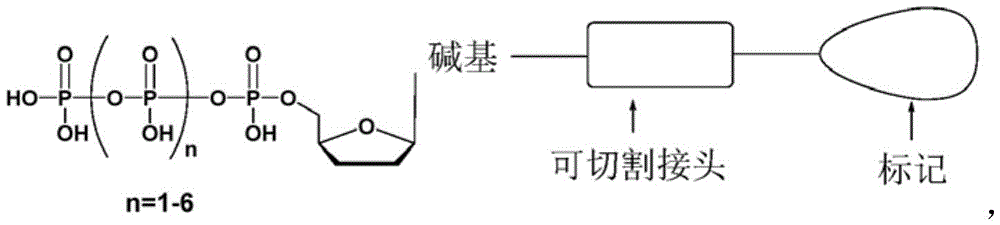
其中:in:
碱基包括腺嘌呤、鸟嘌呤、胞嘧啶、胸腺嘧啶、尿嘧啶、次黄嘌呤或其类似物;Bases include adenine, guanine, cytosine, thymine, uracil, hypoxanthine or analogs thereof;
可切割接头包括DTM、偶氮基、2-硝基苄基、烯丙基、叠氮基甲基或TCO衍生物并通过嘧啶(C、U)的5位置或去氮嘌呤(A、G、I)的7位置连接到所述碱基;并且Cleavable linkers include DTM, azo, 2-nitrobenzyl, allyl, azidomethyl or TCO derivatives and pass through the 5 position of pyrimidine (C, U) or deazapurine (A, G, I) is linked to said base at
标记包括荧光染料、pH响应性荧光染料、荧光染料簇、pH响应性荧光染料簇、用于染料连接的锚定物、用于染料连接的锚定物簇、或锚定物和染料。Labels include fluorescent dyes, pH-responsive fluorescent dyes, fluorescent dye clusters, pH-responsive fluorescent dye clusters, anchors for dye attachment, anchor clusters for dye attachment, or anchors and dyes.
本发明提供了一种核苷酸类似物,其具有以下结构:The present invention provides a nucleotide analog having the following structure:

其中:in:
碱基包括腺嘌呤、鸟嘌呤、胞嘧啶、胸腺嘧啶、尿嘧啶、次黄嘌呤或其类似物;Bases include adenine, guanine, cytosine, thymine, uracil, hypoxanthine or analogs thereof;
R包括甲基、乙基、丙基、叔丁基、芳基、烷基芳基;R includes methyl, ethyl, propyl, tert-butyl, aryl, alkylaryl;
可切割接头包括DTM、偶氮基、2-硝基苄基、烯丙基、叠氮基甲基或TCO衍生物;并且Cleavable linkers include DTM, azo, 2-nitrobenzyl, allyl, azidomethyl, or TCO derivatives; and
标记包括荧光染料、pH响应性荧光染料、荧光染料簇、pH响应性荧光染料簇、用于连接荧光染料的锚定物、用于连接荧光染料的锚定物簇、或锚定物和染料。Labels include fluorescent dyes, pH-responsive fluorescent dyes, fluorescent dye clusters, pH-responsive fluorescent dye clusters, anchors for attaching fluorescent dyes, anchor clusters for attaching fluorescent dyes, or anchors and dyes.
本发明提供了一种核苷酸类似物,其具有以下结构:The present invention provides a nucleotide analog having the following structure:

其中:in:
碱基包括腺嘌呤、鸟嘌呤、胞嘧啶、胸腺嘧啶、尿嘧啶、次黄嘌呤或其类似物;Bases include adenine, guanine, cytosine, thymine, uracil, hypoxanthine or analogs thereof;
可切割接头包括DTM、偶氮基、2-硝基苄基、烯丙基、叠氮基甲基或TCO衍生物或这些可切割接头中的多于一个可切割接头,包含其中一个可切割接头存在于所述碱基与阻断剂之间并且第二个不同的可切割接头存在于所述阻断剂与标记之间的特殊情况;Cleavable linkers include DTM, azo, 2-nitrobenzyl, allyl, azidomethyl or TCO derivatives or more than one of these cleavable linkers, including one of them The special case where a second, different cleavable linker exists between the base and the blocker and between the blocker and the label;
阻断剂是包括无碱基糖或经修饰的核苷或其组合的2-50个单体单元的核苷酸或寡核苷酸;并且阻断剂通过可切割接头连接到嘧啶(C、U)的5位置和去氮嘌呤(A、G、I)的7位置;The blocking agent is a nucleotide or oligonucleotide of 2-50 monomer units comprising abasic sugars or modified nucleosides or combinations thereof; and the blocking agent is linked to the pyrimidine (C, U) at the 5 position and deazapurine (A, G, I) at the 7 position;
其中阻断剂是在掺入之后防止另外的核苷酸或核苷酸类似物进一步掺入到引物链中的部分;并且wherein the blocker is a moiety that, after incorporation, prevents further incorporation of additional nucleotides or nucleotide analogs into the primer strand; and
标记包括荧光染料、pH响应性荧光染料、荧光染料簇、pH响应性荧光染料簇、用于连接荧光染料的锚定物、用于连接荧光染料的锚定物簇、或锚定物和染料,其中所述标记连接到所述阻断剂。Labels include fluorescent dyes, pH-responsive fluorescent dyes, fluorescent dye clusters, pH-responsive fluorescent dye clusters, anchors for attaching fluorescent dyes, anchor clusters for attaching fluorescent dyes, or anchors and dyes, wherein the label is attached to the blocking agent.
本发明提供了一种核苷酸类似物,其具有以下结构:The present invention provides a nucleotide analog having the following structure:

其中:in:
碱基包括腺嘌呤、鸟嘌呤、胞嘧啶、尿嘧啶、胸腺嘧啶、次黄嘌呤或其类似物;并且The bases include adenine, guanine, cytosine, uracil, thymine, hypoxanthine or analogs thereof; and
R是可切割化学基团,所述可切割化学基团包括烷基DTM、偶氮基、2-硝基苄基、烯丙基和叠氮基甲基衍生物。R is a cleavable chemical group including alkyl DTM, azo, 2-nitrobenzyl, allyl and azidomethyl derivatives.
本发明提供了一种核苷酸类似物,其具有以下结构:The present invention provides a nucleotide analog having the following structure:
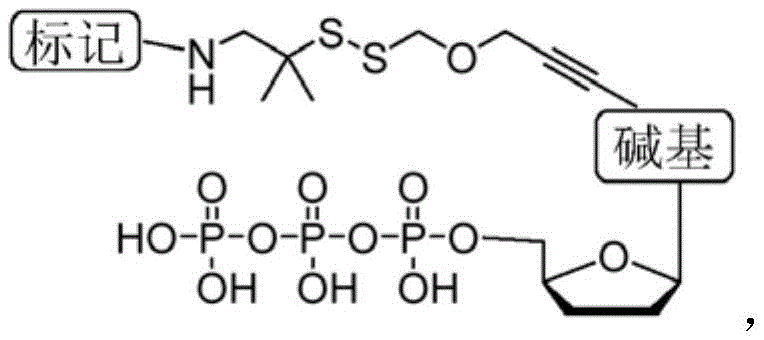
其中:in:
碱基包括腺嘌呤、鸟嘌呤、胞嘧啶、胸腺嘧啶、尿嘧啶、次黄嘌呤或其类似物;并且The bases include adenine, guanine, cytosine, thymine, uracil, hypoxanthine or analogs thereof; and
标记包括荧光染料、pH响应性荧光染料、荧光染料簇、pH响应性荧光染料簇、用于染料连接的锚定物、用于染料连接的锚定物簇、或锚定物和染料。Labels include fluorescent dyes, pH-responsive fluorescent dyes, fluorescent dye clusters, pH-responsive fluorescent dye clusters, anchors for dye attachment, anchor clusters for dye attachment, or anchors and dyes.
本发明提供了一种核苷酸类似物,其具有以下结构:The present invention provides a nucleotide analog having the following structure:

其中碱基包括腺嘌呤、鸟嘌呤、胞嘧啶、胸腺嘧啶、尿嘧啶、次黄嘌呤或其类似物。The bases include adenine, guanine, cytosine, thymine, uracil, hypoxanthine or analogs thereof.
本发明提供了一种核苷酸类似物,其具有以下结构:The present invention provides a nucleotide analog having the following structure:

其中:in:
碱基包括腺嘌呤、鸟嘌呤、胞嘧啶、胸腺嘧啶、尿嘧啶、次黄嘌呤或其类似物;Bases include adenine, guanine, cytosine, thymine, uracil, hypoxanthine or analogs thereof;
标记包括荧光染料、pH响应性荧光染料、荧光染料簇、pH响应性荧光染料簇、用于染料连接的锚定物、用于染料连接的锚定物簇、或锚定物和染料;并且Labels include fluorescent dyes, pH-responsive fluorescent dyes, fluorescent dye clusters, pH-responsive fluorescent dye clusters, anchors for dye attachment, anchor clusters for dye attachment, or anchors and dyes; and
R包括甲基、乙基、丙基、叔丁基、芳基、烷基芳基。R includes methyl, ethyl, propyl, t-butyl, aryl, alkylaryl.
本发明提供了一种核苷酸类似物,其具有以下结构:The present invention provides a nucleotide analog having the following structure:

其中:in:
碱基包括腺嘌呤、鸟嘌呤、胞嘧啶、胸腺嘧啶、尿嘧啶、次黄嘌呤或其类似物;并且The bases include adenine, guanine, cytosine, thymine, uracil, hypoxanthine or analogs thereof; and
R包括甲基、乙基、丙基、叔丁基、芳基、烷基芳基。R includes methyl, ethyl, propyl, t-butyl, aryl, alkylaryl.
本发明提供了一种核苷酸类似物,其具有以下结构:The present invention provides a nucleotide analog having the following structure:

其中碱基包括腺嘌呤、鸟嘌呤、胞嘧啶、胸腺嘧啶、尿嘧啶、次黄嘌呤或其类似物。The bases include adenine, guanine, cytosine, thymine, uracil, hypoxanthine or analogs thereof.
本发明提供了一种对核酸进行测序的方法,所述方法包括:The present invention provides a method for sequencing nucleic acid, the method comprising:
a)提供各自与引物杂交的多个核酸模板和核酸聚合酶,其中每个模板具有与待测序的所述核酸相同的序列;a) providing a plurality of nucleic acid templates and nucleic acid polymerases each hybridizing to a primer, wherein each template has the same sequence as the nucleic acid to be sequenced;
b)使所述核酸模板与两种不同的经标记的核苷酸类似物接触,并且所述接触在以下条件下进行:如果所述经标记的核苷酸类似物中的一种核苷酸类似物与紧邻与所述引物的3'端核苷酸残基杂交的所述核酸模板的核苷酸残基的5'的核苷酸残基互补,则允许所述核酸聚合酶用所述核苷酸类似物延伸所述引物,其中所述两种不同的经标记的核苷酸类似物是:b) contacting the nucleic acid template with two different labeled nucleotide analogs, and the contacting is performed under the following conditions: if one of the labeled nucleotide analogs The analog is complementary to the nucleotide residue immediately 5' of the nucleotide residue of the nucleic acid template to which the 3' terminal nucleotide residue of the primer hybridizes, allowing the nucleic acid polymerase to use the Nucleotide analogs extend the primer, wherein the two different labeled nucleotide analogs are:
(i)(A)荧光标记的双脱氧核苷酸类似物,所述荧光标记的双脱氧核苷酸类似物包括碱基和通过可切割接头与所述碱基连接的荧光标记,以及(B)锚定物标记的双脱氧核苷酸类似物,所述锚定物标记的双脱氧核苷酸类似物包括碱基和通过可切割接头与所述碱基连接的锚定物,(i) (A) a fluorescently labeled dideoxynucleotide analog comprising a base and a fluorescent label attached to the base through a cleavable linker, and (B) ) an anchor-labeled dideoxynucleotide analog comprising a base and an anchor linked to the base by a cleavable linker,
其中所述可切割接头可由相同的切割剂切割;wherein the cleavable linker is cleavable by the same cleaving agent;
(ii)(A)荧光标记的核苷酸类似物,所述荧光标记的核苷酸类似物包括碱基和通过可切割接头与所述碱基连接的荧光标记以及在3'-OH位置处的阻断基,其中所述阻断基防止随后的核苷酸类似物掺入到延伸的引物链中,以及(B)锚定物标记的核苷酸类似物,所述锚定物标记的核苷酸类似物包括碱基和通过可切割接头与所述碱基连接的锚定物以及在3'-OH位置处的阻断基,其中所述阻断基防止随后的核苷酸类似物掺入到延伸的引物链中,(ii) (A) a fluorescently labeled nucleotide analog comprising a base and a fluorescent label attached to the base through a cleavable linker and at the 3'-OH position A blocking group, wherein the blocking group prevents the incorporation of subsequent nucleotide analogs into the extended primer strand, and (B) an anchor-labeled nucleotide analog, the anchor-labeled Nucleotide analogs include a base and an anchor attached to the base by a cleavable linker and a blocking group at the 3'-OH position, wherein the blocking group prevents subsequent nucleotide analogs incorporated into the extended primer strand,
其中所述可切割接头和所述3'-OH基团可由相同的切割剂切割;或者wherein the cleavable linker and the 3'-OH group are cleavable by the same cleaving agent; or
(iii)(A)荧光标记的核苷酸类似物,所述荧光标记的核苷酸类似物包括碱基、通过可切割接头与所述碱基连接的阻断基和在所述阻断基的远端与所述碱基连接的荧光标记,其中所述阻断基防止或极大地减少随后的核苷酸类似物掺入到延伸的引物链中,以及(B)锚定物标记的核苷酸类似物,所述锚定物标记的核苷酸类似物包括碱基、通过可切割接头与所述碱基连接的阻断基和在所述阻断基的远端与所述碱基连接的锚定物,其中所述阻断基防止或极大地减少随后的核苷酸类似物掺入到延伸的引物链中,(iii) (A) a fluorescently labeled nucleotide analog comprising a base, a blocking group attached to the base through a cleavable linker, and a blocking group at the blocking group A fluorescent label attached to the base at its distal end, wherein the blocking group prevents or greatly reduces subsequent incorporation of nucleotide analogs into the extending primer strand, and (B) an anchor-labeled nucleus nucleotide analogs, the anchor-labeled nucleotide analogs include a base, a blocking group connected to the base through a cleavable linker, and a distal end of the blocking group with the base a linked anchor, wherein the blocking group prevents or greatly reduces subsequent incorporation of nucleotide analogs into the extended primer strand,
其中所述可切割接头可由相同的切割剂切割;wherein the cleavable linker is cleavable by the same cleaving agent;
c)用不具有任何碱基修饰并且包括3'-O阻断基的核苷酸类似物延伸未延伸的引物,其中步骤(c)在步骤(b)之前、同时或之后发生;c) extending the unextended primer with a nucleotide analog that does not have any base modifications and includes a 3'-O blocking group, wherein step (c) occurs before, concurrently with or after step (b);
d)鉴定由于掺入荧光标记的核苷酸类似物而产生的任何荧光信号;d) identifying any fluorescent signal resulting from incorporation of the fluorescently labeled nucleotide analog;
e)使来自步骤(b)的所掺入的核苷酸类似物与锚定物结合基团接触,所述锚定物结合基团结合到步骤(b)的所提供的锚定物标记的核苷酸类似物的所述锚定物,其中所述锚定物结合基团包括与步骤(b)的所述荧光标记的核苷酸类似物的所述荧光标记相同的荧光标记;e) contacting the incorporated nucleotide analog from step (b) with an anchor-binding group that binds to the provided anchor-labeled The anchor of nucleotide analogs, wherein the anchor-binding group comprises the same fluorescent label as the fluorescent label of the fluorescently labeled nucleotide analog of step (b);
f)鉴定由于所述锚定物结合基团与步骤(b)的任何掺入的锚定物标记的核苷酸类似物的所述锚定物的结合而产生的任何荧光信号;f) identifying any fluorescent signal resulting from the binding of said anchor-binding group to said anchor of any incorporated anchor-labeled nucleotide analog of step (b);
g)用两种不同的经标记的核苷酸类似物重复步骤(b)-(f),所述两种不同的经标记的核苷酸类似物不同于来自步骤(b)的先前迭代的所述两种不同的经标记的核苷酸类似物;g) Repeat steps (b)-(f) with two different labeled nucleotide analogs different from the one from the previous iteration of step (b) the two different labeled nucleotide analogs;
h)从所掺入的核苷酸类似物中切割所述可切割接头,由此从步骤(b)的所掺入的核苷酸类似物中去除任何标记、锚定物或阻断基;h) cleaving the cleavable linker from the incorporated nucleotide analog, thereby removing any label, anchor or blocking group from the incorporated nucleotide analog of step (b);
i)从来自步骤(c)的任何掺入的核苷酸类似物中切割所述3'-O阻断基;以及i) cleavage of the 3'-O blocking group from any incorporated nucleotide analogs from step (c); and
j)针对待测序的所述核酸的每个残基迭代地重复步骤(b)到(i),j) iteratively repeating steps (b) to (i) for each residue of said nucleic acid to be sequenced,
由此获得所述核酸的序列。The sequence of the nucleic acid is thus obtained.
在一个实施例中,步骤(b)的核苷酸类似物选自由图3、图7或图11的核苷酸类似物组成的组。In one embodiment, the nucleotide analog of step (b) is selected from the group consisting of the nucleotide analogs of FIG. 3 , FIG. 7 or FIG. 11 .
本发明提供了一种对核酸进行测序的方法,所述方法包括:The present invention provides a method for sequencing nucleic acid, the method comprising:
a)提供各自与引物杂交的多个核酸模板,其中每个模板具有与待测序的所述核酸相同的序列,并且提供核酸聚合酶;a) providing a plurality of nucleic acid templates each hybridizing to a primer, wherein each template has the same sequence as the nucleic acid to be sequenced, and providing a nucleic acid polymerase;
b)使所述核酸模板与四种不同的经标记的核苷酸类似物(A、C、T、G)接触,并且所述接触在以下条件下进行:如果所述经标记的核苷酸类似物中的一种核苷酸类似物与紧邻与所述引物的3'端核苷酸残基杂交的所述核酸模板的核苷酸残基的5'的核苷酸残基互补,则允许所述核酸聚合酶用所述核苷酸类似物延伸所述引物,其中所述四种不同的经标记的核苷酸类似物是:b) contacting the nucleic acid template with four different labeled nucleotide analogs (A, C, T, G), and the contacting is performed under the following conditions: if the labeled nucleotides A nucleotide analog in the analogs is complementary to the nucleotide residue immediately 5' of the nucleotide residue of the nucleic acid template that hybridizes to the nucleotide residue at the 3' end of the primer, then The nucleic acid polymerase is allowed to extend the primer with the nucleotide analogs, wherein the four different labeled nucleotide analogs are:
(i)(A)荧光标记的双脱氧核苷酸类似物,所述荧光标记的双脱氧核苷酸类似物包括碱基和通过可切割接头与所述碱基连接的荧光标记,(B)pH响应性荧光标记的双脱氧核苷酸类似物,所述pH响应性荧光标记的双脱氧核苷酸类似物包括碱基和通过可切割接头与所述碱基连接的pH响应性荧光标记,(C)两种不同的锚定物标记的双脱氧核苷酸类似物,其中每种类似物包括通过可切割接头与碱基连接的不同锚定物,(i) (A) a fluorescently labeled dideoxynucleotide analog comprising a base and a fluorescent label attached to the base via a cleavable linker, (B) a pH-responsive fluorescently labeled dideoxynucleotide analog comprising a base and a pH-responsive fluorescent label attached to the base through a cleavable linker, (C) two different anchor-labeled dideoxynucleotide analogs, wherein each analog includes a different anchor attached to the base via a cleavable linker,
其中所述可切割接头可由相同的切割剂切割;wherein the cleavable linker is cleavable by the same cleaving agent;
(ii)(A)荧光标记的核苷酸类似物,所述荧光标记的核苷酸类似物包括碱基和通过可切割接头与所述碱基连接的荧光标记以及在3'-OH位置处的阻断基,其中所述阻断基防止随后的核苷酸类似物掺入到延伸的引物链中,和(B)pH响应性荧光标记的核苷酸类似物,所述pH响应性荧光标记的核苷酸类似物包括碱基和通过可切割接头与所述碱基连接的荧光标记以及在3'-OH位置处的阻断基,其中所述阻断基防止随后的核苷酸类似物掺入到延伸的引物链中,以及(C)两种不同的锚定物标记的核苷酸类似物,所述两种不同的锚定物标记的核苷酸类似物包括碱基和通过可切割接头与所述碱基连接的锚定物以及在3'-OH位置处的阻断基,其中所述阻断基防止随后的核苷酸类似物掺入到延伸的引物链中,其中每种类似物包括通过可切割接头与所述碱基连接的不同锚定物,(ii) (A) a fluorescently labeled nucleotide analog comprising a base and a fluorescent label attached to the base through a cleavable linker and at the 3'-OH position A blocking group, wherein the blocking group prevents subsequent incorporation of the nucleotide analog into the extended primer strand, and (B) a pH-responsive fluorescently labeled nucleotide analog that is fluorescent Labeled nucleotide analogs include a base and a fluorescent label attached to the base via a cleavable linker and a blocking group at the 3'-OH position, wherein the blocking group prevents subsequent nucleotide analogs incorporation of primers into the extended primer strand, and (C) two different anchor-labeled nucleotide analogs including base and via An anchor with a cleavable linker attached to the base and a blocking group at the 3'-OH position, wherein the blocking group prevents subsequent incorporation of nucleotide analogs into the extended primer strand, wherein Each analog includes a different anchor attached to the base via a cleavable linker,
其中所述可切割接头和所述3'-O阻断基可由相同的切割剂切割;或者wherein the cleavable linker and the 3'-O blocking group are cleavable by the same cleaving agent; or
(iii)(A)荧光标记的核苷酸类似物,所述荧光标记的核苷酸类似物包括碱基、通过可切割接头与所述碱基连接的阻断基和在所述阻断基的远端与所述碱基连接的荧光标记,其中所述阻断基防止或极大地减少随后的核苷酸类似物掺入到延伸的引物链中,(B)pH响应性荧光标记的核苷酸类似物,所述pH响应性荧光标记的核苷酸类似物包括碱基、通过可切割接头与所述碱基连接的阻断基和在所述阻断基的远端与所述碱基连接的pH响应性荧光标记,其中所述阻断基防止或极大地减少随后的核苷酸类似物掺入到延伸的引物链中,以及(C)两种不同的锚定物标记的核苷酸类似物,所述两种不同的锚定物标记的核苷酸类似物包括碱基、通过可切割接头与所述碱基连接的阻断基和在所述阻断基的远端与所述碱基连接的锚定物,其中所述阻断基防止或极大地减少随后的核苷酸类似物掺入到延伸的引物链中,其中每种类似物包括通过可切割接头与所述碱基连接的不同锚定物,(iii) (A) a fluorescently labeled nucleotide analog comprising a base, a blocking group attached to the base through a cleavable linker, and a blocking group at the blocking group The distal end of the fluorescent label attached to the base, wherein the blocking group prevents or greatly reduces the subsequent incorporation of nucleotide analogs into the extended primer strand, (B) pH-responsive fluorescently labeled nucleus nucleotide analogs, the pH-responsive fluorescently labeled nucleotide analogs include a base, a blocking group connected to the base through a cleavable linker, and a distal end of the blocking group with the base A base-linked pH-responsive fluorescent label in which the blocking group prevents or greatly reduces subsequent incorporation of nucleotide analogs into the extending primer strand, and (C) two different anchor-labeled nuclei nucleotide analogs, the two different anchor-labeled nucleotide analogs include a base, a blocking group attached to the base via a cleavable linker, and a distal end of the blocking group with The base-linked anchor, wherein the blocking group prevents or greatly reduces the incorporation of subsequent nucleotide analogs into the extended primer strand, wherein each analog comprises a cleavable linker with the different anchors linked by bases,
其中所述可切割接头可由相同的切割剂切割;wherein the cleavable linker is cleavable by the same cleaving agent;
c)用不具有任何碱基修饰并且包括3'-O阻断基的核苷酸类似物延伸未延伸的引物,其中步骤(c)在步骤(b)之前、同时或之后发生;c) extending the unextended primer with a nucleotide analog that does not have any base modifications and includes a 3'-O blocking group, wherein step (c) occurs before, concurrently with or after step (b);
d)在所述pH响应性荧光标记具有与所述荧光标记的核苷酸类似物上的所述荧光标记相同或相似的吸收和发射曲线的pH下洗去任何未掺入的核苷酸类似物,并且鉴定由于掺入来自步骤(b)的经标记的核苷酸类似物而产生的任何荧光信号;d) washing away any unincorporated nucleotide analogs at pH where the pH-responsive fluorescent label has the same or similar absorption and emission profiles as the fluorescent label on the fluorescently labeled nucleotide analog and identify any fluorescent signal resulting from incorporation of the labeled nucleotide analog from step (b);
e)使来自步骤(b)的所掺入的核苷酸类似物与以下接触:(A)与步骤(b)的所述锚定物标记的核苷酸类似物中的仅一种锚定物标记的核苷酸类似物的所述锚定物结合的锚定物结合基团,其中所述锚定物结合基团包括与步骤(b)的所述荧光标记的核苷酸类似物相同的荧光标记;以及(B)仅与剩余的锚定物标记的核苷酸类似物的所述锚定物结合的锚定物结合基团,其中所述锚定物结合基团包括与步骤(b)的所述pH响应性荧光标记的核苷酸类似物相同的pH响应性荧光标记;e) contacting the incorporated nucleotide analogs from step (b) with: (A) anchoring with only one of the anchor-labeled nucleotide analogs of step (b) The anchor-bound anchor-binding group of the labeled nucleotide analog, wherein the anchor-binding group comprises the same as the fluorescently-labeled nucleotide analog of step (b) and (B) an anchor-binding group that binds only to the anchor of the remaining anchor-labeled nucleotide analogs, wherein the anchor-binding group comprises a combination with step ( b) the same pH-responsive fluorescent label as the pH-responsive fluorescently labeled nucleotide analog;
f)在所述pH响应性荧光标记具有与所述荧光标记的核苷酸类似物上的所述荧光标记相同或相似的吸收和发射曲线的pH下洗去任何未掺入的核苷酸类似物,并且鉴定由于掺入来自步骤(b)的锚定物标记的核苷酸类似物而产生的任何荧光信号;f) washing away any unincorporated nucleotide analogs at pH where the pH-responsive fluorescent label has the same or similar absorption and emission profiles as the fluorescent label on the fluorescently labeled nucleotide analog and identify any fluorescent signal resulting from incorporation of the anchor-labeled nucleotide analog from step (b);
g)在所述pH响应性荧光标记不再具有与所述荧光标记的核苷酸类似物上的所述荧光标记相同或相似的吸收和发射曲线的pH下洗涤来自步骤(b)的所掺入的核苷酸类似物,并且鉴定由于掺入来自步骤(b)的经标记的核苷酸类似物而产生的任何荧光信号;g) washing the spiked protein from step (b) at a pH where the pH-responsive fluorescent label no longer has the same or similar absorption and emission profiles as the fluorescent label on the fluorescently labeled nucleotide analog. incorporated nucleotide analogs, and identifying any fluorescent signals resulting from incorporation of the labeled nucleotide analogs from step (b);
h)从所掺入的核苷酸类似物中切割所述可切割接头,由此从步骤(b)的所掺入的核苷酸类似物中去除任何标记、锚定物或阻断基;h) cleaving the cleavable linker from the incorporated nucleotide analog, thereby removing any label, anchor or blocking group from the incorporated nucleotide analog of step (b);
i)从来自步骤(c)的任何掺入的核苷酸类似物中切割所述3'-O阻断基;以及i) cleavage of the 3'-O blocking group from any incorporated nucleotide analogs from step (c); and
j)针对待测序的所述核酸的每个残基迭代地重复步骤(b)到(i),j) iteratively repeating steps (b) to (i) for each residue of said nucleic acid to be sequenced,
由此获得所述核酸的序列。The sequence of the nucleic acid is thus obtained.
在一个实施例中,步骤(b)的核苷酸类似物选自由图15、图18或图19的核苷酸类似物组成的组。在一个实施例中,所述具有pH响应性荧光的标记是HCyC-646,并且具有pH不响应性荧光的标记是Cy5。In one embodiment, the nucleotide analog of step (b) is selected from the group consisting of the nucleotide analogs of FIG. 15 , FIG. 18 or FIG. 19 . In one embodiment, the label with pH-responsive fluorescence is HCyC-646 and the label with pH-insensitive fluorescence is Cy5.
本发明提供了一种对核酸进行测序的方法,所述方法包括:The present invention provides a method for sequencing nucleic acid, the method comprising:
a)提供各自与引物杂交的多个核酸模板和核酸聚合酶,其中每个模板具有与待测序的所述核酸相同的序列;a) providing a plurality of nucleic acid templates and nucleic acid polymerases each hybridizing to a primer, wherein each template has the same sequence as the nucleic acid to be sequenced;
b)使所述核酸模板与两种不同的经标记的核苷酸类似物接触,并且所述接触在以下条件下进行:如果所述经标记的核苷酸类似物中的一种核苷酸类似物与紧邻与所述引物的3'端核苷酸残基杂交的所述核酸模板的核苷酸残基的5'的核苷酸残基互补,则允许所述核酸聚合酶用所述核苷酸类似物延伸所述引物,其中所述两种不同的经标记的核苷酸类似物是:b) contacting the nucleic acid template with two different labeled nucleotide analogs, and the contacting is performed under the following conditions: if one of the labeled nucleotide analogs The analog is complementary to the nucleotide residue immediately 5' of the nucleotide residue of the nucleic acid template to which the 3' terminal nucleotide residue of the primer hybridizes, allowing the nucleic acid polymerase to use the Nucleotide analogs extend the primer, wherein the two different labeled nucleotide analogs are:
(i)(A)荧光标记的双脱氧核苷酸类似物,所述荧光标记的双脱氧核苷酸类似物包括碱基和通过可切割接头与所述碱基连接的荧光标记,以及(B)pH响应性荧光标记的双脱氧核苷酸类似物,所述pH响应性荧光标记的双脱氧核苷酸类似物包括碱基和通过可切割接头与所述碱基连接的pH响应性荧光标记,(i) (A) a fluorescently labeled dideoxynucleotide analog comprising a base and a fluorescent label attached to the base through a cleavable linker, and (B) ) pH-responsive fluorescently labeled dideoxynucleotide analogs comprising a base and a pH-responsive fluorescent label attached to the base via a cleavable linker ,
其中所述可切割接头可由相同的切割剂切割;wherein the cleavable linker is cleavable by the same cleaving agent;
(ii)(A)荧光标记的核苷酸类似物,所述荧光标记的核苷酸类似物包括碱基和通过可切割接头与所述碱基连接的荧光标记以及在3'-OH位置处的阻断基,其中所述阻断基防止随后的核苷酸类似物掺入到延伸的引物链中,以及(B)pH响应性荧光标记的核苷酸类似物,所述pH响应性荧光标记的核苷酸类似物包括碱基和通过可切割接头与所述碱基连接的pH响应性荧光标记以及在3'-OH位置处的阻断基,其中所述阻断基防止随后的核苷酸类似物掺入到延伸的引物链中,(ii) (A) a fluorescently labeled nucleotide analog comprising a base and a fluorescent label attached to the base through a cleavable linker and at the 3'-OH position A blocking group, wherein the blocking group prevents the subsequent incorporation of nucleotide analogs into the extended primer strand, and (B) a pH-responsive fluorescently labeled nucleotide analog, the pH-responsive fluorescent Labeled nucleotide analogs include a base and a pH-responsive fluorescent label attached to the base via a cleavable linker and a blocking group at the 3'-OH position, wherein the blocking group prevents subsequent nuclear The nucleotide analog is incorporated into the extended primer strand,
其中所述可切割接头和所述3'-O阻断基可由相同的切割剂切割;或者wherein the cleavable linker and the 3'-O blocking group are cleavable by the same cleaving agent; or
(iii)(A)荧光标记的核苷酸类似物,所述荧光标记的核苷酸类似物包括碱基、通过可切割接头与所述碱基连接的阻断基和在所述阻断基的远端与所述碱基连接的荧光标记,其中所述阻断基防止或极大地减少随后的核苷酸类似物掺入到延伸的引物链中,以及(B)pH响应性荧光标记的核苷酸类似物,所述pH响应性荧光标记的核苷酸类似物包括碱基、通过可切割接头与所述碱基连接的阻断基和在所述阻断基的远端与所述碱基连接的pH响应性荧光标记,其中所述阻断基防止或极大地减少随后的核苷酸类似物掺入到延伸的引物链中,其中所述可切割接头可由相同的切割剂切割;(iii) (A) a fluorescently labeled nucleotide analog comprising a base, a blocking group attached to the base through a cleavable linker, and a blocking group at the blocking group The distal end of the fluorescent label is attached to the base, wherein the blocking group prevents or greatly reduces subsequent incorporation of nucleotide analogs into the extended primer strand, and (B) pH-responsive fluorescent labeling Nucleotide analogs, the pH-responsive fluorescently labeled nucleotide analogs include a base, a blocking group connected to the base through a cleavable linker, and a distal end of the blocking group with the base A base-linked pH-responsive fluorescent label, wherein the blocking group prevents or greatly reduces subsequent incorporation of nucleotide analogs into the extended primer strand, wherein the cleavable linker is cleavable by the same cleaving agent;
c)用不具有任何碱基修饰并且包括3'-O阻断基的核苷酸类似物延伸未延伸的引物,其中步骤(c)在步骤(b)之前、同时或之后发生;c) extending the unextended primer with a nucleotide analog that does not have any base modifications and includes a 3'-O blocking group, wherein step (c) occurs before, concurrently with or after step (b);
d)在所述pH响应性荧光标记具有与所述荧光标记的核苷酸类似物上的所述荧光标记相同或相似的吸收和发射曲线的pH下洗去任何未掺入的核苷酸类似物,并且鉴定由于掺入来自步骤(b)的经标记的核苷酸类似物而产生的任何荧光信号;d) washing away any unincorporated nucleotide analogs at pH where the pH-responsive fluorescent label has the same or similar absorption and emission profiles as the fluorescent label on the fluorescently labeled nucleotide analog and identify any fluorescent signal resulting from incorporation of the labeled nucleotide analog from step (b);
e)用两种不同的经标记的核苷酸类似物重复步骤(b)-(d),所述两种不同的经标记的核苷酸类似物不同于来自步骤(b)的先前迭代的所述两种不同的经标记的核苷酸类似物;e) Repeat steps (b)-(d) with two different labeled nucleotide analogs different from the one from the previous iteration of step (b) the two different labeled nucleotide analogs;
f)在所述pH响应性荧光标记具有与所述荧光标记的核苷酸类似物上的所述荧光标记相同或相似的吸收和发射曲线的pH下洗去任何未掺入的核苷酸类似物,并且鉴定由于掺入来自步骤(b)的经标记的核苷酸类似物而产生的任何荧光信号;f) washing away any unincorporated nucleotide analogs at pH where the pH-responsive fluorescent label has the same or similar absorption and emission profiles as the fluorescent label on the fluorescently labeled nucleotide analog and identify any fluorescent signal resulting from incorporation of the labeled nucleotide analog from step (b);
其中步骤(e)和(f)可以以相反的顺序执行;wherein steps (e) and (f) can be performed in reverse order;
g)从所掺入的核苷酸类似物中切割所述可切割接头,由此从步骤(b)的所掺入的核苷酸类似物中去除任何标记或阻断基;g) cleaving the cleavable linker from the incorporated nucleotide analog, thereby removing any label or blocking group from the incorporated nucleotide analog of step (b);
h)从来自步骤(c)的任何掺入的核苷酸类似物中切割所述3'-O阻断基;以及h) cleavage of the 3'-O blocking group from any incorporated nucleotide analogs from step (c); and
i)针对待测序的所述核酸的每个残基迭代地重复步骤(b)到(h),i) iteratively repeating steps (b) to (h) for each residue of said nucleic acid to be sequenced,
由此获得所述核酸的序列。The sequence of the nucleic acid is thus obtained.
在一个实施例中,步骤(b)的核苷酸类似物选自由图78的核苷酸类似物组成的组。在一个实施例中,所述具有pH响应性荧光的标记是HCyC-646,并且具有pH不响应性荧光的标记是Cy5。In one embodiment, the nucleotide analog of step (b) is selected from the group consisting of the nucleotide analogs of FIG. 78 . In one embodiment, the label with pH-responsive fluorescence is HCyC-646 and the label with pH-insensitive fluorescence is Cy5.
本发明提供了一种对核酸进行测序的方法,所述方法包括:The present invention provides a method for sequencing nucleic acid, the method comprising:
a)提供各自与引物杂交的多个核酸模板和核酸聚合酶,其中每个模板具有与待测序的所述核酸相同的序列;a) providing a plurality of nucleic acid templates and nucleic acid polymerases each hybridizing to a primer, wherein each template has the same sequence as the nucleic acid to be sequenced;
b)使所述核酸模板与四种不同的经标记的核苷酸类似物接触,并且所述接触在以下条件下进行:如果所述经标记的核苷酸类似物中的一种核苷酸类似物与紧邻与所述引物的3'端核苷酸残基杂交的所述核酸模板的核苷酸残基的5'的核苷酸残基互补,则允许所述核酸聚合酶用所述核苷酸类似物延伸所述引物,其中所述四种不同的经标记的核苷酸类似物是:b) contacting the nucleic acid template with four different labeled nucleotide analogs, and the contacting is performed under the following conditions: if one of the labeled nucleotide analogs The analog is complementary to the nucleotide residue immediately 5' of the nucleotide residue of the nucleic acid template to which the 3' terminal nucleotide residue of the primer hybridizes, allowing the nucleic acid polymerase to use the Nucleotide analogs extend the primer, wherein the four different labeled nucleotide analogs are:
(i)(A)荧光标记的双脱氧核苷酸类似物,所述荧光标记的双脱氧核苷酸类似物包括碱基和通过第一可切割接头与所述碱基连接的荧光标记,(B)荧光标记的双脱氧核苷酸类似物,所述荧光标记的双脱氧核苷酸类似物包括碱基和通过氨甲酰基TCO接头与所述碱基连接的荧光标记,(C)锚定物标记的双脱氧核苷酸类似物,所述锚定物标记的双脱氧核苷酸类似物包括碱基和通过所述第一可切割接头与所述碱基连接的锚定物,以及(D)锚定物标记的双脱氧核苷酸类似物,所述锚定物标记的双脱氧核苷酸类似物包括碱基和通过氨甲酰基TCO接头与所述碱基连接的锚定物;(i) (A) a fluorescently labeled dideoxynucleotide analog comprising a base and a fluorescent label attached to the base through a first cleavable linker, ( B) a fluorescently labeled dideoxynucleotide analog comprising a base and a fluorescent label attached to the base via a carbamoyl TCO linker, (C) anchoring an anchor-labeled dideoxynucleotide analog comprising a base and an anchor attached to the base through the first cleavable linker, and ( D) An anchor-labeled dideoxynucleotide analog comprising a base and an anchor attached to the base through a carbamoyl TCO linker;
(ii)(A)荧光标记的核苷酸类似物,所述荧光标记的核苷酸类似物包括碱基和通过第一可切割接头与所述碱基连接的荧光标记以及在3'-OH位置处的阻断基,其中所述阻断基防止随后的核苷酸类似物掺入到延伸的引物链中,(B)荧光标记的核苷酸类似物,所述荧光标记的核苷酸类似物包括碱基和通过氨甲酰基TCO接头与所述碱基连接的荧光标记以及在3'-OH位置处的阻断基,其中所述阻断基防止随后的核苷酸类似物掺入到延伸的引物链中,(C)锚定物标记的核苷酸类似物,所述锚定物标记的核苷酸类似物包括碱基和通过所述第一可切割接头与所述碱基连接的锚定物以及在3'-OH位置处的阻断基,其中所述阻断基防止随后的核苷酸类似物掺入到延伸的引物链中,以及(D)锚定物标记的核苷酸类似物,所述锚定物标记的核苷酸类似物包括碱基和通过氨甲酰基TCO接头与所述碱基连接的锚定物以及在3'-OH位置处的阻断基,其中所述阻断基防止随后的核苷酸类似物掺入到延伸的引物链中,其中所述3'-O阻断基和所述第一可切割接头可由相同的切割剂切割;或者(ii) (A) a fluorescently labeled nucleotide analog comprising a base and a fluorescent label attached to the base through a first cleavable linker and at the 3'-OH a blocking group at position, wherein the blocking group prevents the incorporation of subsequent nucleotide analogs into the extended primer strand, (B) a fluorescently labeled nucleotide analog, the fluorescently labeled nucleotide Analogs include a base and a fluorescent label attached to the base via a carbamoyl TCO linker and a blocking group at the 3'-OH position, wherein the blocking group prevents subsequent incorporation of the nucleotide analog into the extended primer strand, (C) an anchor-labeled nucleotide analog that includes a base and is bound to the base through the first cleavable linker An anchor attached and a blocking group at the 3'-OH position, wherein the blocking group prevents subsequent incorporation of nucleotide analogs into the extended primer strand, and (D) anchor-labeled Nucleotide analogs, the anchor-labeled nucleotide analogs include a base and an anchor attached to the base via a carbamoyl TCO linker and a blocking group at the 3'-OH position , wherein the blocking group prevents the incorporation of subsequent nucleotide analogs into the extended primer strand, wherein the 3'-O blocking group and the first cleavable linker are cleavable by the same cleaving agent; or
(iii)(A)荧光标记的核苷酸类似物,所述荧光标记的核苷酸类似物包括碱基、通过第一可切割接头与所述碱基连接的阻断基和在所述阻断基的远端与所述碱基连接的荧光标记,其中所述阻断基防止或极大地减少随后的核苷酸类似物掺入到延伸的引物链中,(B)荧光标记的核苷酸类似物,所述荧光标记的核苷酸类似物包括碱基、通过氨甲酰基TCO接头与所述碱基连接的阻断基和在所述阻断基的远端与所述碱基连接的荧光标记,其中所述阻断基防止或极大地减少随后的核苷酸类似物掺入到延伸的引物链中,(C)锚定物标记的核苷酸类似物,所述锚定物标记的核苷酸类似物包括碱基、通过第一可切割接头与所述碱基连接的阻断基和在所述阻断基的远端与所述碱基连接的锚定物,其中所述阻断基防止或极大地减少随后的核苷酸类似物掺入到延伸的引物链中,以及(D)锚定物标记的核苷酸类似物,所述锚定物标记的核苷酸类似物包括碱基、通过氨甲酰基TCO接头与所述碱基连接的阻断基和在所述阻断基的远端与所述碱基连接的锚定物,其中所述阻断基防止或极大地减少随后的核苷酸类似物掺入到延伸的引物链中,(iii) (A) a fluorescently labeled nucleotide analog comprising a base, a blocking group linked to the base through a first cleavable linker, and a blocking group at the blocking A fluorescent label attached to the base at the distal end of the cleavage group, wherein the blocking group prevents or greatly reduces subsequent incorporation of nucleotide analogs into the extended primer strand, (B) a fluorescently labeled nucleoside Acid analogs, the fluorescently labeled nucleotide analogs include a base, a blocking group attached to the base via a carbamoyl TCO linker, and a distal end of the blocking group attached to the base A fluorescent label in which the blocking group prevents or greatly reduces subsequent incorporation of nucleotide analogs into the extended primer strand, (C) an anchor-labeled nucleotide analog, the anchor Labeled nucleotide analogs include a base, a blocking group attached to the base via a first cleavable linker, and an anchor attached to the base distal to the blocking group, wherein the The blocking group prevents or greatly reduces the subsequent incorporation of nucleotide analogs into the extended primer strand, and (D) anchor-labeled nucleotide analogs, the anchor-labeled nucleotides Analogs include a base, a blocking group attached to the base via a carbamoyl TCO linker, and an anchor attached to the base distal to the blocking group, wherein the blocking group prevents or greatly reduce the subsequent incorporation of nucleotide analogs into the extended primer strand,
其中每种类似物上的所述荧光标记是相同的,wherein the fluorescent label on each analog is the same,
其中每种类似物上的所述锚定物是相同的;wherein the anchor on each analog is the same;
c)用不具有任何碱基修饰并且包括3'-O阻断基的核苷酸类似物延伸未延伸的引物,其中步骤(c)在步骤(b)之前、同时或之后发生;c) extending the unextended primer with a nucleotide analog that does not have any base modifications and includes a 3'-O blocking group, wherein step (c) occurs before, concurrently with or after step (b);
d)鉴定由于掺入荧光标记的核苷酸类似物而产生的任何荧光信号;d) identifying any fluorescent signal resulting from incorporation of the fluorescently labeled nucleotide analog;
e)使来自步骤(b)的所掺入的核苷酸类似物与锚定物结合基团接触,所述锚定物结合基团结合到步骤(b)的所提供的锚定物标记的核苷酸类似物的所述锚定物,其中所述锚定物结合基团包括与步骤(b)的所述荧光标记的核苷酸类似物的所述荧光标记相同的荧光标记;e) contacting the incorporated nucleotide analog from step (b) with an anchor-binding group that binds to the provided anchor-labeled The anchor of nucleotide analogs, wherein the anchor-binding group comprises the same fluorescent label as the fluorescent label of the fluorescently labeled nucleotide analog of step (b);
f)鉴定由于所述锚定物结合基团与步骤(b)的任何掺入的锚定物标记的核苷酸类似物的所述锚定物的结合而产生的任何荧光信号;f) identifying any fluorescent signal resulting from the binding of said anchor-binding group to said anchor of any incorporated anchor-labeled nucleotide analog of step (b);
g)使所掺入的核苷酸类似物与四嗪衍生物接触以点击所述氨甲酰基TCO接头的TCO部分以释放通过氨甲酰基TCO接头连接的任何标记或锚定物,并且鉴定由于掺入来自步骤(b)的经标记的核苷酸类似物而产生的任何荧光信号;g) contacting the incorporated nucleotide analog with a tetrazine derivative to click on the TCO portion of the carbamoyl TCO linker to release any tags or anchors attached through the carbamoyl TCO linker, and identifying any fluorescent signal resulting from incorporation of the labeled nucleotide analog from step (b);
h)使所掺入的核苷酸类似物与切割所述第一可切割接头和任何3'-O阻断基的切割剂接触;以及h) contacting the incorporated nucleotide analog with a cleavage agent that cleaves the first cleavable linker and any 3'-O blocking groups; and
i)针对待测序的所述核酸的每个残基迭代地重复步骤(b)到(h),i) iteratively repeating steps (b) to (h) for each residue of said nucleic acid to be sequenced,
由此获得所述核酸的序列。The sequence of the nucleic acid is thus obtained.
在一个实施例中,步骤(b)的核苷酸类似物选自由图34的核苷酸类似物组成的组。In one embodiment, the nucleotide analog of step (b) is selected from the group consisting of the nucleotide analogs of FIG. 34 .
本发明提供了一种对核酸进行测序的方法,所述方法包括:The present invention provides a method for sequencing nucleic acid, the method comprising:
a)提供各自与引物杂交的多个核酸模板和核酸聚合酶,其中每个模板具有与待测序的所述核酸相同的序列;a) providing a plurality of nucleic acid templates and nucleic acid polymerases each hybridizing to a primer, wherein each template has the same sequence as the nucleic acid to be sequenced;
b)使所述核酸模板与四种不同的经标记的核苷酸类似物接触,并且所述接触在以下条件下进行:如果所述经标记的核苷酸类似物中的一种核苷酸类似物与紧邻与所述引物的3'端核苷酸残基杂交的所述核酸模板的核苷酸残基的5'的核苷酸残基互补,则允许所述核酸聚合酶用所述核苷酸类似物延伸所述引物,其中所述四种不同的经标记的核苷酸类似物是:b) contacting the nucleic acid template with four different labeled nucleotide analogs, and the contacting is performed under the following conditions: if one of the labeled nucleotide analogs The analog is complementary to the nucleotide residue immediately 5' of the nucleotide residue of the nucleic acid template to which the 3' terminal nucleotide residue of the primer hybridizes, allowing the nucleic acid polymerase to use the Nucleotide analogs extend the primer, wherein the four different labeled nucleotide analogs are:
(i)(A)荧光标记的双脱氧核苷酸类似物,所述荧光标记的双脱氧核苷酸类似物包括碱基和通过可切割接头与所述碱基连接的荧光标记,(B)荧光标记的双脱氧核苷酸类似物,所述荧光标记的双脱氧核苷酸类似物包括碱基以及通过可切割接头与所述碱基连接的荧光标记和第一锚定物,(C)锚定物标记的双脱氧核苷酸类似物,所述锚定物标记的双脱氧核苷酸类似物包括碱基以及通过可切割接头与所述碱基连接的所述第一锚定物和第二锚定物,以及(D)锚定物标记的双脱氧核苷酸类似物,所述锚定物标记的双脱氧核苷酸类似物包括碱基和通过可切割接头与所述碱基连接的所述第二锚定物,其中所述可切割接头能由相同的切割剂切割;(i) (A) a fluorescently labeled dideoxynucleotide analog comprising a base and a fluorescent label attached to the base via a cleavable linker, (B) A fluorescently labeled dideoxynucleotide analog comprising a base and a fluorescent label and a first anchor attached to the base through a cleavable linker, (C) An anchor-labeled dideoxynucleotide analog comprising a base and the first anchor linked to the base by a cleavable linker and A second anchor, and (D) an anchor-labeled dideoxynucleotide analog comprising a base and a cleavable linker linked to the base the second anchor attached, wherein the cleavable linker is cleavable by the same cleaving agent;
(ii)(A)荧光标记的核苷酸类似物,所述荧光标记的核苷酸类似物包括碱基和通过可切割接头与所述碱基连接的荧光标记以及在3'-OH位置处的阻断基,其中所述阻断基防止随后的核苷酸类似物掺入到延伸的引物链中,(B)荧光标记的核苷酸类似物,所述荧光标记的核苷酸类似物包括碱基和通过可切割接头与所述碱基连接的荧光标记和第一锚定物以及在3'-OH位置处的阻断基,其中所述阻断基防止随后的核苷酸类似物掺入到延伸的引物链中,(C)锚定物标记的核苷酸类似物,所述锚定物标记的核苷酸类似物包括碱基和通过所述可切割接头与所述碱基连接的所述第一锚定物和第二锚定物以及在3'-OH位置处的阻断基,其中所述阻断基防止随后的核苷酸类似物掺入到延伸的引物链中,以及(D)锚定物标记的核苷酸类似物,所述锚定物标记的核苷酸类似物包括碱基和通过可切割接头与所述碱基连接的所述第二锚定物以及在3'-OH位置处的阻断基,其中所述阻断基防止随后的核苷酸类似物掺入到延伸的引物链中,其中所述可切割接头和所述3'-O阻断基可由相同的切割剂切割;或者(ii) (A) a fluorescently labeled nucleotide analog comprising a base and a fluorescent label attached to the base through a cleavable linker and at the 3'-OH position A blocking group, wherein the blocking group prevents the incorporation of subsequent nucleotide analogs into the extended primer strand, (B) a fluorescently labeled nucleotide analog, the fluorescently labeled nucleotide analog Include a base and a fluorescent label attached to the base via a cleavable linker and a first anchor and a blocking group at the 3'-OH position, wherein the blocking group prevents subsequent nucleotide analogs Incorporated into the extended primer strand, (C) an anchor-labeled nucleotide analog that includes a base and is bound to the base via the cleavable linker The first and second anchors are linked and a blocking group at the 3'-OH position, wherein the blocking group prevents subsequent incorporation of nucleotide analogs into the extended primer strand , and (D) an anchor-labeled nucleotide analog comprising a base and the second anchor linked to the base by a cleavable linker and a blocking group at the 3'-OH position, wherein the blocking group prevents subsequent incorporation of nucleotide analogs into the extended primer strand, wherein the cleavable linker and the 3'-O block The cleavage base can be cleaved by the same cleaving agent; or
(iii)(A)荧光标记的核苷酸类似物,所述荧光标记的核苷酸类似物包括碱基、通过可切割接头与所述碱基连接的阻断基和在所述阻断基的远端与所述碱基连接的荧光标记,其中所述阻断基防止或极大地减少随后的核苷酸类似物掺入到延伸的引物链中,(B)荧光标记的核苷酸类似物,所述荧光标记的核苷酸类似物包括碱基、通过可切割接头与所述碱基连接的阻断基以及在所述阻断基的远端与所述碱基连接的荧光标记和第一锚定物,其中所述阻断基防止或极大地减少随后的核苷酸类似物掺入到延伸的引物链中,(C)锚定物标记的核苷酸类似物,所述锚定物标记的核苷酸类似物包括碱基、通过可切割接头与所述碱基连接的阻断基以及在所述阻断基的远端与所述碱基连接的所述第一锚定物和第二锚定物,其中所述阻断基防止或极大地减少随后的核苷酸类似物掺入到延伸的引物链,以及(D)锚定物标记的核苷酸类似物,所述锚定物标记的核苷酸类似物包括碱基、通过可切割接头与所述碱基连接的阻断基和在所述阻断基的远端与所述碱基连接的所述第二锚定物,其中所述阻断基防止或极大地减少随后的核苷酸类似物掺入到延伸的引物链中,其中所述可切割接头可由相同的切割剂切割,(iii) (A) a fluorescently labeled nucleotide analog comprising a base, a blocking group attached to the base through a cleavable linker, and a blocking group at the blocking group The distal end of the fluorescent label attached to the base, wherein the blocking group prevents or greatly reduces the subsequent incorporation of the nucleotide analog into the extended primer strand, (B) the fluorescently labeled nucleotide analog The fluorescently labeled nucleotide analogs include a base, a blocking group linked to the base through a cleavable linker, and a fluorescent label linked to the base at the distal end of the blocking group and a first anchor, wherein the blocking group prevents or greatly reduces the incorporation of subsequent nucleotide analogs into the extended primer strand, (C) an anchor-labeled nucleotide analog, the anchor An anchor-labeled nucleotide analog includes a base, a blocking group attached to the base via a cleavable linker, and the first anchor attached to the base distal to the blocking group and a second anchor, wherein the blocking group prevents or greatly reduces subsequent incorporation of nucleotide analogs into the extended primer strand, and (D) anchor-labeled nucleotide analogs, so The anchor-labeled nucleotide analog includes a base, a blocking group connected to the base through a cleavable linker, and the second base connected to the base at the distal end of the blocking group. An anchor, wherein the blocking group prevents or greatly reduces subsequent incorporation of nucleotide analogs into the extended primer strand, wherein the cleavable linker is cleavable by the same cleaving agent,
其中每种类似物上的所述荧光标记是相同的;wherein the fluorescent label on each analog is the same;
c)用不具有任何碱基修饰并且包括3'-O阻断基的核苷酸类似物延伸未延伸的引物,其中步骤(c)在步骤(b)之前、同时或之后发生;c) extending the unextended primer with a nucleotide analog that does not have any base modifications and includes a 3'-O blocking group, wherein step (c) occurs before, concurrently with or after step (b);
d)鉴定由于掺入荧光标记的核苷酸类似物而产生的任何荧光信号;d) identifying any fluorescent signal resulting from incorporation of the fluorescently labeled nucleotide analog;
e)使来自步骤(b)的所掺入的核苷酸类似物与锚定物结合基团接触,所述锚定物结合基团结合到步骤(b)的所述核苷酸类似物的所述第二锚定物,其中所述锚定物结合基团包括与步骤(b)的所述荧光标记的核苷酸类似物的荧光标记相同的荧光标记;e) contacting the incorporated nucleotide analog from step (b) with an anchor binding group that binds to the nucleotide analog of step (b) the second anchor, wherein the anchor binding group comprises the same fluorescent label as the fluorescent label of the fluorescently labeled nucleotide analog of step (b);
f)鉴定由于所述锚定物结合基团与步骤(b)的任何掺入的核苷酸类似物的所述锚定物的结合而产生的任何荧光信号;f) identifying any fluorescent signal resulting from the binding of said anchor binding group to said anchor of any incorporated nucleotide analog of step (b);
g)使所掺入的核苷酸类似物与第二锚定物结合基团接触,所述第二锚定物结合基团结合到步骤(b)的所述核苷酸类似物的所述第一锚定物并且包括使与所述锚定物结合基团连接到的所述核苷酸类似物连接的任何荧光标记的所述荧光信号猝灭的部分,并且鉴定由于掺入荧光标记的核苷酸类似物而产生的任何荧光信号;g) contacting the incorporated nucleotide analog with a second anchor binding group that binds to the nucleotide analog of step (b) The first anchor and includes a moiety that quenches the fluorescent signal of any fluorescent label attached to the nucleotide analog to which the anchor binding group is attached, and identifies the any fluorescent signal resulting from nucleotide analogs;
h)使所掺入的核苷酸类似物与切割所述可切割接头和任何3'-O阻断基的切割剂接触;以及h) contacting the incorporated nucleotide analog with a cleavage agent that cleaves the cleavable linker and any 3'-O blocking groups; and
i)针对待测序的所述核酸的每个残基迭代地重复步骤(b)到(h),i) iteratively repeating steps (b) to (h) for each residue of said nucleic acid to be sequenced,
由此获得所述核酸的序列。The sequence of the nucleic acid is thus obtained.
在一个实施例中,步骤(b)的核苷酸类似物选自由图38、图42或图46的核苷酸类似物组成的组。In one embodiment, the nucleotide analog of step (b) is selected from the group consisting of the nucleotide analogs of Figure 38, Figure 42, or Figure 46.
本发明提供了一种对核酸进行测序的方法,所述方法包括:The present invention provides a method for sequencing nucleic acid, the method comprising:
a)提供各自与引物杂交的多个核酸模板和核酸聚合酶,其中每个模板具有与待测序的所述核酸相同的序列;a) providing a plurality of nucleic acid templates and nucleic acid polymerases each hybridizing to a primer, wherein each template has the same sequence as the nucleic acid to be sequenced;
b)使所述核酸模板与四种不同的经标记的核苷酸类似物接触,并且所述接触在以下条件下进行:如果所述经标记的核苷酸类似物中的一种核苷酸类似物与紧邻与所述引物的3'端核苷酸残基杂交的所述核酸模板的核苷酸残基的5'的核苷酸残基互补,则允许所述核酸聚合酶用所述核苷酸类似物延伸所述引物,其中所述四种不同的经标记的核苷酸类似物是:b) contacting the nucleic acid template with four different labeled nucleotide analogs, and the contacting is performed under the following conditions: if one of the labeled nucleotide analogs The analog is complementary to the nucleotide residue immediately 5' of the nucleotide residue of the nucleic acid template to which the 3' terminal nucleotide residue of the primer hybridizes, allowing the nucleic acid polymerase to use the Nucleotide analogs extend the primer, wherein the four different labeled nucleotide analogs are:
(i)(A)荧光标记的双脱氧核苷酸类似物,所述荧光标记的双脱氧核苷酸类似物包括碱基和通过第一可切割接头与所述碱基连接的荧光标记,(B)荧光标记的双脱氧核苷酸类似物,所述荧光标记的双脱氧核苷酸类似物包括碱基和通过所述第一可切割接头和在所述第一可切割接头的远端连接的氨甲酰基TCO接头与所述碱基连接的荧光标记,(C)锚定物标记的双脱氧核苷酸类似物,所述锚定物标记的双脱氧核苷酸类似物包括碱基和通过所述第一可切割接头和在所述第一可切割接头的远端连接的氨甲酰基TCO接头与所述碱基连接的锚定物,以及(D)锚定物标记的双脱氧核苷酸类似物,所述锚定物标记的双脱氧核苷酸类似物包括碱基和通过所述第一可切割接头与所述碱基连接的锚定物;(i) (A) a fluorescently labeled dideoxynucleotide analog comprising a base and a fluorescent label attached to the base through a first cleavable linker, ( B) Fluorescently labeled dideoxynucleotide analogs comprising a base and linked through and at the distal end of the first cleavable linker The carbamoyl TCO linker is a fluorescent label attached to the base, (C) an anchor-labeled dideoxynucleotide analog, the anchor-labeled dideoxynucleotide analog includes the base and An anchor attached to the base via the first cleavable linker and a carbamoyl TCO linker attached at the distal end of the first cleavable linker, and (D) an anchor-labeled dideoxy core A nucleotide analog, the anchor-labeled dideoxynucleotide analog comprising a base and an anchor connected to the base through the first cleavable linker;
(ii)(A)荧光标记的核苷酸类似物,所述荧光标记的核苷酸类似物包括碱基和通过第一可切割接头与所述碱基连接的荧光标记以及在3'-OH位置处的阻断基,其中所述阻断基防止随后的核苷酸类似物掺入到延伸的引物链中,(B)荧光标记的核苷酸类似物,所述荧光标记的核苷酸类似物包括碱基和通过所述第一可切割接头和在所述第一可切割接头的远端连接的氨甲酰基TCO接头与所述碱基连接的荧光标记以及在3'-OH位置处的阻断基,其中所述阻断基防止随后的核苷酸类似物掺入到延伸的引物链中,(C)锚定物标记的核苷酸类似物,所述锚定物标记的核苷酸类似物包括碱基和通过所述第一可切割接头与所述碱基连接的锚定物以及在3'-OH位置处的阻断基,其中所述阻断基防止随后的核苷酸类似物掺入到延伸的引物链中,以及(D)锚定物标记的核苷酸类似物,所述锚定物标记的核苷酸类似物包括碱基和通过所述第一可切割接头和在所述第一可切割接头的远端连接的氨甲酰基TCO接头与所述碱基连接的锚定物以及在3'-OH位置处的阻断基,其中所述阻断基防止随后的核苷酸类似物掺入到延伸的引物链中,其中所述3'-OH阻断基和所述第一可切割接头可由相同的试剂切割;或者(ii) (A) a fluorescently labeled nucleotide analog comprising a base and a fluorescent label attached to the base through a first cleavable linker and at the 3'-OH a blocking group at position, wherein the blocking group prevents the incorporation of subsequent nucleotide analogs into the extended primer strand, (B) a fluorescently labeled nucleotide analog, the fluorescently labeled nucleotide Analogs include a base and a fluorescent label attached to the base through the first cleavable linker and a carbamoyl TCO linker attached at the distal end of the first cleavable linker and at the 3'-OH position A blocking group, wherein the blocking group prevents the incorporation of subsequent nucleotide analogs into the extended primer strand, (C) an anchor-labeled nucleotide analog, the anchor-labeled nuclear The nucleotide analog includes a base and an anchor attached to the base through the first cleavable linker and a blocking group at the 3'-OH position, wherein the blocking group prevents subsequent nucleosides The acid analog is incorporated into the extended primer strand, and (D) an anchor-labeled nucleotide analog comprising a base and cleavable by the first A linker and a carbamoyl TCO linker attached at the distal end of the first cleavable linker are attached to the base with an anchor and a blocking group at the 3'-OH position, wherein the blocking group prevents Subsequent nucleotide analogs are incorporated into the extended primer strand, wherein the 3'-OH blocking group and the first cleavable linker are cleavable by the same reagent; or
(iii)(A)荧光标记的核苷酸类似物,所述荧光标记的核苷酸类似物包括碱基、通过第一可切割接头与所述碱基连接的阻断基和在所述阻断基的远端与所述碱基连接的荧光标记,其中所述阻断基防止或极大地减少随后的核苷酸类似物掺入到延伸的引物链中,(B)荧光标记的核苷酸类似物,所述荧光标记的核苷酸类似物包括碱基、通过所述第一可切割接头与所述碱基连接的阻断基和通过所述阻断基远端的氨甲酰基TCO接头与所述碱基连接的荧光标记,其中所述阻断基防止或极大地减少随后的核苷酸类似物掺入到延伸的引物链中,(C)锚定物标记的核苷酸类似物,所述锚定物标记的核苷酸类似物包括碱基、通过第一可切割接头与所述碱基连接的阻断基和在所述阻断基的远端与所述碱基连接的锚定物,其中所述阻断基防止或极大地减少随后的核苷酸类似物掺入到延伸的引物链中,以及(D)锚定物标记的核苷酸类似物,所述锚定物标记的核苷酸类似物包括碱基、通过所述第一可切割接头与所述碱基连接的阻断基和通过所述阻断基远端的氨甲酰基TCO接头与所述碱基连接的锚定物,其中所述阻断基防止或极大地减少随后的核苷酸类似物掺入到延伸的引物链中,(iii) (A) a fluorescently labeled nucleotide analog comprising a base, a blocking group linked to the base through a first cleavable linker, and a blocking group at the blocking A fluorescent label attached to the base at the distal end of the cleavage group, wherein the blocking group prevents or greatly reduces subsequent incorporation of nucleotide analogs into the extended primer strand, (B) a fluorescently labeled nucleoside Acid analogs, the fluorescently labeled nucleotide analogs include a base, a blocking group connected to the base through the first cleavable linker, and a carbamoyl TCO distal to the blocking group A fluorescent label to which the linker is attached to the base, wherein the blocking group prevents or greatly reduces subsequent incorporation of nucleotide analogs into the extended primer strand, (C) Anchor-labeled nucleotide analogs The anchor-labeled nucleotide analog includes a base, a blocking group attached to the base through a first cleavable linker, and a distal end of the blocking group attached to the base An anchor, wherein the blocking group prevents or greatly reduces subsequent incorporation of nucleotide analogs into the extended primer strand, and (D) an anchor-labeled nucleotide analog, the anchor The quantitation-labeled nucleotide analog includes a base, a blocking group connected to the base through the first cleavable linker, and a carbamoyl TCO linker distal to the blocking group and the base base-linked anchors, wherein the blocking group prevents or greatly reduces subsequent incorporation of nucleotide analogs into the extended primer strand,
其中每种类似物上的所述荧光标记是相同的,wherein the fluorescent label on each analog is the same,
其中每种类似物上的所述锚定物是相同的;wherein the anchor on each analog is the same;
c)用不具有任何碱基修饰并且包括3'-O阻断基的核苷酸类似物延伸未延伸的引物,其中步骤(c)在步骤(b)之前、同时或之后发生;c) extending the unextended primer with a nucleotide analog that does not have any base modifications and includes a 3'-O blocking group, wherein step (c) occurs before, concurrently with or after step (b);
d)鉴定由于在步骤(b)中掺入荧光标记的核苷酸类似物而产生的任何荧光信号;d) identifying any fluorescent signal resulting from the incorporation of the fluorescently labeled nucleotide analog in step (b);
e)使来自步骤(b)的所掺入的核苷酸类似物与锚定物结合基团接触,所述锚定物结合基团结合到步骤(b)的所提供的锚定物标记的核苷酸类似物的所述锚定物,其中所述锚定物结合基团包括与步骤(b)的所述荧光标记的核苷酸类似物的所述荧光标记相同的荧光标记;e) contacting the incorporated nucleotide analog from step (b) with an anchor-binding group that binds to the provided anchor-labeled The anchor of nucleotide analogs, wherein the anchor-binding group comprises the same fluorescent label as the fluorescent label of the fluorescently labeled nucleotide analog of step (b);
f)鉴定由于所述锚定物结合基团与步骤(b)的任何掺入的锚定物标记的核苷酸类似物的所述锚定物的结合而产生的任何荧光信号;f) identifying any fluorescent signal resulting from the binding of said anchor-binding group to said anchor of any incorporated anchor-labeled nucleotide analog of step (b);
g)使所掺入的核苷酸类似物与四嗪衍生物接触以点击所述氨甲酰基TCO接头的TCO部分以释放通过氨甲酰基TCO接头连接的任何标记或锚定物,并且鉴定由于掺入来自步骤(b)的经标记的核苷酸类似物而产生的任何荧光信号;g) contacting the incorporated nucleotide analog with a tetrazine derivative to click on the TCO portion of the carbamoyl TCO linker to release any tags or anchors attached through the carbamoyl TCO linker, and identifying any fluorescent signal resulting from incorporation of the labeled nucleotide analog from step (b);
h)使所掺入的核苷酸类似物与切割所述第一可切割接头和任何3'-O阻断基的切割剂接触;以及h) contacting the incorporated nucleotide analog with a cleavage agent that cleaves the first cleavable linker and any 3'-O blocking groups; and
i)针对待测序的所述核酸的每个残基迭代地重复步骤(b)到(h),i) iteratively repeating steps (b) to (h) for each residue of said nucleic acid to be sequenced,
由此获得所述核酸的序列。The sequence of the nucleic acid is thus obtained.
在一个实施例中,步骤(b)的核苷酸类似物选自由图54、图58或图62的核苷酸类似物组成的组。In one embodiment, the nucleotide analog of step (b) is selected from the group consisting of the nucleotide analogs of Figure 54, Figure 58, or Figure 62.
本发明提供了一种对核酸进行测序的方法,所述方法包括:The present invention provides a method for sequencing nucleic acid, the method comprising:
a)提供各自与引物杂交的多个核酸模板和核酸聚合酶,其中每个模板具有与待测序的所述核酸相同的序列;a) providing a plurality of nucleic acid templates and nucleic acid polymerases each hybridizing to a primer, wherein each template has the same sequence as the nucleic acid to be sequenced;
b)使所述核酸模板与四种不同的经标记的核苷酸类似物接触,并且所述接触在以下条件下进行:如果所述经标记的核苷酸类似物中的一种核苷酸类似物与紧邻与所述引物的3'端核苷酸残基杂交的所述核酸模板的核苷酸残基的5'的核苷酸残基互补,则允许所述核酸聚合酶用所述核苷酸类似物延伸所述引物,其中所述四种不同的经标记的核苷酸类似物是:b) contacting the nucleic acid template with four different labeled nucleotide analogs, and the contacting is performed under the following conditions: if one of the labeled nucleotide analogs The analog is complementary to the nucleotide residue immediately 5' of the nucleotide residue of the nucleic acid template to which the 3' terminal nucleotide residue of the primer hybridizes, allowing the nucleic acid polymerase to use the Nucleotide analogs extend the primer, wherein the four different labeled nucleotide analogs are:
(i)(A)荧光标记的双脱氧核苷酸类似物,所述荧光标记的双脱氧核苷酸类似物包括碱基和通过第一可切割接头与所述碱基连接的荧光标记,(B)荧光标记的双脱氧核苷酸类似物,所述荧光标记的双脱氧核苷酸类似物包括碱基和通过所述第一可切割接头和在所述第一可切割接头的远端连接的氨甲酰基TCO接头与所述碱基连接的荧光标记,(C)pH响应性荧光标记的双脱氧核苷酸类似物,所述pH响应性荧光标记的双脱氧核苷酸类似物包括碱基和通过所述第一可切割接头和在所述第一可切割接头的远端连接的氨甲酰基TCO接头与所述碱基连接的pH响应性荧光标记,以及(D)pH响应性荧光标记的双脱氧核苷酸类似物,所述pH响应性荧光标记的双脱氧核苷酸类似物包括碱基和通过所述第一可切割接头与所述碱基连接的pH响应性荧光标记;(i) (A) a fluorescently labeled dideoxynucleotide analog comprising a base and a fluorescent label attached to the base through a first cleavable linker, ( B) Fluorescently labeled dideoxynucleotide analogs comprising a base and linked through and at the distal end of the first cleavable linker The carbamoyl TCO linker is a fluorescent label attached to the base, (C) a pH-responsive fluorescently labeled dideoxynucleotide analog comprising a base a pH-responsive fluorescent label attached to the base through the first cleavable linker and a carbamoyl TCO linker attached at the distal end of the first cleavable linker, and (D) pH-responsive fluorescence a labeled dideoxynucleotide analog, the pH-responsive fluorescently labeled dideoxynucleotide analog comprising a base and a pH-responsive fluorescent label attached to the base through the first cleavable linker;
(ii)(A)荧光标记的核苷酸类似物,所述荧光标记的核苷酸类似物包括碱基和通过第一可切割接头与所述碱基连接的荧光标记以及在3'-OH位置处的阻断基,其中所述阻断基防止随后的核苷酸类似物掺入到延伸的引物链中,(B)荧光标记的核苷酸类似物,所述荧光标记的核苷酸类似物包括碱基和通过所述第一可切割接头和在所述第一可切割接头的远端连接的氨甲酰基TCO接头与所述碱基连接的荧光标记以及在3'-OH位置处的阻断基,其中所述阻断基防止随后的核苷酸类似物掺入到延伸的引物链中,(C)pH响应性荧光标记的核苷酸类似物,所述pH响应性荧光标记的核苷酸类似物包括碱基和通过所述第一可切割接头与所述碱基连接的pH响应性荧光标记以及在3'-OH位置处的阻断基,其中所述阻断基防止随后的核苷酸类似物掺入到延伸的引物链中,以及(D)pH响应性荧光标记的核苷酸类似物,所述pH响应性荧光标记的核苷酸类似物包括碱基和通过所述第一可切割接头和在所述第一可切割接头的远端连接的氨甲酰基TCO接头与所述碱基连接的pH响应性荧光标记以及在3'-OH位置处的阻断基,其中所述阻断基防止随后的核苷酸类似物掺入到延伸的引物链中,其中所述3'-OH阻断基和所述第一可切割接头可由相同的试剂切割;或者(ii) (A) a fluorescently labeled nucleotide analog comprising a base and a fluorescent label attached to the base through a first cleavable linker and at the 3'-OH a blocking group at position, wherein the blocking group prevents the incorporation of subsequent nucleotide analogs into the extended primer strand, (B) a fluorescently labeled nucleotide analog, the fluorescently labeled nucleotide Analogs include a base and a fluorescent label attached to the base through the first cleavable linker and a carbamoyl TCO linker attached at the distal end of the first cleavable linker and at the 3'-OH position A blocking group, wherein the blocking group prevents the incorporation of subsequent nucleotide analogs into the extended primer strand, (C) a pH-responsive fluorescently labeled nucleotide analog, the pH-responsive fluorescently labeled The nucleotide analogs include a base and a pH-responsive fluorescent label attached to the base through the first cleavable linker and a blocking group at the 3'-OH position, wherein the blocking group prevents Subsequent incorporation of nucleotide analogs into the extended primer strand, and (D) pH-responsive fluorescently labeled nucleotide analogs including base and via The first cleavable linker and the carbamoyl TCO linker attached at the distal end of the first cleavable linker are pH-responsive fluorescent label attached to the base and a blocking group at the 3'-OH position , wherein the blocking group prevents the incorporation of subsequent nucleotide analogs into the extended primer strand, wherein the 3'-OH blocking group and the first cleavable linker are cleavable by the same reagent; or
(iii)(A)荧光标记的核苷酸类似物,所述荧光标记的核苷酸类似物包括碱基、通过第一可切割接头与所述碱基连接的阻断基和在所述阻断基的远端与所述碱基连接的荧光标记,其中所述阻断基防止或极大地减少随后的核苷酸类似物掺入到延伸的引物链中,(B)荧光标记的核苷酸类似物,所述荧光标记的核苷酸类似物包括碱基、通过所述第一可切割接头与所述碱基连接的阻断基和通过所述阻断基远端的氨甲酰基TCO接头与所述碱基连接的荧光标记,其中所述阻断基防止或极大地减少随后的核苷酸类似物掺入到延伸的引物链中,(C)pH响应性荧光标记的核苷酸类似物核苷酸类似物,所述pH响应性荧光标记的核苷酸类似物核苷酸类似物包括碱基、通过第一可切割接头与所述碱基连接的阻断基和在所述阻断基的远端与所述碱基连接的pH响应性荧光标记,其中所述阻断基防止或极大地减少随后的核苷酸类似物掺入到延伸的引物链中,以及(D)pH响应性荧光标记的核苷酸类似物,所述pH响应性荧光标记的核苷酸类似物包括碱基、通过所述第一可切割接头与所述碱基连接的阻断基和通过所述阻断基远端的氨甲酰基TCO接头与所述碱基连接的pH响应性荧光标记,其中所述阻断基防止或极大地减少随后的核苷酸类似物掺入到延伸的引物链中,(iii) (A) a fluorescently labeled nucleotide analog comprising a base, a blocking group linked to the base through a first cleavable linker, and a blocking group at the blocking A fluorescent label attached to the base at the distal end of the cleavage group, wherein the blocking group prevents or greatly reduces subsequent incorporation of nucleotide analogs into the extended primer strand, (B) a fluorescently labeled nucleoside Acid analogs, the fluorescently labeled nucleotide analogs include a base, a blocking group connected to the base through the first cleavable linker, and a carbamoyl TCO distal to the blocking group A fluorescent label with a linker attached to the base, wherein the blocking group prevents or greatly reduces subsequent incorporation of nucleotide analogs into the extended primer strand, (C) pH-responsive fluorescently labeled nucleotides Analog nucleotide analogs, the pH-responsive fluorescently labeled nucleotide analogs nucleotide analogs include a base, a blocking group linked to the base through a first cleavable linker, and a a pH-responsive fluorescent label attached to the base at the distal end of the blocking group, wherein the blocking group prevents or greatly reduces subsequent incorporation of nucleotide analogs into the extended primer strand, and (D) A pH-responsive fluorescently labeled nucleotide analog comprising a base, a blocking group linked to the base through the first cleavable linker, and a A pH-responsive fluorescent label attached to the base by a carbamoyl TCO linker distal to the blocking group, wherein the blocking group prevents or greatly reduces subsequent incorporation of nucleotide analogs into the extended primer strand middle,
c)用不具有任何碱基修饰并且包括3'-O阻断基的核苷酸类似物延伸未延伸的引物,其中步骤(c)在步骤(b)之前、同时或之后发生;c) extending the unextended primer with a nucleotide analog that does not have any base modifications and includes a 3'-O blocking group, wherein step (c) occurs before, concurrently with or after step (b);
d)在所述pH响应性荧光标记不具有与所述荧光标记的核苷酸类似物上的所述荧光标记相同或相似的吸收和发射曲线的pH下洗去任何未掺入的核苷酸类似物,并且鉴定由于掺入来自步骤(b)的经标记的核苷酸类似物而产生的任何荧光信号;d) washing away any unincorporated nucleotides at a pH where the pH-responsive fluorescent label does not have the same or similar absorption and emission profiles as the fluorescent label on the fluorescently labeled nucleotide analog analogs, and identifying any fluorescent signals resulting from incorporation of the labeled nucleotide analogs from step (b);
e)在所述pH响应性荧光标记具有与所述荧光标记的核苷酸类似物上的所述荧光标记相同或相似的吸收和发射曲线的pH下洗去任何未掺入的核苷酸类似物,并且鉴定由于掺入来自步骤(b)的经标记的核苷酸类似物而产生的任何荧光信号,其中步骤(d)和(e)可以以相反的顺序执行;e) washing away any unincorporated nucleotide analogs at pH where the pH-responsive fluorescent label has the same or similar absorption and emission profiles as the fluorescent label on the fluorescently labeled nucleotide analog and identifying any fluorescent signal resulting from incorporation of the labeled nucleotide analog from step (b), wherein steps (d) and (e) may be performed in reverse order;
f)使所掺入的核苷酸类似物与四嗪接触以点击所述氨甲酰基TCO接头的TCO部分以释放通过氨甲酰基TCO接头连接的任何标记;f) contacting the incorporated nucleotide analog with a tetrazine to click on the TCO moiety of the carbamoyl TCO linker to release any label attached through the carbamoyl TCO linker;
g)在所述pH响应性荧光标记具有与所述荧光标记的核苷酸类似物上的所述荧光标记相同或相似的吸收和发射曲线的pH下洗去任何未掺入的核苷酸类似物,并且鉴定由于掺入来自步骤(b)的经标记的核苷酸类似物而产生的任何荧光信号;g) washing away any unincorporated nucleotide analogs at pH where the pH-responsive fluorescent label has the same or similar absorption and emission profiles as the fluorescent label on the fluorescently labeled nucleotide analog and identify any fluorescent signal resulting from incorporation of the labeled nucleotide analog from step (b);
h)使所掺入的核苷酸类似物与切割所述第一可切割接头和任何3'-O阻断基的切割剂接触;以及h) contacting the incorporated nucleotide analog with a cleavage agent that cleaves the first cleavable linker and any 3'-O blocking groups; and
i)针对待测序的所述核酸的每个残基迭代地重复步骤(b)到(h),i) iteratively repeating steps (b) to (h) for each residue of said nucleic acid to be sequenced,
由此获得所述核酸的序列。The sequence of the nucleic acid is thus obtained.
在一个实施例中,步骤(b)的核苷酸类似物选自由图66、图70或图74的核苷酸类似物组成的组。在一个实施例中,所述具有pH响应性荧光的标记是HCyC-646,并且具有pH不响应性荧光的标记是Cy5。In one embodiment, the nucleotide analog of step (b) is selected from the group consisting of the nucleotide analog of Figure 66, Figure 70, or Figure 74. In one embodiment, the label with pH-responsive fluorescence is HCyC-646 and the label with pH-insensitive fluorescence is Cy5.
本发明提供了一种对核酸进行测序的方法,所述方法包括:The present invention provides a method for sequencing nucleic acid, the method comprising:
a)提供各自与引物杂交的多个核酸模板和核酸聚合酶,其中每个模板具有与待测序的所述核酸相同的序列;a) providing a plurality of nucleic acid templates and nucleic acid polymerases each hybridizing to a primer, wherein each template has the same sequence as the nucleic acid to be sequenced;
b)使所述核酸模板与四种不同的经标记的核苷酸类似物接触,并且所述接触在以下条件下进行:如果所述经标记的核苷酸类似物中的一种核苷酸类似物与紧邻与所述引物的3'端核苷酸残基杂交的所述核酸模板的核苷酸残基的5'的核苷酸残基互补,则允许所述核酸聚合酶用所述核苷酸类似物延伸所述引物,其中所述四种不同的经标记的核苷酸类似物是:b) contacting the nucleic acid template with four different labeled nucleotide analogs, and the contacting is performed under the following conditions: if one of the labeled nucleotide analogs The analog is complementary to the nucleotide residue immediately 5' of the nucleotide residue of the nucleic acid template to which the 3' terminal nucleotide residue of the primer hybridizes, allowing the nucleic acid polymerase to use the Nucleotide analogs extend the primer, wherein the four different labeled nucleotide analogs are:
(i)(A)荧光标记的双脱氧核苷酸类似物,所述荧光标记的双脱氧核苷酸类似物包括碱基和通过可切割接头与所述碱基连接的荧光标记,(B)荧光标记的双脱氧核苷酸类似物,所述荧光标记的双脱氧核苷酸类似物包括碱基以及通过可切割接头与所述碱基连接的荧光标记和锚定物,(C)pH响应性荧光标记的双脱氧核苷酸类似物,所述pH响应性荧光标记的双脱氧核苷酸类似物包括碱基和通过可切割接头与所述碱基连接的pH响应性荧光标记,以及(D)pH响应性荧光标记的双脱氧核苷酸类似物,所述pH响应性荧光标记的双脱氧核苷酸类似物包括碱基以及通过可切割接头与所述碱基连接的pH响应性荧光标记和锚定物,其中所述可切割接头可由相同的切割剂切割;(i) (A) a fluorescently labeled dideoxynucleotide analog comprising a base and a fluorescent label attached to the base via a cleavable linker, (B) Fluorescently labeled dideoxynucleotide analogs comprising a base and a fluorescent label and an anchor attached to the base via a cleavable linker, (C) pH responsive a fluorescently labeled dideoxynucleotide analog that includes a base and a pH-responsive fluorescent label attached to the base through a cleavable linker, and ( D) pH-responsive fluorescently labeled dideoxynucleotide analogs comprising a base and a pH-responsive fluorescent attached to the base via a cleavable linker A marker and anchor, wherein the cleavable linker is cleavable by the same cleaving agent;
(ii)(A)荧光标记的核苷酸类似物,所述荧光标记的核苷酸类似物包括碱基和通过可切割接头与所述碱基连接的荧光标记以及在3'-OH位置处的阻断基,其中所述阻断基防止随后的核苷酸类似物掺入到延伸的引物链中,(B)荧光标记的核苷酸类似物,所述荧光标记的核苷酸类似物包括碱基和通过可切割接头与所述碱基连接的荧光标记和锚定物以及在3'-OH位置处的阻断基,其中所述阻断基防止随后的核苷酸类似物掺入到延伸的引物链中,(C)pH响应性荧光标记的核苷酸类似物,所述pH响应性荧光标记的核苷酸类似物包括碱基和通过可切割接头与所述碱基连接的pH响应性荧光标记以及在3'-OH位置处的阻断基,其中所述阻断基防止随后的核苷酸类似物掺入到延伸的引物链中,以及(D)pH响应性荧光标记的核苷酸类似物,所述pH响应性荧光标记的核苷酸类似物包括碱基和通过可切割接头与所述碱基连接的pH响应性荧光标记和锚定物以及在3'-OH位置处的阻断基,其中所述阻断基防止随后的核苷酸类似物掺入到延伸的引物链中,其中所述可切割接头和所述3'-O阻断基可由相同的切割剂切割;或者(ii) (A) a fluorescently labeled nucleotide analog comprising a base and a fluorescent label attached to the base through a cleavable linker and at the 3'-OH position A blocking group, wherein the blocking group prevents the incorporation of subsequent nucleotide analogs into the extended primer strand, (B) a fluorescently labeled nucleotide analog, the fluorescently labeled nucleotide analog Includes a base and a fluorescent label and anchor attached to the base via a cleavable linker and a blocking group at the 3'-OH position, wherein the blocking group prevents subsequent incorporation of nucleotide analogs Into the extended primer strand, (C) a pH-responsive fluorescently labeled nucleotide analog comprising a base and a cleavable linker attached to the base A pH-responsive fluorescent label and a blocking group at the 3'-OH position, wherein the blocking group prevents subsequent incorporation of the nucleotide analog into the extended primer strand, and (D) a pH-responsive fluorescent label Nucleotide analogs comprising pH-responsive fluorescently labeled nucleotide analogs comprising a base and a pH-responsive fluorescent label and an anchor attached to the base through a cleavable linker and at the 3'-OH A blocking group at a position, wherein the blocking group prevents the incorporation of subsequent nucleotide analogs into the extended primer strand, wherein the cleavable linker and the 3'-O blocking group can be cleaved by the same agent cutting; or
(iii)(A)荧光标记的核苷酸类似物,所述荧光标记的核苷酸类似物包括碱基、通过可切割接头与所述碱基连接的阻断基和在所述阻断基的远端与所述碱基连接的荧光标记,其中所述阻断基防止或极大地减少随后的核苷酸类似物掺入到延伸的引物链中,(B)荧光标记的核苷酸类似物,所述荧光标记的核苷酸类似物包括碱基、通过可切割接头与所述碱基连接的阻断基以及在所述阻断基的远端与所述碱基连接的荧光标记和锚定物,其中所述阻断基防止或极大地减少随后的核苷酸类似物掺入到延伸的引物链中,(C)pH响应性荧光标记的核苷酸类似物,所述pH响应性荧光标记的核苷酸类似物包括碱基、通过可切割接头与所述碱基连接的阻断基以及在所述阻断基的远端与所述碱基连接的pH响应性荧光标记,其中所述阻断基防止或极大地减少随后的核苷酸类似物掺入到延伸的引物链中,以及(D)pH响应性荧光标记的核苷酸类似物,所述pH响应性荧光标记的核苷酸类似物包括碱基、通过可切割接头与所述碱基连接的阻断基以及在所述阻断基的远端与所述碱基连接的pH响应性荧光标记和锚定物,其中所述阻断基防止或极大地减少随后的核苷酸类似物掺入到延伸的引物链中,其中所述可切割接头可由相同的切割剂切割,(iii) (A) a fluorescently labeled nucleotide analog comprising a base, a blocking group attached to the base through a cleavable linker, and a blocking group at the blocking group The distal end of the fluorescent label attached to the base, wherein the blocking group prevents or greatly reduces the subsequent incorporation of the nucleotide analog into the extended primer strand, (B) the fluorescently labeled nucleotide analog The fluorescently labeled nucleotide analogs include a base, a blocking group linked to the base through a cleavable linker, and a fluorescent label linked to the base at the distal end of the blocking group and An anchor, wherein the blocking group prevents or greatly reduces the subsequent incorporation of nucleotide analogs into the extended primer strand, (C) pH-responsive fluorescently labeled nucleotide analogs, the pH-responsive The fluorescently labeled nucleotide analogs include a base, a blocking group attached to the base through a cleavable linker, and a pH-responsive fluorescent label attached to the base at the distal end of the blocking group, wherein the blocking group prevents or greatly reduces subsequent incorporation of the nucleotide analog into the extending primer strand, and (D) a pH-responsive fluorescently labeled nucleotide analog, the pH-responsive fluorescent label Nucleotide analogs include a base, a blocking group attached to the base via a cleavable linker, and a pH-responsive fluorescent label and anchor attached to the base at the distal end of the blocking group , wherein the blocking group prevents or greatly reduces subsequent incorporation of nucleotide analogs into the extended primer strand, wherein the cleavable linker is cleavable by the same cleaving agent,
c)用不具有任何碱基修饰并且包括3'-O阻断基的核苷酸类似物延伸未延伸的引物,其中步骤(c)在步骤(b)之前、同时或之后发生;c) extending the unextended primer with a nucleotide analog that does not have any base modifications and includes a 3'-O blocking group, wherein step (c) occurs before, concurrently with or after step (b);
d)在所述pH响应性荧光标记不具有与所述荧光标记的核苷酸类似物上的所述荧光标记相同或相似的吸收和发射曲线的pH下洗去任何未掺入的核苷酸类似物,并且鉴定由于掺入来自步骤(b)的经标记的核苷酸类似物而产生的任何荧光信号;d) washing away any unincorporated nucleotides at a pH where the pH-responsive fluorescent label does not have the same or similar absorption and emission profiles as the fluorescent label on the fluorescently labeled nucleotide analog analogs, and identifying any fluorescent signals resulting from incorporation of the labeled nucleotide analogs from step (b);
e)在所述pH响应性荧光标记具有与所述荧光标记的核苷酸类似物上的所述荧光标记相同或相似的吸收和发射曲线的pH下洗去任何未掺入的核苷酸类似物,并且鉴定由于掺入来自步骤(b)的经标记的核苷酸类似物而产生的任何荧光信号,其中步骤(d)和(e)可以以相反的顺序执行;e) washing away any unincorporated nucleotide analogs at pH where the pH-responsive fluorescent label has the same or similar absorption and emission profiles as the fluorescent label on the fluorescently labeled nucleotide analog and identifying any fluorescent signal resulting from incorporation of the labeled nucleotide analog from step (b), wherein steps (d) and (e) may be performed in reverse order;
f)使来自步骤(b)的所掺入的核苷酸类似物与锚定物结合基团接触,所述锚定物结合基团结合到步骤(b)的所述核苷酸类似物的所述锚定物,其中所述锚定物结合基团包括使步骤(b)的所述荧光标记的核苷酸类似物的所述荧光标记猝灭的部分;f) contacting the incorporated nucleotide analog from step (b) with an anchor binding group that binds to the nucleotide analog of step (b) the anchor, wherein the anchor binding group comprises a moiety that quenches the fluorescent label of the fluorescently labeled nucleotide analog of step (b);
g)在所述pH响应性荧光标记具有与所述荧光标记的核苷酸类似物上的所述荧光标记相同或相似的吸收和发射曲线的pH下洗去任何未结合的包括猝灭部分的锚定物结合基团,并且鉴定由于掺入来自步骤(b)的经标记的核苷酸类似物而产生的任何荧光信号;g) washing away any unbound, including quenching moieties, at a pH where the pH-responsive fluorescent label has the same or similar absorption and emission profiles as the fluorescent label on the fluorescently labeled nucleotide analog. the anchor binding group, and identifying any fluorescent signal resulting from incorporation of the labeled nucleotide analog from step (b);
h)使所掺入的核苷酸类似物与切割所述可切割接头和任何3'-O阻断基的切割剂接触;以及h) contacting the incorporated nucleotide analog with a cleavage agent that cleaves the cleavable linker and any 3'-O blocking groups; and
i)针对待测序的所述核酸的每个残基迭代地重复步骤(b)到(h),i) iteratively repeating steps (b) to (h) for each residue of said nucleic acid to be sequenced,
由此获得所述核酸的序列。The sequence of the nucleic acid is thus obtained.
在一个实施例中,步骤(b)的核苷酸类似物选自由图50或图82的核苷酸类似物组成的组。在一个实施例中,所述具有pH响应性荧光的标记是HCyC-646,并且具有pH不响应性荧光的标记是Cy5。In one embodiment, the nucleotide analog of step (b) is selected from the group consisting of the nucleotide analogs of FIG. 50 or FIG. 82 . In one embodiment, the label with pH-responsive fluorescence is HCyC-646 and the label with pH-insensitive fluorescence is Cy5.
本发明提供了一种对核酸进行测序的方法,所述方法包括:The present invention provides a method for sequencing nucleic acid, the method comprising:
a)提供各自与引物杂交的多个核酸模板和核酸聚合酶,其中每个模板具有与待测序的所述核酸相同的序列;a) providing a plurality of nucleic acid templates and nucleic acid polymerases each hybridizing to a primer, wherein each template has the same sequence as the nucleic acid to be sequenced;
b)使所述核酸模板与两种不同的经标记的核苷酸类似物接触,并且所述接触在以下条件下进行:如果所述经标记的核苷酸类似物中的一种核苷酸类似物与紧邻与所述引物的3'端核苷酸残基杂交的所述核酸模板的核苷酸残基的5'的核苷酸残基互补,则允许所述核酸聚合酶用所述核苷酸类似物延伸所述引物,其中所述两种不同的经标记的核苷酸类似物是:b) contacting the nucleic acid template with two different labeled nucleotide analogs, and the contacting is performed under the following conditions: if one of the labeled nucleotide analogs The analog is complementary to the nucleotide residue immediately 5' of the nucleotide residue of the nucleic acid template to which the 3' terminal nucleotide residue of the primer hybridizes, allowing the nucleic acid polymerase to use the Nucleotide analogs extend the primer, wherein the two different labeled nucleotide analogs are:
(i)(A)荧光标记的双脱氧核苷酸类似物,所述荧光标记的双脱氧核苷酸类似物包括碱基和通过可切割接头与所述碱基连接的荧光标记,以及(B)荧光标记的双脱氧核苷酸类似物,所述荧光标记的双脱氧核苷酸类似物包括碱基以及通过可切割接头与所述碱基连接的荧光标记和锚定物,其中所述可切割的接头可由相同的切割剂切割;(i) (A) a fluorescently labeled dideoxynucleotide analog comprising a base and a fluorescent label attached to the base through a cleavable linker, and (B) ) fluorescently labeled dideoxynucleotide analogs comprising a base and a fluorescent label and an anchor attached to the base through a cleavable linker, wherein the The cleaved linker can be cleaved by the same cleaving agent;
(ii)(A)荧光标记的核苷酸类似物,所述荧光标记的核苷酸类似物包括碱基和通过可切割接头与所述碱基连接的荧光标记以及在3'-OH位置处的阻断基,其中所述阻断基防止随后的核苷酸类似物掺入到延伸的引物链中,以及(B)荧光标记的核苷酸类似物,所述荧光标记的核苷酸类似物包括碱基和通过可切割接头与所述碱基连接的荧光标记和锚定物以及在3'-OH位置处的阻断基,其中所述阻断基防止随后的核苷酸类似物掺入到延伸的引物链中,其中所述可切割接头和所述3'-O阻断基可由相同的切割剂切割;或者(ii) (A) a fluorescently labeled nucleotide analog comprising a base and a fluorescent label attached to the base through a cleavable linker and at the 3'-OH position A blocking group, wherein the blocking group prevents the incorporation of subsequent nucleotide analogs into the extended primer strand, and (B) a fluorescently labeled nucleotide analog that resembles Substances include a base and a fluorescent label and anchor attached to the base via a cleavable linker and a blocking group at the 3'-OH position, wherein the blocking group prevents subsequent incorporation of nucleotide analogs into an extended primer strand, wherein the cleavable linker and the 3'-O blocking group are cleavable by the same cleaving agent; or
(iii)(A)荧光标记的核苷酸类似物,所述荧光标记的核苷酸类似物包括碱基、通过可切割接头与所述碱基连接的阻断基和在所述阻断基的远端与所述碱基连接的荧光标记,其中所述阻断基防止或极大地减少随后的核苷酸类似物掺入到延伸的引物链中,以及(B)荧光标记的核苷酸类似物,所述荧光标记的核苷酸类似物包括碱基、通过可切割接头与所述碱基连接的阻断基以及在所述阻断基的远端与所述碱基连接的荧光标记和锚定物,其中所述阻断基防止或极大地减少随后的核苷酸类似物掺入到延伸的引物链中,其中所述可切割接头可由相同的切割剂切割,(iii) (A) a fluorescently labeled nucleotide analog comprising a base, a blocking group attached to the base through a cleavable linker, and a blocking group at the blocking group a fluorescent label attached to the base at its distal end, wherein the blocking group prevents or greatly reduces subsequent incorporation of nucleotide analogs into the extended primer strand, and (B) a fluorescently labeled nucleotide Analogs, the fluorescently labeled nucleotide analogs include a base, a blocking group connected to the base through a cleavable linker, and a fluorescent label connected to the base at the distal end of the blocking group and anchors, wherein the blocking group prevents or greatly reduces subsequent incorporation of nucleotide analogs into the extended primer strand, wherein the cleavable linker is cleavable by the same cleaving agent,
c)用不具有任何碱基修饰并且包括3'-O阻断基的核苷酸类似物延伸未延伸的引物,其中步骤(c)在步骤(b)之前、同时或之后发生;c) extending the unextended primer with a nucleotide analog that does not have any base modifications and includes a 3'-O blocking group, wherein step (c) occurs before, concurrently with or after step (b);
d)鉴定由于掺入荧光标记的核苷酸类似物而产生的任何荧光信号;d) identifying any fluorescent signal resulting from incorporation of the fluorescently labeled nucleotide analog;
e)用两种不同的经标记的核苷酸类似物重复步骤(b)-(d),所述两种不同的经标记的核苷酸类似物不同于来自步骤(b)的先前迭代的所述两种不同的经标记的核苷酸类似物;e) Repeat steps (b)-(d) with two different labeled nucleotide analogs different from the one from the previous iteration of step (b) the two different labeled nucleotide analogs;
f)使来自步骤(b)的所掺入的核苷酸类似物与锚定物结合基团接触,所述锚定物结合基团结合到步骤(b)的所述核苷酸类似物的所述锚定物,其中所述锚定物结合基团包括使步骤(b)的所述荧光标记的核苷酸类似物的所述荧光标记猝灭的部分;f) contacting the incorporated nucleotide analog from step (b) with an anchor binding group that binds to the nucleotide analog of step (b) the anchor, wherein the anchor binding group comprises a moiety that quenches the fluorescent label of the fluorescently labeled nucleotide analog of step (b);
g)鉴定由于在步骤(b)中掺入荧光标记的核苷酸类似物而产生的任何荧光信号;g) identifying any fluorescent signal resulting from the incorporation of the fluorescently labeled nucleotide analog in step (b);
h)从所掺入的核苷酸类似物中切割所述可切割接头,由此从步骤(b)的所掺入的核苷酸类似物中去除任何标记、锚定物或阻断基;h) cleaving the cleavable linker from the incorporated nucleotide analog, thereby removing any label, anchor or blocking group from the incorporated nucleotide analog of step (b);
i)从来自步骤(c)的任何掺入的核苷酸类似物中切割所述3'-O阻断基;以及i) cleavage of the 3'-O blocking group from any incorporated nucleotide analogs from step (c); and
j)针对待测序的所述核酸的每个残基迭代地重复步骤(b)到(i),j) iteratively repeating steps (b) to (i) for each residue of said nucleic acid to be sequenced,
由此获得所述核酸的序列。The sequence of the nucleic acid is thus obtained.
在一个实施例中,步骤(b)的核苷酸类似物选自由图86的核苷酸类似物组成的组。In one embodiment, the nucleotide analog of step (b) is selected from the group consisting of the nucleotide analogs of FIG. 86 .
本发明提供了一种对核酸进行测序的方法,所述方法包括:The present invention provides a method for sequencing nucleic acid, the method comprising:
a)提供各自与引物杂交的多个核酸模板,其中每个模板具有与待测序的所述核酸相同的序列,并且提供核酸聚合酶;a) providing a plurality of nucleic acid templates each hybridizing to a primer, wherein each template has the same sequence as the nucleic acid to be sequenced, and providing a nucleic acid polymerase;
b)使所述核酸模板与四种不同的经标记的核苷酸类似物(A、C、T、G)接触,并且所述接触在以下条件下进行:如果所述经标记的核苷酸类似物中的一种核苷酸类似物与紧邻与所述引物的3'端核苷酸残基杂交的所述核酸模板的核苷酸残基的5'的核苷酸残基互补,则允许所述核酸聚合酶用所述核苷酸类似物延伸所述引物,其中所述四种不同的经标记的核苷酸类似物是:b) contacting the nucleic acid template with four different labeled nucleotide analogs (A, C, T, G), and the contacting is performed under the following conditions: if the labeled nucleotides A nucleotide analog in the analogs is complementary to the nucleotide residue immediately 5' of the nucleotide residue of the nucleic acid template that hybridizes to the nucleotide residue at the 3' end of the primer, then The nucleic acid polymerase is allowed to extend the primer with the nucleotide analogs, wherein the four different labeled nucleotide analogs are:
(A)荧光标记的双脱氧核苷酸类似物,所述荧光标记的双脱氧核苷酸类似物包括碱基和通过可切割接头与所述碱基连接的荧光标记,(B)荧光标记的双脱氧核苷酸类似物,所述荧光标记的双脱氧核苷酸类似物包括碱基和通过不可切割接头与所述碱基连接的荧光标记,(C)锚定物标记的双脱氧核苷酸类似物,所述锚定物标记的双脱氧核苷酸类似物包括碱基和通过可切割接头与所述碱基连接的锚定物,以及(D)锚定物标记的双脱氧核苷酸类似物,所述锚定物标记的双脱氧核苷酸类似物包括碱基和通过不可切割接头与所述碱基连接的锚定物;(A) a fluorescently labeled dideoxynucleotide analog comprising a base and a fluorescent label attached to the base through a cleavable linker, (B) a fluorescently labeled Dideoxynucleotide analogs, the fluorescently labeled dideoxynucleotide analogs include a base and a fluorescent label attached to the base via a non-cleavable linker, (C) Anchor-labeled dideoxynucleosides Acid analogs, the anchor-labeled dideoxynucleotide analogs include a base and an anchor connected to the base by a cleavable linker, and (D) an anchor-labeled dideoxynucleoside an acid analog, the anchor-labeled dideoxynucleotide analog comprising a base and an anchor connected to the base by a non-cleavable linker;
c)用不具有任何碱基修饰并且包括3'-O阻断基的核苷酸类似物延伸未延伸的引物,其中步骤(c)在步骤(b)之前、同时或之后发生;c) extending the unextended primer with a nucleotide analog that does not have any base modifications and includes a 3'-O blocking group, wherein step (c) occurs before, concurrently with or after step (b);
d)鉴定由于在步骤(b)中掺入荧光标记的核苷酸类似物而产生的任何荧光信号;d) identifying any fluorescent signal resulting from the incorporation of the fluorescently labeled nucleotide analog in step (b);
e)使来自步骤(b)的所掺入的核苷酸类似物与锚定物结合基团接触,所述锚定物结合基团结合到步骤(b)的所述锚定物标记的核苷酸类似物的所述锚定物;e) contacting the incorporated nucleotide analog from step (b) with an anchor-binding group that binds to the anchor-labeled core of step (b) said anchors of nucleotide analogs;
f)鉴定由于在步骤(b)中掺入荧光标记的核苷酸类似物而产生的任何荧光信号;f) identifying any fluorescent signal resulting from the incorporation of the fluorescently labeled nucleotide analog in step (b);
g)使步骤(b)的所掺入的核苷酸类似物与切割步骤(b)的所述核苷酸类似物的所述可切割接头并切割步骤(c)的所述核苷酸类似物的所述3'-O阻断基的试剂接触;g) making the incorporated nucleotide analog of step (b) analogous to cleaving the cleavable linker of the nucleotide analog of step (b) and cleaving the nucleotide of step (c) contact with the reagent of the 3'-O blocking group of the substance;
h)鉴定由于在步骤(b)中掺入荧光标记的核苷酸类似物而产生的任何荧光信号;h) identifying any fluorescent signal resulting from the incorporation of the fluorescently labeled nucleotide analog in step (b);
i)光漂白步骤(b)的所掺入的核苷酸类似物以由此光漂白任何剩余的荧光标记;以及i) photobleaching the incorporated nucleotide analogs of step (b) to thereby photobleach any remaining fluorescent labels; and
j)针对待测序的所述核酸的每个残基迭代地重复步骤(b)到(i),j) iteratively repeating steps (b) to (i) for each residue of said nucleic acid to be sequenced,
由此获得所述核酸的序列。The sequence of the nucleic acid is thus obtained.
在一个实施例中,步骤(b)的核苷酸类似物选自由图28的核苷酸类似物组成的组。在一个实施例中,步骤(c)在步骤(b)之前发生。在一个实施例中,步骤(c)在步骤(b)之后发生。在一个实施例中,将在步骤(c)中添加的所述核苷酸类似物掺入到大于90%的所述核酸模板的引物中。在一个实施例中,将在步骤(c)中添加的所述核苷酸类似物掺入到大于95%的所述核酸模板的引物中。In one embodiment, the nucleotide analog of step (b) is selected from the group consisting of the nucleotide analogs of FIG. 28 . In one embodiment, step (c) occurs before step (b). In one embodiment, step (c) occurs after step (b). In one embodiment, the nucleotide analog added in step (c) is incorporated into more than 90% of the primers of the nucleic acid template. In one embodiment, the nucleotide analog added in step (c) is incorporated into more than 95% of the primers of the nucleic acid template.
在一个实施例中,如果存在锚定物,则所述锚定物包括生物素、TCO、四嗪或DBCO,并且对应的锚定物结合分子包括链霉亲和素、叠氮化物、四嗪和TCO。在一个实施例中,所述荧光染料包括包含黄嘌呤、花青和ATTO染料的有机染料、量子点以及有机染料和量子点的簇。In one embodiment, the anchor, if present, comprises biotin, TCO, tetrazine, or DBCO, and the corresponding anchor-binding molecule comprises streptavidin, azide, tetrazine and TCO. In one embodiment, the fluorescent dyes include organic dyes comprising xanthine, cyanine, and ATTO dyes, quantum dots, and clusters of organic dyes and quantum dots.
本发明提供了一种对核酸进行测序的方法,所述方法包括:The present invention provides a method for sequencing nucleic acid, the method comprising:
a)提供各自与引物杂交的多个核酸模板和核酸聚合酶,其中每个模板具有与待测序的所述核酸相同的序列;a) providing a plurality of nucleic acid templates and nucleic acid polymerases each hybridizing to a primer, wherein each template has the same sequence as the nucleic acid to be sequenced;
b)使所述核酸模板与两种不同的经标记的核苷酸类似物接触,并且所述接触在以下条件下进行:如果所述经标记的核苷酸类似物中的一种核苷酸类似物与紧邻与所述引物的3'端核苷酸残基杂交的所述核酸模板的核苷酸残基的5'的核苷酸残基互补,则允许所述核酸聚合酶用所述核苷酸类似物延伸所述引物,其中所述两种不同的经标记的核苷酸类似物是:b) contacting the nucleic acid template with two different labeled nucleotide analogs, and the contacting is performed under the following conditions: if one of the labeled nucleotide analogs The analog is complementary to the nucleotide residue immediately 5' of the nucleotide residue of the nucleic acid template to which the 3' terminal nucleotide residue of the primer hybridizes, allowing the nucleic acid polymerase to use the Nucleotide analogs extend the primer, wherein the two different labeled nucleotide analogs are:
(i)荧光标记的双脱氧核苷酸类似物,所述荧光标记的双脱氧核苷酸类似物包括碱基和通过可切割接头与所述碱基连接的荧光标记,以及(B)荧光标记的双脱氧核苷酸类似物,所述荧光标记的双脱氧核苷酸类似物包括碱基和通过可切割接头与所述碱基连接的不同的荧光标记,其中所述可切割接头可由相同的切割剂切割;(i) a fluorescently labeled dideoxynucleotide analog comprising a base and a fluorescent label attached to the base via a cleavable linker, and (B) a fluorescent label of dideoxynucleotide analogs, the fluorescently labeled dideoxynucleotide analogs include a base and a different fluorescent label attached to the base through a cleavable linker, wherein the cleavable linker can be made from the same cutting agent cutting;
(ii)(A)荧光标记的核苷酸类似物,所述荧光标记的核苷酸类似物包括碱基和通过可切割接头与所述碱基连接的荧光标记以及在3'-OH位置处的阻断基,其中所述阻断基防止随后的核苷酸类似物掺入到延伸的引物链中,以及(B)荧光标记的核苷酸类似物,所述荧光标记的核苷酸类似物包括碱基和通过可切割接头与所述碱基连接的不同的荧光标记以及在3'-OH位置处的阻断基,其中所述可切割接头和所述3'-O阻断基可由相同的切割剂切割;或者(ii) (A) a fluorescently labeled nucleotide analog comprising a base and a fluorescent label attached to the base through a cleavable linker and at the 3'-OH position A blocking group, wherein the blocking group prevents the incorporation of subsequent nucleotide analogs into the extended primer strand, and (B) a fluorescently labeled nucleotide analog that resembles The compound includes a base and a different fluorescent label attached to the base through a cleavable linker and a blocking group at the 3'-OH position, wherein the cleavable linker and the 3'-O blocking group can be Cut with the same cutting agent; or
(iii)(A)荧光标记的核苷酸类似物,所述荧光标记的核苷酸类似物包括碱基、通过可切割接头与所述碱基连接的阻断基和在所述阻断基的远端与所述碱基连接的荧光标记,其中所述阻断基防止或极大地减少随后的核苷酸类似物掺入到延伸的引物链中,以及(B)荧光标记的核苷酸类似物,所述荧光标记的核苷酸类似物包括碱基、通过可切割接头与所述碱基连接的阻断基以及在所述阻断基的远端与所述碱基连接的不同的荧光标记,其中所述阻断基防止或极大地减少随后的核苷酸类似物掺入到延伸的引物链中,其中所述可切割接头可由相同的切割剂切割;(iii) (A) a fluorescently labeled nucleotide analog comprising a base, a blocking group attached to the base through a cleavable linker, and a blocking group at the blocking group a fluorescent label attached to the base at its distal end, wherein the blocking group prevents or greatly reduces subsequent incorporation of nucleotide analogs into the extended primer strand, and (B) a fluorescently labeled nucleotide analogs, the fluorescently labeled nucleotide analogs include a base, a blocking group attached to the base through a cleavable linker, and a different base attached to the base at the distal end of the blocking group a fluorescent label, wherein the blocking group prevents or greatly reduces subsequent incorporation of nucleotide analogs into the extended primer strand, wherein the cleavable linker is cleavable by the same cleaving agent;
c)使所述核酸模板与不具有任何碱基修饰并且包括3'-O阻断基的未标记的核苷酸类似物(A、C、T、G)接触,其中所述3'-O阻断基能由与步骤(b)的所述两种经标记的核苷酸类似物的所述可切割接头和/或所述阻断基相同的切割剂切割,并且用所述未标记的核苷酸类似物延伸任何未延伸的引物,其中步骤(c)在步骤(b)之前、同时或之后发生;c) contacting the nucleic acid template with an unlabeled nucleotide analog (A, C, T, G) that does not have any base modifications and includes a 3'-O blocking group, wherein the 3'-O The blocking group can be cleaved by the same cleavage agent as the cleavable linker and/or the blocking group of the two labeled nucleotide analogs of step (b), and is cleaved with the unlabeled The nucleotide analog extends any unextended primer, wherein step (c) occurs before, concurrently with, or after step (b);
d)鉴定由于掺入荧光标记的核苷酸类似物而产生的任何荧光信号;d) identifying any fluorescent signal resulting from incorporation of the fluorescently labeled nucleotide analog;
e)用不同于来自步骤(b)的先前迭代的所述两种不同的经标记的核苷酸类似物的两种不同的经标记的核苷酸类似物重复步骤(b)-(d),但仅使用与此步骤中添加的所述两种经标记的核苷酸类似物不同的包括3'-O阻断基的两种未标记的核苷酸进行重复;e) repeating steps (b)-(d) with two different labeled nucleotide analogs different from the two different labeled nucleotide analogs from the previous iteration of step (b) , but repeated only with two unlabeled nucleotides including a 3'-O blocking group different from the two labeled nucleotide analogs added in this step;
f)从所掺入的核苷酸类似物中切割所述可切割接头,由此从步骤(b)和(c)的所掺入的核苷酸类似物中去除任何标记或阻断基;f) cleaving the cleavable linker from the incorporated nucleotide analog, thereby removing any label or blocking group from the incorporated nucleotide analog of steps (b) and (c);
g)鉴定由于在步骤(b)中掺入荧光标记的核苷酸类似物而产生的任何荧光信号;以及g) identifying any fluorescent signal resulting from the incorporation of the fluorescently labeled nucleotide analog in step (b); and
h)针对待测序的所述核酸的每个残基迭代地重复步骤(b)到(g),h) iteratively repeating steps (b) to (g) for each residue of said nucleic acid to be sequenced,
由此获得所述核酸的序列。The sequence of the nucleic acid is thus obtained.
在一个实施例中,步骤(b)的核苷酸类似物选自由图30的核苷酸类似物组成的组。In one embodiment, the nucleotide analog of step (b) is selected from the group consisting of the nucleotide analogs of FIG. 30 .
本发明提供了一种对核酸进行测序的方法,所述方法包括:The present invention provides a method for sequencing nucleic acid, the method comprising:
a)提供各自与引物杂交的多个核酸模板,其中每个模板具有与待测序的所述核酸相同的序列,并且提供核酸聚合酶;a) providing a plurality of nucleic acid templates each hybridizing to a primer, wherein each template has the same sequence as the nucleic acid to be sequenced, and providing a nucleic acid polymerase;
b)使所述核酸模板与四种不同的经标记的核苷酸类似物(A、C、T、G)接触,并且所述接触在以下条件下进行:如果所述经标记的核苷酸类似物中的一种核苷酸类似物与紧邻与所述引物的3'端核苷酸残基杂交的所述核酸模板的核苷酸残基的5'的核苷酸残基互补,则允许所述核酸聚合酶用所述核苷酸类似物延伸所述引物,其中所述四种不同的经标记的核苷酸类似物是:b) contacting the nucleic acid template with four different labeled nucleotide analogs (A, C, T, G), and the contacting is performed under the following conditions: if the labeled nucleotides A nucleotide analog in the analogs is complementary to the nucleotide residue immediately 5' of the nucleotide residue of the nucleic acid template that hybridizes to the nucleotide residue at the 3' end of the primer, then The nucleic acid polymerase is allowed to extend the primer with the nucleotide analogs, wherein the four different labeled nucleotide analogs are:
(i)(A)荧光标记的双脱氧核苷酸类似物,所述荧光标记的双脱氧核苷酸类似物包括碱基和通过可切割接头与所述碱基连接的荧光标记,(B)pH响应性荧光标记的双脱氧核苷酸类似物,所述pH响应性荧光标记的双脱氧核苷酸类似物包括碱基和通过可切割接头与所述碱基连接的pH响应性荧光标记,(C)荧光标记的双脱氧核苷酸类似物,所述荧光标记的双脱氧核苷酸类似物包括碱基以及通过可切割接头与所述碱基连接接的荧光标记和锚定物,以及(D)pH响应性荧光标记的双脱氧核苷酸类似物,所述pH响应性荧光标记的双脱氧核苷酸类似物包括碱基以及通过可切割接头与所述碱基连接的pH响应性荧光标记和相同的锚定物,(i) (A) a fluorescently labeled dideoxynucleotide analog comprising a base and a fluorescent label attached to the base via a cleavable linker, (B) a pH-responsive fluorescently labeled dideoxynucleotide analog comprising a base and a pH-responsive fluorescent label attached to the base through a cleavable linker, (C) a fluorescently labeled dideoxynucleotide analog comprising a base and a fluorescent label and an anchor attached to the base via a cleavable linker, and (D) pH-responsive fluorescently labeled dideoxynucleotide analogs comprising a base and a pH-responsive nucleotide linked to the base via a cleavable linker Fluorescent labels and identical anchors,
其中所述可切割接头可由相同的切割剂切割;wherein the cleavable linker is cleavable by the same cleaving agent;
(ii)(A)荧光标记的核苷酸类似物,所述荧光标记的核苷酸类似物包括碱基和通过可切割接头与所述碱基连接的荧光标记以及在3'-OH位置处的阻断基,其中所述阻断基防止随后的核苷酸类似物掺入到延伸的引物链中,(B)pH响应性荧光标记的核苷酸类似物,所述pH响应性荧光标记的核苷酸类似物包括碱基和通过可切割接头与所述碱基连接的荧光标记以及在3'-OH位置处的阻断基,其中所述阻断基防止随后的核苷酸类似物掺入到延伸的引物链中,(C)荧光标记的核苷酸类似物,所述荧光标记的核苷酸类似物包括碱基和通过可切割接头与所述碱基连接的荧光标记和锚定物以及在3'-OH位置处的阻断基,其中所述阻断基防止随后的核苷酸类似物掺入到延伸的引物链中,以及(D)pH响应性荧光标记的核苷酸类似物,所述pH响应性荧光标记的核苷酸类似物包括碱基和通过可切割接头与所述碱基连接的荧光标记和相同的锚定物以及在3'-OH位置处的阻断基,其中所述阻断基防止随后的核苷酸类似物掺入到延伸的引物链中,(ii) (A) a fluorescently labeled nucleotide analog comprising a base and a fluorescent label attached to the base through a cleavable linker and at the 3'-OH position A blocking group, wherein the blocking group prevents the incorporation of subsequent nucleotide analogs into the extended primer strand, (B) a pH-responsive fluorescently labeled nucleotide analog, the pH-responsive fluorescently labeled The nucleotide analogs include a base and a fluorescent label attached to the base via a cleavable linker and a blocking group at the 3'-OH position, wherein the blocking group prevents subsequent nucleotide analogs Incorporated into the extended primer strand, (C) a fluorescently labeled nucleotide analog comprising a base and a fluorescent label and an anchor attached to the base by a cleavable linker A determinant and a blocking group at the 3'-OH position, wherein the blocking group prevents subsequent incorporation of nucleotide analogs into the extended primer strand, and (D) pH-responsive fluorescently labeled nucleosides Acid analogs, the pH-responsive fluorescently labeled nucleotide analogs include a base and a fluorescent label attached to the base via a cleavable linker and the same anchor and a blocker at the 3'-OH position. a cleavage group, wherein the blocking group prevents the incorporation of subsequent nucleotide analogs into the extended primer strand,
其中所述可切割接头和所述3'-O阻断基可由相同的切割剂切割;或者wherein the cleavable linker and the 3'-O blocking group are cleavable by the same cleaving agent; or
(iii)荧光标记的核苷酸类似物,所述荧光标记的核苷酸类似物包括碱基、通过可切割接头与所述碱基连接的阻断基和与所述阻断基远端的碱基接头连接的荧光标记,其中所述阻断基防止或极大地减少随后的核苷酸类似物掺入到延伸的引物链中,(B)pH响应性荧光标记的核苷酸类似物,所述pH响应性荧光标记的核苷酸类似物包括碱基、通过可切割接头与所述碱基连接的阻断基以及在所述阻断基的远端与所述碱基连接的pH响应性荧光标记,其中所述阻断基防止或极大地减少随后的核苷酸类似物掺入到延伸的引物链中,(C)荧光标记的核苷酸类似物,所述荧光标记的核苷酸类似物包括碱基、通过可切割接头与所述碱基连接的阻断基以及在所述阻断基的远端与所述碱基连接的荧光标记和锚定物,其中所述阻断基防止或极大地减少随后的核苷酸类似物掺入到延伸的引物链中,以及(D)pH响应性荧光标记的核苷酸类似物,所述pH响应性荧光标记的核苷酸类似物包括碱基、通过可切割接头与所述碱基连接的阻断基以及在所述阻断基的远端与所述碱基连接的pH响应性荧光标记和相同的锚定物,其中所述阻断基防止或极大地减少随后的核苷酸类似物掺入到延伸的引物链中,(iii) a fluorescently labeled nucleotide analog comprising a base, a blocking group attached to the base through a cleavable linker, and a distal end of the blocking group a base linker-linked fluorescent label, wherein the blocking group prevents or greatly reduces subsequent incorporation of nucleotide analogs into the extended primer strand, (B) pH-responsive fluorescently labeled nucleotide analogs, The pH-responsive fluorescently labeled nucleotide analog includes a base, a blocking group attached to the base via a cleavable linker, and a pH-responsive base attached to the base at the distal end of the blocking group a fluorescent label, wherein the blocking group prevents or greatly reduces subsequent incorporation of nucleotide analogs into the extended primer strand, (C) a fluorescently labeled nucleotide analog, the fluorescently labeled nucleoside Acid analogs include a base, a blocking group attached to the base via a cleavable linker, and fluorescent labels and anchors attached to the base distal to the blocking group, wherein the blocking bases that prevent or greatly reduce subsequent incorporation of nucleotide analogs into the extended primer strand, and (D) pH-responsive fluorescently labeled nucleotide analogs that resemble The substance includes a base, a blocking group attached to the base via a cleavable linker, and a pH-responsive fluorescent label attached to the base at the distal end of the blocking group, and the same anchor, wherein the The blocking group prevents or greatly reduces subsequent incorporation of nucleotide analogs into the extended primer strand,
其中所述可切割接头可由相同的切割剂切割;wherein the cleavable linker is cleavable by the same cleaving agent;
c)用不具有任何碱基修饰并且包括3'-O阻断基的核苷酸类似物延伸未延伸的引物,其中步骤(c)在步骤(b)之前、同时或之后发生;c) extending the unextended primer with a nucleotide analog that does not have any base modifications and includes a 3'-O blocking group, wherein step (c) occurs before, concurrently with or after step (b);
d)在所述pH响应性荧光标记不具有与所述荧光标记的核苷酸类似物上的所述荧光标记相同或相似的吸收和发射曲线的pH下洗去任何未掺入的核苷酸类似物,并且鉴定由于掺入来自步骤(b)的经标记的核苷酸类似物而产生的任何荧光信号;d) washing away any unincorporated nucleotides at a pH where the pH-responsive fluorescent label does not have the same or similar absorption and emission profiles as the fluorescent label on the fluorescently labeled nucleotide analog analogs, and identifying any fluorescent signals resulting from incorporation of the labeled nucleotide analogs from step (b);
e)在所述pH响应性荧光标记具有与所述荧光标记的核苷酸类似物上的所述荧光标记相同或相似的吸收和发射曲线的pH下洗去任何未掺入的核苷酸类似物,并且鉴定由于掺入来自步骤(b)的锚定物标记的核苷酸类似物而产生的任何荧光信号;e) washing away any unincorporated nucleotide analogs at pH where the pH-responsive fluorescent label has the same or similar absorption and emission profiles as the fluorescent label on the fluorescently labeled nucleotide analog and identify any fluorescent signal resulting from incorporation of the anchor-labeled nucleotide analog from step (b);
f)使所掺入的核苷酸类似物与锚定物结合基团接触,所述锚定物结合基团结合到步骤(b)的所述核苷酸类似物的所述锚定物并且包括使与所述锚定物结合基团连接到的所述核苷酸类似物连接的任何荧光标记的所述荧光信号猝灭的部分,并且鉴定由于掺入荧光标记的核苷酸类似物而产生的任何荧光信号;f) contacting the incorporated nucleotide analog with an anchor binding group that binds to the anchor of the nucleotide analog of step (b) and Include a moiety that quenches the fluorescent signal of any fluorescent label attached to the nucleotide analog to which the anchor binding group is attached, and identifies the any fluorescent signal produced;
g)使所掺入的核苷酸类似物与切割所述可切割接头和任何3'-O阻断基的切割剂接触;以及g) contacting the incorporated nucleotide analog with a cleavage agent that cleaves the cleavable linker and any 3'-O blocking groups; and
h)针对待测序的所述核酸的每个残基迭代地重复步骤(b)到(g),h) iteratively repeating steps (b) to (g) for each residue of said nucleic acid to be sequenced,
由此获得所述核酸的序列。The sequence of the nucleic acid is thus obtained.
在一个实施例中,步骤(b)的核苷酸类似物选自由图50的核苷酸类似物组成的组。In one embodiment, the nucleotide analog of step (b) is selected from the group consisting of the nucleotide analogs of FIG. 50 .
本发明提供了一种对核酸进行测序的方法,所述方法包括:The present invention provides a method for sequencing nucleic acid, the method comprising:
a)提供各自与引物杂交的多个核酸模板;a) providing a plurality of nucleic acid templates each hybridizing to a primer;
b)使所述核酸模板与两种不同的经标记的核苷酸类似物接触,并且所述接触在以下条件下进行:如果所述经标记的核苷酸类似物中的一种核苷酸类似物与紧邻与所述引物的3'端核苷酸残基杂交的所述核酸模板的核苷酸残基的5'的核苷酸残基互补,则允许所述核酸聚合酶用所述核苷酸类似物延伸所述引物,其中所述两种不同的经标记的核苷酸类似物是:b) contacting the nucleic acid template with two different labeled nucleotide analogs, and the contacting is performed under the following conditions: if one of the labeled nucleotide analogs The analog is complementary to the nucleotide residue immediately 5' of the nucleotide residue of the nucleic acid template to which the 3' terminal nucleotide residue of the primer hybridizes, allowing the nucleic acid polymerase to use the Nucleotide analogs extend the primer, wherein the two different labeled nucleotide analogs are:
(i)两种荧光标记的核苷酸类似物,所述两种荧光标记的核苷酸类似物包括碱基和通过可切割接头与所述碱基连接的用作能量转移供体的荧光标记、用于连接能量转移受体标记的锚定物、以及在3'-OH位置处的阻断基,其中所述阻断基防止随后的核苷酸类似物掺入到延伸的引物链中,(i) two fluorescently labeled nucleotide analogs comprising a base and a fluorescent label used as an energy transfer donor attached to the base through a cleavable linker , an anchor for the attachment of the energy transfer acceptor label, and a blocking group at the 3'-OH position, wherein the blocking group prevents subsequent incorporation of the nucleotide analog into the extended primer strand,
其中所述可切割接头和所述3'-O阻断基可由相同的切割剂切割;wherein the cleavable linker and the 3'-O blocking group are cleavable by the same cleaving agent;
其中所述核苷酸类似物中的每一种核苷酸类似物具有不同的锚定物;或者wherein each of the nucleotide analogs has a different anchor; or
(ii)两种荧光标记的核苷酸类似物,所述两种荧光标记的核苷酸类似物包括碱基、通过可切割接头与所述碱基连接的阻断基、以及在所述阻断基的远端与所述碱基连接的荧光能量转移供体标记和用于连接能量转移受体标记的锚定物,其中所述阻断基防止或极大地减少随后的核苷酸类似物掺入到延伸的引物链中,(ii) two fluorescently labeled nucleotide analogs comprising a base, a blocking group attached to the base through a cleavable linker, and a blocking group at the blocking A fluorescent energy transfer donor label attached to the base at the distal end of the cleavage group and an anchor for linking the energy transfer acceptor label, wherein the blocking group prevents or greatly reduces subsequent nucleotide analogs incorporated into the extended primer strand,
其中所述可切割接头可由相同的切割剂切割,并且wherein the cleavable linker is cleavable by the same cleaving agent, and
其中所述核苷酸类似物中的每一种核苷酸类似物具有不同的锚定物;wherein each of the nucleotide analogs has a different anchor;
c)洗去任何未掺入的核苷酸类似物并且使所掺入的核苷酸类似物与两种锚定物结合基团接触,所述两种锚定物结合基团特异性地结合到步骤(b)的所述核苷酸类似物的所述锚定物中的每一种锚定物并且包括用作能量转移受体的部分,c) washing away any unincorporated nucleotide analogs and contacting the incorporated nucleotide analogs with two anchor binding groups that specifically bind each of said anchors to said nucleotide analogs of step (b) and comprising a moiety that acts as an energy transfer acceptor,
其中所述锚定物结合基团中的一种锚定物结合基团上的所述能量转移受体是pH不响应性标记,并且另一种锚定物结合基团上的所述能量转移受体是pH响应性标记;wherein the energy transfer acceptor on one of the anchor-binding groups is a pH-insensitive label, and the energy transfer receptor on the other anchor-binding group The receptor is a pH-responsive marker;
d)在所述pH响应性荧光能量转移受体染料标记具有与所述pH不响应性荧光能量转移受体标记相同或相似的吸收和发射曲线的pH下洗去任何游离标记;d) washing away any free label at a pH where the pH-responsive fluorescent energy transfer acceptor dye label has the same or similar absorption and emission profiles as the pH-insensitive fluorescent energy transfer acceptor label;
e)将所掺入的核苷酸暴露于能够激发所述能量转移供体染料的波长,并且鉴定由于因在步骤(c)中执行的标记反应而与所述核苷酸类似物连接的所述能量转移受体染料的能量转移和发射而产生的任何荧光信号;e) exposing the incorporated nucleotides to a wavelength capable of exciting the energy transfer donor dye, and identifying all the nucleotide analogs linked to the nucleotide analog as a result of the labeling reaction performed in step (c) any fluorescent signal resulting from the energy transfer and emission of the energy transfer acceptor dye;
f)用两种不同的经标记的核苷酸类似物重复步骤(b)到(e),所述两种不同的经标记的核苷酸类似物不同于(b)中的所述两种不同的经标记的核苷酸类似物,但除此之外具有(b)中所描述的所有其它性质;f) Repeat steps (b) to (e) with two different labeled nucleotide analogs different from the two in (b) Different labeled nucleotide analogs, but in addition having all the other properties described in (b);
g)将缓冲液改变到所述pH响应性荧光标记不具有与所述荧光标记的核苷酸类似物上的所述pH不响应性荧光标记相同或相似的吸收和发射曲线时的pH,并且鉴定由于掺入来自步骤(b)或(f)的锚定物标记的核苷酸类似物而产生的任何荧光信号,其中步骤(e)和(g)的顺序可以相反;g) changing the buffer to a pH at which the pH-responsive fluorescent label does not have the same or similar absorption and emission profiles as the pH-insensitive fluorescent label on the fluorescently labeled nucleotide analog, and identifying any fluorescent signal resulting from incorporation of the anchor-labeled nucleotide analog from step (b) or (f), wherein the order of steps (e) and (g) may be reversed;
h)使所掺入的核苷酸类似物与切割所述可切割接头和所述3'-O阻断基的切割剂接触;以及h) contacting the incorporated nucleotide analog with a cleavage agent that cleaves the cleavable linker and the 3'-O blocking group; and
i)针对待测序的所述核酸的每个残基迭代地重复步骤(b)到(h),i) iteratively repeating steps (b) to (h) for each residue of said nucleic acid to be sequenced,
由此获得所述核酸的序列。The sequence of the nucleic acid is thus obtained.
在一个实施例中,步骤(b)的核苷酸类似物选自由图118或图122的核苷酸类似物组成的组。In one embodiment, the nucleotide analog of step (b) is selected from the group consisting of the nucleotide analogs of Figure 118 or Figure 122.
本发明提供了一种对核酸进行测序的方法,所述方法包括:The present invention provides a method for sequencing nucleic acid, the method comprising:
a)提供各自与引物杂交的多个核酸模板,其中每个模板具有与待测序的所述核酸相同的序列,并且提供核酸聚合酶;a) providing a plurality of nucleic acid templates each hybridizing to a primer, wherein each template has the same sequence as the nucleic acid to be sequenced, and providing a nucleic acid polymerase;
b)使所述核酸模板与四种不同的经标记的核苷酸类似物(A、C、G、T)接触,并且所述接触在以下条件下进行:如果所述经标记的核苷酸类似物中的一种核苷酸类似物与紧邻与所述引物的3'端核苷酸残基杂交的所述核酸模板的核苷酸残基的5'的核苷酸残基互补,则允许所述核酸聚合酶用所述核苷酸类似物延伸所述引物,其中所述四种不同的经标记的核苷酸类似物是:b) contacting the nucleic acid template with four different labeled nucleotide analogs (A, C, G, T), and the contacting is performed under the following conditions: if the labeled nucleotides A nucleotide analog in the analogs is complementary to the nucleotide residue immediately 5' of the nucleotide residue of the nucleic acid template that hybridizes to the nucleotide residue at the 3' end of the primer, then The nucleic acid polymerase is allowed to extend the primer with the nucleotide analogs, wherein the four different labeled nucleotide analogs are:
(i)荧光标记的核苷酸类似物,所述荧光标记的核苷酸类似物包括碱基、和通过第一可切割接头(可切割接头1)与所述碱基连接的用作能量转移供体的荧光标记和用于连接pH不响应性能量转移受体标记的锚定物(锚定物1)、以及在3'-OH位置处的阻断基,其中所述阻断基防止随后的核苷酸类似物掺入到延伸的引物链中,(B)荧光标记的核苷酸类似物,所述荧光标记的核苷酸类似物包括碱基、和通过相同的可切割接头(可切割接头1)与所述碱基连接的用作能量转移供体的荧光标记和用于连接pH响应性能量转移受体标记的第二锚定物(锚定物2)两者、以及在3'-OH位置处的阻断基,其中所述阻断基防止随后的核苷酸类似物掺入到延伸的引物链中,(C)荧光标记的核苷酸类似物,所述荧光标记的核苷酸类似物包括碱基、和通过第二可切割接头(可切割接头2)与所述碱基连接的用作能量转移供体的荧光标记和用于连接pH不响应性能量转移受体标记的所述第一锚定物(锚定物1)两者、以及在3'-OH位置处的阻断基,其中所述阻断基防止随后的核苷酸类似物掺入到延伸的引物链中,以及(D)荧光标记的核苷酸类似物,所述荧光标记的核苷酸类似物包括碱基、和通过所述第二可切割接头(可切割接头2)与所述碱基连接的用作能量转移供体的荧光标记、用于连接pH响应性能量转移受体标记的所述第二锚定物(锚定物2)两者、以及在3'-OH位置处的阻断基,其中所述阻断基防止随后的核苷酸类似物掺入到延伸的引物链中,(i) Fluorescently labeled nucleotide analogs comprising a base and linked to the base through a first cleavable linker (cleavable linker 1) for energy transfer Fluorescent labeling of the donor and anchor (anchor 1) for attaching the pH-unresponsive energy transfer acceptor label, and a blocking group at the 3'-OH position, wherein the blocking group prevents subsequent Incorporation of nucleotide analogs into the extended primer strand, (B) fluorescently labeled nucleotide analogs comprising bases, and through the same cleavable linker (which can be Cleavage linker 1) both a fluorescent label used as an energy transfer donor attached to the base and a second anchor (anchor 2) used to attach a pH-responsive energy transfer acceptor label, and in 3 A blocking group at the '-OH position, wherein the blocking group prevents the incorporation of subsequent nucleotide analogs into the extended primer strand, (C) a fluorescently labeled nucleotide analog, the fluorescently labeled Nucleotide analogs include a base, and a fluorescent label attached to the base via a second cleavable linker (cleavable linker 2) for use as an energy transfer donor and for attachment of a pH-insensitive energy transfer acceptor Both the first anchor (Anchor 1) labeled, and a blocking group at the 3'-OH position, wherein the blocking group prevents subsequent incorporation of nucleotide analogs into the extended In the primer strand, and (D) a fluorescently labeled nucleotide analog, the fluorescently labeled nucleotide analog includes a base, and is linked to the base through the second cleavable linker (cleavable linker 2) Both the fluorescent label used as an energy transfer donor attached to the base, the second anchor (Anchor 2) used to attach the pH-responsive energy transfer acceptor label, and the 3'-OH position a blocking group, wherein the blocking group prevents the incorporation of subsequent nucleotide analogs into the extended primer strand,
其中所述第一可切割接头和所述3'-O阻断基可由相同的切割剂切割,并且所述第二可切割接头可由不同的切割剂切割;或者wherein the first cleavable linker and the 3'-O blocking group are cleavable by the same cleaving agent, and the second cleavable linker is cleavable by a different cleaving agent; or
(ii)(A)荧光标记的核苷酸类似物,所述荧光标记的核苷酸类似物包括碱基、通过第一可切割接头(可切割接头1)与所述碱基连接的阻断基、以及与所述阻断基远端的碱基接头连接的荧光能量转移供体标记和用于连接pH不响应性能量转移受体标记的锚定物(锚定物1),其中所述阻断基防止或极大地减少随后的核苷酸类似物掺入到延伸的引物链中,(B)荧光标记的核苷酸类似物,所述荧光标记的核苷酸类似物包括碱基、通过第一可切割接头(可切割接头1)与所述碱基连接的阻断基、以及与所述阻断基远端的碱基接头连接的荧光能量转移供体标记和用于连接pH响应性能量转移受体标记的第二锚定物(锚定物2),其中所述阻断基防止或极大地减少随后的核苷酸类似物掺入到延伸的引物链中,(C)荧光标记的核苷酸类似物,所述荧光标记的核苷酸类似物包括碱基、通过第二可切割接头(可切割接头2)与所述碱基连接的阻断基、以及与所述阻断基远端的碱基接头连接的荧光能量转移供体标记和用于连接pH不响应性能量转移受体标记的所述第一锚定物(锚定物1),其中所述阻断基防止或极大地减少随后的核苷酸类似物掺入到延伸的引物链中,以及(D)荧光标记的核苷酸类似物,所述荧光标记的核苷酸类似物包括碱基、通过第二可切割接头(可切割接头2)与所述碱基连接的阻断基、以及与所述阻断基远端的碱基接头连接的荧光能量转移供体标记和用于连接pH响应性能量转移受体标记的所述第二锚定物(锚定物2),其中所述阻断基防止或极大地减少随后的核苷酸类似物掺入到延伸的引物链中,(ii) (A) a fluorescently labeled nucleotide analog comprising a base, a block attached to the base via a first cleavable linker (cleavable linker 1 ) base, and a fluorescent energy transfer donor label attached to the base linker distal to the blocking group and an anchor (anchor 1) for attaching a pH-insensitive energy transfer acceptor label, wherein the The blocking group prevents or greatly reduces subsequent incorporation of nucleotide analogs into the extended primer strand, (B) fluorescently labeled nucleotide analogs comprising bases, A blocking group attached to the base through a first cleavable linker (cleavable linker 1), and a fluorescent energy transfer donor label attached to the base linker distal to the blocking group and used for linking pH response Sexual energy transfer receptor-labeled second anchor (Anchor 2), wherein the blocking group prevents or greatly reduces subsequent incorporation of nucleotide analogs into the extended primer strand, (C) fluorescence A labeled nucleotide analog comprising a base, a blocking group linked to the base through a second cleavable linker (cleavable linker 2), and a blocking group linked to the blocking A base linker-linked fluorescent energy transfer donor label at the distal end of the cleaved group and the first anchor (anchor 1) for linking a pH-insensitive energy transfer acceptor label, wherein the blocking group Prevents or greatly reduces subsequent incorporation of nucleotide analogs into the extended primer strand, and (D) fluorescently labeled nucleotide analogs including bases, through the first Two cleavable linkers (cleavable linker 2) a blocking group attached to the base, and a fluorescent energy transfer donor label attached to the base linker distal to the blocking group and used to attach pH-responsive energy transfer acceptor-labeled said second anchor (Anchor 2), wherein said blocking group prevents or greatly reduces subsequent incorporation of nucleotide analogs into the extended primer strand,
其中每个可切割接头可由不同的切割剂切割;wherein each cleavable linker is cleavable by a different cleaving agent;
c)洗去任何未掺入的核苷酸类似物并且使所掺入的核苷酸类似物与两种锚定物结合基团接触,所述两种锚定物结合基团特异性地结合到步骤(b)的所述核苷酸类似物的所述锚定物中的每一种锚定物并且包括用作能量转移受体的部分,c) washing away any unincorporated nucleotide analogs and contacting the incorporated nucleotide analogs with two anchor binding groups that specifically bind each of said anchors to said nucleotide analogs of step (b) and comprising a moiety that acts as an energy transfer acceptor,
其中所述锚定物结合基团中的一种锚定物结合基团上的所述能量转移受体是pH不响应性标记,并且另一种锚定物结合基团上的所述能量转移受体是pH响应性标记;wherein the energy transfer acceptor on one of the anchor-binding groups is a pH-insensitive label, and the energy transfer receptor on the other anchor-binding group The receptor is a pH-responsive marker;
d)在所述pH响应性荧光能量转移受体染料标记具有与所述pH不响应性荧光能量转移受体标记相同或相似的吸收和发射曲线的pH下洗去任何游离标记;d) washing away any free label at a pH where the pH-responsive fluorescent energy transfer acceptor dye label has the same or similar absorption and emission profiles as the pH-insensitive fluorescent energy transfer acceptor label;
e)将所掺入的核苷酸暴露于能够激发所述能量转移供体染料的波长,并且鉴定由于因在步骤(c)中执行的标记反应而与步骤(b)中掺入的所述核苷酸类似物连接的所述能量转移受体染料的能量转移和发射而产生的任何荧光信号;e) exposing the incorporated nucleotides to a wavelength capable of exciting said energy transfer donor dye, and identifying said incorporation in step (b) as a result of the labeling reaction performed in step (c) any fluorescent signal resulting from energy transfer and emission of the nucleotide analog-linked energy transfer acceptor dye;
f)将缓冲液改变到所述pH响应性荧光标记不具有与所述荧光标记的核苷酸类似物上的所述pH不响应性荧光标记相同或相似的吸收和发射曲线时的pH,并且鉴定由于因在步骤(c)中执行的标记反应而掺入来自步骤(b)的锚定物标记的核苷酸类似物而产生的任何荧光信号,其中步骤(d)和(f)可以相反;f) changing the buffer to a pH at which the pH-responsive fluorescent label does not have the same or similar absorption and emission profiles as the pH-insensitive fluorescent label on the fluorescently labeled nucleotide analog, and Identifying any fluorescent signal due to incorporation of the anchor-labeled nucleotide analog from step (b) due to the labeling reaction performed in step (c), where steps (d) and (f) can be reversed ;
g)使所掺入的核苷酸类似物与切割所述第二可切割接头的切割剂接触;g) contacting the incorporated nucleotide analog with a cleavage agent that cleaves the second cleavable linker;
h)在所述pH响应性荧光能量转移受体染料标记具有与所述pH不响应性荧光能量转移受体标记相同或相似的吸收和发射曲线的pH下洗去所述切割剂和所释放的标记;h) washing away the cleavage agent and released cleavage agent at a pH where the pH-responsive fluorescent energy transfer acceptor dye label has the same or similar absorption and emission profiles as the pH-insensitive fluorescent energy transfer acceptor label mark;
i)重复步骤(e);i) repeat step (e);
j)使所掺入的核苷酸类似物与切割所述第一可切割接头和所述3'-O阻断基的切割剂接触;以及j) contacting the incorporated nucleotide analog with a cleavage agent that cleaves the first cleavable linker and the 3'-O blocking group; and
k)针对待测序的所述核酸的每个残基迭代地重复步骤(b)到(j),k) iteratively repeating steps (b) to (j) for each residue of said nucleic acid to be sequenced,
由此获得所述核酸的序列。The sequence of the nucleic acid is thus obtained.
在一个实施例中,步骤(b)的核苷酸类似物选自由图126或图130的核苷酸类似物组成的组。In one embodiment, the nucleotide analog of step (b) is selected from the group consisting of the nucleotide analogs of FIG. 126 or FIG. 130 .
本发明提供了一种用于根据图88-103中的任一幅图的方案合成核苷酸类似物的方法。The present invention provides a method for synthesizing nucleotide analogs according to the scheme of any of Figures 88-103.
术语the term
本文所使用的缩写具有它们在化学领域和生物学领域内的常规含义。本文所述的化学结构和式是根据化学领域中已知的化学价的标准规则构建的。Abbreviations used herein have their conventional meanings in the fields of chemistry and biology. The chemical structures and formulae described herein were constructed according to standard rules for chemical valences known in the chemical art.
如本文所使用的并且除非另有说明,否则以下术语中的每个术语都应该具有以下所阐述的定义。As used herein and unless otherwise stated, each of the following terms shall have the definitions set forth below.
A-腺嘌呤;A-Adenine;
C-胞嘧啶;C-cytosine;
G-鸟嘌呤;G-guanine;
T-胸腺嘧啶;T-thymine;
U-尿嘧啶;U-uracil;
DNA-脱氧核糖核酸;DNA-deoxyribonucleic acid;
RNA-核糖核酸;RNA-ribonucleic acid;
贯穿本申请,U和T有时可根据上下文互换地使用,例如,当参考化学结构图时通常使用U,而T通常用于附图和方案中。Throughout this application, U and T are sometimes used interchangeably depending on the context, eg, U is typically used when referring to chemical structure drawings, while T is typically used in the drawings and schemes.
除非另有说明,否则“核酸”应意指任何核酸分子,包含但不限于DNA、RNA和其杂交体。在一个实施例中,形成核酸分子的核酸碱基可以是碱基A、C、G、T和U以及其衍生物。Unless otherwise specified, "nucleic acid" shall mean any nucleic acid molecule, including but not limited to DNA, RNA, and hybrids thereof. In one embodiment, the nucleic acid bases that form the nucleic acid molecule can be the bases A, C, G, T and U and derivatives thereof.
这些碱基的“衍生物”或“类似物”是本领域熟知的,并且例示在PCR系统、试剂和消耗品(珀金埃尔默公司(Perkin Elmer)目录1996-1997,美国新泽西州布兰奇堡罗氏分子系统公司(Roche Molecular Systems,Inc.))中。"Derivatives" or "analogs" of these bases are well known in the art and are exemplified in PCR Systems, Reagents and Consumables (Perkin Elmer Catalog 1996-1997, Bran, NJ, USA Roche Molecular Systems, Inc.).
“核苷酸残基”是在掺入到多核苷酸中并由此成为多核苷酸单体后在其存在的状态下的单个核苷酸。因此,核苷酸残基是多核苷酸(例如,DNA)的核苷酸单体,所述核苷酸单体通过其糖的3'位置处的磷酸二酯键与多核苷酸的相邻核苷酸单体结合,并且通过其磷酸基团与第二相邻核苷酸单体结合,除了(i)3'端核苷酸残基仅通过来自其磷酸基团的磷酸二酯键与多核苷酸的一个相邻核苷酸单体结合,并且(ii)5'端核苷酸残基仅通过其糖的3'位置处的磷酸二酯键与多核苷酸的一个相邻核苷酸单体结合之外。A "nucleotide residue" is a single nucleotide in its existing state after incorporation into a polynucleotide and thereby becoming a polynucleotide monomer. Thus, a nucleotide residue is a nucleotide monomer of a polynucleotide (eg, DNA) that is adjacent to the polynucleotide by a phosphodiester bond at the 3' position of its sugar Nucleotomer binds and binds to the second adjacent nucleomonomer through its phosphate group, except (i) the 3'-terminal nucleotide residue binds only through a phosphodiester bond from its phosphate group One adjacent nucleotide monomer of the polynucleotide is bound, and (ii) the 5' terminal nucleotide residue is bound to one adjacent nucleoside of the polynucleotide only by a phosphodiester bond at the 3' position of its sugar In addition to acid monomer binding.
“底物”或“表面”应意指固相中存在的可以附着核酸或药剂的任何合适的介质。非限制性实例包含芯片、珠粒、纳米孔结构和柱。在一个实施例中,固体底物可以存在于溶液中,所述溶液包含水溶液、凝胶或流体。"Substrate" or "surface" shall mean any suitable medium present in a solid phase to which nucleic acids or agents can be attached. Non-limiting examples include chips, beads, nanopore structures, and pillars. In one embodiment, the solid substrate may be present in a solution comprising an aqueous solution, a gel or a fluid.
“杂交”应意指基于众所周知的序列互补性原理将一种单链核酸粘接到另一种核酸。在一个实施例中,另一种核酸是单链核酸。核酸之间杂交的倾向取决于其环境的温度和离子强度、核酸的长度和互补性程度。这些参数对杂交的影响是本领域中众所周知的(参见Sambrook J,Fritsch EF,Maniatis T.1989.《分子克隆:实验室手册(Molecular cloning:a laboratory manual)》.冷泉港实验室出版社(Cold Spring Harbor LaboratoryPress),纽约)。如本文所使用的,引物序列或DNA延伸产物与另一核酸的杂交应意指充分粘接使得引物或DNA延伸产物分别可通过与能够形成磷酸二酯键的可用的核苷酸或核苷酸类似物产生磷酸二酯键而延伸。"Hybridize" shall mean the bonding of one single-stranded nucleic acid to another nucleic acid based on the well-known principles of sequence complementarity. In one embodiment, the other nucleic acid is a single-stranded nucleic acid. The propensity to hybridize between nucleic acids depends on the temperature and ionic strength of their environment, the length and degree of complementarity of the nucleic acids. The effect of these parameters on hybridization is well known in the art (see Sambrook J, Fritsch EF, Maniatis T. 1989. Molecular cloning: a laboratory manual. Cold Spring Harbor Laboratory Press (Cold Spring Harbor Laboratory Press), New York). As used herein, hybridization of a primer sequence or DNA extension product to another nucleic acid shall mean sufficient bonding such that the primer or DNA extension product, respectively, can pass through to an available nucleotide or nucleotide capable of forming a phosphodiester bond The analogs generate phosphodiester linkages for extension.
如本文所使用的,除非另有说明,否则“独特的”或“不同于”另一个碱基或所列举的碱基列表的碱基应意指所述碱基具有不同于另一个或多个碱基的结构。例如,“独特的”或“不同于”腺嘌呤、胸腺嘧啶和胞嘧啶的碱基将包含鸟嘌呤碱基或尿嘧啶碱基。As used herein, unless stated otherwise, "unique" or "different from" another base or base of a recited list of bases shall mean that the base has a property that is different from the other or more The structure of the base. For example, bases "unique" or "different from" adenine, thymine and cytosine would include guanine bases or uracil bases.
如本文所使用的,除非另有说明,否则与参考分子的标记或标签部分“不同”的标记或标签部分意指所述标记或标签部分具有与其它/参考标记或标签部分的化学结构不同的化学结构。As used herein, unless otherwise stated, a marker or tag moiety that is "different" from a marker or tag moiety of a reference molecule means that the marker or tag moiety has a chemical structure that differs from that of the other/reference marker or tag moiety chemical structure.
如本文所使用的,除非另有说明,否则“引物”意指寡核苷酸,当与多核苷酸模板形成双链体时,所述寡核苷酸能够作为聚合酶掺入点并且从其3'端沿模板延伸,由此产生延伸的双链体。贯穿本申请,经常提到“模板-环-引物”。然而,其它模板-引物布置也包含在本发明的范围内(例如,结合到表面连接的线性或环状模板的线性引物)。As used herein, unless otherwise specified, "primer" means an oligonucleotide capable of serving as a polymerase incorporation point and deriving from it when duplexed with a polynucleotide template The 3' end extends along the template, thereby creating an extended duplex. Throughout this application, reference is often made to "template-loop-primer". However, other template-primer arrangements are also within the scope of the present invention (eg, linear primers that bind to surface-linked linear or circular templates).
如本文所使用的,除非另有说明,否则“烷基”本身或作为另一个取代基的一部分的“烷基”是指直链(即,无支链)或支链碳链(或碳)或其组合,其可以是完全饱和的、单不饱和的或多不饱和的,并且可以包含具有指定碳原子数的单价、二价和多价自由基(即,C1-C10意指一到十个碳)。烷基是未环化的链。饱和烃基的实例包含但不限于如以下等基团:甲基、乙基、正丙基、异丙基、正丁基、叔丁基、异丁基、仲丁基、例如正戊基、正己基、正庚基、正辛基等的同系物和异构体。不饱和烷基为具有一个或多个双键或三键的烷基。不饱和烷基的实例包含但不限于乙烯基、2-丙烯基、巴豆基、2-异戊烯基、2-(丁二烯基)、2,4-戊二烯基、3-(1,4-戊二烯基)、乙炔基、1-和3-丙炔基、3-丁炔基以及更高级的同系物和异构体。烷氧基是通过氧接头(-O-)与分子的其余部分连接的烷基。烷基部分可以是烯基部分。烷基部分可以是炔基部分。烷基部分可以是完全饱和的。烯基可以包含多于一个双键和/或除一个或多个双键外的一个或多个三键。炔基可以包含多于一个三键和/或除一个或多个三键外的一个或多个双键。As used herein, unless otherwise specified, "alkyl" by itself or as part of another substituent refers to a straight (ie, unbranched) or branched carbon chain (or carbon) or a combination thereof, which may be fully saturated, monounsaturated, or polyunsaturated, and may contain monovalent, divalent, and polyvalent radicals having the specified number of carbon atoms (ie, C1-C10 means one to ten carbon). An alkyl group is an uncyclized chain. Examples of saturated hydrocarbon groups include, but are not limited to, groups such as methyl, ethyl, n-propyl, isopropyl, n-butyl, tert-butyl, isobutyl, sec-butyl, such as n-pentyl, n-hexyl Homologues and isomers of n-heptyl, n-heptyl, n-octyl, etc. Unsaturated alkyl groups are alkyl groups having one or more double or triple bonds. Examples of unsaturated alkyl groups include, but are not limited to, vinyl, 2-propenyl, crotyl, 2-prenyl, 2-(butadienyl), 2,4-pentadienyl, 3-(1 , 4-pentadienyl), ethynyl, 1- and 3-propynyl, 3-butynyl and higher homologs and isomers. An alkoxy group is an alkyl group attached to the rest of the molecule through an oxygen linker (-O-). The alkyl moiety can be an alkenyl moiety. The alkyl moiety can be an alkynyl moiety. The alkyl moiety can be fully saturated. Alkenyl groups may contain more than one double bond and/or one or more triple bonds in addition to one or more double bonds. An alkynyl group may contain more than one triple bond and/or one or more double bonds in addition to one or more triple bonds.
如本文所使用的,“烯基”是指直链或支链的非芳香族烃基,其含有至少1个碳-碳双键,并且可以存在多达最多可能数量的非芳香族碳-碳双键,并且可以是未经取代的或经取代的。例如,“C2-C5烯基”意指具有2个、3个、4个或5个碳原子和分别至多1个、2个、3个或4个碳-碳双键的烯基。烯基包含乙烯基、丙烯基和丁烯基。As used herein, "alkenyl" refers to a straight or branched chain non-aromatic hydrocarbon group containing at least 1 carbon-carbon double bond, and which may be present in up to the maximum possible number of non-aromatic carbon-carbon double bonds bond and can be unsubstituted or substituted. For example, "C2-C5 alkenyl" means an alkenyl group having 2, 3, 4 or 5 carbon atoms and up to 1, 2, 3 or 4 carbon-carbon double bonds, respectively. Alkenyl groups include vinyl, propenyl, and butenyl.
术语“炔基”是指直链或支链的烃基,其含有至少1个碳-碳三键,并且可以存在多达最多可能数量的非芳香族碳-碳三键,并且可以是未经取代的或经取代的。因此,“C2-C5炔基”意指具有2个或3个碳原子和1个碳-碳三键或具有4个或5个碳原子和至多2个碳-碳三键的炔基。炔基包含乙炔基、丙炔基和丁炔基。The term "alkynyl" refers to a straight or branched chain hydrocarbon group containing at least 1 carbon-carbon triple bond, and there may be up to the maximum possible number of non-aromatic carbon-carbon triple bonds, and may be unsubstituted , or substituted. Thus, "C2-C5 alkynyl" means an alkynyl group having 2 or 3 carbon atoms and 1 carbon-carbon triple bond or having 4 or 5 carbon atoms and up to 2 carbon-carbon triple bonds. Alkynyl groups include ethynyl, propynyl and butynyl.
“类似物(Analog/analogue)”是根据其在化学和生物学内的通常含义来使用,并且是指结构上类似于另一化合物(即,所谓的“参考”化合物)但组成不同,例如不同之处在于一个原子被不同元素原子置换,或存在特定官能团,或一个官能团被另一官能团置换,或参考化合物的一个或多个手性中心的绝对立体化学的化合物。因此,类似物是与参考化合物在功能和外观上类似或相当,但在结构或来源上不类似或不相当的化合物。"Analog/analogue" is used according to its ordinary meaning within chemistry and biology, and refers to a compound that is structurally similar to another compound (ie, a so-called "reference" compound) but differs in composition, eg, different from A compound in which one atom is replaced by an atom of a different element, or the presence of a particular functional group, or the replacement of one functional group by another functional group, or the absolute stereochemistry of one or more chiral centers of a reference compound. Accordingly, an analog is a compound that is similar or equivalent in function and appearance to a reference compound, but not similar or equivalent in structure or origin.
术语“经取代的”是指如上所述的如烷基或烃基等官能团,其中所含有的与氢原子的至少一个键被与非氢或非碳原子的键所替代,条件是维持正常的化合价并且取代产生稳定的化合物。经取代的基团还包含其中与碳原子或氢原子的一个或多个键被与杂原子的一个或多个键(包含双键或三键)替代的基团。取代基的非限制性实例包含上述官能团以及例如N例如以便形成-CN。The term "substituted" refers to a functional group such as an alkyl or hydrocarbyl group as described above in which at least one bond to a hydrogen atom is replaced by a bond to a non-hydrogen or non-carbon atom, provided that normal valences are maintained And the substitution yields stable compounds. Substituted groups also include groups in which one or more bonds to carbon or hydrogen atoms are replaced by one or more bonds (including double or triple bonds) to heteroatoms. Non-limiting examples of substituents include the functional groups described above as well as, for example, N such as to form -CN.
“可检测剂”、“可检测化合物”、“可检测标记”或“可检测部分”是可通过光谱、光化学、生物化学、免疫化学、化学、磁共振成像或其它物理手段检测的组合物。例如,可检测剂包含18F、32P、33P、45Ti、47Sc、52Fe、59Fe、62Cu、64Cu、67Cu、67Ga、68Ga、77As、86Y、90Y、89Sr、89Zr、94Tc、94Tc、99mTc、99Mo、105Pd、105Rh、111Ag、111In、123I、124I、125I、131I、142Pr、143Pr、149Pm、153Sm、154-1581Gd、161Tb、166Dy、166Ho、169Er、175Lu、177Lu、186Re、188Re、189Re、194Ir、198Au、199Au、211At、211Pb、212Bi、212Pb、213Bi、223Ra、225Ac、Cr、V、Mn、Fe、Co、Ni、Cu、La、Ce、Pr、Nd、Pm、Sm、Eu、Gd、Tb、Dy、Ho、Er、Tm、Yb、Lu、32P、荧光团(例如,荧光染料)、经修饰的寡核苷酸(例如,通过引用并入本文的PCT/US2015/022063中所述的部分)、电子致密试剂、酶(例如,ELISA中常用的酶)、生物素、地高辛(digoxigenin)、顺磁性分子、顺磁性纳米颗粒、超小型超顺磁性氧化铁(“USPIO”)纳米颗粒、USPIO纳米颗粒聚集体、超顺磁性氧化铁(“SPIO”)纳米颗粒、SPIO纳米颗粒聚集体、单晶体氧化铁纳米颗粒、单晶体氧化铁、纳米颗粒造影剂、含有钆螯合物(“Gd-螯合物”)分子的脂质体或其它递送媒剂、钆、放射性同位素、放射性核素(例如碳-11、氮-13、氧-15、氟-18、铷-82)、氟脱氧葡萄糖(例如,氟-18标记的)、任何发射γ射线的放射性核素、发射正电子的放射性核素、放射性标记的葡萄糖、放射性标记的水、放射性标记的氨、生物胶体、微泡(例如包含微泡壳,包含白蛋白、半乳糖、脂质和/或聚合物;微泡气芯,包含空气、重气体、全氟化碳、氮气、八氟丙烷、全氟烷脂质微球,全氟醚等)、碘化造影剂(例如,碘海醇、碘克沙醇、碘佛醇、碘帕醇、碘昔兰、碘普罗胺、泛影酸盐、甲泛影酸、碘克酸)、硫酸钡、二氧化钍、金、金纳米颗粒、金纳米颗粒聚集体、荧光团、双光子荧光团或半抗原和蛋白质或其它实体,所述其它实体可例如通过将放射性标记掺入与靶肽特异性具有反应性的肽或抗体中而检测到。A "detectable agent", "detectable compound", "detectable label" or "detectable moiety" is a composition detectable by spectroscopic, photochemical, biochemical, immunochemical, chemical, magnetic resonance imaging or other physical means. For example, detectable agents include 18F, 32P, 33P, 45Ti, 47Sc, 52Fe, 59Fe, 62Cu, 64Cu, 67Cu, 67Ga, 68Ga, 77As, 86Y, 90Y, 89Sr, 89Zr, 94Tc, 94Tc, 99mTc, 99Mo, 105Pd, 105Rh, 111Ag, 111In, 123I, 124I, 125I, 131I, 142Pr, 143Pr, 149Pm, 153Sm, 154-1581Gd, 161Tb, 166Dy, 166Ho, 169Er, 175Lu, 177Lu, 186Re, 188Re, 189Re, 194Ir, 19AAA 211At, 211Pb, 212Bi, 212Pb, 213Bi, 223Ra, 225Ac, Cr, V, Mn, Fe, Co, Ni, Cu, La, Ce, Pr, Nd, Pm, Sm, Eu, Gd, Tb, Dy, Ho, Er, Tm, Yb, Lu, 32P, fluorophores (eg, fluorescent dyes), modified oligonucleotides (eg, as described in PCT/US2015/022063, incorporated herein by reference), electron-dense reagents , enzymes (eg, enzymes commonly used in ELISA), biotin, digoxigenin, paramagnetic molecules, paramagnetic nanoparticles, ultra-small superparamagnetic iron oxide ("USPIO") nanoparticles, USPIO nanoparticle aggregates Nanoparticles, superparamagnetic iron oxide ("SPIO") nanoparticles, SPIO nanoparticle aggregates, single crystal iron oxide nanoparticles, single crystal iron oxide, nanoparticle contrast agents, containing gadolinium chelate ("Gd-chelate") Liposomes or other delivery vehicles for molecules, gadolinium, radioisotopes, radionuclides (eg, carbon-11, nitrogen-13, oxygen-15, fluoro-18, rubidium-82), fluorodeoxyglucose (eg, fluoro- 18 labeled), any gamma-emitting radionuclide, positron-emitting radionuclide, radiolabeled glucose, radiolabeled water, radiolabeled ammonia, biocolloids, microbubbles (e.g. containing microbubble shells, containing Albumin, galactose, lipids and/or polymers; microbubble gas cores containing air, heavy gases, perfluorocarbons, nitrogen, octafluoropropane, perfluoroalkane lipid microspheres, perfluoroethers, etc.), Iodinated contrast media (eg, iohexol, iodixanol, ioversol, iopamidol, ioxilan, iopromide, diatrizoate, methylphenidate, iodimethic acid), barium sulfate, Thorium dioxide, gold, gold nanoparticles, gold nanoparticle aggregates, fluorophores, two-photon fluorophores or haptens and proteins or other entities that can be specific for the target peptide, for example by incorporating radiolabels detected in reactive peptides or antibodies.
可检测剂的实例包含成像剂,包含荧光和发光物质,包含但不限于通常被称为“染料”、“标记”或“指示剂”的各种有机或无机小分子。实例包含荧光素、罗丹明(rhodamine)、吖啶染料、Alexa染料和花青染料。在实施例中,可检测部分是荧光分子(例如,吖啶染料、花青染料、氟染料、噁嗪染料、菲啶染料或罗丹明染料)。在实施例中,可检测部分是荧光分子(例如,吖啶染料、花青染料、氟染料、噁嗪染料、菲啶染料或罗丹明染料)。在实施例中,可检测部分是荧光素异硫氰酸盐部分、四甲基罗丹明-5-(和6)-异硫氰酸盐部分、Cy2部分、Cy3部分、Cy5部分、Cy7部分、4',6-二脒基-2-苯基吲哚部分、Hoechst 33258部分、Hoechst33342部分、Hoechst 34580部分、碘化丙啶部分或吖啶橙部分。在实施例中,可检测部分为Indo-1、Ca饱和部分、Indo-1 Ca2+部分、瀑布蓝BSA pH 7.0部分、瀑布蓝部分、LysoTrackerBlue部分、Alexa 405部分、LysoSensor Blue pH 5.0部分、LysoSensor Blue部分、DyLight405部分、DyLight 350部分、BFP(蓝色荧光蛋白)部分、Alexa 350部分、7-氨基-4-甲基香豆素pH 7.0部分、氨基香豆素部分、AMCA缀合物部分、香豆素部分、7-羟基-4-甲基香豆素部分、7-羟基-4-甲基香豆素pH 9.0部分、6,8-二氟-7-羟基-4-甲基香豆素pH 9.0部分、Hoechst 33342部分、Pacific Blue部分、Hoechst 33258部分、Hoechst 33258-DNA部分、Pacific Blue抗体缀合物pH 8.0部分、PO-PRO-1部分、PO-PRO-1-DNA部分、POPO-1部分、POPO-1-DNA部分、DAPI-DNA部分、DAPI部分、Marina Blue部分、SYTOX Blue-DNA部分、CFP(青色荧光蛋白)部分、eCFP(增强型青色荧光蛋白)部分、1-苯胺萘-8-磺酸(1,8-ANS)部分、Indo-1、无Ca部分、1,8-ANS(1-苯胺萘-8-磺酸)部分、BO-PRO-1-DNA部分、BOPRO-1部分、BOBO-1-DNA部分、SYTO 45-DNA部分、evoglow-Pp1部分、evoglow-Bs1部分、evoglow-Bs2部分、Auramine O部分、DiO部分、LysoSensor Green pH 5.0部分、Cy 2部分、LysoSensorGreen部分、Fura-2、高Ca部分、Fura-2 Ca2+sup>部分、SYTO 13-DNA部分、YO-PRO-1-DNA部分、YOYO-1-DNA部分、eGFP(增强型绿色荧光蛋白)部分、LysoTracker Green部分、GFP(S65T)部分、BODIPY FL、MeOH部分、Sapphire部分、BODIPY FL缀合物部分、MitoTrackerGreen部分、MitoTracker Green FM、MeOH部分、荧光素0.1M NaOH部分、钙黄绿素pH 9.0部分、荧光素pH 9.0部分、钙黄绿素部分、Fura-2、无Ca部分、Fluo-4部分、FDA部分、DTAF部分、荧光素部分、CFDA部分、FITC部分、Alexa Fluor 488酰肼-水部分、DyLight 488部分、5-FAMpH 9.0部分、Alexa488部分、罗丹明110部分、罗丹明110pH 7.0部分、吖啶橙部分、BCECF pH5.5部分、PicoGreendsDNA定量试剂部分、SYBR Green I部分、Rhodaminen Green pH 7.0部分、CyQUANT GR-DNA部分、NeuroTrace 500/525、绿色荧光Nissl染色-RNA部分、DansylCadaverine部分、Fluoro-Emerald部分、Nissl部分、荧光素右旋糖酐pH 8.0部分、罗丹明Green部分、5-(和-6)-羧基-2',7'-二氯荧光素pH 9.0部分、DansylCadaverine、MeOH部分、eYFP(增强型黄色荧光蛋白)部分、Oregon Green 488部分、Fluo-3部分、BCECF pH9.0部分、SBFI-Na+部分、Fluo-3 Ca2+部分、罗丹明123MeOH部分、FlAsH部分、CalciumGreen-1 Ca2+部分、Magnesium Green部分、DM-NERF pH 4.0部分、Calcium Green部分、Citrine部分、LysoSensor Yellow pH 9.0部分、TO-PRO-1-DNA部分、Magnesium Green Mg2+部分、Sodium Green Na+部分、TOTO-1-DNA部分、Oregon Green514部分、Oregon Green514抗体缀合物pH 8.0部分、NBD-X部分、DM-NERF pH 7.0部分、NBD-X、MeOH部分、CI-NERFpH 6.0部分、Alexa 430部分、CI-NERF pH 2.5部分、Lucifer Yellow、CH部分、LysoSensorYellow pH 3.0部分、6-TET、SE pH 9.0部分、曙红抗体缀合物pH 8.0部分、曙红部分、6-羧基罗丹明6G pH 7.0部分、6-羧基罗丹明6G、盐酸盐部分、Bodipy R6G SE部分、BODIPY R6GMeOH部分、6JOE部分、Cascade Yellow部分、mBanana部分、Alexa 532部分、赤藓红-5-异硫氰酸盐pH 9.0部分、6-HEX、SE pH 9.0部分、mOrange部分、mHoneydew部分、Cy 3部分、罗丹明B部分、DiI部分、5-TAMRA-MeOH部分、Alexa 555部分、DyLight 549部分、BODIPY TMR-X、SE部分、BODIPY TMR-X MeOH部分、PO-PRO-3-DNA部分、PO-PRO-3部分、罗丹明部分、POPO-3部分、Alexa 546部分、Calcium Orange Ca2+部分、TRITC部分、Calcium Orange部分、Rhodaminephalloidin pH 7.0部分、MitoTracker Orange部分、MitoTracker Orange MeOH部分、藻红蛋白部分、Magnesium Orange部分、R-藻红蛋白pH 7.5部分、5-TAMRA pH 7.0部分、5-TAMRA部分、Rhod-2部分、FM 1-43部分、Rhod-2Ca2+部分、FM 1-43脂质部分、LOLO-1-DNA部分、dTomato部分、DsRed部分、达巴氧基(2-氨乙基)磺胺部分、四甲基罗丹明右旋糖酐pH 7.0部分、Fluor-Ruby部分、Resorufin部分、Resorufin pH 9.0部分、mTangerine部分、LysoTracker Red部分、Lissaminerhodamine部分、Cy 3.5部分、罗丹明Red-X抗体缀合物pH8.0部分、Sulfo罗丹明101EtOH部分、JC-1pH 8.2部分、JC-1部分、mStrawberry部分、MitoTracker Red部分、MitoTracker Red、MeOH部分、X-Rhod-1 Ca2+部分、Alexa 568部分、5-ROX pH 7.0部分、5-ROX(5-羧基-X-罗丹明、三乙基铵盐)部分、BO-PRO-3-DNA部分、BOPRO-3部分、BOBO-3-DNA部分、溴化乙锭部分、ReAsH部分、Calcium Crimson部分、CalciumCrimson Ca2+部分、mRFP部分、mCherry部分、HcRed部分、DyLight 594部分、乙啡啶同型二聚体-1-DNA部分、乙啡啶同型二聚体部分、碘化丙啶部分、SYPRO Ruby部分、碘化丙啶-DNA部分、Alexa 594部分、BODIPY TR-X、SE部分、BODIPY TR-X、MeOH部分、BODIPY TR-X类鬼笔环肽pH 7.0部分、Alexa Fluor 610R-藻红蛋白链霉亲和素pH 7.2部分、YO-PRO-3-DNA部分、Di-8 ANEPPS部分、Di-8-ANEPPS-脂质部分、YOYO-3-DNA部分、尼罗红-脂质部分、尼罗红部分、DyLight 633部分、mPlum部分、TO-PRO-3-DNA部分、DDAO pH 9.0部分、Fura Red高Ca部分、别藻蓝蛋白pH 7.5部分、APC(别藻蓝蛋白)部分、Nile Blue、EtOH部分、TOTO-3-DNA部分、Cy 5部分、BODIPY 650/665-X、MeOH部分、Alexa Fluor 647R-藻红蛋白链霉亲和素pH7.2部分、DyLight 649部分、Alexa 647部分、Fura Red Ca2+部分、Atto 647部分、FuraRed、低Ca部分、羧基萘荧光素pH 10.0部分、Alexa 660部分、Cy 5.5部分、Alexa 680部分、DyLight 680部分、Alexa 700部分、FM 4-64、2%CHAPS部分或FM 4-64部分。在实施例中,可检测部分是以下的部分:1,1-二乙基-4,4-碘化羰花青、1,2-二苯基乙炔、1,4-二苯基丁二烯、1,4-二苯基丁二炔、1,6-二苯基己三烯、1,6-二苯基己三烯、1-苯胺萘-8-磺酸、2,7-二氯荧光素、2,5-二苯并噁唑、2-Di-1-ASP、2-十二烷基试卤灵、2-甲基苯并噁唑、3,3-二乙基噻二碳花青碘化物、4-二甲氨基-4-硝基二苯乙烯、5(6)-羧基荧光素、5(6)-羧基萘荧光素、5(6)-羧基四甲基罗丹明B、5-(和-6)-羧基-2',7'-二氯荧光素、5-(和-6)-羧基-2,7-二氯荧光素、5-(N-十六酰基)氨基曙红、5-(N-十六酰基)氨基曙红、5-氯甲基荧光素、5-FAM、5-ROX、5-TAMRA、5-TAMRA、6,8-二氟-7-羟基-4-甲基香豆素、6,8-二氟-7-羟基-4-甲基香豆素、6-羧基罗丹明6G、6-HEX、6-JOE、6-JOE、6-TET、7-氨基放线菌素D、7-苄基氨基-4-硝基苯-2-氧杂-1,3-二唑、7-甲氧基香豆素-4-乙酸、8-苄氧基-5,7-二苯基喹啉、8-苄氧基-5,7-二苯基喹啉、9,10-双(苯乙炔基)蒽、9,10-二苯基蒽、9-甲基咔唑、(CS)2Ir(μ-Cl)2Ir(CS)2、AAA、吖啶橙、吖啶橙、吖啶黄、吖啶黄、亚当斯苹果红680(Adams Apple Red 680)、阿迪朗达克绿520(Adirondack Green 520)、Alexa Fluor 350、Alexa Fluor405、AlexaFluor 430、Alexa Fluor 430、Alexa Fluor 480、Alexa Fluor 488、Alexa Fluor 488、Alexa Fluor 488酰肼、Alexa Fluor 500、Alexa Fluor 514、Alexa Fluor 532、AlexaFluor 546、Alexa Fluor 546、Alexa Fluor 555、Alexa Fluor 555、Alexa Fluor 568、Alexa Fluor 594、Alexa Fluor 594、Alexa Fluor 594、Alexa Fluor 610、Alexa Fluor610-R-PE、Alexa Fluor 633、Alexa Fluor 635、Alexa Fluor 647、Alexa Fluor 647、Alexa Fluor 647-R-PE、Alexa Fluor 660、Alexa Fluor 680、Alexa Fluor 680-APC、Alexa Fluor 680-R-PE、Alexa Fluor 700、Alexa Fluor 750、Alexa Fluor 790、别藻蓝蛋白、AmCyan1、氨基甲基香豆素、Amplex Gold(产物)、Amplex红试剂、Amplex UltraRed、蒽、APC、APC-Seta-750、AsRed2、ATTO 390、ATTO 425、ATTO 430LS、ATTO 465、ATTO 488、ATTO490LS、ATTO 495、ATTO 514、ATTO 520、ATTO 532、ATTO 550、ATTO 565、ATTO 590、ATTO594、ATTO 610、ATTO620、ATTO 633、ATTO 635、ATTO 647、ATTO 647N、ATTO 655、ATTO 665、ATTO 680、ATTO 700、ATTO 725、ATTO 740、ATTO Oxa12、ATTO Rho3B、ATTO Rho6G、ATTORho11、ATTO Rho12、ATTO Rho13、ATTO Rho14、ATTO Rho101、ATTO Thio12、金胺O、AzamiGreen、单体Azami Green、B-藻红蛋白、BCECF、BCECF、Bex1、联苯、桦黄580、蓝绿藻、BO-PRO-1、BO-PRO-3、BOBO-1、BOBO-3、BODIPY 630 650-X、BODIPY 650/665-X、BODIPY FL、BODIPYFL、BODIPY R6G、BODIPY TMR-X、BODIPY TR-X、BODIPY TR-X Ph 7.0、BODIPY TR-X羟基毒肽、BODIPY-DiMe、BODIPY-苯基、BODIPY-TMSCC、C3-吲哚菁、C3-吲哚菁、C3-氧杂菁、C3-硫菁染料(EtOH)、C3-噻菁染料(PrOH)、C5-吲哚菁、C5-氧杂菁、C5-噻菁、C7-吲哚菁、C7-氧杂菁、C545T、C-藻青蛋白、钙黄绿素、钙黄绿素红橙、钙红(Calcium Crimson)、钙绿-1、钙橙、Calcofluor白2MR、羧基SNARF-1pH 6.0、羧基SNARF-1pH 9.0、羧萘氟荧光素、瀑布蓝、瀑布黄、卡茨基尔绿540、CBQCA、CellMask橙、CellTrace BODIPY TR甲酯、CellTrace钙黄绿素紫、CellTraceTM远红、CellTracker蓝、CellTracker红CMTPX、CellTracker紫BMQC、CF405M、CF405S、CF488A、CF543、CF555、CFP、CFSE、CFTM350、CFTM485、叶绿素A、叶绿素B、Chromeo488、Chromeo 494、Chromeo 505、Chromeo 546、Chromeo642、柠檬黄、柠檬黄、ClOH丁氧基氮杂-BODIPY、ClOH C12氮杂-BODIPY、CM-H2DCFDA、香豆素1、香豆素6、香豆素6、香豆素30、香豆素314、香豆素334、香豆素343、香豆素545T、甲酚紫高氯酸酯、CryptoLight CF1、CryptoLight CF2、CryptoLight CF3、CryptoLight CF4、CryptoLight CF5、CryptoLightCF6、结晶紫、香豆素153、Cy2、Cy3、Cy3、Cy3.5、Cy3B、Cy3B、Cy3Cy5 ET、Cy5、Cy5、Cy5.5、Cy7、花青3NHS酯、花青5羧酸、花青5NHS酯、梅尼小环藻(Cyclotella meneghiniana Kützing)、CypHer5、CypHer5 pH 9.15、CyQUANT GR、CyTrak橙、Dabcyl SE、DAF-FM、DAMC(Weiss)、丹酰尸胺、丹酰甘氨酸(二噁烷)、DAPI、DAPI、DAPI、DAPI、DAPI(DMSO)、DAPI(H2O)、Dapoxyl(2-氨乙基)磺酰胺、DCI、DCM、DCM、DCM(乙腈)、DCM(MeOH)、DDAO、深紫、双-8-ANEPPS、DiA、二氯三(1,10-菲咯啉)钌(II)、DiClOH C12氮杂-BODIPY、DiClOH丁氧基氮杂-BODIPY、DiD、DiI、DiIC18(3)、DiO、DiR、Diversa青-FP、Diversa绿-FP、DM-NERF pH 4.0、DOCI、阿霉素、DPPpH-探针590-7.5、DPP pH-探针590-9.0、DPP pH-探针590-11.0、DPP pH-探针590-11.0、龙绿(Dragon Green)、DRAQ5、DsRed、DsRed、DsRed、DsRed-Express、DsRed-Express2、DsRed-ExpressT1、dTomato、DY-350XL、DY-480、DY-480XL MegaStokes、DY-485、DY-485XLMegaStokes、DY-490、DY-490XL MegaStokes、DY-500、DY-500XL MegaStokes、DY-520、DY-520XL MegaStokes、DY-547、DY-549P1、DY-549P1、DY-554、DY-555、DY-557、DY-557、DY-590、DY-590、DY-615、DY-630、DY-631、DY-633、DY-635、DY-636、DY-647、DY-649P1、DY-649P1、DY-650、DY-651、DY-656、DY-673、DY-675、DY-676、DY-680、DY-681、DY-700、DY-701、DY-730、DY-731、DY-750、DY-751、DY-776、DY-782、染料-28、染料-33、染料-45、染料-304、染料-1041、DyLight 488、DyLight 549、DyLight 594、DyLight 633、DyLight 649、DyLight 680、E2-深红、E2-橙、E2-红/绿、EBFP、ECF、ECFP、ECL+、eGFP、ELF 97、祖母绿、艳羡绿(Envy Green)、曙红、曙红Y、黑附球菌酮(epicocconone)、EqFP611、赤藓红-5-异硫氰酸酯、溴化乙啶、乙啡锭同二聚体-1、乙基曙红、乙基曙红、乙基尼罗蓝A、对二甲氨基苯甲酸乙酯、对二甲氨基苯甲酸乙酯、Eu2O3纳米颗粒、Eu(Soini)、Eu(tta)3DEADIT、EvaGreen、EVOblue-30、EYFP、FAD、FITC、FITC、FlAsH(Adams)、Flash Red EX、FlAsH-CCPGCC、FlAsH-CCXXCC、Fluo-3、Fluo-4、Fluo-5F、荧光素、荧光素0.1NaOH、荧光素-二碱基、氟代-祖母绿、氟化钠5G、FluoSpheres蓝、FluoSpheres深红、FluoSpheres暗红、FluoSpheres橙、FluoSpheres红、FluoSpheres黄绿、CTC中的FM4-64、SDS中的FM4-64、FM 1-43、FM 4-64、Fort橙600、Fura红、无Ca的Fura红、fura-2、无Ca的Fura-2、钆双胺、Gd-Dtpa-Bma、钆双胺、Gd-Dtpa-Bma、GelGreenTM、GelRedTM、H9-40、HcRed1、Hemo红720、HiLyte Fluor 488、HiLyte Fluor 555、HiLyte Fluor 647、HiLyte Fluor 680、HiLyte Fluor 750、HiLyte+555、HiLyte+647、HiLyte+750、HmGFP、Hoechst 33258、Hoechst33342、Hoechst-33258、Hoechst-33258、啤酒花黄560、HPTS、HPTS、HPTS、HPTS、HPTS、indo-1、无Ca的Indo-1、Ir(Cn)2(acac)、Ir(Cs)2(acac)、IR-775氯化物、IR-806、Ir-OEP-CO-Cl、

























在实施例中,可检测标记是荧光染料。在实施例中,可检测标记是能够与另一种荧光染料交换能量的荧光染料(例如,荧光共振能量转移(FRET)发色团)。In an embodiment, the detectable label is a fluorescent dye. In embodiments, the detectable label is a fluorescent dye capable of exchanging energy with another fluorescent dye (eg, a fluorescence resonance energy transfer (FRET) chromophore).
在实施例中,可检测标记是荧光染料,所述荧光染料能够在一种条件下显示吸光度和发射,但在不同条件下不能显示吸光度和发射。实例是pH响应性染料。In an embodiment, the detectable label is a fluorescent dye capable of exhibiting absorbance and emission under one condition but not under different conditions. Examples are pH responsive dyes.
在实施例中,可检测部分是以上紧接地描述的可检测部分中的一者的衍生物的部分,其中所述衍生物与以上紧接地描述的可检测部分中的一者的区别在于可检测部分与本文所述的化合物缀合而产生的修饰。In an embodiment, the detectable moiety is part of a derivative of one of the detectable moieties described immediately above, wherein the derivative differs from one of the detectable moieties described immediately above in that it is detectable Modifications resulting from conjugation of moieties to compounds described herein.
如本文所述的术语“花青”或“花青部分”是指含有被聚甲炔链分离的两个氮基团的化合物。在实施例中,花青部分具有3个次甲基结构(即,花青3或Cy3)。在实施例中,花青部分具有5个次甲基结构(即,花青5或Cy5)。在实施例中,花青部分具有7个次甲基结构(即,花青7或Cy7)。The term "cyanine" or "cyanine moiety" as used herein refers to a compound containing two nitrogen groups separated by a polymethine chain. In an embodiment, the cyanine moiety has 3 methine structures (ie,
“接触”根据其普通一般含义使用,并且是指使至少两个不同的物种(例如,包含生物分子或细胞的化学化合物)变得足够接近以进行反应、相互作用或物理触摸的过程。然而,应当理解,所得反应产物可以由所添加的试剂之间的反应直接产生,或由来自所添加的试剂中的一种或多种试剂的可以在反应混合物中产生的中间体产生。术语“接触”可以包含允许两个物种反应、相互作用或物理触摸,其中所述两个物种可以是如本文所述的化合物和蛋白质或酶。在一些实施例中,接触包含允许本文所述的化合物与信号传导路径中涉及的蛋白质或酶相互作用。"Contacting" is used in accordance with its ordinary general meaning and refers to the process of bringing at least two different species (eg, chemical compounds comprising biomolecules or cells) into close enough proximity to react, interact, or physically touch. It should be understood, however, that the resulting reaction product may result directly from the reaction between the added reagents, or from intermediates that may be produced in the reaction mixture from one or more of the added reagents. The term "contacting" can include allowing two species to react, interact or physically touch, wherein the two species can be a compound and a protein or enzyme as described herein. In some embodiments, contacting comprises allowing a compound described herein to interact with a protein or enzyme involved in a signaling pathway.
术语“链霉亲和素”和
如本文所使用的,术语“锚定物部分”是指能够与第二任选地不同的化学部分(例如,互补锚定物部分结合物)相互作用(例如,共价或非共价)的化学部分。在实施例中,锚定物部分是能够与互补的生物缀合物反应性基团(例如,互补锚定物部分反应性基团)相互作用(例如,共价)的生物缀合物反应性基团。在实施例中,锚定物部分是点击化学反应物部分。在实施例中,锚定物部分(“亲和力锚定物部分”)能够与第二化学部分(例如,互补的亲和力锚定物部分结合物)非共价相互作用。锚定物部分的非限制性实例包含生物素、叠氮化物、反式环辛烯(TCO)和苯基硼酸(PBA)。在实施例中,亲和力锚定物部分(例如,生物素部分)与互补的亲和力锚定物部分结合物(例如,链霉亲和素部分)非共价相互作用。在实施例中,锚定物部分(例如,叠氮化物部分、反式环辛烯(TCO)部分、苯基硼酸(PBA)部分)共价结合互补锚定物部分结合物(例如,二苯并环辛炔(DBCO)部分、四嗪(TZ)部分、水杨基氧肟酸(SHA)部分)。As used herein, the term "anchor moiety" refers to a moiety capable of interacting (eg, covalently or non-covalently) with a second, optionally different chemical moiety (eg, a complementary anchor moiety binder). Chemistry section. In embodiments, the anchor moiety is a bioconjugate reactive group capable of interacting (eg, covalently) with a complementary bioconjugate reactive group (eg, a complementary anchor moiety reactive group) group. In an embodiment, the anchor moiety is a click chemistry reactant moiety. In embodiments, the anchor moiety ("affinity anchor moiety") is capable of non-covalently interacting with a second chemical moiety (eg, a complementary affinity anchor moiety binder). Non-limiting examples of anchor moieties include biotin, azide, trans-cyclooctene (TCO), and phenylboronic acid (PBA). In embodiments, the affinity anchor moiety (eg, a biotin moiety) non-covalently interacts with a complementary affinity anchor moiety conjugate (eg, a streptavidin moiety). In embodiments, the anchor moiety (eg, azide moiety, trans-cyclooctene (TCO) moiety, phenylboronic acid (PBA) moiety) is covalently bound to a complementary anchor moiety conjugate (eg, diphenylene and cyclooctyne (DBCO) moiety, tetrazine (TZ) moiety, salicylhydroxamic acid (SHA) moiety).
如本文所使用的,术语“可切割接头”或“可切割部分”分别是指能够被分离(例如,拆分、分裂、拆开、水解,部分内的稳定键断裂)成不同实体的二价或单价部分。可切割接头可响应于外部刺激(例如,酶、亲核/碱性试剂、还原剂、光照射、亲电子/酸性试剂、有机金属和金属试剂或氧化剂)而切割(例如,特异性切割)。化学可切割接头是指能够响应于化学物质(例如,酸、碱、氧化剂、还原剂、Pd(0)、三-(2-羧乙基)膦、稀亚硝酸、氟化物、三(3-羟丙基)膦)、连二亚硫酸钠(Na2S2O4)、肼(N2H4))的存在而分裂的接头。化学可切割接头是非酶促可切割的。在实施例中,通过将可切割接头与切割剂接触来切割可切割接头。在实施例中,切割剂是连二亚硫酸钠(Na2S2O4)、弱酸、肼(N2H4)、Pd(0)或光照射(例如,紫外线辐照)。As used herein, the terms "cleavable linker" or "cleavable moiety," respectively, refer to a divalent divalent entity capable of being separated (eg, resolved, cleaved, unraveled, hydrolyzed, broken of stable bonds within a moiety) into distinct entities, respectively. or the unit price part. Cleavable linkers can be cleaved (eg, specific cleavage) in response to external stimuli (eg, enzymes, nucleophilic/basic reagents, reducing agents, light irradiation, electrophilic/acidic reagents, organometallic and metallic reagents, or oxidizing agents). Chemically cleavable linkers are those capable of responding to chemicals (eg, acids, bases, oxidizing agents, reducing agents, Pd(0), tris-(2-carboxyethyl)phosphine, dilute nitrous acid, fluoride, tris(3- hydroxypropyl) phosphine), sodium dithionite (Na2S2O4), hydrazine (N2H4)) ). Chemically cleavable linkers are non-enzymatically cleavable. In an embodiment, the cleavable link is cleaved by contacting the cleavable link with a dicing agent. In embodiments, the cleaving agent is sodium hydrosulfite (Na2S2O4), a weak acid , hydrazine ( N2H4 ) , Pd( 0 ), or light irradiation (eg, UV irradiation).
光可切割接头(例如,包含邻硝基苄基基团或由邻硝基苄基基团组成)是指能够响应于光照射(例如,紫外线辐照)而分裂的接头。酸可切割接头是指能够响应于pH的变化(例如,增加的酸度)而分裂的接头。碱可切割接头是指能够响应于pH的变化(例如,减小的酸度)而分裂的接头。氧化剂可切割接头是指能够响应于氧化剂的存在而分裂的接头。还原剂可切割接头是指能够响应于还原剂(例如,三(3-羟丙基)膦)的存在而分裂的接头。在实施例中,可切割接头是二烷基缩酮接头、偶氮基接头、烯丙基接头、氰乙基接头、1-(4,4-二甲基-2,6-二氧杂环己烷-1-亚基)乙基接头或硝基苄基接头。A photocleavable linker (eg, containing or consisting of an ortho-nitrobenzyl group) refers to a linker that is capable of cleavage in response to light irradiation (eg, ultraviolet radiation). An acid-cleavable linker refers to a linker that is capable of cleavage in response to changes in pH (eg, increased acidity). An alkali-cleavable linker refers to a linker that is capable of cleavage in response to changes in pH (eg, decreased acidity). An oxidant-cleavable linker refers to a linker that is capable of cleavage in response to the presence of an oxidant. A reducing agent-cleavable linker refers to a linker that is capable of cleavage in response to the presence of a reducing agent (eg, tris(3-hydroxypropyl)phosphine). In an embodiment, the cleavable linker is a dialkyl ketal linker, an azo linker, an allyl linker, a cyanoethyl linker, 1-(4,4-dimethyl-2,6-dioxane hexane-1-ylidene)ethyl linker or nitrobenzyl linker.
如本文所使用的,术语“正交可切割接头(orthogonally cleavable linker或orthogonal cleavable linker)”是指在两种或更多种不同切割剂的混合物中被第一切割剂(例如,酶、亲核/碱性试剂、还原剂、光照射、亲电/酸性试剂、有机金属和金属试剂、氧化剂)切割并且在两种或更多种切割剂的混合物中不被任何其它不同的切割剂切割的可切割接头。例如,当两个不同的可切割接头的混合物与两种不同的切割剂反应,并且每个可切割接头仅被其中一种切割剂切割而不被另一种切割剂切割时,两个不同的可切割接头均为正交可切割接头。在实施例中,正交是在切割后两个分离的实体(例如,荧光染料、生物缀合物反应性基团)不进一步反应并形成新的正交可切割接头的可切割接头。As used herein, the term "orthogonally cleavable linker or orthogonal cleavable linker" refers to a cleavage agent (e.g., an enzyme, a nucleophilic linker) used in a mixture of two or more different cleaving agents /basic reagents, reducing reagents, light irradiation, electrophilic/acidic reagents, organometallic and metal reagents, oxidizing agents) cleavage and not cleaved by any other different cleaving agent in a mixture of two or more cleaving agents Cut the joint. For example, when a mixture of two different cleavable linkers is reacted with two different cleaving agents, and each cleavable linker is cleaved by only one of the cleaving agents and not the other, the two different The cleavable joints are all orthogonal cleavable joints. In embodiments, an orthogonal is a cleavable linker in which after cleavage the two separate entities (eg, fluorescent dyes, bioconjugate reactive groups) do not react further and form a new orthogonal cleavable linker.
如本文所使用的,术语“正交结合基团”或“正交结合分子”是指在两个或更多个不同互补结合基团的混合物中能够结合第一互补结合基团(例如,互补锚定物部分结合物或锚定物部分)并且不能结合两个或更多个互补结合基团的混合物中的任何其它不同互补结合基团的结合基团(例如,锚定物部分或互补锚定物部分结合物)。例如,当两个不同结合基团的混合物与两个互补结合基团反应并且每个结合基团仅结合互补结合基团中的一个而不结合另一个互补结合基团时,两个不同结合基团均是正交结合基团。一组四个正交结合基团和一组正交互补结合基团的实例是结合基团生物素、叠氮化物、反式环辛烯(TCO)和苯基硼酸(PBA),其特异性地且有效地分别与互补结合基团链霉亲和素、二苯并环辛炔(DBCO)、四嗪(TZ)和水杨基氧肟酸(SHA)结合或反应。As used herein, the term "orthogonal binding group" or "orthogonal binding molecule" refers to the ability to bind a first complementary binding group (eg, a complementary binding group) in a mixture of two or more different complementary binding groups Anchor moiety binder or anchor moiety) and a binding group that cannot bind to any other different complementary binding group in a mixture of two or more complementary binding groups (eg, anchor moiety or complementary anchor stabilizer moiety conjugate). For example, when a mixture of two different binding groups react with two complementary binding groups and each binding group binds only one of the complementary binding groups and not the other complementary binding group, the two different binding groups All groups are orthogonal binding groups. Examples of a set of four orthogonal binding groups and a set of orthogonal complementary binding groups are the binding groups biotin, azide, trans-cyclooctene (TCO) and phenylboronic acid (PBA), which specific It binds or reacts effectively and efficiently with the complementary binding groups streptavidin, dibenzocyclooctyne (DBCO), tetrazine (TZ) and salicylhydroxamic acid (SHA), respectively.
如本文所使用的,术语“正交可检测标记”或“正交可检测部分”是指能够在两种或更多种不同的可检测标记的混合物或组(单独样品的集合)中被检测和鉴定(例如,通过使用检测手段(例如,发射波长、物理特性测量))的可检测标记(例如,荧光染料或可检测染料)。例如,当两种不同的荧光染料的组经受被一种荧光染料吸收而不被另一种荧光染料吸收的光的波长并且导致从吸收光的荧光染料而不是另一种荧光染料发射光时,作为荧光染料的两种不同的可检测标记都是正交可检测标记。正交可检测标记可以通过正交可检测标记彼此相比时不同的吸光度或发射强度来分别鉴定,并且可以不仅是信号的绝对存在或不存在。一组四个正交可检测标记的实例是一组Rox标记的四嗪、Alexa488标记的SHA、Cy5标记的链霉亲和素和R6G标记的二苯并环辛炔。As used herein, the term "orthogonal detectable label" or "orthogonal detectable moiety" refers to a mixture or set (a collection of separate samples) capable of being detected in two or more different detectable labels and detectable labels (eg, fluorescent dyes or detectable dyes) that are identified (eg, by the use of detection means (eg, emission wavelength, physical property measurement)). For example, when a set of two different fluorochromes is subjected to wavelengths of light that are absorbed by one fluorochrome but not the other fluorochrome and cause light to be emitted from the absorbing fluorochrome but not the other fluorochrome, The two different detectable labels that are fluorescent dyes are orthogonal detectable labels. Orthogonal detectable labels can be individually identified by the different absorbance or emission intensities of the orthogonal detectable labels when compared to each other, and not only the absolute presence or absence of signal. An example of a set of four orthogonally detectable labels is a set of Rox-labeled tetrazine, Alexa488-labeled SHA, Cy5-labeled streptavidin, and R6G-labeled dibenzocyclooctyne.
贯穿本申请,各个方案中使用的许多核苷酸类似物含有在3'O位置处的二硫甲基(DTM(SS))阻断基,并且含有在碱基与染料或锚定物分子之间的接头中的可切割的DTM(SS)基团。先前的方法将SS基团放置在碱基与染料之间,但在切割后会形成游离的反应性-SH基团,在可以进行第二延伸反应之前,必须用碘乙酰胺对所述-SH基团进行封端(Mitra等人2003,Turcatti等人2008)。这限制了测序读段的长度。本申请中公开的碱基与荧光团之间的新的基于DTM的接头不需要在用THP切割后对所得游离SH基团进行封端,因为切割的产物会立即塌缩为稳定的OH基团。Throughout this application, many of the nucleotide analogs used in the various schemes contain a dithiomethyl (DTM(SS)) blocking group at the 3'O position and between the base and the dye or anchor molecule. Cleavable DTM(SS) group in the linker between. Previous methods place the SS group between the base and the dye, but upon cleavage a free reactive -SH group is formed, which must be treated with iodoacetamide before a second extension reaction can be performed. groups were capped (Mitra et al. 2003, Turcatti et al. 2008). This limits the length of sequencing reads. The new DTM-based linkers between bases and fluorophores disclosed in this application do not require capping of the resulting free SH groups after cleavage with THP, as the cleavage products immediately collapse into stable OH groups .
先前已经描述了使用基于二硫键接头的核苷酸作为可逆终止子进行DNA测序(Ju等人WO 2017/058953 A1;Ju等人WO2017/205336A1)。尽管此部分示出的所有实例中的3'-阻断基都是叔丁基-二硫甲基,但也可以使用其它烷基,如甲基-二硫甲基或乙基-二硫甲基。DNA sequencing using disulfide linker-based nucleotides as reversible terminators has been described previously (Ju et al. WO 2017/058953 A1; Ju et al. WO 2017/205336 A1). Although the 3'-blocking group in all examples shown in this section is tert-butyl-dithiomethyl, other alkyl groups such as methyl-dithiomethyl or ethyl-dithiomethyl can also be used base.
在本专利申请中,无论在何处提及DTM,其均可以指连接到3'-O位置的二硫甲基或各种烷基或其它经取代的二硫甲基。也可以使用其它阻断基(偶氮基、烯丙基、2-硝基苄基、叠氮基甲基),特别是如果所述基团作为一般可切割基团存在于碱基与染料或锚定物之间的所有接头中。除了三磷酸核苷类似物外,四磷酸核苷、五磷酸核苷、六磷酸核苷和更高多磷酸核苷类似物也是可行的替代方案。In this patent application, wherever DTM is referred to, it may refer to a dithiomethyl or various alkyl or other substituted dithiomethyl groups attached to the 3'-O position. Other blocking groups (azo, allyl, 2-nitrobenzyl, azidomethyl) can also be used, especially if the group is present as a generally cleavable group on the base and the dye or in all linkers between anchors. In addition to nucleoside triphosphate analogs, nucleoside tetraphosphate, nucleoside pentaphosphate, nucleoside hexaphosphate, and higher polyphosphate nucleoside analogs are also viable alternatives.
在一些图中,阳性荧光信号由数字1、灰色矩形、黑色圆圈或“信号”字样指示。在一些图中,背景信号由数字0、白色矩形和“空白”或“背景”字样指示。In some figures, a positive fluorescent signal is indicated by a
在提供值的范围时,除非上下文另外明确规定,否则应理解,除非上下文另外明确规定,否则在那个范围的上限与下限之间的值的每个中介整数和值的每个中介整数的每个十分位以及那个所述范围中的任何其它所述或中介值涵盖于本发明内。这些较小范围的上限和下限可以独立地包含在更小的范围中,并且也涵盖在本发明内,这受制于所陈述的范围中的任何明确排除的限值。在所陈述范围包含极限中的一个或两个极限的情况下,排除那些被包含在内的极限中的(i)任一个或(ii)两个极限的范围也包含在本发明中。When a range of values is provided, unless the context clearly dictates otherwise, it should be understood that each intervening integer of a value and each intervening integer of a value between the upper and lower limits of that range, unless the context clearly dictates otherwise Deciles and any other stated or intervening value within that stated range are encompassed by the invention. The upper and lower limits of these smaller ranges may independently be included in the smaller ranges, and are also encompassed within the invention, subject to any expressly excluded limit in the stated range. Where the stated range includes one or both of the limits, ranges excluding (i) either or (ii) both of those included limits are also included in the invention.
本文中所描述的各种要素的所有组合在本发明的范围内。本文中所描述的各种要素的所有子组合也在本发明的范围内。All combinations of the various elements described herein are within the scope of the invention. All subcombinations of the various elements described herein are also within the scope of the invention.
特此通过全文引用的方式并入的Ju等人,PCT/US2019/022326最近报道了若干种单色边合成边测序(SBS)方法。在那些方法中,其包含:(1)使用多组核苷酸的方法,所述核苷酸包括具有相同锚定物的两种核苷酸和具有相同染料的两种核苷酸,在碱基与染料或锚定物之间具有可切割接头的正交布置;以及(2)使用多组核苷酸的方法,所述核苷酸包括具有一种锚定物物种的两种核苷酸和具有不同锚定物物种的两种核苷酸,在碱基与两种锚定物之间具有可切割接头的正交布置。其中所公开的其它方法包含使用多于两种锚定物或多于两个可切割接头的方法、涉及染料或锚定物簇的方法、使用量子点的方法等。此外,上述方法包含:(a)仅使用具有与碱基连接的染料或锚定物和可逆地阻断的3'-OH基团的核苷酸类似物(核苷酸可逆终止子或NRT)的方法,(b)使用具有与碱基连接的染料或锚定物的双脱氧核苷酸类似物与非荧光NRT的组合的方法,以及(c)使用在碱基与染料/锚定物之间具有阻断基(阻断剂)但具有游离3'-OH基团(称为“虚拟终止子”)的核苷酸类似物的方法。Ju et al, PCT/US2019/022326, hereby incorporated by reference in its entirety, recently reported several single-color sequencing by synthesis (SBS) methods. Among those methods, it comprises: (1) a method using multiple sets of nucleotides including two nucleotides with the same anchor and two nucleotides with the same dye, in a base Orthogonal arrangements with cleavable linkers between bases and dyes or anchors; and (2) methods using sets of nucleotides including two nucleotides with one species of anchor and two nucleotides with different anchor species, with an orthogonal arrangement of cleavable linkers between the bases and the two anchors. Other methods disclosed therein include methods using more than two anchors or more than two cleavable linkers, methods involving clusters of dyes or anchors, methods using quantum dots, and the like. Furthermore, the above method comprises: (a) using only nucleotide analogs (nucleotide reversible terminators or NRTs) having a dye or anchor attached to the base and a 3'-OH group that is reversibly blocked methods, (b) using a combination of a dideoxynucleotide analog with a dye or anchor attached to the base and a non-fluorescent NRT, and (c) using a combination between the base and the dye/anchor A method for nucleotide analogs that have a blocking group (blocker) between them but a free 3'-OH group (called a "virtual terminator").
本文所公开的发明包含十一种涉及使用ddNTP类似物的新型单色SBS方案(实例1-3和5-12),以及一种使用ddNTP类似物的另外的双色方案(实例4)。本发明进一步包含使用3'-阻断的核苷酸可逆终止子或虚拟终止子的实例1、2、6、8和9的等效方案。尽管本文没有明确呈现,但实例4、5、7、10、11和12也可以使用可逆终止子或虚拟终止子来执行。这些方案可能因例如以下而有所不同:其使用不同数量的锚定物和可切割接头、使用可以进行点击切割反应的TCO接头(实例5、8、9)、使用猝灭(实例6、7、11、12)、使用光漂白(实例3)、使用具有pH响应性荧光的染料(实例2、7、9、10、11)、多次延伸(实例1、10、12)以及其各种组合(实例7、9、10、11、12)。每个方案都有特定的优点,其中一些优点在每个实例的介绍部分中进行了描述。本发明还提供了用于SBS方案的新型核苷酸类似物,其中提供了示例结构。另外两个实例(实例13和14)描述了单分子能量转移方法,所述方法利用具有pH响应性和pH不响应性荧光的染料作为受体。先前已经描述了将能量转移染料用于单分子测序(US 6,627,748、US 2019/0153527 A1)。本文还公开并在本发明范围内提供了用于合成这些核苷酸类似物中的一些核苷酸类似物的若干种合成方案。The invention disclosed herein includes eleven novel single-color SBS protocols involving the use of ddNTP analogs (Examples 1-3 and 5-12), and an additional two-color protocol using ddNTP analogs (Example 4). The present invention further encompasses equivalents of Examples 1, 2, 6, 8 and 9 using 3'-blocked nucleotide reversible terminators or dummy terminators. Although not explicitly presented herein, Examples 4, 5, 7, 10, 11 and 12 can also be performed using reversible terminators or dummy terminators. These protocols may vary, for example, by using different numbers of anchors and cleavable linkers, using TCO linkers that allow click cleavage reactions (Examples 5, 8, 9), using quenchers (Examples 6, 7) , 11, 12), using photobleaching (Example 3), using dyes with pH-responsive fluorescence (Examples 2, 7, 9, 10, 11), multiple extensions (Examples 1, 10, 12) and various Combinations (Examples 7, 9, 10, 11, 12). Each scenario has specific advantages, some of which are described in the introductory section of each instance. The present invention also provides novel nucleotide analogs for use in SBS protocols, of which exemplary structures are provided. Two other examples (Examples 13 and 14) describe single-molecule energy transfer methods utilizing dyes with pH-responsive and pH-insensitive fluorescence as acceptors. The use of energy transfer dyes for single molecule sequencing has been described previously (US 6,627,748, US 2019/0153527 A1). Also disclosed herein and provided within the scope of the invention are several synthetic protocols for synthesizing some of these nucleotide analogs.
在所呈现的各个实例以及相关的实施例和权利要求中,描述了相对于未标记的3'-O阻断的核苷酸,添加染料或锚定物标记的核苷酸(ddNTP或3'-O阻断的dNTP或具有与碱基连接的阻断基的dNTP)的不同顺序,但不应将这些解释为唯一的添加顺序。因此,在许多实例中,据说未标记的3'-O阻断的核苷酸是在经标记的核苷酸“之前或之后”添加的,但这并不意味着排除其同时添加。类似地,在一些实例中,示出两组核苷酸类似物一起添加,但这并不排除其以任一顺序连续添加。对本领域技术人员显而易见的是,经标记的核苷酸和3'-O阻断的核苷酸的比率根据添加顺序进行调整,以确保在多个循环中进行同步边合成边测序并确保在每个边合成边测序循环中进行足够的标记检测。In the various examples presented and the related examples and claims, the addition of dye- or anchor-labeled nucleotides (ddNTPs or 3'-O-blocked nucleotides) is described relative to unlabeled 3'-O-blocked nucleotides -O-blocked dNTPs or dNTPs with base-attached blocking groups), but these should not be construed as the only order of addition. Thus, in many instances, the unlabeled 3'-O-blocked nucleotides are said to be added "before or after" the labeled nucleotides, but this does not mean that their simultaneous addition is excluded. Similarly, in some instances, two sets of nucleotide analogs are shown added together, but this does not preclude their sequential addition in either order. It will be apparent to those skilled in the art that the ratio of labeled nucleotides to 3'-O blocked nucleotides is adjusted according to the order of addition to ensure simultaneous sequencing by synthesis over multiple cycles and to ensure that Sufficient label detection in each sequencing-by-synthesis cycle.
实例1:用未标记的NRT和荧光ddNTP、一种锚定物和一个可切割接头,使用混合方法进行单色荧光边合成边测序(SBS)Example 1: Single-color fluorescence sequencing-by-synthesis (SBS) using a hybrid approach with unlabeled NRT and fluorescent ddNTPs, an anchor, and a cleavable linker
此方法的示例性示意图是图2中所呈现的单色方案,所述方案示出为使用四种叠氮基甲基-dNTP(NRT)和四种ddNTP类似物,Cy5通过SS接头与ddNTP类似物中的两种连接,并且生物素也通过SS接头与其它两种ddNTP类似物连接。这些ddNTP类似物的一般结构在图1中呈现。在这种情况下,存在两个延伸步骤和两个标记步骤。为了便于呈现,ddNTP类似物呈现为ddATP-SS-生物素、ddTTP-SS-Cy5、ddCTP-SS-生物素和ddGTP-SS-Cy5。在第一个延伸步骤中,在四种叠氮基甲基-dNTP过量存在的情况下,仅添加ddATP-SS-生物素和ddTTP-SS-Cy5(图3)。接下来是第一个成像步骤,其中阳性信号将揭示T的掺入。接下来用链霉亲和素-Cy5进行标记。执行第二个成像步骤,并且新的荧光信号的出现将揭示A的掺入。接下来,在更高浓度的叠氮基甲基-dATP和叠氮基甲基-dTTP存在的情况下,用ddCTP-SS-生物素和ddGTP-SS-Cy5执行第二个延伸步骤。执行第三个成像步骤;新的阳性信号将指示G的掺入。接下来,再次用链霉亲和素-Cy5进行标记。执行第四个成像步骤;新的阳性信号将指示C的掺入。最后,将用THP执行切割以切割所有接头,从而去除任何Cy5并还切割NRT上的叠氮基甲基阻断基。An exemplary schematic of this method is the single-color scheme presented in Figure 2, which is shown using four azidomethyl-dNTPs (NRT) and four ddNTP analogs, Cy5 being analogous to ddNTPs through an SS linker Two of the ddNTP analogs were linked, and biotin was also linked to the other two ddNTP analogs via the SS linker. The general structures of these ddNTP analogs are presented in Figure 1 . In this case, there are two extension steps and two labeling steps. For ease of presentation, ddNTP analogs are presented as ddATP-SS-biotin, ddTTP-SS-Cy5, ddCTP-SS-biotin, and ddGTP-SS-Cy5. In the first extension step, only ddATP-SS-biotin and ddTTP-SS-Cy5 were added in the presence of excess of the four azidomethyl-dNTPs (Figure 3). This is followed by the first imaging step, where a positive signal will reveal the incorporation of T. Labeling was next with streptavidin-Cy5. A second imaging step is performed, and the appearance of a new fluorescent signal will reveal the incorporation of A. Next, a second extension step was performed with ddCTP-SS-biotin and ddGTP-SS-Cy5 in the presence of higher concentrations of azidomethyl-dATP and azidomethyl-dTTP. Perform a third imaging step; a new positive signal will indicate G incorporation. Next, label with streptavidin-Cy5 again. Perform the fourth imaging step; a new positive signal will indicate the incorporation of C. Finally, cleavage will be performed with THP to cleave all linkers, thereby removing any Cy5 and also cleave the azidomethyl blocking group on the NRT.
大部分NRT被掺入(>95%),其中含有足够量的ddNTP类似物以获得令人满意的信号,因为任何用ddNTP类似物延伸的引物都会在进一步的测序循环中损失。此方法的优点是仅需要一种切割剂,从而避免了任何交叉切割的可能性,如果交叉切割足够高,则可能会导致不正确的碱基识别。先前已经描述了SS键的THP切割(Ju等人US2018/0274024;Ju等人PCT/US2019/022326)。Most of the NRT was incorporated (>95%) with sufficient amounts of ddNTP analogs to obtain a satisfactory signal, as any primers extended with ddNTP analogs would be lost in further sequencing cycles. The advantage of this method is that only one cleavage agent is required, thus avoiding any possibility of cross-cutting, which could lead to incorrect base calls if cross-cutting is high enough. THP cleavage of SS bonds has been described previously (Ju et al. US2018/0274024; Ju et al. PCT/US2019/022326).
此SBS方案的另一个详细实施例在图4中呈现。尽管在此实例中使用了Cy5,但也可以使用许多其它荧光染料。可以使用多种锚定物来代替生物素,如在Ju等人US2018/0274024和Ju等人PCT/US2019/022326中所描述的,所述参考文献中的每一个均通过引用整体并入本文。尽管所述实例中的可切割接头含有SS基团,但替代性可切割基团可以存在于接头中,所述接头包含烯丙基、2-硝基苄基和先前描述的其它基团,如在Ju等人US2018/0274024和Ju等人PCT/US2019/022326中所描述的基团。Another detailed example of this SBS scheme is presented in FIG. 4 . Although Cy5 is used in this example, many other fluorescent dyes can also be used. A variety of anchors can be used in place of biotin, as described in Ju et al. US2018/0274024 and Ju et al. PCT/US2019/022326, each of which is incorporated herein by reference in its entirety. Although the cleavable linkers in the examples contain SS groups, alternative cleavable groups may be present in linkers including allyl, 2-nitrobenzyl, and other groups previously described, such as Groups described in Ju et al US2018/0274024 and Ju et al PCT/US2019/022326.
在本文所公开的本发明的其它实施利中,使用依赖于点击切割策略的TCO可切割接头。本文还公开并由本发明所提供的是使用虚拟终止子(含有与碱基连接以抑制聚合酶反应的化学可切割的阻断基的核苷酸)的类似方法,如在图5-8中示出,以及使用3'-阻断的核苷酸可逆终止子的另一种类似方法,如在图9-12中示出。在这些情况下,将最佳量的未标记的核苷酸可逆终止子与经标记的核苷酸类似物一起添加以保持聚合酶反应的保真度。In other embodiments of the invention disclosed herein, TCO cleavable linkers that rely on a click cleavage strategy are used. Also disclosed herein and provided by the present invention is a similar approach using virtual terminators (nucleotides containing chemically cleavable blocking groups attached to bases to inhibit polymerase reactions), as shown in Figures 5-8 , and another similar method using a 3'-blocked nucleotide reversible terminator, as shown in Figures 9-12. In these cases, an optimal amount of unlabeled nucleotide reversible terminator is added along with the labeled nucleotide analog to maintain the fidelity of the polymerase reaction.
实例1:实验结果(图104):通过执行以下步骤,证明了通过用连接到染料(在这种情况下为Cy5)或锚定物(在这种情况下为生物素)的同一可切割接头进行边合成边测序的能力:(1)第一延伸:添加Therminator IX DNA聚合酶和3'-阻断的可逆终止子;(2)第二延伸:添加Thermo Sequenase,即Cy5标记的ddNTP中的一种、生物素标记的ddNTP中的一种和其它两种可逆终止子以维持保真度;(3)第一标记:添加Cy5-锚定物结合分子以标记用生物素标记的ddNTP延伸的任何DNA引物;(4)第三延伸:对剩余的Cy5标记的和生物素标记的核苷酸类似物重复延伸步骤2;(5)第二标记:重复标记步骤3;(6)追加延伸:重复延伸步骤1;以及(7)使用THP以切割SS接头以去除染料并恢复掺入的可逆终止子上的3'-OH基团。Example 1: Experimental results (FIG. 104): By performing the following steps, it was demonstrated that by using the same cleavable linker attached to either the dye (Cy5 in this case) or the anchor (Biotin in this case) The ability to perform sequencing-by-synthesis: (1) first extension: addition of Therminator IX DNA polymerase and a 3'-blocking reversible terminator; (2) second extension: addition of Thermo Sequenase, a Cy5-labeled ddNTP One, one of the biotin-labeled ddNTPs and the other two reversible terminators to maintain fidelity; (3) first labeling: Cy5-anchor binding molecule was added to label the extended biotin-labeled ddNTPs Any DNA primer; (4) third extension:
尽管在大多数方面与图2和图4中所呈现的方案相同,但在这种情况下,在掺入步骤中添加了所有四种未标记的3'-O-叔丁基二硫甲基可逆终止子,其中在第二掺入步骤中添加了第一对经标记的ddNTP和可逆终止子中的两种。以下四种经标记的ddNTP核苷酸(ddCTP-5-SS-Cy5、ddGTP-7-SS-Cy5、ddATP-7-SS-生物素和ddTTP-5-SS-生物素)是使用先前描述的方案合成的(Ju等人2017a,b,2018,2019)。一组3'-O-叠氮基甲基dNTP(商购)用于确保每个延伸步骤的同步。如Ju等人PCT/US2019/022326中所描述的,将具有以下序列的引物-环-模板连接到显微镜载玻片,其中模板链中的下一可用位置以粗体示出。Although in most respects the same scheme as presented in Figures 2 and 4, in this case all four unlabeled 3'-O-tert-butyldithiomethyl were added in the incorporation step A reversible terminator in which two of the first pair of labeled ddNTPs and a reversible terminator were added in a second incorporation step. The following four labeled ddNTP nucleotides (ddCTP-5-SS-Cy5, ddGTP-7-SS-Cy5, ddATP-7-SS-biotin, and ddTTP-5-SS-biotin) were previously described using Scheme synthesized (Ju et al. 2017a, b, 2018, 2019). A set of 3'-O-azidomethyl dNTPs (commercially available) was used to ensure synchronization of each extension step. A primer-loop-template with the following sequence was ligated to a microscope slide as described in Ju et al. PCT/US2019/022326, where the next available position in the template strand is shown in bold.

执行了以下详细的SBS方案:The following detailed SBS protocol was implemented:
首先,制备了三种溶液。First, three solutions were prepared.
溶液A:5μl 3'-O-CH2-N3-dATP(100μM)、5μl 3'-O-CH2-N3-dCTP(100μM)、5μl3'-O-CH2-N3-dGTP(100μM)、5μl 3'-O-CH2-N3-dTTP(100μM)、80μl水。Solution A: 5 μl 3'-O-CH 2 -N 3 -dATP (100 μM), 5 μl 3'-O-CH 2 -N 3 -dCTP (100 μM), 5 μl 3'-O-CH 2 -N 3 -dGTP ( 100 μM), 5
溶液B:4μl ddATP-SS-生物素(2μM)、4μl ddCTP-SS-Cy5(2μM)、5μl3'-O-CH2-N3-dGTP(2μM)、5μl 3'-O-CH2-N3-dTTP(2μM)。Solution B: 4 μl ddATP-SS-biotin (2 μM), 4 μl ddCTP-SS-Cy5 (2 μM), 5 μl 3’-O-CH 2 -N 3 -dGTP (2 μM), 5 μl 3’-O-CH 2 -N 3 -dTTP (2 μM).
溶液C:4μl ddTTP-SS-生物素(2μM)、4μl ddGTP-SS-Cy5(2μM)、5μl3'-O-CH2-N3-dATP(2μM)、5μl 3'-O-CH2-N3-dCTP(2μM)。Solution C: 4 μl ddTTP-SS-Biotin (2 μM), 4 μl ddGTP-SS-Cy5 (2 μM), 5 μl 3’-O-CH 2 -N 3 -dATP (2 μM), 5 μl 3’-O-CH 2 -N 3 -dCTP (2 μM).
对于第一延伸,向载玻片上的DNA添加由40μl溶液A、6μl 10x ThermoPol缓冲液、6μl Therminator IX(1单位/μl)和8μl水组成的溶液,并允许在65℃下进行10分钟温育。这一步骤的目的是允许在约95%的增长的引物链中掺入核苷酸可逆终止子。For the first extension, a solution consisting of 40 μl of Solution A, 6 μl of 10x ThermoPol buffer, 6 μl of Therminator IX (1 unit/μl) and 8 μl of water was added to the DNA on the slide and allowed to incubate at 65°C for 10 minutes . The purpose of this step is to allow incorporation of nucleotide reversible terminators in about 95% of the growing primer strand.
接下来,在通过在37℃下将载玻片浸入在1x PBS pH 7.4,0.1%Tween 20的溶液中持续10分钟并用水彻底冲洗来洗涤所述载玻片之后,然后通过向载玻片上的DNA添加由5μl溶液B、6μl 10x Thermo Sequenase缓冲液、6μl Thermo Sequenase(1单位/μl)和43μl水组成的溶液,在65℃下进行第二延伸步骤,持续10分钟。执行另一个洗涤步骤,将载玻片干燥并成像(633 nm激光和中心约670 nm的发射窗口),以揭示因C的掺入而产生的任何Cy5荧光。Next, after washing the slides by immersing them in a solution of 1x PBS pH 7.4, 0.1
接下来,通过向载玻片上的DNA添加由6μl链霉亲和素-Cy5(2μM)、6μl 10x PBSpH7.4和48μl水组成的溶液,在37℃下进行第一标记步骤,持续6分钟。如上将载玻片洗涤,干燥并使用相同条件重新成像以揭示因A的掺入和标记而产生的任何Cy5荧光。Next, a first labeling step was performed at 37°C for 6 minutes by adding a solution consisting of 6 μl streptavidin-Cy5 (2 μM), 6
通过向载玻片上的DNA添加由5μl溶液C、6μl 10x Thermo Sequenase缓冲液、6μlThermo Sequenase(1单位/μl)和43μl水组成的溶液,在65℃下进行第三延伸步骤,持续10分钟。如上将载玻片洗涤,干燥并使用相同条件重新成像以揭示因G的掺入而产生的任何Cy5荧光。A third extension step was performed at 65°C for 10 min by adding a solution consisting of 5 μl of solution C, 6 μl of 10x Thermo Sequenase buffer, 6 μl of Thermo Sequenase (1 unit/μl) and 43 μl of water to the DNA on the slide. The slides were washed as above, dried and re-imaged using the same conditions to reveal any Cy5 fluorescence due to G incorporation.
接下来,以与第一标记步骤相同的方式执行第二标记步骤,随后进行相同的洗涤和成像方案以揭示因T的掺入和标记而产生的任何Cy5荧光。通过向载玻片上的DNA添加由40μl溶液A、6μl 10x ThermoPol缓冲液、6μl Therminator IX(1单位/μl)和8μl水组成的溶液,在65℃下执行确保基本上每个DNA引物都延伸的追加延伸步骤,持续10分钟。如上将载玻片洗涤。Next, a second labeling step was performed in the same manner as the first labeling step, followed by the same washing and imaging protocol to reveal any Cy5 fluorescence due to incorporation and labeling of T. Ensuring extension of essentially every DNA primer was performed at 65°C by adding a solution consisting of 40 μl of Solution A, 6 μl of 10x ThermoPol buffer, 6 μl of Therminator IX (1 unit/μl) and 8 μl of water to the DNA on the slide. An additional extension step for 10 minutes. Slides were washed as above.
最后,通过以下对ddNTP的接头中的SS基团进行切割以去除染料并恢复任何掺入的3'-O-叠氮基甲基dNTP上的3'-OH:向载玻片上的DNA添加由6μl THP(50mM)、6μl NaCl(200mM)、12μl硼酸钠(0.1M,pH 9)和36μl水组成的溶液;并在65℃下温育,持续5分钟。如上将载玻片洗涤,干燥并使用与先前描述的相同的条件重新成像以验证从染料标记的ddNTP或染料-锚定物标记的ddNTP中去除染料。Finally, cleavage of the SS group in the linker of the ddNTPs to remove the dye and restore the 3'-OH on any incorporated 3'-O-azidomethyl dNTPs is accomplished by adding DNA on the slide by A solution of 6 μl THP (50 mM), 6 μl NaCl (200 mM), 12 μl sodium borate (0.1 M, pH 9) and 36 μl water; and incubated at 65° C. for 5 minutes. Slides were washed as above, dried and re-imaged using the same conditions as previously described to verify removal of dye from dye-labeled ddNTPs or dye-anchor-labeled ddNTPs.
在对共价连接在载玻片的不同区域中的上述两个引物-环-模板重复此方案13个循环之后,获得了图104中所示的结果。在每个成像步骤中(在用A或C延伸之后、在第一标记之后、在用G或T延伸之后、在第二标记之后以及在THP切割之后)确定背景信号(0)或阳性信号(1)。前13个步骤的编码是:1111表示C、0111表示A、0011表示G,并且0001表示T。基于模板链的已知序列,在每个循环中均掺入了正确的ddNTP类似物。The results shown in Figure 104 were obtained after repeating this protocol for 13 cycles with the above two primer-loop-templates covalently linked in different regions of the slide. In each imaging step (after extension with A or C, after first labeling, after extension with G or T, after second labeling and after THP cleavage) a background signal (0) or positive signal ( 1). The encoding for the first 13 steps is: 1111 for C, 0111 for A, 0011 for G, and 0001 for T. Based on the known sequence of the template strand, the correct ddNTP analog was incorporated at each cycle.
实例2:用未标记的NRT和荧光ddNTP,使用混合方法进行单色荧光边合成边测序(SBS),所述荧光ddNTP具有两种锚定物、一个可切割接头和两种染料,所述两种染料具有相同或类似荧光谱,其中一种染料是pH响应性的。Example 2: Monochromatic fluorescence sequencing by synthesis (SBS) using a hybrid approach with unlabeled NRT and fluorescent ddNTPs with two anchors, one cleavable linker, and two dyes The dyes have the same or similar fluorescence spectra, and one of the dyes is pH-responsive.
此方案利用了具有非常类似的谱特性,即基本上相同的吸收和发射曲线的两种染料,即Cy5和HCyC-646。然而,虽然Cy5会在很宽的pH范围内发出荧光,但HCyC-646仅以低于pH 6的其质子化形式发出大量的荧光(Hilderbrand等人2008)。HCyc-646的这种pH响应性特性用于开发一种不同的“单色”荧光SBS方法,所述方法利用一组ddNTP类似物,所述ddNTP类似物具有两种锚定物(例如,生物素和四嗪)中的任一种、两种染料(Cy5和HCyC-646)中的任一种(图13),以及碱基与染料或锚定物之间的单个可切割接头。遵循基于混合ddNTP/NRT方法的示例性图14的逻辑,最初在导致延伸至少90%和至多约98%的扩增的模板分子的条件下,用四种可逆终止子(例如,3'-O-叠氮基甲基-dNTP或3'-O-烷基二硫代甲基-dNTP,其中烷基包含甲基、乙基或叔丁基部分)执行延伸反应。接下来,用ddATP-7-SS-生物素、ddTTP-5-SS-Cy5、ddCTP-5-SS-四嗪和ddGTP-7-SS-HCyC-646执行第二延伸。在pH 5下洗涤之后,成像将揭示G和T类似物的掺入的阳性荧光信号,但不会揭示掺入的是哪一种。接下来用链霉亲和素-Cy5和TCO-HCyC-646执行标记。进行另一次pH 5洗涤,随后成像将产生A和C的新信号,但同样无法在此步骤中判断是否掺入了A或C。接下来,在pH 8.5-9下进行洗涤,这将逆转现在携带HCyc-646的两种ddNTP类似物,即C类似物和G类似物的pH诱导的荧光。This protocol utilizes two dyes, Cy5 and HCyC-646, that have very similar spectral properties, ie, essentially identical absorption and emission curves. However, while Cy5 fluoresces over a wide pH range, HCyC-646 only fluoresces substantially in its protonated form below pH 6 (Hilderbrand et al. 2008). This pH-responsive property of HCyc-646 was used to develop a different "single-color" fluorescent SBS approach utilizing a panel of ddNTP analogs with two anchors (e.g., biological tetrazine), either of the two dyes (Cy5 and HCyC-646) (Figure 13), and a single cleavable linker between the base and the dye or anchor. Following the logic of the exemplary Figure 14 based hybrid ddNTP/NRT approach, four reversible terminators (e.g., 3'-O -azidomethyl-dNTP or 3'-O-alkyldithiomethyl-dNTP, where the alkyl group contains a methyl, ethyl or tert-butyl moiety) to perform an extension reaction. Next, a second extension was performed with ddATP-7-SS-biotin, ddTTP-5-SS-Cy5, ddCTP-5-SS-tetrazine and ddGTP-7-SS-HCyC-646. After washing at
因此,如果先前确定掺入了A或C并且荧光仍然存在,这指示A掺入;如果荧光消失,这指示掺入了C。类似地,如果先前确定掺入了G或T并且荧光仍然存在,这指示掺入了T;如果荧光损失,这指示掺入了G。Thus, if A or C was previously determined to be incorporated and fluorescence is still present, this indicates A incorporation; if fluorescence disappears, this indicates C incorporation. Similarly, if G or T incorporation was previously determined and fluorescence is still present, this indicates T incorporation; if fluorescence is lost, this indicates G incorporation.
将用THP执行切割以切割所有接头,从而去除任何染料并且还切割NRT上的叠氮基甲基阻断基。如果阳性信号由整数1指示,并且背景信号由0指示,然后基于在用ddNTP类似物延伸和低pH洗涤之后、在标记和低pH洗涤之后以及在随后的高pH洗涤之后的成像,A将由011编码,C将由010编码,G将由110编码并且T将由111编码。Cleavage will be performed with THP to cleave all linkers to remove any dye and also to cleave the azidomethyl blocking group on the NRT. If the positive signal is indicated by the
中间成像步骤并不重要,因为第一成像步骤和第三成像步骤将足以区分A(01)、C(00)、G(10)和T(11)。四种核苷酸类似物的结构呈现于图15中,并且本发明所提供的通用SBS方案的详细实施例呈现于图16中。The intermediate imaging steps are not important, as the first and third imaging steps will be sufficient to distinguish A(01), C(00), G(10) and T(11). The structures of the four nucleotide analogs are presented in FIG. 15 , and a detailed example of the general SBS scheme provided by the present invention is presented in FIG. 16 .
可以使用具有彼此基本上相同谱特性的任何一对染料,只要其中一种染料在特定的pH下有条件地发出荧光。虽然此实例中使用了生物素和四嗪,但也可以使用其它锚定物和锚定物结合分子对。尽管实例中的可切割接头含有SS基团,但所述接头中可以存在替代性可切割基团。Any pair of dyes having substantially the same spectral properties as each other can be used, so long as one of the dyes conditionally fluoresces at a particular pH. Although biotin and tetrazine are used in this example, other anchors and pairs of anchor-binding molecules can also be used. Although the cleavable linkers in the examples contain SS groups, alternative cleavable groups may be present in the linkers.
在此方法的变体中,第二pH 5洗涤和pH 9洗涤是相反的。在这种情况下,在pH 9洗涤之后的成像将指示直接或通过标记(ddA类似物和ddT类似物)的用Cy5标记的两种核苷酸类似物中的任一种的掺入。在随后的pH 5洗涤之后的成像将导致因ddC和ddT类似物上的HCyC-646而获得荧光,其中剩余荧光因ddA和ddG类似物上的Cy5而产生。所有其它步骤以及掺入哪种核苷酸类似物的最终测定与此实例中的上述步骤相同。对于此变体,来自三个成像步骤的数字编码将分别是:101表示G、001表示C、011表示A以及111表示T,并且实际上仅在延伸之后的初始pH 5洗涤和在标记之后的pH 9洗涤之后的图像足以进行序列测定(10表示G、00表示C、01表示A以及11表示T)。In a variation of this method, the
生物素和四嗪锚定物可以用替代性锚定物置换,只要期望的染料分子连接到适当的锚定物结合分子。例如,如果锚定物是苯基二硼酸,则可以使用水杨基异羟肟酸-HCyC-646或水杨基异羟肟酸-Cy5,或者如果锚定物是叠氮化物,则可以使用二苯并环辛炔-HCyC-646或二苯并环辛炔-Cy5。Biotin and tetrazine anchors can be replaced with alternative anchors so long as the desired dye molecule is attached to the appropriate anchor binding molecule. For example, if the anchor is phenyldiboronic acid, you can use salicyl hydroxamic acid-HCyC-646 or salicyl hydroxamic acid-Cy5, or if the anchor is azide, you can use Dibenzocyclooctyne-HCyC-646 or Dibenzocyclooctyne-Cy5.
使用虚拟终止子的此SBS方法的另一示例性实施例在图17-20中公开。使用3'-阻断的核苷酸可逆终止子的类似方法在图21-25中公开。Another exemplary embodiment of this SBS method using dummy terminators is disclosed in Figures 17-20. Similar methods using 3'-blocked nucleotide reversible terminators are disclosed in Figures 21-25.
实例3:用光漂白,用未标记的NRT和荧光ddNTP,使用混合方法进行单色荧光边合成边测序(SBS),所述荧光ddNTP中的两个具有可切割接头,并且两个具有不可切割接头。Example 3: Monochromatic fluorescence sequencing-by-synthesis (SBS) with unlabeled NRT and fluorescent ddNTPs, two with cleavable linkers and two with non-cleavable linkers, using a hybrid approach with photobleaching connector.
除了通过切割接头来消除荧光,由此去除染料外,两种其它方法还可以导致荧光信号的损失-光漂白和猝灭。在本发明的后续实例中的一些后续实例(实例6、7、11和12)中描述了单色SBS中猝灭方法的使用。本发明所提供的此方法的实例呈现了使用光漂白的单色SBS方法,如在图26中的示例性方案中所示。此方案的核苷酸的通式结构呈现于图27中。In addition to eliminating fluorescence by cleavage of the linker, thereby removing the dye, two other methods can lead to loss of fluorescent signal - photobleaching and quenching. The use of quenching methods in monochromatic SBS is described in some of the subsequent examples of this invention (Examples 6, 7, 11 and 12). An example of this method provided by the present invention presents a monochromatic SBS method using photobleaching, as shown in the exemplary scheme in FIG. 26 . The general structure of the nucleotides of this scheme is presented in Figure 27.
在此实例中,核苷酸中的两个核苷酸具有通过SS接头连接的生物素或Cy5;其它两个核苷酸具有通过不可切割接头连接的生物素或Cy5。为了便于呈现,ddNTP类似物呈现为ddATP-SS-生物素、ddTTP-SS-Cy5、ddCTP-生物素和ddGTP-Cy5。将表面上的大多数模板-环-引物(或其它模板-结合引物布置中的引物)用可逆终止子延伸,之后用上述四种ddNTP类似物进行延伸,所述可逆终止子为例如,3'-O-叠氮基甲基-dNTP或3'-O-烷基二硫代甲基-dNTP,其中烷基包含甲基、乙基或叔丁基部分。成像将揭示通过ddG类似物或ddT类似物的掺入而产生的Cy5荧光。在与链霉亲和素-Cy5进行随后的标记反应以将Cy5连接到ddA类似物和ddC类似物上的生物素之后,第二轮成像将产生所有四个核苷酸的累积荧光。接下来,将二硫键切割以从ddA类似物和ddT类似物中去除染料分子并恢复用可逆终止子延伸的引物上的3'-OH基团。只有在掺入ddC类似物或ddG类似物的情况下,成像才会揭示Cy5荧光。最后,使用相同的激光发射执行光漂白,但功率更高或时间更长。这将消除ddC类似物和ddG类似物上残留的染料的荧光。系统现在设置为SBS的第二个循环。In this example, two of the nucleotides have biotin or Cy5 linked by an SS linker; the other two nucleotides have biotin or Cy5 linked by a non-cleavable linker. For ease of presentation, ddNTP analogs are presented as ddATP-SS-biotin, ddTTP-SS-Cy5, ddCTP-biotin, and ddGTP-Cy5. Most template-loop-primers (or primers in other template-binding primer arrangements) on the surface are extended with a reversible terminator, followed by extension with the four ddNTP analogs described above, e.g., 3' -O-azidomethyl-dNTP or 3'-O-alkyldithiomethyl-dNTP, wherein the alkyl group contains a methyl, ethyl or t-butyl moiety. Imaging will reveal Cy5 fluorescence by incorporation of ddG analogs or ddT analogs. Following a subsequent labeling reaction with streptavidin-Cy5 to link Cy5 to biotin on the ddA analog and ddC analog, a second round of imaging will yield accumulated fluorescence for all four nucleotides. Next, the disulfide bond is cleaved to remove the dye molecule from the ddA analog and ddT analog and restore the 3'-OH group on the primer extended with the reversible terminator. Imaging revealed Cy5 fluorescence only when ddC analogs or ddG analogs were incorporated. Finally, photobleaching is performed using the same laser shot, but at a higher power or for a longer time. This will remove fluorescence from residual dyes on the ddC analogs and ddG analogs. The system is now set up for the second cycle of SBS.
使用其中1指示阳性Cy5信号并且0指示背景信号的典型的编码方案,用在延伸、标记和猝灭步骤之后的成像,A的掺入将由010编码,C的掺入将由011编码,G的掺入将由111编码,并且T的掺入将由110编码;考虑到这些成像步骤中的仅第一步骤和第三步骤,所述编码将是:00表示A,01表示C,11表示G以及10表示T。Using a typical encoding scheme where 1 indicates a positive Cy5 signal and 0 indicates a background signal, with imaging after extension, labeling and quenching steps, incorporation of A would be encoded by 010, incorporation of C would be encoded by 011, incorporation of G Incorporation will be coded by 111 and incorporation of T will be coded by 110; considering only the first and third of these imaging steps, the coding will be: 00 for A, 01 for C, 11 for G and 10 for T.
ddNTP类似物的实例呈现于图28中,并且本发明所提供的方法的详细实施例呈现于图29中。任何可以有效光漂白的染料都可以用于此方法。尽管实例中的可切割接头含有SS基团,但所述接头中可以存在替代性可切割基团。Examples of ddNTP analogs are presented in FIG. 28 , and detailed examples of methods provided by the invention are presented in FIG. 29 . Any dye that can be efficiently photobleached can be used in this method. Although the cleavable linkers in the examples contain SS groups, alternative cleavable groups may be present in the linkers.
实例4:用未标记的NRT和荧光ddNTP以及一个可切割接头,使用混合方法进行双色荧光边合成边测序(SBS)。Example 4: Two-color fluorescence sequencing by synthesis (SBS) using a hybrid approach with unlabeled NRT and fluorescent ddNTPs and a cleavable linker.
此双色SBS方法的实例示出于示例性图31中,并且基本上与实例1中所提供的本发明的一般方法相同,除了在ddNTP类似物中的两种上连接第二染料而不是生物素之外,与第一染料相比,所述第二染料具有不同的吸光度和发射谱。此类核苷酸的通式结构呈现于图30中。只有在两个连续的延伸步骤之后才需要成像。为了便于呈现,ddNTP类似物是ddATP-SS-Alexa488、ddTTP-SS-Cy5、ddCTP-SS-Alexa488和ddGTP-SS-Cy5。在第一延伸步骤中,在存在过量的四种叠氮基甲基-dNTP(或其它核苷酸可逆终止子)的情况下,添加仅ddATP-SS-Alexa488和ddTTP-SS-Cy5。接下来是第一成像步骤,其中Alexa488的阳性信号将揭示A的掺入,并且Cy5的阳性信号将揭示T掺入。在存在较高浓度的叠氮基甲基-dATP和叠氮基甲基-dTTP的情况下,用ddCTP-SS-Alexa488和ddGTP-SS-Cy5执行第二延伸步骤。An example of this two-color SBS method is shown in Exemplary Figure 31, and is essentially the same as the general method of the invention provided in Example 1, except that a second dye is attached to two of the ddNTP analogs instead of biotin Additionally, the second dye has a different absorbance and emission spectrum than the first dye. The general structure of such nucleotides is presented in FIG. 30 . Imaging is only required after two consecutive extension steps. For ease of presentation, the ddNTP analogs are ddATP-SS-Alexa488, ddTTP-SS-Cy5, ddCTP-SS-Alexa488, and ddGTP-SS-Cy5. In the first extension step, only ddATP-SS-Alexa488 and ddTTP-SS-Cy5 were added in the presence of excess of the four azidomethyl-dNTPs (or other nucleotide reversible terminators). Next is the first imaging step, where a positive signal for Alexa488 will reveal A incorporation and a positive signal for Cy5 will reveal T incorporation. A second extension step was performed with ddCTP-SS-Alexa488 and ddGTP-SS-Cy5 in the presence of higher concentrations of azidomethyl-dATP and azidomethyl-dTTP.
执行第二成像步骤;Alexa488信号将指示C的掺入,并且Cy5信号将指示G的掺入。将用THP执行切割以切割所有接头,从而去除任何染料并且还切割NRT上的叠氮基甲基阻断基。如在实例1中,大部分(>95%)引物是通过NRT延伸的,其中掺入足够数量的具有ddNTP类似物的引物以获得令人满意的信号,因为任何用ddNTP类似物延伸的引物都会在另外的测序循环中损失。A second imaging step is performed; the Alexa488 signal will indicate the incorporation of C and the Cy5 signal will indicate the incorporation of G. Cleavage will be performed with THP to cleave all linkers to remove any dye and also to cleave the azidomethyl blocking group on the NRT. As in Example 1, the majority (>95%) of primers were extended by NRT, incorporating sufficient numbers of primers with ddNTP analogs to obtain a satisfactory signal, since any primer extended with ddNTP analogs would Lost in additional sequencing cycles.
此方法与实例1共享许多相同的优势。这些优势消除了第二可切割基团的使用和标记步骤的要求,尽管此方法需要两个标记。实例中使用的ddNTP类似物呈现于图30中。This method shares many of the same advantages as Example 1. These advantages eliminate the use of a second cleavable group and the requirement for a labeling step, although this method requires two labels. The ddNTP analogs used in the examples are presented in Figure 30.
其它染料对(例如,Cy5和BodipyFL)也可以用于这种双色方法。尽管实例中的可切割接头含有SS基团,但所述接头中可以存在替代性可切割基团。Other dye pairs (eg, Cy5 and BodipyFL) can also be used in this two-color approach. Although the cleavable linkers in the examples contain SS groups, alternative cleavable groups may be present in the linkers.
相同的设计也可以与标准SBS设计中的NRT或者虚拟终止子一起使用。在这些情况下,将最佳量的未标记未标记的3'-O-叠氮基甲基dNTP或其它可逆终止子与经标记的核苷酸类似物一起添加以维持聚合酶反应的保真度,并且通常在添加经标记的核苷酸之后,用例如未标记的3'-O-叠氮基甲基dNTP进行另外的追加延伸步骤。The same design can also be used with NRT or dummy terminators in standard SBS designs. In these cases, optimal amounts of unlabeled unlabeled 3'-O-azidomethyl dNTPs or other reversible terminators are added along with the labeled nucleotide analog to maintain the fidelity of the polymerase reaction degree, and usually after adding the labeled nucleotides, an additional additional extension step is performed with, for example, unlabeled 3'-O-azidomethyl dNTPs.
实例5:使用一组正交的ddNTP类似物,利用狄尔斯-阿尔德哒嗪消除反应(Diels-Alder Pyridazine Elimination Reaction)进行单色边合成边测序,所述一组正交的ddNTP类似物具有SS连接的染料或锚定物或TCO-氨基甲酸酯连接的染料或锚定物。Example 5: Monochromatic Sequencing by Synthesis Using a Diels-Alder Pyridazine Elimination Reaction Using a Set of Orthogonal ddNTP Analogs Dyes or anchors with SS linked or TCO-carbamate linked dyes or anchors.
报道了一种新型“点击释放”化学(Rossin等人2016,2018;Versteegen等人2018),其中与标签连接的TCO氨基甲酸酯键可以被四嗪切割,从而释放标签和二氧化碳。这些作者开发了用于触发抗体药物缀合物的药物释放的方法。A novel "click-and-release" chemistry has been reported (Rossin et al. 2016, 2018; Versteegen et al. 2018), in which the TCO carbamate bond attached to the tag can be cleaved by a tetrazine, thereby releasing the tag and carbon dioxide. These authors developed methods for triggering drug release from antibody drug conjugates.
本文所公开的是,此概念可以意外地适用于创建一种完全新型方法,所述方法消除了用于执行单色SBS的偶氮基接头(或可以替代其它已建立的接头,如烯丙基或2-硝基苄基)的使用。在涉及双脱氧核苷酸的混合方法中描述并例示了此方法,如在此部分中所描述的并在图33中所例示的。Disclosed herein is that this concept can be unexpectedly applied to create a completely novel method that eliminates azo-based linkers (or can replace other established linkers such as allyl) for performing single-color SBS or 2-nitrobenzyl). This approach is described and illustrated in a hybrid approach involving dideoxynucleotides, as described in this section and illustrated in FIG. 33 .
四种不同的核苷酸被设计成具有图32中所展示的通式结构。在此实例中,前两种被示出为ddNTP类似物,其中Cy5(示出为ddA)或生物素(示出为ddG)通过SS键连接到碱基。其它两种是ddNTP类似物,其中Cy5(示出为ddT)或生物素(示出为ddC)通过TCO-氨基甲酸酯接头连接到碱基。通常,将表面上的大多数模板-环-引物(或其它模板-结合引物布置中的引物)用可逆终止子,如3'-O-叠氮基甲基dNTP延伸,之后用上述四种ddNTP类似物进行延伸。在这一步骤之后,成像将揭示通过ddA类似物或ddT类似物的掺入而产生的Cy5荧光。用链霉亲和素-Cy5进行标记将染料连接到ddG类似物和ddC类似物上的生物素,从而产生所有四个核苷酸的累积荧光。接下来,将四嗪添加以点击TCO部分,从而触发消除二氧化碳,并从ddC类似物和ddT类似物中释放染料。最后,将二硫键切割以去除ddNTP类似物的所有染料分子,并恢复用可逆终止子延伸的引物上的3'-OH基团,以便进行下一个SBS循环。在这种情况下,考虑到延伸、标记和切割反应之后的成像,其中1是阳性Cy5信号并且0指示背景Cy5信号,A的掺入由111编码,C的掺入由010编码,T的掺入由110编码,并且G的掺入由011编码;考虑到这些成像步骤中的仅第一步骤和第三步骤,编码结果如下:11表示A,00表示C,10表示T,并且01表示G。可以在本发明的此一般SBS方法中使用的示例ddNTP类似物呈现于图34中。此一般SBS方案的详细实施例示出于图35中。也可以使用替代性染料和替代性锚定物以替代接头1中的SS可切割基团。Four different nucleotides were designed to have the general structure shown in Figure 32. In this example, the first two are shown as ddNTP analogs, in which Cy5 (shown as ddA) or biotin (shown as ddG) is attached to the base via an SS bond. The other two are ddNTP analogs in which Cy5 (shown as ddT) or biotin (shown as ddC) is attached to the base via a TCO-carbamate linker. Typically, most template-loop-primers (or primers in other template-binding primer arrangements) on the surface are extended with a reversible terminator, such as 3'-O-azidomethyl dNTPs, followed by the four ddNTPs described above. analogs are extended. Following this step, imaging will reveal Cy5 fluorescence by incorporation of ddA analogs or ddT analogs. Labeling with streptavidin-Cy5 binds the dye to biotin on the ddG and ddC analogs, resulting in cumulative fluorescence of all four nucleotides. Next, tetrazine is added to click on the TCO moiety, which triggers the elimination of carbon dioxide and releases the dye from both ddC analogs and ddT analogs. Finally, the disulfide bond is cleaved to remove all dye molecules of the ddNTP analog and restore the 3′-OH group on the primer extended with the reversible terminator for the next SBS cycle. In this case, considering imaging after extension, labeling and cleavage reactions, where 1 is a positive Cy5 signal and 0 indicates a background Cy5 signal, incorporation of A is encoded by 111, incorporation of C is encoded by 010, incorporation of T Incorporation is encoded by 110, and incorporation of G is encoded by 011; considering only the first and third of these imaging steps, the encoding results are as follows: 11 for A, 00 for C, 10 for T, and 01 for G . Exemplary ddNTP analogs that can be used in this general SBS method of the invention are presented in FIG. 34 . A detailed example of this general SBS scheme is shown in FIG. 35 . Alternative dyes and alternative anchors can also be used in place of the SS cleavable group in
相同的设计也可以与标准SBS设计中的NRT或者虚拟终止子一起使用。在这些情况下,通常在添加经标记的核苷酸之后,用例如未标记的3'-O-叠氮基甲基dNTP进行追加延伸步骤。The same design can also be used with NRT or dummy terminators in standard SBS designs. In these cases, an additional extension step is typically performed with, for example, unlabeled 3'-O-azidomethyl dNTPs after adding the labeled nucleotides.
实例6:利用染料猝灭剂,使用一组ddNTP类似物进行单色边合成边测序,所述一组ddNTP类似物均具有SS接头,一种具有仅染料,一种具有染料和锚定物1,一种具有仅锚定物1,以及一种具有锚定物1和锚定物2两者。Example 6: Monochromatic sequencing-by-synthesis using a set of ddNTP analogs, all with SS linkers, one with dye only, and one with dye and
Carlson等人(2018)描述了使用BHQ-四嗪化合物进行先前方法中所描述的点击释放反应。本文公开了即使没有消除反应,BHQ-四嗪也可以意外地用作方便且有效的结合分子以通过其与TCO结合的能力使猝灭剂与核苷酸类似物上的染料足够接近,从而使另一种单色荧光SBS方法成为可能。Carlson et al. (2018) describe the use of BHQ-tetrazine compounds for the click-release reaction described in the previous method. It is disclosed herein that even without elimination reactions, BHQ-tetrazine can surprisingly be used as a convenient and efficient binding molecule to bring the quencher in close enough proximity to the dye on the nucleotide analog through its ability to bind to TCO, thereby allowing An alternative monochromatic fluorescence SBS method becomes possible.
本发明所提供的此通用SBS方法首先在组合的ddNTP/NRT方法的上下文中进行描述,其实例示出于图37中的一般方案中。四种不同的核苷酸被设计成具有图36中所展示的通式结构。此实例中示出的前两种是ddNTP类似物,其中Cy5(示出为ddA)或生物素(示出为ddG)通过SS接头连接到碱基。第三种是新型ddNTP类似物(示出为ddT),其中Cy5通过SS接头连接到碱基,并且其中TCO连接到Cy5。最后,第四种ddNTP类似物(示出为ddC)具有通过SS键连接到碱基的生物素和TCO,后者通过短支链连接到所述碱基。This general SBS approach provided by the present invention is first described in the context of a combined ddNTP/NRT approach, an example of which is shown in the general scheme in FIG. 37 . Four different nucleotides were designed to have the general structure shown in FIG. 36 . The first two shown in this example are ddNTP analogs in which Cy5 (shown as ddA) or biotin (shown as ddG) is attached to the base via an SS linker. The third is a novel ddNTP analog (shown as ddT) in which Cy5 is attached to the base via an SS linker, and in which TCO is attached to Cy5. Finally, a fourth ddNTP analog (shown as ddC) has biotin and TCO attached to the base via an SS bond, the latter being attached to the base via a short branch.
在实例中,将表面上的大多数模板-环-引物用可逆终止子,如3'-O-叠氮基甲基dNTP延伸,之后用上述四种ddNTP类似物进行延伸。在这一步骤之后,成像将揭示通过ddA类似物或ddT类似物的掺入而产生的Cy5荧光。用链霉亲和素-Cy5进行标记将染料连接到ddG类似物和ddC类似物上的生物素,从而产生所有四个核苷酸的累积荧光。接下来用四嗪-BHQ猝灭剂进行温育,所述四嗪-BHQ猝灭剂将连接到ddT类似物和ddC类似物上的TCO基团,从而猝灭这些分子中的Cy5荧光,同时不影响ddA类似物和ddG类似物上Cy5的荧光。最后,将二硫键切割以去除ddNTP类似物的所有染料分子,并恢复用可逆终止子延伸的引物上的3'-OH基团,以便进行下一个SBS循环。In the example, most template-loop-primers on the surface were extended with a reversible terminator, such as 3'-O-azidomethyl dNTPs, followed by extension with the four ddNTP analogs described above. Following this step, imaging will reveal Cy5 fluorescence by incorporation of ddA analogs or ddT analogs. Labeling with streptavidin-Cy5 binds the dye to biotin on the ddG and ddC analogs, resulting in cumulative fluorescence of all four nucleotides. Subsequent incubation with a tetrazine-BHQ quencher, which will attach to the TCO group on the ddT and ddC analogs, quench the Cy5 fluorescence in these molecules while simultaneously Does not affect the fluorescence of Cy5 on ddA analogs and ddG analogs. Finally, the disulfide bond is cleaved to remove all dye molecules of the ddNTP analog and restore the 3′-OH group on the primer extended with the reversible terminator for the next SBS cycle.
使用其中1指示阳性Cy5信号并且0指示背景信号的典型的编码方案,用在延伸、标记和猝灭步骤之后的成像,A的掺入将由111编码,C的掺入将由010编码,G的掺入将由011编码,并且T的掺入将由110编码;考虑到这些成像步骤中的仅第一步骤和第三步骤,所述编码将是:11表示A,00表示C,01表示G,并且10表示T。Using a typical encoding scheme where 1 indicates a positive Cy5 signal and 0 indicates a background signal, with imaging after extension, labeling and quenching steps, incorporation of A would be encoded by 111, incorporation of C would be encoded by 010, incorporation of G Incorporation will be coded by 011, and incorporation of T will be coded by 110; considering only the first and third of these imaging steps, the coding will be: 11 for A, 00 for C, 01 for G, and 10 means T.
在此SBS方法中,可以使用Cy5和BHQ以外的染料-猝灭剂组合。此SBS方法中有用的示例性核苷酸呈现于图38中。此SBS方法的详细实施例呈现于图39中。可以使用锚定物1和SS可切割基团的其它染料和替代物。此外,锚定物2不限于TCO。任何锚定物都可以用来结合猝灭剂。实际上,如在实例11和12中所示,四嗪用作锚定物,并且TCO-BHQ3是锚定物结合分子-猝灭剂。In this SBS method, dye-quencher combinations other than Cy5 and BHQ can be used. Exemplary nucleotides useful in this SBS method are presented in Figure 38. A detailed example of this SBS method is presented in FIG. 39 . Other dyes and surrogates for
本发明还提供了使用可逆终止子替代双脱氧核苷酸类似物的类似SBS方法,例如:(1)使用虚拟终止子类似物的方法,其中可切割的阻断基连接到碱基,如图40-43中例示的;以及(2)使用3'-O-叔丁基-dNTP类似物的方法,如图44-47中例示的。所述方案基本上与ddNTP类似物的方案相同,不同之处在于仅在追加延伸步骤期间需要非荧光可逆终止子。The present invention also provides similar SBS methods using reversible terminators instead of dideoxynucleotide analogs, for example: (1) methods using dummy terminator analogs in which a cleavable blocking group is attached to the base, as shown in Fig. 40-43; and (2) methods using 3'-O-tert-butyl-dNTP analogs, as exemplified in Figures 44-47. The protocol is essentially the same as that for ddNTP analogs, except that a non-fluorescent reversible terminator is only required during the supplemental extension step.
实例7:使用与四嗪连接的染料猝灭剂,使用一组ddNTP类似物进行单色边合成边测序,所述一组ddNTP类似物中的一种具有Cy5,一种具有pH响应性荧光染料HCyC-646,一种具有Cy5和TCO锚定物并且一种具有HCyC-646和TCO锚定物,均通过SS接头与碱基连接。Example 7: Monochromatic sequencing-by-synthesis using a set of ddNTP analogs, one with Cy5 and one with a pH-responsive fluorescent dye, using a tetrazine-linked dye quencher HCyC-646, one with Cy5 and TCO anchors and one with HCyC-646 and TCO anchors, are both attached to the bases via SS linkers.
通过使用荧光染料,即HCyC-646(实例2)以及使用猝灭剂,即BHQ(实例6)来描述本发明所提供的并在上文例示的SBS方法中的一些方法,所述荧光染料HCyC-646在pH 5-6下显示出荧光,但在更高pH下不显示荧光。在此SBS方法中,将这些概念组合起来以生成另一种新型单色SBS方法。Some of the SBS methods provided herein and exemplified above are described by the use of a fluorescent dye, HCyC-646 (Example 2), which is a fluorescent dye, HCyC, and the use of a quencher, BHQ (Example 6) -646 showed fluorescence at pH 5-6, but not at higher pH. In this SBS method, these concepts are combined to generate another novel monochromatic SBS method.
出于说明目的,使用组合的ddNTP/NRT方法来描述此方法,如在图49中的一般方案中例示的。四种不同的核苷酸被设计成具有图48中所展示的通式结构。前两种核苷酸是ddNTP类似物,其中Cy5(示出为ddA)或HCyC-646(示出为ddT)通过SS接头连接到碱基。其它两种核苷酸还具有通过SS接头连接到碱基的Cy5(示出为ddG)或HCyC-646(示出为ddC),但具有连接到染料的TCO锚定物。在此示例性方案中,将表面上的大多数模板-环-引物(或其它模板-结合引物布置)用可逆终止子,如3'-O-叠氮基甲基dNTP延伸,之后用上述四种ddNTP类似物进行延伸。在HCyC-646在大约670nm处不发出荧光的pH 9下进行洗涤之后,成像将揭示通过ddA或ddG类似物的掺入而产生的Cy5荧光。随后在pH 5下洗涤将产生ddT和ddC上的HCyC-646的荧光,从而产生所有四种核苷酸的累积荧光。接下来用四嗪-BHQ猝灭剂进行温育,所述四嗪-BHQ猝灭剂将连接到ddG和ddC类似物上的TCO基团,从而猝灭这些分子中的Cy5;在pH 5下洗涤之后,仅ddA和ddT核苷酸类似物将显示荧光。最后,将二硫键切割以去除ddNTP类似物的所有染料分子,并恢复用可逆终止子延伸的引物上的3'-OH基团,以便进行下一个SBS循环。For illustrative purposes, this method is described using a combined ddNTP/NRT method, as exemplified in the general scheme in FIG. 49 . Four different nucleotides were designed to have the general structure shown in Figure 48. The first two nucleotides are ddNTP analogs in which Cy5 (shown as ddA) or HCyC-646 (shown as ddT) is attached to the base via an SS linker. The other two nucleotides also have Cy5 (shown as ddG) or HCyC-646 (shown as ddC) attached to the base via an SS linker, but have a TCO anchor attached to the dye. In this exemplary protocol, most template-loop-primers (or other template-binding primer arrangements) on the surface are extended with reversible terminators, such as 3'-O-azidomethyl dNTPs, followed by four ddNTP analogs were used for extension. After washing at
使用其中1指示阳性Cy5信号并且0指示背景信号的编码方案,用在延伸、标记和猝灭步骤之后的成像,A将由111编码,C将由010编码,G将由110编码,并且T将由011编码;考虑到这些成像步骤中的仅第一步骤和第三步骤,所述编码将是:11表示A,00表示C,10表示G,并且01表示T。此SBS方法中有用的ddNTP类似物的实例呈现于图50中。此SBS方法的详细示例性方案呈现于图51中。可以使用除Cy5和HCyC-646之外的染料、除SS之外的可切割基团和除TCO之外的锚定物。Using an encoding scheme in which 1 indicates a positive Cy5 signal and 0 indicates a background signal, for imaging after extension, labeling, and quenching steps, A would be encoded by 111, C would be encoded by 010, G would be encoded by 110, and T would be encoded by 011; Considering only the first and third of these imaging steps, the encoding would be: 11 for A, 00 for C, 10 for G, and 01 for T. Examples of ddNTP analogs useful in this SBS method are presented in Figure 50. A detailed exemplary scheme of this SBS method is presented in FIG. 51 . Dyes other than Cy5 and HCyC-646, cleavable groups other than SS, and anchors other than TCO can be used.
在此方法的变体中,pH 9洗涤和第一pH 5洗涤是相反的。在这种情况下,在pH 5洗涤之后的成像将指示四种核苷酸类似物中的任一种的掺入。在pH 9洗涤之后的成像将导致损失ddC和ddT类似物上的HCyC-646的荧光,其中剩余荧光因ddA和ddG类似物上的Cy5而产生。所有其它步骤以及掺入哪种核苷酸类似物的最终测定与此实例中的上述步骤相同。在此变体中,基于三个成像步骤的编码将是:111表示A的掺入、100表示C的掺入、110表示G的掺入,并且101表示T的掺入,从技术上讲,仅最后两个成像步骤就足够了(11表示A、00表示C、10表示G,并且01表示T)。In a variation of this method, the
TCO锚定物可以用替代性锚定物置换,只要猝灭剂连接到适当的锚定物结合分子。例如,如果锚定物是生物素,则可以使用链霉亲和素-BHQ,或者如果锚定物是叠氮化物,则可以使用二苯并环辛炔-BHQ。The TCO anchor can be replaced with an alternative anchor, so long as the quencher is attached to the appropriate anchor-binding molecule. For example, if the anchor is biotin, streptavidin-BHQ can be used, or if the anchor is azide, dibenzocyclooctyne-BHQ can be used.
此通用SBS方法也可以使用NRT或虚拟终止子。在这些情况下,通常在添加经标记的核苷酸之后,用例如未标记的3'-O-叠氮基甲基dNTP进行追加延伸步骤。This general SBS method can also use NRT or dummy terminators. In these cases, an additional extension step is typically performed with, for example, unlabeled 3'-O-azidomethyl dNTPs after adding the labeled nucleotides.
实例8:使用一组正交的ddNTP类似物进行单色边合成边测序,所述一组正交ddNTP类似物中的两种具有Cy5(一种具有SS接头并且一种具有SS-TCO接头),并且两种具有生物素(一种具有SS接头并且一种具有SS-TCO接头)。Example 8: Single-color sequencing-by-synthesis using a set of orthogonal ddNTP analogs, two of which have Cy5 (one with SS linker and one with SS-TCO linker) , and two with biotin (one with SS linker and one with SS-TCO linker).
上文的实例5介绍了TCO氨基甲酸酯接头的新颖用途和点击切割的概念。尽管TCO接头应被四嗪有效地切割,但在未完全切割的情况下,在此实例中,SS基团位于靠近TCO基团的接头内(即,更靠近碱基)。以这种方式,用THP进行最后的切割应去除所有剩余的染料。此概念在本文中以组合的ddNTP/NRT方法在上下文中示出,所述方法在图53中的一般方案中例示。Example 5 above describes the novel use of TCO carbamate linkers and the concept of click cleavage. Although the TCO linker should be efficiently cleaved by the tetrazine, without complete cleavage, in this example, the SS group is located within the linker close to the TCO group (ie, closer to the base). In this way, final cleavage with THP should remove all remaining dye. This concept is illustrated herein in the context of a combined ddNTP/NRT approach, which is illustrated in the general scheme in FIG. 53 .
四种不同的核苷酸被设计成具有图52中所展示的通式结构。前两种核苷酸是ddNTP类似物,其中Cy5(示出为ddA)或生物素(示出为ddT)通过SS接头连接到碱基。但在这种情况下,其它两种核苷酸还具有通过含有近端SS基团和更远端TCO基团两者的接头连接到碱基的Cy5(示出为G)或生物素(示出为C)。在此示例性方案中,将表面上的大多数模板-环-引物(或其它模板-结合引物布置中的引物)用可逆终止子,如3'-O-叠氮基甲基dNTP延伸,之后用上述四种ddNTP类似物进行延伸。在洗涤之后,成像将揭示通过ddA类似物或ddG类似物的掺入而产生的Cy5荧光。随后用链霉亲和素-Cy5进行标记将Cy5连接到ddT类似物和ddC类似物,从而产生所有四个核苷酸的累积荧光。接下来用四嗪化合物进行温育,所述四嗪化合物将与ddG类似物和ddC类似物上的TCO基团反应,从而去除Cy5;在洗涤步骤之后,成像将产生仅ddA和ddT核苷酸类似物的荧光。最后,将二硫键切割以从ddNTP类似物中去除所有染料分子,并恢复用可逆终止子延伸的引物上的3'-OH基团,以便进行下一个SBS循环。使用其中1指示阳性Cy5信号并且0指示背景信号的典型的编码方案,用在延伸、标记和猝灭步骤之后的成像,A将由111编码,C将由010编码,G将由110编码,并且T将由011编码;考虑到这些成像步骤中的仅第一步骤和第三步骤,所述编码将是:11表示A,00表示C,10表示G,并且01表示T。Four different nucleotides were designed to have the general structure shown in Figure 52. The first two nucleotides are ddNTP analogs in which Cy5 (shown as ddA) or biotin (shown as ddT) is attached to the base via an SS linker. In this case, however, the other two nucleotides also have Cy5 (shown as G) or biotin (shown as G) attached to the base through a linker containing both a proximal SS group and a more distal TCO group out as C). In this exemplary protocol, most template-loop-primers (or primers in other template-binding primer arrangements) on the surface are extended with reversible terminators, such as 3'-O-azidomethyl dNTPs, followed by Extensions were performed with the four ddNTP analogs described above. After washing, imaging will reveal Cy5 fluorescence by incorporation of ddA analogs or ddG analogs. Subsequent labeling with streptavidin-Cy5 links Cy5 to the ddT analog and the ddC analog, resulting in cumulative fluorescence of all four nucleotides. Subsequent incubation with a tetrazine compound that will react with the TCO groups on the ddG and ddC analogs, thereby removing Cy5; after a washing step, imaging will yield only ddA and ddT nucleotides Fluorescence of analogs. Finally, the disulfide bond is cleaved to remove all dye molecules from the ddNTP analogs and restore the 3′-OH group on the primer extended with the reversible terminator for the next SBS cycle. Using a typical coding scheme where 1 indicates a positive Cy5 signal and 0 indicates a background signal, for imaging after extension, labeling and quenching steps, A would be encoded by 111, C would be encoded by 010, G would be encoded by 110, and T would be encoded by 011 Coding; considering only the first and third of these imaging steps, the coding would be: 11 for A, 00 for C, 10 for G, and 01 for T.
在本发明所提供的此SBS方法中有用的ddNTP类似物的实例呈现于图54中。此SBS方法的详细实施例呈现于图55中。可以使用除Cy5之外的染料、除SS之外的可切割基团和除生物素之外的锚定物。此外,其它可切割基团可以置换TCO,前提是其被高效且特异性地切割。Examples of ddNTP analogs useful in this SBS method provided by the invention are presented in Figure 54. A detailed embodiment of this SBS method is presented in FIG. 55 . Dyes other than Cy5, cleavable groups other than SS, and anchors other than biotin can be used. In addition, other cleavable groups can replace the TCO, provided that it is cleaved efficiently and specifically.
本文公开了本发明所提供的类似的SBS方法。使用虚拟终止子类似物替代双脱氧核苷酸类似物的方法在图56-59中例示。使用3'-O-叔丁基-dNTP类似物的方法在图60-63中例示。所述方案基本上与ddNTP类似物的方案相同,不同之处在于仅在追加延伸步骤期间需要非荧光可逆终止子。Similar SBS methods provided by the present invention are disclosed herein. The use of dummy terminator analogs in place of dideoxynucleotide analogs is exemplified in Figures 56-59. Methods using 3'-O-tert-butyl-dNTP analogs are exemplified in Figures 60-63. The protocol is essentially the same as that for ddNTP analogs, except that a non-fluorescent reversible terminator is only required during the supplemental extension step.
实例9:使用一组正交的ddNTP类似物进行单色边合成边测序,所述一组正交的ddNTP类似物中的两种具有Cy5(一种具有SS接头并且一种具有SS-TCO氨基甲酸酯接头),并且两种具有HCyC-646(一种具有SS接头并且一种具有SS-TCO氨基甲酸酯接头)。Example 9: Single-color sequencing-by-synthesis using a set of orthogonal ddNTP analogs, two of which have Cy5 (one with an SS linker and one with an SS-TCO amino group) formate linker), and two had HCyC-646 (one with SS linker and one with SS-TCO carbamate linker).
本发明所提供的此SBS方法组合了使用HCyC-646的上述方案的特征,以及利用新型点击释放TCO接头的特征,所述HCyC-646是一种具有pH响应性荧光的染料。如在先前的实例中,含有SS接头和TCO接头两者的接头用于ddNTP类似物中的两种。本文在图65中的示例性方案中示出了一种使用组合的ddNTP/NRT格式的此概念的方法。This SBS method provided by the present invention combines the features of the above protocol using HCyC-646, a dye with pH-responsive fluorescence, and the use of novel click-release TCO linkers. As in the previous example, linkers containing both SS linkers and TCO linkers were used for both of the ddNTP analogs. One approach to this concept using the combined ddNTP/NRT format is shown herein in the exemplary scheme in FIG. 65 .
四种不同的核苷酸被设计成具有图64中所展示的通式结构。前两种核苷酸是ddNTP类似物,其中Cy5(示出为ddA)或HCyC-646(示出为ddT)通过SS接头连接到碱基。但在这种情况下,其它两种核苷酸还具有通过含有近端SS基团(靠近碱基)和更远端TCO基团(靠近染料)两者的接头连接到碱基的Cy5(示出为ddG)或HCyC-646(示出为C)。在此示例性方案中,将表面上的大多数模板-环-引物(或其它模板-结合引物布置)用可逆终止子,如3'-O-叠氮基甲基dNTP延伸,之后用上述四种ddNTP类似物进行延伸。在pH 9下洗涤之后,成像将揭示通过ddA类似物或ddG类似物的掺入而产生的Cy5荧光。在pH 5洗涤之后的后续成像将允许ddT和ddC上的HCyC-646的荧光,从而产生所有四种核苷酸的累积荧光。接下来用四嗪化合物进行温育,所述四嗪化合物将与ddG类似物和ddC类似物上的TCO基团反应,从而去除Cy5;在pH 5下的洗涤步骤之后,成像将产生仅ddA和ddT核苷酸类似物的荧光。最后,将二硫键切割以去除ddNTP类似物的所有染料分子,并恢复用可逆终止子延伸的引物上的3'-OH基团,以便进行下一个SBS循环。Four different nucleotides were designed to have the general structure shown in Figure 64. The first two nucleotides are ddNTP analogs in which Cy5 (shown as ddA) or HCyC-646 (shown as ddT) is attached to the base via an SS linker. In this case, however, the other two nucleotides also have Cy5 attached to the base via a linker containing both a proximal SS group (near the base) and a more distal TCO group (near the dye) (shown in Fig. shown as ddG) or HCyC-646 (shown as C). In this exemplary protocol, most template-loop-primers (or other template-binding primer arrangements) on the surface are extended with reversible terminators, such as 3'-O-azidomethyl dNTPs, followed by four ddNTP analogs were used for extension. After washing at
使用其中1指示阳性Cy5信号并且0指示背景信号的典型的编码方案,用在延伸、标记和猝灭步骤之后的成像,A将由111编码,C将由010编码,G将由110编码,并且T将由011编码;考虑到这些成像步骤中的仅第一步骤和第三步骤,所述编码将是:11表示A,00表示C,10表示G,并且01表示T。此SBS方法中有用的ddNTP类似物的实例呈现于图66中。此新型SBS方法的详细实例呈现于图67中。可以使用除Cy5之外的染料、除SS之外的可切割基团和除生物素之外的锚定物。也可以使用HCyC-646以外的有条件的荧光染料。Using a typical coding scheme where 1 indicates a positive Cy5 signal and 0 indicates a background signal, for imaging after extension, labeling and quenching steps, A would be encoded by 111, C would be encoded by 010, G would be encoded by 110, and T would be encoded by 011 Coding; considering only the first and third of these imaging steps, the coding would be: 11 for A, 00 for C, 10 for G, and 01 for T. Examples of ddNTP analogs useful in this SBS method are presented in Figure 66. A detailed example of this novel SBS method is presented in Figure 67. Dyes other than Cy5, cleavable groups other than SS, and anchors other than biotin can be used. Conditional fluorescent dyes other than HCyC-646 can also be used.
在此方法的变体中,pH 9洗涤和第一pH 5洗涤是相反的。在这种情况下,在pH 5洗涤之后的成像将指示四种核苷酸类似物中的任一种的掺入。在pH 9洗涤之后的成像将导致损失ddC和ddT类似物上的HCyC-646的荧光,其中剩余荧光因ddA和ddG类似物上的Cy5而产生。所有其它步骤以及掺入哪种核苷酸类似物的最终测定与此实例中的上述步骤相同。在此变体中,基于三个成像步骤的编码是:111表示A、100表示C、110表示G,并且101表示T。在仅第二成像步骤和第三成像步骤之后的成像就足够了,在这种情况下,编码将是:11表示A、00表示C,10表示G,并且01表示T。本文公开了此实例使用可逆终止子替代ddNTP混合方法的等效结构和方案:(1)在碱基与标记之间携带阻断基的虚拟终止子(图68-71),或(2)3'-阻断的核苷酸可逆终止子(图72-75)。In a variation of this method, the
实例9A使用一组正交的ddNTP类似物进行单色边合成边测序,所述一组正交ddNTP类似物中的两种具有Cy5(一种具有SS接头并且一种具有替代性可切割接头),并且两种具有HCyC-646(一种具有SS接头并且一种具有替代性可切割接头)。Example 9A Single-color sequencing-by-synthesis using a set of orthogonal ddNTP analogs, two of which have Cy5 (one with an SS linker and one with an alternative cleavable linker) , and two had HCyC-646 (one with an SS linker and one with an alternative cleavable linker).
在实例9的此版本中,唯一的区别是在需要四嗪点击切割反应的核苷酸类似物中的两种上使用可切割基团,如偶氮基、2-硝基苄基或烯丙基而不是TCO氨基甲酸酯接头。其它两种核苷酸类似物仍然具有SS接头。具有替代性可切割基团的核苷酸可以另外在碱基与此第二可切割基团之间具有SS基团。SBS方案和数字编码在其它方面与在实例9中示出的相同,其中在点击切割反应中不使用四嗪,而是用连二亚硫酸钠对偶氮基进行切割,用340nm光对2-硝基苄基进行切割,或用Pd(0)对烯丙基进行切割。In this version of Example 9, the only difference is the use of cleavable groups such as azo, 2-nitrobenzyl, or allyl on two of the nucleotide analogs that require a tetrazine click cleavage reaction base instead of a TCO urethane linker. The other two nucleotide analogs still have SS linkers. Nucleotides with an alternative cleavable group may additionally have an SS group between the base and this second cleavable group. The SBS scheme and numerical code are otherwise the same as shown in Example 9, where instead of using tetrazine in the click cleavage reaction, the azo group was cleaved with sodium dithionite and the 2-nitrobenzyl group was cleaved with 340 nm light. cleavage of the radical, or cleavage of the allyl group with Pd(0).
实例10:用两个延伸步骤,使用一组ddNTP类似物进行单色边合成边测序,所述一组ddNTP类似物均具有SS接头,两种具有Cy5并且两种具有HCyC-646。Example 10: Single-color sequencing by synthesis with two extension steps using a set of ddNTP analogs, all with SS linkers, two with Cy5 and two with HCyC-646.
此实例避免了使用标记步骤或猝灭步骤,有利的是仅需要在不同pH下进行洗涤,并在最后进行常规THP切割。为了实现这一点,一次添加核苷酸类似物中的两种。出于说明目的,此新颖SBS方法以组合的ddNTP/NRT格式示出,如在图77中例示。四种不同的核苷酸被设计成具有图76中所展示的通式结构。所有核苷酸是ddNTP类似物,其中Cy5(示出为ddA和ddG)或HCyC-646(示出为ddT和ddC)通过容易切割的SS接头连接到碱基。在存在足够的3'-O-叠氮基甲基dNTP的情况下,用ddA类似物和ddT类似物进行第一延伸以使表面上的大多数(>95%)模板-环-引物(或其它模板-结合引物布置中的引物)用可逆终止子延伸,其中充分掺入ddATP类似物或ddTTP类似物以揭示荧光。在pH 5下洗涤之后,成像将揭示Cy5和HCyC-646荧光,从而分别指示ddA类似物或ddT类似物的掺入。接下来,向ddCTP类似物和ddGTP类似物中添加过量的3'-O-叠氮基甲基dA和dT以确保高保真掺入。在pH 5洗涤之后的成像将揭示Cy5或HCyC-646荧光,从而指示ddC或ddG的掺入。切换到pH 9将使HCyC-646荧光降低到接近背景水平。因此,如果先前确定掺入了ddT或ddA,则荧光信号的损失将指示ddT的掺入;并且如果先前确定掺入了ddC或ddG,则所述荧光信号的损失将指示ddC的掺入。最后,将二硫键切割以从ddNTP类似物中去除所有染料分子,并恢复用可逆终止子延伸的引物上的3'-OH基团,以便进行下一个SBS循环。使用其中1指示阳性Cy5或HCyC-646荧光信号并且0指示背景信号的编码方案,用在延伸步骤和pH切换步骤之后的成像,A将由111编码,C将由010编码,G将由011编码,并且T将由110编码。This example avoids the use of a labeling step or a quenching step, advantageously requiring only washing at different pH and conventional THP cleavage at the end. To achieve this, two of the nucleotide analogs are added at a time. For illustrative purposes, this novel SBS method is shown in a combined ddNTP/NRT format, as illustrated in FIG. 77 . Four different nucleotides were designed to have the general structure shown in Figure 76. All nucleotides are ddNTP analogs in which Cy5 (shown as ddA and ddG) or HCyC-646 (shown as ddT and ddC) is attached to the base by an easily cleavable SS linker. In the presence of sufficient 3'-O-azidomethyl dNTPs, a first extension with ddA analogs and ddT analogs is performed to allow the majority (>95%) of template-loop-primer (or The other template-binding primers in the primer arrangement) were extended with reversible terminators into which ddATP analogs or ddTTP analogs were sufficiently incorporated to reveal fluorescence. After washing at
在此SBS方法中有用的ddNTP类似物的实例呈现于图78中。本发明所提供的此SBS方法的详细实例呈现于示例性图79中。还可以使用除Cy5之外的染料、除SS之外的可切割基团和除HCyC-646之外的有条件的荧光染料。Examples of ddNTP analogs useful in this SBS method are presented in Figure 78. A detailed example of this SBS approach provided by the present invention is presented in exemplary FIG. 79 . Dyes other than Cy5, cleavable groups other than SS, and conditional fluorescent dyes other than HCyC-646 can also be used.
在此方法的变体中,在其中任一个或两个延伸步骤之后进行的pH 5洗涤和pH 9洗涤可以颠倒。取决于pH 5和pH 9洗涤的顺序,A、C、G和T将获得不同的编码,但所有编码都同样容易解码,虽然在pH 9下进行第一次洗涤,需要额外的洗涤,并且需要4步编码。例如,如果在第一延伸之后,在第一延伸之后在pH 9下的成像,在切换至pH5之后的成像,在第二延伸之后在pH 9下的成像,以及在另一次切换至pH 5之后的成像将导致1111的编码表示A的掺入,0011的编码表示G的掺入,0101的编码表示T的掺入,并且0001的编码表示C的掺入。相同的设计也可以与标准SBS设计中的NRT或者虚拟终止子一起使用。在这些情况下,将最佳量的未标记的3'-O-叠氮基甲基dNTP或其它可逆终止子与经标记的核苷酸类似物一起添加以维持聚合酶反应的保真度,并且通常在添加经标记的核苷酸之后,用例如未标记的3'-O-叠氮基甲基dNTP进行另外的追加延伸步骤。In a variation of this method, the
作为实例,呈现了用可切割荧光3'-叔丁基-SS-dNTP(可逆终止子)替代可切割荧光ddNTP的方法。包含图132中一组通用的染料标记的可切割可逆终止子、图133中方案的简化表示、图134中此变体中使用的可逆终止子的示例结构以及示例性图135中此SBS方法的详细实例。最后,使用此方法,在图136中展示了准确的边合成边测序的20个循环。As an example, a method of replacing a cleavable fluorescent ddNTP with a cleavable fluorescent 3'-tert-butyl-SS-dNTP (reversible terminator) is presented. Contains a general set of dye-labeled cleavable reversible terminators in Figure 132, a simplified representation of the scheme in Figure 133, an example structure of the reversible terminator used in this variant in Figure 134, and an example of this SBS method in Figure 135. Detailed example. Finally, using this method, 20 cycles of accurate sequencing by synthesis are shown in Figure 136.
实例10-实验结果:展示了合成pH响应性染料HCyC-646并将其连接到ddNTP的能力,以及这些经修饰的ddNTP要通过DNA聚合酶掺入的能力,以及其可以用于在表面上进行边合成边测序方案的证据:Example 10 - Experimental Results: Demonstrates the ability to synthesize and link the pH-responsive dye HCyC-646 to ddNTPs, and the ability of these modified ddNTPs to be incorporated by DNA polymerases, and that it can be used to perform on-surface Evidence for a sequencing-by-synthesis approach:
合成了两种HCyC-646标记的ddNTP(ddATP-SS-HCyC-646和ddTTP-SS-HCyC-646)以用于包含ddGTP-SS-Cy5和ddCTP-SS-Cy5以及3'-O-叠氮基甲基dNTP的SBS方案。[这与图77和79基本上相同,但请注意,此处使用的核苷酸类似物与图76和78所示的核苷酸类似物不同。]这些核苷酸类似物的结构呈现于图105中,并且可以使用其的通用SBS方案呈现于图106中。Two HCyC-646-labeled ddNTPs (ddATP-SS-HCyC-646 and ddTTP-SS-HCyC-646) were synthesized for inclusion of ddGTP-SS-Cy5 and ddCTP-SS-Cy5 and 3'-O-azide SBS protocol for methyl dNTPs. [This is essentially the same as Figures 77 and 79, but note that the nucleotide analogs used here are different from those shown in Figures 76 and 78. ] The structures of these nucleotide analogs are presented in Figure 105, and a general SBS scheme that can be used is presented in Figure 106.
简而言之,在存在Therminator IX的情况下,将四个3'-O-叠氮基甲基dNTP掺入到大多数引物链(约95%)之后,在存在Thermo Sequenase的情况下添加核苷酸中的两种,即ddATP-SS-HCyC-646和ddCTP-SS-Cy5,以及3'-O-叠氮基甲基dTTP和3'-O-叠氮基甲基dGTP。在pH 5下洗涤之后,成像将产生由于ddATP-SS-HCyC-646或ddCTP-SS-Cy5的掺入而获得的荧光信号。接下来,在存在Thermo Sequenase的情况下,添加剩余的经标记的核苷酸,即ddTTP-SS-HCyC-646和ddGTP-SS-Cy5,以及3'-O-叠氮基甲基dATP和3'-O-叠氮基甲基dCTP。在pH 5下洗涤之后,成像将产生由于ddTTP-SS-HCyC-646或ddGTP-SS-Cy5的掺入而获得的荧光信号。随后的洗涤步骤在pH 9下执行,这将消除用HCyC-646标记的两种ddNTP类似物的荧光。因此,如果先前确定掺入了A或C,则信号损失指示其为A并且剩余信号指示C。类似地,如果先前确定掺入了T或G,则信号损失指示其为T并且剩余信号指示G。最后,接头中SS键的切割将去除染料并且同时恢复用3'-O-叠氮基甲基dNTP中的一个延伸的大多数引物链中的3'-OH基团。Briefly, after the incorporation of four 3'-O-azidomethyl dNTPs into most primer strands (~95%) in the presence of Therminator IX, the nucleus was added in the presence of Thermo Sequenase Two of the nucleotides, ddATP-SS-HCyC-646 and ddCTP-SS-Cy5, and 3'-O-azidomethyl dTTP and 3'-O-azidomethyl dGTP. After washing at
HCyC-646(图107)的合成及其与ddTTP(图107)或与ddATP(图108)缀合的详细合成方案如下:The detailed synthetic scheme for the synthesis of HCyC-646 (FIG. 107) and its conjugation with ddTTP (FIG. 107) or with ddATP (FIG. 108) is as follows:
pH响应性HCyC-646染料的合成基本上以与所报道的方法基本上相同的方式进行(Hilderbrand等人2008),其中如此处所描述的进行了一些修改(图107)。起始吲哚,即2,3,3-三甲基吲哚鎓-5-磺酸酯(A)和1-(ε-羧戊基)-2,3,3-三甲基吲哚-5-磺酸酯(B)根据所公开的程序制备(Mujumdar等人1993)。Synthesis of the pH-responsive HCyC-646 dye was performed in essentially the same manner as the reported method (Hilderbrand et al. 2008) with some modifications as described here (Figure 107). Starting indoles, namely 2,3,3-trimethylindolium-5-sulfonate (A) and 1-(ε-carboxypentyl)-2,3,3-trimethylindole- 5-Sulfonate (B) was prepared according to published procedures (Mujumdar et al. 1993).
a)HCyC-646甲酯(C):向1-(ε-羧戊基)-2,3,3-三甲基吲哚-5-磺酸酯(B,884mg,2.5mmol)于甲醇(15ml)中的溶液添加氯丙二醛(266mg,2.5mmol),并将溶液在厚壁玻璃压力反应器中在70℃下加热30分钟,从而得到青黄色溶液。在冷却之后,添加2,3,3-三甲基吲哚-5-磺酸酯(A,598mg,2.5mmol)并将压力反应器重新密封,并在70℃下加热5小时,从而得到深蓝色溶液。在冷却之后,将溶液在反相C18柱(玻璃柱中填充50g RPC-C18)上浓缩并纯化,其中乙腈于水中的浓度不断增加(0,5-15%)。将用5-15%乙腈于水中洗脱的级分合并,并在真空中浓缩,以得到褐色固体。MALDI TOF MS:C32H38ClN2O8S2计算值为677,实测值为679。a) HCyC-646 methyl ester (C): to 1-(ε-carboxypentyl)-2,3,3-trimethylindole-5-sulfonate (B, 884 mg, 2.5 mmol) in methanol ( 15 ml) was added with chloromalonaldehyde (266 mg, 2.5 mmol) and the solution was heated in a thick wall glass pressure reactor at 70°C for 30 minutes to give a cyan solution. After cooling, 2,3,3-trimethylindole-5-sulfonate (A, 598 mg, 2.5 mmol) was added and the pressure reactor was resealed and heated at 70°C for 5 hours to give a dark blue color solution. After cooling, the solution was concentrated and purified on a reverse phase C18 column (50 g RPC-C18 packed in a glass column) with increasing concentrations of acetonitrile in water (0,5-15%). The fractions eluted with 5-15% acetonitrile in water were combined and concentrated in vacuo to give a brown solid. MALDI TOF MS : Calcd . for C32H38ClN2O8S2 677 , found 679 .
b)HCyC-646酸,D:将上述获得的HCyC-646甲酯(C)在80℃下用1M NaOH(7ml)水解1.5小时。在冷却之后,将溶液用10%水溶液酸化。将HCl和溶液在真空中浓缩。将蓝色溶液在反相C18柱(玻璃柱中填充50g RPC-C18)上纯化,其中乙腈于水中的浓度不断增加(0,5-20%)。将最后洗脱的深蓝色溶液收集并浓缩。这进一步进行阳离子交换色谱法(Dowex 50WX8 H+树脂),以获得纯D。MALDI TOF MS:计算值为C31H36ClN2O8S2,663.15,实测值为663.5b) HCyC-646 acid, D: The HCyC-646 methyl ester (C) obtained above was hydrolyzed with 1 M NaOH (7 ml) at 80° C. for 1.5 hours. After cooling, the solution was acidified with 10% aqueous solution. The HCl and solution were concentrated in vacuo. The blue solution was purified on a reverse phase C18 column (50 g RPC-C18 packed in a glass column) with increasing concentrations of acetonitrile in water (0,5-20%). The last eluting dark blue solution was collected and concentrated. This was further subjected to cation exchange chromatography (Dowex 50WX8 H + resin) to obtain pure D. MALDI TOF MS : calcd for C31H36ClN2O8S2 , 663.15 , found 663.5
c)HCyC-646NHS和与5-氨基-SS-ddTTP的缀合(图107和108):将经干燥的HCyC-646酸(D,11mg,16.5μmol,1当量)溶解于200μL无水DMF中,并且向溶液添加5.5mg的预干燥的N,N-二琥珀酰亚胺碳酸酯(DSC)(5.5mg,21.6μmol,1.3当量)和16μL三乙胺(11.7mg,116.2μmol,7当量)。将反应混合物在30℃下搅拌40分钟。使用二氯甲烷和甲醇(4∶1)通过薄层色谱法监测HCyC-646-NHS酯(E)的形成。然后,将溶解于250μL的NaHCO3/NaCO3缓冲液(pH 8.5)中的ddTTP-SS-NH2(Ju等人2018)(1.3mg,1.9μmol)添加到HCyC-646-NHS酯反应混合物中(图107)。将反应在30℃下避光搅拌过夜。使用离子交换色谱法执行纯化,之后进行反相HPLC(HFIP缓冲液和MeOH)。化合物ddTTP-SS-HCyC-646(F)的特征在于MALDI-TOF MS(计算值:1298Da,实测值:1302Da)。所获得的质谱示出于图109中。c) HCyC-646NHS and conjugation with 5-amino-SS-ddTTP (Figures 107 and 108): Dried HCyC-646 acid (D, 11 mg, 16.5 μmol, 1 equiv) was dissolved in 200 μL anhydrous DMF , and 5.5 mg of pre-dried N,N-disuccinimidyl carbonate (DSC) (5.5 mg, 21.6 μmol, 1.3 equiv) and 16 μL triethylamine (11.7 mg, 116.2 μmol, 7 equiv) were added to the solution . The reaction mixture was stirred at 30°C for 40 minutes. The formation of HCyC-646-NHS ester (E) was monitored by thin layer chromatography using dichloromethane and methanol (4:1). Then, ddTTP-SS- NH2 (Ju et al. 2018) (1.3 mg, 1.9 μmol) dissolved in 250 μL of NaHCO3 / NaCO3 buffer (pH 8.5) was added to the HCyC-646-NHS ester reaction mixture (Figure 107). The reaction was stirred overnight at 30°C in the dark. Purification was performed using ion exchange chromatography followed by reverse phase HPLC (HFIP buffer and MeOH). Compound ddTTP-SS-HCyC-646(F) was characterized by MALDI-TOF MS (calcd: 1298 Da, found: 1302 Da). The mass spectrum obtained is shown in FIG. 109 .
类似地,将溶解于无水DMF中的HCyC-646-NHS酯(E)在250μL的NaHCO3/NaCO3缓冲液(pH 8.5)中与ddATP-SS-NH2(1.48mg,2.15μmol)进行反应(图108)。将反应在30℃下避光搅拌过夜。使用离子交换色谱法执行纯化,之后进行反相HPLC纯化(HFIP缓冲液和MeOH)。化合物ddATP-SS-HCyC-646的特征在于MALDI-TOF MS(计算值:1326Da,实测值:1321Da)。所获得的质谱示出于图110中。Similarly, HCyC-646-NHS ester (E) dissolved in dry DMF was treated with ddATP-SS- NH2 (1.48 mg, 2.15 μmol) in 250 μL of NaHCO 3 /NaCO 3 buffer (pH 8.5) response (Figure 108). The reaction was stirred overnight at 30°C in the dark. Purification was performed using ion exchange chromatography followed by reverse phase HPLC purification (HFIP buffer and MeOH). Compound ddATP-SS-HCyC-646 was characterized by MALDI-TOF MS (calcd: 1326 Da, found: 1321 Da). The mass spectrum obtained is shown in FIG. 110 .
具有与HCyC-646缀合的可切割接头的其它类型的核苷酸的合成基本上可以如上所述进行。呈非质子化形式的染料HCyC-646是非荧光的(pH>7),并且当其是质子化时(pH<6)会变成荧光。HCyC-646的pKa值为6.2。非质子化的和质子化的染料的结构示出于图111中。The synthesis of other types of nucleotides with cleavable linkers conjugated to HCyC-646 can be performed essentially as described above. The dye HCyC-646 in its unprotonated form is non-fluorescent (pH>7) and becomes fluorescent when it is protonated (pH<6). The pKa value of HCyC-646 is 6.2. The structures of aprotonated and protonated dyes are shown in FIG. 111 .
接下来执行ddTTP-SS-HCyC-646的延伸和THP切割的溶液测试。Next, solution tests of extension and THP cleavage of ddTTP-SS-HCyC-646 were performed.
与ddTTP-SS-HCyC-646的延伸反应:Extension reaction with ddTTP-SS-HCyC-646:
基于如下所示的人p53基因的外显子8的一部分,使用引物E8TT(5'-GATAGGACTCATCACCA-3'[SEQ ID NO:5])和合成DNA模板(5'-ACGGAGAACGAAGAGAAAAGGATAGGACTCATCACCATTAGATGACCCTGCCTTGCCTTGTCGAACTCCACGCACAAACACGGACAGGACCCTCTCTGGCCGCGTGTCTCCTTC-3'[SEQ ID NO∶6]),用ddTTP-SS-HCyC-646执行单碱基DNA延伸反应(SBE)。将2μL的10x浓缩缓冲液、1μL的引物E8TT(MW:5163,100μM)、3μL的外显子8模板(20μM)、1.5μL的核苷酸(ddTTP-SS-HCyC-646,167μM)、1μL的突变DNA聚合酶T9(10U/L)和11.5μL的dH2O合并,总体积为20μL。所述反应由在65℃下持续30秒和在45℃下持续30秒的38个循环组成。MALDI-TOF MS(图112)证实了单碱基延伸,如在谱中6287Da(计算值:6286Da)处的主峰所指示的。未观察到引物峰(5163Da),从而指示基本上所有引物均进行了延伸并且掺入率为100%。Based on a portion of
在载玻片上固定DNA的详细方法:Detailed method for immobilizing DNA on glass slides:
将5'-氨基修饰的自引发模板DNA溶解于pH为9.0,浓度为30μM的50mM磷酸钠缓冲液中,并使用SpotArray 72微阵列打印机器人(马萨诸塞州的珀金埃尔默公司(PerkinElmer,MA))将其点样在NHS酯衍生的CodeLink载玻片(明尼苏达州的苏莫迪克公司(Surmodics Inc.,MN))上。将载玻片在含有饱和氯化钠溶液的湿度室(humid chamber)中在37℃下温育过夜以固定DNA。通过将载玻片在环境温度下在50mM 3-氨基-1-丙醇于pH为9.0的100mM tris-HCl缓冲液中的溶液中温育2小时来猝灭未反应的NHS酯基。将载玻片在沸水中短暂冲洗,在压缩空气下风干,并在黑暗容器中干燥储存直至使用。将四种不同的模板点样在载玻片上的不同矩形区域中。这些引物-环-模板(自引发模板)被设计成使得SBS反应中第一个掺入的核苷酸类似物将分别是T、G、C和A;第二个掺入的核苷酸类似物将分别是A、A、A和T;并且第三个掺入的核苷酸类似物将分别是G、G、T和T。The 5'-amino-modified self-priming template DNA was dissolved in 50 mM sodium phosphate buffer at a concentration of 30 μM, pH 9.0, and printed using a SpotArray 72 microarray printing robot (PerkinElmer, Mass. )) were spotted on NHS ester-derived CodeLink slides (Surmodics Inc., MN). The slides were incubated overnight at 37°C in a humidity chamber containing saturated sodium chloride solution to immobilize DNA. Unreacted NHS ester groups were quenched by incubating the slides in a solution of 50 mM 3-amino-1-propanol in 100 mM tris-HCl buffer pH 9.0 for 2 hours at ambient temperature. Slides were briefly rinsed in boiling water, air-dried under compressed air, and stored dry in a dark container until use. Four different templates were spotted in different rectangular areas on the slide. These primer-loop-templates (self-priming templates) are designed so that the first incorporated nucleotide analogs in the SBS reaction will be T, G, C, and A, respectively; the second incorporated nucleotide analogs The nucleotide analogs will be A, A, A and T, respectively; and the third incorporated nucleotide analog will be G, G, T, and T, respectively.
在载玻片上测试ddTTP-SS-HCyC-646:为了测试与HCyC-646缀合的核苷酸类似物对SBS反应的效用,在上述载玻片上进行了以下一系列反应、洗涤和成像步骤,其中结果呈现于图113中。通过将60μl的相关溶液放置在覆盖载玻片的所有四个点样的区域的室内来进行所有延伸反应。通过将载玻片浸渍在缓冲溶液中持续不同时间段来执行洗涤。HCyC-646的成像是将载玻片在四色荧光扫描仪中干燥之后进行的,所述四色荧光扫描仪使用633nm激光和中心约670nm的发射窗口。Testing of ddTTP-SS-HCyC-646 on glass slides: To test the utility of nucleotide analogs conjugated to HCyC-646 for SBS reactions, the following series of reaction, washing, and imaging steps were performed on the slides described above, The results of which are presented in FIG. 113 . All extension reactions were performed by placing 60 μl of the relevant solution in a chamber covering all four spotted areas of the slide. Washing is performed by immersing the slides in buffer solutions for various periods of time. Imaging of HCyC-646 was performed after drying the slides in a four-color fluorescence scanner using a 633 nm laser and a central emission window of about 670 nm.
步骤1:用ddTTP-SS-HCyC-646延伸:将由以下组成的60μL溶液在65℃下持续10分钟:2μL 2μM ddT-SS-HCyC-646、6μL 1U/ul Therminator IX、6μL 10X Thermo Pol缓冲液、46μL水。Step 1: Extension with ddTTP-SS-HCyC-646: 60 μL of a solution consisting of: 2
步骤2:用Milli-Q水(pH约6)洗涤并执行第一次扫描。Step 2: Wash with Milli-Q water (pH ~6) and perform first scan.
步骤3:在pH为5的0.1M MES(2-[N-吗啉基]乙烷磺酸水合物缓冲液中浸渍3分钟,并执行第二次扫描。Step 3: Immerse in
步骤4:在pH为9.8的50mM MES(钠盐)中浸渍3分钟,并执行第三次扫描。Step 4: Immerse in 50 mM MES (sodium salt) pH 9.8 for 3 minutes and perform a third scan.
步骤5:用PBS中的0.1%Tween-20洗涤,然后用Milli-Q水洗涤。Step 5: Wash with 0.1% Tween-20 in PBS followed by Milli-Q water.
步骤6:追加延伸:将由以下组成的60μL溶液在65℃下持续10分钟:5μL各1μM3'-O-N3-dATP、3'-O-N3-dCTP、3'-O-N3-dTTP和3'-O-N3-dGTP、6μL 1U/μL Therminator IX、6μL10X Thermo Pol缓冲液、8μL水)。Step 6: Additional extension: 60 μL of a solution consisting of: 5 μL each of 1 μM 3'-ON3-dATP, 3' -ON3-dCTP, 3' -ON3-dTTP, and 3' -ON at 65°C for 10 minutes 3 -dGTP, 6 μL 1 U/μL Therminator IX, 6 μL 10X Thermo Pol buffer, 8 μL water).
步骤7:用PBS中的0.1%Tween-20洗涤,然后用Milli-Q水洗涤。Step 7: Wash with 0.1% Tween-20 in PBS followed by Milli-Q water.
步骤8:THP切割:将由以下组成的60μL溶液在65℃下持续10分钟并执行第四次扫描:6μL 10X THP、6μL 200mM NaCl、12μL 100mM硼酸钠、36μL水。Step 8: THP cleavage: A 60 μL solution consisting of the following was held at 65°C for 10 minutes and a fourth scan was performed: 6 μL 10X THP, 6 μL 200 mM NaCl, 12
步骤9:针对SBS的第二个循环和第三个循环重复步骤1-8(仅在图113中的这些循环中的延伸和pH变化步骤之后示出扫描)。Step 9: Repeat steps 1-8 for the second and third cycle of SBS (scans are shown only after the extension and pH change steps in these cycles in Figure 113).
如图113中所见,第一延伸步骤(面板A)之后的成像仅在载玻片的左侧矩形区域中产生阳性荧光信号,从而指示ddTTP-SS-HCyC-646核苷酸的成功和特异性掺入。在pH 5洗涤之后的成像(面板B)未示出载玻片左侧点样的区域中的荧光信号有任何另外的增加。在pH9.8洗涤之后的成像(面板C)导致荧光信号损失,正如针对HCyC-646染料所预期的那样。最后,在追加延伸和THP切割之后的成像(面板D)再次示出了载玻片的所有区域中的背景荧光信号。在第二个循环中,在再次用ddTTP-SS-HCyC-646延伸并用水(pH 6)洗涤之后的成像(面板E)揭示了仅在载玻片的右侧矩形区域中出现阳性信号,正如针对第二个循环中的T掺入所预期的那样。在pH 9.8洗涤之后的成像(面板F)示出了HCyC-646染料的预期荧光损失。在第三个循环中,在再次用ddTTP-SS-HCyC-646延伸并用水(pH 6)洗涤之后的成像(面板G)揭示了在载玻片最右侧的两个点样的区域中出现阳性信号,正如针对第三个循环中的T掺入所预期的那样。最后,在pH为9.4的tris缓冲液洗涤之后的成像(面板H)导致荧光损失,正如针对HCyC-646所预期的那样。As seen in Figure 113, imaging after the first extension step (Panel A) produced a positive fluorescent signal only in the left rectangular area of the slide, indicating success and specificity of the ddTTP-SS-HCyC-646 nucleotide Sexual incorporation. Imaging after
使用实例10中的单色SBS方法用ddATP-7-SS-HCyC-646、ddTTP-5-SS-HCyC-646、ddCTP-5-SS-Cy5、ddGTP-7-SS-Cy5和四个3'-O-叠氮基甲基dNTP在载玻片上进行连续边合成边测序。使用图106中所展示的方案,如在图114和图115中所展示的,获得了连续边合成边测序结果。在SBS的每个循环中执行以下步骤:Using the single-color SBS method in Example 10 with ddATP-7-SS-HCyC-646, ddTTP-5-SS-HCyC-646, ddCTP-5-SS-Cy5, ddGTP-7-SS-Cy5 and four 3' -O-Azidomethyl dNTPs were sequentially sequenced by synthesis on glass slides. Using the protocol shown in Figure 106, as shown in Figures 114 and 115, sequential sequencing-by-synthesis results were obtained. Perform the following steps in each cycle of SBS:
步骤1:将如上文所描述的制备的载玻片与由以下组成的60μl的溶液在65℃下温育10分钟:1μl ddATP-SS-HCyC-646(1μM)、4μl ddCTP-SS-Cy5(0.1μM)、4μl 3'-O-叠氮基甲基-dGTP(0.1μM)、4μl 3'-O-叠氮基甲基-dTTP(0.1μM)、6μl Thermo Sequenase(1单位/μl)、6μl 10x Thermo Sequenase缓冲液、35μl水。将所述载玻片在pH为5的10mM Tris-HCl缓冲液中洗涤,在所述pH下,Cy5和HCyC-646均显示荧光,并且如上文所描述的将所述载玻片成像以检测Cy5或HCyC-646荧光。Step 1: Slides prepared as described above were incubated at 65°C for 10 minutes with 60 μl of a solution consisting of: 1 μl ddATP-SS-HCyC-646 (1 μM), 4 μl ddCTP-SS-Cy5 ( 0.1μM), 4μl 3'-O-azidomethyl-dGTP (0.1μM), 4μl 3'-O-azidomethyl-dTTP (0.1μM), 6μl Thermo Sequenase (1 unit/μl), 6 μl 10x Thermo Sequenase buffer, 35 μl water. The slides were washed in 10 mM Tris-HCl buffer at
步骤2:将载玻片与由以下组成的60μl的溶液在65℃下温育10分钟:1μlddTTP-SS-HCyC-646(1μM)、4μl ddGTP-SS-Cy5(0.1μM)、4μl 3'-O-叠氮基甲基-dCTP(0.1μM)、4μl 3'-O-叠氮基甲基-dATP(0.1μM)、6μl Thermo Sequenase(1单位/μl)、6μl 10x ThermoSequenase缓冲液、35μl水。将所述载玻片在pH为5的10mM Tris-HCl缓冲液中洗涤,在所述pH下,Cy5和HCyC-646均显示荧光,并将所述载玻片重新成像。Step 2: Incubate slides with 60 μl of a solution consisting of: 1 μl ddTTP-SS-HCyC-646 (1 μM), 4 μl ddGTP-SS-Cy5 (0.1 μM), 4 μl 3’- O-azidomethyl-dCTP (0.1 μM), 4 μl 3'-O-azidomethyl-dATP (0.1 μM), 6 μl Thermo Sequenase (1 unit/μl), 6 μl 10x ThermoSequenase buffer, 35 μl water . The slides were washed in 10 mM Tris-HCl buffer at
步骤3:将所述载玻片用pH为9的10mM Tris缓冲液洗涤,在所述pH下,Cy5而非HCyC-646显示荧光,并将所述载玻片重新成像。Step 3: The slides were washed with 10 mM Tris buffer,
步骤4:将载玻片与由以下组成的60μL的溶液在65℃下温育10分钟并重新成像:6μL 10X THP、6μL 200mM NaCl、12μL 100mM硼酸钠、36μL水。Step 4: Slides were incubated at 65°C for 10 minutes with 60 μL of a solution consisting of: 6 μL 10X THP, 6 μL 200 mM NaCl, 12
典型循环的结果如在图114中所展示。在步骤1之后的成像在上图中示出。载玻片最右侧的两个区域示出荧光,从而指示A或C的掺入,因为仅添加了ddATP类似物和ddCTP类似物,并且两者具有在pH 5下发出荧光的染料(分别为HCyC-646和Cy5)。步骤2之后的成像在下一个图中示出。现在荧光出现在载玻片的最左侧的两个区域,从而指示T或G的掺入,因为在这一步骤中添加了ddTTP类似物和ddGTP类似物,并且两者再次都含有在pH 5下发出荧光的染料(分别为HCyC-646和Cy5)。在步骤3之后的成像指示载玻片左侧和右侧区域的荧光损失。因为预期HCyC-646不会在pH 9下显示荧光,而Cy5将在此pH下显示荧光,这揭示了在载玻片的四个区域中的每个区域,即从左到右的T、G、C和A中掺入了哪个碱基。在步骤4之后的成像仅显示由于THP切割染料而产生的背景荧光。The results of a typical cycle are shown in Figure 114. Imaging after
图115示出了单色SBS的4个连续循环的结果,其中左上角、左下角、右下角和右上角的条形图分别指示循环1、2、3和4的结果。在每个条形图中,每组的3个条形指示点样在载玻片的不同区域中的模板,其中六组三个条形从左到右表示模板1、模板2、模板3、模板3、模板4和模板4(模板中的两个模板点样在重复区域中)。在每个条形图中,成像结果(y轴上的任意单位)示出在步骤1(每组3个条形中的左侧条形)之后、步骤2(每组3个条形中的中间条形)之后和步骤3(每组3个条形中的右侧条形)之后。每组3个条形下的编码指示掺入的核苷酸(010表示T,011表示G,111表示C,并且110表示A)。因此,模板1示出了循环1中T的掺入,循环2中A的掺入,循环3中G的掺入以及循环4中A的掺入。在四个连续的SBS循环中的每一个中,获得了针对每个模板的正确的掺入结果。Figure 115 shows the results of 4 consecutive cycles of monochrome SBS, where the upper left, lower left, lower right and upper right bars indicate the results of
使用实例10的单色SBS方法,用3'-tBu-SS-dATP-7-SS-HCyC-646、3'-tBu-SS-dCTP-5-SS-Cy5、3'-tBu-SS-dGTP-7-SS-Cy5、3'-tBu-SS-dTTP-5-SS-HCyC-646和四个3'-O-叠氮基甲基dNTP在载玻片上进行连续边合成边测序。Using the single-color SBS method of Example 10 with 3'-tBu-SS-dATP-7-SS-HCyC-646, 3'-tBu-SS-dCTP-5-SS-Cy5, 3'-tBu-SS-dGTP -7-SS-Cy5, 3'-tBu-SS-dTTP-5-SS-HCyC-646 and four 3'-O-azidomethyl dNTPs were sequenced by synthesis on glass slides sequentially.
使用图133中所展示的方案的轻微变体,获得了20个碱基的连续边合成边测序结果,如图136中所展示的。Using a slight variation of the protocol shown in Figure 133, 20 bases of contiguous sequencing-by-synthesis results were obtained, as shown in Figure 136.
实施了以下程序:The following procedures were implemented:
步骤1:将如上文所描述的制备的载玻片与由以下组成的40μl的溶液在65℃下温育10分钟:1μl 0.5μM 3'-tBu-SS-dATP-7-SS-HCyC-646、1μl 0.5μM3'-tBu-SS-dCTP-5-SS-Cy5、4单位的Therminator IX、4μl 10X ThermoPol缓冲液、4μl 20mM MnCl2。Step 1 : Slides prepared as described above were incubated at 65°C for 10 minutes with 40 μl of a solution consisting of: 1 μl of 0.5
步骤2:将载玻片用pH为5的20μM柠檬酸缓冲液洗涤,并成像。Step 2: Slides were washed with 20 μM
步骤3:将载玻片与由以下组成的40μl的溶液在65℃下温育10分钟:1μl 0.5μM3'-tBu-SS-dGTP-7-SS-Cy5、1μl 0.5μM 3'-tBu-SS-dTTP-5-SS-HCyC-646、4单位的Therminator IX、4μl 10X ThermoPol缓冲液、4μl 20mM MnCl2。Step 3: Incubate slides for 10 min at 65°C with 40 μl of a solution consisting of: 1 μl 0.5 μM 3’-tBu-SS-dGTP-7-SS-Cy5, 1 μl 0.5 μM 3’-tBu-SS - dTTP-5-SS-HCyC-646, 4 units of Therminator IX, 4 μl 1OX ThermoPol buffer, 4
步骤4:将载玻片用pH为5的20μM柠檬酸缓冲液洗涤,并重新成像。Step 4: Slides were washed with 20 μM
步骤5:将载玻片用pH为9的20μM Tris缓冲液洗涤,并重新成像。Step 5: Slides were washed with 20 μM
步骤6:将载玻片与由以下组成的60μl的追加延伸溶液在65℃下温育10分钟,然后在PBS中用0.1%Tween-20洗涤,并用Milli-Q水冲洗:5μl各1μM 3'-O-N3-dATP、3'-O-N3-dCTP、3'-O-N3-dGTP和3'-O-N3-dTTP、6μl 1U/μl Therminator IX、6μl 10XThermoPol缓冲液、8μl水。Step 6: Slides were incubated at 65°C for 10 min at 65°C with 60 μl of booster extension solution, then washed with 0.1% Tween-20 in PBS and rinsed with Milli-Q water: 5 μl each of 1 μM 3’ -ON3-dATP, 3' -ON3-dCTP, 3' -ON3 - dGTP and 3' -ON3-dTTP, 6 μl 1 U/μl Therminator IX, 6 μl 10X ThermoPol buffer, 8 μl water.
步骤7:将载玻片与由以下组成的60μL的溶液在65℃下温育5分钟并重新成像:6μL10X THP、6μL 200mM NaCl、12μL 100mM硼酸钠、36μL水。Step 7: Slides were incubated at 65°C for 5 minutes with 60 μL of a solution consisting of: 6 μL 10X THP, 6 μL 200 mM NaCl, 12
荧光核苷酸类似物的浓度在每个循环中都有所增加,从开始时的125nM到第20个循环时的750nM不等。The concentration of fluorescent nucleotide analogs increased in each cycle, ranging from 125 nM at the beginning to 750 nM at the 20th cycle.
实例11:用一个延伸步骤和一个猝灭步骤,使用一组ddNTP类似物进行单色边合成边测序,所述一组ddNTP类似物均具有SS接头,两种具有Cy5并且两种具有HCyC-646。Example 11: Single-color sequencing-by-synthesis using a set of ddNTP analogs, all with SS linkers, two with Cy5 and two with HCyC-646, with one extension step and one quenching step .
在此实例中,需要一个猝灭步骤,但有利的是,可以同时添加所有四种ddNTP类似物,并且不需要单独的标记步骤。此SBS方法再次利用了有条件的荧光染料,如HCyC-646。如在实例10中,有利的是,仅需要最后的SS切割步骤。In this example, a quenching step is required, but advantageously, all four ddNTP analogs can be added simultaneously and no separate labeling step is required. This SBS method again utilizes conditional fluorescent dyes such as HCyC-646. As in Example 10, advantageously, only the final SS cutting step is required.
出于说明目的,本发明所提供的此新型SBS方法以组合的ddNTP/NRT格式进行描述,如在图81中所示的方案中例示。四种不同的核苷酸被设计成具有图80中所展示的通式结构。两种核苷酸具有Cy5(ddA和ddG),并且两种核苷酸具有HCyC-646(ddT和ddC),然而,虽然所有的核苷酸具有用于结合TCO-BHQ3的四嗪锚定物,均通过SS接头连接到碱基,但一种核苷酸具有Cy5(ddG)并且一种核苷酸具有HCyC-646(ddC),这将猝灭染料。在此示例性方案中,将表面上的大多数模板-环-引物(或其它模板-结合引物布置中的引物)用可逆终止子,如3'-O-叠氮基甲基dNTP延伸,之后用上述四种ddNTP类似物进行延伸。在pH 9下洗涤之后,成像将揭示通过ddA类似物或ddG类似物的掺入而产生的Cy5荧光。在pH 5洗涤之后的后续成像将允许ddT和ddC上的HCyC-646的荧光,从而产生所有四种核苷酸的累积荧光。TCO-BHQ与ddC和ddG的结合并在pH 5时温育将导致由于这两种核苷酸类似物的猝灭而导致的荧光损失,从而导致荧光仅保留在ddA和ddT类似物上。最后,将二硫键切割以从ddNTP类似物中去除所有染料分子,并恢复用可逆终止子延伸的引物上的3'-OH基团,以便进行下一个SBS循环。使用其中1指示阳性Cy5信号并且0指示背景信号的编码方案,用在延伸、标记和猝灭步骤之后的成像,A将由111编码,C将由010编码,G将由110编码,并且T将由011编码;考虑到这些成像步骤中的仅第一步骤和第三步骤,所述编码将是:11表示A,00表示C,10表示G,并且01表示T。For illustrative purposes, this novel SBS method provided by the present invention is described in a combined ddNTP/NRT format, as exemplified in the scheme shown in FIG. 81 . Four different nucleotides were designed to have the general structure shown in Figure 80. Two nucleotides have Cy5 (ddA and ddG) and two nucleotides have HCyC-646 (ddT and ddC), however, while all nucleotides have a tetrazine anchor for binding to TCO-BHQ3 , both linked to the base by an SS linker, but one nucleotide has Cy5 (ddG) and one nucleotide has HCyC-646 (ddC), which quenches the dye. In this exemplary protocol, most template-loop-primers (or primers in other template-binding primer arrangements) on the surface are extended with reversible terminators, such as 3'-O-azidomethyl dNTPs, followed by Extensions were performed with the four ddNTP analogs described above. After washing at
在此新颖SBS方法中有用的ddNTP类似物的实例呈现于图82中。此SBS方法的详细实例呈现于示例性图83中。可以使用除Cy5之外的染料、除HCyC-646之外的有条件的荧光染料、除SS之外的可切割基团、除四嗪之外的锚定物,以及对所连接的染料具有特异性的各种替代性猝灭剂。Examples of ddNTP analogs useful in this novel SBS approach are presented in Figure 82. A detailed example of this SBS method is presented in exemplary FIG. 83 . Dyes other than Cy5, conditional fluorescent dyes other than HCyC-646, cleavable groups other than SS, anchors other than tetrazine, and specific for the attached dye can be used Various alternative quenchers are available.
在此方法的变体中,pH 9洗涤和第一pH 5洗涤是相反的。在这种情况下,在pH 5洗涤之后的成像将指示四种核苷酸类似物中的任一种的掺入。在pH 9洗涤之后的成像将导致损失ddC和ddT类似物上的HCyC-646的荧光,其中剩余荧光因ddA和ddG类似物上的Cy5而产生。所有其它步骤以及掺入哪种核苷酸类似物的最终测定与此实例中的上述步骤相同。在此变体中,基于三个成像步骤的编码将是:111表示A、100表示C、110表示G,并且101表示T;如果只考虑最后两个成像步骤,编码将是:11表示A、00表示C、10表示G,并且01表示T。In a variation of this method, the
四嗪锚定物可以用替代性锚定物置换,只要猝灭剂连接到适当的锚定物结合分子。例如,如果锚定物是生物素,则可以使用链霉亲和素-BHQ,或者如果锚定物是叠氮化物,则可以使用二苯并环辛炔-BHQ。The tetrazine anchors can be replaced with alternative anchors, so long as the quencher is attached to the appropriate anchor-binding molecule. For example, if the anchor is biotin, streptavidin-BHQ can be used, or if the anchor is azide, dibenzocyclooctyne-BHQ can be used.
相同的设计也可以与标准SBS设计中的NRT或者虚拟终止子一起使用。在这些情况下,通常在添加经标记的核苷酸之后,用例如未标记的3'-O-叠氮基甲基dNTP进行追加延伸步骤。The same design can also be used with NRT or dummy terminators in standard SBS designs. In these cases, an additional extension step is typically performed with, for example, unlabeled 3'-O-azidomethyl dNTPs after adding the labeled nucleotides.
实例12:使用一组ddNTP类似物进行单色边合成边测序,从而需要两个延伸步骤、一个标记步骤和一个猝灭步骤,所述一组ddNTP类似物均具有SS接头,两种具有染料并且两种具有染料和锚定物。Example 12: Single-color sequencing-by-synthesis using a panel of ddNTP analogs, all with SS linkers, two with dyes, requiring two extension steps, one labeling step, and one quenching step Two have dyes and anchors.
在本发明所提供的此新型SBS方法中,与实例10中所提供的方法类似,一次添加ddNTP类似物中的两种。然而,在此方法中,使用了标记和猝灭步骤,而不是使用具有条件荧光的染料。出于说明目的,本文以组合的ddNTP/NRT格式来描述此方法,如在图85中示出的方案中例示的。四种不同的核苷酸被设计成具有图84中所展示的通式结构。所有核苷酸均是ddNTP类似物,其中Cy5通过容易切割的SS接头连接到碱基。但对于这些中的两种(ddC和ddT),锚定物四嗪还通过相同的接头连接,所述锚定物四嗪被设计成用于连接猝灭剂。在存在足够的3'-O-叠氮基甲基dNTP的情况下,用ddA类似物和ddT类似物进行第一延伸以使表面上的大多数(>95%)模板-环-引物(或其它模板-结合引物布置)用可逆终止子延伸,其中充分掺入ddATP类似物或ddTTP类似物以揭示荧光。接下来,向ddCTP类似物和ddGTP类似物中添加过量的3'-O-叠氮基甲基dA和dT以确保高保真掺入。在洗涤之后的成像将揭示Cy5荧光,从而指示ddC或ddG的掺入。与TCO-BHQ3温育将导致ddC类似物和ddT类似物上的Cy5猝灭,从而产生仅针对ddA类似物和ddG类似物的完全荧光。最后,将二硫键切割以从ddNTP类似物中去除所有染料分子,并恢复用可逆终止子延伸的引物上的3'-OH基团,以便进行下一个SBS循环。使用其中1指示阳性Cy5信号并且0指示背景信号的编码方案,用在延伸、标记和猝灭步骤之后的成像,A将由111编码,C将由010编码,G将由011编码,并且T将由110编码;考虑到这些成像步骤中的仅第一步骤和第三步骤,所述编码将是:11表示A,00表示C,01表示G,并且10表示T。In this novel SBS method provided by the present invention, similar to the method provided in Example 10, two of the ddNTP analogs are added at a time. However, in this method, a labeling and quenching step is used instead of dyes with conditional fluorescence. For illustrative purposes, this method is described herein in a combined ddNTP/NRT format, as exemplified in the scheme shown in FIG. 85 . Four different nucleotides were designed to have the general structure shown in Figure 84. All nucleotides are ddNTP analogs with Cy5 attached to the base via an easily cleavable SS linker. But for two of these (ddC and ddT), the anchor tetrazine was also attached via the same linker, which was designed to attach the quencher. In the presence of sufficient 3'-O-azidomethyl dNTPs, a first extension with ddA analogs and ddT analogs is performed to allow the majority (>95%) of template-loop-primer (or Other template-binding primer arrangements) were extended with reversible terminators into which ddATP analogs or ddTTP analogs were sufficiently incorporated to reveal fluorescence. Next, excess 3'-O-azidomethyl dA and dT were added to ddCTP analogs and ddGTP analogs to ensure high-fidelity incorporation. Imaging after washing will reveal Cy5 fluorescence, indicating incorporation of ddC or ddG. Incubation with TCO-BHQ3 resulted in Cy5 quenching on the ddC and ddT analogs, resulting in full fluorescence only for the ddA and ddG analogs. Finally, the disulfide bond is cleaved to remove all dye molecules from the ddNTP analogs and restore the 3′-OH group on the primer extended with the reversible terminator for the next SBS cycle. Using an encoding scheme in which 1 indicates a positive Cy5 signal and 0 indicates a background signal, for imaging after extension, labeling and quenching steps, A would be encoded by 111, C would be encoded by 010, G would be encoded by 011, and T would be encoded by 110; Considering only the first and third of these imaging steps, the encoding would be: 11 for A, 00 for C, 01 for G, and 10 for T.
在此新颖SBS方法中有用的ddNTP类似物的实例呈现于图86中。此SBS方法的更详细的实例呈现于示例性图87中。除Cy5之外的染料、除SS之外的可切割基团以及除四嗪之外的锚定物可以与此方案一起使用。Examples of ddNTP analogs useful in this novel SBS approach are presented in Figure 86. A more detailed example of this SBS method is presented in exemplary Figure 87. Dyes other than Cy5, cleavable groups other than SS, and anchors other than tetrazine can be used with this protocol.
相同的设计也可以与标准SBS设计中的NRT或者虚拟终止子一起使用。在这些情况下,将最佳量的未标记未标记的3'-O-叠氮基甲基dNTP或其它可逆终止子与经标记的核苷酸类似物一起添加以维持聚合酶反应的保真度,并且通常在添加经标记的核苷酸之后,用例如未标记的3'-O-叠氮基甲基dNTP进行另外的追加延伸步骤。The same design can also be used with NRT or dummy terminators in standard SBS designs. In these cases, optimal amounts of unlabeled unlabeled 3'-O-azidomethyl dNTPs or other reversible terminators are added along with the labeled nucleotide analog to maintain the fidelity of the polymerase reaction degree, and usually after adding the labeled nucleotides, an additional additional extension step is performed with, for example, unlabeled 3'-O-azidomethyl dNTPs.
实例13:使用虚拟终止子核苷酸类似物进行单分子能量转移DNA边合成边测序,从而需要两个延伸步骤和两个标记步骤来连接pH响应性或pH不响应性能量转移受体染料,所述核苷酸类似物含有能量转移供体染料和通过二硫接头连接到碱基的两种锚定物中的任一种。Example 13: Single-molecule energy transfer DNA sequencing-by-synthesis using virtual terminator nucleotide analogs requiring two extension steps and two labeling steps to attach pH-responsive or pH-insensitive energy transfer acceptor dyes, The nucleotide analogs contain an energy transfer donor dye and either of two anchors linked to the base by a disulfide linker.
在上述实例中的一些实例中描述了pH响应性染料HCyC-646的用途。此处,此染料与pH不响应性染料,如Cy5和Cy3一起用于通过完成基于单分子能量转移的DNA边合成边测序。此处描述了虚拟终止子(具有连接到碱基的极大地降低掺入效率的可切割阻断基的核苷酸以及3'-阻断的核苷酸可逆终止子)的方法。由于这是一种单分子方法,所以ddNTP不能用于此方案或实例14中的类似方案。The use of the pH responsive dye HCyC-646 is described in some of the above examples. Here, this dye is used together with pH-insensitive dyes such as Cy5 and Cy3 for sequencing-by-synthesis DNA by accomplishing single-molecule energy transfer based DNA. Methods for virtual terminators (nucleotides with cleavable blocking groups attached to bases that greatly reduce incorporation efficiency and 3'-blocking nucleotides reversible terminators) are described herein. Since this is a single molecule method, ddNTPs cannot be used in this protocol or a similar protocol in Example 14.
此方法利用了能量转移(ET)的关键特性。在受体染料具有可忽略的吸光度的波长下激发供体染料;然而,如果这些染料放置在附近,从供体到受体的ET会导致受体染料的发射。这种大的谱分离(“斯托克斯位移(Stokes shift)”)消除了由于存在含有未结合的受体染料的分子而产生的非特异性荧光。由于供体染料的吸收和受体染料的发射之间存在较宽的谱间隙,因此可以使用较宽的带通滤波器来收集更多光子以提高灵敏度,同时避免干涉谱的不期望部分以降低背景荧光,从而允许更高的信噪比和更准确的碱基识别,从而产生单分子SBS。锚定物被用来将供体染料和受体染料带到10nm范围内以实现高效的能量转移。This method exploits the key properties of energy transfer (ET). Donor dyes are excited at wavelengths where acceptor dyes have negligible absorbance; however, if these dyes are placed nearby, ET from donor to acceptor results in emission of acceptor dyes. This large spectral separation ("Stokes shift") eliminates non-specific fluorescence due to the presence of molecules containing unbound acceptor dye. Because of the wide spectral gap between the absorption of the donor dye and the emission of the acceptor dye, a wider bandpass filter can be used to collect more photons to increase sensitivity while avoiding undesired parts of the interference spectrum to reduce background fluorescence, thereby allowing higher signal-to-noise ratios and more accurate base calling, resulting in single-molecule SBS. Anchors were used to bring the donor and acceptor dyes into the 10 nm range for efficient energy transfer.
在虚拟终止子的情况下,将供体染料Cy3和所呈现的实例(图116)中的两种锚定物,即生物素或四嗪中的任一种连接到阻断剂远端的碱基。核苷酸中的两个具有生物素和Cy3,并且其它两个核苷酸具有TCO和Cy3。遵循示例性图117的逻辑,用虚拟终止子中的两个(A和T)执行延伸,两者均具有Cy3,A具有生物素并且T具有四嗪。同时添加链霉亲和素-Cy5和TCO-HCyC-646执行标记步骤。然后用pH为5的缓冲液替换标记缓冲液以允许在激发供体染料Cy3之后从Cy5和HCyC-646两者发射荧光。对剩余的两个虚拟终止子(C和G)重复上述步骤,其与第一对一样,两者均具有Cy3,但C具有生物素并且G具有TCO。用链霉亲和素-Cy5和TCO-HCyC-646执行另一个标记步骤,之后利用能量转移进行另一个pH 5缓冲液洗涤和成像步骤。在pH 9下的最终缓冲液洗涤以及第三成像步骤将澄清掺入了四个虚拟终止子中的哪一个,因为在此pH下,Cy5(在A和C上)将具有阳性荧光信号,但HCyC-646(在T和G上)将仅显示背景荧光。In the case of a dummy terminator, the donor dye Cy3 and the two anchors in the presented example (Figure 116), either biotin or tetrazine, were attached to the base distal to the blocker base. Two of the nucleotides have biotin and Cy3, and the other two have TCO and Cy3. Following the logic of the exemplary Figure 117, the extension was performed with two of the dummy terminators (A and T), both with Cy3, A with biotin and T with tetrazine. The labeling step was performed by adding streptavidin-Cy5 and TCO-HCyC-646 at the same time. The labeling buffer was then replaced with
因此,如果先前确定掺入了A或T并且荧光仍然存在,这指示A掺入;如果荧光损失,这指示掺入了T。类似地,如果先前确定掺入了C或T并且荧光仍然存在,这指示掺入了C;如果荧光损失,这指示掺入了G。Thus, if A or T was previously determined to be incorporated and fluorescence is still present, this indicates A incorporation; if fluorescence is lost, this indicates T incorporation. Similarly, if C or T incorporation was previously determined and fluorescence is still present, this indicates C incorporation; if fluorescence is lost, this indicates G incorporation.
由于两种受体染料的发射曲线几乎相同,就像本文所公开的大多数方法一样,这本质上是一种单色方法。Since the emission curves of the two acceptor dyes are nearly identical, like most of the methods disclosed herein, this is essentially a monochromatic method.
最后,将用THP执行切割以切割所有接头,从而去除任何染料并且还恢复3'-OH基团。如果阳性信号由整数1指示,并且背景信号由0指示,然后基于在第一延伸步骤和标记步骤以及低pH洗涤之后、在第二延伸步骤和标记步骤以及在低pH洗涤之后以及在随后的高pH洗涤之后的成像,A的掺入将由111编码,C的掺入将由011编码,G的掺入将由010编码,并且T的掺入将由110编码。Finally, cleavage will be performed with THP to cleave all linkers, thereby removing any dye and also restoring the 3'-OH group. If the positive signal is indicated by the
中间成像步骤并不重要,因为第一成像步骤和第三成像步骤将足以区分A(11)、C(01)、G(00)和T(10)的掺入。四种核苷酸类似物的结构呈现于图118中,并且本发明所提供的通用SBS方案的详细实施例呈现于图119中。The intermediate imaging steps are not critical as the first and third imaging steps will be sufficient to distinguish the incorporation of A(11), C(01), G(00) and T(10). The structures of the four nucleotide analogs are presented in FIG. 118 , and a detailed example of a general SBS scheme provided by the present invention is presented in FIG. 119 .
本文还包含此方案的变体,在所述变体中,第二pH 5温育和pH 9温育的顺序颠倒。在类似的编码方案中,在所有3个成像步骤的情况下,A的掺入将表示为111,C的掺入将表示为011,G的掺入将表示为001,并且T的掺入将表示为101,并且如果仅使用前两个成像步骤,则11表示A,01表示C,00表示G,并且10表示T。Also included herein are variants of this protocol in which the order of the
使用3'-阻断的可逆终止子的此SBS方法的另一示例性实施例在图120-123中公开。Another exemplary embodiment of this SBS approach using a 3'-blocked reversible terminator is disclosed in Figures 120-123.
在此SBS方法的另一个实施例中,可以用Cy3和已连接在距Cy3的适当距离处的Cy5或HCyC-646合成核苷酸以进行高效的能量转移;在这种情况下,不需要标记步骤。In another embodiment of this SBS method, nucleotides can be synthesized with Cy3 and Cy5 or HCyC-646 that have been linked at an appropriate distance from Cy3 for efficient energy transfer; in this case, no labeling is required step.
在此SBS方法的又另一个实施例中,供体染料簇和锚定物以最佳距离相隔,对于单分子SBS可以产生更高的信号和更好的灵敏度。In yet another embodiment of this SBS method, the donor dye cluster and the anchor are separated by an optimal distance, resulting in higher signal and better sensitivity for single-molecule SBS.
实例14:使用一组正交的虚拟终止子核苷酸类似物进行单分子能量转移DNA边合成边测序,所述核苷酸类似物含有能量转移供体染料和通过二硫接头或偶氮基接头连接到碱基的两种锚定物中的任一种,所述单分子能量转移DNA边合成边测序需要一个延伸步骤和用于连接pH响应性或pH不响应性能量转移受体染料的一个标记步骤和两个可切割步骤。Example 14: Single Molecule Energy Transfer DNA Sequencing by Synthesis Using a Set of Orthogonal Virtual Terminator Nucleotide Analogs Containing Energy Transfer Donor Dyes and Via Disulfide Linkers or Azo The linker is attached to either of the two anchors of the base, and the single-molecule energy transfer DNA sequencing-by-synthesis requires an extension step and an extension step for attaching pH-responsive or pH-insensitive energy transfer acceptor dyes. One marking step and two cutting steps.
此方法类似于实例13,再次涉及使用能量转移和pH响应性和pH不响应性染料作为能量转移受体。然而,在此方案中,除了存在于所有四种核苷酸类似物上的Cy3供体染料外,核苷酸类似物中的每一种还具有不同的接头和锚定物的组合;这允许同时添加所有四种虚拟终止子类似物。This method is similar to Example 13, again involving the use of energy transfer and pH-responsive and pH-insensitive dyes as energy transfer acceptors. However, in this protocol, in addition to the Cy3 donor dye present on all four nucleotide analogs, each of the nucleotide analogs has a different combination of linkers and anchors; this allows All four virtual terminator analogs were added simultaneously.
此方法利用了能量转移的关键特性。在受体染料具有可忽略的吸光度的波长下激发供体染料;然而,如果这些染料放置在附近,从供体到受体的ET会导致受体染料的发射。这种大的谱分离(“斯托克斯位移(Stokes shift)”)消除了由于存在含有未结合的受体染料的分子而产生的非特异性荧光。由于供体染料的吸收和受体染料的发射之间存在较宽的谱间隙,因此可以使用较宽的带通滤波器来收集更多光子以提高灵敏度,同时避免干涉谱的不期望部分以降低背景荧光,从而允许更高的信噪比和更准确的碱基识别,从而产生单分子SBS。利用锚定物将供体和受体染料带到10nm范围内以实现高效的能量转移。This method takes advantage of key properties of energy transfer. Donor dyes are excited at wavelengths where acceptor dyes have negligible absorbance; however, if these dyes are placed nearby, ET from donor to acceptor results in emission of acceptor dyes. This large spectral separation ("Stokes shift") eliminates non-specific fluorescence due to the presence of molecules containing unbound acceptor dye. Because of the wide spectral gap between the absorption of the donor dye and the emission of the acceptor dye, a wider bandpass filter can be used to collect more photons to increase sensitivity while avoiding undesired parts of the interference spectrum to reduce background fluorescence, thereby allowing higher signal-to-noise ratios and more accurate base calling, resulting in single-molecule SBS. Donor and acceptor dyes are brought into the 10 nm range using anchors for efficient energy transfer.
在虚拟终止子的情况下,将供体染料Cy3和所呈现的实例(图124)中的两种锚定物,即生物素或四嗪中的任一种连接到阻断剂远端的碱基。在所示实例中,核苷酸(A)中的一个具有通过SS接头连接的生物素和Cy3,第二核苷酸(C)具有通过SS接头连接的四嗪和Cy3,第三核苷酸(G)具有通过偶氮基接头连接的四嗪和Cy3,并且第四核苷酸(T)具有通过偶氮基接头连接的生物素和Cy3。遵循示例性图125的逻辑,同时用四个虚拟终止子执行延伸。同时添加链霉亲和素-Cy5和TCO-HCyC-646执行标记步骤。然后用pH为5的缓冲液替换缓冲液以允许在激发供体染料Cy3之后从Cy5和HCyC-646两者发射荧光。在此成像步骤中,无论掺入了哪种核苷酸,都将获得阳性荧光信号,因为Cy5和HCyC-646两者在此pH下都能很好地发出荧光。将缓冲液切换至pH 9,并且第二成像将导致仅来自C和G核苷酸类似物上的HCyC-646的背景荧光。因此,在此步骤中,阳性荧光信号将指示A或T的掺入,并且背景荧光将指示C或G的掺入。接下来,连二亚硫酸钠对偶氮基接头的切割和在pH 5下的成像将澄清掺入了四个虚拟终止子中的哪一个。In the case of a dummy terminator, the donor dye Cy3 and the two anchors in the presented example (Figure 124), either biotin or tetrazine, were attached to the base distal to the blocker base. In the example shown, one of the nucleotides (A) has biotin and Cy3 linked by an SS linker, the second nucleotide (C) has a tetrazine and Cy3 linked by a SS linker, the third nucleotide (G) has tetrazine and Cy3 linked by an azo linker, and the fourth nucleotide (T) has biotin and Cy3 linked by an azo linker. Following the logic of the example diagram 125, the extension is performed with four dummy terminators simultaneously. The labeling step was performed by adding streptavidin-Cy5 and TCO-HCyC-646 at the same time. The buffer was then replaced with
因此,如果先前确定掺入了A或T并且荧光仍然存在,这指示A掺入;如果荧光损失,这指示掺入了T。类似地,如果先前确定掺入了C或T并且荧光仍然存在,这指示掺入了C;如果荧光损失,这指示掺入了G。Thus, if A or T was previously determined to be incorporated and fluorescence is still present, this indicates A incorporation; if fluorescence is lost, this indicates T incorporation. Similarly, if C or T incorporation was previously determined and fluorescence is still present, this indicates C incorporation; if fluorescence is lost, this indicates G incorporation.
由于两种受体染料的发射曲线几乎相同,就像本文所公开的大多数方法一样,这本质上是一种单色方法。Since the emission curves of the two acceptor dyes are nearly identical, like most of the methods disclosed herein, this is essentially a monochromatic method.
最后,将用THP执行切割以切割SS接头,从而去除任何剩余的染料并且还恢复3'-OH基团。如果阳性信号由整数1指示,并且背景信号由0指示,然后基于在延伸步骤和标记步骤以及低pH洗涤之后、在高pH洗涤之后以及在偶氮基切割和低pH洗涤之后的成像,A的掺入将由111编码,C的掺入将由101编码,G的掺入将由100编码,并且T的掺入将由110编码。Finally, cleavage with THP will be performed to cleave the SS linker, thereby removing any remaining dye and also restoring the 3'-OH group. If the positive signal is indicated by the
第一成像步骤并不重要,因为第二成像步骤和第三成像步骤将足以区分A(11)、C(01)、G(00)和T(10)的掺入。四种核苷酸类似物的结构呈现于图126中,并且本发明所提供的通用SBS方案的详细实施例呈现于图127中。The first imaging step is not critical as the second and third imaging steps will be sufficient to distinguish the incorporation of A(11), C(01), G(00) and T(10). The structures of the four nucleotide analogs are presented in Figure 126, and a detailed example of a general SBS scheme provided by the present invention is presented in Figure 127.
本文还包含此方案的变体,其中第一pH 5温育和pH 9温育的顺序颠倒。在类似的编码方案中,在所有3个成像步骤的情况下,A的掺入将表示为111,C的掺入将表示为011,G的掺入将表示为010,并且T的掺入将表示为110,并且如果仅使用第一和第三成像步骤,则11表示A,01表示C,00表示G,并且10表示T。Also included herein are variants of this protocol wherein the order of the
在这些图中,SS基团在阻断剂的近端(更靠近碱基),并且偶氮基团在阻断剂的远端(更靠近染料和锚定物),并且SS基团甚至存在于含有偶氮基接头的分子中。在此构型中,虽然含有偶氮基接头的核苷酸上的染料通过连二亚硫酸钠特异性地去除,但所有核苷酸上的阻断剂在最后的THP处理步骤中被去除。In these figures, the SS group is at the proximal end of the blocker (closer to the base), and the azo group is at the distal end of the blocker (closer to the dye and anchor), and the SS group is even present in molecules containing azo linkers. In this configuration, while the dye on the nucleotides containing the azo linker was specifically removed by sodium dithionite, the blocking agent on all nucleotides was removed in the final THP treatment step.
可以使用具有彼此基本上相同谱特性的任何一对染料,只要其中一种染料在特定的pH下有条件地发出荧光。虽然此实例中使用了生物素和四嗪,但也可以使用其它锚定物和锚定物结合分子对。例如,如果锚定物是苯基二硼酸,则可以使用水杨基异羟肟酸-Cy5或水杨基异羟肟酸-Cy5,或者如果锚定物是叠氮化物,则可以使用二苯并环辛炔-HCyC-646或二苯并环辛炔-Cy5。尽管实例中的可切割接头含有SS基团,但所述接头中可以存在替代性可切割基团。Any pair of dyes having substantially the same spectral properties as each other can be used, so long as one of the dyes conditionally fluoresces at a particular pH. Although biotin and tetrazine are used in this example, other anchors and pairs of anchor-binding molecules can also be used. For example, if the anchor is phenyldiboronic acid, you can use salicylhydroxamic acid-Cy5 or salicylhydroxamic acid-Cy5, or if the anchor is azide, you can use diphenyl cyclooctyne-HCyC-646 or dibenzocyclooctyne-Cy5. Although the cleavable linkers in the examples contain SS groups, alternative cleavable groups may be present in the linkers.
使用3'-阻断的可逆终止子的此SBS方法的另一示例性实施例在图128-131中公开。Another exemplary embodiment of this SBS approach using a 3'-blocked reversible terminator is disclosed in Figures 128-131.
在此SBS方法的另一个实施例中,可以用Cy3和已连接在距Cy3的适当距离处的Cy5或HCyC-646合成核苷酸以进行高效的能量转移;在这种情况下,不需要标记步骤。In another embodiment of this SBS method, nucleotides can be synthesized with Cy3 and Cy5 or HCyC-646 that have been linked at an appropriate distance from Cy3 for efficient energy transfer; in this case, no labeling is required step.
在此SBS方法的又另一个实施例中,供体染料簇和锚定物以最佳距离相隔,对于单分子SBS可以产生更高的信号和更好的灵敏度。In yet another embodiment of this SBS method, the donor dye cluster and the anchor are separated by an optimal distance, resulting in higher signal and better sensitivity for single-molecule SBS.
核苷酸类似物合成Nucleotide analog synthesis
用于合成本文所呈现的一些新型核苷酸类似物的方法可以在图88-103和以下描述中找到。Methods for synthesizing some of the novel nucleotide analogs presented herein can be found in Figures 88-103 and the description below.
ddNTP-SS-标记(染料或锚定物)-TCO(图88、图89和图90)的合成开始于5-羟基-TCO,其通过用DSC和TEA处理,通过氨基甲酸酯键与α-氨基保护性赖氨酸的6-NH2偶联。在用哌啶去除α-氨基保护基Fmoc之后,染料(例如,Cy5)NHS酯或锚定物(例如,生物素)NHS酯用于标记TCO衍生的赖氨酸,从而得到染料(例如,Cy5)或锚定物(例如,生物素)标记的TCO-赖氨酸,其进一步用TFA NHS处理,从而产生染料或锚定物标记的TCO-赖氨酸-NHS酯。染料或锚定物标记的TCO-赖氨酸-NHS酯可以用于与氨基-SS(DTM)接头偶联,并进一步转化为染料或锚定物标记的TCO-SS(DTM)接头-NHS酯,其可以与氨基衍生的ddNTP(ddNTP-NH2)偶联以产生ddNTP-SS-标记(染料或锚定物)-TCO(图88)。染料或锚定物标记的TCO-赖氨酸-NHS酯也可以用于与氨基-SS(DTM)接头衍生的ddNTP(ddNTP-SS-NH2)偶联以产生ddNTP-SS-标记(染料或锚定物)-TCO(图89、图90)。The synthesis of ddNTP-SS-labeled (dye or anchor)-TCO (Figure 88, Figure 89, and Figure 90) begins with 5-hydroxy-TCO, which is linked to α through a carbamate bond by treatment with DSC and TEA. - 6- NH2 coupling of amino-protected lysines. After removal of the α-amino protecting group Fmoc with piperidine, a dye (eg, Cy5) NHS ester or an anchor (eg, biotin) NHS ester is used to label the TCO-derived lysine, resulting in a dye (eg, Cy5) ) or anchor (eg, biotin)-labeled TCO-lysine, which was further treated with TFA NHS to yield dye or anchor-labeled TCO-lysine-NHS ester. Dye- or anchor-labeled TCO-Lysine-NHS esters can be used for conjugation with amino-SS(DTM) linkers and further converted to dye- or anchor-labeled TCO-SS(DTM) linker-NHS esters , which can be coupled with amino-derived ddNTPs (ddNTP- NH2 ) to generate ddNTP-SS-label (dye or anchor)-TCO (Figure 88). Dye- or anchor-labeled TCO-lysine-NHS esters can also be used to couple with amino-SS(DTM) linker-derived ddNTPs (ddNTP-SS- NH2 ) to generate ddNTP-SS-labels (dye or Anchor)-TCO (Figure 89, Figure 90).
四嗪BHQ3缀合物可以通过偶联可商购获得的BHQ3 NHS酯和四嗪-NH2来合成(图91)。BHQ3 NHS酯和HCyC646 NHS酯可以与可商购获得的TCO-PEG-NH2偶联以产生TCO-HCyC646和TCO-BHQ3缀合物(图92、图93)。HCyc-646 NHS酯的合成示出于图94中。Tetrazine BHQ3 conjugates can be synthesized by coupling commercially available BHQ3 NHS esters and tetrazine- NH2 (Figure 91). BHQ3 NHS ester and HCyC646 NHS ester can be coupled with commercially available TCO-PEG- NH2 to generate TCO-HCyC646 and TCO-BHQ3 conjugates (Figure 92, Figure 93). The synthesis of HCyc-646 NHS ester is shown in FIG. 94 .
氨基-SS(DTM)接头衍生的ddNTP(ddNTP-SS-NH2)的合成开始于炔丙醇衍生的SS(DTM)接头,所述接头首先与叠氮基丙酸偶联,然后转化为TFA保护的氨基-SS(DTM)接头NHS酯。所得SS接头NHS酯可以与氨基衍生的ddNTP(ddNTP-NH2)偶联以产生氨基-SS(DTM)接头衍生的ddNTP(ddNTP-SS-NH2)。HCyC-646NHS酯和ddNTP-SS-NH2的偶联产生ddNTP-SS-HCyC-646(图95)。The synthesis of amino-SS(DTM) linker-derived ddNTPs (ddNTP-SS- NH2 ) begins with a propargyl alcohol-derived SS(DTM) linker that is first coupled with azidopropionic acid and then converted to TFA Protected amino-SS(DTM) linker NHS ester. The resulting SS linker NHS esters can be coupled with amino-derived ddNTPs (ddNTP- NH2 ) to generate amino-SS(DTM) linker-derived ddNTPs (ddNTP-SS- NH2 ). Coupling of HCyC-646NHS ester and ddNTP-SS- NH2 yielded ddNTP-SS-HCyC-646 (Figure 95).
NHS-反式环辛烯-标记(染料或锚定物)的合成(图96):遵循所报道的方法(Rossin2016),从羧酸环辛烯开始,在羧酸环辛烯附近引入甲基以防止内酯水解期间的差向异构化,并实现区域选择性缀合。碘内酯化和随后的碘化氢消除会产生烯内酯。水解得到期望的开环环辛烯,其中羟基相对于甲酯顺式定位。UV照射提供了两种可能的TCO异构体的混合物,其中羟基分别位于轴向和赤道位置中,并且甲酯分别位于赤道和轴向位置中。在甲酯水解之后,直接分离得到预期的异构体(HOOC-TCO-OH)。DSC激活导致TCO的双NHS衍生物,并且随后与1当量染料-NH2(Cy5)或锚定物-NH2(生物素)反应以相对于位阻型NHS酯与NHS-碳酸酯进行期望的选择性反应,从而产生轴向NHS-TCO-染料或NHS-TCO-锚定物(图96)。Synthesis of NHS-trans-cyclooctene-labels (dyes or anchors) (Figure 96): Following the reported method (Rossin 2016), starting from the carboxylic acid cyclooctene and introducing a methyl group near the carboxylic acid cyclooctene to prevent epimerization during lactone hydrolysis and achieve regioselective conjugation. Iodolactonation and subsequent hydrogen iodide elimination produces enolactones. Hydrolysis yields the desired ring-opened cyclooctene in which the hydroxyl group is cis-positioned relative to the methyl ester. UV irradiation provided a mixture of two possible TCO isomers, with the hydroxyl groups in the axial and equatorial positions, respectively, and the methyl esters in the equatorial and axial positions, respectively. After hydrolysis of the methyl ester, the expected isomer (HOOC-TCO-OH) was isolated directly. DSC activation results in bis-NHS derivatives of TCO and subsequent reaction with 1 equiv of dye- NH2 (Cy5) or anchor- NH2 (biotin) to perform the desired reaction with NHS-carbonate relative to sterically hindered NHS esters. Selective reactions resulted in axial NHS-TCO-dyes or NHS-TCO-anchors (Figure 96).
NHS-TCO-染料或NHS-TCO-锚定物用于在DMF/0.1M Na2CO3/NaHCO3缓冲液(pH8.8)中与ddNTP-NH2偶联,以得到ddNTP-TCO-染料(或锚定物)(图97)。NHS-TCO-dye or NHS-TCO - anchor for coupling with ddNTP- NH2 in DMF/0.1M Na2CO3 / NaHCO3 buffer (pH 8.8) to give ddNTP-TCO-dye (or anchor) (Figure 97).
ddNTP-SS-标记(染料或锚定物)-四嗪(图98,图99)的合成开始于羧酸衍生的四嗪,其通过用DSC和TEA处理,通过酰胺键与α-氨基保护性赖氨酸的6-NH2偶联。在用哌啶去除α-氨基保护基Fmoc之后,染料(例如,Cy5)NHS酯或锚定物(例如,生物素)NHS酯用于标记四嗪衍生的赖氨酸,从而得到染料(例如,Cy5)或锚定物(例如,生物素)标记的四嗪-赖氨酸,其进一步用TFA NHS处理,从而产生染料或锚定物标记的四嗪-赖氨酸-NHS酯。染料或锚定物标记的四嗪-赖氨酸-NHS酯可以用于与氨基-SS(DTM)接头偶联,并进一步转化为染料或锚定物标记的四嗪-SS(DTM)接头-NHS酯,其可以与氨基衍生的ddNTP(ddNTP-NH2)偶联以产生ddNTP-SS-标记(染料或锚定物)-四嗪(图98)。染料或锚定物标记的四嗪-赖氨酸-NHS酯也可以用于与氨基-SS(DTM)接头衍生的ddNTP(ddNTP-SS-NH2)偶联以产生ddNTP-SS-标记(染料或锚定物)-四嗪(图99)。The synthesis of ddNTP-SS-labeled (dye or anchor)-tetrazine (Fig. 98, Fig. 99) begins with carboxylic acid-derived tetrazine, which is protected by an amide bond with an α-amino group by treatment with DSC and TEA 6- NH2 coupling of lysine. After removal of the α-amino protecting group Fmoc with piperidine, a dye (eg, Cy5) NHS ester or an anchor (eg, biotin) NHS ester is used to label the tetrazine-derived lysine, resulting in a dye (eg, Cy5) or anchor (eg, biotin)-labeled tetrazine-lysine, which was further treated with TFA NHS to yield dye or anchor-labeled tetrazine-lysine-NHS ester. Dye- or anchor-labeled tetrazine-lysine-NHS esters can be used for conjugation with amino-SS(DTM) linkers and further converted to dye- or anchor-labeled tetrazine-SS(DTM) linkers- NHS esters, which can be coupled with amino-derived ddNTPs (ddNTP- NH2 ) to generate ddNTP-SS-label (dye or anchor)-tetrazine (Figure 98). Dye- or anchor-labeled tetrazine-lysine-NHS esters can also be used to couple with amino-SS(DTM) linker-derived ddNTPs (ddNTP-SS- NH2 ) to generate ddNTP-SS-labels (dye or anchor)-tetrazine (Figure 99).
NHS-TCO-染料或NHS-TCO-锚定物用于与氨基和末端炔衍生的3',5'-二磷酸核苷酸(作为虚拟终止子中的掺入阻断部分)两者偶联以得到炔烃-二磷酸-TCO-染料(或锚定物),其通过Cu(I)催化的点击反应进一步与叠氮基和SS(DTM)衍生的dNTP(dNTP-SS-N3)偶联,以产生dNTP-SS-阻断剂-TCO-锚定物(以生物素为例)和dNTP-SS-阻断剂-TCO-染料(以HCyC-646为例)(以图100和图101为例)。NHS-TCO-dyes or NHS-TCO-anchors for coupling to both amino and terminal alkyne-derived 3',5'-diphosphate nucleotides (as incorporation blocking moieties in virtual terminators) to give an alkyne-diphosphate-TCO-dye (or anchor), which is further coupled to an azide and SS(DTM)-derived dNTP (dNTP-SS - N3) via a Cu(I)-catalyzed click reaction to generate dNTP-SS-blocker-TCO-anchor (for example, biotin) and dNTP-SS-blocker-TCO-dye (for example, for HCyC-646) (see Figure 100 and Figure 1). 101 for example).
NHS-TCO-染料或NHS-TCO-锚定物用于在DMF/0.1M Na2CO3/NaHCO3缓冲液(pH8.8)中与3'-O-SS(DTM)-dNTP-SS-NH2偶联,以得到3'-O-SS(DTM)-dNTP-SS-TCO-染料(或锚定物)(以图102、图103为例)。NHS-TCO-dye or NHS-TCO - anchor was used in DMF/0.1M Na2CO3 / NaHCO3 buffer (pH 8.8) with 3'-O-SS(DTM)-dNTP-SS- NH 2 coupling to obtain 3'-O-SS(DTM)-dNTP-SS-TCO-dye (or anchor) (see Figure 102, Figure 103 for example).
从上文应当理解,虽然已经展示和描述了特定实施方案,但是可以对其进行各种修改并且在本文中设想到。本发明也并不旨在受说明书内提供的具体实例限制。尽管已经参考上述说明书描述了本发明,但本文中的优选实施例的描述和说明并不打算以限制意义理解。此外,应当理解,本发明的所有方面不限于本文所阐述的取决于各种条件和变量的特定描绘、配置或相对比例。本发明的实施例的形式和细节的各种修改对于本领域技术人员来说将是显而易见的。因此,可设想到,本发明还应覆盖任何此类修改、变化和等效物。以下权利要求旨在限定本发明的范围并且由此覆盖在这些权利要求和其等效物的范围内的方法和结构。It should be understood from the foregoing that while particular embodiments have been shown and described, various modifications are possible and contemplated herein. Nor is the invention intended to be limited by the specific examples provided within the specification. While the invention has been described with reference to the foregoing specification, the description and illustration of the preferred embodiments herein are not intended to be construed in a limiting sense. Furthermore, it is to be understood that all aspects of the invention are not limited to the specific depictions, configurations or relative proportions set forth herein which depend upon various conditions and variables. Various modifications in form and details of the embodiments of the invention will be apparent to those skilled in the art. Accordingly, it is contemplated that the present invention shall also cover any such modifications, variations and equivalents. It is intended that the following claims define the scope of the invention and that methods and structures within the scope of these claims and their equivalents be covered thereby.
参考文献:references:
Bentley DR等人(2008)使用可逆终止子化学进行了准确的全人类基因组测序(Accurate whole human genome sequencing using reversible terminatorchemistry).《自然(Nature)》456∶53-59。Bentley DR et al. (2008) Accurate whole human genome sequencing using reversible terminator chemistry. Nature 456:53-59.
Bowers,J.,Mitchell,J.,Beer,E.,Buzby,P.R.,Causey,M.,Efcavitch,J.W.,Jarosz,M.,Krzymanska-Olejnik,E.,Kung,L.,Lipson,D.,Lowman,G.M.,Marappan,S.,McInerney,P.,Platt,A.,Roy,A.,Siddiqi,S.M.,Steinmann,K.,Thompson,J.F.(2009)用于下一代DNA测序的虚拟终止子核苷酸(Virtual terminator nucleotides for next-generation DNA sequencing).《自然方法(Nature Meth)》6∶593-595。Bowers, J., Mitchell, J., Beer, E., Buzby, P.R., Causey, M., Efcavitch, J.W., Jarosz, M., Krzymanska-Olejnik, E., Kung, L., Lipson, D., Lowman, G.M., Marappan, S., McInerney, P., Platt, A., Roy, A., Siddiqi, S.M., Steinmann, K., Thompson, J.F. (2009) Virtual terminator cores for next-generation DNA sequencing Virtual terminator nucleotides for next-generation DNA sequencing. Nature Meth 6:593-595.
Braslavsky I,Hebert B,Kartalov E,Quake SR(2003)可以从单个DNA分子中获得序列信息(Sequence information can be obtained from single DNA molecules).《美国国家科学院院刊(Proc Natl Acad Sci USA)》100∶3960-3964。Braslavsky I, Hebert B, Kartalov E, Quake SR (2003) Sequence information can be obtained from single DNA molecules. Proc Natl Acad Sci USA 100 : 3960-3964.
Duthie RS,Kalve IM,Samols SB,Hamilton S,Livshin I,Khot M,Nampali S,Kumar S,Fuller CW(2002)用于DNA测序的新型花青染料标记的双脱氧核苷三磷酸(Novelcyanine dye-labeled dideoxynucleoside triphosphates for DNA sequencing).《生物缀合物化学(Bioconj Chem)》13∶699-706。Duthie RS, Kalve IM, Samols SB, Hamilton S, Livshin I, Khot M, Nampali S, Kumar S, Fuller CW (2002) Novel cyanine dye-labeled dideoxynucleoside triphosphates for DNA sequencing (Novelcyanine dye- labeled dideoxynucleoside triphosphates for DNA sequencing. Bioconj Chem 13:699-706.
Eid J等人(2009)来自单个聚合酶分子的实时DNA测序(Real-time DNAsequencing from single polymerase molecules).《科学(Science)》323∶133-138。Eid J et al. (2009) Real-time DNA sequencing from single polymerase molecules. Science 323:133-138.
Fuller C,Kumar S等人(2016)使用Genia芯片上的经标记的核苷酸的实时单分子电子DNA边合成边测序(Real-time single molecule electronic DNA sequencing bysynthesis using tagged-nucleotides on Genia chip).《美国国家科学院院刊》113∶5233-5238。Fuller C, Kumar S et al (2016) Real-time single molecule electronic DNA sequencing by synthesis using tagged-nucleotides on Genia chip). Proceedings of the National Academy of Sciences 113:5233-5238.
Guo J,Xu N,Li Z,Zhang S,Wu J,Ki,DH,Marma MS,Meng Q,Cao H,Li X,Shi S,Yu L,Kalachikov S,Russo JJ,Turro NJ,Ju J(2008)用3'-O修饰的核苷酸可逆终止子和化学可切割荧光双脱氧核苷酸的四色DNA测序(Four-color DNA sequencing with3'-O-modified nucleotide reversible terminators and chemically cleavablefluorescent dideoxynucleotides).《美国国家科学院院刊》105∶914-950。Guo J, Xu N, Li Z, Zhang S, Wu J, Ki, DH, Marma MS, Meng Q, Cao H, Li X, Shi S, Yu L, Kalachikov S, Russo JJ, Turro NJ, Ju J (2008 ) Four-color DNA sequencing with 3'-O-modified nucleotide reversible terminators and chemically cleavablefluorescent dideoxynucleotides. Proceedings of the National Academy of Sciences 105:914-950.
Harris TD等人(2008)病毒基因组的单分子DNA测序(Single-molecule DNAsequencing of a viral genome).《科学》320∶106-109。Harris TD et al. (2008) Single-molecule DNA sequencing of a viral genome. Science 320: 106-109.
Hilderbrand SA,Kelly KA,Niedre M,Weissleder R(2008)用于比率计pH成像的基于近红外荧光的噬菌体颗粒(Near infrared fluorescence-based bacteriophageparticles for ratiometric pH imaging).《生物缀合物化学(Bioconjug Chem.)》19∶1635-1639。Hilderbrand SA, Kelly KA, Niedre M, Weissleder R (2008) Near infrared fluorescence-based bacteriophage particles for ratiometric pH imaging. Bioconjug Chem .)" 19:1635-1639.
Hobbs FW Jr,Trainor GL(1992)US 5151507 A.炔基氨基核苷酸(Alkynylamino-nucleotides)。Hobbs FW Jr, Trainor GL (1992) US 5151507 A. Alkynylamino-nucleotides.
Hung S-C,Ju J,Mathies RA,Glazer AN(1996)具有高吸收截面的花青染料作为能量转移引物中的供体发色团(Cyanine dyes with high absorption cross section asdonor chromophores in energy transfer primers).《分析生物化学(Anal Biochem)》243∶15-27。Hung S-C, Ju J, Mathies RA, Glazer AN (1996) Cyanine dyes with high absorption cross section asdonor chromophores in energy transfer primers). " Anal Biochem 243:15-27.
Hyman ED(1988)一种新的DNA测序方法(A new method of sequencing DNA).《分析生物化学》174∶423-436。Hyman ED (1988) A new method of sequencing DNA. Analytical Biochemistry 174:423-436.
Ju J(2007)使用经修饰的核苷酸通过纳米孔进行DNA测序(DNA sequencing bynanopore using modified nucleotides).US 8889348 B2,US 20090298072 A1。Ju J (2007) DNA sequencing bynanopore using modified nucleotides. US 8889348 B2, US 20090298072 A1.
Ju J等人(2006)使用可切割的荧光核苷酸可逆终止子的四色DNA边合成边测序(Four-color DNA sequencing by synthesis using cleavable fluorescentnucleotide reversible terminators).《美国国家科学院院刊》103∶19635-19640。Ju J et al. (2006) Four-color DNA sequencing by synthesis using cleavable fluorescent nucleotide reversible terminators. Proceedings of the National Academy of Sciences 103: 19635-19640.
Ju J,Chen X,Li X,Li Z,Hsieh M-K,Chien M,Shi S,Ren J,Guo C,Kumar S,Russo JJ,Tao C,Jockusch S,Kalachikov S(2017)WO 2017/205336 A1.核苷酸衍生物和其使用方法(Nucleotide derivatives and methods of use thereof)。Ju J, Chen X, Li X, Li Z, Hsieh M-K, Chien M, Shi S, Ren J, Guo C, Kumar S, Russo JJ, Tao C, Jockusch S, Kalachikov S (2017) WO 2017/205336 A1. Nucleotide derivatives and methods of use thereof.
Ju J,Cho Y,Kumar S,Kalachikov S,Tao C,Chien M,Russo JJ(2016)WO 2016/154215A1.用于单分子电子SNP测定的聚合物标记的核苷酸(Polymer tagged nucleotidesfor single molecule electronic SNP assay)。Ju J, Cho Y, Kumar S, Kalachikov S, Tao C, Chien M, Russo JJ (2016) WO 2016/154215A1. Polymer tagged nucleotides for single molecule electronic SNP determination SNP assay).
Ju J,Li X,Kumar S,Chen X,Russo J,Chien M,Jockusch S,Tao C,Wang X,Kalachikov S,Morozova I,Shi S,(2019)PCT/US2019/022326.核苷酸类似物和其用于核酸测序和分析的用途(Nucleotide Analogues and Use Thereof for Nucleic AcidSequencing and Analysis)。Ju J, Li X, Kumar S, Chen X, Russo J, Chien M, Jockusch S, Tao C, Wang X, Kalachikov S, Morozova I, Shi S, (2019) PCT/US2019/022326. Nucleotide analogs and its use in nucleic acid sequencing and analysis (Nucleotide Analogues and Use Thereof for Nucleic Acid Sequencing and Analysis).
Ju J,Glazer AN,Mathies RA(1996)用于轻松构建能量转移荧光引物的盒式标记(Cassette labeling for facile construction of energy transfer fluorescentprimers).《核酸研究(Nucleic Acids Res)》24∶1144-1148。Ju J, Glazer AN, Mathies RA (1996) Cassette labeling for facile construction of energy transfer fluorescent primers. Nucleic Acids Res 24: 1144-1148.
Ju J,Kim DH,Guo J,Meng Q,Li Z,Cao H(2016)US 2016/0024574 A1.使用非荧光核苷酸可逆终止子和可切割标记修饰的核苷酸终止子的DNA测序(DNA sequencing withnon-fluorescent nucleotide reversible terminators and cleavable labelmodified nucleotide terminators)。Ju J, Kim DH, Guo J, Meng Q, Li Z, Cao H (2016) US 2016/0024574 A1. DNA sequencing using non-fluorescent nucleotide reversible terminators and cleavable label-modified nucleotide terminators ( DNA sequencing with non-fluorescent nucleotide reversible terminators and cleavable labelmodified nucleotide terminators).
Ju J,Kumar S,Li Z,Tao C,Chien M,Russo JJ,Kalachikov S,Shepard K,Rosenstein JK(2013)使用经修饰的核苷酸和纳米孔检测的DNA边合成边测序(DNAsequencing by synthesis using modified nucleotides and nanopore detection).EP2652153 A2(WO2012083249A2)。Ju J, Kumar S, Li Z, Tao C, Chien M, Russo JJ, Kalachikov S, Shepard K, Rosenstein JK (2013) DNA sequencing by synthesis using modified nucleotides and nanopore detection using modified nucleotides and nanopore detection. EP2652153 A2 (WO2012083249A2).
Ju J,Kumar S,Russo JJ,Jockusch S,Li Z,Li X,Kalachikov S,Morozova I(2019)基于荧光能量转移的单分子/整体DNA边合成边测序(Fluorescence energytransfer-based single molecule/ensemble DNA sequencing by synthesis).US 2019/0153527 A1。Ju J, Kumar S, Russo JJ, Jockusch S, Li Z, Li X, Kalachikov S, Morozova I (2019) Fluorescence energy transfer-based single molecule/ensemble DNA sequencing-by-synthesis sequencing by synthesis). US 2019/0153527 A1.
Ju J,Li Z,Tong A,Russo JJ(2003)组合荧光能量转移标签及其在多重遗传分析中的应用(Combinatorial fluorescence energy transfer tags and theirapplications for multiplex genetic analyses).US 6,627,748 B1。Ju J, Li Z, Tong A, Russo JJ (2003) Combinatorial fluorescence energy transfer tags and their applications for multiplex genetic analyses. US 6,627,748 B1.
Ju J,Li X,Chen X,Kumar S,Russo J,Chien M(2018)具有不同的可切割接头的3'-O-经修饰的核苷酸类似物用于将荧光标记连接到碱基以进行DNA边合成边测序(3'-O-Modified nucleotide analogues with different cleavable linkers for attachingfluorescent labels to the base for DNA sequencing by synthesis).WO 2018/183538 A1(US 2018/024895)。Ju J, Li X, Chen X, Kumar S, Russo J, Chien M (2018) 3'-O-modified nucleotide analogs with different cleavable linkers for attaching fluorescent labels to bases to DNA sequencing by synthesis (3'-O-Modified nucleotide analogues with different cleavable linkers for attachingfluorescent labels to the base for DNA sequencing by synthesis). WO 2018/183538 A1 (US 2018/024895).
Ju J,Li X,Chen X,Li Z,Kumar S,Shi S,Guo C,Ren J,Hsieh M-K,Chien M,TaoC,Erturk E,Kalachikov S,Russo JJ(2017)WO 2017/058953 A1(US 2018/0274024).设计和合成基于新型二硫化物接头的核苷酸作为用于DNA边合成边测序的可逆终止子(Designand synthesis of novel disulfide linker based nucleotides as reversibleterminators for DNA sequencing by synthesis).Ju J, Li X, Chen X, Li Z, Kumar S, Shi S, Guo C, Ren J, Hsieh M-K, Chien M, Tao C, Erturk E, Kalachikov S, Russo JJ (2017) WO 2017/058953 A1 (US 2018/0274024). Design and synthesis of novel disulfide linker based nucleotides as reversible terminators for DNA sequencing by synthesis.
Ju J,Wu J,Li Z(2017)US 9,624,539.使用拉曼和红外谱学检测的DNA边合成边测序(DNA sequencing by synthesis using Raman and Infrared spectroscopydetection).Ju J, Wu J, Li Z (2017) US 9,624,539. DNA sequencing by synthesis using Raman and Infrared spectroscopy detection.
Ju J等人(2003)用于解码DNA和RNA的大规模并行方法(Massive parallelmethod for decoding DNA and RNA).美国专利6664079。Ju J et al. (2003) Massive parallel method for decoding DNA and RNA. US Patent 6,664,079.
Kumar S,Sood A(2006)《经标记的核苷多磷酸(Labeled NucleosidePolyphosphates)》US 7,041,812。Kumar S, Sood A (2006) "Labeled Nucleoside Polyphosphates" US 7,041,812.
Kumar S,Tao C,Chien M,Hellner B,Balijepalli A,Robertson JWF,Li Z,Russo JJ,Reiner JE,Kasianowicz J,Ju J(2012)PEG标记的核苷酸和用于单分子DNA边合成边测序的纳米孔检测(PEG-Labeled Nucleotides and Nanopore Detection forSingle Molecule DNA Sequencing by Synthesis).《科学报告(Scientific Reports)》2,684。Kumar S, Tao C, Chien M, Hellner B, Balijepalli A, Robertson JWF, Li Z, Russo JJ, Reiner JE, Kasianowicz J, Ju J (2012) PEG-labeled nucleotides and their use in single-molecule DNA-side synthesis PEG-Labeled Nucleotides and Nanopore Detection for Single Molecule DNA Sequencing by Synthesis. Scientific Reports 2,684.
Li Z等人(2003)一种用于DNA测序和分析的可光解的荧光核苷酸(Aphotocleavable fluorescent nucleotide for DNA sequencing and analysis).《美国国家科学院院刊》100∶414-419。Li Z et al. (2003) A photocleavable fluorescent nucleotide for DNA sequencing and analysis. Proceedings of the National Academy of Sciences 100:414-419.
Margulies M等人(2005)微型制造的高密度皮升反应器中的基因组测序(Genomesequencing in microfabricated high-density picolitre reactors).《自然》437∶376-380。Margulies M et al. (2005) Genomesequencing in microfabricated high-density picolitre reactors. Nature 437:376-380.
Mitra RD,Shendure J,Olejnik J,EdytaKrzymanska O,Church GM(2003)聚合酶集落的荧光原位测序(Fluorescent in situ sequencing on polymerase colonies).《分析生物化学(Anal Biochem)》320∶55–65。Mitra RD, Shendure J, Olejnik J, EdytaKrzymanska O, Church GM (2003) Fluorescent in situ sequencing on polymerase colonies. Anal Biochem 320:55-65.
Mujumdar RB,Ernst LA,Mujumdar SR,Lewis CJ,Waggoner AS(1993)花青染料标记试剂:磺基吲哚花青琥珀酰亚胺酯(Cyanine dye labeling reagents∶Sulfoindocyanine succinimidyl esters).《生物缀合物化学》4∶105-111。Mujumdar RB, Ernst LA, Mujumdar SR, Lewis CJ, Waggoner AS (1993) Cyanine dye labeling reagents: Sulfoindocyanine succinimidyl esters. Bioconjugates Chemistry 4: 105-111.
Ronaghi M等人(1998)一种基于实时焦磷酸酯的测序方法(A sequencing methodbased on real-time pyrophosphate).《科学》281∶363-365。Ronaghi M et al. (1998) A sequencing method based on real-time pyrophosphate. Science 281:363-365.
Rossin R等人(2016)在小鼠中使用快速“点击释放”化学从抗体-药物缀合物触发药物释放(Triggered drug release from an antibody-drug conjugate using fast“click-to-release”chemistry in mice).《生物缀合物化学》27∶1697-1706。(2016) Triggered drug release from an antibody-drug conjugate using fast "click-to-release" chemistry in mice ). Bioconjugate Chemistry 27:1697-1706.
Rossin R等人(2018)通过化学方法从抗体-药物缀合物触发的药物释放可在小鼠体内产生强效的抗肿瘤活性(Chemically triggered drug release from an antibody-drug conjugate leads to potent antitumour activity in mice).《自然通讯(NatureCommun)》9∶1484。(2018) Chemically triggered drug release from an antibody-drug conjugate leads to potent antitumour activity in mice mice). Nature Communications 9:1484.
Rothberg JM等人(2011)实现非光学基因组测序的集成半导体装置(Anintegrated semiconductor device enabling non-optical genome sequencing).《自然》475∶348-352。Rothberg JM et al. (2011) Anintegrated semiconductor device enabling non-optical genome sequencing. Nature 475:348-352.
Ruparel H等人(2005)作为DNA边合成边测序的可逆终止子的3'-O-烯丙基可光解的荧光核苷酸的设计和合成(Design and synthesis of a 3'-O-allyl photocleavablefluorescent nucleotide as a reversible terminator for DNA sequencing bysynthesis).《美国国家科学院院刊》102∶5932-5937。Ruparel H et al. (2005) Design and synthesis of a 3'-O-allyl photocleavable fluorescent nucleotide as a reversible terminator for DNA sequencing by synthesis photocleavablefluorescent nucleotide as a reversible terminator for DNA sequencing by synthesis). Proceedings of the National Academy of Sciences 102:5932-5937.
Seo,TS,Bai X,Kim DH,Meng Q,Shi S,Ruparel H,Li Z,Turro NJ,Ju J(2005)使用可光切割的荧光核苷酸在芯片上进行四色DNA边合成边测序(Four-color DNAsequencing by synthesis on a chip using photocleavable fluorescentnucleotides).《美国国家科学院院刊(Proc Natl Acad Sci USA)》102∶5926-5931。Seo, TS, Bai X, Kim DH, Meng Q, Shi S, Ruparel H, Li Z, Turro NJ, Ju J (2005) Four-color on-chip DNA sequencing-by-synthesis using photocleavable fluorescent nucleotides (Four-color DNAsequencing by synthesis on a chip using photocleavable fluorescentnucleotides). Proc Natl Acad Sci USA 102:5926-5931.
Turcatti G,Romieu A,Fedurco M,Tairi A-P(2008)一类新的可逆荧光核苷酸:合成和优化作为用于DNA边合成边测序的可逆终止子(A new class of reversiblefluorescent nucleotides∶synthesis and optimization as reversible terminatorsfor DNA sequencing by synthesis).《核酸研究》36∶e25。Turcatti G, Romieu A, Fedurco M, Tairi A-P (2008) A new class of reversible fluorescent nucleotides: synthesis and optimization as reversible terminators for DNA sequencing by synthesis). Nucleic Acids Research 36:e25.
Versteegen RM等人(2018)点击释放反式环辛烯:从已创建的氨基甲酸酯到显著的乙醚切割的机理见解和范围扩展(Click-to-release from trans-cyclooctenes∶mechanistic insights and expansion of scope from established carbamate toremarkable ether cleavage).《德国应用化学杂志(Ang Chem.)》57∶10494-10499。Versteegen RM et al (2018) Click-to-release from trans-cyclooctenes: mechanistic insights and expansion of scope from established carbamate toremarkable ether cleavage. Ang Chem. 57:10494-10499.
Wu J等人(2007)3'-O-经修饰的核苷酸作为焦磷酸测序的可逆终止子(3'-O-modified nucleotides as reversible terminators for pyrosequencing).《美国国家科学院院刊》104∶16462-16467。Wu J et al (2007) 3'-O-modified nucleotides as reversible terminators for pyrosequencing. Proceedings of the National Academy of Sciences 104: 16462-16467.
Yang YY,Grammel M,Raghavan AS,Charron G,Hang HC(2010)用于双正交化学蛋白质组学的基于可切割偶氮苯的亲和标签的比较分析(Comparative analysis ofcleavable azobenzene-based affinity tags for biorthogonal chemicalproteomics).《化学与生物学(Chem Biol)》17∶1212-1222。Yang YY, Grammel M, Raghavan AS, Charron G, Hang HC (2010) Comparative analysis of cleavable azobenzene-based affinity tags for biorthogonal chemical proteomics bioorthogonal chemicalproteomics). Chem Biol 17:1212-1222.
Claims (138)

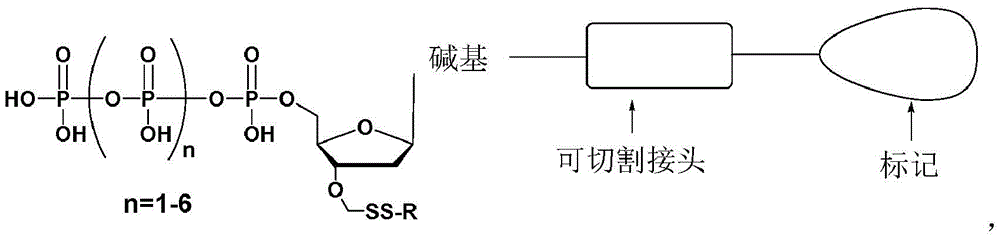
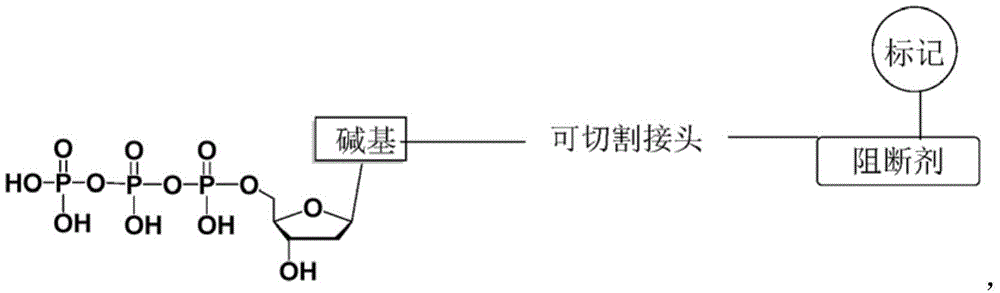


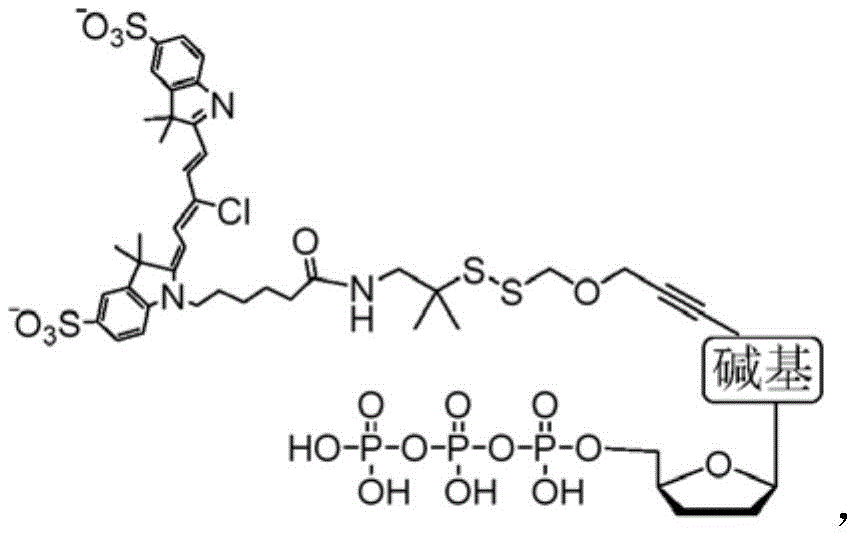
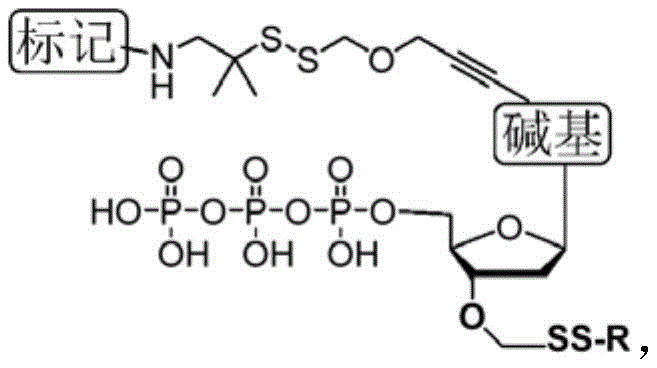


Applications Claiming Priority (3)
| Application Number | Priority Date | Filing Date | Title |
|---|---|---|---|
| US201962872164P | 2019-07-09 | 2019-07-09 | |
| US62/872,164 | 2019-07-09 | ||
| PCT/US2020/041455 WO2021007458A1 (en) | 2019-07-09 | 2020-07-09 | Novel nucleotide analogues and methods for use |
Publications (1)
| Publication Number | Publication Date |
|---|---|
| CN114981283A true CN114981283A (en) | 2022-08-30 |
Family
ID=74114741
Family Applications (1)
| Application Number | Title | Priority Date | Filing Date |
|---|---|---|---|
| CN202080063617.1A Pending CN114981283A (en) | 2019-07-09 | 2020-07-09 | Novel nucleotide analogs and methods of use |
Country Status (4)
| Country | Link |
|---|---|
| US (1) | US20220372061A1 (en) |
| EP (1) | EP3997101A4 (en) |
| CN (1) | CN114981283A (en) |
| WO (1) | WO2021007458A1 (en) |
Cited By (1)
| Publication number | Priority date | Publication date | Assignee | Title |
|---|---|---|---|---|
| CN114958995A (en) * | 2022-04-27 | 2022-08-30 | 深圳赛陆医疗科技有限公司 | Gene sequencing method |
Families Citing this family (8)
| Publication number | Priority date | Publication date | Assignee | Title |
|---|---|---|---|---|
| IL317123A (en) | 2018-08-27 | 2025-01-01 | Regeneron Pharma | Use of Raman Spectroscopy in Downstream Purification |
| EP3977119A4 (en) | 2019-03-07 | 2022-12-28 | The Trustees of Columbia University in the City of New York | HIGH PRECISION NANOPORES-BASED SINGLE MOLECULE SEQUENCING BY SYNTHESIS WITH LABELED NUCLEOTIDES |
| WO2022263489A1 (en) * | 2021-06-17 | 2022-12-22 | F. Hoffmann-La Roche Ag | Nucleoside-5 -oligophosphates having a cationically-modified nucleobase |
| CN114250283B (en) * | 2021-10-15 | 2022-10-04 | 深圳铭毅智造科技有限公司 | Monochromatic fluorescent MRT gene sequencing reagent and method based on environment-sensitive dye |
| CN116926178B (en) * | 2022-04-02 | 2025-10-24 | 深圳市真迈生物科技有限公司 | Fluorescence detection reagent, preparation method and application thereof |
| CA3251383A1 (en) * | 2022-05-31 | 2023-12-07 | Illumina, Inc | Compositions and methods for nucleic acid sequencing |
| AU2024284320A1 (en) * | 2023-06-06 | 2025-12-18 | Illumina, Inc. | Multivalent binding unit modified dideoxynucleotide triphosphates and methods of making and using the same |
| WO2025136957A1 (en) * | 2023-12-18 | 2025-06-26 | Pleno, Inc. | Systems and methods for decoding by sequencing |
Citations (7)
| Publication number | Priority date | Publication date | Assignee | Title |
|---|---|---|---|---|
| US20170211134A1 (en) * | 2015-11-06 | 2017-07-27 | Intelligent Biosystems, Inc. | Thiol-containing cleave reagents and oxidative wash |
| WO2017205336A1 (en) * | 2016-05-23 | 2017-11-30 | The Trustees Of Columbia University In The City Of New York | Nucleotide derivatives and methods of use thereof |
| CA3049667A1 (en) * | 2016-12-27 | 2018-07-05 | Bgi Shenzhen | Single fluorescent dye-based sequencing method |
| WO2018183538A1 (en) * | 2017-03-28 | 2018-10-04 | The Trustees Of Columbia University In The City Of New York | 3'-o-modified nucleotide analogues with different cleavable linkers for attaching fluorescent labels to the base for dna sequencing by synthesis |
| CN108779138A (en) * | 2015-09-28 | 2018-11-09 | 哥伦比亚大学董事会 | Design and synthesis of novel disulfide linker-based nucleotides for use as reversible terminators in DNA-sequencing by synthesis |
| US20190195796A1 (en) * | 2017-12-21 | 2019-06-27 | Robert Bosch Gmbh | Fluorophore multiplexing via ph modulation |
| CN112218640A (en) * | 2018-03-15 | 2021-01-12 | 哥伦比亚大学董事会 | Nucleotide analogs and their use in nucleic acid sequencing and analysis |
Family Cites Families (3)
| Publication number | Priority date | Publication date | Assignee | Title |
|---|---|---|---|---|
| EP2940029B1 (en) * | 2007-10-19 | 2023-11-29 | The Trustees of Columbia University in the City of New York | Design and synthesis of cleavable fluorescent nucleotides as reversible terminators for dna sequencing by synthesis |
| CA3104322C (en) * | 2011-09-23 | 2023-06-13 | Illumina, Inc. | Methods and compositions for nucleic acid sequencing |
| CN114250282B (en) * | 2020-11-25 | 2022-10-14 | 深圳铭毅智造科技有限公司 | Gene sequencing reagent and method based on pH value sensitive dye |
-
2020
- 2020-07-09 CN CN202080063617.1A patent/CN114981283A/en active Pending
- 2020-07-09 US US17/622,214 patent/US20220372061A1/en active Pending
- 2020-07-09 EP EP20836455.4A patent/EP3997101A4/en active Pending
- 2020-07-09 WO PCT/US2020/041455 patent/WO2021007458A1/en not_active Ceased
Patent Citations (8)
| Publication number | Priority date | Publication date | Assignee | Title |
|---|---|---|---|---|
| CN108779138A (en) * | 2015-09-28 | 2018-11-09 | 哥伦比亚大学董事会 | Design and synthesis of novel disulfide linker-based nucleotides for use as reversible terminators in DNA-sequencing by synthesis |
| US20170211134A1 (en) * | 2015-11-06 | 2017-07-27 | Intelligent Biosystems, Inc. | Thiol-containing cleave reagents and oxidative wash |
| WO2017205336A1 (en) * | 2016-05-23 | 2017-11-30 | The Trustees Of Columbia University In The City Of New York | Nucleotide derivatives and methods of use thereof |
| CN109661232A (en) * | 2016-05-23 | 2019-04-19 | 纽约哥伦比亚大学董事会 | Nucleotide derivatives and methods of use thereof |
| CA3049667A1 (en) * | 2016-12-27 | 2018-07-05 | Bgi Shenzhen | Single fluorescent dye-based sequencing method |
| WO2018183538A1 (en) * | 2017-03-28 | 2018-10-04 | The Trustees Of Columbia University In The City Of New York | 3'-o-modified nucleotide analogues with different cleavable linkers for attaching fluorescent labels to the base for dna sequencing by synthesis |
| US20190195796A1 (en) * | 2017-12-21 | 2019-06-27 | Robert Bosch Gmbh | Fluorophore multiplexing via ph modulation |
| CN112218640A (en) * | 2018-03-15 | 2021-01-12 | 哥伦比亚大学董事会 | Nucleotide analogs and their use in nucleic acid sequencing and analysis |
Non-Patent Citations (2)
| Title |
|---|
| ATANAS KURUTOS ET AL.: "Symmetric Meso-Chloro-Substituted Pentamethine Cyanine Dyes Containing Benzothiazolyl/Benzoselenazolyl Chromophores Novel Synthetic Approach and Studies on Photophysical Properties upon Interaction with bio-Objects", 《J FLUORESC》, vol. 26, 2 November 2015 (2015-11-02), pages 177 - 187 * |
| JIA GUO ET AL.: "An Integrated System for DNA Sequencing by Synthesis Using Novel Nucleotide Analogues", 《ACCOUNTS OF CHEMICAL RESEARCH》, vol. 43, no. 4, 2 March 2010 (2010-03-02), pages 1 - 3 * |
Cited By (2)
| Publication number | Priority date | Publication date | Assignee | Title |
|---|---|---|---|---|
| CN114958995A (en) * | 2022-04-27 | 2022-08-30 | 深圳赛陆医疗科技有限公司 | Gene sequencing method |
| WO2023207265A1 (en) * | 2022-04-27 | 2023-11-02 | 深圳赛陆医疗科技有限公司 | Gene sequencing method |
Also Published As
| Publication number | Publication date |
|---|---|
| EP3997101A1 (en) | 2022-05-18 |
| US20220372061A1 (en) | 2022-11-24 |
| EP3997101A4 (en) | 2024-03-13 |
| WO2021007458A1 (en) | 2021-01-14 |
Similar Documents
| Publication | Publication Date | Title |
|---|---|---|
| CN114981283A (en) | Novel nucleotide analogs and methods of use | |
| US20230028321A1 (en) | Nucleotide derivatives and methods of use thereof | |
| US11959137B2 (en) | Synthesis of novel disulfide linker based nucleotides as reversible terminators for DNA sequencing by synthesis | |
| US11773439B2 (en) | Nucleic acid sequencing-by-synthesis (SBS) methods that combine SBS cycle steps | |
| CA2664649A1 (en) | Compositions and methods for biodetection by nucleic acid-templated chemistry | |
| CN113906135A (en) | Sequencing by edge synthesis using energy transfer dyes | |
| EP1071812A1 (en) | A method, reagent solution and kits for dna sequencing | |
| CN115323045A (en) | Gene sequencing reagent and gene sequencing method | |
| JP4712814B2 (en) | Method for detecting target nucleic acids of specific base sequence, and nucleic acid set for detection | |
| HK40099906A (en) | Nucleotide derivatives and methods of use thereof | |
| HK40080402A (en) | Design and synthesis of novel disulfide linker based nucleotides as reversible terminators for dna sequencing by synthesis | |
| Welch | Base additions sequencing scheme (BASS) and studies toward new sequencing methodologies | |
| WO2023070010A1 (en) | Ultrabright dna nanostructures for biosensing | |
| JP2010168356A (en) | Nucleic acid complex and method for detecting target nucleic acid using the nucleic acid complex | |
| JP2004113145A (en) | Method for optically detecting multiple chain nucleic acid |
Legal Events
| Date | Code | Title | Description |
|---|---|---|---|
| PB01 | Publication | ||
| PB01 | Publication | ||
| SE01 | Entry into force of request for substantive examination | ||
| SE01 | Entry into force of request for substantive examination |