CN114964206A - Monocular vision odometer target pose detection method - Google Patents
Monocular vision odometer target pose detection method Download PDFInfo
- Publication number
- CN114964206A CN114964206A CN202210382990.4A CN202210382990A CN114964206A CN 114964206 A CN114964206 A CN 114964206A CN 202210382990 A CN202210382990 A CN 202210382990A CN 114964206 A CN114964206 A CN 114964206A
- Authority
- CN
- China
- Prior art keywords
- point
- image
- matching
- pixel
- candidate matching
- Prior art date
- Legal status (The legal status is an assumption and is not a legal conclusion. Google has not performed a legal analysis and makes no representation as to the accuracy of the status listed.)
- Pending
Links
Images


Classifications
-
- G—PHYSICS
- G01—MEASURING; TESTING
- G01C—MEASURING DISTANCES, LEVELS OR BEARINGS; SURVEYING; NAVIGATION; GYROSCOPIC INSTRUMENTS; PHOTOGRAMMETRY OR VIDEOGRAMMETRY
- G01C21/00—Navigation; Navigational instruments not provided for in groups G01C1/00 - G01C19/00
-
- G—PHYSICS
- G01—MEASURING; TESTING
- G01C—MEASURING DISTANCES, LEVELS OR BEARINGS; SURVEYING; NAVIGATION; GYROSCOPIC INSTRUMENTS; PHOTOGRAMMETRY OR VIDEOGRAMMETRY
- G01C22/00—Measuring distance traversed on the ground by vehicles, persons, animals or other moving solid bodies, e.g. using odometers, using pedometers
-
- G—PHYSICS
- G06—COMPUTING OR CALCULATING; COUNTING
- G06V—IMAGE OR VIDEO RECOGNITION OR UNDERSTANDING
- G06V10/00—Arrangements for image or video recognition or understanding
- G06V10/40—Extraction of image or video features
- G06V10/44—Local feature extraction by analysis of parts of the pattern, e.g. by detecting edges, contours, loops, corners, strokes or intersections; Connectivity analysis, e.g. of connected components
-
- G—PHYSICS
- G06—COMPUTING OR CALCULATING; COUNTING
- G06V—IMAGE OR VIDEO RECOGNITION OR UNDERSTANDING
- G06V10/00—Arrangements for image or video recognition or understanding
- G06V10/70—Arrangements for image or video recognition or understanding using pattern recognition or machine learning
- G06V10/74—Image or video pattern matching; Proximity measures in feature spaces
- G06V10/761—Proximity, similarity or dissimilarity measures
-
- G—PHYSICS
- G06—COMPUTING OR CALCULATING; COUNTING
- G06V—IMAGE OR VIDEO RECOGNITION OR UNDERSTANDING
- G06V20/00—Scenes; Scene-specific elements
- G06V20/10—Terrestrial scenes
Landscapes
- Engineering & Computer Science (AREA)
- Physics & Mathematics (AREA)
- General Physics & Mathematics (AREA)
- Theoretical Computer Science (AREA)
- Computer Vision & Pattern Recognition (AREA)
- Remote Sensing (AREA)
- Multimedia (AREA)
- Radar, Positioning & Navigation (AREA)
- Computing Systems (AREA)
- Health & Medical Sciences (AREA)
- Artificial Intelligence (AREA)
- Automation & Control Theory (AREA)
- Databases & Information Systems (AREA)
- Evolutionary Computation (AREA)
- General Health & Medical Sciences (AREA)
- Medical Informatics (AREA)
- Software Systems (AREA)
- Image Analysis (AREA)
Abstract
本发明公开了一种单目视觉里程计目标位姿检测方法。用单目相机实时采集目标图像对两帧图像进行特征点的改进提取与匹配,具体是依次用图像金字塔和灰度质心法处理,用像素级处理方法检测图像得到初始角点,用HARRIS响应值筛选后得到角点集合,邻域像素值构建角点的二进制描述子形成特征点,用快速最近邻搜索算法得到侯选特征匹配点对,用渐进一致采样方法精匹配和提纯;针对特征点的提取与匹配结果进行处理进行目标的位姿检测跟踪。本发明利用区分度更高、构建效率更高的改进角点提取算法,提高了角点检测的精度,同时采用HARRIS角点检测算法筛选优质角点,利用RANSAC算法和双向匹配法剔除误匹配对,进一步提高整体的定位精度。

The invention discloses a method for detecting a target position and attitude of a monocular visual odometer. The target image is collected in real time with a monocular camera to extract and match the feature points of the two frames of images. Specifically, the image pyramid and gray centroid method are used in turn, and the pixel-level processing method is used to detect the image to obtain the initial corner points, and use the HARRIS response value. After screening, the set of corner points is obtained, and the binary descriptors of the corner points are constructed by the neighborhood pixel values to form the feature points. The candidate feature matching point pairs are obtained by the fast nearest neighbor search algorithm, and the asymptotic consistent sampling method is used for precise matching and purification. The extraction and matching results are processed to detect and track the pose of the target. The invention utilizes the improved corner point extraction algorithm with higher discrimination and higher construction efficiency to improve the corner point detection accuracy, meanwhile, the HARRIS corner point detection algorithm is used to screen high-quality corner points, and the RANSAC algorithm and the two-way matching method are used to eliminate false matching pairs. , to further improve the overall positioning accuracy.
Description
技术领域technical field
本发明涉及图像处理技术领域的一种目标位姿检测方法,具体涉及一种单目视觉里程计目标位姿检测方法。The invention relates to a target pose detection method in the technical field of image processing, in particular to a monocular visual odometry target pose detection method.
背景技术Background technique
在没有环境先验信息的情况下,利用机器人在运动过程中建立环境模型并且估计自身运动,即为同时定位与地图构建(Simultaneous Localization and Mapping,SLAM)。随着计算机视觉的发展,以视觉传感器为主体的视觉SLAM技术逐渐进入人们的视线。In the absence of environmental prior information, using the robot to establish an environmental model and estimate its own motion during the movement process is Simultaneous Localization and Mapping (SLAM). With the development of computer vision, visual SLAM technology with visual sensors as the main body has gradually entered people's attention.
图像特征点提取与匹配在图像拼接、目标识别、视觉跟踪、三维重建等研究领域中得以广泛应用。现有的特征点类型较多,例如SIFT,SURF,等特征点。特征点提取法是目前的主流,特征点提取算法比SIFT和SUFT算法在运算速度上快了1个数量级,具有较好的实时性。但是算法的鲁棒性相对较差,特征点的提取和匹配性能较差。如何保证算法运算效率的同时,提高其特征点提取与匹配性能是目前研究的热点问题。Image feature point extraction and matching are widely used in research fields such as image stitching, target recognition, visual tracking, and 3D reconstruction. There are many types of existing feature points, such as SIFT, SURF, and other feature points. The feature point extraction method is the current mainstream. The feature point extraction algorithm is an order of magnitude faster than the SIFT and SUFT algorithms, and has better real-time performance. However, the robustness of the algorithm is relatively poor, and the extraction and matching performance of feature points is poor. How to ensure the operation efficiency of the algorithm and improve its feature point extraction and matching performance is a hot issue of current research.
在没有环境先验信息的情况下,利用机器人在运动过程中建立环境模型并且估计自身运动,即为同时定位与地图构建(Simultaneous Localization and Mapping,SLAM)。随着计算机视觉的发展,以视觉传感器为主体的视觉SLAM技术逐渐进入人们的视线。In the absence of environmental prior information, using the robot to establish an environmental model and estimate its own motion during the movement process is Simultaneous Localization and Mapping (SLAM). With the development of computer vision, visual SLAM technology with visual sensors as the main body has gradually entered people's attention.
单目视觉里程计是一种通过单目相机采集的图像序列估计物体相对运动的计算机视觉方法,在机器人和无人机的自主定位和导航中起着重要的作用。视觉里程计主要采取直接法和特征点法两种计算方式,直接法相对于特征法,执行速度较快,对图像的光度误差鲁棒性较高,但是对相机内参要求很高,当存在几何噪声时算法性能下降较快,对大基线运动的鲁棒性较差;特征法通过提取图像特征点和描述子,进行特征点匹配后通过最小化重投影误差计算机器人位姿,在光线昏暗环境以及照片模糊情况下,其特征检测困难,从而导致位姿跟丢,鲁棒性不好。如何保证算法运算效率的同时,提高其特征点提取与匹配精度是目前研究的热点问题。Monocular visual odometry is a computer vision method for estimating the relative motion of objects through image sequences collected by a monocular camera, and plays an important role in autonomous localization and navigation of robots and UAVs. Visual odometry mainly adopts two calculation methods: direct method and feature point method. Compared with the feature method, the direct method has a faster execution speed and higher robustness to the photometric error of the image, but it has high requirements for the internal parameters of the camera. When there is geometric noise The performance of the algorithm degrades rapidly, and the robustness to large baseline motions is poor; the feature method extracts image feature points and descriptors, performs feature point matching, and calculates the robot pose by minimizing the reprojection error. In the case of blurred photos, the feature detection is difficult, resulting in lost poses and poor robustness. How to ensure the efficiency of algorithm operation and improve the accuracy of feature point extraction and matching is a hot issue of current research.
发明内容SUMMARY OF THE INVENTION
为了解决现有技术的缺点与不足,本发明提供了具有改进特征点提取与匹配的一种单目视觉里程计目标位姿检测方法。In order to solve the shortcomings and deficiencies of the prior art, the present invention provides a monocular visual odometry target pose detection method with improved feature point extraction and matching.
为实现上述目的,本发明采用如下技术方案:To achieve the above object, the present invention adopts the following technical solutions:
1)用单目相机实时采集带有目标的图像;1) Use a monocular camera to collect images with targets in real time;
2)用改进的方法对前后两帧相邻图像进行特征点的提取与匹配,获得特征匹配点对;2) Extracting and matching the feature points of two adjacent frames before and after using the improved method to obtain feature matching point pairs;
3)针对特征点的提取与匹配结果获取与之对应的相机的外参矩阵,再根据外参矩阵实时对每一帧的图像进行处理实现目标的位姿检测跟踪。3) Obtain the extrinsic parameter matrix of the camera corresponding to the extraction and matching results of the feature points, and then process the image of each frame in real time according to the extrinsic parameter matrix to realize the pose detection and tracking of the target.
所述2)具体为:Described 2) is specifically:
步骤S1:依次采用图像金字塔和灰度质心法对步骤1)获得的原始图像进行处理;Step S1: successively adopt the image pyramid and gray centroid method to process the original image obtained in step 1);
步骤S2:利用像素级处理方法检测步骤S1处理后的图像得到初始角点,针对所有初始角点计算HARRIS响应值并筛选后得到角点集合;Step S2: use the pixel-level processing method to detect the image processed in step S1 to obtain initial corner points, calculate the HARRIS response value for all the initial corner points and filter to obtain a corner point set;
步骤S3:基于邻域像素值构建角点的二进制描述子BRIEF,并形成特征点;Step S3: constructing the binary descriptor BRIEF of the corner point based on the neighborhood pixel value, and forming the feature point;
步骤S4:采用快速最近邻搜索算法FLANN对待配准图像和参考图像处理得到侯选特征匹配点对;Step S4: use the fast nearest neighbor search algorithm FLANN to process the to-be-registered image and the reference image to obtain candidate feature matching point pairs;
步骤S5:先采用RANSAC算法对侯选特征匹配点对进行筛选,再利用双向交叉匹配的方式对筛选后的侯选特征匹配点对进行精匹配和提纯,获得特征匹配点对,使得匹配结果更为精确。Step S5: First use the RANSAC algorithm to screen the candidate feature matching point pairs, and then use the two-way cross-matching method to perform precise matching and purification on the selected candidate feature matching point pairs to obtain feature matching point pairs, so that the matching results are more accurate. to be precise.
所述步骤S1中,对步骤1)采集的原始图像进行处理,先输入到图像金字塔中进行尺度归一化,再采用灰度质心法得到旋转归一化,获得处理后的图像。In the step S1, the original image collected in step 1) is processed, firstly input into the image pyramid for scale normalization, and then rotated and normalized by the gray centroid method to obtain the processed image.
所述步骤S2具体为:The step S2 is specifically:
步骤S21:在图像中遍历每个像素点作为参考像素点P,参考像素点P的亮度为IP,预先设置亮度变化阈值为T;Step S21: traverse each pixel in the image as a reference pixel P, the brightness of the reference pixel P is IP, and the preset brightness change threshold is T;
步骤S22:以参考像素点P为中心建立半径为4像素的圆,对位于圆边缘上的24个像素点沿固定的一个时针方向进行顺序标号;Step S22: establishing a circle with a radius of 4 pixels taking the reference pixel point P as the center, and sequentially labeling the 24 pixels located on the edge of the circle along a fixed clockwise direction;
步骤S23:将标号为1、5、9、13、17、21的六个像素点与参考像素点P的亮度进行比较:Step S23: Compare the brightness of the six pixel points labeled 1, 5, 9, 13, 17, and 21 with the reference pixel point P:
若其中有五个像素点的亮度均大于IP+T或小于IP-T时,则参考像素点P可能是一个角点,进入步骤S15;否则,再进入步骤S14;If the brightness of five pixel points is greater than IP + T or less than IP -T, the reference pixel point P may be a corner point, then go to step S15; otherwise, go to step S14 again;
步骤S24:将标号为3、7、11、15、19、23的六个像素点与参考像素点P的亮度进行比较:Step S24: Compare the brightness of the six pixels labeled 3, 7, 11, 15, 19, and 23 with the brightness of the reference pixel P:
若其中有五个像素点的亮度均大于IP+T或小于IP-T时,则参考像素点P可能是一个角点,进入步骤S15;否则参考像素点P不是角点;If the brightness of five pixels is greater than IP+T or less than IP -T, the reference pixel P may be a corner point, and step S15 is entered; otherwise, the reference pixel point P is not a corner point;
步骤S25:遍历位于圆边缘上的24个像素点中每组连续的18个像素点,并判断:若有连续的18个像素点的亮度均大于IP+T或小于IP-T,则参考像素点P是初始角点,否则像素点P不是初始角点;Step S25: Traverse each group of consecutive 18 pixels in the 24 pixels located on the edge of the circle, and judge: if the brightness of any consecutive 18 pixels is greater than IP + T or less than IP -T, then The reference pixel point P is the initial corner point, otherwise the pixel point P is not the initial corner point;
步骤S26:重复步骤S12~S15,对每一个像素点执行相同的操作,完成每一个像素点是否为初始角点的判断。Step S26: Repeat steps S12 to S15, and perform the same operation on each pixel to complete the judgment on whether each pixel is an initial corner.
所述步骤S3具体为:The step S3 is specifically:
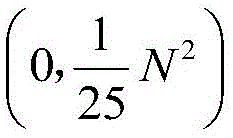
以角点为中心框选一个N×N大小的矩形窗口,随机选取128对在该窗口内坐标位置满足高斯分布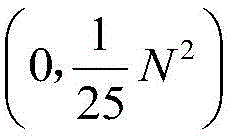
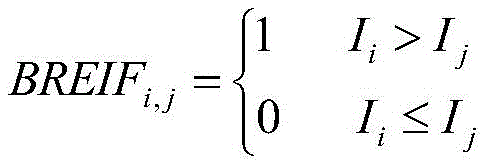
其中,Ii、Ij分别表示像素点对中的两个像素点对,i、j分别表示像素点的序数,BREIFi,j表示像素点i和j之间的像素值大小比较参数;Wherein, I i and I j respectively represent two pixel pairs in the pixel pair, i and j respectively represent the ordinal number of the pixel, and BREIF i,j represent the pixel value size comparison parameter between the pixel i and j;
将所有对像素点对的比较参数共同构成该角点的描述子,将每个角点及其对应的一个描述子构成一个特征点,从而将各个角点处理变成了特征点。All the comparison parameters of the pair of pixel points together constitute the descriptor of the corner point, and each corner point and its corresponding descriptor constitute a feature point, so that each corner point is processed into a feature point.
所述步骤S4具体为:以前一帧图像作为参考图像,以后一帧图像作为待配准图像,待配准图像和参考图像的特征点使用FLANN快速最近邻搜索算法处理获得各个候选匹配点对。The step S4 is as follows: the previous frame image is used as the reference image, the next frame image is used as the to-be-registered image, and the feature points of the to-be-registered image and the reference image are processed by the FLANN fast nearest neighbor search algorithm to obtain each candidate matching point pair.
所述步骤S5中,双向交叉匹配的方式具体步骤为:In the step S5, the specific steps of the two-way cross-matching method are:
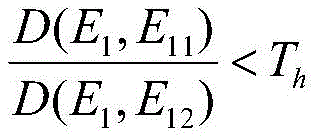
S51、以参考图像中的候选匹配特征点作为遍历对象,针对参考图像中的候选匹配特征点E1,遍历待配准图像中的各个候选匹配特征点,得到针对参考图像中的候选匹配特征点E1在待配准图像中匹配的最近邻候选匹配特征点E11和次近邻候选匹配特征点E12,最近邻候选匹配特征点E11和次近邻候选匹配特征点E12满足如下关系式:S51. Using the candidate matching feature points in the reference image as the traversal object, for the candidate matching feature points E 1 in the reference image, traverse each candidate matching feature point in the image to be registered, and obtain the candidate matching feature points in the reference image. The nearest neighbor candidate matching feature point E 11 and the second nearest neighbor candidate matching feature point E 12 matched by E 1 in the image to be registered, the nearest neighbor candidate matching feature point E 11 and the second nearest neighbor candidate matching feature point E 12 satisfy the following relational expression:
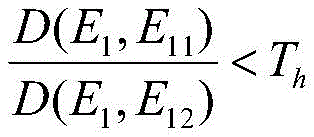
其中,D(E1,E11),D(E1,E12)分别是参考图像的候选匹配特征点E1与待配准图像的最近邻候选匹配特征点E11、次近邻候选匹配特征点E12的距离相似性度量值,具体可采用汉明距离;Among them, D(E 1 , E 11 ), D(E 1 , E 12 ) are the candidate matching feature point E 1 of the reference image and the nearest neighbor candidate matching feature point E 11 of the image to be registered, respectively, and the next-nearest neighbor candidate matching feature The distance similarity measure value of point E 12 , specifically the Hamming distance;
所述的最近邻候选匹配特征点E11是指待配准图像中的候选匹配特征点和参考图像中的候选匹配特征点E1之间的汉明距离最小,即最匹配的候选匹配特征点。次近邻候选匹配特征点E12是指待配准图像中的候选匹配特征点和参考图像中的候选匹配特征点E1之间的汉明距离次小。 The said nearest neighbor candidate matching feature point E11 means that the Hamming distance between the candidate matching feature point in the image to be registered and the candidate matching feature point E1 in the reference image is the smallest, that is, the most matching candidate matching feature point. . The second nearest neighbor candidate matching feature point E 12 refers to the second smallest Hamming distance between the candidate matching feature point in the image to be registered and the candidate matching feature point E 1 in the reference image.
如满足上述关系式,则取参考图像中的候选匹配特征点E1和待配准图像中的最近邻候选匹配特征点E11构成候选匹配对;If the above relationship is satisfied, the candidate matching feature point E 1 in the reference image and the nearest neighbor candidate matching feature point E 11 in the image to be registered are taken to form a candidate matching pair;
S52、以参考图像中的候选匹配特征点作为遍历对象,按照S51遍历参考图像中的每个候选匹配特征点,得到所有的候选匹配对,进而组成第一候选匹配对集合A;S52, take the candidate matching feature points in the reference image as the traversal object, traverse each candidate matching feature point in the reference image according to S51, obtain all candidate matching pairs, and then form the first candidate matching pair set A;
S53、以待配准图像中的候选匹配特征点作为遍历对象,按照S51遍历待配准图像中的每个候选匹配特征点,得到所有的候选匹配对,进而组成第二候选匹配对集合B;S53, take the candidate matching feature points in the image to be registered as the traversal object, traverse each candidate matching feature point in the image to be registered according to S51, obtain all candidate matching pairs, and then form the second candidate matching pair set B;
最后再将第一候选匹配对集合A和第二候选匹配对集合B进行比较,如果两个集合中各自的一个候选匹配对之间完全相同,则该候选匹配对被认为是有效的匹配对,最终筛选后以所有有效的匹配对组成作为最终的特征点匹配对集合。Finally, the first candidate matching pair set A and the second candidate matching pair set B are compared. If a candidate matching pair in the two sets is exactly the same, the candidate matching pair is considered to be a valid matching pair. After final screening, all valid matching pairs are formed as the final feature point matching pair set.
所述步骤3)是具体利用最终获得的特征匹配点对根据相机的投影原理计算得到描述相机运动的旋转矩阵和平移向量,实现视觉里程计的参数设置。The step 3) is to use the finally obtained feature matching point pair to calculate and obtain a rotation matrix and a translation vector describing the motion of the camera according to the projection principle of the camera, so as to realize the parameter setting of the visual odometry.
本发明与现有技术相比具有以下有益效果:Compared with the prior art, the present invention has the following beneficial effects:
本发明首先对特征点提取进行改进,将点提取算法扩大局部像素检测范围,提高角点提取的精度,同时加入预测试操作,极大加快了角点检测速度。The invention firstly improves the feature point extraction, expands the local pixel detection range by the point extraction algorithm, improves the corner point extraction accuracy, and adds a pre-test operation at the same time to greatly speed up the corner point detection speed.
本发明其次采用快速最近邻搜索算法代替传统的暴力匹配,大大减少了计算量;最后将传统的RANSAC算法替换成渐进一致采样方法,排除RANSAC算法的随机性和盲目性,进一步提高匹配精度。The invention secondly adopts the fast nearest neighbor search algorithm to replace the traditional brute force matching, which greatly reduces the calculation amount; finally, the traditional RANSAC algorithm is replaced by the progressive consistent sampling method, which eliminates the randomness and blindness of the RANSAC algorithm and further improves the matching accuracy.
附图说明Description of drawings
图1是本发明方法的逻辑流程图;Fig. 1 is the logic flow chart of the method of the present invention;
图2是本发明角点检测范围示意图。FIG. 2 is a schematic diagram of the detection range of corner points of the present invention.
图3是实验的TUM数据集的详细信息图;Figure 3 is a detailed information diagram of the experimental TUM dataset;
图4是本发明算法和ORB-SLAM2算法的实验结果对比图。FIG. 4 is a comparison diagram of the experimental results of the algorithm of the present invention and the ORB-SLAM2 algorithm.
具体实施方式Detailed ways
下面结合附图说明及具体实施方式对本发明作进一步说明。The present invention will be further described below with reference to the accompanying drawings and specific embodiments.
请参照图1,本发明的具体实施例及其实施过程如下:Please refer to Fig. 1, the specific embodiment of the present invention and its implementation process are as follows:
1)用单目相机实时采集带有目标的图像;1) Use a monocular camera to collect images with targets in real time;
2)用改进的方法对前后两帧相邻图像进行特征点的提取与匹配,获得特征匹配点对;2) Extracting and matching the feature points of two adjacent frames before and after using the improved method to obtain feature matching point pairs;
步骤S1:依次采用图像金字塔和灰度质心法对步骤1)获得的原始图像进行处理;Step S1: successively adopt the image pyramid and gray centroid method to process the original image obtained in step 1);
具体对步骤1)采集的原始图像进行处理,先输入到图像金字塔中进行尺度归一化,再采用灰度质心法得到旋转归一化,获得处理后的图像。Specifically, the original image collected in step 1) is processed, firstly input into the image pyramid for scale normalization, and then the gray centroid method is used to obtain rotation normalization to obtain the processed image.
构建图像金字塔具体为:原始图像通过高斯滤波进行降噪,将原始图像作为图像金字塔的第0层,依次进行1/1.2缩放比例进行降采样得到共计8张图片(包括原始图像),然后分别对得到的8张图像进行角点提取,并记录角点所在金字塔的第几层,得到一帧图像的角点。The specific construction of the image pyramid is as follows: the original image is denoised by Gaussian filtering, the original image is taken as the 0th layer of the image pyramid, and the 1/1.2 scaling ratio is sequentially performed for downsampling to obtain a total of 8 images (including the original image), and then respectively The obtained 8 images are subjected to corner extraction, and the number of layers of the pyramid where the corners are located is recorded, and the corners of a frame of images are obtained.
将下一帧图像按比例缩放得到八张图像,然后提取角点,能够保证该帧图像经过缩放后其中某一帧的角点大小与上一帧的角点大小相同,消除图像上近大远小的视觉误差。The next frame of image is scaled to get eight images, and then the corner points are extracted, which can ensure that the size of the corner points of one frame of the image after scaling is the same as the size of the corner points of the previous frame, eliminating the near and far on the image. Small visual errors.
步骤S2:利用像素级处理方法检测步骤S1处理后的图像得到初始角点,针对所有初始角点计算HARRIS响应值并筛选后得到角点集合;Step S2: use the pixel-level processing method to detect the image processed in step S1 to obtain initial corner points, calculate the HARRIS response value for all the initial corner points and filter to obtain a corner point set;
如图2所示,步骤S2具体为:As shown in Figure 2, step S2 is specifically:
步骤S21:在图像中遍历每个像素点作为参考像素点P,参考像素点P的亮度为IP,预先设置亮度变化阈值为T;Step S21: traverse each pixel in the image as a reference pixel P, the brightness of the reference pixel P is IP, and the preset brightness change threshold is T;
步骤S22:以参考像素点P为中心建立半径为4像素的圆,对位于圆边缘上的24个像素点沿固定的一个时针方向进行顺序标号;Step S22: establishing a circle with a radius of 4 pixels taking the reference pixel point P as the center, and sequentially labeling the 24 pixels located on the edge of the circle along a fixed clockwise direction;
步骤S23:将标号为1、5、9、13、17、21的六个像素点与参考像素点P的亮度进行比较:Step S23: Compare the brightness of the six pixel points labeled 1, 5, 9, 13, 17, and 21 with the reference pixel point P:
若其中有五个像素点的亮度均大于IP+T或小于IP-T时,则参考像素点P可能是一个角点,进入步骤S15;否则,再进入步骤S14;If the brightness of five pixel points is greater than IP + T or less than IP -T, the reference pixel point P may be a corner point, then go to step S15; otherwise, go to step S14 again;
步骤S24:将标号为3、7、11、15、19、23的六个像素点与参考像素点P的亮度进行比较:Step S24: Compare the brightness of the six pixels labeled 3, 7, 11, 15, 19, and 23 with the brightness of the reference pixel P:
若其中有五个像素点的亮度均大于IP+T或小于IP-T时,则参考像素点P可能是一个角点,进入步骤S15;否则参考像素点P不是角点;If the brightness of five pixels is greater than IP+T or less than IP -T, the reference pixel P may be a corner point, and step S15 is entered; otherwise, the reference pixel point P is not a corner point;
步骤S25:遍历位于圆边缘上的24个像素点中每组连续的18个像素点,并判断:若有连续的18个像素点的亮度均大于IP+T或小于IP-T,则参考像素点P是初始角点,否则像素点P不是初始角点;Step S25: Traverse each group of consecutive 18 pixels in the 24 pixels located on the edge of the circle, and judge: if the brightness of any consecutive 18 pixels is greater than IP + T or less than IP -T, then The reference pixel point P is the initial corner point, otherwise the pixel point P is not the initial corner point;
步骤S26:重复步骤S12~S15,对每一个像素点执行相同的操作,完成每一个像素点是否为初始角点的判断。Step S26: Repeat steps S12 to S15, and perform the same operation on each pixel to complete the judgment on whether each pixel is an initial corner.
亮度变化阈值T设置为参考像素点P的亮度IP的20%。The brightness change threshold T is set to be 20% of the brightness IP of the reference pixel point P.
具体实施中,计算每个初始角点的HARRIS响应值,将HARRIS响应值大于预设响应阈值的初始角点保留作为角点,否则不保留作为角点。In the specific implementation, the HARRIS response value of each initial corner point is calculated, and the initial corner point whose HARRIS response value is greater than the preset response threshold is reserved as the corner point, otherwise it is not reserved as the corner point.
步骤S3:基于邻域像素值构建角点的二进制描述子,并形成特征点;Step S3: constructing binary descriptors of corner points based on neighborhood pixel values, and forming feature points;
步骤S3具体为:Step S3 is specifically:
以角点为中心框选一个N×N大小的矩形窗口,N大于32,随机选取128对在矩形窗口内坐标位置满足高斯分布
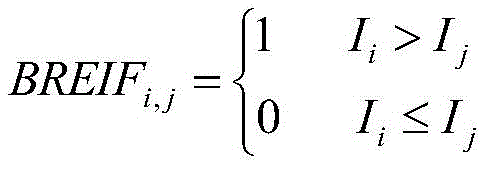
其中,Ii、Ij分别表示像素点对中的两个像素点对,i、j分别表示像素点的序数,BREIFi,j表示像素点i和j之间的像素值大小比较参数;Wherein, I i and I j respectively represent two pixel pairs in the pixel pair, i and j respectively represent the ordinal number of the pixel, and BREIF i,j represent the pixel value size comparison parameter between the pixel i and j;
将所有对像素点对的比较参数共同构成该角点的128维二进制的描述子,将每个角点及其对应的一个描述子构成一个特征点,从而将各个角点处理变成了特征点。The 128-dimensional binary descriptor of the corner is composed of all the comparison parameters of the pixel pair, and each corner and its corresponding descriptor constitute a feature point, so that each corner is processed into a feature point. .
步骤S4:采用快速最近邻搜索算法对待配准图像和参考图像处理得到侯选特征匹配点对;Step S4: using the fast nearest neighbor search algorithm to process the to-be-registered image and the reference image to obtain candidate feature matching point pairs;
具体以前一帧图像作为参考图像,以后一帧图像作为待配准图像,待配准图像和参考图像的特征点使用FLANN快速最近邻搜索算法处理获得各个候选匹配点对。Specifically, the previous frame image is used as the reference image, and the next frame image is used as the image to be registered. The feature points of the image to be registered and the reference image are processed by the FLANN fast nearest neighbor search algorithm to obtain each candidate matching point pair.
具体是,针对待配准图像的每个特征点作为参考特征点,找到参考特征点在参考图像中的每个特征点之间的距离,以其中最小距离设置距离阈值t=n×Min,n表示整数参数,若距离小于距离阈值t的参考图像中的各个特征点分别和参考特征点之间形成作为候选匹配点对。Specifically, for each feature point of the image to be registered as a reference feature point, the distance between the reference feature point and each feature point in the reference image is found, and the distance threshold t=n×Min, n is set with the minimum distance. Indicates an integer parameter. If the distance is less than the distance threshold t, each feature point in the reference image is formed as a candidate matching point pair with the reference feature point.
具体实施中,n的数值设置为2。In a specific implementation, the value of n is set to 2.
步骤S5:先采用RANSAC算法对侯选特征匹配点对进行筛选,再利用双向交叉匹配的方式对筛选后的侯选特征匹配点对进行精匹配和提纯,获得特征匹配点对,使得匹配结果更为精确。Step S5: First use the RANSAC algorithm to screen the candidate feature matching point pairs, and then use the two-way cross-matching method to perform precise matching and purification on the selected candidate feature matching point pairs to obtain feature matching point pairs, so that the matching results are more accurate. to be precise.
S51、以参考图像中的候选匹配特征点作为遍历对象,针对参考图像中的候选匹配特征点E1,遍历待配准图像中的各个候选匹配特征点,得到针对参考图像中的候选匹配特征点E1在待配准图像中匹配的最近邻候选匹配特征点E11和次近邻候选匹配特征点E12,最近邻候选匹配特征点E11和次近邻候选匹配特征点E12满足如下关系式:S51. Using the candidate matching feature points in the reference image as the traversal object, for the candidate matching feature points E 1 in the reference image, traverse each candidate matching feature point in the image to be registered, and obtain the candidate matching feature points in the reference image. The nearest neighbor candidate matching feature point E 11 and the second nearest neighbor candidate matching feature point E 12 matched by E 1 in the image to be registered, the nearest neighbor candidate matching feature point E 11 and the second nearest neighbor candidate matching feature point E 12 satisfy the following relational expression:

其中,D(E1,E11),D(E1,E12)分别是参考图像的候选匹配特征点E1与待配准图像的最近邻候选匹配特征点E11、次近邻候选匹配特征点E12的距离相似性度量值,具体实施中Th是设定的阈值为0.6;Among them, D(E 1 , E 11 ), D(E 1 , E 12 ) are the candidate matching feature point E 1 of the reference image and the nearest neighbor candidate matching feature point E 11 of the image to be registered, respectively, and the next-nearest neighbor candidate matching feature The distance similarity measure value of point E 12 , in the specific implementation, Th is a set threshold value of 0.6;
如满足上述关系式,则取参考图像中的候选匹配特征点E1和待配准图像中的最近邻候选匹配特征点E11构成候选匹配对;If the above relationship is satisfied, the candidate matching feature point E 1 in the reference image and the nearest neighbor candidate matching feature point E 11 in the image to be registered are taken to form a candidate matching pair;
S52、以参考图像中的候选匹配特征点作为遍历对象,按照S51遍历参考图像中的每个候选匹配特征点,得到所有的候选匹配对,进而组成第一候选匹配对集合A;S52, take the candidate matching feature points in the reference image as the traversal object, traverse each candidate matching feature point in the reference image according to S51, obtain all candidate matching pairs, and then form the first candidate matching pair set A;
S53、以待配准图像中的候选匹配特征点作为遍历对象,按照S51遍历待配准图像中的每个候选匹配特征点,得到所有的候选匹配对,进而组成第二候选匹配对集合B;S53, take the candidate matching feature points in the image to be registered as the traversal object, traverse each candidate matching feature point in the image to be registered according to S51, obtain all candidate matching pairs, and then form the second candidate matching pair set B;
最后再将第一候选匹配对集合A和第二候选匹配对集合B进行比较,如果两个集合中各自的一个候选匹配对之间完全相同,则该候选匹配对被认为是有效的匹配对,最终筛选后以所有有效的匹配对组成作为最终的特征点匹配对集合。Finally, the first candidate matching pair set A and the second candidate matching pair set B are compared. If a candidate matching pair in the two sets is exactly the same, the candidate matching pair is considered to be a valid matching pair. After final screening, all valid matching pairs are formed as the final feature point matching pair set.
3)针对特征点的提取与匹配结果获取与之对应的相机的外参矩阵,再根据外参矩阵实时对每一帧的图像进行处理实现目标的位姿检测跟踪。3) Obtain the extrinsic parameter matrix of the camera corresponding to the extraction and matching results of the feature points, and then process the image of each frame in real time according to the extrinsic parameter matrix to realize the pose detection and tracking of the target.
具体是利用最终获得的特征匹配点对根据相机的投影原理计算得到描述相机运动的旋转矩阵和平移向量,实现视觉里程计的参数设置。Specifically, using the finally obtained feature matching point pair to calculate the rotation matrix and translation vector describing the motion of the camera according to the projection principle of the camera, so as to realize the parameter setting of the visual odometer.
为了验证本发明方法的定位精度,将本算法和ORB-SLAM2算法分别在公开的TUM数据集图像序列上进行测试。部分公开的TUM数据集的详细信息见图3。In order to verify the positioning accuracy of the method of the present invention, the algorithm and the ORB-SLAM2 algorithm are respectively tested on the image sequence of the public TUM data set. Details of some of the publicly available TUM datasets are shown in Figure 3.
为了量化定位的精度,本发明采用绝对轨迹误差(ATE)和相对位姿误差(RPE)评估算法的定位精度。ATE是估计位姿和真实位姿的直接差值,可以非常直观地反应算法精度和轨迹全局一致性;RPE是用于计算相同两个时间戳上的位姿变化量的差,适合于估计系统的漂移。In order to quantify the positioning accuracy, the present invention adopts absolute trajectory error (ATE) and relative pose error (RPE) to evaluate the positioning accuracy of the algorithm. ATE is the direct difference between the estimated pose and the real pose, which can reflect the algorithm accuracy and the global consistency of the trajectory very intuitively; RPE is used to calculate the difference between the pose changes on the same two timestamps, which is suitable for estimating the system. drift.
图4为ORB-SLAM2算法和本发明算法在不同数据集上的绝对轨迹误差和相对位姿误差。通过比较上面的数据,本发明算法的绝对轨迹误差和相对位姿误差均小于ORB-SLAM2算法,表明本发明的算法比ORB-SLAM2算法在定位精度方面更加精准。Figure 4 shows the absolute trajectory error and relative pose error of the ORB-SLAM2 algorithm and the algorithm of the present invention on different data sets. By comparing the above data, the absolute trajectory error and relative pose error of the algorithm of the present invention are both smaller than those of the ORB-SLAM2 algorithm, indicating that the algorithm of the present invention is more accurate in positioning accuracy than the ORB-SLAM2 algorithm.
本发明利用区分度更高、构建效率更高的改进角点提取算法,提高了角点检测的精度,同时采用HARRIS角点检测算法筛选优质角点,利用RANSAC算法和双向匹配法剔除误匹配对,进一步提高整体的定位精度。The invention utilizes the improved corner extraction algorithm with higher discrimination and higher construction efficiency to improve the corner detection accuracy, meanwhile, the HARRIS corner detection algorithm is used to screen high-quality corner points, and the RANSAC algorithm and the two-way matching method are used to eliminate false matching pairs. , to further improve the overall positioning accuracy.
以上所述仅为本发明的较佳实施例,凡依本发明申请专利范围所做的均等变化与修饰,皆应属本发明的涵盖范围。The above descriptions are only preferred embodiments of the present invention, and all equivalent changes and modifications made according to the scope of the patent application of the present invention shall fall within the scope of the present invention.
Claims (8)

Priority Applications (1)
| Application Number | Priority Date | Filing Date | Title |
|---|---|---|---|
| CN202210382990.4A CN114964206A (en) | 2022-04-12 | 2022-04-12 | Monocular vision odometer target pose detection method |
Applications Claiming Priority (1)
| Application Number | Priority Date | Filing Date | Title |
|---|---|---|---|
| CN202210382990.4A CN114964206A (en) | 2022-04-12 | 2022-04-12 | Monocular vision odometer target pose detection method |
Publications (1)
| Publication Number | Publication Date |
|---|---|
| CN114964206A true CN114964206A (en) | 2022-08-30 |
Family
ID=82977302
Family Applications (1)
| Application Number | Title | Priority Date | Filing Date |
|---|---|---|---|
| CN202210382990.4A Pending CN114964206A (en) | 2022-04-12 | 2022-04-12 | Monocular vision odometer target pose detection method |
Country Status (1)
| Country | Link |
|---|---|
| CN (1) | CN114964206A (en) |
Cited By (3)
| Publication number | Priority date | Publication date | Assignee | Title |
|---|---|---|---|---|
| CN116358547A (en) * | 2022-12-09 | 2023-06-30 | 珠海创智科技有限公司 | A method of obtaining AGV position based on optical flow estimation |
| CN116403010A (en) * | 2023-01-13 | 2023-07-07 | 浪潮云信息技术股份公司 | A Medical Image Matching Method Based on FAST Algorithm |
| CN116429082A (en) * | 2023-02-28 | 2023-07-14 | 厦门大学 | A Visual SLAM Method Based on ST-ORB Feature Extraction |
Citations (6)
| Publication number | Priority date | Publication date | Assignee | Title |
|---|---|---|---|---|
| CN106408609A (en) * | 2016-09-13 | 2017-02-15 | 江苏大学 | Parallel mechanism end motion pose detection method based on binocular vision |
| CN108010045A (en) * | 2017-12-08 | 2018-05-08 | 福州大学 | Visual pattern characteristic point error hiding method of purification based on ORB |
| CN108805812A (en) * | 2018-06-04 | 2018-11-13 | 东北林业大学 | Multiple dimensioned constant ORB algorithms for image mosaic |
| CN109636852A (en) * | 2018-11-23 | 2019-04-16 | 浙江工业大学 | A kind of monocular SLAM initial method |
| US11113894B1 (en) * | 2020-09-11 | 2021-09-07 | Microsoft Technology Licensing, Llc | Systems and methods for GPS-based and sensor-based relocalization |
| CN113688816A (en) * | 2021-07-21 | 2021-11-23 | 上海工程技术大学 | Calculation method of visual odometer for improving ORB feature point extraction |
-
2022
- 2022-04-12 CN CN202210382990.4A patent/CN114964206A/en active Pending
Patent Citations (6)
| Publication number | Priority date | Publication date | Assignee | Title |
|---|---|---|---|---|
| CN106408609A (en) * | 2016-09-13 | 2017-02-15 | 江苏大学 | Parallel mechanism end motion pose detection method based on binocular vision |
| CN108010045A (en) * | 2017-12-08 | 2018-05-08 | 福州大学 | Visual pattern characteristic point error hiding method of purification based on ORB |
| CN108805812A (en) * | 2018-06-04 | 2018-11-13 | 东北林业大学 | Multiple dimensioned constant ORB algorithms for image mosaic |
| CN109636852A (en) * | 2018-11-23 | 2019-04-16 | 浙江工业大学 | A kind of monocular SLAM initial method |
| US11113894B1 (en) * | 2020-09-11 | 2021-09-07 | Microsoft Technology Licensing, Llc | Systems and methods for GPS-based and sensor-based relocalization |
| CN113688816A (en) * | 2021-07-21 | 2021-11-23 | 上海工程技术大学 | Calculation method of visual odometer for improving ORB feature point extraction |
Cited By (4)
| Publication number | Priority date | Publication date | Assignee | Title |
|---|---|---|---|---|
| CN116358547A (en) * | 2022-12-09 | 2023-06-30 | 珠海创智科技有限公司 | A method of obtaining AGV position based on optical flow estimation |
| CN116358547B (en) * | 2022-12-09 | 2024-01-30 | 珠海创智科技有限公司 | Method for acquiring AGV position based on optical flow estimation |
| CN116403010A (en) * | 2023-01-13 | 2023-07-07 | 浪潮云信息技术股份公司 | A Medical Image Matching Method Based on FAST Algorithm |
| CN116429082A (en) * | 2023-02-28 | 2023-07-14 | 厦门大学 | A Visual SLAM Method Based on ST-ORB Feature Extraction |
Similar Documents
| Publication | Publication Date | Title |
|---|---|---|
| CN104200461B (en) | The remote sensing image registration method of block and sift features is selected based on mutual information image | |
| CN106384383B (en) | A RGB-D and SLAM scene reconstruction method based on FAST and FREAK feature matching algorithms | |
| CN107705322A (en) | Motion estimate tracking and system | |
| CN108122256B (en) | A method of it approaches under state and rotates object pose measurement | |
| CN104599258B (en) | A kind of image split-joint method based on anisotropic character descriptor | |
| CN110084830B (en) | Video moving object detection and tracking method | |
| CN111028292B (en) | Sub-pixel level image matching navigation positioning method | |
| CN104036524A (en) | Fast target tracking method with improved SIFT algorithm | |
| CN110334762A (en) | A Feature Matching Method Based on Quadtree Combining ORB and SIFT | |
| CN114964206A (en) | Monocular vision odometer target pose detection method | |
| CN104881671B (en) | A kind of high score remote sensing image Local Feature Extraction based on 2D Gabor | |
| CN104933434A (en) | Image matching method combining length between perpendiculars (LBP) feature extraction method and surf feature extraction method | |
| CN103646391A (en) | Real-time camera tracking method for dynamically-changed scene | |
| CN104036523A (en) | Improved mean shift target tracking method based on surf features | |
| CN116310098A (en) | A Multi-View 3D Reconstruction Method Based on Attention Mechanism and Variable Convolutional Depth Network | |
| CN112614167A (en) | Rock slice image alignment method combining single-polarization and orthogonal-polarization images | |
| CN113688816B (en) | A Calculation Method of Visual Odometry Based on Improved ORB Feature Point Extraction | |
| CN111739144A (en) | A method and device for simultaneous localization and mapping based on depth feature optical flow | |
| CN113095371B (en) | A feature point matching method and system for 3D reconstruction | |
| CN111709997A (en) | A SLAM implementation method and system based on point and plane features | |
| CN102446356A (en) | Parallel self-adaptive matching method for obtaining remote sensing images with uniformly distributed matching points | |
| CN114743257A (en) | Method for detecting and identifying image target behaviors | |
| CN115641367A (en) | A Method of Infrared and Visible Image Registration Based on Multi-Level Feature Matching | |
| CN108805915A (en) | A kind of close-range image provincial characteristics matching process of anti-visual angle change | |
| CN112652020A (en) | Visual SLAM method based on AdaLAM algorithm |
Legal Events
| Date | Code | Title | Description |
|---|---|---|---|
| PB01 | Publication | ||
| PB01 | Publication | ||
| SE01 | Entry into force of request for substantive examination | ||
| SE01 | Entry into force of request for substantive examination |