CN114901098A - Sole structure of articles of footwear - Google Patents
Sole structure of articles of footwear Download PDFInfo
- Publication number
- CN114901098A CN114901098A CN202080091614.9A CN202080091614A CN114901098A CN 114901098 A CN114901098 A CN 114901098A CN 202080091614 A CN202080091614 A CN 202080091614A CN 114901098 A CN114901098 A CN 114901098A
- Authority
- CN
- China
- Prior art keywords
- sole structure
- cushioning element
- cushioning
- heel
- forefoot
- Prior art date
- Legal status (The legal status is an assumption and is not a legal conclusion. Google has not performed a legal analysis and makes no representation as to the accuracy of the status listed.)
- Granted
Links
Images


Classifications
-
- A—HUMAN NECESSITIES
- A43—FOOTWEAR
- A43B—CHARACTERISTIC FEATURES OF FOOTWEAR; PARTS OF FOOTWEAR
- A43B13/00—Soles; Sole-and-heel integral units
- A43B13/14—Soles; Sole-and-heel integral units characterised by the constructive form
- A43B13/18—Resilient soles
- A43B13/187—Resiliency achieved by the features of the material, e.g. foam, non liquid materials
- A43B13/188—Differential cushioning regions
-
- A—HUMAN NECESSITIES
- A43—FOOTWEAR
- A43B—CHARACTERISTIC FEATURES OF FOOTWEAR; PARTS OF FOOTWEAR
- A43B13/00—Soles; Sole-and-heel integral units
- A43B13/14—Soles; Sole-and-heel integral units characterised by the constructive form
- A43B13/16—Pieced soles
-
- A—HUMAN NECESSITIES
- A43—FOOTWEAR
- A43B—CHARACTERISTIC FEATURES OF FOOTWEAR; PARTS OF FOOTWEAR
- A43B13/00—Soles; Sole-and-heel integral units
- A43B13/02—Soles; Sole-and-heel integral units characterised by the material
- A43B13/04—Plastics, rubber or vulcanised fibre
-
- A—HUMAN NECESSITIES
- A43—FOOTWEAR
- A43B—CHARACTERISTIC FEATURES OF FOOTWEAR; PARTS OF FOOTWEAR
- A43B13/00—Soles; Sole-and-heel integral units
- A43B13/02—Soles; Sole-and-heel integral units characterised by the material
- A43B13/12—Soles with several layers of different materials
- A43B13/125—Soles with several layers of different materials characterised by the midsole or middle layer
-
- A—HUMAN NECESSITIES
- A43—FOOTWEAR
- A43B—CHARACTERISTIC FEATURES OF FOOTWEAR; PARTS OF FOOTWEAR
- A43B13/00—Soles; Sole-and-heel integral units
- A43B13/02—Soles; Sole-and-heel integral units characterised by the material
- A43B13/12—Soles with several layers of different materials
- A43B13/125—Soles with several layers of different materials characterised by the midsole or middle layer
- A43B13/127—Soles with several layers of different materials characterised by the midsole or middle layer the midsole being multilayer
-
- A—HUMAN NECESSITIES
- A43—FOOTWEAR
- A43B—CHARACTERISTIC FEATURES OF FOOTWEAR; PARTS OF FOOTWEAR
- A43B13/00—Soles; Sole-and-heel integral units
- A43B13/37—Sole and heel units
-
- B—PERFORMING OPERATIONS; TRANSPORTING
- B29—WORKING OF PLASTICS; WORKING OF SUBSTANCES IN A PLASTIC STATE IN GENERAL
- B29D—PRODUCING PARTICULAR ARTICLES FROM PLASTICS OR FROM SUBSTANCES IN A PLASTIC STATE
- B29D35/00—Producing footwear
- B29D35/12—Producing parts thereof, e.g. soles, heels, uppers, by a moulding technique
- B29D35/14—Multilayered parts
- B29D35/142—Soles
Landscapes
- Engineering & Computer Science (AREA)
- Chemical & Material Sciences (AREA)
- Materials Engineering (AREA)
- Mechanical Engineering (AREA)
- Footwear And Its Accessory, Manufacturing Method And Apparatuses (AREA)
Abstract
一种用于鞋类物品的鞋底结构,包括从前端延伸到后端的内部缓冲装置。所述鞋底结构还包括前足缓冲元件,该前足缓冲元件从前端延伸到第一端,并且包括具有第一硬度的第一材料。所述鞋底结构还包括足跟缓冲元件,该足跟缓冲元件从后端延伸到第二端,并且包括具有第二硬度的第二材料。前足缓冲元件的第一端和足跟缓冲元件的第二端彼此重叠。
A sole structure for an article of footwear includes an internal cushioning device extending from a front end to a rear end. The sole structure also includes a forefoot cushioning element extending from the front end to the first end and including a first material having a first stiffness. The sole structure also includes a heel cushioning element extending from the rear end to the second end and including a second material having a second hardness. The first end of the forefoot cushioning element and the second end of the heel cushioning element overlap each other.
Description
相关申请的交叉引用CROSS-REFERENCE TO RELATED APPLICATIONS
本PCT国际申请要求2020年12月24日提交的美国专利申请No.17/133,823的优先权,该申请要求2020年1月3日提交的美国临时专利申请No.62/956,976的优先权,其内容通过引用整体结合于此。This PCT International Application claims priority to US Patent Application No. 17/133,823, filed December 24, 2020, which claims priority to US Provisional Patent Application No. 62/956,976, filed January 3, 2020, which The contents are incorporated herein by reference in their entirety.
技术领域technical field
本公开总体上涉及用于鞋类物品的鞋底结构,更具体地,涉及具有复合结构的鞋底结构。The present disclosure relates generally to sole structures for articles of footwear, and more particularly, to sole structures having composite structures.
背景技术Background technique
本部分提供与本公开相关的背景信息,其不一定是现有技术。This section provides background information related to the present disclosure which is not necessarily prior art.
鞋类物品通常包括鞋面和鞋底结构。鞋面可以由任何合适的材料形成,以在鞋底结构上接收、固定和支撑脚。鞋面可以与鞋带、带子或其他紧固件配合,以调节鞋面围绕脚的贴合性。鞋面的底部部分靠近脚的底表面,附接到鞋底结构。Articles of footwear typically include an upper and a sole structure. The upper may be formed of any suitable material to receive, secure and support the foot on the sole structure. The upper can cooperate with laces, straps or other fasteners to adjust the fit of the upper around the foot. A bottom portion of the upper, proximate the bottom surface of the foot, is attached to the sole structure.
鞋底结构通常包括在地表面和鞋面之间延伸的分层布置。鞋底结构的一层包括外底,该外底提供耐磨性和与地面的抓地力。外底可以由橡胶或其他赋予耐用性和耐磨性以及增强与地面抓地力的材料制成。鞋底结构的另一层包括设置在外底和鞋面之间的中底。中底为脚提供缓冲,并且可以部分地由聚合物泡沫材料形成,该聚合物泡沫材料在施加的载荷下弹性压缩,以通过衰减地面反作用力来缓冲脚。中底可以附加地或替代地结合流体填充的囊,以增加鞋底结构的耐用性,以及通过在施加的载荷下弹性压缩来衰减地面反作用力,从而为脚提供缓冲。鞋底结构还可以包括位于靠近鞋面的底部部分的空间内的提高舒适度的内底(insole)或鞋垫(sockliner),以及附接到鞋面并设置在中底和内底或鞋垫之间的套楦结构(strobel)。The sole structure typically includes a layered arrangement extending between the ground surface and the upper. One layer of the sole structure includes the outsole, which provides abrasion resistance and traction with the ground. The outsole can be made of rubber or other materials that impart durability and abrasion resistance as well as enhanced traction with the ground. Another layer of the sole structure includes a midsole disposed between the outsole and the upper. The midsole provides cushioning for the foot and may be formed in part from a polymer foam material that elastically compresses under applied loads to cushion the foot by attenuating ground reaction forces. The midsole may additionally or alternatively incorporate fluid-filled bladders to increase the durability of the sole structure and provide cushioning for the foot by attenuating ground reaction forces by elastically compressing under applied loads. The sole structure may also include a comfort-enhancing insole or sockliner located in the space proximate the bottom portion of the upper, and a sockliner attached to the upper and disposed between the midsole and the insole or sockliner. Strobel.
附图说明Description of drawings
本文描述的附图仅用于说明所选配置的目的,并且不旨在限制本公开的范围。The drawings described herein are for purposes of illustration of selected configurations only and are not intended to limit the scope of the present disclosure.
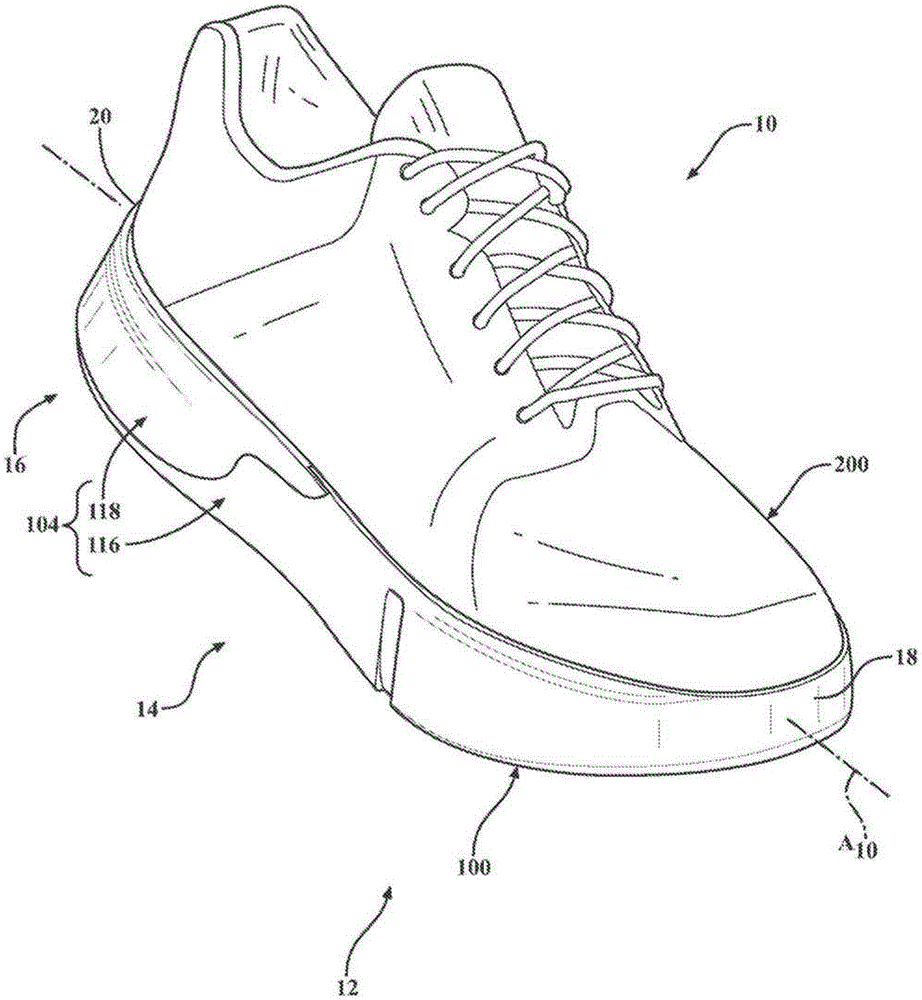
图1是包括根据本公开原理的鞋底结构的鞋类物品的透视图;1 is a perspective view of an article of footwear including a sole structure in accordance with the principles of the present disclosure;
图2是根据本公开原理的鞋底结构的分解透视图,用于图1的鞋类物品;2 is an exploded perspective view of a sole structure for use with the article of footwear of FIG. 1 in accordance with the principles of the present disclosure;
图3是根据本公开原理的鞋底结构的部分分解透视图,用于图1的鞋类物品;3 is a partially exploded perspective view of a sole structure for use with the article of footwear of FIG. 1 in accordance with principles of the present disclosure;
图4是根据本公开原理的鞋底结构的部分分解透视图,用于图1的鞋类物品;4 is a partially exploded perspective view of a sole structure for the article of footwear of FIG. 1 in accordance with principles of the present disclosure;
图5是根据本公开原理的鞋底结构的部分分解透视图,用于图1的鞋类物品;5 is a partially exploded perspective view of a sole structure for use with the article of footwear of FIG. 1 in accordance with the principles of the present disclosure;
图6是根据本公开原理的鞋底结构的透视图,用于图1的鞋类物品;6 is a perspective view of a sole structure for use with the article of footwear of FIG. 1 in accordance with principles of the present disclosure;
图7是沿着图6的线7-7截取的图6的鞋底结构的剖视图;7 is a cross-sectional view of the sole structure of FIG. 6 taken along line 7-7 of FIG. 6;
图8是根据本公开原理的前足缓冲元件的底部平面图,用于图6的鞋底结构;8 is a bottom plan view of a forefoot cushioning element for the sole structure of FIG. 6 in accordance with principles of the present disclosure;
图9是图8的前足缓冲元件的侧视图;Figure 9 is a side view of the forefoot cushioning element of Figure 8;
图10是根据本公开原理的足跟缓冲元件的俯视图,用于图6的鞋底结构;和Figure 10 is a top view of a heel cushioning element for the sole structure of Figure 6 in accordance with principles of the present disclosure; and
图11是图10的前足缓冲元件的侧视图。FIG. 11 is a side view of the forefoot cushioning element of FIG. 10 .
在所有附图中,相应的附图标记表示相应的部件。Corresponding reference characters indicate corresponding parts throughout the drawings.
具体实施方式Detailed ways
现在将参考附图更全面地描述示例配置。提供示例配置使得本公开将是彻底的,并且将向本领域普通技术人员充分传达本公开的范围。阐述了特定细节,例如特定部件、装置和方法的示例,以提供对本公开的配置的透彻理解。对于本领域的普通技术人员来说,显然不需要采用特定的细节,示例性配置可以以许多不同的形式实施,并且特定的细节和示例性配置不应被解释为限制本公开的范围。Example configurations will now be described more fully with reference to the accompanying drawings. Example configurations are provided so that this disclosure will be thorough, and will fully convey the scope of the disclosure to those of ordinary skill in the art. Specific details are set forth, such as examples of specific components, devices, and methods, to provide a thorough understanding of the configurations of the present disclosure. It will be apparent to those skilled in the art that specific details need not be employed, that example configurations may be embodied in many different forms and that specific details and example configurations should not be construed to limit the scope of the disclosure.
本文使用的术语仅用于描述特定示例性配置的目的,并不旨在限制。如这里所使用的,单数冠词“一”、“一个”和“该”也可以旨在包括复数形式,除非上下文清楚地另外指出。术语“构成”、“包括”、“包含”和“具有”是包含性的,因此指定了特征、步骤、操作、元件和/或部件的存在,但是不排除一个或多个其他特征、步骤、操作、元件、部件和/或其组合的存在或添加。这里描述的方法步骤、过程和操作不应被解释为必须要求它们以所讨论或示出的特定顺序执行,除非被具体标识为执行顺序。可以采用附加的或替代的步骤。The terminology used herein is for the purpose of describing particular example configurations only and is not intended to be limiting. As used herein, the singular articles "a," "an," and "the" may also be intended to include the plural unless the context clearly dictates otherwise. The terms "compose", "include", "include" and "have" are inclusive, thus specifying the presence of a feature, step, operation, element and/or component, but not excluding one or more other features, steps, The presence or addition of operations, elements, components, and/or combinations thereof. Method steps, procedures, and operations described herein should not be construed as necessarily requiring their performance in the particular order discussed or illustrated, unless specifically identified as an order of performance. Additional or alternative steps may be employed.
当元件或层被称为“在另一个元件或层上”、“接合到”、“连接到”、“附接到”或“联接到”另一个元件或层时,它可以直接在另一个元件或层上、接合到、连接到、附接到或联接到另一个元件或层,或者可以存在中间元件或层。相反,当一个元件被称为“直接在另一个元件或层上”、“直接接合到”、“直接连接到”、“直接附接到”或“直接联接到”另一个元件或层时,可能不存在中间元件或层。用于描述元件之间关系的其他词语应当以类似的方式来解释(例如,“之间”对“直接之间”、“相邻”对“直接相邻”等)。如本文所使用的,术语“和/或”包括一个或多个相关列出的项目的任何和所有组合。When an element or layer is referred to as being "on," "bonded to," "connected to," "attached to," or "coupled to" another element or layer, it can be directly on the other element or layer An element or layer may be joined to, connected to, attached to, or coupled to another element or layer, or intervening elements or layers may be present. In contrast, when an element is referred to as being "directly on," "directly joined to," "directly connected to," "directly attached to," or "directly coupled to" another element or layer, There may be no intervening elements or layers. Other words used to describe the relationship between elements should be interpreted in a like fashion (eg, "between" versus "directly between," "adjacent" versus "directly adjacent," etc.). As used herein, the term "and/or" includes any and all combinations of one or more of the associated listed items.
第一、第二、第三等术语可以用于描述各种元件、部件、区域、层和/或区段。这些元件、部件、区域、层和/或区段不应受这些术语的限制。这些术语可能仅用于将一个元件、部件、区域、层或区段与另一个区域、层或区段区分开。诸如“第一”、“第二”和其他数字术语的术语并不暗示顺序或次序,除非上下文明确指出。因此,下面讨论的第一元件,组件,区域,层或区段可以被称为第二元件,组件,区域,层或区段,而不脱离示例配置的教导。The terms first, second, third, etc. may be used to describe various elements, components, regions, layers and/or sections. These elements, components, regions, layers and/or sections should not be limited by these terms. These terms may only be used to distinguish one element, component, region, layer or section from another region, layer or section. Terms such as "first," "second," and other numerical terms do not imply a sequence or order unless clearly indicated by the context. Thus, a first element, component, region, layer or section discussed below could be termed a second element, component, region, layer or section without departing from the teachings of the example configurations.
本公开的一个方面提供了一种用于鞋类物品的鞋底结构。鞋底结构包括从前端延伸到后端的内部缓冲装置。鞋底结构还包括前足缓冲元件,该前足缓冲元件从前端延伸到第一端,并包括具有第一硬度的第一材料。鞋底结构还包括足跟缓冲元件,其从后端延伸到第二端,并包括具有第二硬度的第二材料,前足缓冲元件的第一端和足跟缓冲元件的第二端彼此重叠。One aspect of the present disclosure provides a sole structure for an article of footwear. The sole structure includes internal cushioning that extends from the front end to the rear end. The sole structure also includes a forefoot cushioning element extending from the front end to the first end and including a first material having a first stiffness. The sole structure also includes a heel cushioning element extending from the rear end to a second end and including a second material having a second stiffness, the first end of the forefoot cushioning element and the second end of the heel cushioning element overlapping each other.
本公开的实施方式可以包括一个或多个以下可选特征。在一些实施方式中,第二硬度小于第一硬度。内部缓冲装置可以包括第一表面,该第一表面具有由前足缓冲元件形成的第一部分和由足跟缓冲元件形成的第二部分。板可以邻近内部缓冲装置的第一表面设置。这里,板可以设置在形成于内部缓冲装置的第一表面中的凹槽(socket)内。可选地,上部缓冲元件可以设置在板的与内部缓冲装置相对的一侧,并且可以包括具有第三硬度的第三材料。这里,第三硬度可以大于第一硬度和第二硬度。Embodiments of the present disclosure may include one or more of the following optional features. In some embodiments, the second hardness is less than the first hardness. The inner cushioning device may include a first surface having a first portion formed by the forefoot cushioning element and a second portion formed by the heel cushioning element. The plate may be positioned adjacent to the first surface of the inner cushioning device. Here, the plate may be arranged in a socket formed in the first surface of the inner buffer means. Optionally, the upper cushioning element may be provided on the opposite side of the plate from the inner cushioning means, and may comprise a third material having a third hardness. Here, the third hardness may be greater than the first hardness and the second hardness.
在一些示例中,鞋底结构包括由第四材料形成并限定接收部的外壳,内部缓冲装置至少部分地容纳在接收部内。第一材料可以是第一泡沫弹性体,第二材料可以是第二泡沫弹性体。第一端可以包括第一斜面,第二端可以具有第二斜面,第一斜面与第二斜面配合。In some examples, the sole structure includes an outer shell formed of a fourth material and defining a receiving portion within which the internal cushioning device is at least partially received. The first material may be a first foamed elastomer, and the second material may be a second foamed elastomer. The first end may include a first chamfer, the second end may have a second chamfer, and the first chamfer cooperates with the second chamfer.
本公开的另一方面提供了一种用于鞋类物品的鞋底结构。鞋底结构包括前足缓冲元件,该前足缓冲元件从第一远端延伸到第一近端,并且包括具有第一硬度的第一材料。第一近端包括第一倾斜接合表面。鞋底结构还包括足跟缓冲元件,其从第二远端延伸到第二近端,并包括具有第二硬度的第二材料。第二近端包括与前足缓冲元件的第一倾斜接合表面相对的第二倾斜接合表面。Another aspect of the present disclosure provides a sole structure for an article of footwear. The sole structure includes a forefoot cushioning element extending from a first distal end to a first proximal end and including a first material having a first stiffness. The first proximal end includes a first inclined engagement surface. The sole structure also includes a heel cushioning element extending from a second distal end to a second proximal end and including a second material having a second hardness. The second proximal end includes a second inclined engagement surface opposite the first inclined engagement surface of the forefoot cushioning element.
该方面可以包括一个或多个以下可选特征。在一些构造中,第二硬度小于第一硬度。前足缓冲元件和足跟缓冲元件可以配合形成第一表面,该第一表面具有由前足缓冲元件形成的第一部分和由足跟缓冲元件形成的第二部分。板可以邻近第一表面设置。这里,板可以设置在第一表面中形成的凹槽内。上部缓冲元件可以设置在板的与前足缓冲元件和足跟缓冲元件相对的一侧,并且可以包括具有第三硬度的第三材料。第三硬度可以大于第一硬度和第二硬度。This aspect may include one or more of the following optional features. In some constructions, the second hardness is less than the first hardness. The forefoot cushioning element and the heel cushioning element may cooperate to form a first surface having a first portion formed by the forefoot cushioning element and a second portion formed by the heel cushioning element. The plate may be positioned adjacent to the first surface. Here, the plate may be arranged in a groove formed in the first surface. The upper cushioning element may be disposed on an opposite side of the plate from the forefoot cushioning element and the heel cushioning element and may comprise a third material having a third hardness. The third hardness may be greater than the first hardness and the second hardness.
在一些实施方式中,鞋底结构包括由第四材料形成并限定接收部的外壳,前足缓冲元件和足跟缓冲元件至少部分地容纳在接收部内。第一材料可以是第一泡沫弹性体,第二材料可以是第二泡沫弹性体。第一接合表面可以包括第一多个接合特征,第二接合表面可以包括被配置为与第一接合特征配合的第二多个接合特征。In some embodiments, the sole structure includes an outer shell formed of a fourth material and defining a receiving portion within which the forefoot cushioning element and the heel cushioning element are at least partially received. The first material may be a first foamed elastomer, and the second material may be a second foamed elastomer. The first engagement surface may include a first plurality of engagement features, and the second engagement surface may include a second plurality of engagement features configured to mate with the first engagement feature.
在附图和以下描述中阐述了本公开的一个或多个实施方式的细节。根据说明书和附图以及权利要求书,其他方面、特征和优点将变得显而易见。The details of one or more implementations of the disclosure are set forth in the accompanying drawings and the description below. Other aspects, features and advantages will become apparent from the description and drawings, and from the claims.
参考图1,鞋类物品10包括鞋底结构100和附接到鞋底结构100的鞋面200。鞋类物品10、鞋底结构100和鞋面200可以被分成一个或多个区域。这些区域可以包括前足区域12、中足区域14和足跟区域16。如图7所示,前足区域12可以被描述为包括对应于脚的趾骨的脚趾部分12T和对应于脚的跖趾(MTP)关节的球形部分12B。中足区域14可以对应于脚的足弓区域,足跟区域16可以对应于脚的后部部分,包括跟骨。鞋10、鞋底结构100和鞋面200还可以包括与前足区域12的最前点相关联的前端18,以及对应于足跟区域16的最后点的后端20。鞋10的纵向轴线A10沿着鞋10的长度从前端18延伸到后端20,并且通常将鞋10分成内侧22和外侧24,如图1所示。因此,内侧22和外侧24分别对应于鞋10的相对侧,并延伸穿过区域12、14、16。Referring to FIG. 1 , article of
参考图2,鞋底结构100包括被配置为给鞋底结构100提供缓冲和性能特征的中底102,以及被配置为提供鞋类物品10的地面接合表面的外底104。与传统的鞋底结构不同,鞋底结构100的中底102可以复合形成,并且包括多个子部件,用于在整个鞋底结构100中提供期望形式的缓冲和支撑。例如,中底102包括具有前足缓冲元件108和足跟缓冲元件110的内部缓冲装置106、设置在内部缓冲装置106顶侧的上部缓冲元件112、以及设置在内部缓冲装置106和上部缓冲元件112之间的板114。类似地,外底104包括外壳116和足跟支撑件118,外壳116被构造成在其中接收中底102的一部分,足跟支撑件118设置在后端20处。Referring to FIG. 2 ,
参考图2-4,内部缓冲装置106本身形成为包括前足缓冲元件108和足跟缓冲元件110的复合结构。在示出的示例中,前足缓冲元件108和足跟缓冲元件110的相对端(即,彼此面对的端部)沿着中心接头120(图7)彼此接合,以形成包括前足缓冲元件108和足跟缓冲元件110的基本连续的主体。前足缓冲元件108可以由与足跟缓冲元件110不同的材料形成,以在不同区域12、14、16为内部缓冲装置106提供不同的缓冲特性。例如,足跟缓冲元件110可以由硬度低于前足缓冲元件108的材料形成,以给足跟区域16提供比前足区域12更柔软的感觉。因此,足跟缓冲元件110将比前足缓冲元件108提供更大的冲击衰减。Referring to FIGS. 2-4 , the
内部缓冲装置106包括形成在第一侧上的顶面122、形成在顶面122的相对侧上的底面124、以及在顶面122和底面124之间延伸的外围侧面126。从顶面122到底面124的距离限定了内部缓冲装置106的厚度。如图所示,当内部缓冲装置106被组装时,前足缓冲元件108和足跟缓冲元件110彼此协作以限定顶面122、底面124和外围侧面126中的每一个。换句话说,前足缓冲元件108包括顶面122、底面124和外围侧面126中每一个的相应第一部分,足跟缓冲元件110包括顶面122、底面124和外围侧面126中每一个的相应第二部分。因此,整个内部缓冲装置106或前足缓冲元件108或足跟缓冲元件110的特征可以根据表面122、124、126中的一个或多个来描述。The
再次参考图2-4,前足缓冲元件108沿着纵向轴线A10从面向鞋类物品10的前端18的第一远端128延伸到面向鞋类物品10的后端20的第一近端130。足跟缓冲元件110沿着纵向轴线A10从面向鞋类物品10的后端20的第二远端132延伸到面向鞋类物品10的前端18的第二近端134。因此,当组装内部缓冲装置106时,相应缓冲元件108、110的远端128、132形成内部缓冲装置106的相对终端128、132,而近端130、134配合形成内部缓冲装置106的中心接头120。Referring again to FIGS. 2-4 ,
如图7中最佳示出的,第一近端130和第二近端134包括互补或协作的接合表面136、138,它们被构造成彼此接合以形成基本上不间断的内部缓冲装置106。这里,每个近端130、134包括在内部缓冲装置106的顶面122和底面124之间延伸的相应的倾斜接合表面136、138,使得接合表面136、138中的一个的至少一部分与接合表面136、138中的另一个的至少一部分重叠。在一些示例中,接合表面136、138中的每一个形成为从顶面122连续且完全延伸到底面124的斜面,使得前足缓冲元件108的整个第一接合表面136与足跟缓冲元件110的整个第二接合表面138重叠或被其重叠。例如,如图9所示,第一接合表面136以第一角度θ120从底面124向后(即,朝向后端20)延伸,使得前足缓冲元件108的厚度朝向顶面122和第一近端130逐渐变小。相反,如图11所示,第二近端134以第二角度θ120从顶面122向前延伸,使得足跟缓冲元件110的厚度朝向底面124和第二近端134逐渐变小。As best shown in FIG. 7 , the first
参考图8-11,每个缓冲元件108、110的接合表面136、138包括相应的接合特征140、142,接合特征140、142被构造成彼此接合,以提供具有增加的完整性的中心接头120。通常,前足缓冲元件108的第一接合特征140被构造成与足跟缓冲元件110的对应的第二接合特征142接合或配合,以固定前足缓冲元件108和足跟缓冲元件110的相对位置。在图示的示例中,每个接合表面136、138的接合特征140、142包括从顶面122到底面124连续布置的相应的多个台阶140、142。这里,第一接合表面136的台阶140被构造成与第二接合表面138的台阶142配合。如图所示,台阶140、142可以形成为波状起伏,由此台阶140、142的边缘被倒圆以形成延伸穿过内部缓冲装置106的宽度的互补的凹面和凸面。在一种构造中,第一接合表面136的凸起部分可以由第二接合表面138的凹陷部分匹配地接收,并且第一接合表面136的凹陷部分可以匹配地接收第二接合表面138的凸起部分(图7)。这样,表面136、138之间的良好连接通过(i)在表面136、138之间产生配合连接和(ii)增加表面136、138之间的接触面积(与平坦的相对表面相比)来实现。附加地或替代地,缓冲元件108、110中的一个或两个的近端130、134可以形成有横向接合特征143(例如,突起、起伏),用于与缓冲元件108、110中的另一个接合。8-11, the engagement surfaces 136, 138 of each
为倾斜的中心接头120提供台阶状或波浪形接合表面136、138提供了沿着内部缓冲装置106的中心部分的安全过渡区域。特别地,斜面构造提供了从前足缓冲元件108的第一硬度到足跟缓冲元件110的第二硬度的逐渐过渡,这提供了期望的脚下感觉。缓冲元件108、110之间的阶梯状界面用于固定缓冲元件108、110之间的相对纵向位置,由此防止前足缓冲元件108的第一近端130沿着足跟缓冲元件110的第二近端134纵向蠕动或滑动。进一步提供具有横向接合特征143的近端130、134中的一个或两个,固定了前足缓冲元件108和足跟缓冲元件110之间的相对横向位置。Providing the angled center joint 120 with stepped or undulating engagement surfaces 136 , 138 provides a safe transition area along the central portion of the
继续参考图2,内部缓冲装置106的顶面122包括凹槽144,该凹槽144被配置为当鞋底结构100被组装时在其中接收板114的至少一部分。在图示的示例中,凹槽144的深度对应于板114的厚度,使得当鞋底结构100被组装时,板114的顶面与内部缓冲装置106的顶面122齐平。如图所示,凹槽144可以连续延伸跨过内部缓冲装置106的宽度,以与前足区域12和足跟区域16中的内侧22和外侧24上的外围侧表面126相交。因此,当组装鞋底结构100时,板114的外周边可以通过内侧22和外侧24上的外围侧表面126暴露。With continued reference to FIG. 2 , the
参考图3、7和11,内部缓冲装置106可以包括围绕足跟缓冲元件110的第二远端132从内侧22延伸到外侧24的凸缘146。凸缘146包括平坦的面朝下的表面147,该表面147被构造成搁置在形成于外底104内的相应台阶194上,如下面更详细讨论的。如图3和11所示,凸缘146的高度H146(测量为从底面124到面向下的表面147的距离)沿着内侧和外侧22、24中的每一个逐渐增加,直到在第二远端132处达到最大高度。3 , 7 and 11 , the
上部缓冲元件112从前端18的第一端148纵向延伸到后端20的第二端150。上部缓冲元件112包括被构造成形成鞋底结构100的鞋垫的顶面152、形成在上部缓冲元件112的与顶面152相对的一侧上的底面154、以及从顶面152延伸到底面154并限定上部缓冲元件112的外周的外围侧面156。从顶面152到底面154的距离限定了上部缓冲元件112的厚度T112。The
缓冲元件112由弹性聚合材料形成,例如泡沫或橡胶,以赋予穿着者的脚缓冲、响应和能量分布的特性。在图示的示例中,前足缓冲元件108由第一泡沫材料形成,足跟缓冲元件110由第二泡沫材料形成,并且上部缓冲元件112由第三泡沫材料形成。例如,前足缓冲元件108可以由具有第一硬度的第一泡沫材料形成,足跟缓冲元件110可以由具有小于第一硬度的第二硬度的第二泡沫材料形成,上部缓冲元件112可以由具有高于第一硬度和第二硬度的第三硬度的第三材料形成。缓冲元件108、110、112可以使用熔合工艺、使用粘合剂或通过将元件悬挂在不同的弹性聚合材料中而彼此固定。可选地,多个元件可以不相互固定,而是可以保持独立。如上所述,缓冲元件108、110、112可以形成有协作的几何形状(例如台阶、突起),用于限制缓冲元件108、110、112之间的相对运动。Cushioning
用于缓冲元件108、110、112的弹性聚合物材料的示例可以包括基于发泡或模制一种或多种聚合物的材料,例如一种或多种弹性体(例如热塑性弹性体(TPE))。一种或多种聚合物可以包括脂肪族聚合物、芳香族聚合物或两者的混合物;并且可以包括均聚物、共聚物(包括三元共聚物)或两者的混合物。Examples of elastic polymer materials for the
在一些方面,一种或多种聚合物可以包括烯烃均聚物、烯烃共聚物或它们的混合物。烯烃聚合物的例子包括聚乙烯、聚丙烯及其组合。在其他方面,一种或多种聚合物可以包括一种或多种乙烯共聚物,例如乙烯-乙酸乙烯酯(EVA)共聚物、EVOH共聚物、丙烯酸乙酯共聚物、乙烯-不饱和单脂肪酸共聚物及其组合。In some aspects, the one or more polymers can include olefin homopolymers, olefin copolymers, or mixtures thereof. Examples of olefin polymers include polyethylene, polypropylene, and combinations thereof. In other aspects, the one or more polymers can include one or more ethylene copolymers, such as ethylene-vinyl acetate (EVA) copolymers, EVOH copolymers, ethyl acrylate copolymers, ethylene-unsaturated monofatty acids Copolymers and combinations thereof.
在另一些方面,一种或多种聚合物可以包括一种或多种聚丙烯酸酯,例如聚丙烯酸、聚丙烯酸的酯、聚丙烯腈、聚丙烯酸乙酸酯、聚甲基丙烯酸甲酯、聚乙基丙烯酸酯、聚丙烯酸丁酯、聚甲基丙烯酸甲酯和聚乙酸乙烯酯;包括其衍生物、其共聚物及其任何组合。In other aspects, the one or more polymers can include one or more polyacrylates, such as polyacrylic acid, esters of polyacrylic acid, polyacrylonitrile, polyacetate polyacrylate, polymethylmethacrylate, polyacrylate Ethacrylates, polybutylacrylates, polymethylmethacrylates, and polyvinyl acetates; including derivatives thereof, copolymers thereof, and any combination thereof.
在又一些方面,一种或多种聚合物可以包括一种或多种离聚物聚合物。在这些方面,离聚物聚合物可以包括具有羧酸官能团、磺酸官能团、它们的盐(例如钠、镁、钾等)的聚合物,和/或它们的酸酐。例如,离聚物聚合物可以包括一种或多种脂肪酸改性的离聚物聚合物、聚苯乙烯磺酸盐、乙烯-甲基丙烯酸共聚物及其组合。In yet other aspects, the one or more polymers can include one or more ionomeric polymers. In these aspects, ionomeric polymers can include polymers having carboxylic acid functional groups, sulfonic acid functional groups, their salts (eg, sodium, magnesium, potassium, etc.), and/or their anhydrides. For example, the ionomer polymer can include one or more fatty acid modified ionomer polymers, polystyrene sulfonates, ethylene-methacrylic acid copolymers, and combinations thereof.
在另一些方面,一种或多种聚合物可以包括一种或多种苯乙烯嵌段共聚物,例如丙烯腈丁二烯苯乙烯嵌段共聚物、苯乙烯丙烯腈嵌段共聚物、苯乙烯乙烯丁烯苯乙烯嵌段共聚物、苯乙烯乙烯丁二烯苯乙烯嵌段共聚物、苯乙烯乙烯丙烯苯乙烯嵌段共聚物、苯乙烯丁二烯苯乙烯嵌段共聚物及其组合。In other aspects, the one or more polymers can include one or more styrene block copolymers, such as acrylonitrile butadiene styrene block copolymers, styrene acrylonitrile block copolymers, styrene Ethylene butadiene styrene block copolymers, styrene ethylene butadiene styrene block copolymers, styrene ethylene propylene styrene block copolymers, styrene butadiene styrene block copolymers, and combinations thereof.
在另一些方面,一种或多种聚合物可以包括一种或多种聚酰胺共聚物(例如聚酰胺-聚醚共聚物)和/或一种或多种聚氨酯(例如交联聚氨酯和/或热塑性聚氨酯)。替代地,一种或多种聚合物可以包括一种或多种天然和/或合成橡胶,例如丁二烯和异戊二烯。In other aspects, the one or more polymers can include one or more polyamide copolymers (eg, polyamide-polyether copolymers) and/or one or more polyurethanes (eg, cross-linked polyurethane and/or thermoplastic polyurethane). Alternatively, the one or more polymers may include one or more natural and/or synthetic rubbers, such as butadiene and isoprene.
当弹性聚合物材料是泡沫聚合物材料时,泡沫材料可以使用基于温度和/或压力的变化相变成气体的物理发泡剂,或者当加热到其活化温度以上时形成气体的化学发泡剂来发泡。例如,化学发泡剂可以是偶氮化合物,例如二碳酰胺、碳酸氢钠和/或异氰酸酯。When the elastic polymeric material is a foamed polymeric material, the foamed material may use a physical blowing agent that phase-changes into a gas based on a change in temperature and/or pressure, or a chemical blowing agent that forms a gas when heated above its activation temperature to foam. For example, the chemical blowing agent may be an azo compound such as dicarbonamide, sodium bicarbonate and/or isocyanate.
在一些实施例中,泡沫聚合材料可以是交联的泡沫材料。在这些实施例中,可以使用基于过氧化物的交联剂,例如过氧化二异丙苯。此外,泡沫聚合材料可以包括一种或多种填料,例如颜料、改性或天然粘土、改性或未改性的合成粘土、滑石玻璃纤维、粉末玻璃、改性或天然二氧化硅、碳酸钙、云母、纸、木屑等。In some embodiments, the foamed polymeric material may be a cross-linked foamed material. In these embodiments, peroxide-based crosslinking agents, such as dicumyl peroxide, may be used. In addition, the foamed polymeric material may include one or more fillers such as pigments, modified or natural clays, modified or unmodified synthetic clays, talc glass fibers, powdered glass, modified or natural silica, calcium carbonate , mica, paper, sawdust, etc.
弹性聚合材料可以使用模制工艺形成。在一个示例中,当弹性聚合材料是模制弹性体时,未固化的弹性体(例如橡胶)可以在班伯里密炼机(Banbury mixer)中与任选的填料和固化包装如硫基或过氧化物基固化包装混合、压延、成型、置于模具中、并硫化。The elastic polymeric material can be formed using a molding process. In one example, when the elastic polymeric material is a molded elastomer, the uncured elastomer (eg, rubber) can be mixed in a Banbury mixer with optional fillers and cured packages such as sulfur-based or Peroxide-based curing packages are mixed, calendered, shaped, placed in molds, and cured.
在另一个示例中,当弹性聚合材料是泡沫材料时,该材料可以在模制过程中发泡,例如在注射模制过程中。热塑性聚合物材料可以在注射成型系统的桶中熔化,并与物理或化学发泡剂和任选的交联剂结合,然后在激活发泡剂的条件下注射到模具中,形成模制泡沫。In another example, when the elastic polymeric material is a foam material, the material may be foamed during a molding process, such as during an injection molding process. The thermoplastic polymer material can be melted in the barrel of an injection molding system, combined with a physical or chemical blowing agent and optional cross-linking agent, and then injected into the mold under conditions that activate the blowing agent to form a molded foam.
可选地,当弹性聚合材料是泡沫材料时,泡沫材料可以是压缩模制泡沫。压塑可用于改变泡沫的物理性质(例如密度、刚度和/或硬度),或改变泡沫的物理外观(例如融合两片或多片泡沫,使泡沫成形等),或者改变两者。Alternatively, when the elastic polymeric material is a foam material, the foam material may be a compression molded foam. Compression molding can be used to alter the physical properties of the foam (eg, density, stiffness, and/or hardness), or to alter the physical appearance of the foam (eg, fusing two or more sheets of foam, shaping the foam, etc.), or both.
压缩模制过程理想地从形成一个或多个泡沫预成型件开始,例如通过注射模制和发泡聚合材料、通过形成泡沫颗粒或珠、通过切割泡沫片材等。然后,可以通过将由泡沫聚合材料形成的一个或多个预成型件放置在压缩模具中,并向一个或多个预成型件施加足够的压力以在闭合模具中压缩一个或多个预成型件来制造压缩成型泡沫。一旦模具闭合,足够的热量和/或压力被施加到闭合模具中的一个或多个预成型件足够长的持续时间,以通过在压缩模制泡沫的外表面上形成表层、将单个泡沫颗粒彼此熔合、永久增加泡沫的密度或其任意组合来改变预成型件。在加热和/或施加压力之后,打开模具,将模制泡沫制品从模具中取出。The compression molding process desirably begins by forming one or more foam preforms, such as by injection molding and foaming a polymeric material, by forming foam granules or beads, by cutting foam sheets, and the like. Then, the preform or preforms formed from the foamed polymeric material can be placed in a compression mold and applied sufficient pressure to the preform or preforms to compress the preform or preforms in the closed mold. Manufacture of compression molded foam. Once the mold is closed, sufficient heat and/or pressure is applied to the one or more preforms in the closed mold for a sufficient duration to bind the individual foam particles to each other by forming a skin on the outer surface of the compression molded foam The preform is altered by fusing, permanently increasing the density of the foam, or any combination thereof. After heating and/or applying pressure, the mold is opened and the molded foam article is removed from the mold.
继续参考图2,板114从鞋底结构100的前端18处的第一端158延伸到鞋底结构100的后端20处的第二端160。板114包括顶面162、形成在板114的与顶面162相对的一侧上的底面164、以及从顶面162延伸到底面164并限定板114的外围轮廓的外围侧面166。从顶面162到底面164的距离限定了板114的厚度T114。在图示的示例中,板114的厚度T114基本上是恒定的。板114由一种或多种刚性或半刚性材料形成,其硬度大于任何缓冲元件108、110、112。在一些示例中,板114由弹性材料形成,例如尼龙。附加地或替代地,板114可以包括一种或多种复合材料。With continued reference to FIG. 2 , the
如图7所示,当组装鞋底结构100时,板114被设置在内部缓冲装置106的凹槽144内,并被置于内部缓冲装置106和上部缓冲元件112之间。如图所示,板114的厚度T114与凹槽144的深度D144相同,使得当组装鞋底结构时,板114的顶面162与内部缓冲装置106的顶面122齐平。因此,当组装鞋底结构时,板114的顶面162和内部缓冲装置106的顶面122形成连续表面,上部缓冲元件112的底面154搁置在该连续表面上。As shown in FIG. 7 , when the
参考图2,板114可以包括延伸穿过中足区域14的颈缩部分168。颈缩部分168是中足区域14中的板114的一部分,其相对于前足区域12和足跟区域16中的板114的相邻部分具有减小的宽度W114。如图2所示,颈缩部分168形成在沿着内侧22的外围侧表面166的一部分朝向板114的内部(即,纵向轴线A10)向内偏移的位置,并且沿着板114的内侧22形成凹槽170。颈缩部分168的纵向位置对应于脚的外侧足弓的位置,而凹槽170的纵向位置对应于脚的内侧足弓的位置。换句话说,在鞋底结构100的对应于脚的内侧足弓的部分中没有板114。这种构造允许板114沿着外侧24为脚的足底面提供支撑,同时最大化鞋底结构通过中足区域14的柔韧性。Referring to FIG. 2 , the
继续参考图7,板114包括从第一端158延伸到第二端160的复合曲率,并且可以被描述为包括各自具有不同曲率的不同部分172a-172d。具体地,板114包括脚趾部分172a、球形部分172b、中足部分172c和足跟部分172d,它们分别设置在相应的区域12T、12B、14、16中。如图所示,脚趾部分172a从板114的第一端158延伸,并且基本上是直的。球形部分172b和足跟部分172d中的每一个形成板114的凹陷部分,其中顶面162具有凹曲率。中足部分172c形成板114的一部分,其中顶面162具有凸曲率。因此,板114的顶面162在前足区域12和足跟区域16中呈杯形,并在球形部分172b和足跟部分172d之间形成倒置的(即凸起的)过渡区域。With continued reference to FIG. 7, the
仍然参照图7,板114的球形部分172b被构造成支撑脚的跖趾(MTP)关节。如图所示,球形部分172b形成顶面162的凹陷部分,该凹陷部分在脚趾部分172a和中足部分172c之间具有曲率半径R172b。球形部分172b还包括位于球形部分172b最低点的下顶点174。如图7所示,下顶点174位于距板114的第二端160约60%的板长度L114处。Still referring to FIG. 7, the
如上所述,中足部分172c和足跟部分172d中的每一个也是弯曲的,以适应脚的足底面的曲率。例如,板114的中足部分172c沿着小于球形部分172b的第一曲率半径R172b的第二曲率半径R172c弯曲,并形成顶面162的凸起部分。板114的足跟部分172d沿着小于球形部分172b的第一曲率半径R172b的第三曲率半径R172d弯曲,并形成顶面162的凹陷部分。As noted above, each of the midfoot portion 172c and
继续参考图7,当组装鞋底结构100时,中底102具有由内部缓冲装置106(例如,T108、T110)、上部缓冲元件112(例如,T112)和板114(例如,T114)的堆叠形成的总厚度T102。总厚度T102沿着中底102的长度是可变的,由此厚度T102通过前足区域12到中足区域14增加,然后从中足区域14到足跟区域16减小。这里,内部缓冲装置106的厚度在板114下方从前端18到下顶点174基本恒定,然后从下顶点174穿过中足区域14增加。相反,上部缓冲元件112的厚度T112从前端18到下顶点174增加,然后通过中足区域减小到足跟区域16的基本恒定的厚度T112。如图所示,这种构造导致在前足区域12中上部缓冲元件112比内部缓冲装置106厚,并且在足跟区域16中内部缓冲装置106比上部缓冲元件112厚。换句话说,板114在前足区域12中比脚的足底面更靠近地面,并且在足跟区域16中比地面更靠近脚的足底面。With continued reference to FIG. 7 , when
如上所述,外底104可以被构造成包括外壳116和足跟支撑件118的复合结构。通常,外壳116被构造成形成鞋类物品10的地面接合表面,并且由一种或多种用于赋予缓冲、牵引和耐磨性的材料形成。足跟支撑件118围绕鞋类物品10的后端20延伸,并被构造成围绕足跟区域16提供稳定性。因此,足跟支撑件118可以由硬度大于外壳116的材料制成。如图5和6所示,当组装外底104时,外壳116和足跟支撑件118共同限定了用于接收中底102的空腔176。As described above, the
参考图2-4,外底104的外壳116从鞋类物品10的前端18处的第一端178延伸到鞋类物品10的后端处的第二端180。因此,外壳116沿着鞋类物品10的全长延伸。外壳116包括从第一端178连续延伸到第二端180的地面接合元件182,以及从地面接合元件182沿着外壳116的周边延伸的外围壁184。Referring to FIGS. 2-4 ,
如图2和3所示,地面接合元件182包括顶面186和底面188,底面188形成在地面接合元件182的与顶面186相对的一侧上。这里,地面接合元件182的底面188形成鞋类物品10的地面接合表面188。从顶面186到底面188的距离限定了地面接合元件182的厚度。As shown in FIGS. 2 and 3 , the
外围壁184从地面接合元件182的顶面186基本垂直地延伸,并界定外底104的空腔176的第一部分。如图所示,外围壁184包括围绕外壳116的第一端178延伸的第一部分184a和围绕外壳116的第二端180延伸的第二部分184b。如图2所示,外围壁184的第一部分184a具有第一高度H184a,外围壁184的第二部分184b具有第二高度H184b。第一高度H184a大于第二高度H184b,使得第一部分184a突出超过第二部分184b(即,在第二部分184b上方),并且包括一对终端190a、190b,其被配置为与足跟支撑件118接合。在图示的示例中,终端190a、190b可以彼此偏移,使得内侧22上的终端190a比外侧24上的终端190b更靠近前端18。因此,外围壁184的第一部分184a沿着外侧24比内侧22延伸得更远。Peripheral wall 184 extends substantially vertically from
如图2和3所示,外壳116可以包括至少部分穿过外壳116的厚度形成的通道192。在图示的示例中,通道192的长度从地面接合元件182的内侧22上的第一终端193a延伸到地面接合元件182的外侧24上的外围壁中的第二终端193b。在地面接合元件182中,通道192形成为跨过球形部分12B中的底面188的宽度(即,横向于纵向轴线A10),并且具有从内侧22到外侧24的S形曲率。As shown in FIGS. 2 and 3 , the
如上所述,外壳116还可以包括形成在第二端180处的台阶194。台阶194被构造成支撑形成在足跟缓冲元件110的第二远端132处的凸缘146。因此,台阶194可以包括围绕第二端180延伸的基本平坦的、面向上的表面。这里,台阶194的高度沿着内侧和外侧22、24中的每一个增加到第二端180处的最大高度。As discussed above, the
在图示的示例中,外壳116形成为单一弹性材料的整体,例如天然或合成橡胶材料。外壳116的材料被选择为给外底104提供缓冲、牵引和耐磨损的特性。在一些示例中,地面接合元件182和外围壁184可以由不同的材料形成,然后彼此附接。In the illustrated example, the
足跟支撑件118被构造成与外壳116的外围壁184接合。如图所示,足跟支撑件118是从内侧22上的第一终端196a延伸到外侧24上的第二终端196b的U形元件。第一终端196a和第二终端196b中的每一个都被构造成与外围壁184的第一部分184a的相应终端190a、190b接合。例如,足跟支撑件118的每个终端196a、196b的轮廓对应于外围壁184的相应一个终端190a、190b的轮廓,使得当足跟支撑件118与外壳116组装时,外围壁184和足跟支撑件118协作以连续地界定外底104的空腔176。The
如上所述,本公开的鞋底结构100结合刚性支撑板有利地提供了区域和分层缓冲。特别地,鞋底结构通过提供内部缓冲装置106包括区域缓冲,该内部缓冲装置106在前足具有第一材料,在足跟具有较软的第二材料。这种构造提供了行走过程中与足跟撞击相关的改进的冲击衰减。除了由复合内部缓冲装置106提供的区域缓冲之外,鞋底结构100通过提供与内部缓冲元件106成层状布置的上部缓冲元件112而包括层状缓冲。因此,具有比上部缓冲元件112的第三材料更软的第一和第二材料的内部缓冲装置106提供了脚底缓冲,而上部缓冲元件112提供了脚的足底表面和内部缓冲装置106之间的稳定界面。在内部缓冲装置106和鞋面之间提供全长板114进一步增加了鞋底结构100内的稳定性,并且可以改善行走时的能量返回。总之,这些特征共同为与长时间站立和行走相关的鞋类物品提供了理想的构型。As described above, the
以下条款提供了上述鞋类物品和鞋底结构的示例性构造。The following clauses provide exemplary configurations of the above-described articles of footwear and sole structures.
条款1:一种用于鞋类物品的鞋底结构,所述鞋底结构包括从前端延伸到后端的内部缓冲装置,并且包括(i)从前端延伸到第一端并且包括具有第一硬度的第一材料的前足缓冲元件,以及(ii)从后端延伸到第二端并且包括具有第二硬度的第二材料的足跟缓冲元件,前足缓冲元件的第一端和足跟缓冲元件的第二端彼此重叠。Clause 1: A sole structure for an article of footwear, the sole structure comprising an internal cushioning device extending from a front end to a rear end, and comprising (i) extending from a front end to a first end and comprising a first hardness having a first stiffness a forefoot cushioning element of material, and (ii) a heel cushioning element extending from a rear end to a second end and comprising a second material having a second durometer, a first end of the forefoot cushioning element and a second end of the heel cushioning element overlap each other.
条款2:根据条款1所述的鞋底结构,其中,所述第二硬度小于所述第一硬度。Clause 2: The sole structure of Clause 1, wherein the second stiffness is less than the first stiffness.
条款3:根据前述条款中任一项所述的鞋底结构,其中,所述内部缓冲装置包括第一表面,该第一表面具有由前足缓冲元件形成的第一部分和由足跟缓冲元件形成的第二部分。Clause 3: The sole structure of any preceding clause, wherein the internal cushioning device comprises a first surface having a first portion formed by a forefoot cushioning element and a first portion formed by a heel cushioning element part two.
条款4:根据条款3所述的鞋底结构,还包括邻近所述内部缓冲装置的第一表面设置的板。Clause 4: The sole structure of Clause 3, further comprising a plate disposed adjacent the first surface of the internal cushioning device.
条款5:根据条款4所述的鞋底结构,其中,所述板设置在形成于所述内部缓冲装置的第一表面中的凹槽内。Clause 5: The sole structure of Clause 4, wherein the plate is disposed within a groove formed in the first surface of the inner cushioning device.
条款6:根据条款4所述的鞋底结构,还包括上部缓冲元件,所述上部缓冲元件设置在板的与内部缓冲装置相对的一侧上,并且包括具有第三硬度的第三材料。Clause 6: The sole structure of Clause 4, further comprising an upper cushioning element disposed on an opposite side of the plate from the inner cushioning device and comprising a third material having a third hardness.
条款7:根据条款6所述的鞋底结构,其中,所述第三硬度大于所述第一硬度和所述第二硬度。Clause 7: The sole structure of Clause 6, wherein the third stiffness is greater than the first stiffness and the second stiffness.
条款8:根据前述条款中任一项所述的鞋底结构,还包括由第四材料形成并限定接收部的外壳,所述内部缓冲装置至少部分地容纳在接收部内。Clause 8: The sole structure of any of the preceding clauses, further comprising an outer shell formed of a fourth material and defining a receptacle, the internal cushioning device being at least partially received within the receptacle.
条款9:根据前述条款中任一项所述的鞋底结构,其中,所述第一材料是第一泡沫弹性体,所述第二材料是第二泡沫弹性体。Clause 9: The sole structure of any of the preceding clauses, wherein the first material is a first foamed elastomer and the second material is a second foamed elastomer.
条款10:根据前述条款中任一项所述的鞋底结构,其中,所述第一端包括第一斜面,所述第二端包括第二斜面,所述第一斜面与所述第二斜面配合。Clause 10: The sole structure of any preceding clause, wherein the first end includes a first bevel and the second end includes a second bevel, the first bevel cooperating with the second bevel .
条款11:一种用于鞋类物品的鞋底结构,所述鞋底结构包括从第一远端延伸到第一近端并包括具有第一硬度的第一材料的前足缓冲元件,所述第一近端包括第一倾斜接合表面,以及从第二远端延伸到第二近端并包括具有第二硬度的第二材料的足跟缓冲元件,所述第二近端包括与前足缓冲元件的第一倾斜接合表面相对的第二倾斜接合表面。Clause 11: A sole structure for an article of footwear, the sole structure comprising a forefoot cushioning element extending from a first distal end to a first proximal end and comprising a first material having a first hardness, the first proximal The end includes a first angled engagement surface, and a heel cushioning element extending from a second distal end to a second proximal end and including a second material having a second hardness, the second proximal end including a first contact with the forefoot cushioning element A second inclined engagement surface opposite the inclined engagement surface.
条款12:根据条款11所述的鞋底结构,其中,所述第二硬度小于所述第一硬度。Clause 12: The sole structure of Clause 11, wherein the second stiffness is less than the first stiffness.
条款13:根据前述条款中任一项所述的鞋底结构,其中,所述前足缓冲元件和所述足跟缓冲元件协作以形成第一表面,所述第一表面具有由前足缓冲元件形成的第一部分和由足跟缓冲元件形成的第二部分。Clause 13: The sole structure of any preceding clause, wherein the forefoot cushioning element and the heel cushioning element cooperate to form a first surface having a first surface formed by the forefoot cushioning element A portion and a second portion formed by the heel cushioning element.
条款14:根据条款13所述的鞋底结构,还包括邻近所述第一表面设置的板。Clause 14: The sole structure of Clause 13, further comprising a plate disposed adjacent the first surface.
条款15:根据条款14所述的鞋底结构,其中,所述板设置在形成于所述第一表面中的凹槽内。Clause 15: The sole structure of
条款16:根据条款14所述的鞋底结构,还包括上部缓冲元件,设置在所述板的与所述前足缓冲元件和所述足跟缓冲元件相对的一侧,并且包括具有第三硬度的第三材料。Clause 16: The sole structure of
条款17:根据条款16所述的鞋底结构,其中,所述第三硬度大于所述第一硬度和所述第二硬度。Clause 17: The sole structure of
条款18:根据前述条款中任一项所述的鞋底结构,还包括外壳,所述外壳由第四材料形成并限定接收部,所述前足缓冲元件和所述足跟缓冲元件至少部分地容纳在所述接收部内。Clause 18: The sole structure of any of the preceding clauses, further comprising an outer shell formed of a fourth material and defining a receiving portion, the forefoot cushioning element and the heel cushioning element at least partially received in inside the receiving unit.
条款19:根据前述条款中任一项所述的鞋底结构,其中,所述第一材料是第一泡沫弹性体,所述第二材料是第二泡沫弹性体。Clause 19: The sole structure of any of the preceding clauses, wherein the first material is a first foamed elastomer and the second material is a second foamed elastomer.
条款20:根据前述条款中任一项所述的鞋底结构,其中,所述第一倾斜接合表面包括第一多个接合特征,并且所述第二倾斜接合表面包括被配置为与所述第一多个接合特征配合的第二多个接合特征。Clause 20: The sole structure of any one of the preceding clauses, wherein the first inclined engagement surface includes a first plurality of engagement features, and the second inclined engagement surface includes a A second plurality of engagement features to which the plurality of engagement features mate.
前面的描述是为了说明和描述的目的而提供的。它并不旨在是穷尽性的或限制本公开。特定配置的单个元件或特征通常不限于该特定配置,而是在适用的情况下是可互换的,并且可以在选定的配置中使用,即使没有具体示出或描述。同样的情况也可能在许多方面有所变化。这种变化不应被视为偏离本公开,并且所有这种修改都旨在包括在本公开的范围内。The foregoing description has been presented for purposes of illustration and description. It is not intended to be exhaustive or to limit the present disclosure. Individual elements or features of a particular configuration are generally not limited to that particular configuration, but, where applicable, are interchangeable and can be used in a selected configuration, even if not specifically shown or described. The same situation can also change in many ways. Such variations should not be considered as a departure from this disclosure, and all such modifications are intended to be included within the scope of this disclosure.
Claims (20)
Applications Claiming Priority (5)
| Application Number | Priority Date | Filing Date | Title |
|---|---|---|---|
| US202062956976P | 2020-01-03 | 2020-01-03 | |
| US62/956,976 | 2020-01-03 | ||
| US17/133,823 | 2020-12-24 | ||
| US17/133,823 US12317951B2 (en) | 2020-01-03 | 2020-12-24 | Sole structure for article of footwear |
| PCT/US2020/067150 WO2021138255A1 (en) | 2020-01-03 | 2020-12-28 | Sole structure for article of footwear |
Publications (2)
| Publication Number | Publication Date |
|---|---|
| CN114901098A true CN114901098A (en) | 2022-08-12 |
| CN114901098B CN114901098B (en) | 2024-11-15 |
Family
ID=76655671
Family Applications (1)
| Application Number | Title | Priority Date | Filing Date |
|---|---|---|---|
| CN202080091614.9A Active CN114901098B (en) | 2020-01-03 | 2020-12-28 | Sole structure of footwear |
Country Status (5)
| Country | Link |
|---|---|
| US (2) | US12317951B2 (en) |
| EP (1) | EP4084647B1 (en) |
| CN (1) | CN114901098B (en) |
| TW (2) | TWI776341B (en) |
| WO (1) | WO2021138255A1 (en) |
Families Citing this family (9)
| Publication number | Priority date | Publication date | Assignee | Title |
|---|---|---|---|---|
| US12250989B2 (en) * | 2020-11-24 | 2025-03-18 | Nike, Inc. | Sole structure for article of footwear |
| US20230137398A1 (en) * | 2021-10-28 | 2023-05-04 | Nike, Inc. | Sole structure for article of footwear |
| US12349761B2 (en) | 2021-12-16 | 2025-07-08 | Nike, Inc. | Article of footwear having a sole structure |
| JP7461706B2 (en) * | 2021-12-26 | 2024-04-04 | 美津濃株式会社 | Shoe sole |
| EP4486163A1 (en) * | 2022-03-03 | 2025-01-08 | NIKE Innovate C.V. | Article of footwear having a rand |
| WO2023215718A1 (en) * | 2022-05-02 | 2023-11-09 | Nike, Inc. | Article of footwear including a heel stabilizing element |
| USD1068222S1 (en) | 2024-04-12 | 2025-04-01 | Athletic Propulsion Labs LLC | Footwear with full-length midsole and cupsole |
| US12089689B1 (en) | 2024-04-12 | 2024-09-17 | Athletic Propulsion Labs LLC | Footwear with full-length midsole and hollow cupsole |
| US20250380765A1 (en) * | 2024-06-12 | 2025-12-18 | Puma SE | Article of footwear having a sole structure |
Citations (6)
| Publication number | Priority date | Publication date | Assignee | Title |
|---|---|---|---|---|
| US1289711A (en) * | 1917-11-10 | 1918-12-31 | John G Ettle | Sole. |
| US20030172548A1 (en) * | 2003-01-28 | 2003-09-18 | Fuerst Rory W. | Key hole midsole |
| CN101795592A (en) * | 2007-09-06 | 2010-08-04 | 新平衡运动鞋公司 | Sole and shoe for midfoot touchdown person |
| US20110225852A1 (en) * | 2010-03-16 | 2011-09-22 | Saucony, Inc. | Articles of Footwear |
| WO2014178739A2 (en) * | 2013-04-29 | 2014-11-06 | Lambda & Omega, Lda | Two density-hardness heel manufacturing method and respective hard top piece with a flexible construction |
| US20180199666A1 (en) * | 2015-06-26 | 2018-07-19 | Asics Corporation | Shoe having shoe sole with divided forefoot portion |
Family Cites Families (40)
| Publication number | Priority date | Publication date | Assignee | Title |
|---|---|---|---|---|
| US2581524A (en) * | 1948-06-25 | 1952-01-08 | Joyce Inc | Method of making midsole-outsole assemblies for shoes |
| US3121962A (en) * | 1963-01-16 | 1964-02-25 | Philip A Gullo | Sandals |
| US4003146A (en) * | 1974-05-31 | 1977-01-18 | Ernst Meier | Method of manufacture of a shoe |
| US4481727A (en) * | 1980-05-06 | 1984-11-13 | Pensa, Inc. | Shoe sole construction |
| AT384714B (en) | 1980-07-01 | 1987-12-28 | Distropat Ag | SOLE FOR SHOES |
| US4805319A (en) * | 1985-02-26 | 1989-02-21 | Kangaroos U.S.A., Inc. | Cushioning and impact absorptive means for footwear operative component |
| US4760655A (en) * | 1986-07-07 | 1988-08-02 | Walter Mauch | Insole |
| US4823483A (en) * | 1986-09-23 | 1989-04-25 | Bernard Chapnick | Shoe insert and laminating method |
| US4843741A (en) * | 1987-02-20 | 1989-07-04 | Autry Industries, Inc. | Custom insert with a reinforced heel portion |
| US4924606A (en) * | 1988-11-01 | 1990-05-15 | Toddler U, Inc. | Split-sole shoe with a combined toe cap and front outer sole |
| US4930232A (en) * | 1989-03-28 | 1990-06-05 | The United States Shoe Corporation | Multilayer shoe sole |
| US5784811A (en) * | 1990-03-15 | 1998-07-28 | Walter Mauch | Shoe insole |
| US5187883A (en) * | 1990-08-10 | 1993-02-23 | Richard Penney | Internal footwear construction with a replaceable heel cushion element |
| IT1270755B (en) * | 1993-12-01 | 1997-05-07 | Valfussbett Srl | Insole for footwear with soft insert |
| FR2743989B1 (en) * | 1996-01-30 | 1998-03-20 | Salomon Sa | SPORTS SHOE SOLE |
| US5842294A (en) * | 1996-02-28 | 1998-12-01 | Dr. Fabricant's Foot Health Products Inc. | Golf orthotic |
| FR2765083B1 (en) * | 1997-06-27 | 1999-08-27 | Salomon Sa | MULTILAYERED SOLE COUPLED TO SHOE UPPER REINFORCEMENT |
| US5979083A (en) * | 1998-01-23 | 1999-11-09 | Acushnet Company | Multi-layer outsole |
| JP4020664B2 (en) * | 2001-05-11 | 2007-12-12 | 株式会社アシックス | Midsole with buffer structure |
| US20050034326A1 (en) * | 2003-08-11 | 2005-02-17 | Wang Chia-Chin | Shoe structure |
| US20070113424A1 (en) * | 2005-11-23 | 2007-05-24 | Michael Bell | Overshoes with raised inner surface portions and slip resistant sole portions for use on primary footwear |
| ITMI20052393A1 (en) * | 2005-12-15 | 2007-06-16 | Freddy Spa | SHOE WITH INTERMEDIATE SOLE AT LEAST A STRATIFIED SHOCK ABSORBER ELEMENT |
| WO2010007456A1 (en) * | 2008-07-14 | 2010-01-21 | Prince Sports, Inc. | An improved sole structure |
| US20100299969A1 (en) * | 2009-05-29 | 2010-12-02 | Liliana Paez | Layered footwear assembly with an arcuate undersurface |
| KR100941367B1 (en) | 2009-08-26 | 2010-02-10 | 엄옥순 | A sole for health footwear having a barefoot technology |
| US20110078922A1 (en) * | 2009-10-02 | 2011-04-07 | Nike, Inc. | Thermoforming upper process with reinforcement |
| US20110179669A1 (en) * | 2010-01-28 | 2011-07-28 | Brown Shoe Company, Inc. | Cushioning and shock absorbing midsole |
| DE102011051444A1 (en) * | 2011-06-29 | 2013-01-03 | Deeluxe Sportartikel Handels Gmbh | Sole for a shoe, especially a running shoe |
| US8839531B2 (en) * | 2011-07-19 | 2014-09-23 | Saucony Ip Holdings Llc | Footwear |
| US8595956B2 (en) * | 2011-09-29 | 2013-12-03 | C. & J. Clark International Limited | Footwear with elastic footbed cover and soft foam footbed |
| WO2013168256A1 (en) * | 2012-05-10 | 2013-11-14 | 株式会社アシックス | Sole provided with outer sole and midsole |
| US20160302517A1 (en) * | 2015-04-17 | 2016-10-20 | Wolverine World Wide, Inc. | Sole assembly for an article of footwear |
| US20160345668A1 (en) | 2015-05-29 | 2016-12-01 | Masai International Pte Ltd. | Articles of footwear and shoe soles for midfoot impact region |
| US9950486B2 (en) * | 2015-11-30 | 2018-04-24 | Matthias Hartmann | Method for producing a sole for a shoe |
| US11206895B2 (en) * | 2016-04-21 | 2021-12-28 | Nike, Inc. | Sole structure with customizable bladder network |
| US10786040B2 (en) * | 2016-05-26 | 2020-09-29 | Nike, Inc. | Multi-durometer sole structure for an article of footwear |
| DE102016216675A1 (en) * | 2016-09-02 | 2018-03-08 | Mammut Sports Group Ag | Shoe sole design |
| KR20190102258A (en) * | 2017-02-22 | 2019-09-03 | 미쓰이 가가쿠 가부시키가이샤 | Process for preparing expanded polyurethane elastomer raw material, expanded polyurethane elastomer and expanded polyurethane elastomer |
| CA3038332A1 (en) * | 2018-03-29 | 2019-09-29 | Hevea B.V. | Article of footwear, and method for manufacturing such an article |
| US11178934B2 (en) * | 2018-07-18 | 2021-11-23 | Bolt Threads Inc. | Resilin material footwear and fabrication methods |
-
2020
- 2020-12-24 US US17/133,823 patent/US12317951B2/en active Active
- 2020-12-28 CN CN202080091614.9A patent/CN114901098B/en active Active
- 2020-12-28 EP EP20845504.8A patent/EP4084647B1/en active Active
- 2020-12-28 WO PCT/US2020/067150 patent/WO2021138255A1/en not_active Ceased
- 2020-12-31 TW TW109147022A patent/TWI776341B/en active
- 2020-12-31 TW TW111129454A patent/TWI831322B/en active
-
2025
- 2025-01-10 US US19/016,490 patent/US20250143410A1/en active Pending
Patent Citations (6)
| Publication number | Priority date | Publication date | Assignee | Title |
|---|---|---|---|---|
| US1289711A (en) * | 1917-11-10 | 1918-12-31 | John G Ettle | Sole. |
| US20030172548A1 (en) * | 2003-01-28 | 2003-09-18 | Fuerst Rory W. | Key hole midsole |
| CN101795592A (en) * | 2007-09-06 | 2010-08-04 | 新平衡运动鞋公司 | Sole and shoe for midfoot touchdown person |
| US20110225852A1 (en) * | 2010-03-16 | 2011-09-22 | Saucony, Inc. | Articles of Footwear |
| WO2014178739A2 (en) * | 2013-04-29 | 2014-11-06 | Lambda & Omega, Lda | Two density-hardness heel manufacturing method and respective hard top piece with a flexible construction |
| US20180199666A1 (en) * | 2015-06-26 | 2018-07-19 | Asics Corporation | Shoe having shoe sole with divided forefoot portion |
Also Published As
| Publication number | Publication date |
|---|---|
| EP4084647A1 (en) | 2022-11-09 |
| US20210204651A1 (en) | 2021-07-08 |
| TW202245640A (en) | 2022-12-01 |
| CN114901098B (en) | 2024-11-15 |
| TWI831322B (en) | 2024-02-01 |
| WO2021138255A1 (en) | 2021-07-08 |
| EP4084647B1 (en) | 2024-12-11 |
| TW202130292A (en) | 2021-08-16 |
| TWI776341B (en) | 2022-09-01 |
| US20250143410A1 (en) | 2025-05-08 |
| US12317951B2 (en) | 2025-06-03 |
Similar Documents
| Publication | Publication Date | Title |
|---|---|---|
| TWI776341B (en) | Sole structure for article of footwear | |
| US12239183B2 (en) | Article of footwear | |
| TWI832077B (en) | Sole structure for article of footwear | |
| US12426668B2 (en) | Article of footwear | |
| TW202245643A (en) | Bladder and sole structure for article of footwear | |
| CN115996652A (en) | Sole structure for an article of footwear | |
| US20230137398A1 (en) | Sole structure for article of footwear | |
| CN120548123A (en) | Article of footwear including an integrated stabilizing member | |
| HK40071677A (en) | Article of footwear | |
| HK40076672B (en) | Article of footwear | |
| HK40076672A (en) | Article of footwear |
Legal Events
| Date | Code | Title | Description |
|---|---|---|---|
| PB01 | Publication | ||
| PB01 | Publication | ||
| SE01 | Entry into force of request for substantive examination | ||
| SE01 | Entry into force of request for substantive examination | ||
| CB03 | Change of inventor or designer information |
Inventor after: D.S. Thompson Inventor after: N.A. Trufanov Inventor after: Y.K.Chen Inventor before: D.S. Thompson Inventor before: N.A. Trufanov |
|
| CB03 | Change of inventor or designer information | ||
| GR01 | Patent grant | ||
| GR01 | Patent grant |