CN114884703B - Advanced Persistent Threat Detection Method Based on Threat Intelligence and Message Passing Model - Google Patents
Advanced Persistent Threat Detection Method Based on Threat Intelligence and Message Passing Model Download PDFInfo
- Publication number
- CN114884703B CN114884703B CN202210412622.XA CN202210412622A CN114884703B CN 114884703 B CN114884703 B CN 114884703B CN 202210412622 A CN202210412622 A CN 202210412622A CN 114884703 B CN114884703 B CN 114884703B
- Authority
- CN
- China
- Prior art keywords
- network
- entity
- features
- heterogeneous graph
- label
- Prior art date
- Legal status (The legal status is an assumption and is not a legal conclusion. Google has not performed a legal analysis and makes no representation as to the accuracy of the status listed.)
- Active
Links
Images


Classifications
-
- H—ELECTRICITY
- H04—ELECTRIC COMMUNICATION TECHNIQUE
- H04L—TRANSMISSION OF DIGITAL INFORMATION, e.g. TELEGRAPHIC COMMUNICATION
- H04L63/00—Network architectures or network communication protocols for network security
- H04L63/14—Network architectures or network communication protocols for network security for detecting or protecting against malicious traffic
- H04L63/1408—Network architectures or network communication protocols for network security for detecting or protecting against malicious traffic by monitoring network traffic
- H04L63/1416—Event detection, e.g. attack signature detection
-
- G—PHYSICS
- G06—COMPUTING OR CALCULATING; COUNTING
- G06F—ELECTRIC DIGITAL DATA PROCESSING
- G06F18/00—Pattern recognition
- G06F18/20—Analysing
- G06F18/24—Classification techniques
- G06F18/241—Classification techniques relating to the classification model, e.g. parametric or non-parametric approaches
-
- G—PHYSICS
- G06—COMPUTING OR CALCULATING; COUNTING
- G06N—COMPUTING ARRANGEMENTS BASED ON SPECIFIC COMPUTATIONAL MODELS
- G06N3/00—Computing arrangements based on biological models
- G06N3/02—Neural networks
- G06N3/04—Architecture, e.g. interconnection topology
- G06N3/045—Combinations of networks
-
- G—PHYSICS
- G06—COMPUTING OR CALCULATING; COUNTING
- G06N—COMPUTING ARRANGEMENTS BASED ON SPECIFIC COMPUTATIONAL MODELS
- G06N5/00—Computing arrangements using knowledge-based models
- G06N5/02—Knowledge representation; Symbolic representation
-
- H—ELECTRICITY
- H04—ELECTRIC COMMUNICATION TECHNIQUE
- H04L—TRANSMISSION OF DIGITAL INFORMATION, e.g. TELEGRAPHIC COMMUNICATION
- H04L63/00—Network architectures or network communication protocols for network security
- H04L63/14—Network architectures or network communication protocols for network security for detecting or protecting against malicious traffic
- H04L63/1441—Countermeasures against malicious traffic
Landscapes
- Engineering & Computer Science (AREA)
- Theoretical Computer Science (AREA)
- Computer Security & Cryptography (AREA)
- General Engineering & Computer Science (AREA)
- Computing Systems (AREA)
- Physics & Mathematics (AREA)
- Data Mining & Analysis (AREA)
- Evolutionary Computation (AREA)
- Artificial Intelligence (AREA)
- General Physics & Mathematics (AREA)
- Computer Networks & Wireless Communication (AREA)
- Computational Linguistics (AREA)
- Computer Hardware Design (AREA)
- Life Sciences & Earth Sciences (AREA)
- Signal Processing (AREA)
- Mathematical Physics (AREA)
- Software Systems (AREA)
- Biophysics (AREA)
- Bioinformatics & Cheminformatics (AREA)
- Bioinformatics & Computational Biology (AREA)
- Computer Vision & Pattern Recognition (AREA)
- Evolutionary Biology (AREA)
- Molecular Biology (AREA)
- General Health & Medical Sciences (AREA)
- Biomedical Technology (AREA)
- Health & Medical Sciences (AREA)
- Data Exchanges In Wide-Area Networks (AREA)
Abstract
本发明公开了一种基于威胁情报和消息传递模型的高级持续性威胁检测方法,包括:在目标网络系统内收集主机的网络行为数据并存储至网络行为数据库中;利用开源网络情报OSINT对所述网络行为数据进行扩充,得到网络信息数据;根据所述网络信息数据构建网络实体异质图;利用所述异质图节点的特征对所述异质图节点进行嵌入得到网络实体特征向量;根据所述网络实体特征向量构建消息传递模型,以更新每个异质图节点的自身特征,并根据更新后的异质图节点特征判断所述异质图节点是否为恶意网络实体;若是,将所述恶意网络实体补充至威胁情报库。该方法能够识别出恶意网络实体又可以进一步补充APT组织的威胁情报信息,为后续的攻击检测提供更多的先验标签信息。
The invention discloses an advanced persistent threat detection method based on threat intelligence and message delivery model, which includes: collecting network behavior data of hosts in a target network system and storing them in a network behavior database; Expand the network behavior data to obtain network information data; construct a network entity heterogeneous graph according to the network information data; use the characteristics of the heterogeneous graph nodes to embed the heterogeneous graph nodes to obtain network entity feature vectors; The network entity feature vector constructs a message passing model to update the self-features of each heterogeneous graph node, and judge whether the heterogeneous graph node is a malicious network entity according to the updated heterogeneous graph node characteristics; if so, send the Malicious cyber entities complement the threat intelligence arsenal. This method can identify malicious network entities and can further supplement the threat intelligence information of APT organizations, providing more prior label information for subsequent attack detection.
Description
技术领域technical field
本发明是关于威胁检测领域,特别是关于一种基于威胁情报和消息传递模型的高级持续性威胁检测方法。The invention relates to the field of threat detection, in particular to an advanced persistent threat detection method based on threat intelligence and message delivery model.
背景技术Background technique
在信息全球化的背景下,网络空间成为国家主权的新疆域,国家政治、经济、文化、社会、国防安全及公民在网络空间的合法权益面临严峻风险与挑战。目前出现了一种具有高级性、针对性、持续性以及阶段性的网络攻击形式,称之为APT(Advanced PersistentThreat)攻击。通过对近年来已报告的APT攻击事件的分析,可以看出,APT攻击的数量逐年增加,其攻击手段也不断变化,涉及的领域越来越广。然而,抵抗APT攻击的防御技术却升级缓慢,防御重点仍在被动防御的层面上。APT攻击具有针对性强、攻击技术高级、隐蔽且潜伏时间长的特点,通常不会在单个时间段内产生异常行为,从而传统的被动检测方法难以实时发掘其隐藏的攻击行为。In the context of information globalization, cyberspace has become a new frontier of national sovereignty, and national politics, economy, culture, society, national defense security, and citizens' legitimate rights and interests in cyberspace are facing severe risks and challenges. At present, there is an advanced, targeted, persistent and staged network attack form, which is called APT (Advanced Persistent Threat) attack. Through the analysis of APT attack incidents reported in recent years, it can be seen that the number of APT attacks is increasing year by year, and its attack methods are constantly changing, involving more and more fields. However, the defense technology against APT attacks has been upgraded slowly, and the focus of defense is still on the level of passive defense. APT attacks have the characteristics of highly targeted, advanced attack technology, concealment and long latency, and usually do not produce abnormal behavior in a single period of time, so it is difficult for traditional passive detection methods to discover its hidden attack behavior in real time.
近年来,网络威胁情报(Cyber Threat Intelligence,CTI)的出现为主动防御技术的研究带来了新思路。网络威胁情报是一种基于证据的知识,其涉及针对资产的已有的或潜在的威胁信息,包括与威胁相关的背景、机制、指标、含义和可采取行动的建议等。威胁情报作为针对特定攻击者建立的知识库,能提供多种情报数据用于对APT攻击者的主动式针对性检测。其中,威胁情报数据中的威胁指示器(Indicator of Compromise,IOC)中包含可用于检测可疑或恶意主机活动、网络活动的模式,例如,一个IOC可用于表示一系列的恶意域名。研究表明,网络日志是进行IOC匹配比较理想的类型,因为一些远控服务器在攻击发生时或许无法解析,因此不会产生其它类型的应用层日志,但通过网络活动就可以推断对应的主机上已经运行了一个木马或者蠕虫病毒,甚或是APT攻击。In recent years, the emergence of Cyber Threat Intelligence (CTI) has brought new ideas to the research of active defense technology. Cyber threat intelligence is evidence-based knowledge that involves information about existing or potential threats to assets, including context, mechanisms, indicators, implications, and actionable recommendations related to threats. As a knowledge base for specific attackers, threat intelligence can provide a variety of intelligence data for active and targeted detection of APT attackers. Wherein, the threat indicator (Indicator of Compromise, IOC) in the threat intelligence data contains patterns that can be used to detect suspicious or malicious host activities and network activities. For example, an IOC can be used to represent a series of malicious domain names. Studies have shown that network logs are an ideal type for IOC matching, because some remote control servers may not be able to parse when an attack occurs, so other types of application layer logs will not be generated, but it can be inferred from network activities that the corresponding host has Running a Trojan or worm, or even an APT attack.
目前,在大数据技术的支持之下,将IP、域名等IOC信息推送到IPS、SIEM等安全设备中对攻击进行检测发现,甚至实时阻截已成为了威胁情报的主流应用方式。然而,这种利用方式往往仅应用IOC进行简单的匹配,难以发掘APT组织首次利用的未知基础设施。此外,研究者们同时应用机器学习以及大数据分析技术,对域名等威胁情报信息进行特征分析,提取特征用于区分恶意的以及正常的网络实体。Bilge等人设计了EXPOSURE,一种大规模的应用被动DNS数据来检测恶意域名的系统,应用的特征包括每一个域名对应的不同IP地址的数目、平均TLL、不同字符的占比等。而有研究表明,这类特征只涉及单个网络实体,是易被攻击者改变的特征,而与之相对应,网络实体之间的关联关系则是不易被改变的全局特征。例如,域名到IP地址的解析或者自治系统编号(ASN)到IP范围的映射关系等。由于恶意网络实体之间往往存在一定的关联,因此由单个恶意网络实体可进一步推理发掘更多恶意实体。应用此类全局特征进行攻击检测的主要方法为,将网络实体的关联关系构建为图结构,应用基于图的推理算法,在图中进行节点标签或者特征的传播,从而完成恶意域名的检测与识别等任务。Oprea等人提出了基于信念传播(Belief Propagation)算法的框架,通过分析DNS日志和Web代理日志,尝试在APT活动的早期阶段识别攻击行为。Nabeel等人基于被动DNS数据,利用基于路径的推理算法,实现了域名的检测,它们构建了一种新的域名-IP二部图,同时实现了IP分类器以及域名分类器。然而大多数之前的工作集中于单类型关系的图构建,未能充分的利用网络实体之间复杂的连接关系,在识别的恶意实体类型方面受到了限制,同时在基于图的推理算法以及消息传递模型方面,仍有提升的空间。At present, with the support of big data technology, pushing IOC information such as IP and domain name to IPS, SIEM and other security devices to detect and discover attacks, and even block them in real time has become the mainstream application method of threat intelligence. However, this method of exploitation often only uses IOC for simple matching, and it is difficult to discover the unknown infrastructure exploited by APT organizations for the first time. In addition, researchers also apply machine learning and big data analysis technologies to analyze the characteristics of threat intelligence information such as domain names, and extract features to distinguish malicious and normal network entities. Bilge et al. designed EXPOSURE, a large-scale system that uses passive DNS data to detect malicious domain names. The characteristics of the application include the number of different IP addresses corresponding to each domain name, the average TLL, and the proportion of different characters. However, studies have shown that such features only involve a single network entity and are easily changed by attackers. Correspondingly, the association relationship between network entities is a global feature that is not easy to be changed. For example, the resolution of a domain name to an IP address or the mapping relationship between an autonomous system number (ASN) and an IP range, etc. Since there is often a certain relationship between malicious network entities, a single malicious network entity can be further deduced to discover more malicious entities. The main method of applying such global features for attack detection is to construct the association relationship of network entities into a graph structure, apply a graph-based reasoning algorithm, and propagate node labels or features in the graph, so as to complete the detection and identification of malicious domain names and other tasks. Oprea et al. proposed a framework based on Belief Propagation (Belief Propagation) algorithm to try to identify attack behaviors in the early stages of APT activities by analyzing DNS logs and web proxy logs. Based on passive DNS data, Nabeel et al. used path-based reasoning algorithms to detect domain names. They constructed a new domain name-IP bipartite graph, and implemented IP classifiers and domain name classifiers at the same time. However, most of the previous work focused on the graph construction of single-type relationships, which failed to make full use of the complex connection relationships between network entities, and was limited in the types of malicious entities identified. At the same time, graph-based reasoning algorithms and message passing In terms of models, there is still room for improvement.
公开于该背景技术部分的信息仅仅旨在增加对本发明的总体背景的理解,而不应当被视为承认或以任何形式暗示该信息构成已为本领域一般技术人员所公知的现有技术。The information disclosed in this Background section is only for enhancing the understanding of the general background of the present invention and should not be taken as an acknowledgment or any form of suggestion that the information constitutes the prior art that is already known to those skilled in the art.
发明内容Contents of the invention
本发明的目的在于提供一种基于威胁情报和消息传递模型的高级持续性威胁检测的方法及应用,解决现有技术未能充分的利用网络实体之间复杂的连接关系,在识别的恶意实体类型方面受到了限制的问题。The purpose of the present invention is to provide a method and application of advanced persistent threat detection based on threat intelligence and message delivery model, so as to solve the problem of insufficient utilization of the complex connection relationship between network entities in the prior art and the identification of malicious entity types Aspects are restricted.
为实现上述目的,本发明的实施例提供了一种基于威胁情报和消息传递模型的高级持续性威胁检测的方法。To achieve the above object, the embodiment of the present invention provides a method for advanced persistent threat detection based on threat intelligence and message delivery model.
在本发明的一个或多个实施方式中,所述方法包括:在目标网络系统内收集主机的网络行为数据并存储至网络行为数据库中,其中,所述网络行为数据包括但不限于主机的网络请求数据、域名解析数据、网络响应数据;利用开源网络情报OSINT对所述网络行为数据进行扩充,得到网络信息数据,其中,所述开源网络情报OSINT包括但不限于PassiveDNS、Whois记录、X.509证书记录;根据所述网络信息数据构建网络实体异质图,其中,异质图节点为所述网络信息数据中的网络实体,异质图边为实体关联关系;利用所述异质图节点的特征对所述异质图节点进行嵌入得到网络实体特征向量,其中,所述网络实体特征向量包括由威胁情报得到的实体标签特征和实体局部特征;根据所述网络实体特征向量构建消息传递模型,以更新每个异质图节点的自身特征,并根据更新后的异质图节点特征判断所述异质图节点是否为恶意网络实体;若是,将所述恶意网络实体补充至威胁情报库。In one or more embodiments of the present invention, the method includes: collecting network behavior data of the host in the target network system and storing it in a network behavior database, wherein the network behavior data includes but not limited to the network behavior data of the host Request data, domain name resolution data, network response data; use open source network intelligence OSINT to expand the network behavior data to obtain network information data, wherein the open source network intelligence OSINT includes but not limited to PassiveDNS, Whois records, X.509 Certificate records; constructing a network entity heterogeneous graph according to the network information data, wherein the heterogeneous graph nodes are network entities in the network information data, and the heterogeneous graph edges are entity association relationships; using the heterogeneous graph nodes Features Embedding the heterogeneous graph nodes to obtain a network entity feature vector, wherein the network entity feature vector includes entity label features and entity local features obtained from threat intelligence; constructing a message transfer model according to the network entity feature vector, To update the own characteristics of each heterogeneous graph node, and judge whether the heterogeneous graph node is a malicious network entity according to the updated heterogeneous graph node characteristics; if so, add the malicious network entity to the threat intelligence database.
在本发明的一个或多个实施方式中,利用所述异质图节点的特征对所述异质图节点进行嵌入得到网络实体特征向量,包括:将所述实体标签特征嵌入到与所述实体局部特征相同的空间中;以及将嵌入后的实体标签特征与所述实体局部特征相加得到所述网络实体特征向量。In one or more embodiments of the present invention, using the features of the heterogeneous graph nodes to embed the heterogeneous graph nodes to obtain network entity feature vectors includes: embedding the entity label features into the entity in the same space as the local features; and adding the embedded entity label features and the entity local features to obtain the network entity feature vector.
在本发明的一个或多个实施方式中,根据所述网络实体特征向量构建消息传递模型,包括:根据标签传播算法和添加了注意力机制的图神经网络算法构建消息传递模型,以更新每个异质图节点的自身特征;其中,通过标签传播算法传播所述实体标签特征,通过添加了注意力机制的图神经网络算法传播所述实体局部特征。In one or more embodiments of the present invention, constructing a message passing model according to the network entity feature vector includes: constructing a message passing model according to a label propagation algorithm and a graph neural network algorithm with an attention mechanism added, so as to update each Self-features of heterogeneous graph nodes; wherein, the entity label features are propagated through a label propagation algorithm, and the entity local features are propagated through a graph neural network algorithm with an attention mechanism added.
在本发明的一个或多个实施方式中,所述方法还包括:将预设比例带标签的异质图节点的实体标签特征转化为零向量;以及通过所述网络实体局部特征、未转化的带标签的异质图节点的实体标签特征和注意力矩阵构建标签预测模型,以预测无标签网络实体的实体标签特征。In one or more embodiments of the present invention, the method further includes: transforming the entity label feature of the heterogeneous graph node with a preset ratio label into a zero vector; and using the local feature of the network entity, the unconverted Entity label features and attention matrix of labeled heterogeneous graph nodes build a label prediction model to predict entity label features of unlabeled network entities.
在本发明的一个或多个实施方式中,所述方法还包括:所述实体标签特征包括良性实体标签特征和恶意实体标签特征,其中,在威胁情报库中出现的网络实体的标签特征被标记为恶意实体标签特征,在网络中公开的白名单中出现的网络实体的标签特征被标记为良性实体标签特征;以及所述实体局部特征包括但不限于域名类实体的字符分布特征、域名长度特征、域名与通用域名之间的最大Levenshtein距离特征。In one or more embodiments of the present invention, the method further includes: the entity label features include benign entity label features and malicious entity label features, wherein the label features of network entities appearing in the threat intelligence library are marked Label features of malicious entities, the label features of network entities appearing in the whitelist disclosed in the network are marked as benign entity label features; and the local features of entities include but not limited to character distribution features of domain name entities, domain name length features , The feature of the maximum Levenshtein distance between the domain name and the generic domain name.
在本发明的一个或多个实施方式中,根据所述网络信息数据构建网络实体异质图,包括:根据所述网络信息数据构建网络实体异质图:Gh=(V,E,T,X),其中,V表示网络实体集合,E表示网络实体关联边的集合,X={xi|vi∈V}表示所有网络实体的特征集合,T=<Tv,Te>表示网络实体异质图的网络模式,Tv为网络实体的类型集合,Te为网络实体关联边的类型集合,满足|Tv|+|Te|>2。In one or more embodiments of the present invention, constructing a network entity heterogeneity graph according to the network information data includes: constructing a network entity heterogeneity graph according to the network information data: G h = (V, E, T, X), where V represents the set of network entities, E represents the set of associated edges of network entities, X={ xi |v i ∈V} represents the feature set of all network entities, and T=<T v , T e > represents the network The network mode of the entity heterogeneous graph, T v is the type set of network entities, T e is the type set of associated edges of network entities, satisfying |T v |+|T e |>2.
在本发明的一个或多个实施方式中,所述方法还包括:所述网络实体的类型集合包括但不限于主机、域名、IP地址,所述网络实体关联边的类型集合包括但不限于IP与域名的映射、主机查询域名。In one or more embodiments of the present invention, the method further includes: the type set of the network entity includes but not limited to host, domain name, and IP address, and the type set of associated edges of the network entity includes but not limited to IP Mapping with domain name, host query domain name.
在本发明的另一个方面当中,提供了一种基于威胁情报和消息传递模型的高级持续性威胁检测的装置,其包括收集模块、扩充模块、构建模块、嵌入模块和判断模块。In another aspect of the present invention, a device for advanced persistent threat detection based on threat intelligence and message delivery model is provided, which includes a collection module, an expansion module, a building module, an embedding module and a judging module.
收集模块,用于在目标网络系统内收集主机的网络行为数据并存储至网络行为数据库中,其中,所述网络行为数据包括但不限于主机的网络请求数据、域名解析数据、网络响应数据。The collection module is used to collect the network behavior data of the host in the target network system and store it in the network behavior database, wherein the network behavior data includes but not limited to the host's network request data, domain name resolution data, and network response data.
扩充模块,用于利用开源网络情报OSINT对所述网络行为数据进行扩充,得到网络信息数据,其中,所述开源网络情报OSINT包括但不限于Passive DNS、Whois记录、X.509证书记录。The expansion module is used to expand the network behavior data by using open source network intelligence OSINT to obtain network information data, wherein the open source network intelligence OSINT includes but not limited to Passive DNS, Whois records, and X.509 certificate records.
构建模块,用于根据所述网络信息数据构建网络实体异质图,其中,异质图节点为所述网络信息数据中的网络实体,异质图边为实体关联关系。A construction module, configured to construct a network entity heterogeneous graph according to the network information data, wherein the heterogeneous graph nodes are network entities in the network information data, and the heterogeneous graph edges are entity association relationships.
嵌入模块,用于利用所述异质图节点的特征对所述异质图节点进行嵌入得到网络实体特征向量,其中,所述网络实体特征向量包括由威胁情报得到的实体标签特征和实体局部特征。An embedding module, configured to use the features of the heterogeneous graph nodes to embed the heterogeneous graph nodes to obtain network entity feature vectors, wherein the network entity feature vectors include entity label features and entity local features obtained from threat intelligence .
判断模块,用于根据所述网络实体特征向量构建消息传递模型,以更新每个异质图节点的自身特征,并根据更新后的异质图节点特征判断所述异质图节点是否为恶意网络实体;若是,将所述恶意网络实体补充至威胁情报库。A judging module, configured to construct a message passing model according to the network entity feature vector, to update the own characteristics of each heterogeneous graph node, and judge whether the heterogeneous graph node is a malicious network according to the updated heterogeneous graph node characteristics entity; if so, adding the malicious network entity to the threat intelligence database.
在本发明的一个或多个实施方式中,所述嵌入模块还用于:将所述实体标签特征嵌入到与所述实体局部特征相同的空间中;以及将嵌入后的实体标签特征与所述实体局部特征相加得到所述网络实体特征向量。In one or more embodiments of the present invention, the embedding module is further configured to: embed the entity label features into the same space as the entity local features; and combine the embedded entity label features with the The entity local features are added to obtain the network entity feature vector.
在本发明的一个或多个实施方式中,所述判断模块还用于:根据标签传播算法和添加了注意力机制的图神经网络算法构建消息传递模型,以更新每个异质图节点的自身特征;其中,通过标签传播算法传播所述实体标签特征,通过添加了注意力机制的图神经网络算法传播所述实体局部特征。In one or more embodiments of the present invention, the judging module is also used to: build a message passing model according to the label propagation algorithm and the graph neural network algorithm with the attention mechanism added, so as to update the self of each heterogeneous graph node Features; wherein, the entity label feature is propagated through a label propagation algorithm, and the entity local feature is propagated through a graph neural network algorithm with an attention mechanism added.
在本发明的一个或多个实施方式中,所述判断模块还用于:将预设比例带标签的异质图节点的实体标签特征转化为零向量;以及通过所述网络实体局部特征、未转化的带标签的异质图节点的实体标签特征和注意力矩阵构建标签预测模型,以预测无标签网络实体的实体标签特征。In one or more embodiments of the present invention, the judging module is also used to: convert the entity label features of the heterogeneous graph nodes with labels in the preset ratio into zero vectors; The transformed entity label features and attention matrix of labeled heterogeneous graph nodes build a label prediction model to predict entity label features of unlabeled network entities.
在本发明的一个或多个实施方式中,所述构建模块还用于:Gh=(V,E,T,X),其中,V表示网络实体集合,E表示网络实体关联边的集合,X={xi|vi∈V}表示所有网络实体的特征集合,T=<Tv,Te>表示网络实体异质图的网络模式,Tv为网络实体的类型集合,Te为网络实体关联边的类型集合,满足|Tv|+|Te|>2。In one or more embodiments of the present invention, the building block is further used for: G h = (V, E, T, X), wherein, V represents a set of network entities, E represents a set of associated edges of network entities, X={ xi |v i ∈V} represents the feature set of all network entities, T=<T v , T e > represents the network pattern of the heterogeneous graph of network entities, T v is the type set of network entities, and T e is A collection of types of associated edges of network entities, satisfying |T v |+|T e |>2.
在本发明的另一个方面当中,提供了一种电子设备,包括:至少一个处理器;以及存储器,所述存储器存储指令,当所述指令被所述至少一个处理器执行时,使得所述至少一个处理器执行如上所述的基于威胁情报和消息传递模型的高级持续性威胁检测的方法。In another aspect of the present invention, there is provided an electronic device comprising: at least one processor; and a memory storing instructions which, when executed by the at least one processor, cause the at least A processor executes the method for advanced persistent threat detection based on threat intelligence and messaging models as described above.
在本发明的另一个方面当中,提供了一种计算机可读存储介质,所述计算机可读存储介质上存储有计算机程序,所述计算机程序被处理器执行时实现如所述的基于威胁情报和消息传递模型的高级持续性威胁检测的方法的步骤。In another aspect of the present invention, a computer-readable storage medium is provided. A computer program is stored on the computer-readable storage medium. When the computer program is executed by a processor, the threat intelligence-based and Steps in a method for advanced persistent threat detection for a messaging model.
与现有技术相比,根据本发明实施方式的基于威胁情报和消息传递模型的高级持续性威胁检测的方法及应用,其能够通过应用开源网络情报OSINT对收集到的网络行为数据进行补充,并根据补充后的数据构建网络实体异质图,在不同实体之间建立连接,充分利用了不易被攻击者改变的实体关联这一全局特征,提高了攻击者重用攻击资源的难度并扩大了攻击检测的范围;对特征进行嵌入得到节点的特征向量,这些特征被送入到消息传递模型中进行训练,每个节点通过标签信息的传播以及局部特征信息的传播可以聚合邻居节点的特征信息,最终完成对节点特征的更新,从而消息传递模型可完成对所有节点的恶意性与非恶意性判断,识别出所有当前网络环境中的恶意节点。基于消息传递模型,节点可自动化的更新自身特征并完成节点分类任务,提升了攻击检测的效率和恶意实体识别的准确率。Compared with the prior art, the method and application of advanced persistent threat detection based on threat intelligence and message delivery model according to the embodiment of the present invention can supplement the collected network behavior data by applying open source network intelligence OSINT, and Construct a heterogeneous network entity graph based on the supplemented data, establish connections between different entities, make full use of the global feature of entity associations that are not easily changed by attackers, increase the difficulty for attackers to reuse attack resources and expand attack detection range; the features are embedded to obtain the feature vectors of the nodes, and these features are sent to the message passing model for training, and each node can aggregate the feature information of neighboring nodes through the propagation of label information and local feature information, and finally complete The node characteristics are updated, so that the message passing model can complete the judgment of maliciousness and non-maliciousness of all nodes, and identify all malicious nodes in the current network environment. Based on the message passing model, nodes can automatically update their own characteristics and complete node classification tasks, which improves the efficiency of attack detection and the accuracy of malicious entity recognition.
根据本发明实施方式的基于威胁情报和消息传递模型的高级持续性威胁检测的方法及应用,其还能够通过利用威胁情报作为先验知识,获取网络实体的标签信息作为节点标签特征;通过对于网络实体自身特征的分析,获取网络实体的特征信息作为局部特征,同时利用节点的标签特征以及节点局部特征,有利于充分利用安全人员已掌握的攻击者信息进行主动地攻击检测,并且有助于发掘先前未知的恶意网络实体。According to the method and application of advanced persistent threat detection based on threat intelligence and message delivery model in the embodiment of the present invention, it can also obtain the label information of network entities as node label characteristics by using threat intelligence as prior knowledge; The analysis of the characteristics of the entity itself, obtaining the characteristic information of the network entity as a local feature, and using the label characteristics of the node and the local characteristics of the node at the same time, is conducive to making full use of the attacker information that the security personnel have mastered for active attack detection, and helps to discover A previously unknown malicious cyber entity.
附图说明Description of drawings
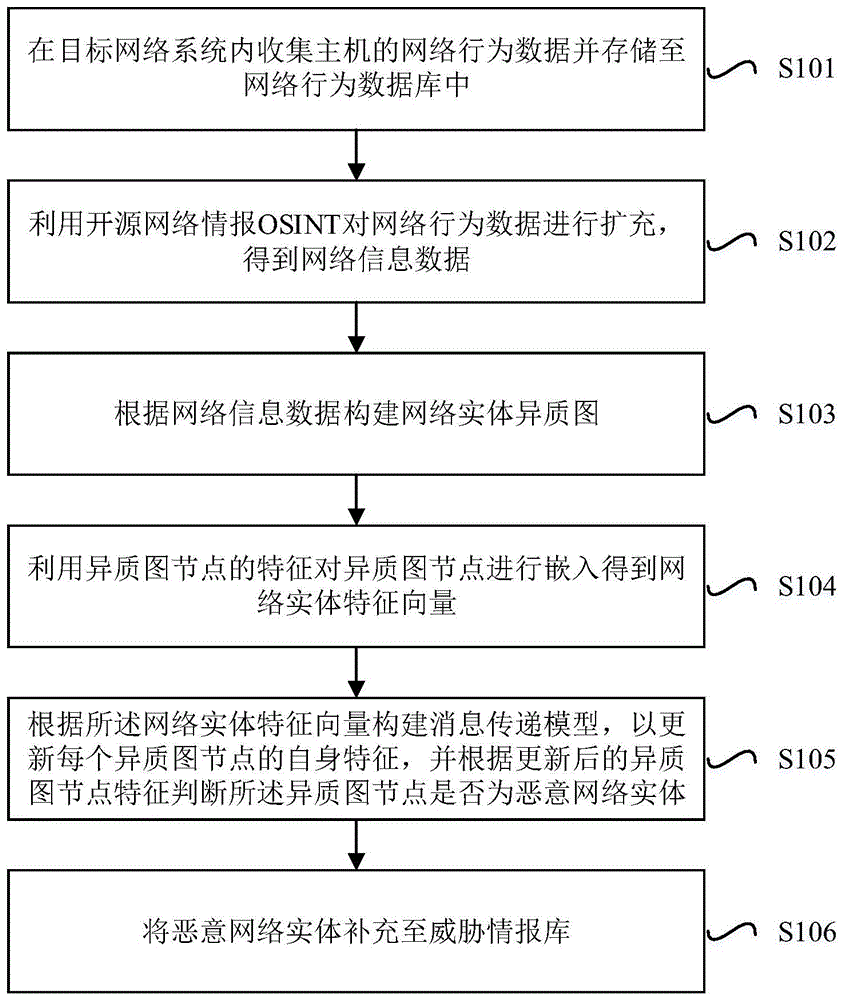
图1是根据本发明一实施方式的基于威胁情报和消息传递模型的高级持续性威胁检测的方法的总流程图;FIG. 1 is a general flowchart of a method for advanced persistent threat detection based on threat intelligence and message delivery model according to an embodiment of the present invention;
图2是根据本发明一实施方式的基于威胁情报和消息传递模型的高级持续性威胁检测的方法的具体流程图;FIG. 2 is a specific flowchart of a method for advanced persistent threat detection based on threat intelligence and message delivery model according to an embodiment of the present invention;
图3是根据本发明一实施方式的基于威胁情报和消息传递模型的高级持续性威胁检测的方法的整体框架图;FIG. 3 is an overall framework diagram of a method for advanced persistent threat detection based on threat intelligence and a messaging model according to an embodiment of the present invention;
图4是根据本发明一实施方式的基于威胁情报和消息传递模型的高级持续性威胁检测的装置的结构图;FIG. 4 is a structural diagram of a device for advanced persistent threat detection based on threat intelligence and message delivery models according to an embodiment of the present invention;
图5是根据本发明一实施方式的基于威胁情报和消息传递模型的高级持续性威胁检测的计算设备的硬件结构图。FIG. 5 is a hardware structural diagram of a computing device for advanced persistent threat detection based on threat intelligence and message passing model according to an embodiment of the present invention.
具体实施方式Detailed ways
下面结合附图,对本发明的具体实施方式进行详细描述,但应当理解本发明的保护范围并不受具体实施方式的限制。The specific embodiments of the present invention will be described in detail below in conjunction with the accompanying drawings, but it should be understood that the protection scope of the present invention is not limited by the specific embodiments.
除非另有其它明确表示,否则在整个说明书和权利要求书中,术语“包括”或其变换如“包含”或“包括有”等等将被理解为包括所陈述的元件或组成部分,而并未排除其它元件或其它组成部分。Unless expressly stated otherwise, throughout the specification and claims, the term "comprise" or variations thereof such as "includes" or "includes" and the like will be understood to include the stated elements or constituents, and not Other elements or other components are not excluded.
以下结合附图,详细说明本发明各实施例提供的技术方案。The technical solutions provided by various embodiments of the present invention will be described in detail below in conjunction with the accompanying drawings.
实施例1Example 1
如图1至图3所示,介绍本发明的一个实施例中基于威胁情报和消息传递模型的高级持续性威胁检测的方法,该方法包括如下步骤。As shown in FIG. 1 to FIG. 3 , an advanced persistent threat detection method based on threat intelligence and message delivery model in an embodiment of the present invention is introduced, and the method includes the following steps.
在步骤S101中,在目标网络系统内收集主机的网络行为数据并存储至网络行为数据库中。In step S101, the network behavior data of the host is collected in the target network system and stored in a network behavior database.
在目标网络系统内收集主机的网络行为数据并存储到数据库中,在主机内记录网络行为的形式主要为网络行为日志,包括DNS查询日志、DNS解析日志等,其中,网络行为数据包括但不限于主机的网络请求数据、域名解析数据以及网络响应数据。The network behavior data of the host is collected in the target network system and stored in the database. The main forms of recording network behavior in the host are network behavior logs, including DNS query logs, DNS resolution logs, etc., where network behavior data includes but not limited to The host's network request data, domain name resolution data, and network response data.
主机的网络请求数据,即主机对于域名或者IP的查询行为,通常记录在域名服务器中,可通过Sysmon等日志记录工具直接获得。域名解析数据以及网络响应数据等DNS RR记录,可通过开源工具Gieben DNS library获得。对于获取的网络行为数据,从中提取主机名、域名以及IP地址三类网络实体,同时提取主机查询域名、域名解析IP地址两类实体间关联关系。The host's network request data, that is, the host's query behavior for the domain name or IP, is usually recorded in the domain name server and can be directly obtained through logging tools such as Sysmon. DNS RR records such as domain name resolution data and network response data can be obtained through the open source tool Gieben DNS library. For the acquired network behavior data, three types of network entities, namely host name, domain name, and IP address, are extracted from it, and at the same time, the association relationship between the host query domain name and domain name resolution IP address is extracted.
在步骤S102中,利用开源网络情报OSINT对网络行为数据进行扩充,得到网络信息数据。In step S102, the network behavior data is expanded by using OSINT to obtain network information data.
利用开源网络情报OSINT对网络行为数据进行扩充,得到网络信息数据。在本实施例中,应用的开源网络情报包括Passive DNS记录、Whois记录以及X.509证书记录,其中Passive DNS记录补充域名与IP之间的映射关系,IP地址与IP范围之间的关系以及域名与子域名之间的关系;Whois记录提供注册者相关的信息,包括注册用户注册的域名以及注册用户注册的IP地址,同一攻击者会注册多个域名或IP作为进行网络攻击的基础设施资源;X.509证书通常被攻击者重用,此记录提供X.509证书的信息,包括X.509证书关联的域名,或者X.509证书关联的IP地址。此外,可以根据实际攻击检测需求更改或者添加其他类型的开源网络情报OSINT作为补充内容。Use open source network intelligence OSINT to expand network behavior data to obtain network information data. In this embodiment, the applied open source network intelligence includes Passive DNS records, Whois records, and X.509 certificate records, wherein the Passive DNS records complement the mapping relationship between domain names and IPs, the relationship between IP addresses and IP ranges, and domain names The relationship with the sub-domain name; the Whois record provides information about the registrant, including the domain name registered by the registered user and the IP address registered by the registered user. The same attacker will register multiple domain names or IPs as infrastructure resources for network attacks; X.509 certificates are usually reused by attackers. This record provides information about the X.509 certificate, including the domain name associated with the X.509 certificate, or the IP address associated with the X.509 certificate. In addition, other types of open source network intelligence OSINT can be changed or added as supplementary content according to actual attack detection requirements.
在步骤S103中,根据网络信息数据构建网络实体异质图。In step S103, a network entity heterogeneity graph is constructed according to the network information data.
根据开源网络情报OSINT扩充后的网络信息数据构建网络实体异质图Gh=(V,E,T,X),其中,V表示网络实体集合,即网络实体异质图中的节点,E表示节点之间的关系,在本实施例中表示网络实体关联边的集合。T=<Tv,Te>,为网络实体异质图的网络模式,其中,Tv为网络实体的类型集合,Te为网络实体关联边的类型集合,网络实体类型Tv包括但不限于主机、域名、IP地址、IP范围、X.509证书以及注册账户,网络关系类型Te包括但不限于域名映射IP、主机查询域名、IP属于IP范围、注册用户注册域名、注册用户注册IP、X.509证书关联域名以及X.509证书关联IP地址。Construct a network entity heterogeneity graph G h = (V, E, T, X) according to the network information data expanded by OSINT, where V represents a network entity set, that is, a node in the network entity heterogeneity graph, and E represents The relationship between nodes, in this embodiment, represents a set of associated edges of network entities. T=<T v , T e >, is the network model of the network entity heterogeneous graph, where T v is the type set of the network entity, T e is the type set of the associated edge of the network entity, and the network entity type T v includes but not Limited to hosts, domain names, IP addresses, IP ranges, X.509 certificates, and registered accounts, network relationship types include but not limited to domain name mapping IP, host query domain names, IP belonging to IP ranges, registered users registering domain names, registered users registering IPs , the domain name associated with the X.509 certificate, and the IP address associated with the X.509 certificate.
在步骤S104中,利用异质图节点的特征对异质图节点进行嵌入得到网络实体特征向量。In step S104, the features of the heterogeneous graph nodes are used to embed the heterogeneous graph nodes to obtain network entity feature vectors.
对于构建的网络实体异质图,提取其中的网络实体特征信息,网络实体特征分为实体标签特征以及实体局部特征,即网络实体本身的特征。实体标签特征分为良性实体标签特征和恶意实体标签特征:恶意实体标签通过网络威胁情报获得,即若某网络实体出现在公开可信的威胁情报中,则代表攻击组织曾使用过该网络实体,因此将该实体标记为恶意实体;良性实体标签通过公开的白名单获得,即若某实体出现在公开可信的白名单中,则将该实体标记为良性实体。此外,其余的网络实体均为无标签实体,后续将对此类实体的标签进行预测。实体本身的特征即实体局部特征,主要考虑域名的3类特征:域名类实体的字符分布特征、域名长度特征、域名与通用域名之间的最大Levenshtein距离特征。For the constructed network entity heterogeneity graph, the network entity feature information is extracted. The network entity features are divided into entity label features and entity local features, that is, the features of the network entity itself. Entity label features are divided into benign entity label features and malicious entity label features: malicious entity labels are obtained through network threat intelligence, that is, if a network entity appears in public and credible threat intelligence, it means that the attack organization has used the network entity. Therefore, the entity is marked as a malicious entity; the benign entity label is obtained through the public white list, that is, if an entity appears in the public and credible white list, the entity is marked as a benign entity. In addition, the remaining network entities are all unlabeled entities, and the labels of such entities will be predicted later. The characteristics of the entity itself are the local characteristics of the entity. Three types of characteristics of the domain name are mainly considered: the character distribution characteristics of the domain name entity, the length characteristic of the domain name, and the maximum Levenshtein distance characteristic between the domain name and the general domain name.
威胁情报的来源可以是:APTnotes等开源项目的提供的APT威胁报告,MITRE ATT&CK公司等提供的可信威胁情报信息。白名单的来源可以是:Cisco公司的top 100万的域名等。Sources of threat intelligence can be: APT threat reports provided by open source projects such as APTnotes, credible threat intelligence information provided by MITER ATT&CK, etc. The source of the white list can be: Cisco's top 1 million domain names, etc.
进一步地,网络实体局部特征表示为X∈Rn×m,n为节点数目,网络实体标签特征表示为Y∈Rn×c,c为标签类别数目,即恶意实体标签特征与良性实体标签特征,由于存在网络实体无标签,因此将带标签节点表示为one-hot向量,无标签节点表示为零向量。进而将网络实体标签特征嵌入到网络实体局部特征相同的空间中:Y∈Rn×c→Yd∈Rn×m,并将网络实体标签特征与网络实体局部特征相加得到网络实体特征向量,作为传播信息:(H0=X+Yd)∈Rn ×m。Further, the local feature of the network entity is expressed as X∈R n×m , n is the number of nodes, the label feature of the network entity is expressed as Y∈R n×c , and c is the number of label categories, that is, the label feature of malicious entity and the label feature of benign entity , since there are network entities without labels, the labeled nodes are represented as one-hot vectors, and the unlabeled nodes are represented as zero vectors. Then embed the network entity label features into the same space as the network entity local features: Y∈R n×c →Y d ∈R n×m , and add the network entity label features and network entity local features to obtain the network entity feature vector , as propagation information: (H 0 =X+Y d )∈R n ×m .
在步骤S105中,根据所述网络实体特征向量构建消息传递模型,以更新每个异质图节点的自身特征,并根据更新后的异质图节点特征判断所述异质图节点是否为恶意网络实体。In step S105, construct a message passing model according to the network entity feature vector to update the own characteristics of each heterogeneous graph node, and judge whether the heterogeneous graph node is a malicious network according to the updated heterogeneous graph node characteristics entity.
利用网络实体特征向量(H0=X+Yd)作为消息传递模型的输入训练模型,通过消息传递模型的迭代处理,使每个异质图节点学习邻居节点的特征并更新自身特征,从而根据更新后的节点特征自动判断节点是否为恶意网络实体并完成检测高级持续性威胁的目标。Using the network entity feature vector (H 0 =X+Y d ) as the input training model of the message passing model, through the iterative processing of the message passing model, each heterogeneous graph node can learn the characteristics of neighbor nodes and update its own characteristics, so that according to The updated node signature automatically judges whether the node is a malicious network entity and completes the goal of detecting advanced persistent threats.
在本实施例中,消息传递模型由标签传播算法LPA和添加了注意力机制的图神经网络算法GCN组成,标签传播算法在网络实体异质图中传播节点的标签信息,添加了注意力机制的图神经网络算法传播在网络实体异质图中节点的特征信息,消息传递模型为:In this embodiment, the message passing model is composed of the label propagation algorithm LPA and the graph neural network algorithm GCN with the attention mechanism added. The graph neural network algorithm propagates the characteristic information of nodes in the heterogeneous graph of network entities, and the message passing model is:
H(l+1)=σ(AH(l)W(l))H (l+1) = σ(AH (l) W (l) )
即:Right now:
H(l+1)=σ(Al(X+Yd)W(1)W(2)…W(l))H (l+1) = σ(A l (X+Y d )W (1) W (2) …W (l) )
=σ(AlXW+AlYdW)=σ(A l XW+A l Y d W)
其中,W=W(1)W(2)…W(l),A为注意力矩阵,AlXW进行特征传播,AlYdW进行标签传播。消息传递模型中的图神经网络可以使用传统的图卷积网络GCN。实验表明,在GCN基础上增加注意力机制可以取得更好的效果。Among them, W=W (1) W (2) …W (l) , A is the attention matrix, A l XW performs feature propagation, and A l Y d W performs label propagation. The graph neural network in the message passing model can use the traditional graph convolutional network GCN. Experiments show that adding attention mechanism on the basis of GCN can achieve better results.
为了防止标签泄漏问题,采用屏蔽标签预测的方法对模型进行训练:随机的将预设比例带标签的节点的标签特征向量转化为零向量表示为



其中,
在实际的预测阶段,将所有带标签节点的标签特征作为标签预测模型的输入,预测其余无标签的节点标签,从而可以识别出网络环境中的所有恶意网络实体,完成对APT攻击的检测,此外,通过预测得到的恶意网络实体可以进一步补充攻击组织的威胁情报信息。In the actual prediction stage, the label features of all labeled nodes are used as the input of the label prediction model to predict the labels of other unlabeled nodes, so that all malicious network entities in the network environment can be identified, and the detection of APT attacks can be completed. In addition, , the predicted malicious network entities can further supplement the threat intelligence information of the attacking organization.
在步骤S106中,将恶意网络实体补充至威胁情报库。In step S106, malicious network entities are added to the threat intelligence database.
根据本发明实施方式的基于威胁情报和消息传递模型的高级持续性威胁检测的方法及应用,其能够通过应用开源网络情报OSINT对收集到的网络行为数据进行补充,并根据补充后的数据构建网络实体异质图,在不同实体之间建立连接,充分利用了不易被攻击者改变的实体关联这一全局特征,提高了攻击者重用攻击资源的难度并扩大了攻击检测的范围;对特征进行嵌入得到节点的特征向量,这些特征被送入到消息传递模型中进行训练,每个节点通过标签信息的传播以及局部特征信息的传播可以聚合邻居节点的特征信息,最终完成对节点特征的更新,从而消息传递模型可完成对所有节点的恶意性与非恶意性判断,识别出所有当前网络环境中的恶意节点。基于消息传递模型,节点可自动化的更新自身特征并完成节点分类任务,提升了攻击检测的效率和恶意实体识别的准确率。According to the method and application of advanced persistent threat detection based on threat intelligence and message delivery model in the embodiment of the present invention, it can supplement the collected network behavior data by applying open source network intelligence OSINT, and build a network according to the supplemented data Entity heterogeneity graph, which establishes connections between different entities, makes full use of the global feature of entity association, which is not easy to be changed by attackers, increases the difficulty for attackers to reuse attack resources and expands the scope of attack detection; features are embedded The feature vectors of nodes are obtained, and these features are sent to the message passing model for training. Each node can aggregate the feature information of neighboring nodes through the propagation of label information and local feature information, and finally complete the update of node features, so that The message passing model can complete the judgment of maliciousness and non-maliciousness of all nodes, and identify all malicious nodes in the current network environment. Based on the message passing model, nodes can automatically update their own characteristics and complete node classification tasks, which improves the efficiency of attack detection and the accuracy of malicious entity identification.
根据本发明实施方式的基于威胁情报和消息传递模型的高级持续性威胁检测的方法及应用,其还能够通过利用威胁情报作为先验知识,获取网络实体的标签信息作为节点标签特征;通过对于网络实体自身特征的分析,获取网络实体的特征信息作为局部特征,同时利用节点的标签特征以及节点局部特征,有利于充分利用安全人员已掌握的攻击者信息进行主动地攻击检测,并且有助于发掘先前未知的恶意网络实体。According to the method and application of advanced persistent threat detection based on threat intelligence and message delivery model in the embodiment of the present invention, it can also obtain the label information of network entities as node label characteristics by using threat intelligence as prior knowledge; The analysis of the characteristics of the entity itself, obtaining the characteristic information of the network entity as a local feature, and using the label characteristics of the node and the local characteristics of the node at the same time, is conducive to making full use of the attacker information that the security personnel have mastered for active attack detection, and helps to discover A previously unknown malicious cyber entity.
如图4所示,介绍根据本发明具体实施方式的基于威胁情报和消息传递模型的高级持续性威胁检测的装置。As shown in FIG. 4 , an apparatus for advanced persistent threat detection based on threat intelligence and message delivery model according to a specific embodiment of the present invention is introduced.
在本发明的实施方式中,基于威胁情报和消息传递模型的高级持续性威胁检测的装置包括收集模块401、扩充模块402、构建模块403、嵌入模块404和判断模块405。In the embodiment of the present invention, the device for advanced persistent threat detection based on threat intelligence and message delivery model includes a
收集模块401,用于在目标网络系统内收集主机的网络行为数据并存储至网络行为数据库中,其中,网络行为数据包括但不限于主机的网络请求数据、域名解析数据、网络响应数据。The
扩充模块402,用于利用开源网络情报OSINT对网络行为数据进行扩充,得到网络信息数据,其中,开源网络情报OSINT包括但不限于Passive DNS、Whois记录、X.509证书记录。The
构建模块403,用于根据网络信息数据构建网络实体异质图,其中,异质图节点为网络信息数据中的网络实体,异质图边为实体关联关系。The
嵌入模块404,用于利用异质图节点的特征对异质图节点进行嵌入得到网络实体特征向量,其中,网络实体特征向量包括由威胁情报得到的实体标签特征和实体局部特征。The embedding
判断模块405,用于根据网络实体特征向量构建消息传递模型,以更新每个异质图节点的自身特征,并根据更新后的异质图节点特征判断异质图节点是否为恶意网络实体;若是,将恶意网络实体补充至威胁情报库。The judging
嵌入模块404还用于:将实体标签特征嵌入到与实体局部特征相同的空间中;以及将嵌入后的实体标签特征与实体局部特征相加得到网络实体特征向量。The embedding
判断模块405还用于:根据标签传播算法和添加了注意力机制的图神经网络算法构建消息传递模型,以更新每个异质图节点的自身特征;其中,通过标签传播算法传播实体标签特征,通过添加了注意力机制的图神经网络算法传播实体局部特征。The judging
判断模块405还用于:将预设比例带标签的异质图节点的实体标签特征转化为零向量;以及通过网络实体局部特征、未转化的带标签的异质图节点的实体标签特征和注意力矩阵构建标签预测模型,以预测无标签网络实体的实体标签特征。The judging
构建模块403还用于:Gh=(V,E,T,X),其中,V表示网络实体集合,E表示网络实体关联边的集合,X={xi|vi∈V}表示所有网络实体的特征集合,T=<Tv,Te>表示网络实体异质图的网络模式,Tv为网络实体的类型集合,Te为网络实体关联边的类型集合,满足|Tv|+|Te|>2。The
在本实施例中,实体标签特征包括良性实体标签特征和恶意实体标签特征,其中,在威胁情报库中出现的网络实体的标签特征被标记为恶意实体标签特征,在网络中公开的白名单中出现的网络实体的标签特征被标记为良性实体标签特征;以及实体局部特征包括但不限于域名类实体的字符分布特征、域名长度特征、域名与通用域名之间的最大Levenshtein距离特征。网络实体的类型集合包括但不限于主机、域名、IP地址,所述网络实体关联边的类型集合包括但不限于IP与域名的映射、主机查询域名。In this embodiment, the entity label features include benign entity label features and malicious entity label features, wherein the label features of network entities appearing in the threat intelligence library are marked as malicious entity label features, and are listed in the whitelist disclosed in the network The label features of the emerging network entities are marked as benign entity label features; and entity local features include but not limited to character distribution features of domain name entities, domain name length features, and maximum Levenshtein distance features between domain names and general domain names. The type set of the network entity includes but not limited to host, domain name, IP address, and the type set of the associated edge of the network entity includes but not limited to the mapping between IP and domain name, and host query domain name.
图5示出了根据本说明书的实施例的用于基于威胁情报和消息传递模型的高级持续性威胁检测的计算设备50的硬件结构图。如图5所示,计算设备50可以包括至少一个处理器501、存储器502(例如非易失性存储器)、内存503和通信接口504,并且至少一个处理器501、存储器502、内存503和通信接口504经由总线505连接在一起。至少一个处理器501执行在存储器502中存储或编码的至少一个计算机可读指令。FIG. 5 shows a hardware structure diagram of a computing device 50 for advanced persistent threat detection based on threat intelligence and messaging models according to an embodiment of the present specification. As shown in FIG. 5 , computing device 50 may include at least one processor 501, memory 502 (such as non-volatile memory), memory 503 and communication interface 504, and at least one processor 501, memory 502, memory 503 and communication interface 504 are connected together via a bus 505 . At least one processor 501 executes at least one computer readable instruction stored or encoded in memory 502 .
应该理解,在存储器502中存储的计算机可执行指令当执行时使得至少一个处理器501进行本说明书的各个实施例中以上结合图1-5描述的各种操作和功能。It should be understood that the computer-executable instructions stored in the memory 502 when executed cause the at least one processor 501 to perform various operations and functions described above in conjunction with FIGS. 1-5 in various embodiments of the present specification.
在本说明书的实施例中,计算设备50可以包括但不限于:个人计算机、服务器计算机、工作站、桌面型计算机、膝上型计算机、笔记本计算机、移动计算设备、智能电话、平板计算机、蜂窝电话、个人数字助理(PDA)、手持装置、消息收发设备、可佩戴计算设备、消费电子设备等等。In an embodiment of the present description, computing device 50 may include, but is not limited to, a personal computer, server computer, workstation, desktop computer, laptop computer, notebook computer, mobile computing device, smart phone, tablet computer, cellular phone, Personal Digital Assistants (PDAs), Handheld Devices, Messaging Devices, Wearable Computing Devices, Consumer Electronics, and more.
根据一个实施例,提供了一种比如机器可读介质的程序产品。机器可读介质可以具有指令(即,上述以软件形式实现的元素),该指令当被机器执行时,使得机器执行本说明书的各个实施例中以上结合图1-5描述的各种操作和功能。具体地,可以提供配有可读存储介质的系统或者装置,在该可读存储介质上存储着实现上述实施例中任一实施例的功能的软件程序代码,且使该系统或者装置的计算机或处理器读出并执行存储在该可读存储介质中的指令。According to one embodiment, a program product, such as a machine-readable medium, is provided. The machine-readable medium may have instructions (that is, the above-mentioned elements implemented in software), which, when executed by a machine, cause the machine to perform various operations and functions described above in conjunction with FIGS. 1-5 in various embodiments of this specification. . Specifically, a system or device equipped with a readable storage medium can be provided, on which a software program code for realizing the functions of any one of the above embodiments is stored, and the computer or device of the system or device can The processor reads and executes the instructions stored in the readable storage medium.
根据本发明实施方式的基于威胁情报和消息传递模型的高级持续性威胁检测的方法及应用,其能够通过应用开源网络情报OSINT对收集到的网络行为数据进行补充,并根据补充后的数据构建网络实体异质图,在不同实体之间建立连接,充分利用了不易被攻击者改变的实体关联这一全局特征,提高了攻击者重用攻击资源的难度并扩大了攻击检测的范围;对特征进行嵌入得到节点的特征向量,这些特征被送入到消息传递模型中进行训练,每个节点通过标签信息的传播以及局部特征信息的传播可以聚合邻居节点的特征信息,最终完成对节点特征的更新,从而消息传递模型可完成对所有节点的恶意性与非恶意性判断,识别出所有当前网络环境中的恶意节点。基于消息传递模型,节点可自动化的更新自身特征并完成节点分类任务,提升了攻击检测的效率和恶意实体识别的准确率。According to the method and application of advanced persistent threat detection based on threat intelligence and message delivery model in the embodiment of the present invention, it can supplement the collected network behavior data by applying open source network intelligence OSINT, and build a network according to the supplemented data Entity heterogeneity graph, which establishes connections between different entities, makes full use of the global feature of entity association, which is not easy to be changed by attackers, increases the difficulty for attackers to reuse attack resources and expands the scope of attack detection; features are embedded The feature vectors of nodes are obtained, and these features are sent to the message passing model for training. Each node can aggregate the feature information of neighboring nodes through the propagation of label information and local feature information, and finally complete the update of node features, so that The message passing model can complete the judgment of maliciousness and non-maliciousness of all nodes, and identify all malicious nodes in the current network environment. Based on the message passing model, nodes can automatically update their own characteristics and complete node classification tasks, which improves the efficiency of attack detection and the accuracy of malicious entity identification.
根据本发明实施方式的基于威胁情报和消息传递模型的高级持续性威胁检测的方法及应用,其还能够通过利用威胁情报作为先验知识,获取网络实体的标签信息作为节点标签特征;通过对于网络实体自身特征的分析,获取网络实体的特征信息作为局部特征,同时利用节点的标签特征以及节点局部特征,有利于充分利用安全人员已掌握的攻击者信息进行主动地攻击检测,并且有助于发掘先前未知的恶意网络实体。According to the method and application of advanced persistent threat detection based on threat intelligence and message delivery model in the embodiment of the present invention, it can also obtain the label information of network entities as node label characteristics by using threat intelligence as prior knowledge; The analysis of the characteristics of the entity itself, obtaining the characteristic information of the network entity as a local feature, and using the label characteristics of the node and the local characteristics of the node at the same time, is conducive to making full use of the attacker information that the security personnel have mastered for active attack detection, and helps to discover A previously unknown malicious cyber entity.
本领域内的技术人员应明白,本发明的实施例可提供为方法、系统、或计算机程序产品。因此,本发明可采用完全硬件实施例、完全软件实施例、或结合软件和硬件方面的实施例的形式。而且,本发明可采用在一个或多个其中包含有计算机可用程序代码的计算机可用存储介质(包括但不限于磁盘存储器、CD-ROM、光学存储器等)上实施的计算机程序产品的形式。Those skilled in the art should understand that the embodiments of the present invention may be provided as methods, systems, or computer program products. Accordingly, the present invention can take the form of an entirely hardware embodiment, an entirely software embodiment, or an embodiment combining software and hardware aspects. Furthermore, the present invention may take the form of a computer program product embodied on one or more computer-usable storage media (including but not limited to disk storage, CD-ROM, optical storage, etc.) having computer-usable program code embodied therein.
本发明是参照根据本发明实施例的方法、设备(系统)、和计算机程序产品的流程图和/或方框图来描述的。应理解可由计算机程序指令实现流程图和/或方框图中的每一流程和/或方框、以及流程图和/或方框图中的流程和/或方框的结合。可提供这些计算机程序指令到通用计算机、专用计算机、嵌入式处理机或其他可编程数据处理设备的处理器以产生一个机器,使得通过计算机或其他可编程数据处理设备的处理器执行的指令产生用于实现在流程图一个流程或多个流程和/或方框图一个方框或多个方框中指定的功能的装置。The present invention is described with reference to flowchart illustrations and/or block diagrams of methods, apparatus (systems), and computer program products according to embodiments of the invention. It should be understood that each procedure and/or block in the flowchart and/or block diagram, and a combination of procedures and/or blocks in the flowchart and/or block diagram can be realized by computer program instructions. These computer program instructions may be provided to a general purpose computer, special purpose computer, embedded processor, or processor of other programmable data processing equipment to produce a machine such that the instructions executed by the processor of the computer or other programmable data processing equipment produce a An apparatus for realizing the functions specified in one or more procedures of the flowchart and/or one or more blocks of the block diagram.
这些计算机程序指令也可存储在能引导计算机或其他可编程数据处理设备以特定方式工作的计算机可读存储器中,使得存储在该计算机可读存储器中的指令产生包括指令装置的制造品,该指令装置实现在流程图一个流程或多个流程和/或方框图一个方框或多个方框中指定的功能。These computer program instructions may also be stored in a computer-readable memory capable of directing a computer or other programmable data processing apparatus to operate in a specific manner, such that the instructions stored in the computer-readable memory produce an article of manufacture comprising instruction means, the instructions The device realizes the function specified in one or more procedures of the flowchart and/or one or more blocks of the block diagram.
这些计算机程序指令也可装载到计算机或其他可编程数据处理设备上,使得在计算机或其他可编程设备上执行一系列操作步骤以产生计算机实现的处理,从而在计算机或其他可编程设备上执行的指令提供用于实现在流程图一个流程或多个流程和/或方框图一个方框或多个方框中指定的功能的步骤。These computer program instructions can also be loaded onto a computer or other programmable data processing device, causing a series of operational steps to be performed on the computer or other programmable device to produce a computer-implemented process, thereby The instructions provide steps for implementing the functions specified in the flow chart or blocks of the flowchart and/or the block or blocks of the block diagrams.
前述对本发明的具体示例性实施方案的描述是为了说明和例证的目的。这些描述并非想将本发明限定为所公开的精确形式,并且很显然,根据上述教导,可以进行很多改变和变化。对示例性实施例进行选择和描述的目的在于解释本发明的特定原理及其实际应用,从而使得本领域的技术人员能够实现并利用本发明的各种不同的示例性实施方案以及各种不同的选择和改变。本发明的范围意在由权利要求书及其等同形式所限定。The foregoing descriptions of specific exemplary embodiments of the present invention have been presented for purposes of illustration and description. These descriptions are not intended to limit the invention to the precise form disclosed, and obviously many modifications and variations are possible in light of the above teaching. The exemplary embodiments were chosen and described in order to explain the specific principles of the invention and its practical application, thereby enabling others skilled in the art to make and use various exemplary embodiments of the invention, as well as various Choose and change. It is intended that the scope of the invention be defined by the claims and their equivalents.
Claims (9)
Priority Applications (1)
| Application Number | Priority Date | Filing Date | Title |
|---|---|---|---|
| CN202210412622.XA CN114884703B (en) | 2022-04-19 | 2022-04-19 | Advanced Persistent Threat Detection Method Based on Threat Intelligence and Message Passing Model |
Applications Claiming Priority (1)
| Application Number | Priority Date | Filing Date | Title |
|---|---|---|---|
| CN202210412622.XA CN114884703B (en) | 2022-04-19 | 2022-04-19 | Advanced Persistent Threat Detection Method Based on Threat Intelligence and Message Passing Model |
Publications (2)
| Publication Number | Publication Date |
|---|---|
| CN114884703A CN114884703A (en) | 2022-08-09 |
| CN114884703B true CN114884703B (en) | 2023-02-28 |
Family
ID=82671229
Family Applications (1)
| Application Number | Title | Priority Date | Filing Date |
|---|---|---|---|
| CN202210412622.XA Active CN114884703B (en) | 2022-04-19 | 2022-04-19 | Advanced Persistent Threat Detection Method Based on Threat Intelligence and Message Passing Model |
Country Status (1)
| Country | Link |
|---|---|
| CN (1) | CN114884703B (en) |
Families Citing this family (5)
| Publication number | Priority date | Publication date | Assignee | Title |
|---|---|---|---|---|
| CN116467438A (en) * | 2022-11-21 | 2023-07-21 | 国家计算机网络与信息安全管理中心 | A Threat Intelligence Attribution Method Based on Graph Attention Mechanism |
| CN115604032B (en) * | 2022-12-01 | 2023-04-28 | 南京南瑞信息通信科技有限公司 | Method and system for detecting complex multi-step attack of power system |
| CN116155548B (en) * | 2022-12-22 | 2024-08-23 | 新浪技术(中国)有限公司 | Threat identification method and system |
| CN116112230B (en) * | 2022-12-30 | 2024-08-20 | 安天科技集团股份有限公司 | Method, device, equipment and storage medium for determining ip white list |
| CN116668076A (en) * | 2023-04-27 | 2023-08-29 | 中国科学院信息工程研究所 | Malicious domain name detection method and device based on heterogeneous graph robust adversarial learning |
Citations (3)
| Publication number | Priority date | Publication date | Assignee | Title |
|---|---|---|---|---|
| WO2015134008A1 (en) * | 2014-03-05 | 2015-09-11 | Foreground Security | Automated internet threat detection and mitigation system and associated methods |
| CN113139468A (en) * | 2021-04-24 | 2021-07-20 | 西安交通大学 | Video abstract generation method fusing local target features and global features |
| CN113609234A (en) * | 2021-06-17 | 2021-11-05 | 国家计算机网络与信息安全管理中心 | Network entity behavior association construction method and system |
Family Cites Families (2)
| Publication number | Priority date | Publication date | Assignee | Title |
|---|---|---|---|---|
| US11089045B2 (en) * | 2015-10-28 | 2021-08-10 | Qomplx, Inc. | User and entity behavioral analysis with network topology enhancements |
| US10609079B2 (en) * | 2015-10-28 | 2020-03-31 | Qomplx, Inc. | Application of advanced cybersecurity threat mitigation to rogue devices, privilege escalation, and risk-based vulnerability and patch management |
-
2022
- 2022-04-19 CN CN202210412622.XA patent/CN114884703B/en active Active
Patent Citations (3)
| Publication number | Priority date | Publication date | Assignee | Title |
|---|---|---|---|---|
| WO2015134008A1 (en) * | 2014-03-05 | 2015-09-11 | Foreground Security | Automated internet threat detection and mitigation system and associated methods |
| CN113139468A (en) * | 2021-04-24 | 2021-07-20 | 西安交通大学 | Video abstract generation method fusing local target features and global features |
| CN113609234A (en) * | 2021-06-17 | 2021-11-05 | 国家计算机网络与信息安全管理中心 | Network entity behavior association construction method and system |
Non-Patent Citations (6)
| Title |
|---|
| IP威胁情报收集系统的设计与实现;唐攀等;《信息通信》(第12期);全文 * |
| SDNMS: A software defined network measurement system for NFV networks;Tianqi Zhang;《China Communications》;全文 * |
| Towards Identifying Human Actions, Intent, and Severity of APT Attacks Applying Deception Techniques - An Experiment;Joel Chacon;《2020 International Conference on Cyber Security and Protection of Digital Services (Cyber Security)》;全文 * |
| 域名滥用行为检测技术综述;樊昭杉;《计算机研究与发展》;全文 * |
| 基于双层异质集成学习器的入侵检测方法;凌玥;《信息安全学报》;全文 * |
| 网络入侵检测技术综述;蹇诗婕;《信息安全学报》;全文 * |
Also Published As
| Publication number | Publication date |
|---|---|
| CN114884703A (en) | 2022-08-09 |
Similar Documents
| Publication | Publication Date | Title |
|---|---|---|
| CN114884703B (en) | Advanced Persistent Threat Detection Method Based on Threat Intelligence and Message Passing Model | |
| Alam et al. | Looking beyond iocs: Automatically extracting attack patterns from external cti | |
| Jia et al. | {MAGIC}: Detecting advanced persistent threats via masked graph representation learning | |
| Namanya et al. | Similarity hash based scoring of portable executable files for efficient malware detection in IoT | |
| Wang et al. | An evolutionary study of IoT malware | |
| Gu et al. | Convolution Neural Network‐Based Higher Accurate Intrusion Identification System for the Network Security and Communication | |
| Lin et al. | Introductory computer forensics | |
| Ren et al. | APT attack detection based on graph convolutional neural networks | |
| JP7111025B2 (en) | Estimation device, estimation method and program | |
| Pratomo et al. | Data encryption and anonymization techniques for enhanced information system security and privacy | |
| US12468810B2 (en) | Classifying cybersecurity threats using machine learning on non-euclidean data | |
| Wang et al. | HANDOM: Heterogeneous attention network model for malicious domain detection | |
| Spartalis et al. | Balancing xai with privacy and security considerations | |
| CN119106141A (en) | A method for constructing network threat knowledge graph based on SecBABC | |
| Alqahtany et al. | Enhanced Grey Wolf Optimization (EGWO) and random forest based mechanism for intrusion detection in IoT networks | |
| Kara | Cyber-espionage malware attacks detection and analysis: A case study | |
| Seth et al. | MIDS: Metaheuristic based intrusion detection system for cloud using k-NN and MGWO | |
| Al‐Sharif et al. | Enhancing cloud security: A study on ensemble learning‐based intrusion detection systems | |
| Nalinipriya et al. | Ransomware recognition in blockchain network using water moth flame optimization‐aware DRNN | |
| CN116846645A (en) | Network intrusion detection method and application based on self-supervised collaborative comparative learning | |
| US10242318B2 (en) | System and method for hierarchical and chained internet security analysis | |
| CN115473658B (en) | Network attack detection method, device, equipment and storage medium | |
| CN114598509B (en) | A method and device for determining vulnerability results | |
| CN115134095B (en) | Botnet control end detection method and device, storage medium and electronic equipment | |
| Deepthi et al. | Multi-level Data Integrity Model with Dual Immutable Digital Key Based Forensic Analysis in IoT Network |
Legal Events
| Date | Code | Title | Description |
|---|---|---|---|
| PB01 | Publication | ||
| PB01 | Publication | ||
| SE01 | Entry into force of request for substantive examination | ||
| SE01 | Entry into force of request for substantive examination | ||
| GR01 | Patent grant | ||
| GR01 | Patent grant |