CN114841297A - DTO separation-based multi-satellite passive positioning scattered target classification method - Google Patents
DTO separation-based multi-satellite passive positioning scattered target classification method Download PDFInfo
- Publication number
- CN114841297A CN114841297A CN202210781535.1A CN202210781535A CN114841297A CN 114841297 A CN114841297 A CN 114841297A CN 202210781535 A CN202210781535 A CN 202210781535A CN 114841297 A CN114841297 A CN 114841297A
- Authority
- CN
- China
- Prior art keywords
- dto
- grouping
- sequence
- target
- positioning
- Prior art date
- Legal status (The legal status is an assumption and is not a legal conclusion. Google has not performed a legal analysis and makes no representation as to the accuracy of the status listed.)
- Granted
Links
Images

Classifications
-
- G—PHYSICS
- G06—COMPUTING OR CALCULATING; COUNTING
- G06F—ELECTRIC DIGITAL DATA PROCESSING
- G06F18/00—Pattern recognition
- G06F18/20—Analysing
- G06F18/24—Classification techniques
- G06F18/243—Classification techniques relating to the number of classes
- G06F18/2431—Multiple classes
-
- G—PHYSICS
- G01—MEASURING; TESTING
- G01S—RADIO DIRECTION-FINDING; RADIO NAVIGATION; DETERMINING DISTANCE OR VELOCITY BY USE OF RADIO WAVES; LOCATING OR PRESENCE-DETECTING BY USE OF THE REFLECTION OR RERADIATION OF RADIO WAVES; ANALOGOUS ARRANGEMENTS USING OTHER WAVES
- G01S19/00—Satellite radio beacon positioning systems; Determining position, velocity or attitude using signals transmitted by such systems
- G01S19/38—Determining a navigation solution using signals transmitted by a satellite radio beacon positioning system
- G01S19/39—Determining a navigation solution using signals transmitted by a satellite radio beacon positioning system the satellite radio beacon positioning system transmitting time-stamped messages, e.g. GPS [Global Positioning System], GLONASS [Global Orbiting Navigation Satellite System] or GALILEO
- G01S19/42—Determining position
-
- G—PHYSICS
- G06—COMPUTING OR CALCULATING; COUNTING
- G06F—ELECTRIC DIGITAL DATA PROCESSING
- G06F16/00—Information retrieval; Database structures therefor; File system structures therefor
- G06F16/20—Information retrieval; Database structures therefor; File system structures therefor of structured data, e.g. relational data
- G06F16/24—Querying
- G06F16/245—Query processing
- G06F16/2455—Query execution
- G06F16/24553—Query execution of query operations
- G06F16/24554—Unary operations; Data partitioning operations
- G06F16/24556—Aggregation; Duplicate elimination
-
- G—PHYSICS
- G06—COMPUTING OR CALCULATING; COUNTING
- G06F—ELECTRIC DIGITAL DATA PROCESSING
- G06F16/00—Information retrieval; Database structures therefor; File system structures therefor
- G06F16/20—Information retrieval; Database structures therefor; File system structures therefor of structured data, e.g. relational data
- G06F16/24—Querying
- G06F16/245—Query processing
- G06F16/2458—Special types of queries, e.g. statistical queries, fuzzy queries or distributed queries
- G06F16/2474—Sequence data queries, e.g. querying versioned data
-
- G—PHYSICS
- G06—COMPUTING OR CALCULATING; COUNTING
- G06F—ELECTRIC DIGITAL DATA PROCESSING
- G06F16/00—Information retrieval; Database structures therefor; File system structures therefor
- G06F16/20—Information retrieval; Database structures therefor; File system structures therefor of structured data, e.g. relational data
- G06F16/29—Geographical information databases
-
- G—PHYSICS
- G06—COMPUTING OR CALCULATING; COUNTING
- G06F—ELECTRIC DIGITAL DATA PROCESSING
- G06F18/00—Pattern recognition
- G06F18/20—Analysing
- G06F18/23—Clustering techniques
-
- G—PHYSICS
- G06—COMPUTING OR CALCULATING; COUNTING
- G06F—ELECTRIC DIGITAL DATA PROCESSING
- G06F18/00—Pattern recognition
- G06F18/20—Analysing
- G06F18/25—Fusion techniques
- G06F18/251—Fusion techniques of input or preprocessed data
-
- Y—GENERAL TAGGING OF NEW TECHNOLOGICAL DEVELOPMENTS; GENERAL TAGGING OF CROSS-SECTIONAL TECHNOLOGIES SPANNING OVER SEVERAL SECTIONS OF THE IPC; TECHNICAL SUBJECTS COVERED BY FORMER USPC CROSS-REFERENCE ART COLLECTIONS [XRACs] AND DIGESTS
- Y02—TECHNOLOGIES OR APPLICATIONS FOR MITIGATION OR ADAPTATION AGAINST CLIMATE CHANGE
- Y02A—TECHNOLOGIES FOR ADAPTATION TO CLIMATE CHANGE
- Y02A90/00—Technologies having an indirect contribution to adaptation to climate change
- Y02A90/10—Information and communication technologies [ICT] supporting adaptation to climate change, e.g. for weather forecasting or climate simulation
Landscapes
- Engineering & Computer Science (AREA)
- Theoretical Computer Science (AREA)
- Data Mining & Analysis (AREA)
- Physics & Mathematics (AREA)
- General Physics & Mathematics (AREA)
- General Engineering & Computer Science (AREA)
- Databases & Information Systems (AREA)
- Remote Sensing (AREA)
- Bioinformatics & Computational Biology (AREA)
- Life Sciences & Earth Sciences (AREA)
- Evolutionary Biology (AREA)
- Computer Vision & Pattern Recognition (AREA)
- Bioinformatics & Cheminformatics (AREA)
- Radar, Positioning & Navigation (AREA)
- Artificial Intelligence (AREA)
- Evolutionary Computation (AREA)
- Computational Linguistics (AREA)
- Computer Networks & Wireless Communication (AREA)
- Fuzzy Systems (AREA)
- Mathematical Physics (AREA)
- Probability & Statistics with Applications (AREA)
- Software Systems (AREA)
- Position Fixing By Use Of Radio Waves (AREA)
Abstract
The invention discloses a multi-satellite passive positioning scattered target classification method based on DTO separation, which relates to the technical field of satellite positioning, and is used for accumulating DTO data of a time slice and carrying out data preprocessing; respectively clustering target DTOs under each double-satellite combination of each single positioning system to obtain DTO grouping sequences; fusing DTO grouping sequences of a multi-positioning system under the same double-star combination to obtain a new DTO grouping; and clustering the target position points based on the new DTO grouping, eliminating mirror image points, and outputting a sequence of each target position point. The invention provides a multi-target positioning scattered point clustering method based on DTO separation by utilizing the time difference distribution characteristics of different targets passing through satellites, so as to support automatic target clustering of positioning scattered points under the condition of multiple satellites and multiple targets and solve the problem of target classification which cannot be solved by a traditional signal parameter distinguishing method and a position space-time association method.
Description
Technical Field
The invention relates to the technical field of satellite signal monitoring, in particular to a DTO separation-based multi-satellite passive positioning scattered target classification method.
Background
The conventional multi-sensor multi-target tracking method mainly aims at high-frequency (each target is measured for multiple times per second) and high-precision positioning (kilometer or even meter level) scenes obtained by sensor means such as active radars, sonars or passive positioning of land-based, sea-based and air-based bases, and realizes continuous tracking of multiple targets obtained by the multi-sensor through steps of target classification, track generation, track association and the like. The existing multi-satellite positioning technology mainly positions SCPC (single channel per carrier) signals, and can conveniently realize target separation and clustering according to a signal parameter distinguishing method under certain conditions. Currently, with the development of satellite communication technology, a multi-frequency time division multiple access MF-TDMA system is widely used, such as a very Small Aperture satellite terminal station vsat (very Small Aperture satellite terminal station), frequency points, power and time slots of a terminal in one-time communication process in multi-target networking communication are dynamically allocated and adjusted at any time, and an original method for carrying out target clustering by means of a signal parameter distinguishing method is not applicable; meanwhile, due to low positioning frequency and poor positioning precision, the traditional method for classifying by depending on the space-time relation of the target cannot be applied.
Disclosure of Invention
The invention aims to provide a DTO separation-based multi-satellite passive positioning scattered target classification method, which is used for solving the problems that in the prior art, target classification cannot be carried out aiming at multi-frequency time division multiple access, and in the traditional classification method depending on the space-time relation of targets, the positioning frequency is low and the positioning accuracy is poor.
The invention solves the problems through the following technical scheme:
a DTO separation-based multi-satellite passive positioning scattered target classification method comprises the following steps:
step S10, accumulating DTO data of a time slice and carrying out data preprocessing;
s20, clustering target DTOs under each double-satellite combination of each single positioning system respectively to obtain DTO grouping sequences;
s30, fusing DTO grouping sequences of the multi-positioning system under the same double-star combination to obtain a new DTO grouping;
and step S40, clustering the target position points based on the new DTO grouping, eliminating mirror image points and outputting a sequence of each target position point.
The step S20 specifically includes:
step S21, clustering the preprocessed DTO data to obtain a plurality of current DTO grouping sequences, wherein each current DTO grouping sequence corresponds to a target and a target ID;
step S22, traversing the current DTO packet, and performing curve fitting correlation on the current DTO packet sequence and the historical DTO packet sequence;
and step S23, extracting the historical DTO packet sequence with the highest association degree with the current DTO packet sequence, and if the association degree of the current DTO packet sequence and the historical DTO packet sequence reaches a threshold value, adding the current DTO packet sequence into the corresponding historical DTO packet sequence to obtain the DTO packet sequence.
The step S30 specifically includes:
traversing the DTO packet sequence of the multi-positioning system, and if the DTO packet sequence is overlapped with the historical DTO packet sequence of the same double-star source in time and the DTO packet sequence has the following conditions, combining to obtain a new DTO packet:
(1) the DTO grouping sequence is overlapped with the historical DTO grouping sequence of the same double-star source in time, and the DTO grouping sequence is close to the historical DTO grouping sequence of the same double-star source;
(2) the DTO packet sequence is not overlapped with the historical DTO packet sequence of the same double-star source in time, but the relevance of the DTO packet sequence and the historical DTO packet sequence of the same double-star source reaches a threshold value.
The step S40 specifically includes:
step S41, traversing all DTO packet sequences, and performing space-time association on position point sequences corresponding to the DTO packet sequences to form two groups of position point sets;
and step S42, eliminating the position points with high target speed and low aggregation degree, and outputting the position point sequence of each target.
The preprocessing comprises the steps of carrying out time unit conversion, invalid value elimination, wild value elimination, data extraction, data grouping, data numbering and data sequencing on positioning data according to the signal-to-noise ratio (SNR), the positioning geometric error (GDOP) and the satellite combination, and avoiding the interference of large errors on subsequent processing.
Compared with the prior art, the invention has the following advantages and beneficial effects:
the invention provides a classification method of a multi-satellite passive positioning scattered target based on DTO (differential time offset, arrival time difference) separation, which is used for preprocessing positioning data of a multi-positioning system accessed in real time, such as format normalization, wild value elimination, data screening and the like, so that the interference of large errors on subsequent processing is avoided; clustering DTO parameters to form a target DTO group in the target classification process, and performing fusion processing on the target DTO group to realize multi-target separation based on DTO clustering; and then, the discrimination of the real points and the mirror image points of the target is realized through the geographic space-time association, clustering and aggregation analysis of the longitude and latitude of the target, so that the aim of eliminating the mirror image points is fulfilled. Under the condition that a multi-satellite passive time difference positioning system positions MF-TDMA signals to generate multi-target positioning scattered points, the method can still realize target classification, and solves the problem that the original method for clustering targets by relying on a signal parameter distinguishing method is not applicable because frequency points, power and time slots are dynamically distributed and adjusted at any time in the primary communication process of a terminal in multi-target networking communication; meanwhile, the problem that the traditional method for classifying by depending on the space-time relation of the target cannot be applied due to low positioning frequency and poor positioning precision is solved.
Drawings
FIG. 1 is a flow chart of the present invention.
Detailed Description
The present invention will be described in further detail with reference to examples, but the embodiments of the present invention are not limited thereto.
Example 1:
with reference to fig. 1, a DTO separation-based multi-satellite passive positioning scatter target classification method includes:
step S10, accumulating DTO data of a time slice and carrying out data preprocessing;
s20, clustering target DTOs under each double-satellite combination of each single positioning system respectively to obtain DTO grouping sequences;
s30, fusing DTO grouping sequences of the multi-positioning system under the same double-star combination to obtain a new DTO grouping;
and step S40, clustering the target position points based on the new DTO grouping, eliminating mirror image points and outputting a sequence of each target position point.
The paths through which the signals emitted by the radiation source reach the two satellites are different, so that the time when the signals reach the two satellites are different, the time difference of arrival (DTO) of the signals reaching the two satellites is obtained by performing correlation processing on the signals synchronously acquired by the two satellites, the distance difference R1 of the signals reaching the two satellites corresponding to the radiation source is constant to a point R1, the point is a hyperboloid with the two satellites as focuses, one hyperboloid in the hyperboloid is intersected with the spherical surface of the earth to form a closed-loop curve, and one surface of the earth facing the two satellites is a curve (time difference line). More than two time difference lines can be calculated through three or more satellites, and the two time difference lines intersect on the earth surface to form two intersection points (one of the intersection points is a real point, and the other intersection point is a mirror image point), so that the target can be positioned.
Due to the fact that the distances from the plurality of radiation sources at different positions to the two satellites are different, time differences of multiple targets passing through the two satellites at different positions are different. Multiple targets with different positions may exist in the same time receiving bandwidth of two satellites, and corresponding different time differences are generated for the targets. Thus, from the time difference data of two stars, a plurality of different radiation sources at different positions received by the two stars can be classified. Because the position change of the target is continuous and non-abrupt, the distance difference of the target to two satellites is also continuous and non-abrupt, and the DTO reflected by the time difference is continuous and is close to linear change in a short time. Therefore, the invention relates the same radiation source to the target according to the time difference data of two stars by utilizing the characteristic of continuous change of DTO. For a moving target, on the premise that the time difference and the ephemeris have no error, the image points formed by intersection in the change process of the two time difference lines can continuously change more severely relative to the real points, so that the image points are removed by utilizing the characteristic of severe change of the image points.
The method backtracks to a positioning link, provides a multi-target positioning scattered point clustering method based on DTO separation by utilizing the time difference distribution characteristics of different targets passing through satellites, and finally realizes the classification of low-frequency and low-precision positioning scattered point targets under the condition of multi-satellite passive positioning by combining the steps of target DTO sequence fusion, target position point clustering, target mirror image point elimination and the like.
The step S20 specifically includes:
step S21, clustering the preprocessed DTO data to obtain a plurality of current DTO grouping sequences, wherein each current DTO grouping sequence corresponds to a target and a target ID;
step S22, traversing the current DTO packet, and performing curve fitting correlation on the current DTO packet sequence and the historical DTO packet sequence;
and step S23, extracting the historical DTO packet sequence with the highest association degree with the current DTO packet sequence, and if the association degree of the current DTO packet sequence and the historical DTO packet sequence reaches a threshold value, adding the current DTO packet sequence into the corresponding historical DTO packet sequence to obtain the DTO packet sequence.
In this embodiment, a k-means algorithm is adopted to cluster DTO data, and the flow is as follows:
1. randomly creating k measurement points of the DTO data as an initial centroid, where k represents the number of DTO packets, i.e., the number of targets, and the value of k can be determined by a priori information.
2. Calculating a loss function:
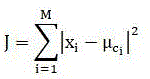
wherein Is shown as
 The number of the samples is one,
 is that
 The cluster to which the cluster belongs to is,
 represents the center point corresponding to the cluster, and M represents the total number of samples.
3. Let t =0, 1, 2, 3 … … be the number of iteration steps, the subsequent steps are repeated until the loss function converges:
4. for each sample Assign it to the nearest cluster
 ;
;
5. Recalculating the center point of each new cluster generated in 4;
6. if the new variation amplitude of the central point is smaller than the set threshold value or the maximum iteration step number is reached, ending the algorithm and outputting the clustering result, otherwise, returning to the step 4.
According to the clustering algorithm, a plurality of current DTO packets (each packet corresponds to a target and corresponds to a target ID) can be obtained; then, for each DTO packet, traversing the current DTO packet, and performing curve fitting association on the current DTO packet and the historical DTO packet in the latest period of time, wherein the curve fitting association is realized by adopting a dynamic time warping algorithm (DTW), and the dynamic time warping algorithm mainly comprises the following steps:
inputting two time sequences respectively as And
And the sequence length is respectively
 And
And constructing a distance matrix
 Of which the first
 Each element stores
 And
And is that it is desired to find a path
 Wherein K satisfies:
 such that:
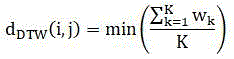
wherein, k =1, 2, … …, K being a point in the path WTotal step length of walking to the terminal point;
 total length of path from i to j;
the specific calculation steps are as follows:
calculating a distance matrix A corresponding to each sampling point of the two sequences in pairs, wherein To represent
 And
And the euclidean distance of (c).
Calculate a distance matrix Then, a slave matrix is found
 And (3) a path from the upper left corner to the lower right corner enables the sum of elements on the path to be minimum, the length of the shortest path can be obtained by using a dynamic planning algorithm, and the shortest total distance from the upper left corner to the lower right corner of the distance matrix is calculated according to a recursion formula and an initial condition.
The starting conditions of the dynamic programming algorithm are as follows:
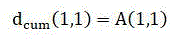
the dynamic programming recurrence formula is as follows:
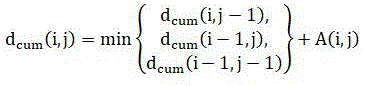
wherein Is the shortest path length from point i to point j;
the dynamic programming recurrence formula indicates that the shortest path of the current element must be the length of the shortest path from the previous element plus the value of the current element. The former element has three possibilities, the shortest path among the three possibilities is selected, and finally the sum of the shortest paths is calculated to be used as a basis for measuring the two curves.
And if the association degree exceeds a set association degree threshold value, adding the current DTO packet into the corresponding historical DTO packet, otherwise, distributing a new target ID to the current DTO packet, and realizing target clustering based on DTO under the same double-star combination.
And carrying out the same processing on the DTO measurement value sets (DTO data) under all the double-star combinations under all the multi-positioning systems to finish the target DTO clustering under the double-star combination of each single-positioning system.
The step S30 specifically includes:
traversing the DTO packet sequence of the multi-positioning system, and if the DTO packet sequence is overlapped with the historical DTO packet sequence of the same double-star source in time and the DTO packet sequence has the following conditions, combining to obtain a new DTO packet:
(1) the DTO grouping sequence is overlapped with the historical DTO grouping sequence of the same double-star source in time, and the DTO grouping sequence is close to the historical DTO grouping sequence of the same double-star source;
(2) the DTO packet sequence is not overlapped with the historical DTO packet sequence of the same double-star source in time, but the relevance of the DTO packet sequence and the historical DTO packet sequence of the same double-star source reaches a threshold value.
The same double-star in the multi-positioning system can be fused with the target DTO of the same double-star source under the single-positioning system in a grouping mode to generate a fused DTO group. And performing simultaneous section combination and front-back time section continuation processing on a plurality of DTO sequences of all DTO groups by utilizing the rule that the time difference of the same target relative to two same satellites is approximate at the same moment and the values of the front-back adjacent moments are approximate to form the fusion of the plurality of DTO sequences of the same target. Traversing all DTO packets under the same double-star combination, and calculating the time overlapping relation between each DTO packet and other DTO packets; combining two DTO packets which are overlapped in time and have the DTO value closeness smaller than a set closeness threshold to form the same DTO packet; and performing continuous fusion processing on two DTO groups which are adjacent in time and have the DTO value with the curve fitting degree smaller than a set threshold to form the same DTO group, and realizing DTO group fusion under the same double-satellite combination in different multi-satellite positioning systems, namely target fusion clustering.
The step S40 specifically includes:
step S41, traversing all DTO packet sequences, and performing space-time correlation on position point sequences corresponding to the DTO packet sequences to form two groups of position point sets;
and step S42, eliminating the position points with high target speed and low concentration degree, namely the mirror image points, grouping the position point groups with high concentration degree and low average navigational speed into real target points, and outputting the position point sequences of each target.
And clustering target position points corresponding to the DTO grouping sequences to generate two position point group groups. By utilizing the characteristics of continuous position change of the target in continuous time and respective aggregation of the mirror image points and the real points in the geographic space, the positioning longitude and latitude parameters (each time comprises the real points and the mirror image points) corresponding to each DTO group are subjected to spatiotemporal association and classification of the position of the geographic space target, and the position points corresponding to each DTO group sequence are classified into two position point group groups. One type is real point location data, and the other type is mirror point location data.
And (5) eliminating the image points of the target mirror. And respectively calculating the navigation speed and the navigation track point concentration of the two groups of position groups of each target, grouping the position groups with high concentration and low average navigation speed into real target points by utilizing the characteristics of speed difference and concentration difference of mirror image points and the target points in geographic space, and outputting a target position point sequence after eliminating the mirror image points of the other group.
The preprocessing comprises the steps of carrying out time unit conversion, invalid value elimination, wild value elimination, data extraction, data grouping, data numbering and data sequencing on positioning data according to a signal-to-noise ratio (SNR), a positioning geometric error (GDOP) and a satellite combination, wherein the wild value elimination mainly utilizes an abnormal value detection algorithm in statistics to eliminate obvious sampling abnormal values (data which are seriously deviated from rules presented by most data).
Although the invention has been described herein with reference to the illustrated embodiments thereof, which are intended to be the only preferred embodiments of the invention, it is not intended that the invention be limited thereto, since many other modifications and embodiments will be apparent to those skilled in the art and will be within the spirit and scope of the principles of this disclosure.
Claims (5)
1. A multi-satellite passive positioning scatter target classification method based on DTO separation is characterized by comprising the following steps:
step S10, accumulating the arrival time difference DTO data of a time slice, and carrying out data preprocessing;
s20, clustering target DTOs under each double-satellite combination of each single positioning system respectively to obtain DTO grouping sequences;
s30, fusing DTO grouping sequences of the multi-positioning system under the same double-star combination to obtain a new DTO grouping;
and step S40, clustering the target position points based on the new DTO grouping, eliminating mirror image points and outputting a sequence of each target position point.
2. The DTO separation-based multi-satellite passive positioning scatter target classification method according to claim 1, wherein the step S20 specifically includes:
step S21, clustering the preprocessed DTO data to obtain a plurality of current DTO grouping sequences, wherein each current DTO grouping sequence corresponds to a target and a target ID;
step S22, traversing the current DTO packet sequence, and performing curve fitting correlation on the current DTO packet sequence and the historical DTO packet sequence;
and step S23, extracting the historical DTO grouping sequence with the highest degree of association with the current DTO grouping sequence, and if the degree of association of the current DTO grouping sequence and the historical DTO grouping sequence reaches a threshold value, adding the current DTO grouping sequence into the corresponding historical DTO grouping sequence to obtain the DTO grouping sequence.
3. The DTO separation-based multi-satellite passive positioning scatter target classification method according to claim 2, wherein the step S30 specifically includes:
traversing the DTO packet sequence of the multi-positioning system, and if the DTO packet sequence is overlapped with the historical DTO packet sequence of the same double-star source in time and the DTO packet sequence has the following conditions, combining to obtain a new DTO packet:
(1) the DTO grouping sequence is overlapped with the historical DTO grouping sequence of the same double-star source in time, and the DTO grouping sequence is close to the historical DTO grouping sequence of the same double-star source;
(2) the DTO packet sequence is not overlapped with the historical DTO packet sequence of the same double-star source in time, but the relevance of the DTO packet sequence and the historical DTO packet sequence of the same double-star source reaches a threshold value.
4. The DTO separation-based multi-satellite passive positioning scatter target classification method according to claim 3, wherein the step S40 specifically comprises:
step S41, traversing all DTO packet sequences, and performing space-time association on position point sequences corresponding to the DTO packet sequences to form two groups of position point sets;
and step S42, eliminating the position points with high target speed and low aggregation degree, and outputting the position point sequence of each target.
5. The DTO separation-based multi-satellite passive positioning scattered target classification method as claimed in claim 1, wherein the preprocessing is to perform time unit conversion, invalid value elimination, outlier elimination, data extraction, data grouping, data numbering and data sorting on the positioning data according to SNR, GDOP and satellite combination.
Priority Applications (1)
| Application Number | Priority Date | Filing Date | Title |
|---|---|---|---|
| CN202210781535.1A CN114841297B (en) | 2022-07-05 | 2022-07-05 | DTO separation-based multi-satellite passive positioning scattered target classification method |
Applications Claiming Priority (1)
| Application Number | Priority Date | Filing Date | Title |
|---|---|---|---|
| CN202210781535.1A CN114841297B (en) | 2022-07-05 | 2022-07-05 | DTO separation-based multi-satellite passive positioning scattered target classification method |
Publications (2)
| Publication Number | Publication Date |
|---|---|
| CN114841297A true CN114841297A (en) | 2022-08-02 |
| CN114841297B CN114841297B (en) | 2022-09-06 |
Family
ID=82573763
Family Applications (1)
| Application Number | Title | Priority Date | Filing Date |
|---|---|---|---|
| CN202210781535.1A Active CN114841297B (en) | 2022-07-05 | 2022-07-05 | DTO separation-based multi-satellite passive positioning scattered target classification method |
Country Status (1)
| Country | Link |
|---|---|
| CN (1) | CN114841297B (en) |
Citations (17)
| Publication number | Priority date | Publication date | Assignee | Title |
|---|---|---|---|---|
| CN102608573A (en) * | 2012-03-29 | 2012-07-25 | 清华大学 | Mutual-fuzzy-accumulation passive location method based on multiple observing points |
| CN103592626A (en) * | 2013-11-20 | 2014-02-19 | 中国船舶重工集团公司第七二四研究所 | Time difference window calculating method for wide-wave-beam time difference positioning system |
| CN104155650A (en) * | 2014-08-14 | 2014-11-19 | 电子科技大学 | Object tracking method based on trace point quality evaluation by entropy weight method |
| CN104238353A (en) * | 2014-09-28 | 2014-12-24 | 郑州威科姆科技股份有限公司 | Time signal switching and integrating method on basis of automatic detection of time difference of multiple constellation systems |
| WO2017046914A1 (en) * | 2015-09-17 | 2017-03-23 | 三菱電機株式会社 | Positioning satellite selecting device, positioning device, positioning system, positioning information transmitting device and positioning terminal |
| CN106597365A (en) * | 2016-11-18 | 2017-04-26 | 中国船舶重工集团公司第七二四研究所 | Complex electronic signal time-difference positioning method based on time-domain clustering |
| CN107229033A (en) * | 2017-05-16 | 2017-10-03 | 电子科技大学 | Multiple target reaching time-difference localization method based on height dimension sectioning search |
| CN108089148A (en) * | 2017-12-14 | 2018-05-29 | 电子科技大学 | A kind of passive track-corelation direction cross positioning method based on time difference information |
| CN109901107A (en) * | 2019-03-07 | 2019-06-18 | 西安电子科技大学 | A time difference positioning method, device, computer equipment and readable storage medium |
| CN109946721A (en) * | 2017-12-20 | 2019-06-28 | 慧众行知科技(北京)有限公司 | Mirror point removing method and system in a kind of satellite positioning |
| CN110700029A (en) * | 2019-09-29 | 2020-01-17 | 清华大学 | Track ride comfort testing method and system |
| US20200182959A1 (en) * | 2018-03-27 | 2020-06-11 | Polte Corporation | Multi-path mitigation in tracking objects using compressed rf data |
| CN112597820A (en) * | 2020-12-10 | 2021-04-02 | 南京长峰航天电子科技有限公司 | Target clustering method based on radar signal sorting |
| CN112698272A (en) * | 2019-10-22 | 2021-04-23 | 华东交通大学 | Multi-sound-source positioning method for eliminating correlation ambiguity based on two-step screening |
| US20210152978A1 (en) * | 2019-11-14 | 2021-05-20 | Thales | Satelite locating and communication and system for a fixed radio terminal on the ground using at least one non-geostionary satelite |
| CN113933876A (en) * | 2021-11-16 | 2022-01-14 | 西南电子技术研究所(中国电子科技集团公司第十研究所) | Multi-satellite communication time difference positioning data fusion processing method |
| CN114415112A (en) * | 2022-03-30 | 2022-04-29 | 中国科学院空天信息创新研究院 | Multi-satellite multi-radiation source data dynamic association method and device and electronic equipment |
-
2022
- 2022-07-05 CN CN202210781535.1A patent/CN114841297B/en active Active
Patent Citations (17)
| Publication number | Priority date | Publication date | Assignee | Title |
|---|---|---|---|---|
| CN102608573A (en) * | 2012-03-29 | 2012-07-25 | 清华大学 | Mutual-fuzzy-accumulation passive location method based on multiple observing points |
| CN103592626A (en) * | 2013-11-20 | 2014-02-19 | 中国船舶重工集团公司第七二四研究所 | Time difference window calculating method for wide-wave-beam time difference positioning system |
| CN104155650A (en) * | 2014-08-14 | 2014-11-19 | 电子科技大学 | Object tracking method based on trace point quality evaluation by entropy weight method |
| CN104238353A (en) * | 2014-09-28 | 2014-12-24 | 郑州威科姆科技股份有限公司 | Time signal switching and integrating method on basis of automatic detection of time difference of multiple constellation systems |
| WO2017046914A1 (en) * | 2015-09-17 | 2017-03-23 | 三菱電機株式会社 | Positioning satellite selecting device, positioning device, positioning system, positioning information transmitting device and positioning terminal |
| CN106597365A (en) * | 2016-11-18 | 2017-04-26 | 中国船舶重工集团公司第七二四研究所 | Complex electronic signal time-difference positioning method based on time-domain clustering |
| CN107229033A (en) * | 2017-05-16 | 2017-10-03 | 电子科技大学 | Multiple target reaching time-difference localization method based on height dimension sectioning search |
| CN108089148A (en) * | 2017-12-14 | 2018-05-29 | 电子科技大学 | A kind of passive track-corelation direction cross positioning method based on time difference information |
| CN109946721A (en) * | 2017-12-20 | 2019-06-28 | 慧众行知科技(北京)有限公司 | Mirror point removing method and system in a kind of satellite positioning |
| US20200182959A1 (en) * | 2018-03-27 | 2020-06-11 | Polte Corporation | Multi-path mitigation in tracking objects using compressed rf data |
| CN109901107A (en) * | 2019-03-07 | 2019-06-18 | 西安电子科技大学 | A time difference positioning method, device, computer equipment and readable storage medium |
| CN110700029A (en) * | 2019-09-29 | 2020-01-17 | 清华大学 | Track ride comfort testing method and system |
| CN112698272A (en) * | 2019-10-22 | 2021-04-23 | 华东交通大学 | Multi-sound-source positioning method for eliminating correlation ambiguity based on two-step screening |
| US20210152978A1 (en) * | 2019-11-14 | 2021-05-20 | Thales | Satelite locating and communication and system for a fixed radio terminal on the ground using at least one non-geostionary satelite |
| CN112597820A (en) * | 2020-12-10 | 2021-04-02 | 南京长峰航天电子科技有限公司 | Target clustering method based on radar signal sorting |
| CN113933876A (en) * | 2021-11-16 | 2022-01-14 | 西南电子技术研究所(中国电子科技集团公司第十研究所) | Multi-satellite communication time difference positioning data fusion processing method |
| CN114415112A (en) * | 2022-03-30 | 2022-04-29 | 中国科学院空天信息创新研究院 | Multi-satellite multi-radiation source data dynamic association method and device and electronic equipment |
Non-Patent Citations (7)
| Title |
|---|
| FAN WANG 等: ""Optimal control for discrete‐time singular stochastic systems with input delay"", 《OPTIMAL CONTROL APPLICATIONS AND METHODS 》 * |
| KYUNGHYUN LEE 等: ""Optimised solution for hybrid TDOA/AOA‐based geolocation using Nelder‐Mead simplex method"", 《IET RADAR SONAR AND NAVIGATION》 * |
| 任源博: ""多星时差无源定位系统研究"", 《中国优秀硕士学位论文全文数据库 (信息科技辑)》 * |
| 张勇等: "低轨双星无源定位算法及定位精度分析", 《中国惯性技术学报》 * |
| 王雨琦 等: ""多星分布式无源相干定位方法"", 《中国空间科学技术 网络首发》 * |
| 贺文娇: ""基于知识模型的目标识别专家系统"", 《电讯技术》 * |
| 黄静 等: ""单星测频静态目标无源定位研究"", 《中国空间科学技术》 * |
Also Published As
| Publication number | Publication date |
|---|---|
| CN114841297B (en) | 2022-09-06 |
Similar Documents
| Publication | Publication Date | Title |
|---|---|---|
| KR102116824B1 (en) | Positioning system based on deep learnin and construction method thereof | |
| CN1441909A (en) | Transponder landing system | |
| US8949021B2 (en) | Probe data processing | |
| Prieto et al. | Performance evaluation of 3D-LOCUS advanced acoustic LPS | |
| US20110001659A1 (en) | Device and method for the improved directional estimation and decoding by means of secondary radar signals | |
| ES2361776T3 (en) | USE OF PRECISION GEOMETRIC DILUTION (GDOP) TO SELECT THE BEST RECEIVER GROUP IN A MULTILATERATION SYSTEM. | |
| CN105704652B (en) | Fingerprint base acquisition and optimization method in a kind of positioning of WLAN/ bluetooth | |
| US20130027251A1 (en) | System and Method for Direction Finding and Geolocation of Emitters Based on Line-of-Bearing Intersections | |
| ZA200209867B (en) | Transponder landing system. | |
| WO2005116682A1 (en) | An arrangement for accurate location of objects | |
| US11361667B2 (en) | Systems and methods for exploiting ADS-B frequency of arrival for flight surveillance, cyber security and meteorology | |
| CN110557191B (en) | Terminal positioning method and device in low-earth-orbit satellite mobile communication system | |
| US20210011109A1 (en) | Method and apparatus for determining the direction of arrival of radio or acoustic signals, and for transmitting directional radio or acoustic signals | |
| CN117950407B (en) | Group topology control method based on formation dynamic array type interference source positioning | |
| CN115280173A (en) | Method for locating signal sources in a wireless network | |
| Ali et al. | Harvesting indoor positioning accuracy by exploring multiple features from received signal strength vector | |
| CN108226912B (en) | Sparse network-based non-contact object perception positioning method and system | |
| US20140266911A1 (en) | Directional pruning of transmitters to improve position determination | |
| Svertoka et al. | Evaluation of real-life LoRaWAN localization: Accuracy dependencies analysis based on outdoor measurement datasets | |
| US20050096845A1 (en) | Intelligent passive navigation system for back-up and verification of gps | |
| CN114841297B (en) | DTO separation-based multi-satellite passive positioning scattered target classification method | |
| US20180172794A1 (en) | System and method for rank estimation of electromagnetic emitters | |
| RU2757197C1 (en) | Method for determining the coordinates of a radio emitting object in the working area of a multipositional passive radio engineering complex and apparatus for implementation thereof | |
| KR20230164950A (en) | Apparatus and method for detecting road pothole | |
| CN118566830B (en) | Low-speed small-target flying object detection method and system based on radio detection |
Legal Events
| Date | Code | Title | Description |
|---|---|---|---|
| PB01 | Publication | ||
| PB01 | Publication | ||
| SE01 | Entry into force of request for substantive examination | ||
| SE01 | Entry into force of request for substantive examination | ||
| GR01 | Patent grant | ||
| GR01 | Patent grant |