CN114827006B - Data service data sending method, interphone, system and storage medium - Google Patents
Data service data sending method, interphone, system and storage medium Download PDFInfo
- Publication number
- CN114827006B CN114827006B CN202210704897.0A CN202210704897A CN114827006B CN 114827006 B CN114827006 B CN 114827006B CN 202210704897 A CN202210704897 A CN 202210704897A CN 114827006 B CN114827006 B CN 114827006B
- Authority
- CN
- China
- Prior art keywords
- routing path
- data
- forwarding
- node device
- address
- Prior art date
- Legal status (The legal status is an assumption and is not a legal conclusion. Google has not performed a legal analysis and makes no representation as to the accuracy of the status listed.)
- Active
Links
- 238000000034 method Methods 0.000 title claims abstract description 70
- 230000011664 signaling Effects 0.000 claims description 38
- 230000006855 networking Effects 0.000 claims description 23
- 238000004891 communication Methods 0.000 claims description 14
- 230000005540 biological transmission Effects 0.000 claims description 11
- 238000004590 computer program Methods 0.000 claims description 8
- 230000000977 initiatory effect Effects 0.000 claims 1
- 230000004044 response Effects 0.000 abstract description 12
- 230000008569 process Effects 0.000 description 13
- 238000010586 diagram Methods 0.000 description 8
- 230000009471 action Effects 0.000 description 3
- 238000012545 processing Methods 0.000 description 3
- 230000006870 function Effects 0.000 description 2
- 230000007246 mechanism Effects 0.000 description 2
- 235000008694 Humulus lupulus Nutrition 0.000 description 1
- 238000013500 data storage Methods 0.000 description 1
- 230000003111 delayed effect Effects 0.000 description 1
- 239000000835 fiber Substances 0.000 description 1
- 238000009432 framing Methods 0.000 description 1
- 230000003993 interaction Effects 0.000 description 1
- 238000012986 modification Methods 0.000 description 1
- 230000004048 modification Effects 0.000 description 1
- 230000003287 optical effect Effects 0.000 description 1
- 230000000737 periodic effect Effects 0.000 description 1
- 230000002093 peripheral effect Effects 0.000 description 1
- 238000011084 recovery Methods 0.000 description 1
- 239000004065 semiconductor Substances 0.000 description 1
- 239000007787 solid Substances 0.000 description 1
- 238000012546 transfer Methods 0.000 description 1
Images



Classifications
-
- H—ELECTRICITY
- H04—ELECTRIC COMMUNICATION TECHNIQUE
- H04L—TRANSMISSION OF DIGITAL INFORMATION, e.g. TELEGRAPHIC COMMUNICATION
- H04L45/00—Routing or path finding of packets in data switching networks
- H04L45/02—Topology update or discovery
-
- H—ELECTRICITY
- H04—ELECTRIC COMMUNICATION TECHNIQUE
- H04L—TRANSMISSION OF DIGITAL INFORMATION, e.g. TELEGRAPHIC COMMUNICATION
- H04L41/00—Arrangements for maintenance, administration or management of data switching networks, e.g. of packet switching networks
- H04L41/08—Configuration management of networks or network elements
- H04L41/0803—Configuration setting
- H04L41/0823—Configuration setting characterised by the purposes of a change of settings, e.g. optimising configuration for enhancing reliability
-
- H—ELECTRICITY
- H04—ELECTRIC COMMUNICATION TECHNIQUE
- H04L—TRANSMISSION OF DIGITAL INFORMATION, e.g. TELEGRAPHIC COMMUNICATION
- H04L41/00—Arrangements for maintenance, administration or management of data switching networks, e.g. of packet switching networks
- H04L41/08—Configuration management of networks or network elements
- H04L41/0803—Configuration setting
- H04L41/0823—Configuration setting characterised by the purposes of a change of settings, e.g. optimising configuration for enhancing reliability
- H04L41/0836—Configuration setting characterised by the purposes of a change of settings, e.g. optimising configuration for enhancing reliability to enhance reliability, e.g. reduce downtime
-
- H—ELECTRICITY
- H04—ELECTRIC COMMUNICATION TECHNIQUE
- H04L—TRANSMISSION OF DIGITAL INFORMATION, e.g. TELEGRAPHIC COMMUNICATION
- H04L5/00—Arrangements affording multiple use of the transmission path
- H04L5/003—Arrangements for allocating sub-channels of the transmission path
- H04L5/0053—Allocation of signalling, i.e. of overhead other than pilot signals
-
- H—ELECTRICITY
- H04—ELECTRIC COMMUNICATION TECHNIQUE
- H04Q—SELECTING
- H04Q5/00—Selecting arrangements wherein two or more subscriber stations are connected by the same line to the exchange
- H04Q5/24—Selecting arrangements wherein two or more subscriber stations are connected by the same line to the exchange for two-party-line systems
-
- H—ELECTRICITY
- H04—ELECTRIC COMMUNICATION TECHNIQUE
- H04W—WIRELESS COMMUNICATION NETWORKS
- H04W4/00—Services specially adapted for wireless communication networks; Facilities therefor
- H04W4/06—Selective distribution of broadcast services, e.g. multimedia broadcast multicast service [MBMS]; Services to user groups; One-way selective calling services
- H04W4/08—User group management
-
- H—ELECTRICITY
- H04—ELECTRIC COMMUNICATION TECHNIQUE
- H04W—WIRELESS COMMUNICATION NETWORKS
- H04W40/00—Communication routing or communication path finding
- H04W40/02—Communication route or path selection, e.g. power-based or shortest path routing
-
- H—ELECTRICITY
- H04—ELECTRIC COMMUNICATION TECHNIQUE
- H04W—WIRELESS COMMUNICATION NETWORKS
- H04W76/00—Connection management
- H04W76/10—Connection setup
- H04W76/14—Direct-mode setup
-
- H—ELECTRICITY
- H04—ELECTRIC COMMUNICATION TECHNIQUE
- H04W—WIRELESS COMMUNICATION NETWORKS
- H04W84/00—Network topologies
- H04W84/18—Self-organising networks, e.g. ad-hoc networks or sensor networks
Landscapes
- Engineering & Computer Science (AREA)
- Computer Networks & Wireless Communication (AREA)
- Signal Processing (AREA)
- Multimedia (AREA)
- Data Exchanges In Wide-Area Networks (AREA)
Abstract
The disclosure relates to a data service data sending method, an interphone, a system and a storage medium. Receiving target data related to data services sent by other node equipment in the same network; acquiring a routing path in a routing path field in target data; when the forwarding node equipment is determined to meet the forwarding condition based on the routing path, setting the address in the source address field in the target data as the address of the forwarding node equipment to obtain updated target data; the updated target data is transmitted on the control channel. Because the target data carries the routing path from the starting node device to the target node device, each node can judge whether the data needs to be forwarded according to the routing path in the target data without returning a response, thereby greatly reducing the delay of the data forwarding service, removing the unstable factor of link establishment failure and improving the success rate of link establishment.
Description
Technical Field
The present disclosure relates to the field of communications, and in particular, to a data service data transmission method, an intercom, a system and a storage medium.
Background
Under the interphone direct mode, the realization of service functions such as ad hoc network, self recovery, multi-hop forwarding, emergency request forwarding and the like can be realized only by a plurality of interphones without base stations and transfer platform equipment.
When the current interphone forwards data services such as position information and the like in the ad hoc network, the current node equipment is required to forward a request signaling in a control channel, after other node equipment in a signal coverage range of the current node equipment receives the forwarding request signaling, whether the current node equipment can forward the data services or not is confirmed, when the current node equipment can forward the data services is confirmed, a response is returned to the current node equipment, and a forwarding path of the data services is gradually established in such a way so that the data services can be forwarded on the forwarding path.
Disclosure of Invention
The inventor finds that waiting for establishing a forwarding path through a response mechanism and then forwarding the data service results in a relatively long delay in forwarding the data service, the timeliness of sending the data service cannot be guaranteed, and a plurality of unstable factors are introduced due to interference of radio frequency signals in a multi-stage response requesting process, so that the success rate of link establishment is greatly reduced.
The invention provides a data service data sending method, an interphone, a system and a storage medium, which are used for solving the problems that the forwarding of a data service is delayed greatly and the timeliness of the data service sending cannot be guaranteed when a forwarding path is established through a response mechanism and then the data service is forwarded, and the unstable factor of link establishment failure caused by the fact that a certain node in a link cannot receive a forwarding request or response is removed, so that the success rate of link establishment is greatly improved.
In a first aspect, a data service data sending method is provided, which is applied to a forwarding node device, and includes:
receiving target data related to data services sent by other node equipment in the same network; the target data comprises a source address field, a routing path field and a data service data field related to the initial node equipment; the source address field is used for identifying the address of the node device sending the target data, and the routing path field is used for identifying the routing path from the starting node device to the target node device;
obtaining a routing path in the routing path field in the target data;
when the forwarding node equipment is determined to meet the forwarding condition based on the routing path, setting the address in the source address field in the target data as the address of the forwarding node equipment to obtain updated target data;
transmitting the updated target data on a control channel.
Optionally, the determining, based on the routing path, that the forwarding node device satisfies a forwarding condition includes:
determining that the forwarding node device satisfies a forwarding condition when it is determined that the target data is from a last-hop node device of the forwarding node device based on the routing path.
Optionally, the determining that the target data is from a previous-hop node device of the forwarding node device based on the routing path includes:
when the address in the source address field in the target data is determined to be adjacent to the address of the forwarding node device in the routing path, determining that the target data comes from a last hop node device of the forwarding node device.
Optionally, determining that the address in the source address field in the destination data and the address of the forwarding node device are adjacent in the routing path includes:
judging whether a forwarding order corresponding to the address in the source address field in the target data exists in the routing path;
if yes, when the forwarding order of the forwarding node equipment is determined to be different from the forwarding order corresponding to the address in the source address field in the target data by a minimum order forwarding interval, determining that the address in the source address field in the target data is adjacent to the address of the forwarding node equipment in the routing path;
if not, when the address in the source address field in the target data is determined to be the same as the address of the starting node device in the routing path and the forwarding sequence of the forwarding node device in the routing path is first, determining that the address in the source address field in the target data and the address of the forwarding node device are adjacent in the routing path.
Optionally, the obtaining a routing path in the routing path field in the target data includes:
acquiring the working state of the forwarding node equipment;
determining the frame type of a frame where a routing path field is located in the target data based on the working state;
and acquiring the routing path from the routing path field of the frame type corresponding to the target data.
Optionally, the frame type comprises a control frame or a data frame.
Optionally, the data service is a location information service, a short message service, or a short data service.
Optionally, the routing path is obtained from a local routing table for the originating node device.
In a second aspect, a data service data sending method is provided, which is applied to an originating node device, and includes:
when data related to data service which needs to be sent to target node equipment in the same group of networks are obtained, a routing path from the starting node equipment to the target node equipment is obtained from a local routing table; the data related to the data service comprises data service data related to the starting node equipment;
filling the address of the starting node device, the data related to the data service and the routing path into a source address field, a data service data field and a routing path field respectively to obtain target data; the source address field is used for identifying the address of the node equipment which sends the target data;
and sending the target data on a control channel, so that the forwarding node equipment updates the address in the source address field in the target data to be the address of the forwarding node equipment and sends the updated target data when the forwarding node equipment is determined to meet the forwarding condition based on the routing path.
Optionally, before the step of filling the address of the start node device, the data related to the data service, and the routing path into a source address field, a data service data field, and a routing path field, respectively, to obtain target data, the method further includes:
acquiring the working state of the starting node equipment;
determining the frame type of the frame where the routing path field is located based on the working state;
the filling the routing path into the routing path field specifically includes: a routing path field in a frame of a corresponding frame type populates the routing path.
Optionally, the frame type comprises a control frame or a data frame.
Optionally, the routing path field includes an originating node device address field and at least one forwarding node address field;
the populating the routing path into a routing path field includes:
acquiring a node address of each forwarding node device in the routing path, a forwarding order of each forwarding node, and an address of the starting node device;
and filling the address of the starting node device into the address field of the starting node device, and filling the address of each forwarding node device into the address field of the forwarding node device according to the forwarding order.
Optionally, the data service is a location information service, a short message service, or a short data service.
Optionally, before the obtaining the routing path from the originating node device to the destination node device from the local routing table, the method further includes:
receiving a first broadcast signaling frame broadcasted by other node equipment in the same networking stage, wherein the broadcast signaling frame comprises path information from the other node equipment to a target node;
adding the other node devices to the path information to form the local routing table;
generating and broadcasting a second broadcast signaling frame, the second broadcast signaling frame including the local routing table information.
In a third aspect, a first interphone is provided, where the first interphone is a forwarding node device, and includes:
the first receiving module is used for receiving target data related to data services sent by other node equipment in the same group network; the target data comprises a source address field, a routing path field and a data service data field related to the initial node equipment; the source address field is used for identifying the address of the node device sending the target data, and the routing path field is used for identifying the routing path from the starting node device to the target node device;
a first obtaining module, configured to obtain a routing path in the routing path field in the target data;
an updating module, configured to set an address in a source address field in the target data as an address of the forwarding node device when it is determined that the forwarding node device satisfies a condition for forwarding the target data based on the routing path, to obtain updated target data;
and the forwarding module is used for sending the updated target data in a control channel of the forwarding node equipment.
Optionally, the update module includes:
a first determining sub-module, configured to determine that the forwarding node device satisfies a forwarding condition when it is determined that the target data is from a previous-hop node device of the forwarding node device based on the routing path.
Optionally, the first determining sub-module includes:
a first determining unit, configured to determine that the target data is from a previous-hop node device of the forwarding node device when it is determined that the address in the source address field in the target data and the address of the forwarding node device are adjacent in the routing path.
Optionally, the first determining unit includes:
a determining subunit, configured to determine whether a forwarding order corresponding to an address in the source address field in the target data exists in the routing path;
a first determining subunit, configured to, if the determining subunit determines that a forwarding order corresponding to the address in the source address field in the target data exists in the routing path, determine that the address in the source address field in the target data and the address of the forwarding node device are adjacent in the routing path when it is determined that the forwarding order of the forwarding node device is different from the forwarding order corresponding to the address in the source address field in the target data by a minimum order forwarding interval;
a second determining subunit, configured to, if the determining subunit determines that the routing path does not have a forwarding order corresponding to the address in the source address field in the target data, determine that the address in the source address field in the target data is the same as the address of the start node device in the routing path and the forwarding order of the forwarding node device in the routing path is first, and determine that the address in the source address field in the target data and the address of the forwarding node device are adjacent in the routing path.
Optionally, the first obtaining module includes:
the first obtaining submodule is used for obtaining the working state of the forwarding node equipment;
the second determining submodule is used for determining the frame type of the frame where the routing path field in the target data is located based on the working state;
and the second obtaining sub-module is used for obtaining the routing path from the routing path field of the frame type corresponding to the target data.
Optionally, the frame type comprises a control frame or a data frame.
Optionally, the data service is a location information service, a short message service, or a short data service.
Optionally, the routing path is obtained from a local routing table for the originating node device.
In a fourth aspect, a second intercom is provided, where the second intercom is an initial node device, and includes:
a second obtaining module, configured to obtain, when obtaining data related to a data service that needs to be sent to a target node device in the same group of networks, a routing path from the start node device to the target node device from a local routing table; the data related to the data service comprises data service data related to the starting node equipment;
a filling module, configured to fill the address of the start node device, the data related to the data service, and the routing path into a source address field, a data service data field, and a routing path field, respectively, to obtain target data; the source address field is used for identifying the address of the node equipment which sends the target data;
a sending module, configured to send the target data on a control channel of the originating node device, so that a forwarding node device updates an address in a source address field in the target data to an address of the forwarding node device when determining, based on the routing path, that the forwarding node device satisfies a condition for forwarding the target data, and sends the updated target data.
Optionally, the second intercom further comprises:
a third obtaining module, configured to obtain a working state of the start node device before the address of the start node device, the data related to the data service, and the routing path are respectively filled in a source address field, a data service data field, and a routing path field to obtain target data;
the determining module is used for determining the frame type of the frame where the routing path field is located based on the working state;
the filling module comprises:
and the filling sub-module is used for filling the routing path in the routing path field in the frame of the corresponding frame type.
Optionally, the frame type comprises a control frame or a data frame.
Optionally, the routing path field includes an originating node device address field and at least one forwarding node address field;
the padding submodule includes:
an obtaining unit, configured to obtain a node address of each forwarding node device in the routing path, a forwarding order of each forwarding node, and an address of the starting node device;
and a filling unit, configured to fill the address of the start node device into the address field of the start node device, and fill the address of each forwarding node device into the address field of the forwarding node device according to the forwarding order.
Optionally, the data service is a location information service, a short message service, or a short data service.
Optionally, the second intercom further includes:
a second receiving module, configured to receive, in a networking stage, a first broadcast signaling frame broadcast by other node devices in the same networking before a routing path from the starting node device to a target node device is obtained from the local routing table, where the broadcast signaling frame includes path information from the other node devices to the target node;
a forming module, configured to add the other node device to the path information to form the local routing table;
and the processing module is used for generating and broadcasting a second broadcast signaling frame, wherein the second broadcast signaling frame comprises the local routing table information.
In a fifth aspect, a data service data transmission system is provided, including:
a first interphone and a second interphone; the first interphone is forwarding node equipment, and the second interphone is starting node equipment; the forwarding node device performs the method according to the first aspect as described above, and the originating node device performs the method according to the second aspect as described above.
In a sixth aspect, an intercom is provided, comprising: the system comprises a processor, a memory and a communication bus, wherein the processor and the memory are communicated with each other through the communication bus;
the memory for storing a computer program;
the processor is configured to execute the program stored in the memory to implement the method of the first aspect or the second aspect.
In a seventh aspect, a computer-readable storage medium is provided, in which a computer program is stored, which, when being executed by a processor, carries out the method of the first or second aspect.
Compared with the prior art, the technical scheme provided by the embodiment of the disclosure has the following advantages: the method provided by the embodiment of the disclosure receives target data related to data services sent by other node devices in the same network; acquiring a routing path in a routing path field in target data; when the forwarding node equipment is determined to meet the forwarding condition based on the routing path, setting the address in the source address field in the target data as the address of the forwarding node equipment to obtain updated target data; the updated target data is transmitted on the control channel. Because the target data carries a routing path from the starting node device to the target node device, namely a forwarding path, after receiving the target data, each node device can judge whether the data needs to be forwarded according to the routing path in the target data, the data forwarding is transmitted according to the routing path from the starting node device to the target node device without returning a response, thereby greatly reducing the delay of forwarding data services, omitting a request response process, removing unstable factors of link establishment failure caused by the fact that a certain node in a link cannot receive a forwarding request or a response, and greatly improving the success rate of link establishment.
Drawings
The accompanying drawings, which are incorporated in and constitute a part of this specification, illustrate embodiments consistent with the invention and together with the description, serve to explain the principles of the invention.
In order to more clearly illustrate the embodiments of the present invention or the technical solutions in the prior art, the drawings used in the description of the embodiments or the prior art will be briefly described below, and it is obvious for those skilled in the art that other drawings can be obtained according to the drawings without inventive exercise.
Fig. 1 is a schematic flow chart of a data service data transmission method in an embodiment of the present disclosure;
fig. 2 is a schematic flow chart of a data service data transmission method according to another embodiment of the present disclosure;
fig. 3 is a schematic diagram of multi-hop forwarding of data traffic shown in an embodiment of the present disclosure;
fig. 4 is a schematic structural diagram of a first intercom in an embodiment of the present disclosure;
fig. 5 is a schematic structural diagram of a second intercom in an embodiment of the present disclosure;
fig. 6 is a schematic structural diagram of a data service data transmission system in an embodiment of the present disclosure;
fig. 7 is a schematic structural diagram of an intercom in an embodiment of the present disclosure.
Detailed Description
To make the objects, technical solutions and advantages of the embodiments of the present disclosure more clear, the technical solutions of the embodiments of the present disclosure will be described clearly and completely with reference to the drawings in the embodiments of the present disclosure, and it is obvious that the described embodiments are some embodiments of the present disclosure, but not all embodiments. All other embodiments, which can be derived by a person skilled in the art from the embodiments disclosed herein without making any creative effort, shall fall within the protection scope of the present disclosure.
It should be noted that the terms "first," "second," and the like in the description and claims of the present disclosure and in the above-described drawings are used for distinguishing between similar elements and not necessarily for describing a particular sequential or chronological order. It is to be understood that the data so used is interchangeable under appropriate circumstances such that the embodiments of the disclosure described herein are capable of operation in sequences other than those illustrated or otherwise described herein. Furthermore, the terms "comprises," "comprising," and "having," and any variations thereof, are intended to cover a non-exclusive inclusion, such that a process, method, system, article, or apparatus that comprises a list of steps or elements is not necessarily limited to those steps or elements expressly listed, but may include other steps or elements not expressly listed or inherent to such process, method, article, or apparatus.
The networking referred to in the present disclosure includes, but is not limited to, ad hoc networking including, but not limited to, narrowband communication ad hoc networking in a manner including, but not limited to, implementing networking in a direct mode.
A first aspect of the present disclosure provides a data service data sending method, where the method may be applied to a forwarding node device in an ad hoc network, and the forwarding node device may be any node device in the ad hoc network that can implement data forwarding; in application, the node device includes but is not limited to a walkie-talkie.
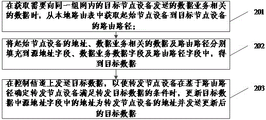
As shown in fig. 1, the method may include the steps of:
In this embodiment, the data service includes, but is not limited to, a service specified by a protocol, such as a location information service, a short message service, or a short data service. The protocols referred to include, but are not limited to, DMR (Digital Mobile Radio) protocol, PDT (Police Digital Trunking) protocol. The target data here may be short data. For example, data smaller than a certain character may be set as the target data. More specifically, the Data of the target Data is a plurality of Data types specified by the DMR protocol, such as a Defined short message including a source address field and a routing path field, an Undefined short message, a Raw short message, a status short message, short Data, a UDT (Unified Data Transport) or an IP short message. The other node device may be an originating node device, or may be a forwarding node device in the routing path.
And 102, acquiring a routing path in a routing path field in the target data.
In this embodiment, the routing path indicates a forwarding path of data related to the data service. It should be understood that the routing path may be retrieved by the originating node device from the local routing table.
In this embodiment, based on different working states of the node devices, different frame types of the frames carrying the routing path are set. For example, when the node device is in a low power consumption state or a scanning state, a control frame in the data is set to carry a routing path; when the node device is in a non-low power consumption state and a non-scanning state, a routing path carried by a data frame or a control frame in data is set, and in a specific implementation, the routing path carried by the control frame in data can be set when the node device is in the non-low power consumption state and the non-scanning state. Therefore, the forwarding node device can acquire the routing path in the routing path field in the target data based on the working state of the forwarding node device. It should be noted that the working states of the forwarding node device and other node devices are the same, so that the forwarding node device can determine the working states of other node devices by detecting the working states of itself, so as to obtain the frame where the routing path in the target data sent by other node devices is located.
In an optional embodiment, the working state of the forwarding node is obtained; determining the frame type carrying the routing path in the target data based on the working state; a routing path is obtained from the target data based on the frame type.
In this embodiment, the frame type includes a control frame or a data frame, and thus the routing path may be obtained from the control frame or the routing path may be obtained from the data frame.
In a specific application, when the transmission target DATA is a GPS short message, the control frame may be PRE _ CSBK or the like, and the DATA frame may be DATA _ HEADER, DATA _ BLOCK, or DATA _ LASTBLOCK or the like.
In an optional embodiment, determining a frame type of a frame in which the routing path field is located in the target data based on the operating state includes: when the target data is in a low power consumption state or a scanning state, determining the frame type of a frame where a routing path field is located in the target data as a control frame; and when the target data is in a non-low power consumption state and a non-scanning state, determining that the frame type of the frame where the routing path field is located in the target data is a data frame or a control frame.
And 103, when the forwarding node equipment is determined to meet the forwarding condition based on the routing path, setting the address in the source address field in the target data as the address of the forwarding node equipment to obtain the updated target data.
It should be understood that when it is determined that the forwarding node apparatus does not satisfy the forwarding condition based on the routing path, the forwarding node apparatus does not process the target data.
The forwarding node equipment updates the address in the source address field in the target data to the address of the forwarding node equipment to obtain the updated target number, and the source address field in the updated target data identifies the node equipment sending the target data as the forwarding node equipment, so that the next node equipment can judge whether the forwarding node equipment is the previous hop node equipment after receiving the target data.
In application, each node device forwards data in sequence according to a routing path, so that when the target data is determined to be from the previous hop node device of the forwarding node based on the routing path, the forwarding node device is determined to meet the forwarding condition.
In this embodiment, the following determination result is given according to different implementation forms of the routing path, to determine whether the target data is from the previous-hop node device of the forwarding node device.
In an alternative embodiment, the destination data includes a source address field, so when the address in the source address field in the destination data and the address of the forwarding node device are determined to be adjacent in the routing path, the destination data is determined to be from the previous hop node device of the forwarding node device.
It should be understood that the node device of the previous hop may be other forwarding node devices or an originating node device, and based on a difference in specific implementation of the node device of the previous hop, the present embodiment provides the following manner for determining whether an address in a source address field in the target data and an address of the forwarding node device are adjacent in the routing path.
In an optional embodiment, judging whether a forwarding order corresponding to an address in a source address field in target data exists in a routing path; if yes, when the forwarding order of the forwarding node equipment is determined to be different from the forwarding order corresponding to the address in the source address field in the target data by the minimum order forwarding interval, the address in the source address field in the target data and the address of the forwarding node equipment are determined to be adjacent in the routing path; if the address in the source address field in the target data is not the same as the address of the initial node device in the routing path, and the forwarding sequence of the forwarding node device in the routing path is the first, the address in the source address field in the target data and the address of the forwarding node device are determined to be adjacent in the routing path. It should be understood that, when only the addresses of the node devices are included in the routing path field, the forwarding order of the corresponding addresses can be indicated by customizing the positions of the addresses in the routing path field, for example, defining the first appearing address in the routing path field as a first hop node, the second appearing address as a second hop node, and so on, so that the corresponding forwarding order can be determined by judging the position of a certain address appearing in the routing path field.
In application, the minimum order forwarding interval may be set in advance manually, for example, the minimum order forwarding interval is set to be 1, which is not limited in this embodiment specifically.
And 104, transmitting the updated target data on the control channel.
In the technical scheme provided by this embodiment, target data related to a data service, which is sent by other node devices in the same group of networks, is received; acquiring a routing path in a routing path field in target data; when the forwarding node equipment is determined to meet the forwarding condition based on the routing path, setting the address in the source address field in the target data as the address of the forwarding node equipment to obtain updated target data; the updated target data is transmitted on the control channel. Because the target data carries a routing path from the starting node device to the target node device, namely a forwarding path, after receiving the target data, each node device can judge whether the data needs to be forwarded according to the routing path in the target data, the data forwarding is transmitted according to the routing path from the starting node device to the target node device without returning a response, thereby greatly reducing the delay of forwarding data services, omitting a request response process, removing unstable factors of link establishment failure caused by the fact that a certain node in a link cannot receive a forwarding request or a response, and greatly improving the success rate of link establishment.
Based on the same inventive concept, a second aspect of the embodiments of the present disclosure provides a data service data transmission method, which is applicable to an originating node device; as shown in fig. 2, the method may include the steps of:
In application, the data service includes, but is not limited to, a service specified by a protocol, such as a location information service, a short message service, or a short data service. Protocols referred to include, but are not limited to, DMR (Digital Mobile Radio) protocol, PDT (Police Digital Trunking) protocol.
The target data here may be short data. For example, data smaller than a certain number of characters may be set as the target data. More specifically, the Data of the target Data is a plurality of Data types specified by the DMR protocol, such as a Defined short message including a source address field and a routing path field, an Undefined short message, a Raw short message, a status short message, short Data, a UDT (Unified Data Transport) or an IP short message.
In this embodiment, the routing path in the local routing table may be obtained from the networking result in the ad hoc networking stage.
In an optional embodiment, the starting node device receives a first broadcast signaling frame broadcast by other node devices in the same group of networks in a networking stage, where the broadcast signaling frame includes path information from the other node devices to the target node; adding other node equipment into the path information to form a local routing table; a second broadcast signaling frame is generated and broadcast, the second broadcast signaling frame including local routing table information. Preferably, the path information in the broadcast signaling frame is a path with the shortest hop count from the node device to the target node device, the strongest signal and the most stable state.
In this embodiment, based on the difference in the operating state of the start node device, the frame types of the filling routing path, the service data, and the source address are different.
In an optional embodiment, the working state of the starting node device is obtained; and determining the frame type of the frame where the routing path field is located based on the working state.
Correspondingly, the routing path is filled into the routing path field, specifically: the routing path is populated in a routing path field in a frame of the corresponding frame type.
In an application, the frame type may include a control frame or a data frame, etc. In a specific embodiment, when the start node device is in a low power consumption state or a scanning state, determining that a frame type of a frame where a routing path field is located in the target data may be set as a control frame; when the target data is in a non-low power consumption state or a non-scanning state, the frame type of the frame where the routing path field is located in the target data is determined to be a data frame or a control frame. It should be noted that the working states of the start node device and the other node devices are the same, so that the other node devices can determine the working states of the other node devices by detecting their own working states, so as to obtain the frame where the routing path in the target data sent by the other node devices is located.
In this embodiment, in order to reduce signaling collision, the routing path includes the node addresses of the forwarding node devices and the forwarding order of the forwarding nodes; meanwhile, in order to enable the destination node device to explicitly send the starting node device of the data, the routing path also includes the address of the starting node device, so that when the routing path is filled into the routing path field, the address of the starting node device is filled into the address field of the starting node device, and the address of each forwarding node device is filled into the address field of the forwarding node device according to the forwarding order.
In an optional embodiment, the routing path field comprises an originating node device address field and at least one forwarding node address field; acquiring node addresses of forwarding node devices in a routing path, forwarding orders of the forwarding nodes and addresses of starting node devices; and filling the address of the starting node equipment into the address field of the starting node equipment, and filling the address of each forwarding node equipment into the address field of the forwarding node according to the forwarding sequence.
In this embodiment, in order to make the node device that receives the target data explicitly determine from which node device the target data is received, a source address field is further set in the target data, where the source address field is used to identify an address of the node device that sends the control signaling. It can be understood that the source address field in the target data is the address of the start node device, and when other node devices receive the target data, the node device sending the target data is known as the start node device through the source address field.
It should be understood that the forwarding node apparatus does not process the target data when it is determined that the forwarding node apparatus does not satisfy the condition for forwarding the target data based on the routing path.
In an example, taking the schematic diagram of data service multi-hop forwarding shown in fig. 3 as an example, referring to the positions of the node devices in fig. 3, the networking process is specifically described by taking an example that the sequence of broadcasting and broadcasting signaling frames by the networking node devices in the direct mode is a → E → F → G → H → I, where a is the master node device. The node devices A to F are networked in a direct mode, and networking is realized by sequentially sending broadcast signaling frames, wherein the broadcast signaling frames comprise routing table fields, and the routing table fields comprise source address fields, first hop to fourth hop node device address fields and destination address fields, which are specifically shown in table one.
Watch 1

A, the source address in a broadcast signaling frame sent by A is A, no address exists in the address field of the first-hop to fourth-hop node equipment, and the destination address is A;
after the E receives the broadcast signaling frame of the A, the E knows that the A is a main control node (in the scheme, the default main control node is the first node which initiates the broadcast, and information sent by all non-main control nodes is sent to the main control node by default), the E is the first hop and forms a local routing table (the destination address is A) of the E; in the broadcast signaling frame broadcasted by E, the source address is E, no address exists in the address fields of the first-hop to fourth-hop node devices, and the destination address is A;
after receiving the broadcast signaling frame sent by the E, the F knows that the first hop node device is the E and the destination address (the master control node) is the A, the F is the second hop and forms a local routing table of the F (the destination address is the A and the first hop node device is the E); in the broadcast signaling frame broadcast by the F, the source address is F, the first hop address is E, no address exists in the address field of the second hop to fourth hop node equipment, and the destination address is A; after receiving the broadcast signaling frame sent by F, G processes according to the above method to form a local routing table of G (destination address is a, first hop node device is E, second hop node device is F), and proceeding with this method, it can be known that the local routing table of I is destination address a, first hop node device is E, second hop node device is F, third hop node device is G, and fourth hop node device is H.
Therefore, E knows that the path for itself to reach A is E → A; f knows that the path from F to A is: f → E → A; g knows that the path to a is: g → F → E → A; h knows that the path for itself to reach A is: h → G → F → E → A; i knows that the path from itself to A is: i → H → G → F → E → A.
Through the above manner, after all the node devices send the broadcast signaling frames at respective broadcast time, the node devices can acquire the path from the node device to the main control node device by receiving the broadcast signaling frames sent by other node devices, thereby completing networking. It should be noted that, networking may be performed again by all the node devices after a certain time interval, so as to realize periodic updating of networking, improve the effectiveness of the local routing table in the node device, and update the local routing table of each node device in time when the position of the node device changes.
For convenience of understanding, the schematic diagram of multi-hop forwarding of data service shown in fig. 3 is taken as an example, where the data service is specifically GPS short message service, and specifically, routing information is transmitted by using a control frame PRE _ CSBK in a GPS short message frame. In fig. 3, the a/C/D/E/F/G/H/I nodes represent relative positions of a plurality of interphones at a certain time, and the positions of the a/C/D/E/F/G/H/I nodes are constantly changed along with the movement of the user. At this moment, the A/C/D/E/F/G/H/I node has successfully constructed the ad hoc network topology in a mode of broadcasting the broadcast signaling frame, namely the networking is successful, and has routing information.
In fig. 3, the starting node device sending the data service data is node I, the forwarding node devices are sequentially H/G/F/E according to the local routing table of node I, and the destination node device is node a, that is, the routing path is I → H → G → F → E → a.
The target data (PRE _ CSBK frame in the GPS short message) transmitted by node I includes the contents as shown in table two.
Watch two
| Last block (LB) | 1 | 0 | |
| Protect Flag (PF) | 1 | 0 | |
| CSBK Opcode (CSBKO) | 6 | 111101 | |
| FID | 8 | ||
| DATA/CSBK | 1 | 1 | |
| Group/Individual | 1 | 0 | |
| reserved | 6 | 000000 | |
| CBF | 8 | Fill by specific number of frames | |
| Logical Link ID(LLID) | 8 | Start Address | I |
| Logical Link ID(LLID) | 8 | Source | I |
| Logical Link ID(LLID) | 8 | Jump one | H |
| Logical Link ID(LLID) | 8 | Jump two | G |
| Logical Link ID(LLID) | 8 | Jump three | F |
| Logical Link ID(LLID) | 8 | Jump four | E |
The Start Address is an Address of an initial node device I, the Source is an Address of a node device (i.e., the initial node device I) currently sending target data, the Jump one is an Address of a first hop node device in the routing path field, the Jump two is an Address of a second hop node device in the routing path field, the Jump three is an Address of a third hop node device in the routing path field, and the Jump four is an Address of a fourth hop node device in the routing path field.
The first hop, the second hop, the third hop, and the fourth hop are the forwarding order of each forwarding node device.
Based on the example diagram shown in fig. 3, taking the target data as a GPS short message as an example, the signaling interaction between the nodes I/H/G/F/E/a is as follows.
1. When I sends a GPS short message to A, searching a local routing table, namely, searching a node A through four-to-five hops, generating and sending a frame PRE _ CSBK, wherein the PRE _ CSBK frame comprises the content in the table II, and sequentially sending DATAHEADER + DATABLOCK;
2. after H receives PRE _ CSBK + DATAHEADER + DATABLOCK sent by I, according to the routing information of PRE _ CSBK, inquiring that the node is in the routing table and is the first hop, if the starting node is I, judging that the forwarding condition is met, re-framing PRE _ CSBK, recording the source address as H, and if the source address is not changed, obtaining updated target data (PRE _ CSBK + DATAHEADER + DATABLOCK). Transmitting PRE _ CSBK, DATAHEADER and DATABLOCK in sequence on a control channel;
3. and G, after receiving the GPS short message of H, inquiring that the node is in the routing table and is the second hop, wherein the first hop is E, namely the node and the previous node are close to each other in the routing table, if the forwarding condition is determined to be met, then D forwards the GPS short message. The source address of PRE _ CSBK is changed to D, and the others are unchanged. And the subsequent nodes F and E sequentially forward the GPS short message.
4. And A receives the GPS short message forwarded by E, judges that the previous node is the final forwarding node, and then receives the GPS short message. And solving the source Address I from the Start Address, and displaying the source Address position.
It is to be understood that, in the above specific embodiment, the control frame PRE _ CSBK is used to carry the routing path information, and in different working states, data frames such as DATAHEADER and DATABLOCK may also be used to carry the routing path information according to the setting.
Based on the same concept, a third aspect of the embodiments of the present disclosure provides a first intercom, where the first intercom is a forwarding node device, and specific implementation of the first intercom may refer to the description of the method embodiment, and repeated details are not described again, as shown in fig. 4, the first intercom mainly includes:
a first receiving module 401, configured to receive target data related to a data service sent by other node devices in the same network; the target data comprises a source address field, a routing path field and a data service data field related to the initial node equipment; the source address field is used for identifying the address of the node equipment sending the target data, and the routing path field is used for identifying the routing path from the starting node equipment to the target node equipment;
a first obtaining module 402, configured to obtain a routing path in a routing path field in target data;
an updating module 403, configured to set an address in a source address field in the target data as an address of the forwarding node device when it is determined, based on the routing path, that the forwarding node device satisfies a condition for forwarding the target data, to obtain updated target data;
a forwarding module 404, configured to send the updated target data on a control channel of the forwarding node device.
In an alternative embodiment, the update module comprises:
and the first determining submodule is used for determining that the forwarding node equipment meets the forwarding condition when the target data is determined to come from the previous hop node equipment of the forwarding node equipment based on the routing path.
Namely, determining that the forwarding node device satisfies the forwarding condition based on the routing path includes:
and when the target data is determined to be from the previous hop node device of the forwarding node device based on the routing path, determining that the forwarding node device meets the forwarding condition.
In an alternative embodiment, the first determining submodule includes:
and the first determination unit is used for determining that the target data comes from the previous hop node equipment of the forwarding node equipment when the address in the source address field in the target data and the address of the forwarding node equipment are adjacent in the routing path.
Namely, the last hop node device for determining that the target data comes from the forwarding node device based on the routing path includes:
and when the address in the source address field in the target data is adjacent to the address of the forwarding node device in the routing path, determining that the target data comes from the previous hop node device of the forwarding node device.
In an alternative embodiment, the first determination unit comprises:
a judging subunit, configured to judge whether a forwarding order corresponding to an address in a source address field in the target data exists in the routing path;
a first determining subunit, configured to determine, if the determining subunit determines that a forwarding order corresponding to an address in a source address field in the target data exists in the routing path, that an address in the source address field in the target data and an address of the forwarding node device are adjacent in the routing path when it is determined that the forwarding order of the forwarding node device is different from the forwarding order corresponding to the address in the source address field in the target data by a minimum order forwarding interval;
and the second determining subunit is configured to, if the determining subunit determines that the forwarding order corresponding to the address in the source address field in the target data does not exist in the routing path, determine that the address in the source address field in the target data is the same as the address of the start node device in the routing path and the forwarding order of the forwarding node device in the routing path is first, determine that the address in the source address field in the target data and the address of the forwarding node device are adjacent in the routing path.
Namely, the step of determining that the address in the source address field in the target data is adjacent to the address of the forwarding node device in the routing path comprises the following steps:
judging whether a forwarding order corresponding to the address in the source address field in the target data exists in the routing path or not;
if yes, when the forwarding order of the forwarding node equipment is determined to be different from the forwarding order corresponding to the address in the source address field in the target data by the minimum order forwarding interval, the address in the source address field in the target data and the address of the forwarding node equipment are determined to be adjacent in the routing path;
if the address in the source address field in the target data is not the same as the address of the initial node device in the routing path, and the forwarding sequence of the forwarding node device in the routing path is the first, the address in the source address field in the target data and the address of the forwarding node device are determined to be adjacent in the routing path.
In an alternative embodiment, the first obtaining module includes:
the first obtaining submodule is used for obtaining the working state of the forwarding node equipment;
the second determining submodule is used for determining the frame type of the frame where the routing path field in the target data is located based on the working state;
and the second obtaining submodule is used for obtaining the routing path from the routing path field of the frame type corresponding to the target data.
Namely, obtaining the routing path in the routing path field in the target data, including:
acquiring the working state of forwarding node equipment;
determining the frame type of a frame where a routing path field in the target data is based on the working state;
and acquiring a routing path from the routing path field of the frame type corresponding to the target data.
In an alternative embodiment, the frame type comprises a control frame or a data frame, etc.
In an alternative embodiment, the second determining sub-module includes:
the second determining unit is used for determining that the frame type of the frame where the routing path field is located in the target data can be set as a control frame when the target data is in a low power consumption state or a scanning state;
and the third determining unit is used for determining that the frame type of the frame where the routing path field is positioned in the target data can be set as a data frame or a control frame when the target data is in a non-low power consumption state and a non-scanning state.
In an alternative embodiment, the data service is a service specified by a protocol, such as a location information service, a short message service, or a short data service. Protocols referred to include, but are not limited to, DMR (Digital Mobile Radio) protocol, PDT (Police Digital Trunking) protocol.
In an alternative embodiment, the routing path is obtained from the local routing table for the originating node device.
Based on the same concept, a fourth aspect of the embodiments of the present disclosure provides a second intercom, where the second intercom is a starting node device, and specific implementation of the second intercom may refer to the description in the method embodiment section, and repeated descriptions are omitted, and as shown in fig. 5, the second intercom mainly includes:
a second obtaining module 501, configured to obtain, when data related to a data service that needs to be sent to a target node device in the same group of networks is obtained, a routing path from an originating node device to the target node device from a local routing table; the data related to the data service comprises data service data related to the starting node equipment;
a filling module 502, configured to fill the address of the start node device, the data related to the data service, and the routing path into the source address field, the data service data field, and the routing path field, respectively, to obtain target data; the source address field is used for identifying the address of the node equipment which sends the target data;
a sending module 503, configured to send target data on a control channel of the originating node device, so that when the forwarding node device determines, based on the routing path, that the forwarding node device meets a condition for forwarding the target data, the forwarding node device updates an address in a source address field in the target data to be an address of the forwarding node device, and sends the updated target data.
In an alternative embodiment, the second intercom further comprises:
a third obtaining module 504, configured to obtain a working state of the start node device before the address of the start node device, the data related to the data service, and the routing path are respectively filled in the source address field, the data service data field, and the routing path field to obtain target data;
a determining module 505, configured to determine, based on the working state, a frame type of a frame in which the routing path field is located;
the filling module 502 includes:
and the filling sub-module is used for filling the routing path in the routing path field in the frame of the corresponding frame type.
Before the address of the start node device, the data related to the data service, and the routing path are respectively filled in the source address field, the data service data field, and the routing path field to obtain the target data, the method further includes:
acquiring the working state of initial node equipment;
determining the frame type of a frame where a routing path field is located based on the working state;
filling the routing path into the routing path field, specifically: the routing path field in the frame corresponding to the frame type populates the routing path.
In an alternative embodiment, the frame type includes a control frame or a data frame, etc.
In an alternative embodiment, the determining module 505 comprises:
the third determining submodule is used for determining that the frame type of a frame where a routing path field in the target data is positioned can be set as a control frame when the target data is in a low power consumption state or a scanning state;
and the fourth determining submodule is used for determining that the frame type of the frame where the routing path field is positioned in the target data can be set as a data frame or a control frame when the target data is in a non-low power consumption state and a non-scanning state.
In an alternative embodiment, the routing path field includes an originating node device address field and at least one forwarding node address field;
the fill submodule includes:
an obtaining unit, configured to obtain a node address of each forwarding node device, a forwarding order of each forwarding node, and an address of an initial node device in a routing path;
and the filling unit is used for filling the address of the initial node equipment into the address field of the initial node equipment and filling the address of each forwarding node equipment into the address field of the forwarding node according to the forwarding sequence.
Namely, the routing path field comprises an initial node equipment address field and at least one forwarding node address field;
populating the routing path into a routing path field, including:
acquiring node addresses of forwarding node devices in a routing path, forwarding orders of the forwarding nodes and addresses of starting node devices;
and filling the address of the initial node equipment into the address field of the initial node equipment, and filling the address of each forwarding node equipment into the address field of the forwarding node according to the forwarding sequence.
In an alternative embodiment, the data service is a service specified by a protocol, such as a location information service, a short message service, or a short data service. Protocols referred to include, but are not limited to, DMR (Digital Mobile Radio) protocol, PDT (Police Digital Trunking) protocol.
In an alternative embodiment, the second intercom further comprises:
a second receiving module 506, configured to receive, in a networking stage, a first broadcast signaling frame broadcast by other node devices in the same networking before obtaining a routing path from an originating node device to a target node device from a local routing table, where the broadcast signaling frame includes path information from the other node devices to the target node;
a forming module 507, configured to add other node devices to the path information to form a local routing table;
a processing module 508, configured to generate and broadcast a second broadcast signaling frame, where the second broadcast signaling frame includes the local routing table information.
Based on the same concept, a fifth aspect of the embodiments of the present disclosure provides a data service data transmission system, as shown in fig. 6, the system mainly includes:
a first interphone 601 and a second interphone 602; the first interphone is forwarding node equipment, and the second interphone is starting node equipment; the forwarding node device performs the method of the first aspect as described above and the originating node device performs the method of the second aspect as described above.
Based on the same concept, a sixth aspect of the embodiments of the present disclosure provides an intercom, as shown in fig. 7, the intercom mainly includes: a processor 701, a memory 702, and a communication bus 703, wherein the processor 701 and the memory 702 communicate with each other via the communication bus 703. The memory 702 stores a program executable by the processor 701, and the processor 701 executes the program stored in the memory 702 to implement the following steps:
receiving target data related to data services sent by other node equipment in the same network; the target data comprises a source address field, a routing path field and a data service data field related to the initial node equipment; the source address field is used for identifying the address of the node equipment which sends the target data, and the routing path field is used for identifying the routing path from the starting node equipment to the target node equipment; acquiring a routing path in a routing path field in target data; when the forwarding node equipment is determined to meet the forwarding condition based on the routing path, setting the address in the source address field in the target data as the address of the forwarding node equipment to obtain updated target data; transmitting the updated target data on a control channel;
or the like, or a combination thereof,
when data related to data services which need to be sent to target node equipment in the same group of networks are obtained, a routing path from starting node equipment to the target node equipment is obtained from a local routing table; the data related to the data service comprises data service data related to the starting node equipment; filling the address of the starting node equipment, the data related to the data service and the routing path into a source address field, a data service data field and a routing path field respectively to obtain target data; the source address field is used for identifying the address of the node equipment which sends the target data; and transmitting the target data on the control channel so that the forwarding node equipment updates the address in the source address field in the target data as the address of the forwarding node equipment and transmits the updated target data when the forwarding node equipment is determined to meet the forwarding condition based on the routing path.
The communication bus 703 mentioned in the above intercom may be a Peripheral Component Interconnect (PCI) bus, an Extended Industry Standard Architecture (EISA) bus, or the like. The communication bus 703 may be divided into an address bus, a data bus, a control bus, etc. For ease of illustration, only one thick line is shown in FIG. 7, but that does not indicate only one bus or one type of bus.
The Memory 702 may include a Random Access Memory (RAM) or a non-volatile Memory (non-volatile Memory), such as at least one disk Memory. Alternatively, the memory may be at least one memory device located remotely from the processor 701.
The Processor 701 may be a general-purpose Processor, including a Central Processing Unit (CPU), a Network Processor (NP), etc., and may also be a Digital Signal Processor (DSP), an Application Specific Integrated Circuit (ASIC), a Field Programmable Gate Array (FPGA) or other Programmable logic devices, discrete gates or transistor logic devices, and discrete hardware components.
In a seventh aspect, in yet another embodiment of the present disclosure, there is further provided a computer-readable storage medium, in which a computer program is stored, and when the computer program runs on a computer, the computer is caused to execute the data service data transmission method described in the above embodiments.
In the above embodiments, all or part of the implementation may be realized by software, hardware, firmware, or any combination thereof. When implemented in software, may be implemented in whole or in part in the form of a computer program product. The computer program product includes one or more computer instructions. When loaded and executed on a computer, cause the processes or functions described in accordance with the embodiments of the disclosure to occur, in whole or in part. The computer may be a general purpose computer, a special purpose computer, a network of computers, or other programmable device. The computer instructions may be stored in a computer readable storage medium or transmitted from one computer readable storage medium to another, for example, the computer instructions may be transmitted from one website, computer, server, or data center to another website, computer, server, or data center via wired (e.g., coaxial cable, fiber optic, digital Subscriber Line (DSL)) or wireless (e.g., infrared, microwave, etc.) means. The computer-readable storage medium can be any available medium that can be accessed by a computer or a data storage device, such as a server, a data center, etc., that includes one or more of the available media. The available media may be magnetic media (e.g., floppy disks, hard disks, tapes, etc.), optical media (e.g., DVDs), or semiconductor media (e.g., solid state disks), among others.
It is noted that, in this document, relational terms such as "first" and "second," and the like, are used solely to distinguish one entity or action from another entity or action without necessarily requiring or implying any actual such relationship or order between such entities or actions. Also, the terms "comprises," "comprising," or any other variation thereof, are intended to cover a non-exclusive inclusion, such that a process, method, article, or apparatus that comprises a list of elements does not include only those elements but may include other elements not expressly listed or inherent to such process, method, article, or apparatus. Without further limitation, an element defined by the phrases "comprising a," "8230," "8230," or "comprising" does not exclude the presence of additional like elements in a process, method, article, or apparatus that comprises the element.
The foregoing are merely exemplary embodiments of the present invention, which enable those skilled in the art to understand or practice the present invention. Various modifications to these embodiments will be readily apparent to those skilled in the art, and the generic principles defined herein may be applied to other embodiments without departing from the spirit or scope of the invention. Thus, the present invention is not intended to be limited to the embodiments shown herein but is to be accorded the widest scope consistent with the principles and novel features disclosed herein.
Claims (19)
1. A data service data transmission method is characterized in that the method is applied to forwarding node equipment, and the forwarding node equipment is any node equipment in a narrowband communication ad hoc network; the method comprises the following steps:
receiving target data related to data services sent by other node equipment in the same group network in a control channel; the target data comprises a source address field, a routing path field and a data service data field related to the starting node equipment; the source address field is used for identifying the address of a node device which sends the target data, and the routing path field is used for identifying the routing path from the starting node device to the target node device;
obtaining a routing path in the routing path field in the target data;
when the forwarding node equipment is determined to meet the forwarding condition based on the routing path, setting an address in a source address field in the target data as the address of the forwarding node equipment to obtain updated target data;
transmitting the updated target data on a control channel.
2. The method of claim 1, wherein the determining that the forwarding node device satisfies a forwarding condition based on the routing path comprises:
determining that the forwarding node device satisfies a forwarding condition when it is determined that the target data is from a previous-hop node device of the forwarding node device based on the routing path.
3. The method of claim 2, wherein said determining that the destination data is from a last hop node device of the forwarding node devices based on the routing path comprises:
when the address in the source address field in the target data is determined to be adjacent to the address of the forwarding node device in the routing path, determining that the target data comes from a last hop node device of the forwarding node device.
4. The method of claim 3, wherein the determining that the address in the source address field of the destination data is adjacent to the address of the forwarding node device in the routing path comprises:
judging whether a forwarding order corresponding to the address in the source address field in the target data exists in the routing path;
if yes, when the forwarding order of the forwarding node equipment is determined to be different from the forwarding order corresponding to the address in the source address field in the target data by a minimum order forwarding interval, determining that the address in the source address field in the target data is adjacent to the address of the forwarding node equipment in the routing path;
if the address in the source address field in the target data is not the same as the address of the initial node device in the routing path, and the forwarding order of the forwarding node device in the routing path is the first, it is determined that the address in the source address field in the target data is adjacent to the address of the forwarding node device in the routing path.
5. The method of claim 1, wherein the obtaining the routing path in the routing path field in the destination data comprises:
acquiring the working state of the forwarding node equipment;
determining the frame type of a frame where a routing path field is located in the target data based on the working state;
and acquiring the routing path from the routing path field of the frame type corresponding to the target data.
6. The method of claim 5, wherein the frame type comprises a control frame or a data frame.
7. The method of claim 1, wherein the data service is a location information service, a short message service, or a short data service.
8. The method of claim 1, wherein the routing path is obtained from a local routing table for the originating node device.
9. A data service data sending method is applied to an initial node device, and comprises the following steps:
when data related to data service which needs to be sent to target node equipment in the same group of networks are obtained, a routing path from the starting node equipment to the target node equipment is obtained from a local routing table; the data related to the data service comprises data service data related to the starting node equipment; the networking is a narrowband communication ad hoc network;
filling the address of the initial node device, the data related to the data service and the routing path into a source address field, a data service data field and a routing path field respectively to obtain target data; the source address field is used for identifying the address of the node equipment which sends the target data;
and sending the target data on a control channel, so that the forwarding node equipment updates the address in the source address field in the target data to be the address of the forwarding node equipment and sends the updated target data when the forwarding node equipment is determined to meet the forwarding condition based on the routing path.
10. The method according to claim 9, wherein before the filling the address of the start node device, the data related to the data service, and the routing path into a source address field, a data service data field, and a routing path field, respectively, to obtain target data, the method further comprises:
acquiring the working state of the starting node equipment;
determining the frame type of the frame where the routing path field is located based on the working state;
the filling the routing path into the routing path field specifically includes: a routing path field in a frame of a corresponding frame type populates the routing path.
11. The method of claim 10, wherein the frame type comprises a control frame or a data frame.
12. The method of claim 9, wherein the routing path field comprises an originating node device address field and at least one forwarding node address field;
the populating the routing path into a routing path field includes:
acquiring the node address of each forwarding node device in the routing path, the forwarding order of each forwarding node and the address of the starting node device;
and filling the address of the starting node equipment into the address field of the starting node equipment, and filling the address of each forwarding node equipment into the address field of the forwarding node according to the forwarding sequence.
13. The method of claim 9, wherein the data service is a location information service, a short message service, or a short data service.
14. The method according to any of claims 9-13, further comprising, before said obtaining the routing path from the originating node device to the destination node device from the local routing table:
receiving a first broadcast signaling frame broadcast by other node equipment in the same networking in a networking stage, wherein the broadcast signaling frame comprises path information from the other node equipment to a target node;
adding the other node equipment to the path information to form the local routing table;
generating and broadcasting a second broadcast signaling frame, the second broadcast signaling frame including the local routing table information.
15. A first interphone is characterized in that the first interphone is forwarding node equipment which is any node equipment in a narrowband communication ad hoc network; the first intercom includes:
the first receiving module is used for receiving target data related to data services sent by other node equipment in the same group network in a control channel; the target data comprises a source address field, a routing path field and a data service data field related to the initial node equipment; the source address field is used for identifying the address of the node device sending the target data, and the routing path field is used for identifying the routing path from the starting node device to the target node device;
a first obtaining module, configured to obtain a routing path in the routing path field in the target data;
an updating module, configured to set an address in a source address field in the target data as an address of the forwarding node device when it is determined that the forwarding node device satisfies a condition for forwarding the target data based on the routing path, to obtain updated target data;
and the forwarding module is used for sending the updated target data on a control channel of the forwarding node equipment.
16. A second intercom, said second intercom being an initiating node device, comprising:
a second obtaining module, configured to obtain, when data related to a data service that needs to be sent to a target node device in the same group of networks is obtained, a routing path from the start node device to the target node device from a local routing table; the data related to the data service comprises data service data related to the starting node equipment; the networking is a narrowband communication ad hoc network;
a filling module, configured to fill the address of the start node device, the data related to the data service, and the routing path into a source address field, a data service data field, and a routing path field, respectively, to obtain target data; the source address field is used for identifying the address of the node equipment which sends the target data;
a sending module, configured to send the target data on a control channel of the originating node device, so that a forwarding node device updates an address in a source address field in the target data to an address of the forwarding node device when determining, based on the routing path, that the forwarding node device satisfies a condition for forwarding the target data, and sends the updated target data.
17. A data service data transmission system, comprising:
a first interphone and a second interphone; the first interphone is forwarding node equipment, and the second interphone is starting node equipment; the forwarding node device performs the method of any of claims 1-8, and the originating node device performs the method of any of claims 9-14.
18. An intercom, comprising: the system comprises a processor, a memory and a communication bus, wherein the processor and the memory are communicated with each other through the communication bus;
the memory for storing a computer program;
the processor, configured to execute a program stored in the memory, to implement the method of any of claims 1-8 or the method of any of claims 9-14.
19. A computer-readable storage medium, in which a computer program is stored which, when being executed by a processor, carries out the method of any one of claims 1 to 8 or the method of any one of claims 9 to 14.
Priority Applications (1)
| Application Number | Priority Date | Filing Date | Title |
|---|---|---|---|
| CN202210704897.0A CN114827006B (en) | 2022-06-21 | 2022-06-21 | Data service data sending method, interphone, system and storage medium |
Applications Claiming Priority (1)
| Application Number | Priority Date | Filing Date | Title |
|---|---|---|---|
| CN202210704897.0A CN114827006B (en) | 2022-06-21 | 2022-06-21 | Data service data sending method, interphone, system and storage medium |
Publications (2)
| Publication Number | Publication Date |
|---|---|
| CN114827006A CN114827006A (en) | 2022-07-29 |
| CN114827006B true CN114827006B (en) | 2022-11-18 |
Family
ID=82521853
Family Applications (1)
| Application Number | Title | Priority Date | Filing Date |
|---|---|---|---|
| CN202210704897.0A Active CN114827006B (en) | 2022-06-21 | 2022-06-21 | Data service data sending method, interphone, system and storage medium |
Country Status (1)
| Country | Link |
|---|---|
| CN (1) | CN114827006B (en) |
Family Cites Families (7)
| Publication number | Priority date | Publication date | Assignee | Title |
|---|---|---|---|---|
| US8311085B2 (en) * | 2009-04-14 | 2012-11-13 | Clear-Com Llc | Digital intercom network over DC-powered microphone cable |
| WO2011030889A1 (en) * | 2009-09-14 | 2011-03-17 | 日本電気株式会社 | Communication system, forwarding node, path management server, communication method, and program |
| WO2015139026A2 (en) * | 2014-03-14 | 2015-09-17 | Go Tenna Inc. | System and method for digital communication between computing devices |
| CN106656781B (en) * | 2015-11-02 | 2020-12-11 | 中兴通讯股份有限公司 | Method, device and system for message transmission |
| CN113497754B (en) * | 2020-03-20 | 2023-02-10 | 华为技术有限公司 | Forwarding path establishment method, device and computer-readable storage medium |
| CN112272144B (en) * | 2020-10-28 | 2022-11-25 | 北京轻网科技股份有限公司 | Message forwarding method and device |
| CN114390578A (en) * | 2022-03-23 | 2022-04-22 | 中国人民解放军国防科技大学 | A method, device, electronic device and medium for testing network performance |
-
2022
- 2022-06-21 CN CN202210704897.0A patent/CN114827006B/en active Active
Also Published As
| Publication number | Publication date |
|---|---|
| CN114827006A (en) | 2022-07-29 |
Similar Documents
| Publication | Publication Date | Title |
|---|---|---|
| CN113301511B (en) | Node joining method, interphone, system and storage medium | |
| JP5805813B2 (en) | Method and system for peer-to-peer network discovery using multi-user diversity | |
| US9629063B2 (en) | Method and system for global topology discovery in multi-hop ad hoc networks | |
| US7894378B2 (en) | Method for updating a multicast state of a multicast group | |
| US8331262B2 (en) | Apparatus and method for setup of optimum route using tree-topology | |
| CN113259864B (en) | Narrow-band communication method, interphone, equipment, storage medium and ad hoc network system | |
| US20160150459A1 (en) | Techniques to support heterogeneous network data path discovery | |
| JP2013503560A (en) | Method and system for service discovery management in a peer-to-peer network | |
| JP2009529811A (en) | Communication method for multi-hop packet transfer | |
| JP2010081603A (en) | Method and node for implementing virtual network | |
| CN112383478B (en) | Message broadcasting method and device | |
| CN107078952A (en) | Route formation and message transmission in data link groups on multiple channels | |
| WO2019241992A1 (en) | Routing method, node and computer storage medium | |
| CN109068367B (en) | Wireless token passing method, device, equipment and readable storage medium | |
| CN105099902A (en) | Routing method for quantum Mesh network | |
| CN115696493A (en) | Communication method and related equipment | |
| US7864809B2 (en) | Method of transmitting and receiving data in network environment with wired and wireless networks bridged using relay portal | |
| CN105282851A (en) | Channel distribution method and system | |
| CN114827006B (en) | Data service data sending method, interphone, system and storage medium | |
| CN114827005B (en) | Data or voice transmission method, interphone, system and storage medium | |
| JP7404185B2 (en) | Communication system, node, communication method and program | |
| CN113179215A (en) | Networking communication method, system, node device, storage medium and electronic device | |
| US20160014670A1 (en) | Method for generating network route using tv white space | |
| CN113259922B (en) | Communication method, system, equipment and storage medium for emergency service forwarding | |
| CN111757340A (en) | A method, device and system for determining service area |
Legal Events
| Date | Code | Title | Description |
|---|---|---|---|
| PB01 | Publication | ||
| PB01 | Publication | ||
| SE01 | Entry into force of request for substantive examination | ||
| SE01 | Entry into force of request for substantive examination | ||
| GR01 | Patent grant | ||
| GR01 | Patent grant | ||
| PP01 | Preservation of patent right | ||
| PP01 | Preservation of patent right |
Effective date of registration: 20230207 Granted publication date: 20221118 |
|
| PD01 | Discharge of preservation of patent | ||
| PD01 | Discharge of preservation of patent |
Date of cancellation: 20240402 Granted publication date: 20221118 |