CN114788315A - Policy-based access and mobility management function (AMF) selection using Network Slice Selection Assistance Information (NSSAI) availability information - Google Patents
Policy-based access and mobility management function (AMF) selection using Network Slice Selection Assistance Information (NSSAI) availability information Download PDFInfo
- Publication number
- CN114788315A CN114788315A CN202080085050.8A CN202080085050A CN114788315A CN 114788315 A CN114788315 A CN 114788315A CN 202080085050 A CN202080085050 A CN 202080085050A CN 114788315 A CN114788315 A CN 114788315A
- Authority
- CN
- China
- Prior art keywords
- amf
- nssai
- network slice
- service
- requested
- Prior art date
- Legal status (The legal status is an assumption and is not a legal conclusion. Google has not performed a legal analysis and makes no representation as to the accuracy of the status listed.)
- Granted
Links
Images


Classifications
-
- H—ELECTRICITY
- H04—ELECTRIC COMMUNICATION TECHNIQUE
- H04W—WIRELESS COMMUNICATION NETWORKS
- H04W24/00—Supervisory, monitoring or testing arrangements
- H04W24/02—Arrangements for optimising operational condition
-
- H—ELECTRICITY
- H04—ELECTRIC COMMUNICATION TECHNIQUE
- H04W—WIRELESS COMMUNICATION NETWORKS
- H04W8/00—Network data management
- H04W8/02—Processing of mobility data, e.g. registration information at HLR [Home Location Register] or VLR [Visitor Location Register]; Transfer of mobility data, e.g. between HLR, VLR or external networks
- H04W8/08—Mobility data transfer
- H04W8/12—Mobility data transfer between location registers or mobility servers
-
- H—ELECTRICITY
- H04—ELECTRIC COMMUNICATION TECHNIQUE
- H04W—WIRELESS COMMUNICATION NETWORKS
- H04W48/00—Access restriction; Network selection; Access point selection
- H04W48/16—Discovering, processing access restriction or access information
-
- H—ELECTRICITY
- H04—ELECTRIC COMMUNICATION TECHNIQUE
- H04W—WIRELESS COMMUNICATION NETWORKS
- H04W48/00—Access restriction; Network selection; Access point selection
- H04W48/18—Selecting a network or a communication service
-
- H—ELECTRICITY
- H04—ELECTRIC COMMUNICATION TECHNIQUE
- H04W—WIRELESS COMMUNICATION NETWORKS
- H04W8/00—Network data management
- H04W8/02—Processing of mobility data, e.g. registration information at HLR [Home Location Register] or VLR [Visitor Location Register]; Transfer of mobility data, e.g. between HLR, VLR or external networks
-
- H—ELECTRICITY
- H04—ELECTRIC COMMUNICATION TECHNIQUE
- H04L—TRANSMISSION OF DIGITAL INFORMATION, e.g. TELEGRAPHIC COMMUNICATION
- H04L67/00—Network arrangements or protocols for supporting network services or applications
- H04L67/01—Protocols
- H04L67/02—Protocols based on web technology, e.g. hypertext transfer protocol [HTTP]
-
- H—ELECTRICITY
- H04—ELECTRIC COMMUNICATION TECHNIQUE
- H04W—WIRELESS COMMUNICATION NETWORKS
- H04W60/00—Affiliation to network, e.g. registration; Terminating affiliation with the network, e.g. de-registration
Landscapes
- Engineering & Computer Science (AREA)
- Computer Networks & Wireless Communication (AREA)
- Signal Processing (AREA)
- Databases & Information Systems (AREA)
- Computer Security & Cryptography (AREA)
- Mobile Radio Communication Systems (AREA)
- Data Exchanges In Wide-Area Networks (AREA)
Abstract
A method for providing policy-based access and mobility management function (AMF) selection using Network Slice Selection Assistance Information (NSSAI) availability information obtained from a NSSAI availability service includes obtaining NSSAI availability information regarding a plurality of AMFs from a NSSAI availability service at a Network Slice Selection Function (NSSF) that includes at least one processor. The method also includes receiving, from the first AMF, a network slice selection request specifying a network slice service requested by a User Equipment (UE). The method also includes generating a prioritized list including identities of at least one AMF for supporting the network slicing service based on the NSSAI availability information and the network slicing service requested by the UE. The method also includes communicating the prioritized list to the first AMF.
Description
Priority requirement
This application claims priority to U.S. patent application serial No.16/676,006, filed on 6/11/2019, the disclosure of which is incorporated herein by reference in its entirety.
Technical Field
The subject matter described herein relates to network slicing. More particularly, the subject matter described herein relates to methods, systems, and computer-readable media for providing policy-based AMF selection using NSSAI availability information.
Background
In a 5G telecommunications network, the network node providing the service is referred to as the producer Network Function (NF). The network node that consumes the service is referred to as the consumer NF. The network function may be a producer NF and a consumer NF depending on whether it is consuming or providing a service.
A given producer NF may have many service endpoints, where a service endpoint is a combination of an IP address and a port number on the network node hosting the producer NF. The producer NF registers with the network function repository function (NRF). The NRF maintains NF profiles for available NF instances and their supported services. The consumer NF may subscribe to receive information about producer NF instances that have registered with the NRF.
One example of a NF that provides services to User Equipment (UE) devices, such as internet of things (IoT) devices, is an access and mobility management function or AMF. The AMF provides registration management, connection management, reachability management, mobility management, and other services for the UE device. The AMF acts as a contact point between the radio access network and the rest of the nodes in the 5G core network. The AMF also serves as a point of access to the network slicing service.
There may be many AMFs serving a particular Transmission Area (TA) where the UE is located. It is desirable to optimize AMF resource utilization and, in particular, if network slicing is implemented. Network slices are services provided in a 5G network, where network resources are logically allocated in parts or slices for use by a UE device. Each network slice may provide a particular capability or service to the UE. Different network slices and capabilities may be accessed via different AMFs. Furthermore, the same AMF may provide access to different capabilities or network slices.
When the UE registers with a Public Land Mobile Network (PLMN), the UE may transmit requested NSSAI information to the network during a registration procedure, the information indicating a type of network slicing service requested by the UE. If the radio access node receiving the NSSAI information from the UE is able to identify an AMF that may provide access to the requested network slice service, the radio access node forwards the registration request to the AMF and the AMF provides access to the requested network slice service. However, in some cases, the radio access node may not be able to identify the AMF that may provide access to the requested network slice service. One example of this is when the requested NSSAI from the UE in the non-access stratum (NAS) registration request message is not a NSSAI configured for the PLMN, an allowed NSSAI for the PLMN and access type, or a default configured NSSAI. In such a case, the wireless point access node would route the NAS signaling to the default AMF.
When the UE context in the default AMF does not already include an allowed NSSAI corresponding to the type of access requested or requested for the UE, the AMF queries a Network Slice Selection Function (NSSF) to identify an AMF that can provide access to the requested network slice service. In another example, the network may decide to reallocate the UE to an AMF different from the AMF that originally received the initial registration request.
According to 3GPP TS 23.501, the network slice selection function provides two different services, referred to as NNSSFNS selection service (hereinafter simply referred to) "NS selection service ") and NNSSFAn NSSAI availability service (hereinafter referred to simply as "NSSAI availability service"). The NS selection service includes providing network slice information to the requester. The NSSAI availability service proposes the availability of subscribed NSSAIs (S-NSSAIs) to NF consumers on a per TA basis.
One problem with the existing 3GPP service architecture is that NSSAI availability services and NS selection services are decoupled. In other words, 3GPP TS 23.501 does not specify how to optimize AMF selection using NSSAI availability services in a manner that most efficiently allocates AMFs and network slice resources accessible via AMFs.
For example, clause 5.15.5.2.1 of 3GPP TS 23.501 indicates that when multiple network slice instances in a UE 'S transmission region are capable of providing services based on an operator' S NSSAI (S-NSSAI) configured as a given subscription, the NSSF may select one of the network slice instances to serve the UE. A network slice instance is an NF instance and a collection of resources required to compose a deployed network slice. The AMF is a network node that provides access to network slice instances. By leaving the choice of network slice instances and corresponding AMFs at the discretion of the network operator, 3GPP TS 23.501 does not define a procedure to optimize such a choice. Thus, even though the AMF may provide NSSAI availability information to the NSSF, 3GPP TS 23.501 does not specify how to use this information. In addition, other information (such as the AMF payload) is not specified as part of the NS selection process.
Thus, there is a need for methods, systems, and computer-readable media for providing policy-based AMF selection based on NSSAI availability information obtained from a NSSAI availability service.
Disclosure of Invention
A method for providing policy-based access and mobility management function (AMF) selection using Network Slice Selection Assistance Information (NSSAI) availability information obtained from a NSSAI availability service includes obtaining NSSAI availability information for a plurality of AMFs from a NSSAI availability service at a Network Slice Selection Function (NSSF) that includes at least one processor. The method also includes receiving, from the first AMF, a network slice selection request specifying a network slice service requested by a User Equipment (UE). The method also includes generating a prioritized list including identities of at least one AMF for supporting the network slicing service based on the NSSAI availability information and the network slicing service requested by the UE. The method also includes transmitting the prioritized list to the first AMF.
According to another aspect of the subject matter described herein, obtaining NSSAI availability information includes receiving hypertext transfer protocol (HTTP) messages from the AMFs, wherein each HTTP message indicates the NSSAI supported for each Transport Area (TA) of one of the AMFs.
According to yet another aspect of the subject matter described herein, receiving the network slice selection request comprises receiving the network slice selection request including at least one NSSAI identifying a network slice service requested by the UE.
According to yet another aspect of the subject matter described herein, generating the prioritized list includes prioritizing a second AMF that supports the requested network slicing service over a third AMF that supports the requested network slicing service and supports a larger number of network slicing services than the second AMF.
According to yet another aspect of the subject matter described herein, prioritizing the second AMF over the third AMF includes calculating a correlation R for the second and third AMFs, where R equals C/T, where C equals a number of common NSSAIs between the NSSAI requested by the UE and the NSSAIs supported by the second or third AMF and T equals a total number of NSSAIs supported by the second or third AMF.
According to yet another aspect of the subject matter described herein, a method for providing policy-based AMF selection includes obtaining a load percentage for each AMF.
According to yet another aspect of the subject matter described herein, obtaining the load percentage comprises obtaining the load percentage from a network function repository function (NRF).
According to yet another aspect of the subject matter described herein, generating the prioritized list includes calculating a weight W for the second and third AMFs, where the weight W is equal to R/L and L is a load percentage of the second or third AMFs.
According to yet another aspect of the subject matter described herein, transmitting the prioritized list to the first AMF includes transmitting the AMF identities of the second and third AMFs and the weights calculated for the second and third AMFs to the first AMF.
According to yet another aspect of the subject matter described herein, transmitting the prioritized list to the first AMF includes transmitting the AMF identities of the second and third AMFs in an order corresponding to the weights calculated for the second and third AMFs.
According to yet another aspect of the subject matter described herein, there is provided a system for providing policy-based access and mobility management function (AMF) selection using Network Slice Selection Assistance Information (NSSAI) availability information obtained from a NSSAI availability service. The system includes a Network Slice Selection Function (NSSF) that includes at least one processor. The system also includes an access and mobility management function (AMF) prioritizer implemented by the at least one processor to obtain NSSAI availability information for the plurality of AMFs using the NSSAI availability service, receive a network slice selection request from a first AMF specifying a network slice service requested by a User Equipment (UE), generate a prioritized list based on the NSSAI availability information and the network slice service requested by the UE, the list including identities of at least one AMF for supporting the network slice service, and transmit the prioritized list to the first AMF.
According to yet another aspect of the subject matter described herein, the AMF prioritizer is configured to obtain NSSAI availability information by receiving hypertext transfer protocol (HTTP) messages from the AMFs, and each HTTP message indicates a NSSAI supported for each delivery area (TA) of one of the AMFs.
According to yet another aspect of the subject matter described herein, the network slice selection request includes at least one NSSAI identifying a network slice service requested by the UE.
According to yet another aspect of the subject matter described herein, the AMF prioritizer is configured to generate the prioritized list by prioritizing a second AMF that will support the requested network slicing service over a third AMF that supports the requested network slicing service and supports a larger number of network slicing services other than the requested network slicing service than the second AMF.
According to yet another aspect of the subject matter described herein, the AMF prioritizer is configured to prioritize the second AMF over the third AMF by calculating a correlation R of the second and third AMFs, wherein R ═ C/T, wherein C equals a number of common NSSAIs between the NSSAI requested by the UE and the NSSAIs supported by the second or third AMF and T equals a total number of NSSAIs supported by the second or third AMF.
According to yet another aspect of the subject matter described herein, the AMF prioritizer is configured to obtain load percentages of the second and third AMFs and to calculate weight values W for the second and third AMFs, wherein the weight values W for the second or third AMFs are equal to R/L and L is the load percentage of the second or third AMF.
According to yet another aspect of the subject matter described herein, the AMF prioritizer is configured to obtain the load percentage from a network function repository function (NRF).
According to yet another aspect of the subject matter described herein, the prioritized list of AMFs includes AMF identities of the second and third AMFs and weights calculated for the second and third AMFs.
According to yet another aspect of the subject matter described herein, the prioritized list comprises an ordered list of AMF identities of the second and third AMFs, and an order of the AMF identities in the list corresponds to the weights calculated for the second and third AMFs.
According to yet another aspect of the subject matter described herein, there is provided a non-transitory computer readable medium having stored thereon executable instructions that, when executed by a processor of a computer, control the computer to perform steps. The steps include obtaining, using an NSSAI availability service, NSSAI availability information regarding a plurality of AMFs from a Network Slice Selection Assistance Information (NSSAI) availability service. The steps also include receiving, from the first AMF, a network slice selection request specifying a network slice service requested by a User Equipment (UE). The steps also include generating a prioritized list including identities of at least one AMF for supporting the network slicing service based on the NSSAI availability information and the network slicing service requested by the UE. The steps also include communicating the prioritized list to the first AMF.
The subject matter described herein may be implemented in hardware, software, firmware, or any combination thereof. Thus, the terms "function," "node," or "module" as used herein refer to hardware for implementing the described features, which may also include software and/or firmware components. In one exemplary embodiment, the subject matter described herein may be implemented using a computer-readable medium having stored thereon computer-executable instructions that, when executed by a processor of a computer, control the computer to perform steps. Exemplary computer readable media suitable for implementing the subject matter described herein include non-transitory computer readable media such as disk storage devices, chip memory devices, programmable logic devices, and application specific integrated circuits. Furthermore, a computer-readable medium that implements the subject matter described herein may be located on a single device or computing platform or may be distributed across multiple devices or computing platforms.
Drawings
The subject matter described herein will now be explained with reference to the accompanying drawings, in which:
fig. 1 is a network diagram illustrating an exemplary 5G network architecture;
fig. 2 is a network diagram illustrating an exemplary NSSF service;
FIG. 3 is a message flow diagram illustrating the NS selection service without using NSSAI availability information;
FIG. 4 is a message flow diagram illustrating messages exchanged between NSSF and AMF in accordance with NSSAI availability services;
fig. 5 is a message flow diagram illustrating one example of NSSF providing policy-based AMF selection based on NSSAI availability information and AMF payload information;
fig. 6 is a message flow diagram illustrating an alternative example of NSSF providing policy-based AMF selection based on NSSAI availability information and AMF load information;
fig. 7 is a block diagram illustrating an exemplary NSSF providing policy-based AMF selection based on NSSAI availability information; and
fig. 8 is a flow diagram illustrating an exemplary process for policy-based AMF selection using NSSAI availability information.
Detailed Description
Fig. 1 is a block diagram illustrating an exemplary 5G system network architecture. In fig. 1, the network includes an NRF 100 and a Service Communication Proxy (SCP) 101. As described above, NRF 100 may maintain a profile of available producer NF service instances and their supported services and allow a consumer NF or SCP to subscribe to and be notified of the registration of new/updated producer NF service instances. The SCP 101 may also support service discovery and selection of the producer NF. Further, the SCP 101 may load balance the connection between the consumer NF and the producer NF.
In fig. 1, any of the nodes (except SCP 101 and NRF 100) may be either a consumer NF or a producer NF depending on whether they request services or provide services. In the illustrated example, the nodes include a Policy Control Function (PCF)102 that performs policy related operations in the network, a User Data Management (UDM) function 104 that manages user data, and an Application Function (AF)106 that provides application services. The node shown in fig. 1 also includes a Session Management Function (SMF)108 that manages sessions between AMF 110 and PCF 102. The AMF 110 performs mobility and registration management operations similar to those performed by a Mobility Management Entity (MME) in a 4G network. The AMF 110 also serves as an access point for network slicing services. The AMF 110 may also perform AMF selection to select a serving AMF that will provide access to the network slice service requested by the UE during registration.
An authentication server function (AUSF)112 performs authentication services for User Equipment (UE), such as UE 114, seeking access to the network.
A Network Slice Selection Function (NSSF)116 provides the NSSAI availability and NS selection services described above for devices seeking access to particular network capabilities. As will be described in further detail below, the NSSF116 may obtain AMF load information from the NRF and NSSAI availability information from the AMF. NSSF116 may store the AMF payload information and NSSAI availability information in an AMF selection database maintained by NSSF 116. When the NSSF116 receives a NSSAI selection request from an AMF, the NSSF116 may utilize the stored AMF load and NSSAI availability information to calculate an AMF relevance score and weight for each AMF capable of supporting the network slicing service requested by a UE seeking access to the network slicing service. The NSSF116 may generate a prioritized list of AMFs and corresponding weights that are capable of providing the requested service and communicate the list to the requesting AMF. The requesting AMF may then use the prioritized list of AMFs and weights to select an AMF to provide access to the requested network slice service.
The Network Exposure Function (NEF)118 provides an Application Programming Interface (API) for application functions that seek to obtain information about internet of things (IoT) devices and other UEs attached to the network. NEF 118 performs functions similar to the Service Capability Exposure Function (SCEF) in 4G networks.
A Radio Access Network (RAN)120 connects UE 114 to the network via a wireless link. The radio access network 120 may be accessed using a g-node b (gnb) (not shown in fig. 1) or other wireless access point. A User Plane Function (UPF)122 may support various proxy functions for user plane services. An example of such a proxy function is a multipath transmission control protocol (MPTCP) proxy function. The UPF 122 may also support performance measurement functions that may be used by the UE 114 to obtain network performance measurements. Also shown in fig. 1 is a Data Network (DN)124 through which the UE accesses data network services, such as internet services.
The Service Edge Protection Proxy (SEPP)126 filters incoming traffic from another PLMN and performs topology hiding for traffic leaving the home PLMN. SEPPs 126 may communicate with SEPPs in external PLMNs that manage external PLMN security. Thus, traffic between NFs in different PLMNs may go through a minimum of two SEPP functions, one for the home PLMN and another for the foreign PLMN.
As described above, one problem with the existing 3GPP network architecture is that it does not provide for using NSSAI availability or AMF load information in the AMF selection process. For example, table 7.2.14 (renumbered as table 1) of 3GPP TS 23.501 is set as follows:
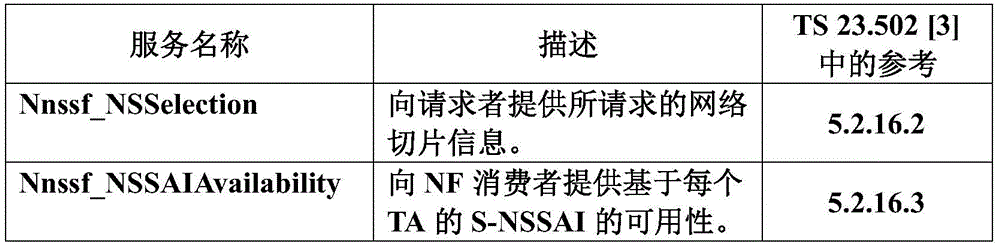
table 1: services provided by NSSF
In table 1 above, NSSF provides two different services. The first service provides network slice information to the requester and the second service provides NSSAI availability information on a per TA basis. However, in 3GPP TS 23.501 or 3GPP TS 23.502 defining the service, there is no association between the two services.
For example, as described above, when there are multiple AMFs that can provide access to a network slice service requested by a UE or when the network decides to reassign a registration to an AMF other than the AMF that originally received the registration message, the AMF may consult the NSSF to identify the AMF that can provide the requested service. According to 3GPP TS 23.501, a 5G UE can request up to 8S-NSSAIs as part of the initial registration procedure. The AMF selected for the UE should support all S-NSSAIs requested by the UE (see clause 5.15.2.1 of 3GPP TS 23.501). NSSAI is a collection of S-NSSAIs. The NSSAI may be a configured NSSAI, a requested NSSAI, or an allowed NSSAI. There may be up to 8S-NSSAIs among the allowed and requested NSSAIs sent in signaling messages between the UE and the network. The requested NSSAI, signaled by the UE to the network, allows the network to select the serving AMF, network slice(s), and network slice instance(s) for the UE, as specified in clause 5.15.5 of 3GPP TS 23.501.
As described above, AMF reallocation may occur due to network slice support. During the registration procedure in the PLMN, if the network decides based on network slice aspects that the UE should be served by a different AMF, the AMF that first received the registration request redirects the registration request to another AMF via the RAN or via direct signaling between the initial AMF and the target AMF. If the target AMF(s) is returned from the NSSF and identified by the list of candidate AMF(s), the redirection message can only be sent via direct signaling between the initial AMF and the target AMF. If the redirection message is sent by the AMF via the RAN, the message includes information for selecting a new AMF to serve the UE.
For already registered UEs, the system supports network-initiated redirection of the UE from its serving AMF to a target AMF for network slice considerations (e.g., the operator has changed the mapping between network slice instances and their corresponding serving AMF (s)). The operator policy determines whether redirection between AMFs is allowed.
The subject matter described herein provides for using NSSAI availability information and AMF payload information to generate a prioritized list of AMFs capable of providing access to a requested network slicing service, and providing the prioritized list to the AMFs to facilitate selecting an optimal AMF to access the requested network slicing service. When the AMF is required to select a serving AMF for the UE, the prioritized list of AMFs may be used to select the serving AMF in any of the cases described above.
Fig. 2 is a network diagram illustrating in more detail the services provided by the NSSF. In fig. 2, the NSSF is shown as physical NSSF 116A and virtual NSSF (V-NSSF) 116B. NSSF 116A and 166B communicate with AMF 110 and NRF 100. The NSSF 116A or 116B may register with the NRF 100 to receive updates on NFs, such as the AMF 110, as AMFs are added to the network and network slices or other services supported by the AMF 110 change. NSSF 116A and 116B may also receive load information from NRF 100 for NFs subscribed to by NSSF 116A or 116B, such as AMF 110. In operation, the NSSF 116A or 116B selects a Network Slice Instance (NSI), determines allowed NSSAI information, and determines the AMF to serve the UE. The AMF 110 may retrieve the NRF, NSI ID, and target AMF as part of the UE initial registration and Packet Data Unit (PDU) session establishment procedure.
As described above, the two services provided by NSSF116 are the NSSAI availability service and the NS selection service. The NS selection service is used by the NF service consumer (i.e., AMF) to retrieve information related to the network slice. The NS selection service also enables the NSSF to provide the AMF with allowed NSSAIs and configured NSSAIs for the serving PLMN. The NSSAI availability service enables updates with the NSSF of the NF service consumer (e.g., AMF) based on the S-NSSAI (S) supported by each TA. The NSSAI availability service allows the AMF to subscribe to the S-NSSAI (unrestricted) available per TA on a per TA basis and the restricted S-NSSAI (S) per PLMN in the TA of the UE' S serving PLMN and be notified of any change in its status.
3GPP TS 23.502 allows NSSF to obtain NSSAI availability information from AMF, but does not specify the use of NSSAI availability information for AMF selection. The subject matter described herein includes determining weights for candidate AMFs using NSSAI availability information obtained by a NSSAI availability service, providing the weights to a requesting AMF, and using the weights by the requesting AMF to select an AMF to serve a session involving a UE (such as an IoT device).
Fig. 3 is a message flow diagram illustrating an NS selection service performed without NSSAI availability information. Referring to fig. 3, in line 1, the AMF 200, which may be a default AMF to which an initial registration of a UE is routed or an AMF that decides that an initial registration should be routed to a different AMF for network slicing reasons, sends a hypertext transfer protocol (HTTP) GET message to the NSSF 116. The HTTP GET message specifies a list of requested NSSAIs, a list of subscribed NSSAIs, a Transport Area Identifier (TAI), a PLMN identifier, and a network function identifier that identifies the AMF 200. Based on the requested and subscribed NSSAI, PLMN ID, TA ID, and the identity of the requesting AMF, NSSF116 determines a Network Slice Identifier (NSI) and a target AMF that provides access to the service identified by the NSI, and, in line 2, sends an NF discovery request to NRF 100. The NF discovery request specifies a set of target AMFs that provide access to the requested network slice service.
In line 3, NRF 100 responds with a list of AMFs belonging to the set of target AMFs identified in the request in line 2. In line 4, the NSSF116 sends a response with the list of candidate AMFs to the requesting AMF. The AMF 200 then selects one of the AMFs to provide access to the requested network slice service. It should be noted that NSSAI availability information obtained from the NSSAI availability service is not used in the AMF selection process in fig. 3.
Fig. 4 is a message flow diagram illustrating NSSF116 receiving NSSAI availability information via a NSSAI availability service. Referring to fig. 4, in line 1, NSSF116 receives HTTP PUT/path messages from AMF 1200. The HTTP PUT/PATCH message contains the NSSAI supported by each TA. In the illustrated example, the supported NSSAIs are embedded battery (embbat) and massive iot (miot). The mIOT NSSAI may be requested by a large number of IoT devices or on behalf of a large number of IoT devices requesting the same service from the network. The embbat NSSAI may be requested by a UE (such as an IoT device) with an embedded battery. The parameter 0x2345 is the identifier of the TA. Another example of an NSSAI that may be specified is ultra-reliable low-latency communication (URLLC). URLLC can be used in industrial automation and remote control applications requiring low latency, ultra-reliable communications. Another NSSAI that may be specified is enhanced mobile broadband (emBB) for mobile broadband services such as streaming video.
In accordance with the subject matter described herein, NSSF116 may store and utilize NSSAI availability information to provide a list of AMFs to a querying AMF that is utilizing the NF selection service shown in fig. 3. Thus, after line 1, the NSSF116 stores an identifier for the AMF1200 and the NSSAI supported by each TA for the AMF 200, and this data may be used to respond to NS selection queries. In line 2 of the message flow diagram, the NSSF116 responds to the AMF1200 with an NSSAI availability data message acknowledging the receipt of the NSSAI availability information.
In line 3 of the message flow graph, the AMF 2202 sends HTTP PUT information to the NSSF116 identifying the mIOT service for the delivery zone identified by the identifier 0x 2345. In response to the HTTP PUT message, the NSSF116 stores the identifier for the AMF 2202, the TA ID, and the NSSAI. Table 2 shown below illustrates an example of NSSAI availability information that NSSF116 may store after the call flow (call flow) shown in fig. 4.
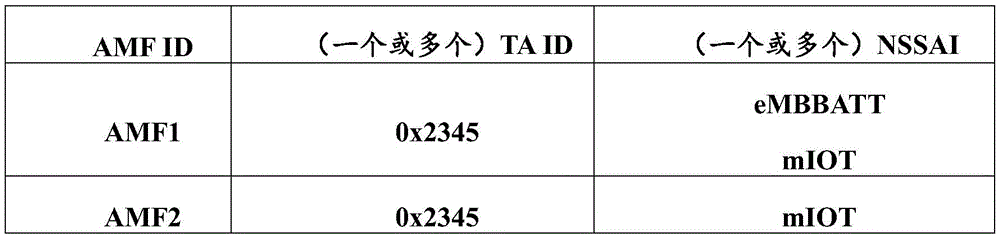
Table 2: NSSAI availability information stored by NSSF in table 2, it can be seen that NSSF116 stores an AMF identifier, a corresponding TA identifier, and an NSSAI for each TA ID. In the illustrated example, the AMF identifiers are AMF1 and AMF2 that identify AMF1200 and AMF 2202 shown in fig. 4. For both AMF1 and AMF2, the TA identifier is 0x 2345. It will be appreciated that a given AMF may support multiple TAs, and in this case, multiple TA IDs may be stored in the AMF selection database maintained by the NSSF 116. The third column in table 2 is NSSAI for each TA and each AMF. In the example shown, NSSAI for AMF1 and TA 0x2345 are embbat and mIOT. The NSSAI for AMF 2202, TA ID 0x2345 is mIOT, indicating that AMF 2202 and TA ID 0x2345 provide access to the mIOT service.
Once NSSF116 stores NSSAI availability information, such as that shown in table 2, NSSF116 may respond to the NS selection request with the NSSAI availability information. Fig. 5 is a message flow diagram illustrating the use of NSSAI availability information to respond to an NS selection request. Referring to fig. 5, in line 1 of the message flow diagram, AMF1200 sends an HTTP PUT/path message to NSSF 116. The HTTP PUT/PATCH message contains the NSSAI supported by each TA. In the illustrated example, the supported NSSAIs are embbart and mIOT. TA is identified by the number 0x 2345. NSSF116 receives the HTTP PUT/path messages and stores the NSSAI supported by each TA as shown in table 2. In line 2 of the message flow diagram, NSSF116 responds to the HTTP PUT/PATCH message with an authorized NSSAI availability data message.
In line 3 of the message flow diagram, AMF 2202 sends an HTTP PUT message to NSSF116 containing NSSAI availability data mlot for TA 0x 2345. NSSF116 receives the HTTP PUT message and stores NSSAI availability data in its local AMF selection database. In line 4, the NSSF116 responds to the AMF 2202 with an authorized NSSAI availability data response message.
In line 5 of the message flow diagram, AMF1200 sends an NS select GET request message to NSSF 116. The NS SELECT GET request message specifies the NSSAI requested, which in the illustrated example is mIOT and TA ID 0x 2345. The NSSF116 receives the NS select GET request message and executes the most relevant AMF selection algorithm to generate a prioritized list of AMFs that are capable of providing access to the requested one or more network slice services. In one example, the most relevant AMF selection algorithm may calculate the relative AMF priority using at least two factors:
load of AMF.
Correlation of AMF.
The first factor is the load of the AMF, which in one example is a measure of the current processing load of the AMF. The load of the AMF may be obtained from the NRF in a discovery response message in a message flow similar to that shown in fig. 3. The second factor is the correlation of AMF, which can be determined using a list of S-NSSAIs supported by AMF. In one example, a weight W is calculated for each AMF present in the NRF discovery response. The higher the weight, the higher the priority of the response of the AMF to the NSSAI select GET request. The weight W may be calculated using the following formula:
w is R/L, wherein
W is the weight of the object,
correlation in the percentage of R ═ AMF, and
l is the percentage in the load of AMF.
The AMF correlation is defined as the ratio of the minimum number of S-NSSAIs required to serve the selected slice to the total number of S-NSSAIs supported by the AMF. The AMF correlation is calculated using the following formula:
R=C/T,
c is the number of S-NSSAIs shared between the selected NSSAI list and the requested NSSAI list, and
t is the total number of S-NSSAIs supported by AMF.
Using the example shown in fig. 5, there is one request NSSAI, mIOT in the NS select GET request in line 5. AMF1 and AMF2 both have a NSSAI, mIOT that is common with the requesting NSSAI. Thus, the value of C in the correlation equation is equal to 1 for both AMF1200 and AMF 2202. The total number of NSSAIs supported by AMF1200 is 2(embbat and mIOT). The total number of NSSAIs supported by AMF 2202 is 1 (mIOT). Thus, the relevance score for AMF1200 is calculated as follows:
R=C/T
=1/2
=0.5。
the relevance score for the AMF 2202 may be calculated using the following expression:
R=C/T
=1/1
=1.0。
if the loading of the AMF1200 and the AMF 2202 are equal, for example 50%, then the weight of the AMF1200 may be calculated as follows:
W=R/L
=0.5/(0.5)
=1.0。
the weights for the AMF 2202 are determined using the following expression:
W=R/L
=1/(0.5)
=2.0。
returning to the message flow in fig. 5, in line 6, the NSSF116 returns the AMF 2202 as the response candidate AMF because the most relevant selection algorithm results in the AMF 2202 as the AMF with the highest weight value. In an alternative embodiment, the NSSF116 may return a prioritized list of AMFs and corresponding weights that are capable of providing the requested service. For example, in FIG. 5, the list would include the identities of AMF1200 having a weight of 1 and AMF 2202 having a weight of 2.0.
As can be seen from the example described with respect to fig. 5, the AMF correlation determination algorithm results in a priority assignment of the AMF that provides the minimum set of matching network slice services to the UE session. For example, in FIG. 5, AMF1200 and AMF 2202 both support the requested mIOT service. However, the AMF1200 also supports the embbart service. Thus, if a UE session is assigned to AMF1, a UE that needs to access AMF1200 to enable its embbat service may not have access to the resources of AMF 1200. Because AMF 2202 only provides the mIOT service, it is more efficient to assign UEs requesting the mIOT service to AMF 2202, assuming that AMF1200 and AMF 2202 are the same load.
Fig. 6 illustrates another example of providing AMF selection based on NSSAI availability, where the AMF load is taken into account in the AMF selection process. Referring to fig. 6, in line 1, the AMF1200 sends an HTTP PUT/PATCH message to the NSSF116 indicating the network slicing capabilities of the AMF 1200. In the illustrated example, the AMF1200 supports the mIOT service for the transmission area 0x 2345. In line 2, the NSSF116 responds to the HTTP PUT/PATCH message.
In line 3, the AMF 2202 sends an HTTP PUT message to the NSSF116, which indicates that the AMF 2202 provides the mIOT service for the delivery area U0x 2345. In line 4, the NSSF116 responds to the HTTP PUT message from the AMF 2202. Thus, after row 4, the NSSF116 stores the supported NSSAI availability information for the AMFs 1200 and 2202 of the transfer region 0x 2345.
In line 5 of the message flow diagram, NSSF116 receives an NS selection request from AMF1200 requesting mIOT services for a UE. In response to the NS select GET request message, the NSSF116 calculates the correlation and waits for AMFs 1200 and 2202. Using the above formula, the relevance score for AMF1200 is calculated as follows:
R=C/T
=1/1
=1.0
the relevance score for the AMF 2202 is calculated using the following expression:
R=C/T
=1/1
=1.0。
thus, the correlation scores of AMF1200 and AMF 2202 are equal. In this example, assume that AMF1 load is 10% and AMF2 load is 50%. Thus, the weight of AMF1200 is calculated as follows:
W=R/L
=1.0/(0.1)
=10.0
the weight of the AMF 2202 is determined as follows:
W=R/L
=1/0.5
=2.0
thus, in this example, the AMF1200 is weighted higher than the AMF 2202. Thus, in line 6, the NSSF116 returns a list including AMF1200 and AMF 2202, where AMF1200 is preferred due to its higher weight.
Fig. 7 is a block diagram illustrating an exemplary NSSF capable of performing NSSAI correlation determination and facilitating AMF selection using NSSAI availability information. Referring to fig. 7, NSSF116 includes at least one processor 700 and memory 702. The AMF prioritizer 704 may be executed by the processor 700 and reside in the memory 702. The AMF prioritizer 704 obtains NSSAI availability information using the NSSAI availability procedure described above. The AMF prioritizer 704 may also obtain AMF payload information by communicating with the NRF. The AMF prioritizer 704 may store NSSAI availability information and AMF payload information in an AMF selection database 706. Using table 2 above as an example, the AMF selection database 706 may include NSSAI availability information on a per TA basis, as shown in table 2. In addition, the AMF payload information may be added to each database entry as a third column or field.
The AMF prioritizer 704 may receive the NS select GET request message from the AMF, identify the requested NSSAI information in the request message, and use the NSSAI availability and AMF load information stored in the AMF selection database 706 to determine the relevance and weight of each AMF that is capable of providing the requested network slice service. The AMF prioritizer 704 may return a prioritized list of one or more AMFs that are capable of providing access to the requested network slice service. The receiving AMF may use the prioritized list to select an AMF and forward a registration request for the user session to the selected AMF.
Fig. 8 is a flow diagram illustrating an exemplary process for providing policy-based AMF selection using NSSAI availability information. The steps shown in fig. 8 may be performed at a network slice selection function comprising at least one processor. Referring to fig. 8, at step 800, NSSF116 obtains NSSAI availability information for a plurality of AMFs using a NSSAI availability service. For example, the NSSF116 may receive NSSAI availability information from the AMF via an HTTP PUT/path message that specifies the NSSAI supported by each delivery area.
In step 802, the process includes obtaining AMF payload information. The NSSF116 may obtain the AMF load information from the NRF 100 by sending a NF discovery request to the NRF 100, where the NF discovery request identifies the AMFs for which the NSSF116 desires to obtain the AMF load information. NRF 100 may respond to the NF discovery request with a list of AMF identities and corresponding payload information. In one example, the AMF load information may indicate a percentage of the processing power of the AMF currently in use.
At step 804, the process includes receiving a network slice selection request message specifying a network slice service requested by a user equipment. For example, NSSF116 may receive an NS select GET request message identifying one or more requested NSSAIs and corresponding delivery regions.
In step 806, the processing includes generating a prioritized list including at least one AMF for supporting network slicing services based on the NSSAI availability information, the AMF load information, and the network slicing services requested by the UE. For example, NSSF116 may identify a list of AMFs capable of providing the requested NS service(s) based on the NSSAI in the NS selection request and the supported NSSAI obtained from the NSSAI availability service. In the above example, the priority is based on the ratio of the number of requested network slice services provided by the AMF to the total number of services provided by the AMF and the relative load of the AMF. In another example, the prioritized list may include only AMFs having the highest relative priorities.
In step 808, the prioritized list is provided to the requesting AMF. In one example, the NSSF116 may send a list and corresponding weights to the requesting AMFs, where the weights are calculated based on the correlation and load percentage of the AMFs calculated using the above formula. In another example, NSSF116 may send a list of AMF identities, where the order of AMFs in the list indicates their relative priority.
At step 810, the list is used to select an AMF for handling the user session. For example, the requesting AMF may receive a prioritized list of AMFs and select the AMF in the list with the highest weight (based on correlation and load assignment) to provide access to the requested network slice service.
The subject matter described herein allows NSSF to use NSSAI availability information to select and prioritize a list of candidate AMFs. Using NSSAI availability information to select and prioritize a list of candidate AMFs, UE sessions are more likely to be forwarded to the most specialized (specialized) AMFs to provide network slicing services requested by the UE rather than to generic AMFs that support a larger set of network slicing services, especially if AMF correlation is considered as a prioritization criterion. The subject matter described herein enables quality of service (QoS) based traffic isolation by prioritizing candidate AMFs based on their supported S-NSSAI information. The subject matter described herein reduces the likelihood of AMF overload supporting a larger set of S-NSSAIs by preferentially selecting AMFs with a smaller set of S-NSSAIs that match the UE requested NSSAI.
The disclosures of each of the following references are incorporated herein by reference in their entirety:
3GPP TS 23.501, "Technical Specification Group Services and System attributes; system Architecture for the 5G System (5GS) ", stage 2 (16 th edition) V16.2.0 (2019-09).
2.3 GPP TS 23.502, "Technical Specification Group Services and System attributes; procedents for the 5G System (5GS) ", stage 2 (16 th edition) V16.2.0 (2019-09).
3.3 GPP TS 29.510, "Technical Specification Group Core Network and Terminals; 5G System; network Function reproduction Services ", stage 3 (16 th edition) V16.1.1 (2019-10).
It will be understood that various details of the presently disclosed subject matter may be changed without departing from the scope of the presently disclosed subject matter. Furthermore, the foregoing description is for the purpose of illustration only, and not for the purpose of limitation.
Claims (20)
1.A method for providing policy-based access and mobility management function (AMF) selection using Network Slice Selection Assistance Information (NSSAI) availability information obtained from a NSSAI availability service, the method comprising:
at a Network Slice Selection Function (NSSF) comprising at least one processor:
obtaining NSSAI availability information regarding a plurality of AMFs from a NSSAI availability service using a NSSAI availability service;
receiving, from a first AMF, a network slice selection request specifying a network slice service requested by a User Equipment (UE);
generating a prioritized list comprising identities of at least one AMF for supporting network slicing services based on NSSAI availability information and the UE requested network slicing services; and
the prioritized list is communicated to the first AMF.
2. The method of claim 1, wherein obtaining NSSAI availability information comprises receiving hypertext transfer protocol (HTTP) messages from the AMFs, wherein each HTTP message indicates a NSSAI supported for each delivery area (TA) of one of the AMFs.
3. The method of any of the preceding claims, wherein receiving a network slice selection request comprises receiving a network slice selection request including at least one NSSAI identifying a network slice service requested by the UE.
4. The method of any of the preceding claims, wherein generating the prioritized list comprises prioritizing a second AMF that supports the requested network slicing service over a third AMF that supports the requested network slicing service and supports a larger number of network slicing services than the second AMF.
5. The method of claim 4, wherein prioritizing the second AMF over the third AMF comprises calculating a correlation R for the second AMF and the third AMF, wherein R equals C/T, wherein C equals a number of common NSSAIs between the NSSAI requested by the UE and the NSSAI supported by the second AMF or the third AMF and T equals a total number of NSSAIs supported by the second AMF or the third AMF.
6. The method of claim 5, comprising obtaining a load percentage for each AMF.
7. The method of claim 6, wherein obtaining a load percentage comprises obtaining a load percentage from a network function repository function (NRF).
8. The method of claim 6 or claim 7, wherein generating the prioritized list comprises calculating a weight W for the second AMF and the third AMF, wherein the weight W is equal to R/L, and L is a load percentage of the second AMF or the third AMF.
9. The method of claim 8, wherein communicating the prioritized list to the first AMF comprises communicating AMF identities of the second AMF and the third AMF and weights calculated for the second AMF and the third AMF to the first AMF.
10. The method of claim 8 or claim 9, wherein communicating the prioritized list to the first AMF comprises communicating the AMF identities of the second AMF and the third AMF in an order corresponding to the weights computed for the second AMF and the third AMF.
11. A system for providing policy-based access and mobility management function (AMF) selection using Network Slice Selection Assistance Information (NSSAI) availability information obtained from a NSSAI availability service, the system comprising:
a Network Slice Selection Function (NSSF) comprising at least one processor; and
an access and mobility management function (AMF) prioritizer implemented by the at least one processor to obtain NSSAI availability information regarding usage of a plurality of AMFs using NSSAI availability services, receive a network slice selection request from a first AMF specifying a network slice service requested by a User Equipment (UE), generate a prioritized list based on the NSSAI availability information and the UE requested network slice service, the list including an identity of at least one AMF for supporting the network slice service, and transmit the prioritized list to the first AMF.
12. The system of claim 11, wherein the AMF prioritizer is configured to obtain NSSAI availability information by receiving hypertext transfer protocol (HTTP) messages from the AMFs, and each HTTP message indicates the NSSAI supported for each Transport Area (TA) of one of the AMFs.
13. The system according to claim 11 or claim 12, wherein the network slice selection request includes at least one NSSAI identifying the network slice service requested by the UE.
14. The system of any of claims 11 to 13, wherein the AMF prioritizer is configured to generate the prioritized list by prioritizing a second AMF that will support the requested network slice service over a third AMF that supports the requested network slice service and supports a larger number of network slice services other than the requested network slice service than the second AMF.
15. The system of claim 14, wherein the AMF prioritizer is configured to prioritize the second AMF over the third AMF by calculating a correlation R of the second AMF and the third AMF, wherein R ═ C/T, wherein C equals a number of common NSSAIs between the NSSAI requested by the UE and the NSSAIs supported by the second AMF or the third AMF and T equals a total number of NSSAIs supported by the second AMF or the third AMF.
16. The system of claim 15, the AMF prioritizer configured to obtain load percentages of the second AMF and the third AMF and to calculate a weight value W for the second AMF and the third AMF, wherein the weight value W for the second AMF or the third AMF is equal to R/L and L is the load percentage of the second AMF or the third AMF.
17. The system of claim 16, wherein the AMF prioritizer is configured to obtain the load percentage from a network function repository function (NRF).
18. The system of claim 16 or claim 17, wherein the prioritized list of AMFs includes AMF identities of the second AMF and the third AMF and weights calculated for the second AMF and the third AMF.
19. The system of any of claims 16 to 18, wherein the prioritized list comprises an ordered list of AMF identities of the second AMF and the third AMF, and an order of the AMF identities in the list corresponds to the weights calculated for the second AMF and the third AMF.
20. A non-transitory computer readable medium having stored thereon executable instructions that when executed by a processor of a computer control the computer to perform steps comprising:
at the Network Slice Selection Function (NSSF):
obtaining NSSAI availability information regarding a plurality of AMFs from a Network Slice Selection Assistance Information (NSSAI) availability service using a NSSAI availability service;
receiving, from a first AMF, a network slice selection request specifying a network slice service requested by a User Equipment (UE);
generating a prioritized list based on the NSSAI availability information and the UE requested network slicing service, the list comprising identities of at least one AMF for supporting the network slicing service; and
the prioritized list is communicated to the first AMF.
Applications Claiming Priority (3)
| Application Number | Priority Date | Filing Date | Title |
|---|---|---|---|
| US16/676,006 | 2019-11-06 | ||
| US16/676,006 US11197176B2 (en) | 2019-11-06 | 2019-11-06 | Methods, systems, and computer readable media for providing for policy-based access and mobility management function (AMF) selection using network slice selection assistance information (NSSAI) availability information |
| PCT/US2020/051884 WO2021091623A1 (en) | 2019-11-06 | 2020-09-21 | Policy-based access and mobility management function (amf) selection using network slice selection assistance information (nssai) availability information |
Publications (2)
| Publication Number | Publication Date |
|---|---|
| CN114788315A true CN114788315A (en) | 2022-07-22 |
| CN114788315B CN114788315B (en) | 2025-02-25 |
Family
ID=72752998
Family Applications (1)
| Application Number | Title | Priority Date | Filing Date |
|---|---|---|---|
| CN202080085050.8A Active CN114788315B (en) | 2019-11-06 | 2020-09-21 | Policy-based access and mobility management function selection using network slice selection assistance information availability information |
Country Status (5)
| Country | Link |
|---|---|
| US (1) | US11197176B2 (en) |
| EP (1) | EP4055852B1 (en) |
| JP (1) | JP7555405B2 (en) |
| CN (1) | CN114788315B (en) |
| WO (1) | WO2021091623A1 (en) |
Families Citing this family (20)
| Publication number | Priority date | Publication date | Assignee | Title |
|---|---|---|---|---|
| US11405931B2 (en) | 2019-12-12 | 2022-08-02 | Oracle International Corporation | Methods, systems, and computer readable media for providing for network slice management using feedback mechanism |
| EP4118885A1 (en) * | 2020-03-13 | 2023-01-18 | IPLA Holdings Inc. | Ran slicing |
| US11528334B2 (en) * | 2020-07-31 | 2022-12-13 | Oracle International Corporation | Methods, systems, and computer readable media for preferred network function (NF) location routing using service communications proxy (SCP) |
| US12206746B2 (en) * | 2020-07-31 | 2025-01-21 | Telefonaktiebolaget Lm Ericsson (Publ) | Bound service request handling |
| US11924294B2 (en) * | 2020-07-31 | 2024-03-05 | Telefonaktiebolaget Lm Ericsson (Publ) | Service request handling |
| KR20220096499A (en) * | 2020-12-31 | 2022-07-07 | 삼성전자주식회사 | Method and apparatus for supporting system interworiking in a wireless communication system |
| US11716283B2 (en) | 2021-03-05 | 2023-08-01 | Oracle International Corporation | Methods, systems, and computer readable media for selecting a software defined wide area network (SD-WAN) link using network slice information |
| US20240214902A1 (en) * | 2021-04-27 | 2024-06-27 | Samsung Electronics Co., Ltd. | Method and apparatus for reassignment of access and mobility management function in communication system |
| US12127297B2 (en) | 2021-06-02 | 2024-10-22 | Oracle International Corporation | Methods, systems, and computer readable media for using service communications proxy (SCP) or security edge protection proxy (SEPP) to apply or override preferred-locality attribute during network function (NF) discovery |
| US11888946B2 (en) | 2021-06-02 | 2024-01-30 | Oracle International Corporation | Methods, systems, and computer readable media for applying or overriding preferred locality criteria in processing network function (NF) discovery requests |
| US11895080B2 (en) | 2021-06-23 | 2024-02-06 | Oracle International Corporation | Methods, systems, and computer readable media for resolution of inter-network domain names |
| US20250294436A1 (en) * | 2021-07-06 | 2025-09-18 | Telefonaktiebolaget Lm Ericsson (Publ) | Methods and apparatuses for facilitating network slice selection |
| US11930083B2 (en) | 2021-08-09 | 2024-03-12 | Oracle International Corporation | Methods, systems, and computer readable media for processing network function (NF) discovery requests at NF repository function (NRF) using prioritized lists of preferred locations |
| US12207104B2 (en) | 2021-09-24 | 2025-01-21 | Oracle International Corporation | Methods, systems, and computer readable media for providing priority resolver for resolving priorities among network function (NF) instances |
| US11871309B2 (en) | 2021-09-28 | 2024-01-09 | Oracle International Corporation | Methods, systems, and computer readable media for network function discovery using preferred-locality information |
| US20240251307A1 (en) * | 2021-10-21 | 2024-07-25 | Apple Inc. | Cell reselection |
| US11888957B2 (en) | 2021-12-07 | 2024-01-30 | Oracle International Corporation | Methods, systems, and computer readable media for locality and serving scope set based network function (NF) profile prioritization and message routing |
| US11652895B1 (en) | 2022-02-15 | 2023-05-16 | Oracle International Corporation | Methods, systems, and computer readable media for dynamic optimized network function discovery for consumer network functions |
| WO2025052474A1 (en) * | 2023-09-08 | 2025-03-13 | Jio Platforms Limited | Method and system for managing subscription of network functions |
| CN120321632A (en) * | 2024-01-12 | 2025-07-15 | 中国电信股份有限公司技术创新中心 | A connection establishment method, device, equipment and medium |
Citations (1)
| Publication number | Priority date | Publication date | Assignee | Title |
|---|---|---|---|---|
| US20190141606A1 (en) * | 2017-11-08 | 2019-05-09 | Weihua QIAO | Location Based Coexistence Rules for Network Slices |
Family Cites Families (26)
| Publication number | Priority date | Publication date | Assignee | Title |
|---|---|---|---|---|
| US10644955B2 (en) | 2015-08-21 | 2020-05-05 | Huawei Technologies Co., Ltd. | Method and apparatus for network slicing |
| US10142994B2 (en) * | 2016-04-18 | 2018-11-27 | Electronics And Telecommunications Research Institute | Communication method and apparatus using network slicing |
| CN110463139A (en) | 2017-03-16 | 2019-11-15 | 英特尔Ip公司 | Supporting SON functionality on network slice instances |
| BR112019019864A2 (en) * | 2017-04-01 | 2020-04-22 | Huawei Tech Co Ltd | access method, network device, terminal device, and amf mobility and access management function device |
| CN116489627A (en) | 2017-04-27 | 2023-07-25 | 三星电子株式会社 | Method for obtaining network slicable area information |
| US20180317134A1 (en) | 2017-04-28 | 2018-11-01 | Huawei Technologies Co., Ltd. | Nssmf nsmf interaction connecting virtual 5g networks and subnets |
| US11050626B2 (en) | 2017-04-28 | 2021-06-29 | Huawei Technologies Co., Ltd. | Service provision for offering network slices to a customer |
| US10264506B2 (en) * | 2017-05-13 | 2019-04-16 | Qualcomm Incorporated | Enable a network-trigger change of network slices |
| CN108966220B (en) * | 2017-07-28 | 2019-07-23 | 华为技术有限公司 | A kind of key deduction method and network device |
| CA3021658A1 (en) * | 2017-10-20 | 2019-04-20 | Comcast Cable Communications, Llc | Non-access stratum capability information |
| US10797894B2 (en) * | 2017-12-28 | 2020-10-06 | Ofinno, Llc | Service type and device type-based policy and charging control |
| CN110120879B (en) | 2018-02-06 | 2020-12-01 | 华为技术有限公司 | A kind of guarantee method, equipment and system of application service level agreement |
| WO2019158737A1 (en) | 2018-02-16 | 2019-08-22 | NEC Laboratories Europe GmbH | Network data analytics for oam |
| US12095640B2 (en) | 2018-02-19 | 2024-09-17 | Nec Corporation | Network data analytics functionality enhancement and new service consumers |
| US11140047B2 (en) | 2018-04-09 | 2021-10-05 | Intel Corporation | Network data analytics function (NWDAF) influencing fifth generation (5G) quality of service (QoS) configuration and adjustment |
| US11419046B2 (en) | 2018-04-13 | 2022-08-16 | Telefonaktiebolaget Lm Ericsson (Publ) | Methods and systems for performing multi-domain network slice selection and approval |
| US10506506B2 (en) * | 2018-04-30 | 2019-12-10 | Ofinno, Llc | 5G policy control for restricted local operator services |
| US10904947B2 (en) | 2018-05-16 | 2021-01-26 | Huawei Technologies Co., Ltd. | Message and system for application function influence on traffic routing |
| WO2019225929A1 (en) | 2018-05-21 | 2019-11-28 | Samsung Electronics Co., Ltd. | Method and apparatus for utilizing data collection and analysis function in wireless communication system |
| US10892958B2 (en) | 2018-08-03 | 2021-01-12 | Huawei Technologies Co., Ltd. | Methods and functions of network performance monitoring and service assurance |
| KR102577006B1 (en) * | 2018-08-13 | 2023-09-11 | 삼성전자 주식회사 | A method and apparatus for 4g and 5g network interworking to support network slicing |
| CN109600262B (en) | 2018-12-17 | 2021-08-10 | 东南大学 | Resource self-configuration and self-optimization method and device in URLLC transmission network slice |
| US11490291B2 (en) * | 2019-03-28 | 2022-11-01 | Ofinno, Llc | Handover for closed access group |
| KR20200143134A (en) * | 2019-06-14 | 2020-12-23 | 삼성전자주식회사 | Method and apparatus for providing service in wireless communication system |
| US10939267B1 (en) * | 2019-08-15 | 2021-03-02 | Netsia, Inc. | Apparatus and method for a unified slice manager |
| US11405931B2 (en) | 2019-12-12 | 2022-08-02 | Oracle International Corporation | Methods, systems, and computer readable media for providing for network slice management using feedback mechanism |
-
2019
- 2019-11-06 US US16/676,006 patent/US11197176B2/en active Active
-
2020
- 2020-09-21 JP JP2022526212A patent/JP7555405B2/en active Active
- 2020-09-21 EP EP20786649.2A patent/EP4055852B1/en active Active
- 2020-09-21 CN CN202080085050.8A patent/CN114788315B/en active Active
- 2020-09-21 WO PCT/US2020/051884 patent/WO2021091623A1/en not_active Ceased
Patent Citations (1)
| Publication number | Priority date | Publication date | Assignee | Title |
|---|---|---|---|---|
| US20190141606A1 (en) * | 2017-11-08 | 2019-05-09 | Weihua QIAO | Location Based Coexistence Rules for Network Slices |
Non-Patent Citations (2)
| Title |
|---|
| 《3GPP》: ""3rd Generation Partnership Project;Technical Specification Group Services and System Aspects; System Architecture for the 5G System; Stage 2 (Release 16)"", 《3GPP》, 30 April 2019 (2019-04-30), pages 5 * |
| RAPPORTEURS AND VOLUNTEERS: "S2-174251 "5GS Open Topics Collection for SA WG2#122"", 3GPP TSG_SA\\WG2_ARCH, no. 2, 20 June 2017 (2017-06-20), pages 6 * |
Also Published As
| Publication number | Publication date |
|---|---|
| US20210136602A1 (en) | 2021-05-06 |
| US11197176B2 (en) | 2021-12-07 |
| EP4055852B1 (en) | 2025-08-20 |
| EP4055852A1 (en) | 2022-09-14 |
| WO2021091623A1 (en) | 2021-05-14 |
| CN114788315B (en) | 2025-02-25 |
| JP7555405B2 (en) | 2024-09-24 |
| JP2023500931A (en) | 2023-01-11 |
Similar Documents
| Publication | Publication Date | Title |
|---|---|---|
| CN114788315B (en) | Policy-based access and mobility management function selection using network slice selection assistance information availability information | |
| CN113647062B (en) | Producer Network Function (NF) service instance-wide egress rate limiting | |
| US11888946B2 (en) | Methods, systems, and computer readable media for applying or overriding preferred locality criteria in processing network function (NF) discovery requests | |
| US12127297B2 (en) | Methods, systems, and computer readable media for using service communications proxy (SCP) or security edge protection proxy (SEPP) to apply or override preferred-locality attribute during network function (NF) discovery | |
| US11888957B2 (en) | Methods, systems, and computer readable media for locality and serving scope set based network function (NF) profile prioritization and message routing | |
| US20250193272A1 (en) | Method for determining application instance, apparatus, and system | |
| JP2023536286A (en) | Method, System, and Computer-readable Medium for Preferred Network Function (NF) Location Routing Using Service Communication Proxy (SCP) | |
| US11930083B2 (en) | Methods, systems, and computer readable media for processing network function (NF) discovery requests at NF repository function (NRF) using prioritized lists of preferred locations | |
| WO2022197531A1 (en) | Methods, systems, and computer readable media for supporting multiple preferred localities for network function (nf) discovery and selection procedures | |
| US11864093B2 (en) | Methods, systems, and computer readable media for communicating delegated network function (NF) discovery results between service communication proxies (SCPs) and using the delegated NF discovery results for alternate routing | |
| EP4360283A1 (en) | Methods, systems, and computer readable media for optimizing network traffic distribution using timeslot-based tracked producer network function (nf) performance during producer nf selection | |
| US11622293B2 (en) | Methods, systems, and computer readable media for establishing message priority in network slices based on quality of service parameters | |
| US20230025799A1 (en) | Methods, systems, and computer readable media for providing updated network slice information to a network slice selection function (nssf) | |
| US12526224B2 (en) | Methods, systems, and computer readable media for selecting network function (NF) profiles of NF set mates to enable alternate routing | |
| US12452341B2 (en) | Methods, systems, and computer readable media for improved network function (NF) discovery between forwarded and forwarding NF repository functions (NRFs) to avoid preemption of NF profiles of producer NFs local to forwarding NRF | |
| US12513070B1 (en) | Methods, systems, and computer readable media for communicating and using producer network function (NF) network slice level load information | |
| US12363198B2 (en) | Methods, systems, and computer readable media for overriding a preferred locality attribute value using preferred location attribute values and traffic distribution attribute values | |
| CN118972473A (en) | A communication method and a communication device |
Legal Events
| Date | Code | Title | Description |
|---|---|---|---|
| PB01 | Publication | ||
| PB01 | Publication | ||
| SE01 | Entry into force of request for substantive examination | ||
| SE01 | Entry into force of request for substantive examination | ||
| GR01 | Patent grant | ||
| GR01 | Patent grant |