Disclosure of Invention
The embodiment of the application provides a node scheduling method and a node scheduling device, which are used for realizing the scheduling of a first node to a second node.
A first aspect of an embodiment of the present application provides a node scheduling method, where the method is applied to a first node, and communication connections are established between the first node and a plurality of second nodes. The first node acquires local processing time corresponding to the second nodes and/or uploading time corresponding to the second nodes. Then, the first node sorts the sequence numbers of the plurality of second nodes according to the local processing time corresponding to the plurality of second nodes respectively and the uploading time corresponding to the plurality of second nodes respectively, so as to obtain a first sequence. The first node determines a second sequence from the first sequence. The second sequence includes the sequence numbers of some or all of the second nodes in the first sequence. And the first node schedules the second node corresponding to the sequence number included in the second sequence.
In this embodiment, the first node selects and schedules a part of the second nodes according to the local processing time of the plurality of second nodes and the upload time of the plurality of second nodes, thereby implementing optimization of the scheduling manner in which the first node selects and schedules the second nodes. Furthermore, the first node can perform global processing by combining the local processing result fed back by the second node, so that the efficiency of performing global processing by the first node can be improved or the accuracy of the global processing result obtained by the first node can be improved.
In one possible implementation manner, the node scheduling method is applied to a machine learning system, and the machine learning system includes a first node and a plurality of second nodes.
In this possible implementation manner, the node scheduling method provided in the embodiment of the present application may be applied to a machine learning system, so as to implement selection and scheduling of a first node on a second node in the machine learning system, so as to improve the efficiency of global processing performed by the machine learning system or improve the accuracy of a global processing result obtained by the machine learning system.
In a possible implementation manner, the local processing time includes time required by the plurality of second nodes to perform local training or local inference respectively, and the upload time includes time required by the plurality of second nodes to upload the local training result or the local inference result respectively.
In this possible implementation, the meaning that local processing time and upload time represent respectively for machine learning systems employing different machine learning algorithms is shown. For example, for a machine learning system using the federal learning algorithm, the local processing time includes the time required by the plurality of second nodes to perform local training respectively, and the uploading time includes the time required by the plurality of second nodes to upload local training results respectively. For the machine learning system adopting the distributed learning algorithm, the local processing time comprises the time required by the plurality of second nodes to perform local inference respectively, and the uploading time comprises the time required by the plurality of second nodes to upload local inference results respectively.
In another possible implementation manner, the step of the first node sorting the sequence numbers of the plurality of second nodes according to the local processing time and the uploading time to obtain a first sequence includes: firstly, a first node randomly selects M second nodes from N second nodes, wherein M is an integer which is greater than 1 and less than or equal to N, and N is an integer which is greater than 1; and then, the first node sequences the sequence numbers of the M second nodes according to the local processing time and the uploading time respectively corresponding to the M second nodes to obtain a first sequence.
In this possible implementation manner, the first node randomly selects M second nodes from the N second nodes, and then the first node determines the first sequence according to the local processing time and the uploading time of the M second nodes. The problem that the second node scheduled by the first node each time and the scheduling order in which the second node is scheduled are the same given the channel conditions and the computational power of the second node is avoided. And the accuracy of the global processing result obtained by the first node performing global processing according to the local processing result fed back by the scheduled second node is further improved.
In another possible implementation manner, the step of the first node sorting the sequence numbers of the plurality of second nodes according to the local processing time and the upload time to obtain a first sequence includes: firstly, the first node sequences the serial numbers of a plurality of second nodes according to local processing time and uploading time to obtain a third sequence; then, the first node randomly selects M serial numbers from the N serial numbers included in the third sequence, wherein M is an integer which is greater than 1 and less than or equal to N, and N is an integer which is greater than 1; and the first node carries out sequential sequencing on the M sequence numbers according to the sequencing of the M sequence numbers in the third sequence to obtain a first sequence.
In this possible implementation, the first node first sequences the plurality of second nodes to obtain a third sequence. And then, the first node randomly selects M serial numbers from the third sequence and sorts the M serial numbers. The problem that the second node scheduled by the first node each time and the scheduling order of scheduling the second node are the same given the channel condition and the computing power of the second node is avoided. And the accuracy of the global processing result obtained by the first node performing global processing according to the local processing result fed back by the scheduled second node is further improved. And the first node sorts the sequence numbers of the plurality of second nodes in each round. When the second node of the current round executed by the machine learning system is the same as the second node of the previous round executed by the machine learning system, the third sequence obtained in the previous round can be directly used, so that the calculation overhead caused by reordering is avoided.
In another possible implementation manner, the sequence numbers of the second nodes in the first sequence are sorted according to the size of the local processing time from small to large, and the sequence numbers of the second nodes with the same local processing time in the first sequence are sorted according to the size of the uploading time from small to large.
In this possible implementation manner, a specific manner in which the first node determines the first sequence in combination with the local processing time and the upload time is shown, so that the subsequent first node determines the second sequence according to the first sequence.
In another possible implementation manner, the determining, by the first node, the second sequence according to the first sequence includes:
the first node selects the serial numbers of f second nodes from the first sequence to obtain a second sequence;
the sequence of the sequence numbers corresponding to the f second nodes in the front and back of the first sequence is the same as the sequence numbers corresponding to the f second nodes in the front and back of the second sequence; f is a maximum value satisfying a first condition including: the sum of the maximum local processing time and the first time in the local processing time of the f second nodes is less than or equal to the preset maximum processing time;
the first time is equal to the sum of uploading times corresponding to the f second nodes respectively minus the time of the overlapping part of the uploading times of the f second nodes and the maximum local processing time, and f is an integer greater than 1.
In this possible implementation, a specific procedure for determining the second sequence by the specific first node is shown. In the serial scheduling system, the time required for each round is set as the preset maximum processing time, and under the condition that the weight of each second node is the same, the first node determines the second sequence according to the mode shown above, and then schedules the second node according to the second sequence. Thus, the first node can select the most second nodes in each turn to feed back the corresponding local processing results to the first node. And the more second nodes participate in the local processing and feed back the corresponding local processing results in the process of each round, the higher the accuracy of the global processing result obtained by the first node is.
In another possible implementation manner, the determining, by the first node, the second sequence according to the first sequence includes:
the first node determines the sequence numbers of the e second nodes and the sequence of the e second nodes through a recursive algorithm according to the first sequence, the weights of the plurality of second nodes, the local processing time of the plurality of second nodes and the uploading time of the plurality of second nodes, wherein e is an integer larger than 1;
the e second nodes meet a second condition, wherein the second condition comprises that the weight sum of the e second nodes is the maximum when the time required by the first node to collect the local processing results fed back by the e second nodes is less than or equal to the preset maximum processing time;
and the first node determines a second sequence according to the sequence numbers of the e second nodes and the sequence of the e second nodes.
In this possible implementation, a specific procedure for determining the second sequence by another specific first node is shown. In the serial scheduling system, when the time required for the machine learning system to execute one round is set to be greater than 0 and less than or equal to the preset maximum processing time, the first node determines the second sequence in the manner shown above, and then schedules the second node according to the second sequence. The first node may select a plurality of second nodes with the largest weight sum in each round to feed back corresponding local processing results to the first node. And the higher the weight sum of the second node participating in the local processing and feeding back the local processing result in each turn is, the higher the accuracy of the global processing result obtained by the first node is.
In another possible implementation manner, the scheduling, by the first node, the second node corresponding to the sequence number included in the second sequence includes:
and the first node respectively schedules the second nodes corresponding to the serial numbers included in the second sequence according to the sequence of the serial numbers of the second nodes in the second sequence.
In this possible implementation, a specific method is shown for the first node to schedule the second node in the second sequence. The method is mainly applied to a serial scheduling system. And under the condition that the time required by each turn in the serial scheduling system is set as the preset maximum processing time and the weight of each second node is the same, the first node schedules the second nodes according to the second sequence. Thus, the first node can select most second nodes in each round and feed back corresponding local processing results to the first node. And the more second nodes participate in the local processing and feed back the corresponding local processing results in the process of each round, the higher the accuracy of the global processing result obtained by the first node is. And under the condition that the time required by the machine learning system to execute one turn in the serial scheduling system is set to be greater than 0 and less than or equal to the preset maximum processing time, the first node schedules the second node according to the second sequence. The first node may select a plurality of second nodes with the largest weight and the largest weight in each round to feed back corresponding local processing results to the first node. And the higher the weight sum of the second node participating in the local processing and feeding back the local processing result in each turn is, the higher the accuracy of the global processing result obtained by the first node is.
In another possible implementation, the second sequence includes a sequence number a of the second nodeiAnd i ∈ [1, X ]]X is the number of the serial numbers of the second nodes in the second sequence; i is an integer, X is an integer greater than 1; a (a) toiThe serial number of the second node is arranged at the ai+1Before the serial number of the second node; the first node respectively schedules the second nodes corresponding to the sequence numbers included in the second sequence according to the sequence of the second node sequence numbers in the second sequence, and the method comprises the following steps: the first node to the aiThe second node sends a first uploading indication which is used for indicating the a-th nodeiUploading a first local processing result by the second node; the first node receives the data from the aiA first local processing result of the second node; the first node to the ai+1The second node sends a second uploading instruction which is used for indicating the a-th nodei+1Uploading a second local processing result by the second node; the first node receives the data from the ai+1A second local processing result of the second node.
In this possible implementation manner, a specific process is shown in which the first node schedules the second nodes corresponding to the sequence numbers included in the second sequence according to the sequence number order included in the second sequence.
In another possible implementation manner, the step of the first node sorting the sequence numbers of the plurality of second nodes according to the local processing time and the upload time to obtain a first sequence includes: the first node determines a bandwidth pre-allocation proportion value of each second node corresponding to first processing time according to the local processing time, the uploading time and the first processing time, wherein the first processing time is less than or equal to preset maximum processing time; the first node determines the first sequence corresponding to the first processing time according to the bandwidth pre-allocation proportion value; the sequence numbers included in the first sequence are obtained by sequencing the sequence numbers of the plurality of second nodes according to the size of the bandwidth pre-allocation values corresponding to the plurality of second nodes.
In this possible implementation manner, another specific manner for the first node to determine the first sequence in combination with the local processing time and the uploading time is shown, so that the subsequent first node determines the second sequence according to the first sequence.
In another possible implementation manner, the bandwidth pre-allocation proportion value corresponding to the pth second node in the plurality of second nodes is equal to Cp/(T-Dp),CpUploading time of the p second node, T is first processing time, DpIs the local processing time of the pth second node, and p is an integer greater than or equal to 1.
In this possible implementation, a specific calculation manner of the bandwidth pre-allocation ratio value of the second node is shown, which provides a basis for determining the second sequence according to the first sequence by the subsequent second node.
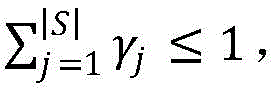
In another possible implementation manner, the number of the first processing times is one, and the determining, by the first node, the second sequence according to the first sequence includes: the first node takes the bandwidth pre-allocation proportion value of each second node corresponding to the first processing time as the bandwidth allocation proportion value of each second node corresponding to the first processing time; the first node determines a second sequence from the first sequence according to the bandwidth allocation proportion value of each second node corresponding to the first processing time; the second sequence comprises the sequence numbers of q second nodes in the first sequence; the sequence of the sequence numbers corresponding to the q second nodes before and after the first sequence is the same as the sequence number corresponding to the q second nodes before and after the second sequence; q is a maximum value satisfying a third condition including: the sum of the bandwidth allocation proportional values of the q second nodes corresponding to the first processing time is less than or equal to 1, and the sum of the local processing time and the uploading time of the second node with the largest sum of the local processing time and the uploading time is less than or equal to the first processing time.
In this possible implementation, a specific procedure for determining the second sequence by another specific first node is shown. In the parallel scheduling system, the accuracy of the global processing result obtained by the first nodes in multiple rounds is required to be greater than or equal to the preset accuracy, and the first node determines the second sequence according to the above mode under the condition that the time required by the machine learning system to execute one round is set to be greater than 0 and less than or equal to the preset maximum processing time, and then schedules the second node according to the second sequence, so that the time required by the machine learning system to execute each round can be minimized.
In another possible implementation manner, the number of the first processing times is b, where b is an integer greater than 1, and the b first processing times respectively correspond to the b first sequences; the sequence number included in the r-th first sequence in the b first sequences is obtained by sequencing the sequence numbers of the plurality of second nodes according to the r-th bandwidth pre-allocation proportion values respectively corresponding to the plurality of second nodes; wherein the r bandwidth pre-allocation proportional value of each second node in the plurality of second nodes is determined according to the r first processing time in the b first processing times, the local processing time of each second node and the uploading time of each second node;
The first node determines a second sequence according to the first sequence, and the method comprises the following steps: the first node takes the b bandwidth pre-allocation proportion value of b first processing time corresponding to each second node as the b bandwidth allocation proportion value of b first processing time corresponding to each second node; the first node determines b fourth sequences according to b bandwidth allocation proportion values of b first processing times corresponding to each second node and the b first sequences, wherein the r fourth sequence in the b fourth sequences comprises the sequence numbers of x second nodes in the r first sequence in the b first sequences; the sequence of the sequence numbers corresponding to the x second nodes in the first sequence is the same as the sequence of the sequence numbers corresponding to the x second nodes in the fourth sequence;
x is a maximum value satisfying a fourth condition including: the sum of the r bandwidth allocation proportional values of the x second nodes corresponding to the r first processing time is less than or equal to 1, and the sum of the local processing time and the uploading time of the second node with the largest sum of the local processing time and the uploading time in the x second nodes is less than or equal to the r first processing time;
the first node selects a kth fourth sequence from the b fourth sequences, the kth fourth sequence is taken as a second sequence, and k is an integer which is greater than or equal to 1 and less than or equal to b;
The kth fourth sequence is a fourth sequence satisfying a fifth condition;
the fifth condition comprises that the sum of the local processing time of the third node and the uploading time of the third node is less than the sum of the local processing time of any one fourth node and the uploading time of the fourth node;
the third node is a second node with the largest sum of local processing time and uploading time in the second nodes corresponding to the sequence numbers included in the kth fourth sequence;
the fourth node is a second node with the largest sum of the local processing time and the uploading time in the second nodes corresponding to the sequence number included in any one fourth sequence in the b-1 fourth sequence, and the b-1 fourth sequence includes fourth sequences of b fourth sequences except the kth fourth sequence;
the bandwidth allocation proportion value of the second node corresponding to the sequence number included in the kth fourth sequence is the kth bandwidth allocation proportion of the second node corresponding to the sequence number included in the kth fourth sequence corresponding to the kth first processing time in the b first processing times respectively.
In this possible implementation, a specific process is shown in which, for a case of multiple first processing times, the first node determines multiple first sequences corresponding to the multiple first processing times, and determines multiple fourth sequences, and selects the second sequence from the multiple fourth sequences. In the parallel scheduling system, the accuracy of the global processing result obtained by the first nodes in multiple rounds is required to be greater than or equal to the preset accuracy, and the first node determines the second sequence according to the above mode under the condition that the time required by the machine learning system to execute one round is set to be greater than 0 and less than or equal to the preset maximum processing time, and then schedules the second node according to the second sequence, so that the time required by the machine learning system to execute each round can be minimized.
In another possible implementation manner, the scheduling, by the first node, the second node corresponding to the sequence number included in the second sequence includes:
the first node respectively issues third uploading instructions to the second nodes corresponding to the serial numbers included in the second sequence, and the third uploading instructions are used for indicating the second nodes corresponding to the serial numbers included in the second sequence to respectively report corresponding local processing results; then, the first node receives local processing results respectively sent by the second nodes corresponding to the sequence numbers included in the second sequence.
In this possible implementation, another way for the first node to schedule the second node in the second sequence is shown, which is mainly applied to parallel scheduling systems. In the parallel scheduling system, the accuracy of the global processing result obtained by the first nodes in multiple rounds is required to be greater than or equal to the preset accuracy, and the first nodes schedule the second nodes according to the second sequence under the condition that the time required by the machine learning system to execute one round is set to be greater than 0 and less than or equal to the preset maximum processing time, so that the time required by the machine learning system to execute each round can be minimized.
In another possible implementation manner, the method further includes: the first node determines the position and the size of the time-frequency resource of each second node in the second nodes corresponding to the sequence numbers included in the second sequence according to the bandwidth allocation proportion of the second nodes corresponding to the sequence numbers included in the second sequence; the first node respectively issues a third uploading instruction to the second nodes corresponding to the sequence numbers included in the second sequence, and the third uploading instruction comprises the following steps: and the first node respectively issues a third uploading instruction to the second nodes corresponding to the sequence numbers included in the second sequence, wherein the third uploading instruction comprises the position information of the time-frequency resources and the size information of the time-frequency resources.
In this possible implementation manner, the first node sends the location information and the size information of the corresponding time-frequency resource to the second node corresponding to the sequence number included in the second sequence through the third upload indication. So that the second node corresponding to the sequence number included in the second sequence can determine the position and size of the time-frequency resource corresponding to the second node. The second node corresponding to the sequence number included in the second sequence may feed back the corresponding local processing result to the first node at the corresponding time-frequency resource location.
In another possible implementation manner, the method further includes: a first node receives computing capacity information from a plurality of second nodes; the first node determines channel condition information corresponding to the first node and a plurality of second nodes respectively;
the method for the first node to acquire the local processing time corresponding to the plurality of second nodes and the uploading time corresponding to the plurality of second nodes includes: the first node determines the local processing time of the plurality of second nodes and the uploading time of the plurality of second nodes according to the computing capacity information and the channel condition information.
In this possible implementation, a specific way for the first node to determine the computing capability information and the channel condition information of the second node is provided, which provides a basis for implementation of the scheme.
A second aspect of the embodiments of the present application provides a communication device, where communication connections are established between the communication device and a plurality of second nodes; the communication device includes:
the acquisition unit is used for acquiring local processing time corresponding to each of the plurality of second nodes and/or uploading time of local processing results corresponding to each of the plurality of second nodes; the sequencing unit is used for sequencing the serial numbers of the second nodes according to the local processing time and/or the uploading time to obtain a first sequence; the determining unit is used for determining a second sequence according to the first sequence, wherein the second sequence comprises the sequence numbers of part or all of second nodes in the first sequence; and the scheduling unit is used for scheduling the second nodes corresponding to the sequence numbers included in the second sequence.
In a possible implementation manner, the local processing time includes time required by the plurality of second nodes to perform local training or local inference respectively, and the upload time includes time required by the plurality of second nodes to upload the local training result or the local inference result respectively.
In another possible implementation manner, the sorting unit is specifically configured to:
randomly selecting M second nodes from N second nodes, wherein M is an integer which is greater than 1 and less than or equal to N, and N is an integer which is greater than 1; and sequencing the sequence numbers of the M second nodes according to the local processing time and the uploading time respectively corresponding to the M second nodes to obtain a first sequence.
In another possible implementation manner, the sorting unit is specifically configured to:
sequencing the sequence numbers of the plurality of second nodes according to the local processing time and the uploading time to obtain a third sequence; randomly selecting M serial numbers from N serial numbers included in the third sequence, wherein M is an integer which is greater than 1 and less than or equal to N, and N is an integer which is greater than 1; and sequencing the M serial numbers sequentially according to the sequencing of the M serial numbers in the third sequence to obtain a first sequence.
In another possible implementation manner, the sequence numbers of the second nodes in the first sequence are sorted from small to large according to the size of the local processing time, and the sequence numbers of the second nodes with the same local processing time in the first sequence are sorted from small to large according to the size of the uploading time.
In another possible implementation manner, the determining unit is specifically configured to:
selecting the serial numbers of f second nodes from the first sequence to obtain a second sequence; the sequence of the sequence numbers corresponding to the f second nodes before and after the first sequence is the same as the sequence numbers corresponding to the f second nodes before and after the second sequence; f is a maximum value satisfying a first condition including: the sum of the maximum local processing time in the local processing times of the f second nodes and the first time is less than or equal to the preset maximum processing time; the first time is equal to the sum of uploading times corresponding to the f second nodes respectively minus the time of the overlapping part of the uploading times of the f second nodes and the maximum local processing time, and f is an integer greater than 1.
In another possible implementation manner, the determining unit is specifically configured to:
determining the sequence number of e second nodes and the sequence of the e second nodes by a recursive algorithm according to the first sequence, the weight of the plurality of second nodes, the local processing time of the plurality of second nodes and the uploading time of the plurality of second nodes, wherein e is an integer greater than 1; the e second nodes meet a second condition, wherein the second condition comprises that the weight sum of the e second nodes is maximum when the time required by the communication device for collecting the local processing results fed back by the e second nodes is less than or equal to the preset maximum processing time; and determining a second sequence according to the sequence numbers of the e second nodes and the sequence of the e second nodes.
In another possible implementation manner, the scheduling unit is specifically configured to:
and respectively scheduling the second nodes corresponding to the sequence numbers included in the second sequence according to the sequence of the second node sequence numbers in the second sequence.
In another possible implementation, the second sequence includes a sequence number a of the second nodeiAnd i ∈ [1, X ]]X is the number of the serial numbers of the second nodes in the second sequence; i is an integer, X is an integer greater than 1;
a (a) toiThe serial number of the second node is arranged at the ai+1Before the serial number of the second node; the scheduling unit is specifically configured to:
To the a (a) thiThe second node sends a first uploading indication which is used for indicating the a-th nodeiUploading a first local processing result by the second node; receive from aiA first local processing result of the second node; to the a thi+1The second node sends a second uploading instruction which is used for indicating the a-th nodei+1Uploading a second local processing result by the second node; receive from ai+1A second local processing result of the second node.
In another possible implementation manner, the sorting unit is specifically configured to:
determining a bandwidth pre-allocation proportion value of each second node corresponding to first processing time in the plurality of second nodes according to the local processing time, the uploading time and the first processing time, wherein the first processing time is less than or equal to preset maximum processing time; determining a first sequence corresponding to a first processing time according to a bandwidth pre-allocation proportion value; the sequence numbers included in the first sequence are obtained by sequencing the sequence numbers of the plurality of second nodes according to the size of the bandwidth pre-allocation values corresponding to the plurality of second nodes.
In another possible implementation manner, the bandwidth pre-allocation proportion value corresponding to the pth second node in the plurality of second nodes is equal to C p/(T-Dp),CpUploading time of the p second node, T is first processing time, DpIs the local processing time of the pth second node, and p is an integer greater than or equal to 1.
In another possible implementation manner, the number of the first processing time is one, and the determining unit is specifically configured to:
taking the bandwidth pre-allocation proportion value of each second node corresponding to the first processing time as the bandwidth allocation proportion value of each second node corresponding to the first processing time; determining a second sequence from the first sequence according to the bandwidth allocation proportion value of each second node corresponding to the first processing time; the second sequence comprises the sequence numbers of q second nodes in the first sequence; the sequence of the sequence numbers corresponding to the q second nodes before and after the first sequence is the same as the sequence number corresponding to the q second nodes before and after the second sequence; q is a maximum value satisfying a third condition including: the sum of the bandwidth allocation proportional values of the q second nodes corresponding to the first processing time is less than or equal to 1, and the sum of the local processing time and the uploading time of the second node with the largest sum of the local processing time and the uploading time is less than or equal to the first processing time.
In another possible implementation manner, the number of the first processing times is b, where b is an integer greater than 1, and the b first processing times respectively correspond to the b first sequences; the sequence number included in the r-th first sequence in the b first sequences is obtained by sequencing the sequence numbers of the plurality of second nodes according to the r-th bandwidth pre-allocation proportion values respectively corresponding to the plurality of second nodes; wherein the r bandwidth pre-allocation proportional value of each second node in the plurality of second nodes is determined according to the r first processing time in the b first processing times, the local processing time of each second node and the uploading time of each second node;
The determination unit is specifically configured to:
taking the b bandwidth pre-allocation proportion value of b first processing times corresponding to each second node as the b bandwidth allocation proportion value of b first processing times corresponding to each second node;
b fourth sequences are determined according to b bandwidth allocation proportion values of b first processing times corresponding to each second node and the b first sequences, wherein the r fourth sequences in the b fourth sequences comprise the sequence numbers of x second nodes in the r first sequences in the b first sequences; the sequence of the sequence numbers corresponding to the x second nodes in the first sequence is the same as the sequence of the sequence numbers corresponding to the x second nodes in the fourth sequence;
x is a maximum value satisfying a fourth condition including: the sum of the r bandwidth allocation proportional values of the x second nodes corresponding to the r first processing time is less than or equal to 1, and the sum of the local processing time and the uploading time of the second node with the largest sum of the local processing time and the uploading time in the x second nodes is less than or equal to the r first processing time;
selecting a kth fourth sequence from the b fourth sequences, and taking the kth fourth sequence as a second sequence, wherein k is an integer which is greater than or equal to 1 and less than or equal to b;
The kth fourth sequence is a fourth sequence satisfying a fifth condition; the fifth condition comprises that the sum of the local processing time of the third node and the uploading time of the third node is less than the sum of the local processing time of any one fourth node and the uploading time of the fourth node; the third node is a second node with the largest sum of local processing time and uploading time in the second nodes corresponding to the sequence numbers included in the kth fourth sequence; the fourth node is a second node with the largest sum of the local processing time and the uploading time in the second nodes corresponding to the sequence number included in any one fourth sequence in the b-1 fourth sequence, and the b-1 fourth sequence includes fourth sequences of b fourth sequences except the kth fourth sequence;
the bandwidth allocation proportion value of the second node corresponding to the sequence number included in the kth fourth sequence is the kth bandwidth allocation proportion of the second node corresponding to the sequence number included in the kth fourth sequence corresponding to the kth first processing time in the b first processing times respectively.
In another possible implementation manner, the scheduling unit is specifically configured to:
respectively issuing third uploading instructions to second nodes corresponding to the serial numbers included in the second sequence, wherein the third uploading instructions are used for indicating the second nodes corresponding to the serial numbers included in the second sequence to respectively report corresponding local processing results;
And receiving local processing results respectively sent by the second nodes corresponding to the sequence numbers included in the second sequence.
In another possible implementation manner, the determining unit is further configured to: determining the position and the size of the time-frequency resource of each second node in the second nodes corresponding to the sequence numbers included in the second sequence according to the bandwidth allocation proportion of the second nodes corresponding to the sequence numbers included in the second sequence;
the scheduling unit is further configured to: and respectively issuing a third uploading instruction to the second nodes corresponding to the sequence numbers included in the second sequence, wherein the third uploading instruction comprises the position information of the time-frequency resource and the size information of the time-frequency resource.
In another possible implementation manner, the scheduling unit is further configured to:
receiving computing capability information from a plurality of second nodes; the determining unit is further configured to determine channel condition information corresponding to the communication device and the plurality of second nodes, respectively;
the obtaining unit is specifically configured to: and determining the local processing time of the plurality of second nodes and the uploading time of the plurality of second nodes according to the computing capacity information and the channel condition information.
A third aspect of the present application provides a communication apparatus comprising: a processor and a memory; the memory stores a computer program or computer instructions, and the processor is further configured to call and execute the computer program or computer instructions stored in the memory, so that the processor implements any implementation manner as in the first aspect.
Optionally, the communication device further comprises a transceiver, and the processor is configured to control the transceiver to transmit and receive signals.
A fourth aspect of embodiments of the present application provides a computer program product comprising computer instructions that, when run on a computer, cause an implementation of any one of the first aspects to be performed.
A fifth aspect of embodiments of the present application provides a computer-readable storage medium, which includes computer instructions that, when executed on a computer, cause any implementation manner of the first aspect to be performed.
A sixth aspect of the present embodiment provides a chip apparatus, including a processor, configured to connect to a memory, and invoke a program stored in the memory, so that the processor executes any implementation manner of the first aspect.
A seventh aspect of the embodiments of the present application provides a node scheduling system, where the node scheduling system includes the communication apparatus according to the second aspect and a plurality of second nodes.
According to the technical scheme, the node scheduling method provided by the embodiment of the application is applied to a machine learning system. The machine learning system includes a first node and a plurality of second nodes. Communication connections are established between the first node and a plurality of second nodes. The first node acquires local processing time corresponding to the second nodes and/or uploading time corresponding to the second nodes. Then, the first node sorts the sequence numbers of the plurality of second nodes according to the local processing time corresponding to the plurality of second nodes respectively and the uploading time corresponding to the plurality of second nodes respectively, so as to obtain a first sequence. The first node determines a second sequence from the first sequence. The second sequence includes sequence numbers of some or all of the second nodes in the first sequence. And the first node schedules the second node corresponding to the sequence number included in the second sequence. Therefore, the first node selects and schedules part of the second nodes according to the local processing time of the plurality of second nodes and the uploading time of the plurality of second nodes, and therefore optimization of the scheduling mode of selecting and scheduling the second nodes by the first node is achieved. Furthermore, the first node can perform global processing by combining the local processing result fed back by the second node, so that the efficiency of performing global processing by the first node can be improved or the accuracy of the global processing result obtained by the first node can be improved.
Detailed Description
The embodiment of the application provides a node scheduling method and a node scheduling device, which are used for realizing the scheduling of a first node to a second node.
The network architecture and the service scenario described in the embodiment of the present application are for more clearly illustrating the technical solution of the embodiment of the present application, and do not form a limitation on the technical solution provided in the embodiment of the present application, and as a person of ordinary skill in the art knows that along with the evolution of the network architecture and the appearance of a new service scenario, the technical solution provided in the embodiment of the present application is also applicable to similar technical problems.
Reference throughout this specification to "one embodiment" or "some embodiments," or the like, means that a particular feature, structure, or characteristic described in connection with the embodiment is included in one or more embodiments of the present application. Thus, appearances of the phrases "in one embodiment," "in some embodiments," "in other embodiments," or the like, in various places throughout this specification are not necessarily all referring to the same embodiment, but rather "one or more but not all embodiments" unless specifically stated otherwise. The terms "comprising," "including," "having," and variations thereof mean "including, but not limited to," unless expressly specified otherwise.
In this application, "at least one" means one or more, "a plurality" means two or more. "and/or" describes the association relationship of the associated object, indicating that there may be three relationships, for example, a and/or B, which may indicate: a alone, A and B together, and B alone, wherein A and B may be singular or plural. "at least one of the following" or similar expressions refer to any combination of these items, including any combination of the singular or plural items. For example, at least one (one) of a, b, or c, may represent: a, b, c, a-b, a-c, b-c, or a-b-c, wherein a, b, c may be single or multiple.
Referring to fig. 1, fig. 1 is a schematic diagram of a machine learning system according to an embodiment of the present disclosure. In fig. 1, a machine learning system includes a first node and a plurality of second nodes. The plurality of second nodes include a second node 1 to a second node N, N being an integer greater than 1. The first node establishes communication connection with a plurality of second nodes respectively.
The machine learning system shown in fig. 1 may include, but is not limited to, a Federal Learning (FL) system, a distributed learning (distributed learning) system.
For example, the machine learning system shown in fig. 1 is a federated learning system, and the first node may be referred to as a central node and the plurality of second nodes may be referred to as a plurality of client nodes.
For example, the machine learning system shown in fig. 1 is a distributed learning system, and the first node may be referred to as a central node and the plurality of second nodes may be referred to as a plurality of distributed nodes.
In the embodiment of the present application, the machine learning system shown in fig. 1 may be deployed in a communication system. The communication system includes, but is not limited to, a narrowband band-internet of things (NB-IoT), a Long Term Evolution (LTE) system, or a fifth-generation communication (5G) mobile communication system (e.g., enhanced mobile broadband (eMBB) of a 5G mobile communication system, an ultra-high-reliability ultra-low-latency communication (URLLC) and enhanced machine communication (eMTC) application scenario) or a mobile communication system behind a 5G network, or a satellite communication system.
One possible communication system is shown below in connection with fig. 2A. Referring to fig. 2A, fig. 2A is a schematic diagram of a communication system according to an embodiment of the present application. The communication system includes a first device and a plurality of second devices, (e.g., second device 1, second device 2,. ·. Communication connections are established between the first device and the plurality of second devices.
In some possible implementation manners, the first device may be a network device, a server, a cooperative terminal, and the like, and the specific application is not limited thereto. The second device may be a terminal device.
The machine learning system deployment described above and illustrated in fig. 1 may be in the communication system, and the first node of the machine learning system may be a first device in the communication system and the plurality of second nodes of the machine learning system may be a plurality of second devices in the communication system. For example, the second node 1 is the first device 1 shown in fig. 2A, the second node 2 is the second device 2 shown in fig. 2A, and so on, and the second node N is the second device N shown in fig. 2A.
In this application, a network device is a device deployed in a radio access network to provide a wireless communication function for a terminal device. The network equipment comprises macro base stations, micro base stations, relay stations and access points in various forms. For example, in this embodiment of the present application, a base station may be a base station in a New Radio (NR), a Transmission Reception Point (TRP) or a Transmission Point (TP) or a next generation Node B (ngNB), may also be an evolved Node B (eNB or eNodeB) in a Long Term Evolution (LTE) system, and may also be a Device-to-Device (D2D), a vehicle-to-apparatus (V2X), a machine-to-machine (M2M), a Device assumed by a base station in Internet of Things (Internet of Things), and the like.
In this application, terminal devices may include various handheld devices, user devices, vehicle mounted devices, wearable devices, computing devices, or other processing devices connected to a wireless modem with wireless communication capabilities. The terminal device may be a User Equipment (UE), a subscriber unit (subscriber unit), a cellular phone (cellular phone), a smart phone (smart phone), a wireless data card, a Personal Digital Assistant (PDA) computer, a tablet computer, a wireless modem (modem), a handheld device (handset), a laptop computer (laptop computer), a Machine Type Communication (MTC) terminal, a Virtual Reality (VR) terminal device, an Augmented Reality (AR) terminal device, a wireless terminal in industrial control (industrial control), a wireless terminal in unmanned driving (f driving), a wireless terminal in remote medical (remote medical) system, a wireless terminal in smart grid (smart), a wireless terminal in transport security (transport), a wireless terminal in city (home) system, a wireless terminal in home system (home) system, a wireless terminal in smart grid (smart) system, a wireless terminal in transport security (transport system), a wireless terminal in Personal Digital Assistant system, a wireless terminal in smart grid (smart grid), a wireless terminal in home system, a wireless terminal in smart grid (home) system, a mobile terminal, a mobile, A terminal device in a 5G network, or a future communication network, etc.
In the present application, the machine learning system shown in fig. 1 may also be applied to a Mobile Edge Computing (MEC) communication system. The communication system may include a first node and a plurality of second nodes.
The MEC is a technology for deeply fusing mobile access network and internet service, provides required network service and cloud computing function for a user nearby by utilizing a wireless access network, can be a carrier-grade service environment with high performance, low delay and high bandwidth, can accelerate the rapid downloading of various contents, services and applications in the network, and enables the user to enjoy uninterrupted high-quality network experience.
The first node in fig. 2B may be an edge server in a mobile edge computing system. For example, the edge server can be configured to implement data collection, data fusion, and data storage of the edge electronic device, and is configured with an Artificial Intelligence (AI) algorithm, and can perform AI training in an edge learning scene to obtain a local model, and perform processing such as model fusion and update according to the local model obtained by training the plurality of second nodes.
The plurality of second nodes are edge electronic devices. For example, the edge electronic device may collect data, so that the second node or a part of the second nodes having a training function can be trained according to a large amount of data to obtain a corresponding local model, which is used to provide services such as decision making or AI calculation for a user.
Specifically, the second node may include the terminal device shown in fig. 2A, the second node may include a camera for collecting video and image information, a sensing device for collecting perception information, and the like, or the second node may further include an electronic device with simple operation capability, such as an on-vehicle electronic device, a smart watch, a smart sound box, or a wearable device, or the second node may further include an electronic device with strong operation capability and communication requirements, such as a computer, a notebook computer, a tablet computer, or a smart phone.
Fig. 2A and fig. 2B are only two possible examples, and are not intended to limit the technical solution of the present application. It should be understood by those skilled in the art that, in a specific implementation process, the machine learning system may further include other devices, and the type and number of the devices of the first node or the second node may also be determined according to specific needs.
Alternatively, the first node or the second node shown in fig. 1 may be an electronic device or a functional module in an electronic device. It is to be understood that the above functions may be network elements in a hardware device, such as a communication chip in a mobile phone, or may be software functions running on dedicated hardware, or virtualization functions instantiated on a platform (e.g., a cloud platform).
In addition, the machine learning system of the present application may be deployed in a communication system, and may also be deployed on one electronic device. That is, in one embodiment, the first node and the plurality of second nodes in the machine learning system shown in fig. 1 may be integrated on the same electronic device, for example, a server or a storage device. The implementation of the machine learning system is not specifically limited in the present application.
Conventional concentration requires that each edge node unify local data to transmit to the central node. And the central node trains and learns by using the collected local data of each edge node. In order to solve the problems of communication loss caused by data transmission between nodes and high requirement on the computing capacity of a central node, central equipment selects a part of edge nodes from a plurality of edge nodes and schedules the part of edge nodes to acquire local data of the part of edge nodes. Then, the central node combines the local data of the part of edge nodes to train and learn.
In the case of limitations in communication resources and computational resources, the manner in which nodes are selected and scheduled needs to be optimized. Therefore, how to optimize the way of selecting and scheduling nodes is a technical problem mainly solved by the application.
The technical solutions of the embodiments of the present application are described below with reference to specific embodiments.
Referring to fig. 3, fig. 3 is an interactive schematic diagram of a node scheduling method according to an embodiment of the present application. In fig. 3, the node scheduling method specifically includes:
301. the first node acquires local processing time corresponding to the second nodes and/or uploading time of local processing results corresponding to the second nodes.
The first node establishes communication connection with a plurality of second nodes respectively.
In this embodiment, optionally, the node scheduling method is applied to a machine learning system. The machine learning system includes a first node and a plurality of second nodes. The first node establishes communication connection with a plurality of second nodes respectively.
The machine learning system may be a federal learning system, or a distributed learning system, or may be other types of machine learning algorithm systems, and the specific application is not limited thereto.
If the machine learning system is a federal learning system, the local processing time corresponding to each of the second nodes is the local training time required by each of the second nodes for local training. The uploading time of the local processing results corresponding to the second nodes is the uploading time required for the second nodes to upload the local training results.
The local training time required for the plurality of second nodes to respectively perform local training includes: and the second nodes respectively carry out local training according to the global model issued by the first node and the local data respectively corresponding to the second nodes to obtain the time required by the local training result.
Specifically, the machine learning system is a federated learning system, and the first node may be referred to as a central node and the plurality of second nodes may be referred to as a plurality of client nodes.
And if the machine learning system is a distributed learning system, the local processing time corresponding to each of the second nodes is the local reasoning time required by each of the second nodes for local reasoning. The uploading time of the local processing results corresponding to the second nodes is the uploading time required by the second nodes to upload the local inference results.
The local reasoning time required by the plurality of second nodes for local reasoning respectively comprises: and the plurality of second nodes respectively carry out local reasoning according to the sub data sets respectively correspondingly issued by the first nodes and the preset models in the plurality of second nodes to obtain the time required by the local reasoning result.
In particular, the machine learning system is a distributed learning system, the first node may be referred to as a central node, and the plurality of second nodes may be referred to as a plurality of distributed nodes.
The first node is a network device, a server, or a terminal device. The plurality of second nodes may be a plurality of terminal devices.
Optionally, this embodiment further includes step 301a and step 301 b. Step 301a and step 301b may be performed before step 301.
Step 301 a: the first node receives the computing capacity information corresponding to the second nodes from the second nodes.
Optionally, the computation capability information corresponding to each of the plurality of second nodes includes floating-point operations per second (FLOPS ), which correspond to each of the plurality of second nodes.
Specifically, the first node receives the computing capability information of the second node 1 transmitted by the second node 1. The first node receives the computing capability information of the second node 2 transmitted by the second node 2. The first node receives the computing capability information of the second node 3 sent by the second node 3. By analogy, the first node receives the computing capability information of the second node N sent by the second node N. In this way, the first node can obtain the computing capacity information corresponding to the N second nodes respectively.
Step 301 b: the first node determines channel condition information respectively corresponding to the first node and the plurality of second nodes.
Optionally, the channel condition information includes at least one of: the signal-to-noise ratio, the channel coefficient, the channel impulse response and the channel frequency domain response between the first node and the plurality of second nodes are respectively.
Specifically, the plurality of second nodes respectively transmit the reference signals to the first node. And the first node carries out channel estimation according to the reference signals of the plurality of second nodes received by the first node to obtain the channel condition information.
For example, the second node 1 sends the reference signal 1 to the first node, and the first node performs channel estimation according to the reference signal 1 to obtain channel condition information between the second node 1 and the first node. The second node 2 sends a reference signal 2 to the first node, and the first node performs channel estimation according to the reference signal 2 to obtain channel condition information between the second node 2 and the first node. By analogy, the second node N sends a reference signal N to the first node, and the first node performs channel estimation according to the reference signal N to obtain channel condition information between the second node N and the first node. In this way, the first node can obtain the channel condition information corresponding to the first node and the plurality of second nodes respectively.
Based on the step 301a and the step 301b, the step 301 specifically includes: the first node determines local processing time corresponding to the second nodes according to the computing capacity information corresponding to the second nodes respectively, and/or determines uploading time of local processing results corresponding to the second nodes respectively according to the channel condition information corresponding to the second nodes respectively.
For example, the federal learning system includes N second nodes, and the channel condition information corresponding to the N second nodes includes SNR corresponding to the N second nodes. Wherein the local processing time of the s second node is equal to Omodel/B*log2(1+SNRs) And "/" refers to division.
Wherein, OmodelThe parameter quantity of the local model of the s-th second node is, and B is the bandwidth. SNRsIs the signal-to-noise ratio of the s-th second node. log (log)2(1+SNRs) Is base 2 to 1+ SNRsAnd (6) carrying out logarithm calculation. s is an integer less than or equal to N, N being an integer greater than 1.
In this embodiment, before the first node schedules the second node, the first node issues the local processing parameter to the second node. The local processing parameter is used for the second node to perform local processing. For example, in the federal learning system, the local process parameters include a global model. In a distributed learning system, the local processing parameters include a sub data set. The issuing process of the first node issuing the local processing parameters to the plurality of second nodes can be executed in parallel with the process of the plurality of second nodes performing local processing. Therefore, in this embodiment, the first node may only consider the local processing time corresponding to each of the plurality of second nodes and the upload time of the local processing result corresponding to each of the plurality of second nodes.
302. And the first node sequences the sequence numbers of the plurality of second nodes according to the local processing time and the uploading time to obtain a first sequence.
In this embodiment, steps 301 to 305 may be understood as a turn executed by the machine learning system. Given the channel conditions and the computing power of the second node, this embodiment provides the following possible implementations in order to avoid that the second node scheduled by the first node during each execution of a round is the same as well as the scheduling order in which the second node is scheduled.
Implementation mode 1: the step 302 specifically includes a step 302a and a step 302 b.
Step 302 a: the first node randomly selects M second nodes from the N second nodes. M is an integer greater than 1 and less than or equal to N, N being an integer greater than 1.
Step 302 b: the first node sequences the sequence numbers of the M second nodes according to the local processing time and the uploading time respectively corresponding to the M second nodes to obtain a first sequence.
In implementation 1, the first node randomly selects M second nodes from the N second nodes. Then, the first node determines a first sequence according to the local processing time and the uploading time of the M second nodes. Thus, the first node determines a second sequence based on the first sequence, and then schedules the second node corresponding to the sequence number included in the second sequence. The technical solution of implementation mode 1 can avoid the problem that due to given channel conditions and the computing power of the second node, the scheduling order of the second node scheduled by the first node each time is the same as the scheduling order of the second node. And the accuracy of the global processing result obtained by the first node performing global processing according to the local processing result fed back by the scheduled second node is further improved.
Implementation mode 2: the step 302 specifically includes steps 302c to 302 e.
Step 302 c: the first node sequences the sequence numbers of the second nodes according to the local processing time and the uploading time of the second nodes to obtain a third sequence;
step 302 d: the first node randomly selects M sequence numbers from the N sequence numbers included in the third sequence. M is an integer greater than 1 and less than or equal to N, N being an integer greater than 1;
step 302 e: and the first node carries out sequential sequencing on the M serial numbers according to the sequencing of the M serial numbers in the third sequence to obtain a first sequence.
In implementation 2, the first node first sequences the plurality of second nodes to obtain a third sequence. Then, the first node randomly selects M serial numbers from the third sequence, and then sorts the M serial numbers. Thus, the first node determines a second sequence based on the first sequence, and then schedules the second node corresponding to the sequence number included in the second sequence. The technical solution of implementation mode 2 can avoid the problem that the scheduling order of the second node scheduled by the first node each time is the same as the scheduling order of the second node scheduled by the first node under the given channel condition and the computing power of the second node. And the accuracy of the global processing result obtained by the first node performing global processing according to the local processing result fed back by the scheduled second node is further improved. Meanwhile, in step 302c in implementation 2, the first node sorts the sequence numbers of the plurality of second nodes in each round. When the second node of the current round executed by the machine learning system is the same as the second node of the previous round executed by the machine learning system, the third sequence obtained in the previous round can be directly used, so that the calculation overhead caused by reordering is avoided.
303. The first node determines a second sequence from the first sequence.
Wherein the second sequence comprises the sequence numbers of part or all of the second nodes of the first sequence.
304. And the first node schedules the second node corresponding to the sequence number included in the second sequence.
In this embodiment, steps 302 to 304 are described for three possible application scenarios.
Firstly, in the serial scheduling system, the time required by the machine learning system to execute a turn is set as the preset maximum processing time TlimIn the case that the weights of the plurality of second nodes included in the serial scheduling system are the same, please refer to the related description of the embodiment shown in fig. 4A. T islimGreater than 0. The time required by the machine learning system to execute one round refers to the time required by the first node to collect the local processing fed back by the second node once and perform global processing to obtain a global processing result.
Secondly, in the serial scheduling system, the time required by the machine learning system to execute one turn is set to be more than 0 and less than or equal to the preset maximum processing time TlimIf the weights of the plurality of second nodes included in the serial scheduling system are different, please refer to the related description of the embodiment shown in fig. 5A. T is limIs greater than 0. The time required by the machine learning system to execute one round refers to the time required by the first node to collect the local processing fed back by the second node once and perform global processing to obtain a global processing result.
Thirdly, in the parallel scheduling system, the first node carries out global processing according to the local processing result fed back by the second nodeThe accuracy of the obtained global processing result is more than or equal to the preset accuracy, and the time required by the machine learning system to execute one round is set to be more than 0 and less than or equal to the preset maximum processing time TlimIn this case, the detailed process from step 302 to step 304 is described with reference to the embodiment shown in fig. 6A. T is a unit oflimGreater than 0. The time required by the machine learning system to execute one round refers to the time required by the first node to collect the local processing fed back by the second node once and perform global processing to obtain a global processing result.
After the above steps 301 to 304, the first node performs global processing in combination with the second node feedback local processing result corresponding to the sequence number included in the second sequence in step 304, so as to obtain a global processing result. Optionally, this embodiment further includes step 305. Step 305 is performed after step 304.
305. And the first node performs global processing according to the local processing result reported by the second node corresponding to the sequence number included in the second sequence to obtain a global processing result.
In step 304, the first node schedules the second node corresponding to the sequence number included in the second sequence to obtain the local processing result of the second node corresponding to the sequence number included in the second sequence. And then, the first node performs global processing according to the local processing result of the second node corresponding to the sequence number included in the second sequence to obtain a global processing result.
For example, in the federal learning system, the first node obtains the local training result of the second node corresponding to the sequence number included in the second sequence. For example, the local training results include a local model. And then, the first node performs global processing according to the local training result of the second node corresponding to the sequence number included in the second sequence to obtain a global training result. For example, the global training results include a global model.
For example, in the distributed learning system, the first node acquires the local inference result of the second node corresponding to the sequence number included in the second sequence. And then, the first node performs global processing according to the local inference result of the second node corresponding to the sequence number included in the second sequence to obtain a global inference result.
The above steps 301 to 305 can be understood as a round executed by the machine learning system. The machine learning system may perform multiple rounds, each round operating similarly to steps 301-305 described above. When the accuracy of the global processing result obtained by the first node reaches the preset accuracy, the machine learning system can not execute the next round. Alternatively, when the time required for the machine learning system to perform multiple rounds reaches a preset maximum upper time limit, the machine learning system may not perform the next round. For example, in the federal learning system, the accuracy of the global processing result obtained by the first node reaches the preset accuracy includes: the convergence precision of the global model obtained by the first node reaches the preset convergence precision; or the loss function value of the global model obtained by the first node is less than or equal to a preset value.
The node scheduling method provided by the embodiment of the application is applied to a machine learning system. The machine learning system includes a first node and a plurality of second nodes. Communication connections are established between the first node and a plurality of second nodes. The first node acquires local processing time corresponding to the second nodes and/or uploading time corresponding to the second nodes. Then, the first node sorts the sequence numbers of the plurality of second nodes according to the local processing time corresponding to the plurality of second nodes respectively and the uploading time corresponding to the plurality of second nodes respectively, so as to obtain a first sequence. The first node determines a second sequence from the first sequence. The second sequence includes sequence numbers of some or all of the second nodes in the first sequence. And the first node schedules the second node corresponding to the sequence number included in the second sequence. Therefore, the first node selects and schedules part of the second nodes according to the local processing time of the plurality of second nodes and the uploading time of the plurality of second nodes, and therefore optimization of the scheduling mode of selecting and scheduling the second nodes by the first node is achieved. Furthermore, the first node can perform global processing by combining the local processing result fed back by the second node, so that the efficiency of performing global processing by the first node can be improved or the accuracy of the global processing result obtained by the first node can be improved.
Referring to fig. 4A, fig. 4A is another schematic interaction diagram of a node scheduling method according to an embodiment of the present application. The embodiment shown in fig. 4A is applied to a serial scheduling system. In the serial scheduling system, the time required for the machine learning system to execute a turn is set as a preset maximum processing time Tlim. The weight of each second node of the serial scheduling system is the same. In fig. 4A, the node scheduling method includes:
401. the first node acquires local processing time corresponding to the second nodes and uploading time corresponding to the second nodes.
Step 401 is similar to step 301 in the embodiment shown in fig. 3, and please refer to the related description of step 301 in the embodiment shown in fig. 3, which is not repeated herein.
402. The first node sequentially sorts the plurality of second nodes according to the size of the local processing time corresponding to the plurality of second nodes from small to large, and sequentially sorts the second nodes with the same local processing time according to the size of the uploading time corresponding to the plurality of second nodes from small to large, so as to obtain a first sequence.
For example, the plurality of second nodes includes second node 1, second node 2, second node 3, and second node 4. The local processing time of the second node 1 is 3s (seconds), and the upload time of the second node 1 is 1 s. The local processing time of the second node 2 is 4s, and the uploading time of the second node 2 is 2 s. The local processing time of the second node 3 is 5s, and the uploading time of the second node 3 is 4 s. The local processing time of the second node 4 is 5s, and the uploading time of the second node 4 is 5 s. The serial numbers of the second nodes 1 to 4 are 1, 2, 3 and 4. The first node determines the first sequence as [1, 2, 3, 4] according to the ordering rule shown in step 402 above.
It should be noted that the first node may also sequence the plurality of second nodes according to the size of the local processing time corresponding to each of the plurality of second nodes from large to small, and sequence the second nodes with the same local processing time according to the size of the upload time corresponding to each of the plurality of second nodes from small to large, to obtain the first sequence. The specific application is not limiting.
In this embodiment, if the local processing times corresponding to the second nodes are the same, the first node may sequence the second nodes according to the uploading times corresponding to the second nodes, so as to obtain the first sequence. If the uploading time of each of the plurality of second nodes is the same, the first node may sequence the plurality of second nodes according to the local processing time of each of the plurality of second nodes, so as to obtain a first sequence.
403. And the first node selects f serial numbers of the second nodes from the first sequence to obtain a second sequence.
Where f is the maximum value that satisfies the first condition. The first condition includes that the sum of the maximum local processing time and the first time among the local processing times of the f second nodes is less than or equal to a preset maximum processing time.
The first time is equal to the sum of the uploading times corresponding to the f second nodes respectively minus the time of the overlapping part of the uploading times of the f second nodes and the maximum local processing time. f is an integer greater than 1.
The sequence of the sequence numbers corresponding to the f second nodes in the first sequence is the same as the sequence of the sequence numbers corresponding to the f second nodes in the second sequence.
Specifically, the first node selects f second nodes from the first sequence according to the sequence numbers included in the first sequence. I.e. the f second nodes are ordered in the first sequence from front to back. f is the maximum value that satisfies the first condition described above. And then, the first node sequentially sorts the f second nodes according to the front and back orders of the f second nodes in the first sequence to obtain a second sequence.
For example, as shown in fig. 4B, the ordinal numbers included in the first sequence are u5, u4, u3, u1, u2, and u6, respectively, in the front-back order. The preset maximum processing time is 19 s. As shown in fig. 4B, the first node selects the first 1 sequence number, the first 2 sequence numbers, the first 3 sequence numbers, the first 4 sequence numbers or the first 5 sequence numbers of the first sequence to satisfy the first condition. Thus, the first node selects the first 5 sequence numbers of the first sequence. The first 5 serial numbers are respectively: u5, u4, u3, u1 and u 2. It can be seen that the sum of the uploading times of the second nodes corresponding to u5, u4, u3, u1 and u2 is 16 s. The maximum local processing time of the local processing times of the second nodes corresponding to u5, u4, u3, u1 and u2 is the local processing time of u5, that is, 5 s.
The overlapping part of the uploading time of the second nodes corresponding to u5, u4, u3, u1 and u2 and the maximum local processing time of the second nodes corresponding to u5, u4, u3, u1 and u2 is 2 s. Therefore, the first time is a time obtained by subtracting the overlapping part time of the uploading time of the second nodes corresponding to u5, u4, u3, u1 and u2 from the sum of the uploading times of the second nodes corresponding to u5, u4, u3, u1 and u 2. I.e. 14 s. The maximum local processing time plus the first time among the local processing times of the second nodes corresponding to u5, u4, u3, u1 and u2 is equal to 19 s. The first node selects the first 5 serial numbers of the first sequence, and sequentially sorts the first 5 serial numbers according to the sequence of the first 5 serial numbers before and after the first sequence to obtain a second sequence. I.e., the second sequence is [ u5, u4, u3, u1, u2 ].
For another example, as shown in fig. 4B, the sequence numbers included in the first sequence are u5, u4, u3, u1, u2, and u6, respectively, in the front-back order. The preset maximum treatment time was 17 s. As shown in fig. 4B, the first node selects the first 1 sequence number, the first 2 sequence numbers, the first 3 sequence numbers, the first 4 sequence numbers, or the first 4 sequence numbers plus the 6 th sequence number of the first sequence number to satisfy the first condition. And if the first node selects the first 5 serial numbers, the second nodes corresponding to the first 5 serial numbers do not meet the third condition. Thus, the first node selects the first 4 and 6 th sequence numbers of the first sequence. The first 4 serial numbers and the 6 th serial numbers are u5, u5, u4, u3, u1 and u6 respectively. The maximum local processing time of the local processing times of the second nodes corresponding to u5, u4, u3, u1 and u6 is 6 s. The sum of the uploading time of the second nodes corresponding to u5, u4, u3, u1 and u6 is 14 s. The overlapping part of the uploading time of the second nodes corresponding to u5, u4, u3, u1 and u6 and the maximum local processing time in the local processing time of the second nodes corresponding to u5, u4, u3, u1 and u6 is 3 s. Therefore, the first time is obtained by subtracting the time of the overlapping part of the uploading time of the second nodes corresponding to u5, u4, u3, u1 and u6 and the maximum processing time from the sum of the uploading time of the second nodes corresponding to u5, u4, u3, u1 and u 6. I.e. 11 s. The maximum local processing time plus the first time in the local processing times of the second nodes corresponding to u5, u4, u3, u1 and u6 is equal to 17 s. And the first node carries out sequential sequencing on the first 4 serial numbers and the 6 th serial number according to the front-back sequence of the first 4 serial numbers and the 6 th serial number in the first sequence to obtain a second sequence. Namely, the second sequence is [ u5, u4, u3, u1, u6 ].
It should be noted that, if the first node sequentially sorts the plurality of second nodes from large to small according to the local processing times corresponding to the plurality of second nodes, and sequentially sorts the second nodes with the same local processing time according to the uploading times corresponding to the plurality of second nodes from small to large, a first sequence is obtained. Then, in step 403, the first node selects f second nodes from the first sequence according to the sequence number included in the first sequence from back to front. I.e. the f second nodes are ordered in the first sequence from back to front. The f second nodes are the maximum values that satisfy the first condition. Then, the first node sequences the f second nodes according to the sequence of the f second nodes from back to front of the first sequence to obtain a second sequence.
404. And the first node respectively schedules the second nodes corresponding to the serial numbers included in the second sequence according to the sequence of the serial numbers of the second nodes in the second sequence.
For example, the second sequence is [ u5, u4, u3, u1, u6 ]. And the first node schedules the second nodes corresponding to u5, u4, u3, u1 and u6 according to the sequence of the second node sequence number in the second sequence.
The second sequence comprises the sequence number a of the second nodeiAnd i ∈ [1, X ]]And X is the number of the serial numbers of the second nodes in the second sequence. i is an integer and X is an integer greater than 1. Wherein, the firstiThe serial number of the second node is arranged at the ai+1The sequence number of the second node.
Scheduling the a-th node with the first node is described below in conjunction with FIG. 4CiA second node and ai+1The second node is an example of the above step 404.
Referring to fig. 4C, the step 404 specifically includes steps 404a to 404 d.
Step 404 a: the first node to the aiThe second node sends a first upload indication, corresponding to the a-th nodeiThe second node receives a first upload indication.
Wherein the first upload indication is indicative of the a-thiAnd uploading the first local processing result by the second node.
Specifically, the aiAnd the second node carries out local processing according to the local processing parameters sent by the first node to obtain a first local processing result. For a related introduction of local processing parameters, refer to the related introduction of step 405 below.
Optionally, the first local processing result includes a first local training result or a first local reasoning result.
In particular, in the Federal learning System, the aiAnd the second nodes carry out training according to the global model and the local data sent by the first nodes to obtain a first local training result. In a distributed learning system, the a iA second node according to the first node to the aiA first sub data set and a first sub data set sent by a second nodeiAnd carrying out local reasoning on the preset model in the second node to obtain a first local reasoning result.
Step 404 b: a (a) toiThe second node sends the first local processing result to the first node, and correspondingly, the first node receives the a-th nodeiA first local processing result sent by the second node.
In particular, in the Federal learning System, the aiThe second node sends the first local training result to the first node. In a distributed learning system, the aiThe second node sends the first local inference result to the first node.
Step 404 c: the first node to the ai+1The second node sends a second upload indication. Accordingly, ai+1And the second node receives the second uploading indication sent by the first node.
Wherein the second upload indication is for indicating the ai+1And uploading the second local processing result by the second node.
Step 404 d: a (a) toi+1The second node sends the second local processing result to the first node. Correspondingly, the first node receives the ai+1A second local processing result sent by the second node.
Steps 404c to 404d are similar to steps 404a to 404b, and specific reference may be made to the related descriptions of steps 404a to 404b, which are not described herein again.
In the serial scheduling system, when the time required by the machine learning system to execute one round is set as the preset maximum processing time and the weight of each second node is the same, the first node may select the most second nodes to feed back the corresponding local processing results to the first node through the technical solutions of the above-mentioned step 402 to step 404. Under the condition that the weight of each second node is the same, in the process that the machine learning system executes each round, the more second nodes participate in local processing and feed back corresponding local processing results, and the higher the accuracy of the global processing result obtained by the first node is.
Optionally, the setting factor of the weight of each second node includes any one of:
1. the data size of the local data of each second node;
specifically, the data size of the local data of each second node is the same, and then the weight of each second node is the same. The data size of the local data of each second node is different, and then the weight of each second node is different. For example, a second node having a large amount of local data has a large weight, and a second node having a small amount of local data has a small weight.
2. The importance of the local data of each second node;
specifically, the importance of the local data of each second node is the same, and the weight of each second node is the same. The importance of the local data of each second node is not the same, and the weight of each second node is not the same. For example, a second node having higher importance of local data has a higher weight, and a second node having lower importance of local data has a lower weight.
3. Local processing accuracy requirements of each second node.
For example, in a distributed learning system, the local processing accuracy requirement of each second node is the same, and then the weight of each second node is the same. The local processing accuracy requirements of each second node are not the same, and the weight of each second node is not the same. For example, a second node with a higher local processing accuracy requirement has a higher weight, and a second node with a lower local processing accuracy requirement has a lower weight.
Optionally, the embodiment shown in fig. 4A further includes step 405. Step 405 is performed before step 404.
405. And the first node respectively sends the corresponding local processing parameters to the second nodes corresponding to the sequence numbers included in the second sequence. Correspondingly, the second nodes corresponding to the sequence numbers included in the second sequence respectively receive the corresponding local processing parameters sent by the first node.
Optionally, the local processing parameters include a global model or a sub data set.
Specifically, the first node issues corresponding local processing parameters to the second nodes corresponding to the sequence numbers included in the second sequence, respectively, so that the second nodes corresponding to the sequence numbers included in the second sequence perform local processing. Then, in step 404, when the first node schedules the second node corresponding to the sequence number included in the second sequence, the second node corresponding to the sequence number included in the second sequence may feed back the local processing result corresponding to the second node corresponding to the sequence number included in the second sequence to the first node.
In a possible implementation manner, the sending, by a first node, corresponding local processing parameters to second nodes corresponding to sequence numbers included in a second sequence respectively includes: and the first node respectively sends the global model to the second nodes corresponding to the sequence numbers included in the second sequence.
Specifically, in the federal learning system, the first node issues a global model to the second node corresponding to the sequence number included in the second sequence, and the global model is used for local training of the second node corresponding to the sequence number included in the second sequence.
In another possible implementation manner, the sending, by the first node, the corresponding local processing parameters to the second nodes corresponding to the sequence numbers included in the second sequence respectively includes: and the first node respectively sends the corresponding subdata sets to the second nodes corresponding to the sequence numbers included in the second sequence.
For example, in a distributed learning system, a first node goes to the a-th nodeiThe second node sends the first subdata set to the a-th nodei+1The second node transmits a second sub data set. The first sub data set is for the a-th data setiThe second node performs local inference. Second sub data set for the a-thi+1The second node performs local inference.
It should be noted that there is no fixed execution sequence between step 405 and steps 401 to 403, and step 401 to step 403 may be executed first and then step 405 is executed, or step 405 is executed first and then step 401 to step 403 are executed, or step 401 to step 403 and step 405 are executed simultaneously according to the circumstances, which is not limited in the present application.
Optionally, this embodiment further includes step 406. Step 406 is performed after step 404.
406. And the first node performs global processing according to the local processing result reported by the second node corresponding to the sequence number included in the second sequence to obtain a global processing result.
Step 406 is similar to step 305 in the embodiment shown in fig. 3, and please refer to the related description of step 305 in the embodiment shown in fig. 3, which is not repeated herein.
The above steps 401 to 406 may be understood as a round executed by the machine learning system. The machine learning system may perform multiple rounds, each round operating similarly to steps 401 through 406 described above.
It should be noted that, when the first sequence and the second sequence are not changed (the local processing time and the uploading time of each second node are not changed or are changed slightly), the first node may multiplex the first sequence obtained in step 402 and the second sequence obtained in step 403. That is, the machine learning system performs the second round, and the operation of each round is similar to the above steps 404 to 406. I.e. it is not necessary to perform steps 401 to 403 described above every turn.
In a Time Division Multiple Access (TDMA) communication system, the machine learning system performs multiple rounds using the solution of the embodiment shown in fig. 4A. Fig. 4D shows the number of second nodes selected in multiple rounds performed by the machine learning system using the solution of the embodiment shown in fig. 4A in a TDMA communication system. The TDMA communication system comprises 1000 second nodes. The local processing time of 1000 second nodes is random numbers uniformly distributed in the interval of [5s, 150s ]. The uploading time of 1000 second nodes is random numbers uniformly distributed in the interval of [1s, 120s ]. Each experiment was performed in 120 rounds with a maximum allowed treatment time of 180s per round. The first node randomly selects 100 second nodes in each round as candidate second nodes. The first node selects the second nodes from the 100 second nodes and schedules the selected second nodes according to the technical solution of the embodiment shown in fig. 4A. The first node repeats the above experiment 10 times. The first node averages the experimental results of 10 times of the above experiments to obtain the average value of the experimental results of each experiment. I.e. the average of the number of second nodes selected in each of the 120 rounds.
In fig. 4D, the abscissa represents the number of rounds performed by the machine learning system, and the ordinate represents the number of second nodes selected in total for the number of rounds represented by the abscissa performed by the machine learning system. For example, in the dashed line shown in OptCS in fig. 4D, the value of the ordinate corresponding to 20 on the abscissa indicates the number of second nodes selected in total by the machine learning system to perform the first 20 rounds of 120 rounds. The value of the ordinate with the abscissa being 40 refers to the number of second nodes selected in total by the machine learning system executing the first 40 rounds of 120 rounds. In fig. 4D, a dashed line shown in OptCS is a schematic diagram of an effect obtained by the machine learning system adopting the technical solution of the embodiment shown in fig. 4A. The dotted line shown in fedren is a schematic diagram of the effect of the machine learning system using the random selection algorithm. The dashed line shown in FedCS is a schematic diagram of the effect of the greedy algorithm adopted by the machine learning system.
As shown in fig. 4D, when the machine learning system executes the same number of rounds, the number of the second nodes selected by the dashed line denoted by OptCS is the largest. In the TDMA communication system, the time required by each round is set as the preset maximum processing time, and under the condition that the weight of each second node is the same, the more second nodes participate in the local processing and feed back the local processing result in the process of each round, and the higher the accuracy of the global processing result obtained by the first node is.
In this embodiment of the application, the time required by each round in the serial scheduling system is set as a preset maximum processing time, and based on the above technical scheme shown in fig. 4A, the first node may select the most second nodes in each round to feed back corresponding local processing results to the first node under the condition that the weights of the second nodes are the same. In the serial scheduling system, the time required by each round is set as the preset maximum processing time, and under the condition that the weight of each second node is the same, the more second nodes participate in the local processing and feed back the corresponding local processing result in the process of each round, and the higher the accuracy of the global processing result obtained by the first node is.
Referring to fig. 5A, fig. 5A is another schematic interaction diagram of a node scheduling method according to an embodiment of the present application. The embodiment shown in fig. 5A is applied to a serial scheduling system. The time required for the machine learning system to execute one round is set to be greater than 0 and less than or equal to the preset maximum processing time Tlim. In the serial scheduling system, the weight of each second node is different. For the related description of the weight of the second node, please refer to the related description of step 404 in the embodiment shown in fig. 4A, which is not described herein again. In fig. 5A, the node scheduling method includes:
501. The first node acquires local processing time corresponding to the second nodes and uploading time corresponding to the second nodes.
502. The first node performs sequential sequencing on the plurality of second nodes according to the size of local processing time corresponding to the plurality of second nodes from small to large, and performs sequential sequencing on the second nodes with the same local processing time according to the size of uploading time corresponding to the plurality of second nodes from small to large, so as to obtain a first sequence.
Steps 501 to 502 are similar to steps 401 to 402 in the embodiment shown in fig. 4A, and refer to the related descriptions of steps 401 to 402 in the embodiment shown in fig. 4A, which are not repeated herein.
503. And the first node determines the sequence numbers of the e second nodes and the sequence of the e second nodes through a recursive algorithm according to the first sequence, the weights of the plurality of second nodes, the local processing time corresponding to the plurality of second nodes respectively and the uploading time corresponding to the plurality of second nodes respectively.
And e second nodes meet a second condition, and e is an integer greater than or equal to 1.
The second condition includes that the sum of the weights of the e second nodes is the maximum when the time required by the first node to collect the local processing results fed back by the e second nodes is less than or equal to the preset maximum processing time.
The rank of the e second nodes is the rank of the sequence numbers of the e second nodes in the first sequence.
A specific pseudo-code for the first node to determine the sequence numbers of the e second nodes and the ordering of the e second nodes using a recursive algorithm is shown below.
Initialization f0,0Is 0, fc,tNegative infinity;
forc=1to N
for t=0to Tlim
fc,t=max(fc,t,fc-1,t)
if max(t,Tupdate[Pc])+Tupload[Pc]<=Tlim
wherein c ∈ c[1,N]N is the number of second nodes corresponding to the sequence number included in the first sequence, and c is an integer. T is an element of [0, T ∈lim],TlimIs a preset maximum processing time. T is from [0, T ] in discrete units of timelim]Determined time value, TlimGreater than 0. For example, t1 is a discrete unit time and t2 is twice the discrete unit time.
Tupdate[Pc]Is the local processing time of the c-th second node in the first sequence. T isupload[Pc]The upload time of the c-th second node in the first sequence.
Is the weight of the c-th second node in the first sequence. max (a1, a2) means taking the maximum value from a1 and a 2.
The code of the first node by the recursive algorithm described above can be obtained as in table 1 below. Wherein, in Table 1, T is ∈ [0, T ∈ [ ]lim]T is an integer and the discrete unit time is 1 s. Y is a number [0, Tlim]The largest integer of (1). When T islimWhen being an integer, Y is equal to Tlim。
TABLE 1
| c,t(s)
|
0
|
1
|
2
|
3
|
…
|
Y
|
| 1
|
f1,0 |
f1,1 |
f1,2 |
f1,3 |
|
f1,Y |
| 2
|
f2,0 |
f2,1 |
f2,2 |
f2,3 |
|
f2,Y |
| 3
|
f3,0 |
f3,1 |
f3,2 |
f3,3 |
|
f3,Y |
| …
|
|
|
|
|
|
|
| N
|
fN,0 |
fN,1 |
fN,2 |
fN,3 |
|
fN,Y |
The first node selects f with the largest value from table 1e,T. The time required for the first node to collect the local processing results fed back by the e second nodes is time T. According to the pseudo code of the recursive algorithm, the time required for the first node to collect the local processing results fed back by the e second nodes is less than or equal to the preset maximum processing time T limAnd when the sum of the obtained weights of the e second nodes is maximum. Therefore, the first node may determine the sequence numbers of the e second nodes and the front-back order of the e second nodes in the first sequence, and take the front-back order of the e second nodes in the first sequence as the rank of the e second nodes.
504. And the first node determines a second sequence according to the sequence numbers of the e second nodes and the sequence of the e second nodes.
Specifically, the first node sorts the sequence numbers of the e second nodes according to the sorting of the e second nodes to obtain a second sequence.
505. And the first node respectively schedules the second nodes corresponding to the serial numbers included in the second sequence according to the sequence of the serial numbers of the second nodes in the second sequence.
Step 505 is similar to step 404 in the embodiment shown in fig. 4A, and please refer to the related description in the embodiment shown in fig. 4A.
Optionally, this embodiment further includes step 506. Step 506 is performed before step 505.
506. And the first node sends the corresponding local processing parameters to the second node corresponding to the sequence number included in the second sequence. Correspondingly, the second node corresponding to the sequence number included in the second sequence receives the corresponding local processing parameter sent by the first node.
Step 506 is similar to step 405 in the embodiment shown in fig. 4A, and specific reference is made to the related description of step 405 in the embodiment shown in fig. 4A, which is not repeated herein.
It should be noted that there is no fixed execution sequence between step 506 and steps 501 to 504, and step 501 to step 504 may be executed first, and then step 506 is executed, or step 506 is executed first, and then step 501 to step 504 are executed, or step 501 to step 504 and step 506 are executed simultaneously according to the situation, and the specific application is not limited thereto.
Optionally, the present embodiment further includes step 507. Step 507 is performed after step 505.
507. And the first node performs global processing according to the local processing result reported by the second node corresponding to the sequence number included in the second sequence to obtain a global processing result.
Step 507 is similar to step 406 in the embodiment shown in fig. 4A, and please refer to the related description of step 406 in the embodiment shown in fig. 4A, which is not repeated herein.
In a TDMA communication system, the machine learning system performs multiple rounds using the solution of the embodiment shown in fig. 5A. Fig. 5B shows the sum of the weights of the second nodes of multiple rounds of selection performed by the machine learning system using the solution of the embodiment shown in fig. 5A in a TDMA communication system. The TDMA communication system comprises 1000 second nodes. The local processing time of 1000 second nodes is random numbers uniformly distributed in the interval of [5s, 150s ]. The uploading time of 1000 second nodes is random numbers uniformly distributed in the interval of [1s, 120s ]. Each experiment was performed in 120 rounds with a maximum allowed treatment time of 180s per round. The first node randomly selects 100 second nodes as candidate second nodes in the process of executing each round. Then, the first node selects the scheduled second node from the 100 second nodes according to the technical solution of the embodiment shown in fig. 5A to obtain the local processing result fed back by the scheduled second node. And the first node performs local processing according to the local processing result fed back by the scheduled second node to obtain a global processing result. The first node repeats the above experiment 10 times. The first node averages the experimental results of 10 times to obtain the average value of the experimental results of each experiment. I.e. the average of the weighted sum of the second nodes selected in each of the 120 rounds.
In fig. 5B, the abscissa is the number of rounds performed by the machine learning system, and the ordinate is the sum of the weights of the second nodes selected in total for the number of rounds indicated by the abscissa performed by the machine learning system. For example, as shown in fig. 5B, for the dashed line shown in OptC, the value of the ordinate corresponding to 20 on the abscissa refers to the sum of the weights of the second nodes selected by the machine learning system in total for the first 20 rounds of 120 rounds. The value of the ordinate with the abscissa of 40 refers to the sum of the weights of the second nodes selected in total for the first 40 rounds of the 120 rounds performed by the machine learning system. In fig. 4D, a dashed line shown in OptCS is a schematic diagram of an effect obtained by the first node by using the technical solution of the embodiment shown in fig. 5A. The dotted line shown in fedren is a schematic diagram of the effect obtained by the first node by adopting a random selection algorithm. The dotted line shown by FedCS is a schematic diagram of the effect obtained by the greedy algorithm used by the first node.
As can be seen from fig. 5B, the dashed line shown in OptCS corresponds to the maximum sum of the weights of the selected second nodes when the machine learning system executes the same number of rounds. In a TDMA communication system, in a case where a time required for a machine learning system to perform one round is less than or equal to a preset maximum processing time, the higher the weight sum of a second node participating in local processing and feeding back a local processing result in the process of each round, the higher the accuracy of a global processing result obtained by a first node.
In this embodiment of the present application, when the time required for the machine learning system in the serial scheduling system to execute one round is set to be greater than 0 and less than or equal to the preset maximum processing time, based on the technical solution of the embodiment shown in fig. 5A, the first node may select, at each round, a plurality of second nodes with the largest weight and the largest local processing results to feed back the corresponding local processing results to the first node. In the serial scheduling system, in the case where the time required for the machine learning system to perform one round is set to be greater than 0 and less than or equal to the preset maximum processing time, the higher the weight sum of the second nodes that participate in the local processing and feed back the local processing result per round is, the higher the accuracy of the global processing result obtained by the first node is.
Referring to fig. 6A, fig. 6A is another schematic interaction diagram of a node scheduling method according to an embodiment of the present application. The embodiment shown in fig. 6A is applied to a parallel scheduling system. In the parallel scheduling system, the accuracy of the global processing result obtained by the first node of a plurality of rounds is required to be more than or equal to the preset accuracy, and the time required by the machine learning system to execute one round is set to be more than 0 and less than or equal to the preset maximum processing time T lim. In fig. 6A, the node scheduling method includes:
601. the first node acquires local processing time corresponding to the second nodes and uploading time corresponding to the second nodes.
Step 601 is similar to step 301 in the embodiment shown in fig. 3, and specific reference is made to the related description of step 301 in the embodiment shown in fig. 3, which is not repeated herein.
602. The first node determines a bandwidth pre-allocation proportion value of each second node in the plurality of second nodes corresponding to the first processing time according to the local processing time of the plurality of second nodes, the uploading time of the plurality of second nodes and the first processing time.
Wherein the first processing time T is less than or equal to the preset maximum processing time Tlim,TlimIs greater than 0.
In particular, a predetermined maximum processing time TlimIs a preset maximum upper time limit required for the machine learning system to execute a turn. The first processing time T is falseThe machine learning system is configured to execute the time required for a turn. The first processing time T may be from [0, T ] in discrete unit timeslim]Is determined in (1). E.g. Tlim1, the discrete unit time is 1, and the first processing time is only one, i.e. the first processing time T is 1. The present embodiment describes the technical solution of the present application by taking the existence of a first processing time as an example.
For the case that b first processing times exist, where b is an integer greater than 1, please refer to the related description of the embodiment shown in fig. 7A, which is not repeated herein.
Optionally, the p-th second node corresponds to the bandwidth pre-allocation scale value bound of the first processing timepIs equal to Cp/(T-Dp),CpWhen all the bandwidths are allocated to the p-th second node, the uploading time of the p-th second node is obtained, T is first processing time, DpIs the local processing time of the p-th second node, p is an integer greater than or equal to 1 and less than or equal to N, N is the number of the second nodes in the parallel scheduling system, and "/" refers to division.
603. And the first node determines a corresponding first sequence of the first processing time according to the bandwidth pre-allocation proportion value.
Specifically, the first node sequentially sorts the sequence numbers of the plurality of second nodes from small to large according to the size of the bandwidth pre-allocation proportional value to obtain a first sequence.
For example, the parallel scheduling system includes N second nodes, and the bandwidth pre-allocation ratio value corresponding to each of the N second nodes is bound1、bound2、……boundN. The N second nodes correspond to serial numbers of a1, a2, a3, a4, a5, a6, a7, a8, a9 and a 10. Then the first node follows bound1、bound2、……boundNThe sequence numbers of the N second nodes are sequentially sequenced to obtain a first sequence. For example, the first sequence is [ a1, a2, a5, a6, a4, a7, a3, a8, a10, a9 ]。
It should be noted that, for the sequence numbers of two second nodes with equal bandwidth pre-allocation scale values, the sequence of the two second nodes before and after the first sequence is not limited.
It should be noted that, the first node may also sequence the sequence numbers of the multiple second nodes in order from large to small according to the size of the bandwidth pre-allocation proportion value, so as to obtain the first sequence.
604. And the first node takes the bandwidth pre-allocation proportion value of each second node corresponding to the first processing time as the bandwidth allocation proportion value of each second node corresponding to the first processing time.
In a possible implementation manner, the bandwidth allocation proportion value of the p-th second node corresponding to the first processing time is boundpIs equal to Cp/(T-Dp) And "/" refers to division.
605. The first node determines a second sequence from the first sequence according to the bandwidth allocation proportion value of each second node corresponding to the first processing time.
Wherein the second sequence comprises sequence numbers of q second nodes in the first sequence.
q is the maximum value satisfying the third condition. The third condition includes: the sum of the bandwidth allocation proportional values of the first processing time corresponding to the q second nodes is less than or equal to 1; and in the q second nodes, the sum of the local processing time and the uploading time of the second node with the largest sum of the local processing time and the uploading time is less than or equal to the first processing time.
The sequence of the sequence numbers corresponding to the q second nodes in the front and back of the first sequence is the same as the sequence numbers corresponding to the q second nodes in the front and back of the second sequence.
Specifically, the first node selects q second nodes from the first sequence according to the sequence numbers included in the first sequence. I.e. the q second nodes are ordered in the first sequence in a front-to-back order. The q second nodes are the maximum values satisfying the third condition. And the sum of the bandwidth allocation proportional values of the second nodes corresponding to the sequence numbers included in the second sequence is less than or equal to 1.
For example, the first sequence includes ordinal numbers u5, u4, u3, u1, u2, and u6 in the front-to-back order, respectively. The bandwidth allocation ratio values of the second nodes corresponding to the sequence numbers included in the first sequence are 0.1, 0.2, 0.3, 0.4, 0.5 and 0.5 respectively. The local processing time and the uploading time of the second node corresponding to u5, u4, u3, u1, u2, and u6 are referred to in fig. 4B. The first processing time was 9 s. It can be seen that the first node selects the first 1, 2, 3 or 4 sequence numbers of the first sequence, which all satisfy the third condition. Thus, the first node selects the first 4 sequence numbers in the first sequence, resulting in the second sequence. The second sequence is [ u5, u4, u3, u1 ].
For another example, the sequence numbers included in the first sequence are u5, u4, u3, u1, u2, and u6, respectively, in the front-back order. The bandwidth allocation proportion values of the second nodes corresponding to the sequence numbers included in the first sequence are 0.1, 0.2, 0.4 and 0.4 respectively. Please refer to the foregoing 4B for the local processing time and the uploading time of the second node corresponding to u5, u4, u3, u1, u2, and u 6. The first processing time was 9 s. It can be seen that the first node selects the first 1 sequence number, the first 2 sequence numbers, the first 3 sequence numbers, the first 4 sequence numbers, or the first 4 sequence numbers plus the 6 th sequence number of the first sequence to satisfy the third condition. If the first node selects the first 5 sequence numbers of the first sequence, the sum of the bandwidth allocation proportional values of the second nodes corresponding to the first 5 sequence numbers is equal to 1, but the second node with the largest sum of the local processing time and the uploading time in the second nodes corresponding to the first 5 sequence numbers is the second node corresponding to u2, and the sum of the local processing data and the uploading time of the second node corresponding to u2 is 10 s. I.e. the sum of the locally processed data and the upload time of the second node corresponding to u2 is greater than the first processing time. That is, the second nodes corresponding to the first 5 sequence numbers of the first sequence do not satisfy the third condition. Therefore, the first node selects the first 4 sequence numbers in the first sequence plus the 6 th sequence number to obtain the second sequence. The second sequence is [ u5, u4, u3, u1, u6 ].
It should be noted that the bandwidth allocation ratio value of the second node corresponding to the sequence number included in the first sequence shown above is only an example. In practical application, the ordering of the bandwidth allocation proportion values of the second nodes corresponding to the sequence numbers included in the first sequence is from small to large, and the specific application is not limited. For example, the bandwidth allocation ratio value of the second node corresponding to the sequence number included in the first sequence may also be 0.1, 0.3, 0.4, or 0.5.
In this embodiment, in the parallel scheduling system, when the accuracy of the global processing result obtained by the first node is required to be greater than or equal to the preset accuracy, how the first node selects the second node and how to allocate the bandwidth proportion to the second node is implemented, so as to minimize the time required by the machine learning system to execute one round.
The federal learning system is presented as an example. The machine learning system needs to execute the number of turns when the accuracy of the given global model and the global processing result meets the preset accuracy
Wherein β and θ are parameters related to the global model and the accuracy requirement of the global model, S is the selected node set, and | S | represents the number of elements in the selected node set.
The time required for each round can be expressed as
O
modelIs the magnitude of a parameter, gamma, of the global model
jAnd j is the proportion of the channel bandwidth allocated to the jth second node, and is less than or equal to the number of the second nodes included in the set S. It is necessary to satisfy 0. ltoreq. gamma
jLess than or equal to 1 and
b is the total bandwidth.
And representing the sum of the local training time of the second node Z in the set S and the uploading time of the local model as the time required by one round. The second node Z is the second node with the largest sum of the local training time in the set S and the uploading time of the local model.
In order to minimize the time required for the first node to collect the local processing result fed back by the second node and perform global processing, the following problem 1 can be solved:
s.t.0≤γj≤1
As described above
Requesting machine learning system execution
Minimum time required for each round. T is a unit of
limIs a preset maximum processing time.
s.t. is an operator of the constraint. s.t.0 is less than or equal to gamma
j≤1,
Indicates that the above problem 1 should satisfy 0. ltoreq. gamma
j≤1、
And
0≤γjthe constraint condition 1 is less than or equal to 1. The constraint condition 1 means that the bandwidth allocation ratio value of the jth second node is greater than or equal to 0 and less than or equal to 1.
Constraint 2. The constraint condition 2 means that the sum of the bandwidth allocation proportion values respectively corresponding to the second nodes included in the set S is less than or equal to 1.
Constraint 3. The
constraint condition 3 means that the sum of the local training time and the uploading time of the second node with the largest sum of the local training time and the uploading time in the set S is less than or equal to the preset maximum processing time.
The first node selects the second node and determines the bandwidth allocation ratio value of the selected second node through the processes of step 601 to step 605 described above. And the first node schedules the second nodes corresponding to the sequence numbers included in the second sequence according to the bandwidth allocation proportion value of the selected second node. And then, the first node performs local processing according to a local processing result fed back by the second node corresponding to the sequence number included in the scheduled second sequence. This can minimize the time required for the machine learning system to perform each round. The second node corresponding to the sequence number included in the second sequence may be understood as the second node included in the set S of the above problem 1. The bandwidth allocation proportion value of the second node corresponding to the sequence number included in the second sequence may be understood as the bandwidth allocation proportion value of the second node included in the set S of the above problem 1. That is, the bandwidth allocation ratio of the second node corresponding to the sequence number included in the second sequence and the second node corresponding to the sequence number included in the second sequence is the solution of the above problem 1. For specific experimental data, refer to the detailed description of fig. 7B.
606. And the first node schedules the second node corresponding to the sequence number included in the second sequence.
Step 606 described above is described below in conjunction with fig. 6B. The step 606 specifically includes a step 606a and a step 606 b.
Step 606 a: and the first node sends a third uploading instruction to the second node corresponding to the sequence number included in the second sequence. Correspondingly, the second node corresponding to the sequence number included in the second sequence receives the third upload indication sent by the first node.
And the third upload indication is used for indicating the second nodes corresponding to the sequence numbers included in the second sequence to respectively report corresponding third local processing results. The third local processing result is determined by the second node corresponding to the sequence number included in the second sequence according to the local processing parameter issued by the first node. For a related description of the local processing parameters, refer to the related description of step 607 below.
Specifically, in the parallel scheduling system, the first node may simultaneously schedule the second nodes corresponding to the sequence numbers included in the second sequence. That is, the first node sends the third upload indication to the second nodes corresponding to the sequence numbers included in the second sequence respectively at the positions of the time-frequency resources corresponding to the second nodes corresponding to the sequence numbers included in the second sequence respectively. Please refer to the related description in step 606c below, where the first node determines the location of the time-frequency resource of the second node corresponding to the sequence number included in the second sequence.
Step 606 b: and the first node receives third local processing results respectively corresponding to the second nodes corresponding to the sequence numbers included in the second sequence. Correspondingly, the second nodes corresponding to the sequence numbers included in the second sequence respectively send corresponding third local processing results to the first nodes.
Specifically, the second node corresponding to the sequence number included in the second sequence sends the corresponding third local processing result to the first node at the corresponding time-frequency resource position. For a description of the time-frequency resources corresponding to the second nodes corresponding to the sequence numbers included in the second sequence, please refer to the description in step 606c below.
Optionally, before step 606a, the present embodiment further includes step 606 c. Step 606c is performed before step 606 a.
606c, the first node determines the position and size of the time-frequency resource of each second node in the second nodes corresponding to the sequence numbers included in the second sequence according to the bandwidth allocation proportion value of the second node corresponding to the sequence number included in the second sequence.
Specifically, the first node determines a bandwidth allocation proportion value of the second node corresponding to the sequence number included in the second sequence; and then, the first node determines the time-frequency resource position and size of each second node in the second nodes corresponding to the sequence numbers included in the second sequence by combining the bandwidth allocation proportion value.
Based on the step 606c, the third upload indicator in the step 606a includes the location information and the size information of the time-frequency resource of each of the second nodes corresponding to the sequence number included in the second sequence.
Specifically, the first node sends the location information and the size information of the corresponding time-frequency resource to the second node corresponding to the sequence number included in the second sequence through the third upload instruction. In this way, the second node corresponding to the sequence number included in the second sequence may determine the position and size of the time-frequency resource corresponding to the second node. The second node corresponding to the sequence number included in the second sequence may feed back the corresponding local processing result to the first node at the corresponding time-frequency resource location.
Optionally, the embodiment shown in fig. 6A further includes step 607. Step 607 is performed before step 606.
607. And the first node respectively sends the corresponding local processing parameters to the second nodes corresponding to the sequence numbers included in the second sequence. Correspondingly, the second nodes corresponding to the sequence numbers included in the second sequence respectively receive the corresponding local processing parameters sent by the first node.
Step 607 is similar to step 405 of the embodiment shown in fig. 4A, and please refer to the related description of step 405 of the embodiment shown in fig. 4A, which is not repeated herein.
There is no fixed execution sequence between step 607 and the aforementioned steps 601 to 605, and step 601 to 605 may be executed first, and then step 607 is executed, or step 607 is executed first, and then step 601 to 605 is executed, or step 601 to step 605 and step 607 are executed at the same time according to the circumstances, and the present application is not limited in particular.
Optionally, this embodiment further includes step 608, where step 608 is executed after step 606.
608. And the first node performs global processing according to a third local processing result of the second node corresponding to the sequence number included in the second sequence to obtain a global processing result.
Step 610 is similar to step 305 in the embodiment shown in fig. 3, and please refer to the related description of step 305 in the embodiment shown in fig. 3, which is not repeated herein.
The above steps 601 to 608 may be understood as one round of execution of the machine learning system. The machine learning system may perform multiple rounds, each of which may operate similarly to steps 601-608 described above.
Referring to fig. 7A, fig. 7A is another schematic interaction diagram of a node scheduling method according to an embodiment of the present application. The embodiment shown in fig. 7A is applied to a parallel scheduling system. In the parallel scheduling system, the accuracy of the global processing result obtained by the first node in a plurality of rounds is required to be greater than or equal to the preset accuracy. The time required for the machine learning system to execute one round is set to be greater than 0 and less than or equal to the preset maximum processing time T lim. In fig. 7A, the node scheduling method includes:
701. the first node acquires local processing time corresponding to the second nodes and uploading time corresponding to the second nodes.
Step 701 is similar to step 301 in the embodiment shown in fig. 3, and please refer to the related description of step 301 in the embodiment shown in fig. 3, which is not repeated herein.
702. And the first node determines b bandwidth pre-allocation proportion values of b first processing times corresponding to each second node in the second nodes according to the local processing times corresponding to the second nodes respectively and the uploading times and the b first processing times corresponding to the second nodes respectively.
Wherein the b first processing times are all less than or equal to a preset maximum processing time Tlim,TlimIs greater than 0.
In particular, a predetermined maximum processing time TlimIs a preset maximum upper time limit required for the machine learning system to execute a turn. The b first processing times are the b possible times required for the hypothetical machine learning system to perform a round. b number ofA processing time may be from [0, T ] in discrete units of timelim]Respectively. E.g. TlimIs 4, the discrete unit time is 1, then the b first processing times are 1, 2, 3 and 4, respectively. The present embodiment takes the existence of a plurality of first processing times as an example to describe the technical solution of the embodiment of the present application.
Optionally, the nth bandwidth pre-allocation proportion value bound of the nth first processing time corresponding to the pth second noderpIs equal to Cp/(Tr-Dp) And "/" refers to division.
CpWhen all the bandwidth is allocated to the p second node, the uploading time, T, of the p second noderFor the r-th first processing time of the b first processing times, DpIs the local processing time of the p-th second node. r is an integer greater than or equal to 1 and less than or equal to b. p is an integer greater than or equal to 1 and less than or equal to N. And N is the number of the second nodes included in the parallel scheduling system.
For the p second node, the b bandwidth pre-allocation proportional values of the b first processing times are respectively expressed as bound1p、bound2p、bound3p、bound4p……boundbp. For example, bound1pThe 1 st bandwidth pre-allocation proportion value of the 1 st processing time corresponding to the p-th second node is pointed out. bound2pThe 2 nd bandwidth pre-allocation proportional value corresponding to the 2 nd first processing time of the p th second node is pointed.
703. The first node determines b first sequences corresponding to b first processing times according to the b bandwidth pre-allocation proportion values.
The sequence number included in the r-th first sequence in the b first sequences is obtained by sequencing the sequence numbers of the plurality of second nodes according to the size of the pre-allocated proportion value of the r-th bandwidth corresponding to the plurality of second nodes respectively.
Specifically, the 1 st bandwidth pre-allocation proportional values of the 1 st first processing time in the b first processing times corresponding to the N second nodes are bound respectively11、bound12、bound13……bound1N. For example, in the case of a liquid,bound11the 1 st bandwidth pre-allocation proportion value of the 1 st processing time corresponding to the 1 st second node is pointed. bound12The 2 nd bandwidth pre-allocation proportion value of the 1 st processing time corresponding to the 2 nd second node is pointed. The first node is according to bound11、bound12、bound13……bound1NThe sequence numbers of the N second nodes are sequentially sequenced from small to large to obtain the 1 st first sequence in the b first sequences. The 2 nd bandwidth pre-allocation proportional values of the 2 nd first processing time in the b first processing times corresponding to the N second nodes are bound respectively21、bound22、bound23……bound2N. For example, bound21It means that the 1 st second node corresponds to the 2 nd bandwidth pre-allocation scale value of the 2 nd first processing time. bound22The 2 nd bandwidth pre-allocation proportional value corresponding to the 2 nd first processing time of the 2 nd second node is pointed out. The first node is according to bound21、bound22、bound23……bound2NThe sequence numbers of the N second nodes are sequentially sequenced from small to large to obtain the 2 nd first sequence in the b first sequences. And so on, b first sequences are obtained.
704. The first node takes the b bandwidth pre-allocation proportion values of the b first processing times corresponding to each second node as the b bandwidth allocation proportion values of the b first processing times corresponding to each second node.
In a possible implementation manner, the b bandwidth allocation proportion value of the b first processing time corresponding to the p-th second node is bound1p、bound2p、bound3p、bound4p……boundbp。
705. And the first node determines b fourth sequences according to b bandwidth allocation proportion values of b first processing times corresponding to each second node and the b first sequences.
Wherein the r-th one of the b fourth sequences includes sequence numbers of x second nodes in the r-th one of the b first sequences. x is the maximum value satisfying the fourth condition. The fourth condition includes that a sum of the r-th bandwidth allocation proportional values of the r-th first processing times respectively corresponding to the x second nodes is less than or equal to 1.
Specifically, step 604 in the embodiment shown in fig. 6A shows a process of determining a corresponding second sequence for one first processing time. Step 705 is to determine b fourth sequences corresponding to b first processing times, and the process of determining the b fourth sequences is similar to the process of determining the second sequence in step 604 in the embodiment shown in fig. 6A, and is not repeated here.
706. The first node selects a kth fourth sequence from the b fourth sequences, and takes the kth fourth sequence as the second sequence.
Wherein the kth fourth sequence is a fourth sequence that satisfies a fifth condition. The fifth condition includes that the sum of the local processing time of the third node and the uploading time of the third node is less than the sum of the local processing time of any one fourth node.
The third node is a second node with the largest sum of the local processing time and the uploading time in the second nodes corresponding to the sequence numbers included in the kth fourth sequence.
The fourth node is a second node with the largest sum of the local processing time and the uploading time in the second nodes corresponding to the sequence numbers included in any one of the fourth sequences except the kth fourth sequence in the b fourth sequences.
For example, the b fourth sequences include 4 fourth sequences. And the first node determines the sum of the local processing time and the uploading time of the second node with the largest sum of the local processing time and the uploading time in the second nodes corresponding to the sequence numbers included in each of the 4 fourth sequences. The method comprises the following specific steps: in the second node corresponding to the sequence number included in the 1 st fourth sequence, the sum of the local processing time and the uploading time of the second node 1 is the largest, specifically 6. In the second node corresponding to the sequence number included in the 2 nd fourth sequence, the sum of the local processing time and the uploading time of the second node 2 is the largest, specifically 7. In the second node corresponding to the sequence number included in the 3 rd fourth sequence, the sum of the local processing time and the uploading time of the second node 3 is the largest, specifically 8. In the second node corresponding to the sequence number included in the 4 th fourth sequence, the sum of the local processing time and the uploading time of the second node 4 is the largest, specifically 9.
Then, it can be known that the sum of the local processing time and the upload time of the second node 1 in the 1 st fourth sequence is less than the sum of the local processing time and the corresponding upload time corresponding to any one of the second node 2 in the 2 nd fourth sequence, the second node 3 in the 3 rd fourth sequence, and the second node 4 in the 4 th fourth sequence. Thus, the first node selects the 1 st fourth sequence as the second sequence.
It should be noted that, when there are two or more fourth sequences among the b fourth sequences that satisfy the fifth condition, the first node may select one fourth sequence from the two or more fourth sequences as the second sequence.
For example, the b fourth sequences include 4 fourth sequences. And the first node determines the sum of the local processing time and the uploading time of the second node with the largest sum of the local processing time and the uploading time in the second nodes corresponding to the sequence numbers included in each of the 4 fourth sequences. The method comprises the following specific steps: in the second node corresponding to the sequence number included in the 1 st fourth sequence, the sum of the local processing time and the uploading time of the second node 1 is the largest, specifically 6. In the second node corresponding to the sequence number included in the 2 nd fourth sequence, the sum of the local processing time and the uploading time of the second node 2 is the largest, specifically 6. In the second node corresponding to the sequence number included in the 3 rd fourth sequence, the sum of the local processing time and the uploading time of the second node 3 is the largest, specifically 8. In the second node corresponding to the sequence number included in the 4 th fourth sequence, the sum of the local processing time and the uploading time of the second node 4 is the largest, specifically 8. The sum of the local processing time and the upload time of the second node 1 is equal to the sum of the local processing time and the upload time of the second node 2. Thus, the first node may select the 1 st fourth sequence or select the 2 nd fourth sequence.
The bandwidth allocation proportion value of the second node corresponding to the sequence number included in the kth fourth sequence is the kth bandwidth allocation proportion corresponding to the kth first processing time in the b first processing times corresponding to the second node corresponding to the sequence number included in the kth fourth sequence.
Specifically, as can be seen from step 705 above, the bandwidth allocation ratios of the second nodes corresponding to the sequence numbers included in the kth fourth sequence are the kth bandwidth allocation ratios corresponding to the kth first processing time, respectively.
The first node selects the second node through the above steps 701 to 706 and determines the bandwidth allocation ratio value of the selected second node. And the first node schedules the second nodes corresponding to the sequence numbers included in the second sequence according to the bandwidth allocation proportion value of the selected second node. And then, the first node performs local processing according to the local processing result fed back by the second node corresponding to the sequence number included in the second sequence. This can minimize the time required for the machine learning system to perform each turn. The second node corresponding to the sequence number included in the second sequence may be understood as the second node included in the set S of the above problem 1. The bandwidth allocation proportion value of the second node corresponding to the sequence number included in the second sequence may be understood as the bandwidth allocation proportion value of the second node included in the set S of the above problem 1. That is, the bandwidth allocation ratio of the second node corresponding to the sequence number included in the second sequence and the second node corresponding to the sequence number included in the second sequence is the solution of the problem 1 in step 605 in the embodiment shown in fig. 6A. For specific experimental data, refer to the detailed description of fig. 7B.
707. And the first node schedules the second node corresponding to the sequence number included in the second sequence.
Step 707 is similar to step 606 in the embodiment shown in fig. 6A, and please refer to the related description of step 606 in the embodiment shown in fig. 6A, which is not repeated herein.
Optionally, the present embodiment further includes step 708. Step 708 is performed before step 707.
708. And the first node respectively sends the corresponding local processing parameters to the second nodes corresponding to the sequence numbers included in the second sequence. Correspondingly, the second nodes corresponding to the sequence numbers included in the second sequence respectively receive the corresponding local processing parameters sent by the first node.
There is no fixed execution sequence between step 708 and the aforementioned step 701 to step 706, and step 701 to step 706 may be executed first, and then step 708 is executed, or step 708 is executed first, and then step 701 to step 706 are executed, or step 701 to step 706 and step 708 are executed simultaneously according to the circumstances, which is not limited in the present application.
Optionally, this embodiment further includes step 709. Step 709 is performed after step 707.
709. And the first node performs global processing according to the local processing result of the second node corresponding to the sequence number included in the second sequence to obtain a global processing result.
The steps 708 to 709 are similar to the steps 606 to 608, and refer to the related descriptions of the steps 606 to 608, which are not repeated herein.
In a Frequency Division Multiple Access (FDMA) communication system, a machine learning system performs a plurality of rounds using the technical scheme of the embodiment shown in fig. 6A or fig. 7A. Fig. 7B shows the sum of the time required for a round of selecting the same number of second nodes among rounds performed by the machine learning system using the technical solution of the embodiment shown in fig. 6A or fig. 7A in the FDMA communication system. The FDMA communications system includes 200 second nodes. The local processing time of 200 second nodes is 200 integers randomly generated in the interval of [1s,40s ]. The uploading time of 200 second nodes is 200 integers randomly generated in the interval of [5s,100s ]. Each experiment was performed in 120 rounds. The first node randomly selects 20 second nodes as candidate second nodes in the process of each round. Then, the first node selects the scheduled second node from the 20 second nodes according to the technical solution of the embodiment shown in fig. 6A or fig. 7A to obtain the local processing result fed back by the scheduled second node. And the first node performs local processing according to the local processing result fed back by the scheduled second node to obtain a global processing result. The first node repeats the above experiment 10 times. The first node averages the experimental results of 10 times to obtain the average value of the experimental results of each experiment. I.e. the average of the time required for each of the 120 rounds.
In fig. 7B, the abscissa is the second node number selected by the first node, and the ordinate is the sum of times required for the rounds in which the second node number selected is the second node number indicated by the abscissa, respectively. For example, as shown in fig. 7B, for the broken line shown in Opt, the value of the ordinate corresponding to the abscissa of 5 refers to the sum of the times required to select each of the rounds in which the second node number is 5 out of the plurality of rounds. The value of the ordinate corresponding to the abscissa of 10 indicates the sum of the times required respectively for the rounds in which the number of the second nodes is 10 among the plurality of rounds. In fig. 7B, a dashed line shown in OptCS is a schematic diagram of an effect obtained by the first node using the technical solution of the embodiment shown in fig. 6A or 7A. The dotted line shown by Greedy is a schematic diagram of the effect obtained by the Greedy algorithm adopted by the first node.
As shown in fig. 7B, when the accuracy of the global processing result obtained through the first node of the multiple rounds is required to be greater than or equal to the preset accuracy, the time required for the machine learning system to execute each round is shorter when the technical scheme of the embodiment shown in fig. 6A or fig. 7A is adopted by the machine learning system than when the technical scheme of the machine learning system adopts the greedy algorithm.
In the embodiment shown in fig. 6A or fig. 7A, the accuracy of the global processing result obtained through the first node of multiple rounds in the parallel scheduling system is greater than or equal to the preset accuracy, and the time required for the machine learning system to execute one round is set to be greater than 0 and less than or equal to the preset maximum processing time TlimBased on the technical solution shown in fig. 6A or fig. 7A, the time required for the machine learning system to execute each turn is smaller than the time required for the machine learning system to execute each turn by using other algorithms. I.e., the time required for the machine learning system to perform each round is minimized.
The following describes a communication apparatus provided in an embodiment of the present application. Referring to fig. 8, fig. 8 is a schematic structural diagram of a communication device according to an embodiment of the present application. The communication device may be the first node or a chip within the first node. The communication device may be configured to perform the steps performed by the first node in the embodiments shown in fig. 3, fig. 4A, fig. 4C, fig. 5A, fig. 6A and fig. 7A, and reference may be made to the relevant description in the above method embodiments.
The communication apparatus, which establishes communication connections with a plurality of second nodes, includes an acquisition unit 801, a sorting unit 802, a scheduling unit 804, and a determination unit 803.
An obtaining unit 801, configured to obtain local processing times corresponding to the multiple second nodes respectively and/or upload times of local processing results corresponding to the multiple second nodes respectively;
a sorting unit 802, configured to sort the sequence numbers of the multiple second nodes according to the local processing time and/or the upload time, so as to obtain a first sequence;
a determining unit 803, configured to determine a second sequence according to the first sequence, where the second sequence includes sequence numbers of some or all of the second nodes in the first sequence;
the scheduling unit 804 is configured to schedule the second node corresponding to the sequence number included in the second sequence.
In a possible implementation manner, the local processing time includes time required by the plurality of second nodes to perform local training or local inference respectively, and the uploading time includes time required by the plurality of second nodes to upload local training results or local inference results respectively.
In another possible implementation manner, the sorting unit 802 is specifically configured to:
randomly selecting M second nodes from the N second nodes, wherein M is an integer which is greater than 1 and less than or equal to N, and N is an integer which is greater than 1;
and sequencing the sequence numbers of the M second nodes according to the local processing time and the uploading time respectively corresponding to the M second nodes to obtain a first sequence.
In another possible implementation manner, the sorting unit 802 is specifically configured to:
sequencing the sequence numbers of the plurality of second nodes according to the local processing time and the uploading time to obtain a third sequence;
randomly selecting M serial numbers from N serial numbers included in the third sequence, wherein M is an integer which is greater than 1 and less than or equal to N, and N is an integer which is greater than 1;
and sequencing the M serial numbers sequentially according to the sequencing of the M serial numbers in the third sequence to obtain a first sequence.
In another possible implementation manner, the sequence numbers of the second nodes in the first sequence are sorted according to the size of the local processing time from small to large, and the sequence numbers of the second nodes with the same local processing time in the first sequence are sorted according to the size of the uploading time from small to large.
In another possible implementation manner, the determining unit 803 is specifically configured to:
selecting the serial numbers of f second nodes from the first sequence to obtain a second sequence;
the sequence of the sequence numbers corresponding to the f second nodes in the front and back of the first sequence is the same as the sequence numbers corresponding to the f second nodes in the front and back of the second sequence;
f is a maximum value satisfying a first condition including: the sum of the maximum local processing time and the first time in the local processing time of the f second nodes is less than or equal to the preset maximum processing time;
The first time is equal to the sum of uploading times corresponding to the f second nodes respectively minus the time of the overlapping part of the uploading times of the f second nodes and the maximum local processing time, and f is an integer greater than 1.
In another possible implementation manner, the determining unit 803 is specifically configured to:
determining the sequence numbers of the e second nodes and the sequence of the e second nodes by a recursive algorithm according to the first sequence, the weights of the plurality of second nodes, the local processing time of the plurality of second nodes and the uploading time of the plurality of second nodes, wherein e is an integer greater than 1;
the e second nodes meet a second condition, wherein the second condition comprises that the weight sum of the e second nodes is the maximum when the time required by the communication device for collecting the local processing results fed back by the e second nodes is less than or equal to the preset maximum processing time;
and determining a second sequence according to the sequence numbers of the e second nodes and the sequence of the e second nodes.
In another possible implementation manner, the scheduling unit 804 is specifically configured to:
and respectively scheduling the second nodes corresponding to the serial numbers included in the second sequence according to the sequence of the serial numbers of the second nodes in the second sequence.
In another possible implementation, the second sequence includes a sequence number a of the second node iAnd i ∈ [1, X ]]X is the number of the serial numbers of the second nodes in the second sequence; i is an integer, X is an integer greater than 1;
a (a) toiThe serial number of the second node is arranged at the ai+1Before the serial number of the second node;
the scheduling unit 804 is specifically configured to:
to the a thiThe second node sends a first uploading indication which is used for indicating the a-th nodeiUploading a first local processing result by the second node;
receive from aiA first local processing result of the second node;
to the a thi+1The second node sends a second uploading instruction which is used for indicating the a-th nodei+1Uploading a second local processing result by the second node;
receive from ai+1A second local processing result of the second node.
In another possible implementation manner, the sorting unit 802 is specifically configured to:
determining a bandwidth pre-allocation proportion value of each second node corresponding to first processing time in the plurality of second nodes according to the local processing time, the uploading time and the first processing time, wherein the first processing time is less than or equal to preset maximum processing time;
determining a first sequence corresponding to a first processing time according to a bandwidth pre-allocation proportion value;
the sequence numbers included in the first sequence are obtained by sequencing the sequence numbers of the plurality of second nodes according to the size of the bandwidth pre-allocation values corresponding to the plurality of second nodes.
In another possible implementation manner, the bandwidth pre-allocation proportion value corresponding to the pth second node in the plurality of second nodes is equal to Cp/(T-Dp),CpThe uploading time of the p second node is TA processing time, DpIs the local processing time of the p-th second node, p being an integer greater than or equal to 1, "/" refers to division.
In another possible implementation manner, the number of the first processing time is one, and the determining unit 803 is specifically configured to:
taking the bandwidth pre-allocation proportion value of each second node corresponding to the first processing time as the bandwidth allocation proportion value of each second node corresponding to the first processing time;
determining a second sequence from the first sequence according to the bandwidth allocation proportion value of each second node corresponding to the first processing time;
the second sequence comprises the sequence numbers of q second nodes in the first sequence;
the sequence of the sequence numbers corresponding to the q second nodes before and after the first sequence is the same as the sequence number corresponding to the q second nodes before and after the second sequence;
q is a maximum value satisfying a third condition including: the sum of the bandwidth allocation proportional values of the q second nodes corresponding to the first processing time is less than or equal to 1, and the sum of the local processing time and the uploading time of the second node with the largest sum of the local processing time and the uploading time is less than or equal to the first processing time.
In another possible implementation manner, the number of the first processing times is b, where b is an integer greater than 1, and the b first processing times correspond to the b first sequences respectively;
the serial numbers included in the r-th first sequence in the b first sequences are obtained by sequencing the serial numbers of the plurality of second nodes according to the r-th bandwidth pre-allocation proportion values respectively corresponding to the plurality of second nodes;
wherein, the r bandwidth pre-allocation proportion value of each second node in the plurality of second nodes is determined according to the r first processing time in the b first processing times, the local processing time of each second node and the uploading time of each second node;
the determining unit 803 is specifically configured to:
b bandwidth pre-allocation proportion values of b first processing times corresponding to each second node are used as b bandwidth allocation proportion values of b first processing times corresponding to each second node;
b fourth sequences are determined according to b bandwidth allocation proportion values of b first processing times corresponding to each second node and the b first sequences,
the r-th one of the b fourth sequences includes the sequence numbers of the x second nodes in the r-th one of the b first sequences;
the sequence of the sequence numbers corresponding to the x second nodes in the r-th first sequence is the same as the sequence of the sequence numbers corresponding to the x second nodes in the r-th fourth sequence;
x is a maximum value satisfying a fourth condition including: the sum of the r bandwidth allocation proportion values of the x second nodes corresponding to the r first processing time is less than or equal to 1, and the sum of the local processing time and the uploading time of the second node with the largest sum of the local processing time and the uploading time in the x second nodes is less than or equal to the r first processing time;
selecting a kth fourth sequence from the b fourth sequences, taking the kth fourth sequence as a second sequence, wherein k is an integer which is greater than or equal to 1 and less than or equal to b;
the kth fourth sequence is a fourth sequence satisfying a fifth condition;
the fifth condition comprises that the sum of the local processing time of the third node and the uploading time of the third node is less than the sum of the local processing time of any one fourth node and the uploading time of the fourth node;
the third node is a second node with the largest sum of the local processing time and the uploading time in the second nodes corresponding to the sequence numbers included in the kth fourth sequence;
the fourth node is a second node with the largest sum of the local processing time and the uploading time in the second nodes corresponding to the sequence number included in any one fourth sequence in the b-1 fourth sequences, and the b-1 fourth sequences comprise b fourth sequences except the kth fourth sequence;
The bandwidth allocation proportion value of the second node corresponding to the sequence number included in the kth fourth sequence is the kth bandwidth allocation proportion of the second node corresponding to the sequence number included in the kth fourth sequence corresponding to the kth first processing time in the b first processing times respectively.
In another possible implementation manner, the scheduling unit 804 is specifically configured to:
respectively issuing third uploading instructions to the second nodes corresponding to the serial numbers included in the second sequence, wherein the third uploading instructions are used for indicating the second nodes corresponding to the serial numbers included in the second sequence to respectively report corresponding local processing results;
and receiving local processing results respectively sent by the second nodes corresponding to the sequence numbers included in the second sequence.
In another possible implementation manner, the determining unit 803 is further configured to:
determining the position and the size of the time-frequency resource of each second node in the second nodes corresponding to the sequence numbers included in the second sequence according to the bandwidth allocation proportion of the second nodes corresponding to the sequence numbers included in the second sequence;
the scheduling unit 804 is further configured to:
and respectively issuing third uploading instructions to the second nodes corresponding to the sequence numbers included in the second sequence, wherein the third uploading instructions comprise the position information of the time frequency resources and the size information of the time frequency resources.
In another possible implementation manner, the scheduling unit 804 is further configured to:
receiving computing capability information from a plurality of second nodes;
the determining unit 803 is further configured to determine channel condition information corresponding to the communication apparatus and the plurality of second nodes, respectively;
the obtaining unit 801 is specifically configured to:
and determining the local processing time of the plurality of second nodes and the uploading time of the plurality of second nodes according to the computing capacity information and the channel condition information.
In the embodiment of the application, communication connection is established between the communication device and the plurality of second nodes. An obtaining unit 801, configured to obtain local processing times corresponding to the multiple nodes respectively and/or upload times of local processing results corresponding to the multiple nodes respectively; a sorting unit 802, configured to sort the sequence numbers of the multiple nodes according to the local processing time and/or the upload time to obtain a first sequence; a determining unit 803, configured to determine a second sequence according to the first sequence, where the second sequence includes sequence numbers of some or all nodes in the first sequence; the scheduling unit 804 is configured to schedule the node corresponding to the sequence number included in the second sequence, so as to optimize a scheduling manner in which the communication apparatus selects and schedules the second node. Furthermore, the communication device can perform global processing by combining the local processing result fed back by the second node, so that the efficiency of global processing can be improved or the accuracy of the global processing result obtained by the first node can be improved.
Referring to fig. 9, another schematic structural diagram of a communication device in an embodiment of the present application is provided, where the communication device may be configured to execute steps executed by a first node in the embodiments shown in fig. 3, fig. 4A, fig. 4C, fig. 5A, fig. 6A, and fig. 7A, and refer to relevant descriptions in the foregoing method embodiments.
The communication device includes: a processor 901 and a memory 902. Optionally, the communication device further comprises a transceiver 903.
In one possible implementation, the processor 901, the memory 902, and the transceiver 903 are connected via a bus, and the memory stores computer instructions.
The obtaining unit 801, the sorting unit 802, and the determining unit 803 shown in fig. 8 may be specifically the processor 901 of this embodiment, and therefore detailed implementation of the processor 901 is not described again. The scheduling unit 804 in the foregoing embodiment may be specifically the transceiver 903 in this embodiment, and therefore details of the implementation of the transceiver 903 are not described herein.
In the communication apparatus shown in fig. 9, the processor 901 and the memory 902 may be integrated together or may be separately disposed, and the present application is not limited thereto.
It should be noted that the memory 902 shown in fig. 9 can also be disposed outside the communication device shown in fig. 9.
Referring to fig. 10, an embodiment of the present application further provides a node scheduling system, where the node scheduling system includes the communication apparatus and multiple nodes shown in fig. 8. In which, the communication apparatus shown in fig. 8 is used for all or part of the steps performed by the first node in the embodiments shown in fig. 3, fig. 4A, fig. 4C, fig. 5A, fig. 6A and fig. 7A, and a plurality of second nodes are used for performing all or part of the steps performed by the second nodes in the embodiments shown in fig. 3, fig. 4A, fig. 4C, fig. 5A, fig. 6A and fig. 7A.
Embodiments of the present application further provide a computer program product including computer instructions, which when run on a computer, cause the computer to execute the node scheduling method of the embodiments as shown in fig. 3, fig. 4A, fig. 4C, fig. 5A, fig. 6A and fig. 7A.
Embodiments of the present application further provide a computer-readable storage medium, which includes computer instructions, when the computer instructions run on a computer, the computer is caused to execute the node scheduling method according to the embodiments shown in fig. 3, fig. 4A, fig. 4C, fig. 5A, fig. 6A, and fig. 7A.
An embodiment of the present application further provides a chip apparatus, including a processor, configured to connect to a memory, and invoke a program stored in the memory, so that the processor executes the node scheduling method according to the embodiment shown in fig. 3, fig. 4A, fig. 4C, fig. 5A, fig. 6A, and fig. 7A.
The processor mentioned in any one of the above may be a general-purpose central processing unit, a microprocessor, an application-specific integrated circuit (ASIC), or one or more integrated circuits for controlling the program execution of the node scheduling method according to the embodiments shown in fig. 3, fig. 4A, fig. 4C, fig. 5A, fig. 6A, and fig. 7A. Any of the above mentioned memories may be read-only memories (ROMs) or other types of static storage devices that may store static information and instructions, Random Access Memories (RAMs), etc.
It is clear to those skilled in the art that, for convenience and brevity of description, the specific working processes of the above-described systems, apparatuses and units may refer to the corresponding processes in the foregoing method embodiments, and are not described herein again.
In the several embodiments provided in the present application, it should be understood that the disclosed system, apparatus and method may be implemented in other ways. For example, the above-described apparatus embodiments are merely illustrative, and for example, the division of the units is only one logical division, and other divisions may be realized in practice, for example, a plurality of units or components may be combined or integrated into another system, or some features may be omitted, or not executed. In addition, the shown or discussed mutual coupling or direct coupling or communication connection may be an indirect coupling or communication connection through some interfaces, devices or units, and may be in an electrical, mechanical or other form.
The units described as separate parts may or may not be physically separate, and parts displayed as units may or may not be physical units, may be located in one place, or may be distributed on a plurality of network units. Some or all of the units can be selected according to actual needs to achieve the purpose of the solution of the embodiment.
In addition, functional units in the embodiments of the present application may be integrated into one processing unit, or each unit may exist alone physically, or two or more units are integrated into one unit. The integrated unit may be implemented in the form of hardware, or may also be implemented in the form of a software functional unit.
The integrated unit, if implemented in the form of a software functional unit and sold or used as a stand-alone product, may be stored in a computer readable storage medium. Based on such understanding, the technical solution of the present application may be substantially implemented or contributed to by the prior art, or all or part of the technical solution may be embodied in a software product, which is stored in a storage medium and includes instructions for causing a computer device (which may be a personal computer, a server, or a network device) to execute all or part of the steps of the method according to the embodiments of the present application. And the aforementioned storage medium includes: u disk, removable hard disk, read only memory, random access memory, magnetic or optical disk, etc. for storing program codes.
The above embodiments are only used for illustrating the technical solutions of the present application, and not for limiting the same; although the present application has been described in detail with reference to the foregoing embodiments, it should be understood by those of ordinary skill in the art that: the technical solutions described in the foregoing embodiments may still be modified, or some technical features may be equivalently replaced; and the modifications or the substitutions do not make the essence of the corresponding technical solutions depart from the technical solution scope of the embodiments of the present application.