CN114748428A - High drug-loading-rate cariprazine hydrochloride long-acting sustained-release microsphere and preparation method thereof - Google Patents
High drug-loading-rate cariprazine hydrochloride long-acting sustained-release microsphere and preparation method thereof Download PDFInfo
- Publication number
- CN114748428A CN114748428A CN202011593309.8A CN202011593309A CN114748428A CN 114748428 A CN114748428 A CN 114748428A CN 202011593309 A CN202011593309 A CN 202011593309A CN 114748428 A CN114748428 A CN 114748428A
- Authority
- CN
- China
- Prior art keywords
- hydrochloride
- release
- preparation
- long
- microspheres
- Prior art date
- Legal status (The legal status is an assumption and is not a legal conclusion. Google has not performed a legal analysis and makes no representation as to the accuracy of the status listed.)
- Granted
Links
- 239000004005 microsphere Substances 0.000 title claims abstract description 115
- 238000002360 preparation method Methods 0.000 title claims abstract description 55
- GPPJWWMREQHLQT-BHQIMSFRSA-N cariprazine hydrochloride Chemical compound Cl.C1C[C@@H](NC(=O)N(C)C)CC[C@@H]1CCN1CCN(C=2C(=C(Cl)C=CC=2)Cl)CC1 GPPJWWMREQHLQT-BHQIMSFRSA-N 0.000 title claims abstract description 39
- 229960003429 cariprazine hydrochloride Drugs 0.000 title claims abstract description 39
- 238000013268 sustained release Methods 0.000 title claims abstract description 24
- 239000012730 sustained-release form Substances 0.000 title claims abstract description 24
- YMWUJEATGCHHMB-UHFFFAOYSA-N Dichloromethane Chemical compound ClCCl YMWUJEATGCHHMB-UHFFFAOYSA-N 0.000 claims abstract description 103
- WVDDGKGOMKODPV-UHFFFAOYSA-N Benzyl alcohol Chemical compound OCC1=CC=CC=C1 WVDDGKGOMKODPV-UHFFFAOYSA-N 0.000 claims abstract description 99
- XEKOWRVHYACXOJ-UHFFFAOYSA-N Ethyl acetate Chemical compound CCOC(C)=O XEKOWRVHYACXOJ-UHFFFAOYSA-N 0.000 claims abstract description 63
- 239000003814 drug Substances 0.000 claims abstract description 55
- 229940079593 drug Drugs 0.000 claims abstract description 47
- VEXZGXHMUGYJMC-UHFFFAOYSA-N Hydrochloric acid Chemical compound Cl VEXZGXHMUGYJMC-UHFFFAOYSA-N 0.000 claims abstract description 37
- 235000019445 benzyl alcohol Nutrition 0.000 claims abstract description 33
- 239000003960 organic solvent Substances 0.000 claims abstract description 22
- 229920001577 copolymer Polymers 0.000 claims abstract description 14
- 238000011068 loading method Methods 0.000 claims description 31
- XLYOFNOQVPJJNP-UHFFFAOYSA-N water Substances O XLYOFNOQVPJJNP-UHFFFAOYSA-N 0.000 claims description 23
- 239000002245 particle Substances 0.000 claims description 18
- 238000003756 stirring Methods 0.000 claims description 13
- 239000004372 Polyvinyl alcohol Substances 0.000 claims description 11
- 229920002451 polyvinyl alcohol Polymers 0.000 claims description 11
- 230000002829 reductive effect Effects 0.000 claims description 9
- 238000001914 filtration Methods 0.000 claims description 6
- 239000007864 aqueous solution Substances 0.000 claims description 5
- 239000000839 emulsion Substances 0.000 claims description 5
- 238000005406 washing Methods 0.000 claims description 4
- 238000001035 drying Methods 0.000 claims description 3
- 238000007710 freezing Methods 0.000 claims description 2
- 230000008014 freezing Effects 0.000 claims description 2
- 230000009467 reduction Effects 0.000 claims description 2
- 238000007711 solidification Methods 0.000 claims description 2
- 230000008023 solidification Effects 0.000 claims description 2
- 230000000694 effects Effects 0.000 abstract description 12
- 238000002347 injection Methods 0.000 abstract description 7
- 239000007924 injection Substances 0.000 abstract description 7
- 241001465754 Metazoa Species 0.000 abstract description 3
- 230000000474 nursing effect Effects 0.000 abstract description 2
- 239000002904 solvent Substances 0.000 description 25
- 239000012071 phase Substances 0.000 description 23
- 238000000034 method Methods 0.000 description 15
- LFQSCWFLJHTTHZ-UHFFFAOYSA-N Ethanol Chemical compound CCO LFQSCWFLJHTTHZ-UHFFFAOYSA-N 0.000 description 14
- 208000020925 Bipolar disease Diseases 0.000 description 13
- 229920001606 poly(lactic acid-co-glycolic acid) Polymers 0.000 description 13
- 201000000980 schizophrenia Diseases 0.000 description 13
- 239000000243 solution Substances 0.000 description 11
- HEDRZPFGACZZDS-UHFFFAOYSA-N Chloroform Chemical compound ClC(Cl)Cl HEDRZPFGACZZDS-UHFFFAOYSA-N 0.000 description 10
- 125000001797 benzyl group Chemical group [H]C1=C([H])C([H])=C(C([H])=C1[H])C([H])([H])* 0.000 description 10
- KPWSJANDNDDRMB-QAQDUYKDSA-N cariprazine Chemical compound C1C[C@@H](NC(=O)N(C)C)CC[C@@H]1CCN1CCN(C=2C(=C(Cl)C=CC=2)Cl)CC1 KPWSJANDNDDRMB-QAQDUYKDSA-N 0.000 description 9
- 230000000052 comparative effect Effects 0.000 description 9
- 201000010099 disease Diseases 0.000 description 9
- 208000037265 diseases, disorders, signs and symptoms Diseases 0.000 description 9
- 239000000203 mixture Substances 0.000 description 9
- 239000008280 blood Substances 0.000 description 8
- 210000004369 blood Anatomy 0.000 description 8
- 229960005123 cariprazine Drugs 0.000 description 8
- RAPZEAPATHNIPO-UHFFFAOYSA-N risperidone Chemical compound FC1=CC=C2C(C3CCN(CC3)CCC=3C(=O)N4CCCCC4=NC=3C)=NOC2=C1 RAPZEAPATHNIPO-UHFFFAOYSA-N 0.000 description 8
- 229960001534 risperidone Drugs 0.000 description 8
- 235000019441 ethanol Nutrition 0.000 description 7
- 150000008282 halocarbons Chemical class 0.000 description 7
- 238000001727 in vivo Methods 0.000 description 7
- 239000000843 powder Substances 0.000 description 7
- 239000002994 raw material Substances 0.000 description 7
- 208000024891 symptom Diseases 0.000 description 7
- OKKJLVBELUTLKV-UHFFFAOYSA-N Methanol Chemical compound OC OKKJLVBELUTLKV-UHFFFAOYSA-N 0.000 description 6
- ZMXDDKWLCZADIW-UHFFFAOYSA-N N,N-Dimethylformamide Chemical compound CN(C)C=O ZMXDDKWLCZADIW-UHFFFAOYSA-N 0.000 description 6
- YXFVVABEGXRONW-UHFFFAOYSA-N Toluene Chemical compound CC1=CC=CC=C1 YXFVVABEGXRONW-UHFFFAOYSA-N 0.000 description 6
- 208000020016 psychiatric disease Diseases 0.000 description 6
- -1 2, 3-dichlorophenyl Chemical group 0.000 description 5
- CSCPPACGZOOCGX-UHFFFAOYSA-N Acetone Chemical compound CC(C)=O CSCPPACGZOOCGX-UHFFFAOYSA-N 0.000 description 5
- WEVYAHXRMPXWCK-UHFFFAOYSA-N Acetonitrile Chemical compound CC#N WEVYAHXRMPXWCK-UHFFFAOYSA-N 0.000 description 5
- 206010026749 Mania Diseases 0.000 description 5
- 239000012046 mixed solvent Substances 0.000 description 5
- 239000000725 suspension Substances 0.000 description 5
- IAZDPXIOMUYVGZ-UHFFFAOYSA-N Dimethylsulphoxide Chemical compound CS(C)=O IAZDPXIOMUYVGZ-UHFFFAOYSA-N 0.000 description 4
- 235000014113 dietary fatty acids Nutrition 0.000 description 4
- 238000002474 experimental method Methods 0.000 description 4
- 239000000194 fatty acid Substances 0.000 description 4
- 229930195729 fatty acid Natural products 0.000 description 4
- 238000009472 formulation Methods 0.000 description 4
- 238000000338 in vitro Methods 0.000 description 4
- 230000008569 process Effects 0.000 description 4
- 239000008213 purified water Substances 0.000 description 4
- 238000011160 research Methods 0.000 description 4
- 239000000126 substance Substances 0.000 description 4
- ZWEHNKRNPOVVGH-UHFFFAOYSA-N 2-Butanone Chemical compound CCC(C)=O ZWEHNKRNPOVVGH-UHFFFAOYSA-N 0.000 description 3
- UHOVQNZJYSORNB-UHFFFAOYSA-N Benzene Chemical compound C1=CC=CC=C1 UHOVQNZJYSORNB-UHFFFAOYSA-N 0.000 description 3
- RTZKZFJDLAIYFH-UHFFFAOYSA-N Diethyl ether Chemical compound CCOCC RTZKZFJDLAIYFH-UHFFFAOYSA-N 0.000 description 3
- 239000008346 aqueous phase Substances 0.000 description 3
- 239000002775 capsule Substances 0.000 description 3
- 239000003405 delayed action preparation Substances 0.000 description 3
- 238000011161 development Methods 0.000 description 3
- 230000003203 everyday effect Effects 0.000 description 3
- 229910000402 monopotassium phosphate Inorganic materials 0.000 description 3
- 235000019796 monopotassium phosphate Nutrition 0.000 description 3
- WVDDGKGOMKODPV-ZQBYOMGUSA-N phenyl(114C)methanol Chemical compound O[14CH2]C1=CC=CC=C1 WVDDGKGOMKODPV-ZQBYOMGUSA-N 0.000 description 3
- PJNZPQUBCPKICU-UHFFFAOYSA-N phosphoric acid;potassium Chemical compound [K].OP(O)(O)=O PJNZPQUBCPKICU-UHFFFAOYSA-N 0.000 description 3
- 231100000175 potential carcinogenicity Toxicity 0.000 description 3
- 239000003826 tablet Substances 0.000 description 3
- PMXMIIMHBWHSKN-UHFFFAOYSA-N 3-{2-[4-(6-fluoro-1,2-benzoxazol-3-yl)piperidin-1-yl]ethyl}-9-hydroxy-2-methyl-6,7,8,9-tetrahydropyrido[1,2-a]pyrimidin-4-one Chemical compound FC1=CC=C2C(C3CCN(CC3)CCC=3C(=O)N4CCCC(O)C4=NC=3C)=NOC2=C1 PMXMIIMHBWHSKN-UHFFFAOYSA-N 0.000 description 2
- 208000020401 Depressive disease Diseases 0.000 description 2
- HTQBXNHDCUEHJF-XWLPCZSASA-N Exenatide Chemical compound C([C@@H](C(=O)N[C@@H]([C@@H](C)CC)C(=O)N[C@@H](CCC(O)=O)C(=O)N[C@@H](CC=1C2=CC=CC=C2NC=1)C(=O)N[C@@H](CC(C)C)C(=O)N[C@@H](CCCCN)C(=O)N[C@@H](CC(N)=O)C(=O)NCC(=O)NCC(=O)N1[C@@H](CCC1)C(=O)N[C@@H](CO)C(=O)N[C@@H](CO)C(=O)NCC(=O)N[C@@H](C)C(=O)N1[C@@H](CCC1)C(=O)N1[C@@H](CCC1)C(=O)N1[C@@H](CCC1)C(=O)N[C@@H](CO)C(N)=O)NC(=O)[C@H](CC(C)C)NC(=O)[C@H](CCCNC(N)=N)NC(=O)[C@@H](NC(=O)[C@H](C)NC(=O)[C@H](CCC(O)=O)NC(=O)[C@H](CCC(O)=O)NC(=O)[C@H](CCC(O)=O)NC(=O)[C@H](CCSC)NC(=O)[C@H](CCC(N)=O)NC(=O)[C@H](CCCCN)NC(=O)[C@H](CO)NC(=O)[C@H](CC(C)C)NC(=O)[C@H](CC(O)=O)NC(=O)[C@H](CO)NC(=O)[C@@H](NC(=O)[C@H](CC=1C=CC=CC=1)NC(=O)[C@@H](NC(=O)CNC(=O)[C@H](CCC(O)=O)NC(=O)CNC(=O)[C@@H](N)CC=1NC=NC=1)[C@@H](C)O)[C@@H](C)O)C(C)C)C1=CC=CC=C1 HTQBXNHDCUEHJF-XWLPCZSASA-N 0.000 description 2
- 108010011459 Exenatide Proteins 0.000 description 2
- KFZMGEQAYNKOFK-UHFFFAOYSA-N Isopropanol Chemical compound CC(C)O KFZMGEQAYNKOFK-UHFFFAOYSA-N 0.000 description 2
- LRHPLDYGYMQRHN-UHFFFAOYSA-N N-Butanol Chemical compound CCCCO LRHPLDYGYMQRHN-UHFFFAOYSA-N 0.000 description 2
- SECXISVLQFMRJM-UHFFFAOYSA-N N-Methylpyrrolidone Chemical compound CN1CCCC1=O SECXISVLQFMRJM-UHFFFAOYSA-N 0.000 description 2
- 208000028017 Psychotic disease Diseases 0.000 description 2
- 241000700159 Rattus Species 0.000 description 2
- WYURNTSHIVDZCO-UHFFFAOYSA-N Tetrahydrofuran Chemical compound C1CCOC1 WYURNTSHIVDZCO-UHFFFAOYSA-N 0.000 description 2
- 239000004480 active ingredient Substances 0.000 description 2
- 239000000853 adhesive Substances 0.000 description 2
- 230000001070 adhesive effect Effects 0.000 description 2
- 235000001014 amino acid Nutrition 0.000 description 2
- 150000001413 amino acids Chemical class 0.000 description 2
- 150000004945 aromatic hydrocarbons Chemical class 0.000 description 2
- 238000003556 assay Methods 0.000 description 2
- 229940127236 atypical antipsychotics Drugs 0.000 description 2
- 230000008859 change Effects 0.000 description 2
- 238000004587 chromatography analysis Methods 0.000 description 2
- 238000002425 crystallisation Methods 0.000 description 2
- 230000008025 crystallization Effects 0.000 description 2
- 230000001186 cumulative effect Effects 0.000 description 2
- 230000002354 daily effect Effects 0.000 description 2
- 230000003111 delayed effect Effects 0.000 description 2
- 238000001514 detection method Methods 0.000 description 2
- FHHZOYXKOICLGH-UHFFFAOYSA-N dichloromethane;ethanol Chemical compound CCO.ClCCl FHHZOYXKOICLGH-UHFFFAOYSA-N 0.000 description 2
- 238000004090 dissolution Methods 0.000 description 2
- 238000009826 distribution Methods 0.000 description 2
- 229960001519 exenatide Drugs 0.000 description 2
- 239000010419 fine particle Substances 0.000 description 2
- 238000004108 freeze drying Methods 0.000 description 2
- 238000004128 high performance liquid chromatography Methods 0.000 description 2
- 238000011065 in-situ storage Methods 0.000 description 2
- 230000007794 irritation Effects 0.000 description 2
- 230000007774 longterm Effects 0.000 description 2
- 208000024714 major depressive disease Diseases 0.000 description 2
- 239000000463 material Substances 0.000 description 2
- 238000005259 measurement Methods 0.000 description 2
- 239000012528 membrane Substances 0.000 description 2
- 239000006191 orally-disintegrating tablet Substances 0.000 description 2
- 230000036961 partial effect Effects 0.000 description 2
- 239000008194 pharmaceutical composition Substances 0.000 description 2
- 239000000825 pharmaceutical preparation Substances 0.000 description 2
- 150000003904 phospholipids Chemical class 0.000 description 2
- 239000002861 polymer material Substances 0.000 description 2
- 150000003839 salts Chemical class 0.000 description 2
- 238000012360 testing method Methods 0.000 description 2
- 231100000331 toxic Toxicity 0.000 description 2
- 230000002588 toxic effect Effects 0.000 description 2
- 231100000419 toxicity Toxicity 0.000 description 2
- 230000001988 toxicity Effects 0.000 description 2
- 239000003643 water by type Substances 0.000 description 2
- 238000005303 weighing Methods 0.000 description 2
- RYHBNJHYFVUHQT-UHFFFAOYSA-N 1,4-Dioxane Chemical compound C1COCCO1 RYHBNJHYFVUHQT-UHFFFAOYSA-N 0.000 description 1
- TZZGHGKTHXIOMN-UHFFFAOYSA-N 3-trimethoxysilyl-n-(3-trimethoxysilylpropyl)propan-1-amine Chemical compound CO[Si](OC)(OC)CCCNCCC[Si](OC)(OC)OC TZZGHGKTHXIOMN-UHFFFAOYSA-N 0.000 description 1
- 206010061623 Adverse drug reaction Diseases 0.000 description 1
- 206010067484 Adverse reaction Diseases 0.000 description 1
- 208000017194 Affective disease Diseases 0.000 description 1
- 206010002942 Apathy Diseases 0.000 description 1
- CEUORZQYGODEFX-UHFFFAOYSA-N Aripirazole Chemical compound ClC1=CC=CC(N2CCN(CCCCOC=3C=C4NC(=O)CCC4=CC=3)CC2)=C1Cl CEUORZQYGODEFX-UHFFFAOYSA-N 0.000 description 1
- DKPFZGUDAPQIHT-UHFFFAOYSA-N Butyl acetate Natural products CCCCOC(C)=O DKPFZGUDAPQIHT-UHFFFAOYSA-N 0.000 description 1
- XDTMQSROBMDMFD-UHFFFAOYSA-N Cyclohexane Chemical compound C1CCCCC1 XDTMQSROBMDMFD-UHFFFAOYSA-N 0.000 description 1
- 101150049660 DRD2 gene Proteins 0.000 description 1
- 208000030453 Drug-Related Side Effects and Adverse reaction Diseases 0.000 description 1
- 208000019022 Mood disease Diseases 0.000 description 1
- KWYUFKZDYYNOTN-UHFFFAOYSA-M Potassium hydroxide Chemical compound [OH-].[K+] KWYUFKZDYYNOTN-UHFFFAOYSA-M 0.000 description 1
- YUDRVAHLXDBKSR-UHFFFAOYSA-N [CH]1CCCCC1 Chemical compound [CH]1CCCCC1 YUDRVAHLXDBKSR-UHFFFAOYSA-N 0.000 description 1
- HPPONSCISKROOD-OYLNGHKZSA-N acetic acid;(2s)-n-[(2s)-1-[[(2s)-1-[[(2s)-1-[[(2s)-1-[[(2r)-1-[[(2s)-1-[[(2s)-1-[(2s)-2-[(2-amino-2-oxoethyl)carbamoyl]pyrrolidin-1-yl]-5-(diaminomethylideneamino)-1-oxopentan-2-yl]amino]-4-methyl-1-oxopentan-2-yl]amino]-3-(1h-indol-3-yl)-1-oxopropan-2-y Chemical compound CC(O)=O.C([C@@H](C(=O)N[C@H](CC=1C2=CC=CC=C2NC=1)C(=O)N[C@@H](CC(C)C)C(=O)N[C@@H](CCCN=C(N)N)C(=O)N1[C@@H](CCC1)C(=O)NCC(N)=O)NC(=O)[C@H](CO)NC(=O)[C@H](CC=1C2=CC=CC=C2NC=1)NC(=O)[C@H](CC=1NC=NC=1)NC(=O)[C@H]1NC(=O)CC1)C1=CC=C(O)C=C1 HPPONSCISKROOD-OYLNGHKZSA-N 0.000 description 1
- 230000009471 action Effects 0.000 description 1
- 230000006838 adverse reaction Effects 0.000 description 1
- 229920003232 aliphatic polyester Polymers 0.000 description 1
- 238000004458 analytical method Methods 0.000 description 1
- 230000000561 anti-psychotic effect Effects 0.000 description 1
- 229960004372 aripiprazole Drugs 0.000 description 1
- 238000000889 atomisation Methods 0.000 description 1
- 239000003693 atypical antipsychotic agent Substances 0.000 description 1
- 208000028683 bipolar I disease Diseases 0.000 description 1
- 238000010241 blood sampling Methods 0.000 description 1
- 230000006931 brain damage Effects 0.000 description 1
- 231100000874 brain damage Toxicity 0.000 description 1
- 208000029028 brain injury Diseases 0.000 description 1
- 238000004364 calculation method Methods 0.000 description 1
- 239000012876 carrier material Substances 0.000 description 1
- 239000003153 chemical reaction reagent Substances 0.000 description 1
- HRYZWHHZPQKTII-UHFFFAOYSA-N chloroethane Chemical compound CCCl HRYZWHHZPQKTII-UHFFFAOYSA-N 0.000 description 1
- 208000010877 cognitive disease Diseases 0.000 description 1
- 230000007370 cognitive improvement Effects 0.000 description 1
- 150000001875 compounds Chemical class 0.000 description 1
- 238000007796 conventional method Methods 0.000 description 1
- 230000003247 decreasing effect Effects 0.000 description 1
- 238000003745 diagnosis Methods 0.000 description 1
- 229960004698 dichlorobenzyl alcohol Drugs 0.000 description 1
- WBKFWQBXFREOFH-UHFFFAOYSA-N dichloromethane;ethyl acetate Chemical compound ClCCl.CCOC(C)=O WBKFWQBXFREOFH-UHFFFAOYSA-N 0.000 description 1
- WGLUMOCWFMKWIL-UHFFFAOYSA-N dichloromethane;methanol Chemical compound OC.ClCCl WGLUMOCWFMKWIL-UHFFFAOYSA-N 0.000 description 1
- 239000007884 disintegrant Substances 0.000 description 1
- 238000004945 emulsification Methods 0.000 description 1
- 238000005538 encapsulation Methods 0.000 description 1
- 201000003104 endogenous depression Diseases 0.000 description 1
- QUPDWYMUPZLYJZ-UHFFFAOYSA-N ethyl Chemical compound C[CH2] QUPDWYMUPZLYJZ-UHFFFAOYSA-N 0.000 description 1
- 229960003750 ethyl chloride Drugs 0.000 description 1
- 150000004665 fatty acids Chemical class 0.000 description 1
- 239000012467 final product Substances 0.000 description 1
- NBVXSUQYWXRMNV-UHFFFAOYSA-N fluoromethane Chemical compound FC NBVXSUQYWXRMNV-UHFFFAOYSA-N 0.000 description 1
- 239000008187 granular material Substances 0.000 description 1
- 239000004519 grease Substances 0.000 description 1
- 230000036541 health Effects 0.000 description 1
- 231100000206 health hazard Toxicity 0.000 description 1
- FUZZWVXGSFPDMH-UHFFFAOYSA-N hexanoic acid Chemical compound CCCCCC(O)=O FUZZWVXGSFPDMH-UHFFFAOYSA-N 0.000 description 1
- 231100000086 high toxicity Toxicity 0.000 description 1
- 229920001477 hydrophilic polymer Polymers 0.000 description 1
- 229920001600 hydrophobic polymer Polymers 0.000 description 1
- 230000006872 improvement Effects 0.000 description 1
- 238000009776 industrial production Methods 0.000 description 1
- 239000004615 ingredient Substances 0.000 description 1
- 238000011835 investigation Methods 0.000 description 1
- 238000001294 liquid chromatography-tandem mass spectrometry Methods 0.000 description 1
- 230000003340 mental effect Effects 0.000 description 1
- 230000004630 mental health Effects 0.000 description 1
- 238000001000 micrograph Methods 0.000 description 1
- 238000002156 mixing Methods 0.000 description 1
- 239000003607 modifier Substances 0.000 description 1
- 210000000214 mouth Anatomy 0.000 description 1
- IJGRMHOSHXDMSA-UHFFFAOYSA-N nitrogen Substances N#N IJGRMHOSHXDMSA-UHFFFAOYSA-N 0.000 description 1
- 229910052757 nitrogen Inorganic materials 0.000 description 1
- 231100000252 nontoxic Toxicity 0.000 description 1
- 230000003000 nontoxic effect Effects 0.000 description 1
- 231100000956 nontoxicity Toxicity 0.000 description 1
- 239000012074 organic phase Substances 0.000 description 1
- 239000004031 partial agonist Substances 0.000 description 1
- 239000000546 pharmaceutical excipient Substances 0.000 description 1
- 238000005191 phase separation Methods 0.000 description 1
- 239000001267 polyvinylpyrrolidone Substances 0.000 description 1
- 229920000036 polyvinylpyrrolidone Polymers 0.000 description 1
- 235000013855 polyvinylpyrrolidone Nutrition 0.000 description 1
- 238000010837 poor prognosis Methods 0.000 description 1
- 239000011148 porous material Substances 0.000 description 1
- 239000003223 protective agent Substances 0.000 description 1
- 235000018102 proteins Nutrition 0.000 description 1
- 108090000623 proteins and genes Proteins 0.000 description 1
- 102000004169 proteins and genes Human genes 0.000 description 1
- 229940001470 psychoactive drug Drugs 0.000 description 1
- 239000004089 psychotropic agent Substances 0.000 description 1
- 238000012797 qualification Methods 0.000 description 1
- 238000003908 quality control method Methods 0.000 description 1
- 229940044601 receptor agonist Drugs 0.000 description 1
- 239000000018 receptor agonist Substances 0.000 description 1
- 108020003175 receptors Proteins 0.000 description 1
- 230000033764 rhythmic process Effects 0.000 description 1
- 238000005070 sampling Methods 0.000 description 1
- 229920006395 saturated elastomer Polymers 0.000 description 1
- 230000000698 schizophrenic effect Effects 0.000 description 1
- 239000007787 solid Substances 0.000 description 1
- 238000000935 solvent evaporation Methods 0.000 description 1
- 238000001694 spray drying Methods 0.000 description 1
- 239000003381 stabilizer Substances 0.000 description 1
- 238000003860 storage Methods 0.000 description 1
- 238000010254 subcutaneous injection Methods 0.000 description 1
- 239000007929 subcutaneous injection Substances 0.000 description 1
- 235000000346 sugar Nutrition 0.000 description 1
- 238000004808 supercritical fluid chromatography Methods 0.000 description 1
- 239000000375 suspending agent Substances 0.000 description 1
- 238000010998 test method Methods 0.000 description 1
- YLQBMQCUIZJEEH-UHFFFAOYSA-N tetrahydrofuran Natural products C=1C=COC=1 YLQBMQCUIZJEEH-UHFFFAOYSA-N 0.000 description 1
- 229960000434 triptorelin acetate Drugs 0.000 description 1
- 229920003176 water-insoluble polymer Polymers 0.000 description 1
Images


Classifications
-
- A—HUMAN NECESSITIES
- A61—MEDICAL OR VETERINARY SCIENCE; HYGIENE
- A61K—PREPARATIONS FOR MEDICAL, DENTAL OR TOILETRY PURPOSES
- A61K31/00—Medicinal preparations containing organic active ingredients
- A61K31/33—Heterocyclic compounds
- A61K31/395—Heterocyclic compounds having nitrogen as a ring hetero atom, e.g. guanethidine or rifamycins
- A61K31/495—Heterocyclic compounds having nitrogen as a ring hetero atom, e.g. guanethidine or rifamycins having six-membered rings with two or more nitrogen atoms as the only ring heteroatoms, e.g. piperazine or tetrazines
-
- A—HUMAN NECESSITIES
- A61—MEDICAL OR VETERINARY SCIENCE; HYGIENE
- A61K—PREPARATIONS FOR MEDICAL, DENTAL OR TOILETRY PURPOSES
- A61K9/00—Medicinal preparations characterised by special physical form
- A61K9/0012—Galenical forms characterised by the site of application
- A61K9/0053—Mouth and digestive tract, i.e. intraoral and peroral administration
-
- A—HUMAN NECESSITIES
- A61—MEDICAL OR VETERINARY SCIENCE; HYGIENE
- A61K—PREPARATIONS FOR MEDICAL, DENTAL OR TOILETRY PURPOSES
- A61K9/00—Medicinal preparations characterised by special physical form
- A61K9/14—Particulate form, e.g. powders, Processes for size reducing of pure drugs or the resulting products, Pure drug nanoparticles
- A61K9/16—Agglomerates; Granulates; Microbeadlets ; Microspheres; Pellets; Solid products obtained by spray drying, spray freeze drying, spray congealing,(multiple) emulsion solvent evaporation or extraction
- A61K9/1605—Excipients; Inactive ingredients
- A61K9/1629—Organic macromolecular compounds
- A61K9/1641—Organic macromolecular compounds obtained otherwise than by reactions only involving carbon-to-carbon unsaturated bonds, e.g. polyethylene glycol, poloxamers
- A61K9/1647—Polyesters, e.g. poly(lactide-co-glycolide)
-
- A—HUMAN NECESSITIES
- A61—MEDICAL OR VETERINARY SCIENCE; HYGIENE
- A61P—SPECIFIC THERAPEUTIC ACTIVITY OF CHEMICAL COMPOUNDS OR MEDICINAL PREPARATIONS
- A61P25/00—Drugs for disorders of the nervous system
- A61P25/18—Antipsychotics, i.e. neuroleptics; Drugs for mania or schizophrenia
Landscapes
- Health & Medical Sciences (AREA)
- Engineering & Computer Science (AREA)
- Bioinformatics & Cheminformatics (AREA)
- Chemical & Material Sciences (AREA)
- Medicinal Chemistry (AREA)
- Pharmacology & Pharmacy (AREA)
- Life Sciences & Earth Sciences (AREA)
- Animal Behavior & Ethology (AREA)
- General Health & Medical Sciences (AREA)
- Public Health (AREA)
- Veterinary Medicine (AREA)
- Epidemiology (AREA)
- Nutrition Science (AREA)
- Physiology (AREA)
- Psychiatry (AREA)
- Biomedical Technology (AREA)
- Neurology (AREA)
- Neurosurgery (AREA)
- Chemical Kinetics & Catalysis (AREA)
- General Chemical & Material Sciences (AREA)
- Nuclear Medicine, Radiotherapy & Molecular Imaging (AREA)
- Organic Chemistry (AREA)
- Medicinal Preparation (AREA)
- Pharmaceuticals Containing Other Organic And Inorganic Compounds (AREA)
Abstract
The invention relates to the technical field of medicines, and discloses a high drug-loading-rate cariprazine hydrochloride long-acting sustained-release microsphere which is characterized by comprising cariprazine hydrochloride and a polylactic acid-glycolic acid copolymer; the content of the Carilazine hydrochloride is 20-80%; the organic solvent used for dissolving the Carlinazine hydrochloride and the polylactic acid-glycolic acid copolymer in the preparation of the microspheres is the following combination: benzyl alcohol and dichloromethane, or benzyl alcohol and ethyl acetate. The Carilazine hydrochloride microsphere long-acting injection has a long-acting slow release effect, can realize slow release in an animal body for one week to three months, can reduce the administration times of patients, improve the compliance of the patients, and reduce the nursing burden of family members and national medical institutions of the patients.
Description
Technical Field
The invention relates to the technical field of medicines, and particularly discloses a high drug-loading carriazine hydrochloride long-acting sustained-release microsphere and a preparation method thereof.
Background
Onset characteristics of schizophrenia and bipolar disorder
Schizophrenia (SCH) is the most common, complex and well-defined severe psychosis with low but high incidence. According to the international trial for schizophrenia (IPSS) data: the incidence rate of schizophrenia in general population is 0.2-0.6 per mill, and the average incidence rate is 0.3 per mill[1](ii) a The latest research results in 2011 by Tusang et al show that: the worldwide prevalence rate is about 5 per thousand, and the rank of the overall social burden in various diseases is the fourth place[2]. According to the number provided by the Ministry of health, about sixteen million people are displayed in various mental disease patients in China, wherein the number of the patients with schizophrenia is seven hundred and eighty hundred thousand, and about 67 percent of the patients with schizophrenia have long-term obvious symptoms such as negative symptoms, cognitive disorder and the like due to poor prognosis of the disease[3]。
In addition, bipolar disorder (bipolar disorder) has been misdiagnosed for a long time as unipolar depression or schizophrenia due to insufficient domestic importance, delayed diagnosis level, and the like. Bipolar disorder, also known as bipolar disorder, is classified as one of the major psychoses in our country, and can be classified as depression, mania or mixed attack according to the type of attack, and type I is the typical major manic major depression. The global disease burden study report published in WHO 1993 states that the bipolar disorder series DALY (international push-up to evaluate disease burden with effective life years reduction) reduces the top 10 diseases most; among the first 25 positions where DALY decreased by more than 1% for various diseases in china, bipolar disorder was the thirteen position. Epidemiological data in the united states show a lifetime prevalence of 1.2% for the disease; the Chinese epidemiological data show that the incidence rate of manic symptoms of the bipolar disorder in China is 0.042%, and teenagers and middle-aged people are high-incidence people, and the age of 15 years to 30 years is the main incidence age of manic depression. Bipolar disorder is not only a mental disease, but also is more likely to be caused by organic disease, and is essentially a physiological disease, which means that the condition cannot be relieved or eliminated by adjusting the mind or changing the mind. The brain damage of the bipolar disorder patient is more serious than monophasic depression, the recurrence rate is very high, the complete cure is difficult, and the health hazard is very large.
Oral preparation of cariprazine hydrochloride
9.17.2015, the United states Food and Drug Administration (FDA) had a global first approval for development by Gedeon Richter, a trade name of Gedeon Richter Carilazine hydrochloride capsules for the treatment of manic episodes in adults or bipolar disorder type I with a combination of manic and depressive episodes and schizophrenia. The chemical name of Cariprazine (Cariprazine) is: nitrogen- [ trans-4- [2- [4- (2, 3-dichlorophenyl) -l-piperazine]Ethyl radical]Cyclohexyl radical]-nitrogen, nitrogen-dimethyl urea, CAS number: 839712-12-8, patent CN 108586389A discloses its synthetic route. Carragazine is a partial agonist of the D2 and D3 receptors, exerts cognitive improvement effects, and may reduce negative symptoms. As partial D2 receptor agonists, cariprazine and aripiprazole, ipiprazole, theoretically have innate advantages over other second generation antipsychotics (atypical antipsychotics). Carilazine hydrochloride capsule (trade name: Carilazine hydrochloride)
 ) The medicine must be taken on time every day, once a day.
Patent CN 107970217A invented a preparation method of a cariprazine orally disintegrating tablet. The active ingredients of the Carilazine hydrochloride, the adhesive, the disintegrant and other prescription ingredients are pressed into tablets, so that the Carilazine orally disintegrating tablet can be rapidly disintegrated and dissolved in the oral cavity, effectively prevents patients from storing and spitting medicines and improves the treatment effect. However, the patent does not clearly indicate how long the disintegration time is, and the disintegration time within 60s cannot satisfy patients with schizophrenia or bipolar disorder, and the patients have enough time not to take medicines and spit medicines; in addition, the preparation is a tablet, and still needs to be taken once or for multiple times every day on time, so that the compliance of patients is low, and the current clinical requirements cannot be met.
Patent CN 110769815 a invented an oral solid formulation of cariprazine hydrochloride for the modified release delivery of cariprazine at a dose lower than daily administration, the pharmaceutical composition comprising an effective dose of cariprazine and at least one release modifier suitable for lowering the CmaxAnd the AUC is maintained within the range of effective and tolerable treatment daily dose, the invention can realize once-for-14-day administration, but the high content of the cariprazine of the pharmaceutical composition easily causes overhigh local concentration when released in vivo, thereby possibly causing unnecessary side effect and toxic and side effect; in addition, the release regulator comprises at least one hydrophilic or hydrophobic polymer accounting for 15-75 percent of the total weight of the release regulator, and also comprises excipients which are singly or randomly combined, and a plurality of chemical components are easy to cause irritation to the body; the oral preparation form including tablets, capsules, granules, powder and the like cannot avoid the condition that the schizophrenic patients or the affective disorder patients are not matched with the medicine taking.
The solubility (1mg/mL) of the Carilazine hydrochloride in water is low, most of the Carilazine hydrochloride sold in the market at present is oral preparation, the long-acting preparation is low, and the less the medicine taking frequency of mental disease patients is, the better the medicine taking frequency is for the indications of the Carilazine, so the development of the Carilazine hydrochloride long-acting preparation is necessary.
Three, carriazine hydrochloride long-acting preparation
The general treatment period of schizophrenia is long, patients often have the condition that medicine is refused and not taken according to the rhythm, and the compliance of the patients is poor, so that the patients cannot be effectively treated, and the condition of the patients is worsened or the patients are hospitalized again. The commonly used solution is supervision, which tends to increase the burden of care on the patient's family and social medical institutions. Therefore, it is necessary to develop a sustained release preparation which can meet the requirement of mental disease patients on medication, prolong the administration interval, reduce the administration times and maintain the effective blood concentration for a long time, and the sustained release preparation can not only prolong the administration time of patients, but also release the drug smoothly compared with the common preparation, can effectively avoid the obvious fluctuation of the blood concentration and reduce the peak-valley phenomenon of the blood concentration, thereby reducing or avoiding the adverse reaction or the toxic and side effect caused by the overhigh blood concentration.
Patent CN 108261394A invented a Carilazine hydrochloride injection, the preparation is Carilazine hydrochloride suspension aqueous solution, the Carilazine hydrochloride concentration is higher, through adjusting the particle size distribution to realize 1-6 weeks long-acting effect. However, the suspension injection needs to be added with a stabilizer, a suspending agent and the like to maintain stability, and the suspension preparation is easy to cause problems of instability, large particle size, poor injectability and the like after being placed for a long time.
CN 107049932A invented a micromolecule drug in situ phase change gel sustained release system and its preparation method, the invention mainly prepares phospholipid span sustained release preparation by a simple method with phospholipid, span, drug active ingredient and ethanol solution of different concentrations, the preparation biocompatibility is good, can prolong the release time. But the gel is easy to affect the stability of the solution because of curing when meeting water in the storage process; in-situ phase change gel is easy to cause local overhigh concentration and irritation caused by organic solvents such as ethanol and the like at an injection part; in addition, the patent shows that the preparation can inhibit burst release, but the half life of the preparation is not as long as one week, and the requirements of mental disease patients on reducing administration times, increasing patient compliance and the like cannot be met.
Tetra, microspheres
The microspheres are microspheres or spheroids formed by dissolving or dispersing drugs in a high polymer material (biodegradable). The long-acting sustained-release microspheres can remarkably prolong the release and action time of the pharmaceutical preparation and reduce the times of medication; provides stable blood concentration for a long time and avoids side effects caused by overhigh peak drug concentration. The treatment period of the mental patients is long, the patients often have the situations of medicine refusal and medicine missing, the common solution is to strengthen supervision, and mandatory measures are also applied under special conditions, so that the patient has poor medicine taking compliance. Compared with oral administration, the long-acting injection preparation of the psychotropic drugs can reduce the administration times, and can be injected once in one week to several months, thereby improving the medication compliance of patients and lightening the burden of guardians.
The commonly used method for preparing the microspheres mainly comprises an emulsification-solvent volatilization method, a spray drying method, a phase separation method, a supercritical fluid method, an ultrasonic atomization method, an electrospray method and the like. The preparation method of the microspheres is generally selected according to physicochemical properties of drugs and carrier materials, the quality requirements of the microspheres and the like, and the prescription process is improved to obtain the drug-loaded microspheres with excellent performance, wherein an emulsion-solvent volatilization method is most commonly used.
The emulsion-solvent evaporation method is to dissolve, disperse or emulsify a drug in a solvent containing a framework material, and then remove the solvent to form microspheres. Common organic solvents comprise dichloromethane, chloroform, toluene or methanol and the like, when the emulsification-solvent volatilization is finished, if the organic solvents are not completely removed, the organic solvents remain in the microspheres, not only can the physicochemical properties of the microspheres be influenced, and the microspheres are aggregated, but also the exceeding of the limit can threaten the safety, so that the pharmacopoeias of various countries have strict requirements on the organic solvent residual quantity of the pharmaceutical preparation. In the existing patents related to microsphere preparations, most of raw medicines are insoluble medicines, the solubility of the medicines in various solvents is low, the main solvents comprise halogenated hydrocarbons, fatty acid esters and aromatic hydrocarbons, and the halogenated hydrocarbons mainly comprise dichloromethane, chloroform, chloroethane, fluorocarbon and the like; the fatty acid ester mainly comprises ethyl acetate, butyl acetate, etc.; the aromatic hydrocarbon mainly comprises benzene, toluene, benzyl alcohol and the like, and the raw material medicines and the biodegradable high polymer materials in the microsphere preparation are dissolved by adopting a mixed solvent of one or more solvents in the patent.
The granted patent CN 101653422B provides a risperidone sustained-release microsphere, including a preparation method and application thereof. The microsphere contains risperidone or 9-hydroxy risperidone or salt thereof and non-blocked lactide-glycolide copolymer, and the prepared microsphere has high drug-loading rate and no burst release in vivo. Currently, risperidone microspheres are prepared by mixing one or more of the following solvents: dichloromethane, ethyl acetate, diethyl ether, cyclohexane, benzyl alcohol, and the like. The organic solvent embodied in the patent embodiment is dichloromethane, and people know that halogenated hydrocarbon has high toxicity and potential carcinogenicity, the residual halogenated hydrocarbon in a final product is very unfavorable for human bodies, and in the preparation process, the volatilization of dichloromethane can also affect the physical and mental health of experimenters, so that the quality qualification of the controlled preparation needs to be strictly monitored and controlled, and higher requirements are undoubtedly put forward to pharmaceutical enterprises and supervision departments.
The granted patent CN 103338752B also provides a risperidone microsphere preparation which comprises risperidone or 9-hydroxy risperidone or salt thereof, and two blocked/unblocked lactide-glycolide copolymers, and the invention is suitable for large-scale industrial production and has stable quality. Also in the examples, the solvents used were dichloromethane, the potential carcinogenicity of which likewise could not be ignored. Patent CN 106822043A discloses a risperidone sustained-release composition and a preparation method thereof, the invention comprises risperidone, a water-insoluble polymer and a release regulator, the release regulator comprises an organic lipophilic substance (at least one of fatty acid, fatty acid ester and grease) and an organic hydrophilic substance (at least one of alcohol, sugar, amino acid, protein and polyvinylpyrrolidone), thereby ensuring that the microsphere preparation has no obvious release delay period or burst release and has good sustained-release performance. In the examples, most of the organic solvents used for preparing the microspheres are chloroform and dichloromethane, and the examples refer to a mixed solvent of dichlorobenzyl alcohol and a mixed solvent of dichloromethane and ethyl acetate, and the toxicity and potential carcinogenicity of the halogenated hydrocarbon cannot be ignored. Compared with halogenated hydrocarbon, benzyl alcohol and ethyl acetate are 3 solvents and basically have no toxicity, but release regulators are added in the preparation process of the microspheres, so that even if the content of the halogenated hydrocarbon is reduced by increasing the using amount of the non-toxic solvent, the use of the release regulators has certain influence on human bodies, and on the premise of ensuring slow release, the more the auxiliary materials of the microsphere preparation are added, the more difficult the quality control is, and the more the toxicity needs to be discussed.
An issued patent CN 105169366B discloses a preparation method of triptorelin acetate microspheres. The preparation reduces adverse drug reaction caused by large burst release effect, and the prepared microsphere can be released stably for 28 days. In the examples, ethyl acetate, dichloromethane, benzyl alcohol ethyl acetate or benzyl alcohol dichloromethane is mentioned as a mixed solvent, and microspheres are prepared by an emulsion-solvent volatilization method, for example 1, the theoretical drug loading is 40%, the actual drug loading is 10.3%, and the burst release amount in 1 day is 9%, although the pores of the microspheres are continuous and complete and can be stably released for 28 days, the theoretical drug loading and the actual drug loading have a large difference, the utilization rate of raw materials is low, the burst release amount in the first day is high, and the blood concentration in vivo is not easy to control, so that further research and investigation are still needed to improve the phenomenon.
The granted patent CN 104107165B provides a preparation method and application of an exenatide microsphere preparation. The microsphere preparation comprises amino acid, aliphatic polyester compound and microsphere protective agent, and is prepared by adopting an emulsion solvent volatilization method, wherein the applied solvent comprises dichloromethane, ethyl acetate, chloroform, acetone, dimethyl sulfoxide, dimethylformamide, N-methyl pyrrolidone, dioxane, tetrahydrofuran, methyl ethyl ketone, acetonitrile, methanol, ethanol, isopropanol, butanol and a mixture or a mixture of two of the dichloromethane, the ethyl acetate, the chloroform, the acetone, the dimethyl sulfoxide, the dimethylformamide and the N-methyl pyrrolidone. In the specific embodiment, a mixed solvent of dichloromethane methanol and dichloromethane ethyl acetate is mentioned, the prepared microsphere has the encapsulation rate of more than 90 percent, the particle size is uniform, and the content of each component of the exenatide microsphere is in the invention range.
Carilazine hydrochloride is a second generation antipsychotic drug, one of which was published in phase 3 clinical trials at the 28 th annual meeting of the European neuropsychiatric Pharmacology (ECNP), and exhibits significant efficacy against negative symptoms of schizophrenia, including withdrawal, affective flattening, and apathy. In a randomized, double-blind control study involving 461 patients, the negative symptoms and improvement in personal/social function were significantly superior to those of the risperidone group for 26 weeks of treatment. Therefore, the development of the long-acting microsphere preparation of the Carilazine hydrochloride has profound significance for schizophrenia patients, particularly negative symptoms.
Disclosure of Invention
The existing commercial oral preparation of the Carilazine hydrochloride needs to be taken by mental disease patients every day or once in a few days for indication, and the compliance of the patients is poor, so that the long-acting preparation of the Carilazine hydrochloride needs to be developed.
The invention provides a high-drug-loading-capacity karelazine hydrochloride microsphere preparation, which adopts a unique solvent system to prepare a karelazine hydrochloride microsphere based on the solvent system, and can prepare round and smooth microspheres with high drug loading, long-term slow release and no burst and delayed release phenomena.
The solubility of the cariprazine hydrochloride in different solvents is studied, and the details are shown in the following table.
TABLE 1 saturated solubility measurements of Carilazine hydrochloride in different solvents (room temperature)
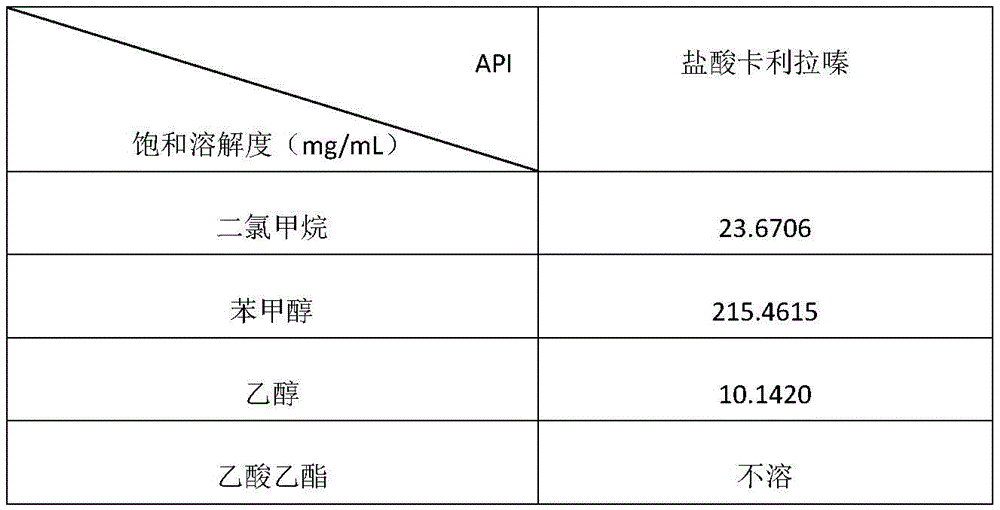
As can be seen from the data in the table above, the solubility of the cariprazine hydrochloride in dichloromethane and ethanol is low, and the cariprazine hydrochloride is insoluble in ethyl acetate, and the characteristic determines that the range of the organic solvent which can be selected when the cariprazine hydrochloride is used for preparing the microspheres is narrow. However, the research finds that the preparation of the Carilazine hydrochloride microspheres can be successfully carried out only in the presence of benzyl alcohol, and the microspheres with round and smooth appearance, loose freeze-dried powder, high drug loading and qualified release can be prepared only in a benzyl alcohol-dichloromethane (ethyl acetate) system.
The high drug-loading-rate cariprazine hydrochloride long-acting slow-release microsphere comprises cariprazine hydrochloride and a polylactic acid-glycolic acid copolymer; the content of the cariprazine hydrochloride is 20-80%; the organic solvent used for dissolving the Carlinazine hydrochloride and the polylactic acid-glycolic acid copolymer in the preparation of the microspheres is the following combination: benzyl alcohol and dichloromethane, or benzyl alcohol and ethyl acetate.
Preferably, the volume ratio of the benzyl alcohol to the dichloromethane is 10-90% to 90-10%, more preferably 20-79% to 80-21%, more preferably 30-70% to 70-30%, and even more preferably 40-60% to 60-40%.
Preferably, the volume ratio of the benzyl alcohol to the ethyl acetate is 10-90% to 90-10%, more preferably 25-75% to 75-25%, more preferably 40-60% to 60-40%, and most preferably 50% to 50%.
Preferably, the content of the cariprazine hydrochloride is 40-70%.
Preferably, the particle size of D10 of the long-acting slow-release kallidazine microsphere is 0.1-100 μm, and the difference between the particle size of D90 and the particle size of D10 is 1-500 μm; more preferably, the particle size of D10 is 1-20 μm; more preferably, the difference between the D90 particle size and the D10 particle size is 5 to 300 μm, more preferably 50 to 100 μm. The particle sizes of D10 and D90 are particle sizes having a cumulative particle distribution of 10% and 90%.
Preferably, the polylactic acid-glycolic acid copolymer has a number average molecular weight of 5000 to 200000, more preferably 10000 to 100000, even more preferably 20000 to 70000, and even more preferably 45000 to 55000.
The invention also aims to provide a preparation method of the high drug-loading carriazine hydrochloride long-acting slow-release microsphere, which comprises the following steps:
(a) dissolving the Carilazine hydrochloride and the polylactic acid-glycolic acid copolymer in an organic solvent to obtain an oil phase; taking 0.5-5 wt% of polyvinyl alcohol aqueous solution as a water phase; adding the oil phase into the water phase under stirring to prepare microsphere emulsion; the organic solvent is the following combination: benzyl alcohol and dichloromethane, or benzyl alcohol and ethyl acetate
(b) And continuously stirring, adjusting the temperature to 15-45 ℃, carrying out reduced pressure solidification stirring for more than 2 hours, filtering and collecting particles, washing, freezing and drying.
Preferably, in step (a), 0.5 to 5 wt%, more preferably 1 to 2 wt% of polyvinyl alcohol aqueous solution is used as the aqueous phase.
Preferably, in the step (a), the mass ratio of the Carilazine hydrochloride to the polylactic acid-glycolic acid copolymer is 1-3: 1, preferably 1-2: 1.
Preferably, in the step (a), the ratio of the sum of the mass of the Carilazine hydrochloride and the polylactic acid-glycolic acid copolymer to the volume of the organic solvent is 1 g: 5-30 mL, and preferably 1 g: 10-20 mL.
Preferably, in the step (a), the oil-water ratio is 1: 10-500, preferably 1: 100-300.
Preferably, in the step (a), the volume ratio of the benzyl alcohol to the dichloromethane is 10-90% to 90-10%, more preferably 25-75% to 75-25%, more preferably 30-70% to 70-30%, and even more preferably 40-60% to 60-40%.
Alternatively, in step (a), the volume ratio of benzyl alcohol to ethyl acetate is 10-90% to 90-10%, more preferably 25-75% to 75-25%, even more preferably 40-60% to 60-40%, most preferably 50% to 50%.
Preferably, in the step (b), the temperature is adjusted to 35-45 ℃, and the mixture is cured and stirred for 8-16 hours under reduced pressure.
The positive progress effects of the invention are as follows:
the high-drug-loading-rate cariprazine hydrochloride long-acting sustained-release microsphere has a long-acting sustained-release effect as a cariprazine microsphere long-acting injection, can realize sustained release in an animal body for one week to three months, can reduce the administration times of patients, improve the compliance of the patients, and reduce the nursing burden of family members and national medical institutions of the patients.
Drawings
FIG. 1 is a photomicrograph of microspheres from example 2.
FIG. 2 is a photomicrograph of the microspheres of example 3.
FIG. 3 is a graph showing the in vitro sustained release results of examples 1 to 4 and example 8.
FIG. 4 is a photomicrograph of microspheres from example 12.
FIG. 5 is a photomicrograph of microspheres from example 16.
Detailed Description
The invention is further illustrated by the following examples, which are not intended to limit the invention thereto. The experimental methods without specifying specific conditions in the following examples were selected according to the conventional methods and conditions, or according to the commercial instructions.
Examples 1 to 9
(1) Preparation of long-acting slow-release microspheres of Carilazine hydrochloride by benzyl alcohol-dichloromethane solvent system
The preparation steps are as follows:
dissolving the Carilazine hydrochloride and the PLGA in an organic solvent to obtain an oil phase; dissolving polyvinyl alcohol (PVA) in purified water to prepare a solution with the concentration of 0.5-5 wt%, and filtering the solution by a filter membrane to obtain a water phase; stirring at 25 deg.C and 350 r/min, adding oil phase into water phase, and making into microsphere emulsion; stirring for 10min, adjusting rotation speed to 200 r/min, adjusting temperature to 40 deg.C, controlling vacuum degree to-0.095 MPa, solidifying under reduced pressure, stirring for 12 hr, filtering, collecting fine particles, washing with purified water, and freeze drying.
The organic solvent is a mixture of benzyl alcohol and dichloromethane, in examples 1 to 9, the amount of the cariprazine hydrochloride, the amount of the PLGA, the number average molecular weight, the amount of the benzyl alcohol and the dichloromethane, the content of the aqueous phase PVA, and the oil-water ratio are shown in table 2 below.
TABLE 2 raw material ratios of examples 1 to 9

The preparation results of examples 1 to 9 and the appearance of the prepared microspheres are shown in the following table 3, and the microphotographs of examples 2 to 3 are shown in fig. 1 to 2, so that the microspheres have round and smooth appearance and relatively uniform particle size.
TABLE 3 appearance of microspheres from examples 1-9


(3) Determination of drug loading
The high performance liquid chromatography is adopted to measure the drug loading (drug content) in the microspheres, and the chromatographic conditions are as follows: mobile phase: 0.01mol/L potassium dihydrogen phosphate water solution pH 7.0-acetonitrile (30: 70) (v/v); a chromatographic column: waters Xbridge C184.6 x 150mm x 3.5um or similar chromatography column; column temperature: 25 ℃; flow rate: 1.0 mL/min; detection wavelength: 220 nm; sample introduction amount: 20 μ L. The drug loading of the microspheres of examples 1-9 was measured as shown in Table 4 below.
TABLE 4 drug Loading of microspheres from examples 1-9

(4) In vitro Release assay
The release test was carried out by the shaking flask method and was determined by high performance liquid chromatography.
The calculation method is as follows:
containing mg ═ W sample loading
Cumulative released amount [% ], [% ] + Vs ] (# 1+ … + C1) ]/drug content [% 100 [% ]
Wherein, W is as follows: weighing sample amount of each part of microspheres, and mg;
drug loading: content,%, measured for each microsphere sample;
cn: concentration of current point mg/mL;
and Vn: medium volume at current point mL, (200 mL for this release experiment);
cn-1: concentration in mg/mL at the previous time point;
vs: sample volume mL for each time point (170 mL for this release experiment).
Chromatographic test conditions: mobile phase: 0.01mol/L potassium dihydrogen phosphate water solution pH 7.0 (weighing 1.36g potassium dihydrogen phosphate and adding water to dilute to 1000mL, adjusting pH to 7.0 with potassium hydroxide solution) -acetonitrile (30: 70); a chromatographic column: waters Xbridge C184.6 x 150mm x 3.5um or similar chromatography column; column temperature: 30 ℃; flow rate: 1.0 mL/min; detection wavelength: 220 nm; sample introduction amount: 100 mu L of the solution; operating time: for 8 minutes.
The sustained release results of the microspheres of examples 1 to 4 and example 8 are shown in fig. 3.
By combining the appearance, drug loading rate and in-vitro release results of the microspheres with different prescriptions, the microspheres in examples 3 and 4 have round and smooth appearance, release for 30 days is the most, and the release speed is stable; when the content of the benzyl alcohol is more than 80%, the prepared microspheres have crystallization conditions, so that the microspheres cannot be successfully prepared, and the drug-loading rate of the microspheres cannot be measured; in addition, as in examples 7 and 9, when the microspheres are prepared by using low molecular weight PLGA, crystallization occurs in the same way, that is, the low molecular weight PLGA has a certain influence on the sphericity of the microspheres; in addition, in example 8, PLGA with a larger molecular weight is used, the prepared microspheres have round and smooth appearance, and the drug-loading rate meets the requirements, but the release rate is too slow to meet the release requirement of one month, so we can know that the release rate of the cariprazine hydrochloride microspheres is greatly influenced by the molecular weight of PLGA. By lateral comparison of the in vitro release rates, we have found that the release requirements can be met at benzyl alcohol contents of 30-70%, as demonstrated in examples 3 and 4.
Examples 10 to 17
The preparation method of the long-acting slow-release microspheres containing the cariprazine hydrochloride by using a benzyl alcohol-ethyl acetate solvent system comprises the following steps: dissolving the Carilazine hydrochloride and the PLGA in an organic solvent to obtain an oil phase; dissolving polyvinyl alcohol (PVA) in purified water to prepare a solution with the concentration of 0.5-5 wt%, and filtering the solution by a filter membrane to obtain a water phase; stirring at 25 deg.C and 350 r/min, adding oil phase into water phase, and making into microsphere emulsion; stirring for 10min, adjusting rotation speed to 200 r/min, adjusting temperature to 40 deg.C, controlling vacuum degree to-0.095 MPa, solidifying under reduced pressure, stirring for 12 hr, filtering, collecting fine particles, washing with purified water, and freeze drying.
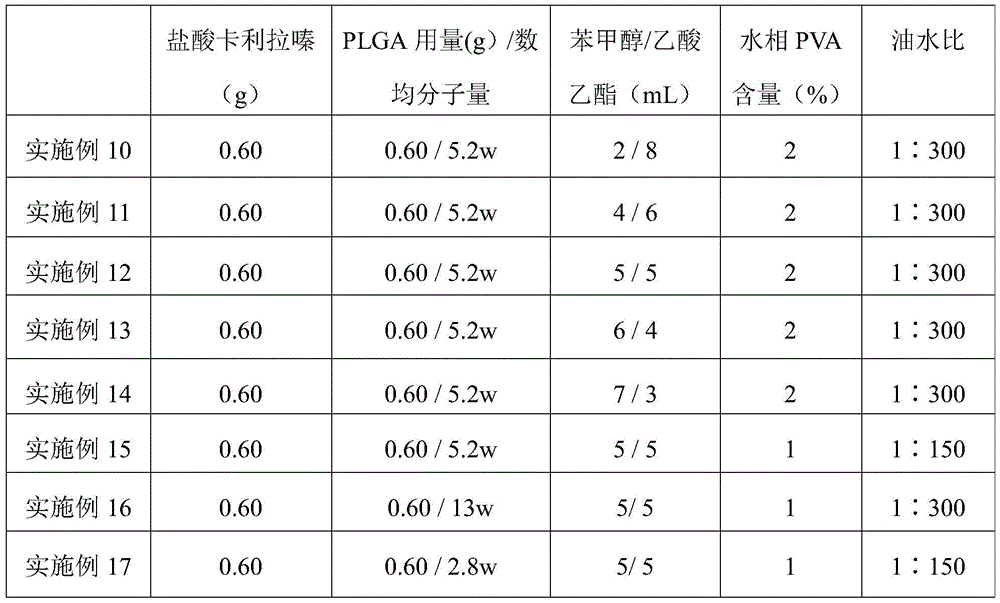
In examples 10 to 17, the amount of the cariprazine hydrochloride, the amount of the PLGA, the number average molecular weight, the amount of the benzyl alcohol and the ethyl acetate, the content of the aqueous phase PVA, and the oil-water ratio are shown in table 5 below.
TABLE 5 raw material ratios of examples 10 to 17
The drug loading of the microspheres of examples 10-17 was tested with reference to the test methods of examples 1-9, and table 6 shows the drug loading of the microspheres of examples 10-17.
TABLE 6 drug loading of microspheres from examples 10-17


The prepared result shows that: the benzyl alcohol used in example 10 did not completely dissolve the cariprazine hydrochloride, and the microspheres could not be successfully prepared if the oil phase failed to be prepared; examples 11-13 were successful in preparing microspheres with slightly blurred edges of wet microspheres observed by a microscope, partially empty spheres appeared, and the microspheres were sticky after drying, thus the drug loading measurements were low; in addition, when 70% of benzyl alcohol is adopted, the oil-water ratio is reduced or the molecular weight of PLGA is reduced, the microspheres begin to crystallize; after the high molecular weight PLGA was used instead, as in example 16, the microspheres did not crystallize, but the dry powder was still relatively cohesive, and although the concentration of PVA was reduced, the viscosity of the high molecular weight PLGA was also increased, and the powder cohesion was still not improved. The release rate cannot be measured because the powder of the microspheres is sticky and cannot be uniformly dispersed in a solvent.
The phenomenon of adhesion of freeze-dried powder of microspheres prepared by using benzyl alcohol ethyl acetate as an oil phase is integrally generated, and fig. 4 and 5 are microscope photos of examples 12 and 16 respectively, the freeze-dried powder of the microspheres is relatively adhesive, the adhesion can be observed to be relatively serious in a microscope picture, the edges of fig. 4 are fuzzy, and the microspheres in fig. 5 are not uniform in size and have partial empty spheres.
In vivo Release assay
Animals: male SD rats, weight 250-300g
Sample preparation: sucking 1mL of solvent by using a 20mL injection needle and a 2mL injector, slowly injecting the solvent into a sample bottle, and slightly shaking the suspension left and right to ensure that the suspension is uniform
The administration mode comprises the following steps: subcutaneous injection
Blood sampling: setting a plurality of sampling points to detect the blood concentration in the rat body at different time
The analysis method comprises the following steps: LC-MS/MS
In-vivo release experiments were carried out in examples 2, 3 and 12, and the in-vivo blood concentration of the cariprazine hydrochloride microspheres was examined, and it was found that the microspheres had good in-vivo release data and sustained release was achieved for 1 week to 3 months.
Comparative examples 1 to 2
Referring to example 3, dichloromethane alone was used as the organic solvent instead of benzyl alcohol-dichloromethane, and the specific formulations are shown in table 7 below. Since the solubility of the cariprazine hydrochloride in dichloromethane is too small, the organic phase dichloromethane used in comparative example 1 cannot completely dissolve the cariprazine hydrochloride, and thus microspheres cannot be successfully prepared, while in comparative example 2, on the basis of comparative example 1, the amount of dichloromethane is increased, and the amount of dichloromethane is larger and the time for dissolution is longer in order to completely dissolve the cariprazine hydrochloride. Therefore, compared with a benzyl alcohol dichloromethane system, the organic reagent of pure dichloromethane is used as a solvent, the preparation difficulty of an oil phase is high, the yield of the prepared microspheres is too low, and the laboratory or industrial research requirements are difficult to meet.
TABLE 7 raw material ratios of comparative examples 1 to 2

Comparative example 3
Referring to example 3, ethanol-dichloromethane was used as the organic solvent instead of benzyl alcohol-dichloromethane, and the specific formulations are shown in table 8 below. Because the solubility of the cariprazine hydrochloride in ethanol is lower, the cariprazine hydrochloride and PLGA are difficult to completely dissolve by increasing the dosage of the ethanol and reducing the dosage of dichloromethane in the process of preparing the oil phase, so that the microspheres cannot be prepared successfully.
TABLE 8 raw material ratios of comparative example 3


Comparative example 4
Referring to example 3, benzyl alcohol was used as an organic solvent instead of benzyl alcohol-methylene chloride, and the specific formulations are shown in table 9 below. Benzyl alcohol can dissolve the kalilazine hydrochloride, but PLGA can not be completely dissolved in the benzyl alcohol, the time consumption of the process of dissolving the kalilazine hydrochloride by the benzyl alcohol is long, the oil phase can not be successfully prepared, namely, emulsification and microsphere preparation can not be carried out, so that the microsphere can not be successfully prepared by simple benzyl alcohol dissolution.
TABLE 9 proportioning of raw materials for comparative example 4

In summary, the benzyl alcohol-dichloromethane system and the benzyl alcohol-ethyl acetate system are used as oil phases to prepare the cariprazine hydrochloride microspheres, while the solubility of the pure dichloromethane or ethanol-dichloromethane system is too low to successfully prepare the microspheres.
The benzyl alcohol-dichloromethane effect is optimal, the drug loading and yield of the prepared microspheres are far higher than those of a benzyl alcohol-ethyl acetate system, the microspheres have the best appearance, are round, smooth and uniform, are not adhered, and can meet the requirement of long-acting slow release.
Claims (10)
1. A high drug-loading-rate cariprazine hydrochloride long-acting slow-release microsphere is characterized by comprising cariprazine hydrochloride and a polylactic acid-glycolic acid copolymer; the content of the cariprazine hydrochloride is 20-80%; the organic solvent used for dissolving the Carlinazine hydrochloride and the polylactic acid-glycolic acid copolymer in the preparation of the microspheres is the following combination:
benzyl alcohol and methylene chloride, or
Benzyl alcohol and ethyl acetate.
2. The high drug loading rate cariprazine hydrochloride long-acting sustained-release microsphere of claim 1, wherein the volume ratio of the benzyl alcohol to the dichloromethane is 10-90% to 90-10%.
3. The high drug loading rate cariprazine hydrochloride long-acting sustained-release microsphere of claim 1, wherein the volume ratio of the benzyl alcohol to the ethyl acetate is 10-90% to 90-10%.
4. The high drug loading rate cariprazine hydrochloride long-acting sustained-release microsphere of claim 1, wherein the content of the cariprazine hydrochloride is 40-70%.
5. The high drug loading rate cariprazine hydrochloride long-acting sustained-release microspheres according to any one of claims 1 to 4, wherein the particle size of D10 of the cariprazine hydrochloride long-acting sustained-release microspheres is 0.1 to 100 μm, and the difference between the particle size of D90 and the particle size of D10 is 1 to 500 μm.
6. The high drug loading rate cariprazine hydrochloride long-acting sustained-release microspheres of any one of claims 1 to 4, wherein the number average molecular weight of the polylactic acid-glycolic acid copolymer is 5000-200000.
7. The preparation method of high drug loading capacity carriazine hydrochloride long-acting slow release microspheres as claimed in claims 1 to 6, which comprises the following steps:
(a) dissolving the Carilazine hydrochloride and the polylactic acid-glycolic acid copolymer in an organic solvent to obtain an oil phase; taking 0.5-5 wt% of polyvinyl alcohol aqueous solution as a water phase; adding the oil phase into the water phase under stirring to prepare microsphere emulsion; the organic solvent is the following combination:
benzyl alcohol and methylene chloride, or
Benzyl alcohol and ethyl acetate;
(b) and continuously stirring, adjusting the temperature to 15-45 ℃, carrying out reduced pressure solidification stirring for more than 2 hours, filtering and collecting particles, washing, freezing and drying.
8. The preparation method of the high drug-loading Carlinazine hydrochloride long-acting sustained-release microspheres according to claim 7, wherein in the step (a), 0.5-3 wt% of polyvinyl alcohol aqueous solution is used as the water phase.
9. The preparation method of the high drug-loading cariprazine hydrochloride long-acting sustained-release microspheres according to claim 7, wherein in the step (b), the temperature is adjusted to 35-45 ℃, and the pressure reduction curing stirring is carried out for 8-16 hours.
10. The preparation method of the high drug-loading-rate cariprazine hydrochloride long-acting sustained-release microspheres according to any one of claims 7 to 9, wherein in the step (a), the oil-water ratio is 1: 10-500.
Applications Claiming Priority (2)
| Application Number | Priority Date | Filing Date | Title |
|---|---|---|---|
| CN202011563131 | 2020-12-25 | ||
| CN2020115631312 | 2020-12-25 |
Publications (2)
| Publication Number | Publication Date |
|---|---|
| CN114748428A true CN114748428A (en) | 2022-07-15 |
| CN114748428B CN114748428B (en) | 2023-05-23 |
Family
ID=82324428
Family Applications (1)
| Application Number | Title | Priority Date | Filing Date |
|---|---|---|---|
| CN202011593309.8A Active CN114748428B (en) | 2020-12-25 | 2020-12-29 | High-drug-loading-amount long-acting sustained-release microsphere of calicheazine hydrochloride and preparation method thereof |
Country Status (1)
| Country | Link |
|---|---|
| CN (1) | CN114748428B (en) |
Cited By (5)
| Publication number | Priority date | Publication date | Assignee | Title |
|---|---|---|---|---|
| CN116942640A (en) * | 2023-07-12 | 2023-10-27 | 山东泰合医药科技有限公司 | Carliplazine sustained release microsphere and preparation method and application thereof |
| WO2023222080A1 (en) * | 2022-05-18 | 2023-11-23 | Anxo Pharmaceutical Co., Ltd. | Pharmaceutical composition |
| WO2025014299A1 (en) * | 2023-07-12 | 2025-01-16 | 주식회사 아울바이오 | Method for preparing cariprazine microspheres, microspheres prepared thereby, and pharmaceutical composition comprising microspheres |
| WO2025026418A1 (en) * | 2023-08-02 | 2025-02-06 | 珠海市华海康医药科技有限责任公司 | Drug sustained-release microsphere for injection and preparation method therefor |
| CN119837834A (en) * | 2024-12-28 | 2025-04-18 | 江苏长泰药业股份有限公司 | Burisperidone long-acting microsphere and preparation method thereof |
Citations (5)
| Publication number | Priority date | Publication date | Assignee | Title |
|---|---|---|---|---|
| CN105078898A (en) * | 2014-05-22 | 2015-11-25 | 上海现代药物制剂工程研究中心有限公司 | Aripiprazole long-acting controlled-release microgranule injection and preparation method thereof |
| CN105310997A (en) * | 2014-06-16 | 2016-02-10 | 重庆医药工业研究院有限责任公司 | Aripiprazole sustained-release microspheres and preparation method thereof |
| CN106822039A (en) * | 2017-01-24 | 2017-06-13 | 广州帝奇医药技术有限公司 | Slowly water-soluble or slightly soluble drug sustained-release composition and preparation method thereof |
| CN110769815A (en) * | 2017-06-13 | 2020-02-07 | 吉瑞工厂 | Oral cariprazine solid preparation |
| US20200155546A1 (en) * | 2018-11-20 | 2020-05-21 | Ankit Anand KHARIA | Stable cariprazine formulations for oral use |
-
2020
- 2020-12-29 CN CN202011593309.8A patent/CN114748428B/en active Active
Patent Citations (5)
| Publication number | Priority date | Publication date | Assignee | Title |
|---|---|---|---|---|
| CN105078898A (en) * | 2014-05-22 | 2015-11-25 | 上海现代药物制剂工程研究中心有限公司 | Aripiprazole long-acting controlled-release microgranule injection and preparation method thereof |
| CN105310997A (en) * | 2014-06-16 | 2016-02-10 | 重庆医药工业研究院有限责任公司 | Aripiprazole sustained-release microspheres and preparation method thereof |
| CN106822039A (en) * | 2017-01-24 | 2017-06-13 | 广州帝奇医药技术有限公司 | Slowly water-soluble or slightly soluble drug sustained-release composition and preparation method thereof |
| CN110769815A (en) * | 2017-06-13 | 2020-02-07 | 吉瑞工厂 | Oral cariprazine solid preparation |
| US20200155546A1 (en) * | 2018-11-20 | 2020-05-21 | Ankit Anand KHARIA | Stable cariprazine formulations for oral use |
Cited By (6)
| Publication number | Priority date | Publication date | Assignee | Title |
|---|---|---|---|---|
| WO2023222080A1 (en) * | 2022-05-18 | 2023-11-23 | Anxo Pharmaceutical Co., Ltd. | Pharmaceutical composition |
| CN116942640A (en) * | 2023-07-12 | 2023-10-27 | 山东泰合医药科技有限公司 | Carliplazine sustained release microsphere and preparation method and application thereof |
| CN116942640B (en) * | 2023-07-12 | 2024-02-06 | 山东泰合医药科技有限公司 | A cariprazine sustained-release microsphere and its preparation method and application |
| WO2025014299A1 (en) * | 2023-07-12 | 2025-01-16 | 주식회사 아울바이오 | Method for preparing cariprazine microspheres, microspheres prepared thereby, and pharmaceutical composition comprising microspheres |
| WO2025026418A1 (en) * | 2023-08-02 | 2025-02-06 | 珠海市华海康医药科技有限责任公司 | Drug sustained-release microsphere for injection and preparation method therefor |
| CN119837834A (en) * | 2024-12-28 | 2025-04-18 | 江苏长泰药业股份有限公司 | Burisperidone long-acting microsphere and preparation method thereof |
Also Published As
| Publication number | Publication date |
|---|---|
| CN114748428B (en) | 2023-05-23 |
Similar Documents
| Publication | Publication Date | Title |
|---|---|---|
| CN114748428B (en) | High-drug-loading-amount long-acting sustained-release microsphere of calicheazine hydrochloride and preparation method thereof | |
| EP3607940B1 (en) | Aripiprazole sustained-release microsphere and preparation method therefor | |
| JPH11500127A (en) | Redispersible ultrafine film matrix with protective coating | |
| JPH06501258A (en) | Drug delivery excipient suspended in a non-aqueous perfluorinated carrier | |
| US20240238307A1 (en) | Sustained release olanzapine formulations | |
| KR20190064526A (en) | Sustained release injection formulation comprising donepezil and method for preparing the same | |
| WO2018108164A1 (en) | Bortezomib pharmaceutical composition and applications thereof | |
| CN114681406B (en) | Carilazine long-acting slow-release microsphere and preparation method thereof | |
| US20250073166A1 (en) | Sustained Release Olanzapine Formulations | |
| CN118891032A (en) | Microspheres for extended release of fenofibrate | |
| CN118649149B (en) | Method for preparing perampanel sustained-release microspheres and perampanel sustained-release injection | |
| CN102631326A (en) | Sustained release microsphere used for injection and preparation method and applications of sustained release microsphere | |
| CN118986896A (en) | A kind of drug sustained-release microsphere for injection and preparation method thereof | |
| CN113786393A (en) | Rivaroxaban microsphere and preparation method and application thereof | |
| HK40106695A (en) | Sustained release olanzapine formulations | |
| HK1255946B (en) | Sustained release olanzapine formulations | |
| CN116531337A (en) | Moxidectin slow release microsphere and preparation method and application thereof | |
| HK40096523A (en) | Sustained release olanzapine formulations | |
| CN120227341A (en) | Risperidone sustained-release microspheres without lag period and preparation method thereof | |
| WO2021009504A1 (en) | New formulations |
Legal Events
| Date | Code | Title | Description |
|---|---|---|---|
| PB01 | Publication | ||
| PB01 | Publication | ||
| SE01 | Entry into force of request for substantive examination | ||
| SE01 | Entry into force of request for substantive examination | ||
| GR01 | Patent grant | ||
| GR01 | Patent grant |