CN114746404A - Amide-linked aminobenzazepine immunoconjugates and uses thereof - Google Patents
Amide-linked aminobenzazepine immunoconjugates and uses thereof Download PDFInfo
- Publication number
- CN114746404A CN114746404A CN202080080877.XA CN202080080877A CN114746404A CN 114746404 A CN114746404 A CN 114746404A CN 202080080877 A CN202080080877 A CN 202080080877A CN 114746404 A CN114746404 A CN 114746404A
- Authority
- CN
- China
- Prior art keywords
- diyl
- alkyl
- peg
- alkyldiyl
- heteroaryl
- Prior art date
- Legal status (The legal status is an assumption and is not a legal conclusion. Google has not performed a legal analysis and makes no representation as to the accuracy of the status listed.)
- Pending
Links
Images


Classifications
-
- A—HUMAN NECESSITIES
- A61—MEDICAL OR VETERINARY SCIENCE; HYGIENE
- A61K—PREPARATIONS FOR MEDICAL, DENTAL OR TOILETRY PURPOSES
- A61K47/00—Medicinal preparations characterised by the non-active ingredients used, e.g. carriers or inert additives; Targeting or modifying agents chemically bound to the active ingredient
- A61K47/50—Medicinal preparations characterised by the non-active ingredients used, e.g. carriers or inert additives; Targeting or modifying agents chemically bound to the active ingredient the non-active ingredient being chemically bound to the active ingredient, e.g. polymer-drug conjugates
- A61K47/51—Medicinal preparations characterised by the non-active ingredients used, e.g. carriers or inert additives; Targeting or modifying agents chemically bound to the active ingredient the non-active ingredient being chemically bound to the active ingredient, e.g. polymer-drug conjugates the non-active ingredient being a modifying agent
- A61K47/68—Medicinal preparations characterised by the non-active ingredients used, e.g. carriers or inert additives; Targeting or modifying agents chemically bound to the active ingredient the non-active ingredient being chemically bound to the active ingredient, e.g. polymer-drug conjugates the non-active ingredient being a modifying agent the modifying agent being an antibody, an immunoglobulin or a fragment thereof, e.g. an Fc-fragment
- A61K47/6801—Drug-antibody or immunoglobulin conjugates defined by the pharmacologically or therapeutically active agent
- A61K47/6803—Drugs conjugated to an antibody or immunoglobulin, e.g. cisplatin-antibody conjugates
-
- A—HUMAN NECESSITIES
- A61—MEDICAL OR VETERINARY SCIENCE; HYGIENE
- A61K—PREPARATIONS FOR MEDICAL, DENTAL OR TOILETRY PURPOSES
- A61K47/00—Medicinal preparations characterised by the non-active ingredients used, e.g. carriers or inert additives; Targeting or modifying agents chemically bound to the active ingredient
- A61K47/50—Medicinal preparations characterised by the non-active ingredients used, e.g. carriers or inert additives; Targeting or modifying agents chemically bound to the active ingredient the non-active ingredient being chemically bound to the active ingredient, e.g. polymer-drug conjugates
- A61K47/51—Medicinal preparations characterised by the non-active ingredients used, e.g. carriers or inert additives; Targeting or modifying agents chemically bound to the active ingredient the non-active ingredient being chemically bound to the active ingredient, e.g. polymer-drug conjugates the non-active ingredient being a modifying agent
- A61K47/68—Medicinal preparations characterised by the non-active ingredients used, e.g. carriers or inert additives; Targeting or modifying agents chemically bound to the active ingredient the non-active ingredient being chemically bound to the active ingredient, e.g. polymer-drug conjugates the non-active ingredient being a modifying agent the modifying agent being an antibody, an immunoglobulin or a fragment thereof, e.g. an Fc-fragment
- A61K47/6835—Medicinal preparations characterised by the non-active ingredients used, e.g. carriers or inert additives; Targeting or modifying agents chemically bound to the active ingredient the non-active ingredient being chemically bound to the active ingredient, e.g. polymer-drug conjugates the non-active ingredient being a modifying agent the modifying agent being an antibody, an immunoglobulin or a fragment thereof, e.g. an Fc-fragment the modifying agent being an antibody or an immunoglobulin bearing at least one antigen-binding site
- A61K47/6849—Medicinal preparations characterised by the non-active ingredients used, e.g. carriers or inert additives; Targeting or modifying agents chemically bound to the active ingredient the non-active ingredient being chemically bound to the active ingredient, e.g. polymer-drug conjugates the non-active ingredient being a modifying agent the modifying agent being an antibody, an immunoglobulin or a fragment thereof, e.g. an Fc-fragment the modifying agent being an antibody or an immunoglobulin bearing at least one antigen-binding site the antibody targeting a receptor, a cell surface antigen or a cell surface determinant
-
- A—HUMAN NECESSITIES
- A61—MEDICAL OR VETERINARY SCIENCE; HYGIENE
- A61K—PREPARATIONS FOR MEDICAL, DENTAL OR TOILETRY PURPOSES
- A61K47/00—Medicinal preparations characterised by the non-active ingredients used, e.g. carriers or inert additives; Targeting or modifying agents chemically bound to the active ingredient
- A61K47/50—Medicinal preparations characterised by the non-active ingredients used, e.g. carriers or inert additives; Targeting or modifying agents chemically bound to the active ingredient the non-active ingredient being chemically bound to the active ingredient, e.g. polymer-drug conjugates
- A61K47/51—Medicinal preparations characterised by the non-active ingredients used, e.g. carriers or inert additives; Targeting or modifying agents chemically bound to the active ingredient the non-active ingredient being chemically bound to the active ingredient, e.g. polymer-drug conjugates the non-active ingredient being a modifying agent
- A61K47/68—Medicinal preparations characterised by the non-active ingredients used, e.g. carriers or inert additives; Targeting or modifying agents chemically bound to the active ingredient the non-active ingredient being chemically bound to the active ingredient, e.g. polymer-drug conjugates the non-active ingredient being a modifying agent the modifying agent being an antibody, an immunoglobulin or a fragment thereof, e.g. an Fc-fragment
- A61K47/6835—Medicinal preparations characterised by the non-active ingredients used, e.g. carriers or inert additives; Targeting or modifying agents chemically bound to the active ingredient the non-active ingredient being chemically bound to the active ingredient, e.g. polymer-drug conjugates the non-active ingredient being a modifying agent the modifying agent being an antibody, an immunoglobulin or a fragment thereof, e.g. an Fc-fragment the modifying agent being an antibody or an immunoglobulin bearing at least one antigen-binding site
- A61K47/6851—Medicinal preparations characterised by the non-active ingredients used, e.g. carriers or inert additives; Targeting or modifying agents chemically bound to the active ingredient the non-active ingredient being chemically bound to the active ingredient, e.g. polymer-drug conjugates the non-active ingredient being a modifying agent the modifying agent being an antibody, an immunoglobulin or a fragment thereof, e.g. an Fc-fragment the modifying agent being an antibody or an immunoglobulin bearing at least one antigen-binding site the antibody targeting a determinant of a tumour cell
-
- A—HUMAN NECESSITIES
- A61—MEDICAL OR VETERINARY SCIENCE; HYGIENE
- A61K—PREPARATIONS FOR MEDICAL, DENTAL OR TOILETRY PURPOSES
- A61K47/00—Medicinal preparations characterised by the non-active ingredients used, e.g. carriers or inert additives; Targeting or modifying agents chemically bound to the active ingredient
- A61K47/50—Medicinal preparations characterised by the non-active ingredients used, e.g. carriers or inert additives; Targeting or modifying agents chemically bound to the active ingredient the non-active ingredient being chemically bound to the active ingredient, e.g. polymer-drug conjugates
- A61K47/51—Medicinal preparations characterised by the non-active ingredients used, e.g. carriers or inert additives; Targeting or modifying agents chemically bound to the active ingredient the non-active ingredient being chemically bound to the active ingredient, e.g. polymer-drug conjugates the non-active ingredient being a modifying agent
- A61K47/68—Medicinal preparations characterised by the non-active ingredients used, e.g. carriers or inert additives; Targeting or modifying agents chemically bound to the active ingredient the non-active ingredient being chemically bound to the active ingredient, e.g. polymer-drug conjugates the non-active ingredient being a modifying agent the modifying agent being an antibody, an immunoglobulin or a fragment thereof, e.g. an Fc-fragment
- A61K47/6835—Medicinal preparations characterised by the non-active ingredients used, e.g. carriers or inert additives; Targeting or modifying agents chemically bound to the active ingredient the non-active ingredient being chemically bound to the active ingredient, e.g. polymer-drug conjugates the non-active ingredient being a modifying agent the modifying agent being an antibody, an immunoglobulin or a fragment thereof, e.g. an Fc-fragment the modifying agent being an antibody or an immunoglobulin bearing at least one antigen-binding site
- A61K47/6851—Medicinal preparations characterised by the non-active ingredients used, e.g. carriers or inert additives; Targeting or modifying agents chemically bound to the active ingredient the non-active ingredient being chemically bound to the active ingredient, e.g. polymer-drug conjugates the non-active ingredient being a modifying agent the modifying agent being an antibody, an immunoglobulin or a fragment thereof, e.g. an Fc-fragment the modifying agent being an antibody or an immunoglobulin bearing at least one antigen-binding site the antibody targeting a determinant of a tumour cell
- A61K47/6853—Carcino-embryonic antigens
-
- A—HUMAN NECESSITIES
- A61—MEDICAL OR VETERINARY SCIENCE; HYGIENE
- A61K—PREPARATIONS FOR MEDICAL, DENTAL OR TOILETRY PURPOSES
- A61K47/00—Medicinal preparations characterised by the non-active ingredients used, e.g. carriers or inert additives; Targeting or modifying agents chemically bound to the active ingredient
- A61K47/50—Medicinal preparations characterised by the non-active ingredients used, e.g. carriers or inert additives; Targeting or modifying agents chemically bound to the active ingredient the non-active ingredient being chemically bound to the active ingredient, e.g. polymer-drug conjugates
- A61K47/51—Medicinal preparations characterised by the non-active ingredients used, e.g. carriers or inert additives; Targeting or modifying agents chemically bound to the active ingredient the non-active ingredient being chemically bound to the active ingredient, e.g. polymer-drug conjugates the non-active ingredient being a modifying agent
- A61K47/68—Medicinal preparations characterised by the non-active ingredients used, e.g. carriers or inert additives; Targeting or modifying agents chemically bound to the active ingredient the non-active ingredient being chemically bound to the active ingredient, e.g. polymer-drug conjugates the non-active ingredient being a modifying agent the modifying agent being an antibody, an immunoglobulin or a fragment thereof, e.g. an Fc-fragment
- A61K47/6835—Medicinal preparations characterised by the non-active ingredients used, e.g. carriers or inert additives; Targeting or modifying agents chemically bound to the active ingredient the non-active ingredient being chemically bound to the active ingredient, e.g. polymer-drug conjugates the non-active ingredient being a modifying agent the modifying agent being an antibody, an immunoglobulin or a fragment thereof, e.g. an Fc-fragment the modifying agent being an antibody or an immunoglobulin bearing at least one antigen-binding site
- A61K47/6851—Medicinal preparations characterised by the non-active ingredients used, e.g. carriers or inert additives; Targeting or modifying agents chemically bound to the active ingredient the non-active ingredient being chemically bound to the active ingredient, e.g. polymer-drug conjugates the non-active ingredient being a modifying agent the modifying agent being an antibody, an immunoglobulin or a fragment thereof, e.g. an Fc-fragment the modifying agent being an antibody or an immunoglobulin bearing at least one antigen-binding site the antibody targeting a determinant of a tumour cell
- A61K47/6855—Medicinal preparations characterised by the non-active ingredients used, e.g. carriers or inert additives; Targeting or modifying agents chemically bound to the active ingredient the non-active ingredient being chemically bound to the active ingredient, e.g. polymer-drug conjugates the non-active ingredient being a modifying agent the modifying agent being an antibody, an immunoglobulin or a fragment thereof, e.g. an Fc-fragment the modifying agent being an antibody or an immunoglobulin bearing at least one antigen-binding site the antibody targeting a determinant of a tumour cell the tumour determinant being from breast cancer cell
-
- A—HUMAN NECESSITIES
- A61—MEDICAL OR VETERINARY SCIENCE; HYGIENE
- A61K—PREPARATIONS FOR MEDICAL, DENTAL OR TOILETRY PURPOSES
- A61K47/00—Medicinal preparations characterised by the non-active ingredients used, e.g. carriers or inert additives; Targeting or modifying agents chemically bound to the active ingredient
- A61K47/50—Medicinal preparations characterised by the non-active ingredients used, e.g. carriers or inert additives; Targeting or modifying agents chemically bound to the active ingredient the non-active ingredient being chemically bound to the active ingredient, e.g. polymer-drug conjugates
- A61K47/51—Medicinal preparations characterised by the non-active ingredients used, e.g. carriers or inert additives; Targeting or modifying agents chemically bound to the active ingredient the non-active ingredient being chemically bound to the active ingredient, e.g. polymer-drug conjugates the non-active ingredient being a modifying agent
- A61K47/68—Medicinal preparations characterised by the non-active ingredients used, e.g. carriers or inert additives; Targeting or modifying agents chemically bound to the active ingredient the non-active ingredient being chemically bound to the active ingredient, e.g. polymer-drug conjugates the non-active ingredient being a modifying agent the modifying agent being an antibody, an immunoglobulin or a fragment thereof, e.g. an Fc-fragment
- A61K47/6889—Conjugates wherein the antibody being the modifying agent and wherein the linker, binder or spacer confers particular properties to the conjugates, e.g. peptidic enzyme-labile linkers or acid-labile linkers, providing for an acid-labile immuno conjugate wherein the drug may be released from its antibody conjugated part in an acidic, e.g. tumoural or environment
-
- A—HUMAN NECESSITIES
- A61—MEDICAL OR VETERINARY SCIENCE; HYGIENE
- A61P—SPECIFIC THERAPEUTIC ACTIVITY OF CHEMICAL COMPOUNDS OR MEDICINAL PREPARATIONS
- A61P35/00—Antineoplastic agents
-
- C—CHEMISTRY; METALLURGY
- C07—ORGANIC CHEMISTRY
- C07D—HETEROCYCLIC COMPOUNDS
- C07D223/00—Heterocyclic compounds containing seven-membered rings having one nitrogen atom as the only ring hetero atom
- C07D223/14—Heterocyclic compounds containing seven-membered rings having one nitrogen atom as the only ring hetero atom condensed with carbocyclic rings or ring systems
- C07D223/16—Benzazepines; Hydrogenated benzazepines
-
- C—CHEMISTRY; METALLURGY
- C07—ORGANIC CHEMISTRY
- C07D—HETEROCYCLIC COMPOUNDS
- C07D401/00—Heterocyclic compounds containing two or more hetero rings, having nitrogen atoms as the only ring hetero atoms, at least one ring being a six-membered ring with only one nitrogen atom
- C07D401/02—Heterocyclic compounds containing two or more hetero rings, having nitrogen atoms as the only ring hetero atoms, at least one ring being a six-membered ring with only one nitrogen atom containing two hetero rings
- C07D401/12—Heterocyclic compounds containing two or more hetero rings, having nitrogen atoms as the only ring hetero atoms, at least one ring being a six-membered ring with only one nitrogen atom containing two hetero rings linked by a chain containing hetero atoms as chain links
-
- C—CHEMISTRY; METALLURGY
- C07—ORGANIC CHEMISTRY
- C07D—HETEROCYCLIC COMPOUNDS
- C07D401/00—Heterocyclic compounds containing two or more hetero rings, having nitrogen atoms as the only ring hetero atoms, at least one ring being a six-membered ring with only one nitrogen atom
- C07D401/14—Heterocyclic compounds containing two or more hetero rings, having nitrogen atoms as the only ring hetero atoms, at least one ring being a six-membered ring with only one nitrogen atom containing three or more hetero rings
-
- C—CHEMISTRY; METALLURGY
- C07—ORGANIC CHEMISTRY
- C07D—HETEROCYCLIC COMPOUNDS
- C07D403/00—Heterocyclic compounds containing two or more hetero rings, having nitrogen atoms as the only ring hetero atoms, not provided for by group C07D401/00
- C07D403/02—Heterocyclic compounds containing two or more hetero rings, having nitrogen atoms as the only ring hetero atoms, not provided for by group C07D401/00 containing two hetero rings
- C07D403/12—Heterocyclic compounds containing two or more hetero rings, having nitrogen atoms as the only ring hetero atoms, not provided for by group C07D401/00 containing two hetero rings linked by a chain containing hetero atoms as chain links
-
- C—CHEMISTRY; METALLURGY
- C07—ORGANIC CHEMISTRY
- C07D—HETEROCYCLIC COMPOUNDS
- C07D471/00—Heterocyclic compounds containing nitrogen atoms as the only ring hetero atoms in the condensed system, at least one ring being a six-membered ring with one nitrogen atom, not provided for by groups C07D451/00 - C07D463/00
- C07D471/02—Heterocyclic compounds containing nitrogen atoms as the only ring hetero atoms in the condensed system, at least one ring being a six-membered ring with one nitrogen atom, not provided for by groups C07D451/00 - C07D463/00 in which the condensed system contains two hetero rings
- C07D471/04—Ortho-condensed systems
-
- C—CHEMISTRY; METALLURGY
- C07—ORGANIC CHEMISTRY
- C07H—SUGARS; DERIVATIVES THEREOF; NUCLEOSIDES; NUCLEOTIDES; NUCLEIC ACIDS
- C07H15/00—Compounds containing hydrocarbon or substituted hydrocarbon radicals directly attached to hetero atoms of saccharide radicals
- C07H15/20—Carbocyclic rings
- C07H15/203—Monocyclic carbocyclic rings other than cyclohexane rings; Bicyclic carbocyclic ring systems
-
- C—CHEMISTRY; METALLURGY
- C07—ORGANIC CHEMISTRY
- C07K—PEPTIDES
- C07K16/00—Immunoglobulins [IGs], e.g. monoclonal or polyclonal antibodies
- C07K16/18—Immunoglobulins [IGs], e.g. monoclonal or polyclonal antibodies against material from animals or humans
- C07K16/28—Immunoglobulins [IGs], e.g. monoclonal or polyclonal antibodies against material from animals or humans against receptors, cell surface antigens or cell surface determinants
- C07K16/2803—Immunoglobulins [IGs], e.g. monoclonal or polyclonal antibodies against material from animals or humans against receptors, cell surface antigens or cell surface determinants against the immunoglobulin superfamily
- C07K16/2827—Immunoglobulins [IGs], e.g. monoclonal or polyclonal antibodies against material from animals or humans against receptors, cell surface antigens or cell surface determinants against the immunoglobulin superfamily against B7 molecules, e.g. CD80, CD86
-
- C—CHEMISTRY; METALLURGY
- C07—ORGANIC CHEMISTRY
- C07K—PEPTIDES
- C07K16/00—Immunoglobulins [IGs], e.g. monoclonal or polyclonal antibodies
- C07K16/18—Immunoglobulins [IGs], e.g. monoclonal or polyclonal antibodies against material from animals or humans
- C07K16/28—Immunoglobulins [IGs], e.g. monoclonal or polyclonal antibodies against material from animals or humans against receptors, cell surface antigens or cell surface determinants
- C07K16/30—Immunoglobulins [IGs], e.g. monoclonal or polyclonal antibodies against material from animals or humans against receptors, cell surface antigens or cell surface determinants from tumour cells
- C07K16/3007—Carcino-embryonic Antigens
-
- C—CHEMISTRY; METALLURGY
- C07—ORGANIC CHEMISTRY
- C07K—PEPTIDES
- C07K16/00—Immunoglobulins [IGs], e.g. monoclonal or polyclonal antibodies
- C07K16/18—Immunoglobulins [IGs], e.g. monoclonal or polyclonal antibodies against material from animals or humans
- C07K16/32—Immunoglobulins [IGs], e.g. monoclonal or polyclonal antibodies against material from animals or humans against translation products of oncogenes
Landscapes
- Health & Medical Sciences (AREA)
- Chemical & Material Sciences (AREA)
- Organic Chemistry (AREA)
- Life Sciences & Earth Sciences (AREA)
- Immunology (AREA)
- Engineering & Computer Science (AREA)
- General Health & Medical Sciences (AREA)
- Bioinformatics & Cheminformatics (AREA)
- Medicinal Chemistry (AREA)
- Pharmacology & Pharmacy (AREA)
- Animal Behavior & Ethology (AREA)
- Public Health (AREA)
- Veterinary Medicine (AREA)
- Epidemiology (AREA)
- Cell Biology (AREA)
- Genetics & Genomics (AREA)
- Molecular Biology (AREA)
- Biochemistry (AREA)
- Oncology (AREA)
- Biophysics (AREA)
- Proteomics, Peptides & Aminoacids (AREA)
- Chemical Kinetics & Catalysis (AREA)
- Nuclear Medicine, Radiotherapy & Molecular Imaging (AREA)
- Biotechnology (AREA)
- General Chemical & Material Sciences (AREA)
- Pharmaceuticals Containing Other Organic And Inorganic Compounds (AREA)
- Peptides Or Proteins (AREA)
- Medicines Containing Antibodies Or Antigens For Use As Internal Diagnostic Agents (AREA)
- Acyclic And Carbocyclic Compounds In Medicinal Compositions (AREA)
- Medicinal Preparation (AREA)
Abstract
本发明提供了式I的免疫缀合物,所述免疫缀合物包含通过缀合至一种或多种8‑酰胺基‑2‑氨基苯并氮杂


The present invention provides immunoconjugates of formula I comprising a compound that is conjugated to one or more 8-amido-2-aminobenzazepines
Description
Cross Reference to Related Applications
This non-provisional application claims the benefit of priority from us provisional application No. 62/908,253 filed on 30.9.2019, which is incorporated herein by reference in its entirety.
Sequence listing
This patent application contains a sequence listing that has been submitted electronically in ASCII format and is hereby incorporated by reference in its entirety. The ASCII copy was created on 21/9/2020 named 17019_004WO1_ sl. txt and was 54,747 bytes in size.
Technical Field
The present invention relates generally to an immunoconjugate comprising one or more 8-amido-2-aminobenzazepine conjugates An antibody to the molecule.
Background
There is a need for new compositions and methods for delivering antibodies and dendritic cell/myeloid adjuvants to reach inaccessible tumors and/or to expand the treatment options for cancer patients and other subjects. The present invention provides such compositions and methods.
Disclosure of Invention
The present invention relates generally to immunoconjugates comprising one or more 8-amido-2-aminobenzazepines conjugated by conjugation to Derivative-linked antibodies. The invention also relates to 8-amido-2-aminobenzazepines comprising reactive functional groups
 Derivative intermediate compositions. Such intermediate compositions are suitable matrices for forming immunoconjugates, wherein an antibody can be covalently bonded through a linker L to an 8-amido-2-aminobenzazepine having the formula
 The 8 bits of the part.
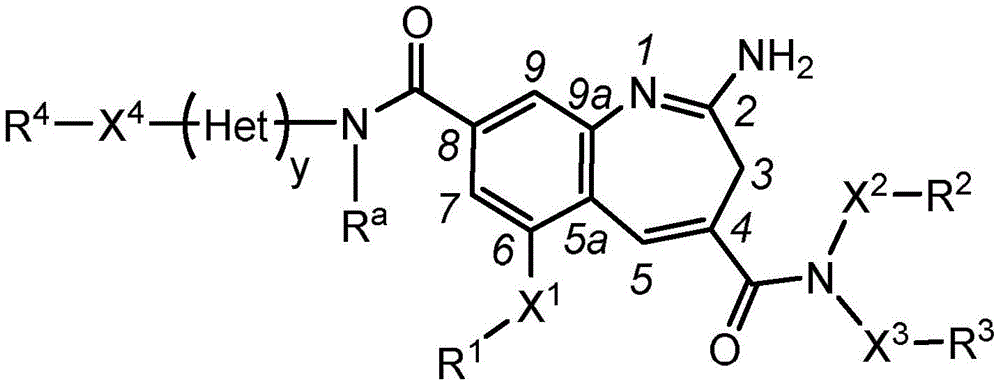
Wherein R is1、R2、R3And R4Is linked to L, y is 0 or 1, and Het is a 5-or 6-membered monocyclic heterocyclyldiyl or a 5-or 6-membered monocyclic heteroaryldiyl. 3H-benzo [ b]Aza derivatives The positions of the structures are numbered according to the IUPAC convention. Ra、X1-4And R1-4Substituents are defined herein.
The invention further relates to the use of such immunoconjugates in the treatment of diseases, in particular cancer.
One aspect of the invention is an immunoconjugate comprising an antibody covalently linked to a linker covalently linked to one or more 8-amido-2-aminobenzazepines And (4) partial.
Another aspect of the invention is an 8-amido-2-aminobenzazepine -a linker compound.
Another aspect of the invention is a method for treating cancer comprising administering a therapeutically effective amount of an immunoconjugate comprising one or more 8-amido-2-aminobenzazepines conjugated by conjugation to one or more amino groups A partially linked antibody.
Another aspect of the invention is a pharmaceutical composition comprising a pharmaceutically acceptable salt of a compound of formula (I) by conjugation to one or more 8-amido-2-aminobenzazepines Use of an immunoconjugate of a partially linked antibody for the treatment of cancer.
Another aspect of the invention is a method of making a pharmaceutical composition by reacting one or more 8-amido-2-aminobenzazepines Methods of preparing immunoconjugates by conjugating a moiety to an antibody.
Drawings
Figure 1A shows TLR8 potency of BZA-1 and BZA-2 (agonists in human HEK293 reporter cells) in vitro. BZA-1: 2-amino-8- (3- ((3- (hydroxymethyl) azetidin-1-yl) sulfonyl) phenyl) -N, N-dipropyl-3H-benzo [ b]Aza derivatives -4-carboxamide. BZA-2: (3- (2-amino-8- (3- ((3- (hydroxymethyl) azetidin-1-yl) sulfonyl) phenyl) -N-propyl-3H-benzo [ b)]Aza derivatives
 - -4-carboxamido) propyl) carbamic acid tert-butyl ester.
Figure 1B shows TLR7 potency of BZA-1 and BZA-2 (agonists in human HEK293 reporter cells) in vitro.
FIG. 1C shows BZA-3 and BZA-4 (agonism in human HEK293 reporter cellsAgent) TLR8 potency in vitro. BZA-3: 2-amino-8-benzamido-N, N-dipropyl-3H-benzo [ b]Aza derivatives -4-carboxamide. BZA-4: (3- (2-amino-8-benzamido-N-propyl-3H-benzo [ b)]Aza derivatives
 -4-carboxamido) propyl) carbamic acid tert-butyl ester.
Figure 1D shows TLR7 potency of BZA-3 and BZA-4 (agonists in human HEK293 reporter cells) in vitro.
Figure 2 shows calculated docking images of docked BZA-2, highlighting the interaction with TLR8 Asp and TLR7 Leu residues.
Fig. 3A shows a computed docking solution image of BZA-2 with TLR 8.
Fig. 3B shows a computed docking solution image of BZA-2 with TLR7, where the hydrophobic tertiary butyl group of BZA-2 interacts with Leu 557 in TLR 7.
Fig. 3C shows a computed docking solution image of BZA-4 with TLR 8.
Fig. 3D shows a computed docking solution image of BZA-4 with TLR7, where the hydrophobic tertiary butyl group of BZA-4 interacts with Leu 557 in TLR 7.
Detailed Description
Reference will now be made in detail to certain embodiments of the invention, examples of which are illustrated in the accompanying structures and formulas. While the invention will be described in conjunction with the enumerated embodiments, it will be understood that they are not intended to limit the invention to those embodiments. On the contrary, the invention is intended to cover all alternatives, modifications and equivalents, which may be included within the scope of the invention as defined by the appended claims.
Those skilled in the art will recognize that many methods and materials similar or equivalent to those described herein can be used in the practice of the present invention. The present invention is in no way limited to the methods and materials described.
Definition of
The term "immunoconjugate" refers to an antibody construct covalently bonded to an adjuvant moiety through a linker. The term "adjuvant" refers to a substance capable of eliciting an immune response in a subject exposed to the adjuvant. The phrase "adjuvant moiety" refers to an adjuvant that is covalently bonded to an antibody construct, e.g., by a linker, as described herein. The adjuvant moiety can elicit an immune response upon binding to the antibody construct or upon cleavage (e.g., enzymatic cleavage) from the antibody construct upon administration of the immunoconjugate to a subject.
An "adjuvant" refers to a substance capable of eliciting an immune response in a subject exposed to the adjuvant. The phrase "adjuvant moiety" refers to an adjuvant that is covalently bonded to an antibody construct, e.g., by a linker, as described herein. The adjuvant moiety can elicit an immune response upon binding to the antibody construct or upon cleavage (e.g., enzymatic cleavage) from the antibody construct upon administration of the immunoconjugate to a subject.
The terms "Toll-like receptor" and "TLR" refer to any member of a highly conserved family of mammalian proteins that recognize pathogen-associated molecular patterns and serve as a key signaling element in innate immunity. TLR polypeptides share a characteristic structure comprising an extracellular domain with leucine-rich repeats, a transmembrane domain, and an intracellular domain involved in TLR signaling.
The terms "Toll-like receptor 7" and "TLR 7" refer to a nucleic acid or polypeptide that shares at least about 70%, about 80%, about 90%, about 95%, about 96%, about 97%, about 98%, about 99% or more sequence identity with a publicly available TLR7 sequence (e.g., a human TLR7 polypeptide of GenBank accession No. AAZ99026, or a murine TLR7 polypeptide of GenBank accession No. AAK 62676).
The terms "Toll-like receptor 8" and "TLR 8" refer to a nucleic acid or polypeptide that shares at least about 70%, about 80%, about 90%, about 95%, about 96%, about 97%, about 98%, about 99% or more sequence identity with a publicly available TLR7 sequence (e.g., a human TLR8 polypeptide of GenBank accession No. AAZ95441, or a murine TLR8 polypeptide of GenBank accession No. AAK 62677).
A "TLR agonist" is an agent that binds to a TLR (e.g., TLR7 and/or TLR8) directly or indirectly to induce TLR signaling. Any detectable difference in TLR signaling may indicate that the agonist stimulates or activates the TLR. Differences in signaling can be manifested, for example, as changes in target gene expression, phosphorylation of signal transduction components, intracellular localization of downstream components such as nuclear factor- κ B (NF- κ B), association of certain components, such as IL-1 receptor-associated kinase (IRAK), with other proteins or intracellular structures, or biochemical activity of components such as kinases, such as mitogen-activated protein kinase (MAPK).
An "antibody" refers to a polypeptide comprising an antigen binding region, including Complementarity Determining Regions (CDRs), from an immunoglobulin gene or fragment thereof. The term "antibody" specifically encompasses monoclonal antibodies (including full length monoclonal antibodies), polyclonal antibodies, multispecific antibodies (e.g., bispecific antibodies), and antibody fragments that exhibit the desired biological activity. Exemplary immunoglobulin (antibody) building blocks include tetramers. Each tetramer is composed of two identical pairs of polypeptide chains, each pair having one "light" (about 25kDa) and one "heavy" chain (about 50-70kDa) connected by disulfide bonds. Each chain is composed of domains known as immunoglobulin domains. These domains are classified into different classes by size and function, e.g., variable domains or regions on light and heavy chains (V, respectively)LAnd VH) And constant domains or regions on the light and heavy chains (C, respectively)LAnd CH). The N-terminus of each chain defines a variable region of about 100 to 110 or more amino acids, primarily responsible for antigen recognition, which is referred to as the paratope, i.e., antigen binding domain. Light chains are classified as either kappa or lambda. Heavy chains are classified as gamma, mu, alpha, delta, or epsilon, which in turn define the immunoglobulin classes IgG, IgM, IgA, IgD, and IgE, respectively. IgG antibodies are large molecules of about 150kDa composed of four peptide chains. IgG antibodies contain two identical gamma-like heavy chains of about 50kDa and two identical light chains of about 25kDa and are therefore tetrameric quaternary structures. The two heavy chains are linked to each other and to one light chain each by a disulfide bond. The resulting tetramer has two identical moietiesThe sections together form a Y-like shape. Each end of the fork contains an identical antigen binding domain. There are four IgG subclasses in humans (IgG1, IgG2, IgG3, and IgG4) that are named in order of their abundance in serum (i.e., IgG1 is most abundant). Generally, the antigen binding domain of an antibody will be most critical in terms of specificity and affinity for binding to cancer cells.
An "antibody construct" refers to an antibody or fusion protein comprising (i) an antigen binding domain and (ii) an Fc domain.
In some embodiments, the binding agent is an antigen-binding antibody "fragment," which is a construct comprising at least the antigen-binding region of an antibody, alone or with other components that together comprise the antigen-binding construct. Many different types of antibody "fragments" are known in the art, including, for example, (i) Fab fragments, which are composed of VL、VH、CLAnd CH1Monovalent fragments of domain composition, (ii) F (ab')2(ii) a fragment which is a bivalent fragment comprising two Fab fragments linked by a disulfide bridge at the hinge region, (iii) a V consisting of a single arm of an antibodyLAnd VH(iii) a domain consisting of an Fv fragment; (iv) fab 'fragments, which are obtained by disruption of F (ab')2Generated by disulfide bridges of the fragment; (v) disulfide stabilized Fv fragments (dsFv); and (vi) a single chain Fv (scFv) which is two domains of an Fv fragment joined by a synthetic linker (i.e., V)LAnd VH) A monovalent molecule of composition, the synthetic linker enabling the synthesis of the two domains as a single polypeptide chain.
The antibody or antibody fragment may be part of a larger construct, such as a conjugate or fusion construct of the antibody fragment with other regions. For example, in some embodiments, an antibody fragment may be fused to an Fc region as described herein. In other embodiments, the antibody fragment (e.g., Fab or scFv) can be part of a chimeric antigen receptor or a chimeric T cell receptor, e.g., by fusion with a transmembrane domain (optionally using an intervening linker or "stem" (e.g., hinge region)) and an optional intercellular signaling domain. For example, the antibody fragment may be fused to the gamma and/or delta chains of a T cell receptor to provide a T cell receptor-like construct that binds PD-L1. In yet another embodiment, the antibody fragment is part of a bispecific T cell engager (BiTE) comprising a CD1 or CD3 binding domain and a linker.
"epitope" refers to any antigenic or epitopic determinant of an antigen to which an antigen-binding domain binds (i.e., in the paratope of the antigen-binding domain). Antigenic determinants generally consist of chemically active surface groups of molecules, such as amino acids or sugar side chains, and often have specific three-dimensional structural characteristics as well as specific charge characteristics.
The term "Fc receptor" or "FcR" refers to a receptor that binds to the Fc region of an antibody. There are three major classes of Fc receptors: (1) fc γ R binding to IgG, (2) Fc α R binding to IgA, and (3) Fc ∈ R binding to IgE. The Fc γ R family includes several members such as Fc γ I (CD64), Fc γ RIIA (CD32A), Fc γ RIIB (CD32B), Fc γ RIIIA (CD16A) and Fc γ RIIIB (CD 16B). Fc γ receptors differ in affinity for IgG and also have different affinity for IgG subclasses (e.g., IgG1, IgG2, IgG3, and IgG 4).
"Biomimetic" refers to an approved antibody construct having activity properties similar to, for example, a previously approved antibody construct targeting PD-L1, e.g., atelizumab (TECENTRIQ)TMGenentech, Inc.), DOVALUUM MONOBULMAB (IMFINZI)TMAstraZeneca) and Abameluomab (BAVENCIO)TMEMD Serono, Pfizer); previously approved antibody constructs targeting HER2, such as trastuzumab (HERCEPTIN)TMGenentech, Inc.) and Pertuzumab (PERJETA)TMGenentech, Inc.); or CEA-targeting antibodies, such as rabeprizumab (CEA-CIDE)TMMN-14, hMN14, Immunodics) CAS registry number 219649-07-7).
"improved biosimilarity drug (biobeter)" refers to an approved antibody construct that is an improvement over previously approved antibody constructs, such as alemtuzumab, bevacizumab, avizumab, trastuzumab, pertuzumab, and labetazumab. The modified biosimilar drug may have one or more modifications (e.g., altered glycan profile or unique epitope) relative to a previously approved antibody construct.
"amino acid" refers to any monomeric unit that can be incorporated into a peptide, polypeptide, or protein. Amino acids include naturally occurring alpha-amino acids and stereoisomers thereof, as well as non-natural (non-naturally occurring) amino acids and stereoisomers thereof. "stereoisomers" of a given amino acid refers to isomers having the same molecular formula and intramolecular bonds, but differing in the three-dimensional arrangement of the bonds and atoms (e.g., L-amino acids and the corresponding D-amino acids). Amino acids can be glycosylated (e.g., N-linked glycans, O-linked glycans, phosphoglycans, C-linked glycans, or glycosylphosphatidylinositol) or deglycosylated. Amino acids may be referred to herein by their commonly known three letter symbols or by the one letter symbols recommended by the IUPAC-IUB biochemical nomenclature commission.
Naturally occurring amino acids are those encoded by the genetic code, as well as those amino acids that have been later modified, such as hydroxyproline, γ -carboxyglutamic acid, and O-phosphoserine. Naturally occurring alpha-amino acids include, but are not limited to, alanine (Ala), cysteine (Cys), aspartic acid (Asp), glutamic acid (Glu), phenylalanine (Phe), glycine (Gly), histidine (His), isoleucine (Ile), arginine (Arg), lysine (Lys), leucine (Leu), methionine (Met), asparagine (Asn), proline (Pro), glutamine (gin), serine (Ser), threonine (Thr), valine (Val), tryptophan (Trp), tyrosine (Tyr), and combinations thereof. Stereoisomers of naturally occurring alpha-amino acids include, but are not limited to, D-alanine (D-Ala), D-cysteine (D-Cys), D-aspartic acid (D-Asp), D-glutamic acid (D-Glu), D-phenylalanine (D-Phe), D-histidine (D-His), D-isoleucine (D-Ile), D-arginine (D-Arg), D-lysine (D-Lys), D-leucine (D-Leu), D-methionine (D-Met), D-asparagine (D-Asn), D-proline (D-Pro), D-glutamine (D-Gln), D-serine (D-Ser), D-threonine (D-Thr), D-valine (D-Val), D-tryptophan (D-Trp), D-tyrosine (D-Tyr), and combinations thereof.
Naturally occurring amino acids include amino acids formed in proteins by post-translational modification, such as citrulline (Cit).
Non-natural (non-naturally occurring) amino acids include, but are not limited to, amino acid analogs, amino acid mimetics, synthetic amino acids, N-substituted glycines, and N-methyl amino acids in the L or D configuration, which function in a manner similar to naturally occurring amino acids. For example, an "amino acid analog" can be an unnatural amino acid that has the same basic chemical structure as a naturally occurring amino acid (i.e., carbon, carboxyl, amino group bonded to a hydrogen) but has a modified side chain group or modified peptide backbone, e.g., homoserine, norleucine, methionine sulfoxide, and methionine methyl sulfonium. "amino acid mimetics" refers to compounds that have a structure that is different from the general chemical structure of an amino acid, but that functions in a manner similar to a naturally occurring amino acid.
"linker" refers to a functional group that covalently bonds two or more moieties in a compound or material. For example, a linking moiety may be used to covalently bond an adjuvant moiety to an antibody construct in an immunoconjugate.
"linking moiety" refers to a functional group that covalently bonds two or more moieties in a compound or material. For example, a linking moiety can be used to covalently bond an adjuvant moiety to an antibody in an immunoconjugate. Useful linkages for linking moieties to proteins and other substances include, but are not limited to, amides, amines, esters, carbamates, ureas, thioethers, thiocarbamates, thiocarbonates, and thioureas.
"divalent" refers to a chemical moiety that contains two points of attachment to connect two functional groups; the multivalent linking moiety may have additional points of attachment for additional functional groups. Divalent groups may be represented by the suffix "diyl". For example, divalent linking moieties include divalent polymer moieties such as divalent poly (ethylene glycol), divalent cycloalkyl, divalent heterocycloalkyl, divalent aryl, and divalent heteroaryl groups. "divalent cycloalkyl, heterocycloalkyl, aryl, or heteroaryl group" refers to a cycloalkyl, heterocycloalkyl, aryl, or heteroaryl group that has two points of attachment to covalently attach two moieties in a molecule or material. The cycloalkyl, heterocycloalkyl, aryl, or heteroaryl groups may be substituted or unsubstituted. The cycloalkyl, heterocycloalkyl, aryl or heteroaryl groups may be substituted with one or more groups selected from halo, hydroxy, amino, alkylamino, amido, acyl, nitro, cyano and alkoxy.
Wave line Representing the point of attachment of a particular chemical moiety. If two wavy lines exist for a given chemical moiety
 It is understood that the chemical moiety may be used bi-directionally, i.e., read from left to right or right to left. In some embodiments, there are two wavy lines
 Is considered to be used for reading from left to right.
"alkyl" refers to a straight-chain (straight/linear) or branched saturated aliphatic group having the indicated number of carbon atoms. The alkyl group may include any number of carbons, such as one to twelve. Examples of alkyl groups include, but are not limited to, methyl (Me, -CH)3) Ethyl (Et-CH)2CH3) 1-propyl (n-Pr, n-propyl, -CH)2CH2CH3) 2-propyl (i-Pr, isopropyl, -CH (CH)3)2) 1-butyl (n-Bu, n-butyl, -CH)2CH2CH2CH3) 2-methyl-1-propyl (i-Bu, isobutyl, -CH)2CH(CH3)2) 2-butyl (s-Bu, sec-butyl, -CH (CH)3)CH2CH3) 2-methyl-2-propyl (t-Bu, t-butyl, -C (CH)3)3) 1-pentyl (n-pentyl, -CH)2CH2CH2CH2CH3) 2-pentyl (-CH (CH)3)CH2CH2CH3) 3-pentyl (-CH (CH)2CH3)2) 2-methyl-2-butyl (-C (CH)3)2CH2CH3) 3-methyl-2-butyl (-CH (CH)3)CH(CH3)2) 3-methyl-1-butyl (-CH)2CH2CH(CH3)2) 2-methyl-1-butyl (-CH)2CH(CH3)CH2CH3) 1-hexyl (-CH)2CH2CH2CH2CH2CH3) 2-hexyl (-CH (CH)3)CH2CH2CH2CH3) 3-hexyl (-CH (CH)2CH3)(CH2CH2CH3) 2-methyl-2-pentyl (-C (CH))3)2CH2CH2CH3) 3-methyl-2-pentyl (-CH (CH)3)CH(CH3)CH2CH3) 4-methyl-2-pentyl (-CH (CH)3)CH2CH(CH3)2) 3-methyl-3-pentyl (-C (CH)3)(CH2CH3)2) 2-methyl-3-pentyl (-CH (CH)2CH3)CH(CH3)2)2, 3-dimethyl-2-butyl (-C (CH)3)2CH(CH3)2)3, 3-dimethyl-2-butyl (-CH (CH)3)C(CH3)31-heptyl, 1-octyl, and the like. The alkyl group may be substituted or unsubstituted. A "substituted alkyl" group may be substituted with one or more groups selected from halo, hydroxy, amino, oxy (═ O), alkylamino, amido, acyl, nitro, cyano, and alkoxy.
The term "alkyldiyl" refers to a divalent alkyl group. Examples of alkyldiyl include, but are not limited to, methylene (-CH)2-) ethylene (-CH2CH2-) propylene (-CH)2CH2CH2-) and the like. The alkyldiyl groups may also be referred to as "alkylene" groups.
"alkenyl" means a straight-chain (straight/linear) or branched unsaturated aliphatic group having the indicated number of carbon atoms and at least one carbon-carbon double bond sp 2. The alkenyl group may contain two to about 12 or more carbon atoms. Alkenyl radicals being of "Cis "and" trans "oriented, or alternatively" E "and" Z "oriented groups. Examples include, but are not limited to, vinyl (-CH ═ CH)2) Allyl (-CH)2CH=CH2) Butenyl, pentenyl and their isomers. Alkenyl groups may be substituted or unsubstituted. A "substituted alkenyl" group may be substituted with one or more groups selected from halo, hydroxy, amino, oxy (═ O), alkylamino, amido, acyl, nitro, cyano, and alkoxy.
The term "alkenylene" or "alkenyldiyl" refers to a straight or branched chain divalent hydrocarbon group. Examples include, but are not limited to, ethenylene (vinylene/vinylene) (-CH-), allyl (-CH)2CH-) and the like.
"alkynyl" refers to a straight chain (straight/linear) or branched unsaturated aliphatic group having the indicated number of carbon atoms and at least one carbon-carbon triple bond sp. Alkynyl groups can contain two to about 12 or more carbon atoms. E.g. C2-C6Alkynyl includes, but is not limited to, ethynyl (-C ≡ CH), propynyl (propargyl, -CH)2C.ident.CH), butynyl, pentynyl, hexynyl and their isomeric alkynyl radicals may be substituted or unsubstituted. A "substituted alkynyl" group may be substituted with one or more groups selected from halo, hydroxy, amino, oxy (═ O), alkylamino, amido, acyl, nitro, cyano, and alkoxy.
The term "alkynylene" or "alkynediyl" refers to a divalent alkynyl group.
The terms "carbocycle", "carbocyclyl", "carbocyclic ring" and "cycloalkyl" refer to a saturated or partially unsaturated monocyclic, fused bicyclic or bridged polycyclic ring system containing from 3 to 12 ring atoms, or the indicated number of atoms. Saturated monocyclic carbocycles include, for example, cyclopropyl, cyclobutyl, cyclopentyl, cyclohexyl, and cyclooctyl. Saturated bicyclic and polycyclic carbocycles include, for example, norbornane, [2.2.2] bicyclooctane, decalin and adamantane. Carbocyclic groups may also be partially unsaturated, having one or more double or triple bonds in the ring. Representative carbocyclic groups that are partially unsaturated include, but are not limited to, cyclobutene, cyclopentene, cyclohexene, cyclohexadiene (1, 3-and 1, 4-isomers), cycloheptene, cycloheptadiene, cyclooctene, cyclooctadiene (1, 3-and 1, 4-and 1, 5-isomers), norbornene, and norbornadiene.
The term "cycloalkyldiyl" refers to a divalent cycloalkyl group.
"aryl" means a radical having from 6 to 20 carbon atoms (C) derived by the removal of one hydrogen atom from a single carbon atom of a parent aromatic ring system6-C20) A monovalent aromatic hydrocarbon group of (1). The aryl group can be monocyclic, fused to form a bicyclic or tricyclic group, or linked by a bond to form a biaryl group. Representative aryl groups include phenyl, naphthyl, and biphenyl. Other aryl groups include benzyl groups, which have a methylene linkage. Some aryl groups have 6 to 12 ring members, such as phenyl, naphthyl, or biphenyl. Other aryl groups have 6 to 10 ring members, such as phenyl or naphthyl.
The term "arylene" or "aryldiyl" refers to a compound having from 6 to 20 carbon atoms (C) derived by the removal of two hydrogen atoms from two carbon atoms of a parent aromatic ring system6-C20) A divalent aromatic hydrocarbon group of (1). Some aryldiyl groups are represented in the exemplary structures as "Ar". Aryldiyl includes bicyclic groups comprising an aromatic ring fused to a saturated, partially unsaturated ring or an aromatic carbocyclic ring. Typical aryl diyl groups include, but are not limited to, groups derived from benzene (phenyl diyl), substituted benzenes, naphthalenes, anthracenes, biphenylenes, indenylenes, indanenes, 1, 2-dihydronaphthalene, 1,2,3, 4-tetrahydronaphthyl, and the like. An aryldiyl group is also referred to as "arylene" and is optionally substituted with one or more substituents described herein.
The terms "heterocycle", "heterocyclyl" and "heterocyclic ring" are used interchangeably herein and refer to a saturated or partially unsaturated (i.e., having one or more double and/or triple bonds within the ring) carbocyclic group of 3 to about 20 ring atoms in which at least one ring atom is a heteroatom selected from nitrogen, oxygen, phosphorus and sulfur, the remaining ring atoms being C, wherein one or more ring atoms are optionally independently substituted with one or more of the following substituents. The heterocyclic ring may be a monocyclic ring having 3 to 7 ring members (2 to 6 carbon atoms and 1 to 4 heteroatoms selected from N, O, P and S) or a bicyclic ring having 7 to 10 ring members (4 to 9 carbon atoms and 1 to 6 heteroatoms selected from N, O, P and S), for example: bicyclo [4,5], [5,6] or [6,6] systems. Heterocycles are described in Paquette, Leo a.; "Principles of Modern Heterocyclic Chemistry" (w.a. benjamin, New York,1968), in particular chapter 1, chapter 3, chapter 4, chapter 6, chapter 7 and chapter 9; "The Chemistry of Heterocyclic Compounds, A series of monograms" (John Wiley & Sons, New York,1950 to date), particularly volume 13, volume 14, volume 16, volume 19 and volume 28; and J.am.chem.Soc. (1960)82: 5566. "heterocyclyl" also includes groups in which a heterocyclic group is fused to a saturated, partially unsaturated ring or an aromatic carbocyclic or heterocyclic ring. Examples of heterocyclic rings include, but are not limited to, morpholin-4-yl, piperidin-1-yl, piperazinyl, piperazin-4-yl-2-one, piperazin-4-yl-3-one, pyrrolidin-1-yl, thiomorpholin-4-yl, S-dioxothiomorpholin-4-yl, azetidin-1-yl, octahydropyrido [1,2-a ] pyrazin-2-yl, [1,4] diazepan-1-yl, pyrrolidinyl, tetrahydrofuranyl, dihydrofuranyl, tetrahydrothienyl, tetrahydropyranyl, dihydropyranyl, tetrahydrothiopyranyl, piperidinyl, morpholinyl, thiomorpholinyl, thioalkyl, piperazinyl, homopiperazinyl, piperazinyl, Azetidinyl, oxetanyl, thietanyl, homopiperidinyl, oxepinyl, thietanyl, oxacycloheptyl, oxaazepanyl, diazepanyl, thiaazepanyl, 2-pyrrolinyl, 3-pyrrolinyl, indolinyl, 2H-pyranyl, 4H-pyranyl, dioxanyl, 1, 3-dioxolanyl, pyrazolinyl, dithianyl, dithiolyl, dihydropyranyl, dihydrothienyl, dihydrofuranyl, pyrazolylimidazolinyl, imidazolidinyl, 3-azabicyclo [3.1.0] hexanyl, 3-azabicyclo [4.1.0] heptanyl, azabicyclo [2.2.2] hexanyl, 3H-indolyl quinolizinyl, and N-pyridylurea. Spiro heterocyclyl moieties are also included within the scope of this definition. Examples of spiro heterocyclyl moieties include azaspiro [2.5] octanyl and azaspiro [2.4] heptanyl. Examples of heterocyclyl groups in which 2 ring atoms are partially substituted by oxy (═ O) are pyrimidinone groups and 1, 1-dioxo-thiomorpholinyl groups. The heterocyclic groups herein are optionally substituted independently with one or more substituents described herein.
The term "heterocyclyldiyl" refers to a divalent saturated or partially unsaturated (i.e., having one or more double and/or triple bonds within the ring) carbocyclic group of 3 to about 20 ring atoms in which at least one ring atom is a heteroatom selected from nitrogen, oxygen, phosphorus, and sulfur, the remaining ring atoms being C, wherein one or more ring atoms are optionally independently substituted with one or more substituents as described. Examples of the 5-and 6-membered heterocyclyldiyl group include morpholinyldiyl, piperidinyldiyl, piperazinyldiyl, pyrrolidinyldiyl, dioxanyldiyl, thiomorpholinyldiyl and S-dioxothiomorpholinyldiyl.
The term "heteroaryl" refers to a monovalent aromatic group having a 5-, 6-or 7-membered ring and includes fused ring systems of 5 to 20 atoms (at least one of which is aromatic) containing one or more heteroatoms independently selected from nitrogen, oxygen and sulfur. Examples of heteroaryl groups are pyridyl (including, for example, 2-hydroxypyridyl), imidazolyl, imidazopyridyl, pyrimidinyl (including, for example, 4-hydroxypyrimidinyl), pyrazolyl, triazolyl, pyrazinyl, tetrazolyl, furanyl, thienyl, isoxazolyl, thiazolyl, oxadiazolyl, oxazolyl, isothiazolyl, pyrrolyl, quinolyl, isoquinolyl, tetrahydroisoquinolinyl, indolyl, benzimidazolyl, benzofuranyl, cinnolinyl, indazolyl, indolizinyl, phthalazinyl, pyridazinyl, triazinyl, isoindolyl, pteridinyl, purinyl, oxadiazolyl, thiadiazolyl, xanthyl, benzofurazanyl, benzothienyl, benzothiazolyl, benzoxazolyl, quinazolinyl, quinoxalinyl, naphthyridinyl, and furopyridinyl. Heteroaryl groups are optionally independently substituted with one or more substituents described herein.
The term "heteroaryldiyl" refers to a divalent aromatic radical having a 5-, 6-or 7-membered ring and comprising a fused ring system of 5 to 20 atoms (wherein at least one fused ring system is aromatic) containing one or more heteroatoms independently selected from nitrogen, oxygen, and sulfur. Examples of the 5-and 6-membered heteroaryldiyl group include a pyridyldiyl group, an imidazolyldiyl group, a pyrimidyldiyl group, a pyrazolyldiyl group, a triazolyldiyl group, a pyrazinyldiyl group, a tetrazolyldiyl group, a furanyldiyl group, a thiophenyldiyl group, an isoxazolyldiyl group, a thiazolyldiyl group, an oxadiazoldiyl group, an oxazolyldiyl group, an isothiazolyldiyl group, and a pyrrolyldiyl group.
Where possible, the heterocyclic or heteroaryl group may be carbon-bonded (carbon-linked) or nitrogen-bonded (nitrogen-linked). By way of example and not limitation, a carbon-bonded heterocycle or heteroaryl is bonded at the following positions: 2,3,4, 5 or 6 position of pyridine; the 3,4,5 or 6 position of pyridazine; 2,4, 5 or 6 positions of pyrimidine; 2,3,5 or 6 position of pyrazine; 2,3,4 or 5 positions of furan, tetrahydrofuran, thiofuran, thiophene, pyrrole or tetrahydropyrrole; 2,4 or 5 position of oxazole, imidazole or thiazole; the 3,4 or 5 position of isoxazole, pyrazole or isothiazole; 2 or 3 position of aziridine; the 2,3 or 4 position of azetidine; 2,3,4, 5,6, 7 or 8 positions of quinoline; or 1,3, 4,5, 6,7 or 8 positions of isoquinoline.
By way of example and not limitation, nitrogen-bonded heterocycles or heteroaryls are bonded at the following positions: aziridine, azetidine, pyrrole, pyrrolidine, 2-pyrroline, 3-pyrroline, imidazole, imidazolidine, 2-imidazoline, 3-imidazoline, pyrazole, pyrazoline, 2-pyrazoline, 3-pyrazoline, piperidine, piperazine, indole, indoline, 1-H-indazole; position 2 of isoindole or isoindoline; 4-position of morpholine; and the 9-position of carbazole or β -carboline.
The term "halo" or "halogen" by itself or as part of another substituent refers to a fluorine, chlorine, bromine, or iodine atom.
The term "carbonyl" by itself or as part of another substituent refers to C (═ O) or — C (═ O) -, i.e., a carbon atom is double bonded to an oxygen and to two other groups in the moiety having a carbonyl group.
As used herein, the phrase "quaternary ammonium salt" refers to a compound that has been substituted with an alkyl group (e.g., C)1-C4Alkyl groups such as methyl, ethyl, propyl or butyl) quaternized tertiary amines.
The term "treatment" refers to any indicia of success in treating or ameliorating an injury, pathology, disorder (e.g., cancer), or symptom (e.g., cognitive disorder), including any objective or subjective parameter, such as elimination; (iii) alleviating; relieving symptoms or making symptoms, lesions, pathologies or conditions more tolerable to the patient; reducing the rate of progression of symptoms; reducing the frequency or duration of symptoms or disorders; or, in some cases, prevent the onset of symptoms. Treatment or amelioration of symptoms can be based on any objective or subjective parameter; including for example the results of a physical examination.
The terms "cancer," "neoplasm," and "tumor" are used herein to refer to a cell that exhibits autonomous, unregulated growth such that the cell exhibits an abnormal growth phenotype characterized by a significant loss of control over cell proliferation. Cells of interest for detection, analysis and/or treatment in the context of the present invention include cancer cells (e.g., cancer cells from an individual with cancer), malignant cancer cells, pre-metastatic cancer cells, metastatic cancer cells and non-metastatic cancer cells. Cancer is known for almost every tissue. The phrase "cancer burden" refers to the number of cancer cells or the volume of cancer in a subject. Thus, reducing cancer burden refers to reducing the number of cancer cells or the volume of cancer cells in a subject. The term "cancer cell" as used herein refers to any cell that is a cancer cell (e.g., any cancer in a cancer from an individual that can be treated, e.g., isolated from an individual having a cancer) or derived from a cancer cell (e.g., a clone of a cancer cell). For example, the cancer cells can be from an established cancer cell line, can be primary cells isolated from an individual having cancer, can be progeny cells from primary cells isolated from an individual having cancer, and the like. In some embodiments, the term may also refer to a portion of a cancer cell, such as a subcellular fraction, a cellular membrane fraction, or a cell lysate of a cancer cell. Many types of cancer are known to those skilled in the art, including solid tumors such as carcinomas, sarcomas, glioblastoma, melanoma, lymphomas, and myelomas, as well as circulating cancers such as leukemias.
As used herein, the term "cancer" includes any form of cancer, including, but not limited to, solid tumor cancers (e.g., skin cancer, lung cancer, prostate cancer, breast cancer, stomach cancer, bladder cancer, colon cancer, ovarian cancer, pancreatic cancer, kidney cancer, liver cancer, glioblastoma, medulloblastoma, leiomyosarcoma, head and neck squamous cell carcinoma, melanoma, and neuroendocrine cancers) and liquid cancers (e.g., hematological cancers); cancer; soft tissue tumors; a sarcoma; teratoma; melanoma; leukemia; lymphoma; and brain cancer, including minimal residual disease, and including both primary and metastatic tumors.
"PD-L1 expression" refers to a cell that has a PD-L1 receptor on the cell surface. As used herein, "PD-L1 overexpression" refers to cells that have more PD-L1 receptors than corresponding non-cancerous cells.
"HER 2" refers to the protein human epidermal growth factor receptor 2.
By "HER 2 expression" is meant a cell having HER2 receptor on the cell surface. For example, a cell may have from about 20,000 to about 50,000 HER2 receptors on the cell surface. As used herein, "HER 2 overexpression" refers to cells having greater than about 50,000 HER2 receptors. For example, a cell has 2,5, 10, 100, 1,000, 10,000, 100,000, or 1,000,000 times as many HER2 receptors as corresponding non-cancerous cells (e.g., about 1 million or 2 million HER2 receptors). HER2 is estimated to be overexpressed in about 25% to about 30% of breast cancers.
The "pathology" of cancer includes all phenomena that impair the health of the patient. This includes, but is not limited to, abnormal or uncontrolled cell growth, metastasis, interference with the normal function of neighboring cells, release of cytokines or other secretory products at abnormal levels, inhibition or aggravation of inflammatory or immune responses, neoplasia, precancerous lesions, malignancies, and invasion of surrounding or distant tissues or organs, such as lymph nodes.
As used herein, the phrases "cancer relapse" and "tumor relapse" and grammatical variations thereof refer to further growth of a tumor or cancer cells following diagnosis of cancer. Specifically, when further cancer cell growth occurs in the cancer tissue, recurrence may occur. Similarly, "tumor spread" occurs when tumor cells spread to local or distant tissues and organs, and thus, tumor spread encompasses tumor metastasis. "tumor invasion" occurs when tumor growth spreads locally to impair the function of the affected tissue by compression, disruption or prevention of normal organ function.
As used herein, the term "metastasis" refers to the growth of a cancerous tumor in an organ or body part that is not directly connected to the organ of the original cancerous tumor. Metastasis is understood to include micrometastases, which is the presence of undetectable amounts of cancer cells in an organ or body part that is not directly connected to the organ of the original cancerous tumor. Metastasis can also be defined as several steps of a process, such as detachment of cancer cells from the original tumor site, and migration and/or invasion of cancer cells to other parts of the body.
The phrases "effective amount" and "therapeutically effective amount" refer to a dose or amount of a substance, such as an immunoconjugate, that produces a therapeutic effect upon administration thereof. The precise Dosage will depend on The therapeutic purpose and will be determined by one of skill in The Art using known techniques (see, e.g., Lieberman, Pharmaceutical Dosage Forms (Vol.1-3, 1992); Lloyd, The Art, Science and Technology of Pharmaceutical Compounding (1999); Pickar, Dosage Calculations (1999); Goodman & Gilman's The Pharmaceutical Basis of Therapeutics, 11 th edition (McGraw-Hill, 2006); and Remington: The Science and Practice of Pharmacy, 22 nd edition (Pharmaceutical Press, London, 2012)). In the case of cancer, a therapeutically effective amount of the immunoconjugate may reduce the number of cancer cells; reducing the size of the tumor; inhibit (i.e., slow to some extent and preferably stop) cancer cell infiltration into peripheral organs; inhibit (i.e., slow to some extent and preferably stop) tumor metastasis; inhibit tumor growth to some extent; and/or relieve to some extent one or more of the symptoms associated with cancer. To the extent that the immunoconjugate can prevent growth and/or kill existing cancer cells, the immunoconjugate may be cytostatic and/or cytotoxic. For cancer treatment, efficacy can be measured, for example, by assessing time to disease progression (TTP) and/or Response Rate (RR)
"recipient," "individual," "subject," "host," and "patient" are used interchangeably and refer to any mammalian subject (e.g., a human) for which diagnosis, treatment, or therapy is desired. "mammal" for therapeutic purposes means any animal classified as a mammal, including humans, domestic and farm animals, as well as zoo, racetrack or pet animals, such as, for example, dogs, horses, cats, cows, sheep, goats, pigs, camels, and the like. In certain embodiments, the mammal is a human.
The phrase "synergistic adjuvant" or "synergistic combination" in the context of the present invention includes a combination of two immunomodulators (such as receptor agonists, cytokines and adjuvant polypeptides) which results in a synergistic effect on immunity relative to administration alone. In particular, the immunoconjugates disclosed herein comprise a synergistic combination of the claimed adjuvant and the antibody construct. These synergistic combinations after administration elicit a greater impact on immunity, e.g., relative to when the antibody construct or adjuvant is administered in the absence of other moieties. In addition, a reduced amount of immunoconjugate may be administered (as measured by the total number of antibody constructs or the total number of adjuvants administered as part of the immunoconjugate) as compared to when the antibody constructs or adjuvants are administered alone.
The term "administering" as used herein refers to parenteral, intravenous, intraperitoneal, intramuscular, intratumoral, intralesional, intranasal, or subcutaneous administration, oral administration, administration as a suppository, local contact, intrathecal administration, or implantation of a sustained release device (e.g., a micro osmotic pump) to a subject.
The terms "about" and "approximately" as used herein to modify a numerical value denote a tight range around the numerical value. Thus, if "X" is a value, "about X" or "about X" represents a value from 0.9X to 1.1X (e.g., from 0.95X to 1.05X or from 0.99X to 1.01X). Reference to "about X" or "about X" specifically denotes at least the values X, 0.95X, 0.96X, 0.97X, 0.98X, 0.99X, 1.01X, 1.02X, 1.03X, 1.04X, and 1.05X. Thus, "about X" and "about X" are intended to teach and provide written descriptive support for claim limitations such as "0.98X".
Antibodies
The immunoconjugates of the invention comprise an antibody. The scope of embodiments of the invention includes functional variants of the antibody constructs or antigen binding domains described herein. The term "functional variant" as used herein refers to an antibody construct having an antigen binding domain with substantial or significant sequence identity or similarity to a parent antibody construct or antigen binding domain, which functional variant retains the biological activity of the antibody construct or antigen binding domain of which the functional variant is a variant. Functional variants encompass those variants such as the antibody construct or antigen binding domain described herein (parent antibody construct or antigen binding domain) that retain the ability to recognize target cells expressing PD-L1, HER2, or CEA to a similar, the same or a higher degree as the parent antibody construct or antigen binding domain.
With respect to an antibody construct or antigen binding domain, a functional variant may, for example, have at least about 30%, about 50%, about 75%, about 80%, about 85%, about 90%, about 91%, about 92%, about 93%, about 94%, about 95%, about 96%, about 97%, about 98%, about 99% or more identity in amino acid sequence to the antibody construct or antigen binding domain.
For example, a functional variant may comprise an amino acid sequence of a parent antibody construct or antigen binding domain, said amino acid sequence having at least one conservative amino acid substitution. Alternatively or additionally, the functional variant may comprise an amino acid sequence of the parent antibody construct or antigen binding domain, said amino acid sequence having at least one non-conservative amino acid substitution. In such cases, it is preferred that the non-conservative amino acid substitution does not interfere with or inhibit the biological activity of the functional variant. Non-conservative amino acid substitutions may enhance the biological activity of the functional variant, such that the biological activity of the functional variant is increased as compared to the parent antibody construct or antigen binding domain.
The amino acid substitutions of the antibody constructs or antigen binding domains of the invention are preferably conservative amino acid substitutions. Conservative amino acid substitutions are known in the art and include amino acid substitutions in which an amino acid having certain physical and/or chemical properties is exchanged for another amino acid having the same or similar chemical or physical properties. For example, a conservative amino acid substitution can be a substitution of an acidic/negatively charged polar amino acid with another acidic/negatively charged polar amino acid (e.g., Asp or Glu), a substitution of an amino acid having a non-polar side chain with another amino acid having a non-polar side chain (e.g., Ala, Gly, Val, Ile, Leu, Met, Phe, Pro, Trp, Cys, Val, etc.), a substitution of a basic/positively charged polar amino acid with another basic/positively charged polar amino acid (e.g., Lys, His, Arg, etc.), a substitution of an uncharged amino acid having a polar side chain with another uncharged amino acid having a polar side chain (e.g., Asn, Gln, Ser, Thr, Tyr, etc.), a substitution of an amino acid having a beta-branched side chain with another amino acid having a beta-branched side chain (e.g., Ile, Thr and Val), a substitution of a neutral amino acid with a basic/positively charged side chain with another amino acid having a beta-branched side chain (e.g., Asp, Thr, Val, etc.), a neutral amino acid with a basic side chain with a non-branched side chain, a neutral amino acid with a non-branched chain, such as a non-branched chain, or a non-branched chain, such as a non-branched chain, or a non-branched chain, such as a non-branched chain, or a non-branched chain, such as a non-branched chain, or a non-branched chain, such as a non-branched chain, or a chain, or, An amino acid having an aromatic side chain is substituted with another amino acid having an aromatic side chain (e.g., His, Phe, Trp, and Tyr), and the like.
The antibody construct or antigen-binding domain may consist essentially of one or more of the specific amino acid sequences described herein, such that other components (e.g., other amino acids) do not substantially alter the biological activity of the functional variant of the antibody construct or antigen-binding domain.
In some embodiments, the antibodies in the immunoconjugate contain a modified Fc region, wherein the modification modulates binding of the Fc region to one or more Fc receptors.
In some embodiments, the antibodies in the immunoconjugate (e.g., antibodies conjugated to at least two adjuvant moieties) contain one or more modifications (e.g., amino acid insertions, deletions, and/or substitutions) in the Fc region that result in modulated binding (e.g., increased binding or decreased binding) to one or more Fc receptors (e.g., fcyri (CD64), fcyriia (CD32A), fcyriib (CD32B), fcyriiia (CD16a), and/or fcyriiib (CD16b)) as compared to a native antibody that does not have a mutation in the Fc region. In some embodiments, the antibody in the immunoconjugate comprises one or more modifications (e.g., amino acid insertions, deletions, and/or substitutions) in the Fc region that reduce binding of the Fc region of said antibody to fcyriib. In some embodiments, the antibodies in the immunoconjugate contain one or more modifications (e.g., amino acid insertions, deletions, and/or substitutions) in the Fc region of the antibody that reduce binding of the antibody to fcyriib while maintaining the same binding or having increased binding to fcyri (CD64), fcyriia (CD32A), and/or FcR γ IIIA (CD16a) as compared to a native antibody without the mutation in the Fc region. In some embodiments, the antibody in the immunoconjugate comprises one or more modifications in the Fc region that increase binding of the Fc region of the antibody to fcyriib.
In some embodiments, modulated binding is provided by a mutation in the Fc region of the antibody relative to the native Fc region of the antibody. The mutation may be in the CH2 domain, the CH3 domain, or a combination thereof. A "native Fc region" is synonymous with a "wild-type Fc region" and comprises an amino acid sequence that is identical to the amino acid sequence of an Fc region found in nature or identical to the amino acid sequence of an Fc region found in a native antibody (e.g., cetuximab). Native sequence human Fc regions include native sequence human IgG1 Fc region, native sequence human IgG2 Fc region, native sequence human IgG3 Fc region, and native sequence human IgG4 Fc region, as well as naturally occurring variants thereof. Native sequence Fc includes the various allotypes of Fc (Jefferis et al, (2009) mAbs,1(4): 332-338).
In some embodiments, mutations in the Fc region that result in modulated binding to one or more Fc receptors may include one or more of the following mutations: SD (S239D), SDIE (S239D/I332E), SE (S267E), SELF (S267E/L328F), SDIE (S239D/I332E), SDEAL (S239D/I332E/A330L), GA (G236A), ALIE (A330L/I332L), GASDALIE (G236/S L/A330L/I332 4), V L (G237/P L/P271L/A L), and V L (G237/P L/H685268/P271L/A L), and/or one or more mutations at the following amino acids: e233, G237, P238, H268, P271, L328, and a 330. Additional Fc region modifications for modulating Fc receptor binding are described, for example, in US 2016/0145350, US 7416726, and US 5624821, the entire contents of which are hereby incorporated by reference.
In some embodiments, the Fc region of the antibody of the immunoconjugate is modified to have an altered glycosylation pattern of the Fc region compared to the native unmodified Fc region.
The human immunoglobulin is glycosylated at Asn297 residue in the C γ 2 domain of each heavy chain. This N-linked oligosaccharide consists of the core heptasaccharide N-acetylglucosamine 4 mannose 3(GlcNAc4Man 3). Removal of heptasaccharide with endoglycosidase or pngase F is known to result in conformational changes in the antibody Fc region, which can significantly reduce antibody binding affinity for activating Fc γ R and result in reduced effector function. The core heptasaccharide is typically modified with galactose, bisecting GlcNAc, fucose or sialic acid, which differentially affect Fc binding to activating and inhibiting Fc γ R. Furthermore, α 2, 6-sialylation has been shown to enhance anti-inflammatory activity in vivo, while defucosylation results in improved Fc γ RIIIa binding and a 10-fold increase in antibody-dependent cytotoxicity and antibody-dependent phagocytosis. Thus, specific glycosylation patterns can be used to control inflammatory effector functions.
In some embodiments, the modification that alters the glycosylation pattern is a mutation. For example, substitution at Asn 297. In some embodiments, Asn297 is mutated to glutamine (N297Q). Methods of controlling immune responses with antibodies that modulate Fc γ R regulated signaling are described, for example, in U.S. patent 7,416,726 and U.S. patent application publications 2007/0014795 and 2008/0286819, which are hereby incorporated by reference in their entirety.
In some embodiments, the antibodies of the immunoconjugate are modified to contain an engineered Fab region with a non-naturally occurring glycosylation pattern. For example, hybridomas can be genetically engineered to secrete nonfucosylated mabs, desialylated mabs, or deglycosylated Fc with specific mutations that enable increased FcR γ IIIa binding and effector function. In some embodiments, the antibody of the immunoconjugate is engineered to be afucosylated (afucosylated).
In some embodiments, the entire Fc region of the antibody in the immunoconjugate is exchanged for a different Fc region, such that the Fab region of the antibody is conjugated to a non-native Fc region. For example, the Fab region of cetuximab, typically comprising an IgG1 Fc region, may be conjugated to an IgG2, IgG3, IgG4 or IgA, or the Fab region of nivolumab, typically comprising an IgG4 Fc region, may be conjugated to an IgG1, IgG2, IgG3, IgA1 or IgG 2. In some embodiments, an Fc-modified antibody having a non-native Fc domain further comprises one or more amino acid modifications that modulate the stability of the Fc domain, such as the S228P mutation within an IgG4 Fc. In some embodiments, an Fc-modified antibody having a non-native Fc domain further comprises one or more amino acid modifications described herein that modulate binding of Fc to FcR.
In some embodiments, the modification that modulates binding of the Fc region to the FcR does not alter binding of the Fab region of the antibody to its antigen as compared to a native, unmodified antibody. In other embodiments, the modification that modulates binding of the Fc region to the FcR also increases binding of the Fab region of the antibody to its antigen as compared to a native, unmodified antibody.
In an exemplary embodiment, the immunoconjugates of the invention comprise an antibody construct comprising an antigen binding domain that specifically recognizes and binds programmed death ligand 1(PD-L1, cluster of differentiation 274, CD274, B7-homolog 1, or B7-H1), which programmed death ligand 1 belongs to the B7 protein superfamily and is a ligand for programmed cell death protein 1(PD-1, PDCD1, cluster of differentiation 279, or CD 279). PD-L1 may also interact with B7.1(CD80), and such interactions are believed to inhibit T cell priming (priming). The PD-L1/PD-1 axis plays an important role in suppressing the adaptive immune response. More specifically, it is believed that the conjugation of PD-L1 to its receptor PD-1 delivers a signal that inhibits T cell activation and proliferation. Agents that bind to PD-L1 and prevent binding of the ligand to the PD-1 receptor prevent this immunosuppression and may therefore enhance the immune response when needed, such as for the treatment of cancer or infection. The PD-L1/PD-1 pathway also contributes to the prevention of autoimmunity, and thus agonists against PD-L1 or agents delivering immunosuppressive payloads may contribute to the treatment of autoimmune disorders.
Several antibodies targeting PD-L1 have been developed to treat cancer, including astuzumab (TECENTRIQ)TM) Duvivezumumab (IMFINZI)TM) And Abelmoscumab (BAVENCIO)TM). Nevertheless, there is a continuing need for new PD-L1 binding agents, including agents that bind PD-L1 with high affinity and effectively prevent PD-L1/PD-1 signaling, as well as agents that can deliver therapeutic payloads to cells expressing PD-L1. In addition, new PD-L1 binding agents are needed to treat autoimmune disorders and infections.
Provides a synthesis method of 8-amido-2-amino benzazepine A method of payload delivery to a cell expressing PD-L1, the method comprising administering to the cell or a mammal comprising the cell an immunoconjugate comprising an anti-PD-L1 antibody covalently linked to a linker covalently linked to one or more 8-amido-2-aminobenzazepines
 And (4) partial.
Also provided is a method for enhancing or reducing or inhibiting an immune response in a mammal, and a method for treating a disease, disorder or condition in a mammal that is responsive to inhibition of PD-L1, comprising administering to the mammal a PD-L1 immunoconjugate thereof.
The invention provides a PD-L1-binding agent comprising an immunoglobulin heavy chain variable region polypeptide and an immunoglobulin light chain variable region polypeptide.
PD-L1 binding agents specifically bind PD-L1. The binding specificity of the agent allows for targeting of cells expressing PD-L1, e.g., to deliver a therapeutic payload to such cells.
In one exemplary embodiment, the immunoconjugate of the invention comprises an antibody construct comprising an antigen binding domain that specifically recognizes and binds HER 2. In one embodiment of the invention, the anti-HER 2 antibodies of the immunoconjugates of the invention include humanized anti-HER 2 antibodies, such as huMAb4D5-1, huMAb4D5-2, huMAb4D5-3, huMAb4D5-4, huMAb4D5-5, huMAb4D5-6, huMAb4D5-7, and huMAb4D5-8, as described in table 3 of US 5821337, which is specifically incorporated herein by reference. These antibodies contain human framework regions and the complementarity determining regions of the murine antibody (4D5) that binds to HER 2. The humanized antibody huMAb4D5-8, also known as trastuzumab, is known under the trade name HERCEPTINTM(Genentech, Inc.) is commercially available.
Trastuzumab (CAS 180288-69-1, huMAb4D5-8, rhuMAb HER2, Genentech) is a recombinant DNA-derived IgG1 κ monoclonal antibody, a humanized form of a murine anti-HER 2 antibody (4D5), that selectively binds with high affinity (Kd 5nM) to the extracellular domain of HER2 in a cell-based assay (US 5677171; US 5821337; US 6054297; US 6165464; US 6339142; US 6407213; US 6639055; US 6719971; US 6800738; US 7074404; coissens et al (1985) Science 230: 1132-9; slamon et al (1989) Science 244: 707-12; slamon et al (2001) New Engl. J. Med.344: 783-.
In one embodiment of the invention, the antibody construct or antigen binding domain comprises the CDR regions of trastuzumab. In one embodiment of the invention, the anti-HER 2 antibody further comprises the framework regions of trastuzumab. In one embodiment of the invention, the anti-HER 2 antibody further comprises one or two variable regions of trastuzumab.
In another embodiment of the invention, the anti-HER 2 antibody of the immunoconjugate of the invention comprises a humanized anti-HER 2 antibody, e.g. humanized 2C4, as described in US 7862817. An exemplary humanized 2C4 antibody is pertuzumab(CAS registry number 380610-27-5), PERJETATM(Genentech, Inc.). Pertuzumab is a HER Dimerization Inhibitor (HDI) and is used to inhibit the ability of HER2 to form active heterodimers or homodimers with other HER receptors such as EGFR/HER1, HER2, HER3, and HER 4. See, e.g., Harari and Yarden, Oncogene 19:6102-14 (2000); yarden and Sliwkowski. Nat Rev Mol Cell Biol 2:127-37 (2001); sliwkowski Nat Struct Biol 10:158-9 (2003); cho et al, Nature 421:756-60 (2003); and Malik et al, Pro Am Soc Cancer Res 44:176-7 (2003). PERJETATMApproved for the treatment of breast cancer.
In one embodiment of the invention, the antibody construct or antigen binding domain comprises CDR regions of pertuzumab. In one embodiment of the invention, the anti-HER 2 antibody further comprises the framework regions of pertuzumab. In one embodiment of the invention, the anti-HER 2 antibody further comprises one or both variable regions of pertuzumab.
In an exemplary embodiment, the immunoconjugates of the invention comprise antibody constructs comprising an antigen binding domain that specifically recognizes and binds Caprin-1 (Ellis JA, Luzio JP (1995) J Biol chem.270(35): 20717-23; Wang B et al, (2005) J Immunol.175(7): 4274-82; Solomon S et al, (2007) Mol Cell biol.27(6): 2324-42). Caprin-1 is also known as GPIAP1, GPIP137, GRIP137, M11S1, RNG105, p137GPI and cyclin-related protein 1.
Cytoplasmic activation/proliferation-related protein-1 (caprin-1) is an RNA-binding protein involved in the regulation of cell cycle control-related genes. Caprin-1 selectively binds c-Myc and cyclin (cyclin) D2 mRNA, which accelerates passage through G1Cell progression into S phase enhances cell viability and promotes cell growth, suggesting that it may play an important role in tumorigenesis (Wang B et al, (2005) J Immunol.175: 4274-4282). Caprin-1 acts alone or in combination with other RNA binding proteins such as RasGASH 3 domain binding protein 1 and Fragile X mental retardation protein. During tumorigenesis, caprin-1 is exerted mainly by activating cell proliferation and up-regulating the expression of immune checkpoint proteinsAnd (4) acting. Caprin-1 is also involved in the process of adapting tumor cells to adverse conditions by forming stress particles, which contribute to radiation and chemotherapy resistance. In view of its role in various clinical malignancies, caprin-1 has potential for use as a biomarker and target for the development of novel therapeutics (Yang, Z-S et al, (2019) Oncology Letters 18: 15-21).
Caprin-1 targeting antibodies for use in therapy and detection have been described (WO 2011/096519; WO 2013/125654; WO 2013/125636; WO 2013/125640; WO 2013/125630; WO 2013/018889; WO 2013/018891; WO 2013/018883; WO 2013/018892; WO 2014/014082; WO 2014/014086; WO 2015/020212; WO 2018/079740).
In one exemplary embodiment, the immunoconjugate of the invention comprises an antibody construct comprising an antigen binding domain that specifically recognizes and binds CEA.
Elevated expression of carcinoembryonic antigens (CEA, CD66e, CEACAM5) has been associated with various biological aspects of neoplasia, particularly tumor cell adhesion, metastasis, blockade of cellular immune mechanisms, and having anti-apoptotic function. CEA is also used as a blood marker for many cancers. Rabbit monoclonal antibody (CEA-CIDE)TMImmunomedics, CAS registry number 219649-07-7), also known as MN-14 and hMN14, is a humanized IgG1 monoclonal antibody and has been investigated for the treatment of colorectal Cancer (Blumenhal, R. et al (2005) Cancer Immunology 54(4): 315-. Labellizumab conjugated with camptothecin analogs (IMMU-130) targets carcinoembryonic antigen-associated cell adhesion molecule 5(CEACAM5) and is being studied in patients with relapsed or refractory metastatic colorectal Cancer (Sharkey, r. et al, (2018), Molecular Cancer Therapeutics 17(1): 196-.
In one embodiment of the invention, the CEA-targeting antibody construct or antigen-binding domain comprises the variable light chain (VL κ) of hMN-14/rabeprizumab SEQ ID No.1(US 6676924).
DIQLTQSPSSLSASVGDRVTITCKASQDVGTSVAWYQQKPGKAPKLLIYWTSTRHTGVPSRFSGSGSGTDFTFTISSLQPEDIATYYCQQYSLYRSFGQGTKVEIK SEQ ID NO.1
In one embodiment of the present invention, the CEA-targeting antibody construct or antigen binding domain comprises the light chain CDR (complementarity determining region) or light chain framework (LFR) sequences of hMN-14/Rabevacizumab, SEQ ID No.2 to SEQ ID No.8(US 6676924).
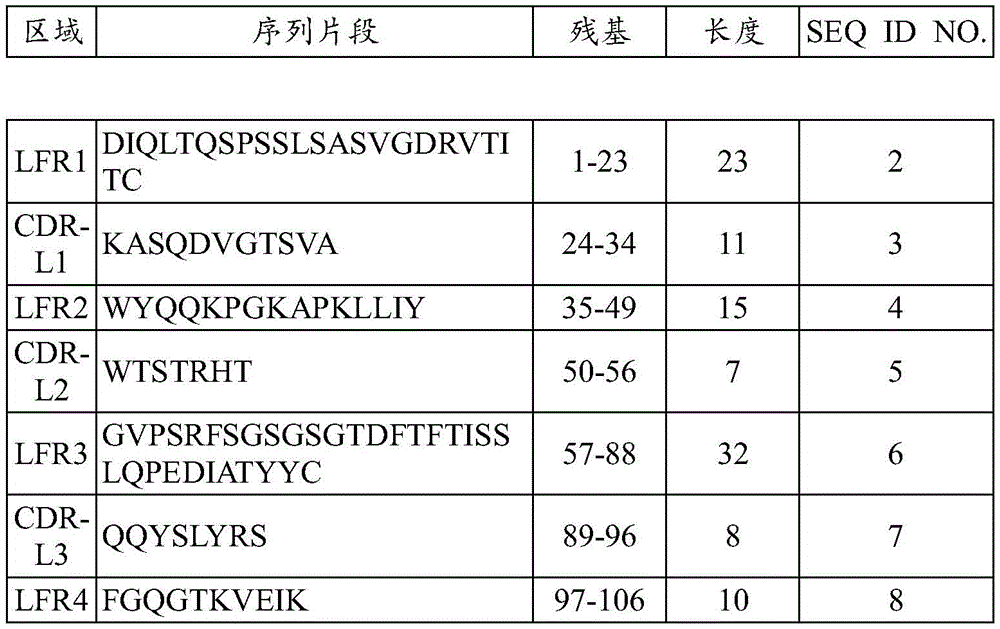
In one embodiment of the invention, the CEA-targeting antibody construct or antigen-binding domain comprises the variable heavy chain (VH) SEQ ID NO.9 of hMN-14/rabeprizumab (US 6676924).
EVQLVESGGGVVQPGRSLRLSCSSSGFDFTTYWMSWVRQAPGKGLEWVAEIHPDSSTINYAPSLKDRFTISRDNSKNTLFLQMDSLRPEDTGVYFCASLYFGFPWFAYWGQGTPVTVSS SEQ ID NO.9
In one embodiment of the present invention, the CEA targeting antibody construct or antigen binding domain comprises the heavy chain CDR (complementarity determining region) or heavy chain framework (HFR) sequences of hMN-14/labetamab SEQ ID No.10 to SEQ ID No.16(US 6676924).

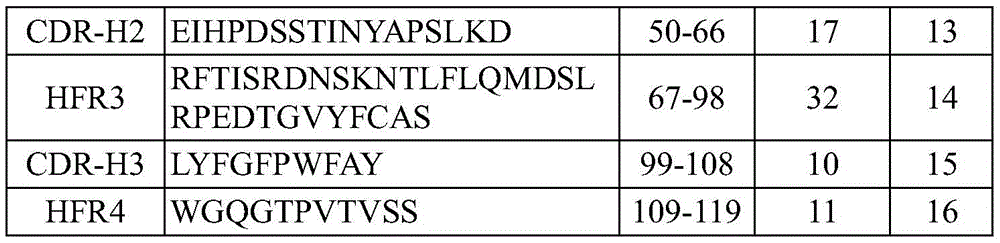
In one embodiment of the invention, the CEA-targeting antibody construct or antigen binding domain comprises the variable light chain (VL κ) of hPR1A3 SEQ ID No.17(US 8642742).
DIQMTQSPSSLSASVGDRVTITCKASAAVGTYVAWYQQKPGKAPKLLIYSASYRKRGVPSRFSGSGSGTDFTLTISSLQPEDFATYYCHQYYTYPLFTFGQGTKLEIK SEQ ID NO.17
In one embodiment of the invention, the CEA-targeting antibody construct or antigen binding domain comprises the light chain CDR (complementarity determining region) or light chain framework (LFR) sequences SEQ ID No.18 to SEQ ID No.24 of hPR1A3 (US 8642742).

In one embodiment of the invention, the CEA-targeting antibody construct or antigen binding domain comprises the heavy chain CDR (complementarity determining region) or heavy chain framework (HFR) sequences SEQ ID No.25 to SEQ ID No.31 of hPR1A3 (US 8642742).


In one embodiment of the invention, the CEA-targeting antibody construct or antigen-binding domain comprises the variable light chain (VL κ) of hMFE-23, SEQ ID No.32(US 723288).
ENVLTQSPSSMSASVGDRVNIACSASSSVSYMHWFQQKPGKSPKLWIYSTSNLASGVPSRFSGSGSGTDYSLTISSMQPEDAATYYCQQRSSYPLTFGGGTKLEIK SEQ ID NO.32
In one embodiment of the invention, the CEA-targeting antibody construct or antigen binding domain comprises the light chain CDR (complementarity determining region) or light chain framework (LFR) sequences SEQ ID No.33 through SEQ ID No.39 of hMFE-23 (US 723288).

In one embodiment of the invention, the CEA-targeting antibody construct or antigen-binding domain comprises the variable heavy chain (VH) SEQ ID NO.40 of hMFE-23 (US 723288).
QVKLEQSGAEVVKPGASVKLSCKASGFNIKDSYMHWLRQGPGQRLEWIGWIDPENGDTEYAPKFQGKATFTTDTSANTAYLGLSSLRPEDTAVYYCNEGTPTGPYYFDYWGQGTLVTVSS SEQ ID NO.40
In one embodiment of the invention, the CEA-targeting antibody construct or antigen-binding domain comprises the heavy chain CDR (complementarity determining region) or heavy chain framework (HFR) sequences of hMFE-23, SEQ ID No.41 to SEQ ID No.47(US 723288).

In one embodiment of the invention, the CEA-targeting antibody construct or antigen binding domain comprises the variable light chain (VL κ) SEQ ID No.48 of SM3E (US 723288).
ENVLTQSPSSMSVSVGDRVTIACSASSSVPYMHWLQQKPGKSPKLLIYLTSNLASGVPSRFSGSGSGTDYSLTISSVQPEDAATYYCQQRSSYPLTFGGGTKLEIK SEQ ID NO.48
In one embodiment of the invention, the CEA-targeting antibody construct or antigen binding domain comprises the light chain CDR (complementarity determining region) or light chain framework (LFR) sequences of SM3E SEQ ID No.49 to SEQ ID No.55(US 723288).


In one embodiment of the invention, the CEA-targeting antibody construct or antigen binding domain comprises the variable heavy chain (VH) SEQ ID No.56 of SM3E (US 723288).
QVKLEQSGAEVVKPGASVKLSCKASGFNIKDSYMHWLRQGPGQRLEWIGWIDPENGDTEYAPKFQGKATFTTDTSANTAYLGLSSLRPEDTAVYYCNEGTPTGPYYFDYWGQGTLVTVSS SEQ ID NO.56
In one embodiment of the invention, the CEA-targeting antibody construct or antigen binding domain comprises the heavy chain CDR (complementarity determining region) or heavy chain framework (HFR) sequences of SM3E SEQ ID No.57 to SEQ ID No.63(US 723288).
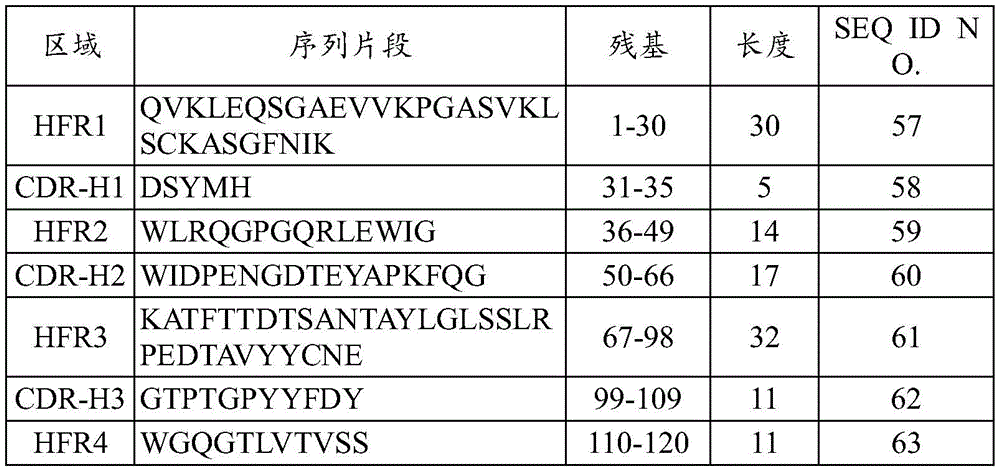
In one embodiment of the invention, the CEA-targeting antibody construct or antigen binding domain comprises the light chain CDR (complementarity determining region) or light chain framework (LFR) sequences of NP-4/acipimox from SEQ ID No.64 to SEQ ID No. 70.


In one embodiment of the invention, the CEA-targeting antibody construct or antigen-binding domain comprises the variable heavy chain (VH) SEQ ID No.71 of NP-4/acipimox.
EVKLVESGGGLVQPGGSLRLSCATSGFTFTDYYMNWVRQPPGKALEWLGFIGNKANGYTTEYSASVKGRFTISRDKSQSILYLQMNTLRAEDSATYYCTRDRGLRFYFDYWGQGTTLTVSS SEQ ID NO.71。
In one embodiment of the invention, the CEA-targeting antibody construct or antigen binding domain comprises the heavy chain CDR (complementarity determining region) or heavy chain framework (HFR) sequences SEQ ID No.72 to SEQ ID No.78 of NP-4.

In one embodiment of the invention, the CEA-targeting antibody construct or antigen binding domain comprises the variable light chain (VL κ) of M5A/hT84.66 SEQ ID No.79(US 7776330).
DIQLTQSPSSLSASVGDRVTITCRAGESVDIFGVGFLHWYQQKPGKAPKLLIYRASNLESGVPSRFSGSGSRTDFTLTISSLQPEDFATYYCQQTNEDPYTFGQGTKVEIK SEQ ID NO.79
In one embodiment of the invention, the CEA-targeting antibody construct or antigen binding domain comprises the light chain CDR (complementarity determining region) or light chain framework (LFR) sequences SEQ ID No.80 through SEQ ID No.86 of M5A/hTR 84.66 (US 7776330).
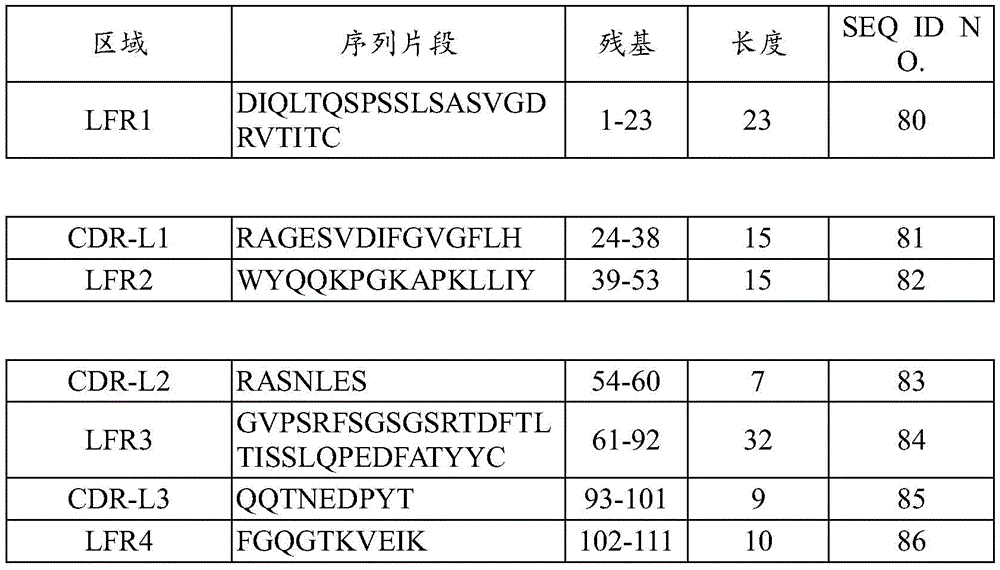
In one embodiment of the invention, the CEA-targeting antibody construct or antigen binding domain comprises the variable heavy chain (VH) of M5A/hT84.66 SEQ ID No.87(US 7776330).
EVQLVESGGGLVQPGGSLRLSCAASGFNIKDTYMHWVRQAPGKGLEWVARIDPANGNSKYADSVKGRFTISADTSKNTAYLQMNSLRAEDTAVYYCAPFGYYVSDYAMAYWGQGTLVTVSS SEQ ID NO.87
In one embodiment of the invention, the CEA-targeting antibody construct or antigen binding domain comprises the heavy chain CDR (complementarity determining region) or heavy chain framework (HFR) sequences SEQ ID No.88 to SEQ ID No.94 of M5A/hTR 84.66 (US 7776330).

In one embodiment of the invention, the CEA-targeting antibody construct or antigen binding domain comprises the variable light chain (VL κ) of hAb2-3 SEQ ID No.95(US 9617345).
DIQMTQSPASLSASVGDRVTITCRASENIFSYLAWYQQKPGKSPKLLVYNTRTLAEGVPSRFSGSGSGTDFSLTISSLQPEDFATYYCQHHYGTPFTFGSGTKLEIK SEQ ID NO.95
In one embodiment of the invention, the CEA-targeting antibody construct or antigen binding domain comprises the light chain CDR (complementarity determining region) or light chain framework (LFR) sequences SEQ ID No.96 through SEQ ID No.102(US 9617345) of hAb 2-3.
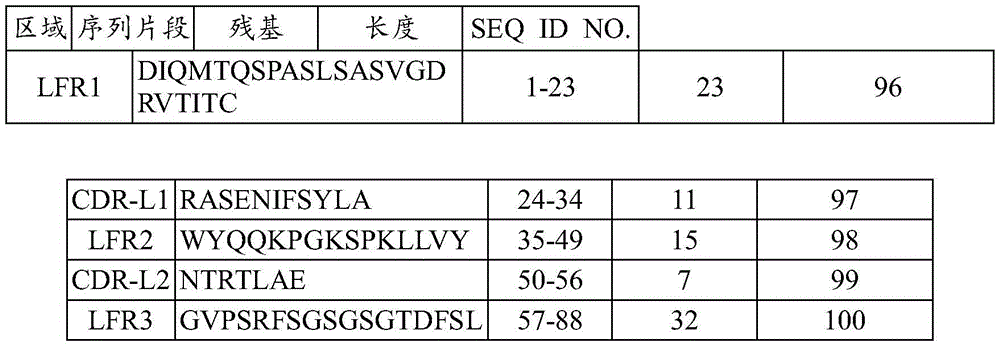

In one embodiment of the invention, the CEA-targeting antibody construct or antigen binding domain comprises the variable heavy chain (VH) SEQ ID No.103(US 9617345).
EVQLQESGPGLVKPGGSLSLSCAASGFVFSSYDMSWVRQTPERGLEWVAYISSGGGITYAPSTVKGRFTVSRDNAKNTLYLQMNSLTSEDTAVYYCAAHYFGSSGPFAYWGQGTLVTVSS SEQ ID NO.103
In one embodiment of the invention, the CEA-targeting antibody construct or antigen binding domain comprises the heavy chain CDR (complementarity determining region) or heavy chain framework (HFR) sequence of hAb2-3 from SEQ ID No.104 to SEQ ID No. 110.
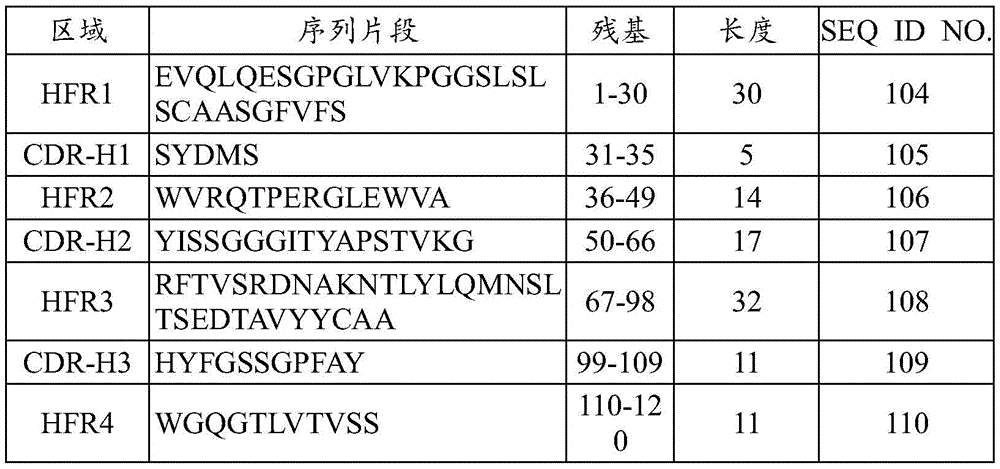
In one embodiment of the invention, the CEA-targeting antibody construct or antigen binding domain comprises A240VL-B9VH/AMG-211_The variable light chain of (VL κ) SEQ ID NO.111(US 9982063).
QAVLTQPASLSASPGASASLTCTLRRGINVGAYSIYWYQQKPGSPPQYLLRYKSDSDKQQGSGVSSRFSASKDASANAGILLISGLQSEDEADYYCMIWHSGASAVFGGGTKLTVL SEQ ID NO.111
In one embodiment of the invention, the CEA-targeting antibody construct or antigen binding domain comprises the light chain CDR (complementarity determining region) or light chain framework (LFR) sequences SEQ ID No.112 through SEQ ID No.118 of A240VL-B9VH/AMG-211 (US 9982063).

In one embodiment of the invention, the CEA-targeting antibody construct or antigen binding domain comprises the variable heavy chain (VH) SEQ ID No.119 of B9VH (US 9982063).
EVQLVESGGGLVQPGRSLRLSCAASGFTVSSYWMHWVRQAPGKGLEWVGFIRNKANGGTTEYAASVKGRFTISRDDSKNTLYLQMNSLRAEDTAVYYCARDRGLRFYFDYWGQGTTVTVSS SEQ ID NO.119
In one embodiment of the invention, the CEA-targeting antibody construct or antigen binding domain comprises the heavy chain CDR (complementarity determining region) or heavy chain framework (HFR) sequences SEQ ID No.120 to SEQ ID No.126(US 9982063).


In one embodiment of the invention, the CEA-targeting antibody construct or antigen binding domain comprises the variable heavy chain (VH) SEQ ID No.127 of E12VH (US 9982063).
EVQLVESGGGLVQPGRSLRLSCAASGFTVSSYWMHWVRQAPGKGLEWVGFILNKANGGTTEYAASVKGRFTISRDDSKNTLYLQMNSLRAEDTAVYYCARDRGLRFYFDYWGQGTTVTVSS SEQ ID NO.127
In one embodiment of the invention, the CEA-targeting antibody construct or antigen binding domain comprises the heavy chain CDR (complementarity determining region) or heavy chain framework (HFR) sequences SEQ ID No.128 to SEQ ID No.134(US 9982063).

In some embodiments, the antibody construct further comprises an Fc domain. In certain embodiments, the antibody construct is an antibody. In certain embodiments, the antibody construct is a fusion protein. The antigen binding domain may be a single chain variable fragment (scFv). Single chain variable fragments (scFv), which are truncated Fab fragments obtained by synthesis of a peptide comprising the variable (V) domain of an antibody heavy chain linked to the V domain of an antibody light chain, can be produced using conventional recombinant DNA techniques. Similarly, disulfide stabilized variable region fragments (dsFvs) can be prepared by recombinant DNA techniques. The antibody construct or antigen binding domain may comprise one or more variable regions (e.g., two variable regions) of the antigen binding domain of an anti-PD-L1 antibody, an anti-HER 2 antibody, or an anti-CEA antibody, each variable region comprising CDR1, CDR2, and CDR 3.
In some embodiments, the antibodies in the immunoconjugate contain a modified Fc region, wherein the modification modulates binding of the Fc region to one or more Fc receptors.
In some embodiments, the Fc region is modified by the inclusion of a transforming growth factor beta 1(TGF β 1) receptor or fragment thereof capable of binding TGF β 1. For example, the receptor may be TGF β receptor II (TGF β RII). In some embodiments, the TGF receptor is a human TGF receptor. In some embodiments, the IgG has a C-terminal fusion to the TGF β RII extracellular domain (ECD), as described in US 9676863 incorporated herein. An "Fc linker" may be used to link IgG to the TGF-beta RII extracellular domain, e.g., G4S4A G Fc linker. The Fc linker may be a short flexible peptide that allows for correct three-dimensional folding of the molecule while maintaining binding specificity to the target. In some embodiments, the N-terminus of the TGF β receptor is fused to the Fc (with or without an Fc linker) of the antibody construct. In some embodiments, the C-terminus of the heavy chain of the antibody construct is fused to the TGF β receptor (with or without an Fc linker). In some embodiments, the C-terminal lysine residue of the heavy chain of the antibody construct is mutated to alanine.
In some embodiments, the antibody in the immunoconjugate is glycosylated.
In some embodiments, the antibody in the immunoconjugate is a cysteine-engineered antibody that provides site-specific conjugation of an adjuvant, label or drug moiety to the antibody by cysteine substitution at a site where the engineered cysteine can be used for conjugation but does not interfere with immunoglobulin folding and assembly or alter antigen binding and effector functions (Junutula et al, 2008b Nature biotech, 26(8): 925-932; Dornan et al, (2009) Blood 114(13): 2721-2729; US 7521541; US 7723485; US 2012/0121615; WO 2009/052249). A "cysteine-engineered antibody" or "cysteine-engineered antibody variant" is an antibody in which one or more residues of the antibody are substituted with cysteine residues. Cysteine engineered antibodies can be conjugated with 8-amido-2-aminobenzazepines Adjuvant moiety conjugated as 8-amido-2-amino group with uniform stoichiometryBenzazepine compounds
 Linker compounds (e.g., in antibodies with a single engineered cysteine site, up to 2 8-amido-2-aminobenzazepines per antibody
 Portion).
In some embodiments, the cysteine-engineered antibodies used to prepare the immunoconjugates of table 3 have a cysteine residue introduced at the 149-lysine site of the light chain (LC K149C). In other embodiments, the cysteine-engineered antibody has a cysteine residue (HC a118C) introduced at the 118-alanine position (EU numbering) of the heavy chain. The position is alternatively numbered sequentially as 121, or numbered 114 as Kabat. In other embodiments, the cysteine-engineered antibody has a cysteine residue introduced at G64C or R142C according to the Kabat numbering in the light chain, or at D101C, V184C, or T205C according to the Kabat numbering in the heavy chain.
8-amido-2-aminobenzazepines Adjuvant compounds
The immunoconjugates of the invention comprise 8-amido-2-aminobenzazepines An adjuvant moiety. The adjuvant moiety described herein is a compound that elicits an immune response (i.e., an immunostimulant). Typically, the adjuvant moiety described herein is a TLR agonist. TLRs are type I transmembrane proteins responsible for initiating the innate immune response in vertebrates. TLRs recognize a variety of pathogen-associated molecular patterns from bacteria, viruses, and fungi and serve as a first line of defense against invading pathogens. TLRs elicit overlapping but distinct biological responses due to differences in cellular expression and the signaling pathways they elicit. Once involved (e.g., by natural stimulation or synthetic TLR agonists) TLRs initiate a signal transduction cascade leading to the activation of nuclear factor- κ B (NF- κ B) and recruitment of IL-1 receptor associated kinases (IRAKs) by engaging the protein myeloid differentiation primary response gene 88(MyD 88). Phosphorylation of IRAK then leads to the recruitment of TNF receptor-related factor 6(TRAF6), which leads to phosphorylation of the NF- κ B inhibitor, I- κ B. As a result, NF-. kappa.B enters the nucleus and initiates transcription of genes whose promoters contain NF-. kappa.B binding sites, such as cytokines. Additional modes of modulation of TLR signaling include adaptor-induced interferon-beta (TRIF) -dependent induction of the TIR-containing domain of TNF receptor-related factor 6(TRAF6) and activation of the MyD 88-independent pathway by TRIF and TRAF3, leading to phosphorylation of interferon-responsive factor 3(IRF 3). Similarly, the MyD 88-dependent pathway also activates several IRF family members, including IRF5 and IRF7, while the TRIF-dependent pathway also activates the NF-. kappa.B pathway.
Typically, the adjuvant moiety described herein is a TLR7 and/or TLR8 agonist. TLR7 and TLR8 are both expressed in monocytes and dendritic cells. In humans, TLR7 is also expressed in plasmacytoid dendritic cells (pdcs) and B cells. TLR8 is expressed primarily in cells of myeloid origin, i.e., monocytes, granulocytes, and myeloid dendritic cells. TLR7 and TLR8 are able to detect the presence of "foreign" single stranded RNA in cells as a means of dealing with viral invasion. Treatment of TLR8 expressing cells with a TLR8 agonist results in the production of high levels of IL-12, IFN-gamma, IL-1, TNF-alpha, IL-6 and other inflammatory cytokines. Likewise, stimulation of TLR7 expressing cells (such as pDC) with a TLR7 agonist can result in the production of high levels of IFN- α and other inflammatory cytokines. The involvement of TLR7/TLR8 and the resulting cytokine production can activate dendritic cells and other antigen presenting cells, driving a variety of innate and adaptive immune response mechanisms, leading to tumor destruction.
Computational modeling of related compounds that bind to TLR7/8
Benzazepine compounds Structural modification of the 4-amide side chain in the scaffold may affect 8-amido-2-aminobenzazepine
 Potency and selectivity of adjuvants for binding to TLR7 and TLR 8. Certain structural alterations may change a TLR8 selective agonist to a dual TLR7/8 agonist. Modification of dipropionamide on BZA-1 with NHBoc group (BZA-2) minimally perturbs TLR8 activity (fig. 1A), while at the same time significantly increasing TLR7 activity (fig. 1B). In addition, this same structural modification was applied to BZA-3 to generate BZA-4 (positional isomer of 8 AmBza-9), increasing TLR7 activity (fig. 1D) and not affecting TLR8 activity (fig. 1C).
BZA-2 and BZA-4 molecules were conformationally counted using the Merck molecular force field (MMFF94) by the open source chemical informatics software RDkit (Halgren, T.A, (1999) J. Compout. chem.,20: 720-. These constructs were then docked into TLR8(3w3n) by rDock, followed by molecular mechanical minimization of posture in TLR8 (haplotype minimization). rDock (formerly RiboDock) is an open source molecular docking software that can be used to dock small molecules with proteins and nucleic acids. rDick was designed primarily for high throughput virtual screening and binding pattern prediction (Morley, S.D. et al, (2004) Journal of Computer-air Molecular Design 18(3): 189-. The strain energy is determined by taking the final orientation from the docking and then performing QM optimization and minimization in Psi 4.
Figure 2 shows calculated docking images of docked BZA-2, highlighting the interaction with TLR8 Asp and TLR7 Leu residues. The origin of this effect can be attributed to the different amino acid residues between TLR8 and TLR 7: asp (545) of TLR 8; leu for TLR7 (557). Fig. 3A shows a computed docking solution image of BZA-2 with TLR 8. Figure 3B shows a computational docking solution image of BZA-2 with TLR7, where a hydrophobic tert-butyl group interacts with Leu 557 in TLR7, enhancing TLR7 efficacy. In contrast, the TLR8 protein conformation was able to adapt to the NHBoc structural motif and maintain modest TLR8 potency (fig. 3A). The same observations were maintained when examining the docking structure of BZA-4, as seen in fig. 3C and 3D. This surprising and unexpected property of the NHBoc structural motif may enable the design of effective 8-acyl groupsAmino-2-aminobenzazepines A TLR7/8 agonist. For adjuvants having hydroxamate groups, such as 8AmBza-15 and 8AmBza-18 in Table 1b, 8-amido-2-aminobenzazepine are also contemplated
 Potency and selectivity of adjuvants for binding to TLR7 and TLR 8. The computational docking solution image shows interaction with Tyr 348.


Exemplary 8-amido-2-aminobenzazepines of the invention Compound (8AmBza) is shown in table 1a and table 1 b. Each compound was characterized by mass spectrometry and was shown to have the indicated mass. Activity was measured according to example 30 against HEK293 NFKB reporter cells expressing human TLR7 or human TLR 8.
TABLE 1a 8-amido-2-aminobenzazepine Compound (8AmBza)


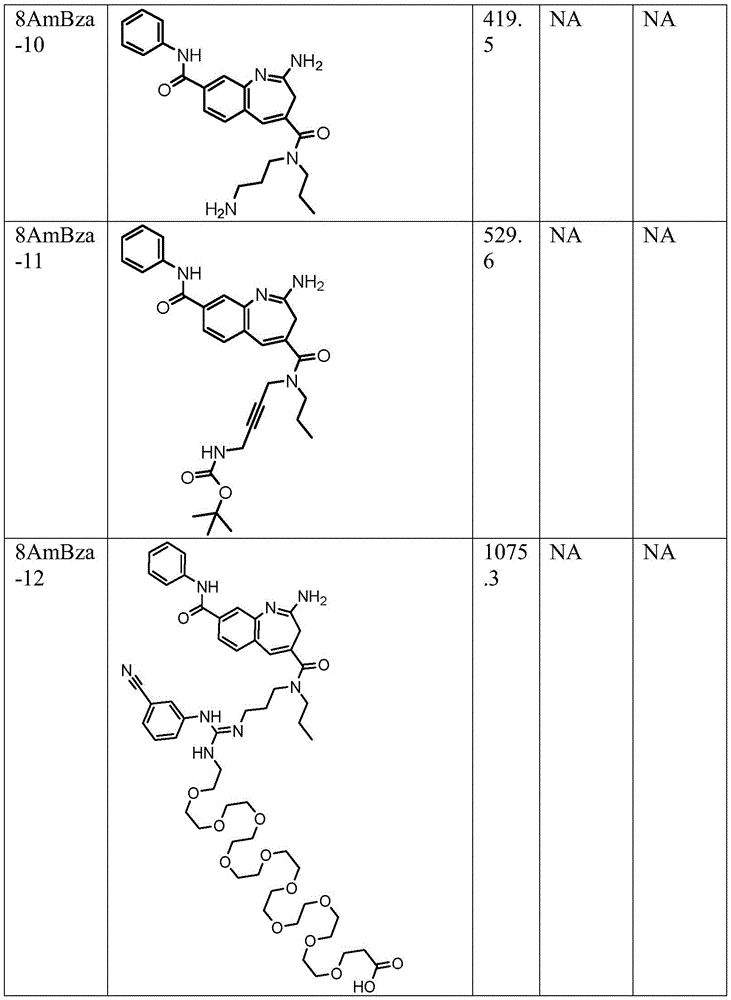
TABLE 1b 8-acylamino-2-aminobenzazepine Compound (8AmBza)


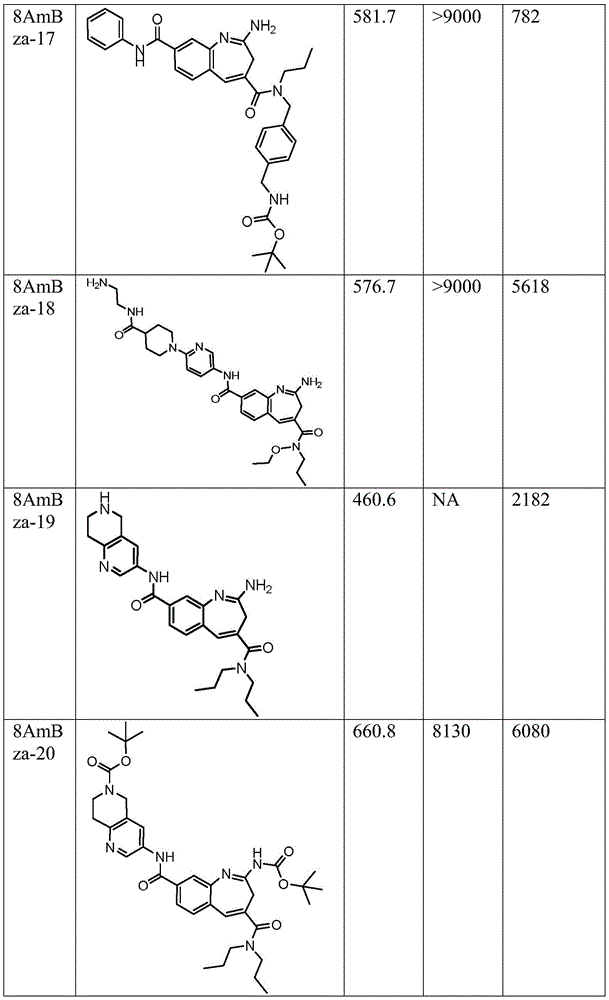
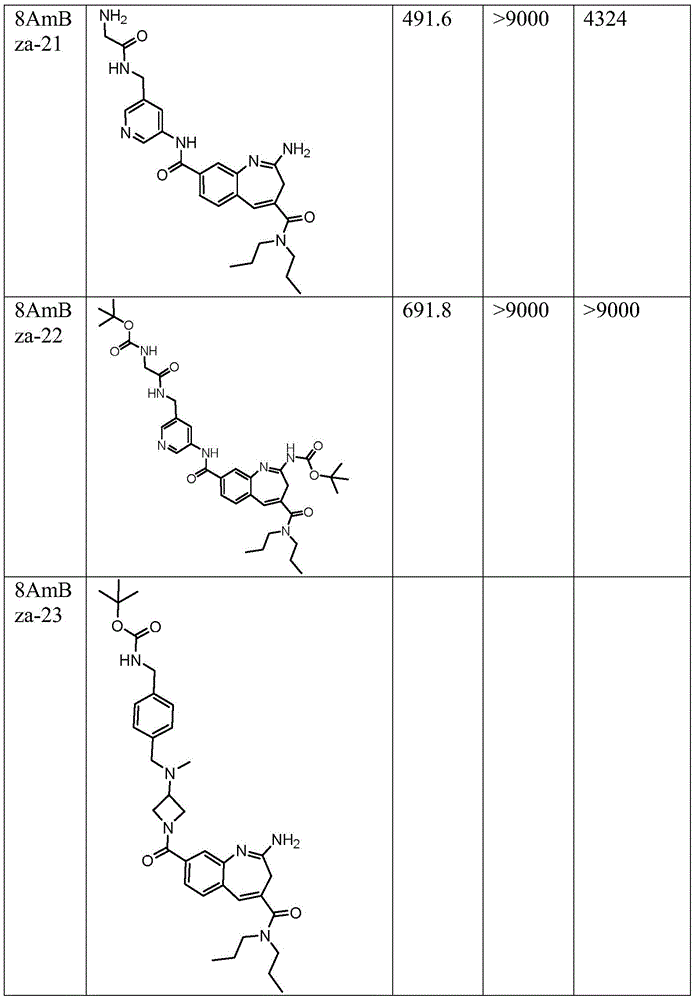

8-amido-2-aminobenzazepines -linker compound
The immunoconjugates of the invention are prepared by reacting an antibody with 8-amido-2-aminobenzazepine -linker compounds are conjugated. 8-amido-2-aminobenzazepines
 The linker compound comprises an 8-amido-2-aminobenzazepine covalently linked to a linker unit L
 (8AmBza) moiety. The linker unit comprises functional groups and subunits that affect the stability, permeability, solubility, and other pharmacokinetic, safety, and efficacy properties of the immunoconjugate. The linker unit includes a reactive functional group that reacts with (i.e., conjugates of) the reactive functional group of the antibody. For example, a nucleophilic group of an antibody (such as a lysine side chain amino group) reacts with an electrophilic reactive functional group of an 8 AmBza-linker compound to form an immunoconjugate. In addition, for example, the cysteine thiol of the antibody reacts with the maleimide or bromoacetamide groups of the 8 AmBza-linker compound to form an immunoconjugate.
Electrophilic reactive functional groups suitable for use in 8 AmBza-linker compounds include, but are not limited to, N-hydroxysuccinimide (NHS) esters and N-hydroxysulfosuccinimide (sulfo-NHS) esters (amine reactive); carbodiimides (amine and carboxyl reactive); hydroxymethyl phosphine (amine reactive); maleimide (thiol-reactive); haloacetamides such as N-iodoacetamide (thiol reactive); aryl azides (primary amine reactive); fluorinated aryl azides (reactivity via carbon-hydrogen (C-H) insertion); pentafluorophenyl (PFP) ester (amine reactive); tetrafluorophenyl (TFP) ester (amine reactive); imidates (amine reactive); isocyanate (hydroxyl reactive); vinyl sulfones (thiol, amine and hydroxyl reactions); pyridyl disulfide (thiol reactive); and benzophenone derivatives (reactivity via C-H bond insertion). Other reagents include, but are not limited to, those described in Hermanson, Bioconjugate Techniques, 2 nd edition, Academic Press, 2008.
The present invention provides solutions to the limitations and challenges of the design, preparation and use of immunoconjugates. Some linkers may be unstable in the bloodstream, releasing unacceptable amounts of adjuvant/drug prior to internalization in target cells (Khot, A. et al (2015) Bioanalysis 7(13): 1633-. Other linkers may provide stability in the bloodstream, but intracellular release efficiency may be negatively impacted. The linkers provided for the desired intracellular release are generally less stable in the bloodstream. Alternatively stated, blood flow stability and intracellular release are generally inversely related. Furthermore, in standard conjugation processes, the amount of adjuvant/drug moiety loaded on the antibody (i.e., drug loading), the amount of aggregates formed in the conjugation reaction, and the yield of the final purified conjugate that can be obtained are interrelated. For example, aggregate formation is generally positively correlated with the number of equivalents of adjuvant/drug moieties and derivatives thereof conjugated to the antibody. At high drug loading, the aggregates formed must be removed for therapeutic applications. Thus, drug-loading mediated aggregate formation can reduce immunoconjugate yield and can make process scale-up difficult.
Exemplary embodiments include 8-amido-2-aminobenzazepines of formula II -a linker compound:
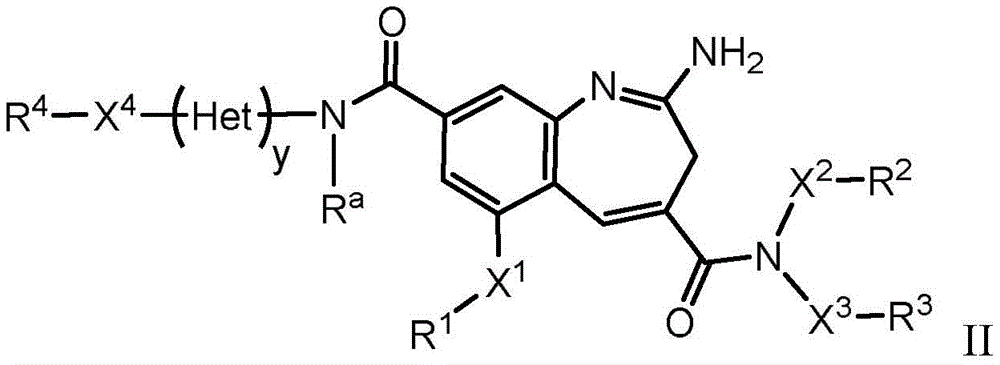
wherein
y is 0 or 1;
het is selected from the group consisting of: heterocyclyl, heterocyclyldiyl, heteroaryl, and heteroaryldiyl;
Rais H or forms Het with the nitrogen atom to which it is bonded;
R1、R2、R3and R4Independently selected from the group consisting of: H. c1-C12Alkyl radical, C2-C6Alkenyl radical, C2-C6Alkynyl, C3-C12Carbocyclyl, C6-C20Aryl radical, C2-C9Heterocyclyl and C1-C20Heteroaryl, wherein alkyl, alkenyl, alkynyl, carbocyclyl, aryl, heterocyclyl and heteroaryl are independently and optionally substituted with one or more groups selected from:
-(C1-C12Alkyl diyl) -N (R)5)-*;
-(C1-C12Alkyl diyl) -N (R)5)2;
-(C1-C12Alkyldiyl) -OR5;
-(C3-C12Carbocyclyl);
-(C3-C12carbocyclyl) -;
-(C3-C12carbocyclyl) - (C1-C12Alkyldiyl) -NR5-*;
-(C3-C12Carbocyclyl) - (C1-C12Alkyl diyl) -N (R)5)2;
-(C3-C12Carbocyclyl) -NR5-C(=NR5)NR5-*;
-(C6-C20Aryl groups);
-(C6-C20aryl) -;
-(C6-C20aryl diyl) -N (R)5)-*;
-(C6-C20Aryl diyl) - (C)1-C12Alkyl diyl) -N (R)5)-*;
-(C6-C20Aryl-diyl) - (C)1-C12Alkyl diyl) - (C2-C20Heterocyclyl diradical) -;
-(C6-C20aryl diyl) - (C)1-C12Alkyl diyl) -N (R)5)2;
-(C6-C20Aryl diyl) - (C)1-C12Alkyldiyl) -NR5-C(=NR5a)N(R5)-*;
-(C2-C20A heterocyclic group);
-(C2-C20heterocyclyl) -;
-(C2-C9heterocyclyl) - (C)1-C12Alkyldiyl) -NR5-*;
-(C2-C9Heterocyclyl) - (C)1-C12Alkyl diyl) -N (R)5)2;
-(C2-C9Heterocyclyl) -NR5-C(=NR5a)NR5-*;
-(C1-C20Heteroaryl);
-(C1-C20heteroaryl) -;
-(C1-C20heteroaryl) - (C)1-C12Alkyl diyl) -N (R)5)-*;
-(C1-C20Heteroaryl) - (C)1-C12Alkyl diyl) -N (R)5)2;
-(C1-C20Heteroaryl) -NR5-C(=NR5a)N(R5)-*;
-C(=O)-*;
-C(=O)-(C1-C12Alkyl diyl) -N (R)5)-*;
-C(=O)-(C2-C20Heterocyclyl diradical) -;
-C(=O)N(R5)2;
-C(=O)N(R5)-*;
-C(=O)N(R5)-(C1-C12alkyl diyl) -N (R)5)C(=O)R5;
-C(=O)N(R5)-(C1-C12Alkyl diyl) -N (R)5)C(=O)N(R5)2;
-C(=O)NR5-(C1-C12Alkyl diyl) -N (R)5)CO2R5;
-C(=O)NR5-(C1-C12Alkyl diyl) -N (R)5)C(=NR5a)N(R5)2;
-C(=O)NR5-(C1-C12Alkyldiyl) -NR5C(=NR5a)R5;
-C(=O)NR5-(C1-C8Alkyldiyl) -NR5(C2-C5Heteroaryl);
-C(=O)NR5-(C1-C20heteroaryl diyl) -N (R)5)-*;
-C(=O)NR5-(C1-C20Heteroaryl diradical) -;
-C(=O)NR5-(C1-C20heteroaryl diyl) - (C)1-C12Alkyl diyl) -N (R)5)2;
-C(=O)NR5-(C1-C20Heteroaryl diyl) - (C)2-C20Heterocyclyldiyl) -C (═ O) NR5-(C1-C12Alkyldiyl) -NR5-*;
-N(R5)2;
-N(R5)-*;
-N(R5)C(=O)R5;
-N(R5)C(=O)-*;
-N(R5)C(=O)N(R5)2;
-N(R5)C(=O)N(R5)-*;
-N(R5)CO2R5;
-NR5C(=NR5a)N(R5)2;
-NR5C(=NR5a)N(R5)-*;
-NR5C(=NR5a)R5;
-N(R5)-(C2-C5Heteroaryl);
-O-(C1-C12alkyl groups);
-O-(C1-C12alkyl diyl) -N (R)5)2;
-O-(C1-C12Alkyl diyl) -N (R)5)-*;
-S(=O)2-(C2-C20Heterocyclyl diradical) -;
-S(=O)2-(C2-C20heterocyclyl diyl) - (C)1-C12Alkyl diyl) -N (R)5)2;
-S(=O)2-(C2-C20Heterocyclyl diyl) - (C)1-C12Alkyldiyl) -NR5-; and
-S(=O)2-(C2-C20heterocyclyl diyl) - (C)1-C12Alkyldiyl) -OH;
or R2And R3Together form a 5-or 6-membered heterocyclyl ring;
X1、X2、X3and X4Independently selected from the group consisting of: a bond, C (═ O) N (R)5)、O、N(R5)、S、S(O)2And S (O)2N(R5);
R5Selected from the group consisting of: H. c6-C20Aryl radical, C6-C20Aryl diyl, C1-C12Alkyl and C1-C12Alkyl diyl, or two R5The groups together form a 5-or 6-membered heterocyclyl ring;
R5aselected from the group consisting of: c6-C20Aryl and C1-C20A heteroaryl group;
wherein the asterisks indicate the attachment site for L, and wherein R1、R2、R3And R4One of which is connected to L;
l is a linker selected from the group consisting of:
Q-C(=O)-(PEG)-C(=O)-(PEP)-;
Q-C(=O)-(PEG)-NR5-;
Q-C(=O)-(PEG)-NR5-(PEG)-C(=O)-(PEP)-;
Q-C(=O)-(PEG)-N+(R5)2-(PEG)-C(=O)-(PEP)-;
Q-C(=O)-(PEG)-C(=O)-;
Q-C(=O)-(PEG)-NR5CH(AA1)C(=O)-(PEG)-C(=O)-(PEP)-;
Q-C(=O)-(PEG)-SS-(C1-C12alkyldiyl) -OC (═ O) -;
Q-C(=O)-(PEG)-SS-(C1-C12alkyl diyl) -C (═ O) -;
Q-C(=O)-(PEG)-;
Q-C(=O)-(PEG)-C(=O)NR5(C1-C12alkyldiyl) NR5C(=O)-(C2-C5Heterocyclyldiyl) -;
Q-C(=O)-(PEG)-C(=O)NR5(C1-C12alkyl diyl) -;
Q-C(=O)-(C1-C12alkyl diyl) -C (═ O) - (PEP) -;
Q-C(=O)-(C1-C12alkyl diyl) -C (═ O) - (PEP) -NR5(C1-C12Alkyl diyl) -;
Q-C(=O)-(C1-C12alkyl diyl) -C (═ O) - (PEP) -NR5(C1-C12Alkyldiyl) NR5-C(=O);
Q-C(=O)-(C1-C12Alkyl diyl) -C (═ O) - (PEP) -NR5(C1-C12Alkyldiyl) NR5C(=O)-(C2-C5Heterocyclyldiyl) -;
Q-C(=O)-CH2CH2OCH2CH2-(C1-C20heteroaryl diyl) -CH2O-(PEG)-C(=O)-(MCgluc)-;
Q-C(=O)-CH2CH2OCH2CH2-(C1-C20Heteroaryl diyl) -CH2O-(PEG)-C(=O)-(MCgluc)-NR5(C1-C12Alkyldiyl) NR5C(=O)-(C2-C5Heterocyclyldiyl) -;
Q-C(=O)-(PEG)-C(=O)-NR5(C1-C12alkyl diyl) -;
Q-C(=O)-(PEG)-C(=O)-NR5(C1-C12alkyldiyl) NR5C(=O)-(C2-C5Heterocyclyldiyl) -;
Q-C(=O)-(PEG)-C(=O)-(PEP)-NR5(C1-C12alkyl diyl) -;
Q-C(=O)-(PEG)-C(=O)-(PEP)-NR5(C1-C12alkyldiyl) NR5C(=O)-(C2-C5Heterocyclyldiyl) -; and
Q-(CH2)m-C(=O)-(PEP)-NR5(C1-C12alkyldiyl) NR5C(=O)-(C2-C5Heterocyclyldiyl) -;
wherein the PEG has the formula: - (CH)2CH2O)n-(CH2)m-; m is an integer from 1 to 5, and n is an integer from 2 to 50;
PEP has the formula:

wherein AA1And AA2Independently selected from amino acid side chains, or AA1Or AA2Form a 5-membered cyclic proline amino acid with the adjacent nitrogen atom, and the wavy line indicates the point of attachment; and is
R6Is selected from-CH2C substituted by O-C (═ O) -, and optionally substituted by6-C20Aryl diyl and C1-C20Heteroaryl diradicals:
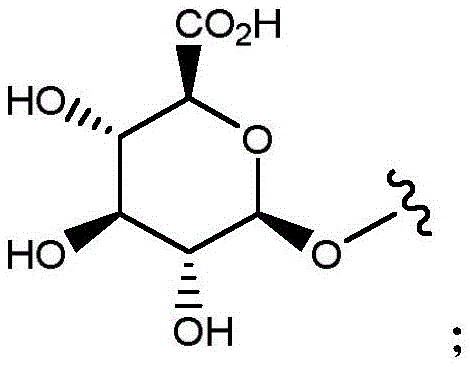
MCgluc is selected from the group consisting of:

wherein q is 1 to 8 and AA is an amino acid side chain; and is
Q is selected from the group consisting of: n-hydroxysuccinimide group, N-hydroxysulfosuccinimide group, maleimide group and a compound of one or more groups independently selected from F, Cl, NO2And SO3 -A phenoxy group substituted with the group of (a);
wherein the alkyl, alkyldiyl, alkenyl, alkenyldiyl, alkynyl, alkynediyl, aryl, aryldiyl carbocyclyl, carbocyclyldiyl, heterocyclyl, heterocyclyldiyl, heteroaryl, and heteroaryldiyl are optionally substituted with one or more groups independently selected from: F. cl, Br, I, -CN, -CH3、-CH2CH3、-CH=CH2、-C≡CH、-C≡CCH3、-CH2CH2CH3、-CH(CH3)2、-CH2CH(CH3)2、-CH2OH、-CH2OCH3、-CH2CH2OH、-C(CH3)2OH、-CH(OH)CH(CH3)2、-C(CH3)2CH2OH、-CH2CH2SO2CH3、-CH2OP(O)(OH)2、-CH2F、-CHF2、-CF3、-CH2CF3、-CH2CHF2、-CH(CH3)CN、-C(CH3)2CN、-CH2CN、-CH2NH2、-CH2NHSO2CH3、-CH2NHCH3、-CH2N(CH3)2、-CO2H、-COCH3、-CO2CH3、-CO2C(CH3)3、-COCH(OH)CH3、-CONH2、-CONHCH3、-CON(CH3)2、-C(CH3)2CONH2、-NH2、-NHCH3、-N(CH3)2、-NHCOCH3、-N(CH3)COCH3、-NHS(O)2CH3、-N(CH3)C(CH3)2CONH2、-N(CH3)CH2CH2S(O)2CH3、-NO2、=O、-OH、-OCH3、-OCH2CH3、-OCH2CH2OCH3、-OCH2CH2OH、-OCH2CH2N(CH3)2、-O(CH2CH2O)n-(CH2)mCO2H、-O(CH2CH2O)nH、-OP(O)(OH)2、-S(O)2N(CH3)2、-SCH3、-S(O)2CH3and-S (O)3H。
8-amido-2-aminobenzazepines of formula II Exemplary embodiments of linker compounds include wherein y is 0.
8-amido-2-aminobenzazepines of formula II Exemplary embodiments of linker compounds include those wherein y is 1.
8-amido-2-aminobenzazepines of formula II Exemplary embodiments of linker compounds include those wherein PEP has the formula:

wherein AA1And AA2Independently selected from the side chains of naturally occurring amino acids.
8-amido-2-aminobenzazepines of formula II Exemplary embodiments of linker compounds include those wherein AA1Or AA2To adjacent nitrogen atomsForming a 5-membered ring to form the proline amino acid.
8-amido-2-aminobenzazepines of formula II Exemplary embodiments of linker compounds include those wherein PEP has the formula:

8-amido-2-aminobenzazepines of formula II Exemplary embodiments of linker compounds include those wherein MCgluc has the formula:

8-amido-2-aminobenzazepines of formula II Exemplary embodiments of linker compounds include those wherein AA1And AA2Independently selected from H, -CH3、-CH(CH3)2、-CH2(C6H5)、-CH2CH2CH2CH2NH2、-CH2CH2CH2NHC(NH)NH2、-CHCH(CH3)CH3、-CH2SO3H. and-CH2CH2CH2NHC(O)NH2。
8-amido-2-aminobenzazepines of formula II Exemplary embodiments of linker compounds include those wherein AA1is-CH (CH)3)2And AA2is-CH2CH2CH2NHC(O)NH2。
8-amido-2-aminobenzazepines of formula II Exemplary embodiments of linker compounds include those wherein AA1And AA2Independently selected from GlcNAc aspartic acid, -CH2SO3H. and-CH2OPO3H。
8-amido-2-aminobenzazepines of formula II Exemplary embodiments of linker compounds include those wherein X1Is a bond, and R1Is H.
8-amido-2-aminobenzazepines of formula II Exemplary embodiments of linker compounds include those wherein X2Is a bond, and R2Is C1-C8An alkyl group.
8-amido-2-aminobenzazepines of formula II Exemplary embodiments of linker compounds include those wherein X2And X3Are all a bond, and R2And R3Independently selected from C1-C8Alkyl, -O- (C)1-C12Alkyl), - (C)1-C12Alkyldiyl) -OR5、-(C1-C8Alkyl diyl) -N (R)5)CO2R5and-O- (C)1-C12Alkyl) -N (R)5)CO2R5。
8-amido-2-aminobenzazepines of formula II Exemplary embodiments of linker compounds include those wherein R2And R3Each independently selected from-CH2CH2CH3、-OCH2CH3、-CH2CH2CF3and-CH2CH2CH2OH。
8-amido-2-aminobenzazepines of formula II Exemplary embodiments of linker compounds include those wherein R2Is C1-C8Alkyl and R3Is- (C)1-C8Alkyl diyl) -N (R)5)CO2R4。
8-amido-2-aminobenzazepines of formula II Exemplary embodiments of linker compounds include those wherein R2is-CH2CH2CH3And R is3is-CH2CH2CH2NHCO2(t-Bu). 8-amido-2-aminobenzazepines of formula II
 Exemplary embodiments of linker compounds include those wherein R2And R3Are all-CH2CH2CH3。
8-amido-2-aminobenzazepines of formula II Exemplary embodiments of linker compounds include those wherein R1Or R3NR of5(C2-C5Heteroaryl) is selected from:

8-amido-2-aminobenzazepines of formula II -grafting ofExemplary embodiments of the compounds include those wherein X3-R3Selected from the group consisting of:

8-amido-2-aminobenzazepines of formula II Exemplary embodiments of linker compounds include those wherein Het is a 5 or 6 membered monocyclic heteroaryldiyl selected from the group consisting of: pyridyl diyl, imidazolyl diyl, pyrimidyl diyl, pyrazolyl diyl, triazolyl diyl, pyrazinyl diyl, tetrazolyl diyl, furyl diyl, thienyl diyl, isoxazolyl diyl, thiazolyl diyl, oxadiazolyl diyl, oxazolyl diyl, isothiazolyl diyl, and pyrrolyl diyl.
8-amido-2-aminobenzazepines of formula II Exemplary embodiments of linker compounds include those wherein Het is a 5 or 6 membered monocyclic heterocyclyldiyl selected from the group consisting of: morpholinyldiyl, piperidinediyl, piperazinediyl, pyrrolidinyldiyl, dioxanyl diyl, thiomorpholinodiyl and S-dioxothiomorpholinodiyl.
8-amido-2-aminobenzazepines of formula II Exemplary embodiments of linker compounds include those wherein Het is 1, 6-naphthyridinyl or 1, 6-naphthyridinediyl.
8-amido-2-aminobenzazepines of formula II Exemplary embodiments of linker compounds include wherein L is selected from the group consisting of:
Q-C(=O)-CH2CH2OCH2CH2-(C1-C20heteroaryl diyl) -CH2O-(PEG)-C(=O)-(MCgluc)-NR5(C1-C12Alkyldiyl) NR5C(=O)-(C2-C5Heterocyclyldiyl) -;
Q-C(=O)-(PEG)-C(=O)-NR5(C1-C12alkyl diyl) -;
Q-C(=O)-(PEG)-C(=O)-NR5(C1-C12alkyldiyl) NR5C(=O)-(C2-C5Heterocyclyldiyl) -;
Q-C(=O)-(PEG)-C(=O)-(PEP)-NR5(C1-C12alkyl diyl) -;
Q-C(=O)-(PEG)-C(=O)-(PEP)-NR5(C1-C12alkyldiyl) NR5C(=O)-(C2-C5Heterocyclyldiyl) -; and
Q-(CH2)m-C(=O)-(PEP)-NR5(C1-C12alkyldiyl) NR5C(=O)-(C2-C5Heterocyclyldiyl) -.
8-amido-2-aminobenzazepines of formula IIa Exemplary embodiments of linker compounds include those wherein Q is selected from the group consisting of:

8-amido-2-aminobenzazepines of formula IIa Exemplary embodiments of linker compounds include those wherein Q is phenoxy substituted with one or more F.
8-amido-2-aminobenzazepines of formula IIa Exemplary embodiments of the linker compound include those wherein Q is 2,3,5, 6-tetrafluorophenoxy.
8-amido-2-aminobenzazepines of formula II Exemplary embodiments of linker compounds are selected from formulae IIa to IId:
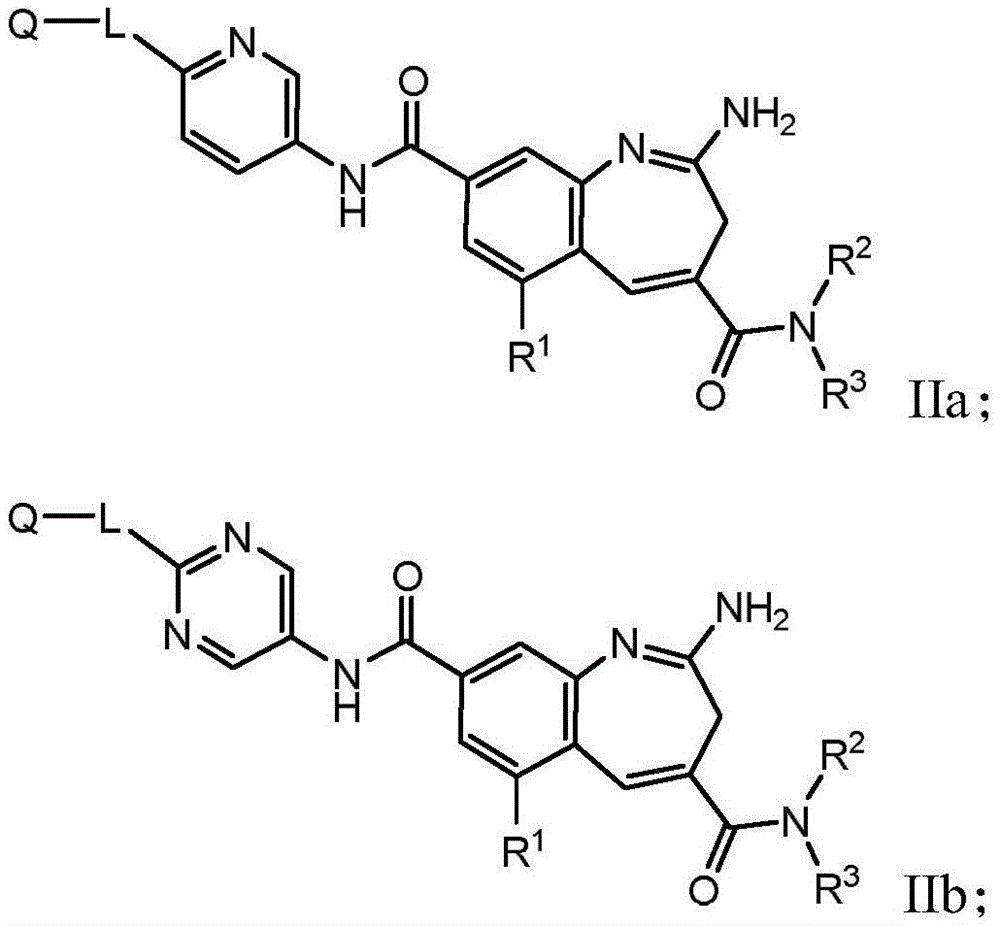

8-amido-2-aminobenzazepines of formulae IIa to IId Exemplary embodiments of linker compounds include those wherein R2Is C1-C8Alkyl and R3Is- (C)1-C8Alkyl diyl) -N (R)5)CO2R4。
8-amido-2-aminobenzazepines of formulae IIa to IId Exemplary embodiments of linker compounds include those wherein R2is-CH2CH2CH3And R is3is-CH2CH2CH2NHCO2(t-Bu)。
8-amido-2-aminobenzazepines of formulae IIa to IId Exemplary embodiments of linker compounds include those wherein R2And R3is-CH2CH2CH3。
8-amido-2-aminobenzazepines of formulae IIa to IId Exemplary embodiments of the linker compound include wherein Q is tetrafluorophenyl.
8-amido-2-aminobenzazepines Exemplary embodiments of linker compounds are selected from table 2. Each compound was characterized by mass spectrometry and shown to have the indicated mass.
TABLE 2a 8-amido-2-aminobenzazepines of formula II -linker (8AmBza-L) compound

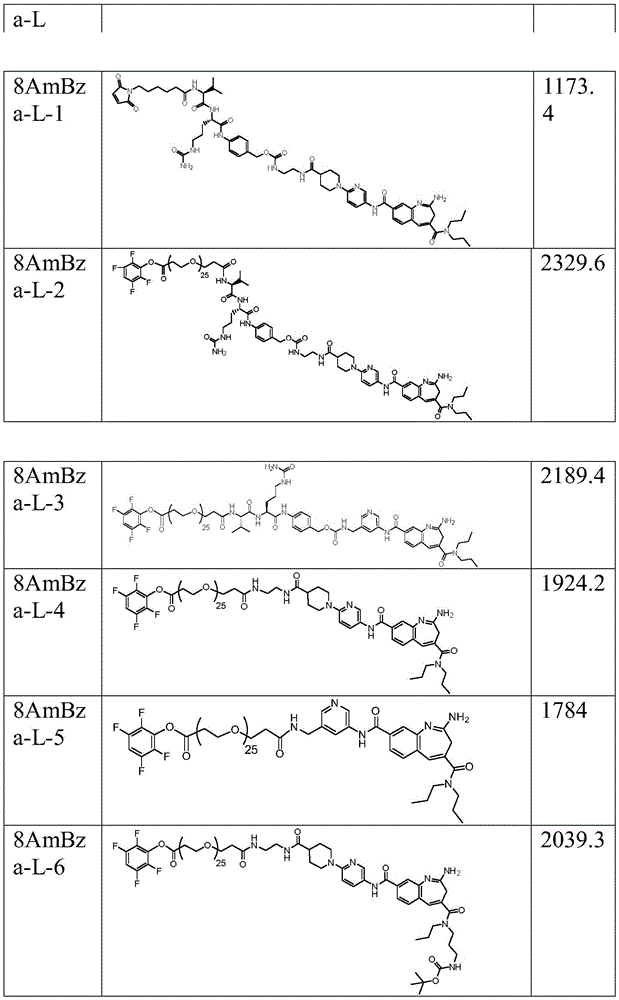


TABLE 2b 8-amido-2-aminobenzazepines of formula II -linker (8AmBza-L) compound


Immunoconjugates
Exemplary embodiments of the immunoconjugates comprise an antibody covalently linked to one or more 8-amido-2-aminobenzazepines via a linker (8AmBza) moiety, and having formula I:
Ab-[L-8AmBza]p I
or a pharmaceutically acceptable salt thereof,
wherein:
ab is the antibody;
p is an integer from 1 to 8;
8AmBza is an 8-amido-2-aminobenzazepine having the formula The method comprises the following steps:

y is 0 or 1;
het is selected from the group consisting of: heterocyclyl, heterocyclyldiyl, heteroaryl, and heteroaryldiyl;
Rais H or forms Het with the nitrogen atom to which it is bonded;
R1、R2、R3and R4Independently selected from the group consisting of: H. c1-C12Alkyl radical, C2-C6Alkenyl radical, C2-C6Alkynyl, C3-C12Carbocyclyl, C6-C20Aryl radical, C2-C9Heterocyclyl and C1-C20Heteroaryl radicalWherein alkyl, alkenyl, alkynyl, carbocyclyl, aryl, heterocyclyl and heteroaryl are independently and optionally substituted with one or more groups selected from:
-(C1-C12alkyl diyl) -N (R)5)-*;
-(C1-C12Alkyl diyl) -N (R)5)2;
-(C1-C12Alkyldiyl) -OR5;
-(C3-C12Carbocyclyl);
-(C3-C12carbocyclyl) -;
-(C3-C12carbocyclyl) - (C1-C12Alkyldiyl) -NR5-*;
-(C3-C12Carbocyclyl) - (C1-C12Alkyl diyl) -N (R)5)2;
-(C3-C12Carbocyclyl) -NR5-C(=NR5)NR5-*;
-(C6-C20Aryl groups);
-(C6-C20aryl) -;
-(C6-C20aryl diyl) -N (R)5)-*;
-(C6-C20Aryl diyl) - (C)1-C12Alkyl diyl) -N (R)5)-*;
-(C6-C20Aryl-diyl) - (C)1-C12Alkyl diyl) - (C)2-C20Heterocyclyl diradical) -;
-(C6-C20aryl-diyl) - (C)1-C12Alkyl diyl) -N (R)5)2;
-(C6-C20Aryl diyl) - (C)1-C12Alkyldiyl) -NR5-C(=NR5a)N(R5)-*;
-(C2-C20A heterocyclic group);
-(C2-C20heterocyclyl) -;
-(C2-C9heterocyclyl) - (C)1-C12Alkyldiyl) -NR5-*;
-(C2-C9Heterocyclyl) - (C)1-C12Alkyl diyl) -N (R)5)2;
-(C2-C9Heterocyclyl) -NR5-C(=NR5a)NR5-*;
-(C1-C20Heteroaryl);
-(C1-C20heteroaryl) -;
-(C1-C20heteroaryl) - (C)1-C12Alkyl diyl) -N (R)5)-*;
-(C1-C20Heteroaryl) - (C)1-C12Alkyl diyl) -N (R)5)2;
-(C1-C20Heteroaryl) -NR5-C(=NR5a)N(R5)-*;
-C(=O)-*;
-C(=O)-(C1-C12Alkyl diyl) -N (R)5)-*;
-C(=O)-(C2-C20Heterocyclyl diradical) -;
-C(=O)N(R5)2;
-C(=O)N(R5)-*;
-C(=O)N(R5)-(C1-C12alkyl diyl) -N (R)5)C(=O)R5;
-C(=O)N(R5)-(C1-C12Alkyl diyl) -N (R)5)C(=O)N(R5)2;
-C(=O)NR5-(C1-C12Alkyl diyl) -N (R)5)CO2R5;
-C(=O)NR5-(C1-C12Alkyl diyl) -N (R)5)C(=NR5a)N(R5)2;
-C(=O)NR5-(C1-C12Alkyldiyl) -NR5C(=NR5a)R5;
-C(=O)NR5-(C1-C8Alkyldiyl) -NR5(C2-C5Heteroaryl);
-C(=O)NR5-(C1-C20heteroaryl diyl) -N (R)5)-*;
-C(=O)NR5-(C1-C20Heteroaryl diradical) -;
-C(=O)NR5-(C1-C20heteroaryl diyl) - (C)1-C12Alkyl diyl) -N (R)5)2;
-C(=O)NR5-(C1-C20Heteroaryl diyl) - (C)2-C20Heterocyclyldiyl) -C (═ O) NR5-(C1-C12Alkyldiyl) -NR5-*;
-N(R5)2;
-N(R5)-*;
-N(R5)C(=O)R5;
-N(R5)C(=O)-*;
-N(R5)C(=O)N(R5)2;
-N(R5)C(=O)N(R5)-*;
-N(R5)CO2R5;
-NR5C(=NR5a)N(R5)2;
-NR5C(=NR5a)N(R5)-*;
-NR5C(=NR5a)R5;
-N(R5)-(C2-C5Heteroaryl);
-O-(C1-C12alkyl groups);
-O-(C1-C12alkyl diyl) -N (R5)2;
-O-(C1-C12Alkyl diyl) -N (R)5)-*;
-S(=O)2-(C2-C20Heterocyclyl diradical) -;
-S(=O)2-(C2-C20heterocyclyl diyl) - (C)1-C12Alkyl diyl) -N (R)5)2;
-S(=O)2-(C2-C20Heterocyclyl diyl) - (C)1-C12Alkyldiyl) -NR5-; and
-S(=O)2-(C2-C20heterocyclyl diyl) - (C)1-C12Alkyldiyl) -OH;
or R2And R3Together form a 5-or 6-membered heterocyclyl ring;
X1、X2、X3and X4Independently selected from the group consisting of: a bond, C (═ O) N (R)5)、O、N(R5)、S、S(O)2And S (O)2N(R5);
R5Selected from the group consisting of: H. c6-C20Aryl radical, C6-C20Aryl diyl, C1-C12Alkyl and C1-C12Alkyl diyl, or two R5The groups together form a 5-or 6-membered heterocyclyl ring;
R5aselected from the group consisting of: c6-C20Aryl and C1-C20A heteroaryl group;
wherein the asterisks indicate the attachment site for L, and wherein R1、R2、R3And R4One of which is connected to L;
l is a linker selected from the group consisting of:
-C(=O)-(PEG)-C(=O)-(PEP)-;
-C(=O)-(PEG)-NR5-;
-C(=O)-(PEG)-NR5-(PEG)-C(=O)-(PEP)-;
-C(=O)-(PEG)-N+(R5)2-(PEG)-C(=O)-(PEP)-;
-C(=O)-(PEG)-C(=O)-;
-C(=O)-(PEG)-NR5CH(AA1)C(=O)-(PEG)-C(=O)-(PEP)-;
-C(=O)-(PEG)-SS-(C1-C12alkyldiyl) -OC (═ O) -;
-C(=O)-(PEG)-SS-(C1-C12alkyl diyl) -C (═ O) -;
-C(=O)-(PEG)-;
-C(=O)-(PEG)-C(=O)NR5(C1-C12alkyldiyl) NR5C(=O)-(C2-C5Heterocyclyldiyl) -;
-C(=O)-(PEG)-C(=O)NR5(C1-C12alkyl diyl) -;
-C(=O)-(C1-C12alkyl diyl) -C (═ O) - (PEP) -;
-C(=O)-(C1-C12alkyl diyl) -C (═ O) - (PEP) -NR5(C1-C12Alkyl diyl) -;
-C(=O)-(C1-C12alkyl diyl) -C (═ O) - (PEP) -NR5(C1-C12Alkyldiyl) NR5-C(=O);
-C(=O)-(C1-C12Alkyl diyl) -C (═ O) - (PEP) -NR5(C1-C12Alkyldiyl) NR5C(=O)-(C2-C5Heterocyclyldiyl) -;
-C(=O)-CH2CH2OCH2CH2-(C1-C20heteroaryl diyl) -CH2O-(PEG)-C(=O)-(MCgluc)-;
-C(=O)-CH2CH2OCH2CH2-(C1-C20Heteroaryl diyl) -CH2O-(PEG)-C(=O)-(MCgluc)-NR5(C1-C12Alkyldiyl) NR5C(=O)-(C2-C5Monoheterocyclyldiyl)-;
-C(=O)-(PEG)-C(=O)-NR5(C1-C12Alkyl diyl) -;
-C(=O)-(PEG)-C(=O)-NR5(C1-C12alkyldiyl) NR5C(=O)-(C2-C5Heterocyclyldiyl) -;
-C(=O)-(PEG)-C(=O)-(PEP)-NR5(C1-C12alkyl diyl) -;
-C(=O)-(PEG)-C(=O)-(PEP)-NR5(C1-C12alkyldiyl) NR5C(=O)-(C2-C5Heterocyclyldiyl) -; and
- (succinimidyl) - (CH)2)m-C(=O)-(PEP)-NR5(C1-C12Alkyldiyl) NR5C(=O)-(C2-C5Heterocyclyldiyl) -;
PEG has the formula: - (CH)2CH2O)n-(CH2)m-; m is an integer from 1 to 5, and n is an integer from 2 to 50;
PEP has the formula:
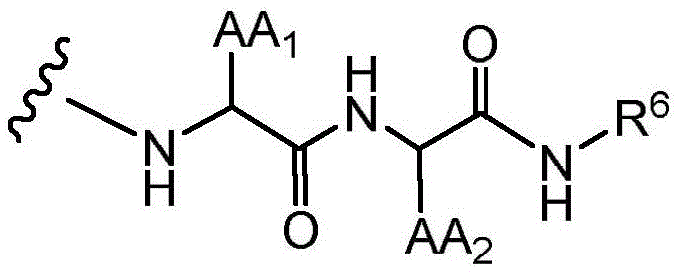
wherein AA1And AA2Independently selected from amino acid side chains, or AA1Or AA2Form a 5-membered cyclic proline amino acid with the adjacent nitrogen atom, and the wavy line indicates the point of attachment; and is
R6Is selected from-CH2C substituted by O-C (═ O) -, and optionally substituted by6-C20Aryl diyl and C1-C20Heteroaryl diradicals:
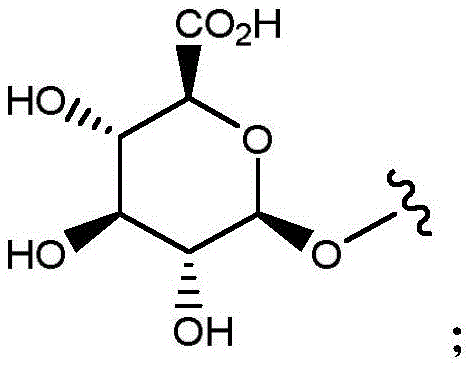
MCgluc is selected from the group consisting of:

wherein q is 1 to 8 and AA is an amino acid side chain;
wherein alkyl, alkyldiyl, alkenyl, alkenyldiyl, alkynyl, alkynediyl, aryl, aryldiyl carbocyclyl, carbocyclyldiyl, heterocyclyl, heterocyclyldiyl, heteroaryl, and heteroaryldiyl are optionally substituted with one or more groups independently selected from: F. cl, Br, I, -CN, -CH3、-CH2CH3、-CH=CH2、-C≡CH、-C≡CCH3、-CH2CH2CH3、-CH(CH3)2、-CH2CH(CH3)2、-CH2OH、-CH2OCH3、-CH2CH2OH、-C(CH3)2OH、-CH(OH)CH(CH3)2、-C(CH3)2CH2OH、-CH2CH2SO2CH3、-CH2OP(O)(OH)2、-CH2F、-CHF2、-CF3、-CH2CF3、-CH2CHF2、-CH(CH3)CN、-C(CH3)2CN、-CH2CN、-CH2NH2、-CH2NHSO2CH3、-CH2NHCH3、-CH2N(CH3)2、-CO2H、-COCH3、-CO2CH3、-CO2C(CH3)3、-COCH(OH)CH3、-CONH2、-CONHCH3、-CON(CH3)2、-C(CH3)2CONH2、-NH2、-NHCH3、-N(CH3)2、-NHCOCH3、-N(CH3)COCH3、-NHS(O)2CH3、-N(CH3)C(CH3)2CONH2、-N(CH3)CH2CH2S(O)2CH3、-NO2、=O、-OH、-OCH3、-OCH2CH3、-OCH2CH2OCH3、-OCH2CH2OH、-OCH2CH2N(CH3)2、-O(CH2CH2O)n-(CH2)mCO2H、-O(CH2CH2O)nH、-OP(O)(OH)2、-S(O)2N(CH3)2、-SCH3、-S(O)2CH3and-S (O)3H。
Exemplary embodiments of the immunoconjugate of formula I include wherein y is 0.
Exemplary embodiments of the immunoconjugate of formula I include wherein y is 1.
Exemplary embodiments of the immunoconjugate of formula I include those wherein the antibody is an antibody construct having an antigen binding domain that binds PD-L1.
Exemplary embodiments of the immunoconjugate of formula I include wherein the antibody is selected from the group consisting of: alemtuzumab, dulvaliuzumab and avizumab, or a biosimilar (biosimilar) or modified biosimilar (biobeter) thereof.
Exemplary embodiments of the immunoconjugate of formula I include those wherein the antibody is an antibody construct having an antigen binding domain that binds HER 2.
Exemplary embodiments of the immunoconjugate of formula I include wherein the antibody is selected from the group consisting of: trastuzumab and pertuzumab, or their biosimilars or modified biosimilarity drugs.
Exemplary embodiments of the immunoconjugate of formula I include those wherein the antibody is an antibody construct having an antigen binding domain that binds CEA.
Exemplary embodiments of the immunoconjugate of formula I include wherein the antibody is labetazumab or a biosimilar or modified biosimilar thereof.
Exemplary embodiments of the immunoconjugate of formula I include those wherein PEP has the formula:
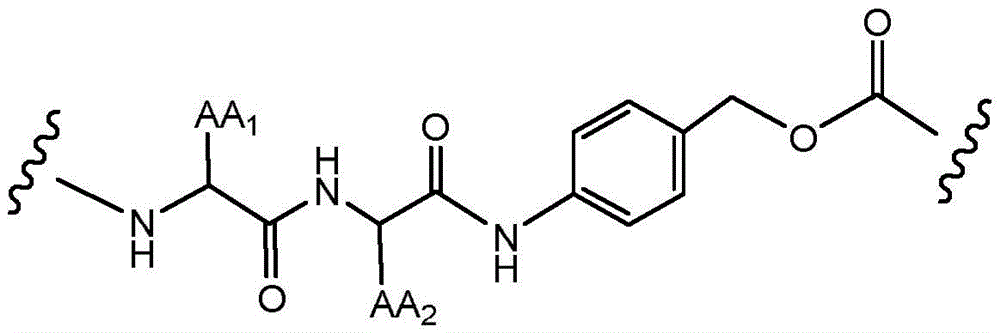
wherein AA1And AA2Independently selected from the side chains of naturally occurring amino acids.
Exemplary embodiments of the immunoconjugate of formula I include those wherein AA1Or AA2Form a 5-membered cyclic proline amino acid with the adjacent nitrogen atom.
Exemplary embodiments of the immunoconjugate of formula I include those wherein PEP has the formula:

exemplary embodiments of the immunoconjugate of formula I include those wherein MCgluc has the formula:
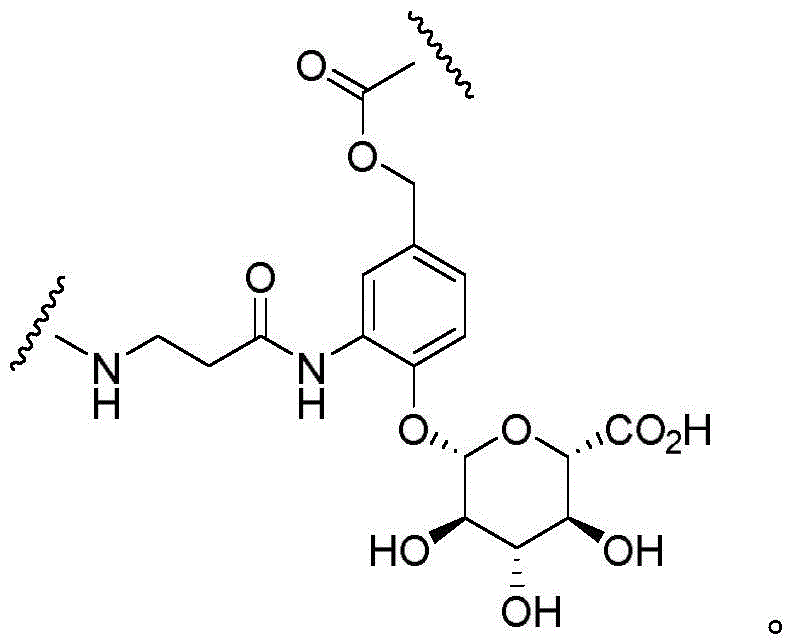
exemplary embodiments of the immunoconjugates of formula I include those wherein AA1And AA2Independently selected from H, -CH3、-CH(CH3)2、-CH2(C6H5)、-CH2CH2CH2CH2NH2、-CH2CH2CH2NHC(NH)NH2、-CHCH(CH3)CH3、-CH2SO3H. and-CH2CH2CH2NHC(O)NH2。
Exemplary embodiments of the immunoconjugates of formula I include those wherein AA1is-CH (CH)3)2And AA2is-CH2CH2CH2NHC(O)NH2。
Exemplary embodiments of the immunoconjugates of formula I include those wherein AA1And AA2Independently selected from GlcNAc aspartic acid, -CH2SO3H. and-CH2OPO3H。
Formula IExemplary embodiments of the immunoconjugates of include wherein X1Is a bond, and R1Is H.
Exemplary embodiments of the immunoconjugates of formula I include wherein X2Is a bond, and R2Is C1-C8An alkyl group.
Exemplary embodiments of the immunoconjugates of formula I include wherein X2And X3Are all a bond, and R2And R3Independently selected from C1-C8Alkyl, -O- (C)1-C12Alkyl), - (C)1-C12Alkyldiyl) -OR5、-(C1-C8Alkyl diyl) -N (R)5)CO2R5and-O- (C)1-C12Alkyl) -N (R)5)CO2R5。
Exemplary embodiments of the immunoconjugates of formula I include those wherein R2And R3Each independently selected from-CH2CH2CH3、-OCH2CH3、-CH2CH2CF3and-CH2CH2CH2OH。
Exemplary embodiments of the immunoconjugates of formula I include those wherein R2Is C1-C8Alkyl and R3Is- (C)1-C8Alkyl diyl) -N (R)5)CO2R4。
Exemplary embodiments of the immunoconjugates of formula I include those wherein R2is-CH2CH2CH3And R is3is-CH2CH2CH2NHCO2(t-Bu)。
Exemplary embodiments of the immunoconjugate of formula I include those wherein R2And R3Are all-CH2CH2CH3。
Exemplary embodiments of the immunoconjugate of formula I include those wherein X3-R3Selected from the group consisting of:
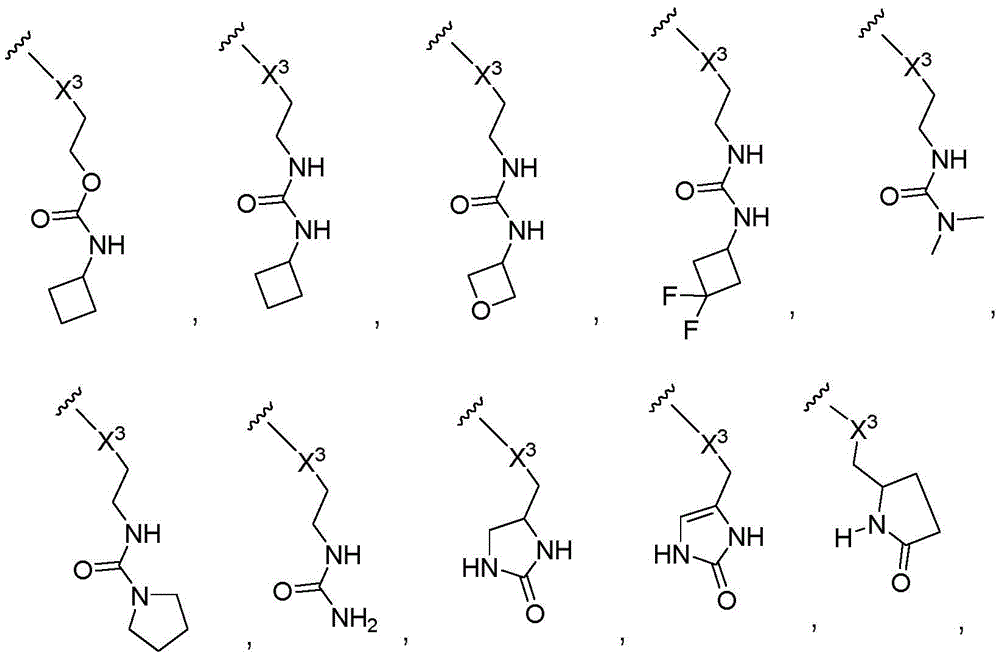
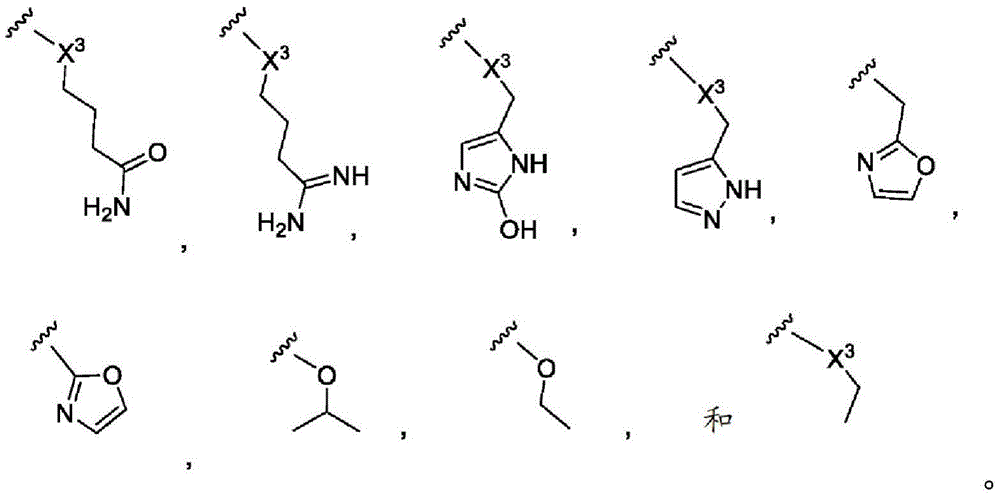
exemplary embodiments of the immunoconjugates of formula I include those wherein R1Or R3NR of5(C2-C5Heteroaryl) is selected from:

exemplary embodiments of the immunoconjugate of formula I include those wherein Het is a 5-or 6-membered monocyclic heteroaryl diradical selected from the group consisting of: pyridyl diyl, imidazolyl diyl, pyrimidyl diyl, pyrazolyl diyl, triazolyl diyl, pyrazinyl diyl, tetrazolyl diyl, furyl diyl, thienyl diyl, isoxazolyl diyl, thiazolyl diyl, oxadiazolyl diyl, oxazolyl diyl, isothiazolyl diyl, and pyrrolyl diyl.
Exemplary embodiments of the immunoconjugate of formula I include those wherein Het is a 5-or 6-membered monocyclic heterocyclyldiyl selected from the group consisting of: morpholinyldiyl, piperidinediyl, piperazinediyl, pyrrolidinyldiyl, dioxanyl diyl, thiomorpholinodiyl and S-dioxothiomorpholinodiyl.
Exemplary embodiments of the immunoconjugate of formula I include those wherein Het is 1, 6-naphthyridinyl or 1, 6-naphthyridinediyl.
Exemplary embodiments of the immunoconjugate of formula I include those wherein L is selected from the group consisting of:
-C(=O)-CH2CH2OCH2CH2-(C1-C20heteroaryl diyl) -CH2O-(PEG)-C(=O)-(MCgluc)-NR5(C1-C12Alkyldiyl) NR5C(=O)-(C2-C5Heterocyclyldiyl) -;
-C(=O)-(PEG)-C(=O)-NR5(C1-C12alkyl diyl) -;
-C(=O)-(PEG)-C(=O)-NR5(C1-C12alkyldiyl) NR5C(=O)-(C2-C5Heterocyclyldiyl) -;
-C(=O)-(PEG)-C(=O)-(PEP)-NR5(C1-C12alkyl diyl) -;
-C(=O)-(PEG)-C(=O)-(PEP)-NR5(C1-C12alkyldiyl) NR5C(=O)-(C2-C5Heterocyclyldiyl) -; and
- (succinimidyl) - (CH)2)m-C(=O)-(PEP)-NR5(C1-C12Alkyldiyl) NR5C(=O)-(C2-C5Heterocyclyldiyl) -.
Exemplary embodiments of the immunoconjugate of formula I are selected from formulae Ia to Id:

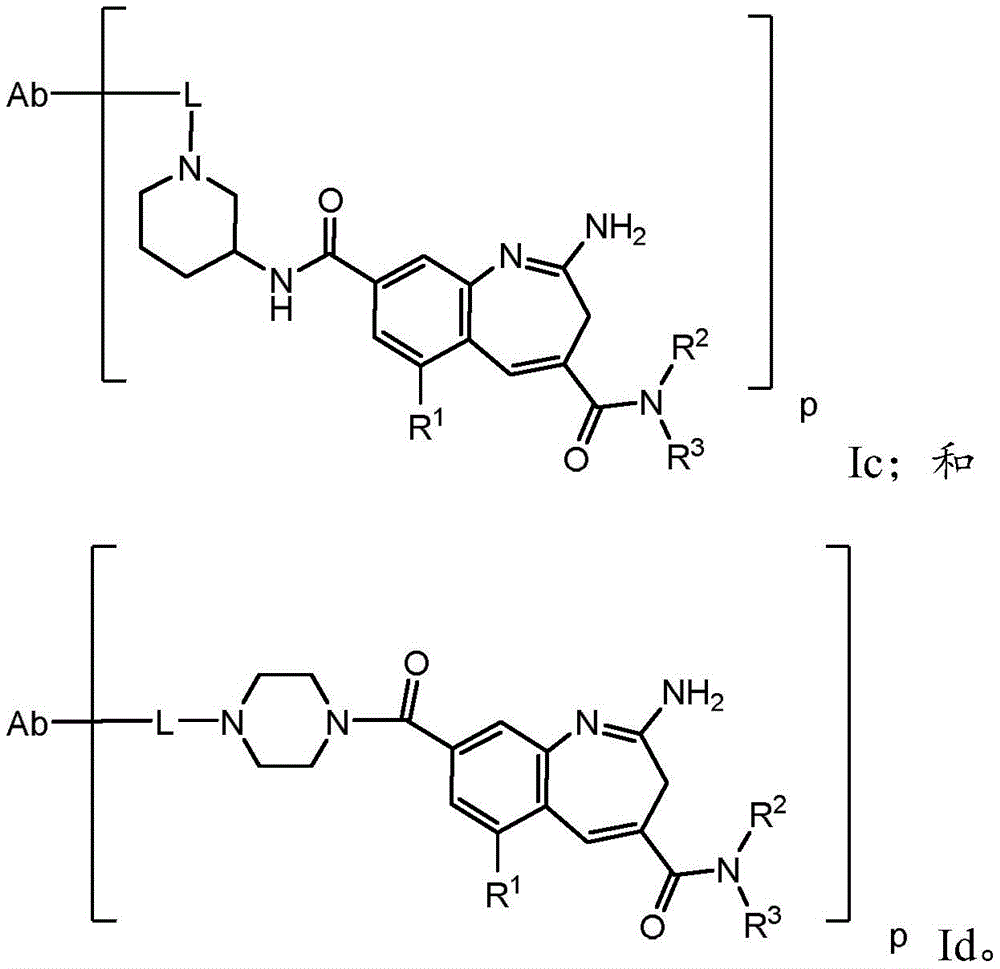
the present invention includes all reasonable combinations and permutations of features of the embodiments of formula I.
In certain embodiments, the immunoconjugate compounds of the invention include those with immunostimulatory activity. The antibody-drug conjugates of the present invention selectively deliver an effective dose of 8-amido-2-aminobenzazepine Drug delivery to tumor tissue, thereby contrasting unconjugated 8-amido-2-aminobenzazepine
 Greater selectivity (i.e., lower efficiency) can be achievedDose) while increasing the therapeutic index ("therapeutic window").
Drug loading is represented by p, the number of 8AmBza moieties per antibody in the immunoconjugate of formula I. The drug-loaded (8AmBza) amount may range from 1 to about 8 drug moieties (D) per antibody. The immunoconjugates of formula I comprise a mixture or collection of antibodies conjugated to a range of from 1 to about 8 drug moieties. In some embodiments, the number of drug moieties that can be conjugated to an antibody is limited by the number of reactive or available amino acid side chain residues, such as lysine and cysteine. In some embodiments, the free cysteine residue is introduced into the antibody amino acid sequence by the methods described herein. In such aspects, p can be 1,2,3,4, 5,6, 7, or 8, and ranges thereof, such as 1 to 8 or 2 to 5. In any such aspect, p and n are equal (i.e., p ═ n ═ 1,2,3,4, 5,6, 7, or 8, or some range therebetween). Exemplary antibody-drug conjugates of formula I include, but are not limited to, antibodies having 1,2,3, or 4 engineered cysteine amino acids (Lyon, R. et al (2012) Methods in enzyme.502: 123-138). In some embodiments, one or more free cysteine residues are already present in the antibody without the use of engineering, thereby forming an intrachain disulfide bond, in which case the existing free cysteine residues may be used to conjugate the antibody to a drug. In some embodiments, the antibody is exposed to reducing conditions to generate one or more free cysteine residues prior to antibody conjugation.
For some immunoconjugates, p may be limited by the number of attachment sites on the antibody. For example, where attached as a cysteine thiol as in certain exemplary embodiments described herein, an antibody may have only one or a limited number of cysteine thiol groups, or may have only one or a limited number of sufficiently reactive thiol groups to which a drug may be attached. In other embodiments, one or more lysine amino groups in the antibody are available for conjugation to the 8 AmBza-linker compound of formula II and have reactivity for conjugation to the 8 AmBza-linker compound of formula II. In certain embodiments, higher drug loading (e.g., p >5) can result in aggregation, insolubility, toxicity, or loss of cell permeability of certain antibody-drug conjugates. In certain embodiments, the mean drug loading of the immunoconjugate ranges from 1 to about 8; from about 2 to about 6; or from about 3 to about 5. In certain embodiments, the antibody is subjected to denaturing conditions to display reactive nucleophilic groups, such as lysine or cysteine.
The loading (drug/antibody ratio) of the immunoconjugate can be controlled in different ways, for example by: (i) limiting the molar excess of 8 AmBza-linker intermediate compound relative to the antibody, (ii) limiting the conjugation reaction time or temperature, and (iii) partial or limiting reductive denaturation conditions for optimized antibody reactivity.
It will be appreciated that where more than one nucleophilic group of an antibody reacts with a drug, then the resulting product is a mixture of antibody-drug conjugate compounds having a distribution of one or more drug moieties attached to the antibody. The average number of drugs per antibody can be calculated from the mixture by a dual ELISA antibody assay specific for the antibody and specific for the drug. Individual immunoconjugate molecules in the mixture may be identified by mass spectrometry and separated by HPLC, such as hydrophobic interaction chromatography (see, e.g., McDonagh et al (2006) protocol.Engr.design & Selection 19(7): 299;. Hamblett et al (2004) clinic.cancer Res.10: 7063-. In certain embodiments, homogeneous immunoconjugates having a single loading value can be separated from the conjugation mixture by electrophoresis or chromatography.
Exemplary embodiments of the immunoconjugate of formula I are selected from table 3a and table 3b immunoconjugates.
TABLE 3a Immunoconjugates (IC)
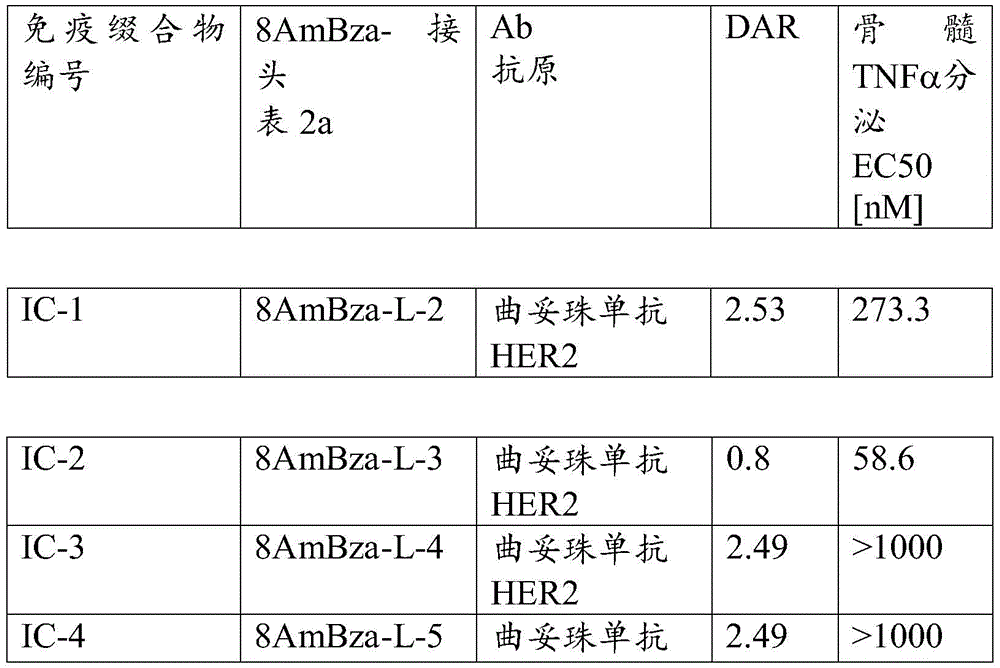
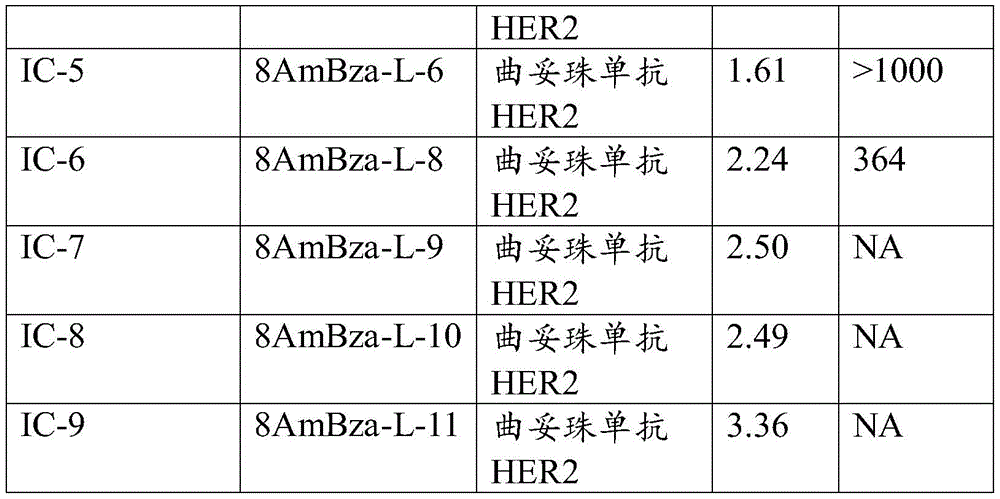
TABLE 3b Immunoconjugates (IC)
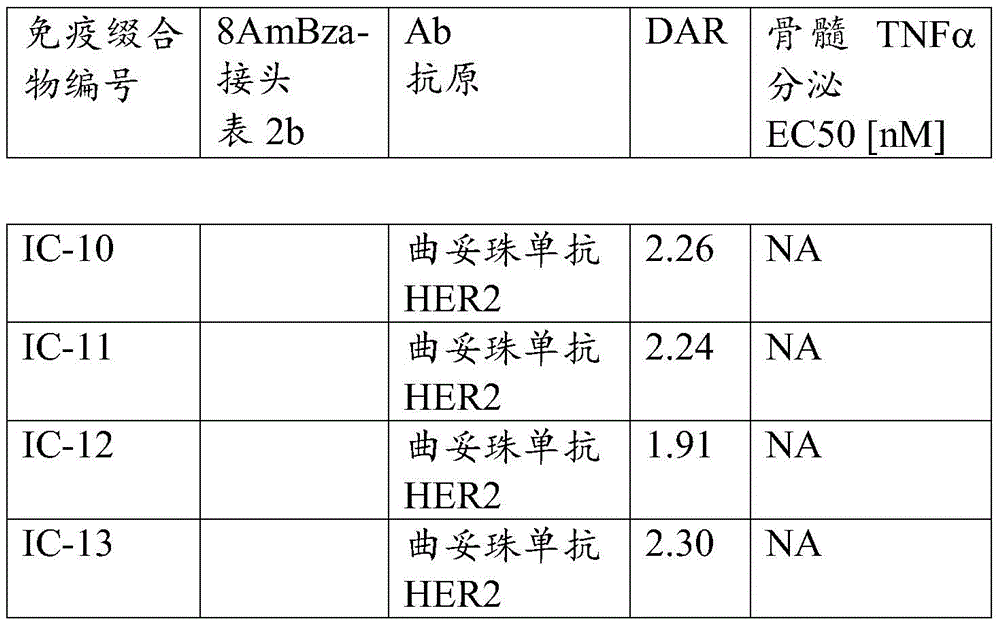
Compositions of immunoconjugates
The invention provides a composition, e.g. a pharmaceutically or pharmacologically acceptable composition or formulation, comprising a plurality of immunoconjugates as described herein and optionally a carrier therefor, e.g. a pharmaceutically or pharmacologically acceptable carrier. The immunoconjugates in the compositions can be the same or different, i.e., the compositions can comprise immunoconjugates having the same number of adjuvants attached to the same location on the antibody construct, and/or immunoconjugates having the same number of 8AmBza adjuvants attached to different locations on the antibody construct, having different numbers of adjuvants attached to the same location on the antibody construct, or having different numbers of adjuvants attached to different locations on the antibody construct.
In an exemplary embodiment, the composition comprising an immunoconjugate compound comprises a mixture of immunoconjugate compounds, wherein the average drug-loaded (8AmBza) amount per antibody in the mixture of immunoconjugate compounds is about 2 to about 5.
The compositions of the immunoconjugates of the invention can have an average adjuvant to antibody construct ratio of about 0.4 to about 10. The skilled artisan will recognize that in compositions comprising a plurality of immunoconjugates of the invention, the amount of 8AmBza adjuvant conjugated to an antibody construct may vary from immunoconjugate to immunoconjugate, and thus, the ratio of adjuvant to antibody construct (e.g., antibody) may be measured as an average, which may be referred to as a drug-to-antibody ratio (DAR). The ratio of adjuvant to antibody construct (e.g., antibody) can be assessed by any suitable means, many of which are known in the art.
The average number of adjuvant moieties (DAR) per antibody in the preparation of immunoconjugates by conjugation reactions can be characterized by conventional means, such as mass spectrometry, ELISA assays and HPLC. The number distribution of immunoconjugates in the composition can also be determined from p. In some cases, separation, purification, and characterization of homogeneous immunoconjugates (where p is a certain value from immunoconjugates with other drug loadings) can be achieved by means such as reverse phase HPLC or electrophoresis.
In some embodiments, the composition further comprises one or more pharmaceutically or pharmacologically acceptable excipients. For example, the immunoconjugates of the invention can be formulated for parenteral administration, such as IV administration or administration into a body cavity or organ lumen. Alternatively, the immunoconjugate may be injected into the tumor. Compositions for injection will generally comprise a solution of the immunoconjugate dissolved in a pharmaceutically acceptable carrier. Among the acceptable vehicles and solvents that may be employed are isotonic solutions (e.g., Ringer's solution) of water and one or more salts, such as sodium chloride. In addition, sterile fixed oils are conventionally employed as a solvent or suspending medium. For this purpose, any bland fixed oil may be employed including synthetic mono-or diglycerides. In addition, fatty acids (such as oleic acid) are likewise useful in the preparation of injectables. These compositions are desirably sterile and generally free of undesirable materials. These compositions may be sterilized by conventional, well known sterilization techniques. The compositions may contain pharmaceutically acceptable auxiliary substances as required to approximate physiological conditions, such as pH adjusting and buffering agents, toxicity adjusting agents, for example, sodium acetate, sodium chloride, potassium chloride, calcium chloride, sodium lactate, and the like.
The composition can comprise any suitable concentration of the immunoconjugate. The concentration of the immunoconjugate in the composition can vary widely and will be selected primarily based on fluid volume, viscosity, body weight, and the like, according to the particular mode of administration selected and the needs of the patient. In certain embodiments, the concentration of the immunoconjugate in the solution formulation for injection ranges from about 0.1% (w/w) to about 10% (w/w).
Methods of treating cancer with immunoconjugates
The present invention provides a method for treating cancer. The method comprises administering a therapeutically effective amount of an immunoconjugate as described herein (e.g., a composition as described herein) to a subject in need thereof, e.g., a subject having cancer and in need of treatment for the cancer. The method comprises administering a therapeutically effective amount of an Immunoconjugate (IC) selected from table 3.
It is contemplated that the immunoconjugates of the invention can be used to treat a variety of hyperproliferative diseases or disorders, such as those characterized by overexpression of a tumor antigen. Exemplary hyperproliferative disorders include benign or malignant solid tumors and hematologic disorders such as leukemias and lymphoid malignancies.
In another aspect, immunoconjugates for use as medicaments are provided. In certain embodiments, the present invention provides an immunoconjugate for use in a method of treating an individual, the method comprising administering to the individual an effective amount of the immunoconjugate. In one such embodiment, the method further comprises administering to the individual an effective amount of at least one additional therapeutic agent, e.g., as described below.
In another aspect, the invention provides the use of an immunoconjugate in the manufacture or preparation of a medicament. In one embodiment, the agent is for use in treating cancer, the method comprising administering to an individual having cancer an effective amount of the agent. In one such embodiment, the method further comprises administering to the individual an effective amount of at least one additional therapeutic agent, e.g., as described below.
Cancer is a malignant tumor that originates in epithelial tissue. Epithelial cells cover the outer surface of the body, line the lumen, and line the glandular tissue. Examples of cancer include, but are not limited to, adenocarcinoma (a cancer that begins with glandular (secretory) cells, such as breast, pancreatic, lung, prostate, stomach, gastroesophageal junction, and colon cancers) adrenocortical carcinoma; hepatocellular carcinoma; renal cell carcinoma; ovarian cancer; carcinoma in situ; ductal carcinoma; breast cancer; basal cell carcinoma; squamous cell carcinoma; transitional cell carcinoma; colon cancer; nasopharyngeal carcinoma; multiple chamber cystic kidney cell carcinoma; oat cell carcinoma; large cell lung cancer; small cell lung cancer; non-small cell lung cancer; and so on. Carcinomas can be found in the prostate, pancreas, colon, brain (usually as a secondary metastasis), lung, breast and skin. In some embodiments, the method for treating non-small cell lung cancer comprises administering an immunoconjugate comprising an antibody construct (e.g., atelizumab, bevacizumab, avizumab, a biosimilar or modified biosimilarity drug thereof) capable of binding to PD-L1. In some embodiments, the method for treating breast cancer comprises administering an immunoconjugate comprising an antibody construct (e.g., atelizumab, bevacizumab, avizumab, a biosimilar or modified biosimilarity drug thereof) capable of binding PD-L1. In some embodiments, the method for treating triple negative breast cancer comprises administering an immunoconjugate comprising an antibody construct (e.g., atelizumab, bevacizumab, avizumab, a biosimilar or modified biosimilarity drug thereof) capable of binding to PD-L1.
Soft tissue tumors are a group of highly diverse rare tumors derived from connective tissue. Examples of soft tissue tumors include, but are not limited to, alveolar soft tissue sarcoma; hemangioma-like fibrohistiocytoma; mucomyxoid fibroma of cartilage; skeletal chondrosarcoma; extraosseous mucus-like chondrosarcoma; clear cell sarcoma; desmoplastic small round cell tumors; dermatofibrosarcoma protruberans; endometrial stromal tumors; ewing's sarcoma; fibromatosis (desmoid); infantile fibrosarcoma; gastrointestinal stromal tumors; giant cell tumor of bone; giant cell tumor of tendon sheath; inflammatory myofibroblastic tumors; uterine leiomyoma; leiomyosarcoma; lipoblastoma; typical lipomas; spindle cell or lipoma polymorpha; atypical lipomas; chondroid lipoma; a highly differentiated liposarcoma; myxoid/round cell liposarcoma; liposarcoma polymorpha; mucoid malignant fibrous histiocytoma; a highly malignant fibrous histiocytoma; myxofibrosarcoma; malignant peripheral nerve sheath tumor; mesothelioma; neuroblastoma; osteochondroma; osteosarcoma; primitive neuroectodermal tumors; alveolar rhabdomyosarcoma; embryonal rhabdomyosarcoma; benign or malignant schwannoma; synovial sarcoma; erwinia (Evan's tumor); fasciitis nodosa; ligament-like fibromatosis; isolated fibroids; dermatofibrosarcoma protruberans (DFSP); angiosarcoma; epithelioid vascular endothelioma; giant cell tumor of tendon sheath (TGCT); pigmented villonodular synovitis (PVNS); fiber dysplasia; myxofibrosarcoma; fibrosarcoma; synovial sarcoma; malignant peripheral nerve sheath tumor; neurofibroma; soft tissue polymorphic adenomas; and neoplasias derived from fibroblasts, myofibroblasts, histiocytes, vascular/endothelial cells, and schwann cells.
Sarcoma is a rare type of cancer that originates in cells of mesenchymal origin, such as skeletal or soft tissues of the body, including cartilage, fat, muscle, blood vessels, fibrous tissue, or other connective or supportive tissue. The different types of sarcomas are based on the location of the cancer formation. For example, osteosarcomas form in bone, liposarcomas form in fat, and rhabdomyosarcomas form in muscle. Examples of sarcomas include, but are not limited to, astroma; botryoid sarcoma; chondrosarcoma; ewing's sarcoma; malignant vascular endothelioma; malignant schwannoma; osteosarcoma; and soft tissue sarcomas (e.g., alveolar soft tissue sarcoma; angiosarcoma; cystic sarcoma-protuberant-Dermatofibrosarcoma (DFSP); desmoid tumor; desmoplastic small round cell tumor; epithelioid sarcoma; extraskeletal chondrosarcoma; extraskeletal osteosarcoma; fibrosarcoma; gastrointestinal stromal tumor (GIST); vascular epithelioma; angiosarcoma (more commonly referred to as "angiosarcoma"); Kaposi's sarcoma; leiomyosarcoma; liposarcoma; lymphangiosarcoma; Malignant Peripheral Nerve Sheath Tumor (MPNST); neurofibrosarcoma; synovial sarcoma; and undifferentiated polymorphic sarcoma).
A teratoma is a germ cell tumor that may contain several different types of tissue (e.g., may include tissue derived from any and/or all three germ layers: endoderm, mesoderm, and ectoderm), including, for example, hair, muscle, and bone. Teratomas most commonly occur in the ovaries of women, the testes of men, and the coccyx of children.
Melanoma is a form of cancer that begins with melanocytes (cells that produce melanin). Melanoma may originate in nevi (cutaneous melanoma), but may also originate in other pigmented tissues, such as in the eye or intestinal tract.
Merkel cell carcinoma is a rare skin cancer that often manifests as flesh-colored or bluish-red nodules in the face, head, or neck. Merkel cell carcinoma is also known as neuroendocrine carcinoma of the skin. In some embodiments, the method for treating merkel cell carcinoma comprises administering an immunoconjugate comprising an antibody construct capable of binding to PD-L1 (e.g., atelizumab, bevacizumab, avizumab, biosimilar or modified biosimilarity drugs thereof). In some embodiments, the merkel cell carcinoma has metastasized when the administration occurs.
Leukemia is a cancer that begins with hematopoietic tissues, such as bone marrow, and results in the production and entry of large numbers of abnormal blood cells into the bloodstream. For example, leukemia may originate from myeloid-derived cells that normally mature in the bloodstream. Leukemias are named for how rapidly (e.g., acute and chronic) the disease progresses and progresses, and the types of white blood cells affected (e.g., bone marrow and lymph). Myeloid leukemia is also known as myelogenous or myeloblastic leukemia. Lymphocytic leukemia is also known as lymphoblastic or lymphocytic leukemia. Lymphoid leukemia cells may accumulate in lymph nodes, which may become swollen. Examples of leukemias include, but are not limited to, Acute Myelogenous Leukemia (AML), Acute Lymphoblastic Leukemia (ALL), Chronic Myelogenous Leukemia (CML), and Chronic Lymphocytic Leukemia (CLL).
Lymphoma is a cancer that begins with cells of the immune system. For example, lymphoma may originate from myeloid-derived cells that normally mature in the lymphatic system. There are two basic classes of lymphoma. One type of lymphoma is Hodgkin's Lymphoma (HL), which is characterized by the presence of a cell called Reed-Sternberg cell. There are currently 6 recognized HL types. Examples of hodgkin lymphoma include nodular sclerosing Classical Hodgkin Lymphoma (CHL), mixed cell CHL, lymphocyte-depleted CHL, lymphocyte-rich CHL, and nodular lymphocyte-predominant HL.
Another type of lymphoma is non-hodgkin's lymphoma (NHL), which comprises a large class of cancers of different immune system cells. Non-hodgkin's lymphomas can be further divided into cancers with an indolent (slow-growing) course and cancers with an aggressive (fast-growing) course. There are currently 61 recognized NHL types. Examples of non-hodgkin's lymphomas include, but are not limited to, AIDS-associated lymphoma, anaplastic large cell lymphoma, angioimmunoblastic lymphoma, blastic NK cell lymphoma, burkitt's lymphoma, burkitt-like lymphoma (small non-dividing cell lymphoma), chronic lymphocytic leukemia/small lymphocytic lymphoma, cutaneous T cell lymphoma, diffuse large B cell lymphoma, enteropathy-type T cell lymphoma, follicular lymphoma, hepatosplenic gamma-delta T cell lymphoma, T cell leukemia, lymphoblastic lymphoma, mantle cell lymphoma, marginal zone lymphoma, nasal T cell lymphoma, pediatric lymphoma, peripheral T cell lymphoma, primary central nervous system lymphoma, transformed lymphoma, treatment-associated T cell lymphoma, and waldenstrom's macroglobulinemia.
Brain cancer includes any cancer of the brain tissue. Examples of brain cancers include, but are not limited to, gliomas (e.g., glioblastoma, astrocytoma, oligodendroglioma, ependymoma, etc.), meningiomas, pituitary adenomas and vestibular schwannoma, primitive neuroectodermal tumors (medulloblastomas).
The immunoconjugates of the invention can be used alone or in combination with other agents in therapy. For example, the immunoconjugate may be co-administered with at least one additional therapeutic agent (such as a chemotherapeutic agent). Such combination therapies encompass combined administration (where two or more therapeutic agents are included in the same or separate formulations) and separate administration, in which case administration of the immunoconjugate may occur prior to, concurrently with, and/or subsequent to administration of the additional therapeutic agent and/or adjuvant. The immunoconjugates of the invention can also be used in combination with radiation therapy.
The immunoconjugate (and any additional therapeutic agent) of the invention may be administered by any suitable means, including parenterally, intrapulmonary and intranasally, and intralesionally if local treatment is desired. Parenteral infusion includes intramuscular, intravenous, intraarterial, intraperitoneal or subcutaneous administration. Administration may be by any suitable route, for example by injection (such as intravenous or subcutaneous injection), depending in part on whether administration is transient or chronic. Various dosing regimens are contemplated herein including, but not limited to, single or multiple administrations at various time points, bolus administrations, and pulsed infusions.
It is known that alemtuzumab, duvalulizumab, avizumab, their biosimilars and their improved biosimilars are useful for the treatment of cancer, particularly breast cancer, especially triple negative (estrogen receptor, progesterone receptor and excess HER2 protein test negative) breast cancer, bladder cancer and merkel cell carcinoma. The immunoconjugates described herein are useful for treating the same types of cancers, especially breast cancer, especially triple negative (estrogen receptor, progestin receptor, and excess HER2 protein test negative) breast cancer, bladder cancer, and merkel cell cancer, as are astuzumab, covuzumab, avizumab, their biosimilar drugs, and their improved biosimilarity drugs.
The immunoconjugate is administered to a subject in need thereof in any therapeutically effective amount using any suitable dosing regimen, such as dosing regimens for atelizumab, dulacruzumab, avizumab, their biosimilar agents, and their improved biosimilarity drugs. For example, the method can comprise administering the immunoconjugate to provide a dose of about 100ng/kg to about 50mg/kg to the subject. The dose range of the immunoconjugate may be from about 5mg/kg to about 50mg/kg, from about 10 μ g/kg to about 5mg/kg, or from about 100 μ g/kg to about 1 mg/kg. The immunoconjugate dose may be about 100 μ g/kg, 200 μ g/kg, 300 μ g/kg, 400 μ g/kg, or 500 μ g/kg. The immunoconjugate dose may be about 1mg/kg, 2mg/kg, 3mg/kg, 4mg/kg, 5mg/kg, 6mg/kg, 7mg/kg, 8mg/kg, 9mg/kg, or 10 mg/kg. The immunoconjugate dose may also be outside of these ranges, depending on the particular conjugate and the type and severity of the cancer being treated. The frequency of administration may range from once a week to multiple doses, or more frequently. In some embodiments, the immunoconjugate is administered from about once a month to about five times a week. In some embodiments, the immunoconjugate is administered once per week.
In another aspect, the invention provides a method for preventing cancer. The methods comprise administering to the subject a therapeutically effective amount of an immunoconjugate (e.g., in the form of a composition as described above). In certain embodiments, the subject is predisposed to a cancer to be prevented. For example, the method can comprise administering the immunoconjugate to provide a dose of about 100ng/kg to about 50mg/kg to the subject. The dose range of the immunoconjugate may be from about 5mg/kg to about 50mg/kg, from about 10 μ g/kg to about 5mg/kg, or from about 100 μ g/kg to about 1 mg/kg. The immunoconjugate dose may be about 100 μ g/kg, 200 μ g/kg, 300 μ g/kg, 400 μ g/kg, or 500 μ g/kg. The immunoconjugate dose may be about 1mg/kg, 2mg/kg, 3mg/kg, 4mg/kg, 5mg/kg, 6mg/kg, 7mg/kg, 8mg/kg, 9mg/kg, or 10 mg/kg. The immunoconjugate dose may also be outside of these ranges, depending on the particular conjugate and the type and severity of the cancer being treated. The frequency of administration may range from once a week to multiple doses, or more frequently. In some embodiments, the immunoconjugate is administered from about once a month to about five times a week. In some embodiments, the immunoconjugate is administered once per week.
Some embodiments of the present invention provide methods for treating cancer as described above, wherein the cancer is breast cancer. Breast cancer can originate in different regions of the breast, and a number of different types of breast cancer have been characterized. For example, the immunoconjugates of the invention can be used to treat catheter carcinoma in situ; invasive ductal carcinoma (e.g., tubular carcinoma; medullary carcinoma; mucinous carcinoma; papillary carcinoma; or screeny carcinoma of the breast); lobular carcinoma in situ; invasive lobular carcinoma; inflammatory breast cancer; and other forms of breast cancer, such as triple negative (estrogen receptor, progesterone receptor, and excess HER2 protein test negative) breast cancer. In some embodiments, the methods for treating breast cancer comprise administering an immunoconjugate comprising an antibody construct capable of binding HER2 (e.g., trastuzumab, pertuzumab, a biosimilar or modified biosimilar drug thereof) and PD-L1 (e.g., atezumab, bevacizumab, avizumab, a biosimilar or modified biosimilar drug thereof). In some embodiments, the methods for treating colon cancer lung, kidney, pancreas, stomach, and esophagus cancers comprise administering an immunoconjugate comprising an antibody construct (e.g., labezumab, a biosimilar or modified biosimilar drug thereof) capable of binding CEA or a tumor that overexpresses CEA.
In some embodiments, the cancer is susceptible to a pro-inflammatory response induced by TLR7 and/or TLR 8.
Examples
8-amido-2-aminobenzazepines Preparation of compound (8AmBza) and intermediate thereof
Example 1((5- (2-amino-4- (dipropylcarbamoyl) -3H-benzo [ b ]]Aza derivatives Synthesis of (E) -8-carboxamido) pyridin-3-yl) methyl) carbamic acid tert-butyl ester, 8AmBza-1
8AmBza-1 was prepared and characterized according to the procedures described herein.
Example 2(3- (8- ((6- (4- ((2-acetamidoethyl) carbamoyl) piperidin-1-yl) pyridin-3-yl) carbamoyl) -2-amino-N-propyl-3H-benzo [ b)]Aza derivatives Synthesis of (E) -4-carboxamido) propyl) carbamic acid tert-butyl ester, 8AmBza-2
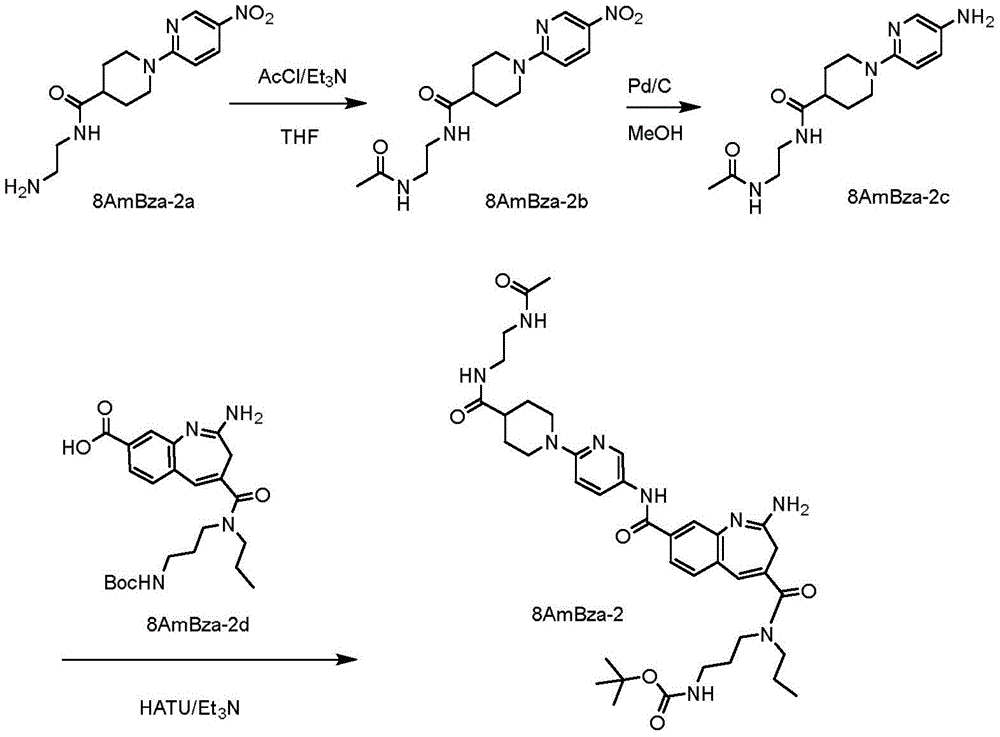
Preparation of N- (2-acetamidoethyl) -1- (5-nitropyridin-2-yl) piperidine-4-carboxamide, 8AmBza-2b
In N2To a mixture of acetyl chloride (142.82mg, 1.82mmol, 129.83. mu.L, 3 equiv.) and N- (2-aminoethyl) -1- (5-nitro-2-pyridinyl) piperidine-4-carboxamide, 8AmBza-2a (0.2g, 606.46. mu. mol, 1 equiv., HCl) in THF (10mL) was added Et at 25 deg.C3N (245.47mg, 2.43mmol, 337.65. mu.L, 4 equiv.). The mixture was stirred at 25 ℃ for 1 hour. LCMS showed reaction complete. The mixture was poured into water (20 mL). The mixture was filtered to give 8AmBza-2b as a yellow solid (0.2g, 596.38 μmol, 98.34% yield).1H NMR(DMSO-d6,400MHz)δ8.95(d,J=2.4Hz,1H),8.19(dd,J=9.6,2.4Hz,1H),7.78-7.98(m,2H),6.95(d,J=9.6Hz,1H),4.50(d,J=9.6Hz,2H),2.93-3.15(m,7H),1.73-1.80(m,5H),1.43-1.62(m,2H),1.07-1.28(m,3H)。
Preparation of N- (2-acetamidoethyl) -1- (5-aminopyridin-2-yl) piperidine-4-carboxamide, 8AmBza-2c
In N2To a solution of N- (2-acetamidoethyl) -1- (5-nitro-2-pyridinyl) piperidine-4-carboxamide, 8AmBza-2b (0.2, 596.38. mu. mol, 1 eq) in MeOH (20mL) was added Pd/C (0.2g, 5% pure). The suspension is degassed under vacuum and treated with H2Purging was performed several times. Mixing the mixture in H2(15psi) stirred at 25 ℃ for 4 hours. LCMS showed reaction complete. The mixture was filtered and concentrated to give 8AmBza-2c as a yellow solid (0.18g, 589.44 μmol, 98.84% yield).
(3- (8- ((6- (4- ((2-acetamidoethyl) carbamoyl) piperidin-1-yl) pyridin-3-yl) carbamoyl) -2-amino-N-propyl-3H-benzo [ b)]Aza derivatives -4-formylAmino) propyl) carbamic acid tert-butyl ester, preparation of 8AmBza-2
To 2-amino-4- [3- (tert-butoxycarbonylamino) propyl-carbamoyl at 25 deg.C]-3H-1-benzazepine -8-carboxylic acid, 8AmBza-2d (0.22g, 494.91. mu. mol, 1 eq.), 1- [ bis (dimethylamino) methylene]-1H-1,2, 3-triazolo [4,5-b ]]Pyridinium 3-oxide hexafluorophosphate, Hexafluorophosphate Azobenzotriazoletetrayluronium (HATU) CAS registry No. 148893-10-1(225.82mg, 593.90. mu. mol, 1.2 equiv.) to a mixture in DMF (5mL) was added Et3N (150.24mg, 1.48mmol, 206.66. mu.L, 3 equiv.). The mixture was stirred at 25 ℃ for 5min, then N- (2-acetamidoethyl) -1- (5-amino-2-pyridinyl) piperidine-4-carboxamide 8AmBza-2c (151.13mg, 494.91. mu. mol, 1 eq) was added to the mixture and stirred for 30 min. The mixture was poured into water (50 mL). The aqueous phase was extracted with ethyl acetate (50mL x 1). The combined organic phases were washed with brine (50mL x 1) and dried over anhydrous Na2SO4Dried, filtered and concentrated in vacuo. The residue was passed through a preparative HPLC column: welch Xtimate C18150 by 25mm by 5 um; mobile phase: [ Water (10mM NH4HCO3) -ACN](ii) a B%: 30% -50%, 10.5min to give 8AmBza-2 as an off-white solid (96mg, 131.17 μmol, 26.50% yield).1H NMR(MeOD,400MHz)δ8.39(d,J=2.6Hz,1H),7.90(dd,J=9.2,2.6Hz,1H),7.69(d,J=1.2Hz,1H),7.54-7.60(m,1H),7.46(br d,J=8.0Hz,1H),6.85-6.95(m,2H),4.30(d,J=13.6Hz,2H),3.39-3.53(m,4H),3.28(s,2H),3.08-3.12(m,2H),2.83-2.93(m,2H),2.37-2.47(m,1H),1.94(s,3H),1.60-1.90(m,8H),1.24-1.50(m,9H)LC/MS[M+H]732.42 (calculated); LC/MS [ M + H ]]732.40 (found).
Example 32-amino-N8- (6- (4- ((2-aminoethyl) carbamoyl) piperidin-1-yl) pyridin-3-yl) -N4, N4-dipropyl-3H-benzo [ b ]]Aza derivatives Synthesis of (E) -4, 8-dicarboxamide, 8AmBza-3
8AmBza-3 was prepared and characterized according to the procedures described herein.
Example 4((5- (2-amino-4- (dipropylcarbamoyl) -3H-benzo [ b ]]Aza derivatives Synthesis of 4- ((S) -2- ((S) -2-amino-3-methylbutanamido) -5-ureidopentanamido) benzyl (8-carboxamido) pyridin-3-yl) methyl) carbamate, 8AmBza-4
8AmBza-4 was prepared and characterized according to the procedures described herein.
Example 5(3- (2-amino-8- ((6- (4- ((2-aminoethyl) carbamoyl) piperidin-1-yl) pyridin-3-yl) carbamoyl) -N-propyl-3H-benzo [ b]Aza derivatives Synthesis of (E) -4-carboxamido) propyl) carbamic acid tert-butyl ester, 8AmBza-5

Preparation of N- (2-aminoethyl) -1- (5-nitropyridin-2-yl) piperidine-4-carboxamide, 8AmBza-5b
To a mixture of tert-butyl N- [2- [ [1- (5-nitro-2-pyridyl) piperidine-4-carbonyl ] amino ] ethyl ] carbamate, 8AmBza-5a (0.5g, 1.27mmol, 1 eq) in EtOAc (10mL) was added HCl/EtOAc (4M, 3.18mL, 10 eq) at 25 ℃. The mixture was stirred at 25 ℃ for 2 hours. LCMS showed reaction complete. The reaction was concentrated in vacuo to afford 8AmBza-5b (0.4g, 1.21mmol, 95.44% yield, HCl) as a yellow solid.
Preparation of 1- (5-nitropyridin-2-yl) -N- (2- (2,2, 2-trifluoroacetamido) ethyl) piperidine-4-carboxamide, 8AmBza-5c
To a mixture of N- (2-aminoethyl) -1- (5-nitro-2-pyridinyl) piperidine-4-carboxamide, 8AmBza-5b (0.4g, 1.21mmol, 1 eq, HCl) in THF (10mL) at 25 deg.C was added Et3N (368.21mg, 3.64mmol, 506.47. mu.L, 3 equiv.) and (2,2, 2-trifluoroacetyl) 2,2, 2-trifluoroacetate (382.13mg, 1.82mmol, 253.06. mu.L, 1.5 equiv.). The mixture is mixed in 2Stirred at 5 ℃ for 1 hour. LCMS showed the main peak (major) as expected. The mixture was poured into water (50 mL). The aqueous phase was extracted with ethyl acetate (30mL x 3). The combined organic phases were washed with brine (30mL _ 1) and dried over anhydrous Na2SO4Dried, filtered and concentrated in vacuo. The residue was used directly in the next step and contained 8AmBza-5c (0.4g, 1.03mmol, 84.71% yield) as a yellow solid.1H NMR(DMSO-d6,400MHz)δ9.37-9.45(m,1H),8.95(d,J=2.8Hz,1H),8.19(dd,J=9.6,2.8Hz,1H),8.03(br t,J=5.2Hz,1H),6.96(d,J=9.6Hz,1H),4.47-4.53(m,2H),2.99-3.25(m,6H),2.38-2.47(m,3H),1.73-1.80(m,2H),1.41-1.58(m,2H)
Preparation of 1- (5-aminopyridin-2-yl) -N- (2- (2,2, 2-trifluoroacetamido) ethyl) piperidine-4-carboxamide, 8AmBza-5d
In N2Downward 1- (5-nitro-2-pyridyl) -N- [2- [ (2,2, 2-trifluoroacetyl) amino group]Ethyl radical]To a solution of piperidine-4-carboxamide, 8AmBza-5C (0.4g, 1.03mmol, 1 eq) in MeOH (30mL) was added Pd/C (0.5g, 5% purity). The suspension is degassed under vacuum and treated with H2Purging was performed several times. Mixing the mixture in H2(50psi) at 25 ℃ for 2 hours. TLC showed the reaction was complete. The mixture was filtered and concentrated in vacuo to give 8AmBza-5d (0.3g, 834.85 μmol, 81.26% yield) as a grey solid.1H NMR(DMSO-d6,400MHz)δ9.39-9.46(m,1H),7.97(t,J=5.2Hz,1H),7.59(d,J=2.8Hz,1H),6.90(dd,J=8.8,2.8Hz,1H),6.64(d,J=8.8Hz,1H),3.99(d,J=12.8Hz,2H),3.15-3.26(m,6H),2.54-2.63(m,2H),2.16-2.26(m,1H),1.65-1.71(m,2H),1.48-1.60(m,2H)

(3- (2-amino-8-bromo-N-propyl-3H-benzo [ b ]]Aza derivatives Preparation of (E) -4-carboxamido) propyl) carbamic acid tert-butyl ester, 8AmBza-5g
To 2-amino-8-bromo-3H-1-benzazepine at 25 deg.C -4-carboxylic acid, 8AmBza-5f (4.09g, 14.56mmol, 1 eq.) and N- [3- (propylamino) propyl ] amine]To a mixture of tert-butyl carbamate (3.78g, 17.47mmol, 1.2 equiv.) in DMF (10mL) was added HATU (6.64g, 17.47mmol, 1.2 equiv.) and Et in one portion3N (2.95g, 29.12mmol, 4.05mL, 2 equiv.). The mixture was stirred at 25 ℃ for 1 h. LCMS showed reaction completion. The mixture was diluted with water and extracted with EtOAc (50mL × 3). The organic layer was washed with brine, over Na2SO4Dried, filtered and concentrated. The residue was purified by silica gel chromatography (column height: 250mm, diameter: 100mm, 100-mesh 200-mesh silica gel, petroleum ether/
ethyl acetate 1/0, 0/1) to give 8AmBza-5g (6g, 12.52mmol, 85.95% yield) as a yellow oil.
2-amino-4- [3- (tert-butoxycarbonylamino) propyl-carbamoyl]-3H-1-benzazepine Preparation of (E) -8-methyl formate, 8AmBza-5h
In N2Downward N- [3- [ (2-amino-8-bromo-3H-1-benzazepine) -4-carbonyl) -propyl-amino]Propyl radical]To a solution of tert-butyl carbamate, Bz-39g (5g, 10.43mmol, 1 eq) in MeOH (50mL) was added Et3N (3.17g, 31.29mmol, 4.35mL, 3 equiv.) and [1,1' -bis (diphenylphosphino) ferrocene]Palladium (II) dichloride, Pd (dppf) Cl2CAS registry number 72287-26-4(763.13mg, 1.04mmol, 0.1 equiv.). The suspension was degassed under vacuum and purged several times with CO (10.43mmol, 1 eq). The mixture was stirred under CO (50psi) at 80 ℃ for 12 hours. LCMS showed reaction completion. The mixture was filtered and concentrated to give 8AmBza-5h as a yellow oil (7g, crude).
2-amino-4- ((3- ((tert-butoxycarbonyl) amino) propyl) (propyl) carbamoyl) -3H-benzo [ b]Aza derivatives Preparation of (E) -8-carboxylic acid, 8AmBza-5e
To 2-amino-4- [3- (tert-butoxycarbonylamino) propyl-carbamoyl at 30 deg.C]-3H-1-benzazepine Methyl-8-carboxylate, Bz-39h (6g, 13.08mmol, 1 equiv.) to a mixture in MeOH (80mL) was added LiOH (1.25g, 52.34mmol, 4 equiv.) in one portion. The mixture was stirred at 30 ℃ for 12 h. LCMS showed reaction completion. The mixture was adjusted to pH 6 with aqueous HCl (1M) at 25 ℃. The mixture was concentrated. The mixture was passed through preparative HPLC (column: Phenomenex)
 C18250 × 50mm × 10 um; mobile phase: [ Water (0.1% TFA) -ACN](ii) a B%: 10% -40%, 20min) to give 8AmBza-5e as a yellow oil (1.4g, 3.09mmol, 23.64% yield, 98.23% purity).1H NMR(MeOD,400MHz)δ8.06(d,J=1.2Hz,1H),8.02(dd,J=1.6,8.0Hz,1H),7.68(s,1H),7.14(s,1H),3.58-3.44(m,4H),3.37(s,2H),3.10(m,2H),1.85(m,2H),1.71(m,2H),1.51-1.33(m,9H),0.92-0.98(m,3H)。LC/MS[M+H]445.25 (calculated); LC/MS [ M + H ]]445.10 (found value).

(3- (2-amino-n-propyl-8- ((6- (4- ((2- (2,2, 2-trifluoroacetamido) ethyl) carbamoyl) piperidin-1-yl) pyridin-3-yl) carbamoyl) -3H-benzo [ b]Aza derivatives Preparation of (E) -4-carboxamido) propyl) carbamic acid tert-butyl ester, 8AmBza-5i
To 2-amino-4- [3- (tert-butoxycarbonylamino) propyl-carbamoyl at 25 deg.C]-3H-1-benzazepine Et 8-Carboxylic acid, 8AmBza-5e (200mg, 449.92. mu. mol, 1 eq.), HATU (205.29mg, 539.90. mu. mol, 1.2 eq.) in DMF (3mL) was added to a mixture of Et3N (136.58mg, 1.35mmol, 187.87. mu.L, 3 equiv.). The mixture was stirred at 25 ℃ for 5min, and then 1- (5-amino-2-pyridyl) -N- [2- [ (2,2, 2-trifluoroacetyl) amino group was added to the mixture]Ethyl radical]Piperidine-4-carboxamide, 8AmBza-5d (161.68mg, 449.92. mu. mol, 1 eq), stirred for 30 min. LCMS showed the main peak as expected. The mixture was poured into water (50 mL). The aqueous phase was extracted with ethyl acetate (50mL x 1). The combined organic phases were washed with brine (50mL) and dried over anhydrous Na2SO4Dried, filtered and concentrated in vacuo to give 8AmBza-5i (0.3g, 381.75. mu. mol, 84.85% yield) as a yellow oil.
(3- (2-amino-8- ((6- (4- ((2-aminoethyl) carbamoyl) piperidin-1-yl) pyridin-3-yl) carbamoyl) -N-propyl-3H-benzo [ b]Aza derivatives Preparation of (E) -4-carboxamido) propyl) carbamic acid tert-butyl ester, 8AmBza-5
To N- [3- [ [ 2-amino-8- [ [6- [4- [2- [ (2,2, 2-trifluoroacetyl) amino group at 25 deg.C]Ethylcarbamoyl radical]-1-piperidinyl group]-3-pyridyl]Carbamoyl radical]-3H-1-benzazepine -4-carbonyl]-propyl-amino]Propyl radical]To a mixture of tert-butyl carbamate, 8AmBza-5i (0.25g, 318.13. mu. mol, 1 eq.) in MeOH (10mL) was added LiOH. H2O (40.05mg, 954.38. mu. mol, 3 equivalents) in H2Solution in O (1 mL). The mixture was stirred at 40 ℃ for 12 hours. LCMS showed the main peak as expected. The mixture was concentrated in vacuo. The residue was passed through a preparative HPLC column: nano-micron Kromasil C18100 x 30mm5 um; mobile phase: [ Water (0.1% TFA) -ACN](ii) a B%: 15% -45%, 10min to give 8AmBza-5 as a white solid (45mg, 65.23 μmol, 20.51% yield).1H NMR(MeOD,400MHz)δ8.73(d,J=2.4Hz,1H),8.24(dd,J=9.8,2.4Hz,1H),7.75(br s,1H),7.45(d,J=9.8Hz,1H),7.15(br s,1H),4.24(br d,J=13.6Hz,2H),3.35-3.62(m,9H),3.05-3.12(m,4H),2.59-2.72(m,1H),1.99-2.09(m,2H),1.65-1.94(m,6H),1.45(s,9H),0.90-0.98(m,3H)。LC/MS[M+H]690.41 (calculated); LC/MS [ M + H ]]690.40 (found value).
Example 6N- [3- [ [ 2-amino-8- [ [6- [4- [2- [ (2,2, 2-trifluoroacetyl) amino group]Ethylcarbamoyl radical]-1-piperidinyl group]-3-pyridyl]Carbamoyl radical]-3H-1-benzazepine -4-carbonyl]-propyl-amino]Propyl radical]Synthesis of tert-butyl carbamate, 8AmBza-6

To 2-amino-4- [3- (tert-butoxycarbonylamino) propyl-carbamoyl at 25 deg.C]-3H-1-benzazepine -8-carboxylic acid (0.43g, 976. mu. mol, 1.0 eq.) and 1- (5-amino-2-pyridinyl) -N- [2- [ (2,2, 2-trifluoroacetyl) amino]Ethyl radical]Piperidine-4-carboxamide (526.26mg, 1.46mmol, 1.5 equiv.) to a mixture of MeOH (2mL) and DCM (4mL) was added N-ethoxycarbonyl-2-ethoxy-1, 2-dihydroquinoline, EEDQ (362mg, 1.46mmol, 1.5 equiv.) and stirred at that temperature for 12 h. The mixture was then concentrated under reduced pressure and the residue was purified by column chromatography (SiO)2Petroleum ether/ethyl acetate 30/1 to 0: 1). 8AmBza-6(0.58g, 687. mu. mol, 70.4% yield, 93.14% purity) was obtained as a yellow solid.1H NMR(MeOD,400MHz)δ8.70(d,J=2.4Hz,1H),8.19(dd,J=2.4,9.8Hz,1H),8.05-7.89(m,2H),7.74(s,1H),7.42(d,J=9.8Hz,1H),7.14(s,1H),4.21(d,J=13.6Hz,1H),3.59-3.32(m,10H),3.28-3.24(m,2H),3.16-3.11(m,2H),2.63-2.53(m,1H),2.06-1.90(m,2H),1.89-1.78(m,3H),1.74-1.61(m,2H),1.53-1.25(m,9H),1.06-0.84(m,3H)。LC/MS[M+H]785.38 (calculated); LC/MS [ M + H ]]786.0 (found value).
Example 7N- [3- [ [ 2-amino-8- [ [2- [2- (tert-butoxycarbonylamino) ethylamino ] amino]Pyrimidin-5-yl]Carbamoyl radical]-3H-1-benzazepine -4-carbonyl group]-propyl-amino]Propyl radical]Synthesis of tert-butyl carbamate, 8AmBza-7

To a mixture of 2-chloro-5-nitro-pyrimidine (2.9g, 18.2mmol, 1.0 equiv.) and tert-butyl N- (2-aminoethyl) carbamate (3.2g, 20.0mmol, 3.14mL, 1.1 equiv.) in THF (50mL) was added DIEA (4.7g, 36.4mmol, 6.33mL, 2.0 equiv.) at 25 deg.C and it was stirred at that temperature for 2 hours. Water (100mL) was added to the mixture, and the mixture was extracted with ethyl acetate (50 mL. times.3). The combined organic phases were washed with brine (50mL) over anhydrous Na2SO4Dried, filtered and concentrated in vacuo. The compound N- [2- [ (5-nitropyrimidin-2-yl) amino group is obtained as a yellow solid]Ethyl radical]Tert-butyl carbamate, 8AmBza-7a (5.7g, crude).1H NMR(CDCl3,400MHz)δ9.11(d,J=2.8Hz,1H),9.05(d,J=2.8Hz,1H),6.59(s,1H),4.85(s,1H),3.66(q,J=5.6Hz,2H),3.44-3.41(m,2H),1.45(s,9H)。
In N2To a solution of 8AmBza-7a (1.0g, 3.53mmol, 1.0 equiv.) in MeOH (30mL) was added Pd/C (0.5g, 10% purity) next. The suspension is degassed under vacuum and treated with H2Purging was performed several times. Mixing the mixture in H2(15psi) at 25 ℃ for 12 hours, then filtered and the filtrate concentrated in vacuo. 8AmBza-7b (0.8g, crude) was obtained as a yellow solid.
To 2-amino-4- [3- (tert-butoxycarbonylamino) propyl-carbamoyl at 25 deg.C]-3H-1-benzazepine A mixture of 8-carboxylic acid, 8AmBza-7c (60mg g, 135. mu. mol, 1.0 eq.) and 8AmBza-7b (103mg, 405. mu. mol, 3 eq.) in MeOH (5mL) and DCM (10mL)EEDQ (50mg, 202. mu. mol, 1.5 eq.) was added to the mixture and it was stirred at this temperature for 12 hours. The mixture was concentrated under reduced pressure, and the residue was purified by preparative HPLC (column: Welch XTimate C18100X 25mm X3 um; mobile phase: [ water (0.1% TFA) -ACN](ii) a B%: 25% -45%, 12 min). 8AmBza-7(13mg, 16.8. mu. mol, 12.4% yield, 87.7% purity) was obtained as a yellow solid.1H NMR(MeOD,400MHz)δ8.64(s,2H),8.05-7.90(m,2H),7.73(s,1H),7.14(s,1H),3.53-3.48(m,6H),3.37-3.34(m,2H),3.31(s,2H),3.29-3.13(m,2H),1.90-1.78(m,2H),1.75-1.64(m,2H),1.56-1.40(m,18H),1.02-0.87(m,3H)。LC/MS[M+H]680.4 (calculated); LC/MS [ M + H ]]680.3 (found).
Example 8N- [3- [ [ 2-amino-8- [ [3- [2- [2- (tert-butoxycarbonylamino) ethoxy ] N]Ethoxymethyl group]Phenyl radical]Carbamoyl radical]-3H-1-benzazepine -4-carbonyl]-propyl-amino]Propyl radical]Synthesis of tert-butyl carbamate, 8AmBza-8

To N- [2- (2-hydroxyethoxy) ethyl at 0 DEG C]To a mixture of tert-butyl carbamate (2.9g, 14.1mmol, 1.0 equiv.) in DMF (10mL) was slowly added sodium hydride, NaH (565mg, 14.1mmol, 60% purity, 1.0 equiv.) and stirred at that temperature for 1h, then 1- (bromomethyl) -3-nitro-benzene (3.05g, 14.13mmol, 1.0 equiv.) was added to the mixture and stirred for 0.5 h. The mixture was diluted with water (30mL) and extracted with ethyl acetate EtOAc (30 mL. times.3). The organic layer was washed with brine, over Na2SO4Dried, filtered and concentrated in vacuo. The residue was purified by silica gel chromatography (petroleum ether/ethyl acetate ═ 10/1 to 1/1) to give N- [2- [2- [ (3-nitrophenyl) methoxy ] phenyl as a yellow oil]Ethoxy radical]Ethyl radical]Tert-butyl carbamate, 8AmBza-8a (2.2g, 6.46mmol, 45.75% yield).1H NMR(CDCl3,400MHz)δ8.24(s,1H),8.15(d,J=8.4Hz,1H),7.68(d,J=8.0Hz,1H),7.53(t,J=8.0Hz,1H),4.96(s,1H),4.67(s,2H),3.71-3.64(m,4H),3.59-3.52(m,2H),3.37-3.28(m,2H),1.43(s,9H)。
In N2To a solution of 8AmBza-8a (400mg, 1.18mmol, 1.0 equiv.) in EtOAc (10mL) was added Pd/C (0.3g, 10% purity). The suspension is degassed under vacuum and treated with H2Purging was performed several times. Mixing the mixture in H2(15psi) at 25 deg.C for 3 hours, then filtered and concentrated in vacuo to give N- [2- [2- [ (3-aminophenyl) methoxy ] phenyl ] as a yellow oil]Ethoxy radical]Ethyl radical]Tert-butyl carbamate, 8AmBza-8b (0.35g, crude).
To 8AmBza-8b (42mg, 135. mu. mol, 1.2 eq) and 2-amino-4- [3- (tert-butoxycarbonylamino) propyl-carbamoyl at 25 deg.C]-3H-1-benzazepine To a mixture of 8-carboxylic acid, 8AmBza-8c (50mg, 112. mu. mol, 1.0 eq.) in MeOH (0.5mL) and DCM (1mL) was added EEDQ (42mg, 168. mu. mol, 1.5 eq.). The mixture was stirred at 25 ℃ for 12h and then concentrated in vacuo. The residue was purified by preparative HPLC (column: Welch XTimate C18100 × 25mm × 3 um; mobile phase: [ water (0.1% TFA) -ACN](ii) a B%: 30% -50%, 12min) to give 8AmBza-8(8mg, 10.9 μmol, 9.6% yield) as a white solid.1H NMR(MeOD,400MHz)δ8.02-7.95(m,2H),7.80-7.71(m,2H),7.68(d,J=8.8Hz,1H),7.40(t,J=7.6Hz,1H),7.21(d,J=8.0Hz,1H),7.16(s,1H),4.62(s,2H),3.73-3.65(m,4H),3.55(t,J=5.6Hz,4H),3.50(s,2H),3.39(s,2H),3.25(t,J=5.6Hz,2H),3.12(d,J=18.4Hz,2H),1.92-1.81(m,2H),1.77-1.64(m,2H),1.43(s,18H),0.94(s,3H)。LC/MS[M+H]737.4 (calculated); LC/MS [ M + H ]]737.4 (found value).
Example 9(3- (2-amino-8- (phenylcarbamoyl) -N-propyl-3H-benzo [ b ]]Aza derivatives Synthesis of (E) -4-carboxamido) propyl) carbamic acid tert-butyl ester, 8AmBza-9

At N2At 25 o aniline (25mg, 270. mu. mol, 2.0 equiv.) and 2-amino-4- [3- (tert-butoxycarbonylamino) propyl-carbamoyl]-3H-1-benzazepine -8-Carboxylic acid (60mg, 135. mu. mol, 1.0 equiv.) to a mixture of DCM (2mL) and MeOH (0.5mL) was added EEDQ (50mg, 202. mu. mol, 1.5 equiv.). The mixture was stirred at 25 ℃ for 2 hours and then concentrated in vacuo. The residue was passed through preparative HPLC (column: Welch Xtimate C18150 mM 25mM 5 um; mobile phase: [ water (10mM NH)4HCO3)-ACN](ii) a B%: 40% -70%, 10.5min) to give 8AmBza-9 as a white solid (10mg, 19.2 μmol, 14.26% yield).1H NMR(MeOD,400MHz)δ7.73-7.66(m,3H),7.57(dd,J=1.6,8.0Hz,1H),7.47(br d,J=8.0Hz,1H),7.37(t,J=8.0Hz,2H),7.20-7.12(m,1H),6.93(s,1H),3.50(br t,J=7.2Hz,2H),3.45-3.38(m,2H),3.21-2.96(m,2H),2.85(s,2H),1.89-1.77(m,2H),1.70-1.62(m,2H),1.44(s,9H),1.05-0.8(m,3H)。LC/MS[M+H]520.3 (calculated); LC/MS [ M + H ]]520.3 (found).
Example 102-amino-N4- (3-aminopropyl) -N8-phenyl-N4-propyl-3H-1-benzazepine Synthesis of (E) -4, 8-dicarboxamide, 8AmBza-10


2-amino-8-formyl-3H-1-benzazepine Preparation of (E) -4-Carboxylic acid Ethyl ester, 8AmBza-10b
In N2Down to 2-amino-8-bromo-3H-1-benzazepine Ethyl 4-carboxylate, 8AmBza-10a (10g, 32.4mmol, 1 equiv.) in DMF (100mL) was added Et3SiH (72.8g, 626.09mmol, 100mL, 19.36 eq), Et3N (6.5g, 64.69mmol, 9.00mL, 2 equiv.) and Pd (dppf) Cl2(1.18g, 1.62mmol, 0.05 equiv.). The suspension was degassed under vacuum and purged several times with CO and stirred under CO (50psi) at 80 ℃ for 12h (hours). The mixture was diluted with water (300mL) and extracted with EtOAc (80 mL. times.3). The organic layer was washed with brine (50mL) and Na2SO4Dried, filtered and concentrated, and the residue was chromatographed on flash silica gel (
 15g
15g Flash column on silica gel, eluent 65mL/min of 0-100% ethyl acetate/petroleum ether gradient) to give 8AmBza-10b as a yellow solid (3g, 11.6mmol, 35.9% yield).1H NMR(DMSO-d6,400MHz)δ10.00(s,1H)7.79(s,1H)7.61(d,J=8.4Hz,1H)7.55(d,J=1.2Hz,1H)7.40(dd,J=8.0,1.2Hz,1H)7.07(s,2H)4.25(q,J=6.8Hz,2H)2.91(s,2H)1.31(t,J=6.8Hz,3H).
2-amino-4-ethoxycarbonyl-3H-1-benzazepine Preparation of (E) -8-carboxylic acid, 8AmBza-10c
To 8AmBza-10b (2.6g, 10.1mmol, 1.0 eq.) in CH at 0 deg.C3NaH was added to the CN (15mL) solution2PO4(362mg, 3.02mmol, 0.3 eq.), H2O2(5.71g, 50.33mmol, 4.84mL, 30% purity, 5 equiv.) and NaClO2(1.46g, 16.1mmol, 1.6 equiv.) and stirred at 25 ℃ for 5 h. The reaction mixture was washed with Na2SO3(aqueous solution) quenchingWith combined use of H2O (30mL) and EtOAc (30mL) were diluted, the pH of the mixture was adjusted to 4 with aqueous HCl (1M), then filtered to give the desired solid. The solid was dried in vacuo to give 8AmBza-10c as a white solid (2.1g, 7.66mmol, 76.1% yield).1H NMR(DMSO-d6,400MHz)δ7.87(s,1H),7.81(s,1H),7.72-7.67(m,2H),4.27(q,J=7.2Hz,2H),3.28(s,2H),1.31(t,J=7.2Hz,3H)。
2-amino-8- (phenylcarbamoyl) -3H-1-benzazepine Preparation of ethyl (4-carboxylate, 8AmBza-10 d)
To a mixture of 8AmBza-10c (1.0g, 3.65mmol, 1.0 equiv.) in DMF (20mL) was added (7-aza-benzotriazol-1-yloxy-trispyrrolidinyl-phosphonium hexafluorophosphate), PyAOP (2.28g, 4.38mmol, 1.2 equiv.) and DIEA (2.36g, 18.2mmol, 3.18mL, 5.0 equiv.) at 25 deg.C and stirred for 10min at 25 deg.C, then aniline (373mg, 4.01mmol, 366. mu.L, 1.1 equiv.) was added and stirred for 1h at 25 deg.C. The mixture was poured into ice water (50mL) and stirred for 2 min. The aqueous phase was extracted with ethyl acetate (20 mL. times.3). The combined organic phases were washed with brine (20mL) and dried over anhydrous Na2SO4Dry, filter and concentrate in vacuo, and purify the residue by silica gel chromatography (petroleum ether/ethyl acetate ═ 0/1 to EtOAc/MeOH ═ 2/1) to give 8AmBza-10d (0.5g, 1.43mmol, 39.25% yield) as a yellow solid.1H NMR(MeOD,400MHz)δ7.89(s,1H),7.76-7.65(m,3H),7.62-7.56(m,1H),7.37(t,J=8.0Hz,2H),7.16(t,J=8.0Hz,1H),4.35(q,J=7.2Hz,2H),3.32(s,2H),1.38(t,J=7.2Hz,3H)。
2-amino-8- (phenylcarbamoyl) -3H-1-benzazepine Preparation of (E) -4-carboxylic acid, 8AmBza-10e
To a mixture of 8AmBza-10d (0.36g, 1.03mmol, 1.0 equiv.) in EtOH (10mL) at 25 deg.C was added LiOH H2O (216mg,5.15mmol,5.0eq) in H2Solution in O (1mL) and stirred at this temperature for 16h. The mixture was quenched with HCl (4M) until pH 5 and concentrated at 40 ℃ under reduced pressure to remove EtOH. To the mixture was added water (10mL) and then filtered to give the desired solid 8AmBza-10e (0.2g, 622 μmol, 60.41% yield) as a yellow solid, which was used in the next step without further purification.1H NMR(DMSO-d6,400MHz)δ7.84-7.74(m,3H),7.66(s,1H),7.56-7.47(m,2H),7.34(t,J=8.0Hz,2H),7.09(t,J=7.2Hz,2H),2.92(s,2H)。
N- [3- [ [ 2-amino-8- (phenylcarbamoyl) -3H-1-benzazepine -4-carbonyl]-propyl-amino]Propyl radical]Preparation of t-butyl carbamate, 8AmBza-10f
To a solution of 8AmBza-10e (0.2g, 622. mu. mol, 1.0 eq) in DMF (5mL) at 25 ℃ were added HATU (284mg, 746. mu. mol, 1.2 eq) and DIEA (241mg, 1.87mmol, 325. mu.L, 3.0 eq) and stirred at that temperature for 10min, after which N- [3- (propylamino) propyl ] was added]Tert-butyl carbamate (161mg, 746. mu. mol, 1.2 eq.) was added to the mixture and stirred at 25 ℃ for 3 hours. The mixture was poured into ice water (30mL) and stirred for 10 min. The aqueous phase was extracted with EtOAc (10 mL. times.3) and the combined organic phases were extracted with H2O (10 mL. times.2) and brine (10mL), over Na2SO4Dried and concentrated to give 8AmBza-10f as a yellow oil (0.3g, 577. mu. mol, 92.76% yield).
2-amino-N4- (3-aminopropyl) -N8-phenyl-N4-propyl-3H-1-benzazepine Preparation of (E) -4, 8-dicarboxamide, 8AmBza-10
To a solution of 8AmBza-10f (0.4g, 769. mu. mol, 1.0 equiv) in MeOH (10mL) at 25 deg.C was added HCl/MeOH (4M, 9.62mL, 50 equiv). The mixture was stirred at 25 ℃ for 1 hour and then concentrated at 40 ℃ under reduced pressure. The residue was purified by preparative HPLC (column: nano-micron Kromasil C18100 with 30mm8 um; mobile phase: [ water (0.1% TFA) -ACN](ii) a B%: 5% -30%, 10min) to obtain 8 as a yellow solidAmBza-10(0.23g, 431. mu. mol, 56.0% yield, TFA salt).1H NMR(MeOD,400MHz)δ8.01-7.94(m,2H),7.76-7.70(m,3H),7.41(t,J=8.0Hz,2H),7.21(t,J=7.6Hz,2H),3.63(t,J=7.2Hz,2H),3.58-3.49(m,2H),3.41(s,2H),3.10-2.95(m,2H),2.12-1.99(m,2H),1.82-1.68(m,2H),0.95(t,J=7.2Hz,3H)。LC/MS[M+H]420.2 (calculated); LC/MS [ M + H ]]420.2 (found).
Example 11N- [4- [ [ 2-amino-8- (phenylcarbamoyl) -3H-1-benzazepine -4-carbonyl]-propyl-amino]But-2-ynyl]Synthesis of t-butyl carbamate, 8AmBza-11

Preparation of N- (4-chlorobut-2-ynyl) -4-nitro-N-propyl-benzenesulfonamide, 8AmBza-11b
To propan-1-amine (7g, 118mmol, 9.74mL, 1.0 equiv.) and Et3To a solution of N (24g, 237mmol, 33mL, 2.0 equiv.) in DCM (50mL) was added 4-nitrobenzenesulfonyl chloride (26.2g, 118mmol, 1.0 equiv.) and it was stirred at 25 ℃ for 0.5 h. The reaction mixture was poured into water (60mL) and extracted with DCM (100mL × 3). The combined organic phases were washed with brine (50mL) and Na2SO4Dried, filtered and concentrated under reduced pressure to give the crude 4-nitro-N-propyl-benzenesulfonamide, 8AmBza-11a (28g, 114.6mmol, 96.8% yield) as a yellow solid, which was used in the next step without further purification.1H NMR(CDCl3,400MHz)δ8.38(d,J=8.8Hz,2H),8.07(d,J=8.8Hz,2H),4.77(s,1H),3.02-2.99(m,2H),1.57-1.48(m,2H),0.89(t,J=7.6Hz,3H)
To a solution of 8AmBza-11a (28g, 115mmol, 1.0 equiv.) in DMF (300mL) was added Cs2CO3(56g, 172mmol, 1.5 equiv.) and 1, 4-dichlorobut-2-yne (28.2g, 229mmol, 2.0 equiv.) and stirred at 25 ℃ for 16 h. The reaction mixture was poured into water (300mL) and extracted with MTBE (150mL × 3). The combined organic phases were washed with brine (150mL)Washing with Na2SO4Drying, filtering and concentrating under reduced pressure, and passing the residue through column chromatography (SiO)2Petroleum ether/ethyl acetate 50/1 to 5/1) to give 8AmBza-11b as a yellow oil (28g, 84.6mmol, 73.84% yield).1H NMR(CDCl3,400MHz)δ8.37(d,J=8.8Hz,2H),8.05(d,J=8.8Hz,2H),4.22(t,J=2.0Hz,2H),3.85(t,J=2.0Hz,2H),3.17(t,J=7.6Hz,2H),1.65-1.56(m,2H),0.94(t,J=7.6Hz,3H)。
Preparation of tert-butyloxycarbonyl) (4- ((4-nitro-N-propylphenyl) sulfonamide) but-2-yn-1-yl) carbamic acid tert-butyl ester, 8AmBza-11c
To a solution of 8AmBza-11b (23.5g, 71.0mmol, 1.0 equiv.) in DMF (250mL) was added Cs2CO3(46.3g, 142mmol, 2.0 equiv.) and tert-butyl N-tert-butoxycarbonylcarbamate (23.1g, 106mmol, 1.5 equiv.). The mixture was stirred at 25 ℃ for 16h, then poured into water (300mL) and extracted with MTBE (150mL × 3). The combined organic layers were washed with brine (200mL) and Na2SO4Dried, filtered and concentrated under reduced pressure to give a residue. The residue was purified by column chromatography (SiO)2Petroleum ether/ethyl acetate 50/1 to 5/1) to give 8AmBza-11c as a yellow oil (32g, crude).1H NMR(CDCl3,400MHz)δ8.39(d,J=8.8Hz,2H),8.05(d,J=8.8Hz,2H),4.21(s,2H),4.11(s,2H),3.14(t,J=7.2Hz,2H),1.66-1.54(m,2H),1.49(s,18H),0.93(t,J=7.2Hz,3H)。
Preparation of N- (4-aminobut-2-ynyl) -4-nitro-N-propyl-benzenesulfonamide, 8AmBza-11d
To a solution of 8AmBza-11c (32g, 62.5mmol, 1.0 equiv.) in EtOAc (50mL) was added HCl/EtOAc (4M, 60mL, 3.8 equiv.). The mixture was stirred at 25 ℃ for 1h, then concentrated under reduced pressure to give 8AmBza-11d as a yellow solid (27g, crude, hydrochloride salt).
Preparation of N- [4- [ (4-nitrophenyl) sulfonyl-propyl-amino ] but-2-ynyl ] carbamic acid tert-butyl ester, 8AmBza-11e
To a solution of 8AmBza-11d (27g, 77.6mmol, 1.0 equiv., HCl) in THF (100mL) and water (10mL) was added Boc2O(13.5g,62.1mmol,14.3mL, 0.8 eq) and K2CO3(21.5g, 155mmol, 2 equiv.). The mixture was stirred at 25 ℃ for 1 hour, then poured into water (100mL) and extracted with EtOAc (100mL × 3). The combined organic layers were washed with brine (100mL) and Na2SO4Dried, filtered and concentrated under reduced pressure to give a residue. The residue was purified by column chromatography (SiO)2Petroleum ether/ethyl acetate 80/1 to 3/1) to give 8AmBza-11e as a yellow solid (20g, 48.6mmol, 62.6% yield).1H NMR(CDCl3,400MHz)δ8.37(d,J=8.8Hz,2H),8.05(d,J=8.8Hz,2H),4.42(s,1H),4.19(s,2H),3.67(d,J=5.2Hz,2H),3.17(t,J=7.2Hz,2H),1.64-1.59(m,2H),1.44(s,9H),0.95(t,J=7.6Hz,3H)。
Preparation of N- [4- (propylamino) but-2-ynyl ] carbamic acid tert-butyl ester, 8AmBza-11f
To 8AmBza-11e (20g, 48.6mmol, 1.0 equiv.) and LiOH. H at 0 deg.C2To a solution of O (12.2g, 291mmol, 6.0 equiv.) in MeCN (100mL) was added methyl 2-mercaptoacetate (15.5g, 146mmol, 13.2mL, 3 equiv.). The mixture was stirred at 25 ℃ for 2 hours. Water (100mL) was added to the mixture and the pH of the aqueous phase was adjusted to 2 with 1N HCl at 0 ℃. The mixture was extracted with MTBE (100 mL. times.2) and the pH of the aqueous phase was extracted with saturated NaHCO3The solution was adjusted to 9 and then extracted with EtOAc (50 mL. times.3). The organic layer was washed with brine (40mL) and Na2SO4Dried, filtered and concentrated under reduced pressure to give the crude product 8AmBza-11f (10g, 44.2mmol, 90.91% yield) as a brown oil, which was used in the next step without further purification.1H NMR(CDCl3,400MHz)δ3.95(s,2H),3.46(s,2H),2.67(t,J=7.2Hz,2H),1.59-1.50(m,2H),1.47(s,9H),0.96(t,J=7.2Hz,3H)。
N- [4- [ [ 2-amino-8- (phenylcarbamoyl) -3H-1-benzazepine -4-carbonyl]-propyl-amino]But-2-ynyl]Preparation of t-butyl carbamate, 8AmBza-11
To 2-amino-8- (phenylcarbamoyl) -3H-benzo [ b ] at 25 deg.C]Aza derivatives -4-carboxylic acid, 8AmBza-11g (0.1g, 311 μmol, 1.0 equiv) in a mixture of DMF (3mL) PYAOP (194mg, 373 μmol, 1.2 equiv) and DIEA (120mg, 933 μmol, 162 μ L,3.0 equiv) was added and 8AmBza-11f (84mg, 373 μmol, 1.2 equiv) was added to the mixture and stirred at 25 ℃ for 1 h. The mixture was filtered and concentrated, and the residue was purified by preparative HPLC (column: Xtimate C18100 x 30mm x 3 um; mobile phase: [ water (0.1% TFA) -ACN](ii) a B%: 25% -55%, 10min) to give 8AmBza-11(13mg, 24.6 μmol, 7.89% yield) as a white solid.1H NMR(MeOD,400MHz)δ7.98-7.93(m,2H),7.71(d,J=8.0Hz,3H),7.39(t,J=8.0Hz,2H),7.19(t,J=8.0Hz,1H),4.33(s,2H),3.86(s,2H),3.61-3.47(m,2H),3.39(s,2H),1.80-1.70(m,2H),1.43(s,
Example 123- [2- [2- [2- [2- [2- [2- [2- [2- [2- [2- [2- [ [ (Z) -N' - [3- [ [ 2-amino-8- (phenylcarbamoyl) -3H-1-benzazepine -4-carbonyl]-propyl-amino]Propyl radical]-N- (3-cyanophenyl) carboxamido]Amino group]Ethoxy radical]Ethoxy radical]Ethoxy radical]Ethoxy radical]Ethoxy radical]Ethoxy radical]Ethoxy radical]Ethoxy radical]Ethoxy radical]Ethoxy radical]Synthesis of propionic acid, 8AmBza-12
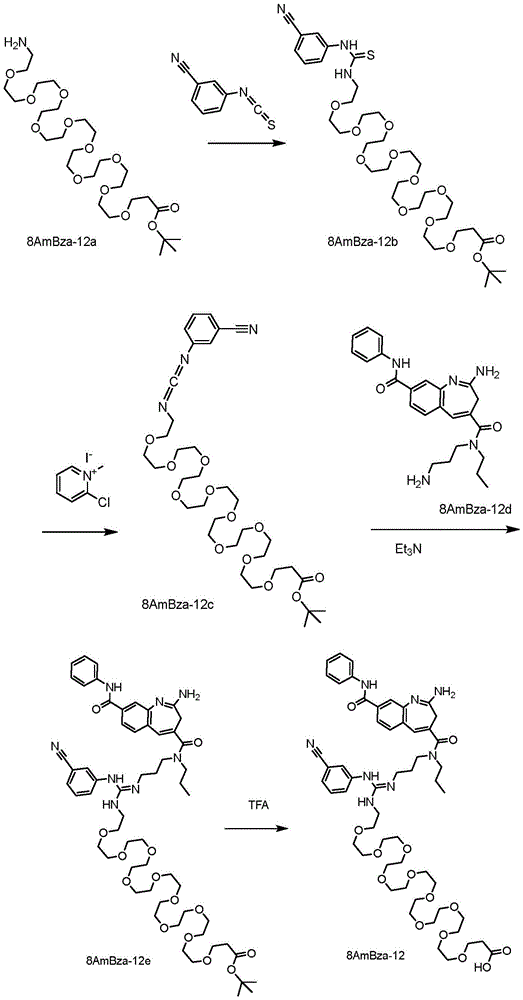
Preparation of tert-butyl 3- [2- [2- [2- [2- [2- [2- [2- [2- [2- [2- [2- [ (3-cyanophenyl) aminomethy-lmethylamido ] ethoxy ] propanoate, 8AmBza-12b
To 3- [2- [2- [2- [2- [2- (2-aminoethoxy) ethoxy) at 25 ℃ in the presence of a catalyst]Ethoxy radical]Ethoxy radical]Ethoxy radical]Ethoxy radical]Ethoxy radical]Ethoxy radical]Ethoxy radical]Ethoxy radical]Tert-butyl propionate, 8AmBza-12a (2.7g, 4.61mmol, 1.0 equiv.) in THF (20mL) was added Et3N (700mg, 6.91mmol, 960. mu.L, 1.5 equivalents) and 3-isothiocyanatobenzylNitrile (1.48g, 9.22mmol, 2.0 eq.) and stir at this temperature for 1 hour. The mixture was then diluted with water (30mL) and extracted with EtOAc (50 mL. times.3). The organic layer was washed with brine, over Na2SO4Dried, filtered and concentrated. The residue was purified by silica gel chromatography (MeOH/ethyl acetate ═ 0/1, 1/10) to give 8AmBza-12b as a yellow oil (0.5g, 670 μmol, 14.54% yield).1H NMR(CDCl3,400MHz)δ7.99(s,1H),7.89(d,J=8.0Hz,1H),7.44-7.39(m,2H),3.76-3.58(m,42H),2.55-2.46(m,2H),1.45(s,9H)
Preparation of tert-butyl 3- [2- [2- [2- [2- [2- [2- [2- [2- [2- [2- [2- [ (3-cyanophenyl) iminomethyleneamino ] ethoxy ] propanoate, 8AmBza-12c
In N28AmBza-12b (0.4g, 536. mu. mol, 1.0 eq.) and Et were added at 25 ℃ to3To a mixture of N (163mg, 1.61mmol, 223. mu.L, 3.0 equiv.) in DCM (10mL) and DMF (0.4mL) was added 2-chloro-1-methylpyridin-1-ium iodide (164mg, 643. mu. mol, 1.2 equiv.). The mixture was stirred at 25 ℃ for 1 hour and then concentrated under reduced pressure. The residue was chromatographed on silica gel (CH)3CN/ethyl acetate 0/1 to 1/1) to give 8AmBza-12c as a yellow oil (0.29g, 407 μmol, 75.9% yield).1H NMR(CDCl3,400MHz)δ7.43-7.33(m,4H),3.70-3.62(m,42H),2.51(t,J=6.4Hz,2H),1.45(s,9H)。
3- [2- [2- [2- [2- [2- [2- [2- [2- [2- [2- [ [ (Z) -N' - [3- [ [ 2-amino-8- (phenylcarbamoyl) -3H-1-benzazepine [ ] -methyl ester -4-carbonyl]-propyl-amino]Propyl radical]-N- (3-cyanophenyl) carboxamido]Amino group]Ethoxy radical]Ethoxy radical]Ethoxy radical]Ethoxy radical]Ethoxy radical]Ethoxy radical]Ethoxy radical]Ethoxy radical]Ethoxy radical]Ethoxy radical]Preparation of tert-butyl propionate, 8AmBza-12e
To 2-amino-N4- (3-aminopropyl) -N8-phenyl-N4-propyl-3H-1-benzazepine at 25 deg.C Et 4, 8-Dimethylamide, 8AmBza-12d (0.06g, 112. mu. mol, 1.0 equiv., TFA) in DMF (1mL) was added3N (28mg, 281. mu. mol, 2.5 equivalents) and 8AmBza-12c (88mg, 123. mu. mol, 1.1 equivalents). The mixture was stirred at 25 ℃ for 1 hour, then filtered and purified by preparative HPLC (column: nano-micron Kromasil C18100 x 30mm8 um; mobile phase: [ water (0.1% TFA) -ACN](ii) a B%: 20% -50%, 10min) to give 8AmBza-12e (0.08g, 70.7 μmol, 62.9% yield) as a colorless oil.
3- [2- [2- [2- [2- [2- [2- [2- [2- [2- [2- [ [ (Z) -N' - [3- [ [ 2-amino-8- (phenylcarbamoyl) -3H-1-benzazepine -4-carbonyl]-propyl-amino]Propyl radical]-N- (3-cyanophenyl) carboxamido]Amino group]Ethoxy radical]Ethoxy radical]Ethoxy radical]Ethoxy radical]Ethoxy radical]Ethoxy radical]Ethoxy radical]Ethoxy radical]Ethoxy radical]Ethoxy radical]Preparation of propionic acid, 8AmBza-12
To 8AmBza-12e (0.07g, 61. mu. mol, 1.0 eq.) in H at 25 deg.C2O (5mL) and CH3To a solution in CN (1mL) was added TFA (211mg, 1.86mmol, 30 equiv.). The mixture was stirred at 80 ℃ for 2 hours and then concentrated at 50 ℃ under reduced pressure. The residue was lyophilized to give 8AmBza-12(51mg, 42.9 μmol, 69.3% yield, TFA salt) as a pale yellow oil.1H NMR(MeOD,400MHz)δ8.01-7.94(m,2H),7.79-7.75(m,1H),7.72(d,J=8.0Hz,2H),7.66-7.64(m,4H),7.39(t,J=7.6Hz,2H),7.19(t,J=7.6Hz,1H),7.13(s,1H),3.76-3.52(m,46H),3.42-3.40(m,4H),2.53(t,J=6.4Hz,2H),2.04(m,2H),1.79-1.65(m,2H),0.93(t,J=7.2Hz,3H)。LC/MS[M+H]1075.6 (calculated); LC/MS [ M + H ]]1075.6 (found value).
Example 182-amino-N8- [6- [4- (2-aminoethylcarbamoyl) -1-piperidinyl]-3-pyridinyl group]-N4-ethoxy-N4-propyl-3H-1-benzazepine Synthesis of (E) -4, 8-dicarboxamide, 8AmBza-18

2-amino-8-bromo-N-ethoxy-N-propyl-3H-1-benzazepine Preparation of (E) -4-carboxamide, 8AmBza-18b
In N2At 20 ℃ to 2-amino-8-bromo-3H-1-benzazepine -4-carboxylic acid, 8AmBza-18a (9.00g, 32.0mmol, 1.0 equiv.) and N-ethoxypropan-1-amine (5.81g, 41.6mmol, 1.3 equiv., HCl) to a mixture in DCM (150mL) and DMA (150mL) was added 1-ethyl-3- (3-dimethylaminopropyl) carbodiimide hydrochloride, EDCI, CAS registry number 1892-57-5(24.5g, 128mmol, 4.0 equiv.) in one portion, followed by stirring at 20 ℃ for 10 h. The mixture was concentrated in vacuo to remove DCM, then water (200mL) was added and the aqueous phase was extracted with ethyl acetate (100mL x 4), the combined organic phases were washed with brine (200mL x 1) and over anhydrous Na2SO4Dried, filtered and concentrated in vacuo. The residue was purified by silica gel chromatography (column height: 250mm, diameter: 100mm, 100-mesh 200-mesh silica gel, petroleum ether/
ethyl acetate 10/1, 0/1) to give 8AmBza-18b as a white solid (6.00g, 16.3mmol, 51.1% yield).1H NMR(400MHz,MeOD)δ7.32(d,J=2.0Hz,1H),7.27-7.23(m,1H),7.20(s,1H),7.19-7.16(m,1H),3.94(q,J=7.2Hz,2H),3.73(t,J=7.2Hz,2H),3.33(s,2H),1.82-1.72(m,2H),1.17(t,J=7.2Hz,3H),0.99(t,J=7.2Hz,3H)。
2-amino-4- [ ethoxy (propyl) carbamoyl]-3H-1-benzazepine Preparation of methyl (E) -8-carboxylate, 8AmBza-18c
In N2Down to 2-amino-8-bromo-N-ethoxy-N-propyl-3H-1-benzazepine -4-formylTo a solution of amine (340mg, 928umol, 1.0 equiv) in MeOH (10mL) was added Pd (dppf) Cl2(34.0mg, 46.4umol, 0.05 eq.) and Et3N (282mg, 2.78mmol, 388uL, 3.0 equiv.), the suspension is degassed under vacuum and purged with CO several times, and the mixture is stirred at 80 ℃ for 10 hours under CO (50 psi). The reaction mixture was concentrated in vacuo, then water ((10mL) was added and the aqueous phase was extracted with ethyl acetate (10mL _ 3), the combined organic phases were washed with brine (10mL _ 1) and dried over anhydrous Na2SO4Dried, filtered and concentrated in vacuo. The residue was purified by silica gel chromatography (column height: 250mm, diameter: 100mm, 100-mesh 200-mesh silica gel, petroleum ether/
ethyl acetate 10/1, 0/1) to give 8AmBza-18c (180mg,521umol, 56.1% yield) as a yellow solid.1H NMR(400MHz,CDCl3)δ7.84(d,J=1.2Hz,1H),7.69-7.65(m,1H),7.46(d,J=8.0Hz,1H),7.28(s,1H),3.96(t,J=14.4Hz,2H),3.93(s,3H),3.74(t,J=7.2Hz,2H),3.33(s,2H),1.83-1.72(m,2H),1.18(t,J=7.2Hz,3H),1.00(t,J=7.2Hz,3H)。
2-amino-4- [ ethoxy (propyl) carbamoyl]-3H-1-benzazepine Preparation of (E) -8-carboxylic acid, 8AmBza-18d
In N28AmBza-18c (180mg,521umol, 1.0 equiv.) in MeOH (1mL) and H at 20 deg.C2LiOH. H was added to the solution in O (3mL) at once2O (65.6mg, 1.56mmol, 3.0 equiv.) and the mixture stirred at 20 ℃ for 7 h. The mixture was quenched with HCl (4M) until pH 7 and the desired solid precipitated from the mixture and was then filtered to give 8AmBza-18d as a grey solid (150mg, 452umol, 86.8% yield).
N- [2- [ [1- [5- [ [ 2-amino-4- [ ethoxy (propyl) carbamoyl)]-3H-1-benzazepine -8-carbonyl group]Amino group]-2-pyridyl]Piperidine-4-carbonyl]Amino group]Ethyl radical]Preparation of tert-butyl carbamate, 8AmBza-18e
In N2At 20 ℃ to 8AmBTo a solution of za-18d (137mg, 413umol, 1.0 eq) in DMF (2mL) was added HATU (141mg, 372umol, 0.9 eq) and DIEA (160mg, 1.24mmol, 216uL, 3.0 eq) in one portion. The mixture was stirred at 20 ℃ for 30min, then N- [2- [ [1- (5-amino-2-pyridinyl) piperidine-4-carbonyl ] was added]Amino group]Ethyl radical]Tert-butyl carbamate (195mg, 537umol, 1.3 eq.) and stirring at 20 ℃ for a further 10 h. The reaction mixture was filtered and the filtrate was passed through preparative HPLC (column: Phenomenex Synergi C18150 × 25 × 10 um; mobile phase: [ water (0.1% TFA) -ACN](ii) a B%: 10% -40%, 8min) to give 8AmBza-18e as a brown solid (20.0mg, crude).
Preparation of 8AmBza-18
In N2To a solution of 8AmBza-18e (20mg, 29.5umol, 1.0 equiv) in EtOAc (2mL) was added HCl/EtOAc (4M, 369uL, 50 equiv.) in one portion at 20 ℃ and stirred for 3h at 20 ℃. The reaction mixture was concentrated in vacuo and the residue passed through preparative HPLC (column: Phenomenex Synergi C18150. multidot.25. multidot.10. mu.m; mobile phase: [ water (0.1% TFA) -ACN](ii) a B%: 1% -25%, 8min) to give 8AmBza-18(12.6mg, 17.5umol, 59.2% yield, 95.98% purity, TFA) as a white solid.1H NMR(400MHz,MeOD)δ8.57(d,J=2.4Hz,1H),8.07(dd,J=2.4,9.6Hz,1H),8.00-7.96(m,2H),7.74(d,J=8.4Hz,1H),7.47(s,1H),7.18(d,J=9.6Hz,1H),4.30(d,J=13.6Hz,2H),4.00(q,J=7.2Hz,2H),3.78(t,J=7.2Hz,2H),3.51-3.44(m,5H),3.17-3.05(m,4H),2.62-2.53(m,1H),1.96(d,J=3.6Hz,2H),1.87-1.75(m,4H),1.22(t,J=7.2Hz,3H),1.03(t,J=7.2Hz,3H)。LC/MS[M+H]577.3 (calculated); LC/MS [ M + H ]]577.2 (found value).
Example L-1(2- (1- (5- (2-amino-4- (dipropylcarbamoyl) -3H-benzo [ b ]]Aza derivatives Synthesis of 4- ((S) -2- ((S) -2- (6- (2, 5-dioxo-2, 5-dihydro-1H-pyrrol-1-yl) hexanamido) -3-methylbutanamido) -5-ureidopentanamide) benzyl (E) -8-carboxamido) pyridin-2-yl) piperidine-4-carboxamido) ethyl) carbamate, 8AmBza-L-1
8AmBza-L-1 was prepared and characterized according to the procedure described herein.
Example L-2(6R,9R) -1-amino-6- ((4- ((((2- (1- (5- (2-amino-4- (dipropylcarbamoyl) -3H-benzo [ b ]))]Aza derivatives Synthesis of-8-carboxamido) pyridin-2-yl) piperidine-4-carboxamido) ethyl) carbamoyl) oxy) methyl) phenyl) carbamoyl) -9-isopropyl-1, 8, 11-trioxo-14, 17,20,23,26,29,32,35,38,41,44,47,50,53,56,59,62,65,68,71,74,77,80,83, 86-pentacosan-2, 7, 10-triaza octanonadecane-89-oic acid rac-2, 3,5, 6-tetrafluorophenyl ester, 8AmBza-L-2
Preparation of bis (2,3,5, 6-tetrafluorophenyl) 4,7,10,13,16,19,22,25,28,31,34,37,40,43,46,49,52,55,58,61,64,67,70,73, 76-pentacosaxetan diester, TFP-PEG25-TFP

The vial was charged with 4,7,10,13,16,19,22,25,28,31,34,37,40,43,46,49,52,55,58,61,64,67,70,73, 76-pentacosapentaoxaheptadecanoic acid (269mg, 0.221mmol), 2,3,5, 6-tetrafluorophenol (110mg, 0.662mmol), collidine (176. mu.L, 1.33mmol), 1-ethyl-3- (3-dimethylaminopropyl) carbodiimide (127mg, 0.221mmol) and 3mL of DMF. The reaction was stirred for 16h and then purified by reverse phase preparative HPLC using a gradient of 25-75% acetonitrile, water containing 0.1% trifluoroacetic acid. The purified fractions were combined and lyophilized to give 266mg of TFP-PEG25-TFP in 79% yield. LC/MS [ M + H ]1515.68 (calculated); LC/MS [ M + H ]1516.00 (found).

Reacting (2- (1- (5- (2-amino-4- (dipropylcarbamoyl) -3H-benzo [ b)]Aza derivatives -8-carboxamido) pyridin-2-yl) piperidine-4-carboxamido) ethyl) carbamic acid 4- ((S) -2-amino-3-methylbutanamido) -5-ureidopentanamido) benzyl ester, 8AmBza-L-2a was reacted with TFP-PEG25-TFP in collidine and DMF and purified by reverse phase preparative HPLC using a 25-75% gradient of acetonitrile to water containing 0.1% trifluoroacetic acid. The purified fractions were combined and lyophilized to give 8 AmBza-L-2. LC/MS [ M +2H/2 ]]1165.10 (calculated); LC/MS [ M + H ]]1165.91 (found).
Example L-3(6S,9S) -1-amino-6- ((4- ((((((6- (2-amino-4- (dipropylcarbamoyl) -3H-benzo [ b ]))]Aza derivatives Synthesis of-8-carboxamido) pyridin-3-yl) methyl) carbamoyl) oxy) methyl) phenyl) carbamoyl) -9-isopropyl-1, 8, 11-trioxo-14, 17,20,23,26,29,32,35,38,41,44,47,50,53,56,59,62,65,68,71,74,77,80,83, 86-pentacosan-2, 7, 10-triaza octanonadecane-89-
 oic acid 2,3,5, 6-tetrafluorophenyl ester, 8AmBza-L-3
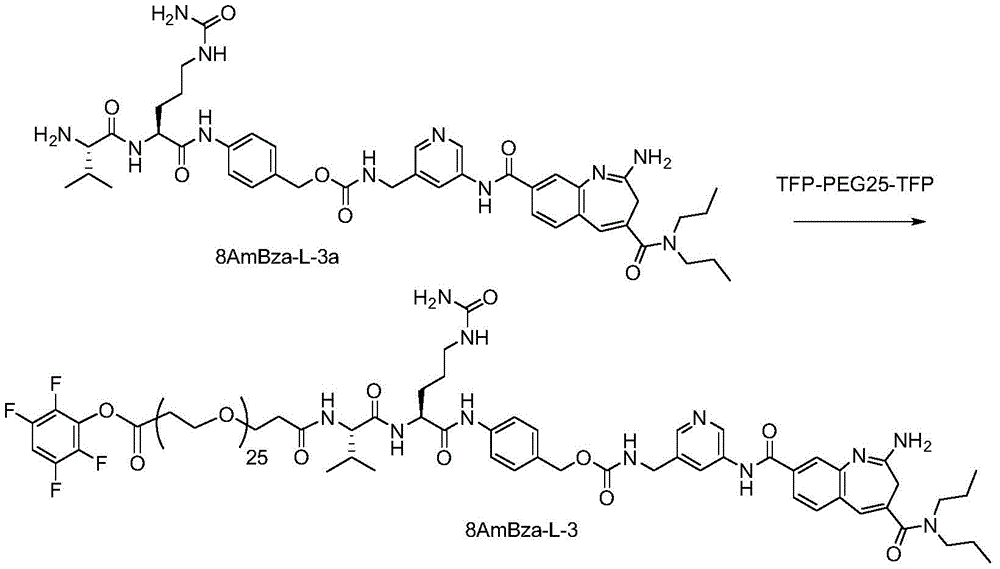
Reacting ((5- (2-amino-4- (dipropylcarbamoyl) -3H-benzo [ b ]]Aza derivatives -8-carboxamido) pyridin-3-yl) methyl) carbamic acid 4- ((S) -2-amino-3-methylbutanamido) -5-ureidopentanamido) benzyl ester, 8AmBza-L-3 was reacted with TFP-PEG25-TFP in collidine and DMF and purified by reverse phase preparative HPLC using a gradient of 25-75% acetonitrile to water containing 0.1% trifluoroacetic acid. The purified fractions were combined and lyophilized to give 8 AmBza-L-3. LC/MS [ M +2H/2 ]]1095.06 (calculated); LC/MS [ M + H ]]1095.87 (found value).
Example L-41- (1- (5- (2-amino-4- (dipropylcarbamoyl) -3H-benzo [ b ]]Aza derivatives -8-carboxamido) pyridin-2-yl) piperidin-4-yl) Synthesis of-1, 6-dioxo-9, 12,15,18,21,24,27,30,33,36,39,42,45,48,51,54,57,60,63,66,69,72,75,78, 81-pentacosaoxa-2, 5-octatetradecane-84-
 oic acid 2,3,5, 6-tetrafluorophenyl ester, 8AmBza-L-4

Reacting 2-amino-N8- (6- (4- ((2-aminoethyl) carbamoyl) piperidin-1-yl) pyridin-3-yl) -N4, N4-dipropyl-3H-benzo [ b]Aza derivatives -4, 8-dimethylamide, 8AmBza-L-4a was reacted with TFP-PEG25-TFP in collidine and DMF and purified by reverse phase preparative HPLC using a 25-75% gradient of acetonitrile to water containing 0.1% trifluoroacetic acid. The purified fractions were combined and lyophilized to give 8 AmBza-L-4. LC/MS [ M + H ]]1924.01 (calculated); LC/MS [ M + H ]]1925.23 (found value).
Example L-51- (6- (2-amino-4- (dipropylcarbamoyl) -3H-benzo [ b ]]Aza derivatives Synthesis of-8-carboxamido) pyridin-3-yl) -3-oxo-6, 9,12,15,18,21,24,27,30,33,36,39,42,45,48,51,54,57,60,63,66,69,72,75, 78-pentacosan-2-azaoctaundecane-81-
 oic acid 2,3,5, 6-tetrafluorophenyl ester, 8AmBza-L-5

Reacting 2-amino-N8- (5- (aminomethyl) pyridin-3-yl) -N4, N4-dipropyl-3H-benzo [ b]Aza derivatives -4, 8-dimethylamide, 8AmBza-L-5a was reacted with TFP-PEG25-TFP in collidine and DMF and purified by reverse phase preparative HPLC using a 25-75% gradient of acetonitrile, water containing 0.1% trifluoroacetic acid. Combining the purified fractions and lyophilizing to obtain8AmBza-L-5。LC/MS[M+H]1783.92 (calculated); LC/MS [ M + H ]]1784.19 (found value).
Example L-61- (1- (5- (2-amino-4- ((3- ((tert-butoxycarbonyl) amino) propyl) (propyl) carbamoyl) -3H-benzo [ b)]Aza derivatives Synthesis of-8-carboxamido) pyridin-2-yl) piperidin-4-yl) -1, 6-dioxo-9, 12,15,18,21,24,27,30,33,36,39,42,45,48,51,54,57,60,63,66,69,72,75,78, 81-pentacosan-2, 5-octa-tetradecane-84-
 oic acid 2,3,5, 6-tetrafluorophenyl ester, 8AmBza-L-6
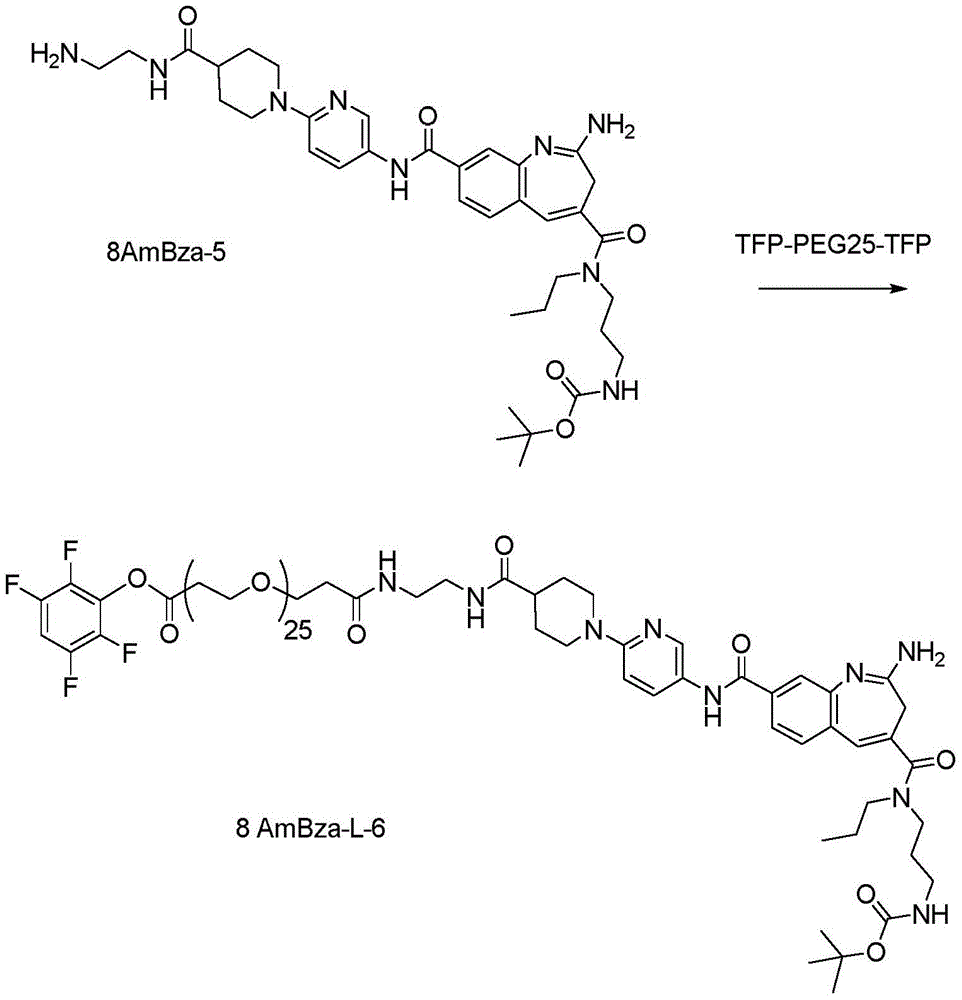
(3- (2-amino-8- ((6- (4- ((2-aminoethyl) carbamoyl) piperidin-1-yl) pyridin-3-yl) carbamoyl) -N-propyl-3H-benzo [ b) from example 5]Aza derivatives -4-carboxamido) propyl) carbamic acid tert-butyl ester, 8AmBza-5 with TFP-PEG25-TFP in collidine and DMF and purified by reverse phase preparative HPLC using a gradient of 25-75% acetonitrile, water containing 0.1% trifluoroacetic acid. The purified fractions were combined and lyophilized to give 8 AmBza-L-6. LC/MS [ M + H ]]2039.07 (calculated); LC/MS [ M + H ]]2039.40 (found).
Example L-7(2S,4S,6S) -6- (4- ((((2- (1- (5- (2-amino-4- (dipropylcarbamoyl) -3H-benzo [ b ]))]Aza derivatives Synthesis of (E) -8-carboxamido) pyridin-2-yl) piperidine-4-carboxamido) ethyl) carbamoyl) oxy) methyl) -2- (20-oxo-1- (1- (2- (3-oxo-3- (perfluorophenoxy) propoxy) ethyl) -1H-1,2, 3-triazol-4-yl) -2,5,8,11,14, 17-hexaoxy-21-azaligno-24-amido) phenoxy) -3,4, 5-trihydroxytetrahydro-2H-pyran-2-carboxylic acid, 8AmBza-L-7
8AmBza-L-7 was prepared and characterized according to the procedures described herein.
Example L-81- (3- (2-amino-4- (dipropylcarbamoyl) -3H-benzo [ b ]]Aza derivatives Synthesis of (E) -8-carboxamido) phenyl) -8-methyl-2, 5,11,14,17,20,23,26,29,32,35, 38-dodecaoxa-8-azaundecane-41-
 oic acid 2,3,5, 6-tetrafluorophenyl ester, 8AmBza-L-8
8AmBza-L-8 was prepared and characterized according to the procedures described herein.
Example L-91- ((5- (2-amino-4- (dipropylcarbamoyl) -3H-benzo [ b)]Aza derivatives Synthesis of (E) -8-carboxamido) pyrimidin-2-yl) amino) -3-methyl-6, 9,12,15,18,21,24,27,30, 33-decaoxa-3-azatrioxane-36-
 oic acid 2,3,5, 6-tetrafluorophenyl ester, 8AmBza-L-9
8AmBza-L-9 was prepared and characterized according to the procedures described herein.
Example L-10(R) -1- (4- ((3- (2-amino-4- (dipropylcarbamoyl) -3H-benzo [ b)]Aza derivatives Synthesis of (E) -8-carboxamido) piperidin-1-yl) methyl) phenyl) -2-methyl-5, 8,11,14,17,20,23,26,29, 32-decaoxa-2-azatridecane-35-
 oic acid 2,3,5, 6-tetrafluorophenyl ester, 8AmBza-L-10
8AmBza-L-10 was prepared and characterized according to the procedures described herein.
Example L-111- (4- ((4- (2-amino-4- (dipropylcarbamoyl) -3H-benzo [ b ]]Aza derivatives Synthesis of-8-carbonyl) piperazin-1-yl) methyl) phenyl) -2-methyl-5, 8,11,14,17,20,23,26,29, 32-decaoxa-2-azatripentadecanoic acid-35-
 acid 2,3,5, 6-tetrafluorophenyl ester, 8AmBza-L-11
8AmBza-L-11 was prepared and characterized according to the procedure described herein.
Example L-163- [2- [2- [2- [2- [2- [2- [2- [2- [2- [2- [2- [ [1- [5- [ [ 2-amino-4- [ ethoxy (propyl) carbamoyl)]-3H-1-benzazepine -8-carbonyl]Amino group]-2-pyridyl]Piperidine-4-carbonyl]Amino group]Ethyl-methyl-amino]Ethoxy radical]Ethoxy radical]Ethoxy radical]Ethoxy radical]Ethoxy radical]Ethoxy radical]Ethoxy radical]Ethoxy radical]Ethoxy radical]Ethoxy radical]Synthesis of 2,3,5, 6-tetrafluorophenyl propionate, 8AmBza-L-16


3- [2- [2- [2- [2- [2- [2- [2- [2- [2- [2- [2- [ [1- [5- [ [ 2-amino-4- [ [ ethoxy (propyl) carbamoyl)]-3H-1-benzazepine -8-carbonyl]Amino group]-2-pyridinyl group]Piperidine-4-carbonyl]Amino group]Ethyl-methyl-amino]Ethoxy radical]Ethoxy radical]Ethoxy radical]Ethoxy radical]Ethoxy radical]Ethoxy radical]Ethoxy radical]Ethoxy radical]Ethoxy radical]Ethoxy radical]Preparation of tert-butyl propionate, 8AmBza-L-16a
At N2To 2-amino-N8- [6- [4- (2-aminoethylcarbamoyl) -1-piperidinyl at 20 DEG C]-3-pyridyl]-N4-ethoxy-N4-propyl-3H-1-benzazepine -4, 8-dicarboxamide, 8AmBza-18(130mg, 225umol, 1.0 equiv.) and 3- [2- [2- [2- [2- [2- [2- [2- [2- (2-oxoethoxy) ethoxy]Ethoxy radical]Ethoxy radical]Ethoxy radical]Ethoxy radical]Ethoxy radical]Ethoxy radical]Ethoxy radical]Ethoxy radical]Tert-butyl propionate (395mg, 676umol, 3.0 equiv.) to a mixture in MeOH (5mL) NaBH was added in one portion3CN (42.5mg, 676umol, 3.0 equiv.) and Et3N (22.8mg, 225umol, 31.3uL, 1.0 eq.) is prepared byThe mixture was stirred at 20 ℃ for 40 h, then HCHO (91.4mg, 1.13mmol, 83.9uL, 37% purity, 5.0 equiv) was added and stirred at 20 ℃ for a further 3 h. The reaction mixture was concentrated in vacuo and the residue was purified by preparative HPLC (column: Phenomenex Synergi C18150 x 30mm x 4 um; mobile phase: [ water (0.1% TFA) -ACN](ii) a B%: 20% -45%, 8min) to give 8AmBza-L-16a (50.0mg, 43.1umol, 19.1% yield) as a brown oil.
3- [2- [2- [2- [2- [2- [2- [2- [2- [2- [2- [2- [ [1- [5- [ [ 2-amino-4- [ [ ethoxy (propyl) carbamoyl)]-3H-1-benzazepine -8-carbonyl]Amino group]-2-pyridyl]Piperidine-4-carbonyl]Amino group]Ethyl-methyl-amino]Ethoxy radical]Ethoxy radical]Ethoxy radical]Ethoxy radical]Ethoxy radical]Ethoxy radical]Ethoxy radical]Ethoxy radical]Ethoxy radical]Ethoxy radical]Preparation of propionic acid, 8AmBza-L-16b
In N28AmBza-L-16a (50.0mg, 43.1umol, 1.0 equiv.) was added to MeCN (0.5mL) and H at 20 deg.C2To a solution in O (2mL) was added HCl (12M, 107uL, 30 equiv.) in one portion and the mixture was stirred at 80 ℃ for 1 hour. The reaction mixture was concentrated in vacuo to give 8AmBza-L-16b (45mg, 40.79umol, 94.6% yield) as a colorless oil.
Preparation of 8AmBza-L-16
In N2EDCI (39.0mg, 203umol, 5.0 equiv.) was added in one portion to a mixture of 8AmBza-L-16b (45.0mg, 40.7umol, 1.0 equiv.) and 2,3,5, 6-tetrafluorophenol (67.7mg, 407umol, 10 equiv.) in DCM (2mL) and DMA (0.5mL) at 20 ℃ and the mixture was stirred for 1 hour at 20 ℃. DCM (2mL) was removed in vacuo and the mixture was filtered, and the filtrate was passed through preparative HPLC (column: Phenomenex Synergi C18150: 30 mm. multidot.4um; mobile phase: [ water (0.1% TFA) -ACN](ii) a B%: 20% -45%, 8min) to give 8AmBza-L-16(15.0mg, 11.9umol, 29.3% yield, 99.7% purity) as a brown oil.1H NMR(400MHz,MeOD)δ8.55(d,J=1.8Hz,1H),8.03(dd,J=2.4,9.2Hz,1H),7.98(s,2H),7.74(d,J=9.2Hz,1H),7.47(s,1H),7.16-7.09(m,1H),4.34-4.28(m,2H),4.00(d,J=7.0Hz,2H),3.91-3.85(m,4H),3.74-3.59(m,42H),3.50(s,2H),3.45(s,3H),3.17-3.07(m,2H),3.01(s,3H),1.96(d,J=10.6Hz,2H),1.86-1.75(m,4H),1.22(t,J=7.2Hz,3H),1.06-0.99(m,3H)。LC/MS[M+H]1251.6 (calculated); LC/MS [ M + H ]]1251.4 (found value).
EXAMPLE 201 preparation of Immunoconjugates (IC)
In an exemplary procedure, G-25SEPHADEX is usedTMDesalting column (Sigma-Aldrich, St. Louis, Mo.) and antibody buffer exchanged into conjugate buffer containing 100mM boric acid, 50mM sodium chloride, 1mM ethylenediaminetetraacetic acid, pH 8.3. The eluates are then adjusted to a concentration of 1-10mg/ml each using a buffer and then subjected to sterile filtration. The antibody is pre-heated to 20-30 ℃ and rapidly mixed with 2-20 (e.g., 7-10) molar equivalents of the 8 AmBza-linker compound of formula II. The reaction was allowed to proceed at 30 ℃ for about 16 hours, and the Immunoconjugate (IC) was separated from the reactants by running on two consecutive G-25 desalting columns equilibrated in Phosphate Buffered Saline (PBS) at pH 7.2 to provide the Immunoconjugate (IC) of table 3. Adjuvant-antibody ratio (DAR) was determined by using a linker to a XEVOTMACQUITY of G2-XS TOF Mass spectrometer (Waters Corporation)TMDetermined by liquid chromatography mass spectrometry analysis on a C4 reverse phase column on the UPLC class H (Waters Corporation, Milford, Massachusetts).
For conjugation, the antibody may be dissolved in an aqueous buffer system known in the art that does not adversely affect the stability or antigen binding specificity of the antibody. Phosphate buffered saline may be used. The 8 AmBza-linker intermediate compound is dissolved in a solvent system comprising at least one polar aprotic solvent as described elsewhere herein. In some such aspects, the 8 AmBza-linker intermediate is solubilized in a pH 8 Tris buffer (e.g., 50mM Tris) to a concentration of about 5mM, about 10mM, about 20mM, about 30mM, about 40mM, or about 50mM and ranges thereof, such as about 5mM to about 50mM, or about 10mM to about 30 mM. In some aspects, the 8 AmBza-linker intermediate is dissolved in DMSO (dimethyl sulfoxide), DMA (dimethylacetamide), or acetonitrile or another suitable dipolar aprotic solvent.
Alternatively, an equivalent excess of 8 AmBza-linker intermediate solution may be diluted and combined with the antibody solution in the conjugation reaction. The 8 AmBza-linker intermediate solution may suitably be diluted with at least one polar aprotic solvent and at least one polar protic solvent, examples of which include water, methanol, ethanol, n-propanol and acetic acid. The molar equivalents of the 8 AmBza-linker intermediate to antibody may be about 1.5:1, about 3:1, about 5:1, about 10:1, about 15:1, or about 20:1, and ranges a thereof, such as about 1.5:1 to about 20:1, about 1.5:1 to about 15:1, about 1.5:1 to about 10:1, about 3:1 to about 15:1, about 3:1 to about 10:1, about 5:1 to about 15:1, or about 5:1 to about 10: 1. Completion of the reaction may be suitably monitored by methods known in the art, such as LC-MS. The conjugation reaction is typically completed in a range of about 1 hour to about 16 hours. After the reaction is complete, reagents may be added to the reaction mixture to quench the reaction. If an antibody thiol group is reacting with a thiol reactive group (such as the maleimide of an 8 AmBza-linker intermediate), the unreacted antibody thiol group can react with the capping reagent. One example of a suitable capping reagent is ethylmaleimide.
Following conjugation, the immunoconjugate can be purified and separated from the unconjugated reactant and/or conjugate aggregate by purification methods known in the art, such as, but not limited to, size exclusion chromatography, hydrophobic interaction chromatography, ion exchange chromatography, chromatofocusing, ultrafiltration, centrifugal ultrafiltration, tangential flow filtration, and combinations thereof. For example, the immunoconjugate may be diluted prior to purification, e.g., in 20mM sodium succinate, pH 5. The diluted solution is applied to a cation exchange column and then washed with, for example, at least 10 column volumes of 20mM sodium succinate, pH 5. The conjugate can be suitably eluted with a buffer such as PBS.
Example 202HEK reporter assay
HEK293 reporter cells expressing human TLR7 or human TLR8 were purchased from Invivogen and cell proliferation and experiments were performed following the supplier protocol. Briefly, cells were maintained at 5% CO2Growth was carried out to 80-85% confluence in DMEM supplemented with 10% FBS, bleomycin (Zeocin) and Blasticidin (Blasticidin). The cells were then plated at 4X 10⁴The individual cells/well were seeded in 96-well plates, where the matrix contained HEK detection mediumAnd an immunostimulatory molecule. The activity was measured using a microplate reader at a wavelength of 620-655 nm.
Example 203 evaluation of in vitro immunoconjugate Activity
This example demonstrates that the immunoconjugates of the invention are effective in eliciting bone marrow activation and are therefore useful in the treatment of cancer.
Isolation of human antigen presenting cells: by using ROSETTESEP containing monoclonal antibodies against CD14, CD16, CD40, CD86, CD123 and HLA-DRTMHuman monocyte enriched mixtures (Stem Cell Technologies, Vancouver, Canada) were subjected to density gradient centrifugation and human bone marrow Antigen Presenting Cells (APCs) were negatively selected from human peripheral Blood obtained from healthy Blood donors (Stanford Blood Center, Palo Alto, California). Subsequent use of EASYSEP containing monoclonal antibodies against CD14, CD16, CD40, CD86, CD123 and HLA-DR without depletion of CD16TMHuman monocyte enrichment kit (Stem Cell Technologies), immature APC purified by negative selection to>90% purity.
Bone marrow APC activation assay: 2x 10 to5Individual APCs were incubated in 96-well plates (Corning, NY) containing iscove's modified duchenne medium, imdm (lonza) supplemented with 10% FBS, 100U/mL penicillin, 100 μ g/mL (μ g/mL) streptomycin, 2mM L-glutamine, sodium pyruvate, non-essential amino acids, and, where indicated, various concentrations of unconjugated (naked) PD-L1 or HER2 antibody and immunoconjugate of the invention (as prepared according to the examples above). Trastuzumab and avizumab were used as antibody constructs. Cell-free supernatants were analyzed by ELISA after 18 hours to measure TNF α secretion as an indication of proinflammatory response (readout).
Activation of bone marrow cell types can be measured using various screening assays that utilize different bone marrow cell populations. These screening assays may include the following: monocytes isolated from healthy donor blood, M-CSF differentiated macrophages, GM-CSF + IL-4 monocyte-derived dendritic cells, canonical dendritic cells isolated from healthy donor blood, and bone marrow cells polarized to an immunosuppressive state (also known as myeloid-derived suppressor cells or MDSCs). Examples of MDSC polarized cells include monocytes differentiated to an immunosuppressive state, such as M2a M Φ (IL4/IL13), M2c M Φ (IL10/TGFb), GM-CSF/IL6 MDSCs, and tumor-educated monocytes (TEMs). TEM differentiation can be performed using tumor conditioned media (e.g., 786.O, MDA-MB-231, HCC 1954). Primary tumor-associated bone marrow cells may also include primary cells present in dissociated tumor cell suspension (Discovery Life Sciences).
The assessment of the activation of the bone marrow cell population may be performed as a single culture or as a co-culture with cells expressing an antigen of interest to which ISACs can bind via the CDR regions of an antibody. After 18-48 hours of incubation, activation can be assessed by up-regulating cell surface co-stimulatory molecules using flow cytometry or by measuring secreted pro-inflammatory cytokines. For cytokine measurements, cell-free supernatants were harvested and analyzed by cytokine bead arrays (e.g., LegendPlex from Biolegend) using flow cytometry.
All references, including publications, patent applications, and patents, cited herein are hereby incorporated by reference to the same extent as if each reference were individually and specifically indicated to be incorporated by reference and were set forth in its entirety herein.
Sequence listing
<110> Borter biotherapeutic drugs Co., Ltd
<120> amide linked aminobenzazepine immunoconjugate and use thereof
<130> 17019.004WO1
<140>
<141>
<150> 62/908,253
<151> 2019-09-30
<160> 134
<170> PatentIn 3.5 edition
<210> 1
<211> 106
<212> PRT
<213> Artificial Sequence (Artificial Sequence)
<220>
<221> Source
<223 >/comment = "description of artificial sequence: synthesis of
Polypeptide "
<400> 1
Asp Ile Gln Leu Thr Gln Ser Pro Ser Ser Leu Ser Ala Ser Val Gly
1 5 10 15
Asp Arg Val Thr Ile Thr Cys Lys Ala Ser Gln Asp Val Gly Thr Ser
20 25 30
Val Ala Trp Tyr Gln Gln Lys Pro Gly Lys Ala Pro Lys Leu Leu Ile
35 40 45
Tyr Trp Thr Ser Thr Arg His Thr Gly Val Pro Ser Arg Phe Ser Gly
50 55 60
Ser Gly Ser Gly Thr Asp Phe Thr Phe Thr Ile Ser Ser Leu Gln Pro
65 70 75 80
Glu Asp Ile Ala Thr Tyr Tyr Cys Gln Gln Tyr Ser Leu Tyr Arg Ser
85 90 95
Phe Gly Gln Gly Thr Lys Val Glu Ile Lys
100 105
<210> 2
<211> 23
<212> PRT
<213> Artificial Sequence (Artificial Sequence)
<220>
<221> sources
<223 >/comment = "description of artificial sequence: synthesis of
Peptides "
<400> 2
Asp Ile Gln Leu Thr Gln Ser Pro Ser Ser Leu Ser Ala Ser Val Gly
1 5 10 15
Asp Arg Val Thr Ile Thr Cys
20
<210> 3
<211> 11
<212> PRT
<213> Artificial Sequence (Artificial Sequence)
<220>
<221> sources
<223 >/comment = "description of artificial sequence: synthesis of
Peptides "
<400> 3
Lys Ala Ser Gln Asp Val Gly Thr Ser Val Ala
1 5 10
<210> 4
<211> 15
<212> PRT
<213> Artificial Sequence (Artificial Sequence)
<220>
<221> Source
<223 >/comment = "description of artificial sequence: synthesis of
Peptides "
<400> 4
Trp Tyr Gln Gln Lys Pro Gly Lys Ala Pro Lys Leu Leu Ile Tyr
1 5 10 15
<210> 5
<211> 7
<212> PRT
<213> Artificial Sequence (Artificial Sequence)
<220>
<221> sources
<223 >/comment = "description of artificial sequence: synthesis of
Peptides "
<400> 5
Trp Thr Ser Thr Arg His Thr
1 5
<210> 6
<211> 32
<212> PRT
<213> Artificial Sequence (Artificial Sequence)
<220>
<221> Source
<223 >/comment = "description of artificial sequence: synthesis of
Polypeptides "
<400> 6
Gly Val Pro Ser Arg Phe Ser Gly Ser Gly Ser Gly Thr Asp Phe Thr
1 5 10 15
Phe Thr Ile Ser Ser Leu Gln Pro Glu Asp Ile Ala Thr Tyr Tyr Cys
20 25 30
<210> 7
<211> 8
<212> PRT
<213> Artificial Sequence (Artificial Sequence)
<220>
<221> sources
<223 >/comment = "description of artificial sequence: synthesis of
Peptides "
<400> 7
Gln Gln Tyr Ser Leu Tyr Arg Ser
1 5
<210> 8
<211> 10
<212> PRT
<213> Artificial Sequence (Artificial Sequence)
<220>
<221> Source
<223 >/comment = "description of artificial sequence: synthesis of
Peptides "
<400> 8
Phe Gly Gln Gly Thr Lys Val Glu Ile Lys
1 5 10
<210> 9
<211> 119
<212> PRT
<213> Artificial Sequence (Artificial Sequence)
<220>
<221> sources
<223 >/comment = "description of artificial sequence: synthesis of
Polypeptide "
<400> 9
Glu Val Gln Leu Val Glu Ser Gly Gly Gly Val Val Gln Pro Gly Arg
1 5 10 15
Ser Leu Arg Leu Ser Cys Ser Ser Ser Gly Phe Asp Phe Thr Thr Tyr
20 25 30
Trp Met Ser Trp Val Arg Gln Ala Pro Gly Lys Gly Leu Glu Trp Val
35 40 45
Ala Glu Ile His Pro Asp Ser Ser Thr Ile Asn Tyr Ala Pro Ser Leu
50 55 60
Lys Asp Arg Phe Thr Ile Ser Arg Asp Asn Ser Lys Asn Thr Leu Phe
65 70 75 80
Leu Gln Met Asp Ser Leu Arg Pro Glu Asp Thr Gly Val Tyr Phe Cys
85 90 95
Ala Ser Leu Tyr Phe Gly Phe Pro Trp Phe Ala Tyr Trp Gly Gln Gly
100 105 110
Thr Pro Val Thr Val Ser Ser
115
<210> 10
<211> 30
<212> PRT
<213> Artificial Sequence (Artificial Sequence)
<220>
<221> Source
<223 >/comment = "description of artificial sequence: synthesis of
Polypeptide "
<400> 10
Glu Val Gln Leu Val Glu Ser Gly Gly Gly Val Val Gln Pro Gly Arg
1 5 10 15
Ser Leu Arg Leu Ser Cys Ser Ser Ser Gly Phe Asp Phe Thr
20 25 30
<210> 11
<211> 5
<212> PRT
<213> Artificial Sequence (Artificial Sequence)
<220>
<221> sources
<223 >/comment = "description of artificial sequence: synthesis of
Peptides "
<400> 11
Thr Tyr Trp Met Ser
1 5
<210> 12
<211> 14
<212> PRT
<213> Artificial Sequence (Artificial Sequence)
<220>
<221> sources
<223 >/comment = "description of artificial sequence: synthesis of
Peptides "
<400> 12
Trp Val Arg Gln Ala Pro Gly Lys Gly Leu Glu Trp Val Ala
1 5 10
<210> 13
<211> 17
<212> PRT
<213> Artificial Sequence (Artificial Sequence)
<220>
<221> sources
<223 >/comment = "description of artificial sequence: synthesis of
Peptides "
<400> 13
Glu Ile His Pro Asp Ser Ser Thr Ile Asn Tyr Ala Pro Ser Leu Lys
1 5 10 15
Asp
<210> 14
<211> 32
<212> PRT
<213> Artificial Sequence (Artificial Sequence)
<220>
<221> sources
<223 >/comment = "description of artificial sequence: synthesis of
Polypeptide "
<400> 14
Arg Phe Thr Ile Ser Arg Asp Asn Ser Lys Asn Thr Leu Phe Leu Gln
1 5 10 15
Met Asp Ser Leu Arg Pro Glu Asp Thr Gly Val Tyr Phe Cys Ala Ser
20 25 30
<210> 15
<211> 10
<212> PRT
<213> Artificial Sequence (Artificial Sequence)
<220>
<221> sources
<223 >/comment = "description of artificial sequence: synthesis of
Peptides "
<400> 15
Leu Tyr Phe Gly Phe Pro Trp Phe Ala Tyr
1 5 10
<210> 16
<211> 11
<212> PRT
<213> Artificial Sequence (Artificial Sequence)
<220>
<221> sources
<223 >/comment = "description of artificial sequence: synthesis of
Peptides "
<400> 16
Trp Gly Gln Gly Thr Pro Val Thr Val Ser Ser
1 5 10
<210> 17
<211> 108
<212> PRT
<213> Artificial Sequence (Artificial Sequence)
<220>
<221> sources
<223 >/comment = "description of artificial sequence: synthesis of
Polypeptide "
<400> 17
Asp Ile Gln Met Thr Gln Ser Pro Ser Ser Leu Ser Ala Ser Val Gly
1 5 10 15
Asp Arg Val Thr Ile Thr Cys Lys Ala Ser Ala Ala Val Gly Thr Tyr
20 25 30
Val Ala Trp Tyr Gln Gln Lys Pro Gly Lys Ala Pro Lys Leu Leu Ile
35 40 45
Tyr Ser Ala Ser Tyr Arg Lys Arg Gly Val Pro Ser Arg Phe Ser Gly
50 55 60
Ser Gly Ser Gly Thr Asp Phe Thr Leu Thr Ile Ser Ser Leu Gln Pro
65 70 75 80
Glu Asp Phe Ala Thr Tyr Tyr Cys His Gln Tyr Tyr Thr Tyr Pro Leu
85 90 95
Phe Thr Phe Gly Gln Gly Thr Lys Leu Glu Ile Lys
100 105
<210> 18
<211> 23
<212> PRT
<213> Artificial Sequence (Artificial Sequence)
<220>
<221> sources
<223 >/comment = "description of artificial sequence: synthesis of
Peptides "
<400> 18
Asp Ile Gln Met Thr Gln Ser Pro Ser Ser Leu Ser Ala Ser Val Gly
1 5 10 15
Asp Arg Val Thr Ile Thr Cys
20
<210> 19
<211> 11
<212> PRT
<213> Artificial Sequence (Artificial Sequence)
<220>
<221> Source
<223 >/comment = "description of artificial sequence: synthesis of
Peptides "
<400> 19
Lys Ala Ser Ala Ala Val Gly Thr Tyr Val Ala
1 5 10
<210> 20
<211> 15
<212> PRT
<213> Artificial Sequence (Artificial Sequence)
<220>
<221> Source
<223 >/comment = "description of artificial sequence: synthesis of
Peptides "
<400> 20
Trp Tyr Gln Gln Lys Pro Gly Lys Ala Pro Lys Leu Leu Ile Tyr
1 5 10 15
<210> 21
<211> 7
<212> PRT
<213> Artificial Sequence (Artificial Sequence)
<220>
<221> sources
<223 >/comment = "description of artificial sequence: synthesis of
Peptides "
<400> 21
Ser Ala Ser Tyr Arg Lys Arg
1 5
<210> 22
<211> 32
<212> PRT
<213> Artificial Sequence (Artificial Sequence)
<220>
<221> sources
<223 >/comment = "description of artificial sequence: synthesis of
Polypeptides "
<400> 22
Gly Val Pro Ser Arg Phe Ser Gly Ser Gly Ser Gly Thr Asp Phe Thr
1 5 10 15
Leu Thr Ile Ser Ser Leu Gln Pro Glu Asp Phe Ala Thr Tyr Tyr Cys
20 25 30
<210> 23
<211> 10
<212> PRT
<213> Artificial Sequence (Artificial Sequence)
<220>
<221> Source
<223 >/comment = "description of artificial sequence: synthesis of
Peptides "
<400> 23
His Gln Tyr Tyr Thr Tyr Pro Leu Phe Thr
1 5 10
<210> 24
<211> 10
<212> PRT
<213> Artificial Sequence (Artificial Sequence)
<220>
<221> sources
<223 >/comment = "description of artificial sequence: synthesis of
Peptides "
<400> 24
Phe Gly Gln Gly Thr Lys Leu Glu Ile Lys
1 5 10
<210> 25
<211> 30
<212> PRT
<213> Artificial Sequence (Artificial Sequence)
<220>
<221> sources
<223 >/comment = "description of artificial sequence: synthesis of
Polypeptide "
<400> 25
Gln Val Gln Leu Val Gln Ser Gly Ala Glu Val Lys Lys Pro Gly Ala
1 5 10 15
Ser Val Lys Val Ser Cys Lys Ala Ser Gly Tyr Thr Phe Thr
20 25 30
<210> 26
<211> 5
<212> PRT
<213> Artificial Sequence (Artificial Sequence)
<220>
<221> sources
<223 >/comment = "description of artificial sequence: synthesis of
Peptides "
<400> 26
Glu Phe Gly Met Asn
1 5
<210> 27
<211> 14
<212> PRT
<213> Artificial Sequence (Artificial Sequence)
<220>
<221> sources
<223 >/comment = "description of artificial sequence: synthesis of
Peptides "
<400> 27
Trp Val Arg Gln Ala Pro Gly Gln Gly Leu Glu Trp Met Gly
1 5 10
<210> 28
<211> 17
<212> PRT
<213> Artificial Sequence (Artificial Sequence)
<220>
<221> Source
<223 >/comment = "description of artificial sequence: synthesis of
Peptides "
<400> 28
Trp Ile Asn Thr Lys Thr Gly Glu Ala Thr Tyr Val Glu Glu Phe Lys
1 5 10 15
Gly
<210> 29
<211> 32
<212> PRT
<213> Artificial Sequence (Artificial Sequence)
<220>
<221> sources
<223 >/comment = "description of artificial sequence: synthesis of
Polypeptide "
<400> 29
Arg Val Thr Phe Thr Thr Asp Thr Ser Thr Ser Thr Ala Tyr Met Glu
1 5 10 15
Leu Arg Ser Leu Arg Ser Asp Asp Thr Ala Val Tyr Tyr Cys Ala Arg
20 25 30
<210> 30
<211> 12
<212> PRT
<213> Artificial Sequence (Artificial Sequence)
<220>
<221> Source
<223 >/comment = "description of artificial sequence: synthesis of
Peptides "
<400> 30
Trp Asp Phe Ala Tyr Tyr Val Glu Ala Met Asp Tyr
1 5 10
<210> 31
<211> 11
<212> PRT
<213> Artificial Sequence (Artificial Sequence)
<220>
<221> sources
<223 >/comment = "description of artificial sequence: synthesis of
Peptides "
<400> 31
Trp Gly Gln Gly Thr Thr Val Thr Val Ser Ser
1 5 10
<210> 32
<211> 106
<212> PRT
<213> Artificial Sequence (Artificial Sequence)
<220>
<221> sources
<223 >/comment = "description of artificial sequence: synthesis of
Polypeptide "
<400> 32
Glu Asn Val Leu Thr Gln Ser Pro Ser Ser Met Ser Ala Ser Val Gly
1 5 10 15
Asp Arg Val Asn Ile Ala Cys Ser Ala Ser Ser Ser Val Ser Tyr Met
20 25 30
His Trp Phe Gln Gln Lys Pro Gly Lys Ser Pro Lys Leu Trp Ile Tyr
35 40 45
Ser Thr Ser Asn Leu Ala Ser Gly Val Pro Ser Arg Phe Ser Gly Ser
50 55 60
Gly Ser Gly Thr Asp Tyr Ser Leu Thr Ile Ser Ser Met Gln Pro Glu
65 70 75 80
Asp Ala Ala Thr Tyr Tyr Cys Gln Gln Arg Ser Ser Tyr Pro Leu Thr
85 90 95
Phe Gly Gly Gly Thr Lys Leu Glu Ile Lys
100 105
<210> 33
<211> 23
<212> PRT
<213> Artificial Sequence (Artificial Sequence)
<220>
<221> sources
<223 >/comment = "description of artificial sequence: synthesis of
Peptides "
<400> 33
Glu Asn Val Leu Thr Gln Ser Pro Ser Ser Met Ser Ala Ser Val Gly
1 5 10 15
Asp Arg Val Asn Ile Ala Cys
20
<210> 34
<211> 10
<212> PRT
<213> Artificial Sequence (Artificial Sequence)
<220>
<221> sources
<223 >/comment = "description of artificial sequence: synthesis of
Peptides "
<400> 34
Ser Ala Ser Ser Ser Val Ser Tyr Met His
1 5 10
<210> 35
<211> 15
<212> PRT
<213> Artificial Sequence (Artificial Sequence)
<220>
<221> sources
<223 >/comment = "description of artificial sequence: synthesis of
Peptides "
<400> 35
Trp Phe Gln Gln Lys Pro Gly Lys Ser Pro Lys Leu Trp Ile Tyr
1 5 10 15
<210> 36
<211> 7
<212> PRT
<213> Artificial Sequence (Artificial Sequence)
<220>
<221> sources
<223 >/comment = "description of artificial sequence: synthesis of
Peptides "
<400> 36
Ser Thr Ser Asn Leu Ala Ser
1 5
<210> 37
<211> 32
<212> PRT
<213> Artificial Sequence (Artificial Sequence)
<220>
<221> sources
<223 >/comment = "description of artificial sequence: synthesis of
Polypeptide "
<400> 37
Gly Val Pro Ser Arg Phe Ser Gly Ser Gly Ser Gly Thr Asp Tyr Ser
1 5 10 15
Leu Thr Ile Ser Ser Met Gln Pro Glu Asp Ala Ala Thr Tyr Tyr Cys
20 25 30
<210> 38
<211> 9
<212> PRT
<213> Artificial Sequence (Artificial Sequence)
<220>
<221> sources
<223 >/comment = "description of artificial sequence: synthesis of
Peptides "
<400> 38
Gln Gln Arg Ser Ser Tyr Pro Leu Thr
1 5
<210> 39
<211> 10
<212> PRT
<213> Artificial Sequence (Artificial Sequence)
<220>
<221> Source
<223 >/comment = "description of artificial sequence: synthesis of
Peptides "
<400> 39
Phe Gly Gly Gly Thr Lys Leu Glu Ile Lys
1 5 10
<210> 40
<211> 120
<212> PRT
<213> Artificial Sequence (Artificial Sequence)
<220>
<221> sources
<223 >/comment = "description of artificial sequence: synthesis of
Polypeptide "
<400> 40
Gln Val Lys Leu Glu Gln Ser Gly Ala Glu Val Val Lys Pro Gly Ala
1 5 10 15
Ser Val Lys Leu Ser Cys Lys Ala Ser Gly Phe Asn Ile Lys Asp Ser
20 25 30
Tyr Met His Trp Leu Arg Gln Gly Pro Gly Gln Arg Leu Glu Trp Ile
35 40 45
Gly Trp Ile Asp Pro Glu Asn Gly Asp Thr Glu Tyr Ala Pro Lys Phe
50 55 60
Gln Gly Lys Ala Thr Phe Thr Thr Asp Thr Ser Ala Asn Thr Ala Tyr
65 70 75 80
Leu Gly Leu Ser Ser Leu Arg Pro Glu Asp Thr Ala Val Tyr Tyr Cys
85 90 95
Asn Glu Gly Thr Pro Thr Gly Pro Tyr Tyr Phe Asp Tyr Trp Gly Gln
100 105 110
Gly Thr Leu Val Thr Val Ser Ser
115 120
<210> 41
<211> 30
<212> PRT
<213> Artificial Sequence (Artificial Sequence)
<220>
<221> sources
<223 >/comment = "description of artificial sequence: synthesis of
Polypeptide "
<400> 41
Gln Val Lys Leu Glu Gln Ser Gly Ala Glu Val Val Lys Pro Gly Ala
1 5 10 15
Ser Val Lys Leu Ser Cys Lys Ala Ser Gly Phe Asn Ile Lys
20 25 30
<210> 42
<211> 5
<212> PRT
<213> Artificial Sequence (Artificial Sequence)
<220>
<221> sources
<223 >/comment = "description of artificial sequence: synthesis of
Peptides "
<400> 42
Asp Ser Tyr Met His
1 5
<210> 43
<211> 14
<212> PRT
<213> Artificial Sequence (Artificial Sequence)
<220>
<221> sources
<223 >/comment = "description of artificial sequence: synthesis of
Peptides "
<400> 43
Trp Leu Arg Gln Gly Pro Gly Gln Arg Leu Glu Trp Ile Gly
1 5 10
<210> 44
<211> 17
<212> PRT
<213> Artificial Sequence (Artificial Sequence)
<220>
<221> Source
<223 >/comment = "description of artificial sequence: synthesis of
Peptides "
<400> 44
Trp Ile Asp Pro Glu Asn Gly Asp Thr Glu Tyr Ala Pro Lys Phe Gln
1 5 10 15
Gly
<210> 45
<211> 32
<212> PRT
<213> Artificial Sequence (Artificial Sequence)
<220>
<221> Source
<223 >/comment = "description of artificial sequence: synthesis of
Polypeptide "
<400> 45
Lys Ala Thr Phe Thr Thr Asp Thr Ser Ala Asn Thr Ala Tyr Leu Gly
1 5 10 15
Leu Ser Ser Leu Arg Pro Glu Asp Thr Ala Val Tyr Tyr Cys Asn Glu
20 25 30
<210> 46
<211> 11
<212> PRT
<213> Artificial Sequence (Artificial Sequence)
<220>
<221> Source
<223 >/comment = "description of artificial sequence: synthesis of
Peptides "
<400> 46
Gly Thr Pro Thr Gly Pro Tyr Tyr Phe Asp Tyr
1 5 10
<210> 47
<211> 11
<212> PRT
<213> Artificial Sequence (Artificial Sequence)
<220>
<221> sources
<223 >/comment = "description of artificial sequence: synthesis of
Peptides "
<400> 47
Trp Gly Gln Gly Thr Leu Val Thr Val Ser Ser
1 5 10
<210> 48
<211> 106
<212> PRT
<213> Artificial Sequence (Artificial Sequence)
<220>
<221> sources
<223 >/comment = "description of artificial sequence: synthesis of
Polypeptide "
<400> 48
Glu Asn Val Leu Thr Gln Ser Pro Ser Ser Met Ser Val Ser Val Gly
1 5 10 15
Asp Arg Val Thr Ile Ala Cys Ser Ala Ser Ser Ser Val Pro Tyr Met
20 25 30
His Trp Leu Gln Gln Lys Pro Gly Lys Ser Pro Lys Leu Leu Ile Tyr
35 40 45
Leu Thr Ser Asn Leu Ala Ser Gly Val Pro Ser Arg Phe Ser Gly Ser
50 55 60
Gly Ser Gly Thr Asp Tyr Ser Leu Thr Ile Ser Ser Val Gln Pro Glu
65 70 75 80
Asp Ala Ala Thr Tyr Tyr Cys Gln Gln Arg Ser Ser Tyr Pro Leu Thr
85 90 95
Phe Gly Gly Gly Thr Lys Leu Glu Ile Lys
100 105
<210> 49
<211> 23
<212> PRT
<213> Artificial Sequence (Artificial Sequence)
<220>
<221> sources
<223 >/comment = "description of artificial sequence: synthesis of
Peptides "
<400> 49
Glu Asn Val Leu Thr Gln Ser Pro Ser Ser Met Ser Val Ser Val Gly
1 5 10 15
Asp Arg Val Thr Ile Ala Cys
20
<210> 50
<211> 10
<212> PRT
<213> Artificial Sequence (Artificial Sequence)
<220>
<221> sources
<223 >/comment = "description of artificial sequence: synthesis of
Peptides "
<400> 50
Ser Ala Ser Ser Ser Val Pro Tyr Met His
1 5 10
<210> 51
<211> 15
<212> PRT
<213> Artificial Sequence (Artificial Sequence)
<220>
<221> Source
<223 >/comment = "description of artificial sequence: synthesis of
Peptides "
<400> 51
Trp Leu Gln Gln Lys Pro Gly Lys Ser Pro Lys Leu Leu Ile Tyr
1 5 10 15
<210> 52
<211> 7
<212> PRT
<213> Artificial Sequence (Artificial Sequence)
<220>
<221> sources
<223 >/comment = "description of artificial sequence: synthesis of
Peptides "
<400> 52
Leu Thr Ser Asn Leu Ala Ser
1 5
<210> 53
<211> 32
<212> PRT
<213> Artificial Sequence (Artificial Sequence)
<220>
<221> Source
<223 >/comment = "description of artificial sequence: synthesis of
Polypeptide "
<400> 53
Gly Val Pro Ser Arg Phe Ser Gly Ser Gly Ser Gly Thr Asp Tyr Ser
1 5 10 15
Leu Thr Ile Ser Ser Val Gln Pro Glu Asp Ala Ala Thr Tyr Tyr Cys
20 25 30
<210> 54
<211> 9
<212> PRT
<213> Artificial Sequence (Artificial Sequence)
<220>
<221> sources
<223 >/comment = "description of artificial sequence: synthesis of
Peptides "
<400> 54
Gln Gln Arg Ser Ser Tyr Pro Leu Thr
1 5
<210> 55
<211> 10
<212> PRT
<213> Artificial Sequence (Artificial Sequence)
<220>
<221> sources
<223 >/comment = "description of artificial sequence: synthesis of
Peptides "
<400> 55
Phe Gly Gly Gly Thr Lys Leu Glu Ile Lys
1 5 10
<210> 56
<211> 120
<212> PRT
<213> Artificial Sequence (Artificial Sequence)
<220>
<221> sources
<223 >/comment = "description of artificial sequence: synthesis of
Polypeptide "
<400> 56
Gln Val Lys Leu Glu Gln Ser Gly Ala Glu Val Val Lys Pro Gly Ala
1 5 10 15
Ser Val Lys Leu Ser Cys Lys Ala Ser Gly Phe Asn Ile Lys Asp Ser
20 25 30
Tyr Met His Trp Leu Arg Gln Gly Pro Gly Gln Arg Leu Glu Trp Ile
35 40 45
Gly Trp Ile Asp Pro Glu Asn Gly Asp Thr Glu Tyr Ala Pro Lys Phe
50 55 60
Gln Gly Lys Ala Thr Phe Thr Thr Asp Thr Ser Ala Asn Thr Ala Tyr
65 70 75 80
Leu Gly Leu Ser Ser Leu Arg Pro Glu Asp Thr Ala Val Tyr Tyr Cys
85 90 95
Asn Glu Gly Thr Pro Thr Gly Pro Tyr Tyr Phe Asp Tyr Trp Gly Gln
100 105 110
Gly Thr Leu Val Thr Val Ser Ser
115 120
<210> 57
<211> 30
<212> PRT
<213> Artificial Sequence (Artificial Sequence)
<220>
<221> sources
<223 >/comment = "description of artificial sequence: synthesis of
Polypeptide "
<400> 57
Gln Val Lys Leu Glu Gln Ser Gly Ala Glu Val Val Lys Pro Gly Ala
1 5 10 15
Ser Val Lys Leu Ser Cys Lys Ala Ser Gly Phe Asn Ile Lys
20 25 30
<210> 58
<211> 5
<212> PRT
<213> Artificial Sequence (Artificial Sequence)
<220>
<221> Source
<223 >/comment = "description of artificial sequence: synthesis of
Peptides "
<400> 58
Asp Ser Tyr Met His
1 5
<210> 59
<211> 14
<212> PRT
<213> Artificial Sequence (Artificial Sequence)
<220>
<221> sources
<223 >/comment = "description of artificial sequence: synthesis of
Peptides "
<400> 59
Trp Leu Arg Gln Gly Pro Gly Gln Arg Leu Glu Trp Ile Gly
1 5 10
<210> 60
<211> 17
<212> PRT
<213> Artificial Sequence (Artificial Sequence)
<220>
<221> sources
<223 >/comment = "description of artificial sequence: synthesis of
Peptides "
<400> 60
Trp Ile Asp Pro Glu Asn Gly Asp Thr Glu Tyr Ala Pro Lys Phe Gln
1 5 10 15
Gly
<210> 61
<211> 32
<212> PRT
<213> Artificial Sequence (Artificial Sequence)
<220>
<221> sources
<223 >/comment = "description of artificial sequence: synthesis of
Polypeptide "
<400> 61
Lys Ala Thr Phe Thr Thr Asp Thr Ser Ala Asn Thr Ala Tyr Leu Gly
1 5 10 15
Leu Ser Ser Leu Arg Pro Glu Asp Thr Ala Val Tyr Tyr Cys Asn Glu
20 25 30
<210> 62
<211> 11
<212> PRT
<213> Artificial Sequence (Artificial Sequence)
<220>
<221> Source
<223 >/comment = "description of artificial sequence: synthesis of
Peptides "
<400> 62
Gly Thr Pro Thr Gly Pro Tyr Tyr Phe Asp Tyr
1 5 10
<210> 63
<211> 11
<212> PRT
<213> Artificial Sequence (Artificial Sequence)
<220>
<221> sources
<223 >/comment = "description of artificial sequence: synthesis of
Peptides "
<400> 63
Trp Gly Gln Gly Thr Leu Val Thr Val Ser Ser
1 5 10
<210> 64
<211> 23
<212> PRT
<213> Artificial Sequence (Artificial Sequence)
<220>
<221> sources
<223 >/comment = "description of artificial sequence: synthesis of
Peptides "
<400> 64
Gln Thr Val Leu Ser Gln Ser Pro Ala Ile Leu Ser Ala Ser Pro Gly
1 5 10 15
Glu Lys Val Thr Met Thr Cys
20
<210> 65
<211> 10
<212> PRT
<213> Artificial Sequence (Artificial Sequence)
<220>
<221> sources
<223 >/comment = "description of artificial sequence: synthesis of
Peptides "
<400> 65
Arg Ala Ser Ser Ser Val Thr Tyr Ile His
1 5 10
<210> 66
<211> 15
<212> PRT
<213> Artificial Sequence (Artificial Sequence)
<220>
<221> sources
<223 >/comment = "description of artificial sequence: synthesis of
Peptides "
<400> 66
Trp Tyr Gln Gln Lys Pro Gly Ser Ser Pro Lys Ser Trp Ile Tyr
1 5 10 15
<210> 67
<211> 7
<212> PRT
<213> Artificial Sequence (Artificial Sequence)
<220>
<221> sources
<223 >/comment = "description of artificial sequence: synthesis of
Peptides "
<400> 67
Ala Thr Ser Asn Leu Ala Ser
1 5
<210> 68
<211> 32
<212> PRT
<213> Artificial Sequence (Artificial Sequence)
<220>
<221> sources
<223 >/comment = "description of artificial sequence: synthesis of
Polypeptide "
<400> 68
Gly Val Pro Ala Arg Phe Ser Gly Ser Gly Ser Gly Thr Ser Tyr Ser
1 5 10 15
Leu Thr Ile Ser Arg Val Glu Ala Glu Asp Ala Ala Thr Tyr Tyr Cys
20 25 30
<210> 69
<211> 9
<212> PRT
<213> Artificial Sequence (Artificial Sequence)
<220>
<221> sources
<223 >/comment = "description of artificial sequence: synthesis of
Peptides "
<400> 69
Gln His Trp Ser Ser Lys Pro Pro Thr
1 5
<210> 70
<211> 10
<212> PRT
<213> Artificial Sequence (Artificial Sequence)
<220>
<221> sources
<223 >/comment = "description of artificial sequence: synthesis of
Peptides "
<400> 70
Phe Gly Gly Gly Thr Lys Leu Glu Ile Lys
1 5 10
<210> 71
<211> 121
<212> PRT
<213> Artificial Sequence (Artificial Sequence)
<220>
<221> Source
<223 >/comment = "description of artificial sequence: synthesis of
Polypeptides "
<400> 71
Glu Val Lys Leu Val Glu Ser Gly Gly Gly Leu Val Gln Pro Gly Gly
1 5 10 15
Ser Leu Arg Leu Ser Cys Ala Thr Ser Gly Phe Thr Phe Thr Asp Tyr
20 25 30
Tyr Met Asn Trp Val Arg Gln Pro Pro Gly Lys Ala Leu Glu Trp Leu
35 40 45
Gly Phe Ile Gly Asn Lys Ala Asn Gly Tyr Thr Thr Glu Tyr Ser Ala
50 55 60
Ser Val Lys Gly Arg Phe Thr Ile Ser Arg Asp Lys Ser Gln Ser Ile
65 70 75 80
Leu Tyr Leu Gln Met Asn Thr Leu Arg Ala Glu Asp Ser Ala Thr Tyr
85 90 95
Tyr Cys Thr Arg Asp Arg Gly Leu Arg Phe Tyr Phe Asp Tyr Trp Gly
100 105 110
Gln Gly Thr Thr Leu Thr Val Ser Ser
115 120
<210> 72
<211> 30
<212> PRT
<213> Artificial Sequence (Artificial Sequence)
<220>
<221> sources
<223 >/comment = "description of artificial sequence: synthesis of
Polypeptides "
<400> 72
Glu Val Lys Leu Val Glu Ser Gly Gly Gly Leu Val Gln Pro Gly Gly
1 5 10 15
Ser Leu Arg Leu Ser Cys Ala Thr Ser Gly Phe Thr Phe Thr
20 25 30
<210> 73
<211> 5
<212> PRT
<213> Artificial Sequence (Artificial Sequence)
<220>
<221> sources
<223 >/comment = "description of artificial sequence: synthesis of
Peptides "
<400> 73
Asp Tyr Tyr Met Asn
1 5
<210> 74
<211> 14
<212> PRT
<213> Artificial Sequence (Artificial Sequence)
<220>
<221> sources
<223 >/comment = "description of artificial sequence: synthesis of
Peptides "
<400> 74
Trp Val Arg Gln Pro Pro Gly Lys Ala Leu Glu Trp Leu Gly
1 5 10
<210> 75
<211> 19
<212> PRT
<213> Artificial Sequence (Artificial Sequence)
<220>
<221> Source
<223 >/comment = "description of artificial sequence: synthesis of
Peptides "
<400> 75
Phe Ile Gly Asn Lys Ala Asn Gly Tyr Thr Thr Glu Tyr Ser Ala Ser
1 5 10 15
Val Lys Gly
<210> 76
<211> 32
<212> PRT
<213> Artificial Sequence (Artificial Sequence)
<220>
<221> sources
<223 >/comment = "description of artificial sequence: synthesis of
Polypeptide "
<400> 76
Arg Phe Thr Ile Ser Arg Asp Lys Ser Gln Ser Ile Leu Tyr Leu Gln
1 5 10 15
Met Asn Thr Leu Arg Ala Glu Asp Ser Ala Thr Tyr Tyr Cys Thr Arg
20 25 30
<210> 77
<211> 10
<212> PRT
<213> Artificial Sequence (Artificial Sequence)
<220>
<221> sources
<223 >/comment = "description of artificial sequence: synthesis of
Peptides "
<400> 77
Asp Arg Gly Leu Arg Phe Tyr Phe Asp Tyr
1 5 10
<210> 78
<211> 11
<212> PRT
<213> Artificial Sequence (Artificial Sequence)
<220>
<221> sources
<223 >/comment = "description of artificial sequence: synthesis of
Peptides "
<400> 78
Trp Gly Gln Gly Thr Thr Leu Thr Val Ser Ser
1 5 10
<210> 79
<211> 111
<212> PRT
<213> Artificial Sequence (Artificial Sequence)
<220>
<221> sources
<223 >/comment = "description of artificial sequence: synthesis of
Polypeptide "
<400> 79
Asp Ile Gln Leu Thr Gln Ser Pro Ser Ser Leu Ser Ala Ser Val Gly
1 5 10 15
Asp Arg Val Thr Ile Thr Cys Arg Ala Gly Glu Ser Val Asp Ile Phe
20 25 30
Gly Val Gly Phe Leu His Trp Tyr Gln Gln Lys Pro Gly Lys Ala Pro
35 40 45
Lys Leu Leu Ile Tyr Arg Ala Ser Asn Leu Glu Ser Gly Val Pro Ser
50 55 60
Arg Phe Ser Gly Ser Gly Ser Arg Thr Asp Phe Thr Leu Thr Ile Ser
65 70 75 80
Ser Leu Gln Pro Glu Asp Phe Ala Thr Tyr Tyr Cys Gln Gln Thr Asn
85 90 95
Glu Asp Pro Tyr Thr Phe Gly Gln Gly Thr Lys Val Glu Ile Lys
100 105 110
<210> 80
<211> 23
<212> PRT
<213> Artificial Sequence (Artificial Sequence)
<220>
<221> sources
<223 >/comment = "description of artificial sequence: synthesis of
Peptides "
<400> 80
Asp Ile Gln Leu Thr Gln Ser Pro Ser Ser Leu Ser Ala Ser Val Gly
1 5 10 15
Asp Arg Val Thr Ile Thr Cys
20
<210> 81
<211> 15
<212> PRT
<213> Artificial Sequence (Artificial Sequence)
<220>
<221> sources
<223 >/comment = "description of artificial sequence: synthesis of
Peptides "
<400> 81
Arg Ala Gly Glu Ser Val Asp Ile Phe Gly Val Gly Phe Leu His
1 5 10 15
<210> 82
<211> 15
<212> PRT
<213> Artificial Sequence (Artificial Sequence)
<220>
<221> sources
<223 >/comment = "description of artificial sequence: synthesis of
Peptides "
<400> 82
Trp Tyr Gln Gln Lys Pro Gly Lys Ala Pro Lys Leu Leu Ile Tyr
1 5 10 15
<210> 83
<211> 7
<212> PRT
<213> Artificial Sequence (Artificial Sequence)
<220>
<221> sources
<223 >/comment = "description of artificial sequence: synthesis of
Peptides "
<400> 83
Arg Ala Ser Asn Leu Glu Ser
1 5
<210> 84
<211> 32
<212> PRT
<213> Artificial Sequence (Artificial Sequence)
<220>
<221> sources
<223 >/comment = "description of artificial sequence: synthesis of
Polypeptide "
<400> 84
Gly Val Pro Ser Arg Phe Ser Gly Ser Gly Ser Arg Thr Asp Phe Thr
1 5 10 15
Leu Thr Ile Ser Ser Leu Gln Pro Glu Asp Phe Ala Thr Tyr Tyr Cys
20 25 30
<210> 85
<211> 9
<212> PRT
<213> Artificial Sequence (Artificial Sequence)
<220>
<221> sources
<223 >/comment = "description of artificial sequence: synthesis of
Peptides "
<400> 85
Gln Gln Thr Asn Glu Asp Pro Tyr Thr
1 5
<210> 86
<211> 10
<212> PRT
<213> Artificial Sequence (Artificial Sequence)
<220>
<221> sources
<223 >/comment = "description of artificial sequence: synthesis of
Peptides "
<400> 86
Phe Gly Gln Gly Thr Lys Val Glu Ile Lys
1 5 10
<210> 87
<211> 121
<212> PRT
<213> Artificial Sequence (Artificial Sequence)
<220>
<221> sources
<223 >/comment = "description of artificial sequence: synthesis of
Polypeptide "
<400> 87
Glu Val Gln Leu Val Glu Ser Gly Gly Gly Leu Val Gln Pro Gly Gly
1 5 10 15
Ser Leu Arg Leu Ser Cys Ala Ala Ser Gly Phe Asn Ile Lys Asp Thr
20 25 30
Tyr Met His Trp Val Arg Gln Ala Pro Gly Lys Gly Leu Glu Trp Val
35 40 45
Ala Arg Ile Asp Pro Ala Asn Gly Asn Ser Lys Tyr Ala Asp Ser Val
50 55 60
Lys Gly Arg Phe Thr Ile Ser Ala Asp Thr Ser Lys Asn Thr Ala Tyr
65 70 75 80
Leu Gln Met Asn Ser Leu Arg Ala Glu Asp Thr Ala Val Tyr Tyr Cys
85 90 95
Ala Pro Phe Gly Tyr Tyr Val Ser Asp Tyr Ala Met Ala Tyr Trp Gly
100 105 110
Gln Gly Thr Leu Val Thr Val Ser Ser
115 120
<210> 88
<211> 30
<212> PRT
<213> Artificial Sequence (Artificial Sequence)
<220>
<221> Source
<223 >/comment = "description of artificial sequence: synthesis of
Polypeptide "
<400> 88
Glu Val Gln Leu Val Glu Ser Gly Gly Gly Leu Val Gln Pro Gly Gly
1 5 10 15
Ser Leu Arg Leu Ser Cys Ala Ala Ser Gly Phe Asn Ile Lys
20 25 30
<210> 89
<211> 5
<212> PRT
<213> Artificial Sequence (Artificial Sequence)
<220>
<221> sources
<223 >/comment = "description of artificial sequence: synthesis of
Peptides "
<400> 89
Asp Thr Tyr Met His
1 5
<210> 90
<211> 14
<212> PRT
<213> Artificial Sequence (Artificial Sequence)
<220>
<221> sources
<223 >/comment = "description of artificial sequence: synthesis of
Peptides "
<400> 90
Trp Val Arg Gln Ala Pro Gly Lys Gly Leu Glu Trp Val Ala
1 5 10
<210> 91
<211> 17
<212> PRT
<213> Artificial Sequence (Artificial Sequence)
<220>
<221> Source
<223 >/comment = "description of artificial sequence: synthesis of
Peptides "
<400> 91
Arg Ile Asp Pro Ala Asn Gly Asn Ser Lys Tyr Ala Asp Ser Val Lys
1 5 10 15
Gly
<210> 92
<211> 32
<212> PRT
<213> Artificial Sequence (Artificial Sequence)
<220>
<221> Source
<223 >/comment = "description of artificial sequence: synthesis of
Polypeptide "
<400> 92
Arg Phe Thr Ile Ser Ala Asp Thr Ser Lys Asn Thr Ala Tyr Leu Gln
1 5 10 15
Met Asn Ser Leu Arg Ala Glu Asp Thr Ala Val Tyr Tyr Cys Ala Pro
20 25 30
<210> 93
<211> 12
<212> PRT
<213> Artificial Sequence (Artificial Sequence)
<220>
<221> sources
<223 >/comment = "description of artificial sequence: synthesis of
Peptides "
<400> 93
Phe Gly Tyr Tyr Val Ser Asp Tyr Ala Met Ala Tyr
1 5 10
<210> 94
<211> 11
<212> PRT
<213> Artificial Sequence (Artificial Sequence)
<220>
<221> sources
<223 >/comment = "description of artificial sequence: synthesis of
Peptides "
<400> 94
Trp Gly Gln Gly Thr Leu Val Thr Val Ser Ser
1 5 10
<210> 95
<211> 107
<212> PRT
<213> Artificial Sequence (Artificial Sequence)
<220>
<221> sources
<223 >/comment = "description of artificial sequence: synthesis of
Polypeptide "
<400> 95
Asp Ile Gln Met Thr Gln Ser Pro Ala Ser Leu Ser Ala Ser Val Gly
1 5 10 15
Asp Arg Val Thr Ile Thr Cys Arg Ala Ser Glu Asn Ile Phe Ser Tyr
20 25 30
Leu Ala Trp Tyr Gln Gln Lys Pro Gly Lys Ser Pro Lys Leu Leu Val
35 40 45
Tyr Asn Thr Arg Thr Leu Ala Glu Gly Val Pro Ser Arg Phe Ser Gly
50 55 60
Ser Gly Ser Gly Thr Asp Phe Ser Leu Thr Ile Ser Ser Leu Gln Pro
65 70 75 80
Glu Asp Phe Ala Thr Tyr Tyr Cys Gln His His Tyr Gly Thr Pro Phe
85 90 95
Thr Phe Gly Ser Gly Thr Lys Leu Glu Ile Lys
100 105
<210> 96
<211> 23
<212> PRT
<213> Artificial Sequence (Artificial Sequence)
<220>
<221> sources
<223 >/comment = "description of artificial sequence: synthesis of
Peptides "
<400> 96
Asp Ile Gln Met Thr Gln Ser Pro Ala Ser Leu Ser Ala Ser Val Gly
1 5 10 15
Asp Arg Val Thr Ile Thr Cys
20
<210> 97
<211> 11
<212> PRT
<213> Artificial Sequence (Artificial Sequence)
<220>
<221> sources
<223 >/comment = "description of artificial sequence: synthesis of
Peptides "
<400> 97
Arg Ala Ser Glu Asn Ile Phe Ser Tyr Leu Ala
1 5 10
<210> 98
<211> 15
<212> PRT
<213> Artificial Sequence (Artificial Sequence)
<220>
<221> sources
<223 >/comment = "description of artificial sequence: synthesis of
Peptides "
<400> 98
Trp Tyr Gln Gln Lys Pro Gly Lys Ser Pro Lys Leu Leu Val Tyr
1 5 10 15
<210> 99
<211> 7
<212> PRT
<213> Artificial Sequence (Artificial Sequence)
<220>
<221> sources
<223 >/comment = "description of artificial sequence: synthesis of
Peptides "
<400> 99
Asn Thr Arg Thr Leu Ala Glu
1 5
<210> 100
<211> 32
<212> PRT
<213> Artificial Sequence (Artificial Sequence)
<220>
<221> sources
<223 >/comment = "description of artificial sequence: synthesis of
Polypeptides "
<400> 100
Gly Val Pro Ser Arg Phe Ser Gly Ser Gly Ser Gly Thr Asp Phe Ser
1 5 10 15
Leu Thr Ile Ser Ser Leu Gln Pro Glu Asp Phe Ala Thr Tyr Tyr Cys
20 25 30
<210> 101
<211> 9
<212> PRT
<213> Artificial Sequence (Artificial Sequence)
<220>
<221> Source
<223 >/comment = "description of artificial sequence: synthesis of
Peptides "
<400> 101
Gln His His Tyr Gly Thr Pro Phe Thr
1 5
<210> 102
<211> 10
<212> PRT
<213> Artificial Sequence (Artificial Sequence)
<220>
<221> sources
<223 >/comment = "description of artificial sequence: synthesis of
Peptides "
<400> 102
Phe Gly Ser Gly Thr Lys Leu Glu Ile Lys
1 5 10
<210> 103
<211> 120
<212> PRT
<213> Artificial Sequence (Artificial Sequence)
<220>
<221> Source
<223 >/comment = "description of artificial sequence: synthesis of
Polypeptide "
<400> 103
Glu Val Gln Leu Gln Glu Ser Gly Pro Gly Leu Val Lys Pro Gly Gly
1 5 10 15
Ser Leu Ser Leu Ser Cys Ala Ala Ser Gly Phe Val Phe Ser Ser Tyr
20 25 30
Asp Met Ser Trp Val Arg Gln Thr Pro Glu Arg Gly Leu Glu Trp Val
35 40 45
Ala Tyr Ile Ser Ser Gly Gly Gly Ile Thr Tyr Ala Pro Ser Thr Val
50 55 60
Lys Gly Arg Phe Thr Val Ser Arg Asp Asn Ala Lys Asn Thr Leu Tyr
65 70 75 80
Leu Gln Met Asn Ser Leu Thr Ser Glu Asp Thr Ala Val Tyr Tyr Cys
85 90 95
Ala Ala His Tyr Phe Gly Ser Ser Gly Pro Phe Ala Tyr Trp Gly Gln
100 105 110
Gly Thr Leu Val Thr Val Ser Ser
115 120
<210> 104
<211> 30
<212> PRT
<213> Artificial Sequence (Artificial Sequence)
<220>
<221> Source
<223 >/comment = "description of artificial sequence: synthesis of
Polypeptide "
<400> 104
Glu Val Gln Leu Gln Glu Ser Gly Pro Gly Leu Val Lys Pro Gly Gly
1 5 10 15
Ser Leu Ser Leu Ser Cys Ala Ala Ser Gly Phe Val Phe Ser
20 25 30
<210> 105
<211> 5
<212> PRT
<213> Artificial Sequence (Artificial Sequence)
<220>
<221> sources
<223 >/comment = "description of artificial sequence: synthesis of
Peptides "
<400> 105
Ser Tyr Asp Met Ser
1 5
<210> 106
<211> 14
<212> PRT
<213> Artificial Sequence (Artificial Sequence)
<220>
<221> sources
<223 >/comment = "description of artificial sequence: synthesis of
Peptides "
<400> 106
Trp Val Arg Gln Thr Pro Glu Arg Gly Leu Glu Trp Val Ala
1 5 10
<210> 107
<211> 17
<212> PRT
<213> Artificial Sequence (Artificial Sequence)
<220>
<221> sources
<223 >/comment = "description of artificial sequence: synthesis of
Peptides "
<400> 107
Tyr Ile Ser Ser Gly Gly Gly Ile Thr Tyr Ala Pro Ser Thr Val Lys
1 5 10 15
Gly
<210> 108
<211> 32
<212> PRT
<213> Artificial Sequence (Artificial Sequence)
<220>
<221> sources
<223 >/comment = "description of artificial sequence: synthesis of
Polypeptide "
<400> 108
Arg Phe Thr Val Ser Arg Asp Asn Ala Lys Asn Thr Leu Tyr Leu Gln
1 5 10 15
Met Asn Ser Leu Thr Ser Glu Asp Thr Ala Val Tyr Tyr Cys Ala Ala
20 25 30
<210> 109
<211> 11
<212> PRT
<213> Artificial Sequence (Artificial Sequence)
<220>
<221> sources
<223 >/comment = "description of artificial sequence: synthesis of
Peptides "
<400> 109
His Tyr Phe Gly Ser Ser Gly Pro Phe Ala Tyr
1 5 10
<210> 110
<211> 11
<212> PRT
<213> Artificial Sequence (Artificial Sequence)
<220>
<221> sources
<223 >/comment = "description of artificial sequence: synthesis of
Peptides "
<400> 110
Trp Gly Gln Gly Thr Leu Val Thr Val Ser Ser
1 5 10
<210> 111
<211> 116
<212> PRT
<213> Artificial Sequence (Artificial Sequence)
<220>
<221> sources
<223 >/comment = "description of artificial sequence: synthesis of
Polypeptide "
<400> 111
Gln Ala Val Leu Thr Gln Pro Ala Ser Leu Ser Ala Ser Pro Gly Ala
1 5 10 15
Ser Ala Ser Leu Thr Cys Thr Leu Arg Arg Gly Ile Asn Val Gly Ala
20 25 30
Tyr Ser Ile Tyr Trp Tyr Gln Gln Lys Pro Gly Ser Pro Pro Gln Tyr
35 40 45
Leu Leu Arg Tyr Lys Ser Asp Ser Asp Lys Gln Gln Gly Ser Gly Val
50 55 60
Ser Ser Arg Phe Ser Ala Ser Lys Asp Ala Ser Ala Asn Ala Gly Ile
65 70 75 80
Leu Leu Ile Ser Gly Leu Gln Ser Glu Asp Glu Ala Asp Tyr Tyr Cys
85 90 95
Met Ile Trp His Ser Gly Ala Ser Ala Val Phe Gly Gly Gly Thr Lys
100 105 110
Leu Thr Val Leu
115
<210> 112
<211> 22
<212> PRT
<213> Artificial Sequence (Artificial Sequence)
<220>
<221> sources
<223 >/comment = "description of artificial sequence: synthesis of
Peptides "
<400> 112
Gln Ala Val Leu Thr Gln Pro Ala Ser Leu Ser Ala Ser Pro Gly Ala
1 5 10 15
Ser Ala Ser Leu Thr Cys
20
<210> 113
<211> 14
<212> PRT
<213> Artificial Sequence (Artificial Sequence)
<220>
<221> sources
<223 >/comment = "description of artificial sequence: synthesis of
Peptides "
<400> 113
Thr Leu Arg Arg Gly Ile Asn Val Gly Ala Tyr Ser Ile Tyr
1 5 10
<210> 114
<211> 15
<212> PRT
<213> Artificial Sequence (Artificial Sequence)
<220>
<221> sources
<223 >/comment = "description of artificial sequence: synthesis of
Peptides "
<400> 114
Trp Tyr Gln Gln Lys Pro Gly Ser Pro Pro Gln Tyr Leu Leu Arg
1 5 10 15
<210> 115
<211> 11
<212> PRT
<213> Artificial Sequence (Artificial Sequence)
<220>
<221> sources
<223 >/comment = "description of artificial sequence: synthesis of
Peptides "
<400> 115
Tyr Lys Ser Asp Ser Asp Lys Gln Gln Gly Ser
1 5 10
<210> 116
<211> 34
<212> PRT
<213> Artificial Sequence (Artificial Sequence)
<220>
<221> sources
<223 >/comment = "description of artificial sequence: synthesis of
Polypeptide "
<400> 116
Gly Val Ser Ser Arg Phe Ser Ala Ser Lys Asp Ala Ser Ala Asn Ala
1 5 10 15
Gly Ile Leu Leu Ile Ser Gly Leu Gln Ser Glu Asp Glu Ala Asp Tyr
20 25 30
Tyr Cys
<210> 117
<211> 10
<212> PRT
<213> Artificial Sequence (Artificial Sequence)
<220>
<221> sources
<223 >/comment = "description of artificial sequence: synthesis of
Peptides "
<400> 117
Met Ile Trp His Ser Gly Ala Ser Ala Val
1 5 10
<210> 118
<211> 10
<212> PRT
<213> Artificial Sequence (Artificial Sequence)
<220>
<221> sources
<223 >/comment = "description of artificial sequence: synthesis of
Peptides "
<400> 118
Phe Gly Gly Gly Thr Lys Leu Thr Val Leu
1 5 10
<210> 119
<211> 121
<212> PRT
<213> Artificial Sequence (Artificial Sequence)
<220>
<221> Source
<223 >/comment = "description of artificial sequence: synthesis of
Polypeptide "
<400> 119
Glu Val Gln Leu Val Glu Ser Gly Gly Gly Leu Val Gln Pro Gly Arg
1 5 10 15
Ser Leu Arg Leu Ser Cys Ala Ala Ser Gly Phe Thr Val Ser Ser Tyr
20 25 30
Trp Met His Trp Val Arg Gln Ala Pro Gly Lys Gly Leu Glu Trp Val
35 40 45
Gly Phe Ile Arg Asn Lys Ala Asn Gly Gly Thr Thr Glu Tyr Ala Ala
50 55 60
Ser Val Lys Gly Arg Phe Thr Ile Ser Arg Asp Asp Ser Lys Asn Thr
65 70 75 80
Leu Tyr Leu Gln Met Asn Ser Leu Arg Ala Glu Asp Thr Ala Val Tyr
85 90 95
Tyr Cys Ala Arg Asp Arg Gly Leu Arg Phe Tyr Phe Asp Tyr Trp Gly
100 105 110
Gln Gly Thr Thr Val Thr Val Ser Ser
115 120
<210> 120
<211> 30
<212> PRT
<213> Artificial Sequence (Artificial Sequence)
<220>
<221> sources
<223 >/comment = "description of artificial sequence: synthesis of
Polypeptide "
<400> 120
Glu Val Gln Leu Val Glu Ser Gly Gly Gly Leu Val Gln Pro Gly Arg
1 5 10 15
Ser Leu Arg Leu Ser Cys Ala Ala Ser Gly Phe Thr Val Ser
20 25 30
<210> 121
<211> 5
<212> PRT
<213> Artificial Sequence (Artificial Sequence)
<220>
<221> Source
<223 >/comment = "description of artificial sequence: synthesis of
Peptides "
<400> 121
Ser Tyr Trp Met His
1 5
<210> 122
<211> 14
<212> PRT
<213> Artificial Sequence (Artificial Sequence)
<220>
<221> sources
<223 >/comment = "description of artificial sequence: synthesis of
Peptides "
<400> 122
Trp Val Arg Gln Ala Pro Gly Lys Gly Leu Glu Trp Val Gly
1 5 10
<210> 123
<211> 19
<212> PRT
<213> Artificial Sequence (Artificial Sequence)
<220>
<221> sources
<223 >/comment = "description of artificial sequence: synthesis of
Peptides "
<400> 123
Phe Ile Arg Asn Lys Ala Asn Gly Gly Thr Thr Glu Tyr Ala Ala Ser
1 5 10 15
Val Lys Gly
<210> 124
<211> 32
<212> PRT
<213> Artificial Sequence (Artificial Sequence)
<220>
<221> sources
<223 >/comment = "description of artificial sequence: synthesis of
Polypeptide "
<400> 124
Arg Phe Thr Ile Ser Arg Asp Asp Ser Lys Asn Thr Leu Tyr Leu Gln
1 5 10 15
Met Asn Ser Leu Arg Ala Glu Asp Thr Ala Val Tyr Tyr Cys Ala Arg
20 25 30
<210> 125
<211> 10
<212> PRT
<213> Artificial Sequence (Artificial Sequence)
<220>
<221> sources
<223 >/comment = "description of artificial sequence: synthesis of
Peptides "
<400> 125
Asp Arg Gly Leu Arg Phe Tyr Phe Asp Tyr
1 5 10
<210> 126
<211> 11
<212> PRT
<213> Artificial Sequence (Artificial Sequence)
<220>
<221> sources
<223 >/comment = "description of artificial sequence: synthesis of
Peptides "
<400> 126
Trp Gly Gln Gly Thr Thr Val Thr Val Ser Ser
1 5 10
<210> 127
<211> 121
<212> PRT
<213> Artificial Sequence (Artificial Sequence)
<220>
<221> sources
<223 >/comment = "description of artificial sequence: synthesis of
Polypeptide "
<400> 127
Glu Val Gln Leu Val Glu Ser Gly Gly Gly Leu Val Gln Pro Gly Arg
1 5 10 15
Ser Leu Arg Leu Ser Cys Ala Ala Ser Gly Phe Thr Val Ser Ser Tyr
20 25 30
Trp Met His Trp Val Arg Gln Ala Pro Gly Lys Gly Leu Glu Trp Val
35 40 45
Gly Phe Ile Leu Asn Lys Ala Asn Gly Gly Thr Thr Glu Tyr Ala Ala
50 55 60
Ser Val Lys Gly Arg Phe Thr Ile Ser Arg Asp Asp Ser Lys Asn Thr
65 70 75 80
Leu Tyr Leu Gln Met Asn Ser Leu Arg Ala Glu Asp Thr Ala Val Tyr
85 90 95
Tyr Cys Ala Arg Asp Arg Gly Leu Arg Phe Tyr Phe Asp Tyr Trp Gly
100 105 110
Gln Gly Thr Thr Val Thr Val Ser Ser
115 120
<210> 128
<211> 30
<212> PRT
<213> Artificial Sequence (Artificial Sequence)
<220>
<221> sources
<223 >/comment = "description of artificial sequence: synthesis of
Polypeptides "
<400> 128
Glu Val Gln Leu Val Glu Ser Gly Gly Gly Leu Val Gln Pro Gly Arg
1 5 10 15
Ser Leu Arg Leu Ser Cys Ala Ala Ser Gly Phe Thr Val Ser
20 25 30
<210> 129
<211> 5
<212> PRT
<213> Artificial Sequence (Artificial Sequence)
<220>
<221> Source
<223 >/comment = "description of artificial sequence: synthesis of
Peptides "
<400> 129
Ser Tyr Trp Met His
1 5
<210> 130
<211> 14
<212> PRT
<213> Artificial Sequence (Artificial Sequence)
<220>
<221> Source
<223 >/comment = "description of artificial sequence: synthesis of
Peptides "
<400> 130
Trp Val Arg Gln Ala Pro Gly Lys Gly Leu Glu Trp Val Gly
1 5 10
<210> 131
<211> 19
<212> PRT
<213> Artificial Sequence (Artificial Sequence)
<220>
<221> Source
<223 >/comment = "description of artificial sequence: synthesis of
Peptides "
<400> 131
Phe Ile Leu Asn Lys Ala Asn Gly Gly Thr Thr Glu Tyr Ala Ala Ser
1 5 10 15
Val Lys Gly
<210> 132
<211> 32
<212> PRT
<213> Artificial Sequence (Artificial Sequence)
<220>
<221> sources
<223 >/comment = "description of artificial sequence: synthesis of
Polypeptide "
<400> 132
Arg Phe Thr Ile Ser Arg Asp Asp Ser Lys Asn Thr Leu Tyr Leu Gln
1 5 10 15
Met Asn Ser Leu Arg Ala Glu Asp Thr Ala Val Tyr Tyr Cys Ala Arg
20 25 30
<210> 133
<211> 10
<212> PRT
<213> Artificial Sequence (Artificial Sequence)
<220>
<221> sources
<223 >/comment = "description of artificial sequence: synthesis of
Peptides "
<400> 133
Asp Arg Gly Leu Arg Phe Tyr Phe Asp Tyr
1 5 10
<210> 134
<211> 11
<212> PRT
<213> Artificial Sequence (Artificial Sequence)
<220>
<221> sources
<223 >/comment = "description of artificial sequence: synthesis of
Peptides "
<400> 134
Trp Gly Gln Gly Thr Thr Val Thr Val Ser Ser
1 5 10
Claims (69)
1. An immunoconjugate comprising an antibody, said antibody being produced by conjugation(ii) a head covalently attached to one or more 8-amido-2-aminobenzazepines And has formula I:
Ab-[L-8AmBza]p I
or a pharmaceutically acceptable salt thereof,
wherein:
ab is the antibody;
p is an integer from 1 to 8;
8AmBza is an 8-amido-2-aminobenzazepine having the formula The method comprises the following steps:

y is 0 or 1;
het is selected from the group consisting of: heterocyclyl, heterocyclyldiyl, heteroaryl, and heteroaryldiyl;
Rais H or forms Het with the nitrogen atom to which it is bonded;
R1、R2、R3and R4Independently selected from the group consisting of: H. c1-C12Alkyl radical, C2-C6Alkenyl radical, C2-C6Alkynyl, C3-C12Carbocyclyl, C6-C20Aryl radical, C2-C9Heterocyclyl and C1-C20Heteroaryl, wherein alkyl, alkenyl, alkynyl, carbocyclyl, aryl, heterocyclyl and heteroaryl are independently and optionally substituted with one or more groups selected from:
-(C1-C12alkyl diyl) -N (R)5)-*;
-(C1-C12Alkyl diyl) -N (R)5)2;
-(C1-C12Alkyldiyl) -OR5;
-(C3-C12Carbocyclyl);
-(C3-C12carbocyclyl) -;
-(C3-C12carbocyclyl) - (C1-C12Alkyldiyl) -NR5-*;
-(C3-C12Carbocyclyl) - (C1-C12Alkyl diyl) -N (R)5)2;
-(C3-C12Carbocyclyl) -NR5-C(=NR5)NR5-*;
-(C6-C20Aryl groups);
-(C6-C20aryl) -;
-(C6-C20aryl diyl) -N (R)5)-*;
-(C6-C20Aryl diyl) - (C)1-C12Alkyl diyl) -N (R)5)-*;
-(C6-C20Aryl-diyl) - (C)1-C12Alkyl diyl) - (C2-C20Heterocyclyl diradical) -;
-(C6-C20aryl diyl) - (C)1-C12Alkyl diyl) -N (R)5)2;
-(C6-C20Aryl diyl) - (C)1-C12Alkyldiyl) -NR5-C(=NR5a)N(R5)-*;
-(C2-C20A heterocyclic group);
-(C2-C20heterocyclyl) -;
-(C2-C9heterocyclyl) - (C)1-C12Alkyldiyl) -NR5-*;
-(C2-C9Heterocyclyl) - (C)1-C12Alkyl diyl) -N (R)5)2;
-(C2-C9Heterocyclyl) -NR5-C(=NR5a)NR5-*;
-(C1-C20Heteroaryl);
-(C1-C20heteroaryl) -;
-(C1-C20heteroaryl) - (C)1-C12Alkyl diyl) -N (R)5)-*;
-(C1-C20Heteroaryl) - (C)1-C12Alkyl diyl) -N (R)5)2;
-(C1-C20Heteroaryl) -NR5-C(=NR5a)N(R5)-*;
-C(=O)-*;
-C(=O)-(C1-C12Alkyl diyl) -N (R)5)-*;
-C(=O)-(C2-C20Heterocyclyl diradical) -;
-C(=O)N(R5)2;
-C(=O)N(R5)-*;
-C(=O)N(R5)-(C1-C12alkyl diyl) -N (R)5)C(=O)R5;
-C(=O)N(R5)-(C1-C12Alkyl diyl) -N (R)5)C(=O)N(R5)2;
-C(=O)NR5-(C1-C12Alkyl diyl) -N (R)5)CO2R5;
-C(=O)NR5-(C1-C12Alkyl diyl) -N (R)5)C(=NR5a)N(R5)2;
-C(=O)NR5-(C1-C12Alkyldiyl) -NR5C(=NR5a)R5;
-C(=O)NR5-(C1-C8Alkyldiyl) -NR5(C2-C5Heteroaryl);
-C(=O)NR5-(C1-C20heteroaryl diyl) -N (R)5)-*;
-C(=O)NR5-(C1-C20Heteroaryl diradical) -;
-C(=O)NR5-(C1-C20heteroaryl diyl) - (C)1-C12Alkyl diyl) -N (R)5)2;
-C(=O)NR5-(C1-C20Heteroaryl diyl) - (C)2-C20Heterocyclyldiyl) -C (═ O) NR5-(C1-C12Alkyldiyl) -NR5-*;
-N(R5)2;
-N(R5)-*;
-N(R5)C(=O)R5;
-N(R5)C(=O)-*;
-N(R5)C(=O)N(R5)2;
-N(R5)C(=O)N(R5)-*;
-N(R5)CO2R5;
-NR5C(=NR5a)N(R5)2;
-NR5C(=NR5a)N(R5)-*;
-NR5C(=NR5a)R5;
-N(R5)-(C2-C5Heteroaryl);
-O-(C1-C12alkyl);
-O-(C1-C12alkyl diyl) -N (R)5)2;
-O-(C1-C12Alkyl diyl) -N (R)5)-*;
-S(=O)2-(C2-C20Heterocyclyl diradical) -;
-S(=O)2-(C2-C20heterocyclyl diyl) - (C)1-C12Alkyl diyl) -N (R)5)2;
-S(=O)2-(C2-C20Heterocyclyl diyl) - (C)1-C12Alkyldiyl) -NR5-; and
-S(=O)2-(C2-C20heterocyclyl diyl) - (C)1-C12Alkyldiyl) -OH;
or R2And R3Together form a 5-or 6-membered heterocyclyl ring;
X1、X2、X3and X4Independently selected from the group consisting of: a bond, C (═ O) N (R)5)、O、N(R5)、S、S(O)2And S (O)2N(R5);
R5Selected from the group consisting of: H. c6-C20Aryl radical, C6-C20Aryl diyl, C1-C12Alkyl and C1-C12Alkyl diyl, or two R5The groups together form a 5-or 6-membered heterocyclyl ring;
R5aselected from the group consisting of: c6-C20Aryl and C1-C20A heteroaryl group;
wherein the asterisks indicate the attachment site for L, and wherein R1、R2、R3And R4One of which is connected to L;
l is a linker selected from the group consisting of:
-C(=O)-(PEG)-C(=O)-(PEP)-;
-C(=O)-(PEG)-NR5-;
-C(=O)-(PEG)-NR5-(PEG)-C(=O)-(PEP)-;
-C(=O)-(PEG)-N+(R5)2-(PEG)-C(=O)-(PEP)-;
-C(=O)-(PEG)-C(=O)-;
-C(=O)-(PEG)-NR5CH(AA1)C(=O)-(PEG)-C(=O)-(PEP)-;
-C(=O)-(PEG)-SS-(C1-C12alkyl diyl) -OC (═ O) -;
-C(=O)-(PEG)-SS-(C1-C12alkyl diyl) -C (═ O) -;
-C(=O)-(PEG)-;
-C(=O)-(PEG)-C(=O)NR5(C1-C12alkyldiyl) NR5C(=O)-(C2-C5Heterocyclyldiyl) -;
-C(=O)-(PEG)-C(=O)NR5(C1-C12alkyl diyl) -;
-C(=O)-(C1-C12alkyl diyl) -C (═ O) - (PEP) -;
-C(=O)-(C1-C12alkyl diyl) -C (═ O) - (PEP) -NR5(C1-C12Alkyl diyl) -;
-C(=O)-(C1-C12alkyl diyl) -C (═ O) - (PEP) -NR5(C1-C12Alkyldiyl) NR5-C(=O);
-C(=O)-(C1-C12Alkyl diyl) -C (═ O) - (PEP) -NR5(C1-C12Alkyldiyl) NR5C(=O)-(C2-C5Heterocyclyldiyl) -;
-C(=O)-CH2CH2OCH2CH2-(C1-C20heteroaryl diyl) -CH2O-(PEG)-C(=O)-(MCgluc)-;
-C(=O)-CH2CH2OCH2CH2-(C1-C20Heteroaryl diyl) -CH2O-(PEG)-C(=O)-(MCgluc)-NR5(C1-C12Alkyldiyl) NR5C(=O)-(C2-C5Heterocyclyldiyl) -;
-C(=O)-(PEG)-C(=O)-NR5(C1-C12alkyl diyl) -;
-C(=O)-(PEG)-C(=O)-NR5(C1-C12alkyldiyl) NR5C(=O)-(C2-C5Heterocyclyldiyl) -;
-C(=O)-(PEG)-C(=O)-(PEP)-NR5(C1-C12alkyl diyl) -;
-C(=O)-(PEG)-C(=O)-(PEP)-NR5(C1-C12alkyldiyl) NR5C(=O)-(C2-C5Heterocyclyldiyl) -; and
- (succinimidyl) - (CH)2)m-C(=O)-(PEP)-NR5(C1-C12Alkyldiyl) NR5C(=O)-(C2-C5Heterocyclyldiyl) -;
PEG has the formula: - (CH)2CH2O)n-(CH2)m-; m is an integer from 1 to 5, and n is an integer from 2 to 50;
PEP has the formula:

wherein AA1And AA2Independently selected from amino acid side chains, or AA1Or AA2Form a 5-membered cyclic proline amino acid with the adjacent nitrogen atom, and the wavy line indicates the point of attachment; and is provided with
R6Is selected from-CH2O-C (═ O) -substituted, and C optionally substituted with6-C20Aryl diyl and C1-C20Heteroaryl diradicals:
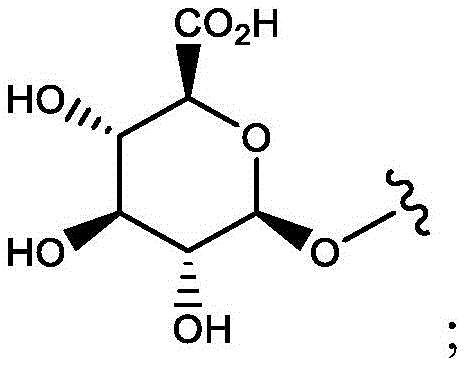
MCgluc is selected from the group consisting of:
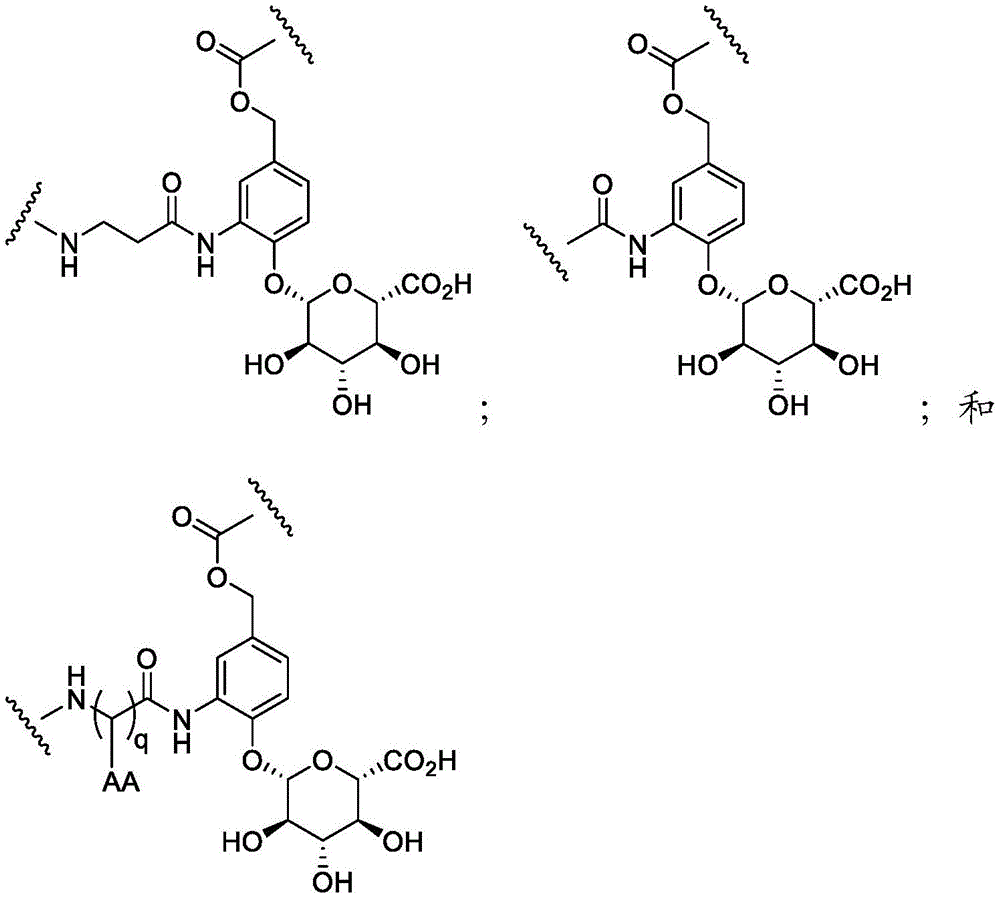
wherein q is 1 to 8 and AA is an amino acid side chain;
wherein the alkyl, alkyldiyl, alkenyl, alkenyldiyl, alkynyl, alkynediyl, aryl, aryldiyl carbocyclyl, carbocyclyldiyl, heterocyclyl, heterocyclyldiyl, heteroaryl, and heteroaryldiyl are optionally substituted with one or more groups independently selected from: F. cl, Br, I, -CN, -CH3、-CH2CH3、-CH=CH2、-C≡CH、-C≡CCH3、-CH2CH2CH3、-CH(CH3)2、-CH2CH(CH3)2、-CH2OH、-CH2OCH3、-CH2CH2OH、-C(CH3)2OH、-CH(OH)CH(CH3)2、-C(CH3)2CH2OH、-CH2CH2SO2CH3、-CH2OP(O)(OH)2、-CH2F、-CHF2、-CF3、-CH2CF3、-CH2CHF2、-CH(CH3)CN、-C(CH3)2CN、-CH2CN、-CH2NH2、-CH2NHSO2CH3、-CH2NHCH3、-CH2N(CH3)2、-CO2H、-COCH3、-CO2CH3、-CO2C(CH3)3、-COCH(OH)CH3、-CONH2、-CONHCH3、-CON(CH3)2、-C(CH3)2CONH2、-NH2、-NHCH3、-N(CH3)2、-NHCOCH3、-N(CH3)COCH3、-NHS(O)2CH3、-N(CH3)C(CH3)2CONH2、-N(CH3)CH2CH2S(O)2CH3、-NO2、=O、-OH、-OCH3、-OCH2CH3、-OCH2CH2OCH3、-OCH2CH2OH、-OCH2CH2N(CH3)2、-O(CH2CH2O)n-(CH2)mCO2H、-O(CH2CH2O)nH、-OP(O)(OH)2、-S(O)2N(CH3)2、-SCH3、-S(O)2CH3and-S (O)3H。
2. The immunoconjugate of claim 1, wherein the antibody is an antibody construct having an antigen binding domain that binds PD-L1.
3. The immunoconjugate of claim 2, wherein the antibody is selected from the group consisting of: alemtuzumab, Duvaliuzumab and Avermezumab, or biosimilar or modified biosimilar drugs thereof.
4. The immunoconjugate of claim 1, wherein the antibody is an antibody construct having an antigen binding domain that binds HER 2.
5. The immunoconjugate of claim 4, wherein the antibody is selected from the group consisting of: trastuzumab and pertuzumab, or their biosimilars or modified biosimilarity drugs.
6. The immunoconjugate of claim 1, wherein the antibody is an antibody construct having an antigen binding domain that binds CEA.
7. The immunoconjugate of claim 6, wherein the antibody is labezumab or a biosimilar or modified biosimilar drug thereof.
8. The immunoconjugate of any one of claims 1 to 7, wherein y is 0.
9. The immunoconjugate of any one of claims 1 to 7, wherein y is 1.
10. The immunoconjugate of any one of claims 1 to 7, wherein PEP has the formula:

wherein AA1And AA2Independently selected from the side chains of naturally occurring amino acids.
11. The immunoconjugate of claim 10, wherein AA1Or AA2Form a 5-membered cyclic proline amino acid with the adjacent nitrogen atom.
12. The immunoconjugate of claim 11, wherein PEP has the formula:

13. the immunoconjugate of any one of claims 1 to 7, wherein MCgluc has the formula:

14. the immunoconjugate of claim 10, wherein AA1And AA2Independently selected from H, -CH3、-CH(CH3)2、-CH2(C6H5)、-CH2CH2CH2CH2NH2、-CH2CH2CH2NHC(NH)NH2、-CHCH(CH3)CH3、-CH2SO3H. and-CH2CH2CH2NHC(O)NH2。
15. The immunoconjugate of claim 10, wherein AA1is-CH (CH)3)2And AA2is-CH2CH2CH2NHC(O)NH2。
16. The immunoconjugate of any one of claims 1 to 7, wherein X1Is a bond, and R1Is H.
17. The immunoconjugate of any one of claims 1 to 7, wherein X2Is a bond, and R2Is C1-C8An alkyl group.
18. The immunoconjugate of any one of claims 1 to 7, wherein X2And X3Are all a bond, and R2And R3Independently selected from C1-C8Alkyl, -O- (C)1-C12Alkyl), - (C)1-C12Alkyldiyl) -OR5、-(C1-C8Alkyl diyl) -N (R)5)CO2R5and-O- (C)1-C12Alkyl) -N (R)5)CO2R5。
19. The immunoconjugate of claim 18, wherein R2And R3Each independently selected from-CH2CH2CH3、-OCH2CH3、-CH2CH2CF3and-CH2CH2CH2OH。
20. The immunoconjugate of claim 18, wherein R2Is C1-C8Alkyl and R3Is- (C)1-C8Alkyl diyl) -N (R)5)CO2R4。
21. The immunoconjugate of claim 20, wherein R2is-CH2CH2CH3And R is3is-CH2CH2CH2NHCO2(t-Bu)。
22. The immunoconjugate of claim 23, wherein R2And R3Are all-CH2CH2CH3。
23. The immunoconjugate of claim 17, wherein X3-R3Selected from the group consisting of:

24. the immunoconjugate of any one of claims 1 to 7, wherein Het is a 5-or 6-membered monocyclic heteroaryldiyl selected from the group consisting of: pyridyl diyl, imidazolyl diyl, pyrimidyl diyl, pyrazolyl diyl, triazolyl diyl, pyrazinyl diyl, tetrazolyl diyl, furyl diyl, thienyl diyl, isoxazolyl diyl, thiazolyl diyl, oxadiazolyl diyl, oxazolyl diyl, isothiazolyl diyl, and pyrrolyl diyl.
25. The immunoconjugate of any one of claims 1 to 7, wherein Het is a 5-or 6-membered monocyclic heterocyclyldiyl selected from the group consisting of: morpholinyldiyl, piperidinediyl, piperazinediyl, pyrrolidinyldiyl, dioxanyl diyl, thiomorpholinodiyl and S-dioxothiomorpholinodiyl.
26. The immunoconjugate of any one of claims 1 to 7, wherein Het is 1, 6-naphthyridinyl or 1, 6-naphthyridinediyl.
27. The immunoconjugate of any one of claims 1 to 7, wherein L is selected from the group consisting of:
-C(=O)-CH2CH2OCH2CH2-(C1-C20heteroaryl diyl) -CH2O-(PEG)-C(=O)-(MCgluc)-NR5(C1-C12Alkyldiyl) NR5C(=O)-(C2-C5Heterocyclyldiyl) -;
-C(=O)-(PEG)-C(=O)-NR5(C1-C12alkyl diyl) -;
-C(=O)-(PEG)-C(=O)-NR5(C1-C12alkyldiyl) NR5C(=O)-(C2-C5Heterocyclyldiyl) -;
-C(=O)-(PEG)-C(=O)-(PEP)-NR5(C1-C12alkyl diyl) -;
-C(=O)-(PEG)-C(=O)-(PEP)-NR5(C1-C12alkyldiyl) NR5C(=O)-(C2-C5Heterocyclyldiyl) -; and
- (succinimidyl) - (CH)2)m-C(=O)-(PEP)-NR5(C1-C12Alkyldiyl) NR5C(=O)-(C2-C5Heterocyclyldiyl) -.
28. The immunoconjugate of any one of claims 1 to 7, selected from formulas Ia to Id:

29. 8-amido-2-aminobenzazepine of formula II -a linker compound:
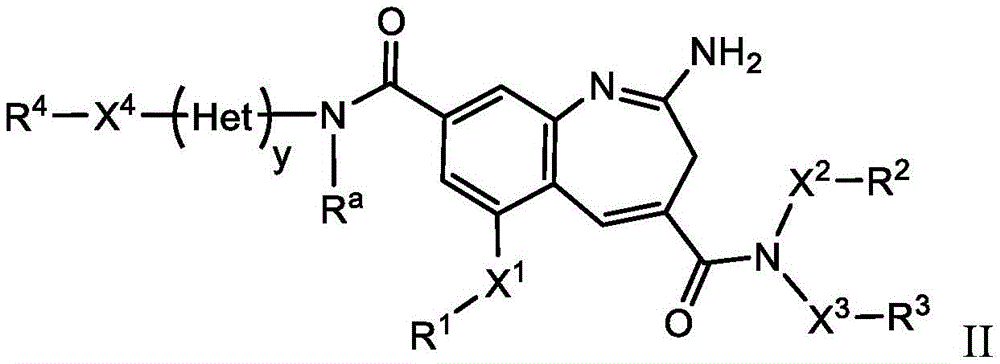
wherein
y is 0 or 1;
het is selected from the group consisting of: heterocyclyl, heterocyclyldiyl, heteroaryl, and heteroaryldiyl;
Rais H or forms Het with the nitrogen atom to which it is bonded;
R1、R2、R3and R4Independently selected from the group consisting of: H. c1-C12Alkyl radical, C2-C6Alkenyl radical, C2-C6Alkynyl, C3-C12Carbocyclyl, C6-C20Aryl radical, C2-C9Heterocyclyl and C1-C20Heteroaryl, wherein alkyl, alkenyl, alkynyl, carbocyclyl, aryl, heterocyclyl and heteroaryl are independently and optionally substituted with one or more groups selected from:
-(C1-C12alkyl diyl) -N (R)5)-*;
-(C1-C12Alkyl diyl) -N (R)5)2;
-(C1-C12Alkyldiyl) -OR5;
-(C3-C12Carbocyclyl);
-(C3-C12carbocyclyl) -;
-(C3-C12carbocyclyl) - (C1-C12Alkyldiyl) -NR5-*;
-(C3-C12Carbocyclyl) - (C1-C12Alkyl diyl) -N (R)5)2;
-(C3-C12Carbocyclyl) -NR5-C(=NR5)NR5-*;
-(C6-C20Aryl);
-(C6-C20aryl) -;
-(C6-C20aryl diyl) -N (R)5)-*;
-(C6-C20Aryl diyl) - (C)1-C12Alkyl diyl) -N (R)5)-*;
-(C6-C20Aryl diyl) - (C)1-C12Alkyl diyl) - (C)2-C20Heterocyclyl diradical) -;
-(C6-C20aryl diyl) - (C)1-C12Alkyl diyl) -N (R)5)2;
-(C6-C20Aryl diyl) - (C)1-C12Alkyldiyl) -NR5-C(=NR5a)N(R5)-*;
-(C2-C20A heterocyclic group);
-(C2-C20heterocyclyl) -;
-(C2-C9heterocyclyl) - (C)1-C12Alkyldiyl) -NR5-*;
-(C2-C9Heterocyclyl) - (C)1-C12Alkyl diyl) -N (R)5)2;
-(C2-C9Heterocyclyl) -NR5-C(=NR5a)NR5-*;
-(C1-C20Heteroaryl);
-(C1-C20heteroaryl) -;
-(C1-C20heteroaryl) - (C)1-C12Alkyl diyl) -N (R)5)-*;
-(C1-C20Heteroaryl) - (C)1-C12Alkyl diyl) -N (R)5)2;
-(C1-C20Heteroaryl) -NR5-C(=NR5a)N(R5)-*;
-C(=O)-*;
-C(=O)-(C1-C12Alkyl diyl) -N (R)5)-*;
-C(=O)-(C2-C20Heterocyclyl diradical) -;
-C(=O)N(R5)2;
-C(=O)N(R5)-*;
-C(=O)N(R5)-(C1-C12alkyl diyl) -N (R)5)C(=O)R5;
-C(=O)N(R5)-(C1-C12Alkyl diyl) -N (R)5)C(=O)N(R5)2;
-C(=O)NR5-(C1-C12Alkyl diyl) -N (R)5)CO2R5;
-C(=O)NR5-(C1-C12Alkyl diyl) -N (R)5)C(=NR5a)N(R5)2;
-C(=O)NR5-(C1-C12Alkyldiyl) -NR5C(=NR5a)R5;
-C(=O)NR5-(C1-C8Alkyldiyl) -NR5(C2-C5Heteroaryl);
-C(=O)NR5-(C1-C20heteroaryl diyl) -N (R)5)-*;
-C(=O)NR5-(C1-C20Heteroaryl diyl) -;
-C(=O)NR5-(C1-C20heteroaryl diyl) - (C)1-C12Alkyl diyl) -N (R)5)2;
-C(=O)NR5-(C1-C20Heteroaryl diyl) - (C)2-C20Heterocyclyldiyl) -C (═ O) NR5-(C1-C12Alkyldiyl) -NR5-*;
-N(R5)2;
-N(R5)-*;
-N(R5)C(=O)R5;
-N(R5)C(=O)-*;
-N(R5)C(=O)N(R5)2;
-N(R5)C(=O)N(R5)-*;
-N(R5)CO2R5;
-NR5C(=NR5a)N(R5)2;
-NR5C(=NR5a)N(R5)-*;
-NR5C(=NR5a)R5;
-N(R5)-(C2-C5Heteroaryl);
-O-(C1-C12alkyl groups);
-O-(C1-C12alkyl diyl) -N (R)5)2;
-O-(C1-C12Alkyl diyl) -N (R)5)-*;
-S(=O)2-(C2-C20Heterocyclyl diradical) -;
-S(=O)2-(C2-C20heterocyclyl diyl) - (C)1-C12Alkyl diyl) -N (R)5)2;
-S(=O)2-(C2-C20Heterocyclyl diyl) - (C)1-C12Alkyldiyl) -NR5-; and
-S(=O)2-(C2-C20heterocyclyl diyl) - (C)1-C12Alkyldiyl) -OH;
or R2And R3Together form a 5-or 6-membered heterocyclyl ring;
X1、X2、X3and X4Independently selected from the group consisting of: a bond, C (═ O) N (R)5)、O、N(R5)、S、S(O)2And S (O)2N(R5);
R5Selected from the group consisting of: H. c6-C20Aryl radical, C6-C20Aryl diyl, C1-C12Alkyl and C1-C12Alkyl diyl, or two R5The groups together form a 5-or 6-membered heterocyclyl ring;
R5aselected from the group consisting of: c6-C20Aryl and C1-C20A heteroaryl group;
wherein the asterisks indicate the attachment site for L, and wherein R1、R2、R3And R4One of which is connected to L;
l is a linker selected from the group consisting of:
Q-C(=O)-(PEG)-C(=O)-(PEP)-;
Q-C(=O)-(PEG)-NR5-;
Q-C(=O)-(PEG)-NR5-(PEG)-C(=O)-(PEP)-;
Q-C(=O)-(PEG)-N+(R5)2-(PEG)-C(=O)-(PEP)-;
Q-C(=O)-(PEG)-C(=O)-;
Q-C(=O)-(PEG)-NR5CH(AA1)C(=O)-(PEG)-C(=O)-(PEP)-;
Q-C(=O)-(PEG)-SS-(C1-C12alkyl diyl) -OC (═ O) -;
Q-C(=O)-(PEG)-SS-(C1-C12alkyl diyl) -C (═ O) -;
Q-C(=O)-(PEG)-;
Q-C(=O)-(PEG)-C(=O)NR5(C1-C12alkyldiyl) NR5C(=O)-(C2-C5Heterocyclyldiyl) -;
Q-C(=O)-(PEG)-C(=O)NR5(C1-C12alkyl diyl) -;
Q-C(=O)-(C1-C12alkyl diyl) -C (═ O) - (PEP) -;
Q-C(=O)-(C1-C12alkyl diyl) -C (═ O) - (PEP) -NR5(C1-C12Alkyl diyl) -;
Q-C(=O)-(C1-C12alkyl diyl) -C (═ O) - (PEP) -NR5(C1-C12Alkyldiyl) NR5-C(=O);
Q-C(=O)-(C1-C12Alkyl diyl) -C (═ O) - (PEP) -NR5(C1-C12Alkyldiyl) NR5C(=O)-(C2-C5Heterocyclyldiyl) -;
Q-C(=O)-CH2CH2OCH2CH2-(C1-C20heteroaryl diyl) -CH2O-(PEG)-C(=O)-(MCgluc)-;
Q-C(=O)-CH2CH2OCH2CH2-(C1-C20Heteroaryl diyl) -CH2O-(PEG)-C(=O)-(MCgluc)-NR5(C1-C12Alkyldiyl) NR5C(=O)-(C2-C5Heterocyclyldiyl) -;
Q-C(=O)-(PEG)-C(=O)-NR5(C1-C12alkyl diyl) -;
Q-C(=O)-(PEG)-C(=O)-NR5(C1-C12alkyldiyl) NR5C(=O)-(C2-C5Heterocyclyldiyl) -;
Q-C(=O)-(PEG)-C(=O)-(PEP)-NR5(C1-C12alkyl diyl) -;
Q-C(=O)-(PEG)-C(=O)-(PEP)-NR5(C1-C12alkyldiyl) NR5C(=O)-(C2-C5Heterocyclyldiyl) -; and
Q-(CH2)m-C(=O)-(PEP)-NR5(C1-C12alkyldiyl) NR5C(=O)-(C2-C5Heterocyclyldiyl) -;
wherein the PEG has the formula: - (CH)2CH2O)n-(CH2)m-; m is an integer from 1 to 5, and n is an integer from 2 to 50;
PEP has the formula:

wherein AA1And AA2Independently selected from amino acid side chains, or AA1Or AA2Form a 5-membered cyclic proline amino acid with the adjacent nitrogen atom, and the wavy line indicates the point of attachment; and is
R6Is selected from-CH2O-C (═ O) -substituted, and C optionally substituted with6-C20Aryl diyl and C1-C20Heteroaryl diradicals:
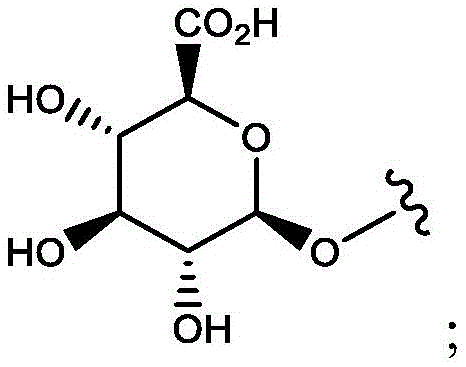
MCgluc is selected from the group consisting of:

wherein q is 1 to 8 and AA is an amino acid side chain; and is
Q is selected from the group consisting of: n-hydroxysuccinimide group, N-hydroxysulfosuccinimide group, maleimide group and a compound of one or more groups independently selected from F, Cl, NO2And SO3 -A phenoxy group substituted with the group of (a);
wherein the alkyl, alkyldiyl, alkenyl, alkenyldiyl, alkynyl, alkynediyl, aryl, aryldiyl carbocyclyl, carbocyclyldiyl, heterocyclyl, heterocyclyldiyl, heteroaryl, and heteroaryldiyl are optionally substituted with one or more groups independently selected from: F. cl, Br, I, -CN, -CH3、-CH2CH3、-CH=CH2、-C≡CH、-C≡CCH3、-CH2CH2CH3、-CH(CH3)2、-CH2CH(CH3)2、-CH2OH、-CH2OCH3、-CH2CH2OH、-C(CH3)2OH、-CH(OH)CH(CH3)2、-C(CH3)2CH2OH、-CH2CH2SO2CH3、-CH2OP(O)(OH)2、-CH2F、-CHF2、-CF3、-CH2CF3、-CH2CHF2、-CH(CH3)CN、-C(CH3)2CN、-CH2CN、-CH2NH2、-CH2NHSO2CH3、-CH2NHCH3、-CH2N(CH3)2、-CO2H、-COCH3、-CO2CH3、-CO2C(CH3)3、-COCH(OH)CH3、-CONH2、-CONHCH3、-CON(CH3)2、-C(CH3)2CONH2、-NH2、-NHCH3、-N(CH3)2、-NHCOCH3、-N(CH3)COCH3、-NHS(O)2CH3、-N(CH3)C(CH3)2CONH2、-N(CH3)CH2CH2S(O)2CH3、-NO2、=O、-OH、-OCH3、-OCH2CH3、-OCH2CH2OCH3、-OCH2CH2OH、-OCH2CH2N(CH3)2、-O(CH2CH2O)n-(CH2)mCO2H、-O(CH2CH2O)nH、-OP(O)(OH)2、-S(O)2N(CH3)2、-SCH3、-S(O)2CH3and-S (O)3H。
30. The 8-amido-2-aminobenzazepine of claim 29 -a linker compound wherein y is 0.
31. The 8-amido-2-aminobenzazepine of claim 29 -a linker compound wherein y is 1.
32. The 8-amido-2-aminobenzazepine of claim 29 -a linker compound, wherein PEP has the formula:

wherein AA1And AA2Independently selected from the side chains of naturally occurring amino acids.
33. The 8-amido-2-aminobenzazepine of claim 32 A linker compound, in which AA1Or AA2Form a 5-membered ring with the adjacent nitrogen atom to form a proline amino acid.
34. The 8-amido-2-aminobenzazepine of claim 33 -a linker compound, wherein PEP has the formula:

35. the 8-amido-2-aminobenzazepine of claim 29 -a linker compound, wherein MCgluc has the formula:

36. the 8-amido-2-aminobenzazepine of claim 32 A linker compound, in which AA1And AA2Independently selected from H, -CH3、-CH(CH3)2、-CH2(C6H5)、-CH2CH2CH2CH2NH2、-CH2CH2CH2NHC(NH)NH2、-CHCH(CH3)CH3、-CH2SO3H. and-CH2CH2CH2NHC(O)NH2。
37. The 8-amido-2-aminobenzazepine of claim 32 A linker compound, in which AA1is-CH (CH)3)2And AA2is-CH2CH2CH2NHC(O)NH2。
38. The 8-amido-2-aminobenzazepine of claim 29 -a linker compound, wherein X1Is a bond, and R1Is H.
39. The 8-amido-2-aminobenzazepine of claim 29 -a linker compound, wherein X2Is a bond, and R2Is C1-C8An alkyl group.
40. The 8-amido-2-aminobenzazepine of claim 29 -a linker compound, wherein X2And X3Are all a key, and are all provided with a plurality of keys,and R is2And R3Independently selected from C1-C8Alkyl, -O- (C)1-C12Alkyl), - (C)1-C12Alkyldiyl) -OR5、-(C1-C8Alkyl diyl) -N (R)5)CO2R5and-O- (C)1-C12Alkyl) -N (R)5)CO2R5。
41. The 8-amido-2-aminobenzazepine of claim 40 -a linker compound, wherein R2And R3Each independently selected from-CH2CH2CH3、-OCH2CH3、-CH2CH2CF3and-CH2CH2CH2OH。
42. The 8-amido-2-aminobenzazepine of claim 40 -a linker compound, wherein R2Is C1-C8Alkyl and R3Is- (C)1-C8Alkyl diyl) -N (R)5)CO2R4。
43. The 8-amido-2-aminobenzazepine of claim 42 -a linker compound, wherein R2is-CH2CH2CH3And R is3is-CH2CH2CH2NHCO2(t-Bu)。
44. The 8-amido-2-aminobenzazepine of claim 40 -a linker compound, wherein R2And R3Are all-CH2CH2CH3。
45. 5-amino-pyrazoloazepine according to claim 39 -a linker compound, wherein X3-R3Selected from the group consisting of:

46. the 8-amido-2-aminobenzazepine of claim 29 -a linker compound wherein Het is a 5 or 6 membered monocyclic heteroaryl diyl selected from the group consisting of: pyridyl diyl, imidazolyl diyl, pyrimidyl diyl, pyrazolyl diyl, triazolyl diyl, pyrazinyl diyl, tetrazolyl diyl, furyl diyl, thienyl diyl, isoxazolyl diyl, thiazolyl diyl, oxadiazolyl diyl, oxazolyl diyl, isothiazolyl diyl, and pyrrolyl diyl.
47. The 8-amido-2-aminobenzazepine of claim 29 -a linker compound wherein Het is a 5 or 6 membered monocyclic heterocyclyldiyl selected from the group consisting of: morpholinyldiyl, piperidinediyl, piperazinediyl, pyrrolidinyldiyl, dioxanyl diyl, thiomorpholinodiyl and S-dioxothiomorpholinodiyl.
48. The 8-amido-2-aminobenzazepine of claim 29 -linker compounds wherein Het is 1, 6-naphthyridinyl or 1, 6-naphthyridinediyl.
49. The 8-amido-2-aminobenzazepine of claim 29 -a linker compound, wherein L is selected from the group consisting of:
Q-C(=O)-CH2CH2OCH2CH2-(C1-C20heteroaryl diyl) -CH2O-(PEG)-C(=O)-(MCgluc)-NR5(C1-C12Alkyldiyl) NR5C(=O)-(C2-C5Heterocyclyldiyl) -;
Q-C(=O)-(PEG)-C(=O)-NR5(C1-C12alkyl diyl) -;
Q-C(=O)-(PEG)-C(=O)-NR5(C1-C12alkyldiyl) NR5C(=O)-(C2-C5Heterocyclyldiyl) -;
Q-C(=O)-(PEG)-C(=O)-(PEP)-NR5(C1-C12alkyl diyl) -;
Q-C(=O)-(PEG)-C(=O)-(PEP)-NR5(C1-C12alkyldiyl) NR5C(=O)-(C2-C5Heterocyclyldiyl) -; and
Q-(CH2)m-C(=O)-(PEP)-NR5(C1-C12alkyldiyl) NR5C(=O)-(C2-C5Heterocyclyldiyl) -.
50. The 8-amido-2-aminobenzazepine of claim 29 -a linker compound, wherein Q is selected from:

51. the aminoquinoline-linker compound of claim 29 wherein Q is phenoxy substituted with one or more F.
52. The aminoquinoline-linker compound of claim 51 wherein Q is 2,3,5, 6-tetrafluorophenoxy.
53. The 8-amido-2-aminobenzazepine of claim 29 -linker compound, said 8-amido-2-aminobenzazepine
 -the linker compound is selected from formulae IIa to IId:


54. the 8-amido-2-aminobenzazepine of claim 29 -linker compound, said 8-amido-2-aminobenzazepine
 -linker compound is selected from table 2 a.
55. The 8-amido-2-aminobenzazepine of claim 29 -linker compound, said 8-amido-2-aminobenzazepine
 -linker compound is selected from table 2 b.
56. A method for treating cancer, the method comprising administering to a patient in need thereof a therapeutically effective amount of an immunoconjugate according to any one of claims 1 to 7.
57. The method of claim 56, wherein the cancer is susceptible to a pro-inflammatory response induced by TLR7 and/or TLR8 agonism.
58. The method of claim 56, wherein the cancer is a PD-L1-expressing cancer.
59. The method of claim 56, wherein the cancer is HER 2-expressing cancer.
60. The method of claim 56, wherein the cancer is a CEA-expressing cancer.
61. The method of claim 56, wherein the cancer is a Caprin-1 expressing cancer.
62. The method of any one of claims 56-61, wherein the cancer is selected from bladder cancer, urinary tract cancer, urothelial cancer, lung cancer, non-small cell lung cancer, Mercker cell cancer, colon cancer, colorectal cancer, gastric cancer, and breast cancer.
63. The method of claim 62, wherein the breast cancer is triple negative breast cancer.
64. The method of claim 62 wherein the Merck cell carcinoma is metastatic Merck cell carcinoma.
65. The method of claim 62, wherein the gastric cancer is HER 2-overexpressing gastric cancer.
66. The method of claim 62, wherein the cancer is gastroesophageal junction adenocarcinoma.
67. Use of the immunoconjugate according to any one of claims 1 to 7 for the treatment of cancer.
68. A process for preparing an immunoconjugate of formula I as defined in claim 1, wherein an 8-amido-2-aminobenzazepine of formula II as defined in claim 29 is reacted -a linker compound is conjugated to the antibody.
69. The method of claim 68, wherein the 8-amido-2-aminobenzazepine -the linker compound is selected from table 2a or table 2 b.
Applications Claiming Priority (3)
| Application Number | Priority Date | Filing Date | Title |
|---|---|---|---|
| US201962908253P | 2019-09-30 | 2019-09-30 | |
| US62/908,253 | 2019-09-30 | ||
| PCT/US2020/053224 WO2021067242A1 (en) | 2019-09-30 | 2020-09-29 | Amide-linked, aminobenzazepine immunoconjugates, and uses thereof |
Publications (1)
| Publication Number | Publication Date |
|---|---|
| CN114746404A true CN114746404A (en) | 2022-07-12 |
Family
ID=72840675
Family Applications (1)
| Application Number | Title | Priority Date | Filing Date |
|---|---|---|---|
| CN202080080877.XA Pending CN114746404A (en) | 2019-09-30 | 2020-09-29 | Amide-linked aminobenzazepine immunoconjugates and uses thereof |
Country Status (11)
| Country | Link |
|---|---|
| US (1) | US20220347310A1 (en) |
| EP (1) | EP4038053A1 (en) |
| JP (1) | JP2022549510A (en) |
| KR (1) | KR20220077131A (en) |
| CN (1) | CN114746404A (en) |
| AU (1) | AU2020359446A1 (en) |
| BR (1) | BR112022006001A2 (en) |
| CA (1) | CA3152601A1 (en) |
| IL (1) | IL291760A (en) |
| MX (1) | MX2022003740A (en) |
| WO (1) | WO2021067242A1 (en) |
Cited By (1)
| Publication number | Priority date | Publication date | Assignee | Title |
|---|---|---|---|---|
| WO2024067841A1 (en) * | 2022-09-30 | 2024-04-04 | 上海迪诺医药科技有限公司 | Benzazepine derivative, conjugate containing same, and use thereof |
Families Citing this family (12)
| Publication number | Priority date | Publication date | Assignee | Title |
|---|---|---|---|---|
| AU2017292934B9 (en) | 2016-07-07 | 2024-08-29 | Bolt Biotherapeutics, Inc. | Antibody adjuvant conjugates |
| AU2020241686A1 (en) | 2019-03-15 | 2021-11-04 | Bolt Biotherapeutics, Inc. | Immunoconjugates targeting HER2 |
| CA3176626A1 (en) * | 2020-05-08 | 2021-11-11 | David Dornan | Elastase-substrate, peptide linker immunoconjugates, and uses thereof |
| US20220195066A1 (en) * | 2020-12-11 | 2022-06-23 | Bolt Biotherapeutics, Inc. | Anti-cea immunoconjugates, and uses thereof |
| CA3212907A1 (en) * | 2021-03-26 | 2022-09-29 | Gary Brandt | 2-amino-4-carboxamide-benzazepine immunoconjugates, and uses thereof |
| JP2024511088A (en) * | 2021-03-26 | 2024-03-12 | ボルト バイオセラピューティクス、インコーポレーテッド | 2-amino-4-carboxamide-benzazepine immunoconjugate and uses thereof |
| EP4342884A4 (en) * | 2021-05-19 | 2025-10-29 | Shanghai De Novo Pharmatech Co Ltd | Nitrogen-containing compound, conjugate with said compound and use thereof |
| CA3234604A1 (en) * | 2021-10-29 | 2023-05-04 | Shelley Erin ACKERMAN | Tlr agonist immunoconjugates with cysteine-mutant antibodies, and uses thereof |
| CN118302420A (en) * | 2021-12-16 | 2024-07-05 | 映恩生物制药(苏州)有限公司 | TLR modulators and uses thereof |
| TW202339806A (en) * | 2022-02-09 | 2023-10-16 | 美商博特生物治療公司 | 8-sulfonyl-benzazepine immunoconjugates, and uses thereof |
| WO2023154302A1 (en) * | 2022-02-09 | 2023-08-17 | Bolt Biotherapeutics, Inc. | Macromolecule-supported 8-sulfonyl-benzazepine compounds and their uses |
| WO2024173384A1 (en) | 2023-02-14 | 2024-08-22 | Bolt Biotherapeutics, Inc. | Aza-benzazepine immunoconjugates, and uses thereof |
Family Cites Families (47)
| Publication number | Priority date | Publication date | Assignee | Title |
|---|---|---|---|---|
| US723288A (en) | 1901-10-26 | 1903-03-24 | Harry South Lewis | Cipher-key for cryptographic codes. |
| WO1988007089A1 (en) | 1987-03-18 | 1988-09-22 | Medical Research Council | Altered antibodies |
| WO1989006692A1 (en) | 1988-01-12 | 1989-07-27 | Genentech, Inc. | Method of treating tumor cells by inhibiting growth factor receptor function |
| JP4124480B2 (en) | 1991-06-14 | 2008-07-23 | ジェネンテック・インコーポレーテッド | Immunoglobulin variants |
| US6800738B1 (en) | 1991-06-14 | 2004-10-05 | Genentech, Inc. | Method for making humanized antibodies |
| WO1994004679A1 (en) | 1991-06-14 | 1994-03-03 | Genentech, Inc. | Method for making humanized antibodies |
| US5874540A (en) | 1994-10-05 | 1999-02-23 | Immunomedics, Inc. | CDR-grafted type III anti-CEA humanized mouse monoclonal antibodies |
| ES2292682T3 (en) | 1998-05-06 | 2008-03-16 | Genentech, Inc. | PURIFICATION OF ANTIBODIES THROUGH IONIC EXCHANGE CHROMATOGRAPHY. |
| US6949245B1 (en) | 1999-06-25 | 2005-09-27 | Genentech, Inc. | Humanized anti-ErbB2 antibodies and treatment with anti-ErbB2 antibodies |
| JP2003531149A (en) | 2000-04-13 | 2003-10-21 | ザ・ロツクフエラー・ユニバーシテイ | Enhancement of antibody-derived immune response |
| US7273608B2 (en) | 2004-03-11 | 2007-09-25 | City Of Hope | Humanized anti-CEA T84.66 antibody and uses thereof |
| NZ553500A (en) | 2004-09-23 | 2009-11-27 | Genentech Inc Genentech Inc | Cysteine engineered antibodies and conjugates withCysteine engineered antibodies and conjugates with a free cysteine amino acid in the heavy chain a free cysteine amino acid in the heavy chain |
| EP1835935A4 (en) | 2004-12-30 | 2009-06-17 | Univ Rockefeller | COMPOSITIONS AND METHODS FOR IMPROVED DENDRITIC CELL REPRODUCTION AND FUNCTION |
| WO2007055916A2 (en) | 2005-11-07 | 2007-05-18 | The Rockefeller University | Reagents, methods and systems for selecting a cytotoxic antibody or variant thereof |
| US8394926B2 (en) | 2005-12-21 | 2013-03-12 | Micromet Ag | Pharmaceutical compositions with resistance to soluble CEA |
| CL2008001334A1 (en) | 2007-05-08 | 2008-09-22 | Genentech Inc | ANTI-MUC16 ANTIBODY DESIGNED WITH CISTEINE; CONJUGADO THAT UNDERSTANDS IT; METHOD OF PRODUCTION; PHARMACEUTICAL FORMULATION THAT UNDERSTANDS IT; AND ITS USE TO TREAT CANCER. |
| AU2008312457B2 (en) | 2007-10-19 | 2014-04-17 | Genentech, Inc. | Cysteine engineered anti-TENB2 antibodies and antibody drug conjugates |
| RU2567657C2 (en) | 2010-02-04 | 2015-11-10 | Торэй Индастриз, Инк. | Pharmaceutical composition for treating and/or preventing cancer |
| CN103313990B (en) | 2010-11-17 | 2016-07-20 | 基因泰克公司 | Alanyl maytansinol antibody coupling matter |
| PT2681244T (en) | 2011-03-02 | 2018-01-24 | Roche Glycart Ag | Cea antibodies |
| BR112014002621B1 (en) | 2011-08-04 | 2022-09-20 | Toray Industries, Inc | ANTIBODY, OR FRAGMENT THEREOF, PHARMACEUTICAL COMPOSITION, USE OF AN ANTIBODY AND USE OF A PHARMACEUTICAL COMPOSITION |
| JP6065591B2 (en) | 2011-08-04 | 2017-01-25 | 東レ株式会社 | Pharmaceutical composition for treatment and / or prevention of cancer |
| CA2844040C (en) | 2011-08-04 | 2019-05-07 | Toray Industries, Inc. | Pharmaceutical composition for treatment and/or prophylaxis of cancer |
| JP6065592B2 (en) | 2011-08-04 | 2017-01-25 | 東レ株式会社 | Pharmaceutical composition for treatment and / or prevention of cancer |
| JP6187256B2 (en) | 2012-02-21 | 2017-08-30 | 東レ株式会社 | Pharmaceutical composition for treatment and / or prevention of cancer |
| PT2824114T (en) | 2012-02-21 | 2019-08-05 | Toray Industries | Pharmaceutical composition for treatment of cancer |
| PL2818481T3 (en) | 2012-02-21 | 2020-02-28 | Toray Industries, Inc. | Pharmaceutical composition for treatment and/or prevention of cancer |
| JP6187255B2 (en) | 2012-02-21 | 2017-08-30 | 東レ株式会社 | Pharmaceutical composition for treatment and / or prevention of cancer |
| AU2013291047B2 (en) | 2012-07-19 | 2018-12-06 | Toray Industries, Inc. | Cancer detection method |
| EP2876447B1 (en) | 2012-07-19 | 2019-11-20 | Toray Industries, Inc. | Method for detecting cancer |
| TWI664192B (en) | 2012-11-20 | 2019-07-01 | 法商賽諾菲公司 | anti-CEACAM5 antibody and use thereof |
| DK3031826T3 (en) | 2013-08-09 | 2018-12-17 | Toray Industries | Pharmaceutical composition for the treatment and / or prevention of cancer |
| HUE054873T2 (en) | 2014-02-10 | 2021-10-28 | Merck Patent Gmbh | Targeted tgf beta inhibition |
| DK3221363T3 (en) | 2014-11-21 | 2020-08-10 | Bristol Myers Squibb Co | ANTIBODIES TO CD73 AND USES THEREOF |
| WO2016096778A1 (en) * | 2014-12-18 | 2016-06-23 | F. Hoffmann-La Roche Ag | Benzazepine sulfonamide compounds |
| MX364223B (en) * | 2015-03-06 | 2019-04-16 | Hoffmann La Roche | Benzazepine dicarboxamide compounds. |
| US20180303845A1 (en) * | 2015-11-02 | 2018-10-25 | Ventirx Pharmaceuticals, Inc. | Use of tlr8 agonists to treat cancer |
| EP3464245B1 (en) * | 2016-05-23 | 2020-10-14 | H. Hoffnabb-La Roche Ag | Benzazepine dicarboxamide compounds with tertiary amide function |
| JP7022702B2 (en) * | 2016-05-23 | 2022-02-18 | エフ・ホフマン-ラ・ロシュ・アクチェンゲゼルシャフト | Benzazepine dicarboxamide compound having a secondary amide group |
| WO2017216054A1 (en) * | 2016-06-12 | 2017-12-21 | F. Hoffmann-La Roche Ag | Dihydropyrimidinyl benzazepine carboxamide compounds |
| WO2018079740A1 (en) | 2016-10-28 | 2018-05-03 | 東レ株式会社 | Pharmaceutical composition for cancer treatment and/or prevention |
| US20190336615A1 (en) * | 2017-01-27 | 2019-11-07 | Silverback Therapeutics, Inc. | Tumor targeting conjugates and methods of use thereof |
| HUE056427T2 (en) * | 2017-03-15 | 2022-02-28 | Silverback Therapeutics Inc | Benzazepine compounds, conjugates, and uses thereof |
| WO2019084060A1 (en) * | 2017-10-24 | 2019-05-02 | Silverback Therapeutics, Inc. | Conjugates and methods of use thereof for selective delivery of immune-modulatory agents |
| SG11202101980VA (en) * | 2018-09-12 | 2021-03-30 | Silverback Therapeutics Inc | Methods and composition for the treatment of disease with immune stimulatory conjugates |
| WO2020056194A1 (en) * | 2018-09-12 | 2020-03-19 | Silverback Therapeutics, Inc. | Benzazepine compounds, conjugates, and uses thereof |
| US20200390899A1 (en) * | 2019-06-13 | 2020-12-17 | Bolt Biotherapeutics, Inc. | Aminobenzazepine compounds, immunoconjugates, and uses thereof |
-
2020
- 2020-09-29 EP EP20790158.8A patent/EP4038053A1/en not_active Withdrawn
- 2020-09-29 BR BR112022006001A patent/BR112022006001A2/en unknown
- 2020-09-29 CA CA3152601A patent/CA3152601A1/en active Pending
- 2020-09-29 MX MX2022003740A patent/MX2022003740A/en unknown
- 2020-09-29 US US17/764,503 patent/US20220347310A1/en not_active Abandoned
- 2020-09-29 JP JP2022519572A patent/JP2022549510A/en not_active Ceased
- 2020-09-29 CN CN202080080877.XA patent/CN114746404A/en active Pending
- 2020-09-29 KR KR1020227012279A patent/KR20220077131A/en not_active Withdrawn
- 2020-09-29 AU AU2020359446A patent/AU2020359446A1/en active Pending
- 2020-09-29 WO PCT/US2020/053224 patent/WO2021067242A1/en not_active Ceased
-
2022
- 2022-03-28 IL IL291760A patent/IL291760A/en unknown
Cited By (1)
| Publication number | Priority date | Publication date | Assignee | Title |
|---|---|---|---|---|
| WO2024067841A1 (en) * | 2022-09-30 | 2024-04-04 | 上海迪诺医药科技有限公司 | Benzazepine derivative, conjugate containing same, and use thereof |
Also Published As
| Publication number | Publication date |
|---|---|
| JP2022549510A (en) | 2022-11-25 |
| AU2020359446A1 (en) | 2022-04-21 |
| MX2022003740A (en) | 2022-05-02 |
| CA3152601A1 (en) | 2021-04-08 |
| US20220347310A1 (en) | 2022-11-03 |
| BR112022006001A2 (en) | 2022-07-12 |
| IL291760A (en) | 2022-06-01 |
| EP4038053A1 (en) | 2022-08-10 |
| KR20220077131A (en) | 2022-06-08 |
| WO2021067242A1 (en) | 2021-04-08 |
Similar Documents
| Publication | Publication Date | Title |
|---|---|---|
| CN114746404A (en) | Amide-linked aminobenzazepine immunoconjugates and uses thereof | |
| CN115996756A (en) | Elastase substrate peptide linker immunoconjugates and uses thereof | |
| WO2021081407A1 (en) | Thienoazepine immunoconjugates, and uses thereof | |
| CN114630684A (en) | Aminoquinoline compounds, immunoconjugates and uses thereof | |
| KR20230118148A (en) | Immunoconjugates comprising anti-CEA antibodies linked by conjugation to one or more 8-HET-2-aminobenzazepine derivatives useful for the treatment of cancer | |
| EP4259212A1 (en) | Anti-her2 immunoconjugates, and uses thereof | |
| WO2023154318A1 (en) | Anti-tr0p2, aminobenzazepine immunoconjugates, and uses thereof | |
| CN116723866A (en) | Anti-PD-L1 immunoconjugates and uses thereof | |
| CN116635084A (en) | anti-CEA immunoconjugates and uses thereof | |
| CN116897054A (en) | Anti-HER2 immunoconjugates and their uses | |
| EP4313161A1 (en) | 2-amino-4-carboxamide-benzazepine immunoconjugates, and uses thereof | |
| KR20240139086A (en) | Antibody-conjugated 8-sulfonyl-benzazepine compounds and uses thereof | |
| CN115209920A (en) | Thienoazepine immunoconjugates and uses thereof |
Legal Events
| Date | Code | Title | Description |
|---|---|---|---|
| PB01 | Publication | ||
| PB01 | Publication | ||
| SE01 | Entry into force of request for substantive examination | ||
| SE01 | Entry into force of request for substantive examination |