CN114729384A - Engineered adeno-associated virus capsids - Google Patents
Engineered adeno-associated virus capsids Download PDFInfo
- Publication number
- CN114729384A CN114729384A CN202080075936.4A CN202080075936A CN114729384A CN 114729384 A CN114729384 A CN 114729384A CN 202080075936 A CN202080075936 A CN 202080075936A CN 114729384 A CN114729384 A CN 114729384A
- Authority
- CN
- China
- Prior art keywords
- vector
- aav
- cell
- polynucleotide
- capsid
- Prior art date
- Legal status (The legal status is an assumption and is not a legal conclusion. Google has not performed a legal analysis and makes no representation as to the accuracy of the status listed.)
- Pending
Links
Images




Classifications
-
- C—CHEMISTRY; METALLURGY
- C12—BIOCHEMISTRY; BEER; SPIRITS; WINE; VINEGAR; MICROBIOLOGY; ENZYMOLOGY; MUTATION OR GENETIC ENGINEERING
- C12N—MICROORGANISMS OR ENZYMES; COMPOSITIONS THEREOF; PROPAGATING, PRESERVING, OR MAINTAINING MICROORGANISMS; MUTATION OR GENETIC ENGINEERING; CULTURE MEDIA
- C12N15/00—Mutation or genetic engineering; DNA or RNA concerning genetic engineering, vectors, e.g. plasmids, or their isolation, preparation or purification; Use of hosts therefor
- C12N15/09—Recombinant DNA-technology
- C12N15/63—Introduction of foreign genetic material using vectors; Vectors; Use of hosts therefor; Regulation of expression
- C12N15/79—Vectors or expression systems specially adapted for eukaryotic hosts
- C12N15/85—Vectors or expression systems specially adapted for eukaryotic hosts for animal cells
- C12N15/86—Viral vectors
-
- A—HUMAN NECESSITIES
- A61—MEDICAL OR VETERINARY SCIENCE; HYGIENE
- A61K—PREPARATIONS FOR MEDICAL, DENTAL OR TOILETRY PURPOSES
- A61K48/00—Medicinal preparations containing genetic material which is inserted into cells of the living body to treat genetic diseases; Gene therapy
- A61K48/0008—Medicinal preparations containing genetic material which is inserted into cells of the living body to treat genetic diseases; Gene therapy characterised by an aspect of the 'non-active' part of the composition delivered, e.g. wherein such 'non-active' part is not delivered simultaneously with the 'active' part of the composition
-
- C—CHEMISTRY; METALLURGY
- C07—ORGANIC CHEMISTRY
- C07K—PEPTIDES
- C07K14/00—Peptides having more than 20 amino acids; Gastrins; Somatostatins; Melanotropins; Derivatives thereof
- C07K14/005—Peptides having more than 20 amino acids; Gastrins; Somatostatins; Melanotropins; Derivatives thereof from viruses
-
- C—CHEMISTRY; METALLURGY
- C12—BIOCHEMISTRY; BEER; SPIRITS; WINE; VINEGAR; MICROBIOLOGY; ENZYMOLOGY; MUTATION OR GENETIC ENGINEERING
- C12N—MICROORGANISMS OR ENZYMES; COMPOSITIONS THEREOF; PROPAGATING, PRESERVING, OR MAINTAINING MICROORGANISMS; MUTATION OR GENETIC ENGINEERING; CULTURE MEDIA
- C12N15/00—Mutation or genetic engineering; DNA or RNA concerning genetic engineering, vectors, e.g. plasmids, or their isolation, preparation or purification; Use of hosts therefor
- C12N15/09—Recombinant DNA-technology
- C12N15/10—Processes for the isolation, preparation or purification of DNA or RNA
- C12N15/1034—Isolating an individual clone by screening libraries
- C12N15/1062—Isolating an individual clone by screening libraries mRNA-Display, e.g. polypeptide and encoding template are connected covalently
-
- C—CHEMISTRY; METALLURGY
- C12—BIOCHEMISTRY; BEER; SPIRITS; WINE; VINEGAR; MICROBIOLOGY; ENZYMOLOGY; MUTATION OR GENETIC ENGINEERING
- C12N—MICROORGANISMS OR ENZYMES; COMPOSITIONS THEREOF; PROPAGATING, PRESERVING, OR MAINTAINING MICROORGANISMS; MUTATION OR GENETIC ENGINEERING; CULTURE MEDIA
- C12N7/00—Viruses; Bacteriophages; Compositions thereof; Preparation or purification thereof
-
- A—HUMAN NECESSITIES
- A61—MEDICAL OR VETERINARY SCIENCE; HYGIENE
- A61K—PREPARATIONS FOR MEDICAL, DENTAL OR TOILETRY PURPOSES
- A61K48/00—Medicinal preparations containing genetic material which is inserted into cells of the living body to treat genetic diseases; Gene therapy
- A61K48/005—Medicinal preparations containing genetic material which is inserted into cells of the living body to treat genetic diseases; Gene therapy characterised by an aspect of the 'active' part of the composition delivered, i.e. the nucleic acid delivered
- A61K48/0058—Nucleic acids adapted for tissue specific expression, e.g. having tissue specific promoters as part of a contruct
-
- C—CHEMISTRY; METALLURGY
- C12—BIOCHEMISTRY; BEER; SPIRITS; WINE; VINEGAR; MICROBIOLOGY; ENZYMOLOGY; MUTATION OR GENETIC ENGINEERING
- C12N—MICROORGANISMS OR ENZYMES; COMPOSITIONS THEREOF; PROPAGATING, PRESERVING, OR MAINTAINING MICROORGANISMS; MUTATION OR GENETIC ENGINEERING; CULTURE MEDIA
- C12N2750/00—MICROORGANISMS OR ENZYMES; COMPOSITIONS THEREOF; PROPAGATING, PRESERVING, OR MAINTAINING MICROORGANISMS; MUTATION OR GENETIC ENGINEERING; CULTURE MEDIA ssDNA viruses
- C12N2750/00011—Details
- C12N2750/14011—Parvoviridae
- C12N2750/14111—Dependovirus, e.g. adenoassociated viruses
- C12N2750/14122—New viral proteins or individual genes, new structural or functional aspects of known viral proteins or genes
-
- C—CHEMISTRY; METALLURGY
- C12—BIOCHEMISTRY; BEER; SPIRITS; WINE; VINEGAR; MICROBIOLOGY; ENZYMOLOGY; MUTATION OR GENETIC ENGINEERING
- C12N—MICROORGANISMS OR ENZYMES; COMPOSITIONS THEREOF; PROPAGATING, PRESERVING, OR MAINTAINING MICROORGANISMS; MUTATION OR GENETIC ENGINEERING; CULTURE MEDIA
- C12N2750/00—MICROORGANISMS OR ENZYMES; COMPOSITIONS THEREOF; PROPAGATING, PRESERVING, OR MAINTAINING MICROORGANISMS; MUTATION OR GENETIC ENGINEERING; CULTURE MEDIA ssDNA viruses
- C12N2750/00011—Details
- C12N2750/14011—Parvoviridae
- C12N2750/14111—Dependovirus, e.g. adenoassociated viruses
- C12N2750/14123—Virus like particles [VLP]
-
- C—CHEMISTRY; METALLURGY
- C12—BIOCHEMISTRY; BEER; SPIRITS; WINE; VINEGAR; MICROBIOLOGY; ENZYMOLOGY; MUTATION OR GENETIC ENGINEERING
- C12N—MICROORGANISMS OR ENZYMES; COMPOSITIONS THEREOF; PROPAGATING, PRESERVING, OR MAINTAINING MICROORGANISMS; MUTATION OR GENETIC ENGINEERING; CULTURE MEDIA
- C12N2750/00—MICROORGANISMS OR ENZYMES; COMPOSITIONS THEREOF; PROPAGATING, PRESERVING, OR MAINTAINING MICROORGANISMS; MUTATION OR GENETIC ENGINEERING; CULTURE MEDIA ssDNA viruses
- C12N2750/00011—Details
- C12N2750/14011—Parvoviridae
- C12N2750/14111—Dependovirus, e.g. adenoassociated viruses
- C12N2750/14141—Use of virus, viral particle or viral elements as a vector
- C12N2750/14142—Use of virus, viral particle or viral elements as a vector virus or viral particle as vehicle, e.g. encapsulating small organic molecule
-
- C—CHEMISTRY; METALLURGY
- C12—BIOCHEMISTRY; BEER; SPIRITS; WINE; VINEGAR; MICROBIOLOGY; ENZYMOLOGY; MUTATION OR GENETIC ENGINEERING
- C12N—MICROORGANISMS OR ENZYMES; COMPOSITIONS THEREOF; PROPAGATING, PRESERVING, OR MAINTAINING MICROORGANISMS; MUTATION OR GENETIC ENGINEERING; CULTURE MEDIA
- C12N2750/00—MICROORGANISMS OR ENZYMES; COMPOSITIONS THEREOF; PROPAGATING, PRESERVING, OR MAINTAINING MICROORGANISMS; MUTATION OR GENETIC ENGINEERING; CULTURE MEDIA ssDNA viruses
- C12N2750/00011—Details
- C12N2750/14011—Parvoviridae
- C12N2750/14111—Dependovirus, e.g. adenoassociated viruses
- C12N2750/14141—Use of virus, viral particle or viral elements as a vector
- C12N2750/14143—Use of virus, viral particle or viral elements as a vector viral genome or elements thereof as genetic vector
-
- C—CHEMISTRY; METALLURGY
- C12—BIOCHEMISTRY; BEER; SPIRITS; WINE; VINEGAR; MICROBIOLOGY; ENZYMOLOGY; MUTATION OR GENETIC ENGINEERING
- C12N—MICROORGANISMS OR ENZYMES; COMPOSITIONS THEREOF; PROPAGATING, PRESERVING, OR MAINTAINING MICROORGANISMS; MUTATION OR GENETIC ENGINEERING; CULTURE MEDIA
- C12N2750/00—MICROORGANISMS OR ENZYMES; COMPOSITIONS THEREOF; PROPAGATING, PRESERVING, OR MAINTAINING MICROORGANISMS; MUTATION OR GENETIC ENGINEERING; CULTURE MEDIA ssDNA viruses
- C12N2750/00011—Details
- C12N2750/14011—Parvoviridae
- C12N2750/14111—Dependovirus, e.g. adenoassociated viruses
- C12N2750/14141—Use of virus, viral particle or viral elements as a vector
- C12N2750/14145—Special targeting system for viral vectors
-
- C—CHEMISTRY; METALLURGY
- C12—BIOCHEMISTRY; BEER; SPIRITS; WINE; VINEGAR; MICROBIOLOGY; ENZYMOLOGY; MUTATION OR GENETIC ENGINEERING
- C12N—MICROORGANISMS OR ENZYMES; COMPOSITIONS THEREOF; PROPAGATING, PRESERVING, OR MAINTAINING MICROORGANISMS; MUTATION OR GENETIC ENGINEERING; CULTURE MEDIA
- C12N2750/00—MICROORGANISMS OR ENZYMES; COMPOSITIONS THEREOF; PROPAGATING, PRESERVING, OR MAINTAINING MICROORGANISMS; MUTATION OR GENETIC ENGINEERING; CULTURE MEDIA ssDNA viruses
- C12N2750/00011—Details
- C12N2750/14011—Parvoviridae
- C12N2750/14111—Dependovirus, e.g. adenoassociated viruses
- C12N2750/14151—Methods of production or purification of viral material
-
- C—CHEMISTRY; METALLURGY
- C12—BIOCHEMISTRY; BEER; SPIRITS; WINE; VINEGAR; MICROBIOLOGY; ENZYMOLOGY; MUTATION OR GENETIC ENGINEERING
- C12N—MICROORGANISMS OR ENZYMES; COMPOSITIONS THEREOF; PROPAGATING, PRESERVING, OR MAINTAINING MICROORGANISMS; MUTATION OR GENETIC ENGINEERING; CULTURE MEDIA
- C12N2830/00—Vector systems having a special element relevant for transcription
- C12N2830/50—Vector systems having a special element relevant for transcription regulating RNA stability, not being an intron, e.g. poly A signal
Landscapes
- Life Sciences & Earth Sciences (AREA)
- Health & Medical Sciences (AREA)
- Genetics & Genomics (AREA)
- Chemical & Material Sciences (AREA)
- Engineering & Computer Science (AREA)
- Organic Chemistry (AREA)
- Bioinformatics & Cheminformatics (AREA)
- Zoology (AREA)
- Wood Science & Technology (AREA)
- Biotechnology (AREA)
- General Engineering & Computer Science (AREA)
- Biomedical Technology (AREA)
- General Health & Medical Sciences (AREA)
- Biochemistry (AREA)
- Molecular Biology (AREA)
- Virology (AREA)
- Biophysics (AREA)
- Microbiology (AREA)
- Physics & Mathematics (AREA)
- Plant Pathology (AREA)
- Medicinal Chemistry (AREA)
- Gastroenterology & Hepatology (AREA)
- Proteomics, Peptides & Aminoacids (AREA)
- Immunology (AREA)
- Bioinformatics & Computational Biology (AREA)
- Crystallography & Structural Chemistry (AREA)
- Public Health (AREA)
- Veterinary Medicine (AREA)
- Animal Behavior & Ethology (AREA)
- Epidemiology (AREA)
- Pharmacology & Pharmacy (AREA)
- Micro-Organisms Or Cultivation Processes Thereof (AREA)
- Medicines Containing Material From Animals Or Micro-Organisms (AREA)
- Medicines That Contain Protein Lipid Enzymes And Other Medicines (AREA)
- Measuring Or Testing Involving Enzymes Or Micro-Organisms (AREA)
Abstract
Description
相关申请的交叉引用CROSS-REFERENCE TO RELATED APPLICATIONS
本申请要求2019年9月12日提交的标题为“ENGiNEERED ADENO-ASSOCIATED VIRUSCAPSIDS”的同在申请中的美国临时专利申请号62/899,453和2019年10月16日提交的标题为“ENGINEERED ADENO-ASSOCIATED VIRUS CAPSIDS”的同在申请中的美国临时专利申请号62/916,185的权益和优先权,所述美国临时专利申请的内容以引用的方式整体并入本文中。This application claims co-pending U.S. Provisional Patent Application No. 62/899,453, filed September 12, 2019, entitled "ENGiNEERED ADENO-ASSOCIATED VIRUSCAPSIDS," and filed October 16, 2019, entitled "ENGINEERED ADENO-ASSOCIATED." The benefit of and priority to co-pending US Provisional Patent Application No. 62/916,185 to VIRUS CAPSIDS", the contents of which are incorporated herein by reference in their entirety.
序列表sequence listing
本申请含有以电子形式提交的序列表,所述序列表为ASCII.txt文件,标题为BROD-4400WP_ST25.txt,2020年9月11日创建,并且大小为1.6MB。所述序列表的内容整体并入本文中。This application contains a Sequence Listing submitted electronically as an ASCII.txt file entitled BROD-4400WP_ST25.txt, created on September 11, 2020, and 1.6MB in size. The contents of the Sequence Listing are incorporated herein in their entirety.
技术领域technical field
本文所公开的主题一般针对重组腺相关病毒(AAV)载体以及其系统、组合物和其用途。The subject matter disclosed herein is directed generally to recombinant adeno-associated virus (AAV) vectors, as well as systems, compositions, and uses thereof.
背景技术Background technique
重组AAV(rAAV)是基因疗法和基因编辑最常用的递送媒介物。尽管如此,含有天然衣壳变体的rAAV具有有限的细胞向性。实际上,当今使用的rAAV主要在全身递送后感染肝。此外,这些具有天然衣壳变体的常规rAAV在其他细胞类型、组织和器官中的常规rAAV转导效率是有限的。因此,对于影响除肝以外的细胞、组织和器官(例如神经系统、骨骼肌和心肌)的疾病,AAV介导的多核苷酸递送通常需要注射大剂量的病毒(通常约为1×10¹⁴vg/kg),这通常会导致肝毒性。此外,因为在使用常规rAAV时需要大剂量,所以制造为成年患者给药所需的足量的治疗性rAAV是极具挑战性的。此外,由于基因表达和生理学的差异,小鼠和灵长类动物模型对病毒衣壳的反应不同。不同病毒粒子的转导效率在不同物种之间存在变化,因此,小鼠的临床前研究通常不会准确地反映灵长类动物(包括人类)的结果。因此,存在对用于治疗各种遗传疾病的改进的rAAV的需求。Recombinant AAV (rAAV) is the most commonly used delivery vehicle for gene therapy and gene editing. Nonetheless, rAAVs containing native capsid variants have limited cellular tropism. Indeed, rAAVs in use today primarily infect the liver after systemic delivery. Furthermore, these conventional rAAVs with native capsid variants have limited conventional rAAV transduction efficiencies in other cell types, tissues and organs. Thus, for diseases affecting cells, tissues and organs other than the liver (eg, the nervous system, skeletal muscle, and cardiac muscle), AAV-mediated polynucleotide delivery typically requires injection of large doses of virus (usually about 1 x 10 14 vg /kg), which often results in hepatotoxicity. Furthermore, because of the large doses required when using conventional rAAVs, it is extremely challenging to manufacture sufficient amounts of therapeutic rAAVs for administration to adult patients. Furthermore, mouse and primate models respond differently to viral capsids due to differences in gene expression and physiology. Transduction efficiencies of different virions vary between species, so preclinical studies in mice often do not accurately reflect results in primates, including humans. Therefore, there is a need for improved rAAVs for the treatment of various genetic diseases.
发明内容SUMMARY OF THE INVENTION
在某些示例性实施方案中,本文提供工程化腺相关病毒(AAV)衣壳的多个实施方案,所述衣壳可以工程化以向工程化AAV粒子赋予细胞特异性向性。所述工程化衣壳可以包括在工程化病毒粒子中,并且可以向所述工程化AAV粒子赋予细胞特异性向性、降低的免疫原性或两者。本文所述的工程化AAV衣壳可以包括一种或多种本文所述的工程化AAV衣壳蛋白。所述工程化AAV衣壳和/或衣壳蛋白可以由一种或多种工程化AAV衣壳多核苷酸编码。在一些实施方案中,工程化AAV衣壳多核苷酸可以包括3′多腺苷酸化信号。所述多腺苷酸化信号可以是SV40多腺苷酸化信号。在一些实施方案中,工程化AAV衣壳蛋白可以具有n聚体氨基酸基序,其中n可以是至少3个氨基酸。在一些实施方案中,n可以是3、4、5、6、7、8、9、10、11、12、13、14或15个氨基酸。In certain exemplary embodiments, provided herein are various embodiments of engineered adeno-associated virus (AAV) capsids that can be engineered to confer cell-specific tropism to engineered AAV particles. The engineered capsid can be included in an engineered virion, and can confer cell-specific tropism, reduced immunogenicity, or both, to the engineered AAV particle. The engineered AAV capsids described herein can include one or more of the engineered AAV capsid proteins described herein. The engineered AAV capsid and/or capsid protein may be encoded by one or more engineered AAV capsid polynucleotides. In some embodiments, the engineered AAV capsid polynucleotide can include a 3' polyadenylation signal. The polyadenylation signal may be an SV40 polyadenylation signal. In some embodiments, the engineered AAV capsid protein can have an n-mer amino acid motif, where n can be at least 3 amino acids. In some embodiments, n can be 3, 4, 5, 6, 7, 8, 9, 10, 11, 12, 13, 14, or 15 amino acids.
在某些示例性实施方案中,本文还提供产生工程化AAV衣壳的方法。在一些实施方案中,所述产生AAV衣壳变体的方法可以包括以下步骤:(a)在细胞中表达含有工程化AAV衣壳多核苷酸的本文所述的载体系统以产生工程化AAV病毒粒子衣壳变体;(b)收获在步骤(a)中产生的工程化AAV病毒粒子衣壳变体;(c)向一个或多个第一受试者施用工程化AAV病毒粒子衣壳变体,其中所述工程化AAV病毒粒子衣壳变体是通过在细胞中表达工程化AAV衣壳变体载体或其系统并收获由所述细胞产生的工程化AAV病毒粒子衣壳变体而产生的;以及(d)鉴定由所述一个或多个第一受试者中的一种或多种特定细胞或特定细胞类型以显著高水平产生的一种或多种工程化AAV病毒粒子衣壳粒子变体。所述方法还可以包括以下步骤:(e)向一个或多个第二受试者施用在步骤(d)中鉴定的一些或全部工程化AAV病毒粒子衣壳变体;以及(f)鉴定在所述一个或多个第二受试者中的一种或多种特定细胞或特定细胞类型中以显著高水平产生的一种或多种工程化AAV病毒粒子衣壳变体。步骤(a)中的细胞可以是原核细胞或真核细胞。在一些实施方案中,步骤(c)、步骤(e)或两者中的施用是全身性的。在一些实施方案中,一个或多个第一受试者、一个或多个第二受试者或两者是非人类哺乳动物。在一些实施方案中,一个或多个第一受试者、一个或多个第二受试者或两者是各自独立地选自由野生型非人类哺乳动物、人源化非人类哺乳动物、疾病特异性非人类哺乳动物模型和非人类灵长类动物组成的组。In certain exemplary embodiments, also provided herein are methods of producing engineered AAV capsids. In some embodiments, the method of producing an AAV capsid variant may comprise the steps of: (a) expressing in a cell a vector system described herein containing an engineered AAV capsid polynucleotide to produce an engineered AAV virus Particle capsid variants; (b) harvesting the engineered AAV virion capsid variants produced in step (a); (c) administering the engineered AAV virion capsid variants to one or more first subjects; body, wherein the engineered AAV virion capsid variant is produced by expressing an engineered AAV capsid variant vector or system thereof in a cell and harvesting the engineered AAV virion capsid variant produced by the cell and (d) identifying one or more engineered AAV virion capsids produced at significantly high levels by one or more specific cells or specific cell types in the one or more first subjects particle variant. The method may further comprise the steps of: (e) administering to one or more second subjects some or all of the engineered AAV virion capsid variants identified in step (d); and (f) identifying One or more engineered AAV virion capsid variants produced at significantly high levels in one or more particular cells or particular cell types in the one or more second subjects. The cells in step (a) may be prokaryotic cells or eukaryotic cells. In some embodiments, the administration in step (c), step (e), or both is systemic. In some embodiments, one or more of the first subjects, one or more of the second subjects, or both are non-human mammals. In some embodiments, the one or more first subjects, one or more second subjects, or both are each independently selected from a wild-type non-human mammal, a humanized non-human mammal, a disease A panel consisting of specific non-human mammalian models and non-human primates.
在某些示例性实施方案中,本文还提供可以含有一种或多种本文所述的工程化AAV衣壳多核苷酸的载体和载体系统。如这一背景中所用,工程化AAV衣壳多核苷酸是指本文所述的能够编码如本文中别处所述的工程化AAV衣壳的多核苷酸和/或能够编码本文中别处所述的一种或多种工程化AAV衣壳蛋白的多核苷酸中的任一者或多者。此外,在所述载体包括本文所述的工程化AAV衣壳多核苷酸的情况下,所述载体也可以指代并被视为工程化载体或其系统,尽管未特定地如此注明。在实施方案中,所述载体可以含有一种或多种多核苷酸,所述多核苷酸编码本文所述的工程化AAV衣壳的一种或多种元件。在一些实施方案中,作为本文所述的工程化AAV衣壳和其系统的一部分的一种或多种多核苷酸可以包括在载体或载体系统中。In certain exemplary embodiments, also provided herein are vectors and vector systems that can contain one or more of the engineered AAV capsid polynucleotides described herein. As used in this context, an engineered AAV capsid polynucleotide refers to a polynucleotide capable of encoding an engineered AAV capsid as described elsewhere herein and/or capable of encoding an engineered AAV capsid as described elsewhere herein Any one or more of the one or more polynucleotides of the engineered AAV capsid protein. Furthermore, where the vector includes an engineered AAV capsid polynucleotide as described herein, the vector may also be referred to and considered an engineered vector or system thereof, although not specifically so noted. In embodiments, the vector may contain one or more polynucleotides encoding one or more elements of the engineered AAV capsids described herein. In some embodiments, one or more polynucleotides that are part of the engineered AAV capsids and systems thereof described herein can be included in a vector or vector system.
在某些示例性实施方案中,所述载体可以包括具有3′多腺苷酸化信号的工程化AAV衣壳多核苷酸。在一些实施方案中,3′多腺苷酸化是SV40多腺苷酸化信号。在一些实施方案中,所述载体不具有剪接调控元件。在一些实施方案中,所述载体包括一种或多种最小剪接调控元件。在一些实施方案中,所述载体还可以包括修饰的剪接调控元件,其中所述修饰使所述剪接调控元件失活。在一些实施方案中,所述修饰的剪接调控元件是足以诱导rep蛋白多核苷酸与工程化AAV衣壳蛋白变体多核苷酸之间的剪接的多核苷酸序列。在一些实施方案中,可能足以诱导剪接的多核苷酸序列是剪接受体或剪接供体。在一些实施方案中,AAV衣壳多核苷酸是如本文中别处所述的工程化AAV衣壳多核苷酸。在一些示例性实施方案中,所述载体和/或载体系统可以用于例如在细胞(诸如生产细胞)中表达一种或多种所述工程化AAV衣壳多核苷酸,以产生含有本文中别处所述的工程化AAV衣壳的工程化AAV粒子。In certain exemplary embodiments, the vector can include an engineered AAV capsid polynucleotide with a 3' polyadenylation signal. In some embodiments, the 3' polyadenylation is the SV40 polyadenylation signal. In some embodiments, the vector does not have splicing regulatory elements. In some embodiments, the vector includes one or more minimal splicing regulatory elements. In some embodiments, the vector may further comprise a modified splicing regulatory element, wherein the modification inactivates the splicing regulatory element. In some embodiments, the modified splicing regulatory element is a polynucleotide sequence sufficient to induce splicing between the rep protein polynucleotide and the engineered AAV capsid protein variant polynucleotide. In some embodiments, the polynucleotide sequence that may be sufficient to induce splicing is a splice acceptor or a splice donor. In some embodiments, the AAV capsid polynucleotide is an engineered AAV capsid polynucleotide as described elsewhere herein. In some exemplary embodiments, the vector and/or vector system can be used to express one or more of the engineered AAV capsid polynucleotides, eg, in a cell, such as a producer cell, to produce a polynucleotide containing the herein Engineered AAV particles of engineered AAV capsids as described elsewhere.
在某些示例性实施方案中,本文还提供工程化AAV衣壳病毒粒子,所述粒子可以含有如本文中别处详细描述的工程化AAV衣壳。工程化AAV衣壳是含有一种或多种如本文中别处所述的工程化AAV衣壳蛋白的衣壳。在一些实施方案中,所述工程化AAV粒子可以包括1-60种本文所述的工程化AAV衣壳蛋白。在一些实施方案中,所述工程化AAV衣壳可以向所述工程化AAV衣壳病毒粒子赋予细胞-细胞特异性向性、降低免疫原性或两者。所述工程化AAV衣壳病毒粒子可以包括一种或多种货物多核苷酸。在一些实施方案中,本文所述的工程化AAV衣壳病毒粒子可用于将货物多核苷酸递送至细胞。在一些实施方案中,所述货物多核苷酸是基因修饰多核苷酸。在一些实施方案中,所述货物多核苷酸是CRSIPR-Cas系统的组分或编码CRSIPR-Cas系统的组分。In certain exemplary embodiments, also provided herein are engineered AAV capsid virions, which particles may contain an engineered AAV capsid as described in detail elsewhere herein. An engineered AAV capsid is a capsid containing one or more engineered AAV capsid proteins as described elsewhere herein. In some embodiments, the engineered AAV particles can include 1-60 engineered AAV capsid proteins described herein. In some embodiments, the engineered AAV capsid can confer cell-cell specific tropism, reduced immunogenicity, or both, to the engineered AAV capsid virion. The engineered AAV capsid virion can include one or more cargo polynucleotides. In some embodiments, the engineered AAV capsid virions described herein can be used to deliver cargo polynucleotides to cells. In some embodiments, the cargo polynucleotide is a genetically modified polynucleotide. In some embodiments, the cargo polynucleotide is or encodes a component of the CRISPR-Cas system.
在某些示例性实施方案中,本文还提供工程化细胞,其可以包括一种或多种所述工程化AAV衣壳多核苷酸、多肽、载体和/或载体系统。在一些实施方案中,一种或多种所述工程化AAV衣壳多核苷酸可以在工程化细胞中表达。在一些实施方案中,所述工程化细胞能够产生工程化AAV衣壳蛋白和/或本文中别处所述的工程化AAV衣壳粒子。In certain exemplary embodiments, engineered cells are also provided herein, which can include one or more of the engineered AAV capsid polynucleotides, polypeptides, vectors, and/or vector systems. In some embodiments, one or more of the engineered AAV capsid polynucleotides can be expressed in an engineered cell. In some embodiments, the engineered cells are capable of producing engineered AAV capsid proteins and/or engineered AAV capsid particles as described elsewhere herein.
在某些示例性实施方案中,本文还提供修饰的或工程化生物体,其可以包括一种或多种本文所述的工程化细胞。In certain exemplary embodiments, also provided herein are modified or engineered organisms, which can include one or more of the engineered cells described herein.
在某些示例性实施方案中,所述工程化AAV衣壳系统的组分、工程化细胞、工程化AAV衣壳粒子和/或它们的组合可以包括在可递送至受试者或细胞的制剂中。在某些示例性实施方案中,本文还提供含有一定量的一种或多种本文所述的工程化AAV衣壳多肽、多核苷酸、载体、细胞或它们的组合的药物制剂。In certain exemplary embodiments, the components of the engineered AAV capsid system, engineered cells, engineered AAV capsid particles, and/or combinations thereof can be included in a formulation that can be delivered to a subject or cell middle. In certain exemplary embodiments, also provided herein are pharmaceutical formulations comprising an amount of one or more of the engineered AAV capsid polypeptides, polynucleotides, vectors, cells, or combinations thereof described herein.
在某些示例性实施方案中,本文还提供含有以下一者或多者的试剂盒:一种或多种所述工程化AAV衣壳多肽、多核苷酸、载体、细胞或本文所述的其他组分或它们的组合,或一种或多种本文所述的药物制剂。在一些示例性实施方案中,一种或多种本文所述的多肽、多核苷酸、载体、细胞和它们的组合可以作为组合试剂盒呈递。In certain exemplary embodiments, also provided herein are kits comprising one or more of the engineered AAV capsid polypeptides, polynucleotides, vectors, cells, or others described herein. components or combinations thereof, or one or more of the pharmaceutical formulations described herein. In some exemplary embodiments, one or more of the polypeptides, polynucleotides, vectors, cells, and combinations thereof described herein can be presented as a combination kit.
在某些示例性实施方案中,本文提供使用所述工程化AAV衣壳变体、病毒粒子、细胞和其制剂的方法。在一些示例性实施方案中,所述工程化AAV衣壳系统多核苷酸、多肽、载体、工程化细胞、工程化AAV衣壳粒子通常可用于包装和/或递送一种或多种货物多核苷酸至受体细胞。在一些示例性实施方案中,基于工程化AAV衣壳的向性以细胞特异性方式进行递送。In certain exemplary embodiments, provided herein are methods of using the engineered AAV capsid variants, virions, cells, and preparations thereof. In some exemplary embodiments, the engineered AAV capsid system polynucleotides, polypeptides, vectors, engineered cells, engineered AAV capsid particles are generally useful for packaging and/or delivering one or more cargo polynucleotides acid to recipient cells. In some exemplary embodiments, delivery is performed in a cell-specific manner based on the tropism of the engineered AAV capsid.
在一些示例性实施方案中,本文提供使用工程化AAV衣壳多核苷酸、载体和其系统来产生工程化AAV衣壳变体文库的方法,所述文库可以针对具有所需细胞特异性的变体进行挖掘。In some exemplary embodiments, provided herein are methods of using engineered AAV capsid polynucleotides, vectors, and systems thereof to generate libraries of engineered AAV capsid variants that can target variants with desired cell specificity body to excavate.
在一些示例性实施方案中,本文提供使用工程化AAV衣壳变体将治疗性货物多核苷酸递送至有需要的受试者的方法。在一些实施方案中,所述治疗性货物多核苷酸可以是和/或编码CRISPR-Cas系统的组件。在一些实施方案中,有需要的受试者可以患有具有遗传或表观遗传实施方案的疾病。在一些实施方案中,有需要的受试者可以患有肌肉疾病。In some exemplary embodiments, provided herein are methods of using engineered AAV capsid variants to deliver therapeutic cargo polynucleotides to a subject in need. In some embodiments, the therapeutic cargo polynucleotide can be and/or encode a component of a CRISPR-Cas system. In some embodiments, a subject in need thereof may have a disease with genetic or epigenetic embodiments. In some embodiments, a subject in need thereof may have a muscle disease.
在一些示例性实施方案中,本文提供使用工程化AAV衣壳病毒粒子将能够修饰受体细胞的货物多核苷酸递送至受体细胞以用于过继性细胞疗法的方法。在一些示例性实施方案中,受体细胞为T细胞。在一些示例性实施方案中,受体细胞为B细胞。在一些示例性实施方案中,所述细胞为CAR T细胞。In some exemplary embodiments, provided herein are methods of using engineered AAV capsid virions to deliver cargo polynucleotides capable of modifying recipient cells to recipient cells for adoptive cell therapy. In some exemplary embodiments, the recipient cells are T cells. In some exemplary embodiments, the recipient cell is a B cell. In some exemplary embodiments, the cells are CAR T cells.
在一些示例性实施方案中,本文提供使用工程化AAV衣壳病毒粒子来递送能够修饰受体细胞的货物多核苷酸以在受体细胞中创建基因驱动的方法。In some exemplary embodiments, provided herein are methods of using engineered AAV capsid virions to deliver cargo polynucleotides capable of modifying recipient cells to create gene drives in recipient cells.
在一些示例性实施方案中,本文提供使用工程化AAV衣壳病毒粒子来递送能够修饰受体细胞、组织和/或供移植用的器官的货物多核苷酸的方法。In some exemplary embodiments, provided herein are methods of using engineered AAV capsid virions to deliver cargo polynucleotides capable of modifying recipient cells, tissues, and/or organs for transplantation.
在本文中的某些示例性实施方案中描述载体,其包含:腺相关(AAV)衣壳蛋白多核苷酸,其中AAV衣壳蛋白多核苷酸包含3′多腺苷酸化信号。In certain exemplary embodiments herein are described vectors comprising: an adeno-associated (AAV) capsid protein polynucleotide, wherein the AAV capsid protein polynucleotide comprises a 3' polyadenylation signal.
在某些示例性实施方案中,所述载体不包含剪接调控元件。In certain exemplary embodiments, the vector does not comprise splicing regulatory elements.
在某些示例性实施方案中,所述载体包含最小剪接调控元件。In certain exemplary embodiments, the vector comprises minimal splicing regulatory elements.
在某些示例性实施方案中,所述载体还包含修饰的剪接调控元件,其中所述修饰使所述剪接调控元件失活。In certain exemplary embodiments, the vector further comprises a modified splicing regulatory element, wherein the modification inactivates the splicing regulatory element.
在某些示例性实施方案中,所述修饰的剪接调控元件是足以诱导rep蛋白多核苷酸与衣壳蛋白多核苷酸之间的剪接的多核苷酸序列。In certain exemplary embodiments, the modified splicing regulatory element is a polynucleotide sequence sufficient to induce splicing between the rep protein polynucleotide and the capsid protein polynucleotide.
在某些示例性实施方案中,足以诱导剪接的多核苷酸序列是剪接受体或剪接供体。In certain exemplary embodiments, the polynucleotide sequence sufficient to induce splicing is a splice acceptor or a splice donor.
在某些示例性实施方案中,多腺苷酸化信号是SV40多腺苷酸化信号。In certain exemplary embodiments, the polyadenylation signal is an SV40 polyadenylation signal.
在某些示例性实施方案中,AAV衣壳多核苷酸是工程化AAV衣壳多核苷酸。In certain exemplary embodiments, the AAV capsid polynucleotide is an engineered AAV capsid polynucleotide.
在某些示例性实施方案中,所述工程化AAV衣壳多核苷酸包含能够编码n聚体氨基酸基序的n聚体基序多核苷酸,其中n聚体基序包含三个或更多个氨基酸,其中所述n聚体基序多核苷酸是插入AAV衣壳多核苷酸中能够编码衣壳表面的区域内,在所述AAV衣壳多核苷酸中的两个密码子之间。In certain exemplary embodiments, the engineered AAV capsid polynucleotide comprises an n-mer motif polynucleotide capable of encoding an n-mer amino acid motif, wherein the n-mer motif comprises three or more amino acids, wherein the n-mer motif polynucleotide is inserted into a region of the AAV capsid polynucleotide capable of encoding the capsid surface, between two codons in the AAV capsid polynucleotide.
在某些示例性实施方案中,n聚体基序包含3-15个氨基酸。In certain exemplary embodiments, the n-mer motif comprises 3-15 amino acids.
在某些示例性实施方案中,n聚体基序是6或7个氨基酸。In certain exemplary embodiments, the n-mer motif is 6 or 7 amino acids.
在某些示例性实施方案中,所述n聚体基序多核苷酸是插入AAV9衣壳多核苷酸中对应于氨基酸262-269、327-332、382-386、452-460、488-505、527-539、545-558、581-593、704-714或它们的任何组合之间的任何两个相邻氨基酸的密码子之间,或AAV2、AAV3、AAV4、AAV5、AAV6、AAV7、AAV8衣壳多核苷酸中的类似位置。In certain exemplary embodiments, the n-mer motif polynucleotide is inserted into an AAV9 capsid polynucleotide corresponding to amino acids 262-269, 327-332, 382-386, 452-460, 488-505 , 527-539, 545-558, 581-593, 704-714, or any combination thereof, between the codons of any two adjacent amino acids, or between AAV2, AAV3, AAV4, AAV5, AAV6, AAV7, AAV8 Similar positions in capsid polynucleotides.
在某些示例性实施方案中,所述n聚体基序多核苷酸是插入AAV9衣壳多核苷酸中对应于aa588和589的密码子之间。In certain exemplary embodiments, the n-mer motif polynucleotide is inserted between the codons corresponding to aa588 and 589 in the AAV9 capsid polynucleotide.
在某些示例性实施方案中,所述载体能够产生具有增加的特异性、降低的免疫原性或两者的AAV病毒粒子。In certain exemplary embodiments, the vector is capable of producing AAV virions with increased specificity, decreased immunogenicity, or both.
在某些示例性实施方案中,所述载体能够产生具有增加的肌细胞、特异性、降低的免疫原性或两者的AAV病毒粒子。In certain exemplary embodiments, the vector is capable of producing AAV virions with increased myocytes, specificity, decreased immunogenicity, or both.
在某些示例性实施方案中,所述n聚体基序多核苷酸是在表1-6中的任一者中的任何多核苷酸。In certain exemplary embodiments, the n-mer motif polynucleotide is any polynucleotide in any of Tables 1-6.
在某些示例性实施方案中,所述n聚体基序多核苷酸能够编码如表1-6中的任一者中的肽。In certain exemplary embodiments, the n-mer motif polynucleotide is capable of encoding a peptide as in any of Tables 1-6.
在某些示例性实施方案中,所述n聚体基序多核苷酸能够编码三个或更多个氨基酸,其中前三个氨基酸是RGD。In certain exemplary embodiments, the n-mer motif polynucleotide is capable of encoding three or more amino acids, wherein the first three amino acids are RGD.
在某些示例性实施方案中,n聚体基序具有多肽序列RGD或RGDXn,其中n是3-15个氨基酸和X,其中存在的每个氨基酸是独立地选自任何氨基酸的组中的其他氨基酸。In certain exemplary embodiments, the n-mer motif has the polypeptide sequence RGD or RGDXn, wherein n is 3-15 amino acids and X, wherein each amino acid present is independently selected from any group of amino acids other amino acids.
在某些示例性实施方案中,所述载体能够产生具有肌肉特异性向性的AAV衣壳多肽、AAV衣壳或两者。In certain exemplary embodiments, the vector is capable of producing an AAV capsid polypeptide, an AAV capsid, or both with muscle-specific tropism.
在本文中的某些示例性实施方案中描述载体系统,其包含:如段落[0020]-[0039]中的任一者中并且如本文中别处所述的载体;AAV rep蛋白多核苷酸或其部分;以及与AAV衣壳蛋白、AAV rep蛋白或两者可操作地偶联的单一启动子,其中所述单一启动子是与AAV衣壳蛋白、AAV rep蛋白或两者可操作地偶联的唯一启动子。Described in certain exemplary embodiments herein are vector systems comprising: a vector as in any of paragraphs [0020]-[0039] and as described elsewhere herein; an AAV rep protein polynucleotide or parts thereof; and a single promoter operably coupled to an AAV capsid protein, an AAV rep protein, or both, wherein the single promoter is operably coupled to an AAV capsid protein, an AAV rep protein, or both the only promoter.
在本文中的某些示例性实施方案中描述载体系统,其包含如段落[0020]-[0039]中的任一者中的载体;和AAV rep蛋白多核苷酸或其部分。Described in certain exemplary embodiments herein are vector systems comprising a vector as in any of paragraphs [0020]-[0039]; and an AAV rep protein polynucleotide or portion thereof.
在某些示例性实施方案中,所述载体系统还包含第一启动子,其中所述第一启动子与AAV衣壳蛋白、AAV rep蛋白或两者可操作地偶联。In certain exemplary embodiments, the vector system further comprises a first promoter, wherein the first promoter is operably coupled to the AAV capsid protein, the AAV rep protein, or both.
在某些示例性实施方案中,所述第一启动子或所述单一启动子是细胞特异性启动子。In certain exemplary embodiments, the first promoter or the single promoter is a cell-specific promoter.
在某些示例性实施方案中,所述第一启动子能够在不存在内源性AAV启动子的情况下驱动高滴度病毒产生。In certain exemplary embodiments, the first promoter is capable of driving high titer virus production in the absence of an endogenous AAV promoter.
在某些示例性实施方案中,所述内源性AAV启动子是p40。In certain exemplary embodiments, the endogenous AAV promoter is p40.
在某些示例性实施方案中,AAV rep蛋白多核苷酸与AAV衣壳蛋白可操作地偶联。In certain exemplary embodiments, the AAV rep protein polynucleotide is operably coupled to an AAV capsid protein.
在某些示例性实施方案中,AAV蛋白多核苷酸是与AAV衣壳蛋白多核苷酸相同的载体的一部分。In certain exemplary embodiments, the AAV protein polynucleotide is part of the same vector as the AAV capsid protein polynucleotide.
在某些示例性实施方案中,AAV蛋白多核苷酸是在与AAV衣壳蛋白多核苷酸不同的载体上。In certain exemplary embodiments, the AAV protein polynucleotide is on a different vector than the AAV capsid protein polynucleotide.
在本文中的示例性实施方案中描述由段落[0020]-[0039]中的任一者中的载体或者由段落[0040]-[0048]中的任一者中的载体系统编码的多肽。Polypeptides encoded by the vector of any of paragraphs [0020]-[0039] or by the vector system of any of paragraphs [0040]-[0048] are described in the exemplary embodiments herein.
在本文中的示例性实施方案中描述细胞,其包含:段落[0020]-[0039]中的任一者中的载体、段落[0040]-[0048]中的任一者中的载体系统、如段落[0049]中的多肽或它们的任何组合。Described in exemplary embodiments herein are cells comprising: the vector of any of paragraphs [0020]-[0039], the vector system of any of paragraphs [0040]-[0048], A polypeptide as in paragraph [0049] or any combination thereof.
在某些示例性实施方案中,所述细胞是原核的。In certain exemplary embodiments, the cells are prokaryotic.
在某些示例性实施方案中,所述细胞是真核的。In certain exemplary embodiments, the cells are eukaryotic.
在本文中的某些示例性实施方案中描述通过以下方法产生的工程化腺相关病毒粒子,所述方法包括:在细胞中表达如段落[0020]-[0039]中的任一者中的载体、如段落[0040]-[0048]中的任一者中的载体系统或两者。Described in certain exemplary embodiments herein are engineered adeno-associated viral particles produced by a method comprising expressing in a cell a vector as in any of paragraphs [0020]-[0039] , a vector system as in any of paragraphs [0040]-[0048], or both.
在某些示例性实施方案中,表达载体系统的步骤在体外或离体发生。In certain exemplary embodiments, the steps of the expression vector system occur in vitro or ex vivo.
在某些示例性实施方案中,表达载体系统的步骤在体内发生。In certain exemplary embodiments, the steps of the expression vector system occur in vivo.
在本文中的某些示例性实施方案中描述鉴定细胞特异性腺相关病毒(AAV)衣壳变体的方法,所述方法包括:Described in certain exemplary embodiments herein are methods of identifying cell-specific adeno-associated virus (AAV) capsid variants, the methods comprising:
(a)在细胞中表达如段落[0020]-[0039]中的任一者中的载体系统以产生AAV工程化病毒粒子衣壳变体;(a) expressing in a cell a vector system as in any of paragraphs [0020]-[0039] to generate an AAV engineered virion capsid variant;
(b)收获在步骤(a)中产生的工程化AAV病毒粒子衣壳变体;(b) harvesting the engineered AAV virion capsid variant produced in step (a);
(c)向一个或多个第一受试者施用工程化AAV病毒粒子衣壳变体,其中所述工程化AAV病毒粒子衣壳变体是通过在细胞中表达如段落[0020]-[0039]中的任一者中的载体系统并收获由所述细胞产生的工程化AAV病毒粒子衣壳变体而产生的;以及(c) administering to one or more first subjects an engineered AAV virion capsid variant, wherein the engineered AAV virion capsid variant is obtained by expressing in a cell an engineered AAV virion capsid variant as described in paragraphs [0020]-[0039 produced by the vector system of any of ] and harvesting the engineered AAV virion capsid variant produced by the cell; and
(d)鉴定由所述一个或多个第一受试者中的一种或多种特定细胞或特定细胞类型以显著高水平产生的一种或多种工程化AAV衣壳变体。(d) identifying one or more engineered AAV capsid variants produced at significantly high levels by one or more specific cells or specific cell types in the one or more first subjects.
在某些示例性实施方案中,所述方法还包括In certain exemplary embodiments, the method further includes
(e)向一个或多个第二受试者施用在步骤(d)中鉴定的一些或全部工程化AAV病毒粒子衣壳变体;以及(e) administering to one or more second subjects some or all of the engineered AAV virion capsid variants identified in step (d); and
(f)鉴定在所述一个或多个第二受试者中的一种或多种特定细胞或特定细胞类型中以显著高水平产生的一种或多种工程化AAV病毒粒子衣壳变体。(f) identifying one or more engineered AAV virion capsid variants that are produced at significantly high levels in one or more specific cells or specific cell types in the one or more second subjects .
在某些示例性实施方案中,所述细胞是原核细胞。In certain exemplary embodiments, the cells are prokaryotic cells.
在某些示例性实施方案中,细胞是真核细胞。In certain exemplary embodiments, the cells are eukaryotic cells.
在某些示例性实施方案中,步骤(c)、步骤(e)或两者中的施用是全身性的。In certain exemplary embodiments, the administration in step (c), step (e), or both is systemic.
在某些示例性实施方案中,所述一个或多个第一受试者、一个或多个第二受试者或两者是非人类哺乳动物。In certain exemplary embodiments, the one or more first subjects, one or more second subjects, or both are non-human mammals.
在某些示例性实施方案中,所述一个或多个第一受试者、一个或多个第二受试者或两者是各自独立地选自由以下组成的组:野生型非人类哺乳动物、人源化非人类哺乳动物、疾病特异性非人类哺乳动物模型和非人类灵长类动物。In certain exemplary embodiments, the one or more first subjects, one or more second subjects, or both are each independently selected from the group consisting of: a wild-type non-human mammal , humanized non-human mammals, disease-specific non-human mammal models, and non-human primates.
在本文中的某些示例性实施方案中描述载体系统,其包含包括细胞特异性衣壳多核苷酸的载体,其中所述细胞特异性衣壳多核苷酸编码细胞特异性衣壳蛋白;和任选地,与细胞特异性衣壳多核苷酸可操作地偶联的调控元件。In certain exemplary embodiments herein are described a vector system comprising a vector comprising a cell-specific capsid polynucleotide, wherein the cell-specific capsid polynucleotide encodes a cell-specific capsid protein; and any Optionally, a regulatory element operably coupled to a cell-specific capsid polynucleotide.
在本文中的某些示例性实施方案中,所述细胞特异性衣壳多核苷酸是通过如段落[0056]-[0062]中的任一者中且如本文中别处进一步描述的方法鉴定的。In certain exemplary embodiments herein, the cell-specific capsid polynucleotide is identified by a method as in any of paragraphs [0056]-[0062] and as further described elsewhere herein .
在某些示例性实施方案中,所述载体系统还包含货物。In certain exemplary embodiments, the carrier system further comprises a cargo.
在某些示例性实施方案中,所述货物是编码基因修饰分子、非基因修饰多肽、非基因修饰RNA或它们的组合的货物多核苷酸。In certain exemplary embodiments, the cargo is a cargo polynucleotide encoding a genetically modified molecule, a non-genetically modified polypeptide, a non-genetically modified RNA, or a combination thereof.
在某些示例性实施方案中,货物多核苷酸存在于与细胞特异性衣壳多核苷酸相同的载体或不同的载体上。In certain exemplary embodiments, the cargo polynucleotide is present on the same carrier as the cell-specific capsid polynucleotide or a different carrier.
在某些示例性实施方案中,所述载体系统能够产生细胞特异性衣壳多核苷酸和/或多肽。In certain exemplary embodiments, the vector system is capable of producing cell-specific capsid polynucleotides and/or polypeptides.
在某些示例性实施方案中,所述细胞特异性衣壳多核苷酸是编码细胞特异性腺相关病毒(AAV)衣壳多肽的细胞特异性AAV衣壳多核苷酸。In certain exemplary embodiments, the cell-specific capsid polynucleotide is a cell-specific AAV capsid polynucleotide encoding a cell-specific adeno-associated virus (AAV) capsid polypeptide.
在某些示例性实施方案中,所述载体系统能够产生包含细胞特异性衣壳蛋白并且当存在货物时还包含货物的病毒粒子。In certain exemplary embodiments, the vector system is capable of producing virions comprising cell-specific capsid proteins and, when present, cargo.
在某些示例性实施方案中,所述病毒粒子是AAV病毒粒子。In certain exemplary embodiments, the virion is an AAV virion.
在某些示例性实施方案中,所述病毒粒子是工程化AAV1、AAV2、AAV3、AAV4、AAV5、AAV6、AAV7、AAV8、AAV9、AAV rh.74或AAV rh.10病毒粒子。In certain exemplary embodiments, the virion is an engineered AAV1, AAV2, AAV3, AAV4, AAV5, AAV6, AAV7, AAV8, AAV9, AAV rh.74, or AAV rh.10 virion.
在某些示例性实施方案中,所述细胞特异性病毒衣壳多肽是细胞特异性AAV衣壳多肽。In certain exemplary embodiments, the cell-specific viral capsid polypeptide is a cell-specific AAV capsid polypeptide.
在某些示例性实施方案中,所述细胞特异性AAV衣壳多肽是工程化AAV1、AAV2、AAV3、AAV4、AAV5、AAV6、AAV7、AAV8、AAV9、AAV rh.74或AAV rh.10衣壳多肽。In certain exemplary embodiments, the cell-specific AAV capsid polypeptide is an engineered AAV1, AAV2, AAV3, AAV4, AAV5, AAV6, AAV7, AAV8, AAV9, AAV rh.74, or AAV rh.10 capsid peptide.
在某些示例性实施方案中,所述细胞特异性衣壳多核苷酸不包含剪接调控元件。In certain exemplary embodiments, the cell-specific capsid polynucleotide does not comprise a splicing regulatory element.
在某些示例性实施方案中,所述载体还包含病毒rep蛋白。In certain exemplary embodiments, the vector further comprises a viral rep protein.
在某些示例性实施方案中,所述病毒rep蛋白是AAV病毒rep蛋白。In certain exemplary embodiments, the viral rep protein is an AAV viral rep protein.
在某些示例性实施方案中,所述病毒rep蛋白处于与细胞特异性衣壳多核苷酸相同的载体或不同的载体上。In certain exemplary embodiments, the viral rep protein is on the same vector or a different vector as the cell-specific capsid polynucleotide.
在某些示例性实施方案中,所述病毒rep蛋白与调控元件可操作地偶联。In certain exemplary embodiments, the viral rep protein is operably coupled to a regulatory element.
在本文中的某些示例性实施方案中描述由如段落[0063]-[0079]中的任一者中的载体系统产生的多肽。Polypeptides produced by a vector system as in any of paragraphs [0063]-[0079] are described in certain exemplary embodiments herein.
在本文中的某些示例性实施方案中描述包含如段落[0063]-[0079]中的任一者中的载体系统或段落[0080]的多肽的细胞。Described in certain exemplary embodiments herein are cells comprising a vector system as in any of paragraphs [0063]-[0079] or the polypeptide of paragraph [0080].
在某些示例性实施方案中,所述细胞是原核的。In certain exemplary embodiments, the cells are prokaryotic.
在某些示例性实施方案中,所述细胞是真核细胞。In certain exemplary embodiments, the cells are eukaryotic cells.
在本文中的某些示例性实施方案中描述工程化病毒粒子,其包含:细胞特异性衣壳,其中所述细胞特异性衣壳是由段落[0063]-[0079]中的任一者的载体系统的细胞特异性衣壳多核苷酸编码。Described in certain exemplary embodiments herein are engineered virions comprising: a cell-specific capsid, wherein the cell-specific capsid is defined by any of paragraphs [0063]-[0079] Cell-specific capsid polynucleotide encoding for the vector system.
在某些示例性实施方案中,所述工程化病毒粒子还包含货物分子,其中所述货物分子是由段落[0065]-[0079]中的任一者的载体系统的货物多核苷酸编码。In certain exemplary embodiments, the engineered virion further comprises a cargo molecule, wherein the cargo molecule is encoded by a cargo polynucleotide of the vector system of any of paragraphs [0065]-[0079].
在某些示例性实施方案中,所述货物分子是基因修饰分子、非基因修饰多肽、非基因修饰RNA或它们的组合。In certain exemplary embodiments, the cargo molecule is a genetically modified molecule, a non-genetically modified polypeptide, a non-genetically modified RNA, or a combination thereof.
在某些示例性实施方案中,所述工程化病毒粒子是工程化腺相关病毒粒子。In certain exemplary embodiments, the engineered virion is an engineered adeno-associated virion.
在本文中的某些示例性实施方案中描述通过以下方法产生的工程化病毒粒子,所述方法包括:在细胞中表达如段落[0063]-[0079]中的任一者中的载体系统。Described in certain exemplary embodiments herein are engineered virions produced by a method comprising expressing in a cell a vector system as in any of paragraphs [0063]-[0079].
在本文中的某些示例性实施方案中描述药物制剂,其包含:如段落[0063]-[0079]中的任一者中的载体系统、如段落[0080]中的多肽、如段落[081-0083]中的任一者中的细胞、如段落[0084]-[0087]中的任一者中的工程化病毒粒子或它们的组合;和药学上可接受的传递体。Described in certain exemplary embodiments herein are pharmaceutical formulations comprising: a carrier system as in any of paragraphs [0063]-[0079], a polypeptide as in paragraph [0080], as in paragraph [081] - the cell of any of paragraphs [0083], the engineered virion of any of paragraphs [0084]-[0087], or a combination thereof; and a pharmaceutically acceptable transfersome.
在本文中的某些示例性实施方案中描述方法,其包括向受试者施用如段落[0063]-[0079]中的任一者中的载体系统、如段落[0080]中的多肽、如段落[081-0083]中的任一者中的细胞、如段落[0084]-[0087]中的任一者中的工程化病毒粒子、如技术方案70中的药物制剂或它们的组合。Described in certain exemplary embodiments herein are methods comprising administering to a subject a carrier system as in any of paragraphs [0063]-[0079], a polypeptide as in paragraph [0080], as The cell of any of paragraphs [081-0083], the engineered virion of any of paragraphs [0084]-[0087], the pharmaceutical formulation of scheme 70, or a combination thereof.
在考虑所说明的示例性实施方案的以下详细描述时,示例性实施方案的这些和其他实施方案、目的、特征和优点对于本领域普通技术人员来说将变得明显。These and other embodiments, objects, features and advantages of exemplary embodiments will become apparent to those of ordinary skill in the art upon consideration of the following detailed description of the illustrated exemplary embodiments.
附图说明Description of drawings
参考以下列出说明性实施方案的详细描述将获得对本发明的特征和优点的理解,其中可使用本发明的原理,并且其中附图如下:An understanding of the features and advantages of the invention will be gained by reference to the following detailed description setting forth illustrative embodiments, in which the principles of the invention may be employed, and in which the accompanying drawings are as follows:
图1说明腺相关病毒(AAV)转导机制,其导致由转基因产生mRNA。Figure 1 illustrates the adeno-associated virus (AAV) transduction mechanism that results in the production of mRNA from the transgene.
图2示出的图可以说明基于mRNA的AAV变体选择可能比基于DNA的选择更严格。病毒文库在CMV启动子的控制下表达。Figure 2 shows a graph that may illustrate that mRNA-based AAV variant selection may be more stringent than DNA-based selection. The viral library is expressed under the control of the CMV promoter.
图3A-3B示出的图可以说明肝中的病毒文库和载体基因组DNA(图3A)与mRNA(图3B)之间的相关性。Figures 3A-3B show graphs that illustrate the correlation between viral libraries and vector genomic DNA (Figure 3A) and mRNA (Figure 3B) in liver.
图4A-4F示出的图可以说明衣壳变体以DNA水平存在,并且以不同组织中鉴定的mRNA水平表达。对于这一实验,病毒文库在CMV启动子的控制下表达。Figures 4A-4F show graphs illustrating that capsid variants are present at the DNA level and expressed at the mRNA level identified in different tissues. For this experiment, the viral library was expressed under the control of the CMV promoter.
图5A-5C示出的图可以说明在细胞类型特异性启动子的控制下在不同组织中的衣壳mRNA表达(如x轴上所注明)。包括CMV作为示例性组成型启动子。CK8是肌肉特异性启动子。MHCK7是肌肉特异性启动子。hSyn是神经元特异性启动子。细胞类型特异性启动子的表达水平已基于每个组织中的组成型CMV启动子的表达水平进行标准化。Figures 5A-5C show graphs that illustrate capsid mRNA expression in different tissues (as noted on the x-axis) under the control of cell-type specific promoters. CMV is included as an exemplary constitutive promoter. CK8 is a muscle-specific promoter. MHCK7 is a muscle-specific promoter. hSyn is a neuron-specific promoter. Expression levels of cell-type-specific promoters have been normalized based on the expression levels of constitutive CMV promoters in each tissue.
图6示出的示意图说明产生和选择用于跨物种的组织特异性基因递送的衣壳变体的方法的实施方案。Figure 6 shows a schematic diagram illustrating an embodiment of a method of generating and selecting capsid variants for tissue-specific gene delivery across species.
图7示出的示意图说明产生AAV衣壳变体文库的实施方案,特别是将随机n聚体(n=3-15个氨基酸)插入至野生型AAV(例如AAV9)中。Figure 7 shows a schematic diagram illustrating an embodiment of generating a library of AAV capsid variants, in particular the insertion of random n-mers (n=3-15 amino acids) into wild-type AAV (eg, AAV9).
图8示出的示意图说明产生AAV衣壳变体文库的实施方案,特别是变体AAV粒子产生。每个衣壳变体都将其自身的编码序列封装为载体基因组。Figure 8 shows a schematic diagram illustrating an embodiment of generating a library of AAV capsid variants, in particular variant AAV particle generation. Each capsid variant encapsulates its own coding sequence into a vector genome.
图9示出可以用于AAV载体系统以产生AAV衣壳变体文库的代表性AAV衣壳质粒文库载体(参见例如图8)的示意性载体图。Figure 9 shows a schematic vector diagram of a representative AAV capsid plasmid library vector (see eg, Figure 8) that can be used in the AAV vector system to generate AAV capsid variant libraries.
图10示出的图说明由含有不同组成型和细胞类型特异性哺乳动物启动子的构建体产生的病毒滴度(计算为AAV9载体基因组/15cm皿)。Figure 10 shows a graph illustrating viral titers (calculated as AAV9 vector genome/15cm dish) produced by constructs containing different constitutive and cell type specific mammalian promoters.
图11A-11C示出的图(图11A和11C)和示意图(图11B)说明用于病毒文库产生和交叉包装的质粒文库载体的量之间的相关性。图11A可以说明质粒文库载体量对病毒滴度的影响。图11B可以说明如插入野生型AAV9的aa588和aa 589的密码子之间的随机n聚体(图11C举例示出7聚体)的核苷酸序列。每个X指示一个氨基酸。N指示任何核苷酸(G、A、T、C)。K指示那个位置处的核苷酸是T或G。图11C可以说明质粒文库载体量对含有终止密码子的读数的%的影响。11A-11C show graphs (FIGS. 11A and 11C) and schematic diagrams (FIG. 11B) illustrating the correlation between the amount of plasmid library vector used for viral library production and cross-packaging. Figure 11A can illustrate the effect of plasmid library vector amount on virus titer. Figure 11B can illustrate the nucleotide sequence of a random n-mer (Figure 11C illustrates a 7-mer) as inserted between the codons of aa588 and
图12A-12F示出的图说明在第一轮选择之后在C57BL/6小鼠中使用在MHCK7肌肉特异性启动子的控制下表达的衣壳文库获得的结果。Figures 12A-12F show graphs illustrating the results obtained in C57BL/6 mice using a capsid library expressed under the control of the MHCK7 muscle-specific promoter after the first round of selection.
图13A-13D示出的图说明在第二轮选择之后在C57BL/6小鼠中使用在MHCK7肌肉特异性启动子的控制下表达的衣壳文库获得的结果。Figures 13A-13D show graphs illustrating the results obtained in C57BL/6 mice using a capsid library expressed under the control of the MHCK7 muscle-specific promoter after a second round of selection.
图14A-14B示出的图说明由同义密码子编码的变体的丰度之间的相关性。Figures 14A-14B show graphs illustrating the correlation between the abundances of variants encoded by synonymous codons.
图15示出的图可以说明在两种不同的肌肉特异性启动子(MHCK7和CK8)的控制下表达的相同变体的丰度之间的相关性。Figure 15 shows a graph that can illustrate the correlation between the abundance of the same variant expressed under the control of two different muscle-specific promoters (MHCK7 and CK8).
图16示出的图可以说明产生具有与野生型AAV9衣壳相似的滴度的rAAV的肌肉向性衣壳变体。Figure 16 shows a graph illustrating the production of muscle-tropic capsid variants of rAAV with titers similar to wild-type AAV9 capsids.
图17示出的图像可以说明小鼠组织转导在rAAV9-GFP与rMyoAAV-GFP之间的比较。Figure 17 shows images that illustrate the comparison of mouse tissue transduction between rAAV9-GFP and rMyoAAV-GFP.
图18示出的一组图像可以说明小鼠组织转导在rAAV9-GFP与rMyoAAV-G之间的比较。Figure 18 shows a set of images illustrating the comparison of mouse tissue transduction between rAAV9-GFP and rMyoAAV-G.
图19示出的一组图像可以说明小鼠组织转导在rAAV9-GFP与rMyoAAV-GF之间的比较。Figure 19 shows a set of images that illustrate the comparison of mouse tissue transduction between rAAV9-GFP and rMyoAAV-GF.
图20示出选择用于跨物种的肌肉定向基因递送的有效衣壳变体的示意图。Figure 20 shows a schematic representation of selection of effective capsid variants for muscle-directed gene delivery across species.
图21A-21C示出的表可以说明在不同小鼠品系中的选择鉴定出与顶部肌肉向性命中相同的变体。Figures 21A-21C show a table illustrating that selection in different mouse strains identified the same variants as the top muscle tropism hits.
本文中的附图仅用于说明目的并且不一定按比例绘制。The drawings herein are for illustration purposes only and are not necessarily drawn to scale.
具体实施方式Detailed ways
一般定义General Definition
除非另有定义,否则本文中使用的技术和科学术语具有与本公开所属领域的普通技术人员通常所理解相同的含义。分子生物学中的常见术语和技术的定义可见于Molecular Cloning:A Laboratory Manual,第2版(1989)(Sambrook、Fritsch和Maniatis);Molecular Cloning:A Laboratory Manual,第4版(2012)(Green和Sambrook);Current Protocols in Molecular Biology(1987)(F.M.Ausubel等人编);the seriesMethods in Enzymology(Academic Press,Inc.):PCR 2:A Practical Approach(1995)(M.J.MacPherson、B.D.Hames和GR.Taylor编):Antibodies,A Laboratory Manual(1988)(Harlow和Lane编):Antibodies A Laboratory Manual,第2版2013(E.A.Greenfield编);Animal Cell Culture(1987)(R.I.Freshney编);Benjamin Lewin,Genes IX,由Jones和Bartlet出版,2008(ISBN 0763752223);Kendrew等人(编),The Encyclopedia ofMolecular Biology,由Blackwell Science Ltd.出版,1994(ISBN0632021829);RobertA.Meyers(编),Molecular Biology and Biotechnology:a Comprehensive DeskReference,由VCH Publishers,Inc.出版,1995(ISBN 9780471185710);Singleton等人,Dictionary of Microbiologyand Molecular Biology第2版,J.Wiley&Sons(New York,N.Y. 1994),March,Advanced Organic Chemistry Reactions,Mechanisms andStructure第4版,John Wiley&Sons(New York,N.Y.1992);以及Marten H.Hofker和Janvan Deursen,Transgenic Mouse Methods and Protocols,第2版(2011)。Unless otherwise defined, technical and scientific terms used herein have the same meaning as commonly understood by one of ordinary skill in the art to which this disclosure belongs. Definitions of common terms and techniques in molecular biology can be found in Molecular Cloning: A Laboratory Manual, 2nd Edition (1989) (Sambrook, Fritsch and Maniatis); Molecular Cloning: A Laboratory Manual, 4th Edition (2012) (Green and Sambrook); Current Protocols in Molecular Biology (1987) (eds. F.M. Ausubel et al.); the seriesMethods in Enzymology (Academic Press, Inc.): PCR 2: A Practical Approach (1995) (M.J. MacPherson, B.D. Hames and GR. Taylor Eds): Antibodies, A Laboratory Manual (1988) (eds. Harlow and Lane): Antibodies A Laboratory Manual, 2nd Edition 2013 (ed. E.A. Greenfield); Animal Cell Culture (1987) (eds. R.I. Freshney); Benjamin Lewin, Genes IX , published by Jones and Bartlet, 2008 (ISBN 0763752223); Kendrew et al. (eds), The Encyclopedia of Molecular Biology, published by Blackwell Science Ltd., 1994 (ISBN0632021829); Robert A. Meyers (eds), Molecular Biology and Biotechnology: a Comprehensive DeskReference, published by VCH Publishers, Inc., 1995 (ISBN 9780471185710); Singleton et al., Dictionary of Microbiology and Molecular Biology 2nd Edition, J. Wiley & Sons (New York, N.Y. 1994), March, Advanced Organic Chemistry Reactions, Mechanisms and Structure 4th edition, John Wiley & Sons (New York, N.Y. 1992); and Marten H. Hofke R and Janvan Deursen, Transgenic Mouse Methods and Protocols, 2nd edition (2011).
除非本文另外明确指出,否则如本文所用,单数形式“一(a)”、“一(an)”和“所述(the)”包括单数和复数个指示物。As used herein, the singular forms "a (a)," "an (an)," and "the (the)" include both singular and plural referents unless the context clearly dictates otherwise.
术语“任选”或“任选地”意指随后描述的事件、情况或取代基可能发生或可能不发生,并且所述描述包括其中所述事件或情况发生的情况和其中它未发生的情况。The terms "optional" or "optionally" mean that the subsequently described event, circumstance or substituent may or may not occur, and that the description includes instances where said event or circumstance occurs and instances where it does not .
通过端点叙述的数值范围包括包含在相应范围内的所有数字和分数,以及所叙述的端点。应进一步了解每个范围的端点相对于另一端点并且与另一端点无关地均为有效的。还应理解,本文公开许多值,并且本文中还将每个值公开为除了所述值本身以外的“约”那个特定值。例如,如果公开值“10”,那么也公开“约10”。范围在本文中可以表述为从“约”一个特定值和/或至“约”另一特定值。类似地,在通过使用先行词“约”将值表述为近似值时,应了解所述特定值形成另一实施方案。例如,如果公开值“约10”,那么也公开“10”。The recitation of numerical ranges by endpoints includes all numbers and fractions subsumed within the corresponding range, as well as the recited endpoint. It should be further understood that an endpoint of each range is valid relative to and independent of the other endpoint. It is also to be understood that a number of values are disclosed herein, and that each value is also disclosed herein as "about" that particular value, other than the stated value itself. For example, if the value "10" is disclosed, then "about 10" is also disclosed. Ranges may be expressed herein as from "about" one particular value and/or to "about" another particular value. Similarly, when values are expressed as approximations, by use of the antecedent "about," it will be understood that the particular value forms another embodiment. For example, if the value "about 10" is disclosed, then "10" is also disclosed.
应理解,此类范围格式是为了方便和简洁而使用,因此应以灵活方式加以解释,不仅包括明确叙述为范围的极限的数值,而且包括涵盖于那个范围内的所有个别数值或子范围,就如同每个数值和子范围都被明确地叙述一般。举例说明,“约0.1%至5%”的数值范围应解释为不仅包括明确叙述的约0.1%至约5%的值,而且包括在指示范围内的个别值(例如,约1%、约2%、约3%和约4%)和子范围(例如,约0.5%至约1.1%;约5%至约2.4%;约0.5%至约3.2%,和约0.5%至约4.4%,以及其他可能的子范围)。当表述一个范围时,另一实施方案包括从一个特定值和/或至另一特定值。It is understood that such range formats are used for convenience and brevity, and are therefore to be interpreted in a flexible manner to include not only the values expressly recited as the limits of the range, but also all individual values or subranges subsumed within that range, as far as It is as if each value and subrange were expressly recited. By way of example, a numerical range of "about 0.1% to 5%" should be construed to include not only the expressly recited value of about 0.1% to about 5%, but also individual values within the indicated range (eg, about 1%, about 2 %, about 3%, and about 4%) and subranges (eg, about 0.5% to about 1.1%; about 5% to about 2.4%; about 0.5% to about 3.2%, and about 0.5% to about 4.4%, and others possible sub-range). When a range is expressed, another embodiment includes from one particular value and/or to another particular value.
在提供值的范围时,应理解在那个范围的上限与下限之间的每个中间值(除非本文另外清楚地指出,否则所述中间值达到下限单位的十分之一)和在那个所述范围中的任何其他所述值或中间值均涵盖于本公开内。这些较小范围的上限和下限可以独立地包括在所述较小范围内并且也涵盖于本公开内,从属于所述范围内的任何特定排除的极限。在所述范围包括所述极限中的一个或两个的情况下,排除那些所包括的极限中的任一个或两个的范围也包括在本公开中。例如,在所述范围包括所述极限中的一个或两个的情况下,排除那些所包括的限制中的任一个或两个的范围也包括在本公开中,例如措辞“x至y”包括从‘x’至‘y’的范围以及大于‘x’并且小于‘y’的范围。所述范围也可以表述为上限,例如‘约x、y、z或更小’,并且应解释为包括‘约x’、‘约y’和‘约z’的特定范围以及‘小于x’、小于y’和‘小于z’的范围。同样,措辞‘约x、y、z或更大’应解释为包括‘约x’、‘约y’和‘约z’的特定范围以及‘大于x’、大于y’和‘大于z’的范围。此外,措辞“约‘x’至‘y”’(其中‘x’和‘y’是数值)包括“约‘x’至约‘y”’。When a range of values is provided, it should be understood that every intervening value between the upper and lower limit of that range (unless otherwise clearly indicated herein, the intervening value is to one tenth of the unit of the lower limit) and Any other stated or intervening value in the range is encompassed by the present disclosure. The upper and lower limits of these smaller ranges may independently be included in the smaller ranges and are also encompassed within this disclosure, subject to any specifically excluded limit in the stated range. Where the stated range includes one or both of the stated limits, ranges excluding either or both of those included limits are also included in the present disclosure. For example, where the stated range includes one or both of the stated limits, ranges excluding either or both of those included limits are also included in this disclosure, eg the phrase "x to y" includes The range from 'x' to 'y' and the range greater than 'x' and less than 'y'. The range may also be expressed as an upper limit, such as 'about x, y, z or less', and should be construed to include the specific ranges of 'about x', 'about y' and 'about z' as well as 'less than x', Ranges less than y' and 'less than z'. Likewise, the phrase 'about x, y, z or more' should be interpreted to include specific ranges of 'about x', 'about y' and 'about z' as well as 'greater than x', 'greater than y' and 'greater than z' scope. Furthermore, the phrase "about 'x' to 'y'" (where 'x' and 'y' are numerical values) includes "about 'x' to about 'y"'.
如本文所用,当提及诸如参数、量、时距等可测量值时,术语“约”或“大约”意图涵盖规定值以及相对于规定值的变化,诸如规定值以及相对于规定值的+/-10%或更少、+/-5%或更少、+/-1%或更少和+/-0.1%或更少的变化,只要此类变化适合在所公开的发明中执行。应理解,还特定地并且优选地公开修饰语“约”或“大约”所指的值本身。如本文所用,术语“约”、“近似”、“等于或约(at or about)”和“大体上”可以意指所论述的量或值可以是精确值,或提供如权利要求书中所叙述或本文所教导的等效结果或效应的值。即,应理解量、大小、配方、参数以及其他数量和特性不是并且不需要是精确的,而是在必要时可以是近似和/或更大或更小的(反映公差、转换因子、四舍五入、测量误差等,以及本领域技术人员已知的其他因素),从而获得等效结果或效应。在一些情况下,无法合理地确定提供等效结果或效应的值。一般说来,量、大小、配方、参数或者其他数量或特性是“约”、“近似”或“等于或约”,无论是否如此明确规定。应理解,在定量值之前使用“约”、“近似”或“等于或约”的情况下,除非另有明确说明,否则所述参数还包括特定的定量值本身。As used herein, when referring to a measurable value such as a parameter, quantity, time interval, etc., the term "about" or "approximately" is intended to encompass the stated value as well as variations from the stated value, such as the stated value and + relative to the stated value +/- 10% or less, +/- 5% or less, +/- 1% or less, and +/- 0.1% or less, as long as such changes are suitable for implementation in the disclosed invention. It is to be understood that the value itself to which the modifier "about" or "approximately" refers is also specifically and preferably disclosed. As used herein, the terms "about", "approximately", "at or about" and "substantially" can mean that the amount or value in question can be the exact value, or provide The value of the stated or equivalent result or effect taught herein. That is, it should be understood that amounts, sizes, formulations, parameters, and other quantities and characteristics are not and need not be exact, but may be approximate and/or larger or smaller as necessary (reflecting tolerances, conversion factors, rounding, rounding, measurement error, etc., and other factors known to those skilled in the art) to obtain equivalent results or effects. In some cases, values that provide equivalent results or effects cannot be reasonably determined. Generally, an amount, size, formulation, parameter or other quantity or characteristic is "about", "approximately" or "equal to or about", whether or not expressly stated as such. It will be understood that where "about," "approximately," or "equal to or about" is used before a quantitative value, unless expressly stated otherwise, the parameter also includes the particular quantitative value itself.
如本文所用,“生物样品”可以含有全细胞和/或活细胞和/或细胞碎片。生物样品可以含有(或来源于)“体液”。本发明涵盖如下实施方案,其中体液是选自羊水、房水、玻璃体液、胆汁、血清、母乳、脑脊液、耵聍(耳垢)、乳糜、食糜、内淋巴、外淋巴、渗出液、粪便、雌性射精、胃酸、胃液、淋巴液、粘液(包括鼻腔引流和痰)、心包液、腹腔液、胸膜液、脓液、炎性分泌物、唾液、皮脂(皮油)、精液、唾液、滑液、汗液、泪液、尿液、阴道分泌物、呕吐物以及其中一者或多者的混合物。生物样品包括细胞培养物、体液、来自体液的细胞培养物。体液可以从哺乳动物生物体中获得,例如通过穿刺或其他收集或取样程序。As used herein, a "biological sample" may contain whole cells and/or viable cells and/or cell debris. A biological sample may contain (or be derived from) "body fluids". The present invention encompasses embodiments wherein the body fluid is selected from the group consisting of amniotic fluid, aqueous humor, vitreous humor, bile, serum, breast milk, cerebrospinal fluid, cerumen (earwax), chyle, chyme, endolymph, perilymph, exudate, feces , female ejaculate, gastric acid, gastric juice, lymph, mucus (including nasal drainage and phlegm), pericardial fluid, peritoneal fluid, pleural fluid, pus, inflammatory secretions, saliva, sebum (skin oil), semen, saliva, sputum Fluid, sweat, tears, urine, vaginal secretions, vomit, and mixtures of one or more of these. Biological samples include cell cultures, body fluids, and cell cultures from body fluids. Bodily fluids can be obtained from mammalian organisms, for example, by puncture or other collection or sampling procedures.
术语“受试者”、“个体”和“患者”在本文中可互换使用以指代脊椎动物,优选哺乳动物,更优选人类。哺乳动物包括但不限于鼠科动物、猿、人类、农场动物、运动动物和宠物。还涵盖在体内获得或在体外培养的生物实体的组织、细胞和其后代。The terms "subject", "individual" and "patient" are used interchangeably herein to refer to a vertebrate, preferably a mammal, more preferably a human. Mammals include, but are not limited to, murines, apes, humans, farm animals, sport animals, and pets. Also encompassed are tissues, cells and progeny of biological entities obtained in vivo or cultured in vitro.
下文描述各种实施方案。应注意,具体实施方案不打算作为详尽的描述,或作为对本文论述的更广泛实施方案的限制。结合特定实施方案描述的一个实施方案不一定局限于那个实施方案,并且可以与任何其他实施方案一起实施。本说明书中对“一个实施方案(oneembodiment)”、“一个实施方案(an embodiment)”、“一个示例性实施方案”的提及意指结合所述实施方案描述的特定特征、结构或特性包括在本发明的至少一个实施方案中。因此,在本说明书中的各个位置出现的措辞“在一个实施方案中(in one embodiment)”、“在一个实施方案中(in an embodiment)”或“一个示例性实施方案”不一定但可以总是指同一个实施方案。此外,在一个或多个实施方案中,所述特定特征、结构或特性可以任何合适的方式组合,如本领域技术人员由本公开将显而易知。此外,虽然本文所述的一些实施方案包括其他实施方案中所包括的一些而非其他特征,但不同实施方案的特征的组合意图在本发明的范围内。例如,在所附权利要求书中,可以任何组合使用要求保护的实施方案中的任一者。Various embodiments are described below. It should be noted that the specific embodiments are not intended as exhaustive descriptions, or as limitations of the broader embodiments discussed herein. An embodiment described in connection with a particular embodiment is not necessarily limited to that embodiment, and may be practiced with any other embodiment. References in this specification to "one embodiment," "an embodiment," or "an exemplary embodiment" mean that a particular feature, structure, or characteristic described in connection with the embodiment is included in the in at least one embodiment of the present invention. Thus, appearances of the phrases "in one embodiment", "in an embodiment" or "one exemplary embodiment" in various places in this specification are not necessarily but refer to the same embodiment. Furthermore, the particular features, structures or characteristics may be combined in any suitable manner, as would be apparent to those skilled in the art from this disclosure, in one or more embodiments. Furthermore, although some of the embodiments described herein include some, but not other, features included in other embodiments, combinations of features of the different embodiments are intended to be within the scope of the inventions. For example, in the appended claims, any of the claimed embodiments may be used in any combination.
本文中所引用的所有出版物、公开专利文件和专利申请在此以引用的方式并入,其并入程度就如同每个单独出版物、公开专利文件或专利申请被特定地并且单独地指出是以引用的方式并入一般。All publications, published patent documents, and patent applications cited herein are hereby incorporated by reference to the same extent as if each individual publication, published patent document, or patent application was specifically and individually indicated to be Incorporated by reference in General.
概述Overview
本文所公开的实施方案提供工程化腺相关病毒(AAV)衣壳,其可以工程化以向工程化AAV粒子赋予细胞特异性和/或物种特异性向性。Embodiments disclosed herein provide engineered adeno-associated virus (AAV) capsids that can be engineered to confer cell-specific and/or species-specific tropism to engineered AAV particles.
本文所公开的实施方案还提供产生具有工程化衣壳的rAAV的方法,所述方法可以涉及系统地引导修饰的表面结构的变体(诸如变体衣壳蛋白)的不同文库的产生。产生具有工程化衣壳的rAAV的方法的实施方案还可以包括严格选择能够靶向特定细胞、组织和/或器官类型的衣壳变体。产生具有工程化衣壳的rAAV的方法的实施方案可以包括严格选择能够在至少两个或更多个物种中进行有效和/或同源转导的衣壳变体。Embodiments disclosed herein also provide methods of generating rAAVs with engineered capsids, which methods can involve the generation of diverse libraries of variants, such as variant capsid proteins, that systematically direct modified surface structures. Embodiments of the methods of producing rAAVs with engineered capsids may also include rigorous selection of capsid variants capable of targeting specific cell, tissue and/or organ types. Embodiments of methods of producing rAAVs with engineered capsids may include stringent selection of capsid variants capable of efficient and/or homologous transduction in at least two or more species.
本文所公开的实施方案提供能够产生本文所述的工程化AAV的载体和其系统。Embodiments disclosed herein provide vectors and systems thereof capable of producing the engineered AAVs described herein.
本文所公开的实施方案提供可能够产生本文所述的工程化AAV粒子的细胞。在一些实施方案中,所述细胞包括本文所述的一种或多种载体或其系统。Embodiments disclosed herein provide cells that may be capable of producing the engineered AAV particles described herein. In some embodiments, the cells include one or more of the vectors or systems thereof described herein.
本文所公开的实施方案提供可以包括本文所述的工程化衣壳的工程化AAV。在一些实施方案中,所述工程化AAV可以包括待递送至细胞的货物多核苷酸。在一些实施方案中,所述货物多核苷酸是基因修饰多核苷酸。Embodiments disclosed herein provide engineered AAVs that can include the engineered capsids described herein. In some embodiments, the engineered AAV can include a cargo polynucleotide to be delivered to a cell. In some embodiments, the cargo polynucleotide is a genetically modified polynucleotide.
本文所公开的实施方案提供制剂,其可以含有工程化AAV载体或其系统、工程化AAV衣壳、包括本文所述的工程化AAV衣壳的工程化AAV粒子和/或本文所述的工程化细胞,所述工程化细胞含有工程化AAV衣壳和/或工程化AAV载体或其系统。在一些实施方案中,所述制剂还可以包括药学上可接受的传递体。本文所述的制剂可以递送至有需要的受试者或细胞。Embodiments disclosed herein provide formulations that may contain an engineered AAV vector or system thereof, an engineered AAV capsid, an engineered AAV particle comprising an engineered AAV capsid described herein, and/or an engineered AAV capsid described herein A cell containing an engineered AAV capsid and/or an engineered AAV vector or system thereof. In some embodiments, the formulation may also include a pharmaceutically acceptable transfersome. The formulations described herein can be delivered to a subject or cell in need.
本文所公开的实施方案还提供含有以下一者或多者的试剂盒:一种或多种所述多肽、多核苷酸、载体、工程化AAV衣壳、工程化AAV粒子、细胞或本文所述的其他组分和它们的组合,以及本文所述的药物制剂。在实施方案中,一种或多种本文所述的多肽、多核苷酸、载体、工程化AAV衣壳、工程化AAV粒子细胞和它们的组合可以作为组合试剂盒呈递Embodiments disclosed herein also provide kits comprising one or more of the polypeptides, polynucleotides, vectors, engineered AAV capsids, engineered AAV particles, cells, or described herein and combinations thereof, as well as the pharmaceutical formulations described herein. In embodiments, one or more of the polypeptides, polynucleotides, vectors, engineered AAV capsids, engineered AAV particle cells, and combinations thereof described herein can be presented as a combination kit
本文所公开的实施方案提供使用具有本文所述的细胞特异性向性的工程化AAV将例如治疗性多核苷酸递送至细胞的方法。以这种方式,本文所述的工程化AAV可用于治疗和/或预防有需要的受试者的疾病。本文所公开的实施方案还提供将工程化AAV衣壳、工程化AAV病毒粒子、工程化AAV载体或其系统和/或其制剂递送至细胞的方法。本文还提供通过向有需要的受试者递送工程化AAV粒子、工程化AAV衣壳、工程化AAV衣壳载体或其系统、工程化细胞和/或其制剂来治疗所述受试者的方法。Embodiments disclosed herein provide methods of delivering, for example, therapeutic polynucleotides to cells using engineered AAVs having cell-specific tropisms described herein. In this manner, the engineered AAVs described herein can be used to treat and/or prevent disease in a subject in need thereof. Embodiments disclosed herein also provide methods of delivering engineered AAV capsids, engineered AAV virions, engineered AAV vectors or systems thereof and/or formulations thereof to cells. Also provided herein are methods of treating a subject in need thereof by delivering engineered AAV particles, engineered AAV capsids, engineered AAV capsid vectors or systems thereof, engineered cells and/or formulations thereof to a subject in need thereof .
本文进一步描述实施方案工程化AAV的额外特征和优点以及制造和使用工程化AAV的方法。Additional features and advantages of embodiment engineered AAVs and methods of making and using engineered AAVs are further described herein.
工程化AAV衣壳和编码多核苷酸Engineered AAV capsids and encoding polynucleotides
本文描述工程化腺相关病毒(AAV)衣壳的多个实施方案,所述衣壳可以工程化以向工程化AAV粒子赋予细胞特异性向性。所述工程化衣壳可以包括在工程化病毒粒子中,并且可以向所述工程化AAV粒子赋予细胞特异性向性、降低的免疫原性或两者。本文所述的工程化AAV衣壳可以包括一种或多种本文所述的工程化AAV衣壳蛋白。Described herein are various embodiments of engineered adeno-associated virus (AAV) capsids that can be engineered to confer cell-specific tropism to engineered AAV particles. The engineered capsid can be included in an engineered virion, and can confer cell-specific tropism, reduced immunogenicity, or both, to the engineered AAV particle. The engineered AAV capsids described herein can include one or more of the engineered AAV capsid proteins described herein.
所述工程化AAV衣壳和/或衣壳蛋白可以由一种或多种工程化AAV衣壳多核苷酸编码。在一些实施方案中,工程化AAV衣壳多核苷酸可以包括3′多腺苷酸化信号。所述多腺苷酸化信号可以是SV40多腺苷酸化信号。The engineered AAV capsid and/or capsid protein may be encoded by one or more engineered AAV capsid polynucleotides. In some embodiments, the engineered AAV capsid polynucleotide can include a 3' polyadenylation signal. The polyadenylation signal may be an SV40 polyadenylation signal.
工程化AAV衣壳可以是野生型AAV衣壳的变体。在一些实施方案中,野生型AAV衣壳可以由VP1、VP2、VP3衣壳蛋白或它们的组合构成。换句话说,工程化AAV衣壳可以包括野生型VP1、野生型VP2和/或野生型VP3衣壳蛋白的一种或多种变体。在一些实施方案中,参考野生型AAV衣壳的血清型可以是AAV-1、AAV-2、AAV-3、AAV-4、AAV-5、AAV-6、AAV-8、AAV-9或它们的任何组合。在一些实施方案中,野生型AAV衣壳的血清型可以是AAV-9。工程化AAV衣壳可以具有与参考野生型AAV衣壳的向性不同的向性。The engineered AAV capsid can be a variant of the wild-type AAV capsid. In some embodiments, the wild-type AAV capsid can be composed of VP1, VP2, VP3 capsid proteins, or a combination thereof. In other words, the engineered AAV capsid can include one or more variants of wild-type VP1, wild-type VP2, and/or wild-type VP3 capsid proteins. In some embodiments, the serotype of the reference wild-type AAV capsid may be AAV-1, AAV-2, AAV-3, AAV-4, AAV-5, AAV-6, AAV-8, AAV-9, or their any combination of . In some embodiments, the serotype of the wild-type AAV capsid may be AAV-9. The engineered AAV capsid may have a tropism that differs from that of the reference wild-type AAV capsid.
工程化AAV衣壳可以含有1-60种工程化衣壳蛋白。在一些实施方案中,工程化AAV衣壳可以含有1、2、3、4、5、6、7、8、9、10、11、12、13、14、15、16、17、18、19、20、21、22、23、24、25、26、27、28、29、30、31、32、33、34、35、36、37、38、39、40、41、42、43、44、45、46、47、48、49、50、51、52、53、54、55、56、57、58、59或60种工程化衣壳蛋白。在一些实施方案中,工程化AAV衣壳可以含有0-59种野生型AAV衣壳蛋白。在一些实施方案中,工程化AAV衣壳可以含有0、1、2、3、4、5、6、7、8、9、10、11、12、13、14、15、16、17、18、19、20、21、22、23、24、25、26、27、28、29、30、31、32、33、34、35、36、37、38、39、40、41、42、43、44、45、46、47、48、49、50、51、52、53、54、55、56、57、58或59种野生型AAV衣壳蛋白。An engineered AAV capsid can contain 1-60 engineered capsid proteins. In some embodiments, the engineered AAV capsid may contain 1, 2, 3, 4, 5, 6, 7, 8, 9, 10, 11, 12, 13, 14, 15, 16, 17, 18, 19 , 20, 21, 22, 23, 24, 25, 26, 27, 28, 29, 30, 31, 32, 33, 34, 35, 36, 37, 38, 39, 40, 41, 42, 43, 44 , 45, 46, 47, 48, 49, 50, 51, 52, 53, 54, 55, 56, 57, 58, 59 or 60 engineered capsid proteins. In some embodiments, the engineered AAV capsid may contain 0-59 wild-type AAV capsid proteins. In some embodiments, the engineered AAV capsid may contain 0, 1, 2, 3, 4, 5, 6, 7, 8, 9, 10, 11, 12, 13, 14, 15, 16, 17, 18 , 19, 20, 21, 22, 23, 24, 25, 26, 27, 28, 29, 30, 31, 32, 33, 34, 35, 36, 37, 38, 39, 40, 41, 42, 43 , 44, 45, 46, 47, 48, 49, 50, 51, 52, 53, 54, 55, 56, 57, 58 or 59 wild-type AAV capsid proteins.
在一些实施方案中,工程化AAV衣壳蛋白可以具有n聚体氨基酸基序,其中n可以是至少3个氨基酸。在一些实施方案中,n可以是3、4、5、6、7、8、9、10、11、12、13、14或15个氨基酸。在一些实施方案中,工程化AAV衣壳可以具有6聚体或7聚体氨基酸基序。在一些实施方案中,n聚体氨基酸基序可以插入野生型病毒蛋白(VP)(或衣壳蛋白)的两个氨基酸之间。在一些实施方案中,n聚体基序可以插入AAV衣壳蛋白中的可变氨基酸区中的两个氨基酸之间。每个野生型AAV病毒蛋白的核心均含有八股β-桶基序(βB至βI)以及在自主型细小病毒衣壳中保守的α-螺旋(αA)(参见例如DiMattia等人2012.J.Virol.86(12):6947-6958)。结构可变区(VR)出现在连接β-股的表面环中,所述β-股聚集以在衣壳表面产生局部变异。AAV具有12个可变区(也称作高变区)(参见例如Weitzman和Linden.2011.“Adeno-AssociatedVirus Biology.”Snyder,R.O.,Moullier,P.(编)Totowa,NJ:HumanaPress)。在一些实施方案中,一个或多个n聚体基序可以插入野生型AAV衣壳蛋白中的12个可变区中的一者或多者中的两个氨基酸之间。在一些实施方案中,所述一个或多个n聚体基序可以各自插入VR-I、VR-II、VR-III、VR-IV、VR-V、VR-VI、vR-VII、VR-III、VR-IX、VR-X、VR-XI、VR-XII或它们的组合中的两个氨基酸之间。在一些实施方案中,n聚体可以插入衣壳蛋白的VR-III中的两个氨基酸之间。在一些实施方案中,工程化衣壳可以具有插入AAV9病毒蛋白的氨基酸262与269之间的任何两个连续氨基酸之间、氨基酸327与332之间的任何两个连续氨基酸之间、氨基酸382与386之间的任何两个连续氨基酸之间、氨基酸452与460之间的任何两个连续氨基酸之间、氨基酸488与505之间的任何两个连续氨基酸之间、氨基酸545与558之间的任何两个连续氨基酸之间、氨基酸581与593之间的任何两个连续氨基酸之间、氨基酸704与714之间的任何两个连续氨基酸之间的n聚体。在一些实施方案中,工程化衣壳可以具有插入AAV9病毒蛋白的氨基酸588与589之间的n聚体。在一些实施方案中,工程化衣壳可以具有插入AAV9病毒蛋白的氨基酸588与589之间的7聚体基序。SEQ ID NO:1是用于至少参考上文所论述的插入位点的参考AAV9衣壳序列。应理解,n聚体可以插入其他血清型的AAV病毒蛋白中的类似位置。在如先前所论述的一些实施方案中,n聚体可以插入AAV病毒蛋白内的任何两个连续氨基酸之间,并且在一些实施方案中,所述插入是在可变区中进行的。In some embodiments, the engineered AAV capsid protein can have an n-mer amino acid motif, where n can be at least 3 amino acids. In some embodiments, n can be 3, 4, 5, 6, 7, 8, 9, 10, 11, 12, 13, 14, or 15 amino acids. In some embodiments, the engineered AAV capsids can have 6-mer or 7-mer amino acid motifs. In some embodiments, an n-mer amino acid motif can be inserted between two amino acids of a wild-type viral protein (VP) (or capsid protein). In some embodiments, an n-mer motif can be inserted between two amino acids in a variable amino acid region in an AAV capsid protein. The core of each wild-type AAV viral protein contains an eight-stranded β-barrel motif (βB to βI) and an α-helix (αA) conserved in autonomous parvovirus capsids (see eg DiMattia et al. 2012. J. Virol .86(12):6947-6958). Structural variable regions (VRs) occur in surface loops connecting β-strands that aggregate to create local variations on the capsid surface. AAV has 12 variable regions (also referred to as hypervariable regions) (see, eg, Weitzman and Linden. 2011. "Adeno-Associated Virus Biology." Snyder, R.O., Moullier, P. (eds.) Totowa, NJ: Humana Press). In some embodiments, one or more n-mer motifs can be inserted between two amino acids in one or more of the 12 variable regions in a wild-type AAV capsid protein. In some embodiments, the one or more n-mer motifs may each be inserted into VR-I, VR-II, VR-III, VR-IV, VR-V, VR-VI, vR-VII, VR- Between two amino acids in III, VR-IX, VR-X, VR-XI, VR-XII or a combination thereof. In some embodiments, the n-mer can be inserted between two amino acids in VR-III of the capsid protein. In some embodiments, the engineered capsid can have insertions of any two consecutive amino acids between amino acids 262 and 269, between any two consecutive amino acids between amino acids 327 and 332, between amino acids 382 and 382 of the AAV9 viral protein. between any two consecutive amino acids between amino acids 386, between any two consecutive amino acids between amino acids 452 and 460, between any two consecutive amino acids between amino acids 488 and 505, any between amino acids 545 and 558 n-mers between two consecutive amino acids, between any two consecutive amino acids between amino acids 581 and 593, between any two consecutive amino acids between amino acids 704 and 714. In some embodiments, the engineered capsid can have an n-mer inserted between
SEQ ID NO:1AAV9衣壳参考序列。SEQ ID NO: 1AAV9 capsid reference sequence.
MAADGYLPDWLEDNLSEGIREWWALKPGAPQPKANQQHQDNARGLVLPGYKYLGPGNGLDKGEPVNAADAAALEHDKAYDQQLKAGDNPYLKYNHADAEFQERLKEDTSFGGNLGRAVFQAKKRLLEPLGLVEEAAKTAPGKKRPVEQSPQEPDSSAGIGKSGAQPAKKRLNFGQTGDTESVPDPQPIGEPPAAPSGVGSLTMASGGGAPVADNNEGADGVGSSSGNWHCDSQWLGDRVITTSTRTWALPTYNNHLYKQISNSTSGGSSNDNAYFGYSTPWGYFDFNRFHCHFSPRDWQRLINNNWGFRPKRLNFKLFNIQVKEVTDNNGVKTIANNLTSTVQVFTDSDYQLPYVLGSAHEGCLPPFPADVFMIPQYGYLTLNDGSQAVGRSSFYCLEYFPSQMLRTGNNFQFSYEFENVPFHSSYAHSQSLDRLMNPLIDQYLYYLSKTINGSGQNQQTLKFSVAGPSNMAVQGRNYIPGPSYRQQRVSTTVTQNNNSEFAWPGASSWALNGRNSLMNPGPAMASHKEGEDRFFPLSGSLIFGKQGTGRDNVDADKVMITNEEEIKTTNPVATESYGQVATNHQSAQAQAQTGWVQNQGILPGMVWQDRDVYLQGPIWAKIPHTDGNFHPSPLMGGFGMKHPPPQILIKNTPVPADPPTAFNKDKLNSFITQYSTGQVSVEIEWELQKENSKRWNPEIQYTSNYYKSNNVEFAVNTEGVYSEPRPIGTRYLTRNLMAADGYLPDWLEDNLSEGIREWWALKPGAPQPKANQQHQDNARGLVLPGYKYLGPGNGLDKGEPVNAADAAALEHDKAYDQQLKAGDNPYLKYNHADAEFQERLKEDTSFGGNLGRAVFQAKKRLLEPLGLVEEAAKTAPGKKRPVEQSPQEPDSSAGIGKSGAQPAKKRLNFGQTGDTESVPDPQPIGEPPAAPSGVGSLTMASGGGAPVADNNEGADGVGSSSGNWHCDSQWLGDRVITTSTRTWALPTYNNHLYKQISNSTSGGSSNDNAYFGYSTPWGYFDFNRFHCHFSPRDWQRLINNNWGFRPKRLNFKLFNIQVKEVTDNNGVKTIANNLTSTVQVFTDSDYQLPYVLGSAHEGCLPPFPADVFMIPQYGYLTLNDGSQAVGRSSFYCLEYFPSQMLRTGNNFQFSYEFENVPFHSSYAHSQSLDRLMNPLIDQYLYYLSKTINGSGQNQQTLKFSVAGPSNMAVQGRNYIPGPSYRQQRVSTTVTQNNNSEFAWPGASSWALNGRNSLMNPGPAMASHKEGEDRFFPLSGSLIFGKQGTGRDNVDADKVMITNEEEIKTTNPVATESYGQVATNHQSAQAQAQTGWVQNQGILPGMVWQDRDVYLQGPIWAKIPHTDGNFHPSPLMGGFGMKHPPPQILIKNTPVPADPPTAFNKDKLNSFITQYSTGQVSVEIEWELQKENSKRWNPEIQYTSNYYKSNNVEFAVNTEGVYSEPRPIGTRYLTRNL
在一些实施方案中,n聚体可以是氨基酸,可以是如表1-3中所示的任何氨基酸基序。在一些实施方案中,在AAV衣壳中插入n聚体可以产生细胞、组织、器官、特异性工程化AAV衣壳。在一些实施方案中,工程化衣壳可以对骨组织和/或细胞、肺组织和/或细胞、肝组织和/或细胞、膀胱组织和/或细胞、肾组织和/或细胞、心脏组织和/或细胞、骨骼肌组织和/或细胞、平滑肌和/或细胞、神经元组织和/或细胞、肠组织和/或细胞、胰腺组织和/或细胞、肾上腺组织和/或细胞、脑组织和/或细胞、肌腱组织或细胞、皮肤组织和/或细胞、脾组织和/或细胞、眼组织和/或细胞、血细胞、滑液细胞、免疫细胞(包括对特定类型的免疫细胞的特异性)和它们的组合具有特异性。In some embodiments, the n-mer can be an amino acid, and can be any amino acid motif as shown in Tables 1-3. In some embodiments, insertion of n-mers in AAV capsids can result in cells, tissues, organs, specifically engineered AAV capsids. In some embodiments, the engineered capsids can target bone tissue and/or cells, lung tissue and/or cells, liver tissue and/or cells, bladder tissue and/or cells, kidney tissue and/or cells, cardiac tissue and/or cells, and Cells, skeletal muscle tissue and/or cells, smooth muscle tissue and/or cells, neuronal tissue and/or cells, intestinal tissue and/or cells, pancreatic tissue and/or cells, adrenal tissue and/or cells, brain tissue and/or cells Cells, tendon tissue or cells, skin tissue and/or cells, spleen tissue and/or cells, eye tissue and/or cells, blood cells, synovial cells, immune cells (including specificity for specific types of immune cells) and their combinations are specific.
在一些实施方案中,n聚体基序可以包括“RGD”基序。“RGD”基序是指存在氨基酸RGD作为n聚体基序的前三个氨基酸。因此,在一些实施方案中,n聚体可以具有序列RGD或RGDXn,其中n可以是3-15个氨基酸和X,其中存在的每个氨基酸可以各自独立地选自其他氨基酸并且可以选自任何氨基酸的组。在一些实施方案中,n聚体基序可以是RGD(3聚体)、RGDX1(4聚体)、RGDX1X2(5聚体)(SEQ ID NO:2)、RGDX1X2X3(6聚体)(SEQ ID NO:3)、RGDX1X2X3X4(7聚体)(SEQ ID NO:4)、RGDX1X2X3X4X5(8聚体)(SEQ ID NO:5)或RGDX1X2X3X4X5X6(9聚体)(SEQ ID NO:6)、RGD1X2X3X4X5X6X7(10聚体)(SEQ ID NO:7)、RGD1X2X3X4X5X6X7X8(11聚体)(SEQ ID NO:8)、RGDX1X2X3X4X5X6X7X8X9(12聚体)(SEQ ID NO:9)、RGDX1X2X3X4X5X6X7X8X9X10(13聚体)(SEQ ID NO:10)、RGDX1X2X3X4X5X6X7X8X9X10X11(14聚体)(SEQ ID NO:11)或RGDX1X2X3X4X5X6X7X8X9X10X11X12(15聚体)(SEQ ID NO:12),其中X1、X2、X3、X4、X5、X6、X7、X8、X9、X10、X11、X12可以各自独立地加以选择并且可以是任何氨基酸。在一些实施方案中,X1可以是L、T、A、M、V、Q或M。在一些实施方案中,X2可以是T、M、S、N、L、A或I。在一些实施方案中,X3可以是T、E、N、O、S、Q、Y、A或D。在一些实施方案中,X4可以是P、Y、K、L、H、T或S。在一些实施方案中,包括RGD基序的n聚体可以包括在肌肉特异性工程化AAV衣壳中。在一些实施方案中,n聚体基序可以在表4-6中的任一者中。在一些实施方案中,在表4-6中的任一者中的n聚体可以包括在肌肉特异性工程化衣壳中。In some embodiments, the n-mer motif can include an "RGD" motif. An "RGD" motif refers to the presence of the amino acid RGD as the first three amino acids of an n-mer motif. Thus, in some embodiments, an n-mer may have the sequence RGD or RGDXn, where n may be 3-15 amino acids and X, where each amino acid present may be independently selected from other amino acids and may be selected from any Group of amino acids. In some embodiments, the n-mer motif can be RGD (3-mer), RGDX 1 (4-mer), RGDX 1 X 2 (5-mer) (SEQ ID NO: 2), RGDX 1 X 2 X 3 (6-mer) (SEQ ID NO: 3), RGDX 1 X 2 X 3 X 4 (7-mer) (SEQ ID NO: 4), RGDX 1 X 2 X 3 X 4 X 5 (8-mer) (SEQ ID NO: 5) or RGDX 1 X 2 X 3 X 4 X 5 X 6 (9-mer) (SEQ ID NO: 6), RGD 1 X 2 X 3 X 4 X 5 X 6 X 7 (10-mer) (SEQ ID NO: 7), RGD 1 X 2 X 3 X 4 X 5 X 6 X 7 X 8 (11-mer) (SEQ ID NO: 8), RGDX 1 X 2 X 3 X 4 X 5 X 6 X 7 X 8 X 9 (12-mer) (SEQ ID NO: 9), RGDX 1 X 2 X 3 X 4 X 5 X 6 X 7 X 8 X 9 X 10 (13-mer) (SEQ ID NO: 10), RGDX 1 X 2 X 3 X 4 X 5 X 6 X 7 X 8 X 9 X 10 X 11 (14-mer) (SEQ ID NO: 11) or RGDX 1 X 2 X 3 X 4 X 5 X 6 X 7 X 8 X 9 X 10 X 11 X 12 (15-mer) (SEQ ID NO: 12), wherein X 1 , X 2 , X 3 , X 4 , X 5 , X 6 , X 7 , X 8 , X 9 , X 10 , X 11 , X 12 can each be independently selected and can be any amino acid. In some embodiments, X 1 can be L, T, A, M, V, Q, or M. In some embodiments, X can be T, M, S, N, L, A, or I. In some embodiments, X3 can be T, E, N, O, S, Q, Y, A, or D. In some embodiments, X4 can be P, Y, K, L, H, T or S. In some embodiments, n-mers including RGD motifs can be included in muscle-specific engineered AAV capsids. In some embodiments, the n-mer motif can be in any of Tables 4-6. In some embodiments, the n-mers in any of Tables 4-6 can be included in muscle-specific engineered capsids.

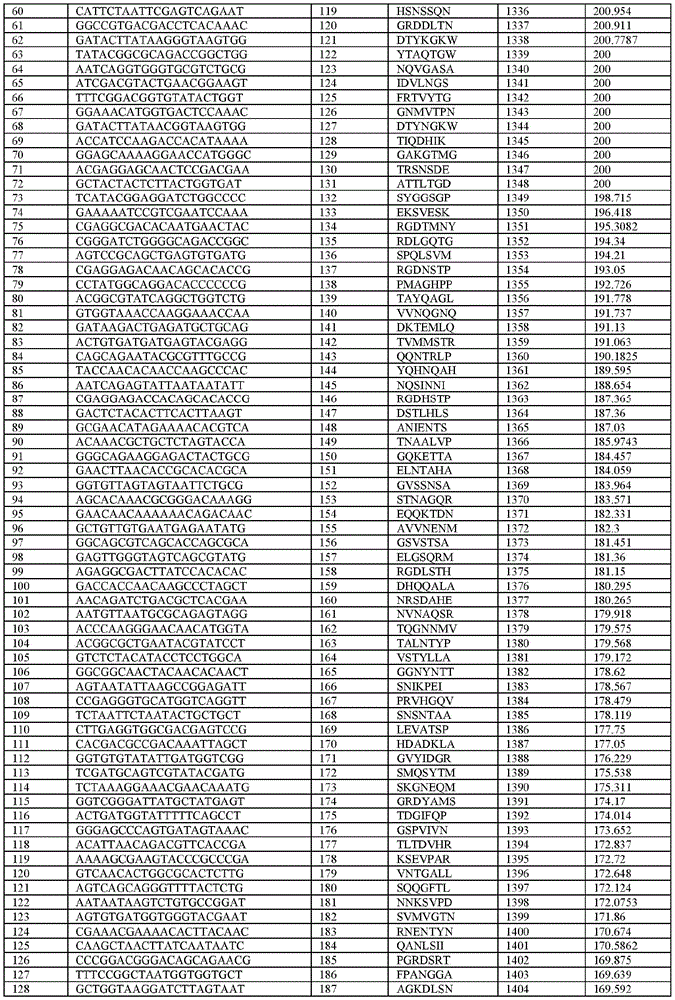


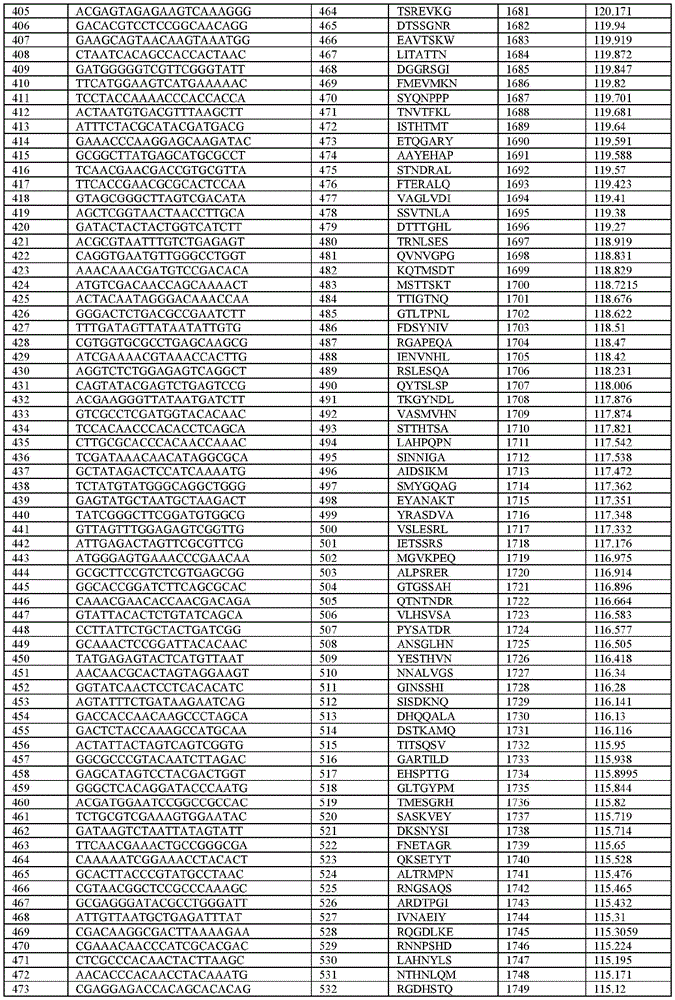
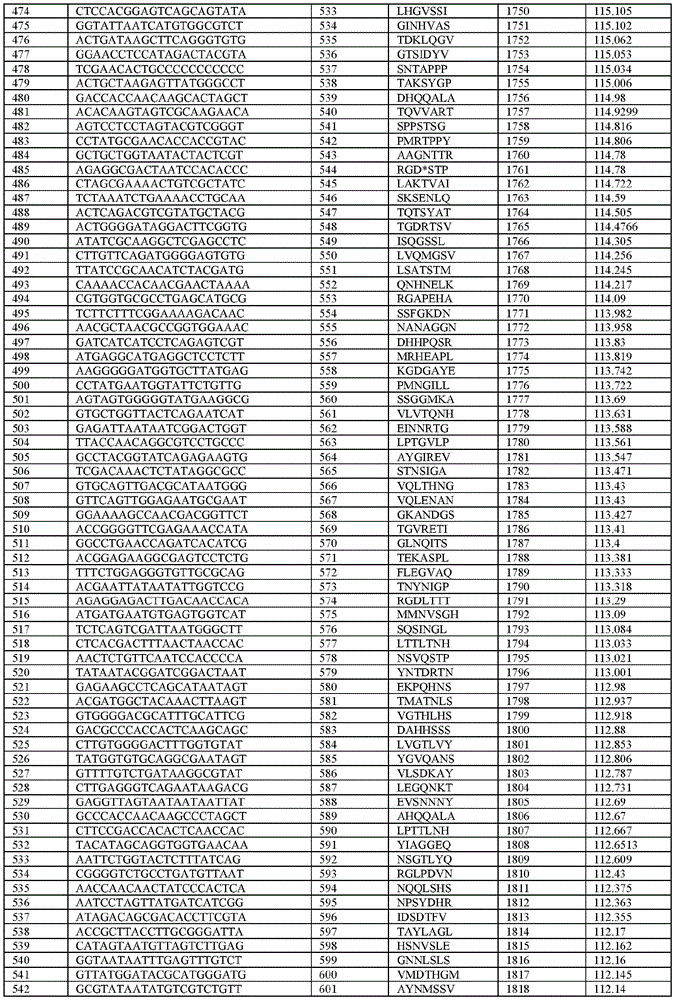
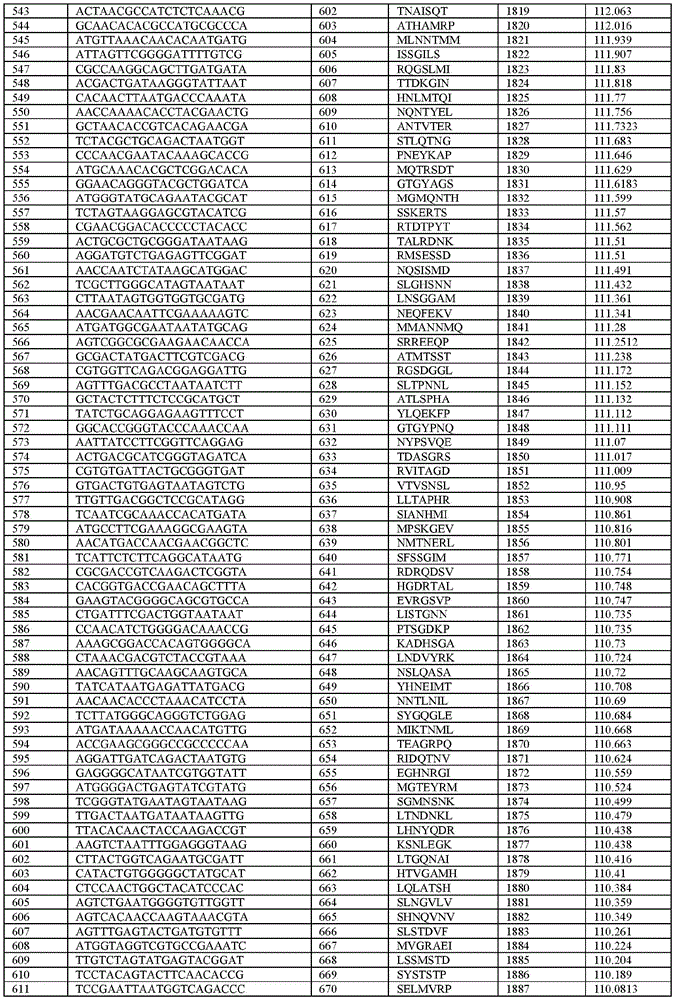


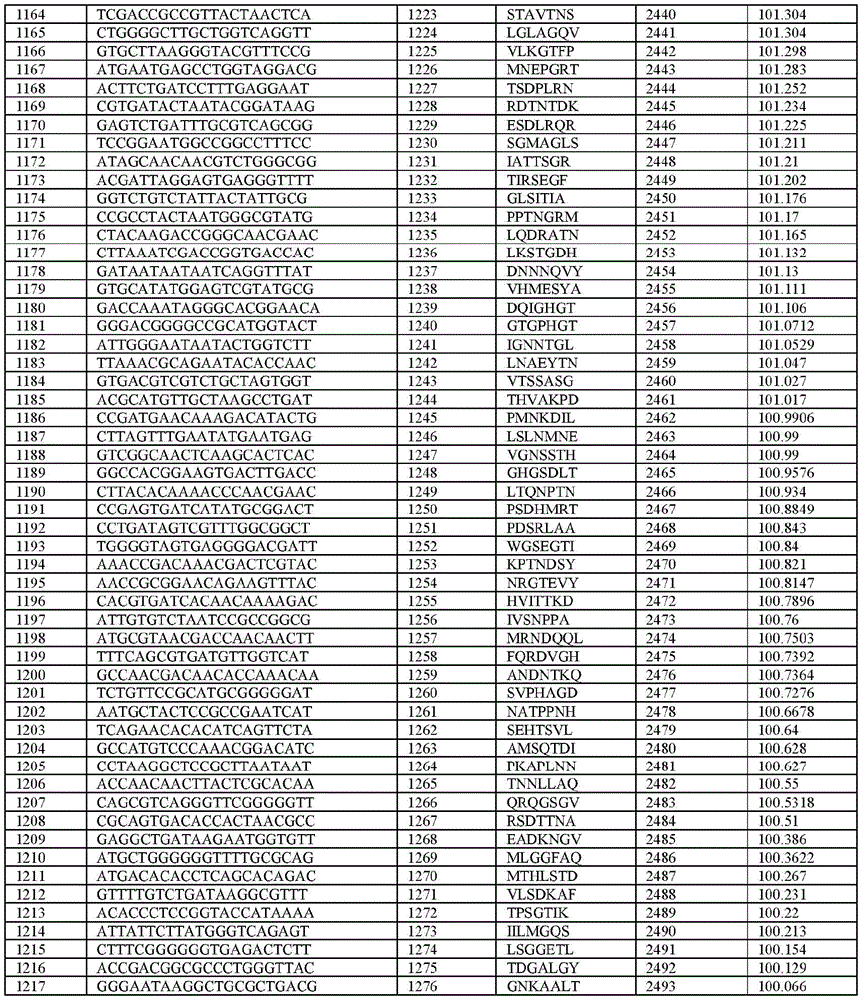


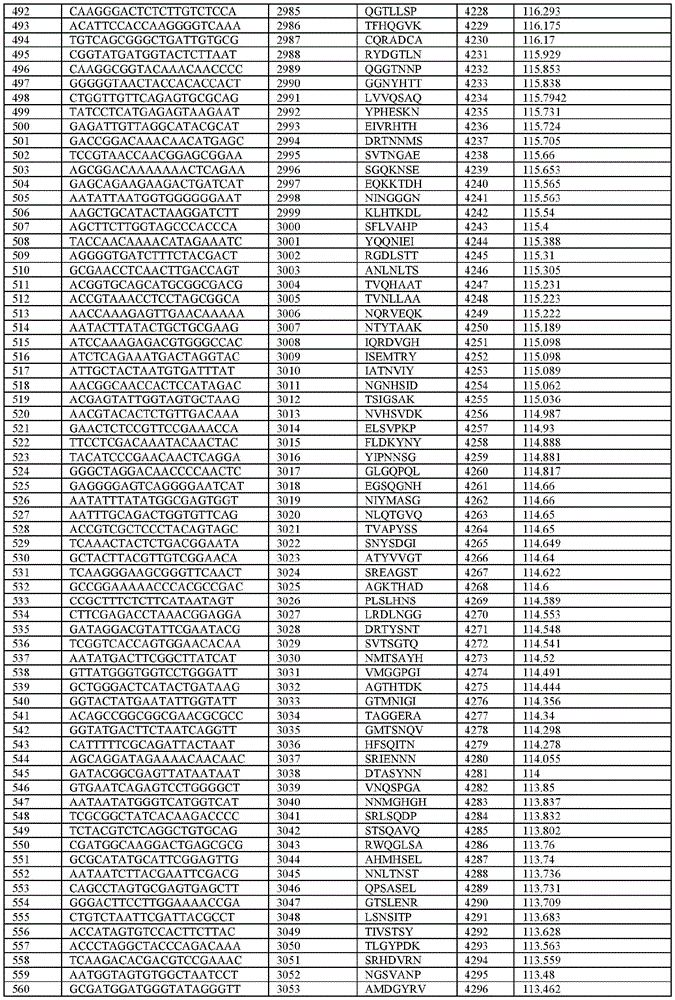


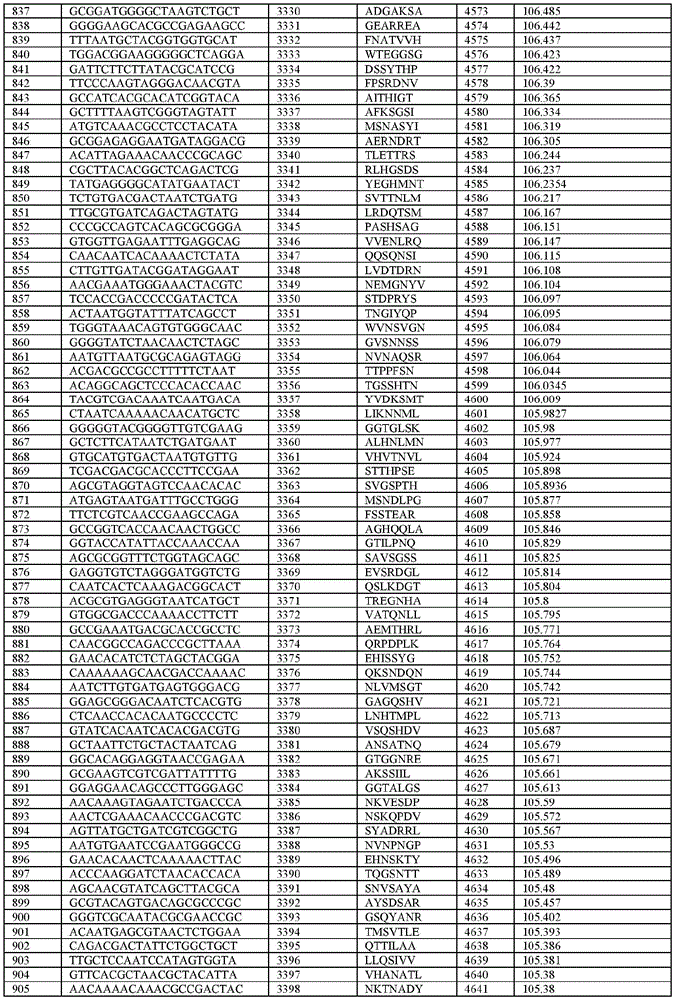
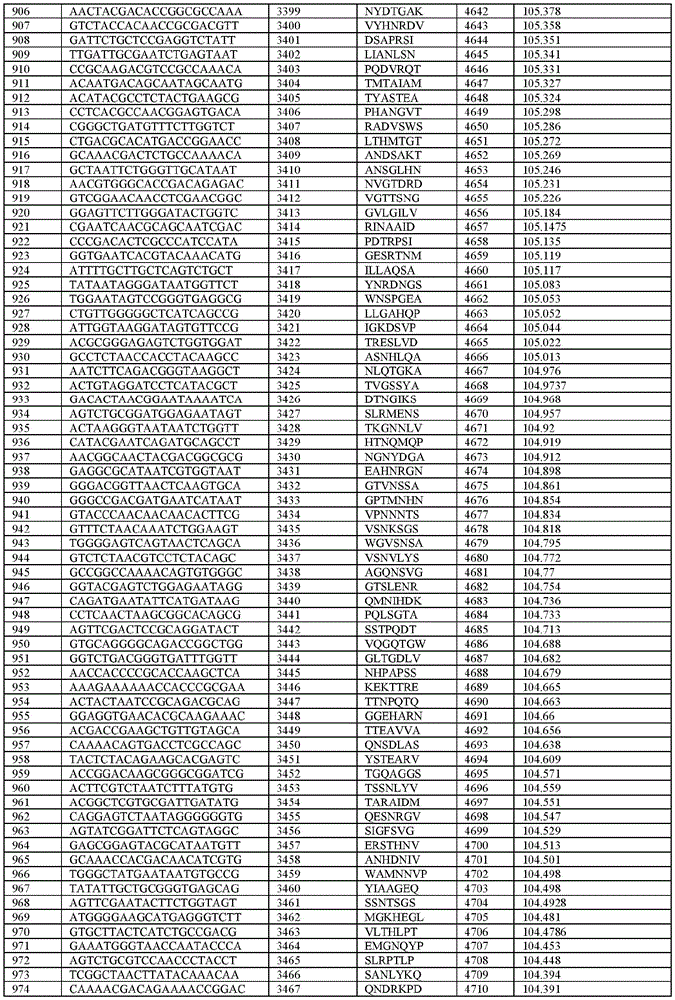
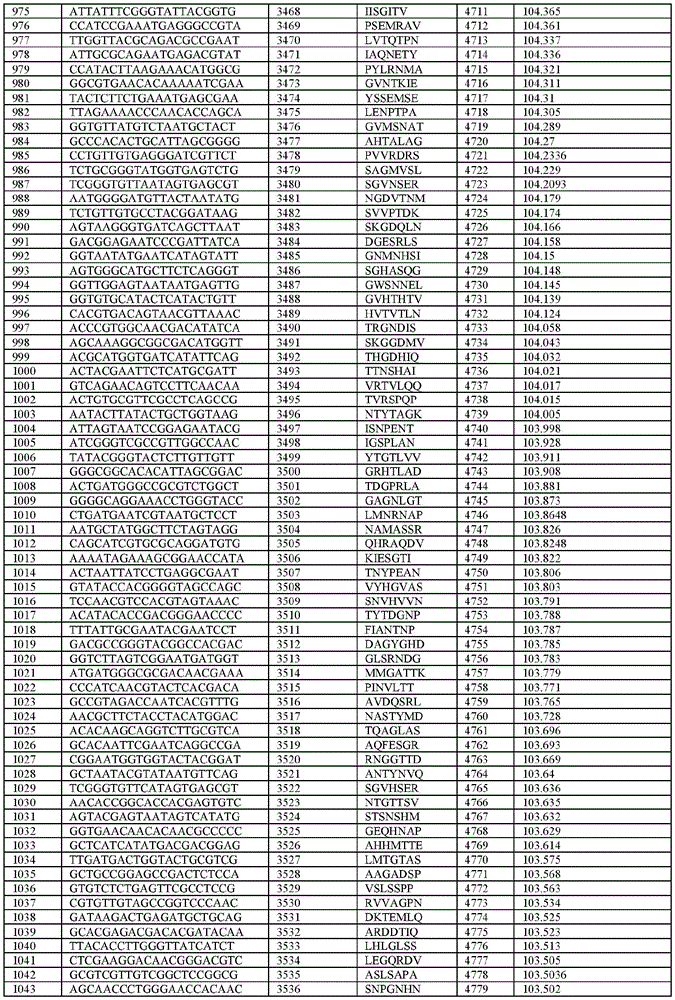
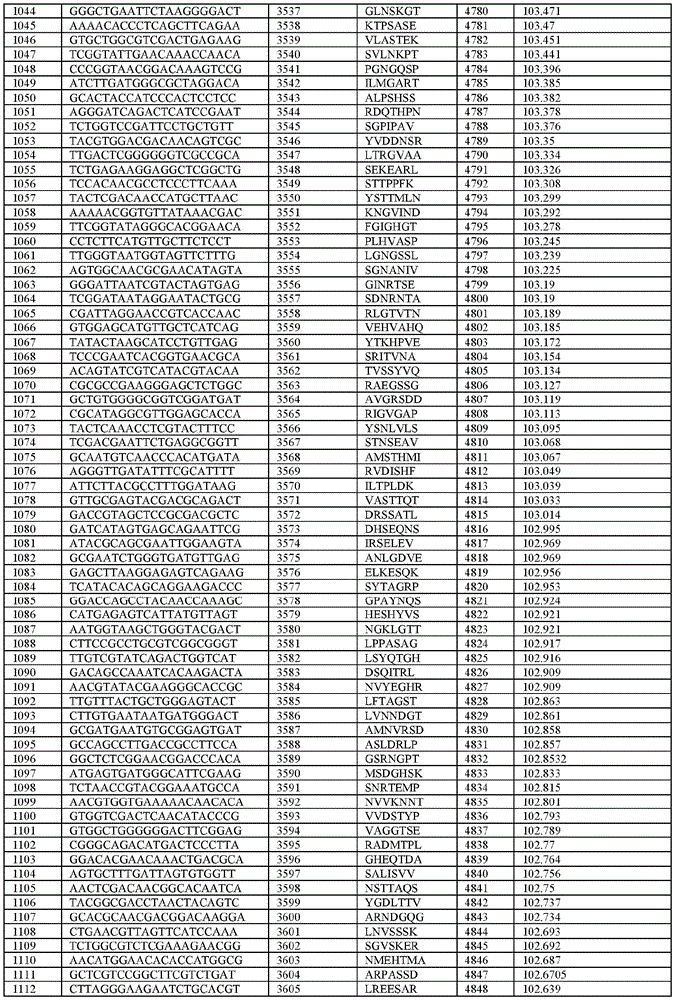


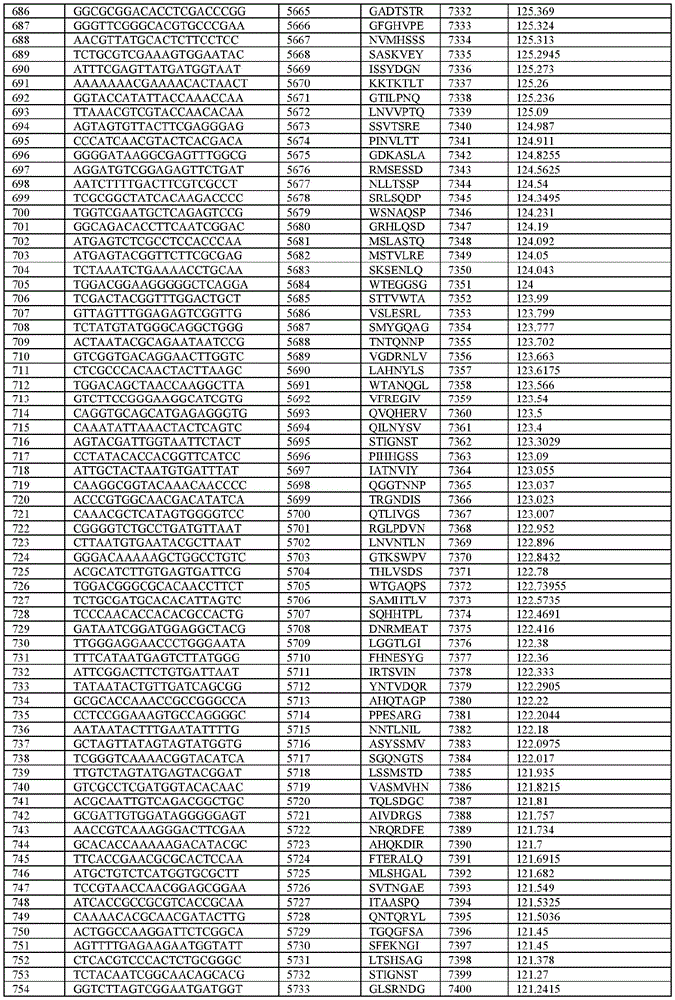
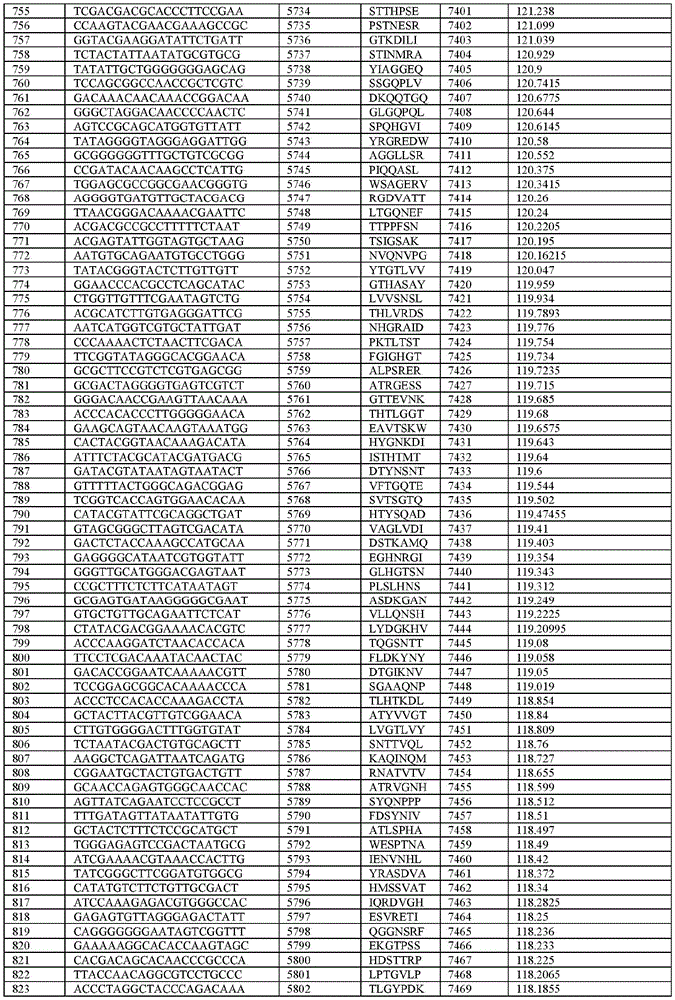
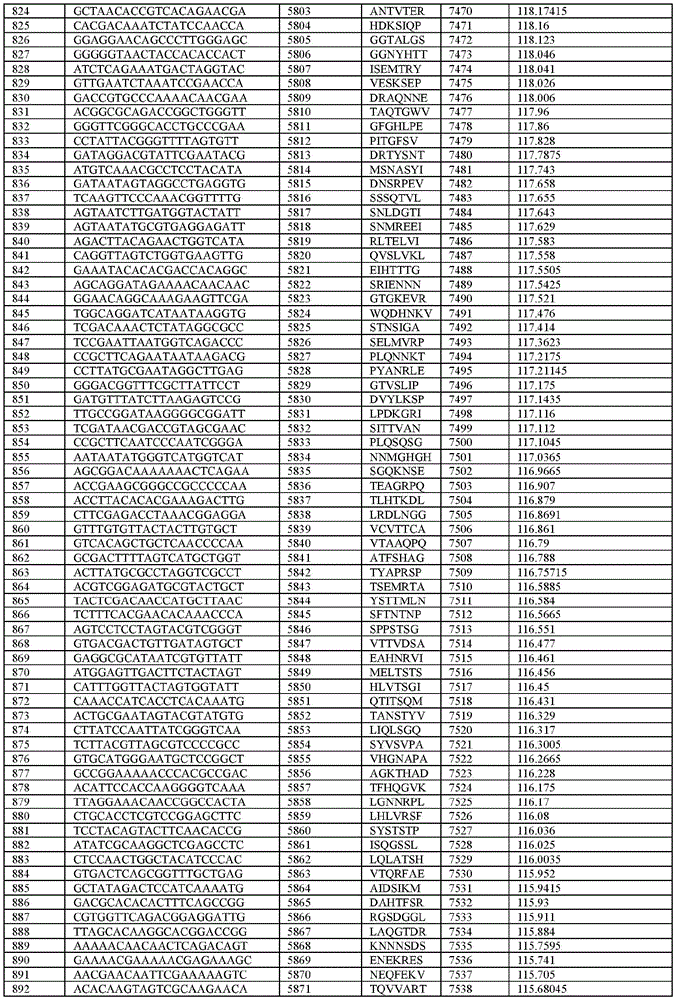
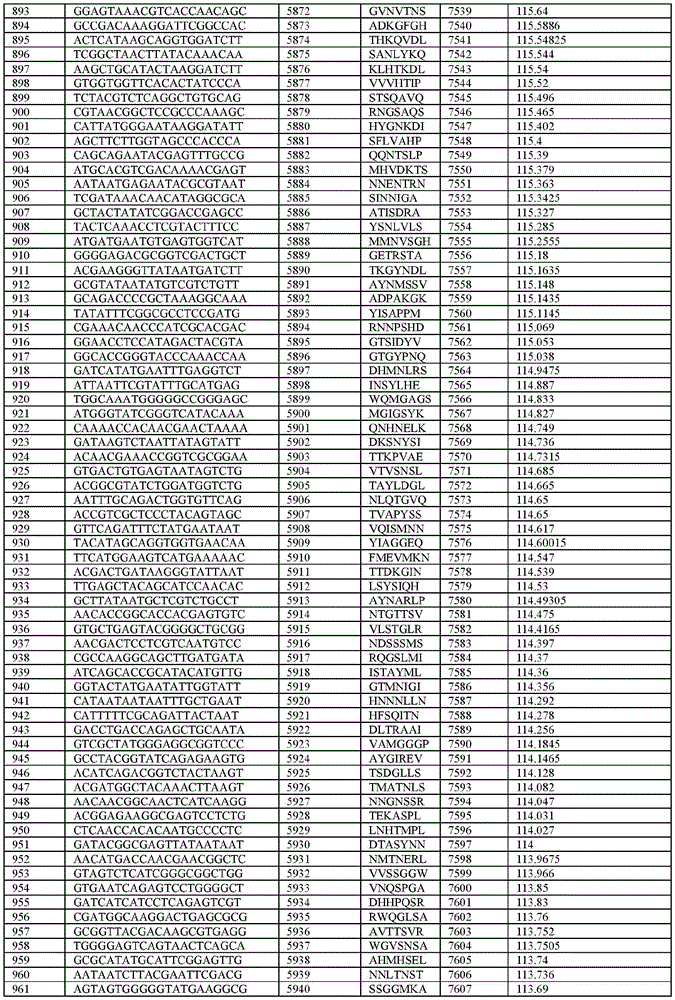


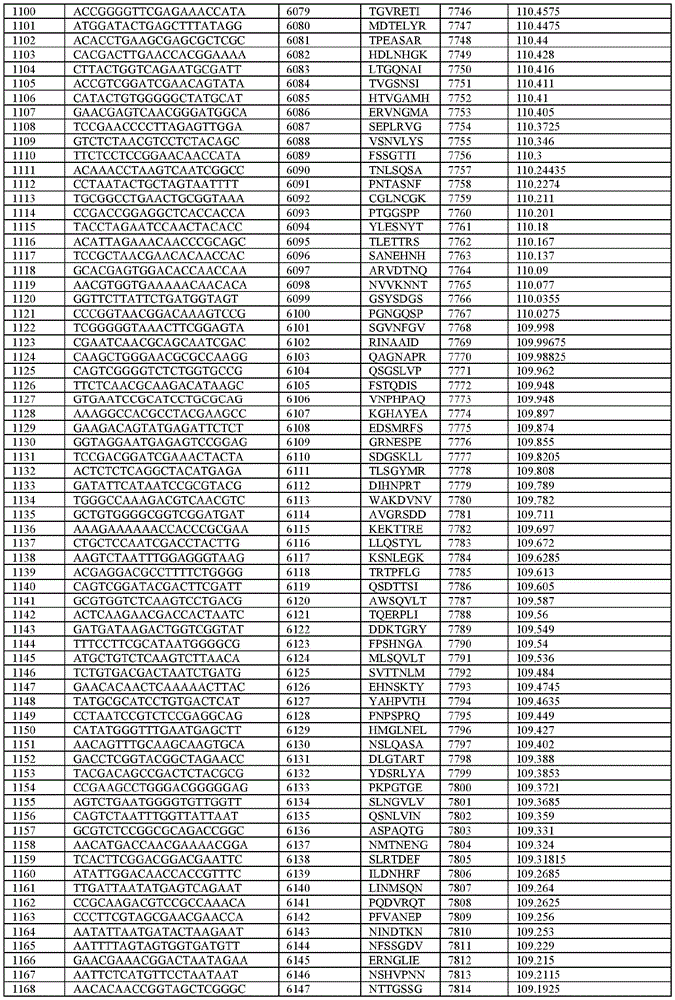

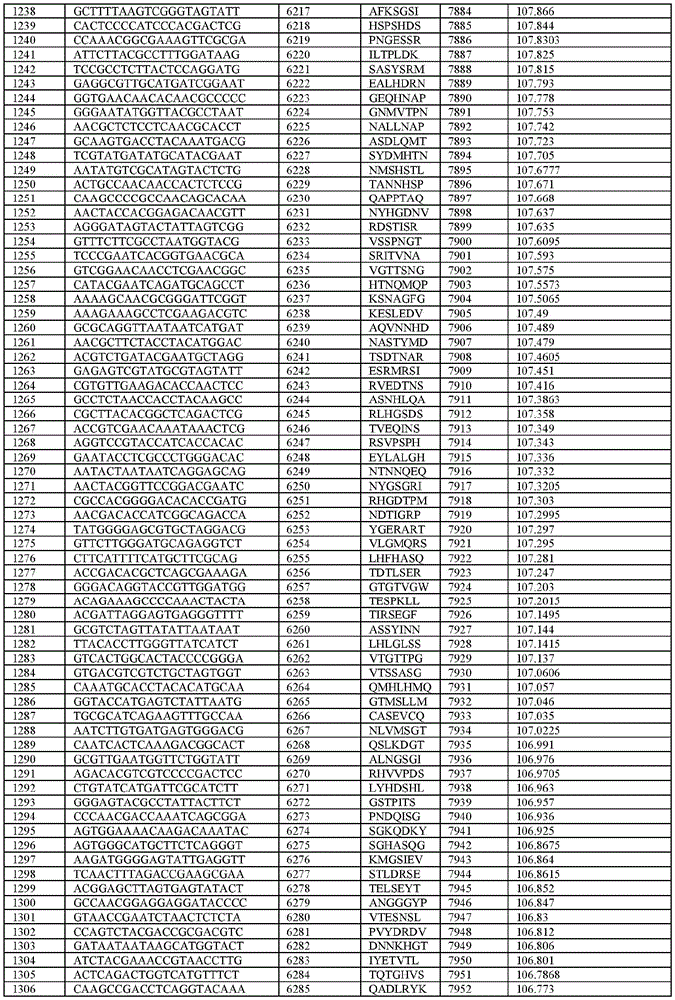
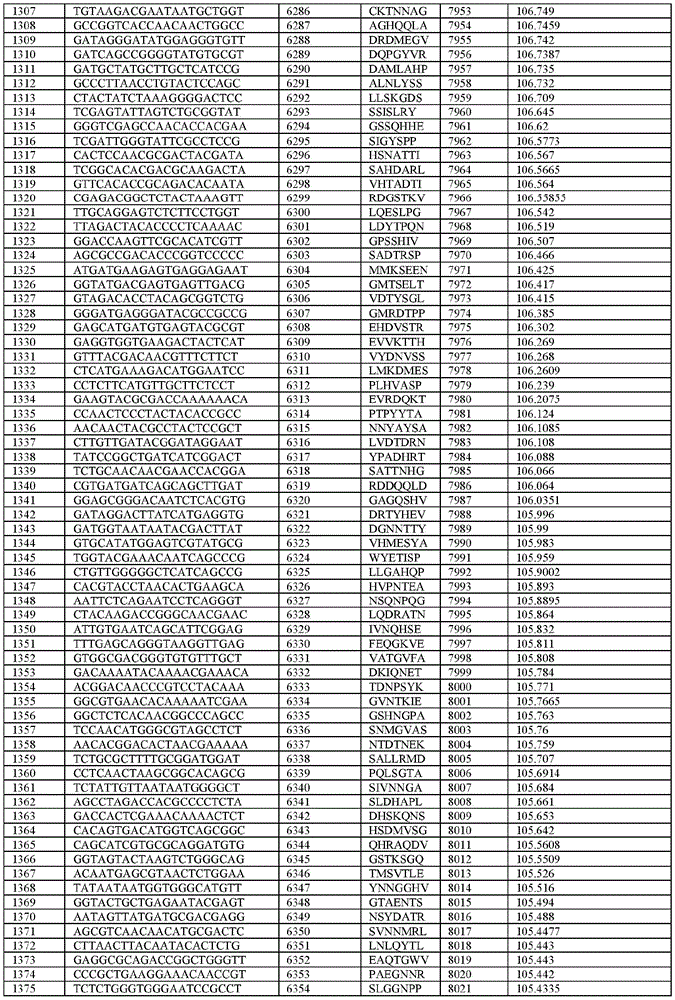

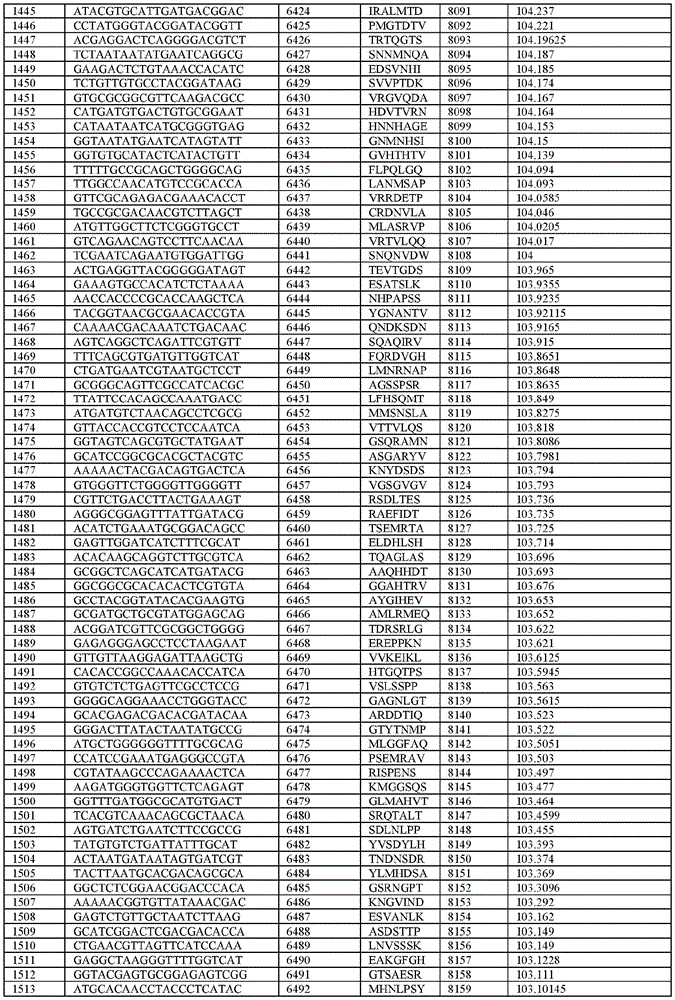
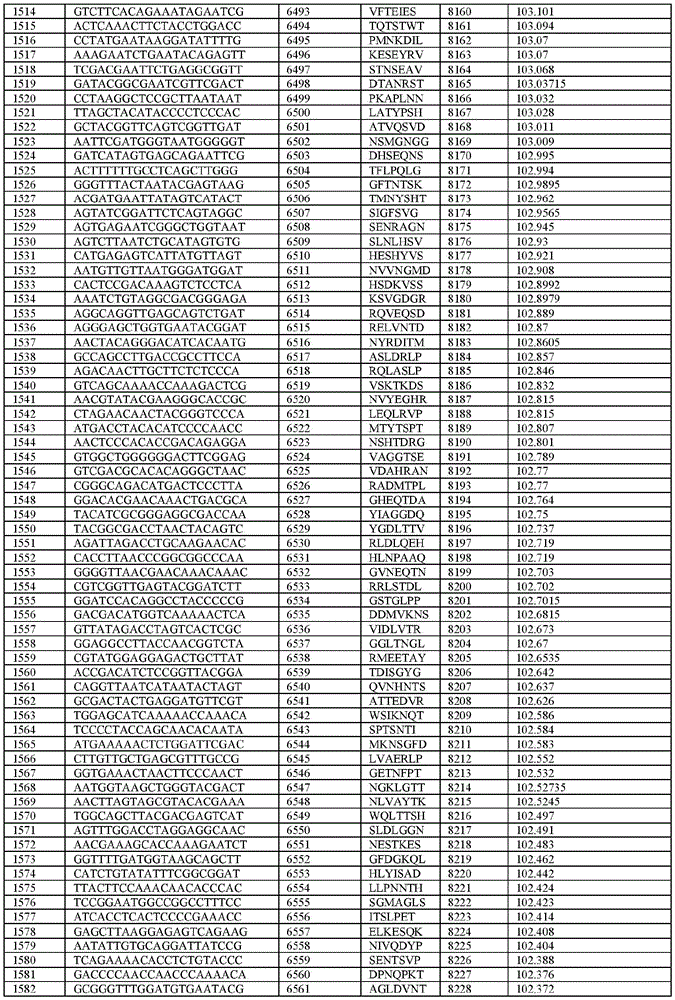
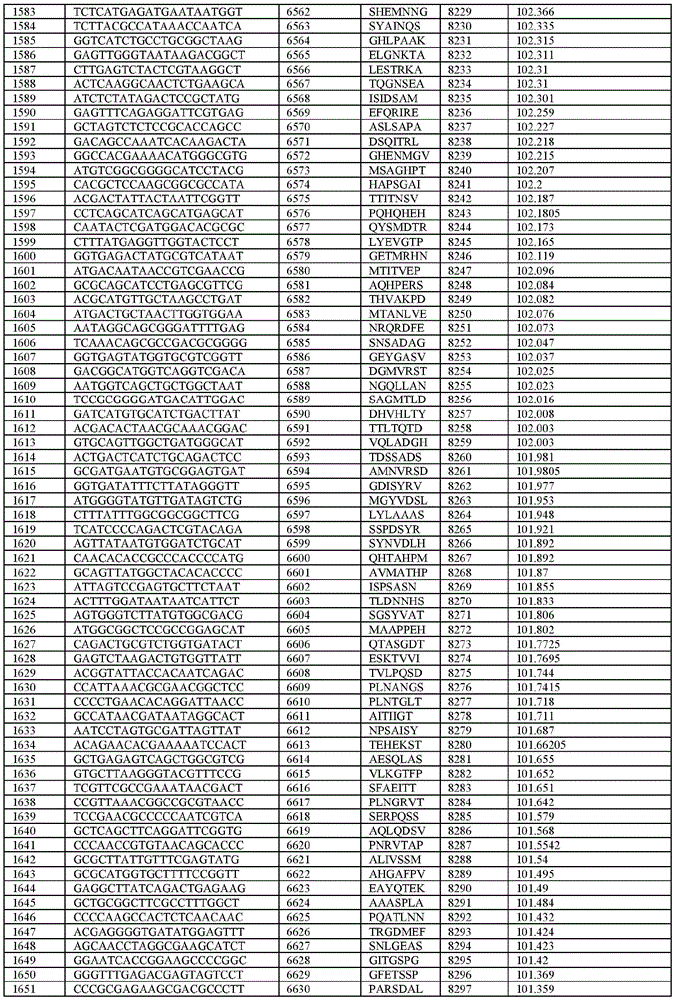
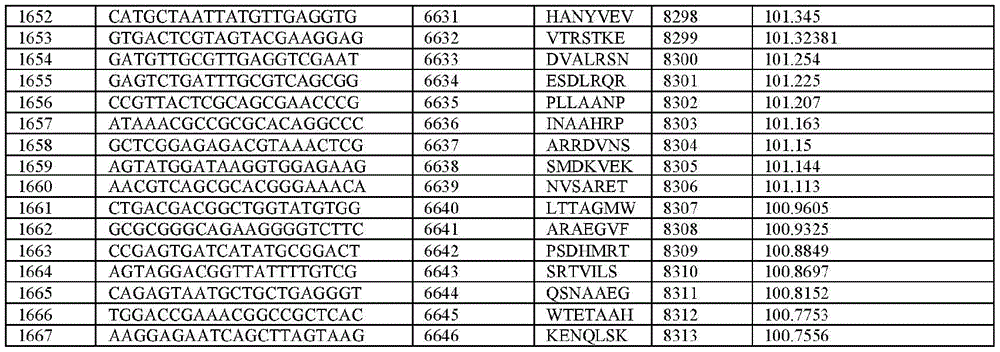


本文还描述编码本文所述的工程化AAV衣壳的多核苷酸。在一些实施方案中,工程化AAV衣壳编码多核苷酸可以包括在多核苷酸中,所述多核苷酸是配置为AAV载体系统中的AAV基因组供体,所述载体系统可用于产生本文中别处所述的工程化AAV粒子。在一些实施方案中,工程化AAV衣壳编码多核苷酸可以与多腺苷酸化尾可操作地偶联。在一些实施方案中,多腺苷酸化尾可以是SV40多腺苷酸化尾。在一些实施方案中,AAV衣壳编码多核苷酸可以与启动子可操作地偶联。在一些实施方案中,所述启动子可以是组织特异性启动子。在一些实施方案中,所述组织特异性启动子对肌肉(例如心脏、骨骼和/或平滑肌)、神经元和支持细胞(例如星形胶质细胞、神经胶质细胞、雪旺细胞等)、脂肪、脾、肝、肾、免疫细胞、脊髓液细胞、滑液细胞、皮肤细胞、软骨、肌腱、结缔组织、骨、胰腺、肾上腺、血细胞、骨髓细胞、胎盘、内皮细胞和它们的组合具有特异性。在一些实施方案中,所述启动子可以是组成型启动子。合适的组织特异性启动子和组成型启动子在本文中别处加以论述并且一般是本领域中已知的,并且可以在市面上购得。Also described herein are polynucleotides encoding the engineered AAV capsids described herein. In some embodiments, an engineered AAV capsid-encoding polynucleotide can be included in a polynucleotide that is an AAV genome donor configured in an AAV vector system that can be used to generate the herein Engineered AAV particles as described elsewhere. In some embodiments, an engineered AAV capsid-encoding polynucleotide can be operably coupled to a polyadenylation tail. In some embodiments, the polyadenylation tail can be an SV40 polyadenylation tail. In some embodiments, the AAV capsid-encoding polynucleotide can be operably coupled to a promoter. In some embodiments, the promoter can be a tissue-specific promoter. In some embodiments, the tissue-specific promoter targets muscles (eg, heart, bone, and/or smooth muscle), neurons, and supporting cells (eg, astrocytes, glial cells, Schwann cells, etc.), Fat, spleen, liver, kidney, immune cells, spinal fluid cells, synovial cells, skin cells, cartilage, tendons, connective tissue, bone, pancreas, adrenal glands, blood cells, bone marrow cells, placenta, endothelial cells, and combinations thereof are specific sex. In some embodiments, the promoter can be a constitutive promoter. Suitable tissue-specific and constitutive promoters are discussed elsewhere herein and are generally known in the art and are commercially available.
合适的肌肉特异性启动子包括但不限于CK8、MHCK7、肌红蛋白启动子(Mb)、结蛋白启动子、肌肉肌酸激酶启动子(MCK)和其变体以及SPc5-12合成启动子。Suitable muscle-specific promoters include, but are not limited to, CK8, MHCK7, the myoglobin promoter (Mb), the desmin promoter, the muscle creatine kinase promoter (MCK) and variants thereof, and the SPc5-12 synthetic promoter.
合适的免疫细胞特异性启动子包括但不限于B29启动子(B细胞)、CD14启动子(单核细胞)、CD43启动子(白细胞和血小板)、CD68(巨噬细胞)和SV40/CD43启动子(白细胞和血小板)。Suitable immune cell specific promoters include, but are not limited to, the B29 promoter (B cells), CD14 promoter (monocytes), CD43 promoter (leukocytes and platelets), CD68 (macrophages) and SV40/CD43 promoters (leukocytes and platelets).
合适的血细胞特异性启动子包括但不限于CD43启动子(白细胞和血小板)、CD45启动子(造血细胞)、INF-β(造血细胞)、WASP启动子(造血细胞)、SV40/CD43启动子(白细胞和血小板)以及SV40/CD45启动子(造血细胞)。Suitable blood cell specific promoters include, but are not limited to, the CD43 promoter (leukocytes and platelets), the CD45 promoter (hematopoietic cells), INF-beta (hematopoietic cells), the WASP promoter (hematopoietic cells), the SV40/CD43 promoter ( leukocytes and platelets) and the SV40/CD45 promoter (hematopoietic cells).
合适的胰腺特异性启动子包括但不限于弹性蛋白酶-1启动子。Suitable pancreatic specific promoters include, but are not limited to, the elastase-1 promoter.
合适的内皮细胞特异性启动子包括但不限于Fit-1启动子和ICAM-2启动子。Suitable endothelial cell specific promoters include, but are not limited to, the Fit-1 promoter and the ICAM-2 promoter.
合适的神经元组织/细胞特异性启动子包括但不限于GFAP启动子(星形胶质细胞)、SYN1启动子(神经元)和NSE/RU5’(成熟神经元)。Suitable neuronal tissue/cell specific promoters include, but are not limited to, the GFAP promoter (astrocytes), the SYN1 promoter (neurons), and NSE/RU5' (mature neurons).
合适的肾特异性启动子包括但不限于NphsI启动子(足细胞)。Suitable kidney-specific promoters include, but are not limited to, the NphsI promoter (podocyte).
合适的骨特异性启动子包括但不限于OG-2启动子(成骨细胞、成牙质细胞)。Suitable bone-specific promoters include, but are not limited to, the OG-2 promoter (osteoblasts, odontoblasts).
合适的肺特异性启动子包括但不限于SP-B启动子(肺)。Suitable lung-specific promoters include, but are not limited to, the SP-B promoter (lung).
合适的肝特异性启动子包括但不限于SV40/A1b启动子。Suitable liver-specific promoters include, but are not limited to, the SV40/A1b promoter.
合适的心脏特异性启动子可以包括但不限于a-MHC。Suitable cardiac-specific promoters may include, but are not limited to, a-MHC.
合适的组成型启动子包括但不限于CMV、RSV、SV40、EF1α、CAG和β-肌动蛋白。Suitable constitutive promoters include, but are not limited to, CMV, RSV, SV40, EF1α, CAG, and β-actin.
产生工程化AAV衣壳的方法Methods of producing engineered AAV capsids
本文还提供产生工程化AAV衣壳的方法。工程化AAV衣壳变体可以是野生型AAV衣壳的变体。图6-8可以说明能够产生本文所述的工程化AAV衣壳的方法的多个实施方案。一般说来,可以通过在适当AAV生产细胞系中表达各自含有先前所述的工程化AAV衣壳多核苷酸的工程化衣壳载体来产生AAV衣壳文库。参见例如图8。应理解,虽然图8示出依赖于辅助的AAV粒子产生方法,但应理解,这也可以通过无辅助方法来进行。这可以生成AAV衣壳文库,所述文库可以含有一种更需要的细胞特异性工程化AAV衣壳变体。如图6所示,可以将AAV衣壳文库施用于各种非人类动物,以进行第一轮基于mRNA的选择。如图1所示,AAV和相关载体的转导过程可以导致产生反映转导细胞的病毒基因组的mRNA分子。如至少在本文中的实施例中所说明,基于mRNA的选择可以更具特异性并且更有效地确定能够在功能上转导细胞的病毒粒子,因为它是基于所产生的功能性产物,与仅仅通过测量病毒DNA的存在来检测病毒粒子在细胞中的存在相反。Also provided herein are methods of producing engineered AAV capsids. The engineered AAV capsid variant can be a variant of the wild-type AAV capsid. 6-8 may illustrate various embodiments of methods capable of producing the engineered AAV capsids described herein. In general, AAV capsid libraries can be generated by expressing engineered capsid vectors each containing the previously described engineered AAV capsid polynucleotides in an appropriate AAV producing cell line. See eg Figure 8. It will be appreciated that while Figure 8 shows an AAV particle generation method that relies on assistance, it should be understood that this can also be done by an unassisted method. This can generate AAV capsid libraries that can contain a more desired cell-specific engineered AAV capsid variant. As shown in Figure 6, AAV capsid libraries can be administered to various non-human animals for a first round of mRNA-based selection. As shown in Figure 1, the transduction process of AAV and related vectors can result in the production of mRNA molecules that reflect the viral genome of the transduced cell. As illustrated at least in the examples herein, mRNA-based selection can be more specific and more efficient in identifying viral particles capable of functionally transducing cells because it is based on the functional product produced, as opposed to merely The opposite is true for detecting the presence of viral particles in cells by measuring the presence of viral DNA.
在第一轮施用之后,一个或多个具有所需衣壳变体的工程化AAV病毒粒子可以接着用于形成已过滤的AAV衣壳文库。可以通过测量衣壳变体的mRNA表达并确定如与非所需细胞类型相比哪些变体在所需细胞类型中高度表达来鉴定所需的AAV病毒粒子。在所需细胞、组织和/或器官类型中高度表达的那些是所需的AAV衣壳变体粒子。在一些实施方案中,AAV衣壳变体编码多核苷酸是在组织特异性启动子的控制下,所述启动子在所需细胞、组织或器官中具有选择活性。After the first round of administration, one or more engineered AAV virions with the desired capsid variant can then be used to form a filtered AAV capsid library. Desired AAV virions can be identified by measuring the mRNA expression of the capsid variants and determining which variants are highly expressed in the desired cell type as compared to the undesired cell type. Those that are highly expressed in the desired cell, tissue and/or organ type are the desired AAV capsid variant particles. In some embodiments, the AAV capsid variant-encoding polynucleotide is under the control of a tissue-specific promoter having selective activity in a desired cell, tissue, or organ.
第一轮鉴定的工程化AAV衣壳变体粒子可以接着施用于各种非人类动物。在一些实施方案中,用于第二轮选择和鉴定的动物与用于第一轮选择和鉴定的那些动物不同。与第1轮相似,在施用之后,可以通过测量细胞中的病毒mRNA表达来鉴定所需细胞、组织和/或器官类型中的顶级表达变体。接着可以任选地对第二轮之后鉴定的顶级变体编条形码,并且任选地进行汇集。在一些实施方案中,接着可以将来自第二轮的顶级变体施用于非人类灵长类动物以鉴定顶级细胞特异性变体,特别是如果顶级变体的最终用途是人类。每一轮的施用均可以是全身性的。The engineered AAV capsid variant particles identified in the first round can then be administered to various non-human animals. In some embodiments, the animals used for the second round of selection and identification are different from those used for the first round of selection and identification. Similar to
在一些实施方案中,所述产生AAV衣壳变体的方法可以包括以下步骤:(a)在细胞中表达含有工程化AAV衣壳多核苷酸的本文所述的载体系统以产生工程化AAV病毒粒子衣壳变体;(b)收获在步骤(a)中产生的工程化AAV病毒粒子衣壳变体;(c)向一个或多个第一受试者施用工程化AAV病毒粒子衣壳变体,其中所述工程化AAV病毒粒子衣壳变体是通过在细胞中表达工程化AAV衣壳变体载体或其系统并收获由所述细胞产生的工程化AAV病毒粒子衣壳变体而产生的;以及(d)鉴定由所述一个或多个第一受试者中的一种或多种特定细胞或特定细胞类型以显著高水平产生的一种或多种工程化AAV衣壳变体。在这一背景中,“显著高”可以指滴度可以介于每15cm皿中约2×10¹¹至约6×10¹²个载体基因组的范围内。In some embodiments, the method of producing an AAV capsid variant may comprise the steps of: (a) expressing in a cell a vector system described herein containing an engineered AAV capsid polynucleotide to produce an engineered AAV virus Particle capsid variants; (b) harvesting the engineered AAV virion capsid variants produced in step (a); (c) administering the engineered AAV virion capsid variants to one or more first subjects; body, wherein the engineered AAV virion capsid variant is produced by expressing an engineered AAV capsid variant vector or system thereof in a cell and harvesting the engineered AAV virion capsid variant produced by the cell and (d) identifying one or more engineered AAV capsid variants produced at significantly high levels by one or more specific cells or specific cell types in the one or more first subjects . In this context, "significantly high" can mean that titers can range from about 2x10¹¹ to about 6x10¹² vector genomes per 15 cm dish.
所述方法还可以包括以下步骤:(e)向一个或多个第二受试者施用在步骤(d)中鉴定的一些或全部工程化AAV病毒粒子衣壳变体;以及(f)鉴定在所述一个或多个第二受试者中的一种或多种特定细胞或特定细胞类型中以显著高水平产生的一种或多种工程化AAV病毒粒子衣壳变体。步骤(a)中的细胞可以是原核细胞或真核细胞。在一些实施方案中,步骤(c)、步骤(e)或两者中的施用是全身性的。在一些实施方案中,一个或多个第一受试者、一个或多个第二受试者或两者是非人类哺乳动物。在一些实施方案中,一个或多个第一受试者、一个或多个第二受试者或两者是各自独立地选自由以下组成的组:野生型非人类哺乳动物、人源化非人类哺乳动物、疾病特异性非人类哺乳动物模型和非人类灵长类动物。The method may further comprise the steps of: (e) administering to one or more second subjects some or all of the engineered AAV virion capsid variants identified in step (d); and (f) identifying One or more engineered AAV virion capsid variants produced at significantly high levels in one or more particular cells or particular cell types in the one or more second subjects. The cells in step (a) may be prokaryotic cells or eukaryotic cells. In some embodiments, the administration in step (c), step (e), or both is systemic. In some embodiments, one or more of the first subjects, one or more of the second subjects, or both are non-human mammals. In some embodiments, the one or more first subjects, one or more second subjects, or both are each independently selected from the group consisting of: wild-type non-human mammals, humanized non-human mammals Human mammals, disease-specific non-human mammal models, and non-human primates.
工程化载体和载体系统Engineered Vectors and Vector Systems
本文还提供可以含有一种或多种本文所述的工程化AAV衣壳多核苷酸的载体和载体系统。在一些实施方案中,一种或多种载体系统适合产生和/或鉴定如先前所述的细胞特异性n聚体基序和/或衣壳。在一些实施方案中,一种或多种本文所述的载体和载体系统适合产生含有包含n聚体基序的衣壳蛋白和任选的货物的工程化病毒粒子,所述工程化病毒粒子可以用于将货物递送至受试者,用于例如治疗。Also provided herein are vectors and vector systems that can contain one or more of the engineered AAV capsid polynucleotides described herein. In some embodiments, one or more vector systems are suitable for generating and/or identifying cell-specific n-mer motifs and/or capsids as previously described. In some embodiments, one or more of the vectors and vector systems described herein are suitable for producing engineered virions containing a capsid protein comprising an n-mer motif and an optional cargo, which can be For the delivery of cargo to a subject, eg, for therapy.
如这一背景中所用,工程化AAV衣壳多核苷酸是指本文所述的能够编码如本文中别处所述的工程化AAV衣壳的多核苷酸和/或能够编码本文中别处所述的一种或多种工程化AAV衣壳蛋白的多核苷酸中的任一者或多者。此外,在所述载体包括本文所述的工程化AAV衣壳多核苷酸的情况下,所述载体也可以指代并被视为工程化载体或其系统,尽管未特定地如此注明。在实施方案中,所述载体可以含有一种或多种多核苷酸,所述多核苷酸编码本文所述的工程化AAV衣壳的一种或多种元件。所述载体可用于产生可以表达本文所述的工程化AAV衣壳的一种或多种组分的细菌、真菌、酵母、植物细胞、动物细胞和转基因动物。含有一种或多种本文所述的多核苷酸序列的载体是在本公开的范围内。作为本文所述的工程化AAV衣壳和其系统的一部分的一种或多种多核苷酸可以包括在载体或载体系统中。As used in this context, an engineered AAV capsid polynucleotide refers to a polynucleotide capable of encoding an engineered AAV capsid as described elsewhere herein and/or capable of encoding an engineered AAV capsid as described elsewhere herein Any one or more of the one or more polynucleotides of the engineered AAV capsid protein. Furthermore, where the vector includes an engineered AAV capsid polynucleotide as described herein, the vector may also be referred to and considered an engineered vector or system thereof, although not specifically so noted. In embodiments, the vector may contain one or more polynucleotides encoding one or more elements of the engineered AAV capsids described herein. The vectors can be used to generate bacteria, fungi, yeast, plant cells, animal cells, and transgenic animals that can express one or more components of the engineered AAV capsids described herein. Vectors containing one or more of the polynucleotide sequences described herein are within the scope of the present disclosure. One or more polynucleotides that are part of the engineered AAV capsids and systems thereof described herein can be included in a vector or vector system.
在一些实施方案中,所述载体可以包括具有3′多腺苷酸化信号的工程化AAV衣壳多核苷酸。在一些实施方案中,3′多腺苷酸化是SV40多腺苷酸化信号。在一些实施方案中,所述载体不具有剪接调控元件。在一些实施方案中,所述载体包括一种或多种最小剪接调控元件。在一些实施方案中,所述载体还可以包括修饰的剪接调控元件,其中所述修饰使所述剪接调控元件失活。在一些实施方案中,所述修饰的剪接调控元件是足以诱导rep蛋白多核苷酸与工程化AAV衣壳蛋白变体多核苷酸之间的剪接的多核苷酸序列。在一些实施方案中,可能足以诱导剪接的多核苷酸序列是剪接受体或剪接供体。在一些实施方案中,AAV衣壳多核苷酸是如本文中别处所述的工程化AAV衣壳多核苷酸。In some embodiments, the vector can include an engineered AAV capsid polynucleotide with a 3' polyadenylation signal. In some embodiments, the 3' polyadenylation is the SV40 polyadenylation signal. In some embodiments, the vector does not have splicing regulatory elements. In some embodiments, the vector includes one or more minimal splicing regulatory elements. In some embodiments, the vector may further comprise a modified splicing regulatory element, wherein the modification inactivates the splicing regulatory element. In some embodiments, the modified splicing regulatory element is a polynucleotide sequence sufficient to induce splicing between the rep protein polynucleotide and the engineered AAV capsid protein variant polynucleotide. In some embodiments, the polynucleotide sequence that may be sufficient to induce splicing is a splice acceptor or a splice donor. In some embodiments, the AAV capsid polynucleotide is an engineered AAV capsid polynucleotide as described elsewhere herein.
在一些实施方案中,所述载体和载体系统适合产生和/或鉴定细胞特异性n聚体基序和含有腺相关(AAV)衣壳蛋白多核苷酸的衣壳蛋白,其中所述AAV衣壳蛋白多核苷酸包含3′多腺苷酸化信号。在某些示例性实施方案中,所述载体不包含剪接调控元件。在某些示例性实施方案中,所述载体包含最小剪接调控元件。在某些示例性实施方案中,所述载体还包含修饰的剪接调控元件,其中所述修饰使所述剪接调控元件失活。在某些示例性实施方案中,所述修饰的剪接调控元件是足以诱导rep蛋白多核苷酸与衣壳蛋白多核苷酸之间的剪接的多核苷酸序列。在某些示例性实施方案中,足以诱导剪接的多核苷酸序列是剪接受体或剪接供体。在某些示例性实施方案中,多腺苷酸化信号是SV40多腺苷酸化信号。在某些示例性实施方案中,AAV衣壳多核苷酸是工程化AAV衣壳多核苷酸。在某些示例性实施方案中,所述工程化AAV衣壳多核苷酸包含能够编码n聚体氨基酸基序的n聚体基序多核苷酸,其中n聚体基序包含三个或更多个氨基酸,其中所述n聚体基序多核苷酸是插入AAV衣壳多核苷酸中能够编码衣壳表面的区域内,在所述AAV衣壳多核苷酸中的两个密码子之间。在某些示例性实施方案中,n聚体基序包含3-15个氨基酸。在某些示例性实施方案中,n聚体基序是6或7个氨基酸。在某些示例性实施方案中,所述n聚体基序多核苷酸是插入AAV9衣壳多核苷酸中对应于氨基酸262-269、327-332、382-386、452-460、488-505、527-539、545-558、581-593、704-714或它们的任何组合之间的任何两个相邻氨基酸的密码子之间,或AAV2、AAV3、AAV4、AAV5、AAV6、AAV7、AAV8衣壳多核苷酸中的类似位置。在某些示例性实施方案中,所述n聚体基序多核苷酸是插入AAV9衣壳多核苷酸中对应于aa588和589的密码子之间。在某些示例性实施方案中,所述载体能够产生具有增加的特异性、降低的免疫原性或两者的AAV病毒粒子。在某些示例性实施方案中,所述载体能够产生具有增加的肌细胞、特异性、降低的免疫原性或两者的AAV病毒粒子。在某些示例性实施方案中,所述n聚体基序多核苷酸是在表1-6中的任一者中的任何多核苷酸。在某些示例性实施方案中,所述n聚体基序多核苷酸能够编码如表1-6中的任一者中的肽。在某些示例性实施方案中,所述n聚体基序多核苷酸能够编码三个或更多个氨基酸,其中前三个氨基酸是RGD。在某些示例性实施方案中,n聚体基序具有多肽序列RGD或RGDXn,其中n是3-15个氨基酸和X,其中存在的每个氨基酸是独立地选自任何氨基酸的组中的其他氨基酸。在某些示例性实施方案中,所述载体能够产生具有肌肉特异性向性的AAV衣壳多肽、AAV衣壳或两者。In some embodiments, the vectors and vector systems are adapted to generate and/or identify cell-specific n-mer motifs and capsid proteins comprising adeno-associated (AAV) capsid protein polynucleotides, wherein the AAV capsids The protein polynucleotide contains a 3' polyadenylation signal. In certain exemplary embodiments, the vector does not comprise splicing regulatory elements. In certain exemplary embodiments, the vector comprises minimal splicing regulatory elements. In certain exemplary embodiments, the vector further comprises a modified splicing regulatory element, wherein the modification inactivates the splicing regulatory element. In certain exemplary embodiments, the modified splicing regulatory element is a polynucleotide sequence sufficient to induce splicing between the rep protein polynucleotide and the capsid protein polynucleotide. In certain exemplary embodiments, the polynucleotide sequence sufficient to induce splicing is a splice acceptor or a splice donor. In certain exemplary embodiments, the polyadenylation signal is an SV40 polyadenylation signal. In certain exemplary embodiments, the AAV capsid polynucleotide is an engineered AAV capsid polynucleotide. In certain exemplary embodiments, the engineered AAV capsid polynucleotide comprises an n-mer motif polynucleotide capable of encoding an n-mer amino acid motif, wherein the n-mer motif comprises three or more amino acids, wherein the n-mer motif polynucleotide is inserted into a region of the AAV capsid polynucleotide capable of encoding the capsid surface, between two codons in the AAV capsid polynucleotide. In certain exemplary embodiments, the n-mer motif comprises 3-15 amino acids. In certain exemplary embodiments, the n-mer motif is 6 or 7 amino acids. In certain exemplary embodiments, the n-mer motif polynucleotide is inserted into an AAV9 capsid polynucleotide corresponding to amino acids 262-269, 327-332, 382-386, 452-460, 488-505 , 527-539, 545-558, 581-593, 704-714, or any combination thereof, between the codons of any two adjacent amino acids, or between AAV2, AAV3, AAV4, AAV5, AAV6, AAV7, AAV8 Similar positions in capsid polynucleotides. In certain exemplary embodiments, the n-mer motif polynucleotide is inserted between the codons corresponding to aa588 and 589 in the AAV9 capsid polynucleotide. In certain exemplary embodiments, the vector is capable of producing AAV virions with increased specificity, decreased immunogenicity, or both. In certain exemplary embodiments, the vector is capable of producing AAV virions with increased myocytes, specificity, decreased immunogenicity, or both. In certain exemplary embodiments, the n-mer motif polynucleotide is any polynucleotide in any of Tables 1-6. In certain exemplary embodiments, the n-mer motif polynucleotide is capable of encoding a peptide as in any of Tables 1-6. In certain exemplary embodiments, the n-mer motif polynucleotide is capable of encoding three or more amino acids, wherein the first three amino acids are RGD. In certain exemplary embodiments, the n-mer motif has the polypeptide sequence RGD or RGDXn, wherein n is 3-15 amino acids and X, wherein each amino acid present is independently selected from any group of amino acids other amino acids. In certain exemplary embodiments, the vector is capable of producing an AAV capsid polypeptide, an AAV capsid, or both with muscle-specific tropism.
在一些实施方案中,能够产生和/或鉴定或者可用於产生或鉴定细胞特异性n聚体基序和/或衣壳蛋白的方法的载体系统可以包括如先前段落[例如段落0165]中所述并且如本文中别处进一步描述的载体;AAV rep蛋白多核苷酸或其部分;以及与AAV衣壳蛋白、AAVrep蛋白或两者可操作地偶联的单一启动子,其中所述单一启动子是与AAV衣壳蛋白、AAVrep蛋白或两者可操作地偶联的唯一启动子。In some embodiments, a vector system capable of producing and/or identifying or useful for methods of producing or identifying cell-specific n-mer motifs and/or capsid proteins may include as described in previous paragraphs [eg paragraph 0165] and a vector as further described elsewhere herein; an AAV rep protein polynucleotide or portion thereof; and a single promoter operably coupled to an AAV capsid protein, an AAVrep protein, or both, wherein the single promoter is a A unique promoter to which the AAV capsid protein, the AAVrep protein, or both are operably coupled.
在本文中的某些示例性实施方案中是载体系统,其包含如例如段落[0020]-[0039]中的任一者中并且如本文中别处进一步描述的载体;和AAV rep蛋白多核苷酸或其部分。In certain exemplary embodiments herein is a vector system comprising a vector as in, eg, any of paragraphs [0020]-[0039] and as further described elsewhere herein; and an AAV rep protein polynucleotide or parts thereof.
在某些示例性实施方案中,所述载体系统还包含第一启动子,其中所述第一启动子与AAV衣壳蛋白、AAV rep蛋白或两者可操作地偶联。在某些示例性实施方案中,所述第一启动子或所述单一启动子是细胞特异性启动子。在某些示例性实施方案中,所述第一启动子或所述单一启动子能够在不存在内源性AAV启动子的情况下驱动高滴度病毒产生。在某些示例性实施方案中,所述内源性AAV启动子是p40。在某些示例性实施方案中,AAV rep蛋白多核苷酸与AAV衣壳蛋白可操作地偶联。在某些示例性实施方案中,AAV蛋白多核苷酸是与AAV衣壳蛋白多核苷酸相同的载体的一部分。在某些示例性实施方案中,AAV蛋白多核苷酸是在与AAV衣壳蛋白多核苷酸不同的载体上。In certain exemplary embodiments, the vector system further comprises a first promoter, wherein the first promoter is operably coupled to the AAV capsid protein, the AAV rep protein, or both. In certain exemplary embodiments, the first promoter or the single promoter is a cell-specific promoter. In certain exemplary embodiments, the first promoter or the single promoter is capable of driving high titer virus production in the absence of an endogenous AAV promoter. In certain exemplary embodiments, the endogenous AAV promoter is p40. In certain exemplary embodiments, the AAV rep protein polynucleotide is operably coupled to an AAV capsid protein. In certain exemplary embodiments, the AAV protein polynucleotide is part of the same vector as the AAV capsid protein polynucleotide. In certain exemplary embodiments, the AAV protein polynucleotide is on a different vector than the AAV capsid protein polynucleotide.
在一些实施方案中,所述载体或载体系统可以包括第二启动子,其可以任选地与AAV衣壳蛋白、AAV rep蛋白或两者偶联。In some embodiments, the vector or vector system can include a second promoter, which can optionally be coupled to the AAV capsid protein, the AAV rep protein, or both.
在本文中的示例性实施方案中描述由例如段落[0020]-[0039]中的任一者中并且如本文中别处进一步描述的载体或者由例如段落[0040]-[0048]中的任一者中并且如本文中别处进一步描述的载体系统编码的多肽。Vectors described in the exemplary embodiments herein by, for example, any of paragraphs [0020]-[0039] and as further described elsewhere herein or by, for example, any of paragraphs [0040]-[0048] and polypeptides encoded by vector systems as described further elsewhere herein.
在本文中的示例性实施方案中描述细胞,其包含:例如段落[0020]-[0039]中的任一者中并且如本文中别处进一步描述的载体、例如段落[0040]-[0048]中的任一者中并且如本文中别处进一步描述的载体系统、如例如段落[0049]中并且如本文中别处进一步描述的多肽或它们的任何组合。Described in exemplary embodiments herein are cells comprising: eg, in any of paragraphs [0020]-[0039] and a vector as further described elsewhere herein, eg, in paragraphs [0040]-[0048] A vector system in any of and as further described elsewhere herein, such as, eg, a polypeptide in paragraph [0049] and as further described elsewhere herein, or any combination thereof.
在某些示例性实施方案中,所述细胞是原核的。In certain exemplary embodiments, the cells are prokaryotic.
在某些示例性实施方案中,所述细胞是真核的。In certain exemplary embodiments, the cells are eukaryotic.
在本文中的某些示例性实施方案中描述通过以下方法产生的工程化腺相关病毒粒子,所述方法包括:在细胞中表达如例如段落[0020]-[0039]中的任一者中并且如本文中别处进一步描述的载体、如例如段落[0040]-[0048]中的任一者中并且如本文中别处进一步描述的载体系统或两者。在某些示例性实施方案中,表达载体系统的步骤在体外或离体发生。在某些示例性实施方案中,表达载体系统的步骤在体内发生。Described in certain exemplary embodiments herein are engineered adeno-associated viral particles produced by a method comprising: expressing in a cell as in, eg, any of paragraphs [0020]-[0039] and A vector as further described elsewhere herein, as in, eg, any of paragraphs [0040]-[0048] and a vector system as further described elsewhere herein, or both. In certain exemplary embodiments, the steps of the expression vector system occur in vitro or ex vivo. In certain exemplary embodiments, the steps of the expression vector system occur in vivo.
所述载体和/或载体系统可以用于例如在细胞(诸如生产细胞)中表达一种或多种所述工程化AAV衣壳多核苷酸,以产生含有本文中别处所述的工程化AAV衣壳的工程化AAV粒子。本文所述的载体和载体系统的其他用途也在本公开的范围内。一般说来,并且贯穿本说明书,所述术语是允许或促进将实体从一个环境转移至另一环境的工具。在本领域的普通技术人员将理解的一些情况下,“载体”可以是技术术语,是指能够转运已经与其连接的另一核酸的核酸分子。载体可以是复制子,诸如质粒、噬菌体或柯斯质粒,另一DNA区段可以插入其中,从而引起所插入的区段的复制。一般说来,当与适当控制元件缔合时,载体能够复制。The vectors and/or vector systems can be used, for example, to express one or more of the engineered AAV capsid polynucleotides in a cell, such as a producer cell, to produce an engineered AAV capsid containing the engineered AAV capsid described elsewhere herein. Shell of engineered AAV particles. Other uses of the vectors and vector systems described herein are also within the scope of this disclosure. Generally speaking, and throughout this specification, the term is a tool that allows or facilitates the transfer of an entity from one environment to another. In some cases as will be understood by those of ordinary skill in the art, "vector" may be a technical term referring to a nucleic acid molecule capable of transporting another nucleic acid to which it has been linked. The vector can be a replicon, such as a plasmid, phage or cosmid, into which another DNA segment can be inserted, causing replication of the inserted segment. In general, vectors are capable of replication when associated with appropriate control elements.
载体包括但不限于单股、双股或部分双股的核酸分子;包含一个或多个游离端、无游离端(例如环状)的核酸分子;包含DNA、RNA或两者的核酸分子;以及本领域中已知的多核苷酸的其他变种。一种类型的载体是“质粒”,它是指环状双股DNA环,其中可以插入额外的DNA片段,诸如通过标准分子克隆技术。另一类型的载体是病毒载体,其中病毒衍生的DNA或RNA序列存在于所述载体中以用于包装成病毒(例如逆转录病毒、复制缺陷型逆转录病毒、腺病毒、复制缺陷型腺病毒和腺相关病毒(AAV))。病毒载体还包括由病毒携带的用于转染至宿主细胞中的多核苷酸。某些载体能够在其中引入所述载体的宿主细胞中自主复制(例如具有细菌复制起点的细菌载体和附加型哺乳动物载体)。其他载体(例如非附加型哺乳动物载体)是在引入至宿主细胞中之后整合至宿主细胞的基因组中,由此连同宿主基因组一起复制。此外,某些载体能够引导与其可操作性连接的基因的表达。此类载体在本文中称作“表达载体”。在重组DNA技术中有用的常见表达载体通常呈质粒形式。Vectors include, but are not limited to, single-stranded, double-stranded, or partially double-stranded nucleic acid molecules; nucleic acid molecules comprising one or more free ends, no free ends (eg, circular); nucleic acid molecules comprising DNA, RNA, or both; and Other variants of polynucleotides are known in the art. One type of vector is a "plasmid," which refers to a circular double-stranded DNA loop into which additional DNA segments can be inserted, such as by standard molecular cloning techniques. Another type of vector is a viral vector in which a virus-derived DNA or RNA sequence is present for packaging into a virus (e.g., retrovirus, replication-defective retrovirus, adenovirus, replication-deficient adenovirus). and adeno-associated virus (AAV)). Viral vectors also include polynucleotides carried by the virus for transfection into host cells. Certain vectors are capable of autonomous replication in the host cell into which the vector is introduced (eg, bacterial vectors with bacterial origins of replication and episomal mammalian vectors). Other vectors (eg, non-episomal mammalian vectors) integrate into the genome of the host cell after introduction into the host cell, thereby replicating together with the host genome. In addition, certain vectors are capable of directing the expression of genes to which they are operably linked. Such vectors are referred to herein as "expression vectors". Common expression vectors useful in recombinant DNA technology are usually in the form of plasmids.
重组表达载体可以由本发明的核酸(例如多核苷酸)构成,所述核酸的形式适合在宿主细胞中表达所述核酸,这意味着所述重组表达载体包括一种或多种调控元件,所述调控元件可以基于待用于表达的宿主细胞加以选择,其与待表达的核酸序列可操作地连接。在重组表达载体内,“可操作地连接(operably linked)”和“可操作地连接(operatively-linked)”在本文中可互换使用并且在本文中别处进一步定义。在载体的背景中,术语“可操作地连接”意图意味着所关注的核苷酸序列以允许所述核苷酸序列的表达的方式与调控元件连接(例如,在体外转录/翻译系统中或者当载体被引入至宿主细胞中时,在宿主细胞中)。有利的载体包括腺相关病毒,并且还可以选择此类载体的类型以靶向特定类型的细胞,诸如含有具有所需的细胞特异性向性的工程化AAV衣壳多核苷酸的那些工程化AAV载体。所述载体和载体系统的这些和其他实施方案在本文中别处描述。A recombinant expression vector may consist of a nucleic acid (eg, a polynucleotide) of the invention in a form suitable for expression of the nucleic acid in a host cell, meaning that the recombinant expression vector includes one or more regulatory elements, the Regulatory elements can be selected based on the host cell to be used for expression, which is operably linked to the nucleic acid sequence to be expressed. Within a recombinant expression vector, "operably linked" and "operatively-linked" are used interchangeably herein and are further defined elsewhere herein. In the context of a vector, the term "operably linked" is intended to mean that the nucleotide sequence of interest is linked to regulatory elements in a manner that allows expression of the nucleotide sequence (eg, in an in vitro transcription/translation system or When the vector is introduced into the host cell, in the host cell). Favorable vectors include adeno-associated viruses, and types of such vectors can also be selected to target specific types of cells, such as those engineered AAV vectors containing engineered AAV capsid polynucleotides with the desired cell-specific tropism . These and other embodiments of the vectors and vector systems are described elsewhere herein.
在一些实施方案中,所述载体可以是双顺反子载体。在一些实施方案中,双顺反子载体可以用于本文所述的工程化AAV衣壳系统的一种或多种元件。在一些实施方案中,本文所述的工程化AAV衣壳系统的元件的表达可以由合适的组成型或组织特异性启动子驱动。在工程化AAV衣壳系统的元件是RNA的情况下,其表达可以由Pol III启动子(诸如U6启动子)驱动。在一些实施方案中,使两者组合。In some embodiments, the vector can be a bicistronic vector. In some embodiments, bicistronic vectors can be used for one or more elements of the engineered AAV capsid systems described herein. In some embodiments, expression of elements of the engineered AAV capsid systems described herein can be driven by suitable constitutive or tissue-specific promoters. Where the element of the engineered AAV capsid system is RNA, its expression can be driven by a Pol III promoter, such as the U6 promoter. In some embodiments, the two are combined.
基于细胞的载体扩增和表达Cell-based vector amplification and expression
可以设计载体用于在合适的宿主细胞中表达本文所述的工程化AAV衣壳系统的一种或多种元件(例如核酸转录本、蛋白质、酶和它们的组合)。在一些实施方案中,合适的宿主细胞是原核细胞。合适的宿主细胞包括但不限于细菌细胞、酵母细胞、昆虫细胞和哺乳动物细胞。所述载体可以是基于病毒的或非基于病毒的。在一些实施方案中,合适的宿主细胞是真核细胞。在一些实施方案中,合适的宿主细胞是合适的细菌细胞。合适的细菌细胞包括但不限于来自大肠杆菌种的细菌的细菌细胞。本领域中已知许多合适的大肠杆菌菌株用于载体表达。这些菌株包括但不限于Pir1、Stbl2、Stbl3、Stbl4、TOP10、XL1 Blue和XL10Gold。在一些实施方案中,宿主细胞是合适的昆虫细胞。合适的昆虫细胞包括来自草地贪夜蛾(Spodoptera frugiperda)的那些。草地贪夜蛾细胞的合适菌株包括但不限于Sf9和Sf21。在一些实施方案中,宿主细胞是合适的酵母细胞。在一些实施方案中,所述酵母细胞可以来自酿酒酵母(Saccharomyces cerevisiae)。在一些实施方案中,宿主细胞是合适的哺乳动物细胞。已经开发了许多类型的哺乳动物细胞来表达载体。合适的哺乳动物细胞包括但不限于HEK293、中国仓鼠卵巢细胞(CHO)、小鼠骨髓瘤细胞、HeLa、U2OS、A549、HT1080、CAD、P19、NIH 3T3、L929、N2a、MCF-7、Y79、SO-Rb50、HepG G2、DIKX-X11、J558L、幼仓鼠肾细胞(BHK)和鸡胚成纤维细胞(CEF)。合适的宿主细胞进一步在Goeddel,GENE EXPRESSIONTECHNOLOGY:METHODS IN ENZYMOLOGY 185,Academic Press,San Diego,Calif.(1990)中论述。Vectors can be designed for expressing one or more elements of the engineered AAV capsid systems described herein (eg, nucleic acid transcripts, proteins, enzymes, and combinations thereof) in suitable host cells. In some embodiments, suitable host cells are prokaryotic cells. Suitable host cells include, but are not limited to, bacterial cells, yeast cells, insect cells, and mammalian cells. The vector may be viral-based or non-viral-based. In some embodiments, suitable host cells are eukaryotic cells. In some embodiments, suitable host cells are suitable bacterial cells. Suitable bacterial cells include, but are not limited to, bacterial cells from bacteria of the species Escherichia coli. Many suitable E. coli strains are known in the art for vector expression. These strains include, but are not limited to, Pirl, Stbl2, Stbl3, Stbl4, TOP10, XL1 Blue and XL10Gold. In some embodiments, the host cell is a suitable insect cell. Suitable insect cells include those from Spodoptera frugiperda. Suitable strains of Spodoptera frugiperda cells include, but are not limited to, Sf9 and Sf21. In some embodiments, the host cell is a suitable yeast cell. In some embodiments, the yeast cells can be from Saccharomyces cerevisiae. In some embodiments, the host cell is a suitable mammalian cell. Many types of mammalian cells have been developed to express vectors. Suitable mammalian cells include, but are not limited to, HEK293, Chinese hamster ovary cells (CHO), mouse myeloma cells, HeLa, U2OS, A549, HT1080, CAD, P19, NIH 3T3, L929, N2a, MCF-7, Y79, SO-Rb50, HepG G2, DIKX-X11, J558L, baby hamster kidney cells (BHK) and chicken embryo fibroblasts (CEF). Suitable host cells are further discussed in Goeddel, GENE EXPRESSION TECHNOLOGY: METHODS IN ENZYMOLOGY 185, Academic Press, San Diego, Calif. (1990).
在一些实施方案中,所述载体可以是酵母表达载体。用于在酵母酿酒酵母中表达的载体的实例包括pYepSec1(Baldari等人,1987.EMBO J.6:229-234)、pMFa(Kuijan和Herskowitz,1982.Cell 30:933-943)、pJRY88(Schultz等人,1987.Gene 54:113-123)、pYES2(Invitrogen Corporation,San Diego,Calif.)和picZ(InVitrogen Corp,SanDiego,Calif.)。如本文所用,“酵母表达载体”是指核酸,其含有一个或多个编码RNA和/或多肽的序列并且还可以含有控制所述核酸的表达的任何所需元件,以及使得所述表达载体能够在酵母细胞内部复制和维持的任何元件。许多合适的酵母表达载体和其特征是本领域中已知的;例如,多种载体和技术在Yeast Protocols,第2版,Xiao,W.编(Humana Press,New York,2007)以及Buckholz,R.G.和Gleeson,M.A.(1991)Biotechnology(NY)9(11):1067-72中有所说明。酵母载体可以含有但不限于着丝粒(CEN)序列、自主复制序列(ARS)、与所关注的序列或基因可操作地连接的启动子(诸如RNA聚合酶III启动子)、终止子(诸如RNA聚合酶III终止子)、复制起点和标记基因(例如营养缺陷型、抗生素或其他可选择标记)。用于酵母的表达载体的实例可以包括质粒、酵母人工染色体、2μ质粒、酵母整合型质粒、酵母复制型质粒、穿梭载体和附加体质粒。In some embodiments, the vector can be a yeast expression vector. Examples of vectors for expression in the yeast Saccharomyces cerevisiae include pYepSec1 (Baldari et al., 1987. EMBO J. 6:229-234), pMFa (Kuijan and Herskowitz, 1982. Cell 30:933-943), pJRY88 (Schultz et al., 1987. Gene 54: 113-123), pYES2 (Invitrogen Corporation, San Diego, Calif.) and picZ (InVitrogen Corp, San Diego, Calif.). As used herein, a "yeast expression vector" refers to a nucleic acid that contains one or more sequences encoding RNA and/or polypeptides and may also contain any desired elements that control the expression of the nucleic acid, and that enables the expression vector to Any element that is replicated and maintained inside a yeast cell. Many suitable yeast expression vectors and their characteristics are known in the art; for example, various vectors and techniques are described in Yeast Protocols, 2nd Edition, Xiao, W., ed. (Humana Press, New York, 2007) and Buckholz, R.G. and Gleeson, M.A. (1991) Biotechnology (NY) 9(11): 1067-72. Yeast vectors may contain, but are not limited to, centromeric (CEN) sequences, autonomously replicating sequences (ARS), promoters (such as the RNA polymerase III promoter) operably linked to the sequence or gene of interest, terminators (such as RNA polymerase III terminator), origins of replication, and marker genes (eg, auxotrophs, antibiotics, or other selectable markers). Examples of expression vectors for yeast may include plasmids, yeast artificial chromosomes, 2μ plasmids, yeast integrating plasmids, yeast replicating plasmids, shuttle vectors, and episomal plasmids.
在一些实施方案中,所述载体是杆状病毒载体或表达载体并且可以适用于多核苷酸和/或蛋白质在昆虫细胞中的表达。可用于在培养的昆虫细胞(例如,SF9细胞)中表达蛋白质的杆状病毒载体包括pAc系列(Smith等人,1983.Mol.Cell.Biol.3:2156-2165)和pVL系列(Lucklow和Summers,1989.Virology 170:31-39)。重组腺相关病毒(rAAV)载体优选在昆虫细胞中产生,例如在无血清悬浮培养物中生长的草地贪夜蛾Sf9昆虫细胞。无血清昆虫细胞可以购自商业供应商,例如SigmaAldrich(EX-CELL 405)。In some embodiments, the vector is a baculovirus vector or expression vector and may be suitable for expression of polynucleotides and/or proteins in insect cells. Baculovirus vectors that can be used to express proteins in cultured insect cells (eg, SF9 cells) include the pAc series (Smith et al., 1983. Mol. Cell. Biol. 3:2156-2165) and the pVL series (Lucklow and Summers) , 1989. Virology 170:31-39). Recombinant adeno-associated virus (rAAV) vectors are preferably produced in insect cells, such as Spodoptera frugiperda Sf9 insect cells grown in serum-free suspension culture. Serum-free insect cells can be purchased from commercial suppliers such as SigmaAldrich (EX-CELL 405).
在一些实施方案中,所述载体是哺乳动物表达载体。在一些实施方案中,所述哺乳动物表达载体能够在哺乳动物细胞中表达一种或多种多核苷酸和/或多肽。哺乳动物表达载体的实例包括但不限于pCDM8(Seed,1987.Nature 329:840)和pMT2PC(Kaufman等人,1987.EMBO J.6:187-195)。所述哺乳动物表达载体可以包括一种或多种能够控制所述一种或多种多核苷酸和/或蛋白质在哺乳动物细胞中的表达的合适调控元件。例如,常用的启动子是源于多瘤病毒、腺病毒2、巨细胞病毒、猿猴病毒40以及本文公开并且本领域中已知的其他启动子。关于合适的调控元件的更多细节在本文中别处描述。In some embodiments, the vector is a mammalian expression vector. In some embodiments, the mammalian expression vector is capable of expressing one or more polynucleotides and/or polypeptides in mammalian cells. Examples of mammalian expression vectors include, but are not limited to, pCDM8 (Seed, 1987. Nature 329:840) and pMT2PC (Kaufman et al., 1987. EMBO J. 6:187-195). The mammalian expression vector may include one or more suitable regulatory elements capable of controlling the expression of the one or more polynucleotides and/or proteins in mammalian cells. For example, commonly used promoters are derived from polyoma virus,
对于用于原核和真核细胞的其他合适的表达载体和载体系统,参见例如Sambrook等人,MOLECULAR CLONING:A LABORATORY MANUAL.第2版,Cold Spring HarborLaboratory,Cold Spring Harbor Laboratory Press,Cold Spring Harbor,N.Y.,1989的第16章和第17章。For other suitable expression vectors and vector systems for use in prokaryotic and eukaryotic cells, see, eg, Sambrook et al., MOLECULAR CLONING: A LABORATORY MANUAL. 2nd Edition, Cold Spring Harbor Laboratory, Cold Spring Harbor Laboratory Press, Cold Spring Harbor, N.Y. , Chapters 16 and 17 of 1989.
在一些实施方案中,所述重组哺乳动物表达载体能够引导核酸优先在特定细胞类型中表达(例如,使用组织特异性调控元件来表达核酸)。组织特异性调控元件是本领域中已知的。合适的组织特异性启动子的非限制性实例包括白蛋白启动子(肝特异性;Pinkert等人,1987.Genes Dev.1:268-277)、淋巴特异性启动子(Calame和Eaton,1988.Adv.Immunol.43:235-275),特别是T细胞受体(Winoto和Baltimore,1989.EMBO J.8:729-733)和免疫球蛋白(Baneiji等人,1983.Cell 33:729-740;Queen和Baltimore,1983.Cell 33:741-748)的启动子、神经元特异性启动子(例如神经丝启动子;Byrne和Ruddle,1989.Proc.Natl.Acad.Sci.USA86:5473-5477)、胰腺特异性启动子(Edlund等人,1985.Science 230:912-916)和乳腺特异性启动子(例如乳清启动子;美国专利号4,873,316和欧洲中请公布号264,166)。也涵盖发育调控的启动子,例如鼠科动物hox启动子(Kessel和Gruss,1990.Science 249:374-379)和甲胎蛋白启动子(Campes和Tilghman,1989.Genes Dev.3:537-546)。关于这些原核和真核载体,提及美国专利6,750,059,其内容以引用的方式整体并入本文中。其他实施方案可以使用病毒载体,关于所述病毒载体,提及美国专利申请13/092,085,其内容以引用的方式整体并入本文中。组织特异性调控元件在本领域中是已知的,并且在这方面,提及美国专利7,776,321,其内容以引用的方式整体并入本文中。在一些实施方案中,调控元件可以与工程化AAV衣壳系统的一种或多种元件可操作地连接,以驱动本文所述的工程化AAV衣壳系统的所述一种或多种元件的表达。In some embodiments, the recombinant mammalian expression vector is capable of directing the preferential expression of the nucleic acid in a particular cell type (eg, using tissue-specific regulatory elements to express the nucleic acid). Tissue-specific regulatory elements are known in the art. Non-limiting examples of suitable tissue-specific promoters include the albumin promoter (liver-specific; Pinkert et al., 1987. Genes Dev. 1:268-277), lymphoid-specific promoters (Calame and Eaton, 1988. Adv. Immunol. 43: 235-275), particularly T cell receptors (Winoto and Baltimore, 1989. EMBO J. 8: 729-733) and immunoglobulins (Baneiji et al., 1983. Cell 33: 729-740 ; Queen and Baltimore, 1983. Cell 33: 741-748), neuron-specific promoters (eg, neurofilament promoters; Byrne and Ruddle, 1989. Proc. Natl. Acad. Sci. USA 86: 5473-5477 ), pancreas-specific promoters (Edlund et al., 1985. Science 230:912-916), and mammary gland-specific promoters (eg, the whey promoter; US Patent No. 4,873,316 and European Publication No. 264,166). Developmentally regulated promoters are also contemplated, such as the murine hox promoter (Kessel and Gruss, 1990. Science 249:374-379) and the alpha-fetoprotein promoter (Campes and Tilghman, 1989. Genes Dev. 3:537-546 ). With regard to these prokaryotic and eukaryotic vectors, reference is made to US Patent 6,750,059, the contents of which are incorporated herein by reference in their entirety. Other embodiments may use viral vectors, for which reference is made to US Patent Application 13/092,085, the contents of which are incorporated herein by reference in their entirety. Tissue-specific regulatory elements are known in the art, and in this regard, reference is made to US Patent 7,776,321, the contents of which are incorporated herein by reference in their entirety. In some embodiments, a regulatory element can be operably linked to one or more elements of an engineered AAV capsid system to drive the one or more elements of an engineered AAV capsid system described herein. Express.
可以在原核生物或原核细胞中引入并且繁殖载体。在一些实施方案中,使用原核生物来扩增待引入至真核细胞中的载体的拷贝,或作为待引入至真核细胞中的载体的制造中的中间载体(例如,扩增作为病毒载体包装系统的一部分的质粒)。在一些实施方案中,使用原核生物来扩增载体的拷贝并表达一种或多种核酸,诸如以便提供用于递送至宿主细胞或宿主生物体的一种或多种蛋白质的来源。Vectors can be introduced and propagated in prokaryotes or prokaryotic cells. In some embodiments, prokaryotes are used to amplify copies of the vector to be introduced into eukaryotic cells, or as an intermediate vector in the manufacture of the vector to be introduced into eukaryotic cells (eg, amplification as a viral vector packaging plasmids that are part of the system). In some embodiments, prokaryotes are used to amplify copies of the vector and express one or more nucleic acids, such as to provide a source of one or more proteins for delivery to a host cell or host organism.
在一些实施方案中,所述载体可以是融合载体或融合表达载体。在一些实施方案中,融合载体向其中编码的蛋白质添加多个氨基酸,诸如添加至重组蛋白质的氨基末端、羧基末端或两者。此类融合载体可以用于一种或多种目的,诸如:(i)增加重组蛋白的表达;(ii)增加重组蛋白的溶解度;以及(iii)通过在亲和纯化中充当配体来帮助纯化重组蛋白。在一些实施方案中,多核苷酸(诸如非编码多核苷酸)和蛋白质在原核生物中的表达可以在大肠杆菌中用含有引导融合或非融合多核苷酸和/或蛋白质的表达的组成型或诱导型启动子的载体进行。在一些实施方案中,融合表达载体可以包括蛋白水解裂解位点,所述位点可以被引入融合载体骨架或其他融合部分与重组多核苷酸或蛋白质的接合处,以使得在融合多核苷酸或蛋白质的纯化之后重组多核苷酸或蛋白质能够与融合载体骨架或其他融合部分分离。此类酶和其同源识别序列包括因子Xa、凝血酶和肠激酶。示例性融合表达载体包括pGEX(Pharmacia Biotech Inc;Smith和Johnson,1988.Gene 67:31-40)、pMAL(NewEngland Biolabs,Beverly,Mass.)和pRIT5(Pharmacia,Piscataway,N.J.),其分别使谷胱甘肽S-转移酶(GST)、麦芽糖E结合蛋白或蛋白A与靶重组蛋白融合。合适的诱导型非融合大肠杆菌表达载体的实例包括pTrc(Amrann等人,(1988)Gene 69:301-315)和pET 11d(Studier等人,GENE EXPRESSION TECHNOLOGY:METHODS IN ENZYMOLOGY 185,AcademicPress,San Diego,Calif.(1990)60-89)。In some embodiments, the vector can be a fusion vector or a fusion expression vector. In some embodiments, the fusion vector adds multiple amino acids to the protein encoded therein, such as to the amino terminus, carboxy terminus, or both of the recombinant protein. Such fusion vectors can be used for one or more purposes, such as: (i) increasing expression of recombinant proteins; (ii) increasing solubility of recombinant proteins; and (iii) aiding purification by acting as ligands in affinity purification Recombinant protein. In some embodiments, expression of polynucleotides (such as non-coding polynucleotides) and proteins in prokaryotes can be performed in E. coli using constitutive or vector with an inducible promoter. In some embodiments, the fusion expression vector can include a proteolytic cleavage site that can be introduced at the junction of the fusion vector backbone or other fusion moiety and the recombinant polynucleotide or protein, such that the fusion polynucleotide or Following purification of the protein, the recombinant polynucleotide or protein can be separated from the fusion vector backbone or other fusion moieties. Such enzymes and their cognate recognition sequences include factor Xa, thrombin and enterokinase. Exemplary fusion expression vectors include pGEX (Pharmacia Biotech Inc; Smith and Johnson, 1988. Gene 67:31-40), pMAL (NewEngland Biolabs, Beverly, Mass.) and pRIT5 (Pharmacia, Piscataway, N.J.), which respectively A sathione S-transferase (GST), maltose E binding protein or protein A is fused to the target recombinant protein. Examples of suitable inducible non-fusion E. coli expression vectors include pTrc (Amrann et al, (1988) Gene 69:301-315) and pET 11d (Studier et al, GENE EXPRESSION TECHNOLOGY: METHODS IN ENZYMOLOGY 185, Academic Press, San Diego , Calif. (1990) 60-89).
在一些实施方案中,将驱动本文所述的工程化AAV衣壳系统的一种或多种元件的表达的一种或多种载体引入至宿主细胞中,使得本文所述的工程化递送系统的元件的表达引导本文所述的工程化AAV衣壳系统的形成(包括但不限于工程化基因转移剂粒子,其在本文中别处更详细地描述)。例如,本文所述的工程化AAV衣壳系统的不同元件可以各自与单独载体上的单独调控元件可操作地连接。可以将本文所述的工程化递送系统的不同元件的RNA递送至动物或哺乳动物或其细胞以产生组成性或诱导性或有条件地表达本文所述的工程化AAV衣壳系统的不同元件的动物或哺乳动物或其细胞,其并入本文所述的工程化AAV衣壳系统的一种或多种元件或含有一种或多种并入和/或表达本文所述的工程化AAV衣壳系统的一种或多种元件的细胞。In some embodiments, one or more vectors that drive expression of one or more elements of the engineered AAV capsid systems described herein are introduced into a host cell such that the engineered delivery systems described herein are Expression of the elements directs the formation of the engineered AAV capsid systems described herein (including but not limited to engineered gene transfer agent particles, which are described in more detail elsewhere herein). For example, the different elements of the engineered AAV capsid systems described herein can each be operably linked to separate regulatory elements on separate vectors. RNAs of the various elements of the engineered delivery systems described herein can be delivered to animals or mammals or cells thereof to produce constitutive or inducible or conditional expression of the various elements of the engineered AAV capsid systems described herein. Animals or mammals or cells thereof that incorporate one or more elements of the engineered AAV capsid systems described herein or contain one or more engineered AAV capsids that incorporate and/or express the herein described A cell of one or more elements of a system.
在一些实施方案中,由相同或不同调控元件表达的两个或更多个元件可以组合在单一载体中,其中一个或多个额外载体提供所述系统中未包括在第一载体中的任何组分。组合在单一载体中的工程化AAV衣壳系统多核苷酸可以任何合适的取向排列,诸如一个元件相对于第二元件位于5’(“上游”)或相对于第二元件位于3′(“下游”)。一个元件的编码序列可以位于第二元件的编码序列的相同或相反的股上,并且以相同或相反的方向取向。=在一些实施方案中,单一启动子驱动编码一种或多种工程化AAV衣壳蛋白的转录本的表达,所述工程化AAV衣壳蛋白埋入一个或多个内含子序列内(例如,每一种在不同内含子中,两种或更多种在至少一个内含子中,或全部在单一内含子中)。在一些实施方案中,所述工程化AAV衣壳多核苷酸可以与相同启动子可操作地连接并且由所述启动子表达。In some embodiments, two or more elements expressed by the same or different regulatory elements can be combined in a single vector, with one or more additional vectors providing any set of the system not included in the first vector point. The engineered AAV capsid system polynucleotides combined in a single vector can be arranged in any suitable orientation, such as one element located 5' ("upstream") relative to a second element or 3' ("downstream") relative to a second element. ”). The coding sequence of one element can be located on the same or opposite strands of the coding sequence of a second element, and be oriented in the same or opposite orientation. = In some embodiments, a single promoter drives the expression of transcripts encoding one or more engineered AAV capsid proteins embedded within one or more intron sequences (e.g. , each in a different intron, two or more in at least one intron, or all in a single intron). In some embodiments, the engineered AAV capsid polynucleotide can be operably linked to and expressed from the same promoter.
载体特征Carrier Features
所述载体可以包括可以向所述载体、待递送的多核苷酸、由其产生的病毒粒子或由其表达的多肽赋予一种或多种功能的额外特征。此类特征包括但不限于调控元件、可选择标记、分子标识符(例如分子条形码)、稳定元件等。本领域技术人员应理解,所述表达载体的设计和所包括的额外特征可以取决于诸如待转化的宿主细胞的选择、所需表达水平等因素。The vector may include additional features that may confer one or more functions on the vector, the polynucleotide to be delivered, the viral particle produced therefrom, or the polypeptide expressed therefrom. Such features include, but are not limited to, regulatory elements, selectable markers, molecular identifiers (eg, molecular barcodes), stabilizing elements, and the like. Those skilled in the art will appreciate that the design of the expression vector and the additional features included may depend on factors such as the choice of host cell to be transformed, the level of expression desired, and the like.
调控元件regulatory element
在实施方案中,本文所述的多核苷酸和/或其载体(诸如本发明的工程化AAV衣壳多核苷酸)可以包括一种或多种可以与所述多核苷酸可操作地连接的调控元件。术语“调控元件”意图包括启动子、增强子、内部核糖体进入位点(IRES)和其他表达控制元件(例如转录终止信号,诸如多腺苷酸化信号和聚U序列)。此类调控元件描述于例如Goeddel,GENEEXPRESSION TECHNOLOGY:METHODS IN ENZYMOLOGY 185,Academic Press,San Diego,Calif.(1990)中。调控元件包括引导核苷酸序列在多种类型的宿主细胞中的组成型表达的那些和引导核苷酸序列仅在某些宿主细胞中的表达的那些(例如,组织特异性调控序列)。组织特异性启动子可以引导主要在所关注的所需组织,诸如肌肉、神经元、骨骼、皮肤、血液、特定器官(例如肝、胰腺)或特定细胞类型(例如淋巴细胞)中的表达。调控元件还可以时间依赖性方式,诸如以细胞周期依赖性或发育阶段依赖性方式引导表达,其也可能是或可能不是组织或细胞类型特异性的。在一些实施方案中,载体包含一种或多种pol III启动子(例如,1、2、3、4、5种或更多种pol III启动子)、一种或多种pol II启动子(例如,1、2、3、4、5种或更多种pol II启动子)、一种或多种pol I启动子(例如,1、2、3、4、5种或更多种pol I启动子)或它们的组合。pol III启动子的实例包括但不限于U6和H1启动子。pol II启动子的实例包括但不限于逆转录病毒劳斯肉瘤病毒(RSV)LTR启动子(任选具有RSV增强子)、巨细胞病毒(CMV)启动子(任选具有CMV增强子)(参见例如Boshart等人,Cell,41:521-530(1985))、SV40启动子、二氢叶酸还原酶启动子、B-肌动蛋白启动子、磷酸甘油激酶(PGK)启动子和EF1α启动子。术语“调控元件”还涵盖增强子元件,诸如WPRE;CMV增强子;HTLV-I LTR中的R-U5’区段(Mol.Cell.Biol.,第8(1)卷,第466-472页,1988);SV40增强子;以及在兔β-球蛋白的外显子2与3之间的内含子序列(Proc.Natl.Acad.Sci.USA.,第78(3)卷,第1527-31页,1981)。In embodiments, a polynucleotide described herein and/or a vector thereof (such as an engineered AAV capsid polynucleotide of the invention) can include one or more operably linked to the polynucleotide regulatory elements. The term "regulatory element" is intended to include promoters, enhancers, internal ribosome entry sites (IRES) and other expression control elements (eg, transcription termination signals such as polyadenylation signals and polyU sequences). Such regulatory elements are described, for example, in Goeddel, GENEEXPRESSION TECHNOLOGY: METHODS IN ENZYMOLOGY 185, Academic Press, San Diego, Calif. (1990). Regulatory elements include those that direct constitutive expression of a nucleotide sequence in various types of host cells and those that direct expression of a nucleotide sequence only in certain host cells (eg, tissue-specific regulatory sequences). Tissue-specific promoters can direct expression primarily in the desired tissue of interest, such as muscle, neurons, bone, skin, blood, specific organs (eg, liver, pancreas), or specific cell types (eg, lymphocytes). Regulatory elements may also direct expression in a time-dependent manner, such as in a cell cycle-dependent or developmental stage-dependent manner, which may or may not be tissue or cell type specific. In some embodiments, the vector comprises one or more pol III promoters (eg, 1, 2, 3, 4, 5 or more pol III promoters), one or more pol II promoters ( For example, 1, 2, 3, 4, 5 or more pol II promoters), one or more pol I promoters (eg, 1, 2, 3, 4, 5 or more pol I promoters) promoter) or a combination thereof. Examples of pol III promoters include, but are not limited to, U6 and H1 promoters. Examples of pol II promoters include, but are not limited to, retroviral Rous sarcoma virus (RSV) LTR promoter (optionally with RSV enhancer), cytomegalovirus (CMV) promoter (optionally with CMV enhancer) (see For example, Boshart et al., Cell, 41:521-530 (1985)), the SV40 promoter, the dihydrofolate reductase promoter, the B-actin promoter, the phosphoglycerol kinase (PGK) promoter, and the EF1α promoter. The term "regulatory element" also encompasses enhancer elements, such as WPRE; CMV enhancer; R-U 5' segment in HTLV-I LTR (Mol. Cell. Biol., Vol. 8(1), pp. 466-472 , 1988); the SV40 enhancer; and the intron sequence between
在一些实施方案中,所述调控序列可以是美国专利号7,776,321、美国专利公布号2011/0027239以及PCT公布WO 2011/028929中所述的调控序列,所述文献的内容以引用的方式整体并入本文中。在一些实施方案中,所述载体可以含有最小启动子。在一些实施方案中,所述最小启动子是Mecp2启动子、tRNA启动子或U6。在另一实施方案中,所述最小启动子是组织特异性的。在一些实施方案中,载体多核苷酸、最小启动子和多核苷酸序列的长度小于4.4Kb。In some embodiments, the regulatory sequences may be those described in US Patent No. 7,776,321, US Patent Publication No. 2011/0027239, and PCT Publication WO 2011/028929, the contents of which are incorporated by reference in their entirety in this article. In some embodiments, the vector may contain a minimal promoter. In some embodiments, the minimal promoter is a Mecp2 promoter, a tRNA promoter, or U6. In another embodiment, the minimal promoter is tissue specific. In some embodiments, the length of the vector polynucleotide, minimal promoter and polynucleotide sequence is less than 4.4 Kb.
为了表达多核苷酸,所述载体可以包括一种或多种引导细胞中的基因转录和/或编码蛋白的翻译的转录和/或翻译起始调控序列,例如启动子。在一些实施方案中,可以使用组成型启动子。适用于哺乳动物细胞的组成型启动子一般是本领域中已知的并且包括但不限于SV40、CAG、CMV、EF-1α、β-肌动蛋白、RSV和PGK。适用于细菌细胞、酵母细胞和真菌细胞的组成型启动子一般是本领域中已知的,诸如用于细菌表达的T-7启动子和用于在酵母中表达的醇脱氢酶启动子。For expression of the polynucleotide, the vector may include one or more transcriptional and/or translational initiation regulatory sequences, such as a promoter, that direct transcription of a gene and/or translation of an encoded protein in a cell. In some embodiments, constitutive promoters can be used. Constitutive promoters suitable for use in mammalian cells are generally known in the art and include, but are not limited to, SV40, CAG, CMV, EF-1α, β-actin, RSV and PGK. Constitutive promoters suitable for use in bacterial, yeast and fungal cells are generally known in the art, such as the T-7 promoter for bacterial expression and the alcohol dehydrogenase promoter for expression in yeast.
在一些实施方案中,所述调控元件可以是受调控的启动子。“受调控的启动子”是指非组成性地而是以时间和/或空间调控的方式引导基因表达的启动子,并且包括组织特异性、组织优选的和诱导型启动子。在一些实施方案中,所述受调控的启动子是如先前在本文中别处论述的组织特异性启动子。受调控的启动子包括条件启动子和诱导型启动子。在一些实施方案中,在某些环境条件下和/或在特定发育阶段期间,可以使用条件启动子来引导多核苷酸在特定细胞类型中的表达。合适的组织特异性启动子可以包括但不限于肝特异性启动子(例如,APOA2、SERPIN A1(hAAT)、CYP3A4和MIR122)、胰腺细胞启动子(例如,INS、IRS2、Pdx1、Alx3、Ppy)、心脏特异性启动子(例如,Myh6(αMHC)、MYL2(MLC-2v)、TNI3(cTnl)、NPPA(ANF)、Slc8a1(Ncx1))、中枢神经系统细胞启动子(SYN1、GFAP、INA、NES、MOBP、MBP、TH、FOXA2(HNF3β))、皮肤细胞特异性启动子(例如,FLG、K14、TGM3)、免疫细胞特异性启动子(例如,ITGAM、CD43启动子、CD14启动子、CD45启动子、CD68启动子)、泌尿生殖细胞特异性启动子(例如,Pbsn、Upk2、Sbp、Fer114)、内皮细胞特异性启动子(例如ENG)、多能性和胚胎胚层细胞特异性启动子(例如,Oct4、NANOG、合成Oct4、T brachyury、NES、SOX17、FOXA2、MIR122)和肌细胞特异性启动子(例如Desmin)。其他组织和/或细胞特异性启动子在本文中别处论述,并且可以是本领域中一般已知的并且在本公开的范围内。In some embodiments, the regulatory element can be a regulated promoter. "Regulated promoter" refers to a promoter that directs gene expression not constitutively but in a temporally and/or spatially regulated manner, and includes tissue-specific, tissue-preferred, and inducible promoters. In some embodiments, the regulated promoter is a tissue-specific promoter as previously discussed elsewhere herein. Regulated promoters include conditional promoters and inducible promoters. In some embodiments, conditional promoters can be used to direct expression of polynucleotides in particular cell types under certain environmental conditions and/or during particular developmental stages. Suitable tissue-specific promoters can include, but are not limited to, liver-specific promoters (eg, APOA2, SERPIN A1 (hAAT), CYP3A4, and MIR122), pancreatic cell promoters (eg, INS, IRS2, Pdx1, Alx3, Ppy) , cardiac-specific promoters (eg, Myh6 (αMHC), MYL2 (MLC-2v), TNI3 (cTnl), NPPA (ANF), Slc8a1 (Ncx1)), central nervous system cell promoters (SYN1, GFAP, INA, NES, MOBP, MBP, TH, FOXA2 (HNF3β)), skin cell specific promoters (eg, FLG, K14, TGM3), immune cell specific promoters (eg, ITGAM, CD43 promoter, CD14 promoter, CD45 promoter, CD68 promoter), urogenital cell-specific promoters (eg, Pbsn, Upk2, Sbp, Fer114), endothelial cell-specific promoters (eg, ENG), pluripotency and embryonic germ layer cell-specific promoters ( For example, Oct4, NANOG, synthetic Oct4, T brachyury, NES, SOX17, FOXA2, MIR122) and myocyte specific promoters (eg Desmin). Other tissue and/or cell specific promoters are discussed elsewhere herein and may be generally known in the art and are within the scope of the present disclosure.
诱导型/条件启动子可以是正向诱导型/条件启动子(例如,在与活化的活化剂或诱导物(化合物、环境条件或其他刺激物)适当相互作用后活化多核苷酸的转录的启动子,或者负向/条件诱导型启动子(例如启动子受到阻遏(例如,由阻遏物结合),直至去除所述启动子的阻遏物条件(例如,诱导物结合与所述启动子结合的阻遏物,从而刺激所述阻遏物释放所述启动子或从启动子环境去除化学阻遏物)。所述诱导物可以是化合物、环境条件或其他刺激物。因此,诱导型/条件启动子可以对诸如化学、生物或其他分子剂、温度、光和/或pH的任何合适刺激物起反应。合适的诱导型/条件启动子包括但不限于Tet-On、Tet-Off、Lac启动子、pBad、AlcA、LexA、Hsp70启动子、Hsp90启动子、pDawn、XVE/OlexA、GVG和pOp/LhGR。An inducible/conditional promoter can be a forward inducible/conditional promoter (eg, a promoter that activates transcription of a polynucleotide upon appropriate interaction with an activating activator or inducer (a compound, environmental condition, or other stimuli) , or a negative/conditionally inducible promoter (e.g., a promoter is repressed (e.g., bound by a repressor) until the repressor condition of the promoter is removed (e.g., an inducer binds a repressor bound to the promoter) , thereby stimulating the repressor to release the promoter or to remove the chemical repressor from the promoter environment). The inducer may be a compound, environmental conditions or other stimuli. Thus, an inducible/conditional promoter may respond to factors such as chemical , biological or other molecular agents, temperature, light and/or pH to any suitable stimulus. Suitable inducible/conditional promoters include but are not limited to Tet-On, Tet-Off, Lac promoter, pBad, AlcA, LexA, Hsp70 promoter, Hsp90 promoter, pDawn, XVE/OlexA, GVG and pOp/LhGR.
在需要在植物细胞中表达的情况下,本文所述的工程化AAV衣壳系统的组分通常置于植物启动子(即,在植物细胞中可操作的启动子)的控制下。设想使用不同类型的启动子。在一些实施方案中,在植物中包括工程化AAV衣壳系统载体可以用于AAV载体产生目的。Where expression in plant cells is desired, the components of the engineered AAV capsid systems described herein are typically placed under the control of a plant promoter (ie, a promoter operable in plant cells). The use of different types of promoters is envisaged. In some embodiments, vectors that include engineered AAV capsid systems in plants can be used for AAV vector production purposes.
组成型植物启动子是能够在植物的所有或几乎所有发育阶段期间在所有或几乎所有植物组织中表达其控制的开放阅读框(ORF)的启动子(称作“组成型表达”)。组成型启动子的一个非限制性实例是花椰菜花叶病毒35S启动子。不同启动子可以引导在不同组织或细胞类型中,或在不同发育阶段,或响应不同环境条件的基因表达。在特定实施方案中,一种或多种工程化AAV衣壳系统组分在组成型启动子的控制下表达,诸如可以使用花椰菜花叶病毒35S启动子问题优选的启动子来靶向特定植物组织内的某些细胞类型(例如,叶子或根中的维管细胞或种子的特定细胞)中的增强表达。用于工程化AAV衣壳系统的特定启动子的实例可见于Kawamata等人,(1997)Plant Cell Physiol 38:792-803;Yamamoto等人,(1997)Plant J 12:255-65;Hire等人,(1992)Plant Mol Biol 20:207-18,Kuster等人,(1995)Plant Mol Biol 29:759-72,以及Capana等人,(1994)Plant Mol Biol 25:681-91中。A constitutive plant promoter is a promoter capable of expressing its controlled open reading frame (ORF) in all or nearly all plant tissues during all or nearly all developmental stages of the plant (referred to as "constitutive expression"). A non-limiting example of a constitutive promoter is the cauliflower mosaic virus 35S promoter. Different promoters can direct gene expression in different tissues or cell types, or at different developmental stages, or in response to different environmental conditions. In certain embodiments, one or more engineered AAV capsid system components are expressed under the control of a constitutive promoter, such as the cauliflower mosaic virus 35S promoter, which is preferred to target specific plant tissues. Enhanced expression in certain cell types (eg, vascular cells in leaves or roots or specific cells in seeds). Examples of specific promoters for engineering AAV capsid systems can be found in Kawamata et al. (1997) Plant Cell Physiol 38:792-803; Yamamoto et al. (1997) Plant J 12:255-65; Hire et al. , (1992) Plant MoI Biol 20:207-18, Kuster et al., (1995) Plant MoI Biol 29:759-72, and Capana et al., (1994) Plant MoI Biol 25:681-91.
可以允许对基因编辑或基因表达进行时空控制的诱导型启动子的实例可以使用某种形式的能量。能量的形式可以包括但不限于声能、电磁辐射、化学能和/或热能。诱导系统的实例包括四环素诱导型启动子(Tet-On或Tet-Off)、小分子双杂交转录活化系统(FKBP、ABA等)或光诱导系统(光敏色素、LOV域或隐花色素).,诸如以序列特异性方式引导转录活性的变化的光诱导转录效应子(LITE)。光诱导系统的组分可以包括本文所述的工程化AAV衣壳系统的一种或多种元件、光反应性细胞色素异二聚体(例如,来自拟南芥(Arabidopsis thaliana))和转录活化/阻遏域。在一些实施方案中,所述载体可以包括在PCT公布WO 2014/018423和US公布2015/0291966、2017/0166903、2019/0203212中提供的一种或多种诱导型DNA结合蛋白,所述公布描述例如诱导型DNA结合蛋白和使用方法的实施方案,并且可以适用于本发明。An example of an inducible promoter that can allow for spatiotemporal control of gene editing or gene expression can use some form of energy. Forms of energy may include, but are not limited to, acoustic energy, electromagnetic radiation, chemical energy, and/or thermal energy. Examples of inducible systems include tetracycline-inducible promoters (Tet-On or Tet-Off), small molecule two-hybrid transcription activation systems (FKBP, ABA, etc.) or light-inducible systems (phytochromes, LOV domains, or cryptochromes)., Such as light-induced transcriptional effectors (LITEs) that direct changes in transcriptional activity in a sequence-specific manner. Components of a light-inducible system can include one or more elements of the engineered AAV capsid system described herein, a light-responsive cytochrome heterodimer (eg, from Arabidopsis thaliana), and transcriptional activation /repression domain. In some embodiments, the vector can include one or more inducible DNA binding proteins provided in PCT Publication WO 2014/018423 and US Publication 2015/0291966, 2017/0166903, 2019/0203212, which describe Embodiments of inducible DNA binding proteins and methods of use, for example, may be applicable to the present invention.
在一些实施方案中,可以通过包括例如化学调控的启动子来实现瞬时或诱导型表达,即,外源化学品的应用由此诱导基因表达。也可以通过包括化学阻遏型启动子来获得基因表达的调节,其中化学品的应用阻遏基因表达。化学诱导型启动子包括但不限于由苯磺酰胺除草剂安全剂活化的玉米ln2-2启动子(De Veylder等人,(1997)Plant Cell Physiol38:568-77)、由用作芽前除草剂的疏水性亲电化合物活化的玉米GST启动子(GST-11-27,WO93/01294)以及由水杨酸活化的烟草PR-1a启动子(Ono等人,(2004)Biosci BiotechnolBiochem 68:803-7)。由抗生素调控的启动子也可以用于本文中,诸如四环素诱导型和四环素阻遏型启动子(Gatz等人,(1991)Mol Gen Genet 227:229-37;美国专利号5,814,618和5,789,156)。In some embodiments, transient or inducible expression can be achieved by including, for example, a chemically regulated promoter, ie, application of an exogenous chemical thereby inducing gene expression. Regulation of gene expression can also be obtained by including a chemically repressible promoter, wherein application of the chemical represses gene expression. Chemically inducible promoters include, but are not limited to, the maize ln2-2 promoter activated by the benzenesulfonamide herbicide safener (De Veylder et al., (1997) Plant Cell Physiol 38:568-77), used as a pre-emergent herbicide The maize GST promoter activated by hydrophobic electrophilic compounds (GST-11-27, WO93/01294) and the tobacco PR-1a promoter activated by salicylic acid (Ono et al., (2004) Biosci Biotechnol Biochem 68:803- 7). Promoters regulated by antibiotics can also be used herein, such as tetracycline-inducible and tetracycline-repressible promoters (Gatz et al., (1991) MoI Gen Genet 227:229-37; US Pat. Nos. 5,814,618 and 5,789,156).
在一些实施方案中,所述载体或其系统可以包括一种或多种能够将工程化AAV衣壳多核苷酸易位至/表达于特定细胞组分或细胞器中的元件。此类细胞器可以包括但不限于核、核糖体、内质网、高尔基体、叶绿体、线粒体、液泡、溶酶体、细胞骨架、质膜、细胞壁、过氧物酶体、中心粒等。In some embodiments, the vector or system thereof may include one or more elements capable of translocating/expressing the engineered AAV capsid polynucleotide into a particular cellular component or organelle. Such organelles can include, but are not limited to, the nucleus, ribosome, endoplasmic reticulum, Golgi apparatus, chloroplast, mitochondria, vacuole, lysosome, cytoskeleton, plasma membrane, cell wall, peroxisome, centriole, and the like.
可选择标记和标签Optional markers and labels
一种或多种工程化AAV衣壳多核苷酸可以可操作地连接、融合或以其他方式进行修饰以包括编码可选择标记或标签或作为可选择标记或标签的多核苷酸,其可以是多核苷酸或多肽。在一些实施方案中,编码多肽可选择标记的多肽可以并入工程化AAV衣壳系统多核苷酸中,使得所述可选择标记多肽在翻译时是插入工程化AAV衣壳多肽的N末端与C末端之间的两个氨基酸之间或者工程化AAV衣壳多肽的N末端和/或C末端处。在一些实施方案中,所述可选择标记或标签是多核苷酸条形码或独特分子标识符(UMI)。One or more engineered AAV capsid polynucleotides may be operably linked, fused, or otherwise modified to include a polynucleotide encoding or serving as a selectable marker or tag, which may be a polynuclear nucleotides or polypeptides. In some embodiments, a polypeptide encoding a polypeptide selectable marker can be incorporated into an engineered AAV capsid system polynucleotide such that, when translated, the selectable marker polypeptide is inserted into the N-terminus and C of the engineered AAV capsid polypeptide. Between the two amino acids between the termini or at the N-terminus and/or C-terminus of an engineered AAV capsid polypeptide. In some embodiments, the selectable marker or tag is a polynucleotide barcode or a unique molecular identifier (UMI).
应理解,编码此类可选择标记或标签的多核苷酸可以适当方式并入至编码本文所述的工程化AAV衣壳系统的一种或多种组分的多核苷酸中,以允许所述可选择标记或标签的表达。此类技术和方法在本文中别处描述,并且鉴于本公开将立即被本领域普通技术人员理解。许多此类可选择标记和标签一般是本领域中已知的并且意图在本公开的范围内。It will be appreciated that polynucleotides encoding such selectable markers or tags can be incorporated into polynucleotides encoding one or more components of the engineered AAV capsid systems described herein in a suitable manner to allow for said Expression of markers or labels can be selected. Such techniques and methods are described elsewhere herein and will be immediately understood by those of ordinary skill in the art in view of this disclosure. Many such selectable markers and labels are generally known in the art and are intended to be within the scope of this disclosure.
合适的可选择标记和标签包括但不限于亲和标签,诸如几丁质结合蛋白(CBP)、麦芽糖结合蛋白(MBP)、谷胱甘肽-S-转移酶(GST)、聚(His)标签;增溶标签,诸如硫氧还蛋白(TRX)和聚(NANP)、MBP和GST;色谱标签,诸如由聚阴离子氨基酸组成的那些,诸如FLAG-标签;表位标签,诸如V5-标签、Myc-标签、HA-标签和NE-标签;可以允许特定酶修饰(诸如通过生物素连接酶进行生物素化)或化学修饰(诸如与FlAsH-EDT2反应以进行荧光成像)的蛋白质标签,含有限制酶或其他酶裂解位点的DNA和/或RNA区段;编码对其他毒性化合物(包括抗生素,诸如壮观霉素、氨苄青霉素、卡那霉素、四环素、Basta、新霉素磷酸转移酶II(NEO)、潮霉素磷酸转移酶(HPT))等提供抗性的产物的DNA区段;编码受体细胞中另外缺乏的产物(例如,tRNA基因、营养缺陷型标记)的DNA和/或RNA区段;编码可容易鉴定的产物(例如表型标记,诸如β-半乳糖苷酶、GUS;荧光蛋白,诸如绿色荧光蛋白(GFP)、青色(CFP)、黄色(YFP)、红色(RFP)、荧光素酶和细胞表面蛋白)的DNA和/或RNA区段;可以产生一个或多个用于PCR的新引物位点的多核苷酸(例如,两个先前未并列的DNA序列的并列),未受或受限制性核酸内切酶或其他DNA修饰酶、化学品等作用的DNA序列;表位标签(例如GFP、FLAG-标签和His-标签),以及制作分子条形码或独特分子标识符(UMI)的DNA序列,允许鉴定的特定修饰(例如甲基化)所需的DNA序列。本领域技术人员将理解其他合适的标记。Suitable selectable markers and tags include, but are not limited to, affinity tags such as chitin binding protein (CBP), maltose binding protein (MBP), glutathione-S-transferase (GST), poly(His) tags ; solubilization tags, such as thioredoxin (TRX) and poly(NANP), MBP and GST; chromatographic tags, such as those composed of polyanionic amino acids, such as FLAG-tags; epitope tags, such as V5-tags, Myc - tags, HA-tags and NE-tags; protein tags that can allow specific enzymatic modification (such as biotinylation by biotin ligase) or chemical modification (such as reaction with FlAsH-EDT2 for fluorescence imaging), containing restriction enzymes or other enzymatic cleavage sites of DNA and/or RNA segments; encoding resistance to other toxic compounds (including antibiotics, such as spectinomycin, ampicillin, kanamycin, tetracycline, Basta, neomycin phosphotransferase II (NEO ), hygromycin phosphotransferase (HPT), etc. DNA segments of products that provide resistance; DNA and/or RNA regions encoding products otherwise deficient in recipient cells (eg, tRNA genes, auxotrophic markers) segment; encodes easily identifiable products (e.g., phenotypic markers such as β-galactosidase, GUS; fluorescent proteins such as green fluorescent protein (GFP), cyan (CFP), yellow (YFP), red (RFP), DNA and/or RNA segments of luciferase and cell surface proteins); polynucleotides that can generate one or more new primer sites for PCR (eg, juxtaposition of two DNA sequences not previously juxtaposed), DNA sequences unencumbered or restricted by endonucleases or other DNA-modifying enzymes, chemicals, etc.; epitope tags (e.g., GFP, FLAG-tag, and His-tag), and making molecular barcodes or unique molecular identifiers ( UMI) DNA sequences that allow identification of DNA sequences required for specific modifications (eg methylation). Those skilled in the art will appreciate other suitable labels.
可选择标记和标签可以通过合适的接头,诸如短至GS或GG直至(GGGGG)3(SEQ IDNO:8314)或(GGGGS)3(SEQ ID NO:56)的甘氨酸或甘氨酸丝氨酸接头与本文所述的工程化AAV衣壳系统的一种或多种组分可操作地连接。其他合适的接头在本文中别处描述。Selectable markers and tags can be linked to those described herein via suitable linkers, such as glycine or glycine serine linkers as short as GS or GG up to (GGGGG) 3 (SEQ ID NO:8314) or (GGGGS) 3 (SEQ ID NO:56). One or more components of the engineered AAV capsid system are operably linked. Other suitable linkers are described elsewhere herein.
所述载体或载体系统可以包括一种或多种编码一种或多种靶向部分的多核苷酸。在一些实施方案中,靶向部分编码多核苷酸可以包括在载体或载体系统(诸如病毒载体系统)中,使得其在所产生的病毒粒子内和/或上表达,使得所述病毒粒子可以靶向特定细胞、组织、器官等。在一些实施方案中,靶向部分编码多核苷酸可以包括在载体或载体系统中,使得工程化AAV衣壳多核苷酸和/或由其表达的产物包括靶向部分并且可以靶向特定细胞、组织、器官等。在一些实施方案中,诸如非病毒传递体,所述靶向部分可以连接至传递体(例如聚合物、脂质、无机分子等)并且能够使传递体和任何所连接或缔合的工程化AAV衣壳多核苷酸靶向特定细胞、组织、器官等。The vector or vector system may include one or more polynucleotides encoding one or more targeting moieties. In some embodiments, a targeting moiety-encoding polynucleotide can be included in a vector or vector system, such as a viral vector system, such that it is expressed within and/or on the resulting virion, such that the virion can target To specific cells, tissues, organs, etc. In some embodiments, the targeting moiety-encoding polynucleotide can be included in a vector or vector system such that the engineered AAV capsid polynucleotide and/or products expressed therefrom include the targeting moiety and can be targeted to specific cells, tissues, organs, etc. In some embodiments, such as non-viral transfersomes, the targeting moiety can be attached to the transfersome (eg, a polymer, lipid, inorganic molecule, etc.) and enables the transfersome and any attached or associated engineered AAV Capsid polynucleotides target specific cells, tissues, organs, and the like.
无细胞载体和多核苷酸表达Cell-free vectors and polynucleotide expression
在一些实施方案中,编码工程化AAV衣壳系统的一种或多种特征的多核苷酸可以在无细胞体外系统中由载体或合适的多核苷酸表达。换句话说,可以体外转录并且任选地翻译所述多核苷酸。体外转录/翻译系统和适当载体一般是本领域中已知的并且可在市面上有售。一般说来,体外转录和体外翻译系统分别在细胞环境外部复制RNA和蛋白质合成的过程。用于体外转录的载体和合适的多核苷酸可以包括T7、SP6、T3、启动子调控序列,它们可以由适当聚合酶识别并且作用以转录所述多核苷酸或载体。In some embodiments, a polynucleotide encoding one or more features of an engineered AAV capsid system can be expressed from a vector or suitable polynucleotide in a cell-free in vitro system. In other words, the polynucleotide can be transcribed and optionally translated in vitro. In vitro transcription/translation systems and suitable vectors are generally known in the art and are commercially available. In general, in vitro transcription and in vitro translation systems replicate the processes of RNA and protein synthesis, respectively, outside the cellular environment. Vectors and suitable polynucleotides for in vitro transcription may include T7, SP6, T3, promoter regulatory sequences that can be recognized by an appropriate polymerase and act to transcribe the polynucleotide or vector.
体外翻译可以是独立的(例如,纯化的多核糖核苷酸的翻译)或与转录相关/结合。在一些实施方案中,所述无细胞(或体外)翻译系统可以包括来自兔网织红细胞、小麦胚芽和/或大肠杆菌的提取物。所述提取物可以包括翻译外源RNA所需的各种大分子组分(例如70S或80S核糖体、tRNA、氨酰基-tRNA、合成酶、起始、延伸因子、终止因子等)。在翻译反应期间可以包括或添加其他组分,包括但不限于氨基酸、能源(ATP、GTP)、能量再生系统(磷酸肌酸和肌酸磷酸激酶(真核系统))(磷酸烯醇丙酮酸和丙酮酸激酶,用于细菌系统)和其他辅因子(Mg2+、K+等)。如先前所述,体外翻译可以基于RNA或DNA起始材料。一些翻译系统可以使用RNA模板作为起始材料(例如,网织红细胞溶解产物和小麦胚芽提取物)。一些翻译系统可以使用DNA模板作为起始材料(例如,基于大肠杆菌的系统)。在这些系统中,转录和翻译是结合的并且DNA首先被转录成RNA,随后被翻译。合适的标准并且结合的无细胞翻译系统一般是本领域中已知的并且可在市面上有售。In vitro translation can be independent (eg, translation of purified polyribonucleotides) or associated/associated with transcription. In some embodiments, the cell-free (or in vitro) translation system may include extracts from rabbit reticulocytes, wheat germ, and/or E. coli. The extract may include various macromolecular components required for translation of exogenous RNA (eg, 70S or 80S ribosomes, tRNA, aminoacyl-tRNA, synthetases, initiation, elongation factors, termination factors, etc.). Other components may be included or added during the translation reaction, including but not limited to amino acids, energy sources (ATP, GTP), energy regeneration systems (phosphocreatine and creatine phosphokinase (eukaryotic system)) (phosphoenolpyruvate and Pyruvate kinase, used in bacterial systems) and other cofactors (Mg2+, K+, etc.). As previously described, in vitro translation can be based on RNA or DNA starting material. Some translation systems can use RNA templates as starting materials (eg, reticulocyte lysate and wheat germ extract). Some translation systems can use DNA templates as starting material (eg, E. coli-based systems). In these systems, transcription and translation are combined and DNA is first transcribed into RNA and then translated. Suitable standard and combined cell-free translation systems are generally known in the art and are commercially available.
载体多核苷酸的密码子优化Codon Optimization of Vector Polynucleotides
如本文中别处所述,编码本文所述的工程化AAV衣壳系统的一个或多个实施方案的多核苷酸可以是密码子优化的。在一些实施方案中,除了任选密码子优化的编码本文所述的工程化AAV衣壳系统的实施方案的多核苷酸之外,本文所述的载体(“载体多核苷酸”)中所含的一种或多种多核苷酸也可以是密码子优化的。一般说来,密码子优化是指修饰核酸序列以通过用更频繁或最频繁用于所关注的宿主细胞的基因中同时维持原生氨基酸序列的密码子替换至少一个密码子(例如,约或超过约1、2、3、4、5、10、15、20、25、50个或更多个密码子)来增强这一宿主细胞中的表达的过程。多种物种对特定氨基酸的某些密码子展现特定偏好。密码子偏好(生物体之间密码子使用的差异)通常与信使RNA(mRNA)的翻译效率相关,而信使RNA(mRNA)的翻译效率又被认为尤其取决于所翻译的密码子的特性和特定转移RNA(tRNA)分子的可用性。细胞中所选tRNA的优势一般反映肽合成中最常使用的密码子。因此,可以基于密码子优化来剪裁基因以在给定生物体中实现最佳基因表达。密码子使用表可容易获得,例如,在www.kazusa.orjp/codon/处可获得的“密码子使用数据库(CodonUsage Database)”中,并且这些表可以多种方式进行调整。参见Nakamura,Y.等人“Codonusage tabulated from the international DNA sequence databases:status for theyear 2000”Nucl.Acids Res.28:292(2000)。还可使用用于密码子优化特定序列以在特定宿主细胞中表达的计算机算法,诸如还可使用Gene Forge(Aptagen;Jacobus,PA)。在一些实施方案中,编码靶向DNA/RNA的Cas蛋白的序列中的一个或多个密码子(例如,1、2、3、4、5、10、15、20、25、50个或更多个,或所有密码子)对应于特定氨基酸最常用的密码子。关于酵母中的密码子使用,参考在http://www.yeastgenome.org/community/codon_usage.shtml处可获得的在线酵母基因组数据库,或者Codon selection in yeast,Bennetzen和Hall,JBiol Chem.1982年3月25日;257(6):3026-31。关于包括藻类在内的植物中的密码子使用,参考Codon usage in higher plants,green algae,and cyanobacteria,Campbell和Gowri,Plant Physiol.1990年1月;92(1):1-11.;以及Codon usage in plant genes,Murray等人,Nucleic Acids Res.1989年1月25日;17(2):477-98;或者Selection on thecodon bias of chloroplast and cyanelle genes in different plant and algallineages,Morton BR,J Mol Evol.1998年4月;46(4):449-59。As described elsewhere herein, polynucleotides encoding one or more embodiments of the engineered AAV capsid systems described herein may be codon-optimized. In some embodiments, in addition to the optionally codon-optimized polynucleotides encoding embodiments of the engineered AAV capsid systems described herein, the vectors described herein ("vector polynucleotides") are contained in One or more of the polynucleotides may also be codon-optimized. In general, codon optimization refers to modification of a nucleic acid sequence by replacing at least one codon with a codon that is more or most frequently used in genes of the host cell of interest while maintaining the native amino acid sequence (eg, about or more than about 1, 2, 3, 4, 5, 10, 15, 20, 25, 50 or more codons) to enhance expression in this host cell. Various species display particular preferences for certain codons for particular amino acids. Codon bias (differences in codon usage between organisms) is generally related to the translation efficiency of messenger RNA (mRNA), which in turn is thought to depend inter alia on the nature and specificity of the codons being translated. Availability of transfer RNA (tRNA) molecules. The dominance of the selected tRNA in the cell generally reflects the most frequently used codons in peptide synthesis. Thus, genes can be tailored based on codon optimization to achieve optimal gene expression in a given organism. Codon usage tables are readily available, eg, in the "CodonUsage Database" available at www.kazusa.orjp/codon/, and these tables can be adjusted in various ways. See Nakamura, Y. et al. "Codonusage tabulated from the international DNA sequence databases: status for the year 2000" Nucl. Acids Res. 28:292 (2000). Computer algorithms for codon optimization of specific sequences for expression in specific host cells can also be used, such as Gene Forge (Aptagen; Jacobus, PA) can also be used. In some embodiments, one or more codons (eg, 1, 2, 3, 4, 5, 10, 15, 20, 25, 50 or more) in the sequence encoding the DNA/RNA targeting Cas protein multiple, or all codons) correspond to the most common codons for a particular amino acid. For codon usage in yeast, refer to the online yeast genome database available at http://www.yeastgenome.org/community/codon_usage.shtml, or Codon selection in yeast, Bennetzen and Hall, JBiol Chem. 1982 3
可以对载体多核苷酸进行密码子优化以在特定细胞类型、组织类型、器官类型和/或受试者类型中表达。在一些实施方案中,密码子优化的序列是针对在真核生物(例如人类)中的表达而优化(即,针对在人类或人类细胞中的表达进行优化),或针对如本文中别处所述的另一真核生物,诸如另一动物(例如哺乳动物或鸟类)而优化的序列。鉴于本文中的描述,此类密码子优化的序列是在普通技术人员的范围内。在一些实施方案中,所述多核苷酸针对特定细胞类型进行密码子优化。此类细胞类型可以包括但不限于上皮细胞(包括皮肤细胞、胃肠道内衬细胞、其他中空器官内衬细胞)、神经细胞(神经、脑细胞、脊柱细胞、神经支持细胞(例如星形胶质细胞、神经胶质细胞、雪旺细胞等)、肌肉细胞(例如心肌、平滑肌细胞和骨骼肌细胞)、结缔组织细胞(脂肪和其他软组织填充细胞、骨细胞、肌腱细胞、软骨细胞)、血细胞、干细胞和其他祖细胞、免疫系统细胞、生殖细胞和它们的组合。鉴于本文中的描述,此类密码子优化的序列是在普通技术人员的范围内。在一些实施方案中,所述多核苷酸针对特定组织类型进行密码子优化。此类组织类型可以包括但不限于肌肉组织、结缔组织、结缔组织、神经组织和上皮组织。鉴于本文中的描述,此类密码子优化的序列是在普通技术人员的范围内。在一些实施方案中,所述多核苷酸针对特定器官进行密码子优化。此类器官包括但不限于肌肉、皮肤、肠、肝、脾、脑、肺、胃、心脏、肾、胆囊、胰腺、膀胱、甲状腺、骨、血管、血液和它们的组合。鉴于本文中的描述,此类密码子优化的序列是在普通技术人员的范围内。The vector polynucleotides can be codon optimized for expression in specific cell types, tissue types, organ types, and/or subject types. In some embodiments, the codon-optimized sequence is optimized for expression in eukaryotes (eg, humans) (ie, optimized for expression in humans or human cells), or for expression as described elsewhere herein A sequence optimized for another eukaryotic organism, such as another animal (eg, a mammal or a bird). Such codon-optimized sequences are within the purview of the ordinarily skilled artisan in view of the description herein. In some embodiments, the polynucleotide is codon-optimized for a particular cell type. Such cell types may include, but are not limited to, epithelial cells (including skin cells, cells lining the gastrointestinal tract, cells lining other hollow organs), neural cells (nerves, brain cells, spinal cells, nerve supporting cells (eg, astrocytes). plasma cells, glial cells, Schwann cells, etc.), muscle cells (e.g. cardiac muscle, smooth muscle cells, and skeletal muscle cells), connective tissue cells (fat and other soft tissue filling cells, bone cells, tenocytes, chondrocytes), blood cells , stem cells and other progenitor cells, immune system cells, germ cells, and combinations thereof. Such codon-optimized sequences are within the purview of one of ordinary skill in view of the descriptions herein. In some embodiments, the polynucleoside Acids are codon-optimized for specific tissue types. Such tissue types may include, but are not limited to, muscle tissue, connective tissue, connective tissue, neural tissue, and epithelial tissue. In view of the description herein, such codon-optimized sequences are in common It is within the scope of the skilled person. In some embodiments, the polynucleotides are codon-optimized for specific organs. Such organs include, but are not limited to, muscle, skin, intestine, liver, spleen, brain, lung, stomach, heart, Kidney, gallbladder, pancreas, bladder, thyroid, bone, blood vessels, blood, and combinations thereof, such codon-optimized sequences are within the purview of the ordinarily skilled artisan in view of the description herein.
在一些实施方案中,对载体多核苷酸进行密码子优化以在诸如原核或真核细胞的特定细胞中表达。真核细胞可以是属于或来源于特定生物体的那些,所述生物体诸如植物或哺乳动物,包括但不限于如本文所论述的人类或非人类真核生物或动物或哺乳动物,例如小鼠、大鼠、兔、狗、牲畜或者非人类哺乳动物或灵长类动物。In some embodiments, the vector polynucleotides are codon optimized for expression in specific cells, such as prokaryotic or eukaryotic cells. Eukaryotic cells may be those belonging to or derived from specific organisms such as plants or mammals, including but not limited to human or non-human eukaryotes as discussed herein or animals or mammals such as mice , rats, rabbits, dogs, livestock or non-human mammals or primates.
非病毒载体和传递体Non-viral vectors and transfersomes
在一些实施方案中,所述载体是非病毒载体或传递体。在一些实施方案中,非病毒载体可以具有如与病毒载体相比降低的毒性和/或免疫原性和/或增加的生物安全性的优点专门术语“非病毒载体和传递体”并且如本文在这一背景中所用,是指不基于病毒或病毒基因组的一种或多种组分(排除待递送和/或由所述非病毒载体表达的任何核苷酸)的分子和/或组合物,其能够连接至、并入、偶联和/或以其他方式与本发明的工程化AAV衣壳多核苷酸相互作用并且能够将所述多核苷酸运送至细胞和/或表达所述多核苷酸。应理解,这不排除包括待递送的基于病毒的多核苷酸。例如,如果待递送的gRNA是针对病毒组分并且它是插入或以其他方式与其他非病毒载体或传递体偶联,那么这不会使所述载体成为“病毒载体”。非病毒载体和传递体包括裸多核苷酸、基于化学的传递体、基于多核苷酸(非病毒)的载体和基于粒子的传递体。应理解,如在非病毒载体和传递体的背景中所用,术语“载体”是指多核苷酸载体,并且在这一背景中使用的“传递体”是指连接至或以其他方式与待递送的多核苷酸(诸如本发明的工程化AAV衣壳多核苷酸)相互作用的非核酸或多核苷酸分子或组合物。In some embodiments, the vector is a non-viral vector or transfersome. In some embodiments, non-viral vectors may have advantages such as reduced toxicity and/or immunogenicity and/or increased biosafety compared to viral vectors As used in this context, refers to molecules and/or compositions that are not based on a virus or one or more components of the viral genome (excluding any nucleotides to be delivered and/or expressed by the non-viral vector), It is capable of being attached to, incorporated into, coupled to and/or otherwise interacting with the engineered AAV capsid polynucleotides of the invention and capable of transporting the polynucleotides to cells and/or expressing the polynucleotides . It should be understood that this does not preclude the inclusion of viral-based polynucleotides to be delivered. For example, if the gRNA to be delivered is for a viral component and it is inserted or otherwise coupled to other non-viral vectors or transfersomes, this does not make the vector a "viral vector". Non-viral vectors and transfersomes include naked polynucleotides, chemical-based transfersomes, polynucleotide (non-viral)-based vectors, and particle-based transfersomes. It is to be understood that the term "vector" as used in the context of non-viral vectors and transfersomes refers to a polynucleotide vector, and that "transfersome" as used in this context refers to one that is linked to or otherwise associated with the object to be delivered A non-nucleic acid or polynucleotide molecule or composition that interacts with a polynucleotide, such as an engineered AAV capsid polynucleotide of the invention.
裸多核苷酸naked polynucleotide
在一些实施方案中,本文中别处描述的一种或多种工程化AAV衣壳多核苷酸可以包括在裸多核苷酸中。如本文所用,专门术语“裸多核苷酸”是指不与另一分子(例如蛋白质、脂质和/或其他分子)缔合的多核苷酸,所述另一分子通常可以帮助保护它免受环境因素和/或降解的影响。如本文所用,缔合包括但不限于连接至、粘附于、吸附至、封入其中、封入其中或其内、混合等。包括一种或多种本文所述的工程化AAV衣壳多核苷酸的裸多核苷酸可以直接递送至宿主细胞并任选地在其中表达。裸多核苷酸可以具有任何合适的二维和三维构型。作为非限制性实例,裸多核苷酸可以是单股分子、双股分子、环状分子(例如质粒和人工染色体)、包含单股部分和双股部分的分子(例如核酶)等。在一些实施方案中,所述裸多核苷酸仅含有本发明的工程化AAV衣壳多核苷酸。在一些实施方案中,除了本发明的工程化AAV衣壳多核苷酸以外,所述裸多核苷酸还可以含有其他核酸和/或多核苷酸。所述裸多核苷酸可以包括转座子系统的一种或多种元件。转座子和其系统更详细地描述于本文中别处。In some embodiments, one or more of the engineered AAV capsid polynucleotides described elsewhere herein can be included in a naked polynucleotide. As used herein, the term "naked polynucleotide" refers to a polynucleotide that is not associated with another molecule (eg, a protein, lipid, and/or other molecule) that typically helps protect it from Effects of environmental factors and/or degradation. As used herein, association includes, but is not limited to, attached to, adhered to, adsorbed to, enclosed in, enclosed in or within, mixing, and the like. Naked polynucleotides comprising one or more of the engineered AAV capsid polynucleotides described herein can be delivered directly to and optionally expressed in host cells. Naked polynucleotides can have any suitable two- and three-dimensional configurations. As non-limiting examples, naked polynucleotides can be single-stranded molecules, double-stranded molecules, circular molecules (eg, plasmids and artificial chromosomes), molecules comprising single- and double-stranded portions (eg, ribozymes), and the like. In some embodiments, the naked polynucleotides contain only the engineered AAV capsid polynucleotides of the invention. In some embodiments, the naked polynucleotides may contain other nucleic acids and/or polynucleotides in addition to the engineered AAV capsid polynucleotides of the invention. The naked polynucleotide may include one or more elements of a transposon system. Transposons and their systems are described in more detail elsewhere herein.
非病毒多核苷酸载体non-viral polynucleotide vectors
在一些实施方案中,一种或多种工程化AAV衣壳多核苷酸可以包括在非病毒多核苷酸载体中。合适的非病毒多核苷酸载体包括但不限于转座子载体和载体系统、质粒、细菌人工染色体、酵母人工染色体、无抗生素抗性(AR)质粒和小质粒、环状共价闭合载体(例如,小环、小载体、小结、)、线性共价闭合载体(“哑铃形”)、微小化的免疫学限定的基因表达(MIDGE)载体、微链载体(MiLV)载体、Ministring、小内含子质粒、PSK系统(隔离后杀死系统)、操作员阻遏滴定(ORT)质粒等。参见例如Hardee等人2017.Genes.8(2):65。In some embodiments, one or more engineered AAV capsid polynucleotides can be included in a non-viral polynucleotide vector. Suitable non-viral polynucleotide vectors include, but are not limited to, transposon vectors and vector systems, plasmids, bacterial artificial chromosomes, yeast artificial chromosomes, antibiotic-free (AR) plasmids and miniplasmids, circular covalently closed vectors (eg, , Minicircle, Vectorlet, Knob, ), Linear Covalently Closed Vectors ("Dumbbells"), Miniaturized Immunologically Defined Gene Expression (MIDGE) Vectors, Microchain Vectors (MiLV) Vectors, Ministrings, Small Inclusions Daughter plasmids, PSK system (kill after isolation system), operator repression titration (ORT) plasmids, etc. See, eg, Hardee et al. 2017. Genes. 8(2):65.
在一些实施方案中,所述非病毒多核苷酸载体可以具有条件复制起点。在一些实施方案中,所述非病毒多核苷酸载体可以是ORT质粒。在一些实施方案中,所述非病毒多核苷酸载体可以具有微小化的免疫学限定的基因表达。在一些实施方案中,所述非病毒多核苷酸载体可以具有一种或多种隔离后杀死系统基因。在一些实施方案中,所述非病毒多核苷酸载体不含AR。在一些实施方案中,所述非病毒多核苷酸载体是小载体。在一些实施方案中,所述非病毒多核苷酸载体包括核定位信号。在一些实施方案中,所述非病毒多核苷酸载体可以包括一个或多个CpG基序。在一些实施方案中,所述非病毒多核苷酸载体可以包括一个或多个骨架/基质附着区(S/MAR)。参见例如Mirkovitch等人1984.Cell.39:223-232,Wong等人2015.Adv.Genet.89:113-152,其技术和载体可以调整用于本发明。S/MAR是富含AT的序列,其通过DNA环碱基附着于核基质而在染色体的空间组织中发挥作用。通常发现S/MAR接近调控元件,诸如启动子、增强子和DNA复制起点。包括一个或S/MAR可以促进每个细胞周期一次的复制,以将非病毒多核苷酸载体维持为子细胞中的附加体。在实施方案中,S/MAR序列位于非病毒多核苷酸载体中所包括的主动转录多核苷酸(例如,本发明的一种或多种工程化AAV衣壳多核苷酸)的下游。在一些实施方案中,S/MAR可以是来自β-干扰素基因簇的S/MAR。参见例如Verghese等人2014.Nucleic Acid Res.42:e53;Xu等人2016.Sci.ChinaLife Sci.59:1024-1033;Jin等人2016.8:702-711;Koirala等人2014.Adv.Exp.Med.Biol.801:703-709;以及Nehlsen等人2006.Gene Ther.Mol.Biol.10:233-244,其技术和载体可以调整用于本发明。In some embodiments, the non-viral polynucleotide vector may have a conditional origin of replication. In some embodiments, the non-viral polynucleotide vector can be an ORT plasmid. In some embodiments, the non-viral polynucleotide vector may have miniaturized immunologically defined gene expression. In some embodiments, the non-viral polynucleotide vector may have one or more post-isolation kill system genes. In some embodiments, the non-viral polynucleotide vector is AR free. In some embodiments, the non-viral polynucleotide vector is a vectorlet. In some embodiments, the non-viral polynucleotide vector includes a nuclear localization signal. In some embodiments, the non-viral polynucleotide vector can include one or more CpG motifs. In some embodiments, the non-viral polynucleotide vector can include one or more backbone/matrix attachment regions (S/MARs). See, eg, Mirkovitch et al. 1984. Cell. 39: 223-232, Wong et al. 2015. Adv. Genet. 89: 113-152, whose techniques and vectors can be adapted for use in the present invention. S/MARs are AT-rich sequences that play a role in the spatial organization of chromosomes through the attachment of DNA loop bases to the nuclear matrix. S/MARs are often found in proximity to regulatory elements such as promoters, enhancers, and DNA replication origins. Inclusion of an or S/MAR can promote replication once per cell cycle to maintain the non-viral polynucleotide vector as an episome in daughter cells. In embodiments, the S/MAR sequence is located downstream of an actively transcribed polynucleotide (eg, one or more engineered AAV capsid polynucleotides of the invention) included in a non-viral polynucleotide vector. In some embodiments, the S/MAR can be an S/MAR from the beta-interferon gene cluster. See eg, Verghese et al. 2014. Nucleic Acid Res. 42:e53; Xu et al. 2016. Sci. ChinaLife Sci. 59: 1024-1033; Jin et al. 2016. 8: 702-711; . Biol. 801: 703-709; and Nehlsen et al. 2006. Gene Ther. Mol. Biol. 10: 233-244, whose techniques and vectors can be adapted for use in the present invention.
在一些实施方案中,所述非病毒载体是转座子载体或其系统。如本文所用,“转座子”(也称作转座元件)是指能够将基因组中的形式位置移动至另一位置的多核苷酸序列。存在数类转座子。转座子包括逆转座子和DNA转座子。逆转座子需要移动(或转座)的多核苷酸的转录,以便将所述多核苷酸转座至新的基因组或多核苷酸。DNA转座子是不需要移动(或转座)的多核苷酸的逆转录的那些,以便将所述多核苷酸转座至新的基因组或多核苷酸。在一些实施方案中,所述非病毒多核苷酸载体可以是逆转座子载体。在一些实施方案中,所述逆转座子载体包括长末端重复序列。在一些实施方案中,所述逆转座子载体不包括长末端重复序列。在一些实施方案中,所述非病毒多核苷酸载体可以是DNA转座子载体。DNA转座子载体可以包括编码转座酶的多核苷酸序列。在一些实施方案中,所述转座子载体被配置为非自主转座子载体,这意味着转座不会独立地自发发生。在这些实施方案中的一些中,所述转座子载体缺乏一种或多种编码转座所需的蛋白质的多核苷酸序列。在一些实施方案中,所述非自主转座子载体缺乏一种或多种Ac元件。In some embodiments, the non-viral vector is a transposon vector or system thereof. As used herein, a "transposon" (also referred to as a transposable element) refers to a polynucleotide sequence capable of moving a formal position in the genome to another position. There are several classes of transposons. Transposons include retrotransposons and DNA transposons. Retrotransposons require transcription of a moved (or transposed) polynucleotide in order to transpose the polynucleotide into a new genome or polynucleotide. DNA transposons are those that do not require reverse transcription of a mobile (or transposed) polynucleotide in order to transpose the polynucleotide into a new genome or polynucleotide. In some embodiments, the non-viral polynucleotide vector can be a retrotransposon vector. In some embodiments, the retrotransposon vector includes long terminal repeats. In some embodiments, the retrotransposon vector does not include long terminal repeats. In some embodiments, the non-viral polynucleotide vector can be a DNA transposon vector. A DNA transposon vector can include a polynucleotide sequence encoding a transposase. In some embodiments, the transposon vector is configured as a non-autonomous transposon vector, which means that transposition does not occur independently and spontaneously. In some of these embodiments, the transposon vector lacks one or more polynucleotide sequences encoding proteins required for transposition. In some embodiments, the non-autonomous transposon vector lacks one or more Ac elements.
在一些实施方案中,非病毒多核苷酸转座子载体系统可以包括第一多核苷酸载体,其含有在5′和3′末端侧接转座子末端反向重复序列(TIR)的本发明的工程化AAV衣壳多核苷酸;和第二多核苷酸载体,其包括能够编码转座酶的多核苷酸,所述转座酶与启动子偶联以驱动所述转座酶的表达。当两者在同一细胞中表达时,所述转座酶可以由所述第二载体表达,并且可以使所述第一载体上的TIR之间的材料(例如,本发明的工程化AAV衣壳多核苷酸)转座并将其整合至宿主细胞的基因组中的一个或更多个位置。在一些实施方案中,所述转座子载体或其系统可以配置为基因陷阱。在一些实施方案中,所述TIR可以配置为侧接强剪接受体位点,随后是报告基因和/或其他基因(例如,一种或多种本发明的工程化AAV衣壳多核苷酸)和强聚A尾。当在使用这一载体或其系统时发生转座时,所述转座子可以插入至基因的内含子中,并且所插入的报告基因或其他基因可以引起错误剪接过程并且因此使所捕捉的基因失活。In some embodiments, a non-viral polynucleotide transposon vector system can include a first polynucleotide vector containing the present transposon terminal inverted repeats (TIRs) flanking the 5' and 3' ends. An engineered AAV capsid polynucleotide of the invention; and a second polynucleotide vector comprising a polynucleotide capable of encoding a transposase coupled to a promoter to drive the transposase Express. When both are expressed in the same cell, the transposase can be expressed by the second vector, and the material between the TIRs on the first vector (eg, the engineered AAV capsids of the present invention can be made available) polynucleotides) are transposed and integrated into one or more locations in the genome of the host cell. In some embodiments, the transposon vector or system thereof can be configured as a gene trap. In some embodiments, the TIR can be configured to flank strong splice acceptor sites followed by reporter genes and/or other genes (eg, one or more engineered AAV capsid polynucleotides of the invention) and Strong poly A tail. When transposition occurs when using this vector or its system, the transposon can be inserted into the intron of the gene, and the inserted reporter gene or other gene can cause the mis-splicing process and thus the captured Gene inactivation.
可以使用任何合适的转座子系统。合适的转座子和其系统可以包括睡美人转座子系统(Tc1/mariner超家族)(参见例如Ivics等人1997.Cell.91(4):501-510)、piggyBac(piggyBac超家族)(参见例如Li等人2013110(25):E2279-E2287以及Yusa等人2011.PNAS.108(4):1531-1536)、Tol2(超家族hAT)、Frog Prince(Tc1/mariner超家族)(参见例如Miskey等人2003NucleicAcid Res.31(23):6873-6881)和其变体。Any suitable transposon system can be used. Suitable transposons and systems thereof may include the Sleeping Beauty transposon system (Tc1/mariner superfamily) (see, eg, Ivics et al. 1997. Cell. 91(4):501-510), piggyBac (piggyBac superfamily) ( See e.g. Li et al. 2013110(25):E2279-E2287 and Yusa et al. 2011.PNAS.108(4):1531-1536), Tol2 (superfamily hAT), Frog Prince (Tc1/mariner superfamily) (see e.g. Miskey et al. 2003 NucleicAcid Res. 31(23):6873-6881) and variants thereof.
化学传递体chemical transporter
在一些实施方案中,所述工程化AAV衣壳多核苷酸可以与化学传递体偶联。可以适用于递送多核苷酸的化学传递体可大致分类为以下各类:(i)无机粒子,(ii)基于脂质,(iii)基于聚合物,以及(iv)基于肽。它们可以归类为(1)可以与多核苷酸(诸如本发明的工程化AAV衣壳多核苷酸)形成缩合复合物的那些,(2)能够靶向特定细胞的那些,(3)能够增加多核苷酸(诸如本发明的工程化AAV衣壳多核苷酸)向宿主细胞的核或细胞溶质的递送的那些,(4)能够从宿主细胞的胞溶质中的DNA/RNA崩解的那些,以及(5)能够持续或控制释放的那些。应理解,任一种给定的化学传递体均可以包括来自多个类别的特征。如本文所用,术语“粒子”是指用于递送本文所述的工程化AAV衣壳系统组分的任何合适尺寸的粒子。合适尺寸包括宏观、微米和纳米尺寸的粒子。In some embodiments, the engineered AAV capsid polynucleotides can be conjugated to chemotransmitters. Chemical transfersomes that may be suitable for delivery of polynucleotides can be broadly classified into the following categories: (i) inorganic particles, (ii) lipid-based, (iii) polymer-based, and (iv) peptide-based. They can be classified as (1) those that can form condensation complexes with polynucleotides (such as the engineered AAV capsid polynucleotides of the invention), (2) those that are capable of targeting specific cells, (3) those that are capable of increasing those for delivery of polynucleotides, such as the engineered AAV capsid polynucleotides of the invention, to the nucleus or cytosol of a host cell, (4) those capable of disintegration from DNA/RNA in the cytosol of a host cell, and (5) those capable of sustained or controlled release. It will be appreciated that any given chemical transporter may include features from multiple classes. As used herein, the term "particle" refers to a particle of any suitable size for delivery of the components of the engineered AAV capsid system described herein. Suitable sizes include macro, micro and nano sized particles.
在一些实施方案中,所述非病毒传递体可以是无机粒子。在一些实施方案中,所述无机粒子可以是纳米粒子。所述无机粒子可以通过改变尺寸、形状和/或孔隙率进行配置和优化。在一些实施方案中,所述无机粒子被优化为从网状内皮系统逸出。在一些实施方案中,可以优化所述无机粒子以保护所俘获的分子免于降解。可以在这一背景中用作非病毒传递体的合适的无机粒子可以包括但不限于磷酸钙、二氧化硅、金属(例如,金、铂、银、钯、铑、锇、铱、钌、汞、铜、铼、钛、铌、钽和它们的组合)、磁性化合物、粒子和材料(例如,超磁性氧化铁和磁铁矿)、量子点、富勒烯(例如,碳纳米粒子、纳米管、纳米串等)和它们的组合。其他合适的无机非病毒传递体在本文中别处论述。In some embodiments, the non-viral transfersomes can be inorganic particles. In some embodiments, the inorganic particles can be nanoparticles. The inorganic particles can be configured and optimized by varying size, shape and/or porosity. In some embodiments, the inorganic particles are optimized for escape from the reticuloendothelial system. In some embodiments, the inorganic particles can be optimized to protect the captured molecules from degradation. Suitable inorganic particles that can be used as non-viral transporters in this context can include, but are not limited to, calcium phosphate, silica, metals (eg, gold, platinum, silver, palladium, rhodium, osmium, iridium, ruthenium, mercury) , copper, rhenium, titanium, niobium, tantalum, and combinations thereof), magnetic compounds, particles and materials (eg, supermagnetic iron oxide and magnetite), quantum dots, fullerenes (eg, carbon nanoparticles, nanotubes) , nanostrings, etc.) and their combinations. Other suitable inorganic non-viral transfersomes are discussed elsewhere herein.
在一些实施方案中,所述非病毒传递体可以是基于脂质的。合适的基于脂质的传递体也在本文中更详细地描述。在一些实施方案中,基于脂质的传递体包括阳离子脂质或两亲性脂质,其能够结合或以其他方式与待递送的多核苷酸(例如本发明的工程化AAV衣壳多核苷酸)上的负电荷相互作用。在一些实施方案中,化学非病毒传递体系统可以包括多核苷酸(诸如本发明的工程化AAV衣壳多核苷酸)和脂质(诸如阳离子脂质)。这些在本领域中也称作脂质复合物。脂质复合物的其他实施方案在本文中别处描述。在一些实施方案中,非病毒基于脂质的传递体可以是脂质纳米乳液。脂质纳米乳液可以通过将不混溶的液体分散于另一稳定的乳化剂中而形成,并且可以具有由脂质、水和表面活性剂构成的约200nm粒子,所述粒子可以含有待递送的多核苷酸(例如,本发明的工程化AAV衣壳多核苷酸)。在一些实施方案中,基于脂质的非病毒传递体可以是固体脂质粒子或纳米粒子。In some embodiments, the non-viral transfersome can be lipid-based. Suitable lipid-based transfersomes are also described in more detail herein. In some embodiments, lipid-based transfersomes include cationic lipids or amphiphilic lipids that are capable of binding or otherwise interacting with a polynucleotide to be delivered (eg, an engineered AAV capsid polynucleotide of the invention). ) on the negative charge interaction. In some embodiments, chemical non-viral transfersome systems can include polynucleotides (such as the engineered AAV capsid polynucleotides of the present invention) and lipids (such as cationic lipids). These are also referred to in the art as lipoplexes. Other embodiments of lipoplexes are described elsewhere herein. In some embodiments, the non-viral lipid-based transfersome can be a lipid nanoemulsion. Lipid nanoemulsions can be formed by dispersing an immiscible liquid in another stable emulsifier, and can have about 200 nm particles composed of lipid, water, and surfactant, which can contain the A polynucleotide (eg, an engineered AAV capsid polynucleotide of the invention). In some embodiments, lipid-based non-viral transfersomes can be solid lipid particles or nanoparticles.
在一些实施方案中,所述非病毒传递体可以是基于肽的。在一些实施方案中,基于肽的非病毒传递体可以包括一种或多种阳离子氨基酸。在一些实施方案中,35至40、45、50、55、60、65、70、75、80、85、90、95、99或100%的氨基酸是阳离子的。在一些实施方案中,肽传递体可以与其他类型的传递体(例如,基于聚合物的传递体和基于脂质的传递体以使这些传递体功能化)结合使用。在一些实施方案中,所述功能化是靶向宿主细胞。可以包括在基于聚合物的非病毒传递体中的合适聚合物可以包括但不限于聚乙烯亚胺(PEI)、壳聚糖、聚(DL-丙交酯)(PLA)、聚(DL-丙交酯-共-糖苷)(PLGA)、树枝状聚合物(参见例如美国专利公布2017/0079916,其技术和组合物可以调整用于本发明的工程化AAV衣壳多核苷酸)、聚甲基丙烯酸酯和它们的组合。In some embodiments, the non-viral transfersome can be peptide-based. In some embodiments, the peptide-based non-viral transfersomes can include one or more cationic amino acids. In some embodiments, 35 to 40, 45, 50, 55, 60, 65, 70, 75, 80, 85, 90, 95, 99, or 100% of the amino acids are cationic. In some embodiments, peptide transfersomes can be used in combination with other types of transfersomes (eg, polymer-based transfersomes and lipid-based transfersomes to functionalize these transfersomes). In some embodiments, the functionalizing is targeting a host cell. Suitable polymers that can be included in polymer-based non-viral transfersomes can include, but are not limited to, polyethyleneimine (PEI), chitosan, poly(DL-lactide) (PLA), poly(DL-propylene) lactide-co-glycoside) (PLGA), dendrimers (see, eg, US Patent Publication 2017/0079916, whose techniques and compositions can be tailored for use in the engineered AAV capsid polynucleotides of the present invention), polymethyl Acrylates and their combinations.
在一些实施方案中,所述非病毒传递体可以配置为响应外部刺激,诸如pH、温度、克分子渗透压浓度、特定分子或组合物(例如,钙、NaCl等)的浓度、压力等,而释放与所述非病毒传递体缔合或连接的工程化递送系统多核苷酸。在一些实施方案中,所述非病毒传递体可以是配置的粒子,其包括一种或多种本文所述的工程化AAV衣壳多核苷酸和环境触发剂反应元件,以及任选的触发剂。在一些实施方案中,所述粒子可以包括可以选自聚甲基丙烯酸酯和聚丙烯酸酯的组的聚合物。在一些实施方案中,所述非病毒粒子可以包括美国专利公布20150232883和20050123596中描述的组合物微粒的一个或多个实施方案,所述专利公布的技术和组合物可以调整用于本发明。In some embodiments, the non-viral transfersomes can be configured to respond to external stimuli, such as pH, temperature, osmolality, concentration of a particular molecule or composition (eg, calcium, NaCl, etc.), pressure, etc., while An engineered delivery system polynucleotide associated or linked to the non-viral transfersome is released. In some embodiments, the non-viral transfersome can be a configured particle that includes one or more of the engineered AAV capsid polynucleotides described herein and an environmental trigger response element, and optionally a trigger . In some embodiments, the particles may include polymers that may be selected from the group of polymethacrylates and polyacrylates. In some embodiments, the non-viral particles may comprise one or more embodiments of the microparticles of the compositions described in US Patent Publications 20150232883 and 20050123596, the techniques and compositions of which may be adapted for use in the present invention.
在一些实施方案中,所述非病毒传递体可以是基于聚合物的传递体。在一些实施方案中,所述聚合物是阳离子的或主要是阳离子的,使得它可以电荷依赖性方式与待递送的带负电荷的多核苷酸(诸如本发明的工程化AAV衣壳多核苷酸)相互作用。基于聚合物的系统在本文中别处更详细地描述。In some embodiments, the non-viral transfersome can be a polymer-based transfersome. In some embodiments, the polymer is cationic or predominantly cationic such that it interacts in a charge-dependent manner with the negatively charged polynucleotide to be delivered, such as the engineered AAV capsid polynucleotides of the invention )interaction. Polymer-based systems are described in more detail elsewhere herein.
病毒载体viral vector
在一些实施方案中,所述载体是病毒载体。专门术语“病毒载体”并且如本文在这一背景中所用,是指基于多核苷酸的载体,其含有来自或基于病毒的一种或多种元件的一种或多种元件,所述载体能够表达多核苷酸(诸如本发明的工程化AAV衣壳多核苷酸)并且将其包装至病毒粒子中并且当单独或与一种或多种其他病毒载体一起(诸如在病毒载体系统中)使用时产生所述病毒粒子。病毒载体和其系统可以用于产生病毒粒子以递送和/或表达本文所述的工程化AAV衣壳系统的一种或多种组分。所述病毒载体可以是涉及多种载体的病毒载体系统的一部分。在一些实施方案中,并入多种病毒载体的系统可以增加这些系统的安全性。合适的病毒载体可以包括基于腺病毒的载体、腺相关载体、辅助病毒依赖型腺病毒(HdAd)载体、杂合腺病毒载体等。病毒载体和由其产生的病毒粒子的其他实施方案在本文中别处描述。在一些实施方案中,所述病毒载体被配置为产生复制缺陷型病毒粒子以改进这些系统的安全性。In some embodiments, the vector is a viral vector. The term "viral vector" and as used herein in this context refers to a polynucleotide-based vector containing one or more elements derived from or based on one or more elements of a virus, which vector is capable of Expression of polynucleotides (such as the engineered AAV capsid polynucleotides of the invention) and packaging into viral particles and when used alone or with one or more other viral vectors (such as in a viral vector system) The virus particles are produced. Viral vectors and systems thereof can be used to generate viral particles to deliver and/or express one or more components of the engineered AAV capsid systems described herein. The viral vector may be part of a viral vector system involving multiple vectors. In some embodiments, systems incorporating multiple viral vectors can increase the safety of these systems. Suitable viral vectors may include adenovirus-based vectors, adeno-associated vectors, helper virus-dependent adenovirus (HdAd) vectors, hybrid adenovirus vectors, and the like. Other embodiments of viral vectors and viral particles produced therefrom are described elsewhere herein. In some embodiments, the viral vectors are configured to produce replication-defective virions to improve the safety of these systems.
腺病毒载体、辅助病毒依赖型腺病毒载体和杂合腺病毒载体Adenoviral vectors, helper virus-dependent adenoviral vectors and hybrid adenoviral vectors
在一些实施方案中,所述载体可以是腺病毒载体。在一些实施方案中,所述腺病毒载体可以包括使得使用所述载体或其系统产生的病毒粒子可以是血清型2、5或9的元件。在一些实施方案中,待通过腺病毒粒子递送的多核苷酸可以高达约8kb。因此,在一些实施方案中,腺病毒载体可以包括待递送的DNA多核苷酸,其可以介于约0.001kb至约8kb的尺寸范围内。腺病毒载体已经在多种情况下成功使用(参见例如Teramato等人2000.Lancet.355:1911-1912;Lai等人2002.DNA Cell.Biol.21:895-913;Flotte等人,1996.Hum.Gene.Ther.7:1145-1159;以及Kay等人2000.Nat.Genet.24:257-261。所述工程化AAV衣壳可以包括在腺病毒载体中以产生含有所述工程化AAV衣壳的腺病毒粒子。In some embodiments, the vector can be an adenoviral vector. In some embodiments, the adenoviral vector can include elements such that virions produced using the vector or system thereof can be of
在一些实施方案中,所述载体可以是辅助病毒依赖型腺病毒载体或其系统。这些在本领域中也称作“空壳(gutless/gutted)载体并且是腺病毒载体的改良一代(参见例如Thrasher等人2006.Nature.443:E5-7)。在辅助病毒依赖型腺病毒载体系统的实施方案中,一种载体(辅助病毒)可以含有复制所需的所有病毒基因,但在包装域中含有条件性基因缺陷。所述系统的第二载体可以仅含有病毒基因组的末端、一种或多种工程化AAV衣壳多核苷酸和原生包装识别信号,其可以允许来自细胞的选择性包装释放(参见例如Cideciyan等人2009.N Engl J Med.361:725-727)。辅助病毒依赖型腺病毒载体系统已经在多种情况下成功用于基因递送(参见例如Simonelli等人2010.J Am Soc Gene Ther.18:643-650;Cideciyan等人2009.N Engl J Med.361:725-727;Crane等人2012.Gene Ther.19(4):443-452;Alba等人2005.Gene Ther.12:18-S27;Croyle等人2005.Gene Ther.12:579-587;Amalfitano等人1998.J.Virol.72:926-933;以及Morral等人1999.PNAS.96:12816-12821)。这些出版物中描述的技术和载体可以调整用于包括并且递送本文所述的工程化AAV衣壳多核苷酸。在一些实施方案中,待通过由辅助病毒依赖型腺病毒载体或其系统产生的病毒粒子递送的多核苷酸可以高达约38kb。因此,在一些实施方案中,腺病毒载体可以包括待递送的DNA多核苷酸,其可以介于约0.001kb至约37kb的尺寸范围内(参见例如Rosewell等人2011.J.Genet.Syndr.Gene Ther.增刊5:001)。In some embodiments, the vector may be a helper virus-dependent adenovirus vector or system thereof. These are also known in the art as "gutless/gutted vectors and are an improved generation of adenoviral vectors (see eg Thrasher et al. 2006. Nature. 443: E5-7). In helper virus-dependent adenoviral vectors In an embodiment of the system, one vector (helper virus) may contain all viral genes required for replication, but a conditional gene defect in the packaging domain. The second vector of the system may contain only the end of the viral genome, a One or more engineered AAV capsid polynucleotides and native packaging recognition signals that can allow selective packaging release from cells (see eg, Cideciyan et al. 2009. N Engl J Med. 361:725-727). Helper virus Dependent adenoviral vector systems have been used successfully for gene delivery in a variety of contexts (see eg Simonelli et al. 2010. J Am Soc Gene Ther. 18:643-650; Cideciyan et al. 2009.N Engl J Med. 361:725 -727; Crane et al. 2012. Gene Ther. 19(4):443-452; Alba et al. 2005. Gene Ther. 12:18-S27; Croyle et al. 2005. Gene Ther. 12:579-587; Amalfitano et al. Human 1998. J. Virol. 72: 926-933; and Morral et al. 1999. PNAS. 96: 12816-12821). The techniques and vectors described in these publications can be adapted for inclusion and delivery of the engineering described herein AAV capsid polynucleotide. In some embodiments, the polynucleotide to be delivered by virions produced by a helper virus-dependent adenoviral vector or system thereof can be up to about 38 kb. Thus, in some embodiments, adenovirus Vectors can include DNA polynucleotides to be delivered, which can range in size from about 0.001 kb to about 37 kb (see, eg, Rosewell et al. 2011. J. Genet. Syndr. Gene Ther. Suppl. 5:001).
在一些实施方案中,所述载体是杂合腺病毒载体或其系统。杂合腺病毒载体由基因缺失腺病毒载体的高转导效率以及腺相关、逆转录病毒、慢病毒和基于转座子的基因转移的长期基因组整合潜力构成。在一些实施方案中,此类杂合载体系统可导致稳定的转导和有限的整合位点。参见例如Balague等人2000.Blood.95:820-828;Morral等人1998.Hum.Gene Ther.9:2709-2716;Kubo和Mitani.2003.J.Virol.77(5):2964-2971;Zhang等人2013.PloS One.8(10)e76771;以及Cooney等人2015.Mol.Ther.23(4):667-674),其技术和其中描述的载体可以修改并且调整用于本发明的工程化AAV衣壳系统。在一些实施方案中,杂合腺病毒载体可以包括逆转录病毒和/或腺相关病毒的一种或多种特征。在一些实施方案中,杂合腺病毒载体可以包括泡沫逆转录病毒或泡沫病毒(FV)的一种或多种特征。参见例如Ehrhardt等人2007.Mol.Ther.15:146-156和Liu等人2007.Mol.Ther.15:1834-1841,其技术和其中描述的载体可以修改并且调整用于本发明的工程化AAV衣壳系统。在杂合腺病毒载体或其系统中使用来自FV的一种或多种特征的优点可以包括由其产生的病毒粒子感染广泛细胞的能力、如与其他逆转录病毒相比较大的包装能力以及在静止(非分裂)细胞中持续存在的能力。还参见例如Ehrhardt等人2007.Mol.Ther.156:146-156和Shuji等人2011.Mol.Ther.19:76-82,其技术和其中描述的载体可以修改并且调整用于本发明的工程化AAV衣壳系统。In some embodiments, the vector is a hybrid adenoviral vector or system thereof. Hybrid adenoviral vectors consist of the high transduction efficiency of gene-deleted adenoviral vectors and the long-term genome integration potential of adeno-associated, retroviral, lentiviral, and transposon-based gene transfer. In some embodiments, such hybrid vector systems can result in stable transduction and limited integration sites. See eg, Balague et al. 2000. Blood. 95: 820-828; Morral et al. 1998. Hum. Gene Ther. 9: 2709-2716; Kubo and Mitani. 2003. J. Virol. 77(5): 2964-2971; Zhang et al. 2013. PloS One. 8(10)e76771; and Cooney et al. 2015. Mol. Ther. 23(4):667-674), whose techniques and vectors described therein can be modified and adapted for use in the present invention Engineered AAV capsid systems. In some embodiments, a hybrid adenoviral vector may include one or more features of a retrovirus and/or an adeno-associated virus. In some embodiments, a hybrid adenoviral vector may include one or more features of a foamy retrovirus or foamy virus (FV). See, eg, Ehrhardt et al. 2007. Mol. Ther. 15: 146-156 and Liu et al. 2007. Mol. Ther. 15: 1834-1841, whose techniques and vectors described therein can be modified and adapted for engineering of the present invention AAV capsid system. Advantages of using one or more features from FV in a hybrid adenoviral vector or system thereof may include the ability of the virions produced therefrom to infect a wide range of cells, such as greater packaging capacity compared to other retroviruses, and The ability to persist in quiescent (non-dividing) cells. See also, eg, Ehrhardt et al. 2007. Mol. Ther. 156: 146-156 and Shuji et al. 2011. Mol. Ther. 19: 76-82, whose techniques and vectors described therein can be modified and adapted for use in the engineering of the present invention AAV capsid system.
腺相关载体adeno-associated vector
在一个实施方案中,所述工程化载体或其系统可以是腺相关载体(AAV)。参见例如West等人,Virology 160:38-47(1987);美国专利号4,797,368;WO 93/24641;Kotin,HumanGene Therapy 5:793-801(1994);以及Muzyczka,J.Clin.Invest.94:1351(1994)。尽管其特征中的一些与腺病毒载体相似,AAV在其复制和/或致病性方面具有一些缺陷并且因此可能比腺病毒载体更安全。在一些实施方案中,AAV可以整合至人类细胞的染色体19上的特定位点中,而无可观察到的副作用。在一些实施方案中,AAV载体、其系统和/或AAV粒子的容量可以高达约4.7kb。AAV载体或其系统可以包括一种或多种本文所述的工程化衣壳多核苷酸。In one embodiment, the engineered vector or system thereof may be an adeno-associated vector (AAV). See, eg, West et al., Virology 160:38-47 (1987); US Patent No. 4,797,368; WO 93/24641; Kotin, HumanGene Therapy 5:793-801 (1994); and Muzyczka, J. Clin. Invest. 94: 1351 (1994). Although some of its characteristics are similar to adenoviral vectors, AAV has some deficiencies in its replication and/or pathogenicity and thus may be safer than adenoviral vectors. In some embodiments, AAV can integrate into a specific site on chromosome 19 in human cells without observable side effects. In some embodiments, AAV vectors, systems thereof, and/or AAV particles can be up to about 4.7 kb in capacity. AAV vectors or systems thereof can include one or more of the engineered capsid polynucleotides described herein.
AAV载体或其系统可以包括一种或多种调控分子。在一些实施方案中,所述调控分子可以是启动子、增强子、阻遏物等,其在本文中别处更详细地描述。在一些实施方案中,AAV载体或其系统可以包括一种或多种多核苷酸,所述多核苷酸可以编码一种或多种调控蛋白。在一些实施方案中,所述一种或多种调控蛋白可以选自Rep78、Rep68、Rep52、Rep40、其变体以及它们的组合。在一些实施方案中,所述启动子可以是如先前所论述的组织特异性启动子。在一些实施方案中,所述组织特异性启动子可以驱动本文所述的工程化衣壳AAV衣壳多核苷酸的表达。An AAV vector or system thereof can include one or more regulatory molecules. In some embodiments, the regulatory molecule may be a promoter, enhancer, repressor, etc., which are described in more detail elsewhere herein. In some embodiments, an AAV vector or system thereof can include one or more polynucleotides that can encode one or more regulatory proteins. In some embodiments, the one or more regulatory proteins can be selected from Rep78, Rep68, Rep52, Rep40, variants thereof, and combinations thereof. In some embodiments, the promoter may be a tissue-specific promoter as previously discussed. In some embodiments, the tissue-specific promoter can drive expression of the engineered capsid AAV capsid polynucleotides described herein.
AAV载体或其系统可以包括一种或多种多核苷酸,所述多核苷酸可以编码一种或多种衣壳蛋白,诸如本文中别处描述的工程化AAV衣壳蛋白。所述工程化衣壳蛋白能够组装成AAV病毒粒子的蛋白质壳(工程化衣壳)。所述工程化衣壳可以具有细胞、组织和/或器官特异性向性。An AAV vector or system thereof can include one or more polynucleotides that can encode one or more capsid proteins, such as the engineered AAV capsid proteins described elsewhere herein. The engineered capsid protein is capable of assembling into the protein shell (engineered capsid) of AAV virions. The engineered capsids can have cell, tissue and/or organ specific tropisms.
在一些实施方案中,所述AAV载体或其系统可以包括一种或多种腺病毒辅助因子或可以编码一种或多种腺病毒辅助因子的多核苷酸。此类腺病毒辅助因子可以包括但不限于E1A、E1B、E2A、E4ORF6和VA RNA。在一些实施方案中,生产宿主细胞系表达一种或多种腺病毒辅助因子。In some embodiments, the AAV vector or system thereof can include one or more adenoviral cofactors or a polynucleotide that can encode one or more adenoviral cofactors. Such adenoviral cofactors may include, but are not limited to, E1A, E1B, E2A, E4ORF6, and VA RNAs. In some embodiments, the production host cell line expresses one or more adenoviral cofactors.
AAV载体或其系统可以配置为产生具有特定血清型的AAV粒子。在一些实施方案中,所述血清型可以是AAV-1、AAV-2、AAV-3、AAV-4、AAV-5、AAV-6、AAV-8、AAV-9或它们的任何组合。在一些实施方案中,所述AAV可以是AAV1、AAV-2、AAV-5、AAV-9或它们的任何组合。可以针对待靶向的细胞选择AAV的AAV;举例说来,可以选择AAV血清型1、2、5、9或杂合衣壳AAV-1、AAV-2、AAV-5、AAV-9或它们的任何组合以靶向脑和/或神经元细胞;并且可以选择AAV-4以靶向心脏组织;并且可以选择AAV-8以递送至肝。因此,在一些实施方案中,能够产生能够靶向脑和/或神经元细胞的AAV粒子的AAV载体或其系统可以配置为产生具有血清型1、2、5或杂合衣壳AAV-1、AAV-2、AAV-5或它们的任何组合的AAV粒子。在一些实施方案中,能够产生能够靶向心脏组织的AAV粒子的AAV载体或其系统可以配置为产生具有AAV-4血清型的AAV粒子。在一些实施方案中,能够产生能够靶向肝的AAV粒子的AAV载体或其系统可以配置为产生具有AAV-8血清型的AAV。还参见Srivastava.2017.Curr.Opin.Virol.21:75-80。AAV vectors or systems thereof can be configured to produce AAV particles of a specific serotype. In some embodiments, the serotype may be AAV-1, AAV-2, AAV-3, AAV-4, AAV-5, AAV-6, AAV-8, AAV-9, or any combination thereof. In some embodiments, the AAV can be AAV1, AAV-2, AAV-5, AAV-9, or any combination thereof. The AAV of the AAV can be selected for the cells to be targeted; for example, AAV serotypes 1, 2, 5, 9, or hybrid capsid AAV-1, AAV-2, AAV-5, AAV-9, or the like can be selected and AAV-4 may be selected for targeting to cardiac tissue; and AAV-8 may be selected for delivery to the liver. Thus, in some embodiments, an AAV vector or system thereof capable of producing AAV particles capable of targeting brain and/or neuronal cells can be configured to produce AAV-1, 2, 5 or hybrid capsid AAV-1, AAV particles of AAV-2, AAV-5, or any combination thereof. In some embodiments, an AAV vector or system thereof capable of producing AAV particles capable of targeting cardiac tissue can be configured to produce AAV particles having the AAV-4 serotype. In some embodiments, an AAV vector or system thereof capable of producing AAV particles capable of targeting the liver can be configured to produce AAV having the AAV-8 serotype. See also Srivastava. 2017. Curr. Opin. Virol. 21:75-80.
应理解,虽然不同的血清型可以提供一定水平的细胞、组织和/或器官特异性,但每个血清型仍然是多向性的,因此,如果使用这一血清型来靶向所述血清型的转导效率较低的组织,那么可能导致组织毒性。因此,除了通过选择特定血清型的AAV来实现一些组织靶向能力以外,应理解,还可以通过本文所述的工程化AAV衣壳来改变所述AAV血清型的向性。如本文中别处所述,任何血清型的野生型AAV变体均可通过本文所述的方法产生并确定具有特定的细胞特异性向性,其可与参考野生型AAV血清型的向性相同或不同。在一些实施方案中,可以增强野生型血清型的细胞、组织和/或特异性(例如,使其对所述血清型已经偏向的特定细胞类型更具选择性或特异性)。例如,野生型AAV-9偏向人类的肌肉和脑(参见例如Srivastava.2017.Curr.Opin.Virol.21:75-80.)通过包括如本文所述的工程化AAV衣壳和/或野生型AAV-9的衣壳蛋白变体,可以减少或消除对例如脑的偏向和/或增加肌肉腐败性,使得如与野生型AAV-9相比,脑特异性相比之下似乎降低,因此增强对肌肉的特异性。如先前所述,包括工程化衣壳和/或野生型AAV血清型的衣壳蛋白变体可以具有与野生型参考AAV血清型不同的向性。例如,工程化AAV衣壳和/或AAV-9的衣壳蛋白变体可以对人类的肌肉或脑以外的组织具有特异性。It will be appreciated that while different serotypes may provide some level of cell, tissue and/or organ specificity, each serotype is still pleiotropic, therefore, if this serotype is used to target the serotype Tissues with lower transduction efficiencies may then lead to tissue toxicity. Thus, in addition to achieving some tissue-targeting capabilities by selecting for a particular serotype of AAV, it will be appreciated that the tropism of that AAV serotype can also be altered by engineering the AAV capsid as described herein. As described elsewhere herein, wild-type AAV variants of any serotype can be generated by the methods described herein and determined to have a particular cell-specific tropism, which can be the same as or different from the tropism of a reference wild-type AAV serotype . In some embodiments, the cell, tissue, and/or specificity of a wild-type serotype can be enhanced (eg, made more selective or specific for a particular cell type to which the serotype is already biased). For example, wild-type AAV-9 is biased toward human muscle and brain (see eg, Srivastava. 2017. Curr. Opin. Virol. 21:75-80.) by including engineered AAV capsids as described herein and/or wild-type Capsid protein variants of AAV-9 that can reduce or eliminate bias towards eg brain and/or increase muscle putrefaction such that brain specificity appears to be reduced in comparison as compared to wild type AAV-9, thus enhancing Muscle specificity. As previously described, capsid protein variants comprising engineered capsids and/or wild-type AAV serotypes can have different tropisms than wild-type reference AAV serotypes. For example, engineered AAV capsids and/or capsid protein variants of AAV-9 can be specific for tissues other than muscle or brain in humans.
在一些实施方案中,所述AAV载体是杂合AAV载体或其系统。杂合AAV是包括具有来自一种血清型的元件的基因组的AAV,所述元件被包装至来源于至少一种不同血清型的衣壳中。举例说来,如果它是待产生的rAAV2/5,并且如果产生方法是基于上文所论述的无辅助病毒、瞬时转染方法,那么第1质粒和第3质粒(腺辅助病毒质粒)将与针对rAAV2产生所论述相同。然而,第2质粒pRepCap将有所不同。在这种质粒(称作pRep2/Cap5)中,Rep基因仍然来源于AAV2,而Cap基因来源于AAV5。产生方案与上文所述的AAV2产生方法相同。所得rAAV是称作rAAV2/5,其中基因组是基于重组AAV2,而衣壳是基于AAV5。假设由这种AAV2/5杂合病毒展示的细胞或组织向性应与AAV5的细胞或组织向性相同。应理解,野生型杂合AAV粒子遭受与先前论述的非杂合野生型血清型相同的特异性问题。In some embodiments, the AAV vector is a hybrid AAV vector or system thereof. A hybrid AAV is an AAV that includes a genome with elements from one serotype packaged into a capsid derived from at least one different serotype. For example, if it is rAAV2/5 to be produced, and if the production method is based on the helper-free, transient transfection method discussed above, the 1st and 3rd plasmids (adeno helper virus plasmids) will be combined with The same was discussed for rAAV2 production. However, the second plasmid, pRepCap, will be different. In this plasmid (referred to as pRep2/Cap5), the Rep gene is still derived from AAV2, while the Cap gene is derived from AAV5. The production protocol is the same as the AAV2 production method described above. The resulting rAAV is called rAAV2/5, where the genome is based on recombinant AAV2 and the capsid is based on AAV5. It is assumed that the cell or tissue tropism displayed by this AAV2/5 hybrid virus should be the same as that of AAV5. It will be appreciated that wild-type hybrid AAV particles suffer from the same specificity problems as previously discussed non-heterozygous wild-type serotypes.
基于野生型的杂合AAV系统所实现的优点可以与使用工程化AAV衣壳可以实现的增加并且可定制的细胞特异性组合,可以通过产生可以包括本文中别处所述的工程化AAV衣壳的杂合AAV来组合。应理解,杂合AAV可以含有工程化AAV衣壳,所述工程化AAV衣壳含有具有来自与参考野生型血清型不同的血清型的元件的基因组,所述工程化AAV衣壳是所述参考野生型血清型的变体。例如,可以产生包括工程化AAV衣壳的杂合AAV,所述工程化AAV衣壳是AAV-9血清型的变体,用于包装含有来自AAV-2血清型的组分(例如rep元件)的基因组。与先前所论述的基于野生型的杂合AAV一样,所得AAV粒子的向性将是工程化AAV衣壳的向性。The advantages achieved by wild-type based hybrid AAV systems can be combined with the increased and customizable cell specificity that can be achieved using engineered AAV capsids, which can be achieved by creating a Hybrid AAV to combine. It is understood that a hybrid AAV may contain an engineered AAV capsid that contains a genome with elements from a serotype different from the reference wild-type serotype for which the engineered AAV capsid is Variants of wild-type serotypes. For example, a hybrid AAV comprising an engineered AAV capsid that is a variant of the AAV-9 serotype can be generated for packaging containing components (eg, rep elements) from the AAV-2 serotype the genome. As with wild-type based hybrid AAVs previously discussed, the tropism of the resulting AAV particles will be that of the engineered AAV capsid.
关于这些细胞的某些野生型AAV血清型的列表可见于Grimm,D.等人,J.Virol.82:5887-5911(2008)中,下文作为表7进行转载。更多的向性细节可见于Srivastava.2017.Curr.Opin.Virol.21:75-80中,如先前所论述。A list of certain wild-type AAV serotypes for these cells can be found in Grimm, D. et al., J. Virol. 82:5887-5911 (2008), reproduced below as Table 7. More tropism details can be found in Srivastava. 2017. Curr. Opin. Virol. 21:75-80, as discussed previously.

在一些实施方案中,AAV载体或其系统被配置为“空壳”载体,类似于结合逆转录病毒载体描述的载体。在一些实施方案中,所述“空壳”AAV载体或其系统可以具有与所关注的异源序列(例如,工程化AAV衣壳多核苷酸)联合参与基因组扩增和包装的顺式作用病毒DNA元件。In some embodiments, AAV vectors or systems thereof are configured as "empty" vectors, similar to those described in connection with retroviral vectors. In some embodiments, the "empty-capsid" AAV vector or system thereof may have a cis-acting virus involved in genome amplification and packaging in conjunction with a heterologous sequence of interest (eg, an engineered AAV capsid polynucleotide) DNA elements.
载体构建Vector construction
本文所述的载体可以使用任何合适的方法或技术来构建。在一些实施方案中,一种或多种合适的重组和/或克隆方法或技术可以用于本文所述的载体。合适的重组和/或克隆技术和/或方法可以包括但不限于美国专利公布号US 2004-0171156 A1中描述的那些。其他合适的方法和技术在本文中别处描述。The vectors described herein can be constructed using any suitable method or technique. In some embodiments, one or more suitable recombinant and/or cloning methods or techniques can be used with the vectors described herein. Suitable recombinant and/or cloning techniques and/or methods may include, but are not limited to, those described in US Patent Publication No. US 2004-0171156 A1. Other suitable methods and techniques are described elsewhere herein.
重组AAV载体的构建描述于许多出版物中,包括美国专利号5,173,414;Tratschin等人,Mol.Cell.Biol.5:3251-3260(1985);Tratschin等人,Mol.Cell.Biol.4:2072-2081(1984);Hermonat和Muzyczka,PNAS 81:6466-6470(1984);以及Samulski等人,J.Virol.63:03822-3828(1989)。所述技术和/或方法中的任一者均可用于和/或调整用于构建AAV或本文所述的其他载体。AAV载体在本文中别处论述。The construction of recombinant AAV vectors is described in numerous publications, including US Pat. No. 5,173,414; Tratschin et al., Mol. Cell. Biol. 5:3251-3260 (1985); Tratschin et al., Mol. Cell. Biol. 4:2072 - 2081 (1984); Hermonat and Muzyczka, PNAS 81: 6466-6470 (1984); and Samulski et al, J. Virol. 63: 03822-3828 (1989). Any of the techniques and/or methods can be used and/or adapted for the construction of AAV or other vectors described herein. AAV vectors are discussed elsewhere herein.
在一些实施方案中,所述载体可以具有一个或多个插入位点,诸如限制性核酸内切酶识别序列(也称作“克隆位点”)。在一些实施方案中,一个或多个插入位点(例如,约或超过约1、2、3、4、5、6、7、8、9、10个或更多个插入位点)位于一种或多种载体的一个或多个序列元件的上游和/或下游。In some embodiments, the vector may have one or more insertion sites, such as restriction endonuclease recognition sequences (also referred to as "cloning sites"). In some embodiments, one or more insertion sites (eg, about or more than about 1, 2, 3, 4, 5, 6, 7, 8, 9, 10 or more insertion sites) are located on a upstream and/or downstream of one or more sequence elements of one or more vectors.
用于表达本文所述的工程化AAV衣壳系统的一种或多种元件的递送媒介物、载体、粒子、纳米粒子、制剂和其组分是如前述文献,诸如WO 2014/093622(PCT/US2013/074667)中使用并在本文中更详细地论述。Delivery vehicles, vectors, particles, nanoparticles, formulations and components thereof for expressing one or more elements of the engineered AAV capsid systems described herein are as previously described, such as WO 2014/093622 (PCT/ used in US2013/074667) and discussed in more detail herein.
由病毒载体产生病毒粒子Viral particles are produced from viral vectors
AAV粒子产生AAV particle generation
存在两种由AAV载体和其系统产生AAV粒子的主要策略,诸如本文所述的那些,其取决于如何提供腺病毒辅助因子(辅助对无辅助)。在一些实施方案中,由AAV载体和其系统产生AAV粒子的方法可以包括将腺病毒感染至稳定地具有AAV复制和衣壳编码多核苷酸以及含有待由所得AAV粒子包装并递送的多核苷酸(例如,工程化AAV衣壳多核苷酸)的AAV载体的细胞系中。在一些实施方案中,由AAV载体和其系统产生AAV粒子的方法可以是“无辅助”方法,其包括适当的生产细胞系与三种载体(例如,质粒载体)的共转染:(1)在2个ITR之间含有所关注的多核苷酸(例如,工程化AAV衣壳多核苷酸)的AAV载体;(2)携带AAV Rep-Cap编码多核苷酸的载体;和(辅助多核苷酸。本领域技术人员应理解多种辅助和无辅助方法和其变化形式,以及每种系统的不同优点。There are two main strategies for producing AAV particles from AAV vectors and their systems, such as those described herein, depending on how adenoviral cofactors are provided (helper versus unhelper). In some embodiments, methods of producing AAV particles from AAV vectors and systems thereof can include infecting an adenovirus stably having AAV replication and capsid-encoding polynucleotides and containing polynucleotides to be packaged and delivered by the resulting AAV particles (eg, engineered AAV capsid polynucleotides) in AAV vector cell lines. In some embodiments, methods of producing AAV particles from AAV vectors and systems thereof may be "helpless" methods involving co-transfection of an appropriate producer cell line with three vectors (eg, plasmid vectors): (1) An AAV vector containing a polynucleotide of interest (eg, an engineered AAV capsid polynucleotide) between the 2 ITRs; (2) a vector carrying an AAV Rep-Cap encoding polynucleotide; and (a helper polynucleotide) Those skilled in the art will appreciate the various assisted and unassisted methods and variations thereof, as well as the different advantages of each system.
本文所述的工程化AAV载体和其系统可以通过这些方法中的任一种而产生。The engineered AAV vectors and systems thereof described herein can be produced by any of these methods.
载体和病毒粒子递送Vector and virion delivery
可以将本文所述的载体(包括非病毒传递体)引入至宿主细胞中,从而产生转录本、蛋白质或肽,包括融合蛋白或由如本文所述的核酸编码的肽(例如,工程化AAV衣壳系统转录本、蛋白质、酶、其突变形式、其融合蛋白等)和病毒粒子(例如,来自病毒载体和其系统)。The vectors described herein, including non-viral transfersomes, can be introduced into host cells to produce transcripts, proteins or peptides, including fusion proteins or peptides encoded by nucleic acids as described herein (eg, engineered AAV coats). capsid system transcripts, proteins, enzymes, mutant forms thereof, fusion proteins thereof, etc.) and virions (eg, from viral vectors and systems thereof).
可以使用如先前所述的腺相关病毒(AAV)、腺病毒或者其他质粒或病毒载体类型,特别是使用来自例如美国专利号8,454,972(制剂、剂量,针对腺病毒)、8,404,658(制剂、剂量,针对AAV)和5,846,946(制剂、剂量,针对DNA质粒)以及来自与涉及慢病毒、AAV和腺病毒的临床试验相关的临床试验和出版物的制剂和剂量,来递送一种或多种工程化AAV衣壳多核苷酸。举例说来,对于AAV,施用途径、制剂和剂量可以如同美国专利号8,454,972中并且如同涉及AAV的临床试验中。对于腺病毒,施用途径、制剂和剂量可以如同美国专利号8,404,658中并且如同涉及腺病毒的临床试验中。Adeno-associated virus (AAV), adenovirus, or other plasmid or viral vector types can be used as previously described, in particular those from, e.g., US Pat. Nos. 8,454,972 (formulations, doses, for AAV) and 5,846,946 (formulations, doses, for DNA plasmids) and formulations and doses from clinical trials and publications related to clinical trials involving lentivirus, AAV, and adenovirus to deliver one or more engineered AAV coats chitin polynucleotides. For example, for AAV, the route of administration, formulation and dosage can be as in US Pat. No. 8,454,972 and as in clinical trials involving AAV. For adenovirus, the route of administration, formulation and dosage can be as in US Pat. No. 8,404,658 and as in clinical trials involving adenovirus.
对于质粒递送,施用途径、制剂和剂量可以如同美国专利号5,846,946中并且如同涉及质粒的临床研究中。在一些实施方案中,剂量可以基于或外推至平均70kg的个体(例如,成年男性),并且可以针对不同体重和物种的患者、受试者、哺乳动物加以调节。施用频率是在医疗或兽医从业者(例如,医生、兽医)的范围内,其取决于惯常因素,包括患者或受试者的年龄、性别、一般健康状况、其他状况以及正在处理的特定疾患或症状。所述病毒载体可以注射至或以其他方式递送至所关注的组织或细胞。For plasmid delivery, the route of administration, formulation and dosage can be as in US Pat. No. 5,846,946 and as in clinical studies involving plasmids. In some embodiments, dosages can be based on or extrapolated to an average 70 kg individual (eg, adult male), and can be adjusted for different weights and species of patients, subjects, mammals. The frequency of administration is within the purview of the medical or veterinary practitioner (eg, physician, veterinarian) and depends on factors of routine, including the patient or subject's age, sex, general health, other conditions, and the particular disorder or condition being treated. symptom. The viral vector can be injected or otherwise delivered to the tissue or cell of interest.
就体内递送而言,AAV优于其他病毒载体有几个原因,诸如低毒性(这可能是由于纯化方法不需要对可以激活免疫反应的细胞粒子进行超离心)和导致插入诱变的可能性很低,因为它没有整合至宿主基因组中。For in vivo delivery, AAV is superior to other viral vectors for several reasons, such as low toxicity (possibly due to the purification method that does not require ultracentrifugation of cellular particles that can activate immune responses) and the potential for insertional mutagenesis. Low because it is not integrated into the host genome.
本文所述的载体和病毒粒子可以体外、体内和/或离体递送至宿主细胞中。递送可以通过任何合适的方法,包括但不限于物理方法、化学方法和生物学方法进行。物理递送方法是使用物理力来抵消细胞的膜屏障以促进载体的细胞内递送的那些方法。合适的物理方法包括但不限于针(例如,注射)、弹道多核苷酸(例如,粒子轰击、微弹基因转移和基因枪)、电穿孔、声致穿孔、光致穿孔、磁性转染、水致穿孔和机械按摩。化学方法是使用化学品引起细胞膜渗透性或其他特性的变化以促进载体进入细胞中的那些方法。例如,可以改变环境pH,这可以引起细胞膜的渗透性的变化。生物学方法是依赖并且利用宿主细胞的生物学过程或生物学特性来促进将载体(具有或不具有传递体)转运至细胞中的那些。例如,所述载体和/或其传递体可以刺激细胞中的内吞作用或类似过程,从而促进将载体吸收至细胞中。The vectors and viral particles described herein can be delivered to host cells in vitro, in vivo and/or ex vivo. Delivery can be by any suitable method, including but not limited to physical methods, chemical methods, and biological methods. Physical delivery methods are those that use physical forces to counteract the membrane barriers of cells to facilitate intracellular delivery of the vector. Suitable physical methods include, but are not limited to, needles (eg, injection), ballistic polynucleotides (eg, particle bombardment, microprojectile gene transfer, and gene guns), electroporation, sonoporation, photoporation, magnetic transfection, water For piercing and mechanical massage. Chemical methods are those that use chemicals to cause changes in cell membrane permeability or other properties to facilitate the entry of carriers into cells. For example, the pH of the environment can be changed, which can cause changes in the permeability of cell membranes. Biological methods are those that rely on and exploit the biological processes or biological properties of the host cell to facilitate transport of the vector (with or without transfersomes) into the cell. For example, the carrier and/or its transfersome can stimulate endocytosis or similar processes in the cell, thereby facilitating uptake of the carrier into the cell.
通过粒子将工程化AAV衣壳系统组分(例如,编码工程化AAV衣壳和/或衣壳蛋白的多核苷酸)递送至细胞。如本文所用,术语“粒子”是指用于递送本文所述的工程化AAV衣壳系统组分的任何合适尺寸的粒子。合适尺寸包括宏观、微米和纳米尺寸的粒子。在一些实施方案中,任何工程化AAV衣壳系统组分(例如,本文所述的多肽、多核苷酸、载体和它们的组合)均可以与如本文所述的一个或多个粒子或其组分连接、偶联、整合或以其他方式缔合。本文所述的粒子接着可以通过适当的途径和/或技术施用于细胞或生物体。在一些实施方案中,可以选择粒子递送并且有利于所述多核苷酸或载体组分的递送。应理解,在实施方案中,粒子递送对于本文中别处所述的其他工程化衣壳系统分子和制剂也可能是有利的。Engineered AAV capsid system components (eg, polynucleotides encoding engineered AAV capsids and/or capsid proteins) are delivered to cells by particles. As used herein, the term "particle" refers to a particle of any suitable size for delivery of the components of the engineered AAV capsid system described herein. Suitable sizes include macro, micro and nano sized particles. In some embodiments, any engineered AAV capsid system component (eg, polypeptides, polynucleotides, vectors, and combinations thereof described herein) can be combined with one or more particles or combinations thereof as described herein linked, coupled, integrated or otherwise associated. The particles described herein can then be administered to cells or organisms by appropriate routes and/or techniques. In some embodiments, particle delivery may be selected and facilitated for delivery of the polynucleotide or carrier components. It will be appreciated that, in embodiments, particle delivery may also be advantageous for other engineered capsid system molecules and formulations described elsewhere herein.
包括工程化AAV衣壳的工程化病毒粒子Engineered virions including engineered AAV capsids
本文还描述可以含有如本文中别处详细描述的工程化AAV衣壳的工程化病毒粒子(在此处和本文中别处也称作“工程化AAV粒子”)。应理解,所述工程化AAV粒子可以是基于腺病毒的粒子、基于辅助腺病毒的粒子、基于AAV的粒子或基于杂合腺病毒的粒子,所述粒子含有至少一种如先前所述的工程化AAV衣壳蛋白。工程化AAV衣壳是含有一种或多种如本文中别处所述的工程化AAV衣壳蛋白的衣壳。在一些实施方案中,所述工程化AAV粒子可以包括1-60种本文所述的工程化AAV衣壳蛋白。在一些实施方案中,所述工程化AAV粒子可以含有1、2、3、4、5、6、7、8、9、10、11、12、13、14、15、16、17、18、19、20、21、22、23、24、25、26、27、28、29、30、31、32、33、34、35、36、37、38、39、40、41、42、43、44、45、46、47、48、49、50、51、52、53、54、55、56、57、58、59或60种工程化衣壳蛋白。在一些实施方案中,所述工程化AAV粒子可以含有0-59种野生型AAV衣壳蛋白。在一些实施方案中,所述工程化AAV粒子可以含有0、1、2、3、4、5、6、7、8、9、10、11、12、13、14、15、16、17、18、19、20、21、22、23、24、25、26、27、28、29、30、31、32、33、34、35、36、37、38、39、40、41、42、43、44、45、46、47、48、49、50、51、52、53、54、55、56、57、58或59种野生型AAV衣壳蛋白。因此,所述工程化AAV粒子可以包括一个或多个如先前所述的n聚体基序。Also described herein are engineered virions (also referred to herein and elsewhere herein as "engineered AAV particles") that may contain an engineered AAV capsid as described in detail elsewhere herein. It will be appreciated that the engineered AAV particles may be adenovirus-based particles, helper adenovirus-based particles, AAV-based particles or hybrid adenovirus-based particles containing at least one engineered as previously described. AAV capsid protein. An engineered AAV capsid is a capsid containing one or more engineered AAV capsid proteins as described elsewhere herein. In some embodiments, the engineered AAV particles can include 1-60 engineered AAV capsid proteins described herein. In some embodiments, the engineered AAV particles may contain 1, 2, 3, 4, 5, 6, 7, 8, 9, 10, 11, 12, 13, 14, 15, 16, 17, 18, 19, 20, 21, 22, 23, 24, 25, 26, 27, 28, 29, 30, 31, 32, 33, 34, 35, 36, 37, 38, 39, 40, 41, 42, 43, 44, 45, 46, 47, 48, 49, 50, 51, 52, 53, 54, 55, 56, 57, 58, 59 or 60 engineered capsid proteins. In some embodiments, the engineered AAV particles may contain 0-59 wild-type AAV capsid proteins. In some embodiments, the engineered AAV particles may contain 0, 1, 2, 3, 4, 5, 6, 7, 8, 9, 10, 11, 12, 13, 14, 15, 16, 17, 18, 19, 20, 21, 22, 23, 24, 25, 26, 27, 28, 29, 30, 31, 32, 33, 34, 35, 36, 37, 38, 39, 40, 41, 42, 43, 44, 45, 46, 47, 48, 49, 50, 51, 52, 53, 54, 55, 56, 57, 58 or 59 wild-type AAV capsid proteins. Accordingly, the engineered AAV particles may include one or more n-mer motifs as previously described.
所述工程化AAV粒子可以包括一种或多种货物多核苷酸。货物多核苷酸在本文中别处更详细地论述。由病毒和非病毒载体制备工程化AAV粒子的方法在本文中别处描述。含有所述工程化病毒粒子的制剂在本文中别处描述。The engineered AAV particles can include one or more cargo polynucleotides. Cargo polynucleotides are discussed in more detail elsewhere herein. Methods for making engineered AAV particles from viral and non-viral vectors are described elsewhere herein. Formulations containing the engineered virions are described elsewhere herein.
货物多核苷酸cargo polynucleotide
所述工程化AAV衣壳多核苷酸、其他AAV多核苷酸和/或载体多核苷酸可以含有一种或多种货物多核苷酸。在一些实施方案中,所述一种或多种货物多核苷酸可以与所述工程化AAV衣壳多核苷酸可操作地连接并且可以是本发明的AAV系统的工程化AAV基因组的一部分。所述货物多核苷酸可以包装至工程化AAV粒子中,所述粒子可以递送至例如细胞。在一些实施方案中,所述货物多核苷酸能够修饰其递送至达的细胞的多核苷酸(例如,基因或转录本)。如本文所用,“基因”可以指对应于DNA序列的遗传单位,所述DNA序列占据染色体上的特定位置并且含有针对生物体中的特性或性状的遗传指令。术语基因可以指基因组的翻译和/或非翻译区。“基因”可以指转录成RNA转录本的特定DNA序列,所述RNA转录本可以翻译成多肽或者可以是催化性RNA分子,包括但不限于tRNA、siRNA、piRNA、miRNA、长链非编码RNA和shRNA。多核苷酸、基因、转录本等修饰包括所有的基因工程技术,包括但不限于基因编辑以及常规重组基因修饰技术(例如,全部或部分基因插入、缺失和诱变(例如,插入和缺失诱变)技术。The engineered AAV capsid polynucleotides, other AAV polynucleotides and/or vector polynucleotides may contain one or more cargo polynucleotides. In some embodiments, the one or more cargo polynucleotides can be operably linked to the engineered AAV capsid polynucleotide and can be part of the engineered AAV genome of the AAV system of the invention. The cargo polynucleotides can be packaged into engineered AAV particles, which can be delivered to cells, for example. In some embodiments, the cargo polynucleotide is capable of modifying the polynucleotide (eg, gene or transcript) of the cell to which it is delivered. As used herein, a "gene" may refer to a genetic unit corresponding to a DNA sequence that occupies a specific location on a chromosome and contains genetic instructions for a characteristic or trait in an organism. The term gene can refer to translated and/or untranslated regions of the genome. A "gene" can refer to a specific DNA sequence that is transcribed into RNA transcripts that can be translated into polypeptides or that can be catalytic RNA molecules, including but not limited to tRNA, siRNA, piRNA, miRNA, long non-coding RNA, and shRNA. Modifications of polynucleotides, genes, transcripts, etc. include all genetic engineering techniques, including but not limited to gene editing and conventional recombinant gene modification techniques (e.g., insertion, deletion, and mutagenesis of all or part of a gene (e.g., insertion and deletion mutagenesis). )technology.
基因修饰货物多核苷酸Genetically Modified Cargo Polynucleotides
在一些实施方案中,所述货物分子可以是多核苷酸或多肽,其可以单独或当作为系统的一部分递送时(无论是否与所述系统的其他组分一起递送)用于修饰其递送至达的细胞的基因组、表观基因组和/或转录组。此类系统包括但不限于CRISPR-Cas系统。其他基因修饰系统(例如,TALEN、锌指核酸酶、Cre-Lox等)是基因修饰系统的其他非限制性实例,其中一种或多种组分可以由本文所述的工程化AAV粒子递送。In some embodiments, the cargo molecule can be a polynucleotide or polypeptide, which can be used alone or when delivered as part of a system (whether delivered with other components of the system or not) to modify its delivery to the the genome, epigenome and/or transcriptome of a cell. Such systems include, but are not limited to, the CRISPR-Cas system. Other genetic modification systems (eg, TALENs, zinc finger nucleases, Cre-Lox, etc.) are other non-limiting examples of genetic modification systems in which one or more components can be delivered by the engineered AAV particles described herein.
在一些实施方案中,所述货物分子是基因编辑系统或其组分。在一些实施方案中,所述货物分子是CRISPR-Cas系统分子或其组分。在一些实施方案中,所述货物分子是编码基因修饰系统(诸如CRISPR-Cas系统)的一种或多种组分的多核苷酸。在一些实施方案中,所述货物分子是gRNA。In some embodiments, the cargo molecule is a gene editing system or a component thereof. In some embodiments, the cargo molecule is a CRISPR-Cas system molecule or a component thereof. In some embodiments, the cargo molecule is a polynucleotide encoding one or more components of a genetic modification system, such as the CRISPR-Cas system. In some embodiments, the cargo molecule is a gRNA.
CRISPR-Cas系统货物分子CRISPR-Cas system cargo molecules
在一些实施方案中,所述工程化AAV粒子可以包括一种或多种CRISPR-Cas系统分子,其可以是多核苷酸或多肽。在一些实施方案中,所述多核苷酸可以编码一种或多种CRISPR-Cas系统分子。在一些实施方案中,所述多核苷酸编码Cas蛋白、CRISPR级联蛋白、gRNA或它们的组合。其他CRISPR-Cas系统分子在本文中别处论述并且可以作为多肽或多核苷酸进行递送。In some embodiments, the engineered AAV particles can include one or more CRISPR-Cas system molecules, which can be polynucleotides or polypeptides. In some embodiments, the polynucleotide can encode one or more CRISPR-Cas system molecules. In some embodiments, the polynucleotide encodes a Cas protein, a CRISPR cascade protein, a gRNA, or a combination thereof. Other CRISPR-Cas system molecules are discussed elsewhere herein and can be delivered as polypeptides or polynucleotides.
一般说来,如本文中和诸如国际专利公布号WO 2014/093622(PCT/US2013/074667)的文献中所用的CRISPR-Cas或CRISPR系统共同地指参与CRISPR相关(“Cas”)基因的表达或活性引导的转录本和其他元件,包括编码Cas基因的序列、tracr(反式激活CRISPR)序列(例如,tracrRNA或活性部分tracrRNA)、tracr配对序列(在内源性CRISPR系统的背景中涵盖“同向重复序列”和tracrRNA加工的部分同向重复序列)、指导序列(在内源性CRISPR系统的背景中还称作“间隔子”)或“RNA”(当在本文中使用这一术语时)(例如指导诸如Cas9的Cas的RNA,例如CRISPR RNA和反式激活(tracr)RNA或单一指导RNA(sgRNA)(嵌合RNA))或来自CRISPR基因座的其他序列和转录本。一般说来,CRISPR系统的特征在于促进在靶序列的位点处形成CRISPR复合物的元件(在内源性CRISPR系统的背景中还称作原间隔序列)。参见例如Shmakov等人(2015)“Discovery and Functional Characterization ofDiverse Class 2 CRISPR-Cas Systems”,Molecular Cell,DOI:dx.doi.org/10.1016/j.molcel.2015.10.008。In general, CRISPR-Cas or CRISPR systems as used herein and in documents such as International Patent Publication No. WO 2014/093622 (PCT/US2013/074667) collectively refer to genes involved in the expression or expression of CRISPR-associated ("Cas") genes or Activity-directed transcripts and other elements, including sequences encoding the Cas gene, tracr (transactivating CRISPR) sequences (eg, tracrRNA or active part tracrRNA), tracr mate sequences (in the context of endogenous CRISPR systems encompassing "identical") "direct repeats" and tracrRNA-processed partial direct repeats), guide sequences (also referred to as "spacers" in the context of endogenous CRISPR systems), or "RNAs" (as this term is used herein) (eg RNAs that guide Cass such as Cas9, eg, CRISPR RNAs and transactivation (tracr) RNAs or single guide RNAs (sgRNAs) (chimeric RNAs)) or other sequences and transcripts from CRISPR loci. In general, CRISPR systems are characterized by elements (also referred to as protospacers in the context of endogenous CRISPR systems) that facilitate the formation of a CRISPR complex at the site of a target sequence. See, eg, Shmakov et al. (2015) "Discovery and Functional Characterization of
在某些实施方案中,原间隔序列相邻基序(PAM)或PAM样基序引导如本文所公开的效应蛋白复合物与所关注的靶基因座的结合。在一些实施方案中,PAM可以是5’PAM(即,位于原间隔序列的5’末端的上游)。在其他实施方案中,PAM可以是3’PAM(即,位于原间隔序列的5’末端的下游)。术语“PAM”可以与术语“PFS”或“原间隔序列侧接位点”或“原间隔序列侧接序列”互换使用。In certain embodiments, a protospacer adjacent motif (PAM) or PAM-like motif directs binding of an effector protein complex as disclosed herein to a target locus of interest. In some embodiments, the PAM can be a 5' PAM (i.e., located upstream of the 5' end of the protospacer sequence). In other embodiments, the PAM can be a 3' PAM (i.e., located downstream of the 5' end of the protospacer sequence). The term "PAM" may be used interchangeably with the term "PFS" or "protospacer flanking site" or "protospacer flanking sequence".
在一个优选的实施方案中,CRISPR效应蛋白可以识别3’PAM。在某些实施方案中,CRISPR效应蛋白可以识别3’PAM,所述3’PAM是5’H,其中H是A、C或U。In a preferred embodiment, the CRISPR effector protein can recognize 3' PAM. In certain embodiments, the CRISPR effector protein can recognize a 3'PAM, which is 5'H, where H is A, C, or U.
在形成CRISPR复合物的背景中,“靶序列”是指与所设计的指导序列具有互补性的序列,其中靶序列与指导序列之间的杂交促进CRISPR复合物的形成。靶序列可以包含RNA多核苷酸。术语“靶RNA”是指作为或包含靶序列的RNA多核苷酸。换句话说,所述靶RNA可以是RNA多核苷酸或RNA多核苷酸的一部分,其与所设计的gRNA的一部分(即,指导序列)具有互补性,并且由包含CRISPR效应蛋白和gRNA的复合物介导的效应子功能将针对它。在一些实施方案中,靶序列位于细胞的核或细胞质中。In the context of forming a CRISPR complex, a "target sequence" refers to a sequence that is complementary to a designed guide sequence, wherein hybridization between the target sequence and the guide sequence facilitates the formation of the CRISPR complex. The target sequence can comprise an RNA polynucleotide. The term "target RNA" refers to an RNA polynucleotide that is or comprises a target sequence. In other words, the target RNA can be an RNA polynucleotide or a portion of an RNA polynucleotide that is complementary to a portion of the designed gRNA (ie, the guide sequence), and is composed of a complex comprising a CRISPR effector protein and the gRNA Drug-mediated effector functions will target it. In some embodiments, the target sequence is located in the nucleus or cytoplasm of the cell.
在某些示例性实施方案中,CRISPR效应蛋白可以使用编码所述CRISPR效应蛋白的核酸分子来递送。编码CRISPR效应蛋白的核酸分子可以有利地是密码子优化的CRISPR效应蛋白。在这种情况下,密码子优化序列的一个实例是针对真核生物,例如人类中的表达而优化(即,针对人类中的表达而优化),或针对如本文所论述的另一真核生物、动物或哺乳动物而优化的序列;参见例如国际专利公布号WO 2014/093622(PCT/US2013/074667)中的SaCas9人类密码子优化序列。虽然这是优选的,但应理解其他实例是可能的,并且已知针对除人类以外的宿主物种的密码子优化,或针对特定器官的密码子优化。在一些实施方案中,编码CRISPR效应蛋白的酶编码序列是针对诸如真核细胞的特定细胞中的表达进行密码子优化。真核细胞可以是属于或来源于特定生物体的那些,所述生物体诸如植物或哺乳动物,包括但不限于如本文所论述的人类或非人类真核生物或动物或哺乳动物,例如小鼠、大鼠、兔、狗、牲畜或者非人类哺乳动物或灵长类动物。在一些实施方案中,可以排除用于修饰人类种系遗传身份的过程和/或用于修饰动物遗传身份的过程,所述过程可能会使人或动物遭受痛苦而对其没有任何实质性医疗益处,以及由此类过程产生的动物。一般说来,密码子优化是指修饰核酸序列以通过用更频繁或最频繁用于所关注的宿主细胞的基因中同时维持原生氨基酸序列的密码子替换至少一个密码子(例如,约或超过约1、2、3、4、5、10、15、20、25、50个或更多个密码子)来增强这一宿主细胞中的表达的过程。多种物种对特定氨基酸的某些密码子展现特定偏好。密码子偏好(生物体之间密码子使用的差异)通常与信使RNA(mRNA)的翻译效率相关,而信使RNA(mRNA)的翻译效率又被认为尤其取决于所翻译的密码子的特性和特定转移RNA(tRNA)分子的可用性。细胞中所选tRNA的优势一般反映肽合成中最常使用的密码子。因此,可以基于密码子优化来剪裁基因以在给定生物体中实现最佳基因表达。密码子使用表可容易获得,例如,在kazusa.orjp/codon/处可获得的“密码子使用数据库”中,并且这些表可以多种方式进行调整。参见Nakamura,Y.等人“Codon usagetabulated from the international DNA sequence databases:status for theyear2000”Nucl.Acids Res.28:292(2000)。还可使用用于密码子优化特定序列以在特定宿主细胞中表达的计算机算法,诸如还可使用Gene Forge(Aptagen;Jacobus,PA)。在一些实施方案中,编码Cas的序列中的一个或多个密码子(例如,1、2、3、4、5、10、15、20、25、50个或更多个,或所有密码子)对应于特定氨基酸最常用的密码子。In certain exemplary embodiments, a CRISPR effector protein can be delivered using a nucleic acid molecule encoding the CRISPR effector protein. The nucleic acid molecule encoding the CRISPR effector protein may advantageously be a codon-optimized CRISPR effector protein. In this context, an example of a codon-optimized sequence is optimized for expression in a eukaryotic organism, such as humans (ie, optimized for expression in humans), or for another eukaryotic organism as discussed herein , animal or mammalian optimized sequences; see eg, SaCas9 human codon optimized sequences in International Patent Publication No. WO 2014/093622 (PCT/US2013/074667). While this is preferred, it should be understood that other examples are possible and that codon optimization for host species other than humans is known, or codon optimization for specific organs. In some embodiments, the enzyme coding sequence encoding the CRISPR effector protein is codon-optimized for expression in a particular cell, such as a eukaryotic cell. Eukaryotic cells may be those belonging to or derived from specific organisms such as plants or mammals, including but not limited to human or non-human eukaryotes as discussed herein or animals or mammals such as mice , rats, rabbits, dogs, livestock or non-human mammals or primates. In some embodiments, procedures for modifying human germline genetic identity and/or for modifying animal genetic identity, which may cause suffering to humans or animals without any substantial medical benefit to them, may be excluded , and animals produced by such processes. In general, codon optimization refers to modification of a nucleic acid sequence by replacing at least one codon with a codon that is more or most frequently used in genes of the host cell of interest while maintaining the native amino acid sequence (eg, about or more than about 1, 2, 3, 4, 5, 10, 15, 20, 25, 50 or more codons) to enhance expression in this host cell. Various species display particular preferences for certain codons for particular amino acids. Codon bias (differences in codon usage between organisms) is generally related to the translation efficiency of messenger RNA (mRNA), which in turn is thought to depend inter alia on the nature and specificity of the codons being translated. Availability of transfer RNA (tRNA) molecules. The dominance of the selected tRNA in the cell generally reflects the most frequently used codons in peptide synthesis. Thus, genes can be tailored based on codon optimization to achieve optimal gene expression in a given organism. Codon usage tables are readily available, eg, in the "Codon Usage Database" available at kazusa.orjp/codon/, and these tables can be adjusted in various ways. See Nakamura, Y. et al. "Codon usage tabulated from the international DNA sequence databases: status for the year 2000" Nucl. Acids Res. 28: 292 (2000). Computer algorithms for codon optimization of specific sequences for expression in specific host cells can also be used, such as Gene Forge (Aptagen; Jacobus, PA) can also be used. In some embodiments, one or more codons in the sequence encoding the Cas (eg, 1, 2, 3, 4, 5, 10, 15, 20, 25, 50 or more, or all codons) ) corresponds to the most common codon for a particular amino acid.
在某些实施方案中,如本文所述的方法可以包括提供Cas转基因细胞,其中提供或引入一种或多种编码一种或多种指导RNA的核酸,所述细胞中可操作地连接有包含一种或多种所关注的基因的启动子的调控元件。如本文所用,术语“Cas转基因细胞”是指其中已经在基因组学上整合Cas基因的细胞,诸如真核细胞。根据本发明,所述细胞的性质、类型或起源没有特别限制。此外,将Cas转基因引入细胞的方式可以变化并且可以是本领域中已知的任何方法。在某些实施方案中,所述Cas转基因细胞是通过将Cas转基因引入分离的细胞中而获得。在某些其他实施方案中,所述Cas转基因细胞是通过从Cas转基因生物体中分离细胞而获得。举例说明而非限制,如本文所提及的Cas转基因细胞可以来源于Cas转基因真核生物,诸如Cas基因敲入真核生物。参考WO 2014/093622(PCT/US13/74667),以引用的方式并入本文中。可以修改转让给Sangamo BioSciences,Inc.的美国专利公布号20120017290和20110265198中的针对靶向Rosa基因座的方法以使用本发明的CRISPR Cas系统。也可以修改转让给Cellectis的美国专利公布号20130236946中的针对靶向Rosa基因座的方法以使用本发明的CRISPR Cas系统。进一步举例说明,参考Platt等人(Cell;159(2):440-455(2014)),其描述Cas9基因敲入小鼠,所述文献以引用的方式并入本文中。Cas转基因还可以包含Lox-Stop-polyA-Lox(LSL)盒,由此使得Cas表达可由Cre重组酶诱导。或者,Cas转基因细胞可以通过将Cas转基因引入分离的细胞中而获得。用于转基因的递送系统在本领域中是众所周知的。举例说来,可以通过载体(例如,AAV、腺病毒、慢病毒)和/或粒子和/或纳米粒子递送将Cas转基因递送至例如真核细胞中,另外如本文中别处所述。用于递送CRISPR-Cas系统组分的慢病毒和逆转录病毒系统以及非病毒系统一般是本领域中已知的。用于CRISPR-Cas系统组件的基于AAV和腺病毒的系统一般是本领域中已知的以及本文所述的(例如,本发明的工程化AAV)。In certain embodiments, methods as described herein can include providing a Cas transgenic cell in which one or more nucleic acids encoding one or more guide RNAs are provided or introduced, operably linked in the cell comprising Regulatory elements of the promoter of one or more genes of interest. As used herein, the term "Cas transgenic cell" refers to a cell into which a Cas gene has been genomically integrated, such as a eukaryotic cell. According to the present invention, the nature, type or origin of the cells is not particularly limited. Furthermore, the manner in which the Cas transgene is introduced into the cell can vary and can be any method known in the art. In certain embodiments, the Cas transgenic cells are obtained by introducing a Cas transgene into isolated cells. In certain other embodiments, the Cas transgenic cells are obtained by isolating cells from a Cas transgenic organism. By way of example and not limitation, Cas transgenic cells as referred to herein may be derived from Cas transgenic eukaryotes, such as Cas knock-in eukaryotes. Reference is made to WO 2014/093622 (PCT/US13/74667), incorporated herein by reference. The methods for targeting the Rosa locus in US Patent Publication Nos. 20120017290 and 20110265198 assigned to Sangamo BioSciences, Inc. can be modified to use the CRISPR Cas system of the present invention. The method for targeting the Rosa locus in US Patent Publication No. 20130236946, assigned to Cellectis, can also be modified to use the CRISPR Cas system of the present invention. For further illustration, reference is made to Platt et al. (Cell; 159(2):440-455 (2014)), which describe Cas9 knock-in mice, which is incorporated herein by reference. The Cas transgene may also contain a Lox-Stop-polyA-Lox (LSL) cassette, thereby making Cas expression inducible by Cre recombinase. Alternatively, Cas transgenic cells can be obtained by introducing a Cas transgene into isolated cells. Delivery systems for transgenes are well known in the art. For example, Cas transgenes can be delivered into eukaryotic cells, eg, by vector (eg, AAV, adenovirus, lentivirus) and/or particle and/or nanoparticle delivery, as further described elsewhere herein. Lentiviral and retroviral systems as well as non-viral systems for delivering components of CRISPR-Cas systems are generally known in the art. AAV and adenovirus-based systems for CRISPR-Cas system components are generally known in the art and described herein (eg, the engineered AAVs of the invention).
技术人员应理解,如本文所提及的细胞(诸如Cas转基因细胞)除了具有整合的Cas基因或当与能够将Cas指导至靶基因座的RNA复合时由Cas的序列特异性作用引起的突变外,还可以包含基因组改变。The skilled artisan will appreciate that cells, such as Cas transgenic cells, as referred to herein, except having an integrated Cas gene or mutations resulting from the sequence-specific action of Cas when complexed with an RNA capable of directing Cas to a target locus , may also contain genomic alterations.
在某些实施方案中,本发明涉及载体,例如用于在细胞中递送或引入Cas和/或能够将Cas指导至靶基因座的RNA(即,指导RNA),而且还用于传播这些组分(例如,在原核细胞中)。这可以是对尚未由本文所述的工程化AAV粒子递送的一种或多种CRISPR-Cas组分或其他基因修饰系统组分的递送的补充。如本文所用,“载体”是允许或促进将实体从一个环境转移至另一环境的工具。它是复制子,诸如质粒、噬菌体或柯斯质粒,另一DNA区段可以插入其中,从而引起所插入的区段的复制。一般说来,当与适当控制元件缔合时,载体能够复制。一般说来,术语“载体”是指能够转运已经与其连接的另一核酸的核酸分子。载体包括但不限于单股、双股或部分双股的核酸分子;包含一个或多个游离端、无游离端(例如环状)的核酸分子;包含DNA、RNA或两者的核酸分子;以及本领域中已知的多核苷酸的其他变种。一种类型的载体是“质粒”,它是指环状双股DNA环,其中可以插入额外的DNA片段,诸如通过标准分子克隆技术。另一类型的载体是病毒载体,其中病毒衍生的DNA或RNA序列存在于所述载体中以用于包装成病毒(例如逆转录病毒、复制缺陷型逆转录病毒、腺病毒、复制缺陷型腺病毒和腺相关病毒(AAV))。病毒载体还包括由病毒携带的用于转染至宿主细胞中的多核苷酸。某些载体能够在其中引入所述载体的宿主细胞中自主复制(例如具有细菌复制起点的细菌载体和附加型哺乳动物载体)。其他载体(例如非附加型哺乳动物载体)是在引入至宿主细胞中之后整合至宿主细胞的基因组中,由此连同宿主基因组一起复制。此外,某些载体能够引导与其可操作性连接的基因的表达。此类载体在本文中称作“表达载体”。在重组DNA技术中有用的常见表达载体通常呈质粒形式。In certain embodiments, the present invention relates to vectors, eg, for delivery or introduction of Cas and/or RNAs capable of directing Cas to target loci (ie, guide RNAs) in cells, but also for dissemination of these components (eg, in prokaryotic cells). This may be in addition to the delivery of one or more CRISPR-Cas components or other genetic modification system components not already delivered by the engineered AAV particles described herein. As used herein, a "carrier" is a tool that allows or facilitates the transfer of an entity from one environment to another. It is a replicon, such as a plasmid, phage or cosmid, into which another DNA segment can be inserted, causing replication of the inserted segment. In general, vectors are capable of replication when associated with appropriate control elements. In general, the term "vector" refers to a nucleic acid molecule capable of transporting another nucleic acid to which it has been linked. Vectors include, but are not limited to, single-stranded, double-stranded, or partially double-stranded nucleic acid molecules; nucleic acid molecules comprising one or more free ends, no free ends (eg, circular); nucleic acid molecules comprising DNA, RNA, or both; and Other variants of polynucleotides are known in the art. One type of vector is a "plasmid," which refers to a circular double-stranded DNA loop into which additional DNA segments can be inserted, such as by standard molecular cloning techniques. Another type of vector is a viral vector in which a virus-derived DNA or RNA sequence is present for packaging into a virus (e.g., retrovirus, replication-defective retrovirus, adenovirus, replication-deficient adenovirus). and adeno-associated virus (AAV)). Viral vectors also include polynucleotides carried by the virus for transfection into host cells. Certain vectors are capable of autonomous replication in the host cell into which the vector is introduced (eg, bacterial vectors with bacterial origins of replication and episomal mammalian vectors). Other vectors (eg, non-episomal mammalian vectors) integrate into the genome of the host cell after introduction into the host cell, thereby replicating together with the host genome. In addition, certain vectors are capable of directing the expression of genes to which they are operably linked. Such vectors are referred to herein as "expression vectors". Common expression vectors useful in recombinant DNA technology are usually in the form of plasmids.
重组表达载体可以包含本发明的核酸,所述核酸的形式适合在宿主细胞中表达所述核酸,这意味着所述重组表达载体包括一种或多种调控元件,所述调控元件可以基于待用于表达的宿主细胞加以选择,其与待表达的核酸序列可操作地连接。在重组表达载体内,“可操作地连接”意图意味着所关注的核苷酸序列以允许所述核苷酸序列的表达的方式与调控元件连接(例如,在体外转录/翻译系统中或者当载体被引入至宿主细胞中时,在宿主细胞中)。关于重组和克隆方法,提及美国专利申请号10/815,730,2004年9月2日作为US2004-0171156 A1公布,其内容以引用的方式整体并入本文中。因此,本文所公开的实施方案还可以包括包含CRISPR效应子系统的转基因细胞。在某些示例性实施方案中,转基因细胞可以作为单独的个别体积发挥作用。换句话说,可以将包含掩蔽构建体的样品递送至细胞,例如在合适的递送囊泡中,并且如果靶存在于所述递送囊泡中,那么CRISPR效应子被激活并产生可检测的信号。A recombinant expression vector may contain a nucleic acid of the invention in a form suitable for expression of the nucleic acid in a host cell, which means that the recombinant expression vector includes one or more regulatory elements, which may be based on the A host cell for expression is selected that is operably linked to the nucleic acid sequence to be expressed. Within a recombinant expression vector, "operably linked" is intended to mean that the nucleotide sequence of interest is linked to regulatory elements in a manner that allows expression of the nucleotide sequence (eg, in an in vitro transcription/translation system or when When the vector is introduced into the host cell, in the host cell). With regard to recombination and cloning methods, reference is made to US Patent Application No. 10/815,730, published on September 2, 2004 as US2004-0171156 Al, the contents of which are incorporated herein by reference in their entirety. Accordingly, embodiments disclosed herein may also include transgenic cells comprising a CRISPR effector system. In certain exemplary embodiments, the transgenic cells may function as separate individual volumes. In other words, a sample comprising a masking construct can be delivered to a cell, eg, in a suitable delivery vesicle, and if the target is present in the delivery vesicle, the CRISPR effector is activated and a detectable signal is generated.
所述载体可以包括调控元件,例如启动子。所述载体可以包含Cas编码序列,和/或单一指导RNA(例如,sgRNA)编码序列,但也可能可以包含至少3个,或8个,或16个,或32个,或48个,或50个指导RNA(例如,sgRNA)编码序列,诸如1-2、1-3、1-41-5、3-6、3-7、3-8、3-9、3-10、3-8、3-16、3-30、3-32、3-48、3-50个RNA(例如,sgRNA)。在单一载体中,可以存在针对每个RNA(例如,sgRNA)的启动子,有利的是当存在多达约16个RNA时;并且,当单一载体提供超过16个RNA时,一个或多个启动子可以驱动超过一个RNA的表达,举例说来,当存在32个RNA时,每个启动子可以驱动两个RNA的表达,并且当存在48个RNA时,每个启动子可以驱动三个RNA的表达。通过简单的算术和充分建立的克隆方案以及本公开中的教导,本领域技术人员可以容易地针对合适的示例性载体(诸如AAV)和合适的启动子(诸如U6启动子)对RNA实施本发明。例如,AAV的包装限制为约4.7kb。单一U6-gRNA(加上克隆限制位点)的长度为361bp。因此,技术人员可以容易地在单一载体中装配约12-16个,例如13个U6-gRNA盒。这可以通过任何合适的方式进行组装,诸如用于TALE组装件的金门策略(genome-engineering.org/taleffectors/)。技术人员还可以使用串联指导策略使U6-gRNA的数目增加大约1.5倍,例如从12-16个,例如13个增加至大约18-24个,例如约19个U6-gRNA。因此,本领域技术人员可以容易地在单一载体(例如AAV载体)中达到大约18-24个,例如约19个启动子-RNA,例如U6-gRNA。用于增加载体中的启动子和RNA数目的另一方法是使用单一启动子(例如U6)来表达由可裂解序列分离的RNA阵列。并且,用于增加载体中的启动子-RNA数目的更进一步的方法是表达由编码序列或基因的内含子中的可裂解序列分离的启动子-RNA阵列;并且,在这种情况下,有利的是使用聚合酶II启动子,它可以具有增加的表达并使得能够以组织特异性方式转录长RNA。(参见例如nar.oxfordjournals.org/content/34/7/e53.short和nature.com/mt/journal/v16/n9/abs/mt2008144a.html)。在一个有利的实施方案中,AAV可以包装靶向多达约50个基因的U6串联gRNA。因此,根据本领域的知识和本公开中的教导,技术人员可以容易地制造并使用载体,例如单一载体,从而在一个或多个启动子的控制下或与一个或多个启动子可操作地或功能性地连接来表达多个RNA或指导尤其是关于本文所论述的RNA或指导的数目,而无需任何过度实验。The vector may include regulatory elements, such as a promoter. The vector may contain Cas coding sequences, and/or a single guide RNA (eg, sgRNA) coding sequence, but may also contain at least 3, or 8, or 16, or 32, or 48, or 50 guide RNA (eg, sgRNA) coding sequences, such as 1-2, 1-3, 1-41-5, 3-6, 3-7, 3-8, 3-9, 3-10, 3-8, 3-16, 3-30, 3-32, 3-48, 3-50 RNAs (eg, sgRNAs). In a single vector, there may be a promoter for each RNA (eg, sgRNA), advantageously when up to about 16 RNAs are present; and, when a single vector provides more than 16 RNAs, one or more promoters A promoter can drive the expression of more than one RNA, for example, when 32 RNAs are present, each promoter can drive the expression of two RNAs, and when 48 RNAs are present, each promoter can drive the expression of three RNAs. Express. By simple arithmetic and well-established cloning schemes and the teachings in this disclosure, those skilled in the art can readily implement the present invention on RNA against suitable exemplary vectors such as AAV and suitable promoters such as the U6 promoter . For example, the packaging limit for AAV is about 4.7kb. The length of the single U6-gRNA (plus cloning restriction sites) is 361 bp. Thus, the skilled person can easily assemble about 12-16, eg 13, U6-gRNA cassettes in a single vector. This can be assembled by any suitable means, such as the Golden Gate strategy for TALE assemblies (genome-engineering.org/taleffectors/). The skilled artisan can also increase the number of U6-gRNAs by about 1.5-fold, eg, from 12-16, eg, 13, to about 18-24, eg, about 19 U6-gRNAs, using a tandem guide strategy. Thus, one skilled in the art can easily achieve about 18-24, eg, about 19, promoter-RNAs, eg, U6-gRNAs, in a single vector (eg, an AAV vector). Another method for increasing the number of promoters and RNAs in a vector is to use a single promoter (eg, U6) to express an array of RNAs separated by cleavable sequences. And, a still further method for increasing the number of promoter-RNAs in a vector is to express an array of promoter-RNAs separated by coding sequences or cleavable sequences in introns of genes; and, in this case, It is advantageous to use a polymerase II promoter, which can have increased expression and enable transcription of long RNAs in a tissue-specific manner. (See eg, nar.oxfordjournals.org/content/34/7/e53.short and nature.com/mt/journal/v16/n9/abs/mt2008144a.html). In an advantageous embodiment, AAVs can package U6 tandem gRNAs targeting up to about 50 genes. Thus, given the knowledge in the art and the teachings in this disclosure, the skilled artisan can readily make and use vectors, eg, single vectors, so as to be under the control of or operably with one or more promoters Or functionally linked to express multiple RNAs or guides, especially with respect to the number of RNAs or guides discussed herein, without any undue experimentation.
指导RNA编码序列和/或Cas编码序列可以与调控元件功能性地或可操作地连接,因此所述调控元件驱动表达。所述启动子可以是组成型启动子,和/或条件启动子,和/或诱导型启动子,和/或组织特异性启动子。所述启动子可以选自由RNA聚合酶、pol I、pol II、pol III、T7、U6、H1、逆转录病毒劳斯肉瘤病毒(RSV)LTR启动子、巨细胞病毒(CMV)启动子、SV40启动子、二氢叶酸还原酶启动子、β-肌动蛋白启动子、磷酸甘油激酶(PGK)启动子和EF1α启动子组成的组。有利的启动子是启动子U6。The guide RNA coding sequence and/or the Cas coding sequence can be functionally or operably linked to regulatory elements, which thus drive expression. The promoter may be a constitutive promoter, and/or a conditional promoter, and/or an inducible promoter, and/or a tissue-specific promoter. The promoter can be selected from RNA polymerase, pol I, pol II, pol III, T7, U6, H1, retrovirus Rous sarcoma virus (RSV) LTR promoter, cytomegalovirus (CMV) promoter, SV40 The group consisting of promoter, dihydrofolate reductase promoter, beta-actin promoter, phosphoglycerol kinase (PGK) promoter and EF1α promoter. An advantageous promoter is the promoter U6.
根据本发明使用的额外效应子可以通过其与cas1基因的接近性来鉴定,例如但不限于在距cas1基因起点20kb和距cas1基因终点20kb的区域内。在某些实施方案中,所述效应蛋白包含至少一个HEPN域和至少500个氨基酸,并且其中C2c2效应蛋白天然地存在于Cas基因或CRISPR阵列的上游或下游20kb内的原核基因组中。Cas蛋白的非限制性实例包括Cas1、Cas1B、Cas2、Cas3、Cas4、Cas5、Cas6、Cas7、Cas8、Cas9(还称作Csn1和Csx12)、Cas10、Cas 12、Cas 12a、Cas 13a、Cas 13b、Csy1、Csy2、Csy3、Cse1、Cse2、Csc1、Csc2、Csa5、Csn2、Csm2、Csm3、Csm4、Csm5、Csm6、Cmr1、Cmr3、Cmr4、Cmr5、Cmr6、Csb1、Csb2、Csb3、Csx17、Csx14、Csx10、Csx16、CsaX、Csx3、Csx1、Csx15、Csf1、Csf2、Csf3、Csf4、其同系物或其修饰形式。在某些示例性实施方案中,C2c2效应蛋白天然地存在于Cas 1基因的上游或下游20kb内的原核基因组中。术语“直系同源物(orthologue)”(本文中也称作“直系同源物(ortholog)”)和“同系物(homologue)”(本文中也称作“同系物(homolog)”)是本领域中众所周知的。通过进一步指导,如本文所用的蛋白质的“同系物”是相同物种的蛋白质,其与作为其同系物的蛋白质执行相同或相似功能。同源蛋白质可以但无需在结构上相关,或者仅在结构上部分相关。如本文所用的蛋白质的“直系同源物”是不同物种的蛋白质,其与作为其直系同源物的蛋白质执行相同或相似功能。直系同源蛋白质可以但无需在结构上相关,或者仅在结构上部分相关。Additional effectors used in accordance with the present invention can be identified by their proximity to the cas1 gene, for example but not limited to within a region 20 kb from the start of the cas1 gene and 20 kb from the end of the cas1 gene. In certain embodiments, the effector protein comprises at least one HEPN domain and at least 500 amino acids, and wherein the C2c2 effector protein is naturally present in the prokaryotic genome within 20 kb upstream or downstream of the Cas gene or CRISPR array. Non-limiting examples of Cas proteins include Cas1, Cas1B, Cas2, Cas3, Cas4, Cas5, Cas6, Cas7, Cas8, Cas9 (also known as Csn1 and Csx12), Cas10,
在一些实施方案中,核酸靶向系统的一种或多种元件是来源于包含内源性CRISPRRNA靶向系统的特定生物体。在某些实施方案中,所述CRISPR RNA靶向系统发现于真细菌属和瘤胃球菌属中。在某些实施方案中,所述效应蛋白包含靶向和旁系ssRNA裂解活性。在某些实施方案中,所述效应蛋白包含双HEPN域。在某些实施方案中,所述效应蛋白缺乏Cas13a的螺旋-1域的对应物。在某些实施方案中,所述效应蛋白小于先前表征的2类CRISPR效应子,中值尺寸为928aa。这一中值尺寸比Cas13c的中值尺寸小190aa(17%),比Cas13b的中值尺寸小200aa(18%)以上,并且比Cas13a的中值尺寸小300aa(26%)以上。在某些实施方案中,所述效应蛋白不需要侧接序列(例如,PFS、PAM)。In some embodiments, one or more elements of a nucleic acid targeting system are derived from a particular organism comprising an endogenous CRISPR RNA targeting system. In certain embodiments, the CRISPR RNA targeting system is found in Eubacteria and Ruminococcus. In certain embodiments, the effector protein comprises targeting and paralog ssRNA cleavage activities. In certain embodiments, the effector protein comprises dual HEPN domains. In certain embodiments, the effector protein lacks the counterpart of the helix-1 domain of Cas13a. In certain embodiments, the effector protein is smaller than a previously characterized
在某些实施方案中,效应蛋白基因座结构包括含有辅助蛋白的WYL域(在最初鉴定的这些域的组中保守的三个氨基酸之后如此表示;参见例如WYL域IPR026881)。在某些实施方案中,WYL域辅助蛋白包含至少一个螺旋-转角-螺旋(HTH)或带状-螺旋-螺旋(RHH)DNA结合域。在某些实施方案中,含有辅助蛋白的WYL域增加靶向RNA的效应蛋白的靶向和旁系ssRNA裂解活性。在某些实施方案中,含有辅助蛋白的WYL域包含N端RHH域,以及主要疏水性保守残基的模式,包括对应于原始WYL基序的不变酪氨酸-亮氨酸双联体。在某些实施方案中,含有辅助蛋白的WYL域是WYL1。WYL1是主要与瘤胃球菌属相关的单一WYL-域蛋白。In certain embodiments, the effector protein locus structure includes an accessory protein-containing WYL domain (so represented after three amino acids conserved among the initially identified group of these domains; see, eg, WYL domain IPR026881). In certain embodiments, the WYL domain accessory protein comprises at least one helix-turn-helix (HTH) or ribbon-helix-helix (RHH) DNA binding domain. In certain embodiments, the accessory protein-containing WYL domain increases the targeting and paralogous ssRNA cleavage activity of the RNA-targeting effector protein. In certain embodiments, the accessory protein-containing WYL domain comprises an N-terminal RHH domain, and a pattern of predominantly hydrophobic conserved residues, including an invariant tyrosine-leucine doublet corresponding to the original WYL motif. In certain embodiments, the accessory protein-containing WYL domain is WYL1. WYL1 is a single WYL-domain protein primarily associated with Ruminococcus.
在其他示例性实施方案中,VI型靶向RNA的Cas酶是Cas 13d。在某些实施方案中,Cas13d是惰性真杆菌(Eubacterium siraeum)DSM 15702(EsCas13d)或瘤胃球菌属N15.MGS-57(RspCas13d)(参见例如Yan等人,Cas13d Is a Compact RNA-Targeting TypeVI CRISPR Effector Positively Modulated by a WYL-Domain-Containing AccessoryProtein,Molecular Cell(2018),doi.org/10.1016/j.molce1.2018.02.028)。RspCas13d和EsCas13d不需要侧接序列(例如,PFS、PAM)。In other exemplary embodiments, the Type VI RNA-targeting Cas enzyme is Cas 13d. In certain embodiments, Cas13d is Eubacterium siraeum DSM 15702 (EsCas13d) or Ruminococcus N15.MGS-57 (RspCas13d) (see eg, Yan et al., Cas13d Is a Compact RNA-Targeting Type VI CRISPR Effector Positively Modulated by a WYL-Domain-Containing Accessory Protein, Molecular Cell (2018), doi.org/10.1016/j.molce1.2018.02.028). RspCas13d and EsCas13d do not require flanking sequences (eg, PFS, PAM).
本文所提供的方法、系统和工具可以设计为与1类CRISPR蛋白一起使用,所述蛋白可以是I型、III型或IV型Cas蛋白,如Makarova等人,The CRISPR Journal,第1卷,第5期(2018);DOI:10.1089/crispr.2018.0033(以引用的方式整体并入本文中)所述,并且特别是如图1第326页中所述。1类系统通常使用多蛋白效应复合物,在一些实施方案中,所述多蛋白效应复合物可以包括辅助蛋白,诸如一种或多种在称作用于抗病毒防御(级联)的CRISPR相关复合物的复合物中的蛋白质、一种或多种适应蛋白(例如,Cas1、Cas2、RNA核酸酶)和/或一种或多种辅助蛋白(例如,Cas 4、DNA核酸酶)、含有CRISPR相关罗斯曼折叠(CARF)域的蛋白质和/或RNA转录酶。尽管1类系统具有有限的序列相似性,但1类系统蛋白可以通过其相似的架构来鉴定,所述架构包括一个或多个重复相关神秘蛋白(RAMP)家族亚单位,例如Cas 5、Cas6、Cas7。RAMP蛋白的特征在于具有一个或多个RNA识别基序域。大的亚单位(例如cas8或cas10)和小的亚单位(例如cas11)也是1类系统所特有的。参见例如图1和图2。Koonin EV,Makarova KS.2019 Origins and evolution of CRISPR-Cassystems.Phil.Trans.R.Soc.B 374:20180087,DOI:10.1098/rstb.2018.0087。在一个实施方案中,1类系统的特征在于签名蛋白Cas3。所述级联、特别是1类蛋白可以包含多种Cas蛋白的专用复合物,所述复合物结合前体crRNA并募集额外的Cas蛋白,例如Cas6或Cas5,所述额外的Cas蛋白是直接负责加工前体crRNA的核酸酶。在一个实施方案中,I型CRISPR蛋白包括包含一个或多个Cas5亚单位和两个或更多个Cas7亚单位的效应复合物。1类亚型包括I-A、I-B、I-C、I-U、I-D、I-E和I-F型、IV-A和IV-B型以及III-A、III-D、III-C和III-B型。1类系统还包括CRISPR-Cas变体,包括I-A、I-B、I-E、I-F和I-U型变体,所述变体可以包括由转座子和质粒携带的变体,包括由Tn7样转座子的大家族和同样编码降级的亚型I-B系统的较小的Tn7样转座子组编码的亚型I-F形式。Peters等人,PNAS 114(35)(2017);DOI:10.1073/pnas.1709035114;还参见Makarova等人,the CRISPR Journal,第1卷,第5期,图5。The methods, systems and tools provided herein can be designed for use with
Cas分子Cas molecule
在一些实施方案中,所述货物分子可以是或包括Cas多肽和/或可以编码Cas多肽或其片段的多核苷酸。任何Cas分子均可以是货物分子。在一些实施方案中,所述货物分子是I类CRISPR-Cas系统Cas多肽。在一些实施方案中,所述货物分子是II类CRISPR-Cas系统Cas多肽。在一些实施方案中,所述Cas多肽是I型Cas多肽。在一些实施方案中,所述Cas多肽是II型Cas多肽。在一些实施方案中,所述Cas多肽是III型Cas多肽。在一些实施方案中,所述Cas多肽是IV型Cas多肽。在一些实施方案中,所述Cas多肽是V型Cas多肽。在一些实施方案中,所述Cas多肽是VI型Cas多肽。在一些实施方案中,所述Cas多肽是VII型Cas多肽。Cas蛋白的非限制性实例包括Cas1、Cas1B、Cas2、Cas3、Cas4、Cas5、Cas6、Cas7、Cas8、Cas9(还称作Csn1和Csx12)、Cas10、Cas 12、Cas 12a、Cas 13a、Cas 13b、Cas 13c、Cas 13d、Csy1、Csy2、Csy3、Cse1、Cse2、Csc1、Csc2、Csa5、Csn2、Csm2、Csm3、Csm4、Csm5、Csm6、Cmr1、Cmr3、Cmr4、Cmr5、Cmr6、Csb1、Csb2、Csb3、Csx17、Csx14、Csx10、Csx16、CsaX、Csx3、Csx1、Csx15、Csf1、Csf2、Csf3、Csf4、其同系物或其修饰形式。In some embodiments, the cargo molecule can be or include a Cas polypeptide and/or a polynucleotide that can encode a Cas polypeptide or a fragment thereof. Any Cas molecule can be a cargo molecule. In some embodiments, the cargo molecule is a Class I CRISPR-Cas system Cas polypeptide. In some embodiments, the cargo molecule is a Class II CRISPR-Cas system Cas polypeptide. In some embodiments, the Cas polypeptide is a type I Cas polypeptide. In some embodiments, the Cas polypeptide is a type II Cas polypeptide. In some embodiments, the Cas polypeptide is a type III Cas polypeptide. In some embodiments, the Cas polypeptide is a type IV Cas polypeptide. In some embodiments, the Cas polypeptide is a V-type Cas polypeptide. In some embodiments, the Cas polypeptide is a type VI Cas polypeptide. In some embodiments, the Cas polypeptide is a Type VII Cas polypeptide. Non-limiting examples of Cas proteins include Cas1, Cas1B, Cas2, Cas3, Cas4, Cas5, Cas6, Cas7, Cas8, Cas9 (also known as Csn1 and Csx12), Cas10,
指导序列guide sequence
如本文所用,在CRISPR-Cas系统的背景中的术语“指导序列”和“指导分子”包含与靶核酸序列具有足够互补性以与所述靶核酸序列杂交并引导靶向核酸的复合物与所述靶核酸序列的序列特异性结合的任何多核苷酸序列。使用本文所公开的方法制备的指导序列可以是全长指导序列、截短的指导序列、全长sgRNA序列、截短的sgRNA序列或E+F sgRNA序列。每个gRNA均可以设计为包括对相同或不同的衔接蛋白具有特异性的多个结合识别位点(例如,适体)。每个gRNA均可以设计为与转录起始位点(即,TSS)上游的启动子区域-1000-+1个核酸,优选地-200个核酸结合。这种定位会改进影响基因激活(例如,转录激活剂)或基因抑制(例如,转录阻遏物)的功能域。修饰的gRNA可以是组合物中所包含的一个或多个靶向一个或多个靶基因座的修饰的gRNA(例如,至少1个gRNA、至少2个gRNA、至少5个gRNA、至少10个gRNA、至少20个gRNA、至少30个g RNA、至少50个gRNA)。所述多个gRNA序列可以串联排列并且优选通过同向重复序列分离。As used herein, the terms "guide sequence" and "guide molecule" in the context of the CRISPR-Cas system include sufficient complementarity to a target nucleic acid sequence to hybridize to the target nucleic acid sequence and direct a nucleic acid-targeting complex to the target nucleic acid sequence. Any polynucleotide sequence to which the sequence-specific binding of the target nucleic acid sequence. Guide sequences prepared using the methods disclosed herein can be full-length guide sequences, truncated guide sequences, full-length sgRNA sequences, truncated sgRNA sequences, or E+F sgRNA sequences. Each gRNA can be designed to include multiple binding recognition sites (eg, aptamers) specific for the same or different adaptor proteins. Each gRNA can be designed to bind -1000-+1 nucleic acids, preferably -200 nucleic acids, to the promoter region upstream of the transcription initiation site (ie, TSS). Such localization improves functional domains that affect gene activation (eg, transcriptional activators) or gene repression (eg, transcriptional repressors). The modified gRNA can be one or more modified gRNAs (e.g., at least 1 gRNA, at least 2 gRNAs, at least 5 gRNAs, at least 10 gRNAs) that target one or more target loci contained in the composition. , at least 20 gRNAs, at least 30 gRNAs, at least 50 gRNAs). The multiple gRNA sequences may be arranged in tandem and preferably separated by direct repeats.
在一些实施方案中,当使用合适的比对算法进行最佳比对时,指导序列与给定的靶序列的互补程度是约或超过约50%、60%、75%、80%、85%、90%、95%、97.5%、99%或更高。在某些示例性实施方案中,指导分子包含指导序列,所述指导序列可以设计为与靶序列具有至少一个错配,使得在指导序列与靶序列之间形成RNA双链体。因此,互补程度优选小于99%。例如,在指导序列由24个核苷酸组成的情况下,互补程度更特别是约96%或更低。在特定实施方案中,指导序列被设计为具有两个或更多个相邻的错配核苷酸的延伸段,使得整个指导序列上的互补程度进一步降低。例如,在指导序列由24个核苷酸组成的情况下,互补程度更特别是约96%或更低,更特别是约92%或更低,更特别是约88%或更低,更特别是约84%或更低,更特别是约80%或更低,更特别是约76%或更低,更特别是约72%或更低,这取决于所述两个或更多个错配核苷酸的延伸段是否涵盖2、3、4、5、6或7个核苷酸等。在一些实施方案中,除了一个或多个错配核苷酸的延伸段之外,当使用合适的比对算法进行最佳比对时,互补程度是约或超过约50%、60%、75%、80%、85%、90%、95%、97.5%、99%或更高。可以使用用于比对序列的任何合适算法来确定最佳比对,所述算法的非限制性实例包括Smith-Waterman算法、Needleman-Wunsch算法、基于Burrows-Wheeler变换的算法(例如,Burrows Wheeler Aligner)、Clustal W、Clustal X、BLAT、Novoalign(NovocraftTechnologies;在www.novocraft.com处可获得)、ELAND(Illumina,San Diego,CA)、SOAP(在soap.genomics.org.cn处可获得)以及Maq(在maq.sourceforge.net处可获得)。可以通过任何合适的测定法来评估指导序列(在靶向核酸的指导RNA内)引导靶向核酸的复合物与靶核酸序列的序列特异性结合的能力。例如,可以将足以形成靶向核酸的复合物的靶向核酸的CRISPR系统的组分(包括待测试的指导序列)提供给具有相应的靶核酸序列的宿主细胞,诸如其中用编码靶向核酸的复合物的组分的载体进行转染,接着诸如通过如本文所述的Surveyor测定法来评估所述靶核酸序列内的优先靶向(例如,裂解)。同样,可以在试管中评估靶核酸序列(或其附近的序列)的裂解,其中提供靶核酸序列、靶向核酸的复合物的组分(包括待测试的指导序列)以及与测试指导序列不同的对照指导序列,并在测试与对照指导序列反应之间比较在靶序列处或其附近的结合或裂解速率。其他测定法是可能的,并且将由本领域技术人员想到。可以选择指导序列并因此选择靶向核酸的指导RNA以靶向任何靶核酸序列。In some embodiments, the guide sequence is about or more than about 50%, 60%, 75%, 80%, 85% complementary to a given target sequence when optimally aligned using a suitable alignment algorithm , 90%, 95%, 97.5%, 99% or higher. In certain exemplary embodiments, the guide molecule comprises a guide sequence that can be designed to have at least one mismatch with the target sequence such that an RNA duplex is formed between the guide sequence and the target sequence. Therefore, the degree of complementarity is preferably less than 99%. For example, where the guide sequence consists of 24 nucleotides, the degree of complementarity is more particularly about 96% or less. In certain embodiments, the guide sequence is designed as a stretch of two or more adjacent mismatched nucleotides such that the degree of complementarity across the guide sequence is further reduced. For example, where the guide sequence consists of 24 nucleotides, the degree of complementarity is more specifically about 96% or less, more specifically about 92% or less, more specifically about 88% or less, more specifically is about 84% or less, more specifically about 80% or less, more specifically about 76% or less, more specifically about 72% or less, depending on the two or more faults Whether the extension of the nucleotides covers 2, 3, 4, 5, 6 or 7 nucleotides, etc. In some embodiments, the degree of complementarity is about or more than about 50%, 60%, 75%, when optimally aligned using a suitable alignment algorithm, except for stretches of one or more mismatched nucleotides %, 80%, 85%, 90%, 95%, 97.5%, 99% or higher. Optimal alignment can be determined using any suitable algorithm for aligning sequences, non-limiting examples of which include the Smith-Waterman algorithm, the Needleman-Wunsch algorithm, algorithms based on the Burrows-Wheeler transformation (eg, Burrows Wheeler Aligner ), Clustal W, Clustal X, BLAT, Novoalign (Novocraft Technologies; available at www.novocraft.com), ELAND (Illumina, San Diego, CA), SOAP (available at soap.genomics.org.cn) and Maq (available at maq.sourceforge.net). The ability of a guide sequence (within a nucleic acid-targeting guide RNA) to direct sequence-specific binding of a nucleic acid-targeting complex to a target nucleic acid sequence can be assessed by any suitable assay. For example, components of a nucleic acid-targeting CRISPR system sufficient to form a nucleic acid-targeting complex, including a guide sequence to be tested, can be provided to a host cell having a corresponding target nucleic acid sequence, such as wherein a nucleic acid-encoding nucleic acid-targeting CRISPR system is used. Vectors of the components of the complex are transfected, followed by assessment of preferential targeting (eg, cleavage) within the target nucleic acid sequence, such as by a Surveyor assay as described herein. Likewise, cleavage of a target nucleic acid sequence (or a sequence near it) can be assessed in a test tube, wherein the target nucleic acid sequence, the components of the nucleic acid-targeting complex (including the guide sequence to be tested), and different from the test guide sequence are provided. A control guide sequence is used, and binding or cleavage rates at or near the target sequence are compared between the test and control guide sequence reactions. Other assays are possible and will occur to those skilled in the art. The guide sequence, and thus the nucleic acid-targeting guide RNA, can be selected to target any target nucleic acid sequence.
如本文所用,术语V型或VI型CRISPR-Cas基因座效应蛋白的“crRNA”或“指导RNA”或“单一指导RNA”或“sgRNA”或“一种或多种核酸组分”包含与靶核酸序列具有足够互补性以与所述靶核酸序列杂交并引导靶向核酸的复合物与所述靶核酸序列的序列特异性结合的任何多核苷酸序列。在一些实施方案中,当使用合适的比对算法进行最佳比对时,互补程度是约或超过约50%、60%、75%、80%、85%、90%、95%、97.5%、99%或更高。可以使用用于比对序列的任何合适算法来确定最佳比对,所述算法的非限制性实例包括Smith-Waterman算法、Needleman-Wunsch算法、基于Burrows-Wheeler变换的算法(例如,BurrowsWheeler Aligner)、Clustal W、Clustal X、BLAT、Novoalign(Novocraft Technologies;在www.novocraft.com处可获得)、ELAND(Illumina,San Diego,CA)、SOAP(在soap.genomics.org.cn处可获得)以及Maq(在maq.sourceforge.net处可获得)。可以通过任何合适的测定法来评估指导序列(在靶向核酸的指导RNA内)引导靶向核酸的复合物与靶核酸序列的序列特异性结合的能力。例如,可以将足以形成靶向核酸的复合物的靶向核酸的CRISPR系统的组分(包括待测试的指导序列)提供给具有相应的靶核酸序列的宿主细胞,诸如其中用编码靶向核酸的复合物的组分的载体进行转染,接着诸如通过如本文所述的Surveyor测定法来评估所述靶核酸序列内的优先靶向(例如,裂解)。同样,可以在试管中评估靶核酸序列的裂解,其中提供靶核酸序列、靶向核酸的复合物的组分(包括待测试的指导序列)以及与测试指导序列不同的对照指导序列,并在测试与对照指导序列反应之间比较在靶序列处的结合或裂解速率。其他测定法是可能的,并且将由本领域技术人员想到。可以选择指导序列并因此选择靶向核酸的指导以靶向任何靶核酸序列。所述靶序列可以是DNA。所述靶序列可以是任何RNA序列。在一些实施方案中,所述靶序列可以是选自由以下组成的组的RNA分子内的序列:信使RNA(mRNA)、前体mRNA、核糖体RNA(rRNA)、转移RNA(tRNA)、微小RNA(miRNA)、小干扰RNA(siRNA)、小核RNA(snRNA)、小核仁RNA(snoRNA)、双股RNA(dsRNA)、非编码RNA(ncRNA)、长链非编码RNA(lncRNA)和小细胞质RNA(scRNA)。在一些优选的实施方案中,所述靶序列可以是选自由mRNA、前体mRNA和rRNA组成的组的RNA分子内的序列。在一些优选的实施方案中,所述靶序列可以是选自由ncRNA和lncRNA组成的组的RNA分子内的序列。在一些更优选的实施方案中,所述靶序列可以是mRNA分子或前体mRNA分子内的序列。As used herein, the term "crRNA" or "guide RNA" or "single guide RNA" or "sgRNA" or "one or more nucleic acid components" of a type V or VI CRISPR-Cas locus effector protein comprises a target Any polynucleotide sequence that has sufficient complementarity to hybridize to the target nucleic acid sequence and direct sequence-specific binding of a nucleic acid-targeting complex to the target nucleic acid sequence. In some embodiments, the degree of complementarity is about or more than about 50%, 60%, 75%, 80%, 85%, 90%, 95%, 97.5% when optimally aligned using a suitable alignment algorithm , 99% or higher. Optimal alignment can be determined using any suitable algorithm for aligning sequences, non-limiting examples of which include the Smith-Waterman algorithm, the Needleman-Wunsch algorithm, algorithms based on the Burrows-Wheeler transform (eg, BurrowsWheeler Aligner) , Clustal W, Clustal X, BLAT, Novoalign (Novocraft Technologies; available at www.novocraft.com), ELAND (Illumina, San Diego, CA), SOAP (available at soap.genomics.org.cn) and Maq (available at maq.sourceforge.net). The ability of a guide sequence (within a nucleic acid-targeting guide RNA) to direct sequence-specific binding of a nucleic acid-targeting complex to a target nucleic acid sequence can be assessed by any suitable assay. For example, components of a nucleic acid-targeting CRISPR system sufficient to form a nucleic acid-targeting complex, including a guide sequence to be tested, can be provided to a host cell having a corresponding target nucleic acid sequence, such as wherein a nucleic acid-encoding nucleic acid-targeting CRISPR system is used. Vectors of the components of the complex are transfected, followed by assessment of preferential targeting (eg, cleavage) within the target nucleic acid sequence, such as by a Surveyor assay as described herein. Likewise, cleavage of a target nucleic acid sequence can be assessed in a test tube, wherein the target nucleic acid sequence, the components of the nucleic acid-targeting complex (including the guide sequence to be tested), and a control guide sequence different from the test guide sequence are provided, and in the test The binding or cleavage rates at the target sequence are compared between reactions with control guide sequences. Other assays are possible and will occur to those skilled in the art. The guide sequence and thus the nucleic acid targeting guide can be selected to target any target nucleic acid sequence. The target sequence may be DNA. The target sequence can be any RNA sequence. In some embodiments, the target sequence may be a sequence within an RNA molecule selected from the group consisting of messenger RNA (mRNA), pre-mRNA, ribosomal RNA (rRNA), transfer RNA (tRNA), microRNA (miRNA), small interfering RNA (siRNA), small nuclear RNA (snRNA), small nucleolar RNA (snoRNA), double-stranded RNA (dsRNA), non-coding RNA (ncRNA), long non-coding RNA (lncRNA) and small Cytoplasmic RNA (scRNA). In some preferred embodiments, the target sequence may be a sequence within an RNA molecule selected from the group consisting of mRNA, pre-mRNA, and rRNA. In some preferred embodiments, the target sequence may be a sequence within an RNA molecule selected from the group consisting of ncRNAs and lncRNAs. In some more preferred embodiments, the target sequence may be a sequence within an mRNA molecule or a pre-mRNA molecule.
在一些实施方案中,选择靶向核酸的指导以降低所述靶向核酸的指导内的二级结构的程度。在一些实施方案中,当最佳折叠时,所述靶向核酸的指导中的约或少于约75%、50%、40%、30%、25%、20%、15%、10%、5%、1%或更少的核苷酸参与自身互补碱基配对。最佳折叠可以通过任何合适的多核苷酸折叠算法来确定。一些程序是基于计算最小吉布斯自由能。一种此类算法的一个实例是mFold,如Zuker和Stiegler(Nucleic Acids Res.9(1981),133-148)所述。另一示例性折叠算法是在线网络服务器RNAfold,由维也纳大学的理论化学研究所开发,使用质心结构预测算法(参见例如A.R.Gruber等人,2008,Cell 106(1):23-24;以及PA Carr和GM Church,2009,Nature Biotechnology 27(12):1151-62)。In some embodiments, the nucleic acid-targeting guide is selected to reduce the degree of secondary structure within the nucleic acid-targeting guide. In some embodiments, when optimally folded, about or less than about 75%, 50%, 40%, 30%, 25%, 20%, 15%, 10%, 5%, 1% or less of the nucleotides are involved in self-complementary base pairing. The optimal folding can be determined by any suitable polynucleotide folding algorithm. Some programs are based on calculating the minimum Gibbs free energy. An example of one such algorithm is mFold, as described by Zuker and Stiegler (Nucleic Acids Res. 9 (1981), 133-148). Another exemplary folding algorithm is the online web server RNAfold, developed by the Institute of Theoretical Chemistry, University of Vienna, using a centroid structure prediction algorithm (see, eg, A.R. Gruber et al., 2008, Cell 106(1):23-24; and PA Carr and GM Church, 2009, Nature Biotechnology 27(12): 1151-62).
在某些实施方案中,指导RNA或crRNA可以包含同向重复(DR)序列和指导序列或间隔序列,基本上由其组成,或由其组成。在某些实施方案中,所述指导RNA或crRNA可以包含与指导序列或间隔序列融合或连接的同向重复序列,基本上由其组成,或由其组成。在某些实施方案中,所述同向重复序列可以位于所述指导序列或间隔序列的上游(即,5’)。在其他实施方案中,所述同向重复序列可以位于所述指导序列或间隔序列的下游(即,3’)。In certain embodiments, a guide RNA or crRNA may comprise, consist essentially of, or consist of a direct repeat (DR) sequence and a guide sequence or spacer sequence. In certain embodiments, the guide RNA or crRNA may comprise, consist essentially of, or consist of a direct repeat sequence fused or linked to a guide sequence or a spacer sequence. In certain embodiments, the direct repeat sequence can be located upstream (i.e., 5') of the guide sequence or spacer sequence. In other embodiments, the direct repeat sequence may be located downstream (i.e., 3') of the guide sequence or spacer sequence.
在某些实施方案中,所述crRNA包含茎环,优选地单一茎环。在某些实施方案中,所述同向重复序列形成茎环,优选地单一茎环。In certain embodiments, the crRNA comprises a stem-loop, preferably a single stem-loop. In certain embodiments, the direct repeats form a stem-loop, preferably a single stem-loop.
在某些实施方案中,所述指导RNA的间隔子长度为15至35nt。在某些实施方案中,所述指导RNA的间隔子长度为至少15个核苷酸。在某些实施方案中,间隔子长度为15至17nt,例如15、16或17nt;17至20nt,例如17、18、19或20nt;20至24nt,例如20、21、22、23或24nt;23至25nt,例如23、24或25nt;24至27nt,例如24、25、26或27nt;27-30nt,例如27、28、29或30nt;30-35nt,例如30、31、32、33、34或35nt;或者35nt或更长。In certain embodiments, the guide RNA has a spacer length of 15 to 35 nt. In certain embodiments, the spacer of the guide RNA is at least 15 nucleotides in length. In certain embodiments, the spacer is 15 to 17 nt in length, such as 15, 16 or 17 nt; 17 to 20 nt, such as 17, 18, 19 or 20 nt; 20 to 24 nt, such as 20, 21, 22, 23 or 24 nt; 23 to 25nt, such as 23, 24 or 25nt; 24 to 27nt, such as 24, 25, 26 or 27nt; 27-30nt, such as 27, 28, 29 or 30nt; 30-35nt, such as 30, 31, 32, 33, 34 or 35nt; or 35nt or longer.
“tracrRNA”序列或类似术语包括与crRNA序列具有足够互补性以进行杂交的任何多核苷酸序列。在一些实施方案中,当最佳比对时,tracrRNA序列与crRNA序列之间的互补程度沿着两者中的较短序列的长度是约或超过约25%、30%、40%、50%、60%、70%、80%、90%、95%、97.5%、99%或更高。在一些实施方案中,所述tracr序列是约或超过约5、6、7、8、9、10、11、12、13、14、15、16、17、18、19、20、25、30、40、50个或更多核苷酸长。在一些实施方案中,所述tracr序列和crRNA序列含于单一转录本中,使得两者之间的杂交产生具有诸如发夹的二级结构的转录本。在本发明的一个实施方案中,转录本或转录的多核苷酸序列具有至少两个或更多个发夹。在优选的实施方案中,转录本具有两个、三个、四个或五个发夹。在本发明的另一实施方案中,转录本具有至多五个发夹。在发夹结构中,在最后一个“N”的5′和环的上游的序列部分对应于tracr配对序列,并且在环的3′的序列部分对应于tracr序列。A "tracrRNA" sequence or similar terms includes any polynucleotide sequence that is sufficiently complementary to a crRNA sequence to hybridize. In some embodiments, when optimally aligned, the degree of complementarity between the tracrRNA sequence and the crRNA sequence is about or more than about 25%, 30%, 40%, 50% along the length of the shorter of the two , 60%, 70%, 80%, 90%, 95%, 97.5%, 99% or higher. In some embodiments, the tracr sequence is about or more than about 5, 6, 7, 8, 9, 10, 11, 12, 13, 14, 15, 16, 17, 18, 19, 20, 25, 30 , 40, 50 or more nucleotides in length. In some embodiments, the tracr sequence and the crRNA sequence are contained in a single transcript, such that hybridization between the two results in a transcript with secondary structures such as hairpins. In one embodiment of the invention, the transcript or transcribed polynucleotide sequence has at least two or more hairpins. In preferred embodiments, the transcript has two, three, four or five hairpins. In another embodiment of the invention, the transcript has at most five hairpins. In the hairpin structure, the portion of the sequence 5' to the last "N" and upstream of the loop corresponds to the tracr mate sequence, and the portion of the sequence 3' to the loop corresponds to the tracr sequence.
一般说来,互补程度是关于sca序列和tracr序列的最佳比对,沿着两个序列中的较短序列的长度。最佳比对可以通过任何合适的比对算法来确定,并且可以进一步考虑二级结构,诸如sca序列或tracr序列内的自身互补性。在一些实施方案中,当最佳比对时,tracr序列与sca序列之间的互补程度沿着两者中的较短序列的长度是约或超过约25%、30%、40%、50%、60%、70%、80%、90%、95%、97.5%、99%或更高。In general, the degree of complementarity is about the optimal alignment of the sca sequence and the tracr sequence, along the length of the shorter of the two sequences. The optimal alignment can be determined by any suitable alignment algorithm, and can further take into account secondary structure, such as self-complementarity within the sca sequence or the tracr sequence. In some embodiments, when optimally aligned, the degree of complementarity between the tracr sequence and the sca sequence is about or more than about 25%, 30%, 40%, 50% along the length of the shorter of the two , 60%, 70%, 80%, 90%, 95%, 97.5%, 99% or higher.
一般说来,所述CRISPR-Cas、CRISPR-Cas9或CRISPR系统可以如前述文献,诸如国际专利公布号WO 2014/093622(PCT/US2013/074667)中所用,并且共同地指参与CRISPR相关(“Cas”)基因的表达或活性指导的转录本和其他元件,包括编码Cas基因(特别是在CRISPR-Cas9的情况下,Cas9基因)的序列、tracr(反式激活CRISPR)序列(例如,tracrRNA或活性部分tracrRNA)、tracr配对序列(在内源性CRISPR系统的背景中涵盖“同向重复序列”和tracrRNA加工的部分同向重复序列)、指导序列(在内源性CRISPR系统的背景中还称作“间隔子”)或“RNA”(当在本文中使用这一术语时)(例如指导Cas9的RNA,例如CRISPR RNA和反式激活(tracr)RNA或单一指导RNA(sgRNA)(嵌合RNA))或来自CRISPR基因座的其他序列和转录本。一般说来,CRISPR系统的特征在于促进在靶序列的位点处形成CRISPR复合物的元件(在内源性CRISPR系统的背景中还称作原间隔序列)。在形成CRISPR复合物的背景中,“靶序列”是指与所设计的指导序列具有互补性的序列,其中靶序列与指导序列之间的杂交促进CRISPR复合物的形成。与靶序列的互补性对裂解活性很重要的指导序列部分在本文中称作种子序列。靶序列可以包含任何多核苷酸,诸如DNA或RNA多核苷酸。在一些实施方案中,靶序列位于细胞的核或细胞质中,并且可以包括含于或来自存在于所述细胞内的线粒体、细胞器、囊泡、脂质体或粒子的核酸。在一些实施方案中,尤其对于非核用途,NLS不是优选的。在一些实施方案中,CRISPR系统包含一种或多种核输出信号(NES)。在一些实施方案中,CRISPR系统包含一种或多种NLS和一种或多种NES。在一些实施方案中,可以通过搜索满足以下任何或所有标准的重复基序在计算机实验中鉴定同向重复序列:1.在侧接II型CRISPR基因座的基因组序列的2Kb窗口中发现;2.从20持续至50bp;以及3.间隔开20至50bp。在一些实施方案中,可以使用这些标准中的2个,例如1和2、2和3或者1和3。在一些实施方案中,可以使用所有3个标准。In general, the CRISPR-Cas, CRISPR-Cas9 or CRISPR system may be as used in the aforementioned literature, such as International Patent Publication No. WO 2014/093622 (PCT/US2013/074667), and collectively refer to participation in CRISPR-associated ("Cas" ") transcripts and other elements directed by the expression or activity of a gene, including sequences encoding Cas genes (especially in the case of CRISPR-Cas9, the Cas9 gene), tracr (transactivating CRISPR) sequences (eg, tracrRNA or activity Part of tracrRNA), tracr mate sequence (in the context of endogenous CRISPR systems encompassing "direct repeats" and partially direct repeats processed by tracrRNA), guide sequences (also referred to as "direct repeats" in the context of endogenous CRISPR systems) "Spacer") or "RNA" (as this term is used herein) (eg RNAs that direct Cas9, eg CRISPR RNAs and transactivating (tracr) RNAs or single guide RNAs (sgRNAs) (chimeric RNAs) ) or other sequences and transcripts from CRISPR loci. In general, CRISPR systems are characterized by elements (also referred to as protospacers in the context of endogenous CRISPR systems) that facilitate the formation of a CRISPR complex at the site of a target sequence. In the context of forming a CRISPR complex, a "target sequence" refers to a sequence that is complementary to a designed guide sequence, wherein hybridization between the target sequence and the guide sequence facilitates the formation of the CRISPR complex. The portion of the guide sequence whose complementarity to the target sequence is important for cleavage activity is referred to herein as the seed sequence. The target sequence can comprise any polynucleotide, such as a DNA or RNA polynucleotide. In some embodiments, target sequences are located in the nucleus or cytoplasm of a cell, and can include nucleic acids contained in or from mitochondria, organelles, vesicles, liposomes, or particles present within the cell. In some embodiments, especially for non-nuclear uses, NLS is not preferred. In some embodiments, the CRISPR system comprises one or more nuclear export signals (NES). In some embodiments, the CRISPR system comprises one or more NLSs and one or more NESs. In some embodiments, direct repeats can be identified in silico experiments by searching for repeat motifs that meet any or all of the following criteria: 1. found in a 2Kb window of genomic sequence flanking a Type II CRISPR locus; 2. From 20 to 50 bp; and 3. 20 to 50 bp apart. In some embodiments, 2 of these criteria may be used, eg, 1 and 2, 2 and 3, or 1 and 3. In some embodiments, all 3 criteria can be used.
在本发明的实施方案中,术语指导序列和指导RNA(即,能够将Cas指导至靶基因组基因座的RNA)可互换使用,如先前引用的文献,诸如国际专利公布号WO 2014/093622(PCT/US2013/074667)中。一般说来,指导序列是与靶多核苷酸序列具有足够互补性以与所述靶序列杂交并引导CRISPR复合物与所述靶序列的序列特异性结合的任何多核苷酸序列。在一些实施方案中,当使用合适的比对算法进行最佳比对时,指导序列与其相应的靶序列之间的互补程度是约或超过约50%、60%、75%、80%、85%、90%、95%、97.5%、99%或更高。可以使用用于比对序列的任何合适算法来确定最佳比对,所述算法的非限制性实例包括Smith-Waterman算法、Needleman-Wunsch算法、基于Burrows-Wheeler变换的算法(例如,Burrows Wheeler Aligner)、Clustal W、Clustal X、BLAT、Novoalign(NovocraffTechnologies;在www.novocraft.com处可获得)、ELAND(Illumina,San Diego,CA)、SOAP(在soap.genomics.org.cn处可获得)以及Maq(在maq.sourceforge.net处可获得)。在一些实施方案中,指导序列是约或超过约5、10、11、12、13、14、15、16、17、18、19、20、21、22、23、24、25、26、27、28、29、30、35、40、45、50、75个或更多核苷酸长。在一些实施方案中,指导序列是少于约75、50、45、40、35、30、25、20、15、12个或更少核苷酸长。优选地,所述指导序列是1030个核苷酸长。可以通过任何合适的测定法来评估指导序列引导CRISPR复合物与靶序列的序列特异性结合的能力。例如,可以将足以形成CRISPR复合物的CRISPR系统的组分(包括待测试的指导序列)提供给具有相应的靶序列的宿主细胞,诸如其中用编码CRISPR序列的组分的载体进行转染,接着诸如通过如本文所述的Surveyor测定法来评估所述靶序列内的优先裂解。同样,可以在试管中评估靶多核苷酸序列的裂解,其中提供靶序列、CRISPR复合物的组分(包括待测试的指导序列)以及与测试指导序列不同的对照指导序列,并在测试与对照指导序列反应之间比较在靶序列处的结合或裂解速率。其他测定法是可能的,并且将由本领域技术人员想到。In embodiments of the present invention, the terms guide sequence and guide RNA (ie, RNA capable of directing a Cas to a target genomic locus) are used interchangeably, as previously cited, such as International Patent Publication No. WO 2014/093622 ( PCT/US2013/074667). In general, a guide sequence is any polynucleotide sequence that is sufficiently complementary to a target polynucleotide sequence to hybridize to the target sequence and direct sequence-specific binding of the CRISPR complex to the target sequence. In some embodiments, the degree of complementarity between the guide sequence and its corresponding target sequence is about or more than about 50%, 60%, 75%, 80%, 85%, when optimally aligned using a suitable alignment algorithm %, 90%, 95%, 97.5%, 99% or higher. Optimal alignment can be determined using any suitable algorithm for aligning sequences, non-limiting examples of which include the Smith-Waterman algorithm, the Needleman-Wunsch algorithm, algorithms based on the Burrows-Wheeler transformation (eg, Burrows Wheeler Aligner ), Clustal W, Clustal X, BLAT, Novoalign (NovocraffTechnologies; available at www.novocraft.com), ELAND (Illumina, San Diego, CA), SOAP (available at soap.genomics.org.cn) and Maq (available at maq.sourceforge.net). In some embodiments, the guide sequence is about or more than about 5, 10, 11, 12, 13, 14, 15, 16, 17, 18, 19, 20, 21, 22, 23, 24, 25, 26, 27 , 28, 29, 30, 35, 40, 45, 50, 75 or more nucleotides in length. In some embodiments, the guide sequence is less than about 75, 50, 45, 40, 35, 30, 25, 20, 15, 12 or less nucleotides in length. Preferably, the guide sequence is 1030 nucleotides long. The ability of a guide sequence to direct sequence-specific binding of a CRISPR complex to a target sequence can be assessed by any suitable assay. For example, components of a CRISPR system sufficient to form a CRISPR complex, including the guide sequence to be tested, can be provided to a host cell having the corresponding target sequence, such as wherein transfection is performed with a vector encoding the component of the CRISPR sequence, followed by Preferential cleavage within the target sequence is assessed, such as by the Surveyor assay as described herein. Likewise, cleavage of a target polynucleotide sequence can be assessed in a test tube, where the target sequence, components of the CRISPR complex (including the guide sequence to be tested), and a control guide sequence different from the test guide sequence are provided, and in the test and control The binding or cleavage rates at the target sequence are compared between the guide sequence reactions. Other assays are possible and will occur to those skilled in the art.
在CRISPR-Cas系统的一些实施方案中,指导序列与其相应的靶序列之间的互补程度可以是约或超过约50%、60%、75%、80%、85%、90%、95%、97.5%、99%或100%;指导或RNA或sgRNA可以是约或超过约5、10、11、12、13、14、15、16、17、18、19、20、21、22、23、24、25、26、27、28、29、30、35、40、45、50、75个或更多核苷酸长;或指导或RNA或sgRNA可以是少于约75、50、45、40、35、30、25、20、15、12个或更少核苷酸长;并且有利地,tracr RNA是30或50个核苷酸长。然而,本发明的一个实施方案是减少脱靶相互作用,例如,减少与具有低互补性的靶序列相互作用的指导。实际上,实施例中已显示本发明涉及突变,所述突变导致CRISPR-Cas系统能够区分具有大于80%至约95%互补性,例如83%-84%或88-89%或94-95%互补性的靶序列和脱靶序列(例如,区分具有18个核苷酸的靶和具有1、2或3个错配的18个核苷酸的脱靶)。因此,在本发明的背景中,指导序列与其相应的靶序列之间的互补程度是大于94.5%或95%或95.5%或96%或96.5%或97%或97.5%或98%或98.5%或99%或99.5%或99.9%或100%。脱靶是所述序列与指导之间的小于100%或99.9%或99.5%或99%或99%或98.5%或98%或97.5%或97%或96.5%或96%或95.5%或95%或94.5%或94%或93%或92%或91%或90%或89%或88%或87%或86%或85%或84%或83%或82%或81%或80%互补性,有利的是,脱靶是所述序列与指导之间的100%或99.9%或99.5%或99%或99%或98.5%或98%或97.5%或97%或96.5%或96%或95.5%或95%或94.5%互补性。In some embodiments of the CRISPR-Cas system, the degree of complementarity between the guide sequence and its corresponding target sequence can be about or more than about 50%, 60%, 75%, 80%, 85%, 90%, 95%, 97.5%, 99% or 100%; the guide or RNA or sgRNA can be about or more than about 5, 10, 11, 12, 13, 14, 15, 16, 17, 18, 19, 20, 21, 22, 23, 24, 25, 26, 27, 28, 29, 30, 35, 40, 45, 50, 75 or more nucleotides in length; or the guide or RNA or sgRNA may be less than about 75, 50, 45, 40 , 35, 30, 25, 20, 15, 12 or less nucleotides in length; and advantageously, the tracr RNA is 30 or 50 nucleotides in length. However, one embodiment of the invention is to reduce off-target interactions, eg, reduce guidance for interactions with target sequences with low complementarity. Indeed, it has been shown in the Examples that the invention relates to mutations that result in a CRISPR-Cas system capable of distinguishing between greater than 80% to about 95% complementarity, eg 83-84% or 88-89% or 94-95% Complementary target and off-target sequences (eg, distinguish between a target of 18 nucleotides and an off-target of 18 nucleotides with 1, 2, or 3 mismatches). Thus, in the context of the present invention, the degree of complementarity between the guide sequence and its corresponding target sequence is greater than 94.5% or 95% or 95.5% or 96% or 96.5% or 97% or 97.5% or 98% or 98.5% or 99% or 99.5% or 99.9% or 100%. Off-target is less than 100% or 99.9% or 99.5% or 99% or 99% or 98.5% or 98% or 97.5% or 97% or 96.5% or 96% or 95.5% or 95% or 94.5% or 94% or 93% or 92% or 91% or 90% or 89% or 88% or 87% or 86% or 85% or 84% or 83% or 82% or 81% or 80% complementarity, Advantageously, off-target is 100% or 99.9% or 99.5% or 99% or 99% or 98.5% or 98% or 97.5% or 97% or 96.5% or 96% or 95.5% or 95% or 94.5% complementarity.
在根据本发明的特别优选的实施方案中,所述指导RNA(能够将Cas指导至靶基因座)可以包含(1)能够与真核细胞中的基因组靶基因座杂交的指导序列;(2)tracr序列;以及(3)tracr配对序列。所有(1)至(3)可以存在于单一RNA中,即sgRNA(以5’至3’取向排列),或者tracr RNA可以是与含有指导和tracr序列的RNA不同的RNA。所述tracr与所述tracr配对序列杂交并将CRISPR/Cas复合物引导至靶序列。在所述tracr RNA位于与含有指导和tracr序列的RNA不同的RNA上的情况下,可以优化每种RNA的长度以缩短它们各自的原生长度,并且可以独立地对每种RNA进行化学修饰以防止被细胞RNase降解或以其他方式增加稳定性。In a particularly preferred embodiment according to the invention, the guide RNA (capable of directing Cas to a target locus) may comprise (1) a guide sequence capable of hybridizing to a genomic target locus in eukaryotic cells; (2) tracr sequence; and (3) tracr mate sequence. All (1) to (3) can be present in a single RNA, the sgRNA (arranged in 5' to 3' orientation), or the tracr RNA can be a different RNA than the RNA containing the guide and tracr sequences. The tracr hybridizes to the tracr mate sequence and directs the CRISPR/Cas complex to the target sequence. In cases where the tracr RNA is located on a different RNA than the RNA containing the guide and tracr sequences, the length of each RNA can be optimized to shorten their respective native lengths, and each RNA can be independently chemically modified to prevent Degraded by cellular RNases or otherwise increases stability.
如本文所述的根据本发明的方法包括在如本文所论述的真核细胞中(体外,即在分离的真核细胞中)诱导一种或多种突变,包括将如本文所论述的载体递送至细胞。所述突变可以包括通过指导RNA或sgRNA在细胞的每个靶序列处引入、缺失或取代一个或多个核苷酸。所述突变可以包括通过指导RNA或sgRNA在所述细胞的每个靶序列处引入、缺失或取代1-75个核苷酸。所述突变可以包括通过指导RNA或sgRNA在所述细胞的每个靶序列处引入、缺失或取代1、5、10、11、12、13、14、15、16、17、18、19、20、21、22、23、24、25、26、27、28、29、30、35、40、45、50或75个核苷酸。所述突变可以包括通过指导RNA或sgRNA在所述细胞的每个靶序列处引入、缺失或取代5、10、11、12、13、14、15、16、17、18、19、20、21、22、23、24、25、26、27、28、29、30、35、40、45、50或75个核苷酸。所述突变包括通过指导RNA或sgRNA在所述细胞的每个靶序列处引入、缺失或取代10、11、12、13、14、15、16、17、18、19、20、21、22、23、24、25、26、27、28、29、30、35、40、45、50或75个核苷酸。所述突变可以包括通过指导RNA或sgRNA在所述细胞的每个靶序列处引入、缺失或取代20、21、22、23、24、25、26、27、28、29、30、35、40、45、50或75个核苷酸。所述突变可以包括通过指导RNA或sgRNA在所述细胞的每个靶序列处引入、缺失或取代40、45、50、75、100、200、300、400或500个核苷酸。The methods according to the invention as described herein comprise inducing one or more mutations in eukaryotic cells as discussed herein (in vitro, ie in isolated eukaryotic cells), comprising delivering a vector as discussed herein to cells. The mutation can include the introduction, deletion or substitution of one or more nucleotides at each target sequence in the cell by a guide RNA or sgRNA. The mutation may include introduction, deletion or substitution of 1-75 nucleotides at each target sequence in the cell by a guide RNA or sgRNA. Said mutation may comprise introduction, deletion or substitution of 1, 5, 10, 11, 12, 13, 14, 15, 16, 17, 18, 19, 20 at each target sequence of said cell by guide RNA or sgRNA , 21, 22, 23, 24, 25, 26, 27, 28, 29, 30, 35, 40, 45, 50, or 75 nucleotides. Said mutation may comprise introduction, deletion or substitution at each target sequence of said cell by guide RNA or sgRNA , 22, 23, 24, 25, 26, 27, 28, 29, 30, 35, 40, 45, 50, or 75 nucleotides. Said mutation includes introduction, deletion or substitution of 10, 11, 12, 13, 14, 15, 16, 17, 18, 19, 20, 21, 22, 23, 24, 25, 26, 27, 28, 29, 30, 35, 40, 45, 50 or 75 nucleotides. Said mutation may comprise introduction, deletion or substitution at each target sequence of said cell by guide RNA or sgRNA , 45, 50 or 75 nucleotides. The mutation may comprise the introduction, deletion or substitution of 40, 45, 50, 75, 100, 200, 300, 400 or 500 nucleotides at each target sequence in the cell by a guide RNA or sgRNA.
为了最小化毒性和脱靶效应,控制所递送的Cas mRNA和指导RNA的浓度可能很重要。可以通过在细胞或非人类真核动物模型中测试不同浓度并使用深度测序分析在潜在的脱靶基因组基因座处的修饰程度来确定Cas mRNA和指导RNA的最佳浓度。或者,为了最小化毒性和脱靶效应的水平,可以与一对靶向所关注的位点的指导RNA一起递送Cas切口酶mRNA(例如,具有D10A突变的化脓性链球菌Cas9)。最小化毒性和脱靶效应的指导序列和策略可以如同国际专利公布号WO 2014/093622(PCT/US2013/074667)中;或者,通过如本文中的突变。To minimize toxicity and off-target effects, it may be important to control the concentrations of delivered Cas mRNA and guide RNA. Optimal concentrations of Cas mRNA and guide RNA can be determined by testing different concentrations in cells or non-human eukaryotic animal models and analyzing the degree of modification at potential off-target genomic loci using deep sequencing. Alternatively, to minimize the level of toxicity and off-target effects, Cas nickase mRNA (eg, Streptococcus pyogenes Cas9 with a D10A mutation) can be delivered with a pair of guide RNAs targeting the site of interest. Guide sequences and strategies to minimize toxicity and off-target effects can be as in International Patent Publication No. WO 2014/093622 (PCT/US2013/074667); alternatively, by mutation as herein.
通常,在内源性CRISPR系统的情况下,CRISPR复合物(包含与靶序列杂交并与一种或多种Cas蛋白复合的指导序列)的形成导致在所述靶序列中或其附近(例如,在距所述靶序列1、2、3、4、5、6、7、8、9、10、20、50个或更多碱基对内)的一股或两股的裂解。不希望受理论束缚,可以包含野生型tracr序列的全部或一部分或由野生型tracr序列的全部或一部分组成的tracr序列(例如,野生型tracr序列的约或超过约20、26、32、45、48、54、63、67、85个或更多核苷酸)也可以形成CRISPR复合物的一部分,诸如其中沿着所述tracr序列的至少一部分与tracr配对序列的全部或一部分杂交,所述tracr配对序列与指导序列可操作地连接。Typically, in the case of an endogenous CRISPR system, the formation of a CRISPR complex (comprising a guide sequence that hybridizes to a target sequence and complexes with one or more Cas proteins) results in the formation of a CRISPR complex in or near the target sequence (eg, Cleavage of one or two strands within 1, 2, 3, 4, 5, 6, 7, 8, 9, 10, 20, 50 or more base pairs) of the target sequence. Without wishing to be bound by theory, a tracr sequence may comprise or consist of all or a portion of a wild-type tracr sequence (e.g., about or more than about 20, 26, 32, 45, 48, 54, 63, 67, 85 or more nucleotides) can also form part of a CRISPR complex, such as wherein at least a portion of the tracr sequence along which hybridizes to all or a portion of the tracr mate sequence, the tracr The mate sequence is operably linked to the guide sequence.
在某些实施方案中,本发明的指导包含非天然存在的核酸和/或非天然存在的核苷酸和/或核苷酸类似物,和/或化学修饰。非天然存在的核酸可以包括例如天然和非天然存在的核苷酸的混合物。非天然存在的核苷酸和/或核苷酸类似物可以在核糖、磷酸和/或碱基部分进行修饰。在本发明的一个实施方案中,指导核酸包含核糖核苷酸和非核糖核苷酸。在一个此类实施方案中,指导包含一种或多种核糖核苷酸和一种或多种脱氧核糖核苷酸。在本发明的一个实施方案中,所述指导包含一种或多种非天然存在的核苷酸或核苷酸类似物,诸如具有硫代磷酸酯键联、硼烷磷酸酯键联的核苷酸、在核糖环的2′与4′碳之间包含亚甲基桥的锁核酸(LNA)核苷酸、肽核酸(PNA)或桥接核酸(BNA)。修饰的核苷酸的其他实例包括2′-O-甲基类似物、2′-脱氧类似物、2-硫尿苷类似物、N6-甲基腺苷类似物或2′-氟类似物。修饰的核苷酸的其他实例包括在2’位置处连接化学部分,包括但不限于肽、核定位序列(NLS)、肽核酸(PNA)、聚乙二醇(PEG)、三甘醇或四甘醇(TEG)。修饰的碱基的其他实例包括但不限于2-氨基嘌呤、5-溴-尿苷、假尿苷(Ψ)、N1-甲基假尿苷(me1Ψ)、5-甲氧基尿苷(5moU)、肌苷、7-甲基鸟苷。指导RNA化学修饰的实例包括但不限于在一个或多个末端核苷酸处并入2’-O-甲基(M)、2’-O-甲基-3’-硫代磷酸酯(MS)、硫代磷酸酯(PS)、S-约束乙基(cEt)、2’-O-甲基-3’-硫代PACE(MSP)或2’-O-甲基-3’-膦酰乙酸酯(MP)。如与未修饰的指导相比,此类化学修饰的指导可以包含增加的稳定性和增加的活性,不过无法预测中靶对脱靶特异性。(参见Hendel,2015,Nat Biotechnol.33(9):985-9,doi:10.1038/nbt.3290,2015年6月29日在线公布;Ragdarm等人,0215,PNAS,E7110-E7111;Allerson等人,J.Med.Chem.2005,48:901-904;Bramsen等人,Front.Genet.,2012,3:154;Deng等人,PNAS,2015,112:11870-11875;Sharma等人,MedChemComm.,2014,5:1454-1471;Hendel等人,Nat.Biotechnol.(2015)33(9):985-989;Li等人,Nature Biomedical Engineering,2017,1,0066DOI:10.1038/s41551-017-0066;Ryan等人,Nucleic Acids Res.(2018)46(2):792-803)。在一些实施方案中,指导RNA的5’和/或3’末端由多种功能部分,包括荧光染料、聚乙二醇、胆固醇、蛋白质或检测标签修饰。(参见Kelly等人,2016,J.Biotech.233:74-83)。在某些实施方案中,指导包含在与靶DNA结合的区域中的核糖核苷酸以及在与Cas9、Cpf1或C2c1结合的区域中的一种或多种脱氧核糖核苷酸和/或核苷酸类似物。在本发明的一个实施方案中,将脱氧核糖核苷酸和/或核苷酸类似物并入工程化指导结构,诸如但不限于5’和/或3’末端、茎环区和种子区中。在某些实施方案中,修饰不在茎-环区的5′-柄中。指导的茎-环区的5’-柄中的化学修饰可能废除其功能(参见Li等人,Nature BiomedicalEngineering,2017,1:0066)。在某些实施方案中,对指导的至少1、2、3、4、5、6、7、8、9、10、11、12、13、14、15、16、17、18、19、20、21、22、23、24、25、26、27、28、29、30、35、40、45、50或75个核苷酸进行化学修饰。在一些实施方案中,对在指导的3’或5’末端的3-5个核苷酸进行化学修饰。在一些实施方案中,仅在种子区中引入较小的修饰,诸如2’-F修饰。在一些实施方案中,在指导的3’末端引入2’-F修饰。在某些实施方案中,用2’-O-甲基(M)、2’-O-甲基-3’-硫代磷酸酯(MS)、S-约束乙基(cEt)、2’-O-甲基-3’-硫代PACE(MSP)或2’-O-甲基-3’-膦酰乙酸酯(MP)对在指导的5’和/或3’末端的三至五个核苷酸进行化学修饰。此类修饰可以增强基因组编辑效率(参见Hendel等人,Nat.Biotechnol.(2015)33(9):985-989;Ryan等人,Nucleic Acids Res.(2018)46(2):792-803)。在某些实施方案中,用硫代磷酸酯(PS)取代指导的所有磷酸二酯键以增强基因破坏的水平。在某些实施方案中,用2’-O-Me、2’-F或S-约束乙基(cEt)对在所述指导的5’和/或3’末端的超过五个核苷酸进行化学修饰。此类化学修饰的指导可以介导增强的基因破坏水平(参见Ragdarm等人,0215,PNAS,E7110-E7111)。在本发明的一个实施方案中,对指导进行修饰以在其3’和/或5’末端处包含化学部分。此类部分包括但不限于胺、叠氮化物、炔烃、硫代、二苯并环辛炔(DBCO)、罗丹明、肽、核定位序列(NLS)、肽核酸(PNA)、聚乙二醇(PEG)、三甘醇或四乙二醇(TEG)。在某些实施方案中,通过接头,诸如烷基链使所述化学部分与所述指导缀合。在某些实施方案中,可以使用修饰的指导的化学部分将所述指导连接至另一分子,诸如DNA、RNA、蛋白质或纳米粒子。此类化学修饰的指导可以用于鉴定或富集由CRISPR系统通用编辑的细胞(参见Lee等人,eLife,2017,6:e25312,DOI:10.7554)。在一些实施方案中,对在3’和5’末端中的每一末端处的3个核苷酸进行化学修饰。在一个具体实施方案中,所述修饰包括2’-O-甲基或硫代磷酸酯类似物。在一个具体实施方案中,用2’-O-甲基类似物置换四环中的12个核苷酸和茎-环区中的16个核苷酸。此类化学修饰改进体内编辑和稳定性(参见Finn等人,Cell Reports(2018),22:2227-2235)。在一些实施方案中,对所述指导的超过60或70个核苷酸进行化学修饰。在一些实施方案中,这种修饰包含用2’-O-甲基或2’-氟核苷酸类似物置换核苷酸,或磷酸二酯键的硫代磷酸酯(PS)修饰。在一些实施方案中,所述化学修饰包含当形成CRISPR复合物时延伸到核酸酶蛋白外部的指导核苷酸的2’-O-甲基或2’-氟修饰,或所述指导的3’-末端的20至30个或更多核苷酸的PS修饰。在一个特定实施方案中,所述化学修饰还包含在所述指导的5’末端的2’-O-甲基类似物或在种子和尾区的2’-氟类似物。此类化学修饰改进对核酸酶降解的稳定性,并维持或增强基因组编辑活性或效率,但所有核苷酸的修饰可能废除所述指导的功能(参见Yin等人,Nat.Biotech.(2018),35(12):1179-1187)。可以通过对CRISPR复合物的结构的了解,包括对有限数目的核酸酶和RNA 2’-OH相互作用的了解来指导此类化学修饰(参见Yin等人,Nat.Biotech.(2018),35(12):1179-1187)。在一些实施方案中,可以用DNA核苷酸置换一种或多种指导RNA核苷酸。在一些实施方案中,用DNA核苷酸置换5’-末端尾/种子指导区的多达2、4、6、8、10或12个RNA核苷酸。在某些实施方案中,用DNA核苷酸置换在3’末端处的大部分指导RNA核苷酸。在特定实施方案中,用DNA核苷酸置换在3’末端处的16个指导RNA核苷酸。在特定实施方案中,用DNA核苷酸置换5’-末端尾/种子区的8个指导RNA核苷酸以及在3’末端处的16个RNA核苷酸。在特定实施方案中,用DNA核苷酸置换当形成CRISPR复合物时延伸到核酸酶蛋白外部的指导RNA核苷酸。与未修饰的指导相比,用DNA核苷酸对多个RNA核苷酸进行的此类置换会导致脱靶活性降低,但中靶活性相似;然而,对在3’末端处的所有RNA核苷酸的置换可能废除所述指导的功能(参见Yin等人,Nat.Chem.Biol.(2018)14,311-316)。可以通过对CRISPR复合物的结构的了解,包括对有限数目的核酸酶和RNA 2’-OH相互作用的了解来指导此类修饰(参见Yin等人,Nat.Chem.Biol.(2018)14,311-316)。In certain embodiments, the teachings of the present invention comprise non-naturally occurring nucleic acids and/or non-naturally occurring nucleotides and/or nucleotide analogs, and/or chemical modifications. Non-naturally occurring nucleic acids can include, for example, mixtures of natural and non-naturally occurring nucleotides. Non-naturally occurring nucleotides and/or nucleotide analogs may be modified at ribose, phosphate and/or base moieties. In one embodiment of the invention, the guide nucleic acid comprises ribonucleotides and non-ribonucleotides. In one such embodiment, the instruction comprises one or more ribonucleotides and one or more deoxyribonucleotides. In one embodiment of the invention, the instruction comprises one or more non-naturally occurring nucleotides or nucleotide analogs, such as nucleosides with phosphorothioate linkages, phosphoborane linkages An acid, a locked nucleic acid (LNA) nucleotide comprising a methylene bridge between the 2' and 4' carbons of the ribose ring, a peptide nucleic acid (PNA) or a bridged nucleic acid (BNA). Other examples of modified nucleotides include 2'-O-methyl analogs, 2'-deoxy analogs, 2-thiouridine analogs, N6-methyladenosine analogs, or 2'-fluoro analogs. Other examples of modified nucleotides include attachment of chemical moieties at the 2' position, including but not limited to peptides, nuclear localization sequences (NLS), peptide nucleic acids (PNA), polyethylene glycol (PEG), triethylene glycol, or tetrakis Glycol (TEG). Other examples of modified bases include, but are not limited to, 2-aminopurine, 5-bromo-uridine, pseudouridine (Ψ), N1 - methylpseudouridine ( me1Ψ ), 5-methoxyuridine glycoside (5moU), inosine, 7-methylguanosine. Examples of guide RNA chemical modifications include, but are not limited to, incorporation of 2'-O-methyl (M), 2'-O-methyl-3'-phosphorothioate (MS) at one or more terminal nucleotides. ), phosphorothioate (PS), S-constrained ethyl (cEt), 2'-O-methyl-3'-thioPACE (MSP), or 2'-O-methyl-3'-phosphono Acetate (MP). Such chemically modified guides may contain increased stability and increased activity as compared to unmodified guides, although on-target versus off-target specificity cannot be predicted. (See Hendel, 2015, Nat Biotechnol. 33(9):985-9, doi:10.1038/nbt.3290, published online 29 June 2015; Ragdarm et al., 0215, PNAS, E7110-E7111; Allerson et al. , J. Med. Chem. 2005, 48: 901-904; Bramsen et al, Front. Genet., 2012, 3: 154; Deng et al, PNAS, 2015, 112: 11870-11875; Sharma et al, MedChemComm. , 2014, 5: 1454-1471; Hendel et al., Nat. Biotechnol. (2015) 33(9): 985-989; Li et al., Nature Biomedical Engineering, 2017, 1, 0066 DOI: 10.1038/s41551-017-0066 ; Ryan et al., Nucleic Acids Res. (2018) 46(2):792-803). In some embodiments, the 5' and/or 3' ends of the guide RNA are modified with various functional moieties, including fluorescent dyes, polyethylene glycol, cholesterol, proteins, or detection tags. (See Kelly et al., 2016, J. Biotech. 233:74-83). In certain embodiments, the guide comprises ribonucleotides in the region that binds to the target DNA and one or more deoxyribonucleotides and/or nucleosides in the region that binds Cas9, Cpf1 or C2c1 Acid analogs. In one embodiment of the invention, deoxyribonucleotides and/or nucleotide analogs are incorporated into engineered guide structures such as, but not limited to, 5' and/or 3' ends, stem-loop regions and seed regions . In certain embodiments, the modification is not in the 5'-handle of the stem-loop region. Chemical modifications in the 5'-stalk of the directed stem-loop region may abolish its function (see Li et al., Nature Biomedical Engineering, 2017, 1:0066). In certain embodiments, at least 1, 2, 3, 4, 5, 6, 7, 8, 9, 10, 11, 12, 13, 14, 15, 16, 17, 18, 19, 20 of the instruction , 21, 22, 23, 24, 25, 26, 27, 28, 29, 30, 35, 40, 45, 50 or 75 nucleotides were chemically modified. In some embodiments, chemical modifications are made to 3-5 nucleotides at the 3' or 5' end of the guide. In some embodiments, only minor modifications, such as 2'-F modifications, are introduced in the seed region. In some embodiments, a 2'-F modification is introduced at the 3' end of the guide. In certain embodiments, 2'-O-methyl (M), 2'-O-methyl-3'-phosphorothioate (MS), S-constrained ethyl (cEt), 2'- O-methyl-3'-thio-PACE (MSP) or 2'-O-methyl-3'-phosphonoacetate (MP) pair three to five at the 5' and/or 3' end of the guide chemical modification of nucleotides. Such modifications can enhance genome editing efficiency (see Hendel et al., Nat. Biotechnol. (2015) 33(9):985-989; Ryan et al., Nucleic Acids Res. (2018) 46(2):792-803) . In certain embodiments, all directed phosphodiester linkages are replaced with phosphorothioate (PS) to enhance the level of gene disruption. In certain embodiments, more than five nucleotides at the 5' and/or 3' end of the guide are performed with 2'-O-Me, 2'-F or S-constrained ethyl (cEt) chemical modification. Guidance of such chemical modifications can mediate enhanced levels of gene disruption (see Ragdarm et al., 0215, PNAS, E7110-E7111). In one embodiment of the invention, the guide is modified to include a chemical moiety at its 3' and/or 5' terminus. Such moieties include, but are not limited to, amines, azides, alkynes, thiols, dibenzocyclooctynes (DBCOs), rhodamines, peptides, nuclear localization sequences (NLS), peptide nucleic acids (PNA), polyethylene glycol alcohol (PEG), triethylene glycol or tetraethylene glycol (TEG). In certain embodiments, the chemical moiety is conjugated to the guide through a linker, such as an alkyl chain. In certain embodiments, the chemical moiety of the modified guide can be used to link the guide to another molecule, such as DNA, RNA, protein, or nanoparticles. Guidance for such chemical modifications can be used to identify or enrich cells universally edited by the CRISPR system (see Lee et al., eLife, 2017, 6:e25312, DOI: 10.7554). In some embodiments, three nucleotides at each of the 3' and 5' ends are chemically modified. In a specific embodiment, the modification includes a 2'-O-methyl or phosphorothioate analog. In a specific embodiment, 12 nucleotides in the tetraloop and 16 nucleotides in the stem-loop region are replaced with 2'-O-methyl analogs. Such chemical modifications improve in vivo editing and stability (see Finn et al., Cell Reports (2018), 22:2227-2235). In some embodiments, more than 60 or 70 nucleotides of the guide are chemically modified. In some embodiments, such modifications comprise replacement of nucleotides with 2'-O-methyl or 2'-fluoro nucleotide analogs, or phosphorothioate (PS) modifications of phosphodiester linkages. In some embodiments, the chemical modification comprises a 2'-O-methyl or 2'-fluoro modification of the guide nucleotide extending outside the nuclease protein when the CRISPR complex is formed, or the 3' of the guide - PS modification of terminal 20 to 30 or more nucleotides. In a specific embodiment, the chemical modification further comprises a 2'-O-methyl analog at the 5' end of the guide or a 2'-fluoro analog at the seed and tail regions. Such chemical modifications improve stability to nuclease degradation and maintain or enhance genome editing activity or efficiency, but all nucleotide modifications may abrogate the function of the guide (see Yin et al., Nat. Biotech. (2018) , 35(12):1179-1187). Such chemical modifications can be guided by knowledge of the structure of the CRISPR complex, including knowledge of a limited number of nucleases and RNA 2'-OH interactions (see Yin et al., Nat. Biotech. (2018), 35 ( 12): 1179-1187). In some embodiments, one or more guide RNA nucleotides can be replaced with DNA nucleotides. In some embodiments, up to 2, 4, 6, 8, 10 or 12 RNA nucleotides of the 5'-terminal tail/seed guide region are replaced with DNA nucleotides. In certain embodiments, most of the guide RNA nucleotides at the 3' end are replaced with DNA nucleotides. In a specific embodiment, the 16 guide RNA nucleotides at the 3' end are replaced with DNA nucleotides. In a specific embodiment, 8 guide RNA nucleotides at the 5'-terminal tail/seed region and 16 RNA nucleotides at the 3' end are replaced with DNA nucleotides. In certain embodiments, the guide RNA nucleotides that extend outside the nuclease protein when the CRISPR complex is formed are replaced with DNA nucleotides. Such substitutions of multiple RNA nucleotides with DNA nucleotides result in reduced off-target activity, but similar on-target activity, compared to unmodified guides; however, for all RNA nucleosides at the 3' end Acid substitution may abolish the function of the guide (see Yin et al., Nat. Chem. Biol. (2018) 14, 311-316). Such modifications can be guided by knowledge of the structure of the CRISPR complex, including knowledge of a limited number of nucleases and RNA 2'-OH interactions (see Yin et al., Nat. Chem. Biol. (2018) 14, 311-316).
在本发明的一个实施方案中,所述指导包含用于Cpf1的修饰的crRNA,其具有5′-柄和进一步包含种子区和3’-末端的指导区段。在一些实施方案中,所述修饰的指导可以与以下任一者的Cpf1一起使用:氨基酸球菌属BV3L6 Cpf1(AsCpf1);土拉弗朗西斯菌新凶手亚种U112 Cpf1(FnCpf1);毛螺菌科细菌MC2017 Cpf1(Lb3Cpf1);瘤胃溶纤维丁酸弧菌Cpf1(BpCpf1);俭菌总门细菌GWC2011_GWC2_44_17 Cpf1(PbCpf1);异域菌门细菌GW2011_GWA_33_10 Cpf1(PeCpfl);稻田钩端螺旋体Cpf1(LiCpf1);史密斯氏菌属SC_K08D17 Cpf1(SsCpf1);毛螺菌科细菌MA2020 Cpf1(Lb2Cpf1);狗口腔卟啉单胞菌Cpf1(PcCpf1);猕猴卟啉单胞菌Cpf1(PmCpf1);候选白蚁甲烷支原体Cpf1(CMtCpf1);挑剔真杆菌Cpf1(EeCpf1);牛眼莫拉氏菌237 Cpfl(MbCpf1);解糖胨普雷沃菌Cpf1(PdCpf1);或毛螺菌科细菌ND2006Cpf1(LbCpf1)。In one embodiment of the invention, the guide comprises a modified crRNA for Cpf1 having a 5'-handle and a guide segment further comprising a seed region and a 3'-end. In some embodiments, the modified instructions can be used with Cpf1 of any of the following: Aminococcus BV3L6 Cpf1 (AsCpf1); Francisella tularensis subsp. neomurderer U112 Cpf1 (FnCpf1); Lachnospira MC2017 Cpf1(Lb3Cpf1); Rumenolyticus Cpf1(BpCpf1); Eugene GWC2011_GWC2_44_17 Cpf1(PbCpf1); Heterobacterium GW2011_GWA_33_10 Cpf1(PeCpfl); Genus SC_K08D17 Cpf1 (SsCpf1); Lachnospira MA2020 Cpf1 (Lb2Cpf1); Porphyromonas canis orally Cpf1 (PcCpf1); Porphyromonas rhesus Cpf1 (PmCpf1); ;
在一些实施方案中,对所述指导的修饰是化学修饰、插入、缺失或分裂。在一些实施方案中,所述化学修饰包括但不限于并入2′-O-甲基(M)类似物、2′-脱氧类似物、2-硫尿苷类似物、N6-甲基腺苷类似物、2′-氟类似物、2-氨基嘌呤、5-溴-尿苷、假尿苷(Ψ)、N1-甲基假尿苷(me1Ψ)、5-甲氧基尿苷(5moU)、肌苷、7-甲基鸟苷、2’-O-甲基-3’-硫代磷酸酯(MS)、S-约束乙基(cEt)、硫代磷酸酯(PS)、2’-O-甲基-3’-硫代PACE(MSP)或2’-O-甲基-3’-膦酰乙酸酯(MP)。在一些实施方案中,所述指导包含一种或多种硫代磷酸酯修饰。在某些实施方案中,对指导的至少1、2、3、4、5、6、7、8、9、10、11、12、13、14、15、16、17、18、19、20或25个核苷酸进行化学修饰。在一些实施方案中,对所有核苷酸进行化学修饰。在某些实施方案中,对种子区中的一个或多个核苷酸进行化学修饰。在某些实施方案中,对3’-末端中的一个或多个核苷酸进行化学修饰。在某些实施方案中,未对5’-柄中的核苷酸进行化学修饰。在一些实施方案中,种子区中的化学修饰是较小的修饰,诸如2’-氟类似物的并入。在一个具体实施方案中,用2’-氟类似物置换种子区的一个核苷酸。在一些实施方案中,对3’-末端的5或10个核苷酸进行化学修饰。在Cpf1 CrRNA的3’-末端处的此类化学修饰会改进基因切割效率(参见Li等人,Nature Biomedical Engineering,2017,1:0066)。在一个具体实施方案中,用2’-氟类似物置换在3’-末端的5个核苷酸。在一个具体实施方案中,用2’-氟类似物置换在3’-末端的10个核苷酸。在一个具体实施方案中,用2’-O-甲基(M)类似物置换在3’-末端的5个核苷酸。在一些实施方案中,对在3’和5’末端中的每一末端处的3个核苷酸进行化学修饰。在一个具体实施方案中,所述修饰包括2’-O-甲基或硫代磷酸酯类似物。在一个具体实施方案中,用2’-O-甲基类似物置换四环中的12个核苷酸和茎-环区中的16个核苷酸。此类化学修饰改进体内编辑和稳定性(参见Finn等人,Cell Reports(2018),22:2227-2235)。In some embodiments, the modification to the guide is a chemical modification, insertion, deletion or cleavage. In some embodiments, the chemical modification includes, but is not limited to, incorporation of 2'-O-methyl (M) analogs, 2'-deoxy analogs, 2-thiouridine analogs, N6-methyladenosine analogs, 2'-fluoro analogs, 2-aminopurine, 5-bromo-uridine, pseudouridine (Ψ), N 1 -methylpseudouridine (me 1 Ψ), 5-methoxyuridine (5moU), inosine, 7-methylguanosine, 2'-O-methyl-3'-phosphorothioate (MS), S-constrained ethyl (cEt), phosphorothioate (PS), 2'-O-methyl-3'-thio-PACE (MSP) or 2'-O-methyl-3'-phosphonoacetate (MP). In some embodiments, the guidance comprises one or more phosphorothioate modifications. In certain embodiments, at least 1, 2, 3, 4, 5, 6, 7, 8, 9, 10, 11, 12, 13, 14, 15, 16, 17, 18, 19, 20 of the instruction or 25 nucleotides for chemical modification. In some embodiments, all nucleotides are chemically modified. In certain embodiments, one or more nucleotides in the seed region are chemically modified. In certain embodiments, one or more nucleotides in the 3'-terminus are chemically modified. In certain embodiments, the nucleotides in the 5'-handle are not chemically modified. In some embodiments, the chemical modification in the seed region is a minor modification, such as the incorporation of a 2'-fluoro analog. In a specific embodiment, one nucleotide of the seed region is replaced with a 2'-fluoro analog. In some embodiments, 5 or 10 nucleotides of the 3'-terminus are chemically modified. Such chemical modification at the 3'-end of Cpf1 CrRNA improves gene cleavage efficiency (see Li et al., Nature Biomedical Engineering, 2017, 1:0066). In a specific embodiment, the 5 nucleotides at the 3'-terminus are replaced with a 2'-fluoro analog. In a specific embodiment, the 10 nucleotides at the 3'-terminus are replaced with a 2'-fluoro analog. In a specific embodiment, the 5 nucleotides at the 3'-terminus are replaced with a 2'-O-methyl (M) analog. In some embodiments, three nucleotides at each of the 3' and 5' ends are chemically modified. In a specific embodiment, the modification includes a 2'-O-methyl or phosphorothioate analog. In a specific embodiment, 12 nucleotides in the tetraloop and 16 nucleotides in the stem-loop region are replaced with 2'-O-methyl analogs. Such chemical modifications improve in vivo editing and stability (see Finn et al., Cell Reports (2018), 22:2227-2235).
在一些实施方案中,对所述指导的5’-柄的环进行修饰。在一些实施方案中,对所述指导的5’-柄的环进行修饰以具有缺失、插入、分裂或化学修饰。在某些实施方案中,所述环包含3、4或5个核苷酸。在某些实施方案中,所述环包含序列UCUU、UUUU、UAUU或UGUU。在一些实施方案中,指导分子形成具有单独的非共价连接的序列的茎环,所述序列可以是DNA或RNA。In some embodiments, modifications are made to the loop of the 5'-handle of the guide. In some embodiments, the loop of the 5'-handle of the guide is modified to have a deletion, insertion, cleavage or chemical modification. In certain embodiments, the loop comprises 3, 4 or 5 nucleotides. In certain embodiments, the loop comprises the sequence UCUU, UUUU, UAUU or UGUU. In some embodiments, the guide molecule forms a stem loop with separate non-covalently linked sequences, which may be DNA or RNA.
合成连接的指导Guidance for Synthetic Linking
在一个实施方案中,所述指导包含通过非磷酸二酯键以化学方式连接或缀合的tracr序列和tracr配对序列。在一个实施方案中,所述指导包含通过非核苷酸环以化学方式连接或缀合的tracr序列和tracr配对序列。在一些实施方案中,通过非磷酸二酯共价接头使所述tracr和tracr配对序列接合。所述共价接头的实例包括但不限于选自由以下组成的组的化学部分:氨基甲酸酯、醚、酯、酰胺、亚胺、脒、氨基三嗪、腙、二硫化物、硫醚、硫酯、硫代磷酸酯、二硫代磷酸酯、磺酰胺、磺酸酯、砜、亚砜、脲、硫脲、酰肼、肟、三唑、光不稳定键联、C-C键形成基团(诸如Diels-Alder环加成对或闭环复分解对)和迈克尔反应对。In one embodiment, the guide comprises a tracr sequence and a tracr mate sequence that are chemically linked or conjugated through a non-phosphodiester bond. In one embodiment, the guide comprises a tracr sequence and a tracr mate sequence that are chemically linked or conjugated through a non-nucleotide loop. In some embodiments, the tracr and tracr mate sequences are joined by a non-phosphodiester covalent linker. Examples of such covalent linkers include, but are not limited to, chemical moieties selected from the group consisting of carbamates, ethers, esters, amides, imines, amidines, aminotriazines, hydrazones, disulfides, thioethers, Thioesters, phosphorothioates, phosphorodithioates, sulfonamides, sulfonates, sulfones, sulfoxides, ureas, thioureas, hydrazides, oximes, triazoles, photolabile linkages, C-C bond forming groups (such as Diels-Alder cycloaddition pairs or ring closure metathesis pairs) and Michael reaction pairs.
在一些实施方案中,首先使用标准亚磷酰胺合成方案来合成所述tracr和tracr配对序列(Herdewijn,P.编,Methods in Molecular Biology Col288,OligonucleotideSynthesis:Methods and Applications,Humana Press,New Jersey(2012))。在一些实施方案中,可以使用本领域中已知的标准方案使所述tracr或tracr配对序列官能化以含有用于连接的适当官能团(Hermanson,G.T.,Bioconjugate Techniques,Academic Press(2013))。官能团的实例包括但不限于羟基、胺、羧酸、羧酸卤化物、羧酸活性酯、醛、羰基、氯羰基、咪唑基羰基、双氢氯羟嗪、氨基脲、硫代氨基脲、硫醇、马来酰亚胺、卤烷基、磺酰基、烯丙基、炔丙基、二烯、炔烃和叠氮化物。一旦使所述tracr和tracr配对序列官能化,就可以在两个寡核苷酸之间形成共价化学键或键联。化学键的实例包括但不限于基于以下的那些:氨基甲酸酯、醚、酯、酰胺、亚胺、脒、氨基三嗪、腙、二硫化物、硫醚、硫酯、硫代磷酸酯、二硫代磷酸酯、磺酰胺、磺酸酯、砜、亚砜、脲、硫脲、酰肼、肟、三唑、光不稳定键联、C-C键形成基团(诸如Diels-Alder环加成对或闭环复分解对)和迈克尔反应对。In some embodiments, the tracr and tracr mate sequences are first synthesized using standard phosphoramidite synthesis protocols (Herdewijn, P. ed., Methods in Molecular Biology Col288, Oligonucleotide Synthesis: Methods and Applications, Humana Press, New Jersey (2012) ). In some embodiments, the tracr or tracr mate sequence can be functionalized to contain appropriate functional groups for attachment using standard protocols known in the art (Hermanson, G.T., Bioconjugate Techniques, Academic Press (2013)). Examples of functional groups include, but are not limited to, hydroxyl, amine, carboxylic acid, carboxylic acid halide, carboxylic acid active ester, aldehyde, carbonyl, chlorocarbonyl, imidazolylcarbonyl, chlorohydroxyzine, semicarbazide, thiosemicarbazide, sulfur Alcohols, maleimides, haloalkyls, sulfonyls, allyls, propargyls, dienes, alkynes and azides. Once the tracr and tracr mate sequences are functionalized, a covalent chemical bond or linkage can be formed between the two oligonucleotides. Examples of chemical bonds include, but are not limited to, those based on: carbamates, ethers, esters, amides, imines, amidines, aminotriazines, hydrazones, disulfides, thioethers, thioesters, phosphorothioates, disulfides Phosphorothioates, sulfonamides, sulfonates, sulfones, sulfoxides, ureas, thioureas, hydrazides, oximes, triazoles, photolabile linkages, C-C bond forming groups (such as Diels-Alder cycloaddition pairs) or closed-loop metathesis pair) and the Michael reaction pair.
在一些实施方案中,可以化学方式合成所述tracr和tracr配对序列。在一些实施方案中,化学合成使用具有2’-乙酰氧基乙基原酸酯(2’-ACE)的自动化、固相寡核苷酸合成机器(Scaringe等人,J.Am.Chem.Soc.(1998)120:11820-11821;Scaringe,MethodsEnzymol.(2000)317:3-18)或2’-硫氨酯(2’-TC)化学(Dellinger等人,J.Am.Chem.Soc.(2011)133:11540-11546;Hendel等人,Nat.Biotechnol.(2015)33:985-989)。In some embodiments, the tracr and tracr mate sequences can be chemically synthesized. In some embodiments, the chemical synthesis uses an automated, solid-phase oligonucleotide synthesis machine with 2'-acetoxyethyl orthoester (2'-ACE) (Scaringe et al., J. Am. Chem. Soc (1998) 120:11820-11821; Scaringe, Methods Enzymol. (2000) 317:3-18) or 2'-thiocarbamate (2'-TC) chemistry (Dellinger et al., J.Am.Chem.Soc. (2011) 133: 11540-11546; Hendel et al., Nat. Biotechnol. (2015) 33: 985-989).
在一些实施方案中,可以使用各种生物缀合反应、环、桥和非核苷酸连接,通过糖、核苷酸间磷酸二酯键、嘌呤和嘧啶残基的修饰使所述tracr和tracr配对序列共价连接。Sletten等人,Angew.Chem.Int.Ed.(2009)48:6974-6998;Manoharan,M.Curr.Opin.Chem.Biol.(2004)8:570-9;Behlke等人,Oligonucleotides(2008)18:305-19;Watts等人,Drug.Discov.Today(2008)13:842-55;Shukla等人,ChemMedChem(2010)5:328-49。In some embodiments, the tracr and tracr can be paired through modification of sugars, internucleotide phosphodiester bonds, purine and pyrimidine residues using various bioconjugation reactions, loops, bridges and non-nucleotide linkages Sequences are covalently linked. Sletten et al., Angew. Chem. Int. Ed. (2009) 48: 6974-6998; Manoharan, M. Curr. Opin. Chem. Biol. (2004) 8: 570-9; Behlke et al., Oligonucleotides (2008) 18: 305-19; Watts et al, Drug. Discov. Today (2008) 13: 842-55; Shukla et al, ChemMedChem (2010) 5: 328-49.
在一些实施方案中,可以使用点击化学使所述tracr和tracr配对序列共价连接。在一些实施方案中,可以使用三唑接头使所述tracr和tracr配对序列共价连接。在一些实施方案中,可以使用涉及炔烃和叠氮化物的1,3-偶极环加成反应使所述tracr和tracr配对序列共价连接以产生高度稳定的三唑接头(He等人,ChemBioChem(2015)17:1809-1812;WO2016/186745)。在一些实施方案中,通过连接5’-己炔tracrRNA和3’-叠氮化物crRNA使所述tracr和tracr配对序列共价连接。在一些实施方案中,可以用2’-乙酰氧基乙基原酸酯(2’-ACE)基团保护5’-己炔tracrRNA和3’-叠氮化物crRNA中的任一者或两者,随后可以使用Dharmacon方案来去除所述基团(Scaringe等人,J.Am.Chem.Soc.(1998)120:11820-11821;Scaringe,Methods Enzymol.(2000)317:3-18)。In some embodiments, the tracr and tracr mate sequences can be covalently linked using click chemistry. In some embodiments, the tracr and tracr mate sequences can be covalently linked using a triazole linker. In some embodiments, the tracr and tracr mate sequences can be covalently linked using 1,3-dipolar cycloaddition reactions involving alkynes and azides to generate highly stable triazole linkers (He et al., ChemBioChem (2015) 17:1809-1812; WO2016/186745). In some embodiments, the tracr and tracr mate sequences are covalently linked by linking a 5'-hexyne tracrRNA and a 3'-azide crRNA. In some embodiments, either or both of 5'-hexyne tracrRNA and 3'-azide crRNA can be protected with a 2'-acetoxyethyl orthoester (2'-ACE) group , the group can then be removed using the Dharmacon protocol (Scaringe et al., J. Am. Chem. Soc. (1998) 120:11820-11821; Scaringe, Methods Enzymol. (2000) 317:3-18).
在一些实施方案中,可以通过接头(例如,非核苷酸环)使所述tracr和tracr配对序列共价连接,所述接头包含诸如间隔子、连接物、生物缀合物、发色团、报告基团、染料标记的RNA和非天然存在的核苷酸类似物的部分。更具体说来,用于本发明目的的合适的间隔子包括但不限于聚醚(例如,聚乙二醇、多元醇、聚丙二醇或乙二醇和丙二醇的混合物)、多胺基团(例如,精胺、亚精胺和其聚合衍生物)、聚酯(例如,聚(丙烯酸乙酯))、聚磷酸二酯、亚烷基和它们的组合。合适的连接物包括可以添加至接头以向所述接头添加额外特性的任何部分,诸如但不限于荧光标记。合适的生物缀合物包括但不限于肽、糖苷、脂质、胆固醇、磷脂、二酰基甘油和二烷基甘油、脂肪酸、烃、酶底物、类固醇、生物素、洋地黄毒苷、碳水化合物、多糖。合适的发色团、报告基团和染料标记的RNA包括但不限于荧光染料(诸如荧光素和罗丹明)、化学发光、电化学发光和生物发光标记化合物。使两种RNA组分缀合的示例性接头的设计还描述于国际专利公布号WO 2004/015075中。In some embodiments, the tracr and tracr mate sequences can be covalently linked by a linker (eg, a non-nucleotide loop) comprising, for example, spacers, linkers, bioconjugates, chromophores, reporters moieties of moieties, dye-labeled RNAs and non-naturally occurring nucleotide analogs. More specifically, suitable spacers for the purposes of the present invention include, but are not limited to, polyethers (eg, polyethylene glycols, polyols, polypropylene glycols, or mixtures of ethylene glycol and propylene glycol), polyamine groups (eg, spermine, spermidine, and polymeric derivatives thereof), polyesters (eg, poly(ethyl acrylate)), polyphosphoric diesters, alkylenes, and combinations thereof. Suitable linkers include any moiety that can be added to the linker to add additional properties to the linker, such as, but not limited to, fluorescent labels. Suitable bioconjugates include, but are not limited to, peptides, glycosides, lipids, cholesterol, phospholipids, diacylglycerols and dialkylglycerols, fatty acids, hydrocarbons, enzyme substrates, steroids, biotin, digoxigenin, carbohydrates , polysaccharides. Suitable chromophores, reporter groups, and dye-labeled RNAs include, but are not limited to, fluorescent dyes (such as fluorescein and rhodamine), chemiluminescence, electrochemiluminescence, and bioluminescence labeling compounds. The design of an exemplary linker for conjugating the two RNA components is also described in International Patent Publication No. WO 2004/015075.
所述接头(例如,非核苷酸环)可以是任何长度。在一些实施方案中,所述接头具有相当于约0-16个核苷酸的长度。在一些实施方案中,所述接头具有相当于约0-8个核苷酸的长度。在一些实施方案中,所述接头具有相当于约0-4个核苷酸的长度。在一些实施方案中,所述接头具有相当于约2个核苷酸的长度。示例性接头设计还描述于国际专利公布号WO2011/008730中。The linker (eg, non-nucleotide loop) can be of any length. In some embodiments, the linker has a length corresponding to about 0-16 nucleotides. In some embodiments, the linker has a length corresponding to about 0-8 nucleotides. In some embodiments, the linker has a length corresponding to about 0-4 nucleotides. In some embodiments, the linker has a length equivalent to about 2 nucleotides. Exemplary linker designs are also described in International Patent Publication No. WO2011/008730.
一种典型的II型Cas9 sgRNA包含(在5’至3’方向):指导序列、聚U束、第一互补延伸段(“重复序列”)、环(四环)、第二互补延伸段(与所述重复序列互补的“反重复序列”)、茎以及另外的茎环和茎,以及聚A(通常是RNA中的聚U)尾(终止子)。在优选的实施方案中,保留指导架构的某些实施方案,可以例如通过特征的添加、减少或取代来修饰指导架构的某些实施方案,而维持指导架构的某些其他实施方案。工程化sgRNA修饰(包括但不限于插入、缺失和取代)的优选位置包括指导末端,和当与CRISPR蛋白和/或靶(例如,四环和/或环2)复合时暴露的sgRNA区域。A typical type II Cas9 sgRNA contains (in the 5' to 3' direction): a guide sequence, a poly U bundle, a first complementary stretch ("repeat"), a loop (tetraloop), a second complementary stretch ( "Inverted repeats" complementary to the repeats), stems and additional stem loops and stems, and poly A (usually poly U in RNA) tails (terminators). In preferred embodiments, certain embodiments of the instructional architecture are retained, and certain embodiments of the instructional architecture may be modified, eg, by additions, deletions, or substitutions of features, while maintaining certain other embodiments of the instructional architecture. Preferred locations for engineered sgRNA modifications, including but not limited to insertions, deletions, and substitutions, include guide ends, and regions of the sgRNA that are exposed when complexed with a CRISPR protein and/or target (eg, tetraloop and/or loop 2).
在某些实施方案中,本发明的指导包含用于衔接蛋白的特异性结合位点(例如适体),其可以包含一个或多个功能域(例如,通过融合蛋白)。当此类指导形成CRISPR复合物(即,与指导和靶结合的CRISPR酶)时,衔接蛋白进行结合,并且与所述衔接蛋白缔合的功能域是定位在有利于属性功能有效的空间取向上。例如,如果所述功能域是转录激活剂(例如VP64或p65),那么所述转录激活剂位于允许它影响靶的转录的空间取向上。同样,将使转录阻遏物有利地定位以影响靶的转录,并且将使核酸酶(例如Fok1)有利地定位以使靶裂解或部分地裂解。In certain embodiments, the teachings of the invention comprise specific binding sites (eg, aptamers) for adaptor proteins, which may comprise one or more functional domains (eg, via fusion proteins). When such guides form a CRISPR complex (ie, a CRISPR enzyme that binds the guide and target), the adaptor protein binds, and the functional domain associated with the adaptor protein is positioned in a spatial orientation that is efficient for attribute function . For example, if the functional domain is a transcriptional activator (eg, VP64 or p65), the transcriptional activator is in a spatial orientation that allows it to affect transcription of the target. Likewise, transcriptional repressors would be advantageously positioned to affect transcription of the target, and nucleases (eg, Fok1) would be advantageously positioned to cleave or partially cleave the target.
技术人员应理解,对所述指导进行的允许衔接子+功能域的结合但不允许衔接子+功能域的适当定位(例如,由于所述CRISPR复合物的三维结构内的空间位阻)的修饰是非预期的修饰。所述一种或多种修饰的指导可以如本文所述在四环、茎环1、茎环2或茎环3处,优选在四环或茎环2处,并且最优选同时在四环和茎环2处进行修饰。The skilled artisan will appreciate that modifications to the guide that allow for the binding of the adaptor+domain but not for proper positioning of the adaptor+domain (eg, due to steric hindrance within the three-dimensional structure of the CRISPR complex) is an unexpected modification. The guidance of the one or more modifications may be at tetracyclic, stem-
由所述sgRNA的二级结构将显而易见重复序列:反重复序列双链体。它通常可以是在聚U束之后(在5’至3’方向)并且在四环之前的第一互补延伸段;以及在四环之后(在5’至3’方向)并且在聚A束之前的第二互补延伸段。所述第一互补延伸段(“重复序列”)与所述第二互补延伸段(“反重复序列”)互补。因而,当彼此向后折叠时,它们进行Watson-Crick碱基配对以形成dsRNA双链体。因而,所述反重复序列是所述重复序列的互补序列,并且是根据A-U或C-G碱基配对,而且是根据以下事实,即所述反重复序列由于四环而在反向取向上。Repeats: anti-repeat duplexes will be apparent from the secondary structure of the sgRNA. It may generally be the first complementary stretch after the U-bundle (in the 5' to 3' direction) and before the quad loop; and after the quad-loop (in the 5' to 3' direction) and before the A-bundle of the second complementary extension. The first complementary stretch ("repeat") is complementary to the second complementary stretch ("inverse repeat"). Thus, when folded back against each other, they undergo Watson-Crick base pairing to form dsRNA duplexes. Thus, the anti-repeat sequence is the complement of the repeat sequence and is based on A-U or C-G base pairing, and is based on the fact that the anti-repeat sequence is in the reverse orientation due to the four loops.
在本发明的一个实施方案中,指导架构的修饰包含置换茎环2中的碱基。例如,在一些实施方案中,用“cgcc”和“gcgg”置换茎环2中的“actt”(RNA中的“acuu”)和“aagt”(RNA中的“aagu”)碱基。在一些实施方案中,用4个核苷酸的互补的富GC区置换茎环2中的“actt”和“aagt”碱基。在一些实施方案中,所述4个核苷酸的互补的富GC区是“cgcc”和“gcgg”(均在5’至3’方向)。在一些实施方案中,所述4个核苷酸的互补的富GC区是“gcgg”和“cgcc”(均在5’至3’方向)。所述4个核苷酸的互补的富GC区中的C和G的其他组合将是显而易见的,包括CCCC和GGGG。In one embodiment of the invention, the modification of the guidance framework comprises substitution of bases in
在一个实施方案中,茎环2,例如“ACTTgtttAAGT”(SEQ ID NO:51)可以由任何“XXXXgtttYYYY”(SEQ ID NO:52)置换,例如其中XXXX和YYYY表示任何互补的核苷酸集合,它们一起将彼此碱基配对以产生茎。In one embodiment, stem
在一个实施方案中,所述茎包含至少约4bp,其包含互补的X和Y序列,不过也预期更多(例如,5、6、7、8、9、10、11或12个)或更少(例如,3、2个)碱基对的茎。因此,可以预期例如X2-12和Y2-12(其中X和Y表示任何互补的核苷酸集合)。在一个实施方案中,由X和Y核苷酸制成的茎连同“gttt”将在整个二级结构中形成完整发夹,并且碱基对的量可以是形成完整发夹的任何量。在一个实施方案中,允许任何互补的X∶Y碱基配对序列(例如,关于长度),只要保持整个sgRNA的二级结构。在一个实施方案中,所述茎可以是X∶Y碱基配对形式,所述形式不破坏整个sgRNA的二级结构,因为它具有DR∶tracr双链体和3个茎环。在一个实施方案中,连接ACTT和AAGT的“gttt”四环(或由X∶Y碱基对制成的任何替代的茎)可以是不中断sgRNA的整体二级结构的相同长度(例如,4个碱基对)或更长的任何序列。在一个实施方案中,所述茎环可以是进一步延长茎环2的某物,例如可以是MS2适体。在一个实施方案中,茎环3“GGCACCGagtCGGTGC”(SEQ ID NO:53)同样可以采用“XXXXXXXagtYYYYyYY”(SEQ ID NO:54)形式,例如其中X7和Y7表示任何互补的核苷酸集合,它们一起将彼此碱基配对以产生茎。在一个实施方案中,所述茎包含约7bp,其包含互补的X和Y序列,不过也预期更多或更少碱基对的茎。在一个实施方案中,由X和Y核苷酸制成的茎连同“agt”将在整个二级结构中形成完整发夹。在一个实施方案中,允许任何互补的X∶Y碱基配对序列,只要保持整个sgRNA的二级结构。在一个实施方案中,所述茎可以是X∶Y碱基配对形式,所述形式不破坏整个sgRNA的二级结构,因为它具有DR∶tracr双链体和3个茎环。在一个实施方案中,茎环3的“agt”序列可以延伸,或由适体,例如MS2适体或在其他情况下一般保持茎环3的架构的序列置换。在替代的茎环2和/或3的一个实施方案中,每个X和Y对可以指任何碱基对。在一个实施方案中,预期非Watson Crick碱基配对,其中此类配对在其他情况下一般保持茎环在这一位置处的架构。In one embodiment, the stem comprises at least about 4 bp comprising complementary X and Y sequences, although more (eg, 5, 6, 7, 8, 9, 10, 11 or 12) or more are also contemplated Stems with few (eg, 3, 2) base pairs. Thus, for example, X 2-12 and Y 2-12 (where X and Y represent any complementary set of nucleotides) are contemplated. In one embodiment, a stem made of X and Y nucleotides together with "gttt" will form a complete hairpin throughout the secondary structure, and the amount of base pairs can be any amount that forms a complete hairpin. In one embodiment, any complementary X:Y base pairing sequence (eg, with respect to length) is permissible as long as the secondary structure of the entire sgRNA is maintained. In one embodiment, the stem may be in an X:Y base paired format that does not disrupt the secondary structure of the entire sgRNA since it has a DR:tracr duplex and 3 stem loops. In one embodiment, the "gttt" tetraloop connecting ACTT and AAGT (or any alternative stem made from X:Y base pairs) can be the same length that does not disrupt the overall secondary structure of the sgRNA (eg, 4 base pairs) or longer. In one embodiment, the stem-loop may be something that further extends the stem-
在一个实施方案中,可以用以下形式置换DR:tracrRNA双链体:gYYYYag(N)NNNNxxxxNNNN(AAN)uuRRRRu(SEQ ID NO:55)(使用针对核苷酸的标准IUPAC命名法),其中(N)和(AAN)表示所述双链体中的凸起部分,并且“xxxx”表示接头序列。同向重复序列上的NNNN可以是任何事物,只要它与tracrRNA的相应NNNN部分碱基配对。在一个实施方案中,可以通过任何长度(xxxx...)、任何碱基组成的接头连接DR∶tracrRNA双链体,只要它不改变整体结构。In one embodiment, the DR can be replaced with the following: tracrRNA duplex: gYYYYag(N)NNNNxxxxNNNN(AAN)uuRRRRu (SEQ ID NO:55) (using standard IUPAC nomenclature for nucleotides), where (N ) and (AAN) denote the bulge in the duplex, and "xxxx" denotes the linker sequence. The NNNN on the direct repeat can be anything as long as it base pairs with the corresponding NNNN portion of the tracrRNA. In one embodiment, the DR:tracrRNA duplex can be joined by a linker of any length (xxxx...), of any base composition, as long as it does not alter the overall structure.
在一个实施方案中,sgRNA结构要求是具有双链体和3个茎环。在大多数实施方案中,针对许多特定碱基要求的实际序列要求是宽松,因为应该保持所述DR∶tracrRNA双链体的架构,但可以改变产生所述架构的序列,即茎、环、凸起等。In one embodiment, the sgRNA structural requirement is to have a duplex and 3 stem loops. In most embodiments, the actual sequence requirements for many specific base requirements are relaxed, as the architecture of the DR:tracrRNA duplex should be maintained, but the sequences that generate the architecture can be altered, i.e. stem, loop, bulge Wait.
适体aptamer
一种具有第一适体/RNA结合蛋白对的指导可以与激活剂连接或融合,而具有第二适体/RNA结合蛋白对的第二指导可以与阻遏物连接或融合。所述指导是针对不同的靶(基因座),因此这允许一种基因被激活并且一种基因受到阻遏。例如,以下示意图示出此类方法:A guide with a first aptamer/RNA binding protein pair can be linked or fused to an activator, and a second guide with a second aptamer/RNA binding protein pair can be linked or fused to a repressor. The guides are for different targets (loci), so this allows one gene to be activated and one gene to be repressed. For example, the following schematic shows such an approach:
指导1-MS2适体-------MS2 RNA结合蛋白-------VP64激活剂;和Guide 1-MS2 aptamer-------MS2 RNA-binding protein-------VP64 activator; and
指导2-PP7适体--------PP7 RNA结合蛋白-------SID4x阻遏物。Guide 2-PP7 aptamer-------PP7 RNA-binding protein-------SID4x repressor.
本发明还涉及正交PP7/MS2基因靶向。在这一实施例中,用不同的RNA环修饰靶向不同基因座的sgRNA以便募集MS2-VP64或PP7-SID4X,其分别激活和阻遏它们的靶基因座。PP7是噬菌体假单胞菌的RNA结合外壳蛋白。与MS2一样,它结合特定的RNA序列和二级结构。PP7 RNA识别基序不同于MS2的RNA识别基序。因此,PP7和MS2可以多路复用以在不同的基因组基因座处同时介导不同的效应。例如,可以用MS2环修饰靶向基因座A的sgRNA,从而募集MS2-VP64激活剂,同时可以用PP7环修饰靶向基因座B的另一sgRNA,从而募集PP7-SID4X阻遏域。因此,在同一细胞中,dCas9可以介导正交、基因座特异性修饰。这一原理可以延伸以并入其他正交RNA结合蛋白,诸如Q-β。The present invention also relates to orthogonal PP7/MS2 gene targeting. In this example, sgRNAs targeting different loci were modified with different RNA loops to recruit MS2-VP64 or PP7-SID4X, which activate and repress their target loci, respectively. PP7 is the RNA-binding coat protein of the phage Pseudomonas. Like MS2, it binds to specific RNA sequences and secondary structures. The PP7 RNA recognition motif is different from that of MS2. Thus, PP7 and MS2 can be multiplexed to mediate different effects simultaneously at different genomic loci. For example, an sgRNA targeting locus A can be modified with an MS2 loop to recruit the MS2-VP64 activator, while another sgRNA targeting locus B can be modified with a PP7 loop to recruit the PP7-SID4X repressor domain. Thus, in the same cell, dCas9 can mediate orthogonal, locus-specific modifications. This principle can be extended to incorporate other orthogonal RNA binding proteins, such as Q-beta.
针对正交阻遏的替代选项包括将具有反式激活阻遏功能的非编码RNA环并入所述指导中(在与整合至所述指导中的MS2/PP7环相似的位置处,或在所述指导的3’末端处)。例如,指导被设计成具有非编码(但已知是阻遏性的)RNA环(例如,使用干扰哺乳动物细胞中的RNA聚合酶II的Alu阻遏物(在RNA中))。所述Alu RNA序列位于:代替如本文所用的MS2RNA序列(例如,四环和/或茎环2处);和/或所述指导的3’末端处。这在四环和/或茎环2位置处产生MS2、PP7或Alu的可能的组合,以及任选地在所述指导的3’末端处添加Alu(具有或不具有接头)。Alternative options for orthogonal repression include incorporating a noncoding RNA loop with transactivation repression function into the guide (either at a position similar to the MS2/PP7 loop integrated into the guide, or within the guide 3' end). For example, guides are designed with non-coding (but known to be repressive) RNA loops (eg, using an Alu repressor (in RNA) that interferes with RNA polymerase II in mammalian cells). The Alu RNA sequence is located: in place of the MS2 RNA sequence as used herein (e.g., at tetraloop and/or stem loop 2); and/or at the 3' end of the guide. This yields possible combinations of MS2, PP7 or Alu at the tetraloop and/or stem
两种不同的适体(不同的RNA)的使用允许与不同的指导一起,使用激活剂-衔接蛋白融合和阻遏物-衔接蛋白融合,以激活一种基因的表达,同时阻遏另一基因。可以多路复用方法一起或大体上一起施用所述适体连同它们的不同的指导。大量的此类修饰的指导可以全部同时使用,例如10或20或30个等等,而仅递送一个(或至少最小数目)Cas9,因为相对较少数目的Cas9可以与大量修饰的指导一起使用。所述衔接蛋白可以与一种或多种激活剂或一种或多种阻遏物缔合(优选地,连接或融合)。例如,所述衔接蛋白可以与第一激活剂和第二激活剂缔合。所述第一和第二激活剂可以相同,但它们优选是不同的激活剂。例如,一个可能是VP64,而另一个可能是p65,不过这些只是实例并且还设想其他转录激活剂。可以使用三种或更多种或者甚至四种或更多种激活剂(或阻遏物),但包装尺寸可能限制数目高于5个不同的功能域。优选使用接头,而不是与衔接蛋白直接融合,其中两个或更多个功能域与所述衔接蛋白缔合。合适的接头可能包括GlySer接头。The use of two different aptamers (different RNAs) allows the use of activator-adapter fusions and repressor-adapter fusions, together with different guides, to activate the expression of one gene while repressing the other. The aptamers, along with their various guides, can be administered together or substantially together in a multiplexed approach. A large number of such modified guides can all be used simultaneously, eg, 10 or 20 or 30, etc., while only one (or at least a minimal number) Cas9 is delivered, since a relatively small number of Cas9s can be used with a large number of modified guides. The adaptor protein may be associated (preferably linked or fused) with one or more activators or one or more repressors. For example, the adaptor protein can be associated with a first activator and a second activator. The first and second activators may be the same, but they are preferably different activators. For example, one could be VP64 and the other could be p65, but these are just examples and other transcriptional activators are also envisioned. Three or more or even four or more activators (or repressors) can be used, but package size may limit the number of different functional domains above 5. It is preferred to use a linker rather than a direct fusion to an adaptor protein with which two or more functional domains are associated. Suitable linkers may include GlySer linkers.
还设想酶-指导复合物作为一个整体可以与两个或更多个功能域缔合。例如,可能存在两个或更多个与所述酶缔合的功能域,或者可能存在两个或更多个与所述指导缔合的功能域(通过一种或多种衔接蛋白),或者可能存在一个或多个与所述酶缔合的功能域以及一个或多个与所述指导缔合的功能域(通过一种或多种衔接蛋白)。It is also envisaged that the enzyme-director complex as a whole can associate with two or more functional domains. For example, there may be two or more domains associated with the enzyme, or there may be two or more domains associated with the guide (via one or more adaptor proteins), or There may be one or more domains associated with the enzyme and one or more domains associated with the guide (via one or more adaptor proteins).
所述衔接蛋白与所述激活剂或阻遏物之间的融合可以包括接头。例如,可以使用GlySer接头GGGS。其可以用于3个((GGGGS)3)(SEQ ID NO:56)或6个(SEQ ID NO:57)、9个(SEQ ID NO:58)或甚至12个(SEQ ID NO:59)或更多个重复序列,以根据需要提供合适长度。接头可以用于RNA结合蛋白与功能域(激活剂或阻遏物)之间,或CRISPR酶(Cas9)与功能域(激活剂或阻遏物)之间。所述接头用于工程改造适量的“机械灵活性”。The fusion between the adaptor protein and the activator or repressor may include a linker. For example, the GlySer linker GGGS can be used. It can be used for 3 ((GGGGS) 3 ) (SEQ ID NO:56) or 6 (SEQ ID NO:57), 9 (SEQ ID NO:58) or even 12 (SEQ ID NO:59) or more repeats to provide the appropriate length as required. Linkers can be used between an RNA binding protein and a functional domain (activator or repressor), or between a CRISPR enzyme (Cas9) and a functional domain (activator or repressor). The joints are used to engineer the right amount of "mechanical flexibility".
失活指导Inactivation guidance
在一个实施方案中,本发明提供指导序列,所述序列以允许形成CRISPR复合物并与靶成功结合的方式进行修饰,同时不允许成功的核酸酶活性(即,无核酸酶活性/无插入缺失活性)。为了便于解释,将此类修饰的指导序列称作“失活指导”或“失活指导序列”。关于核酸酶活性,这些失活指导或失活指导序列可以被视为催化无活性或构象无活性。核酸酶活性可以使用如本领域中通常使用的surveyor分析或深度测序,优选地surveyor分析来测量。同样,关于促进催化活性或区分中靶和脱靶结合活性的能力,失活指导序列可能不足以参与生产性碱基配对。简单说来,所述surveyor测定法涉及纯化和扩增基因的CRISPR靶位点,并与扩增CRISPR靶位点的引物形成异源双链体。再退火之后,根据制造商推荐的方案用SURVEYOR核酸酶和SURVEYOR增强子S(Transgenomics)处理产品,在凝胶上进行分析,并基于相对条带强度进行定量。In one embodiment, the present invention provides guide sequences that are modified in a manner that allows for the formation of a CRISPR complex and successful binding to a target, while not allowing for successful nuclease activity (ie, no nuclease activity/no indels active). For ease of explanation, such modified guide sequences are referred to as "inactivation guides" or "inactivation guide sequences." With regard to nuclease activity, these inactivation guides or inactivation guide sequences can be considered catalytically inactive or conformationally inactive. Nuclease activity can be measured using surveyor assays or deep sequencing, preferably surveyor assays, as commonly used in the art. Likewise, with regard to the ability to promote catalytic activity or differentiate between on-target and off-target binding activity, inactivating guide sequences may not be sufficient to participate in productive base pairing. Briefly, the surveyor assay involves purifying and amplifying the CRISPR target site of a gene and forming a heteroduplex with primers that amplify the CRISPR target site. After reannealing, the product was treated with SURVEYOR nuclease and SURVEYOR enhancer S (Transgenomics) according to the manufacturer's recommended protocol, analyzed on gel and quantified based on relative band intensities.
因此,在一个相关实施方案中,本发明提供一种非天然存在的或工程化组合物Cas9CRISPR-Cas系统,其包含如本文所述的功能性Cas9和指导RNA(gRNA),其中所述gRNA包含失活指导序列,由此所述gRNA能够与靶序列杂交,使得所述Cas9 CRISPR-Cas系统被引导至细胞中的所关注的基因组基因座,而没有由所述系统的非突变型Cas9酶的核酸酶活性产生的可检测的插入缺失活性,如通过SURVEYOR测定法所检测。为了速记目的,本文中将如下gRNA称作“失活gRNA”:所述gRNA包含失活指导序列,由此所述gRNA能够与靶序列杂交,使得所述Cas9 CRISPR-Cas系统被引导至细胞中的所关注的基因组基因座,而没有由所述系统的非突变型Cas9酶的核酸酶活性产生的可检测的插入缺失活性,如通过SURVEYOR测定法所检测。应理解,如本文中别处所述的根据本发明的任何gRNA均可以用作失活gRNA/包含如下文所述的失活指导序列的gRNA。如本文中别处所述的任何方法、产品、组合物和用途同样适用于失活gRNA/包含如下文进一步详述的失活指导序列的gRNA。借助于进一步的指导,提供以下特定实施方案和实施方案。Accordingly, in a related embodiment, the present invention provides a non-naturally occurring or engineered composition Cas9CRISPR-Cas system comprising a functional Cas9 as described herein and a guide RNA (gRNA), wherein the gRNA comprises Inactivation of the guide sequence, whereby the gRNA is able to hybridize to the target sequence, allows the Cas9 CRISPR-Cas system to be directed to the genomic locus of interest in the cell, without the aid of the non-mutated Cas9 enzyme of the system. Detectable indel activity resulting from nuclease activity, as detected by the SURVEYOR assay. For shorthand purposes, a gRNA that contains an inactivating guide sequence is referred to herein as an "inactivating gRNA," whereby the gRNA is capable of hybridizing to a target sequence such that the Cas9 CRISPR-Cas system is directed into a cell of the genomic locus of interest without detectable indel activity resulting from the nuclease activity of the non-mutant Cas9 enzyme of the system, as detected by the SURVEYOR assay. It will be appreciated that any gRNA according to the invention as described elsewhere herein can be used as an inactivating gRNA/gRNA comprising an inactivating guide sequence as described below. Any of the methods, products, compositions and uses as described elsewhere herein are equally applicable to inactivated gRNAs/gRNAs comprising inactivated guide sequences as described in further detail below. With further guidance, the following specific embodiments and implementations are provided.
可以通过任何合适的测定法来评估失活指导序列引导CRISPR复合物与靶序列的序列特异性结合的能力。例如,可以将足以形成CRISPR复合物的CRISPR系统的组分(包括待测试的失活指导序列)提供给具有相应的靶序列的宿主细胞,诸如其中用编码CRISPR序列的组分的载体进行转染,接着诸如通过如本文所述的Surveyor测定法来评估所述靶序列内的优先裂解。同样,可以在试管中评估靶多核苷酸序列的裂解,其中提供靶序列、CRISPR复合物的组分(包括待测试的失活指导序列)以及与测试失活指导序列不同的对照指导序列,并在测试与对照指导序列反应之间比较在靶序列处的结合或裂解速率。其他测定法是可能的,并且将由本领域技术人员想到。可以选择失活指导序列以靶向任何靶序列。在一些实施方案中,所述靶序列是在细胞的基因组内的序列。The ability of an inactive guide sequence to direct sequence-specific binding of a CRISPR complex to a target sequence can be assessed by any suitable assay. For example, components of a CRISPR system sufficient to form a CRISPR complex, including an inactivated guide sequence to be tested, can be provided to a host cell having the corresponding target sequence, such as wherein transfection is performed with a vector encoding the component of the CRISPR sequence , followed by assessment of preferential cleavage within the target sequence, such as by the Surveyor assay as described herein. Likewise, cleavage of a target polynucleotide sequence can be assessed in a test tube, wherein the target sequence, components of the CRISPR complex (including the inactive guide sequence to be tested) and a control guide sequence different from the test inactive guide sequence are provided, and The binding or cleavage rates at the target sequence were compared between the test and control guide sequence reactions. Other assays are possible and will occur to those skilled in the art. Inactive guide sequences can be selected to target any target sequence. In some embodiments, the target sequence is a sequence within the genome of the cell.
如本文进一步所解释,数种结构参数允许适当的框架来获得此类失活指导。失活指导序列比导致活性Cas9特异性插入缺失形成的相应指导序列短。失活指导比针对相同Cas9,从而导致活性Cas9特异性插入缺失形成的相应指导短5%、10%、20%、30%、40%、50%。As explained further herein, several structural parameters allow an appropriate framework to obtain such inactivation guidance. The inactive guide sequences are shorter than the corresponding guide sequences that result in the formation of active Cas9-specific indels. Inactive guides are 5%, 10%, 20%, 30%, 40%, 50% shorter than corresponding guides for the same Cas9, resulting in the formation of active Cas9-specific indels.
如下文所解释和本领域中已知,gRNA-Cas9特异性的一个实施方案是同向重复序列,其将与此类指导适当地连接。尤其,这意味着所述同向重复序列的设计取决于Cas9的起源。因此,可用于经过验证的失活指导序列的结构数据可以用于设计Cas9特异性等效物。可以使用例如两种或更多种Cas9效应蛋白的直系同源核酸酶域RuvC之间的结构相似性来转移设计等效的失活指导。因此,本文中的失活指导可以在长度和序列方面进行适当修饰以反映此类Cas9特异性等效物,从而允许形成CRISPR复合物并与靶成功结合,同时不允许成功的核酸酶活性。As explained below and known in the art, one embodiment of the gRNA-Cas9 specificity is a direct repeat, which will be appropriately linked to such guidance. In particular, this means that the design of the direct repeats depends on the origin of the Cas9. Therefore, the structural data available for the validated inactivation guide sequences can be used to design Cas9-specific equivalents. Equivalent inactivation guides can be transferred using, for example, the structural similarity between the orthologous nuclease domains RuvC of two or more Cas9 effector proteins. Thus, the inactivation guides herein can be appropriately modified in length and sequence to reflect such Cas9-specific equivalents, allowing for the formation of CRISPR complexes and successful binding to the target, while disallowing successful nuclease activity.
在本文中的上下文以及现有技术中使用失活指导在体外、离体和体内应用中提供令人惊讶并且意想不到的用于网络生物学和/或系统生物学的平台,从而允许多重基因靶向,特别是双向多重基因靶向。在使用失活指导之前,处理多个目标(例如,基因活性的激活、阻遏和/或沉默)一直具有挑战性,并且在一些情况下是不可能的。通过使用失活指导,可以处理多个目标,并且因此处理多种活性,例如在同一细胞中、在同一动物中或在同一患者中。此类多路复用可以同时发生或在期望的时间范围内交错发生。The use of inactivation guidance in the context of this paper and in the prior art provides a surprising and unexpected platform for network biology and/or systems biology in in vitro, ex vivo and in vivo applications, allowing for multiplex gene targeting direction, especially bidirectional multiplex gene targeting. Addressing multiple targets (eg, activation, repression, and/or silencing of gene activity) has been challenging, and in some cases impossible, prior to the use of inactivation guidance. By using inactivation guidance, multiple targets, and thus multiple activities, can be addressed, eg, in the same cell, in the same animal, or in the same patient. Such multiplexing can occur simultaneously or staggered within a desired time frame.
例如,所述失活指导现在首次允许使用gRNA作为用于基因靶向的手段,而不会产生核酸酶活性的后果,同时提供用于激活或阻遏的定向手段。可以修饰包含失活指导的指导RNA以进一步包括呈允许基因活性的激活或阻遏的方式的元件,特别是如本文中别处所述的蛋白质衔接子(例如适体),从而允许基因效应子(例如,基因活性的激活剂或阻遏物)的功能性放置。一个实例是适体的并入,如本文中和现有技术中所解释。通过工程化包含失活指导的gRNA以并入蛋白质相互作用的适体(Konermann等人,“Genome-scaletranscription activation by an engineered CRISPR-Cas9 complex,”doi:10.1038/nature14136,以引用的方式并入本文中),可以组装由多个不同的效应域组成的合成转录激活复合物。这可以在天然转录激活过程之后建模。例如,可以使选择性结合效应子(例如激活剂或阻遏物;二聚化的MS2噬菌体外壳蛋白作为与激活剂或阻遏物融合的蛋白)的适体,或自身结合效应子(例如激活剂或阻遏物)的蛋白质附接至失活gRNA四环和/或茎-环2。在MS2的情况下,融合蛋白MS2-VP64与所述四环和/或茎-环2结合并且进而介导转录上调,例如针对Neurog2。其他转录激活剂是例如VP64.P65、HSF1和MyoD1。仅作为这一概念的实例,用PP7相互作用的茎-环置换MS2茎-环可以用于募集阻遏元件。For example, the inactivation guide now allows, for the first time, the use of gRNAs as a means for gene targeting without the consequences of nuclease activity, while providing a targeted means for activation or repression. A guide RNA comprising an inactive guide can be modified to further include elements in a manner that allows activation or repression of gene activity, particularly protein adaptors (eg, aptamers) as described elsewhere herein, thereby allowing gene effectors (eg, , activators or repressors of gene activity) functional placement. An example is the incorporation of aptamers, as explained herein and in the prior art. By engineering gRNAs containing inactivation guides to incorporate protein-interacting aptamers (Konermann et al., "Genome-scale transcription activation by an engineered CRISPR-Cas9 complex," doi: 10.1038/nature14136, incorporated herein by reference ), synthetic transcriptional activation complexes composed of multiple distinct effector domains can be assembled. This can be modeled after the natural transcriptional activation process. For example, aptamers that selectively bind to effectors (eg, activators or repressors; dimerized MS2 phage coat protein as proteins fused to activators or repressors), or self-binding effectors (eg, activators or repressor) protein attached to the inactive gRNA tetraloop and/or stem-
因此,一个实施方案是本发明的gRNA,其包含失活指导,其中所述gRNA还包含提供基因激活或阻遏的修饰,如本文所述。所述失活gRNA可以包含一种或多种适体。所述适体可能对基因效应子、基因激活剂或基因阻遏物具有特异性。或者,所述适体可能对蛋白质具有特异性,而所述蛋白质又对特定的基因效应子、基因激活剂或基因阻遏物具有特异性并募集/结合它。如果存在多个用于激活剂或阻遏物募集的位点,那么优选的是,所述位点对激活剂或阻遏物具有特异性。如果存在多个用于激活剂或阻遏物结合的位点,那么所述位点可能对相同激活剂或相同阻遏物具有特异性。所述位点也可能对不同的激活剂或不同的阻遏物具有特异性。所述基因效应子、基因激活剂、基因阻遏物可以融合蛋白的形式存在。Accordingly, one embodiment is a gRNA of the invention comprising an inactivation guide, wherein the gRNA further comprises a modification that provides for gene activation or repression, as described herein. The inactivating gRNA may comprise one or more aptamers. The aptamer may be specific for gene effectors, gene activators or gene repressors. Alternatively, the aptamer may be specific for a protein which in turn is specific for and recruits/binds a specific gene effector, gene activator or gene repressor. If there are multiple sites for activator or repressor recruitment, it is preferred that the sites are specific for the activator or repressor. If there are multiple sites for activator or repressor binding, the sites may be specific for the same activator or the same repressor. The sites may also be specific for different activators or different repressors. The gene effectors, gene activators, and gene repressors can exist in the form of fusion proteins.
在一个实施方案中,如本文所述的失活gRNA或如本文所述的Cas9 CRISPR-Cas复合物包括包含两种或更多种衔接蛋白的非天然存在的或工程化组合物,其中每种蛋白质与一个或多个功能域缔合,并且其中所述衔接蛋白与插入至所述失活gRNA的至少一个环中的不同RNA序列结合。In one embodiment, an inactivating gRNA as described herein or a Cas9 CRISPR-Cas complex as described herein comprises a non-naturally occurring or engineered composition comprising two or more adaptor proteins, wherein each The protein is associated with one or more functional domains, and wherein the adaptor protein binds to a different RNA sequence inserted into at least one loop of the inactive gRNA.
因此,一个实施方案提供一种包含指导RNA(gRNA)的非天然存在的或工程化组合物,所述指导RNA(gRNA)包含能够与细胞中的所关注的基因组基因座中的靶序列杂交的失活指导序列,其中所述失活指导序列是如本文所定义的包含至少一个或多个核定位序列的Cas9,其中所述Cas9任选地包含至少一种突变,其中所述失活gRNA的至少一个环通过插入与一种或多种衔接蛋白结合的不同的RNA序列进行修饰,并且其中所述衔接蛋白与一个或多个功能域缔合;或者,其中所述失活gRNA经过修饰以具有至少一个非编码功能环,并且其中所述组合物包含两种或更多种衔接蛋白,其中所述每种蛋白质与一个或多个功能域缔合。Accordingly, one embodiment provides a non-naturally occurring or engineered composition comprising a guide RNA (gRNA) comprising a target sequence capable of hybridizing to a genomic locus of interest in a cell An inactivating guide sequence, wherein the inactivating guide sequence is a Cas9 as defined herein comprising at least one or more nuclear localization sequences, wherein the Cas9 optionally comprises at least one mutation, wherein the inactivating gRNA's At least one loop is modified by inserting a different RNA sequence that binds to one or more adaptor proteins, and wherein the adaptor proteins are associated with one or more functional domains; or, wherein the inactivating gRNA is modified to have at least one non-coding functional loop, and wherein the composition comprises two or more adaptor proteins, wherein each protein is associated with one or more functional domains.
在某些实施方案中,所述衔接蛋白是包含所述功能域的融合蛋白,所述融合蛋白任选地包含在所述衔接蛋白与所述功能域之间的接头,所述接头任选地包括GlySer接头。In certain embodiments, the adaptor protein is a fusion protein comprising the functional domain, the fusion protein optionally comprising a linker between the adaptor protein and the functional domain, the linker optionally Includes GlySer linker.
在某些实施方案中,所述失活gRNA的至少一个环并未通过插入与两种或更多种衔接蛋白结合的不同的RNA序列进行修饰。In certain embodiments, at least one loop of the inactivating gRNA is not modified by insertion of different RNA sequences that bind to two or more adaptor proteins.
在某些实施方案中,与衔接蛋白缔合的一个或多个功能域是转录激活域。In certain embodiments, the one or more functional domains associated with the adaptor protein are transcriptional activation domains.
在某些实施方案中,与衔接蛋白缔合的一个或多个功能域是包含VP64、p65、MyoD1、HSF1、RTA或SET7/9的转录激活域。In certain embodiments, the one or more functional domains associated with the adaptor protein are transcriptional activation domains comprising VP64, p65, MyoD1, HSF1, RTA, or SET7/9.
在某些实施方案中,与衔接蛋白缔合的一个或多个功能域是转录阻遏域。In certain embodiments, the one or more functional domains associated with the adaptor protein are transcriptional repression domains.
在某些实施方案中,所述转录阻遏域是KRAB域。In certain embodiments, the transcriptional repression domain is a KRAB domain.
在某些实施方案中,所述转录阻遏域是NuE域、NcoR域、SID域或SID4X域。In certain embodiments, the transcriptional repression domain is a NuE domain, a NcoR domain, a SID domain, or a SID4X domain.
在某些实施方案中,与衔接蛋白缔合的一个或多个功能域中的至少一者具有一种或多种活性,包括甲基化酶活性、去甲基化酶活性、转录激活活性、转录阻遏活性、转录释放因子活性、组蛋白修饰活性、DNA整合活性RNA裂解活性、DNA裂解活性或核酸结合活性。In certain embodiments, at least one of the one or more functional domains associated with the adaptor protein has one or more activities, including methylase activity, demethylase activity, transcriptional activation activity, Transcription repression activity, transcription release factor activity, histone modification activity, DNA integration activity, RNA cleavage activity, DNA cleavage activity or nucleic acid binding activity.
在某些实施方案中,所述DNA裂解活性是归因于Fok1核酸酶。In certain embodiments, the DNA cleavage activity is due to Fokl nuclease.
在某些实施方案中,对所述失活gRNA进行修饰,使得在失活gRNA结合衔接蛋白并进一步与Cas9和靶结合之后,功能域处于允许所述功能域发挥其属性功能的空间取向上。In certain embodiments, the inactivating gRNA is modified such that after the inactivating gRNA binds the adaptor protein and further binds Cas9 and the target, the functional domain is in a spatial orientation that allows the functional domain to perform its attribute function.
在某些实施方案中,所述失活gRNA的至少一个环是四环和/或环2。在某些实施方案中,通过插入不同的RNA序列来修饰所述失活gRNA的四环和环2。In certain embodiments, at least one loop of the inactivating gRNA is tetraloop and/or
在某些实施方案中,与一种或多种衔接蛋白结合的不同的RNA序列的插入是适体序列。在某些实施方案中,所述适体序列是对同一衔接蛋白具有特异性的两个或更多个适体序列。在某些实施方案中,所述适体序列是对不同衔接蛋白具有特异性的两个或更多个适体序列。In certain embodiments, the insertion of a different RNA sequence that binds to one or more adaptor proteins is an aptamer sequence. In certain embodiments, the aptamer sequences are two or more aptamer sequences specific for the same adaptor protein. In certain embodiments, the aptamer sequences are two or more aptamer sequences specific for different adaptor proteins.
在某些实施方案中,所述衔接蛋白包含MS2、PP7、Qβ、F2、GA、fr、JP501、M12、R17、BZ13、JP34、JP500、KU1、M11、MX1、TW18、VK、SP、FI、ID2、NL95、TW19、AP205、φCb5、φCb8r、φCb12r、φCb23r、7s、PRR1。In certain embodiments, the adaptor protein comprises MS2, PP7, Qβ, F2, GA, fr, JP501, M12, R17, BZ13, JP34, JP500, KU1, M11, MX1, TW18, VK, SP, FI, ID2, NL95, TW19, AP205, φCb5, φCb8r, φCb12r, φCb23r, 7s, PRR1.
在某些实施方案中,所述细胞是真核细胞。在某些实施方案中,所述真核细胞是哺乳动物细胞,任选地是小鼠细胞。在某些实施方案中,所述哺乳动物细胞是人类细胞。In certain embodiments, the cells are eukaryotic cells. In certain embodiments, the eukaryotic cells are mammalian cells, optionally mouse cells. In certain embodiments, the mammalian cells are human cells.
在某些实施方案中,第一衔接蛋白与p65域缔合并且第二衔接蛋白与HSF1域缔合。In certain embodiments, the first adaptor protein is associated with the p65 domain and the second adaptor protein is associated with the HSF1 domain.
在某些实施方案中,所述组合物包含具有至少三个功能域的Cas9 CRISPR-Cas复合物,其中至少一个功能域与Cas9相关并且其中至少两个功能域与失活gRNA相关。In certain embodiments, the composition comprises a Cas9 CRISPR-Cas complex having at least three functional domains, wherein at least one functional domain is associated with Cas9 and wherein at least two functional domains are associated with an inactivating gRNA.
在某些实施方案中,所述组合物还包含第二gRNA,其中所述第二gRNA是能够与第二靶序列杂交的活gRNA,使得第二Cas9 CRISPR-Cas系统被引导至细胞中的所关注的第二基因组基因座,由于所述系统的Cas9酶的核酸酶活性,在所述第二基因组基因座处可检测到插入缺失活性。In certain embodiments, the composition further comprises a second gRNA, wherein the second gRNA is a live gRNA capable of hybridizing to a second target sequence such that the second Cas9 CRISPR-Cas system is directed to all sites in the cell A second genomic locus of interest at which indel activity is detectable due to the nuclease activity of the Cas9 enzyme of the system.
在某些实施方案中,所述组合物还包含多种失活gRNA和/或多种活gRNA。In certain embodiments, the composition further comprises a plurality of inactive gRNAs and/or a plurality of live gRNAs.
本发明的一个实施方案是利用gRNA支架的模块性和可定制性来建立一系列具有不同结合位点(特别是适体)的gRNA支架,用于以正交方式募集不同类型的效应子。同样,对于更广泛概念的示例和说明,用PP7相互作用的茎-环置换MS2茎-环可以用于结合/募集阻遏元件,使得能够实现多路复用的双向转录控制。因此,一般说来,可以使用包含失活指导的gRNA来提供多重转录控制和优选的双向转录控制。这种转录控制是基因最优选的。例如,一种或多种包含失活指导的gRNA可以用于靶向一种或多种靶基因的激活。同时,一种或多种包含失活指导的gRNA可以用于靶向一种或多种靶基因的阻遏。此类序列可以多种不同的组合应用,例如首先阻遏靶基因并且接着在适当的时期激活其他靶,或者在激活所选择的基因的同时阻遏所选择的基因,接着进一步激活和/或阻遏。结果,可以有利地一起处理一种或多种生物系统的多个组件。One embodiment of the present invention is to exploit the modularity and customizability of gRNA scaffolds to create a series of gRNA scaffolds with different binding sites (especially aptamers) for recruiting different types of effectors in an orthogonal manner. Also, for illustration and illustration of the broader concept, replacement of the MS2 stem-loop with a PP7-interacting stem-loop can be used to bind/recruit repressor elements, enabling multiplexed bidirectional transcriptional control. Thus, in general, gRNAs comprising inactivation guides can be used to provide multiple and preferably bidirectional transcriptional control. This transcriptional control is most preferred for genes. For example, one or more gRNAs comprising inactivation guides can be used to target the activation of one or more target genes. At the same time, one or more gRNAs comprising inactivation guides can be used to target the repression of one or more target genes. Such sequences can be used in a variety of different combinations, such as first repressing a target gene and then activating other targets at appropriate times, or activating selected genes while repressing selected genes followed by further activation and/or repression. As a result, multiple components of one or more biological systems can be advantageously processed together.
在一个实施方案中,本发明提供编码失活gRNA或Cas9 CRISPR-Cas复合物或如本文所述的组合物的核酸分子。In one embodiment, the present invention provides nucleic acid molecules encoding inactive gRNAs or Cas9 CRISPR-Cas complexes or compositions as described herein.
在一个实施方案中,本发明提供一种载体系统,其包含编码如本文所定义的失活指导RNA的核酸分子。在某些实施方案中,所述载体系统还包含编码Cas9的核酸分子。在某些实施方案中,所述载体系统还包含编码(活)gRNA的核酸分子。在某些实施方案中,所述核酸分子或所述载体还包含在真核细胞中可操作的调控元件,所述调控元件与编码指导序列(gRNA)的核酸分子和/或编码Cas9的核酸分子和/或任选的核定位序列可操作地连接。In one embodiment, the present invention provides a vector system comprising a nucleic acid molecule encoding an inactive guide RNA as defined herein. In certain embodiments, the vector system further comprises a nucleic acid molecule encoding Cas9. In certain embodiments, the vector system further comprises a nucleic acid molecule encoding a (live) gRNA. In certain embodiments, the nucleic acid molecule or the vector further comprises a regulatory element operable in a eukaryotic cell that is associated with a nucleic acid molecule encoding a guide sequence (gRNA) and/or a nucleic acid molecule encoding Cas9 and/or optional nuclear localization sequences are operably linked.
在另一实施方案中,也可以使用结构分析来研究所述失活指导与活性Cas9核酸酶之间的相互作用,这些相互作用使得能够实现DNA结合,但无法实现DNA切割。以这种方式,确定对Cas9的核酸酶活性重要的氨基酸。此类氨基酸的修饰允许用于基因编辑的改进的Cas9酶。In another embodiment, structural analysis can also be used to study the interactions between the inactive guide and the active Cas9 nuclease that enable DNA binding but not DNA cleavage. In this way, amino acids important for the nuclease activity of Cas9 were determined. Modification of such amino acids allows for improved Cas9 enzymes for gene editing.
另一实施方案是使如本文所解释的失活指导的使用与如本文所解释以及本领域中已知的CRISPR的其他应用组合。例如,包含用于靶向多重基因激活或阻遏或靶向多重双向基因激活/阻遏的失活指导的gRNA可以与如本文所解释的包含维持核酸酶活性的指导的gRNA组合。此类包含维持核酸酶活性的指导的gRNA可以或可以不进一步包括允许基因活性的阻遏的修饰(例如,适体)。此类包含维持核酸酶活性的指导的gRNA可以或可以不进一步包括允许基因活性的激活的修饰(例如,适体)。以此类方式,引入用于多重基因控制的进一步手段(例如,无核酸酶活性/无插入缺失活性的多重基因靶向激活可以与具有核酸酶活性的基因靶向阻遏同时或组合提供)。Another embodiment is to combine the use of inactivation guidance as explained herein with other applications of CRISPR as explained herein and known in the art. For example, a gRNA comprising an inactivation guide for targeting multiplex gene activation or repression or targeting multiple bidirectional gene activation/repression can be combined with a gRNA comprising a guide that maintains nuclease activity as explained herein. Such gRNAs comprising guides to maintain nuclease activity may or may not further comprise modifications (eg, aptamers) that allow for repression of gene activity. Such gRNAs comprising guides to maintain nuclease activity may or may not further comprise modifications (eg, aptamers) that allow for activation of gene activity. In this way, further means for multiplex gene control are introduced (eg, multiplex gene-targeted activation without nuclease activity/indel activity can be provided simultaneously or in combination with gene-targeted repression with nuclease activity).
例如,1)使用一种或多种gRNA(例如,1-50、1-40、1-30、1-20种,优选地1-10种,更优选地1-5种),所述gRNA包含靶向一种或多种基因的失活指导并用适当的适体进一步修饰以募集基因激活剂;2)可以与一种或多种gRNA(例如,1-50、1-40、1-30、1-20种,优选地1-10种,更优选地1-5种)组合,所述gRNA包含靶向一种或多种基因的失活指导并用适当的适体进一步修饰以募集基因阻遏物。1)和/或2)接着可以与3)一种或多种靶向一种或多种基因的gRNA(例如,1-50、1-40、1-30、1-20种,优选地1-10种,更优选地1-5种)组合。接着可以依次用1)+2)+3)和4)一种或多种gRNA(例如,1-50、1-40、1-30、1-20种,优选地1-10种,更优选地1-5种)进行这种组合,所述gRNA靶向一种或多种基因并用适当的适体进一步修饰以募集基因激活剂。接着可以依次用1)+2)+3)+4)和5)一种或多种gRNA(例如,1-50、1-40、1-30、1-20种,优选地1-10种,更优选地1-5种)进行这种组合,所述gRNA靶向一种或多种基因并用适当的适体进一步修饰以募集基因阻遏物。结果,本发明包括各种用途和组合。例如,组合1)+2);组合1)+3);组合2)+3);组合1)+2)+3);组合1)+2)+3)+4);组合1)+3)+4);组合2)+3)+4);组合1)+2)+4);组合1)+2)+3)+4)+5);组合1)+3)+4)+5);组合2)+3)+4)+5);组合1)+2)+4)+5);组合1)+2)+3)+5);组合1)+3)+5);组合2)+3)+5);组合1)+2)+5)。For example, 1) using one or more gRNAs (eg, 1-50, 1-40, 1-30, 1-20, preferably 1-10, more preferably 1-5), the gRNA Contains inactivation guides targeting one or more genes and further modified with appropriate aptamers to recruit gene activators; 2) can be combined with one or more gRNAs (eg, 1-50, 1-40, 1-30 , 1-20, preferably 1-10, more preferably 1-5) combinations, the gRNAs comprise inactivation guidance targeting one or more genes and are further modified with appropriate aptamers to recruit gene repression thing. 1) and/or 2) can then be combined with 3) one or more gRNAs targeting one or more genes (eg, 1-50, 1-40, 1-30, 1-20, preferably 1 -10, more preferably 1-5) combinations. 1) + 2) + 3) and 4) one or more gRNAs (eg, 1-50, 1-40, 1-30, 1-20, preferably 1-10, more preferably 1-50, 1-40, 1-30, 1-20, and more preferably 1-5) for this combination, the gRNAs target one or more genes and are further modified with appropriate aptamers to recruit gene activators. 1)+2)+3)+4) and 5) one or more gRNAs (eg, 1-50, 1-40, 1-30, 1-20, preferably 1-10) can be used in sequence , more preferably 1-5) for this combination, the gRNAs target one or more genes and are further modified with appropriate aptamers to recruit gene repressors. As a result, the present invention includes various uses and combinations. For example, Combination 1)+2); Combination 1)+3); Combination 2)+3); Combination 1)+2)+3); Combination 1)+2)+3)+4); Combination 1)+ 3)+4); Combination 2)+3)+4); Combination 1)+2)+4); Combination 1)+2)+3)+4)+5); Combination 1)+3)+4 )+5); Combination 2)+3)+4)+5); Combination 1)+2)+4)+5); Combination 1)+2)+3)+5); Combination 1)+3) +5); Combination 2)+3)+5); Combination 1)+2)+5).
在一个实施方案中,本发明提供一种用于设计、评估或选择用于将Cas9 CRISPR-Cas系统指导至靶基因座的失活指导RNA靶向序列(失活指导序列)的算法。特别是,已经确定失活指导RNA与i)GC含量和ii)靶向序列长度特异性地相关,并且可以通过改变它们进行优化。在一个实施方案中,本发明提供一种用于设计或评估失活指导RNA靶向序列的算法,所述算法使所述失活指导RNA的脱靶结合或相互作用最小化。在本发明的一个实施方案中,用于选择用于将CRISPR系统引导至生物体中的基因座的失活指导RNA靶向序列的算法包括a)使一个或多个CRISPR基序位于所述基因座中;分析在每个CRISPR基序下游的20nt序列,其中i)确定所述序列的GC含量;和ii)确定所述生物体的基因组中最接近CRISPR基序的15个下游核苷酸是否存在脱靶匹配;以及c)如果所述序列的GC含量是70%或更低并且未鉴定出脱靶匹配,那么选择所述15个核苷酸的序列用于失活指导RNA。在一个实施方案中,如果GC含量是60%或更低,那么选择所述序列作为靶向序列。在某些实施方案中,如果GC含量是55%或更低、50%或更低、45%或更低、40%或更低、35%或更低或者30%或更低,那么选择所述序列作为靶向序列。在一个实施方案中,分析所述基因座的两个或更多个序列并且选择具有最低GC含量或者次最低GC含量或者次最低GC含量的序列。在一个实施方案中,如果在所述生物体的基因组中未鉴定出脱靶匹配,那么选择所述序列作为靶向序列。在一个实施方案中,如果在所述基因组的调控序列中未鉴定出脱靶匹配,那么选择所述靶向序列。In one embodiment, the present invention provides an algorithm for designing, evaluating or selecting an inactive guide RNA targeting sequence (inactive guide sequence) for directing a Cas9 CRISPR-Cas system to a target locus. In particular, it has been determined that inactivating guide RNAs are specifically associated with i) GC content and ii) targeting sequence length, and can be optimized by varying them. In one embodiment, the present invention provides an algorithm for designing or evaluating an inactivated guide RNA targeting sequence that minimizes off-target binding or interaction of the inactivated guide RNA. In one embodiment of the invention, an algorithm for selecting an inactive guide RNA targeting sequence for directing a CRISPR system to a locus in an organism comprises a) locating one or more CRISPR motifs at the gene locus; analyze the 20 nt sequence downstream of each CRISPR motif, wherein i) determine the GC content of the sequence; and ii) determine whether the 15 downstream nucleotides closest to the CRISPR motif in the genome of the organism are There are off-target matches; and c) if the GC content of the sequence is 70% or less and no off-target matches are identified, then the 15 nucleotide sequence is selected for inactivating the guide RNA. In one embodiment, the sequence is selected as the targeting sequence if the GC content is 60% or less. In certain embodiments, if the GC content is 55% or less, 50% or less, 45% or less, 40% or less, 35% or less, or 30% or less, then the selected The sequence described above is used as the targeting sequence. In one embodiment, two or more sequences of the locus are analyzed and the sequence with the lowest GC content or the next lowest GC content or the next lowest GC content is selected. In one embodiment, the sequence is selected as the targeting sequence if no off-target matches are identified in the genome of the organism. In one embodiment, the targeting sequence is selected if no off-target matches are identified in the regulatory sequences of the genome.
在一个实施方案中,本发明提供一种选择用于将功能化CRISPR系统引导至生物体中的基因座的失活指导RNA靶向序列的方法,所述方法包括a)使一个或多个CRISPR基序位于所述基因座中;b)分析在每个CRISPR基序下游的20个nt的序列,其中:i)确定所述序列的GC含量;和ii)确定所述生物体的基因组中的序列的前15个nt是否存在脱靶匹配;c)如果所述序列的GC含量是70%或更低并且未鉴定出脱靶匹配,那么选择所述序列用于指导RNA。在一个实施方案中,如果GC含量是50%或更低,那么选择所述序列。在一个实施方案中,如果GC含量是40%或更低,那么选择所述序列。在一个实施方案中,如果GC含量是30%或更低,那么选择所述序列。在一个实施方案中,分析两个或更多个序列并选择具有最低GC含量的序列。在一个实施方案中,在生物体的调控序列中确定脱靶匹配。在一个实施方案中,所述基因座是调控区。一个实施方案提供一种包含根据上述方法选择的靶向序列的失活指导RNA。In one embodiment, the present invention provides a method of selecting an inactive guide RNA targeting sequence for directing a functionalized CRISPR system to a locus in an organism, the method comprising a) causing one or more CRISPR The motif is located in the locus; b) the 20 nt sequence downstream of each CRISPR motif is analyzed, wherein: i) the GC content of the sequence is determined; and ii) the GC content in the genome of the organism is determined Is there an off-target match for the first 15 nt of the sequence; c) If the GC content of the sequence is 70% or less and no off-target matches are identified, then the sequence is selected for guide RNA. In one embodiment, the sequence is selected if the GC content is 50% or less. In one embodiment, the sequence is selected if the GC content is 40% or less. In one embodiment, the sequence is selected if the GC content is 30% or less. In one embodiment, two or more sequences are analyzed and the sequence with the lowest GC content is selected. In one embodiment, off-target matches are determined in the regulatory sequences of the organism. In one embodiment, the locus is a regulatory region. One embodiment provides an inactive guide RNA comprising a targeting sequence selected according to the above method.
在一个实施方案中,本发明提供一种用于使功能化CRISPR系统靶向生物体中的基因座的失活指导RNA。在本发明的一个实施方案中,所述失活指导RNA包含靶向序列,其中所述靶序列的CG含量是70%或更低,并且所述靶向序列的前15个nt与在生物体中的另一基因座的调控序列中的CRISPR基序下游的脱靶序列不匹配。在某些实施方案中,所述靶向序列的GC含量60%或更低、55%或更低、50%或更低、45%或更低、40%或更低、35%或更低或者30%或更低。在某些实施方案中,所述靶向序列的GC含量是70%至60%,或60%至50%,或50%至40%,或40%至30%。在一个实施方案中,在所述基因座的潜在靶向序列中,所述靶向序列具有最低CG含量。In one embodiment, the present invention provides an inactivated guide RNA for targeting a functional CRISPR system to a locus in an organism. In one embodiment of the invention, the inactivating guide RNA comprises a targeting sequence, wherein the CG content of the targeting sequence is 70% or less, and the first 15 nts of the targeting sequence are identical to those found in the organism. An off-target sequence mismatch downstream of the CRISPR motif in the regulatory sequence of another locus. In certain embodiments, the targeting sequence has a GC content of 60% or less, 55% or less, 50% or less, 45% or less, 40% or less, 35% or less Or 30% or less. In certain embodiments, the GC content of the targeting sequence is 70% to 60%, or 60% to 50%, or 50% to 40%, or 40% to 30%. In one embodiment, the targeting sequence has the lowest CG content among potential targeting sequences at the locus.
在本发明的一个实施方案中,所述失活指导的前15nt与所述靶序列匹配。在另一实施方案中,所述失活指导的前14个nt与所述靶序列匹配。在另一实施方案中,所述失活指导的前13个nt与所述靶序列匹配。在另一实施方案中,所述失活指导的前12个nt与所述靶序列匹配。在另一实施方案中,所述失活指导的前11个nt与所述靶序列匹配。在另一实施方案中,所述失活指导的前10个nt与所述靶序列匹配。在本发明的一个实施方案中,所述失活指导的前15个nt与在另一基因座的调控区中的CRISPR基序下游的脱靶序列不匹配。在其他实施方案中,所述失活指导的前14个nt或前13个nt,或所述指导的前12个nt,或所述失活指导的前11个nt,或所述失活指导的前10个nt与在另一基因座的调控区中的CRISPR基序下游的脱靶序列不匹配。在其他实施方案中,所述失活指导的前15个nt或14个nt或13个nt或12个nt或11个nt与在所述基因组中的CRISPR基序下游的脱靶序列不匹配。In one embodiment of the invention, the first 15 nt of the inactivation guide matches the target sequence. In another embodiment, the first 14 nts of the inactivation guide match the target sequence. In another embodiment, the first 13 nts of the inactivation guide match the target sequence. In another embodiment, the first 12 nts of the inactivation guide match the target sequence. In another embodiment, the first 11 nts of the inactivation guide match the target sequence. In another embodiment, the first 10 nts of the inactivation guide match the target sequence. In one embodiment of the invention, the first 15 nts of the inactivation guide do not match an off-target sequence downstream of the CRISPR motif in the regulatory region of another locus. In other embodiments, the first 14 nts or the first 13 nts of the inactivation guide, or the first 12 nts of the guide, or the first 11 nts of the inactivation guide, or the inactivation guide The first 10 nts of the mismatched off-target sequences downstream of the CRISPR motif in the regulatory region of another locus. In other embodiments, the first 15 nt or 14 nt or 13 nt or 12 nt or 11 nt of the inactivation guide does not match an off-target sequence downstream of the CRISPR motif in the genome.
在某些实施方案中,所述失活指导RNA在3’-末端处包括与靶序列不匹配的额外核苷酸。因此,包括在CRISPR基序下游的前15个nt或14个nt或13个nt或12个nt或11个nt的失活指导RNA可以在3’末端处使长度延长至12个nt、13个nt、14个nt、15个nt、16个nt、17个nt、18个nt、19个nt、20个nt或更长。In certain embodiments, the inactivating guide RNA includes additional nucleotides at the 3'-end that do not match the target sequence. Thus, an inactive guide RNA comprising the first 15 nt or 14 nt or 13 nt or 12 nt or 11 nt downstream of the CRISPR motif can extend the length to 12 nt, 13 nt at the 3' end nt, 14 nt, 15 nt, 16 nt, 17 nt, 18 nt, 19 nt, 20 nt or longer.
本发明提供一种用于将Cas9 CRISPR-Cas系统引导至基因座的方法,所述系统包括但不限于失活Cas9(dCas9)或功能化Cas9系统(其可以包含功能化Cas9或功能化指导)。在一个实施方案中,本发明提供一种用于选择失活指导RNA靶向序列并且将功能化CRISPR系统引导至生物体中的基因座的方法。在一个实施方案中,本发明提供一种用于选择失活指导RNA靶向序列并且通过功能化Cas9 CRISPR-Cas系统来实现靶基因座的基因调控的方法。在某些实施方案中,使用所述方法来实现靶基因调控,同时使脱靶效应最小化。在一个实施方案中,本发明提供一种用于选择两个或更多个失活指导RNA靶向序列并且通过功能化Cas9 CRISPR-Cas系统来实现两个或更多个靶基因座的基因调控的方法。在某些实施方案中,使用所述方法来实现两个或更多个靶基因座的调控,同时使脱靶效应最小化。The present invention provides a method for guiding a Cas9 CRISPR-Cas system to a locus, the system including, but not limited to, inactivated Cas9 (dCas9) or functionalized Cas9 systems (which may comprise functionalized Cas9 or functionalized guides) . In one embodiment, the present invention provides a method for selecting an inactivated guide RNA targeting sequence and directing a functionalized CRISPR system to a locus in an organism. In one embodiment, the present invention provides a method for selecting inactive guide RNA targeting sequences and enabling gene regulation of target loci by functionalizing the Cas9 CRISPR-Cas system. In certain embodiments, the methods are used to achieve target gene regulation while minimizing off-target effects. In one embodiment, the present invention provides a method for selecting two or more inactivating guide RNA targeting sequences and enabling gene regulation of two or more target loci by functionalizing the Cas9 CRISPR-Cas system Methods. In certain embodiments, the methods are used to achieve modulation of two or more target loci while minimizing off-target effects.
在一个实施方案中,本发明提供一种选择用于将功能化Cas9引导至生物体中的基因座的失活指导RNA靶向序列的方法,所述方法包括:a)使一个或多个CRISPR基序位于所述基因座中;b)分析在每个CRISPR基序下游的序列,其中:i)选择与CRISPR基序相邻的10至15个nt,ii)确定所述序列的GC含量;和c)如果所述序列的GC含量是40%或更高,那么选择所述10至15个mt的序列作为靶向序列用于指导RNA。在一个实施方案中,如果GC含量是50%或更高,那么选择所述序列。在一个实施方案中,如果GC含量是60%或更高,那么选择所述序列。在一个实施方案中,如果GC含量是70%或更高,那么选择所述序列。在一个实施方案中,分析两个或更多个序列并选择具有最高GC含量的序列。在一个实施方案中,所述方法进一步包括向所选择的序列的3’末端添加与在CRISPR基序下游的序列不匹配的核苷酸。一个实施方案提供一种包含根据上述方法选择的靶向序列的失活指导RNA。In one embodiment, the present invention provides a method of selecting an inactive guide RNA targeting sequence for directing a functionalized Cas9 to a locus in an organism, the method comprising: a) causing one or more CRISPR The motifs are located in the locus; b) the sequence downstream of each CRISPR motif is analyzed, wherein: i) 10 to 15 nt adjacent to the CRISPR motif are selected, ii) the GC content of the sequence is determined; and c) If the GC content of the sequence is 40% or higher, then the sequence of 10 to 15 mt is selected as the targeting sequence for the guide RNA. In one embodiment, the sequence is selected if the GC content is 50% or higher. In one embodiment, the sequence is selected if the GC content is 60% or higher. In one embodiment, the sequence is selected if the GC content is 70% or higher. In one embodiment, two or more sequences are analyzed and the sequence with the highest GC content is selected. In one embodiment, the method further comprises adding to the 3' end of the selected sequence a nucleotide that does not match the sequence downstream of the CRISPR motif. One embodiment provides an inactive guide RNA comprising a targeting sequence selected according to the above method.
在一个实施方案中,本发明提供一种用于将功能化CRISPR系统引导至生物体中的基因座的失活指导RNA,其中所述失活指导RNA的靶向序列由与所述基因座的CRISPR基序相邻的10至15个核苷酸组成,其中所述靶序列的CG含量是50%或更高。在某些实施方案中,所述失活指导RNA还包含添加至所述靶向序列的3’末端的核苷酸,所述核苷酸与在所述基因座的CRISPR基序下游的序列不匹配。In one embodiment, the present invention provides an inactive guide RNA for directing a functionalized CRISPR system to a locus in an organism, wherein the targeting sequence of the inactive guide RNA is determined by a targeting sequence with the locus A CRISPR motif consists of 10 to 15 nucleotides adjacent to it, wherein the CG content of the target sequence is 50% or more. In certain embodiments, the inactivating guide RNA further comprises a nucleotide added to the 3' end of the targeting sequence that is not identical to a sequence downstream of the CRISPR motif at the locus match.
在一个实施方案中,本发明提供针对一个或多个或者两个或更多个基因座的单一效应子。在某些实施方案中,所述效应子与Cas9相关,并且使用一个或多个或者两个或更多个所选择的失活指导RNA将Cas9相关效应子引导至一个或多个或者两个或更多个所选择的靶基因座。在某些实施方案中,所述效应子与一个或多个或者两个或更多个所选择的失活指导RNA相关,每个所选择的失活指导RNA当与Cas9酶复合时,导致其相关的效应子定位于失活指导RNA靶。此类CRISPR系统的一个非限制性实例调节一个或多个或者两个或更多个受相同转录因子调控的基因座的活性。In one embodiment, the present invention provides a single effector against one or more or two or more loci. In certain embodiments, the effector is associated with Cas9 and one or more or two or more selected inactive guide RNAs are used to direct the Cas9 associated effector to one or more or two or More selected target loci. In certain embodiments, the effector is associated with one or more or two or more selected inactive guide RNAs, each selected inactive guide RNA, when complexed with the Cas9 enzyme, causes its Associated effectors localize to inactive guide RNA targets. A non-limiting example of such a CRISPR system modulates the activity of one or more or two or more loci that are regulated by the same transcription factor.
在一个实施方案中,本发明提供针对一个或多个基因座的两种或更多种效应子。在某些实施方案中,使用两个或更多个失活指导RNA,所述两种或更多种效应子中的每一者与所选择的失活指导RNA相关,其中所述两种或更多种效应子中的每一者定位于它的失活指导RNA的所选择的靶。此类CRISPR系统的一个非限制性实例调节一个或多个或者两个或更多个受不同转录因子调控的基因座的活性。因此,在一个非限制性实施方案中,两种或更多种转录因子是定位于单一基因的不同调控序列。在另一非限制性实施方案中,两种或更多种转录因子是定位于不同基因的不同调控序列。在某些实施方案中,一种转录因子是激活剂。在某些实施方案中,一种转录因子是抑制剂。在某些实施方案中,一种转录因子是激活剂并且另一转录因子是抑制剂。在某些实施方案中,表达相同调控途径的不同组分的基因座受到调控。在某些实施方案中,表达不同调控途径的组分的基因座受到调控。In one embodiment, the present invention provides two or more effectors directed against one or more loci. In certain embodiments, two or more inactive guide RNAs are used, each of the two or more effectors is associated with the selected inactive guide RNA, wherein the two or more Each of the more effectors localizes to the selected target of its inactive guide RNA. A non-limiting example of such a CRISPR system modulates the activity of one or more or two or more loci that are regulated by different transcription factors. Thus, in one non-limiting embodiment, the two or more transcription factors are distinct regulatory sequences localized to a single gene. In another non-limiting embodiment, the two or more transcription factors are different regulatory sequences localized to different genes. In certain embodiments, a transcription factor is an activator. In certain embodiments, a transcription factor is an inhibitor. In certain embodiments, one transcription factor is an activator and the other transcription factor is an inhibitor. In certain embodiments, loci expressing different components of the same regulatory pathway are regulated. In certain embodiments, loci expressing components of different regulatory pathways are regulated.
在一个实施方案中,本发明还提供一种用于设计并选择对由活性Cas9 CRISPR-Cas系统介导的靶DNA裂解或靶结合和基因调控具有特异性的失活指导RNA的方法和算法。在某些实施方案中,所述Cas9 CRISPR-Cas系统使用活性Cas9提供正交基因控制,所述活性Cas9在一个基因座处使靶DNA裂解,同时结合并促进另一基因座的调控。In one embodiment, the present invention also provides a method and algorithm for designing and selecting inactive guide RNAs specific for target DNA cleavage or target binding and gene regulation mediated by the active Cas9 CRISPR-Cas system. In certain embodiments, the Cas9 CRISPR-Cas system provides orthonormal genetic control using active Cas9 that cleaves target DNA at one locus while binding to and facilitating the regulation of another locus.
在一个实施方案中,本发明提供一种选择用于将功能化Cas9引导至生物体中的基因座的失活指导RNA靶向序列而无裂解的方法,所述方法包括a)使一个或多个CRISPR基序位于所述基因座中;b)分析在每个CRISPR基序下游的序列,其中i)选择与CRISPR基序相邻的10至15个nt,ii)确定所述序列的GC含量,和c)如果所述序列的GC含量是30%更高、40%或更高,那么选择所述10至15个nt的序列作为靶向序列用于失活指导RNA。在某些实施方案中,所述靶向序列的GC含量是35%或更高、40%或更高、45%或更高、50%或更高、55%或更高、60%或更高、65%或更高或者70%或更高。在某些实施方案中,所述靶向序列的GC含量是30%至40%,或40%至50%,或50%至60%,或60%至70%。在本发明的一个实施方案中,分析基因座中的两个或更多个序列并选择具有最高GC含量的序列。In one embodiment, the present invention provides a method of selecting an inactive guide RNA targeting sequence for directing functionalized Cas9 to a locus in an organism without cleavage, the method comprising a) causing one or more CRISPR motifs are located in the locus; b) analyze the sequence downstream of each CRISPR motif, wherein i) select 10 to 15 nt adjacent to the CRISPR motif, ii) determine the GC content of the sequence , and c) if the GC content of the sequence is 30% higher, 40% or higher, then the 10 to 15 nt sequence is selected as the targeting sequence for inactivating the guide RNA. In certain embodiments, the GC content of the targeting sequence is 35% or higher, 40% or higher, 45% or higher, 50% or higher, 55% or higher, 60% or higher High, 65% or higher, or 70% or higher. In certain embodiments, the GC content of the targeting sequence is 30% to 40%, or 40% to 50%, or 50% to 60%, or 60% to 70%. In one embodiment of the invention, two or more sequences in a locus are analyzed and the sequence with the highest GC content is selected.
在本发明的一个实施方案中,其中评估GC含量的靶向序列部分是最接近PAM的15个靶核苷酸中的10至15个相邻核苷酸。在本发明的一个实施方案中,其中考虑GC含量的指导部分是最接近PAM的15个核苷酸中的10至11个核苷酸,或11至12个核苷酸,或12至13个核苷酸,或者13或14或15个相邻核苷酸。In one embodiment of the invention, the portion of the targeted sequence in which the GC content is assessed is 10 to 15 adjacent nucleotides of the 15 target nucleotides closest to the PAM. In one embodiment of the invention, wherein the guiding portion in which the GC content is considered is 10 to 11 nucleotides, or 11 to 12 nucleotides, or 12 to 13 of the 15 nucleotides closest to the PAM nucleotides, or 13 or 14 or 15 adjacent nucleotides.
在一个实施方案中,本发明进一步提供一种用于鉴定失活指导RNA的算法,所述失活指导RNA促进CRISPR系统基因座裂解,同时避免功能激活或抑制。观察到16至20个核苷酸的失活指导RNA中的GC含量增加与DNA裂解增加和功能激活减少一致。In one embodiment, the present invention further provides an algorithm for identifying inactive guide RNAs that promote CRISPR system locus cleavage while avoiding functional activation or inhibition. Increased GC content in inactive guide RNAs of 16 to 20 nucleotides was observed consistent with increased DNA cleavage and decreased functional activation.
在一些实施方案中,可以通过向指导RNA的3’末端添加与在CRISPR基序下游的靶序列不匹配的核苷酸来增加功能化Cas9的效率。例如,对于长度为11至15个nt的失活指导RNA,较短的指导可能不太可能促进靶裂解,但在促进CRISPR系统结合和功能控制方面的效率也较低。在某些实施方案中,将与靶序列不匹配的核苷酸添加至所述失活指导RNA的3’末端会增加激活效率,同时不会增加不希望的靶裂解。在一个实施方案中,本发明还提供一种用于鉴定改进的失活指导RNA的方法和算法,所述失活指导RNA有效地促进CRISPRP系统在DNA结合和基因调控中的功能而不促进DNA裂解。因此,在某些实施方案中,本发明提供一种失活指导RNA,其包括在CRISPR基序下游的前15个nt或14个nt或13个nt或12个nt或11个nt并且在3’末端处通过与靶不匹配的核苷酸使长度延长至12个nt、13个nt、14个nt、15个nt、16个nt、17个nt、18个nt、19个nt、20个nt或更长。In some embodiments, the efficiency of functionalizing Cas9 can be increased by adding nucleotides to the 3' end of the guide RNA that do not match the target sequence downstream of the CRISPR motif. For example, for inactive guide RNAs of 11 to 15 nt in length, shorter guides may be less likely to promote target cleavage, but are also less efficient at promoting CRISPR system binding and functional control. In certain embodiments, adding nucleotides that do not match the target sequence to the 3' end of the inactive guide RNA increases activation efficiency without increasing undesired target cleavage. In one embodiment, the present invention also provides a method and algorithm for identifying improved inactivated guide RNAs that effectively promote the function of the CRISPR system in DNA binding and gene regulation without promoting DNA Cracking. Accordingly, in certain embodiments, the present invention provides an inactivating guide RNA comprising the first 15 nt or 14 nt or 13 nt or 12 nt or 11 nt downstream of the CRISPR motif and at 3 'extended to 12 nt, 13 nt, 14 nt, 15 nt, 16 nt, 17 nt, 18 nt, 19 nt, 20 nt by nucleotides that do not match the target at the end nt or longer.
在一个实施方案中,本发明提供一种用于实现选择性正交基因控制的方法。如从本文的公开内容将理解,考虑到指导长度和GC含量,根据本发明的失活指导选择通过功能性Cas9 CRISPR-Cas系统提供有效并具有选择性的转录控制,例如以通过激活或抑制来调控基因座的转录并使脱靶效应最小化。因此,通过提供对个别靶基因座的有效调控,本发明还提供对两个或更多个靶基因座的有效正交调控。In one embodiment, the present invention provides a method for achieving selective orthogenetic control. As will be understood from the disclosure herein, inactivation guide selection according to the present invention provides efficient and selective transcriptional control by a functional Cas9 CRISPR-Cas system, for example, by activation or repression, taking into account guide length and GC content Regulates transcription of loci and minimizes off-target effects. Thus, by providing efficient regulation of individual target loci, the present invention also provides efficient orthogonal regulation of two or more target loci.
在某些实施方案中,正交基因控制是通过两个或更多个靶基因座的激活或抑制进行的。在某些实施方案中,正交基因控制是通过一个或多个靶基因座的激活或抑制以及一个或多个靶基因座的裂解进行的。In certain embodiments, orthogenetic control is through activation or repression of two or more target loci. In certain embodiments, orthogonal gene control is by activation or repression of one or more target loci and cleavage of one or more target loci.
在一个实施方案中,本发明提供一种包含非天然存在的Cas9 CRISPR-Cas系统的细胞,所述系统包含根据本文所述的方法或算法公开或制备的一种或多种失活指导RNA,其中一种或多种基因产物的表达已发生改变。在本发明的一个实施方案中,两种或更多种基因产物在细胞中的表达已发生改变。本发明还提供来自此类细胞的细胞系。In one embodiment, the invention provides a cell comprising a non-naturally occurring Cas9 CRISPR-Cas system comprising one or more inactivated guide RNAs disclosed or prepared according to a method or algorithm described herein, The expression of one or more of the gene products has been altered. In one embodiment of the invention, the expression of two or more gene products in the cell has been altered. The invention also provides cell lines derived from such cells.
在一个实施方案中,本发明提供一种多细胞生物体,其包含一种或多种包含非天然存在的Cas9 CRISPR-Cas系统的细胞,所述系统包含根据本文所述的方法或算法公开或制备的一种或多种失活指导RNA。在一个实施方案中,本发明提供一种来自包含非天然存在的Cas9 CRISPR-Cas系统的细胞、细胞系或多细胞生物体的产物,所述系统包含根据本文所述的方法或算法公开或制备的一种或多种失活指导RNA。In one embodiment, the invention provides a multicellular organism comprising one or more cells comprising a non-naturally occurring Cas9 CRISPR-Cas system comprising a method or algorithm disclosed or disclosed herein. One or more inactivated guide RNAs are prepared. In one embodiment, the present invention provides a product from a cell, cell line or multicellular organism comprising a non-naturally occurring Cas9 CRISPR-Cas system comprising disclosed or prepared according to a method or algorithm described herein one or more inactive guide RNAs.
本发明的另一实施方案是包含如本文所述的失活指导的gRNA的用途,任选地与包含如本文中或现有技术中所述的指导的gRNA组合,与针对Cas9的过表达或优选地敲入Cas9而工程化的系统(例如,细胞、转基因动物、转基因小鼠、诱导型转基因动物、诱导型转基因小鼠)组合。因此,单一系统(例如,转基因动物、细胞)可以在系统/网络生物学中用作多重基因修饰的基础。由于所述失活指导,这目前在体外、离体和体内都是可能的。Another embodiment of the present invention is the use of a gRNA comprising an inactivation guide as described herein, optionally in combination with a gRNA comprising a guide as described herein or in the prior art, with overexpression against Cas9 or A combination of systems (eg, cells, transgenic animals, transgenic mice, inducible transgenic animals, inducible transgenic mice) engineered to knock in Cas9 is preferred. Thus, a single system (eg, transgenic animals, cells) can be used as the basis for multiple genetic modifications in systems/network biology. This is currently possible in vitro, ex vivo and in vivo due to the inactivation guidance.
例如,一旦提供Cas9,就可以提供一种或多种失活gRNA来引导多重基因调控,并且优选地多重双向基因调控。如有必要或需要,可以空间上和时间上适当的方式(例如,Cas9表达的组织特异性诱导)提供一种或多种失活gRNA。由于在所关注的细胞、组织、动物中提供(例如,表达)转基因/诱导型Cas9,包含失活指导的gRNA或包含指导的gRNA同样有效。以相同方式,本发明的另一实施方案是包含如本文所述的失活指导的gRNA的用途,任选地与包含如本文中或现有技术中所述的指导的gRNA组合,与针对敲除Cas9 CRISPR-Cas而工程化的系统(例如,细胞、转基因动物、转基因小鼠、诱导型转基因动物、诱导型转基因小鼠)组合。For example, once Cas9 is provided, one or more inactivating gRNAs can be provided to direct multiple, and preferably multiple, bidirectional gene regulation. If necessary or desired, one or more inactivating gRNAs can be provided in a spatially and temporally appropriate manner (eg, tissue-specific induction of Cas9 expression). Since the transgenic/inducible Cas9 is provided (eg, expressed) in the cell, tissue, animal of interest, a gRNA comprising an inactive guide or a guide comprising a guide is equally effective. In the same way, another embodiment of the present invention is the use of a gRNA comprising an inactivation guide as described herein, optionally in combination with a gRNA comprising a guide as described herein or in the prior art, with a target for knockdown. A combination of systems (eg, cells, transgenic animals, transgenic mice, inducible transgenic animals, inducible transgenic mice) engineered in addition to Cas9 CRISPR-Cas.
结果,如本文所述的失活指导与本文所述的CRISPR应用和本领域中已知的CRISPR应用的组合产生用于系统(例如,网络生物学)的多重筛选的高效并且准确的手段。此类筛选允许例如鉴定基因活性的特定组合以鉴定造成疾病的基因(例如,开/关组合),特别是基因相关疾病。此类筛选的优选应用是癌症。以相同方式,对针对此类疾病的治疗进行筛选也包括在本发明中。细胞或动物可能暴露于导致疾病或疾病样效应的异常条件。可以提供候选组合物并筛选其在所需多重环境中的效应。例如,可以对患者的癌细胞筛选哪些基因组合将导致它们死亡,并且接着使用这一信息来建立适当疗法。As a result, the combination of inactivation guides as described herein with CRISPR applications as described herein and CRISPR applications known in the art results in an efficient and accurate means for multiplex screening of systems (eg, network biology). Such screening allows, for example, to identify specific combinations of gene activity to identify genes responsible for disease (eg, on/off combinations), particularly gene-related diseases. A preferred application for such screening is cancer. In the same way, screening for treatment of such diseases is also included in the present invention. Cells or animals may be exposed to abnormal conditions that lead to disease or disease-like effects. Candidate compositions can be provided and screened for effect in desired multiple contexts. For example, a patient's cancer cells can be screened for which gene combinations will cause them to die, and this information can then be used to establish appropriate therapies.
在一个实施方案中,本发明提供一种试剂盒,其包含一种或多种本文所述的组分。所述试剂盒可以包括如本文所述的失活指导,具有或不具有如本文所述的指导。In one embodiment, the present invention provides a kit comprising one or more of the components described herein. The kit may include inactivation instructions as described herein, with or without instructions as described herein.
本文所提供的结构信息允许询问失活gRNA与靶DNA和Cas9的相互作用,从而允许工程化或改变失活gRNA结构以优化整个Cas9 CRISPR-Cas系统的功能性。例如,所述失活gRNA的环可以通过插入可以与RNA结合的衔接蛋白进行延伸,而不会与Cas9蛋白发生碰撞。这些衔接蛋白可以进一步募集包含一个或多个功能域的效应蛋白或融合。The structural information presented here allows interrogation of the interaction of inactivating gRNAs with target DNA and Cas9, thereby allowing engineering or alteration of inactivating gRNA structures to optimize the functionality of the overall Cas9 CRISPR-Cas system. For example, the loop of the inactive gRNA can be extended by inserting an adaptor protein that can bind to the RNA without colliding with the Cas9 protein. These adaptor proteins can further recruit effector proteins or fusions comprising one or more functional domains.
在一些优选的实施方案中,所述功能域是转录激活域,优选是VP64。在一些实施方案中,所述功能域是转录阻遏域,优选是KRAB。在一些实施方案中,所述转录阻遏域是SID,或SID的多联体(例如,SID4X)。在一些实施方案中,所述功能域是表观遗传修饰域,使得提供表观遗传修饰酶。在一些实施方案中,所述功能域是激活域,它可以是P65激活域。In some preferred embodiments, the functional domain is a transcriptional activation domain, preferably VP64. In some embodiments, the functional domain is a transcriptional repression domain, preferably KRAB. In some embodiments, the transcriptional repression domain is a SID, or a concatemer of SIDs (eg, SID4X). In some embodiments, the functional domain is an epigenetic modification domain such that an epigenetic modification enzyme is provided. In some embodiments, the functional domain is an activation domain, which can be a P65 activation domain.
本发明的一个实施方案是上述元件包含在单一组合物中或包含在单独的组合物中。这些组合物可以有利地应用于宿主以对基因组水平引发功能影响。It is an embodiment of the present invention that the above-described elements are contained in a single composition or in separate compositions. These compositions can be advantageously applied to a host to elicit functional effects at the genomic level.
一般说来,以提供特异性结合位点(例如适体)以供包含一个或多个功能域(例如,通过融合蛋白)的衔接蛋白结合的方式修饰所述失活gRNA。对所述修饰的失活gRNA进行修饰,使得一旦所述失活gRNA形成CRISPR复合物(即,与失活gRNA和靶结合的Cas9),衔接蛋白进行结合,并且所述衔接蛋白上的功能域是定位在有利于属性功能有效的空间取向上。例如,如果所述功能域是转录激活剂(例如VP64或p65),那么所述转录激活剂位于允许它影响靶的转录的空间取向上。同样,将使转录阻遏物有利地定位以影响靶的转录,并且将使核酸酶(例如Fok1)有利地定位以使靶裂解或部分地裂解。Generally, the inactive gRNA is modified in a manner that provides a specific binding site (eg, an aptamer) for binding by an adaptor protein comprising one or more functional domains (eg, via a fusion protein). The modified inactive gRNA is modified such that once the inactive gRNA forms a CRISPR complex (ie, Cas9 bound to the inactive gRNA and the target), the adaptor protein binds, and the functional domain on the adaptor protein It is located in the spatial orientation that is conducive to the effective function of the attribute. For example, if the functional domain is a transcriptional activator (eg, VP64 or p65), the transcriptional activator is in a spatial orientation that allows it to affect transcription of the target. Likewise, transcriptional repressors would be advantageously positioned to affect transcription of the target, and nucleases (eg, Fok1) would be advantageously positioned to cleave or partially cleave the target.
技术人员应理解,对所述失活gRNA进行的允许衔接子+功能域的结合但不允许衔接子+功能域的适当定位(例如,由于所述CRISPR复合物的三维结构内的空间位阻)的修饰是非预期的修饰。所述一种或多种修饰的失活gRNA可以如本文所述在四环、茎环1、茎环2或茎环3处,优选在四环或茎环2处,并且最优选同时在四环和茎环2处进行修饰。The skilled artisan will appreciate that the inactivation of the gRNA allows binding of the adaptor+domain but not proper positioning of the adaptor+domain (eg, due to steric hindrance within the three-dimensional structure of the CRISPR complex) The modification is an unexpected modification. The one or more modified inactivating gRNAs can be at tetraloop, stem
如本文所解释,所述功能域可以是例如来自由以下组成的组的一个或多个域:甲基化酶活性、去甲基化酶活性、转录激活活性、转录阻遏活性、转录释放因子活性、组蛋白修饰活性、RNA裂解活性、DNA裂解活性、核酸结合活性和分子开关(例如,光诱导)。在一些情况下,另外提供至少一个NLS是有利的。在一些情况下,使NLS定位在N末端是有利的。当包括超过一个功能域时,所述功能域可以相同或不同。As explained herein, the functional domain may be, for example, one or more domains from the group consisting of methylase activity, demethylase activity, transcriptional activation activity, transcriptional repression activity, transcriptional release factor activity , histone modification activity, RNA cleavage activity, DNA cleavage activity, nucleic acid binding activity, and molecular switches (eg, light-induced). In some cases it may be advantageous to additionally provide at least one NLS. In some cases it may be advantageous to locate the NLS at the N-terminus. When more than one functional domain is included, the functional domains may be the same or different.
所述失活gRNA可以设计为包括对相同或不同的衔接蛋白具有特异性的多个结合识别位点(例如,适体)。所述失活gRNA可以设计为与转录起始位点(即,TSS)上游的启动子区域-1000-+1个核酸,优选地-200个核酸结合。这种定位会改进影响基因激活(例如,转录激活剂)或基因抑制(例如,转录阻遏物)的功能域。修饰的失活gRNA可以是组合物中所包含的一个或多个靶向一个或多个靶基因座的修饰的失活gRNA(例如,至少1个gRNA、至少2个gRNA、至少5个gRNA、至少10个gRNA、至少20个gRNA、至少30个gRNA、至少50个gRNA)。The inactivating gRNA can be designed to include multiple binding recognition sites (eg, aptamers) specific for the same or different adaptor proteins. The inactivating gRNA can be designed to bind -1000-+1 nucleic acids, preferably -200 nucleic acids, to the promoter region upstream of the transcription initiation site (ie, TSS). Such localization improves functional domains that affect gene activation (eg, transcriptional activators) or gene repression (eg, transcriptional repressors). The modified inactive gRNA can be one or more modified inactive gRNAs contained in the composition that target one or more target loci (e.g., at least 1 gRNA, at least 2 gRNAs, at least 5 gRNAs, at least 10 gRNAs, at least 20 gRNAs, at least 30 gRNAs, at least 50 gRNAs).
所述衔接蛋白可以是任何数目的蛋白质,它与引入至修饰的失活gRNA中的适体或识别位点结合并且一旦所述失活gRNA已经并入至CRISPR复合物中,它允许一个或多个功能域的适当定位,以用属性功能影响靶。如本申请中详细解释,其可以是外壳蛋白,优选是噬菌体外壳蛋白。与所述衔接蛋白(例如,呈融合蛋白的形式)缔合的功能域可以包括例如来自由以下组成的组的一个或多个域:甲基化酶活性、去甲基化酶活性、转录激活活性、转录阻遏活性、转录释放因子活性、组蛋白修饰活性、RNA裂解活性、DNA裂解活性、核酸结合活性和分子开关(例如,光诱导)。优选的域是Fok1、VP64、P65、HSF1、MyoD1。在所述功能域是转录激活剂或转录阻遏物的情况下,有利的是另外提供至少一个NLS并且优选在N末端提供。当包括超过一个功能域时,所述功能域可以相同或不同。所述衔接蛋白可以利用已知的接头来连接此类功能域。The adaptor protein can be any number of proteins that bind to the aptamer or recognition site introduced into the modified inactive gRNA and that allows one or more of the inactive gRNAs to be incorporated once the inactive gRNA has been incorporated into the CRISPR complex Appropriate positioning of a functional domain to influence the target with property functions. As explained in detail in this application, it may be a coat protein, preferably a phage coat protein. The functional domain associated with the adaptor protein (eg, in the form of a fusion protein) can include, eg, one or more domains from the group consisting of methylase activity, demethylase activity, transcriptional activation activity, transcription repression activity, transcription release factor activity, histone modification activity, RNA cleavage activity, DNA cleavage activity, nucleic acid binding activity, and molecular switches (eg, light induction). Preferred domains are Fok1, VP64, P65, HSF1, MyoD1. In the case where the functional domain is a transcriptional activator or a transcriptional repressor, it is advantageous to additionally provide at least one NLS and preferably at the N-terminus. When more than one functional domain is included, the functional domains may be the same or different. The adaptor proteins can utilize known linkers to link such domains.
因此,修饰的失活gRNA、(失活的)Cas9(具有或不具有功能域)和具有一个或多个功能域的结合蛋白可以各自单独地包含在组合物中并且单独地或共同地施用于宿主。或者,这些组分可以在单一组合物中提供以施用于宿主。施用于宿主可以通过本领域技术人员已知或本文所述的用于递送至宿主的病毒载体(例如,慢病毒载体、腺病毒载体、AAV载体)来执行。如本文所解释,使用不同的选择标记(例如,用于慢病毒gRNA选择)和gRNA浓度(例如,取决于是否使用多个gRNA)可能有利于引发改进的效应。Thus, modified inactive gRNAs, (inactive) Cas9 (with or without functional domains) and binding proteins with one or more functional domains can each be individually included in the composition and administered individually or collectively to Host. Alternatively, these components can be provided in a single composition for administration to the host. Administration to the host can be performed by viral vectors (eg, lentiviral vectors, adenoviral vectors, AAV vectors) known to those of skill in the art or described herein for delivery to the host. As explained herein, the use of different selectable markers (eg, for lentiviral gRNA selection) and gRNA concentrations (eg, depending on whether multiple gRNAs are used) may be beneficial for eliciting improved effects.
在这一概念的基础上,数种变化适合引发基因组基因座事件,包括DNA裂解、基因激活或基因失活。使用所提供的组合物,本领域技术人员可以有利地且特异性地靶向具有相同或不同功能域的单一或多个基因座以引发一个或多个基因组基因座事件。所述组合物可以应用于供细胞文库筛选和体内功能建模(例如,lincRNA的基因激活和功能鉴定;功能获得建模;功能丧失建模;使用本发明组合物来建立用于优化和筛选目的的细胞系和转基因动物)的多种方法。Building on this concept, several changes are suitable to trigger genomic locus events, including DNA cleavage, gene activation, or gene inactivation. Using the provided compositions, one skilled in the art can advantageously and specifically target single or multiple loci with the same or different functional domains to trigger one or more genomic locus events. The compositions can be applied for cellular library screening and in vivo functional modeling (e.g., gene activation and functional identification of lincRNAs; gain-of-function modeling; loss-of-function modeling; use of the compositions of the invention to establish for optimization and screening purposes cell lines and transgenic animals).
本发明包括使用本发明组合物来建立和利用条件性或诱导型CRISPR转基因细胞/动物,这在本发明或本申请之前未被相信。例如,靶细胞有条件地或诱导性地包含Cas9(例如,呈Cre依赖性构建体的形式)和/或有条件地或诱导性地包含衔接蛋白,并且在引入至靶细胞中的载体表达时,所述载体表达的物质诱导或引起靶细胞中的Cas9表达和/或衔接子表达的条件。通过将本发明的教导和组合物与产生CRISPR复合物的已知方法一起应用,受功能域影响的诱导型基因组事件也是本发明的一个实施方案。这方面的一个实施例是产生CRISPR敲入/条件性转基因动物(例如,包含例如Lox-Stop-polyA-Lox(LSL)盒的小鼠)并且随后递送一种或多种组合物,所述组合物提供一种或多种如本文所述的修饰的失活gRNA(例如,所关注的靶基因的TSS的-200个核苷酸)(例如修饰的失活gRNA,具有一种或多种由外壳蛋白识别的适体,例如MS2)、一种或多种如本文所述的衔接蛋白(与一种或多种VP64连接的MS2结合蛋白)以及用于诱导所述条件性动物的手段(例如,用于使Cas9表达变得可诱导的Cre重组酶)。或者,所述衔接蛋白可以作为具有条件性或诱导型Cas9的条件性或诱导型元件来提供,以提供用于筛选目的的有效模型,所述模型有利地仅需要特异性失活gRNA的最少的设计和施用来用于大量应用。The present invention includes the use of the compositions of the present invention to establish and utilize conditional or inducible CRISPR transgenic cells/animals not believed prior to the present invention or this application. For example, the target cell conditionally or inducibly contains Cas9 (eg, in the form of a Cre-dependent construct) and/or conditionally or inducibly contains an adaptor protein, and upon expression of the vector introduced into the target cell , the conditions under which the vector-expressed substance induces or causes Cas9 expression and/or adaptor expression in target cells. Inducible genomic events affected by functional domains are also an embodiment of the present invention by applying the teachings and compositions of the present invention with known methods of generating CRISPR complexes. One example of this is the generation of a CRISPR knock-in/conditional transgenic animal (eg, a mouse comprising, eg, a Lox-Stop-polyA-Lox (LSL) cassette) and subsequent delivery of one or more compositions that combine The article provides one or more modified inactive gRNAs as described herein (e.g., -200 nucleotides of the TSS of the target gene of interest) (e.g., modified inactive gRNAs with one or more aptamers recognized by coat proteins, such as MS2), one or more adaptor proteins as described herein (MS2 binding proteins linked to one or more VP64), and means for inducing said conditional animals (e.g. , Cre recombinase for making Cas9 expression inducible). Alternatively, the adaptor protein can be provided as a conditional or inducible element with a conditional or inducible Cas9 to provide an efficient model for screening purposes that advantageously requires only a minimal amount of specifically inactivating gRNA Designed and applied for a wide range of applications.
在另一实施方案中,进一步修饰所述失活指导以改进特异性。可以合成受保护的失活指导,由此将二级结构引入至所述失活指导的3’末端以改进其特异性。受保护的指导RNA(pgRNA)包含能够与细胞中的所关注的基因组基因座中的靶序列杂交的指导序列和保护股,其中所述保护股任选地与所述指导序列互补,并且其中所述指导序列可以部分地与所述保护股杂交。所述pgRNA任选地包括延伸序列。通过所述指导RNA与靶DNA之间互补的碱基数来确定pgRNA-靶DNA杂交的热力学。通过使用‘热力学保护’,可以通过添加保护序列来改进失活gRNA的特异性。例如,一种方法将不同长度的互补保护股添加至所述失活gRNA内的指导序列的3’末端。因此,所述保护股与所述失活gRNA的至少一部分结合并提供受保护的gRNA(pgRNA)。反过来,本文中的失活gRNA参考可以很容易地使用所述的实施方案加以保护,从而产生pgRNA。所述保护股可以是单独的RNA转录本或股,或者接合至失活gRNA指导序列的3’末端的嵌合形式。In another embodiment, the inactivation guide is further modified to improve specificity. Protected inactivation guides can be synthesized whereby secondary structure is introduced to the 3' end of the inactivation guide to improve its specificity. A protected guide RNA (pgRNA) comprises a guide sequence capable of hybridizing to a target sequence in a genomic locus of interest in a cell and a protective strand, wherein the protective strand is optionally complementary to the guide sequence, and wherein the protective strand is The guide sequence may partially hybridize to the protective strand. The pgRNA optionally includes an extension sequence. The thermodynamics of pgRNA-target DNA hybridization is determined by the number of bases complementary between the guide RNA and target DNA. By using 'thermodynamic protection', the specificity of inactivating gRNAs can be improved by adding protection sequences. For example, one method adds complementary protective strands of varying lengths to the 3' end of the guide sequence within the inactive gRNA. Thus, the protective strand binds to at least a portion of the inactive gRNA and provides a protected gRNA (pgRNA). In turn, inactivated gRNA references herein can be easily protected using the described embodiments, resulting in pgRNAs. The protective strand can be a separate RNA transcript or strand, or a chimeric form joined to the 3' end of the inactive gRNA guide sequence.
串联指导和在多重(串联)靶向方法中的用途Tandem guidance and use in multiple (tandem) targeting approaches
本发明人已经示出,如本文所定义的CRISPR酶可以使用超过一种RNA指导而不丧失活性。这使得能够在如本文所定义的单一酶、系统或复合物的情况下使用如本文所定义的CRISPR酶、系统或复合物来靶向多个DNA靶、基因或基因座。所述指导RNA可以串联排列,任选地由核苷酸序列(诸如本文所定义的同向重复序列)分离。不同的指导RNA的位置是串联的,不影响活性。注意,术语“CRISPR-Cas系统”、“CRISP-Cas复合物”“CRISPR复合物”和“CRISPR系统”可互换使用。此外,术语“CRISPR酶”、“Cas酶”或“CRISPR-Cas酶”可以互换使用。在优选的实施方案中,所述CRISPR酶、CRISP-Cas酶或Cas酶是Cas9,或本文中别处所述的任一种其修饰或突变型变体。The inventors have shown that a CRISPR enzyme as defined herein can use more than one RNA guide without loss of activity. This enables targeting of multiple DNA targets, genes or loci using a CRISPR enzyme, system or complex as defined herein in the context of a single enzyme, system or complex as defined herein. The guide RNAs can be arranged in tandem, optionally separated by nucleotide sequences such as direct repeats as defined herein. The positions of different guide RNAs are in tandem and do not affect activity. Note that the terms "CRISPR-Cas system", "CRISP-Cas complex", "CRISPR complex" and "CRISPR system" are used interchangeably. Furthermore, the terms "CRISPR enzyme", "Cas enzyme" or "CRISPR-Cas enzyme" are used interchangeably. In preferred embodiments, the CRISPR enzyme, CRISP-Cas enzyme or Cas enzyme is Cas9, or a modified or mutant variant of any one described elsewhere herein.
在一个实施方案中,本发明提供一种用于串联或多重靶向的非天然存在的或工程化CRISPR酶,优选2类CRISPR酶,优选如本文所述的V型或VI型CRISPR酶,诸如但不限于如本文中别处所述的Cas9。应理解,如本文中别处所述的根据本发明的任何CRISPR(或CRISPR-Cas或Cas)酶、复合物或系统均可以用于此类方法中。如本文中别处所述的任何方法、产品、组合物和用途同样适用于下文进一步详述的多重或串联靶向方法。借助于进一步的指导,提供以下特定实施方案和实施方案。In one embodiment, the present invention provides a non-naturally occurring or engineered CRISPR enzyme, preferably a
在一个实施方案中,本发明提供如本文所定义的Cas9酶、复合物或系统用于靶向多个基因座的用途。在一个实施方案中,这可以通过使用多(串联或多重)指导RNA(gRNA)序列来建立。In one embodiment, the present invention provides the use of a Cas9 enzyme, complex or system as defined herein for targeting multiple loci. In one embodiment, this can be established by using multiple (tandem or multiplex) guide RNA (gRNA) sequences.
在一个实施方案中,本发明提供使用如本文所定义的Cas9酶、复合物或系统的一种或多种元件进行串联或多重靶向的方法,其中所述CRISP系统包含多指导RNA序列。优选地,所述gRNA序列由核苷酸序列,诸如本文中别处所定义的同向重复序列分离。In one embodiment, the present invention provides a method of tandem or multiplex targeting using one or more elements of a Cas9 enzyme, complex or system as defined herein, wherein the CRISP system comprises multiple guide RNA sequences. Preferably, the gRNA sequences are separated by nucleotide sequences, such as direct repeats as defined elsewhere herein.
如本文所定义的Cas9酶、系统或复合物提供一种用于修饰多种靶多核苷酸的有效手段。如本文所定义的Cas9酶、系统或复合物具有多种用途,包括在多种细胞类型中修饰(例如,缺失、插入、易位、失活、激活)一种或多种靶多核苷酸。因此,如本文所定义的本发明的Cas9酶、系统或复合物在例如基因疗法、药物筛选、疾病诊断和预后中具有广泛的应用,包括靶向单一CRISPR系统内的多个基因座。A Cas9 enzyme, system or complex as defined herein provides an efficient means for modifying a variety of target polynucleotides. Cas9 enzymes, systems or complexes as defined herein have a variety of uses, including modification (eg, deletion, insertion, translocation, inactivation, activation) of one or more target polynucleotides in various cell types. Thus, the Cas9 enzymes, systems or complexes of the invention as defined herein have broad applications in eg gene therapy, drug screening, disease diagnosis and prognosis, including targeting multiple loci within a single CRISPR system.
在一个实施方案中,本发明提供如本文所定义的Cas9酶、系统或复合物,即Cas9CRISPR-Cas复合物,其具有Cas9蛋白,所述Cas9蛋白具有与其相关的至少-个去稳定域,以及靶向多个核酸分子(诸如DNA分子)的多指导RNA,由此所述多指导RNA中的每一者特异性地靶向其相应的核酸分子,例如DNA分子。每个核酸分子靶(例如DNA分子)均可以编码基因产物或包含基因座。因此,使用多指导RNA使得能够靶向多个基因座或多个基因。在一些实施方案中,所述Cas9酶可以使编码基因产物的DNA分子裂解。在一些实施方案中,基因产物的表达发生改变。Cas9蛋白和指导RNA不会天然地一起出现。本发明包括包含串联排列的指导序列的指导RNA。本发明进一步包含经过密码子优化以在真核细胞中表达的Cas9蛋白的编码序列。在一个优选的实施方案中,所述真核细胞是哺乳动物细胞、植物细胞或酵母细胞,并且在一个更优选的实施方案中,所述哺乳动物细胞是人类细胞。基因产物的表达可能会降低。所述Cas9酶可以形成CRISPR系统或复合物的一部分,所述系统或复合物还包含串联排列的指导RNA(gRNA),所述gRNA包含一系列2、3、4、5、6、7、8、9、10、15、25、25、30个或超过30个指导序列,每一个指导序列均能够与细胞中的所关注的基因组基因座中的靶序列特异性杂交。在一些实施方案中,所述功能性Cas9 CRISPR系统或复合物与多个靶序列结合。在一些实施方案中,所述功能性CRISPR系统或复合物可以编辑多个靶序列,例如,所述靶序列可以包含基因组基因座,并且在一些实施方案中,可能存在基因表达的改变。在一些实施方案中,所述功能性CRISPR系统或复合物可以包含另外的功能域。在一些实施方案中,本发明提供一种用于改变或修饰多种基因产物的表达的方法。所述方法可以包括引入至含有所述靶核酸(例如DNA分子)或含有并且表达靶核酸(例如DNA分子)的细胞中;例如,所述靶核酸可以编码基因产物或提供基因产物(例如调控序列)的表达。In one embodiment, the present invention provides a Cas9 enzyme, system or complex as defined herein, a Cas9 CRISPR-Cas complex, having a Cas9 protein having associated therewith at least one destabilizing domain, and Multiple guide RNAs that target multiple nucleic acid molecules, such as DNA molecules, whereby each of the multiple guide RNAs specifically targets its corresponding nucleic acid molecule, eg, a DNA molecule. Each nucleic acid molecule target (eg, DNA molecule) can encode a gene product or comprise a locus. Thus, the use of multiple guide RNAs enables targeting of multiple loci or multiple genes. In some embodiments, the Cas9 enzyme can cleave DNA molecules encoding gene products. In some embodiments, the expression of the gene product is altered. Cas9 protein and guide RNA do not naturally occur together. The present invention includes guide RNAs comprising guide sequences arranged in tandem. The present invention further comprises a coding sequence for a Cas9 protein that is codon-optimized for expression in eukaryotic cells. In a preferred embodiment, the eukaryotic cells are mammalian cells, plant cells or yeast cells, and in a more preferred embodiment, the mammalian cells are human cells. Expression of the gene product may be reduced. The Cas9 enzyme may form part of a CRISPR system or complex further comprising guide RNAs (gRNAs) arranged in tandem comprising a series of 2, 3, 4, 5, 6, 7, 8 , 9, 10, 15, 25, 25, 30, or more than 30 guide sequences, each capable of specifically hybridizing to a target sequence in a genomic locus of interest in a cell. In some embodiments, the functional Cas9 CRISPR system or complex binds to multiple target sequences. In some embodiments, the functional CRISPR system or complex can edit multiple target sequences, eg, the target sequences can comprise genomic loci, and in some embodiments, there may be alterations in gene expression. In some embodiments, the functional CRISPR system or complex may comprise additional functional domains. In some embodiments, the present invention provides a method for altering or modifying the expression of various gene products. The method can include introducing into a cell that contains the target nucleic acid (eg, a DNA molecule) or contains and expresses the target nucleic acid (eg, a DNA molecule); for example, the target nucleic acid can encode a gene product or provide a gene product (eg, a regulatory sequence). )expression.
在优选的实施方案中,用于多重靶向的CRISPR酶是Cas9,或者所述CRISPR系统或复合物包含Cas9。在一些实施方案中,用于多重靶向的CRISPR酶是AsCas9,或者用于多重靶向的CRISPR系统或复合物包含AsCas9。在一些实施方案中,所述CRISPR酶是LbCas9,或所述CRISPR系统或复合物包含LbCas9。在一些实施方案中,用于多重靶向的Cas9酶使DNA双股裂解以产生双股断裂(DSB)。在一些实施方案中,用于多重靶向的CRISPR酶是切口酶。在一些实施方案中,用于多重靶向的Cas9酶是双切口酶。在一些实施方案中,用于多重靶向的Cas9酶是Cas9酶,诸如本文中别处所定义的DD Cas9酶。In preferred embodiments, the CRISPR enzyme used for multiplex targeting is Cas9, or the CRISPR system or complex comprises Cas9. In some embodiments, the CRISPR enzyme for multiplex targeting is AsCas9, or the CRISPR system or complex for multiplex targeting comprises AsCas9. In some embodiments, the CRISPR enzyme is LbCas9, or the CRISPR system or complex comprises LbCas9. In some embodiments, the Cas9 enzyme for multiplex targeting cleaves DNA double strands to generate double strand breaks (DSBs). In some embodiments, the CRISPR enzyme used for multiplex targeting is a nickase. In some embodiments, the Cas9 enzyme used for multiplex targeting is a double nickase. In some embodiments, the Cas9 enzyme used for multiplex targeting is a Cas9 enzyme, such as a DD Cas9 enzyme as defined elsewhere herein.
在一些一般性实施方案中,用于多重靶向的Cas9酶与一个或多个功能域相关。在一些更具体的实施方案中,用于多重靶向的CRISPR酶是如本文中别处所定义的失活Cas9。In some general embodiments, Cas9 enzymes for multiplex targeting are associated with one or more functional domains. In some more specific embodiments, the CRISPR enzyme used for multiplex targeting is an inactive Cas9 as defined elsewhere herein.
在一个实施方案中,本发明提供一种用于递送用于如本文所定义的多重靶向或本文所定义的多核苷酸的Cas9酶、系统或复合物的手段。此类递送手段的非限制性实例是例如递送所述复合物的组分的粒子、包含本文所论述的多核苷酸的载体(例如,编码所述CRISPR酶、提供编码所述CRISPR复合物的核苷酸)。在一些实施方案中,所述载体可以是质粒或病毒载体,诸如AAV或慢病毒。用质粒进行瞬时转染(例如,转染至HEK细胞中)可能是有利的,特别是考虑到AAV的尺寸限制,并且当Cas9适合AAV时,可以用额外的指导RNA达到上限。In one embodiment, the present invention provides a means for delivering a Cas9 enzyme, system or complex for multiplex targeting as defined herein or a polynucleotide as defined herein. Non-limiting examples of such delivery means are, eg, particles that deliver the components of the complex, vectors comprising the polynucleotides discussed herein (eg, encoding the CRISPR enzyme, providing a nucleus encoding the CRISPR complex). Glycosides). In some embodiments, the vector can be a plasmid or viral vector, such as AAV or lentivirus. Transient transfection with plasmids (eg, into HEK cells) may be advantageous, especially given the size constraints of AAV, and when Cas9 fits into AAV, the upper limit can be reached with additional guide RNA.
还提供一种组成性表达用于多重靶向的如本文所用的Cas9酶、复合物或系统的模型。所述生物体可以是转基因的并且可能已经用本发明载体转染,或者可以是如此转染的生物体的后代。在另一实施方案中,本发明提供包含如本文所定义的CRISPR酶、系统和复合物或本文所述的多核苷酸或载体的组合物。还提供包含优选呈串联排列形式的多指导RNA的Cas9 CRISPR系统或复合物。所述不同的指导RNA可以通过核苷酸序列,诸如同向重复序列来分离。Also provided is a model for constitutively expressing a Cas9 enzyme, complex or system as used herein for multiplex targeting. The organism may be transgenic and may have been transfected with the vector of the invention, or may be a progeny of an organism so transfected. In another embodiment, the present invention provides compositions comprising a CRISPR enzyme, system and complex as defined herein or a polynucleotide or vector as described herein. Also provided are Cas9 CRISPR systems or complexes comprising multiple guide RNAs, preferably in a tandem arrangement. The different guide RNAs can be separated by nucleotide sequences, such as direct repeats.
还提供一种治疗受试者(例如,有需要的受试者)的方法,所述方法包括通过用编码Cas9 CRISPR系统或复合物的多核苷酸或本文所述的任何多核苷酸或载体转化所述受试者并将它们施用于所述受试者来诱导基因编辑。还可以提供合适的修复模板,例如由包含所述修复模板的载体递送。还提供一种治疗受试者(例如,有需要的受试者)的方法,所述方法包括通过用本文所述的多核苷酸或载体转化所述受试者来诱导多个靶基因座的转录激活或阻遏,其中所述多核苷酸或载体编码或包括包含优选串联排列的多指导RNA的Cas9酶、复合物或系统。在离体进行任何治疗的情况下,例如在细胞培养物中,则应理解术语‘受试者’可以由短语“细胞或细胞培养物”替换。Also provided is a method of treating a subject (eg, a subject in need thereof) comprising transforming with a polynucleotide encoding a Cas9 CRISPR system or complex or any polynucleotide or vector described herein and administering them to the subject to induce gene editing. A suitable repair template may also be provided, eg, delivered by a vector comprising the repair template. Also provided is a method of treating a subject (e.g., a subject in need thereof), the method comprising inducing the expression of a plurality of target loci by transforming the subject with a polynucleotide or vector described herein Transcriptional activation or repression, wherein the polynucleotide or vector encodes or comprises a Cas9 enzyme, complex or system comprising multiple guide RNAs, preferably arranged in tandem. Where any treatment is performed ex vivo, for example in cell culture, it is understood that the term 'subject' can be replaced by the phrase "cell or cell culture".
还提供包括包含优选串联排列的多指导RNA的Cas9酶、复合物或系统的组合物,或编码或包括包含优选串联排列的多指导RNA的所述Cas9酶、复合物或系统的多核苷酸或载体,用于如本文中别处所定义的治疗方法。可以提供包括此类组合物的套件。还提供所述组合物在制造用于此类治疗方法的药剂中的用途。本发明还提供Cas9 CRISPR系统在筛选中的用途,例如功能获得筛选。被人为强制地过表达基因的细胞能够随着时间的推移下调所述基因(再建立平衡),例如通过负反馈环。到筛选开始时,未调控的基因可能会再次减少。使用诱导型Cas9激活剂允许就在筛选之前诱导转录,并且因此使假阴性命中的机会最小化。因此,通过在筛选(例如,功能获得筛选)中使用本发明,可以使假阴性结果的机会最小化。Also provided is a composition comprising a Cas9 enzyme, complex or system comprising multiple guide RNAs preferably arranged in tandem, or a polynucleotide encoding or comprising said Cas9 enzyme, complex or system comprising preferably multiple guide RNAs arranged in tandem or A carrier for use in a method of treatment as defined elsewhere herein. Kits including such compositions can be provided. Also provided is the use of the composition in the manufacture of a medicament for use in such methods of treatment. The present invention also provides the use of the Cas9 CRISPR system in screening, such as gain-of-function screening. Cells that are artificially forced to overexpress a gene are able to downregulate (re-establish equilibrium) the gene over time, eg, through a negative feedback loop. By the time the screening begins, the unregulated genes may be reduced again. The use of an inducible Cas9 activator allows transcription to be induced just prior to screening and thus minimizes the chance of false negative hits. Thus, by using the present invention in screening (eg, gain-of-function screening), the chance of false negative results can be minimized.
在一个实施方案中,本发明提供一种工程化、非天然存在的CRISPR系统,其包含Cas9蛋白和多指导RNA,所述指导RNA各自特异性地靶向编码细胞中的基因产物的DNA分子,由此所述多指导RNA各自靶向它们的编码基因产物的特异性DNA分子,并且所述Cas9蛋白使编码基因产物的靶DNA分子裂解,由此改变基因产物的表达;并且,其中所述CRISPR蛋白和所述指导RNA不会天然地一起出现。本发明包括所述多指导RNA,其包含多个指导序列,优选地由核苷酸序列,诸如同向重复序列分离并且任选地与tracr序列融合。在本发明的一个实施方案中,所述CRISPR蛋白是V型或VI型CRISPR-Cas蛋白,并且在一个更优选的实施方案中,所述CRISPR蛋白是Cas9蛋白。本发明进一步包含经过密码子优化以在真核细胞中表达的Cas9蛋白。在一个优选的实施方案中,所述真核细胞是哺乳动物细胞,并且在一个更优选的实施方案中,所述哺乳动物细胞是人类细胞。在本发明的另一实施方案中,基因产物的表达降低。In one embodiment, the present invention provides an engineered, non-naturally occurring CRISPR system comprising a Cas9 protein and multiple guide RNAs each specifically targeting a DNA molecule encoding a gene product in a cell, The multiple guide RNAs thus each target their specific DNA molecule encoding the gene product, and the Cas9 protein cleaves the target DNA molecule encoding the gene product, thereby altering the expression of the gene product; and, wherein the CRISPR The protein and the guide RNA do not naturally occur together. The present invention includes such polyguide RNAs comprising a plurality of guide sequences, preferably separated by nucleotide sequences, such as direct repeats, and optionally fused to a tracr sequence. In one embodiment of the invention, the CRISPR protein is a type V or VI CRISPR-Cas protein, and in a more preferred embodiment, the CRISPR protein is a Cas9 protein. The present invention further comprises a Cas9 protein codon-optimized for expression in eukaryotic cells. In a preferred embodiment, the eukaryotic cells are mammalian cells, and in a more preferred embodiment, the mammalian cells are human cells. In another embodiment of the invention, the expression of the gene product is reduced.
在另一实施方案中,本发明提供一种工程化、非天然存在的载体系统,其包含一种或多种载体,所述载体包含与多个Cas9 CRISPR系统指导RNA可操作地连接的第一调控元件,所述多个Cas9 CRISPR系统指导RNA各自特异性地靶向编码基因产物的DNA分子,以及与编码CRISPR蛋白可操作地连接的第二调控元件。两个调控元件可以位于所述系统的同一载体或不同载体上。所述多指导RNA靶向细胞中的编码多种基因产物的多种DNA分子,并且所述CRISPR蛋白可以使编码基因产物的多种DNA分子裂解(它可以使一股或两股裂解或大体上不具有核酸酶活性),由此改变多种基因产物的表达;并且,其中所述CRISPR蛋白和所述多指导RNA不会天然地一起出现。在一个优选的实施方案中,所述CRISPR蛋白是Cas9蛋白,任选地经过密码子优化以在真核细胞中表达。在一个优选的实施方案中,所述真核细胞是哺乳动物细胞、植物细胞或酵母细胞,并且在一个更优选的实施方案中,所述哺乳动物细胞是人类细胞。在本发明的另一实施方案中,多种基因产物中的每一者的表达均发生改变,优选地降低。In another embodiment, the present invention provides an engineered, non-naturally occurring vector system comprising one or more vectors comprising a first operably linked to a plurality of Cas9 CRISPR system guide RNAs A regulatory element, the plurality of Cas9 CRISPR system guide RNAs each specifically targeting a DNA molecule encoding a gene product, and a second regulatory element operably linked to the encoding CRISPR protein. The two regulatory elements can be located on the same vector or on different vectors of the system. The multiple guide RNAs target multiple DNA molecules encoding multiple gene products in the cell, and the CRISPR protein can cleave multiple DNA molecules encoding gene products (it can cleave one or two strands or substantially has no nuclease activity), thereby altering the expression of various gene products; and, wherein the CRISPR protein and the polyguide RNA do not naturally occur together. In a preferred embodiment, the CRISPR protein is a Cas9 protein, optionally codon-optimized for expression in eukaryotic cells. In a preferred embodiment, the eukaryotic cells are mammalian cells, plant cells or yeast cells, and in a more preferred embodiment, the mammalian cells are human cells. In another embodiment of the invention, the expression of each of the plurality of gene products is altered, preferably decreased.
在一个实施方案中,本发明提供一种包含一种或多种载体的载体系统。在一些实施方案中,所述系统包含(a)与同向重复序列可操作地连接的第一调控元件,和一个或多个插入位点,用于在所述同向重复序列的上游或下游(取适用者)插入一个或多个指导序列,其中当表达时,所述一个或多个指导序列引导所述CRISPR复合物与真核细胞中的一个或多个靶序列的序列特异性结合,其中所述CRISPR复合物包含与所述一个或多个指导序列复合的Cas9酶,所述一个或多个指导序列与所述一个或多个靶序列杂交;和(b)与编码所述Cas9酶的酶编码序列可操作地连接的第二调控元件,优选地包含至少一个核定位序列和/或至少一个NES;其中组分(a)和(b)是位于所述系统的同一或不同载体上。在适用的情况下,还可以提供tracr序列。在一些实施方案中,组分(a)还包含与所述第一调控元件可操作地连接的两个或更多个指导序列,其中当表达时,所述两个或更多个指导序列中的每一者引导Cas9 CRISPR复合物与真核细胞中的不同靶序列的序列特异性结合。在一些实施方案中,所述CRISPR复合物包含一个或多个核定位序列和/或一个或多个NES,所述NES的强度足以驱动所述Cas9 CRISPR复合物以可检测的量积聚于真核细胞的核内或核外。在一些实施方案中,所述第一调控元件是聚合酶III启动子。在一些实施方案中,所述第二调控元件是聚合酶II启动子。在一些实施方案中,每一个指导序列是至少16、17、18、19、20、25个核苷酸,或16-30个之间,或16-25个之间,或16-20个之间核苷酸长。In one embodiment, the present invention provides a vector system comprising one or more vectors. In some embodiments, the system comprises (a) a first regulatory element operably linked to a direct repeat, and one or more insertion sites for upstream or downstream of the direct repeat (whichever is applicable) inserting one or more guide sequences, wherein when expressed, the one or more guide sequences direct sequence-specific binding of the CRISPR complex to one or more target sequences in a eukaryotic cell, wherein the CRISPR complex comprises a Cas9 enzyme complexed with the one or more guide sequences that hybridize to the one or more target sequences; and (b) with encoding the Cas9 enzyme The second regulatory element to which the enzyme coding sequence is operably linked preferably comprises at least one nuclear localization sequence and/or at least one NES; wherein components (a) and (b) are located on the same or different vectors of the system . Where applicable, tracr sequences can also be provided. In some embodiments, component (a) further comprises two or more guide sequences operably linked to the first regulatory element, wherein when expressed, one of the two or more guide sequences Each directs sequence-specific binding of the Cas9 CRISPR complex to a different target sequence in eukaryotic cells. In some embodiments, the CRISPR complex comprises one or more nuclear localization sequences and/or one or more NESs of sufficient strength to drive a detectable accumulation of the Cas9 CRISPR complex in eukaryotes inside or outside the nucleus of a cell. In some embodiments, the first regulatory element is a polymerase III promoter. In some embodiments, the second regulatory element is a polymerase II promoter. In some embodiments, each guide sequence is at least 16, 17, 18, 19, 20, 25 nucleotides, or between 16-30, or between 16-25, or between 16-20 Internucleotide length.
重组表达载体可以包含编码用于如本文所定义的多重靶向的Cas9酶、系统或复合物的多核苷酸,所述多核苷酸的形式适合在宿主细胞中表达所述核酸,这意味着所述重组表达载体包括一种或多种调控元件,所述调控元件可以基于待用于表达的宿主细胞加以选择,其与待表达的核酸序列可操作地连接。The recombinant expression vector may comprise a polynucleotide encoding a Cas9 enzyme, system or complex for multiplex targeting as defined herein in a form suitable for expressing the nucleic acid in a host cell, meaning that the The recombinant expression vector includes one or more regulatory elements, which may be selected based on the host cell to be used for expression, operably linked to the nucleic acid sequence to be expressed.
在一些实施方案中,用一种或多种包含编码用于如本文所定义的多重靶向的Cas9酶、系统或复合物的多核苷酸的载体瞬时或非瞬时转染宿主细胞。在一些实施方案中,细胞在其天然存在于受试者中时进行转染。在一些实施方案中,进行转染的细胞是取自受试者。在一些实施方案中,所述细胞来源于取自受试者的细胞,诸如细胞系。用于组织培养的多种细胞系是本领域中已知的并且在本文中别处举例说明。细胞系可从本领域的技术人员已知的多种来源获得(参见例如美国典型培养物保藏中心(ATCC)(Manassas,Va.))。在一些实施方案中,使用以一种或多种包含编码用于如本文所定义的多重靶向的Cas9酶、系统或复合物的多核苷酸的载体转染的细胞来建立新的细胞系,所述细胞系包含一个或多个载体来源的序列。在一些实施方案中,使用以用于如本文所述的多重靶向的Cas9 CRISPR系统或复合物的组分瞬时转染(诸如通过一种或多种载体的瞬时转染,或用RNA转染),并通过Cas9CRISPR系统或复合物的活性修饰的细胞来建立新的细胞系,所述细胞系包含含有所述修饰但缺乏任何其他外源序列的细胞。在一些实施方案中,使用以一种或多种包含编码用于如本文所定义的多重靶向的Cas9酶、系统或复合物的多核苷酸的载体瞬时或非瞬时转染的细胞,或来源于此类细胞的细胞系来评估一种或多种测试化合物。In some embodiments, host cells are transiently or non-transiently transfected with one or more vectors comprising a polynucleotide encoding a Cas9 enzyme, system or complex for multiplex targeting as defined herein. In some embodiments, the cells are transfected as they naturally exist in the subject. In some embodiments, the transfected cells are obtained from a subject. In some embodiments, the cells are derived from cells obtained from a subject, such as a cell line. Various cell lines for tissue culture are known in the art and exemplified elsewhere herein. Cell lines can be obtained from a variety of sources known to those skilled in the art (see, eg, the American Type Culture Collection (ATCC) (Manassas, Va.)). In some embodiments, new cell lines are established using cells transfected with one or more vectors comprising a polynucleotide encoding a Cas9 enzyme, system or complex for multiplex targeting as defined herein, The cell line comprises one or more vector-derived sequences. In some embodiments, components of the Cas9 CRISPR system or complex for multiplex targeting as described herein are used for transient transfection (such as by transient transfection of one or more vectors, or transfection with RNA) ), and establish new cell lines by the activity of the Cas9 CRISPR system or complexes modified cells comprising cells containing the modifications but lacking any other exogenous sequences. In some embodiments, cells are used transiently or non-transiently transfected with one or more vectors comprising a polynucleotide encoding a Cas9 enzyme, system or complex for multiplex targeting as defined herein, or source One or more test compounds are evaluated on cell lines of such cells.
术语“调控元件”是如本文中别处所定义。The term "regulatory element" is as defined elsewhere herein.
有利的载体包括慢病毒和腺相关病毒,并且还可以选择此类载体的类型以靶向特定类型的细胞。Favorable vectors include lentiviruses and adeno-associated viruses, and the type of such vectors can also be selected to target specific types of cells.
在一个实施方案中,本发明提供一种真核宿主细胞,其包含(a)与同向重复序列可操作地连接的第一调控元件,和一个或多个插入位点,用于在所述同向重复序列的上游或下游(取适用者)插入一个或多个指导RNA序列,其中当表达时,所述指导序列引导所述Cas9CRISPR复合物与真核细胞中的相应的靶序列的序列特异性结合,其中所述Cas9CRISPR复合物包含与所述一个或多个指导序列复合的Cas9酶,所述一个或多个指导序列与所述相应的靶序列杂交;和/或(b)与编码所述Cas9酶的酶编码序列可操作地连接的第二调控元件,优选地包含至少一个核定位序列和/或NES。在一些实施方案中,所述宿主细胞包含组分(a)和(b)。在适用的情况下,还可以提供tracr序列。在一些实施方案中,组分(a)、组分(b)或组分(a)和(b)稳定地整合至宿主真核细胞的基因组中。在一些实施方案中,组分(a)还包含与所述第一调控元件可操作地连接并且任选地由同向重复序列分离的两个或更多个指导序列,其中当表达时,所述两个或更多个指导序列中的每一者引导Cas9 CRISPR复合物与真核细胞中的不同靶序列的序列特异性结合。在一些实施方案中,所述Cas9酶包含一个或多个核定位序列和/或核输出序列或NES,其强度足以驱动所述CRISPR酶以可检测的量积聚于真核细胞的核内和/或核外。In one embodiment, the present invention provides a eukaryotic host cell comprising (a) a first regulatory element operably linked to a direct repeat sequence, and one or more insertion sites for use in said Insert one or more guide RNA sequences upstream or downstream (whichever is applicable) of the direct repeats, wherein, when expressed, the guide sequences direct sequence specificity of the Cas9CRISPR complex to the corresponding target sequence in eukaryotic cells Sexual binding, wherein the Cas9CRISPR complex comprises a Cas9 enzyme complexed with the one or more guide sequences that hybridize to the corresponding target sequence; and/or (b) encodes the The second regulatory element to which the enzyme coding sequence of the Cas9 enzyme is operably linked, preferably comprises at least one nuclear localization sequence and/or NES. In some embodiments, the host cell comprises components (a) and (b). Where applicable, tracr sequences can also be provided. In some embodiments, component (a), component (b), or components (a) and (b) are stably integrated into the genome of the host eukaryotic cell. In some embodiments, component (a) further comprises two or more guide sequences operably linked to the first regulatory element and optionally separated by direct repeats, wherein when expressed, the Each of the two or more guide sequences directs sequence-specific binding of the Cas9 CRISPR complex to a different target sequence in a eukaryotic cell. In some embodiments, the Cas9 enzyme comprises one or more nuclear localization sequences and/or nuclear export sequences or NESs of sufficient strength to drive the CRISPR enzyme to detectable accumulation in the nucleus of eukaryotic cells and/or or extranuclear.
在一些实施方案中,所述Cas9酶是V型或VI型CRISPR系统酶。在一些实施方案中,所述Cas9酶是Cas9酶。在一些实施方案中,所述Cas9酶来源于土拉弗朗西斯菌1、土拉弗朗西斯菌新凶手亚种、阿尔伯普雷沃菌、毛螺菌科细菌MC2017 1、瘤胃溶纤维丁酸弧菌、异域菌门细菌GW2011_GWA2_33_10、俭菌总门细菌GW2011_GWC2_44_17、史密斯氏菌属SCADC、氨基酸球菌属BV3L6、毛螺菌科细菌MA2020、候选白蚁甲烷支原体、挑剔真杆菌、牛眼莫拉氏菌237、稻田钩端螺旋体、毛螺菌科细菌ND2006、狗口腔卟啉单胞菌3、解糖胨普雷沃菌或猕猴卟啉单胞菌Cas9,并且还可以包括如本文中别处所定义的Cas9的改变或突变,并且可以是嵌合Cas9。在一些实施方案中,所述Cas9酶经过密码子优化以在真核细胞中表达。在一些实施方案中,所述CRISPR酶引导在靶序列的位置处的一股或两股的裂解。在一些实施方案中,所述第一调控元件是聚合酶III启动子。在一些实施方案中,所述第二调控元件是聚合酶II启动子。在一些实施方案中,所述一个或多个指导序列(各自)是至少16、17、18、19、20、25个核苷酸,或16-30个之间,或16-25个之间,或16-20个之间核苷酸长。当使用多指导RNA时,它们优选由同向重复序列分离。In some embodiments, the Cas9 enzyme is a Type V or Type VI CRISPR system enzyme. In some embodiments, the Cas9 enzyme is a Cas9 enzyme. In some embodiments, the Cas9 enzyme is derived from Francisella tularensis 1, Francisella tularensis subsp. neomurderer, Prevotella alba,
在一个实施方案中,本发明提供一种修饰宿主细胞(诸如真核细胞)中的多种靶多核苷酸的方法。在一些实施方案中,所述方法包括使Cas9CRISPR复合物与多种靶多核苷酸结合,例如以实现所述多种靶多核苷酸的裂解,从而修饰多种靶多核苷酸,其中所述Cas9CRISPR复合物包含与多个指导序列复合的Cas9酶,所述指导序列中的每一者与所述靶多核苷酸内的特定靶序列杂交,其中所述多个指导序列与同向重复序列连接。在适用的情况下,还可以提供tracr序列(例如,以提供单一指导RNA,即sgRNA)。在一些实施方案中,所述裂解包括通过所述Cas9酶使在每一个靶序列的位置处的一股或两股裂解。在一些实施方案中,所述裂解导致多种靶基因的转录减少。在一些实施方案中,所述方法还包括通过与外源模板多核苷酸同源重组来修复所述裂解的靶多核苷酸中的一种或多种,其中所述修复产生突变,其包含所述靶多核苷酸中的一种或多种的一个或多个核苷酸的插入、缺失或取代。在一些实施方案中,所述突变导致由包含一个或多个靶序列的基因表达的蛋白质中的一种或多种氨基酸变化。在一些实施方案中,所述方法还包括将一种或多种载体递送至所述真核细胞,其中所述一种或多种载体驱动以下一者或多者的表达:所述Cas9酶和与同向重复序列连接的多指导RNA序列。在适用的情况下,还可以提供tracr序列。在一些实施方案中,将所述载体递送至受试者的真核细胞。在一些实施方案中,所述修饰发生在细胞培养物中的所述真核细胞中。在一些实施方案中,所述方法还包括在所述修饰之前从受试者中分离所述真核细胞。在一些实施方案中,所述方法还包括使所述真核细胞和/或由其衍生的细胞返回所述受试者。In one embodiment, the present invention provides a method of modifying various target polynucleotides in a host cell, such as a eukaryotic cell. In some embodiments, the method comprises binding a Cas9CRISPR complex to a plurality of target polynucleotides, eg, to effect cleavage of the plurality of target polynucleotides, thereby modifying the plurality of target polynucleotides, wherein the Cas9CRISPR complex The complex comprises the Cas9 enzyme complexed with a plurality of guide sequences, each of the guide sequences hybridizing to a specific target sequence within the target polynucleotide, wherein the plurality of guide sequences are linked to direct repeats. Where applicable, tracr sequences can also be provided (eg, to provide a single guide RNA, ie, sgRNA). In some embodiments, the cleavage comprises cleavage of one or both strands at the position of each target sequence by the Cas9 enzyme. In some embodiments, the cleavage results in reduced transcription of the various target genes. In some embodiments, the method further comprises repairing one or more of the cleaved target polynucleotides by homologous recombination with an exogenous template polynucleotide, wherein the repairing results in a mutation comprising the Insertion, deletion or substitution of one or more nucleotides in one or more of the target polynucleotides. In some embodiments, the mutation results in one or more amino acid changes in the protein expressed by the gene comprising the one or more target sequences. In some embodiments, the method further comprises delivering one or more vectors to the eukaryotic cell, wherein the one or more vectors drive expression of one or more of the Cas9 enzyme and Multiple guide RNA sequences linked to direct repeats. Where applicable, tracr sequences can also be provided. In some embodiments, the vector is delivered to eukaryotic cells of the subject. In some embodiments, the modification occurs in the eukaryotic cells in cell culture. In some embodiments, the method further comprises isolating the eukaryotic cells from the subject prior to the modifying. In some embodiments, the method further comprises returning the eukaryotic cells and/or cells derived therefrom to the subject.
在一个实施方案中,本发明提供一种修饰真核细胞中的多种多核苷酸的表达的方法。在一些实施方案中,所述方法包括使Cas9 CRISPR复合物与多种多核苷酸结合,使得所述结合导致所述多核苷酸的表达增加或减少;其中所述Cas9 CRISPR复合物包含与多个指导序列复合的Cas9酶,所述指导序列各自与所述多核苷酸内的其自身靶序列杂交,其中所述指导序列与同向重复序列连接。在适用的情况下,还可以提供tracr序列。在一些实施方案中,所述方法还包括将一种或多种载体递送至所述真核细胞,其中所述一种或多种载体驱动以下一者或多者的表达:所述Cas9酶和与同向重复序列连接的多个指导序列。在适用的情况下,还可以提供tracr序列。In one embodiment, the present invention provides a method of modifying the expression of various polynucleotides in eukaryotic cells. In some embodiments, the method comprises binding a Cas9 CRISPR complex to a plurality of polynucleotides, such that the binding results in increased or decreased expression of the polynucleotides; wherein the Cas9 CRISPR complex comprises a plurality of polynucleotides A Cas9 enzyme complexed with guide sequences each hybridizing to its own target sequence within the polynucleotide, wherein the guide sequences are linked to direct repeats. Where applicable, tracr sequences can also be provided. In some embodiments, the method further comprises delivering one or more vectors to the eukaryotic cell, wherein the one or more vectors drive expression of one or more of: the Cas9 enzyme and Multiple guide sequences linked to direct repeats. Where applicable, tracr sequences can also be provided.
在一个实施方案中,本发明提供一种重组多核苷酸,其包含在同向重复序列的上游或下游(取适用者)的多个指导RNA序列,其中当表达时,每一个指导序列引导Cas9CRISPR复合物与存在于真核细胞中的其相应的靶序列的序列特异性结合。在一些实施方案中,所述靶序列是存在于真核细胞中的病毒序列。在适用的情况下,还可以提供tracr序列。在一些实施方案中,所述靶序列是原癌基因或癌基因。In one embodiment, the invention provides a recombinant polynucleotide comprising a plurality of guide RNA sequences upstream or downstream of a direct repeat, whichever is applicable, wherein, when expressed, each guide sequence directs a Cas9CRISPR The complexes bind sequence-specifically to their corresponding target sequences present in eukaryotic cells. In some embodiments, the target sequence is a viral sequence present in eukaryotic cells. Where applicable, tracr sequences can also be provided. In some embodiments, the target sequence is a proto-oncogene or oncogene.
本发明的实施方案涵盖一种非天然存在的或工程化组合物,其可以包含指导RNA(gRNA),所述指导RNA(gRNA)包含能够与细胞中的所关注的基因组基因座中的靶序列杂交的指导序列,以及如本文所定义的Cas9酶,其可以包含至少一个或多个核定位序列。Embodiments of the invention encompass a non-naturally occurring or engineered composition that may comprise a guide RNA (gRNA) comprising a target sequence capable of interacting with a genomic locus of interest in a cell Guide sequences for hybridization, and Cas9 enzymes as defined herein, may comprise at least one or more nuclear localization sequences.
本发明的一个实施方案涵盖通过向细胞中引入本文所述的任何组合物来修饰所关注的基因组基因座以改变细胞中的基因表达的方法。One embodiment of the present invention encompasses a method of modifying a genomic locus of interest by introducing into a cell any of the compositions described herein to alter gene expression in a cell.
本发明的一个实施方案是上述元件包含在单一组合物中或包含在单独的组合物中。这些组合物可以有利地应用于宿主以对基因组水平引发功能影响。It is an embodiment of the present invention that the above-described elements are contained in a single composition or in separate compositions. These compositions can be advantageously applied to a host to elicit functional effects at the genomic level.
表达所述工程化AAV衣壳的工程化细胞和生物体Engineered cells and organisms expressing the engineered AAV capsids
本文描述工程化细胞,其可以包括一种或多种所述工程化AAV衣壳多核苷酸、多肽、载体和/或载体系统。在一些实施方案中,一种或多种所述工程化AAV衣壳多核苷酸可以在工程化细胞中表达。在一些实施方案中,所述工程化细胞能够产生工程化AAV衣壳蛋白和/或本文中别处所述的工程化AAV衣壳粒子。本文还描述修饰的或工程化生物体,其可以包括一种或多种本文所述的工程化细胞。所述工程化细胞可以工程化以表达货物分子(例如,货物多核苷酸),依赖或独立于如本文中别处所述的工程化AAV衣壳多核苷酸。Described herein are engineered cells that may include one or more of the engineered AAV capsid polynucleotides, polypeptides, vectors, and/or vector systems. In some embodiments, one or more of the engineered AAV capsid polynucleotides can be expressed in an engineered cell. In some embodiments, the engineered cells are capable of producing engineered AAV capsid proteins and/or engineered AAV capsid particles as described elsewhere herein. Also described herein are modified or engineered organisms, which may include one or more of the engineered cells described herein. The engineered cell can be engineered to express a cargo molecule (eg, a cargo polynucleotide), dependent on or independent of an engineered AAV capsid polynucleotide as described elsewhere herein.
可以使用本文中别处所提及的各种转化方法使多种动物、植物、藻类、真菌、酵母等以及动物、植物、藻类、真菌、酵母细胞或组织系统工程化以表达本文所述的工程化AAV衣壳系统的一种或多种核酸构建体。这可以产生可以产生工程化AAV衣壳粒子的生物体,诸如用于生产目的、工程化AAV衣壳设计和/或产生,和/或模式生物体。在一些实施方案中,编码本文所述的工程化AAV衣壳系统的一种或多种组分的多核苷酸可以稳定地或短暂地并入至植物、动物、藻类、真菌和/或酵母或组织系统的一个或多个细胞中。在一些实施方案中,一种或多种工程化AAV衣壳系统多核苷酸在基因组学上并入至植物、动物、藻类、真菌和/或酵母或组织系统的一个或多个细胞中。所述修饰的生物体和系统的进一步实施方案在本文中别处描述。在一些实施方案中,本文所述的工程化AAV衣壳系统的一种或多种组分在植物、动物、藻类、真菌、酵母或组织系统的一个或多个细胞中表达。Various animal, plant, algal, fungal, yeast, etc., as well as animal, plant, algal, fungal, yeast cell or tissue systems can be engineered to express the engineered proteins described herein using the various transformation methods mentioned elsewhere herein. One or more nucleic acid constructs of the AAV capsid system. This can result in organisms that can produce engineered AAV capsid particles, such as for production purposes, engineered AAV capsid design and/or production, and/or model organisms. In some embodiments, polynucleotides encoding one or more components of the engineered AAV capsid systems described herein can be stably or transiently incorporated into plants, animals, algae, fungi and/or yeast or in one or more cells of a tissue system. In some embodiments, one or more engineered AAV capsid system polynucleotides are genomically incorporated into one or more cells of a plant, animal, algal, fungal, and/or yeast or tissue system. Further embodiments of the modified organisms and systems are described elsewhere herein. In some embodiments, one or more components of the engineered AAV capsid systems described herein are expressed in one or more cells of a plant, animal, algal, fungal, yeast, or tissue system.
工程化细胞engineered cells
本文描述工程化细胞的各种实施方案,其可以包括一种或多种本文中别处所述的工程化AAV衣壳系统多核苷酸、多肽、载体和/或载体系统。在一些实施方案中,所述细胞可以表达一种或多种工程化AAV衣壳多核苷酸并且可以产生一种或多种工程化AAV衣壳粒子,其在本文中更详细地描述。此类细胞在本文中也称作“生产细胞”。应理解,这些工程化细胞不同于本文中别处所述的“修饰的细胞”,因为所述修饰的细胞未必是生产细胞(即,它们不制造工程化GTA递送粒子),除非它们包括一种或多种工程化AAV衣壳多核苷酸、工程化AAV衣壳载体或本文所述的使细胞能够产生工程化AAV衣壳粒子的其他载体。修饰的细胞可以是工程化AAV衣壳粒子的受体细胞,并且在一些实施方案中,可以由递送至所述受体细胞的工程化AAV衣壳粒子和/或货物多核苷酸修饰。修饰的细胞在本文中别处更详细地论述。术语修饰可以与不依赖于作为受体细胞的细胞的修饰结合使用。例如,分离的细胞可以在接收工程化AAV衣壳分子之前进行修饰。Described herein are various embodiments of engineered cells, which may include one or more of the engineered AAV capsid system polynucleotides, polypeptides, vectors, and/or vector systems described elsewhere herein. In some embodiments, the cells can express one or more engineered AAV capsid polynucleotides and can produce one or more engineered AAV capsid particles, which are described in more detail herein. Such cells are also referred to herein as "producer cells". It is to be understood that these engineered cells are different from "modified cells" as described elsewhere herein because the modified cells are not necessarily producer cells (ie, they do not make engineered GTA delivery particles) unless they include one or Various engineered AAV capsid polynucleotides, engineered AAV capsid vectors, or other vectors described herein that enable cells to produce engineered AAV capsid particles. The modified cell can be a recipient cell of an engineered AAV capsid particle and, in some embodiments, can be modified by an engineered AAV capsid particle and/or a cargo polynucleotide delivered to the recipient cell. Modified cells are discussed in more detail elsewhere herein. The term modification can be used in conjunction with modifications that are independent of the cell being the recipient cell. For example, isolated cells can be modified prior to receiving engineered AAV capsid molecules.
在一个实施方案中,本发明提供一种非人类真核生物体;例如多细胞真核生物体,包括真核宿主细胞,其含有本文中根据任何所述的实施方案描述的工程化递送系统的一种或多种组分。在其他实施方案中,本发明提供一种真核生物体,优选是多细胞真核生物体,包含真核宿主细胞,其含有本文中根据任何所述的实施方案描述的工程化递送系统的一种或多种组分。在一些实施方案中,所述生物体是AAV的宿主。In one embodiment, the present invention provides a non-human eukaryotic organism; eg, a multicellular eukaryotic organism, including a eukaryotic host cell, comprising an engineered delivery system described herein according to any of the described embodiments. one or more components. In other embodiments, the present invention provides a eukaryotic organism, preferably a multicellular eukaryotic organism, comprising a eukaryotic host cell comprising one of the engineered delivery systems described herein according to any of the embodiments described herein one or more components. In some embodiments, the organism is a host for AAV.
在特定实施方案中,所获得的植物、藻类、真菌、酵母等、细胞或部分是转基因植物,其包含并入至全部或部分细胞的基因组中的外源DNA序列。In certain embodiments, the resulting plant, algae, fungus, yeast, etc., cell or part is a transgenic plant comprising an exogenous DNA sequence incorporated into the genome of all or part of the cell.
所述工程化细胞可以是原核细胞。所述原核细胞可以是细菌细胞。所述原核细胞可以是古细菌细胞。所述细菌细胞可以是任何合适的细菌细胞。合适的细菌细胞可以来自大肠杆菌属、芽孢杆菌属、乳酸杆菌属、红球菌属、罗德杆菌属、聚球藻属、集胞藻属、假单胞菌属、假交替单胞菌属、窄食单胞菌属和链霉菌属合适的细菌细胞包括但不限于大肠杆菌细胞、新月柄杆菌细胞、球形罗德杆菌细胞、游海假交替单胞菌细胞。合适的细菌菌株包括但不限于BL21(DE3)、DL21(DE3)-pLysS、BL21 Star-pLysS、BL21-SI、BL21-AI、Tuner、TunerpLysS、Origami、Origami B pLysS、Rosetta、Rosetta pLysS、Rosetta-gami-pLysS、BL21CodonPlus、AD494、BL2trxB、HMS174、NovaBlue(DE3)、BLR、C41(DE3)、C43(DE3)、Lemo21(DE3)、Shuffle T7、ArcticExpress和ArticExpress(DE3)。The engineered cells can be prokaryotic cells. The prokaryotic cells may be bacterial cells. The prokaryotic cells may be archaeal cells. The bacterial cells can be any suitable bacterial cells. Suitable bacterial cells may be from the genus Escherichia coli, Bacillus, Lactobacillus, Rhodococcus, Rhodes, Synechococcus, Synechocystis, Pseudomonas, Pseudomonas, Suitable bacterial cells of the genus Stenotrophomonas and Streptomyces include, but are not limited to, E. coli cells, Bacillus crescentus cells, Rhodes sphaericus cells, Pseudomonas marina cells. Suitable bacterial strains include, but are not limited to, BL21(DE3), DL21(DE3)-pLysS, BL21 Star-pLysS, BL21-SI, BL21-AI, Tuner, TunerpLysS, Origami, Origami B pLysS, Rosetta, Rosetta pLysS, Rosetta- gami-pLysS, BL21CodonPlus, AD494, BL2trxB, HMS174, NovaBlue(DE3), BLR, C41(DE3), C43(DE3), Lemo21(DE3), Shuffle T7, ArcticExpress and ArticExpress(DE3).
所述工程化细胞可以是真核细胞。真核细胞可以是属于或来源于特定生物体的那些,所述生物体诸如植物或哺乳动物,包括但不限于如本文所论述的人类或非人类真核生物或动物或哺乳动物,例如小鼠、大鼠、兔、狗、牲畜或者非人类哺乳动物或灵长类动物。在一些实施方案中,所述工程化细胞可以是细胞系。细胞系的实例包括但不限于C8161、CCRF-CEM、MOLT、mIMCD-3、NHDF、HeLa-S3、Huh1、Huh4、Huh7、HUVEC、HASMC、HEKn、HEKa、MiaPaCell、Panc1、PC-3、TF1、CTLL-2、C1R、Rat6、CV1、RPTE、A10、T24、J82、A375、ARH-77、Calu1、SW480、SW620、SKOV3、SK-UT、CaCo2、P388D1、SEM-K2、WEHI-231、HB56、TIB55、Jurkat、J45.01、LRMB、Bc1-1、BC-3、IC21、DLD2、Raw264.7、NRK、NRK-52E、MRC5、MEF、Hep G2、HeLa B、HeLa T4、COS、COS-1、COS-6、COS-M6A、BS-C-1猴肾上皮、BALB/3T3小鼠胚胎成纤维细胞、3T3 Swiss、3T3-L1、132-d5人类胎儿成纤维细胞;10.1小鼠成纤维细胞、293-T、3T3、721、9L、A2780、A2780ADR、A2780cis、A172、A20、A253、A431、A-549、ALC、B16、B35、BCP-1细胞、BEAS-2B、bEnd.3、BHK-21、BR 293、BxPC3、C3H-10T1/2、C6/36、Cal-27、CHO、CHO-7、CHO-IR、CHO-K1、CHO-K2、CHO-T、CHO Dhfr-/-、COR-L23、COR-L23/CPR、COR-L23/5010、COR-L23/R23、COS-7、COV-434、CML T1、CMT、CT26、D17、DH82、DU145、DuCaP、EL4、EM2、EM3、EMT6/AR1、EMT6/AR10.0、FM3、H1299、H69、HB54、HB55、HCA2、HEK-293、HeLa、Hepa1c1c7、HL-60、HMEC、HT-29、Jurkat、JY细胞、K562细胞、Ku812、KCL22、KG1、KYO1、LNCap、Ma-Mel 1-48、MC-38、MCF-7、MCF-10A、MDA-MB-231、MDA-MB-468、MDA-MB-435、MDCK II、MDCK II、MOR/0.2R、MONO-MAC6、MTD-1A、MyEnd、NCI-H69/CPR、NCI-H69/LX10、NCI-H69/LX20、NCI-H69/LX4、NIH-3T3、NALM-1、NW-145、OPCN/OPCT细胞系、Peer、PNT-1A/PNT 2、RenCa、RIN-5F、RMA/RMAS、Saos-2细胞、Sf-9、SkBr3、T2、T-47D、T84、THP1细胞系、U373、U87、U937、VCaP、Vero细胞、WM39、WT-49、X63、YAC-1、YAR和其转基因品种。细胞系可从本领域的技术人员已知的多种来源获得(参见例如美国典型培养物保藏中心(ATCC)(Manassas,Va.))。The engineered cells can be eukaryotic cells. Eukaryotic cells may be those belonging to or derived from specific organisms, such as plants or mammals, including but not limited to human or non-human eukaryotes or animals or mammals, such as mice, as discussed herein , rats, rabbits, dogs, livestock or non-human mammals or primates. In some embodiments, the engineered cell can be a cell line. Examples of cell lines include, but are not limited to, C8161, CCRF-CEM, MOLT, mIMCD-3, NHDF, HeLa-S3, Huh1, Huh4, Huh7, HUVEC, HASMC, HEKn, HEKa, MiaPaCell, Panc1, PC-3, TF1, CTLL-2, C1R, Rat6, CV1, RPTE, A10, T24, J82, A375, ARH-77, Calu1, SW480, SW620, SKOV3, SK-UT, CaCo2, P388D1, SEM-K2, WEHI-231, HB56, TIB55, Jurkat, J45.01, LRMB, Bc1-1, BC-3, IC21, DLD2, Raw264.7, NRK, NRK-52E, MRC5, MEF, Hep G2, HeLa B, HeLa T4, COS, COS-1 , COS-6, COS-M6A, BS-C-1 monkey kidney epithelium, BALB/3T3 mouse embryonic fibroblasts, 3T3 Swiss, 3T3-L1, 132-d5 human fetal fibroblasts; 10.1 mouse fibroblasts , 293-T, 3T3, 721, 9L, A2780, A2780ADR, A2780cis, A172, A20, A253, A431, A-549, ALC, B16, B35, BCP-1 cells, BEAS-2B, bEnd.3, BHK- 21. BR 293, BxPC3, C3H-10T1/2, C6/36, Cal-27, CHO, CHO-7, CHO-IR, CHO-K1, CHO-K2, CHO-T, CHO Dhfr-/-, COR -L23, COR-L23/CPR, COR-L23/5010, COR-L23/R23, COS-7, COV-434, CML T1, CMT, CT26, D17, DH82, DU145, DuCaP, EL4, EM2, EM3, EMT6/AR1, EMT6/AR10.0, FM3, H1299, H69, HB54, HB55, HCA2, HEK-293, HeLa, Hepa1c1c7, HL-60, HMEC, HT-29, Jurkat, JY cells, K562 cells, Ku812, KCL22, KG1, KYO1, LNCap, Ma-Mel 1-48, MC-38, MCF-7, MCF-10A, MDA-MB-231, MDA-MB-468, MDA-MB-435, MDCK II, MDCK II , MOR/0.2R, MONO-MAC6, MTD-1A, MyEnd, NCI-H69/CPR, NCI-H69/LX10, NCI-H69/LX20, NCI-H69/LX4, NIH-3T3, NALM-1, NW-145, OPCN/OPCT cell lines, Peer, PNT-1A/PNT 2, RenCa, RIN-5F, RMA/RMAS, Saos -2 cells, Sf-9, SkBr3, T2, T-47D, T84, THP1 cell lines, U373, U87, U937, VCaP, Vero cells, WM39, WT-49, X63, YAC-1, YAR and their transgenic varieties . Cell lines can be obtained from a variety of sources known to those skilled in the art (see, eg, the American Type Culture Collection (ATCC) (Manassas, Va.)).
在一些实施方案中,所述工程化细胞是肌肉细胞(例如心肌、骨骼肌和/或平滑肌)、骨细胞、血细胞、免疫细胞(包括但不限于B细胞、巨噬细胞、T细胞、CAR-T细胞等)、肾细胞、膀胱细胞、肺细胞、心脏细胞、肝细胞、脑细胞、神经元、皮肤细胞、胃细胞、神经元支持细胞、肠细胞、上皮细胞、内皮细胞、干细胞或其他祖细胞、肾上腺细胞、软骨细胞和它们的组合。In some embodiments, the engineered cells are muscle cells (eg, cardiac, skeletal and/or smooth muscle), bone cells, blood cells, immune cells (including but not limited to B cells, macrophages, T cells, CAR- T cells, etc.), kidney cells, bladder cells, lung cells, heart cells, liver cells, brain cells, neurons, skin cells, stomach cells, neuronal supporting cells, intestinal cells, epithelial cells, endothelial cells, stem cells or other progenitors cells, adrenal cells, chondrocytes and combinations thereof.
在一些实施方案中,所述工程化细胞可以是真菌细胞。如本文所用,“真菌细胞”是指真菌界内的任何类型的真核细胞。真菌界内的门包括子囊菌门、担子菌门、芽枝霉门、壶菌门、球囊菌门、微孢子门和新丽鞭毛菌门。真菌细胞可以包括酵母、霉菌和丝状真菌。在一些实施方案中,所述真菌细胞是酵母细胞。In some embodiments, the engineered cells can be fungal cells. As used herein, "fungal cell" refers to any type of eukaryotic cell within the kingdom of fungi. The phyla within the kingdom Fungi include Ascomycota, Basidiomycota, Bacillus, Chytridiomycota, Glomeromycota, Microsporophyte, and Neoflagellate. Fungal cells can include yeast, molds, and filamentous fungi. In some embodiments, the fungal cell is a yeast cell.
如本文所用,术语“酵母细胞”是指子囊菌门和担子菌门内的任何真菌细胞。酵母细胞可以包括出芽酵母细胞、裂殖酵母细胞和霉菌细胞。不限于这些生物体,实验室和工业环境中使用的许多类型的酵母是子囊菌门的一部分。在一些实施方案中,所述酵母细胞是酿酒酵母、马克斯克鲁维酵母或东方伊萨酵母细胞。其他酵母细胞可以包括但不限于念珠菌属(例如,白色念珠菌)、耶氏酵母属(例如,解脂耶氏酵母)、毕赤酵母属(例如,巴斯德毕赤酵母)、克鲁维酵母属(例如,乳酸克鲁维酵母和马克斯克鲁维酵母)、链孢霉属(例如,粗糙链孢霉)、镰刀菌属(例如,尖孢镰刀菌)和伊萨酵母属(例如东方伊萨酵母,又称作库德毕赤酵母和嗜酸热念珠菌)。在一些实施方案中,所述真菌细胞是丝状真菌细胞。如本文所用,术语“丝状真菌细胞”是指在细丝(即,菌丝或菌丝体)中生长的任何类型的真菌细胞。丝状真菌细胞的实例可以包括但不限于曲霉属(例如,黑曲霉)、木霉属(例如,里氏木霉)、根霉属(例如,米根霉)和被孢霉属(例如,深黄被孢霉)。As used herein, the term "yeast cell" refers to any fungal cell within the phylum Ascomycota and Basidiomycota. Yeast cells can include budding yeast cells, fission yeast cells, and mold cells. Not limited to these organisms, many types of yeast used in laboratory and industrial settings are part of the phylum Ascomycota. In some embodiments, the yeast cell is a Saccharomyces cerevisiae, Kluyveromyces marxianus or I. orientalis cell. Other yeast cells may include, but are not limited to, Candida (eg, Candida albicans), Yarrowia (eg, Yarrowia lipolytica), Pichia (eg, Pichia pastoris), Kru Veritas (eg, Kluyveromyces lactis and Kluyveromyces marxianus), N. crassa (eg, N. crassa), Fusarium (eg, Fusarium oxysporum), and Issaccharomyces (eg, I. orientalis, also known as Pichia kudzu and Candida acidophilus). In some embodiments, the fungal cell is a filamentous fungal cell. As used herein, the term "filamentous fungal cell" refers to any type of fungal cell that grows in filaments (ie, hyphae or mycelium). Examples of filamentous fungal cells can include, but are not limited to, Aspergillus (eg, Aspergillus niger), Trichoderma (eg, Trichoderma reesei), Rhizopus (eg, Rhizopus oryzae), and Mortierella (eg, Mortierella flavus).
在一些实施方案中,所述真菌细胞是工业菌株。如本文所用,“工业菌株”是指在工业过程(例如,以商业或工业规模生产产品)中使用或分离的真菌细胞的任何菌株。工业菌株可以指通常用于工业过程的真菌物种,或者它可以指也可以用于非工业目的(例如,实验室研究)的真菌物种的分离株。工业过程的实例可以包括发酵(例如,在食品或饮料产品的生产中)、蒸馏、生物燃料生产、化合物的生产和多肽的生产。工业菌株的实例可以包括但不限于JAY270和ATCC4124。In some embodiments, the fungal cell is an industrial strain. As used herein, an "industrial strain" refers to any strain of fungal cells used or isolated in an industrial process (eg, production of a product on a commercial or industrial scale). An industrial strain can refer to a fungal species commonly used in industrial processes, or it can refer to an isolate of a fungal species that can also be used for non-industrial purposes (eg, laboratory research). Examples of industrial processes may include fermentation (eg, in the production of food or beverage products), distillation, biofuel production, production of compounds, and production of polypeptides. Examples of industrial strains may include, but are not limited to, JAY270 and ATCC4124.
在一些实施方案中,所述真菌细胞是多倍体细胞。如本文所用,“多倍体”细胞可以指基因组以超过一个拷贝存在的任何细胞。多倍体细胞可以指以多倍体状态天然发现的细胞类型,或者它可以指已被诱导以多倍体状态存在的细胞(例如,通过特定调控、改变、失活、活化或对减数分裂、胞质分裂或DNA复制的修饰)。多倍体细胞可以指整个基因组是多倍体的细胞,或者它可以指在所关注的特定的基因组基因座中是多倍体的细胞。In some embodiments, the fungal cell is a polyploid cell. As used herein, a "polyploid" cell can refer to any cell whose genome exists in more than one copy. A polyploid cell can refer to a cell type that is naturally found in a polyploid state, or it can refer to a cell that has been induced to exist in a polyploid state (e.g., by specific regulation, alteration, inactivation, activation, or anti-meiosis). , cytokinesis or modification of DNA replication). A polyploid cell can refer to a cell that is polyploid throughout its genome, or it can refer to a cell that is polyploid at a particular genomic locus of interest.
在一些实施方案中,所述真菌细胞是二倍体细胞。如本文所用,“二倍体”细胞可以指基因组以两个拷贝存在的任何细胞。二倍体细胞可以指以二倍体状态天然发现的细胞类型,或者它可以指已被诱导以二倍体状态存在的细胞(例如,通过特定调控、改变、失活、活化或对减数分裂、胞质分裂或DNA复制的修饰)。例如,酿酒酵母菌株S228C可以维持在单倍体或二倍体状态。二倍体细胞可以指整个基因组是二倍体的细胞,或者它可以指在所关注的特定的基因组基因座中是二倍体的细胞。在一些实施方案中,所述真菌细胞是单倍体细胞。如本文所用,“单倍体”细胞可以指基因组以一个拷贝存在的任何细胞。单倍体细胞可以指以单倍体状态天然发现的细胞类型,或者它可以指已被诱导以单倍体状态存在的细胞(例如,通过特定调控、改变、失活、活化或对减数分裂、胞质分裂或DNA复制的修饰)。例如,酿酒酵母菌株S228C可以维持在单倍体或二倍体状态。单倍体细胞可以指整个基因组是单倍体的细胞,或者它可以指在所关注的特定的基因组基因座中是单倍体的细胞。In some embodiments, the fungal cell is a diploid cell. As used herein, a "diploid" cell can refer to any cell whose genome exists in two copies. A diploid cell can refer to a cell type that is naturally found in a diploid state, or it can refer to a cell that has been induced to exist in a diploid state (eg, through specific regulation, alteration, inactivation, activation, or meiosis , cytokinesis or modification of DNA replication). For example, Saccharomyces cerevisiae strain S228C can be maintained in a haploid or diploid state. A diploid cell can refer to a cell that is diploid throughout its genome, or it can refer to a cell that is diploid at a particular genomic locus of interest. In some embodiments, the fungal cell is a haploid cell. As used herein, a "haploid" cell can refer to any cell in which the genome exists in one copy. A haploid cell can refer to a cell type that is naturally found in a haploid state, or it can refer to a cell that has been induced to exist in a haploid state (e.g., by specific regulation, alteration, inactivation, activation, or meiosis). , cytokinesis or modification of DNA replication). For example, Saccharomyces cerevisiae strain S228C can be maintained in a haploid or diploid state. A haploid cell can refer to a cell that is haploid throughout its genome, or it can refer to a cell that is haploid at a particular genomic locus of interest.
在一些实施方案中,所述工程化细胞是从受试者获得的细胞。在一些实施方案中,所述受试者是健康或未患病受试者。在一些实施方案中,所述受试者是具有所需的生理学和/或生物学特性的受试者,使得当产生工程化AAV衣壳粒子时,它可以包装一种或多种货物多核苷酸,所述货物多核苷酸可能与所需的生理学和/或生物学特性相关和/或能够修饰所需的生理学和/或生物学特性。因此,所产生的工程化AAV衣壳粒子的货物多核苷酸能够将所需特性转移至受体细胞。在一些实施方案中,所述货物多核苷酸能够修饰所述工程化细胞的多核苷酸,使得所述工程化细胞具有所需的生理学和/或生物学特性。In some embodiments, the engineered cells are cells obtained from a subject. In some embodiments, the subject is a healthy or non-diseased subject. In some embodiments, the subject is a subject with desired physiological and/or biological properties such that when an engineered AAV capsid particle is produced, it can package one or more cargo polynucleosides acid, the cargo polynucleotide may be associated with and/or capable of modifying desired physiological and/or biological properties. Thus, the resulting cargo polynucleotides of engineered AAV capsid particles are capable of transferring desired properties to recipient cells. In some embodiments, the cargo polynucleotide is capable of modifying the polynucleotide of the engineered cell such that the engineered cell has desired physiological and/or biological properties.
在一些实施方案中,使用以本文所述的一种或多种载体转染的细胞来建立新的细胞系,所述细胞系包含一个或多个载体来源的序列。In some embodiments, cells transfected with one or more of the vectors described herein are used to establish new cell lines comprising one or more vector-derived sequences.
所述工程化细胞可以用于产生工程化AAV衣壳多核苷酸、载体和/或粒子。在一些实施方案中,产生所述工程化AAV衣壳多核苷酸、载体和/或粒子,收获,和/或递送至有需要的受试者。在一些实施方案中,将所述工程化细胞递送至受试者。所述工程化细胞的其他用途在本文中别处描述。在一些实施方案中,所述工程化细胞可以包括在本文中别处描述的制剂和/或试剂盒中。The engineered cells can be used to produce engineered AAV capsid polynucleotides, vectors and/or particles. In some embodiments, the engineered AAV capsid polynucleotides, vectors, and/or particles are produced, harvested, and/or delivered to a subject in need. In some embodiments, the engineered cells are delivered to the subject. Other uses of the engineered cells are described elsewhere herein. In some embodiments, the engineered cells can be included in formulations and/or kits described elsewhere herein.
所述工程化细胞可以短期或长期存储以供以后使用。合适的存储方法一般是本领域中已知的。此外,恢复存储的细胞以供以后使用的方法(诸如解冻、重构以及在存储后以其他方式刺激所述工程化细胞的代谢)一般也是本领域中已知的。The engineered cells can be stored short or long term for later use. Suitable storage methods are generally known in the art. In addition, methods for recovering stored cells for later use, such as thawing, reconstitution, and otherwise stimulating the metabolism of the engineered cells after storage, are generally known in the art.
制剂preparation
所述工程化AAV衣壳系统的组分、工程化细胞、工程化AAV衣壳粒子和/或它们的组合可以包括在可递送至受试者或细胞的制剂中。在一些实施方案中,所述制剂是药物制剂。一种或多种本文所述的多肽、多核苷酸、载体、细胞和它们的组合可以提供给有需要的受试者或单独的细胞,或作为活性成分提供,诸如在药物制剂中。因此,本文还描述含有一定量的一种或多种本文所述的多肽、多核苷酸、载体、细胞或它们的组合的药物制剂。在一些实施方案中,所述药物制剂可以含有有效量的一种或多种本文所述的多肽、多核苷酸、载体、细胞和它们的组合。本文所述的药物制剂可以施用于有需要的受试者或细胞。The components of the engineered AAV capsid system, engineered cells, engineered AAV capsid particles, and/or combinations thereof can be included in a formulation that can be delivered to a subject or cell. In some embodiments, the formulation is a pharmaceutical formulation. One or more of the polypeptides, polynucleotides, vectors, cells, and combinations thereof described herein can be provided to a subject or individual cells in need thereof, or as an active ingredient, such as in a pharmaceutical formulation. Accordingly, also described herein are pharmaceutical formulations containing an amount of one or more of the polypeptides, polynucleotides, vectors, cells, or combinations thereof described herein. In some embodiments, the pharmaceutical formulation may contain an effective amount of one or more of the polypeptides, polynucleotides, vectors, cells, and combinations thereof described herein. The pharmaceutical formulations described herein can be administered to a subject or cell in need.
在一些实施方案中,基于有需要的受试者的体重或可以施用所述药物制剂的特定患者群体的平均体重,所述药物制剂中所含的一种或多种本文所述的多肽、多核苷酸、载体、细胞、病毒粒子、纳米粒子、其他递送粒子和它们的组合的量可以介于约1pg/kg至约10mg/kg范围内。所述药物制剂中的一种或多种本文所述的多肽、多核苷酸、载体、细胞和它们的组合的量可以介于约1pg至约10g、约10nL至约10ml范围内。在所述药物制剂含有一种或多种细胞的实施方案中,所述量可以介于约1个细胞至1×102、1×103、1×104、1×105、1×106、1×107、1×108、1×109、1×1010个或更多个细胞的范围内。在所述药物制剂含有一种或多种细胞的实施方案中,所述量可以介于约1个细胞至1×102、1×103、1×104、1×105、1×106、1×107、1×108、1×109、1×1010个或更多个细胞/nL、μL、mL或L的范围内。In some embodiments, one or more of the polypeptides described herein, multinucleated polynucleotides, or polypeptides contained in the pharmaceutical formulation are based on the body weight of the subject in need thereof or the average body weight of a particular patient population to which the pharmaceutical formulation may be administered. The amount of nucleotides, vectors, cells, viral particles, nanoparticles, other delivery particles, and combinations thereof can range from about 1 pg/kg to about 10 mg/kg. The amount of one or more of the polypeptides, polynucleotides, vectors, cells, and combinations thereof described herein in the pharmaceutical formulation may range from about 1 pg to about 10 g, about 10 nL to about 10 ml. In embodiments where the pharmaceutical formulation contains one or more cells, the amount may range from about 1 cell to 1×10 2 , 1×10 3 , 1×10 4 , 1×10 5 , 1× 10 6 , 1×10 7 , 1×10 8 , 1×10 9 , 1×10 10 or more cells. In embodiments where the pharmaceutical formulation contains one or more cells, the amount may range from about 1 cell to 1×10 2 , 1×10 3 , 1×10 4 , 1×10 5 , 1× Within the range of 10 6 , 1×10 7 , 1×10 8 , 1×10 9 , 1×10 10 or more cells/nL, μL, mL or L.
在其中工程化AAV衣壳粒子包括在所述制剂中的实施方案中,所述制剂可以含有1至1×101、1×10²、1×10³、1×10⁴、1×10⁵、1×10⁶、1×10⁷、1×10⁸、1×10⁹、1×10¹⁰、1×10¹¹、1×10¹²、1×10¹³、1×10¹⁴、1×10¹⁵、1×10¹⁶、1×10¹⁷、1×10¹⁸、1×10¹⁹或1×10²⁰个所述工程化AAV衣壳粒子的转导单元(TU)/mL。在一些实施方案中,所述制剂可以是0.1至100mL体积并且可以含有1至1×101、1×102、1×103、1×104、1×105、1×106、1×107、1×108、1×109、1×1010、1×1011、1×1012、1×1013、1×1014、1×1015、1×1016、1×1017、1×1018、1×1019或1×1020个所述工程化AAV衣壳粒子的转导单元(TU)/mL。In embodiments wherein engineered AAV capsid particles are included in the formulation, the formulation may contain 1 to 1 x 10 1 , 1 x 10 2 , 1 x 10 3 , 1 x 10 4 , 1 x 10 5 , 1×10 6 , 1×10 7 , 1×10 8 , 1×10 9 , 1×10 10 , 1×10 11 , 1×10 12 , 1×10 13 , 1×10 14 , 1×10 15 , 1×10 16 , 1×10 17 , 1×10 18 , 1×10 19 or 1×10 20 transduction units (TU)/mL of the engineered AAV capsid particles. In some embodiments, the formulation may be 0.1 to 100 mL in volume and may contain 1 to 1 x 10 1 , 1 x 10 2 , 1 x 10 3 , 1 x 10 4 , 1 x 10 5 , 1 x 10 6 , 1×10 7 , 1×10 8 , 1×10 9 , 1×10 10 , 1×10 11 , 1×10 12 , 1×10 13 , 1×10 14 , 1×10 15 , 1×10 16 , 1×10 17 , 1×10 18 , 1×10 19 or 1×10 20 Transduction Units (TU)/mL of the engineered AAV capsid particles.
药学上可接受的传递体以及辅助成分和剂Pharmaceutically acceptable transfer bodies and auxiliary ingredients and agents
在实施方案中,含有一定量的一种或多种本文所述的多肽、多核苷酸、载体、细胞、病毒粒子、纳米粒子、其他递送粒子和它们的组合的药物制剂还可以包括药学上可接受的传递体。合适的药学上可接受的传递体包括但不限于水、盐溶液、醇、阿拉伯树胶、植物油、苯甲醇、聚乙二醇、明胶、碳水化合物(诸如乳糖、直链淀粉或淀粉)、硬脂酸镁、滑石、硅酸、粘性石蜡、香料油、脂肪酸酯、羟甲基纤维素和聚乙烯吡咯烷酮,它们不会与活性组合物发生有害反应。In embodiments, pharmaceutical formulations containing an amount of one or more of the polypeptides, polynucleotides, vectors, cells, viral particles, nanoparticles, other delivery particles, and combinations thereof described herein may also include pharmaceutically acceptable Accepted Transmitters. Suitable pharmaceutically acceptable transfer vehicles include, but are not limited to, water, saline solutions, alcohols, gum arabic, vegetable oils, benzyl alcohol, polyethylene glycol, gelatin, carbohydrates such as lactose, amylose or starch, stearin Magnesium acid, talc, silicic acid, viscous paraffins, perfume oils, fatty acid esters, hydroxymethylcellulose and polyvinylpyrrolidone, which do not adversely react with the active composition.
所述药物制剂可以进行杀菌,并在需要时与助剂,诸如润滑剂、防腐剂、稳定剂、润湿剂、乳化剂、用于影响渗透压的盐、缓冲液、着色物质和/或芳香族物质等混合,所述助剂不会与活性化合物发生有害反应。The pharmaceutical preparations can be sterilized and, if desired, mixed with auxiliaries, such as lubricants, preservatives, stabilizers, wetting agents, emulsifiers, salts for influencing the osmotic pressure, buffers, coloring substances and/or aromas group substances, etc., the adjuvants do not react adversely with the active compounds.
除了一定量的一种或多种本文所述的多肽、多核苷酸、载体、细胞、工程化AAV衣壳粒子、纳米粒子、其他递送粒子和它们的组合以外,所述药物制剂还可以包括有效量的辅助活性剂,包括但不限于多核苷酸、氨基酸、肽、多肽、抗体、适体、核酶、激素、免疫调节剂、退热剂、抗焦虑药、抗精神病药、止痛剂、镇痉药、消炎药、抗组胺药、抗感染药、化学治疗剂和它们的组合。In addition to an amount of one or more of the polypeptides, polynucleotides, vectors, cells, engineered AAV capsid particles, nanoparticles, other delivery particles, and combinations thereof described herein, the pharmaceutical formulation can also include an effective Amounts of co-active agents, including but not limited to polynucleotides, amino acids, peptides, polypeptides, antibodies, aptamers, ribozymes, hormones, immunomodulators, antipyretics, anxiolytics, antipsychotics, analgesics, sedatives Spasmodic, anti-inflammatory, antihistamine, anti-infective, chemotherapeutic, and combinations thereof.
合适的激素包括但不限于氨基酸衍生的激素(例如,褪黑激素和甲状腺素)、小肽激素和蛋白质激素(例如,促甲状腺素释放激素、加压素、胰岛素、生长激素、促黄体激素、促卵泡激素和促甲状腺激素)、类花生酸(例如,花生四烯酸、脂氧素和前列腺素)和类固醇激素(例如,雌二醇、睾酮、四氢睾酮皮质醇)。合适的免疫调节剂包括但不限于强的松、硫唑嘌呤、6-MP、环孢菌素、他克莫司、甲氨蝶呤、白细胞介素(例如,IL-2、IL-7和IL-12)、细胞因子(例如,干扰素(例如,IFN-a、IFN-β、IFN-ε、IFN-K、IFN-ω和IFN-γ)、粒细胞集落刺激因子和咪喹莫特)、趋化因子(例如,CCL3、CCL26和CXCL7)、磷酸胞嘧啶-鸟苷、寡脱氧核苷酸、葡聚糖、抗体和适体)。Suitable hormones include, but are not limited to, amino acid-derived hormones (eg, melatonin and thyroxine), small peptide hormones, and protein hormones (eg, thyrotropin-releasing hormone, vasopressin, insulin, growth hormone, luteinizing hormone, follicle-stimulating and thyroid-stimulating hormones), eicosanoids (eg, arachidonic acid, lipoxins, and prostaglandins), and steroid hormones (eg, estradiol, testosterone, tetrahydrotestosterone, cortisol). Suitable immunomodulators include, but are not limited to, prednisone, azathioprine, 6-MP, cyclosporine, tacrolimus, methotrexate, interleukins (eg, IL-2, IL-7 and IL-12), cytokines (eg, interferons (eg, IFN-α, IFN-β, IFN-ε, IFN-κ, IFN-ω, and IFN-γ), granulocyte-colony stimulating factor, and imiquimod ), chemokines (eg, CCL3, CCL26 and CXCL7), phosphocytosine-guanosine, oligodeoxynucleotides, dextran, antibodies and aptamers).
合适的退热剂包括但不限于非甾体消炎药(例如,布洛芬、萘普生、酮洛芬和尼美舒利)、阿司匹林和相关的水杨酸盐(例如,水杨酸胆碱、水杨酸镁和水杨酸钠)、醋氨酚/扑热息痛、安乃近、萘丁美酮、非那宗和奎宁。Suitable antipyretic agents include, but are not limited to, non-steroidal anti-inflammatory drugs (eg, ibuprofen, naproxen, ketoprofen, and nimesulide), aspirin, and related salicylates (eg, bile salicylate). alkali, magnesium salicylate, and sodium salicylate), acetaminophen/paracetamol, pyridoxine, nabumetone, phenazol, and quinine.
合适的抗焦虑药包括但不限于苯二氮卓(例如,阿普唑仑、溴西泮、氯氮卓、氯硝西泮、氯氮卓、地西泮、氟西泮、劳拉西泮、奥沙西泮、替马西泮、三唑仑和托非索泮)、5-羟色胺能抗抑郁药(例如,选择性5-羟色胺再摄取抑制剂、三环抗抑郁药和单胺氧化酶抑制剂)、mebicar、afobazole、selank、bromantane、emoxypine、阿扎哌隆、巴比妥酸盐、羟嗪、普瑞巴林、伐力多和β阻断剂。Suitable anxiolytics include, but are not limited to, benzodiazepines (eg, alprazolam, bromoazepam, chlordiazepoxide, clonazepam, chlordiazepoxide, diazepam, flurazepam, lorazepam) , oxazepam, temazepam, triazolam, and tofisopam), serotonergic antidepressants (eg, selective serotonin reuptake inhibitors, tricyclic antidepressants, and monoamine oxidase inhibitors), mebicar, afobazole, selank, bromantane, emoxypine, azapirone, barbiturates, hydroxyzine, pregabalin, validol, and beta blockers.
合适的抗精神病药包括但不限于苯哌利多、溴哌啶醇、氟哌利多、氟哌啶醇、吗哌隆、哌帕隆、替米哌隆、氟螺利林、五氟利多、匹莫齐特、乙酰丙嗪、氯丙嗪、氰美嗪、二齐拉嗪、氟奋乃静、左旋甲丙嗪、美索达嗪、丙拉嗪、哌氰嗪、奋乃静、哌泊噻嗪、丙氯拉嗪、丙嗪、异丙嗪、氮丙嗪、硫丙拉嗪、硫利达嗪、三氟拉嗪、三氟丙嗪、氯丙硫蒽、氯噻吨、氟哌噻吨、替沃噻吨、珠氯噻醇、氯噻平、洛沙平、丙硫喷地、卡比咪嗪、氯卡帕明、吗啉吲酮、莫沙帕明、舒必利、维拉必利、氨磺必利、阿莫沙平、阿立哌唑、阿塞那平、氯氮平、布南色林、伊潘立酮、鲁拉西酮、美哌隆、奈莫必利、奥氮平、帕利哌酮、哌罗匹隆、喹硫平、瑞莫必利、利培酮、舍吲哚、曲米帕明、齐拉西酮、佐替平、阿尔斯通尼(alstonie)、贝弗鲁诺克斯(befeprunox)、比托哌汀、依匹哌唑、大麻二酚、卡利拉嗪、匹莫范色林、pomaglumetadmethionil、戊卡色林、呫诺美林和齐洛那平。Suitable antipsychotics include, but are not limited to, benperidol, bromoperidol, droperidol, haloperidol, moperone, piperone, tempirone, flupiriline, penfluridol, Mozide, acepromazine, chlorpromazine, cyanopromazine, diziprazine, fluphenazine, levomepromazine, mesoridazine, promethazine, piperazine, perphenazine, piperidine Thiazine, Prochlorperazine, Promethazine, Promethazine, Azpromazine, Thioprazine, Thioridazine, Trifluoperazine, Triflupromazine, Chlorprothiothene, Chlorthixol, Halopera Thioxanthene, Tivothixol, Zuclothixol, Clothipine, Loxapine, Prothiopentide, Cariprazine, Locarbamine, Morpholindone, Moxapamine, Sulpiride, Vera Pride, amisulpride, amoxapine, aripiprazole, asenapine, clozapine, bunanserin, iloperidone, lurasidone, mepirone, neimopride , Olanzapine, Paliperidone, Peropilone, Quetiapine, Ramopride, Risperidone, Sertindole, Trimipramine, Ziprasidone, Zotepine, Alstoni (alstonie), befeprunox, bitopertine, epipiprazole, cannabidiol, cariprazine, pimavanserin, pomaglumetadmethionil, pencaserin, xanomeline and Zilonapine.
合适的止痛剂包括但不限于醋氨酚/扑热息痛、非甾体消炎药(例如,布洛芬、萘普生、酮洛芬和尼美舒利)、COX-2抑制剂(例如,罗非考昔、塞来昔布和依托考昔)、阿片类药物(例如,吗啡、可待因、羟考酮、氢可酮、二氢吗啡、哌替啶、丁丙诺啡)、曲马多、去甲肾上腺素、氟吡汀、奈福泮、奥芬那君、普瑞巴林、加巴喷丁、环苯扎林、东莨菪碱、美沙酮、酚派丙酮、哌腈米特以及阿司匹林和相关的水杨酸盐(例如,水杨酸胆碱、水杨酸镁和水杨酸钠)。Suitable analgesics include, but are not limited to, acetaminophen/paracetamol, non-steroidal anti-inflammatory drugs (eg, ibuprofen, naproxen, ketoprofen, and nimesulide), COX-2 inhibitors (eg, rofetil) coxib, celecoxib, and etoricoxib), opioids (eg, morphine, codeine, oxycodone, hydrocodone, dihydromorphine, meperidine, buprenorphine), tramadol , norepinephrine, flupirtine, nefopam, orphenadrine, pregabalin, gabapentin, cyclobenzaprine, scopolamine, methadone, phenacetone, pirimilate, and aspirin and related salicylic acids Salts (eg, choline salicylate, magnesium salicylate, and sodium salicylate).
合适的镇痉药包括但不限于美贝维林、罂粟碱、环苯扎林、卡立普多、奥芬那君、替扎尼定、美他沙酮、美索巴莫、氯唑沙宗、巴氯芬、丹曲林、巴氯芬、替扎尼定和丹曲林。合适的消炎药包括但不限于强的松、非甾体消炎药(例如,布洛芬、萘普生、酮洛芬和尼美舒利)、COX-2抑制剂(例如,罗非考昔、塞来昔布和依托考昔)和免疫选择性消炎衍生物(例如,颌下腺肽-T和其衍生物)。Suitable antispasmodics include, but are not limited to, mebeverine, papaverine, cyclobenzaprine, carisoprodol, orphenadrine, tizanidine, metaxalone, methopamol, clozoxa Zon, baclofen, dantrolene, baclofen, tizanidine, and dantrolene. Suitable anti-inflammatory drugs include, but are not limited to, prednisone, non-steroidal anti-inflammatory drugs (eg, ibuprofen, naproxen, ketoprofen, and nimesulide), COX-2 inhibitors (eg, rofecoxib) , celecoxib and etoricoxib) and immunoselective anti-inflammatory derivatives (eg, submandibular adenosine-T and its derivatives).
合适的抗组胺药包括但不限于H1-受体拮抗剂(例如,阿克伐斯汀、氮卓斯汀、比拉斯汀、溴苯那敏、布克利嗪、溴苯海拉明、卡比沙明、西替利嗪、氯丙嗪、赛克利嗪、扑尔敏、氯马斯汀、赛庚啶、地氯雷他定、右溴苯那敏、右氯苯那敏、茶苯海明、二甲茚定、苯海拉明、多西拉敏、依巴斯汀、恩布拉敏、非索非那定、羟嗪、左西替利嗪、氯雷他定、甲氯嗪、米氮平、奥洛他定、奥芬那君、苯茚胺、非尼拉敏、苯托沙敏、异丙嗪、吡拉明、喹硫平、卢帕他定、曲吡那敏和曲普利定)、H2-受体拮抗剂(例如,西咪替丁、法莫替丁、拉夫替丁、尼扎替丁、雷尼替丁和罗沙替丁)、曲托喹啉、儿茶素、色甘酸、奈多罗米和p2-肾上腺素能激动剂。Suitable antihistamines include, but are not limited to, H1-receptor antagonists (eg, atorvastatin, azelastine, bilastine, brompheniramine, buclizine, bromdiphenhydramine, Carbinoxamine, Cetirizine, Chlorpromazine, Cyclizine, Chlorpheniramine, Clemastine, Cyproheptadine, Desloratadine, Dexbrompheniramine, Dexchlorpheniramine, Dimenhydrinate , Dimethindine, Diphenhydramine, Doxylamine, Ebastine, Embramine, Fexofenadine, Hydroxyzine, Levocetirizine, Loratadine, Mechlorazine, Mirtazapine, olopatadine, orphenadrine, benzindamine, pheniramine, phentoxamine, promethazine, pyrramine, quetiapine, rupatadine, tripynamine, and Prididine), H2-receptor antagonists (eg, cimetidine, famotidine, lavtidine, nizatidine, ranitidine, and rosatidine), tratoquinoline, pediatric Teatin, cromolyn, nedocromil and p2-adrenergic agonists.
合适的抗感染药包括但不限于杀阿米巴药(例如,硝唑尼特、巴龙霉素、甲硝唑、替硝唑、氯喹、米替福新、两性霉素b和碘喹啉)、氨基糖苷(例如,巴龙霉素、妥布霉素、庆大霉素、阿米卡星、卡那霉素和新霉素)、驱虫药(例如,噻嘧啶、甲苯咪唑、伊维菌素、吡喹酮、阿苯达唑、噻苯达唑、奥沙尼喹)、抗真菌药(例如,唑类抗真菌药(例如,伊曲康唑、氟康唑、帕康唑、酮康唑、克霉唑、咪康唑和伏立康唑)、棘白菌素(例如,卡泊芬净、阿尼芬净和米卡芬净)、灰黄霉素、特比萘芬、氟胞嘧啶和多烯(例如,制霉菌素和两性霉素b)、抗疟疾剂(例如,乙胺嘧啶/磺胺多辛、蒿甲醚/苯芴醇、阿托伐醌/甲丙氨酯、奎宁、羟氯喹、甲氟喹、氯喹、强力霉素、乙胺嘧啶和卤泛群)、抗结核剂(例如,氨基水杨酸盐(例如,氨基水杨酸)、异烟肼/利福平、异烟肼/吡嗪酰胺/利福平、贝达喹啉、异烟肼、乙胺丁醇、利福平、利福布丁、利福喷丁、卷曲霉素和环丝氨酸)、抗病毒药(例如金刚烷胺、金刚乙胺、阿巴卡韦/拉米夫定、恩曲他宾/替诺福韦、cobicistat/埃替拉韦/恩曲他宾/替诺福韦、施多宁/恩曲他宾/替诺福韦、阿巴卡韦/拉米夫定/齐多夫定、拉米夫定/齐多夫定、恩曲他宾/替诺福韦、恩曲他宾/洛匹那韦/利托那韦/替诺福韦、干扰素a-2v/利巴韦林、聚乙二醇干扰素α-2b、马拉韦罗、雷特格韦、度鲁特韦、恩夫韦地、膦甲酸盐、福米韦生、奥司他韦、扎那米韦、奈韦拉平、施多宁、依曲韦林、利匹韦林、地拉韦啶、奈韦拉平、恩替卡韦、拉米夫定、阿德福韦、索非布韦、去羟肌苷、替诺福韦、阿巴卡韦、齐多夫定、司他夫定、恩曲他宾、扎西他滨、替比夫定、西米普韦、博赛泼维、特拉匹韦、洛匹那韦/利托那韦、波普瑞韦、地瑞那韦、利托那韦、替拉那韦、阿扎那韦、奈非那韦、安普那韦、茚地那韦、沙成那韦、利巴韦林、伐昔洛韦、阿昔洛韦、泛昔洛韦、更昔洛韦和缬更昔洛韦)、碳青霉烯类(例如,多利培南、美罗培南、厄他培南和西司他丁/亚胺培南)、头孢菌素类(例如,头孢羟氨苄、头孢雷定、头孢唑啉、头孢力新、头孢吡肟、头孢唑啉、劳拉卡比、头孢替坦、头孢呋辛、头孢丙烯、劳拉卡比、头霉噻吩、头孢克洛、头孢布烯、头孢曲松、头孢噻肟、头孢泊肟、头孢地尼、头孢克肟、头孢托仑、头孢唑肟和头孢他啶)、糖肽抗生素(例如,万古霉素、达巴万星、奥利万星和特拉万星)、甘氨酰环素(例如,替加环素)、抗麻风剂(例如,氯法齐明和沙利度胺)、林可霉素和其衍生物(例如,克林霉素和林可霉素)、大环内酯类和其衍生物(例如,泰利霉素、非达霉素、红霉素、阿奇霉素、克拉霉素、地红霉素和木犀草素)、利奈唑胺、磺胺甲噁唑/甲氧苄啶、利福昔明、氯霉素、磷霉素、甲硝唑、氨曲南、杆菌肽、青霉素(阿莫西林、氨苄青霉素、巴卡西林、羧苄青霉素、哌拉西林、替卡西林、羟氨苄青霉素/克拉维酸、氨苄青霉素/青霉烷砜、氧哌嗪青霉素/他唑巴坦、克拉维酸/替卡西林、青霉素、普鲁卡因青霉素、苯唑西林、双氯西林和萘夫西林)、喹诺酮类(例如,洛美沙星、诺氟沙星、氧氟沙星、卡替沙星、莫西沙星、环丙沙星、左氧氟沙星、吉米沙星、莫西沙星、西诺沙星、萘啶酸、依诺沙星、格帕沙星、加替沙星、曲伐沙星和司帕沙星)、磺酰胺类(例如,磺胺甲噁唑/甲氧苄氨嘧啶、柳氮磺吡啶和磺胺异)、四环素(例如,强力霉素、地美环素、米诺环素、多西环素/水杨酸、多西环素/ω-3多不饱和脂肪酸和四环素)和尿道抗感染药(例如,呋喃妥因、乌洛托品、磷霉素、西诺沙星、萘啶酸、甲氧苄啶和亚甲蓝)。Suitable anti-infectives include, but are not limited to, amebicides (eg, nitazoxanide, paromomycin, metronidazole, tinidazole, chloroquine, miltefosine, amphotericin b, and iodoquinoline). ), aminoglycosides (eg, paromomycin, tobramycin, gentamicin, amikacin, kanamycin, and neomycin), anthelmintics (eg, pyrantel, mebendazole, Vermectin, praziquantel, albendazole, thiabendazole, oxaniquine), antifungals (eg, azole antifungals (eg, itraconazole, fluconazole, paconazole) , ketoconazole, clotrimazole, miconazole, and voriconazole), echinocandins (eg, caspofungin, anidungin, and micafungin), griseofulvin, terbinafine, fluoxetine Cytosine and polyenes (eg, nystatin and amphotericin b), antimalarial agents (eg, pyrimethamine/sulfadoxine, artemether/phenylfluorenol, atovaquone/meprobamate, quinine, hydroxychloroquine, mefloquine, chloroquine, doxycycline, pyrimethamine, and halofantrine), antituberculosis agents (eg, aminosalicylates (eg, aminosalicylic acid), isoniazid/ Fampicin, isoniazid/pyrazinamide/rifampicin, bedaquiline, isoniazid, ethambutol, rifampicin, rifabutin, rifapentine, capreomycin, and cycloserine), Antiviral drugs (eg, amantadine, rimantadine, abacavir/lamivudine, emtricitabine/tenofovir, cobicistat/elvitegravir/emtricitabine/tenofovir, Stonin/emtricitabine/tenofovir, abacavir/lamivudine/zidovudine, lamivudine/zidovudine, emtricitabine/tenofovir, Tritabine/lopinavir/ritonavir/tenofovir, interferon alfa-2v/ribavirin, peginterferon alfa-2b, maraviroc, raltegravir, Dolutegravir, enfuviride, foscarnet, fomivirsen, oseltamivir, zanamivir, nevirapine, stonin, etravirine, rilpivirine, delavirdine , nevirapine, entecavir, lamivudine, adefovir, sofosbuvir, didanosine, tenofovir, abacavir, zidovudine, stavudine, emtricitabine, Zalcitabine, telbivudine, simeprevir, boceprevir, telaprevir, lopinavir/ritonavir, boceprevir, darunavir, ritonavir, Tipranavir, atazanavir, nelfinavir, amprenavir, indinavir, saacinavir, ribavirin, valacyclovir, acyclovir, famciclovir, ganciclo vir and valganciclovir), carbapenems (eg, doripenem, meropenem, ertapenem, and cilastatin/imipenem), cephalosporins (eg, cefadroxil , cefradine, cefazolin, cefuroxime, cefepime, cefazolin, loracarb, cefotetan, cefuroxime, cefprozil, loracarb, cephalothiophene, cefaclor, ceftibuten, ceftriaxone, cefotaxime, cefpodoxime, cefdinir, cefixime, cefditoren, ceftizoxime, and ceftazidime), glycopeptide antibiotics (eg, vancomycin, dalbavancin, oritavancin and telavancin), glycylcyclines (eg, tigecycline), antileprosy agents (eg, clofazimine and thalidomide) ), lincomycin and its derivatives (eg, clindamycin and lincomycin), macrolides and their derivatives (eg, telithromycin, fidaxomycin, erythromycin, azithromycin) , clarithromycin, dirithromycin, and luteolin), linezolid, sulfamethoxazole/trimethoprim, rifaximin, chloramphenicol, fosfomycin, metronidazole, aztreonam, Bacitracin, penicillin (amoxicillin, ampicillin, baccacillin, carbenicillin, piperacillin, ticarcillin, amoxicillin/clavulanate, ampicillin/penicillin sulfone, oxypiperazine/he Zobactam, clavulanic acid/ticarcillin, penicillin, procaine penicillin, oxacillin, dicloxacillin, and nafcillin), quinolones (eg, lomefloxacin, norfloxacin, ofloxacin) Star, cartifloxacin, moxifloxacin, ciprofloxacin, levofloxacin, gemifloxacin, moxifloxacin, cinofloxacin, nalidixic acid, enoxacin, grpafloxacin, gatifloxacin, trovafloxacin and sparfloxacin), sulfonamides (eg, sulfamethoxazole/trimethoprim, sulfasalazine, and sulfamethoxazole), tetracyclines (eg, doxycycline, demeclocycline, Minocycline, doxycycline/salicylic acid, doxycycline/omega-3 PUFAs, and tetracycline) and urinary tract anti-infectives (eg, nitrofurantoin, urotropine, fosfomycin, Sino floxacin, nalidixic acid, trimethoprim and methylene blue).
合适的化学治疗剂包括但不限于紫杉醇、贝伦妥单抗-维多汀、多柔比星、5-FU(氟尿嘧啶)、依维莫司、培美曲塞、美法仑、帕米膦酸盐、阿那曲唑、依西美坦、奈拉滨、奥法木单抗、贝伐单抗、贝利诺他、托西单抗、卡莫司汀、博来霉素、波舒替尼、白消安、阿仑单抗、伊立替康、凡德他尼、比卡鲁胺、洛莫司汀、柔红霉素、氯法拉滨、卡博替尼、放线菌素D、雷莫芦单抗、阿糖胞苷、环磷酰胺(Cytoxan/cyclophosphamide)、地西他滨、地塞米松、多西紫杉醇、羟基脲、地卡巴肼、亮丙瑞林、表柔比星、奥沙利铂、天门冬氨酶、雌莫司汀、西妥昔单抗、维莫德吉、天冬酰胺酶除虫菊欧杆菌、氨磷汀、依托泊苷、氟他胺、托瑞米芬、氟维司群、来曲唑、地加瑞克、普拉曲沙、甲氨蝶呤、氟尿苷、奥比妥珠单抗、吉西他滨、阿法替尼、甲磺酸伊马替尼、卡莫司汀、艾日布林、曲妥珠单抗、六甲蜜胺、拓扑替康、泊那替尼、伊达比星、异环磷酰胺、依鲁替尼、阿西替尼、干扰素α-2a、吉非替尼、罗米地辛、伊沙匹隆、芦可替尼、卡巴他赛、ado-曲妥珠单抗emtansine、卡非佐米、苯丁酸氮芥、沙格司亭、克拉屈滨、米托坦、长春新碱、甲基苄肼、甲地孕酮、曲美替尼、美司钠、氯化锶-89、氮芥、丝裂霉素、白消安、吉妥珠单抗奥唑米星、长春瑞滨、非格司亭、培非格司亭、索拉非尼、尼鲁米特、喷司他丁、他莫昔芬、米托蒽醌、培加帕酶、地尼白介素、阿利维A酸、卡铂、帕妥珠单抗、顺铂、泊马度胺、强的松、阿地白介素、巯嘌呤、唑来膦酸、来那度胺、利妥昔单抗、奥曲肽、达沙替尼、瑞戈非尼、组氨瑞林、舒尼替尼、司妥昔单抗、奥马西他辛、硫鸟嘌呤(thioguanine/tioguanine)、达拉菲尼、埃罗替尼、贝沙罗汀、替莫唑胺、噻替派、沙利度胺、BCG、替西罗莫司、盐酸苯达莫司汀、三多利灵、三氧化二砷、拉帕替尼、戊柔比星、帕尼单抗、长春碱、硼替佐米、维A酸、阿扎胞苷、帕唑帕尼、替尼泊苷、甲酰四氢叶酸、克唑替尼、卡培他滨、恩杂鲁胺、伊匹单抗、戈舍瑞林、伏立诺他、艾代拉利司、色瑞替尼、阿比特龙、埃坡霉素、他氟泊苷、硫唑嘌呤、多西氟尿苷、长春地辛和全反式维甲酸。Suitable chemotherapeutic agents include, but are not limited to, paclitaxel, berentozumab-vedotin, doxorubicin, 5-FU (fluorouracil), everolimus, pemetrexed, melphalan, pamidronate salt, anastrozole, exemestane, nerabine, ofatumumab, bevacizumab, belinostat, tocilizumab, carmustine, bleomycin, bosutinib , busulfan, alemtuzumab, irinotecan, vandetanib, bicalutamide, lomustine, daunorubicin, clofarabine, cabozantinib, actinomycin D, murumumab, cytarabine, cyclophosphamide (Cytoxan/cyclophosphamide), decitabine, dexamethasone, docetaxel, hydroxyurea, decarbazide, leuprolide, epirubicin, Thaliplatin, aspartase, estramustine, cetuximab, vemodagi, asparaginase, E. pyrethrum, amifostine, etoposide, flutamide, toremifene, Fulvestrant, letrozole, degarelix, pralatrexate, methotrexate, floxuridine, obinutuzumab, gemcitabine, afatinib, imatinib mesylate, carmustine, eribulin, trastuzumab, hexamethylmelamine, topotecan, ponatinib, idarubicin, ifosfamide, ibrutinib, axitinib, interfering alpha-2a, gefitinib, romidepsin, ixabepilone, ruxolitinib, cabazitaxel, ado-trastuzumab, emtansine, carfilzomib, chlorambucil, sand Grastim, cladribine, mitotane, vincristine, procarbazine, megestrol, trametinib, mesna, strontium-89 chloride, nitrogen mustard, mitomycin, white Zulfan, gemtuzumab oxomicin, vinorelbine, filgrastim, pegfilgrastim, sorafenib, nilutamide, pentostatin, tamoxifen, mitoxal Anthraquinone, pegapase, denileukin, alveretin, carboplatin, pertuzumab, cisplatin, pomalidomide, prednisone, aldesleukin, mercaptopurine, zoledronic acid, Lenalidomide, Rituximab, Octreotide, Dasatinib, Regorafenib, Histrelin, Sunitinib, Stuximab, Omacitabine, Thioguanine/ tioguanine), dabrafenib, erlotinib, bexarotene, temozolomide, thiotepa, thalidomide, BCG, temsirolimus, bendamustine hydrochloride, sandoridine, arsenic trioxide , lapatinib, valrubicin, panitumumab, vinblastine, bortezomib, tretinoin, azacitidine, pazopanib, teniposide, leucovorin, crizole tinib, capecitabine, enzalutamide, ipilimumab, goserelin, vorinostat, idelalix, ceritinib, abiraterone, epothilone, taflunomide Poside, azathioprine, doxyfluridine, vindesine, and all-trans retinoic acid.
在其中除了一种或多种本文所述的多肽、多核苷酸、CRISPR-Cas复合物、载体、细胞、病毒粒子、纳米粒子、其他递送粒子和它们的组合以外,所述药物制剂还含有辅助活性剂的实施方案中,所述辅助活性剂的量(诸如有效量)将根据所述辅助活性剂而变化。在一些实施方案中,所述辅助活性剂的量介于0.001微克至约1毫克的范围内。在其他实施方案中,所述辅助活性剂的量介于约0.01IU至约1000IU的范围内。在其他实施方案中,所述辅助活性剂的量介于0.001mL至约1mL的范围内。在其他实施方案中,所述辅助活性剂的量介于约1%w/w至约50%w/w的总药物制剂的范围内。在额外实施方案中,所述辅助活性剂的量介于约1%v/v至约50%v/v的总药物制剂的范围内。在其他实施方案中,所述辅助活性剂的量介于约1%w/v至约50%w/v的总药物制剂的范围内。In addition to one or more of the polypeptides, polynucleotides, CRISPR-Cas complexes, vectors, cells, virions, nanoparticles, other delivery particles, and combinations thereof described herein, the pharmaceutical formulation contains adjuvant In embodiments of active agents, the amount of the co-active agent, such as an effective amount, will vary depending on the co-active agent. In some embodiments, the amount of the co-active agent ranges from 0.001 micrograms to about 1 milligram. In other embodiments, the amount of the adjunct active agent ranges from about 0.01 IU to about 1000 IU. In other embodiments, the amount of the co-active agent ranges from 0.001 mL to about 1 mL. In other embodiments, the amount of the adjunct active agent ranges from about 1% w/w to about 50% w/w of the total pharmaceutical formulation. In additional embodiments, the amount of the adjunct active agent ranges from about 1% v/v to about 50% v/v of the total pharmaceutical formulation. In other embodiments, the amount of the adjunct active agent ranges from about 1% w/v to about 50% w/v of the total pharmaceutical formulation.
剂型dosage form
在一些实施方案中,本文所述的药物制剂可以呈某一剂型。所述剂型可以调整用于通过任何适当途径来施用。适当途径包括但不限于口服(包括口腔或舌下)、直肠、硬膜外、颅内、眼内、吸入、鼻内、表面(包括口腔、舌下或经皮)、阴道、尿道内、肠胃外、颅内、皮下、肌内、静脉内、腹膜内、皮内、骨内、心内、关节内、海绵体内、鞘内、玻璃体内、脑内、牙龈、龈下、脑室内和皮内。此类制剂可以通过本领域中已知的任何方法制备。In some embodiments, the pharmaceutical formulations described herein can be in a dosage form. The dosage form can be adapted for administration by any suitable route. Suitable routes include, but are not limited to, oral (including buccal or sublingual), rectal, epidural, intracranial, intraocular, inhalation, intranasal, topical (including buccal, sublingual or transdermal), vaginal, intraurethral, gastrointestinal Extra, Intracranial, Subcutaneous, Intramuscular, Intravenous, Intraperitoneal, Intradermal, Intraosseous, Intracardiac, Intraarticular, Intracavernous, Intrathecal, Intravitreal, Intracerebral, Gingival, Subgingival, Intracerebroventricular and Intradermal . Such formulations can be prepared by any method known in the art.
调整用于口服施用的剂型可以是个别剂量单位,诸如胶囊、集结粒或片剂、粉剂或颗粒、在水性或非水性液体中的溶液或悬浮液;可食用发泡体或气泡体,或水包油液体乳液或油包水液体乳液。在一些实施方案中,调整用于口服施用的药物制剂还包括一种或多种对药物制剂进行调味、保存、着色或帮助分散药物制剂的剂。制备用于口服施用的剂型也可以呈液体溶液的形式,所述液体溶液可以作为发泡、喷雾或液体溶液递送。在一些实施方案中,所述口服剂型可以含有约1ng至1000g的药物制剂,所述药物制剂含有治疗有效量或其适当部分的靶向效应子融合蛋白和/或其复合物或者含有一种或多种本文所述的多肽、多核苷酸、载体、细胞和它们的组合的组合物。所述口服剂型可以施用于有需要的受试者。Dosage forms adapted for oral administration may be individual dosage units such as capsules, pellets or tablets, powders or granules, solutions or suspensions in aqueous or non-aqueous liquids; edible foams or bubbles, or water Oil-in-oil liquid emulsion or water-in-oil liquid emulsion. In some embodiments, the pharmaceutical formulation adapted for oral administration also includes one or more agents that flavor, preserve, color, or aid in dispersing the pharmaceutical formulation. Dosage forms prepared for oral administration can also be in the form of liquid solutions that can be delivered as foams, sprays, or liquid solutions. In some embodiments, the oral dosage form may contain from about 1 ng to 1000 g of a pharmaceutical formulation containing a therapeutically effective amount, or an appropriate portion thereof, of a targeted effector fusion protein and/or complex thereof or containing one or Compositions of various polypeptides, polynucleotides, vectors, cells, and combinations thereof described herein. The oral dosage form can be administered to a subject in need.
在适当的情况下,本文所述的剂型可以是微囊化的。Where appropriate, the dosage forms described herein may be microencapsulated.
所述剂型也可以为了延长或维持任何成分的释放而制备。在一些实施方案中,一种或多种本文所述的多肽、多核苷酸、载体、细胞和它们的组合可以是具有延迟的释放的成分。在其他实施方案中,任选包括的辅助成分的释放被延迟。用于延迟成分释放的合适方法包括但不限于将成分包覆或埋入聚合物、蜡、凝胶等材料中。如标准参考文献,诸如“Pharmaceutical dosage form tablets,”Liberman等人编(New York,Marcel Dekker,Inc.,1989)、“Remington-The science and practice of pharmacy”,第20版,LippincottWilliams&Wilkins,Baltimore,MD,2000以及“Pharmaceutical dosage forms and drugdelivery systems”,第6版,Ansel等人,(Media,PA:Williams and Wilkins,1995)中所述,可以制备延迟释放剂量制剂。这些参考文献提供有关用于制备片剂和胶囊以及片剂和集结粒、胶囊和颗粒的延迟释放剂型的赋形剂、材料、设备和工艺的信息。延迟释放可以在约一个小时至约3个月或更长时间之间。The dosage forms can also be prepared to prolong or maintain the release of any ingredient. In some embodiments, one or more of the polypeptides, polynucleotides, vectors, cells, and combinations thereof described herein can be components with delayed release. In other embodiments, the release of optionally included adjunct ingredients is delayed. Suitable methods for delayed release of ingredients include, but are not limited to, coating or embedding the ingredients in polymers, waxes, gels, and the like. For example, standard references such as "Pharmaceutical dosage form tablets," Liberman et al., eds. (New York, Marcel Dekker, Inc., 1989), "Remington-The science and practice of pharmacy", 20th ed., Lippincott Williams & Wilkins, Baltimore, MD , 2000 and in "Pharmaceutical dosage forms and drug delivery systems", 6th edition, Ansel et al., (Media, PA: Williams and Wilkins, 1995), delayed release dosage formulations can be prepared. These references provide information on the excipients, materials, equipment and processes used in the manufacture of tablets and capsules and delayed release dosage forms of tablets and pellets, capsules and granules. Delayed release can range from about one hour to about 3 months or more.
合适的包衣材料的实例包括但不限于纤维素聚合物,诸如乙酸邻苯二甲酸纤维素、羟丙基纤维素、羟丙基甲基纤维素、邻苯二甲酸羟丙基甲基纤维素和乙酸琥珀酸羟丙基甲基纤维素;聚乙酸邻苯二甲酸乙烯酯、丙烯酸聚合物和共聚物,以及可以商品名
可以用不同比例的水溶性聚合物、水不溶性聚合物和/或pH依赖性聚合物,使用或不使用水不溶性/水溶性非聚合物赋形剂来形成包衣,以产生所需的释放概况。对包括但不限于以下的剂型(基质或简单)执行包覆包衣:片剂(压缩,使用或不使用包覆包衣的珠粒)、胶囊(使用或不使用包覆包衣的珠粒)、珠粒、粒子组合物、配制成但不限于悬浮液形式或喷洒剂型的“原样配料”。Coatings can be formed with varying proportions of water-soluble, water-insoluble, and/or pH-dependent polymers, with or without water-insoluble/water-soluble non-polymeric excipients, to produce the desired release profile . Coating is performed on dosage forms (matrix or simply) including but not limited to: tablets (compressed, with or without coated beads), capsules (with or without coated beads) ), beads, particle compositions, "as is" formulated but not limited to suspensions or sprays.
调整用于表面施用的剂型可以配制成软膏、乳膏、悬浮液、洗剂、粉剂、溶液、糊剂、凝胶、喷雾剂、气溶胶或油。在用于治疗眼睛或其他外部组织(例如,口腔或皮肤)的一些实施方案中,所述药物制剂是作为表面软膏或乳膏进行涂覆。当在软膏中配制时,一种或多种本文所述的多肽、多核苷酸、载体、细胞和它们的组合可以与石蜡或水混溶性软膏基质一起进行配制。在一些实施方案中,活性成分可以与水包油乳膏基质或油包水基质一起在乳膏中进行配制。调整用于口腔中的表面施用的剂型包括口含锭、软锭剂和漱口水。Dosage forms adapted for topical application may be formulated as ointments, creams, suspensions, lotions, powders, solutions, pastes, gels, sprays, aerosols or oils. In some embodiments for treating the eye or other external tissue (eg, mouth or skin), the pharmaceutical formulation is applied as a topical ointment or cream. When formulated in an ointment, one or more of the polypeptides, polynucleotides, carriers, cells, and combinations thereof described herein can be formulated with a paraffinic or water-miscible ointment base. In some embodiments, the active ingredient may be formulated in a cream with an oil-in-water cream base or a water-in-oil base. Dosage forms adapted for topical administration in the oral cavity include lozenges, pastilles and mouthwashes.
调整用于鼻腔或吸入施用的剂型包括气溶胶、溶液、悬浮液滴剂、凝胶或干粉。在一些实施方案中,调整用于吸入的剂型中所含的一种或多种本文所述的多肽、多核苷酸、载体、细胞和它们的组合是呈通过微粉化获得或可获得的粒径减小的形式。在一些实施方案中,尺寸减小(例如,微粉化)的化合物或其盐或溶剂化物的粒径是由约0.5至约10微米的D50值定义,如通过本领域中已知的适当方法所测量。调整用于通过吸入施用的剂型还包括粒子粉尘或雾。其中传递体或赋形剂是液体以供作为鼻喷雾剂或滴剂施用的合适剂型包括活性成分(例如,一种或多种本文所述的多肽、多核苷酸、载体、细胞和它们的组合,和/或辅助活性剂)的水性或油溶液/悬浮液,其可通过各种类型的计量剂量加压气溶胶、喷雾器或吹入器产生。Dosage forms adapted for nasal or inhalation administration include aerosols, solutions, suspension drops, gels or dry powders. In some embodiments, one or more polypeptides, polynucleotides, vectors, cells, and combinations thereof contained in a dosage form adapted for inhalation are in a particle size obtained or obtainable by micronization reduced form. In some embodiments, the particle size of the size-reduced (eg, micronized) compound or salt or solvate thereof is defined by a D50 value of about 0.5 to about 10 microns, as determined by suitable methods known in the art Measurement. Dosage forms adapted for administration by inhalation also include particulate dusts or mists. Suitable dosage forms in which the transfersome or excipient is a liquid for administration as a nasal spray or drops include the active ingredient (eg, one or more of the polypeptides, polynucleotides, carriers, cells, and combinations thereof described herein) , and/or co-active agents) in aqueous or oily solutions/suspensions, which can be produced by various types of metered-dose pressurized aerosols, nebulizers, or insufflators.
在一些实施方案中,所述剂型可以是适合通过吸入施用的气溶胶制剂。在这些实施方案中的一些中,所述气溶胶制剂可以含有一种或多种本文所述的多肽、多核苷酸、载体、细胞和它们的组合以及药学上可接受的水性或非水性溶剂的溶液或微悬浮液。气溶胶制剂可以单剂量或多剂量呈无菌形式在密封容器中呈递。对于这些实施方案中的一些,所述密封容器是单剂量或多剂量鼻腔或配备有计量阀(例如,计量剂量吸入器)的气溶胶分配器,意图在所述容器的内容物已经用完之后加以处置。In some embodiments, the dosage form may be an aerosol formulation suitable for administration by inhalation. In some of these embodiments, the aerosol formulation can contain one or more of the polypeptides, polynucleotides, carriers, cells, and combinations thereof described herein and a pharmaceutically acceptable aqueous or non-aqueous solvent solution or microsuspension. Aerosol formulations can be presented in sterile form in single or multiple doses in sealed containers. For some of these embodiments, the sealed container is a single-dose or multiple-dose nasal or aerosol dispenser equipped with a metered valve (eg, a metered dose inhaler), intended after the contents of the container have been used up be dealt with.
当气溶胶剂型含于气溶胶分配器中时,所述分配器含有合适的加压推进剂,诸如压缩空气、二氧化碳或有机推进剂,包括但不限于氢氟烃。其他实施方案中的气溶胶制剂剂型是含于泵-雾化器中。加压气溶胶制剂还可以含有一种或多种本文所述的多肽、多核苷酸、载体、细胞和它们的组合的溶液或悬浮液。在其他实施方案中,所述气溶胶制剂还可以含有所并入的共溶剂和/或修饰剂以改进例如所述制剂的稳定性和/或味道和/或细粒质量特性(量和/或概况)。所述气溶胶制剂的施用可以是每天一次或每天数次,例如每天2、3、4或8次,其中每次递送1、2或3个剂量。When the aerosol dosage form is contained in an aerosol dispenser, the dispenser contains a suitable pressurized propellant, such as compressed air, carbon dioxide, or organic propellants, including but not limited to hydrofluorocarbons. In other embodiments the aerosol formulation dosage form is contained in a pump-nebulizer. Pressurized aerosol formulations may also contain solutions or suspensions of one or more of the polypeptides, polynucleotides, carriers, cells, and combinations thereof described herein. In other embodiments, the aerosol formulation may also contain incorporated co-solvents and/or modifiers to improve, for example, the formulation's stability and/or taste and/or fine particle quality characteristics (amount and/or overview). Administration of the aerosol formulation may be once a day or several times a day, such as 2, 3, 4 or 8 times a day, wherein 1, 2 or 3 doses are delivered each time.
对于一些适合和/或调整用于吸入施用的剂型,所述药物制剂是干粉可吸入制剂。除了一种或多种本文所述的多肽、多核苷酸、载体、细胞和它们的组合、辅助活性成分和/或其药学上可接受的盐以外,此类剂型还可以含有粉末基质,诸如乳糖、葡萄糖、海藻糖、甘露醇和/或淀粉。在这些实施方案中的一些中,一种或多种本文所述的多肽、多核苷酸、载体、细胞和它们的组合是呈粒径减小的形式。在其他实施方案中,性能修饰剂,诸如L-亮氨酸或另一氨基酸、纤维二糖八乙酸酯和/或硬脂酸的金属盐,诸如硬脂酸镁或硬脂酸钙。For some dosage forms suitable and/or adapted for administration by inhalation, the pharmaceutical formulation is a dry powder inhalable formulation. Such dosage forms may contain, in addition to one or more of the polypeptides, polynucleotides, vectors, cells and combinations thereof, adjunct active ingredients and/or pharmaceutically acceptable salts thereof described herein, a powder base such as lactose , glucose, trehalose, mannitol and/or starch. In some of these embodiments, one or more of the polypeptides, polynucleotides, vectors, cells, and combinations thereof described herein are in reduced particle size form. In other embodiments, a performance modifier, such as L-leucine or another amino acid, cellobiose octaacetate, and/or a metal salt of stearic acid, such as magnesium stearate or calcium stearate.
在一些实施方案中,可以布置所述气溶胶剂型,使得每一个计量剂量的气溶胶含有预定量的活性成分,诸如一种或多种本文所述的多肽、多核苷酸、载体、细胞和它们的组合中的一者或多者。In some embodiments, the aerosol dosage form can be arranged such that each metered dose of the aerosol contains a predetermined amount of an active ingredient, such as one or more of the polypeptides, polynucleotides, vectors, cells, and the like described herein one or more of the combinations.
调整用于阴道施用的剂型可以作为子宫托、棉塞、乳膏、凝胶、糊剂、发泡体或喷雾制剂呈递。调整用于直肠施用的剂型包括栓剂或灌肠剂。Dosage forms adapted for vaginal administration may be presented as pessaries, tampons, creams, gels, pastes, foams or spray formulations. Dosage forms adapted for rectal administration include suppositories or enemas.
调整用于肠胃外施用和/或调整用于任何类型的注射(例如,静脉内、腹膜内、皮下、肌肉内、皮内、骨内、硬膜外、心内、关节内、海绵体内、牙龈、龈下、鞘内、玻璃体内、脑内和脑室内)的剂型可以包括水性和/或非水性无菌注射溶液,其可以含有抗氧化剂、缓冲液、抑菌剂、使所述组合物与受试者的血液等渗的溶质,以及水性和非水性无菌悬浮液,其可以包括悬浮剂和增稠剂。调整用于肠胃外施用的剂型可以在单一单位剂量或多单位剂量容器,包括但不限于密封安瓿或小瓶中呈递。所述剂量可以冻干并再悬浮于无菌传递体中以在施用之前重构所述剂量。在一些实施方案中,可以由无菌粉末、颗粒和片剂制备临时注射溶液和悬浮液。Adjusted for parenteral administration and/or adjusted for injection of any type (eg, intravenous, intraperitoneal, subcutaneous, intramuscular, intradermal, intraosseous, epidural, intracardiac, intraarticular, intracavernous, gingival , subgingival, intrathecal, intravitreal, intracerebral and intracerebroventricular) dosage forms may include aqueous and/or non-aqueous sterile injectable solutions, which may contain antioxidants, buffers, bacteriostatic agents, A subject's blood isotonic solutes, as well as aqueous and non-aqueous sterile suspensions, which may include suspending and thickening agents. Dosage forms adapted for parenteral administration can be presented in single-unit-dose or multi-unit-dose containers, including but not limited to, sealed ampoules or vials. The dose can be lyophilized and resuspended in a sterile transfer body to reconstitute the dose prior to administration. In some embodiments, extemporaneous injection solutions and suspensions can be prepared from sterile powders, granules and tablets.
调整用于眼部施用的剂型可以包括水性和/或非水性无菌溶液,其可以任选地调整用于注射,并且其可以任选地含有抗氧化剂、缓冲液、抑菌剂、使所述组合物与受试者的眼睛或含于其中或在眼睛周围的流体等渗的溶质,以及水性和非水性无菌悬浮液,其可以包括悬浮剂和增稠剂。Dosage forms adapted for ocular administration may include aqueous and/or non-aqueous sterile solutions, which may optionally be adapted for injection, and which may optionally contain antioxidants, buffers, bacteriostatic agents, The compositions are isotonic solutes with the subject's eye or fluids contained therein or around the eye, as well as aqueous and non-aqueous sterile suspensions, which may include suspending and thickening agents.
对于一些实施方案,所述剂型含有预定量的一种或多种本文所述的多肽、多核苷酸、载体、细胞和它们的组合/单位剂量。在一些实施方案中,预定量的此类单位剂量因此可以每天施用一次或超过一次。此类药物制剂可以通过本领域中熟知的任何方法来制备。For some embodiments, the dosage form contains a predetermined amount per unit dose of one or more of the polypeptides, polynucleotides, vectors, cells, and combinations thereof described herein. In some embodiments, a predetermined amount of such a unit dose may thus be administered once or more than once per day. Such pharmaceutical formulations can be prepared by any method well known in the art.
试剂盒Reagent test kit
本文还描述含有以下一者或多者的试剂盒:一种或多种所述多肽、多核苷酸、载体、细胞或本文所述的其他组分和它们的组合,以及本文所述的药物制剂。在实施方案中,一种或多种本文所述的多肽、多核苷酸、载体、细胞和它们的组合可以作为组合试剂盒呈递。如本文所用,术语“组合试剂盒”或“套件”是指用于包装、筛选、测试、出售、在市场上出售、递送和/或施用其中所含的要素的组合或单一要素(诸如活性成分)的化合物或制剂和额外组分。此类额外组分包括但不限于包装、注射器、泡罩包装、瓶子等。所述组合试剂盒可以含有一种或多种组分(例如,一种或多种所述多肽、多核苷酸、载体、细胞和它们的组合中的一者或多者),或其制剂可以在单一制剂(例如液体、冻干粉末等)中或在单独的制剂中提供。所述单独的组分或制剂可以含于单一包装中或所述试剂盒内的单独的包装中。所述试剂盒还可以包括在有形的表达媒体中的说明书,其可以含有有关其中所含的组分和/或制剂的含量的信息和/或指示;有关其中所含的组分和/或制剂的含量的安全性信息;有关其中所含的组分和/或制剂的量、剂量、使用适应症、筛选方法、组分设计推荐和/或信息、推荐治疗方案的信息。如本文所用,“有形的表达媒体”是指在物理上有形或可访问的媒体,而不仅仅是抽象的思想或未记录的口语。“有形的表达媒体”包括但不限于纤维素或塑料材料上的文字,或以合适的计算机可读存储器形式存储的数据。所述数据可以存储在诸如闪存驱动器或CD-ROM的单元器件上,或者用户可以通过例如网络界面访问的服务器上。Also described herein are kits containing one or more of: one or more of the polypeptides, polynucleotides, vectors, cells, or other components described herein, and combinations thereof, and the pharmaceutical formulations described herein . In embodiments, one or more of the polypeptides, polynucleotides, vectors, cells, and combinations thereof described herein can be presented as a combination kit. As used herein, the term "combination kit" or "kit" refers to a combination or single element (such as an active ingredient) for packaging, screening, testing, selling, marketing, delivering and/or administering the elements contained therein ) and additional components. Such additional components include, but are not limited to, packs, syringes, blister packs, bottles, and the like. The combination kit may contain one or more components (eg, one or more of the polypeptides, polynucleotides, vectors, cells, and combinations thereof), or formulations thereof may Provided in a single formulation (eg, liquid, lyophilized powder, etc.) or in separate formulations. The separate components or formulations may be contained in a single package or in separate packages within the kit. The kit may also include instructions in tangible expression media, which may contain information and/or instructions regarding the amounts of the components and/or formulations contained therein; Safety information on the content of the product; information on the amount, dosage, use indications, screening methods, component design recommendations and/or information, and recommended treatment regimens of the components and/or preparations contained therein. As used herein, "tangible medium of expression" refers to a medium that is physically tangible or accessible, not just abstract ideas or unrecorded spoken words. "Tangible media of expression" includes, but is not limited to, text on cellulosic or plastic materials, or data stored in a suitable computer-readable storage form. The data may be stored on a unit device such as a flash drive or CD-ROM, or on a server accessible by a user through, for example, a web interface.
在一个实施方案中,本发明提供一种试剂盒,其包含一种或多种本文所述的组分。在一些实施方案中,所述试剂盒包含载体系统和关于使用所述试剂盒的说明书。在一些实施方案中,所述载体系统包括与如本文中别处所述的一种或多种工程化递送系统多核苷酸可操作地连接的调控元件,以及任选地货物分子,所述货物分子可以任选地与调控元件可操作地连接。在所述试剂盒内含有货物分子的实施方案中,一种或多种工程化递送系统多核苷酸可以包括在与货物分子相同或不同的载体上。In one embodiment, the present invention provides a kit comprising one or more of the components described herein. In some embodiments, the kit comprises a carrier system and instructions for using the kit. In some embodiments, the vector system includes regulatory elements operably linked to one or more engineered delivery system polynucleotides as described elsewhere herein, and optionally a cargo molecule, the cargo molecule A regulatory element may optionally be operably linked. In embodiments in which a cargo molecule is contained within the kit, the one or more engineered delivery system polynucleotides may be included on the same or a different carrier as the cargo molecule.
在一些实施方案中,所述试剂盒包含载体系统和关于使用所述试剂盒的说明书。在一些实施方案中,所述载体系统包含(a)与同向重复序列可操作地连接的第一调控元件,和一个或多个插入位点,用于在所述同向重复序列的上游或下游(取适用者)插入一个或多个指导序列,其中当表达时,所述指导序列引导Cas9 CRISPR复合物与真核细胞中的靶序列的序列特异性结合,其中所述Cas9 CRISPR复合物包含与所述指导序列复合的Cas9酶,所述指导序列与所述靶序列杂交;和/或(b)与编码所述Cas9酶的酶编码序列可操作地连接的第二调控元件,其包含核定位序列。在适用的情况下,还可以提供tracr序列。在一些实施方案中,所述试剂盒包含位于所述系统的相同或不同载体上的组分(a)和(b)。在一些实施方案中,组分(a)还包含与所述第一调控元件可操作地连接的两个或更多个指导序列,其中当表达时,所述两个或更多个指导序列中的每一者引导CRISPR复合物与真核细胞中的不同靶序列的序列特异性结合。在一些实施方案中,所述Cas9酶包含一个或多个核定位序列,其强度足以驱动所述CRISPR酶以可检测的量积聚于真核细胞的核内。在一些实施方案中,所述CRISPR酶是V型或VI型CRISPR系统酶。在一些实施方案中,所述CRISPR酶是Cas9酶。在一些实施方案中,所述Cas9酶来源于土拉弗朗西斯菌1、土拉弗朗西斯菌新凶手亚种、阿尔伯普雷沃菌、毛螺菌科细菌MC2017 1、瘤胃溶纤维丁酸弧菌、异域菌门细菌GW2011_GWA2_33_10、俭菌总门细菌GW2011_GWC2_44_17、史密斯氏菌属SCADC、氨基酸球菌属BV3L6、毛螺菌科细菌MA2020、候选白蚁甲烷支原体、挑剔真杆菌、牛眼莫拉氏菌237、稻田钩端螺旋体、毛螺菌科细菌ND2006、狗口腔卟啉单胞菌3、解糖胨普雷沃菌或猕猴卟啉单胞菌Cas9(例如,经过修饰以具有至少一个DD或与至少一个DD相关),并且还可以包括Cas9的改变或突变,并且可以是嵌合Cas9。在一些实施方案中,所述DD-CRISPR酶经过密码子优化以在真核细胞中表达。在一些实施方案中,所述DD-CRISPR酶引导在靶序列的位置处的一股或两股的裂解。在一些实施方案中,所述DD-CRISPR酶缺乏或大体上缺乏DNA股裂解活性(例如,如与野生型酶或不具有降低核酸酶活性的突变或改变的酶相比,不超过5%核酸酶活性)。在一些实施方案中,所述第一调控元件是聚合酶III启动子。在一些实施方案中,所述第二调控元件是聚合酶II启动子。在一些实施方案中,所述指导序列是至少16、17、18、19、20、25个核苷酸,或16-30个之间,或16-25个之间,或16-20个之间核苷酸长。In some embodiments, the kit comprises a carrier system and instructions for using the kit. In some embodiments, the vector system comprises (a) a first regulatory element operably linked to a direct repeat, and one or more insertion sites for upstream or Inserting one or more guide sequences downstream (whichever applies), wherein, when expressed, the guide sequences direct sequence-specific binding of the Cas9 CRISPR complex to a target sequence in a eukaryotic cell, wherein the Cas9 CRISPR complex comprises a Cas9 enzyme complexed with the guide sequence that hybridizes to the target sequence; and/or (b) a second regulatory element operably linked to an enzyme coding sequence encoding the Cas9 enzyme, comprising a nuclear positioning sequence. Where applicable, tracr sequences can also be provided. In some embodiments, the kit comprises components (a) and (b) on the same or different carriers of the system. In some embodiments, component (a) further comprises two or more guide sequences operably linked to the first regulatory element, wherein when expressed, one of the two or more guide sequences Each of the CRISPR complexes directs sequence-specific binding of a different target sequence in eukaryotic cells. In some embodiments, the Cas9 enzyme comprises one or more nuclear localization sequences strong enough to drive a detectable accumulation of the CRISPR enzyme in the nucleus of a eukaryotic cell. In some embodiments, the CRISPR enzyme is a Type V or Type VI CRISPR system enzyme. In some embodiments, the CRISPR enzyme is a Cas9 enzyme. In some embodiments, the Cas9 enzyme is derived from Francisella tularensis 1, Francisella tularensis subsp. neomurderer, Prevotella alba,
使用工程化AAV衣壳变体、病毒粒子、细胞和其制剂的方法Methods of using engineered AAV capsid variants, virions, cells and preparations thereof
一般论述general discussion
所述工程化AAV衣壳系统多核苷酸、多肽、载体、工程化细胞、工程化AAV衣壳粒子通常可用于包装和/或递送一种或多种货物多核苷酸至受体细胞。在一些实施方案中,基于工程化AAV衣壳的向性以细胞特异性方式进行递送。在一些实施方案中,工程化AAV衣壳粒子可以施用于受试者或细胞、组织和/或器官并且促进将货物多核苷酸转移和/或整合至受体细胞。在其他实施方案中,可以由工程化AAV衣壳系统分子(例如,多核苷酸、载体和载体系统等)产生能够产生工程化AAV衣壳粒子的工程化细胞。在一些实施方案中,可以将所述工程化AAV衣壳分子递送至受试者或细胞、组织和/或器官。当递送至受试者时,所述工程化递送系统分子可以在体内或离体转化受试者的细胞以产生能够制造工程化AAV衣壳粒子的工程化细胞,所述衣壳粒子可以从所述工程化细胞中释放并且在体内将货物分子递送至受体细胞或产生个性化的工程化AAV衣壳粒子以再引入至产生受体细胞的受试者中。在一些实施方案中,可以将工程化细胞递送至受试者,其中它可以释放所产生的工程化AAV衣壳粒子,使得它们可接着将货物多核苷酸递送至受体细胞。这些一般过程可以多种方式用于治疗和/或预防受试者的疾病或其症状,产生模型细胞,产生修饰的生物体,提供细胞选择和筛选测定法,用于生物生产,并且用于其他各种应用中。The engineered AAV capsid system polynucleotides, polypeptides, vectors, engineered cells, engineered AAV capsid particles can generally be used to package and/or deliver one or more cargo polynucleotides to recipient cells. In some embodiments, delivery is performed in a cell-specific manner based on the tropism of the engineered AAV capsid. In some embodiments, engineered AAV capsid particles can be administered to a subject or cell, tissue and/or organ and facilitate transfer and/or integration of the cargo polynucleotide into recipient cells. In other embodiments, engineered cells capable of producing engineered AAV capsid particles can be generated from engineered AAV capsid system molecules (eg, polynucleotides, vectors and vector systems, etc.). In some embodiments, the engineered AAV capsid molecule can be delivered to a subject or to a cell, tissue and/or organ. When delivered to a subject, the engineered delivery system molecules can transform the subject's cells in vivo or ex vivo to produce engineered cells capable of producing engineered AAV capsid particles that can be derived from any The engineered cells release and deliver the cargo molecules in vivo to recipient cells or to generate personalized engineered AAV capsid particles for reintroduction into the recipient cell-producing subject. In some embodiments, the engineered cell can be delivered to a subject, where it can release the engineered AAV capsid particles produced so that they can then deliver the cargo polynucleotide to the recipient cell. These general procedures can be used in a variety of ways to treat and/or prevent a disease or condition in a subject, to generate model cells, to generate modified organisms, to provide cell selection and screening assays, for bioproduction, and for other in various applications.
在一些实施方案中,可以使用工程化AAV衣壳多核苷酸、载体和其系统来产生工程化AAV衣壳变体文库,所述文库可以针对具有所需细胞特异性的变体进行挖掘。如由多个实施例支持的本文所提供的描述可以证明,考虑到所需细胞特异性的人可以利用如本文所述的本发明来获得具有所需细胞特异性的衣壳。In some embodiments, engineered AAV capsid polynucleotides, vectors, and systems thereof can be used to generate a library of engineered AAV capsid variants that can be mined for variants with desired cell specificity. As can be demonstrated by the description provided herein, supported by the various examples, one considering the desired cell specificity can utilize the invention as described herein to obtain capsids with the desired cell specificity.
本发明可以用作研究计划的一部分,其中有结果或数据的传输。计算机系统(或数字器件)可以用于接收、传输、显示和/或存储结果,分析数据和/或结果,和/或产生结果和/或数据和/或分析的报告。计算机系统可以理解为可以从媒体(例如,软件)和/或网络端口(例如,来自互联网)读取指令的逻辑装置,其可以任选地连接至具有固定媒体的服务器。计算机系统可以包含CPU、磁盘驱动器、输入器件(诸如键盘和/或鼠标)和显示器(例如,监视器)中的一者或多者。可以通过通信媒体实现与本地或远程位置的服务器的数据通信(诸如指令或报告的传输)。所述通信媒体可以包括任何传输和/或接收数据的方式。例如,所述通信媒体可以是网络连接、无线连接或互联网连接。此类连接可以提供万维网上的通信。已设想,可以通过此类网络或连接(或用于传输信息的任何其他合适的方式,包括但不限于邮寄物理报告,诸如打印输出)来传输与本发明有关的数据以供接收方接收和/或审查。所述接收方可以是但不限于个人,或电子系统(例如,一台或多台计算机,和/或一个或多个服务器)。在一些实施方案中,所述计算机系统包含一个或多个处理器。处理器可能与一个或多个控制器、计算单元和/或计算机系统的其他单元缔合,或根据需要植入固件中。如果以软件实现,那么例行程序可以存储在任何计算机可读存储器,诸如RAM、ROM、闪存、磁盘、激光盘或其他合适的存储媒体中。同样,可以通过任何已知的递送方法,包括例如通过通信通道,诸如电话线、互联网、无线连接等,或通过可运输媒体,诸如计算机可读磁盘、闪存驱动器等将这一软件递送至计算器件。多个步骤可以作为多个块、操作、工具、模块和技术实现,而所述块、操作、工具、模块和技术又可以在硬件、固件、软件或者硬件、固件和/或软件的任何组合中实现。当在硬件中实现时,所述块、操作、技术等中的一些或全部可以在例如定制集成电路(IC)、专用集成电路(ASIC)、现场可编程逻辑阵列(FPGA)、可编程逻辑阵列(PLA)等中实现。客户端-服务器、关系数据库架构可以用于本发明的实施方案中。客户端-服务器架构是一种网络架构,其中网络上的每台计算机或进程均是客户端或服务器。服务器计算机通常是功能强大的计算机,专用于管理磁盘驱动器(文件服务器)、打印机(打印服务器)或网络流量(网络服务器)。客户端计算机包括用户在其上运行应用程序的个人计算机(PC)或工作站,以及如本文所公开的示例性输出器件。客户端计算机依赖于服务器计算机获取资源,诸如文件、器件和甚至处理能力。在本发明的一些实施方案中,所述服务器计算机处理所有数据库功能。所述客户端计算机可以具有处理所有前端数据管理的软件,并且也可以接收来自用户的数据输入。包含计算机可执行代码的计算机可读媒体可以采用多种形式,包括但不限于有形的存储媒体、载波媒体或物理传输媒体。非易失性存储媒体包括例如光盘或磁盘,诸如任何计算机中的任何存储器件等,诸如可用于实现附图中所示的数据库等。易失性存储媒体包括动态存储器,诸如此类计算机平台的主存储器。有形的传输媒体包括同轴电缆、铜线和光纤,包括包含在计算机系统内的总线的线。载波传输媒体可以采用电或电磁信号或者声或光波的形式,诸如在射频(RF)和红外(IR)数据通信期间产生的那些。因此,计算机可读媒体的常见形式包括例如:软盘、软磁盘、硬盘、磁带、任何其他磁性媒体、CD-ROM、DVD或DVD-ROM、任何其他光学媒体、穿孔卡片纸带、具有孔图案的任何其他物理存储媒体、RAM、ROM、PROM和EPROM、FLASH-EPROM、任何其他存储器芯片或盒、载波传输数据或指令、传输此类载波的电缆或链路或者可以由计算机读取编程代码和/或数据的任何其他媒体。这些形式的计算机可读媒体中的一些可以参与将一个或多个指令的一个或多个序列携带至处理器以供执行。因此,本发明包括执行本文所论述的任何方法和存储和/或传输数据和/或由此获得的结果和/或其分析,以及执行本文所论述的任何方法的产物,包括中间体。The present invention can be used as part of a research program, where there is a transfer of results or data. Computer systems (or digital devices) may be used to receive, transmit, display and/or store results, analyze data and/or results, and/or generate reports of results and/or data and/or analyses. A computer system can be understood as a logical device that can read instructions from media (eg, software) and/or a network port (eg, from the Internet), which can optionally be connected to a server with fixed media. A computer system may include one or more of a CPU, a disk drive, an input device (such as a keyboard and/or mouse), and a display (eg, a monitor). Data communications (such as transmission of instructions or reports) with servers at local or remote locations may be accomplished through a communications medium. The communication medium can include any means of transmitting and/or receiving data. For example, the communication medium may be a network connection, a wireless connection or an Internet connection. Such connections can provide communication on the World Wide Web. It is envisaged that data relating to the present invention may be transmitted via such networks or connections (or any other suitable means for transmitting information, including but not limited to mailing physical reports, such as printouts) for receipt by the recipient and/or or review. The recipient may be, but is not limited to, an individual, or an electronic system (eg, one or more computers, and/or one or more servers). In some embodiments, the computer system includes one or more processors. The processor may be associated with one or more controllers, computing units, and/or other elements of the computer system, or embedded in firmware as desired. If implemented in software, the routines may be stored in any computer-readable memory, such as RAM, ROM, flash memory, magnetic disk, laser disk, or other suitable storage medium. Likewise, this software may be delivered to the computing device by any known delivery method, including, for example, through a communication channel, such as a telephone line, the Internet, a wireless connection, etc., or through a transportable medium, such as a computer-readable disk, flash drive, etc. . The various steps may be implemented as blocks, operations, tools, modules and techniques, which in turn may be in hardware, firmware, software or any combination of hardware, firmware and/or software accomplish. When implemented in hardware, some or all of the blocks, operations, techniques, etc. may be implemented in a custom integrated circuit (IC), an application specific integrated circuit (ASIC), a field programmable logic array (FPGA), a programmable logic array, for example (PLA) etc. Client-server, relational database architectures may be used in embodiments of the present invention. A client-server architecture is a network architecture in which every computer or process on the network is a client or server. Server computers are typically powerful computers dedicated to managing disk drives (file servers), printers (print servers), or network traffic (web servers). Client computers include personal computers (PCs) or workstations on which users run applications, and exemplary output devices as disclosed herein. Client computers rely on server computers for resources such as files, devices, and even processing power. In some embodiments of the invention, the server computer handles all database functions. The client computer may have software that handles all front-end data management, and may also receive data input from the user. Computer-readable media embodying computer-executable code may take many forms, including, but not limited to, tangible storage media, carrier media, or physical transmission media. Non-volatile storage media include, for example, optical or magnetic disks, such as any storage device in any computer, and the like, such as may be used to implement the databases and the like shown in the figures. Volatile storage media include dynamic memory, such as the main memory of a computer platform. Tangible transmission media include coaxial cables, copper wire, and fiber optics, including the wires of a bus contained within a computer system. Carrier-wave transmission media may take the form of electrical or electromagnetic signals, or acoustic or light waves, such as those generated during radio frequency (RF) and infrared (IR) data communications. Thus, common forms of computer readable media include, for example: floppy disks, floppy disks, hard disks, magnetic tapes, any other magnetic media, CD-ROMs, DVDs or DVD-ROMs, any other optical media, punch card tape, any Other physical storage media, RAM, ROM, PROM and EPROM, FLASH-EPROM, any other memory chips or cartridges, carrier waves transporting data or instructions, cables or links transporting such carrier waves or programming code and/or readable by a computer any other medium of data. Some of these forms of computer-readable media can participate in carrying one or more sequences of one or more instructions to a processor for execution. Accordingly, the present invention includes performing any of the methods discussed herein and storing and/or transmitting data and/or results obtained therefrom and/or analysis thereof, as well as products of performing any of the methods discussed herein, including intermediates.
治疗剂therapeutic agent
在一些实施方案中,本文所述的工程化递送系统、工程化AAV衣壳粒子、工程化细胞和/或其制剂的一种或多种分子可以作为用于一种或多种疾病的疗法递送至有需要的受试者。在一些实施方案中,待治疗的疾病是基于遗传或表观遗传的疾病。在一些实施方案中,待治疗的疾病不是基于遗传或表观遗传的疾病。在一些实施方案中,本文所述的工程化递送系统、工程化AAV衣壳粒子、工程化细胞和/或其制剂的一种或多种分子可以作为疾病的治疗或预防(或者作为治疗或预防的一部分)递送至有需要的受试者。应理解,待通过工程化细胞和/或工程化的递送来治疗和/或预防的具体疾病可能依赖于包装到工程化AAV衣壳粒子中的货物分子。In some embodiments, one or more molecules of the engineered delivery systems, engineered AAV capsid particles, engineered cells, and/or formulations thereof described herein can be delivered as a therapy for one or more diseases to subjects in need. In some embodiments, the disease to be treated is a genetic or epigenetic based disease. In some embodiments, the disease to be treated is not a genetic or epigenetic based disease. In some embodiments, one or more molecules of the engineered delivery systems, engineered AAV capsid particles, engineered cells, and/or preparations thereof described herein can be used as a treatment or prevention (or as a treatment or prevention of a disease) part) to a subject in need. It will be appreciated that the specific disease to be treated and/or prevented by engineered cells and/or engineered delivery may rely on cargo molecules packaged into engineered AAV capsid particles.
可以治疗的遗传疾病在本文中别处更详细地论述(参见例如下文关于基于基因修饰的疗法的论述)。其他疾病包括但不限于以下任一者:癌症、不动杆菌感染(Acubetivacter infection)、放线菌病、非洲昏睡病、AIDS/H1V、阿米巴病、无形体病、血管圆线虫病、异尖线虫病、炭疽、溶血性隐秘杆菌感染、阿根廷出血热、蛔虫病、曲霉病、星状病毒感染、巴贝虫病、细菌性脑膜炎、细菌性肺炎、细菌性阴道病、类杆菌感染、肠袋虫病、巴尔通体病、贝利蛔线虫属感染、BK病毒感染、黑毛结节病、芽细胞增多症、芽生菌病、玻利维亚出血热、肉毒杆菌中毒、巴西出血热、布鲁氏菌病、黑死病、伯克霍尔德菌感染、布鲁里溃疡、杯状病毒感染、弯曲杆菌病、念珠菌病、毛细线虫病、卡里翁氏病、猫抓病、蜂窝组织炎、美洲锥虫病、软下疳、水痘、切昆贡亚热、衣原体病、肺炎衣原体、霍乱、着色芽生菌病、壶菌病、华支睾吸虫病(Clonochiasis)、艰难梭菌结肠炎、球孢子菌病、科罗拉多蜱热、鼻病毒/冠状病毒感染(普通感冒)、Cretzfeldt-Jakob疾病、克里米亚-刚果出血热、隐球菌病、隐孢子虫病、皮肤幼虫移行症(CLM)、环孢子虫病、囊尾蚴病、巨细胞病毒感染、登革热、链带藻感染、双核阿米巴病(Dientamoebiasis)、白喉、二叶槽绦虫病、麦地那龙线虫病、埃博拉病、棘球蚴病、埃里希体病、蛲虫病、肠球菌感染、肠道病毒感染、流行性斑疹伤寒、ErthemiaInfectisoum、幼儿急疹、片形吸虫病、姜片虫病、致死性家族性失眠症、丝虫病、产气荚膜梭菌感染、梭状杆菌感染、气性坏疽(梭菌性肌坏死)、地丝菌病、Gerstmann-Straussler-Scheinker综合征、贾第虫病、鼻疽病、颚口线虫病、淋病、腹股沟肉芽肿、A组链球菌感染、B组链球菌感染、流感嗜血杆菌感染、手足口病、汉坦病毒肺综合征、中原病毒病、幽门螺杆菌感染、肾综合征出血热、亨德拉病毒感染、肝炎(所有组A、B、C、D、E)、单纯疱疹、组织胞浆菌病、钩虫感染、人类博卡病毒感染、人类埃文氏埃立克体病、人类粒细胞无形体病、人类偏肺病毒感染(human metapneymovirus infection)、人类单核细胞埃立克体病、人类乳头状瘤病毒、膜壳绦虫病、Epstein-Barr感染、单核细胞增多症、流行性感冒、isoporisis、川崎病、金格杆菌感染、库鲁病、拉萨热、军团病(军团病和波托马克热)、利什曼病、麻风病、钩端螺旋体病、李斯特菌病、莱姆病、淋巴丝虫病、淋巴细胞脉络丛脑膜炎、疟疾、马尔堡出血热、麻疹、中东呼吸综合征、类鼻疽、脑膜炎、脑膜炎球菌病、后殖吸虫病、微孢子虫病、触染性软疣、猴痘、腮腺炎、鼠型斑疹伤寒、支原体肺炎、生殖道支原体感染、足分枝菌病、蝇蛆病、结膜炎、尼帕病毒感染、诺如病毒、变异型Creutzfeldt-Jakob疾病、诺卡氏菌病(Nocardosis)、盘尾丝虫病、后睾吸虫病、副球孢子菌病、肺吸虫病、巴氏杆菌病、头虱病(Pdiculosisi capitis)、体虱病、阴虱病、盆腔炎、百日咳、瘟疫、肺炎球菌感染、肺孢子虫性肺炎、肺炎、脊髓灰质炎、普氏菌感染、原发性阿米巴脑膜脑炎、进行性多灶性脑白质病、鹦鹉热、Q热、狂犬病、回归热、呼吸道合胞病毒感染、鼻病毒感染、立克次体感染、立克次体痘、裂谷热、落基山斑疹热、轮状病毒感染、风疹、沙门氏菌病、SARS、疥疮、猩红热、血吸虫病、败血症、志贺氏菌病、带状疱疹、天花、孢子丝菌病、葡萄球菌感染(包括MRSA)、类圆线虫病、亚急性硬化性全脑炎、梅毒、绦虫病、破伤风、毛癣菌感染、耳蜱病(Tocariasis)、弓形体病、沙眼、旋毛虫病、鞭虫病、肺结核、土拉菌病、伤寒、斑疹伤寒、解脲支原体感染、谷热、委内瑞拉马脑炎、委内瑞拉出血热、弧菌属感染、病毒性肺炎、西尼罗河热、白毛结节病、假结核耶尔森菌、耶尔森氏菌病、黄热病、玉米孢子菌(zeaspora)、寨卡热、接合菌病和它们的组合。Genetic diseases that can be treated are discussed in greater detail elsewhere herein (see, eg, the discussion of gene modification-based therapies below). Other diseases include, but are not limited to, any of the following: cancer, Acubetivacter infection, actinomycosis, African sleeping sickness, AIDS/H1V, amebiasis, anaplasmosis, angiostrongylosis, heterozygous Anthrax, Cryptobacter hemolytica infection, Argentine hemorrhagic fever, Ascariasis, Aspergillosis, Astrovirus infection, Babesiosis, Bacterial meningitis, Bacterial pneumonia, Bacterial vaginosis, Bacteroides infection, Coccidiosis, Bartonellosis, Ascaris belliferae infection, BK virus infection, Nigrosarcoidosis, Blastocystis, Blastomycosis, Bolivian Hemorrhagic Fever, Botulism, Brazilian Hemorrhagic Fever, Brucella Bacteriosis, Black Death, Burkholderia infection, Buruli ulcer, Calicivirus infection, Campylobacteriosis, Candidiasis, Capillariasis, Carrion's disease, Cat scratch disease, Cellulite Inflammation, Chagas disease, chancroid, chicken pox, Chikungunya fever, chlamydia, chlamydia pneumoniae, cholera, chromoblastosis, chytridiomycosis, Clonochiasis, Clostridium difficile colitis, Coccidioidomycosis, Colorado tick fever, rhinovirus/coronavirus infection (common cold), Cretzfeldt-Jakob disease, Crimean-Congo hemorrhagic fever, cryptococcosis, cryptosporidiosis, cutaneous larval migrans (CLM) , Cyclosporidiosis, Cysticercosis, Cytomegalovirus Infection, Dengue Fever, Strandella Infection, Dientamoebiasis, Diphtheria, Diphtheria, Dracunculiasis, Ebola Disease , echinococcosis, ehrlichiosis, enterobiasis, enterococcal infection, enterovirus infection, epidemic typhus, Erthemia Infectisoum, acute rash in children, fascioliasis, fascioliasis, lethal familial Insomnia, filariasis, Clostridium perfringens infection, Clostridium infection, gas gangrene (Clostridial myonecrosis), geotrichumosis, Gerstmann-Straussler-Scheinker syndrome, giardiasis, Melliosis, gnathia, gonorrhea, inguinal granuloma, group A streptococcus infection, group B streptococcal infection, Haemophilus influenzae infection, hand, foot and mouth disease, Hantavirus pulmonary syndrome, central virus disease, Helicobacter pylori bacterial infection, hemorrhagic fever with renal syndrome, Hendra virus infection, hepatitis (all groups A, B, C, D, E), herpes simplex, histoplasmosis, hookworm infection, human Bocavirus infection, human Egyptian Ehrlichiosis vinculi, human granulocytic anaplasmosis, human metapneymovirus infection, human monocytic ehrlichiosis, human papilloma virus, taeniasis, Epstein-Barr Infections, mononucleosis, influenza, isoporisis, Kawasaki disease, Chingella infection, Kuru, Lassa fever, Legionnaires' disease (Legionella and Potomac), Leishmaniasis, leprosy, hookworm Telospirosis, Listeriosis , Lyme disease, lymphatic filariasis, lymphocytic choriomeningitis, malaria, Marburg hemorrhagic fever, measles, Middle East respiratory syndrome, melioidosis, meningitis, meningococcal disease, metagonimiasis, microsporidiosis , molluscum contagiosum, monkeypox, mumps, murine typhus, mycoplasma pneumonia, mycoplasma genitalium infection, mycoplasmosis, myiasis, conjunctivitis, Nipah virus infection, norovirus, mutation Type Creutzfeldt-Jakob disease, Nocardosis, Onchocerciasis, Epinorchiasis, Paracoccidioidomycosis, Paragonimiasis, Pasteurellosis, Pdiculosisi capitis, lice, pubic lice, pelvic inflammatory disease, whooping cough, plague, pneumococcal infection, pneumocystis pneumonia, pneumonia, poliomyelitis, Prevotella infection, primary amebic meningoencephalitis, progressive multifocal Leukoencephalopathy, psittacosis, Q fever, rabies, relapsing fever, respiratory syncytial virus infection, rhinovirus infection, rickettsial infection, rickettsial pox, Rift Valley fever, Rocky Mountain spotted fever, rotavirus Infections, rubella, salmonellosis, SARS, scabies, scarlet fever, schistosomiasis, sepsis, shigellosis, herpes zoster, smallpox, sporotrichosis, staphylococcal infections (including MRSA), strongyloidiasis, subacute Sclerosing Panencephalitis, Syphilis, Taeniasis, Tetanus, Trichophyton Infection, Tocariasis, Toxoplasmosis, Trachoma, Trichinosis, Trichuris, Tuberculosis, Tularemia, Typhoid, Spot Typhoid fever, Ureaplasma urealyticum infection, Valley fever, Venezuelan equine encephalitis, Venezuelan hemorrhagic fever, Vibrio infection, viral pneumonia, West Nile fever, leukorrhea, Yersinia pseudotuberculosis, Yersinia Mycosis, yellow fever, zeaspora, Zika, zygomycosis, and combinations thereof.
可以使用本发明的实施方案治疗的其他疾病和病症包括但不限于内分泌疾病(例如,I型和II型糖尿病、妊娠糖尿病、低血糖症、胰高血糖素瘤、甲状腺肿、甲状腺功能亢进、甲状腺功能减退、甲状腺炎、甲状腺癌、甲状腺激素抵抗、甲状旁腺疾病、骨质疏松症、畸形骨炎、佝偻病、骨软化症(ostomalacia)、垂体功能减退、垂体瘤等)、感染和非感染起源的皮肤疾患、感染或非感染起源的眼部疾病、感染或非感染起源的胃肠病症、感染或非感染起源的心血管疾病、感染或非感染起源的脑和神经元疾病、感染或非感染起源的神经系统疾病、感染或非感染起源的肌肉疾病、感染或非感染起源的骨骼疾病、感染或非感染起源的生殖系统疾病、感染或非感染起源的肾系统疾病、感染或非感染起源的血液疾病、感染或非感染起源的淋巴系统疾病、感染或非感染起源的免疫系统疾病、感染或非感染起源的精神病等。Other diseases and disorders that can be treated using embodiments of the present invention include, but are not limited to, endocrine diseases (eg, type I and type II diabetes, gestational diabetes, hypoglycemia, glucagonoma, goiter, hyperthyroidism, thyroid Hypofunction, thyroiditis, thyroid cancer, thyroid hormone resistance, parathyroid disease, osteoporosis, osteitis deformities, rickets, osteomalacia, hypopituitarism, pituitary adenoma, etc.), infectious and non-infectious origins skin disorders, ocular disorders of infectious or non-infectious origin, gastrointestinal disorders of infectious or non-infectious origin, cardiovascular disease of infectious or non-infectious origin, brain and neuronal disorders of infectious or non-infectious origin, infectious or non-infectious origin Nervous system disease of infectious or non-infectious origin, muscle disease of infectious or non-infectious origin, skeletal disease of infectious or non-infectious origin, reproductive system disease of infectious or non-infectious origin, renal system disease of infectious or non-infectious origin, infectious or non-infectious origin Blood disease, lymphatic system disease of infectious or non-infectious origin, immune system disease of infectious or non-infectious origin, mental illness of infectious or non-infectious origin, etc.
在一些实施方案中,待治疗的疾病是肌肉或肌肉相关的疾病或病症,诸如遗传性肌肉疾病或病症。In some embodiments, the disease to be treated is a muscle or muscle-related disease or disorder, such as an inherited muscle disease or disorder.
本领域的技术人员将理解其他疾病和病症。Those skilled in the art will appreciate other diseases and disorders.
过继细胞疗法adoptive cell therapy
一般来说,过继细胞转移涉及将细胞转移(自体、同种异体和/或异种)至受试者。在递送至受试者之前,所述细胞可能会或可能不会进行修饰和/或以其他方式进行操作。Generally, adoptive cell transfer involves the transfer of cells (autologous, allogeneic and/or xenogeneic) to a subject. The cells may or may not be modified and/or otherwise manipulated prior to delivery to the subject.
在一些实施方案中,如本文所述的工程化细胞可以包括在过继细胞转移疗法中。在一些实施方案中,如本文所述的工程化细胞可以递送至有需要的受试者。在一些实施方案中,所述细胞可以从受试者中分离,在体外进行操作,使得它能够产生本文所述的工程化AAV衣壳粒子以产生工程化细胞并以自体方式递送回所述受试者或者以同种异体或异种方式递送回不同受试者。经过分离、操作和/或递送的细胞可以是真核细胞。经过分离、操作和/或递送的细胞可以是干细胞。经过分离、操作和/或递送的细胞可以是分化细胞。经过分离、操作和/或递送的细胞可以是免疫细胞、血细胞、内分泌细胞、肾细胞、外分泌细胞、神经系统细胞、血管细胞、肌肉细胞、泌尿系统细胞、骨细胞、软组织细胞、心脏细胞、神经元或体被系统细胞。本领域普通技术人员应立即理解其他具体的细胞类型。In some embodiments, engineered cells as described herein can be included in adoptive cell transfer therapy. In some embodiments, engineered cells as described herein can be delivered to a subject in need. In some embodiments, the cell can be isolated from a subject, manipulated in vitro such that it can produce the engineered AAV capsid particles described herein to generate engineered cells and autologously deliver back to the subject The subject is either allogeneic or xenogeneic and delivered back to a different subject. The isolated, manipulated and/or delivered cells may be eukaryotic cells. The isolated, manipulated and/or delivered cells can be stem cells. The isolated, manipulated and/or delivered cells can be differentiated cells. The isolated, manipulated and/or delivered cells can be immune cells, blood cells, endocrine cells, kidney cells, exocrine cells, nervous system cells, vascular cells, muscle cells, urinary system cells, bone cells, soft tissue cells, cardiac cells, nerve cells Elemental or integumentary system cells. Other specific cell types will be immediately understood by those of ordinary skill in the art.
在一些实施方案中,可以对分离的细胞进行操作,使得它变成如本文中别处所述的工程化细胞(例如,含有和/或表达本文中别处所述的一种或多种工程化递送系统分子或载体)。制造此类工程化细胞的方法在本文中别处更详细地描述。In some embodiments, an isolated cell can be manipulated such that it becomes an engineered cell as described elsewhere herein (eg, containing and/or expressing one or more engineered delivery agents described elsewhere herein system molecules or vectors). Methods of making such engineered cells are described in more detail elsewhere herein.
根据本发明的细胞或细胞群的施用可以任何方便的方式,包括通过气溶胶吸入、注射、摄取、输血、植入或移植进行。所述细胞或细胞群可以皮下、皮内、瘤内、结内、髓内、肌肉内、通过静脉内或淋巴内注射或腹膜内施用于患者。在一个实施方案中,本发明的细胞组合物优选通过静脉内注射来施用。Administration of cells or cell populations according to the present invention can be carried out in any convenient manner, including by aerosol inhalation, injection, ingestion, blood transfusion, implantation or transplantation. The cells or cell populations can be administered to a patient subcutaneously, intradermally, intratumorally, intranodal, intramedullary, intramuscularly, by intravenous or intralymphatic injection, or intraperitoneally. In one embodiment, the cellular composition of the present invention is preferably administered by intravenous injection.
所述细胞或细胞群的施用可以是或涉及施用104-109个细胞/kg体重,包括那些范围内的所有整数值的细胞数目。在一些实施方案中,递送105至106个细胞/kg过继细胞疗法中的给药可能例如涉及106至109个细胞/kg的施用,伴有或不伴有淋巴清除过程,例如使用环磷酰胺。所述细胞或细胞群可以一个或多个剂量来施用。在另一实施方案中,有效量的细胞作为单一剂量施用。在另一实施方案中,有效量的细胞在一段时间内作为超过一个剂量施用。施用时机是在主治医师的判断范围内,并取决于患者的临床状况。所述细胞或细胞群可以从任何来源,诸如血库或供体获得。尽管个体需求不同,但确定给定的细胞类型针对特定疾病或疾患的有效量的最佳范围是在本领域技术人员的技能范围内。有效量意指提供治疗或预防益处的量。所施用的剂量将取决于接受者的年龄、健康和体重、同期治疗的种类(如果有的话)、治疗频率和所需效果的性质。Administration of the cells or cell populations may be or involve the administration of cell numbers of 104-109 cells /kg body weight, including all integer values within those ranges. In some embodiments, administration in adoptive cell therapy delivering 105 to 106 cells/kg may, for example, involve administration of 106 to 109 cells/kg, with or without a lymphatic clearance process, for example using Cyclophosphamide. The cells or cell populations may be administered in one or more doses. In another embodiment, the effective amount of cells is administered as a single dose. In another embodiment, the effective amount of cells is administered as more than one dose over a period of time. The timing of administration is within the judgment of the attending physician and depends on the clinical condition of the patient. The cells or cell populations can be obtained from any source, such as a blood bank or a donor. Although individual needs vary, it is within the skill of those skilled in the art to determine the optimal range of effective amounts for a given cell type for a particular disease or condition. An effective amount means an amount that provides a therapeutic or prophylactic benefit. The dose administered will depend on the age, health and weight of the recipient, the type of concurrent treatment (if any), the frequency of treatment and the nature of the effect desired.
在另一实施方案中,肠胃外施用有效量的细胞或包含这些细胞的组合物。所述施用可以是静脉内施用。所述施用可以通过在组织内注射直接进行。在一些实施方案中,所述组织可以是肿瘤。In another embodiment, an effective amount of cells or compositions comprising these cells is administered parenterally. The administration can be intravenous. The administration can be performed directly by intra-tissue injection. In some embodiments, the tissue can be a tumor.
为了防止可能的不良反应,可以使工程化细胞配备有转基因安全开关,呈使得所述细胞易暴露于特定信号的转基因的形式。举例说来,可以这种方式使用单纯疱疹病毒胸苷激酶(TK)基因,例如通过引入至所述工程化细胞中,类似于Greco等人,Improving thesafety of cell therapy with the TK-suicide gene.Front.Pharmacol.2015;6:95中所论述。在此类细胞中,诸如更昔洛韦或阿昔洛韦的核苷前药的施用会导致细胞死亡。替代的安全开关构建体包括诱导型半胱天冬酶9,例如通过施用小分子二聚体来触发,所述二聚体使两个非功能性icasp9分子结合在一起以形成所述活性酶。已经描述了实施细胞增生控制的多种替代方法(参见美国专利公布号20130071414;PCT专利公布WO2011146862;PCT专利公布WO2014011987;PCT专利公布WO2013040371;Zhou等人BLOOD,2014,123/25:38953905;Di Stasi等人,The New England Journal of Medicine 2011;365:1673-1683;SadelainM,The New England Journal of Medicine 2011;365:1735-173;Ramos等人,StemCells28(6):1107-15(2010))。To prevent possible adverse effects, engineered cells can be equipped with transgene safety switches, in the form of transgenes that make the cells susceptible to exposure to specific signals. For example, the herpes simplex virus thymidine kinase (TK) gene can be used in this manner, such as by introduction into the engineered cells, similar to Greco et al., Improving the safety of cell therapy with the TK-suicide gene. Front Discussed in . Pharmacol. 2015;6:95. In such cells, administration of nucleoside prodrugs such as ganciclovir or acyclovir results in cell death. Alternative safety switch constructs include
修饰分离的细胞以获得具有所需特性的工程化细胞的方法在本文中别处描述。在一些实施方案中,所述方法可以包括基因组修饰,包括但不限于使用CRISPR-Cas系统进行基因组编辑以修饰细胞。这可以是对本文中别处所述的工程化AAV衣壳系统分子的引入的补充。Methods of modifying isolated cells to obtain engineered cells with desired properties are described elsewhere herein. In some embodiments, the method can include genome modification, including but not limited to genome editing using the CRISPR-Cas system to modify cells. This can be in addition to the introduction of engineered AAV capsid system molecules described elsewhere herein.
同种异体细胞被宿主免疫系统迅速排斥。已经证明,存在于未经辐照的血液制品中的同种异体白细胞将持续不超过5至6天(Boni,Muranski等人2008 Blood 1;112(12):4746-54)。因此,为了防止同种异体细胞的排斥,宿主的免疫系统通常必须在一定程度上受到抑制。然而,在过继细胞转移的情况下,免疫抑制药物的使用也对引入的治疗细胞,诸如本文所述的工程化细胞具有不利影响。因此,为了在这些情况下有效地使用过继免疫疗法方法,引入的细胞将需要抵抗免疫抑制治疗。因此,在一个特定的实施方案中,本发明还包含以下步骤:修饰所述工程化细胞以使其抵抗免疫抑制剂,优选通过使编码免疫抑制剂的靶的至少一种基因失活。免疫抑制剂是通过数种作用机制之一抑制免疫功能的剂。免疫抑制剂可以是但不限于钙调磷酸酶抑制剂、雷帕霉素的靶、白细胞介素-2受体α-链阻断剂、肌苷单磷酸脱氢酶抑制剂、二氢叶酸还原酶抑制剂、皮质类固醇或免疫抑制性抗代谢物。本发明允许通过使工程化细胞中的免疫抑制剂的靶失活来向所述工程化细胞赋予免疫抑制抗性以用于过继细胞疗法。作为非限制性实例,免疫抑制剂的靶可以是免疫抑制剂的受体,诸如:CD52、糖皮质激素受体(GR)、FKBP家族基因成员和亲环蛋白家族基因成员。Allogeneic cells are rapidly rejected by the host immune system. Allogeneic leukocytes present in unirradiated blood products have been shown to persist for no more than 5 to 6 days (Boni, Muranski et al. 2008
免疫检查点是减缓或停止免疫反应并防止免疫细胞的不受控制的活性造成过度组织损伤的抑制途径。在某些实施方案中,所靶向的免疫检查点是程序性死亡-1(PD-1或CD279)基因(PDCD1)。在其他实施方案中,所靶向的免疫检查点是细胞毒性T-林巴细胞相关抗原(CTLA-4)。在额外实施方案中,所靶向的免疫检查点是CD28和CTLA4 Ig超家族的另一个成员,诸如BTLA、LAG3、ICOS、PDL1或KIR。在其他额外实施方案中,所靶向的免疫检查点是TNFR超家族的成员,诸如CD40、OX40、CD137、GITR、CD27或TIM-3。Immune checkpoints are inhibitory pathways that slow or stop the immune response and prevent the uncontrolled activity of immune cells from causing excessive tissue damage. In certain embodiments, the targeted immune checkpoint is the programmed death-1 (PD-1 or CD279) gene (PDCD1). In other embodiments, the targeted immune checkpoint is cytotoxic T-Linba cell associated antigen (CTLA-4). In additional embodiments, the targeted immune checkpoint is another member of the CD28 and CTLA4 Ig superfamily, such as BTLA, LAG3, ICOS, PDL1 or KIR. In other additional embodiments, the targeted immune checkpoint is a member of the TNFR superfamily, such as CD40, OX40, CD137, GITR, CD27, or TIM-3.
额外免疫检查点包括含有Src同源2域的蛋白酪氨酸磷酸酶1(SHP-1)(Watson HA等人,SHP-1:the next checkpoint target for cancer immunotherapy?Biochem SocTrans.2016年4月15日;44(2):356-62)。SHP-1是一种广泛表达的抑制性蛋白酪氨酸磷酸酶(PTP)。在T-细胞中,它是抗原依赖性激活和增生的负调控因子。它是一种细胞溶质蛋白,因此无法经受抗体介导的疗法,但它在激活和增生中的作用使其成为过继转移策略中的基因操作的有吸引力的靶,诸如嵌合抗原受体(CAR)T细胞。免疫检查点还可能包括具有Ig和ITIM域的T细胞免疫受体(TIGIT/Vstm3/WUCAM/VSIG9)和VISTA(Le Mercier I等人,(2015)Beyond CTLA-4和PD-1,the generation Z ofnegative checkpointregulators.Front.Immunol.6:418)。Additional immune checkpoints include
国际专利公布号WO2014172606涉及MT1和/或MT1抑制剂增加耗竭的CD8+T-细胞的增生和/或活性以及减少CD8+T-细胞耗竭(例如,减少功能上耗竭或无反应的CD8+免疫细胞)的用途。在某些实施方案中,通过过继转移的T细胞中的基因编辑来靶向金属硫蛋白。International Patent Publication No. WO2014172606 relates to MT1 and/or MT1 inhibitors increasing the proliferation and/or activity of exhausted CD8+ T-cells and reducing CD8+ T-cell exhaustion (eg, reducing functionally exhausted or unresponsive CD8+ immune cells) the use of. In certain embodiments, metallothioneins are targeted by gene editing in adoptively transferred T cells.
在某些实施方案中,基因编辑的靶可以是至少一个参与免疫检查点蛋白的表达的靶向基因座。此类靶可能包括但不限于CTLA4、PPP2CA、PPP2CB、PTPN6、PTPN22、PDCD1、ICOS(CD278)、PDL1、KIR、LAG3、HAVCR2、BTLA、CD160、TIGIT、CD96、CRTAM、LAIR1、SIGLEC7、SIGLEC9、CD244(2B4)、TNFRSF10B、TNFRSF10A、CASP8、CASP10、CASP3、CASP6、CASP7、FADD、FAS、TGFBRII、TGFRBRI、SMAD2、SMAD3、SMAD4、SMAD10、SKI、SKIL、TGIF1、IL10RA、IL10RB、HMOX2、IL6R、IL6ST、EIF2AK4、CSK、PAG1、SIT1、FOXP3、PRDM1、BATF、VISTA、GUCY1A2、GUCY1A3、GUCY1B2、GUCY1B3、MT1、MT2、CD40、OX40、CD137、GITR、CD27、SHP-1或TIM-3。在一些实施方案中,靶向参与PD-1或CTLA-4基因的表达的基因座。在一些实施方案中,靶向基因组合,诸如但不限于PD-1和TIGIT。In certain embodiments, the target of gene editing can be at least one targeted locus involved in the expression of immune checkpoint proteins. Such targets may include, but are not limited to, CTLA4, PPP2CA, PPP2CB, PTPN6, PTPN22, PDCD1, ICOS (CD278), PDL1, KIR, LAG3, HAVCR2, BTLA, CD160, TIGIT, CD96, CRTAM, LAIR1, SIGLEC7, SIGLEC9, CD244 (2B4), TNFRSF10B, TNFRSF10A, CASP8, CASP10, CASP3, CASP6, CASP7, FADD, FAS, TGFBRII, TGFRBRI, SMAD2, SMAD3, SMAD4, SMAD10, SKI, SKIL, TGIF1, IL10RA, IL10RB, HMOX2, IL6R, IL6ST, EIF2AK4, CSK, PAG1, SIT1, FOXP3, PRDM1, BATF, VISTA, GUCY1A2, GUCY1A3, GUCY1B2, GUCY1B3, MT1, MT2, CD40, OX40, CD137, GITR, CD27, SHP-1, or TIM-3. In some embodiments, loci involved in the expression of PD-1 or CTLA-4 genes are targeted. In some embodiments, a combination of genes is targeted, such as but not limited to PD-1 and TIGIT.
在一些实施方案中,编辑至少两种基因。基因对可以包括但不限于PD1和TCRα、PD1和TCRβ、CTLA-4和TCRα、CTLA-4和TCRβ、LAG3和TCRα、LAG3和TCRβ、Tim3和TCRα、Tim3和TCRβ、BTLA和TCRα、BTLA和TCRβ、BY55和TCRα、BY55和TCRβ、TIGIT和TCRα、TIGIT和TCRβ、B7H5和TCRα、B7H5和TCRβ、LAIR1和TCRα、LAIR1和TCRβ、SIGLEC10和TCRα、SIGLEC10和TCRβ、2B4和TCRα、2B4和TCRβ。In some embodiments, at least two genes are edited. Gene pairs may include, but are not limited to, PD1 and TCRα, PD1 and TCRβ, CTLA-4 and TCRα, CTLA-4 and TCRβ, LAG3 and TCRα, LAG3 and TCRβ, Tim3 and TCRα, Tim3 and TCRβ, BTLA and TCRα, BTLA and TCRβ , BY55 and TCRα, BY55 and TCRβ, TIGIT and TCRα, TIGIT and TCRβ, B7H5 and TCRα, B7H5 and TCRβ, LAIR1 and TCRα, LAIR1 and TCRβ, SIGLEC10 and TCRα, SIGLEC10 and TCRβ, 2B4 and TCRα, 2B4 and TCRβ.
无论是在工程化细胞(诸如工程化T细胞(例如,分离的细胞是T细胞)的遗传或其他修饰之前或之后,一般均可以使用如以下所述的方法来激活并扩增所述工程化细胞:例如,美国专利6,352,694;6,534,055;6,905,680;5,858,358;6,887,466;6,905,681;7,144,575;7,232,566;7,175,843;5,883,223;6,905,874;6,797,514;6,867,041;和7,572,631。所述工程化细胞可以在体外或体内扩增。Whether before or after genetic or other modification of engineered cells, such as engineered T cells (eg, isolated cells are T cells), the engineered cells can generally be activated and expanded using methods as described below细胞:例如,美国专利6,352,694;6,534,055;6,905,680;5,858,358;6,887,466;6,905,681;7,144,575;7,232,566;7,175,843;5,883,223;6,905,874;6,797,514;6,867,041;和7,572,631。所述工程化细胞可以在体外或体内扩增。
在一些实施方案中,所述方法包括通过本文中别处描述的合适的基因修饰方法(例如,通过CRISPR-Cas系统进行基因编辑)离体编辑所述工程化细胞以消除潜在的同种异体反应性TCR或其他受体,从而允许同种异体过继转移。在一些实施方案中,通过CRISPR-Cas系统或其他合适的基因组修饰技术离体编辑T细胞以敲除或敲低编码TCR(例如αβTCR)或其他相关受体的内源基因,从而避免移植物抗宿主疾病(GVHD)。在其中工程化细胞是T细胞的一些实施方案中,通过CRISPR或其他适当基因修饰方法离体编辑所述工程化细胞以使TRAC基因座突变。在一些实施方案中,通过CRISPR-Cas系统使用一个或多个靶向TRAC的第一个外显子的指导序列离体编辑T细胞。参见Liu等人,Cell Research 27:154-157(2017)。在一些实施方案中,使用另一适当基因修饰方法来修饰TRAC的第一个外显子。在一些实施方案中,所述方法包括使用CRISPR或其他适当方法将编码CAR或TCR的外源基因敲入TRAC基因座中,同时敲除内源TCR(例如,使用在CAR cDNA之后编码自裂解P2A肽的供体序列)。参见Eyquem等人,Nature 543:113-117(2017)。在一些实施方案中,所述外源基因包含可操作地插入内源TCR启动子的下游的无启动子的CAR编码序列或TCR编码序列。In some embodiments, the method comprises ex vivo editing the engineered cell to eliminate potential alloreactivity by a suitable genetic modification method described elsewhere herein (eg, gene editing by the CRISPR-Cas system) TCR or other receptors, thereby allowing allogeneic adoptive transfer. In some embodiments, T cells are edited ex vivo by the CRISPR-Cas system or other suitable genome modification techniques to knock out or knock down endogenous genes encoding TCRs (eg, αβTCRs) or other relevant receptors, thereby avoiding graft resistance Host disease (GVHD). In some embodiments wherein the engineered cell is a T cell, the engineered cell is edited ex vivo to mutate the TRAC locus by CRISPR or other suitable genetic modification methods. In some embodiments, T cells are edited ex vivo by the CRISPR-Cas system using one or more guide sequences targeting the first exon of TRAC. See Liu et al., Cell Research 27: 154-157 (2017). In some embodiments, the first exon of the TRAC is modified using another suitable genetic modification method. In some embodiments, the method comprises knocking out an exogenous gene encoding a CAR or TCR into the TRAC locus using CRISPR or other suitable method, while knocking out the endogenous TCR (eg, using a CAR cDNA encoding a self-cleaving P2A after peptide donor sequence). See Eyquem et al, Nature 543: 113-117 (2017). In some embodiments, the exogenous gene comprises a promoterless CAR coding sequence or a TCR coding sequence operably inserted downstream of an endogenous TCR promoter.
在一些实施方案中,所述方法包括通过CRISPR-Cas系统离体编辑所述工程化细胞,例如工程化T细胞,以敲除或敲低编码HLA-I蛋白的内源基因,从而使所编辑的细胞(例如,工程化T细胞)的免疫原性最小化。在一些实施方案中,工程化T细胞可以通过CRISPR-Cas系统离体进行编辑以使β-2微球蛋白(B2M)基因座突变。在一些实施方案中,通过CRISPR-Cas系统使用一个或多个靶向B2M的第一个外显子的指导序列离体编辑工程化细胞,例如工程化T细胞。B2M的第一个外显子也可以使用另一适当修饰方法进行修饰。参见Liu等人,Cell Research27:154-157(2017)。B2M的第一个外显子也可以使用本领域普通技术人员应理解的另一适当修饰方法进行修饰。在一些实施方案中,所述方法包括使用CRISPR-Cas系统将编码CAR或TCR的外源基因敲入B2M基因座中,同时敲除内源B2M(例如,使用在CAR cDNA之后编码自裂解P2A肽的供体序列)。参见Eyquem等人,Nature 543:113-117(2017)。这也可以使用本领域普通技术人员应理解的另一适当修饰方法来实现。在一些实施方案中,所述外源基因包含可操作地插入内源B2M启动子的下游的无启动子的CAR编码序列或TCR编码序列。In some embodiments, the method comprises ex vivo editing of the engineered cell, eg, an engineered T cell, by a CRISPR-Cas system to knock out or knock down an endogenous gene encoding an HLA-I protein such that the edited Minimized immunogenicity of cells (eg, engineered T cells). In some embodiments, engineered T cells can be edited ex vivo by the CRISPR-Cas system to mutate the beta-2 microglobulin (B2M) locus. In some embodiments, engineered cells, eg, engineered T cells, are edited ex vivo by the CRISPR-Cas system using one or more guide sequences targeting the first exon of B2M. The first exon of B2M can also be modified using another suitable modification method. See Liu et al., Cell Research 27: 154-157 (2017). The first exon of B2M can also be modified using another suitable modification method that will be understood by those of ordinary skill in the art. In some embodiments, the method comprises knocking out an exogenous gene encoding a CAR or TCR into the B2M locus using the CRISPR-Cas system, while knocking out endogenous B2M (eg, using a peptide encoding a self-cleaving P2A following the CAR cDNA) the donor sequence). See Eyquem et al, Nature 543: 113-117 (2017). This can also be accomplished using another suitable modification method as would be understood by those of ordinary skill in the art. In some embodiments, the exogenous gene comprises a promoterless CAR coding sequence or a TCR coding sequence operably inserted downstream of an endogenous B2M promoter.
在一些实施方案中,所述方法包括通过CRISPR-Cas系统离体编辑所述工程化细胞,例如工程化T细胞,以敲除或敲低编码由外源CAR或TCR靶向的抗原的内源基因。这也可以使用本领域普通技术人员应理解的另一适当修饰方法来实现。在一些实施方案中,通过CRISPR-Cas系统离体编辑所述工程化细胞,诸如工程化T细胞,以敲除或敲低选自以下的肿瘤抗原的表达:人类端粒酶逆转录酶(hTERT)、生存素、小鼠双微体2同系物(MDM2)、细胞色素P450 1B 1(CYP1B)、HER2/neu、维尔姆斯氏瘤基因1(WT1)、活素、甲胎蛋白(AFP)、癌胚抗原(CEA)、粘蛋白16(MUC16)、MUC1、前列腺特异性膜抗原(PSMA)、p53或细胞周期素(DI)(参见WO2016/011210)。这也可以使用本领域普通技术人员应理解的另一适当修饰方法来实现。在一些实施方案中,通过CRISPR-Cas系统离体编辑所述工程化细胞,诸如工程化T细胞,以敲除或敲低选自以下的抗原的表达:B细胞成熟抗原(BCMA)、跨膜激活剂和CAML相互作用剂(TACI)或B-细胞激活因子受体(BAFF-R)、CD38、CD138、CS-1、CD33、CD26、CD30、CD53、CD92、CD100、CD148、CD150、CD200、CD261、CD262或CD362(参见WO2017/011804)。这也可以使用本领域普通技术人员应理解的另一适当修饰方法来实现。In some embodiments, the methods comprise ex vivo editing of the engineered cells, eg, engineered T cells, by a CRISPR-Cas system to knock out or knock down an endogenous gene encoding an antigen targeted by an exogenous CAR or TCR Gene. This can also be accomplished using another suitable modification method as would be understood by those of ordinary skill in the art. In some embodiments, the engineered cells, such as engineered T cells, are edited ex vivo by the CRISPR-Cas system to knock out or knock down the expression of a tumor antigen selected from the group consisting of: human telomerase reverse transcriptase (hTERT ), survivin, mouse
基因驱动gene drive
本发明还考虑本文所述的工程化递送系统分子、载体、工程化细胞和/或工程化AAV衣壳粒子通过递送一种或多种货物多核苷酸或产生具有一种或多种能够产生基因驱动的货物多核苷酸的工程化AAV衣壳粒子来产生基因驱动的用途。在一些实施方案中,所述基因驱动可以是Cas介导的RNA指导的基因驱动,例如Cas-以提供RNA指导的基因驱动,例如在与PCT专利公布WO 2015/105928中所述的基因驱动类似的系统中。这种系统可以例如提供通过将编码RNA指导的DNA核酸酶和一种或多种指导RNA的核酸序列引入至真核生殖细胞中来改变所述生殖细胞的方法。所述指导RNA可以设计成与所述生殖细胞的基因组DNA上的一个或多个靶位置互补。编码RNA指导的DNA核酸酶的核酸序列和编码指导RNA的核酸序列可以提供在侧接序列之间的构建体上,其中启动子排列成使得所述生殖细胞可以表达RNA指导的DNA核酸酶和指导RNA,以及也位于侧接序列之间的任何所需的货物编码序列。所述侧接序列通常将包括与所选择的靶染色体上的相应序列相同的序列,因而所述侧接序列与由构建体编码的组分一起工作以促进通过诸如同源重组的机制将外源核酸构建体序列插入至基因组DNA中的靶切割位点处,从而使得所述生殖细胞对于所述外源核酸序列是纯合的。以这种方式,基因驱动系统能够在整个繁殖种群中渗入所需的货物基因(Gantz等人,2015,Highly efficient Cas9-mediated gene drive for population modification of themalaria vector mosquito Anopheles stephensi,PNAS 2015,2015年11月23日提前出版,doi:10.1073/pnas.1521077112;Esvelt等人,2014,Concerning RNA-guided gene drivesfor the alteration of wild populations eLife2014;3:e03401)。在选择的实施方案中,可以选择在基因组中具有很少的潜在脱靶位点的靶序列。使用多个指导RNA来靶向靶基因座内的多个位点可能增加切割频率并阻碍驱动抗性等位基因的进化。截短的指导RNA可以减少脱靶切割。可以使用配对的切口酶来代替单一核酸酶,以进一步增加特异性。基因驱动构建体(诸如基因驱动工程化递送系统构建体)可以包括编码转录调控因子的货物序列,例如以激活同源重组基因和/或阻遏非同源末端接合。可以在必需基因内选择靶位点,因此非同源末端接合事件可能引起致死性,而不是产生驱动抗性等位基因。可以对基因驱动构建体进行工程化,使其在一系列温度下在一系列宿主中发挥作用(Cho等人2013,Rapid andTunable Control of Protein Stability in Caenorhabditis elegans Using a SmallMolecule,PLoS ONE 8(8):e72393.doi:10.1371/journal.pone.0072393)。The present invention also contemplates the engineered delivery system molecules, vectors, engineered cells and/or engineered AAV capsid particles described herein by delivering one or more cargo polynucleotides or producing a gene with one or more genes capable of producing Use of engineered AAV capsid particles for driver cargo polynucleotides to generate gene drives. In some embodiments, the gene drive may be a Cas-mediated RNA-guided gene drive, eg, Cas- to provide an RNA-guided gene drive, eg, in analogy to the gene drive described in PCT Patent Publication WO 2015/105928 in the system. Such a system can, for example, provide a method of altering eukaryotic germ cells by introducing nucleic acid sequences encoding RNA-guided DNA nucleases and one or more guide RNAs into said germ cells. The guide RNA can be designed to be complementary to one or more target locations on the genomic DNA of the germ cell. The nucleic acid sequence encoding the RNA-guided DNA nuclease and the nucleic acid sequence encoding the guide RNA can be provided on a construct between the flanking sequences, wherein the promoter is arranged so that the germ cell can express the RNA-guided DNA nuclease and the guide RNA, and any desired cargo coding sequences also located between the flanking sequences. The flanking sequences will typically include sequences that are identical to the corresponding sequences on the target chromosome of choice, and thus work with the components encoded by the construct to facilitate removal of the foreign material by mechanisms such as homologous recombination. The nucleic acid construct sequence is inserted into the genomic DNA at the target cleavage site such that the germ cell is homozygous for the exogenous nucleic acid sequence. In this way, gene drive systems enable introgression of desired cargo genes throughout breeding populations (Gantz et al., 2015, Highly efficient Cas9-mediated gene drive for population modification of themalaria vector mosquito Anopheles stephensi, PNAS 2015, 2015 11 Published in advance on Jan. 23, doi: 10.1073/pnas.1521077112; Esvelt et al., 2014, Concerning RNA-guided gene drives for the alteration of wild populations eLife 2014; 3: e03401). In selected embodiments, target sequences can be selected that have few potential off-target sites in the genome. Using multiple guide RNAs to target multiple sites within a target locus may increase cleavage frequency and hinder the evolution of driver resistance alleles. Truncated guide RNAs can reduce off-target cleavage. Paired nickases can be used in place of single nucleases to further increase specificity. Gene drive constructs, such as gene drive engineered delivery system constructs, can include cargo sequences encoding transcriptional regulators, eg, to activate homologous recombination genes and/or to suppress non-homologous end joining. Target loci can be selected within essential genes so that non-homologous end joining events may cause lethality rather than the generation of driver resistance alleles. Gene drive constructs can be engineered to function in a range of hosts at a range of temperatures (Cho et al. 2013, Rapid and Tunable Control of Protein Stability in Caenorhabditis elegans Using a Small Molecule, PLoS ONE 8(8): e72393.doi: 10.1371/journal.pone.0072393).
移植和异种移植Transplantation and Xenotransplantation
本文所述的工程化AAV衣壳系统分子、载体、工程化细胞和/或工程化递送粒子可以用于递送货物多核苷酸和/或以其他方式参与修饰组织以在两个不同的人之间(移植)或在物种之间(异种移植)进行移植。用于产生转基因动物的此类技术在本文中别处描述。种间移植技术一般是本领域中已知的。例如,RNA指导的DNA核酸酶可以使用通过本文所述的工程化AAV衣壳多核苷酸、载体、工程化细胞和/或工程化AAV衣壳粒子进行递送并且可以用于敲除、敲低或破坏供移植用的器官(例如,离体(例如,在收获之后但在移植之前)或体内(在供体或受体中))、动物(诸如转基因猪,诸如人类血红素加氧酶-1转基因猪系)中的所选择的基因,例如通过破坏编码由人类免疫系统识别的表位的基因(即,异种抗原基因)的表达。用于破坏的候选猪基因可以例如包括α(1,3)-半乳糖转移酶和胞苷单磷酸-N-乙酰神经氨酸羟化酶基因(参见PCT专利公布WO 2014/066505)。此外,编码内源性逆转录病毒的基因可能受到破坏,例如编码所有猪内源性逆转录病毒的基因(参见Yang等人,2015,Genome-wide inactivation of porcine endogenous retroviruses(PERVs),Science 2015年11月27日:第350卷第6264期第1101-1104页)。此外,RNA指导的DNA核酸酶可以用于靶向位点以整合异种移植供体动物中的额外基因,诸如人类CD55基因,从而改进针对超急性排斥的保护。The engineered AAV capsid system molecules, vectors, engineered cells, and/or engineered delivery particles described herein can be used to deliver cargo polynucleotides and/or otherwise be involved in modifying tissues to be transferred between two different humans Transplantation (transplantation) or between species (xenotransplantation). Such techniques for generating transgenic animals are described elsewhere herein. Interspecies transplantation techniques are generally known in the art. For example, RNA-guided DNA nucleases can be delivered using engineered AAV capsid polynucleotides, vectors, engineered cells and/or engineered AAV capsid particles described herein and can be used for knockout, knockdown or Destruction of organs for transplantation (eg, ex vivo (eg, after harvest but before transplantation) or in vivo (in donor or recipient)), animals (such as transgenic pigs, such as human heme oxygenase-1 transgenic pig lines), for example by disrupting the expression of genes encoding epitopes recognized by the human immune system (ie, xenoantigen genes). Candidate porcine genes for disruption may include, for example, the alpha(1,3)-galactosyltransferase and cytidine monophosphate-N-acetylneuraminic acid hydroxylase genes (see PCT Patent Publication WO 2014/066505). In addition, genes encoding endogenous retroviruses may be disrupted, such as those encoding all porcine endogenous retroviruses (see Yang et al., 2015, Genome-wide inactivation of porcine endogenous retroviruses (PERVs), Science 2015 November 27: Vol. 350, No. 6264, pp. 1101-1104). In addition, RNA-guided DNA nucleases can be used to target sites to integrate additional genes, such as the human CD55 gene, in xenograft donor animals to improve protection against hyperacute rejection.
在它是种间移植(诸如人与人)的情况下,本文所述的工程化AAV衣壳系统分子、载体、工程化细胞和/或工程化递送粒子可以用于递送货物多核苷酸和/或以其他方式参与修饰待移植的组织。在一些实施方案中,所述修饰可以包括修饰一种或多种HLA抗原或其他组织类型决定子,使得免疫原性图谱与受体的免疫原性图谱比与供体的免疫原性图谱更为相似或相同,以便减少受体排斥的发生。相关的组织类型决定子是本领域中已知的(诸如用于确定器官匹配的那些),并且确定免疫原性图谱(它由所述组织类型决定子的表达签名构成)的技术一般是本领域中已知的。Where it is an interspecies transplant (such as human-to-human), the engineered AAV capsid system molecules, vectors, engineered cells and/or engineered delivery particles described herein can be used to deliver cargo polynucleotides and/or Or otherwise participate in modifying the tissue to be transplanted. In some embodiments, the modification may include modification of one or more HLA antigens or other tissue type determinants such that the immunogenicity profile is more closely related to the recipient's immunogenicity profile than the donor's immunogenicity profile similar or identical in order to reduce the occurrence of receptor rejection. Relevant tissue type determinants are known in the art (such as those used to determine organ matching), and techniques for determining immunogenicity profiles (which consist of expression signatures of said tissue type determinants) are generally in the art known in.
在一些实施方案中,供体(诸如在收获之前)或受体(在移植之后)可以接收一种或多种本文所述的工程化AAV衣壳系统分子、载体、工程化细胞和/或工程化递送粒子,其能够修饰所移植的细胞、组织和/或器官的免疫原性图谱。在一些实施方案中,可以从供体收获所移植的细胞、组织和/或器官并且可以离体将本文所述的工程化AAV衣壳系统分子、载体、工程化细胞和/或工程化递送粒子递送至所收获的细胞、组织和/或器官,所述工程化AAV衣壳系统分子、载体、工程化细胞和/或工程化递送粒子能够修饰所收获的细胞、组织和/或器官以在移植于受体中时例如具有较低免疫原性或经过修饰具有一些特定的特性。在递送之后,可以将所述细胞、组织和/或器官移植至供体中。In some embodiments, the donor (such as before harvest) or recipient (after transplantation) can receive one or more of the engineered AAV capsid system molecules, vectors, engineered cells, and/or engineered cells described herein Chemical delivery particles capable of modifying the immunogenicity profile of transplanted cells, tissues and/or organs. In some embodiments, the transplanted cells, tissues and/or organs can be harvested from the donor and the engineered AAV capsid system molecules, vectors, engineered cells and/or engineered delivery particles described herein can be delivered ex vivo Delivered to harvested cells, tissues and/or organs, the engineered AAV capsid system molecules, vectors, engineered cells and/or engineered delivery particles are capable of modifying the harvested cells, tissues and/or organs for transplantation In the recipient, for example, it is less immunogenic or modified to have some specific properties. Following delivery, the cells, tissues and/or organs can be transplanted into the donor.
具有遗传或表观遗传实施方案的疾病的基因修饰和治疗Gene modification and treatment of diseases with genetic or epigenetic embodiments
本文所述的工程化递送系统分子、载体、工程化细胞和/或工程化递送粒子可以用于修饰基因或其他多核苷酸和/或治疗具有遗传和/或表观遗传实施方案的疾病。如本文中别处所述,所述货物分子可以是可以递送至细胞并且在一些实施方案中可以整合至所述细胞的基因组中的多核苷酸。在一些实施方案中,所述货物分子可以是一种或多种CRISPR-Cas系统组分。在一些实施方案中,当由本文所述的工程化AAV衣壳粒子递送时,所述CRISPR-Cas组分可以任选地在受体细胞中表达并用于以序列特异性方式修饰受体细胞的基因组。在一些实施方案中,可以由本文所述的工程化AAV衣壳粒子包装和递送的货物分子可以通过不依赖于CRISPR-Cas的方法促进/介导基因组修饰。此类非CRISPR-Cas基因组修饰系统将立即被本领域普通技术人员理解并且也至少部分地在本文中别处描述。在一些实施方案中,修饰是在特定的靶序列处。在其他实施方案中,修饰是在整个基因组中看似随机的位置处。The engineered delivery system molecules, vectors, engineered cells, and/or engineered delivery particles described herein can be used to modify genes or other polynucleotides and/or treat diseases with genetic and/or epigenetic embodiments. As described elsewhere herein, the cargo molecule can be a polynucleotide that can be delivered to a cell and, in some embodiments, can be integrated into the genome of the cell. In some embodiments, the cargo molecule can be one or more CRISPR-Cas system components. In some embodiments, when delivered by the engineered AAV capsid particles described herein, the CRISPR-Cas components can optionally be expressed in recipient cells and used to modify the recipient cells in a sequence-specific manner Genome. In some embodiments, cargo molecules that can be packaged and delivered by the engineered AAV capsid particles described herein can facilitate/mediate genome modification by CRISPR-Cas-independent methods. Such non-CRISPR-Cas genome modification systems will be immediately understood by those of ordinary skill in the art and are also described, at least in part, elsewhere herein. In some embodiments, the modification is at a specific target sequence. In other embodiments, the modifications are at seemingly random locations throughout the genome.
疾病相关基因和多核苷酸以及疾病特异性信息的实例可从McKusick-NathansInstitute of Genetic Medicine,Johns Hopkins University(Baltimore,Md.)和National Center for Biotechnology Information,National Library of Medicine(Bethesda,Md.)获得,可在万维网上获得。其中任一者均可适合通过一种或多种本文所述的方法进行治疗。Examples of disease-associated genes and polynucleotides and disease-specific information are available from the McKusick-Nathans Institute of Genetic Medicine, Johns Hopkins University (Baltimore, Md.) and the National Center for Biotechnology Information, National Library of Medicine (Bethesda, Md.) , available on the World Wide Web. Any of these may be suitable for treatment by one or more of the methods described herein.
更具体地说,这些基因和途径中的突变可以导致产生不适当的蛋白质或不适当的量的蛋白质,从而影响功能。基因、疾病和蛋白质的其他实例由此以从2012年12月12日提交的美国临时申请号61/736,527引用的方式并入。此类基因、蛋白质和途径可以是本发明的CRISPR复合物的靶多核苷酸。疾病相关基因和多核苷酸的实例列于表A和表B中。信号传导生物化学途径相关基因和多核苷酸的实例列于表C中。额外实例在本文中别处论述。More specifically, mutations in these genes and pathways can result in the production of inappropriate proteins or in inappropriate amounts, affecting function. Additional examples of genes, diseases and proteins are hereby incorporated by reference from US Provisional Application No. 61/736,527, filed December 12, 2012. Such genes, proteins and pathways can be target polynucleotides for the CRISPR complexes of the invention. Examples of disease-related genes and polynucleotides are listed in Tables A and B. Examples of genes and polynucleotides associated with signaling biochemical pathways are listed in Table C. Additional examples are discussed elsewhere herein.


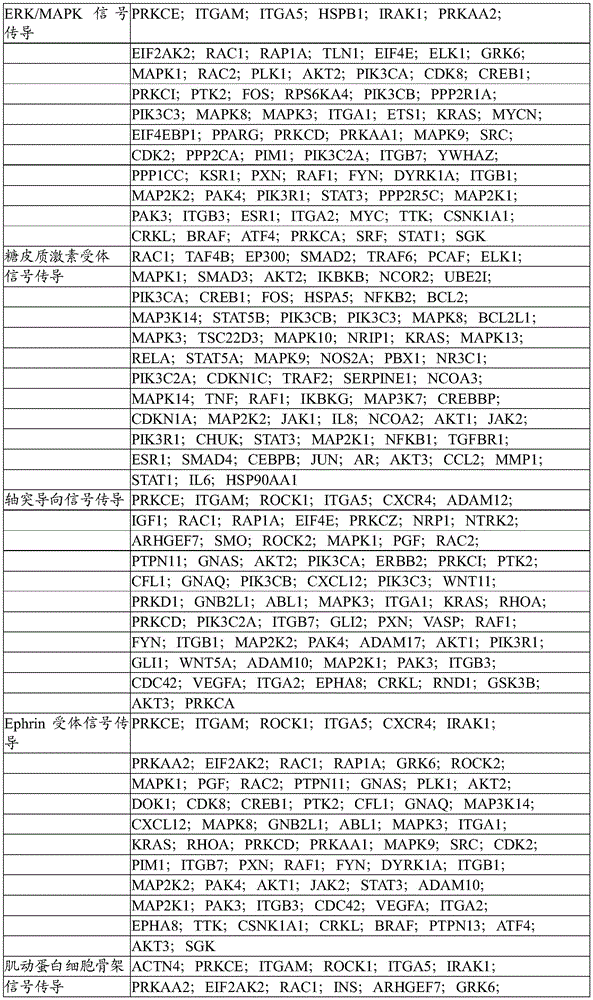


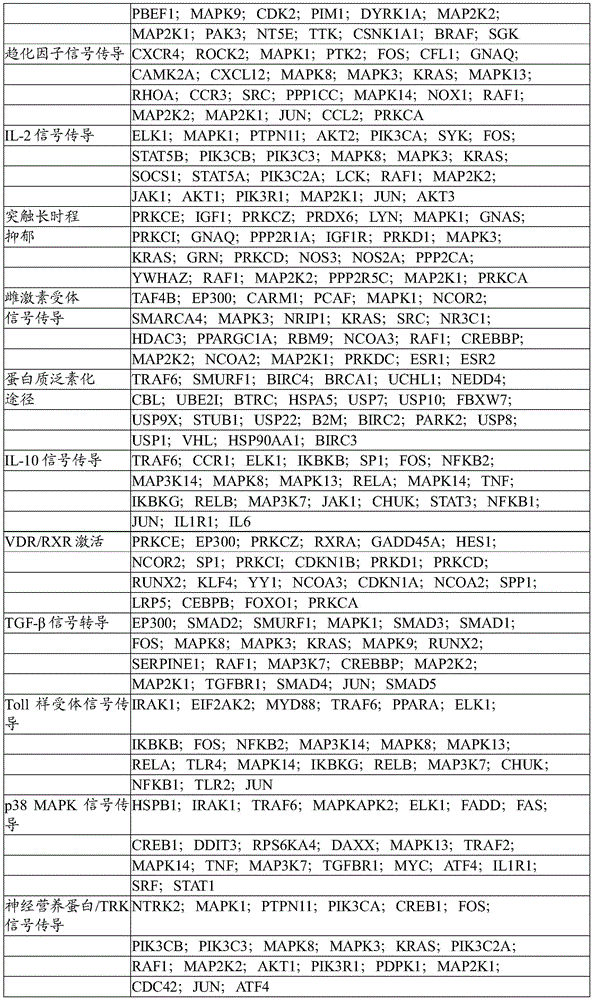


因此,本文还描述在如本文论述的真核或原核细胞中(体外,即在分离的真核细胞中)诱导一种或多种突变的方法,所述方法包括将如本文所述的载体递送至细胞。所述突变可以包括在细胞的靶序列处引入、缺失或取代一个或多个核苷酸。在一些实施方案中,所述突变可以包括在所述细胞的每个靶序列处引入、缺失或取代1-75个核苷酸。所述突变可以包括在每个靶序列处引入、缺失或取代1、5、10、11、12、13、14、15、16、17、18、19、20、21、22、23、24、25、26、27、28、29、30、35、40、45、50或75个核苷酸。所述突变可以包括在所述细胞的每个靶序列处引入、缺失或取代5、10、11、12、13、14、15、16、17、18、19、20、21、22、23、24、25、26、27、28、29、30、35、40、45、50或75个核苷酸。所述突变包括在所述细胞的每个靶序列处引入、缺失或取代10、11、12、13、14、15、16、17、18、19、20、21、22、23、24、25、26、27、28、29、30、35、40、45、50或75个核苷酸。所述突变可以包括在所述细胞的每个靶序列处引入、缺失或取代20、21、22、23、24、25、26、27、28、29、30、35、40、45、50或75个核苷酸。所述突变可以包括在所述细胞的每个靶序列处引入、缺失或取代40、45、50、75、100、200、300、400或500个核苷酸。所述突变可以包括在所述细胞的每个靶序列处引入、缺失或取代500、600、700、800、900、1000、1100、1200、1300、1400、1500、1600、1700、1800、1900、2000、2100、2200、2300、2400、2500、2600、2700、2800、2900、3000、3100、3200、3300、3400、3500、3600、3700、3800、3900、4000、4100、4200、4300、4400、4500、4600、4700、4800、4900、5000、5100、5200、5300、5400、5500、5600、5700、5800、5900、6000、6100、6200、6300、6400、6500、6600、6700、6800、6900、7000、7100、7200、7300、7400、7500、7600、7700、7800、7900、8000、8100、8200、8300、8400、8500、8600、8700、8800、8900、9000、9100、9200、9300、9400、9500、9600、9700、9800或9900至10000个核苷酸。Accordingly, also described herein are methods of inducing one or more mutations in eukaryotic or prokaryotic cells as discussed herein (in vitro, ie, in isolated eukaryotic cells) comprising delivering a vector as described herein to cells. The mutation can include the introduction, deletion or substitution of one or more nucleotides at the target sequence in the cell. In some embodiments, the mutation may comprise the introduction, deletion or substitution of 1-75 nucleotides at each target sequence in the cell. Said mutation may comprise introduction, deletion or substitution at each
在一些实施方案中,所述修饰可以包括通过核酸组分(例如,指导RNA或sgRNA)在所述细胞的每个靶序列处引入、缺失或取代核苷酸,诸如由CRISPR-Cas系统介导的那些。In some embodiments, the modification can include the introduction, deletion or substitution of nucleotides at each target sequence in the cell by a nucleic acid component (eg, guide RNA or sgRNA), such as mediated by the CRISPR-Cas system of those.
在一些实施方案中,所述修饰可以包括通过非CRISPR-Cas系统或技术在所述细胞的靶或随机序列处引入、缺失或取代核苷酸。此类技术在本文中别处论述,诸如在论述工程化细胞和产生所述工程化细胞和生物体的方法之处。In some embodiments, the modification may comprise the introduction, deletion or substitution of nucleotides at the target or random sequence of the cell by a non-CRISPR-Cas system or technique. Such techniques are discussed elsewhere herein, such as where engineered cells and methods of producing the engineered cells and organisms are discussed.
为了在使用CRISPR-Cas系统时最小化毒性和脱靶效应,控制所递送的Cas mRNA和指导RNA的浓度可能很重要。可以通过在细胞或非人类真核动物模型中测试不同浓度并使用深度测序分析在潜在的脱靶基因组基因座处的修饰程度来确定Cas mRNA和指导RNA的最佳浓度。或者,为了最小化毒性和脱靶效应的水平,可以与一对靶向所关注的位点的指导RNA一起递送Cas切口酶mRNA(例如,具有D10A突变的化脓性链球菌Cas9样)。最小化毒性和脱靶效应的指导序列和策略可以如同WO 2014/093622(PCT/US2013/074667)中;或者,通过如本文中的突变。To minimize toxicity and off-target effects when using the CRISPR-Cas system, it may be important to control the concentrations of delivered Cas mRNA and guide RNA. Optimal concentrations of Cas mRNA and guide RNA can be determined by testing different concentrations in cells or non-human eukaryotic animal models and analyzing the degree of modification at potential off-target genomic loci using deep sequencing. Alternatively, to minimize the level of toxicity and off-target effects, Cas nickase mRNA (eg, S. pyogenes Cas9-like with a D10A mutation) can be delivered with a pair of guide RNAs targeting the site of interest. Guide sequences and strategies to minimize toxicity and off-target effects can be as in WO 2014/093622 (PCT/US2013/074667); alternatively, by mutation as herein.
通常,在内源性CRISPR系统的情况下,CRISPR复合物(包含与靶序列杂交并与一种或多种Cas蛋白复合的指导序列)的形成导致在所述靶序列中或其附近(例如,在距所述靶序列1、2、3、4、5、6、7、8、9、10、20、50个或更多碱基对内)的一股或两股的裂解。不希望受理论束缚,可以包含野生型tracr序列的全部或一部分或由野生型tracr序列的全部或一部分组成的tracr序列(例如,野生型tracr序列的约或超过约20、26、32、45、48、54、63、67、85个或更多核苷酸)也可以形成CRISPR复合物的一部分,诸如其中沿着所述tracr序列的至少一部分与tracr配对序列的全部或一部分杂交,所述tracr配对序列与指导序列可操作地连接。Typically, in the case of an endogenous CRISPR system, the formation of a CRISPR complex (comprising a guide sequence that hybridizes to a target sequence and complexes with one or more Cas proteins) results in the formation of a CRISPR complex in or near the target sequence (eg, Cleavage of one or two strands within 1, 2, 3, 4, 5, 6, 7, 8, 9, 10, 20, 50 or more base pairs) of the target sequence. Without wishing to be bound by theory, a tracr sequence may comprise or consist of all or a portion of a wild-type tracr sequence (e.g., about or more than about 20, 26, 32, 45, 48, 54, 63, 67, 85 or more nucleotides) can also form part of a CRISPR complex, such as wherein at least a portion of the tracr sequence along which hybridizes to all or a portion of the tracr mate sequence, the tracr The mate sequence is operably linked to the guide sequence.
在一个实施方案中,本发明提供一种修饰真核细胞中的靶多核苷酸的方法。在一些实施方案中,所述方法包括将本文所述的工程化细胞和/或本文所述的具有CRISPR-Cas分子作为货物分子的工程化AAV衣壳粒子递送至受试者和/或细胞。所递送的CRISPR-Cas系统分子可以复合以与靶多核苷酸结合,例如以实现所述靶多核苷酸的裂解,从而修饰所述靶多核苷酸,其中所述CRISPR复合物包含与指导序列复合的CRISPR酶,所述指导序列与所述靶多核苷酸内的靶序列杂交,其中所述指导序列可以与tracr配对序列连接,所述tracr配对序列又与tracr序列杂交。在一些实施方案中,所述裂解包括通过所述CRISPR酶使在靶序列的位置处的一股或两股裂解。在一些实施方案中,所述裂解导致靶基因的转录减少。在一些实施方案中,所述方法还包括通过与外源模板多核苷酸同源重组来修复所述裂解的靶多核苷酸,其中所述修复产生突变,其包含所述靶多核苷酸的一个或多个核苷酸的插入、缺失或取代。在一些实施方案中,所述突变导致由包含靶序列的基因表达的蛋白质中的一种或多种氨基酸变化。在一些实施方案中,所述方法还包括将一种或多种载体递送至所述真核细胞,其中一种或多种载体包含CRISPR酶并且一种或多种载体驱动以下一者或多者的表达:与tracr配对序列连接的指导序列,和tracr序列。在一些实施方案中,所述CRISPR酶驱动以下一者或多者的表达:与tracr配对序列连接的指导序列,和tracr序列。在一些实施方案中,将此类CRISPR酶递送至受试者的真核细胞。在一些实施方案中,所述修饰发生在细胞培养物中的所述真核细胞中。在一些实施方案中,所述方法还包括在所述修饰之前从受试者中分离所述真核细胞。在一些实施方案中,所述方法还包括使所述真核细胞和/或由其衍生的细胞返回所述受试者。在一些实施方案中,在将一种或多种工程化AAV衣壳粒子递送至分离的细胞之后,可以使所述分离的细胞返回所述受试者。在一些实施方案中,在将本文所述的工程化递送系统的一种或多种分子递送至分离的细胞之后,可以使所述分离的细胞返回所述受试者,从而如先前所述将分离的细胞制成工程化细胞。In one embodiment, the present invention provides a method of modifying a target polynucleotide in a eukaryotic cell. In some embodiments, the method comprises delivering to a subject and/or cell an engineered cell described herein and/or an engineered AAV capsid particle described herein having a CRISPR-Cas molecule as a cargo molecule. The delivered CRISPR-Cas system molecule can be complexed to bind to a target polynucleotide, eg, to effect cleavage of the target polynucleotide, thereby modifying the target polynucleotide, wherein the CRISPR complex comprises complexing with a guide sequence The CRISPR enzyme, the guide sequence hybridizes to a target sequence within the target polynucleotide, wherein the guide sequence can be linked to a tracr mate sequence, which in turn hybridizes to the tracr sequence. In some embodiments, the cleavage comprises cleavage of one or both strands at the position of the target sequence by the CRISPR enzyme. In some embodiments, the cleavage results in reduced transcription of the target gene. In some embodiments, the method further comprises repairing the cleaved target polynucleotide by homologous recombination with an exogenous template polynucleotide, wherein the repairing results in a mutation comprising one of the target polynucleotides or insertions, deletions or substitutions of multiple nucleotides. In some embodiments, the mutation results in one or more amino acid changes in the protein expressed by the gene comprising the target sequence. In some embodiments, the method further comprises delivering one or more vectors to the eukaryotic cell, wherein the one or more vectors comprise a CRISPR enzyme and the one or more vectors drive one or more of the following Expression of: a guide sequence linked to a tracr mate sequence, and a tracr sequence. In some embodiments, the CRISPR enzyme drives the expression of one or more of: a guide sequence linked to a tracr mate sequence, and a tracr sequence. In some embodiments, such CRISPR enzymes are delivered to eukaryotic cells of a subject. In some embodiments, the modification occurs in the eukaryotic cells in cell culture. In some embodiments, the method further comprises isolating the eukaryotic cells from the subject prior to the modifying. In some embodiments, the method further comprises returning the eukaryotic cells and/or cells derived therefrom to the subject. In some embodiments, after delivery of the one or more engineered AAV capsid particles to the isolated cells, the isolated cells can be returned to the subject. In some embodiments, after delivering one or more molecules of an engineered delivery system described herein to an isolated cell, the isolated cell can be returned to the subject, thereby transferring the The isolated cells are made into engineered cells.
筛选和细胞选择Screening and Cell Selection
本文所述的工程化AAV衣壳系统载体、工程化细胞和/或工程化AAV衣壳粒子可以用于筛选测定法和/或细胞选择测定法。可以将所述工程化递送系统载体、工程化细胞和/或工程化AAV衣壳粒子递送至受试者和/或细胞。在一些实施方案中,所述细胞是真核细胞。所述细胞可以在体外、离体、原位或体内。本文所述的工程化AAV衣壳系统分子、载体、工程化细胞和/或工程化AAV衣壳粒子可以将外源分子或化合物引入它们所递送到达的受试者或细胞。可以检测外源分子或化合物的存在,从而可以允许鉴定细胞和/或其属性。在一些实施方案中,所递送的分子或粒子可以赋予基因或其他核苷酸修饰(例如,突变、基因或多核苷酸插入和/或缺失等)。在一些实施方案中,可以通过测序在细胞中检测核苷酸修饰。在一些实施方案中,核苷酸修饰可以引起针对细胞的生理和/或生物修饰,所述生理和/或生物修饰在细胞中产生可检测到的表型变化,从而可以允许所述细胞的检测、鉴定和/或选择。在一些实施方案中,所述表型变化可以是细胞死亡,诸如其中CRISPR复合物与靶多核苷酸的结合导致细胞死亡的实施方案。本发明的实施方案允许选择特定细胞,而不需要选择标记或可以包括逆选择系统的两步过程。所述细胞可以是原核或真核细胞。The engineered AAV capsid system vectors, engineered cells, and/or engineered AAV capsid particles described herein can be used in screening assays and/or cell selection assays. The engineered delivery system vector, engineered cell and/or engineered AAV capsid particle can be delivered to a subject and/or cell. In some embodiments, the cells are eukaryotic cells. The cells can be in vitro, ex vivo, in situ or in vivo. The engineered AAV capsid system molecules, vectors, engineered cells, and/or engineered AAV capsid particles described herein can introduce exogenous molecules or compounds into the subject or cell to which they are delivered. The presence of exogenous molecules or compounds can be detected, which can allow identification of cells and/or their properties. In some embodiments, the delivered molecule or particle may impart genetic or other nucleotide modifications (eg, mutations, genetic or polynucleotide insertions and/or deletions, etc.). In some embodiments, nucleotide modifications can be detected in cells by sequencing. In some embodiments, nucleotide modifications can result in physiological and/or biological modifications to cells that produce detectable phenotypic changes in cells that can allow detection of said cells , identification and/or selection. In some embodiments, the phenotypic change may be cell death, such as embodiments in which binding of the CRISPR complex to the target polynucleotide results in cell death. Embodiments of the present invention allow for selection of specific cells without the need for a selectable marker or a two-step process that may involve a counter-selection system. The cells may be prokaryotic or eukaryotic cells.
在一个实施方案中,本发明提供一种通过在一种或多种细胞中的基因中引入一种或多种突变来选择一种或多种细胞的方法,所述方法包括:向所述细胞中引入一种或多种载体,其可以包括本文中别处所述的一种或多种工程化递送系统分子或载体,其中所述一种或多种载体可以包括CRISPR酶和/或驱动以下一者或多者的表达:与tracr配对序列连接的指导序列、tracr序列和编辑模板;或待插入至细胞和/或其基因组中的另一多核苷酸;其中,例如正在表达的物质是在CRISPR酶和/或编辑模板内并由它在体内表达,当包括在内时,所述物质包含一种或多种消除CRISPR酶裂解的突变;从而允许编辑模板与待选择的细胞中的靶多核苷酸同源重组;从而允许CRISPR复合物与靶多核苷酸结合以实现所述靶多核苷酸在所述基因内的裂解,其中所述CRISPR复合物包含与(1)与靶多核苷酸内的靶序列杂交的指导序列复合的CRISPR酶,和(2)与tracr序列杂交的tracr配对序列,其中所述CRISPR复合物与靶多核苷酸的结合诱导细胞死亡,从而允许选择其中已引入一种或多种突变的一种或多种细胞。在一个优选的实施方案中,所述CRISPR酶是Cas蛋白。在本发明的另一实施方案中,待选择的细胞可以是真核细胞。In one embodiment, the present invention provides a method of selecting one or more cells by introducing one or more mutations in a gene in one or more cells, the method comprising: introducing to the cells Introduce one or more vectors, which may include one or more engineered delivery system molecules or vectors described elsewhere herein, wherein the one or more vectors may include a CRISPR enzyme and/or drive one of the following Expression of one or more of: a guide sequence, a tracr sequence, and an editing template linked to a tracr mate sequence; or another polynucleotide to be inserted into a cell and/or its genome; wherein, for example, the substance being expressed is in The CRISPR enzyme and/or the editing template and/or the editing template is expressed in vivo, and when included, the substance contains one or more mutations that eliminate cleavage by the CRISPR enzyme; thereby allowing the editing template to interact with the target multinucleus in the cell to be selected nucleotide homologous recombination; thereby allowing a CRISPR complex to bind to a target polynucleotide to effect cleavage of the target polynucleotide within the gene, wherein the CRISPR complex comprises and (1) within the target polynucleotide A CRISPR enzyme complexed with a guide sequence that hybridizes to a target sequence, and (2) a tracr mate sequence that hybridizes to a tracr sequence, wherein the binding of the CRISPR complex to the target polynucleotide induces cell death, thereby allowing selection of a or more mutated one or more cells. In a preferred embodiment, the CRISPR enzyme is a Cas protein. In another embodiment of the invention, the cells to be selected may be eukaryotic cells.
涉及所述工程化AAV衣壳系统分子、载体、工程化细胞和/或工程化AAV衣壳粒子(包括但不限于向细胞传递一种多种CRISPR-Cas系统分子的那些)的筛选方法可以用于诸如荧光原位杂交(FISH)的检测方法。在一些实施方案中,可以通过本文中别处所述的工程化AAV衣壳系统分子、工程化细胞和/或工程化AAV衣壳粒子将包括催化失活的Cas蛋白的工程化CRISPR-Cas系统的一种或多种组分递送至细胞并用于FISH方法。所述CRISPR-Cas系统可以包括失活的Cas蛋白(dCas)(例如dCas9),其缺乏产生DNA双股断裂的能力,可以与标记,诸如荧光蛋白,诸如增强型绿色荧光蛋白(eEGFP)融合并与小指导RNA共表达,以在体内靶向近中心、中心和端粒重复序列。所述dCas系统可以用于显现人类基因组中的重复序列和个别基因。标记的dCas、dCas CRISPR-Cas系统、工程化AAV衣壳系统分子、工程化细胞和/或工程化AAV衣壳粒子的此类新的应用可以用于使细胞成像并研究功能性核架构,尤其是在核体积小或3-D结构复杂的情况下。(Chen B,Gilbert LA,Cimini BA,Schnitzbauer J,Zhang W,Li GW,Park J,Blackburn EH,Weissman JS,Qi LS,Huang B.2013.Dynamicimaging of genomic loci in living human cells by an optimized CRISPR/Cassystem.Cell 155(7):1479-91.doi:10.1016/j.cell.2013.12.001.,其教导可以应用和/或调整用于本文所述的CRISPR系统。涉及与标记(例如荧光标记)融合的多核苷酸的类似方法可以通过本文所述的工程化AAV衣壳系统分子、载体、工程化细胞和/或工程化AAV衣壳粒子递送至细胞并且整合至所述细胞的基因组中和/或以其他方式与用于FISH分析的细胞的基因组的区域相互作用。Screening methods involving the engineered AAV capsid system molecules, vectors, engineered cells, and/or engineered AAV capsid particles (including, but not limited to, those delivering one or more CRISPR-Cas system molecules to cells) can be used detection methods such as fluorescence in situ hybridization (FISH). In some embodiments, engineered CRISPR-Cas systems comprising catalytically inactive Cas proteins can be modified by engineered AAV capsid system molecules, engineered cells, and/or engineered AAV capsid particles as described elsewhere herein. One or more components are delivered to cells and used in FISH methods. The CRISPR-Cas system can include an inactive Cas protein (dCas) (eg, dCas9), which lacks the ability to generate DNA double-strand breaks, can be fused to a marker, such as a fluorescent protein, such as enhanced green fluorescent protein (eEGFP), and Co-expressed with small guide RNAs to target pericentric, centrocentric and telomeric repeats in vivo. The dCas system can be used to visualize repetitive sequences and individual genes in the human genome. Such new applications of labeled dCas, dCas CRISPR-Cas systems, engineered AAV capsid system molecules, engineered cells and/or engineered AAV capsid particles can be used to image cells and study functional nuclear architecture, especially is in the case of small nuclear volume or complex 3-D structure. (Chen B, Gilbert LA, Cimini BA, Schnitzbauer J, Zhang W, Li GW, Park J, Blackburn EH, Weissman JS, Qi LS, Huang B. 2013. Dynamicimaging of genomic loci in living human cells by an optimized CRISPR/Cassystem .Cell 155(7):1479-91.doi:10.1016/j.cell.2013.12.001., whose teachings can be applied and/or adapted for use with the CRISPR systems described herein. Involves fusion with labels (eg, fluorescent labels) An analogous approach to the polynucleotides can be delivered to cells and integrated into the genome of said cells by the engineered AAV capsid system molecules, vectors, engineered cells and/or engineered AAV capsid particles described herein and/or Interact in other ways with regions of the genome of the cells used for FISH analysis.
用于研究其他细胞器和其他细胞结构的类似方法可以通过向细胞递送(例如,通过本文所述的工程化递送AAV衣壳分子、工程化细胞和/或工程化AAV衣壳粒子)一种或多种与标记(诸如荧光标记)融合的分子来达成,其中与标记融合的分子能够靶向一种或多种细胞结构。通过分析标记的存在,可以鉴定特定的细胞结构和/或使所述结构成像。Similar methods for studying other organelles and other cellular structures can be accomplished by delivering to cells (eg, by engineered delivery of AAV capsid molecules, engineered cells, and/or engineered AAV capsid particles as described herein) one or more This is achieved by a molecule fused to a label, such as a fluorescent label, wherein the molecule fused to the label is capable of targeting one or more cellular structures. By analyzing the presence of markers, specific cellular structures can be identified and/or imaged.
在一些实施方案中,所述工程化AAV衣壳系统分子和/或工程化AAV衣壳粒子可以用于细胞内部或外部的筛选测定法。在一些实施方案中,所述筛选测定法可以包括通过工程化AAV衣壳粒子递送CRISPR-Cas货物分子。In some embodiments, the engineered AAV capsid system molecules and/or engineered AAV capsid particles can be used in screening assays inside or outside of cells. In some embodiments, the screening assay can include delivery of CRISPR-Cas cargo molecules by engineered AAV capsid particles.
本发明还提供本发明系统在筛选中的用途,例如功能获得筛选。被人为强制地过表达基因的细胞能够随着时间的推移下调所述基因(再建立平衡),例如通过负反馈环。到筛选开始时,未调控的基因可能会再次减少。其他筛选测定法在本文中别处论述。The invention also provides the use of the system of the invention in screening, eg gain-of-function screening. Cells that are artificially forced to overexpress a gene are able to downregulate the gene (re-establish equilibrium) over time, eg, through a negative feedback loop. By the time the screening begins, the unregulated genes may be reduced again. Other screening assays are discussed elsewhere herein.
在一个实施方案中,本发明提供来自或属于体外递送方法的细胞,其中所述方法包括使递送系统与细胞、任选地真核细胞接触,由此将递送系统的成分递送至细胞中,和任选地获得所述接触的数据或结果,并传输所述数据或结果。In one embodiment, the present invention provides cells derived from or belonging to an in vitro delivery method, wherein the method comprises contacting a delivery system with a cell, optionally a eukaryotic cell, thereby delivering components of the delivery system into the cell, and Data or results of said contacts are optionally obtained, and said data or results are transmitted.
在一个实施方案中,本发明提供来自或属于体外递送方法的细胞,其中所述方法包括使递送系统与细胞、任选地真核细胞接触,由此将递送系统的成分递送至细胞中,和任选地获得所述接触的数据或结果,并传输所述数据或结果;并且其中细胞产物与未与所述递送系统接触的细胞相比发生改变,例如与如果不接触仍将是野生型细胞的细胞相比发生改变。在一个实施方案中,所述细胞产物是非人类或动物的。在一些实施方案中,所述细胞产物是人类的。In one embodiment, the present invention provides cells derived from or belonging to an in vitro delivery method, wherein the method comprises contacting a delivery system with a cell, optionally a eukaryotic cell, thereby delivering components of the delivery system into the cell, and optionally obtaining data or results of said contacting and transmitting said data or results; and wherein the cell product is altered compared to cells not contacted with said delivery system, such as compared to cells that would have been wild-type if not contacted cells were changed. In one embodiment, the cell product is non-human or animal. In some embodiments, the cell product is human.
在一些实施方案中,用本文所述的一种或多种载体瞬时或非瞬时转染宿主细胞。在一些实施方案中,当细胞天然地存在于受试者中时,对所述细胞进行转染,任选地再引入其中。在一些实施方案中,进行转染的细胞是取自受试者。在一些实施方案中,所述细胞是获自或来源于取自受试者的细胞,诸如细胞系。所述工程化AAV衣壳系统、工程化AAV衣壳粒子的递送机制和技术在本文中别处描述。In some embodiments, host cells are transiently or non-transiently transfected with one or more of the vectors described herein. In some embodiments, the cells are transfected, optionally reintroduced, when the cells are naturally present in the subject. In some embodiments, the transfected cells are obtained from a subject. In some embodiments, the cell is a cell obtained or derived from a subject, such as a cell line. The engineered AAV capsid systems, delivery mechanisms and techniques for engineered AAV capsid particles are described elsewhere herein.
在一些实施方案中,设想将所述工程化AAV衣壳系统分子和/或工程化AAV衣壳粒子直接引入宿主细胞中。例如,所述工程化AAV衣壳系统分子可以与一种或多种货物分子一起递送,以包装至工程化AAV衣壳粒子中。In some embodiments, direct introduction of the engineered AAV capsid system molecules and/or engineered AAV capsid particles into a host cell is envisaged. For example, the engineered AAV capsid system molecules can be delivered with one or more cargo molecules for packaging into engineered AAV capsid particles.
在一些实施方案中,本发明提供一种在细胞中表达待包装于工程化GTA粒子中的工程化递送分子和货物分子的方法,所述方法可以包括根据本文所公开的任何载体递送系统引入载体的步骤。In some embodiments, the present invention provides a method of expressing in a cell engineered delivery molecules and cargo molecules to be packaged in engineered GTA particles, which method may comprise introducing a vector according to any of the vector delivery systems disclosed herein A step of.
本发明在以下实施例中进一步描述,所述实施例不限制权利要求书中所述的本发明范围。The invention is further described in the following examples, which do not limit the scope of the invention described in the claims.
实施例Example
实施例1-基于mRNA的检测方法对于AAV变体的选择更为严格。Example 1 - mRNA-based detection methods are more stringent for selection of AAV variants.
图1说明腺相关病毒(AAV)转导机制,其导致mRNA产生。如图1所说明,AAV粒子对细胞的功能性转导可能导致mRNA股的产生。非功能性转导将不会产生此类产物,不过使用基于DNA的测定法可检测到病毒基因组。因此,用于检测由例如AAV进行的转导的基于mRNA的检测测定法可能更严格并且提供关于能够在功能上转导细胞的病毒粒子的功能性的反馈。图2示出的图可以说明基于mRNA的AAV变体选择可能比基于DNA的选择更严格。病毒文库在CMV启动子的控制下表达。Figure 1 illustrates the adeno-associated virus (AAV) transduction mechanism, which results in mRNA production. As illustrated in Figure 1, functional transduction of cells by AAV particles may result in the production of mRNA strands. Non-functional transduction will not produce such products, although the viral genome is detectable using DNA-based assays. Thus, mRNA-based detection assays for detecting transduction by eg AAV may be more stringent and provide feedback on the functionality of virions capable of functionally transducing cells. Figure 2 shows a graph that may illustrate that mRNA-based AAV variant selection may be more stringent than DNA-based selection. The viral library is expressed under the control of the CMV promoter.
实施例2-基于mRNA的检测方法可以用于从衣壳变体文库中检测AAV衣壳变体Example 2 - mRNA-based detection methods can be used to detect AAV capsid variants from a library of capsid variants
图3A-3B示出的图说明肝中的病毒文库和载体基因组DNA(图3A)与mRNA(图3B)之间的相关性。图4A-4F示出的图可以说明衣壳变体以不同组织中鉴定的mRNA水平表达。Figures 3A-3B show graphs illustrating the correlation between viral libraries and vector genomic DNA (Figure 3A) and mRNA (Figure 3B) in liver. Figures 4A-4F show graphs illustrating that capsid variants are expressed at the mRNA levels identified in different tissues.
实施例3-衣壳mRNA表达可以由组织特异性启动子驱动Example 3 - Capsid mRNA expression can be driven by tissue specific promoters
图5A-5C示出的图说明在细胞类型特异性启动子的控制下在不同组织中的衣壳mRNA表达(如x轴上所注明)。包括CMV作为示例性组成型启动子。CK8是肌肉特异性启动子。MHCK7是肌肉特异性启动子。hSyn是神经元特异性启动子。Figures 5A-5C show graphs illustrating capsid mRNA expression (as noted on the x-axis) in different tissues under the control of cell-type specific promoters. CMV is included as an exemplary constitutive promoter. CK8 is a muscle-specific promoter. MHCK7 is a muscle-specific promoter. hSyn is a neuron-specific promoter.
实施例4-衣壳变体文库产生、变体筛选和变体鉴定Example 4 - Capsid variant library generation, variant screening and variant identification
一般说来,可以通过在适当AAV生产细胞系中表达各自含有先前所述的工程化AAV衣壳多核苷酸的工程化衣壳载体来产生AAV衣壳文库。参见例如图8。这可以生成AAV衣壳文库,所述文库可以含有一种更需要的细胞特异性工程化AAV衣壳变体。图7示出的示意图说明产生AAV衣壳变体文库的实施方案,特别是将随机n聚体(n=3-15个氨基酸)插入至野生型AAV(例如AAV9)中。在这一实施例中,将随机7聚体插入AAV9病毒蛋白的可变区VIII的aa588-589之间,并用于形成含有每个载体一个变体的载体的病毒基因组。如图8所示,使用所述衣壳变体载体文库来产生AAV粒子,其中每个衣壳变体都将其编码序列封装为载体基因组。图9示出可以用于AAV载体系统以产生AAV衣壳变体文库的代表性AAV衣壳质粒文库载体(参见例如图8)的载体图。所述文库可以用衣壳变体多核苷酸在组织特异性启动子或组成型启动子的控制下产生。所述文库也用包括多腺苷酸化信号的衣壳变体多核苷酸制成。In general, AAV capsid libraries can be generated by expressing engineered capsid vectors each containing the previously described engineered AAV capsid polynucleotides in an appropriate AAV producing cell line. See eg Figure 8. This can generate AAV capsid libraries that can contain a more desired cell-specific engineered AAV capsid variant. Figure 7 shows a schematic diagram illustrating an embodiment of generating a library of AAV capsid variants, in particular the insertion of random n-mers (n=3-15 amino acids) into wild-type AAV (eg, AAV9). In this example, random 7-mers were inserted between aa588-589 of variable region VIII of the AAV9 viral protein and used to form the viral genome of the vector containing one variant per vector. As shown in Figure 8, the library of capsid variant vectors was used to generate AAV particles, where each capsid variant encapsulates its coding sequence into a vector genome. Figure 9 shows a vector map of a representative AAV capsid plasmid library vector (see eg, Figure 8) that can be used in the AAV vector system to generate AAV capsid variant libraries. The library can be generated using capsid variant polynucleotides under the control of a tissue-specific promoter or a constitutive promoter. The library is also made with capsid variant polynucleotides that include a polyadenylation signal.
如图6所示,可以将AAV衣壳文库施用于各种非人类动物,以进行第一轮基于mRNA的选择。如图1所示,AAV和相关载体的转导过程导致产生反映转导细胞的病毒基因组的mRNA分子。如至少在本文中的实施例中所说明,基于mRNA的选择可以更具特异性并且更有效地确定能够在功能上转导细胞的病毒粒子,因为它是基于所产生的功能性产物,与仅仅通过测量病毒DNA的存在来检测病毒粒子在细胞中的存在相反。As shown in Figure 6, AAV capsid libraries can be administered to various non-human animals for a first round of mRNA-based selection. As shown in Figure 1, the transduction process of AAV and related vectors results in the production of mRNA molecules that reflect the viral genome of the transduced cell. As illustrated at least in the examples herein, mRNA-based selection can be more specific and more efficient in identifying viral particles capable of functionally transducing cells because it is based on the functional product produced, as opposed to merely The opposite is true for detecting the presence of viral particles in cells by measuring the presence of viral DNA.
在第一轮施用之后,一个或多个具有所需衣壳变体的工程化AAV病毒粒子可以接着用于形成已过滤的AAV衣壳文库。可以通过测量衣壳变体的mRNA表达并确定如与非所需细胞类型相比哪些变体在所需细胞类型中高度表达来鉴定所需的AAV病毒粒子。在所需细胞、组织和/或器官类型中高度表达的那些是所需的AAV衣壳变体粒子。在一些实施方案中,AAV衣壳变体编码多核苷酸是在组织特异性启动子的控制下,所述启动子在所需细胞、组织或器官中具有选择活性。After the first round of administration, one or more engineered AAV virions with the desired capsid variant can then be used to form a filtered AAV capsid library. Desired AAV virions can be identified by measuring the mRNA expression of the capsid variants and determining which variants are highly expressed in the desired cell type as compared to the undesired cell type. Those that are highly expressed in the desired cell, tissue and/or organ type are the desired AAV capsid variant particles. In some embodiments, the AAV capsid variant-encoding polynucleotide is under the control of a tissue-specific promoter having selective activity in a desired cell, tissue, or organ.
第一轮鉴定的工程化AAV衣壳变体粒子可以接着施用于各种非人类动物。在一些实施方案中,用于第二轮选择和鉴定的动物与用于第一轮选择和鉴定的那些动物不同。与第1轮相似,在施用之后,可以通过测量细胞中的病毒mRNA表达来鉴定所需细胞、组织和/或器官类型中的顶级表达变体。接着可以任选地对第二轮之后鉴定的顶级变体编条形码,并且任选地进行汇集。在一些实施方案中,接着可以将来自第二轮的顶级变体施用于非人类灵长类动物以鉴定顶级细胞特异性变体,特别是如果顶级变体的最终用途是人类。每一轮的施用均可以是全身性的。The engineered AAV capsid variant particles identified in the first round can then be administered to various non-human animals. In some embodiments, the animals used for the second round of selection and identification are different from those used for the first round of selection and identification. Similar to
图10示出的图说明由使用不同启动子生成的文库产生的病毒滴度(计算为AAV9载体基因组/15cm皿)。如图10所说明,使用不同启动子对病毒滴度没有显著影响。Figure 10 shows a graph illustrating the viral titers (calculated as AAV9 vector genome/15cm dish) produced by libraries generated using different promoters. As illustrated in Figure 10, the use of different promoters had no significant effect on virus titers.
图11A-11C示出的图(图11A和11C)和示意图(图11B)说明用于病毒文库产生和交叉包装的质粒文库载体的量之间的相关性。图11A可以说明质粒文库载体量对病毒滴度的影响。图11b可以说明如插入野生型AAV9的aa588和aa 589的密码子之间的随机n聚体(图11C举例示出7聚体)的核苷酸序列。每个X指示一个氨基酸。N指示任何核苷酸(G、A、T、C)。K指示那个位置处的核苷酸是T或G。图11C可以说明质粒文库载体量对含有终止密码子的读数的%的影响。增加用于产生病毒粒子文库的质粒文库载体的量会增加滴度,如通过转导的细胞的文库载体基因组/15cm皿得量所测量(图11A)。另外,当用于产生病毒粒子文库的质粒文库载体的量增加时,包括由随机n聚体基序引入的终止密码子的读数的百分比增加。11A-11C show graphs (FIGS. 11A and 11C) and schematic diagrams (FIG. 11B) illustrating the correlation between the amount of plasmid library vector used for viral library production and cross-packaging. Figure 11A can illustrate the effect of plasmid library vector amount on virus titer. Figure 11b can illustrate the nucleotide sequence of a random n-mer (Figure 11C exemplifies a 7-mer) as inserted between the codons of aa588 and
图12A-12F示出的图说明在第一轮选择之后在C57BL/6小鼠中使用在MHCK7肌肉特异性启动子的控制下表达的衣壳文库获得的结果。Figures 12A-12F show graphs illustrating the results obtained in C57BL/6 mice using a capsid library expressed under the control of the MHCK7 muscle-specific promoter after the first round of selection.
图13A-13D示出的图说明在第二轮选择之后在C57BL/6小鼠中获得的结果。Figures 13A-13D show graphs illustrating the results obtained in C57BL/6 mice after the second round of selection.
图14A-14B示出的图可以说明由同义密码子编码的变体的丰度之间的相关性。这张图说明在病毒文库与功能性病毒粒子中几乎没有密码子偏好。Figures 14A-14B show graphs that illustrate the correlation between the abundances of variants encoded by synonymous codons. This figure illustrates that there is little codon bias in viral libraries and functional virions.
图15示出的图可以说明在两种不同的肌肉特异性启动子(MHCK7和CK8)的控制下表达的相同变体的丰度之间的相关性。这张图可以说明,使用哪种组织特异性启动子来生成衣壳变体文库几乎没有影响,至少对于肌肉细胞是这样。Figure 15 shows a graph that can illustrate the correlation between the abundance of the same variant expressed under the control of two different muscle-specific promoters (MHCK7 and CK8). This figure can illustrate that which tissue-specific promoter is used to generate a library of capsid variants makes little difference, at least for muscle cells.
实施例5-肌肉向性rAAV衣壳Example 5 - Muscle-tropic rAAV capsids
图16示出的图可以说明产生具有与野生型AAV9衣壳相似的滴度的rAAV的肌肉向性衣壳变体。Figure 16 shows a graph illustrating the production of muscle-tropic capsid variants of rAAV with titers similar to wild-type AAV9 capsids.
图17示出的图像可以说明小鼠组织转导在rAAV9-GFP与rMyoAAV-GFP之间的比较。Figure 17 shows images that illustrate the comparison of mouse tissue transduction between rAAV9-GFP and rMyoAAV-GFP.
图18示出的一组图像可以说明小鼠组织转导在rAAV9-GFP与rMyoAAV-G之间的比较。Figure 18 shows a set of images illustrating the comparison of mouse tissue transduction between rAAV9-GFP and rMyoAAV-G.
图19示出的一组图像可以说明小鼠组织转导在rAAV9-GFP与rMyoAAV-GF之间的比较。Figure 19 shows a set of images that illustrate the comparison of mouse tissue transduction between rAAV9-GFP and rMyoAAV-GF.
图20示出选择用于跨物种的肌肉定向基因递送的有效衣壳变体的示意图。Figure 20 shows a schematic representation of selection of effective capsid variants for muscle-directed gene delivery across species.
图21A-21C示出的表说明在不同小鼠品系中的选择并鉴定出与顶部肌肉向性命中相同的变体。Figures 21A-21C show a table illustrating selection in different mouse strains and identification of the same variants as the top muscle tropism hits.
******
在不偏离本发明的范围和精神的情况下,本发明的所述方法、药物组合物和试剂盒的各种修改和变化对于本领域技术人员而言将是明显的。尽管已结合具体实施方案对本发明进行了描述,但应理解它能够进行进一步修改并且所要求保护的本发明不应当不适当地限定于此类具体实施方案。实际上,用于进行本发明的所述方式的各种修改对于本领域技术人员而言是明显的,并且旨在包含在本发明的范围内。本申请旨在涵盖大体上符合本发明的原理并且包括与本公开的此类背离的本发明的任何变化、用途或者调整,所述背离属于本发明所属领域内的已知惯例并且可以应用于上文中所阐述的必要特征。Various modifications and variations of the described methods, pharmaceutical compositions and kits of the invention will be apparent to those skilled in the art without departing from the scope and spirit of the invention. Although the present invention has been described in connection with specific embodiments, it should be understood that it is capable of further modification and the invention as claimed should not be unduly limited to such specific embodiments. Indeed, various modifications of the described modes for carrying out the invention will be apparent to those skilled in the art and are intended to be included within the scope of the invention. This application is intended to cover any variations, uses, or adaptations of the invention that are generally consistent with the principles of the invention and include such departures from this disclosure as would be customary in the art to which this invention pertains and which may be applied above The necessary features described in the text.
Claims (71)
Applications Claiming Priority (5)
| Application Number | Priority Date | Filing Date | Title |
|---|---|---|---|
| US201962899453P | 2019-09-12 | 2019-09-12 | |
| US62/899,453 | 2019-09-12 | ||
| US201962916185P | 2019-10-16 | 2019-10-16 | |
| US62/916,185 | 2019-10-16 | ||
| PCT/US2020/050534 WO2021050974A1 (en) | 2019-09-12 | 2020-09-11 | Engineered adeno-associated virus capsids |
Publications (1)
| Publication Number | Publication Date |
|---|---|
| CN114729384A true CN114729384A (en) | 2022-07-08 |
Family
ID=72665291
Family Applications (1)
| Application Number | Title | Priority Date | Filing Date |
|---|---|---|---|
| CN202080075936.4A Pending CN114729384A (en) | 2019-09-12 | 2020-09-11 | Engineered adeno-associated virus capsids |
Country Status (6)
| Country | Link |
|---|---|
| US (1) | US20220325296A1 (en) |
| EP (1) | EP4028064A1 (en) |
| JP (1) | JP2022547570A (en) |
| CN (1) | CN114729384A (en) |
| AU (1) | AU2020347276A1 (en) |
| WO (1) | WO2021050974A1 (en) |
Cited By (1)
| Publication number | Priority date | Publication date | Assignee | Title |
|---|---|---|---|---|
| CN115175991A (en) * | 2019-10-16 | 2022-10-11 | 博德研究所 | Engineered muscle targeting compositions |
Families Citing this family (21)
| Publication number | Priority date | Publication date | Assignee | Title |
|---|---|---|---|---|
| IL299431A (en) * | 2020-07-22 | 2023-02-01 | Broad Inst Inc | Engineered muscle targeting compositions |
| WO2023004416A1 (en) * | 2021-07-23 | 2023-01-26 | California Institute Of Technology | Viral vectors for enhanced ultrasound-mediated delivery to the brain |
| US20250002541A1 (en) * | 2021-09-08 | 2025-01-02 | The Broad Institute, Inc. | Engineered central nervous system compositions |
| CN118202060A (en) | 2021-10-05 | 2024-06-14 | 再生生物股份有限公司 | Compositions and methods for recombinant AAV production |
| WO2023060113A1 (en) | 2021-10-05 | 2023-04-13 | Regenxbio Inc. | Compositions and methods for recombinant aav production |
| CA3234664A1 (en) | 2021-10-08 | 2023-04-13 | Dyno Therapeutics, Inc. | Capsid variants and methods of using the same |
| US20250066809A1 (en) * | 2021-12-20 | 2025-02-27 | Aldevron, Llc | Production of gene therapy vector in engineered bacteria |
| JP2026501801A (en) * | 2023-01-09 | 2026-01-16 | ケイト セラピューティクス, インコーポレイテッド | Liver-detargeted capsid |
| EP4410987A1 (en) * | 2023-01-31 | 2024-08-07 | Universitätsklinikum Hamburg-Eppendorf | An aav9 capsid variant for targeted gene transfer |
| EP4662323A2 (en) * | 2023-02-09 | 2025-12-17 | Kate Therapeutics, Inc. | Muscle targeted capsids |
| KR20250169640A (en) | 2023-03-10 | 2025-12-03 | 디노 테라퓨틱스, 인코포레이티드 | Capsid polypeptides and methods of using the same |
| EP4680741A2 (en) | 2023-03-15 | 2026-01-21 | RegenxBio Inc. | Exon skipping gene therapy constructs, vectors and uses thereof |
| WO2024238807A2 (en) | 2023-05-16 | 2024-11-21 | Affinia Therapeutics Inc. | Recombinant aavs with improved tropism and specificity |
| TW202525832A (en) | 2023-08-31 | 2025-07-01 | 美商戴諾治療公司 | Capsid polypeptides and methods of use thereof |
| WO2025171227A1 (en) | 2024-02-08 | 2025-08-14 | Dyno Therapeutics, Inc. | Capsid polypeptides and methods of use thereof |
| US20250276095A1 (en) | 2024-03-04 | 2025-09-04 | Kate Therapeutics, Inc. | Adeno-associated virus compositions for the treatment of duchenne muscular dystrophy |
| WO2025226842A1 (en) | 2024-04-24 | 2025-10-30 | Kate Therapeutics, Inc. | Expression control by drg-expressed mirnas |
| WO2025226841A1 (en) | 2024-04-24 | 2025-10-30 | Kate Therapeutics, Inc. | Gene therapy approach for treating disorders associated with tnnt2 |
| WO2026006341A1 (en) | 2024-06-24 | 2026-01-02 | Regenxbio Inc. | Microdystrophin gene therapy administration for treatment of dystrophinopathies |
| WO2026011009A1 (en) | 2024-07-02 | 2026-01-08 | Kate Therapeutics, Inc. | Compositions and methods for muscle disorders |
| WO2026011008A1 (en) | 2024-07-02 | 2026-01-08 | Kate Therapeutics, Inc. | Expression control by skeletal muscle-expressed mirnas |
Citations (6)
| Publication number | Priority date | Publication date | Assignee | Title |
|---|---|---|---|---|
| CN103561774A (en) * | 2011-04-22 | 2014-02-05 | 加利福尼亚大学董事会 | Adeno-associated virus virions with mutated capsids and methods of use thereof |
| CN107532177A (en) * | 2015-03-24 | 2018-01-02 | 加利福尼亚大学董事会 | Adeno-associated virus variant and its application method |
| WO2018189244A1 (en) * | 2017-04-11 | 2018-10-18 | Ruprecht-Karls-Universität Heidelberg | Adeno-associated virus library |
| CN109476707A (en) * | 2016-05-13 | 2019-03-15 | 4D分子治疗有限公司 | Adeno-associated virus variant capsids and methods of using the same |
| US20190127424A1 (en) * | 2012-05-15 | 2019-05-02 | University Of Florida Research Foundation, Incorporated | Capsid-modified raav vector compositions and methods therefor |
| CN109897831A (en) * | 2019-03-14 | 2019-06-18 | 苏州吉脉基因药物生物科技有限公司 | Adeno-associated virus virion and its application with mutant capsids |
Family Cites Families (45)
| Publication number | Priority date | Publication date | Assignee | Title |
|---|---|---|---|---|
| US4797368A (en) | 1985-03-15 | 1989-01-10 | The United States Of America As Represented By The Department Of Health And Human Services | Adeno-associated virus as eukaryotic expression vector |
| DE122007000007I1 (en) | 1986-04-09 | 2007-05-16 | Genzyme Corp | Genetically transformed animals secreting a desired protein in milk |
| US4873316A (en) | 1987-06-23 | 1989-10-10 | Biogen, Inc. | Isolation of exogenous recombinant proteins from the milk of transgenic mammals |
| US6534055B1 (en) | 1988-11-23 | 2003-03-18 | Genetics Institute, Inc. | Methods for selectively stimulating proliferation of T cells |
| US5858358A (en) | 1992-04-07 | 1999-01-12 | The United States Of America As Represented By The Secretary Of The Navy | Methods for selectively stimulating proliferation of T cells |
| US6905680B2 (en) | 1988-11-23 | 2005-06-14 | Genetics Institute, Inc. | Methods of treating HIV infected subjects |
| US6352694B1 (en) | 1994-06-03 | 2002-03-05 | Genetics Institute, Inc. | Methods for inducing a population of T cells to proliferate using agents which recognize TCR/CD3 and ligands which stimulate an accessory molecule on the surface of the T cells |
| US5173414A (en) | 1990-10-30 | 1992-12-22 | Applied Immune Sciences, Inc. | Production of recombinant adeno-associated virus vectors |
| GB9114259D0 (en) | 1991-07-02 | 1991-08-21 | Ici Plc | Plant derived enzyme and dna sequences |
| US5587308A (en) | 1992-06-02 | 1996-12-24 | The United States Of America As Represented By The Department Of Health & Human Services | Modified adeno-associated virus vector capable of expression from a novel promoter |
| US5789156A (en) | 1993-06-14 | 1998-08-04 | Basf Ag | Tetracycline-regulated transcriptional inhibitors |
| US5814618A (en) | 1993-06-14 | 1998-09-29 | Basf Aktiengesellschaft | Methods for regulating gene expression |
| US7175843B2 (en) | 1994-06-03 | 2007-02-13 | Genetics Institute, Llc | Methods for selectively stimulating proliferation of T cells |
| US5846946A (en) | 1996-06-14 | 1998-12-08 | Pasteur Merieux Serums Et Vaccins | Compositions and methods for administering Borrelia DNA |
| DE69836092T2 (en) | 1997-10-24 | 2007-05-10 | Invitrogen Corp., Carlsbad | RECOMBINATORY CLONING USING NUCLEAR FACILITIES WITH RECOMBINATION CENTERS |
| US6750059B1 (en) | 1998-07-16 | 2004-06-15 | Whatman, Inc. | Archiving of vectors |
| US6867041B2 (en) | 2000-02-24 | 2005-03-15 | Xcyte Therapies, Inc. | Simultaneous stimulation and concentration of cells |
| US7572631B2 (en) | 2000-02-24 | 2009-08-11 | Invitrogen Corporation | Activation and expansion of T cells |
| ES2302726T3 (en) | 2000-02-24 | 2008-08-01 | Invitrogen Corporation | STIMULATION AND SIMULTANEOUS CONCENTRATION OF CELLS. |
| US6797514B2 (en) | 2000-02-24 | 2004-09-28 | Xcyte Therapies, Inc. | Simultaneous stimulation and concentration of cells |
| US7776321B2 (en) | 2001-09-26 | 2010-08-17 | Mayo Foundation For Medical Education And Research | Mutable vaccines |
| WO2004015075A2 (en) | 2002-08-08 | 2004-02-19 | Dharmacon, Inc. | Short interfering rnas having a hairpin structure containing a non-nucleotide loop |
| BRPI0513390A (en) | 2004-07-16 | 2008-05-06 | Us Gov Health & Human Serv | AIDS vaccines containing cmv / r nucleic acid constructs |
| WO2014193716A2 (en) * | 2013-05-21 | 2014-12-04 | University Of Florida Research Foundation, Inc. | Capsid-modified, raav3 vector compositions and methods of use in gene therapy of human liver cancer |
| WO2008149176A1 (en) | 2007-06-06 | 2008-12-11 | Cellectis | Meganuclease variants cleaving a dna target sequence from the mouse rosa26 locus and uses thereof |
| AU2008346801A1 (en) | 2007-12-31 | 2009-07-16 | Nanocor Therapeutics, Inc. | RNA interference for the treatment of heart failure |
| EP2454371B1 (en) | 2009-07-13 | 2021-01-20 | Somagenics, Inc. | Chemical modification of small hairpin rnas for inhibition of gene expression |
| US20110027239A1 (en) | 2009-07-29 | 2011-02-03 | Tissue Genesis, Inc. | Adipose-derived stromal cells (asc) as delivery tool for treatment of cancer |
| US8927807B2 (en) | 2009-09-03 | 2015-01-06 | The Regents Of The University Of California | Nitrate-responsive promoter |
| SG185367A1 (en) | 2010-04-26 | 2012-12-28 | Sangamo Biosciences Inc | Genome editing of a rosa locus using zinc-finger nucleases |
| WO2011146862A1 (en) | 2010-05-21 | 2011-11-24 | Bellicum Pharmaceuticals, Inc. | Methods for inducing selective apoptosis |
| US20130071414A1 (en) | 2011-04-27 | 2013-03-21 | Gianpietro Dotti | Engineered cd19-specific t lymphocytes that coexpress il-15 and an inducible caspase-9 based suicide gene for the treatment of b-cell malignancies |
| ES2795023T3 (en) | 2011-09-16 | 2020-11-20 | Baylor College Medicine | Specific recognition of the tumor microenvironment using engineered NKT cells |
| SG11201408398UA (en) | 2012-07-13 | 2015-02-27 | Univ Pennsylvania | Compositions and methods for regulating car t cells |
| KR102530118B1 (en) | 2012-07-25 | 2023-05-08 | 더 브로드 인스티튜트, 인코퍼레이티드 | Inducible dna binding proteins and genome perturbation tools and applications thereof |
| US20140115728A1 (en) | 2012-10-24 | 2014-04-24 | A. Joseph Tector | Double knockout (gt/cmah-ko) pigs, organs and tissues |
| SG10201707569YA (en) | 2012-12-12 | 2017-10-30 | Broad Inst Inc | Delivery, Engineering and Optimization of Systems, Methods and Compositions for Sequence Manipulation and Therapeutic Applications |
| US20160215042A1 (en) | 2013-04-19 | 2016-07-28 | The Brigham And Women's Hospital, Inc. | Methods for modulating immune responses during chronic immune conditions by targeting metallothioneins |
| ES2739288T3 (en) * | 2013-09-13 | 2020-01-30 | California Inst Of Techn | Selective recovery |
| JP6747974B2 (en) | 2014-01-08 | 2020-08-26 | プレジデント アンド フェローズ オブ ハーバード カレッジ | RNA-induced gene drive |
| CA2954414A1 (en) | 2014-07-15 | 2016-01-21 | Juno Therapeutics, Inc. | Engineered cells for adoptive cell therapy |
| JP2018515142A (en) | 2015-05-15 | 2018-06-14 | ダーマコン,インコーポレイテッド. | Synthetic single guide RNA for CAS9-mediated gene editing |
| MA42895A (en) | 2015-07-15 | 2018-05-23 | Juno Therapeutics Inc | MODIFIED CELLS FOR ADOPTIVE CELL THERAPY |
| WO2017053851A1 (en) | 2015-09-23 | 2017-03-30 | Massachusetts Institute Of Technology | Compositions and methods for modified dendrimer nanoparticle vaccine delivery |
| AU2019258830B2 (en) * | 2018-04-27 | 2025-12-18 | Universität Heidelberg | Modified AAV capsid polypeptides for treatment of muscular diseases |
-
2020
- 2020-09-11 CN CN202080075936.4A patent/CN114729384A/en active Pending
- 2020-09-11 JP JP2022515996A patent/JP2022547570A/en active Pending
- 2020-09-11 AU AU2020347276A patent/AU2020347276A1/en active Pending
- 2020-09-11 WO PCT/US2020/050534 patent/WO2021050974A1/en not_active Ceased
- 2020-09-11 EP EP20781415.3A patent/EP4028064A1/en active Pending
- 2020-09-11 US US17/642,541 patent/US20220325296A1/en active Pending
Patent Citations (6)
| Publication number | Priority date | Publication date | Assignee | Title |
|---|---|---|---|---|
| CN103561774A (en) * | 2011-04-22 | 2014-02-05 | 加利福尼亚大学董事会 | Adeno-associated virus virions with mutated capsids and methods of use thereof |
| US20190127424A1 (en) * | 2012-05-15 | 2019-05-02 | University Of Florida Research Foundation, Incorporated | Capsid-modified raav vector compositions and methods therefor |
| CN107532177A (en) * | 2015-03-24 | 2018-01-02 | 加利福尼亚大学董事会 | Adeno-associated virus variant and its application method |
| CN109476707A (en) * | 2016-05-13 | 2019-03-15 | 4D分子治疗有限公司 | Adeno-associated virus variant capsids and methods of using the same |
| WO2018189244A1 (en) * | 2017-04-11 | 2018-10-18 | Ruprecht-Karls-Universität Heidelberg | Adeno-associated virus library |
| CN109897831A (en) * | 2019-03-14 | 2019-06-18 | 苏州吉脉基因药物生物科技有限公司 | Adeno-associated virus virion and its application with mutant capsids |
Non-Patent Citations (6)
Cited By (2)
| Publication number | Priority date | Publication date | Assignee | Title |
|---|---|---|---|---|
| CN115175991A (en) * | 2019-10-16 | 2022-10-11 | 博德研究所 | Engineered muscle targeting compositions |
| US12410447B2 (en) | 2019-10-16 | 2025-09-09 | The Broad Institute, Inc. | Engineered muscle targeting compositions |
Also Published As
| Publication number | Publication date |
|---|---|
| US20220325296A1 (en) | 2022-10-13 |
| AU2020347276A1 (en) | 2022-03-17 |
| EP4028064A1 (en) | 2022-07-20 |
| JP2022547570A (en) | 2022-11-14 |
| WO2021050974A1 (en) | 2021-03-18 |
Similar Documents
| Publication | Publication Date | Title |
|---|---|---|
| CN114729384A (en) | Engineered adeno-associated virus capsids | |
| KR20230053591A (en) | Engineered Muscle Targeting Compositions | |
| JP2022551986A (en) | Modified muscle targeting composition | |
| US20230193316A1 (en) | Engineered central nervous system compositions | |
| US20240084330A1 (en) | Compositions and methods for delivering cargo to a target cell | |
| WO2023039476A9 (en) | Engineered muscle and central nervous system compositions | |
| JP2025500347A (en) | Engineered myocardial compositions | |
| AU2022324116A1 (en) | Engineered muscle targeting compositions | |
| WO2023133425A1 (en) | Compositions and methods for delivering cargo to a target cell | |
| CA3148356A1 (en) | Engineered adeno-associated virus capsids | |
| WO2024006988A2 (en) | Engineered delivery vesicles and uses thereof | |
| EP4568690A2 (en) | Methods and compositions for transducing hematopoietic cells | |
| US20220257677A1 (en) | Engineered adeno-associated virus capsids |
Legal Events
| Date | Code | Title | Description |
|---|---|---|---|
| PB01 | Publication | ||
| PB01 | Publication | ||
| SE01 | Entry into force of request for substantive examination | ||
| SE01 | Entry into force of request for substantive examination |