CN114694076A - Multi-modal emotion analysis method based on multi-task learning and stacked cross-modal fusion - Google Patents
Multi-modal emotion analysis method based on multi-task learning and stacked cross-modal fusion Download PDFInfo
- Publication number
- CN114694076A CN114694076A CN202210364764.3A CN202210364764A CN114694076A CN 114694076 A CN114694076 A CN 114694076A CN 202210364764 A CN202210364764 A CN 202210364764A CN 114694076 A CN114694076 A CN 114694076A
- Authority
- CN
- China
- Prior art keywords
- modal
- features
- feature
- fusion
- cross
- Prior art date
- Legal status (The legal status is an assumption and is not a legal conclusion. Google has not performed a legal analysis and makes no representation as to the accuracy of the status listed.)
- Granted
Links
Images


Classifications
-
- G—PHYSICS
- G06—COMPUTING OR CALCULATING; COUNTING
- G06F—ELECTRIC DIGITAL DATA PROCESSING
- G06F18/00—Pattern recognition
- G06F18/20—Analysing
- G06F18/24—Classification techniques
- G06F18/241—Classification techniques relating to the classification model, e.g. parametric or non-parametric approaches
- G06F18/2415—Classification techniques relating to the classification model, e.g. parametric or non-parametric approaches based on parametric or probabilistic models, e.g. based on likelihood ratio or false acceptance rate versus a false rejection rate
-
- G—PHYSICS
- G06—COMPUTING OR CALCULATING; COUNTING
- G06N—COMPUTING ARRANGEMENTS BASED ON SPECIFIC COMPUTATIONAL MODELS
- G06N3/00—Computing arrangements based on biological models
- G06N3/02—Neural networks
- G06N3/04—Architecture, e.g. interconnection topology
- G06N3/044—Recurrent networks, e.g. Hopfield networks
-
- G—PHYSICS
- G06—COMPUTING OR CALCULATING; COUNTING
- G06N—COMPUTING ARRANGEMENTS BASED ON SPECIFIC COMPUTATIONAL MODELS
- G06N3/00—Computing arrangements based on biological models
- G06N3/02—Neural networks
- G06N3/04—Architecture, e.g. interconnection topology
- G06N3/045—Combinations of networks
-
- G—PHYSICS
- G06—COMPUTING OR CALCULATING; COUNTING
- G06N—COMPUTING ARRANGEMENTS BASED ON SPECIFIC COMPUTATIONAL MODELS
- G06N3/00—Computing arrangements based on biological models
- G06N3/02—Neural networks
- G06N3/08—Learning methods
- G06N3/084—Backpropagation, e.g. using gradient descent
-
- Y—GENERAL TAGGING OF NEW TECHNOLOGICAL DEVELOPMENTS; GENERAL TAGGING OF CROSS-SECTIONAL TECHNOLOGIES SPANNING OVER SEVERAL SECTIONS OF THE IPC; TECHNICAL SUBJECTS COVERED BY FORMER USPC CROSS-REFERENCE ART COLLECTIONS [XRACs] AND DIGESTS
- Y02—TECHNOLOGIES OR APPLICATIONS FOR MITIGATION OR ADAPTATION AGAINST CLIMATE CHANGE
- Y02D—CLIMATE CHANGE MITIGATION TECHNOLOGIES IN INFORMATION AND COMMUNICATION TECHNOLOGIES [ICT], I.E. INFORMATION AND COMMUNICATION TECHNOLOGIES AIMING AT THE REDUCTION OF THEIR OWN ENERGY USE
- Y02D10/00—Energy efficient computing, e.g. low power processors, power management or thermal management
Landscapes
- Engineering & Computer Science (AREA)
- Physics & Mathematics (AREA)
- Theoretical Computer Science (AREA)
- Data Mining & Analysis (AREA)
- Evolutionary Computation (AREA)
- Life Sciences & Earth Sciences (AREA)
- Artificial Intelligence (AREA)
- General Physics & Mathematics (AREA)
- General Engineering & Computer Science (AREA)
- General Health & Medical Sciences (AREA)
- Molecular Biology (AREA)
- Software Systems (AREA)
- Mathematical Physics (AREA)
- Computing Systems (AREA)
- Health & Medical Sciences (AREA)
- Biomedical Technology (AREA)
- Biophysics (AREA)
- Computational Linguistics (AREA)
- Probability & Statistics with Applications (AREA)
- Evolutionary Biology (AREA)
- Bioinformatics & Cheminformatics (AREA)
- Bioinformatics & Computational Biology (AREA)
- Computer Vision & Pattern Recognition (AREA)
- Machine Translation (AREA)
Abstract
Description
技术领域technical field
本发明属于自然语言处理领域,具体涉及一种基于多任务学习与层叠跨模态融合的多模态情感分析方法,通过将不同模态的特征依次输入多个层叠的门控跨模态trasnformer网络进行融合,并利用多任务学习指导模型保存特征异质性,对于存在歧义、反讽等复杂情感表达的情况时具有较好的鲁棒性。The invention belongs to the field of natural language processing, and in particular relates to a multi-modal sentiment analysis method based on multi-task learning and layered cross-modal fusion. Fusion, and the use of multi-task learning to guide the model to preserve the feature heterogeneity, has better robustness in the presence of ambiguity, irony and other complex emotional expressions.
背景技术Background technique
多模态情感分析是一项新兴的深度学习技术,不仅应用于视频的情感极性识别,也是用户行为分析、对话生成等下游任务的基础。作为文本情感分析的延伸,其数据源不仅有文本模态,还包含了音频与视觉模态,同一数据段中的不同模态往往相互补充,为语义和情感消歧提供额外的线索。如何模拟人类接受多模态信息的过程,对模态内特征进行有效建模,使得模态的异质性能够得到保留,并尽可能筛除噪声;在模态间建模时,能够有效地集成异构数据,提取并整合有意义的信息,是目前多模态情感分析的两大挑战。Multimodal sentiment analysis is an emerging deep learning technology that is not only applied to emotion polarity recognition in videos, but also the basis for downstream tasks such as user behavior analysis and dialogue generation. As an extension of text sentiment analysis, its data sources include not only text modalities, but also audio and visual modalities. Different modalities in the same data segment often complement each other, providing additional clues for semantic and sentiment disambiguation. How to simulate the process of humans accepting multi-modal information, effectively model the intra-modal features, so that the modal heterogeneity can be preserved, and the noise can be filtered out as much as possible; when modeling between modalities, it can effectively Integrating heterogeneous data and extracting and integrating meaningful information are two major challenges of current multimodal sentiment analysis.
近年来多模态情感分析方法主要分为:(1)基于时序融合的方法,如循环嵌入网络(REVEN),记忆融合网络(MFN),循环记忆融合网络(RMFN),MAG-BERT等;此类方法需要先将不同模态特征对齐,再按时序依次融合每一个时间步的特征,虽然可以检测每个时间步的精细情感,但是割裂了不同模态不同时序特征之间的联系。(2)非时序融合方法,如张量融合网络(TFN)、跨模态Transformer、低秩张量融合网络(LMF)与Bi-ATT等。此类方法往往不需要对数据进行对齐,从整体上对不同模态的数据进行融合。In recent years, multimodal sentiment analysis methods are mainly divided into: (1) methods based on time series fusion, such as recurrent embedding network (REVEN), memory fusion network (MFN), recurrent memory fusion network (RMFN), MAG-BERT, etc.; The class method needs to align the different modal features first, and then fuse the features of each time step in sequence. Although it can detect the fine emotion of each time step, it separates the connection between different modal and different time series features. (2) Non-temporal fusion methods, such as Tensor Fusion Network (TFN), Cross-modal Transformer, Low-Rank Tensor Fusion Network (LMF) and Bi-ATT, etc. Such methods often do not need to align the data, and fuse the data of different modalities as a whole.
上述方法存在两个明显问题:(1)采用了三元对称体系结构,轮流对三个模态中的一对模态进行建模,并平等的对待每个模态对最终情感的贡献。但事实上,在情感交流的过程中,文本、音频与视觉信息所携带的信息量是不同的,文本才是多模态情感的主要载体,而音频和视觉信息起到的是辅助功能。(2)缺乏对模态内特征的有效建模,在筛除噪声的同时,难以保留单模态特征的异质性。There are two obvious problems with the above method: (1) A ternary symmetric architecture is adopted, which models a pair of three modalities in turn, and treats the contribution of each modality to the final emotion equally. But in fact, in the process of emotional communication, the amount of information carried by text, audio and visual information is different. Text is the main carrier of multimodal emotion, while audio and visual information play auxiliary functions. (2) There is a lack of effective modeling of intra-modal features, and it is difficult to retain the heterogeneity of single-modal features while filtering out noise.
因此,必须寻找一种既能保留单模态特征的异质性,又采用非对称体系结构来融合不同模态的方法,来保证多模态情感分析算法的性能。Therefore, it is necessary to find a method that not only preserves the heterogeneity of single-modality features, but also adopts an asymmetric architecture to fuse different modalities to ensure the performance of multimodal sentiment analysis algorithms.
发明内容SUMMARY OF THE INVENTION
本发明的目的是克服上述背景技术的不足,提出一种基于多任务学习与层叠跨模态融合的多模态情感分析方法,该方法应能够在保留模态异质性的前提下,连贯的融合不同模态的特征,从而有效识别复杂场景下的多模态情感。The purpose of the present invention is to overcome the shortcomings of the above-mentioned background technology, and propose a multi-modal sentiment analysis method based on multi-task learning and layered cross-modal fusion, which should be able to maintain modal heterogeneity. The features of different modalities are fused to effectively identify multi-modal emotions in complex scenes.
本发明提供的技术方案是:The technical scheme provided by the present invention is:
一种基于多任务学习与层叠跨模态融合的多模态情感分析方法,其具体执行步骤如下:A multi-modal sentiment analysis method based on multi-task learning and cascaded cross-modal fusion, the specific execution steps are as follows:
步骤1:将原始视频拆剪为视频片段,标记该视频片段所对应的情感标签(积极,中性,消极),并从视频中提取可被模型识别的文本、音频与视觉特征;Step 1: Split the original video into video clips, mark the emotional label (positive, neutral, negative) corresponding to the video clip, and extract text, audio and visual features that can be recognized by the model from the video;
步骤2:采用单模态特征提取模块与层叠跨模态特征融合模块Step 2: Adopt a single-modal feature extraction module and a stacked cross-modal feature fusion module
将步骤1)提取的文本、音频和视觉特征首先输入至单模态特征提取模块,该模块内包含三个长短期记忆网络(LSTM),以进行模态内交互,得到具有上下文语义信息的单模态隐藏层特征,再将这些特单模态隐藏层特征输入至层叠跨模态特征融合模块,进行特征融合与提取,得到多模态高层特征;The text, audio and visual features extracted in step 1) are first input to the single-modal feature extraction module, which contains three long short-term memory networks (LSTM) for intra-modal interaction to obtain a single-modality feature with contextual semantic information. Modal hidden layer features, and then input these special single-modal hidden layer features to the stacked cross-modal feature fusion module for feature fusion and extraction to obtain multi-modal high-level features;
步骤3:将步骤2所得的多模态高层特征与单模态高层特征进行拼接后,通过多层感知机(MLP),输出最终的情感分类结果,计算多任务损失值后根据算法动态调整不同任务(文本情感预测、音频情感预测、视觉情感预测、整体情感预测)的损失权重,迭代优化模型。Step 3: After splicing the multi-modal high-level features obtained in step 2 with the single-modal high-level features, the final sentiment classification result is output through the multi-layer perceptron (MLP), and the multi-task loss value is calculated and dynamically adjusted according to the algorithm. Loss weights for tasks (text emotion prediction, audio emotion prediction, visual emotion prediction, overall emotion prediction), iteratively optimizes the model.
进一步的,步骤1包括如下分步骤:Further,
步骤1a、根据原始视频中说话人的话语间隔,把视频切割为5-10秒的视频片段,每个视频片段包含一句完整的话语,并对该话语进行多模态(文本、音频、视觉、整体)情感标注。Step 1a: Cut the video into 5-10 second video clips according to the speaker's utterance interval in the original video, each video clip contains a complete utterance, and perform multimodal (text, audio, visual, Overall) sentiment annotation.
步骤1b、将视频片段中的字幕转录为文本,并利用BERT词嵌入模型将文本转换为词向量XT∈Rlength×dim,并设置句子最大长度为39,词嵌入维度为762;Step 1b, transcribe the subtitles in the video clip into text, and use the BERT word embedding model to convert the text into a word vector X T ∈ R length×dim , and set the maximum sentence length to 39 and the word embedding dimension to 762;
步骤1c、对于音频片段,使用LibROSA音频工具包提取33维帧级音频特征,包括一维对数基频(log F0),20维梅尔频率倒谱系数(MFCCs)和12维常数q色谱(CQT),这些特征均与情绪和说话语气相关;Step 1c. For audio clips, use the LibROSA audio toolkit to extract 33-dimensional frame-level audio features, including 1-dimensional logarithmic fundamental frequency (log F0), 20-dimensional Mel-frequency cepstral coefficients (MFCCs), and 12-dimensional constant q spectrum ( CQT), all of which are related to mood and tone of voice;
步骤1d、从30Hz的视频片段中提取图像帧,并使用MTCNN人脸检测算法提取对齐的人脸,然后使用MultiComp OpenFace2.0工具包提取多个帧级视觉特征,包括面部地标、面部动作单元;Step 1d, extract image frames from 30Hz video clips, and use MTCNN face detection algorithm to extract aligned faces, and then use MultiComp OpenFace2.0 toolkit to extract multiple frame-level visual features, including facial landmarks, facial action units;
进一步的,步骤2包括如下步骤:Further, step 2 includes the following steps:
步骤2a、为了使单模态特征能在跨模态融合之前能学习其上下文语境信息,采用长短期记忆网络来建模单模态内部交互;即将步骤1提取的文本、音频和视觉特征分别输入长短期记忆网络进行提取,得到单模态隐藏层特征(文本隐藏层特征、音频隐藏层特征、视觉隐藏层特征);Step 2a. In order to enable the single-modal features to learn their contextual information before cross-modal fusion, a long-term short-term memory network is used to model the internal interaction of the single-modality; the text, audio and visual features extracted in
步骤2b,将步骤2a所得单模态隐藏层特征利用层叠跨模态特征融合模块进行特征融合;其中,层叠跨模态特征融合模块包含两个层叠的门控跨模态transformer网络,门控跨模态transformer网络用于将输入的两个模态特征进行融合。Step 2b, using the layered cross-modal feature fusion module to perform feature fusion on the single-modal hidden layer features obtained in step 2a; wherein, the layered cross-modal feature fusion module includes two layered gated cross-modal transformer networks, gated cross-modal transformer networks. The modal transformer network is used to fuse the input two modal features.
层叠跨模态特征融合模块的具体步骤是:先将文本模态隐藏层特征作为主模态,音频隐藏层特征作为辅助模态,并输入对应模态的单模态高层特征(文本高层特征、音频高层特征)进行引导,融合后得到新的语言特征(包含了文本与音频信息的融合特征);再将新得到的语言特征作为主模态,视觉特征作为辅助模态,输入对应模态高层特征(单模态高层特征)进行引导,得到文本、音频、视觉三个模态的融合特征,称该特征为多模态融合特征。The specific steps of stacking the cross-modal feature fusion module are: first take the text modal hidden layer feature as the main modality, the audio hidden layer feature as the auxiliary modality, and input the single-modal high-level features of the corresponding modality (text high-level features, Audio high-level features) are guided, and new language features (including the fusion features of text and audio information) are obtained after fusion; then the newly obtained language features are used as the main mode, and visual features are used as auxiliary modes. The features (single-modal high-level features) are guided to obtain the fusion features of the three modalities of text, audio, and vision, which are called multi-modal fusion features.
进一步的,步骤2a包括如下分步骤:Further, step 2a includes the following sub-steps:
步骤2a-1、对于步骤1中获取的文本、音频与视觉特征Xm∈Rbatch×length×dimm,m∈[t,a,v],先将其输入至长短期记忆网络,得到隐藏层特征,Xm h=LSTMm(Xm),其中Xm h∈Rbatch ×length×dimh;不同模态的长短期记忆网络的输入维度是不同的,但隐藏层维度统一为dimh,以适应之后的门控跨模态transformer融合;Step 2a-1. For the text, audio and visual features X m ∈ R batch×length×dimm , m∈[t,a,v] obtained in
步骤2a-2、将Xm h作为门控跨模态transformer网络的输入,同时取Xm h的最后一个时间步Xm,l h,将其通过多层感知机获得单模态高层特征Fm finall:Fm final=MLP(Xm,l h),其中,多层感知机由多个前馈层组成。Step 2a-2, take X m h as the input of the gated cross-modal transformer network, and take the last time step X m,l h of X m h , and use it to obtain the single-modal high-level feature F through the multilayer perceptron m finall : F m final =MLP(X m,l h ), where the multilayer perceptron consists of multiple feedforward layers.
步骤2a-3、在训练过程中,模型为了筛除原始特征中的噪声,往往会将单模态的异质性特征等重要信息一起筛除,只保留模态中的共性特征,然而特征的异质性对于模型融合十分重要。为了保留单模态特征的异质性,将Fm finall经过多层感知机与softmax得到单模态分类结果y′m,在训练真实标签时计算交叉熵损失,以指导长短期记忆网络提取单模态隐藏层特征:y′m=softmax(MLP(Fm finall)),该模态所对应子任务的损失为:Step 2a-3. In the training process, in order to filter out the noise in the original features, the model often filters out important information such as the heterogeneous features of the single mode together, and only retains the common features in the modes. Heterogeneity is important for model fusion. In order to preserve the heterogeneity of single-modal features, F m finall is passed through multilayer perceptron and softmax to obtain the single-modal classification result y′ m , and the cross-entropy loss is calculated when training the real labels to guide the long-short-term memory network to extract single-modality Modal hidden layer feature: y′ m =softmax(MLP(F m final )), the loss of the subtask corresponding to this modality is:

其中,softmax为逻辑回归函数,y′m为不同情感分类的概率,log为对数函数,N为批度,d为情感类别的数量,y′m,i,k为预测该批度中第i个样本属于类被k的概率,ym,i,k为该批度中第i个样本的真实标签。Among them, softmax is the logistic regression function, y' m is the probability of different sentiment classifications, log is the logarithmic function, N is the batch, d is the number of sentiment categories, y' m, i, k are the predictions of the first batch in the batch. The probability that i samples belong to class k, y m,i,k is the true label of the i-th sample in the batch.
进一步的,步骤2b包括如下分步骤:Further, step 2b includes the following sub-steps:
步骤2b-1,对于从单模态特征提取模块中得到的单模态隐藏层特征Xt h、Xa h、Xv h与单模态高层特征Ft finall、Fa finall、Fv finall,先将Xt h、Xa h、Ft finall、Fa finall输入门控跨模态transformer网络,得到经过音频特征加强的文本特征Xl h,因为融合了音频特征,其模式更接近于语言,所以定义该特征为语言特征;接着,将Xl h的最后一个时间步特征输入至多层感知机,得到语言高层特征Fl finall;Step 2b-1, for the single-modal hidden layer features X t h , X a h , X v h obtained from the single-modal feature extraction module and the single-modal high-level features F t finall , F a finall , F v finall , first input X t h , X a h , F t finall , and F a finall into the gated cross-modal transformer network to obtain the text feature X l h enhanced by the audio feature. Because the audio feature is integrated, its mode is closer to language, so this feature is defined as a language feature; then, the last time step feature of X l h is input to the multi-layer perceptron, and the language high-level feature F l finall is obtained;
步骤2b-2,将Xl h、Xv h、Fl finall、Fv finall输入门控跨模态transformer网络,得到多模态融合特征Xmulti h,取Xmulti h的最后一个时间步Xmulti,l h,将Xmulti,l h输入至多层感知机,得到多模态高层特征Fmulti finall。Step 2b-2, input X l h , X v h , F l finall , and F v finall into the gated cross-modal transformer network to obtain the multi-modal fusion feature X multi h , and take the last time step X of X multi h multi,l h , input X multi,l h to the multilayer perceptron to obtain the multimodal high-level feature F multi finall .
进一步的,步骤2b中的门控跨模态transformer网络包括如下分步骤:Further, the gated cross-modal transformer network in step 2b includes the following sub-steps:
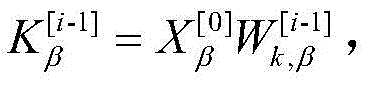
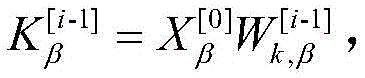
步骤2b-1-1,跨模态transformerα→β中包含D层跨模态注意力块;对于某一层跨模态注意力块,输入目标模态Xα [i-1],Xβ [0],定义Query为


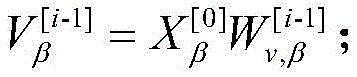
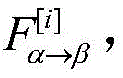
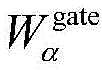
步骤2b-1-2,transformer为了强化目标模态的特征信息,通过残差连接的方式使原目标模态特Xβ得到辅助模态的补充,为了防止在复杂场景下,目标模态与辅助模态的差异性过大而对融合造成干扰,在跨模态transformer的残差连接中加入了门控机制;通过将目标模态与辅助模态所对应的高层特征进行余弦相似度对比,得到相似度similarαβ作为残差连接的门控,指导跨模态transformer融合,得到新特征


式中,


进一步的,步骤3包括如下步骤:Further, step 3 includes the following steps:
步骤3a,为了进一步补充特征内容,防止关键信息丢失,将步骤2b所得的多模态高层特征Fmulti finall与单模态高层特征Ft finall,Fv finall进行拼接后,得到补充后的多模态高层特征Fmulti cat,输入至多层感知机以进行情感分类;In step 3a, in order to further supplement the feature content and prevent the loss of key information, the multimodal high-level feature F multi finall obtained in step 2b is spliced with the single-modal high-level features F t finall and F v finall to obtain the supplemented multimodal The state high-level feature F multi cat is input to the multi-layer perceptron for sentiment classification;


其中,cat表示拼接操作。Among them, cat represents the splicing operation.
步骤3b,计算本批情感分析的多任务损失,
本发明的有益效果为:现有的多模态情感分析方法往往只以多模态整体标签作为唯一任务损失训练模型,并且采用三元对称的融合模式,平等的融合不同模态的特征。然而不同模态所蕴含的情感信息并不是对等的,事实上,文本模态应该作为多模态情感的主体,音频和视觉模态作为辅助。另一方面,经过单模态特征提取网络建模后的上下文特征向量,在跨模态融合时,由于特征坍缩等原因,不同模态特征将趋于一致,单模态特征异质性难以得到保留,导致模型在复杂环境下情感分类准确率降低。针对上述问题,本发明通过将不同模态的特征依次输入多个层叠的门控跨模态trasnformer网络进行融合,解决了现有的多模态情感分析技术在在复杂场景下分类不准确的问题;本发明采用的多任务学习机制能够监督单模态特征的提取、防止因模态融合导致特征坍塌,采用的层叠跨模态融合网络能够有效捕捉模态之间的关联;结合单模态特征提取网络与跨模态特征融合网络所提出的多模态情感分析方法,能够在保留模态异质性的前提下,连贯地融合不同模态的特征,从而有效识别复杂场景下的多模态情感。对于存在歧义、反讽等复杂情感表达的情况时具有较好的鲁棒性,得到了较高的准确率。The beneficial effects of the present invention are as follows: the existing multi-modal sentiment analysis methods often only use the multi-modal overall label as the only task loss training model, and adopt a ternary symmetrical fusion mode to equally fuse the features of different modalities. However, the emotional information contained in different modalities is not equivalent. In fact, text modalities should be used as the main body of multimodal emotion, and audio and visual modalities should be used as auxiliary. On the other hand, when the context feature vector modeled by the single-modal feature extraction network is fused across modalities, the features of different modalities will tend to be consistent due to feature collapse and other reasons, and it is difficult to obtain the heterogeneity of single-modality features. Retained, which leads to the reduction of the accuracy of sentiment classification of the model in complex environments. In view of the above problems, the present invention solves the problem of inaccurate classification of the existing multi-modal sentiment analysis technology in complex scenes by sequentially inputting the features of different modalities into multiple stacked gated cross-modal trasnformer networks for fusion. ; The multi-task learning mechanism adopted by the present invention can supervise the extraction of single-modal features, prevent feature collapse due to modal fusion, and the layered cross-modal fusion network adopted can effectively capture the correlation between modalities; combined with single-modal features The multimodal sentiment analysis method proposed by the extraction network and the cross-modal feature fusion network can coherently fuse the features of different modalities on the premise of preserving the modal heterogeneity, thereby effectively identifying multimodalities in complex scenes. emotion. It has better robustness in the presence of ambiguity, irony and other complex emotional expressions, and obtains a higher accuracy.
附图说明Description of drawings
图1为本发明所述方法的整体流程图。FIG. 1 is an overall flow chart of the method of the present invention.
图2为本发明中的单模态特征提取网络结构图。FIG. 2 is a structural diagram of a single-modal feature extraction network in the present invention.
图3为本发明中整体网络结构图。FIG. 3 is an overall network structure diagram in the present invention.
图4为本发明中的门控跨模态transformer网络结构图。FIG. 4 is a structural diagram of a gated cross-modal transformer network in the present invention.
具体实施方式Detailed ways
为便于理解本发明,下面结合实施例进一步说明。但是,本发明可以以许多不同的形式来实现,并不限于本文所描述的实施例。相反地,提供这些实施例的目的是使对本发明的公开内容更加透彻全面。In order to facilitate understanding of the present invention, further description is given below in conjunction with the embodiments. However, the present invention may be embodied in many different forms and is not limited to the embodiments described herein. Rather, these embodiments are provided so that this disclosure will be thorough and complete.
除非另有定义,本文中所使用的所有的技术和科学术语与本发明的技术领域的技术人员通常理解的含义相同。说明书中所使用的术语只是为了描述具体的实施目的,不是旨在于限制本发明。Unless otherwise defined, all technical and scientific terms used herein have the same meaning as commonly understood by one of ordinary skill in the art of this invention. The terms used in the specification are only for the purpose of describing specific implementations, and are not intended to limit the present invention.
如图1所示,本发明实施例提供的一种基于多任务学习与层叠跨模态融合的多模态情感分析方法,共包含如下几个步骤:As shown in FIG. 1 , a multi-modal sentiment analysis method based on multi-task learning and layered cross-modal fusion provided by an embodiment of the present invention includes the following steps:
首先,将原始视频分割为视频片段,标记该视频片段所对应的情感标签(情感标签分为积极、中性以及消极三类);接着从视频中提取可被模型识别的文本、音频与视觉数据(特征),输入至单模态特征提取模块,得到单模态隐藏层特征与单模态高层特征;然后将提取的单模态隐藏层特征与单模态高层特征输入至层叠跨模态特征融合模块,得到多模态高层特征;将多模态高层特征与单模态高层特征(文本、视觉)拼接后输入至多层感知机,并输出最终的情感分类结果,计算多任务损失值后根据算法动态调整不同任务(文本情感预测、音频情感预测、视觉情感预测、整体情感预测)的损失权重,迭代优化模型。First, segment the original video into video clips, and mark the emotional labels corresponding to the video clips (emotional labels are divided into positive, neutral, and negative categories); then extract text, audio, and visual data that can be recognized by the model from the video. (feature), input to the single-modal feature extraction module to obtain single-modal hidden layer features and single-modal high-level features; then input the extracted single-modal hidden layer features and single-modal high-level features to the stacked cross-modal features Fusion module to obtain multi-modal high-level features; splicing multi-modal high-level features and single-modal high-level features (text, vision) and inputting them to the multi-layer perceptron, and outputting the final sentiment classification result, after calculating the multi-task loss value according to The algorithm dynamically adjusts the loss weights of different tasks (text emotion prediction, audio emotion prediction, visual emotion prediction, overall emotion prediction), and iteratively optimizes the model.
具体步骤如下:Specific steps are as follows:
步骤1:首先将完整的视频根据话语进行切片,使每个视频片段仅包含一段完整的话语与对应的情感标签;将每个视频片段中包含的文本、音频与视觉数据进行预处理,提取文本特征向量、音频特征向量和视频特征向量。Step 1: First, slice the complete video according to the utterance, so that each video clip contains only a complete utterance and the corresponding emotional label; preprocess the text, audio and visual data contained in each video clip to extract the text Feature vector, audio feature vector, and video feature vector.
对于文本模态的数据预处理分为两个步骤:首先要统计数据集中每段文本的文字数,计算其平均长度L,并将2L作为文本的截取长度,以最大程度的覆盖样本集中的较长文本内容,最终确定的文本长度为39;然后,将截取长度后的文本输入至762维的BERT词嵌入模型,对于批度n,得到词嵌入向量XT∈n×39×762。The data preprocessing for text mode is divided into two steps: first, count the number of characters in each text in the data set, calculate the average length L, and use 2L as the interception length of the text to cover the longer ones in the sample set to the greatest extent. For the text content, the final text length is 39; then, the text after the cut length is input into the 762-dimensional BERT word embedding model, and for the batch size n, the word embedding vector X T ∈ n × 39 × 762 is obtained.
对于音频模态,使用LibROSA音频工具包提取与情绪和说话语气相关的33维帧级音频特征,包括一维对数基频(log F0),20维梅尔频率倒谱系数(MFCCs)和12维常数q色谱(CQT),得到音频特征向量XA∈n×39×33。For audio modality, 33-dimensional frame-level audio features related to emotion and speech tone were extracted using the LibROSA audio toolkit, including 1-dimensional logarithmic fundamental frequency (log F0), 20-dimensional Mel-frequency cepstral coefficients (MFCCs) and 12 The dimensional constant q-chromatogram (CQT) yields an audio feature vector X A ∈ n × 39 × 33.
对于视觉模态,从30Hz的视频片段中提取图像帧,并使用MTCNN人脸检测算法提取对齐的人脸,然后使用MultiComp OpenFace2.0工具包提取68个面部地标,17个面部动作单元,头部姿势,头部方向和眼睛凝视,共提取了709维帧级视觉特征,得到视觉特征向量XV∈n×39×762。For the visual modality, image frames were extracted from 30Hz video clips and aligned faces were extracted using the MTCNN face detection algorithm, followed by the MultiComp OpenFace2.0 toolkit to extract 68 facial landmarks, 17 facial action units, head pose, head orientation and eye gaze, a total of 709-dimensional frame-level visual features are extracted, resulting in a visual feature vector X V ∈ n × 39 × 762.
步骤2:将文本、音频和视觉特征分别输入单模态特征提取网络,再将所得特征输入跨模态特征融合网络,进行特征融合;这是本发明的创新点之一。Step 2: Input the text, audio and visual features into the single-modal feature extraction network respectively, and then input the obtained features into the cross-modal feature fusion network for feature fusion; this is one of the innovative points of the present invention.
其过程如下:The process is as follows:
对于文本特征Xt、音频特征Xa与视觉特征Xv,分别将其输入至LSTM网络,得到隐藏层特征Xt h、Xa h、Xv h,作为层叠跨模态特征融合模块的输入。For the text feature X t , the audio feature X a and the visual feature X v , input them to the LSTM network respectively to obtain the hidden layer features X t h , X a h , X v h , which are used as the input of the stacked cross-modal feature fusion module .
Xt h=LSTM(Xt,WT)X t h =LSTM(X t ,W T )
Xa h=LSTM(Xa,WA)X a h =LSTM(X a ,W A )
Xv h=LSTM(Xv,WV)X v h =LSTM(X v ,W V )
其中WT、WA、WV分别为长短周期记忆神经网络关于文本(t)、听觉(a)、视觉(v)模态的网络参数。Among them, W T , W A , and W V are the network parameters of the long-short-term memory neural network about text (t), auditory (a), and visual (v) modalities, respectively.
分别取隐藏层特征Xt h、Xa h、Xv h的末端状态隐藏表示Xt,l h、Xa,l h、Xv,l h。将Xt,l h、Xa,l h、Xv,l h分别输入多层感知机,获得文本、视觉、音频模态的高层特征Xt finall、Xa finall、Xv finall,这些特征一方面用于预测单模态情感极性,作为情感分析多任务损失的一部分,在训练阶段监督模型保留单模态特征异质性,另一方面作为层叠跨模态特征融合模块的输入,以指导跨模态特征融合。Take the hidden state hidden representations X t,l h , X a,l h and X v,l h of the hidden layer features X t h , X a h , and X v h respectively. Input X t,l h , X a,l h , X v,l h into the multi-layer perceptron respectively, and obtain high-level features X t finall , X a finall , X v finall of text, visual and audio modalities, these features On the one hand, it is used to predict unimodal sentiment polarity, as part of the multi-task loss for sentiment analysis, supervising the model to preserve unimodal feature heterogeneity during the training phase, and on the other hand as the input of a cascaded cross-modal feature fusion module to Guides cross-modal feature fusion.
Xt finall=MLP(Xt,l h,WM T)X t finall =MLP(X t,l h ,W M T )
Xa finall=MLP(Xa,l h,WM A)X a finall =MLP(X a,l h ,W M A )
Xv finall=MLP(Xv,l h,WM V)X v finall =MLP(X v,l h ,W M V )
y′m=softmax(MLP(Fm finall))y′ m =softmax(MLP(F m final ))
其中,WM T,WM A,WM V分别多层感知机关于文本(t)、听觉(a)、视觉(v)模态的网络参数,softmax为逻辑回归函数,MLP为多层感知机。Among them, W M T , W M A , W M V are the network parameters of the multi-layer perceptron on the text (t), auditory (a), and visual (v) modalities, softmax is the logistic regression function, and MLP is the multi-layer perception machine.
对于从单模态特征提取模块中得到的单模态隐藏层特征Xt h、Xa h、Xv h与单模态高层特征Xt finall、Xa finall、Xv finall,先将Xt h、Xa h、Xt finall、Xa finall输入至门控跨模态transformer网络,得到经过音频特征加强的文本特征Xl h,因为融合了音频特征,其模式更接近于语言,定义其为语言特征Xl h,再将Xl h按步骤2a-3的流程,通过长短期记忆网络与多层感知机后,得到语言高层特征Xl finall。接着将Xl h、Xv h、Xl finall、Xv finall输入至门控跨模态transformer网络,得到多模态情感特征Xmulti。For the single-modal hidden layer features X t h , X a h , X v h and the single-modal high-level features X t finall , X a finall , X v finall obtained from the single-modal feature extraction module, X t h , X a h , X t finall , X a finall are input to the gated cross-modal transformer network, and the text feature X l h enhanced by the audio feature is obtained. Because the audio feature is integrated, its mode is closer to the language, and the definition of its is the language feature X l h , and then pass X l h through the long short-term memory network and the multi-layer perceptron according to the process of steps 2a-3 to obtain the language high-level feature X l finall . Then, X l h , X v h , X l finall , and X v finall are input to the gated cross-modal transformer network to obtain the multimodal emotional feature X multi .
其中门控跨模态transformer网络包括多层门控跨模态transformer单元块,对其中任一层跨模态注意力块,包含如下步骤:The gated cross-modal transformer network includes a multi-layer gated cross-modal transformer unit block. For any layer of the cross-modal attention block, the following steps are included:
输入目标模态Xα [i-1],Xβ [0],定义Query为


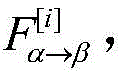

transformer为了强化目标模态的特征信息,通过残差连接的方式使原目标模态特Xβ得到辅助模态的补充,为了防止在复杂场景下,目标模态与辅助模态的差异性过大而对融合造成干扰,在跨模态transformer的残差连接中加入了门控机制。通过将目标模态与辅助模态所对应的高层特征进行余弦相似度对比,得到相似度similarαβ作为残差连接的门控,指导跨模态transformer融合得到


式中,


步骤3:将步骤2b所得的多模态高层特征Fmulti finall与单模态高层特征Ft finall,Fv finall进行拼接,得到补充后的多模态高层特征Fmulti cat,并输入至多层感知机以进行情感分类;Step 3: splicing the multimodal high-level feature F multi finall obtained in step 2b with the single-modal high-level features F t finall and F v finall to obtain the supplemented multi-modal high-level feature F multi cat , and input it to the multi-layer perception machine for sentiment classification;


其中,cat表示拼接操作。Among them, cat represents the splicing operation.
计算多任务损失值后根据算法动态调整不同任务(文本情感预测、音频情感预测、视觉情感预测、整体情感预测)的损失权重,以利于迭代优化模型;这是本发明的又一创新点。After calculating the multi-task loss value, the loss weights of different tasks (text emotion prediction, audio emotion prediction, visual emotion prediction, and overall emotion prediction) are dynamically adjusted according to the algorithm, so as to facilitate the iterative optimization of the model; this is another innovation of the present invention.
计算本批情感分析的多任务损失,
实验分析:experiment analysis:
数据集:data set:
实验所选用的数据集为中文多模态情感分析数据集SIMS,相比MOSI(Zadeh etal.2016)与MOSEI(Zadeh et al.2018b)等传统单标签数据集,SIMS额外提供了文本、音频与视觉单模态标签。该数据集为从60个原始视频中提取的2281个视频片段,令标记者在仅接受单一模态输入的情况下给出该模态的情感得分,从-1(强烈消极)到+1(强烈积极的)。The data set used in the experiment is the Chinese multimodal sentiment analysis data set SIMS. Compared with traditional single-label data sets such as MOSI (Zadeh et al. 2016) and MOSEI (Zadeh et al. 2018b), SIMS additionally provides text, audio and Visual single modal label. The dataset consists of 2281 video clips extracted from 60 raw videos, asking the tagger to give a sentiment score for that modality, ranging from -1 (strongly negative) to +1 ( strongly positive).
评估指标:Evaluation Metrics:
本实验为分类任务,因此选择3分类精度(Acc-3),积极、消极情感(p/g)二分类精度(Acc-2)和F1值(F1-Score)。This experiment is a classification task, so choose 3 classification accuracy (Acc-3), positive and negative sentiment (p/g) binary classification accuracy (Acc-2) and F1 value (F1-Score).
为了证明本发明及所提创新点是有效的,本实验通过与基线模型进行性能对比以及消融实验来进行验证。In order to prove that the present invention and the proposed innovation are effective, this experiment is verified by comparing the performance with the baseline model and performing ablation experiments.
基线模型对比实验:Baseline model comparison experiment:
本发明将提出的模型分别与单任务模型(TFN、Graph-MFN、MISA、MULT)和多任务模型(MLF-DNN、M-LMF)进行比较,实验结果见表1。基于多任务学习与层叠跨模态融合的多模态情感分析方法(MSGC)在各项评价指标上都超越了目前最先进的方法。对比单任务最优基线模型MULT,MSGC在该数据集上的的二分类准确率与F1值分别提高了3.66%与3.97%,三分类准确率与F1值分别提升了4.16%与4.45%。与多任务最优模型M-LMF相比,MSGC的二分类准确率与F1值分别提高了2.42%与2.73%,三分类准确率与F1值分别提升了2.06%与0.97%。The present invention compares the proposed model with single-task models (TFN, Graph-MFN, MISA, MULT) and multi-task models (MLF-DNN, M-LMF) respectively, and the experimental results are shown in Table 1. The multimodal sentiment analysis method (MSGC) based on multi-task learning and cascaded cross-modal fusion surpasses the current state-of-the-art methods in various evaluation indicators. Compared with the single-task optimal baseline model MULT, the two-class accuracy and F1 value of MSGC on this dataset are increased by 3.66% and 3.97%, respectively, and the three-class accuracy and F1 value are increased by 4.16% and 4.45%. Compared with the multi-task optimal model M-LMF, MSGC's two-class accuracy and F1 value increased by 2.42% and 2.73%, respectively, and the three-class accuracy and F1 value increased by 2.06% and 0.97%, respectively.
此外,多任务基线方法的性能明显高于单任务方法,这是由于单模态标签为多模态情感分析提供了更多的信息来源,减少了单模态特征提取的误差,并保留了重要信息。为了更公平的与单任务模型比较,还设置了MSGC-single模型,该模型只取多模态情感分类的损失值,并未利用到多任务标签。MSGC-single相比最优单任务基线模型仍有明显提升。In addition, the performance of multi-task baseline methods is significantly higher than that of single-task methods, which is due to the fact that single-modal labels provide more sources of information for multi-modal sentiment analysis, reduce the error of single-modal feature extraction, and retain important information. In order to compare with the single-task model more fairly, the MSGC-single model is also set up, which only takes the loss value of multi-modal sentiment classification, and does not use the multi-task label. Compared with the optimal single-task baseline model, MSGC-single still has a significant improvement.

消融实验:Ablation experiment:
为了检查整个体系结构的功能和本工作中引入的组件,对SIMS数据集进行如下消融研究。To examine the functionality of the entire architecture and the components introduced in this work, the following ablation studies are performed on the SIMS dataset.
MSGC-single:在完整模型的基础上仅使用单任务标签进行训练。MSGC-single: Train on the full model with only single-task labels.
MSGC w/o late-fusion:在完整模型的基础上删除了后期融合。MSGC w/o late-fusion: Removed late-fusion based on the full model.
MSGC w/o late-fusion&gate:将MSGC w/o late-fusion的基础上删除了跨模态相似度门控模块。MSGC w/o late-fusion&gate: The cross-modal similarity gating module is removed from MSGC w/o late-fusion.
MSGC-concat:将MSGC w/o late-fusion&gate的层叠transformer结构更换为拼接结构(与mult的结构相似)。MSGC-concat: Replace the stacked transformer structure of MSGC w/o late-fusion&gate with a spliced structure (similar to the structure of mult).
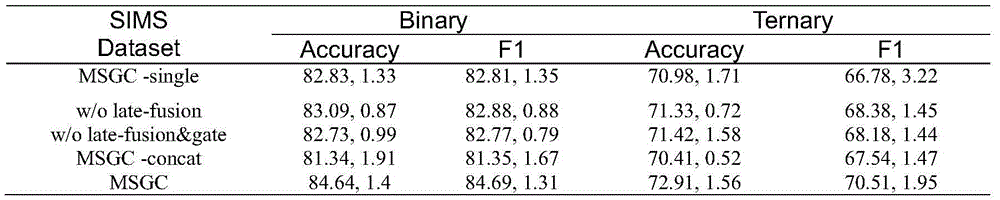
表2给出了SIMS数据集上模块组合的消融实验结果。实验结果显示完整的MSGC模型的实验效果最好,缺少不同模块会对实验结果造成不同影响。对于MSGC w/o late-fusion与MSGC,其在多模态情感输出直接省去了后期融合部分,未将单模态的高层特征与多模态高层特征进行拼接,只取多模态高层特征作为分类器的输入,其性能的各方面指标均低于MSGC模型,这说明经过单模态标签指导的单模态高层特征,能为多模态情感提供互补性。w/o late-fusion&gate相比w/o late-fusion省去了跨模态相似度门控模块,其总体性能要略低于w/olate-fusion模型,由此可见,通过将两个模态高层特征的余弦相似度作为跨模态融合时残差连接的门控,可以更好的融合不同模态的特征。此外,w/olate-fusion&gate与MSGC-concat的区别在于,MSGC-concat并未采用层叠的transformer结构,而是将三个输入模态进行两两组合,进行跨模态transformer,并将得到的6组双模态融合特征进行拼接,因此其参数量与运算时间都远高于w/o late-fusion&gate。在SIMS数据集上,w/o late-fusion&gate的性能要明显高于于MSGC-concat,这进一步说明了层叠transformer结构的优越性。Table 2 presents the results of ablation experiments on the combination of modules on the SIMS dataset. The experimental results show that the complete MSGC model has the best experimental effect, and the lack of different modules will have different effects on the experimental results. For MSGC w/o late-fusion and MSGC, the post-fusion part is directly omitted in the multi-modal emotional output, and the single-modal high-level features and the multi-modal high-level features are not spliced, and only the multi-modal high-level features are taken. As the input of the classifier, all aspects of its performance are lower than the MSGC model, which indicates that the unimodal high-level features guided by unimodal labels can provide complementarity for multimodal emotion. Compared with w/o late-fusion&gate, the cross-modal similarity gating module is omitted, and its overall performance is slightly lower than that of the w/olate-fusion model. It can be seen that by combining the two modalities The cosine similarity of high-level features is used as a gate for residual connections in cross-modal fusion, which can better fuse features from different modalities. In addition, the difference between w/olate-fusion&gate and MSGC-concat is that MSGC-concat does not use a stacked transformer structure, but combines the three input modalities in pairs to perform a cross-modal transformer, and the resulting 6 Group bimodal fusion features are used for splicing, so the amount of parameters and operation time are much higher than w/o late-fusion&gate. On the SIMS dataset, the performance of w/o late-fusion&gate is significantly higher than that of MSGC-concat, which further illustrates the superiority of the stacked transformer structure.
名词参考表noun reference list
单模态特征(文本模态特征Xt、音频模态特征Xa、视觉模态特征Xv)Single-modal features (text modality feature X t , audio modality feature X a , visual modality feature X v )
单模态隐藏层特征(文本隐藏层模态特征Xt h、音频隐藏层模态特征Xa h、视觉隐藏层模态特征Xv h)Single-modal hidden layer features (text hidden layer modal feature X t h , audio hidden layer modal feature X a h , visual hidden layer modal feature X v h )
单模态高层特征(文本高层特征Ft finall、音频高层特征Fa finall、视觉高层特征Fv finall、语言高层特征)Single-modal high-level features (text high-level features F t finall , audio high-level features F a finall , visual high-level features F v finall , language high-level features)
多模态融合特征Xmulti h Multimodal fusion feature X multi h
多模态高层特征Fmulti final Multimodal high-level feature F multi final
补充后的多模态高层特征Fmulti cat The supplemented multimodal high-level feature F multi cat
层叠跨模态特征融合模块(包含2个门控跨模态transformer网络)。Stacked cross-modal feature fusion module (contains 2 gated cross-modal transformer networks).
单模态特征提取模块(包含3个长短期记忆网络)Single-modal feature extraction module (including 3 long short-term memory networks)
长短期记忆网络(LSTM)Long Short-Term Memory Network (LSTM)
前馈层(forward)Feedforward layer (forward)
多层感知机(MLP)Multilayer Perceptron (MLP)
逻辑回归函数(Softmax)。Logistic regression function (Softmax).
Claims (7)










Priority Applications (1)
| Application Number | Priority Date | Filing Date | Title |
|---|---|---|---|
| CN202210364764.3A CN114694076B (en) | 2022-04-08 | 2022-04-08 | Multimodal sentiment analysis method based on multi-task learning and cascade cross-modal fusion |
Applications Claiming Priority (1)
| Application Number | Priority Date | Filing Date | Title |
|---|---|---|---|
| CN202210364764.3A CN114694076B (en) | 2022-04-08 | 2022-04-08 | Multimodal sentiment analysis method based on multi-task learning and cascade cross-modal fusion |
Publications (2)
| Publication Number | Publication Date |
|---|---|
| CN114694076A true CN114694076A (en) | 2022-07-01 |
| CN114694076B CN114694076B (en) | 2024-11-08 |
Family
ID=82142101
Family Applications (1)
| Application Number | Title | Priority Date | Filing Date |
|---|---|---|---|
| CN202210364764.3A Active CN114694076B (en) | 2022-04-08 | 2022-04-08 | Multimodal sentiment analysis method based on multi-task learning and cascade cross-modal fusion |
Country Status (1)
| Country | Link |
|---|---|
| CN (1) | CN114694076B (en) |
Cited By (44)
| Publication number | Priority date | Publication date | Assignee | Title |
|---|---|---|---|---|
| CN115186683A (en) * | 2022-07-15 | 2022-10-14 | 哈尔滨工业大学 | Cross-modal translation-based attribute-level multi-modal emotion classification method |
| CN115204282A (en) * | 2022-07-05 | 2022-10-18 | 赛可智能科技(上海)有限公司 | A data processing method and system |
| CN115294627A (en) * | 2022-07-04 | 2022-11-04 | 浙江师范大学 | Multimodal sentiment analysis method and device for learners based on text-driven |
| CN115310560A (en) * | 2022-09-19 | 2022-11-08 | 杭州电子科技大学 | Multimode emotion classification method based on modal space assimilation and contrast learning |
| CN115329135A (en) * | 2022-08-22 | 2022-11-11 | 天津大学 | Short video recommendation method and device based on content and interest learning |
| CN115481679A (en) * | 2022-08-30 | 2022-12-16 | 之江实验室 | Multi-modal emotion analysis method and system |
| CN115496077A (en) * | 2022-11-18 | 2022-12-20 | 之江实验室 | A multi-modal sentiment analysis method and device based on modal observation and scoring |
| CN115510224A (en) * | 2022-07-14 | 2022-12-23 | 南京邮电大学 | A cross-modal BERT sentiment analysis method based on fusion of vision, audio and text |
| CN115546685A (en) * | 2022-09-23 | 2022-12-30 | 西南交通大学 | Cross-modal video emotion information analysis method |
| CN115577319A (en) * | 2022-10-10 | 2023-01-06 | 浙江师范大学 | Emotion analysis method based on modal heterogeneity bridging and multi-modal dynamic graph fusion |
| CN115587160A (en) * | 2022-09-14 | 2023-01-10 | 山东财经大学 | A phrase-level text image generation method and system based on self-attention mechanism |
| CN115762484A (en) * | 2023-01-09 | 2023-03-07 | 季华实验室 | Multimodal data fusion method, device, equipment and medium for voice recognition |
| CN115809438A (en) * | 2023-01-18 | 2023-03-17 | 中国科学技术大学 | Multimodal sentiment analysis method, system, device and storage medium |
| CN115906002A (en) * | 2022-11-30 | 2023-04-04 | 华中师范大学 | Learning input state evaluation method based on multi-granularity data fusion |
| CN115937641A (en) * | 2022-10-28 | 2023-04-07 | 哈尔滨工业大学 | Transformer-based joint coding method, device and equipment between modalities |
| CN116011586A (en) * | 2022-12-30 | 2023-04-25 | 中山大学 | A joint learning method and model based on cross-media data |
| CN116058803A (en) * | 2023-03-10 | 2023-05-05 | 南开大学 | A EEG Signal Denoising Method for Multiple Types of Noise Artifacts |
| CN116070169A (en) * | 2023-01-28 | 2023-05-05 | 天翼云科技有限公司 | Model training method and device, electronic equipment and storage medium |
| CN116244473A (en) * | 2023-02-10 | 2023-06-09 | 南京理工大学 | Multi-mode emotion recognition method based on feature decoupling and graph knowledge distillation |
| CN116340778A (en) * | 2023-05-25 | 2023-06-27 | 智慧眼科技股份有限公司 | Method for constructing large medical model based on multimodality and related equipment |
| CN116453024A (en) * | 2023-04-23 | 2023-07-18 | 中国传媒大学 | Video emotion recognition system and method |
| CN116467486A (en) * | 2023-04-11 | 2023-07-21 | 东北大学 | A Multimodal Micro-Video Classification Method Based on Temporal Information Enhancement |
| CN116597353A (en) * | 2023-05-18 | 2023-08-15 | 福州大学 | Video sentiment analysis method based on multi-scale feature extraction and multi-task learning |
| CN116595439A (en) * | 2023-05-17 | 2023-08-15 | 联想(北京)有限公司 | A semantic communication method and computer equipment |
| CN116719930A (en) * | 2023-04-28 | 2023-09-08 | 西安工程大学 | Multi-mode emotion analysis method based on visual attention |
| CN116738359A (en) * | 2023-05-23 | 2023-09-12 | 内蒙古工业大学 | Mongolian multi-modal sentiment analysis method based on pre-training model and high-resolution network |
| CN116758462A (en) * | 2023-08-22 | 2023-09-15 | 江西师范大学 | Emotion polarity analysis method and device, electronic equipment and storage medium |
| CN116975776A (en) * | 2023-07-14 | 2023-10-31 | 湖北楚天高速数字科技有限公司 | A multi-modal data fusion method and device based on tensors and mutual information |
| CN117037046A (en) * | 2023-10-08 | 2023-11-10 | 之江实验室 | Audio-visual event detection method, device, storage medium and electronic equipment |
| CN117058594A (en) * | 2023-09-04 | 2023-11-14 | 西南交通大学 | A multi-modal video classification method based on dynamic fusion gate mechanism |
| CN117150054A (en) * | 2023-08-16 | 2023-12-01 | 中移(杭州)信息技术有限公司 | Media asset recall methods, devices, electronic equipment and storage media |
| CN117237774A (en) * | 2023-09-19 | 2023-12-15 | 浙江师范大学 | A multi-modal emotion analysis method and system based on large model video description |
| CN117235605A (en) * | 2023-11-10 | 2023-12-15 | 湖南马栏山视频先进技术研究院有限公司 | A sensitive information classification method and device based on multi-modal attention fusion |
| CN117315428A (en) * | 2023-10-30 | 2023-12-29 | 燕山大学 | Cross-modal feature alignment and fusion crowd counting system and method |
| CN117828523A (en) * | 2023-12-20 | 2024-04-05 | 湖北工业大学 | Multimodal sentiment analysis method, device, electronic device and storage medium |
| CN117975342A (en) * | 2024-03-28 | 2024-05-03 | 江西尚通科技发展有限公司 | Semi-supervised multimodal sentiment analysis method, system, storage medium and computer |
| CN118035948A (en) * | 2024-01-08 | 2024-05-14 | 浙江微帮忙教育科技有限公司 | Large five personality evaluation analysis method and device |
| CN118394925A (en) * | 2024-05-16 | 2024-07-26 | 广东省华南技术转移中心有限公司 | Patent recommendation method and system based on multimodal heterogeneous graph |
| CN118709094A (en) * | 2024-08-28 | 2024-09-27 | 北京科技大学 | Emotion recognition method and system based on multimodal feature and hierarchical feature fusion |
| CN119443227A (en) * | 2024-10-15 | 2025-02-14 | 桂林电子科技大学 | Multimodal sentiment analysis method based on knowledge guidance and modal dynamic attention fusion |
| CN119782490A (en) * | 2025-03-11 | 2025-04-08 | 浪潮软件科技有限公司 | A generative dialogue system based on a large language model |
| CN120388580A (en) * | 2025-06-27 | 2025-07-29 | 杭州秋果计划科技有限公司 | Audio processing method, device and XR device |
| CN120408537A (en) * | 2025-07-02 | 2025-08-01 | 广州云趣信息科技有限公司 | A cross-modal semantic parsing method |
| CN120451854A (en) * | 2025-03-28 | 2025-08-08 | 数据空间研究院 | A video data behavior compliance detection method based on multimodal analysis |
Citations (4)
| Publication number | Priority date | Publication date | Assignee | Title |
|---|---|---|---|---|
| CN111275085A (en) * | 2020-01-15 | 2020-06-12 | 重庆邮电大学 | Online short video multi-modal emotion recognition method based on attention fusion |
| CN111680541A (en) * | 2020-04-14 | 2020-09-18 | 华中科技大学 | A Multimodal Sentiment Analysis Method Based on Multidimensional Attention Fusion Network |
| CN113408385A (en) * | 2021-06-10 | 2021-09-17 | 华南理工大学 | Audio and video multi-mode emotion classification method and system |
| CN113537024A (en) * | 2021-07-08 | 2021-10-22 | 天津理工大学 | Weak supervision neural network sign language recognition method of multilayer time sequence attention fusion mechanism |
-
2022
- 2022-04-08 CN CN202210364764.3A patent/CN114694076B/en active Active
Patent Citations (4)
| Publication number | Priority date | Publication date | Assignee | Title |
|---|---|---|---|---|
| CN111275085A (en) * | 2020-01-15 | 2020-06-12 | 重庆邮电大学 | Online short video multi-modal emotion recognition method based on attention fusion |
| CN111680541A (en) * | 2020-04-14 | 2020-09-18 | 华中科技大学 | A Multimodal Sentiment Analysis Method Based on Multidimensional Attention Fusion Network |
| CN113408385A (en) * | 2021-06-10 | 2021-09-17 | 华南理工大学 | Audio and video multi-mode emotion classification method and system |
| CN113537024A (en) * | 2021-07-08 | 2021-10-22 | 天津理工大学 | Weak supervision neural network sign language recognition method of multilayer time sequence attention fusion mechanism |
Non-Patent Citations (1)
| Title |
|---|
| 刘菁菁;吴晓峰;: "基于长短时记忆网络的多模态情感识别和空间标注", 复旦学报(自然科学版), no. 05, 15 October 2020 (2020-10-15) * |
Cited By (59)
| Publication number | Priority date | Publication date | Assignee | Title |
|---|---|---|---|---|
| CN115294627A (en) * | 2022-07-04 | 2022-11-04 | 浙江师范大学 | Multimodal sentiment analysis method and device for learners based on text-driven |
| CN115204282A (en) * | 2022-07-05 | 2022-10-18 | 赛可智能科技(上海)有限公司 | A data processing method and system |
| CN115510224A (en) * | 2022-07-14 | 2022-12-23 | 南京邮电大学 | A cross-modal BERT sentiment analysis method based on fusion of vision, audio and text |
| CN115186683A (en) * | 2022-07-15 | 2022-10-14 | 哈尔滨工业大学 | Cross-modal translation-based attribute-level multi-modal emotion classification method |
| CN115329135A (en) * | 2022-08-22 | 2022-11-11 | 天津大学 | Short video recommendation method and device based on content and interest learning |
| CN115481679B (en) * | 2022-08-30 | 2025-12-12 | 之江实验室 | A Multimodal Sentiment Analysis Method and System |
| CN115481679A (en) * | 2022-08-30 | 2022-12-16 | 之江实验室 | Multi-modal emotion analysis method and system |
| CN115587160A (en) * | 2022-09-14 | 2023-01-10 | 山东财经大学 | A phrase-level text image generation method and system based on self-attention mechanism |
| CN115310560A (en) * | 2022-09-19 | 2022-11-08 | 杭州电子科技大学 | Multimode emotion classification method based on modal space assimilation and contrast learning |
| CN115546685A (en) * | 2022-09-23 | 2022-12-30 | 西南交通大学 | Cross-modal video emotion information analysis method |
| CN115577319A (en) * | 2022-10-10 | 2023-01-06 | 浙江师范大学 | Emotion analysis method based on modal heterogeneity bridging and multi-modal dynamic graph fusion |
| CN115937641A (en) * | 2022-10-28 | 2023-04-07 | 哈尔滨工业大学 | Transformer-based joint coding method, device and equipment between modalities |
| CN115496077A (en) * | 2022-11-18 | 2022-12-20 | 之江实验室 | A multi-modal sentiment analysis method and device based on modal observation and scoring |
| CN115906002A (en) * | 2022-11-30 | 2023-04-04 | 华中师范大学 | Learning input state evaluation method based on multi-granularity data fusion |
| CN115906002B (en) * | 2022-11-30 | 2024-01-16 | 华中师范大学 | Learning input state evaluation method based on multi-granularity data fusion |
| CN116011586A (en) * | 2022-12-30 | 2023-04-25 | 中山大学 | A joint learning method and model based on cross-media data |
| CN115762484A (en) * | 2023-01-09 | 2023-03-07 | 季华实验室 | Multimodal data fusion method, device, equipment and medium for voice recognition |
| CN115809438A (en) * | 2023-01-18 | 2023-03-17 | 中国科学技术大学 | Multimodal sentiment analysis method, system, device and storage medium |
| CN116070169A (en) * | 2023-01-28 | 2023-05-05 | 天翼云科技有限公司 | Model training method and device, electronic equipment and storage medium |
| CN116244473A (en) * | 2023-02-10 | 2023-06-09 | 南京理工大学 | Multi-mode emotion recognition method based on feature decoupling and graph knowledge distillation |
| CN116244473B (en) * | 2023-02-10 | 2023-08-11 | 南京理工大学 | A Multimodal Emotion Recognition Method Based on Feature Decoupling and Graph Knowledge Distillation |
| CN116058803B (en) * | 2023-03-10 | 2024-04-19 | 南开大学 | A method for denoising EEG signals for multiple types of noise artifacts |
| CN116058803A (en) * | 2023-03-10 | 2023-05-05 | 南开大学 | A EEG Signal Denoising Method for Multiple Types of Noise Artifacts |
| CN116467486B (en) * | 2023-04-11 | 2025-12-16 | 东北大学 | Multi-mode micro-video classification method based on time domain information enhancement |
| CN116467486A (en) * | 2023-04-11 | 2023-07-21 | 东北大学 | A Multimodal Micro-Video Classification Method Based on Temporal Information Enhancement |
| CN116453024A (en) * | 2023-04-23 | 2023-07-18 | 中国传媒大学 | Video emotion recognition system and method |
| CN116453024B (en) * | 2023-04-23 | 2023-09-22 | 中国传媒大学 | Video emotion recognition system and method |
| CN116719930A (en) * | 2023-04-28 | 2023-09-08 | 西安工程大学 | Multi-mode emotion analysis method based on visual attention |
| CN116595439A (en) * | 2023-05-17 | 2023-08-15 | 联想(北京)有限公司 | A semantic communication method and computer equipment |
| CN116597353A (en) * | 2023-05-18 | 2023-08-15 | 福州大学 | Video sentiment analysis method based on multi-scale feature extraction and multi-task learning |
| CN116738359A (en) * | 2023-05-23 | 2023-09-12 | 内蒙古工业大学 | Mongolian multi-modal sentiment analysis method based on pre-training model and high-resolution network |
| CN116340778B (en) * | 2023-05-25 | 2023-10-03 | 智慧眼科技股份有限公司 | Multimodal-based medical large model construction method and related equipment |
| CN116340778A (en) * | 2023-05-25 | 2023-06-27 | 智慧眼科技股份有限公司 | Method for constructing large medical model based on multimodality and related equipment |
| US12086716B1 (en) | 2023-05-25 | 2024-09-10 | AthenaEyes CO., LTD. | Method for constructing multimodality-based medical large model, and related device thereof |
| CN116975776A (en) * | 2023-07-14 | 2023-10-31 | 湖北楚天高速数字科技有限公司 | A multi-modal data fusion method and device based on tensors and mutual information |
| CN117150054A (en) * | 2023-08-16 | 2023-12-01 | 中移(杭州)信息技术有限公司 | Media asset recall methods, devices, electronic equipment and storage media |
| CN116758462A (en) * | 2023-08-22 | 2023-09-15 | 江西师范大学 | Emotion polarity analysis method and device, electronic equipment and storage medium |
| CN117058594A (en) * | 2023-09-04 | 2023-11-14 | 西南交通大学 | A multi-modal video classification method based on dynamic fusion gate mechanism |
| CN117237774A (en) * | 2023-09-19 | 2023-12-15 | 浙江师范大学 | A multi-modal emotion analysis method and system based on large model video description |
| CN117037046B (en) * | 2023-10-08 | 2024-01-09 | 之江实验室 | Audio-visual event detection method, device, storage medium and electronic equipment |
| CN117037046A (en) * | 2023-10-08 | 2023-11-10 | 之江实验室 | Audio-visual event detection method, device, storage medium and electronic equipment |
| CN117315428A (en) * | 2023-10-30 | 2023-12-29 | 燕山大学 | Cross-modal feature alignment and fusion crowd counting system and method |
| CN117315428B (en) * | 2023-10-30 | 2024-04-05 | 燕山大学 | A crowd counting system and method based on cross-modal feature alignment and fusion |
| CN117235605A (en) * | 2023-11-10 | 2023-12-15 | 湖南马栏山视频先进技术研究院有限公司 | A sensitive information classification method and device based on multi-modal attention fusion |
| CN117235605B (en) * | 2023-11-10 | 2024-02-02 | 湖南马栏山视频先进技术研究院有限公司 | Sensitive information classification method and device based on multi-mode attention fusion |
| CN117828523A (en) * | 2023-12-20 | 2024-04-05 | 湖北工业大学 | Multimodal sentiment analysis method, device, electronic device and storage medium |
| CN118035948A (en) * | 2024-01-08 | 2024-05-14 | 浙江微帮忙教育科技有限公司 | Large five personality evaluation analysis method and device |
| CN117975342B (en) * | 2024-03-28 | 2024-06-11 | 江西尚通科技发展有限公司 | Semi-supervised multimodal sentiment analysis method, system, storage medium and computer |
| CN117975342A (en) * | 2024-03-28 | 2024-05-03 | 江西尚通科技发展有限公司 | Semi-supervised multimodal sentiment analysis method, system, storage medium and computer |
| CN118394925A (en) * | 2024-05-16 | 2024-07-26 | 广东省华南技术转移中心有限公司 | Patent recommendation method and system based on multimodal heterogeneous graph |
| CN118394925B (en) * | 2024-05-16 | 2024-12-10 | 广东省华南技术转移中心有限公司 | Patent recommendation method and system based on multimodal heterogeneous graph |
| CN118709094A (en) * | 2024-08-28 | 2024-09-27 | 北京科技大学 | Emotion recognition method and system based on multimodal feature and hierarchical feature fusion |
| CN118709094B (en) * | 2024-08-28 | 2024-11-15 | 北京科技大学 | Emotion recognition method and system based on multimodal feature and hierarchical feature fusion |
| CN119443227A (en) * | 2024-10-15 | 2025-02-14 | 桂林电子科技大学 | Multimodal sentiment analysis method based on knowledge guidance and modal dynamic attention fusion |
| CN119782490A (en) * | 2025-03-11 | 2025-04-08 | 浪潮软件科技有限公司 | A generative dialogue system based on a large language model |
| CN120451854A (en) * | 2025-03-28 | 2025-08-08 | 数据空间研究院 | A video data behavior compliance detection method based on multimodal analysis |
| CN120451854B (en) * | 2025-03-28 | 2025-12-02 | 数据空间研究院 | A Video Data Behavior Compliance Detection Method Based on Multimodal Analysis |
| CN120388580A (en) * | 2025-06-27 | 2025-07-29 | 杭州秋果计划科技有限公司 | Audio processing method, device and XR device |
| CN120408537A (en) * | 2025-07-02 | 2025-08-01 | 广州云趣信息科技有限公司 | A cross-modal semantic parsing method |
Also Published As
| Publication number | Publication date |
|---|---|
| CN114694076B (en) | 2024-11-08 |
Similar Documents
| Publication | Publication Date | Title |
|---|---|---|
| CN114694076A (en) | Multi-modal emotion analysis method based on multi-task learning and stacked cross-modal fusion | |
| CN111275085B (en) | Multimodal emotion recognition method for online short video based on attention fusion | |
| CN110188343B (en) | Multimodal Emotion Recognition Method Based on Fusion Attention Network | |
| CN108717856B (en) | A speech emotion recognition method based on multi-scale deep convolutional neural network | |
| Huang et al. | An effective multimodal representation and fusion method for multimodal intent recognition | |
| CN115329779B (en) | Multi-person dialogue emotion recognition method | |
| Li et al. | Learning fine-grained cross modality excitement for speech emotion recognition | |
| CN117765981A (en) | An emotion recognition method and system based on cross-modal fusion of speech and text | |
| CN116955699B (en) | Video cross-mode search model training method, searching method and device | |
| WO2020248376A1 (en) | Emotion detection method and apparatus, electronic device, and storage medium | |
| CN112233680B (en) | Speaker character recognition method, speaker character recognition device, electronic equipment and storage medium | |
| Zhang et al. | Aia-net: Adaptive interactive attention network for text–audio emotion recognition | |
| CN115640530A (en) | A Joint Analysis Method of Dialogue Sarcasm and Sentiment Based on Multi-task Learning | |
| CN110147548A (en) | The emotion identification method initialized based on bidirectional valve controlled cycling element network and new network | |
| CN118656784A (en) | A method, system, device and medium for emotion recognition based on multimodal fusion | |
| CN114463688A (en) | Cross-modal context coding dialogue emotion recognition method and system | |
| CN117909885A (en) | A method and system for audio-visual multimodal emotion recognition based on cross-modal attention mechanism | |
| CN119295994B (en) | A multimodal sentiment analysis method based on cross-modal attention | |
| CN114722798A (en) | An Irony Recognition Model Based on Convolutional Neural Network and Attention Mechanism | |
| CN117371456B (en) | A multimodal sarcasm detection method and system based on feature fusion | |
| CN118260711A (en) | Multi-mode emotion recognition method and device | |
| Maji et al. | Multimodal emotion recognition based on deep temporal features using cross-modal transformer and self-attention | |
| CN119248924B (en) | Emotion analysis method and device for promoting multi-mode information fusion | |
| CN115033695A (en) | Long-dialog emotion detection method and system based on common sense knowledge graph | |
| CN118016073B (en) | A coarse-grained sound event detection method in classroom based on audio and video feature fusion |
Legal Events
| Date | Code | Title | Description |
|---|---|---|---|
| PB01 | Publication | ||
| PB01 | Publication | ||
| SE01 | Entry into force of request for substantive examination | ||
| SE01 | Entry into force of request for substantive examination | ||
| GR01 | Patent grant | ||
| GR01 | Patent grant |