Detailed Description
In order to make the objects, technical solutions and advantages of the present application more apparent, exemplary embodiments according to the present application will be described in detail below with reference to the accompanying drawings. It should be understood that the described embodiments are only some embodiments of the present application and not all embodiments of the present application, and that the present application is not limited by the example embodiments described herein. All other embodiments, which can be derived by a person skilled in the art from the embodiments of the invention described in the present application without inventive step, shall fall within the scope of protection of the present application.
In the following description, numerous specific details are set forth in order to provide a more thorough understanding of the present application. It will be apparent, however, to one skilled in the art, that the present application may be practiced without one or more of these specific details. In other instances, well-known features have not been described in order to avoid obscuring the present application.
It is to be understood that the present application is capable of implementation in various forms and should not be construed as limited to the embodiments set forth herein. Rather, these embodiments are provided so that this disclosure will be thorough and complete, and will fully convey the scope of the application to those skilled in the art.
The terminology used herein is for the purpose of describing particular embodiments only and is not intended to be limiting of the application. As used herein, the singular forms "a", "an" and "the" are intended to include the plural forms as well, unless the context clearly indicates otherwise. It will be further understood that the terms "comprises" and/or "comprising," when used in this specification, specify the presence of stated features, integers, steps, operations, elements, and/or components, but do not preclude the presence or addition of one or more other features, integers, steps, operations, elements, components, and/or groups thereof. As used herein, the term "and/or" includes any and all combinations of the associated listed items.
In order to provide a thorough understanding of the present application, a detailed structure will be presented in the following description in order to explain the technical solutions presented in the present application. Alternative embodiments of the present application are described in detail below, however, the present application may have other implementations in addition to these detailed descriptions.
In the following, referring first to fig. 1, a monitoring method 100 according to an embodiment of the present application is described, the monitoring method 100 being used for a monitoring device, such as a monitor or a central monitoring management system. As shown in fig. 1, the monitoring method 100 may include the following steps:
in step S110, acquiring physiological sign data of a physiological characteristic parameter of a monitored subject; the physiological sign data may include numerical values, and may also include waveform information, trend information, and the like.
In step S120, analyzing the acquired physiological characteristic data to identify physiological characteristic data in an abnormal state;
in step S130, counting, in real time, a total duration of the physiological characteristic data in the abnormal state within a preset time period, where the total duration includes at least one duration of the physiological characteristic data in the abnormal state;
in step S140, displaying the acquired physiological characteristic data on a display interface of the monitoring device, and displaying the total duration counted in real time or the proportion of the total duration in the preset time period in a region adjacent to the displayed physiological characteristic data; or when the total duration time exceeds a first preset threshold value or the proportion of the total duration time in the preset time period exceeds a second preset threshold value, alarm information is output on a display interface of the monitoring equipment.
The monitoring method 100 of the embodiment of the invention counts the total duration of the physiological characteristic data in the abnormal state within the preset time period, displays the total duration or the proportion (namely load) of the total duration, or alarms according to the total duration or the proportion, and compared with the traditional monitoring method which determines whether to alarm or not according to the duration of a single-stage abnormal state, the monitoring method can highlight the abnormal degree of the physiological characteristic data within the preset time period, help medical staff to master the development and change of the illness state of the monitored object within the preset time period, so as to better formulate a treatment scheme.
For some monitored subjects with specific disease types or monitored subjects with disease conditions in a certain development period, the embodiment of the invention can help medical staff to pay attention to the total duration of abnormal physiological characteristic data of the monitored subjects in a period of time, for example, for an aortic dissection monitored subject, blood pressure needs to be paid attention all the time, not only transient blood pressure is too high or too low, but also medical intervention is needed, and the total duration of blood pressure too high or too low in a period of time is too long, and medical intervention can also be needed. Whether the medical intervention is needed or not can be reflected by counting the total duration time that the physiological characteristic data are in the abnormal state (for example, the blood pressure is too high or too low), the postoperative effect or the medical intervention effect at a certain moment of the monitored object can be reflected, subsequent treatment is carried out according to the medical intervention effect, and the improvement or the maintenance of the current treatment scheme is determined.
To better match user requirements, the anomaly statistics of the embodiment of the present invention may be implemented as a configurable process, and illustratively, the total duration of abnormal state of the physiological characteristic data within a preset time period may be counted in real time under at least one of the following conditions: starting real-time statistics when an instruction for starting the real-time statistics is detected; starting to carry out real-time statistics when physiological characteristic data are detected to be abnormal for the first time; and starting to carry out real-time statistics when the physiological characteristic data abnormality is detected in the preset time period.
The physiological characteristic data of the monitored object obtained in step S110 may include data of various physiological characteristic parameters such as a blood pressure parameter, a respiration parameter, an electrocardiographic parameter, a blood oxygen parameter, and a body temperature parameter. When the physiological characteristic parameter is an electrocardiographic parameter, the abnormal state of the physiological characteristic data identified in step S120 may include an atrial fibrillation arrhythmia event, and the atrial fibrillation load (atrial fibrillation load for short) is a ratio of the total duration counted according to the atrial fibrillation arrhythmia event to a preset time period. Further, since the embodiment of the present invention obtains the total duration by counting the durations of the plurality of individual segments of the physiological characteristic data, the length of each individual segment duration may be very short, and thus the identified atrial fibrillation arrhythmia events may be short-matrix atrial fibrillation arrhythmia events, that is, atrial fibrillation arrhythmia events having a duration of 30 seconds to 60 seconds. By counting the duration of the atrial fibrillation arrhythmia events occurring within the preset time period, medical care personnel can be helped to master the state of illness change of the monitored object, and the treatment method can be adjusted in time according to the state of illness change.
In step S130, for a single physiological characteristic parameter, the total duration of the physiological sign data is the sum of the durations of a plurality of single segments. Referring to fig. 2, for example, atrial fibrillation arrhythmia, atrial fibrillation load is the proportion of the total duration of atrial fibrillation within a preset time period, that is:
T1=t1+t2+t3+…+tn
wherein,
1) t represents the duration of a preset time period;
2) t 1-tn represents the duration of each atrial fibrillation arrhythmia event;
3) t1 represents the overall duration of an atrial fibrillation arrhythmia event over a preset period of time;
4) p represents the atrial fibrillation burden, i.e. the proportion of the total duration that is within a preset time period.
For other types of physiological characteristic parameters, the overall duration and its load may also be counted in a similar manner to atrial fibrillation arrhythmia events.
If a plurality of physiological characteristic parameters are concerned, the physiological characteristic data acquired in step S110 may include physiological sign data of at least two physiological characteristic parameters, and the physiological sign data of each physiological characteristic parameter is analyzed in step S120 to identify an abnormal state thereof; when the total duration of the abnormal state of the physiological characteristic data in the preset time period is counted in real time in step S130, the following two implementation manners may be adopted: one is to separately count the overall duration of the physiological sign data of each physiological characteristic parameter, and the second is to sum the overall duration of the physiological sign data of at least two physiological characteristic parameters. When the overall duration of the physiological sign data of each physiological characteristic parameter is individually counted, the counting method is the same as the counting method of the physiological sign data of the single physiological characteristic parameter described above. When the total duration of the physiological sign data of at least two physiological characteristic parameters is subjected to summary statistics, the statistical method described below can be adopted.
If the at least two physiological characteristic parameters belong to the same class of physiological characteristics, the total duration of the physiological sign data of the at least two physiological characteristic parameters belonging to the same class of physiological characteristics can be summarized and counted. The physiological characteristic parameters belonging to the same class of physiological characteristics, such as systolic pressure, diastolic pressure and average pressure, all belong to blood pressure parameters, and the physiological characteristic parameters belonging to the same class of physiological characteristics have relevance, so that the abnormal conditions of the physiological sign data can be summarized and counted. When the physiological sign data of the physiological characteristic parameters belonging to the same class of physiological characteristics are collected and counted, the average value of the total duration time of the physiological sign data of at least two physiological characteristic parameters belonging to the same class of physiological characteristics can be counted, and the parameter load is calculated according to the proportion of the average value in a preset time period.
Referring to fig. 3, taking three blood pressure parameters of systolic pressure, diastolic pressure and mean pressure as an example, when summarizing the total duration:
Ts=ts1+ts2+ts3+…+tsn1
Td=td1+td2+td3+…+tdn2
Tm=tm1+tm2+…+tmn3
wherein,
1) t represents the duration of a preset time period;
2) ts1 to tsn1, td1 to tdn2, and tm1 to tmn3 respectively indicate single-stage durations during which the systolic pressure, the diastolic pressure, and the average pressure are abnormal;
3) ts, Td, Tm respectively represent the total duration of abnormal systolic pressure, diastolic pressure, and mean pressure;
4) p represents the loading of the blood pressure parameter, i.e. the ratio of the mean of the systolic pressure, the diastolic pressure, the total duration of the abnormal state of the mean pressure, to a preset time period.
Furthermore, depending on the physiological characteristic parameter of interest, all physiological characteristic parameters belonging to the same class of physiological characteristics may be counted, or only a part of the physiological characteristic parameters belonging to the same class of physiological characteristics may be counted, for example, only the total duration of abnormal states in the data of the systolic pressure and the diastolic pressure, only the total duration of abnormal states in the data of the systolic pressure and the average pressure, or only the total duration of abnormal states in the data of the diastolic pressure and the average pressure.
In addition to the summary statistics of the physiological data of the physiological characteristic parameters belonging to the same class of physiological characteristics, in some embodiments, the summary statistics of the overall duration of the physiological data of the physiological characteristic parameters belonging to at least two classes of physiological characteristics can also be performed. Wherein the at least two types of physiological characteristic parameters may be homologous physiological characteristic parameters. For example, the heart beats to generate an electrocardio signal, the heart beats to pump blood to the whole body to generate a blood pressure signal, and the blood oxygen signal is obtained by picking up the blood pressure signal at the end of blood flow transmission, so that the electrocardio parameters, the blood pressure parameters and the blood oxygen parameters can be considered as homologous physiological characteristic parameters.
In addition, some physiological characteristic parameters are not direct homologous parameters but have correlation, so that the physiological sign data of at least two types of physiological characteristic parameters with correlation can be subjected to summary statistics. For example, electrocardio signals and respiratory signals, body temperature signals, wherein the respiratory signals are derived from respiration and can be picked up from the fluctuation of the thorax or the exhalation of the nasal cavity; the body temperature signal comes from the body surface or the oral cavity or the armpit and can be picked up through temperature detection; however, in a specific scene, there is a certain correlation between the electrocardiographic signal, the respiratory signal and the body temperature signal, and for example, in a cold condition, a plurality of physiological characteristic data of accelerated heartbeat, accelerated respiration and decreased body temperature are abnormal together.
Therefore, in order to improve the accuracy of the load of a single physiological characteristic parameter, and to highlight the relevance of the loads of two or more physiological characteristic parameters, and to assist medical personnel to better master the disease development of the monitored object, the embodiment of the invention also supports the summary statistics of the physiological sign data of the physiological characteristic parameters belonging to the same source or the physiological characteristic parameters with the relevance, and jointly prompts the current disease development of the monitored object, thereby increasing the monitoring reliability.
Optionally, when the overall duration of the physiological sign data of the homologous physiological characteristic parameters or the physiological characteristic parameters with correlation is summarized and counted, the overall duration of the physiological sign data of at least two types of physiological characteristic parameters in an abnormal state at the same time can be counted to reduce parameter load inaccuracy caused by the problem of monitoring quality. Specifically, as shown in fig. 4, wherein:
Tp=Δt1+Δt2+…+Δtp
where Δ ti (i is 1 to P) represents a single duration in which data of three parameters are simultaneously in an abnormal state, Tp is an overall duration obtained by counting the single durations, and P is a parameter load.
Referring to fig. 5, a portion of the physiological characteristic parameter load that may be counted according to the above method is shown.
After the total duration and the proportion of the total duration in the preset time period are obtained through statistics, step S140 provides two schemes of displaying and alarming based on the total duration and the proportion of the total duration in the preset time period. The display scheme is to display the acquired physiological characteristic data on a display interface of the monitoring device, and display the total duration counted in real time or the proportion of the total duration in a preset time period in the vicinity of the displayed physiological characteristic data. The alarm scheme is that when the total duration exceeds a first preset threshold or the proportion of the total duration in a preset time period exceeds a second preset threshold, alarm information is output on a display interface of the monitoring equipment. The medical staff can know the disease development of the monitored object by displaying the total duration or the proportion of the total duration in the preset time period, and the medical staff can pay attention by outputting alarm information and provide medical access when necessary.
Fig. 6 illustrates a display interface of the monitoring device with blood pressure load as an example. In the example of fig. 6, the display interface of the monitoring device includes a waveform trend area 601 and a waveform value area 602, the waveform trend area 601 is used for displaying the waveform of the physiological characteristic parameter, and the waveform value area 602 is used for displaying the value of the physiological characteristic parameter. The total duration or the ratio of the total duration or the total duration counted in step S130 in the preset time period (i.e., "systolic/diastolic/average pressure load: 10%/25%/53%" in fig. 6) can be displayed in the waveform value region 602 of the corresponding physiological characteristic parameter as shown in fig. 6, or can be displayed in the waveform trend region 601.
Further, displaying the total duration or the proportion of the total duration in the preset time period includes: and displaying the overall duration in different forms according to whether the overall duration exceeds a first preset threshold, or displaying the proportion in different forms according to whether the proportion of the overall duration in a preset time period exceeds a second preset threshold. Different forms may be implemented as different colors, sizes, brightness, locations, etc. The first preset threshold and the second preset threshold may be the above threshold for determining whether to output the alarm information, that is, when the data abnormality degree of the physiological characteristic parameter is serious, the total duration or the proportion of the total duration in a preset time period is displayed in different forms to remind the medical staff of paying attention.
In another embodiment, the display interface of the monitoring device includes a waveform trend region, a waveform value region, and an alarm information region. Displaying the overall duration includes: and when the total duration time exceeds a first preset threshold value, displaying the total duration time in an alarm information area of the monitoring interface, a waveform trend area corresponding to the physiological characteristic parameter or a waveform numerical value area corresponding to the physiological characteristic parameter. Displaying the proportion of the total duration in the preset time period comprises: and when the proportion of the total duration in the preset time period exceeds a second threshold value, displaying the proportion of the total duration in the preset time period in an alarm information area, a waveform trend area corresponding to the physiological characteristic parameter or a waveform numerical value area corresponding to the physiological characteristic parameter. In this embodiment, the overall duration or the proportion of the overall duration within a preset time period is only displayed if it exceeds the corresponding alarm threshold. And meanwhile, the alarm information can be output.
When the total duration time exceeds a first preset threshold value or the proportion of the total duration time in a preset time period exceeds a second preset threshold value, namely the abnormal degree of the physiological characteristic data is serious, alarm information is output to remind medical staff of paying attention, and the monitored object possibly needs medical intervention at present. The alarm information may include sound information, vibration information, and the like.
In some embodiments, in order to monitor the change of the parameter load in real time and remind the medical staff in time when the load is high, alarm thresholds of a plurality of gears may be set, that is, the first preset threshold and/or the second preset threshold may include a plurality of thresholds. When the total duration exceeds different first preset thresholds and/or the proportion of the total duration in a preset time period exceeds different second preset thresholds, different alarm information can be output.
Alternatively, the alarm thresholds of a plurality of gears may be applied to the display scheme, that is, when the total duration exceeds a first preset threshold, and/or the proportion of the total duration in the preset time period exceeds a second preset threshold, the total duration or the proportion of the total duration in the preset time period is displayed in different forms. For example, a red display, a "beep" audible cue when the overall duration exceeds a high level threshold; a yellow display, beeping to sound when the overall duration exceeds a medium threshold; the overall duration exceeds the low level threshold and is displayed in green, and is audibly prompted by a "beep". Different thresholds can be determined according to medical care requirements and can be dynamically adjusted.
The embodiment of the invention also supports the review and check of the total duration or the parameter load, and displays the total duration or the parameter load in the review time by taking the preset time period as a unit according to the set review time length so as to facilitate the guardian to determine the development trend of the condition of the monitored object. Specifically, when a review instruction is received, the total duration or the proportion of the total duration in a plurality of preset time periods in the review time within the preset time period is displayed through characters or graphs.
The characters can be in a form of a table, and the graphics can be at least one of the following: histograms, curve trend plots, and K-line plots. When the total duration of each preset time period or the proportion of the total duration in the preset time period in the review time is displayed in a graph form, the first preset threshold or the second preset threshold can be marked on the graph, so that medical personnel can conveniently know the distribution condition of one or more physiological characteristic parameters of the monitored object in the review time and adjust the medical scheme in time.
Fig. 7 shows a histogram for reviewing blood pressure load, wherein the abscissa represents preset time periods in each of which the load of systolic, diastolic and average blood pressure is counted, respectively. The second preset thresholds shown in fig. 7 include three, which are respectively 10, 30 and 50 from bottom to top, and each of the second preset thresholds is marked by a horizontal line. Alternatively, when displaying the histogram, the horizontal lines corresponding to different preset thresholds may be displayed in different colors, for example, as green lines, yellow lines, and red lines, respectively.
Fig. 8 shows a curve trend of the blood pressure load corresponding to fig. 7, the three curves in the curve trend representing the parametric load of systolic, diastolic and mean pressures, respectively.
The histograms and graphs described above may support review of multiple physiological characteristic parameters, while the K-line plot supports primarily a data review of a single physiological characteristic parameter, and fig. 9 shows a K-line plot of systolic pressure loading. When the graph is a K-line graph, the K-line cells indicating increase and the K-line cells indicating decrease in the K-line graph may be displayed in different colors or patterns, for example, a red rectangle may indicate that the systolic pressure is increased for the current preset time period compared to the last preset time period, and a green rectangle may indicate that the systolic pressure load is decreased for the current preset time period compared to the last preset time period.
In addition, when the difference between the total duration in a certain preset time period and the total duration in the previous preset time period exceeds a third preset threshold, or the difference between the proportion in the certain preset time period and the proportion in the previous preset time period exceeds a fourth preset threshold, the K-line unit corresponding to the preset time period can be highlighted, so that medical staff can conveniently position the preset time period in which the parameter load is increased or decreased more quickly, evaluate whether the treatment scheme in the period is effective, and determine whether to adjust the treatment scheme.
In addition, the physiological characteristic data measured by the monitoring device is limited by the quality of the parameter accessory, the connection quality of the accessory, the position of the accessory sensor for acquiring the physiological signal and the like, all of which have an influence on the monitoring quality of the physiological parameter, and if a non-physiological signal (noise) is introduced because the monitoring quality is not good, for example, the accessory is not well worn, the measurement result of the physiological characteristic parameter is unreliable, and the parameter load obtained by statistics according to the unreliable measurement result is also unreliable.
Therefore, in one embodiment, the technical alarm occurring when the physiological characteristic data is in an abnormal state within a preset time period can be counted in real time; and simultaneously displaying the technical alarm in the review time on the text or the graph of the total duration or the proportion of the total duration of the displayed physiological characteristic data in the preset time period. The technical alarm is also called system error information, and refers to an alarm that a certain monitoring function cannot normally operate or a monitoring result is distorted due to improper operation or system failure. In contrast, the alarm information output according to the overall duration of the physiological characteristic data described above belongs to a physiological alarm. By displaying the technical alarm during the review, the method can help the user to eliminate the physiological characteristic parameter abnormity caused by the monitoring quality problem and improve the monitoring accuracy.
Based on the above description, the monitoring method 100 according to the embodiment of the present invention can help the medical staff to grasp the development and change of the physiological characteristic data of the monitored object in the preset time period by counting the total duration of the abnormality of the physiological characteristic data in the preset time period, so as to better perform the monitoring.
In the following, a monitoring method 1000 according to another embodiment of the present application is described with reference to fig. 10, the monitoring method 1000 being for a monitoring device. Fig. 10 is a schematic flow chart of a monitoring method 1000 according to an embodiment of the invention.
As shown in fig. 10, the monitoring method 1000 includes the following steps:
in step S1010, acquiring physiological sign data of a physiological characteristic parameter of a monitored subject;
in step S1020, whether the acquired physiological characteristic data is in a normal state is analyzed;
in step S1030, counting, in real time, a total duration of the physiological characteristic data in the normal state within a preset time period, where the total duration includes at least one duration of the physiological characteristic data in the normal state;
in step S1030, displaying the total duration or a proportion of the total duration in the preset time period; or when the total duration is lower than a first preset threshold or the proportion of the total duration in the preset time period is lower than a second preset threshold, outputting alarm information.
The monitoring method 1000 of the present embodiment is different from the monitoring method 100 described above in that the monitoring method 1000 of the present embodiment counts the total duration of the physiological characteristic data in the normal state, and accordingly outputs the alarm information when the total duration is lower than the first preset threshold or the ratio of the total duration in the preset time period is lower than the second preset threshold. In addition, the steps of the monitoring method 1000 are substantially similar to the monitoring method 100, and reference is made to the above description for details, which are not repeated herein.
Based on the above description, the monitoring method 1000 according to the embodiment of the present invention can help medical staff to grasp the development and change of physiological characteristic data of the monitored object in the preset time period by counting the total duration of the physiological characteristic data in the preset time period, so as to better perform monitoring.
In the following, a monitoring method 1100 according to another embodiment of the present application is described with reference to fig. 11, the monitoring method 1100 being for monitoring a device. Fig. 11 is a schematic flow chart of a monitoring method 1100 according to an embodiment of the invention.
As shown in fig. 11, the monitoring method 1100 includes the following steps:
in step S1110, acquiring physiological sign data of a physiological characteristic parameter of a monitored subject;
analyzing the acquired physiological characteristic data to identify an atrial fibrillation arrhythmia event at step S1120;
in step S1130, counting in real time an overall duration of occurrence of an atrial fibrillation arrhythmia event within a preset time period, the overall duration including at least one duration of occurrence of an atrial fibrillation arrhythmia event; wherein the identified atrial fibrillation arrhythmia events include atrial fibrillation arrhythmia events having a duration of 30-60 seconds;
in step S1140, displaying the acquired physiological characteristic data on a display interface of the monitoring device, and displaying the total duration or the proportion of the total duration in the preset time period in a manner correlated with the physiological characteristic data for identifying atrial fibrillation arrhythmia events; or when the total duration time exceeds a first preset threshold value or the proportion of the total duration time in the preset time period exceeds a second preset threshold value, alarm information is output.
The monitoring method 1100 of embodiments of the present invention relates generally to atrial fibrillation arrhythmia events. In step S1110, the acquired physiological characteristic data of the monitored subject mainly includes data of electrocardiographic parameters. The atrial fibrillation arrhythmia events identified in step S1120 mainly include short atrial fibrillation, i.e., atrial fibrillation arrhythmia events having a duration of 30 to 60 seconds.
The manner of counting the total duration of the atrial fibrillation arrhythmia event occurring within the preset time period in real time has been described in the monitoring method 100 with reference to fig. 2, and is not described herein again. Further details of the monitoring method 1100 can be found in relation to the description of the monitoring method 100.
Atrial fibrillation arrhythmia events may be persistent for some subjects and may have recurrent episodes, i.e., atrial fibrillation arrhythmia events may continue to occur over a period of time, and such ongoing atrial fibrillation arrhythmia events may not be readily appreciated by medical personnel due to their short duration. To address this problem, the monitoring method 1100 according to the embodiment of the present invention counts the total duration of the atrial fibrillation arrhythmia event occurring within the preset time period, and can help medical staff to grasp the condition change of the monitored object and adjust the treatment scheme in time according to the condition change.
In the following, a monitoring method 1200 according to another embodiment of the present application is described with reference to fig. 12, the monitoring method 1200 being for a monitoring device. Fig. 12 is a schematic flow chart of a monitoring method 1200 according to an embodiment of the invention.
As shown in fig. 12, the monitoring method 1200 includes the following steps:
in step S1210, a review time selected by the user is acquired;
in step S1220, acquiring physiological sign data of a physiological characteristic parameter of the monitored subject in at least one preset time period within the review time;
in step S1230, respectively counting the total duration of the physiological characteristic data in the abnormal state in each preset time period, where the total duration includes at least one duration of the physiological characteristic data in the abnormal state;
in step S1240, the total duration or the proportion of the total duration in the preset time period of at least one preset time period is displayed.
For example, the total duration of the plurality of preset time periods within the review time or the proportion of the total duration within the preset time periods may be displayed by text or graphics. The characters can be in a form of a table, and the graphics can include at least one of the following: histograms, curve trend plots, and K-line plots. Further details of the histogram, the curve trend graph and the K-line graph are described above in conjunction with fig. 7 to 9, and are not repeated here.
The monitoring method 1200 of the embodiment of the present invention is mainly used for reviewing the total duration or the proportion of the total duration in the preset time period. When the review instruction is received, the total duration of at least one preset time period in the review time or the proportion of the total duration of each preset time period in the preset time period is displayed by taking the preset time period as a unit, so that medical staff can determine the development trend of the condition of the monitored subject.
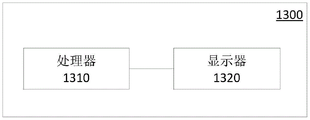
Referring to fig. 13, an embodiment of the present invention further provides a monitoring device 1300, wherein the monitoring device 1300 may be a monitor or a central monitoring management system. The monitoring device 1300 includes a processor 1310 and a display 1320. Wherein the processor 420 may be implemented by software, hardware, firmware, or any combination thereof, circuitry, single or multiple application specific integrated circuits, single or multiple general purpose integrated circuits, single or multiple microprocessors, single or multiple programmable logic devices, or any combination of the foregoing, or other suitable circuitry or devices may be used, and the processor 420 may control other components in the monitoring device 1300 to perform desired functions.
The monitoring device 1300 may be used to implement the monitoring method 100 described above, and the processor 1310 is used to perform the following steps: obtaining physiological sign data of physiological characteristic parameters of the monitored object according to the physiological characteristic signals; counting the total duration of the physiological characteristic data in the abnormal state within a preset time period in real time, wherein the total duration comprises at least one period of duration of the physiological characteristic data in the abnormal state; controlling the display 1320 to display the total duration or a proportion of the total duration in the preset time period; or when the total duration time exceeds a first preset threshold value or the proportion of the total duration time in the preset time period exceeds a second preset threshold value, alarm information is output.
The monitoring device 1300 may also be used to implement the monitoring method 1100 described above, and the processor 1310 is configured to perform the following steps: acquiring physiological sign data of physiological characteristic parameters of a monitored object; analyzing the acquired physiological characteristic data to identify atrial fibrillation arrhythmia events; counting in real time an overall duration of occurrence of atrial fibrillation arrhythmia events within a preset time period, the overall duration including at least one duration of occurrence of atrial fibrillation arrhythmia events; wherein the identified atrial fibrillation arrhythmia events include atrial fibrillation arrhythmia events having a duration of 30-60 seconds; controlling the display 1320 to display the total duration or a proportion of the total duration in the preset time period; or when the total duration time exceeds a first preset threshold value or the proportion of the total duration time in the preset time period exceeds a second preset threshold value, alarm information is output.
In one embodiment, the processor 1310 is further configured to: the type of the identified atrial fibrillation arrhythmia events is distinguished to extract the atrial fibrillation arrhythmia events with the duration of 30-60 seconds, namely, the short-matrix atrial fibrillation. The processor 1310 may be further configured to receive a review instruction and display an overall duration of each type of atrial fibrillation arrhythmia event occurring within the review time or a percentage of the overall duration within the preset time period.
Only the primary functions performed by the monitoring device 1300 have been described above. For other specific details of the functions implemented by the monitoring device 1300, reference may be made to the above description of the monitoring method, which is not described herein again.
Furthermore, according to an embodiment of the present invention, a computer storage medium is provided, on which program instructions are stored, which when executed by a computer or a processor are configured to perform corresponding steps of the monitoring method according to any of the embodiments of the present application. In some embodiments, the computer storage medium is a non-volatile computer-readable storage medium, which may include a storage program area and a storage data area, wherein the storage program area may store an operating system, an application program required for at least one function; the storage data area may store data created during execution of program instructions, and the like. Further, the non-volatile computer-readable storage medium may include high speed random access memory, and may also include non-volatile memory, such as at least one magnetic disk storage device, flash memory device, or other non-volatile solid state storage device. In some embodiments, the non-transitory computer readable storage medium optionally includes memory that is remotely located from the processor.
In addition, according to the embodiment of the present invention, a computer program is also provided, and the computer program may be stored on a storage medium in the cloud or in the local. When being executed by a computer or a processor, for performing the respective steps of the monitoring method of an embodiment of the invention.
In summary, the monitoring method and the monitoring device according to the embodiments of the present invention can help medical staff to grasp the development and change of physiological characteristic parameters of the monitored object in a preset time period, so as to better perform monitoring.
Although the example embodiments have been described herein with reference to the accompanying drawings, it is to be understood that the above-described example embodiments are merely illustrative and are not intended to limit the scope of the present application thereto. Various changes and modifications may be effected therein by one of ordinary skill in the pertinent art without departing from the scope or spirit of the present application. All such changes and modifications are intended to be included within the scope of the present application as claimed in the appended claims.
Those of ordinary skill in the art will appreciate that the various illustrative elements and algorithm steps described in connection with the embodiments disclosed herein may be implemented as electronic hardware or combinations of computer software and electronic hardware. Whether such functionality is implemented as hardware or software depends upon the particular application and design constraints imposed on the implementation. Skilled artisans may implement the described functionality in varying ways for each particular application, but such implementation decisions should not be interpreted as causing a departure from the scope of the present application.
In the several embodiments provided in the present application, it should be understood that the disclosed apparatus and method may be implemented in other ways. For example, the above-described device embodiments are merely illustrative, and for example, the division of the units is only one logical functional division, and other divisions may be realized in practice, for example, a plurality of units or components may be combined or integrated into another device, or some features may be omitted, or not executed.
In the description provided herein, numerous specific details are set forth. However, it is understood that embodiments of the application may be practiced without these specific details. In some instances, well-known methods, structures and techniques have not been shown in detail in order not to obscure an understanding of this description.
Similarly, it should be appreciated that in the description of exemplary embodiments of the present application, various features of the present application are sometimes grouped together in a single embodiment, figure, or description thereof for the purpose of streamlining the application and aiding in the understanding of one or more of the various inventive aspects. However, the method of the present application should not be construed to reflect the intent: this application is intended to cover such departures from the present disclosure as come within known or customary practice in the art to which this invention pertains. Rather, as the following claims reflect, inventive aspects lie in less than all features of a single disclosed embodiment. Thus, the claims following the detailed description are hereby expressly incorporated into this detailed description, with each claim standing on its own as a separate embodiment of this application.
It will be understood by those skilled in the art that all of the features disclosed in this specification (including any accompanying claims, abstract and drawings), and all of the processes or elements of any method or apparatus so disclosed, may be combined in any combination, except combinations where such features are mutually exclusive. Each feature disclosed in this specification (including any accompanying claims, abstract and drawings) may be replaced by alternative features serving the same, equivalent or similar purpose, unless expressly stated otherwise.
Furthermore, those skilled in the art will appreciate that while some embodiments described herein include some features included in other embodiments, rather than other features, combinations of features of different embodiments are meant to be within the scope of the application and form different embodiments. For example, in the claims, any of the claimed embodiments may be used in any combination.
The various component embodiments of the present application may be implemented in hardware, or in software modules running on one or more processors, or in a combination thereof. It will be appreciated by those skilled in the art that a microprocessor or Digital Signal Processor (DSP) may be used in practice to implement some or all of the functionality of some of the modules in an item analysis apparatus according to embodiments of the present invention. The present application may also be embodied as apparatus programs (e.g., computer programs and computer program products) for performing a portion or all of the methods described herein. Such programs implementing the present application may be stored on a computer readable medium or may be in the form of one or more signals. Such a signal may be downloaded from an internet website or provided on a carrier signal or in any other form.
It should be noted that the above-mentioned embodiments illustrate rather than limit the application, and that those skilled in the art will be able to design alternative embodiments without departing from the scope of the appended claims. In the claims, any reference signs placed between parentheses shall not be construed as limiting the claim. The word "comprising" does not exclude the presence of elements or steps not listed in a claim. The word "a" or "an" preceding an element does not exclude the presence of a plurality of such elements. The application may be implemented by means of hardware comprising several distinct elements, and by means of a suitably programmed computer. In the unit claims enumerating several means, several of these means may be embodied by one and the same item of hardware. The usage of the words first, second and third, etcetera do not indicate any ordering. These words may be interpreted as names.
The above description is only for the specific embodiments of the present application or the description thereof, and the protection scope of the present application is not limited thereto, and any person skilled in the art can easily conceive of the changes or substitutions within the technical scope disclosed in the present application, and shall be covered by the protection scope of the present application. The protection scope of the present application shall be subject to the protection scope of the claims.