CN114677515A - Weakly-supervised semantic segmentation method based on inter-class similarity - Google Patents
Weakly-supervised semantic segmentation method based on inter-class similarity Download PDFInfo
- Publication number
- CN114677515A CN114677515A CN202210442111.2A CN202210442111A CN114677515A CN 114677515 A CN114677515 A CN 114677515A CN 202210442111 A CN202210442111 A CN 202210442111A CN 114677515 A CN114677515 A CN 114677515A
- Authority
- CN
- China
- Prior art keywords
- class
- sample
- image
- activation spectrum
- spectrum
- Prior art date
- Legal status (The legal status is an assumption and is not a legal conclusion. Google has not performed a legal analysis and makes no representation as to the accuracy of the status listed.)
- Granted
Links
Images


Classifications
-
- G—PHYSICS
- G06—COMPUTING OR CALCULATING; COUNTING
- G06F—ELECTRIC DIGITAL DATA PROCESSING
- G06F18/00—Pattern recognition
- G06F18/20—Analysing
- G06F18/23—Clustering techniques
-
- G—PHYSICS
- G06—COMPUTING OR CALCULATING; COUNTING
- G06F—ELECTRIC DIGITAL DATA PROCESSING
- G06F18/00—Pattern recognition
- G06F18/20—Analysing
- G06F18/24—Classification techniques
-
- G—PHYSICS
- G06—COMPUTING OR CALCULATING; COUNTING
- G06N—COMPUTING ARRANGEMENTS BASED ON SPECIFIC COMPUTATIONAL MODELS
- G06N3/00—Computing arrangements based on biological models
- G06N3/02—Neural networks
- G06N3/04—Architecture, e.g. interconnection topology
- G06N3/045—Combinations of networks
-
- G—PHYSICS
- G06—COMPUTING OR CALCULATING; COUNTING
- G06N—COMPUTING ARRANGEMENTS BASED ON SPECIFIC COMPUTATIONAL MODELS
- G06N3/00—Computing arrangements based on biological models
- G06N3/02—Neural networks
- G06N3/08—Learning methods
Landscapes
- Engineering & Computer Science (AREA)
- Theoretical Computer Science (AREA)
- Data Mining & Analysis (AREA)
- Physics & Mathematics (AREA)
- Life Sciences & Earth Sciences (AREA)
- Artificial Intelligence (AREA)
- General Physics & Mathematics (AREA)
- General Engineering & Computer Science (AREA)
- Evolutionary Computation (AREA)
- Bioinformatics & Computational Biology (AREA)
- Computational Linguistics (AREA)
- Computer Vision & Pattern Recognition (AREA)
- Bioinformatics & Cheminformatics (AREA)
- Health & Medical Sciences (AREA)
- Biomedical Technology (AREA)
- Biophysics (AREA)
- Evolutionary Biology (AREA)
- General Health & Medical Sciences (AREA)
- Molecular Biology (AREA)
- Computing Systems (AREA)
- Mathematical Physics (AREA)
- Software Systems (AREA)
- Image Analysis (AREA)
Abstract
本发明公开了一种基于类间相似性的弱监督语义分割方法,属于弱监督语义分割领域。本发明包括:基于每个类别的特征通过聚类方法将相似类进行合并得到新类,重新生成数据集中每个样本在新类上的标签;基于原始标签搭建分类网络,提取对应的类激活谱,将其与阈值比较获取判别性区域,从原图中擦除判别性区域,将其送入基于新标签建立的分类网络,完成对抗擦除模型的搭建;基于训练好的对抗擦除模型,提取类激活谱,依次经过类激活谱增强模块和融合模块的处理,得到最终的类激活谱,再将其与前景背景阈值比较得到伪标注,基于该伪标注对语义分割模型进行训练,得到训练好的分割模型。本发明提升了图像的弱监督语义分割的分割准确。

The invention discloses a weakly supervised semantic segmentation method based on similarity between classes, which belongs to the field of weakly supervised semantic segmentation. The invention includes: merging similar classes through a clustering method based on the features of each class to obtain a new class, and regenerating the label of each sample in the data set on the new class; building a classification network based on the original label, and extracting the corresponding class activation spectrum , compare it with the threshold to obtain the discriminative area, erase the discriminative area from the original image, and send it to the classification network established based on the new label to complete the construction of the confrontation erasure model; based on the trained confrontation erasure model, The class activation spectrum is extracted, processed by the class activation spectrum enhancement module and the fusion module in turn, and the final class activation spectrum is obtained, and then it is compared with the foreground and background thresholds to obtain pseudo-labels. Based on the pseudo-labels, the semantic segmentation model is trained and obtained. Good segmentation model. The present invention improves the segmentation accuracy of weakly supervised semantic segmentation of images.
Description
技术领域technical field
本发明属于弱监督语义分割领域,具体涉及一种基于类间相似性的弱监督语义分割方法。The invention belongs to the field of weakly supervised semantic segmentation, in particular to a weakly supervised semantic segmentation method based on similarity between classes.
背景技术Background technique
弱监督语义分割任务是一个在计算机视觉领域中备受关注的研究方向,其目的旨在利用图像级的标签实现像素级的分割,因此被认为是降低语义分割所需标注成本的一个重要任务。近些年来,随着计算机运算能力的提升,深度卷积神经网络的发展使弱监督语义分割任务获得了诸多显著的成果。Weakly supervised semantic segmentation task is a research direction that has received much attention in the field of computer vision. Its purpose is to use image-level labels to achieve pixel-level segmentation, so it is considered to be an important task to reduce the cost of annotation for semantic segmentation. In recent years, with the improvement of computer computing power, the development of deep convolutional neural networks has made many remarkable achievements in weakly supervised semantic segmentation tasks.
现如今,性能优越的弱监督语义分割模型都是基于类激活谱进行实现的,其基于分类模型建立图像级到标签级的映射关系给弱监督语义分割任务注入了新的活力。较于传统的弱监督语义分割算法,基于类激活谱的弱监督语义分割算法在分割性能上有了突破性进步,在各种数据集上都表现出了强劲的性能和优势,但基于类激活谱的弱监督语义分割任务仍然面临着一些挑战,例如基于分类网络提取的类激活谱具有过激活和欠激活问题等。Nowadays, the weakly supervised semantic segmentation models with superior performance are all implemented based on the class activation spectrum. The image-level to label-level mapping relationship established based on the classification model injects new vitality into the weakly supervised semantic segmentation task. Compared with the traditional weakly supervised semantic segmentation algorithm, the weakly supervised semantic segmentation algorithm based on the class activation spectrum has made a breakthrough in the segmentation performance, showing strong performance and advantages in various data sets, but based on the class activation spectrum. The weakly supervised semantic segmentation task of spectrum still faces some challenges, such as the class activation spectrum extracted based on classification network has over-activation and under-activation problems, etc.
比如,以分割场景中的猫和狗这两类为例,由于猫和狗的身体具有较强的相似性,导致猫和狗的判别性区域主要集中在头部区域,故在类激活谱中往往只能激活猫和狗的头部区域,进而使得基于类激活谱提取的伪标注与真实的掩膜具有较大的差距,从而导致最终的分割性能受到影响,但目前通用的弱监督语义分割方法并没有解决类激活欠激活问题,分割的准确率较低,不能满足实际需求。For example, taking the two categories of cats and dogs in the segmentation scene as an example, due to the strong similarity between the bodies of cats and dogs, the discriminative regions of cats and dogs are mainly concentrated in the head region, so in the class activation spectrum Often only the head regions of cats and dogs can be activated, which makes the pseudo-annotation extracted based on the class activation spectrum have a large gap with the real mask, which affects the final segmentation performance. However, the current general weakly supervised semantic segmentation The method does not solve the problem of class activation under-activation, and the segmentation accuracy is low, which cannot meet the actual needs.
发明内容SUMMARY OF THE INVENTION
本发明的目的在于:为了解决目前通用的基于类激活谱实现弱监督语义分割任务方法中,由于数据集中类与类之间具有较强的相似性导致提取的类激活谱具有欠激活现象,导致目前通用的模型生成的伪标注与真实的掩膜之间存在较大差距而导致最终的分割准确率较低的问题,本发明提出了一种基于类间相似性的弱监督语义分割方法。The purpose of the present invention is: in order to solve the problem that in the current general method for implementing weakly supervised semantic segmentation task based on class activation spectrum, due to the strong similarity between classes in the data set, the extracted class activation spectrum has the phenomenon of under-activation, resulting in There is a large gap between the pseudo-annotation generated by the current general model and the real mask, which leads to the problem of low final segmentation accuracy. The present invention proposes a weakly supervised semantic segmentation method based on inter-class similarity.
本发明采用的技术方案如下:The technical scheme adopted in the present invention is as follows:
基于类间相似性的弱监督语义分割方法,包括以下步骤:Weakly supervised semantic segmentation method based on inter-class similarity, including the following steps:
步骤1,建立新标签:Step 1, create a new label:
通过特征提取网络提取预置的第一图像数据集的每个类别的图像特征,基于提取的图像特征通过聚类方法对相似类进行合并得到新类,并重新生成第一图像数据集中每个样本图像在新类上的标签;Extract the image features of each category of the preset first image data set through the feature extraction network, merge similar categories based on the extracted image features through the clustering method to obtain a new class, and regenerate each sample in the first image data set the label of the image on the new class;
步骤2,搭建对抗擦除模型:Step 2, build an anti-erasure model:
基于第一图像数据集的原始标签,搭建第一分类网络,所述第一分类网络包括特征提取网络和分类器,所述分类器包括至少一层全连接层;Building a first classification network based on the original label of the first image data set, where the first classification network includes a feature extraction network and a classifier, and the classifier includes at least one fully connected layer;
基于第一图像数据集对所述第一分类网络进行训练,得到训练好的第一分类网络;The first classification network is trained based on the first image data set to obtain a trained first classification network;
将第一图像数据集中的样本图像输入训练好的第一分类网络,基于其特征提取网络的输出得到样本特征图,并将训练好的第一分类网络的分类器的最后一层全连接层的权重作为样本特征图的通道权重,对各样本特征图的按通道进行加权求和生成第一类激活谱(即原始标签对应的类激活谱);Input the sample images in the first image data set into the trained first classification network, obtain the sample feature map based on the output of its feature extraction network, and use the last fully connected layer of the classifier of the trained first classification network. The weight is used as the channel weight of the sample feature map, and the channel-wise weighted summation of each sample feature map is used to generate the first-class activation spectrum (ie, the class activation spectrum corresponding to the original label);
将所述第一类激活谱阈值进行比较,若大于或等于,则确定为判别性区域,并从当前样本图像中擦除判别性区域得到新样本图像,基于新样本图像和新标签得到第二图像数据集;The first type of activation spectrum threshold is compared, and if it is greater than or equal to, it is determined as a discriminative area, and a new sample image is obtained by erasing the discriminative area from the current sample image, and a second sample image is obtained based on the new sample image and the new label. image dataset;
基于第二图像数据集搭建第二分类网络,所述第二分类网络与第一分类网络的网络结构相同;并基于第二图像数据集对所述第二分类网络进行训练,基于训练好的第二分类网络得到对抗擦除模型;A second classification network is built based on the second image data set, and the second classification network has the same network structure as the first classification network; and the second classification network is trained based on the second image data set. The two-class network gets an adversarial erasure model;
步骤3,类激活谱融合:Step 3, class activation spectrum fusion:
将新样本图像输入对抗擦除模型,基于其特征提取网络的输出得到第二样本特征图,并将对抗擦除模型的分类器的最后一层全连接层的权重作为第二样本特征图的通道权重,对各第二样本特征图的按通道进行加权求和生成第二类激活谱(即新标签对应的类激活谱);Input the new sample image into the adversarial erasure model, obtain the second sample feature map based on the output of its feature extraction network, and use the weight of the last fully connected layer of the classifier against the erasure model as the channel of the second sample feature map Weight, the channel-wise weighted summation of each second sample feature map to generate a second-type activation spectrum (ie, the class-activation spectrum corresponding to the new label);
对第一和第二类激活谱进行合并处理,生成最终的类激活谱;Combine the first and second class activation spectra to generate the final class activation spectra;
步骤4,生成伪标注:Step 4, generate pseudo annotations:
若最终的类激活谱大于或等于前景阈值,则将最终的类激活谱对应的像素划分为前景;若最终的类激活谱小于背景阈值,则将最终的类激活谱对应的像素划分为背景;剩余的像素则填充为白色;If the final class activation spectrum is greater than or equal to the foreground threshold, the pixel corresponding to the final class activation spectrum is divided into foreground; if the final class activation spectrum is less than the background threshold, the pixel corresponding to the final class activation spectrum is divided into background; The remaining pixels are filled with white;
步骤5,训练语义分割模型:Step 5, train the semantic segmentation model:
将生成的伪标注作为监督信息,并基于第一图像数据集对采用的语义分割模型进行训练,当满足预置的训练结束条件时,得到训练好的语义分割模型。The generated pseudo-annotations are used as supervision information, and the adopted semantic segmentation model is trained based on the first image data set. When the preset training end condition is satisfied, a trained semantic segmentation model is obtained.
进一步地,所述步骤1中,基于提取的图像特征通过聚类方法对相似类进行合并具体为:Further, in the step 1, the similar classes are merged by the clustering method based on the extracted image features, specifically:
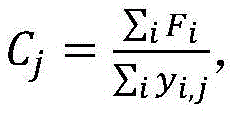
基于单个样本图像的图像特征Fi,对其按类别划分,取特征均值得到每个类别的特征: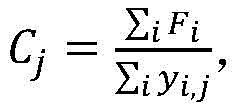
基于每个类别的特征进行聚类处理,将每个聚类结果作为一种新类,并设置对应的新标签。Perform clustering processing based on the features of each category, treat each clustering result as a new category, and set the corresponding new label.
进一步的,所述特征提取网络采用网络Resnet50或VGG16的骨干网络。Further, the feature extraction network adopts the backbone network of the network Resnet50 or VGG16.
进一步的,所述分类器包括一层设置有softmax函数全连接层。Further, the classifier includes a fully connected layer provided with a softmax function.
进一步的,第一、第二类激活谱的具体计算方式为:Further, the specific calculation methods of the first and second types of activation spectra are:
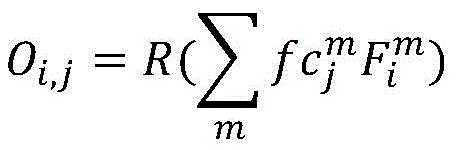
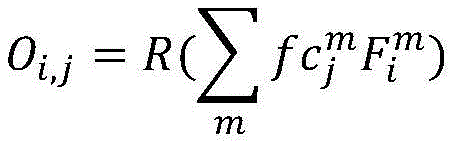
其中,Oi,j表示样本图像i第j类的第一或第二类激活谱,R()表示正则化,

进一步的,步骤2中,新样本图像为Ii′=∑jyi,j[Ii⊙(1-Di,j)],其中,Ii表示第一图像数据集的第i幅样本图像,yi,j表示样本图像i的第j个类别的标签值,若样本图像i包含第j类物体,则yi,j为1,否则yi,j为0,Di,j表示判别性区域标识,Di,j为1表示判别性区域,Di,j为0表示非判别性区域,⊙代表点乘运算。Further, in step 2, the new sample image is I i ′=∑ j y i,j [I i ⊙(1-D i,j )], where I i represents the ith sample of the first image data set image, y i,j represents the label value of the jth category of the sample image i, if the sample image i contains the jth category object, then yi,j is 1, otherwise yi,j is 0, D i,j represents The discriminative region identifier, D i,j being 1 indicates the discriminative region, D i,j being 0 indicates the non-discriminative region, and ⊙ represents the dot product operation.
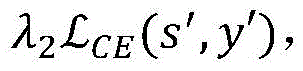
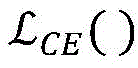
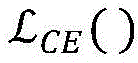
进一步地,所述对抗擦除模型在训练时采用的损失函数为:
进一步的,第一和第二分类网络进行网络训练时的结束条件为:训练次数达到预置的训练次数上限。Further, the end condition when the first and second classification networks perform network training is that the number of training times reaches a preset upper limit of the number of training times.
进一步的,步骤2中,确定判别性区域时,首先对第一类激活谱进行增强处理,再基于增强处理后的第一类激活谱进行判别性区域确定。Further, in step 2, when the discriminative region is determined, the first type of activation spectrum is first enhanced, and then the discriminative region is determined based on the enhanced first type of activation spectrum.
进一步的,步骤3中,对第一和第二类激活谱进行合并处理前,分别对第一和第二类激活谱进行增强处理,再基于增强处理后的第一和第二类激活谱进行合并处理。Further, in step 3, before combining the first and second types of activation spectra, the first and second types of activation spectra are respectively enhanced, and then based on the enhanced first and second types of activation spectra. Merge processing.
进一步的,所述增强处理具体为:Further, the enhancement processing is specifically:
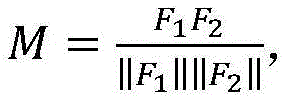
对分类网络的特征提取网络输出的样本特征图F进行转置和尺寸调整处理,得到两个新的特征图F1和F2,并根据公式得到亲和力矩阵M: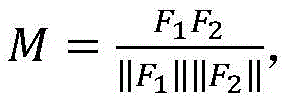
定义b×h×w表示样本特征图F尺寸,其中,b表示通道数,h×w表示样本特征图的大小,则特征图F1的尺寸为b×hw,特征图F2的尺寸为hw×b;Define b×h×w to represent the size of the sample feature map F, where b represents the number of channels, and h×w represents the size of the sample feature map, then the size of the feature map F1 is b × hw, and the size of the feature map F2 is hw ×b;
将类激活谱与其对应的亲和力矩阵M进行矩阵相乘得到增强后的增强后的类激活谱。Matrix multiplication of the class activation spectrum and its corresponding affinity matrix M is performed to obtain the enhanced enhanced class activation spectrum.
进一步的,步骤3中,对第一和第二类激活谱进行合并处理具体为:Further, in step 3, the process of merging the first and second types of activation spectra is as follows:
第一类激活谱减去干扰区域后,再与第二类激活谱相加,生成最终的类激活谱;After subtracting the interference area from the first type of activation spectrum, it is then added to the second type of activation spectrum to generate the final type of activation spectrum;
其中,干扰区域的具体生成方式为:
综上所述,由于采用了上述技术方案,本发明的有益效果是:通过两个分类网络实现类激活谱的提取,通过将相似类进行合并,使得基于新标签分类网络生成的类激活谱可以进一步激活类间相似性区域,对基于原始标签分类网络生成的类激活谱进行扩展;擦除方法擦除判别性区域可以使得基于新标签的分类网络更加关注非判别性区域;类激活谱增强模块通过构建像素与像素之间的相似性矩阵,可以进一步激活与激活区域相似的非激活区域;同时通过融合模块将基于两个分类网络提取的类激活谱进行融合,对类激活谱进行进一步优化,扩展了类激活谱的激活区域,使得生成的伪标注和真实的掩膜更加接近,进而提升了分割结果的准确率。To sum up, due to the adoption of the above technical solutions, the beneficial effects of the present invention are: the extraction of the class activation spectrum is realized through two classification networks, and by merging similar classes, the class activation spectrum generated based on the new label classification network can be The inter-class similarity region is further activated to expand the class activation spectrum generated by the original label classification network; the erasure method to erase the discriminative region can make the classification network based on the new label pay more attention to the non-discriminatory region; the class activation spectrum enhancement module By constructing the similarity matrix between pixels, the inactive regions similar to the active regions can be further activated; at the same time, the class activation spectra extracted based on the two classification networks are fused by the fusion module, and the class activation spectra are further optimized. The activation area of the class activation spectrum is expanded, so that the generated pseudo-annotations are closer to the real masks, thereby improving the accuracy of the segmentation results.
附图说明Description of drawings
为了更清楚地说明本发明实施例的技术方案,下面将对实施例中所需要使用的附图作简单地介绍,应当理解,以下附图仅示出了本发明的某些实施例,因此不应被看作是对范围的限定,对于本领域普通技术人员来讲,在不付出创造性劳动的前提下,还可以根据这些附图获得其他相关的附图,其中:In order to illustrate the technical solutions of the embodiments of the present invention more clearly, the following briefly introduces the accompanying drawings used in the embodiments. It should be understood that the following drawings only show some embodiments of the present invention, and therefore do not It should be regarded as a limitation of the scope. For those of ordinary skill in the art, other related drawings can also be obtained from these drawings without creative efforts, wherein:
图1是本发明实施例提供的基于类间相似性的弱监督语义分割方法的流程示意图,其中,GAP表示全局平均池化层,FC表示全连接层;1 is a schematic flowchart of a weakly supervised semantic segmentation method based on inter-class similarity provided by an embodiment of the present invention, wherein GAP represents a global average pooling layer, and FC represents a fully connected layer;
图2是本发明实施例中,基于像素特征类激活谱增强的示意图。FIG. 2 is a schematic diagram of activation spectrum enhancement based on pixel feature classes in an embodiment of the present invention.
具体实施方式Detailed ways
为使本发明的目的、技术方案和优点更加清楚,下面将结合附图对本发明实施方式作进一步地详细描述。In order to make the objectives, technical solutions and advantages of the present invention clearer, the embodiments of the present invention will be further described in detail below with reference to the accompanying drawings.
本发明实施例提供的基于类间相似性的弱监督语义分割方法解决了目前通用的基于类激活谱进行弱监督语义分割方法中存在的类激活谱欠激活问题。其具体包括以下步骤:The weakly supervised semantic segmentation method based on the similarity between classes provided by the embodiments of the present invention solves the problem of underactivation of the class activation spectrum existing in the current general weakly supervised semantic segmentation method based on the class activation spectrum. It specifically includes the following steps:
步骤S1,建立新标签:提取每个类别的特征,基于提取的特征通过聚类方法将相似类进行合并得到新类,重新生成数据集中每个样本在新类上的标签;Step S1, establishing a new label: extracting the features of each category, merging similar categories through a clustering method based on the extracted features to obtain a new category, and regenerating the label of each sample in the data set on the new category;
步骤S2,搭建对抗擦除模型:基于原始标签搭建分类网络,将分类网络的全连接层权重视为每个通道的权重,加权至特征谱上求和即可生成原始标签对应的类激活谱,将类激活谱与阈值比较获取判别性区域,从原图中擦除判别性区域送入基于新标签搭建的分类网络,完成对抗擦除模型的搭建;Step S2, build an adversarial erasure model: build a classification network based on the original label, take the weight of the fully connected layer of the classification network as the weight of each channel, and add the weight to the feature spectrum to generate the class activation spectrum corresponding to the original label, Comparing the class activation spectrum with the threshold value to obtain the discriminative area, erasing the discriminative area from the original image and sending it to the classification network based on the new label to complete the construction of the anti-erasure model;
步骤S3,生成类激活谱:基于两个分类网络的全连接层权重和特征谱提取对应网络的类激活谱,将其分别送入类激活谱增强模块,基于像素特征之间的相似性进行信息增强,从而激活更多的区域,将增强后的类激活谱送入融合模块,将两个网络提取的类激活谱进行合并,进一步优化类激活谱,获得最终的类激活谱;Step S3, generate the class activation spectrum: extract the class activation spectrum of the corresponding network based on the fully connected layer weights and the feature spectrum of the two classification networks, send them to the class activation spectrum enhancement module, and perform information based on the similarity between the pixel features. Enhancement, so as to activate more regions, send the enhanced class activation spectrum to the fusion module, merge the class activation spectra extracted by the two networks, further optimize the class activation spectrum, and obtain the final class activation spectrum;
步骤S4,生成伪标注:将最终的类激活谱与前景阈值和背景阈值进行比较,将类激活谱分数大于(或等于)前景阈值的区域划分为前景,类激活谱分数小于(或等于)背景阈值的区域划分为背景,剩余区域用白色填充;Step S4, generate pseudo-labels: compare the final class activation spectrum with the foreground threshold and the background threshold, and divide the area with the class activation spectrum score greater than (or equal to) the foreground threshold as foreground, and the class activation spectrum score is less than (or equal to) the background. The thresholded area is divided into the background, and the remaining area is filled with white;
步骤S5,训练分割模型:将生成的伪标注作为监督信息送入采用的语义分割模型,对该语义分割模型进行训练,其中训练的数据集为原始的数据集,基于训练好的语义分割模型得到最终的分割结果。本步骤中,语义分割模型可以采用任一惯用的网络结构,本发明不做具体限定,例如可以采用经典的分割模型DeeplabV2。Step S5, training the segmentation model: send the generated pseudo-labels as supervision information into the semantic segmentation model adopted, and train the semantic segmentation model, wherein the training data set is the original data set, which is obtained based on the trained semantic segmentation model. the final segmentation result. In this step, the semantic segmentation model may use any conventional network structure, which is not specifically limited in the present invention, for example, the classical segmentation model DeeplabV2 may be used.
本发明实施例中,通过两个分类网络实现类激活谱的提取,通过将相似类进行合并,使得基于新标签分类网络生成的类激活谱可以进一步激活类间相似性区域,对基于原始标签分类网络生成的类激活谱进行扩展;擦除方法擦除判别性区域可以使得基于新标签的分类网络更加关注非判别性区域;类激活谱增强模块通过构建像素与像素之间的相似性矩阵,可以进一步激活与激活区域相似的非激活区域;同时通过融合模块将基于两个分类网络提取的类激活谱进行融合,对类激活谱进行进一步优化,扩展了类激活谱的激活区域,使得生成的伪标注和真实的掩膜更加接近,进而提升了分割结果的准确率。In the embodiment of the present invention, two classification networks are used to extract the class activation spectrum, and by merging similar classes, the class activation spectrum generated based on the new label classification network can further activate the similarity region between classes, and the classification based on the original label can further activate the similarity region between classes. The class activation spectrum generated by the network is expanded; erasing the discriminative region by the erasing method can make the classification network based on the new label pay more attention to the non-discriminatory region; the class activation spectrum enhancement module can construct the similarity matrix between pixels and pixels. Further activate the inactive area similar to the activation area; at the same time, the class activation spectrum extracted based on the two classification networks is fused by the fusion module, the class activation spectrum is further optimized, and the activation area of the class activation spectrum is expanded, so that the generated pseudo The annotation is closer to the real mask, which improves the accuracy of the segmentation results.
作为一种可能的实现方式,参见图1,本发明实施例提供的基于类间相似性的弱监督语义分割方法的较佳实施例,包括以下步骤:As a possible implementation, referring to FIG. 1 , a preferred embodiment of the method for weakly supervised semantic segmentation based on inter-class similarity provided by an embodiment of the present invention includes the following steps:
步骤S1、建立新的标签:Step S1, create a new label:
提取每个类别的特征,基于提取的特征通过聚类方法将相似类进行合并得到新类,重新生成数据集中每个样本在新类上的标签;该步骤中,通过惯用的用于提取图像特征的特征提取网络即可获取每个类别的特征。Extract the features of each category, combine similar categories through clustering method based on the extracted features to obtain a new category, and regenerate the label of each sample in the dataset on the new category; in this step, the conventional method is used to extract image features The feature extraction network can obtain the features of each category.
步骤S101、提取每个类的特征:Step S101, extract the features of each class:
使用骨干网络提取数据集上只包含单个目标的图像特征Fi,对其按类别划分,取特征均值即为对应类别的特征:Use the backbone network to extract the image feature F i that only contains a single target on the dataset, divide it by category, and take the feature mean to be the feature of the corresponding category:

其中,Cj为第j个类别的特征,yi,j为第i张图像第j个类别的标签值,如果包含第j类物体,则为1,否则为0;Among them, C j is the feature of the j-th category, y i,j is the label value of the j-th category of the i-th image, if it contains the j-th category of objects, it is 1, otherwise it is 0;
步骤S102、基于特征将相似类聚为新类:Step S102, clustering similar classes into new classes based on features:
基于特征C,通过谱聚类方法将特征相似的类聚为一个新类:Based on feature C, clusters with similar features are clustered into a new class by spectral clustering method:
P(j)=j′(j=1,2...c;j′=1,2…c′) (2)P(j)=j'(j=1,2...c; j'=1,2...c') (2)
其中,P代表聚类算法,j′代表第j类经过聚类后的类别标签,c和c′分别代表聚类前后类别总数;Among them, P represents the clustering algorithm, j' represents the class label of the jth class after clustering, and c and c' represent the total number of classes before and after clustering, respectively;
步骤S103、基于合并后的新类重新生成新标签:Step S103, regenerate a new label based on the merged new class:
对数据集中的每张图像,重新生成一个新的标签,具体地,第i张图像原始标签为yi,j,新标签对应为y′i,j′。For each image in the dataset, a new label is regenerated. Specifically, the original label of the ith image is yi,j , and the new label corresponds to y′ i,j′ .
步骤S2、搭建对抗擦除模型:Step S2, build an anti-erasure model:
基于原始标签搭建分类网络,将分类网络的最后一层全连接层权重视为每个通道的权重,加权至特征谱上求和即可生成原始标签对应的类激活谱,将类激活谱与阈值比较获取判别性区域,从原图中擦除判别性区域送入基于新标签搭建的分类网络,完成对抗擦除模型的搭建;Build a classification network based on the original label, take the weight of the last fully-connected layer of the classification network as the weight of each channel, and add the weight to the feature spectrum to generate the class activation spectrum corresponding to the original label. Compare and obtain the discriminative area, erase the discriminative area from the original image and send it to the classification network based on the new label to complete the construction of the anti-erasure model;
步骤S201、基于原始标签搭建分类网络:Step S201, build a classification network based on the original label:
本实施中,将原始图像送入网络Resnet50或VGG16中进行特征提取,然后紧接一个分类器(即由至少一层的全连接层组成的分类器,且分类器的最后一层全连接层通常为基于sofmax函数的全连接层,用于输出各个类别的预测概率),用原始标签进行监督,搭建基于原始标签的分类网络,即该分类网络包括两部分:特征提取网络和分类器;In this implementation, the original image is sent to the network Resnet50 or VGG16 for feature extraction, followed by a classifier (that is, a classifier consisting of at least one fully connected layer, and the last fully connected layer of the classifier is usually It is a fully connected layer based on the sofmax function, which is used to output the predicted probability of each category), and uses the original label to supervise to build a classification network based on the original label, that is, the classification network includes two parts: a feature extraction network and a classifier;
步骤S202、提取判别性区域:Step S202, extracting the discriminative region:
基于原始标签搭建分类网络,提取特征提取网络的最后一层输出的特征F(也称为特征图)和全连接层权重fc,将权重fc作为每个通道的权重并加权至特征F上,最终通过加权求和生成每张图像每一类对应的类激活谱:Build a classification network based on the original label, extract the feature F (also called feature map) output by the last layer of the feature extraction network and the weight fc of the fully connected layer, take the weight fc as the weight of each channel and weight it to the feature F, and finally The class activation spectrum corresponding to each class of each image is generated by weighted summation:

其中,R()代表正则化,下标m表示通道标识,j表示类别标识,i表示样本图像标识,Ai,j为第i张图像第j类的类激活谱,m代表通道,

类激活谱激活区域代表的是分类网络通过物体的该区域将其识别为对应的类别。故类激活谱中,数值越大代表该像素属于目标物体区域的置信度越高。通过将类激活谱与阈值比较,获取物体的判别性区域:Class Activation Spectrum The activation region represents the region of the object that the classification network recognizes as the corresponding class. Therefore, in the class activation spectrum, the larger the value, the higher the confidence that the pixel belongs to the target object region. Obtain the discriminative region of an object by comparing the class activation spectrum with a threshold:

其中,Di,j反映物体的判别性区域分布情况,Di,j为1时代表判别性区域,Di,j为0时代表非判别性区域,t代表阈值。Among them, Di,j reflects the discriminative area distribution of the object, when Di,j is 1, it represents the discriminative area, when Di ,j is 0, it represents the non-discriminative area, and t represents the threshold.
步骤S203、基于新标签搭建分类网络:Step S203, build a classification network based on the new label:
在原始图像Ii上擦除判别性区域:Erase the discriminative regions on the original image I i :
Ii′=∑jyi,j[Ii⊙(1-Di,j)] (5)I i ′=∑ j y i,j [I i ⊙(1-D i,j )] (5)
其中,Ii′代表第i张图像Ii擦除判别性区域后的结果,⊙代表点乘运算;Among them, I i ′ represents the result of erasing the discriminative region of the i-th image I i , and ⊙ represents the dot product operation;
将Ii′作为输入图像送入基于新标签搭建的分类网络中,使得网络将注意力转移至剩余非判别性区域上,完成对抗擦除网络的搭建。本发明实施例中,基于新标签搭建的分类网络与基于原始标签的分类网络的网络结构相同,两者的差异仅在于训练时训练数据(输入的图像数据及标签)的差异。Sending I i ′ as the input image into the classification network built based on the new label makes the network shift its attention to the remaining non-discriminatory regions and completes the construction of the confrontation erasure network. In the embodiment of the present invention, the network structure of the classification network built based on the new label and the classification network based on the original label is the same, and the difference between the two is only the difference in the training data (input image data and labels) during training.
步骤S204、训练对抗擦除网络:Step S204, training the adversarial erasure network:
基于两个分类网络构建损失函数:Build a loss function based on two classification networks:

其中,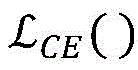
对对抗擦除模型进行网络训练,直到达到预设的迭代次数。The network is trained on the adversarial erasure model until a preset number of iterations is reached.
步骤S3、生成类激活谱:Step S3, generate a class activation spectrum:
基于两个分类网络的全连接层权重和特征谱提取对应网络的类激活谱,将其分别送入类激活谱增强模块,基于像素特征之间的相似性进行信息增强,从而激活更多的区域,将增强后的类激活谱送入融合模块,将两个网络提取的类激活谱进行合并,进一步优化类激活谱,获得最终的类激活谱;Based on the fully connected layer weights and feature spectra of the two classification networks, the class activation spectra of the corresponding networks are extracted and sent to the class activation spectrum enhancement module respectively, and information enhancement is performed based on the similarity between pixel features, thereby activating more regions. , send the enhanced class activation spectrum to the fusion module, merge the class activation spectra extracted by the two networks, further optimize the class activation spectrum, and obtain the final class activation spectrum;
步骤S301、提取类激活谱:Step S301, extract the class activation spectrum:
基于两个训练好的分类网络,通过式(3)分别提取类激活谱A和E,其中,类激活谱A对应基于原始标签的分类网络,类激活谱E对应基于新标签搭建的分类网络;Based on the two trained classification networks, the class activation spectra A and E are extracted respectively by formula (3), where the class activation spectrum A corresponds to the classification network based on the original label, and the class activation spectrum E corresponds to the classification network built based on the new label;
步骤S302、搭建类激活谱增强模块:Step S302, building a class activation spectrum enhancement module:
将尺寸为b×h×w特征图F通过转置和尺寸调整操作,得到尺寸分别为b×hw和hw×b特征图F1和F2,对特征图F1和F2进行矩阵相乘得到亲和力矩阵M:Transpose and resize the feature map F of size b×h×w to obtain feature maps F 1 and F 2 of size b×hw and hw×b respectively, and perform matrix multiplication on the feature maps F 1 and F 2 Get the affinity matrix M:

其中,‖·‖代表2-范数运算;Among them, ‖·‖ represents the 2-norm operation;
将类激活谱和亲和力矩阵进行矩阵相乘得到最终的类激活谱:Matrix-multiply the class activation spectrum and the affinity matrix to get the final class activation spectrum:
A′=AM (8)A′=AM (8)
其中,A′代表类激活谱A经过类激活谱增强模块处理后的输出结果;Among them, A' represents the output result of the class activation spectrum A processed by the class activation spectrum enhancement module;
同理,将激活谱E经过类激活谱增强模块处理后得到E′;Similarly, the activation spectrum E is processed by the activation-like spectrum enhancement module to obtain E′;
由此,完成类激活谱增强模块的搭建(如图2所示),基于像素的特征相似性通过激活区域去进一步激活非判别性区域。Thus, the construction of the class activation spectrum enhancement module is completed (as shown in Figure 2), and the non-discriminatory regions are further activated through the activation regions based on the feature similarity of pixels.
步骤S303、类激活谱融合模块:Step S303, class activation spectrum fusion module:
基于增强后的类激活谱A′和E′,通过对其进行融合进行信息补偿,进一步对类激活谱进行优化,具体融合方式如式(9)所示:Based on the enhanced class activation spectra A' and E', information compensation is performed by fusing them, and the class activation spectra are further optimized. The specific fusion method is shown in formula (9):
Gi,j=A′i,j-Zi,j+E′i,j′ (9)G i,j =A′ i,j -Z i,j +E′ i,j′ (9)
其中,Gi,j为最终的类激活谱,Zi,j代表干扰区域,是为了防止两个相似类同时出现在同一张图像中导致提取出来的类激活谱互相产生干扰,具体生成方式如式(10)所示:Among them, G i,j is the final class activation spectrum, and Z i,j represents the interference area, in order to prevent two similar classes from appearing in the same image at the same time, causing the extracted class activation spectrum to interfere with each other. The specific generation method is as follows Formula (10) shows:

其中,n表示类别标识符。where n represents the class identifier.
步骤S4、生成伪标注:Step S4, generating pseudo-labels:
将最终的类激活谱与前景阈值和背景阈值进行比较,将大于前景阈值的像素划分为前景,小于背景阈值的像素划分为背景,剩余像素用白色填充:The final class activation spectrum is compared with the foreground and background thresholds, and the pixels larger than the foreground threshold are classified as foreground, the pixels smaller than the background threshold are classified as background, and the remaining pixels are filled with white:

其中,Hi,j代表第i张图像第j类对应的激活谱生成的伪标注;Among them, H i,j represents the pseudo-label generated by the activation spectrum corresponding to the jth class of the i-th image;
对于某一张图像,若出现某个像素同时属于多个前景,则比较Zi,j值,取数值最大时对应的类别作为前景。For a certain image, if a certain pixel belongs to multiple foregrounds at the same time, compare the values of Z i and j , and take the category corresponding to the maximum value as the foreground.
步骤S5、训练分割模型并推理:Step S5, train the segmentation model and reason:
将生成的伪标注作为监督信息送入目前经典的语义分割模型DeeplabV2中进行训练,基于训练好的语义分割模型得到最终的分割结果。The generated pseudo-annotations are sent to the current classic semantic segmentation model DeeplabV2 as supervision information for training, and the final segmentation results are obtained based on the trained semantic segmentation model.
本发明实施例主要针对目前基于类激活实现弱监督分割方法中存在的欠激活问题,通过两个分类网络实现类激活谱的提取,通过将相似类进行合并,使得基于新标签分类网络生成的类激活谱可以进一步激活类间相似性区域,对基于原始标签分类网络生成的类激活谱进行扩展;擦除方法擦除判别性区域可以使得基于新标签的分类网络更加关注非判别性区域;类激活谱增强模块通过构建像素与像素之间的相似性矩阵,可以进一步激活与激活区域相似的非激活区域;同时通过融合模块将基于两个分类网络提取的类激活谱进行融合,对类激活谱进行进一步优化,扩展了类激活谱的激活区域,使得生成的伪标注和真实的掩膜更加接近,进而提升了分割结果的准确率。The embodiment of the present invention is mainly aimed at the under-activation problem existing in the current weakly supervised segmentation method based on class activation, extracts the class activation spectrum through two classification networks, and merges similar classes to make the class generated based on the new label classification network. The activation spectrum can further activate the inter-class similarity region and expand the class activation spectrum generated by the original label classification network; erasing the discriminative region can make the classification network based on the new label pay more attention to the non-discriminatory region; the class activation The spectral enhancement module can further activate the inactive regions similar to the active regions by constructing the similarity matrix between pixels; at the same time, the fusion module fuses the class activation spectra extracted based on the two classification networks, and the class activation spectra are analyzed. Further optimization expands the activation area of the class activation spectrum, so that the generated pseudo-annotations are closer to the real masks, thereby improving the accuracy of the segmentation results.
最后应说明的是:以上实施例仅用以说明本发明的技术方案,而非对其限制;尽管参照前述实施例对本发明进行了详细的说明,本领域的普通技术人员应当理解:其依然可以对前述各实施例所记载的技术方案进行修改,或者对其中部分技术特征进行等同替换;而这些修改或者替换,并不使相应技术方案的本质脱离本发明各实施例技术方案的精神和范围。Finally, it should be noted that the above embodiments are only used to illustrate the technical solutions of the present invention, but not to limit them; although the present invention has been described in detail with reference to the foregoing embodiments, those of ordinary skill in the art should understand that it can still be The technical solutions described in the foregoing embodiments are modified, or some technical features thereof are equivalently replaced; and these modifications or replacements do not make the essence of the corresponding technical solutions deviate from the spirit and scope of the technical solutions of the embodiments of the present invention.
以上所述的仅是本发明的一些实施方式。对于本领域的普通技术人员来说,在不脱离本发明创造构思的前提下,还可以做出若干变形和改进,这些都属于本发明的保护范围。The foregoing are merely some of the embodiments of the present invention. For those of ordinary skill in the art, without departing from the inventive concept of the present invention, several modifications and improvements can be made, which all belong to the protection scope of the present invention.
Claims (10)




Priority Applications (1)
| Application Number | Priority Date | Filing Date | Title |
|---|---|---|---|
| CN202210442111.2A CN114677515B (en) | 2022-04-25 | 2022-04-25 | Weak supervision semantic segmentation method based on similarity between classes |
Applications Claiming Priority (1)
| Application Number | Priority Date | Filing Date | Title |
|---|---|---|---|
| CN202210442111.2A CN114677515B (en) | 2022-04-25 | 2022-04-25 | Weak supervision semantic segmentation method based on similarity between classes |
Publications (2)
| Publication Number | Publication Date |
|---|---|
| CN114677515A true CN114677515A (en) | 2022-06-28 |
| CN114677515B CN114677515B (en) | 2023-05-26 |
Family
ID=82080896
Family Applications (1)
| Application Number | Title | Priority Date | Filing Date |
|---|---|---|---|
| CN202210442111.2A Active CN114677515B (en) | 2022-04-25 | 2022-04-25 | Weak supervision semantic segmentation method based on similarity between classes |
Country Status (1)
| Country | Link |
|---|---|
| CN (1) | CN114677515B (en) |
Cited By (9)
| Publication number | Priority date | Publication date | Assignee | Title |
|---|---|---|---|---|
| CN115439688A (en) * | 2022-09-01 | 2022-12-06 | 哈尔滨工业大学 | Weak supervision object detection method based on surrounding area perception and association |
| CN115482221A (en) * | 2022-09-22 | 2022-12-16 | 深圳先进技术研究院 | An End-to-End Weakly Supervised Semantic Segmentation and Annotation Method for Pathological Images |
| CN115512169A (en) * | 2022-11-09 | 2022-12-23 | 之江实验室 | Method and device for weakly supervised semantic segmentation based on gradient and region affinity optimization |
| CN116152575A (en) * | 2023-04-18 | 2023-05-23 | 之江实验室 | Weakly supervised object localization method, device and medium based on class activation sampling guidance |
| CN116340775A (en) * | 2023-03-31 | 2023-06-27 | 上海华力微电子有限公司 | Data enhancement method, system and readable storage medium |
| CN116543157A (en) * | 2023-05-09 | 2023-08-04 | 桂林电子科技大学 | Attention mechanism-based equal-weakening supervision semantic segmentation method |
| CN116563517A (en) * | 2023-04-10 | 2023-08-08 | 武汉工程大学 | A weakly supervised target location method and device |
| CN117036680A (en) * | 2023-08-28 | 2023-11-10 | 中车青岛四方车辆研究所有限公司 | Weak supervision target positioning method based on hybrid erasure strategy |
| CN119850960A (en) * | 2025-01-14 | 2025-04-18 | 杭州电子科技大学 | Weak supervision semantic segmentation method based on category characterization contrast and aggregation |
Citations (19)
| Publication number | Priority date | Publication date | Assignee | Title |
|---|---|---|---|---|
| CN109255790A (en) * | 2018-07-27 | 2019-01-22 | 北京工业大学 | A kind of automatic image marking method of Weakly supervised semantic segmentation |
| CN110929744A (en) * | 2018-09-20 | 2020-03-27 | 成都图必优科技有限公司 | Hierarchical joint convolution network feature based weak supervision image semantic segmentation method |
| US20200167546A1 (en) * | 2018-11-28 | 2020-05-28 | Toyota Research Institute, Inc. | Systems and methods for predicting semantics of a particle using semantic segmentation |
| CN111723813A (en) * | 2020-06-05 | 2020-09-29 | 中国科学院自动化研究所 | Weakly supervised image semantic segmentation method, system and device based on intra-class discriminator |
| CN112308860A (en) * | 2020-10-28 | 2021-02-02 | 西北工业大学 | Earth observation image semantic segmentation method based on self-supervision learning |
| WO2021017372A1 (en) * | 2019-08-01 | 2021-02-04 | 中国科学院深圳先进技术研究院 | Medical image segmentation method and system based on generative adversarial network, and electronic equipment |
| CN112329659A (en) * | 2020-11-10 | 2021-02-05 | 平安科技(深圳)有限公司 | Weak supervision semantic segmentation method based on vehicle image and related equipment thereof |
| CN112668579A (en) * | 2020-12-24 | 2021-04-16 | 西安电子科技大学 | Weak supervision semantic segmentation method based on self-adaptive affinity and class distribution |
| US20210117471A1 (en) * | 2010-03-08 | 2021-04-22 | Vimeo, Inc. | Method and system for automatically generating a video from an online product representation |
| US20210166380A1 (en) * | 2018-05-14 | 2021-06-03 | Tempus Labs, Inc. | Predicting total nucleic acid yield and dissection boundaries for histology slides |
| CN113159048A (en) * | 2021-04-23 | 2021-07-23 | 杭州电子科技大学 | Weak supervision semantic segmentation method based on deep learning |
| CN113221905A (en) * | 2021-05-18 | 2021-08-06 | 浙江大学 | Semantic segmentation unsupervised domain adaptation method, device and system based on uniform clustering and storage medium |
| CN113379655A (en) * | 2021-05-18 | 2021-09-10 | 电子科技大学 | Image synthesis method for generating antagonistic network based on dynamic self-attention |
| CN113436204A (en) * | 2021-06-10 | 2021-09-24 | 中国地质大学(武汉) | High-resolution remote sensing image weak supervision building extraction method |
| CN113657560A (en) * | 2021-10-20 | 2021-11-16 | 南京理工大学 | Weak supervision image semantic segmentation method and system based on node classification |
| CN113887517A (en) * | 2021-10-29 | 2022-01-04 | 桂林电子科技大学 | Crop remote sensing image semantic segmentation method based on parallel attention mechanism |
| CN114119975A (en) * | 2021-11-25 | 2022-03-01 | 中国人民公安大学 | Language-guided cross-modal instance segmentation method |
| US20220067335A1 (en) * | 2020-08-26 | 2022-03-03 | Beijing University Of Civil Engineering And Architecture | Method for dim and small object detection based on discriminant feature of video satellite data |
| US20220076117A1 (en) * | 2018-09-24 | 2022-03-10 | Peter Amon | Methods for generating a deep neural net and for localising an object in an input image, deep neural net, computer program product, and computer-readable storage medium |
-
2022
- 2022-04-25 CN CN202210442111.2A patent/CN114677515B/en active Active
Patent Citations (19)
| Publication number | Priority date | Publication date | Assignee | Title |
|---|---|---|---|---|
| US20210117471A1 (en) * | 2010-03-08 | 2021-04-22 | Vimeo, Inc. | Method and system for automatically generating a video from an online product representation |
| US20210166380A1 (en) * | 2018-05-14 | 2021-06-03 | Tempus Labs, Inc. | Predicting total nucleic acid yield and dissection boundaries for histology slides |
| CN109255790A (en) * | 2018-07-27 | 2019-01-22 | 北京工业大学 | A kind of automatic image marking method of Weakly supervised semantic segmentation |
| CN110929744A (en) * | 2018-09-20 | 2020-03-27 | 成都图必优科技有限公司 | Hierarchical joint convolution network feature based weak supervision image semantic segmentation method |
| US20220076117A1 (en) * | 2018-09-24 | 2022-03-10 | Peter Amon | Methods for generating a deep neural net and for localising an object in an input image, deep neural net, computer program product, and computer-readable storage medium |
| US20200167546A1 (en) * | 2018-11-28 | 2020-05-28 | Toyota Research Institute, Inc. | Systems and methods for predicting semantics of a particle using semantic segmentation |
| WO2021017372A1 (en) * | 2019-08-01 | 2021-02-04 | 中国科学院深圳先进技术研究院 | Medical image segmentation method and system based on generative adversarial network, and electronic equipment |
| CN111723813A (en) * | 2020-06-05 | 2020-09-29 | 中国科学院自动化研究所 | Weakly supervised image semantic segmentation method, system and device based on intra-class discriminator |
| US20220067335A1 (en) * | 2020-08-26 | 2022-03-03 | Beijing University Of Civil Engineering And Architecture | Method for dim and small object detection based on discriminant feature of video satellite data |
| CN112308860A (en) * | 2020-10-28 | 2021-02-02 | 西北工业大学 | Earth observation image semantic segmentation method based on self-supervision learning |
| CN112329659A (en) * | 2020-11-10 | 2021-02-05 | 平安科技(深圳)有限公司 | Weak supervision semantic segmentation method based on vehicle image and related equipment thereof |
| CN112668579A (en) * | 2020-12-24 | 2021-04-16 | 西安电子科技大学 | Weak supervision semantic segmentation method based on self-adaptive affinity and class distribution |
| CN113159048A (en) * | 2021-04-23 | 2021-07-23 | 杭州电子科技大学 | Weak supervision semantic segmentation method based on deep learning |
| CN113221905A (en) * | 2021-05-18 | 2021-08-06 | 浙江大学 | Semantic segmentation unsupervised domain adaptation method, device and system based on uniform clustering and storage medium |
| CN113379655A (en) * | 2021-05-18 | 2021-09-10 | 电子科技大学 | Image synthesis method for generating antagonistic network based on dynamic self-attention |
| CN113436204A (en) * | 2021-06-10 | 2021-09-24 | 中国地质大学(武汉) | High-resolution remote sensing image weak supervision building extraction method |
| CN113657560A (en) * | 2021-10-20 | 2021-11-16 | 南京理工大学 | Weak supervision image semantic segmentation method and system based on node classification |
| CN113887517A (en) * | 2021-10-29 | 2022-01-04 | 桂林电子科技大学 | Crop remote sensing image semantic segmentation method based on parallel attention mechanism |
| CN114119975A (en) * | 2021-11-25 | 2022-03-01 | 中国人民公安大学 | Language-guided cross-modal instance segmentation method |
Non-Patent Citations (5)
| Title |
|---|
| HUANG K等: ""Class activation map generation by multiple level class grouping and orthogonal constraint"" * |
| YAO Q等: ""Saliency guided self-attention network for weakly and semi-supervised semantic segmentation"" * |
| ZHANG X等: ""Adversarial complementary learning for weakly supervised object localization"" * |
| 罗会兰等: ""弱监督语义分割的对抗学习方法"" * |
| 谢新林等: ""基于图像级标签的弱监督图像语义分割综述"" * |
Cited By (10)
| Publication number | Priority date | Publication date | Assignee | Title |
|---|---|---|---|---|
| CN115439688A (en) * | 2022-09-01 | 2022-12-06 | 哈尔滨工业大学 | Weak supervision object detection method based on surrounding area perception and association |
| CN115482221A (en) * | 2022-09-22 | 2022-12-16 | 深圳先进技术研究院 | An End-to-End Weakly Supervised Semantic Segmentation and Annotation Method for Pathological Images |
| CN115512169A (en) * | 2022-11-09 | 2022-12-23 | 之江实验室 | Method and device for weakly supervised semantic segmentation based on gradient and region affinity optimization |
| CN116340775A (en) * | 2023-03-31 | 2023-06-27 | 上海华力微电子有限公司 | Data enhancement method, system and readable storage medium |
| CN116563517A (en) * | 2023-04-10 | 2023-08-08 | 武汉工程大学 | A weakly supervised target location method and device |
| CN116152575A (en) * | 2023-04-18 | 2023-05-23 | 之江实验室 | Weakly supervised object localization method, device and medium based on class activation sampling guidance |
| CN116543157A (en) * | 2023-05-09 | 2023-08-04 | 桂林电子科技大学 | Attention mechanism-based equal-weakening supervision semantic segmentation method |
| CN117036680A (en) * | 2023-08-28 | 2023-11-10 | 中车青岛四方车辆研究所有限公司 | Weak supervision target positioning method based on hybrid erasure strategy |
| CN119850960A (en) * | 2025-01-14 | 2025-04-18 | 杭州电子科技大学 | Weak supervision semantic segmentation method based on category characterization contrast and aggregation |
| CN119850960B (en) * | 2025-01-14 | 2025-10-31 | 杭州电子科技大学 | A Weakly Supervised Semantic Segmentation Method Based on Category Representation Comparison and Aggregation |
Also Published As
| Publication number | Publication date |
|---|---|
| CN114677515B (en) | 2023-05-26 |
Similar Documents
| Publication | Publication Date | Title |
|---|---|---|
| CN114677515B (en) | Weak supervision semantic segmentation method based on similarity between classes | |
| CN109815886B (en) | A pedestrian and vehicle detection method and system based on improved YOLOv3 | |
| Chen et al. | Importance-aware semantic segmentation for autonomous vehicles | |
| WO2020063715A1 (en) | Method and system for training binary quantized weight and activation function for deep neural networks | |
| CN110069778B (en) | Commodity Sentiment Analysis Method Based on Chinese Embedded Word Position Awareness | |
| Zheng et al. | An improved sign language translation model with explainable adaptations for processing long sign sentences | |
| CN113344206A (en) | Knowledge distillation method, device and equipment integrating channel and relation feature learning | |
| CN113326731A (en) | Cross-domain pedestrian re-identification algorithm based on momentum network guidance | |
| CN113688894A (en) | Fine-grained image classification method fusing multi-grained features | |
| CN111126488A (en) | Image identification method based on double attention | |
| Cai et al. | DLnet with training task conversion stream for precise semantic segmentation in actual traffic scene | |
| CN115617955B (en) | Hierarchical prediction model training method, punctuation symbol recovery method and device | |
| CN113538472B (en) | A vector field-guided refined segmentation method based on encoder-decoder network | |
| CN112861524A (en) | Deep learning-based multilevel Chinese fine-grained emotion analysis method | |
| CN113158901B (en) | Domain-adaptive pedestrian re-identification method | |
| Jindal et al. | Offline handwritten Gurumukhi character recognition system using deep learning | |
| CN117036706A (en) | Image segmentation method and system based on multi-modal dialogue language model | |
| CN118968062A (en) | A domain-adaptive semantic segmentation method based on cross pseudo-supervision | |
| CN117975377A (en) | High-precision vehicle detection method | |
| CN115909465A (en) | Face location detection method, image processing device and readable storage medium | |
| CN119992044B (en) | Efficient method for unsupervised domain self-adaptive target detection | |
| CN119559548B (en) | Target tracking method based on natural language description and collaborative global-local visual angle learning | |
| CN111723208B (en) | Conditional classification tree-based legal decision document multi-classification method and device and terminal | |
| CN113569814A (en) | Unsupervised pedestrian re-identification method based on feature consistency | |
| Zhou et al. | Deep adversarial quantization network for cross-modal retrieval |
Legal Events
| Date | Code | Title | Description |
|---|---|---|---|
| PB01 | Publication | ||
| PB01 | Publication | ||
| SE01 | Entry into force of request for substantive examination | ||
| SE01 | Entry into force of request for substantive examination | ||
| GR01 | Patent grant | ||
| GR01 | Patent grant |