CN114620892B - Chemical wastewater treatment process and treatment system thereof - Google Patents
Chemical wastewater treatment process and treatment system thereof Download PDFInfo
- Publication number
- CN114620892B CN114620892B CN202210258754.1A CN202210258754A CN114620892B CN 114620892 B CN114620892 B CN 114620892B CN 202210258754 A CN202210258754 A CN 202210258754A CN 114620892 B CN114620892 B CN 114620892B
- Authority
- CN
- China
- Prior art keywords
- reaction
- sewage
- adjusting
- stirring rod
- district
- Prior art date
- Legal status (The legal status is an assumption and is not a legal conclusion. Google has not performed a legal analysis and makes no representation as to the accuracy of the status listed.)
- Active
Links
- 239000000126 substance Substances 0.000 title claims abstract description 29
- 238000004065 wastewater treatment Methods 0.000 title claims description 12
- 238000000034 method Methods 0.000 title abstract description 25
- 230000008569 process Effects 0.000 title abstract description 20
- 238000006243 chemical reaction Methods 0.000 claims abstract description 75
- 239000010865 sewage Substances 0.000 claims abstract description 64
- 238000003756 stirring Methods 0.000 claims description 57
- XLYOFNOQVPJJNP-UHFFFAOYSA-N water Substances O XLYOFNOQVPJJNP-UHFFFAOYSA-N 0.000 claims description 28
- 238000011068 loading method Methods 0.000 claims description 22
- 239000007788 liquid Substances 0.000 claims description 20
- 230000001681 protective effect Effects 0.000 claims description 20
- 238000005189 flocculation Methods 0.000 claims description 16
- 230000016615 flocculation Effects 0.000 claims description 16
- 239000010802 sludge Substances 0.000 claims description 13
- 230000007246 mechanism Effects 0.000 claims description 12
- 230000033228 biological regulation Effects 0.000 claims description 9
- 230000006978 adaptation Effects 0.000 claims description 6
- 230000005540 biological transmission Effects 0.000 claims description 6
- 238000004659 sterilization and disinfection Methods 0.000 abstract description 12
- 208000014451 palmoplantar keratoderma and congenital alopecia 2 Diseases 0.000 abstract description 8
- 238000001914 filtration Methods 0.000 abstract description 7
- 230000000694 effects Effects 0.000 abstract description 5
- 238000007599 discharging Methods 0.000 abstract description 3
- 239000002699 waste material Substances 0.000 abstract description 2
- 238000004140 cleaning Methods 0.000 description 10
- 238000001223 reverse osmosis Methods 0.000 description 9
- 239000002351 wastewater Substances 0.000 description 9
- MHAJPDPJQMAIIY-UHFFFAOYSA-N Hydrogen peroxide Chemical compound OO MHAJPDPJQMAIIY-UHFFFAOYSA-N 0.000 description 8
- 239000003344 environmental pollutant Substances 0.000 description 8
- 231100000719 pollutant Toxicity 0.000 description 8
- 244000005700 microbiome Species 0.000 description 5
- 239000007921 spray Substances 0.000 description 5
- 238000000108 ultra-filtration Methods 0.000 description 5
- QAOWNCQODCNURD-UHFFFAOYSA-N Sulfuric acid Chemical compound OS(O)(=O)=O QAOWNCQODCNURD-UHFFFAOYSA-N 0.000 description 4
- XKMRRTOUMJRJIA-UHFFFAOYSA-N ammonia nh3 Chemical compound N.N XKMRRTOUMJRJIA-UHFFFAOYSA-N 0.000 description 4
- 230000007062 hydrolysis Effects 0.000 description 4
- 238000006460 hydrolysis reaction Methods 0.000 description 4
- 239000012535 impurity Substances 0.000 description 4
- 230000020477 pH reduction Effects 0.000 description 4
- 239000002245 particle Substances 0.000 description 4
- HEMHJVSKTPXQMS-UHFFFAOYSA-M Sodium hydroxide Chemical compound [OH-].[Na+] HEMHJVSKTPXQMS-UHFFFAOYSA-M 0.000 description 3
- 239000000084 colloidal system Substances 0.000 description 3
- 238000010586 diagram Methods 0.000 description 3
- 239000011790 ferrous sulphate Substances 0.000 description 3
- 235000003891 ferrous sulphate Nutrition 0.000 description 3
- 239000007789 gas Substances 0.000 description 3
- 229910001385 heavy metal Inorganic materials 0.000 description 3
- 150000002500 ions Chemical class 0.000 description 3
- BAUYGSIQEAFULO-UHFFFAOYSA-L iron(2+) sulfate (anhydrous) Chemical compound [Fe+2].[O-]S([O-])(=O)=O BAUYGSIQEAFULO-UHFFFAOYSA-L 0.000 description 3
- 229910000359 iron(II) sulfate Inorganic materials 0.000 description 3
- 239000012528 membrane Substances 0.000 description 3
- 239000005416 organic matter Substances 0.000 description 3
- 238000004062 sedimentation Methods 0.000 description 3
- IJGRMHOSHXDMSA-UHFFFAOYSA-N Atomic nitrogen Chemical compound N#N IJGRMHOSHXDMSA-UHFFFAOYSA-N 0.000 description 2
- 241000894006 Bacteria Species 0.000 description 2
- 241000233866 Fungi Species 0.000 description 2
- PXHVJJICTQNCMI-UHFFFAOYSA-N Nickel Chemical compound [Ni] PXHVJJICTQNCMI-UHFFFAOYSA-N 0.000 description 2
- OAICVXFJPJFONN-UHFFFAOYSA-N Phosphorus Chemical compound [P] OAICVXFJPJFONN-UHFFFAOYSA-N 0.000 description 2
- 230000009471 action Effects 0.000 description 2
- 238000005273 aeration Methods 0.000 description 2
- 238000006731 degradation reaction Methods 0.000 description 2
- 238000013461 design Methods 0.000 description 2
- 239000000835 fiber Substances 0.000 description 2
- 229920002521 macromolecule Polymers 0.000 description 2
- 238000004519 manufacturing process Methods 0.000 description 2
- 239000000463 material Substances 0.000 description 2
- 239000011159 matrix material Substances 0.000 description 2
- 238000012986 modification Methods 0.000 description 2
- 230000004048 modification Effects 0.000 description 2
- 230000036961 partial effect Effects 0.000 description 2
- 229910052698 phosphorus Inorganic materials 0.000 description 2
- 239000011574 phosphorus Substances 0.000 description 2
- 239000000376 reactant Substances 0.000 description 2
- 230000035484 reaction time Effects 0.000 description 2
- 238000000926 separation method Methods 0.000 description 2
- 239000007787 solid Substances 0.000 description 2
- 241001148471 unidentified anaerobic bacterium Species 0.000 description 2
- 102000004190 Enzymes Human genes 0.000 description 1
- 108090000790 Enzymes Proteins 0.000 description 1
- CWYNVVGOOAEACU-UHFFFAOYSA-N Fe2+ Chemical compound [Fe+2] CWYNVVGOOAEACU-UHFFFAOYSA-N 0.000 description 1
- 239000002033 PVDF binder Substances 0.000 description 1
- 239000006004 Quartz sand Substances 0.000 description 1
- VYPSYNLAJGMNEJ-UHFFFAOYSA-N Silicium dioxide Chemical compound O=[Si]=O VYPSYNLAJGMNEJ-UHFFFAOYSA-N 0.000 description 1
- 241001052560 Thallis Species 0.000 description 1
- 241000700605 Viruses Species 0.000 description 1
- 238000009825 accumulation Methods 0.000 description 1
- 239000000654 additive Substances 0.000 description 1
- RHZUVFJBSILHOK-UHFFFAOYSA-N anthracen-1-ylmethanolate Chemical compound C1=CC=C2C=C3C(C[O-])=CC=CC3=CC2=C1 RHZUVFJBSILHOK-UHFFFAOYSA-N 0.000 description 1
- 239000003830 anthracite Substances 0.000 description 1
- 229910052785 arsenic Inorganic materials 0.000 description 1
- RQNWIZPPADIBDY-UHFFFAOYSA-N arsenic atom Chemical compound [As] RQNWIZPPADIBDY-UHFFFAOYSA-N 0.000 description 1
- 125000003118 aryl group Chemical group 0.000 description 1
- 230000009286 beneficial effect Effects 0.000 description 1
- 230000015556 catabolic process Effects 0.000 description 1
- 230000008859 change Effects 0.000 description 1
- 239000000701 coagulant Substances 0.000 description 1
- 238000005034 decoration Methods 0.000 description 1
- 238000002474 experimental method Methods 0.000 description 1
- 229910001448 ferrous ion Inorganic materials 0.000 description 1
- 239000000945 filler Substances 0.000 description 1
- 239000008394 flocculating agent Substances 0.000 description 1
- 230000014509 gene expression Effects 0.000 description 1
- 231100000086 high toxicity Toxicity 0.000 description 1
- 239000012510 hollow fiber Substances 0.000 description 1
- 229910052739 hydrogen Inorganic materials 0.000 description 1
- 230000006872 improvement Effects 0.000 description 1
- 230000002401 inhibitory effect Effects 0.000 description 1
- 229910001410 inorganic ion Inorganic materials 0.000 description 1
- 238000007689 inspection Methods 0.000 description 1
- 238000002955 isolation Methods 0.000 description 1
- 230000000670 limiting effect Effects 0.000 description 1
- 238000012423 maintenance Methods 0.000 description 1
- QSHDDOUJBYECFT-UHFFFAOYSA-N mercury Chemical compound [Hg] QSHDDOUJBYECFT-UHFFFAOYSA-N 0.000 description 1
- 229910052753 mercury Inorganic materials 0.000 description 1
- 238000002156 mixing Methods 0.000 description 1
- 238000006386 neutralization reaction Methods 0.000 description 1
- 229910052759 nickel Inorganic materials 0.000 description 1
- 125000000449 nitro group Chemical group [O-][N+](*)=O 0.000 description 1
- 229910052757 nitrogen Inorganic materials 0.000 description 1
- 230000000737 periodic effect Effects 0.000 description 1
- 231100000614 poison Toxicity 0.000 description 1
- 230000007096 poisonous effect Effects 0.000 description 1
- 229920002981 polyvinylidene fluoride Polymers 0.000 description 1
- 239000011148 porous material Substances 0.000 description 1
- 238000001556 precipitation Methods 0.000 description 1
- 125000002924 primary amino group Chemical group [H]N([H])* 0.000 description 1
- 230000001737 promoting effect Effects 0.000 description 1
- 238000000746 purification Methods 0.000 description 1
- 230000009467 reduction Effects 0.000 description 1
- 238000010992 reflux Methods 0.000 description 1
- 239000013049 sediment Substances 0.000 description 1
- -1 suspended matters Substances 0.000 description 1
- 238000012546 transfer Methods 0.000 description 1
- 238000005406 washing Methods 0.000 description 1
Images




Classifications
-
- C—CHEMISTRY; METALLURGY
- C02—TREATMENT OF WATER, WASTE WATER, SEWAGE, OR SLUDGE
- C02F—TREATMENT OF WATER, WASTE WATER, SEWAGE, OR SLUDGE
- C02F9/00—Multistage treatment of water, waste water or sewage
-
- C—CHEMISTRY; METALLURGY
- C02—TREATMENT OF WATER, WASTE WATER, SEWAGE, OR SLUDGE
- C02F—TREATMENT OF WATER, WASTE WATER, SEWAGE, OR SLUDGE
- C02F1/00—Treatment of water, waste water, or sewage
- C02F1/52—Treatment of water, waste water, or sewage by flocculation or precipitation of suspended impurities
- C02F1/5209—Regulation methods for flocculation or precipitation
-
- C—CHEMISTRY; METALLURGY
- C02—TREATMENT OF WATER, WASTE WATER, SEWAGE, OR SLUDGE
- C02F—TREATMENT OF WATER, WASTE WATER, SEWAGE, OR SLUDGE
- C02F1/00—Treatment of water, waste water, or sewage
- C02F1/52—Treatment of water, waste water, or sewage by flocculation or precipitation of suspended impurities
- C02F1/5281—Installations for water purification using chemical agents
-
- C—CHEMISTRY; METALLURGY
- C02—TREATMENT OF WATER, WASTE WATER, SEWAGE, OR SLUDGE
- C02F—TREATMENT OF WATER, WASTE WATER, SEWAGE, OR SLUDGE
- C02F1/00—Treatment of water, waste water, or sewage
- C02F1/52—Treatment of water, waste water, or sewage by flocculation or precipitation of suspended impurities
- C02F1/54—Treatment of water, waste water, or sewage by flocculation or precipitation of suspended impurities using organic material
- C02F1/56—Macromolecular compounds
-
- C—CHEMISTRY; METALLURGY
- C02—TREATMENT OF WATER, WASTE WATER, SEWAGE, OR SLUDGE
- C02F—TREATMENT OF WATER, WASTE WATER, SEWAGE, OR SLUDGE
- C02F1/00—Treatment of water, waste water, or sewage
- C02F1/72—Treatment of water, waste water, or sewage by oxidation
- C02F1/722—Oxidation by peroxides
-
- C—CHEMISTRY; METALLURGY
- C02—TREATMENT OF WATER, WASTE WATER, SEWAGE, OR SLUDGE
- C02F—TREATMENT OF WATER, WASTE WATER, SEWAGE, OR SLUDGE
- C02F1/00—Treatment of water, waste water, or sewage
- C02F1/30—Treatment of water, waste water, or sewage by irradiation
- C02F1/32—Treatment of water, waste water, or sewage by irradiation with ultraviolet light
-
- C—CHEMISTRY; METALLURGY
- C02—TREATMENT OF WATER, WASTE WATER, SEWAGE, OR SLUDGE
- C02F—TREATMENT OF WATER, WASTE WATER, SEWAGE, OR SLUDGE
- C02F1/00—Treatment of water, waste water, or sewage
- C02F1/44—Treatment of water, waste water, or sewage by dialysis, osmosis or reverse osmosis
- C02F1/441—Treatment of water, waste water, or sewage by dialysis, osmosis or reverse osmosis by reverse osmosis
-
- C—CHEMISTRY; METALLURGY
- C02—TREATMENT OF WATER, WASTE WATER, SEWAGE, OR SLUDGE
- C02F—TREATMENT OF WATER, WASTE WATER, SEWAGE, OR SLUDGE
- C02F1/00—Treatment of water, waste water, or sewage
- C02F1/44—Treatment of water, waste water, or sewage by dialysis, osmosis or reverse osmosis
- C02F1/444—Treatment of water, waste water, or sewage by dialysis, osmosis or reverse osmosis by ultrafiltration or microfiltration
-
- C—CHEMISTRY; METALLURGY
- C02—TREATMENT OF WATER, WASTE WATER, SEWAGE, OR SLUDGE
- C02F—TREATMENT OF WATER, WASTE WATER, SEWAGE, OR SLUDGE
- C02F1/00—Treatment of water, waste water, or sewage
- C02F1/66—Treatment of water, waste water, or sewage by neutralisation; pH adjustment
-
- C—CHEMISTRY; METALLURGY
- C02—TREATMENT OF WATER, WASTE WATER, SEWAGE, OR SLUDGE
- C02F—TREATMENT OF WATER, WASTE WATER, SEWAGE, OR SLUDGE
- C02F1/00—Treatment of water, waste water, or sewage
- C02F1/72—Treatment of water, waste water, or sewage by oxidation
-
- C—CHEMISTRY; METALLURGY
- C02—TREATMENT OF WATER, WASTE WATER, SEWAGE, OR SLUDGE
- C02F—TREATMENT OF WATER, WASTE WATER, SEWAGE, OR SLUDGE
- C02F2101/00—Nature of the contaminant
- C02F2101/10—Inorganic compounds
- C02F2101/105—Phosphorus compounds
-
- C—CHEMISTRY; METALLURGY
- C02—TREATMENT OF WATER, WASTE WATER, SEWAGE, OR SLUDGE
- C02F—TREATMENT OF WATER, WASTE WATER, SEWAGE, OR SLUDGE
- C02F2101/00—Nature of the contaminant
- C02F2101/10—Inorganic compounds
- C02F2101/16—Nitrogen compounds, e.g. ammonia
-
- C—CHEMISTRY; METALLURGY
- C02—TREATMENT OF WATER, WASTE WATER, SEWAGE, OR SLUDGE
- C02F—TREATMENT OF WATER, WASTE WATER, SEWAGE, OR SLUDGE
- C02F2101/00—Nature of the contaminant
- C02F2101/10—Inorganic compounds
- C02F2101/20—Heavy metals or heavy metal compounds
-
- C—CHEMISTRY; METALLURGY
- C02—TREATMENT OF WATER, WASTE WATER, SEWAGE, OR SLUDGE
- C02F—TREATMENT OF WATER, WASTE WATER, SEWAGE, OR SLUDGE
- C02F2101/00—Nature of the contaminant
- C02F2101/30—Organic compounds
-
- C—CHEMISTRY; METALLURGY
- C02—TREATMENT OF WATER, WASTE WATER, SEWAGE, OR SLUDGE
- C02F—TREATMENT OF WATER, WASTE WATER, SEWAGE, OR SLUDGE
- C02F2101/00—Nature of the contaminant
- C02F2101/30—Organic compounds
- C02F2101/38—Organic compounds containing nitrogen
-
- C—CHEMISTRY; METALLURGY
- C02—TREATMENT OF WATER, WASTE WATER, SEWAGE, OR SLUDGE
- C02F—TREATMENT OF WATER, WASTE WATER, SEWAGE, OR SLUDGE
- C02F2103/00—Nature of the water, waste water, sewage or sludge to be treated
- C02F2103/34—Nature of the water, waste water, sewage or sludge to be treated from industrial activities not provided for in groups C02F2103/12 - C02F2103/32
-
- C—CHEMISTRY; METALLURGY
- C02—TREATMENT OF WATER, WASTE WATER, SEWAGE, OR SLUDGE
- C02F—TREATMENT OF WATER, WASTE WATER, SEWAGE, OR SLUDGE
- C02F2303/00—Specific treatment goals
- C02F2303/04—Disinfection
-
- C—CHEMISTRY; METALLURGY
- C02—TREATMENT OF WATER, WASTE WATER, SEWAGE, OR SLUDGE
- C02F—TREATMENT OF WATER, WASTE WATER, SEWAGE, OR SLUDGE
- C02F2303/00—Specific treatment goals
- C02F2303/14—Maintenance of water treatment installations
-
- C—CHEMISTRY; METALLURGY
- C02—TREATMENT OF WATER, WASTE WATER, SEWAGE, OR SLUDGE
- C02F—TREATMENT OF WATER, WASTE WATER, SEWAGE, OR SLUDGE
- C02F2305/00—Use of specific compounds during water treatment
- C02F2305/02—Specific form of oxidant
- C02F2305/026—Fenton's reagent
-
- C—CHEMISTRY; METALLURGY
- C02—TREATMENT OF WATER, WASTE WATER, SEWAGE, OR SLUDGE
- C02F—TREATMENT OF WATER, WASTE WATER, SEWAGE, OR SLUDGE
- C02F3/00—Biological treatment of water, waste water, or sewage
- C02F3/02—Aerobic processes
- C02F3/12—Activated sludge processes
- C02F3/1205—Particular type of activated sludge processes
- C02F3/1215—Combinations of activated sludge treatment with precipitation, flocculation, coagulation and separation of phosphates
-
- Y—GENERAL TAGGING OF NEW TECHNOLOGICAL DEVELOPMENTS; GENERAL TAGGING OF CROSS-SECTIONAL TECHNOLOGIES SPANNING OVER SEVERAL SECTIONS OF THE IPC; TECHNICAL SUBJECTS COVERED BY FORMER USPC CROSS-REFERENCE ART COLLECTIONS [XRACs] AND DIGESTS
- Y02—TECHNOLOGIES OR APPLICATIONS FOR MITIGATION OR ADAPTATION AGAINST CLIMATE CHANGE
- Y02W—CLIMATE CHANGE MITIGATION TECHNOLOGIES RELATED TO WASTEWATER TREATMENT OR WASTE MANAGEMENT
- Y02W10/00—Technologies for wastewater treatment
- Y02W10/10—Biological treatment of water, waste water, or sewage
Landscapes
- Chemical & Material Sciences (AREA)
- Life Sciences & Earth Sciences (AREA)
- Hydrology & Water Resources (AREA)
- Engineering & Computer Science (AREA)
- Environmental & Geological Engineering (AREA)
- Water Supply & Treatment (AREA)
- Organic Chemistry (AREA)
- Chemical Kinetics & Catalysis (AREA)
- General Chemical & Material Sciences (AREA)
- Separation Of Suspended Particles By Flocculating Agents (AREA)
Abstract
The invention discloses a chemical sewage treatment process, which belongs to the field of sewage treatment and comprises the following steps: 1) Adjusting the biodegradability of the sewage after primary filtration, and performing pretreatment in a CASS biochemical tank after the adjustment is finished; 2) The sewage after the pretreatment enters a Fenton system to be subjected to secondary treatment through a Fenton reaction; 3) And discharging the secondary treated waste after the disinfection in the disinfection tank is completed. The invention aims to provide a chemical sewage treatment process and a treatment system for the chemical sewage treatment process, and aims to improve the treatment effect on chemical sewage and improve the treatment efficiency.
Description
Technical Field
The invention relates to the field of sewage treatment, in particular to a chemical sewage treatment process and a treatment system thereof.
Background
The existing chemical sewage treatment process is shown in the attached figure 1 of the specification, firstly, sewage enters an adjusting tank through a grid, the sewage is subjected to acid-base neutralization and partial heavy metal ion removal in the adjusting tank, then, the sewage enters an acidification hydrolysis tank filled with fillers, and macromolecular organic matters in the sewage are degraded into micromolecular organic matters under the action of anaerobic bacteria; the sewage treated from the acidification hydrolysis tank enters a CASS tank again to carry out a circulating activated sludge process (CASS reaction), the sewage is firstly mixed with microorganisms in a pretreatment area of the CASS tank, and the growth and the propagation of filamentous fungi are inhibited through the biological selection action of the microorganisms, so that the sludge bulking is prevented; the sewage enters the main reaction zone after passing through the pretreatment zone by the isolation device, and is subjected to aeration, sedimentation, drainage, sludge discharge and the like, so that nitrogen and phosphorus removal is realized; the organic matter is further decomposed by microorganisms under aerobic conditions. The effluent of the CASS tank enters an ultraviolet disinfection channel through a decanter, and after disinfection, part of the effluent is used as production water, and the rest is directly discharged into a receiving system of a sewage treatment plant through a pipeline.
However, the COD mean value of the existing chemical wastewater is 500-1200mg/L, and the main pollutants are complex pollutants which take aromatic groups as parent bodies and have chromogenic groups, and part of the complex pollutants contain nitro groups and amino compounds with high toxicity and heavy metal pollutants such as nickel, mercury, arsenic and the like; the prior treatment process has insufficient treatment capabilities of organic matter treatment, ammonia nitrogen treatment, phosphorus removal, heavy metal ion removal and the like.
Disclosure of Invention
The invention aims to solve the problems and provides a chemical sewage treatment process to improve the treatment effect on chemical sewage.
In order to realize the purpose, the invention adopts the technical scheme that: a chemical sewage treatment process comprises the following steps:
1) Adjusting the biodegradability after the sewage is primarily filtered, and performing pretreatment in a CASS biochemical tank after the adjustment is finished;
2) The sewage after the pretreatment enters a Fenton system to be subjected to secondary treatment through a Fenton reaction;
3) And discharging the secondary treated waste after the disinfection in the disinfection tank is completed.
Further, the pH value of the sewage is firstly adjusted to 2-4 in a Fenton system, then hydrogen peroxide and ferrous ions are added to carry out Fenton reaction with the sewage, and the sewage after the reaction is discharged after flocculation is finished; after the Fenton reaction, the three-level standard in Integrated wastewater discharge Standard (GB 8978-1996) can be met, and the design water concentration requirement of a sewage treatment plant is met.
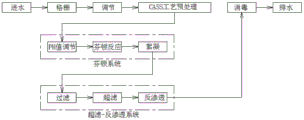
Further, the sewage after secondary treatment needs to pass through an ultrafiltration-reverse osmosis system before entering the disinfection tank, and the ultrafiltration-reverse osmosis system intercepts impurity particles in the water; the ultrafiltration-reverse osmosis system can further remove pollutants such as suspended matters, colloid, chromaticity, turbidity, organic matters and the like in water. An ultrafiltration device in the reverse osmosis system adopts a hollow fiber membrane for hydrophilic treatment of PVDF, so that the surface hydrophilicity is increased, and the separation capability on colloid, suspended particles, chromaticity, turbidity, bacteria and macromolecular organic matters is good; the sewage after ultrafiltration is sent into a reverse osmosis pool, and impurities in the sewage are deeply removed by virtue of a permeable (semi-permeable) membrane, such as: ions, organic matters, bacteria, viruses and the like are removed, so that the aim of deep separation and purification is achieved, and the first-class A standard of table 1 in the pollutant discharge standard (GB 18918-2002) of urban sewage treatment plants can be met.
In order to improve the efficiency of the chemical sewage treatment process step 2 and adapt to the drainage requirements of different flocculates, the invention also discloses a chemical sewage treatment system which comprises an adjusting part for adjusting the pH value and a reaction part for performing Fenton reaction and flocculation, wherein the adjusting part comprises an adjusting shell, an adjusting stirring rod driven by an adjusting motor is arranged in the adjusting shell, the reaction part comprises a reaction shell, the reaction shell is connected with the adjusting shell through a connecting pipeline, a main stirring rod driven by the reaction motor is arranged in the reaction shell, a drainage pipe is arranged at the lower part of the side wall of the reaction shell, a stirring area and a settling area are sequentially arranged in the reaction shell from top to bottom, the settling area is a tubular area and a funnel area sequentially from top to bottom, and the lower end of the funnel area is connected with a sludge discharge pipe; the tubular area internal diameter is less than the stirring district, be provided with in the reaction housing along its direction of height removal carry the thing board, carry thing board external diameter and tubular area internal diameter looks adaptation.
Further, in order to promote the mixing efficiency and the mixed effect of flocculating agent and sewage, main puddler sets up in rotation portion lower extreme, rotation portion upper end is connected with the output of reaction motor, main puddler upper portion is provided with the driving gear, the drive gear meshing on driving gear and the vice puddler, vice puddler upper end is connected with the bearing in the rotation portion, drives vice puddler through main puddler and rotates, reduces actuating mechanism quantity, can increase the turbulent degree of stirring area and improvement sewage under the prerequisite of reduction maintenance cost for stirring efficiency.
Further, because the flocculated sediment can be piled up at the upper end of the carrying plate, in order to discharge the flocculated materials, the upper end surface of the carrying plate is set to be conical, so that the flocculated materials can slide downwards to be conveniently discharged from the sludge discharge pipe.
Further, because the flocculation thing has the semifluid of certain stickness, in order to collect the flocculation thing, main puddler lower extreme is provided with and carries the scraper blade of thing board up end inclination looks adaptation, when main puddler drives the scraper blade and rotates, can scrape out the flocculation thing on the thing board.
Further, in order to drive the object carrying plate to lift, a protective shell coaxial with the object carrying plate is arranged in the precipitation area, a linear driving mechanism is arranged in the protective shell, and a piston rod of the linear driving mechanism extends out of the top wall of the protective shell to be connected with the object carrying plate.
Further, in order to promote the stability of carrying the thing board and going up and down, clean the settling zone inside wall simultaneously, it is provided with scavenge pipe and hollow tube to carry thing board lower extreme, the upper end of scavenge pipe and hollow tube all with carry the runner intercommunication in the thing board, be provided with the spacing hole with hollow tube outside diameter looks adaptation on the protective housing roof, hollow tube lower extreme and advance water piping connection, the scavenge pipe sets up between tubulose district and protective housing, be provided with liquid nozzle on the scavenge pipe lateral wall.
Furthermore, because the coverage of the liquid spray head is limited, in order to clean comprehensively, the two ends of the upper end and the lower end of the tubular area are respectively connected with the stirring area and the funnel area in a rotating manner, the tubular area is connected with the output end of the cleaning motor in a transmission manner, and the tubular area is driven to rotate by the cleaning motor, so that the cleaning liquid sprayed by the liquid spray head can completely cover the inner side wall of the tubular area.
Furthermore, in order to rapidly adjust the pH value, a channel is arranged in the adjusting stirring rod, the upper end of the channel is connected with an air inlet rotary joint at the upper end of the adjusting stirring rod, an air nozzle is arranged below the liquid level of the reaction shell of the adjusting stirring rod, and the air nozzle is communicated with the channel.
The invention has the beneficial effects that: the height of the solid-liquid boundary can be adjusted according to the amount of flocculate by lifting the loading plate, so that water can be conveniently discharged; after the water is discharged, the loading plate rises to the highest point, at which the flocs can pass through the gap between the loading plate and the tubular area and finally be discharged from the sludge discharge pipe.
1. When the carrying plate rises to the highest point, the flocculate is swept down from the upper end of the carrying plate along with the rotation of the scraper.
2. The liquid spray head sprays the cleaning liquid, and the cleaning liquid is sprayed to the inner side wall of the tubular area along with the rotation of the tubular area so as to wash down flocculates adhered to the tubular area.
Drawings
FIG. 1 shows a conventional chemical wastewater treatment process.
FIG. 2 shows a chemical wastewater treatment process according to example 1.
FIG. 3 shows a chemical wastewater treatment process according to example 2.
FIG. 4 is a schematic structural diagram of a chemical wastewater treatment system according to the present invention.
Fig. 5 is a schematic structural view of the reaction housing.
Fig. 6 is a partially enlarged schematic view a of fig. 5.
Fig. 7 is a schematic view of the internal structure of the adjusting stirring rod.
The text labels in the figures are represented as: 1. adjusting the shell; 2. a reaction housing; 3. connecting a pipeline; 4. a drain pipe; 5. a sludge discharge pipe; 101. adjusting the motor; 102. adjusting the stirring rod; 103. a channel; 104. an air intake rotary joint; 105. a gas showerhead; 201. a reaction motor; 202. a main stirring rod; 203. a stirring zone; 204. a settling zone; 2041. a tubular region; 2042. a funnel region; 205. a loading plate; 206. a rotating part; 207. a driving gear; 208. an auxiliary stirring rod; 209. a transmission gear; 210. a squeegee; 211. a protective shell; 212. a linear drive mechanism; 213. cleaning the tube; 214. a hollow tube; 215. a flow channel; 216. a water inlet pipe; 217. a liquid ejection head; 218. and cleaning the motor.
Detailed Description
The following detailed description of the present invention is given for the purpose of better understanding technical solutions of the present invention by those skilled in the art, and the present description is only exemplary and explanatory and should not be construed as limiting the scope of the present invention in any way.
Example 1: a chemical wastewater treatment process is shown in FIG. 2, and comprises the following steps:
1. the sewage is firstly primarily filtered, and the primary filtering can adopt a grating filtering mode, namely, after the sewage passes through the grating, larger solid matters are blocked by the grating, so that most of the solid matters in the sewage are removed, and the primary filtering is finished; the sewage after primary filtration is adjusted through an adjusting tank and an acidification hydrolysis tank in sequence, sodium hydroxide is added into the adjusting tank to adjust the pH value of the sewage, and anaerobic bacteria in the acidification hydrolysis tank degrade organic matters in the sewage into micromolecular organic matters, so that the biodegradability of the sewage is improved; the biological pond of CASS carries out the preliminary treatment after the regulation is accomplished, the biochemical pond of CASS in this embodiment is by preceding to the back division for preliminary reaction district and main reaction district, in the preliminary reaction district, the microorganism adsorbs most soluble organic matter in the sewage rapidly through the quick transfer mechanism of enzyme, experience the quick accumulation process of the matrix of a high load, this plays better cushioning effect to the quality of water, the water yield of intaking, pH and poisonous harmful substance, play the inhibitory action to the growth of filamentous fungus simultaneously, can effectively prevent the mud inflation: subsequently, a lower load matrix degradation process is carried out in the main reaction zone; the degradation of the pollutants is a plug flow process in time, and the microorganisms are in the periodic change of aerobic, anoxic and anaerobic states, so that the pollutants are removed, and the functions of denitrification and dephosphorization are better. The rear part of the main reaction area is provided with a liftable automatic water skimming device. The processes of aeration, sedimentation, drainage and the like of the whole process are periodically and circularly operated in the same pool, and a secondary sedimentation pool and a sludge reflux system of a conventional activated sludge method are saved: meanwhile, water can be continuously fed and intermittently drained.
2. The sewage after the pretreatment enters a Fenton system to be subjected to secondary treatment through a Fenton reaction; the Fenton system in this embodiment comprises a pH value adjusting area, a Fenton reaction generating area and a flocculation area, wherein when the pH value adjusting area is used for sewage, sulfuric acid is added to control the pH value within the range of 2-4; the effluent then enters the Fenton reaction zone where hydrogen peroxide and ferrous sulfate, 27.5% H in this example, are added 2 O 2 The dosage is 10-20 ml/L, the reaction time is 60-300min 2 O 2 /Fe 2+ ) The ratio is 2-5, and stirring is carried out; and after finishing the Fenton reaction, performing flocculation, and respectively discharging sewage and flocculates remained after the flocculation.
3. The sewage after the secondary treatment is discharged after the disinfection in the disinfection tank is finished, and the disinfection can be performed by adopting ultraviolet disinfection.
Through inspection, the maximum concentration of COD, BOD5, SS, ammonia nitrogen and TP of the inlet water is 1164.08 mg/L, 390 mg/L, 450 mg/L, 80.8 mg/L and 25.92 mg/L; after treatment, the average values of COD, BOD5, SS, ammonia nitrogen and TP concentration (removal rate) are 291.02mg/L (75%), 39mg/L (90%), 337.5mg/L (25%), 105.9mg/L (30%) and 15.6mg/L (40%), which can completely meet the third-level standard of Integrated wastewater discharge Standard (GB 8978-1996) and meet the design influent concentration requirement of a wastewater treatment plant.
Example 2: as shown in FIG. 3, the other steps are the same as those of example 1, but in this embodiment, the wastewater after the secondary treatment is passed through an ultrafiltration-reverse osmosis system for intercepting impurity particles in the wastewater before the wastewater enters the disinfection tank.
The ultrafiltration-reverse osmosis system in the embodiment comprises a filtering device, ultrafiltration and reverse osmosis which are sequentially connected, wherein the filtering device adopts a multi-medium filter, and quartz sand, anthracite and the like can be filled in the multi-medium filter so as to prolong the service life of subsequent ultrafiltration equipment; the ultrafiltration is to remove impurity particles with certain sizes in water in a physical interception mode by utilizing the interception capability of a porous material. Under the driving of pressure, small-sized substances such as water molecules, organic low molecules, inorganic ions and the like in the wastewater can reach the other side of the membrane through micropores on the fiber wall, large-sized substances such as thalli, colloids, particulate matters, organic macromolecules and the like in the solution cannot be intercepted through the fiber wall, so that the wastewater is further purified, according to an experiment, the concentrations (removal rates) of COD, BOD5, SS, ammonia nitrogen and TP of the wastewater treated by the ultrafiltration-reverse osmosis system are respectively 1.77mg/L (95%), 0.2mg/L (99%), 0.7mg/L (95%) and 0.1mg/L (95%), and can reach the standard of reuse water of general enterprises.
Example 3: the present example discloses a chemical wastewater treatment system, which is used for the fenton reaction in examples 1 and 2, and as shown in fig. 4-5, it comprises a regulation part as a pH value regulation area and a reaction part as a fenton reaction generation area and a flocculation area, wherein the reaction shell 2 in fig. 4 is a structural schematic diagram of the fenton reaction, at this time, the loading plate 205 is lowered into the settling area 204, the reaction shell 2 in fig. 5 is a structural schematic diagram of flocculation completion and clear water discharge, at this time, the loading plate 205 is raised to the stirring area 203, so as to facilitate the discharge of flocculates; the adjusting part comprises an adjusting shell 1, an adjusting stirring rod 102 driven by an adjusting motor 101 is arranged in the adjusting shell 1, the reaction part comprises a reaction shell 2, the reaction shell 2 is connected with the adjusting shell 1 through a connecting pipeline 3, a feeding pipe and the like are arranged on the upper parts of the adjusting shell 1 and the reaction shell 2 to facilitate the entering of sewage, the feeding of additives and the like, a main stirring rod 202 driven by a reaction motor 201 is arranged in the reaction shell 2, a drainage pipe 4 is arranged on the lower part of the side wall of the reaction shell 2, a stirring area 203 and a settling area 204 are sequentially arranged in the reaction shell 2 from top to bottom, the stirring area 203 and the settling area 204 are coaxially arranged, the settling area 204 is a tubular area 2041 and a funnel area 2042 sequentially from top to bottom, the tubular area 2041 is of a hollow cylinder structure, and the lower end of the funnel area 2042 is connected with a sludge discharge pipe 5; the inner diameter of the tubular area 2041 is smaller than that of the stirring area 203, a carrying plate 205 moving along the height direction of the reaction shell 2 is arranged in the reaction shell, the outer diameter of the carrying plate 205 is matched with the inner diameter of the tubular area 2041, and the upper end face of the carrying plate 205 is conical.
During specific work, sewage enters the adjusting shell 1, then reactants such as sulfuric acid and the like for adjusting the pH value of the sewage are added into the adjusting shell 1, and the reactants and the sewage are fully mixed by adjusting the stirring of the stirring rod 102; the mixed sewage enters the reaction shell 2 through the connecting pipeline 3, the connecting pipeline 3 is provided with a water pump, the carrying plate 205 is positioned at the lower part of the tubular area 2041 at the moment, and the carrying plate 205 seals the tubular area 2041 so as to prevent the unreacted sewage from being discharged through the sludge discharge pipe 5.
After the sewage enters the reaction shell 2, adding hydrogen peroxide and ferrous sulfate, stirring by the main stirring rod 202, treating the sewage through a Fenton reaction, removing partial organic matters, and converting macromolecules into micromolecules; after the fenton reaction is finished, the reaction time is 60-300min, PAM and the like are added as flocculant and coagulant aid, so that the sewage is flocculated in the stirring area 203, and flocculate generated by flocculation is settled to the upper end of the loading plate 205 of the settling area 204.
After the flocculation reaction is finished, the height of the loading plate is adjusted according to the amount of flocculated matters, at this time, the loading plate 205 is ensured to be always positioned in the tubular area 2041, the solid-liquid boundary is close to the lower part of the drain pipe 4 by adjusting the height of the loading plate, then the drain pipe 4 is opened, clean water is discharged, the flocculated matters stay on the loading plate 205, after sewage is discharged, the drain pipe 4 is closed, the loading plate 205 continuously rises to extend into the stirring area 203, and the flocculated matters can flow to the sludge discharge pipe 5 from a gap between the loading plate 205 and the tubular area 2041.
During specific work, when the main stirring rod 202 rotates as a fixed star, the auxiliary stirring rod 208 is driven to rotate in a planetary manner so as to fully stir the sewage in the reaction shell 2, so that hydrogen peroxide, ferrous sulfate and the like are fully mixed with the sewage.
Embodiment 5, as shown in fig. 4-5, the other structure of this embodiment can refer to embodiment 3, but in this embodiment, the lower end of the main stirring rod 202 is provided with a scraper 210 whose inclination is matched with the upper end face of the loading plate 205.
In the fenton reaction, the carrying plate 205 can be used as a stirring blade to stir the sewage in the reaction shell 2; after flocculation is complete and the clear water is drained, the load plate 205 is raised into contact with the squeegee 210, and as the squeegee 210 rotates, the flocs on the load plate 205 are swept down.
Embodiment 6, as shown in fig. 5 to 6, in this embodiment, reference may be made to embodiment 3 for other structures, but in this embodiment, in order to install a mechanism for driving the carrying plate 205 to ascend and descend, a protective shell 211 coaxial with the settling zone 204 is disposed in the settling zone 204, the protective shell 211 is a closed hollow shell structure, and the outer wall of the protective shell is matched with the shape of the inner wall of the settling zone 204, the protective shell 211 is disposed coaxially with the settling zone 204, the outer wall of the protective shell 211 and the inner wall of the funnel zone 2042 are connected through support columns arranged in an annular array, through holes for the water inlet pipe 216 to pass through are disposed in the support columns, a linear driving mechanism 212 is disposed in the protective shell 211, a piston rod of the linear driving mechanism 212 extends out of the top wall of the protective shell 211 to be connected with the carrying plate 205, the linear driving mechanism 212 may employ a hydraulic cylinder, an electric push rod, and the like, and in this embodiment employs a hydraulic cylinder.
Carry thing board 205 lower extreme and be provided with scavenge pipe 213 and hollow tube 214, the upper end of scavenge pipe 213 and hollow tube 214 all communicates with the interior runner 215 of carrying the thing board, be provided with the spacing hole with hollow tube 214 external diameter looks adaptation on the protective housing 211 roof, the cooperation in hollow tube 214 and spacing hole is used for promoting on the one hand and carries the stability that the thing board goes up and down, and on the other hand also regards as the pipeline that rivers removed, for this reason, hollow tube 214 lower extreme is connected with inlet tube 216, and inlet tube 216 stretches out reaction housing 2 after passing the support column and is connected with the water source, under the water pump effect in the water source for rivers can follow inlet tube 216 and enter into carrying the thing inboard, then enter into scavenge pipe 213 again, scavenge pipe 213 sets up between tubular area 2041 and protective housing 211, be provided with liquid shower nozzle 217 on the scavenge pipe 213 lateral wall, the water in the scavenge pipe 213 spouts from liquid shower nozzle 217 to tubular area 2041 inner wall cleans.
The upper end and the lower end of the tubular area 2041 are rotatably connected with the stirring area 203 and the funnel area 2042 respectively, a bearing and a shaft seal are arranged at the joint, the tubular area 2041 is in transmission connection with the output end of the cleaning motor 218, in the embodiment, a circle of driven gears concentric with the tubular area 2041 are arranged on the outer wall of the tubular area 2041, and the driven gears are meshed with a driving gear on the output shaft of the cleaning motor 218.
The concrete during operation: the linear driving mechanism 212 controls the loading plate 205 to ascend and descend according to production requirements, when the tubular area 2041 needs to be washed, the cleaning motor 218 drives the tubular area 2041 to rotate, meanwhile, water sequentially passes through the water inlet pipe 216, the hollow pipe 214, the flow channel 215 and the washing pipe 213, and is finally sprayed out from the liquid spray head 217 to wash the inner wall of the tubular area 2041.
Example 7, as shown in fig. 4 and 7, another structure of this embodiment can refer to example 3, but in this embodiment, a channel 103 is provided in the adjusting stirring rod 102, the upper end of the channel 103 is connected with an air inlet rotary joint 104 at the upper end of the adjusting stirring rod 102, the adjusting stirring rod 102 is provided with a gas nozzle 105 below the liquid level of the reaction shell, and the gas nozzle 105 is communicated with the channel 103.
In specific operation, when the pH value is adjusted, air enters the adjusting stirring rod 102 through the channel 103 and is sprayed out of the air nozzle 105, and the air nozzle 105 is positioned below the liquid level, so that the liquid in the adjusting shell 1 is fully stirred, and the stirring efficiency is accelerated.
It should be noted that, in this document, the terms "comprises," "comprising," or any other variation thereof, are intended to cover a non-exclusive inclusion, such that a process, method, article, or apparatus that comprises a list of elements does not include only those elements but may include other elements not expressly listed or inherent to such process, method, article, or apparatus.
The principles and embodiments of the present invention are explained herein using specific examples, which are presented only to assist in understanding the method and its core concepts of the present invention. The foregoing is only a preferred embodiment of the present invention, and it should be noted that there are objectively infinite specific structures due to the limited character expressions, and it will be apparent to those skilled in the art that a plurality of modifications, decorations or changes may be made without departing from the principle of the present invention, and the technical features described above may be combined in a suitable manner; such modifications, variations, combinations, or adaptations of the invention using its spirit and scope, as defined by the claims, may be directed to other uses and embodiments.
Claims (6)
1. The utility model provides a chemical industry sewage treatment system, it is including the regulation part that is used for adjusting pH value and the reaction part that carries out fenton's reaction and flocculation, its characterized in that, the regulation part is including adjusting casing (1), be provided with in the regulation casing (1) through regulation motor (101) drive regulation puddler (102), the reaction part includes reaction housing (2), reaction housing (2) are connected with regulation casing (1) through connecting tube (3), be provided with in reaction housing (2) through main puddler (202) that reaction motor (201) drove, reaction housing (2) lateral wall lower part is provided with drain pipe (4), set gradually stirring district (203) and settling zone (204) from top to bottom in reaction housing (2), settling zone (204) are tubulose district (2041) and funnel district (2042) from top to bottom in proper order, funnel district (2042) lower extreme is connected with mud pipe (5); the inner diameter of the tubular area (2041) is smaller than that of the stirring area (203), a carrying plate (205) moving along the height direction of the reaction shell (2) is arranged in the reaction shell, the outer diameter of the carrying plate (205) is matched with the inner diameter of the tubular area (2041), and the carrying plate (205) is always positioned in the tubular area (2041) during Fenton reaction and flocculation; after the flocculation reaction is finished, the height of the loading plate (205) is adjusted according to the amount of flocculated matters, at the moment, the loading plate (205) is ensured to be always positioned in the tubular area (2041), the solid-liquid boundary is close to the lower part of the drain pipe (4) by adjusting the height of the loading plate (205), then the drain pipe (4) is opened to discharge clear water, the flocculated matters stay on the loading plate (205), after sewage is discharged, the drain pipe (4) is closed, and the loading plate (205) continuously rises to extend into the stirring area (203) to enable the flocculated matters to flow to the sludge discharge pipe (5) from a gap between the loading plate (205) and the tubular area (2041);
carry thing board (205) lower extreme and be provided with scavenge pipe (213) and hollow tube (214), the upper end of scavenge pipe (213) and hollow tube (214) all communicates with runner (215) of carrying the thing inboard, is provided with the spacing hole with hollow tube (214) external diameter looks adaptation on protective housing (211) roof, hollow tube (214) lower extreme is connected with inlet tube (216), scavenge pipe (213) set up between tubulose district (2041) and protective housing (211), be provided with liquid nozzle (217) on scavenge pipe (213) lateral wall, tubulose district (2041) upper and lower end both ends rotate with stirring district (203) and funnel district (2042) respectively and are connected, tubulose district (2041) is connected with the output transmission of clean motor (218).
2. The chemical sewage treatment system according to claim 1, wherein the main stirring rod (202) is arranged at the lower end of the rotating part (206), the upper end of the rotating part (206) is connected with the output end of the reaction motor (201), a driving gear (207) is arranged at the upper part of the main stirring rod (202), the driving gear (207) is meshed with a transmission gear (209) on the auxiliary stirring rod (208), and the upper end of the auxiliary stirring rod (208) is connected with a bearing on the rotating part (206).
3. The chemical wastewater treatment system according to claim 1, wherein the upper end surface of the carrier plate (205) is tapered.
4. The chemical wastewater treatment system according to claim 3, wherein the lower end of the main stirring rod (202) is provided with a scraper (210) which is matched with the inclination of the upper end surface of the loading plate (205).
5. The chemical sewage treatment system according to claim 1, wherein a protective shell (211) coaxial with the settling zone (204) is arranged in the settling zone (204), a linear driving mechanism (212) is arranged in the protective shell (211), and a piston rod of the linear driving mechanism (212) extends out of the top wall of the protective shell (211) and is connected with the carrying plate (205).
6. The chemical wastewater treatment system according to claim 1, wherein a channel (103) is arranged in the adjusting stirring rod (102), the upper end of the channel (103) is connected with an air inlet rotary joint (104) at the upper end of the adjusting stirring rod (102), the adjusting stirring rod (102) is provided with an air nozzle (105) below the liquid level of the reaction shell, and the air nozzle (105) is communicated with the channel (103).
Priority Applications (1)
| Application Number | Priority Date | Filing Date | Title |
|---|---|---|---|
| CN202210258754.1A CN114620892B (en) | 2022-03-16 | 2022-03-16 | Chemical wastewater treatment process and treatment system thereof |
Applications Claiming Priority (1)
| Application Number | Priority Date | Filing Date | Title |
|---|---|---|---|
| CN202210258754.1A CN114620892B (en) | 2022-03-16 | 2022-03-16 | Chemical wastewater treatment process and treatment system thereof |
Publications (2)
| Publication Number | Publication Date |
|---|---|
| CN114620892A CN114620892A (en) | 2022-06-14 |
| CN114620892B true CN114620892B (en) | 2023-03-24 |
Family
ID=81901315
Family Applications (1)
| Application Number | Title | Priority Date | Filing Date |
|---|---|---|---|
| CN202210258754.1A Active CN114620892B (en) | 2022-03-16 | 2022-03-16 | Chemical wastewater treatment process and treatment system thereof |
Country Status (1)
| Country | Link |
|---|---|
| CN (1) | CN114620892B (en) |
Family Cites Families (7)
| Publication number | Priority date | Publication date | Assignee | Title |
|---|---|---|---|---|
| CN103979663B (en) * | 2014-05-20 | 2016-02-24 | 南京大学 | A kind of neutral multiple-hearth Fenton reactor and sewage water treatment method thereof |
| CN108249689A (en) * | 2016-12-28 | 2018-07-06 | 帕克环保技术(上海)有限公司 | Waste water treatment system |
| CN106881319B (en) * | 2017-01-19 | 2019-03-29 | 大连利丰包装有限公司 | A plastic turnover box cleaning system with zero discharge of sewage and its working method |
| CN107176662B (en) * | 2017-07-24 | 2021-02-12 | 苏州鱼得水电气科技有限公司 | Integrated sewage treatment equipment based on sewage and flocculate rapid separation |
| CN108751374A (en) * | 2018-08-06 | 2018-11-06 | 云南科力新材料股份有限公司 | A kind of high-effective gas Heisui River precipitation separation device |
| CN209685567U (en) * | 2019-01-04 | 2019-11-26 | 甘肃兴华环境设施有限公司 | A kind of digester sludge agitation and settling apparatus |
| CN113955876B (en) * | 2021-10-28 | 2024-07-16 | 广东台泉科技股份有限公司 | Landfill leachate treatment facility |
-
2022
- 2022-03-16 CN CN202210258754.1A patent/CN114620892B/en active Active
Also Published As
| Publication number | Publication date |
|---|---|
| CN114620892A (en) | 2022-06-14 |
Similar Documents
| Publication | Publication Date | Title |
|---|---|---|
| CN102107988B (en) | Phenol-amine wastewater treatment and recycling method and device | |
| CN101074141B (en) | Low-concentration organic wastewater regeneration and reuse process | |
| CN111704319B (en) | A prefabricated modular municipal sewage treatment system and sewage treatment method | |
| CN101219842A (en) | Technique and equipment for recycling leachate of garbage | |
| CN111807608A (en) | Medical sewage treatment system and treatment method thereof | |
| CN213037620U (en) | Prefabricated modular municipal sewage treatment system | |
| CN108314255A (en) | A kind of efficient Chinese herbal medicine extraction sewage treatment process | |
| CN114940561A (en) | Oil sludge treatment waste liquid treatment system | |
| CN218454092U (en) | Treatment system for degradation-resistant oily wastewater of engine plant | |
| CN114620822B (en) | Fenton process and reaction system thereof | |
| CN217351082U (en) | Waste paint bucket cleaning wastewater treatment system | |
| CN209098459U (en) | A kind of high gravity fermentation class antibiotic waste water processing system | |
| CN104944694B (en) | Equipment for sewage bio-treatment of coating factory by use of purified diatomite and treatment method for equipment | |
| CN103641268A (en) | Two-stage bioreactor device and technology for treating garbage leachate | |
| CN108249700B (en) | Bleaching and dyeing wastewater treatment system and bleaching and dyeing wastewater treatment process applying same | |
| CN114620892B (en) | Chemical wastewater treatment process and treatment system thereof | |
| CN221955912U (en) | Integrated air-water biological purifier | |
| CN220579107U (en) | Vegetable squeezing wastewater treatment system | |
| CN216837220U (en) | Chemical wastewater treatment system based on air floatation method | |
| CN116002902B (en) | A kind of equipment and method for deep treatment of organic matter in wastewater from preserved fruit processing | |
| CN218435393U (en) | Garbage transfer station sewage treatment device | |
| CN111003900B (en) | Sewage treatment system | |
| CN205999222U (en) | A kind of UV monomer wastewater to reach standard processing system | |
| CN205528266U (en) | Reuse of reclaimed water sewage treatment device | |
| CN115745171A (en) | High-efficient denitrogenation equipment |
Legal Events
| Date | Code | Title | Description |
|---|---|---|---|
| PB01 | Publication | ||
| PB01 | Publication | ||
| SE01 | Entry into force of request for substantive examination | ||
| SE01 | Entry into force of request for substantive examination | ||
| GR01 | Patent grant | ||
| GR01 | Patent grant |