CN114599786A - Immobilized enzyme composition for hexose production - Google Patents
Immobilized enzyme composition for hexose production Download PDFInfo
- Publication number
- CN114599786A CN114599786A CN202080065138.3A CN202080065138A CN114599786A CN 114599786 A CN114599786 A CN 114599786A CN 202080065138 A CN202080065138 A CN 202080065138A CN 114599786 A CN114599786 A CN 114599786A
- Authority
- CN
- China
- Prior art keywords
- leu
- ala
- glu
- gly
- val
- Prior art date
- Legal status (The legal status is an assumption and is not a legal conclusion. Google has not performed a legal analysis and makes no representation as to the accuracy of the status listed.)
- Pending
Links
Images


Classifications
-
- C—CHEMISTRY; METALLURGY
- C12—BIOCHEMISTRY; BEER; SPIRITS; WINE; VINEGAR; MICROBIOLOGY; ENZYMOLOGY; MUTATION OR GENETIC ENGINEERING
- C12N—MICROORGANISMS OR ENZYMES; COMPOSITIONS THEREOF; PROPAGATING, PRESERVING, OR MAINTAINING MICROORGANISMS; MUTATION OR GENETIC ENGINEERING; CULTURE MEDIA
- C12N9/00—Enzymes; Proenzymes; Compositions thereof; Processes for preparing, activating, inhibiting, separating or purifying enzymes
- C12N9/0004—Oxidoreductases (1.)
- C12N9/0006—Oxidoreductases (1.) acting on CH-OH groups as donors (1.1)
-
- C—CHEMISTRY; METALLURGY
- C12—BIOCHEMISTRY; BEER; SPIRITS; WINE; VINEGAR; MICROBIOLOGY; ENZYMOLOGY; MUTATION OR GENETIC ENGINEERING
- C12P—FERMENTATION OR ENZYME-USING PROCESSES TO SYNTHESISE A DESIRED CHEMICAL COMPOUND OR COMPOSITION OR TO SEPARATE OPTICAL ISOMERS FROM A RACEMIC MIXTURE
- C12P19/00—Preparation of compounds containing saccharide radicals
- C12P19/02—Monosaccharides
-
- C—CHEMISTRY; METALLURGY
- C12—BIOCHEMISTRY; BEER; SPIRITS; WINE; VINEGAR; MICROBIOLOGY; ENZYMOLOGY; MUTATION OR GENETIC ENGINEERING
- C12N—MICROORGANISMS OR ENZYMES; COMPOSITIONS THEREOF; PROPAGATING, PRESERVING, OR MAINTAINING MICROORGANISMS; MUTATION OR GENETIC ENGINEERING; CULTURE MEDIA
- C12N11/00—Carrier-bound or immobilised enzymes; Carrier-bound or immobilised microbial cells; Preparation thereof
- C12N11/02—Enzymes or microbial cells immobilised on or in an organic carrier
-
- C—CHEMISTRY; METALLURGY
- C12—BIOCHEMISTRY; BEER; SPIRITS; WINE; VINEGAR; MICROBIOLOGY; ENZYMOLOGY; MUTATION OR GENETIC ENGINEERING
- C12N—MICROORGANISMS OR ENZYMES; COMPOSITIONS THEREOF; PROPAGATING, PRESERVING, OR MAINTAINING MICROORGANISMS; MUTATION OR GENETIC ENGINEERING; CULTURE MEDIA
- C12N11/00—Carrier-bound or immobilised enzymes; Carrier-bound or immobilised microbial cells; Preparation thereof
- C12N11/02—Enzymes or microbial cells immobilised on or in an organic carrier
- C12N11/08—Enzymes or microbial cells immobilised on or in an organic carrier the carrier being a synthetic polymer
-
- C—CHEMISTRY; METALLURGY
- C12—BIOCHEMISTRY; BEER; SPIRITS; WINE; VINEGAR; MICROBIOLOGY; ENZYMOLOGY; MUTATION OR GENETIC ENGINEERING
- C12N—MICROORGANISMS OR ENZYMES; COMPOSITIONS THEREOF; PROPAGATING, PRESERVING, OR MAINTAINING MICROORGANISMS; MUTATION OR GENETIC ENGINEERING; CULTURE MEDIA
- C12N11/00—Carrier-bound or immobilised enzymes; Carrier-bound or immobilised microbial cells; Preparation thereof
- C12N11/02—Enzymes or microbial cells immobilised on or in an organic carrier
- C12N11/08—Enzymes or microbial cells immobilised on or in an organic carrier the carrier being a synthetic polymer
- C12N11/082—Enzymes or microbial cells immobilised on or in an organic carrier the carrier being a synthetic polymer obtained by reactions only involving carbon-to-carbon unsaturated bonds
-
- C—CHEMISTRY; METALLURGY
- C12—BIOCHEMISTRY; BEER; SPIRITS; WINE; VINEGAR; MICROBIOLOGY; ENZYMOLOGY; MUTATION OR GENETIC ENGINEERING
- C12N—MICROORGANISMS OR ENZYMES; COMPOSITIONS THEREOF; PROPAGATING, PRESERVING, OR MAINTAINING MICROORGANISMS; MUTATION OR GENETIC ENGINEERING; CULTURE MEDIA
- C12N11/00—Carrier-bound or immobilised enzymes; Carrier-bound or immobilised microbial cells; Preparation thereof
- C12N11/02—Enzymes or microbial cells immobilised on or in an organic carrier
- C12N11/08—Enzymes or microbial cells immobilised on or in an organic carrier the carrier being a synthetic polymer
- C12N11/082—Enzymes or microbial cells immobilised on or in an organic carrier the carrier being a synthetic polymer obtained by reactions only involving carbon-to-carbon unsaturated bonds
- C12N11/087—Acrylic polymers
-
- C—CHEMISTRY; METALLURGY
- C12—BIOCHEMISTRY; BEER; SPIRITS; WINE; VINEGAR; MICROBIOLOGY; ENZYMOLOGY; MUTATION OR GENETIC ENGINEERING
- C12N—MICROORGANISMS OR ENZYMES; COMPOSITIONS THEREOF; PROPAGATING, PRESERVING, OR MAINTAINING MICROORGANISMS; MUTATION OR GENETIC ENGINEERING; CULTURE MEDIA
- C12N11/00—Carrier-bound or immobilised enzymes; Carrier-bound or immobilised microbial cells; Preparation thereof
- C12N11/02—Enzymes or microbial cells immobilised on or in an organic carrier
- C12N11/08—Enzymes or microbial cells immobilised on or in an organic carrier the carrier being a synthetic polymer
- C12N11/089—Enzymes or microbial cells immobilised on or in an organic carrier the carrier being a synthetic polymer obtained otherwise than by reactions only involving carbon-to-carbon unsaturated bonds
- C12N11/091—Phenol resins; Amino resins
-
- C—CHEMISTRY; METALLURGY
- C12—BIOCHEMISTRY; BEER; SPIRITS; WINE; VINEGAR; MICROBIOLOGY; ENZYMOLOGY; MUTATION OR GENETIC ENGINEERING
- C12N—MICROORGANISMS OR ENZYMES; COMPOSITIONS THEREOF; PROPAGATING, PRESERVING, OR MAINTAINING MICROORGANISMS; MUTATION OR GENETIC ENGINEERING; CULTURE MEDIA
- C12N11/00—Carrier-bound or immobilised enzymes; Carrier-bound or immobilised microbial cells; Preparation thereof
- C12N11/14—Enzymes or microbial cells immobilised on or in an inorganic carrier
-
- C—CHEMISTRY; METALLURGY
- C12—BIOCHEMISTRY; BEER; SPIRITS; WINE; VINEGAR; MICROBIOLOGY; ENZYMOLOGY; MUTATION OR GENETIC ENGINEERING
- C12N—MICROORGANISMS OR ENZYMES; COMPOSITIONS THEREOF; PROPAGATING, PRESERVING, OR MAINTAINING MICROORGANISMS; MUTATION OR GENETIC ENGINEERING; CULTURE MEDIA
- C12N9/00—Enzymes; Proenzymes; Compositions thereof; Processes for preparing, activating, inhibiting, separating or purifying enzymes
- C12N9/10—Transferases (2.)
- C12N9/1048—Glycosyltransferases (2.4)
- C12N9/1051—Hexosyltransferases (2.4.1)
-
- C—CHEMISTRY; METALLURGY
- C12—BIOCHEMISTRY; BEER; SPIRITS; WINE; VINEGAR; MICROBIOLOGY; ENZYMOLOGY; MUTATION OR GENETIC ENGINEERING
- C12N—MICROORGANISMS OR ENZYMES; COMPOSITIONS THEREOF; PROPAGATING, PRESERVING, OR MAINTAINING MICROORGANISMS; MUTATION OR GENETIC ENGINEERING; CULTURE MEDIA
- C12N9/00—Enzymes; Proenzymes; Compositions thereof; Processes for preparing, activating, inhibiting, separating or purifying enzymes
- C12N9/10—Transferases (2.)
- C12N9/1048—Glycosyltransferases (2.4)
- C12N9/1051—Hexosyltransferases (2.4.1)
- C12N9/107—1,4-Alpha-glucan branching enzyme (2.4.1.18)
-
- C—CHEMISTRY; METALLURGY
- C12—BIOCHEMISTRY; BEER; SPIRITS; WINE; VINEGAR; MICROBIOLOGY; ENZYMOLOGY; MUTATION OR GENETIC ENGINEERING
- C12N—MICROORGANISMS OR ENZYMES; COMPOSITIONS THEREOF; PROPAGATING, PRESERVING, OR MAINTAINING MICROORGANISMS; MUTATION OR GENETIC ENGINEERING; CULTURE MEDIA
- C12N9/00—Enzymes; Proenzymes; Compositions thereof; Processes for preparing, activating, inhibiting, separating or purifying enzymes
- C12N9/14—Hydrolases (3)
- C12N9/16—Hydrolases (3) acting on ester bonds (3.1)
-
- C—CHEMISTRY; METALLURGY
- C12—BIOCHEMISTRY; BEER; SPIRITS; WINE; VINEGAR; MICROBIOLOGY; ENZYMOLOGY; MUTATION OR GENETIC ENGINEERING
- C12N—MICROORGANISMS OR ENZYMES; COMPOSITIONS THEREOF; PROPAGATING, PRESERVING, OR MAINTAINING MICROORGANISMS; MUTATION OR GENETIC ENGINEERING; CULTURE MEDIA
- C12N9/00—Enzymes; Proenzymes; Compositions thereof; Processes for preparing, activating, inhibiting, separating or purifying enzymes
- C12N9/14—Hydrolases (3)
- C12N9/24—Hydrolases (3) acting on glycosyl compounds (3.2)
- C12N9/2402—Hydrolases (3) acting on glycosyl compounds (3.2) hydrolysing O- and S- glycosyl compounds (3.2.1)
- C12N9/2405—Glucanases
- C12N9/2451—Glucanases acting on alpha-1,6-glucosidic bonds
- C12N9/246—Isoamylase (3.2.1.68)
-
- C—CHEMISTRY; METALLURGY
- C12—BIOCHEMISTRY; BEER; SPIRITS; WINE; VINEGAR; MICROBIOLOGY; ENZYMOLOGY; MUTATION OR GENETIC ENGINEERING
- C12N—MICROORGANISMS OR ENZYMES; COMPOSITIONS THEREOF; PROPAGATING, PRESERVING, OR MAINTAINING MICROORGANISMS; MUTATION OR GENETIC ENGINEERING; CULTURE MEDIA
- C12N9/00—Enzymes; Proenzymes; Compositions thereof; Processes for preparing, activating, inhibiting, separating or purifying enzymes
- C12N9/88—Lyases (4.)
-
- C—CHEMISTRY; METALLURGY
- C12—BIOCHEMISTRY; BEER; SPIRITS; WINE; VINEGAR; MICROBIOLOGY; ENZYMOLOGY; MUTATION OR GENETIC ENGINEERING
- C12N—MICROORGANISMS OR ENZYMES; COMPOSITIONS THEREOF; PROPAGATING, PRESERVING, OR MAINTAINING MICROORGANISMS; MUTATION OR GENETIC ENGINEERING; CULTURE MEDIA
- C12N9/00—Enzymes; Proenzymes; Compositions thereof; Processes for preparing, activating, inhibiting, separating or purifying enzymes
- C12N9/90—Isomerases (5.)
-
- C—CHEMISTRY; METALLURGY
- C12—BIOCHEMISTRY; BEER; SPIRITS; WINE; VINEGAR; MICROBIOLOGY; ENZYMOLOGY; MUTATION OR GENETIC ENGINEERING
- C12N—MICROORGANISMS OR ENZYMES; COMPOSITIONS THEREOF; PROPAGATING, PRESERVING, OR MAINTAINING MICROORGANISMS; MUTATION OR GENETIC ENGINEERING; CULTURE MEDIA
- C12N9/00—Enzymes; Proenzymes; Compositions thereof; Processes for preparing, activating, inhibiting, separating or purifying enzymes
- C12N9/96—Stabilising an enzyme by forming an adduct or a composition; Forming enzyme conjugates
-
- C—CHEMISTRY; METALLURGY
- C12—BIOCHEMISTRY; BEER; SPIRITS; WINE; VINEGAR; MICROBIOLOGY; ENZYMOLOGY; MUTATION OR GENETIC ENGINEERING
- C12P—FERMENTATION OR ENZYME-USING PROCESSES TO SYNTHESISE A DESIRED CHEMICAL COMPOUND OR COMPOSITION OR TO SEPARATE OPTICAL ISOMERS FROM A RACEMIC MIXTURE
- C12P19/00—Preparation of compounds containing saccharide radicals
- C12P19/18—Preparation of compounds containing saccharide radicals produced by the action of a glycosyl transferase, e.g. alpha-, beta- or gamma-cyclodextrins
-
- C—CHEMISTRY; METALLURGY
- C12—BIOCHEMISTRY; BEER; SPIRITS; WINE; VINEGAR; MICROBIOLOGY; ENZYMOLOGY; MUTATION OR GENETIC ENGINEERING
- C12P—FERMENTATION OR ENZYME-USING PROCESSES TO SYNTHESISE A DESIRED CHEMICAL COMPOUND OR COMPOSITION OR TO SEPARATE OPTICAL ISOMERS FROM A RACEMIC MIXTURE
- C12P19/00—Preparation of compounds containing saccharide radicals
- C12P19/24—Preparation of compounds containing saccharide radicals produced by the action of an isomerase, e.g. fructose
-
- C—CHEMISTRY; METALLURGY
- C12—BIOCHEMISTRY; BEER; SPIRITS; WINE; VINEGAR; MICROBIOLOGY; ENZYMOLOGY; MUTATION OR GENETIC ENGINEERING
- C12Y—ENZYMES
- C12Y101/00—Oxidoreductases acting on the CH-OH group of donors (1.1)
- C12Y101/01—Oxidoreductases acting on the CH-OH group of donors (1.1) with NAD+ or NADP+ as acceptor (1.1.1)
- C12Y101/01017—Mannitol-1-phosphate 5-dehydrogenase (1.1.1.17)
-
- C—CHEMISTRY; METALLURGY
- C12—BIOCHEMISTRY; BEER; SPIRITS; WINE; VINEGAR; MICROBIOLOGY; ENZYMOLOGY; MUTATION OR GENETIC ENGINEERING
- C12Y—ENZYMES
- C12Y204/00—Glycosyltransferases (2.4)
- C12Y204/01—Hexosyltransferases (2.4.1)
- C12Y204/01001—Phosphorylase (2.4.1.1)
-
- C—CHEMISTRY; METALLURGY
- C12—BIOCHEMISTRY; BEER; SPIRITS; WINE; VINEGAR; MICROBIOLOGY; ENZYMOLOGY; MUTATION OR GENETIC ENGINEERING
- C12Y—ENZYMES
- C12Y204/00—Glycosyltransferases (2.4)
- C12Y204/01—Hexosyltransferases (2.4.1)
- C12Y204/01018—1,4-Alpha-glucan branching enzyme (2.4.1.18), i.e. glucan branching enzyme
-
- C—CHEMISTRY; METALLURGY
- C12—BIOCHEMISTRY; BEER; SPIRITS; WINE; VINEGAR; MICROBIOLOGY; ENZYMOLOGY; MUTATION OR GENETIC ENGINEERING
- C12Y—ENZYMES
- C12Y204/00—Glycosyltransferases (2.4)
- C12Y204/01—Hexosyltransferases (2.4.1)
- C12Y204/01025—4-Alpha-glucanotransferase (2.4.1.25)
-
- C—CHEMISTRY; METALLURGY
- C12—BIOCHEMISTRY; BEER; SPIRITS; WINE; VINEGAR; MICROBIOLOGY; ENZYMOLOGY; MUTATION OR GENETIC ENGINEERING
- C12Y—ENZYMES
- C12Y301/00—Hydrolases acting on ester bonds (3.1)
- C12Y301/03—Phosphoric monoester hydrolases (3.1.3)
-
- C—CHEMISTRY; METALLURGY
- C12—BIOCHEMISTRY; BEER; SPIRITS; WINE; VINEGAR; MICROBIOLOGY; ENZYMOLOGY; MUTATION OR GENETIC ENGINEERING
- C12Y—ENZYMES
- C12Y401/00—Carbon-carbon lyases (4.1)
- C12Y401/02—Aldehyde-lyases (4.1.2)
- C12Y401/0204—Tagatose-bisphosphate aldolase (4.1.2.40)
-
- C—CHEMISTRY; METALLURGY
- C12—BIOCHEMISTRY; BEER; SPIRITS; WINE; VINEGAR; MICROBIOLOGY; ENZYMOLOGY; MUTATION OR GENETIC ENGINEERING
- C12Y—ENZYMES
- C12Y501/00—Racemaces and epimerases (5.1)
- C12Y501/03—Racemaces and epimerases (5.1) acting on carbohydrates and derivatives (5.1.3)
-
- C—CHEMISTRY; METALLURGY
- C12—BIOCHEMISTRY; BEER; SPIRITS; WINE; VINEGAR; MICROBIOLOGY; ENZYMOLOGY; MUTATION OR GENETIC ENGINEERING
- C12Y—ENZYMES
- C12Y503/00—Intramolecular oxidoreductases (5.3)
- C12Y503/01—Intramolecular oxidoreductases (5.3) interconverting aldoses and ketoses (5.3.1)
-
- C—CHEMISTRY; METALLURGY
- C12—BIOCHEMISTRY; BEER; SPIRITS; WINE; VINEGAR; MICROBIOLOGY; ENZYMOLOGY; MUTATION OR GENETIC ENGINEERING
- C12Y—ENZYMES
- C12Y503/00—Intramolecular oxidoreductases (5.3)
- C12Y503/01—Intramolecular oxidoreductases (5.3) interconverting aldoses and ketoses (5.3.1)
- C12Y503/01009—Glucose-6-phosphate isomerase (5.3.1.9)
-
- C—CHEMISTRY; METALLURGY
- C12—BIOCHEMISTRY; BEER; SPIRITS; WINE; VINEGAR; MICROBIOLOGY; ENZYMOLOGY; MUTATION OR GENETIC ENGINEERING
- C12Y—ENZYMES
- C12Y504/00—Intramolecular transferases (5.4)
- C12Y504/02—Phosphotransferases (phosphomutases) (5.4.2)
-
- C—CHEMISTRY; METALLURGY
- C12—BIOCHEMISTRY; BEER; SPIRITS; WINE; VINEGAR; MICROBIOLOGY; ENZYMOLOGY; MUTATION OR GENETIC ENGINEERING
- C12Y—ENZYMES
- C12Y504/00—Intramolecular transferases (5.4)
- C12Y504/02—Phosphotransferases (phosphomutases) (5.4.2)
- C12Y504/02002—Phosphoglucomutase (5.4.2.2)
-
- C—CHEMISTRY; METALLURGY
- C12—BIOCHEMISTRY; BEER; SPIRITS; WINE; VINEGAR; MICROBIOLOGY; ENZYMOLOGY; MUTATION OR GENETIC ENGINEERING
- C12Y—ENZYMES
- C12Y504/00—Intramolecular transferases (5.4)
- C12Y504/02—Phosphotransferases (phosphomutases) (5.4.2)
- C12Y504/02006—Beta-phosphoglucomutase (5.4.2.6)
-
- C—CHEMISTRY; METALLURGY
- C12—BIOCHEMISTRY; BEER; SPIRITS; WINE; VINEGAR; MICROBIOLOGY; ENZYMOLOGY; MUTATION OR GENETIC ENGINEERING
- C12Y—ENZYMES
- C12Y504/00—Intramolecular transferases (5.4)
- C12Y504/02—Phosphotransferases (phosphomutases) (5.4.2)
- C12Y504/02008—Phosphomannomutase (5.4.2.8)
-
- C—CHEMISTRY; METALLURGY
- C12—BIOCHEMISTRY; BEER; SPIRITS; WINE; VINEGAR; MICROBIOLOGY; ENZYMOLOGY; MUTATION OR GENETIC ENGINEERING
- C12R—INDEXING SCHEME ASSOCIATED WITH SUBCLASSES C12C - C12Q, RELATING TO MICROORGANISMS
- C12R2001/00—Microorganisms ; Processes using microorganisms
-
- C—CHEMISTRY; METALLURGY
- C12—BIOCHEMISTRY; BEER; SPIRITS; WINE; VINEGAR; MICROBIOLOGY; ENZYMOLOGY; MUTATION OR GENETIC ENGINEERING
- C12Y—ENZYMES
- C12Y204/00—Glycosyltransferases (2.4)
- C12Y204/01—Hexosyltransferases (2.4.1)
- C12Y204/01024—1,4-Alpha-glucan 6-alpha-glucosyltransferase (2.4.1.24)
-
- C—CHEMISTRY; METALLURGY
- C12—BIOCHEMISTRY; BEER; SPIRITS; WINE; VINEGAR; MICROBIOLOGY; ENZYMOLOGY; MUTATION OR GENETIC ENGINEERING
- C12Y—ENZYMES
- C12Y207/00—Transferases transferring phosphorus-containing groups (2.7)
- C12Y207/01—Phosphotransferases with an alcohol group as acceptor (2.7.1)
- C12Y207/01144—Tagatose-6-phosphate kinase (2.7.1.144)
-
- C—CHEMISTRY; METALLURGY
- C12—BIOCHEMISTRY; BEER; SPIRITS; WINE; VINEGAR; MICROBIOLOGY; ENZYMOLOGY; MUTATION OR GENETIC ENGINEERING
- C12Y—ENZYMES
- C12Y501/00—Racemaces and epimerases (5.1)
- C12Y501/03—Racemaces and epimerases (5.1) acting on carbohydrates and derivatives (5.1.3)
- C12Y501/03015—Glucose-6-phosphate 1-epimerase (5.1.3.15)
Landscapes
- Chemical & Material Sciences (AREA)
- Organic Chemistry (AREA)
- Life Sciences & Earth Sciences (AREA)
- Health & Medical Sciences (AREA)
- Engineering & Computer Science (AREA)
- Zoology (AREA)
- Wood Science & Technology (AREA)
- Bioinformatics & Cheminformatics (AREA)
- Genetics & Genomics (AREA)
- General Health & Medical Sciences (AREA)
- General Engineering & Computer Science (AREA)
- Biochemistry (AREA)
- Microbiology (AREA)
- Biotechnology (AREA)
- Biomedical Technology (AREA)
- Molecular Biology (AREA)
- Medicinal Chemistry (AREA)
- General Chemical & Material Sciences (AREA)
- Chemical Kinetics & Catalysis (AREA)
- Inorganic Chemistry (AREA)
- Immobilizing And Processing Of Enzymes And Microorganisms (AREA)
- Enzymes And Modification Thereof (AREA)
- Preparation Of Compounds By Using Micro-Organisms (AREA)
Abstract
本发明涉及用于制备己糖的固定化酶组合物。己糖包括例如塔格糖、阿洛酮糖、果糖、阿洛糖、甘露糖、半乳糖、阿卓糖、塔罗糖、山梨糖、古洛糖、艾杜糖和肌醇。本发明还涉及通过使淀粉衍生物与本发明的固定化酶组合物接触,由糖类制备己糖的酶促方法。
The present invention relates to immobilized enzyme compositions for preparing hexose sugars. Hexose sugars include, for example, tagatose, psicose, fructose, allose, mannose, galactose, altrose, talose, sorbose, gulose, idose, and inositol. The present invention also relates to an enzymatic process for preparing hexose sugars from sugars by contacting starch derivatives with the immobilized enzyme compositions of the present invention.
Description
Cross Reference to Related Applications
The present application claims priority from U.S. application No.62/875,321 filed on day 7, month 17, 2019 and U.S. application No.62/924,323 filed on day 10, month 22, 2019, the entire contents of which are incorporated herein by reference.
Technical Field
The present invention relates to the preparation of hexose monosaccharides using an immobilized enzyme composition. More specifically, the present invention relates to a process for the preparation of D-hexoses (or hexoses) from sugars, such as polysaccharides, oligosaccharides, disaccharides, sucrose, D-glucose and D-fructose, comprising the step of converting fructose 6-phosphate to hexoses by one or more enzymatic steps catalysed by an immobilized enzyme.
Background
Hexoses are monosaccharides with six carbon atoms. Hexoses include, for example, tagatose, psicose, fructose, allose, mannose, galactose, altrose, talose, sorbose, gulose, idose, and inositol. Hexoses are used in many industries and clearly have a variety of applications in the pharmaceutical, biotechnological and food and beverage industries. Hexoses can be prepared from sugars, such as monosaccharides, oligosaccharides, starch derivatives, cellulose, etc., using enzymatic methods. Solution-based enzymatic methods are described in published PCT applications WO 2018/169957, WO 2017/059278 and WO 2018/112139, which are incorporated herein by reference.
Commercial development of enzymatic processes is very important to increase the number of industrial processes that utilize green chemistry, thereby reducing the environmental impact of synthesis. Many enzymatic processes have been developed for commercial production (e.g., PCT applications WO 2018/169957, WO 2017/059278, and WO 2018/112139), but the cost of using enzymes has prevented commercialization of these processes when they are used in low cost products (e.g., alternative sweeteners). A common solution to this problem is to immobilize the enzyme on a carrier (e.g., WO 2016/160573). Immobilization on a support allows the enzyme to be reused in multiple batches or for a continuous process. The repeated use of enzymes greatly reduces the cost of enzyme use per kilogram of product, which is important for commercial viability. There are many methods for immobilization of enzymes, but a specific process is preferred which method has no rule for immobilization (Datta et al, Enzyme immobilization: an overview on techniques and substrates.3 Biotech (2013),3: 1-9). Therefore, a unique solution must be developed for each process.
As is well known in the art, enzymes used in commercial processes may be adsorbed on insoluble organic or inorganic supports commonly used to enhance functionality. These include polymeric supports such as agarose, methacrylate, polystyrene, phenolic resin or dextran, and inorganic supports such as glass, metal or carbon based materials. These materials generally have a relatively large surface-to-volume ratio and a special surface that promotes the attachment and activity of the immobilized enzyme. Enzymes may be attached to these solid supports by covalent, ionic or hydrophobic interactions. The enzyme may also be immobilized by genetic engineering interactions, for example, by covalent fusion to another protein or peptide sequence having affinity for a solid support, most commonly a poly-histidine sequence. The enzymes may be attached directly to the surface or surface coating, or they may be attached to other proteins already present on the surface or surface coating. The enzymes may all be immobilized on one carrier, on a separate carrier, or a combination of the two (e.g., two enzymes per carrier and then mixing the carriers). Such changes may be homogeneously mixed or mixed in defined layers to optimize the turnover number of the continuous reactor. These enzymes can be mixed homogeneously or in defined layers or zones in order to optimize the turnover rate. For example, the reactor may have a layer of aGP at the beginning to ensure the initial high increase in G1P. The enzymes may all be immobilized on one carrier bead, each enzyme being immobilized on a separate carrier bead, or multiple enzymes being immobilized on a carrier bead. Similarly, one or more immobilization methods may be used to immobilize the enzyme on a particular support or supports in a single process.
There is a need for an improved process for hexose production allowing for a scalable and reusable enzyme composition while achieving high yields of the desired hexose.
Disclosure of Invention
The present invention relates to an immobilized enzyme composition for the preparation of hexoses. Hexoses include, for example, tagatose, psicose, fructose, allose, mannose, galactose, altrose, talose, sorbose, gulose, idose, and inositol. The immobilized enzyme composition of the invention comprises, consists essentially of, or consists of at least two, at least three, at least four, at least five, at least six carriers, at least seven, or at least eight of the following enzymes immobilized on at least one carrier or mixture of carriers:
a) an alpha glucan phosphorylase (alpha GP), Phosphoglucomutase (PGM) and optionally 1, 4-glucanotransferase (4-GT); and
b) an enzyme selected from the following enzyme combinations:
(i) phosphoglucose isomerase (PGI), fructose-6-phosphate epimerase (F6PE) and tagatose-6-phosphate phosphatase (T6PP) for producing tagatose;
(ii) a glucose phosphate isomerase (PGI), a psicose-6-phosphate epimerase (P6PE), and a psicose-6-phosphate phosphatase (P6PP) for preparing psicose;
(iii) phosphoglucose isomerase (PGI), P6PE, allose-6-phosphate isomerase (A6PI) and allose-6-phosphate phosphatase (A6PP) for the preparation of allose;
(iv) phosphoglucose isomerase (PGI), mannose-6-phosphate isomerase (M6PI) or phosphoglucose/phosphomannose isomerase (PGPMI) and mannose-6-phosphate phosphatase (M6PP) for the preparation of mannose;
(v) phosphoglucose isomerase (PGI), F6PE, galactose-6-phosphate isomerase (Gal6PI) and galactose-6-phosphate phosphatase (Gal6PP) for the production of galactose;
(vi) PGI and fructose-6-phosphate phosphatase for the preparation of fructose (F6 PP);
(vii) PGI, P6PE, altrose-6-phosphate isomerase (Alt6PI) and altrose-6-phosphate phosphatase (Alt6PP) for the preparation of altrose;
(viii) PGI, F6PE, talose-6-phosphate isomerase (Tal6PI) and talose-6-phosphate phosphatase (Tal6PP) for producing talose;
(ix) PGI, F6PE, sorbose-6-phosphate epimerase (S6PE) and sorbose-6-phosphate phosphatase (S6PP) for preparing sorbose;
(x) PGI, F6PE, S6PE, gulose-6-phosphate isomerase (Gul6PI) and gulose-6-phosphate phosphatase (Gul6PP) for the preparation of gulose;
(xi) PGI, F6PE, S6PE, idum-6-phosphate isomerase (I6PI) and idum-6-phosphate phosphatase (I6PP) for the preparation of idum; and
(xii) Inositol-3-phosphate synthase (IPS) and Inositol Monophosphatase (IMP) for the production of inositol.
In the immobilized enzyme composition of the present invention, the weight of each enzyme is 0.1% to 40% relative to the total weight (w/w)% of the enzymes.
The invention also relates to an enzymatic process for the preparation of hexoses from sugars: the starch derivative is converted to hexose by contacting the starch derivative with the immobilized enzyme composition of the present invention under suitable reaction conditions.
Drawings
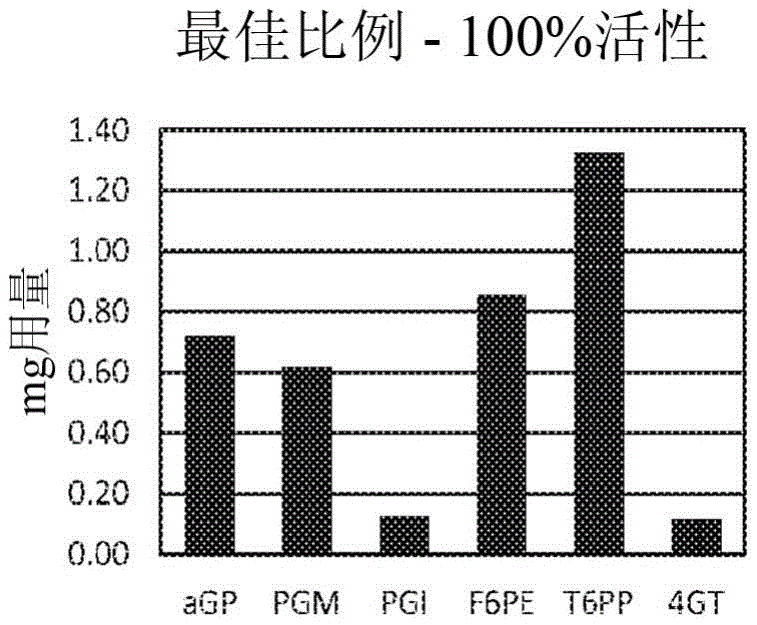
Fig. 1A shows the amount of enzyme used in an immobilized enzyme composition optimized for tagatose production.
FIG. 1B shows the amounts of enzymes in an immobilized enzyme composition, normalized to the observed reaction rate of each enzyme with respect to T6PP activity, to have equal units of activity in the cascade.
FIG. 1C shows the amount of enzyme in the immobilized enzyme composition, wherein the w/w ratio of the amount is 1:1:1:1: 1.
FIG. 2 shows the enzyme loading (total weight of enzyme/w% of support weight) versus DUOLITETMA568 optimized activity of the immobilized enzyme composition. The results shown are based on the relative enzyme cascade rates relative to the 5% loaded vector.
Detailed Description
The following description discloses the invention in terms of examples relating to the preparation and use of enzymes immobilized on a support ("immobilized enzyme compositions") in processes for converting starch and starch derivatives and sugars to hexose monosaccharides (including, for example, tagatose, psicose, fructose, allose, mannose, galactose, altrose, talose, sorbose, gulose, idose, and inositol). These methods can generally be described as enzymatic reactions that use free phosphate (without ATP) to produce phosphorylated intermediates from starch, starch derivatives, or sugars. Free phosphate is released in a highly energetically favorable last step, yielding a hexose of interest (e.g., tagatose, psicose, fructose, allose, mannose, galactose, altrose, talose, sorbose, gulose, idose, or inositol). The phosphate is then recycled to convert other starches, starch derivatives or sugars to phosphorylated intermediates so that the process can be repeated. This allows the use of non-stoichiometric amounts of phosphate, reduces the cost of using phosphate in the process, and limits the amount of phosphate in the waste.
Embodiments of the invention include compositions of at least two, at least three, at least four, at least five, at least six carriers, at least seven, or at least eight enzymes immobilized on a carrier that catalyze reactions in enzymatic processes for converting starch, starch derivatives, and/or sugars to hexoses, respectively. The immobilized enzyme compositions of the invention have a number of advantages over their use free in solution, including: longer duration of activity (due to protection of protein structural features), multiple cycles of recycling, and no downstream enzyme removal required. In addition, the immobilization of the enzyme on the solid surface can be carried out in a stirred tank reactor, a packed bed reactor or a rotating bed reactor; has the flexibility of enlarging the scale.
The enzyme comprised in the immobilized enzyme composition of the invention catalyzes at least two, at least three, at least four, at least five, at least six carriers, at least seven or at least eight reactions involving the stepwise conversion of starch, starch derivatives or sugars to hexoses. The following patent publications disclose enzymatic processes (i.e., enzyme reaction cascades) for producing hexoses in solution: published PCT applications WO 2018/169957, WO 2017/059278 and WO 2018/112139, which are all disclosed herein in their entirety. The immobilized enzyme compositions of the invention can include, but are not limited to, any of the enzymes and enzyme combinations disclosed in these references.
Some immobilized enzyme compositions of the invention comprise a combination of enzymes that catalyze reactions that are common in the production of different hexoses, such as a reaction step that results in the conversion of glucose-6-phosphate (G6P) to fructose-6-phosphate (F6P). Enzymes that catalyze these common reaction steps may be referred to as "core enzymes". Thus, in some immobilized enzyme compositions of the invention, the immobilized enzyme composition comprises at least a core enzyme: α -glucan phosphorylase (α GP) converting saccharides to glucose-1-phosphate (G1P) and Phosphoglucomutase (PGM) converting G1P to glucose-6-phosphate (G6P). The enzymes in the immobilized enzyme composition of the invention, which catalyze the other reaction steps for converting G6P into various hexose products, can be co-immobilized with the core enzyme or contained in a separate immobilized enzyme composition.
Typically, the core enzyme is combined in an immobilized composition with one or more enzymes for the production of tagatose, psicose, fructose, allose, mannose, galactose, altrose, talose, sorbose, gulose, idose, or inositol. Thus, in addition to α GP and PGM, some immobilized enzyme compositions of the invention comprise: (i) phosphoglucose isomerase (PGI), fructose-6-phosphate epimerase (F6PE) and tagatose-6-phosphate phosphatase (T6PP) for the preparation of tagatose; (ii) a glucose phosphate isomerase (PGI), a psicose-6-phosphate epimerase (P6PE), and a psicose-6-phosphate phosphatase (P6PP) for preparing psicose; (iii) PGI, P6PE, allose-6-phosphate isomerase (A6PI) and allose-6-phosphate phosphatase (A6PP) for the preparation of allose; (iv) PGI, mannose-6-phosphate isomerase (M6PI) or phosphoglucose/phosphomannose isomerase (PGPMI) and mannose-6-phosphate phosphatase (M6PP) for the preparation of mannose; (v) PGI, F6PE, galactose-6-phosphate isomerase (Gal6PI) and galactose-6-phosphate phosphatase (Gal6PP) for producing galactose; (vi) PGI and fructose-6-phosphate phosphatase for the preparation of fructose (F6 PP); (vii) PGI, P6PE, altrose-6-phosphate isomerase (Alt6PI) and altrose-6-phosphate phosphatase (Alt6PP) for the preparation of altrose; (viii) PGI, F6PE, talose-6-phosphate isomerase (Tal6PI) and talose-6-phosphate phosphatase (Tal6PP) for producing talose; (ix) PGI, F6PE, sorbose-6-phosphate epimerase (S6PE) and sorbose-6-phosphate phosphatase (S6PP) for producing talose; (x) PGI, F6PE, S6PE, gulose-6-phosphate isomerase (Gul6PI) and gulose-6-phosphate phosphatase (Gul6PP) for the preparation of gulose; (xi) PGI, F6PE, S6PE, idum-6-phosphate isomerase (I6PI) and idum-6-phosphate phosphatase (I6PP) for the preparation of idum; and (xii) inositol-3-phosphate synthase (IPS) and Inositol Monophosphatase (IMP) for the production of inositol. Each combination of core enzyme and enzyme compositions (i) - (xii) is a separate embodiment of the invention.
The immobilized enzyme composition described above may optionally further comprise 4-glucanotransferase (4 GT). 4GT can be used to increase hexose yield by recycling the degradation products glucose, maltose and maltotriose to longer maltooligosaccharides, which can be cleaved by α GP phosphate to produce G1P.
When comparing any two enzymes in an immobilized composition, the relative weight ratio of the various enzymes in the immobilized enzyme composition of the invention can be 1:1000 to 1000:1, 1:100 to 100:1, or 1:50 to 50: 1. The ratio of enzymes, including other optional enzymes discussed below, can be varied to increase the efficiency of hexose production. For example, the amount of a particular enzyme relative to another enzyme may be about 2-fold, 3-fold, 4-fold, 5-fold, 10-fold, etc.
The relative weight/weight ratios of the various enzymes in the immobilized enzyme compositions of the invention can be optimized to improve process performance and/or hexose yield. In this regard, the weight of each enzyme in the immobilized enzyme composition is 0.1% to 70% relative to the total weight (w/w)% of the enzymes. For example, some immobilized enzyme compositions of the invention comprise 10-30% (α GP); 10-30% (PGM); and 0.1-10% (PGI) when present and 0.1-10% (4GT) when present. For example, in the immobilized enzyme composition useful for producing tagatose of the present invention, the weight of each enzyme relative to the total weight (w/w)% of the enzymes is: 10-30% (α GP); 0-10% (4 GT); 10-30% (PGM); 0.1-10% (PGI); 15-35% (F6 PE); and 25-45% (T6PP), wherein the total weight of the enzymes in the composition is 100 w/w% relative to the total weight of the enzymes. Some of the immobilized enzyme compositions of the present invention for tagatose production comprise: 19% α GP; 3% 4 GT; 17% PGM; 3% PGI; 23% F6 PE; and 35% T6PP, wherein the wt% of each enzyme is relative to the total weight of enzymes in the immobilized enzyme composition of the invention, and the total weight of the various enzymes in the composition is 100 w/w% relative to the total weight of enzymes. In other embodiments, in the immobilized enzyme composition for producing psicose of the present invention, the weight of each enzyme relative to the total weight of the enzymes (w/w)% is: 10-30% (α GP); 0-10% (4 GT); 10-30% (PGM); 0.1-10% (PGI); 0.1-10% (P6 PE); and 45-65% (P6PP), wherein the total weight of the enzymes in the composition is 100 w/w% relative to the total weight of the enzymes. Some immobilized enzyme compositions of the invention for allulose production comprise: 20% α GP; 3% 4 GT; 16.5% PGM; 3% PGI; 3% P6 PE; and 54% P6PP, wherein the wt% of each enzyme is relative to the total weight of enzymes in the immobilized enzyme composition of the invention, and the total weight of the various enzymes in the composition is 100 w/w% relative to the total weight of the enzymes.
Although the enzymes comprised in the immobilization composition of the invention are generally referred to based on the reaction they catalyze (i.e. by specificity and function), the enzymes are also generally referred to by: an amino acid sequence (e.g., SEQ. ID. NO.; database identification numbers, e.g., UniProt ID), an amino acid sequence identity/similarity to a functionally known enzyme, a nucleotide sequence, or a nucleotide sequence identity/similarity to a functionally known enzyme. Enzymes known in the art and used to prepare hexoses may be used in the immobilized enzyme compositions of the invention, including immobilized enzyme compositions useful for the production of tagatose, psicose, fructose, allose, mannose, galactose, altrose, talose, sorbose, gulose, idose, and inositol. Exemplary enzymes known in the art may be used in the immobilized enzyme compositions of the present invention, which are identified by the following related patent documents. The disclosures of the enzymes listed in the patents are specifically incorporated herein by reference.

Thus, in certain immobilized enzyme compositions, table 1 provides UniProt ID and seq.id No. to identify the following enzymes that may be included in an immobilized enzyme composition of the invention: non-limiting example amino acid sequences of α GP, PGM, PGI, F6PE, T6PP, 4-GT, P6PE and P6 PP.
TABLE 1
| Enzyme | UniProt ID(SEQ.ID.NO.) |
| Alpha glucan phosphorylase (alpha GP) | G8NCC0(SEQ.ID.NO.1) |
| Phosphoglucomutase (PGM) | A0A0P6YKY9(SEQ.ID.NO.2) |
| Phosphoglucose isomerase (PGI) | Q5SLL6(SEQ.ID.NO.3) |
| Fructose-6-phosphate epimerase (F6PE) | A0A0P6XN50(SEQ.ID.NO.4) |
| Tagatose-6-phosphate phosphatase (T6PP) | D1C7G9(SEQ.ID.NO.5) |
| 1, 4-glucanotransferase (4-GT) | E8MXP8(SEQ.ID.NO.6) |
| Psicose-6-phosphate-3-epimerase (P6PE) | A0A223HZI7(SEQ.ID.NO.7) |
| Psicose-6-phosphate phosphatase (P6PP) | A0A0E3NCH4(SEQ.ID.NO.8) |
The amino acid sequence of the enzyme comprised in the immobilized enzyme composition of the invention also includes enzymes that have been modified for any reason, for example to improve activity, stability (i.e. half-life) or yield. Such modified enzymes include, for example, enzyme fragments, amino acid substitutions, and chimeric proteins. Modified enzymes include variants of any of the enzymes disclosed herein. A variant may comprise an amino acid substitution at one or more amino acid residues. Variants include no more than 15, no more than 12, no more than 10, no more than 9, no more than 8, no more than 7, no more than 6, no more than 5, no more than 4, no more than 3, no more than 2, or no more than 1 conservative amino acid substitution relative to the naturally occurring enzyme and/or include no more than 5, no more than 4, no more than 3, or no more than 2, or no more than 1 non-conservative amino acid substitution relative to the naturally occurring enzyme. Conservative amino acid substitutions are those in which an amino acid residue is replaced with an amino acid residue having a similar side chain. Families of amino acid residues having similar side chains have been defined in the art. These families include amino acids with basic side chains (e.g., lysine, arginine, histidine), acidic side chains (e.g., aspartic acid, glutamic acid), uncharged polar side chains (e.g., glycine, asparagine, glutamine, serine, threonine, tyrosine, cysteine), nonpolar side chains (e.g., alanine, valine, leucine, isoleucine, proline, phenylalanine, methionine, tryptophan), beta-branched side chains (e.g., threonine, valine, isoleucine) and aromatic side chains (e.g., tyrosine, phenylalanine, tryptophan). As described herein, the variant enzymes of the present invention may include amino acid substitutions with amino acid analogs as well as amino acids.
The enzyme comprised in the enzyme composition of the invention may also be an enzyme of the following properties: i) has at least 35% sequence identity to the amino acid sequence of an enzyme disclosed herein; ii) can catalyze the same reaction with the specifically disclosed enzymes with the specificity necessary for the process. Thus, enzymes in the compositions of the invention include enzymes having an amino acid sequence that is at least 35%, 36%, 37%, 38%, 39%, 40%, 41%, 42%, 43%, 44%, 45%, 46%, 47%, 48%, 49%, 50%, 51%, 52%, 53%, 54%, 55%, 56%, 57%, 58%, 59%, 60%, 61%, 62%, 63%, 64%, 65%, 66%, 67%, 68%, 69%, 70%, 71%, 72%, 73%, 74%, 75%, 76%, 77%, 78%, 79%, 80%, 81%, 82%, 83%, 84%, 85%, 86%, 87%, 88%, 89%, 90%, 91%, 92%, 93%, 94%, 95%, 96%, 97%, 98%, or 99% sequence identical to the amino acid sequence of the enzymes disclosed herein. The term "sequence identity" as used herein refers to the similarity between two or more amino acid or nucleic acid sequences. Sequence identity is generally measured in terms of the percent identity (or similarity or homology) between amino acid sequences; the higher the percentage, the more similar the aligned sequences are to each other.
As mentioned above, the enzyme composition of the invention is immobilized on at least one support. The carrier may also be generally referred to herein as a "carrier material", "carrier resin" or "carrier bead". In the immobilized enzyme compositions of the invention, a variety of different supports may be used to immobilize one or more enzymes. Although the carrier in the immobilized enzyme composition of the present invention is not necessarily limited to a specific material, in some immobilized enzyme compositions of the present invention, the carrier is a weakly basic ion exchange resin, which may optionally be composed of a phenol resin (i.e., a phenol-formaldehyde polycondensate). In other immobilized enzyme compositions of the invention, the support material is based on Controlled Pore Glass (CPG) particles or hybrid CPG particles (WO2015115993a 1). The support in some of the immobilized enzyme compositions of the invention is functionalized by the inclusion of tertiary amine groups, while in other supports, functionality is provided by secondary amine groups. In some immobilized enzyme compositions of the invention, the support resin is functionalized with groups that chelate metals (e.g., iron or zinc). Chelating metal groups allow high affinity binding of molecules via appropriate binding groups, such as histidine (His) tags. Examples of such functional groups are found in WO2015115993A1 and Cassimjee et al.A general protein purification and immobilization method on controlled position glass: biological applications, chem.Commun.,2014,50, 9134; including but not limited to 2, 4-dihydroxybenzyl residues.
The carrier in some of the immobilized enzyme compositions of the invention has two or more of the carrier characteristics listed above. For example, in some immobilized enzyme compositions of the invention, the enzyme composition of any of the immobilized enzyme compositions described herein is used in a process for converting starch and starch derivatives and sugars to hexose monosaccharides, including processes for producing tagatose, psicose, fructose, allose, mannose, galactose, altrose, talose, sorbose, gulose, idose, or inositol, the enzyme composition being immobilized on a weakly basic anion exchange resin; the resin may or may not consist of a phenol formaldehyde polycondensate; and which may or may not be functionalized with tertiary amine groups. Carrier resins having the above characteristics are commercially available as DUOLITETMA 568. In other immobilized enzyme compositions of the invention, the enzyme composition of any of the immobilized enzyme compositions described herein is used in a process for converting starch and starch derivatives and sugars to hexose monosaccharides, including a process for producing tagatose, psicose, fructose, allose, mannose, galactose, altrose, talose, sorbose, gulose, idose, or inositol, the enzyme composition being immobilized on a weakly basic anion exchange resin; the resin may or may not consist of a phenol formaldehyde polycondensate; and which may or may not be functionalized with secondary amine groups. Carrier resins having the above characteristics are commercially available as DUOLITETMPWA 7. In other immobilized enzyme compositions of the invention, the enzyme composition of any of the immobilized enzyme compositions described herein is used in a process for converting starch and starch derivatives and sugars to hexose monosaccharides, including a process for producing tagatose, psicose, fructose, allose, mannose, galactose, altrose, talose, sorbose, gulose, idose, or inositol, the enzyme composition being immobilized on a His-tag affinity resin(ii) a The resin may or may not consist of a CPG or hybrid CPG particulate material support; and which may or may not chelate iron or zinc. Carrier resins having the above characteristics are commercially available as EziGTMOpal sells.
Typically, the total weight of enzymes in the immobilized enzyme composition of the invention is 2.5% to 12.5% relative to the weight (w/w)% of the carrier. Thus, the total weight of the enzyme composition in any immobilized enzyme composition described herein for a method for converting starch and starch derivatives and sugars to hexose monosaccharides, including methods for producing tagatose, psicose, fructose, allose, mannose, galactose, altrose, talose, sorbose, gulose, idose, or inositol, may be about 2.5%, 3%, 3.5%, 4%, 4.5%, 5%, 5.5%, 6%, 6.5%, 7%, 7.5%, 8%, 8.5%, 9%, 9.5%, 10%, 10.5%, 11%, 11.5%, 12%, 12.5%, or any w/w% thereof, relative to the weight (w/w)% of the carrier. For example, in some immobilized enzyme compositions for producing tagatose, the total weight of the (α GP, PGM, PGI, F6PE and T6PP) or (α GP, 4GT, PGM, PGI, F6PE and T6PP) enzyme is 5%, while the total weight of the (α GP, PGM, PGI, P6PE and P6PP) or (α GP, 4GT, PGM, PGI, P6PE and P6PP) enzyme is 6.5%.
The present invention also relates to an enzymatic process for the preparation of hexoses from saccharides, comprising contacting a starch derivative with the immobilized enzyme composition of the invention under suitable reaction conditions to convert the starch derivative to hexoses. In the enzymatic process for the preparation of hexoses of the present invention, at least two, at least three, at least four, at least five, at least six carriers, at least seven or at least eight enzymes of the process may be immobilized on the same carrier or on multiple carriers. For example, in the enzymatic process of the invention, the enzymes may be immobilized on the same support, or the immobilized enzymes may be distributed on at least two, at least three, at least four, at least five, at least six, at least seven or at least eight supports, which may be the same type of support, or any combination of different supports and immobilization methods, including weakly basic anion exchange resin supports, phenol-formaldehyde polycondensate supports, tertiary amine containing supportsCarriers for functional groups (e.g. DUOLITE)TMA568) Supports containing secondary amine functions (e.g., DUOLITE)TMPWA7), a support comprising a His-tag affinity resin, a support comprising Controlled Pore Glass (CPG) particles, and a chelating metal functionalized support, including supports in which the chelating metal is iron or zinc (e.g., EziG)TMOpal)。
Methods for immobilizing enzymes to any of the supports described herein, including appropriate buffers and reaction conditions for binding the enzyme to the support resin, are well known in the art. See, for example, WO 2016/160573, the entire contents of which are incorporated herein.
The process for converting starch and starch derivatives and sugars to hexoses using the immobilized enzyme composition of the invention can be carried out at the same temperature, buffer and reaction time parameters for hexose production using non-immobilized enzymes in solution. For example, the immobilized enzyme compositions of the invention may be used to produce tagatose, psicose, fructose, allose, mannose, galactose, altrose, talose, sorbose, gulose, idose, or inositol from starch and starch derivatives and sugars under the reaction conditions described in published PCT applications WO 2018/169957, WO 2017/059278, and WO 2018/112139. The multiple catalytic reaction steps in the process for the production of hexoses using the immobilized enzyme composition of the invention can be carried out in a single bioreactor, or in multiple bioreactors arranged in series, or in reaction vessels. Alternatively, these steps may also be carried out in a plurality of bioreactors or reaction vessels arranged in series or in parallel. All of the above processes can be run in either batch mode or continuous mode. The "one-pot process" is preferably employed in a single bioreactor.
The steps of the enzymatic process of the present invention may be carried out at a temperature of from about 35 ℃ to about 90 ℃, from about 40 ℃ to about 70 ℃, from about 50 ℃ to about 60 ℃, or about 55 ℃, and a pH of from about 5.0 to about 8.0, from about 6.5 to about 7.5, or from about 7.0 to about 7.5. They may be carried out for about 0.5 hours to about 48 hours, about 4 hours to 24 hours, or about 8 hours to 12 hours. The steps of the enzymatic process of the invention can be carried out without ATP and/or without NAD (P) (H). These steps may be performed at a phosphate concentration of about 0.1mM to about 150 mM. The phosphate used in the phosphorylation and dephosphorylation steps of the method of the invention can be recycled in the enzymatic cascade. The process of the invention may be carried out in a packed column or slurry.
For example, the reaction phosphate concentration in each method may be from about 0.1mM to about 300mM, from about 0mM to about 150mM, from about 1mM to about 50mM, preferably from about 5mM to about 50mM, or more preferably from about 10mM to about 50 mM. For example, the concentration of the reaction phosphate in each method may be about 0.1mM, about 0.5mM, about 1mM, about 1.5mM, about 2mM, about 2.5mM, about 5mM, about 6mM, about 7mM, about 8mM, about 9mM, about 10mM, about 15mM, about 20mM, about 25mM, about 30mM, about 35mM, about 40mM, about 45mM, about 50mM, or about 55 mM.
The low total phosphate content, while the low phosphate concentration reduces the cost of phosphate removal, thus reducing production costs. This also prevents inhibition of process enzymes by high concentrations of free phosphate and reduces the possibility of phosphate contamination.
Furthermore, each of the methods disclosed herein can be performed without adding ATP as a phosphate source, i.e., without ATP. Each process can also be carried out without the addition of NAD (P) (H), i.e.without NAD (P) (H). Other advantages include: at least one step of the disclosed hexose preparation process involves an energetically highly favorable chemical reaction that is essential for high yields. For the process of the invention, the equilibrium constant (K) of the energetically highly favorable chemical reactioneq) Is at least 2, at least 3, or at least 4.
As a first step of the process of the invention, starch derivatives may be prepared by enzymatic hydrolysis of starch or by acid hydrolysis of starch. See, for example, WO 2017/059278. For example, enzymatic hydrolysis of starch can be achieved by isoamylase enzymes that hydrolyze alpha-1, 6-glucosidic bonds (IA, EC.3.2.1.68); pullulanase (PA, ec.3.2.1.41) which hydrolyses alpha-1, 6-glycosidic bonds; 4-alpha-glucanotransferase (4GT, ec.2.4.1.25) which catalyzes the transglycosylation of short malto-oligosaccharides to produce longer malto-oligosaccharides; or an alpha-amylase (EC 3.2.1.1) that cleaves alpha-1, 4-glycosidic bonds. In addition, cellulose derivatives can be prepared by cellulase enzyme hydrolysis, acid hydrolysis or biomass pretreatment catalyzed by cellulase enzyme mixtures.
Examples
Example 1 evaluation of enzyme vectors. The relative reaction rates of the enzyme carriers for the enzyme compositions for producing tagatose, and their effects on enzyme stability were evaluated. In view of these objectives, the following enzyme carrier materials were evaluated: four brands of phenolic matrix resins (DUOLITE)TMA568、DUOLITETMA561、DUOLITETMPWA7、AmberLiteTMFPA 54); two brands of polystyrene resin (Lifetech)TMECR1640 and LifeTechTMECR 1504); two brands of polymethacrylate resin (Lifetech)TMECR8309M and ChromoliteTMD6154) (ii) a And a brand of controlled porosity glass resin (EziG Opal)TM)。
DUOLITETMA568 (DuPont ) ion exchange resin is a highly porous, granular, weakly basic anion exchange resin based on a cross-linked phenol formaldehyde condensation polymer. Its hydrophilicity and controlled pore size distribution make it the most suitable resin for use as an enzyme carrier in many bioprocessing applications. DUOLITETMThe ionic strength, pore volume, pore size and particle size of a568 are designed to optimally immobilize enzymes used in the starch and fat (and other) industries.
DUOLITETMA561 ion exchange resin is a weakly basic anion exchange resin made from phenolic resin with tertiary amine functionality, its broad specification and DUOLITETMA568 resin is similar, but DUOLITETMA561 had different bead morphologies.
DUOLITETMPWA7 is a weakly basic anion exchange resin with amine functionality and in salt form.
AMBERLITETMThe FPA54 ion exchange resin is a highly porous weakly basic anion exchange resin based on a cross-linked phenol-formaldehyde matrix. AMBERLITETMThe low expansion characteristics of FPA54 provide excellent permeability and physical stability, with less product loss and longer product life than conventional styrenic resins used in food processing and bioprocessing applications. AMBERLITETMThe hydrophilic phenolic porous matrix of FPA54 allows for reversible adsorption of high molecular weight organic color bodies common in natural products and fermentation product solutions. AMBERLITETMFPA54 has a high selectivity for sulphate and phosphate and is therefore very suitable for treating citric acid and lactic acid from fermentation, especially due to its excellent osmotic stability, which has a long history of use in these applications.
LifetechTMECR1640 is a quaternary amine functionalized Divinylbenzene (DVB) and styrene copolymer. It is used to immobilize enzymes by ionic interaction of ionizable surface amino acids (Lys, Arg, His, Asp, Glu) with tertiary amines on polymers. It is particularly suitable for immobilizing enzymes having pI in the range of 3-5, such as many glycosidases. LifetechTMThe main features of ECR1640 are the possibility of resin regeneration, pH adjustment before immobilization and large particle size suitable for chromatographic column applications. Quaternary amine DVB/styrene, 300-.
LifetechTMECR1504 is a tertiary amine functionalized Divinylbenzene (DVB) and styrene copolymer. It is used to immobilize enzymes by ionic interaction of ionizable surface amino acids (Lys, Arg, His, Asp, Glu) with tertiary amines on polymers. It is particularly suitable for immobilizing enzymes having pI in the range of 3-5, such as many glycosidases. LifetechTMThe main features of ECR1504 are the possibility of resin regeneration, pH adjustment prior to immobilization, and large particle size suitable for chromatographic column applications. Tertiary amine DVB/styrene, 300-1200 micron, pH stability 1-14, wet supply (53-62% water), capacity 1.3eq/l free base.
LifetechTMECR8309M is a hydrophilic, high porosity, short spacer (C2) amino functionalized methacrylate polymer.
ChromoliteTMD6154 is a macroporous polymethacrylate, which is a material specifically bound with affinity to a multi-His tag through functionalization. The functional group being Na+Iminodiacetic acid in the form.
EziGTMOpal is made from Controlled Pore Glass (CPG) particles with a hydrophilic surface. The material hasA narrow pore size distribution with a standard pore size of about The mass loading is expected to be 15-60% of active enzyme. Presence of EziGTMOther variants of (Amber and Coral), were tested, but performed less well than Opal.
Immobilizing an enzyme composition on each of the above-mentioned carriers, said enzyme composition comprising the following respective enzymes in the following weight/weight (w/w) percentages, respectively, with respect to the total weight of the enzymes of the composition: 19% α -glucan phosphorylase (α GP, UNIPROT ID G8NCC0, seq.id No. 1); 17% phosphoglucomutase (PGM, UNIPROT ID A0P6YKY9, seq. ID No. 2); 3% phosphoglucose isomerase (PGI, UNIPROT ID Q5SLL6, seq. ID. No. 3); 23% fructose-6-phosphate epimerase (F6PE, UNIPROT ID A0P6XN50, seq. ID No. 4); 35% tagatose-6-phosphate phosphatase (T6PP, UNIPROT ID D1C7G9, SEQ. ID. NO. 5); and 3% 1, 4-glucanotransferase (4-GT, UNIPROT IDE8MXP8, seq. id No. 6). All immobilized enzyme preparations were 5% total enzyme weight/vehicle. See table 2. The aforementioned enzyme ratios were previously optimized for tagatose production using the following immobilization method.
TABLE 2
| Enzyme | Uniprot ID | % enzyme composition |
| Alpha glucan phosphorylase (alpha GP) | G8NCC0(SEQ.ID.NO.1) | 19% |
| Phosphoglucomutase (PGM) | A0A0P6YKY9(SEQ.ID.NO.2) | 17% |
| Phosphoglucose isomerase (PGI) | Q5SLL6(SEQ.ID.NO.3) | 3% |
| Fructose-6-phosphate epimerase (F6PE) | A0A0P6XN50(SEQ.ID.NO.4) | 23% |
| Tagatose-6-phosphate phosphatase (T6PP) | D1C7G9(SEQ.ID.NO.5) | 35% |
| 1, 4-glucanotransferase (4-GT) | E8MXP8(SEQ.ID.NO.6) | 3% |
Prior to attaching the enzyme in the composition to each support, the supports were treated with two equivalent volumes of water followed by three equivalent volumes of pH 7.2 immobilization buffer (5mM Na)2PO4,5mM MgSO4,0.25mM MnCl2) And (4) balancing. The enzyme is suspended in an immobilization buffer to form an enzyme composition (preferably 5 to 10g/L enzyme), which is then added to a carrier to prepare a slurry. The absorbance of the enzyme composition and the carrier slurry was measured at 280nm during room temperature incubation on an orbital shaker at 800rpm, and the adsorption of the enzyme on the carrier was followed until the time of incubation at room temperature>95% of the soluble enzyme is no longer suspended in the solution, and this process takes approximately 6 hours for a 5% (w/w, enzyme/carrier) loaded sample. The supernatant was removed and washed with pH 7.2 reaction buffer (25mM Na)2PO4,4mM Na2SO3,2.5mM MgSO4,0.25mM MnCl2) The immobilized carrier is washed to remove any remaining soluble enzyme. Each slurry sample was mixed with an equal volume of 2-fold concentrated feed solution (320g/L dextrose equivalent 5(DE5) maltodextrin, pH 7.2, 25mM Na2PO4,4mM Na2SO3,2.5mM MgSO4,0.25mM MnCl2) Mixed and under the reaction conditions, the final maltodextrin substrate concentration reaches 160 g/L. The maltodextrin-carrier mixture was shaken overnight in a 2.0mL microcentrifuge tube in an Eppendorf Thermomixer F2.0 at a speed of 800-TMA568、LifetechTMECR1640、LifeTechTMECR1504、LifetechTMECR8309M、ChromoliteTMD6154 and EziGTMOpal composition-vehicle combination was shaken overnight at 50 ℃ while DUOLITETM
A561、DUOLITETMPWA7、AmberLiteTMThe FPA54 composition-carrier combination was shaken overnight at 55 ℃. The reaction lasts 15-18 hours. The resulting product was run on a HiPlex H ligand exchange column (Agilent) using an Agilent 1100 series HPLC system equipped with an on-line differential refractometer detector (0.6mL/min, mobile phase 5mM H)2SO465 ℃ C.). The tagatose concentration was determined by comparing the sample peak area with the peak area of a standard solution of known tagatose concentration. The cascade activity rate of the immobilized enzyme composition (micromoles/min/mg total enzyme of tagatose produced) was calculated for each carrier. Cascade activity rates for each carrier-composition formulation versus the rate of cascade activity for the Duolite a568 carrier-composition formulation are reported in table 1. The remaining maltodextrin and tagatose were washed off each immobilized enzyme preparation by five washes, each consisting of at least three volume equivalents of reaction buffer, to equilibrate the preparation for reuse. The immobilized enzyme preparation was reused by adding 2-fold concentrated maltodextrin feed solution as previously described. The reaction rate for each subsequent use was calculated and plotted to determine the operating half-life of the immobilized catalyst. The cascade rate (μmol/min/mg) was measured on day 0 and the following days until less than half of the activity was continuously lost (compared to day 0),thereby determining the half-life. The n/d notation in Table 3 indicates the half-life<10% or less than 50% of the cascade activity of Duolite A568.
TABLE 3

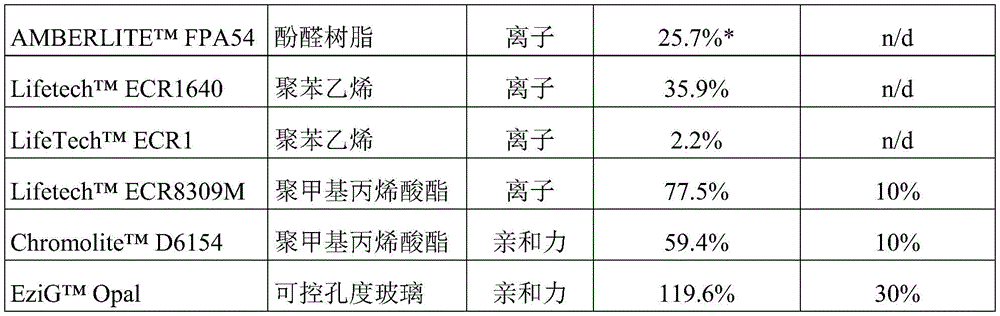
The conversion of sugars to hexoses is carried out at 55 ℃
Example 2 effect of enzyme ratio on cascade activity rate. To evaluate the effect of varying the ratio of various immobilized enzymes on tagatose production, relative to DUOLITE prepared using the enzyme ratios described in example 1 and Table 1TMA568-immobilization composition ("example 1 immobilization composition"), modification of the immobilization in DUOLITE in two immobilization composition formulationsTMThe amounts of α GP, PGM, PGI, F6PE, T6PP and 4-GT at A568. The activity of the immobilization compositions of example 1 was evaluated in comparison with their performance. In one of the concentration-varied immobilization compositions, the amount of enzyme was based on the observed activity rate of each enzyme relative to T6PP in solution, as shown in Table 4 (FIG. 1B), where each enzyme added an equal amount of enzyme activity (. mu. mol/min). The activity of this immobilization composition was 74% of the optimum ratio. Another concentration-modified immobilization composition contained equal amounts by weight of each enzyme (FIG. 1C). The activity of the immobilized composition was 85% of the optimum ratio. The reaction was carried out as described in example 1 and the conversion was determined as μmol/min/mg of total enzyme.
TABLE 4
| Enzyme | Enzyme Activity as% of T6PP Activity |
| Alpha glucan phosphorylase (alpha GP) | 78% |
| Phosphoglucomutase (PGM) | 861% |
| Phosphoglucose isomerase (PGI) | 2930% |
| Fructose-6-phosphate epimerase (F6PE) | 215% |
| Tagatose-6-phosphate phosphatase (T6PP) | 100% |
| 1, 4-glucanotransferase (4-GT) | 977% |
Example 3: influence of the distribution of the enzyme on one or more supports. Use of DUOLITE prepared in a single immobilization reaction as described in example 1TMA568 immobilization composition (19% α GP, 17% PGM, 3% PGI, 23% F6PE, 35% T6PP, and 3% 4-GT) method of producing tagatose from maltodextrin compared to the activity rate using the following performed method: (1) DUOLITE of core-producing enzymes (α GP, PGM, PGI and 4GT)TMA568 immobilized composition and DUOLITE of tagatose production specific enzymes (F6PE and T6PP)TMA568 mixture of immobilizing compositions; and (2) a mixture of the following 6 individual immobilized enzyme preparations: DUOLITETMA568 immobilized α GP, DUOLITETMA568 immobilized PGM, DUOLITETMA568 immobilized PGI, DUOLITETMA568 immobilized 4GT, DUOLITETMA568 immobilized F6PE andDUOLITETMa568 immobilizes T6 PP. (1) All enzymes in (1) and (2) in proportions relative to the reference DUOLITETMA568 immobilization composition was the same, all immobilization was carried out using A5% w/w ratio (enzyme/carrier) and buffer/reaction conditions as described in example 1. The results are shown in Table 5.
TABLE 5

Example 4 effect of enzyme loading. Different loadings of enzyme (g enzyme/g support, from 2.5% to 12.5% at 2.5% intervals) were immobilized on Duolite A568 as described in example 1 and in the proportions listed in Table 2. However, unlike example 1, the immobilization was continued for 16 hours instead of 6 hours for each sample, allowing sufficient time for higher loading of enzyme to complete binding. With a reaction buffer (25mM Na) pH 7.2 containing at least three sample volumes2PO4,4mM Na2SO3,2.5mM MgSO40.25mM MnCl2) was washed five times to wash off soluble enzymes. The sample was reacted with the maltodextrin feed solution for 16 hours and the conversion was measured as μmol/min/mg of total enzyme in example 1. The relative enzyme cascade rates versus the control loading were plotted against the 5% loading samples, as shown in figure 2. The load response and the price of the enzyme and support allow the most cost effective catalyst to be designed.
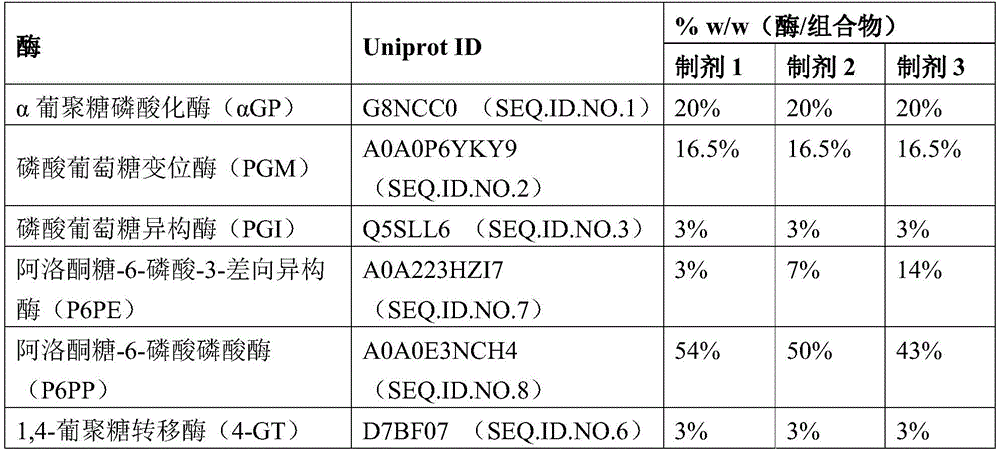
Example 5 psicose was prepared using an immobilized enzyme composition. As described in table 6, the following enzymes will be contained in three different enzyme ratios: enzyme compositions of α GP, PGM, PGI, psicose-6-phosphate-3-epimerase (P6PE), psicose-6-phosphate phosphatase (P6PP) and 4-GT were immobilized in respective immobilization reactions to DUOLITETMA 568. A comparative analysis was performed on the production of psicose from maltodextrin for the three immobilization composition formulations.
TABLE 6 psicose immobilized enzyme compositions
To prepare the immobilization mixture, DUOLITE was addedTMA568 was pretreated with 1% aqueous Glutaraldehyde (GA) solution at room temperature for 2 hours in a tumbling rotor. Washed 5 times with water and immobilized buffer (10mM sodium phosphate buffer pH 7.2, 5mM MgSO 2)4And 80. mu.M CoCl2) The GA was removed by 2 conditioning washes. Then, the enzyme solution (table 5) was added to the GA pretreated support after the final washing step (supernatant was discarded). The enzyme solution was prepared from 5g/L enzyme reaction buffer (10mM sodium phosphate buffer, pH 7.2, 5mM MgSO 2)4,5mM NaSO3And 80. mu.M CoCl2) And (4) forming. The enzyme-carrier solution was incubated at room temperature on an orbital shaker set at 800rpm for 16 hours to immobilize the enzyme mixture in the carrier. The total loading percentage was 6.5% (mg enzyme/mg carrier). The supernatant was washed 6 times with a wash consisting of reaction buffer to remove any remaining unbound enzyme. The final supernatant was removed and 150g/L maltodextrin pre-dissolved in the reaction buffer was added. The maltodextrin-carrier mixture was shaken overnight (15-16 h) in a 2.0mL microcentrifuge tube in an Eppendorf Thermomixer F2.0 at 55 ℃ at 800-. The resulting product was run on a SupelCogel Pb column (Sigma Aldrich) using an Agilent 1100 series HPLC system equipped with an on-line differential refractometer detector (0.6mL/min, 80 ℃ C., ultrapure water mobile phase). The psicose concentration was determined by comparing the sample peak area to the peak area of a known concentration of a standard solution of psicose, and the specific enzyme cascade activity was calculated. The psicose production reactant was washed off each of the immobilization formulations 4 times with the reaction buffer to equilibrate the immobilization formulations for reuse. The relative activity results for each sample composition are shown in table 7 below.
TABLE 7 relative Activity of immobilized psicose-producing enzymes

Example 6 preparation of allose from maltodextrin using an immobilized enzyme composition. Allose will be produced from maltodextrin using an immobilized enzyme composition comprising α GP, PGM, PGI, 4GT and P6PE, A6PI and A6 PP.
Example 7 fructose was prepared from maltodextrin using an immobilized enzyme composition. Fructose will be produced from maltodextrin using an immobilized enzyme composition comprising α GP, PGM, PGI, 4GT and F6 PP.
Example 8 mannose was prepared from maltodextrin using an immobilized enzyme composition. Mannose will be produced from maltodextrin using an immobilized enzyme composition comprising α GP, PGM, PGI, 4GT and M6PI or PGPMI and M6 PP.
Example 9 preparation of galactose from maltodextrin using an immobilized enzyme composition. Galactose will be produced from maltodextrin using an immobilized enzyme composition comprising α GP, PGM, PGI, F6PE, 4GT, Gal6PI and Gal 6P.
Example 10 altrose was prepared from maltodextrin using an immobilized enzyme composition. Altrose will be produced from maltodextrin using an immobilized enzyme composition comprising α GP, PGM, PGI, P6PE, Alt6PI and Alt6 PP.
Example 11 talose was prepared from maltodextrin using an immobilized enzyme composition. Talose will be produced from maltodextrin using an immobilized enzyme composition comprising α GP, PGM, PGI, F6PE, Tal6PI and Tal6 PP.
Example 12 preparation of sorbose from maltodextrin using an immobilized enzyme composition. Sorbose will be produced from maltodextrin using an immobilized enzyme composition comprising α GP, PGM, PGI, F6PE, S6PE and S6 PP.
Example 13 preparation of gulose from maltodextrin using an immobilized enzyme composition. Gulose will be produced from maltodextrin using an immobilized enzyme composition comprising α GP, PGM, PGI, F6PE, S6PE, Gul6PI and Gul6 PP.
Example 15 preparation of idose from maltodextrin using an immobilized enzyme composition. Idose will be produced from maltodextrin using an immobilized enzyme composition comprising α GP, PGM, PGI, F6PE, S6PE, I6PI and I6 PP.
Example 16 inositol was prepared from maltodextrin using an immobilized enzyme composition. Inositol will be produced from maltodextrin using an immobilized enzyme composition comprising α GP, PGM, 4GT, IPS and IMP.
Sequence listing
<110> Bernoumos GmbH
<120> immobilized enzyme composition for producing hexose
<130> P22JM1WN00008US
<150> 62/875321
<151> 2019-07-17
<150> 62/924323
<151> 2019-10-22
<160> 8
<170> PatentIn version 3.5
<210> 1
<211> 808
<212> PRT
<213> Thermus thermophilus (Thermus sp. CCB _ US3_ UF 1)
<400> 1
Met Pro Leu Leu Pro Glu Pro Leu Ser Gly Leu Lys Glu Leu Ala Tyr
1 5 10 15
Asn Leu Trp Trp Ser Trp Asn Pro Glu Ala Ala Glu Leu Phe Gln Glu
20 25 30
Ile Asp Pro Ser Leu Trp Lys Arg Phe Arg Gly Asn Pro Val Lys Leu
35 40 45
Leu Leu Glu Ala Asp Pro Gly Arg Leu Glu Gly Leu Ala Ala Thr Ser
50 55 60
Tyr Pro Ala Arg Val Gly Ala Val Val Glu Ala Leu Arg Ala Tyr Leu
65 70 75 80
Arg Glu Arg Glu Glu Lys Gln Gly Pro Leu Val Ala Tyr Phe Ser Ala
85 90 95
Glu Tyr Gly Phe His Ser Ser Leu Pro Ile Tyr Ser Gly Gly Leu Gly
100 105 110
Val Leu Ala Gly Asp His Val Lys Ala Ala Ser Asp Leu Gly Leu Asn
115 120 125
Leu Val Gly Val Gly Ile Phe Tyr His Glu Gly Tyr Phe His Gln Arg
130 135 140
Leu Ser Pro Glu Gly Val Gln Val Glu Val Tyr Glu Thr Leu His Pro
145 150 155 160
Glu Glu Leu Pro Leu Tyr Pro Val Gln Asp Arg Glu Gly Arg Pro Leu
165 170 175
Arg Val Gly Val Glu Phe Pro Gly Arg Thr Leu Trp Leu Ser Ala Tyr
180 185 190
Arg Val Gln Val Gly Ala Val Pro Val Tyr Leu Leu Thr Ala Asn Leu
195 200 205
Pro Glu Asn Thr Pro Glu Asp Arg Ala Ile Thr Ala Arg Leu Tyr Ala
210 215 220
Pro Gly Leu Glu Met Arg Ile Gln Gln Glu Leu Val Leu Gly Leu Gly
225 230 235 240
Gly Val Arg Leu Leu Arg Ala Leu Gly Leu Ala Pro Glu Val Phe His
245 250 255
Met Asn Glu Gly His Ser Ala Phe Leu Gly Leu Glu Arg Val Arg Glu
260 265 270
Leu Val Ala Glu Gly His Pro Phe Pro Val Ala Leu Glu Leu Ala Arg
275 280 285
Ala Gly Ala Leu Phe Thr Thr His Thr Pro Val Pro Ala Gly His Asp
290 295 300
Ala Phe Pro Leu Glu Leu Val Glu Arg Tyr Leu Gly Gly Phe Trp Glu
305 310 315 320
Arg Met Gly Thr Asp Arg Glu Thr Phe Leu Ser Leu Gly Leu Glu Glu
325 330 335
Lys Pro Trp Gly Lys Val Phe Ser Met Ser Asn Leu Ala Leu Arg Thr
340 345 350
Ser Ala Gln Ala Asn Gly Val Ser Arg Leu His Gly Glu Val Ser Arg
355 360 365
Glu Met Phe His His Leu Trp Pro Gly Phe Leu Arg Glu Glu Val Pro
370 375 380
Ile Gly His Val Thr Asn Gly Val His Thr Trp Thr Phe Leu His Pro
385 390 395 400
Arg Leu Arg Arg His Tyr Ala Glu Val Phe Gly Pro Glu Trp Arg Lys
405 410 415
Arg Pro Glu Asp Pro Glu Thr Trp Lys Val Glu Ala Leu Gly Glu Glu
420 425 430
Phe Trp Gln Ile His Lys Asp Leu Arg Ala Glu Leu Val Arg Glu Val
435 440 445
Arg Thr Arg Leu Tyr Glu Gln Arg Arg Arg Asn Gly Glu Ser Pro Ser
450 455 460
Arg Leu Arg Glu Ala Glu Lys Val Leu Asp Pro Glu Ala Leu Thr Ile
465 470 475 480
Gly Phe Ala Arg Arg Phe Ala Thr Tyr Lys Arg Ala Val Leu Leu Phe
485 490 495
Lys Asp Pro Glu Arg Leu Arg Arg Leu Leu His Gly His Tyr Pro Ile
500 505 510
Gln Phe Val Phe Ala Gly Lys Ala His Pro Lys Asp Glu Pro Gly Lys
515 520 525
Ala Tyr Leu Gln Glu Leu Phe Ala Lys Ile Arg Glu Tyr Gly Leu Glu
530 535 540
Asp Arg Met Val Val Leu Glu Asp Tyr Asp Met Tyr Leu Ala Arg Val
545 550 555 560
Leu Val His Gly Ser Asp Val Trp Leu Asn Thr Pro Arg Arg Pro Met
565 570 575
Glu Ala Ser Gly Thr Ser Gly Met Lys Ala Ala Leu Asn Gly Ala Leu
580 585 590
Asn Leu Ser Val Leu Asp Gly Trp Trp Ala Glu Ala Tyr Asn Gly Lys
595 600 605
Asn Gly Phe Ala Ile Gly Asp Glu Arg Val Tyr Glu Ser Glu Glu Ala
610 615 620
Gln Asp Met Ala Asp Ala Gln Ala Leu Tyr Asp Val Leu Glu Phe Glu
625 630 635 640
Val Leu Pro Leu Phe Tyr Ala Lys Gly Pro Glu Gly Tyr Ser Ser Gly
645 650 655
Trp Leu Ser Met Val His Glu Ser Leu Arg Thr Val Gly Pro Arg Tyr
660 665 670
Ser Ala Ala Arg Met Val Gly Asp Leu Glu Ile Tyr Arg Arg Gly Gly
675 680 685
Ala Trp Ala Glu Ala Ala Arg Ala Gly Gln Glu Ala Leu Ala Ala Phe
690 695 700
His Gln Ala Leu Pro Ala Leu Gln Gly Val Thr Leu Arg Ala Gln Val
705 710 715 720
Pro Gly Asp Leu Thr Leu Asn Gly Val Pro Met Arg Val Arg Ala Phe
725 730 735
Leu Glu Gly Glu Val Pro Glu Ala Leu Arg Pro Phe Leu Glu Val Gln
740 745 750
Leu Val Val Arg Arg Ser Ser Gly His Leu Glu Val Val Pro Met Arg
755 760 765
Pro Gly Pro Asp Gly Tyr Glu Val Ala Tyr Arg Pro Ser Arg Pro Gly
770 775 780
Ser Tyr Ala Tyr Gly Val Arg Leu Ala Leu Arg His Pro Ile Thr Gly
785 790 795 800
His Val Ala Trp Val Arg Trp Ala
805
<210> 2
<211> 473
<212> PRT
<213> Thermanaerothrix daxensis
<400> 2
Met Gly His Lys Ile Met Phe Gly Thr Asp Gly Trp Arg Gly Val Ile
1 5 10 15
Ala Glu Asp Tyr Thr Phe Asp Asn Val Arg Arg Cys Ala Gln Gly Phe
20 25 30
Ala His Tyr Leu Lys Thr Lys Gly Tyr Lys Asp Glu Trp Val Val Val
35 40 45
Gly Tyr Asp Lys Arg Phe His Ser Glu Asn Phe Ala Gln Ala Ala Ala
50 55 60
Glu Val Leu Cys Gly Asn Gly Phe Arg Val Tyr Leu Thr Asp Lys Ala
65 70 75 80
Thr Pro Thr Pro Val Ile Ala Tyr Ala Val Val Glu Arg Lys Ala Ile
85 90 95
Gly Ala Val Asn Ile Thr Ala Ser His Asn Pro Pro Thr Asp Asn Gly
100 105 110
Phe Lys Val Arg Asp Ala Ser Gly Gly Ala Ile Asp Pro Glu Gly Leu
115 120 125
Lys Arg Ile Glu Ser Ala Ile Pro Asp Glu Met Ser Ala Val Lys Arg
130 135 140
Met Pro Ala Ser Glu Ala Glu Ala Gln Gly Arg Leu Val Arg Phe Asp
145 150 155 160
Pro Ala Pro Ala Tyr Ile Glu His Leu Lys Ser Leu Ile Asp Leu Gln
165 170 175
Pro Ile Arg Asp Ala Gly Leu Lys Ile Val Val Asp Ala Met Trp Gly
180 185 190
Asn Gly Ala Gly Trp Phe Pro Arg Leu Leu Ala Gly Gly Lys Thr Glu
195 200 205
Val Tyr Glu Ile His Asn Thr Arg Asn Pro Ile Phe Pro Glu Met Lys
210 215 220
Arg Pro Glu Pro Ile Pro Pro Asn Ile Asp Val Gly Leu Arg Thr Thr
225 230 235 240
Val Glu Arg Arg Ala Asp Val Leu Val Val Thr Asp Gly Asp Ala Asp
245 250 255
Arg Val Gly Ile Gly Asp Glu His Gly Arg Phe Val Asn Gln Leu Gln
260 265 270
Val Tyr Gly Leu Leu Ala Phe Tyr Leu Leu Glu Val Arg Gly Glu Arg
275 280 285
Gly Pro Ile Ile Lys Thr Leu Ser Thr Thr Ser Met Leu Glu Lys Leu
290 295 300
Gly Glu Ile Tyr Gly Val Pro Val Tyr Glu Thr Gly Val Gly Phe Lys
305 310 315 320
Tyr Val Ala Pro Lys Phe Leu Glu Thr Asn Ala Leu Ile Gly Gly Glu
325 330 335
Glu Ser Gly Gly Tyr Ala Phe Arg Gly Asn Val Pro Glu Arg Asp Gly
340 345 350
Ile Leu Ala Gly Leu Tyr Phe Leu Asp Met Met Val Arg Leu Asn Arg
355 360 365
Lys Pro Ser Gln Leu Leu Glu Leu Leu Phe Ser Lys Val Gly Pro His
370 375 380
Tyr Tyr Asp Arg Val Asp Arg Gln Phe Thr Gly Asp Arg Lys Thr Arg
385 390 395 400
Glu Glu Met Ile Leu Asn Ala Asn Pro His Thr Ile Gly Gly Leu Lys
405 410 415
Val Val Gly Leu Asn Thr Leu Asp Gly Phe Lys Phe Leu Leu Glu Asp
420 425 430
Gly Gly Trp Met Leu Ile Arg Phe Ser Gly Thr Glu Pro Ile Ile Arg
435 440 445
Val Tyr Cys Glu Thr Thr His Pro Asp Arg Val Gln Pro Ile Leu Gln
450 455 460
Asp Gly Leu Arg Ile Ala Gly Leu Ala
465 470
<210> 3
<211> 415
<212> PRT
<213> Thermus thermophilus (Thermus thermophilus)
<400> 3
Met Leu Arg Leu Asp Thr Arg Phe Leu Pro Gly Phe Pro Glu Ala Leu
1 5 10 15
Ser Arg His Gly Pro Leu Leu Glu Glu Ala Arg Arg Arg Leu Leu Ala
20 25 30
Lys Arg Gly Glu Pro Gly Ser Met Leu Gly Trp Met Asp Leu Pro Glu
35 40 45
Asp Thr Glu Thr Leu Arg Glu Val Arg Arg Tyr Arg Glu Ala Asn Pro
50 55 60
Trp Val Glu Asp Phe Val Leu Ile Gly Ile Gly Gly Ser Ala Leu Gly
65 70 75 80
Pro Lys Ala Leu Glu Ala Ala Phe Asn Glu Ser Gly Val Arg Phe His
85 90 95
Tyr Leu Asp His Val Glu Pro Glu Pro Ile Leu Arg Leu Leu Arg Thr
100 105 110
Leu Asp Pro Arg Lys Thr Leu Val Asn Ala Val Ser Lys Ser Gly Ser
115 120 125
Thr Ala Glu Thr Leu Ala Gly Leu Ala Val Phe Leu Lys Trp Leu Lys
130 135 140
Ala His Leu Gly Glu Asp Trp Arg Arg His Leu Val Val Thr Thr Asp
145 150 155 160
Pro Lys Glu Gly Pro Leu Arg Ala Phe Ala Glu Arg Glu Gly Leu Lys
165 170 175
Ala Phe Ala Ile Pro Lys Glu Val Gly Gly Arg Phe Ser Ala Leu Ser
180 185 190
Pro Val Gly Leu Leu Pro Leu Ala Phe Ala Gly Ala Asp Leu Asp Ala
195 200 205
Leu Leu Met Gly Ala Arg Lys Ala Asn Glu Thr Ala Leu Ala Pro Leu
210 215 220
Glu Glu Ser Leu Pro Leu Lys Thr Ala Leu Leu Leu His Leu His Arg
225 230 235 240
His Leu Pro Val His Val Phe Met Val Tyr Ser Glu Arg Leu Ser His
245 250 255
Leu Pro Ser Trp Phe Val Gln Leu His Asp Glu Ser Leu Gly Lys Val
260 265 270
Asp Arg Gln Gly Gln Arg Val Gly Thr Thr Ala Val Pro Ala Leu Gly
275 280 285
Pro Lys Asp Gln His Ala Gln Val Gln Leu Phe Arg Glu Gly Pro Leu
290 295 300
Asp Lys Leu Leu Ala Leu Val Ile Pro Glu Ala Pro Leu Glu Asp Val
305 310 315 320
Glu Ile Pro Glu Val Glu Gly Leu Glu Ala Ala Ser Tyr Leu Phe Gly
325 330 335
Lys Thr Leu Phe Gln Leu Leu Lys Ala Glu Ala Glu Ala Thr Tyr Glu
340 345 350
Ala Leu Ala Glu Ala Gly Gln Arg Val Tyr Ala Leu Phe Leu Pro Glu
355 360 365
Val Ser Pro Tyr Ala Val Gly Trp Leu Met Gln His Leu Met Trp Gln
370 375 380
Thr Ala Phe Leu Gly Glu Leu Trp Glu Val Asn Ala Phe Asp Gln Pro
385 390 395 400
Gly Val Glu Leu Gly Lys Val Leu Thr Arg Lys Arg Leu Ala Gly
405 410 415
<210> 4
<211> 426
<212> PRT
<213> Thermanaerothrix daxensis
<400> 4
Met Val Thr Tyr Leu Asp Phe Val Val Leu Ser His Arg Phe Arg Arg
1 5 10 15
Pro Leu Gly Ile Thr Ser Val Cys Ser Ala His Pro Tyr Val Ile Glu
20 25 30
Ala Ala Leu Arg Asn Gly Met Met Thr His Thr Pro Val Leu Ile Glu
35 40 45
Ala Thr Cys Asn Gln Val Asn Gln Tyr Gly Gly Tyr Thr Gly Met Thr
50 55 60
Pro Ala Asp Phe Val Arg Tyr Val Glu Asn Ile Ala Ala Arg Val Gly
65 70 75 80
Ser Pro Arg Glu Asn Leu Leu Leu Gly Gly Asp His Leu Gly Pro Leu
85 90 95
Val Trp Ala His Glu Pro Ala Glu Ser Ala Met Glu Lys Ala Arg Ala
100 105 110
Leu Val Lys Ala Tyr Val Glu Ala Gly Phe Arg Lys Ile His Leu Asp
115 120 125
Cys Ser Met Pro Cys Ala Asp Asp Arg Asp Phe Ser Pro Lys Val Ile
130 135 140
Ala Glu Arg Ala Ala Glu Leu Ala Gln Val Ala Glu Ser Thr Cys Asp
145 150 155 160
Val Met Gly Leu Pro Leu Pro Asn Tyr Val Ile Gly Thr Glu Val Pro
165 170 175
Pro Ala Gly Gly Ala Lys Ala Glu Ala Glu Thr Leu Arg Val Thr Arg
180 185 190
Pro Glu Asp Ala Ala Glu Thr Ile Ala Leu Thr Arg Ala Ala Phe Phe
195 200 205
Lys Arg Gly Leu Glu Ser Ala Trp Glu Arg Val Val Ala Leu Val Val
210 215 220
Gln Pro Gly Val Glu Phe Gly Asp His Gln Ile His Val Tyr Arg Arg
225 230 235 240
Glu Glu Ala Gln Ala Leu Ser Arg Phe Ile Glu Ser Gln Pro Gly Leu
245 250 255
Val Tyr Glu Ala His Ser Thr Asp Tyr Gln Pro Arg Asp Ala Leu Arg
260 265 270
Ala Leu Val Glu Asp His Phe Ala Ile Leu Lys Val Gly Pro Ala Leu
275 280 285
Thr Phe Ala Phe Arg Glu Ala Val Phe Ala Leu Ala Ser Ile Glu Asp
290 295 300
Trp Val Cys Asp Ser Pro Ser Arg Ile Leu Glu Val Leu Glu Thr Thr
305 310 315 320
Met Leu Ala Asn Pro Val Tyr Trp Gln Lys Tyr Tyr Leu Gly Asp Glu
325 330 335
Arg Ala Arg Arg Ile Ala Arg Gly Tyr Ser Phe Ser Asp Arg Ile Arg
340 345 350
Tyr Tyr Trp Ser Ala Pro Ala Val Glu Gln Ala Phe Glu Arg Leu Arg
355 360 365
Ala Asn Leu Asn Arg Val Ser Ile Pro Leu Val Leu Leu Ser Gln Tyr
370 375 380
Leu Pro Asp Gln Tyr Arg Lys Val Arg Asp Gly Arg Leu Pro Asn Gln
385 390 395 400
Phe Asp Ala Leu Ile Leu Asp Lys Ile Gln Ala Val Leu Glu Asp Tyr
405 410 415
Asn Val Ala Cys Gly Val Arg Ile Gly Glu
420 425
<210> 5
<211> 219
<212> PRT
<213> Corynebacterium thermophilum (Sphaerobacter thermophilus)
<400> 5
Met Ser Gln Gly Val Arg Gly Val Val Phe Asp Leu Asp Gly Leu Leu
1 5 10 15
Val Glu Ser Glu Glu Tyr Trp Glu Gln Ala Arg Arg Glu Phe Val Ser
20 25 30
Arg Tyr Gly Gly Thr Trp Gly Asp Asp Ala Gln Gln Ala Val Met Gly
35 40 45
Ala Asn Thr Arg Gln Trp Ser Arg Tyr Ile Arg Glu Ala Phe Asp Ile
50 55 60
Pro Leu Thr Glu Glu Glu Ile Ala Ala Ala Val Ile Ala Arg Met Gln
65 70 75 80
Glu Leu Tyr His Asp His Leu Pro Leu Leu Pro Gly Ala Ile Pro Ala
85 90 95
Val Arg Ala Leu Ala Asp Arg Tyr Pro Leu Ala Val Ala Ser Ser Ser
100 105 110
Pro Pro Val Leu Ile Arg Phe Val Leu Ala Glu Met Gly Val Ala Glu
115 120 125
Cys Phe Gln Ser Val Thr Ser Ser Asp Glu Val Ala His Gly Lys Pro
130 135 140
Ala Pro Asp Val Tyr His Leu Ala Cys Glu Arg Leu Gly Val Ala Pro
145 150 155 160
Glu Gln Ala Val Ala Phe Glu Asp Ser Thr Ala Gly Ile Ala Ala Ala
165 170 175
Leu Ala Ala Gly Leu Arg Val Ile Ala Val Pro Asn Arg Ser Tyr Pro
180 185 190
Pro Asp Pro Asp Val Leu Arg Arg Ala Asp Leu Thr Leu Pro Ser Leu
195 200 205
Glu Glu Phe Asp Pro Ala Val Leu Glu Gln Trp
210 215
<210> 6
<211> 511
<212> PRT
<213> Thermoanaerobacter thermophilus (Anaerolinea thermophila)
<400> 6
Met Ser Leu Phe Lys Arg Ala Ser Gly Ile Leu Leu His Pro Thr Ser
1 5 10 15
Leu Pro Gly Pro Asp Gly Ile Gly Asp Leu Gly Pro Glu Ala Tyr Arg
20 25 30
Trp Val Asn Phe Leu Ala Glu Ser Gly Cys Ser Leu Trp Gln Ile Leu
35 40 45
Pro Leu Gly Pro Thr Gly Phe Gly Asp Ser Pro Tyr Gln Cys Phe Ser
50 55 60
Ala Phe Ala Gly Asn Pro Tyr Leu Val Ser Pro Ala Leu Leu Leu Asp
65 70 75 80
Glu Gly Leu Leu Thr Ser Glu Asp Leu Ala Asp Arg Pro Glu Phe Pro
85 90 95
Ala Ser Arg Val Asp Tyr Gly Pro Val Ile Gln Trp Lys Leu Thr Leu
100 105 110
Leu Asp Arg Ala Tyr Val Arg Phe Lys Arg Ser Thr Ser Gln Lys Arg
115 120 125
Lys Ala Ala Phe Glu Ala Phe Lys Glu Glu Gln Arg Ala Trp Leu Leu
130 135 140
Asp Phe Ser Leu Phe Met Ala Ile Lys Glu Ala His Gly Gly Ala Ser
145 150 155 160
Trp Asp Tyr Trp Pro Glu Pro Leu Arg Lys Arg Asp Pro Glu Ala Leu
165 170 175
Asn Ala Phe His Arg Ala His Glu Val Asp Val Glu Arg His Ser Phe
180 185 190
Arg Gln Phe Leu Phe Phe Arg Gln Trp Gln Ala Leu Arg Gln Tyr Ala
195 200 205
His Glu Lys Gly Val Gln Ile Ile Gly Asp Val Pro Ile Phe Val Ala
210 215 220
Tyr Asp Ser Ala Asp Val Trp Ser His Pro Asp Leu Phe Tyr Leu Asp
225 230 235 240
Glu Thr Gly Lys Pro Thr Val Val Ala Gly Val Pro Pro Asp Tyr Phe
245 250 255
Ser Ala Thr Gly Gln Leu Trp Gly Asn Pro Leu Tyr Arg Trp Asp Tyr
260 265 270
His Arg Glu Thr Gly Phe Ala Trp Trp Leu Glu Arg Leu Lys Ala Thr
275 280 285
Phe Ala Met Val Asp Ile Val Arg Leu Asp His Phe Arg Gly Phe Ala
290 295 300
Gly Tyr Trp Glu Val Pro Tyr Gly Met Pro Thr Ala Glu Lys Gly Arg
305 310 315 320
Trp Val Pro Gly Pro Gly Ile Ala Leu Phe Glu Ala Ile Arg Asn Ala
325 330 335
Leu Gly Gly Leu Pro Ile Ile Ala Glu Asp Leu Gly Glu Ile Thr Pro
340 345 350
Asp Val Ile Glu Leu Arg Glu Gln Leu Gly Leu Pro Gly Met Lys Ile
355 360 365
Phe Gln Phe Ala Phe Ala Ser Asp Ala Asp Asp Pro Phe Leu Pro His
370 375 380
Asn Tyr Val Gln Asn Cys Val Ala Tyr Thr Gly Thr His Asp Asn Asp
385 390 395 400
Thr Ala Ile Gly Trp Tyr Asn Ser Ala Pro Glu Lys Glu Arg Asp Phe
405 410 415
Val Arg Arg Tyr Leu Ala Arg Ser Gly Glu Asp Ile Ala Trp Asp Met
420 425 430
Ile Arg Ala Val Trp Ser Ser Val Ala Met Phe Ala Ile Ala Pro Leu
435 440 445
Gln Asp Phe Leu Lys Leu Gly Pro Glu Ala Arg Met Asn Tyr Pro Gly
450 455 460
Arg Pro Ala Gly Asn Trp Gly Trp Arg Tyr Glu Ala Phe Met Leu Asp
465 470 475 480
Asp Gly Leu Lys Asn Arg Ile Lys Glu Ile Asn Tyr Leu Tyr Gly Arg
485 490 495
Leu Pro Glu His Met Lys Pro Pro Lys Val Val Lys Lys Trp Thr
500 505 510
<210> 7
<211> 225
<212> PRT
<213> Thermoanaerobacterium thermosaccharolyticum (Thermoanaerobacterium)
<400> 7
Met Lys Pro Met Phe Ala Pro Ser Leu Met Cys Ala Asn Phe Leu Asp
1 5 10 15
Leu Lys Asn Gln Ile Glu Ile Leu Asn Glu Arg Ala Asp Ile Tyr His
20 25 30
Ile Asp Ile Met Asp Gly His Tyr Val Lys Asn Phe Ala Leu Ser Pro
35 40 45
Tyr Leu Met Glu Gln Leu Lys Thr Ile Ala Lys Ile Pro Met Asp Ala
50 55 60
His Leu Met Val Glu Asn Pro Ala Asp Phe Leu Glu Cys Ile Ala Lys
65 70 75 80
Ser Gly Ala Thr Tyr Ile Ser Pro His Ala Glu Thr Ile Asn Lys Asp
85 90 95
Ala Phe Arg Ile Met Arg Thr Ile Lys Ala Leu Gly Cys Lys Thr Gly
100 105 110
Ile Val Leu Asn Pro Ala Thr Pro Val Glu Tyr Ile Lys Tyr Tyr Ile
115 120 125
Gly Met Leu Asp Lys Ile Thr Ile Leu Thr Val Asp Ala Gly Phe Ala
130 135 140
Gly Gln Thr Phe Ile Asn Glu Met Leu Asp Lys Ile Ala Glu Ile Lys
145 150 155 160
Ser Leu Arg Asp Gln Asn Gly Tyr Ser Tyr Leu Ile Glu Val Asp Gly
165 170 175
Ser Cys Asn Glu Lys Thr Phe Lys Gln Leu Ala Glu Ala Gly Thr Asp
180 185 190
Val Phe Val Val Gly Ser Ser Gly Leu Phe Asn Leu Asp Thr Asp Leu
195 200 205
Lys Val Ala Trp Asp Lys Met Met Asp Thr Phe Thr Arg Cys Thr Ser
210 215 220
Asn
225
<210> 8
<211> 220
<212> PRT
<213> Methanosarcina thermophila
<400> 8
Met Leu Lys Ala Leu Ile Phe Asp Met Asp Gly Val Leu Val Asp Ser
1 5 10 15
Met Pro Phe His Ala Ala Ala Trp Lys Lys Ala Phe Phe Glu Met Gly
20 25 30
Met Glu Ile Gln Asp Ser Asp Ile Phe Ala Ile Glu Gly Ser Asn Pro
35 40 45
Arg Asn Gly Leu Pro Leu Leu Ile Arg Lys Ala Arg Lys Glu Pro Glu
50 55 60
Ala Phe Asp Phe Glu Ala Ile Thr Ser Ile Tyr Arg Gln Glu Phe Lys
65 70 75 80
Arg Val Phe Glu Pro Lys Ala Phe Glu Gly Met Lys Glu Cys Leu Glu
85 90 95
Val Leu Lys Lys Arg Phe Leu Leu Ser Val Val Ser Gly Ser Asp His
100 105 110
Val Ile Val His Ser Ile Ile Asn Arg Leu Phe Pro Gly Ile Phe Asp
115 120 125
Ile Val Val Thr Gly Asp Asp Ile Ile Asn Ser Lys Pro His Pro Asp
130 135 140
Pro Phe Leu Lys Ala Val Glu Leu Leu Asn Val Arg Arg Glu Glu Cys
145 150 155 160
Val Val Ile Glu Asn Ala Ile Leu Gly Val Glu Ala Ala Lys Asn Ala
165 170 175
Arg Ile Tyr Cys Ile Gly Val Pro Thr Tyr Val Glu Pro Ser His Leu
180 185 190
Asp Lys Ala Asp Leu Val Val Glu Asp His Arg Gln Leu Met Gln His
195 200 205
Leu Leu Ser Leu Glu Pro Ala Asn Gly Phe Arg Gln
210 215 220
Claims (22)
1. An immobilized enzyme composition for the preparation of hexoses comprising at least two, at least three, at least four, at least five, at least six carriers, at least seven or at least eight of the following enzymes immobilized on at least one carrier or carrier mixture:
a) an alpha glucan phosphorylase (alpha GP), Phosphoglucomutase (PGM) and optionally 1, 4-glucanotransferase (4-GT); and
b) an enzyme selected from the following enzyme combinations:
(i) phosphoglucose isomerase (PGI), fructose-6-phosphate epimerase (F6PE) and tagatose-6-phosphate phosphatase (T6PP) for the preparation of tagatose;
(ii) a glucose phosphate isomerase (PGI), a psicose-6-phosphate epimerase (P6PE), and a psicose-6-phosphate phosphatase (P6PP) for preparing psicose;
(iii) phosphoglucose isomerase (PGI), P6PE, allose-6-phosphate isomerase (A6PI) and allose-6-phosphate phosphatase (A6PP) for the preparation of allose;
(iv) phosphoglucose isomerase (PGI), mannose-6-phosphate isomerase (M6PI) or phosphoglucose/phosphomannose isomerase (PGPMI) and mannose-6-phosphate phosphatase (M6PP) for the preparation of mannose;
(v) phosphoglucose isomerase (PGI), F6PE, galactose-6-phosphate isomerase (Gal6PI) and galactose-6-phosphate phosphatase (Gal6PP) for the production of galactose;
(vi) PGI and fructose-6-phosphate phosphatase for the preparation of fructose (F6 PP);
(vii) PGI, P6PE, altrose-6-phosphate isomerase (Alt6PI) and altrose-6-phosphate phosphatase (Alt6PP) for the preparation of altrose;
(viii) PGI, F6PE, talose-6-phosphate isomerase (Tal6PI) and talose-6-phosphate phosphatase (Tal6PP) for producing talose;
(ix) PGI, F6PE, sorbose-6-phosphate epimerase (S6PE) and sorbose-6-phosphate phosphatase (S6PP) for preparing sorbose;
(x) PGI, F6PE, S6PE, gulose-6-phosphate isomerase (Gul6PI) and gulose-6-phosphate phosphatase (Gul6PP) for the preparation of gulose;
(xi) PGI, F6PE, S6PE, idum-6-phosphate isomerase (I6PI) and idum-6-phosphate phosphatase (I6PP) for the preparation of idum; and
(xii) Inositol-3-phosphate synthase (IPS) and Inositol Monophosphatase (IMP) for the production of inositol.
2. The immobilized enzyme composition of claim 1 wherein the weight of each enzyme is 0.1% to 40% relative to the total weight of enzymes (w/w)%.
3. The immobilized enzyme composition according to claim 1 or 2, comprising 10-30% (α GP); 0-10% (4 GT); 10-30% (PGM); and 0.1-10% (PGI) when present.
4. The immobilized enzyme composition of any one of claim 3, further comprising PGI, F6PE, and T6PP for the preparation of tagatose.
5. The immobilized enzyme composition of claim 4 wherein the weight of each enzyme relative to the total weight of enzymes (w/w)% is: 10-30% (α GP); 0-10% (4 GT); 10-30% (PGM); 0.1-10% (PGI); 15-35% (F6 PE); and 25-45% (T6PP), wherein the total weight of the enzymes in the composition is 100 w/w% relative to the total weight of the enzymes.
6. The immobilized enzyme composition of claim 5, wherein
α GP comprises the amino acid sequence of SEQ ID No.1 or a fragment thereof;
4-GT comprises the amino acid sequence of SEQ ID No.6 or a fragment thereof;
PGM comprises the amino acid sequence of SEQ ID No.2 or a fragment thereof;
the PGI comprises the amino acid sequence of SEQ ID No.3 or a fragment thereof;
f6PE comprises the amino acid sequence of SEQ ID No.4 or a fragment thereof; and
t6PP comprises the amino acid sequence of SEQ ID No.5 or a fragment thereof.
7. The immobilized enzyme composition of any one of claim 3, further comprising PGI, P6PE and P6PP for the preparation of psicose.
8. The immobilized enzyme composition of claim 7 wherein the weight of each enzyme relative to the total weight of enzymes (w/w)% is: 10-30% (α GP); 0-10% (4 GT); 10-30% (PGM); 0.1-10% (PGI); 0.1-10% (P6 PE); and 45-65% (P6PP), wherein the total weight of the enzymes in the composition is 100 w/w% relative to the total weight of the enzymes.
9. The immobilized enzyme composition of claim 8, wherein:
α GP comprises the amino acid sequence of SEQ ID No.1 or a fragment thereof;
4-GT comprises the amino acid sequence of SEQ ID No. 6;
PGM comprises the amino acid sequence of SEQ ID No. 2;
the PGI comprises the amino acid sequence of SEQ ID No. 3;
p6PE comprises the amino acid sequence of SEQ ID No. 7; and
p6PP comprises the amino acid sequence of SEQ ID NO. 8.
10. The immobilized enzyme composition according to any one of claims 1-9, wherein the total weight of enzyme is 2.5-12.5% weight (w/w)% relative to the weight of carrier.
11. The immobilized enzyme composition of any one of claims 1-10, wherein the support is a weakly basic anion exchange resin.
12. The immobilized enzyme composition of claim 11, wherein the support comprises a phenol formaldehyde polycondensate.
13. The immobilized enzyme composition of claim 11 or 12, wherein the support comprises a tertiary amine functional group, wherein the composition is optionally DUOLITETMA568。
14. The immobilized enzyme composition of claim 11 or 12, wherein the support comprises a secondary amine functional group, wherein the composition is optionally DUOLITETMPWA7。
15. The immobilized enzyme composition of any one of claims 1-10, wherein the carrier comprises a His-tag affinity resin.
16. The immobilized enzyme composition of any one of claim 15, wherein the support comprises Controlled Pore Glass (CPG) particles.
17. The immobilized enzyme composition of claim 15 or 16 wherein the support is functionalized by chelating a metal.
18. The immobilized enzyme composition of claim 18, wherein the chelating metal is iron or zinc, or wherein the carrier is optionally EziGTMOpal。
19. An enzymatic process for the preparation of hexoses from sugars comprising contacting a starch derivative with the immobilized enzyme composition of any one of claims 1-18 under suitable reaction conditions to convert the starch derivative to hexoses.
20. The method of claim 19, wherein the method steps are performed at a temperature of about 40 ℃ to about 85 ℃, at a pH of about 5.0 to about 8.0, and/or for about 0.5 hours to about 48 hours.
21. The method of claim 19 or 20, wherein the method steps are performed in a single bioreactor, a plurality of bioreactors arranged in series, or a plurality of bioreactors arranged in parallel.
22. The method of any one of claims 19-21, wherein the method steps are performed without ATP, without nad (p) (h), at a phosphate concentration of about 0.1mM to about 150mM, phosphate is recycled in an enzymatic cascade, and/or at least one step of the method involves an energy-highly favorable chemical reaction.
Applications Claiming Priority (5)
| Application Number | Priority Date | Filing Date | Title |
|---|---|---|---|
| US201962875321P | 2019-07-17 | 2019-07-17 | |
| US62/875,321 | 2019-07-17 | ||
| US201962924323P | 2019-10-22 | 2019-10-22 | |
| US62/924,323 | 2019-10-22 | ||
| PCT/US2020/042562 WO2021011881A1 (en) | 2019-07-17 | 2020-07-17 | Immobilized enzyme compositions for the production of hexoses |
Publications (1)
| Publication Number | Publication Date |
|---|---|
| CN114599786A true CN114599786A (en) | 2022-06-07 |
Family
ID=74209943
Family Applications (1)
| Application Number | Title | Priority Date | Filing Date |
|---|---|---|---|
| CN202080065138.3A Pending CN114599786A (en) | 2019-07-17 | 2020-07-17 | Immobilized enzyme composition for hexose production |
Country Status (9)
| Country | Link |
|---|---|
| EP (1) | EP3999636A4 (en) |
| JP (1) | JP2022541471A (en) |
| KR (1) | KR20220035460A (en) |
| CN (1) | CN114599786A (en) |
| BR (1) | BR112022000699A2 (en) |
| CA (1) | CA3143852A1 (en) |
| CO (1) | CO2022001348A2 (en) |
| MX (1) | MX2022000381A (en) |
| WO (1) | WO2021011881A1 (en) |
Families Citing this family (7)
| Publication number | Priority date | Publication date | Assignee | Title |
|---|---|---|---|---|
| KR20230012047A (en) * | 2020-05-18 | 2023-01-25 | 보너모스, 인코포레이티드 | Enzymatic production of allulose |
| CN117157398A (en) * | 2021-02-02 | 2023-12-01 | 博努莫斯股份有限公司 | Enzymatic enrichment of blood-reducing food ingredients |
| CN112708614A (en) * | 2021-02-05 | 2021-04-27 | 江南大学 | Preparation method and application of co-immobilized double enzymes |
| CN112708616B (en) * | 2021-03-29 | 2021-08-20 | 中国科学院天津工业生物技术研究所 | A kind of method for producing tagatose with immobilized multi-enzyme system |
| CN112760317B (en) * | 2021-04-07 | 2021-08-24 | 中国科学院天津工业生物技术研究所 | Method for producing tagatose by immobilizing multiple enzymes in biomimetic silicon-mineralized microcapsules |
| CN112760316B (en) * | 2021-04-07 | 2021-08-24 | 中国科学院天津工业生物技术研究所 | Method for producing tagatose by artificial oil body immobilized multienzyme |
| CN113249372B (en) * | 2021-07-05 | 2021-10-08 | 中国科学院天津工业生物技术研究所 | Preparation method and application of immobilized cells for mannose production |
Citations (2)
| Publication number | Priority date | Publication date | Assignee | Title |
|---|---|---|---|---|
| WO2018169957A1 (en) * | 2017-03-13 | 2018-09-20 | Bonumose Llc | Enzymatic production of hexoses |
| WO2018182344A1 (en) * | 2017-03-31 | 2018-10-04 | 씨제이제일제당(주) | Composition for tagatose production and method for tagatose production using same |
Family Cites Families (15)
| Publication number | Priority date | Publication date | Assignee | Title |
|---|---|---|---|---|
| JP4778418B2 (en) * | 2003-03-06 | 2011-09-21 | ヴェレニウム コーポレイション | Amylase, nucleic acid encoding the same, and production and use thereof |
| US20080148432A1 (en) * | 2005-12-21 | 2008-06-19 | Mark Scott Abad | Transgenic plants with enhanced agronomic traits |
| US8119385B2 (en) * | 2005-03-04 | 2012-02-21 | Bp Corporation North America Inc. | Nucleic acids and proteins and methods for making and using them |
| US20110252501A1 (en) * | 2006-08-17 | 2011-10-13 | Monsanto Technology Llc | Transgenic plants with enhanced agronomic traits |
| EP2573178A3 (en) * | 2007-07-10 | 2013-07-24 | Monsanto Technology LLC | Transgenic plants with enhanced agronomic traits |
| GB2508586B (en) * | 2012-09-27 | 2020-09-02 | Tate & Lyle Ingredients Americas Llc | A protein |
| EP3910337B1 (en) * | 2014-01-31 | 2023-08-09 | Enginzyme AB | Method for catalyzing an enzyme-catalyzed reaction |
| CN106148425B (en) * | 2015-04-17 | 2018-05-08 | 成都远泓生物科技有限公司 | The preparation method of inositol |
| JP7625237B2 (en) * | 2016-12-14 | 2025-02-03 | ボヌモーズ、インコーポレイテッド | Enzymatic production of D-allulose |
| DE102017002252A1 (en) * | 2017-03-08 | 2018-09-13 | André Pick | Enzymatic process for the production of fructose |
| BR112020014345B1 (en) * | 2018-01-24 | 2023-09-26 | Matsutani Chemical Industry Co., Ltd | KETOSIS 3-EPIMERASE VARIANT AND METHOD FOR PRODUCING D- PSYCHOSIS |
| MA53928A (en) * | 2018-10-19 | 2022-01-26 | Bonumose Inc | ENZYMATIC PRODUCTION OF TAGATOSE |
| CN113383072B (en) * | 2018-10-29 | 2024-12-24 | 博努莫斯股份有限公司 | Enzymatic production of hexose |
| US12319949B2 (en) * | 2019-02-12 | 2025-06-03 | Bonumose, Inc. | Enzymatic production of mannose |
| CN112626060B (en) * | 2019-10-09 | 2022-05-13 | 中国科学院天津工业生物技术研究所 | Immobilized multienzyme system for producing inositol and method for producing inositol |
-
2020
- 2020-07-17 CN CN202080065138.3A patent/CN114599786A/en active Pending
- 2020-07-17 MX MX2022000381A patent/MX2022000381A/en unknown
- 2020-07-17 JP JP2022502510A patent/JP2022541471A/en active Pending
- 2020-07-17 EP EP20841623.0A patent/EP3999636A4/en active Pending
- 2020-07-17 KR KR1020227005195A patent/KR20220035460A/en active Pending
- 2020-07-17 WO PCT/US2020/042562 patent/WO2021011881A1/en not_active Ceased
- 2020-07-17 CA CA3143852A patent/CA3143852A1/en active Pending
- 2020-07-17 BR BR112022000699A patent/BR112022000699A2/en unknown
-
2022
- 2022-02-10 CO CONC2022/0001348A patent/CO2022001348A2/en unknown
Patent Citations (2)
| Publication number | Priority date | Publication date | Assignee | Title |
|---|---|---|---|---|
| WO2018169957A1 (en) * | 2017-03-13 | 2018-09-20 | Bonumose Llc | Enzymatic production of hexoses |
| WO2018182344A1 (en) * | 2017-03-31 | 2018-10-04 | 씨제이제일제당(주) | Composition for tagatose production and method for tagatose production using same |
Non-Patent Citations (3)
| Title |
|---|
| BC LIM等: "A stable immobilized d-psicose 3-epimerase for the production of d-psicose in the presence of borate", 《PROCESS BIOCHEMISTRY》, vol. 44, no. 8, 31 August 2009 (2009-08-31), pages 822 - 828, XP026160655, DOI: 10.1016/j.procbio.2009.03.017 * |
| Q JI等: "Immobilized multienzymatic systems for catalysis of cascade reactions", 《PROCESS BIOCHEMISTRY》, vol. 51, no. 9, 30 September 2016 (2016-09-30), pages 1193 - 1203, XP029677625, DOI: 10.1016/j.procbio.2016.06.004 * |
| 王佳兴: "固定化酶与离子交换树脂", 《水处理技术》, vol. 11, no. 4, 31 August 1985 (1985-08-31), pages 1 - 7 * |
Also Published As
| Publication number | Publication date |
|---|---|
| MX2022000381A (en) | 2022-04-06 |
| EP3999636A1 (en) | 2022-05-25 |
| CO2022001348A2 (en) | 2022-05-20 |
| JP2022541471A (en) | 2022-09-26 |
| KR20220035460A (en) | 2022-03-22 |
| EP3999636A4 (en) | 2023-09-20 |
| BR112022000699A2 (en) | 2022-03-03 |
| CA3143852A1 (en) | 2021-01-21 |
| WO2021011881A1 (en) | 2021-01-21 |
Similar Documents
| Publication | Publication Date | Title |
|---|---|---|
| CN114599786A (en) | Immobilized enzyme composition for hexose production | |
| CN107208084B (en) | Enzymatic synthesis of D-tagatose | |
| CN113383072B (en) | Enzymatic production of hexose | |
| JP2010504082A (en) | Method for producing 2-O-glyceryl-α-D-glucopyranoside | |
| CA3117105A1 (en) | Enzymatic production of tagatose | |
| US20220127653A1 (en) | Enzymatic production of mannose | |
| CN113832136B (en) | A composite catalytic material based on Mn-ZIF-90 immobilized Nahk and its preparation method and application | |
| CN114630911A (en) | Enzymatic process for the preparation of UDP-GlcNAc | |
| US11795486B2 (en) | Enzymatic method for preparation of GDP-fucose | |
| KR20230012047A (en) | Enzymatic production of allulose | |
| Kovaleva et al. | Inulinase immobilization on macroporous anion-exchange resins by different methods | |
| US20220259628A1 (en) | Immobilized enzyme compositions for the production of hexoses | |
| JP6678483B2 (en) | Method for producing oligosaccharide | |
| KR102357124B1 (en) | Method for preparing immobilized allulose epimerase | |
| EP2186904B1 (en) | Method for producing glucose derivatives | |
| KR101765684B1 (en) | Composition for producing phosphorylated tagatose from phosphorylated fructose derivative comprising Fructose 1,6-bisphosphate aldolase from Caldicellulosiruptor sp. as effective component | |
| JPWO2021011881A5 (en) | ||
| Venkaiah et al. | A process for the recovery and immobilization of starch phosphorylase from starch-based industrial | |
| Veronica et al. | Black and white lahar as inorganic support for the immobilization of yeast invertase | |
| KR101826835B1 (en) | Composition for producing phosphorylated tagatose from phosphorylated fructose derivative comprising Fructose 1,6-bisphosphate aldolase from Caldicellulosiruptor sp. as effective component | |
| RU2845897C1 (en) | Method of producing heterogeneous biocatalyst based on cellulase, immobilized on anion-exchange resins an-12p and am-21 in og-form | |
| Kumar et al. | Immobilization of enzymes and biotechnological perspective | |
| HK40055112A (en) | Enzymatic production of hexoses | |
| CN120536529A (en) | A method for preparing glucosylglyceric acid by enzyme catalysis | |
| CN121380042A (en) | A D-allulose-6-phosphate-3-epimerase mutant and its application |
Legal Events
| Date | Code | Title | Description |
|---|---|---|---|
| PB01 | Publication | ||
| PB01 | Publication | ||
| SE01 | Entry into force of request for substantive examination | ||
| SE01 | Entry into force of request for substantive examination | ||
| RJ01 | Rejection of invention patent application after publication |
Application publication date: 20220607 |
|
| RJ01 | Rejection of invention patent application after publication |